
Good evening Ladies and Gentlemen:
Here are the following closes for gold and silver today:
Gold: $1173.20 up $5.40 (comex closing time)
Silver $15.95 down 3 cents (comex closing time)
In the access market 5:15 pm
Gold $1173.80
Silver: $16.00
Gold/Silver trading: see kitco charts on the right side of the commentary
Following is a brief outline on gold and silver comex figures for today:
At the gold comex today, we had a poor delivery day, registering 1 notice serviced for 100 oz. Silver comex filed with 6 notices for 30,000 oz.
Several months ago the comex had 303 tonnes of total gold. Today, the total inventory rests at 245.25 tonnes for a loss of 57 tonnes over that period.
In silver, the open interest rose by 1328 contracts despite the fact that Friday’s silver price was down by 12 cents. The total silver OI continues to remain extremely high with today’s reading at 184,005 contracts now at multi-year highs despite a record low price. This dichotomy has been happening now for quite a while and defies logic. There is no doubt that the silver situation is scaring our bankers to no end.
In silver we had 6 notices served upon for 30,000 oz.
In gold, the total comex gold OI rests tonight at 408,405 for a gain of 2,294 contracts despite the fact that gold was down $7.10 on Friday. We had 1 notice filed for 100 oz.
Late last night, we had a big withdrawal in gold inventory at the GLD to the tune of 1.19 tonnes. Thus the inventory rests tonight at 708.70 tonnes. The appetite for gold coming from China is depleting not only gold from the LBMA and GLD but also the comex is bleeding gold.
In silver, /we had a huge addition of 1.433 million oz in silver inventory at the SLV/Inventory rests at 319.608 million oz
We have a few important stories to bring to your attention today…
1. Today, we had the open interest in silver rise by 1328 contracts despite the fact that silver was down in price by 12 cents on Friday. The OI for gold rose by 2294 contracts up to 408,405 contracts despite the fact that the price of gold was down by $7.10 on Friday.
(report Harvey)
2, Lawrence Williams/Mineweb talks about gold demand from China (at 37.1 tonnes this week) and gold demand coming from India
(Lawrence Williams Mineweb)
3. Today, 4 important commentaries on Greece
zero hedge, Bloomberg)
4. War of words heats up the situation between the rebels and Ukraine
(zero hedge)
5, Another nail in the coffin of the USA dollar as Russia’s Sberbank issues guarantees in yuan.
(zero hedge)
6. Turkish lira plummets as Erdogan loses his majority
(zero hedge)
7. The two co CEO’s of Deutsche bank were canned..derivative problems???
(goldcore/zero hedge)
8 Bill Holter’s topic for today:
“The Biggest Black Swan of them all …False Beliefs!”
9. Precious metals trading overnight from Asia/Europe
(Goldcore)
10. Trading from Asia and Europe overnight
(zero hedge)
11. Trading of equities/ New York
(zero hedge)
12. Dave Kranzler continues his on two Texas institutions trying to get its physical gold out of the vaults at the HSBC bank at the FRBNY.
(Dave Kranzler IRD)
13. The plight of Kansas and McDonalds
(zero hedge)
we have these plus other stories to bring your way tonight. But first……..
let us now head over to the comex and assess trading over there today.
Here are today’s comex results:
The total gold comex open interest rose by 2294 contracts from 406,111 up to 408,405 despite the fact that gold was down $7.10 on Friday (at the comex close). We are now in the big active delivery contract month of June. Here the OI fell by 166 contracts down to 1097. We had 0 notices served upon on Friday. Thus we lost 166 contracts or an additional 16,600 oz will not stand for delivery. No doubt, again, we had a huge number of cash settlements and the farce continues. The next contract month is July and here the OI rose by 56 contracts up to 632. The next big delivery month after June will be August and here the OI rose by 1,424 contracts to 270,055. No doubt that the cash settled June contracts, having been bought out for fiat, rolled into August. The estimated volume today (which is just comex sales during regular business hours of 8:20 until 1:30 pm est) was poor at 73,586. The confirmed volume on Friday (which includes the volume during regular business hours + access market sales the previous day) was poor at 163,316 contracts. Today we had 1 notice filed for 100 oz.
And now for the wild silver comex results. Silver OI rose by 1328 contracts from 182,677 up to 184,005 despite the fact that the price of silver was down in price by 12 cents, with respect to Friday’s trading. The front non active delivery month of June saw it’s OI rise by 1 contract rising to 41. We had 9 contracts delivered upon on Friday. Thus we gained 10 silver contracts standing or an additional 50,000 ounces of silver will stand in this non active June contract month. The estimated volume today was poor at 17,950 contracts (just comex sales during regular business hours. The confirmed volume on Friday (regular plus access market) came in at 73,065 contracts which is very good in volume. We had 6 notice filed for 30,000 oz today.
June initial standing
June 8.2015
| Gold |
Ounces |
| Withdrawals from Dealers Inventory in oz | nil |
| Withdrawals from Customer Inventory in oz | 100.000 oz (Brinks) ???? |
| Deposits to the Dealer Inventory in oz | nil |
| Deposits to the Customer Inventory, in oz | 192.90 oz (Brinks)6 kilobars |
| No of oz served (contracts) today | 1 contract (100 oz) |
| No of oz to be served (notices) | 1097 contracts (109,700 oz) |
| Total monthly oz gold served (contracts) so far this month | 2599 contracts(259,900 oz) |
| Total accumulative withdrawals of gold from the Dealers inventory this month | nil |
| Total accumulative withdrawal of gold from the Customer inventory this month | 81,065.2 oz |
Today, we had 1 dealer transaction
i) Out of Brinks: a withdrawal of 100.000 oz??? exact
total Dealer withdrawals: 100.000 oz
we had 0 dealer deposit
total dealer deposit: nil oz
we had 1 customer withdrawals
i) Out of Brinks 192.90 oz (6 kilobars)
total customer withdrawal: 192.90 oz
We had 0 customer deposits:
Total customer deposit: nil oz
We had 0 adjustments:
Today, 0 notices was issued from JPMorgan dealer account and 10 notices were issued from their client or customer account. The total of all issuance by all participants equates to 1 contracts of which 0 notices were stopped (received) by JPMorgan dealer and 0 notices were stopped (received) by JPMorgan customer account
To calculate the total number of gold ounces standing for the May contract month, we take the total number of notices filed so far for the month (2599) x 100 oz or 259,900 oz , to which we add the difference between the open interest for the front month of June ( 1097) and the number of notices served upon today (1) x 100 oz equals the number of ounces standing.
Thus the initial standings for gold for the June contract month:
No of notices served so far (2599) x 100 oz or ounces + {OI for the front month (1097) – the number of notices served upon today (1) x 100 oz which equals 369,500 oz standing so far in this month of June (11.493 tonnes of gold). Thus we have 11.493 tonnes of gold standing and only 17.07 tonnes of registered or for sale gold is available:
Total dealer inventory 548,748.592 or 17.06 tonnes
Total gold inventory (dealer and customer) = 7,884,908.758 (245.25 tonnes)
Several months ago the comex had 303 tonnes of total gold. Today the total inventory rests at 245.25 tonnes for a loss of 57 tonnes over that period.
end
And now for silver
June silver initial standings
June 8 2015:
| Silver |
Ounces |
| Withdrawals from Dealers Inventory | nil |
| Withdrawals from Customer Inventory | 777,491.910 oz (CNT,Brinks) |
| Deposits to the Dealer Inventory | nil |
| Deposits to the Customer Inventory | 1,013,127.78 oz (CNT,JPM,Scotia) |
| No of oz served (contracts) | 6 contracts (30,000 oz) |
| No of oz to be served (notices) | 35 contracts(175,000 oz) |
| Total monthly oz silver served (contracts) | 214 contracts (1,070,000 oz) |
| Total accumulative withdrawal of silver from the Dealers inventory this month | 526,732.4 oz |
| Total accumulative withdrawal of silver from the Customer inventory this month | 2,446,709.9 oz |
Today, we had 0 deposits into the dealer account:
total dealer deposit: nil oz
we had 0 dealer withdrawals:
total dealer withdrawal: nil oz
We had 3 customer deposit:
i) Into CNT: 19,611.800 oz
ii) Into JPMorgan: 604,241.510 oz
iii Into Scotia: 389,274.47 oz
total customer deposit: 1,013,127.78 oz
We had 2 customer withdrawal:
i) Out of Brinks: 130,764.210 oz
ii) Out of CNT: 646,727.700 oz
total withdrawals from customer; 777,491.910 oz
we had 1 adjustment
i) Out of the CNT vault: 29,844.000 oz ??? was adjusted out of the customer and this landed into the dealer account of CNT
Total dealer inventory: 57.845 million oz
Total of all silver inventory (dealer and customer) 178.874 million oz
The total number of notices filed today is represented by 6 contracts for 30,000 oz. To calculate the number of silver ounces that will stand for delivery in June, we take the total number of notices filed for the month so far at (214) x 5,000 oz = 1,070,000 oz to which we add the difference between the open interest for the front month of June (41) and the number of notices served upon today (6) x 5000 oz equals the number of ounces standing.
Thus the initial standings for silver for the June contract month:
214 (notices served so far) + { OI for front month of June (41) -number of notices served upon today (6} x 5000 oz ,= 10,875,000 oz of silver standing for the June contract month.
we gained 50,000 ounces of silver that will stand for delivery in this month of June.
for those wishing to see the rest of data today see:
http://www.harveyorgan.wordpress.com orhttp://www.harveyorganblog.com
end
The two ETF’s that I follow are the GLD and SLV. You must be very careful in trading these vehicles as these funds do not have any beneficial gold or silver behind them. They probably have only paper claims and when the dust settles, on a collapse, there will be countless class action lawsuits trying to recover your lost investment.
There is now evidence that the GLD and SLV are paper settling on the comex.
***I do not think that the GLD will head to zero as we still have some GLD shareholders who think that gold is the right vehicle to be in even though they do not understand the difference between paper gold and physical gold. I can visualize demand coming to the buyers side:
i) demand from paper gold shareholders
ii) demand from the bankers who then redeem for gold to send this gold onto China
vs no sellers of GLD paper.
And now the Gold inventory at the GLD:
June 8/ a big withdrawal of 1.19 tonnes of gold from the GLD/Inventory rests at 708.70 tonnes
June 5/no change in gold inventory at the GLD/Inventory rests at 709.89 tonnes
June 4/ no change in gold inventory at the GLD/Inventory rests at 709.89 tonnes
June 3/late last night: a huge withdrawal of 4.18 tonnes. Tonight’s inventory rests at 709.89
June 2/no change in gold inventory at the GLD/Inventory rests at 714.07 tonnes
June 1/ we had a huge withdrawal of 1.79 tonnes of gold from the GLD/Inventory rests tonight at 714.07 tonnes
May 29/ no changes in gold inventory at the GLD/Inventory rests at 715.86 tonnes
May 28/ no changes in gold inventory at the GLD/Inventory rests at 715.86 tonnes
may 27: no changes in gold inventory at the GLD/Inventory rests at 715.86 tonnes
may 26.2015/we had a slight addition of .600 tonnes of gold to the GLD inventory/inventory rests at 715.86 tonnes
May 22.2015: no changes in gold inventory at the GLD/Inventory rests at 715.26 tonnes
June 8 GLD : 708.70 tonnes.
end
And now for silver (SLV)
June 8/no change in inventory/SLV inventory rests at 319.608 milion oz.
June 5 a huge addition of 1.433 million oz of silver added to the SLV/Inventory at 319.608 million oz
June 4/no change in silver inventory/rests tonight at 318.175 million oz
June 3/ we had a small withdrawal of 138,000 oz of silver inventory/Inventory rests at 318.175 million oz
June 2/ we had a huge addition of 1.243 million oz of silver inventory at the SLV./Inventory rests at 318.313 million oz
June 1/no change in inventory at the SLV/Inventory rests at 317.07 million oz
May 29/no changes in inventory at the SLV/Inventory rests at 317.07 million oz
May 28/a small deposit of 143,000 oz of silver added to the SLV/Inventory rests at 317.070 million oz
May 27/we had another 1.003 million oz withdrawn from the SLV/Inventory rests tonight at 316.927 million oz
June 8/2015:no change in silver inventory at the SLV /SLV inventory at 319.608 million oz/
end
And now for our premiums to NAV for the funds I follow:
Sprott and Central Fund of Canada.
(both of these funds have 100% physical metal behind them and unencumbered and I can vouch for that)
1. Central Fund of Canada: traded at Negative 7.5% percent to NAV in usa funds and Negative 7.7% to NAV for Cdn funds!!!!!!!
Percentage of fund in gold 61.4%
Percentage of fund in silver:38.2%
cash .4%
( June 8/2015)
2. Sprott silver fund (PSLV): Premium to NAV falls to +.48%!!!!! NAV (June 8/2015)
3. Sprott gold fund (PHYS): premium to NAV rises to – .12% to NAV(June 8/2015
Note: Sprott silver trust back into positive territory at +.48%.
Sprott physical gold trust is back into negative territory at -.12%
Central fund of Canada’s is still in jail.
Last week Sprott formally launches its offer for Central Trust gold and Silver Bullion trust:
SII.CN Sprott formally launches previously announced offers to Central GoldTrust (GTU.UT.CN) and Silver Bullion Trust (SBT.UT.CN) unitholders (C$2.64)
Sprott Asset Management has formally commenced its offers to acquire all of the outstanding units of Central GoldTrust and Silver Bullion Trust, respectively, on a NAV to NAV exchange basis.
Note company announced its intent to make the offer on 23-Apr-15 Based on the NAV per unit of Sprott Physical Gold Trust $9.98 and Central GoldTrust $44.36 on 22-May, a unitholder would receive 4.45 Sprott Physical Gold Trust units for each Central GoldTrust unit tendered in the Offer.
Based on the NAV per unit of Sprott Physical Silver Trust $6.66 and Silver Bullion Trust $10.00 on 22-May, a unitholder would receive 1.50 Sprott Physical Silver Trust units for each Silver Bullion Trust unit tendered in the Offer.
* * * * *
end
Early morning trading from Asia and Europe last night:
Gold and silver trading from Europe overnight/and important physical
stories
(courtesy Mark O’Byrne/Goldcore)
Deutsche Bank CEOs “Shown Door” – World’s Largest Holder of Derivatives In Trouble?
(also see zero hedge below on this big story!!)
– Deutsche co-CEO’s announce “resignation” nine months before their contracts expire
– Only two weeks ago, CEO Anshu Jain was given more power to reorganise the bank
– Deutsche have been engaged in money laundering, tax evasion, derivative and manipulation scandals
– Deutsche is world’s largest holder of financial weapons of mass destruction (FWMD)
– Deutsche Bank’s derivatives position almost 15 times as large as Germany’s GDP
– Announcement follows Greek failure to pay IMF on Friday and growing financial risk
The joint CEO’s of Germany’s largest bank, Deutsche Bank, the twelfth largest bank globally in terms of assets, unexpectedly announced their resignation over the weekend. Anshu Jain will resign at the end of this month, almost two years ahead of schedule while Juergan Fitschen will stay on until May of next year.
It is believed they resigned but some media reported that the CEOs heads had “rolled”, they were “shown the door” and Reuters reporting that Deutsche had “purged its leadership.”
The announcement followed what Deutsche Bank described as “an extraordinary meeting” over the weekend. It is particularly surprising given that Jain had been granted extra powers at the bank only two weeks ago to reorganise the scandal plagued lender.
In the past year Deutsche, like many international banks, have been found to have been engaged in a slew of corrupt practices from manipulation of interest rates, for which the firm was fined $2.5 billion in April, to tax evasion and money laundering to “mis-selling” of derivatives.
Deutsche Bank’s derivatives position is truly enormous. It was recently estimated to be around $54 trillion. Germany’s GDP, the fourth largest in the world, was a mere $3.64 trillion in 2015. Were Deutsche Bank caught off-side in its derivatives positions there is not a government or institution on earth that could bail it out and it could lead to contagion in the German financial system and indeed in the global financial system.
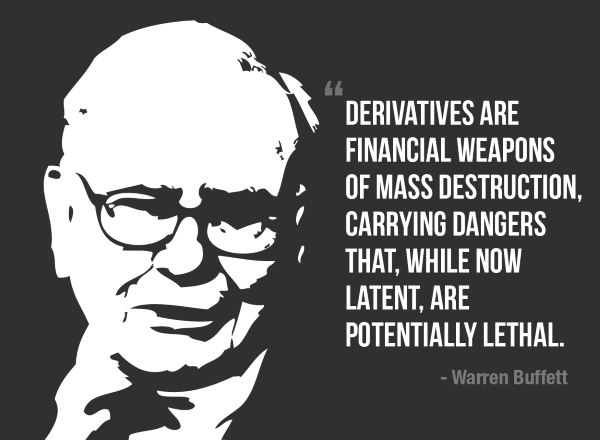
The contagion from such an event would be devastating. It is for this reason that Warren Buffet described derivatives as WMD or “financial weapons of mass destruction.”
It is unnerving that the shock resignation should follow an “extraordinary meeting” over the weekend following the failure of Greece to meet its scheduled payment to the IMF on Friday.
This does not count as a Greek default but it increases the risk of a default on the amalgamated 1.5 billion euros that now must be paid by the end of June. A default and the triggering of credit default losses would cause massive volatility in financial markets and potentially destabilise an already shaky global bond market and global financial system.

There have been a number of shocks to the market this year which would have been expected to have led to sharp losses in the derivatives market but slipped quietly by.
The debris caused by the massive volatility in the Swiss Franc following its being unpegged from the Euro – where it spiked 30% in minutes in January – seems to have been swept under the carpet. Austria’s bad bank Heta failed in late February with apparently no casualties.
We do not know what provoked the dramatic reversal in attitude to Anshu Jain at Deutsche Bank but it looks very much like the bank may be getting its house in order in anticipation of another major scandal or crisis. When said crisis breaks the responsibility can be dumped on the previous leadership.
Since Warren Buffett’s initial warning in 2002 , 13 years ago, he has been remarkably quiet on the real and growing threat to global markets and the global financial system. Despite the fact that the scale of the risk today is of an order of magnitude greater now than it was then.
This is unfortunate given the global financial system itself is far more volatile and casino like today than it was in 2002.
Sucking on the teet of Wall Street can lead to self induced omerta.
The global derivatives market is highly complex, totally unregulated and frighteningly large. One of the world’s leading derivatives experts, Paul Wilmott, who holds a doctorate in applied mathematics from Oxford University, has warned that the so-called notional value of the worldwide derivatives market is over $1.4 quadrillion.
A quadrillion is an incomprehensibly massive figure: it is 1,000 times a trillion or 1 with 12 zeros. A trillion is 1,000,000,000,000 and a quadrillion has 15 zeros – 1,000,000,000,000,000. The annual gross domestic product of the entire planet is between $50 trillion and $60 trillion. Thus, the derivatives markets notional value is more than 23 times the size of the value of all of the goods and services traded in global economy in one full year.
The crisis in Greece, the rumblings in the global bond market and indeed in Europe’s fourth largest bank and the threat posed by financial weapons of mass destruction should give cause for concern. It is another reason to reduce allocations to stock and bond markets and increase allocations to gold.
The real systemic risk of today is another reason to ensure owning allocated and segregated gold in the safest vaults in the safest jurisdictions in the world.
Must Read Guide: 7 Key Gold Must Haves
MARKET UPDATE
Today’s AM LBMA Gold Price was USD 1,173.40, EUR 1,053.32 and GBP 769.85 per ounce.
Friday’s AM LBMA Gold Price was USD 1,175.90, EUR 1,044.25 and GBP 767.82 per ounce.
Gold and silver were both down last week – down 1.58 percent and 3.77 percent respectively.

Gold fell $6.10 or 0.52 percent Friday to $1,170.90 an ounce. Silver slipped $0.08 or 0.49 percent to $16.10 an ounce.
Gold in Singapore for immediate delivery ticked lower and then higher and was up 0.1 percent to $1,172.86 an ounce an ounce near the end of the day, while gold in Switzerland was again flat. A stronger dollar, near a 13 year high verses the yen, may have contributed to gold’s recent weakness.
After Friday’s U.S. nonfarm payrolls report showed its largest growth since December, up 280,000 from last month, gold sunk to an eleven week low at $1,162.35 an ounce. The payrolls figure was significantly higher than the 225,000 that analysts were expecting. Although some question the veracity of the Bureau of Labor Statistics jobs numbers.
The jobs number led to renewed idle speculation that the U.S. Fed may start to raise interest rates in September.
A senior U.S. official today denied a news wire report that President Barack Obama had told a Group of Seven industrial nations’ summit that the strong dollar was a problem.
Bloomberg News earlier quoted a French official as saying Obama had made the comment. “The President did not state that the strong dollar was a problem,” the U.S. official said. He made a point that he has made previously, a number of times: that global demand is too weak and that G7 countries need to use all policy instruments, including fiscal policy as well as structural reforms and monetary policy, to promote growth.”
Sentiment in the euro zone weakened further in June as the Greek debt crisis and a slightly firmer single currency prompted investors to pare back their expectations for the economy. Sentix research group’s index tracking morale among investors and analysts in the euro area slipped to 17.1 in June from 19.6 in May. That was below the Reuters consensus forecast for a reading of 18.7.
The world’s largest gold back ETF, the SPDR Gold Trust, saw holdings drop 0.17 percent to 708.70 tonnes on Friday,its lowest since mid January. This shows poor sentiment in the gold market.
In South Africa, the Mineworkers and Construction Union said yesterday it would launch a strike if its rival union and gold mining companies impose a wage deal on its members.
In late European trading gold is up 0.31 percent at $1,174.81 an ounce. Silver is up 0.08 percent at $16.11 an ounce and platinum is up 0.41 percent at $16.11 an ounce.
Breaking News and Research Here
end
We now have our second mining company write a complaint to the CFTC on silver manipulation. The company: Gold Resource.
To Timothy Massad
Chairman, CFTC
May 28.2015:
The following has been brought to my attention:
The Commitments of Traders Report (COT) for May 19, 2015 indicates a record position change of more than 28,200 net contracts of COMEX silver futures being purchased by traders in the managed money category, the equivalent of 141 million ounces of silver and 61 days of world mine production. The COT report also indicates nearly 24,400 net contracts were sold by traders classified as commercials and the equivalent of 122 million ounces and 53 days of world mine production.
In addition, the report indicated that 8 traders in COMEX silver futures held a net short position of 376 million equivalent ounces of silver, by far the most of any commodity in terms of world production (163 days). With silver prices at current low levels, it is puzzling why the concentrated short position would be so large.
Since the Commission classifies traders in the managed money category as speculators (as opposed to hedgers) and because there is little evidence from public financial reports that silver producers are represented in the commercial category, it appears the big changes in positions on the COMEX are by speculators and commercials acting as speculators and not by those engaged in bona fide hedging.
It occurs to me that such massive speculation in COMEX silver futures may not be in keeping with the spirit and intent of commodity law and may suggest something is wrong with the price discovery process, since real producers and consumers of silver don’t appear to be represented.
Please address these issues in light of the current depressed price of silver and the questionable futures contracts.
I look forward to hearing from you.
Sincerely,

Jason Reid
CEO / President
end
A very important read…
(courtesy Dave Kranzler/IRD)
State Of Texas To The Fed/Government: “We Want Our Gold”
This Texas Gold Depository Bill represents a direct threat to the western Central Bank fraudulent fractional gold reserve system in which most if not all of the bullion held by the Fed, ECB banks and the Bank of England has been leased or hypothecated. This Bill, if passed, represents a direct threat to the wealthy elitists’ ability to loot our system using the U.S. dollar Ponzi scheme. – Investment Research Dynamics
Two big public pension funds in Texas – University of Texas and the Texas Teachers Retirement System – own more than $1 billion worth of gold. It was originally being held in the form of futures and ETFs. In 2011, uncomfortable with owning gold in paper form, University of Texas took delivery of bars and “safekept” them in an HSBC vault in NYC.
Now there’s Bill sitting on the Texas Governor’s desk waiting to be reviewed for his signature. Clearly, there are powerful entities in Texas who are concerned about the possibility that the gold owned in physical form by the State of Texas is at risk if it remains in storage in a bullion bank vault in NYC.
I think that somebody was looking at that, we better have this under our complete control,” said constitutional lawyer and gold expert Edwin Vieira, of the Texas bill. “They don’t want to have the gold in some bank somewhere and in two to five years it turns out not to be there.” – Edwin Vieira, Constitutional law expert specifically as the Constitution relates to money
While the State of Texas is going to attempt to pre-empt the risk that the physical gold owned by Texas has been or will be hyothecated or leased, I would bet that the bars already have counterparty ownership claims attached, even if the bars are still sitting in HSBC’s vault.
It’s no secret anymore that the western Central Banks have leased out most of the gold being stored in their vault facilities. Anyone who denies this is either completely corrupted or a complete idiot. Even Alan Greenspan admitted to Congress that the Fed leases gold to control the price:
Nor can private counterparties restrict supplies of gold, another commodity whose derivatives are often traded over-the-counter, where central banks stand ready to lease gold in increasing quantities should the price rise. –Alan Greenspan, July 24, 1998
Re-read that statement and think about what Greenspan is saying. He’s implicitly stating that the Fed can create enough paper gold – i.e. gold in lease form – in order to contain the price of gold. Please note: gold can be leased without actually moving the physical bars if the counterpart to the lease does not demand delivery. However, the ownership of that bar for legal purposes has transferred to the counterparty to whom the bar was leased.
Thus, in theory, a Central Bank can create a limitless supply of paper gold if it is not required to deliver any bars. This is the same idea behind Bernanke’s famous “helicopter speech” in which he stated that electronic currency can be created in infinite supply.
HSBC has likely already leased out or hypothecated most if not all of Texas’ gold bars sitting in its vault. While HSBC would be on the hook for the gold bars owed to Texas, Texas would be at risk for the possibility that HSBC would be unable to procure and deliver even a single gold bar. This scenario would arise if HSBC were to go bankrupt, a risk of which is clearly outlined in the GLD prospectus (HSBC is the custodian for GLD).
“This exact scenario happened with futures broker MF Global. I knew people who had warehouse receipts to gold bars with a specific serial number. But that gold had an encumbered title and they became unsecured creditors in bankruptcy,” said Weiner. – Keith Weiner, President of the Gold Standard Institute LINK
Apparently the wiser people in Texas were watching closely when Germany asked the Fed to ship over 600 tonnes of gold bars that had been “safekept” in NYC since the end of WW II. In so many words the Fed/US Government said: “we’ll send you your gold when we’re good and ready to send it.”
The message is that the gold was not there to be shipped. Obviously Germany was not going create a massive political problem for itself by attempting to force the U.S. legally to produce and ship the bars. Instead the German political leaders simply winked at the U.S. and said “okay, we understand the problem -take your time.”
Even more interesting perhaps, is a provision in the Texas Bill which prevents the Federal Government from seizing the gold bars:
Section A2116.023 of the bill states: “A purported confiscation, requisition, seizure, or other attempt to control the ownership … is void ab initio and of no force or effect.” Effectively, the state of Texas will protect any gold stored in the depository from the federal government. LINK
It will be interesting to watch this situation unfold, especially if Governor, Gregg Abbott signs the Bill. You can read the article from which I sourced the above quotes here: Texas Has The Potential To Uproot The Monetary System
I hope I’m wrong about this, but if I put my “think like a criminal” thinking cap on, I can envision a scenario in which the powerful political and money interests in Washington, DC and NYC exert a full assault on Governor Abbott to veto the Bill. This is the kind of legislation that could potentially expose the fraudulent fractional gold reserve system in the U.S. in which the ratio of paper claims to gold is several multiples. In fact, it’s the type of legal movement that could burn down the U.S. dollar.
end
China’s SGE gold withdrawals on track for record

LONDON – With gold withdrawals from the Shanghai Gold Exchange (SGE) totalling a further 37.1 tonnes for the week ended May 29, the total for the first five months of the year has been an absolutely massive 983 tonnes – the highest total on record for the period. Withdrawals have admittedly fallen back from the high Chinese New Year figures, but they are still running strongly for the time of year. One has to assume that the half year figure will be in the region of 1,150-1,200 tonnes, which will be a record for the period.
Indian gold imports for March – the most recent month for which official figures have just become available – have also been high – at 131.5 tonnes, although admittedly this was at the tail end of the festival season and imports will likely now drop back quite sharply as is usual through the Q2/Q3 period as the monsoon season kicks in and the rural gold buyers tend to hold fire until they have a better idea of how good the rainy season, and the likely crop yield, will be. But with the high 10% import duties on gold one suspects the true figure is rather higher due to gold smuggling. True, April imports are estimated to have fallen back to 81 tonnes, but seasonal factors are kicking in and the pre-monsoon forecasts are not encouraging.
But, reading some media headlines one would be led to assume that Chinese and Indian demand has dwindled dramatically they have been so negative of late. We have touched on this before – in particular with regard to the treatment of Hong Kong net gold exports to China, which are no longer nearly as relevant since China eased the path for gold imports to come in directly to the mainland from other nations than Hong Kong. Figures from Switzerland – the biggest known direct exporter of gold bullion to China – show it now sends 30-40% of its gold direct to the mainland, thus bypassing Hong Kong altogether. The US likewise on the latest US Geological Survey figures we have seen. And now, with Chinese companies buying controlling stakes in overseas gold miners, there is yet another potential pathway for gold to come in directly.
We are also entering a time of year when gold demand does indeed drop in both China and India, with the big early year festivals over. This happens every year, so figures comparing say April gold movements into China or Hong Kong, with those from March, can be taken as misleading in terms of the emphasis which seems to be put on them, as they can for India.
As an example, take this Bloomberg Headline of May 28 and the ensuing article – ‘China’s H.K. Gold Imports Slide as Falling Prices Delay Buying’. It goes on to note that ‘Net inbound shipments dropped to 46.6 metric tons last month from 61.8 tons in March and 65.4 tons a year earlier’ but no mention anywhere of the seasonal demand factors, nor the fact that now China is taking far more gold directly into mainland ports than it was a year ago and avoiding going through Hong Kong altogether.
At least the recent article on Mineweb, initially published by Fastmarkets in London, headed Swiss gold exports to China drop 67% in April, although very negative in tone, did recognise the seasonal factors in play here. It also noted that although Swiss exports to mainland China fell to 15.1 tonnes (26% of combined China and Hong Kong imports) in April, those to Hong Kong (mostly destined for mainland China), actually rose to 43.4 tonnes, up 36%. Doing the maths this implies that Swiss exports to mainland China will have accounted for almost 59% of the Hong Kong and China combined total the previous month. So one suspects some of the differences in the figures for both months were likely strongly affected by the overall timing of deliveries. Over the two-month period China mainland imports will have come to 60.9 tonnes and Hong Kong’s to 77.7 tonnes, thus showing that almost 44% went into mainland China directly, completely bypassing Hong Kong. It also suggests that if one takes Hong Kong and China together the fall off in demand over the two months was from 77.7 tonnes in March to 58.5 tonnes in April – a fall of only around 25% as compared with the 67% suggested by the headline. True, a substantial fall but not unexpected for the time of year.
end
(courtesy Craig Hemke/TFMetals/GATA and Andrew Maguire/Kingworldnews)
TF scorns phony jobs report; Maguire sees cash settlement in metals
4:15p ET Friday, June 5, 2015
Dear Friend of GATA and Gold:
Today’s U.S. jobs report is mere guesswork and contrivance, the TF Metals Report’s Turd Ferguson writes, adding his chart analysis concluding that the monetary metals are oversold. His commentary is headlined “Birth-Deathing Your Way to Prosperity” and it’s posted at the TF Metals Report here:
http://www.tfmetalsreport.com/blog/6897/birth-death-ing-your-way-prosper…
And London metals trader Andrew Maguire tells King World News today that cash settlement is likely for traders holding unallocated gold in London. An excerpt from the interview is posted at the KWN blog here:
http://kingworldnews.com/andrew-maguire-warns-western-central-banks-and-…
CHRIS POWELL, Secretary/Treasurer
Gold Anti-Trust Action Committee Inc.
end
(Bloomberg/GATA)
Did Obama tell G-7 strong dollar is a problem?
Obama Said to Tell G-7 Leaders Strong Dollar Poses a Problem
By Helene Fouquet
Bloomberg News
Monday, June 8, 2015
President Barack Obama told fellow Group of Seven leaders that the strong dollar is a problem, according to a French official with knowledge of the talks.
Geopolitical risks including Greece create volatility on financial markets, affecting interest rates and currencies, the official told reporters at the G-7 summit in southern Germany on Monday. In that context, Obama said that the strong dollar posed a problem, according to the official, who asked not to be named because the discussions were private. …
… For the remainder of the report:
http://www.bloomberg.com/news/articles/2015-06-08/obama-said-to-tell-g-7…
* * *
White House Denies Obama Said Strong Dollar a Problem
By Jeff Mason and Noah Barkin
Reuters
Monday, June 8, 2015
A senior U.S. official denied today news wire report that President Barack Obama had told a Group of Seven industrial nations’ summit that the strong dollar was a problem.
Bloomberg News earlier quoted a French official as saying Obama had made the comment.
“The president did not state that the strong dollar was a problem,” the U.S. official said. …
… For the remainder of the report:
http://www.reuters.com/article/2015/06/08/us-g7-summit-obama-dollar-idUS…
end
(courtesy Reuters/GATA)
Hungary is first European country to sign up for China’s Silk Road plan
By Ben Blanchard and Paul Carsten
Reuters
Sunday, June 7, 2015
BEIJING — Hungary has become the first European country to sign a cooperation agreement for China’s new “Silk Road” initiative to develop trade and transport infrastructure across Asia and beyond, China’s foreign ministry said late Saturday.
The countries’ foreign ministers signed a memorandum of understanding for what is formally known as the “One Belt, One Road” project in Budapest, according to a statement on the Chinese foreign ministry website.
China welcomes more European countries to look east and strengthen cooperation with China and other Asian countries, and participate in the “One Belt, One Road” in various ways, said Wang Yi, China’s foreign minister, according to a separate statement on the website. …
… For the remainder of the report:
http://www.reuters.com/article/2015/06/07/china-hungary-idUSL3N0YT01U201…
end
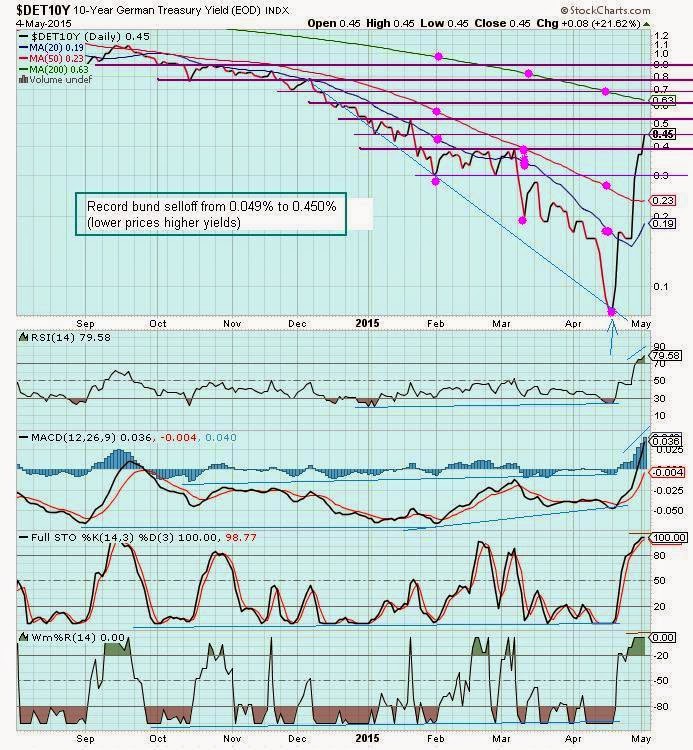
We have been witnessing a huge increase in the bond yields throughout the globe. Bill Holter explains the significance:
(courtesy Bill Holter/Holter/Sinclair collaboration)
The Biggest Black Swan of them all …False Beliefs!
Global markets are changing drastically and showing volatilities like we saw back in late 2008. I am not talking about stock markets, it is the debt and currency markets that are schizophrenic. Oddly, even after all of the various Western “QE’s”, liquidity suddenly looks like it is drying up. A great article as to why even the depth in the U.S. Treasury market has disappeared can be read here http://www.zerohedge.com/news/2015-06-04/here-reason-there-no-bond-market-liquidity . Various credit markets (important one’s!) have cracked over the last month and the myth of “zero percent interest” rates is in the process of being shattered. I want to visit several topics in this piece, each one with the ability to break the derivatives chain which is exactly what we are headed for!
 courtesy, thekeystonespeculator
The next false belief is about debt itself. I had the privilege the other day to personally listen to Greg Hunter go on a tirade about this. He said “the biggest lie in the world is that debt is an asset and debt is money”. He went on to say “NO IT’S NOT! Debt is ALWAYS A LIABILITY!” This is absolutely true, simple to understand, and 180 degrees counter to what the world believes …for now. Let me explain this a little because it is “core to everything” (pun intended as you will see).
And now overnight trading in stocks and currency in Europe and Asia
1 Chinese yuan vs USA dollar/yuan weakens to 6.2048/Shanghai bourse green and Hang Sang: red
2 Nikkei closed down by 3.71 points or .02%
3. Europe stocks all in the red/USA dollar index up to 96.28/Euro rises to 1.1135
3b Japan 10 year bond yield: rises to .50% !!!!(Japan buying 100% of bond issuance)/Japanese yen vs usa cross now at 125.30/very ominous to see the Japanese bond yield rise so fast!!
3c Nikkei still just above 20,000
3d USA/Yen rate now well above the 125 barrier this morning
3e WTI 58.57 and Brent: 62.91
3f Gold up/Yen up
3gJapan is to buy the equivalent of 108 billion uSA dollars worth of bond per month or $1.3 trillion. Japan’s GDP equals 5 trillion usa.
Japan to buy 100% of all new Japanese debt and by 2018 they will have 25% of all Japanese debt. Fifty percent of Japanese budget financed with debt.
3h Oil down for WTI and down for Brent this morning
3i European bond buying continues to push yields lower on all fronts in the EMU. German 10 yr bund rises to 86 basis points. German bunds in negative yields from 3 years out.
Except Greece which sees its 2 year rate rise to 24.91%/Greek stocks up 0.70%/ still expect continual bank runs on Greek banks /Greek default inevitable/
3j Greek 10 year bond yield rises to: 11.04%
3k Gold at 1175.00 dollars/silver $16.08
3l USA vs Russian rouble; (Russian rouble up 3/8 in roubles/dollar in value) 56.00,
3m oil into the 58 dollar handle for WTI and 62 handle for Brent/Saudi Arabia increases production to drive out competition.
3n Higher foreign deposits out of China sees huge risk of outflows and a currency depreciation. This can spell financial disaster for the rest of the world/China may be forced to do QE!!
30 SNB (Swiss National Bank) still intervening again in the markets driving down the SF. It is not working: USA/SF this morning .9395 as the Swiss Franc is still rising against most currencies. Euro vs SF is 1.0460 well above the floor set by the Swiss Finance Minister.
3p Britain’s serious fraud squad investigating the Bank of England/
3r the 3 year German bund remains in negative territory with the 10 year moving further to negativity at +.86/
3s Six weeks ago, the ECB increased the ELA to Greece by another large 2.0 billion euros.Four weeks ago, they raised it another 1.1 billion and then two weeks ago they raised it another tiny 200 million euros to a maximum of 80.2 billion euros. Last week, the limit was not raised. Yesterday, the ECB raised the ELA by 1/2 billion euros to 80.7 billion euros.The ELA is used to replace depositors fleeing the Greek banking system. The bank runs are increasing exponentially. The ECB is contemplating cutting off the ELA which would be a death sentence to Greece and they are as well considering a 50% haircut to all Greek sovereign collateral which will totally wipe out the entire Gr. banking and financial sector.
3t Greece paid the 700 million plus payment to the IMF last Wednesday but with IMF reserve funds. The funds are deferred to June 30.
3 u. If the ECB cuts off Greece’s ELA they would have very little money left to function. So far, they have decided not to cut the ELA
4. USA 10 year treasury bond at 2.38% early this morning. Thirty year rate just above 3% at 3.11% / yield curve flatten/foreshadowing recession.
5. Details Ransquawk, Bloomberg, Deutsche bank/Jim Reid.
(courtesy Jim Reid/Bloomberg/Deutsche bank/zero hedge)
Germany Enters Correction; EMs In Longest Losing Streak Since 1990 Routed By Turkey, Obama Turmoils Dollar
While there were key macroeconomic data out of Asia earlier in the session, with Japan revising its Q1 GDP up from 2.4% to 3.9% (due to an upward revision to capex) making some wonder if it simply didn’t snow in Japan this winter, as well as Chinese trade data that was once again disappointing with the third consecutive drop in exports coupled with an 18.1% collapse in imports hinting that nothing is going well in China’s economy (which once again sent stocks soaring this time up another 2.2% on certainty another PBOC rate cut is imminent, pushing the PBOC to a fresh 7-year high of 5,132), it was actually a leaked Obama comment on the strong USD that moved markets.
Shortly before 3 am Eastern, BBG blasted the following:
- FRENCH OFFICIAL: OBAMA SAID STRONG DOLLAR IS PROBLEM
Which promptly set the USD tumbling:

… before just one hour later, the US realized leaks like this are not allowed, the Fed as an “independent” organization, and that Obama really meant the strong USD is good if anything, we got the following headline:
- U.S. OFFICIAL: OBAMA DIDN’T SAY STRONG DOLLAR WAS A PROBLEM
Which in turn strenghtened the USD…

… but only modestly showing that the market realized the official US position had indeed been leaked and that as explained before, the Fed is cornered, on one hand unable to hike due to further USD profit-crippling strength, on the other unable to keep rates low over market stability and credibility concerns.
In other news, with Greece hanging around Europe’s neck and this week seen by most as the decisive one in which a deal needs to get done ahead of a the June 30 “red line” deadline, German stocks are finally feeling it and a few hours ago the Dax entered correction territory, dropping 10% from its April highs.
Elsewhere, as previously reported, following yesterday’s surprise Turkish election outcome, the Turkish Lira continued its plunge, and dropped as much as 5% in earlier trading to a record low 2.80 before correcting modestly. In related news, the MSCI’s main Emerging Market index posted its longest, 11-day losing run since 1990 driven by the 6% tumble in Turkish stocks.
A more in depth-look at global markets from RanSquawk notes that Asian equities struggled to find direction as participants reacted to Friday US NFP report, which saw US equities finish in the red as participants brought forward rate lift-off expectations. This further weighed on emerging market stocks which are now on course for their longest slump since 1990. Nikkei 225 (-0.02%) fell as final Q1 GDP revisions marked the best quarter for Japanese growth in 2yrs, tempering possibility of near-term BOJ easing (Q/Q 1.0% vs. Exp. 0.7% (Prev. 0.6%). Elsewhere, the Shanghai Comp. (+2.2%) and Hang Seng (+0.21%) rose with the former extending on 7-year highs, as participants digested today’s mixed Chinese trade data. The headline reading posted the 3rd largest surplus on record (59.49bln vs. Exp. 44.80bln) while exports and imports saw a 3rd and 7th consecutive monthly decline, respectively.
European equities kick off the week in the red, with the DAX officially slipping into correction territory as the index has fallen by around 10% from highs seen in April. Today’s session has been largely dominated by a number of major M&A stories in Europe, including Shire (-1.6%), Actelion (+7.6%), Diageo (+6.5%), BT (+1.2%) and Deutsche Telekom (+0.2%).
Elsewhere, Deutsche Bank (+5.8%) are among the best-performing stocks in Europe after Co-CEO’s Jain and Fitschen stepped down, with optimism surrounding the German Bank as incoming CEO John Cryan is said to be responsible for the turnaround of UBS whilst serving as CFO.
Bunds has continued its downward trend, shrugging off reports that negotiations between Greece and its creditors have reached an impasse as relations with Greek PM Tsipras and EU Chief Juncker are said to have soured after Tsipras branded the latest EU proposals as insulting.
The USD was initially pressured in the wake of comments from a French Official at the G7 who quoted US President Obama saying that the strong USD is a problem, which saw USD/JPY falls to fresh lows and other major pairs at highs including EUR/USD and GBP/USD. However, the USD pulled off worst levels after US Officials later stated that the President had been misquoted which sent GBP/USD into the red, while EUR/USD held onto its gains, albeit off best levels. Separately, USD/TRY printed a fresh record high, while Turkish stocks were down 10% in the wake of the Turkish elections over the weekend which showed PM Erdogan’s AK Party failing to secure a single-party government.
In the commodity complex, newsflow has remained light with WTI and Brent consolidating in modest negative territory after largely tracking fluctuations in the USD-index in early trade thus far. In the metals complex, a similar story can be told with spot gold trading relatively sideways amid scarce newsflow.
In summary: European shares fall with the basic resources and oil & gas sectors underperforming and food & beverage, telco outperforming. Germany’s DAX fell as much as 10% from its April peak. Deutsche Bank shares gain most since 2013 after CEO change. Lira Slides, Turkish Stocks Plunge as Erdogan’s AK Single-Party Era Ends. The Dutch and Spanish markets are the worst-performing larger bourses, the U.K. the best. The euro is stronger against the dollar. Greek 10yr bond yields rise; German yields increase. Commodities little changed, with WTI crude, Brent crude underperforming and natural gas outperforming.
Market Wrap
- S&P 500 futures down 0.1% to 2089.8
- Stoxx 600 down 0.4% to 387.6
- US 10Yr yield down 2bps to 2.39%
- German 10Yr yield up 3bps to 0.87%
- MSCI Asia Pacific down 0.4% to 147.4
- Gold spot up 0.2% to $1174/oz
- Asian stocks fall with the Shanghai Composite outperforming and the Sensex underperforming; MSCI Asia Pacific down 0.4% to 147.4
- Nikkei 225 little changed, Hang Seng up 0.2%, Kospi down 0.1%, Shanghai Composite up 2.2%, Sensex down 0.5%
- Apollo Is in Talks to Buy Saint-Gobain Unit for $3.3b
- GE Said to Near Canada Deal as Ares Seeks Other Loan Assets
- Actelion Surges on Report of $18.9b Shire Approach
- Swedish Orphan Says Talks on Possible Takeover Offer Have Ended
- Monsanto Offers to Pay Syngenta $2b If Takeover Fails
- Euro up 0.17% to $1.1133
- Dollar Index down 0.06% to 96.25
- Italian 10Yr yield down 1bps to 2.23%
- Spanish 10Yr yield little changed at 2.22%
- French 10Yr yield up 3bps to 1.2%
- S&P GSCI Index little changed at 433.1
- Brent Futures down 0.3% to $63.1/bbl, WTI Futures down 0.5% to $58.8/bbl
- LME 3m Copper little changed at $5934.5/MT
- LME 3m Nickel down 0.3% to $13140/MT
Bulletin Headline Summary from RanSquawk and Bloomberg
- Comments from a French Official suggesting that Obama views USD strength as a problem see early USD weakness before being refuted by the White House later in the session
- The DAX has entered correction territory from its April high with a raft of M&A stories in Europe failing to help
buoy sentiment - Looking ahead, today sees a relatively light calendar with no tier 1 data release, however comments from BoC
Deputy Governor Wilkins, ECB’s Mersch (Soft Hawk) and ECB Nowotny (Hawk) - Treasuries gain, 10Y yield retreats from highest level since October; events this week include Retail Sales and PPI, 3Y/10Y/30Y auctions starting tomorrow.
- With talks between the Greek government and creditors due to resume in Brussels on Monday, PM Tsipras faced a united front from G-7 leaders calling for movement to end the impasse and avert the risk of wider economic reverberations
- Even if Tsipras clinches as much as EU7.2b ($8b) from a bailout tranche creditors are withholding, he’s going to need another cash infusion shortly thereafter
- China exports fell 2.8% in May while imports slid 18.1% leaving a trade surplus of $59.1b; U.S. demand helped prevent a deeper decline in shipments abroad
- German industrial production rose 0.9% in April, more than forecast, after falling a revised 0.4% in March, data from the Economy Ministry in Berlin showed on Monday
- Deutsche Bank named supervisory board member John Cryan, a British takeover specialist, as next CEO; will replace co-
CEO Anshu Jain at end of this month, Juergen Fitschen next May - After dominating Turkey for more than a dozen years, Erdogan’s grip on the country loosened after the party he founded lost control of parliament following an election campaign marred by violence
- Sovereign 10Y bond yields mostly higher. Asian stocks mostly lower, European stocks, U.S. equity-index futures decline. Crude oil lower, copper unchanged, gold higher
DB’s Jim Reid summarizes the key weekend and overnight events
The bond market also felt the heat last week with 10 year bunds seeing an range of 52bps but closing 15bp off the wides for the week as the sell-off baton passed to US Treasuries after a strong payroll number (280k vs 226k expected) on Friday. 10yr yields climbed to an intraday high of 2.435% before finishing the day around 3bps off those highs at 2.408% (10bps wider on the day). They closed 29bps higher on the week and now at the highest since 6th October 2014. We have a series of US Treasury auction this week starting tomorrow (3yr, 10yr and 30yr) so it’ll be interesting to see how this new supply will be absorbed by the market.
US equities fared reasonably well in comparison. The S&P 500 recovered from the initial opening lows to finish the day just 0.14% lower. Lower beta sectors which are perhaps more sensitive to rates led the index lower with Telcos (-1.8%), Consumer staples (-1.3%) and Utilities (-1.3%) all lower. Energy (+0.6%) and Financials (+0.5%) were key gainers. The latter probably fuelled by hopes of a post-hike margin boost whilst the former perhaps reacted to a near 2% bounce in Brent (despite NFP driven Dollar strength on Friday). HY Energy credits failed to mirror the moves in equities with index level spreads closing the day around 14bps wider. Broader US IG credits held in better with spreads just around 1bps wider on the day.
Taking a closer look at Friday’s payrolls, Joe Lavorgna basically thinks the outsized gain in job growth along with upward revisions brings the Fed one step closer to a September lift-off. The NFP headlines rose 280k following 32k in net upward revisions. This moved the 3month moving average payrolls up 5k to 207k. We’ve now seen four out of five +200k plus payroll prints this year. Joe noted that job growth in May was broad based across sectors with a sharp fall in mining and logging (-18k) driven by pullback in energy related spending. The unemployment rate edged up to 5.5% from 5.4% in April due to a relatively large (397k) increase in labour force participation.
On the other side of the pond there is still no clear progress in Greece. Friday saw Greece’s Athex index finish around 5% lower on news of deferring the IMF payments. Greek bonds sold off further with the 10yr closing 30bps higher at 11.2%. At home PM Tsipras showed little signs of compromise on Friday after having told the Greek parliament that the creditors’ proposals are unrealistic and labelled the latest offer from creditors as “a bad negotiating trick”. EC President Juncker said that Tsipras had misrepresented aspects of the negotiations. Greece was also a key conversation point at the G7 Summit in Germany over the weekend. During a bilateral meeting with Merkel, President Obama called for Greek reforms and return to sustainable long term growth. Bloomberg noted that Greek negotiations will resume today and will likely continue on the sidelines at an EU-Latin America summit in Brussels on Wednesday.
Turning to Asia, Chinese trade data was the key release overnight. Exports fell for the third consecutive month in May (down 2.8% yoy) but was better than market consensus (-4.0% yoy). Imports fell -18.1% yoy (vs consensus of -9.6% yoy) largely driven by lower raw material prices (eg oil and iron ore). Markets are mixed overnight though but with Chinese equities continuing to outperform. The Hang Seng, the CSI 300 and Shanghai Composite are +0.3%, +0.7% and +0.9%, respectively as we head to print. Although the Shenzhen is down -1.9%. Elsewhere in Asia bourses in Japan and India are down -0.3% and -0.4% respectively. As we type, UST 10yr yield is steady at 2.40% whilst Brent is touch softer at US$62.7/bbl (-0.9%). Asian credit spreads are broadly flat to a touch weaker likely driven by the stronger NFP on Friday.
Onto this week’s calendar now. We start in Germany this morning where we are due to get the April industrial production and trade balance readings. Business sentiment for France and investor confidence for the Euro area are other data points. It’s the usual post payrolls lull in the US meanwhile with the just the labour market conditions index expected. We kick off Tuesday in Asia where get the all important CPI/PPI readings out of China as well as consumer confidence for Japan. In the European timezone we get the preliminary Q1 GDP print for the Euro area, as well as UK trade data and German labour costs. In the US we get JOLTS job openings, wholesale inventories and trade sales and the NFIB small business optimism survey. We kick off Wednesday in Japan with machine orders and PPI. Industrial and manufacturing production readings for France, Italy and the UK will be the focus of the European data. In the US on Wednesday we’ve just got the May monthly budget statement to look forward to. Thursday’s early highlight will be out of China where we get retail sales, industrial production and fixed asset investments. French CPI is the only highlight in Europe on Thursday while in the US the calendar picks up a gear with May retail sales, initial jobless claims, import price index and business inventories. We end the week on Friday in Asia with capacity utilization and industrial production for Japan. In Europe industrial production for the Euro area is due, as well as construction output for the UK. We end the week in the US on Friday with PPI and the University of Michigan consumer sentiment. Of course Greece headlines will also likely be a main focus for markets again this week.
EU’s Junker Snubs Greek Prime Minister, Declines Phone Call
In a speech to parliament on Friday, Greek PM Alexis Tsipras called a proposal drafted by the country’s creditors “an unpleasant surprise”.
Tsipras, who submitted his own proposal to Angela Merkel, Francois Hollande, Jean-Claude Junker, and Mario Draghi on Monday just ahead of an emergency meeting between the four in Berlin, says the counterproposal he received on Wednesday from the troika was “unreasonable” and can’t possibly be the basis for a deal.He went on to say that Greece will not be “blackmailed” and even went so far as to suggest that the institutions’ draft was a negotiating “trick” and may ultimately be withdrawn.
While it’s as yet unclear whether Tsipras’ bluster is genuine or simply reflects the fact that thanks to the so-called “Zambia” option — whereby Greece will now bundle its June IMF installments into one payment due at the end of the month — the PM can now feign belligerence for another few weeks before ultimately conceding amid an acute liquidity crisis and a default to creditors.
In the mean time, Tsipras must toe the line between adopting language that appeases the more radical members of Syriza, and testing the waters to discover what (if any) concessions would be acceptable to parliament.
As we’ve argued, the troika has every reason to stick to its guns. The risk of emboldening Syriza sympathizers in Spain and Portugal now far outweighs the projected fallout from a Grexit — or so the narrative goes.
Greece, on the other hand, will face devastating economic consequences, political instability, and social unrest in the event the country returns to the drachma, meaning Tsipras’ move to effectively call the troika’s bluff might have been more show than anything else. That is, the longer the PM can put on a brave face, the harder he can say he fought when, in the end, he is forced to go to parliament with an unpopular deal or face an economic depression the depths of which are as yet impossible to measure. Here’s UBS with a bit of color on this:
Seen from a positive angle, the bundling buys the Syriza government some time and arguably facilitates the cash-flow management in the immediate weeks ahead. But the bundling also raises concerns. It is a reflection, in our view, that the gulf between the Greek government and its international partners is still wide. It might also suggest that Prime Minister Tsipras is under significant pressure from the left wing of his party not to make concessions to the Troika.
If, on the other hand, Tsipras is serious about sticking with the mandate that got Syriza elected (which is possible), he got a rude awakening on Saturday when, insulted by the PM’s fire and brimstone speech to parliament, EU Commission President Jean-Claude Junker refused a meeting, noting that if Tsipras is serious about going down with the ship, there’s nothing left to talk about. FT has more:
Alexis Tsipras, the Greek prime minister, asked to meet Jean-Claude Juncker on Saturday but was spurned by the European Commission president rankled by the Greek leader’s denunciation of his efforts to broker a bailout deal..
In a fiery speech before the Greek parliament Friday night, Mr Tsipras lashed out, saying he was “unpleasantly surprised” by the offer made by Mr Juncker, calling the proposals “absurd” and “irrational, blackmailing demands”.
“I would like to believe that this proposal was an unfortunate moment for Europe, or at least a bad negotiating trick, and will very soon be withdrawn by the same people who thought it up,” Mr Tsipras told the Greek parliament.
According to a senior official with a Group of Seven delegation, which began gathering in southern Germany on Saturday ahead of a two-day summit of the leaders of the seven leading industrialised powers that begins Sunday, Mr Juncker believed Mr Tsipras’ speech in parliament left little to discuss.
“Unless he seriously addresses the issues, there’s no reason to meet,” said the G7 official..
Mr Juncker’s rejection of a meeting with Mr Tsipras returns the bailout talks to a point of stalemate just a week after creditors believed the talks were making progress for the first time in nearly four months.
Many officials believe a deal to release €7.2bn in desperately-needed bailout aid needs to be reached ahead of a June 18 meeting of eurozone finance ministers so that Athens has enough time to implement an agreed set of economic reforms in order to get the rescue funds before the bailout expires at the end of the month.
Without the €7.2bn in aid, Greece is expected to default on the €1.5bn IMF bill as well as two large sovereign bonds held by the ECB which come due in July and August totalling €6.7bn.
A senior Greek official, however, denied that Mr Tsipras had requested a meeting with Mr Juncker. The official said Greece’s differences now lie with Berlin, not Mr Juncker in Brussels.
- GREEK PROPOSAL REMAINS ON THE TABLE, GREEK GOVT OFFICIAL SAYS
end
The following commentary gives a great outline as to what to expect with the Greek crisis:
(courtesy zero hedge)
With Greece “Everything Must Go Right From Now On” To Avoid Market Shock
Greek Minister of State Nikos Pappas and Deputy Foreign Minister Euclid Tsakalotos are in Brussels today, for political negotiations, Bloomberg reports, as Athens seeks to address short-term liquidity concerns on the heels of a fractious week that began and ended with fire and brimstone rhetoric from PM Alexis Tsipras.
Recapping, Tsipras penned a lengthy and scathing op-ed late last month before submitting what he called a “reasonable” proposal to creditors last Monday. An emergency meeting between the EU top brass produced a draft agreement on Tuesday. Tsipras promptly shot it down, before delivering a speech to the Greek parliament on Friday during which he expressed his disappointment at the troika’s tactics and continued to insist that creditors were attempting to “blackmail” Greece. Over the weekend, EU Commission President Jean-Claude Junker reportedly declined a phone call from Tsipras because there “was nothing to talk about.” The Greek government has denied the call ever took place.
World leaders meeting in Germany for a G-7 summit put up a united front, after US President Barack Obama put Greece on the agenda. “There was unanimity of opinion in the room that it was important for Greece and their partners to chart a way forward that builds on crucial structural reforms,” The White House said, with spokesman Josh Earnest adding that “there is obviously a deadline looming [and the President] is certainly hopeful that Greece and their partners will be able to chart this path without undue volatility.”
“There is full agreement at the G-7 that everything must be done in order to avoid Greece exiting the euro, but also that Greek citizens, actually the Greek government, must be the first to send a signal,” Italian PM Matteo Renzi said (because Italy is certainly the model for fiscal responsibility).
For his part, Junker says he and Tsipras are still friends, but claims Tsipras misrepresented creditors’ proposal when he addressed parliament last week. “I don’t have a personal problem with Alexis Tsipras, but friendship, in order to maintain it, has to observe some minimal rules,” Junker said, adding that “he was presenting the offer of the three institutions as a leave-or-take offer. That was not the case. That was not the message given to him.”

So, just as we said over the weekend when we noted that “the hurt feelings will likely give way to reluctant (and painfully repetitive) talks next week,” Greece and its creditors will be back at it, and while words like “deadline” and “ultimatum” have become somewhat of a joke as they relate to the Greek drama, at least one EU FinMin thinks the point of no return is June 30:
- FRENCH FIN MIN: NO AGREEMENT WITH GREECE POSSIBLE AFTER THE END OF JUNE
Meanwhile, BofAML syas “a positive scenario requires almost everything to go right from now on.”
“Greece needs to receive new funding before the end of June, otherwise it will not be able to repay the IMF on June 30 … which would put ELA access of Greek banks at risk,” the bank adds. Here’s more:
The European proposal is asking three times more fiscal measures than what the former Greek government was willing to accept, despite a much lower primary surplus target. The Greek proposal is not specific enough on reforms, while insists on pre-election promises that we believe are unacceptable to the other side—reversing labor market reforms and asking for debt restructuring. Even in VAT, where reports suggested an agreement was close, there are large differences. It is hard to see much progress until the discussions focus on one draft which, given parliamentary constraints elsewhere, it is likely to be closer to the one of the lenders in our view.
Greece needs to agree with the creditors on the requirements for the current program review in the next 1-2 weeks. This will be very difficult given how far the proposals of the two sides are at this point.
The Greek parliament will have to vote and approve the deal. If approval requires support from opposition parties, the government should remain in power, or a new coalition government should be formed quickly, to avoid political uncertainty that could delay official funds. Certain European parliaments will also have to approve the deal.
The deal will need to provide sufficient funds to Greece to repay the IMF and the ECB during the summer—about €10bn total.
Negotiations should also start soon on a new program that will include policies and funding for the next 2-3 years. Such a program will have to be finalized by this fall. If the Greek government loses its parliamentary majority, new elections could take place before approving a new program.
Barclays has a bit more color on the negotiations and on what we have argued is a looming government shakeup:
Negotiations are gathering pace, nonetheless the gap is still substantial and we believe that bridging it may take longer than many expect.Moreover, we think a compromise on policies by the Greek government will carry a non-negligible political cost for the Syriza-led government and could trigger a political crisis that could accelerate deposit outflow and result in the imposition of administrative controls on Greek banks. But, if progress continues, we believe Europe will find a way to release some funds (even prior to a full-programme agreement) in order to avoid a default. The cash could come from the EUR10.9bn bank recapitalization funds (this would require the agreement of the ESM board, ie, a 85% majority vote) or the release of c. EUR2bn of SMP profits (which is part of the remaining €7.2bn of the last tranche). In any case, we do not believe that the crisis will be solved before the summer break, and it is very likely that Greece will remain a major uncertainty after the summer as the government and the institutions will need to agree on a third bailout, probably including a debt restructuring (OSI). Moreover, should a political crisis result in snap elections after the summer, which we think is a possibility, it would delay the process even further.
(a guide to negotiations)

Barclays also suggests that Tsipras’ defiance is politically motivated, something we’ve suggested time and again:
In our view, PM Tsipras’ aggressive speech last Friday was aimed at uniting his party, as divergence is mounting about the strategy to adopt with the creditors. Some members of Syriza are now openly calling for a default and an exit from the euro area, but according to a poll released over the weekend by Metron Analysis, 79% of Greeks want to stay in the eurozone, although 45% would vote for Syriza should new elections were held now. We still believe that an agreement will eventually be reached to avoid a Greek default, possibly through an extension of the programme beyond the end of June and a partial disbursement of the remaining bailout funds, but we think it could trigger a political crisis as the most radical faction of Syriza would not accept the conditions. Moreover, talks will probably continue until after the summer to agree on a third bailout, probably including a debt restructuring (OSI).
The bottom line is this:
With the risk of a default increasing, and possibly leading to an exit ‘by accident’ from the eurozone, deposit outflows are likely to continue and put additional pressure on the banking system, which relies more and more on the Emergency Liquidity Assistance from the Bank of Greece. During the weekend, Daniele Nouy, head of the Single Supervisory Mechanism, reportedly said that Greek banks were solvent, which should enable the ECB to continue to provide access to the ELA to Greek banks at least until the end of June (Die Welt). However, if there is no sufficient progress in the coming weeks and should creditors not officially extend the programme ending in June, then we believe in all likelihood the Eurosystem would not be able to continue funding Greek banks under the same terms (ie a at least a haircut increase is very likely).Moreover, if Greece were to default on its IMF loans, or on the bonds currently held by the ECB under the SMP, which are due to be repaid in July and August, we think Greece may then be forced to impose capital controls. In any case, we believe it is clear that without receiving further aid, Greece will not be able to pay €3.4bn that is due to the ECB on 20 July.
In a way, all of this is largely irrelevant, because as we’ve shown, Greece will remain Europe’s debt serf for decades and indeed, if the country’s economy doesn’t find its footing, these negotiations could repeat themselves periodically for some time to come. That is unless Athens abandons the euro and that, Dutch central bank director Job Swank says, would “for sure give a shock”:
“We have never experienced a Grexit or a country leaving the monetary union. It will for sure give a shock.”
* * *


Stocks Rebound On Greek Bailout Extension Proposal, One Already Slammed By Tsipras
DAX futures have jumped 50 points (back above 11,000), and Dow Futures are up 60 points off the day’s lows as yet another Greek rumor headline hits the wires. While the market reads the WSJ headlines on the extension of third Greek bailout to March 2016 as positive, Tsipras has already, according to the WSJ, rebuffed it as “unacceptable” because in exchange for the offered extension, Juncker and Dijsselbloem require implementing policy overhauls as well as pension cuts and tax increases, both of which just happen to be the Greek ‘red lines.’

The apparent good news from the The Wall Street Journal:
Greece’s international creditors have suggested extending the country’s bailout program until the end of March 2016…
And the bad news:
… but disagreements over the conditions attached to the continued support and what would happen afterward risk undermining that plan, three people familiar with the negotiations said Monday.
In exchange for bailout extension, Juncker and Diesel required “pension cuts and tax increases.
And the even worse news:
Another factor holding up a deal is what would happen after March. One of the people said that Greece insists it doesn’t want a third bailout program—which many creditor representatives believe is necessary—and doesn’t want to follow spending conditions laid out by its creditors beyond March.
So who gets to tell the Greeks the good news they can continue being a colony of Germany only if they collateralize their left kidney?
In short: another attempt by Europe to sweeten a deal which was already a non-starter for Greece, which repeatedly said over the weekend the only proposal in play is the one it itself drafted, and not that of the Troika.
For now, whoever, the upward momentum ignited algos are trying to grasp the nuance.
The war of words between Russia and the USA heats up as fighting between the rebels and the Ukrainians intensifies:
(courtesy zero hedge)
Cold War 2.0 Heats Up: Washington Dusts Off Russia “Containment” Plans
The “ceasefire” — if you can call it that — that has been in place in Ukraine since February’s Minsk Accord has fallen apart this week with the fiercest fighting in months claiming dozens of lives and prompting President Petro Poroshenko to launch a media blitz in an attempt to rally the West against what he claims is a renewed offensive by Russian-backed separatists.
Russian media contends the separatists were only defending themselves after they began to take artillery fire. Ukraine, by contrast, claims its soldiers came under attack by rebel tanks. “We had some storming action by between 500 and 1,000 servicemen of the militants, with a large number of tanks and armored machinery, apparently counting on being able to quickly capture Maryinka,”Poroshenko said.

Now, Ukraine is stepping up calls for Washington to send lethal aid to Kiev, casting the conflict as a war on Western, democratic values. Here’s The NY Times:
In what amounted to a multidimensional confidence-building campaign, President Petro O. Poroshenko of Ukraine tried on Friday to rally international support for his country and to maintain pressure on President Vladimir V. Putin of Russia, including economic sanctions.
Mr. Poroshenko held a major news conference, gave interviews to foreign journalists, spoke by phone with President Obama and Chancellor Angela Merkel of Germany, and prepared to welcome two visiting prime ministers to Kiev, Shinzo Abe of Japan and Stephen Harper of Canada..
“We will defend our country, our territorial integrity and our independence by ourselves,” Mr. Poroshenko said in an interview with journalists from a small group of foreign news organizations, including The New York Times. “We have weapons for that. Butunfortunately we are fighting with the weapons from the 20th century, from the time of the Soviet Union, against the Russian — most modern — weapons of the 21st century.”
He added, “Here we are defending freedom, we are defending democracy, we are defending European values, and the actual reason of this war is the right of the Ukrainian people to live under European standards, with European values, in the European Union.”
To be sure, this is an opportune time for Poroshenko to appeal to the US and its allies for assistance (which makes last week’s Russian “offensive” seem rather convenient). President Obama will attend a G-7 summit in Germany this weekend and will now come equipped with ‘evidence’ to support calls for stepped up sanctions on Russia. Obama may be seeking to rally support ahead of what looks to be a major strategy shift in realtions between NATO and Moscow. WSJ has more:
Obama administration officials are considering new deterrence strategies to rein in Russian meddling in Europe, in what some say would amount to an updated version of Cold War-era containment.
The proposed approach involves beefing up the militaries of allies and would-be partners and rooting out government corruption, which they see Moscow exploiting to gain more influence.
Some administration officials also want to expand the North Atlantic Treaty Organization to limit Moscow’s orbit. Membership for Ukraine or Georgia remains off the table, but some Pentagon and administration officials are advocating admitting the small Balkan country of Montenegro to solidify the country’s ties to the West and show that Mr. Putin doesn’t have a veto over alliance expansion.
The longer-term measures under discussion, officials say, stem from a recognition that Moscow has refused to moderate its posture after its territorial grab last year in Ukraine, and that U.S. and European attempts at diplomacy and sanctions alone won’t be enough to force a change. Those measures would include stepping up training for European allies to help partner militaries resist the kinds of so-called hybrid tactics—like training surrogate forces and conducting snap border exercises—that Russia has used effectively in Ukraine.
The impetus toward a policy shift also is driven by the conclusion that U.S. steps to reassure regional allies must be bolstered by other measures against possible Russian intrusions.
The Pentagon also is drafting plans for where to position new stocks of military equipment for use in a crisis or for stepped-up training exercises. That would entail additional U.S. troops assigned to rotating duty in the region.But Washington remains opposed, for now, to rebuilding permanent U.S. troop formations in Europe.
The administration is accelerating work on new military technologies to better counter Russian military advances and try to offset advances by Moscow, and deter Russia from using its increasing military prowess.
The policy deliberations are gaining momentum. On Friday, Mr. Carter gathered a group of military leaders in Stuttgart, Germany, to discuss the broader U.S. strategy to Russia..
Inside the White House, meanwhile, the National Security Council is at work on an overhaul of its Russia strategy that formally casts aside the policy of “reset” that dominated Mr. Obama’s first term.
The only thing being “reset” now, it appears, is the Cold War.
For its part, Moscow says Kiev “constantly” threatens to violate the ceasefire and refuses to engage in constructive dialogue.
From The Guardian:
“All agreements should be fully implemented so that no one is able to derail fragile progress by resuming military activity,” the Russian foreign ministry wrote on its Twitter feed, quoting minister Sergei Lavrov. “We must know who is shelling communities, thereby violating not only the Minsk agreements, but also international humanitarian law.”
Lavrov blamed Kiev for this week’s upsurge in fighting.
“The February Minsk agreements are constantly under threat because of the actions of the Kiev authorities, trying to walk away from their obligations to foster direct dialogue with Donbass,” he said.
While it’s impossible to accurately assess the fluid situation on the ground, what does seem clear is that neither side has the will (or even the desire) to deescalate the conflict.
For Washington, now seems like a particularly inopportune time to begin dusting off Cold War containment policies and ratcheting up the war rheotric with Russia. The US is already engaged in a tense war of words with China over the latter’s land reclamation projects in the South China Sea, and all signs point to boots on the ground in Iraq (and eventually Syria) by year end. Once again, US foreign policy now revolves squarely around the projection of military prowess.
end
De dollarization begins as Russia’s Sberbank issues letters of credit denominated in yuan:
(courtesy zero hedge)
De-Dollarization Du Jour: Russia’s Largest Bank Issues Yuan-Denominated Guarantees
The unipolar, dollar-dominated post-war world is shifting under Washington’s feet.
Leading the push towards multipolarity and de-dollarization are a resurgent Russia and China, the rising superpower. The demise of the Bretton Woods world order is perhaps nowhere more apparent than in the launch of the BRICS bank and the establishment of the AIIB. These new structures represent a move away from US-dominated multilateral institutions and their very existence suggests that a failure to adapt to economic realities and an inability or unwillingness to meet the needs of the modern world may soon drive institutions like the IMF into irrelevancy.
If the demise of the existing supranational economic order seems improbable, or if calls for its downfall appear at the very least to be premature, consider recent events.
While the US obstructs efforts to reform the IMF and give member countries representation that’s commensurate with their economic clout, and as the Fund itself bickers with the EU over aid to Greece, the BRICS bank (which hasn’t even officially launched) has offered Greece a spot at the table with some reports suggesting Athens may be able to contribute its paid in capital in installments while receiving aid in the interim.
China has pledged to invest some $50 billion in Pakistani infrastructure via Beijing’s Silk Road initiative and the AIIB. The money will fund power plants, roads, railways, and, perhaps most importantly, the Iran-Pakistan natural gas pipeline. The vast sum represents 53% more than the US has given Islamabad over the past 13 years combined. China is also set to invest an equally large sum in Brazil and is even considering the construction a railroad over the Andes, which would connect Brazil to China via the Pacific and ports in Peru. Meanwhile, lawmakers in Washington fight over whether infrastructure spending could have prevented an Amtrak derailment.
When considering the above, it’s important to understand that the BRICS bank isn’t simply a channel by which rising EM powers can ban together to project their growing influence in the face of the multilateral institutions which they feel have left them underrepresented. Similarly, the AIIB is more than a foreign policy tool that will allow Beijing to establish regional dominance.
Both institutions will serve to accelerate de-dollarization. Russia, for instance, has proposed the establishment of a BRICS alternative to SWIFT. China, meanwhile, is set to ensure that the yuan plays an outsized role in lending through the AIIB.
In yet another sign that Russia and China are set to work together to extricate themselves from a dependence on the dollar specifically and on Western financial institutions more generally, Russia’s largest bank has, for the first time, extended yuan-denominated letters of credit in concert with the Chinese Export-Import bank.
More, via Sberbank:
Sberbank issued its maiden letters of credit with financing from The Export-Import Bank of China for Baikal Bank’s client JSC Pharmasyntez.
JSC Pharmasyntez approached Sberbank about the possibility to finance letters of credit in yuan (CNY) for the import contract to supply pharmaceutical products worth more than 29 mln yuan.
The first LCs with financing from The Export-Import Bank of China have allowed the client to meet its current working capital needs while continuing to actively cooperate with Chinese suppliers.
The development of cooperation with The Export-Import Bank of China expands Sberbank’s possibilities to finance clients’ foreign trade with Chinese counterparties.
* * *
Recall that last October, Russia and China opened a $25 billion currency swap line, an effort which not only serves to bolster ties between Moscow and Beijing in terms of investment and trade, but which also helps to secure Russia against the financial strain imposed by Western sanctions.

What on earth is going on here? Derivative problems????
(courtesy zero hedge)
Deutsche Bank Co-CEOs To Resign Amid Shareholder Frustration
Back in May, Deutsche Bank’s co-CEOs Anshu Jain and Jürgen Fitschen got a rude awakening.
At the bank’s annual meeting, less than two-thirds of shareholders said they approved of top management’s performance. That was down markedly from nearly 90% the year before.
At issue: ambiguity surrounding planned cost cuts, distant profitability targets, and investor concern about the bank’s corporate culture.
Deutsche, perhaps more than any other firm on Wall Street, embodies the corrupt bank stereotype.
Allegations against the bank and its employees range from rate-rigging to the violation of US sanctions on Iran.Legacy litigation has cost the bank around $9 billion over the past three years alone and that figure could rise materially as reports suggest the DoJ may seek to extract a settlement of as much as $2-3 billion related to soured MBS in the coming months.
The problems go beyond the high profile cases. Last month for instance, Deutsche paid $55 million to settle an SEC investigation related to allegations the bank deliberately obscured billions in paper losses on a derivatives book tied to the 2007 collapse of the Canadian ABCP market.
From Deutsche’s annual report:
We are currently the subject of regulatory and criminal industry-wide investigations relating to interbank offered rates, as well as civil actions. Due to a number of uncertainties, including those related to the high profile of the matters and other banks’ settlement negotiations, the eventual outcome of these matters is unpredictable, and may materially and adversely affect our results of operations, financial condition and reputation.
A number of regulatory and law enforcement agencies globally are currently investigating us in connection with misconduct relating to manipulation of foreign exchange rates. The extent of our financial exposure to these matters could be material, and our reputation may suffer material harm as a result.
A number of regulatory authorities are currently investigating or seeking information from us in connection with transactions with Monte dei Paschi di Siena. The extent of our financial exposure to these matters could be material, and our reputation may be harmed.
Regulatory and law enforcement agencies in the United States are investigating whether our historical processing of certain U.S. dollar payment orders for parties from countries subject to U.S. embargo laws complied with U.S. federal and state laws.
We have been subject to contractual claims, litigation and governmental investigations in respect of our U.S. residential mortgage loan business that may materially and adversely affect our results of operations, financial condition or reputation.
You get the idea.
Now, shareholder frustration over the bank’s performance and the seemingly intractable nature of the firm’s legal problems have culminated in the resignation of Jain and Fitschen. WSJ has the story:
Anshu Jain and Jürgen Fitschen, the embattled co-chief executives ofDeutsche Bank AG, plan to announce their resignations, according to people familiar with the matter, an abrupt move that throws into question the future direction of one of the world’s largest banks.
Mr. Jain, a longtime trader and investment banker, plans to step down effective at the end of June, one person said. The other co-CEO, Mr. Fitschen, plans to leave after Deutsche Bank’s annual shareholder meeting next May, the person said.
The joint resignations, which could be announced as soon as Sunday, follow a series of financial missteps and regulatory penalties at the giant German bank, which has investment-banking and wealth-management operations all over the world. Most recently, the bank was forced to pay about $2.5 billion and to plead guilty to resolve accusations that its traders tried to rig benchmark interest rates, including the London interbank offered rate, or Libor. Some big shareholders have voiced increasing displeasure with the bank’s performance and the management team’s turnaround plans.
Adding to the pressure, Mr. Fitschen is on criminal trial in Germany in connection with the collapse of the Kirch media empire. Mr. Fitschen, 66 years old, has denied the charges.
The sudden resignations introduce the possibility of major change at Deutsche Bank. In April, Messrs. Jain and Fitschen took their latest stab at an overhaul strategy designed to streamline the at-times unwieldy bank and to boost its profitability. But to the disappointment of some shareholders, they stopped short of a radical plan to break up Deutsche Bank’s investment-banking and retail-lending operations into separate companies.
The catalyst for the sudden resignations is unclear.
The supervisory board has convened an emergency meeting on Sunday to discuss the bank’s leadership, the source said. It was expected to appoint John Cryan, the former chief financial officer of UBS, to replace Jain, Britain’s Financial Times newspaper reported.Deutsche Bank has struggled to restore an image tarnished by a raft of regulatory and legal problems which include probes into alleged manipulation of benchmark interest rates, mis-selling of derivatives, tax evasion and money laundering.In a last ditch effort to restore confidence in its leadership, the German lender presented a radical management shakeup on May 21, only to face calls for Jain to resign from staff situated in its own headquarters in Frankfurt.Some investors demanded more changes to restore confidence.
John Cryan, former UBS CFO, is reportedly in line to take the helm.
* * *
With Jain — the veteran trader and investment banker — on his way out by the end of the month, the bank’s derivatives book (which is 20 times larger on a notional basis than Germany’s GDP) will now be under the sole supervision of Fitschen, who, as Reuters reminds us, “is required to appear every week at a criminal court in Munich to defend himself against allegations that he misled investigators in a dispute with the heirs of the Kirch media empire.”
How fitting.

Turkish Lira Plunges As Landmark Election Portends Political Uncertainty
In an election that was, essentially, a litmus test for Recep Tayyip Erdogan’s plans to expand his powers, voters dealt the Turkish President and his Justice and Development Party (A.K.P.) a stinging blow at the ballot box on Sunday.
With 99% of the vote tallied, A.K.P appeared to have lost its parliamentary majority, winning only around 40% of the vote, a steep decline from 2011.
The results likely mean the party will have around 260 seats in parliament, down from 327. A difficult coalition building effort will now ensue and Erdogan can call for new elections if a government isn’t formed within 45 days.
What this means for political and social instability remains to be seen.
More color from The New York Times:
Almost immediately, the results raised questions about the political future of Prime Minister Ahmet Davutoglu, who moved to that position from that of foreign minister last year and was seen as a loyal subordinate of Mr. Erdogan. Mr. Davutoglu, who during the campaign vowed to resign if the A.K.P. did not win a majority, told reporters on Sunday evening in brief comments, “whatever the people decide is for the best.” Mr. Davutoglu was due to speak later in the evening in Ankara.
Mr. Erdogan, who as president was not on the ballot Sunday, will probably remain Turkey’s dominant political figure even if his powers have been rolled back, given his outsized personality and his still-deep well of support among Turkey’s religious conservatives, who form the backbone of his constituency. But even among those supporters, including ones in Kasimpasa, the Istanbul neighborhood where Mr. Erdogan spent part of his youth, there are signs that his popularity is flagging, partly because of his push for more powers over the judiciary and his crackdown on any form of criticism, including prosecutions of those who insult him on social media.
“A lot of people in Kasimpasa have become disheartened by Erdogan’s aggressive approach in recent weeks,” said Aydin, 77, who gave only his first name because some of his family members are close to Mr. Erdogan. “I voted for the A.K.P. because it has become habit, but I think Erdogan lost votes this week.”
And here’s Barclays on the implications going forward:
So far, a single party government in Turkey has generally been perceived as a source of stability by the market and reaction to election results confirming such continuity has generally been positive. However, this perception seems to have somewhat evolved recently. Particularly, foreign investors sound less uncomfortable with a coalition government scenario on the basis of improvement in checks and balances, whereas local investor perception is more negative.
In our view, local markets could trade poorly for an extended period should the election confirm a coalition government.First, it is still uncertain whether AKP would be able to attract support from MHP or HDP relatively swiftly and smoothly. While MHP stands as a natural coalition partner on the face of it, given the overlap in broader ideologies, the party’s disagreement with President Erdogan on many fronts and its reservations about the Kurdish peace process will likely make coalition process less straightforward. Indeed, MHP vice president Zuhal Topcu yesterday ruled out a coalition with AKP, accusing the party of making concessions to “terrorists” in an interview with Bloomberg. On the HDP front, external support for an AKP government seemed more likely than a coalition, given the sensitivities of both parties’ voter base.
However, HDP officials recently ruled out external support to an AKP government.
We think coalition negotiations could add another layer of uncertainty to the structure and focus of economic management, with which foreign investors already have concerns.
Underscoring Barclays commentary, the lira just hit a record low against the dollar:
- TURKISH LIRA PLUNGES 3.3% TO RECORD LOW 2.7523 AGAINST DOLLAR
end
Your more important currency crosses early Monday morning:
Euro/USA 1.1135 up .0027
USA/JAPAN YEN 125.30 down .164
GBP/USA 1.5237 down .0015
USA/CAN 1.2442 up .0018
This morning in Europe, the Euro rose by a tiny 27 basis points, trading now just above the 1.11 level at 1.1135; Europe is still reacting to deflation, announcements of massive stimulation, a proxy middle east war, and the ramifications of a default at the Austrian Hypo bank, a possible default of Greece and the Ukraine, rising peripheral bond yields and today crumbling bourses.
In Japan Abe went all in with Abenomics with another round of QE purchasing 80 trillion yen from 70 trillion on Oct 31. The yen continues to trade in yoyo fashion as this morning it settled up again in Japan by 16 basis points and trading well above the 125 level to 125.30 yen to the dollar.
The pound was down this morning as it now trades well below the 1.53 level at 1.5237, still very worried about the health of Barclay’s Bank and the FX/precious metals criminal investigation/Dec 12 a new separate criminal investigation on gold, silver and oil manipulation.
The Canadian dollar is down by 18 basis points at 1.2442 to the dollar.
We are seeing that the 3 major global carry trades are being unwound. The BIGGY is the first one;
1. the total dollar global short is 9 trillion USA and as such we are now witnessing a sea of red blood on the streets as derivatives blow up with the massive rise in the rise in the dollar against all paper currencies
2, the Nikkei average vs gold carry trade (still ongoing)
3. Short Swiss franc/long assets (European housing/Nikkei etc. This has partly blown up (see Hypo bank failure). Swiss franc is now 1.0489 to the Euro, trading well below the floor 1.05. This will continue to create havoc with the Hypo bank failure.
These massive carry trades are terribly offside as they are being unwound. It is causing global deflation ( we are at debt saturation already) as the world reacts to lack of demand and a scarcity of debt collateral. Bourses around the globe are reacting in kind to these events as well as the potential for a GREXIT>
The NIKKEI: this morning : down 3.71 points or 0.02%
Trading from Europe and Asia:
1. Europe stocks all in the red
2/ Asian bourses mixed … Chinese bourses: Hang Sang green (massive bubble forming) ,Shanghai in the green (massive bubble ready to burst), Australia in the red: /Nikkei (Japan) red/India’s Sensex in the red/
Gold very early morning trading: $1175.00
silver:$16.08
Early Monday morning USA 10 year bond yield: 2.38% !!! down 2 in basis points from Friday night and it is trading above resistance at 2.27-2.32%.
USA dollar index early Monday morning: 96.28 down 2 cents from Friday’s close. (Resistance will be at a DXY of 100)
This ends the early morning numbers,Monday morning
And now for your closing numbers for MOnday:
Closing Portuguese 10 year bond yield: 2.99% up 4 in basis points from Friday (getting ominous)
Closing Japanese 10 year bond yield: .50% !!! up 1 in basis points from Friday/(getting ominous)
Your closing Spanish 10 year government bond, Monday, up 2 points in yield (very ominous)
Spanish 10 year bond yield: 2.25% !!!!!!
Your Monday closing Italian 10 year bond yield: 2.26% up 2 in basis points from Friday: (very ominous)
trading 1 basis point higher than Spain.
IMPORTANT CURRENCY CLOSES FOR TODAY
Closing currency crosses for Monday night/USA dollar index/USA 10 yr bond: 4 pm
Euro/USA: 1.1276 up .0168 ( Euro up 168 basis points)
USA/Japan: 124.56 down 0.904 ( yen up 90 basis points)
Great Britain/USA: 1.5338 up .0088 (Pound up 88 basis points)
USA/Canada: 1.2407 down .0017 (Can dollar up 17 basis points)
The euro rose considerably today. It settled up 168 basis points against the dollar to 1.1276 as the dollar jolted southbound against most of the various major currencies on fictitious news of a possible Greek settlement . The yen was up by a huge 90 basis points and closing well below the 125 cross at 124.56. The British pound gained some ground today, 88 basis points, closing at 1.5339. The Canadian dollar gained some ground against the USA dollar, 17 basis points closing at 1.2407.
As explained above, the short dollar carry trade is being unwound, the yen carry trade , the Nikkei/gold carry trade, and finally the long dollar/short Swiss franc carry trade are all being unwound and these reversals are causing massive derivative losses. And as such these massive derivative losses is the powder keg that will destroy the entire financial system. The losses on the oil front and huge losses on the USA dollar will no doubt produce many dead bodies.
Your closing 10 yr USA bond yield: 2.39% down 1 in basis point from Friday// (well above the resistance level of 2.27-2.32%)/
Your closing USA dollar index:
95.26 down 104 cents on the day.
European and Dow Jones stock index closes:
England FTSE down 14.56 points or 0.21%
Paris CAC down 63.08 points or 1.28%
German Dax down 132.23 points or 1.18%
Spain’s Ibex down 144.70 points or 1.31%
Italian FTSE-MIB down 205.05 or 0.90%
The Dow down 82.91 or 0.46%
Nasdaq; down 40.43 or 0.80%
OIL: WTI 58.16 !!!!!!!
Brent:62.70!!!!
Closing USA/Russian rouble cross: 56.16 up 1/8 roubles per dollar on the day
end
And now for your more important USA stories.
NY trading for today:
Dow Red In 2015 As S&P Takes Out Key Support: Trannies Tank, Crude Clipped, Dollar Dumped
It seems the hangover from Friday’s “good” news continues, warranting only one possible clip today…
First things first – The Dow dipped negative year-to-date, was briefly rescued by no-news Greece headlines…

And the S&P 500 (cash) index closed back below its 100DMA (at 2084.57) for the first time in a month…closing at its lows… (and falling further after hours in futures)

But while stocks were weak, the big moves were in The Dollar and Crude – both notably weaker…
The dollar was monkey-hammered today driven by a surge above 1.1200 in EURUSD… (3rd worst day for USD in 3 months)

Crude did not care but gold, silver and copper eked out gains…

In the only market The Fed cares about, stock indices were all weaker led by more turmoil in Trannies

The Greek headline was perfectly timed to ramp S&P 500 futures to VWAP (even though it was actually bad news)…

Notably, AAPL’s weakness today weighed further on NASDAQ and leaves it the underperformer post Payrolls…Stocks closed “NOT” off the lows…

AAPL’s day explained…

The Treasury Complex was generally bid with the long-end underperforming (late day weakness in bonds driven by the no-news Greece headlines)….

With bond prices all lower post-payrolls…

Charts:Bloomberg
end
Why McDonald’s Is Ending Monthly Sales Reports: Global Sales Drop For 12 Consecutive Months
Ten days ago we reported with much amusement that the “turnaround story” that is McDonalds has decided to pull the oldest trick in the collapsing business book, and would stop reporting its monthly comparable sales starting with the month of June.
Moments ago MCD reported its May comp store sales which confirmed what we cynically noted is the reason for the data halt, namely that no matter what it does, MCD simply can not “turnaround” its foundering business, and after a drop of -0.6% in April, May global comp sales dropped once again, this time by -0.3%. This was the 12th consecutive month of global comparable store declines. Next month will be the 13th. There won’t be a 14th.

The good news for Europe is that with a jump of 2.3% in May comp store sales, the European recovery is clearly taking hold and the tens of millions of unemployed youths can finally afford a 99 cent meal.
But perhaps the biggest irony is that the drop was driven not by Europe or Asia, where one would expect the strong dollar to be wreaking havoc on US-denominated sales, but in the US, where same store sales dropped -2.2%, more than the -1.7% expected.

We wonder if the decline in USD-denominated US sales will also gain be blamed on the strength of the US currency?
Finally, as we have said all along, it really is time for MCD’s new boss Steve Easterbrook to start wearing many more pieces of flair or he will join his predecessor Don Thompson in “retiring” prematurely any month now.
Kansas Poor Tax A Reflection Of Nationwide Fiscal Crisis
In the course of covering America’s deepening state and local government fiscal crisis, we’ve touched on Kansas quite a bit.
As a reminder, an ill-fated tax cut ‘experiment’ by Governor Sam Brownback contributed to a rather large funding gap which has in turn squeezed the public sector to the point that some schools have had difficulties making payroll. This well-publicized scenario has left many Kansans disgruntled as evidenced by the now famous Boss Hawg’s Bar-B-Q incident wherein Brownback’s waitress famously refused gratuity from the Governor, instead advising Brownback to “tip the schools.”
Here’s what the situation looks like visually (note that the tax cuts came in 2012):

In early April, Brownback signed a welfare reform bill into law. The goal, the Governor said, is to “get people back to work, because that’s where the real benefit is getting people off public assistance and back into the marketplace with the dignity and far more income there than the pittance that government gives them. And I hope we don’t lose track of the primary focus of what we’re after.”
Well, it turns out some observers did “lose focus” because the bill contained a number of rather ‘innovative’ riders, one of which limits the amount of cash that can be withdrawn from ATMs with state-issued assistance cards to $25 per day.
The idea, according to Kansas, is to ensure that poor people spend public assistance on necessities, where “necessities” must not mean rent because after all, rent costs more than $25 and because there’s a $1 fee for each withdrawal, plus the standard ATM fee for those with no checking account, each visit can cost as much as $3 (or more) and because ATMs don’t dispense 5s, a person looking to spend say, $300 of public assistance on rent would need to go to the ATM 15 separate times incurring $45 in fees.
A single mother with two children in the state would receive around $400 in assistance, meaning that, in the scenario presented above, the ATM limit amounts to a 10% reduction in monthly benefits.
As we noted last month, it isn’t at all clear how this policy will lead to a reduction in the number of people on welfare: “This will only serve to further impoverish recipients, making it more likely that they will remain dependent on the public purse, thus driving up the cost of the program for taxpayers in the long run.”
Phyllis Gilmore, Secretary of The Kansas Department for Children and Families, doesn’t agree. In fact, Phyllis thinks this is the kind of thing that other states should try, because after all, poverty is a real inconvenience for everyone:
“We encourage other states to look to Kansas on how to help end government dependency… government dependency [is] a disservice to the individual, a disservice to our culture and certainly a disservice to the taxpayer.”
(Brownback and Gilmore signing the welfare reform bill into law)

The bill (which also bans poor people from spending public assistance on going to the movies or going swimming) has since garnered quite a bit of national attention. Here’s some additional color on the issue from Bloomberg:
Kansas is in trouble. After slashing income taxes in 2012, the state faces a revenue gap of more than $400 million. Republican Governor Sam Brownback and state legislators are debating how to make up the shortfall. So far they’ve agreed on one way to control how state money is spent. Starting in July, people on the dole will be limited to a single ATM withdrawal of no more than $25 per day.
A September 2014 survey by the Pew Research Center found that 73 percent of Republicans feel the government can’t afford to do much more to help the needy, compared with 32 percent of Democrats. “If you look at cycles in history, you’ll see that there is compassion, then compassion fatigue, and then blame,” says Patricia Baker, a senior policy analyst at the Massachusetts Law Reform Institute, a Boston nonprofit that researches poverty. “This happens because there’s impatience with the solution.”
The number of families receiving cash through Temporary Assistance for Needy Families (TANF), the federal-state aid program that grew out of the 1996 federal welfare reform law, peaked in 1994 at 5.1 million families, according to the Congressional Research Service. It’s since plummeted to 1.5 million at the end of 2014. In Kansas 6,478 families were on welfare at the end of last year, down from 7,553 in 2013. Monthly payments for a family of three range from $386 to $429, depending on a county’s population and cost of living.
The restrictions on ATM withdrawals could eat up as much as 10 percent of that in transaction fees, according to Shannon Cotsoradis, president and chief executive officer of the advocacy group Kansas Action for Children. She says state lawmakers acted on anecdotes about TANF cards being used at casinos and, in one instance, on a cruise ship. “This is not a data-driven policy decision,” she says. “This is a solution seeking a problem.”
Bloomberg goes on to note that as states’ fiscal crises worsen, officials are turning increasingly to welfare cuts to plug funding gaps:
Kansas is among several Republican-controlled states that have recently cut or limited public-assistance funds. In Arizona, which faces a $1 billion budget shortfall, lawmakers voted on May 18 to limit welfare to a year, the shortest window in the nation. On May 5, Missouri’s Republican legislature overrode Democratic Governor Jay Nixon’s veto to enact a bill that cut thousands of low-income families from aid rolls by reducing how long people can claim cash from five years to fewer than four. Michigan’s GOP-controlled legislature passed a bill on June 2 that strips cash assistance from families with chronically truant children. “During the recession there were lots of blue states, for fiscally driven reasons, that were cutting welfare,” says Liz Schott, a senior fellow at the liberal Center on Budget and Policy Priorities, a Washington think tank. “This year’s cuts feel more ideologically driven.”
Partisan politics aside, the cuts, more than anything else, are a reflection of the nation’s state and local government fiscal crisis, which has already claimed Chicago (in the form of a devastating Moody’s downgrade) and threatens at least 22 states, including Kansas.
With The Illinois Supreme Court having set a precedent that effectively rules out pension reform as a solution, states may turn to pension obligation bonds. If this becomes the go-to, can-kicking option, you can bet the crisis will eventually return with a vengeance, and with it, more and deeper cuts.
end


 harveyorganblog.com
[…] JUNE 8/STILL NO DEAL IN SIGHT FOR GREECE/WAR OF WORDS BETWEEN RUSSIA AND UKRAINE/DEMAND FOR PHYSICAL… […]
LikeLike