
Good evening Ladies and Gentlemen:
Here are the following closes for gold and silver today:
Gold: $1124.60 down $13.60 (comex closing time)
Silver $14.05 down 56 cents.
In the access market 5:15 pm
Gold $1125.30
Silver: $14.12
Here is the schedule for options expiry:
Comex: options expired tonight
LBMA: options expire Monday, August 31.2015:
OTC contracts: Monday August 31.2015:
needless to say, the bankers will try and contain silver and gold until Sept 1.2015:
First, here is an outline of what will be discussed tonight:
At the gold comex today, we had a poor delivery day, registering 0 notice for nil ounces Silver saw 0 notices for nil oz.
Several months ago the comex had 303 tonnes of total gold. Today, the total inventory rests at 226.94 tonnes for a loss of 76 tonnes over that period.
In silver, the open interest fell by 1,868 contracts as silver was down in price by 15 cents yesterday. Again, our banker shorts are using the opportunity of the lower price to cover their shortfall. The total silver OI now rests at 167,243 contracts In ounces, the OI is still represented by .836 billion oz or 119% of annual global silver production (ex Russia ex China).
In silver we had 0 notices served upon for nil oz.
In gold, the total comex gold OI rests tonight at 432,154 for a loss of 7486 contracts. We had 0 notice filed for nil oz today.
We had no change in tonnage at the GLD today / thus the inventory rests tonight at 681.10 tonnes. The appetite for gold coming from China is depleting not only gold from the LBMA and GLD but also the comex is bleeding gold. It sure looks like 670 tonnes will be the rock bottom inventory in GLD gold. It looks to me that China has taken the last amounts of physical gold from the GLD. I guess the only place left for China to receive physical gold will be the FRBNY and the comex. In silver, we had no changes in silver inventory at the SLV tune of / Inventory rests at 324.968 million oz.
We have a few important stories to bring to your attention today…
1. Today, we had the open interest in silver fall by 1868 contracts down to 167,243 as silver was down by 15 cents in price with respect to yesterday’s trading. The total OI for gold fell by 7,486 contracts to 432,154 contracts,as gold was down by $15.20 yesterday. We still have 16.26 tonnes of gold standing with only 14.70 tonnes of registered gold in the dealer vaults ready to satisfy that which stands.
(report Harvey)
2.Gold trading overnight, Goldcore
(/Mark OByrne)
3. Six stories on the collapsing Chinese markets,another devaluation of the yuan and the huge downfall in trading last night despite yesterday’s announcement of an RRR cut and also interest rate cuts. The authorities are on a witch hunt as they are now trying to arrest commissioners as well as traders.
(Reuters/Bloomberg)
4. Troubles with Greek pensions as the Greek authorities raid an emergency fund as they just ran out of money.
(zero hedge)
5. India now warns that it may enter the currency wars
(zero hedge)
6. The largest cement company in Mexico having huge troubles as the peso falters and yet its debt is foreign, mostly in USA dollars
(zero hedge)
8 Trading of equities/ New York
(zero hedge)
9. USA stories:
- Durable goods order falter in July/capex spending on orders also decline
- Bill Dudley, of the FRBNY just killed a rate hike in Sept (3 stories)
- Poor bond auction and China is nowhere to be found!!
- Bill Gross formally of PIMCO and now JANUS asks is China selling long term USA bonds?
- Graham Summers,of Phoenix Capital Research on what can the Fed do to avert a crisis: Answer not much (Phoenix Research Capital)
10. Physical stories:
- Bill Holter’s commentary tonight: “Look out Below”
- Jim Sinclair’s interview with Greg Hunter..a must view
- John Crudele of the NY Post believes that the authorities will rig the NY markets (Crudele/NY Post)
- Precious Metals Probe by the EU and New York (Bloomberg)
11. London’s Financial times reports on the huge downfall in global trade
(London’s Financial Times)
12. Today’s wrap up courtesy of Raul Meijer and he discusses the events in China.
Let us head over and see the comex results for today.
August contract month:
initial standing
August 26.2015
| Gold |
Ounces
|
| Withdrawals from Dealers Inventory in oz | nil |
| Withdrawals from Customer Inventory in oz | 32.15 oz (Manfra)
i kilobar |
| Deposits to the Dealer Inventory in oz | nil |
| Deposits to the Customer Inventory, in oz | 13,778.53 oz (Delaware) |
| No of oz served (contracts) today | 0 contracts (nil oz) |
| No of oz to be served (notices) | 1345 contracts (134,500 oz) |
| Total monthly oz gold served (contracts) so far this month | 3885 contracts
(388,500 oz) |
| Total accumulative withdrawals of gold from the Dealers inventory this month | nil |
| Total accumulative withdrawal of gold from the Customer inventory this month | 574,565.7 oz |
Total customer deposit: 13,778.53 oz
JPMorgan has 7.1966 tonnes left in its registered or dealer inventory. (231,469.56 oz) and only 741,358.273 oz in its customer (eligible) account or 23.05 tonnes
We lost 47 contracts or an additional 4700 ounces will not stand for delivery. Thus we have 16.26 tonnes of gold standing and only 14.70 tonnes of registered or dealer gold to service it. Today, again, we must have had considerable cash settlements.
August silver initial standings
August 26 2015:
| Silver |
Ounces
|
| Withdrawals from Dealers Inventory | nil |
| Withdrawals from Customer Inventory | 75,200.715 oz (Delaware, Scotia) |
| Deposits to the Dealer Inventory | nil |
| Deposits to the Customer Inventory | 512,012.42 oz (Scotia) |
| No of oz served (contracts) | 0 contracts (nil oz) |
| No of oz to be served (notices) | 14 contract (70,000 oz) |
| Total monthly oz silver served (contracts) | 325 contracts (1,625,000 oz) |
| Total accumulative withdrawal of silver from the Dealers inventory this month | 85,818.47 oz |
| Total accumulative withdrawal of silver from the Customer inventory this month | 8,424,685.7 oz |
total dealer deposit: nil oz
Today, we had 0 deposits into the dealer account:
total customer deposits: 512,012.42 oz
total withdrawals from customer: 75,200.715 oz
we gained 15 contracts or an additional 75,000 oz of silver will stand in this non active month of August.
And now SLV:
August 26.2015/no change in inventory at the SLV/Inventory rests at 324.698 million oz
August 25.2015:no change in inventory at the SLV/Inventory rests at 324.698 million oz
August 24./no change in inventory at the SLV/Inventory rests at 324.698 million oz
August 21.2015/ no change in inventory at the SLV/Inventory rests at
324.698 million oz
August 20.2015:/no changes in inventory at the SLV/Inventory rests tonight at 324.698 million oz
August 19/no changes in inventory at the SLV/Inventory rests tonight at 324.698 million oz
August 18.2015: no changes in inventory at the SLV/Inventory rests tonight at 324.968 million oz
August 17.2015: no changes in inventory at the SLV/Inventory rests tonight at 324.968 million oz.
August 14/no changes in inventory at the SLV/Inventory rests at 324.968 million oz.
August 13.2013: a huge withdrawal of 1.241 million oz/Inventory rests tonight at 324.968 million oz
August 12.2015: no change in SLV inventory/rests tonight at 326.209 million oz.
Sprott formally launches its offer for Central Trust gold and Silver Bullion trust:
SII.CN Sprott formally launches previously announced offers to CentralGoldTrust (GTU.UT.CN) and Silver Bullion Trust (SBT.UT.CN) unitholders (C$2.64) Sprott Asset Management has formally commenced its offers to acquire all of the outstanding units of Central GoldTrust and Silver Bullion Trust, respectively, on a NAV to NAV exchange basis. Note company announced its intent to make the offer on 23-Apr-15 Based on the NAV per unit of Sprott Physical Gold Trust $9.98 and Central GoldTrust $44.36 on 22-May, a unitholder would receive 4.45 Sprott Physical Gold Trust units for each Central GoldTrust unit tendered in the Offer. Based on the NAV per unit of Sprott Physical Silver Trust $6.66 and Silver Bullion Trust $10.00 on 22-May, a unitholder would receive 1.50 Sprott Physical Silver Trust units for each Silver Bullion Trust unit tendered in the Offer. * * * * *
(courtesy/Mark O’Byrne/Goldcore)
Gold “Insurance Policy” and Deserves a Place in Portfolios – Carmignac
Gold has a place in high-net worth individuals portfolios as an insurance policy against systemic risk in the banking system, says Carmignac commodity investor Michael Hulme.

EW: Hello, and welcome to Morningstar series, “Why Should I Invest With You?” I’m Emma Wall and I’m joined today by Carmignac’s Michael Hulme. Hi, Michael.
MH: Hi Emma
EW: So, we’re here today to talk about commodities. That’s your bag. I thought we’d start with that headline grabbing commodity, gold. Gold has hit the headlines this week because $2.3 billion worth of gold ETFs have been sold as gold hit a five-year low. How much further can gold can go and should we care?
MH: Very interesting question. Yes, gold has certainly lost some of its luster recently and I guess, many people are asking the question, is it foolish to invest in gold?
I think gold still has a place in portfolios. I think gold, in particular, has a place in high net worth individuals portfolios and I think there were several reasons for that.
Gold is really an insurance policy against systemic risk in the financial system now.
While it’s been nearly seven years since the last melt down, given the jitters we’ve seen in China recently and the ongoing concerns about leverage and credit worthiness globally, I still think gold has a role to play as a modicum of insurance policy.
I think that’s compounded by the fact that although we’ve seen a lot of sales of gold, actually if you look at China recently, over the last several years they’ve actually been increasing their stocks of gold and adding to them over time. And I think the prudent investor — while you can make a case for saying gold is actually any worth as much as anyone thinks it should be worth, but the prudent investor might take heed of the fact that what the Chinese are doing.
Yes, they are devaluing and to a certain extent that’s exporting deflation. But actually overall across the world what we’re seeing is a series of competitive devaluations, and ultimately they are inflationary in terms of (fear of) currency.
So what we will see over time, I think is a reasonable chance that we’ll see an inflationary risk rising across the spectrum.
There are also risks obviously of a more systematic nature. In that context, I think certainly from a technical perspective, gold looks quite intriguing here.
Founded in 1989 by Edouard Carmignac and Eric Helderlé, Carmignac is now one of Europe’s leading asset managers.
Read transcript and watch video here
DAILY PRICES
Today’s Gold Prices: USD 1134.40, EUR 724.63 and GBP 990.05 per ounce
Yesterday’s Gold Prices: USD 1,154.25, EUR 999.35 and GBP 730.56 per ounce.
(LBMA AM)
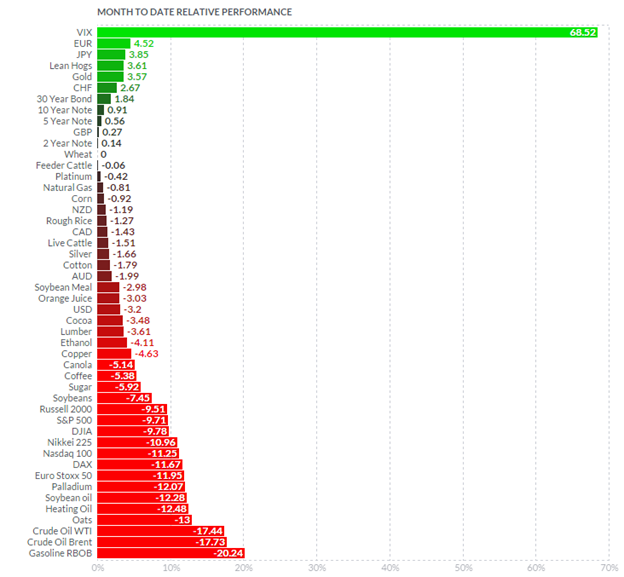
August Month to Date Performance
Yesterday, selling in the futures market saw gold fall $13.60 to $1139.50 in New York – down 1.1%. Silver slipped 0.95% or 14 cents to $14.64 per ounce.
As ever, it is vitally important to focus on asset performance and investments over the long term – months, quarters and of course years. So far in August, gold has outperformed the vast majority of major assets (see table above) and is 3.57% higher for the month while leading stock indices have fallen by more than 10%.
Gold’s hedging and safe haven characteristics are being shown again and we believe this important safe haven importance of gold in a diversified portfolio will again become evident in the coming months.
BREAKING NEWS
Gold prices consolidate but currency weakness may provide support – The Bullion Desk
Precious-Metals Trading Is Probed by EU After U.S. Inquiry – Bloomberg
Dow, S&P close lower in biggest reversal since Oct. 08 – CNBC
Mood Getting Worse on Wall Street as S&P 500 Floor Eludes Bulls – Bloomberg
World shares sag as China jitters persist – Reuters
IMPORTANT COMMENTARY
Gold a ‘Buy’ says Barrat – Bloomberg Video
Gold Facts and Gold Speculations – GoldSeek
Donald Trump, Fascist – Daily Reckoning
The cronies are on the run – MoneyWeek
Chinese alarm over? No, this is merely a pause in an ongoing debt crisis – The Telegraph
Click on News and Commentary
end
I brought this to your attention yesterday, but it is worth repeating
(courtesy GATA/Bloomberg)
Precious metals trading is probed by EU after U.S. inquiry
Submitted by cpowell on Tue, 2015-08-25 15:03. Section: Daily Dispatches
By Gaspard Sebag Stephen Morris
Bloomberg News
Tuesday, August 25, 2015
European Union antitrust regulators are probing precious-metals trading following a U.S. investigation that embroiled some of the world’s biggest banks.
The European Commission disclosed the probe after HSBC Holdings said in a filing this month that it had received a request for information from the EU in April.
“The commission is currently investigating alleged anti-competitive behavior in precious metals spot trading” in Europe, Ricardo Cardoso, a spokesman for the regulator, said in an e-mail on Tuesday.
U.S. prosecutors have been examining whether at least 10 banks, including Barclays, JPMorgan Chase & Co., and Deutsche Bank, manipulated prices of precious metals such as silver and gold. The scrutiny follows international probes into the rigging of financial benchmarks for rates and currencies, which have yielded billions of dollars in fines. …
… For the remainder of the report:
http://www.bloomberg.com/news/articles/2015-08-25/eu-commission-is-probi..
end
And the rigging continued today
(courtesy john Crudele/NY Post)
John Crudele: How Washington will try to rig the stock market
Submitted by cpowell on Wed, 2015-08-26 11:46. Section: Daily Dispatches
By John Crudele
New York Post
Tuesday, August 25, 2015
How long will it be before Washington decides to rig the U.S. stock market?
Well, it could have happened Monday around noon.
The U.S. Treasury admitted that it had been in touch with “market participants.” Was that just a social call or was Treasury Secretary Jack Lew lining up his market manipulators?
The rig didn’t take, even though the Dow Jones Industrial Average went from a loss of more than 1,000 points to one-tenth that amount around lunchtime.
But by the end of the day, the Dow still lost an incredible 586.13 points, or 3.6 percent.
But just because the market manipulation didn’t work on Monday doesn’t mean Washington will stop trying. …
… For the remainder of the report:
http://nypost.com/2015/08/24/how-washington-will-try-to-rig-the-stock-ma.
end
Dave Kranzler of IRD updates us on the silver shortage from Apmex,
silver premiums. He also updates us on gold:
(courtesy Dave Kranzler/IRD)
Silver Shortage Update: Another Delay From Apmex
August 26, 2015Financial Markets, Gold, Market Manipulation, Precious Metals, U.S. Economy90% bags of silver, APMEX, Comex, GLD, LBMA, silver eagles, silver shortage,SLVhttp://investmentresearchdynamics.com/author/admin/
There has to be a big problem in the financial system coming that the Fed knows about but we can’t see it yet. Why? The behavior of the Fed and its ECB/BOE cohorts with respect to the paper gold/silver market conveys a sense of terror on their part.
We learned yesterday from an “official” source, Reuters believe it or not (Reuters has furiously been spreading anti-gold propaganda ), that India is on track to import 900-1000 tonnes of gold this year. This does not take into account smuggled gold which is estimated to be another 25%. India alone, it seems, will inhale 50% of the amount of gold produced in a year.
Then there’s China…China it’s hard to say for sure. If you go by Hong Kong exports into China, it only captures a portion of China’s gold demand. If you go by Shanghai Gold Exchange Withdrawals, China is on track to scoop up over 2000 tonnes of gold this year.
China + India combined are going to import at least 30% more than the total amount of gold produced in a year. Both India and China are entering their seasonally strongest period of gold buying, which will last through the end of the year.
Then there’s silver. By all apparent market indications, there is a serious shortage of silver that has developed, at least at the retail level. Although charlatans from down under who avoided taking economics in undergrad seem to think the 1000 oz Comex bar market is the bellweather, I would like to see a bona fide independent audit of the inventory reportedly being held in Comex vaults. Note: those reports are prepared by the banks – do you trust them?
Premiums on silver products in the U.S. have widened to levels not seen since 2008, when silver eagle premiums approached 100%. Currently, my “bellweather” indicator is Apmex. The premiums on 500 oz monster boxes have widened today to $3.79 over spot. This is the lowest premium product and it’s 27% over spot. If you want to buy just one mint roll of 20, you will have to pay $5.75 over spot, or a 41% premium.
But it’s worse, certain products are not available. We know 90% bags of coins are not available, although they can be had in onesies and twosies for about $7 over spot. But a friend of mine ordered a 100 unit gold gram product from Apmex and was notified this morning that there is “a delay in processing” his order. In the past he said shipment was immediate. This particular product is minted by Valcombi and is a “tear away” sheet of 100, 1 gram units. It’s perfect for preppers who seek fungability. And now there’s a shortage of them…
Base on all the evidence from the physical market – and there’s a lot more evidence of shortages in silver – how do we explain the behavior of the price of gold and in the paper market? Here’s two graphs of the trading in paper gold and silver – click to enlarge:
GOLD: SILVER:


This type of price action that can only occur by the exertion of an exogenous outside force. In this case it’s the western Central Banks and, specifically, the NY Fed in conjunction with the Treasury’s Working Group on Financial Markets’ Exchange Stabilization Fund. The decline in the price of gold and silver nearly every night for the past four years seems to occur primarily only in the NY/London paper markets.
Certainly everyone by now knows that the Plunge Protection Team is working overtime to keep the U.S. stock market from collapsing. And it is also exerting at least as much effort, and probably more, in keeping the price of gold and silver from exploding.
For now, the banks are finding enough physical gold and silver to keep the Indians and Chinese happy. My best guess is that the GLD, SLV, and the Comex and LBMA custodial vaults are being looted for this purpose. The U.S. retail market is another matter – it’s mind over matter: the Fed doesn’t mind and they don’t matter – for now.
But this will become problematic once those sources are tapped. If you think you have bars being kept in the non-bank vaults on Comex (Brinks, CNT, Delaware Depository and Manfra, Tordella) I would suggest paying a personal visit and verify serial numbers. And then leave with your bars in hand.
If you are looking to buy silver from a big U.S. internet-based dealer in order to minimize the premium you pay, I would suggest instead taking your fiat cash and buying from a local dealer. At least you can guarantee that you will have the product in hand when you tender payment. Otherwise you risk seeing this in your email tomorrow:
Thank for your recent order xxxxxxxx. While processing your order, we encountered a short delay. APMEX strives to ship every order as quickly as possible, but in rare cases order processing may take longer than expected. (Apmex)
http://investmentresearchdynamics.com/silver-shortage-update-another-delay-from-apmex/
end
The legendary Jim Sinclair interviewed by Greg Hunter
(courtesy Jim Sinclair/Greg Hunter)
Plunge Protection Team Losing Control of Markets-Jim Sinclair
 By Greg Hunter’s USAWatchdog.com
Legendary gold expert Jim Sinclair says what is going on right now in the stock market is just the warm-up act. Sinclair contends, “This is a pre-crash, and we are not making it through September without the real thing.Everybody is on credit. Main Street is on credit. This seems to be a bubble of historical proportion when it comes to the amount of money supporting the accepted lifestyles as being the new normal. Raising interest rates is impossible today. The market is so fragile. Nothing can come out that causes people any concern or derivatives any change, nothing whatsoever. We are going through a period of time where expecting nothing meaningful is a dream. These are times never experienced in financial history. . . .It is very possible that we are going to have a super civilization change. ”
The US Plunge Protection Team is losing control of the markets, and Sinclair warns, “They got the dickens scared out of them. They actually backed off providing the funds necessary. . . . That’s your warning. The warning is markets can overrun plunge protection teams. Markets can and will overrun the manipulation of metals and currencies. The market will overrun the false strength in the US dollar. The idea that a lift in interest rates would be beneficial to the dollar is absolutely incorrect. We do know the limits of the Plunge Protection Team, and we do know the omnipotent power of the Fed is a total fallacy.”
On gold, Sinclair says, “I didn’t call the top in gold in 1980 because of any kind of a system. I was told, I acted on what I was told.”
His sources are talking again, and Sinclair says he was told: “Number one, the downside on gold is extraordinarily limited here. Two, the rally we are facing that will come in gold is going to be stupendous. Three, they tell me we may never call you back because this may be the rally you don’t sell. This may be the rally you don’t sell because gold is moving from a currency form to a valuation form. . . . This may be the last time we call you means this is a rally that is not meant to be sold. What is coming up in front of us is the Great Reset where currencies wear their gold like ladies wear a necklace, and the most beautiful necklace will be the strongest currency. The ladies without the necklace won’t be invited to the ball. Huge changes are coming. The dollar is always going to be with us, and the yuan and all of the currencies are still going to be there. We are not going to one single currency. The SDR (Special Drawing Rights) is nothing more than a glorified index of currencies. It’s a cure to nothing. How can a package of junk cure the problem of junk? It can’t. The two last men standing will be gold and gold on steroids—silver.”
Sinclair stands by his prediction last year of an eventual gold price of $50,000 per ounce. Sinclair explains, “You have to understand we are going into unprecedented deflation, and it’s the reaction of central banks around the world to the concept of deflation that brings about hyperinflation. . . . There will be debt monetization of all kinds of debt to maintain some sort of equilibrium. The price of gold is going to go to a level that is going to surprise everybody. I was told that this is a rally that you won’t sell. That means gold will go to a level and not react violently down from that level. . . . This is when gold is going to levels that today are considered more mental illness than monetary analysis. Silver is best understood as gold on steroids because whatever potential and direction is taken up by gold, silver will be multiplied by 2 or by 5. . . .Silver will outperform gold.”
Join Greg Hunter as he goes One-on-One with renowned gold expert Jim Sinclair of JSMineset.com.
(There is much more in the video interview.)
end
And now Bill Holter:
LOOK OUT BELOW!
Dear CIGAs,
When planning to write this piece, the Dow was up 250 points or so with 45 minutes of trading left. The anticipated bounce (if China cut rates) arrived this morning with a 442 point upward thrust. This on a report card could be categorized as a “C-” or even a “D+”, very poor in my estimation. As I sat down to write the Dow was up 24 points and turned negative before I wrote the first word! This is HORRIBLE ACTION and outright scary if you are a Bull! The PPT (plunge protection team) got their butts kicked for the third or fourth day running. To let the market give up 500 points in just one hour shows their weakness or lack of capitalization. Many will look at today’s close and say “UH OH”!
What will this mean for tomorrow? We first have to see what happens tonight in the Asian markets and in particular China …which I suspect the big money brokers have already done. Somehow, my guess is they already sense a rout in Asia and this is the reason for the abrupt turnaround to front run another big dump tomorrow. The bounce was weak, it turned negative and closed at the worst levels of the day …NOT exactly that warm fuzzy feeling! “Look out below” seems to now be a continuing theme.
To reiterate what I’ve written over the last few days, this is all about the Great Credit Unwinding. It is my belief the players are beginning to sense this. Lower rates did nothing to fix Japan’s economy for 25 years, it has done less than nothing in aiding the U.S. economy for the last 8 years …why will it do anything for China? So far China has used versions of the Western playbook to thwart the rout. They have outlawed short selling, made it illegal for many institutions to sell and the PBOC has overtly come in to support the markets… to no avail!
This is really scary folks, even the most bearish expected a better bounce than we got today. What happens tomorrow if Asia/China get no bounce at all? The Fed has no room to lower rates, neither does the ECB. To be a central bank(er) and to get no “respect” from the markets is the most terrifying event one could think of.
Digging deeper, what do you suppose has happened over the last few days in the derivatives arena? There have been HUGE gains and losses in the $trillions or even $10′s of trillions! Notice I wrote “gains and losses”? How would you like to be an institution with a losing position of some sort …hedged so there would be no loss …only to find out your counterparty cannot pay? Do you suppose this might have already happened? I can almost guarantee it already has and in many different markets, we just haven’t heard about it nor “who” died. In reality, it doesn’t matter “who died”. Just as someone drowning hangs on to their rescuer, the derivatives chain is connected from start to finish and loops back where the “start connects with the end”. In other words, when losers cannot pay, the gleeful winners get the bad news they are also losers. If one drowns, they all drown!
I also mentioned yesterday it would be good to monitor interest rates. The 10 year yield was as low as 1.9% yesterday and as high as 2.13% today. I believe the panic number will be 2.4%. Should this yield level give way (and you will hear it spun as “good” on CNBC), it will signal major central bank selling (led by China) overwhelming the Fed’s ability to sop up the selling. Time will tell but this is something I will continue to monitor.
The overleveraged world is experiencing deflation. “Beggar thy neighbor” by central banks to increase trade at the expense of other nations is the game. The “game” by the way is a static or shrinking (global GDP)! This is a no win strategy on a global basis because someone has to lose …and then you have the same scenario as in derivatives. Sovereign nations will default! The point is this, “losses” which have been hidden so far will need to be booked and realized. There are NO BALANCE SHEETS left, strong enough to absorb the losses! The Fed commencing another round of QE is now a lock. Outright monetization will be sniffed out and the current outsized demand for gold and silver may double or more …just as inventories and vaults in the West are running out.
Lastly let’s look at the dollar. Commodities including oil are being sold …for dollars. Demand for product is down and so is “price”. The petro dollar cannot function with 60% haircuts in dollar usage. This acts to also lessen velocity of dollars. A very bad combination for any Ponzi scheme, less demand and lower velocity. The previous “good” leverage reverses and comes down on itself. In this instance, the world’s reserve currency loses acceptance for the very reason “safety capital” should flock to it, deflation! Can you see this? The dollar cannot survive with deflation because not enough new money comes in to prop it up. The dollar MUST have inflation, without it, it dies. Today’s dollar is not the 1930′s dollar, pegged to gold that was deflation proof. The foundation then was gold. Today the dollar’s foundation is nothing more than debt, TOO MUCH DEBT! In fact, dollars are only promises …to pay you more dollars! The perfect financial storm? Yes. There is still time (probably very little) to get your affairs and positions in order. I pray anyone reading this does so!
Standing watch,
Bill Holter
Holter-Sinclair collaboration
Comments welcome! bholter@hotmail.com
1 Chinese yuan vs USA dollar/yuan falls considerably this time to 6.4135/Shanghai bourse: red and Hang Sang: red
Surprisingly, last week, officially, China added another 19 tonnes of gold to its official reserves now totaling 1677.
2 Nikkei up 570.13 or 3.20.%
3. Europe stocks all deeply in the red (with the new Chinese rate cut) /USA dollar index up to 94.58/Euro down to 1.1414
3b Japan 10 year bond yield: falls to .376% !!!!(Japan buying 100% of bond issuance)/Japanese yen vs usa cross now at 119.46
3c Nikkei now below 19,000
3d USA/Yen rate now just below the 120 barrier this morning
3e WTI 39.50 and Brent: 43.52 (this should blow up the shale boys)
3f Gold down /Yen down (options expiry today)
3gJapan is to buy the equivalent of 108 billion uSA dollars worth of bond per month or $1.3 trillion. Japan’s GDP equals 5 trillion usa.
Japan to buy 100% of all new Japanese debt and by 2018 they will have 25% of all Japanese debt. Fifty percent of Japanese budget financed with debt.
3h Oil up for WTI and up for Brent this morning
3i European bond buying continues to push yields lower on all fronts in the EMU. German 10 yr bund rises hugely to .722 per cent. German bunds in negative yields from 4 years out.
Except Greece which sees its 2 year rate falls slightly to 12.68%/Greek stocks this morning up by 1.70%: still expect continual bank runs on Greek banks /
3j Greek 10 year bond yield falls to : 9.72%
3k Gold at $1130.50 /silver $14.33 (8 am est)
3l USA vs Russian rouble; (Russian rouble down 1/2 in roubles/dollar) 69.55,
3m oil into the 39 dollar handle for WTI and 44 handle for Brent/Saudi Arabia increases production to drive out competition.
3n Higher foreign deposits out of China sees huge risk of outflows and a currency depreciation (already upon us). This can spell financial disaster for the rest of the world/China forced to do QE!! as it lowers its yuan value to the dollar.
30 SNB (Swiss National Bank) still intervening again in the markets driving down the SF. It is not working: USA/SF this morning .9440 as the Swiss Franc is still rising against most currencies. Euro vs SF is 1.0780 well above the floor set by the Swiss Finance Minister. Thomas Jordan, chief of the Swiss National Bank continues to purchase euros trying to lower value of the Swiss Franc.
3p Britain’s serious fraud squad investigating the Bank of England/
3r the 4 year German bund now enters in negative territory with the 10 year moving further from negativity to +.722%
3s The ELA lowers to 89.7 billion euros, a reduction of .7 billion euros for Greece. The bank withdrawals were causing massive hardship to the Greek bank. the Greek referendum voted overwhelming “NO”. Greece votes again and agrees to more austerity even though 79% of the populace are against.
4. USA 10 year treasury bond at 2.11% early this morning. Thirty year rate below 3% at 2.85% / yield curve flatten/foreshadowing recession.
5. Details Ransquawk, Bloomberg, Deutsche bank/Jim Reid.
(courtesy Jim Reid/Bloomberg/Deutsche bank/zero hedge)
Here We Go Again: US Equities Surge Even As Chinese Stock Market Rollercoaster Tumbles To 8 Month Low
It seemed like finally China’s relentless and increasingly futile attempts to have a green stock close would work: interest rate cuts, liquidity injections, direct stock interventions, even threats on the Prime Minister’s head, and just to make certain moments before the close news very deliberately broke that government funds are buying large financial stocks, especially state-owned banks, to support the index, in the latest clear signs of government support, the Shanghai Composite seemed on pace to end an unprecedented series of consecutive tumbles which have dragged the composite down nearly 1000 points, or 25% in one week, and then… red close, with the SHCOMP down 1.3% to 2927, and a stunned China watching in horror as the central bank and government lose control, and everything they throws at the biggest market bubble of 2015 does absolutely nothing.
Well, not nothing: what was a 60% stock market gain for the year on June 12 has turned into a -8% rout two months later.

Here are the cliff notes: the Shanghai Composite today has been up 1%, down 3.5%, up 4%, down 1.5% and closed down 1.3%. As Bloomberg’s Richard Breslow noted, the composite is the poster child for and magnified image of how all sorts of assets have moved.
“The PBOC has serially announced aggressive and long-lasting market support measures, a cessation of support measures pending further study, a devaluation with murky explanation, a belated rate cut, followed up with ’’the recent interest rate and reserve requirement ratio cuts don’t represent a shift in China’s prudent monetary policy.’’ It isn’t just about a bubble being burst.”
Actually it is: this is precisely what an asset bubble, which grew with everyone’s blessing looks like, when all control is lost. For now, however it is all in the BOJ’s hands, whose support of the USDJPY is all that is keeping the world from falling apart.
Here is a snapshot of tthe biggest selected cross-asset moves overnight:
- Equities: Nikkei 225 (+3.2%), Stoxx 600 (-1.7%)
- Bonds: German 10Yr yield (-8.4%), French 10Yr yield (-5.7%)
- Commodities: LME 3m Copper (-2.4%), LME 3m Nickel (-1.9%)
- FX: Euro (-0.5%), Yen spot (-0.5%)
- U.S. mortgage applications, durable goods data due later
- FTSE 100 down -1.5%, CAC 40 down -1.6%, DAX down -1.5%, IBEX 35 down -1.6%, FTSE MIB down -1.6%, S&P 500 futures up 1.3%, Euro Stoxx 50 down -1.7%
Elsewhere in Asia stock markets saw volatile trade as the region digested the PBoC rate cuts, however, aside from China, stocks were seen higher across the board. This comes despite some analysts suggesting the cuts could be too little too late , reports that China raised fees and margin requirements for stock index futures trading and the S&P 500 closing lower by 1.35%. Nikkei 225 (+3.2%) led the region higher. 10yr JGBs (+4 ticks) and T notes (+15 ticks) were supported amid volatility in Asian stock markets.
Price volatility across various asset classes failed to be contained by yesterday’s actions by the PBOC, which in turn resulted in European stocks opening lower across the board (Euro Stoxx: -1.4%), while Bunds subsequently gained on safe-haven related flows and moved above the key 100DMA line at 154.02 , with City suggesting buying Bunds as sell off is not part of a bigger correction. As a result of the safe-haven related flows, peripheral bond yield spreads widened, albeit marginally, as any upside there was likely contained by the growing likelihood of dovish ECB and bond buying.
Despite coming off the lowest levels of the session, stocks remained pressured by the ongoing underperformance in energy and materials sectors, with copper and other base metals trading lower overnight, as it remains to be seen whether the actions by the PBOC will spur an economic rebound. At the same time, EM sensitive stocks were particularly sensitive to the sell-off, with the likes of SABMiller down 3%, Standard Chartered down 2% and Antofagasta down nearly 3%.
US equity futures have continued their ridiculously volatile moves, and after tumbling by over 1% overnight, were set to open higher by over 2% driven by what appears to have been another BOJ/GPIF-driven surge in the USDJPY. Where have we seen this before? Oh yes, yesterday! Let’s see if today we get a different outcome than yesterday’s biggest intraday bearish reversal since Lehman.
WTI and Brent head into the North America crossover fairly flat after yesterday saw a higher than previous drawdown in API inventories (-7.3mln, prey. -2.3mIn), with sources suggesting that cushing inventories are little changed. Meanwhile, the metals complex has seen a continuation of the recent bearish trend, with many suggesting that the PBoC action is focused on the stock market as oppose to the economy as a whole, seeing precious metals generally in the red today.
Of note palladium remains in the red today after weakness yesterday saw the metal fall as much as 8% to reach 5 year lows after seeing 13 year highs last year. Palladium is generally used in gasoline engines and as a result is heavily exposed to both Chinese and US markets, with the former being the fastest growing and largest vehicle market and making up 20% of global palladium consumption. Palladium has also been weighed on by South African PGM production data yesterday, which was much higher than June and has now returned to normal levels after of 2014’s 5 month strike.
Today’s highlights include latest US durable goods orders, weekly DOE inventories data, comments by Fed’s Dudley and the US Treasury will auction off USD 13bIn in 2y FRNs, as well as USD 35b1n in 5y notes
Market Wrap:
- Asian stocks rise with the Nikkei 225 outperforming and the Hang Seng underperforming
- Nikkei 225 +3.2%, Hang Seng -1.5%, Kospi +2.6%, Shanghai Composite -1.3%, ASX +0.7%, Sensex -1.3%
- German 10yr yield down -6bps to 0.67%, Greek 10yr yield down -4bps to 9.45%, Portugal 10yr yield down -6bps to 2.67%, Italian 10yr yield down -4bps to 1.95%
- Credit: iTraxx Main up 1.9 bps to 75.17, iTraxx Crossover up 2 bps to 345.99
- FX: Euro spot down -0.53% to 1.1456, Dollar index down -0.2% to 94.338
- Commodities: Brent crude up 0.1% to $43.25/bbl, Gold down -0.5% to $1134.3/oz, Copper down -2.4% to $4941/MT, S&P GSCI down -0.3%
Bulletin headline summary from Bloomberg and RanSquawk:
- Price volatility across various asset classes failed to be contained by yesterday’s actions by the PBOC, which in turn resulted in European stocks trading lower across the board
- The USD-index continues to pare back some of its black Monday losses and resides firmly in the green ahead of the North America crossover
- Treasuries decline amid gains in U.S. stock-index futures, steady oil; week’s auctions continue with $35b 5Y notes, WI 1.440%, lowest since April, vs. 1.625% in July.
- Chinese police are investigating people connected to China Securities Regulatory Commission, Citic Securities and Caijing magazine on suspicion of offenses including illegal trading and spreading false information, Xinhua reported yesterday
- Xinhua also called for efforts to “purify” the markets and carried remarks by a central bank researcher attributing rout to expected Fed hike
- Shanghai Composite Index fell 1.3% after rising as much as 4.3%; has plunged more than 40 percent from its peak, after concerns over the Chinese economy helped snap a months-long rally encouraged by state-run media
- The European Central Bank is becoming more aggressive in trying to procure ABS after its purchase program drew criticism from investors and traders disappointed by its reach
- Merkel will head this afternoon to Heidenau, the eastern German town near Dresden where anti-immigrant riots erupted last week, while President Joachim Gauck is visiting a Berlin shelter in the morning
- Turkey’s governing AK Party would fail to regain its majority in a repeat election were it to be held now, according to the most accurate pollster for the ruling party’s vote before June’s inconclusive election
- No IG or HY deals priced yesterday. BofAML Corporate Master Index holds at +172, widest since Sept 2012; YTD low 129. High Yield Master II OAS -28bp to +590 from +614, widest since July 2012; YTD low 438
- Sovereign 10Y bond yields lower. Asian stocks mixed, European stocks fall, U.S.equity-index futures higher. Crude oil little changed, gold and copper lower
DB’s Jim Reid completes the overnight recap
Yesterday we reiterated our view that the plates were likely to be spun again pretty soon by central bankers and lo and behold we saw a China rate cut and lower reserve requirement ratios which initially helped lift markets which were already bouncing through the early European session. However a late reversal in the US saw a 4.1% sell-off in the S&P 500 from the highs around the European close. Overall the index closed -1.35% and basically ended down at Monday’s intra-day lows when chaos ensued at the open.
Following on, China has seen another volatile morning session in reaction to the PBoC easing. As we hit the break, the Shanghai Comp is +0.80%, but that’s having passed between gains and losses 8 times already with a high-to-low range of 5%. The market seemingly unsure as to how to react. The CSI 300 is +1.68% while the Shenzhen is down 0.23% after similar huge swings this morning. Elsewhere it’s generally a better start across much of Asia. The Nikkei has climbed +2.21% along with a +2.19% rise for the Kospi, while there are gains also for the Hang Seng (+0.18%) and ASX (+0.34%). Aside from further turmoil for the Malaysian Ringgit (-0.95%), it’s been a better start for most EM currencies while US equity futures are more or less unchanged. Treasury yields have ticked up another basis point while Oil markets are off to a modestly better start (+0.5%).
A bit more detail on China’s easing move yesterday. In terms of the cuts, the PBoC cut the benchmark interest rates by 25bps and the RRR by 50bps, while at the same time also removed the ceiling on interest rates for term deposits with maturities greater than one year. DB’s Chief China Economist, Zhiwei Zhang saw the cuts as broadly in line with his expectations, but of more surprise to Zhiwei was that the cuts took place yesterday evening rather than over the past two weekends. In his mind this suggests that the cuts were likely triggered by the financial market turmoil in China as well as overseas, rather than the weak economic data or capital outflows. Zhiwei continues to forecast for another RRR cut this year (and biased towards Q4) but no further cut to the benchmark interest rate. This view is based on Zhiwei’s growth outlook which he highlights may now stabilize, although acknowledges that the risks are tilted to the downside. Interestingly the PBoC press release yesterday did mention that monetary policy will become more flexible in the future and so suggestive that policy will become more data dependent.
After Tuesday’s sharp declines (Shanghai -7.63%) there were also headlines suggesting that China hadn’t intervened in the stock market of late and alongside the interest rate move this could be interpreted as a sign that their focus has moved from trying to get in the way of a bubble bursting to trying to ease economic conditions.
So despite more huge falls in China on Tuesday (as well as Japan), the rebound seen elsewhere in the region helped fuel a decent rally through the European session and for most of the US session. European equity markets had already rebounded some 3% prior to the PBoC announcement, but that spin of the plate helped to nudge markets up further in the session as we saw the Stoxx 600 close up +4.20%, along with similar gains for the DAX (+4.97%), CAC (+4.14%), FTSE MIB (+5.86%) and IBEX (+3.68%). Along with the S&P 500, there were similar moves lower for the DOW (-1.29%) and NASDAQ (-0.44%) also, meaning we’ve now seen six consecutive daily declines for US equities while Tuesday’s reversal from the highs was the biggest one-day correction since October 29th 2008. Putting these latest moves into perspective, the S&P 500 is now less than 20pts off of where it was at the end of 2013, or just 1% away from erasing the gains since then.
It wasn’t obvious what changed sentiment late in the US session last night. Most of the wires are pointing towards the initial optimism on the back of the PBoC easing breaking down and swiftly turning to apprehension that the move will fail to bring a sense of calm to markets there. Other commentary is pointing towards a bout of profit taking in the brief period of respite. So an unexplained move which no doubt was exacerbated by August liquidity levels. The turnaround in sentiment was also evident in US credit where we saw CDX IG tighten by as much as 5bps at one stage intraday, only to then selloff into the close and finish more or less unchanged.
Treasury yields also saw a late turnaround, with yields dropping some 6bps lower into the close but still up 6.8bps on the day at 2.072%. Prior to this, sovereign bond yields in Europe saw a decent leg higher, led by a 13.8bps move higher for 10y Bunds in particular. The US Dollar recovered some of the previous few days’ losses with the DXY finishing +1.28% while the Euro declined off its recent highs. Oil markets were choppy meanwhile, but overall closed with reasonable gains as WTI and Brent finished up +2.80% and +1.22% respectively while there were decent gains also for Aluminum (+2.37%), Copper (+2.30%) and Zinc (+1.82%).
The dataflow is something of a sideshow to the moves in equity markets at the moments but in truth it was mostly a mixed bag in the US yesterday. The S&P/Case Shiller house price index pointed to a small decrease in house prices in June (-0.12% mom vs. +0.12% expected), while the FHFA house price index printed a tad below expectations (+0.2% mom vs. +0.4% expected). New home sales in July were, although coming in below consensus, still strong (+5.4% mom vs. +5.8% expected), lifting the annualized rate up to 507k from 481k in June. The notable surprise in the data yesterday came in the form of the August consumer confidence print, which rose 10.5pts to 101.5 (vs. 93.4 expected), the second highest reading in eight years and reflective of the improved job market and lower oil prices leading up to the recent downturn in the equity market. Elsewhere, the flash services PMI reading for August declined 0.5pts to 55.2 (vs. 55.1 expected), while the August Richmond Fed manufacturing index was weak, having fallen 13pts to 0 (vs. 10 expected) and the new orders index slumping 16pts to 1.
Elsewhere, dataflow in Europe yesterday and specifically in Germany was relatively upbeat. In particular there were positives to take out of the August IFO survey which showed a 0.3pt rise to 108.3 (vs. 107.6 expected). While the expectations survey was left unchanged at 102.2, the survey of current conditions showed a 0.9pt rise to 114.8. Meanwhile Germany’s final Q2 GDP reading was left unchanged at +0.4% qoq and +1.6% yoy. Meanwhile, the ECB’s Constancio, speaking yesterday, reiterated the stance that ECB’s Governing Council ‘stands ready to use all instruments available within its mandate to respond to any material change to the outlook for price stability’.
The ECB Vice-President also played down the recent volatility in China, saying
that country’s stock market is ‘not so connected’ to activity on the ground.
end
China’s opening Tuesday evening
(courtesy zero hedge)
China Devalues Yuan To Fresh 4-Year Lows, Arrests Top Securities Firm Exec As Stocks Slide Despite Rate Cuts
Update: Chinese stocks are seeing no lift whatsoever from the rate cuts…
CSI-300 is fading fast…

And
- *SHANGHAI COMPOSITE INDEX SLIDES 3.3%
- *SUGA: HOPE CHINA RATE CUT WILL CONTRIBUTE TO CHINA GROWTH

Confusion reigns at Bloomberg also… (look at URL – original title, and compared to title posted at 8pmET)…

And now…

h/t Beermunk
As we detailed earlier:
The Asia morning begins mixed in stock markets, The PBOC explains itself “this is not a shift in monetary policy,” – except it is the first such set of measures since 2008, further deleveraging as China margin debt drops CNY1 Trillion from June peak to lowest since March, Regulators begin probing securities firms (and their malicious short sellers), Index futures trading fees will be raised and trading positions restricted. Stocks are limping only modestly higher (after the rate cuts) as Yuan is fixed at 6.4043 – the lowest since August 2011.
Yuan fix weaker for 2nd day to new 4 year lows…
- *CHINA SETS YUAN REFERENCE RATE AT 6.4043 AGAINST U.S. DOLLAR
- *CHINA LOWERS YUAN FIXING TO WEAKEST SINCE AUG. 2011

Before China opens, it’s worth noting that all the post-China close, pre-China open exuberance from the PBOC multiple rate cut has been eviscerated…

So The PBOC explains why it did something it hasn’t done since 2008…
- *PBOC’S MA SAYS RATE CUTS NOT A SHIFT OF MONETARY POLICY: XINHUA
- *PBOC’S MA SAYS RATE CUTS TO KEEP MODERATE CREDIT GROWTH: XINHUA
- *PBOC’S MA SAYS CHINA MONETARY POLICY REMAINS PRUDENT: XINHUA
The rate cut did have some impact…
- *CHINA ONE-YEAR IRS FALLS 7 BPS TO 2.47%
- *CHINA ONE-YEAR IRS HEADS FOR BIGGEST DROP SINCE JUNE
- *CHINA SEVEN-DAY REPO RATE DROPS 25 BPS TO 2.30%
And stocks are only marginally higher..
- *CHINA’S CSI 300 STOCK-INDEX FUTURES RISE 0.7% TO 2,852
- *CHINA SHANGHAI COMPOSITE SET TO OPEN UP 0.5% TO 2,980.79

And bearin mind that…
- *ABOUT 17% OF MAINLAND STOCKS STILL HALTED FROM TRADING
Some more good news as deleveraging continues…lowest since March 2015
- *CHINA MARGIN TRADING DEBT DROPS 1 TRILLION YUAN FROM JUNE PEAK
- *SHANGHAI MARGIN DEBT BALANCE HALVES FROM JUNE RECORD HIGH – Balance is lowest since Jan. 12

But more restrictions are put in place:
- CHINA TO RAISE TRANSACTION FEES ON STOCK INDEX FUTURES TRADING – EXCHANGE STATEMENT
- CHINA TO RESTRICT TRADING POSITIONS IN STOCK INDEX FUTURES – EXCHANGE STATEMENT
As things are not going well in the Communist intervention – so the probes begin (as ForexLive reports)
The South China Morning Post report that four brokers say the CSRC is probing their business
- Haitong Securities, GF Securities, Huatai Securities and Founder Securities
- All made stock exchange statements that they had received notices from the China Securities Regulatory Commission
- For suspected failure to review and verify clients’ identities
Along similar lines, Xinhua reported:
- 8 people from Citic Securities were being investigated for possible involvement in illegal securities trade
- A staff member from Caijing magazine was also being probed for spreading rumours
- A current and a former staff member at the CSRC were also being investigated for suspected insider trading

* * *
This morning, as China wakes up…
…And realizes that PBOC policy changes have not been working. As BofAML explained,
The combined rate and RRR cuts announced today, clearly targeted to boost A-share market sentiment in our view, may provide some temporary sentiment relief. However, we doubt that this represents the bottom of the market…
It appears to us that the government has significantly reduced its direct purchase in the market in recent days and is now trying to replace the direct intervention with the softer, more market oriented, and indirect support.We doubt this will work beyond a few days. As a result, we recommend selling into any rebound. A few things worth highlighting:
- Psychologically, the cuts may have some impact in the short termbecause they are the first combined interest rate and universal RRR cuts since Dec 2008, after a sharp market fall. Nevertheless, we doubt the impact will be significant as they are already the eighth cut to either rate or RRR since late 2014.
- The key overhangs of the A-share market are stretched valuation and high leverage. It’s our view that the only way that the government can hold up the market is by being the buyer of last resort, i.e., the direct support that the government appears to be withdrawing
- From real economy’s perspective, we doubt monetary loosening is the solution to China main problem – overcapacity/a lack of consumption, and leverage. All it does may be to encourage property speculation, likely using more leverage
- If the government fails to defend the A-share market ultimately, the key risk we should watch out for is financial system instability.

It’s not just BofA that is not buying it… As Bloomberg reports, China’s latest cuts in RRR and interest rates will limited boost to stks, according to most analysts and economists. Move is mainly aimed at supporting economy, not starting another mkt rescue.
DEUTSCHE BANK
Move largely in-line with expectations, reaffirmed leadership’s policy priority is growth support: strategist Yuliang Chang
Stk mkt appears oversold amid “jittery” sentiment
Recommends investors buy H-shrs to position for macro improvement
EVERBRIGHT SEC.
Cuts should not be interpreted as beginning of fresh round of strong mkt rescue; move may help stabilize capital mkts though boost to stk mkt will be limited: chief economist Xu Gao
Cuts won’t be able to reverse mkt trend; focus seen returning to macro fundamentals amid valuation bubble burst, deleveraging, pressure from exit of earlier rescue policies
Need for govt to intervene in stk performance greatly reduced after decline in leveraged positions; stk mkt declines posing less threat to financial stability
Mkt rescue policies exited steadily, though at slower pace
GUOTAI JUNAN SEC.
Cuts to improve overly pessimistic mkt sentiment, reduce possibility of further accelerated decline in mkt: analysts led by Qiao Yongyuan
Shanghai Composite may trade in range 2,800-3,200 pts
Sees relative gains in:
Stks with high div.: transport, home appliances, auto, financials, property
Low valuation with earnings support: food & beverage, power
Beneficiaries of fiscal policies: rail transit
JPMORGAN
Cuts to bring temporary support for stk mkt; earlier correction in stks partly due to disappointment over later- than-expected RRR cut: chief China economist Zhu Haibin
Absence of govt support during recent mkt declines indicate changes in intervention strategy, which is focused more on mkt mechanism restoration than maintaining index level
MACQUARIE
Central bank reacted to shore up confidence in stk mkt to stop panic: analysts led by Larry Hu
UBS
Cuts signal authorities’ determination of arresting passive tightening and safeguarding financial stability, should help boost sentiment in financial mkts: economists led by Wang Tao
BNP PARIBAS
Cuts look like response to panic selling in A-shr mkt, main aim is to support economy: analyst Judy Zhang
Banks to be key beneficiaries of cuts as earnings more sensitive to asset quality improvement than NIM contraction
H-shr-listed China banks present attractive risk/reward for long-term investors
CICC
Monetary easing good for valuation recovery in property stks: analysts led by Yu Zhang
Strong momentum in property sales to continue into Sept., Oct. after reduction in mortgage repayment
Buy CR Land, COLI on dips; sees >30% upside in H-shr property players
* * *
Putting China’s demise into context – off the March 2009 lows…

And here’s a gentle reminder of who to listen to from now (or not!)…
Charts: Bloomberg
end
China Loses All Control: Arrests Journalist, Financial Executive Over Market Crash
For two months, China has been on a quest to control both the stock market itself and the narrative around the stock market.
After an unwind in the CNY1 trillion back alley margin lending complex sparked a late June selloff, China cobbled together a plunge protection team run by China Securities Finance (an arm of CSRC) and began intervening in the market.
That effort has cost an estimated CNY900 billion so far.
On July 20, Caijing magazine suggested that CSF was setting up to scale back the market interventions which many believed had kept the SHCOMP from collapsing altogether. Here’s what happened next:

That suggestion caused futures to slide in China and in short order, the “rumor” was denied by CSRC. Now, the reporter who penned that story has been arrestedfor, as Bloomberg put it earlier today, “spreading fake stock and futures trading information.”
This comes on the heels of a move by Beijing earlier this week to suppress discussion of Monday’s market rout, which, along with the selloffs it triggered in bourses across the globe, was dubbed “Black Monday.”
Of course this isn’t the first time – and it probably won’t be the last – that China has cracked down on the media for “subversive” coverage of financial markets. Early last month, Beijing reportedly banned the use of the phrases “equity disaster” and “rescue the market.” That said, throwing reporters in jail marks a new escalation in the war on financial reporters, or, as the managing editor of The South China Morning Post put it, “you already know it’s risky to be political journalists in China – Now financial reporter is risky job too.”
But reporters weren’t the only ones getting arrested in China overnight in connection with the country’s stock market collapse. As we tipped on Tuesday evening, China has also arrested CITIC Securities Managing Director Xu Gang.
Here’s his profile, via Bloomberg:
Mr. Gang Xu serves as the Managing Director at CITIC Securities Company Limited. Mr. XU serves as Chairman of the brokerage development at CITIC Securities Co., and head of the research department with responsibility for brokerage business as well as research.Mr. Xu joined CITIC Group in 1998 and served as Senior Manager, Deputy General Manager and Executive Director in departments such as the asset management department, the financial products development team, the research department and the equity sales and trading department. Mr. Xu serves as Vice Chairman of Analysis Commission of SAC. Mr. Xu serves as Director of CITIC Wantong Securities Co., Ltd. He holds a Bachelor’s Degree in Planned Economics in 1991 from Renmin University of China, a Master’s Degree in Economics in 1996, and a Ph.D. in Political Economics in 2000 from Nankai University.

And some context on CITIC’s market share:

Details around the arrest are sparse, with Caixain sayingonly that the investigation revolves around “illegal trading,” and indeed, it’s certainly possible that Beijing is simply out to send a message by arresting a high profile investment banker for no reason at all.
That said, it’s worth noting that earlier this month, CITIC suspended its short selling business in an effort to “comply with urgent changes in exchange rules.”
So perhaps Mr. Gang Xu failed to fully “comply”, in the process becoming no better than a sinister foreign short-selling speculator.
Or perhaps it’s much simpler than that. Perhaps he just sold something.
And while US regulators aren’t big on throwing powerful bankers in jail, when it comes to censoring the media for spreading “false information” about markets and those who control them, America isn’t much better than China:

Full Witch Hunt: Chinese Police Probe Securities Regulator While Securities Regulator Probes Brokers
Another session came and went in China and stocks closed in the red – again.
The 5-day slide is the worst run since 1996 and Wednesday’s 1.3% loss, while certainly an improvement from the harrowing declines logged on Monday and Tuesday, came on the heels of a PBoC desperation rate cut which many hoped would stabilize the market.
While the RRR cut was certainly designed to keep money markets loose and free up liquidity that was becoming increasingly scarce with each passing intervention in the FX market, there’s little question that officials in Beijing had hoped the move would have the ancillary benefit of stabilizing stocks. Here’s what we said on Tuesday:
But the PBoC likely hopes it can kill two birds with two stones (to adapt the analogy). That is, by bundling a lending rate cut with the RRR cut (which the PBoC also did in June), the central bank may be trying to send a forceful message to the stock market while freeing up liquidity at the same time.
If the market gets the message (or perhaps “takes the bait” is the better way to put it), investors will take solace in the move, Chinese stocks will find their footing, and the CSF can quietly fade into the background for a while. That way, should the meltdown begin anew down the road, China can intervene directly with the national team and point to the fact that it hasn’t done so in quite some time.
That assumes, of course, that the plunge protection team hasn’t all been arrested and thrown in jail.
Overnight we reported that China was making a renewed push to find scapegoats for the market crash and this morning, we detailed the arrest of a prominent investment banker and a journalist. The most amusing part of the stepped up effort to find a culprit – any culprit – is that it now appears as though China may scapegoat the plunge protection team itself, or at least the regulator that controls it. Here’s Bloomberg:
Faced with a renewed stock market slide that has wiped out $5 trillion in trading value, China is again on the prowl for scapegoats.
Authorities announced a probe of allegations of market malpractice involving the stocks regulator on Tuesday, while the official Xinhua News Agency called for efforts to “purify” the capital markets. The news service also carried remarks by a central bank researcher attributing the global rout to an expected Federal Reserve rate increase.
The Shanghai Composite Index has plunged more than 40 percent from its peak, after concerns over the Chinese economy helped snap a months-long rally encouraged by state-run media. Authorities have repeatedly blamed market manipulators and foreign forces since the sell off began in June and led officials to launch an unprecedented stocks-support program.
Now, after suspending that program, the administration has embarked on a new round of allegations and fault-finding.
“The authorities have been too involved in the stock market and now they’re trying to pass the responsibilities to others,” said Hu Xingdou, an economics professor at the Beijing Institute of Technology. “In fact, they have to be responsible for the market crisis. It’s the authorities trying to act like a referee and a player at the same time.”
Police are investigating people connected to the China Securities Regulatory Commission, Citic Securities Co. and Caijing magazine on suspicion of offenses including illegal securities trading and spreading false information, Xinhua reported.
Citic Securities said Wednesday in a statement posted to the Shanghai stock exchange that it hasn’t received notice related to the report and said the company’s operating as normal. Caijing in a statement Wednesday confirmed a reporter had been summoned by police. The magazine said it didn’t know the reason and would cooperate with authorities. Calls and a fax to the CSRC went unanswered.
Note that China Securities Finance is effectively an arm of CSRC. In other words, the probe into the regulator looks to be the start of a probe into the plunge protection team itself.
It’s impossible to know where exactly Beijing intends to go with this particular ruse (i.e. whether the the “investigation” will center on CSRC employees or employees of CSF itself) and the story would be amusing enough as it is, but perhaps the most hilariously absurd thing to note here is that less than two months ago, CSRC was busy investigating the same sorts of alleged shenanigans for which it is now being investigated:

And while details on the investigation are as yet scarce, Xinhua offered some clues, noting that “we have reason to believe that more criminals and their hidden crimes will be exposed.”
Yes, “more criminals” and “hidden crimes,” crimes which will likely remain hidden although we’re quite sure that the punishments doled out will be displayed for all to see.
Finally, in yet another irony of ironies, while CSRC is under investigation, it will itself launch new investigations into a series of brokers:
Separately, Haitong Securities Co., GF Securities Co., Huatai Securities Co. and Founder Securities Co. — four of China’s largest brokerages — said they’re being investigated by the CSRC on suspicion of failing to comply with identity verification and “know-your-clients” requirements, according to statements to the Hong Kong and Shanghai exchanges Tuesday.
Summarizing the above in one clip:
Devaluation Stunner: China Has Dumped $100 Billion In Treasurys In The Past Two Weeks
On August 11, China devalued its currency, and in the subsequent 3 days the onshore Yuan, the CNY, tumbled by some 4% against the dollar. Then, as if by magic, the CNY stabilized when China started intervening massively, only this time not through the fixing, but in the actual FX market.
This means that while China has previously been dumping reserves as a matter of FX policy, after August 11 it was intervening directly in the FX market, with the intervention said to really pick up after the FOMC Minutes on August 19, the same day the market finally topped out, and has tumbled into a correction since then. The result was the same: massive FX reserve liquidations to defend the currency one way or the other.
And yet something curious emerges when comparing the traditionally tight, and inverse, relationship between the S&P and the Treausry long-end: the tumble in stocks has not been anywhere near as profound as the jump in yields. In fact, the 30 Year is wider now than where it was the day China announced the Yuan devaluation.

Why is that?
We hinted at the answer on two occasions earlier (hereand here) and yet the point is so critical, and was missed by virtually all readers, that it deserves to be repeated once again: as part of China’s devaluation and subsequent attempts to contain said devaluation, it has been purging foreign reserves at an epic pace. Said otherwise, China has sold an epic amount of Treasurys in the past two weeks.
How epic? We turn it over to SocGen once again:
The PBoC cut the RRR for all banks by 50bp and offered additional reductions for leasing companies (300bp) and rural banks (50bp). All these will take effect as of 6 September, and the total amount of liquidity injected will be close to CNY700bn, or $106bn based on today’s onshore exchange rate. In perspective, the PBoC may have sold more official FX reserves than this amount since the currency regime change on 11 August.
There you have it: in the past two weeks alone China has sold a gargantuan $106 (or more) billion in US paper just as a result of the change in the currency regime!
But wait, there’s more: recall that one months ago we posted that “China’s Record Dumping Of US Treasuries Leaves Goldman Speechless” in which we reported that China has sold some $107 billion in Treasurys since the start of 2015.
When we did that article, we too were quite shocked at that number. However, we – just like Goldman – are absolutely speechless to find out that China has sold as much in Treasurys in the past 2 weeks, over $100 billion, as it has sold in the entire first half of the year!
In retrospect, it is absolutely amazing that the 10 and 30 Year Bonds have cratered considering the amount of concentrated selling by China.
But the bigger question is how much more does China have left to sell, if this pace of outflows continues. Here is SocGen again:
From an operational perspective, China’s FX reserves are estimated to be two-thirds made up of relatively liquid assets.According to TIC data, China held $1,271bn US treasuries end-June 2015, but treasury bills and notes accounted for only $3.1bn. The currency composition is said to be similar to the IMF’s COFER data: 2/3 USD, 1/5 EUR and 5% each of GBP and JPY. Given that EUR and JPY depreciation contributed the most to the RMB’s NEER appreciation in the past year, it is plausible that
the PBoC may not limit its intervention to selling only USD-denominated assets.
* * *
China’s FX reserves are still 134% of the recommended level, or in other words, around $900bn (1/4 of total) and can be used for currency intervention without severely impacting China’s external position.
Should the current pace of liquidity outflows continue, and require the dumping of $100 billion in FX reserves, read US Treasurys, every two weeks this means China has, oh, call it some 18 weeks of intervention left.
What happens when China liquidates all of its Treasury holdings is anyone’s guess, and an even better question is will anyone else decide to join China as its sells US Treasurys at a never before seen pace, and best of all: will the Fed just sit there and watch as the biggest offshore holder of US Treasurys liquidates its entire inventory…
end
Dollar Depeg Du Jour: 32-Year Old Hong Kong FX Regime In The Crosshairs
On Monday, we brought you two charts which vividly demonstrated market expectations for the abandonment of more currency pegs in the wake of Kazakhstan’s decision to float the tenge and China’s “unexpected” move to devalue the yuan.
As you can see from the following, the market seems to be convinced that Saudi Arabia and UAE, under pressure from falling crude revenue, will ultimately be either unwilling or unable to maintain their dollar pegs (incidentally, the Saudis did succeed in jawboning USDSAR forwards down 125bps on Tuesday):

Of course no discussion of global dollar pegs and entrenched FX regimes would be complete without mentioning the Hong Kong dollar and as you can see, the 12-month forward chart looks remarkably similar to those shown above:

Needless to say, the dynamic here is complicated by the degree to which Hong Kong is effectively wedded to US monetary policy (which is itself now thoroughly confused), the extent to which HKD has tended to sit at the strong end of the band, economic links to the mainland, exposure to weakening regional currencies via tourism, and expectations of an eventual yuan peg.
Below, for what it’s worth, is some commentary from the sellside.
* * *
From Citi
Our long-standing house view remains that the HKD peg will stay status quo, with an eventual re-peg to RMB when the latter is fully convertible. The LERS has weathered HK through even larger external shocks since 1983, and it is an important sign of stability for businesses in HK, and policymakers of HK and China. The current Linked Exchange Rate System is likely to withstand regional FX moves, but the economy would have to adjust with (1) moderate raw food prices decline with a lag, (2) other second-round price impacts from an overall slower economy, but (3) likely sharper reversals in asset prices appreciation that we have witnessed in recent years (as already started in the equity market, and worries could spread to the property market).
RMB and other regional FX depreciation will make tourist shopping more expensive…It is important to gauge both tourist arrivals and tourists spending trends — if we start seeing even tourist arrivals fall, then it will be quite worrying, and should force shop rents to fall more broadly and faster.
From BNP
Predictably, Hong Kong’s peg with the USD has, once again, come under scrutiny. On the same day Kazakhstan abandoned control of its exchange rate, one-month implied volatility of HKD options spiked to a ten-year high (Chart 1).
Periodic bouts of price and pay swings are inevitable, as Hong Kong has effectively delegated the determination of its monetary policy to the US, even when the business cycles of the two economies do not move in tandem. As the Federal Reserve moves ever closer to delivering the first interest rate hike in almost a decade, Hong Kong is condemned to import tighter US monetary policy. In fact, Hong Kong is caught in a pincer movement between a prospective US monetary policy tightening and the continued slowdown and travails of the mainland economy with whom Hong Kong’s economic cycle is increasingly more correlated. Downward pressures on domestic costs and asset prices, including property values, will build, adding to more popular discontent against the peg (Chart 2).

But painful as the operation of the peg may be in the short term, there remains a distinct lack of alternatives.
From Barclays
In contrast to other currency pegs, including the VND and SAR, the HKD is not facing depreciation pressures due to the capital outflows but rather the contrary. In fact, over the past year the HKD has been trading near the strong side of the Convertibility Undertaking of 7.75 (Figure 3), despite the rising USD against most majors and EM currencies. Even after the PBoC announced changes to the USDCNY fixing mechanism, after an initial spike spot USDHKD has moved little, although HKD forwards and option vols have moved more sharply in recent days.

Importantly, unlike the oil producers, Hong Kong does not face the same extent of downward pressures on its current account and fiscal balances due to the collapse in oil and commodity prices. That said, it is likely that Hong Kong will face more downward pressures on business activity and BoP services receipts due to China’s growth slowdown. This raises the question was to whether the link to the USD and the US monetary policy – especially now that the Fed is closer to tightening – remains relevant for the Hong Kong SAR given the growth drag from China.
A depreciating CNY could perhaps make it easier for the Hong Kong and Chinese authorities to change the anchor of the HKD currency peg, although there are few signs that a policy change will happen in the near term. The HKMA has said that pegging to a strong and appreciating CNY would pose downward pressures on Hong Kong’s domestic prices (including wages, consumer prices and property prices), or could lead to structural deflationary pressures.
* * *
Finally, it’s worth noting that, back in 2011, Bill Ackman took to a 150-page presentation to explain why betting on an HKD revaluation was a slam dunk.
Bonus: History of the peg via Citi

Last night:
Meanwhile In Greece, Pension Funds Tap Emergency Loans
This has not been a great year to be a pensioner in Greece.
Over the course of the country’s fraught bailout talks, Greece’s pension system was frequently in the troika’s crosshairs. As for PM Alexis Tsipras, pension cuts were generally considered to be a so-called “red line” and intractable disagreements over pension reform quite frequently resulted in the total breakdown of negotiations.
Meanwhile, the increasingly untenable financial situation and acute liquidity squeeze very often meant that payments to pensioners were in doubt, even as Athens went out of its way to assure the public that whatever funds were left in Greece’s depleted coffers would go to public sector employees before they would go to EU creditors or to Christine Lagarde.
The situation reached it’s “heartbreaking” low point on July 1 when Greek banks that had been shuttered after the institution of capital controls opened for a few hours to ration payments to long lines of pensioners who were forced to effectively beg for €120.
In theory, the bailout agreement – while promising more austerity and more pressure on the bloated pension system – should at least guarantee that there will be money in the banks to make monthly payments, but that assumption now looks to be in doubt because as Kathimerini reports, both IKA and ETAA are tapping a contingency fund that guarantees social security programs for fear that the provisions of the bailout will not provide for sufficient enough savings to fund the remainder of this year’s payouts. Here’s the story:
Greece’s state insurance funds are resorting to external loans to cover their needs as fears grow that the measures of the third bailout will not be enough to cover the rest of 2015’s liquidity needs.
The Unified Fund for the Self-Employed (ETAA) received funding from the Generational Solidarity Insurance Fund (AKAGE) to cover its legal and notary workers’ branch. A similar application for 180 million euros has been approved by the board of the country’s biggest insurance fund, the Social Insurance Institute (IKA).
A ministerial decision by Labor Minister Giorgos Katrougalos and Alternate Finance Minister Dimitris Mardas foresees economic assistance to the tune of 20 million euros from AKAGE to ETAA to cover part of the latter’s deficit.
Of the course the punchline to the idea that funds from AKAGE will be used “to cover part of ETAA’s deficit” is this:
The deficit of AKAGE is expected to grow due to the dramatic increase in unemployment, political and economic uncertainty, capital controls, the measures of the third memorandum and the early elections, which are expected to impact on the revenues of insurance funds this autumn.
So in short, the pension funds are broke as is the contingency fund meant to guarantee payouts from those funds.
So Greece, we truly do wish you the best of luck and as you head back to the polls next month, don’t forget, if things get really bad, you can always storm the mint…

The Latest Currency War Entrant: India Warns May Retaliate To Chinese Devaluation
When China moved to devalue the yuan earlier this month, it was seen by virtually everyone for exactly what it was: a tacit admission that the country’s economy was in freefall and a desperate attempt to boost exports stinging from REER appreciation of more than 14% in just a little over twelve months.
Of course coming out and accusing China of entering the global currency wars for the sole purpose of supporting the export-driven economy isn’t something that’s politically correct and if you’re China, you want to deflect that criticism so naturally, there was plenty of polite talk about the need to allow the yuan to move in a more market determined way and that rhetoric squares nicely with China’s SDR inclusion hopes.
Ultimately though, trade competitiveness is now front and center in everyone’s minds, especially Asia ex-Japan nations who will now see their respective REERs appreciate even as the weaker yuan means demand from the mainland will be suppressed.
And while we’ve talked plenty about the impact on Asia-Pac and LatAm (especially Brazil, where the trade ministry immediately acknowledged the adverse effect of the yuan deval), we haven’t yet mentioned India where yesterday, in the midst of the turmoil, Central bank governor Raghuram Rajan sought to calm nervous markets by reassuring the world that India is not, for now anyway, in any danger thanks to ample FX reserves and a low CA. Here’s more from Reuters:
Central bank governor Raghuram Rajan told a banking conference Asia’s third-largest economy was in a good position relative to other countries to withstand the current global markets volatility.
“India is better placed compared to other countries with low current account deficit, and fiscal deficit discipline, moderate inflation, low short-term foreign currency liabilities, very sizeable base of forex reserves,” he said.
“We will have no hesitation in using our reserves when appropriate to reduce volatility in the rupee.”
The rupee fell to as low as 66.74 per dollar on Monday, its lowest since September 2013, as Asian markets reeled under fears of a China-led global economic slowdown.
The 30-share Sensex dropped 5.94 percent, its biggest daily percentage fall since Jan. 7, 2009. The index fell to as low as 25,624.72 points at one point, its lowest intraday level since Aug. 11, 2014.
Amusingly, Rajan also pledged to stick to a disciplined monetary policy noting that “rate cuts should not be seen as goodies that the RBI gives out stingily after much public pleading.”
Be that as it may, economic realities are economic realities and a currency war is a currency war, which is why, we suppose, the Indian government’s chief economic advisor Arvind Subramanian thinks the country might just have to hit back. Here’s Bloomberg:
India may need to respond to China’s monetary policy stance
India’s exports to be hurt if global slowdown persists, ET Now television channel reports, citing Finance Minister’s Chief Economic Adviser Arvind Subramanian.
Underscoring this is the following from Deutsche Bank:
India’s export sector continues to be under pressure, with merchandise exports contracting yet again in July by 10.3%yoy. The weakness in India’s exports is striking (this is the eighth consecutive month of decline), not only in terms of past trend, but also from a cross country perspective. Indeed, India’s exports performance has been the weakest in the region thus far in 2015. In the first quarter of the current fiscal year (April-June’15), Indian exports have contracted by 17%yoy, one of the sharpest declines on record. The main reason for such a weak Indian export performance can be attributed to the sharp decline in oil exports (down 51%yoy between April-June’15), which constitute 18% of total exports.
Another factor that could likely explain the weak performance of exports is the probable overvaluation of the rupee. As per RBI’s 36-country trade based real effective exchange rate, rupee remains overvalued at this juncture and this could be impacting exports to some extent, in our view.
Currency competitiveness is an important factor in influencing exports performance, but global demand is even more important, in our view, to support exports momentum. As can be seen from the chart [below], global demand remains soft at this stage which continues to be a key hurdle for exports momentum to gain traction.


And that, in turn, helps to explain this (from Citi):
The likelihood of a rate cut at the RBI policy review on September 29 has risen given the downside surprise from July CPI inflation and the disinflationary impulse from the continued slide in commodity prices. But market pricing does not seem too far from that outcome. 1y ND-OIS is pricing in about 80% probability of a 25bp rate cut in September (and unchanged rates thereafter).
So while we wait to see if indeed India decides to return fire, the ECB isn’t biting. Or at least that’s the line from Vice President Vitor Constancio who, as MNI reports, “on Tuesday signalled that he saw no reason for the ECB to step up policy support, as it was too early to assess what impact economic turmoil in China and renewed oil prices declines would have on medium-term price stability.”
“It is really too early to understand the effect of what is happening, which is now being corrected. Markets are now correcting the initial overreaction to the events in China. [The] yuan devaluation is not a major factor” for the euro-area inflation outlook, Constancio continued. So while Europe may be putting on a brave face for the time being, if exports from the currency bloc’s economic growth engine (Germany) begin to take a hit from the weaker yuan, we shall see how calm the ECB remains.

World trade suffers biggest fall in 6 years
©BloombergThe figures showing a contraction in global trade fuel a debate over whether globalisation has peaked
World trade recorded its biggest contraction since the financial crisis in the first half of this year, according to figures that will fuel a debate over whether globalisation has peaked.
The volume of global trade fell 0.5 per cent in the three months to June compared with the first quarter, the Netherlands Bureau for Economic Policy Analysis, keepers of the World Trade Monitor, said on Tuesday.
Economists there also revised down their result for the first quarter to a 1.5 per cent contraction, making the first half of 2015 the worst recorded since the 2009 collapse in global trade that followed the crisis.
Global trade actually rebounded 2 per cent in June, according to the World Trade Monitor but its authors warned that the monthly numbers were volatile and the more revealing pattern lay in the longer term figures.
Those numbers built on what has been a grim pattern for global trade in recent years and the unwinding of a decades-old rule that saw trade grow at twice the rate of the global economy as a result of what some have called hyperglobalisation.
In the three months to June, global trade grew just 1.1 per cent from the same quarter of 2014, according to the new Dutch figures. The International Monetary Fund expects the global economy to grow 3.5 per cent this year.
“We have had a miserable first six months of 2015,” said Robert Koopman, chief economist of the World Trade Organisation, which has forecast 3.3 per cent growth in the volume of global trade this year but is likely to revise that estimate down in coming weeks.
Much of this year’s slowdown in global trade has been due to a halting recovery in Europe as well as a slowing economy in China, Mr Koopman said.
The global economy’s “growth engine” had been operating as if it had a mechanical fault for some time with “good growth in some countries offset by weak growth in others”.
But there is also clearly a structural shift happening in theglobal economy, he said, and that means slowing global trade is likely to endure for some time.
So too do the changing energy dynamics in the US, which is becoming a net exporter of energy, and a pattern of manufacturers deciding to shorten their global supply chains and bring production closer to home as part of a “nearshoring” and even “reshoring” movement.The attempted shift in China from an export-led economy to one that is more driven by domestic consumption has structural implications for global trade, Mr Koopman said.
“There’s an adjustment going on in the global economy and trade is a place where that adjustment becomes pretty visible,” Mr Koopman said.
The slowdown in global trade has led some to proclaim that globalisation has peaked with technological innovations such as 3D printing creating more disruptions.
But while it may have peaked there are no signs yet that globalisation has gone into reverse, Mr Koopman said.
While growth in trade has slowed to “mimic global GDP [gross domestic product]” it remained stable as a component of the global economy with merchandise exports accounting for a steady third of global output when measured in constant 2005 prices.
Something Is Very Wrong At Mexico’s Largest Construction Company…
Let’s say, for argument’s sake, that you’re a big company in an emerging market and suddenly, a commodities crash for the ages and a “surprise” devaluation by the world’s engine for global growth and trade sends your country’s currency into a veritable tailspin.
If that were the case, just about the worst possible situation you could find yourself in would go something like this (adapted from Bloomberg): “Eighty-five percent of [your] backlog is denominated in the [home currency], which plunged to a record low this week [and] almost half of [your] debt is in foreign currencies, mostly dollars.”

Well, that’s precisely what the situation looks like for Mexico’s largest construction company Empresas ICA SAB which spooked bond investors earlier this month by selling a key 3% stake in an airport operator for $56 million in order to pay down debt.
That has sparked liquidity worries and as you can see from the following, investors are slightly concerned.

As Bloomberg notes, this is the “hardest hit bond in emerging markets” and it should serve as a poignant reminder of just how bad it is out there for the world’s emerging economies.
end
And in Venezuela:
Their answer to rising inflation!!
(courtesy Bloomberg)
Venezuela Is Adding More Zeroes to Its Currency to Deal With Hyperinflation

DOE Confirms Major Inventory Draw, Crude Production Slowest In 3 Months
Following last night’s huge drawdown in inventories, according to API, The DOE data shows a huge 5.45mm bbl draw (against expectations of a 3.7mm bbl draw). This is the biggest draw since early June and 2nd biggest draw in 13 months. Production data showed a 3rd weekly drop in a row (4th of last 5 weeks) but of lesser magnitude. WTI crude’s reaction was an initial surge to test API-spike highs but then weakness ensued as Fed’s Dudley started speaking...
Crude inventory tumbled…

And Production continues to slow… though only modestly

The reaction for now…Surge on oil fundamentals and purge on Dudley…

Charts: Bloomberg
end
This should cause oil to drop!
(courtesy Andy Tully/Oil Price.com)
Iran Prepared To Defend Old Market Share “At Any Cost”
Submitted by Andy Tully via OilPrice.com,
Iran’s oil minister says his country supports calls for an emergency OPEC meeting to explore ways to shore up the price of oil, but even without such an effort, Tehran is willing to regain its market share “at any cost.”
Iran once was OPEC’s second-leading producer, after Saudi Arabia, but output has plunged since 2012, when international sanctions forbade any country or energy company to buy, ship, finance and insure its crude because of Tehran’s nuclear program. In 2011, Iran’s output was 3.7 million barrels per day. With the sanctions, production dropped to 1.2 million barrels per day.
Iran and six world powers – Britain, China, France, Germany, Russia and the United States – reached an agreement in July on controlling that program and lifting the sanctions, probably by early 2016. Oil Minister Bijan Zanganeh has said repeatedly that his country can quickly boost production by more than 1 million barrels per day within a month after the sanctions are lifted.
This could further depress the price of oil, which has dropped precipitously since summer 2014.Already there is a glut of oil, and OPEC members lately have been producing at near-record levels. The group already is exceeding its output cap of 30 million barrels a day by at least 1.5 million barrels per day. Once Iran returns to the market, the price probably will fall further.
So be it, Zanganeh said in Tehran on Aug. 23. “We will be raising our oil production at any cost and we have no other alternative,”he was quoted by his ministry’s website, Shana. “If Iran’s oil production hike is not done promptly, we will be losing our market share permanently.”
But Zanganeh also said he was aware that his country’s return to the world oil market could further weaken prices, and declared Tehran’s support of a call for OPEC to hold an extraordinary meeting to discuss ways to stabilize oil’s price. The cartel’s next scheduled meeting will be Dec. 4.
“If [such a meeting meeting] is convened, it will have an impact on oil prices,” the minister said. “The urgent meeting must be held with all OPEC members in attendance. It is only through such consensus that one can say all members have decided to reach results.”
But Zanganeh said he has little hope that such a meeting will take place because of opposition by at least one member that is using low oil prices as a weapon in its own war to reclaim OPEC’s market share from non-OPEC producers, especially shale oil producers in North America.
“I find it unlikely that some countries with political agendas to reduce oil prices would agree to this meeting,” Zanganeh said. He didn’t specify the country, but clearly was referring to Iran’s arch-rival, Saudi Arabia.
At OPEC’s meeting in Vienna last fall, Saudi Oil Minister Ali al-Naimi used his country’s influence to persuade its 11 fellow members to keep crude production at 30 million barrels a day, rather than limit production to bolster oil’s price.
Low prices put pressure on oil producers in America, who helped create the current oil glut by using hydraulic fracturing, or fracking, to produce crude from shale. Fracking, however, is more expensive than conventional oil production, and, under al-Naimi’s strategy, depressing the price eventually could make shale production unprofitable.
Euro/USA 1.1414 down .0137
USA/JAPAN YEN 119.46 up 0.894
GBP/USA 1.5597 down .0099
USA/CAN 1.3275 down .0069
Early this Wednesday morning in Europe, the Euro fell by a huge 137 basis points, trading now just above the 1.14 level falling to 1.1414; Europe is still reacting to deflation, announcements of massive stimulation, a proxy middle east war, and the ramifications of a default at the Austrian Hypo bank, an imminent default of Greece and the Ukraine, rising peripheral bond yields, and flash crashes and another Chinese currency devaluation, and blood letting Asian bourses. Last night the Chinese yuan weakened a considerable .0175 basis points for its 6th devaluation. The rate at closing last night: 6.4135
In Japan Abe went all in with Abenomics with another round of QE purchasing 80 trillion yen from 70 trillion on Oct 31. The yen now trades in a southbound trajectory as settled down again in Japan up by 89 basis points and trading now just above the 120 level to 119.46 yen to the dollar,
The pound was down this morning by 99 basis points as it now trades just below the 1.56 level at 1.5597.
The Canadian dollar reversed course by rising 69 basis points to 1.3275 to the dollar. (Harper called an election for Oct 19)
We are seeing that the 3 major global carry trades are being unwound. The BIGGY is the first one;
1. the total dollar global short is 9 trillion USA and as such we are now witnessing a sea of red blood on the streets as derivatives blow up with the massive rise in the rise in the dollar against all paper currencies and especially with the fall of the yuan carry trade. The emerging market which house close to 50% of the 9 trillion dollar short is feeling the massive pain as their debt is quite unmanageable.
2, the Nikkei average vs gold carry trade (blowing up)
3. Short Swiss franc/long assets (European housing/Nikkei etc. This has partly blown up (see Hypo bank failure).
These massive carry trades are terribly offside as they are being unwound. It is causing global deflation ( we are at debt saturation already) as the world reacts to lack of demand and a scarcity of debt collateral. Bourses around the globe are reacting in kind to these events as well as the potential for a GREXIT>
The NIKKEI: this Wednesday morning: up by 570.13 or 3.20%
Trading from Europe and Asia:
1. Europe stocks all deeply in the red
2/ Asian bourses mostly in the red … Chinese bourses: Hang Sang red (massive bubble forming) ,Shanghai red (massive bubble ready to burst), Australia in the green: /Nikkei (Japan)green/India’s Sensex in the red/
Gold very early morning trading: $1131.40
silver:$14.42
Early Wednesday morning USA 10 year bond yield: 2.11% !!! down 1 in basis points from Tuesday night and it is trading well below resistance at 2.27-2.32%. The 30 yr bond yield rose to 2.93 up 14 basis points as word got out that China was selling treasuries like mad!1
USA dollar index early Wednesday morning: 94.58 up 62 cents from Tuesday’s close. (Resistance will be at a DXY of 100)
USA/Chinese Yuan: 6.4095 up .0135 ( Chinese yuan down 14.5 basis points)
Dow Follows Biggest Crash Since Lehman With Third Biggest One Day Surge Ever As China Dumps Treasurys
Another dead cat bounce… but this one didn’t completely collapse… which means…
Victory!!!
As Nasdaq gets back into the green for the week!! Mission Accomplished…

As post-European close panic-buying hit US Stocks…

And Bonds were brutalized today as the realization that China is selling spreads… This is the worst 2-day percentage yield rise for 30Y bonds since Oct 2011.

And bond liquidity was absymal….
Another day, another overnight ramp on vapor-thin volume to maintain the illusion into the US open…

And then the panic-buying ensued.
CNBC cheerleaders out en masse today once again… which made one tweeter think…
But thanks to USDJPY, eveything was awesome…

Volume was weaker than it has been in the flush…Today was the biggest short squeeze since early Feb 2015.

NOTE – today saw another lower high!! Be Careful
Perhaps a little context is required for this ‘healthy correction’… Todsay is The Dow’s biggest point gain since Oct 2008 (and biggest percentage gain since Nov 2011)

AAPL’s best day since April 2014…

And VIX saw its signal early on and pushed down to meet it… VIX crashes below 30 once again…

Chatter that credit risk has turned are overstated… ascounterparty risk seems notably bid still…

But the S&P has caught down to the weakness in the credit cycle…

EUR weakness and Cable hammered drove the USD Index higher on the day and back into the green for the week…

Commodities were all sold with silver and gold worst hit. The PMs did stabilize a little after Europe closed as copper & crude kept sliding…

WTI ended at the lows of the day with a $38 handle once again (despite weak production and a big draw)…

We leave you with this comment from one bruight CNBC anchor, smiling gormelssly at thblionkg green lights…
“Concfidence In The Market Has Been Restored”
So no need for ‘Markets In Turmoil” shows anymore then?
Charts: Bloomberg
Bonus Chart: A Change In Trend Is Coming…
Average:
Recession Watch – Durable Goods Growth Slows In July, Core Capex Orders Decline 6 Straight Months
Durable Goods Orders rose a better than expected 2.0% in July (but that is notably slower than the 4.1% revised growth in June) mostly driven by another surge in aircraft orders which however was nowhere near last year’s bumper Boeing-driven surge, resulting in a 20% drop Y/Y in the headline data. A more realistic assessment came from the durables ex-transports series, which rose just 0.6%, better than the 0.3% expected, and down 2.5% from a year ago. This is the 6th consecutive drop in the annual data.
Non-defense Capital Goods growth remains stagnant as core capex orders have also now been in deceline 6 straight months year-over-year. Finally, durable goods ex aircraft shipments also moderated, rising 0.6%, down from last month’s upward revised 0.9%, and a paltry 0.5% up from a year ago.
The big Boeing order from last year washes through the NSA data:

But ex-Transports the data remains ugly YoY:

Non-defense Capital Goods remain stuck in a recessionary slump:

As Core Capex is now down 6 straight months YoY:

It may really be time for the economists, who still refuse to see any recessionary signals in the data, to invent some new climatic seasonal adjustments: at least it was record hot in July.
Charts: Bloomberg
Dudley Just Killed The Rate Hike: “September Less Compelling; I Hope We Can Raise Rates This Year”
Goodbye September rate hike. From the much anticipated Dudley Q&A:
- DUDLEY: CASE FOR SEPT RATE HIKE LESS COMPELLING
- DUDLEY:INTNL DEVELOPMENTS TIGHTHEN FINL CONDNS, MAY HURT ECON
- DUDLEY: RATE HIKE CASE COULD BE MORE PANICKY BY SEPT FOMC
- DUDLEY SAYS INTL DEVELOPMENTS HAVE RAISED DOWNSIDE RISKS
- 10:36 08/26 DUDLEY: HAVE TO CONSIDER INTNL DEVELOPMENTS; CAN AFFECT ECON
Transitory:
- DUDLEY: EXPECTS DOLLAR, OIL EFFECTS TO BE TRANSITORY ON U.S. INFLATION
On inflation:
- DUDLEY: LOW INFL APT TO BE TRANSITORY
Because it is only a matter of time before the money paradrops begin?
- DUDLEY: US DATA GOOD, BUT CAN’T JUST LOOK AT DOMESTIC DATA
Yes, have to also look at domestic stocks. Oh but wait:
- DUDLEY: I DON’T HAVE A VIEW ON WHY THE STOCK MARKET IS DOING WHAT IT IS DOING
- DUDLEY: STOCK DROP HAS LITTLE S-TERM EFFECT ON U.S. ECON
And the punchline:
- DUDLEY: I REALLY HOPE WE CAN RAISE RATES THIS YEAR
But the markets won’t allow us.
TSYs jumping on the news, USDJPY dumping on USD weakness with stocks shocked, and waiting until the algos reverse the correlation trackers so they can push stocks higher on a weaker dollar, resulting from this latest admission of Fed policy failure.
Dudley Sends Rate-Hike Odds Plunging, Hammers USDJPY, Slams Stocks
Comments from Fed’s Dudley have sparked USD weakness as a sooner-rather-than-later rate-hike appears off the table. USD weakness drags USDJPY lower which in turn fun-durr-mentally slams US Stocks. September rate-hike odds slide to 26% from 28% yesterday…
Odds tumbling…

as are stocks thanks to USDJPY…

Did today’s VIX flash crash signal traders to sell vol…

Charts: Bloomberg
Dudley Says “We Are A Long Way From Additional QE”
And scene:
- FED’S DUDLEY SAYS “WE ARE A LONG WAY FROM” ADDITIONAL QUANTITATIVE EASING
So, how far is the “away”: another 5% drop in the S&P “data”? 10%? 20%? And what is measured in: milliseconds or nanoseconds. Inquiring frontrunning vacuum tubes want to know.

While yesterday’s ugly auction can be attributed mostly to the tumble in repo “specialness” heading into the auction, perhaps as a result of a surge in supply coming from China, today’s just as ugly 5 Year had one catalyst: the one which Zero Hedge broke first last night – concerns about China selling.
As the following table shows, going into today’s auction, the 5Y was barely negative, or -0.01% in repo.

The uglyness started at the very top, with the pricing of 1.463% a tail of 0.6bps to the 1.457% When Issued. But the biggest concern was the bid to cover of just 2.34: this was the lowest BTC since July 2009.
Worse, and confirming that China is clearly out of the market for the time being, was the Indirect take down, which at 50.1% was the lowest since October and with Directs of 7.3% not stepping up, it meant Dealers were stucking holding 42.5% of tthe auction, the lowest since January 2014.

Why: because as we first reported last night and as virtually every bond desk today is confirming today, China is not only not buying any more, but is actively dumping US paper here. For the sake of the Fed, we can only hope that said dumping will not continue indefinitely because very soon the market’s natural ability to soak up paper (recall equity sellers are traditionally bond buyers) will be exhausted very fast, and then the debate whether or not the Fed should do QE4 will become moot very fast.
end
BILL GROSS is now asking the question: Is China dumping USA treasuries?:
Bill Gross Asks The $64 Trillion Question: Is China Dumping Treasurys?
For months, we’ve been at pains to explain to anyone and everyone listening that China is dumping US paper at a record pace.
As we detailed on Tuesday evening, the new FX regime (i.e. the system in place since the dramatic August 11 yuan devaluation) is costing China dearly in terms of FX reserves.
The reason: the new, more “market-based” regime is ironically requiring more intervention than the previous system and this has led directly to the liquidation of more than $100 billion in USTs in the past two weeks alone (by SocGen’s math), which means that incredibly, Beijing has sold more US paper in the past two weeks than it had previously sold all year!
And as SocGen, and now Zero Hedge readers, are acutely aware, this will only continue, as a stable currency requires either “complete FX flexibility or zero FX flexibility” and because China is stuck somewhere in between, the UST firesale is set to continue unabated.
Now, the world has awoken, and indeed Bill Gross is out asking the $64 trillion question:
As soon as the USA/JPY rose above 119, that was the signal to ramp up the Dow:
The Fun-Durr-Mental Reason Why Stocks Are Bouncing (Again)
. or why the number 119.00 is the most important in the world right now…

Quite clearly the moment USDJPY hit 119.00 it was majestically ramped – leading stocks higher just as everyone was talking about pre-margin call selling…
And this was the perfect environment for central bank manipulation….
h/t @Not_Jim_Cramer
end
What Can the Fed Do to Hold Back the Crisis? Not Much
The financial system is in uncharted waters… and it’s not clear that the Fed has a clue how to navigate them.
A number of key data points suggest the US is entering another recession. These data points are:
1) The Empire Manufacturing Survey
2) Copper’s sharp drop in price
3) The Fed’s own GDPNow measure
4) The plunge in corporate revenues
Why does this matter? After all, the US typically enters a recession every 5-7 years or so.
This matters because interest rates are currently at zero. Never in history has the US entered a recession when rates were this low. And it spells serious trouble for the financial system going forward.
Firstly, with rates at zero, the Fed has little to no ammo to combat a contraction. Some Central Banks have recently cut rates into negative territory. However, this is politically impossible in the US, particularly with an upcoming Presidential election.
This ultimately leaves QE as the last tool in the Fed’s arsenal to address an economic contraction.
However, at $4.5 trillion, the Fed’s balance sheet is already so monstrous that it has become a systemic risk in of itself. And the Fed knows this too… Janet Yellen, before she became Fed Chair, was worried about how the Fed could safely exit its positions back when its balance sheet was only $1.3 trillion during QE 1 in 2009.
Moreover, it’s not clear that the Fed could launch another QE program at this point. For one thing there is that aforementioned upcoming Presidential election. Another QE program would just be fuel for the fire that is growing public anger with Washington’s meddling in the economy. And this would lead to greater scrutiny of the Fed and its decision making.
Even if the Fed were to launch another QE program in the next 15 months, it’s not clear how much it would accomplish. A psychological shift has hit the markets in which investors’ faith in Central Bank policy is no longer sacrosanct.
Consider China, where despite rampant money printing, the stock market has continued to implode, crashing to new lows. China’s Central Bank is pumping $29 billion into its stock markets per day. This bought a few weeks of a bounce before Chinese stocks continued to collapse.

In short, as we predicted, Central Banks will indeed be powerless to stop the next Crisis as it spreads. The Fed could potentially go “nuclear” with a massive QE program if the markets fall far enough, but this would only accelerate the pace at which investors lose confidence in Central Banks’ abilities to rein in the carnage.
end
Let’s close with this terrific paper from Raul Meijer on the true story behind China:
Submitted by Raul Ilargi Meijer via The Automatic Earth blog,
“I Fear For The Chinese Citizen”
ook, it’s very clear where I stand on China; I’ve written a lot about it. And not just recently. Nicole Foss, who fully shares my views on the topic, reminded me the other day of a piece I wrote in July 2012, named Meet China’s New Leader : Pon Zi. China has been a giant lying debt bubble for years. Much if not most of its growth ‘miracle’ was nothing but a huge credit expansion, with an outsize role for the shadow banking system.
A lot of this has remained underreported in western media, probably because its reporters were afraid, for one reason or another, to shatter the global illusion that the western financial fiasco could be saved from utter mayhem by a country producing largely trinkets. Even today I read a Bloomberg article that claims China’s Q1 GDP growth was 7%. You’re not helping, boys, other than to keep a dream alive that has long been exposed as false.
China’s stock markets have a long way to fall further yet. This little graph from the FT shows why. The Shanghai Composite closed down another 1.27% today at 2,927.29 points. If it ‘only’ returns to its -early- 2014 levels, it has another 30% or so to go to the downside. If inflation correction is applied, it may fall to 1,000 points, for a 60% or so ‘correction’. If we move back 10 or 20 years, well, you get the picture.

That is a bursting bubble. Not terribly unique or mind-blowing, bubbles always burst. However, in this instance, the entire world will be swept out to sea with it. More money-printing, even if Beijing would attempt it, no longer does any good, because the Politburo and central bank aura’s of infallibility and omnipotence have been pierced and debunked. Yesterday’s cuts in interest rates and reserve requirement ratios (RRR) are equally useless, if not worse, if only because while they may provide a short term additional illusion, they also spell loud and clear that the leadership admits its previous measures have been failures. Emperor perhaps, but no clothes.
Every additional measure after this, and there will be many, will take off more of the power veneer Xi and Li have been ‘decorated’ with. Zero Hedge last night quoted SocGen on the precisely this topic: how Beijing painted itself into a corner on the RRR issue, while simultaneously spending fortunes in foreign reserves.
The Most Surprising Thing About China’s RRR Cut
[..] how does one reconcile China’s reported detachment from manipulating the stock market having failed to prop it up with the interest rate cut announcement this morning. The missing piece to the puzzle came from a report by SocGen’s Wai Yao, who first summarized the total liquidity addition impact from today’s rate hike as follows “the total amount of liquidity injected will be close to CNY700bn, or $106bn based on today’s onshore exchange rate.” And then she explained just why the PBOC was desperate to unlock this amount of liquidity: it had nothing to do with either the stock market, nor the economy, and everything to do with the PBOC’s decision from two weeks ago to devalue the Yuan. To wit:
In perspective, the PBoC may have sold more official FX reserves than this amount since the currency regime change on 11 August.
Said otherwise, SocGen is suggesting that China has sold $106 billion in Treasurys in the past 2 weeks! And there is the punchline. It explains why the PBOC did not cut rates over the weekend as everyone expected, which resulted in a combined 16% market rout on Monday and Tuesday – after all, the PBOC understands very well what the trade off to waiting was, and it still delayed until today by which point the carnage in local stocks was too much. Great enough in fact for China to not have eased if stabilizing the market was not a key consideration.
In other words, today’s RRR cut has little to do with net easing considerations, with the market, or the economy, and everything to do with a China which is suddenly dumping a record amount of reserves as it scrambles to stabilize the Yuan, only this time in the open market!
The battle to stabilise the currency has had a significant tightening effect on domestic liquidity conditions. If the PBoC wants to stabilise currency expectations for good, there are only two ways to achieve this: complete FX flexibility or zero FX flexibility. At present, the latter is also increasingly unviable, since the capital account is much more open. Therefore, the PBoC has merely to keep selling FX reserves until it lets go.
And since it can’t let go now that it has started off on this path, or rather it can but only if it pulls a Swiss National Bank and admit FX intervention defeat, the one place where the PBOC can find the required funding to continue the FX war is via such moves as RRR cuts.
Ambrose Evans-Pritchard, too, touches on the subject of China’s free-falling foreign reserves.
China Cuts Rates To Stem Crisis, But Doubts Grow On Foreign Reserve Buffer
The great unknown is exactly how much money has been leaving the country since the PBOC stunned markets by ditching its dollar exchange peg on August 11, and in doing so set off a global crash. Some reports suggest that the PBOC has already burned through $200bn in reserves since then. If so, this would require a much bigger cut in the RRR just to maintain a neutral setting. Wei Yao said the strategy of the Chinese authorities is unworkable in the long run.
If they keep trying to defend the exchange rate, they will continue to bleed reserves and will have to keep cutting the RRR in lockstep just to prevent further tightening. They may let the currency go, but that too is potentially dangerous. She said China can use up another $900bn before hitting safe limits under the IMF’s standard metric for developing states.
“The PBOC’s war chest is sizeable, but not unlimited. It is not a good idea to keep at this battle of currency stabilisation for too long,” she said. Citigroup has also warned that China’s reserves – still the world’s largest at $3.65 trillion but falling fast – are not as overwhelming as they appear, given the levels of short-term external debt. The border line would be $2.6 trillion. “There are reasons to question the robustness of China’s reserves adequacy. By emerging market standards China’s reserves adequacy is low: only South Africa, Czech Republic and Turkey have lower scores in the group of countries we examined,” it said.
It is a dangerous game they play, that much should be clear. And you know what China bought those foreign reserves with in the first place? With freshly printed monopoly money. Which is the same source from which the Vinny the Kneecapper shadow loans originated that every second grandma signed up to in order to purchase ghost apartments and shares of unproductive companies.
And that leads to another issue I’ve touched upon countless times: I can’t see how China can NOT descend into severe civil unrest. The government at present attempts to hide its impotence and failures behind the arrest of all sorts of scapegoats, but Xi and Li themselves should, and probably will, be accused at some point. They’ve gambled away a lot of what made their country function, albeit not at American or European wealth levels.
If the Communist Party had opted for what is sometimes labeled ‘organic’ growth (I’m not a big afficionado of the term), instead of ‘miracle’ Ponzi ‘growth’, if they had not to such a huge extent relied on Vinny the Kneecapper to provide the credit that made everything ‘grow’ so miraculously, their country would not be in such a bind. It would not have to deleverage at the same blinding speed it ostensibly grew at since 2008 (at the latest).
There are still voices talking about the ‘logical’ aim of Beijing to switch its economy from one that is export driven to one in which the Chinese consumer herself is the engine of growth. Well, that dream, too, has now been found out to be made of shards of shattered glass. The idea of a change towards a domestic consumption-driven economy is being revealed as a woeful disaster.
And that has always been predictable; you can’t magically turn into a consumer-based economy by blowing bubbles first in property and then in stocks, and hope people’s profits in both will make them spend. Because the whole endeavor was based from the get-go on huge increases in debt, the just as predictable outcome is, and will be even much more, that people count their losses and spend much less in the local economy. While those with remaining spending power purchase property in the US, Britain, Australia. And go live there too, where they feel safe(r).
I fear for the Chinese citizen. Not so much for Xi and Li. They will get what they deserve.


 harveyorganblog.com
[…] by Harvey Organ Harvey Organ’s Blog […]
LikeLike
Hello to every body, it’s my first visit of this
webpage; this web site carries amazing and truly fine information designed
for visitors.
LikeLike
___123___August 26/China devalues again/Chinese stocks fall despite the cut in RRR and other interest rates/USA 30 yr bond yield skyrockets on news that China is selling treasuries/Very poor USA auction/Dudley kills the chance for a rate hike in September/This gooses the Dow which rises over 600 points/Gold and silver hammered on Comex options expiry |___123___
LikeLike