Good evening Ladies and Gentlemen:
Here are the following closes for gold and silver today:
Gold: $1300.70 up $7.00 (comex closing time)
Silver: $18.35 up 17 cents (comex closing time)
In the access market 5:15 pm
Gold $1302.00
silver $18.34
Gold/silver trading: see kitco charts on right side of the commentary.
.
The gold comex today had a good delivery day, registering 54 notices served for 5400 oz. Silver comex registered 34 notices for 170,000 oz.
Three months ago the comex had 303 tonnes of total gold. Today the total inventory rests at 247.69 tonnes for a loss of 55 tonnes over that period.
In silver, the open interest rose by 551 contracts with Wednesday’s silver price being up by 23 cents. The total silver OI continues to remains relatively high with today’s reading at 160,455 contracts. It seems that the bankers are very worried about silver as they covered some of their short positions with the rise in the price of silver. The January silver OI contract fell by 26 contracts down to 37.
In gold we had a good increase in OI with the small fall in price of gold yesterday to the tune of $.20 The total comex gold OI rests tonight at 436,994 for a gain of 6,866 contracts. The January gold contract rose by 25 contracts up to 115 contracts as somebody needed some gold badly.
The bankers tried to contain gold/silver ahead of the decision by the ECB to undergo a 1.14 trillion euro quantitative easing. It just did not work as gold and silver caught some bids and closed higher on the day as indicated above.
We will detail for you the big decision by Draghi to undergo QE. However 80% of the liability rests with national central banks and most are broke anyway. So placing further liability on their heads is pointless.
In other news, the Chinese are setting up a currency exchange with the Swiss in Zurich and this no doubt was the cause of Switzerland immediately abandoning the peg with the Euro. China will also use Switzerland as a key centre of gold trading.
Today, so far no change in gold inventory at the GLD/Inventory at 740.45 tonnes
In silver, a monstrous reduction in silver inventory of 6.75 million oz
SLV’s inventory rests tonight at 318.261 million oz (the actual reduction was recorded late last night after I published yesterday’s commentary)
.
We have a few important stories to bring to your attention today…
Let’s head immediately to see the major data points for today
.
First: GOFO rates:
All rates moved in the negative direction GOFO/ All months are in contango and thus positive in rates.
On January 30/2015 the LBMA will officially stop providing the GOFO rates.
Jan 22 2015
+.035% +0575% +.0725% +.09% .13%
Jan 21 2014:
+.0675% +.0775% +.0825 % +.095% +.135%
end
Let us now head over to the comex and assess trading over there today.
Here are today’s comex results:
The total gold comex open interest rose today by 6,866 contracts from 430,128 all the way up to 436,994 with gold down by $.20 yesterday (at the comex close). We are now onto the January contract month. The non active January contract month saw it’s OI contracts rise by 25 contracts up to 115. We had 0 contracts served yesterday. Thus we gained 25 gold contracts or an additional 2500 oz will stand for delivery in this January contract month. The next big delivery month is February and here the OI fell by only 5,306 contracts to 176,363 contracts with many moving to April. First day notice is Friday Jan 30.2014 or just one week away. Is somebody sneeking up on the gold comex and ready to take huge delivery in February? The estimated volume today was poor at 32,615. The confirmed volume yesterday was excellent at 244,202 contracts. Today we had 54 notices filed for 5400 oz .
And now for the wild silver comex results. Silver OI rose by 551 contracts from 159,904 all the way up to 160,455 as silver was up by 23 cents yesterday. We thus had considerable shortcovering from the banking sector again today. The front January contract month saw its OI fall to 37 contracts for a loss of 26 contracts. We had 10 notices filed yesterday, so we lost 16 silver contracts or an additional 80,000 oz will not stand for silver in the January contract month. The next big contract month is March and here the OI rose by 47 contracts up to 103,965. The estimated volume today was fair at 25,211. The confirmed volume yesterday was excellent at 62,105. We had 34 notices filed for 170,000 oz today. The rise in the price of silver is certainly scaring our bankers.
January initial standings
Jan 22.2015
| Gold |
Ounces |
| Withdrawals from Dealers Inventory in oz | nil oz |
| Withdrawals from Customer Inventory in oz | 1,253.85 oz (Manfra) |
| Deposits to the Dealer Inventory in oz | nil oz |
| Deposits to the Customer Inventory, in oz | 16,075.000 oz (JPMorgan) 500 kilobars |
| No of oz served (contracts) today | 54 contracts(5400 oz) |
| No of oz to be served (notices) | 61 contracts (6100 oz) |
| Total monthly oz gold served (contracts) so far this month | 62 contracts(6200 oz) |
| Total accumulative withdrawals of gold from the Dealers inventory this month | |
|
Total accumulative withdrawal of gold from the Customer inventory this month |
3,890.3 oz |
Today, we had 0 dealer transactions
total dealer withdrawal: nil oz
we had 0 dealer deposit:
total dealer deposit: nil oz
we had 1 customer withdrawal
i) Out of Manfra 1,253.85 oz
total customer withdrawal: 1,253.85 oz
we had 1 customer deposit: and the farce continues!!
i) Into JPMorgan: 16,075.000 oz (or 500 kilobars???)
total customer deposits; 16,075.000 oz
We had 0 adjustments
Today, 0 notices was issued from JPMorgan dealer account and 54 notices were issued from their client or customer account. The total of all issuance by all participants equates to 54 contracts of which 0 notices were stopped (received) by JPMorgan dealer and 0 notices were stopped (received) by JPMorgan customer account.
To calculate the total number of gold ounces standing for the December contract month, we take the total number of notices filed for the month (62) x 100 oz or 6200 oz to which we add the difference between the January OI (115) minus the number of notices served upon today (54) x 100 oz = 12,300 oz , the amount of gold oz standing for the January contract month. (0.3825 tonnes of gold)
Thus the initial standings:
62 (notices filed for the month x 100 oz) +OI for January (115) – 54(no. of notices served upon today) 9500 oz (0.3825 tonnes).
we gained 2500 oz of gold standing for delivery.
Total dealer inventory: 770,487.09 oz or 23.96 tonnes
Total gold inventory (dealer and customer) = 7.963 million oz. (247.69) tonnes)
Several weeks ago we had total gold inventory of 303 tonnes, so during this short time period 55 tonnes have been net transferred out. We will be watching this closely!
This initializes the month of January for gold.
end
And now for silver
Jan 22 2015:
January silver: initial standings
| Silver |
Ounces |
| Withdrawals from Dealers Inventory | nil oz |
| Withdrawals from Customer Inventory | 61,211.400 oz (Delaware,Scotia) oz |
| Deposits to the Dealer Inventory | nil |
| Deposits to the Customer Inventory | 587,140.19 oz (Scotia) |
| No of oz served (contracts) | 34 contracts (170,000 oz) |
| No of oz to be served (notices) | 3 contracts (15,,000 oz) |
| Total monthly oz silver served (contracts) | 435 contracts (2,175,000 oz) |
| Total accumulative withdrawal of silver from the Dealers inventory this month | |
| Total accumulative withdrawal of silver from the Customer inventory this month | 6,105,242.7 oz |
Today, we had 0 deposit into the dealer account:
total dealer deposit: nil oz
we had 0 dealer withdrawal:
total dealer withdrawal: nil oz
We had 1 customer deposits:
i) Into Scotia: 587,140.19 oz
total customer deposit 587,140.19 oz
We had 2 customer withdrawals:
i) Out of Delaware: 970.500 oz (one decimal)
iv) Out of Scotia: 60,240.900 oz (one decimal)
total customer withdrawal: 61,211.400 oz
we had 1 adjustment
i) out of Delaware: 149,884.222 oz was adjusted out of the customer and this landed into the dealer account of Delaware
Total dealer inventory: 66.613 million oz
Total of all silver inventory (dealer and customer) 176.161 million oz.
The total number of notices filed today is represented by 34 contracts for 170,000 oz. To calculate the number of silver ounces that will stand for delivery in December, we take the total number of notices filed for the month (435) x 5,000 oz to which we add the difference between the OI for the front month of January (37) – the Number of notices served upon today (34) x 5,000 oz = 2,190,000 oz the number of ounces standing so far for the January delivery month.
Initial standings for silver for the January contract month:
435 contracts x 5000 oz= 2,175,000 oz +OI standing so far in January (37)- no. of notices served upon today(34) x 5,000 oz equals 2,190,000 ounces standing for the January contract month.
we lost 80,000 ounces of silver standing for delivery in this January contract month.
for those wishing to see the rest of data today see:
http://www.harveyorgan.wordpress.com or http://www.harveyorganblog.com
end
The two ETF’s that I follow are the GLD and SLV. You must be very careful in trading these vehicles as these funds do not have any beneficial gold or silver behind them. They probably have only paper claims and when the dust settles, on a collapse, there will be countless class action lawsuits trying to recover your lost investment.
There is now evidence that the GLD and SLV are paper settling on the comex.
***I do not think that the GLD will head to zero as we still have some GLD shareholders who think that gold is the right vehicle to be in even though they do not understand the difference between paper gold and physical gold. I can visualize demand coming to the buyers side:
i) demand from paper gold shareholders
ii) demand from the bankers who then redeem for gold to send this gold onto China
vs no sellers of GLD paper.
And now the Gold inventory at the GLD:
Jan 22 no change in gold inventory at the GLD/Inventory 740.45 tonnes
Jan 21.2015: Tonight, we lost 1.79 tonnes of gold from the GLD/Inventory 740.45 tonnes
Jan 20.2015:
Late Friday night, we had another addition of 13.74 tonnes of gold on top of the earlier amount of 9.56 tonnes which were added to inventory.
Tonight another 11.45 tonnes was added to inventory
Thus so far inventory rests at 742.24 tonnes of gold.
There is no chance that these guys could have assembled 34.65 tonnes over the weekend. The addition is nothing but a paper entry!! No real physical has been received.
Jan 16.2015 we had a huge addition of 9.56 tonnes of gold into the GLD/New inventory 717.15 tonnes. (where on earth did they obtain that quantity of physical gold??)
Jan 15/ no change in inventory at the GLD today/inventory 707.59 tonnes
Jan 14.2015 we had a small withdrawal of .23 tonnes of gold from the GLD/inventory 707.59 tonnes
Jan 13.2015 no change in gold inventory/GLD inventory tonight at 707.82 tonnes
Jan 12 no change in gold inventory/GLD inventory tonight at 707.82 tonnes
January 9.2015: an addition of 2.99 tonnes of gold/Inventory 707.82 tonnes
Jan 8.2015: no change/inventory 704.83 tonnes
Jan 7.2015: we lost another exact 2.99 tonnes of gold inventory at the GLD/Inventory at 704.83 tonnes
Jan 6.2015: we lost 2.99 tonnes of gold inventory at the GLD//inventory 707.82 tonnes
, Jan 22/2015 / no change in inventory at the GLD
inventory: 740.45 tonnes.
The registered vaults at the GLD will eventually become a crime scene as real physical gold departs for eastern shores leaving behind paper obligations to the remaining shareholders. There is no doubt in my mind that GLD has nowhere near the gold that say they have and this will eventually lead to the default at the LBMA and then onto the comex in a heartbeat (same banks).
GLD : 740.45 tonnes.
end
And now for silver (SLV):
Jan 22 a huge reduction of 6.75 million oz/Inventory at 318.261 million oz
Jan 21 no change in silver inventory/Inventory at 325.011 million oz
Jan 20.2015: no change in silver inventory so far tonight/Inventory at 325.011 million oz
Jan 16.2015: we had another withdrawal of 1.34 million oz of silver inventory/Inventory 325.011 million oz
(something is up!!)
Jan 15.2015 we had a huge withdrawal of 1.628 million oz/Inventory 326.391 million oz
Jan 15.2015: no change in silver inventory/327.979 million oz
Jan 13.2015 no change in silver inventory/327.979 million oz/
Jan 12.2015 we had a huge withdrawal of 1.915 million at the SLV/inventory at 327.979 million oz.
Jan 9.2015: we had a huge addition of 1.437 million oz at the SLV/Inventory 329.894 million oz
Jan 8.2015: no change in silver inventory/inventory at 328.457 million oz.
Jan 7.2015: we had another loss of 958,000 oz of silver from the SLV/Inventory 328.457 million oz
jAN 6.2015: we had a small loss of 149,000 oz/inventory 329.415 million oz
Jan 22/2015 /a huge reduction in silver inventory at the SLV
registers: 318.261 million oz
end
And now for our premiums to NAV for the funds I follow:
Note: Sprott silver fund now for the first time into the negative to NAV
Sprott and Central Fund of Canada.
(both of these funds have 100% physical metal behind them and unencumbered and I can vouch for that)
BIG CHANGE!!!
1. Central Fund of Canada: traded at Negative 4.3% percent to NAV in usa funds and Negative 4.4 % to NAV for Cdn funds!!!!!!!
Percentage of fund in gold 60.9%
Percentage of fund in silver:38.6%
cash .5%
( Jan 22/2015)
2. Sprott silver fund (PSLV): Premium to NAV falls to + 2.93%!!!!! NAV (Jan 22/2015)
3. Sprott gold fund (PHYS): premium to NAV rises to +.07% to NAV(Jan 22/2015)
Note: Sprott silver trust back into positive territory at +2.93%.
Sprott physical gold trust is back in positive territory at +.07%
Central fund of Canada’s is still in jail.
end
And now for your most important physical stories on gold and silver today:
Early gold trading from Europe early Thursday morning:
(courtesy Mark O’Byrne)
ECB To Print Trillion Euros – Gold Could Surge 40% In 15 Minutes Against Euro, Dollar
Mario Draghi is preparing to unveil QE today as the ECB looks certain to announce it’s much anticipated quantitative easing (QE) program. The move to print up to €1 trillion euros in the coming months appears to be a fait accompli although it will occur against a backdrop of strong German resistance and many concerns.

Following leaks that mainstream news sources regard as credible, the ECB is expected to announce monthly purchases of €50 billion in government bonds of member states. The scheme is expected to run from March until the end of 2016 – for some 21 months – bringing the total to around 1 trillion euros. The ECB’s balance sheet currently stands at about €2 trillion.
Proponents argue that the move should or will prevent deflation and help revitalise the ailing euro zone economy.

It is hoped that QE will counter low euro zone inflation by increasing the amount of money available to financial institutions and to encourage lending by banks.
The aim of QE is to counter disinflation and act as a large stimulus to struggling economies. It should lower the cost of borrowing for European governments, which in theory should increase the availability of credit across the euro zone.
Although interest rates are already at record lows in the Eurozone and globally and yet economic growth remains weak.
It is also hoped that it will potentially boost equity markets. This has happened in the US and UK and more recently in Japan. However, the jury is still out if the “wealth effect” is actually aiding the struggling working and middle classes.
Many have voiced concerns about the ECB QE including Angela Merkel, Axel Weber and Andrew Sentance.
Weber, the former head of the Bundesbank cast doubt on the future viability of the euro yesterday. He said that if countries do not follow Germany in imposing structural reforms to boost their longer-term growth rates the euro would not survive.
He called the probable introduction of quantitative easing by the ECB as “only part of the fix.” Weber, now the chairman of UBS, said there were legitimate questions hanging over the viability of the single currency.
Andrew Sentance, formerly of the Bank of England’s monetary policy committee, and now senior economic adviser to Price Waterhouse Coopers, said the euro zone is not the environment where QE is going to be effective.
UK economist Roger Bootle of Capital Economics told the BBC yesterday “I am not the greatest fan of quantitative easing – I don’t think it’s going to cure the European malaise. The point is, there is not much else in the locker.”
Angela Merkel continued to make Germany’s concerns known as late as yesterday indicating once again the lack of consensus among European policy makers. “The ECB hasn’t made any decisions yet,” she said at a press conference yesterday.
Germany’s greatest concern from Merkel’s point of view is that Germany does not end up on the hook for losses of defaulting peripheral nations.
Germans believe they should not have to underwrite weaker EU economies debts, via the printing of money by the ECB, while having no executive power over how those failed economies are structured.
“It’s important for me, as a politician, that all signals have to be avoided that could be perceived as weakening the necessity for structural changes and closer economic-political cooperation in euro zone countries.”
“That definitely has to be countered. We’ll have to wait and see about everything else,” she said.
A prospective compromise which is being widely reported is that the National Central Banks (NCBs), rather than the ECB, would purchase bonds and be responsible for any default.
Such a measure would encourage member states to press ahead with reforms rather than papering over their problems with free money in the expectation that defaults suffered by the ECB would be sustained by the stronger countries.
The ECB, like any central bank, has limited policy tools. In the wake of the crisis of 2008 the ECB reduced interest rates to zero in a failed attempt stimulate borrowing among populations saturated in debt.
It then engaged in confidence tricks – (the famous “whatever it takes” statement) – in the hope that confidence would make structural difficulties within the EU go away.
The last tool in a central banks arsenal is money printing and so the moment of truth for Mario Draghi has arrived.
The ECB hopes to stoke inflation. The latest statistics suggest that the Eurozone is deflating at a rate of 0.2% – a long way from the desired target of 2% inflation. If deflation takes hold it could create a feedback loop that will devour the banks and other leveraged financial institutions.
The interests of the banks and the wider economy are not perfectly aligned. In the U.S., QE has not generated a sustainable, robust recovery because the banks hoarded the cash in an attempt the shore up their balance sheets. At any rate, much of the wider public and companies cannot afford to take on more debt.
As such the money did not trickle down to the real economy and inflation did not take hold. The lesson will soon be learned that wealth cannot be generated by printing money – nor can sustainable economic growth.
Despite two waves of QE from the U.S. and Japan, deflation is taking hold globally. Oil, copper and lumber prices are stagnating indicating very weak economic activity worldwide.
These are the most uncertain times in economic terms, possibly since before World War II. Gold has always performed well in such circumstances. Both as a hedge against stagflation, high and hyper-inflation and as we are seeing today and was seen in 2008 and in the Great Depression – against disinflation and deflation also.
It would be prudent to take heed of these warning signs and acquire an allocation to gold coins and bars in fully-allocated, segregated accounts in fully-audited vaults in the safest jurisdictions in the world.
MARKET UPDATE
Today’s AM fix was USD 1,287.00, EUR 1,107.96 and GBP 848.44 per ounce.
Yesterday’s AM fix was USD 1,298.00, EUR 1,121.67 and GBP 859.32 per ounce
Gold climbed $0.80 or 0.06% to $1,293.50 per ounce yesterday and silver rose $0.22 or 1.23% to $18.15 per ounce.

Gold bullion is marginally lower in all currencies today ahead of the expected €1 trillion ‘stimulus’ to be announced by the ECB at lunch time.
Gold may have already priced in the ECB QE announcement and we may see a “buy the rumour, sell the news” sell off of gold this afternoon. However, any sell off will likely be swift and reasonably shallow as the Greek elections on Sunday should support gold going into the weekend.
More importantly, while gold is vulnerable in the short term, it is the euro which is now vulnerable in the medium and long term.
ECB governors led by Mario Draghi will propose purchasing 50 billion euros ($58 billion) in assets each month through 2016, two central-bank officials told reporters just before their meeting in Frankfurt today.
Gold bullion edged down 0.5 percent to $1,286.73 an ounce early in London. Yesterday, the yellow metal broke through $1,300 per ounce briefly reaching a five-month high. Comex gold futures for February delivery fell 0.6 percent to $1,286.10 in New York.
Silver retreated 0.3 percent to $18.16 an ounce. Platinum gained 0.2 percent to $1,272.88 an ounce and palladium fell 0.4 percent to $764.75 an ounce.
Australia & New Zealand Banking Group Ltd said gold may rise to $1,420 by the end of 2016 driven by increasing physical demand. Standard Chartered Plc expects the metal will rally to $1,320 by the fourth quarter as the dollar weakens, according to a January 20 report.
Some analysts remain negative despite recent gains – Societe Generale SA wrote in a Jan. 14 report that prices will decline to $1,000 by December 31st.
Central banks are making swift changes on the heels of the IMF predictions of a slowing global economy.
Yesterday, the Bank of Canada surprised investors with an unexpected interest-rate cut. Crude oil is the nation’s largest export, and the Canadian dollar fell against all 31 of its major peers as the central bank reduced economic forecasts.
Gold has surged in all currencies so far in 2015, including in Canadian dollars due to growing concerns about the Canadian property market and resource fueled economy.

Gold remains very undervalued and we expect it to continue to make gains as fiat currencies continue to be devalued. The possibility of the very sharp abrupt spike in gold prices, akin to the Swiss franc, is a real one. Gold will likely experience sharp gains in the coming months due to the many risks facing markets.
Get Breaking News and Updates Here
end
A good technical analysis on the gold front:
(courtesy Turd Ferguson/TF Metals)
TF Metals Report: This is getting fun again
3:51p ET Wednesday, January 21, 2015
Dear Friend of GATA and Gold:
The TF Metals Report’s Turd Ferguson yesterday analyzed gold’s growing strength and the impediments likely to be placed in the monetary metal’s way by central banks and bullion banks. Ferguson’s commentary is headlined “This Is Getting Fun Again” and it’s posted at the TF Metals Report here:
http://www.tfmetalsreport.com/blog/6541/getting-fun-again
CHRIS POWELL, Secretary/Treasurer
Gold Anti-Trust Action Committee Inc.
end
Bron Suchecki does a superb job in dissecting the gold repatriation figures from the FRBNY. In basic English, something is going on here:
(courtesy Bron Suchecki/GATA)
Bron Suchecki is the chief director of the Perth Mint:
Bron Suchecki: Many questions about gold repatriation from the New York Fed
4:35pm ET Wednesday, January 21, 2015
Dear Friend of GATA and Gold:
Using the work of Bullion Star market analyst and GATA consultant Koos Jansen as a point of departure, Bron Suchecki of the Perth Mint today tries to interpret the schedule of foreign gold withdrawals from the Federal Reserve Bank of New York. Suchecki raises good questions about it, covering the weight of the bars being withdrawn, whether the bars consist of coin melt, the irregularity of the withdrawals, and the German Bundesbank’s consulting with the Bank for International Settlements about the withdrawn gold.
The bigger question here is why there should be good questions at all — why Bundesbank and New York Fed officials don’t answer these questions. Suchecki pretty much explains it: “It is all one big central banking club and as Jim Rickards said,” the Bundesbank’s partial repatriation of Germany’s gold “is all just ‘a political sop to agitation in Germany’s parliament’ and there isn’t any concern on Germany’s part as to whether the United States has their gold, and if there is, they can’t be seen to be concerned, lest the Narrative of Central Bank Omnipotence be questioned (even more so after Swiss National Bank dropped its peg).”
Suchecki’s analysis is headlined “German Repatriation — Trainspotters Only” and it’s posted at his Internet site, Gold Chat, here:
http://goldchat.blogspot.com/2015/01/german-repatriation-trainspotters-o…
CHRIS POWELL, Secretary/Treasurer
Gold Anti-Trust Action Committee Inc.
end
finally we are beginning to see a little life in some of our Canadian gold miners;
(courtesy National Post/GATA)
Canadian gold miners raising nearly $800 million as financing window opens
By Peter Koven
National Post, Toronto
Thursday, January 22, 2015
The financing window is open for Canadian gold miners, and they are rushing through it at a frantic pace before it shuts.
Six companies have announced bought deal offerings since Tuesday evening: Romarco Minerals Inc., Detour Gold Corp., Osisko Gold Royalties Ltd., Primero Mining Corp., Asanko Gold Inc., and Richmont Mines Corp. Between them, they are raising a whopping $789.8 milllion. Last week Yamana Gold Inc. unveiled a $260.2-million equity deal of its own, and Lydian International Ltd. tapped the market for $16.5 million.
The flood of financings coincides with a significant jump in the gold price that has reignited investor enthusiasm for the sector. Bullion is up almost 10 percent this month and topped US$1,300 an ounce on Wednesday for the first time since August. …
… For the remainder of the report:
http://business.financialpost.com/2015/01/21/canadian-gold-miners-raisin…
end
Another interview with Chris Powell on the conspiracy facts with respect to gold
(courtesy Chris Powell/Dan Popescu)
‘Conspiracy facts’ discussed in Goldbroker’s interview with GATA secretary
1:07p ET Thursday, January 22, 2015
Dear Friend of GATA and Gold:
Goldbroker.com’s Dan Popescu has interviewed your secretary/treasurer about the refusal of mainstream news organizations and financial market leaders to examine and respond to the documentation of the longstanding Western central bank policy of gold price suppression. Also discussed in the interview are:
— Attempts to discourage examination of the policy of gold price suppression by disparaging the issue as mere “conspiracy theory.”
— The “conspiracy facts” of secret meetings of government officials to develop and implement policies of secret intervention in the gold market.
— The remarkable admission recently obtained by Goldbroker.com founder Fabrice Drouin Ristori from the Banque de France’s director of market operations, Alexandre Gautier.
The interview is 17 minutes long and can be viewed at Goldbroker.com here:
https://www.goldbroker.com/news/interview-chris-powell-the-rigging-gold-…
CHRIS POWELL, Secretary/Treasurer
Gold Anti-Trust Action Committee Inc.
end
Gold in roubles now at all time highs. Also gold in Indian Rupees is close to an all time high.
(courtesy Lawrence Williams/Mineweb)
Gold hits huge new all-time high – in the Russian ruble!
In most other currencies, the gold price has done far better than it has in the U.S dollar and in the currently depressed Russian ruble.

Continuing a theme covered in some other articles published here, the West is fixated on valuing gold, and all other commodities, in the U.S. dollar as though no other currencies exist. There is obviously a justification in this given that the US dollar is the world’s most convertible currency and effectively the world’s principal reserve currency, but it ignores the fact that perhaps in most of the rest of the world, given the strength of the dollar against other monetary units, that what might appear to be a major fall in commodity prices in U.S. dollars is not nearly so bad. Indeed in many cases commodities priced in local money may even have seen a significant price increase. Thus the reported global commodity meltdown of 2014, which saw prices fall almost across the board (with some notable exceptions) last year in U.S. dollars, was nothing of the kind in many other nations and it is the rise or fall in price in those currencies which primarily affects local traders and businesses.
See: Gold fifth best performing commodity of 2014
Nick Laird, on the subscriber section of his www.sharelynx.comwebsite, publishes long-term gold price charts in a dozen different currencies and these are very interesting to examine in more detail. For example with the huge fall in the Russian ruble exchange rate against the U.S. dollar, due to the drastic drop in the oil price and economic sanctions over the annexation of Crimea and disputed military involvement in Donbass in the Ukraine, the gold price has hit huge new all-time highs in the Russian currency – see chart below. With Russia being one of the world’s top gold producers, and also having the world’s fifth largest national gold reserve (if one ignores possible unreported gold purchases by the Chinese central bank), the significance of this, if one resides in Russia and are a gold holder, is hugely important and demonstrates the rationale behind the Russian central bank’s recent gold purchasing spree.

While perhaps Russia is something of an extreme case, given the big recent rise in the value of the dollar there are a number of other countries – notably another major gold producer (South Africa) and the world’s second largest gold consumer (India) where the value of gold in the local currency is currently not far off its all time high point. Indeed in India, the all-time gold price high in the rupee was not, according to the Sharelynx charts, in 2012 when the high in the dollar price was seen, but in the following year unlike in most of the rest of the world.
Even in a major secondary global reserve currency like the Euro, gold has obviously performed far better than in dollar terms.
For comparison the 10 year US dollar gold price chart is also published below:

So Russian gold holders, and some others, have done very nicely thank you, while U.S. holders may have been rather despondent.
Now whether gold has made a permanent break-out is too early to judge, although some technical analysts have already called this based on the price move up through the 50 day moving average which tends to bring in technical buying. Today the price has slipped a little ahead of the European Central Bank meeting which is widely expected to confirm the implementation of a quantitative easing programme. But views are mixed as to the effect of such a decision on the gold price. We will have to wait and see.
A must read…
(courtesy Bill Holter/Miles Franklin)
: Europe’s QE Suicide!
As you now know, Europe is set to announce a new QE program. I wish these money printing rocket scientists would call it like it really is, outright monetization but then again the average non thinking person might ask questions? The leak yesterday said the size would be 50 billion euros per month, or more (it turned out to be 60 billion). Thinking about this from a far away view, we can glean a few hilarious aspects.
And now for the important paper stories for today:
Early Thursday morning trading from Europe/Asia
1. Stocks all up on major Asian bourses on implied QE / the yen rises to 117.61
1b Chinese yuan vs USA dollar/ yuan slightly strengthens to 6.2095
2 Nikkei up 49 points or 0.28%
3. Europe stocks mostly up except Germany /Euro rises slightly// USA dollar index down to 92.49/
3b Japan 10 year yield at .29% !!!!(Japan buying 100% of bond issuance)/Japanese yen vs usa cross now at 117.61/
3c Nikkei now slightly above 17,000/huge Japanese sell off in bond market
3e The USA/Yen rate still well below the 120 barrier this morning/
3fOil: WTI 48.67 Brent: 50.05 /all eyes are focusing on oil prices. This should cause major defaults as derivatives blow up.
3g/ Gold way down/yen up;
3h/ Japan is to buy the equivalent of 108 billion usa dollars worth of bonds per MONTH or $1.3 trillion
Japan’s GDP equals 5 trillion usa/thus bond purchases of 26% of GDP
3i Japan to buy 100% of all new Japanese debt and by 2018 they will have 25% of all Japanese debt. Fifty percent of Japanese budget financed with debt (see Von Greyerz)
3j Oil rises this morning for both WTI and Brent
3k USA bond market also has a huge sell off
3l Canadian yield curve inverted and thus in recession
3m Gold at $1285.00. dollars/ Silver: $18.02
3n USA vs Russian rouble: ( Russian rouble up 3/4 rouble per dollar in value) 64.60!!!!!!
3 0 oil rises into the 48 dollar handle for WTI and 50 handle for Brent
3p ECB provides emergency fund for Greece for the next two weeks.
3Q ALL EYES ON THE ECB THIS MORNING
4. USA 10 yr treasury bond at 1.91% early this morning. Thirty year rate well below 3% (2.51%!!!!)/yield curve flattens/foreshadowing recession
5. Details: Ransquawk, Bloomberg/Deutsche bank Jim Reid
(courtesy zero hedge)/your early morning trading from Asia and Europe)
Market Wrap: Futures Unchanged As Algos Patiently Await The ECB’s “Monumental Decision”
With less than two hours until the ECB unveils its first official quantitative easing program, the markets appear to be in a unchanged daze. Well, not all markets: the Japanese bond market overnight suffered its worst sell off in months on a jump in volume, although for context this means the 10Year dropping from 0.25% to 0.32%. Whether this is a hint of the “sell the news” that may follow Draghi’s announcement is unclear, although Europe has seen comparable weakness across its bond space as well and the US 10 Year has sold off all the way to 1.91%, which is impressive considering it was trading under 1.80% just a few days ago. Stocks for now are largely unchanged with futures barely budging and tracking the USDJPY which after rising above 118 again overnight, has seen active selling ever since the close of the Japanese session.
Looking at the main event, today’s start of debt monetization by the ECB in contravention to Article 123 (in Draghi’s own words), here is a concise summary from Deustche Bank’s Jim Reid:
As we start a monumental day ahead with the ECB almost certain to announce QE – even if they are not yet fully ready to implement it – I can’t help wondering what the date will be that we will be able to report that the ECB is out of the money printing game. Once they start it might be incredibly difficult to stop without a political accident on the negative side or a sustainable exogenous positive growth shock. If there is no political accident, will they still be buying bonds into the 2020s? Will they have bought other assets by then or will we have printed money to give directly to citizens before the next decade starts? When QE first started post crisis we felt money printing would be around for years and years. Several years later and we still can’t see an end in sight even if the Fed is currently pausing and the SNB has shown that there is an alternative direction for some. So today likely starts a new chapter, even a new section of a book that is nowhere near finished.
A closer look at Asia’s bourses shows the Nikkei 225 (+0.28%) remained relatively flat throughout the session amid light news flow and a light economic calendar. Elsewhere, both the Hang Seng (+0.7%) and Shanghai Comp (+0.6%) after the PBoC rolled-over CNY 269.5bln of lending facilities yesterday and today pumped CNY 50bln into money markets via 7-day reverse repos, with an aim to address Lunar New Year, IPO and Tax payment demands.
Looking at ground zero of today’s action, European equities (Eurostoxx50 -0.18%) trade mixed with market participants side-lined ahead of the ECB rate decision, where the central bank are widely expected to announce the intricacies of QE, or, taking a page out of the OMT playbook, Draghi may simply reveal in broad strokes what ECB’s QE will look like and withhold all details: after all it is not as if the ECB is not engaging in illegal state financing – why stop breaking the laws here? Bunds (-34 ticks) have seen a continuation of yesterday’s losses amid uncertainty on the size and scope of the QE program and the German curve is steeper in early trade; this comes as positions are squared ahead of the ECB meeting today at 1245GMT/1330CST and press conference at 1330GMT/0730CST. Furthermore, some analysts and traders are looking for a EUR >1trln QE program given the ECB sources yesterday suggesting that QE could begin in March through 2016 at EUR 50bln per month. However, the uncertainty in the market stems from the fact that the program could also be left open ended.
In FX, the USD-index (-0.02%) reversed the bid tone that was seen overnight, where the underperformers were AUD/USD and NZD/USD as they have retraced moves to the downside in today’s session. This overnight move lower was inspired by yesterday’s BoC surprise rate cut of 25bps which put the pair under selling pressure. However, in the European session AUD/USD trades back above the 1.1800 level. In other pairs, USD/JPY has been dragged lower by the weaker USD with movements in the FX markets particularly muted ahead of the of the ECB meeting.
Gold (-0.40%) prices remained below USD 1,300/oz after reaching 5 month highs yesterday ahead of the prospect of ECB QE. Elsewhere, WTI (USD +0.43) and Brent (USD +0.11) crude futures marginally higher despite the API’s showing a build of 5.7mln as the USD continues to weaken heading into the North American crossover. Looking ahead, sees the delayed release of the US DoE Crude Inventories scheduled today at 1600GMT/1000CST with analysts expecting a build of 2.7mlnbpd.
In summary: European shares mixed, off intraday highs, with the health care and food & beverage sectors underperforming and basic resources, oil & gas outperforming. ECB rate decision expected at 1:45pm CET (7:45am Eastern) with Draghi press conference outlining likely QE due 45 minutes later at 2:30pm.U.K. deficit widens more than forecast on EU contribution. The Swiss and German markets are the worst- performing larger bourses, the Italian the best. The euro is stronger against the dollar. Japanese 10yr bond yields rise; German yields increase. Commodities gain, with natural gas, nickel underperforming and Brent crude outperforming. U.S.
jobless claims, FHFA house price index, Kansas City Fed index due later.
Market Wrap
- S&P 500 futures up 0.1% to 2029
- Stoxx 600 down 0% to 358
- US 10Yr yield up 4bps to 1.91%
- German 10Yr yield up 3bps to 0.56%
- MSCI Asia Pacific up 0.1% to 139.8
- Gold spot down 0.5% to $1286.3/oz
- AVIC Said to Pursue Acquisition of U.S. Car-Parts Maker Henniges
- Shenzhen Government Said Seeking Investors for Kaisa Stakes
- Mitsubishi UFJ Said to Have Held Talks to Buy DZ Bank’s DVB
- Euro up 0.1% to $1.1622
- Dollar Index down 0.28% to 92.65
- Italian 10Yr yield up 1bps to 1.7%
- Spanish 10Yr yield up 1bps to 1.54%
- French 10Yr yield up 3bps to 0.73%
- S&P GSCI Index up 0.3% to 387.4
- Brent Futures up 0.9% to $49.5/bbl, WTI Futures up 0.3% to $47.9/bbl
- LME 3m Copper down 1.2% to $5700/MT
- LME 3m Nickel down 1.3% to $14825/MT
- Wheat futures up 0.5% to 539.5 USd/bu
Bulletin Headline Symmary from Bloomberg and RanSquawk
- Markets participants remain on the side-lines ahead of the ECB rate decision at 1245GMT/0645CST and press conference at 1330GMT/0730CST, expected to officially announce their sovereign bond buying programme.
- Looking ahead, sees the ECB rate decision & press conference, US Initial Jobless Claims, DoE Crude Inventories, and earnings from Verizon.
- Treasuries fall led by long end before ECB rate decision at 7:45am New York time, Draghi press conference at 8:30am; core EGB yields also rise as ECB president will probably commit to a QE program that may exceed EU1 trillion.
- Treasuries may continue falling as “‘buy the rumor, sell the fact’ becomes a reality” after ECB, ED&F Man head of rates and credit Tom Di Galoma writes in note; “The mere liquidation of Euro-govies should put downward pressure on core fixed income markets and enable US 10yr yields back to 2% at a minimum”
- ECB will have to win a battle for bonds to meet its balance- sheet target by buying sovereign debt as banks and pension funds are already competing with investors for a dwindling supply of German bunds
- ECB has approved an emergency funding line for Greek banks for 2 wks to be provided via the country’s central bank, Reuters reported, citing a person in banking familiar with the matter
- Starting with elections this Sunday in Greece and heading west to Ireland via Britain and Spain, polls show Europeans will vent their anger over issues from widening income disparities and record unemployment to unprecedented immigration
- Europe and Japan need to weaken their currencies further to help revive growth in their domestic economies, according to Ray Dalio, the U.S. hedge fund manager who runs the $160b Bridgewater Associates
- China’s commerce Ministry this week put forward a draft that could unify regulations overseeing foreign investment in China, scale back restrictions and begin regulating the variable interest entities that are commonly used to circumvent foreign-ownership limits
- The Shenzhen government is holding talks with several property developers in a bid to orchestrate investments in Kaisa Group Holdings Ltd., people familiar with the matter said today
- 83% of respondents to a Bloomberg Global Poll say the banking industry will continue cutting jobs this year; 61% say reductions will affect firms around the world, while 21% said most cuts will be in Europe and 1% said they’d be concentrated in the U.S.
- Sovereign yields mostly higher. Asian stocks gain; European stocks mostly higher, U.S. equity-index futures rise. WTI and Brent steady; copper and gold fall
DB’s Jim Reid concludes the overnight summary
As we start a monumental day ahead with the ECB almost certain to announce QE – even if they are not yet fully ready to implement it – I can’t help wondering what the date will be that we will be able to report that the ECB is out of the money printing game. Once they start it might be incredibly difficult to stop without a political accident on the negative side or a sustainable exogenous positive growth shock. If there is no political accident, will they still be buying bonds into the 2020s? Will they have bought other assets by then or will we have printed money to give directly to citizens before the next decade starts? When QE first started post crisis we felt money printing would be around for years and years. Several years later and we still can’t see an end in sight even if the Fed is currently pausing and the SNB has shown that there is an alternative direction for some. So today likely starts a new chapter, even a new section of a book that is nowhere near finished.
The fact that the FT, WSJ and Bloomberg all carried similar stories yesterday suggesting that the ECB are considering buying 50bn Euros a month over one to two years gave markets hope that there could be a positive surprise relative to numbers discussed in similar leaks over the last couple of weeks. If accurate this would put potential expansion at over a trillion, although we have to net off repayments. 10 days ago markets were starting to get concerned that there might be only consensus for a €500bn scheme. However before we get too excited this seems to be one of the proposals being considered by the council. It could be that they are also considering a smaller package.
If we do get a plan that makes the trillion euro expansion eminently reachable it will likely further support our 2015 view that European equities and credit will out-perform absolutely and also relative to the US where there is no QE at the moment. The equity trade could last all year but European credit is getting more and more expensive relative to US credit so at some point in 2015 (maybe when Oil stabilises and the Fed become more dovish) the US will likely out-perform on a carry basis alone. So timing is key here but we don’t think its yet.
Yesterday our European economics team published a note briefly summarising their views on what will happen today along with their thoughts on what current market consensus is. The note came out before the aforementioned press articles hit the wires but they make some interesting points about the design. They are concerned that the complexity of QE design means there is a chance of delay and their baseline expectation is that the ECB sends a clear signal of imminent QE today – by announcing for example that there is ‚broad consensus? for it – but that the actual vote awaits the final design input from staff in March. The team go into details in terms of the type of plan they expect in the note. They do highlight that the main risk to their view is that a formal decision for QE is taken today. For us it seems inevitable that an announcement will be made today even if we don’t get full details until March. So stand by for a big day.
In terms of market reaction yesterday, European equities closed firmer although the moves were perhaps more muted than we’d have expected given the news, perhaps reflecting that there could be other proposals being voted on outside the one the press all picked up on. Indeed, the Stoxx 600 and Dax finished +0.61% and +0.41% respectively for their fifth consecutive day of gains although admittedly the former did bounce some +1.4% off its intraday lows after the ECB leaks hit the wires. Credit markets were also supported, Crossover closing around 9bps tighter on the day. The Euro swung around over the day, reaching an intraday high of 1.168 versus the Dollar before settling at 1.155, still +0.6% firmer on the day. Before all this, sentiment was somewhat weaker in markets. The Stoxx at one point hit an intraday low of -0.8% after the ECB’s Nowotny urged investors not to focus too much on the ECB outcome. Specifically, Nowotny was reported on Reuters saying that ‘central bankers, banks and policy-makers should always have more of a relaxed attitude to news and not get too excited of news of one day’ before going on to say that ‘my plea is to look at the long term and not get carried away’. Government bond yields across Europe sold off through the session. 10yr yields in Germany (+7.5bps) and France (+5.7bps) closed higher and yields in the periphery finished up 1-2bps.
On the other side of the pond, the S&P 500 finished +0.47% at the close, recovering somewhat with the rebound in oil markets. Both WTI (+1.31%) and Brent (+2.17%) pared back some of the previous day’s losses to close at $47.78/bbl and $49.03./bbl respectively – both markets appear to have found something a $2 range for the time being with prices generally unchanged versus the start of last week. Energy stocks (+1.83%) led the recovery although in reality it was a better day for all sectors. Economic data largely took a backseat. A better than expected housing starts print (+4.4% mom vs. +1.2% expected) was offset by softer building permits (-1.9% mom vs. +0.8% expected).
Treasuries had a notably weak day yesterday as the flight-to-quality play somewhat unwound on the back of the firmer risk tone elsewhere. The 10y benchmark yield closed about 8bps higher at 1.872%. In reality it has been a somewhat volatile year but strong year for Treasuries so far with the 10yr reaching an intraday high of 2.21% on the first trading day of 2015 versus an intraday low of 1.69% last Friday.
Speaking of the rates rally one of the key outperformers yesterday was Canada. Indeed, the 25bps cut by the BoC to 0.75% (its first move in four years) caught the market by surprise which drove the 10yr Canadian government bond yields 5.4bps lower to an all-time low of 1.433%. Canadian equities also closed some 1.8% firmer on the back of the dovish stance. The BoC pointed towards the downside risks to inflation and financial stability as a result of the oil price shocks whilst the Canadian Association of Petroleum Producers yesterday also noted that capex in Western Canada could drop by as much as a third this year. What’s more interesting for us though is the BoC move comes shortly after the recent surprise moves by the SNB, Danish and Indian Central Bank. These easing biases have also placed other DM central banks (eg RBA) somewhat under the spotlight. More importantly can the Fed still look to raise rates in a world where several central banks have already eased in 2015?
Indeed staying on this theme it was interesting to see that the minutes out of the Bank of England yesterday showed that two of the recent hawks who had previously called for the BoE to raise rates, switched their view to keeping rates unchanged. Yesterday’s data in the UK was largely mixed. Unemployment ticked down a notch to 5.8% (from 6%) however wage growth disappointed with underlying wages falling 0.2% mom. As a result of the mixed data and change of view from two recent hawks, DB’s George Buckley noted that he sees the BoE pushing the first rate hike out to May next year. George doesn’t expect the Bank to look through the weak (and what should continue to be) headline inflation.
Refreshing our screens this morning Asian equities are mostly trading on a firmer tone helped by the positive US lead yesterday. Bourses in Hong Kong and Australia are up +0.69% and +0.49% respectively whilst Korea is flat, as we go to print. The CSI 300 (+0.16%) and Shanghai Composite (+0.08%) have pared back initial losses after reassurances from Premier Li about the growth slowdown at Davos. The Premier said that China will still face large downward pressures in 2015 but won’t have systemic financial risks and will seek to improve the quality of growth. The liquidity situation is also a little bit better on shore with the PBOC conducting reverse repo for the first time this year (RMB50bn via 7-day repo overnight). Similarly Asian credit markets are also trading on a stronger footing overnight with IG spreads generically 2-3bps tighter. New issues are also breaking inside re-offer after a hiatus of a couple days although they are still dominated by IG issuers so far. On the FX front the EUR is trading near its 11-year low overnight (1.159) ahead of the ECB meeting later today.
In terms of the day ahead data watchers can expect Italian industrial orders and retail sales, Spanish unemployment as well as public finance data from the UK. US jobless claims today will cover the period for January’s nonfarm payrolls. We also have the FHFA house price index and Kansas City Fed manufacturing index in the US today but all these will be secondary as all eyes will on ECB and Draghi today.
end
The details of European QE:
Starting March 15.2015 a combined monthly 60 billion euros of public and private companies. This is combined with those programs already in existence. This is to continue to Sept 30.2016. Thus 19 months of 60 billion euro purchases equates to 1.14 trillion euros. Of the 800 billion of sovereign bond purchases most will be put under the balance sheet of the national central bank in question. Only a small 8% or 70 billion euros will have a shared risk. And 12% of agency debt purchases will have shared risk, making a total of 20%.
(courtesy zero hedge)
Mario Draghi Unveils €60 Billion Per Month QE Through September 2016 With Partial Risk-Sharing: Live Conference Webcast
From “whatever it takes” to OMT to “discussing” bond purchases, with European interest rates at record (incomprehensible) lows (apart from Greece) andEURUSD at 11-year lows (down 25 handles in the last 8 months), Mario Draghi looks set to unleash interventionist ‘hell’ on the investing public in Europe with EUR50 billion (plus plus) of ECB QE per month for as long as it takes.
Priced-in?

And then there’s this:
- *MERKEL SAYS DEBT CRISIS ‘MORE OR LESS UNDER CONTROL,’ NOT OVER
- *MERKEL SAYS ECB IS MAKING AN INDEPENDENT DECISION TODAY
Live Feed below (in case of error, here is a link to the source webcast):
Here are the highlights, which confirm that yesterday’s widespread rumor was a market-testing trial balloon:
- DRAGHI ANNOUNCES EXPANDED ASSET PURCHASES
- DRAGHI SAYS ECB WILL BUY EU60BLN/MONTH, not the €50BN “leaked” yesterday
- DRAGHI SAYS ECB WILL START AGENCY DEBT PURCHASES IN MARCH
- DRAGHI SAYS ECB ASSET BUYING TO CONTINUE UNTIL SEPT. 2016: so 19 months at €60 billion = €1.1 trillion
- DRAGHI SAYS PURCHASES WILL BE CONDUCTED BASED ON CAPITAL KEY
- DRAGHI SAYS AGENCY DEBT WILL BE SUBJECT TO LOSS SHARING
- DRAGHI SAYS ECB WILL HOLD 8% OF ADDITIONAL ASSET PURCHASES
- DRAGHI SAYS AGENCY DEBT WILL BE 12% OF ADDITIONAL PURCHASES
- DRAGHI SAYS 20% OF PURCHASES TO BE SUBJECT TO RISK SHARING
- DRAGHI SAYS ECB REMOVES 10BP SPREAD ON TLTRO FOR FUTURE
Quick take: slightly more than expected per month, with a slightly shorter duration than expected, amounting to just about €1.1 trillion over 16 months, which is a tad on the low side to the super-aggressive expectations of €1 trillion per year. Furthermore, as expected there will be partial risk-sharing. It is still unclear what are the embedded conditions regarding purchasing Greek or other “junky” bonds.
But the biggest error, and what assures that the ECB’s QE will fail (not that anyone expected it would work of course, and certainly not 99% of the European population), is that unlike the Fed’s and BOJ’s QEs, it is not “open-ended.” The market will not be happy.
* * *
Draghi’s complete prepared remarks:
Mario Draghi, President of the ECB,
Frankfurt am Main, 22 January 2015
Ladies and gentlemen, the Vice-President and I are very pleased to welcome you to our press conference. Let me wish you all a Happy New Year. I would also like to take this opportunity to welcome Lithuania as the nineteenth country to adopt the euro as its currency. Accordingly, Mr Vasiliauskas, the Chairman of the Board of Lietuvos bankas, became a member of the Governing Council on 1 January 2015. The accession of Lithuania to the euro area on 1 January 2015 triggered a system under which NCB governors take turns holding voting rights on the Governing Council. The details on this rotation system are available on the ECB’s website. We will now report on the outcome of today’s meeting of the Governing Council, which was also attended by the Commission Vice-President, Mr Dombrovskis.
Based on our regular economic and monetary analyses, we conducted a thorough reassessment of the outlook for price developments and of the monetary stimulus achieved. As a result, the Governing Council took the following decisions:
First, it decided to launch an expanded asset purchase programme, encompassing the existing purchase programmes for asset-backed securities and covered bonds. Under this expanded programme, the combined monthly purchases of public and private sector securities will amount to €60 billion. They are intended to be carried out until end-September 2016 and will in any case be conducted until we see a sustained adjustment in the path of inflation which is consistent with our aim of achieving inflation rates below, but close to, 2% over the medium term. In March 2015 the Eurosystem will start to purchase euro-denominated investment-grade securities issued by euro area governments and agencies and European institutions in the secondary market. The purchases of securities issued by euro area governments and agencies will be based on the Eurosystem NCBs’ shares in the ECB’s capital key. Some additional eligibility criteria will be applied in the case of countries under an EU/IMF adjustment programme.
Second, the Governing Council decided to change the pricing of the six remaining targeted longer-term refinancing operations (TLTROs). Accordingly , the interest rate applicable to future TLTRO operations will be equal to the rate on the Eurosystem’s main refinancing operations prevailing at the time when each TLTRO is conducted, thereby removing the 10 basis point spread over the MRO rate that applied to the first two TLTROs.
Third, in line with our forward guidance, we decided to keep the key ECB interest rates unchanged.
As regards the additional asset purchases, the Governing Council retains control over all the design features of the programme and the ECB will coordinate the purchases, thereby safeguarding the singleness of the Eurosystem’s monetary policy. The Eurosystem will make use of decentralised implementation to mobilise its resources. With regard to the sharing of hypothetical losses, the Governing Council decided that purchases of securities of European institutions (which will be 12% of the additional asset purchases, and which will be purchased by NCBs) will be subject to loss sharing. The rest of the NCBs’ additional asset purchases will not be subject to loss sharing. The ECB will hold 8% of the additional asset purchases. This implies that 20% of the additional asset purchases will be subject to a regime of risk sharing.
Separate press releases with more detailed information on the expanded asset purchase programme and the pricing of the TLTROs will be published this afternoon at 3.30 p.m.
Today’s monetary policy decision on additional asset purchases was taken to counter two unfavourable developments. First, inflation dynamics have continued to be weaker than expected. While the sharp fall in oil prices over recent months remains the dominant factor driving current headline inflation, the potential for second-round effects on wage and price-setting has increased and could adversely affect medium-term price developments. This assessment is underpinned by a further fall in market-based measures of inflation expectations over all horizons and the fact that most indicators of actual or expected inflation stand at, or close to, their historical lows. At the same time, economic slack in the euro area remains sizeable and money and credit developments continue to be subdued. Second, while the monetary policy measures adopted between June and September last year resulted in a material improvement in terms of financial market prices, this was not the case for the quantitative results. As a consequence, the prevailing degree of monetary accommodation was insufficient to adequately address heightened risks of too prolonged a period of low inflation. Thus, today the adoption of further balance sheet measures has become warranted to achieve our price stability objective, given that the key ECB interest rates have reached their lower bound.
Looking ahead, today’s measures will decisively underpin the firm anchoring of medium to long-term inflation expectations. The sizeable increase in our balance sheet will further ease the monetary policy stance. In particular, financing conditions for firms and households in the euro area will continue to improve. Moreover, today’s decisions will support our forward guidance on the key ECB interest rates and reinforce the fact that there are significant and increasing differences in the monetary policy cycle between major advanced economies. Taken together, these factors should strengthen demand, increase capacity utilisation and support money and credit growth, and thereby contribute to a return of inflation rates towards 2%.
Let me now explain our assessment in greater detail, starting with the economic analysis. Real GDP in the euro area rose by 0.2%, quarter on quarter, in the third quarter of 2014. The latest data and survey evidence point to continued moderate growth at the turn of the year. Looking ahead, recent declines in oil prices have strengthened the basis for the economic recovery to gain momentum. Lower oil prices should support households’ real disposable income and corporate profitability. Domestic demand should also be further supported by our monetary policy measures, the ongoing improvements in financial conditions and the progress made in fiscal consolidation and structural reforms. Furthermore, demand for exports should benefit from the global recovery. However, the euro area recovery is likely to continue to be dampened by high unemployment, sizeable unutilised capacity, and the necessary balance sheet adjustments in the public and private sectors.
The risks surrounding the economic outlook for the euro area remain on the downside, but should have diminished after today’s monetary policy decisions and the continued fall in oil prices over recent weeks.
According to Eurostat, euro area annual HICP inflation was -0.2% in December 2014, after 0.3% in November. This decline mainly reflects a sharp fall in energy price inflation and, to a lesser extent, a decline in the annual rate of change in food prices. On the basis of current information and prevailing futures prices for oil, annual HICP inflation is expected to remain very low or negative in the months ahead. Such low inflation rates are unavoidable in the short term, given the recent very sharp fall in oil prices and assuming that no significant correction will take place in the next few months. Supported by our monetary policy measures, the expected recovery in demand and the assumption of a gradual increase in oil prices in the period ahead, inflation rates are expected to increase gradually later in 2015 and in 2016.
The Governing Council will continue to closely monitor the risks to the outlook for price developments over the medium term. In this context, we will focus in particular on geopolitical developments, exchange rate and energy price developments, and the pass-through of our monetary policy measures.
Turning to the monetary analysis, recent data indicate a pick-up in underlying growth in broad money (M3), although it remains at low levels. The annual growth rate of M3 increased to 3.1% in November 2014, up from 2.5% in October and a trough of 0.8% in April 2014. Annual growth in M3 continues to be supported by its most liquid components, with the narrow monetary aggregate M1 growing at an annual rate of 6.9% in November.
The annual rate of change of loans to non-financial corporations (adjusted for loan sales and securitisation) remained weak at -1.3% in November 2014, compared with -1.6% in October, while continuing its gradual recovery from a trough of -3.2% in February 2014. On average over recent months, net redemptions have moderated from the historically high levels recorded a year ago and net lending flows turned slightly positive in November. In this respect, the January 2015 bank lending survey indicates a further net easing of credit standards in the fourth quarter of 2014, with cross-country disparities decreasing in parallel with an increase in net demand for loans across all loan categories. Banks expect that these dynamics will continue in early 2015. Despite these improvements, lending to non-financial corporations remains weak and continues to reflect the lagged relationship with the business cycle, credit risk, credit supply factors and the ongoing adjustment of financial and non-financial sector balance sheets. The annual growth rate of loans to households (adjusted for loan sales and securitisation) was 0.7% in November, after 0.6% in October. Our monetary policy measures should support a further improvement in credit flows.
To sum up, a cross-check of the outcome of the economic analysis with the signals coming from the monetary analysis confirmed the need for further monetary policy accommodation. All our monetary policy measures should provide support to the euro area recovery and bring inflation rates closer to levels below, but close to, 2%.
Monetary policy is focused on maintaining price stability over the medium term and its accommodative stance contributes to supporting economic activity. However, in order to increase investment activity, boost job creation and raise productivity growth, other policy areas need to contribute decisively. In particular, the determined implementation of product and labour market reforms as well as actions to improve the business environment for firms needs to gain momentum in several countries. It is crucial that structural reforms be implemented swiftly, credibly and effectively as this will not only increase the future sustainable growth of the euro area, but will also raise expectations of higher incomes and encourage firms to increase investment today and bring forward the economic recovery. Fiscal policies should support the economic recovery, while ensuring debt sustainability in compliance with the Stability and Growth Pact, which remains the anchor for confidence. All countries should use the available scope for a more growth-friendly composition of fiscal policies.
We are now at your disposal for questions.
?
end
And now the details on the QE announced by Draghi this morning;
(courtesy zero hedge)
The ECB Releases The Details Of Its Debt Monetization And Money Printing Program

Those curious to learn why Greece is the only country excluded form the ECB’ QE (for now) as the soon to be former Greek PM Samaras said moments ago…
- GREEK PM SAMARAS SAYS WITHOUT CLOSING THE CURRENT REVIEW, GREECE WILL BE EXCLUDED FROM ECB BOND-BUY PROGRAMME
… will not find any additional information in the ECB’s supplement on its asset purchase program. Neither will they learn why something that is in effect monetary financing, and is prohibited by Article 123, is not monetary financing. However, they will learn that the proceeds from the ECB’s money printing can be used “to buy other assets and extend credit to the real economy.” The ECB adds that “In both cases, this contributes to an easing of financial conditions.” Actually the only thing it will contribute to is making the world’s billionaires into the world’s trillionaires.

Finally, anyone wondering if the ECB’s purchases are pari passu, here is the answer: “Regarding creditor treatment, the Eurosystem accepts the same (pari passu) treatment as private investors with respect to securities purchased by the Eurosystem, in accordance with the terms of such securities.”
Full details from the ECB:
ECB announces expanded asset purchase programme
- ECB expands purchases to include bonds issued by euro area central governments, agencies and European institutions
- Combined monthly asset purchases to amount to €60 billion
- Purchases intended to be carried out until at least September 2016
- Programme designed to fulfil price stability mandate
The Governing Council of the European Central Bank (ECB) today announced an expanded asset purchase programme. Aimed at fulfilling the ECB’s price stability mandate, this programme will see the ECB add the purchase of sovereign bonds to its existing private sector asset purchase programmes in order to address the risks of a too prolonged period of low inflation.
The Governing Council took this decision in a situation in which most indicators of actual and expected inflation in the euro area had drifted towards their historical lows. As potential second-round effects on wage and price-setting threatened to adversely affect medium-term price developments, this situation required a forceful monetary policy response.
Asset purchases provide monetary stimulus to the economy in a context where key ECB interest rates are at their lower bound. They further ease monetary and financial conditions, making access to finance cheaper for firms and households. This tends to support investment and consumption, and ultimately contributes to a return of inflation rates towards 2%.
The programme will encompass the asset-backed securities purchase programme (ABSPP) and the covered bond purchase programme (CBPP3), which were both launched late last year. Combined monthly purchases will amount to €60 billion. They are intended to be carried out until at least September 2016 and in any case until the Governing Council sees a sustained adjustment in the path of inflation that is consistent with its aim of achieving inflation rates below, but close to, 2% over the medium term.
The ECB will buy bonds issued by euro area central governments, agencies and European institutions in the secondary market against central bank money, which the institutions that sold the securities can use to buy other assets and extend credit to the real economy. In both cases, this contributes to an easing of financial conditions.
The programme signals the Governing Council’s resolve to meet its objective of price stability in an unprecedented economic and financial environment. The instruments deployed are appropriate in the current circumstances and in full compliance with the EU Treaties.
As regards the additional asset purchases, the Governing Council retains control over all the design features of the programme and the ECB will coordinate the purchases, thereby safeguarding the singleness of the Eurosystem’s monetary policy. The Eurosystem will make use of decentralised implementation to mobilise its resources.
With regard to the sharing of hypothetical losses, the Governing Council decided that purchases of securities of European institutions (which will be 12% of the additional asset purchases, and which will be purchased by NCBs) will be subject to loss sharing. The rest of the NCBs’ additional asset purchases will not be subject to loss sharing. The ECB will hold 8% of the additional asset purchases. This implies that 20% of the additional asset purchases will be subject to a regime of risk sharing.
For media queries, please contact Stefan Ruhkamp, tel.: +49 69 1344 5057.
Notes:
A technical annex is published alongside this press release with further operational details.
TECHNICAL ANNEX ?ECB ANNOUNCES OPERATIONAL MODALITIES OF THE EXPANDED ASSET PURCHASE PROGRAMME
The expanded asset purchase programme will comprise the ongoing purchase programmes for asset-backed securities (ABSPP) and covered bonds (CBPP3), and, as a new element, purchases of additional euro-denominated securities that meet the following eligibility criteria:
- They fulfil the collateral eligibility criteria for marketable assets in order to participate in Eurosystem monetary policy operations, as specified in Guideline ECB/2011/14, as amended, subject to the fulfilment of the additional criteria listed in points 2-4 below.
- They are issued by an entity established in the euro area classified in one of the following categories: central government, certain agencies established in the euro area or certain international or supranational institutions located in the euro area.
- They have a first-best credit assessment from an external credit assessment institution of at least CQS3 for the issuer or the guarantor, provided the guarantee is eligible in accordance with Guideline ECB/2011/14, as amended.
- Securities that do not achieve the CQS3 rating will be eligible, as long as the Eurosystem’s minimum credit quality threshold is not applied for the purpose of their collateral eligibility. Moreover, during reviews in the context of financial assistance programmes for a euro area Member State, eligibility would be suspended and would resume only in the event of a positive outcome of the review.
Inflation-linked and floating rate securities issued by central governments, certain agencies established in the euro area and certain international or supranational institutions located in the euro area are eligible for purchase under the expanded asset purchase programme.
All eligibility criteria and other modalities of the ABSPP and CBPP3 remain unaltered under the programme. In addition it was decided that:
- Securities purchased under the expanded asset purchase programme that are not covered by the ABSPP or CBPP3 must have a minimum remaining maturity of 2 years and a maximum remaining maturity of 30 years at the time of purchase.
- Securities purchased under the expanded asset purchase programme that are not covered by the ABSPP or CBPP3 will be subject to an issue limit, an aggregate holding limit and other operational modalities specified, in particular, with the aim of preserving market functioning and allowing the formation of a market price on a given security. Moreover, the limits ensure that the application of collective action clauses for a bondholder decision is not obstructed.
- Regarding creditor treatment, the Eurosystem accepts the same (pari passu) treatment as private investors with respect to securities purchased by the Eurosystem, in accordance with the terms of such securities.
- Purchases of securities under the expanded asset purchase programme that are not covered by the ABSPP or CBPP3 will be allocated across issuers from the various euro area countries on the basis of the ECB’s capital key.
- Holdings of securities issued by central governments, certain agencies established in the euro area and certain international or supranational institutions located in the euro area will be valued at amortised cost, in line with Guideline ECB/2010/20 on the legal framework for accounting and financial reporting in the ESCB, as amended.
- The eligible counterparties for purchases shall be those eligible for the Eurosystem’s monetary policy instruments, together with any other counterparties used by the Eurosystem for the investment of its euro-denominated portfolios.
- Holdings of securities issued by central governments, certain agencies established in the euro area and certain international or supranational institutions located in the euro area purchased under the expanded asset purchase programme will be eligible for securities lending.
- Transactions in securities purchased under the programme will be published in a weekly report which will list holdings at amortised cost by asset type. In addition, for securities purchased under the expanded asset purchase programme that are not covered by the ABSPP or CBPP3, a report of the amounts held, valued at amortised cost, and the weighted average remaining maturity by issuer residence will be released on a monthly basis.
end
And now the negatives:
1. the risk sharing is very limited
2. Greece is left out and thus could potentially cause a crisis if they pull out of the European Monetary Union
3.Not all national banks have necessary buffers if adverse conditions arise.
4. The limits on the 25% rule. Remember that these purchases remove a huge amount of necessary collateral for the money market fund.
5. Does not start until March 15 and that those wishing to front run may be taking on a huge risk until the key mid March date.
(courtesy zero hedge)
Here Are The Negatives In Today’s ECB QE Announcement
Everyone knows the positives, or rather positive, even if nobody at the ECB is willing to come out and say it: the ECB’s QE – whose structural details were laid out previously – will boost stock prices, and… that’s it. Who benefits as a result of this has now become a socioeconomic and philosophical discussion.
So here, courtesy of ADMISI’s Marc Ostwald, are the negatives:
- Risk sharing is very limited, with national central banks taking 80% of the risk on sovereign bond purchases, and rather un-reassuring was Draghi’s comment that “most national central banks have adequate buffers to absorb a negative event” – most being how many.
- Not good news for Greece, while it and Cyprus will be eligible for purchases of govt under a ‘waiver’ for (bail-out) ‘programme countries’, the ECB already has a very high volume of Greek bonds on it balance sheet from the SMP programme, and given a limit on total holdings for each sovereign issuer, it will not be eligible for purchases until it redeems debt in July asnd August. It should be added that other Italy and Spain and other bail-out countries will implicitly also have a lower available volume of total purchases, until SMP holdings are redeemed.
- BUT perhaps the key aspect relates to the limits on the 25% limit on purchases of a single issue, which ensures that the ECB adheres to the ECJ’s ruling about the ECB ensuring that is does not interfere with “price formation“. So here’s the key aspect, there are some $12.0 Trln of FX reserves in the world, of which roughly a quarter are held in Euros. Operating on the traditional metric that roughly half of those will be invested in Govt Bills and Bonds, this means that FX reserve managers will have to be involved in the process of establishing prices for whatever is purchased under the Govt bond QE programme. Eminently anything that is sold by central banks will not find its way into the private financial sector,therefore that EUR 60 Bln figure may often overstate what is being injected into the market.
- Last but not least, the expanded programme does not start until March 15, so “Mr Market” now has a very long waiting period to sit on holdings of EUR debt before selling to the ECB, and with plenty of event risk in the world, starting with the Greek election, and to mention the prospect of an imminent Ukrainian default. Sort this under an uncomfortably long period before the QE ‘party’ gets started.
end
The Euro reacted to the news by crashing to 12 year lows. The rise in the USA dollar today will certainly hurt USA exports:
(courtesy zeor hedge)
The Euro Crashes To 12 Year Lows And Now The US Commerce Secretary Starts To Grumble About A Strong Dollar
A crashing Yen failed to help Japan or fix its economy, but while Japan may now be a lost cause, the Keynesian masterminds of the world will give it another try, and following today’s Draghi’s announcement, the EURUSD has crashed to the lowest level since 2003, tumbling over 200 pips, and printing below 1.14 moments ago.

And since it is a zero-trade sum world, now that the exports of Europe – the single largest economic block in the world – are cheap enough to compete with Japan’s just as cheap, thanks to currency debasement, goods and services in the global arena, it means that the biggest loser is obvious: the United States, whose currency has soared to nosebleed levels on expectations that the Fed will hike and that the US will somehow decouple from a world that is drowning in economic malaise.
However, in a clear indication that the party for the USD-bulls may be ending, none other than the US commerce secretary moments ago said the impact of a rising dollar on exports and economic growth bears monitoring.
According to Bloomberg, asked at the World Economic Forum’s annual meeting in Davos, Switzerland, whether a climbing greenback could drag down U.S. trade and economic expansion, Pritzker said “it’s a factor and something to keep an eye on.”
Pritzker said the challenge was to ensure U.S. businesses could be innovative and productive enough to attract demand regardless of the vagaries of currencies or the world economy.
Yes: it is a challenge when increasingly troubled importers could care less about innovation when the only thing that matters is the local currency denominated bottom line.
And this is something Pritzker knows too well. So the question is – how long until she speaks to none other than Jack Lew, who in turn convews a message to Janet Yellen, forcing her to “patiently” remind the market that the US never has, and never will, decouple from the rest of the world, and that unless the US wants to go straight from 5% Obamacare-boosted “growth” to recession, it too will have to join the devaluation party.
Lastly, considering the everyone is now long the dollar, the macro devastation that would result if the Fed also pulls an SNB and surprises the market, will be one for the generations.
end
The Swiss yields plummet deeper into negative territory. Now the 1 year bond yield is -1.05%
(courtesy zero hedge)
Swiss Yields Plunge To New Record Low, 1Y -1.05%
1-Year Swiss interest rates have now crashed 75bps in the last week since the SNB decision to un-peg from the Euro. As the world awaits Draghi’s big moment, Swiss rates are sliding more and investors seek the ‘safety’ of Francs – even if it costs them 1.05% per year for that ‘safety’.

Chart: Bloomberg
end
Now Denmark has to cut its rate again for the second time this week as the Danish Kroner rises again in value. The Danes are trying to keep the peg at 7.46 kroner to the dollar.
(courtesy zero hedge)
Danish Central Bank Just Cut Rates For A Second Time This Week; Intervenes In Market To Preserve Peg
It was just on Monday when the Danish central bank, clearly panicking about the peg of the Danish Krone to the EUR, surprised the world when in an unexpected rate cut it went NIRPer, sending its deposit rate from -0.05% to 0.2%. Moments ago it doubled down with its second rate cut for the week, this time sending the rate from -0.20% to -0.35%. At this rate we should hit -0.5% next Tuesday and be well into the -1% territory two weeks from today. And not only that, but as Bloomberg observes, “The Danish central bank “also seems to have been intervening in the market prior to the ECB meeting,” Jes Asmussen, chief economist at Svenska Handelsbanken AB in Copenhagen.” In other words, the Danish Krone’s peg days are most likely numbered.
From Bloomberg:
Governor Lars Rohde delivered his second rate cut in less than a week today, lowering the deposit rate by 15 basis points to minus 0.35 percent. The move follows a 15 basis-point cut on Monday and comes as the European Central Bank unveils an historic bond-purchase program.
The Danish central bank “also seems to have been intervening in the market prior to the ECB meeting,” Jes Asmussen, chief economist at Svenska Handelsbanken AB in Copenhagen, said by phone. “Whether there’ll be further pressure for the krone to appreciate after the rate cut remains to be seen.”
And from the source:
Effective from 23 January 2015, Danmarks Nationalbank’s interest rate on certificates of deposit is reduced by 0.15 percentage point. The lending rate, discount rate and the current account rate are unchanged.
The interest rate reduction follows Danmarks Nationalbank’s purchase of foreign exchange in the market.
Danmarks Nationalbank’s interest rates are:
Lending rate: 0.05 per cent
Certificate of deposit rate: -0.35 per cent
Current account rate: 0.00 per cent
Discount rate: 0.00 per cent
2015: the year currency wars got real.
* * *
So far things aren’t working out so well…

end
Big news released last night and discussed in detail today by Bill Holter.
China and Switzerland are to launch a yuan trading desk in Zurich.
No wonder the Swiss unpegged their currency to the euro. They are switching sides!1
(courtesy RT/Reuters/Weigmann)
RT: China and Switzerland to launch yuan trading in Zurich . . . goodbye, fiat dollar . . . and it’s all happening without a full blown WWIII. Guess who’s winning?
The agreement will be signed during the visit of Chinese Prime Minister Li Keqiang to the World Economic Forum in Davos, Xinhua news agency reports.
“A memorandum of understanding will be signed between the central banks of the two countries during Chinese Premier Li Keqiang’s visit to Switzerland. It is an important step in the internationalization of the yuan, especially in Europe,” said a government official.
According to the agreement, Switzerland will receive a quota of about $8 billion (50 billion Yuan).
This step comes under the framework of the QFII (Qualified Foreign Institutional Investor) program that allows foreign investment in Chinese securities using foreign currencies. Similar centers already exist in Hong Kong and London.
end
And this is how it will be done:
|
end
Dave Kranzler is in our camp as per the real reason the Swiss unpegged its currency to the Euro:
(courtesy Dave Kranzler/IRD)
Is This The Real Reason The SNB Cut The Swiss Franc’s Euro Peg?
But first, two observations: 1) Obama supporters must be completely horrified by the number of blatant lies that spewed forth from Obama’s lips as he read his teleprompter to us. It was better than the usual bedtime fairytales we get from him….2) I am dead-right about the housing market: LINK. Of course, Zerohedge is finally catching up to me on high-end housing. But I’ve said all along that the collapse of the housing bubble encore would start at the high end…
From the moment I saw the news about the Swiss cutting its currency loose from its tie to the euro, I was interested in the fact that the SNB apparently acted without telling other Central Banks or the usual cast of Too Big To Fail “insider” banks. If they had, we likely would not have seen a 30% move, as the information would have found some leaks and the swissy would have partially priced in the event by moving somewhat higher ahead of the fact.
I thus had suspected a motive that would later become apparent. A lot of analysts opined that the move was made ahead of a large QE announcement from the ECB. While that aspect was no doubt a component of the decision, this news hit the tape this morning:
China, Switzerland to announce offshore yuan trading center in Zurich –
As China takes it currency global, Zurich is set to become a center for yuan trading in Europe with Chinese and Swiss officials poised to sign a financial deal on Wednesday.
“A memorandum of understanding will be signed between the central banks of the two countries during Chinese Premier Li Keqiang’s visit to Switzerland. It is an important step in the internationalization of the RMB, especially in Europe,” a government official was quoted by Chinese news agency Xinhua.
Switzerland is basing its push for the offshore yuan business on the country’s close ties with China, one of the nation’s biggest trading partner. Switzerland is the first country among the world’s top 20 to have a free trade agreement with China…LINK
It’s not just a mere coincidence that the SNB de-pegs the swissy last Thursday and this yuan currency trading deal is announced 6 days later. The timing is not an accident.
I believe China agreed to set up a European yuan trading center in Zurich on the condition that the SNB sever the swissy’s connection to the euro. I also think it’s another way for China to indirectly lob a bomb at the U.S. dollar in the ongoing currency war.
Michael Snyder details 12 signs that the oil patch is in serious trouble
(courtesy zero hedge)
12 Signs That The Economy Is Really Starting To Bleed Oil Patch Jobs
Submitted by Michael Snyder via The Economic Collapse blog,
The gravy train is over for oil workers. All over North America, people that felt very secure about their jobs just a few weeks ago are now getting pink slips. There are even some people that I know personally that this has happened to. The economy is really starting to bleed oil patch jobs, and as long as the price of oil stays down at this level the job losses are going to continue. But this is what happens when a “boom” turns into a “bust”.
Since 2003, drilling and extraction jobs in the United States have doubled. And these jobs typically pay very well. It is not uncommon for oil patch workers to make well over $100,000 a year, and these are precisely the types of jobs that we cannot afford to be losing. The middle class is struggling mightily as it is. And just like we witnessed in 2008, oil industry layoffs usually come before a downturn in employment for the overall economy. So if you think that it is tough to find a good job in America right now, you definitely will not like what comes next.
At one time, I encouraged those that were desperate for employment to check out states like North Dakota and Texas that were experiencing an oil boom. Unfortunately, the tremendous expansion that we witnessed is now reversing…
In states like North Dakota, Oklahoma and Texas, which have reaped the benefits of a domestic oil boom, the retrenchment is beginning.
“Drilling budgets are being slashed across the board,” said Ron Ness, president of the North Dakota Petroleum Council, which represents more than 500 companies working in the state’s Bakken oil patch.
Smaller budgets and less extraction activity means less jobs.
Often, the loss of a job in this industry can come without any warning whatsoever. Just check out the following example from a recent Bloomberg article…
The first thing oilfield geophysicist Emmanuel Osakwe noticed when he arrived back at work before 8 a.m. last month after a short vacation was all the darkened offices.
By that time of morning, the West Houston building of his oilfield services company was usually bustling with workers. A couple hours later, after a surprise call from Human Resources, Osakwe was adding to the emptiness: one of thousands of energy industry workers getting their pink slips as crude prices have plunged to less than $50 a barrel.
These jobs are not easy to replace. If oil industry veterans go down to the local Wal-Mart to get jobs, they will end up making only a very small fraction of what they once did. Every one of these jobs that gets lost is really going to hurt.
And at this point, the job losses in the oil industry are threatening to become an avalanche. The following are 12 signs that the economy is really starting to bleed oil patch jobs…
#1 It is being projected that the U.S. oil rig count will decline by 15 percent in the first quarter of 2015 alone. And when there are less rigs operating, less workers are needed so people get fired.
#2 Last week, 55 more oil rigs shut down. That was the largest single week decline in the United States in 24 years.
#3 Oilfield services provider Baker Hughes has announced that it plans to lay off 7,000 workers.
#4 Schlumberger, a big player in the energy industry, has announced plans to get rid of 9,000 workers.
#5 Suncor Energy is eliminating 1,000 workers from their oil projects up in Canada.
#6 Halliburton’s energy industry operations have slowed down dramatically, so they gave pink slips to 1,000 workers last month.
#7 Diamondback Energy just slashed their capital expenditure budget 40 percent to just $450 million.
#8 Elevation Resources plans to cut their capital expenditure budget from $227 million to $100 million.
#9 Concho Resources says that it plans to reduce the number of rigs that it is operating from 35 to 25.
#10 Tullow Oil has reduced their exploration budget from approximately a billion dollars to about 200 million dollars.
#11 Henry Resources President Danny Campbell has announced that his company is reducing activity “by up to 40 percent“.
#12 The Federal Reserve Bank of Dallas is projecting that140,000 jobs related to the energy industry will be lost in the state of Texas alone during 2015.
And of course it isn’t just workers that are going to suffer.
Some states are extremely dependent on oil revenues. Just take the state of Alaska for instance. According to one recent news report, 90 percent of the budget of Alaska comes from oil revenue…
But oil is also a revenue source in more than two dozen states, especially for about a third of them. In Alaska, where up to 90 percent of the budget is funded by oil, new Gov. Bill Walker has ordered agency heads to start identifying spending cuts.
Sadly, it looks like oil is not going to rebound any time soon.
China, the biggest user of oil in the world, just reported that economic growth expanded at the slowest pace in 24 years. And concerns about oversupply drove the price of U.S. crude down another couple of dollars on Monday…
Oil declined about 5 percent on Tuesday after the International Monetary Fund cut its 2015 global economic forecast on lower fuel demand and key producer Iran hinted prices could drop to $25 a barrel without supportive OPEC action.
U.S. crude, also known as West Texas Intermediate or WTI, settled 4.7 percent lower at $46.39 a barrel, near its intraday bottom of $46.23.
There is only one other time in history when we have seen an oil price crash of this magnitude.
That was in 2008, just before the greatest financial crisis since the Great Depression.
end
It is now official, Yemen’s USA backed government President Hadi and Prime Minister resign. This is not good for the uSA:
(courtesy zero hedge)
Yemen’s US-Backed Government & President Resign
In the short space of an hour – following weeks of battles and a recent standoff in Sana’a with Houthi rebels – all the well-laid plans of the US manipulators has gone astray:
- *YEMEN GOVERNMENT RESIGNS, PRIME MINISTER PRESENTS RESIGNATION TO PRESIDENT AMID REBEL STANDOFF
- *YEMEN PRESIDENT HADI HAS RESIGNED, AIDE SAYS
This comes after signing a short-term peace deal following an admission that they had lost control. And with oil-prices plunging once again, which means social instability
in the middle east is about to explode making the Arab spring of 2011
seem like child’s play by comparison, things around the globe are about
to take a dramatic turn for the worse.
As Xinhua reports,
Yemeni Prime Minister Khaled Bahah presented resignation to President Abd-Rabbu Mansour Hadi on Thursday night, government spokesman Rajeh Badi told Xinhua, one day after the government and Shiite Houthi group signed a peace deal to end a three-day political crisis.
“The prime minister and his government will not withdraw their decision under any circumstance,” Badi said, expressing the apology on behalf of Bahah to the Yemeni people.
Bahah, born in 1965 in Yemen’s southeastern province of Hadramout, was named as the premier on Oct. 13, 2014. He served as oil minister from March to June in 2014. He was replaced due to protests triggered by shortage of fuel and electricity, and was later named as envoy to the UN.
The government signed on Wednesday a peace deal with the Houthi group which seized the presidential palace during clashes with presidential guards since Monday.
* * *
As Bloomberg adds – shortly after…
President Abdurabuh Mansur Hadi resigned after seizure of his palace by Shiite Houthi rebels this week, aide Sultan al-Attwani says by phone
* * *
And with oil-prices plunging once again, which meanssocial instability
in the middle east is about to explode making the Arab spring of 2011
seem like child’s play by comparison, things around the globe are about
to take a dramatic turn for the worse.
end
Looks like a defeat for our Ukrainian forces in the Donbass region:
(courtesy zero hedge)
“It’s Just A Tactical Withdrawal” – Ukraine Forces “Abandon” Contested Donetsk Airport
With NATO’s top military commander, General Breedlove, proclaiming that fighting in Ukraine is worse than pre-truce levels (and noting he could not confirm Poroshenko’s Russian force numbers accusations), the news overnight, as The Telegraph reports, that Ukrainian forces appeared to withdraw from Donetsk airport last night, ending an 8-month battle in a bitter blow for pro-Kiev forces and apparent triumph for the Russian-backed separatists they are fighting. While the Pro-Russian separatists’ Pyrrhic victory over the completely destroyed (as we noted here) airport may be a blow, a Ukrainian military spokesman on Thursday played down the surrender of the terminal buildings, saying it was simply a tactical withdrawal. Additionally, Russia has denounced an attack on a bus in separatist-held Donetsk which killed civilians as a “monstrous crime.”
Victory?

Ukrainian forces appeared to withdraw from Donetsk airport last night, bringing to an end an eight-month battle in what will be seen as a bitter blow for pro-Kiev forces and a triumph for the Russian-backed separatists they are fighting.
The Ukrainian ministry of defence had insisted earlier this week that part of the airport complex was still under government control and that fighting continued.
But Yuri Butusov, a Ukrainian journalist, wrote on Facebook on Wednesday night that the airport had been abandoned because “the new and old terminals, the control tower, everything that could serve as a defensive point has been completely destroyed.”
The claim was later confirmed in a post by the Azov regiment, one of several volunteer battalions fighting alongside regular government forces.
A Ukrainian military spokesman on Thursday played down the surrender of the terminal buildings, saying it was simply a tactical withdrawal.
“Yesterday the decision was taken to leave the territory of the terminal for new positions,” Vladislav Seleznyov said. “Fierce fighting continues.”
“We continue to control the southern part of the airport … we left the new terminal because it looks like a sieve and there’s simply nowhere to hide there,” he said.
Reports of the fall of Donetsk airport sparked mourning on Ukrainian social media, with many users posting tributes to the fallen defenders and angry denunciations of the failure of generals and politicians to avoid the defeat.
LifeNews, a fiercely pro-Kremlin outlet, showed footage on Thursday of what it said were dead Ukrainian soldiers found in the basement.
Rebel fighters told the station that they found about 15 badly wounded Ukrainians amongst the dead, and that the troops had apparently been abandoned by their officers.
The battle for Donetsk airport, where a garrison of Ukrainian troops held off separatist attackers for eight months, had become a symbol of Ukrainian resistance.
* * *
What they were fighting for…
* * *
This surrender follows what Russia called a “monstrous crime” as a bus in Donetsk was blown up killing civilians…
#Donetsk 10 civilians confirmed killed after mortar shells hit resident area. Locals report shots came from minibuspic.twitter.com/Jflawo87B0
— Roman Kosarev (@Kosarev_RT) January 22, 2015
It was unclear whether the attack on a bus in a separatist held part of the city on Thursday morning was connected with the fighting at the airport.
Separatists who control the city initially blamed the attack on a guerrilla unit operating inside the city, rather than Ukrainian artillery firing from beyond the city limits.
Sergie Lavrov, the Russian foreign minister, blamed the attack on Ukrainian shelling, denouncing the attack as a “monstorus crime”.
“We are shaken by the monstrous new crime in Donetsk, where on the morning of January 22 dozens of peaceful civilians died and received injuries as a result of Ukrainian forces shelling a bus stop,” he said.
The attack was a “crude provocation” aimed at undermining peace efforts, he added.
Ukrainian prime minister Arseniy Yatsenyuk said Russia bore responsiblity for the shelling that Kiev blamed on pro-Kremlin rebels.
“Russian terrorists again committed a horrible act against humanity,” Mr Yatsenyuk said in statement published on the government’s website. “And responsiblity for this is borne by the Russian Federation.”
A Reuters correspondent counted six bodies at the scene of the strike, although rebel and municipal authorities suggested the total death toll could be higher.
* * *
NATO is clearly growing more concerned…
- *BREEDLOVE: FIGHTING IN UKRAINE IS AT PRE-TRUCE LEVELS
- *BREEDLOVE: SOME FIGHTING IN UKRAINE WORSE THAN PRE-TRUCE COMBAT
- *BREEDLOVE SAYS RUSSIA-BACKED FORCES HAVE `RENEWED CAPABILITY’
- *BREEDLOVE SAYS HE’LL RENEW CONTACTS WITH TOP RUSSIAN MILITARY
- *BREEDLOVE SAYS CAN’T CONFIRM POROSHENKO’S RUSSIA TROOP FIGURES
- *STOLTENBERG: NATO WILL INCREASE PRESENSE IN EAST OF ALLIANCE
- *STOLTENBERG: NATO TO HAVE PERMANENT PRESENSE IN BULGARIA
- *STOLTENBERG: NATO TO HAVE COMMAND UNITS IN POLAND, ROMANIA
- *STOLTENBERG: NATO MEASURES `DEFENSIVE’, `PROPORTIONAL’
end
The Canadian yield curve goes inverted. Thus Canada enters a recession. Also remember that Canadian total debt to GDP is one of the highest in the world. It looks like our housing bubble will burst.
(courtesy Mish Shedlock/Mike “Mish” Shedlock
http://globaleconomicanalysis.blogspot.com)
Canadian Recession Coming Up: Yield Curve Inverts Following Unexpected Rate Cut; Loonie at Six-Year Low
Currency wars pick up steam today with still more unexpected central bank actions. Please consider Canadian Central Bank Unexpectedly Lowers Interest Rates.
Canada’s dollar sank the most in more than three years after the central bank unexpectedly cut interest rates, saying crude oil’s collapse will slow inflation and weigh on the economy.
The currency reached the weakest level in almost six years after the Bank of Canada reduced economic forecasts and lowered the benchmark rate target to 0.75 percent, from 1 percent, where it’s been since 2010. Government bonds climbed, pushing yields on two-, 10- and 30-year debt to record lows. Crude, Canada’s biggest export, has tumbled more than 50 percent since June amid a global glut.
“They are taking pre-emptive steps,” Thomas Costerg, an economist at Standard Chartered Bank, said in a phone interview from New York. “If oil prices remain under pressure, you could potentially see further cuts. This was not expected, and it’s going to put pressure on the loonie.”
Preemptive Steps
How much more preemption before the derivative bubble blows sky high? On that question we find out more tomorrow.
US Dollar vs. Canadian Dollar
image: https://harveyorganblog.com/wp-content/uploads/2015/01/11d9e-usdcad.png?w=300
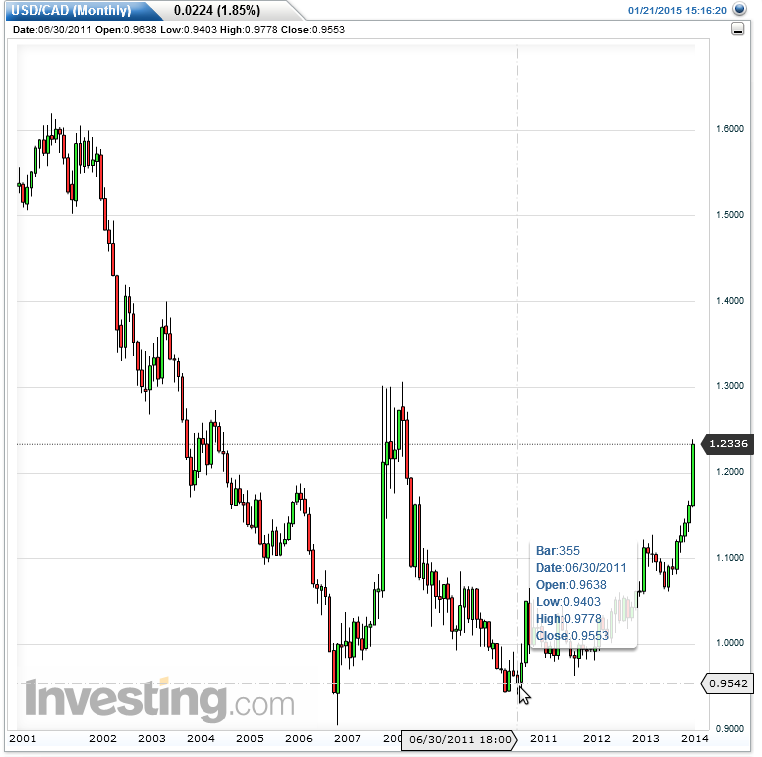
click on chart for sharper image
Since mid-2011 the “loonie” has lost about 24% vs. the US dollar. However, the dollar is a lot weaker than its Canadian counterpart compared to late 2001.
Canadian Yield Curve Inverts
- 30-year: 2.044% (Today’s Low 1.998%)
- 10-Year: 1.426% (Today’s Low 1.366%)
- 05-Year: 0.791% (Down 19 basis points, an 18% decline)
- 03-Year: 0.590% (Down 27 basis points, a 31% decline)
- 02-Year: 0.560% (Down 29 basis points, a 34% decline)
- 01-Year: 0.580% (Down 34 basis points, a 37% decline)
- 01-Month: 0.640% (Down 22 basis points, a 26% decline)
Blue Ribbon Announcement
Canada wins the blue ribbon for the first G-7 yield curve inversion since central bankers started unleashing competitive “preemptive” rate cuts.
Yield on the Canadian 1-year note, 2year-note, and 3-year note are all inverted (lower than yield on the 1-month note).
In addition, yield on on the 1-year note is inverted with the 2- and 3-year notes.
I smell a Canadian recession (and more surprise actions). A bust of the Canadian real estate bubble, one of the biggest in the world, is also on the way.
Mike “Mish” Shedlock
http://globaleconomicanalysis.blogspot.com
Read more at http://globaleconomicanalysis.blogspot.com/2015/01/currency-wars-pick-up-steam-today-with.html#e7AVRsfS3RSPOlfk.99
end
Socialistic France has gone deeper to the left:
What Reforms!!!: Hours After ECB’s QE Announcement, French Government Fails To Reach Job Creation Agreement
Remember when just a few short hours ago, the ECB’s Mario Draghi said that under no circumstances should the ECB’s historic launch of QE be taken by anyone as a substitute for legitimate fiscal and other labor reform: as in the one thing the continent that has youth unemployment higher than 50% in various nations truly needs, instead of a Dax at record highs? Well, we are happy to report that just hours after the launch of QE, French trade unions and employer groups failed to reach agreement in a final bid to spur job creation in a moribund market by simplifying rules on worker representation in firms, the government and unions said.
From Reuters:
Socialist President Francois Hollande had asked the parties to strike a deal by end-2014 to lift bureaucratic “blockages” to hiring, including rules that force companies to pay for in-house works councils and health and safety committees once they hire their 50th worker.
“Today’s plenary confirmed the end of negotiations, and thus their failure,” a source from one of the employer groups said. Economists have long pointed to excessive bureaucracy as a major in France’s high unemployment rate, currently stuck above 10 percent.
Prime Minister Manuel Valls said in a statement that “necessary compromises” should have been possible in the talks. “However, the absence of an agreement cannot amount to an obstacle to reform to take the country forward,” Valls said. “It is now up to the government to take on the modernisation of social dialogue in business.”
He added that he would hold a meeting of the various parties on Feb. 19 to discuss the next steps.
At that meeting nothing is expected to happen either, because thanks to Mario Draghi, Europe’s politicians just bought themselves a few more months in which they can continue their path of clueless incompetence and corruption, all of which is of course blamed on “austerity” of course. However, Valls probably should advise the French impoverished workers to do the one thing that QE fixes each and every time: just BTFD.
end
The most economically correlated commodity which signals how the economy is doing is lumber: it is now flashing RED
The Most Economically-Correlated Commodity Is Flashing Red
While Crude Oil and Dr. Copper are often cited as economic indicators, as @Not_Jim_Cramer notes, in factLumber prices are the most correlated with ISM and GDP of all industrial commodities. That is a problem. Lumber prices are tumbling and are breaking the 6-year up-trend that has ‘proved’ the recovery. With no CCFD manipulation and less financialization than crude, perhaps Lumber is the real canary in the economic collapse coalmine…
Lumber is the most correlated to ISM and GDP of all the industrial commodities… and that is not good for the US economy…

Which is a problem as Lumber prices are at a precarious position…

Charts: Bloomberg and @Not_Jim_Cramer
end
This is what a bank run looks like:
(courtesy The Greek Reporter/Peter Chrysopoulos
and special thanks to Robert H for sending this to us);
Bank Withdrawals Reached €4.2 Billion in 3 Days
– See more at: http://greece.greekreporter.com/2015/01/22/bank-withdrawals-reached-e4-2-billion-in-3-days/#sthash.L7P3FgDU.dpuf
Greek banks are facing a serious liquidity problem as in the first three days of the week, depositors withdrew a total of 4.2 billion euros.
A week ago, the four major Greek banks had proactively asked for Emergency Liquidity Assistance (ELA) from the European Central Bank. The ELA has been approved for two weeks, according to reports. Any extension of the mechanism can be repeated in 15 days, during the next session of the ECB’s board of directors.
As elections approach, political uncertainty has generated a bank run. From Monday through Wednesday, total outflow was counted at 4 billion euros. Financial analysts forecast that by the end of elections week the outflow will reach 4.5 billion euros.
On Wednesday alone, 1.8 billion flew out of Greek banks. The outflow was higher than expected and indicates that it will continue after Sunday’s general elections.
– See more at: http://greece.greekreporter.com/2015/01/22/bank-withdrawals-reached-e4-2-billion-in-3-days/#sthash.L7P3FgDU.dpuf
end
Your more important currency crosses early Thursday morning:
Eur/USA 1.1630 up .0015
USA/JAPAN YEN 117.61 down .242
GBP/USA 1.5190 up .0049
USA/CAN 1.2341 down .0003
This morning in Europe, the euro continues to trade northbound, trading up and now just above the 1.16 level at 1.1630 as Europe reacts to deflation, announcements of massive stimulation. In Japan Abe went all in with Abenomics with another round of QE purchasing 80 trillion yen from 70 trillion on Oct 31. He now wishes to give gift cards to poor people in order to spend. The yen continues to trade in yoyo fashion. This morning it settled up again in Japan by 25 basis points and settling well below the 118 barrier to 117.61 yen to the dollar. The pound was up this morning as it now trades just below the 1.52 level at 1.5190.(very worried about the health of Barclays Bank and the FX/precious metals criminal investigation/Dec 12 a new separate criminal investigation on gold,silver oil manipulation). The Canadian dollar is falling apart (oil down/all of Target stores closing/all of Sony stores closing) and now its yield curve is inverted, but trading slightly up at 1.2341 to the dollar. It seems that the three major global carry trades are being unwound. (1) The total dollar global short is 9 trillion USA, and as such we now witness a sea of red blood on the streets as derivatives blow up with the massive rise in the dollar against all paper currencies.We also have the second big yen carry trade unwind as the yen refuses to blow past the 120 level.(3) the Nikkei vs gold carry trade These massive carry trades are causing deflation as the world reacts to a lack of demand. Bourses around the globe are reacting in kind to these events.
end
Early Thursday morning USA 10 year bond yield: 1.91% !!! up 4 in basis points from Wednesday night/
USA dollar index early Thursday morning: 92.56 down 34 cents from Wednesday’s close
The NIKKEI: Thursday morning : up 49 points or 0.28%
Trading from Europe and Asia:
1. Europe stocks all green except Germany.
2/ Asian bourses all in the green … Chinese bourses: Hang Sang in the green ,Shanghai in the green, Australia in the green: /Nikkei (Japan) green/India’s Sensex in the green/
Gold early morning trading: $1285.00
silver:$18.02
Closing Portuguese 10 year bond yield: 2.59% down 18 in basis points from Wednesday (all peripheral bond yields fell)
Closing Japanese 10 year bond yield: .32% !!! up 7 in basis points from Wednesday ( a huge percentage rise)
Your closing Spanish 10 year government bond, Thursday down 12 in basis points in yield from Wednesday night.
Spanish 10 year bond yield: 1.41% !!!!!! ( huge QE)
Your Thursday closing Italian 10 year bond yield: 1.55% down 14 in basis points from Wednesday: (huge QE)
trading 14 basis points higher than Spain:
IMPORTANT CLOSES FOR TODAY
Closing currency crosses for Thursday night/USA dollar index/USA 10 yr bond:
Euro/USA: 1.1359 down .0256
USA/Japan: 118.56 up .717
Great Britain/USA: 1.5006 down .0136
USA/Canada: 1.2391 up .0047
The euro collapsed this afternoon and by closing time finished well down for the day and just below the 1.14 level to 1.1359. The yen was well down in the afternoon, and it was down by closing to the tune of 72 basis points and closing just above the 118 cross at 118.56 and still causing much grief again to our yen carry traders who need a much lower yen (to surpass 120). The British pound lost huge ground during the afternoon session and it was down on the day closing at 1.5006. The Canadian dollar crashed again today as it was down on the day at 1.2391 to the dollar.
As explained above, the short dollar carry trade is being unwound, the yen carry trade , the Nikkei/gold carry trade, and finally the long dollar/short Swiss franc carry trade are all being unwound and these reversals are causing massive derivative losses. And as such these massive derivative losses is the powder keg that will destroy the entire financial system.
end
Your closing USA dollar index: 94.9 up a monstrous 1.29 cents from yesterday.
your 10 year USA bond yield , up 3 in basis points on the day:
1.89%!!!!
end
European and Dow Jones stock index closes:
England FTSE up 68.59 points or 1.02%
Paris CAC up 67.98 or 1.52%
German Dax up 136.39 or 1.32%
Spain’s Ibex up 175.30 or 1.70%
Italian FTSE-MIB up 488.33 or 2.444%
The Dow: up 259.70 or 1.48%
Nasdaq; up 82.98 or 1.78%
OIL: WTI 46.69 !!!!!!!
Brent: 48.96!!!!
Closing USA/Russian rouble cross: 64.24 up 1 rouble per dollar on the day.
And now for your more important USA economic stories for today:
Draghi-geddon Collapses Euro & Crushes Crude; Stocks Soar But Bonds & Bullion Bid
There’s only one clip that seemed to sum up today’s trillion dollar printfest exuberance…
But it wasn’t all shits and giggles… inflationists may have been disappointed by only a 3bps jump in 5Y5Y Fwd Euro inflation expectations, weakness in European sovereigns, a tumble in US Treasury yields, and a plunge in crude oil…
For a few minutes there, everything was not awesome… but stocks staged a late-day panic-buying “everything is awesome” melt-up (on no new catalyst at that point) moving into the green year-to-date to “prove” central planners have it all worked out…

As cash indices gapped open higher, retraced to fill the gap – ripped to the European close – stabilized – then melted upo in the afternoon on the back of JPY weakness

Which lifted stocks into the green year-to-date… But The Dow lost Green right at the close

Financials were the day’s big winners in stocks (even though the yield curve flattened even more, and credit markets – which did rally today – remain flashing drastically red). Energy stocks rallied 0.4% even as crude oil crashed 4-5%

USDJPY was fully in charge of stocks… (as JPY and EUR battled for shittiest currency in the world)

EURUSD was baumgartnered… almost 300 pip drop

Which smashed the USD 1.5% higher… its biggest single-day rise in 18 months

To new 11-year highs…

But the USD strength did not affect gold or silver which surged post-ECBQE (as copper and crude were clubbed)… with gold closing above $1300 at 5-month highs

With crude crashing to a $45 handle after QE (USD strength) and EIA inventory build…

Treasury yields saw a massive swing – with 30Y dumping 15bps after the ECB QE news before leaking back higher…

Quite a decoupling from stocks…

Rather oddly, Russian stocks soared today… despite the renewed carnage in crude oil… (after tracking in a highly correlated manner for days)

Year-to-date, Silver and Gold are the major winners, stocks now unch and oil remains the biggest loser still..

Charts: Bloomberg
(Your trading today from the New York):
The jobless claims continue to rise due to the weak oil sector:
(courtesy zero hedge)
Jobless Claims Over 300k For 3rd Week, Spike In Shale States
Not “unambiguously good” as Shale states see initial jobless claims spiking. Overall initial jobless claims missed expectations for the 4th week in a row, holding above 300k for the 3d week in a row (for the first time since July). At 307k, this week’s print is below last week’s but well above the 300k expectation. However, across TX, CO, ND, PA, and WV, initial claims (1 week lagged) rose to over 75k (from 30k in October)… “crisis has passed”?
Houston (and CO, ND, PA, WV) we have a problem…

and overall the picture of a crisis that has passed looks to be fading…

Charts: Bloomberg
We will see you on Friday.
bye for now
Harvey,


 harveyorganblog.com