
Good evening Ladies and Gentlemen:
Here are the following closes for gold and silver today:
Gold: $1219.00 down $12.60 (comex closing time)
Silver: $16.75 down 11 cents (comex closing time)
In the access market 5:15 pm
Gold $1219.50
silver $16.79
Gold/silver trading: see kitco charts on right side of the commentary.
Today starts the big meeting by the Euro clan to see whether Greece will leave the EMU. We should know the true state of affairs by tomorrow night, although late in the day we have a serious of announcements. Needless to say the announcements had no substance.
Following is a brief outline on gold and silver comex figures for today:
The gold comex today had a poor delivery day, registering 0 notices served for 0 oz. Silver comex registered 0 notices for nil oz .
Three months ago the comex had 303 tonnes of total gold. Today the total inventory rests at 254.80 tonnes for a loss of 48 tonnes over that period.
In silver, the open interest rose by 800 contracts despite Tuesday’s silver price being down by 21 cents. The total silver OI continues to remain relatively high with today’s reading at 168,146 contracts. The bankers are not happy campers tonight with respect to the high OI in silver.
We had 0 notices filed for nil oz
In gold we had another surprisingly fall in OI as gold was down $9.20 yesterday. The total comex gold OI rests tonight at 393,230 for a loss of 1,195 contracts. Today we had 0 notices served upon for nil oz.
Today, we had no changes in gold inventory at the GLD/Inventory at 773.31 tonnes
In silver, /SLV no change in of silver inventory to the SLV/Inventory 320.327
We have a few important stories to bring to your attention today…
Let’s head immediately to see the major data points for today
.
First: GOFO rates: the crooks are no longer reporting.
Let us now head over to the comex and assess trading over there today.
Here are today’s comex results:
The total gold comex open interest fell by another 1,195 contracts today from 394,447 down to 393,230 as gold was down by $9.20 yesterday (at the comex close). We are now in the big delivery month of the active February contract and here the OI fell by 17 contracts from 675 down to 658. We had 0 contracts served upon yesterday. Thus we lost 17 contracts or 1,700 oz will not stand for delivery for the February contract. The next contract month of March saw it’s OI fall by 46 contracts down to 1266. The next big active delivery month is April and here the OI fell by 2180 contracts down to 267,480. The estimated volume today (which is just comex sales during regular business hours of 8:20 until 1:30 pm est) was the worst we have ever seen at 45,930. The confirmed volume yesterday ( which includes the volume during regular business hours + access market sales the previous day) was awful at 105,016 contracts even with much help from the HFT boys. Today we had 0 notices filed for nil oz.
And now for the wild silver comex results. Silver OI surprisingly rose by exactly 800 contracts from 167,346 up to 168,146 despite the fact that silver was down by 21 cents yesterday. The bankers were not able to shake any silver leaves from the silver tree and thus the reason for continuous raids by the bankers. I guess the CME needs to resort to another silver margin hike as this would be the only way to shake some longs to depart. We are now in the non active contract month of February and here the OI fell by 0 contracts remaining at 20. We had 0 notices filed yesterday so we neither gained nor lost any silver contracts standing for delivery in this February contract month. The next big active contract month is March and here the OI fell by only 3,110 contracts down to 81,694. The estimated volume today was awful at 19,820 contracts (just comex sales during regular business hours). The confirmed volume yesterday was excellent (regular plus access market) at 51,440 contracts. We had 0 notices filed for nil oz today.
February initial standings
Feb 11.2015
| Gold |
Ounces |
| Withdrawals from Dealers Inventory in oz | nil oz |
| Withdrawals from Customer Inventory in oz | 40,705.52 oz kilobars(Scotia,Brinks,Manfra) |
| Deposits to the Dealer Inventory in oz | nil |
| Deposits to the Customer Inventory, in oz | 162,175.077 oz (HSBC,Scotia and includes 2,000 kilobars) |
| No of oz served (contracts) today | 0 contracts (nil oz) |
| No of oz to be served (notices) | 658 contracts (65,800 oz) |
| Total monthly oz gold served (contracts) so far this month | 549 contracts(54,900 oz) |
| Total accumulative withdrawals of gold from the Dealers inventory this month | |
|
Total accumulative withdrawal of gold from the Customer inventory this month |
148,004.0 oz |
Today, we had 0 dealer transactions
we had 0 dealer withdrawals:
total dealer withdrawal: nil oz
we had 0 dealer deposit:
total dealer deposit: nil oz
we had 3 customer withdrawals
i) Out of Scotia: 40,126.87 oz
ii) Out of Manfra; 353.65 oz (11 kilobars)_
iii) Out of Brinks: 225.000 oz???? not divisible by 32.15 oz
total customer withdrawal: 40,705.52 oz
we had 2 customer deposits:
i) Into HSBC: 97,875.077 oz
ii) Into Scotia: 64,300.000 oz (2000 kilobars??)
total customer deposits; 162,175.077 oz
We had 0 adjustments
Today, 0 notices was issued from JPMorgan dealer account and 0 notices were issued from their client or customer account. The total of all issuance by all participants equates to 0 contracts of which 0 notices were stopped (received) by JPMorgan dealer and 0 notices were stopped (received) by JPMorgan customer account.
To calculate the total number of gold ounces standing for the December contract month, we take the total number of notices filed for the month (549) x 100 oz or 54,900 oz , to which we add the difference between the OI for the front month of February (658 contracts) minus the number of notices served today x 100 oz (0 contracts) x 100 oz = 120,700 oz, the amount of gold oz standing for the February contract month.( 3.754 tonnes)
Thus the initial standings:
549 (notices filed for the month x( 100 oz) or 54,900 oz + { 658 (OI for the front month of Feb)- 0 (number of notices served upon today) x 100 oz per contract} = 120,700 oz total number of ounces standing for the February contract month. (3.754 tonnes)
we lost 17 contracts or 1700 oz will not stand in this February contract month.
Total dealer inventory: 804,854.509 oz or 25.03 tonnes
Total gold inventory (dealer and customer) = 8.191 million oz. (254.77) tonnes)
Several weeks ago we had total gold inventory of 303 tonnes, so during this short time period 48 tonnes have been net transferred out. However I believe that the gold that enters the gold comex is not real. I cannot see continual additions of strictly kilobars.
end
And now for silver
February silver: initial standings
feb 11 2015:
| Silver |
Ounces |
| Withdrawals from Dealers Inventory | nil oz |
| Withdrawals from Customer Inventory | 361,042.467 oz (Delaware, CNT) |
| Deposits to the Dealer Inventory | nil |
| Deposits to the Customer Inventory | nil |
| No of oz served (contracts) | 0 contracts (nil oz) |
| No of oz to be served (notices) | 20 contracts (100,000 oz) |
| Total monthly oz silver served (contracts) | 381 contracts (1,905,000 oz) |
| Total accumulative withdrawal of silver from the Dealers inventory this month | |
| Total accumulative withdrawal of silver from the Customer inventory this month | 2,614,456.0 oz |
Today, we had 0 deposit into the dealer account:
total dealer deposit: nil oz
we had 0 dealer withdrawal:
total dealer withdrawal: nil oz
We had 0 customer deposits:
total customer deposit nil oz
We had 2 customer withdrawals:
i) Out of Delaware: 332,714.847 oz
ii) Out of CNT: 28,327.62 oz
total customer withdrawal: 361,042.467 oz
we had 1 adjustment
i) Out of Delaware: 26,321.201 oz was adjusted out of the dealer and this landed into the customer account of Delaware;
Total dealer inventory: 67.864 million oz
Total of all silver inventory (dealer and customer) 176.208 million oz
.
The total number of notices filed today is represented by 0 contracts for 25,000 oz. To calculate the number of silver ounces that will stand for delivery in February, we take the total number of notices filed for the month (381) x 5,000 oz = 1,905,000 oz to which we add the difference between the OI for the front month of February (20)- the number of notices served upon today (0) x 5,000 oz per contract = 2,005,000 oz, the number of silver oz standing for the February contract month
Initial standings for silver for the February contract month:
381 contracts x 5000 oz= 1,905,000 oz + (20) OI for the front month – (0) number of notices served upon x 5000 oz per contract = 2,005,000 oz, the number of silver ounces standing.
we neither gained nor lost any silver ounces standing in this February contract month.
for those wishing to see the rest of data today see:
http://www.harveyorgan.wordpress.com or http://www.harveyorganblog.com
end
The two ETF’s that I follow are the GLD and SLV. You must be very careful in trading these vehicles as these funds do not have any beneficial gold or silver behind them. They probably have only paper claims and when the dust settles, on a collapse, there will be countless class action lawsuits trying to recover your lost investment.
There is now evidence that the GLD and SLV are paper settling on the comex.
***I do not think that the GLD will head to zero as we still have some GLD shareholders who think that gold is the right vehicle to be in even though they do not understand the difference between paper gold and physical gold. I can visualize demand coming to the buyers side:
i) demand from paper gold shareholders
ii) demand from the bankers who then redeem for gold to send this gold onto China
vs no sellers of GLD paper.
And now the Gold inventory at the GLD:
Feb 11.no change in gold inventory at the GLD/Inventory 773.31 tonnes
Feb 10 no change in gold inventory at the GLD/inventory 773.31 tonnes
Feb 9 no change in gold inventory at the GLD/Inventory 773.31 tonnes
feb 6/ no change in gold inventory tonight/inventory 773.31 tonnes
feb 5. we had another addition of 5.38 tonnes of gold to the GLD/Inventory tonight at 773.31 tonnes
Feb 4/2015; we had another addition of 2.99 tonnes added to the GLD inventory/Inventory tonight 767.93
Feb 3.2015: today a withdrawal of 1.79 tonnes of gold inventory removed from the GLD/Inventory at 764.94
feb 2/ a huge addition of 8.36 tonnes of “paper” gold inventory/Inventory tonight at 766.73 tonnes
jan 30. we had no change in gold inventory/Inventory at 758/37 tonnes
Jan 29/we had an addition of 5.67 tonnes of gold inventory at the GLD/Inventory at 758.37 tonnes
Jan 28/no changes in gold inventory at the GLD/Inventory at 952.44 tonnes
Jan 27.we had a monstrous “paper” addition of 9.26 tonnes of gold into the GLD tonight/Inventory at 952.44 tonnes
Feb 11/2015 /no change in gold inventory at the GLD/
inventory: 773.31 tonnes.
The registered vaults at the GLD will eventually become a crime scene as real physical gold departs for eastern shores leaving behind paper obligations to the remaining shareholders. There is no doubt in my mind that GLD has nowhere near the gold that say they have and this will eventually lead to the default at the LBMA and then onto the comex in a heartbeat (same banks).
GLD : 771.31 tonnes.
end
And now for silver (SLV):
Feb 11 no change in silver inventory at the SLV/inventory at 320.327 million oz
Feb 10 no change in silver inventory at the SLV/inventory at 320.327 million oz
Feb 9 no change in silver inventory/SLV inventory at 320.327 million oz
Feb 6 no change in silver inventory/SLV’s silver inventory at 320.327 million oz.
Feb 5.we had no change in silver inventory/320.327 million oz/
Feb 4/we had a small withdrawal of 136,000 oz of silver from the SLV vaults/Inventory/320.327 million oz
feb 3.2015: we had a good addition of 1.149 million oz of silver inventory/inventory 320.463 million oz
Feb 2 no change in silver inventory at the SLV/inventory at 319.314
million oz.
jan 30 no change in silver inventory at the SLV/inventory at 319.314
million oz
Jan 29/no change in silver inventory/SLV inventory at 319.314 million oz
Jan 28/no changes in silver inventory/SLV inventory at 319.314 million oz
Jan 27/no change in silver inventory/SLV inventory at 319.314 million oz
feb 11/2015 we had no change in silver inventory/
SLV inventory registers: 320.327 million oz
end
And now for our premiums to NAV for the funds I follow:
Note: Sprott silver fund now for the first time into the negative to NAV
Sprott and Central Fund of Canada.
(both of these funds have 100% physical metal behind them and unencumbered and I can vouch for that)
1. Central Fund of Canada: traded at Negative 7.2% percent to NAV in usa funds and Negative 7.1 % to NAV for Cdn funds!!!!!!!
Percentage of fund in gold 61.1%
Percentage of fund in silver:38.4%
cash .5%
( feb11/2015)
2. Sprott silver fund (PSLV): Premium to NAV rises to + 2.90%!!!!! NAV (Feb 11/2015)
3. Sprott gold fund (PHYS): premium to NAV falls to +.07% to NAV(feb 11 /2015)
Note: Sprott silver trust back into positive territory at +2.83%.
Sprott physical gold trust is back into positive territory at +.07%
Central fund of Canada’s is still in jail.
end
And now for your most important physical stories on gold and silver today:
Early gold trading from Europe early Wednesday morning:
(courtesy Mark O’Byrne)
Minsk Summit Highlights A Shaky NATO Union – Russia Is Far From Isolated
– Merkel and Hollande to attend peace talks in Belarus to resolve Ukraine’s civil war today
– US and UK not invited
– Germany and US present united front but tensions ripple under the surface
– Foreign Minister of Greece, Nikolaos Kotzias, to meet his Russian counterpart Sergei Lavrov today as the crucial Eurogroup of finance ministers meet to determine the fate of Greece and the Euro
– Russia negotiates free-trade agreement with Egypt. Cyprus permits Russia to use ports and airstrips for humanitarian and emergency purposes
The leaders of Russia, Germany, France and Ukraine will meet in the Belarusian capital of Minsk today in a bid to resolve Ukraine’s brutal civil war.
The meeting, which the Russia Today news agency describe as a Franco-German peace initiative, will not include the leaders of the US or Britain.
RT suggests that the talks were triggered by John Kerry’s visit to Kiev where he announced the possibility of the US arming Ukraine government troops adding that “Europe is reluctant to have a full-blown war on its doorstep.”
Preliminary talks between Merkel, Hollande and Putin in Moscow on Friday were held behind closed doors. On Monday Merkel met with Obama in Washington. While they tried to present a united front the subtext of their statements and their body language gave a different impression.

US politicians have been clamouring for Obama to provide weapons to the Ukrainian government. But Merkel was unequivocal in her response to such proposals. “I don’t see a military solution” she said adding that sending arms to the Ukraine government would be “not just highly risky but counterproductive.”
Obama insisted that the arms option was under “ongoing analysis” while at the same time agreeing with Merkel that, for now, the civil war would not be resolved by military means. He insisted that Russia’s isolation would worsen if it failed to change course.
Meanwhile, geo-politics will play as great a role in today’s Eurogroup meeting of finance ministers as economic considerations.
The Greek government have sent a clear message to the EU when the Greek Kathimerini news agency reported on Monday,
“Greece’s Foreign Minister Nikolaos Kotzias is to visit Moscow on Wednesday to hold talks with his Russian counterpart Sergei Lavrov, Russia’s Interfax and TASS news agencies reported on Monday citing a source in the Russian Foreign Ministry.”
Reuters reported Greek defence minister, Panos Kammenos as saying,
“What we want is a deal. But if there is no deal – hopefully (there will be) – and if we see that Germany remains rigid and wants to blow apart Europe, then we have the obligation to go to Plan B.”
“Plan B is to get funding from another source. It could the United States at best, it could be Russia, it could be China or other countries.”
That Mr. Kotzias will be in Moscow today is telling.
At the same time, Cyprus have announced an agreement with Russia that will allow Russia’s military to use it’s ports and airstrips for humanitarian and emergency purposes.
“We want to avoid further deterioration in relations between Russia and Europe,” said President Anastasiades. “Cyprus and Russia enjoy traditionally good relations and that is not going to change,” he added.
It was reported yesterday that Egypt will join the Eurasian Economic Union, a free trade group modelled on the EU which is led by Russia. Clearly Russia is not as isolated as Western powers would wish.
With the leaders of two key NATO states initiating diplomacy with Russia independently of the US and the UK and another minor NATO player, Greece, pivoting East-ward to Russia to strengthen its independence from the EU it is clear that the NATO “alliance” is not what it once was.
If diplomacy should fail in Minsk today it would pave the way for the US to start arming the Ukraine government. This would lead to an acceleration of the war and it’s morphing into a proxy war to which Germany and France are opposed.
Coupled with the latent economic crisis in Europe – which will be exacerbated no matter what the outcome of today’s Eurogroup meeting – an acceleration in Ukraine’s civil war would be disastrous for the people of Europe.
The EU may fracture and with it the Euro currency. We continue to urge our clients to hold physical gold, the only currency without counterparty risk, in safe locations around the world.
GoldCore Guide: 7 Key Storage Must Haves
MARKET UPDATE
Today’s AM fix was USD 1,235.50, EUR 1,092.40 and GBP 807.73 per ounce.
Yesterday’s AM fix was USD 1,237.50, EUR 1,096.78 and GBP 812.97 per ounce.
Gold fell 0.54 percent or $6.70 and closed at $1,234.00 yesterday, while silver slipped 0.71 percent or $0.12 closing at $16.91.
Gold inched up on Wednesday in Asia as the dollar’s gains retreated and the market awaits a possible Greek exit from the eurozone. The county’s 240-billion-euro bailout expires on February 28th, most likely leaving the country bankrupt and at risk of a eurozone exit unless it can strike a deal with creditors. Today, Greek Finance Minister Yanis Varoufakis is meeting with European counterparts asking for a 10 billion-euro ($11.3 billion) bridge plan to stave off a funding crunch and allow Greece more time to renegotiate austerity terms with creditors.
Uncertainty over when the U.S. Fed will announce an interest rate hike is also limiting gold’s gains, however a Fed official mentioned June yesterday in the press.
A hike in interest rates by the Fed, which has maintained near zero rates since 2008 to boost the sluggish U.S. economy, could further strengthen the U.S. dollar and may dampen the demand for bullion, a non-interest-bearing asset.
The uncertainty over whether Vladimir Putin and Ukrainian President Petro Poroshenko can negotiate a lasting ceasefire in Minsk is another factor weighing on the bullion market.
Spot gold rose 0.3 percent to $1,237.70 an ounce in late trading in Singapore.
Gold in London was trading range bound $1,233.63 per ounce up 0.07 percent. Silver was last $16.95 up 0.30 percent and palladium $1,207.40 up 021%.
Breaking News and Updates Here

end
Another casualty of the gold/silver price manipulation:
(courtesy Reuters/GATA)
Low gold price causes Kinross to shelve expansion of African mine
Kinross Decides Not to Expand Tasiast Gold Mine in Africa
By Nicole Mordant
Reuters
Tuesday, February 10, 2015
VANCOUVER, British Columbia, Canada — Kinross Gold Corp. will not go ahead with a $1.6 billion expansion of its Tasiast mine in Africa’s northwest because of the weak gold price, the Toronto-based miner said today as it reported an unexpected fourth-quarter loss.
Although Kinross was in a strong cash position and project financing talks had gone well, the company was concerned about cash flow during the 35 months of construction if the gold price fell further, Kinross Chief Executive Paul Rollinson said. …
… For the remainder of the report:
http://www.reuters.com/article/2015/02/10/kinross-results-idUSL1N0VK32U2..
end
(courtesy Patrick Heller/Numismatic News/Liberty coins/GATA)
Patrick Heller: Gold wins 15-year asset race
8:20p ET Tuesday, February 10, 2015
Dear Friend of GATA and Gold:
Patrick Heller of Liberty Coin Service in Lansing, Michigan, reports in Numismatic News this week that gold has outperformed all major financial assets in the last 15 years, including the U.S. dollar, despite the dollar’s recent strength. Heller did not include gold and silver mining company shares in his list, but most of us wouldn’t feel so sour about things lately if the mining shares had performed any better than, say, the Indian rupee, down almost 84 percent against gold. Heller’s analysis is headlined “Gold Wins 15-Year Asset Race” and it’s posted at Numismatic News here:
http://www.numismaticnews.net/article/gold-wins-15-year-asset-race?et_mi…
CHRIS POWELL, Secretary/Treasurer
Gold Anti-Trust Action Committee Inc.
end
(courtesy Chris Powell/GATA)
In Canada too, clamor for the banks to get out of the governing business
10:53p ET Tuesday, February 10, 2015
Dear Friend of GATA and Gold:
What’s left of Canada’s Social Credit movement has brought a lawsuit challenging the operation of the country’s monetary and banking systems, and apparently the powers that be are having a hard time getting the lawsuit dismissed.
The lawsuit argues that the Canadian central bank’s enabling act authorizes the bank to create and lend money without interest to government agencies, bypassing the commercial banking system and all the income and advantages commercial banks extract from the central bank at the public’s expense, and that the central bank should start financing the government that way.
Reporting on the lawsuit at the Internet site of the Clifford Hugh Douglas Institute, which expounds Social Credit political and economic philosophy, M. Oliver Heydorn writes:
“The plaintiffs state that the Bank for International Settlements, the Financial Stability Forum, and the International Monetary Fund were all created with the cognizant intent of keeping poorer nations in their place, which has now expanded to all nations in that these financial institutions largely succeed in overriding governments and constitutional orders in countries such as Canada over which they exert financial control. The plaintiffs state that the meetings of the BIS and Financial Stability Board (successor of FSF), their minutes, their discussions, and their deliberations are secret and not available nor accountable to Parliament, the executive, nor the Canadian public, notwithstanding that Bank of Canada policies directly emanate from these meetings. These organizations are essentially private, foreign entities controlling Canada’s banking system and socio-economic policies.”
Insofar as the plaintiffs are seeking to assert the supremacy of democracy over central banking as it is currently practiced — largely in secret and without accountability — GATA has to be sympathetic, just as we must join the growing clamor in the United States to audit the Federal Reserve, which, far more than the Bank of Canada, distributes vast financial patronage and intervenes in markets largely in secret and without accountability.
While, as a practical matter, the Federal Reserve serves primarily the financial class,as a matter of law the Fed is very much a creation and part of the U.S. government, not a privately owned corporation, the latter being a misapprehension by many on our side arising from the Fed’s peculiar share structure.
Yes, commercial banks own shares in the Fed, but these shares don’t control the Fed’s management. Rather, the members of the Fed’s Board of Governors are nominated by the president and appointed by the Senate.
Besides, the financial class controls far more than the Federal Reserve. It controls most of the U.S. government. This is in part the political phenomenon of “regulatory capture.” But more so it is just the current manifestation of the old struggle between the producing and financial classes.
As the late New York Times editor James Reston wrote long ago, “All politics are based on the indifference of the majority.” Special interests take control of government because they are the most motivated, having the most lucrative stake in government operations. The public generally can’t be bothered to defend its own interests.
The public could reclaim the Fed for the public interest any time it wanted to do so by mobilizing its democratic institutions. Of course it would help if more Americans could read and write and if they spent more time on civic engagement than on sending text messages to each other about what they plan to watch on television when they’re done celebrating themselves on Facebook. But it could be done.
Money creation and distribution may be the oldest and most important political issue, since it defines democracy. In his “Cross of Gold” speech at the Democratic National Convention in Chicago in 1896 —
http://historymatters.gmu.edu/d/5354/
— William Jennings Bryan argued for the remonetization of silver to reflate the economy and subordinate Wall Street to democracy, putting it this way:
“Those who are opposed to this proposition tell us that the issue of paper money is a function of the bank and that the government ought to go out of the banking business. I stand with Jefferson rather than with them and tell them, as he did, that the issue of money is a function of the government and that the banks should go out of the governing business.”
Oh, well: Plus ca change, plus c’est la meme chose. It’s our turn to play a part in this struggle.
The Clifford Hugh Douglas Institute’s report on the lawsuit about the operation of the Bank of Canada is posted here:
http://www.socred.org/blogs/view/the-case-to-reinstate-the-bank-of-canad…
CHRIS POWELL, Secretary/Treasurer
Gold Anti-Trust Action Committee Inc.
end
For your enjoyment: Dr Paul Craig Roberts
(courtesy Dr Roberts/GATA)
Paul Craig Roberts – The World Is Now On The Cusp Of Total War

As the world grows increasingly concerned about the fighting in Ukraine, especially in the aftermath of a large bomb being detonated last night, today former U.S. Treasury official, Dr. Paul Craig Roberts, warned that the world is now on the cusp of total war.
By Dr. Paul Craig Roberts Former U.S. Treasury Official
February 9 (King World News) – At this time we do not know the outcome of the meeting in Moscow between Merkel, Hollande, and Putin.
The meeting with Putin was initiated by Merkel and Hollande, because they are disturbed by the aggressive position that Washington has taken toward Russia and are fearful that Washington is pushing Europe into a conflict that Europe does not want. However, Merkel and Hollande cannot resolve the NATO/EU/Ukraine situation unless Merkel and Hollande are willing to break with Washington’s foreign policy and assert the right as sovereign states to conduct their own foreign policy.
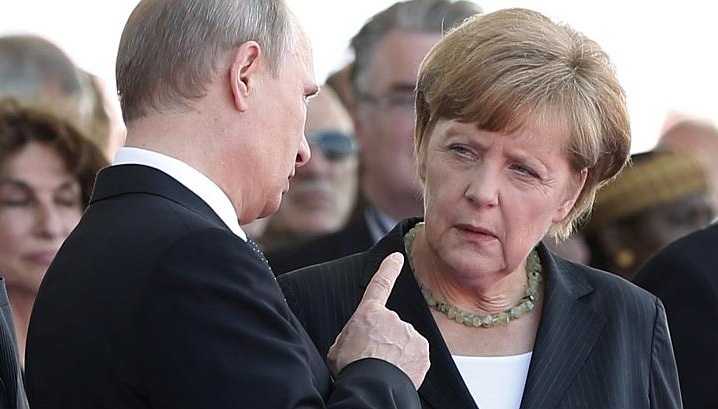
Putin-Merkel-Hollande Meeting
Unless Washington’s war-lust has finally driven Europeans to take control over their own fate, the most likely outcome of the Putin-Merkel-Hollande meeting will be more meetings that go nowhere. If Merkel and Hollande are not negotiating from a position of independence, one likely outcome after more meetings will be that Merkel and Hollande will say, in order to appease Washington, that they tried to reason with Putin but that Putin was unreasonable.
Based on Lavrov’s meeting in Munich with the Europeans, the hope for any sign of intelligence and independence in Europe seems misplaced. Russian diplomacy relied on European independence, but as Putin has acknowledged Europe has shown no independence from Washington. Putin has said that negotiating with vassals is pointless. Yet, Putin continues to negotiate with vassals.

French Oppose Washington
Perhaps Putin’s patience is finally paying off. There are reports that Germany and France oppose Washington’s plan to send weapons to Ukraine. French president Hollande now supports autonomy for the break-away republics in Ukraine. His predecessor, Sarkozy, said that Crimea chose Russia and we cannot blame them, and that the interests of Americans and Europeans diverge when it comes to Russia. Germany’s foreign minister says that Washington’s plan to arm Ukraine is risky and reckless. And on top of it all, Cyprus has offered Russia an air base.
We will see how Washington responds to the French statements that European interests with regard to Russia diverge from Washington’s. Washington does not recognize any valid interest except its own. Therefore, it has been fruitless for Russia to negotiate with Washington and Washington’s EU vassals. To come to an agreement with Washington has required Russia’s surrender to Washington’s terms. Russia must hand over Crimea and Russia’s warm water port, and Moscow must stand aside while the Russian people in eastern and southern Ukraine, the “break-away” provinces, are slaughtered. Russia must support the hostile regime in Kiev with loans, grants, and low gas prices.
That is the only deal Russia has been able to get from Washington, because the EU has supported Washington’s line. With French presidents reportedly now saying, “We are part of a common civilization with Russia,” Europe is on the road to independence.

False Flag Attack?
Can Europe stay on this road, or can Washington bring Germany and France back in line? A false flag attack could do it. Washington is a control freak, and the neoconservative ideology of US hegemony has made Washington even more of a control freak. Europe with an independent foreign policy means a great loss of control by Washington. If Washington retains or regains control, I see two clear options for Russia.
Bankrupt West
One is to disengage totally from the West. The West is a morally depraved and economically bankrupt entity. There is no reason for a decent country like Russia to wish to be integrated with the evil that is the West. Russia has the option of abandoning the dollar payments system and all financial relationships with the West.
By trying to be part of the West, Russia made a strategic error that endangered the independence of Russia. Russia found herself dependent on Western financial systems that gave Washington power over Moscow and allowed Washington to place economic sanctions on Russia.
It was Russia’s desire to be part of the West that made possible Washington’s sanctions and Washington’s propaganda against Russia. It was Russia’s desire to be accepted by the West that produced the weak Russian response to Washington’s audacious coup in Kiev. Washington is using Ukraine against Russia. After seizing control in Kiev, it is unlikely that Washington will accept a peaceful solution in which the “break-away” provinces are permitted to become autonomous republics of Ukraine.
Is negotiation with Washington possible when Washington only wants conflict?

Russia Can Destroy NATO
Russia’s other clear option is to destroy NATO by ceasing to sell energy resources to NATO members. The countries would choose energy over NATO membership.
Why should Russia empower its obvious enemies by meeting their energy needs? Russia could also encourage Greece, Italy, Spain, and Portugal to default on their loans and rely on Russia, China, and the BRICS Bank for financing. China holds a massive amount of dollars. Why not use them to break up Washington’s European empire?
Russia could also default on its loans to the West. Why should Russia pay an enemy that is trying to destroy her?
If Europe cannot gain its independence, at some point Russia will either have to surrender to Washington or demonstrate decisive action that causes Washington’s European vassal states to understand the cost of vassalage to Washington and decide to abandon Washington in the interest of their own survival.
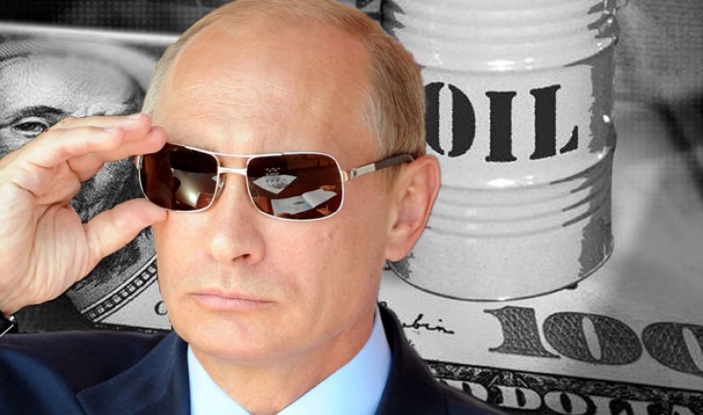
Russia Can Forget About The West
Alternatively, Russia can forget about the West and integrate with China and the East. Considering Washington’s hegemonic posture, there is no counterparty for Russia’s diplomacy.
Predictions are difficult, because policies can have unintended consequences and produce black swan events. For example, the Islamic State is the unintended consequence of Washington’s wars in the Muslim world. The Islamic State was created out of the Islamist forces that Washington assembled against Gaddafi in Libya. These forces were then sent to overthrow Assad in Syria. As Muslims flocked to ISIS’s banner and its military prowess grew, ISIS realized that it was a new and independent force consisting of radicalized Muslims.
Radicalized Muslims are tired of Western domination and control of Muslim lands. Out of ISIS’s self-awareness, a new state has been created, redrawing the Middle Eastern boundaries created by the British and French.
It is curious that Iran and Russia regard the Islamic State as a more dangerous enemy than Washington and are supporting Washington’s moves against the Islamic State. As the Islamic State is capable of disrupting Washington’s policy in the Middle East, Iran and Russia have an incentive to finance and arm the Islamic State. It is in Washington, not in the Islamic State, where Sauron resides and is gathering up the rings in order to control them all.
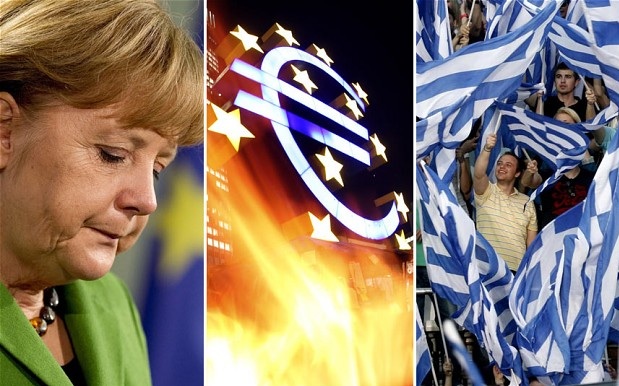
EU Driving Greece Into The Ground
In their attempts to negotiate with Europeans, Putin and Lavrov should notice the total unwillingness of the EU to negotiate with its own members. Right in front of our eyes we see Merkel and Hollande driving their fellow Greek EU compatriots into the ground.
The EU has told the new Greek government that the EU doesn’t care a whit about Greece and its people. The Europeans only care that they don’t get stuck with the cost of the bad loans the German and Dutch banks made to Greek governments in the past.
As I described in my book, The Failure of Laissez Faire Capitalism, one purpose of the “sovereign debt crisis” is to establish the principle that private lenders are not responsible for their bad judgment. Instead, the peoples of the country who were not parties to the loans are responsible. The EU is using the crisis not only to protect powerful private interests, but also to establish that over-indebted countries lose control of their fiscal affairs to the EU. In other words, the EU is using the crisis to centralize authority in order to destroy country sovereignty.

Washington Overthrowing Governments
As Washington and the EU do not respect the sovereignty of Greece, one of its own, why does the Russian government think that Washington and the EU respect the sovereignty of Russia or Ukraine? Or of India, Brazil and other South American countries, or China. Currently Washington is trying to overthrow the governments of Cuba, Venezuela, Ecuador, Bolivia, and Argentina.
Washington respects no one. Thus, talking to Washington is a waste of time. Is this a game Russia wants to play? ***ALSO JUST RELEASED: Marc Faber Unveils The Biggest Surprise For 2015 And The Greatest Danger Facing The World Today CLICK HERE.
end
Gold miners are on the prowl looking for good gold assets:
(courtesy Bloomberg)
Gold miners are on the hunt for assets as prices climb
By Jesse Riseborough, Kevin Crowley, Thomas Biesheuvel
Bloomberg News
Wednesday, February 11, 2015
Gold producers with cash on hand are on the hunt for cheap mining assets as rising prices drive shares higher.
During a 12-year bull run that ended last year, about $30 billion in debt was racked up by companies that mine gold. Those that minimized borrowing then are in the best position now to scoop up mines from rivals with weaker balance sheets, said executives at the Investing in African Mining Indaba conference in South Africa, the biggest such gathering on the continent.
Already $2.7 billion in deals have been announced or completed this year within the industry, including Monday’s $1.1 billion offer for Rio Alto Mining Ltd. by Tahoe Resources Inc. It’s an early leg up on the $10.5 billion in deals last year. …
… For the remainder of the report:
http://www.bloomberg.com/news/articles/2015-02-11/gold-miners-on-the-hun…
end
With negative interest rates, investors are now seeking gold”
(courtesy Bloomberg)
Swiss bank says investors favor gold amid charges on cash
By Giles Broom
Bloomberg News
Wednesday, February 11, 2015
GENEVA, Switzerland — Investors are buying more gold as an alternative to hold Swiss franc cash deposits, according Vontobel Holding AG, a Swiss bank and wealth manager.
“We keep noticing that gold is coming back into favor with investors,” Vontobel Chief Executive Officer Zeno Staub, 45, told reporters today after the Zurich-based company announced full-year earnings.
Concerns that Greece may abandon the euro and Ukraine may be headed for a wider conflict have spurred demand for haven assets. Gold has climbed 4.2 percent this year, even as the dollar strengthened on prospects of higher U.S. interest rates. Investors’ holdings in gold-backed funds are near the highest since October. …
… For the remainder of the report:
http://www.bloomberg.com/news/articles/2015-02-11/swiss-bank-says-invest..
end
For those following Agnico eagle, they came in with a strong performance: (tonight’s release)
Agnico Eagle reports fourth quarter and full year 2014 results – Strong operational performance yields record annual production; Initial resource declared at Amaruq

(All amounts expressed in U.S. dollars unless otherwise noted)
Stock Symbol: AEM (NYSE and TSX)
TORONTO, Feb. 11, 2015 /PRNewswire/ – Agnico Eagle Mines Limited (NYSE:AEM, TSX:AEM) (“Agnico Eagle” or the “Company”) today reported a quarterly net loss of $21.3 million, or a net loss of $0.10 per share for the fourth quarter of 2014. This result includes a non-cash foreign currency translation loss on deferred tax liabilities of $20.3 million ($0.10 per share), various mark-to-market adjustment losses of $5.0 million ($0.02 per share), unrealized losses on financial instruments of $7.7 million ($0.04 per share), non-cash foreign currency translation losses of $7.0 million ($0.03 per share), non-cash stock option expense of $3.5 million ($0.02 per share) and non-recurring gains of $5.6 million ($0.03). Excluding these items would result in adjusted net income of $16.6 million ($0.08 per share) for the fourth quarter of 2014. In the fourth quarter of 2013, the Company reported a net loss of $780.3 million or a net loss of $4.49 per share, which included a $1.0 billion impairment loss.
Fourth quarter 2014 cash provided by operating activities was $164.0 million ($152.2 million before changes in non-cash components of working capital), this compares to cash provided by operating activities of $140.8 million in the fourth quarter of 2013 ($135.8 million before changes in non-cash components of working capital). The slight increase in cash flow before changes in working capital during the current period was largely due to higher production which more than offset lower realized gold and silver prices (down 10% and 23% respectively, period over period).
“Our operations continue to perform well, which allowed us to exceed both our production and cost guidance for the third year in a row. With projected year-over-year production growth of 12%, lower fuel costs and weaker local currencies anticipated in Canada, Mexico and Finland, we expect to have another strong year in 2015”, said Sean Boyd, President and Chief Executive Officer. “It should also be an exciting year on the exploration front, with drilling activities underway at most of our mines, and significant programs planned at our Amaruq project in Nunavut and El Barqueno project in Mexico. Given the strong potential to expand the initial 1.5 million ounce resource at Amaruq, and the recent positive permitting news at Meliadine, we expect to unlock additional value from our Nunavut platform in 2015”, added Mr. Boyd.
Fourth quarter, full year 2014 and recent highlights include:
- Record annual gold production – Payable gold production 1 in 2014 was 1,429,288 ounces at total cash costs 2 per ounce on a by-product basis of $637, compared to guidance of 1,400,000 ounces at total cash costs per ounce on a by-product basis of $663. All-in sustaining costs 3 (“AISC”) for 2014 was $954 per ounce on a by-product basis, which is below the previous 2014 guidance of $990 per ounce on a by-product basis.
- Record fourth quarter production – Payable production in Q4 2014 was 387,538 ounces of gold at total cash costs per ounce on a by-product basis of $662
- 2015 guidance maintained – Production for 2015 is expected to be approximately 1.6 million ounces of gold with total cash costs on a by-product basis of $610 to $630 per ounce. AISC are forecast to be approximately $880 to $900 per ounce
- Year-over-year increase in reserves and resources – With the acquisition of Osisko Mining Corporation, reserves at year end 2014 were 20.0 million ounces compared to 16.9 million ounces at year end 2013. Measured and indicated resources and inferred resources also increased by approximately 56% and 33%, respectively, over the 2013 period
- Continued focus on reserve quality and improved grades – Increased gold reserve grades at LaRonde (5.20 g/t versus 5.00 g/t), Kittila (4.93 g/t versus 4.64 g/t) and Pinos Altos (3.01 g/t versus 2.84 g/t)
- Increased reserves, resources and positive permitting progress in Nunavut – Initial inferred resource of 1.5 million ounces (6.6 million tonnes grading 7.07 g/t gold) reported at Amaruq project. Meliadine reserves increased by approximately 500,000 ounces to 3.3 million ounces (at a grade of 7.44 g/t gold), and the Project Certificate setting out the terms on which the project can proceed is expected within the next two months
- Proceeds from sale of Probe Mines shares used to reduce debt – In Q1 2015, $30 million was repaid on the credit line.
- A quarterly dividend of $0.08 per share declared
end
Today, Bill Holter tackles an extremely difficult topic
(courtesy Bill Holter/Miles Franklin)
How far is too far?.
As you know, I am in the camp that the West, led by the U.S. is and has been pushing for war. War to create more debt for the banks to skim from, and to retain/prolong the power of dollar hegemony. I also believe China is not looking for a war and neither is Mr. Putin and Russia. If they were, I believe there was enough provocation over one year ago with Syria and over the last year as sanction after sanction has been implemented.
And now for the important paper stories for today:
Early Wednesday morning trading from Europe/Asia
1. Stocks mixed on major Asian bourses / the yen falls to 119.81
1b Chinese yuan vs USA dollar/ yuan slightly strengthens to 6.2422
2 Nikkei closed
3. Europe stocks all the red // USA dollar index up to 94.81/
3b Japan 10 year yield huge rise to .40%/ (Japan buying 100% of bond issuance)/Japanese yen vs usa cross now at 119.81/everybody watching the huge support levels of 117.20 and that level acting as a catapult for the markets.
3c Nikkei now above 17,000/
3e The USA/Yen rate still below the 120 barrier this morning/
3fOil: WTI 49.94 Brent: 55.92 /all eyes are focusing on oil prices. This should cause major defaults as derivatives blow up.
3g/ Gold up /yen down;
3h/ Japan is to buy the equivalent of 108 billion usa dollars worth of bonds per MONTH or $1.3 trillion
Japan’s GDP equals 5 trillion usa/thus bond purchases of 26% of GDP
3i Japan to buy 100% of all new Japanese debt and by 2018 they will have 25% of all Japanese debt. Fifty percent of Japanese budget financed with debt (see Von Greyerz)
3j Oil falls this morning for WTI and Brent
3k
3l Greek 10 year bond yield :10.23% (down 50 basis points in yield)
3m Gold at $1237.00. dollars/ Silver: $16.96
3n USA vs Russian rouble: ( Russian rouble down 1/4 per dollar in value) 65.93!!!!!!
3 0 oil into the 49 dollar handle for WTI and 55 handle for Brent
3p ECB removes Greek sovereign collateral in their investment strategy (on Feb 11). This leaves only ELA funding for the next two weeks. Maximum allowed 60 billion euros for this funding. They also limit the amount of treasuries that Greek can issue. Greece rejects any more EU funds and thus rejects the European ultimatum to accept this funding!!
Meeting today to decide Greece’s fate
3Q SNB (Swiss National Bank) still intervening again driving down the SF/window dressing/Swiss rumours of intervention to keep the soft peg at 1.05 Swiss Francs/euro and major support for the Euro.
3r the world awaits the Greek decision today.
3s Merkel and Hollande in Belarus trying to obtain a ceasefire in Eastern Ukraine/talks with Putin/USA and UK not invited/
4. USA 10 yr treasury bond at 1.98% early this morning. Thirty year rate well below 3% (2.58%!!!!)/yield curve flattens/foreshadowing recession
5. Details: Ransquawk, Bloomberg/Deutsche bank Jim Reid
(courtesy zero hedge)/your early morning trading from Asia and Europe)
Stocks Coiled In Anticipation Of Today’s Eurogroup Meeting
The only question on traders’ minds today, with the lack of any macro news out of the US (except for the DOE crude oil inventory update at 10:30am Eastern expecting a build of 3.5MM, down from 6.33MM last week, and the 10 Year bond auction at 1pm) is which Greek trip abroad is more important: that of FinMin Varoufakis to Belgium where he will enter the lion’s den of Eurogroup finance ministers at 3:30pm GMT, or that of the foreign minister Kotzias who has already arrived in Moscow, and where we already got such blockbuster statements as:
- LAVROV: RUSSIA WILL CONSIDER AID REQUESTS, IF GREECE MAKES THEM
- KOTZIAS: GREECE IS WILLING TO MEDIATE BETWEEN EU, RUSSIA
Or perhaps both are critical, as what happens in Brussels will surely impact the outcome of the Greek trip to Russia?

In any case, flashing red headlines – both factual and trial balloony – today will be fast and furious, with many kneejerk responses, and with the “market” reaction most likely to be the opposite of the expected, logical one as the ECB and SNB both intervene fast and furiously to make sure Greece doesn’t get any ideas and become emboldened to demand even more should risk sell off on any increase to its hard line negotiating stance.
Although Greek asset have seen some slight selling since the open and the National Bank of Greece trades as the worst performing stock in Europe, this has failed to fully carry over into the core and the DAX trades flat with no standout out-or-underperforming names in the index to drive firm direction.
The GR/GE 10y yield spread sits wider by over 30bps on the day at just under 1000bps as the ASE trades lower by 3.5%. Impending supply of EUR 5bln from Germany weighed on bunds at the Eurex open ahead of Germany hitting the market with the equivalent 24K 2y Schatz futures with their zero coupon 2y again expected to receive a cool reception. The UK tapped the market with a 30y and the US are due later on today with their benchmark 10y note (266K Mar 10y futures equiv). But perhaps the most notable developments in fixed income was that both Germany and Sweden (for the first time ever) sold paper with negative yields earlier today, getting negative 22 bps for 2 year and 5.03 bps for 4 year paper, respectively. In the meantime, someone continues to hit the sell button with clockwork precision on the Treasury long-end, just because suddenly US paper has become as hated to central bankers as gold.
For the time being, the EUR/USD was seen drifting lower (with the USDJPY rising) in early trade as most algos expect to see “worse than expected” headlines out of Brussels and are pricing it in. The pair has traded in a range of just under 30 pips and inbetween yesterday’s low of 1.1274 and high of 1.1355 despite some weakness in EUR against other major currencies.
A slide in the EUR/GBP cross to lows last seen in Jan 2008 has helped support a bid in GBP/USD and short-covering ahead of tomorrow’s BOE inflation report is helping to lift the pair in quiet conditions. The prospect of a slightly more hawkish report from the BoE tomorrow has also led to a slight climb in UK rates with the short sterling strip trading heavy relative to its peers. Conversely CAD continues to weaken this morning as oil prices slide, exacerbated by a break back below USD 50 in WTI crude futures, and once again this morning the CHF has seen choppy trade as the EUR/CHF cross sits near 1.0500.
Asian equity markets traded mixed after failing to take the impetus from a strong Wall Street (S&P 500 +1.1%) close ahead of the Greek and Eurogroup talks today. ASX 200 (-0.7%) was dragged lower by energy and health sectors amid yesterday’s fall in oil and poor earnings from CSL (-7%), Australia’s largest pharmaceutical. Hang Seng (-0.8%) tumbled with the Shanghai Comp (+0.6%) swinging between gains and losses amid dampened expectations of further PBoC easing. As a reminder, markets in Japan were closed today for the National Foundation Day holiday so markets were relatively quiet throughout the overnight session.
Bulletin Headline Summary From RanSquawk and Bloomberg
- Markets drift as all await the arrival of the Greek finance minister in Brussels for today’s Eurogroup meeting where Greece are expected to push to negotiate a loan agreement but reject an extension of their current bailout program
- Today’s Eurogroup timeline: 1530GMT All Arrivals, 1730GMT Roundtable, 1900GMT Press Conference
- Treasuries steady before quarterly refunding continues with $24b 10Y notes; WI bid yield 1.995% vs 1.93% award in January.
- Germany and Greece drew battle lines ahead of an emergency meeting of official creditors today, with German Finance Minister Schaeuble saying there are no plans to discuss a new accord or give the country more time
- Greek Finance Minister Varoufakis says in interview with Stern magazine that “Greek debt cannot be repaid in the near future” and that Europe suffers from a “deficit of democracy”
- Germany sold 2Y notes with a more-negative yield than the ECB’s deposit rate as investors chose to forfeit more cash to own the securities than banks pay to park funds with the central bank
- Denmark rejected all bids in a Treasury-bill auction today as policy makers struggle to stop investors from hoarding kroner in an effort to save the country’s euro peg
- Sweden sold SEK3.5b 2019 bonds at -0.0503%, drawing a negative yield for first time on record; bid-to-cover 3.21 vs 2.71 at April 23 auction
- BOJ’s Kuroda said G-20 nations didn’t criticize his monetary policy or discuss the yen’s weakening, signaling confidence to proceed with easing that has driven down the currency
- China’s monetary policy has room for easing as financing difficulties and high funding costs remain, according to a commentary published on China Securities Journal’s front page, written by reporter Gu Xin
- Russia indicated Putin will attend talks in Minsk to negotiate a cease-fire in Ukraine and that a deal is likely, as officials wrangle over the degree of autonomy to give rebel- held eastern regions after 10 months of fighting
- Top Democrats remained skeptical of a White House plan for using force against Islamic State extremists, saying the Obama administration is going too far in seeking the right to send ground troops on certain missions
- Sovereign yields mostly lower; Greece 10Y surges ~40bps. Asian stocks mostly higher, Tokyo closed for holiday; European stocks, U.S. equity-index futures mixed. Brent and WTI lower, with latter trading below $50/bbl; gold little changed, copper higher
DB’s Jim Reid concludes the overnight recap
Despite optimism yesterday of a move towards a deal for Greece, ahead of the much anticipated emergency Eurogroup meeting today, it doesn’t feel anywhere near close enough to one minute to midnight for us to see resolution yet. It also doesn’t feel markets are stressed enough to focus minds at this point. It seems to us there needs to be a bit more tension before any agreements can be made if indeed they eventually are.
Greek equities rebounded nearly 8% yesterday and 3y government bond yields pared back some of Monday’s weakness to tighten over 150bps by the close. Yesterday saw a constant stream of headlines ahead of today’s main event. Initial reports out of MNI reported that the European Commission would ‘table a compromise at the emergency Eurogroup meeting’ and that the proposal would be expected to be the platform for discussions. The report was quickly downplayed however with Reuters reporting that there is no such plan from the EC’s Juncker at this stage although ‘very intense contacts are going on between the President, Prime Minister Tsipras and other players’. The same article also quoted the EC’s Moscovici as saying that ‘they know the program is our reference and framework and we have to see what kind of solutions we can decide inside this framework’. Meanwhile the Guardian reported that Greek finance minister Varoufakis could pledge to implement around 70% of the existing bailout package and negotiate the remaining 30% around new measures.
It was comments towards the end of day however that have caught our attention. Appearing to take a much tougher stance than his European counterparts, German finance minister Schaeuble commented at the G20 that ‘it’s over’ for Greece should they refuse the final tranche of the current aid package and that Greece’s creditors ‘can’t negotiate about something new’ according to Bloomberg. In the same article the Bundesbank’s Weidmann meanwhile noted that any sort of bridge facility must be built by fiscal policy given that it’s forbidden for monetary policy to finance states. Specifically Weidman said that ‘the question of a bridge loan via T-bills has a precondition, in my view, that it’s not a bridge to nowhere’. Finally, late last night we also learned that Greece’s new government had received a vote of confidence ahead of today’s meeting. In a similarly defiant speech to Sunday, Tsipras continued his adamant stance, saying that he is optimistic the EU will accept Greek proposals and that the Greek government will not ask for a bailout extension. He was quoted in Reuters specifically as saying that ‘we are not negotiating the bailout; it was cancelled by its own failure’. Attention now turns to today’s Eurogroup meeting which is due to kick off at 4.30pm GMT and where we should hear something in the evening.
In terms of the early reaction in Asia this morning, markets are mixed with the Hang Seng (-0.79%) and ASX (-0.54%) lower whilst the Shanghai Composite (+0.14%) is firmer – although the latter perhaps still buoyed by hopes that the yesterday’s weak inflation print will help fuel stimulus measures. Gold (+0.38%) is also firmer this morning. The Euro is more or less unchanged at $1.132.
As well as Greece, focus today will also be on the Russia talks where hope is resting on a ceasefire agreement being announced in a meeting today between Ukrainian PM Poroshenko, German Chancellor Merkel, French President Hollande and Russian President Putin. A Russian ETF rallied late last night in the US session after news that Obama had spoken to Putin yesterday urging him to seize the opportunity this week to seek some sort of diplomatic resolution. US Treasury Secretary Lew was also noted yesterday as saying ‘its critically important that the international package comes together quickly’ and that encouragingly ‘there’s been progress in the last few days’.
Back to markets, in the US the S&P 500 (+1.07%) finished more or less at its highs for the day to take the index back into positive territory YTD. Energy stocks (-0.19%) were weaker as oil markets reversed some of the recent gains whilst Halliburton reported that it’s looking to cut as much as 8% of its workforce, following in the footsteps of recent energy company announcements. WTI (-5.37%) and Brent (-3.27%) dropped after reports out of the IEA that US production will still remain at high levels over the next five years. Yesterday’s results out of Coca-Cola also appeared to support the better sentiment. In fact earnings season on the whole has been supportive for equity markets, with Bloomberg reporting that of the two-thirds of S&P 500 companies to have reported so far, 77% have beaten profit estimates and 56% have beaten sales forecasts. Amazingly, Apple yesterday also became the first company to close with a market valuation greater than $700bn. At $711bn, Apple’s market cap is now over $300bn more than the next most valuable US company Exxon Mobil.
Treasuries closed wider yesterday with the 10y benchmark yield finishing +1.9bps at 1.997% following further encouraging employment data. The JOLTS job openings report for December showed the US creating 5.03m jobs, up from 4.85m previously and ahead of expectations (4.98m). The print was in fact the highest since January 2001. Bolstering the case for a June rate hike, the San Francisco Fed President Williams (FT) said that the time for the Fed to start raising rates is getting ‘closer and closer’ whilst elsewhere the Fed’s Lacker said that ‘at this point, I think June looks like the attractive option’. Wrapping up the data, wholesale inventories (+0.1% mom vs. +0.2% expected) and sales (-0.4% mom vs. -0.3% expected) for December printed more or less in line, although there were softer than expected readings out of the NFIB small business optimism survey for January (97.9 vs. 101 expected) and IBD/TIPP economic optimism survey (47.5 vs. 51.9) for February.
With markets hopeful of a more favorable outcome today following yesterday’s earlier headlines, risk assets in Europe firmed with the Stoxx 600 finishing +0.64 and the DAX closing +0.85% better. Crossover too finished 9bps tighter. The Euro meanwhile swung around with the various headlines, only to end the day more or less unchanged at $1.132. With the better tone generally, government bond markets in Europe finished weaker. 10y yields in Germany (+1.5bps), Spain (+4.9bps) and Italy (1.4bps) all weakened. It was a quiet day data wise. France posted a better than expected industrial (-0.1% yoy vs. -1.3% expected) and manufacturing production (+0.3% vs. -0.8% expected) print whilst in the UK, industrial production was in line at +0.5% yoy and manufacturing production came in above consensus (+2.4% yoy vs. +2.0% expected).
Away from the Eurogroup meeting and Russian talks it’s a quiet macro calendar today in Europe with just inflation data due out of Portugal although the ECB’s Coeure is due to speak. It’s a similar picture in the US with just the monthly budget statement due up. Fedpseak continues with Fisher due to speak in New York this afternoon.
end
The big meeting of the Eurogroup is now underway. Here are some comments from the Finance Ministers. Do not expect anything today. Tomorrow will be the big day:
(courtesy zero hedge)
The Eurogroup Meeting Begins – Live Webcast
And so it begins… the beginning of the end… or the end of the beginning?
France:
- *MOSCOVICI SAYS THERE IS NO COMMISSION PROPOSAL ON GREECE
- *MOSCOVICI SAYS THERE IS ‘ROOM TO MANEUVER’ WITHIN PROGRAM
Slovenia:
- *SLOVENIA’S CERAR SEES `INTENSIVE DISCUSSION’ ON GREECE TOMORROW
- *CERAR SAYS FLEXIBLE SOLUTION SHOULD BE SOUGHT FOR GREECE
Germany:
- *SCHAEUBLE SAYS IT’S NOT ABOUT DEFINING RED LINES ON GREECE
- *SCHAEUBLE SAYS DON’T EXPECT ANY RESULT ON GREECE TODAY
- *SCHAEUBLE SAYS UP TO GREECE TO STAY IN PROGRAM OR NOT
IMF:
- *LAGARDE SAYS HAD “GOOD MEETING” WITH VAROUFAKIS
The Timeline (as we know it):
- -11 February: Meeting of Finance Ministers for occasional discussions about the Greek program
- -12 February: EU leaders summit in Brussels
- -16 February: New meeting of the Eurogroup on the situation in Greece
- -28 February: End of the current program
- -First Quarter 2015: End of March financial needs of Greece reach 4.3 billion. EUR
- -19 To 20 March: Meeting of EU leaders
end
Already today we witness Greek contagion spreading to the periphery. Bond risks are rising
and Greek bank shares are falling:
(courtesy zero hedge)
Europe’s Greek Contagion Update: Peripheral Bonds Risk Surges
While US equities suggest all is well and Greece is contained, the less mainstream-news indicators of European stress are starting to flash orangey/red as the surge in spreads across European peripheral bonds since the Greek election suggests Q€ is being over-run. Italian, Spanish, and Portuguese bond spreads are all wider on the year now and up 25-30bps from ther Greek Election (fastest rise in months). Greek bank bonds and stocks remain near record lows and even broad European stock indices are struggling to hold gains post-election.
Greek bank stocks have fallen and can’t get up..

and Greek bank bonds are at record lows…

And the contagion is clearly spreading…

Charts: Bloomberg
end
wow!! in two days the Greek Prime Minister Tsipras is being courted by both China and Russia. Who do you think has the upper hand now?
Why on earth would Greece endure more austerity when they cannot join up with Russia and China and help build pipelines through Greece and receive money plus port fees as well as supply food to Russia. it will be a win win relationship for Greece:
http://sputniknews.com/europe/20150211/1018128914.html
(courtesy Russia’s Sputnik news)
Greek Prime Minister Tsipras Invited to Visit China
http://sputniknews.com/europe/20150211/1018128914.html#ixzz3RSv9m4s0
The news comes a day after a minister of the Greek new government said the country may turn to China if the European Union refuses to cooperate with the country to overhaul the bailout commitments.
Greece’s Prime Minister Alexis Tsipras was invited to visit Chinese counterpart Li Keqiang, media reported Wednesday.
Li Keqiang congratulated Tsipras on his electoral victory in a phone call and say he wants both countries to develop and widen their historic ties.
The news comes a day after a minister of the Greek new government said the country may turn to China if the European Union refuses to cooperate with the country to overhaul the bailout commitments.
The country criticized the terms of the $270 billion bailout program from the troika, comprising of the International Monetary Fund, the EU and the European Central Bank.
Tsipras and his left-wing party Syriza won the general election in Greece in January largely due to promises to renegotiate Greece’s bailout conditions with international lenders and stop unpopular austerity measures.
http://sputniknews.com/europe/20150211/1018128914.html#ixzz3RSvcXBMs
end
Zero hedge comments on the above Sputnik story:
(courtesy zero hedge)
If Not Russia, Then China? Tsipras Invited To Visit Premier Li Keqiang In Beijing
First there was The BRIC nations; then South Africa was rolled in and the group became BRICS; but with news today (following yesterday’s Russian invitations for Greece’s new leader to meet with Vladimir Putin) thatGreece’s new Prime Minister Alexis Tsipras has been invited to visit Chinese Premier Li Keqiang, we wonder if the growing non-dollar partnership will be expanded to BRICSH as The Hellenic Republic prepares to walk away from its European overlords ‘partners’.
Greece’s new Prime Minister Alexis Tsipras has been invited to visit Chinese Premier Li Keqiang, a government source said Wednesday.
Li Keqiang called Tsipras to congratulate him on his electoral victory and say “he would work to deepen and widen the historic ties between the two countries”, the source said.
* * *
It seems shunned “isolated” Greece… (as The Telegraph reports)
“We want a deal. But if there is no deal, and if we see that Germany remains rigid and wants to blow Europe apart, then we will have to go to Plan B,” said Panos Kammenos, the defence minister and head of the Independent Greeks party in the ruling coalition.
“We have other ways of finding money. It could be the United States at best, it could be Russia, it could be China or other countries,” he told Greek television. Mr Kammenos said Greece would prefer to leave the euro if membership means submitting to what he calls a “Europe under German domination.”

… also has a few new friends.
end
A terrific commentary on what to expect if we get a GREXIT:
(courtesy the WealthWatchMan/Silverdoctors/and special thanks to Robert H for sending this to us)
End of an Era
Folks, as the hours go by, it’s becoming painfully obvious to anyone paying attention, that no matter what path Greece takes in the days ahead, what’s happening right now spells the end of “business as usual” in Europe. The leaders of Syriza have managed to doggedly stand firm in their main pledge(at least to date): to force Brussels and Germany to reduce the debt burden upon the Greek people.
The new Greek Prime Minister, Tsipras, has gunned down any banker hopes that this EU ultimatum(to either accept further bailout debt, or to leave the EU) is going to be successful in bringing them to heel. Varoufakis, the new Finance Minister, has now reiterated Syriza’s position, so that no one can possibly mistake their intentions.
Amazingly, Brussels has(for now) still chosen to pull up a chair at the poker table, and play tough with Greece.
E.U. leadership is still insisting that the debt isn’t negotiable.
They’re still insisting in hardliner fashion, that the bailout terms are somehow…sacrosanct.
They’re still, hilariously, maintaining that debts must always be repaid(when we know that debts are defaulted upon all the time)!
The E.U. has played a dangerous hand here with Greece, because I believe they’re acting under 2 disastrous assumptions:
1)They’re assuming that they hold all the ace cards in this scenario, and
2)They’re assuming that the Greek government stands to lose everything, should they be expelled from the Euro.
But are those assumptions really true? Does Brussels really hold the hand that they think they do? Let’s examine this together.
What Cards do They Hold?
First, It seems that everyone who has dealt with the Greek government has been saying the same thing. They all seem to believe that somehow leaving the EU would simply be too painful for any ruling party in Greece to go through with. The Troika keeps mentioning the horrible bank runs that Greece would be hit with, or that all public and private lending would instantly dry up.
“Greece can’t leave the E.U., because she would be almost certainly rendered a ‘failed state’”, that’s the line that’s repeated, over and over again.
Personally though, whatever else that Syriza believes, I think we can all agree with them that extending further bailout funding is the opposite of “constructive” for the Greek people. Greece is an insolvent debtor, and austerity is a non-solution for any insolvent debtor.
Remember that bailouts are monetary heroin! They are a debilitating drug which ensnares any insolvent institution which tries them(be they banks or sovereigns). Bailouts have led Greece to a spiraling path of economic disintegration and depression. This is important, because Brussels has been shocked to learn that so many in Greece wouldn’t want their financial “assistance”.
Brussels has failed to understand, that what they view as this:

Greece looks upon as this:

Greece has experienced an extraordinary depression for the last 3 years, all to save large European banks. Their islands, their shipping industries, everything they really own has come under the chopping block at auctions. Unemployment among the youth there has regularly been upwards of 60%! General unemployment has stayed well above 20%. There has been so little cash to even pay for day to day expenses, that Greek neighborhoods and communities have had to resort to complex bartering for goods and services. Suicide has become rampant, and crime has skyrocketed.
To the average Greek, the Euro has been nothing but trouble, representing oppressive government by German banks. Many in Greece have wished that they’ never joined the Euro. The Greeks have abandoned hope, during this bailout arrangement. They know where it leads, and they’re ready to look anywhere else for another option.
The Unseen Factor
Enter Russia and the Eurasian Economic Union, onto the scene.
Remember, several weeks ago, I wrote about the real unseen danger of this whole Greek situation: that if Greece left the EU, that Russia would be all too happy to pick up the pieces, and establish a sovereign, Orthodox foothold to trade with, right on the European mainland. With that in mind, there’s an obvious question, that I can’t seem to shake in all this:
What if the Greek government isn’t just “talking tough”? What if Brussels has completely misread their opponents? What if Syriza’s confidence springs, not from obstinate brinksmanship, but from the knowledge of what they stand to gain with their new burgeoning, geo-political partnerships?
Brussels keeps asking the question, “How will Greece cope with what they’ll lose, if they leave the Eurozone”?
The question that Brussels should be asking though(but dares not) is:
What does Greece stand to gain by seeking a completely new financial arrangement elsewhere?
It seems that Brussels is working under the assumption that it is the only game in town, but indeed it is not. As we’ve been seeing, Putin and Russia have been establishing ties with Syriza and with the Greek government for years now. That is plainly obvious to anyone paying attention, as these relationships aren’t forged overnight.
The biggest danger during this whole process for Brussels is that they’re not playing poker under equal terms with the Greek government. The Greek Finance Minister, Varoufakis, knows quite well what terms and “help” that the Troika could offer. Greece knows its opponents cards!
Whereas, Brussels does not have a clue as to what cards Greece holds right now!
They do not know what Tsipras was recently offered in Moscow during his visit.
They don’t know what terms and transit agreements may have been signed between Greece and Moscow, concerning the new “Turk Stream” pipeline, which you can see beneath.

Does anyone else remember what Bulgaria’s South Stream transit income was going to be each year? It was estimated to be at least half a billion dollars, and perhaps as much as $600 million dollars per year!
Do ya think that maybe tiny Greece would welcome a new revenue stream of 600 million dollars per annum…indefinitely?
Me too.
Let me ask you this: do you think that Greece is keen at the thought of all that new money being funneled directly into E.U. bankster coffers, instead of the Greek economy?
Do you see what I mean?
I think it’s highly likely that Moscow(with fewer options now that South Stream is no more) has offered an even sweeter deal to Greece, compared to previous offers to other countries. Like, say, what if Greece has been offered insanely cheap natural gas rates for the forseeable future, atop an already generous transit royalty?
Furthermore, Brussels doesn’t know what emergency, financial assistance that Russia(or China) may have offered to Greece. After all, their government has already publicly stated that they’d be willing to seek emergency financial assistance in those very countries.
Furthermore, there’s a high degree of probability that Greece would also grant something else to the Kremlin that Russia has wanted for years: a military base, right off the coast of mainland Europe!
This isn’t just pie in the sky conjecture either, as there are signs that the Greek Defense Minister has always been speaking to Russia about this very thing! We also know now that Cyprus has just offered Moscow the very same thing.
As can be plainly seen, if Greece chooses Brussels, they get things like more austerity, more monetary heroin(bailout cash), more loss of sovereignty, and more shame.
Whereas, if they pivot to Eurasia, they undoubtedly get things like a new gas transit income, likely cheaper gas, a lifting of Russian food sanctions, and perhaps even income from leasing space for a new Russian military base.
Conclusion
Even if Europe decides to play ball, and successfully brokers a reduction in debt for Greece, this entire process has caused an enormous loss of trust, prestige, and face for Brussels, in the eyes of the Greek people.
While we have seen that EU leadership believes it holds all the winning cards here, it is actually holding a pair of deuces!
The Troika is acting under the assumption that Greece has no other options, other than to continually accept unconditional surrender to new bailout terms, but they are gravely mistaken.
Russia has already begun to pivot to Greece, and vice versa, just as I said they might 2 weeks ago. Tsipras and Putin have been making hay for awhile now, and no one knows(including Brussels) the terms, agreements, or even treaties that Syriza has been cordially drawing up with the Russian Federation.
No matter whether there’s an eventual Grexit, or whether they reach a deal or not, there are no good options for the E.U. here.
If I’m right, and the ECB and Brussels have played this dangerous hand under several mistaken beliefs, then they stand to lose much, much more than just Greece over time. Either way:
Their fragile banking system will lose hundreds of billions in loans to the rest of Europe…
The Euro could be taken well under parity to the dollar…
They’ll lose bargaining power with several other(larger) insolvent countries.
They’ll lose the final battle in this fight against “Turk Stream”.
And lastly, the risk that I mentioned before anyone else….
They’d slowly lose the entire Balkan region to the East, as the Orthodox world is irrevocably pulled into the gravitational nexis of Russia and Greater Eurasia.
The EU and Athens are playing on unequal footing right here.
Remember, Greece knows what Brussels has to offer, but Brussels has no idea what Greece has to gain by seeking other partners.
In classic, technocratic fashion, Brussels has issued an ultimatum to Greece. But let me ask you this:
How did their ultimatums to Syria’s Assad government work out?
How did the ultimatums to Putin work out?
Greece has been humiliated long enough. Europe cannot go around issuing ultimatums, willy nilly. With the Eurasian Economic Union becoming more of a competing reality every day, they’re going to have to face the fact that they’re not the only game in town! They’re going to have to start negotiating with E.U. member states, instead of insisting that it’s their way or the highway.
It’s still possible that Syriza will fold, and that the banksters will go on raping and pillaging entire nations in the “straight-jacket of austerity”….but whatever the final, short-lived outcome, the E.U. should’ve played “good cop”.
Germany, France, and Brussels made the mistake of getting into a sanction war with Russia, while issuing ultimatums to that country. It has backfired in a spectacular way!
Now, amazingly, those same countries are taking this same failed strategy again with Greece. European elites haven’t been kind to Greece. They’ve made the mistaken assumption that there are no other “fish in the sea”, but they’re soon likely to discover that Greece, like a spurned lover, has found a new main squeeze, one which offers them things that Europe never did.
When that happens, Europe’s elites will find themselves on the outside, looking wistfully in…
And they’ll have no one to blame but themselves.
end
Then late in the day after markets closed we get these rumours:
Futures, EUR Surge On Report Greek Agreement “Reached In Principle”
And so it begins… 1am local time and we get ‘unidentified sources’ stating that:
- *GREECE AGREEMENT `IN PRINCIPLE’ REACHED, CNBC REPORTS
- *GREECE WILL STAY IN EU BAILOUT PROGRAM, CNBC REPORTS
- *DETAILS OF GREECE DEAL UNCLEAR, CNBC REPORTS
Stocks futures and EURUSD are surging on it but we suspect – given the timing – that there is no detail yet and this is nothing but a blanket statement of effort for compromise.
end
which was immediately crushed by Greece et al:
(courtesy zero hedge)
Deal Rumor Crushed As Eurogroup Says No Deal, Greece Adds Will Not Accept Extension Of Current Bailout
UPDATE: From Reuters: NO DEAL YET ON GREECE
- EUROGROUP SOURCE TELLS REUTERS NO “DEAL” YET WITH GREECE, MAY BE AN AGREEMENT TO EXPLORE POSSIBILITY OF EXTENDING BAILOUT PROGRAMME
- SECOND EUROGROUP SOURCE SAYS GREECE AGREES IN PRINCIPLE TO MEET ITS FINANCIAL OBLIGATIONS IN DRAFT COMMON STATEMENT
- GREEK GOVT OFFICIAL SAYS NO AGREEMENT IN EUROGROUP, GREECE WILL NOT ACCEPT AN EXTENSION OF CURRENT BAILOUT
Stocks futures and EURUSD are surging on it but we suspect – given the timing – that there is no detail yet and this is nothing but a blanket statement of effort for compromise to calm Greek bank stocks for the week as they reach ELA limits.
- *GREECE, EUROPE SAID TO MOVE TOWARD BAILOUT EXTENSION
- *GREECE, EURO AREA DISCUSSING LANGUAGE ON BAILOUT EXTENSION
The kneejerk reaction…

We can’t help but suspect this is about rallying Greek banks for the next few days to avoid being forced into a rapid decision ahead of the final statement next Monday:
- *FINAL DETAILS OF GREEK DEAL WILL BE KNOWN MONDAY, CNBC REPORTS
We shall see…
end
and then this!! (with all of this nonsense, they were trying to prevent a collapse in the Greek bank shares tomorrow)
NO DEAL!!!
end
And now the nonsense explained:
in plain English: there is no deal and there never was one.
Greece will never sign onto an extension…period!!!
(courtesy zero hedge)
Eurogroup “Deal Or No Deal” Press Conference Begins – Live Feed
EU President Jeroen Dijsselbloem is about to explain how there is an agreement in principle (if Greece folds, follows the program it’s been given and behaves itself – which they have since confirmed they won’t) and that discussions are ongoing (haven’t changed on bit all day)…
Press Conference Live Feed:
* * *
As The Telegrpah reports,
As the meeting went on into the night,conflciting accounts began to emerge that indicated the two sides had been unable to find common ground.
Two official sources told Reuters that, while there was no deal had been struck, a joint statement was being drafted that could leave it open for Greece to extend its current bail-out deal.
However, a Greek official said that Athens would not sign up to an arrangement that would see the bail-out’s term being extended.
Reports seemed to indicate that the wording of any agreement was key to progress, with the Greeks wanting an accord to show their voters that they secured an end to the current deal but had reached an arrangement that woudl prevent financial chaos.
From the man who provided the HSBC lists of the wealthy who were evading taxes. Sarkozy knew of Papandreou;s mother who had a secret 500 million euro HSBC account. He was extorted to allow the Troika into Greece and ravage the nation. This is unbelievable…
(courtesy TO BMHA) and special thanks to Robert H for sending this to us:
Falciani: “Sarkozy blackmailed Papandreou into accepting the troika”
Former Greek PM’s mother allegedly held an account with 500 million euros – Papandreou denies allegations
http://www.tovima.gr/en/article/?aid=675982
The former HSBC bank analyst Hervé Falciani, who helped bring the illustrious ‘Lagarde List’ to light, has claimed in his upcoming book that Giorgos Papandreou was forced to bring the troika to Greece, because his mother Margarita Papandreou allegedly had a secret HSBC account with 500 million euros.
The revelation was made by the Italian Corrierre della Sera newspaper, which has published some extracts from Mr. Falciani’s book entitled La cassaforte degli evasore[“The safe of the tax evader”]. Mr. Falciani claims that the list of golden depositors was used to enforce the austerity policies in Greece.
According to the former bank executive, the French President at the time, Nicolas Sarkozy, was assigned to lead the negotiations with the troika for rescuing Greece. The former French president, Falciani estimates, was aware of the list and as such was in the position to pressure the Greek Premier at the time.
The French-Italian former bank officer is currently wanted by Swiss authorities after he extracted a list of 106,000 of HSBC’s clients from 200 countries who held over 300,000 bank accounts. In December 2008 Falciani handed over these lists to the French authorities, who then passed on the relevant information to other governments, including Greece.
Meanwhile, the Movement of Democrats Socialists issued a statement denouncing Mr. Falciani’s allegations and argued that the investigation carried out by the Economic and Financial Crime Unit (SDOE) in Greece in Mrs. Papandreou’s finances proved her innocence. Mr. Papandreou’s party added that charges would be pressed.
end
wow!! this is quite a comment. Goldman Sachs states that the markets are quite complacent with respect to a possible GREXIT. They explain why. However if there is GREXIT: “all bets are off”!!
Goldman: Markets Ignore Grexit Threat Due To ECB QE, But If There Is A Grexit Then All Bets Are Off
Earlier this week, the largest Swiss bank UBS, not only suggested to anyone following the latest Greek crisis that “now may be a time to panic” (not in so many words) when it laid out its latest asset reallocation, slashing its equity exposure…

… and explaining that the stock market is far too nonchalant about the risk of a Greek contagion, which as it also showed, would spread like wildfire if push comes to shoving Greece right out of the Eurozone.
And just to be extra useful, UBS also summarized the process of the Grexit in the following handy flowchart:

But why are markets so nonchalant about the risk of a Grexit? Here is Goldman wiuth its explanation for why there has been none of the typical drama that accompanied either the first Greek crisis-bailout in 2010, or the second one, from 2012. The basis of Goldman’s thesis: Q€ of course.
From Goldman, first, the good news:
EMU Peripheral Yields Have Decoupled from Greece in Levels …
Greek sovereign bond yields have been going up since last September and, since January, the term structure has become inverted. Explaining the divergence with the rest of EMU have been a number of factors including: the approaching end of the ‘troika’ funding program; increasing popular protests against austerity measures; and growing political pressure on the centre-right coalition government, culminating in the election of more radical parties.
Meanwhile, sovereign yields in Italy and Portugal – the two Euro area countries with the highest public debt-to-GDP ratio after Greece – have continued to decline in the wake of their German counterparts,responding to the ECB’s increasing monetary expansion and, progressively, the anticipation of sovereign QE. The spreads of Italian and Portuguese bonds to Germany are now at levels seen in 2010, and overall funding levels are substantially lower.
… But Their Correlation to Shifts in Greek Risk Remain Positive
A closer empirical analysis (using a dynamic conditional correlation approach) based on data spanning the beginning of 2012 to today reveals that:
- In Greece, the daily volatility of intermediate maturity bonds is now back at levels seen in the first half of 2012 (even though yields are lower), while that of intermediate Italian and Portuguese yields is around half of where it was in the first half of 2012.
- The correlation between Greek and German yields has been negative on average throughout the past two years, as Greek credit risk has remained elevated while risk-free rates have rallied. By contrast, the co-movement of daily changes in Italian and German yields has moved from negative (-40%) in 2012 to slightly positive currently (+20%). The same holds for Portuguese yields.
- The daily correlation between government bond yields in Greece and those of Italy/Portugal has been stable at positive levels over the entire period in question (40% for Italy and around 50% for Portugal) since 2012.
Summarizing this evidence, the credit risk embedded in Italian and Portuguese government bonds has gradually diminished, a development reinforced by the inclusion of these countries in the ECB’s purchase program. Returns on these securities are now mostly influenced by shifts in risk-free rates. Both sovereigns, however, remain exposed to fluctuations in Greek credit risk.
Then some more good news:
Why Is Contagion from Greece Contained?
So far we have described through statistics the behaviour of asset prices. As to the economic rationale behind a departure between Greece and the rest of the EMU periphery, we would note that:
- The new Greek government has been elected on a policy agenda set to relax the fiscal stance and further restructure public debt, but not to take the country out of EMU. The central scenario of most of our clients (and ours) is one in which a compromise with Greece’s official sector creditors will ultimately be found.
- Since the overwhelming majority of Greece’s public debt is either in the form of loans from the EFSF, the IMF or other EMU countries, the international private sector exposure to Greece is limited. The EUR40bn worth (at face value) of Greek government bonds traded in the secondary markets is generally marked-to-market. The activation of the ECB’s emergency liquidity facility has channeled more funding to the Greek banks from the official sector, reducing direct private exposures further.
- The ECB’s sovereign QE, to start next month, is estimated to remove as much as 50% of the gross issuance of sovereign bonds in the likes of Italy, Spain and Portugal. This will reduce debt roll-over risk, which should translate into an even lower probability of default in coming years.
Based on these considerations, it looks reasonable that investors would not ask for an additional compensation for a source of risk that has limited direct economic bearing for other asset classes.
And now the bad news, and when the above idyllic scenario would promptly collapse:
Such a conclusion would cease to hold, in our view, if Greece were to leave the common currency. Indeed, ‘Grexit’ would constitute a non-diversifiable event, affecting all financial assets. This is because, upon the departure of one of its members, EMU would likely be seen as a fixed exchange rate arrangement between countries which can elect to adhere or leave. Convertibility risk would resurface, exposing the possibility of a collapse of the entire project.
To be sure, the ECB would not stand idle in the face of such a course of events. But the severity and persistence of the ‘shock’ from Grexit would depend on several factors, which include:
- What has led to the departure of Greece (metaphorically, was the country pushed or did it jump?).
- What institutional arrangements the remaining countries put in place to signal their commitment to stay together (presumably in the form of greater sovereignty sharing).
- How does Greece perform outside of the single currency?
So what Goldman is saying is that with its intervention in all markets, the ECB has made discounting of risk virtually impossible. In fact, unlike on previous occasions when the market at least swooned ahead of the Grexit D-Day (and flash crashed in May 2010 when scenes of rioting in Athens led to a cascading HFT sell program) it may have prevented the Grexit itself by giving a glimpse of the devastation that would ensue if the Eurozone were to fall apart – which by now is clear to all is merely a political entity, preserving “political capital” – this time it is the central banks’ pervasive domination of all risk levels across the board, that has made negotiation a non-starter, since Europe is essentially convinced it can let Greece go. After all, just look at the DAX at all time highs – surely the ECB has everything under control.
Everything, that is, unless Greece exits, when as even the former employer of the ECB’s Mario Draghi admits, it would be time to panic.
end
Russia warns the USA that if it supplies the Ukraine then this event will have a dramatic outcome:
(courtesy zero hedge)
Russia Warns US, Supplying Arms To Ukraine “Will Have A Dramatic Outcome
As Putin arrives at the Minsk Summit, his Deputy Foreign Minister makes the Russian position clear to Washington:
- *U.S. ARMS SUPPLIES TO UKRAINE WILL HAVE DRAMATIC OUTCOME: IFX
- *RUSSIA WILL NOT IGNORE U.S. ARMS SUPPLIES TO UKRAINE: IFX
Hardly what Merkel or Hollande wants to hear?
Putin has arrived…

Stocks Jump On Reported Minsk Summit Cease-Fire Deal
Well that didn’t take long. Just an hour or so after Merkel, Hollande, Poroshenko, and Putin got together to drink tea in Minsk, they have a ‘deal’:
- *RUSSIA, UKRAINE, GERMANY, FRANCE LEADERS READY DECLARATION: IFX
- *FOUR-COUNTRY DECLARATION TO REAFFIRM MINSK CEASE-FIRE DEAL: IFX
- *JOINT DECLARATION IN SUPPORT OF UKRAINE’S TERRITORIAL SOVEREIGNTY
So – to summarize – they agree to a cease-fire (which saw 1000s killed and shelling continue last time) and to support Ukraine’s territorial sovereignty (except of course Eastern Ukraine?) Face-saving headline-maker comes to mind.
Stocks don’t care though – they are buying it.

As Interfax notes,
Joint 4-nation declaration to affirm commitment to cease-fire agreements reached in Minsk in Sept., Interfax reports, citing unidentified person close to talks in Belarus capital.
* * *

* * *
Now what will president Obama do?
end
The Baltic Dry Index continues to plummet suggesting the global economy continues to be crushed!! The index is now down to 553:
(courtesy zero hedge)
Baltic Dry Index Hits New Record Low
“It’s like a tax-cut for the world’s freight shippers…” oh wait…
New Record Low at 553…

Consequences:
Not unequivocally good
end
Oil related stories:
Oil falls this morning as inventories rise by a huge factor. The lowering of the number of rigs is having no effect on oil production:
(courtesy zero hedge)
With inventories expected to rise 2.33 million barrels, crude oil inventories surged by 4.87 million barrels for the 5th week in a row (despite some talking heads looking for a draw). There were significant builds across the board in all products. As far as rig counts dropping means production cuts – forget it – crude production rose 0.534% to a new record high and total inventories rose to a new record high. Furthermore, as the following chart shows, the total crude inventory is still massively excessive relative to historical norms for this (or any other) time of year.
5th week in a row of inventory build

to a new record high crude inventory…

Crude inventory remains massively high both seasonally and non-seasonally…

and as far as rig count drops meaning production cuts… not so much. Crude production just hit a new record high…

Charts: Bloomberg
end
Deutsche banks warns that energy stock valuations are way to high and totally unsustainable at these low oil prices:
(courtesy Deutsche bank/zero hedge)
We previously noted the extreme spike in S&P Energy sector stock valuations (and the fact that energy sector earnings will have to surge by 70% in order for this exuberant to be ‘discounted’ correctly). Now Deutsche Bank has run the numbers and warns that in order for S&P Energy to now be trading at what we would consider a fair ~15x normalized EPS, $70/bbl oil must return and be sustained by 2H15.
Energy Valuation
Near and longer-term oil prices are very uncertain. Such uncertainties are best evaluated relative to what stocks price in.

We recognize that firms are quickly moving to lower their cost structure, but in order for S&P Energy to now be trading at what we would consider a fair ~15x normalized EPS (vs. 20+ 2015E EPS), $70/bbl oil must return and be sustained by 2H15.

Future oil prices and corresponding profits are debatable, but the sector’s PE on normal EPS is unlikely to exceed 15 given the recent reminder of the industry’s commoditized and highly competitive nature.
We expect $100-150bn of asset write-downs by Energy in 2015 (~$10 of S&P EPS).

Writedowns are excluded from non-GAAP EPS, and reduce future depreciation costs to help EPS, but such charges weigh on PEs as they signify the difficulty in earning strong returns through cycles.
Source: Deutsche Bank
Your more important currency crosses early Wednesday morning:
Eur/USA 1.1310 down .0007 (with every country on earth buying euros to support it due to the Greek crisis)
USA/JAPAN YEN 119.81 up .450
GBP/USA 1.5297 up .0038
USA/CAN 1.2617 up .0033
This morning in Europe, the euro is down, trading now just above the 1.13 level at 1.1310 as Europe is supported by other nations keeping the Euro afloat, Europe reacts to deflation, announcements of massive stimulation, crumbling bourses and the Greek crisis . In Japan Abe went all in with Abenomics with another round of QE purchasing 80 trillion yen from 70 trillion on Oct 31. The yen continues to trade in yoyo fashion as this morning it settled down again in Japan by 45 basis points and settling just below the 120 barrier to 119.81 yen to the dollar. The pound was up this morning as it now trades well above the 1.52 level at 1.5297.(very worried about the health of Barclays Bank and the FX/precious metals criminal investigation/Dec 12 a new separate criminal investigation on gold,silver oil manipulation). The Canadian dollar was whacked again and is trading at 1.2617 to the dollar. It seems that the 4 major global carry trades are being unwound. (1) The total dollar global short is 9 trillion USA, and as such we now witness a sea of red blood on the streets as derivatives blow up with the massive rise in the dollar against all paper currencies.We also have the second big yen carry trade unwind as the yen refuses to blow past the 120 level.(3) the Nikkei vs gold carry trade. (4) short Swiss Franc/long assets (European housing), the Nikkei, etc. These massive carry trades are terribly offside as they are being unwound. It is causing deflation as the world reacts to a lack of demand. Bourses around the globe are reacting in kind to these events as well as the potential for a GREXIT.
The NIKKEI: Wednesday morning : closed
Trading from Europe and Asia:
1. Europe stocks all in the red
2/ Asian bourses mixed Australia … Chinese bourses: Hang Sang in the red ,Shanghai in the green, Australia in the red: /Nikkei (Japan) closed/India’s Sensex in the green/
Gold very early morning trading: $1237.00
silver:$16.96
Early Wednesday morning USA 10 year bond yield: 1.98% !!! down 1 in basis points from Tuesday night/
USA dollar index early Wednesday morning: 94.81 up 5 cents from Tuesday’s close.
This ends the early morning numbers.
And now for your closing numbers for Wednesday:
Closing Portuguese 10 year bond yield: 2.57% down 1 in basis points from Tuesday
Closing Japanese 10 year bond yield: .40% !!! par in basis points from Tuesday and this is worth watching
Your closing Spanish 10 year government bond, Wednesday up 3 in basis points in yield from Tuesday night.
Spanish 10 year bond yield: 1.65% !!!!!!
Your Wednesday closing Italian 10 year bond yield: 1.70% up 3 in basis points from Tuesday:
trading 5 basis points higher than Spain.
IMPORTANT CURRENCY CLOSES FOR TODAY
Closing currency crosses for Wednesday night/USA dollar index/USA 10 yr bond:
Euro/USA: 1.1302 down .0015
USA/Japan: 120.30 up .934
Great Britain/USA: 1.5244 down .0014
USA/Canada: 1.2654 up .0069
The euro fell slightly this afternoon but it was still down by 15 basis points finishing the day just above the 1.13 level to 1.1302. The yen was well down in the afternoon, and it was down badly by closing to the tune of 93 basis points and closing well above the 120 cross at 120.30 and finishing above the key yen carry trade of 120.However all major assets are in trouble (commodities). The British pound lost considerable ground during the afternoon session and was down on the day closing at 1.5214. The Canadian dollar fell apart again today due to the lower oil price. It closed at 1.2654 to the uSA dollar
As explained above, the short dollar carry trade is being unwound, the yen carry trade , the Nikkei/gold carry trade, and finally the long dollar/short Swiss franc carry trade are all being unwound and these reversals are causing massive derivative losses. And as such these massive derivative losses is the powder keg that will destroy the entire financial system. The losses on the oil front will no doubt produce many dead bodies. The last asset still rising are the stock exchanges.
Your closing 10 yr USA bond yield: 1.99 par in basis points from Tuesday
Your closing USA dollar index: 95.00 up 24 cents on the day.
European and Dow Jones stock index closes:
England FTSE down 10.95 points or 0.16%
Paris CAC down 16.27 or 0.35%
German Dax down 1.72 or 0.02%
Spain’s Ibex down 135.20 or 1.29%
Italian FTSE-MIB up 159.87 or 0.77%
The Dow: down 6.62 or 0.04%
Nasdaq; up 13.54 or 0.28%
OIL: WTI 49.34 !!!!!!!
Brent: 55.03!!!!
Closing USA/Russian rouble cross: 65.17 down 1/8 rouble per dollar on the day. (even though oil fell badly today)
And now for your more important USA economic stories for today:
Your New York trading for today:
(courtesy zero hedge)
Stocks Finish Flat As Selling Scramble Turns Into Buying Bonanza, Crude Slides
BTFD You F##king Idiot!!
Quite a day…
- Absolutely no news from Europe – no positive steps at all (which means only Tsipras hard line against Germany’s wall) left Greek stocks/bonds smashed lower… But screw that – Buy US Stocks.
- Massive inventory build in crude, record production and oil prices stumble back below $50… screw that – Buy US Stocks.
- US Macro and Micro (earnings) data weak… screw that – Buy US Stocks.
- Ukraine Peace Deal (well not really – just affirming the truce that never actually happened)… screw that – Buy US Stocks.
- Huge demand for US Treasuries at auction must mean something? .. screw that – Buy US Stocks.
- Carl Icahn says AAPL should trade $216… Buy AAPL (and US Stocks)
- Carl Icahn says market will crash and is hedged against everything – screw that – He’s an idiot!
A serious roller-coaster in US equities as they drifted lower overnight, ripped as always on the US open, dumped on a well-bid Treasury auction, and then went into panic-buying vertical dip-buying mode realistically on nothing but perhaps some comments from Ukraine… then confirmation that no deal was likely today (or ever) took the shine off…

A wild ride today… NASDAQ decoupled from the rest thanks to AAPL..

Which leaves stocks green on the week… with only Small Caps still red…

Thanks to the ongoing meltup in AAPL as it LBOs itself in meteoric manner using all that levered debt to buyback shares according to Icahn’s wishes…

Treasury yields ended the day 0-2bps marginally higher (but most notably bid after the 10Y auction went off very well 1.4bps thru WI)…

The USDollar limped higher on teh day (up 0.25% on the week) as JPY/CAD/AUD weakness led…

Crude dropped most notably as silver holds positive for the week

And crude dumped on Inventories perfectly test 48, ramped to perfectly test 50 then dropped…

While most like to note that stocks are near record highs as crude hits multi-year lows – signaling no correlation – in fact the intraday correlation (while volatile) has tended to be very high…

And finally… STFU with the “US Economy is strong” bullshit!!

Charts: Bloomberg
end
This is a huge problem for Houston and the uSA!!
(courtesy zero hedge)
Nearly two months ago, in “Houston, You Have A Problem” – Texas Is Headed For A Recession Due To Oil Crash” we warned that, just as the title explained, the city that has been the biggest beneficiary of the US shale boom will, logically, be the biggest victim now that the shale boom turns to bust. The post had many numbers and charts, as well as lots of words, so it is understandable if if went right over the heads of many.
Then, one month ago, we followed up with “The Next Victim Of Crashing Oil Prices: Housing“, which also had a bunch of charts, numbers and words but had the following observation:
… we look at the impact of plunging crude on non-residential construction and specifically physical structures, which is where roughly 90% of energy capex is. Spending there tracked an annualized rate of $140bn in the first three quarters of 2014, a sum that accounts for a whopping 30% of total non-residential private fixed investment in structures, or about a 1% of GDP.
…
Texas accounts for a significant share of US oil production. Using the early 1980s as a guide when oil prices collapsed, housing starts in Texas declined more than 75% over a five-year period. This is probably the worst-case for today given that starts were at much higher levels then and the regional economy was more dependent on energy production.
The point was simple: while everyone has been focusing – and if they haven’t, they should be, right BLS? – on the adverse impact to oil-service (only) jobs from the shale bust, it was only a matter of time before the fallout spread to that all important for the US “recovery” segment of the economy: housing. Then again, judging by the Census Department’s being just as much on top of “seasonally-adjusted” housing data as the BLS, it appears both of these warnings were ignored.
However, now that the WSJ has joined the fray, the time has come for US data reporting to finally catch up to reality.
This is what the WSJ had to say about the imminent collapse in not only the Texas housing industry, but soon – everywhere else.
The jagged skyline of this oil-rich city is poised to be the latest victim of falling crude prices. As the energy sector boomed in recent years, developers flocked to Houston, so much so that one-sixth of all the office space under construction in the entire U.S. is in the metropolitan area of the Texas city.
Many of those building are bracing for a sting in the short-term. It could be even more painful if oil prices stay low.
What happens next:
Demand for office space is “going to basically stop,” said Walter Page, director of office research at property data firm CoStar Group Inc. “It hurts a lot more when you have a lot of construction.”
By the end of 2014, construction had started on about 80 buildings with about 18 million square feet of office space in the greater Houston area, according to CoStar. Many of the buildings were planned or started when oil was above $100 a barrel. On Tuesday, oil futures traded around $50. The amount under construction is equal to Kansas City, Mo.’s entire downtown office market and is 16% of all U.S. office development under way.
And as a reminder, every high-paying oil service jobs acounts for up to 4 downstream just as well-paying jobs. Case in point:
The rush of building has created thousands of jobs—not only at building sites, but also at window manufacturers, concrete companies and restaurants that feed the workers.
But just as the wave of office-space supply approaches, energy companies, including Halliburton Co. , Baker Hughes Inc., Weatherford International and BP PLC, have collectively announced that more than 23,000 jobs would be cut, with many of them expected to be in Houston.
Fewer workers, of course, means less need for office space. Employers have rushed to sublease space in recent months, with 5.2 million square feet of space on the market as of last month, up about 1 million square feet from mid-2014, according to brokerage firm Savills Studley. BP, for example, is trying to sublet 240,000 square feet of space at its campus in the Westlake neighborhood, which represents about 11% of BP’s space at the campus, according to CoStar. A BP spokesman said the company is “consolidating” its footprint.
Some humor from the WSJ: “Developers are often victims of “herding and groupthink,” said Rachel Weber, an urban planning professor at the University of Illinois at Chicago who is writing a book about office overdevelopment in Chicago. “There is a sense that if everybody is moving in the same direction and acting the same way, that you do better to mimic that kind of behavior.”
Actually, make that economists, analysts and CFOs too. Oh, and workers for the US Department of Truth, who are in no danger of losing their jobs. They will be very busy for months and years to come to figure out a way to misremember and misrepresent the collapse in the oil industry that is about to take all shale states by storm.
To be sure, there is still much hope and faith: “Mr. Mair said he believes in the city’s economic strength in the mid- and long-term, giving him confidence to finish work on the second tower. “I’m not afraid of ’16 and ’17,” he said.”
Coupled with a money-printing Fed, the strategy of “hopium” has worked well in the past 6 years. This time, however, at least all bets are off. And while the distant future may be rosy, Houston – and everyone else – has to get through the present. Which, as the following chart shows without any ambiguity, is why Houston suddenly has a huge problem.

Our House of Cards — Paul Craig Roberts and Dave Kranzler
As John Williams (shadowstats.com) has observed, the payroll jobs reports no longer make any logical or statistical sense. Ask yourself, do you believe that retailers responded to the very disappointing Christmas season by rushing out in January to hire 46,000 more retail clerks?
Perhaps those 46,000 retail jobs is the BLS telling us that they have to come up with new jobs to report whether or not there are any. Click to enlarge:

As we have reported on a number of occasions, whenever the price of gold in the futures market starts to rise, massive uncovered shorts are suddenly dumped on the market. As the shorts dramatically increase the supply of future contracts all at once, the supply overwhelms demand, and the price of gold is driven down despite the fact that the demand for gold in the physical market is strong. (Remember, the price of gold is determined in the futures market in which contracts are largely settled in cash and seldom in gold. The physical market is where gold bullion is purchased, not paper claims on gold for speculation.)
Last Friday the attack on gold was coordinated with the announcement of the suspicious jobs report. The price of gold was hit hard with an avalanche of uncovered gold futures contracts dumped at the same time that the U.S. Government’s Bureau of Labor Statistics (BLS) released what can only be described as an incorrect employment report. The avalanche of paper contracts that were dumped onto the Comex (both the trading floor and electronic trading computer system) took the price of gold down $39 in three hours, with most of the price hit occurring in the first 40 minutes after the jobs report was released.
The volume of contracts that traded after 8:00 a.m. on the Comex was unusually high for a Friday, running about 60% above Thursday’s volume for the same time period. Such departures without cause from normal trading patterns are indicative of market manipulation, and Friday’s price smash capped a week in which the price of gold was taken lower every day at 8:30 a.m. after the release of economic reports, most of which reflected a deteriorating condition of the U.S. economy.
Gold is a refuge in times of uncertainty. With yen, dollars, and euros all being created at a faster rate than goods and services are being produced, with both stock and bond prices at bubble levels, gold is definitely an attractive refuge. Confidence in gold would pull money out of the rigged markets for financial instruments and make it more difficult to maintain the appearance that all is well. To attack gold simultaneously with issuing a happy jobs report doubles the encouragement to remain invested in financial paper and to continue to hold the over-printed currencies.
The expectation is that more money will be printed. The prices of troubled sovereign debt have been bid unrealistically high because of expectations that quantitative easing by the European Central Bank will result in central bank purchases of the troubled sovereign debt. In the US the 100 percent and more than 100 percent auto loans have been securitized and sold as investments. Borrowers whose trade-in value is less than their remaining loan can borrow more than the purchase price of the new car in order to pay off the old car loan.
The lenders made their money on loan fees, but as defaults rise the securitized loans and associated derivatives will likely require a bailout like the securitized mortgages.
Anyone looking at these prospects is tempted by gold, but a rising gold price could bring down the fiat currencies and, thus, must be prevented.
In other words, those who have rigged the system know that it is a house of cards.
end
And on the same topic of a phony jobs report:
The Fed’s Accelerating Economy Theory Versus Tens of Thousands of Job Cuts
By Pam Martens and Russ Martens: February 11, 2015

Increasingly, the Federal Reserve appears to be telling Americans: don’t believe your lying eyes — or ears.
Yesterday afternoon, Steve Ricchiuto, Chief U.S. Economist at Mizuho Securities USA, gave a gutsy interview on CNBC where he called into further question the Fed’s kooky talk of an accelerating economy that needs a rate hike to rein it in. Ricchiuto has a Masters Degree in Economics from Columbia University – one of those pesky, street smart guys who know a load of bull when he hears it and doesn’t mind telling you so.
Ricchiuto had this to say on CNBC:
“The deflation story is very, very critical but there’s also this wrong concept that I keep hearing over and over again in the financial press about this acceleration in economic growth. That isn’t happening. Last month we had a horrible retail sales number. We had a horrible durable goods number. We’re likely to have a very disappointing retail sales number coming forward. This month we’ve had a strong payroll number – we say everything’s great. It’s not great. It’s running where it’s been. It’s been the same thing for the last five years. There’s no improvement in the economy.”
Where is the financial press getting the idea “about this acceleration in economic growth”? From the Fed, of course. In its last monetary policy statement on January 28, the Federal Open Market Committee assured all of us that “economic activity has been expanding at a solid pace” with “strong job gains.” Not to put too fine a point on it, but this is the same central bank that didn’t see the greatest crash since the Great Depression stampeding at us in 2007 or early 2008.
The Fed’s touting of “strong job gains” stands in stark contrast to mushrooming announcements of jobs cuts in the thousands by energy-related companies and retailers. The job cuts in the energy sector are the result of a 60 percent plunge in oil prices in the span of six months because of a global economic slowdown while the bankruptcies and retrenchment in U.S. retail results from a cash-strapped consumer who has been forced to tighten the family belt because of exactly what Ricchiuto is talking about: no significant economic or wage gains in five years.
Last week Wall Street On Parade reported on the accelerating demise of retailers like RadioShack, Wet Seal, Cache, Body Central, Deb Shops, and Delia’s. Other chains are in serious retrenchment mode. Target has announced it will close all 133 of its Canadian stores and is sending out termination notices to the “vast majority of 17,600 employees,” according to the Toronto Star.
Kate Spade has recently announced it will close its casual fashion stores known as Kate Spade Saturday along with all of its Jack Spade men’s stores. Jones New York announced at the end of January that it will close all 127 of its Jones New York Outlet stores during 2015.
In addition to bankruptcies and store closings in retail chains, consolidation looks like the next big wave. Last week, Staples announced its plan to acquire its main rival, Office Depot, which only last year bought another rival, Office Max. The new deal is likely to result in 1,000 store closings according to a report in the Philadelphia Inquirer, citing an analysis from retail analyst David Strasser of Janney Capital Markets.
It doesn’t take long for thousands of retail store closings and tens of thousands of job cuts in the energy sector to ripple through the broader economy. Janney’s analyst Strasser told the Inquirer that the store closings resulting from the Staples/Office Depot merger could reduce revenue to commercial landlords by $350 million a year and trim combined advertising budgets by $400 million — another hit to the struggling newspaper sector.
Yesterday, Halliburton became the latest energy-sector company to announce massive job cuts, saying it will eliminate 6,400 jobs – about 8 percent of its workforce. That news comes on the heels of an announcement by Schlumberger in January that it planned to eliminate 9,000 jobs while Baker Hughes announced in the same month its plan to trim 7,000 workers. Both companies also announced large cuts to capital spending.
One pivotal piece of data that the wonks at the Fed may be missing in their forecasts is the outsized role that capital spending by energy-related companies plays in the U.S. economy. The energy sector accounts for between 35 to 40 percent of all capital spending in the United States. Retrenchment in those outlays ripple through quickly, forcing suppliers and subcontractors to trim their own budgets and payrolls accordingly.
end
Let us conclude tonight’s commentary with this conversation between Peter Schiff and Greg Hunter of USAWatchdog
(courtesy Greg Hunter/USAWatchdog/Peter Schiff)
Growing Problems Leading to US Dollar Crisis-Peter Schiff
By Greg Hunter’s USAWatchdog.com
Money manager Peter Schiff says forget about the Greece debt questions; the problems in the U.S. are far worse. Schiff contends, “I am even more concerned with the problems with the dollar. The dollar is benefiting right now because most people are just concerned about the euro. So, the dollar gets stronger because people sell euros and buy dollars, but they are missing the bigger picture. We have even more advanced problems with our currency than they have in Europe with the euro.”
Schiff goes on to enumerate the financial problems the U.S. faces such as, “The degree of debt we have, the degree we are dependent on artificially low interest rates which are obviously unsustainable and the massive trade deficits we have chronically year after year. Last month, we announced the biggest monthly trade deficit in our history. These are growing problems that are ultimately going to lead to a U.S. dollar crisis. Right now, people are confident in the dollar because they believe the Fed can raise interest rates, and we can actually afford to pay the higher rates–which we can’t. We can’t do it. If the Fed raises rates, we will have a financial crisis. We would have no ability to service our debt if we had to pay a market rate of interest, but our creditors haven’t figured this out yet. . . .The real problems in Greece started when interest rates rose. Greece had a lot of debt before rates went up. . . . They couldn’t repay the principal, but they could pay the interest. They could at least pretend by paying the interest. Well, that’s all the United States does. We have no hope of repaying the principal.”
On gold, Schiff says, “Gold has not fallen, not nearly as much as the gold bears have expected. In fact, in 2014, gold was only marginally lower by 1% or 2% lower in dollars, but in most other currencies it did very well. It was up 5%, 10%, 20% or more. You pick a currency, and gold did very well. In fact, gold outperformed most all the stock markets in the world in 2014. Thus far in 2015, it is beating most all the stock markets, and it is certainly beating all the currencies. The skeptics have constantly overestimated how much gold would decline, and they are still very negative on the price of gold.”
On the so-called “recovery,” Schiff says, “We had a recovery in the stock market, asset prices went up. We had a recovery in the real estate market, but we didn’t have an economic recovery. Did we recover the jobs that we lost—no. We recovered jobs, but not the ones that we lost. We lost higher paying full-time jobs, and we gained lower paying part-time jobs.”
On the next financial calamity, Schiff says one is on its way. It’s just a matter of time. Schiff says, “I know it’s going to happen. The problem is the further into the future it is, the worse it’s going to be because until it happens, the problems are just getting bigger. They are not getting solved. . . . The further into the future the crisis comes, the bigger the problems are when we are confronted with them. So, I hope something happens this year because if it doesn’t, it is going to happen in a latter year, and it’s going to be worse.”
Join Greg Hunter as he goes One-on-One with Peter Schiff, founder of Schiff Gold and Euro Pacific Capital.
(There is much more in the video interview.)
end
We will see you on Thursday.
bye for now
Harvey,


 harveyorganblog.com
[…] READ MORE […]
LikeLike