
Good evening Ladies and Gentlemen:
Here are the following closes for gold and silver today:
Gold: $1193.50 down $9.40 (comex closing time)
Silver: $15.88 down 34 cents (comex closing time)
In the access market 5:15 pm
Gold $1197.00
Silver: $15.98
Gold/silver trading: see kitco charts on the right side of the commentary.
Following is a brief outline on gold and silver comex figures for today:
At the gold comex today, we surprisingly had a good delivery day, registering 624 notices served for 62,400 oz. Silver comex filed with 0 notices for nil oz .
Several months ago the comex had 303 tonnes of total gold. Today the total inventory rests at 244.40 tonnes for a loss of 58 tonnes over that period. Lately the removals have been rising!
In silver, the open interest rose by 2003 contracts despite the fact that Friday’s silver price down by 6 cents. The total silver OI continues to remain extremely high with today’s reading at 176,946 contracts remaining close to record highs. The front April month has an OI of 172 contracts for a gain of 0 contracts. We are now at multi year high in the total OI complex despite a record low price. This dichotomy has been happening now for quite a while and defies logic. There is no doubt that the silver situation is scaring our bankers to no end.
We had 0 notices served upon for nil oz.
In gold, the total comex gold OI rests tonight at 398,196 for a gain of 344 contracts with gold up by $4.90 on Friday. We had 624 notices served upon for 62,400 oz.
Today, we had no change in gold inventory at the GLD/ Gold Inventory rests at 739.09 tonnes
In silver, / /we had no change in silver inventory at the SLV/ and thus the inventory tonight is 324.900 million oz
We have a few important stories to bring to your attention today…
1. Today we had the open interest in silver rise by a huge 2003, contracts despite the fall in price on Friday (6 cents). Not only that but the OI for the front month of May fell by only 1501 contracts as we have only 8 trading days left before first day notice. The OI for gold rose by 344 contracts up to 398,196 contracts despite the fact that the price of gold fell by $3.40 on Friday.
(report Harvey)
2,Many important commentaries on Greece
i) On Saturday it was reported that Greece was to receive 5 billion euros to front run the new Blue Stream Russian natural gas pipeline. This was later denied.
ii) this story was then denied by Russia but Greece is sticking to its red lines.
iii) the big story: Greece orders local governments (municipalities) to turn over their cash which is obviously the beginning of capital controls
iv) Greek citizens riot on this news.
v) Tomorrow Alexei Miller of Gazprom is ready to set foot on Greek soil to no doubt conclude the gas pipeline deal mentioned above. Europe is not happy as they initiate anti trust action against Gazprom
(Bloomberg/zero hedge/UKTelegraph)
3. China introduced short selling after the market closed on Friday. Immediately the futures plummeted by 7%. The Chinese then reacted to save their markets by lowering reserve requirements.
(courtesy zero hedge)
4. Dave Kranzler comments that Russia imported a monstrous 30 tonnes of gold
(Dave Kranzler/IRD)
5. Bill Holter delivers a sensational paper first introduced by Dave Kranzler. In essence we now know how the Fed helps cover the massive losses by banks et al. The Fed orchestrates reverse repurchase agreements with entities which is basically a swap of dollars for collateral (treasuries). The advantage of treasuries over cash to the banking system is that they could be hypothecated 100 x over. This is your must read commentary for today.
(Bill Holter)
6. Nobel prize winning economist Robert Merton in his new book states that QE is not helping the masses.
(zero hedge)
we have these and other stories for you tonight
Let us now head over to the comex and assess trading over there today.
Here are today’s comex results:
The total gold comex open interest rose by 344 contracts from 397,852 up to 398,196 with gold up by $4.90 on Friday (at the comex close). We are now in the active delivery month of April and here the OI fell by 1 contract down to 1,826. We had 1 contract filed upon on Friday so we neither gained nor lost any gold ounces that will stand for delivery in April. The next non active delivery month is May and here the OI fell by 41 contracts down to 448. The next big active delivery contract month is June and here the OI fell by 106 contracts down to 264,542. June is the second biggest delivery month on the comex gold calendar. The estimated volume today (which is just comex sales during regular business hours of 8:20 until 1:30 pm est) was poor at 78,713. The confirmed volume yesterday ( which includes the volume during regular business hours + access market sales the previous day) was poor at 123,558 contracts. Today we had 1 notice filed for 100 oz.
And now for the wild silver comex results. Silver OI rose by 2003 contracts from 174,943 up to 176,946 despite the fact that silver was down by 6 cents, with respect to Friday’s trading. Somebody big is willing to take on JPMorgan. We are now in the non active delivery month of April and here the OI remained at 172 for a gain of 0 contracts. We had 0 notices filed on Friday so we neither gained nor lost any silver contracts standing in this delivery month of April. The next big active delivery month is May and here the OI fell by 1501 contracts down to 681. We have less than 2 weeks before first day notice on Thursday, April 30.2015. The estimated volume today was poor at 29,980 contracts (just comex sales during regular business hours. The confirmed volume yesterday (regular plus access market) came in at 55,615 contracts which is excellent in volume. We had 0 notices filed for nil oz today.
April initial standings
April 20.2015
| Gold |
Ounces |
| Withdrawals from Dealers Inventory in oz | nil |
| Withdrawals from Customer Inventory in oz | 64.30 oz (Manfra)2 kilobars, |
| Deposits to the Dealer Inventory in oz | nil |
| Deposits to the Customer Inventory, in oz | nil |
| No of oz served (contracts) today | 624 contracts (62,400 oz) |
| No of oz to be served (notices) | 1202 contracts(120,200) oz |
| Total monthly oz gold served (contracts) so far this month | 1648 contracts(164,800 oz) |
| Total accumulative withdrawals of gold from the Dealers inventory this month | oz |
|
Total accumulative withdrawal of gold from the Customer inventory this month |
278,223.4 oz |
Today, we had 0 dealer transaction
total Dealer withdrawals: nil oz
we had 0 dealer deposits
total dealer deposit: nil oz
we had 1 customer withdrawals
i) Out of Manfra: 64.30 oz (2 kilobars)
total customer withdrawal: 64.30 oz
we had 0 customer deposit:
total customer deposit: nil oz
We had 0 adjustment:
Today, 0 notices was issued from JPMorgan dealer account and 624 notices were issued from their client or customer account. The total of all issuance by all participants equates to 624 contracts of which 299 notices were stopped (received) by JPMorgan dealer and 0 notices were stopped (received) by JPMorgan customer account
To calculate the total number of gold ounces standing for the March contract month, we take the total number of notices filed so far for the month (1628) x 100 oz or 162,800 oz , to which we add the difference between the open interest for the front month of April (1826) and the number of notices served upon today (624) x 100 oz equals the number of ounces standing.
Thus the initial standings for gold for the April contract month:
No of notices served so far (1648) x 100 oz or ounces + {OI for the front month (1826) – the number of notices served upon today (624) x 100 oz which equal 285,000 oz or 8.86 tonnes of gold.
we neither gained nor lost any gold ounces in this April contract month.
This has been the lowest amount of gold ounces standing in an active month in quite some time.
Total dealer inventory: 567,927.751 or 17.66 tonnes
Total gold inventory (dealer and customer) = 7,857,468.864 oz. (244.40) tonnes)
Several weeks ago we had total gold inventory of 303 tonnes, so during this short time period 58 tonnes have been net transferred out. However I believe that the gold that enters the gold comex is not real. I cannot see continual additions of strictly kilobars.
end
And now for silver
April silver initial standings
April 20 2015:
| Silver |
Ounces |
| Withdrawals from Dealers Inventory | 336,072.66 oz (Brinks) |
| Withdrawals from Customer Inventory | 30,922.75 oz (,Scotia) |
| Deposits to the Dealer Inventory | nil |
| Deposits to the Customer Inventory | 57,991.900 oz (cnt) |
| No of oz served (contracts) | 0 contracts (nil oz) |
| No of oz to be served (notices) | 172 contracts(860,000 oz) |
| Total monthly oz silver served (contracts) | 343 contracts (1,715,000 oz) |
| Total accumulative withdrawal of silver from the Dealers inventory this month | 884,245.2 oz |
| Total accumulative withdrawal of silver from the Customer inventory this month | 10,599,186.8 oz |
Today, we had 0 deposits into the dealer account:
total dealer deposit: nil oz
we had 1 dealer withdrawal:
i) Out of Brinks: 336,072.66 oz
total dealer withdrawal: 336,072.66 oz
We had 1 customer deposit:
i) Into CNT: 57,991.900 oz
total customer deposits: 57,991.900 oz
We had 1 customer withdrawal:
i) Out of Scotia; 30,922.75 oz
total withdrawals; 30,922.75 oz
we had 0 adjustments:
Total dealer inventory: 62.635 million oz
Total of all silver inventory (dealer and customer) 175.630 million oz
.
The total number of notices filed today is represented by 0 contracts for nil oz. To calculate the number of silver ounces that will stand for delivery in April, we take the total number of notices filed for the month so far at (343) x 5,000 oz = 1,715,000 oz to which we add the difference between the open interest for the front month of April (172) and the number of notices served upon today (0) x 5000 oz equals the number of ounces standing.
Thus the initial standings for silver for the April contract month:
343 (notices served so far) + { OI for front month of April(172) -number of notices served upon today (0} x 5000 oz = 2,575,000 oz standing for the April contract month.
we neither gained nor lost any silver ounces standing in this delivery month of April .
for those wishing to see the rest of data today see:
http://www.harveyorgan.wordpress.com orhttp://www.harveyorganblog.com
end
The two ETF’s that I follow are the GLD and SLV. You must be very careful in trading these vehicles as these funds do not have any beneficial gold or silver behind them. They probably have only paper claims and when the dust settles, on a collapse, there will be countless class action lawsuits trying to recover your lost investment.
There is now evidence that the GLD and SLV are paper settling on the comex.
***I do not think that the GLD will head to zero as we still have some GLD shareholders who think that gold is the right vehicle to be in even though they do not understand the difference between paper gold and physical gold. I can visualize demand coming to the buyers side:
i) demand from paper gold shareholders
ii) demand from the bankers who then redeem for gold to send this gold onto China
vs no sellers of GLD paper.
And now the Gold inventory at the GLD:
April 20.2015: no change in gold inventory at the GLD/Inventory rests at 739.06 tonnes
April 17.2015/ we had a huge addition of 3.01 tonnes of gold inventory at the GLD. It looks like the raids at the GLD have stopped.
April 16.2015: no change in inventory at the GLD/total inventory at 736.08 tonnes
April 15/ a huge addition of 1.79 tonnes of gold inventory added to the GLD/ Inventory tonight at 736.08 tonnes
April 14/ no change in gold inventory at the GLD/Inventory rests at 734.29 tonnes
April 13.2015: we had a withdrawal of 1.75 tonnes of GLD/Inventory at 734.29 tonnes
April 10/we had no change in inventory at the GLD/Inventory at 736.04 tonnes
April 9.2015 we have a huge addition of 2.98 tonnes of gold inventory/GLD inventory tonight stands at 736.04 tonnes
April 8.2015:no changes in the GLD/Inventory 733.06 tonnes
April 7. we had another withdrawal of 4.18 tonnes of gold at the GLD/Inventory rests at 733.06 tonnes
April 20/2015 / we had no change in gold inventory at the GLD/Inventory stands at 739.09 tonnes
The registered vaults at the GLD will eventually become a crime scene as real physical gold departs for eastern shores leaving behind paper obligations to the remaining shareholders. There is no doubt in my mind that GLD has nowhere near the gold that say they have and this will eventually lead to the default at the LBMA and then onto the comex in a heartbeat (same banks).
GLD : 739.09 tonnes.
end
And now for silver (SLV):
April 20/ no change in silver inventory tonight/SLV 324.900 million oz.
April 17.2015: no change in silver inventory tonight at the SLV.324.900 million oz
April 16.2015: no change in silver inventory tonight at the SLV/324.900 million oz
April 15.2015: no change in silver inventory tonight at the SLV/324.900 million oz is the inventory tonight.
April 14. we had another addition of .67 million oz of silver at the SLV/Inventory rests at 324.900 million oz
April 13.2015: a huge addition of 2.391 million oz of silver at the SLV/Inventory rests at 324.230 million oz
April 10/ no changes in silver inventory at the SLV/Inventory rests at 321.839 million oz
April 9/2015 no changes in inventory at the SLV/Inventory rests at 321.839 million oz/
April 8.2015: no changes in inventory at the SLV/Inventory rests tonight at 321.839 million oz
April 7.2015: no changes in inventory at the SLV/Inventory rests tonight at 321.839 million oz
April 20/2015 we had no change in inventory at the SLV / inventory rests at 324.900 million oz
end
And now for our premiums to NAV for the funds I follow:
Central fund of Canada’s data not provided today.
Note: Sprott silver fund now for the first time into the negative to NAV
Sprott and Central Fund of Canada.
(both of these funds have 100% physical metal behind them and unencumbered and I can vouch for that)
1. Central Fund of Canada: traded at Negative 8.4% percent to NAV in usa funds and Negative 8.8% to NAV for Cdn funds!!!!!!!
Percentage of fund in gold 61.6%
Percentage of fund in silver:38.00%
cash .4%
( April 17/2015)
Sprott gold fund finally rising in NAV
2. Sprott silver fund (PSLV): Premium to NAV rises to + 1.16%!!!!! NAV (April 20/2015)
3. Sprott gold fund (PHYS): premium to NAV remains at -.33% to NAV(April 20/2015
Note: Sprott silver trust back into positive territory at +1.16%.
Sprott physical gold trust is back into negative territory at -.33%
Central fund of Canada’s is still in jail.
end
And now for your more important physical gold/silver stories:
Gold and silver trading early this morning
(courtesy Goldcore/Mark O’Byrne)
Greek Debt Crisis Coming To Head – Contagion?
– Greece Rapidly Running Out Of Cash – Soon Must Fold To Troika Or Default
– IMF Rebuff Greek Suggestion To Delay Repayments
– ECB’s Draghi Warns Potential “Grexit” Puts EU In “Uncharted Waters”
– Despite Threats, Greece Remains Defiant, Won’t “Budge On Red Lines”
– ECB Considering A “Second Currency” For Greece
The Greek government and its “partners” appear to be reaching the end of the road in their negotiations to release the final €7.2 billion of its €240 billion bailout deal.

Eurozone countries are demanding that the new Greek government produce a list of reforms that prove its credibility before releasing euros to them. However, Finance Minister Varoufakis is suggesting that Greece will not retreat from its red lines and did not rule out a referendum or early polls if talks remain deadlocked.
Greece is rapidly running out of cash with which to pay public sector wages, pensions and welfare payments. At the same time Greece is expected to pay €930 million which is due over the next few weeks.
It would appear as though the moment of reckoning is fast approaching. If an agreement has not been reached by Friday when the Eurogroup of Finance Ministers meet in Riga it is quite likely that Greece will default.

The Greek government will likely maintain the support of the Greek population as they have have engaged with the Troika to the bitter end. If and when Greece finally defaults it will be able to place the blame squarely at the feet of the European elites.
“We will not sign up to targets we know our economy cannot meet by means of policies that our partners should not wish to impose,” said Varoufakis.
“We will compromise, we will compromise and we will compromise in order to come to a speedy agreement … But we are not going to end up ‘being’ compromised. This is not what we were elected for.”
Various representatives of the Troika have tried to portray the Greek government as naive, unintelligent and disingenuous.
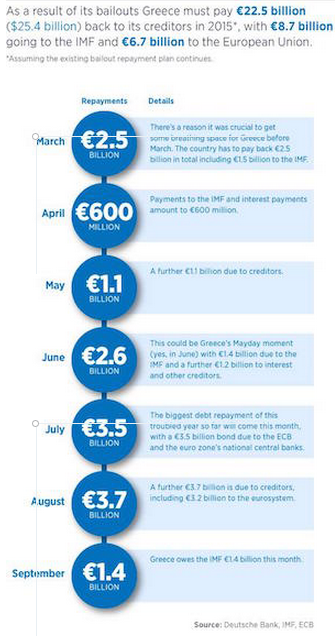
The consistent official narrative has been that Greece’s “radical left-wing government” has not put forward realistic proposals for restructuring the government to reassure the Troika that it would meet its repayment obligations in the future.
The discussions have been private and the specifics of Greece’s various proposals since Syriza came to power in January have never been made public.
The track record of the Troika however, particularly with regards to Ireland, would suggest that their mandate is to protect the interests of banks – at the expense of citizens – at nearly any cost.
With reference to a Greek request to delay its payments to the IMF Christine Lagarde told reporters, “It’s clearly not a course of action that would actually fit,” adding “We have never had an advanced economy ask for payment delays.”
Such intransigence is hardly appropriate at such a crucial time for the future of the Eurozone.
Draghi played down the effect of a potential “Grexit”. Draghi stated, “The short-term danger of contagion [from a Greek exit] is difficult to assess, but we have enough buffers in place. And even though they were designed for different circumstances, they are sufficient.” However, he did acknowledge that “we are entering uncharted waters.”
The European Central Bank has analyzed a scenario in which Greece runs out of euros and starts paying government employees with IOUs, creating a second currency within the euro bloc, people “with knowledge of the exercise” have told Reuters.
The ECB are considering the possibility that Greece will default in work undertaken by the so-called adverse scenarios group. Any default by Greece would force the ECB to act and possibly restrict Greek banks’ crucial lifeline access to emergency liquidity funding from the ECB.
Contagion is an increasing concern. The IMF’s Poul Thomsen warned “Nobody should think that a Grexit would not be without problems.” Bank “holidays” and capital controls are likely.
It is highly unlikely that the ECB has enough “buffers in place.” European banks fared badly in the Federal Reserve’s stress testreport released last month on the basis of poor risk management.
The fallout from a Greek default is difficult to assess especially with the strong political will to hold the Euro together. But the potential for contagion in the bond markets and through credit default swaps is very real.
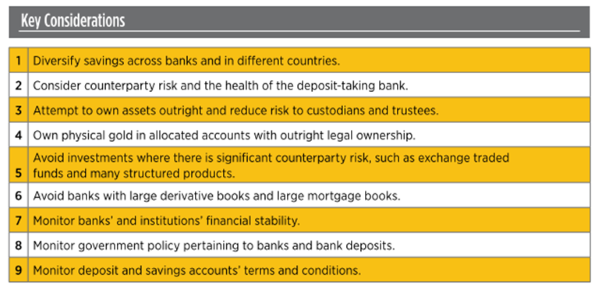
The outcome of such a development would like lead to bank failures across Europe. Bail-ins are now the rule and as was seen in Cyprus and now in Austria, bank deposits are no longer sacrosanct.
Download Protecting Your Savings In The Coming Bail-In Era (11 pages)
Download From Bail-Outs To Bail-Ins: Risks and Ramifications – Includes 60 Safest Banks In World (51 pages)
MARKET UPDATE
Today’s AM LBMA Gold Price was USD 1,203.25, EUR 1,120.34 and GBP 806.31 per ounce.
Friday’s AM LBMA Gold Price was USD 1,204.55, EUR 1,113.83 and GBP 801.86 per ounce.
Gold rose 0.46 percent or $5.50 and closed at $1,204.50 an ounce Friday, while silver fell 0.18 percent or $0.03 closing at $16.26 an ounce. Gold and silver both finished down for the week at 0.31 percent and 1.39 percent respectively.

Gold held steady above $1,200 an ounce on a softer dollar today. In Singapore gold was unchanged at $1,205.30 an ounce in late morning trading in a tight range of $4.
China ramped up its QE program by slashing its reserve requirement ratio (RRR) by 19.5 percent to 18.5 percent for its largest banks, for the second time this year. In efforts to increase bank lending and prop up the falling Chinese property market and struggling Chinese economy.
The India Times noted that due to the low gold prices they expect to see at 25 percent increase in jewellery sales in Akshaya Tritiya.
A ‘Grexit’ may still be on the cards and the Eurozone finance ministers are scheduled to meet on Friday in Latvia. This should support gold this week.
The world’s largest gold ETF, the SPDR Gold Trust or GLD, had an inflow of just under 3 tonnes on Friday, bringing its total weekly inflow to 4.8 tonnes, the biggest since early February.
In London gold for immediate delivery in late morning trading is up 0.04 percent at $1,204.40 an ounce. Silver is up 0.11 percent at $16.27 an ounce and platinum is up 0.16 percent at $1,165.89 an ounce.
Breaking Gold News and Research Here
end
For those of you who have been following the case of those 1933 USA double eagles:
(courtesy Reuters/GATA)
Appeals court rules U.S. govt. must return rare gold coins to family
By Jonathan Stempel
Reuters
Friday, April 17, 2015
The U.S. government must return 10 exceptionally rare gold coins worth millions of dollars each to a Pennsylvania family from which the purloined coins were seized a decade ago, a federal appeals court ruled today.
By a 2-1 vote, the 3rd U.S. Circuit Court of Appeals in Philadelphia said Joan Langbord and her sons Roy and David are the rightful owners of the double eagle $20 gold pieces, after the government ignored their claim to the coins and missed a deadline to seek their forfeiture.
“The government knew that it was obligated to bring a judicial civil forfeiture proceeding or to return the property, but refused,” Circuit Judge Marjorie Rendell wrote. “Having failed to do so, it must return the Double Eagles to the Langbords.”
… For the remainder of the report:
http://www.reuters.com/article/2015/04/17/goldcoins-ruling-idUSL2N0XE19F…
end
(courtesy London’s Financial times)
It’s as if these Swiss money managers — Swiss! — never heard of gold
Instead they’re thinking of putting stacks of paper money in vaults to avoid paying the penalty of negative interest rates.
* * *
Swiss Pension Schemes ‘Bankrupt in 10 Years’
By Madison Marriage
Financial Times, London
Sunday, April 19, 2015
http://www.ft.com/intl/cms/s/0/aca0b86c-e51c-11e4-bb4b-00144feab7de.html
Swiss pension schemes will be bankrupt within 10 years unless Switzerland’s government wins public support for a radical overhaul of the retirement system, experts have warned.
The pressure on Switzerland’s occupational pension system, which accounts for SFr800 billion ($840 billion) of assets, has intensified this year due to recently imposed charges on cash accounts and shrinking government bond yields.
Martin Eling, professor of economics at the University of St Gallen, estimated that occupational pension funds will face a SFr55 billion hole in their funding by 2030 if the government does not overhaul the system.
Occupational pension funds are legally required to pay retirees an annuity equivalent to 6.8 per cent of their total savings on an annual basis. This conversion rate is considered unsustainable given that it was devised in 2003 when life expectancy was lower and performance expectations were higher.
Mr Eling said: “This is not a sustainable situation. If we continue like this for 10 years the pension funds will be bankrupt and the companies [that pay into them] will have to be involved [in their rescue].”
Jerome Cosandey, an economist at Avenir Suisse, the Swiss think-tank, said that the Swiss National Bank’s decision in January to cut the rate on deposits to -0.75 per cent, coupled with negative bond yields and increased currency volatility, has exacerbated the situation.
To avoid paying negative rates on cash accounts, some pension funds have considered extreme options such as depositing bank notes in bunkers or safes, according to Peter Zanella, head of retirement solutions at Towers Watson, the consultancy, in Zurich.
Marcel Staub, a partner at Novarca, a Swiss consultancy, said he knew one pension fund that is considering selling mortgages to retirees because “providing cheap mortgages would make more than cash.” Another pension fund for medical workers has examined providing loans to surgeries as an alternative source of returns.
Mr Zanella said: “There are some very strange discussions going on right now. The big fear [among] pension fund managers is that things will only become worse. We have never faced such problems. This is absolutely new and people feel very ominous about it.”
He added that many schemes are considering dumping government bonds in favour of riskier asset classes such as infrastructure and property to improve their performance. He described this as a “questionable” strategy.
Mr Cosandey said: “The situation was bad before January and it just got worse after that. If returns remain low, pension funds will not be able to finance their promises and will need to use their reserves. If the ratio [of assets to liabilities] sinks below 100 per cent, extra financing will be required, largely at the cost of the employer.”
Companies are already facing difficulties. Credit Suisse’s chief financial officer, David Mathers, said in February that the bank could encounter “a hit to capital of SFr500 million” at the end of 2015 due to the impact of interest rate moves on the company’s pension fund.
“One of our priorities in the course of 2015 will be to work quite closely with the pension fund trustees to mitigate [this],” he said.
The Swiss government is debating lowering the 6.8 per cent conversion rate to 6 per cent and increasing social contributions per employee.
Mr Eling warned that the proposals do not go far enough and are likely to meet strong resistance from the public, which rejected a similar government proposal in a 2010 referendum.
end
This is huge: Russia bought 30 tonnes of gold in March
(courtesy Dave Kranzler/IRD)
Russia Buys 30 Tonnes Of Gold In March
I guess Obama’s economic sanctions and the crash in the price of oil isn’t affecting Russia’s economy the way the western media propaganda would have us believe:
It’s interesting that Russia is still buying because it’s economy has taken a knock from Western sanctions and from lower oil prices,” David Jollie, an analyst at Mitsui & Co. Precious Metals Inc., said by phone from London. “This sends a very bullish signal to the gold market.” (Bloomberg article link)
Everyone remember when the rumors were floated last fall that Russia was selling gold to raise money because it was getting squeezed from sanctions? As it turned out, Russia added a significant amount of gold to its reserves at that time.
There is an egregious error in that Bloomberg report. It cites the World Gold Council as reporting that the U.S. has 70% of it foreign reserves in gold. I guess that’s accurate if you count lease receivables and gold “I.O.Us” from bullion banks as being the equivalent of possessing physical gold.
Recall that several years ago the BIS changed the standards by which Central Banks can account for gold by enabling CB’s to consolidate “lease receivables” into just “gold” in its asset account. This is because most, if not all, of the Fed/ECB/BOE gold has been leased out.
It’s fascinating to watch Russia and China accumulate a massive amount of physical gold while western Central Banks continue to use paper gold in order to keep the price capped. I don’t know what event will trigger a failure in the west’s gold capping abilities, but I have a feeling that it will be an event that will make life very uncomfortable for everyone.
end
Bloomberg comments on the above story:
Russia returning to gold with biggest purchases in six months
By Eddie van der Walt
Bloomberg News
Monday, April 20, 2015
After a two-month hiatus, Russia’s appetite for buying gold is back.
The nation increased foreign reserves of bullion to 39.8 million ounces, or about 1,238 metric tons, as of April 1, compared with 38.8 million ounces a month earlier, the central bank said on its website today. The 30-ton purchase was the most since September.
Russia, the fifth-biggest holder of the metal, returned to buying gold after taking a break in January and February. The country, which bought gold through the last nine months of 2014, made the purchases to diversify foreign reserves and solve issues related to ruble liquidity, central bank Governor Elvira Nabiullina said in February.
“It’s interesting that Russia is still buying because its economy has taken a knock from Western sanctions and from lower oil prices,” David Jollie, an analyst at Mitsui & Co. Precious Metals Inc., said by phone from London. “This sends a very bullish signal to the gold market.” …
… For the remainder of the report:
http://www.bloomberg.com/news/articles/2015-04-20/russia-returning-to-go…
end
Just checked with Koos Jansen:
Gold demand (equals withdrawals) from SGE equals 35 tonnes for the 2nd week of April:
end
The IMF may solve the number of tonnes stored in China. The IMF is set to change the SDR calculations to include both gold and the yuan:
(courtesy Bloomberg)
Mystery of China’s gold stash may soon be solved at IMF
By Jasmine Ng, Joseph Deaux, and Eddie Van Der Walt
Bloomberg News
Monday, April 20, 2015
China’s push to challenge U.S. dominance in global trade and finance may involve gold — a lot of gold.
While the metal is no longer used to back paper money, it remains a big chunk of central bank reserves in the U.S. and Europe. China became the world’s second-largest economy in 2010 and has stepped up efforts to make the yuan a viable competitor to the dollar. That’s led to speculation the government has stockpiled gold as part of a plan to diversify $3.7 trillion in foreign-exchange reserves.
The People’s Bank of China may have tripled holdings of bullion since it last updated them in April 2009, to 3,510 metric tons, says Bloomberg Intelligence, based on trade data, domestic output and China Gold Association figures. A stockpile that big would be second only to the 8,133.5 tons in the U.S.
“If you want to set yourself up as a reserve currency, you may want to have assets on your balance sheet other than other fiat currencies,” Bart Melek, head of commodity strategy at TD Securities, said by phone from Toronto. Gold is “certainly viewed as a viable store of value for an up-and-coming global power,” he said.
China may be preparing to update its disclosed holdings because policy makers are pressing to add the yuan to the International Monetary Fund’s currency basket, known as the Special Drawing Right, which includes the dollar, euro, yen and British pound. The tally may come before the IMF’s meetings on the SDR next month or in October, Nomura Holdings Inc. said in an April 8 report. …
… For the remainder of the report:
http://www.bloomberg.com/news/articles/2015-04-20/mystery-of-china-s-gol…
end
The following commentary by Bill Holter is without a doubt the most important piece you will ever read. On Friday, Dave Kranzler revealed how the fed has been providing emergency collateral to necessary entities through reverse repurchase agreements. Today Bill highlights the fact that the Friday paper only deals with the Fed providing necessary collateral to Foreign Official and International Accounts. Actually the situation is much worse, when you add the huge amount of collateral supplied to US entities. This is how the Fed is hiding all of the dead bodies, having succumbed to derivative losses in oil, in dollars, in yen carry trades plus other losses. The Fed has been providing much of this collateral with these swaps. The bankers have multiplied the collateral (treasuries) through hypothecation and rehypothecation. Now the problem becomes front and centre when hedge funds demand the physical bond to cover their deficiencies and 90% or so of these guys do not have possession of these bonds. Defaults will occur once the deficiencies become pronounced.
take your time on this very important paper..
(courtesy Bill Holter/Miles Franklin)
The Mother of All Margin Calls!
This past Friday, Dave Kranzler of Investment Research Dynamics put out a very thoughtful article and chart regarding the spike in “reverse repurchase agreements” RRP’s held at the Fed http://investmentresearchdynamics.com/tag/reverse-repo-agreement/. The chart in question shows three very distinctive spikes,


1. Stocks all lower on major Chinese bourses as bubblemania is the name of the game in Shanghai and Hong Kong /Japan bourse lower /yen rises to 119.04/Shanghai to allow short selling to stop their bubble/China then cuts RRR by 1% and Chinese authorities sooth fears that they want to prick that huge bubble
1b Chinese yuan vs USA dollar/yuan slightly weakens to 6.2015
2 Nikkei down by 18.39 or .09%
3. Europe stocks up/USA dollar index up to 97.87/Euro rises to 1.0742
3b Japan 10 year bond yield .31% (Japan buying 100% of bond issuance)/Japanese yen vs usa cross now at 118.69/
3c Nikkei still above 19,000
3d USA/Yen rate now well below the 120 barrier this morning
3e WTI 55.37 Brent 62.75
3f Gold down/Yen up
3gJapan is to buy the equivalent of 108 billion uSA dollars worth of bond per month or $1.3 trillion. Japan’s GDP equals 5 trillion usa.
Japan to buy 100% of all new Japanese debt and by 2018 they will have 25% of all Japanese debt. Fifty percent of Japanese budget financed with debt.
3h Oil down for WTI and down for Brent this morning
3i European bond buying continues to push yields lower on all fronts in the EMU. German 10 yr bund below 10 basis points. German bunds in negative yields from 9 years out.
Except Greece which sees its 2 year rate rises a monstrous 27.77%/Greek stocks up a tin y.91%%/ still expect continual bank runs on Greek banks.
3j Greek 10 year bond yield: 12.95% (up 25 in basis point in yield)
3k Gold at 1198.70 dollars/silver $16.07
3l USA vs Russian rouble; (Russian rouble down 2 rouble/dollar in value) 52.76 , the rouble is still the best acting currency this year!!
3m oil into the 55 dollar handle for WTI and 62 handle for Brent/Saudi Arabia increases production to drive out competition.
3n Higher foreign deposits out of China sees huge risk of outflows and a currency depreciation. This scan spell financial disaster for the rest of the world/China may be forced to do QE!! (today by lowering its RRR it is effectively doing QE)
30 SNB (Swiss National Bank) still intervening again in the markets driving down the SF. It is not working: USA/SF this morning 95.88 as the Swiss Franc is rising against most currencies. Euro vs SF is 1.0286 well below the floor set by the Swiss Finance Minister.
3p Britain’s serious fraud squad investigating the Bank of England/ the British pound is suffering
3r the 9 year German bund now enters negative territory with the 10 year close to negativity/no doubt the ECB will have trouble meeting its quota of purchases and thus European QE will be a total failure.
3s The ECB increased the ELA to Greece today by another large 800 million euros. The new maximum is 74.0 billion euros. The ELA is used to replace depositors fleeing the Greek banking system. The bank runs are increasing exponentially.
3t Greece informally asks the IMF to delay its payment for May 1 and they refuse.
3 u. With the big meeting in Riga this Friday, there is no new developments on Greece to provide new reforms/thus do not expect anything to develop by Friday. However Greece’s cash is running out.
4. USA 10 year treasury bond at 1.87% early this morning. Thirty year rate well below 3% at 2.53%/yield curve flatten/foreshadowing recession.
5. Details Ransquawk, Bloomberg, Deutsche bank/Jim Reid.
(courtesy zero hedge/Jim Reid Deutsche bank)
China To The Rescue: Global Equity Market Rebound After Latest Chinese Easing
It is only fitting that the next business day following a headline that “Global Futures Slide China Tumbles On Short Selling Boost” we would see China, in an apparent panic, not only cut its RRR by 100 bps to 18.5% – far more than expected and the most since 2008 – but, more importantly, hinted that the Friday regulatory decision to encourage short sales and tighter margin rules on “umbrella trusts” was in no way meant to pop that the Chinese stock bubble, ridiculous as it may be.
As we reported over the weekend, “in a statement published on Saturday evening, the China Securities Regulatory Commission said measures rolled out on Friday, including tightening rules on margin lending and promoting the use of short selling, aren’t aimed at clamping down on a red-hot market. The measures are about “maintaining the healthy development of the market,” the CSRC said in the statement. “They aren’t intended to encourage short selling, let alone depressing the market…the market shouldn’t over-interpret the measures,” it added.”
In other words, the Chinese moves were far less concerned with the economy, where as we showed if the US housing “lesson” is any indication, then the Chinese economy is already in a recession…

… but all about preserving the only bubble China has left, ahead of what would be a full-blown hard landing: that of stocks.
End result: after Chinese futures crashed by up to 6% on Friday after the Shanghai close, overnight the SHCOMP was down just 1.64%, erasing the bulk of the futures loss. More importantly, US equity futures have seen a strong bid this morning in yet another attempt to defend not only the Apple Sachs Industrial Average from going red on the year but the all important 100 DMA technical levels.
Should Virtu’s momentum accelerator algos wake up on time from their post-IPO party hangover, we may well see the entire Friday loss wiped out, completely oblivious that the Greek drama may be about to end in tears for all.
For now however, European equities reside comfortably in positive territory with the weaker EUR offering support to German exporters, which is in turn aiding DAX outperformance. However, German auto-makers have since pulled of highs with Volkswagen and BMW confirming they are both facing headwinds in China. Furthermore, basic materials is the best performing sector in the session underpinned by China stimulus efforts. However, after initially trading higher by over 1%, Chinese bourses later reversed direction following a bout of profit taking as well as concerns over the comments from the CSRC stating that they will tighten margin lending rules. Furthermore, analysts suggest that the action taken by the PBoC over the weekend may not be sufficient enough to get the Chinese economy back on its feet, with further cuts to the deposit and lending rate potentially required.
Additionally, sources reported during the European session that China are to inject USD 62bln of FX reserves into Chinese banks, with USD 30bln pumped into Exim Bank and another USD 32bln into CDB. (Caixim/BBG)
UST’s are seen lower heading into the North American crossover alongside the strength seen in stocks. Separately, German paper has edged higher with uncertainty in Greece still taking centre stage, after weekend reports that Russia and Greece were to reach an energy deal which would grant the troubled economy EUR 5bln. However, these rumours were later refuted by Russian government spokesman over the weekend with GR/GE spread wider compared to its Eurozone neighbours.
In FX markets, the USD-index is seen marginally higher as EUR/USD is considerably weaker as the possibility of ‘Grexit’ lingers on. Elsewhere. Antipodean currencies briefly touched 1 month highs boosted by the surprise RRR cut in China. AUD/USD rose to a 1-month highs of 0.7840 while NZD/USD gained for a 5th consecutive day, both pairs taking out 0.7800 and 0.7700 respectively. However, the firmer greenback dragged the antipodean currencies back into negative territory.
India’s Sensex Index falls 2% to three week low while USD/INR rose by the largest amount in two months to its highest level since March 16th as a consequence of concerns of lower than expected corporate earnings.
WTI and Brent crude futures saw much of its upside erased after comments from Saudi Arabian oil minister stating that Saudi Arabia have an output of 10mln bpd in April and is not worried about demand for oil in China. Finally, spot gold has pared most of its safe haven bids underpinned by Chinese growth worries due to the modestly stronger USD.
In summary: European shares remain higher, though off intraday highs, with the basic resources and chemicals sectors outperforming and food & beverage, utilities underperforming. China’s central bank cut banks’ reserve requirements by the most since the global financial crisis. U.K. house prices rise to record. The German and Swedish markets are the best-performing larger bourses, Spanish the worst. The euro is weaker against the dollar. German 10yr bond yields fall; French yields decline. Commodities gain, with natural gas, nickel underperforming and zinc outperforming. U.S. Chicago Fed index, due later.
Market Wrap
- S&P 500 futures up 0.5% to 2086.6
- Stoxx 600 up 0.6% to 406
- US 10Yr yield up 1bps to 1.88%
- German 10Yr yield down 0bps to 0.08%
- MSCI Asia Pacific down 0.7% to 152.6
- Gold spot down 0.1% to $1202.7/oz
- 70.5% of Stoxx 600 members gain, 27.7% decline
- Eurostoxx 50 +0.7%, FTSE 100 +0.6%, CAC 40 +0.3%, DAX +1.3%, IBEX -0.2%, FTSEMIB +0.5%, SMI little changed
- Asian stocks fall with the Kospi outperforming and the Hang Seng underperforming.
- MSCI Asia Pacific down 0.7% to 152.6; Nikkei 225 down 0.1%, Hang Seng down 2%, Kospi up 0.1%, Shanghai Composite down 1.6%, ASX down 0.8%, Sensex down 2%
- Euro down 0.52% to $1.075
- Dollar Index up 0.25% to 97.77
- Italian 10Yr yield down 4bps to 1.44%
- Spanish 10Yr yield down 4bps to 1.42%
- French 10Yr yield down 1bps to 0.36%
- S&P GSCI Index up 0.2% to 432.5
- Brent Futures up 0.4% to $63.7/bbl, WTI Futures up 0.6% to $56.1/bbl
- LME 3m Copper little changed at $6060/MT
- LME 3m Nickel down 1% to $12435/MT
- Wheat futures up 0.8% to 493.3 USd/bu
Bulletin Headline Summary from Bloomberg and RanSquawk
- Over the weekend, the PBoC cut their Reserve Requirement Ratio (RRR) by 100bps to 18.5% in an attempt to help stimulate the economy and get growth back on track
- European equities hold onto its Chinese stimulus inspired gains despite DAX heavyweights BMW and Volkswagen announce they face headwinds in China
- Looking ahead, the economic calendar is particularly quiet with no major data releases from the US, however there are several tier 1 corporate earnings including Morgan Stanley, Halliburton and IBM.
- Treasuries decline, 5/30 curve steepens, amid gains in European stocks and U.S. equity-index futures on China’s cut in bank reserve requirements; data calendar light this week, 5Y TIPS sale Thursday, Fed meeting next week.
- The People’s Bank of China lowered bank reserve-ratio requirements by a full percentage point, the most since the global financial crisis just days after a report showed the slowest economic growth in six years
- PBOC considering a strategy to allow Chinese banks to swap local-govt bailout bonds for cash, a Chinese version of ECB’s LTROs, WSJ reported, citing unidentified people familiar with the central bank’s talks
- Greece and its creditors remained at loggerheads with time running out to unlock aid; the sides haven’t even agreed on fiscal targets for this year, let alone on measures to meet those goals, an official representing the creditors said
- Libya’s growing chaos is at the gates of Europe: hundreds of would-be migrants drown as their ship sinks in the Mediterranean off Libya; at least two dozen Ethiopian Christians are executed in the southern and eastern parts of the country while oil fields are seized in the center
- Jon Corzine said to consider starting his own hedge fund, starting with cash from Corzine’s personal wealth and a handful of outside investors and would amount to about $150m of assets under management, WSJ said, citing people familiar
- Sovereign bond yields mostly higher. Asian stocks fall, European stocks, U.S. equity-index futures gain. Crude oil higher, copper and gold little changed
DB’s Jim Reid completes the overnight recap
Markets are all revved up this morning after the 100bps weekend RRR cut from China. DB has been at the dovish end of the street in terms of expectations and we had forecast two 50bps cuts in Q2. So 100bps in one hit and the biggest move since 2008 is a clear statement. We can’t help thinking that it fits in with our plate spinning analogy. China have tried hard to do the right things with regards to reforms etc but it seemed to be sending growth to uncomfortably low levels. So they have reverted to direct stimulus which should give the wobbling plate a big spin for a while. However the risk is that the only way we can see acceptable growth is to pump the old credit/investment model and thus further increase the imbalances.
As well as the 100bp cut for banks, the PBOC also announced an extra 100bps for certain rural financial institutions and also 200bps for The Agricultural Development Bank of China. DB’s Chief Economist Zhiwei Zhang expects that the move will inject approximately RMB 1.3tn of liquidity into the financial system with SOE’s, local government financial vehicles and infrastructure sectors likely the most supported. Interestingly, Zhiwei also expects that part of the funds released to the banks will be used to purchase the RMB 1tn of local government bonds approved under the debt swap program. On this topic, the WSJ has suggested that the PBOC may look at a similar strategy to that of the LTRO program in Europe in a bid to ensure adequate liquidity in the financial system. Looking ahead, Zhiwei believes that more easing measures are still needed to halt the fiscal shock and property slowdown. Expectations are now for one RRR cut in Q3 and one interest rate cut in Q2, although Zhiwei does see more possibility of cuts in H2 should growth disappoint.
Looking at the market reaction this morning, equities China are unsurprisingly higher with the CSI 300 (+1.23%) and Shanghai Comp (+1.03%) both up, although stocks still appear to be somewhat weighed down by the regulatory announcements on Friday with regards to short selling (which we’ll touch on later). The easing has helped precious metals open firmer this morning while commodity currencies are also +0.3% better off. The impact is most evident in the swaps market with 1y China IR swaps 20bps tighter and hitting a near-3y low. Elsewhere, the Nikkei (+0.29%), Hang Seng (-0.29%) and Kospi (-0.04%) are clawing back earlier losses on the back of Friday’s moves.
Moving on, Greece was once again the subject of various headlines on Friday and over the weekend. Indeed, Greek equities closed 3% weaker on Friday, while 3y yields widened a further 25bps after initial headlines emerged that the ECB was examining scenarios looking at whether Greece could pay public staff with IOU’s, as well as more concerns over the general lack of progress. Since then and over the weekend, the hopes of any reform package being presented to Greece’s creditors ahead of the Eurogroup meeting in Riga this Friday appear to be fading. EC Vice President Dombrovskis was quoted overnight as saying that ‘the Riga Eurogroup meeting will be a chance to take stock of talks’ and that ‘hopefully Greece will be able to provide a reform package for the next meeting in May’. Despite more conciliatory comments from officials including the ECB’s Draghi and US Treasury Secretary Lew that an agreement is a best solution for both sides, concerns now will potentially turn to how Greece will fund itself between this Friday’s Eurogroup and the May 11th meeting. In the meantime, comments from Greece’s deputy PM Dragasakis that the government will stand firm in negotiations, saying that ‘there is no way we would cross red lines that we have set’ will do little to help matters. Meanwhile it looks like the aftermath of Finnish elections over the weekend will continue to see the country take a hardline on Greece. According to Bloomberg, the anti-EU True Finns party look set to get second place and be part of the coalition. It will be interesting to see the impact of an anti-EU party in government in Europe.
With negative Greece headlines continuing to dominate, peripheral bonds sold off on Friday with 10y yields in Spain, Italy and Portugal +10.3bps, +9.7bps and +12.4bps respectively. It was a different story in core markets however as 10y Bunds struck an intraday low of 0.478% on Friday, before eventually closing at 0.757% (still 0.7bps lower on the day). The move on Friday was enough to see 9y Bund yields dip into negative territory, closing at -0.006%. Markets were in fact very much in risk off mode on Friday, not helped by the initial news out of China that the Securities Regulatory Commission would ban the margin-trading business of brokerages from umbrella trusts and also opening up the ability for fund managers to lend shares to short sellers. This, combined with Greece headlines caused European equities to sell-off with the Stoxx 600 (-1.76%), DAX (-2.58%), CAC (-1.55%), FTSE MIB (-2.40%) and IBEX (-2.17%) all declining sharply. Xover also weakened, closing 14bps wider.
Data in the region was largely as expected on Friday. There was no change in the final March CPI print for the Euro area with the headline and core unchanged at -0.1% yoy and +0.6% yoy respectively. Meanwhile, in the UK labour market data was encouraging. The ILO unemployment declined one-tenth of a percent to 5.6% and weekly earnings (ex-bonus) rose to +1.8% yoy (vs. +1.7% expected).
It was much of the same in the US session on Friday, with the lower sentiment helping drag both the S&P 500 (-1.13%) and Dow (-1.54%) to their worst day this month while CDX IG finished 2bps wider. The Dollar brought to an end 3 consecutive days of losses with the DXY closing up a modest 0.11%. Treasuries meanwhile were a bit more volatile. With the CPI print influencing much of the intraday move, the 10y hit a low in yield of 1.843% in the minutes leading up to the reading, before then selling off and reaching an intraday yield high of 1.910%, before eventually closing out 2.4bps lower on the day at 1.865%. Just on the inflation reading, the print made for something of a mixed bag as the headline fell below expectations to -0.1% yoy (vs. 0.0% expected) and the core rose to +1.8% yoy (vs. +1.7% expected). Elsewhere, the preliminary April University of Michigan consumer sentiment reading was a touch better than expected at 95.9 (vs. 94.0 expected) and the Conference Board’s leading index came in below at +0.2% yoy (vs. +0.3% expected).
With earnings season likely to be much of the focus this week, it’ll be interesting to see how much focus will be on Dollar strength impacting the top line. This was certainly the case on Friday where, despite reporting better than expected profits, revenues for both General Electric and American Express fell short of analyst expectations with management for both commenting on the impact of the stronger currency over the reporting period.
Turning now to this week’s calendar, it’s a quiet start this morning in Europe with just German PPI due. It’s no less different in the US this afternoon with the Chicago Fed National Activity Index the only print. The German ZEW survey will be of most focus in the European timezone on Tuesday and it remains quiet in the US with no data due out. Things pick up on Wednesday however and we start in Asia where we get trade data due out of Japan and also inflation data out of Australia. In Europe, industrial orders and retail sales are due in Italy, consumer confidence is due out of the Euro-area and in the UK we should get the BoE minutes. Focus across the pond on Wednesday in the US will be on existing home sales and the FHFA house price index. Thursday is flash PMI day for April where we get manufacturing readings out of Japan and China in the early morning, followed by manufacturing, services and composite prints for the Euro area, France and Germany. Business and manufacturing confidence is also due in France, while in the UK we get retail sales data. In the US on Thursday, jobless claims, new home sales, Kansas City Fed manufacturing activity and also the flash manufacturing PMI are all due. We close out the week on Friday in Europe with the German IFO survey for April. In the US meanwhile, durable and capital goods orders are scheduled. With it being a fairly quiet week data wise, US earnings season will be of much focus with the calendar ramping up as 147 S&P 500 companies are due to report including Google, Facebook, P&G and Amazon. European earnings season will also kick into gear. Of course Greece will also continue to be front and centre with the Eurogroup meeting scheduled for Friday in Riga.
end
Chinese authorities came to the rescue. You will recall that after the markets closed in China on Friday, the authorities stated that they would allow shorting. It was thought that they wanted to prick the bubble. When futures fell by 7% they decided it was best to lower banking reserves (RRR) which gave a huge lift to the Chinese stock market this morning.
(courtesy zero hedge)
Chinese Stocks Pump’n’Dump After RRR Cut, Retrace Friday’s Crash
After crashing 6-7% on Friday (depending on which Chinese stock index you prefer) – all after the cash markets closed in China – thanks to today’s major RRR cut, China stock futures are up 7% from Friday’s US session close. However, while futures have recovered all those losses, the Shanghai Composite cash index is trading modestly lower from its Friday cash close levels (we suspect a little disappointingly to some) after recovering the entire loss from post-China-close Friday.
Futures ripped back…

Just looking at the cash Shanghai Composite index – you’d never know it crashed… but it’s fading back lower again now…

We suspect this is not the exuberance many had expected…
Charts: Bloomberg
end
The first big real estate failure in China: Kaisa
(courtesy zero hedge)
Chinese Developer Kaisa Officially Defaults, Restructures Debt
As Bill Holter and I have speculated would happen, Greece will be given a 5 billion Euro life-line in the form of prepayments on the Blue Stream gas pipeline which is being proposed by Russia to bypass Bulgaria.
Russia knows that this 5 Billion euro loan will not help prevent Greece’s bankruptcy but it will certainly stop any new sanctions against Russia. Germany will not be enthused with this deal nor the USA:
(courtesy zero hedge)
On Saturday, it seems that a “white knight” has appeared in that Russia is to give 5 billion Euros in advance payments for helping with the Blue Stream project replacing Bulgaria. Late in the day this was denied by Russia and again on Sunday:
(courtesy zero hedge)
The Greek “White Knight” Emerges: Putin To Give Athens €5 Billion For Advance Gas Pipeline Fees
With Greece teetering on the edge of insolvency and forced to raid pension and most other public funds, ahead of another month of heavy IMF repayments which has prompted even the ECB to speculate Greece should introduce a parallel “IOU” currency, a white knight has appeared out of nowhere for Greece, one who may offer $5 billion in urgently needed cash. The white knight is none other than Vladimir Putin. “Just because Greece is debt-ridden, this does not mean it is bound hand and foot, and has no independent foreign policy,” Putin said previously.

According to Spiegel, citing a senior figure in the ruling Syriza party, Greece is poised to sign a gas deal with Russia as early as Tuesday which could bring up to €5 billion into the depleted Greek coffers.
The move could now “turn the tide” for the debt-stricken country according to a senior Greek official.
As Reuters adds, during a visit to Moscow earlier this month, Greek Prime Minister Alexis Tsipras expressed interest in participating in a pipeline that would bring Russian gas to Europe via Turkey and Greece.
Under the proposed deal, Greece would receive advance funds from Russia based on expected future profits linked to the pipeline. The Greek energy minister said last week that Athens would repay Moscow after 2019, when the pipeline is expected to start operating.
Greek government officials were not immediately available to comment on the Spiegel report.
Of course, this being Greece, the probability of actual repayment is negligible: after all the likelihood of a Greek default is astronomical, and €5 billion will do little to change the mechanics of Greek debt sustainability. And Putin very well knows this.
However, the Russian leader is not acting out of the kindness of his heart, but merely engaging in another calculated move, one which kills two birds with one stone:
- Following the death of the South Stream, whereby the EU pressured Bulgaria to refuse passage of the Russian gas pipeline to Europe, Russia needed an alternative route of bypassing Ukraine (and Bulgaria) entirely, something which according to Kremlin’s plan should happen over the next 3 years. And with Hungary and Serbia all eager to transit Russian gas to the Austrian central european gas hub, Greece was the missing link for a landline transit. With this agreement, Russia gets the green light to extend the Blue Stream all the way to Austria and preserve its dominance over the European energy market while leaving Ukraine in a completely barganining vacuum.

- Perhaps just as importantly, suddenly Russia will use energy as the generous benefactor riding to Greece’s salvation, in turn even further antagonizing the Eurozone and further cementing favorable public opinion. As a reminder, several weeks ago we showed that Russia already has a higher approval rating among the Greek population thatn the Eurozone. In this way, Russia has just won a critical ally for the very low price of just €5 billion, without even having to restructure the entire Greek balance sheet should Greece have exited the euro and been attracted to the Eurasian Economic Union. Which also means that all future attempts to impose further sanctions on Russia by Europe will fail thanks to the Greek veto vote.
Russia is not alone in seeking to divide the spoils of the collapsing Eurozone: Beijing has also sought to invest in Greece’s infrastructure and bought up €100m worth of short-term government debt last week the Telegraph reports.
Ironically, it was none other than Germany’s finance minister Wolfgang Schauble who said the Greeks are free to pursue deals with Russia and China as they rush to avoid an impending bankruptcy. Turns out the Greeks decided to do precisely as the German suggested, and the outcome will certainly not be to Germany’s liking.
The only question following what may well be another masterful stroke by Putin is what will Europe do, now that Putin has in the span of under one year, not only “annexed” Crimea but fully drawn Greece into its sphere of influence.
end
Hopes ran high among Europe’s unelected bureaucratic oligarchy and the Troika of official creditors that the Greek government, after the ECB openly dropped hints of a Greek IOU currency in the immediate future, would finally relent over the weekend and admit that all of its promises to its voters were a lie and that the Tsipras government would finally pick up where the Samaras government left (and was booted) off. There was even a perfect venue: Washington D.C., where Varoufakis and Obama met for the first time just hours before.

The hopes were promptly dashed after Greece, once again, said it would not “renege on election pledges to end austerity measures as creditors pressed for a compromise.”
The full court assault against Greece from all sides came fast and furious.
As Bloomberg notes, both president Obama and ECB president Mario Draghi called on the Greek government to do more to resolve the standoff amid depleting cash reserves.
And for the first time, a voice formerly quite sympathetic to the Greek cause, that of France, expressed increasing frustration with the pace of negotiations and openly chided Greece.
This happened when French Finance Minister Michel Sapin spoke after the IMF meeting in Brussels yesterday saying he “doesn’t expect a resolution of Greece’s financing issues to be achieved in coming days, including at a meeting of European finance ministers in Riga April 24 and 25.”
“We’re in the same situation at the end of these meetings as at the beginning. That’s in part because Greece wasn’t on the menu,” Sapin said. “A lot of time has been lost and it won’t be recovered” he added.
Ironically, the French government is now openly criticizing the Greeks, saying the “need to work work work and work seriously” on their economic plans “out of respect for the Greek people.” Ironic, because it is “out of respect” for the people’s choice to end the Troika’s meddling in Greece that Europe is in the current dead-end.
Let’s not forget that this is the same French government that itself missed its budget deficit target two months agoand avoided a EU deficit penalty just because in Europe some are more equal than others.
The irony continued: “Greece needs to respect the rules that apply to all countries in the euro”…. except France? “Greece hasn’t only signed memorandums, but has signed treaties.”
The criticisms escalated into threats when ECB Governing Council member Vitas Vasiliauskas said that “the situation in Greece means that we should have a limit until summer” for providing Emergency Liquidity Assistance for Greece. He added that “everyone understands what ELA means, it’s a temporary measure to give the banks liquidity. We will have to have discussions about the issue liquidity provision versus monetary financing. We will certainly have these discussions before summer.”
Once again a case of some being more equal than others, because all the ECB’s QE really is, is monetary financing of insolvent peripheral nations courtesy of an ECB backstop which makes rates so low Spain and Italy can both go on a borrowing spree, and even issue 100 year paper, and everyone will line up simply because the ECB has blessed said paper. For now.
However, when it comes to Greece and suddenly the ECB is very concerned about “monetary financing.”
Finally, the big guns came out when Mario Draghi himself said the euro area was better equipped than it had been in the past to deal with a new Greek crisis but warned of “uncharted waters” if the situation were to deteriorate badly. As the FT reported, Draghi “called for the resumption of detailed discussions aimed at resolving the country’s debt woes and urged the Greek authorities to bring forward proposals that ensured fairness, growth, fiscal stability, financial stability.”
Said otherwise, to do precisely as the Troika demands.
Greek officials, including Deputy Prime Minister Yannis Varoufakis, stood their ground.
“We want a viable solution within the euro,” Varoufakis said in an interview published Sunday in Athens-based To Vima newspaper. Still, “we don’t budge from our red lines.”
The Greek “red lines” are refusing to cut wages and pensions, introduce new taxes or sell state assets, Alternate Health and Social Security Minister Dimitris Stratoulis said in an interview Saturday with Athens-based Skai TV. “The Syriza-led government will carry out the reforms the Greek people need, not ones requested by our creditors,” he said. The country won’t be pressured “by euro-exit threats,” he added.
And then Greece brought out the tactical weapons: “Snap elections or a referendum are possible options should negotiations with creditors stall, Varoufakis said.”
Which goes to the heart of the problem, because while the Greek population wants an end to austerity (hence the election of Syriza), it also wants to remain in the Eurozone and keep the Euro. As such a referendum and snap elections would finally push the decision away from the government and give it to the general population, something the eurocrats, who pride themselves in their “technocracy” are terrified of, and would never forgive.
Meanwhile, Greece may have no money left but it still has pride: “Greece won’t agree to any privatization, Energy Minister Panagiotis Lafazanis said in an interview published Sunday in Athens-based Real News newspaper.While “so-called” partners, including unidentified International Monetary Fund officials, want to “blackmail” the Greek government into adopting measures that would hurt the working class, “we won’t betray the people’s mandate,” he said.
While on the surface Greek defiance is inexplicable having run out of all negotiating chips, the news yesterday that none other than Vladimir Putin may be coming to the Greek rescue with a €5 billion advance gas pipeline payment may have given the Greeks a sense of leverage.
That, however, was promptly dashed subsequently when Russia denied the Spiegel report. Reuters cited Kremlin spokesman Dmitry Peskov, who in comments made to Business FM radio and quoted by RIA news agency, said “No, there wasn’t (any agreement).”
Peskov reiterated that the Greeks had not requested financial assistance during talks in the Kremlin earlier this month between Prime Minister Alexis Tsipras and Russian President Vladimir Putin.
“Naturally the question of energy cooperation was raised. Naturally … it was agreed that at the expert level there would be a working-out of all issues connected with cooperation in the energy sphere, but Russia did not promise financial help because no one asked for it,” Peskov was quoted as saying.
Of course, this is merely diplomatic double talk, and all it suggests is that Russia is awaiting the official admission from Greece that it will pivot to Russia. For that to happen, Greece will have to formally state that in addition to creditor negotiations it is now openly looking to Moscow (and Beijing) for additional aid. The problem is that such a statement would promptly end any hopes of a Greek deal with its Troika creditors.
As such Greece is simply trying to delay making the choice of picking its future path, be it west or east, until the very last moment. However, since Greek liquidity is now non-existent and the government has almost run out of public funds to pillage, Tsipras will have no choice but to make that choice in the coming days.
end
Varoufakis urges Obama to tell Europe that more flexibility is needed to deal with Greece’s debt problems:
(courtesy UKTelegraph/M Khan)
Greece’s finance minister has ramped up the political stakes in his country’s debt drama, by personally telling President Barack Obama to push eurozone creditors over his country’s bail-out crisis.
In an 12-minute exchange with the President on the sidelines of an event marking Greek Independence day, Mr Varoufakis is reported to have repeated his desire for the US leader to influence events.
Mr Obama is reported to have responded by urging flexibility from both parties.
• Grexit dangers mount as Varoufakis warns of ‘liquidity asphyxiation’
• Greek crisis deepens as Lagarde shoots down hopes for payment relief
Greece’s Leftist government has looked to the White House to play the role of honest broker in protracted negotiations with its international creditors.
Following Syriza’s election in January, President Obama called for an end to harmful austerity policies and the introduction of a “growth strategy in order for them to pay off their debts to eliminate some of their deficits.”

Mr Varoufakis: We will compromise, we will compromise, but we will not be compromised”
Earlier, Mr Varoufakis said his country had to “win back the trust” of its European partners, but warned that any threats to “amputate” Greece were “profoundly anti-European”.
The firebrand finance minister is due to meet with the US Treasury Secretary Jacob Lew later today.
Brinkmanship over Greece’s euro future is being reflected in financial markets, as the country’s 10-year government bonds rose to their highest level since December 2012 today.
http://cloud.highcharts.com/embed/ijysep
Hopes of a deal being struck before a meeting of the eurozone’s finance ministers on April 24 have all but diminished.
“In the absence of a deal in the next few weeks, the government might not be able to avoid default, which – we fear – would likely raise the risk of Grexit,” said Reinhard Cluse at UBS.
The eurozone’s economics chief Pierre Moscovici said a deadline for agreement could now be pushed forward to May, when the eurogroup is due to convene.
““If integrity is not preserved [with Greece leaving], it means the euro is no more a single currency,” warned Mr Moscovici, who said there was no “plan B” for Athens.
The situation has become increasingly critical as Greece’s public funds dwindle and the government faces a near €1bn IMF bill in the first two weeks of May.
IMF managing director Christine Lagarde repeated that she would not countenance any delay in payment to the Fund.
“We will do everything we can so lending to the Fund remains the safest lending route any debtor can adopt. That is my determination” said Ms Lagarde.
end
We warned last week that capital controls were inevitable and it apears the first steps have been taken (very quietly):
- *GREECE ISSUES DECREE: LOCAL GOVTS OBLIGED TO TRANSFER DEPOSIT RESERVES AT CENTRAL BANK
So, following the pension fund raid, the Greek government is now centralizing all Greek cash citing an “extremely urgent and unforeseen need.”. One wonders if this is Krugman’s “advice.”

- *DECREE ON MANDATORY CASH TRANSFER POSTED IN GOVT GAZETTE
…if capital controls were imposed as a product of a stand-off between Greece and its creditors rather than in the context of agreement as to the way forward (as ultimately in Cyprus), Greek politics could lurch towards the need for a parallel / substitute currency rather than as hoped towards commitment to the euro at all costs. end
end
With municipalities raided, stunned Greeks reacted to initial capital controls as they went onto the streets to demonstrate. This is just the beginning…
(courtesy zero hedge)
Stunned Greeks React To Initial Capital Controls And The “Decree To Confiscate Reserves”, And They Are Not Happy
Earlier today, following weeks of speculation, Greece finally launched the first shot across the bow of capital controls, when it decreed that due to an “extremely urgent and unforeseen need” (ironically the need was quite foreseen since about 2010, but that is a different story), it would be “obliged” to transfer – as inconfiscate – “idle cash reserves” located across the country’s local governments to the Greek central bank.
Several hours later the decree which was posted in the government gazette has finally percolated among the population, and the response to what even ordinary Greeks realize is now the endgame, is less than exuberant.
Bloomberg reports, that “as Greece struggles to find cash to stay afloat, local authorities say they oppose a government decision to use their reserves for short-term financing.”
“The government’s decision to seize our reserves not only raises legal and constitutional issues, but also a moral one,” said George Papanikolaou, mayor of Glyfada, the third-largest municipality in the metropolitan region of Attica after Athens and Piraeus. “We have a responsibility to serve our citizens,” Papanikolaou said by phone on Monday. Glyfada has about 16 million euros in cash reserves, he said.
George is unhappy because as recently as tomorrow, he will find there is precisely zero euros in his public bank account, as all the money has now been forcibly sequestered by the government in order to repay future Troika, pardon, IMF obligations.
Sadly for Greece, this is the only option left as the money has now fully run out: Greek Prime Minister Alexis Tsipras ordered local governments and central government entities to move their cash balances to the central bank for investment in short-term state debt.
From Bloomberg:
The decree to confiscate reserves held in commercial banks and transfer them to the Bank of Greece could raise as much as 2 billion euros ($2.15 billion), according to two people familiar with the decision. The money is needed to pay salaries and pensions at the end of the month, the people said.
“It is a politically and institutionally unacceptable decision,” Giorgos Patoulis, mayor of the city of Marousi and president of the Central Union of Municipalities and Communities of Greece, said in a statement on Monday.“No government to date has dared to touch the money of municipalities.”
It took the radical leftist one all of 2 months since coming to power.
And the punchline is that the use of confiscated proceeds is unclear: the government says it is to pay pensions and wages, but recall that the same government recently confiscated pensions to repay the IMF, so according to the chain of logic, the government first raided pensions, and now municipalities, just to repay the dreaded Troika.
The Athens city council and the union of municipalities and communities in Greece will convene tomorrow to debate the order, a press officer of the mayor’s office said.
And one everyone realizes what just happened, expect the riot cam and the Greek Pay-Per-Riot channel, which has been on hiatus since the summer of 2012, to be fully reactivated.

As Alexei Miller heads to Athens to Athens to seal a deal with the Greeks. The Russians need Greece has a conduit over to Europe in the supply of natural gas with respect to the new Blue Stream pipeline. Greece will replace Bulgaria as the Europeans read the riot act to them. The Europeans are furious at this Greek/Gazprom meeting so Europe decides to initiate anti trust action again Gazprom.
(courtesy zero hedge)
As Gazprom CEO Arrives In Athens, EU (Coincidentally) Files Anti-Trust Charges Against Russian Giant
As the head of Russian gas giant Gazprom, Alexei Miller, arrives in Athens tomorrow (for talks with Greek PM Tsipras about “current energy issues of interest,” which we suspect will include finalizing the “Turkish Stream” pipeline heralded by many as Greece’s potential get-out-of-Troika-jail-card), he will face an increasingly anxious European Union. Fresh from its suit against Google, the WSJ reports, the EU’s competition regulator plans to file formal antitrust charges against Russia’s state-owned gas company OAO Gazprom on Wednesday. This re-opens a suit from 2012 saying that it suspected the company of abusing its dominant position in those countries’ natural-gas supply. It appears Europe is getting nervous…
Having realized that a potential Greco-Russian pipeline deal could, according to one senior official “turn the tide” for the debt-stricken country, it appears the imminent arrival of Gazprom’s CEO (as Reuters reports):
The head of Russian gas giant Gazprom Alexei Miller will be in Athens on Tuesday for talks with Greek Prime Minister Alexis Tsipras and Energy Minister Panagiotis Lafazanis, the Greek energy ministry said in a statement on Monday.
They are due to discuss “current energy issues of interest,” the ministry said. Gazprom spokesman Sergei Kuprianov confirmed Miller’s visit.
During talks with Russian President Vladimir Putin in Moscow earlier this month, Tsipras expressed interest in Greece’s participation in a pipeline that would bring Russian gas to Europe via its territory.
Has prompted the European Union to take indirect action… (as WSJ reports)
The European Union’s competition regulator plans to file formal antitrust charges against Russia’s state-owned gas company OAO Gazprom on Wednesday, a person familiar with the matter said on Monday, a step set to escalate the standoff between Europe and Moscow.
The European Commission started a formal investigation into Gazprom’s business practices in some eastern and southern European countries in 2012, saying that it suspected the company of abusing its dominant position in those countries’ natural-gas supply. The bloc’s competition commissioner, Margrethe Vestager, said in February that she was ready to file formal charges against Gazprom “relatively short time span.”
A person familiar with the commission’s case against Gazprom said that the charge sheet, known as a statement of objections, against the company has been put on the agenda of the commission meeting on Wednesday and that no resistance was expected.
A person familiar with Gazprom said that the company had signaled its willingness to settle the case to the commission as recently as last week. Formal settlement talks broke down last year after Russia annexed the Crimean peninsula from Ukraine.
With the charges, Ms. Vestager is escalating another antitrust case against a major company in a big country just one week after the commission filed formal charges against U.S.-based Google Inc. The case against Gazprom could potentially result in multibillion euro penalties against the company.
* * *
As a reminder, the possibility of a “Turkish Stream” pipeline, could kill two birds with one stone for Putin:
- Following the death of the South Stream, whereby the EU pressured Bulgaria to refuse passage of the Russian gas pipeline to Europe, Russia needed an alternative route of bypassing Ukraine (and Bulgaria) entirely, something which according to Kremlin’s plan should happen over the next 3 years. And with Hungary and Serbia all eager to transit Russian gas to the Austrian central european gas hub, Greece was the missing link for a landline transit. With this agreement, Russia gets the green light to extend the Blue Stream all the way to Austria and preserve its dominance over the European energy market while leaving Ukraine in a completely barganining vacuum.
- Perhaps just as importantly, suddenly Russia will energy as the generous benefactor riding to Greece’s salvation, in turn even further antagonizing the Eurozone and further cementing favorable public opinion. As a reminder, several weeks ago we showed that Russia already has a higher approval rating among the Greek population thatn the Eurozone. In this way, Russia has just won a critical ally for the very low price of just €5 billion, without even having to restructure the entire Greek balance sheet should Greece have exited the euro and been attracted to the Eurasian Economic Union. Which also means that all future attempts to impose further sanctions on Russia by Europe will fail thanks to the Greek veto vote.
Ironically, it was none other than Germany’s finance minister Wolfgang Schauble who said the Greeks are free to pursue deals with Russia and China as they rush to avoid an impending bankruptcy. Turns out the Greeks decided to do precisely as the German suggested, and the outcome will certainly not be to Germany’s liking… and so now the EU is retaliating.
end
Stop The Presses: Nobel-Prize Winning Economist Slams QE
Whether it is due to pervasive groupthink, a chronic lack of vision, the perpetuation of failed ideas, or just because the alternative casts grave doubts about the value of their very existence, conventional economists and their media lackeys have almost without exception been supportive of the Fed’s “recovery” efforts, be it ZIRP or QE. After all, neoclassical economics demands it, and if the Fed is wrong about its response to the second great depression, then the value of every single economist likewise goes out the window.
Still, in the relentless rising tide of ever louder voices against central planning by the world’s monetary authorities, and its destructive consequences, mostly originated by people who engage in actual work as opposed to tenured academics who live in ivory towers where they conduct (failed) thought experiments,it was only a matter of time before at least one prominent economist took the other side of the argument that according to the likes of Paul Krugman has only failed (so far) because not enough of it has been tried (leave it to an economist to completely fail to anticipate the collateral collapse resulting from relentless central bank debt monetization which Zero Hedge forecast as long ago as 2012).
That time has come, and over the weekend, none other than Nobel-prize winning economist Robert Merton (of expanded Black-Scholes fame) with Arun Muralidhar as co-author, released an Op-Ed in Pensions and Investments magazine titled “Monetary policy: It’s all relative“, in which they slammed not only the current monetary policy response to economic ills (as observed through the prism of pension math and the adverse impact of low rates), but question if instead of leading to an improvement, QE isn’t in fact making the situation even worse.
Here are the key excerpts from the op-ed:
… while QE has increased absolute wealth, it has simultaneously lowered relative wealth for a large class of investors. This could lead to the opposite of the desired effect for this group of investors. Lower relative wealth means investors need to save more to improve their funded status, especially where regulations are strict, and it results in less consumption and investment, and may not remove the deflationary overhang.
…
An alternate, more sophisticated approach to explaining why QE may not work to stimulate aggregate consumption is, perhaps, because the demographic mix of the U.S. (and most parts of the developed world) has shifted toward older people. Unlike 30 or 40 years ago, the enormous baby boomer generation, and even retirees, are much wealthier (including human capital) than in the past, and they are wealthier than current generations earlier in their life cycle. So the wealth effect does not lead to an increase in consumption and, potentially, has the opposite outcome.
When baby boomers were in the sweet spot for housing needs, expenditures on children and cars, etc. 30 to 40 years ago, the effect the central banks were expecting from QE might have worked better, as they expected it would, but that need not be a reliable prediction under the changed current demographic and wealth distribution.
…
We believe it is imperative for central banks and academia to examine this perspective immediately and develop a new monetary policy toolkit, because it would be tragic if the central banks’ attempts to improve economic security with the current orthodoxy leads, instead, to less consumption, less investment and greater retirement insecurity.
And the punchline:
A recent study by the Center for American Progress shows that millions of Americans (as high as 50% of households) are in danger of retiring with insufficient money to maintain the standard of living to which they are accustomed, and the problem is getting progressively worse. Your previous editorial argues that QE by the central bank may impose unintended costs on pensions, at both the institutional and retail level. This suggests more research needs to be conducted to examine how monetary policy affects relative wealth, not just absolute wealth, and whether traditional approaches are outdated given the current retirement landscape. This may call for central banks to use a different set of policy tools than manipulating long-term rates, and may even argue for the Fed to actually raise long-term rates faster than what is recommended by traditional monetary policy.
Alas, with central banks now proudly owning $22 trillion in “assets“, it is far too late. The best one can hope for is that the social collapse the results after QE’s failure is finally accepted by all, and that includes all other economists, will be somewhat contained.
Needless to say, all it would take for the Fed to “lose credibility” (if only among its “very serious” peers; it has long since lost all credibility across the broader population) is for a few more economists to have a comparable epiphany and declare that the money-printing emperor is naked, and then all bets – at least for the current failed economic and monetary regime – are off.
As for the immediate response to this article from the Keynesian canon, here is a preview of what to expect.

Oil Slips On Saudi Record Production Promise, Specs Pile In But Blackstone Skeptical
For the 2nd day in a row, WTI crude prices are falling (back below $55) after Saudi Arabian Oil Minister Ali al-Naimi said production in the world’s biggest crude exporter would stay near record peaks around 10 million barrels per day in April. The investment community remains divided over the future (perhaps more a reflection of time horizons): BofA notes Large Speculators bought crude contracts for the 3rd consecutive week – the longest streak since June 2014; but Blackstone (among other private equity firms) have stayed on the sidelines (despite plenty of cash to put to work) as public markets have exuberantly filled the void so far this year: Oil producers have been able to “raise a lot of debt and, in some cases, equity publicly at values that we wouldn’t touch.”
Oil prices have risen over the last few week prompting excitement that the ‘slump’ is over – but the last 2 days have seen notable selling pressure…

After Saudi Oil Minister Ali Al-Naimi noted:
“We will always be happy to supply to our customers with what they want. Now they want 10 million,”
But that hasn’t stopped speculators piling in en masse… (as BofA notes)
Large specs bought Crude contracts for a third week increasing net long positioning. This is the longest crude buying stretch since the selloff began in June 2014.
Positioning remains stretched to the downside and our indicators suggest buying should continue.

But Private Equity shops are staying away for now. Asdespite massively expensive valuations…

Energy firms have managed to raise a record amount of money in the last quarter…

But, as Wolf Richter noted,Private Equity shops are staying away at these levels…
“We thought there would be a lot to do… That really hasn’t developed. We haven’t put as much new money out as we hoped or expected.”
Oil producers have been able to “raise a lot of debt and, in some cases, equity publicly at values that we wouldn’t touch,” he said. These companies ended up not having to dump their assets at fire-sale prices, and didn’t need the costly rescue money PE firms were eager to offer. “Public markets took away a lot of opportunity,” he said.
“There’s still a lot of optimism oil prices are going to bounce back, and sellers are sort of biding their time in the hopes that they don’t have to face the music,” said James. So, Blackstone has invested more in conventional and renewable power projects, he said, instead of chasing after once again overpriced and oil and gas investments.
And that’s a chilling warning for the bottom pickers in the energy sector: if PE money, which has driven the sector ever higher during the boom, fails to jump in with both feet, the rally in asset prices may not be sustainable and may have run its course.
Charts: Bloomberg and BofA
Your more important currency crosses early Monday morning:
Euro/USA 1.0742 down .0057
USA/JAPAN YEN 119.04 up .295
GBP/USA 1.4930 down .0015
USA/CAN 1.2229 up .0005
This morning in Europe, the Euro fell again by 57 basis points, trading now well below the 1.08 level at 1.0742; Europe is still reacting to deflation, announcements of massive stimulation, a proxy middle east war, and the ramifications of a default at the Austrian Hypo bank, a possible default of Greece and the Ukraine.
In Japan Abe went all in with Abenomics with another round of QE purchasing 80 trillion yen from 70 trillion on Oct 31. The yen continues to trade in yoyo fashion as this morning it settled up again in Japan by 30 basis points and trading well below the 120 level to 119.04 yen to the dollar.
The pound was down this morning as it now trades well below the 1.50 level at 1.4930 (very worried about the health of Barclay’s Bank and the FX/precious metals criminal investigation/Dec 12 a new separate criminal investigation on gold, silver and oil manipulation).
The Canadian dollar is down by 5 basis points at 1.2229 to the dollar
We are seeing that the 3 major global carry trades are being unwound. The BIGGY is the first one;
1. the total dollar global short is 9 trillion USA and as such we are now witnessing a sea of red blood on the streets as derivatives blow up with the massive rise in the rise in the dollar against all paper currencies
2, the Nikkei average vs gold carry trade (still ongoing)
3. Short Swiss franc/long assets (European housing/Nikkei etc. This has partly blown up (see Hypo bank failure). Swiss franc is now 1.0280 to the Euro, trading well above the floor 1.05. This will continue to create havoc with the Hypo bank failure.
These massive carry trades are terribly offside as they are being unwound. It is causing global deflation ( we are at debt saturation already) as the world reacts to lack of demand and a scarcity of debt collateral. Bourses around the globe are reacting in kind to these events as well as the potential for a GREXIT>
The NIKKEI: Friday morning : down by 18.39 points or 0.09%
Trading from Europe and Asia:
1. Europe stocks mostly in the green (except Spain)
2/ Asian bourses all in the red … Chinese bourses: Hang Sang in the red (massive bubble forming) ,Shanghai in the red (massive bubble ready to burst), Australia in the red: /Nikkei (Japan) red/India’s Sensex in the red/
Gold very early morning trading: $1198.75
silver:$16.07
Early Friday morning USA 10 year bond yield: 1.87% !!! flat in basis points from Friday night/
USA dollar index early Monday morning: 97.87 up 35 cents from Friday’s close. (Resistance will be at a DXY of 100)
This ends the early morning numbers, Monday morning
And now for your closing numbers for Monday:
Closing Portuguese 10 year bond yield: 2.01% down 1 in basis points from Friday (Contagion hits Portugal)
Closing Japanese 10 year bond yield: .31% !!! par in basis points from Friday
Your closing Spanish 10 year government bond, Monday, up 1 in basis points in yield from Friday night.
Spanish 10 year bond yield: 1.46% !!!!!! (contagion hits Spain)
Your Monday closing Italian 10 year bond yield: 1.49% up 1 in basis points from Friday: (contagion hits Italy)
trading 3 basis points above Spain.
IMPORTANT CURRENCY CLOSES FOR TODAY
Closing currency crosses for Monday night/USA dollar index/USA 10 yr bond: 4 pm
Euro/USA: 1.0738 down .0063 ( Euro down 63 basis points)
USA/Japan: 119.26 up .506 ( yen down 51 basis points)
Great Britain/USA: 1.4910 down .0036 (Pound down 36 basis points)
USA/Canada: 1.2227 up .0003 (Can dollar down 3 basis points)
The euro fell again stopping any further gains as the uSA dollar rose against most currencies today. It settled down 63 basis points to 1.0738. The yen was down 51 basis points points and closing well above the 119 cross at 119.26. The British pound lost considerable ground today, 36 basis points, closing at 1.4910. The Canadian dollar lost little ground to the USA dollar, down 3 basis points closing at 1.2227.
As explained above, the short dollar carry trade is being unwound, the yen carry trade , the Nikkei/gold carry trade, and finally the long dollar/short Swiss franc carry trade are all being unwound and these reversals are causing massive derivative losses. And as such these massive derivative losses is the powder keg that will destroy the entire financial system. The losses on the oil front and huge losses on the USA dollar will no doubt produce many dead bodies.
end
Your closing 10 yr USA bond yield: 1.89% up 2 in basis points from Friday
Your closing USA dollar index:
97.91 up 40 cents on the day.
European and Dow Jones stock index closes:
England FTSE up 57.50 or 0.82%
Paris CAC up 44.33 or 0.86%
German Dax up 203.21 or 1.74%
Spain’s Ibex up 25.20 or 0.22%
Italian FTSE-MIB up 288.90 or 1.25%
The Dow: up 208.63 or 1.17%
Nasdaq; up 62.79 or 1.27%
OIL: WTI 56.28 !!!!!!!
Brent: 63.27!!!!
Closing USA/Russian rouble cross: 53.21 down 1 rouble per dollar
end
And now your important USA stories:
NYSE trading for today.
Just Another Manic Panic-Buying Monday In Stocks
After all the event risk headlines from Friday sparked significant volume (below the 100DMA), thanks to a Chinese RRR cut, “everything is awesome” again…
All hail the Central Bank Put… but note that stocks just could not break above Friday’s cliff…

Cash indices today were led by Trannies – which now love higher oil costs…

And only Trannies are green from Thursday’s close…

While US equities loved the RRR cut, Chinese traders (seen here)…

Were less excited…

Additionally, DAX’s big drop from Friday was not retraced and the German index is rolling over…

After 4 down days in a row, the USD rallied quite notably today led by EUR weakness and AUD plunge (after surging on RRR Cut) fed by Stevens jawboning about “not being surprised if AUD went lower…”

Treasury yields rose modestly close to close with steepening led by long-end weakness, but late-day strength kept the range small…

Despite the RRR Cut, Copper prices continued to tumble – after an initial spike. Dollar strength weighed on gold and silver…

Crude dropped on Saudi production fundamentals and spiked on idiot-algo-stop-hunts…

Thanks to Chicago Fed’s big miss today, US Macro data hits another fresh 6 year low…

Charts: Bloomberg
end
A major escalation????
(courtesy zero hedge)
US Navy Confirms Aircraft Carrier, Warships To Intercept Iranian Weapons Shipments In Yemeni Waters
The ‘proxy’ war is escalating very rapidly. As AP reports, Navy officials confirm that the aircraft carrier USS Theodore Roosevelt is headed to Yemeni waters to intercept an Iranian weapons shipments. Just as we warned 10 days ago, the probability of a major escalation over the latest proxy Middle Eastern civil war escalated substantially when Iran parked two warships off the Yemeni coast.
As AP details,
U.S. Navy officials say the aircraft carrier USS Theodore Roosevelt is steaming toward the waters off Yemen and will join other American ships prepared to intercept any Iranian vessels carrying weapons to the Houthi (HOO’-thee) rebels fighting in Yemen.
The U.S. Navy has been beefing up its presence in the Gulf of Aden and the southern Arabian Sea amid reports that a convoy of Iranian ships may be headed toward Yemen to arm the Houthis.
The Houthis are battling government-backed fighters in an effort to take control of the country.
There are about nine U.S. ships in the region, including cruisers and destroyers carrying teams that can board and search other vessels.
The officials spoke on condition of anonymity because they were not authorized to discuss the ship movement on the record.

* * *
As the following Naval update map shows, the two Iran warships will now be located in the immediate vicinity of not only two US aircraft carriers, CVN-71 Teddy Roosevelt and CVN-70 Vinson, but well as the big-deck amphibious warship Iwo Jima which as reported before is providing marine support should the situation demand it.

All of this means the odds of a naval “accident” involving one or more warships in the Red Sea just went up substantially.
end
The drought in the USA is having a devastating effect on the economy:
(courtesy zero hedge)
Forget The Snow, It’s The Drought That Is Crushing The US Economy
With all eyes and talking heads focused on the ‘weather’, it seems cold, wet, snowy, and frigid are the most GDP-destructive adjectives. However, as Bloomberg reports,the drought out West is starting to infiltrate U.S. housing data, according to the chief economist of a homebuilders’ group, and weakening a major part of the nation’s economy.
Housing starts in the West fell for a third straight month, dropping by 19 percent in March to an annualized rate of 201,000 for the weakest since May. Construction rebounded from harsh winter weather in other parts of the country, such as the Northeast, where they jumped a record 115 percent, and the Midwest.
The weakness in the West might reflect the record-setting drought, which may be discouraging companies from building or taking out permits for new construction, said David Crowe, chief economist at the National Association of Home Builders in Washington. Uncertainty surrounding local water policy and the ability to obtain water connections for new homes or apartment buildings could be holding some builders back, he said.
“Until it’s clear what restrictions mean for new building, it’s wise for builders to be hesitant,” Crowe said. “This is more serious than just a temporary dry period. This is a new regime that says it’s going to be harder to obtain additional water usage.”

And it’s not just California…
About 21 percent of the contiguous U.S. fell in the “moderate” to “extreme” drought categories at the end of March, according to the Palmer Drought Index, which dates back to the beginning of the 20th century.
States such as California, Nevada and Wyoming were experiencing extreme drought in some or all of their boundaries last month, according to the National Climatic Data Center.

Of course, this weakness is transitory – just like the multi-decade drought that is being forecast; but analysts are ever full of hope:
“When it comes to new-home construction, the stage is set for strength in the second quarter,” Patrick Newport and Stephanie Karol, U.S. economists at IHS Global Insight, wrote in a note to clients.
Tomorrow… just you wait…


 harveyorganblog.com