
Good evening Ladies and Gentlemen:
Here are the following closes for gold and silver today:
Gold: $1182.40 down $7.90 (comex closing time)
Silver $16.27 down 27 cents (comex closing time)
In the access market 5:15 pm
Gold $1184.50
Silver: $16.34
Tomorrow is the jobs report so expect extreme volatility in gold and silver trading. If the jobs report is really bad, then expect chaos in the USA Dow and Nasdaq/
Gold/Silver trading: see kitco charts on the right side of the commentary
Following is a brief outline on gold and silver comex figures for today:
At the gold comex today, we had a poor delivery day, registering 0 notices serviced for nil oz. Silver comex filed with 15 notices for 75,000 oz
Several months ago the comex had 303 tonnes of total gold. Today, the total inventory rests at 243.28 tonnes for a loss of 60 tonnes over that period. Lately the removals have been rising.
In silver, the open interest fell by 507 contracts as Wednesday’s silver price was down by 7 cents The total silver OI continues to remain extremely high with today’s reading at 175,187 contracts maintaining itself near multi-year highs despite a record low price. This dichotomy has been happening now for quite a while and defies logic. There is no doubt that the silver situation is scaring our bankers to no end.
In silver we had 308 notices served upon for 1,540,000 oz.
In gold, the total comex gold OI rests tonight at 398,805 for a loss of 1183 contracts as gold was down by $2.90 yesterday. We had 0 notices served upon for nil oz.
Today, we no change in gold inventory at the GLD / Gold Inventory rests at 741.75 tonnes. There is now no question that London is out of gold as London gets deeper into backwardation. China’s major source of gold will now be the FRBNY. China’s demand for gold this week: 51 tonnes.
In silver, / /we had no changes with respect to silver inventory at the SLV/ and thus the inventory tonight remains at 325.53 million oz
We have a few important stories to bring to your attention today…
1. Today we had the open interest in silver fall by 507 contracts as silver was down in price yesterday by 7 cents. The OI for gold fell by 1183 contracts down to 398,805 contracts as the price of gold was down by $2.90 yesterday. GLD had no change and SLV, no changes with respect to the inventory levels.
(report Harvey)
2,Two commentaries on Greece today:
(zero hedge/Bill Holter)
3.Huge story of the day: during the night a huge rise in yields. Then central bank intervention arrived to lower yields. However derivatives blew up on the immediate rise in those rates:
(zero hedge)
4 Challenger Gray today provides its account of job cuts in the uSA.
(Challenger, Gray, and Christmas)
5. Dave Kranzler/IRD discusses the huge misses from all fronts in USA reporting of economic data; as they are tabulated it gives an interesting read: the economy is falling faster than anyone could have imagined
(Dave Kranzler/IRD/Rory Hall)
6, More fines for criminal manipulation of Libor etc
(Wall Street Journal)
7. The Saudis are joining forces with the Turks to remove Assad in Syria. The game plan of course is to establish the Qatar-Saudi-Syria pipeline to bypass Russia.
(zero hedge)
8. Lawrence Williams gives a detailed account of silver supply from all the mining companies
(Lawrence Williams/Mineweb)
we have these and other stories for you tonight
Let us now head over to the comex and assess trading over there today.
Here are today’s comex results:
The total gold comex open interest fell by 1183 contracts from 399,988 down to 398,805 as gold was down by $2.90 yesterday (at the comex close). We are in our next non active delivery month of May and here the OI fell by 8 contracts falling to 196. We had 0 notices filed upon yesterday. Thus we lost 8 gold contracts or an additional 800 ounces will not stand for gold in May. The next big active delivery contract month is June and here the OI fell by 7,811 contracts down to 237,963. June is the second biggest delivery month on the comex gold calendar. The estimated volume today (which is just comex sales during regular business hours of 8:20 until 1:30 pm est) was poor at 84,086. The confirmed volume yesterday ( which includes the volume during regular business hours + access market sales the previous day) was poor at 120,551 contracts. Today we had 0 notices filed for nil oz.
And now for the wild silver comex results. Silver OI fell by 507 contracts from 175,694 down to 175,187 as the price of silver was down in price by 7 cents, with respect to yesterday’s trading. We are into the active delivery month of May. In our May delivery month the OI fell by 319 contracts down to 776. We had 308 contracts filed upon with respect yesterday’s trading. So we lost 11 contracts or 55,000 oz will not stand for delivery in this May delivery month. The estimated volume today was poor at 23,389 contracts (just comex sales during regular business hours. The confirmed volume yesterday (regular plus access market) came in at 33,185 contracts which is fair in volume. We had 15 notices filed for 75,000 oz today.
May initial standings
May 7.2015
| Gold |
Ounces |
| Withdrawals from Dealers Inventory in oz | 27,111.213 oz (Scotia) |
| Withdrawals from Customer Inventory in oz | 96,827.825 oz (Manfra JPM, Scotia) incl 2 kilobars |
| Deposits to the Dealer Inventory in oz | nil |
| Deposits to the Customer Inventory, in oz | 116,056.121 (JPM) |
| No of oz served (contracts) today | 0 contracts (nil oz) |
| No of oz to be served (notices) | 196 contracts(19,600) oz |
| Total monthly oz gold served (contracts) so far this month | 1 contracts(100 oz) |
| Total accumulative withdrawals of gold from the Dealers inventory this month | 27,111.213 oz |
| Total accumulative withdrawal of gold from the Customer inventory this month | 35,758.6 oz |
Today, we had 1 dealer transactions
We had one dealer withdrawal:
Out of Scotia: 27,111.213 oz
total Dealer withdrawals: 27,111.214 oz
we had 0 dealer deposit
total dealer deposit: nil oz
we had 3 customer withdrawals
i) Out of Manfra; 64.3 oz (2 kilobars)
ii) Out of JPMorgan: 32,627.066
iii) Out of Scotia: 64,136.485
total customer withdrawal: 96,827.825 oz
We had one big customer deposit:
i) Into JPM: 116,056.121 oz
total customer deposit: 116,056.121 oz
We had 0 adjustments:
Today, 0 notices was issued from JPMorgan dealer account and 0 notices were issued from their client or customer account. The total of all issuance by all participants equates to 0 contracts of which 0 notices were stopped (received) by JPMorgan dealer and 0 notices were stopped (received) by JPMorgan customer account
To calculate the total number of gold ounces standing for the May contract month, we take the total number of notices filed so far for the month (1) x 100 oz or 100 oz , to which we add the difference between the open interest for the front month of May (196) and the number of notices served upon today (0) x 100 oz equals the number of ounces standing.
Thus the initial standings for gold for the May contract month:
No of notices served so far (1) x 100 oz or ounces + {OI for the front month (196) – the number of notices served upon today (0) x 100 oz which equals 19,700 oz standing so far in this month of May. (.6127 tonnes of gold)
Total dealer inventory: 544,442.894 or 16.934 tonnes
Total gold inventory (dealer and customer) = 7,821,711.699. (243.28) tonnes)
Several months ago the comex had 303 tonnes of total gold. Today the total inventory rests at 243.28 tonnes for a loss of 60 tonnes over that period. Lately the removals have been rising!
It looks like somebody major is draining the gold from the comex.
end
And now for silver
May silver initial standings
May 7 2015:
| Silver |
Ounces |
| Withdrawals from Dealers Inventory | nil oz |
| Withdrawals from Customer Inventory | 437,259.700 oz (JPMorgan) |
| Deposits to the Dealer Inventory | nil |
| Deposits to the Customer Inventory | nil |
| No of oz served (contracts) | 15 contracts (75,000 oz) |
| No of oz to be served (notices) | 761 contracts (3,805,000 oz) |
| Total monthly oz silver served (contracts) | 2252 contracts (11,260,000 oz) |
| Total accumulative withdrawal of silver from the Dealers inventory this month | nil |
| Total accumulative withdrawal of silver from the Customer inventory this month | 2,279,672.9 oz |
Today, we had 0 deposits into the dealer account:
total dealer deposit: nil oz
we had 0 dealer withdrawal:
total dealer withdrawal: nil oz
We had 0 customer deposits:
total customer deposits: nil oz
We had 1 customer withdrawals:
i) Out of JPMorgan: 437,259.700 oz
total withdrawals; 437,259.700 oz
we had 1 major adjustments and it was a dilly:
i) Out of CNT: 2,435,317.800 oz was adjusted out of the dealer account of CNT into the customer account of CNT
Total dealer inventory: 59.770 million oz
Total of all silver inventory (dealer and customer) 174.283 million oz
So we have both gold and silver being drained from the dealer (registered) side at the comex.
.
The total number of notices filed today is represented by 15 contracts for 75,000 oz. To calculate the number of silver ounces that will stand for delivery in April, we take the total number of notices filed for the month so far at (2252) x 5,000 oz = 11,260,000 oz to which we add the difference between the open interest for the front month of April (776) and the number of notices served upon today (15) x 5000 oz equals the number of ounces standing.
Thus the initial standings for silver for the May contract month:
2252 (notices served so far) + { OI for front month of April (776) -number of notices served upon today (15} x 5000 oz = 15,065,000 oz of silver standing for the May contract month.
we lost 11 contracts or 55,000 oz will not stand for delivery.
for those wishing to see the rest of data today see:
http://www.harveyorgan.wordpress.com orhttp://www.harveyorganblog.com
end
The two ETF’s that I follow are the GLD and SLV. You must be very careful in trading these vehicles as these funds do not have any beneficial gold or silver behind them. They probably have only paper claims and when the dust settles, on a collapse, there will be countless class action lawsuits trying to recover your lost investment.
There is now evidence that the GLD and SLV are paper settling on the comex.
***I do not think that the GLD will head to zero as we still have some GLD shareholders who think that gold is the right vehicle to be in even though they do not understand the difference between paper gold and physical gold. I can visualize demand coming to the buyers side:
i) demand from paper gold shareholders
ii) demand from the bankers who then redeem for gold to send this gold onto China
vs no sellers of GLD paper.
And now the Gold inventory at the GLD:
May 7. no change in gold inventory at the GLD/741.75 tonnes
May 6/no change in gold inventory at the GLD/741.75 tonnes
may 5/no change in gold inventory at the GLD/741.75 tonnes
may 4/no change in gold inventory at the GLD./741.75 tonnes
May 1/ we had a huge addition of 2.69 tonnes of gold into the GLD/Inventory rests tonight at 741.75 tonnes
April 30/ no change in gold inventory/739.06 tonnes of gold at the GLD
April 29/no change in gold inventory/739.06 tonnes of gold at the GLD
April 28/ no change in inventory/739.06 tonnes of gold at the GLD
April 27. we lost 3.29 tonnes of gold inventory at the GLD/Inventory rests tonight at 739.06 tonnes
April 24. no changes in gold inventory at the GLD/Inventory at 742.35 tonnes
April 23. no changes in gold inventory at the GLD/inventory at 742.35 tonnes
April 22. no changes in gold inventory at the GLD/inventory at 742.35 tonnes
April 21.2015: a huge addition of 3.26 tonnes of gold inventory at the GLD/Inventory rests at 742.35 tonnes
April 20.2015: no change in gold inventory at the GLD/Inventory rests at 739.06 tonnes
April 17.2015/ we had a huge addition of 3.01 tonnes of gold inventory at the GLD. It looks like the raids at the GLD have stopped.
April 16.2015: no change in inventory at the GLD/total inventory at 736.08 tonnes
The registered vaults at the GLD will eventually become a crime scene as real physical gold departs for eastern shores leaving behind paper obligations to the remaining shareholders. There is no doubt in my mind that GLD has nowhere near the gold that say they have and this will eventually lead to the default at the LBMA and then onto the comex in a heartbeat (same banks).
May 7 GLD : 741.75 tonnes.
end
And now for silver (SLV): May 7/no change in silver inventory/325.53 million oz
May 6/we had a huge withdrawal of 2.143 million oz of silver from the SLV/325.53 million oz
May 5/no change in silver inventory at the SLV/327.673 million oz
May 4/ no change in silver inventory at the SLV/327.673 million oz
May 1/no change in silver inventory at the SLV/327.673 million oz
April 30/no change in silver inventory at the SLV/327.673 million oz
April 29/ we lost 2.963 million oz of silver inventory from the SLV/inventory tonight 327.673 million oz
April 28/another huge addition of 1.434 million oz to the SLV/Inventory stands tonight at 330.636 million oz
April 27.we had a huge addition of 2.976 million oz to the SLV/Inventory stands tonight at 329.202 million oz
April 24/ we had a small withdrawal of 88,000 oz of silver at the SLV/326.226 million oz
April 23.no changes in silver inventory at the SLV/326.334 million oz of inventory
April 22/no changes in silver inventory at the SLV/326.334 million oz of inventory
April 21.2015/we had another huge addition of 1.434 million oz of silver into the SLV
April 20/ no change in silver inventory tonight/SLV 324.900 million oz.
May 7/2015 we had no changes in inventory at the SLV / inventory rests at 325.53 million
end
And now for our premiums to NAV for the funds I follow:
Central fund of Canada data not available today/
Note: Sprott silver fund now for the first time into the negative to NAV
Sprott and Central Fund of Canada.
(both of these funds have 100% physical metal behind them and unencumbered and I can vouch for that)
1. Central Fund of Canada: traded at Negative 7.2% percent to NAV in usa funds and Negative 7.5% to NAV for Cdn funds!!!!!!!
Percentage of fund in gold 61.3%
Percentage of fund in silver:38.3%
cash .4%
( May 7/2015)
2. Sprott silver fund (PSLV): Premium to NAV rises to-0.40%!!!!! NAV (May 8/2015)
3. Sprott gold fund (PHYS): premium to NAV falls to -.42% to NAV(May 8/2015
Note: Sprott silver trust back into negative territory at -0.40%.
Sprott physical gold trust is back into negative territory at -.42%
Central fund of Canada’s is still in jail.
end
Early morning trading from Asia and Europe last night:
Gold and silver trading from Europe overnight/and important physical stories(courtesy Mark O’Byrne/Goldcore)
UK Election – Ignores BREXIT, GREXIT and Real Economic Risks
- UK election today expected to yield “hung parliament”
- Election not seen marked decline in pound as was the case in run up to last election
- Election ‘chaos’ could trigger a ‘Lehman moment’ for pound
- Recent history shows Labour victory not inherently bad for sterling
- Concern that Miliband’s Labour closer to that of Brown than Blair
- BOE warn deficits could “trigger a deterioration in market sentiment towards the UK”
- “Punch and Judy” politics ignores BREXIT, GREXIT and significant economic risk
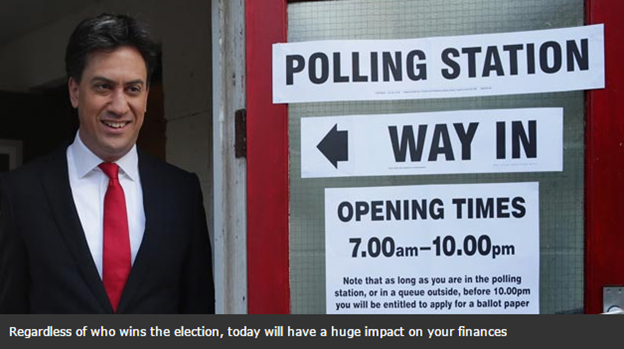
People across Britain are going to the polls today to elect a new government. Opinion polls suggest that, as in 2010, a hung parliament is likely as neither the Tories nor Labour are likely to gain an overall majority.
The uncertainty caused by a hung parliament has historically had a negative impact on markets and on the pound as investors wait for clarity in government policy before making investment decisions. There is also the possibility of more serious market dislocations and concerns that election ‘chaos’ could trigger a ‘Lehman moment’ for the pound.
We think it is important to look at short term dynamics and long term ones.
Dominic Frisby, the precious metal and financial markets commentator at Moneyweek, has written an interesting article in which he looks at how the election result may impact the pound in the short term.
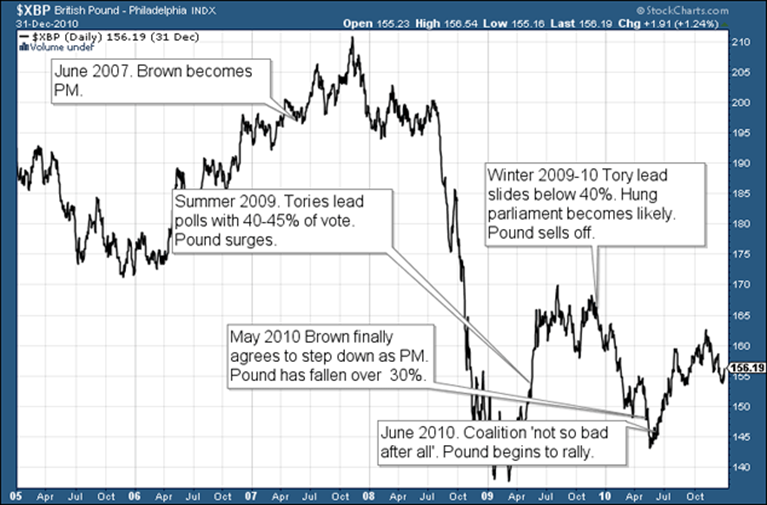
He comments on how well sterling is bearing up despite the widely anticipated hung parliament. Back in 2010 in the two weeks prior to the election, when it was becoming clear that a hung parliament was the likely outcome, sterling fell from $1.55 to $1.47. Even after the Cameron-Clegg coalition was announces the pound continued to fall bottoming out at $1.43.
By contrast, since the beginning of this year, despite election jitters and uncertainty regarding Britain’s future, the pound is down only 4 cents against a strong dollar and up 7 cents against the euro.
It would seem that foreign exchange traders are not as daunted by the prospect of a hung parliament knowing the track record of the current coalition. They expect the Conservatives and Lib-Dems to again form the new government.
Frisby has speculated that a Labour-led government would, at least initially, have a negative impact on sentiment towards the pound.
He points out that it does not necessarily follow that accession of a Labour government implies a weaker pound. Under Blair’s tenure the pound rose from $1.59 to $2.
However, Miliband’s Labour are regarded as being closer in nature to that of Gordon Brown than the Labour of Tony Blair. The pound fared very poorly under Brown’s tenure. Following an initial surge to $2.10, it crashed over the next few years to below the $1.40 mark. In fairness, this was against the backdrop of a stronger dollar and the global financial crisis.

The decline was only reversed in April 2009 when opinion polls showed the Tories having 40% of the vote. And when that figured slipped below 40% the pound also began to slide again.
Traders of sterling prefer the Tories as they are seen as more fiscally responsible than the “tax and spend” Labour party . Frisby concludes that a conservative led government would be met with “a sigh of relief”. He adds that a Miliband government may do a good job but it will need to earn the confidence of foreign exchange traders and initial reactions would be negative.
There is, of course, many a slip ’tween the cup and the lip. If voters return an unexpected result – and the balance of power held by the various players is significantly different from that which is expected – uncertainty would come surging back into the system.
This would likely cause considerable volatility in the foreign exchange markets and could see sterling come under pressure.
Dominic’s piece was very much focussed on the short term ramifications of the election outcome on sterling. Were he to consider the bigger picture and the longer term issues, we believe Dominic would voice concerns about sterling in the coming years and share our view that sterling will again come under pressure and depreciate particularly against gold in the coming years.
The fact that the election barely touched on the very poor fiscal position of the UK does not bode well for sterling in the long term.
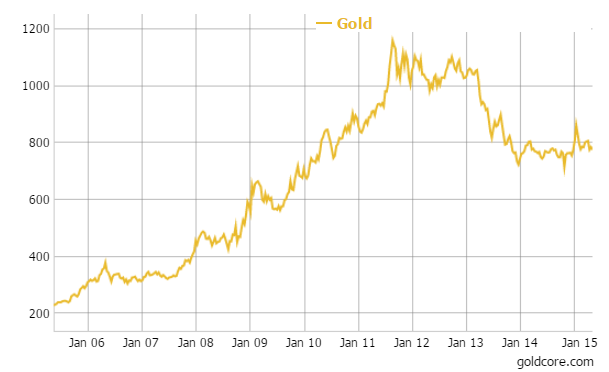
Gold in GBP – 10 Years
The UK’s twin budget and current account deficits remain stubbornly high despite the recent recovery and measure around 5 per cent of gross domestic product (GDP).
Interestingly, the Bank of England has said on the eve of the election that the UK current account deficit, which measures the gap between money flowing out of the UK and money brought in, was “large.” The BoE warned that if the economy deteriorated, it could “trigger a deterioration in market sentiment towards the United Kingdom.”
This poses a threat to the economy in the event of the UK economy or global economy slowing down. Other real risks to the UK being ignored for now are the increasing threat of Scottish independence and of BREXIT should the Tories be reelected.
Meanwhile, GREXIT remains forgotten for now but a Greek default and contagion in the eurozone would impact on the UK gilt market and indeed the global bond bubble. This would in turn badly affect the vulnerable, debt-laden UK economy.
It is amazing the economic ‘elephants in the room’ that can be ignored by “Punch and Judy” political pundits and politicians.
Politics in the UK and internationally has been reduced to a soap opera involving faux debates between so called left wing and right wing parties that rarely address the real challenges facing us all today. It also involves politicians making promises they cannot keep or will not keep.
Sadly, the UK electoral debate about the economy has fitted this bill and almost wholly ignored the real global economic, financial and monetary challenges facing the world today.
The politicians like the bankers and the central bankers, are happy to kick the can down the road and let their successors and future generations pick up the tab and pay for the economic mess that they refuse to address.
Deep down we all know that not addressing unpleasant economic realities can only go on for so long.
Breaking News and Research Here
MARKET UPDATE
Today’s AM LBMA Gold Price was USD 1,183.00, EUR 1039.840 and GBP 776.94 per ounce.
Yesterday’s AM LBMA Gold Price was USD 1,191.25, EUR 1,063.41 and GBP 785.22 per ounce.
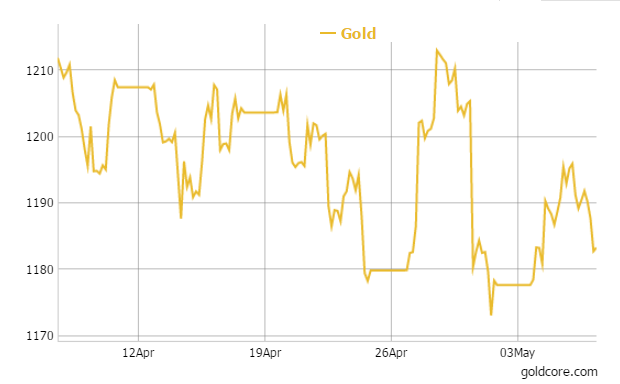
Gold in U.S. Dollars – 1 Week
Gold and silver saw small price gains yesterday of 0.1 and 0.24 per cent to $1,191.970 and $16.50per ounce respectively.
In Asia overnight, Singapore gold prices ticked lower and have flat lined in London trading this morning.
World financial markets were unsettled again today as a week-long sell-off in ‘safe haven’ government bonds, stocks and the dollar and a sharp rally in oil prices showed little sign of relenting.
Nerves were still jangling in Europe and shares and bonds got off to another poor start on fears the recent surge in bond yields, the euro and energy costs could snuff out the only recently-formed hopes of a solid eurozone recovery.
British 10 year gilt yields hit their highest level since November as part of a further wave of heavy sales of sovereign debt on international markets today.
Download: 7 KEY GOLD MUST HAVES
end
Extremely important as China has been testing their own gold fix. This will be in total contrast to the London gold fix. Maybe this is the first shot across the bow for China to state their increased gold reserves:
(courtesy Reuters/GATA)
China To Establish Yuan-Denominated Gold Fix In Bid To Upend London Benchmark
A long time ago, in a financial galaxy far, far away, a “fringe” blog raised the topic of gold market manipulation during the London AM fix. Several years later (which, incidentally, is about average in terms of the lag time between when something is actually going on and when the mainstream financial media finally figures it out and reports on it), it was revealed that in fact, shenanigans were likely afoot and indeed, regulators are still trying to sort out what happened.
Via WSJ earlier this year:
The precious-metals probes are the latest example of regulatory scrutiny into how the world’s biggest financial institutions influence widely used benchmarks. Until last year, prices for gold, silver, platinum and palladium were set using a decades-old practice of once- or twice-a-day conference calls between a small group of banks. The process for setting each of the price “fixes” has since been overhauled…
Last year, the FCA fined Barclays £26 million ($40.2 million) for lax controls after one of its traders allegedly manipulated the gold fix at the expense of a client…
Swiss regulator Finma settled last year allegations of foreign-currency manipulation with UBS. The regulator said it found “serious misconduct” among precious-metals traders at UBS, including “front running,” or trading ahead of, the silver-fix orders of one client…
More than 25 lawsuits have been filed against Barclays, Deutsche, HSBC, Bank of Nova Scotia and Société Générale over their alleged role in setting the gold fix.
The ‘fix’ for the ‘fixed’ gold fix (only in the world of corrupt high finance is such a hilariously absurd passage possible) is supposedly a new system whereby the fixings are derived electronically, but as Reuters notes, there’s a new kid on the block when it comes to benchmarking the price of gold. Here’s more:
China conducted trial runs for the planned launch of a yuan-denominated gold fix last month, three sources familiar with the matter said, in a sign the world’s second-biggest bullion consumer was moving closer to creating a benchmark price.
The state-run Shanghai Gold Exchange (SGE), on whose international platform the fix will be launched, conducted the trial with major Chinese banks and a few foreign banks, the sources said this week…
China plans to launch a yuan gold fix this year through trading of a 1 kg contract on the SGE, Reuters reported in February.
“The launch of the fix is towards the end of the year … Banks were invited in April to test the fixing process,” said one of the sources directly involved in the process.
The SGE will act as the central counterparty, unlike the London fix where the bullion banks settle trades amongst themselves, the source said.
If the Chinese fix becomes a success, it could add to the pressure on the London benchmark, which is used worldwide by producers, refiners and central banks to price holdings and contracts, although the two could exist side-by-side.
The ironic conclusion: the currency ‘manipulating’, GDP fabricating, soon-to-be global superpower is now set to challenge the century-old gold price fixing regime which is under fire for being just as corrupt as every other ‘benchmark’ has proven to be since we first suggested that LIBOR was rigged some six years ago. But don’t worry: China promises that yuan hegemony is not something Beijing is interested in establishing.
Biggest Newspaper Netherlands Interviews Koos Jansen
From De Telegraaf, Thursday April 9, 2015.
By Theo Besteman:
China Conquers The World With Gold
After a serious knee surgery in 2013 sound engineer Jan Nieuwenhuijs began a blog about gold. Two years later, the 33-year old from Amsterdam is an international gold expert, his analyzes are praised by investors on Wall Street. “China takes over US dominance,” he concludes.
His blog about the gold market began as a hobby when he was homebound because of his knee injury. By his internet alias Koos Jansen he started researching the Chinese gold market. His unorthodox analyzes were quickly noticed. Especially when his discovery of the concealed but unprecedented gold buying program by China proved to be accurate.
What he showed was that estimates by the World Gold Council, the global trade association of jewelers and bullion dealers, reflected only half of China’s actual purchases. An authority fell. “Gold Guru” Willem Middelkoop said at the time to literally have fallen out of his chair when he found out – through Nieuwenhuijs his publications – how much gold China was buying.

While Nieuwenhuijs is making coffee at his home in Amsterdam, computers screens are displaying rows of data and charts. The autodidact now works as an independent analyst for BullionStar in Singapore. Also investment banks on Wall Street and news agencies use his analyzes.
Why your fixation on gold purchases by China?
“This gold hunt shows that China has been preparing in the background to play a bigger role in the financial world. Our financial system is heading for major new shocks. China takes over US dominance.”
You previously worked nonstop on dozens of Dutch feature films such as New Kids Turbo. Quite a transition.
“I knew very little of the financial markets, but after the outbreak of the financial crisis I wondered why a good carpenter could suddenly be unemployed. This was due to the crash. Coincidentally, I read “Overleef De Krediet Crisis” by Willem Middelkoop, I was immediately intrigued by the financial system. Because of the knee surgery Itemporarily was not working. I searched obsessively for answers. That’s how I work, all-in, otherwise you learn nothing.”
An amateur blog about gold is something different than analyzes where investors can rely on.
“Absolutely. My first blog I used to give my friends reading tips – how the credit crisis was caused. I went from amazement to facts. While reading, I came to the core of our financial system, which is now dominated by the dollar, but ultimately gold – in the vaults of the central banks – serves as an anchor of the dollar and other major currencies like the euro and Chinese yuan.”
Isn’t gold hardly relevant in the current financial system, except as an investment?
“Oh it’s relevant, the base of each financial system remains confidence. Throughout history goldsmiths and banks could create a multiple of the gold in their vaults as paper and book money. But the people knew that there was always a partial backing held in reserve. The United States dollar was backed by gold until 1971. Money has been printed full speed since then. As the European Central Bank is now doing in the Eurozone. Through leverage massive debt structures are built that are not sustainable. For the moment, the Chinese support the United States dollar. But its leaders want absolutely no more dollars. They buy gold. On a massive scale. However, only half of Chinese gold demand turned out to be in the books.”
What does that say?
“The Chinese don’t want a big shock. They always think long term. Beijing knows for a long time that the United States with its huge debt can’t have the dollar to be the world reserve currency forever. The Chinese are preparing for a new monetary system in which their currency has a stronger voice or is dominant. The first step could come this fall. Who has the most gold, the base of the economy, sets the rules. The Chinese leaders literally say: ‘In the shortest possible time we need to accumulate the largest gold reserves in the world.’”
What distinguishes your approach from others?
“I’m going to the source and I do not listen to authorities. Central banks invariably deny anything – until they have enough gold in their vaults. I also get a lot of help from Chinese sources who I can trust. They send and translate many documents. And even then you need to do a lot of studying, patiently putting the pieces of the puzzle together, because the world of gold remains opaque. I only reveal small pieces of this market.”
The Dutch central bank (DNB) has recently repatriated 122.5 tonnes of gold from the United States. Some other countries are doing the same. What does this indicate?
“It shows a great distrust in the current international monetary system. Likely Belgium and Austria are also working on repatriating gold. It has become a pattern. These countries can no longer trust their gold is stored safely abroad. They fear that the Americans use the gold to guarantee their debt. Repatriating is done slowly because no one wants to cause an undesirable financial shock. But repatriating tonnes of gold bars is not simple, this takes a military operation. There is fear.”
Do you invest in gold?
“I own physical gold, and save it outside the banking system, but I don’t trade everyday. The gold market has provided me with a lot of insight in our financial world. I’ll probably continue this work until I’m dead.”
Jan Nieuwenhuijs
1981 Born
2002 Film and television science at the University of Amsterdam
2003 Sound mixer for movies, TV-series and commercials
2013 Blog ‘In Gold We Trust’
2014 Precious metals analyst at BullionStar.com, Singapore
Koos Jansen
E-mail Koos Jansen on: koos.jansen@bullionstar.com
Audacious Plan Here Will Have Massive Impact On Gold Markets
India’s plans to reduce gold imports keep getting more ambitious. With news last week suggesting that the government is about to unveil a major plan aimed at curbing foreign bullion demand.
Local press report that a so-called “gold monetization” scheme is about to be announced by the national government. Which will allow the country’s finance ministry to access some of the massive stores of gold held by private citizens across the country.
Related: Coal Markets May Just Have Been Thrown A Lifeline
Here’s how the plan will reportedly work. Holders of gold jewelry, coins, and bars will be able to deliver the metal to banks. Where it will be melted down and credited to the account of the holder.
Once the gold is deposited, the account holder will earn interest on the stored bullion. Providing an economic incentive to bring gold out of basements and attics, and essentially lend it to the central government. And it could happen soon, with finance officials telling The Economic Times, “The broad contours of the plan are ready. It would be made public in a week.”
Related: This Deal Could Completely Change North American Energy Dynamics
The government would thus gain access to a large supply of in-country gold. Which it reportedly plans to then lend out, in order to reduce the need for imported gold in meeting domestic demand.
The plan is an extension of an earlier-announced scheme to access large amounts of gold held by temples across India. Which promised a similar swap of interest payments for stored gold.
Related: How Shale Is Becoming The .COM Bubble Of The 21st Century
There are no figures on the exact amount of gold held by private Indian citizens. But the numbers are generally recognized as being extremely high — with jewelry particularly having long been used as a store of wealth beyond the banking system.
The gold monetization plan thus has the potential to significantly dent India’s gold import demand — which would be critical for the global bullion market. Watch for detailed announcements on the plan over the coming weeks.
Here’s to going for gold,
Dave Forest
end
Lawrence Williams on Mineweb gives a detailed analysis of silver production: total global production 877 million oz.
If you exclude Russia and China: a touch under 700 million oz
(courtesy Lawrence Williams/Mineweb)
Silver’s top 10s: Countries, companies and mines

No real surprises in the Thomson Reuters GFMS World Silver Survey 2015 prepared for the Silver Institute and released yesterday. Hardly surprisingly many of the findings largely echoed the earlier report from the New York based CPM Group, which we reported on here last week – See Positives and negatives in CPM silver report. But even so, there were enough differences in some interpretations of the overall data to make it valuable to read both reports alongside one another – if one has the time!
Should you wish to download the full GFMS report free of charge, and other GFMS reports too, one may apply to do so via the Thomson Reuters Eikon website by clicking on this link.
Broadly the new GFMS reports saw a small deficit (4.9 million ounces) in silver supply compared with demand last year, down from a much larger deficit (111.9 million ounces) in 2013. This was caused by a significant increase in mine production to 877.5 million ounces in 2014 from 832.5 million ounces in a year earlier, only partly offset by a lower silver price-related fall in secondary supply, culminating in a global supply figure of 1,061.8 million ounces (up from 1,000.5 million ounces in 2013) and falling global demand of 1,066.7 million ounces, down from 1,112.4 million ounces in 2013. However, some key components of global silver demand rose, with global silver jewellery demand posting a new record and silverware offtake rising to its highest level since 2006. This was coupled with notable growth in key silver industrial end uses, including ethylene oxide, photovoltaics, and brazing and alloys.
While the Silver Survey does not set out to predict likely figures and prices for the current year, the implication is for much of the same. Some reports have already come up with eye-popping headlines like ‘Silver to slump 14% in 2015 – GFMS’ from Bloomberg (and published here on Mineweb). This is a little misleading in that silver had already slumped well below the level suggested before end 2014 and is at around this level again now. The ‘slump’ is from last year’s average price of $19.08 which was far higher than the year-end figure because silver started 2014 at around $20 and moved higher at times in the first half before coming down sharply from late July.
The fall in global demand is largely down to China where there was a sharp drop in jewellery and investment demand and has led to it being overtaken by India as top consumer.
Looking at new mine supply, GFMS notes that this increased for the 12th successive year in 2014, although there is perhaps little incentive now for silver producers to increase output further this year bar a good rise in the metal price. GFMS notes that the rise was largely down to new production already in the pipeline – notably Tahoe Resources’ Escobal mine in Guatemala which was building up to full output and is now, according to GFMS, the world’s second largest silver mine. Single handedly it has put Tahoe into the World Top 10 silver producing companies (see Table 2) and almost brought Guatemala into the world’s top 10 silver producing countries – but not quite as it only made it to No. 11 on the GFMS reckoning.
Table 1. Top 10 silver producing nations 2014
| Rank | Country | Production 2014 (Moz) |
| 1. | Mexico | 192.9 |
| 2. | Peru | 121.5 |
| 3. | China | 114.7 |
| 4. | Australia | 59.4 |
| 5. | Chile | 50.6 |
| 6. | Bolivia | 43.2 |
| 7. | Russia | 42.9 |
| 8. | Poland | 40.6 |
| 9. | USA | 37.6 |
| 10. | Argentina | 29.1 |
| Others | 145.0 | |
| Global Total | 877.5 |
Source: Thomson Reuters; GFMS
Global silver mine output is split between primary producers with some 269.5 million ounces and secondary producers who generate silver as a byproduct – notably from gold mining (110.1 million ounces), copper mining (179.8 million ounces) and lead and/or zinc mining (310.6 million ounces). We reproduce listings of the top 10 silver mining companies below with the majority of these mining silver as a byproduct in Table 2. and the top primary silver mines in Table 3. However, GFMS does not see global mine supply rising this year with new production perhaps unable to keep up with declining output from aging mining operations and little incentive for the byproduct producers to expand either given the global downturn across the metals commodities sector.
Table 2. Top 10 silver producing companies
| Rank | Company | Output 2014 (Moz) |
| 1. | KGHM | 40.4 |
| 2. | Fresnillo | 40.4 |
| 3. | Goldcorp | 36.8 |
| 4. | Glencore | 34.9 |
| 5. | BHP Billiton | 34.0 |
| 6. | Polymetal | 28.7 |
| 7. | Pan American Silver | 26.1 |
| 8. | Volcan | 22.5 |
| 9. | Tahoe | 20.3 |
| 10. | Codelco | 19.9 |
Source: GFMS; Thomson Reuters
Table 3. Top 10 primary silver mines
| Rank | Company | Country | Company | Output 2014 (Moz) |
| 1. | Cannington | Australia | BHP Billiton | 24.73 |
| 2. | Escobal | Guatemala | Tahoe Resources | 20.30 |
| 3. | Fresnillo | Mexico | Fresnillo | 20.10 |
| 4. | Dukat | Russia | Polymetal | 19.50 |
| 5. | Saucito | Mexico | Fresnillo | 15.49 |
| 6. | Uchucchacua | Peru | Buenaventura | 12.06 |
| 7. | Pirquitas | Argentina | Silver Standard | 8.73 |
| 8. | Greens Creek | USA | Hecla | 7.83 |
| 9. | Palmarejo | Mexico | Coeur | 6.56 |
| 10. | Pallancata | Peru | Hochschild | 6.53 |
Source: GFMS; Thomson Reuters
On the investment side there has been remarkably little offloading from the major silver ETFs during the year, which might have been expected given the fall in silver price. This is an indicator that the firm long-term holders are very much still in the game and any sales by weaker holders out of the ETFs have been countered by the die hard silver investors picking up more at lower prices.
After very strong growth in 2013, though, physical bar and coin/medal sales both slumped last year and that may well be a trend which will continue.
But, global industrial demand continues to grow, while low silver prices will continue to restrain scrap supply, so there could be some light at the end of the tunnel as far as silver fundamentals are concerned. We should then bear in mind that the silver price fell back very heavily in 2013 when there was a quite substantial supply deficit. There are too many other factors at play here.
GFMS does go into silver movements on the major exchanges and does note that on COMEX the price appeared to be at least partially driven down by some big short positions being taken in Q3/early Q4 2014, although it is also noted that there was no major exit from long positions and that they actually started to build further towards the end of the year and into early 2015.
There are an increasing number of observers out there who reckon that silver pricing activity is all about COMEX and buying, or mostly selling, of silver futures keeping the price far lower than it might manage in a truly open market. This is not something that GFMS, or any of the other mainstream analysts, will speculate on, and they get criticised heavily for it, but they will tell you they prefer to deal with facts (although admittedly they sometimes get these wrong too!).
But, as we said in commenting on the CPM report linked at the start of this article, that although the overall tone of this latest GFMS report could be seen as somewhat negative for the silver investor, there are elements within it that could be deemed positive on the silver fundamentals front which, should some of the strange activities seen in the past two to three years on COMEX fall away, could bode well for the silver price going forward.
end
Alasdair Macleod….
Controlling copper and silver prices
- By Alasdair Macleod
- Posted 07 May 2015
There is an unwarranted assumption that market prices are always right, and represent “fair value”. In the case of commodities, particularly metals, this is not necessarily true, because regulated financial markets make it too easy for government agencies and large banks to game the system.
Take the case of a country like China, which is the largest consumer of copper. Does it passively buy its copper through the market? No. Instead it strikes a price with a supplier, such as a Zambian copper mine, based on the London market price, bypassing the market entirely. If China plays no part in setting the reference price in London, the Zambians can be satisfied the price is fair; but if China or her agents suppressed the price of copper in the market before the price is set, the Zambians would be right to be upset.
Now, we do not know if China or her agents drive the copper price down, by placing a relatively small paper order so that the large off-market physical deal is priced favourably, but it is obviously in her interest to do so. Another metal where this could apply is silver.
We need to bear in mind three things about China and silver. She is the world’s largest industrial user, she is almost certainly the world’s largest refiner, and the government owns all the refineries. China imports large quantities of doré 1 and also base metal ores containing silver. So how she goes about this business is highly relevant to the silver price, and the following is an example of how it works.
In the case of foreign silver mines a qualified agent assesses the silver content of concentrates or doré on site and agrees a payment figure with the mine manager. Two further considerations then arise: the mine manager will want payment upfront because he has wages and other costs to meet; and the agent will look for the most cost-effective refining option. The first consideration is addressed by getting a bullion bank to advance the money against delivery of the concentrates or doré when refined, and the second will often involve a government-subsidised Chinese refiner.
There now exists a relationship between the Chinese government and the bullion bank, because the former has to deliver refined silver to the latter, or it must alternatively provide paper cover as may be subsequently agreed between them. As owner of the refining industry, China’s interest is primarily strategic rather than profitability. Whether it is to subsidise the solar cell industry, or to build a strategic stockpile matters not; the temptation to suppress the price is the point.
The problem with price suppression is that it only works when buyers stand aside. But as we saw in the 30 months following October 2008 when the silver price ran up from under $9 to nearly $50, when buyers step in huge price moves can occur relatively quickly.
To the extent such price suppression does occur, today’s commodities must be under-priced, just as bond and stock prices have become overpriced through central banks and other government agencies interfering with the markets. In any event investor opinion is bearish for commodities and bullish for the US dollar. Therefore, in a general market correction of valuation extremes commodities should recover strongly, how strongly will depend on whether or not prices have been artificially supressedsuppressed in the way described in this article.
Deflationists should take note: when markets crack, after initial confusion the prices of key commodities such as silver could rise more strongly than imaginable if they have been artificially suppressed, making them the only game in town.
1 A doré bar is a semi-pure alloy of gold and silver, usually created at the site of a mine. It is then transported to a refinery for further purification.
end
(courtesy Bill Holter/Miles Franklin)
How long will it take?
1 Chinese yuan vs USA dollar/yuan weakens to 6.2000/Shanghai bourse and Hang Sang down
2 Nikkei closed down by 239.64 points or 1.23%
3. Europe stocks down/USA dollar index up to 94.16/Euro falls to 1.1328/
3b Japan 10 year bond yield: huge rise to .43% !!!!(Japan buying 100% of bond issuance)/Japanese yen vs usa cross now at 119.12/
3c Nikkei still just above 20,000
3d USA/Yen rate now well below the 120 barrier this morning
3e WTI 61.04 Brent 68.14
3f Gold down/Yen up
3gJapan is to buy the equivalent of 108 billion uSA dollars worth of bond per month or $1.3 trillion. Japan’s GDP equals 5 trillion usa.
Japan to buy 100% of all new Japanese debt and by 2018 they will have 25% of all Japanese debt. Fifty percent of Japanese budget financed with debt. Last night Japan refused to increase it’s QE
3h Oil down for WTI and down for Brent this morning
3i European bond buying continues to push yields lower on all fronts in the EMU. German 10 yr bund rises to 74.0 basis points. German bunds in negative yields from 3 years out.
Except Greece which sees its 2 year rate falls to 21.50%/Greek stocks up 3.21%/ still expect continual bank runs on Greek banks.
3j Greek 10 year bond yield rises to: 11.19%
3k Gold at 1184.00 dollars/silver $16.33
3l USA vs Russian rouble; (Russian rouble up 5/10 rouble/dollar in value) 50.33 , the rouble is still the best acting currency this year!!
3m oil into the 61 dollar handle for WTI and 68 handle for Brent/Saudi Arabia increases production to drive out competition.
3n Higher foreign deposits out of China sees huge risk of outflows and a currency depreciation. This can spell financial disaster for the rest of the world/China may be forced to do QE!!
30 SNB (Swiss National Bank) still intervening again in the markets driving down the SF. It is not working: USA/SF this morning 91.25 as the Swiss Franc is still rising against most currencies. Euro vs SF is 1.0328 well below the floor set by the Swiss Finance Minister.
3p Britain’s serious fraud squad investigating the Bank of England/ the British pound is suffering/
3r the 3 year German bund remains in negative territory with the 10 year moving further away from negativity at +.74/the ECB losing control over the bond market.
3s This week the ECB increased the ELA to Greece by another large 2.0 billion euros. The new maximum is 78.9 billion euros. The ELA is used to replace depositors fleeing the Greek banking system. The bank runs are increasing exponentially. The ECB is contemplating cutting off the ELA which would be a death sentence to Greece and they are as well considering a 50% haircut to all Greek sovereign collateral which will totally wipe out the entire Gr. banking and financial sector.
3t Greece paid the 200 million euros owed to the IMF as interest payment yesterday
3 u. If the ECB cuts off Greece’s ELA they would have very little money left to function.
4. USA 10 year treasury bond at 2.24% early this morning. Thirty year rate well below 3% at 2.96%/yield curve flatten/foreshadowing recession.
5. Details Ransquawk, Bloomberg, Deutsche bank/Jim Reid.
(courtesy zero hedge/Jim Reid Deutsche bank)
Global Bond Rout Sends Futures Tumbling, Bund Has Sharpest Weekly Selloff In History
To get a sense of why futures are sliding right now, and what every global trader of any asset class is looking at right this moment, look no further than the chart below which shows what is going on with German Bunds yields.

As DB and Reuters conveniently point out, this is the biggest and fastest weekly drop in Bund history.
The catalyst for today’s plunge was weak French OAT auction, which saw yields rise and bid/cover ratios decline at 2023 and 2025 bond actions. “The big fallout in core fixed income occurred after a very soft French auction with a large tail which collapsed the market again,” according ED&F Man head of U.S. rates Tom Di Galoma writes in note. But while there was an immediate cause, what really happened was a continuation of the selling momentum seen in the past two weeks.
Now it is no secret that three weeks ago when the Bund was on the verge of sliding under 0.00%, the ECB wanted nothing more than to have a controlled selloff because at this rate of “frontrunning” Draghi’s purchases, the central bank would soon be left with nothing to monetize above its -0.20% deposit rate hard limit.
However, the epic rout it has since gotten following some serious public and private sector jawboning, is precisely the opposite of what the ECB wanted which needed a smooth, controlled descent, and the sheer speed and size of the selloff is why Draghi may have no choice but to step in soon with some verbal intervention and declare that Bund yields, which are now well above where they were when Q€ started, will be pushed lower “whatever it takes.”
For now however, this is what is going on:
- BOND SELLOFF DEEPENS; GERMAN 10-YR YIELD JUMPS 17 BPS TO 0.76%
- SPANISH 10-YEAR BOND YIELD CLIMBS TO 2%; HIGHEST SINCE NOV. 24
- ITALIAN 10-YEAR BOND YIELD CLIMBS ABOVE 2%; 1ST TIME THIS YEAR
- 10Y TREASURY YIELD CLIMBS 6BPS TO 2.31%, HIGHEST SINCE DEC. 8
- U.K. 10-YR BOND YIELD CLIMBS 8 BPS TO 2.06%; MOST SINCE NOV. 24
- IRISH 10-YEAR YIELD RISES ABOVE 1.5%, FIRST TIME SINCE NOV. 21
- JAPAN 10Y YIELD UP 7.5 BPS, SET FOR BIGGEST RISE SINCE MAY 2013
- INDIA’S 2024 BOND YIELD CLIMBS 9 BPS TO 7.98%
As a result of the ongoing bond drubbing, European equities have started the session on the backfoot in tandem with the lacklustre Wall St. close in the wake of the disappointing ADP report yesterday which has dampened expectations for Friday’s NFP reading. Furthermore, stocks in the US were also weighed on yesterday by comments from Fed Chair Yellen who said that she viewed the stock markets as ‘generally quite high’. Additionally, Asian equities traded lower across the board overnight with particular undperformance in Chinese equities amid ongoing margin trading crackdowns. Given the recent trend in European yields, which has seen the German 10yr break above 0.75%, higher borrowing costs have also weighed on European companies. Furthermore, European equities have also been subject to a slew of pre-market earnings which have provided some reprieve for the DAX.
In fixed income markets, Bunds have once again continued to ebb lower with the German 10yr yield breaking above its 200DMA seen at 0.635% to break above the 0.75% level. This week has seen the biggest rise in the German 10yr yield since 25yrs with Bund yields currently on track for their largest intra-day rise since mid-2012. This comes amid no new fundamental newsflow and is more of just an extension of the recent trend but the FT highlight that the recent pullback in energy prices could weigh further on fixed income products due to inflation expectations.
Activity in the FX market remains relatively subdued with the exception of GBP which has been subject to selling pressure as voting for the UK general election begins today. In terms of the order of play, exit polls are to be released at 2200BST but these polls may not necessarily provide too much insight given the closely fought nature of the race. Thereafter results will begin to be announced from 2300BST. From a technical perspective, GBP/USD lower as the pair eyes its 100DMA at 1.5146 and 1.5166 of its 61.8% Fibonacci at 1.5066 which is the next touted level of support. Elsewhere, AUD has seen a paring of its overnight gains and slipped back below 0.8000 despite the positive upward revision to the previous for the Australian jobs report.
In the commodity complex, both WTI and Brent crude futures initially saw a pullback of yesterday’s gains which stemmed from the unexpected drawdown in the DoE data. However, since then prices have moved back into positive territory and WTI has reclaimed the USD 61.00bbl level. Gold extended on its declines overnight amid technical selling after breaking below its 50 DMA level of USD 1189.86 which coincided with silver breaching its 100 DMA level of USD 16.56 to the downside.
In Summary: European shares fall with the oil & gas and basic resources sectors underperforming and tech, insurance outperforming. German March factory orders rise less than expected. ECB wants progress from Greece at May 11 meeting or will consider tighter liquidity rules for banks, according to two officials. Norges Bank maintains key rate, says it sees prospects for June rate cut. China’s stocks capped biggest three-day retreat since June 2013. The U.K. and French markets are the worst-performing larger bourses, the Italian the best. The euro is little changed against the dollar. German 10yr bond yields rise; Japanese yields increase. Commodities little changed, with silver, gold underperforming and copper outperforming. U.S. jobless claims, continuing claims, Bloomberg consumer comfort, consumer credit, Challenger job cuts, due later.
Market Wrap
- S&P 500 futures down 0.6% to 2062
- Stoxx 600 down 1.3% to 383.6
- US 10Yr yield up 3bps to 2.27%
- German 10Yr yield up 14bps to 0.73%
- MSCI Asia Pacific down 1.2% to 150.6
- Gold spot down 0.7% to $1184.1/oz
- All 19 Stoxx 600 sectors fall; tech, insurance outperform, oil & gas, basic resources underperform
- Eurostoxx 50 -1.4%, FTSE 100 -1.6%, CAC 40 -1.5%, DAX -1%, IBEX -1.5%, FTSEMIB -1%, SMI -1.4%
- Asian stocks fall with the Sensex outperforming and the Shanghai Composite underperforming.
- MSCI Asia Pacific down 1.2% to 150.6; Nikkei 225 down 1.2%, Hang Seng down 1.3%, Kospi down 0.6%, Shanghai Composite down 2.8%, ASX down 0.8%, Sensex down 0.4%
- Euro up 0.04% to $1.1351
- Dollar Index down 0.01% to 94.07
- Italian 10Yr yield up 3bps to 1.95%
- Spanish 10Yr yield up 3bps to 1.93%
- French 10Yr yield up 13bps to 1.03%
- S&P GSCI Index down 0.1% to 450.6
- Brent Futures up 0.1% to $67.8/bbl, WTI Futures down 0.5% to $60.7/bbl
- LME 3m Copper up 0.7% to $6434/MT
- LME 3m Nickel up 0.6% to $14055/MT
- Wheat futures down 0.1% to 479 USd/bu
Bulletin Headline Summary from Ransquawk and Bloomnerg
- Bunds continue to drift lower, weighing on European equities due to higher borrowing costs, although yields have provided some support for EUR
- UK asset classes continue to be weighed on by political uncertainty with voting to begin today for the general election
- Looking ahead, today sees the release of the US weekly jobs data, potential comments from Fed’s Evans with focus also to be placed on the UK general election.
- Treasuries fall for a fifth day led by long end, 10Y yields reach 2.309%, highest since December, 30Y yields break above 3% level, amid rout in EGBs.
- “The big fallout in core fixed income occurred after a very soft French auction with a large tail which collapsed the market again,” ED&F Man head of U.S. rates Tom Di Galoma writes in note
- German bund reaches 0.777%, highest since Dec, touched record low 0.049% on April; Draghi announced ECB QE program Jan. 22
- Britain is voting in the most uncertain election since World War II, a ballot that looks set to be followed by negotiations to secure a parliamentary majority and clashes over who has the legitimacy to govern
- China’s stocks capped their biggest three-day retreat since June 2013 on concern valuations are too high given an increasing supply of shares and prospects for a regulatory clampdown on margin trading
- ECB officials want progress at a meeting of euro-region finance ministers on May 11 or they will consider tightening Greek banks’ access to emergency liquidity they need to stay afloat, said two officials who spoke on condition of anonymity as the talks are private
- Norway’s central bank kept its benchmark interest unchanged for a second meeting and signaled it’s ready to ease again as it assesses the economy’s ability to withstand the slump in oil prices
- Sovereign bond yields surge. Asian, European stocks plunge, U.S. equity-index futures fall. Crude oil and copper higher, gold lower
DB’ s Jim Reid completes the overnight recap
There was no let up in the global bond market sell-off yesterday as 10y Bunds slid a further +7.1bps to 0.584% – the highest level since December 24th and now 27bps higher since the start of QE. To be fair, Bunds actually outperformed once again in Europe as similar maturity yields in France (+8.3bps) and the Netherlands (+8.6bps) moved sharply wider while in the periphery, Italy (+11bps), Spain (+11.6bps) and Portugal (+14.2bps) took their week-to-date moves to +47.9bps, +44.0bps and +45.9bps respectively. Treasuries were also on the receiving end as the 10y benchmark closed +5.8bps wider at 2.243%, matching the YTD highs of early March while the Dollar fell 1%. Comments from the Fed’s Yellen that long-term interest rates are too low along with oil markets extending their recent 5-month highs (Brent +0.37%, WTI +0.88%) and a weak ADP employment print yesterday certainly added some confusion to price action.
Before we take a closer look at the details, there’s similar weakness in bond markets in Asia this morning where 10y bond yields in Australia (+8.2bps), Singapore (+6.1bps), Indonesia (+5.1bps) and Japan (+6.4bps) have all sharply widened. Equity markets are also lower with the Shanghai Comp (-1.41%), Hang Seng (-0.58%), Kospi (-0.97%) and Nikkei (-1.01%) all falling. The latter in particular has dropped despite both the April services (51.3 from 48.4) and composite (50.7 from 49.4) PMI readings rising from March, although markets there are somewhat playing catch up having been closed for public holidays this week. Japan credit markets are around 2.5bps softer this morning.
Back to markets yesterday, there weren’t many asset classes where investors were safe as US equities also declined as the S&P 500 (-0.45%) and Dow (-0.48%) both fell for the second consecutive day while in credit, CDX IG ended 1.5bps wider. This didn’t seem to deter Apple and Shell however as both companies issued $18bn in bonds between them yesterday. In terms of the Yellen comments, the Fed Chair said yesterday that ‘equity market valuations at this point are quite high’ and that ‘long term interest rates are at very low levels’ which, unsurprisingly, means ‘we could see a sharp jump in long term rates’ after liftoff. We also heard from the Fed’s Lockhart yesterday who said that raising rates ‘too early could perhaps snuff out momentum and too late could bring other consequences’ and that ‘I am more prepared to take the risk of waiting’. Lockhart did go on to say that the market view of a September timeframe is ‘reasonable’ while noted that this Friday’s payrolls in particular is ‘a very important one’.
On this topic, yesterday’s April ADP employment change print didn’t help build much optimism after the +169k reading came in well below market expectations of +200k. The print was below a downwardly revised +175k March print and the lowest reading since January last year. Aside from the ADP print, Q1 nonfarm productivity was in line at -1.9% qoq and unit labour costs (+5.0% qoq vs. +4.5% expected) came in above market. So all eye’s on the much anticipated payrolls print tomorrow.
European equity markets were a tad more mixed yesterday as the Stoxx 600 (-0.60%) closed lower while the DAX (+0.20%) and CAC (+0.15%) finished modestly higher. Yesterday’s final April PMI prints were fairly encouraging on the whole. For the Euro area, the final composite reading was revised up 0.4pts to 53.9, supported by an equal move in the services number to 54.1 to leave it just 0.1pts off the March reading. Looking across the various countries, the upward surprise in the composite was supported by decent revisions in Spain (+2.2pts to 59.1) and Italy (+1.5pts to 53.9) with both driven by services gains. On the flip side, a monthly decline was confirmed for Germany (54.1 vs. 55.4 previously) and also France (50.6 vs. 51.5 previously). Notably however, our European Economics colleagues noted that, all-in-all, the final Euro area PMI’s for April confirmed a solid growth picture and that if unchanged for the rest of quarter, would point to growth of +0.4% qoq for Q2 which is line with their current projections. Away from the PMI’s, retail sales for the Euro area (-0.8% mom vs. -0.7% expected) disappointed.
Before we run over today’s calendar, yesterday saw the ECB increase the ELA cap once again for Greek lenders after raising the limit by €2bn. The ECB chose not to make any changes to the haircuts on Greek collateral, instead waiting until Monday to reassess post the Eurogroup meeting. Looking ahead to that meeting, Eurogroup Chair Dijsselbloem was yesterday quoted as playing down any hopes of a resolution after saying that ‘since the last Eurogroup quite a bit of progress has been made’ but that ‘still lots of issues have to be solved, have to be deepened more, with more details, so there will be no agreements on Monday’. The comments echo similar comments from Varoufakis earlier this week that a Monday deal is unlikely which in turn should keep the market on edge for the time being.
Looking at the day ahead, aside from the obvious focus on the UK election we’ve got German factory orders and French industrial and manufacturing production readings to look forward to this morning. The ECB’s Mersch is also due to speak and we also get the Norges Bank rate decision. More employment data is the theme in the US this afternoon with Challenger job cuts and initial jobless claims expected while the March consumer credit print rounds off the releases.
end
Overnight we witnessed a huge rise in Japanese bond yields from .36 to .43%. Since the central bank of Japan is buying 100% of new issuance, it looks like they are losing control over their bond market and the rate rise is synonymous with risk
(courtesy zero hedge)
Japanese Bond Yields Spike Most In 2 Years On Return From Golden Week Holiday
As Japanese markets re-open after Golden Week, thebond market is extremely active (which in itself is unusual given its total lack of liquidity). Playing catch up to the rest of the world’s igniting bond markets, 10Y JGB yields are up over 6bps (and even the 20Y is trading). The last few days have seen yields spike from 28bps to 43bps – a colossal move only seen before in May 2013 (after the initial euphoria of QQE).
Biggest absolute yield swing in bonds since May 2013…

Which drags yields to 2-month highs…

Charts: Bloomberg
European Derivative Market Breaks
Usually when markets break, we learn about it only after the fact. This time, however, we get a heads up in advance that Europe’s critical derivatives market –especially critical today with massive bond derivatives volumes coming through as a result of this morning’s latest rout which has managers scrambling to reposition – is about to break, courtesy of the Euronext Derivatives Market.
To wit from Euronext:
Members are advised that due to technical issues with CCG configurations, members might experience a disconnection as from 13:10 CET during a shorty period of time.
This operation will be conducted over a short period of time, and customers should be automatically reconnected at the end of the process.
And by short period, it is likely that they mean the usual: until the selling stops.

Needless to say, expect this morning Bund rout to halt and/or reverse as a result of this market “intervention”
* * *
Update: the “shorty” period of time is over, and the selling has ended. Time to go back online:
end
Zero hedge explains the massive intervention today:
(courtesy zero hedge)
Did The World’s Central Banks Hit The Panic Button This Morning?
If there is one thing more worrisome for the world’s central planners than a stock sell-off, it is a bond rout ‘proving’ that they have lost control. The overnight carnage across global bond markets appears to have triggered someone (or someones) to step in – in dramatic size – to rescue bonds and save the world once again.
Rescue Me!! (Futures prices)

And what that looked like for German Bund yields…

What is becoming increasingly clear to the central bankers, as we noted earlier, is that since the bond market is now massively illiquid and everyone is on the same side there is no way to orchestrated a controlled decline.
Be careful what you wish for, stock ‘investors’.
Greek FinMin Says “Grexit Not An Issue;” Germans Not Hopeful On Deal For “Bottomless Pit”
Greek FinMin Varoufakis and German FinMin Schaeuble are cross-talking again this morning:
- *GREECE’S VAROUFAKIS SAYS ‘GREXIT’ IS ‘NOT AN ISSUE’ (well the market & ECB thinks it is)
- *SCHAEUBLE SAYS EXPECTATIONS FOR EUROGROUP MEETING NOT VERY HIGH (oh ok)
As next week’s meeting and deadlines loom, hope is running high today in Greece… even though Schaeuble warns “don’t expect spectacular Eurogroup results.”
Greece…
- *VAROUFAKIS: GREECE EURO EXIT IS ‘FORBIDDEN THOUGHT’ FOR GOVT
- *VAROUFAKIS: GOVERNMENT WON’T COMPROMISE ITS PRINCIPLES
- *GREECE’S VAROUFAKIS SAYS ‘GREXIT’ IS ‘NOT AN ISSUE’
Germany…
- *SCHAEUBLE: TONE OF GREECE TALKS `MORE CONSTRUCTIVE’ RECENTLY
- *SCHAEUBLE SAYS EXPECTATIONS FOR EUROGROUP MEETING NOT VERY HIGH
- *SCHAEUBLE: ANY NON-EU GREECE AID WOULD FAIL TO MEET ITS NEEDS
- *SCHAEUBLE: SHOULDN’T EXPECT `SPECTACULAR’ EUROGROUP RESULT
- *SCHAEUBLE SAYS AID INTO A `BOTTOMLESS PIT’ DOESN’T MAKE SENSE
And so it continues.
Turkey, Saudis Form Alliance To Topple Syria’s Assad As US Starts Training Syrian Rebels
Ever since the mysterious, unexpected bursting of ISIS on the global stage one year ago with much fanfare and even more carefully produced with just the right amount of lighting beheading video clip, we said from the very beginning that when stripped of its “made in Hollywood” YouTube clip veneer and the media’s clear agenda to cast the organization as a new, more evil, more aggressive al-Qaeda, the entire rehashed sequence of events in the middle east is about one thing: removing Syria’s Assad from power just so the energy infrastructure from Qatar and Saudi Arabia can traverse the territory and enter Europe, eliminating Russia’s energy dominance over the continent.
Today we got the latest confirmation of this in an AP report according to which “Turkey and Saudi Arabia have converged on an aggressive new strategy to bring down Syrian President Bashar Assad.”
Why take the unprecedented step of tipping their cards and revealing what the real motive behind all the constant commotion in the middle east is? Because “mutual frustration with what they consider American indecision has brought the two together in a strategic alliance that is driving recent rebel gains in northern Syria, and has helped strengthen a new coalition of anti-Assad insurgents, Turkish officials say.”
According to the AP, this puts the US in a paradoxical position:
That is provoking concern in the United States, which does not want rebel groups, including the al-Qaida linked Nusra Front, uniting to topple Assad. The Obama administration worries that the revived rebel alliance could potentially put a more dangerous radical Islamist regime in Assad’s place, just as the U.S. is focused on bring down the Islamic State group. A U.S. official, speaking on condition of anonymity because of the sensitivity of the issues, said the administration is concerned that the new alliance is helping Nusra gain territory in Syria.
Well, no, for the simple reason that Al Nusra was there in 2013 when the US nearly launched a proxy war against Russia in Syria, where just miles from shore one could find both US and Russian warships armed and ready to fire at each other.
And it certainly has nothing to do with concerns about “extremists” taking over: after all, there have been countless documented reports that CIA if not created, then certainly facilitated and funded the ascent of the Islamic State, just like it did with al-Qaeda. It would be naive to assume that said historic relations have been severed.
So where does the AP narrative go with this:
Turkish officials say the Obama administration has disengaged from Syria as it focuses on rapprochement with Iran. While the U.S. administration is focused on degrading the Islamic State group in Syria and Iraq, they say it has no coherent strategy for ending the rule of Assad, Iran’s key ally in the region.
Now that too is ironic, because as we reported just yesterday, Obama’s entire “strategy” behind the so-called Iran rapproachement is to provide a media-friendly way of arming Saudi Arabia. In fact, any minute now John Kerry who is currently in Riyadh, should announce the terms of the arms delivery agreement that has been ironed out between the sharehodlers of the US military-industrial complex and Saudi Arabia.
Under Turkish and Saudi patronage, the rebel advance has undermined a sense that the Assad government is winning the civil war — and demonstrated how the new alliance can yield immediate results. The pact was sealed in early March when Turkish President Recep Tayyip Erdogan flew to Riyadh to meet Saudi’s recently crowned King Salman. Relations had been tense between Erdogan and the late King Abdullah, in great part over Erdogan’s support of the Muslim Brotherhood.
Turkish officials say that the U.S. has no strategy for stabilizing Syria. One Turkish official said that the CIA has even lately halted its support for anti-Assad groups in northern Iraq. U.S. trainers are now in Turkey on a train-and-equip program aimed at adding fighters to counter the Islamic State group and bolster moderate forces in Syria, but Turkish officials are skeptical that it will amount to much.
Wait, you mean to say that the CIA is involved? And, even funnier, what they are doing there is unknown to anyone… except for Turkish officials who explicitly know what the CIA is doing on any given day.
So-called experts chime in: “It’s a different world now in Syria, because the Saudi pocketbook has opened and the Americans can’t tell them not to do it,” said Joshua Landis, the director of the Center for Middle East Studies at the University of Oklahoma. “It’s quite clear that Salman has prioritized efforts against Iran over those against the Muslim Brotherhood.”
Meanwhile, avoiding “expert” commentary, what is going on
The Turkish-Saudi agreement has led to a new joint command center in the northeastern Syrian province of Idlib. There, a coalition of groups — including Nusra and other Islamist brigades such as Ahrar al-Sham that Washington views as extremist — are progressively eroding Assad’s front. The rebel coalition also includes more moderate elements of the Free Syrian Army that have received U.S. support in the past.
In other words the country that the US is about to deliver an arsenal of ultra-modern weapons and warplanes to, just so it can “defend” itself from a potentially violent Iran, the same Iran that Obama has spent the past 2 years supposedly eager to put in the western sphere of influence, is actively supporting the same terrorist organizations that the US media, if only for popular consumption, blasts each day as the terrorist bogeyman the US government must urgently protect Americans from. One wonders how many of the weapons that are about to be sent to Saudi Arabia will end up in Al Nusra and ISIS hands…
But the one piece that puts everything in its place, is one small admission that it is, indeed, all about the natural gas.
Usama Abu Zeid, a legal adviser to the Free Syrian Army, confirmed that the new coordination between Turkey and Saudi Arabia — as well as Qatar — had facilitated the rebel advance, but said that it not yet led to a new flow of arms. He said rather that the fighters had seized large caches of arms from Syrian government facilities.
Ah Qatar…the country which we revealed two years ago as the “Mystery Sponsor Of Weapons And Money To Syrian Mercenary “Rebels.” The same Qatar for which only one thing matters. Recall further from our 2012 article:
Why would Qatar want to become involved in Syria where they have little invested? A map reveals that the kingdom is a geographic prisoner in a small enclave on the Persian Gulf coast.
It relies upon the export of LNG, because it is restricted by Saudi Arabia from building pipelines to distant markets. In 2009, the proposal of a pipeline to Europe through Saudi Arabia and Turkey to the Nabucco pipeline was considered, but Saudi Arabia that is angered by its smaller and much louder brother has blocked any overland expansion.
Already the largest LNG producer, Qatar will not increase the production of LNG. The market is becoming glutted with eight new facilities in Australia coming online between 2014 and 2020.
A saturated North American gas market and a far more competitive Asian market leaves only Europe. The discovery in 2009 of a new gas field near Israel, Lebanon, Cyprus, and Syria opened new possibilities to bypass the Saudi Barrier and to secure a new source of income. Pipelines are in place already in Turkey to receive the gas. Only Al-Assad is in the way.
Oh, and remember that whole part in the narrative where the US did not want to support Syrian rebel groups? Well, here is what Reuters reported moments ago.
Defense Secretary Ash Carter said on Thursday that U.S. military troops have begun training a small, company-sized group of Syrian fighters to battle Islamic State militants who have overrun parts of Syria and Iraq. Carter told a news conference a second company-sized group of Syrian fighters would begin training soon. The Pentagon chief said the company-sized unit that already has started training has about 90 personnel.
In other words, the vast majority of the carefully framed AP narrative was BS, except for one thing: the underlying fact – there is now an alliance between Turkey and Saudi Arabia to topple Assad, and the US is once again back and actively supporting anti-regime forces.
Which means that a rerun of the summer of 2013, when it was the entire world against the Syrian leader is about to be rerun. The entire world, that is, except for one person: Russia’s Vladimir Putin.
Banks to plead guilty to FX-rigging, pay billions in DoJ probe – WSJ
Citing people familiar with the matter, the WSJ reports that Citigroup , Barclays (BARC.LN), J.P. Morgan Chase (JPM) and Royal Bank of Scotland Group (RBS.LN) are expected to plead guilty to criminal antitrust charges for alleged collusion in foreign-currency exchange rates.
Barclays is expected to pay more than $1B and fire additional bankers as part of the settlement.
UBS (UBSN.SW) is expected to reach a settlement too but will receive immunity from prosecution.
* * * * *
end
Oil related stories
Shale Stocks Slammed As Crude Cracks Back Below $60
(courtesy zero hedge)
But just two days ago everything was awesomeafter the biggest inventory draw since 2014: Einhorn didn’t know what he was talking about, the energy sector’s 28x Fwd P/E was ‘fine’ and oil prices were on their way back to levels that save the US Shale industry… now, not so much…
Oil is not “up”…

Despite “commodity king” Gartman’s insistence that Einhorn is “terribly terribly” wrong…
http://player.theplatform.com/p/gZWlPC/cnbc_global?playertype=synd&byGuid=3000376965&size=530_298
It seems maybe Einhorn was on to something after all… (remember all those talking heads decrying his comments?)

Charts: Bloomberg
Your more important currency crosses early Thursday morning:
Euro/USA 1.1328 down .0011
USA/JAPAN YEN 119.12 down .267
GBP/USA 1.5218 down .0020
USA/CAN 1.2073 up .0033
This morning in Europe, the Euro fell by a tiny bit to the tune of 11 basis points, trading now well above the 1.13 level at 1.1348; Europe is still reacting to deflation, announcements of massive stimulation, a proxy middle east war, and the ramifications of a default at the Austrian Hypo bank, a possible default of Greece and the Ukraine and today, crumbling bourses.
In Japan Abe went all in with Abenomics with another round of QE purchasing 80 trillion yen from 70 trillion on Oct 31. The yen continues to trade in yoyo fashion as this morning it settled up again in Japan by 27 basis points and trading well below the 120 level to 119.12 yen to the dollar.
The pound was well down this morning as it now trades just above the 1.52 level at 1.5218 ( still very worried about the health of Barclay’s Bank and the FX/precious metals criminal investigation/Dec 12 a new separate criminal investigation on gold, silver and oil manipulation).
The Canadian dollar is down by 33 basis points at 1.2073 to the dollar
We are seeing that the 3 major global carry trades are being unwound. The BIGGY is the first one;
1. the total dollar global short is 9 trillion USA and as such we are now witnessing a sea of red blood on the streets as derivatives blow up with the massive rise in the rise in the dollar against all paper currencies
2, the Nikkei average vs gold carry trade (still ongoing)
3. Short Swiss franc/long assets (European housing/Nikkei etc. This has partly blown up (see Hypo bank failure). Swiss franc is now 1.0280 to the Euro, trading well above the floor 1.05. This will continue to create havoc with the Hypo bank failure.
These massive carry trades are terribly offside as they are being unwound. It is causing global deflation ( we are at debt saturation already) as the world reacts to lack of demand and a scarcity of debt collateral. Bourses around the globe are reacting in kind to these events as well as the potential for a GREXIT>
The NIKKEI: this morning : down 239.64 points or 1.23%
Trading from Europe and Asia:
1. Europe stocks all deeply in the red
2/ Asian bourses ALL in the red … Chinese bourses: Hang Sang red (massive bubble forming) ,Shanghai in the red (massive bubble ready to burst), Australia in the red: /Nikkei (Japan) closed /India’s Sensex in the red/
Gold very early morning trading: $1184.00
silver:$16.33
Early Thursday morning USA 10 year bond yield: 2.24% !!! up 1 in basis points from Wednesday night and getting extremely close to resistance at 2.27-2.32%
USA dollar index early Thursday morning: 94.16 up 04 cents from Wednesday’s close. (Resistance will be at a DXY of 100)
This ends the early morning numbers, Thursday morning
And now for your closing numbers for Thursday:
Closing Portuguese 10 year bond yield:2.40 down 15 in basis points from Wednesday (massive central bank intervention)
Closing Japanese 10 year bond yield: .43% !!! up 7 in basis points from Wednesday
(not good as the Japanese government is losing control of their bond market)
Your closing Spanish 10 year government bond, Thursday, down 16 points in yield (massive central bank intervention)
Spanish 10 year bond yield: 1.75% !!!!!!
Your Thursday closing Italian 10 year bond yield: 1.78% down 14 in basis points from Wednesday: (massive central bank intervention)
trading 3 basis point higher than Spain.
IMPORTANT CURRENCY CLOSES FOR TODAY
Closing currency crosses for Thursday night/USA dollar index/USA 10 yr bond: 4 pm
Euro/USA: 1.1267 down .0072 ( Euro down 72 basis points)
USA/Japan: 119.77 up .378 ( yen down 38 basis points)
Great Britain/USA: 1.5264 up .0026 (Pound up 26 basis points)
USA/Canada: 1.2128 up .0087 (Can dollar down 87 basis points)
The euro fell today sharply. It settled down 72 basis points against the dollar to 1.1267 as the dollar rose again today on all fronts following massive central bank intervention to save the financial scene. The yen was down 38 basis points and closing just below the 120 cross at 119.77 The British pound gained some ground today, 26 basis points, closing at 1.5264, the day of their election. The Canadian dollar lost considerable ground to the USA dollar, down 87 basis points closing at 1.2128.
As explained above, the short dollar carry trade is being unwound, the yen carry trade , the Nikkei/gold carry trade, and finally the long dollar/short Swiss franc carry trade are all being unwound and these reversals are causing massive derivative losses. And as such these massive derivative losses is the powder keg that will destroy the entire financial system. The losses on the oil front and huge losses on the USA dollar will no doubt produce many dead bodies.
Your closing 10 yr USA bond yield: 2.17% down 6 in basis points from Wednesday (getting close to the resistance level of 2.27-2.32%)
Your closing USA dollar index:
94.63 up 54 cents on the day.
European and Dow Jones stock index closes:
England FTSE down 46.79 points or .67%
Paris CAC down 14.37 points or 0.29%
German Dax up 57.82 points or 0.51%
Spain’s Ibex up 57.82 points or 0.51%
Italian FTSE-MIB up 182.07 or 0.80%
The Dow:up 82.08 or 0.46%
Nasdaq; down 25.90 or 0.53%
OIL: WTI 58.93 !!!!!!!
Brent: 65.58!!!!
Closing USA/Russian rouble cross: 50.27 up 1/2 rouble per dollar on the day.
end
And now your important USA stories:
NYSE trading for today.
“Market 1 – 0 Yellen/Gartman” Bonds & Stocks Bid As Crude Crumbles
Only one clip seemed appropriate given the last two days…
This seemed to sum things up nicely…
But this morning’s epic short squeeze provided the momentum for the rest of the move…

Gartman and Yellen were celebrating briefly (very briefly) this morning…then not so much

As we said this morning,“Will Yellen Capital Management LP be right, or will Gartman’s uncanny ability to be always wrong at just the right time, provide the bounce the market so desperately needs?” It appears so – for now.
Cash indices managed briefly to get green *(Russell and Trannies only) for the week, but leaked lower into the close…

It appears there was some protection-buying ahead of tomorrow’s “digital” payrolls number(VIX notably underperformed)

As did HY Credit…

Then there’s YELP…

SHAK shook…

Bonds were the big movers today with Bunds & Treasuries massively roundtripping… (Bunds -18bps from overnight highs… and USTs -15bps!!)

This is the best day for 30Y TSYs since Jan 28th
On the week, Treasuries remain higher in yields but major bull flattening today (as perhaps AAPL rate locks were lifted)…

The Dollar rose notably, driven by buying during the US Session…

Commodities all weakened as the dollar strengthened…

As Crude crashed back to one-week lows…(despite tension rising in ME)

And Shale Stocks were slammed…

Charts: Bloomberg
Bonus Chart: Bears still absent…
Who pray tell is running is asylum?
(courtesy zero hedge)
98% Of Q1 Consumer Credit Was Used For Student And Car Loans
By now everyone realizes that Q1 will be the second consecutive first quarter to see a negative GDP print. Wall Street’s weathermen formerly known as “economists” have been quick to scapegoat harsh weather once again for this unprecedented “non-recessionary” contraction in the US economy, however what the actual reason for the drop is irrelevant for this specific post; what is relevant is that even in a quarter in which US GDP is set to decline consumer credit, according to the latest update from the Federal Reserve, increased by just over $45 billion. But how is it possible that with such a massive expansion in household credit there was no actual benefit to the underlying economy?
Simple: 98% of the credit lent out in the first quarter, or $44.3 billion, went to student and car loans!
The amount of credit that actually made it into the broader, consumer economy, i.e., credit card or revolving credit: a negative $600 million, despite a jump in revolving credit in March, when it rose by $4.4 billion to $889.4 billion.

So $889.4 billion in credit card debt: as a reminder this is the key credit amount that has to keep growing for consumers to telegraph optimism about their wages, jobs, and generally, the economy. The problem is that as of Q1, this amount was lower than both car debt, at $972.4 billion, and certainly student debt, which in Q1 rose by another $30 billion to a record $1.355 trillion!

In other words, virtually every dollar lent out in Q1 went to such dead-end uses as bailed out General Motors and student loans keeping an entire generation away from the harsh reality of the labor market.
But the most troubling discovery in Q1 is that as we reported last month, America’s consumer banks, i.e. depositor institutions, have shut down the lending spigot after seeing a jump in consumer bank lending in 2014. In fact, in the first three months of 2015, depository institutions saw a $32 billion decline in the total amount of credit lent out. So who did lend? Why the US government of course, which was the source of over $39 billion in consumer credit, or the vast bulk, lent out in the first quarter.

In other words, the US government lends out cash, so US consumers can either buy cars from Government Motors in one truly epic circle jerk, or stay in the safe, ivory tower confines of college, and avoid the reality of what is really going on with the US economy.
U.S. Economy Collapsing Faster Than In 2008
U.S. Macro “Suprise” index has never collapsed this fast (Zerohedge): click to enlarge


I wanted to show those graphs from Zerohedge with my edits (right graph) because they show the extreme dislocation between the true economic fundamentals and the financial markets in the U.S. The “US Macro” data is the differential between Wall Street’s “brain trust” estimates for various economic data and the actual reported result. The negative differential between the expectations of supposedly educated, bright economic professionals and reality has never been greater.
The economic data – almost all of it – has been collapsing at a rate as great or greater than it was collapsing in 2008. The media propaganda megaphone loudly broadcasting that “all is well” has never been set at a higher volume than right now.
Today, for instance, the S&P 500 spiked higher on the jobless claims report, which came in well below Wall Street’s “Einstein” forecast. The jobless claims report is probably the most useless barometer of the employment market other than the Government’s non-farm payroll report. IN FACT, with the labor force participation rate at 30-year lows, we would expect that reported jobless claims would drop. With less people as a percent of the population working, it means there’s less people to be fired and less to file for unemployment benefits.
MOREOVER, many people losing jobs do not even qualify to file for jobless benefits. A long-time white collar/blue collar worker for a big corporation is covered by unemployment insurance. An independent contractor working for an energy company or construction company (construction spending plunged in Q1) does not. Nor do the retail employees of chain stores closing down mall space. In other words, the jobless claims number is basically useless.
My colleague Rory Hall and I recorded a brief video which we discuss some quite shocking data which further reinforce that BOTH the global and U.S. economy are falling off a cliff:
I hope you take some time to watch the video – I think you’ll be quite shocked by the data we present…When the stock market begins to “regress toward the mean” by re-correlating with the US Macro data, the massive influx of retail investors into the stock market will get decimated – just like in early 2000 and in 2008.
end
The Challenger -Gray job cuts are now out and it sure looks dismal for the economy: Job cuts surge to 61,582 a 3 year high:
(courtesy Challenger,Gray and Christmas)
2015 April Job Cut Report: Cuts Surge to 61,582, 3-Year High

Falling oil prices contributed to a 68 percent surge in job cuts last month, as US-based employers announced workforce reductions totaling 61,582 in April, up from 36,594 in March, according to the latest report on monthly layoffs released Thursday by global outplacement consultancy Challenger, Gray & Christmas, Inc.
The April total was 53 percent higher than the same month a year ago, when 40,298 planned job cuts were recorded. It represents the highest monthly total since May 2012 (61,887) and the highest April total since 2009 (132,590).
Year to date, employers have announced 201,796 planned job cuts, which marks a 25 percent increase from the 161,639 layoffs tracked in the first four months of 2014. This is the largest four-month total since 2010.
Driving the increased pace of job cutting in April and for the year is the dramatic decline in oil prices, which is forcing producers and suppliers to cut production. Of the 61,582 job cut announced last month, 20,675 or 34 percent were directly attributed to oil prices.
For the year, oil prices were blamed for 68,285 job cuts, or about 34 percent of the 201,796 planned layoffs announced between January 1 and April 30.
“Schlumberger, Baker Hughes and Halliburton have all announced multiple rounds of job cuts in recent months, including April. The largest job cut of the month came from Schlumberger, which announced that it will shed 11,000 workers, in addition to the 9,000 laid off in January,” said John A. Challenger, chief executive officer of Challenger, Gray & Christmas.
“The jobs that are most vulnerable are those in the field – engineers, oil rig operators, drill operators, refinery operators, etc. Managers and executives in the corporate offices are more secure, but the drop in oil prices is leading to increased merger activity, which could put more executives at risk of job loss,” said Challenger.
Most of the oil-related layoffs have occurred in the energy sector, which is the top job-cutting industry to date, with 57,556 planned cuts. That is more than double the second-ranked retail sector, which has announced 26,096 job cuts this year.
The pace of retail sector job cuts is slightly higher than a year ago, when these employers announced 25,224 job cuts through the first four months.
“Low oil prices should be helping retailers. However, the extra money in Americans’ wallets do not appear to be making it into the nation’s cash registers. Retail sales have been lackluster, at best. Furthermore, consumer products giant Procter & Gamble announced in April that it would reduce its headcount by as many as 6,000 workers over the next two years, following a poor earnings report,” noted Challenger.
“We could be witnessing the after-effect of the severe and protracted recession. Much like the generation that lived through the Great Depression, those who scraped by during the recession are being extra careful with their money. Another factor is that not everyone’s boat is rising with the tide. Many Americans are still struggling to find work and those that do are not earning as much they once did,” he said.
For the complete report:
– See more at: http://www.challengergray.com/press/press-releases/2015-april-job-cut-report-cuts-surge-61582-3-year-high#sthash.ZLdKCfN3.nKQn7xBU.dpuf
end
Jobless numbers for the week
(courtesy CNBC/Reuters)
US weekly jobless claims total 265,000 vs 280,000 estimate
7 Hours AgoReuters
The number of Americans filing new claims for unemployment benefits rose marginally last week, staying near a 15-year low in a sign that the labor market continues to strengthen despite moderate economic growth.
Initial claims for state unemployment benefits rose 3,000 to a seasonally adjusted 265,000 for the week ended May 2, the Labor Department said on Thursday. Claims for the prior week were unrevised at 262,000, which was the lowest reading since April 2000.
Claims have been below 300,000 for nine weeks. That threshold is usually associated with a strengthening labor market. Economists polled by Reuters had forecast claims rising to 280,000 last week.
A Labor Department analyst said there was nothing unusual in the state-level data. The four-week moving average of claims, considered a better measure of labor market trends as it irons out week-to-week volatility, fell 4,250 last week to 279,500, the lowest since May 2000.
The data has no bearing on Friday’s employment report for April as it falls outside the survey period.
Layoffs hit 3-year high in April, energy cuts surge
However, the low trend in claims provides optimism that nonfarm payrolls rebounded in April, despite a report on Wednesday showing that private employers last month hired the fewest workers in more than a year.
According to a Reuters survey of economists, nonfarm payrolls likely increased 224,000 in April after gaining 126,000 in March, when hiring was held back by bad weather.
April’s employment report could offer new clues on the strength of the economy’s recovery after a mix of cold weather, a strong dollar, port disruptions and deep spending cuts by energy firms brought first-quarter growth to a crawl.
The claims report showed the number of people still receiving benefits after an initial week of aid declined 28,000 to 2.23 million in the week ended April 25. That was the lowest reading since November 2000 and suggested more long-term unemployed are getting jobs
Harvey


 harveyorganblog.com
Hi Harvey, please check your Facebook ID for a message from me, and/or email me. Thanks DSD
LikeLike