
Good evening Ladies and Gentlemen:
Here are the following closes for gold and silver today:
Gold: $1225.40 up $7.00 (comex closing time)
Silver $17.45 up 24 cents (comex closing time)
In the access market 5:15 pm
Gold $1221.60
Silver: $17.50
Gold/Silver trading: see kitco charts on the right side of the commentary
Following is a brief outline on gold and silver comex figures for today:
At the gold comex today, we had a poor delivery day, registering 4 notice serviced for 400 oz. Silver comex filed with 31 notices for 155,000 oz
Several months ago the comex had 303 tonnes of total gold. Today, the total inventory rests at 242.14 tonnes for a loss of 61 tonnes over that period. Looks to me like the comex is bleeding profusely!!
In silver, the open interest rose by 5464 contracts as Wednesday’s silver price was up by 70 cents. The total silver OI continues to remain extremely high with today’s reading at 180,383 contracts maintaining itself near multi-year highs despite a record low price. This dichotomy has been happening now for quite a while and defies logic. There is no doubt that the silver situation is scaring our bankers to no end.
In silver we had 31 notices served upon for 155,000 oz.
In gold, the total comex gold OI rests tonight at 417,716 for a gain of 12,104 contracts as gold was up by $25.80 yesterday. We had 4 notices served upon for 400 oz.
Today, we had another huge withdrawal in gold Inventory to the tune of 4.41 tonnes, at the GLD. It rests tonight at 723.91 tonnes. The appetite for gold coming from China is depleting not only gold from the LBMA and GLD but also the comex is bleeding gold. On Tuesday Koos Jansen informed me that last week 38 tonnes of gold was demanded by the Chinese .
In silver, / another huge 1.912 million oz of silver withdrawn from silver inventory at the SLV / and thus the inventory tonight remains at 320.750 million oz
We have a few important stories to bring to your attention today…
1. Today we had the open interest in silver rise appreciably by 5464 contracts as silver was up in price yesterday by 21 cents. The OI for gold rose by 12,104 contracts up to 417,716 contracts as the price of gold was up by $25.80 yesterday. GLD had a huge change (withdrawal) of 4.41 tonnes and another withdrawal of 1.912 million oz of silver from the SLV.
(report Harvey)
2,Today we had 2 major commentaries on Greece today:
zero hedge
3. Bill Holter further provides commentary on Ted Butler’s theory that JPMorgan has accumulated 350 million oz of silver.
(Bill Holter)
4. Bundesbank head, Jens Weidmann blasts Draghi for providing ELA to Greece and for purchasing bonds on the open market totally in contravention of their charter.
zero hedge
5. Greek government for the last 4 months has stopped paying suppliers
Ekatherimini
6. Kansas City Southern railway gives a disastrous outlook for the USA economy
zero hedge)
7. Consumer comfort index falls badly again.
zero hedge
we have these and other stories for you tonight
Let us now head over to the comex and assess trading over there today.
Here are today’s comex results:
The total gold comex open interest rose by 12,104 contracts from 405,612 up to 417,716, as gold was up by $25.80 yesterday (at the comex close). We are in our next non active delivery month of May and here the OI fell by 3 contracts falling to 145. We had 1 notice filed upon yesterday. Thus we lost 2 gold contracts or 200 oz will not stand for delivery in May. The next big active delivery contract month is June and here the OI fell by 2,535 contracts down to 195,953. June is the second biggest delivery month on the comex gold calendar. The estimated volume today (which is just comex sales during regular business hours of 8:20 until 1:30 pm est) was poor at 99,603. The confirmed volume yesterday (which includes the volume during regular business hours + access market sales the previous day) was unbelievable at 283,777 contracts as the bankers continued to use non backed paper against all of that demand. Today we had 4 notices filed for 400 oz.
And now for the wild silver comex results. Silver OI rose by 5,464 contracts from 174,919 up to 180,383 as the price of silver was up in price by 70 cents, with respect to yesterday’s trading. The bankers also used a humongous amount of non backed paper to quell the huge demand for silver. We are into the active delivery month of May where the OI fell by 34 contracts down to 375. We had 5 contracts filed upon with respect yesterday’s trading. So we lost 29 contracts or an additional 145,000 oz will not stand for delivery in this May delivery month. The estimated volume today was fair at 32,154 contracts (just comex sales during regular business hours. The confirmed volume yesterday (regular plus access market) came in at 83,061 contracts which is unbelievable in volume. We had 31 notices filed for 155,000 oz today.
May initial standings
May 14.2015
| Gold |
Ounces |
| Withdrawals from Dealers Inventory in oz | nil |
| Withdrawals from Customer Inventory in oz | nil |
| Deposits to the Dealer Inventory in oz | nil |
| Deposits to the Customer Inventory, in oz | nil |
| No of oz served (contracts) today | 4 contracts (400 oz) |
| No of oz to be served (notices) | 141 contracts(14,100) oz |
| Total monthly oz gold served (contracts) so far this month | 7 contracts(700 oz) |
| Total accumulative withdrawals of gold from the Dealers inventory this month | 164,151.8 oz |
| Total accumulative withdrawal of gold from the Customer inventory this month | 52,539.9 oz |
Today, we had 0 dealer transactions
total Dealer withdrawals: nil oz
we had 0 dealer deposit
total dealer deposit: nil oz
we had 0 customer withdrawal
total customer withdrawal: nil oz
We had 0 customer deposits:
total customer deposit: nil oz
We had 0 adjustments:
Today, 0 notices was issued from JPMorgan dealer account and 0 notices were issued from their client or customer account. The total of all issuance by all participants equates to 4 contracts of which 0 notices were stopped (received) by JPMorgan dealer and 0 notices were stopped (received) by JPMorgan customer account
To calculate the total number of gold ounces standing for the May contract month, we take the total number of notices filed so far for the month (7) x 100 oz or 700 oz , to which we add the difference between the open interest for the front month of May (141) and the number of notices served upon today (4) x 100 oz equals the number of ounces standing.
Thus the initial standings for gold for the May contract month:
No of notices served so far (7) x 100 oz or ounces + {OI for the front month (141) – the number of notices served upon today (4) x 100 oz which equals 14,800 oz standing so far in this month of May. (.46 tonnes of gold)
we lost 2 gold contracts or an additional 200 ounces will not stand for delivery.
Total dealer inventory: 372,738.572 or 11.59 tonnes
Total gold inventory (dealer and customer) = 7,784,927.15. (242.14) tonnes)
Several months ago the comex had 303 tonnes of total gold. Today the total inventory rests at 242.14 tonnes for a loss of 61 tonnes over that period. Lately the removals have been rising!
end
And now for silver
May silver initial standings
May 14 2015:
| Silver |
Ounces |
| Withdrawals from Dealers Inventory | nil |
| Withdrawals from Customer Inventory | 107,072.170 oz (Brinks, Scotia) |
| Deposits to the Dealer Inventory | nil |
| Deposits to the Customer Inventory | nil |
| No of oz served (contracts) | 31 contracts (155,000 oz) |
| No of oz to be served (notices) | 344 contracts (1,720,000 oz) |
| Total monthly oz silver served (contracts) | 2532 contracts (12,660,000 oz) |
| Total accumulative withdrawal of silver from the Dealers inventory this month | 126,359.680 oz |
| Total accumulative withdrawal of silver from the Customer inventory this month | 2,998,496.1 oz |
Today, we had 0 deposits into the dealer account:
total dealer deposit: nil oz
we had 0 dealer withdrawal:
total dealer withdrawal: nil oz
We had 0 customer deposits:
total customer deposits; nil oz
We had 1 customer withdrawals:
i) Out of Scotia: 107,072.170
total withdrawals; 107,072.170 oz
we had 2 adjustments
i) Out of CNT: 14,404.300 oz was adjusted out of the customer and this landed into the dealer account of CNT
ii) Out of Delaware: 10,416.400 oz was adjusted out of the customer and this landed into the dealer account of Delaware
Total dealer inventory: 60.142 million oz
Total of all silver inventory (dealer and customer) 177.578 million oz
The total number of notices filed today is represented by 31 contracts for 155,000 oz. To calculate the number of silver ounces that will stand for delivery in May, we take the total number of notices filed for the month so far at (2532) x 5,000 oz = 12,660,000 oz to which we add the difference between the open interest for the front month of April (375) and the number of notices served upon today (31) x 5000 oz equals the number of ounces standing.
Thus the initial standings for silver for the May contract month:
2532 (notices served so far) + { OI for front month of April (375) -number of notices served upon today (31} x 5000 oz = 14,380,000 oz of silver standing for the May contract month.
we lost 29 contracts or an additional 145,000 oz will not stand for delivery.
for those wishing to see the rest of data today see:
http://www.harveyorgan.wordpress.com orhttp://www.harveyorganblog.com
end
The two ETF’s that I follow are the GLD and SLV. You must be very careful in trading these vehicles as these funds do not have any beneficial gold or silver behind them. They probably have only paper claims and when the dust settles, on a collapse, there will be countless class action lawsuits trying to recover your lost investment.
There is now evidence that the GLD and SLV are paper settling on the comex.
***I do not think that the GLD will head to zero as we still have some GLD shareholders who think that gold is the right vehicle to be in even though they do not understand the difference between paper gold and physical gold. I can visualize demand coming to the buyers side:
i) demand from paper gold shareholders
ii) demand from the bankers who then redeem for gold to send this gold onto China
vs no sellers of GLD paper.
And now the Gold inventory at the GLD:
May 14./ a huge withdrawal of 4.41 tonnes of gold/Inventory rests at 723.91 tonnes
May 13.2015: no change in inventory at the GLD/Inventory rests at 728.32 tonnes
May 12/no change in inventory at the GLD/inventory rests at 728.32 tonnes
May 11/ no changes at the GLD/Inventory rests at 728.32 tonnes
May 8/ they should call in the Serious Fraud squad as the owners of the GLD just saw 13.43 tonnes of gold leave its vaults heading for China:
Inventory tonight: 728.32 tonnes
May 7. no change in gold inventory at the GLD/741.75 tonnes
May 6/no change in gold inventory at the GLD/741.75 tonnes
may 5/no change in gold inventory at the GLD/741.75 tonnes
may 4/no change in gold inventory at the GLD./741.75 tonnes
May 1/ we had a huge addition of 2.69 tonnes of gold into the GLD/Inventory rests tonight at 741.75 tonnes
April 30/ no change in gold inventory/739.06 tonnes of gold at the GLD
April 29/no change in gold inventory/739.06 tonnes of gold at the GLD
The registered vaults at the GLD will eventually become a crime scene as real physical gold departs for eastern shores leaving behind paper obligations to the remaining shareholders. There is no doubt in my mind that GLD has nowhere near the gold that say they have and this will eventually lead to the default at the LBMA and then onto the comex in a heartbeat (same banks).
May 14 GLD : 723.91 tonnes.
end
And now for silver (SLV)
May 14/ a huge withdrawal of 1.912 million oz from the SLV/Inventory at 320.75 million oz.
May 13.2015: no changes at the SLV/Inventory rests at 322.662 million oz
May 12/no changes at the SLV/Inventory rests at 322.662 million oz
May 11/no changes at the SLV/Inventory rest at 322.662 million oz
May 8/ today we lost a huge 2.87 million oz of silver from the SLV/Inventory 322.662
May 7/no change in silver inventory/325.53 million oz
May 6/we had a huge withdrawal of 2.143 million oz of silver from the SLV/325.53 million oz
May 5/no change in silver inventory at the SLV/327.673 million oz
May 4/ no change in silver inventory at the SLV/327.673 million oz
May 1/no change in silver inventory at the SLV/327.673 million oz
April 30/no change in silver inventory at the SLV/327.673 million oz
April 29/ we lost 2.963 million oz of silver inventory from the SLV/inventory tonight 327.673 million oz
May 14/2015 no changes at the SLV / inventory rests at 320.75 million oz
end
And now for our premiums to NAV for the funds I follow:
Central fund of Canada data not available today/
Note: Sprott silver fund now for the first time into the negative to NAV
Sprott and Central Fund of Canada.
(both of these funds have 100% physical metal behind them and unencumbered and I can vouch for that)
1. Central Fund of Canada: traded at Negative 8.1% percent to NAV in usa funds and Negative 8.1% to NAV for Cdn funds!!!!!!!
Percentage of fund in gold 61.6%
Percentage of fund in silver:38.1%
cash .3%
( May 14/2015)
2. Sprott silver fund (PSLV): Premium to NAV falls to-0.76%!!!!! NAV (May 14/2015)
3. Sprott gold fund (PHYS): premium to NAV rises to -.23% to NAV(May 14/2015
Note: Sprott silver trust back into negative territory at -0.76%.
Sprott physical gold trust is back into negative territory at -.23%
Central fund of Canada’s is still in jail.
end
Early morning trading from Asia and Europe last night:
Gold and silver trading from Europe overnight/and important physical
stories
(courtesy Mark O’Byrne/Goldcore)
Global Debt Now $200 Trillion!
– McKinsey Institute says global debt is $199 trillion and unsustainable
– Total global debt is $27,204 for every person living today
– All major economies have “higher levels of borrowing relative to GDP” than in 2007
– 3 risk areas – rising Chinese debt, government and household debt
– Debt report ignores U.S. unfunded liabilities of over $100 trillion
– Major cause of risky, unprecedented debt levels – QE and ultra loose monetary policies not acknowledged
– Risk of new global financial crisis – wealth taxes, currency wars and devaluations and bail-ins

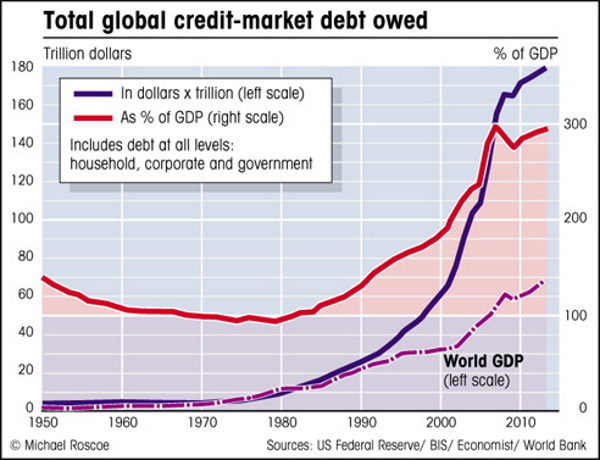
Global debt is now in the region of $200 trillion. The McKinsey Global Institute recently published a report highlighting the bloated, unsustainable levels of debt that have been accumulated globally and the huge risks when interest rates begin to rise again.
McKinsey concluded that total global debt was $199 trillion and the little covered report was released in February – 3 months ago – meaning that the figure is likely over $200 trillion. With a global population of 7.3 billion this works out out at over $27,200 of debt for every man, woman and child alive in the world today.
Almost 29% of that debt – $57 trillion – has been accumulated in the relative short period since the financial crisis erupted in 2007 – just 8 years.
This has increased the total debt-to-GDP ratio by 17% and “poses new risks to financial stability and may undermine global economic growth.”
The report, entitled “Debt and (not much) deleveraging”, analyses the debt situation in 47 different countries – 22 of which have advanced economies and 25 with developing economies.
Of the 22 advanced economies every one was found to have higher debt-to-GDP ratios today than they did in 2007. For many, the ratio had grown by more than 50%.
The three major areas for concern according to the report are rising government debt, rising household debt and rising total debt in China – which has increased a staggering four-fold since 2007.
The McKinsey report states bluntly that “government debt is unsustainably high in some countries.”
Government debt has expanded by 25% since the crisis began and much of it stems directly from the crisis.
The report states that for the six of the most highly indebted nations deleveraging has become impossible – at least without “implausibly large increases in real-GDP growth or extremely deep fiscal adjustments.”
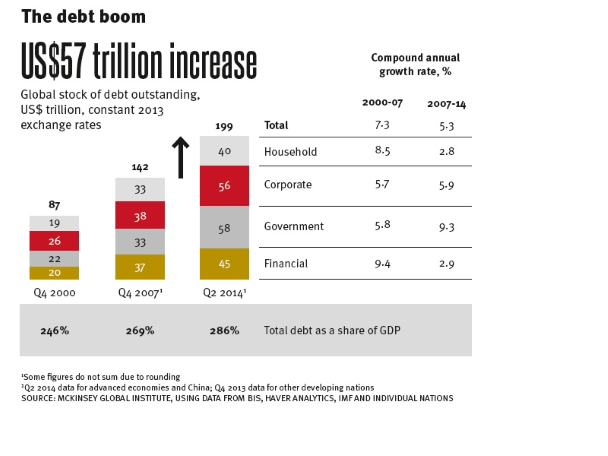
With regard to household debt the report states that household debt-to-income ratios in some countries exceed those of the crisis countries in the run-up to 2008.
In those crisis countries – the report cites the U.S., the U.K., Ireland and Spain – households have managed to pay down some debt. According to the report, in advanced countries – like Australia, Canada, Denmark, Sweden and the Netherlands – but also in Malaysia, South Korea, and Thailand household debt relative to income has exploded.
China’s debt has quadrupled since 2007 to $28 trillion. This represents 282% of GDP. The McKinsey Institute expresses concern about China’s financial system thus:
“half of all loans are linked, directly or indirectly, to China’s overheated real-estate market; unregulated shadow banking accounts for nearly half of new lending; and the debt of many local governments is probably unsustainable.”
They believe the Chinese government could bail-out the financial system if necessary but suggest that debt be reined in.
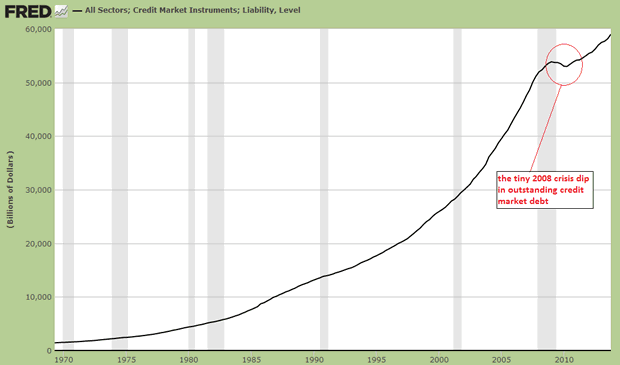
The report offers its solutions to these three growing crises but fails to acknowledge the root cause of the problem – the policy response of governments and central banks in recent years and the debt based monetary system.
Not acknowledged in the report is the fact that governments and central banks opted to bail out banks, at the expense of taxpayers and engaged in quantitative easing which again aided banks and their balance sheets but further indebted taxpayers and sovereign nations.
In a world where currency comes into existence as a debt and the interest on that debt cannot be paid until new currency is created in the form of new debt, governments are left with a choice between continuous debt expansion and borrowing or deflation and possible depression and economic collapse.
Unless and until the debt based system is replaced there can only ever be an increasing debt load and an urgency for economic growth with the consequent degradation of our environment and a debt enslaved humanity.
The solutions offered by the McKinsey report, particularly with regard to dealing with government debt, instead focus on ever more government and corporate power and financial repression.
For example, in dealing with government debt the report suggests “more extensive asset sales, one-time taxes on wealth, and more efficient debt-restructuring programs.”

The summary of the report makes this conclusion:
“Debt undoubtedly remains an essential tool for financing economic growth. But how it is created, used, monitored, and (when necessary) discharged still needs improvement.”
It is not clear what “one-time tax on wealth” McKinsey have in mind and whether debt restructuring will involve “bail-ins.”
Another glaring omission in the McKinsey report is the dire fiscal position of the U.S. who now have a National Debt or Federal Debt of $18,44 trillion and a real national debt and “unfunded liabilities” alone of over $100 trillion.
The attempt to solve what was essentially a global debt crisis with mountains of more debt means we will have another global financial crisis – the question is when rather than if.
This will have an impact on our economic recovery and on asset prices and hence the importance of diversification – both in terms of asset diversification but also in terms of geography and where and how your assets are owned.
Must read guide to Bail-ins here: Protecting your Savings In The Coming Bail-In Era
MARKET UPDATE
Today’s AM LBMA Gold Price was USD $1,214.75, EUR $1,063.59 and GBP $768.91 per ounce.
Yesterday’s AM LBMA Gold Price was USD 1,193.00, EUR 1,062.43 and GBP 761.55 per ounce.
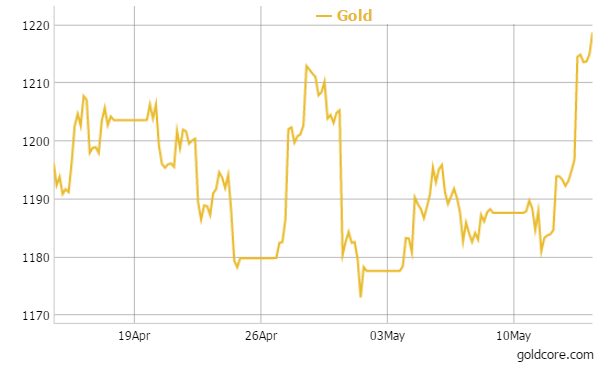
Gold climbed $21.60 or 1.81 percent yesterday to $1,214.80 an ounce, and silver outperformed and surged $0.57 or 3.45 percent to $17.11 an ounce.
Gold traded sideways in Asia overnight and gold in Singaporewas firm at $1,214.10 an ounce near the end of day trading. Gold and silver appeared to consolidate in early trading in London on the sharp gains seen after the poor U.S. retail sales number yesterday.
Gold and silver are both near a five week high after climbing on the weak U.S. retail sales data that heightened concerns that the Fed would not raise interest rates soon – something we have said would likely happen. The U.S. dollar fell in value against other currencies on the news and is weak again today – particularly against silver and the Swiss franc.
Gold is being supported by jittery bond markets, rising bond yields and dollar weakness this week.
Recent economic data, including the retail sales number yesterday, has been more negative than positive. This is contributing to volatility in bond markets and some selling pressure in equity markets. There are increasing concerns about the economic outlook globally.
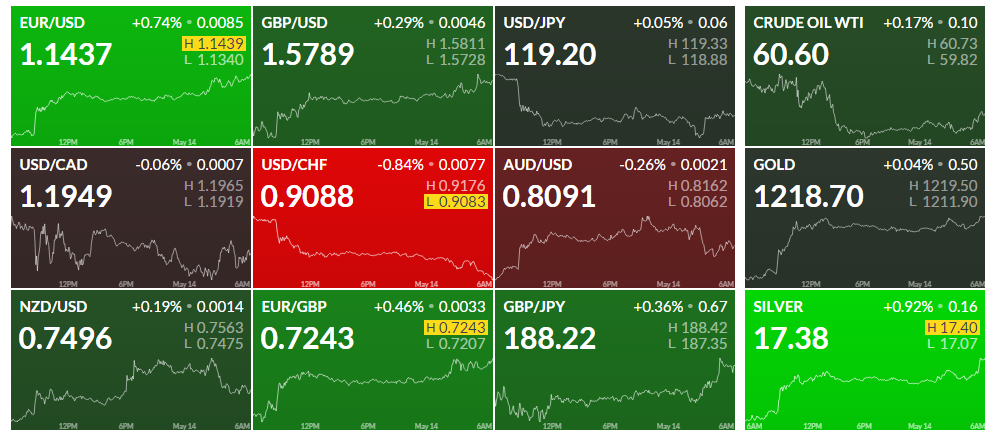
The U.S. dollar has come under further pressure and remained at three month lows today after the poor retail data proved a huge disappointment to those expecting a strong economic rebound from a weak first quarter – blamed on the weather.
German and U.S. bond yields surged to their highest in over five months as a vicious selloff extended to its tenth session. The startling rise in yields has made equities look more expensive in comparison to government debt and kept stock markets subdued.
Gold prices may benefit if there is a supply disruption from South Africa due to South Africa’s Association of Mineworkers and Construction Union (AMCU) pay rise dispute. The AMCU are seeking basic pay for entry-level workers in the gold mining industry to be more than doubled, which means difficult negotiations and perhaps a strike which we saw in the platinum sector last year that lasted five months.
In late morning European trading gold is up 0.32 percent at $1,220.54 an ounce. Silver is up another 1.2 percent at $17.40 an ounce. Palladium and platinum are up 0.15 and 0.26 percent at $790 and $1,150.00 an ounce respectively.
end
Mike Kosares: What might be behind today’s price jump
Submitted by cpowell on Wed, 2015-05-13 17:32. Section: Daily Dispatches
1:30p ET Wednesday, May 13, 2015
Dear Friend of GATA and Gold:
Today’s jump in gold prices might have been prompted by sharply falling appetites among foreign central banks and ordinary investors for U.S. government debt, USAGold’s Mike Kosares writes today. If so, he adds, look for a resumption of “quantitative easing” — that is, still more debt monetization and money printing. Kosares’ commentary is headlined “What Might Be Behind Today’s Price Jump” and it’s posted at USAGold here:
http://www.usagold.com/cpmforum/2015/05/13/what-might-be-behind-todays-p…
CHRIS POWELL, Secretary/Treasurer
Gold Anti-Trust Action Committee Inc.
Ronan Manly: Much of Venezuela’s gold was leased in London before repatriation
Submitted by cpowell on Wed, 2015-05-13 23:50. Section: Daily Dispatches
7:49p ET Wednesday, May 13, 2015
Dear Friend of GATA and Gold:
In the first of a two-part series, gold researcher and GATA consultant Ronan Manly today discloses that much of Venezuela’s gold reserves was leased or otherwise put in play in the gold market in London in the decade before President Hugo Chavez ordered it repatriated. Manly’s analysis is headlined “Venezuela’s Gold Reserves — Part 1. …” and it’s posted at Bullion Star here:
https://www.bullionstar.com/blogs/ronan-manly/venezuelas-gold-reserves-p…
CHRIS POWELL, Secretary/Treasurer
Gold Anti-Trust Action Committee Inc.
end
(courtesy GATA)
Make cash illegal to end boom and bust — and liberty
Submitted by cpowell on Thu, 2015-05-14 01:16. Section: Daily Dispatches
9:32p ET Wednesday, May 13, 2015
Dear Friend of GATA and Gold:
If commentary published tonight in the London Telegraph is any indication, gold bugs may not be quite as paranoid as their stereotype.
The commentary, written by Jim Leaviss of M&G Investments in London, argues that governments could stop the boom and bust of the business cycle if only cash was eliminated and replaced by electronic money. Leaviss says a step toward such a change is already under consideration in Denmark.
Leaviss writes: “Once all money exists only in bank accounts — monitored or even directly controlled by the government — the authorities will be able to encourage us to spend more when the economy slows or spend less when it is overheating. … In this futuristic world, all payments are made by contactless card, mobile phone apps, or other electronic means, while notes and coins are abolished. Your current account will no longer be held with a bank, but with the government or the central bank. …”
When government wanted people to save, Leaviss writes, it could impose a tax on bank account transactions, and when government wanted people to spend, it could impose negative interest rates, as some governments already have done.
“At the moment it’s easy for individuals to avoid seeing their money eroded this way,” Leaviss notes. “They can simply hold banknotes, stored either in a safe or under the proverbial mattress.” (He could have added gold.) “But if notes and coins were abolished and the only way to hold money was through a government-controlled bank, there would be no escape.”
Yes, no escape at all. Everyone’s financial transactions would be recorded and monitored, everyone’s finances would be vulnerable to government cutoff at any time, and liberty and privacy would be abolished.
That government must never have such power has been the principle underlying the political development of the English-speaking peoples for hundreds of years, from Runnymede by the Thames to Independence Hall in Philadelphia. Yet now nostalgia for the Soviet Politburo and the Nazi Gestapo is being celebrated in what is supposedly the United Kingdom’s leading Conservative newspaper. God save the queen — and the rest of us too.
Leaviss’ commentary is headlined “How to End Boom and Bust: Make Cash Illegal” and it’s posted at the Telegraph’s Internet site here:
http://www.telegraph.co.uk/finance/personalfinance/comment/11602399/Ban-…
CHRIS POWELL, Secretary/Treasurer
Gold Anti-Trust Action Committee Inc.
end
Avery Goodman/Chris Powell/GATA)
Avery Goodman: The real reason China is buying up the world’s gold
Submitted by cpowell on Thu, 2015-05-14 03:26. Section: Daily Dispatches
11:29p ET Wednesday, May 13, 2015
Dear Friend of GATA and Gold:
Colorado securities lawyer Avery B. Goodman writes tonight that China’s vast acquisition of gold is meant to create a mechanism for controlling the currency markets and devaluing the yuan against the U.S. dollar as convenient while escaping charges of currency market manipulation.
Drawing on a crucial U.S. State Department document unearthed by GATA —
http://www.gata.org/node/13310
— Goodman writes: “Whoever controls the price of gold against their own currency controls the price of gold against any other currency that gold is denominated in. When China increases the number of yuan it takes to purchase an ounce of gold, the dollar will respond by rising in value, even though China will not be pegging its yuan directly against the dollar.” Chinese goods thereby will become cheaper against U.S.-made goods, preserving China’s advantages in world trade.
Goodman continues: “Control over the worldwide currency markets is why China wants to control the gold market. It is already taking affirmative steps to establish that control, and that is what is behind the announcement that the Shanghai Gold Exchange will establish a yuan-based gold fix before the end of 2015.”
Goodman’s analysis is headlined “The Real Reason China Is Buying Up the World’s Gold” and it’s posted at Seeking Alpha here:
http://seekingalpha.com/article/3178896-the-real-reason-china-is-buying-…
CHRIS POWELL, Secretary/Treasurer
Gold Anti-Trust Action Committee Inc.
end
What took these guys (WGC) so long to recognize China as the world’s number one consumer of gold;
(courtesy Lawrence Williams/Mineweb)
WGC resurrects China as world No. 1 gold consumer

Forgive us for coming back to a subject we have covered before, but we have previously commented on our disbelief that India regained top spot as the world’s No. 1 gold consumer in 2014. This belief, which is since being perpetuated by the mainstream global media, was based on the World Gold Council (WGC)’s Gold Demand Trends report of February this year, which had India just pipping China into the No.1 spot on preliminary data. We disagreed with this assessment at the time and have pointed to other statistical analyses of the global gold market since which would also reverse this position and we are now pleased to note that the latest WGC Gold Demand Trends report has China firmly back in the No. 1 spot for 2014 with its latest consumption figure for that year put at 973.6 tonnes as against India’s 811 tonnes. China’s figure would be even higher at 1,015 tonnes if we include Hong Kong consumption which perhaps one should given that Hong Kong is a part of China even if its statistics tend to be recorded separately.
The latest WGC statistics – now provided by the Metals Focus consultancy rather than by GFMS which has provided them in the past – also suggests that Chinese consumption (excluding Hong Kong) fell by 7% in Q1 this year to 272.9 tonnes compared with Q1 2014, while India’s grew by 15% to 191.7 tonnes – which still leaves China as comfortably the No.1 global consumer. The report also points out that the two countries between them account for 54% of total global gold consumer demand. In terms of percentage of new mined supply – put at 729 tonnes for Q1 2015 – the two countries accounted for 64%. But we also believe that, in the case of China, these figures still substantially underestimate gold flows into the country, which is in part due to a rigid calculation as to what actually is defined as ‘consumer demand’. This does not appear to include demand absorbed directly by the Chinese banking system. To back up our view withdrawals from the Shanghai Gold Exchange (SGE) in Q1 this year reached around 623 tonnes – 10.5% higher than in Q1 2014 – See: SGE Q1 gold withdrawals at new record – ca. 623 tonnes. Whether one takes SGE withdrawal figures as an accurate representation of actual Chinese demand (there are arguments over this) it is certainly an accurate indicator of the levels of Chinese gold flows.
Now whether the world’s mainstream media will now recognise the latest WGC figures as being the correct ones, or continue to claim India is the world’s No. 1 gold consumer based on the earlier WGC data, is a moot point – we suspect not. But anyway which is actually the larger gold consumer at any point in time is perhaps an irrelevance in terms of overall global gold supply/demand fundamentals.
So, if we look deeper into the WGC’s latest Gold Demand Trends report, it would appear that global gold demand slipped marginally by about 1% in Q1 this year compared with a year ago with lower jewellery demand mostly countered by a rise in investment demand.
Central banks too continued to absorb gold with purchases of 119 tonnes – the same level as a year earlier, being the 17th successive quarter in which they have been net purchasers as they have continued to look for diversification away from US dollar denominated assets.
Global supply was also much the same as a year earlier, with a continuing rise in new mined production (compared with Q1 2014, but actually down on Q2,3 and 4 figures for last year) balanced by a continuing fall in supply from scrap, which has been limited by lower gold prices. On new mined supply, the report suggests that the analysts expect this to plateau this year before starting to retreat until, and unless, there is a substantial gold price pick up.
On mine production the WGC notes that, “A further increase is likely next quarter as the tail end of growth comes through from a number of projects. However, this should fade away as the year progresses; we will likely see negative comparisons in the second half of the year.
Alastair Hewitt, the WGC’s head of market intelligence, in commenting on the report, noted that what has turned out to be a fairly stable supply/demand balance hides some substantial regional and sectoral differences – for example Chinese jewellery demand is seen as falling back by around 10%, but this being perhaps more than balanced by a 22% rise in Indian jewellery demand. Gold ETFs also saw a small inflow during the quarter (26 tonnes) being the first quarterly inflow since 2012. Consumers in Eastern nations continued to dominate demand, but this has been the case for some time now with gold flows continuing to move at a high rate from West to East.
Thus overall the latest WGC report sees little change in supply and demand fundamentals, while the gold price has actually remained fairly stable during Q1 trading within a fairly tight range throughout the quarter. This morning the price has been sitting close to the $1,220 level which is towards the higher end of its recent range, but it tends to fluctuate quite sharply on US data announcements depending on whether these are seen as bringing the US Fed timetable for possibly raising interest rates forward or moving it ever further back. In our view this should in reality be something of an irrelevance for the gold price anyway as any likely level of interest rate increases would still leave them in effective negative territory.
As many of you know, my theory has been over the years that there has been a silver loan from the official sector of China to the USA. That loan occurred in 2003 right after the USA announced that they were out of silver from the days of the Manhattan project. Today Bill offers another explanation tying in Ted Butlers take on how JPMorgan acquired 350 million oz of silver
end
Dave Kranzler and Chris Powell
(courtesy Dave Kranzler/IRD/Chris Powell/GATA)
SoT Ep 26 – Chris Powell: “Gold Is The Deadly Threat To All Governments”
We open this podcast with Charlie Chaplin’s speech from “The Dictator.“ It is one of the most powerful speeches ever given. It ranks with the likes of Dr. King’s “I have a Dream” and a handful of other truly great speeches that were designed to uplift the spirit, free the mind and announce to the world we are all sovereign human beings created to do great things with our lives.
For over 15 years, Chris Powell – the co-founder of GATA – has been in the trenches exposing the corruption deeply embedded in our financial and political system. Chris has been a staunch promoter of free markets and reduced Government power. The cornerstone of democracy and true freedom begins with honest money. Gold stands alone a honest because it does not rely and counterparty risk and it can not be printed and devalued.
Because of this inherent nature in the use of gold as currency, gold stands as threat to a Government’s ability to dictate.
Gold is the deadly threat to all governments, including the Chinese government. Gold is a free market independent currency and puts all government currency at risk. Is China really working in the gold market for free markets and democracy and individual liberty around the world? No, I don’t think so. China, I think, is mainly working to hedge it’s stupid U.S. dollar exposure. – Chris Powell, Shadow of Truth
The gold community, in general, is very excited about the prospects of China and the new gold fix that will be launched sometime in 2015. Most of the speculation is around the September timeframe, but most assuredly before years end. After speaking with Chris about China and this seemingly important change in the global pricing mechanism, our optimism is waning. Let’s just say there has been a dose of reality served up.
I don’t kid myself that China is working for the benefit of us goldbugs here in the West. I think China is working for power for the Chinese government. Now, does the Chinese government want a higher gold price or a lower gold price or does the Chinese government just want to control the gold price as much as Western governments want to control it for different reasons? In 1974 Kissinger and his Deputy Secretary Thomas Enders discussed how the United States must persuade the European countries to keep moving gold out of the world financial system because whoever has the most gold controls it’s valuation and whoever controls golds valuation controls the valuation of government currencies. – Chris Powell, Shadow of Truth
This is an incredible interview with Chris Powell. Dare we say that he was “on fire.”
I’d say almost all the major ones (mainstream media) in the United States and Europe. Every major financial news organization in the West has all this documentation (regarding gold market manipulation) It just can not be acknowledged as an issue. Any journalist that picked up the gold price suppression issue would be fired.
***
I don’t think the power of Central Banks to create infinite money is their greatest advantage right now. I think their greatest advantage right now is either their control of the mainstream financial news media or the timidity of the mainstream financial news media. This story is just the Emperors New Clothes.
There is very likely an arrangement, an understanding, among the world’s major Central Banks that is redistributing the worlds gold, right now, the debtor nations to the creditor nations to allow the creditor nations to hedge themselves against an evadible devaluation of the dollar.He (Jim Rickards) has said, over the last year, a number of times. That from his meetings with government officials, Central Bank officials, elected officials, officials of the International Monetary Fund that there is, some, more or less formal arrangement, understanding between the United States and China. Whereby, China agrees not to dump it’s Treasuries while the United States agrees facilitate the flow of gold into China at a discounted price.
Rickards has been on record, on several occasions, stating that gold would be revalued to approximately $9,000 per ounce. According to Millars report, there is already in place, a plan to revalue gold by 7 to 10 times. Gold is currently, approximately, $1,200 per ounce, multiply that by 7 and you get $8,400 per ounce. A multiple of 10 and you have $12,000 per ounce.
end
As many of you know, my theory is that the sovereign Chinese has loaned the USA 300-600 million oz of silver in the year 2003, the year they ran out of above ground silver courtesy of the Manhattan project.
I believe that they asked for their silver back and it was denied. Sovereign China used the lower prices to stock up on gold. Bill Holter also is a strong believer of this theory. We now add in Ted Butler’s assertion as to what is going and we may have the perfect picture of what is happening behind the scenes;
(courtesy Bill Holter/Miles Franklin/JSMineset)
The Great Silver Debate
Over the last weeks, a great debate has erupted regarding silver. More to the point, Ted Butler claims JP Morgan has accumulated at least 350 million physical ounces. Some pooh pooh this and say it is not possible while others who may believe it are scared witless because they are afraid Morgan will dump the metal and destroy the silver price.
Taking first things first and then later expanding, I believe it is possible for Morgan to have accumulated this silver. If you look at the bleed from both COMEX and SLV inventories and add in the purported movements on the LBMA, I do believe it is possible that JPM has amassed a silver war chest. From a “dollar” standpoint, this is only about $5 billion which wouldn’t even need to come from their equity as they have a direct pipeline to the bowels of the Fed and Treasury for credit.
To answer the question of “fear” propounding this silver will be used to destroy the market, I would first remind you that “devious” and “stupid” are two separate descriptions. No matter what anyone believes, JP Morgan is not stupid, devious may be another matter altogether with each fine they have paid as proof. JP Morgan has had a huge short paper position in silver for many years dating back to at least 2007 when they inherited Bear Stearns positions. The position has been so large in fact, they could never possibly “push a button” to cover it because the metal simply never existed to cover it in a short period of time. Any attempt to cover would have created a panic of demand and a minimum price of $100 per ounce for starters!
This leads us to one of several theories and the most obvious, JP Morgan has been amassing physical silver and is now actually a hedge against their short position as opposed to the other way around. It makes zero sense to me that Morgan would dump a physical position because the accumulation was so difficult to acquire in the first place. As I said above, JP Morgan is not stupid and they understand the logic of where the macroeconomics are headed. They know the game is either inflate or die and can surely make the judgment as to whether or not they want to be net long, or short silver. And trust me, they also know the difference between paper contracted silver and the real thing in their vaults.
It also occurred to me, what if the short position is “used” to revalue the long position? We have seen so many times where naked contracts were “sold sloppy and sold BIG”, what if JPM decided to actually cover their short by buying “sloppy”? They effectively could use the short position as a springboard if you will? What would stop them from covering the short to become flat and just keep on buying sloppy in the futures pits and running every short on the planet? They must surely know the upside pressure is there not only technically but fundamentally because of the supply being knocked off stream by below production prices? This is an easy trade for them if truly have built a physical long, thus making their short to unwind the “sloppier the better”! This makes more sense to me than dumping the physical long which everyone is so afraid of.
Another theory is that JP Morgan has gotten very long physical silver at low prices by compressing said price in the futures markets. Some believe Morgan understands where the game is headed and also understands the “uses” for silver are expanding exponentially, and in particular the solar energy industry. This is possible in my opinion as I don’t believe there is any hoard of 350 million ounces or more anywhere else. Maybe they are looking to the future and want to sit on the real metal to supply into a future market at grossly higher prices with real demand unable to be satisfied.
There is one more theory, one that I cannot prove but makes a lot of sense. I believe the Chinese lent 300 million ounces of silver to the U.S. back in 2003 and this was a 10 year lease. I believe the lease ran out and was defaulted on in 2013, this would partially or mostly explain why silver was attacked in the paper markets so brutally. The “tree had to be shaken” in an effort to shake some real silver from holders hands. Also if you remember, it was around this time that Warren Buffett let loose of his 129 million ounce position he announced originally a few years earlier, the divestiture “coincidentally” coincided with the formation of the ETF, SLV… that was funded with a very similar number of ounces!
It is my belief that after the U.S. defaulted on its lease to China, China wanted some sort of assurance they would ultimately be paid. It was this broken transaction and the following agreement not to “let the price of silver (or gold) to get away” that has allowed China to amass huge sums of gold “in lieu of” silver. I believe this broken transaction is the reason suppression has been so blatant and violent since April 2013, time will tell.
I say “time will tell” because something very different has just begun to happen. Sovereign bonds all over the world have begun to gyrate wildly with yields moving to the upside. The short squeeze/giant margin call in the dollar seems to be ending and the dollar has now reversed. Gold and silver are also acting unlike anything over the last two years just today. They opened on the firm side, jumped higher, and then rather than being capped it is like they are bulldozers in low gear steadily rising tick by tick. We will need a few more days to see if the previous patterns are firmly broken but it looks like it so far.
The odds China announces how much gold they have accumulated sometime later this year are very high in my opinion. The case for 10,000 tons is very easily proven, just as is the case that much of that gold MUST have come from N.Y., London and the FRBNY (or Fort Knox). The paper short positions in gold and silver will be destroyed in virtually overnight fashion after any announcement by China even close to 10,000 tons.
Getting back to JP Morgan’s silver position, I cannot see them trying to “flood” the market with physical silver because a move like this might have the staying power of 24 hours. For them to sell $5 billion worth of silver is laughable in dollar terms and would be “Hooverized” by physical buyers (even China herself) long before it hit any market or exchange. If JP Morgan truly does have 350 million ounces of real physical silver it is in my opinion because they are bullish on “real physical silver”! Regards, Bill Holter,JSMineset/Miles Franklin
end
And now overnight trading in stocks and currency in Europe and Asia
1 Chinese yuan vs USA dollar/yuan strengthens to 6.2016/Shanghai bourse green and Hang Sang: green
2 Nikkei closed down by 194.48 points or .98%
3. Europe stocks mostly up but slightly/USA dollar index down to 93.28/Euro rises to 1.1421/
3b Japan 10 year bond yield: slight fall to .46% !!!!(Japan buying 100% of bond issuance)/Japanese yen vs usa cross now at 119.53/Japan losing control over their bond market
3c Nikkei still just above 20,000
3d USA/Yen rate now well below the 120 barrier this morning
3e WTI 60.58 Brent 67.13
3f Gold up/Yen down
3gJapan is to buy the equivalent of 108 billion uSA dollars worth of bond per month or $1.3 trillion. Japan’s GDP equals 5 trillion usa.
Japan to buy 100% of all new Japanese debt and by 2018 they will have 25% of all Japanese debt. Fifty percent of Japanese budget financed with debt. Last night Japan refused to increase it’s QE
3h Oil up for WTI and up for Brent this morning
3i European bond buying continues to push yields lower on all fronts in the EMU. German 10 yr bund rises to 75 basis points. German bunds in negative yields from 3 years out.
Except Greece which sees its 2 year rate falls slightly to 20.87%/Greek stocks up 1.45%/ still expect continual bank runs on Greek banks.
3j Greek 10 year bond yield falls to: 10.72%
3k Gold at 1217.80 dollars/silver $17.31
3l USA vs Russian rouble; (Russian rouble down 1/2 rouble/dollar in value) 50.03 , the rouble is still the best acting currency this year!!
3m oil into the 60 dollar handle for WTI and 67 handle for Brent/Saudi Arabia increases production to drive out competition.
3n Higher foreign deposits out of China sees huge risk of outflows and a currency depreciation. This can spell financial disaster for the rest of the world/China may be forced to do QE!!
30 SNB (Swiss National Bank) still intervening again in the markets driving down the SF. It is not working: USA/SF this morning .9096 as the Swiss Franc is still rising against most currencies. Euro vs SF is 1.0380 well below the floor set by the Swiss Finance Minister.
3p Britain’s serious fraud squad investigating the Bank of England/
3r the 3 year German bund remains in negative territory with the 10 year moving further away from negativity at +.75/the ECB losing control over the bond market.
3s Last week the ECB increased the ELA to Greece by another large 2.0 billion euros.This week, they raised it another 1.1 billion and thus at this point the new maximum was 80 billion euros. The ELA is used to replace depositors fleeing the Greek banking system. The bank runs are increasing exponentially. The ECB is contemplating cutting off the ELA which would be a death sentence to Greece and they are as well considering a 50% haircut to all Greek sovereign collateral which will totally wipe out the entire Gr. banking and financial sector.
3t Greece paid the 200 million euros owed to the IMF as interest payment on Wednesday. They did pay the 700 million plus payment to the IMF yesterday but with IMF reserve funds. It must be paid back in 28 days.
3 u. If the ECB cuts off Greece’s ELA they would have very little money left to function. So far, they have decided not to cut the ELA
4. USA 10 year treasury bond at 2.27% early this morning. Thirty year rate well below 3% at 3.08% / yield curve flatten/foreshadowing recession.
5. Details Ransquawk, Bloomberg, Deutsche bank/Jim Reid.
(courtesy zero hedge/Jim Reid Deutsche bank)
5. Details Ransquawk, Bloomberg, Deutsche bank/Jim Reid.
(courtesy zero hedge/Jim Reid Deutsche bank)
Despite Surging Euro S&P Futures Jump On Stop Hunt, Lack Of Daily Bund Rout
It has gotten to where just the lack of a rout in Bunds or any other government issue is enough to activate the “bullish” outside stop hunting algo, which is probably why ES has jumped overnight in another illiquid, newsless session. Curiously, Bunds shave not sold off even though the EUR has jumped sharply by almost 100 pips overnight to a 3 month high also on no news (with some amusing acrobatics by the USDJPY alongside) traditionally a bearish indicator for the Dax and thus the S&P. Perhaps the algos are just late, or maybe the “weak dollar is good for stocks” thesis has been activated, but in any event this morning’s ramp higher in the ES will continue until all upside stops are hunted down by Virtu and crushed mercilessly.
A look at markets: in Asia the Nikkei 225 (-1.00%) was weighed on by a raft of soft earnings and JPY strength. Chinese markets fluctuated between gains and losses as participants counterbalance the latest slew of disappointing Chinese data with expectations for additional easing. JGB’s shrugged off earlier weakness to trade up by 4 ticks after finding support at the key 146.50 level, despite a poor 30-year government bond auction, which saw the lowest b/c since February.
Overall, price action for equities this morning has been driven by currency fluctuations with stocks in Europe pulling away from their worst levels in tandem with the EUR. On a sector specific basis, energy names are the notable underperformers in the wake of yesterday’s DoE-inspired slide in oil prices with equity newsflow otherwise relatively light. From a fixed income perspective, Bunds have drifted higher since the open in a partial pull-back of yesterday’s heavy losses with the German curve now at its steepest level in 5 month.
EUR started the session on the front-foot amid no new fundamental catalyst with the move to the upside aided by the USD-index breaking below the Feb low seen at 95.25, leading EUR/USD to trade at 3-month highs. Although there has been no new standout news today it has been part of a broader trend seen over the past few weeks with focus on the disappointing data releases from the US compared to those of the Eurozone. European yields continue to underpin the EUR. Despite Bunds paring some of yesterday’s losses, German paper this week has once again added to the heavy losses seen since April 29th. Comments from Greece appear to be more promising with the Greek Fin. Min. Varoufakis this morning acknowledging that Greece has drawn a common line regarding many issues with their creditors.
WTI and Brent crude futures trade modestly lower following the increase in US oil production and a build in east coast inventories, despite a wider than expected draw-down in yesterday’s DoE crude inventory data. Spot gold has seen subdued trade, remaining near 5 week highs, holding onto most of yesterday’s gains following poor US retail sales data. Copper saw mild weakness overnight following further disappointing data from China after aggregate financing and new yuan loans missed expectations, while Dalian iron ore futures declined by over 3% as weakening demand from Chinese steel mills pressured prices.
In summary: European shares little changed having risen from intraday lows with the basic resources and autos sectors underperforming and personal & household, insurance outperforming. Greece wants agreement with creditors by end-May, Varoufakis says. Markets closed today include Austria, Denmark, Finland, Norway, Sweden, Switzerland. The Dutch and U.K. markets are the worst-performing larger bourses. The euro is stronger against the dollar. Irish 10yr bond yields fall; U.S. yields decline. Commodities gain, with nickel, zinc underperforming and silver outperforming. U.S. jobless claims, continuing claims, Bloomberg consumer comfort, PPI due later.
Market Wrap
- S&P 500 futures up 0.4% to 2103.2
- Stoxx 600 little changed at 395.5
- US 10Yr yield down 4bps to 2.25%
- German 10Yr yield down 1bps to 0.72%
- MSCI Asia Pacific down 0.4% to 152.1
- Gold spot up 0.2% to $1217.5/oz
- Eurostoxx 50 +0.1%, FTSE 100 -0%, CAC 40 +0.1%, DAX +0.1%, IBEX +0.2%, FTSEMIB +0.4%, SMI closed
- Asian stocks fall with the Kospi outperforming and the Nikkei underperforming.
- MSCI Asia Pacific down 0.4% to 152.1, Nikkei 225 down 1%, Hang Seng up 0.1%, Kospi up 0.3%, Shanghai Composite up 0.1%, ASX down 0.3%, Sensex down 0.2%
- Euro up 0.5% to $1.1411
- Dollar Index down 0.31% to 93.33
- Italian 10Yr yield up 0bps to 1.89%
- Spanish 10Yr yield down 1bps to 1.88%
- French 10Yr yield down 1bps to 0.99%
- S&P GSCI Index up 0.2% to 452.6
- Brent Futures up 0.4% to $67.1/bbl, WTI Futures up 0% to $60.5/bbl
- LME 3m Copper up 0.1% to $6409.5/MT
- LME 3m Nickel down 0.8% to $13940/MT
- Wheat futures up 0.5% to 483.8 USd/bu
Bulletin Headline Summary from Bloomberg and RasnSquawk
- EUR trades at its highest level against the USD for three months amid no new fundamental catalyst
- Things are otherwise quiet in Europe with equities tracking movements in FX markets
- Looking ahead, today sees US PPI, Weekly Jobs Data and the US USD 16bln 30yr Auction
- Treasuries gain as long end pares losses seen in U.S. trading late yesterday after Qualcomm priced its $10b 8-part debut issue; quarterly refunding concludes today with $16b 30Y bonds, WI 3.04%, highest since Nov., after 2.597% in April.
- China’s central bank told lenders to hold off from raising deposit rates that officially became available from May 11, according to people familiar with the matter
- Greek Finance Minister Yanis Varoufakis said access to the ECB’s QE program would have been “especially positive” for Greece; nation was excluded as PM Tsipras fought with creditors over bailout terms
- Greek debt isn’t sustainable, must be “redesigned”; Greece isn’t asking for a haircut, Varoufakis said at event in Athens
- Obama is spending much of two days trying to reassure apprehensive Persian Gulf allies that his strategy of negotiating with Iran and defusing myriad regional conflicts won’t leave them vulnerable
- UBS Group AG faces the prospect of making a guilty plea that would require it, along with four other giant global banks, to seek U.S. regulators’ permission to keep managing Americans’ money
- Sovereign bond yields mostly lower. Asian stocks mostly higher, European stocks, U.S. equity-index futures decline. Crude oil higher, gold little changed, gold, copper higher
DB’s Jim Reid concludes the overnight recap
After what was turning out to be a relatively calm session and better day in bonds for the most part yesterday, another Bund-led selloff late in the European session sparked a tide of rising yields once more in global bond markets. Having opened at 0.675%, 10y Bunds traded as low as 0.597% intraday, before then selling off into the US session and eventually closing 4.9bps higher in yield on the day at 0.722% with the high to low intraday range at 13.6bps. It was a similar story in US Treasuries. The 10y benchmark started the European session at 2.250%, struck an intraday low of 2.189% before then closing 4.4bps higher on the day at 2.293%. The intraday move of 11bps no less impressive. The messy day in rates and sell off in Bunds was made all the more confusing by softer than expected US retail sales data, softish German Q1 GDP and supportive Treasury and Bund auctions.
We’ll touch on these shortly in more detail, but looking at the follow up in markets in Asia this morning, bonds are softer generally across the region once again, led by 10y Australia (+5.9bps) bonds while similar maturity yields in Japan (+0.5bps), Hong Kong (+3.0bps) and Singapore (+4.1bps) are also higher. Treasuries are more or less unchanged. It’s a bit more mixed in equity markets meanwhile with the Nikkei (-0.86%) and ASX (-0.71%) both declining, while the Hang Seng (+0.30%), Shanghai Comp (+0.26%) and Kospi (+0.14%) are higher.
Although both the S&P 500 (-0.03%) and Dow (-0.04%) closed more or less flat yesterday, equity markets chopped around for the most part too with the S&P 500 in particular trading between positive and negative territory 19 times during the day. It was a weak day for the Dollar with the DXY (-0.97%) selling off with the move higher in rates. Gold (+1.83%) had one of its better days for a while closing at $1215/oz and the highest level since February 16th, while Brent (-0.07%) and WTI (-0.41%) pared earlier intraday gains into the close.
Back to the data, as mentioned US retail sales disappointed on the whole yesterday. The headline April reading of 0.0% mom was below market expectations of +0.2% and was down from +1.1% last month. The ex auto component also disappointed with the +0.1% mom print below expectations of +0.5% expected (and down from +0.7% last month). Meanwhile the retail control component, which is the key input into goods spending in the GDP accounts was flat compared to +0.5% in March and also a miss versus market expectations of +0.5%. Following the numbers the Atlanta Fed GDPNow model lowered its forecast for Q2 growth to +0.7% SAAR from +0.8% previously. As well as yesterday’s retail sales data, April import price index (-0.3% vs. +0.3% expected) and March business inventories (+0.1% mom vs. +0.2% expected) also surprised to the downside. With a downward revision to the February reading in the latter too, our colleagues in the US suggest that Q1 real GDP will now be worse than estimated. They have lowered their forecast further for the second snapshot of Q1 GDP to -1.0% from -0.8% previously with the reading due on the 29th of this month.
The move in Bond markets yesterday was also a surprise given the bond auction results. Yesterday’s 10y Treasury auction had a bid-to-cover ratio of 2.72, the highest since the December 2014 auction. The auction also attracted a substantial amount of indirect bidders (including foreign central banks) who accounted for 60.2% of the notes bought, significantly higher than the 50.9% of the average of the last ten auctions. Interestingly however, primary dealers were allocated just 18.9% making it the second lowest allocation to primary dealers on record. It’ll be interesting to see what demand is like for today’s 30y Treasury auction and whether or not we see any demand momentum after yesterday’s auction. Yesterday we also got a 10y Bund auction, with a bid-to-cover ratio of 1.3x which was down on the 1.5x, 2.4x and 1.4x ratios that we’ve had so far this year, but still a signal of decent investor appetite.
As well as the move higher in Bund yields yesterday, yields in the periphery ended 4-6bps higher while other core European markets followed the lead as Netherlands (+3.6bps), France (+2.7bps) and Switzerland (+2.9bps) 10y yields closed up. Meanwhile European equity markets reversed earlier gains to close lower on the day as the volatility in bond markets appeared to sap some risk appetite. The Stoxx 600 (-0.16%), DAX (-1.05%) and CAC (-0.26%) all finished lower at the close, although peripheral European bourses held in slightly firmer (IBEX +0.02%, FTSE MIB +0.46%).
There was plenty of data out of Europe yesterday for the market to digest. Q1 Euro area GDP of +0.4% qoq was in line with expectations and the print for quarter was the joint-highest since Q1 2011. It was interesting to see the breakdown on a more regional basis however with core countries largely disappointing and non and semi-core producing better than expected readings. Germany (+0.3% qoq vs. +0.5% expected) and Netherlands (+0.4% qoq vs. +0.5% expected) disappointed while on the flip side, previously reported Spain (+0.9% qoq vs. +0.8% expected) as well as Italy (+0.3% qoq vs. +0.2% expected), France (+0.6% qoq vs. +0.4% expected) and Greece (-0.2% qoq vs. -0.5% expected) surprised to the upside. DB’s Oliver Rakau noted that the disappointing Q1 GDP print for Germany will likely reinforce doubts on German growth prospects which had surfaced lately following disappointing data out of German industry. He notes that there are moderate downside risks to his 2.0% 2015 GDP forecast given the weak start. Away from the GDP prints, the final April CPI reading for Germany was revised up slightly to +0.5% yoy from +0.4% previously while Euro area industrial production disappointed (-0.3% mom vs. 0.0% expected) for March.
We also got the monthly batch of employment data out of the UK yesterday which was largely supportive on the whole. The unemployment rate declined one-tenth of a percent as expected to 5.5% while average hourly earnings ticked up to +1.9% yoy (vs. +1.7% expected). The release of the latest Bank of England inflation report also attracted some interest yesterday. In the report, the Bank lowered growth expectations from 2.9% for both 2015 and 2016 to 2.5% and 2.7% respectively. The end period forecast for inflation was little changed, however, at just above the 2% target. DB’s George Buckley noted that the report did little to alter his timeline for a first rate hike. George noted that the BoE believes that spare capacity is currently around 0.5% of GDP and this will be fully eroded over the coming year as weak supply growth is overtaken by demand. As a result, rate increases encompassed in market pricing would be sufficient according to BoE forecasts, to leave the inflation profile similar to what was expected by the MPC three months ago. However, the market rate assumptions used by the BoE this time were higher than the February report, now showing a rate hike around the middle of next year. Given that this rate profile is insufficient to keep inflation below 2% by the end of the forecast horizon, George is comfortable reiterating his view of a first hike a little earlier that this – in May of next year.
In terms of today’s calendar, there’ll be something of a breather in Europe this morning with no data releases due. Over in the US meanwhile, the April PPI print is due along with more employment data in initial jobless.
end
A good bellwether as an indicator on how the global economy is performing:
(courtesy zero hedge)
Chinese Iron Ore Prices Plunge After CISA Warns Of Persistent Overcapacity
Having rebounded along with practically every other risk-asset class in the world over the last month or so, Chinese Iron Ore futures are collapsing tonight. Despite the promise of Chinese LTROs expanding credit (just like they didn’t in Europe), iron ore prices are down around 4% – the biggest drop in over 2 years – to as low as CNY419 (or around $62) as China Iron & Steel Association warns that overcapacity in the seaborne iron ore market will persist through to at least 2019 as the world’s largest suppliers expand production further.
Iron Ore prices are down the most in over 2 years…

“Low-cost seaborne supply entering the market is not only displacing high-cost Chinese production, but also high-cost seaborne supply,” Alan Chirgwin, BHP iron ore marketing vice president, told the conference. Supply will rise by about 100 million to 110 million tons this year, exceeding modest demand growth of about 30 million to 40 million tons, he said.
Major producers remain intent on expansions and a battle for market share is under way as miners attempt to reduce their costs faster than prices are dropping, according to Credit Suisse Group AG.
Source: Bloomberg
end
Soc Gen asks:
(courtesy zero hedge)
SocGen Asks If “$60 Billion Of Money Printing Monthly Can’t Get The Euro Down Then What’s Next?”
One by one, everyone is not only realizing but admittingthat if after 7 years of ZIRP, QE and currency warfare in general, nothing changes, then perhaps the 8th year (and 9th, and 10th) won’t do much either. Here’s Socgen:
Two months of QE for nothing. Well, not strictly true of course, for inflation expectations are up 30bp and Euro stocks are still up 15% since January even after investors withdrew $1.5bn last week. But look at the euro. EUR/USD yesterday returned over 1.1350, the highest level since the ECB announced QE on 22 January. The trade-weighted euro is up 3.4% from its April low. The Q1 GDP data were not bad, excellent in fact for Spain and France, but net exports are not contributing much. Perhaps this underlined the limitations of how a weaker currency, in the euro area at least, is no panacea because of the structural headwinds, and this does not offset the impact of the weak currency on the demand side. Former BoE governor King yesterday made a timely intervention, warning that central banks risk tipping the world into a currency war. We’re there already, of course, but if $60bn per month of money printing by the ECB can’t get the euro down (because of the USD), then what’s next? The RBA has cut rates twice this year, and AUD/USD trades back over 0.8100. Is FX intervention next?
That, and every other form of “intervention” as well. Because the closer central banks are to losing all control, the more “intervention” there will be until the concept of a “market” disappears forever.
end
Head huncho for the Bundesbank came out blasting Draghi for funding Greece through the ELA as well as purchasing bonds which is against the EU charter:
(courtesy zero hedge)
Bundesbank Blasts Draghi For Breaking Bailout Taboo
Earlier today, we noted that Germany (or at least the Finance Ministry) has thrown its support behind a Greek referendum on euro membership. The idea is that if Greeks vote to remain in the currency bloc, they are essentially also voting to accept that their lifestyles are about to get a lot more austere in exchange for Germany’s willingness to help the country avert an outright economic collapse. We also highlighted Russia’s politically-motivated move to convince Greece to join the BRICS bank before closing with a recap of Yanis Varoufakis’ latest speech to parliament in which the increasingly unhinged FinMin suggested Greece’s debt to the ECB should be wrapped up and “sent overnight into the distant future,” before claiming that the idea of a debt swap “filled Mario Darghi’s soul with fear” because the ECB chief is terrified of the Bundesbank.
The comedic value of Varoufakis’ latest tirade aside, there’s certainly some truth to the suggestion that the German central bank and its head Jens Weidmann are skeptical of PSPP and deeply concerned that the ELA lifeline keeping the Greek banking sector afloat amounts to the monetary financing of the Greek government (because after all, when Greek banks use ECB loans to keep the Greek treasury afloat, it’s difficult to explain how that doesn’t amount to the central bank financing the Greek government).
Apparently at his wits’ end with a world consumed by monetary madness, Weidmann let his feelings be known on Thursday not only about the ECB’s support of the Greek banking sector via ELA, but about QE in general. Reuters has more:
The head of Germany’s Bundesbank ripped into the European Central Bank on Thursday, saying emergency funding for Greek banks broke the taboo of financing governments and it was not up to central banks to decide who was or wasn’t in the euro zone.
Jens Weidmann also said it was questionable whether money printing by the ECB to boost the euro zone economy and halt deflation was necessary…
“Given the ban on monetary financing of states, I don’t think it’s ok that banks which don’t have access to the markets are being granted loans which then finance the bonds of their government, which doesn’t have access to the markets itself,” Weidmann told German newspaper Handelsblatt according to advance extracts of an interview to be published on Friday.
Asked whether he would be prepared to stop emergency funding to Greek banks and therefore force Athens out of the euro zone, Weidmann said central banks were not responsible for “the make-up of the euro zone or granting aid payments”.
Weidmann also hit out at the ECB’s bond-buying scheme known as quantitative easing (QE), saying: “The question remains whether the QE programme was really necessary given our primary aim of price stability and how we should assess the risks and side-effects that inevitably come with such a scheme.”
He said QE made Eurosystem central banks the biggest creditor of governments and monetary and fiscal policy were becoming increasingly interconnected.
“That can increase the political pressure on central banks when it comes to future monetary policy decisions, especially as member states’ drive to reform is also being weakened.”
Weidmann has for some time been the lone voice of reason among EU officials (with the exception of the incorrigible Herr Schaueble) and he is of course entirely correct in his assessment because ELA is indeed akin to the monetary financing of governments and of course when it comes to the “risks and side-effects” of QE “schemes”, no one knows better than Weidmann as he is being forced, on a monthly basis, to break the market for the debt issued by his own government by commandeering all bunds yielding better than -0.20% and hoarding them on the Bundesbank’s balance sheet.
Here’s a clip from the Weidmann interview:
Greek government halts payments to suppliers and taxpayers: Ekathimerini cited data from the Greek finance ministry which showed that spending in the first four months of the year was €2B less than originally planned. The article noted that this is because the government has completely stopped payments to suppliers and taxpayers in an attempt to shore up the state’s falling revenues and cover other obligations in the absence of funding from its creditors.
Schaueble want Greece to hold a referendum/Varoufakis wants the ECB to swap bonds owing to the central bank well into the future. Germany is not a happy camper:
(courtesy zero hedge)
Varoufakis Has Futuristic Greek Debt Plan That “Fills Mario Draghi’s Soul With Fear”
In “Germany Gives Greece Grexit Referendum Greenlight,” we pointed to comments by German FinMin Wolfgang Schaeuble which seemed to indicate that the EU paymaster would like to see PM Tsipras put euro membership to a popular vote. Such a move could accelerate negotiations with creditors by effectively allowing Syriza to claim it hasn’t betrayed its support base, but a vote also risks plunging the country into turmoil should the gambit backfire (i.e. if Greeks unexpectedly vote to leave the currency bloc). Either way is probably fine with German officials who, at this juncture, have run almost completely out of patience with members of Angela Merkel’s Christian Democratic blocpressing the Chancellor to cut the Greeks loose. Now that Athens has resorted to tapping its IMF SDR account to pay the bills, German calls for a euro referendum are getting louder. Here’ Bloomberg with more:
The German Finance Ministry is supporting the idea of a vote by Greek citizens to either accept the economic reforms being sought by creditors to receive a payout from the country’s bailout program or ultimately opt to leave the euro.
A referendum could bring the conflict to a head after months of inconclusive talks between Greece and its creditors that have exasperated Germany and other euro-area countries. Public support for economic reforms might lead Greece toward a deal, while rejection could set the country on a path to leaving the euro.
“If the Greek government thinks it should hold a referendum, it should hold a referendum,” Schaeuble told reporters in Brussels on Monday.
“Maybe it would even be the right measure to let the Greek people decide whether they’re ready to accept what needs to be done”…
Schaeuble’s stance on a Greek plebiscite is a departure from Germany’s position in 2011. Back then, Prime Minister George Papandreou dropped his plan for a referendum after Chancellor Angela Merkel and French President Nicolas Sarkozy urged him not to hold the vote. A financial backstop for the euro region and policy changes in former crisis countries since then have made contagion risks “marginal,” Schaeuble has said.
“The Greek government is increasingly facing the dilemma that it can’t deliver on its own election promises and this is something the German government of course is also aware of,” Tanja Boerzel, a political scientist at Berlin’s Free University, said by phone. “Then it’s easier to let the Greek people decide in the hope that they vote to stay in the euro.”
A pro-reform vote would take away Tsipras’s “argument that they’ve promised something else” and that he has an anti-austerity mandate from his voters, Boerzel said by phone.
Meanwhile, a familiar face is once again proving to be quite adept at using the stalemate between Athens and Brussels as an opportunity to play geopolitical chess, even as the latest example of Russian meddling comes across as rather absurd on its face.
Again, via Bloomberg:
Having scratched together the 750 million euros ($845 million) it owes the International Monetary Fund and with a few weeks of cash left in its accounts, Greece is now being invited to join a club with a membership fee running into the billions.
The disclosure this week from Athens that Russia wants to make Greece the sixth member of the BRICS bank sounded like nothing more than a late April Fool’s joke to Jim O’Neill. He’s the former Goldman Sachs Group Inc. economist who in 2001 coined the term BRIC — Brazil, Russia, India and China. South Africa was subsequently invited to join by the others.
Last year they set up a development bank to rival the IMF. It will have authorized capital of $100 billion with each founding member contributing $10 billion.
So what gives? Certainly Greece, whose economy has shrunk by about a quarter as it became of ward of the euro zone, doesn’t exactly meet the vision laid out by O’Neill to highlight the growing economic weight of developing nations…
The invitation is therefore almost certainly geopolitical. Firming up eastern ties is one of Greek Premier Alexis Tsipras’s few points of leverage with his creditors. Panagiotis Roumeliotis, Greece’s former representative to IMF, has been appointed to explore the possibility of joining the BRICS bank.
Through it all, you can rest assured that Athens isn’t about to sit idly by and default on its obligations — at least not according to government spokesman Gabriel Sakellaridis:
- GREECE DOES WHAT IT HAS TO, EACH TIME A PAYMENT IS DUE: GOVT
It sure does, and that includes borrowing from the IMF to pay the IMF, raiding pension funds to pay pensioners, pillaging schools and hospitals, and shaking down local governments for cash.
Of course no update on Hellenic hell would be complete without a bit of fire and brimstone from an increasingly unhinged Yanis Varoufakis who still believes the best solution when it comes to Greek debt is to package it all up and overnight it into the “distant future.”
Via Reuters:
Varoufakis first raised the idea of swapping Greek debt for growth-linked or perpetual bonds when his leftist government came to power earlier this year, But Athens has since dropped the proposal after it got a cool reception from euro zone partners.
The outspoken minister, who has been sidelined in talks with European Union and International Monetary Fund lenders, brought it up again on Thursday, saying 27 billion euros of bonds owed to the ECB after 6.7 billion euros worth are repaid in July and August should be pushed back.
“What must be done (is that) these 27 billion of bonds that are still held by the ECB should be taken from there and sent overnight to the distant future,” he told parliament.
“How could this be done? Through a swap.”
There you go — simple. The only thing standing in the way (besides creditors not wanting to hold bonds where the long end of the curve is labeled “distant future”) is Jens Wiedmann, because were Mario Draghi to agree to a debt swap, he would risk infuriating the Bundesbank chief who already harbors ill-will towards the ECB for launching QE. Or at least that’s how Varoufakis imagines it.
* * *
And because when it comes to insane rhetoric, nobody does it like Yanis, we’ll leave you with the following excerpt from the FinMin’s latest speech to parliament:
“The idea of a swap between the Greek government and the ECB fills Mr. Draghi’s soul with fear.”
end
Bund “Stable” As Put-Call Ratio Collapses To 6-Month Low
Bund yields rose once again overnight, testing last week’s melt-up 77bps top briefly but have ‘stabilized’ as US markets come online hovering 1bps lower. As bund prices have collapsed so it appears knife-catchers have been busily leveraging up with Call option open interest soaring dramatically (and put option open interest). This has smashed the put-call ratio from multi-year highs in mid-March (before the collapse began) to 6-month lows now. Whether this is a contrarian’s dream is unclear (suggesting that there is further price downside as the weight of positions are skewed to the upside is unclear).
Bund yields are ‘stable’ this morning…

Bund Futures Put-Call Ratio tumbled to 6-month lows…

Was this plunge in Bund futures prices a huge option-market-driven squeeze? Or did the ECB ‘engineer’ it to give themselves some more runway on QE?

Charts: Bloomberg
A terrific commentary tonight from Dave Kranzler/IRD)
On The Verge Of Systemic Breakdown?
I think we are fairly close to a systemic breakdown and if that occurs, the price changes in all asset classes are going to be extreme. Gold and silver bullion and their respective equities are arguably the cheapest assets on the planet today and remain historic safe havens even if most of the morons in our society fail to realize that fact at the present time. I have always found that buying undervalued, under-owned and, most assuredly, under-loved quality assets to have been a sound strategy. The fact that we are at historic extremes in everything today just reinforces that opinion. I may be underestimating the opposition but I think they are in deep trouble. I would much rather be playing our hand rather than theirs at this moment. – an email to me from John Embry
Since the de facto collapse of the U.S. financial system in 2008 – accompanied by the Taxpayer bailout of the Too Big To Fail Banks – the Federal Reserve and the U.S. Government have been throwing trillions at the system in order to keep the system from collapsing again.
Please note: the underlying system problems have never been addressed. Rather, they’ve been medicated with $3.6 trillion in money printing and a $7.5 trillion increase (70%) in Treasury debt since then of 2008.
The markets are beginning to show the stress from 6 years of Fed and Government intervention (Govt = the Treasury’s Working Group On Financial Markets). The central planners have created a catastrophic degree of moral hazard by removing all downside risk from the paper asset markets. This in turn has created the biggest stock and bond market bubbles in the history of the known universe.
But yesterday Zerohedge published an article which shed some light on just how dangerous the stock and bond markets have become. The article revealed that several of the largest fund management companies have lined up bank credit lines as an attempted means of creating the liquidity that will be needed when the inevitable investor exit from these catastrophically rigged markets commences:
Vanguard, the second-largest U.S. ETF provider, lined up its first committed bank line of credit last year and now has a $2.89 billion facility backed by multiple banks and accessible to all of Vanguard’s funds, covering some $3 trillion in assets, the Pennsylvania-based fund company told Reuters. –Zerohedge link
Of course, I laughed out loud when saw that Vanguard was planning on using $2.8 billion to support the potential selling that will occur across $3 trillion in insanely overvalued assets. The selling will take prices down in very large “step function” fashion – the $2.8 billion safety net will be like bringing a bottle of Elmer’s glue to fix a huge break in the Hoover Dam.
The investing public has been entrusting their retirement money to the bankers and fund managers who have all willingly participated in the greatest financial Ponzi scheme in the history of the world. Enron and Madoff were mere sideshow distractions to the real theft of wealth going on right under our collective noses.
Make no mistake about it, we are indeed “fairly close to systemic breakdown” and this is the reason the Government/Pentagon has been tightening down its regimen and training for the control of mass civil unrest when the collapse occurs – LINK.
Anyone who has the ability to get their money out of any retirement fund custodial structures should proceed immediately. The frenetic volatility of all the markets and the open blatantness with which the central planners are trying to hold up the markets indicates to people like John Embry and myself that we are drawing closer to a collapse.
I can guarantee you that the paltry billion dollar credit lines being arranged by the biggest fund management companies will be completely flattened by the steamroller coming down the Street at your money.
end
Your more important currency crosses early Thursday morning:
Euro/USA 1.1421 up .0075
USA/JAPAN YEN 119.23 up .043
GBP/USA 1.5790 up .0056
USA/CAN 1.1953 down .0003
This morning in Europe, the Euro rose by another huge 75 basis points, trading now well above the 1.14 level at 1.1421; Europe is still reacting to deflation, announcements of massive stimulation, a proxy middle east war, and the ramifications of a default at the Austrian Hypo bank, a possible default of Greece and the Ukraine, and rising peripheral bond yields .
In Japan Abe went all in with Abenomics with another round of QE purchasing 80 trillion yen from 70 trillion on Oct 31. The yen continues to trade in yoyo fashion as this morning it settled down again in Japan by 4 basis points and trading just below the 120 level to 119.23 yen to the dollar.
The pound was well up this morning as it now trades well above the 1.57 level at 1.5790,still celebrating a conservative victory but still very worried about the health of Barclay’s Bank and the FX/precious metals criminal investigation/Dec 12 a new separate criminal investigation on gold, silver and oil manipulation.
The Canadian dollar is up by a tiny 3 basis points at 1.1953 to the dollar
We are seeing that the 3 major global carry trades are being unwound. The BIGGY is the first one;
1. the total dollar global short is 9 trillion USA and as such we are now witnessing a sea of red blood on the streets as derivatives blow up with the massive rise in the rise in the dollar against all paper currencies
2, the Nikkei average vs gold carry trade (still ongoing)
3. Short Swiss franc/long assets (European housing/Nikkei etc. This has partly blown up (see Hypo bank failure). Swiss franc is now 1.0280 to the Euro, trading well above the floor 1.05. This will continue to create havoc with the Hypo bank failure.
These massive carry trades are terribly offside as they are being unwound. It is causing global deflation ( we are at debt saturation already) as the world reacts to lack of demand and a scarcity of debt collateral. Bourses around the globe are reacting in kind to these events as well as the potential for a GREXIT>
The NIKKEI: this morning : up 139.38 points or 0.71%
Trading from Europe and Asia:
1. Europe stocks mostly in the green (slightly)
2/ Asian bourses mixed … Chinese bourses: Hang Sang green (massive bubble forming) ,Shanghai in the green (massive bubble ready to burst), Australia in the red: /Nikkei (Japan) red/India’s Sensex in the red/
Gold very early morning trading: $1217.50
silver:$17.31
Early Wednesday morning USA 10 year bond yield: 2.27% !!! down 2 in basis points from Wednesday night and it is trading right at resistance at 2.27-2.32%. This is trouble!!!
USA dollar index early Thursday morning: 93.28 down 35 cents from Wednesday’s close. (Resistance will be at a DXY of 100)
This ends the early morning numbers, Thursday morning
And now for your closing numbers for Thursday:
Closing Portuguese 10 year bond yield: 2.40 down 5 in basis points from Wednesday (continual central bank intervention/)
Closing Japanese 10 year bond yield: .45% !!! up 1 in basis points from Wednesday/Japanese government losing control over their bond market.
Your closing Spanish 10 year government bond, Thursday, down 4 points in yield (massive central bank intervention/)
Spanish 10 year bond yield: 1.84% !!!!!!
Your Thursday closing Italian 10 year bond yield: 1.86% down 3 in basis points from Wednesday: (massive central bank intervention/)
trading 2 basis point higher than Spain.
IMPORTANT CURRENCY CLOSES FOR TODAY
Closing currency crosses for Thursday night/USA dollar index/USA 10 yr bond: 4 pm
Euro/USA: 1.1412 up .0066 ( Euro up 66 basis points)
USA/Japan: 119.18 down .010 ( yen up 1 basis point)
Great Britain/USA: 1.5774 up .0040 (Pound up 40 basis points) Conservative win in election last Thursday and thus big demand for pounds.
USA/Canada: 1.1994 up .0038 (Can dollar down 38 basis points)
The euro rose again today sharply. It settled up 66 basis points against the dollar to 1.1412 as the dollar fell badly again on most fronts even though we are witnessing massive central bank intervention to save the financial scene. The yen was up 1 basis point and closing well below the 120 cross at 119.18. The British pound gained huge ground today, 40 basis points, closing at 1.5774, as Britain is celebrating their conservative election majority. The Canadian dollar lost considerable ground to the USA dollar, 38 basis points closing at 1.1994.
As explained above, the short dollar carry trade is being unwound, the yen carry trade , the Nikkei/gold carry trade, and finally the long dollar/short Swiss franc carry trade are all being unwound and these reversals are causing massive derivative losses. And as such these massive derivative losses is the powder keg that will destroy the entire financial system. The losses on the oil front and huge losses on the USA dollar will no doubt produce many dead bodies.
Your closing 10 yr USA bond yield: 2.26% down 6 in basis points from Wednesday (right at the resistance level of 2.27-2.32%) Today’s rescue courtesy of the central banks seems to be holding.
Your closing USA dollar index:
93.36 down 36 cents on the day.
European and Dow Jones stock index closes:
England FTSE up 23.41 points or 0.34%
Paris CAC up 67.45 points or 1.36%
German Dax up 208.36 points or 1.84%
Spain’s Ibex up 74.10 points or 0.65%
Italian FTSE-MIB up 337.62 or 1.45%
The Dow up 191.75 or 1.06%
Nasdaq; up 69.11 or 1.39%
OIL: WTI 59.72 !!!!!!!
Brent: 64.36!!!!
Closing USA/Russian rouble cross: 50.04 down 7/10 rouble per dollar on the day.
end
And now your important USA stories:
NYSE trading for today
Market Melts Up To Record Highs, Bonds & Bullion Bid
.
Record Highs… why the f##k not!!
Before we get started, this…WTF!!

OK – having got that idiocy off our chest. It is OPEX tomorrow, BATS Options and NYSE Arca broke this morning and volume was terrible… so what more do you expect than this!

It seems pretty clear that there is only one thing that matters now… keeping The Dow in positive territory for 2015…

VIX banged back under 13… (it has the ‘give the market the finger’ pattern to it)

And the gap open cash markets did not look back..

On the week, Trannies weak – rest all green again now…

Bonds & Stocks decoupled today…(or recoupled with the old normal)

Bonds rallied on the day but Treasury yields majorly diverging on the week – 2Y -2bps, 30Y +16bps!

Curves are different for now…

The USDollar retraced its early losses to end the day almost unchanged – USDJPY absolutely dead.

Crude and copper slipped lower as precious metals boomed once again today…

Crude closed back below $60…

But it was gold & Silver that really ripped again

Wheat soared… its biggest day in almost 6 months…

Charts: Bloomberg
Bonus Chart: AVP WTF

Bonus Bonus Chart: SHAK Shook

As I have pointed out to you on numerous occasions, the consumer is 70% of USA GDP..and they are suffering!!
(courtesy zero hedge)
Consumer Comfort Tumbles For Longest Streak In 18 Months
Confirming Gallup’s demise of the confidence of the consumer, Bloomberg’s non-government-sanctioned Consumer Comfort index has now fallen for the 5th straight week – the longest streak of uncomfortableness since Nov 2013. The index is barely above unchanged for 2015 with people in The South and NorthEast feeling the misery the most in the last week (and rather oddly, only the 65+ age cohort saw an improvement – rising rates?).

Charts: Bloomberg
Kansas City Southern Gives Disastrous Economic Update, Pulls Guidance, Announces Stock Buyback
How does a company which reveals its business is so disastrous it not only has to withdraw revenue and volume guidance “due to uncertainty around energy-related markets, F/X impact and U.S. fuel price” and says that:
- Q2 to Date Revenue and Carload Growth Well Behind Q1 Trends
- Second Quarter Energy Segment Decline Accelerating
- Service Issues are Impacting Growth
- Key US Economic Indicators Have Deteriorated Since Late ‘14
- Challenging U.S. Rail Volume Environment in Q2
… cover it all up in hopes of avoiding a total collapse in its stock price? Simple: it announces a $500 million stock buyback program.
Because the more one’s business deteriorates, the greater the buyback.
To wit, and do not the in your face “red-alert” color scheme. Golf clap for that:

It gets better:


And the punchline:

end
Jobless claims fall to 42 year lows but Texas is still in turmoil:
(courtesy BLS/zero hedge0
Jobless Claims Collapse Near 42 Year Low, But Texas Turmoils
Only once in the last 42 years have jobless claims been lower than this week’s 264k print… Other than April 2000, this is the ‘best’ jobless claims print since 1973! Seems like ZIRP is well-warranted. But not everyone is loving it as Texas continues to turmoil (no matter how diversified the talking heads tell the people their economy is).
42-year low next week?

The last 2 times jobless claims reached this low… the stock market topped…

But Texas remains in trouble…

“As Good As It Gets?”
Charts: Bloomberg
see you tomorrow night
Harvey


 harveyorganblog.com