
Good evening Ladies and Gentlemen:
Here are the following closes for gold and silver today:
Gold: $1183.70 down $17. 80(comex closing time)
Silver $16.14 up 4 cents.
In the access market 5:15 pm
Gold $1186.00
Silver: $16.18
Gold/Silver trading: see kitco charts on the right side of the commentary
Following is a brief outline on gold and silver comex figures for today:
At the gold comex today, we had a poor delivery day, registering 30 notices serviced for 300 oz. Silver comex filed with 0 notices for nil oz.
Several months ago the comex had 303 tonnes of total gold. Today, the total inventory rests at 245.75 tonnes for a loss of 57 tonnes over that period.
In silver, the open interest rose again by 151 contracts despite Friday’s silver price was down by 5 cents. The total silver OI continues to remain extremely high, with today’s reading at 194,742 contracts now at multi-year highs despite a record low price. In ounces, the OI is represented by 973 million oz or 139% of annual global silver production (ex Russia ex China). This dichotomy has been happening now for quite a while and defies logic. There is no doubt that the silver situation is scaring our bankers to no end as they continue to raid as basically they have no other alternative.
In silver we had 0 notices served upon for nil oz.
In gold, the total comex gold OI rests tonight at 421,932 for a gain of 2062 contracts as gold was unchanged on Friday. We had 30 notices filed for 3,000 oz.
we had a huge addition of 3.57 tonnes in gold inventory at the GLD; thus the inventory rests tonight at 705.47 tonnes. The appetite for gold coming from China is depleting not only gold from the LBMA and GLD but also the comex is bleeding gold. I am sure that 700 tonnes is the rock bottom inventory in gold. Anything below this level is just paper and the bankers know that they cannot retrieve “paper gold” to send it onwards to China.In silver, /no change in inventory at the SLV/327.874 million oz
We have a few important stories to bring to your attention today…
1. Today, we had the open interest in silver rise by 3547 contracts to 194,591 despite the fact that silver was down in price by 5 cents on Friday.. The OI for gold rose by 2062 contracts up to 421,932 contracts as the price of gold was unchanged on Friday.
(report Harvey)
2. Today, 10 important commentaries on Greece
zero hedge, Reuters/Bloomberg
3. Saudi Arabia and Russia sign 6 cooperative deals putting another dagger into the heart of the USA dollar
(Dave Kranzler/IRD)
4. Gold trading overnight
(Goldcore/Mark O’Byrne)
5. Trading from Asia and Europe overnight
(zero hedge)
6. Trading of equities/ New York
(zero hedge)
7.Bill Holter’s commentary tonight is title:
“It’s already in the market”
8. Koos Jansen comments on gold demand from China
(Koos Jansen)
9. First Majestic Silver’s CEO explains why he issued his complaint to the CFTC on the manipulation of silver.
(GATA)
we have these plus other stories to bring your way tonight. But first……..
let us now head over to the comex and assess trading over there today.
Here are today’s comex results:
The total gold comex open interest rose by 2,062 contracts from 419,870 up to 421,932 as gold was unchanged in price on Friday (at the comex close). We are now in the big active delivery contract month of June. Here the OI fell by 56 contracts down to 465. We had 4 notices served upon yesterday. Thus we lost 52 contracts or an additional 5200 oz will not stand for delivery as they were no doubt cash settled. The next contract month is July and here the OI fell by 21 contracts falling to 632. The next big delivery month after June will be August and here the OI rose by only 811 contracts up to 274,752. The estimated volume today (which is just comex sales during regular business hours of 8:20 until 1:30 pm est) was poor at 62,943. The confirmed volume on Friday (which includes the volume during regular business hours + access market sales the previous day) was awful at 93,785 contracts. Today we had 30 notices filed for 3,000 oz.
And now for the wild silver comex results. Silver OI rose again by 151 contracts from 194,591 up to 194,742 despite the fact that the price of silver was down in price by 5 cents, with respect to Friday’s trading. We continue to have our bankers pulling their hair out with respect to the continued high silver OI. The front non active delivery month of June saw it’s OI remain constant at 73 contracts. We had 0 contracts delivered upon yesterday. Thus we neither gained nor lost any silver that will stand for delivery in this non active June contract month. The next delivery month is July and here the OI surprisingly fell by only 4849 contracts down to 76,070. We have 6 trading days left before first day notice on June 30 and the front month is not contracting much in volume at all. The estimated volume today was poor at 28,634 contracts (just comex sales during regular business hours. The confirmed volume on Friday (regular plus access market) came in at 51,369 contracts which is excellent in volume. We had 0 notices filed for nil oz today.
June initial standing
June 22.2015
| Gold |
Ounces |
| Withdrawals from Dealers Inventory in oz | nil |
| Withdrawals from Customer Inventory in oz | 64,241.629 oz (Scotia) |
| Deposits to the Dealer Inventory in oz | nil |
| Deposits to the Customer Inventory, in oz | nil |
| No of oz served (contracts) today | 30 contracts (3000 oz) |
| No of oz to be served (notices) | 435 contracts (43,500 oz) |
| Total monthly oz gold served (contracts) so far this month | 2689 contracts(268,900 oz) |
| Total accumulative withdrawals of gold from the Dealers inventory this month | 99.93 oz |
| Total accumulative withdrawal of gold from the Customer inventory this month | 521,777.9 oz |
Today, we had 0 dealer transaction
Dealer withdrawal:
we had zero dealer withdrawals
total Dealer withdrawals: nil oz
we had 0 dealer deposit
total dealer deposit: nil oz
we had 1 customer withdrawal
i) Out of Scotia: 64,241.629 oz (Scotia continues to withdraw gold from its customer account)
total customer withdrawal:64,241.629 oz
We had 0 customer deposits:
Total customer deposit: nil oz
We had 0 adjustments:
Today, 0 notices was issued from JPMorgan dealer account and 0 notices were issued from their client or customer account. The total of all issuance by all participants equates to 30 contracts of which 0 notices were stopped (received) by JPMorgan dealer and 19 notices were stopped (received) by JPMorgan customer account
To calculate the total number of gold ounces standing for the June contract month, we take the total number of notices filed so far for the month (2689) x 100 oz or 268,900 oz , to which we add the difference between the open interest for the front month of June (465) and the number of notices served upon today (30) x 100 oz equals the number of ounces standing.
Thus the initial standings for gold for the June contract month:
No of notices served so far (2689) x 100 oz or ounces + {OI for the front month (465) – the number of notices served upon today (30) x 100 oz which equals 312,400 oz standing so far in this month of June (9.7168 tonnes of gold). Thus we have 9.7168 tonnes of gold standing and only 17.06 tonnes of registered or for sale gold is available. We lost 52 contracts or 5200 oz to probable cash settlements.
Total dealer inventory 548,744.939 or 17.06 tonnes
Total gold inventory (dealer and customer) = 7,901,108.223 (245.75 tonnes)
Several months ago the comex had 303 tonnes of total gold. Today the total inventory rests at 247.75 tonnes for a loss of 57 tonnes over that period.
end
And now for silver
June silver initial standings
June 22 2015:
| Silver |
Ounces |
| Withdrawals from Dealers Inventory | nil |
| Withdrawals from Customer Inventory | nil |
| Deposits to the Dealer Inventory | nil |
| Deposits to the Customer Inventory | nil |
| No of oz served (contracts) | 0 contracts (nil oz) |
| No of oz to be served (notices) | 73 contracts(365,000 oz) |
| Total monthly oz silver served (contracts) | 222 contracts (11,010,000 oz) |
| Total accumulative withdrawal of silver from the Dealers inventory this month | 526,732.4 oz |
| Total accumulative withdrawal of silver from the Customer inventory this month | 5,243,789.0 oz |
Today, we had 0 deposits into the dealer account:
total dealer deposit: nil oz
we had 0 dealer withdrawal:
total dealer withdrawal: nil oz
We had 0 customer deposits:
total customer deposit: nil oz
We had 0 customer withdrawals:
total withdrawals from customer; nil oz
we had 0 adjustment
Total dealer inventory: 57.840 million oz
Total of all silver inventory (dealer and customer) 181.448 million oz
The total number of notices filed today is represented by 0 contracts for nil oz. To calculate the number of silver ounces that will stand for delivery in June, we take the total number of notices filed for the month so far at (222) x 5,000 oz = 11,100,000 oz to which we add the difference between the open interest for the front month of June (73) and the number of notices served upon today (0) x 5000 oz equals the number of ounces standing.
Thus the initial standings for silver for the June contract month:
222 (notices served so far) + { OI for front month of June (73) -number of notices served upon today (0} x 5000 oz ,= 11,465,000 oz of silver standing for the June contract month.
we neither gained nor lost any silver ounces that will stand for delivery in this non active delivery month of June.
for those wishing to see the rest of data today see:
http://www.harveyorgan.wordpress.comorhttp://www.harveyorganblog.com
end
The two ETF’s that I follow are the GLD and SLV. You must be very careful in trading these vehicles as these funds do not have any beneficial gold or silver behind them. They probably have only paper claims and when the dust settles, on a collapse, there will be countless class action lawsuits trying to recover your lost investment.
There is now evidence that the GLD and SLV are paper settling on the comex.
***I do not think that the GLD will head to zero as we still have some GLD shareholders who think that gold is the right vehicle to be in even though they do not understand the difference between paper gold and physical gold. I can visualize demand coming to the buyers side:
i) demand from paper gold shareholders
ii) demand from the bankers who then redeem for gold to send this gold onto China
vs no sellers of GLD paper.
And now the Gold inventory at the GLD:
June 22/ a huge increase of 3.27 tonnes of gold into GLD/Inventory tonight: 705.47 tonnes
June 19.2015: no change in gold inventory/rests tonight at 701.90 tonnes.
June 18/no change in gold inventory/rests tonight at 701.90 tonnes
June 17/no change in gold inventory/rests tonight at 701.90 tonnes
June 16./no change in gold inventory/Rests tonight at 701.90 tonnes.
June 15/we lost a huge 2.08 tonnes of gold from the GLD/Inventor rests tonight at 701.90 tonnes
June 12/we had a small withdrawal of .24 tonnes of gold from the GLD/Inventory rests this weekend at 703.98 tonnes.
June 11/we had another huge withdrawal of 1.5 tonnes of gold from the GLD/Inventory rests tonight at 704.22 tonnes
June 10/ we had a huge withdrawal of 2.98 tonnes of gold from the GLD/inventory rests at 705.72
June 9/ no change in gold inventory at the GLD/Inventory rests at 708.70 tonnes
June 8/ a big withdrawal of 1.19 tonnes of gold from the GLD/Inventory rests at 708.70 tonnes
June 22 GLD : 705.47 tonnes
end
And now for silver (SLV) Please note the difference between GLD and SLV. GLD has been depleting of gold/SLV has been adding to its inventory.
June 22/ no change in silver inventory/327.874 million oz
June 19/no change in silver inventory/327.874 million oz
June 18 no change in silver inventory/327.874 million oz
June 17/no change in silver inventory/327.874 million oz
June 16./no change in silver inventory/327.874 million oz
June 15/we had no change in silver inventory/327.874 million oz
June 12/we had another addition to the tune of 956,000 oz/Inventory rests this weekend at 327.874. Please note that there has been an addition on each of the past 5 days.
June 11.2015: we had another monster of an addition to the tune of 2.791 million oz/Inventory rests at 326.918
June 10/another monster of an addition to the tune of 1.126 million oz/Inventory rests at 324.127
June 9/ a monster of an addition to the tune of 3.393 million oz/inventory rests at 323.001 million oz.
June 8/no change in inventory/SLV inventory rests at 319.608 milion oz.
June 5 a huge addition of 1.433 million oz of silver added to the SLV/Inventory at 319.608 million oz
June 22/2015: no change in silver inventory/SLV inventory rests tonight at 327.874 million oz
end
And now for our premiums to NAV for the funds I follow:
Sprott and Central Fund of Canada.
(both of these funds have 100% physical metal behind them and unencumbered and I can vouch for that)
1. Central Fund of Canada: traded at Negative 7.5 percent to NAV usa funds and Negative 7.4% toNAV for Cdn funds!!!!!!!
Percentage of fund in gold 62.5%
Percentage of fund in silver:38.1%
cash .4%
( June 22/2015)
2. Sprott silver fund (PSLV): Premium to NAV rises.38%!!!! NAV (June 22/2015)
3. Sprott gold fund (PHYS): premium to NAV falls to – .48% toNAV(June22/2015
Note: Sprott silver trust back into positive territory at +.38%
Sprott physical gold trust is back into negative territory at -.48%
Central fund of Canada’s is still in jail.
Sprott formally launches its offer for Central Trust gold and Silver Bullion trust:
SII.CN Sprott formally launches previously announced offers to Central GoldTrust (GTU.UT.CN) and Silver Bullion Trust (SBT.UT.CN) unitholders (C$2.64)
Sprott Asset Management has formally commenced its offers to acquire all of the outstanding units of Central GoldTrust and Silver Bullion Trust, respectively, on a NAV to NAV exchange basis.
Note company announced its intent to make the offer on 23-Apr-15 Based on the NAV per unit of Sprott Physical Gold Trust $9.98 and Central GoldTrust $44.36 on 22-May, a unitholder would receive 4.45 Sprott Physical Gold Trust units for each Central GoldTrust unit tendered in the Offer.
Based on the NAV per unit of Sprott Physical Silver Trust $6.66 and Silver Bullion Trust $10.00 on 22-May, a unitholder would receive 1.50 Sprott Physical Silver Trust units for each Silver Bullion Trust unit tendered in the Offer.
* * * * *
end
And now overnight trading in gold/silver from Europe and Asia/plus physical stories that might interest you:
First: Goldcore’s Mark O’Byrne
(courtesy Goldcore/Mark O’Byrne)
HOLD “PHYSICAL CASH,” “INCLUDING GOLD AND SILVER” TO PROTECT AGAINST “SYSTEMIC RISK” – FIDELITY
– Hold physical cash “including gold and silver” says manager in one of largest mutual fund and financial services groups in the world
– “Systemic risk” threat to deposits says respected Fidelity fund manager
– Record global debt unlikely to be sustained by higher interest rates
– Banks may not be prepared for “shock” of defaults
– Guarantees to depositors unlikely to be honoured
– Savers and investors should hold “physical currencies” “including precious metals”
A fund manager for one of the largest mutual fund and investment groups in the world, Fidelity, has warned investors and savers to have an allocation to “physical cash,” “including precious metals” to protect against “systemic risk”.
Ian Spreadbury, who oversees the investment of over £4 billion of clients money in bond markets for Fidelity told Telegraph Money
“Systemic risk is in the system and as an investor you have to be aware of that.”
He believes that the record debt that has been ballooning since the crisis of ’08 due to interest rates being forced down to near zero by central banks. This debt, particularly where mortgages are concerned, would likely become unsustainable if, and when, rates rise to realistic levels.
“We have rock-bottom rates and QE is still going on – this is all experimental policy and means we are in uncharted territory.”
He points out that in such an environment banks would be unable to sustain the losses caused by defaults on unserviceable debt which would lead to a systemic crisis.
Spreadbury is not the first high profile financial expert to warn of an impending systemic crisis. We recently covered how Stephen King, chief economist at the world’s third largest bank HSBC, likened the global economy to the Titanic. Andrew Wilson,Goldman Sachs Asset Management’s chief executive in Europe recently gave similar warnings.
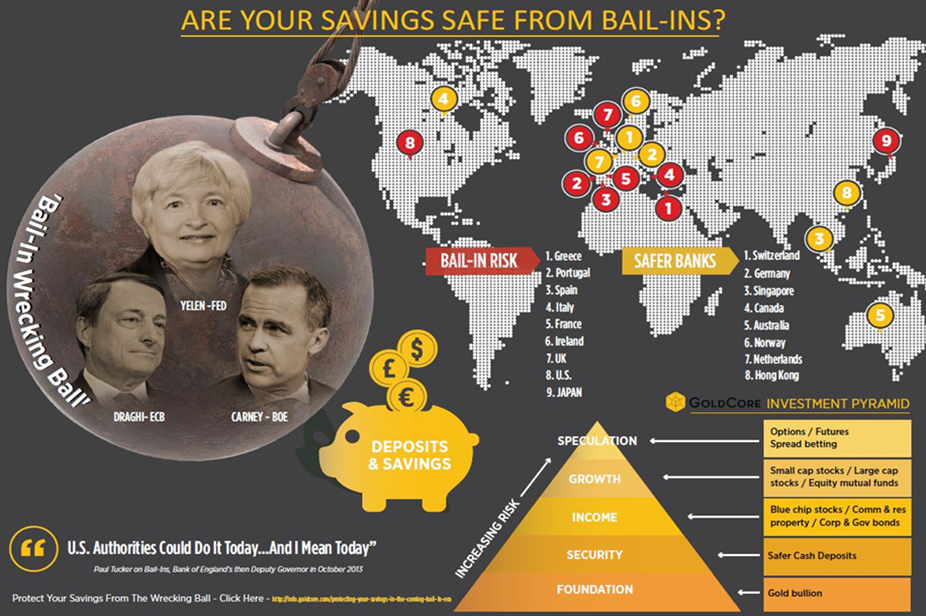
Spreadbury highlights that the £85,000 guarantee to UK depositors by the Financial Services Compensation Scheme is largely unfunded and that the government has said it will not intervene to rescue failing banks in the future – leaving deposits to be bailed-in.

The EU and other supra national institutions have been agreeing the architecture for bail-ins in recent years. Just this month, at the start of June, the European Commission has ordered 11 EU countries to enact the Bank Recovery and Resolution Directive (BRRD) within two months or be hauled before the EU Court of Justice.
11 countries are under pressure from the EC and had yet “to fall in line”. The countries were Bulgaria, the Czech Republic, Lithuania, Malta, Poland, Romania, Sweden, Luxembourg, the Netherlands, France and Italy.
The new bail-in system is largely in place and emergency resolutions can be brought forward in the event of banks failing in the interim period. The “bail-in” will require that shareholders, bondholders and importantly now depositors will all suffer ‘haircuts’ or be burnt if a financial institution is in trouble.
The European parliament confirmed that depositors with more than 100,000 euros ($137,000) would be bailed in after shareholders and bondholders. It is important to note that the 100,000 figure is an arbitrary figure and there is a possibility that this figure could be reduced by an insolvent government faced with an imploding banking system.
To deal with these risks Spreadbury advocates a well diversified portfolio. Cash should be spread out in different banks. Savers should hold physical cash outside the banking system – a remarkable suggestion coming from somebody so well acquainted with the workings of the financial system.
He also suggests that investors hold gold and silver. He says that the unravelling he foresees is more likely to happen in “the next five years rather than ten”.

Fidelity’s bond manager echoes what we have been advising clients and the wider public for some years now.
Mr Spreadbury concluded
“The message is diversification. Think about holding other assets. That could mean precious metals, it could mean physical currencies.”
Must Read Guides:
Protecting Your Savings In The Coming Bail-In Era
From Bail-Outs To Bail-Ins: Risks and Ramifications – Includes 60 Safest Banks In the World
MARKET UPDATE
Today’s AM LBMA Gold Price was USD 1,193.70, EUR 1,052.14 and GBP 752.53 per ounce.
Friday’s AM LBMA Gold Price was USD 1,198.15, EUR 1,058.86 and GBP 755.65 per ounce.
Gold closed at $1,200.06 an ounce on Friday and silver was down 0.4 percent and closed at $16.10 an ounce. Palladium lost 1.9 percent to $705.25 after touching a 16-month low.
Gold climbed 1.8 percent in dollar terms last week, its second successive week of gains. Silver prices surged 1.8% last week and increased their year-to-date gain to 3.4%.

Gold in Singapore for immediate delivery ticked lower 0.3 percent to $1,196.60 an ounce near the end of the day, whilegold in Switzerland was lower and fell to $1,193 an ounce.
Greek Prime Minister Tsipras submitted a new list of reforms last night in a last ditch attempt to appease creditors. Crisis negotiations are taking place today in Brussels with Greece’s creditors to see if a deal can be reached after 5 months of stalemate. Greece owes 1.6 billion euros to the IMF by June 30th.
Euro zone leaders meeting in Brussels later on Monday are unlikely to be able to take a formal decision on whether to provide aid to Greece but there is still time this week to finalise an agreement, German Chancellor Angela Merkel said earlier.
“There are still a lot of days in the week in which decisions can be taken,” Merkel said, speaking to reporters in the eastern city of Magdeburg. She noted that without an agreement between Greece and the so-called institutions – the EC, EBC and IMF – the summit on Monday evening could not be more than a discussion forum.
The markets are irrationally exuberant again this morning on hopes for a Greek deal and European stocks have surged higher despite continuing uncertainty.
Chinese markets are closed today.
Platinum and palladium saw losses last week which have been extended today. Platinum is down another 1.3% and edging back towards last week’s more than six-year low at $1,066.50/oz. Palladium has reached its lowest in 18 months, at $696.47/oz this morning.
In late morning European trading, gold is down 0.44 percent at $1,194.53 an ounce. Silver is up 0.50 percent at $16.17 an ounce and platinum is down 0.68 percent at $1,075.68 an ounce.
end
Withdrawals from SGE equals 46 tonnes up 41% from the previous weak. Because of withdrawals from SGEI can distort actual demand it is now difficult to get an accurate reading on gold demand in China:
(courtesy Koos Jansen)

STRONG WITHDRAWALS MAINLAND & HONG KONG GOLD VAULTS
From June 8 – 12 withdrawals from SGE certified vaults in China mainland and CME Kilobar vaults in Hong Kong accounted 76 for tonnes.
Withdrawals from the vaults of the Shanghai Gold Exchange (SGE) and Shanghai International Gold Exchange (SGEI) came in elevated for this time a year at 46 tonnes in week 23 (June 8 – 12), up 41 % from the previous week.


Year to date a staggering 1,061 tonnes have been withdrawn, up 20 % y/y (2014), up 7 % y/y from 2013.
SGE withdrawals have lost their accuracy since the launch of the SGEI in September 2014 – withdrawals in the Shanghai Free Trade Zone (SGEI) can distort Chinese wholesale demand measured by SGE withdrawals (SGE withdrawals disclosed in the weekly reports capture both SGE and SGEI withdrawals). From numbers available in 2014 we knew that not much of SGEI trading was withdrawn by foreign SGEI members; most of the withdrawals in the Shanghai Free Trade Zone were imported into the mainland by SGE members.
For more information please read The Mechanics Of The Chinese Domestic Gold Market, Chinese Gold Trading Rules And Financing Deals Explained, The Workings Of The Shanghai International Gold Exchange andSGE withdrawals in perspective.
At this stage total SGE withdrawals, as disclosed by the weekly SGE reports, are difficult to analyze as we didn’t get any hints lately from the Chinese as to what is composition of the demand side of withdrawals, how much are SGEI withdrawals that are not imported into the mainland, and what is the composition of the supply side, how much gold is imported into the mainland and/or recycled to supply SGE withdrawals. Technically, all trades (volume) on the SGEI can be withdrawn and exported to, for example, India. This is not likely, but we don’t know. Attempts from my side to obtain the latest data regarding SGEI withdrawals have resulted in little intelligence.
In week 23 (June 8 -12) total SGEI volume was 35 tonnes; international gold trading in renminbi slowly comes to life.

The iAu99.99 contract is traded on the SGEI; Au99.95, Au99.99 and Au(T+D) are traded on the SGE.
Hong Kong Kilobar Withdrawals
In March 2015 the Chicago Mercantile Exchange (CME) launched a gold kilobar futures contract, which can be physically delivered in Hong Kong. The contract can be traded over exchanges (CME Globex, CME ClearPort, CME Direct, New York open outcry) and in the Over The Counter (OTC) market.
The kilobar volume over exchanges is insignificant and I’m not aware if any delivery is made from these trades. However, if we look at the physical gold throughput of the Hong Kong vaults, we must conclude this contract is a popular trade in the OTC market. This has been confirmed to me by a CME representative. Note, withdrawals from the Hong Kong vaults transcend the volume disclosed by the Merc, so the physical settlements must happen in the OTC market.
I would like to emphasize kilobar withdrawals do not have the same significance as SGE withdrawals. The mechanics of the gold market in Hong Kong are completely different from the market in the mainland. Hong Kong has been a trade hub for centuries; gold is imported and exported in vast amounts. Kilobar withdrawals do not reflect gold demand; it does illustrate how much is going through the Chinese Special Administrative Region (Hong Kong).

In week 23 kilobar withdrawals in Hong Kong accounted for 30 tonnes. On June 8 a record 16.61 tonnes in 9999 kilobar gold was withdrawn from the Brink’s vault in Hong Kong.

Koos Jansen
E-mail Koos Jansen on:koos.jansen@bullionstar.com
end
(courtesy Platt’s London/GATA)
So why don’t South African mines and unions agitate against gold price suppression?
Submitted by cpowell on Fri, 2015-06-19 17:34.Section: Daily Dispatches
South African Mine Employers to Offer Unions Pay Linked to Gold Price
From Platt’s, London
Friday, June 19, 2015
JOHANNESBURG, South Africa — Gold employers will present a social package of welfare and training plus a financial plan for the survival of mines on the third day of talks next week in a bid to counter massive wage demands from the unions, the chief negotiator for the employers, Elize Strydom said Friday.
It is a package tied up with a gold-linked pay plan that is unlikely to find favor with the unions.
Unions representing 93,000 gold mine workers will open talks on Monday for a new three year pay deal to come into force from July 1. …
A cash pay offer was unlikely to be made next week, but the employers would also put forward a plan Wednesday to give bonuses when the gold price goes up and discuss pay cuts, before job cuts, if it goes down, she said. “We want people to share in the good times when the gold price has gone and feel the pain when it goes down. …”
… For the remainder of the report:
http://www.platts.com/latest-news/metals/johannesburg/south-african-mine…
end
First Majestic Silver’s CEO Neumeyer elaborates why he issued his complaint to the CFTC on silver manipulation
First Majestic Silver’s Neumeyer elaborates on market manipulation complaint to CFTC
Submitted by cpowell on Sun, 2015-06-21 20:14.Section: Daily Dispatches
4:14p ET Sunday, June 21, 2015
Dear Friend of GATA and Gold:
First Majestic Silver CEO Keith Neumeyer, interviewed by Dan Ameduri of Future Money Trends, explains why he has heeded silver market analyst Ted Butler’s urging to complain to the U.S. Commodity Futures Trading Commission about silver price suppression. Neumeyer adds that it’s plain that the forces manipulating the monetary metals futures markets are also toying with the prices of mining company shares. The interview is 26 minutes long and can be heard at Future Money Trends here:
http://www.futuremoneytrends.com/trend-videos/interviews/silver-producer…
CHRIS POWELL, Secretary/Treasurer
Gold Anti-Trust Action Committee Inc.
end
(courtesy GATA/Chris Powell)
Justice Dept. won’t do anything about metals market rigging, GATA chairman says
Submitted by cpowell on Sun, 2015-06-21 20:36.Section: Daily Dispatches
4:35p ET Sunday, June 21, 2015
Dear Friend of GATA and Gold:
A report that the U.S. Justice Department is investigating investment banks for possible manipulation of the gold and silver market is not true, GATA Chairman Bill Murphy tells Ken Ameduri of Future Money Trends in an interview posted today. Such investigations never get anywhere, Murphy says, because central banks are the instigators of the manipulation. The interview is 15 minutes long and it’s posted at Crush The Street here:
http://www.crushthestreet.com/videos/live-interviews/doj-gold-manipulati…
CHRIS POWELL, Secretary/Treasurer
Gold Anti-Trust Action Committee Inc.
end
(courtesy Lawrence Williams/Mineweb)
Gold mine cost cutting not allaying margin falls – GMP

FUNCHAL – Some interesting research from analysts at Canadian headquartered GMP Securities builds on a theme we covered here in these pages around six weeks ago. This suggested that, if anything, the cost cutting programmes entered into by most major and mid-tier gold mining companies may have largely gone as far as they can go. (See: Has gold mine cost cutting run its course?)
Indeed in its latest mid-year report the Canadian brokerage and investment bank points out that despite some seemingly effective cost cutting, profit margins have been continuing to fall regardless. It bases its analysis on All In Sustaining Costs (AISC) and that these, despite being far more encompassing, and less open to company by company variations than cash costs, are still reckoned by many bank analysts not to go far enough to account for all corporate costs in running modern day gold mines.
The mining companies have been entering into cost reductions that may perhaps be considered as window dressing to keep individual and institutional holders happy in that the easy cuts are being made regardless of the longer-term implications these may have on a company’s future. These include cutting back and deferring capital programmes (i.e. new mine developments and expansions); selling off less economic or lossmaking mines to smaller companies which may be more flexible in their approach; mining to higher grades, and thus debilitating longer term resource and reserve levels; cutting back management tiers (perhaps an area where the bigger companies can actually make sensible savings); cutting back on exploration expenditures (which like cutting capital programmes can impact on the longer term future for the companies concerned), reducing labour forces etc.
In effect these are the easy options in helping allay shareholder and institutional pressures to cut costs, but once made it becomes increasingly difficult to maintain these or extend them into the future. Most mining companies will have been hoping against hope that there will be a substantial gold price recovery sufficient to enable them to return to better profit margins and reverse some of those cuts to activities which might be beneficial long term, but so far no such rise has been forthcoming with gold trading largely flat over the past year to 18 months.
Indeed GMP subtitles its analysis ‘Cost optimizations can only go so far…’ and notes that although costs did indeed come down in 2013 and remain below 2013 levels in their forecasts for the current year, they do seem to have plateaued. For senior producers the AISC on average have declined 8% from $1,035/oz in 2013 to the 2015 forecast of $958/oz while mid-tier producers are seeing AISC down from $963/oz to $900 /oz – a fall of 7%. Meanwhile the gold price has fallen 16% from 2013 to GMP’s forecast $1225/oz for 2015. The brokerage/investment bank then comments that the question now is how much more the miners can do to cut costs further, if at all, and whether these new cost structures are sufficient to operate in the current environment.
Looking into the analysis further, something that GMP does not seem to comment on specifically is that the analysis includes a chart which, although it still shows an overall costs decline as noted above from 2013 to 2015, what must be disturbing for the miners is that it also shows AISC moving marginally higher for 2015 than they were in 2014. This suggests that although margins have been falling, costs are beginning to rise again – something we pointed out in our earlier article which looked at costs guidance figures for 2015 from all the top tier gold miners.
Another interesting point in the GMP analysis is that higher cost producers appear to have been less successful in cutting costs than the lower cost miners – contrary to expectations. In another chart they show that for the higher cost fraction, costs have only declined 4% from 2013 to 2015, while the lower cost section saw a fall of 10% over the same period. But, again in both cases there appeared to be a marginal increase in estimated costs for 2015 over and above those for 2014.
So with AISC beginning to rise again, and perhaps with the miners having little scope for implementing further reductions, naturally occurring inflation will be eating further into margins unless we see a pickup in the gold price. Some respite has been accorded to non-US producers by US dollar strength against most other currencies and by the big fall in oil prices. But both these seem to have stalled, at least for the time being, which will bring further pressures to bear on marginal gold mining operations. Much of the industry could thus be facing serious problems in the short to medium term if higher gold prices fail to materialise and come to their rescue.
end
And finally we have Bill Holter:
(courtesy Bill Holter/Holter-Sinclair collaboration)
“It’s already in the market”?
end
A link to my most recent interview with Collin Kettell of Palisade Radio http://palisaderadio.com/bill-holter-greek-default-to-trigger-48-hour-global-meltdown/ . Thanks, Bill
end
And now overnight trading in stocks and bonds from Asia and Europe:
1 Chinese yuan vs USA dollar/yuan strengthens to 6.2092/Shanghai bourse red and Hang Sang: green
2 Nikkei closed up by 253.95 points or 1.26%
3. Europe stocks all in the green/USA dollar index up to 94.24/Euro falls to 1.1343
3b Japan 10 year bond yield: slightly rises .43% !!!!(Japan buying 100% of bond issuance)/Japanese yen vs usa cross now at 123.14/ominous to
3c Nikkei still just above 20,000
3d USA/Yen rate now well above the 123 barrier this morning
3e WTI 60.46 and Brent: 63.62
3f Gold down/Yen down
3gJapan is to buy the equivalent of 108 billion uSA dollars worth of bond per month or $1.3 trillion. Japan’s GDP equals 5 trillion usa.
Japan to buy 100% of all new Japanese debt and by 2018 they will have 25% of all Japanese debt. Fifty percent of Japanese budget financed with debt.
3h Oil down for WTI and down for Brent this morning
3i European bond buying continues to push yields lower on all fronts in the EMU. German 10 yr bund rises to .81 per cent. German bunds in negative yields from 3 years out.
Except Greece which sees its 2 year rate fall to 23.60%/Greek stocks this morning rises by 5.72%/ still expect continual bank runs on Greek banks /Greek default inevitable/
3j Greek 10 year bond yield fall to to: 12.59%
3k Gold at 1195.00 dollars/silver $16.17
3l USA vs Russian rouble; (Russian rouble up 4/10 in roubles/dollar in value) 53.84,
3m oil into the 60 dollar handle for WTI and 63 handle for Brent/Saudi Arabia increases production to drive out competition.
3n Higher foreign deposits out of China sees huge risk of outflows and a currency depreciation. This can spell financial disaster for the rest of the world/China may be forced to do QE!!
30 SNB (Swiss National Bank) still intervening again in the markets driving down the SF. It is not working: USA/SF this morning .9204 as the Swiss Franc is still rising against most currencies. Euro vs SF is 1.0442 just below the floor set by the Swiss Finance Minister.
3p Britain’s serious fraud squad investigating the Bank of England/
3r the 3 year German bund remains in negative territory with the 10 year moving further away from negativity at +.81
3s Ten weeks ago, the ECB increased the ELA to Greece by another large 2.0 billion euros.Six weeks ago, they raised it another 1.1 billion and then 4 weeks ago they raised it another tiny 200 million euros to a maximum of 80.2 billion euros. Three weeks ago, the limit was not raised. Last week, the ECB raised the ELA by 1/2 billion euros to 80.7 billion euros. Last Thursday, it was raised by a huge 2.3 billion euros to 83.0 billion.ON Wednesday, we hear ( confirmed ) that the ELA has been raised by another 1.1 billion euros to 84.1 billion euros.Then on Friday, another 1.8 billion ELA was raised to a maximum of 85.9 billion euros.The ELA is used to replace depositors fleeing the Greek banking system. The bank runs are increasing exponentially.This week the ECB is contemplating cutting off the ELA which would be a death sentence to Greece and they are as well considering a 50% haircut to all Greek sovereign collateral which will totally wipe out the entire Gr. banking and financial sector.
3t Greece paid the 700 million plus payment to the IMF last Wednesday but with IMF reserve funds. The funds are deferred to June 30.
3 u. If the ECB cuts off Greece’s ELA they would have very little money left to function. So far, they have decided not to cut the ELA but this weekend is the likely time to do it.
4. USA 10 year treasury bond at 2.33% early this morning. Thirty year rate well above 3% at 3.12% / yield curve flatten/foreshadowing recession.
5. Details Ransquawk, Bloomberg, Deutsche bank/Jim Reid.
(courtesy Jim Reid/Bloomberg/Deutsche bank/zero hedge)
Stocks Soar, Germany’s Dax Set For Biggest Gain In Three Years On Greek Deal “Optimism”
We will start Monday’s market wrap with the same reasoning we gave why on Friday everything started off neon green:
In what is perhaps the most glaring instance of central bank intervention yet, Reuters today captured the market mood as follows: “Calm ruled Europe’s stock and currency markets on Friday as Greece inched closer to a default later this month….the euro was down just 0.3 percent against the dollar and major European stock markets gained in early trade.” Why is Europe (and by extension US futures) so desperate to show green today even with a Greek default imminent? The same reason we explained back in January when we said the ECB and the Fed would do everything in their power to eliminate all Greek “negotiating” leverage which from day one was the attempt to create market contagion from Grexit. Unfortunately for Greece, the ECB’s QE intervened and blew a hole right through its plans, and now, it finds that not only do markets not care about the Greek contagion about which even Janet Yellen warned, but in the US hit all time highs!
Well, today is Friday taken to the nth degree, with the markets having already declared if not victory then the death of all Greek “contagion” leverage, following news that a new Greek proposal was sent yesterday (which as we summarized does notinclude any of the demanded by the Troika pension cuts), ignoring news that Greece had again sent Belgium the wrong proposal which the market has taken as a sign of capitulation by Tsipras, and as a result futures are surging higher by nearly 1%, the German DAX is up a whopping 3.1%, on track for the biggest one day gain in three years, Greek stocks up over 8%, German and US Treasurys sliding while Greek and peripheral bonds are surging (at last check Spanish paper was about 20 bps tighter than comparable US 10 year bonds because, well, fundamentals and stuff).
Another factor helping buoy sentiment is an unconfirmed report from Bloomberg that in an unprecedented move, the ECB boosted Greek ELA earlier today which would make it the third time in under a week, in a bid to keep insolvent Greek banks funded for a few more days if not hour even as the Greek bank run soaks up all the cash the ECB’s ELA pumps in virtually the same day. This happens as Germany’s Christian Social Union finance committee member Hans Michelbach and Social Democrat deputy parliamentary head Carsten Schneider said they want to stop Emergency Liquidity Assistance for Greek banks, according to a Spiegel interview with the politicians, according to whom the “ELA gives Greece more leeway to negotiate” and creates a “fiction of Greek banks’ solvency.” Well yes, the whole point – not to mention the entire theater such as the photo below – is to kick the can if not months ahead then at least days and hours.

So yes, Greek optimism has again been the main driving force thus far in Europe with fixed income products lower and equities higher in the first half of the session. The upbeat tone has largely stemmed from reports that Greek PM Tsipras has submitted a further set of proposals ahead of today’s emergency summit which is due to commence at 1130BST/0530CDT. However, according to a senior Juncker aide, no emergency funds will be released at today’s meeting, with the aim to achieve a political understanding. Juncker also said no deal has been agreed yet on Greece and does not believe a deal will be done today.
Not helping things was Finland’s finance minister Stubb who said he does not foresee a breakthrough today, saying he has “very low expectations for today” and that “It seems to be a Monday where we have wasted a lost of air miles, as finance ministers and European leaders.”
Nonetheless, the upbeat weekend reports and news that the ECB have extended the ELA for Greek banks has seen Greek assets
outperform throughout the session with the ASE sharply higher (+8.3%) and Greek 2yr yield lower (-383bps),
Sentiment in Europe for stocks has also been underpinned by various stocks specific news with German automakers supported by a positive note from JP Morgan and weaker EUR, subsequently leading the DAX (+3.0%) to be on track for its best session in 3yrs with the Eurostoxx (+2.9%) seeing its largest daily gain since January. Telecom names have also been supported by reports that Altice and Numericable have made offers for Bouygues.
And while equity algos are testing and breaking all stops to the upside in FX it is a different story, and the EUR has somewhat bucked the trend by shedding its initial gains. Over the past month EUR/USD has continued to ebb higher amid hopes that at some point a deal will be struck between Greece and their creditors (momentum also helped by the FOMCinspired weaker USD), with CFTC data indicating an unwind of short EUR positions. However, now that it appears that a deal is within reach, an element of ‘buy the rumour, sell the fact’ appears to have crept into price action, with some participants also placing attention on comments from EU’s Juncker who said he wants to see better management of the EUR by Brussels. Optimism has also seen an unwind of safe-haven positions, with the weaker CHF helping USD gain further ground against EUR.
In the commodity complex, gold has been dragged lower throughout the session by the unwind seen across safe-haven assets with the yellow metal looking to test its 50DMA to the downside at USD 1194.00. Palladium continues its recent decline, falling for the 8th consecutive day to break below USD 700 and reach its lowest level since February 2014, with ABN Amro suggesting prices could fall to USD 650, a further 10% by December. Elsewhere, WTI and Brent crude futures trade marginally higher with WTI back above USD 60/bbl as newsflow remains otherwise light.
So what will most likely happen vis-a-vis Greece again is no deal today, with the can kicked until the next summit later this week, and hopes that the Greek bank run shakes any remaining will to fight in the Syriza regime which will finally sign whatever proposal is present to it, or else suffer capital controls, a default, and so on. Pretty much everything we have seen for months on end.
To summarize: European shares remain higher though off intraday highs with the autos and telco sectors outperforming and basic resources, travel & leisure underperforming. Greek proposal given guarded welcome as leaders gather for talks. ECB said to raise Greek bank aid for third time in less than a week. The German and French markets are the best-performing larger bourses, U.K. the worst. The euro is little changed against the dollar. German 10yr bond yields rise; Greek yields decline. Commodities gain, with natural gas, corn underperforming and WTI crude outperforming. U.S. Chicago Fed index, existing home sales due later.
Market Wrap
- S&P 500 futures up 0.8% to 2115.2
- Stoxx 600 up 1.9% to 392.9
- US 10Yr yield up 7bps to 2.33%
- German 10Yr yield up 10bps to 0.85%
- MSCI Asia Pacific up 0.9% to 148.5
- Gold spot down 0.5% to $1194.1/oz
- 94% of Stoxx 600 members gain, 5% decline
- Eurostoxx 50 +3.2%, FTSE 100 +1.2%, CAC 40 +3.2%, DAX +3.2%, IBEX +2.8%, FTSEMIB +2.3%, SMI +1.4%
- Asian stocks rise with the Sensex outperforming.
- MSCI Asia Pacific up 0.9% to 148.5
- Nikkei 225 up 1.3%, Hang Seng up 1.2%, Kospi up 0.4%, Shanghai Composite closed, ASX up 0.2%, Sensex up 1.5%
- Euro up 0.05% to $1.1358
- Dollar Index up 0.06% to 94.14
- Italian 10Yr yield down 12bps to 2.16%
- Spanish 10Yr yield down 12bps to 2.16%
- French 10Yr yield up 8bps to 1.24%
- S&P GSCI Index up 0.5% to 433.6
- Brent Futures up 0.9% to $63.6/bbl, WTI Futures up 0.9% to $60.2/bbl
- LME 3m Copper up 0.4% to $5683/MT
- LME 3m Nickel down 0.4% to $12665/MT
- Wheat futures up 0.7% to 496 USd/bu
Bulletin headline summary from Bloomberg and RanSuuawk
- Optimistic Greek reports lead stocks higher with the DAX on course for its best session in 3yrs (+3.0%)
- In FX markets, EUR bucks the trend in a ‘buy the rumour, sell the fact’ manner
- Looking ahead, all eyes will be on the negotiations between Greece and their creditors with the EU summit to begin at 1130BST/0530CDT
- Treasuries drop in overnight trading as latest proposal by Greek PM Tsipras drew a rare positive nod from EU officials who begin marathon talks today on Greece’s debt situation.
- The European Central Bank raised emergency funding for Greek lenders for the third time in less than a week, a person familiar with the decision said
- European Commission President Juncker wants the euro area to move toward creating a common treasury by 2025, according to a report endorsed by ECB President Draghi and other senior officials
- As Greece teeters on the brink of crashing out of the monetary union, Europe’s single currency is headed for only its second monthly gain versus the dollar in a year
- European banks are better positioned to weather a Greek euro exit because their financial strength has improved in the past three years, while funding markets are less likely to freeze, Moody’s Investors Service said
- European Union governments extended sanctions against Russia by six months to the end of January, to keep up the pressure on the Kremlin over eastern Ukraine
- Sovereign 10Y bond yields mixed, with Greece dropping 147bps; Portugal, Italy and Spain yields also lower. Asian, European stocks gain, U.S. equity-index futures gain. Crude oil, copper, gold higher
DB’s Jim Reid completes the weekend and overnight event wraps:
It’s a new week but a similar theme as Greece is set to dominate today’s agenda ahead of the emergency EU Leaders Summit at 6pm GMT tonight. The meeting, however, is one which could go a long way to shaping the path that the saga takes from here. Any progress today is set to depend on the extent to which technical teams have had time to review a supposed new proposal offered by Athens yesterday, given that various European officials have made it clear that technical negotiations can’t take place at the summit and an agreement would therefore need to be reached ahead of it. In the mean time, Reuters have reported the Chief-of-Staff to EC President Juncker as saying that the latest Greek proposal is a ‘good basis for progress’. The details are unsurprisingly vague with suggestions that the Greek government has shown an indication for further concessions although it’s tough to say just how material these are versus the known gaps that exist between the two sides.
Ahead of the European open, the news of a proposal appears to have given a lift to markets in Asia this morning. Indeed the Nikkei (+0.88%), Hang Seng (+0.44%) and Kospi (+0.41%) are all up as we type. Markets in China today are closed for a public holiday. S&P 500 futures (+0.43%) are also pointing towards a positive start, while the Euro (+0.35%) appears to have been buoyed by the news of a Greek proposal. The optimistic start for risk assets appears to have fed over into the Treasury market where 10y yields are 3.2bps higher at 2.290%.
Back to Greece, over the weekend Greece PM Tsipras was said to have briefed German Chancellor Merkel, French President Hollande and the EC’s Juncker by phone on Sunday while a statement from Tsipras’s office said that the ‘PM has presented the three leaders Greece’s proposal for a mutually beneficial agreement that will give a definitive solution and not a postponement of addressing the problem’. Ahead of the Summit, Tsipras is expected to meet with the EC head Tusk, before then meeting Juncker, the ECB’s Draghi and the IMF’s Lagarde this morning at 11.30am GMT in an extraordinary Eurogroup meeting which looks set to discuss the proposals put forward and will likely set the tone for the Summit tonight. Meanwhile, this morning the ECB will hold another conference call at 9.30am GMT to once again discuss the liquidity situation for Greek banks. This comes after the ECB approved a €1.8bn increase in the ELA cap on Friday on the back of mounting deposit withdrawals. Reuters are reporting that Greek pre-orders for deposit withdrawals on Monday were said to have already reached €1bn.
In the latest Focus Europe piece published on Friday, our Economics colleagues noted that they continue to believe that the most likely outcome is that a deal will be reached. They suggest that this is the most rational outcome given that a Grexit would be costly for both sides and a deal is what Greek citizens want (according to opinion polls). They note however that in order for it to be sustainable, the deal needs to be a balanced compromise, although the path to which is perilous. Greek PM Tsipras needs to show the left wing of Syriza that he drove the bargaining process to the edge of the cliff, although pushing an agreement through the Greek parliament may entail the loss of the current coalition. They also suggest that in the case of a non-payment event, capped ELA and capital controls may yet be required to gain agreement on a sustainable, balanced compromise. It looks set to be a busy day ahead.
Recapping markets on Friday, it was another day of falling Treasury yields as the benchmark 10y ended 7.7bps lower in yield at 2.259%, the lowest close since June 1st with yields now 14bps off levels in the minutes just prior to the FOMC last week. With the yield curve bull flattening, the move lower was led at the long end with 30y yields down 8.2bps, while 2y and 5y yields ended 1.6bps and 5.4bps lower respectively. Further sharp moves in Fed Fund expectations continue to drive market direction as the Dec15 (-1.5bps), Dec16 (-5.0bps) and Dec17 (-6.5bps) contracts all saw yields fall for the fifth consecutive day. With the moves in rates, the Dollar pared most of its earlier gains with the Dollar index ending +0.05%. It was a softer day for US equities meanwhile as energy and financial stocks weighed on the S&P 500 (-0.53%) to bring to an end three consecutive days of gains. Oil markets fell with WTI (-1.39%) and Brent (-1.93%) both lower, while Gold ended -0.14%.
With no data on Friday in the US, there was some attention on the San Francisco Fed’s Williams who said that ‘my own forecast would be having us raise rates two times this year’ before reiterating that that would somewhat unsurprisingly ‘depend on the data’. There was a similar tone out of the Cleveland Fed President Mester who suggested that the Fed can withstand a ‘small rate increase’, although she acknowledged that she sees the argument of getting a little more confirming data as reasonable as well.
Equity markets in Europe appeared to trade with some optimism on Friday ahead of today’s summit. That tone did fade as the US session kicked in, however with the exception of the DAX (-0.54%) most equity markets finished up on the day including the Stoxx 600 (+0.36%), CAC (+0.25%), FTSE MIB (+1.07%) and the IBEX (+0.67%). Greek equities (+0.57%) also rose for the second consecutive day, although still suffered sharp declines over the week as the index finished the 5 days down 11.25%. Credit markets also had a decent session as Crossover in particular ended 16bps tighter. Bunds continued to remain well bid, with yields falling for the 6th time in the 7 sessions as the 10y ended 5.6bps lower at 0.752%. It was a better day for all bond markets in fact as 10y yields in Spain (-0.5bps), Italy (-1.2bps) and Portugal (-6.7bps) all fell, while Greek 10y yields ended 37bps lower.
There wasn’t much to report on the data front in Europe with just a slightly softer than expect German PPI reading for May (0.0% mom vs. +0.2% expected), while UK public sector net borrowing for the same month was slightly below market consensus (£10.1bn vs. £10.3bn expected). Elsewhere, the EC’s Juncker has suggested creating a common Treasury for the Euro area by 2025 in a so-called ‘five presidents’ report due to be released today. The report is also set to suggest a ‘shock absorption mechanism’ in a bid to help countries weather economic ups and downs as well as calling on the Euro area to complete its economic and monetary union ‘at the latest by 2025’.
Moving onto this week’s calendar now, it’s a reasonably quiet start to the week today data wise with just Euro area consumer confidence due. Over in the US however, we’ve got existing home sales data to look forward to as well as the Chicago Fed national activity index for May. All eyes will of course be on the EU Leaders Summit and Eurogroup meeting beforehand. We start Tuesday in Asia with the flash June manufacturing PMI’s for China and Japan. There’s more June flash PMI’s due in Europe on Tuesday with the manufacturing, services and composite readings due for the Euro area, Germany and France. French confidence indicators are also expected along with CBI trends for the UK. In the US on Tuesday focus will be on the important durable goods and capital goods prints. New home sales for May are also due along with the flash manufacturing PMI, FHFA house price index and Richmond Fed manufacturing index. Moving to Wednesday, we start with Japan PPI and small business confidence along with the China leading index print. In the European timezone, focus will be on French Q1 GDP and German IFO surveys for June. In the US we’ll get the third revision to Q1 GDP and core PCE. It’s a quiet start to Thursday with just German consumer confidence expected. There will be much focus on the US however with personal income and spending, PCE deflator, initial jobless claims, flash services and composite PMI’s and the Kansas City Fed manufacturing activity index all expected. On Friday we start in Japan with the May CPI print. Data flow in Europe consists of Euro area money supply and confidence indicators for Italy. In the US we end the week with the University of Michigan Consumer Sentiment print. Of course, Greece headlines are set to dominate much of the week while Fedspeak wise we’ve got Powell and George due.
We have two huge important commentaries on the Greek banking system:
Meanwhile, Greece Is Quietly Printing Billions Of Euros
Earlier today we showed why Greece is now literally living on borrowed time. The combined €2.9 billion in ELA cap increases ‘generously’ bestowed upon the flailing Greek banking sector by the ECB last week looks to have been barely enough to keep things from “ending very differently” (to quote Kathimerini) at the ATMs on Friday.
But perhaps more importantly from a big picture perspective, Greece may have already breached the upper limit of its borrowing base. JPM calculates Greek banks’ eligible collateral at €121 billion (€38 billion in EFSF bonds €8 billion in government securities, and €75 billion in “credit claims”). With Friday’s ELA increase, the country’s total borrowings (that’s OMO plus ELA) amount to some €125 bilion. Why would the ECB allow this? Because it knows the breach will be promptly limited or reversed on Monday, or there will be a deal.
So, it is literally “deal or no deal” time, because if JPM is correct and eligible collateral was either exhausted two weeks ago or, in the best case scenario, is right at the limit, capital controls will need to be put in place as early as Tuesday at which point the ATMs will officially stop dispensing freshly-minted euros which, incidentally, brings up an important point. As Barclays notes, during the same period over which Greek banks lost nearly €30 billion in deposits, banknotes in circulation jumped by some €13 billion. In short, because Greeks are increasingly prone to stuffing their euros in mattresses, a large proportion of the deposit flight has come in the form of hard currency withdrawals, meaning the Bank of Greece is forced to (literally) print billions in physical banknotes:
A large part of the deposit outflows is in the form of banknotes, whose usage has increased significantly since the end of last year (+44%).Indeed, out of a deposit outflow of €29bn (from the end of November 2014 to the end of April 2015), banknotes in circulation in Greece have increased by €13bn.
But hard currency printed in excess of NCB quotas (set by the ECB) represents a liability to the rest of Eurosystem and so must be added to Greece’s negative TARGET2 balance to determine the EMU’s total exposure to Greece:
The amount of banknotes in excess of the quota for Greece (about €27bn) represents a liability of the Central Bank of Greece to the Eurosystem in addition to the net liabilities related to transactions with the other Central Banks in the Eurosystem (Target 2 liabilities). As of the end of April, net liabilities related to the allocation of euro banknotes were €16.2bn and the Target 2 balance was negative by about €99bn. Therefore, the total exposure of the Eurosystem to Greece was around €115bn. This corresponds to the amount of borrowing of Eurosystem liquidity (OMOs + ELA), as shown in Figure 4. Taking the increase in the ELA ceiling as an indication of the deposit outflows/usage of banknotes and the increase in Eurosystem funding, such exposure might have increased to about €125bn currently, we calculate.

Of course, given Germany’s massive TARGET2 credit with the ECB, a liability to the Eurosystem is, for all intents and purposes, a liability to Germany:

So we can add the quiet printing of some €13 billion in banknotes to the list of reasons why German FinMin Wolfgang Schaeuble, a growing number of German MPs, and, increasingly, the German people have run completely out of patience with Athens.
As for all the Athenians who have recently tapped the ATMs, check your euros. If the serial numberstarts with a “Y” that means it was printed by the Bank of Greece and you should probably hang on to it because you might soon be able to sell it at a premium to a museum.
end
“The Collateral Has Run Out” – JPM Warns ECB Will Use Greek “Nuclear Option” If No Monday Deal
In Athens on Friday, the ATM lines began to form in earnest.

(via Corriere)
Although estimates vary, Kathimerini, citing Greek banking officials, puts Friday’s deposit outflow at €1.7 billion. If true, that would mark a serious step up from the estimated €1.2 billion that left the banking system on Thursday and serves to underscore just how critical the ECB’s emergency decision to lift the ELA cap by €1.8 billion truly was. “Banks expressed relief following Frankfurt’s reaction, acknowledging that Friday could have ended very differently without a new cash injection,” the Greek daily said, adding that the ECB’s expectation of “a positive outcome in Monday’s meeting”, suggests ELA could be frozen if the stalemate remains after leaders convene the ad hoc summit. Bloomberg has more on the summit:
Dorothea Lambros stood outside an HSBC branch in central Athens on Friday afternoon, an envelope stuffed with cash in one hand and a 38,000 euro ($43,000) cashier’s check in the other.
She was a few minutes too late to make her deposit at the London-based bank. She was too scared to take her life-savings back to her Greek bank. She worried it wouldn’t survive the weekend.
“I don’t know what happens on Monday,” said Lambros, a 58-year-old government employee.
Nobody does. Every shifting deadline, every last-gasp effort has built up to this: a nation that went to sleep on Friday not knowing what Monday will bring. A deal, or more brinkmanship. Shuttered banks and empty cash machines, or a few more days of euros in their pockets and drachmas in their past – – and maybe their future.
For Greeks, the fear is that Monday will be deja vu, a return to a past not that distant. Before the euro replaced the drachma in 2002, the Greeks were already a European bête noire, their currency mostly trapped inside their nation, where cash was king and checks a novelty.
Everything comes together on Monday. Greek Prime Minister Alexis Tsipras, back from a visit with Vladimir Putin in St. Petersburg, will spend his weekend coming up with a proposal to take to a Monday showdown with euro-area leaders.
A deal there is key. The bailout agreement that’s kept Greece from defaulting expires June 30. That’s the day Greece owes about 1.5 billion euros to the International Monetary Fund.
Without at least an understanding among the political chiefs, Greek banks will reach the limits of their available collateral for more ECB aid.

Indeed, JP Morgan suggests that the central bank may have already shown some leniency in terms of how it treats Greek collateral. Further, analyst Nikolaos Panigirtzoglou and team estimate, based on offshore money market flows, that some €6 billion left Greek banks last week.
If no agreement is struck on Monday evening that paves the way for further ELA hikes, the ECB may do exactly what we warned on Monday. That is, resort to the “nuclear option” which would, as JPM puts it, make capital controls are “almost inevitable.” Here’s more:
The escalation of the Greek crisis over the past week has caused an acceleration of Greek bank deposit outflows which in turn increased the likelihood of Greece introducing capital controls as soon as next week if Monday’s Eurozone leaders’ summit on Greece brings no deal. Indeed, our proxy of Greek bank deposit outflows, i.e. the purchases of offshore money market funds by Greek citizens is pointing to a material acceleration this week vs. the previous week.
The €147m invested into offshore money market funds during the first four days of this week is equivalent to €5bn of deposit outflows based on the relationship between the two metrics during April (during April, around €155m was invested in offshore money market funds, which was accompanied by deposit outflows of around €5bn).Assuming a similar outflow pace for Friday brings the estimated deposit outflow for the full week to €6bn. In the previous week (i.e. the week commencing June 8th) around €40m was invested into offshore money market funds, which is equivalent to around €1.6bn of deposit outflows. So this week’s deposit outflows almost quadrupled relative to the previous week. Month-to-date €8bn of deposits has likely left the Greek banking system on our estimates, following €5bn in May and €5bn in April. As a result, the level of household and corporate deposits currently stands at just above €120bn.
As mentioned above this acceleration in the pace of deposit outflows is raising the chance that the Greek government will be forced to impose restrictions on the withdrawal of deposits if no deal is reached at the Eurozone summit on Monday. This is because Greek banks’ borrowing from the ECB has moved above the €121bn maximum we had previously estimated based on available collateral (€38bn using EFSF as collateral, €8bn using government securities as collateral & €75bn using credit claims as collateral). In particular, by assuming that Greek banks operate at c €1-2bn below the ELA limit as a buffer, we estimate that their current borrowing is €125bn. This is based on the ECB raising its ELA limit to €86bn on Friday this week from €84bn on Wednesday.

Here is the punchline: when the ECB hiked Greek ELA by €1.8 bilion in its Friday emergency meeting (an amount that was promptly soaked up by the €1,7 billion in Greek bank runs on Friday), it may have done so in breach of the Greek “borrowing base”because, according to JPM, with total ECB borrowings of €125, this means that Greece is now €4 billion above its maximum eligible collateral. The ECB surely knows this, and has breached its own borrowing base calculation for one of two reasons: because it knows the breach will be promptly limited or reversed on Monday, or there will be a deal. In other words, Greece is now officially living on borrowed time:
This €125bn of borrowing from the ECB is €4bn above our estimated maximum borrowing of €121bn, suggesting that the ECB has already showed flexibility with respect to the collateral constraints Greek banks are facing. We argued before that the ECB has the flexibility to adjust haircuts to allow Greek banks to borrow more from the Bank of Greece for a given amount of collateral. It can also start accepting government guaranteed bank bonds as collateral despite the ECB having rejected these bonds before as a source of acceptable collateral. Greek banks have been rolling over government guaranteed bank paper since March. For example Greek banks rolled over €33bn of government guaranteed bank debt over the past three months.However, we doubt the ECB will ever accept large amounts of government guaranteed bank debt, effectively of what it considers as collateral made “out of thin air”. And if no agreement is reached on Monday, then the ECB will have little reason to show further flexibility and it will likely freeze its ELA limit on Greek banks. As a result capital controls will become almost inevitable after Monday.
All of this is now moot: as we explained previously, for the Greek banks it is now game over (really, the culmination of a 5 year process whose outcome was clear to all involved) and the only question is what brings the Greek financial system down: whether it is a liquidity implosion as a result of a bank run which one fails to see how even a “last minute deal”, or capital controls for that matter, can halt, or a slow burning solvency hit as Greek non-performing loans are now greater than those of Cyprus were at the time when the Cypriot capital controls were imposed. As Bloomberg calculated last week, just the NPL losses are big enough now to wipe out the Big 4 Greek banks tangible capital.

JPM, for now, focuses on the liquidity aspect:
The deposit outflows from Greek banks show how dramatic the reversal of Greece’s liquidity position has been over the past six months. The €8bn that left the Greek banking system month-to-date has brought the cumulative deposit withdrawal to €44bn since last December. This €44bn has more than reversed the €14bn that had entered the Greek banking system between June 2012 and November 2014 (Figure 2). The €117bn of deposits lost cumulatively since the end of 2009 has brought the bank deposit to GDP ratio for Greece to 66%. This is well below the Eurozone average of 94%.

And with more than three-quarters of the nearly €500 billion in outstanding foreign claims on Greece concentrated among foreign official institutions, any “contagion” will come will come not from the financial impact of Grexit, but from the psychological impact as the ECB’s countless lies of “political capital” and “irreversible union” crash like the European house of cards.
Would a Greek exit make the Eurozone look “healthier” as problem countries that do not obey rules are ousted? Or would markets rather question the ability of the Eurozone to cope with a bigger problem/country in the future if they cannot deal with a small problem/country such as Greece? Would a Greek exit make the Eurozone more stable by fostering more fiscal integration and debt mutualization over time? Or would the large losses from a Greek exit rather make creditor nations even more reluctant to proceed with much needed debt mutualization and fiscal transfers in the future? Would a Greece exit, and the punishment of Syriza as an unconventional political party, reduce the popularity of euroskeptic and unconventional political forces in Europe, as Greece becomes an example for other populations to avoid? Or would a Greek exit and the punishment of a country that refused to succumb to neverending austerity rather demonstrate the lack of flexibility, solidarity and cooperation giving more ground to euroskeptic parties across Europe?
Again we see that the entire world is now wise to the game the troika is playing. This isn’t about Greece, it’s about Spain and Italy or any other “bigger” problem countries whose voters elect “euroskeptic” politicians. As a reminder, if and when the Greek problem shifts toother PIIG nations, then it will be truly a time to panic:

So much as US-Russian relations are, to quote Kremlin spokesman Dmitry Peskov, “sacrificed on the altar of election campaigns”, so too are relations between Greece and its European “partners” sacrificed for political aims. In the end, the entire Greek tragicomedy comes back to the simple fact that a currency union with no fiscal union is no union at all and will likely be nearly impossible to sustain. We’ll leave you with the following quote from Alexandre Lamfalussy, BIS veteran, first President of the EMI (the ECB before the ECB existed), and the “Father of the Euro”:
“It would seem to me very strange if we did not insist on the need to make appropriate arrangements that would allow for the the gradual emergence and the full operation once the EMU is completed of a community-wide macroeconomic fiscal policy which would be the natural compliment to the common monetary policy of the community.”
Greece Told To Have A Deal Ready Before Monday Meeting; Tsipras Submits Revised Plan With No Pension Cuts
Update: the farce must go on because according to Bloomberg the “final final” Greek proposal never made it, and was, ahem, lost in tranmission: EU HAS RECEIVED NO NEW PROPOSAL FROM GREECE YET: EU DIPLOMAT – BLOOMBERG
* * *
With just under 24 hours until Monday’s final summit after which even JPMorgan now agrees the ECB will be forced to use a nuclear option and limit or cut Greek ELA thus imposing capital controls as a “negotiating tactic”, earlier today both France and Germany toldGreece it must have a reform deal agreement with the Troika finalized and delivered before a crucial leaders’ summit between Athens and its creditors on Monday; in other words before trading opens on Monday.
According to the FT, with the Greek cabinet meeting on Sunday to consider compromise proposals, François Hollande and Angela Merkel both telephoned Alexis Tsipras, the prime minister, to remind him he needed a “staff level” agreement with the European Commission, IMF and ECB ahead of the summit.
They told him the summit was not for “negotiations” — which anyway would be all but impossible in a forum including all 19 eurozone members — and urged him to reach a deal with the institutions…. If a deal is reached, the two leaders said the parties could then start discussing a third bailout at the summit. France is believed to be open to discussing debt relief and restructuring for Athens, a top priority for Mr Tsipras, whose radical leftwing government won office in January setting Greece on a collision course with its creditors.
As a result, the Greek cabinet has been summoned to a meeting at Tsipras’ Maximos Mansion residence on Sunday morning for a last-ditch meeting to hash out the government’s strategy. Here they are expected to discuss how Mr Tsipras can bridge his two seemingly intractable electoral mandates: to end austerity and block further cuts in spending while also satisfying creditors’ demands for reform to keep Greece in the Eurozone.
And while the Greek negotiating position is one where any spending-cut compromise will be seen as a defeat for Tsipras – just yesterday the Minister of State Nikos Pappas used an interview with the country’s Ethnos newspaper to reiterate the government’s firm opposition to cuts to pension plans or wages – moments ago the Greek Prime Minister presented Greece’s proposal for a deal during phone talks on Sunday with German Chancellor Angela Merkel, French President Francois Hollande and EU Commission President Jean-Claude Juncker, according to Reuters.
“The prime minister presented the three leaders Greece’s proposal for a mutually beneficial agreement that will give a definitive solution and not postpone addressing the problem,” it said in a statement.
Bloomberg has the bulk of the proposed details:
- Greek plan to unlock bailout funds includes proposal to eliminate early retirement options starting from Jan. 1, 2016, a Greek government official says, asking not to be named.
- Plan includes levy on companies with more than €500,000 in annual profits
- Plan includes increase in “solidarity levy” for individuals earning more than €30,000/yr
- Creditors ask permanent fiscal measures equal to 2.5% of GDP, Greece proposes measures equal to 2%/GDP; proposes to cover difference of 0.5%/GDP with “administrative measures”
- Greek govt would agree to target demanded by creditors for 1%/GDP primary budget surplus
- Greek govt insists on 3 bands for VAT rates; creditors want 2 bands; Greek govt proposes to move more products to higher band of 23%, in order to cover fiscal gap
- Greek govt has proposed zero deficit clause, debt break for Greek budget; clause would include automatic spending cuts in case threshold is breached
- Greek govt would be willing to adopt additional fiscal measures, if agreement with creditors includes commitment to debt relief
A quick frame of reference: in the US, Obama’s “fairness doctrine” tax hits above $250,000; in Greece the “solidarity levy” fairness threshold is €30,000.
In summary: promises for higher revenues (which is problematic considering the Greek track record and the fact that it just spent 5 months haggling with the Troika instead of implementing even one actual reform) and none of the pension cuts so demanded by the Troika. Why are the country’s pensions such a sticking point? To paraphrase the IMF’s Olivier Blanchard from his blog post last weekend:
Why insist on pensions? Pensions and wages account for about 75% of primary spending; the other 25% have already been cut to the bone. Pension expenditures account for over 16% of GDP, and transfers from the budget to the pension system are close to 10% of GDP. We believe a reduction of pension expenditures of 1% of GDP (out of 16%) is needed, and that it can be done while protecting the poorest pensioners.
For Tsipras pension cuts are clearly a non-starter because as we said last week “he would almost certainly be promptly swept from power as Syriza renegs on its most solemn pre-election vow.”
This is what else we said:
With Greek tax revenues imploding and the hope of even a 1% primary surplus long gone as a result of the Greek economy grinding to a halt. Which in turn means that in order to be sustainable (and whatever happened to the IMF’s “sustainable” 2022 Greek debt/GDP forecast anyway), Greece has no choice but to cut both wages and pensions.
Only the Greek government knows that such a move would be the start of the endgame, and will lead to either another technocratic government, a puppet of the Troika, or to an even more extremist government, this time from the ideological right.
Overnight, Germany’s FAZ agreed with that assessment, noting that Greece creditors estimate country’s budget gap of €2b to €3.6b this month.The shortage won’t allow Greek government to repay IMF (even with a new injection of cash by the IMF) unless it cuts pensions, salaries as expenses amount to €2.2b by end of June.
Based on the “final final” Tsipras proposal, these cuts are still missing,which in turn is a basis for a “non-starter” response by the Troika.
As a result, Greece just played its final bluff. And now, as Yanis Varoufakis also wrote in in Germany’s Frankfurter Allgemeine Zeitung, Angela Merkel faces “a stark choice” ahead of the crucial summit of European leaders in Brussels on Monday.
In other words the Greek parliament has washed its hands of the Greek fate, and a Grexit – if it happens – will be blamed on Merkel, if only in Greece.
As a final reminder, with the fate of Greece clear to pretty much everyone, the only question is who is served with the blame for the unwinding of the “unbreakable” European monetary union. The game of final posturing continues.
Greek Banks “Unofficially” Limit Walk-In Withdrawals To €3,000, FT Reports
With last week’s outflows from Greek banks totaling €6 billion by some estimates, and with Reuters reporting pre-orders for Monday withdrawals topped €1 billion, capital controls now appear to be almost inevitable and indeed, the ECB itself hinted earlier today that if Monday’s emergency summit is a failure (which now appears likely), it will need to reevaluate whether the ELA cap is increased starting tomorrow.
Now, FT reports that Greek banks, having lost another €400 million over the weekend, are imposing unofficial capital controls. Here’s more:
The ECB on Monday raised the limit on the amount of emergency loans available to Greek banks by around €2bn, according to two central banking officials.
The ECB had already increased so-called Emergency Liquidity Assistance on Friday, but withdrawls from Greek banks have continued apace.
A commercial banker said about €400m had been withdrawn via ATMs over the weekend, bringing total outflows to €2bn between Friday and Sunday, a number confirmed by a central bank official.
Greek banks have imposed an unofficial ceiling of €3,000 on walk-in withdrawals, the commercial banker added. Advance orders for withdrawls worth at least €1bn placed on Friday will leave Greek bank accounts today.
The ECB’s governing council will hold another conference call in the next 24 hours, if necessary.

This comes as ELA collateral runs dangerously short and indeed, the above could indicate Greek banks now realize that even in the event the ECB agrees to raise the ELA ceiling tomorrow and Wednesday, the banking sector may run out of pledgeable assets. Of course any attempt by the banks to effectively impose preemtive capital controls could easily become self-fulfilling.
end
Monday afternoon: we learn this afternoon that the ELA has indeed risen by another 1.8 billion euros to 87.8 billion:
Caught On Camera: A Greek ATM Gets A Refill
Over the weekend, JPM made it clear that absent some deal (or at least framework thereof since optimism for a deal today just crashed) being finalized today, Tuesday could be a very difficult day for Greece if and when the ECB finally revises the ELA calculation (a calculation which according to JPM may have already seen the ECB overstep the limits of its Greek borrowing base) or simply refuses to increase the emergency liquidity for Greece in what, thanks to the accelerating bank run, is becoming a daily routine.
Then, earlier today, the ECB confirmed that the entire emergency ELA boost from Friday had already been used up, and with the previously noted €1 billion in Greek deposit withdrawals ahead of Monday (and according to unconfirmed reports another €1.7 billion already withdrawn today), it was forced to hike the ELA once again this time by what is still an unknown amount. However, this time the ELA boost came with an explicit ultimatum, when ECB’s Nowotny said that the latest round of funding was enough only to last Greek banks for the day. From Reuters:
Emergency Liquidity Assistance (ELA) for Greek banks has been extended until the end of today, the head of Austria’s central bank said on Monday, signalling that what happens to it in the future depends on the outcome of negotiations with Athens.
“(ELA) runs precisely for one day because there is a summit meeting (of leaders) to deal with the Greek question and the ECB, sensibly enough, did not want to anticipate the result,” Ewald Nowotny told journalists on the sidelines of a conference.
“That is why credit has been extended for one day. Then we will see what the result of the summit is,” said Nowotny, who also sits on the decision-making Governing Council that sets ECB policy.
Will the ECB be as generous tomorrow when the Greek banks demand another €1-2 billion following today’s latest bank run whose official tally we estimate to come in via Reuters “sources” any second remains to be seen, but if JPM is correct, the result may not be good for Athens.
However, for now the can has been kicked for literally 24 hours, and the proof comes courtesy of a reader at Arnie’s Place restaurant in Nidri Greece, where moments ago the ATM machine was generously refilled as seen on the photos below.


So where is the money coming from? Recall that also over the weekend we showed something troubling, namely that as deposit flight picked up over the past few months, so has Greek “money” printing, and Barclays calculated that Euro banknotes in circulation surged by €13 billion over the same time frame.

As per further Barclays calculations, the money printing has also added to Greek Target 2 liabilities:
The amount of banknotes in excess of the quota for Greece (about €27bn) represents a liability of the Central Bank of Greece to the Eurosystem in addition to the net liabilities related to transactions with the other Central Banks in the Eurosystem (Target 2 liabilities). As of the end of April, net liabilities related to the allocation of euro banknotes were €16.2bn and the Target 2 balance was negative by about €99bn. Therefore, the total exposure of the Eurosystem to Greece was around €115bn. This corresponds to the amount of borrowing of Eurosystem liquidity (OMOs + ELA), as shown in Figure 4. Taking the increase in the ELA ceiling as an indication of the deposit outflows/usage of banknotes and the increase in Eurosystem funding, such exposure might have increased to about €125bn currently, we calculate.
Did today’s ATM “refill” come courtesy of banknotes whose serial number begins with the letter Y for Greece (or perhaps X for Germany)? The surprising answer: neither. Instead, as the following photo of a €50 withdrawal shows, the generous source of the latest (if not final) ATM replenishment was V… for Spain.

In short: today Greece dodged the bullet with what may have been the ECB’s final round of ELA generosity. Now the question on everyone’s mind: what happens tomorrow, and how much higher will the stock algos climb the 5-year-old wall of an “imminent” Greek deal?
end
Stock markets rally in robust fashion with news that Greece has been rescued. So far this is not true:
(courtesy zero hedge)
“Greece Is Rescued”, Economy Minister Tells BBC
While we have seen countless such reports in recent weeks and months, and take each and every one with a mine of salt, the reason ES algos just took out overnight highs was due to a BBC interview – which will be broadcast “shortly” – in which BBC economic editor Robert Peston was told by the Greek economic minister George Stathakis that “he believes Greece’s new proposals to balance the government’s books have broken the deadlock with its creditors.”
He said he expects eurozone government heads to issue a communique later today that will say there is now a basis for a formal agreement with Athens to complete the current bailout programme and release €7.2bn of vital funds.
Peston also reports that according to the Greek minister, “technical work would need to be done in the coming days to formalise the agreement. But he was hopeful that Greece would be able to make its €1.5bn payment to the IMF on its due date of June 30 – and therefore avoid a devastating default.”
According to the latest and greatest proposal to raise money, there will be:
- A new tax on businesses
- A new tax on the wealthy
- Some increases in the VAT rate on selected items.
Most importantly he said that his Syriza government, led by Alexis Tsipras, had avoided crossing its red lines.
Which is curious considering the IMF has repeatedly said no deal can be struck without a haircut of Greek pensions and wages, which comprise 75% of primary government spending according to Olivier Blanchard.
In any event, that’s where the Greek proposal is right now: “there would be no further reductions in pensions or public-sector wages. And there would be no increase in VAT on electricity.”
In other words, if this indeed holds and the Troika agrees, or perhaps Dvoika without the IMF, Greece can indeed claim victory.
More from the BBC:
He also said that the government had agreed with the IMF and eurozone governments that the targeted budget surplus would be 1% of GDP or national income this year, 2% next year and 3% the year after.
There will be no agreement with creditors to cut Greece’s massive burden of debt, despite Syriza’s earlier insistence on this. But Mr Stathakis told me the government heads’ communique would say that debt relief will be on the agenda for negotiation in coming months.
He anticipates some criticism for the agreement from the left of his party. But believes his government can ride this out.
Crucially he believes Mr Tsipras has done enough to prevent the European Central Bank ending its emergency support for the Greek banking system.
Mr Stathakis also said that the government will be able to re-introduce collective bargaining by trade unions, which is of vital importance to his party.
Will the Troika agree to this proposal which refutes earlier WSJ reports of a modest trim to pensions, remains to be seen. If there is one thing we have learned in the past 5 years it is that the Greek version of reality differs, often times vastly, from that of the Eurogroup.
end
And now the fun begins as Germany and Ireland demand that ELA be cut back if there is no capital controls. Finally we get to see what Greece has proposed:
(courtesy zero hedge)
Germany, Ireland Demand ELA Curbs If No Greek Capital Controls As Greek “Proposal” Revealed
While the latest European FinMin summit desperately tried to put on a united facade when responding to the latest and greatest Greek proposal, which incidentally is so weak that the IMF will throw up all over it as shown below, the reality behind the scenes was anything but. In fact, Greece was this close to having capital controls forced on it earlier today, and would have, if the demand of not just its old BFF Germany’s finmin Schauble, but Ireland’s Noonan, had materialized.
As the FT reported moments ago, “Germany’s Wolfgang Schäuble and Michael Noonan, his Irish counterpart,pushed for curbs on emergency liquidity for Greek banks unless capital controls were imposed, one of the officials said.

And:
Eurozone finance ministers held an intense debate at their closed-door meeting over whether Athens should impose capital controls to stem the massive deposit withdrawals from Greek banks, three officials said.
Mr Schäuble and Mr Noonan argued forcefully for limits on the amount of ELA approved by the central bank unless capital controls were introduced. But there was no decision on whether such controls were needed and ECB officials hit back, saying ministers should not be weighing in on monetary policy.
Because only the ECB is allowed to weigh in on political matters, such as deciding when to halt Italian bond purchases until Sylvio Berlusconi is replaced as Italy’s prime minister.
This exchange must not have been pleasant for the Greek finmin, who “said such controls would be very difficult to enforce, noting that Greece is larger than Cyprus, the only other eurozone country to have required capital controls.“We’re not an island with no borders and one airport,” one official quoted Mr Varoufakis as saying.”
Perhaps Yanis should not make it clear that any capital controls would be difficult to impose: next thing you know Panzers will be guarding the Greek border to prevent capital from fleeing.
As for the Greek proposal, which now will have to be voted on and passed not only in the Greek parliament but also in the Bundestag, there are different views. According to the FT, “people who have seen the latest Greek plan said Athens was proposing new savings in the pension system — the biggest sticking point between the two sides — which will amount to about 0.4 per cent of gross domestic product this year and just over 1 per cent next year.”
This is vastly different from what Channel 4’s Paul Mason tweeted also moments ago when he reported that the “Greek side of the deal” looks as follows:
- €8bn less austerity in this deal than in Troika programme over next 2 years
- No increase in VAT on electricity or medicines
- No public sector layoffs
- EKAS – pension supplement – kept…
- “Fiscal targets high and we question their necessity. However for the first time we hit them by making those who have, pay their share”
- Zero-deficit clause on pensions not implemened
- €800m raised by restoring “employment contribution” to 2014 level
- 3.5% and 4% surplus reduced to 1% and 2%.
- No mention of debt yet.
Or, none of the pension cuts demanded by the IMF which is how Syriza will try to pass the proposal in parliament – as a confrontation with the IMF which the Greek negotiators won – where it may well fly (even without a pledge of debt reduction by the Troika), however said bullet point will be a dealbreaker for both the IMF and Germany.
As such, the reality is that despite all the rhetoric, nothing at all has changed following today’s spectacle, and the only tangible difference Greece is that Greek banks have €2 billion less in deposits, which makes one wonder: all this stalling crushing Greek bank solvency, merely assures that the Goldman “conspiracy theory” in which the ECB ultimately does want a Greek default, just not the blame for it, is one day closer to coming to fruition.
For The First Time Ever, Total ECB Claims On Greek Banks Surpass Total Greek Deposits
If it seems like it was only yesterday (in trading days) when the ECB boosted its latest Greek ELA by €1.8 billion to a record high €85.9 billion, it’s because it was.
Fast forward to Monday morning, when following a Friday bank run which sucked out another €1.6 billion coupled with another €1.6 billion withdrawn over the weekend and today, and perhaps the only question is why did the ECB not hike its latest “emergency” ELA disbursement more than just another €1.9 billion to a new record high of €87.8 billion: after all it will have no choice but to increase its emergency liquidity for Greece’s increasingly more insolvent banks (because the collateral against which the ECB is lending after a modest haircut would be worth precisely zero if the ECB were to pull its backstop to the Greek banking system) tomorrow, or else engage Goldman’s plan B in which a Greek terminal bank run ends up in a default and as a result the ECB proceeds to boost its QE to “regain credibility”, send the EUR plunging (to assist the internal revaluation), and assure another year of record bonuses for Goldman.
This is how the now daily ELA increases have looked like for Greece since the arrival of the Syriza government:

But perhaps what is even more important is that net of the latest ELA increase, when adding some €38 billion in collateralized EFSF bonds and other collateral usage, we find that we have not only reached parity but crossed it: as of this moment Greek deposits, which are generously estimated at €120 billion but in reality are lower, are less than the total ECB claims on Greek banks and the Bank of Greece, amounting to €126 billion.

Why is this important? Because if overnight the ECB says “no more”, and pulls a Cyprus, forcing Greek banks to procure liquidity in other ways, those Greek “assets” which have collateral value only because the ECB is backstopping them (and which would fetch at most pennies on the dollar once all Greeks stop paying their interest expense on outstanding debt in a default situation), then suddenly the reality of a Greek bail-in which could amount to up to 100% of total Greek deposits, becomes all too real.
Will the ECB use such a scorched earth approach, one which could potentially wipe out virtually all Greek deposits in the biggest “bail in” in history? For the sake of the Greek people, we certainly hope not but then again there are those record Goldman bonuses to think of, and remember: the ECB does not a catalyst to boost QE even more…
end
In a nutshell, the basic problem. Greek citizens cannot have it both ways:
Either (1) they can have the euro and with it austerity
or (2) they can escape austerity but they must leave the euro:
(courtesy zero hedge)
The Sheer Absurdity Of Greek “Demands” As Summarized In One Protest Banner
These days Greeks aren’t exactly sure what they want when it comes to their relationship with Europe and who can blame them?
Staying in the currency bloc means more austerity, perpetual debt servitude, and the subjugation of democracy to the German purse string, while Grexit means redenomination, social upheaval, and the reintroduction of the drachma which will, at least temporarily, plunge the country back to what will effectively be a barter economy.
This political, social, and economic Catch 22 has led to alternating protests and demonstrations between those who want out, and those who think the costs of abandoning the euro are simply too great to bear.
Underscoring the confusion is the following poster from Monday’s pro-Europe rally, which reads “YES to Europe, NO to Austerity“:

Unfortunately for this protester (and for Greeks in general), these two concepts are mutually exclusive.
end
Now the fun really begins;
Greece Capitulates: Tsipras Crosses “Red Line”, Will Accept Bailout Extension
We’ve long said that negotiations between Greece and its creditors are more a matter of politics than they are a matter of economics or finance.
From the troika’s perspective, breaking Greece and forcing PM Alexis Tsipras to concede to pension cuts and a VAT hike is paramount, and not necessarily because anyone believes these measures will put the perpetually indebted periphery country on a sustainable fiscal path, but because of the message such concessions would send to Syriza sympathizers in Spain and Portugal. In short, the troika cannot set a precedent of allowing debtor nations to obtain austerity concessions by threatening to expose the euro as dissoluble.
On the Greek side of the table, Tsipras must convince Syriza party hardliners that concessions are preferable to Grexit and the economic malaise that would come with redenomination. For some on the Left Platform, compromising the party’s electoral mandate is simply not an option and it’s these lawmakers (who just two weeks ago voted to leave the euro and default) that Tsipras will need to sway or else attempt to push an unpopular agreement through parliament a gambit which implicitly assumes that the ensuing political upheaval and voter backlash is preferable to economic collapse. The problem with the latter approach is that it effectively means the troika will have succeeded in using financial leverage to subvert the democratic process, an eventuality that die hard Syriza hardliners are in no mood to suffer.
After one final attempt to table a proposal that retains some semblance of Tsipras’ defiant posturing, it appears he may have finally broken after a meeting with ECB chief Mario Draghi where is sounds as though the central bank warned the PM that without concessions, ELA to Greek banks would be cut off and that, of course, would mean game over as Greeks would take to the streets en masse. From Bloomberg:
European Central Bank President Mario Draghi told Greek Prime Minister Alexis Tsipras in meeting on Monday in Brussels that the ECB will help secure the country’s banking system as long Greece is in an aid program, Greek government official tells reporters on the condition of anonymity.
And shortly thereafter (via AFP):
Greece has accepted the principle of extending its current bailout programme which expires at the end of the month so as to keep it afloat while a long-term debt solution is worked out, Greek government sources said Monday.
“For the first time, we accept the extension of the programme as the only way forward,” one source said as eurozone leaders discussed Greece’s future in the single currency ahead of the June 30 end of its current aid programme.
And so, we turn to politics or, more appropriately, Greek politics because the fate of Greece now looks to rest in the hands of Syriza’s far left factions. Dow Joneshas more:
To avert a default and possible exit from the eurozone, Greek Prime Minister Alexis Tsipras must sell Germany’s chancellor, Angela Merkel, on his plan to fix Greece’s finances.
Then he needs to persuade Vassilis Chatzilamprou.
But out at the Resistance Festival, an annual gathering of Greece’s far left, the lawmaker from Mr. Tsipras’s left- wing Syriza party said he was in no mood for submission.
“We cannot accept strict, recessionary measures,” Mr. Chatzilamprou warned. It was after midnight Sunday, and the weekend festival was winding down. “People have now reached their limits.”
Syriza isn’t a traditional party but a coalition of left-wing groups with an intricate family tree formed out of doctrinal splinters and squabbles. It is those many, disparate factions that Mr. Tsipras must also satisfy with any potential bailout agreement with Greece’s creditors.
Mr. Chatzilamprou, for instance, is a member of the Communist Organization of Greece, which is an outgrowth of the Organization of Marxist-Leninists of Greece. It is distinct from the Communist Tendency, which has a Trotskyite bent. (Neither should be confused with the Communist Party of Greece, which is outside Syrzia.)
That unusual composition has made it especially hard for Mr. Tspiras to strike a deal with eurozone and International Monetary Fund officials. “The people who are responsible for the negotiation move within a frame that is determined by the central committee of the party,” says Alekos Kalyvis, a longtime union official who is on the committee and responsible for its economic-policy portfolio.
The negotiators have some latitude to make decisions, he said, “but this shouldn’t be interpreted as if they have a blank check from the party–neither them nor Tspiras.”
Many of Syriza’s factions regard the party’s rise as a epochal moment for the left–and any compromise on a bailout as a deep betrayal of its principles.
Stathis Leoutsakos, another Syriza member of Parliament, said Germany and the other creditor countries are determined to defeat Syriza. “In my opinion, their aim is to humiliate the Greek government,” he says. “They want the message that no other politics are accepted in the eurozone.”
It is also uncertain exactly what kind of deal would be acceptable to the left wing of Syriza. The party’s argument that fiscal austerity–steep budget cuts and tax increases–has deepened Greece’s economic slump has been central to its popular success.
Most on the party’s left wing reject any additional pension and wage cuts outright, saying Greek workers have suffered enough in years of depression since Greece’s first bailout.
Mr. Leoutsakos, like others on the far left, also insist that at least some of Greece’s debt must be forgiven. “In order to service it, we’d need to execute the Greek people,” he said. “And nobody in Syriza is willing to do it.”
There is also the question of Mr. Tsipras’s future as prime minister if he does compromise. No one here is unaware of the fates of former Greek premiers George Papandreou and Antonis Samaras. Both signed bailout agreements with Europe.
Both lost their jobs, and Mr. Papandreou’s party has been all but destroyed.
Going back on his leftist principals “would be political suicide for Tsipras,” Mr. Chatzilamprou said. “It would mean he is also recyclable: They could replace him with someone else.”
And DB has more color on the political fight Tsipras faces in the coming weeks:
Subject to further progress this week, focus is likely to shift very quickly to the Greek domestic political front.Disbursements for Greece ahead of the IMF tranche due at the end of the month will require domestic parliamentary approval. It is likely that the Greek PM would first attempt to obtain approval from the SYRIZA party’s 200-strong Central Committee before bringing an agreement to parliament. In the event of failure at the party level, a referendum would likely be called. In the event of party approval, a vote would be likely taken to the parliamentary floor. Depending on the process adopted, such a vote may take between 2 days to a week.
It will remain a major challenge for the Greek PM to successfully pass a potential agreement through parliament. Local press reports that 10-40 SYRIZA MPs are likely to dissent (the government has an 11 MP majority), while overnight the Independent Greeks junior coalition partner (12 MPs) has also raised the possibility of withdrawing from government. How the political process plays out largely depends on the number of MPs the current government loses. A loss of less than thirty parliamentarians may force a change in coalition to include the two small moderate parties in parliament (PASOK and the River) jointly controlling 30 MPs. More substantial losses requiring the support of major opposition party New Democracy would open up the possibility of broader changes to the government or a referendum.
We’ll close with what we said last week about the tough choice the PM faces: “Tsipras must decide how he wants history to remember his tenure as Prime Minister. Either he will be the leader who allowed Greece to crash out of the euro on its way to a redomination-driven economic collapse, or he will go down as the fiery advocate for change who caved under pressure and allowed the troika to stamp out democracy in the place where it was born.”
* * *
And because this is Europe after all, someone had to deny the “rumors”:
- MERKEL SAYS THERE WAS NO DISCUSSION OF EXTENSION SCENARIOS ON GREEK BAILOUT
The following is huge!! Another dagger into the heart of the uSA dollar hegemony:
(courtesy Dave Kranzler/IRD)
Russia And Saudi Arabia Sign Six Deals, Agree To A Petroleum Alliance
Notable reader comment: With the petro – dollar as good as lost It’s only a matter of time, rather sooner than later, to realize that the dollar is in fact a walking dead in mid to short-term prospect. The world faces grim paths to follow: one implying US triggering a nuke carnage or Financial Mother Nature striking first with a full scale financial collapse to bring down dollar before the US starts the massacre.
It’s becoming increasingly clear that most of the developed world is becoming fatigued from the thoroughly corrupt United States. The latest hallmark of this is the series of economic and political agreements between Russia and Saudi Arabia, the number 1 and number 2 largest oil producers in the world. 27% of the worlds oil supply is produced between the two countries.
Russia and Saudi Arabia signed six new cooperation deals last Thursday in an event that signifies a reversal of Saudi Arabia’s relationship with Russia under its new king. The six new cooperation agreements will advance the relationship between the two countries in all areas of commerce and included the areas of military and nuclear activities.
Perhaps most significant was statement from Saudi Arabia’s oil minister, Ali al-Naimi, who issued a statement about advancing the cooperation between Saudi Arabia and Russia in the oil market:
This, in turn, will lead to creating a petroleum alliance between the two countries for the benefit of the international oil market as well as producing countries and stabilizing and improving the market.
This is highly significant because Naimi is considered to be the second most powerful person in Saudi Arabia next to the King. In my opinion, the advancement of the relationship between Russia and Saudi Arabia further isolates the United States from the rest of the world outside of Europe. More important, it delivers another blow to the petro-dollar.
You can read the rest of this news report here: Russia/Saudi Arabia Ink Six New Deals
While the U.S. “fiddles” militarily all over the globe, wasting trillions on the its mythological “war on terror” in an effort to maintain a grip on its world superpower status, the rest of the developed world is working on re-setting the global “chess board.” The cornestone of this strategy involved moving away from the U.S. dollar’s reserve status. I just hope the world can figure out how to remove the fuse from the United States’ nuclear capabilities
end
your more important currency crosses early Monday morning:
Euro/USA 1.1343 down .0003
USA/JAPAN YEN 123.25 up .706
GBP/USA 1.5827 down .0038
USA/CAN 1.2232 down .0027
This morning in Europe, the Euro fell by a tiny 3 basis points, trading now well above the 1.13 level at 1.1343; Europe is still reacting to deflation, announcements of massive stimulation, a proxy middle east war, and the ramifications of a default at the Austrian Hypo bank, a possible default of Greece and the Ukraine, rising peripheral bond yields.
In Japan Abe went all in with Abenomics with another round of QE purchasing 80 trillion yen from 70 trillion on Oct 31. The yen continues to trade in yoyo fashion as this morning it settled down again in Japan by 71 basis points and trading just above the 123 level to 123.25 yen to the dollar.
The pound was again well down this morning as it now trades just above the 1.58 level at 1.5827, still very worried about the health of Barclay’s Bank and the FX/precious metals criminal investigation/Dec 12 a new separate criminal investigation on gold, silver and oil manipulation.
The Canadian dollar is down by 27 basis points at 1.2232 to the dollar.
We are seeing that the 3 major global carry trades are being unwound. The BIGGY is the first one;
1. the total dollar global short is 9 trillion USA and as such we are now witnessing a sea of red blood on the streets as derivatives blow up with the massive rise in the rise in the dollar against all paper currencies
2, the Nikkei average vs gold carry trade (still ongoing)
3. Short Swiss franc/long assets (European housing/Nikkei etc. This has partly blown up (see Hypo bank failure). Swiss franc is now 1.0489 to the Euro, trading well below the floor 1.05. This will continue to create havoc with the Hypo bank failure.
These massive carry trades are terribly offside as they are being unwound. It is causing global deflation ( we are at debt saturation already) as the world reacts to lack of demand and a scarcity of debt collateral. Bourses around the globe are reacting in kind to these events as well as the potential for a GREXIT>
The NIKKEI: this morning : up 253.95 points or 1,26%
Trading from Europe and Asia:
1. Europe stocks all hugely in the green
2/ Asian bourses mostly in the green … Chinese bourses: Hang Sang green (massive bubble forming) ,Shanghai in the red (massive bubble ready to burst), Australia in the green: /Nikkei (Japan) green/India’s Sensex in the green/
Gold very early morning trading: $1195.00
silver:$16.17
Early Monday morning USA 10 year bond yield: 2.33% !!! up 7 in basis points from Friday night and it is trading just above resistance at 2.27-2.32% and no doubt still setting off massive derivative losses.
USA dollar index early Monday morning: 94.24 up 27 cents from Friday’s close. (Resistance will be at a DXY of 100)
This ends the early morning numbers, Monday morning
And now for your closing numbers for Monday:
Closing Portuguese 10 year bond yield: 2.81% down 23 in basis points from Friday ( still very ominous/and dangerous with an accident waiting to happen)
Closing Japanese 10 year bond yield: .44% !!! up 1 in basis points from Friday/very ominous/central bank intervention
Your closing Spanish 10 year government bond, Monday, down 16 points in yield ( still very ominous)
Spanish 10 year bond yield: 2.11% !!!!!!
Your Monday closing Italian 10 year bond yield: 2.16% down 12 in basis points from Friday: (very ominous)
trading 5 basis point higher than Spain.
IMPORTANT CURRENCY CLOSES FOR TODAY
Closing currency crosses for Monday night/USA dollar index/USA 10 yr bond: 4 pm
Euro/USA: 1.1321 down .0019 ( Euro down 19 basis points)
USA/Japan: 123.39 up .814 ( yen down 81 basis points)
Great Britain/USA: 1.5819 down .0047 (Pound down 47 basis points)
USA/Canada: 1.2324 up .0062 (Can dollar down 62 basis points)
The euro fell by a tiny bit today. It settled down 19 basis points against the dollar to 1.1321 as the dollar traded in all directions today against all the various major currencies. The yen was down by 81 basis points and closing well above the 123 cross at 123.39. The British pound lost some ground today, 47 basis points, closing at 1.5819. The Canadian dollar lost some ground against the USA dollar, 62 basis points closing at 1.2324.
As explained above, the short dollar carry trade is being unwound, the yen carry trade , the Nikkei/gold carry trade, and finally the long dollar/short Swiss franc carry trade are all being unwound and these reversals are causing massive derivative losses. And as such these massive derivative losses is the powder keg that will destroy the entire financial system. The losses on the oil front and huge losses on the USA dollar will no doubt produce many dead bodies.
Your closing 10 yr USA bond yield: 2.36% up 10 in basis point from Friday// (just below the resistance level of 2.27-2.32%)/ and ominous
Your closing USA dollar index:
94.34 up 28 cents on the day
.
European and Dow Jones stock index closes:
England FTSE up 115.62 points or 1.72%
Paris CAC up 183.24 points or 3.81%
German Dax up 420.40 points or 3.81%
Spain’s Ibex up 423.90 points or 3.87%
Italian FTSE-MIB up 786.58 or 3.47%
The Dow up 103.96 or 0.58%
Nasdaq; up 34.85 or 0.68%
OIL: WTI 60.19 !!!!!!!
Brent:63.26!!!!
Closing USA/Russian rouble cross: 53.90 down 3/4 roubles per dollar on the day
end
And now for your more important USA stories.
NY trading for today:
“Greece Is Rescued” Euphoria Fades After Europe’s Close, Nasdaq Record Highs
It’s that time again….
Hope triumphed over experience (and facts) as a slow leak turned into panic buying athe European open and then again after decent housing data and the US Open… weakness hit the moment Europe closed…

Cash equity indices opened gap up, rallied into the EU close… Nasdaq record high close

Then drifted weaker into the close… (performance from EU close)…

Despite US equity weakness and EUR retracement, Greek stocks held gains after the European close…

Perhaps Taylor Swift should cost AAPL millions more often…

From The FOMC, long bonds are now red, stocks nicely green and Gold holding small gains…

Treasuries and Stocks were sold instantly the moment Europe closed…
G481
Leaving Treasury yields up 8-10bps on the day (with a notable 2s30s steepening)… 2nd worst day for Treasuries in almost 4 months…

EURUSD roundtripped to weaker… (anyone else notice the far greater instant selling pressure than buying pressure… almost as if someone wanted to ensure EURUSD stayed lower and was not contagiously dragged higher)

But broad-based major selling sent USD 0.35% higher on the day (as Swissy dumped)…

Gold was monkey-hammered (because Greece is now entirely fixed and there is no more risk) but the rest of the commodity complex clung to gains (with a meltup in Crude into the close…)

And as if by magic, WTI closed at $60.01 as the July Futures contract expired with a perfectly human ramp…

Across the asset classes…

European VIX collapsed 18% – the most since oct 2014…

Charts: Bloomberg
Looks like the Fed is above the law as it still refuses to hand over documents related to the famous leak probe in 2012:
courtesy zero hedge)
The Fed Confirms It Is Above The Law: Yellen Tells Hensarling “No” On Leak Probe Documents
ust a few days after Jeb Hensarling accused The Fed of“willful obstruction” in the Congressional leak probe, demanding “immediate compliance” with the subpoena seeing “no legal basis to withhold records from Congress,” Janet Yellen has responded in a letter:
- *YELLEN REPEATS FED CAN’T PROVIDE DOCUMENTS ON LEAK PROBE
If this does not confirm The Fed is utterly above the law, we are not sure what it will take to convince skeptics of the need for an independent audit. As Hensarling previously noted, this appears to be “vigorous and coordinated obstruction.”
Here is the letter…
Which translates as…
* * *
As The Wall Street Journal’s Pedro da Costa reports,
Federal Reserve Chairwoman Janet Yellen said the central bank didn’t provide most of the information requested by members of Congress about an internal investigation because of an ongoing criminal probe into the matter.
In a letter to Rep. Jeb Hensarling (R., Texas), chairman of the House Financial Services Committee, Ms. Yellen said the Fed’s Office of the Inspector General, which is conducting the criminal probe with the Justice Department, advised that sharing of the information could harm their investigation.
Ms. Yellen wrote the inspector general has indicated that “providing access at this time to records and information would risk jeopardizing that ongoing criminal investigation, and the Department of Justice shares this concern.”
“We are committed to working with you to fulfill the Committee’s requests with respect to this matter once the OIG and the Department of Justice have informed us that they have completed their criminal investigation,” Ms. Yellen added.
The Fed declined to comment further for this article.
We suspect Pedro will once again not be invited back to the Fed poress conference.
* * *
Well that is all for today
I will see you Tuesday night.
Harvey


 harveyorganblog.com
[…] JUNE 22 B/GLD ADDS 3.57 TONNES OF GOLD/ECB ADDS ANOTHER 1.8 BILLION IN ELA AS BANK RUNS CONTINUE UNA… […]
LikeLike