
Good evening Ladies and Gentlemen:
Here are the following closes for gold and silver today:
Gold: $1176.20 down $7.50(comex closing time)
Silver $15.73 down 41 cents.
In the access market 5:15 pm
Gold $1178.50
Silver: $15.86
>xxxxxxxxxxxxxxxxxxxxxxxxxxxxxxxxxxxxxxxxxxxxxxxxxxxxxxxxxxxxxx
Gold/Silver trading: see kitco charts on the right side of the commentary
Following is a brief outline on gold and silver comex figures for today:
At the gold comex today, we had a poor delivery day, registering 0 notices serviced for nil oz. Silver comex filed with 51 notices for 255,000 oz. Remember we are entering options expiry week: This Thursday, the comex gold and silver expires and then next Tuesday, we have options expiry on the gold/silver LBMA contracts and on the OTC contracts. So gold and silver will be subdued in price for the next 7 days.
Several months ago the comex had 303 tonnes of total gold. Today, the total inventory rests at 245.75 tonnes for a loss of 57 tonnes over that period.
In silver, the open interest rose again by 623 contracts despite yesterday’s slight silver price rise by only 4 cents. The total silver OI continues to remain extremely high, with today’s reading at 195,364 contracts now at multi-year highs despite a record low price. In ounces, the OI is represented by 977 million oz or 139% of annual global silver production (ex Russia ex China). This dichotomy has been happening now for quite a while and defies logic. There is no doubt that the silver situation is scaring our bankers to no end as they continue to raid as basically they have no other alternative.
In silver we had 51 notices served upon for 255,000 oz.
In gold, the total comex gold OI rests tonight at 419,884 for a gain of 2048 contracts as gold was down $17.80 yesterday. We had 0 notices filed for nil oz.
we had no changes in gold inventory at the GLD; thus the inventory rests tonight at 705.47 tonnes. The appetite for gold coming from China is depleting not only gold from the LBMA and GLD but also the comex is bleeding gold. I am sure that 700 tonnes is the rock bottom inventory in gold. Anything below this level is just paper and the bankers know that they cannot retrieve “paper gold” to send it onwards to China.In silver, /we had a small withdrawal in inventory at the SLV of 956,000 oz/326.918 million oz
We have a few important stories to bring to your attention today…
1. Today, we had the open interest in silver rise by 623 contracts to 195,364 despite the fact that silver was only slightly up in price by 4 cents yesterday.. The OI for gold fell by 2048 contracts down to 419,884 contracts as the price of gold was down $17.80 yesterday.
(report Harvey)
2. Today, 6 important commentaries on Greece
zero hedge, Reuters/Bloomberg
3.Gold demand from China
(Dave Kranzler IRD)
4. Gold trading overnight
(Goldcore/Mark O’Byrne)
5. Trading from Asia and Europe overnight
(zero hedge)
6. Trading of equities/ New York
(zero hedge)
7 Ted Butler on the criminal actions of our favourite banker, JPMorgan
(Ted Butler/GATA)
8. Shipping rates from China have plummeted to all time lows suggesting the demand for goods from China is waning badly
(Wolf Richter/WolfStreet)
9. USA industrial production and durable goods both down badly
(zero hedge)
we have these plus other stories to bring your way tonight. But first……..
let us now head over to the comex and assess trading over there today.
Here are today’s comex results:
The total gold comex open interest fell by 2,048 contracts from 421,932 down to 419,884 as gold was down $17.80 in price yesterday (at the comex close). We are now in the big active delivery contract month of June. Here the OI fell by 58 contracts down to 407. We had 30 notices served upon yesterday. Thus we lost 28 contracts or an additional 2,800 oz will not stand for delivery as they were no doubt cash settled. The next contract month is July and here the OI rise by 29 contracts to 661. The next big delivery month after June will be August and here the OI fell by only 3,287 contracts down to 271,465. The estimated volume today (which is just comex sales during regular business hours of 8:20 until 1:30 pm est) was poor at 81,162. The confirmed volume yesterday (which includes the volume during regular business hours + access market sales the previous day was poor at 132,511 contracts. Today we had 0 notices filed for nil oz.
And now for the wild silver comex results. Silver OI rose again by 623 contracts from 194,742 up to 195,364 despite the fact that the price of silver was just slightly up in price by 4 cents, with respect to yesterday’s trading. We continue to have our bankers pulling their hair out with respect to the continued high silver OI. The front non active delivery month of June saw it’s OI remain constant at 73 contracts. We had 0 contracts delivered upon yesterday. Thus we neither gained nor lost any silver that will stand for delivery in this non active June contract month. The next delivery month is July and here the OI surprisingly fell by only 8,026 contracts down to 68,044. We have 5 trading days left before first day notice on June 30 and the front month is not contracting much in volume at all. The estimated volume today was good at 46,098 contracts (just comex sales during regular business hours. The confirmed volume on yesterday (regular plus access market) came in at 82,003 contracts which is huge in volume. We had 51 notices filed for 255,000 oz today.
June initial standing
June 23.2015
| Gold |
Ounces |
| Withdrawals from Dealers Inventory in oz | nil |
| Withdrawals from Customer Inventory in oz | 64.30 oz (Brinks)2 kilobars |
| Deposits to the Dealer Inventory in oz | nil |
| Deposits to the Customer Inventory, in oz | nil |
| No of oz served (contracts) today | 0 contracts (nil oz) |
| No of oz to be served (notices) | 407 contracts (40,700 oz) |
| Total monthly oz gold served (contracts) so far this month | 2689 contracts(268,900 oz) |
| Total accumulative withdrawals of gold from the Dealers inventory this month | 99.93 oz |
| Total accumulative withdrawal of gold from the Customer inventory this month | 521,842.2 oz |
Today, we had 0 dealer transaction
Dealer withdrawal:
we had zero dealer withdrawals
total Dealer withdrawals: nil oz
we had 0 dealer deposit
total dealer deposit: nil oz
we had 1 customer withdrawal
i) Out of Scotia: 64.30 oz ( 2 kilobars)
total customer withdrawal:64.30 oz
We had 0 customer deposits:
Total customer deposit: nil oz
We had 2 major adjustments:
i) Out of Brinks:
5,964.07 oz was adjusted out of the customer and into the dealer of Brinks.
ii) Out of JPMorgan;
37,986.34 oz was adjusted out of the dealer and this landed into the customer account of JPMorgan.
Today, 0 notices was issued from JPMorgan dealer account and 0 notices were issued from their client or customer account. The total of all issuance by all participants equates to 0 contracts of which 0 notices were stopped (received) by JPMorgan dealer and 0 notices were stopped (received) by JPMorgan customer account
To calculate the total number of gold ounces standing for the June contract month, we take the total number of notices filed so far for the month (2689) x 100 oz or 268,900 oz , to which we add the difference between the open interest for the front month of June (407) and the number of notices served upon today (0) x 100 oz equals the number of ounces standing.
Thus the initial standings for gold for the June contract month:
No of notices served so far (2689) x 100 oz or ounces + {OI for the front month (407) – the number of notices served upon today (0) x 100 oz which equals 309,600 oz standing so far in this month of June (9.644 tonnes of gold). Thus we have 9.644 tonnes of gold standing and only 16.07 tonnes of registered or for sale gold is available. We lost 28 contracts or 2,800 oz to probable cash settlements.
Total dealer inventory 516,722.669 or 16.07 tonnes
Total gold inventory (dealer and customer) = 7,901,043.953 oz (245.75 tonnes)
Several months ago the comex had 303 tonnes of total gold. Today the total inventory rests at 245.75 tonnes for a loss of 57 tonnes over that period.
end
And now for silver
June silver initial standings
June 23 2015:
| Silver |
Ounces |
| Withdrawals from Dealers Inventory | nil |
| Withdrawals from Customer Inventory | 331,354.200 oz (Scotia) |
| Deposits to the Dealer Inventory | nil |
| Deposits to the Customer Inventory | nil |
| No of oz served (contracts) | 51 contracts (255,000 oz) |
| No of oz to be served (notices) | 22 contracts(110,000 oz) |
| Total monthly oz silver served (contracts) | 273 contracts 13,650,000 oz) |
| Total accumulative withdrawal of silver from the Dealers inventory this month | 526,732.4 oz |
| Total accumulative withdrawal of silver from the Customer inventory this month | 5,575,143.2 oz |
Today, we had 0 deposits into the dealer account:
total dealer deposit: nil oz
we had 0 dealer withdrawal:
total dealer withdrawal: nil oz
We had 0 customer deposits:
total customer deposit: nil oz
We had 1 customer withdrawals:
i ) Out of Scotia: 331,354.200 oz was withdrawn
total withdrawals from customer; 331,354.200 oz
we had 0 adjustment
Total dealer inventory: 57.840 million oz
Total of all silver inventory (dealer and customer) 181.117 million oz
The total number of notices filed today is represented by 51 contracts for 255,000 oz. To calculate the number of silver ounces that will stand for delivery in June, we take the total number of notices filed for the month so far at (273) x 5,000 oz = 13,650,000 oz to which we add the difference between the open interest for the front month of June (73) and the number of notices served upon today (51) x 5000 oz equals the number of ounces standing.
Thus the initial standings for silver for the June contract month:
273 (notices served so far) + { OI for front month of June (73) -number of notices served upon today (51} x 5000 oz ,= 13,760,000 oz of silver standing for the June contract month.
we neither gained nor lost any silver ounces that will stand for delivery in this non active delivery month of June.
for those wishing to see the rest of data today see:
http://www.harveyorgan.wordpress.comorhttp://www.harveyorganblog.com
end
The two ETF’s that I follow are the GLD and SLV. You must be very careful in trading these vehicles as these funds do not have any beneficial gold or silver behind them. They probably have only paper claims and when the dust settles, on a collapse, there will be countless class action lawsuits trying to recover your lost investment.
There is now evidence that the GLD and SLV are paper settling on the comex.
***I do not think that the GLD will head to zero as we still have some GLD shareholders who think that gold is the right vehicle to be in even though they do not understand the difference between paper gold and physical gold. I can visualize demand coming to the buyers side:
i) demand from paper gold shareholders
ii) demand from the bankers who then redeem for gold to send this gold onto China
vs no sellers of GLD paper.
And now the Gold inventory at the GLD:
June 23/no change in gold inventory/rests tonight at 705.47 tonnes
June 22/ a huge increase of 3.27 tonnes of gold into GLD/Inventory tonight: 705.47 tonnes
June 19.2015: no change in gold inventory/rests tonight at 701.90 tonnes.
June 18/no change in gold inventory/rests tonight at 701.90 tonnes
June 17/no change in gold inventory/rests tonight at 701.90 tonnes
June 16./no change in gold inventory/Rests tonight at 701.90 tonnes.
June 15/we lost a huge 2.08 tonnes of gold from the GLD/Inventor rests tonight at 701.90 tonnes
June 12/we had a small withdrawal of .24 tonnes of gold from the GLD/Inventory rests this weekend at 703.98 tonnes.
June 11/we had another huge withdrawal of 1.5 tonnes of gold from the GLD/Inventory rests tonight at 704.22 tonnes
June 10/ we had a huge withdrawal of 2.98 tonnes of gold from the GLD/inventory rests at 705.72
June 9/ no change in gold inventory at the GLD/Inventory rests at 708.70 tonnes
June 8/ a big withdrawal of 1.19 tonnes of gold from the GLD/Inventory rests at 708.70 tonnes
June 23 GLD : 705.47 tonnes
end
And now for silver (SLV)
June 23/we had a small withdrawal of 956,000 oz/Inventory tonight rests at 326.918 million oz
June 22/ no change in silver inventory/327.874 million oz
June 19/no change in silver inventory/327.874 million oz
June 18 no change in silver inventory/327.874 million oz
June 17/no change in silver inventory/327.874 million oz
June 16./no change in silver inventory/327.874 million oz
June 15/we had no change in silver inventory/327.874 million oz
June 12/we had another addition to the tune of 956,000 oz/Inventory rests this weekend at 327.874. Please note that there has been an addition on each of the past 5 days.
June 11.2015: we had another monster of an addition to the tune of 2.791 million oz/Inventory rests at 326.918
June 10/another monster of an addition to the tune of 1.126 million oz/Inventory rests at 324.127
June 9/ a monster of an addition to the tune of 3.393 million oz/inventory rests at 323.001 million oz.
June 8/no change in inventory/SLV inventory rests at 319.608 milion oz.
June 5 a huge addition of 1.433 million oz of silver added to the SLV/Inventory at 319.608 million oz
June 23/2015: we had a small withdrawal in silver inventory of 956,000 oz/SLV inventory rests tonight at 326.918 million oz
end
And now for our premiums to NAV for the funds I follow:
Sprott and Central Fund of Canada.
(both of these funds have 100% physical metal behind them and unencumbered and I can vouch for that)
1. Central Fund of Canada: traded at Negative 7.9 percent to NAV usa funds and Negative 7.8% to NAV for Cdn funds!!!!!!!
Percentage of fund in gold 62.7%
Percentage of fund in silver:38.0%
cash .3%
( June 23/2015)
2. Sprott silver fund (PSLV): Premium to NAV rises to.65%!!!! NAV (June 23/2015)
3. Sprott gold fund (PHYS): premium to NAV falls to – .58% toNAV(June23/2015
Note: Sprott silver trust back into positive territory at +.65%
Sprott physical gold trust is back into negative territory at -.58%
Central fund of Canada’s is still in jail.
Sprott formally launches its offer for Central Trust gold and Silver Bullion trust:
SII.CN Sprott formally launches previously announced offers to Central GoldTrust (GTU.UT.CN) and Silver Bullion Trust (SBT.UT.CN) unitholders (C$2.64)
Sprott Asset Management has formally commenced its offers to acquire all of the outstanding units of Central GoldTrust and Silver Bullion Trust, respectively, on a NAV to NAV exchange basis.
Note company announced its intent to make the offer on 23-Apr-15 Based on the NAV per unit of Sprott Physical Gold Trust $9.98 and Central GoldTrust $44.36 on 22-May, a unitholder would receive 4.45 Sprott Physical Gold Trust units for each Central GoldTrust unit tendered in the Offer.
Based on the NAV per unit of Sprott Physical Silver Trust $6.66 and Silver Bullion Trust $10.00 on 22-May, a unitholder would receive 1.50 Sprott Physical Silver Trust units for each Silver Bullion Trust unit tendered in the Offer.
* * * * *
end
And now overnight trading in gold/silver from Europe and Asia/plus physical stories that might interest you:
First: Goldcore’s Mark O’Byrne
(courtesy Goldcore/Mark O’Byrne)
Doubts Over UK’s “Fintech” in Age of Cyber War
– Doubts over City of London’s “fintech” in age of cyber war
– Thousands left in “financial limbo” after tech “error”
– 600,000 RBS customer payments go “missing” in “system failure”
– Glitch comes after bank was fined £56 million in November for 2012 tech fiasco
– Failure is “the latest of many in the industry” – Treasury Committee
– Banks “ageing tech systems” ill-equipped to deal with cyber-terrorism, cyber-war
– Gold coins, bars held outside tech dependent banking system not vulnerable to cyber-attacks
Banks’ “archaic technology systems” are unable to cope with the demands of modern online banking according to the Financial Times. The claim was made over the weekend in an FT article discussing the latest fintech glitch suffered by Royal Bank of Scotland last Tuesday in which payments of 600,000 customers “went missing.”

It would follow that these same “archaic” systems would not stand up very well in the face of a concerted cyber-attack from hostile terrorists or indeed nation-states.
The latest fintech failure affected RBS customers and customers of ITS , Coutts and Ulster Bank in Ireland.
Customers were left without cash for three days after a computer “glitch” led to 600,000 payments – including wage packets, benefits and tax credits – going “missing.”
The UK regulator, the Prudential Regulation Authority (PRA) has said it will review this latest issue when the affected customers have been dealt with. In November RBS was hit with a £56 million fine after the June 2012 fiasco which left 6 million customers inconvenienced for weeks, many of whom could not access funds.
The FT warns that
“The latest problems throw doubts on the ability of banks’ archaic technology systems to cope with the increasing number of customer transactions spurred by digital banking.” The Chairman of the Treasury Committee at Westminster, Andrew Tyrie, said “This looks like a serious IT failure at RBS, the latest of many in the industry.”
In January, Sam Wood – a director at the PRA – told a committee
“I feel we are a very long away from being able to sit here with confidence and say that the UK banks’ IT systems are robust.”
In March, International Financial Data Services, “the main record keeper of investment transactions in the UK” experienced a “systems hardware failure” which delayed investment payments into the UK, according to the FT.
In October, 22 million customers at Britain’s largest retail banking group, Lloyds, could not access cash following a systems failure. There have been multiple systems failures in the U.S. also.
It would appear that the banking behemoths that have dominated the landscape for decades have grown too large and unwieldy to adapt to the constant and rapid evolution of 21st century financial technology and fintech.
Their “archaic systems” are unlikely to be sufficient deal with a concerted cyber-attack by sophisticated hackers working for hostile nation states or terrorist groups.
We have documented how cyberwar poses a real threat to the nuclear, finance and banking sectors. Our modern technology systems and the vital infrastructure of such critical industries as finance and banking are exposed like never before.
It is believed that some nation-states have engaged in cyber-attacks against the infrastructures – including financial infrastructures – of their rivals.
In February, we covered how Kaspersky Lab demonstrated how an international criminal group hacked over 100 banks worldwide gaining full access to customer accounts – changing their bank balances at the touch of a key – and stealing $1 billion.
With no end in sight to the new Cold War it is a certainty that cyber warfare will be increasingly employed against populations of the East and West. If vulnerable banking systems were targeted it would cause chaos if records of who owns what and vital records of deposits were changed or destroyed.

Just this month, it was revealed that an attack on the U.S. government’s Office of Personnel Management, compromised the data of 4 million current and former federal employees.
The U.S. has accused Chinese hackers of building huge databases that could be used to recruit spies. The massive breach of a federal personnel database was “classic espionage” on an unprecedented scale, according to a senior administration official yesterday.
“This was classic espionage, just on a scale we’ve never seen before from a traditional adversary,” the official said.
Last year China shut down a bilateral working group on cyber security after the United States charged five Chinese military officers with hacking American firms.
Chinese Foreign Ministry spokesman Lu Kang said Internet security was something that the international community needed tackle together, as it was a common problem.
Separately, overnight came the latest Edward Snowden revelations alleging that the U.S. NSA and the UK’s GCHQ worked together to subvert popular anti-virus software products like Kaspersky Labs’ software.
The spy agencies are understood to have reverse engineered popular anti-virus software packages and monitored email and web traffic to discreetly get past the software and obtain intelligence.
We previously referred to Russian Prime Minister Medvedev’s threat of cyberwar. He stated that Russia’s response to U.S. attempts to have it locked out of today’s international payments system (SWIFT) would “economically and otherwise” … “know no limits.”

Cyberwar is a real risk for all digital or virtual wealth today – whether that be digital bank accounts and deposits or electronic stock and other exchanges.
Fintech solutions are coming and not before time but many of these solutions are also vulnerable in the short term as the nascent industry grows and the best solutions survive and thrive and less safe ones are slowly found out by the market and disappear.
The risks posed to bank deposits, markets and indeed all online investments by hacking, cyberterrorism and cyberwar remains very under appreciated.
Given these real risks, tangible gold becomes not important but a vital means of preserving wealth. Physical gold coins and bars, due to their tangible nature, are not vulnerable to crises that may afflict electronic digital currency and other digital wealth.
Those who hold physical gold and silver coins and bars outside the banking system as an insurance policy would certainly weather the storm better than those who do not.
It is an increasingly risky world and yet these risks are far from appreciated. While many will say the risks will not materialise, we believe that it is prudent to be aware of and take appropriate measures to protect your wealth.
Our modern western financial system with its massive dependency on single interface websites, servers and the internet faces serious risks that few analysts have yet to appreciate and evaluate.
Must Read Guide: 7 Key Gold Must Haves
UPDATE
Today’s AM LBMA Gold Price was USD 1,183.35, EUR 1,052.24 and GBP 749.17 per ounce.
Yesterday’s AM LBMA Gold Price was USD 1,193.70, EUR 1,052.14 and GBP 752.53 per ounce.

Gold fell $15.70 or 1.31 percent yesterday to $1,185.10 an ounce. Silver climbed $0.09 or 0.56 percent to $16.20 an ounce.
Gold in Singapore for immediate delivery hovered at at $1,185.50 an ounce near the end of the day, while gold in Switzerland was also flat.
Gold held overnight losses as its safe haven appeal was overshadowed by the possibility of Greece making a deal with its creditors by the deadline on June 30th. Yesterday, Eurozone leaders welcomed Greece’s new budget proposals as a step in the right direction.
Donald Tusk, European Council President, said that his goal is to have the the Eurogroup finance ministers approve a cash-for-reform package by Wednesday evening and put it to euro zone leaders for final approval on Thursday morning.
With the news that a deal is imminent investors put money into riskier assets and stocks have again surged internationally in another bout of “irrational exuberance”.
In late morning European trading gold is down 0.15 percent at $1,183.95 an ounce. Silver is off 1.16 percent at $15.99 an ounce while platinum is up 0.98 percent at $1,073.30 an ounce.
Breaking News and Research Here
end
Roundtable interview, Eric Sprott, Bill Holter, Greg Hunter
China Construction Bank said preparing to join London gold price fix
Submitted by cpowell on Mon, 2015-06-22 12:40. Section: Daily Dispatches
ICE Benchmark Administration Announces Two New Direct Participants to the Gold Auction
Company Press Release
via Business Wire
Monday, June 22, 2015
LONDON — Intercontinental Exchange, the leading global network of exchanges and clearing houses, today announced that two new direct participants have been approved by ICE Benchmark Administration (IBA) to participate in the gold auction, which is used to determine the LBMA Gold Price.
The new direct participants are Morgan Stanley and Standard Chartered. It was announced last week that Bank of China has been approved to participate in the gold auction. All three new participants join today.
Since assuming administration of the LBMA Gold Price, IBA has grown the number of direct participants in the auction from four to 10.
Further new participants are expected in the coming weeks, including China Construction Bank, which is on track to become the 11th direct participant.
Volumes have also increased significantly, with average daily volumes for the morning and afternoon gold auctions more than doubling, compared with the five months prior to IBA’s administration. …
… For the remainder of the statement:
http://www.businesswire.com/news/home/20150622005467/en/ICE-Benchmark-Ad…
end
An extremely important commentary tonight from Ted Butler
First: (Chris Powell/GATA and then Ted Butler)
Ted Butler: The ultimate confirmation
Submitted by cpowell on Tue, 2015-06-23 01:58. Section: Daily Dispatches
10:02p ET Monday, June 22, 2015
Dear Friend of GATA and Gold:
Using U.S. Commodity Futures Trading Commission data, silver market analyst Ted Butler argues today that the four big shorts in the U.S. silver futures market have never taken a loss — that is, have never had to close a short position at a price higher than the one at which it was established. This, Butler argues, is “The Ultimate Confirmation” of the silver market’s manipulation, “The Ultimate Confirmation” being the title of his analysis.
But, Butler adds, now that the biggest short, JPMorganChase, appears to have amassed a huge long position in silver, eventually the bullion bank will let the price rise and realize as much as $3.5 billion in profit.
Maybe — but what if, as JPMorganChase officials asserted a few years ago, the bullion bank’s position in the silver futures market is not its own but that of clients, or that of one client particularly, the U.S. government? In that case even a $3.5 billion profit on a soaring price of silver, a monetary metal, would be puny compared to what the silver price was reflecting — the collapse of the U.S. dollar, whose support has been the U.S. government’s main objective during its decades of surreptitious intervention in the futures and currency markets.
Silver and gold are far more likely to break out of their futures-market shackles on account of something else Butler notes in his analysis.
Butler writes: “It is truly astounding how the acceptance that silver and gold prices are manipulated by Comex trading has grown from the levels of five or 10 years ago. Go back 20 or 30 years and you could count on one hand the number of observers who believed that silver or gold was manipulated in price. Despite the growing acceptance, not everyone believes that silver is manipulated in price yet, but it occurs to me that we are moving toward total acceptance as new facts are uncovered.”
And when everybody realizes it, no one but governments and their brokers will trade the rigged futures markets in the monetary metals, all trading will be cash-for-delivery only, and at last fundamentals of supply and demand for real metal will prevail.
Butler’s analysis is posted at GoldSeek’s companion site, SilverSeek, here —
http://www.silverseek.com/commentary/ultimate-confirmation-14556
— and at 24hGold here:
http://www.24hgold.com/english/news-gold-silver-the-ultimate-confirmatio…
CHRIS POWELL, Secretary/Treasurer
Gold Anti-Trust Action Committee Inc.
end
And now the Ted Butler paper:
(courtesy Ted Butler)
The Ultimate Confirmation
|
June 22, 2015 – 9:03am
I’ve embraced one central theme for the past 30 years – that the price of silver has been manipulated lower on the COMEX. For a good part of those three decades I’ve exerted an intense effort in analyzing the actual supply/demand fundamentals of silver, including production/consumption trends and the resultant annual balance between the two, inventories, investment demand, etc. Those fundamentals indicate that the price of silver must increase dramatically in the future, making the manipulation both the cause and explanation for the continued low price.
While I still follow the actual fundamentals of the metal closely; increasingly, I write less about their influence on the price. Why shouldn’t I? After all, I can’t remember an occasion over the past few years where the actual fundamentals had any effect on price; silver (and gold) prices are set on the COMEX when speculators adjust futures positions. Yes, the fundamentals will dictate the future price of silver, but they have zero influence on short to intermediate term pricing. That’s why I focus so closely on COMEX positioning.
When I step back, it is truly astounding how the acceptance that silver and gold prices are manipulated by COMEX trading has grown from the levels of five or ten years ago. Go back twenty or thirty years and you could count the number of observers who believed that silver or gold was manipulated in price on one hand. Despite the growing acceptance, not everyone believes silver is manipulated in price yet, but it occurs to me that we are moving towards total acceptance as new facts are uncovered.
The most compelling facts proving that silver is manipulated in price include the data showing the COMEX has become an exclusive speculative venue where managed money speculators vie against mostly bank speculators called commercials and the fact that COMEX silver has the largest concentrated short position of any commodity. Together, these two facts prove beyond question that silver is manipulated in price. Now a new fact has emerged that ties those two facts together and illustrates and proves the manipulation like never before.
I recently observed that JPMorgan and other members of the 4 largest short sellers on the COMEX had never taken a loss on any newly added short position in COMEX silver futures over the past seven years. Let me clarify that statement; JPMorgan and other commercial traders in the big 4 have never bought back a silver short sale at a higher price than the price they first sold short at (for a loss) and only and always have bought back silver short sales at lower prices than originally sold (for profits). In other words, the four big shorts in COMEX silver have a perfect trading record – all profits, no losses. (Of course, if a managed money trader enters into the ranks of the big 4, that trader will likely incur losses – I am only speaking of the biggest commercial traders).
In baseball terms, this is the equivalent of a Major League pitcher throwing nothing but perfect games for a full season or a batter hitting 1.000 for a whole year. Or in other words, a statistical impossibility. Think I’m overstating the case? Well, just imagine anyone entering into inherently dangerous trades (shorting the most undervalued asset of all) several times a year, year after year, and always booking profits and never a single loss. Do you think you or anyone else could do that? Yet JPMorgan and the other three largest commercial traders have done nothing but that in COMEX silver.
The proof of this resides in the data from the CFTC in the concentration section of the COT report. Every time the big 4 have increased their concentrated short position in COMEX silver, which only occurs on rising prices, they have never bought back those short sales on higher prices than originally sold, only at lower prices.
The most amazing aspect to this is that I have been studying this data all along and didn’t really see it. I have commented in the past on many occasions how the big 4 never buy back silver short positions to the upside, only to the downside. In fact, that’s a key core premise of my COT analysis in that whenever the concentrated short position has increased in size, that’s negative for prospective prices and when the position has contracted, that’s usually a good signal for higher silver prices to come. I guess that means even in understanding how the silver market functions, I overlooked putting a glaring feature into proper perspective – JPMorgan and the big 4 as a whole achieved the statistically impossible; never taking a loss.
My assertion is easy enough to verify by comparing changes in the concentrated short position and price movement and it is downright shameful that I have to be the one pointing this out to the CFTC and for the agency to not properly analyze its own data. But, what’s new about that? The important point is that JPMorgan and the other big 4 never taking a loss is the ultimate proof of the COMEX silver manipulation. That’s because no one could achieve a perfect short term trading record in a free market; that would only be possible if the market was rigged.
In fact, JPMorgan’s perfect short term trading records in COMEX silver was achieved because it had no choice in never buying back short silver positions at a loss. Had it ever bought back short positions to the upside, the price of silver would have exploded and confirmed to the world that silver was manipulated in price. The only reason silver has yet to truly explode in price is because JPMorgan never covered short positions to the upside. I confess to being repetitive in declaring nothing matters more to the price of silver than whether JPMorgan adds to its short position on any and every silver price rally.
Another lie that has been exposed with the revelation that JPMorgan or the other big 4 shorts have never taken a loss in COMEX silver dealings is that any of these big traders were ever legitimately hedging. Hedging involves an offsetting position opposite of and equal to the COMEX short position. In every hedge there must be a long and short leg in place and what the hedger loses on one leg, he makes up on the other, regardless of whether prices rise or fall. Sometimes the long leg shows profits and the short leg shows losses, other times not. In other words, were the big 4’s COMEX short position ever part of a legitimate hedge transaction, it would be impossible, at least on some number of occasions, for there not to be losses on the COMEX short position and gains on the hedged portion of the trade.
Because every COMEX short position resulted in gains, it’s clear there were never any offsetting legitimate hedges as it would be doubly impossible for there to never be losses on the COMEX side of the hedge. So much for all the balderdash that the commercials are only hedging; JPMorgan and the others live to speculate and manipulate. Never taking a loss automatically means a market is manipulated and no legitimate hedging takes place; there are no other possible conclusions.
This business of JPMorgan and the other big 4 commercial traders fully explains how and why silver has been manipulated for all these years – the big shorts sell as many new shorts as possible to eventually cause prices to cease rising and whenever the technical funds are finished buying as many COMEX silver contracts and then begin to sell, the big shorts, led by JPMorgan then grease the skids for lower prices and buy back the short contracts they sold short to the upside. It’s the perfect market scam.
What makes JPMorgan the biggest market crook of all (and what enables me to get away with stating that openly) is not just the raking in of the hundreds of millions of dollars and more that JPMorgan achieved by never taking a loss; but because this crooked bank used the continuously depressed price of silver to acquire the world’s largest position of actual silver, more than 350 million oz at last count.
But due to the growing recognition that JPMorgan has almost single-handedly manipulated the price of silver over the past seven years and has picked up a massive amount of underpriced actual silver in the process, the equation going forward has changed. While it’s true that JPMorgan has picked up another $30 million in illicit profits on the COMEX on the short side over the past month, more will come to be aware of just what dirty tricks the bank employed in achieving those profits. For JPMorgan to earn profits with no controversy or criticism is one thing; to be openly accused of manipulation is an entirely different matter.
More importantly, the financial equation has changed for JPMorgan. Making $30 million on a one dollar profit on 6000 closed out COMEX short contracts within weeks is one thing; but making $350 million for each and every dollar that silver advances will eventually prove too attractive for JPMorgan to put off indefinitely. Let me empathize that – $350 million is what JPMorgan will make when silver starts to advance on every dollar advance. A ten dollar move will equal $3.5 billion for the bank; a one hundred dollar move comes to $35 billion. The math is pretty simple and strongly suggestive of sharply higher silver prices, given how much JPMorgan stands to make.
While many feel that JPMorgan will continue to manipulate and cap the price of silver forever, the actual amount of money that the bank stands to make on sharply higher silver prices dictates otherwise. Of course, the bank is likely to depress the price of silver for as long as it can accumulate more actual silver and do so without too much outside notice of what these crooked market operators are really up to. The moment one or both of those conditions change, there is no reason for silver not to take off to the upside.
Ted Butler
June 22, 2015
end
(courtesy Larry Parks/GATA)
Larry Parks: Free trade is impossible when one side controls trade currency
Submitted by cpowell on Mon, 2015-06-22 17:41. Section: Daily Dispatches
1:40p ET Monday, June 22, 2015
Dear Friend of GATA and Gold:
Free trade is impossible when one side in the transaction has exclusive power to issue the currency in which trade is conducted, Larry Parks, executive director of the Foundation for the Advancement of Monetary Education, writes this week.
Parks shows that while termination of the U.S. dollar’s convertibility to gold in 1971 has enabled the United States to exact tribute from the world through an ever-increasing trade deficit, it also has devastated the productive capacity of the U.S. economy.
Parks writes: “The cumulative trade deficit today, about $10 trillion — no typo — would not have been possible if we had an honest monetary system, one that is in compliance with the Constitution. Imagine what would have been, and would be, the employment level, standard of living, pension funding levels, etc., if we had produced an additional $10 trillion worth of goods and services over the period. It would be a different world.”
Parks’ commentary is headlined “The Trans-Pacific Partnership Violates Free-Trade Principles” and it’s posted at FAME’s Internet site here:
http://fame.org/the-trans-pacific-partnership-tpp-violates-free-trade-pr…
CHRIS POWELL, Secretary/Treasurer
Gold Anti-Trust Action Committee Inc.
end
(courtesy Ronan Manley/Bullionstar/GATA)
Ronan Manly: London gold fix prior to this year wasn’t really so primitive
Submitted by cpowell on Tue, 2015-06-23 03:23. Section: Daily Dispatches
11:20p ET Monday, June 22, 2015
Dear Friend of GATA and Gold:
The London daily gold price fixing prior to this year’s supposedly great reforms was almost surely not as primitive as its participants and mainstream news organizations have maintained, gold researcher and GATA consultant Ronan Manly writes today. Manly compiles evidence that the fixing long has been largely computerized, adding that this technology may have facilitated market manipulation. He suggests that financial journalists look into it, but of course those who work for respectable news organizations won’t dare do so if they want to keep their jobs.
Manly’s analysis is headlined “The Pre-2015 London Gold Fixings — More Technologically Advanced Than Reported” and it’s posted at Bullion Star here:
https://www.bullionstar.com/blogs/ronan-manly/the-pre-2015-london-gold-f…
CHRIS POWELL, Secretary/Treasurer
Gold Anti-Trust Action Committee Inc.
end
“China Gold Demand Picking Up Strongly This Month”
While the London and New York fraudulent paper gold market continues to function as the price-setting markets for the global price of gold, China continues hoovering physical gold. In the latest week reported (June 8-12), 46 tonnes of gold were removed from the Shanghai Gold Exchange. This puts the year-to-date total at 1,061 tonnes, which is up 20% for the same period over 2014 and 7% over 2013. Koos Jansen refers to the YTD total as “staggering” LINK.
The actual amount of gold being “consumed” by China is quite contrary to the flood of bearish media reports on gold this year, including several which characterize China’s demand a weak. The reports, of course, are entirely misleading as they rely on data from the World Gold Council. The WGC only tracks and publicizes gold which enters China through Hong Kong. This is despite the fact that China opened up Beijing and Shanghai for gold imports specifically to mask the amount of gold that it is bringing into the country:
Opening the capital as the third shipment point will help the PBOC keep purchases discreet as it is believed to be adding to its bullion reserves. – South China Morning Post, April 21, 2014 – LINK
Of course, the western media only uses factual reporting when it fits the propaganda it promotes.
Lawrence Williams has written a short piece describing the facts about the amount of gold flowing into China vs. the media disinformation:
Contrary to a number of media reports telling us China demand for gold has collapsed, and also that premia on the Chinese gold markets have turned to discounts, the latest figures out of Shanghai belie these statements…We have been calculating that perhaps around 40% of Chinese gold imports are now coming in directly rather than via Hong Kong which makes the Hong Kong figures, as reported by the mainstream media, no longer indicative of total Chinese demand.
Here’s the link: China’s Gold Demand Is Strong
We can pnly wonder how much longer London and NYC can rig the price of gold, as occurred in overnight trading into Monday morning:
 Once again gold was somewhat steady during Indian/Asian market hours. Rumors about a deal with Greece started to appear shortly before Asia closed and London opened. Of course the market manipulators used this as an opportunity to put downward pressure on gold. Then the Comex opened. Selling hit the Comex floor right at the floor trading opened at 8:20 a.m. EST. There was no news or events that would have triggered selling by an investment account that was long gold futures. This was yet another blatant paper attack on the price of gold by the banks, acting on behalf of the policy-makers at the Fed and the U.S. Treasury – collectively the “Plunge Protection Team.”
Of course, it’s easy to put the blame on an HFT hedge fund. But this is nothing more than a shameless manner in which the truth gets repackaged by the elitists and served up the masses wallowing in a cesspool of denial and hungry for a fairytale.
But here’s the truth:

end
and now overnight trading in stocks and bonds from Asia and Europe:
1 Chinese yuan vs USA dollar/yuan strengthens to 6.2075/Shanghai bourse green and Hang Sang: green
2 Nikkei closed up by 381.23 points or 1.87%
3. Europe stocks all in the green/USA dollar index up to 95.10/Euro falls to 1.1210
3b Japan 10 year bond yield: rises to .46% !!!!(Japan buying 100% of bond issuance)/Japanese yen vs usa cross now at 123.25/ominous to
3c Nikkei still just above 20,000
3d USA/Yen rate now well above the 123 barrier this morning
3e WTI 60.21 and Brent: 63.45
3f Gold down/Yen down
3gJapan is to buy the equivalent of 108 billion uSA dollars worth of bond per month or $1.3 trillion. Japan’s GDP equals 5 trillion usa.
Japan to buy 100% of all new Japanese debt and by 2018 they will have 25% of all Japanese debt. Fifty percent of Japanese budget financed with debt.
3h Oil down for WTI and up for Brent this morning
3i European bond buying continues to push yields lower on all fronts in the EMU. German 10 yr bund rises to .91 per cent. German bunds in negative yields from 3 years out.
Except Greece which sees its 2 year rate fall to 21.07%/Greek stocks this morning rises by 4.42%/ still expect continual bank runs on Greek banks /Greek default inevitable/
3j Greek 10 year bond yield fall to to: 11.14%
3k Gold at 1181.40 dollars/silver $15.95
3l USA vs Russian rouble; (Russian rouble down 4/5 in roubles/dollar in value) 54.43,
3m oil into the 60 dollar handle for WTI and 63 handle for Brent/Saudi Arabia increases production to drive out competition.
3n Higher foreign deposits out of China sees huge risk of outflows and a currency depreciation. This can spell financial disaster for the rest of the world/China may be forced to do QE!!
30 SNB (Swiss National Bank) still intervening again in the markets driving down the SF. It is not working: USA/SF this morning .9328 as the Swiss Franc is still rising against most currencies. Euro vs SF is 1.0459 just below the floor set by the Swiss Finance Minister.
3p Britain’s serious fraud squad investigating the Bank of England/
3r the 3 year German bund remains in negative territory with the 10 year moving further away from negativity at +.91
3s On Friday, another 1.8 billion ELA was raised to a maximum of 85.9 billion euros. Monday morning then saw another 1.9 euros added to the ELA as massive bank runs were the object of the day.The ELA is used to replace depositors fleeing the Greek banking system. The bank runs are increasing exponentially.This week the ECB is contemplating cutting off the ELA which would be a death sentence to Greece and they are as well considering a 50% haircut to all Greek sovereign collateral which will totally wipe out the entire Gr. banking and financial sector.
3t Greece paid the 700 million plus payment to the IMF last Wednesday but with IMF reserve funds. The funds are deferred to June 30.
3 u. If the ECB cuts off Greece’s ELA they would have very little money left to function. So far, they have decided not to cut the ELA but this weekend is the likely time to do it.
4. USA 10 year treasury bond at 2.37% early this morning. Thirty year rate well above 3% at 3.16% / yield curve flatten/foreshadowing recession.
5. Details Ransquawk, Bloomberg, Deutsche bank/Jim Reid.
(courtesy Jim Reid/Bloomberg/Deutsche bank/zero hedge)
China Soars 7% Off The Lows, Global Stocks Continue Rising On Ongoing “Greek Deal Optimism”
Before taking a look at Europe, an update on China. Just afew short hours ago, when looking at the bursting of the Chinese bubble where stocks were down between 3% and 5% across the board in the first post-holiday trading session after the worst week in 7 years, we said that “without assistance (levitation) from the same PBOC that just clamped down on liquidity, the China bubble has burst.” And then as if by request, minutes later we got, drumroll, levitation and the stickiest stick-save by the PBOC seen in months, when the Shanghai Composite staged an unprecedented 7% surge from the lows to close 2.2% higher after tumbling as much as 5% earlier in the session. And just like that, faith in the “wealth effect” is preserved.

Then looking at Europe, while there has been a flurry of macroeconomic data, with the composite PMI storming to 54.1, above the 53.5 estimate, and up from 53.6 in May, the highest since May 2011, it was Greece that was on everyone’s mind once again, why? Because as yesterday’s huge “risk on” rally was reminiscent of 2011/12, suggesting any failure to strike a deal will see equally sizable moves again, RBC analysts write in client note adding that “anyone who thought the Greek situation was irrelevant for the broader market was proven wrong.”
As a reminder, as reported late yesterday, after months of contentuous negotiations in which the Tsipras cabinet had sworn it would not budge on “red lines” that is precisely what it did and conceded to an extension of the existing bailout, handing victory to the Troika whose “forced bank run” strategy finally worked as markets refused to react to any threat of Greek contagion and thereby took away all leverage from the Greek negotiating team.
However, while Greece has been given 48 hours in which to finalize a deal, it will not come easy and now the biggest hurdle is passing the latest proposal through Greek government. According to Reuters, “Greek lawmakers reacted angrily on Tuesday to concessions Athens offered in debt talks and parliament’s deputy speaker warned the proposals would struggle to win approval, puncturing optimism that a deal to lift Greece out of crisis might be quickly sealed.”
“I believe that this program as we see it … is difficult to pass by us,” Deputy parliament speaker and Syriza lawmaker Alexis Mitropoulos told Greek Mega TV on a morning news show.
If parliament does fail to back the latest offer, which included higher taxes and welfare changes and steps to curtail early retirement, Tsipras might be forced to call a snap election or a referendum that would prolong the uncertainty.
Which would naturally be great news for stocks, as they can keep climbing the wall of Greek “imminent deal” uncertainty. Already today we can see that some confidence in a Greek resolution, in addition to strong European economic news, has led paradoxically to a tumble in the EUR and a surge in the USD, with the EURUSD plunging over 1% at last check to as low as 1.1220, as carry trades are reset. Indeed, in yet another curious paradox, a Greek deal is now EUR-negative while continued fears of a Greek impasse are favorable for the common currency but not due to speculation of a stronger Eurozone ex-Greece but as a result of unwinding EUR-funded risk trades.
And speaking of good economic news, here is a quick summary of the June Euro area flash PMI from Goldman:
The Euro area flash composite PMI edged up 0.5pt to 54.1 in June, against consensus expectations of a marginal decline and stronger than our expectation of a smaller gain (Cons: 53.5, GS: 53.8). Both the manufacturing and services PMIs surprised to the upside, posting robust gains in June. At the country level, the French composite PMI posted another strong outturn in June, while the German composite PMI rebounded, unwinding part of last month’s decline. The Euro area Q2 average of 53.9 is 0.6pt above the Q1 average and indicative of +0.5%qoq growth.
The breakdown of the June flash PMI release was mixed. Within the manufacturing PMI, new orders and stocks fell by 0.2pt and 0.4pt respectively, leading to a 0.2pt increase in the stock-order difference. Among other subcomponents of the manufacturing PMI, output and employment edged up moderately (+0.2pt to 53.5 and +0.4pt to 51.0, respectively). For services, the forward-looking subcomponents (which are not part of the headline services PMI figure) showed ‘incoming new business’ falling but remaining robust at (-0.5pt to 53.3). ‘Business expectations’ fell somewhat, but remains strong (-0.7pt to 62.4).


A closer look at overnight global stock markets, as highlighted above overnight saw a somewhat volatile session in Asia, as market participants were forced to contend with more positive developments relating to Greece and at the same time fret over the ongoing uncertainty surrounding the crackdown by the PBOC on brokerage liquidity. Of note, Shanghai Comp returned from its break to extend on its steepest weekly loss in 7-years, before recovering as EU market participants returned to their desks, amid the latest HSBC manufacturing PMI figures (49.6 vs. Exp. 46.4) which was in contractionary territory for a 4th consecutive month, while the Chinext has entered bear market territory having fallen 20% from its June 3rd record high.
Stocks traded higher across the board in Europe, as traders welcomed the latest developments out of Greece, as sources suggested that the country is willing to accept the principle of extending the existing bailout. It was also reported that the ECB is said to increase the ELA for Greek banks (by less that EUR 1bln) for the 2nd day in a row and the 4th time over the last week. Furthermore, NY Times journalist reported that Greek bankers see a fall in daily outflows to EUR 400mln and orders for deposit withdrawals haven been removed. As a result, while Greek assets continued to benefit, with the 2y yield down over 100bps, EUR remained under pressure, amid an influx of carry trade flows as more good news prompted market participants to borrow more EUR for more carry trades which pushes EUR lower.
USD index rose to its highest since 17th June, supported in part by EUR weakness amid an influx of carry trades, but also by the fact that the focus will now likely to shift back on the Fed and whether the Bank does in fact lift rates in Sep/Dec especially since the Bank made it clear that it is monitoring the situation in Greece. At the same time, GBP outperformed EUR, with EUR/GBP trading at its lowest level since 28th May, as GBP favourable interest rate differential flows following hawkish BoE Cunliffe comments.
WTI was unreactive to the latest strength by the USD, as market participants positioned for the latest release of the weekly API inventories release which is due out after the closing bell on Wall Street today. At the same time, gold also traded steady, albeit in minor negative territory on the back of the unwind of safe-haven positions and below the 50DMA line which was broken yesterday.
In summary: European shares remain higher close to intraday highs with the media and telecoms sectors outperforming and basic resources, utilities underperforming. Greece given 48 hours to reach deal. ECB raised limit on emergency funding for Greek banks, person familiar says. Euro-area, German, French PMI data above estimates, as was China Manufacturing PMI data earlier. Euro falls most in almost 2-weeks against dollar, dollar index rises. The French and Dutch markets are the best-performing larger bourses, U.K. the worst. The euro is weaker against the dollar. Japanese 10yr bond yields rise; Greek yields decline. Commodities gain, with silver, zinc underperforming and nickel outperforming. U.S. Markit U.S. manufacturing PMI, FHFA house price index, new home sales, durable goods orders, capital goods orders, Richmond Fed index due later.
Market Wrap
- S&P 500 futures up 0.2% to 2116.1
- Stoxx 600 up 1.2% to 399
- US 10Yr yield little changed at 2.37%
- German 10Yr yield down 1bps to 0.87%
- MSCI Asia Pacific up 1% to 150
- Gold spot down 0.1% to $1184.4/oz
- Euro down 0.94% to $1.1234
- Dollar Index up 0.66% to 94.95
- Italian 10Yr yield down 6bps to 2.09%
- Spanish 10Yr yield down 6bps to 2.05%
- French 10Yr yield down 3bps to 1.22%
- S&P GSCI Index up 0.2% to 434.2
- Brent Futures up 0.2% to $63.5/bbl, WTI Futures down 0.2% to $60.3/bbl
- LME 3m Copper up 1% to $5709.5/MT
- LME 3m Nickel up 1.4% to $12585/MT
- Wheat futures up 1% to 511.3 USd/bu
- Eurostoxx 50 +1.1%, FTSE 100 +0.2%, CAC 40 +1.2%, DAX +1%, IBEX +0.8%, FTSEMIB +0.7%, SMI +1%
- Asian stocks rise with the Shanghai Composite outperforming and the Sensex underperforming; MSCI Asia Pacific up 1% to 150
- Nikkei 225 up 1.9%, Hang Seng up 0.9%, Kospi up 1.3%, Shanghai Composite up 2.2%, ASX up 1.3%, Sensex up 0.3%
- 10 out of 10 sectors rise with telcos, consumer outperforming and staples, materials underperforming
- Syngenta Open to ‘Serious’ Bid as It Lines Up Investor Talks
- Hillhouse Said to Be in Talks to Buy Uber Convertible Bonds
- Alibaba, Ant Invest $1 Billion in China Local Services Venture
Bulletin Headline Summary from RanSquawk and Bloomberg
- Nearing of a deal to resolve the crisis in Greece prompts traders to resume EUR carry trades, sending EUR/USD to 1-week low, even as stocks in Europe remained buoyed by the latest wave of optimism.
- Hawkish comments by BoE’s Cunliffe send EUR/GBP to its lowest level since 28th May, as UK/GE interest rate differential widens.
- Going forward, the focus will be on the latest release of the US Manufacturing PMIs, US New Home Sales, Durable Goods and API Crude Inventories.
- Treasuries steady in overnight trading amid confidence that Greece will reach agreement with creditors; week’s auctions begin with $26b 2Y notes, WI yield 0.695% vs 0.649% in May; last auction sold at 0.648%.
- Greek PM Tsipras has turned to shoring up support at home for his plan to end a five-month standoff with creditors over aid that risks splitting the euro
- Tsipras has 48 hours to bring a deal with his country’s creditors to the finish line
- European Central Bank increased the cap on emergency liquidity for Greek lenders for the fourth time in less than a week, said a person familiar with the matter
- CLS, which settles more than $5 trillion of currency transactions every day, says it’s readying its systems for potential spasms in trading if Greece leaves the euro
- An index of euro-area factory and services unexpectedly rose to the highest in more than four years this month as growth gained momentum in Germany and France, the bloc’s two largest economies
- Russia surpassed Saudi Arabia to become China’s top crude supplier as the fight for market share in the world’s second-largest oil consumer intensifies
- IMF staff formed a preliminary view that $3b in bonds sold to Russia by Ukraine should be classified as official rather than private debt, a view that Russia shares, according to a person familiar with the matter
- Sovereign 10Y bond yields mixed, with Greece dropping 53bps; Portugal, Italy and Spain yields also lower. Asian, European stocks gain, U.S. equity-index futures gain. Crude oil and gold drop, copper rises
DB’s Jim Reid concludes the overnight wrap of yet another bipolar trading session
So with sentiment seemingly swinging towards one of optimism for a deal between Greece and its Creditors being reached this week, risk assets surged yesterday led by Greek equities which rallied +9.00% including a 17% jump for banks, while the Stoxx 600 (+2.25%), S&P 500 (+0.61%), DOW (+0.58%), DAX (+3.81%), CAC (+3.81%), IBEX (+3.87%) and FTSE MIB (+3.47%) all surged higher. There were meaningful moves in credit markets as Crossover ended 30bps tighter and Main finished 8bps tighter. The risk-on sentiment was certainly evident in the bond market where we saw 10y Bund yields widen 13.3bps to 0.882%, while yields in Italy (-12.6bps), Spain (-16.3bps) and Portugal (-24.3bps) all tumbled lower. Unsurprisingly there were some big moves in Greek bonds. 2y yields tightened 450bps, while 10y yields ended 150bps lower – their best day since June 2012.
Although markets initially opened firmer on the news of new proposals being submitted, which were subsequently handed in too late for any deal to be agreed upon before the Summit, the tone appeared to be set by Eurogroup President Dijsselbloem who helped spark a leg up for risk assets when remarking that the proposals were ‘broad and comprehensive’ and a ‘basis to really restart the talks’. Crucially, the package appears to be one of a material change in stance from the Greek government with details including a phasing out of early retirement options, a broad-based increase in VAT rates, cuts in defense spending, increasing corporation taxes for those firms earning more than €500m a year in profits and perhaps most importantly a broad-based increase in pension contributions, amongst others.
The press briefing following the Summit largely echoed comments out of Eurogroup meeting earlier in the day. European Commission President Juncker said that he is ‘convinced’ that an agreement will be reached this week, while EU President Tusk said that Greece’s proposals are a positive step and a result is being aimed for Wednesday evening. German Chancellor Merkel was also conciliatory, although warned that ‘it was also said very clearly that we’re not yet where we need to be’ and that ‘hours of the most intensive deliberations lie ahead of us’. The subject of debt relief for Greece was not played down and will likely remain a key topic after French President Hollande said that ‘it needs to be indicated as a forthcoming step’ although likely discussed as a ‘second step’ while Merkel acknowledged that although this wasn’t discussed in detail ‘it became clear that this question of being able to finance itself must be part of the deal’.
So the developments have clearly been rapid, however the next few days look set to decide the fate of this saga. A Eurogroup meeting has been scheduled for Wednesday evening with Tusk saying that the hope is that results can be achieved to be presented on Thursday morning which we assume to be at the two-day EU Leaders Summit. DB’s resident expert George Saravelos looked ahead to what will very quickly be the focus of attention in the event of further progress this week, this being the Greek domestic political situation. In order for disbursements to be released to Greece ahead of the IMF payments due at the end of the month, Greece will require domestic parliamentary approval. George notes that it is likely Tsipras would first attempt to obtain approval from the Syriza party’s 200 strong Central Committee before bringing an agreement to parliament. In the event of failure at the party level, a referendum would likely be called, while in the event of party approval, a vote would be likely taken to the parliamentary floor which could take two days to a week. George notes that it will remain a major challenge to pass an agreement through parliament with local press reports suggesting 10-40 Syriza MP’s are likely to dissent (government has an 11 MP majority) while the Independent Greeks junior coalition party has suggested the possibility of withdrawing from government. How the political process plays out largely depends on the number of MP’s the current government loses. George believes a loss of less than thirty parliamentarians may force a change in coalition to include the two small moderate parties in parliament (PASOK and the River) jointly controlling 30 MPs. More substantial losses requiring the support of major opposition party New Democracy would open up the possibility of broader changes to the government, a referendum or an early general election. The domestic political situation ultimately would determine the how quickly any disbursement gets released and what this means for the June 30th payments. So a crucial few days ahead.
The rally has extended into Asia this morning where equity markets are generally higher across the board. Indeed, the Nikkei (+1.62%), Hang Seng (+0.35%), Kospi (+1.24%) and ASX (+1.25%) are all up as we go to print. Markets in China are proving to be the exception where bourses have resumed their volatile streak after returning from holidays. Having initially bounced between gains and losses, the Shanghai Comp (-2.44%) and Shenzen (-3.25%) have tumbled, seemingly supported by reports that margin positions on the Shanghai Comp fell for the first time in a month on Friday as valuation concerns and IPO activity continue to weigh on the market. This has also come after a slightly better than expected HSBC flash manufacturing PMI for June (49.6 vs. 49.4 expected). Although still low, the reading is up on both May (49.2) and April (48.9) and matches the level at March, perhaps indicating some signs of stabilization. We also got the flash manufacturing PMI out of Japan which made for slightly more subdued reading (49.9 vs. 50.5 expected), matching April’s 11-month low. Elsewhere, bond markets are anywhere from 3-9bps wider this morning, while S&P 500 futures are pointing towards a +03% gain.
With yesterday’s rally in risk assets, it wasn’t a good day to be long Treasuries as the benchmark 10y yield moved 11.5bps higher to 2.373% (and has moved another basis point wider this morning) and in turn wiping out the bulk of last week’s move tighter. Data yesterday probably helped support at the margin as May existing home sales rose +5.1% mom (vs. +4.4% expected), taking the annualized rate to 5.35m which was the highest level since November 2009. The details appeared to show signs of a strengthening housing recovery with first time buyers making up 32% of purchases in the month, the highest share since September 2012. The other data release yesterday was the Chicago Fed national activity index which showed a slight miss versus consensus (-0.17 vs. +0.12 expected). Despite the moves in rates and equities, the Dollar index was just +0.26% on the day. Gold weakened however, dropping 1.19% while oil markets ended a touch firmer with WTI and Brent +0.68% and +0.51% respectively after a volatile session.
With the focus for markets on Greece, news flow was fairly thin elsewhere. Bloomberg reported that EU governments have extended trade and investment sanctions against Russia by a further six months in a bid to keep the pressure on the Kremlin and meet its Minsk obligations after Russia had agreed to help enforce the cease-fire between pro-Kremlin separatists and the Ukrainian government. Elsewhere and wrapping up yesterday’s data, Euro area consumer confidence for June for was a touch ahead of expectations at -5.6 (vs. -5.8 expected).
Looking at today’s calendar now, we’ve got more flash PMI’s due this morning in Europe when we get the manufacturing, services and composite readings for the Euro area as well as in Germany and France. We’ll also get business and manufacturing confidence indicators out of France this morning, while in the UK we’re expecting the CBI Industrial Trends survey. Greece headlines will of course remain front and centre in the meantime. Over in the US this afternoon, there will be plenty of focus on the May durable goods and capital goods reports in the context of Q2 growth. We get more housing data with new home sales expected and the FHFA house price index, while the flash manufacturing PMI for June and Richmond Fed manufacturing index are also due. It’ll be worth keeping an eye on the Fed’s Powell speaking on monetary policy and the economic outlook too.
Chinese Crash Continues After PBOC Cracks Down On Brokerage Liquidity
Just when you thought it was safe to buy the 12% collapse (the biggest since Lehman) in Chinese stocks, they re-plunge another 3-4% with no dip-buyers evident. The drivers are twofold: first, China PMI beat expectations modestly (uh oh no more QDII, QE, PSL, etc.); and second – and much more critically – The PBOC Operations Office has called for stricter regulation of brokerage liquidity (implicitly clamping down on the seemingly infinite expansion of margin lending required to fuel the boom). CHINEXT has entered a bear market (down 21.5%) and the rest of the Chinese complex isdown 3-5% today (down 15-20% from the highs).
Following the worst week since Lehman (and a holiday last night), the margin calls are coming…

As Bloomberg reports,
China should better regulate liquidity situation of securities firms, whose debt increases “fast,” Jiang Zaiyong, vice head of PBOC Operations Office, writes in a commentary in Caijing Magazine.
China should also strictly restrict entry of wealth-management funds in the capital market, the commentary on preventing liquidity risks in asset management products says
Furthermore, China Brokerages Must Meet Liquidity Ratios by End-June
Some context for this drop…Chinese stocks are now down over the past month and unchanged for 7 weeks…

And all of this after China hides the new retail account opening data and halts various members of the 500%-club. So there has been 3 weeks with no data since the open accounts spiked to 4.4 million in one week…

And we warned investors that the IPO canary in the coalmine had croaked…The Bloomberg China IPO Index is now down 24.5% from its highs.

To be brief – it’s over!!
- China IPO Index -24.5%
- CHINEXT -21.5%
- Shanghai -17.6%
- CSI-300 -17.3%
- Shenzhen -17.2%
end
Greece Given 48 Hours to Reach Deal as EU Leaders Weigh Debt

Belgian Prime Minister Charles Michel arrives at an emergency Eurogroup heads of state meeting on Greece at European Council headquarters in Brussels, Belgium on June 22, 2015.
European leaders gave Greek Prime Minister Alexis Tsipras’s government 48 hours to make the final push needed to satisfy creditors and end a five-month standoff over aid that risks splitting the euro.
Leaders from Greece’s 18 fellow euro-zone countries agreed that Tsipras’s government was finally getting serious about striking a deal after it submitted a set of reform measures that began to converge with the terms demanded by creditors. They agreed to step up the pace of negotiations to secure a breakthrough on Wednesday that leaders can sign off at the end of the week.
The package of proposals represents “a certain step forward, but it was also said very clearly that we’re not yet where we need to be,” German Chancellor Angela Merkel told reporters in Brussels after an emergency summit Monday night. “Hours of the most intensive deliberations lie ahead of us.”
Greek stocks and bonds surged earlier on Monday after Tsipras’s government submitted new proposals addressing the areas of pensions and fiscal targets that had proven the chief barriers to a deal. Disagreement remains over the fine print, with revenue from sales-tax rates the chief sticking point, according to an EU diplomat who asked not to be named because the talks are private.
‘Total and Viable’
A meeting of euro-area finance ministers was convened for Wednesday to prepare the ground for a second, scheduled summit of European Union leaders that begins the following day.
Negotiations with creditors will continue over the coming 48 hours to achieve a “total and viable solution,” Tsipras told reporters in the early hours of Tuesday. The government aims for the country “to be able to stand again on its feet very soon,” he said.
With the clock ticking toward a June 30 deadline both for the expiry of the European portion of Greece’s bailout and payments to the International Monetary Fund, leaders stressed the work still to do in the time available. While they didn’t discuss the IMF payment, they did raise Greece’s future financial viability given its debt load, the highest in Europe.
French President Francois Hollande cited “the lengthening of maturities, or re-profiling of the debt,” saying that “it needs to be indicated as a forthcoming step,” albeit not in the coming days.
Merkel said that rendering Greece’s debt sustainable wasn’t discussed in detail, but “it became clear that this question of financial viability has to be part of the agreement.”
Greek Rally
Greek stocks and bonds extended their rally on Monday, with the Athens Stock Exchange Index closing 9 percent higher for its biggest closing gain since Feb. 24. The yield on the two-year government bond fell 511 basis points to 23.8 percent, and the 10-year yield fell 150 basis points to 11.2 percent.
The rally was fed by hopes of an imminent deal after the Greek government said its proposals included steps to eliminate early retirement options, hike the sales tax, increase tax surcharges that middle- and high-income earners pay and to introduce a levy on companies with annual net income of more than 500,000 euros ($568,000).
Finance chiefs meeting earlier on Monday asked the three creditor institutions — the European Central Bank, the IMF and the European Commission — to examine the proposals in detail with the Greek authorities to speed an agreement.
Parliament Support
Even if he reaches a tentative accord this week, Tsipras will still need the support of parliament in Athens, which is dominated by lawmakers from his Syriza coalition opposed to austerity measures such as pension cuts. For its part, Germany insists on Greek lawmakers taking the first step by passing economic policy changes before the German lower house will agree to a revised aid deal.
“I am convinced that this is not only our intention to finalize the decision-making process this week — we will finalize the process this week,” EU Commission President Jean-Claude Juncker told the closing press briefing.
The package is “certainly more comprehensive and includes much more details than what we have seen, but it still lacks specificity,” IMF chief Christine Lagarde told reporters. An “enormous” amount of work lies ahead, she said.
end
As we stated yesterday, the fun begins as Tsipras does not have the full support of his party: It looks to me that there will be a snap election whereby Tsipras gets to explain why the Troika have been obstinate with him refusing to give even an inch.
(courtesy zero hedge)
Tsipras Faces Party Revolt In Bid To Push Debt Deal Through Parliament
On Monday evening in “Greece Capitulates: Tsipras Crosses ‘Red Line’ Will Accept Bailout Extension,” we outlined the political battle facing Alexis Tsipras in the wake of the Greek PM’s move to effectively strike a deal with creditors that includes higher taxes and restrictions on early retirements. The agreement, which some reports suggest came with an implicit assumption about the necessity of extending the country’s second bailout in order to bridge the gap between payments due to creditors over the coming weeks and final discussions around a third program, has not been received well by Syriza party hardliners.
To be sure, no agreement with creditors would have satisfied the more radical members of the party, many of whom believe the best option for Greece is to default and return to the drachma — these lawmakers contend redenomination would not be as economically catastrophic as the EU would have them believe. If Tsipras cannot rally enough support for the new proposal, a political shakeup may be necessary. Here’s Reuters with more:
Greek lawmakers reacted angrily on Tuesday to concessions Athens offered in debt talks and parliament’s deputy speaker warned the proposals would struggle to win approval, puncturing optimism that a deal to lift Greece out of crisis might be quickly sealed..
“I believe that this program as we see it … is difficult to pass by us,” Deputy parliament speaker and Syriza lawmaker Alexis Mitropoulos told Greek Mega TV on a morning news show.
If parliament does fail to back the latest offer, which included higher taxes and welfare changes and steps to curtail early retirement, Tsipras might be forced to call a snap election or a referendum that would prolong the uncertainty.
“The prime minister first has to inform our people on why we failed in the negotiation and ended up with this result,” Mitropoulos said. “I believe (the measures) are not in line with the principles of the left. This social carnage … they cannot accept it”..
“If (the government) does not have the parliamentary majority, it cannot remain (in power),” government spokesman Gabriel Sakellaridis told Mega TV.
Ahead of emergency talks on Monday in Brussels, Tsipras had spent hours with his cabinet in an apparent attempt to secure their backing.
“The government has fallen into a trap, I don’t know to what extent this can be implemented,” Pavlos Haikalis, a deputy with Syriza’s junior coalition partner, the Independent Greeks, told Antena TV.
And more from Bloomberg:
While the government’s plan still falls short of creditors’ demands, some Syriza lawmakers already described it as a capitulation.
Tsipras “has to explain to the people why we failed in a negotiation and arrived at this result,” deputy parliament speaker and Syriza lawmaker Alexios Mitropoulos said Tuesday in a televised interview on Mega. “After five months of negotiations, I consider that, at the very least, the negotiation didn’t succeed.”
His remarks illustrate the kind of internal opposition Tsipras will have to overcome to secure backing for an agreement that runs against his party’s pledge to end austerity.
“Every lawmaker has a personal responsibility, to recognize and understand not just the urgency of the moment, but the urgency of the whole project,” Gabriel Sakellaridis, Tsipras’s spokesman, said in an interview with Mega TV. In a public relations blitz, Sakellaridis gave at least three television interviews in Athens Tuesday morning.
And once again, here’s Deutsche Bank to explain the process:
Subject to further progress this week, focus is likely to shift very quickly to the Greek domestic political front. Disbursements for Greece ahead of the IMF tranche due at the end of the month will require domestic parliamentary approval. It is likely that the Greek PM would first attempt to obtain approval from the SYRIZA party’s 200-strong Central Committee before bringing an agreement to parliament. In the event of failure at the party level, a referendum would likely be called. In the event of party approval, a vote would be likely taken to the parliamentary floor. Depending on the process adopted, such a vote may take between 2 days to a week.
It will remain a major challenge for the Greek PM to successfully pass a potential agreement through parliament. Local press reports that 10-40 SYRIZA MPs are likely to dissent (the government has an 11 MP majority), while overnight the Independent Greeks junior coalition partner (12 MPs) has also raised the possibility of withdrawing from government. How the political process plays out largely depends on the number of MPs the current government loses. A loss of less than thirty parliamentarians may force a change in coalition to include the two small moderate parties in parliament (PASOK and the River) jointly controlling 30 MPs. More substantial losses requiring the support of major opposition party New Democracy would open up the possibility of broader changes to the government or a referendum.
Finally, here is Barclays’ flowchart:

Again, we see that a government shakeup may be necessary to get the agreement through parliament and indeed, a reshuffling that serves to align Greece more closely with creditors will be welcomed in Brussels and would of course mean that the troika will have succeeded in using financial leverage to subvert the democratic process.
In the mean time, Tspiras must navigate between Scylla and Charybdis (to use a uniquely Greek metaphor). On the one hand, squandering Monday’s progress with creditors would likely spell the end of the Greek banking sector as Mario Draghi would come under enormous pressure from Berlin to curtail emergency funding. On the other, pushing the new proposal through parliament will cost Tsipras politically, as hardliners will likely attempt to gather public support by claiming the PM has abandoned his electoral mandate. For Tsipras, the decision to fold to Brussels and the IMF (albeit with a set of proposals that don’t entirely match what creditors were looking for) likely came down to this: remaining defiant and allowing Greece to return to the drachma would have made Tsipras a national hero for a time, but the acute economic hardships that Greeks would subsequently suffer would likely have led to his ouster at some point, so chancing a referendum or snap elections now in order to avert an imminent economic collapse is the lesser of two evils and likely gives the PM the best chance of retaining power over the long run.
In any event, Tsipras’ new proposal was enough to appease the ECB, which once again lifted the ELA cap on Tuesday, ensuring that Greek banks could meet withdrawal requests for another day and in the process tacking another €1-2 billion onto Germany’s TARGET2 credit. Meanwhile, analysts are looking past June and asking what happens next. Here’s how UBS sees the situation playing out (via Bloomberg):
If there’s no agreement this week, Greece won’t be able to pay the IMF and in turn won’t receive cash due from the fund.
If there is an agreement, Greece will eventually need a third bailout; estimate potential size ~EU30b with partial restructuring of OSI debt.
Don’t think there’s appetite for another large number among creditors.
This amount would enable Greece to partly repay ECB, the most expensive debt they owe.
ECB could release SMP profits of around EU9b, enabling government to pay around half of outstanding IMF loans (also quite expensive) and reduce interest costs.
Taking out relatively cheap ESM loans would help debt sustainability. Any new deal should reduce multiple payment deadlines over next few years.
Can’t exclude IMF being repaid ahead of schedule and leaving Greece program early; not central case given the numbers involved. May agree something like in Ireland, where Greece is allowed to repay IMF earlier where possible.
Obviously the next several days will be critical, as Brussels will watch closely to see if, after finally extracting concessions from Tsipras, it will be one step forward on the road to transforming a revolutionary into a pandering technocrat and two steps back towards unruly leftist radicalism.
* * *
Here’s more on the “deal” from KeepTalkingGreece:
Eurogroup meetings, Institutions meetings, Euro Leaders meetings. Monday’s race between Greece and the creditors ended … early Tuesday without a deal. But with a perspective for a deal. And a bombastic package of austerity measures worth 8 billion euro for 2015 and 2016.
The exhausted Euro Leaders exited the summit with statements one could hardly understand what was the real substance behind. Chancellor Merkel for example spoke of “new Greek proposals that were a good starting point for further discussions”, while she claimed that they did not know “if Greek debt sustainable” despite the 5 months of negotiations.
IMF’s Lagarde repeated the usual “A lot of work has still to be done.”
Others said that a deal has to be reached in the next 48 hours.
EC’ Juncker: “I’m convinced that we will find an agreement this week, for the simple reason that we have to find an agreement this week. It’s not the right moment to discuss debt relief.”
Germany’s Merkel also tried to sidestep the crucial issue of debt relief and told reporters after the summit: “We will now that the Greek debt is sustainable, we will know more on Wednesday night.” She stressed that “No further credits can be extended until the second bailout terms are complied with.”
France’s Hollande said also that “extension of bailout programe, debt restructuring will only come at a second stage.”
At the end of the Euro gibberish it was suggested that Greece’s creditors had found the additional proposals as a basis for a discussion that should continue with a Eurogroup meeting on Wednesday and another Euro Leaders Summit on Thursday. Target is an “austerity for cash” deal this week and thus before the June 30th when Greece is expected to pay €1.2 billion to the IMF. The two sides have still to agree on several issues and creditors expect to demand more “austerity measures” from Greece.
The creditors made it clear that the Greek government has to pass the deal through the Greek parliament first and then be allowed to receive the life-saving bailout money: 7.2 billion euro bailout tranche.
The Greek proposal leaked to the press on Monday literally shocked every Greek and especially the SYRIZA lawmakers and its junior coalition partner Independent Greeks.
Two SYRIZA MPs said that they will not vote for the austerity package respectively for the deal. Mitropoulos is well known for his “populist” and Michelogiannakis.. well.. he is known for having started a hunger strike in solidarity with Syrian refugees and in the breaks he went for a coffee.
“My personal view is that these measures cannot be voted, they are extreme and antisocial,” said Syriza MP and vice president of the Greek parliament, Alexis Mitropoulos.
“An agreement based on the Greek government’s proposals is a tombstone for Greece, and will not pass from Syriza [party bodies],” said Syriza MP Giannis Michelogiannakis.
Communist Tendency, a far-left faction within Syriza, issued a statement urging Syriza MPs to vote against the agreement. (viaeuractiv.com)
From the Independent Greeks front it has been said that the “Value Added Tax on the islands was a “red line and casus belli.” However this issue has not been fixed yet in Brussels.
Government spokesman Gavriil Sakellaridis said that if the deal will not receive the government majority votes then “only option is elections.”
However it is too early judge about the voting. Sakellaridis said that “the deal” has to be brought to the Parliament before the end of the week, so that lawmakers be informed.
A voting could take place on Sunday.
Some of the revenue increasing measures are “tough” and include V.A.T and tax hikes as well as reductions in net income for pensioners and employees.
Some SYRIZA MP like Nikos Filis said last night in an effort to justify the measures that “there are not pension cuts”. But increasing the health care contribution and the VAT in food will effectively leave thousands of low-pensioners with less money available.
Anyway, the VAT issue is been expected to be taken up at Wednesday’s Eurogroup.
Another issue at the focus of criticism in the media today is the increase of contributions in social security. Employers complain that the increase will put obstacles to hire personnel.
Meanwhile, the ECB increased the Emergency Liquidity Assistance to the Greek banks on Tuesday morning. On Monday M?rio Draghi reportedly told Alexis Tsipras during a face to face meeting that “the Greek banking system is safe with Greece in the program”. The program ends on June 30th 2015.
To conclude: There is no deal but an outline of a deal. Greek Prime Minister Alexis Tsipras could hardly accept more austerity measures. After the Euro Summit, he told reporters: “We want a substantial and viable solution” and “The ball is in the court of the European leadership.”
What will happen if creditors demand more measures and Greece reject them? then the ball is indeed in Merkel’s court, as Tsipras has hinted before the Euro Summit.
Suprisingly NOT is that the negotiations do not take into acocunt real structural reforms to overhaul the notorious handicaps of the Greek operating system but instead they focus on pour revenue increasing measures.
end
Even though the ECB and the EU think the proposals from Greece is on the right track, the IMF spoiled the party by disagreeing with Greece on the VAT, pension reforms and corporate taxes. There is only one way to settle this and that is an open vote by all citizens of Greece where everything is laid out for them to see and the harm that will be caused by continually staying in the euro:
(courtesy zero hedge)
IMF Spoils The Party Again: Throws Up On Latest Greek Proposal
And it was all looking so great based on the market’s all-knowing discounting mechanism of kneejerk-reacting algos.
Despite Merkel’s comments on “no discussion of restructuring” and Schaeuble’s dysphoria over the proposals, a Greek Minister’s overconfident “Greece is rescued” comment is about to be crushed by Lagarde’s heavy hand:
- IMF DISAGREES WITH GREECE ON CORPORATE TAX, VAT AND PENSIONS – EU SOURCES
More from Marketnews which reported the latest IMF disagrement:
- EXCLUSIVE: GREECE JUNE IMF PAYMENT CAN BE COVERED WITH SMP PROFITS-SRCS
- IMF DISAGREES WITH GREECE ON CORPORATE TAX, VAT, PENSIONS
- CREDITORS CURRENTLY MULL 6-MONTH EXTENSION FOR GREECE
- GREECE EXTENSION ATTACHED WITH PRIOR ACTIONS, REFORMS
- IMF, COMMISSION STILL HAVE DIFFERENT APPROACH ON GREECE
More:
Greece will be able to quickly tap previously committed bailout cash to pay the International Monetary Fund next week if it’s able to reach an agreement with its creditors, senior EU sources have told MNI, but the Fund remains ironically one of the country’s toughest critics in the ongoing negotiations.
And from the WSJ:
But the IMF is still unhappy with key aspects of Greece’s new economic proposals and German officials were irritated by the speed with which the commission welcomed them, warning that much work needs to be done.
Greece’s plan calls for reducing the deficits in its pension system and government budget by relying heavily on raising taxes and social-security contributions, whereas the IMF wanted bigger spending cuts.
The Washington-based IMF has said Greece’s economy is already too heavily taxed and that too many additional tax increases would hurt economic growth, making it harder to pay down Greece’s debt.
“It is still short of everything that should be expected,” IMF Managing Director Christine Lagarde said Monday, suggesting Greece will have to modify its proposals significantly to win the IMF’s backing.
IMF representatives have told European officials that they are also not satisfied yet by Greece’s broader economic overhaul plans beyond its budgetary promises. The IMF sees a wider, business-friendly shake-up of Greece’s economy as essential if the country is to improve its long-term economic growth.
Yeah – but as they say – apart from that The IMF loved the Greek Proposal!?
However, even if this were to be agreed by The IMF, there is stil Zee Germans who just threw another “ball is in your court” wrench in the plans:
- GERMAN PARLIAMENT WON’T VOTE UNTIL GREEK LAWMAKERS APPROVE DEAL
Back to you Tsipras.
Why The IMF Will Reject The Latest Greek Proposal In Just Two Numbers
As we summarized earlier, the latest “final” Greek proposal is in trouble: it may very well not pass the Greek parliament due to mounting objections among all parties not least in Tsipras’ own Syriza. But a Greek parliament vote on the decision may be moot: according to Bloomberg, Tsipras will fly to Brussels on Wednesday, where he will meet the heads of the Troika: Draghi, Juncker and, of course, Christine Lagarde.
It is the IMF’s head that will tell Greece to go back to the drawing board.
Recall that as the WSJ reported, “the Washington-based IMF has said Greece’s economy is already too heavily taxed and that too many additional tax increases would hurt economic growth, making it harder to pay down Greece’s debt.”
Also recall that as IMF’s Olivier Blanchard explicitly demanded, Greece needs to cut spending, not hike taxes – which it has patently demonstrated it is incapable of collecting – and especially pensions: “Why insist on pensions? Pensions and wages account for about 75% of primary spending; the other 25% have already been cut to the bone. Pension expenditures account for over 16% of GDP, and transfers from the budget to the pension system are close to 10% of GDP. We believe a reduction of pension expenditures of 1% of GDP (out of 16%) is needed, and that it can be done while protecting the poorest pensioners.”
So why will the IMF throw up all over the latest Greek proposal in just two numbers? Here is the answer, courtesy of Kathimerini:
The proposals contain 7.9 billion euros of measures, of which 7.3 are from increases to tax and social security contributions.
The IMF demands no tax hikes and pension cuts. Instead it will get almost exclusively tax hikes, amounting to 92% of the proposed measures, and just a few cuts, few of which actually impact Greek pensions. In short: the proposal is not only unsustainable, it is also unenforceable, something which the Germans – already facing a third Greek bailout – will be quick to point out.
Which is why tomorrow, after Tsipras is finished with the meeting with the Troika, he will have a new homework assignment: revise the “final final” proposal and come up with much less in tax hikes, much more in spending cuts:something which the already furious hard-line elements within Syriza will have a field day with.
Then again, we already knew all of that:
- IMF DISAGREES WITH GREECE ON CORPORATE TAX, VAT AND PENSIONS – EU SOURCES
And all this takes place just 7 days before the Greek payment to the IMF is officially due, at which point Greece may or may not be declared in default, but when the ECB will no longer be able to say Greece is compliant with the terms of its bailout program and will have no choice but to yank the ELA.
end
It seems that the Greek citizens have learned well from their masters as many wealthy citizens are in default of mortgages. Actually 70% of restructured mortgages are in arrears. The Greek economy is heading into a tailspin and out of control:
(courtesy zero hedge)
The Ultimate Moral Hazard: 70% of Greek Mortgages Are In Default
Just as we warned earlier in the year, total uncertainty about the future of Greece has enabled a growing sense of moral hazard as “if the nation doesn’t pay its debt, why should we” sweeps across the troubled nation. As Greeks’ tax remittances to the government, which were almost non-existent to begin with, have ground to a halt, so The FT reports, so-called ‘strategic defaults’ have become a way of life among Greece’s formerly affluent middle-class…“I still owe money on the car and motorboat I can’t afford to use. Even a holiday loan I’d forgotten about…I’m living with my mother looking for work and waiting for the bank to come up with another restructuring offer.”
As we detailed earlier this year,it appears taxpayers everywhere are learning from the best: their insolvent governments. In this case, Greek (non) taxpayers have decided to slow down their mandatory remittances to the government even more because the government may just not exist in two short weeks:
Most taxpayers have chosen to delay their payments, given that the positions of the two main parties leading the election polls are diametrically opposite: Poll leader SYRIZA promises to cancel the ENFIA and even write off bad loans, while ruling New Democracy acknowledges the difficulties but is avoiding raising issues that would generate problems and fiscal consequences.
The dwindling state revenues will not only hamper the next government’s fiscal moves, but, given that the fiscal gap will expand, also negotiations with the country’s creditors. The Finance Ministry will have to make plans for new measures and make sure that salaries, pensions and operating expenses are covered, especially in case the creditors do not pay the bailout installments which are already overdue.
Speaking to Kathimerini, a top ministry official confirmed the major slowdown in the rate of applications for debt settlement, and referred to post-election consequences from the shortfall in state revenues. The tax collection mechanism appears to be largely out of action while expired debts are swelling due to taxpayers’ wait-and-see tactics and the reduction in inspections. The same official pointed out that it is normal for revenues to lag during election periods, adding that this time there is no scope for shortfalls.
And now, as The FT reports, the situation has got far worse…
Strategic defaults have become a way of life among Greece’s formerly affluent middle-class. Many borrowed heavily as local banks competed to offer consumer loans at accessible interest rates after Greece joined the euro in 2001.
When the crisis struck they resisted changes to their lifestyle, convinced that it was only a blip on a continuous upward path to income levels matching those of Italy and Spain.
But they have since been forced to make harsh adjustments. With their own savings depleted and the country’s immediate future so uncertain — will Greece default on its debts and leave the euro? — many have simply stopped making payments altogether, virtually freezing economic activity.
Tax revenues for May, for example, fell €1bn short of the budget target, with so many Greek citizens balking at filing returns.
The government, itself, has contributed to the chain of non-payment by freezing payments due to suppliers. That has had a knock-on effect, stifling the small businesses that dominate the economy and building up a mountain of arrears that will take months, if not years, to settle.
“Business-to-business payments have almost been paused,” one Athens businessman says. “They are just rolling over postdated cheques.”
For Greek banks, mortgage loans left unserviced by strategic defaulters have become a particular headache, especially since the Syriza-led government says it is committed to protecting low-income homeowners from foreclosures on their properties
“There’s a real issue of moral hazard . . . Around 70 per cent of restructured mortgage loans aren’t being serviced because people think foreclosures will only be applied to big villa owners,” one banker said.
After six years of living in straitened circumstances, middle-class Greeks have also grown accustomed to shedding valuables inherited from their grandparents.
“There’s a big underground market in family heirlooms . . . many people feel a sense of shame at having to part with them so it’s not much talked about,” said Angelos, an appraiser for a Geneva-based antiques dealer.
“For buyers there are opportunities that only come along when there’s a real economic upheaval . . . in Greece it hasn’t happened since the second world war,”he adds.
As one middle-class father concluded, he is no longer embarrassed by his inability to pay, he says, because so many other parents are in the same situation.
”In the good years we took all these things for granted,” she says. “But the way Greece is headed with these people in charge [the Syriza government] I wonder whether I’ll ever have them again.”
A New Problem For Greece Emerges: How To Do the Russian “Unpivot” After Capitulating To The Troika
While Greece is collectively scratching its head why Tsipras et al were at loggerheads with Europe for 4 months, during which time the Greek economy entered a recession and saw its banks not only depleted of all cash but become de facto wards of the ECB, just to reach an “agreement” that could have taken place back in February, and attention shifts to just how Tsipras will pass last night’s impromptu capitulation through hard-line leftist parliamentarians, Greece now has another problem: how to unpivot the aggressive pivot toward Russia in the past few months, which culminated with the signing of an energy deal last week in St. Petersburg.

It goes without saying that if Greece is scrambling to go back into the Troika’s good graces, Belgium will make it very clear that any overtures to Putin are to be “cease and deceased” (sic) immediately. Which opens a can of worms for the Marxists in government: how to slam shut the door to their ideological Plan B, when everyone knows the Grexit fiasco will repeat again in a few months, and Greece will again be knocking on the Kremlin’s door.
For now, however, the situation is as follows, courtesy of Kathimerini: a rift appeared to have emerged Monday between Energy Minister Panayiotis Lafazanis (photo) and Foreign Minister Nikos Kotzias as regards the country’s energy policy, with the latter declaring that the government is fully in line with European policy in spite of a recent Russian gas deal that has ruffled feathers in Brussels.
The memorandum signed by Lafazanis and Russian officials in Saint Petersburg earlier this week foresees that third parties could be permitted to reserve the full capacity of the pipeline, something that runs counter to EU competition laws.
In comments Monday, Kotzias remarked that Greek energy agreements cannot include terms and conditions that “go beyond the legal framework and agreements of the [European] Union.”
A memorandum of understanding co-signed by Lafazanis last Friday foresees the continuation of the Turkish Stream pipeline which has yet to be built but, according to plans by Gazprom, would carry natural gas from the Black Sea to Western Europe.
According to the initial agreement signed by Lafazanis and his Russian counterpart Alexander Novak, Russia’s VEB development bank will own 50 percent of the 2-billion-euro route and provide all financing, while Greece will own the rest.
Incidentally, as Russian Vzlgiad reported today, an Italian Saipem pipeline driller has just commenced operations as part of digging the Turkish Stream which will cross Greece, now that the Bulgarian passage of the Southern Stream has been put on permanent hiatus.

Clearly, as part of all future (if not the current) Greek bailouts, Europe will prohibit any Russian pipelines crossing Greece and entering Europe in expectations that the Syrian operation will finally succeed and the Qatar gas pipeline will supplant Gazprom as Europe’s primary provider of offshore energy.
So as Tsirpras scrambles to explain to his fellow countrymen why he did what he did, very soon he will have a much more difficult explanation: either telling Putin that Greece can no longer permit the Turkish Stream (and with it lose billions in direct energy investment with no Troika repayment strings attached), or tell the Troika that Greece is actually more independent than assumed by Belgium, which in turn would force even tougher bailout terms on the Athens government and the usual threats of cutting of Greek bank liquidity overnight if Greece deviates from Europe’s anti-Russia course.
In both cases more drama is assured.
Container Shipping Rates from China to US, Europe Collapse

Submitted by testosteronepit on 06/22/2015 22:51 -0400
Wolf Richter www.wolfstreet.comwww.amazon.com/author/wolfrichter
“Sluggish westbound volumes have brought about the worst spot market rate collapse that this trade has experienced.” That’s how Drewry Maritime Research summarized it in a report a couple of weeks ago. Since then, the collapse of the rates for shipping containers from China to the West has gotten worse with clockwork relentlessness.
In mid-April, there had already been a lot of handwringing. The Shanghai Containerized Freight Index (SCFI) tracks spot rates of shipping containers from Shanghai to 15 major destinations around the world. At the time, rates from Shanghai to Rotterdam had plunged to $399 per twenty-foot container equivalent unit (TEU), down 67% from a year earlier, the lowest rate ever, and half of what was considered the break-even rate for these routes.
It seemed that there would have to be some kind of uptick – that efforts by carriers to impose higher rates would stick. But nothing worked. So a week ago, there was a lot of handwringing because rates to Rotterdam had dropped to $243 per TEU, which wouldn’t even cover the cost of fuel of about $300 per TEU.
But now, in the week ended June 19, the spot rates from Shanghai to Rotterdam plunged another 15.6% to $205, a previously unimaginable low.
And it’s not just to Northern Europe.
On the routes from Shanghai to the US West Coast, carriers also tried to implement rate increases effective April 1. But after an ephemeral uptick of $300 to $1,932 per forty-foot container equivalent unit (FEU), spot rates re-swooned. By the beginning of May, the index had dropped to $1,783, about back where they had been a year earlier.
But look what has happened since. Last week the index plunged 5.4% to $1,268 per FEU, down 29% from the battered rates at the beginning of May.
Spot rates to the US East Coast are also getting beat up: down 3.3% last week. Of the 15 destinations in the index, rates dropped for 11, remained flat for Taiwan and Hong Kong, and rose for Korea and East Japan.
The overall SCFI dropped 4.3% for the week to its lowest level ever: 556.72. It’s now 44% below where it was during the Financial Crisis, on October 16, 2009, when it was set at 1,000, and down about 50% from February. This is what the terrible plunge looks like:
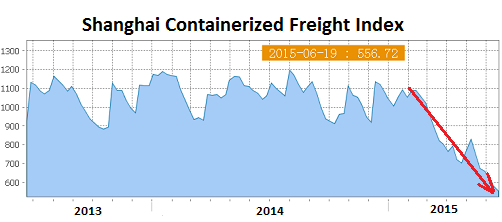
The phenomenon has impacted other ports and contractual rates, not just spot market rates.
The much broader China Containerized Freight Index (CCFI), which tracks contractual rates along with spot market rates from all major Chinese ports to major destinations around the world, dropped another 3.0% last week, to a multi-year low of 825.97. The China-Europe component plunged 7.9%. Rates to the US West Coast dropped 1.8% and to the US East Coast 0.2%
The CCFI is now 23% below where it was in February, and 17.4% below where it was in 1998, when it was set at 1,000! This is what the chilling trajectory looks like.
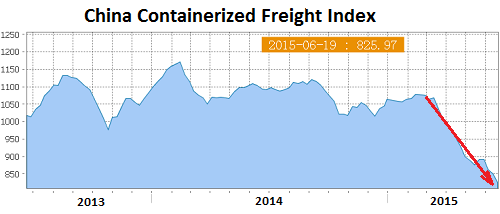
The total collapse of shipping rates from China to much of the rest of the world is driven by two factors:
Crummy demand for Chinese manufactured goods around the world, a result of lackadaisical economic growth, if any, in the developed markets.
And a breath-taking and ballooning oversupply of ships to transport these goods. The resulting losses for carriers have sent executives to tear out their hair. But not everyone is screaming.
The largest carriers, fueled by cheap money central banks have made available, are purposefully adding enormous capacity to drive up their market share and destroy the price so that smaller carriers with less money to blow would be forced to exit the market, allowing the top carriers to build a global shipping oligopoly.
“I don’t think it will backfire,” explained Nils Andersen, CEO of the Danish giant A.P. Møller-Mærsk, whose Maersk Line is the largest container carrier in the world. Read… Top Carriers Wage Price War to Form Global Shipping Oligopoly
your more important currency crosses early Tuesday morning:
Euro/USA 1.1210 down .01339
USA/JAPAN YEN 123.25 up .338
GBP/USA 1.5781 down .0045
USA/CAN 1.2343 up .0049
This morning in Europe, the Euro fell by a considerable 134 basis points, trading now just above the 1.12 level at 1.1210; Europe is still reacting to deflation, announcements of massive stimulation, a proxy middle east war, and the ramifications of a default at the Austrian Hypo bank, a possible default of Greece and the Ukraine, rising peripheral bond yields.
In Japan Abe went all in with Abenomics with another round of QE purchasing 80 trillion yen from 70 trillion on Oct 31. The yen continues to trade in yoyo fashion as this morning it settled down again in Japan by 34 basis points and trading just above the 123 level to 123.25 yen to the dollar.
The pound was again well down this morning as it now trades just below the 1.58 level at 1.5781, still very worried about the health of Barclay’s Bank and the FX/precious metals criminal investigation/Dec 12 a new separate criminal investigation on gold, silver and oil manipulation.
The Canadian dollar is down by 29 basis points at 1.2343 to the dollar.
We are seeing that the 3 major global carry trades are being unwound. The BIGGY is the first one;
1. the total dollar global short is 9 trillion USA and as such we are now witnessing a sea of red blood on the streets as derivatives blow up with the massive rise in the rise in the dollar against all paper currencies
2, the Nikkei average vs gold carry trade (still ongoing)
3. Short Swiss franc/long assets (European housing/Nikkei etc. This has partly blown up (see Hypo bank failure). Swiss franc is now 1.0489 to the Euro, trading well below the floor 1.05. This will continue to create havoc with the Hypo bank failure.
These massive carry trades are terribly offside as they are being unwound. It is causing global deflation ( we are at debt saturation already) as the world reacts to lack of demand and a scarcity of debt collateral. Bourses around the globe are reacting in kind to these events as well as the potential for a GREXIT>
The NIKKEI: this morning : up 381.23 points or 1.87%
Trading from Europe and Asia:
1. Europe stocks all hugely in the green
2/ Asian bourses all in the green … Chinese bourses: Hang Sang green (massive bubble forming) ,Shanghai in the green (massive bubble ready to burst), Australia in the green: /Nikkei (Japan) green/India’s Sensex in the green/
Gold very early morning trading: $1181.40
silver:$15.95
Early Tuesday morning USA 10 year bond yield: 2.37% !!! up 1 in basis points from Monday night and it is trading just above resistance at 2.27-2.32% and no doubt still setting off massive derivative losses.
USA dollar index early Tuesday morning: 95.12 up 80 cents from Monday’s close. (Resistance will be at a DXY of 100)
This ends the early morning numbers, Tuesday morning
And now for your closing numbers for Tuesday:
Closing Portuguese 10 year bond yield: 2.75% down 6 in basis points from Monday ( still very ominous/and dangerous with an accident waiting to happen)
Closing Japanese 10 year bond yield: .47% !!! up 3 in basis points from Monday/very ominous/
Your closing Spanish 10 year government bond, Tuesday, par in basis points (still very ominous)
Spanish 10 year bond yield: 2.11% !!!!!!
Your Tuesday closing Italian 10 year bond yield: 2.14% down 2 in basis points from Monday: (very ominous)
trading 3 basis point higher than Spain.
IMPORTANT CURRENCY CLOSES FOR TODAY
Closing currency crosses for Tuesday night/USA dollar index/USA 10 yr bond: 4 pm
Euro/USA: 1.1165 down .0179 ( Euro down 179 basis points)
USA/Japan: 123.97 up .560 ( yen down 56 basis points)
Great Britain/USA: 1.5716 down .0109 (Pound down 109 basis points)
USA/Canada: 1.2338 up .0025 (Can dollar down 25 basis points)
The euro fell by a huge amount today. It settled down 179 basis points against the dollar to 1.1165 as the dollar traded northbound today against all the various major currencies. The yen was down by 56 basis points and closing well above the 123 cross at 123.97. The British pound lost huge ground today, 56 basis points, closing at 1.5716. The Canadian dollar lost some ground against the USA dollar, 25 basis points closing at 1.2338.
As explained above, the short dollar carry trade is being unwound, the yen carry trade , the Nikkei/gold carry trade, and finally the long dollar/short Swiss franc carry trade are all being unwound and these reversals are causing massive derivative losses. And as such these massive derivative losses is the powder keg that will destroy the entire financial system. The losses on the oil front and huge losses on the USA dollar will no doubt produce many dead bodies.
Your closing 10 yr USA bond yield: 2.41% up 5 in basis point from Monday// (just below the resistance level of 2.27-2.32%)/ and ominous
Your closing USA dollar index:
95.39 up 106 cents on the day
.
European and Dow Jones stock index closes:
England FTSE up 9.20 points or 0.13%
Paris CAC up 59.07 points or 1.18%
German Dax up 82.04 points or 0.72%
Spain’s Ibex up 34.30 points or 0.30%
Italian FTSE-MIB up 81.30 or 0.35%
The Dow up 24.29 or 0.13%
Nasdaq; up 5.39 or 0.10%
OIL: WTI 61.15 !!!!!!!
Brent:64.56!!!!
Closing USA/Russian rouble cross: 53.86 up 4/100 roubles per dollar on the day
end
And now for your more important USA stories.
NY trading for today:
“September It Is”: The Good (Greenback), The Bad (Bonds), & The Ugly (Buillion)
Despite IMF & Germany’s apparent comment to Greece…
Stocks remain ambivalently poised near record highs…fading from the opening gap higher…

From Friday, Small Caps leading the way… new highs

Stocks did a whole lot of nothing with the S&P unable to trade more than a few bps away from its VWAP as Greek hope faded…

VIX hit an 11 handle…

Another day, another European buying climax into the US Open to the European close…

Biotechs are now up almost 11% from last week’s lows…

But it appears Powell’s “September” comments were the big catalyst that banged bonds, bullion, and greenbacks…
The USDollar soared, led by EUR weakness after Powel said September was likely

This was the USDollar’s best day in over 3 months…

Pretty chunky Heinz deal may have pressured Treasury yields in th elast 2 days but today’s swing was around Powell’s comments…

Dollar strength did not impact Copper(after better than expected China PMI) and Crude (WTF knows!) which soared as Gold and Silver were monkey-hammered…

Here is WTI Crude this week (the August contract)…WTF!!

Charts: Bloomberg
Durable good orders plummet!
(courtesy zero hedge)
Durable Goods Order Bounce Dead; Biggest Drop Since 2009
March’s exulted bounce in Durable Goods faded rapidly into April’s disappointing drop and today we see May disappoint further with a 1.8% drop (against expectations of a 0.1% drop) having missed 5 of the last 7 months. Revisions are big and negative… so that’s not helping and has pushed Durable Goods Orders NSA down 5.0% YoY – the largest 10-month slump since Dec09… the last time we dropped this much, The Fed unleashed QE3. Durable Goods Ex Transports and Core Capex are also both down YoY for 4 months in a row, flashing recessionary red.
MoM – the bounce is dead…

Leaving YoY Durables Goods Orders weak

With the biggest 10-month slump since 2009…

With Core Durable Goods down YoY 4 months in a row…

Worse still Core Capex is down 4 months in a row also…

And the bottom line: durable Goods Inventories declined by the most since May 2013. Which means very bad news for Q2 GDP if indeed this flows through into the GDP calculation.
US Manufacturing PMI Slumps To Weakest Since Oct 2013
Having hovered at its lowest level since January 2014, Markit’s US Manufacturing PMI slipped even further to 53.4 (against expectations of 54.1). This is the weakest since October 2013 and the biggest miss since August 2013. Stunned, Markit notes, “while the survey data points to the economy rebounding in the second quarter, the weak PMI number for June raises the possibility that we are seeing a loss of momentum heading into the third quarter;” which is odd because every talking head has been proclaiming everything is awesome, “while a September rise still looks likely, given the ongoing strength of the service sector, any further deterioration in the data are likely to push the first hike into next year.”
Well this is not what The Fed promised…

As Markit notes,
Adjusted for seasonal influences, the Markit Flash U.S. Manufacturing Purchasing Managers’ Index™ (PMI™)1 registered 53.4 in June, down from 54.0 in May and the lowest reading since October 2013.
The latest expansion of production volumes was the weakest recorded by the survey since January 2014. Some manufacturers cited greater efforts to fulfil orders from inventories in June, as highlighted by the first reduction in stocks of finished goods since December 2014. Moreover, there were reports that softer output growth reflected a degree of caution about the business outlook, as well as concerns about the impact of the strong dollar on cmpetitiveness. Although new orders from abroad stabilized in June, this followed declines in export sales during each of the previous two months.
- …there were reports that softer output growth reflected a degree of caution about the business outlook, as well as concerns about the impact of the strong dollar on competitiveness
- overall volumes of new work expanded at a solid pace in June, but the latest upturn was still the second-slowest since January 2014.
- some manufacturers noted that sharp declines in investment spending within the energy sector had weighed on new order volumes
- suppliers’ delivery times improved for the first time in two years. This was widely linked to an alleviation of transportation bottlenecks related to the west coast port strikes earlier in 2015.
Commenting on the flash PMI data, Chris Williamson, Chief Economist at Markit said:
“Manufacturers reported a disappointing end to the second quarter, with factory output growing at the slowest rate for a year-and-a-half.
“While the survey data points to the economy rebounding in the second quarter, the weak PMI number for June raises the possibility that we are seeing a loss of momentum heading into the third quarter.
“The slowdown is being led by deteriorating export performance, which many producers in turn linked to a loss of competitiveness caused by the stronger dollar. Although stabilizing in June after declining in April and May, export orders have not shown any growth since February.
“Employment continued to rise, accelerating to show one of the strongest monthly gains since the recession, but the labour market tends to lag changes in order books. Firms are therefore likely to start cutting back on hiring unless demand revives in coming months.
“The survey results will add to further worries about the damaging impact of the strong dollar, and encourage the Fed to be cautious in terms of the timing the first interest rate hike. While a September rise still looks likely, given the ongoing strength of the service sector, any further deterioration in the data are likely to push the first hike into next year. Flash services PMI data for June are published on the 25th June.”
Charts: Bloomberg
Fed Voter Powell Turmoils Markets After “September” Comments
FOMC Voting member Jerome Powell has spooked markets this morning (though a glance at stocks impotence would not tell you that) with his comments that a “September rate hike is now 50-50,” and that “The Fed would like to test a rate rise as soon as September.” FX markets are turmoiling with the USD surging and bond markets are seeing Bunds/TSYs sold aggressively. Stocks shrugged in their “huh?” way initially but tumbled as Powell confirms ‘mechanical’-sounding 1% rise per year in rates if the economy continues to grow as expected.
The reaction…

Further headlines…
- *POWELL: TEST TO RAISE RATES COULD BE SATISFIED AS SOON AS SEPT.
- *POWELL SAYS HIS FORECAST CALLS FOR RATE RISES IN SEPT., DEC.
- *POWELL SAYS ODDS FOR SEPT. RATE RISE IN 50-50 RANGE
- *POWELL: PATH OF RATES GOING FORWARD MORE IMPORTANT THAN LIFTOFF
- *POWELL EXPECTS PACE OF TIGHTENING ROUGHLY IN LINE WITH DOT PLOT
- *POWELL: FED AND MARKETS ARE GETTING INTO CLOSER ALIGNMENT
- *POWELL: DOLLAR IS STRONG BECAUSE U.S. ECONOMY IS STRONG
- *POWELL: THERE’S RISK UNEMPLOYMENT MAY FALL FASTER THAN FORECAST
And there’s no risk…
- *POWELL SAYS SOME MARKET RISK HAS SHIFTED TO ASSET MANAGERS
- *POWELL: NOT CONCERNED HIGHER VOLATILITY WILL HARM ECONOMY
- *POWELL SAYS HE DOESN’T SEE A BUILD-UP OF AN ASSET BUBBLE
- *POWELL SAYS HE’S NOT PARTICULARLY TROUBLED BY EQUITY VALUATIONS
So Powell is disagreeing with Yellen on bubble-iciousness and appears more hawkish on rates that the market “read” into Yellen’s remarks.
$140 Billion Bond Fund Goes To Cash As It “Braces For Bond-Market Collapse”
Recently, it’s become readily apparent that some of the world’s top money managers are getting concerned about what might happen when a mass exodus from bond funds collides head on with a completely illiquid secondary market for corporate credit.
Indeed, bond market illiquidity is the topic du jour and has almost become something of a cliche among pundits and mainstream financial media outlets years after we first raised the issue in these pages. But just because something has become fashionable to discuss doesn’t mean it’s not worth discussing and indeed, we’re at least pleased to see that the world is suddenly awake to the fact that a primary market supply bonanza catalyzed by rock-bottom borrowing costs and yield-starved investors could spell disaster when paired with shrinking dealer inventories.
For illustrative purposes, here’s a look at turnover in corporate credit…

Chart: Barclays
…and a snapshot of shrinking dealer inventories and ballooning bond funds…

Chart: Citi
…and finally, here’s UST market depth…

What all of these charts show is that whether you’re talking about corporate credit or “risk free” government debt, liquidity simply isn’t there and as was on full display last October, wild swings in illiquid markets will be exacerbated by the presence of parasitic HFTs.
Meanwhile, Treasury market participants are shifting to futures and corporate bond fund managers are using ETFs to offset “diversifiable” outflows, phenomena which prove investors are actively avoiding credit markets by resorting to derivatives, a practice which only serves to make the underlying markets still more illiquid.
Of course one way to mitigate risk is simply to move to cash (as we noted over the weekend, some managers are even moving to physical cash), a strategy TCW’s Jerry Cudzil is currently implementing in order to ensure he’s not one of the ones “looking silly” after the crash. Bloomberg has more:
TCW Group Inc. is taking the possibility of a bond-market selloff seriously.
So seriously that the Los Angeles-based money manager, which oversees almost $140 billion of U.S. debt, has been accumulating more and more cash in its credit funds, with the proportion rising to the highest since the 2008 crisis.
“We never realize what the tipping point is until after it happens,” said Jerry Cudzil, TCW Group’s head of U.S. credit trading. “We’re as defensive as we’ve been since pre-crisis.”
TCW isn’t alone: Bond funds are holding about 8 percent of their assets as cash-like securities, the highest proportion since at least 1999, according to FTN Financial, citing Investment Company Institute data.
Cudzil’s reasoning is that the Federal Reserve is moving toward its first interest-rate increase since 2006, and the end of record monetary stimulus will rattle the herds of investors who poured cash into risky debt to try and get some yield.
Of course, U.S. central bankers are aiming to gently wean markets and companies off zero interest-rate policies. In their ideal scenario, borrowing costs would rise slowly and steadily, debt investors would calmly absorb losses and corporate America would easily adjust to debt that’s a little less cheap amid an improving economy.
That outcome seems less and less likely to Cudzil, as volatility in the bond market climbs.
“If you distort markets for long periods of time and then you remove those distortions, you’re subject to unanticipated volatility,” said Cudzil, who traded high-yield bonds at Morgan Stanley and Deutsche Bank AG before joining TCW in 2012. He declined to specify the exact amount of cash he’s holding in the funds he runs.
Price swings will also likely be magnified by investors’ inability to quickly trade bonds, he said. New regulations have made it less profitable for banks to grease the wheels of markets that are traded over the counter and, as a result, they’re devoting fewer traders and money to the operations.
To boot, record-low yields have prompted investors to pile into the same types of risky investors — so it may be even more painful to get out with few potential buyers able to absorb mass selling.
“We think the market’s telling you to upgrade your portfolio,” Cudzil said. “Whether it happens tomorrow or in six months, do you want look silly before the market sells off or after?”
Well, preferably neither, but point taken and we would have to agree that if ever there were a time to take one’s money and run — before the realities of a dealer-less corporate credit market and/or an HTF-infested, VaR shock-prone government bond market conspire to prove, once and for all, that in today’s world, the idea that bonds are any safer than other asset classes is completely and utterly false — this is it.
New Home Sales For May: Statistical Measurement Failure
The Government’s Census Bureau reported new construction home sales for May today. Supposedly new homes sold at a 2.2% higher rate in May than in April. However, notwithstanding the fact that the Census Bureau has already been tagged for reporting fraudulent data, the supposed seasonally adjusted annualized rate for new home sales in May was driven by a supposed 87.5% jump in new homes sold in the northeast vs. April. Click to enlarge:

What the headlines do not report is that the statistical margin of error at the 90% confidence level was plus or minus (+/-) 77.1%.This is the epitome of statistical measurement failure and it leads one to question the veracity of any of the Census Bureau’s economic reports.
Anyone who took statistics and econometrics in either undergrad or business school (or both, as was the case with me) knows that if you had turned in a data measurement and forecasting project with a margin of error of 77% at the 90% confidence level you would have received an “F.”
When a flawed statistic for one month is converted into an “annualized rate,” it compounds the error and produces an “annualized rate” that is not even remotely representative of the reality that statistical sample is supposed to represent. This is clearly the case with this latest new home sales report.
Another huge flaw in the Census Bureau’s methodology is that in areas in which it was unable to get data from homebuilders on new contracts signed during a reporting period – remember: new home sales are based on contracts signed, not closings – it uses the number produced for housing starts to estimate the number of sales in that area (this fact is on Census Bureau’s website). This in and of itself is highly flawed. In no remote way does a housing “start” necessarily translate into an actual sales closings. “Starts” are always running at a measured rate that is significantly higher than actual sales.
The reporting and accounting fraud that has become so pervasive in our economic and political system has particularly affected reports in the housing sector. This is because this highly questionable data purporting to show a picture of a recovering economy is about the last area which the propagandists and snakeoil salesmen can use to promote their agenda.
Welcome To Housing Bubble 2.0
However, this is the same movie that was playing in 2005, including and especially the statements issued by both the National Association of Realtors and CNBC that the soaring home prices were not indicative of a bubble: CNBC/Larry Yun (NAR chief economist).
The advent of 0-3% down payments and calculating the price to pay for a home based on the monthly payment one can afford has temporarily “financialized” homes. In other words, home sales and prices and become a function of the cost and availability of the amount of financial paper required to affect a home sales transaction.
The cost of the paper is close to zero now. The availability of paper needed to make a sale happen is entirely a function of the close to $2 trillion the Fed has printed and injected into the mortgage market.
Home values and monthly payments are quickly dislocating by a significant amount from the underlying fundamental ability of the middle class to support. There’s no better evidence of this than the fact that the current loan value of mortgages issued by Fannie Mae is an an all-time high – higher than at the peak of the big housing bubble:

The same report that produced this data also shows a significant deterioration in the average of FICO score of the average Fannie Mae borrower. Escalating prices, escalating debt, declining loan quality – they all add up to one huge housing market bubble that has been blown by Bernanke and Yellen.
This is going to end up with a worse outcome than occurred in the 2005-2009 period. Back then interest rates were significantly higher and the Fed was able to contain the damage by taking rates to zero and printing trillions. Those “weapons” to combat bubble deflation are no longer available (although I would bet we’ll see a lot more printing).
As the housing market stalls out and begins to fall, the absence of true underlying fundamentals will cause a vacuum and induce a plunge that will be significantly worse than what occurred the last time around. Do your best to stay out of the way.
end
Well that is all for today
I will see you Wednesday night.
Harvey


 harveyorganblog.com
[…] JUNE 23/IMF REJECTS THE GREEK PROPOSAL/SLV LOSES 956,000 OZ/GLD REMAINS PAT/TED BUTLER WRITES A SCAT… […]
LikeLike
[…] by Harvey Organ, HarveyOrganblog: […]
LikeLike