
Good evening Ladies and Gentlemen:
Here are the following closes for gold and silver today:
Gold: $1172.90 down 10 cents (comex closing time)
Silver $15.73 down 11 cents
In the access market 5:15 pm
Gold $1174.75
Silver: $15.81
>xxxxxxxxxxxxxxxxxxxxxxxxxxxxxxxxxxxxxxxxxxxxxxxxxxxxxxxxxxxxxx
Gold/Silver trading: see kitco charts on the right side of the commentary
Following is a brief outline on gold and silver comex figures for today:
At the gold comex today, we had a good delivery day, registering 185 notice serviced for 18,500 oz. Silver comex filed with 22 notices for 110,000 oz. Remember we are entering options expiry with today the comex gold and silver expires and then next Tuesday, we have options expiry on the gold/silver LBMA contracts and on the OTC contracts. So gold and silver will be subdued in price until Tuesday night.
Several months ago the comex had 303 tonnes of total gold. Today, the total inventory rests at 244.43 tonnes for a loss of 58 tonnes over that period.
In silver, the open interest fell by 1167 contracts despite yesterday’s price being flat. The total silver OI continues to remain extremely high, with today’s reading at 197,411 contracts now at decade highs despite a record low price. We must have had some banker short covering yesterday. In ounces, the OI is represented by .994 billion oz or 142% of annual global silver production (ex Russia ex China). This dichotomy has been happening now for quite a while and defies logic. There is no doubt that the silver situation is scaring our bankers to no end as they continue to raid as basically they have no other alternative. There can only be one answer as to how the OI of comex silver is now just under 1 billion oz coupled with a low price under 16.00 dollars: sovereign China through proxies are the long and they have extremely deep pockets.
In silver we had 22 notices served upon for 110,000 oz.
In gold, the total comex gold OI rests tonight at 441,592 for a gain 5,412 contracts as gold was up $0.40 yesterday. We had 185 notices filed for 18,500 oz.
we had a huge loss in tonnage at the gold inventory at the GLD to the tune of 1.75 tonnes; thus the inventory rests tonight at 711.44 tonnes. The appetite for gold coming from China is depleting not only gold from the LBMA and GLD but also the comex is bleeding gold. I am sure that 700 tonnes is the rock bottom inventory in gold. Anything below this level is just paper and the bankers know that they cannot retrieve “paper gold” to send it onwards to China .In silver, again, we had a huge addition in inventory at the SLV to the tune of 198,000 oz/ Inventory now rests at 329.116 million oz
We have a few important stories to bring to your attention today…
1. Today, we had the open interest in silver fall by 1167 contracts to 198,578 despite the fact that silver was flat yesterday.. The OI for gold rose by another 5,412 contracts up to 441,592 contracts as the price of gold was up $0.40 yesterday.
(report Harvey)
2. Today, 5 important commentaries on Greece
(zero hedge, Reuters/Bloomberg/Raul Meijer)
3.the fraudulent data at the comex
(Dave Kranzler IRD)
4. Gold trading overnight
(Goldcore/Mark O’Byrne)
5. Trading from Asia and Europe overnight
(zero hedge)
6. Trading of equities/ New York
(zero hedge)
we have these plus other stories to bring your way tonight. But first……..
let us now head over to the comex and assess trading over there today.
Here are today’s comex results:
The total gold comex open interest rose appreciably by 5,412 contracts from 436,978 up to 441,592 as gold was up 40 cents in price yesterday (at the comex close). We are now in the big active delivery contract month of June. Here the OI fell by 44 contracts down to 223. We had 44 notices served upon yesterday. Thus we neither lost nor gained any gold ounces standing for delivery. The next contract month is July and here the OI fell by 69 contracts to 555. The next big delivery month after June will be August and here the OI rose by 3,665 contracts up to 286,190. The estimated volume today (which is just comex sales during regular business hours of 8:20 until 1:30 pm est) was poor at 62,445. The confirmed volume yesterday (which includes the volume during regular business hours + access market sales the previous day was poor at 100,327 contracts. Today we had 185 notices filed for 18,500 oz.
And now for the wild silver comex results. Silver OI fell by a small 1167 contracts from 198,578 down to 197,411 despite the fact that the price of silver was flat in price with respect to yesterday’s trading. We continue to have our bankers pulling their hair out with respect to the continued high silver OI. Yesterday, we probably had some bankers cover a few of their silver shorts as the temperature is getting a little too hot for them. The front non active delivery month of June saw it’s OI fall 0 contracts, remaining at 23 contracts. We had 1 contract delivered upon yesterday. Thus we gained 1 silver contracts, or an additional 5,000 oz will stand for delivery in this non active June contract month. The next delivery month is July and here the OI surprisingly fell by only 13,204 contracts down to 30,879. We have just 2 trading days left before first day notice on June 30 and the front month is extremely high. The next major active delivery month is September and here the OI rose by a huge 10,250 contracts to 111,250. So far, for the first time we are not witnessing the collapse of OI in an active delivery month. The estimated volume today was good at 58,987 contracts (just comex sales during regular business hours. The confirmed volume on yesterday (regular plus access market) came in at 87,346 contracts which is excellent in volume. We had 22 notices filed for 110,000 oz today.
June initial standing
June 26.2015
| Gold |
Ounces |
| Withdrawals from Dealers Inventory in oz | nil |
| Withdrawals from Customer Inventory in oz | 38,147.09 oz (JPM,SCOTIA) includes 5 kilobars |
| Deposits to the Dealer Inventory in oz | nil |
| Deposits to the Customer Inventory, in oz | nil |
| No of oz served (contracts) today | 185 contracts (18,500 oz) |
| No of oz to be served (notices) | 38 contracts (3800 oz) |
| Total monthly oz gold served (contracts) so far this month | 2919 contracts(291,900 oz) |
| Total accumulative withdrawals of gold from the Dealers inventory this month | 99.93 oz |
| Total accumulative withdrawal of gold from the Customer inventory this month | 565,004.7 oz |
Today, we had 0 dealer transactions
we had zero dealer withdrawals
total Dealer withdrawals: nil oz
we had 0 dealer deposits
total dealer deposit: zero
we had 2 customer withdrawal
i) Out of Scotia: 160.7500 oz (5 kilobars)
ii) Out of JPMorgan: 37,986.34 oz
total customer withdrawal:38,147.09 oz
We had 0 customer deposits:
Total customer deposit: nil oz
We had 2 adjustments:
i) Out of jPMorgan:
302.217 oz was adjusted out of the dealer and this landed into the customer account of JPM
96.45 oz was adjusted out of the customer account of Delaware and this landed into the dealer account of Delaware.
Today, 0 notices was issued from JPMorgan dealer account and 0 notices were issued from their client or customer account. The total of all issuance by all participants equates to 185 contracts of which 0 notices were stopped (received) by JPMorgan dealer and 181 notices were stopped (received) by JPMorgan customer account
To calculate the total number of gold ounces standing for the June contract month, we take the total number of notices filed so far for the month (2919) x 100 oz or 291,900 oz , to which we add the difference between the open interest for the front month of June (223) and the number of notices served upon today (185) x 100 oz equals the number of ounces standing.
Thus the initial standings for gold for the June contract month:
No of notices served so far (2919) x 100 oz or ounces + {OI for the front month (223) – the number of notices served upon today (185) x 100 oz which equals 295,700 oz standing so far in this month of June (9.198 tonnes of gold). Thus we have 9.198 tonnes of gold standing and only 16.07 tonnes of registered or for sale gold is available. We lost 101 contracts or 10,100 oz to probable cash settlements.
Total dealer inventory 517,216.902 or 16.08 tonnes
Total gold inventory (dealer and customer) = 7,858,581.462 oz or 244.43 tonnes
Several months ago the comex had 303 tonnes of total gold. Today the total inventory rests at 244.43 tonnes for a loss of 58 tonnes over that period.
end
And now for silver
June silver initial standings
June 26 2015:
| Silver |
Ounces |
| Withdrawals from Dealers Inventory | nil |
| Withdrawals from Customer Inventory | 20,778.810 oz(Delaware) |
| Deposits to the Dealer Inventory | nil |
| Deposits to the Customer Inventory | 1,175,199.72 oz (CNT,HSBC) |
| No of oz served (contracts) | 22 contracts (110,000 oz) |
| No of oz to be served (notices) | 1 contract(5,000 oz) |
| Total monthly oz silver served (contracts) | 296 contracts 14,800,000 oz) |
| Total accumulative withdrawal of silver from the Dealers inventory this month | 526,732.4 oz |
| Total accumulative withdrawal of silver from the Customer inventory this month | 5,595,922.0 oz |
Today, we had 0 deposits into the dealer account:
total dealer deposit: nil oz
we had 0 dealer withdrawal:
total dealer withdrawal: nil oz
We had 2 customer deposit:
i) Into CNT: 599,692.82 oz
ii) Into HSBC: 575,506.900
total customer deposit: 1,175,199.72 oz
We had 1 customer withdrawal:
i) Out of Delaware: 20,778.810 oz
total withdrawals from customer;20,778.810 oz
we had 0 adjustments
Total dealer inventory: 57.866 million oz
Total of all silver inventory (dealer and customer) 182.869 million oz
The total number of notices filed today is represented by 22 contracts for 110,000 oz. To calculate the number of silver ounces that will stand for delivery in June, we take the total number of notices filed for the month so far at (296) x 5,000 oz = 1,480,000 oz to which we add the difference between the open interest for the front month of June (23) and the number of notices served upon today (22) x 5000 oz equals the number of ounces standing.
Thus the initial standings for silver for the June contract month:
296 (notices served so far) + { OI for front month of June (23) -number of notices served upon today (22} x 5000 oz ,= 1,485,000 oz of silver standing for the June contract month.
we gained 1 silver contracts or an additional 5,000 ounces will stand for delivery in this non active delivery month of June.
for those wishing to see the rest of data today see:
http://www.harveyorgan.wordpress.comorhttp://www.harveyorganblog.com
end
The two ETF’s that I follow are the GLD and SLV. You must be very careful in trading these vehicles as these funds do not have any beneficial gold or silver behind them. They probably have only paper claims and when the dust settles, on a collapse, there will be countless class action lawsuits trying to recover your lost investment.
There is now evidence that the GLD and SLV are paper settling on the comex.
***I do not think that the GLD will head to zero as we still have some GLD shareholders who think that gold is the right vehicle to be in even though they do not understand the difference between paper gold and physical gold. I can visualize demand coming to the buyers side:
i) demand from paper gold shareholders
ii) demand from the bankers who then redeem for gold to send this gold onto China
vs no sellers of GLD paper.
And now the Gold inventory at the GLD:
June 26./it did not take our bankers long to raid the GLD. Yesterday they added 6.86 tonnes and today, 1.75 tonnes of that was withdrawn/Inventory tonight rests at 711.44 tonnes.
June 25/a huge additon of 6.86 tones of inventory at the GLD/Inventory rests tonight at 713..23 tonnes
June 24/ a good addition of.900 tonnes of gold into the GLD/Inventory rests at 706.37 tonnes
June 23/no change in gold inventory/rests tonight at 705.47 tonnes
June 22/ a huge increase of 3.27 tonnes of gold into GLD/Inventory tonight: 705.47 tonnes
June 19.2015: no change in gold inventory/rests tonight at 701.90 tonnes.
June 18/no change in gold inventory/rests tonight at 701.90 tonnes
June 17/no change in gold inventory/rests tonight at 701.90 tonnes
June 16./no change in gold inventory/Rests tonight at 701.90 tonnes.
June 15/we lost a huge 2.08 tonnes of gold from the GLD/Inventor rests tonight at 701.90 tonnes
June 12/we had a small withdrawal of .24 tonnes of gold from the GLD/Inventory rests this weekend at 703.98 tonnes.
June 11/we had another huge withdrawal of 1.5 tonnes of gold from the GLD/Inventory rests tonight at 704.22 tonnes
June 10/ we had a huge withdrawal of 2.98 tonnes of gold from the GLD/inventory rests at 705.72
June 9/ no change in gold inventory at the GLD/Inventory rests at 708.70 tonnes
June 8/ a big withdrawal of 1.19 tonnes of gold from the GLD/Inventory rests at 708.70 tonnes
June 26 GLD : 711.44 tonnes
end
And now for silver (SLV)
June 26/today we had another addition of 198,000 of silver/Inventory rests at 329.116 million oz
June 25/ a huge increase of 1.242 million oz of silver into the SLV inventory/Inventory rests at 128.918 million oz
June 24/no change in inventory/rests tonight at 326.918 million oz
June 23/we had a small withdrawal of 956,000 oz/Inventory tonight rests at 326.918 million oz
June 22/ no change in silver inventory/327.874 million oz
June 19/no change in silver inventory/327.874 million oz
June 18 no change in silver inventory/327.874 million oz
June 17/no change in silver inventory/327.874 million oz
June 16./no change in silver inventory/327.874 million oz
June 15/we had no change in silver inventory/327.874 million oz
June 12/we had another addition to the tune of 956,000 oz/Inventory rests this weekend at 327.874. Please note that there has been an addition on each of the past 5 days.
June 11.2015: we had another monster of an addition to the tune of 2.791 million oz/Inventory rests at 326.918
June 10/another monster of an addition to the tune of 1.126 million oz/Inventory rests at 324.127
June 9/ a monster of an addition to the tune of 3.393 million oz/inventory rests at 323.001 million oz.
June 8/no change in inventory/SLV inventory rests at 319.608 milion oz.
June 5 a huge addition of 1.433 million oz of silver added to the SLV/Inventory at 319.608 million oz
June 26/2015: we had an addition of 198,000 oz silver inventory/SLV inventory rests tonight at 329.116 million oz
end
And now for our premiums to NAV for the funds I follow:
Sprott and Central Fund of Canada.
(both of these funds have 100% physical metal behind them and unencumbered and I can vouch for that)
1. Central Fund of Canada: traded at Negative 7.2 percent to NAV usa funds and Negative 7.6% to NAV for Cdn funds!!!!!!!
Percentage of fund in gold 61.7%
Percentage of fund in silver:37.9%
cash .4%
( June 26/2015)
2. Sprott silver fund (PSLV): Premium to NAV falls to 0.73%!!!! NAV (June 26/2015)
3. Sprott gold fund (PHYS): premium to NAV falls to – .58% toNAV(June26/2015
Note: Sprott silver trust back into positive territory at +0.73%
Sprott physical gold trust is back into negative territory at -.58%
Central fund of Canada’s is still in jail.
Sprott formally launches its offer for Central Trust gold and Silver Bullion trust:
SII.CN Sprott formally launches previously announced offers to CentralGoldTrust (GTU.UT.CN) and Silver Bullion Trust (SBT.UT.CN) unitholders (C$2.64)
Sprott Asset Management has formally commenced its offers to acquire all of the outstanding units of Central GoldTrust and Silver Bullion Trust, respectively, on a NAV to NAV exchange basis.
Note company announced its intent to make the offer on 23-Apr-15 Based on the NAV per unit of Sprott Physical Gold Trust $9.98 and Central GoldTrust $44.36 on 22-May, a unitholder would receive 4.45 Sprott Physical Gold Trust units for each Central GoldTrust unit tendered in the Offer.
Based on the NAV per unit of Sprott Physical Silver Trust $6.66 and Silver Bullion Trust $10.00 on 22-May, a unitholder would receive 1.50 Sprott Physical Silver Trust units for each Silver Bullion Trust unit tendered in the Offer.
* * * * *
end
At 3:30 pm we get the COT report which gives up position levels of our major players.
First let us head over and see what we can glean from the Gold COT:
| Gold COT Report – Futures | ||||||
| Large Speculators | Commercial | Total | ||||
| Long | Short | Spreading | Long | Short | Long | Short |
| 202,944 | 107,830 | 41,267 | 150,444 | 251,332 | 394,655 | 400,429 |
| Change from Prior Reporting Period | ||||||
| 11,891 | -7,500 | 4,225 | -3,268 | 20,983 | 12,848 | 17,708 |
| Traders | ||||||
| 141 | 95 | 83 | 52 | 51 | 236 | 196 |
| Small Speculators | ||||||
| Long | Short | Open Interest | ||||
| 36,323 | 30,549 | 430,978 | ||||
| 2,412 | -2,448 | 15,260 | ||||
| non reportable positions | Change from the previous reporting period | |||||
| COT Gold Report – Positions as of | Tuesday, June 23, 2015 | |||||
What an absolute farce: and the CFTC officials just sit there!!
Our large specs:
Those large specs that have been long in gold added 11,891 contracts to their long side
Those large specs that have been short in gold covered a large 7500 contracts from their short side.
And now for our criminal bankers (commercials)
Those commercials that have been long in gold pitched 3268 contracts from their long side.
Those commercials that have been short in gold added a whopping 20,983 contracts to their short side.
Our small specs;
Those small specs that have been long in gold added 2412 contracts to their long side.
Those small specs that have been short in gold covered 2448 contracts from their short side.
The specs were annihilated again !!
And now for silver:
please note the difference between gold and silver. The bankers seem to be having a much easier time with gold than silver and this explains why they cannot shake the high OI in silver!
| Silver COT Report: Futures | |||||
| Large Speculators | Commercial | ||||
| Long | Short | Spreading | Long | Short | |
| 74,254 | 58,697 | 23,474 | 73,843 | 103,320 | |
| 6,939 | 7,054 | 1,048 | -296 | 326 | |
| Traders | |||||
| 104 | 55 | 51 | 47 | 43 | |
| Small Speculators | Open Interest | Total | |||
| Long | Short | 200,273 | Long | Short | |
| 28,702 | 14,782 | 171,571 | 185,491 | ||
| 808 | 71 | 8,499 | 7,691 | 8,428 | |
| non reportable positions | Positions as of: | 175 | 133 | ||
| Tuesday, June 23, 2015 | |||||
Our large specs:
Those large specs that have been long in silver added a hefty 6939 contracts to their long side
Those large specs that have been short in silver added a hefty 7054 contracts to their short side.
Our commercials;
Those commercials that have been long in silver pitched a tiny 296 contracts from their long side.
Those commercials that have been short in silver added a tiny 326 contracts to their short side.
Our small specs;
Those small specs that have been long in silver added a tiny 808 contracts to their long side
Those small specs that have been short in silver added a tiny 71 contracts to their short side.
Conclusions; are the bankers losing control in silver?
end
And now overnight trading in gold/silver from Europe and Asia/plus physical stories that might interest you:
First: Goldcore’s Mark O’Byrne
(courtesy Goldcore/Mark O’Byrne)
Chinese Stock Market Collapses 7.4% – Gold Demand Surges To Record
Today’s AM LBMA Gold Price was USD 1,174.40, EUR 1,048.38 and GBP 745.89 per ounce.
Yesterday’s AM LBMA Gold Price was USD 1,174.60, EUR 1,052.51 and GBP 748.80 per ounce.
Gold fell $1.30 or 0.11 percent yesterday to $1,173.10 an ounce. Silver slipped $0.03 or 0.19 percent to $15.87 an ounce.

GOLD in USD – 5 Day
Gold in Singapore for immediate delivery inched up 0.3 percent at $1,177.20 an ounce near the end of the day, while gold in Switzerland went a few dollars higher prior to selling pressure capped the gains and saw another correction.
Gold is lower in all major currencies this week. Today, gold is marginally higher over uncertainty with the Greek debt crisis as safe haven investors returned, equity markets dipped and Chinese stocks crashed.
Silver briefly hit a three month low at $15.50 an ounce. Palladium crashed to nearly a two-year low, seeing its largest one day fall since September, on demand concerns.

GOLD in GBP – 5 Day
On a weekly basis, palladium is down 4.7%, its biggest weekly loss since mid January and its seventh in a row. Platinum’s actually posted the smallest weekly drop, of just 1%.
Asian and European stocks have fallen sharply. The Chinese stock market crashed 7.4% overnight. They have had the biggest two-week loss in more than 18 years and are close to entering a bear market after extending losses from their June 12 peak to 19 percent in less than three weeks.

GOLD in EUR – 5 Day
European stocks are down 1%, with investors getting more and more nervous about the complete lack of progress and increasingly entrenched positions in the Greek debt crisis negotiations. We are heading into crunch talks at the weekend and last ditch, ‘make or break’ discussions by euro zone finance ministers will resume on Saturday,
Financial authorities and the Troika have prepared a “Plan B” to protect the euro zone from financial market turmoil. Creditors are trying to force Greece to repay the International Monetary Fund 1.6 billion euros ($1.79 billion) on Tuesday.
Some European bonds also saw losses. Italy’s 10-year bond yield rose four basis points to 2.13 percent, trimming its drop for the week to 15 basis points. The yield on equivalent-maturity Spanish debt increased two basis points to 2.09 percent.
SPDR Gold Shares, the world’s largest gold backed ETF climbed 6.9 metric tonnes yesterday, its biggest one-day increase since February 2nd. That has brought the fund’s weekly inflow to 11.3 tonnes for far, also the biggest since the first week of February

SILVER IN USD – 5 Days
The London Bullion Market Association (LBMA) said on Friday it had granted the Tokyo Commodity Exchange (TOCOM) a licence to use its Good Delivery List as part of TOCOM’s accreditation procedures. The agreement is effective from Friday, the LBMA said, adding that it has had similar deals in place with NYSE Liffe and NYMEX/CME for a number of years. More
Shanghai Gold Exchange volume climbed to a record today as prices declined incentivizing value driven Chinese buyers as Chinese stocks crashed 7.4%.
Volumes for bullion (99.99% purity) traded on SGE rise to a record 48.325m grams from 36.356m a day earlier, according to data compiled by Bloomberg. This exceeds the previous record of 45.717m on March 26.
In late morning European trading, gold is down 0.04 percent at $1,173.95 an ounce. Silver is off 0.47 percent at $15.81 an ounce and platinum is also down 0.36 percent at $1,077.49 an ounce.
Follow GoldCore on Twitter, Facebook, LinkedIn
Why SGE Withdrawals Equal Chinese Gold Demand And Why Not (The Argument List)
This post is an overview of all arguments presented by Western consultancy firms that should explain the difference between SGE Withdrawals and WGC Chinese gold demand. Once again we’ll examine to what degree divers metrics can cause the difference.
Since my first post on SGE Withdrawals Equal Chinese Wholesale Gold Demand Western consultancy firms have kept repeating my analysis is false, in response I’ve continued to clarify the metrics used in the China Gold Association (CGA) Gold Yearbooks. Not to get confused in this debate, this blog will keep track of all arguments ever presented and new ones that surface. This is the list so far in chronological order:
- industrial demand
- stock movement change
- round tripping
- leasing
- official purchases
- recycled gold
- export
In 2014 the World Gold Council (WGC) came out with two special reports about the Chinese gold market that should have shine a light on the difference. However, the reports contained numerous false statements and the segments on the difference failed miserably, as I’ve pointed out in several posts (one, two, three, four, five, six). Subsequently, Western consultancy firms came up with new arguments! Kindly note the shift in arguments; when the old ones failed, the firms impudently moved on and came up with new ones. The fact the list of arguments is constantly changing confirms the weakness of the arguments.
Please make sure you have read this post, about the basic mechanics of the Chinese gold market with the SGE at its core.
First let’s go through all the arguments to investigate which ones make any sense, at the end of the post we’ll do some number crunching.
1) INDUSTRIAL DEMAND. The first argument ever presented was by the World Gold Council (WGC). In August 2013 I’ve asked the Council what their explanation was for the difference between WGC demand and demand disclosed in the China Gold Market Report 2011, co-written by the PBOC, which exactly equaled SGE withdrawals. They wrote me by email:
The data that we publish in Gold Demand Trends are collected for us by Thomson Reuters GFMS. Our data represent jewelry and bar & coin demand and do not incorporate any industrial demand or fabrication, which is included in the PBoC figures. As I am sure you will appreciate, data collection of this sort relies on a number of proprietary sources and these will not necessarily be the same for both GFMS and PBOC. It is, therefore, perhaps not surprising that the estimates of demand differ somewhat.
Industrial demand couldn’t make up the 263 tonnes difference in 2011, nor could it have caused the 3,354 tonnes totaldifference from 2007 until 2014.
Though being small, Chinese industrial demand isn’t captured in WGC Chinese gold demand, and thus partially explains the difference.
2) STOCK MOVEMENT CHANGE. When I asked GFMS in August 2013 about net investment – which is how thedifference was titled in the China Gold Market Reports – they wrote me by email:
We have checked with our Data Specialist and confirmed that we use a different methodology. Total Chinese demand used by Thomson Reuters GFMS only includes jewelry, physical bullion bars/coins and all industrial demand. Any stock movement change (which is essentially the item 6 net investment) will not be included as underlying demand.
Because SGE withdrawals capture wholesale demand the difference is partially what jewelry companies and the mint have purchased at the SGE, but not yet sold in retail. The amount of gold in stock can never be 3,354 tonnes though. According to an estimate by the WGC as much as 125 tonnes of gold can be held as inventory in the mainland:
… It is, however, indicative that as jewelers expanded, so too did their inventory levels and it is our judgment that across the industry between 75t to 125t may have been absorbed in the supply chain since 2009.
Although we don’t hear much of this argument these days, it’s partially legitimate.
3) ROUND TRIPPING. In April 2014 the WGC published a report on China titled China’s Gold Market: Progress and Prospects. It certainly was not the first WGC report on China, in 2010 China Gold Report was released, but it was the first time the Council described the structure of the Chinese gold market, the Shanghai Gold Exchange and the ‘supply surplus’ in the Chinese gold market. The Council had some explaining to do, as it was clear China imported substantially more gold than what they disclosed as demand.
For the first time Chinese Commodity Financing Deals (CCFD) were introduced to the Council’s wide reader base. This type of financing is pursued to acquire cheap funds. It can be done trough round tripping or leasing. The Council wrote:
These operations fall into two broad categories, although there is some overlap between the two. Firstly, there is the use of gold via loans and through letters of credit (LCs) as a form of financing. Secondly, there is the use of gold for financial arbitrage operations that will also be based upon gold loans or LCs. In most cases the gold is quickly re-exported to Hong Kong, often as very crude jewellery or ornaments to get round tight controls on bullion exports. (This is the practise commonly referred to as ‘round-tripping’. Moreover, because nearly all gold flowing into China goes through the SGE, round-tripping can inflate the SGE delivery figures.) In other cases the metal is stockpiled in vaults in China or Hong Kong.
This is not true. Basically, round tripping gold flows are separated from the Chinese domestic gold market and the SGE system; they do not inflate SGE delivery or withdrawals. Round tripping is done through trade between Chinese Free Trade Zones and (usually) Hong Kong. Therefor, it can’t be an argument, as the difference we’re after is between SGE withdrawals and WGC demand within the Chinese domestic gold market. For further reference you can read my post on round tripping Chinese Gold Trading Rules & Financing Deals Explained.
Keep in mind gold can only be exported from China through Free Trade Zones (FTZs). This is called processing trade(round tripping is always done through processing trade). Gold is imported into FTZs, processed into jewelry and then exported, that’s how processing trade works. This gold cannot be imported from a FTZ into the rest of the mainland without a PBOC license for general trade. If standard gold is imported into the mainland in general trade it’s required to be sold fist through the SGE and is not allowed to be exported. (The exact rules are explained in this and this post.)
Round tripping is not a legitimate argument. To my understanding the WGC has dropped this argument all together, though GFMS still thinks round tripping inflates SGE withdrawals. In their Gold Survey 2015 it’s written (page 78):
…the round tripping flows between Hong Kong and the Chinese mainland, which also inflates the SGE turnover and withdrawal figures…
4) GOLD LEASING. The other CCFD is leasing. In the WGC report from April 2014 it was stated:
No statistics are available on the outstanding amount of gold tied up in financial operations linked to shadow banking but Precious Metals Insights [PMI] believes it is feasible that by the end of 2013 this could have reached a cumulative 1,000t…
PMI insinuated 1,000 tonnes is tied up in CCFD. We’ve just concluded round tripping has got nothing to do with thedifference, that leaves leasing.
Yes, gold is leased in the Chinese domestic gold market (on the SGE) to acquire cheap funds. Occasionally numbers are published about the yearly volume. In April this year ICBC published this chart:

No doubt PMI used the total lending volume in 2013 (1,070 tonnes) to come up with, “the outstanding amount of gold tied up in financial operations … by the end of 2013 could have reached a cumulative 1,000t”. There is one problem; the lease data is not the amount of gold on lease at any point in time, but it resembles all leases yearly conducted (turnover). For example, if a miner borrows 20 tonnes of gold for 1 month and the loan is rolled over 9 months, total lease volume is 200 tonnes. The essence is, there was no 1,000 tonnes tied up in gold leasing in 2013, nor was 1,600 tonnes tied up in gold leasing 2014. Too bad virtually all mainstream media copied the statement from the WGC report, which spread misleading information through the financial industry.
In addition, we don’t know how much of the leases are withdrawn from the SGE vaults. Only a refinery or jewelry company would withdraw, a mining company or speculator would sell it spot at the SGE for the proceeds (read this post for a detailed explanation of gold leasing) and most of what refiners and jewelers withdraw is for genuine gold business. My point being; according to my analysis SGE withdrawals are not likely to capture shadow banking in the form of gold leasing, just legitimate gold business.
Furthermore, when a lease has to be repaid it would be most efficient for a lessee to buy physical on the SGE, not off-SGE to subsequently load it into SGE vaults. The latter would be a waste of capital. Concluding, it’s not likely gold leasing inflates withdrawals from the SGE or scrap supply towards the SGE. Though technically it’s possible.
5) OFFICIAL PURCHASES. Often it’s being thought in the gold space SGE withdrawals end up in the vaults from the People’s Bank Of China. In my post PBOC Gold Purchases: Separating Facts from Speculation I’ve laid out why it doesn’t make sense for the PBOC to purchase gold through the SGE.
Early 2013 the WGC speculated the difference could be explained by official purchases, later that year the Council changed its mind. From the July 2014 WGC report on China, Understanding China’s Gold Market:
China’s authorities have a range of options when purchasing gold. They may acquire some of the gold which flows into China; there has been no shortage of that. But there are reasons why they may prefer to buy gold on international markets: gold sold on the SGE is priced in yuan and prospective buyers – for example, the PBoC with large multi-currency reserves – may rather use US dollars than purchasing domestically-priced gold. The international market would have a lot more liquidity too.
The firms will agree the PBOC is not likely to buy gold through the SGE and thus official purchases cannot make up thedifference we’re after.
6) RECYCLED GOLD. The most obvious argument to explain elevated SGE withdrawals, one would think, is recycled gold through the bourse, counted over and over as withdrawn. However, SGE rules dictate bars withdrawn are not allowed to re-enter the vaults before being remelted and assayed by an SGE approved refinery. Which is not say it doesn’t happen.
Arguments presented by the firms regarding recycled gold must be divided in subcategories.
In Understanding China’s Gold Market the WGC was correct in pointing out there are two sorts of scrap flows going through the SGE; gold-for-cash and gold-for-gold.
Gold can be sold for cash, thereby increasing supply, while gold can also be sold for gold, increasing both supply and demand. Gold-for-gold does not affect the supply-demand balance, hence it’s not counted as supply in WGC metrics, nor is the matching demand side.
6.1) Process scrap. This argument is from CPM Group. In short, CPM states industrial companies produce 50 – 70 % scrap supply of the gold used in manufacturing. The scrap spillover is sold back through the SGE, thus inflating SGE supply and demand. The gold was bought at the SGE (demand), but flows back for a significant part (supply). Although, we don’t know how much of this gold actually flows back to the SGE or is brought to a refinery for toll refining (a refinery producing bars or wire from the process scrap for the industrial company in return for a fee).
Process scrap, described in detail by Jeffrey Christian at the very end of this post, is a form of gold-for-gold scrap supply.
6.2) Arbitrage refining. This argument is relatively new and was brought forward by GFMS on February 17, 2015, at the Reuters Global Gold Forum when Jan Harvey interviewed Samson Li (GFMS).
Jan Harvey:
Some people see withdrawals on the Shanghai Gold Exchange as a proxy for Chinese demand. Do you think this is valid?
Samson Li:
It depends on the methodology used. For example there are refiners that would, at times, withdraw 9995 gold bars from the SGE, refine it into 9999 bars whenever there is profitable opportunity, and then deposit it back into SGE vault……
Presumably there can be an arbitrage opportunity at the SGE if Au99.95 gold is an X percentage cheaper than Au99.99 gold. Such a spread would be a classic example of one of the contracts being under or overvalued relative to the other.
I’m not a trader, but I can imagine a way to close the arbitrage, through lease. This is my theory; if a spread occurs Au99.95 is bought, concurrently Au99.99 (LAu99.99) is borrowed and immediately sold. Then the Au99.95 is withdrawn, refined into Au99.99 and returned to the lender.
Process scrap and arbitrage refining can be easily measured and I will tell you how. Every year the Chinese publish the composition of the supply and demand side of the Chinese wholesale market. Have a look:

By knowing, (i) SGE withdrawals, (ii) Import, (iii), Mine production and (iiii) Gold-for-cash (labeled as GFMS scrap in the chart) we can calculate gold-for-gold scrap, which by approximation captures both process scrap and arbitrage refining.
Gold-for-gold scrap = SGE Withdrawals – Import – Mine production –gold-for-cash
It may be difficult to track process scrap and arbitrage refining, indirectly the Chinese disclose the volume of both flows as gold-for-gold. Eventually we’re told what was Import and we can fill in the equation.
To come to a thorough understanding of Chinese gold supply/demand metrics gold-for-gold scrap flows are very much worth measuring. Especially because since 2014 this supply category has grown.

7) EXPORT. This argument is also relatively new, brought forward by PMI. Phillip Klapwijk, Managing Director of Precious Metals Insights Limited (PMI), stated China exports about 1,000 tonnes a year (from the domestic gold market) on a conference in London. However, at this stage the rules prohibit gold export from the Chinese domestic gold market. Recently I’ve written an extensive analysis on Klapwijk’s presentation (click to read), no need to go over this again here. The export argument is not legitimate.
There is one argument the firms haven’t brought up, which is withdrawals from the Shanghai International Gold Exchange (SGEI). Although, this only could have influenced total SGE withdrawals starting from 2015.
What Is The Difference?
The difference between SGE withdrawals and WGC Chinese gold demand from 2007 until 2014 is a whopping 3,354 tonnes. What can we subtract from this number to clarify the difference in metrics? Let’s put to work the legitimate arguments and see what happens.
1) Data on Chinese industrial demand wildly varies. GFMS estimates it was roughly 110 tonnes from 2007 – 2014, the CGA estimates it was north of 200 tonnes. We’ll use 200 tonnes. 3,354 minus 200 is 3,154 tonnes.
2) For wholesale inventory we’ll use 125 tonnes. 3,154 minus 125 is 3,029 tonnes.
6) Gold-for-gold scrap from 2007 – 2014 accounted for 951 tonnes. 3,029 minus 951 is 2,078 tonnes.
When we subtract the tonnage from all legitimate arguments we’re still left with 2,078 tonnes of gold, which the firms refuse to label as demand. In my opinion it cannot be labeled as anything else and many Chinese gold industry executives have publicly disclosed to wholeheartedly agree. (This post expands on where the residual withdrawals end up.)
Koos Jansen
E-mail Koos Jansen on: koos.jansen@bullionstar.com
end
(courtesy Dave Kranzler/IRD)
TPP, The Comex, Greece/EU, The Bond Market: The Final Solution Redux
The naked short interest in Comex silver is potentially building to the mother of all short squeezes and I think the fact that they are piling on more and more naked interest on the Comex tells us that they’re losing control of this. – Investment Research Dynamics on The SGT Report
The TPP Agreement is going to be the final nail in the coffin of the middle class in the United States (and for the middle classes in all the signatory countries). The TPP outright usurps the sovereignty of the signatory countries and hands rule of law over to the large transnational corporations. This means that under this Agreement, the Constitution and all Federal/State laws can be nullified by “legal” decisions imposed under the TPP Agreement.
The Final Solution 2.0: The Murder of the Middle Class
I was on the SGT Report this week to discuss the ways in which the wealthy and political elitists are implementing an end-game which involves completely destroying the United States and sweeping every last crumb of middle class wealth off the table and into their own pockets. I actually predicted this would happen back in 2003, when people who saw this coming were considered to be extreme conspiracy theorists.
In fact, a very good friend of mine in NYC told me back then that I was “seeing black helicopters.” He called me up one day in 2008 and said: “I can’t believe how right you’ve been this whole time.”
If you think I’m exaggerating, consider this: Right now the leading Democratic front-runner for the Presidency is a woman who used the office of the Secretary of State to sell her influence to the highest bidders abroad for her own personal gain. Not only that, she openly committed felonies including abuse of power and destruction evidence. The crimes against the people of the United States committed by Nixon look like petty theft from a lemonade stand compared to the crimes the elitist are committing openly now with no consequences.
Not only should be be under detainment and indictment for several crimes, she committed to treason. Instead, she’s gleefully running for President, secretly laughing at all the idiots who slavishly support here.
Try to enjoy what you can, as much as you can, while you still can. Sooner or later these criminals are going to pull the rug out from under you and there’s nothing you can do about it at this point.
end
For your interest…
(courtesy Reuters/GATA)
Shanghai Gold Exchange in talks to list products on CME
From Reuters
Friday, June 26, 2015
SHANGHAI — The Shanghai Gold Exchange is in talks to list its bullion products on CME Group’s trading platform and launch yuan-denominated bullion contracts in Dubai, an exchange official said.
China, the top producer and a leading consumer of gold, is seeking to boost its global presence in the bullion market and increase the use of its currency, while also opening its own markets to foreign players.
State-run SGE, the world’s biggest physical bullion exchange, will initially list its products and prices on CME, whose members and clients will be allowed to trade the Chinese exchange’s products, SGE Vice President Shen Gang told an industry conference on Thursday. …
… For the remainder of the report:
http://www.reuters.com/article/2015/06/26/us-gold-china-sge-idUSKBN0P610
end
A great commentary from Steve St Angelo on the rising gold and silver eagle sales as the market senses financial turmoil:
(courtesy Steve st Angelo/SRSRocco report)
Gold & Silver Eagle Sales Spike In June As The Market Senses Financial Turmoil
There was a definite trend change in precious metal sentiment and investment demand in June as the market senses financial turmoil on the horizon. Each day we see another announcement from Main Stream financial sources warning of upcoming systemic risk in the markets.
For example, Goldcore published the article Hold “Physical Cash,” “Including Gold & Silver” To Protect Against “Systemic Risk” …Fidelity, stating:
A fund manager for one of the largest mutual fund and investment groups in the world, Fidelity, has warned investors and savers to have an allocation to “physical cash,” “including precious metals” to protect against “systemic risk”.
Then we had this from Zerohedge the very same day, “$140 Billion Bond Fund Goes To Cash As It “Braces For Bond-Market Collapse”:
Recently, it’s become readily apparent that some of the world’s top money managers are getting concerned about what might happen when a mass exodus from bond funds collides head on with a completely illiquid secondary market for corporate credit.
Furthermore, we have the continued threat of a Greek exit of the European Union. With the tremendous amount of volatility in the movement of bond yields over the past month, the Mother of all Black Swans may finally take place in the latter part of the year.
It seems as if precious metals investors can sense this as sales of Gold and Silver Eagles spiked in June. Gold and Silver Eagle sales jumped considerably higher from May:

Silver Eagle sales up until June 23rd are already 3.28 million oz (Moz), surpassing the total 2 Moz sold for May. Gold Eagle monthly sales are the second highest this year at 53,500, compared to 21,500 sold last month. The trend change looks even more clear when we look at sales of Gold and Silver Eagles since February:

With a week of sales remaining, Silver Eagle purchases in June will likely be the highest month (excluding high January sales) surpassing March’s record of 3.5 Moz. Also, we can see that Gold Eagle sales in June are the highest compared to the previous four months.
THE SILVER CHART REPORT Rolls Out Next Week
 Lastly, I wanted to mention the release of THE SILVER CHART REPORT next week. The report has 48 silver charts from some of my work over the past six years (all updated), including many new ones never seen before.
The report includes a silver price chart that I believe no one (or very few) in the precious metal community has ever seen before. Even though my readers have seen a few of my silver price charts in previous articles, this one is brand new. One look at this chart, and the investor will clearly see why silver traded a certain way over the past 100+ years.
THE SILVER CHART REPORT is made up of five sections that cover the silver market and industry like no other single publication on the internet.
Please check back for new articles and updates at theSRSrocco Report.
end
(courtesy Bill Holter/Holter-Sinclair Collaberation)
Don’t push a bad position!
“Don’t push a bad position”! This is good advice in many varied quests. It is good advice in games like chess or poker. Good advice in sports, business, politics, geopolitics and certainly in militarily ventures. Today we will look at two separate issues where “bad positions” are being pushed to the wall!
. Bravo! and you are exactly correct. Then of course we must wonder of JP Morgan reportedly accumulating millions of silver ounces, what of this?
and now overnight trading in stocks and bonds from Asia and Europe:
1 Chinese yuan vs USA dollar/yuan weakens to 6.2084/Shanghai bourse red and Hang Sang: red
2 Nikkei closed down by 65.25 points or 0.31%
3. Europe stocks all in the red (except Spain) /USA dollar index down to 95.18/Euro falls to 1.1199
3b Japan 10 year bond yield: rises to .480% !!!!(Japan buying 100% of bond issuance)/Japanese yen vs usa cross now at 123.43/ominous to
3c Nikkei still just above 20,000
3d USA/Yen rate now well above the 123 barrier this morning
3e WTI 59.55 and Brent: 63.25
3f Gold up/Yen up
3gJapan is to buy the equivalent of 108 billion uSA dollars worth of bond per month or $1.3 trillion. Japan’s GDP equals 5 trillion usa.
Japan to buy 100% of all new Japanese debt and by 2018 they will have 25% of all Japanese debt. Fifty percent of Japanese budget financed with debt.
3h Oil down for WTI and up for Brent this morning
3i European bond buying continues to push yields lower on all fronts in the EMU. German 10 yr bund rises to .86 per cent. German bunds in negative yields from 3 years out.
Except Greece which sees its 2 year rate fall to 21.62%/Greek stocks this morning falls by 0.86%/ still expect continual bank runs on Greek banks /Greek default inevitable/
3j Greek 10 year bond yield rise to: 10.98%
3k Gold at 1173.25 dollars/silver $15.80
3l USA vs Russian rouble; (Russian rouble down 1/2 in roubles/dollar in value) 55.07,
3m oil into the 59 dollar handle for WTI and 63 handle for Brent/Saudi Arabia increases production to drive out competition.
3n Higher foreign deposits out of China sees huge risk of outflows and a currency depreciation. This can spell financial disaster for the rest of the world/China may be forced to do QE!!
30 SNB (Swiss National Bank) still intervening again in the markets driving down the SF. It is not working: USA/SF this morning .9329 as the Swiss Franc is still rising against most currencies. Euro vs SF is 1.0447 just above the floor set by the Swiss Finance Minister.
3p Britain’s serious fraud squad investigating the Bank of England/
3r the 3 year German bund remains in negative territory with the 10 year moving further away from negativity at +.86%
3s Two weeks ago, another 1.8 billion ELA was raised to a maximum of 85.9 billion euros. A week ago,Monday morning then saw another 1.9 euros added to the ELA as massive bank runs were the object of the day and thus the ELA stood at a maximum 87.8 billion euros.Then on Tuesday and Wednesday, the ELA was raised twice but the figures were not released (Reuters).The ELA is used to replace depositors fleeing the Greek banking system. The bank runs are increasing exponentially.This week the ECB is contemplating cutting off the ELA which would be a death sentence to Greece and they are as well considering a 50% haircut to all Greek sovereign collateral which will totally wipe out the entire Gr. banking and financial sector.
3t Greece paid the 700 million plus payment to the IMF but with IMF reserve funds. The funds are deferred to June 30.
3 u. If the ECB cuts off Greece’s ELA they would have very little money left to function. So far, they have decided not to cut the ELA but this weekend is the likely time to do it.
4. USA 10 year treasury bond at 2.41% early this morning. Thirty year rate well above 3% at 3.17% / yield curve flatten/foreshadowing recession.
5. Details Ransquawk, Bloomberg, Deutsche bank/Jim Reid.
(courtesy Jim Reid/Bloomberg/Deutsche bank/zero hedge)
China Plunges Most Since 2008, Points Away From Bear Market; Greek Drama Continues
Following yesterday’s furious market drop in Chinese stocks, just before the overnight open, Morgan Stanleycame out with a much distributed report urging investors “Not to buy this dip”, and so they didn’t. As a result, the Shanghai Composite imploded, at one point trading down 8% while the Chinext and Shenzhen markets crashed even more. This was the single biggest Shanghai Composite one-day drop since 2007, and with a close at 4192.87 the SHCOMP is now on the verge of a bear market, down 19% from its June 12 highs. China’s second largest market, Shenzhen, is now officially in a bear market.

We wonder if the media will blast that Chinese stocks have lost $2 trillion in 2 weeks with the same euphoria as they explained how Chinese stocks crossed $10 trillion in market cap precisely two weeks ago.
What caused the plunge? Many factors were involved, and here is a brief summary from RanSquawk:
- In recent weeks, the Shanghai Comp has traded in a volatile fashion and has on occasions seen intraday declines of around 4% before staging a late rally to close positive.
- This volatility also follows the stellar rally seen in Chinese stocks with the Shanghai Comp still up by around 34% YTD, amid a surge of speculation by Chinese household investors which have been turning to stocks for investment purposes following a slump in the property sector,
- Today’s declines are also in the wake of a reduction in margin trading, as the recent measures taken by brokerages to cool down margin trading amid overheating and bubble fears, has seen traders offload shares purchased through margin financing for a 4th consecutive day.
- Also worth noting, yesterday’s decision by the PBoC to conduct a 7-day reverse repo for first time in 2 months led to analysts reducing calls of a RRR cut, further dampening sentiment.
- In addition, the latest round of IPOs including Guotai Junan which is China’s largest in 5 years, has also competed for funds in the market with the stock rising by 44% on its debut.
- Several financial institutions have also warned of a ‘bubble’ from China with BofA recently commenting that Chinese stocks are in the largest bubble since 2000 and will fall by 20%-30% when the bubble bursts, while Credit Suisse stated that China’s bubble could begin to burst within the forthcoming 6-months. In addition, Morgan Stanley earlier today warned investors not to buy the dip.
According to the WSJ, the drop in margin debt may have been the catalyst, and reports that “combined margin loans outstanding in Shanghai and Shenzhen experienced four consecutive days of shrinkage this week, the first time that has happened since April 2014, before the stock lending boom took off. In total, margin loans have increased more than fivefold in a year to 2.2 trillion yuan ($350 billion).”

As the WSJ notes “It is possible tightening margin rules and jittery brokerage loan desks are the cause of the selloff. Securities rules used to require that margin loans be closed out every six months and not be rolled over. But that requirement was unwound earlier this month.”
Yes, but margin debt is usually a coincident if not lagging indicator to the market as such we doubt there is much information to be gleaned here aside from concluding that the mania phase in China has finally popped and at this point it is merely damage control.
Bloomberg confirmed as much, reporting that as panicked investors sought the reassurance of the communist party through its outlet, the Xinhua website, only not to find much solace or clarity: “Yao Lina, an accountant in Shanghai, is looking for clues in the state media before deciding whether to get back into stocks. She sold everything last week. “The tone from the state media is particularly helpful to retail investors like me, as I have a job to do and am pretty busy,” said Yao, 35. “China’s stock market is really different from other countries. The government surely has some measures to control the movement.”
Actually by that definition it’s not different at all. So what did Chinese investors find?
The recent quiet has prompted speculation that Chinese authorities are willing to tolerate greater market volatility. On Tuesday, for instance, the Shanghai Composite Index fell as much as 4.8 percent before more than wiping out its losses in the biggest same-day recovery in eight years.
Not long ago, Xinhua and others leapt into action when the market swooned. In January and again in May, Xinhua responded to steep declines within hours. Its reassuring takeaway: the record rally was alive and well. In both instances, the Shanghai index rebounded more than 7 percent within a week.
Given that history, many looked to the state media after the index plunged 6.4 percent last Friday. So far, Xinhua has provided no take on what that decline might mean. The Shanghai Composite sank another 7.4 percent on Friday to the lowest level in seven weeks.
So first Beijing blows its biggest stock bubble since 2007 and now it allows it to pop? Surely this will have a tremendous impact on China’s Q2 economy.
In any event, for China Friday is now over, as are the most disastrous two weeks in trading history.
And now all eyes shift to Brussels and the ongoing Greek drama where there is relatively little to report as there are no formal talks ahead of tomorrow’s latest “deadline” to get a Greek deal done ahead of the Monday market open as Merkel demands.
Stocks traded lower in Europe this morning, with the weakness observed across all traded sectors. Much of the weakness stemmed from the fact that yet again officials involved in Greek debt talks failed to agree to end the saga. So much so that an EU official stated that there will not be a summit today for Euro leaders, with tomorrow’s Eurogroup meeting seen as a day when a deal has to be made between Greece and their creditors.
In spite of this, the most notable activity came from a mega merger approach from Potash for the German listed K+S, which saw its shares rise over 30%. At the same time, UK listed Tesco shares rose 3% while also lifting other retail names, following its trading update.
While both EUR/USD and GBP/USD have gradually come off lows and into minor positive territory, the upside momentum has since subsided as market participants await further developments regarding the Greek debt saga. At the same time, commodity linked currencies traded lower, as concerns over growth prospects in China is expected to dampened demand for raw materials.
WTI and Brent crude futures traded lower, driven in part by the ongoing concerns of an economic slowdown, as the PBOC remains reluctant to cut RRR to stimulate recovery.
In summary: European shares remain lower, though off intraday lows, with the basic resources and oil & gas sectors underperforming and retail, real estate the only sectors to gain. Chinese stocks fall, capping biggest 2-week loss in more than 18 years. ECB said to leave emergency liquidity for Greek banks unchanged. Euro-area leaders convening in Brussels for a second day of talks today for a regularly scheduled summit where Greek talks aren’t officially on the agenda. Merkel says European leaders agreed that everything must be done to find a solution on Saturday. Japanese May core CPI rises 0.1% vs 0% est. The Swiss and U.K. markets are the worst-performing larger bourses, the Spanish the best. The euro is little changed against the dollar. Portuguese 10yr bond yields rise; Italian yields increase. Commodities little changed, with nickel, natural gas underperforming and wheat outperforming. U.S. Michigan confidence due later.
Jim Reid/Deutsche bank
I can’t help thinking that the last 5-6 months of the EMR have included lots of pointless stuff on Greece which will be superseded by events one way or the other over the weekend. Never have I known a story with so much noise and so little action. However the clock has ticked ever closer to 11:59:59 even though midnight has been a bit of a moving target of late. It’s possible that no deal before the month-end IMF payments are due on Tuesday could pass without a major incident should the ECB see that sufficient progress has been made to warrant a raise in the T-Bill ceiling to ultimately accommodate the IMF payment. However, the probability of this is low (given it would also require some sort of progress on the Greek domestic political front) and ultimately the potential for the ELA cap for Greek bank funding to be turned off next week will likely depend on how events unfold over the next couple days.
As it stands another Eurogroup meeting has been scheduled for Saturday with technical teams due to resume negotiations in the mean time in the hope that an agreement is made before the meeting. Yesterday’s stalemate came after Greece and its Creditors again failed to bridge the remaining gaps that have plagued an agreement being reached, with signs of agitation in the European camp. German Chancellor Merkel warned that ‘we don’t have the necessary progress’ and that ‘one even has the impression that we’ve regressed a bit’. Merkel also suggested that an agreement needs to be reached before markets reopen again on Monday. Overnight (at around 3am CET) and speaking after the conclusion of the first day of the EU Summit, Merkel has reiterated that Saturday’s Eurogroup will be decisive and that a lot of technical details from Greece need to be resolved. When questioned on whether or not an agreement will be reached, the German Chancellor replied that ‘whether they can do that, I can’t say. But the political will of all the leaders present with respect to Greece was clear’. French President Hollande, also speaking shortly after, said that ‘we must do everything to reach a global and durable accord’ and that ‘Greece must make proposals that will allow institutions to enter a conclusive phase’.
Ultimately the ball appears to lie once again with Greek PM Tsipras in the hope that he backs down further to the Creditors demands. In the meantime, Tsipras remained defiant yesterday, saying that ‘I think that European history is full of disagreements, negotiations and at the end, compromises’ while also stating that ‘I am confident that we will reach a compromise that will help the eurozone and Greece to overcome the crisis’. German Bundesbank President Weidman, meanwhile, appeared to criticize the role of the ECB’s liquidity facility for Greek banks after saying that ‘it should be clear to all the parties to the current negotiations that the Eurosystem must not provide bridge financing to Greece even in anticipation of later disbursements’.
The DB house view (and ours) is that a last minute deal continues to be the most likely outcome. However if there was ever a situation that could bring an accident then no-one would really be shocked if it was this one. If there was an accident expect markets to have a period of notable instability but one would think that central banks would flood the system with even more liquidity if things escalated. Given this and the reduced contagion risks now vs. 2011/2012, the negativity should last days or weeks rather than months. It would likely be a big blow to the longer-term sustainability of the Euro given that it sets a precedent but that’s a medium-term story. If a deal is struck we should see a big relief rally in risk as it seems investors have stayed on the sideline of late. Capital market activity would likely pick up after a relatively quiet couple of months in Europe due to first higher yields and more recently Greece. So a lot at stake over the next couple of days.
There continues to be a vast amount of noisy headlines appearing daily on the saga which is causing short term reactions in markets. Yesterday this was clearly evident in equity markets in Europe where the Stoxx 600 eventually closed down -0.23%, although bounced around over the course of the session. The CAC (-0.07%) and IBEX (-0.12%) also closed lower while the DAX (+0.02%) finished more or less unchanged. Despite the lack of progress, Greek equities muddled the picture by closing up +0.10% although the index passed between gains and losses 15 times during the day. There was similar intraday volatility in the European bond market where we saw 10y Bunds close 1.8bps higher at 0.859% having traded in a 7bps range. Peripheral yields actually fell, led by Portugal (-5.9bps) while Spain and Italy finished -4.6bps and -3.6bps respectively. Greek 10y yields ended the day 14.4bps higher. In terms of the data flow in Europe German consumer confidence data did little to move the dial (10.1 vs. 10.2 expected).
It was a softer day across the pond yesterday too for US equities as the S&P 500 (-0.30%) and Dow (-0.42%) were dragged down by a fall for energy stocks in particular, offsetting a rise for health care names after they were supported by the news that the Supreme Court had upheld a key part of President Obama’s health-care law. US equities have traded in a reasonably tight range for some time now and interestingly as it stands, the S&P 500 is on track for a ninth consecutive week without a move of more than +/-1% which is the longest such streak since 1993. It was slightly softer day for the Dollar yesterday, paring earlier gains into the close as the Dollar index finished down 0.08%. Yesterday’s modestly better than expected data did help support a rise in Treasury yields however as the benchmark 10y ended 4.2bps higher at 2.410%.
Just on the data, personal spending for the month of May rose above expectations to +0.9% mom (vs. +0.7% expected) while there was also an upward revision to April’s print (+0.1% mom from 0.0%). Personal income (+0.5% mom) was in line with consensus, as was the PCE deflator for last month at +0.3% mom. The annualized rate remained at +0.2% yoy following an upward revision to April’s print by one-tenth of a percent. The core PCE was also as expected at +0.1% mom. Jobless claims continue to remain relatively solid following a 3k rise to 271k (vs. 273k) which marks the 16th consecutive week now of a sub-300k reading. The flash June services PMI reading was less encouraging however, after falling 1.4pts to 54.8 (vs. 56.5) which is the lowest level since January. Finally there was also some more weakness in the Kansas City Fed manufacturing activity index which, despite rising 4pts, still remains at lowly levels at -9.
Onto markets in Asia now, equity markets have extended declines in the morning session and are led once again by China where the Shanghai Comp and Shenzhen are -4.06% and -6.19% respectively as we type. Elsewhere, the Hang Seng (-1.49%), ASX (-1.51%) and Nikkei (-0.10%) have also dropped. The latest move lower in China also comes after 30-day volatility on the Shanghai Comp index struck a 6-year high. Looking at the bond market, 10y Treasury yields are 1.1bps lower as we go to print, while credit markets across the region are off to a quiet start with indices broadly unchanged. Data this morning came out of Japan where we saw CPI for the month of May print at +0.5% yoy, slightly ahead of expectations (of +0.4%) but down a tenth from last month. Core CPI rose +0.1% yoy (vs. 0.0% expected) and core-core, or ex food & energy, rose +0.4% yoy as expected.
Looking at the day ahead now, Greece headlines will likely dominate markets for the most part today while data wise in Europe this morning the only releases of note are the German import price index, French consumer confidence and Euro area money and credit aggregates data. This afternoon in the US we receive the final June University of Michigan consumer sentiment reading while the Fed’s George is due to speak.
Batten down the hatches for an interesting weekend.
end
Late last night:
China crashes!!!
(courtesy zero hedge)
“Blood On The Streets”: Chinese ‘Nasdaq’ Crashes Most On Record, Morgan Stanley Warns “Don’t Buy This Dip”

China’s “Nasdaq” – the 90% small-cap tech-firm dominated CHINEXT is down 8.3% intraday – its biggest single-day loss ever… it is now down 27% from its highs!

At the end of the morning session, there is blood on the streets of Shanghai and Shenzhen…

Remember, it’s a no-brainer… As one middle-aged rural Chinese chap exclaimed jubilantly, “it’s easier to make money from stocks than farmwork.”
http://player.cnbc.com/cnbc_global?playertype=synd&byGuid=3000386968&size=530_298
Maybe it’s time to go back to farmwork after all…

* * *
So – do investors really want this kind of volatility in the MSCI indices? If China is allowed to correct now, it will wipe out trllions of wealth from the average Chinese person… at a time when regulators are urging professional asset managers NOT to speculate in stocks.
* * *
And this is what we noted earlier…
Is it time to step in and buy the dip in Chinese mainland shares after last week’s harrowing 13% decline on the SHCOMP? Absolutely not, Morgan Stanley says.
Beijing is fighting desperately to keep the country’s stock market miracle alive, as China needs a distraction to deflect attention from the flagging economy and bursting real estate bubble. But aggressive policy rate cuts and anabrupt 180 on LGVF financing for local government projects are working at cross purposes with efforts to deleverage the economy (which is laboring under a $28 trillion debt load) which include allowing for more defaults, reining in shadow financing, and restructuring a local government debt pile that amounts to 35% of GDP.
In addition to contradictory policy decisions, Beijing is also struggling to reconcile slumping exports with accelerating capital outflows, a combination which makes currency devaluation both necessary and impossible at the same time.
In this context, it’s easy to see why a stock market collapse would be a particularly unwelcome event and until last week, the music was still playing thanks to anticipation surrounding A share inclusion in FTSE andMSCI EM benchmark indices. Now, with China’s millions of newly-minted day traders having recently discovered that stocks can go down as well as up, and with a contraction of margin financing via umbrella trusts beginning to weigh, there are renewed questions about the sustainability of the rally. Here’s Morgan Stanley with more:
Our stance on China A shares is that this is probably not a dip to buy. In fact, we think the balance of probabilities is that the top for the cycle on Shanghai, Shenzhen and Chinext has now taken place. We remain concerned over four factors: a) increased equity supply, b) continued weak earnings growth in the context of economic deceleration, c) high valuations, and d) very high margin debt to free float market capitalization. Our Shanghai Composite Index EPS forecasts for 2015 and 2016 are significantly lower than consensus (5% vs. 9% for 2015, and 8% vs. 16% for 2016).
We set a new 12-month Target Price range for Shanghai Composite of 3,250-4,600. This range is -30% to -2% below the current level of the index (4,690 as of June 24 close). Our base case EPS integer forecast for Shanghai for June 2016 is 259 versus consensus’ 279 (7% lower).
We forecast 5% base case EPS growth in 2015 and 8% in 2016 for the Shanghai-A index, which is significantly lower than the current I/B/E/S consensus numbers of 9% for 2015 and 16% for 2016. Recent earnings growth trends continue to be poor. Trailing EPS y-o-y growth rate for the Shanghai Composite Index in June has dropped to -1.3% from 7.3% a year ago. For the Shenzhen Composite Index, yoy growth has dropped to 6.8% from 11.5% a year ago. This poor momentum in EPS in a forecast continued weak economy is the primary reason why we have modeled for below-consensus EPS growth.
In summary, we project that China’s economy will continue to struggle over the next 12 months as it transitions towards consumption- and services-led growth in the face of the legacy of the rapid build-up in leverage in recent years and significant excess capacity in the ‘old economy’ sectors. As a result, our base case June 2016 12-month EPS forecast is 259, 7% lower than the consensus number of 279.
We have often heard in recent months that the Chinese authorities would not allow a market decline as we are now forecasting. The implied move from the peak on June 12 – if that is the peak – to the lower end of our new Target Price range for mid-2016 would represent a decline of 37%. Certainly, it is true that the Chinese authorities have been more vocal in their support for the development of the market in this cycle than in previous cycles, where major declines occurred within one year after the peak.However, our general view is that governments are not able to exert direct control over stock market behaviour, in particular where trading volumes, valuations and margin leverage are as stretched, as they are now in China. For us, ultimately this argument against a sustained bear phase for China A shares over the next 12 months sounds almost as dubious as what we were hearing in late 2007. Then, it was frequently argued that the Chinese authorities would not let the A share equity markets decline before the major international prestige event of the Beijing Olympics in August 2008. The Shanghai Composite fell by 57% from the peak in October 2007 to the opening days of the Beijing Olympics.


And sure enough, based on CSI-300 futures, China is not seeing any bounce whatsoever after yesterday continued crash…

With cash marketsdown sharply now they are open…

- *SHANGHAI COMPOSITE SLUMPS 3.5% AT OPEN
With CHINEXT in a bear market – they are trying something else:
- *HIGH-TECH COS. ACCOUNT FOR ABOUT 90% OF CHINEXT FIRMS: XIAO
- *CHINA TO START EQUITY CROWDFUNDING TRIAL: XIAO GANG
and the rest of Chinese stocks in correction at best, one wonders if the PBOC will stand idly by as the bubble they unleashed crashes and burns bringing down most of rural China’s wealth with it…

Troika Offers Greece Third Bailout Program, Prepares Emergency Plan If No Deal
On the heels of Thursday’s failed Eurogroup meeting and heading into what is again being presented as an all or nothing, “Lehman weekend” for Greece and its creditors, reports suggest the troika has offered Greece a third bailout program:
- GREEK CREDITORS OFFER EU15.5B OVER NEXT 5 MONTHS: HANDELSBLATT
- ECB, IMF, EU OFFER GREECE 3RD AID PROGRAM: HANDELSBLATT
- GREECE’S CREDITORS PROPOSE EU15.5B TIED TO AID DEAL: OFFICIAL
Here are the details, according to Bloomberg (citing an unnamed EU official):
EU creditor proposal foresees EU8.7b in EFSF funds: official
Creditor proposal foresees EU3.3b in SMP profits: EU official
Creditor proposal foresees EU3.5b in IMF funds: EU official
If true, this would mark a dramatic about-face for the IMF which had suggested it would not be interested in participating in a third Greek program. Similary, lawmakers in Berlin have voiced their opposition to a third bailout program for Athens as the German public has grown tired of throwing money at the Greek ‘problem.’
As for the specifics as outlined above, note that if Greece receives €3.3 billion from SMP profits it will mean that the ECB has forfeited the money it made on the Greek bonds it purchased in the past, effectively allowing Athens to repay the central bank with its own money. As for the EFSF funds, it’s long been suggested that bank recap funds could be chanelled to Athens under the ‘right’ circumstances and apparently imminent default is as good an excuse as any.
European finance ministers will meet again on Saturday. Angela Merkel, who met with Greek PM Alexis Tsipras and French President Francois Hollande on Friday, has indicated that a deal must be struck before the market opens on Monday. Here’s a bit of color from Reuters:
The leaders of Germany and France discussed extending Greece’s bailout programme and providing financing with Greek Prime Minister Alexis Tsipras on Friday on the eve of a decisive meeting of euro zone finance ministers, a French source said.
Chancellor Angela Merkel and President Francois Hollande had a private meeting with Tsipras before the final session of an EU summit in Brussels, urging Greece to accept a cash-for-reforms deal on Saturday to unlock frozen aid and avert a default.
“On the substance, the gap is not so wide. They discussed what has to be done today and tomorrow to conclude on issues still to be settled relating to reforms, the extension of the programme and the question of financing,” the French source said after the roughly 45-minute meeting.
Both Merkel and Hollande stressed that Saturday’s meeting of the Eurogroup was the decisive moment for a deal and there was no need for another euro zone leaders’ summit, the source said. If necessary, they would have further contact with Tsipras before finance ministers meet at 5 p.m. (1500 GMT) on Saturday.
As for the finance ministers who will attend that meeting, they are preparing for the worst:
- EUROGROUP PREPARES EMERGENCY PLAN IF GREECE REJECTS OFFER:SRCE
end
The hope for a Greek deal sparks bond prices to fall e.g. the 10 yr German bund rose to .93% and the 30 yr USA rose to 3.22%
(courtesy zero hedge/Bloomberg)
Greek Deal “Hope” Sparks Bond Carnage
“Hope” of a Greek deal are being resurrected (with no real signs of progress) and that is sending stocks higher and spreads tighter and crushing Bunds and Treasuries. 10Y Bund yields are 7bps higher at 93bps and 30Y Treasury yields are spiking to 2015 highs…

Update: Unconfirmed reports suggest Greece has rejected creditors’ bailout extension proposal.
* * *
On Friday, the German press reported (and Bloomberg later confirmed) that Greece’s creditors had presented PM Alexis Tsipras with a document (essentially an outlining the following available funds that could theoretically be part of either an extension of the country’s second bailout or a third program (with the latter having been previously ruled out by the IMF and German lawmakers). The details are as follows:
- EU creditor proposal foresees EU8.7b in EFSF funds: official
- Creditor proposal foresees EU3.3b in SMP profits: EU official
- Creditor proposal foresees EU3.5b in IMF funds: EU official
As noted, if Greece receives €3.3 billion from SMP profits it will mean that the ECB has forfeited the money it made on the Greek bonds it purchased in the past, effectively allowing Athens to repay the central bank with its own money. Here’s DB with some color:
There may be a more rapid disbursement option. EUR1.9bn of the EUR7.2bn stalled tranche is SMP profits. Releasing these funds might only involve a decision by finance ministers without necessarily consulting parliaments. Disbursing EFSF funds, on the other hand, requires the national approval process (e.g., the joint decision by the German Finance Minister and the Budget Committee, if not a full plenary vote). In other words, SMP profits could be disbursed at short notice. These would be sufficient to pay the EUR1.6bn owed to the IMF on Tuesday.
As for the EFSF funds, it’s long been suggested that bank recap funds could be chanelled to Athens under the ‘right’ circumstances and apparently imminent default is as good an excuse as any. Citi has more on the EFSF funds:
The interim proposal would likely allow Greece to use part of the €10.9bn from the original Hellenic Financial Stability Fund (HFSF) designated for Greek bank recapitalization, and later transferred back to the EFSF/ESM. Various media outlets have reported on the possibility that around €9bn could be used for current expenditure, in line with our estimates of the financing needs of the Greek sovereign for 3Q. Although a unanimous agreement will be required at the ESM board level to redirect the resources away from its banking recapitalization objective, we believe that a deal is likely to be found. The release of such funds would allow an extension of the current programme for several months, while giving more time for creditors and the Greek authorities to complete the negotiations for a third aid programme. It could also convince the ECB to increase the T-bill ceiling and the SSM to raise the ceiling on the exposure of Greek banks’ to their sovereign. All this however remains conditional on the approval of the ‘interim’ package by the Greek Parliament as well as by various national parliaments (in Germany, the Netherlands and Finland among others).
German Chancellor Angela Merkel implored Tsipras to accept what she calls a “generous” offer and has been adamant that a deal must be struck by the time the market opens on Monday which effectively means that EU finance ministers will need to strike an agreement at tomorrow’s Eurogroup meeting which starts at 2 pm local time. “I spoke today about a very generous offer because we simply have moved a step toward Greece, also with respect to the February agreement,” Merkel said.
In the wake of this morning’s news, the rhetoric from Tsipras has only hardened with the Greek PM pledging to uphold the democratic values upon which the euro was founded and to not accept “blackmail” (which of course is rather ironic, considering Merkel said precisely the same thing with regard to the Greek on Thursday):
Document of proposals presented to the Greek side by the institutions is “worse than a memorandum,” ANA reports, citing Greek govt officials in Brussels.
Greek Prime Minister Alexis Tsipras says he will defend the European Union’s founding principles of “democracy, solidarity, equality, mutual respect” as he seeks an agreement with international creditors to unlock aid for the country.
“These principles were not based on blackmails and ultimatum, and especially in these crucial times no one has the right to put in danger these principles,” Tsipras tells reporters in Brussels after an EU summit
“The Greek government will continue decisively to give the fight in favor of these principles, to continue to give the fight on behalf of the European people and of course on behalf of the Greek people,” he says.

For reference, here’s a breakdown of what Greece’s fiscal situation (i.e. budget deficit) looks like going forward:

* * *
Or, summarized:
Raul Meijer has got it right as he analyzes the Greek situation perfectly. He landed in Athens to get a first hand perspective on it:
(courtesy Meijer/Automatic Earth Blog)
Of Bureaucrazies & Demoncracy: The People Must Be Overthrown
Perhaps I should apologize for writing about Greece all the time. Thing is, not only have I just arrived in Athens last night (and been duly showered in ouzo), but Greece is the proverbial early harbinger of everything that’s wrong with the world (not to worry, I know that’s a hyperbole), and of everything that could be done about it.
That places a responsibility on the shoulders of Syriza leader Alexis Tsipras and his team that maybe they don’t want, and for all I know don’t deserve either. But they’re all we have, and besides, they’re all their own people have. In that sense, this is not about everything that’s wrong with the world, other than that’s the same as everything that’s wrong with Greece.
I was struck last night, talking to people here in Athens, by how much their appreciation of Tsipras, his overall composure and the way he handles the Troika talks, has increased over the past five months. They were doubtful about him before the Syriza election win; they no longer are.
Still, the negotiations are nice and all, but they’re not going anywhere, and they never will. The Troika side of the table is interested in one thing only: to humiliate Athens and force it into ultimate submission, along the lines of those photographs we’ve come to know of Abu Graibh.
Yanis Varoufakis labeled the Troika policies vis-a-vis Greece ‘fiscal waterboarding’ when he started out as finance minister, and here’s thinking he should have stuck with that image in a much more persistent and a much louder fashion.
Yes, we know, Syriza doesn’t have the mandate to take the country out of the eurozone. A daily dose of fear tactics in the domestic and international media still have Greeks, even Syriza voters, scared stiff about going it alone.
It’s time for Tsipras to turn to his people, on national TV, and say look, whatever we can discuss with the Troika, and whatever compromise we may be able to reach, there is no option on or off the table that would allow for you, the people of Greece, to not be debt slaves for the rest of your lives.
The European Union is merely a crude modern version of a feudal society (but without the debt jubilee older versions had), that’s all the morals that Brussels and Berlin can muster. And, Tsipras should say, if that is what you want, if you want to be slaves instead of a free people, tell me so. I will draw my conclusions from that.
But this is getting painful. We have an entire team of Greece’s brightest drawing up plan after plan, most of which are never even discussed by the Troika. It all comes down to you, the people, and we, your representatives, being rudely insulted every minute of the day by people whose only interest is their own personal careers and agendas.
I, Alexis Tsipras, think I deserve better than that, and much more importantly, I think my people deserve better than that. But in these negotiations, no matter how long they last, we will never get what we deserve. The Troika seeks to humiliate us, and force us on our knees with our pants down our ankles and a hood over our faces..
This will take courage on the part of Tsipras; it may well end his political career. But such courage is exactly what the Greek people need to see. They need a leader who is willing to put it all on the line, or else why would they themselves?
The threat of Armageddon following an exit from the euro is an abstract and unknown phenomenon akin to various bogeymen used to keep children in check, akin to the threat of drowning that makes waterboarding such an inhumane experience.
But whatever may or will happen, there is nothing that says or guarantees that a euro-less Greece will be worse off than it is now. Not even from a purely financial point of view (other than for an initial short period of time).
What the Greeks are sure to gain, though, is their independence, their dignity, their pride. Why on earth would they, once they understand the predicament, vote to stay on and pay their odious debts and kowtow to the five families in Brussels and Berlin for the rest of their lives?
It makes no sense at all, and it makes no sense for Tsipras and his team to keep on negotiating for a deal that will never do anything but humiliate them, and shackle the people who voted for them. There is no other possible option on the table, and there won’t be in the future.
As I was writing this in the early Athens morning, I saw an article by my dear friend Steve Keen come in, and I’m very pleased to see Steve think along the same lines I do, at the same time.
Bureaucrazies Versus Democracy
This belief that economists know better than politicians how to run an economy was enshrined in the Maastricht Treaty itself, which limited government deficits to 3% of GDP and government debt to 60% of GDP. It was a set of rules designed to shackle political freedom, so that the economy could flourish under the incorruptible leadership of experts.
Some experts. Firstly they designed a system which would only work if capitalism never had crises. Secondly, when a crisis hit, rather than backpedalling on their flawed rules, they doubled up on them. Then, when the people had the temerity to elect a government which opposed their agenda… Well it’s obvious, isn’t it? The people must be overthrown.
I know from personal conversations with Varoufakis and his advisors, as well as from the public record, that Syriza is willing to do almost anything to stay within the Euro. As Yanis put it at the INET conference in Paris in April, the Euro is a bit like the Hotel California: you should never check into it in the first place, but if you do, you can never leave.
But the conditions the IMF, EU and ECB are insisting upon here are so extreme, and their behaviour so counter to the very concept of democracy, that maybe the Greeks would do better to show them what a democratic government can do. Maybe they should leave the Euro, and default on all their debts—especially those to the Troika. The financial stimulus from throwing off the yoke of debt may counterbalance the initial chaos from re-instituting a national currency in a seriously damaged society.
It may also teach the bureaucrazies -and no, that is not a misprint- a lesson about the limits of bureaucratic power.
You know, it’s true that maybe it’s too much for outsiders such as Steve Keen and myself to ask of Alexis Tsipras, and the people of Greece, to jump into a big unknown. But it’s also too much to bear to watch the inane piece of theater being played out by quasi elected B movie protagonists.
And no, none of us get a free pass on this one. Your voice is long overdue. Because no matter where you are or who you are, whether you’re American or European, it’s still your government, acting in your name, that supports and magnifies the craziness unloaded upon the cradle of democracy.
All the Greek people know until now is that Europe and the IMF are attempting to strangle them. Still, so many among us don’t agree with that at all. Thing is, it’s time to let that be known. To the people of Greece, and to our own ‘leaders’ who if we don’t get vocal will continue to do as they please. Just because the people you’ve elected don’t have any morals doesn’t mean you don’t have to either.
Greece Invokes Nuclear Option: Tsipras Calls For Referendum
Update: Greek PM Alexis Tsipras has announced a referendum in a televised speech to the nation after another day of fractious negotiations with creditors closed without a deal.
The dramatic move comes after Athens rejected a proposal from the troika aimed at delivering some €16 billion in aid to Greece as part of an extension of the country’s second bailout program.
- GREECE’S TSIPRAS SAYS CREDITORS POSED ULTIMATUM TO GOVT
- GREECE’S TSIPRAS SAYS CREDITORS PROPOSALS ARE AGAINST EU RULES
- TSIPRAS SAYS CREDITORS AIM TO HUMILIATE GREEK PEOPLE
- TSIPRAS SAYS WILL CALL REFERENDUM ON GREEK DEAL WITH CREDITORS
- TSIPRAS GREEK REFERENDUM WILL BE HELD ON JULY 5
- TSIPRAS SAYS HE NOTIFIED MERKEL, DRAGHI ON REFERENDUM PLAN
- TSIPRAS SAYS GREECE IS, AND WILL STAY PART OF EUROPE
- TSIPRAS SAYS GREECE NEEDS TO SEND DEMOCRATIC RESPONSE TO EU
Protothema now says the Greek parliament will meet on Saturday and a referendum will be called as early as next week. Whether this is simply a last minute attempt to put pressure on EU finance ministers ahead of Saturday’s Eurogroup meeting remains to be seen, but one thing is for sure: Tsipras is playing a dangerous game with the ECB ahead of a difficult week that could very well see the imposition of capital controls.
More from Kathimerini:
The government is considering a referendum on the substance of the agreement, according to recent reports, during the enlarged meeting taking place from Friday night at the Maximos Mansion. The referendum is expected to be held next Sunday, while the prime minister has already informed the political leaders. The prime minister after returning from Brussels convened the extraordinary Governing Council at the Maximos Mansion, which after 23:00 turned into cabinet by attendance of ministers and party executives to discuss the latest developments and next steps in view of tomorrow’s Eurogroup.
Earlier:
Protothema is reporting that Tsipras has confided in a fellow EU official that if the country’s creditors insist on sticking to pension and VAT red lines and if Friday’s bailout extension proposal (which the Greek government apparently views as a patronizing stopgap) is the troika’s final offer, he is prepared to call for snap elections.
Via Protothema (Google translated):
The dramatic developments of the last few hours, following the government’s move to reject the proposal of the creditors may conceal preparation for use of the popular verdict, a decision which is expected to be finalized in the next few hours if the lenders do not move from its rigid positions. According secure information protothema.gr, a few hours ago he Prime Minister Alexis Tsipras European leader confided in Eurozone member country adjacent friendly in Greece that the data are up to this moment is ready even to call early elections.
This revelation of thought by the Greek prime minister to the foreign leader can be interpreted in two ways: Either Mr. Tsipras is ready “plan B” if tomorrow the negotiation fails or leaked deliberately in order to exert indirect pressure on lenders to mitigate their requirements. Upon completion of the meeting Mr. Tsipras with Angela Merkel and Francois Hollande, the Greek side revealed that the Prime Minister pointed out to the leaders of Germany and France that does not understand why the institutions insist on so hard measures. The prime minister insisted his decision to reject the proposal of the creditors for a five-month extension of the existing agreement with a funding of 15.5 billion euros. “The proposal does not cover us, because the financial part of barely meets the needs for payment of installments to the lenders, not help anywhere else the economy,” emphasized a close associate of Alexis Tsipras and adds: “We will not accept the proposal, as we said, we were waiting to bring us another proposal tomorrow.”
Greece has rejected creditors’ bailout extension proposal.
- GREECE SAID TO REJECT EU15.5B BAILOUT EXTENSION PROPOSAL: ANA
* * *
On Friday, the German press reported (and Bloomberg later confirmed) that Greece’s creditors had presented PM Alexis Tsipras with a document (essentially an outlining the following available funds that could theoretically be part of either an extension of the country’s second bailout or a third program (with the latter having been previously ruled out by the IMF and German lawmakers). The details are as follows:
- EU creditor proposal foresees EU8.7b in EFSF funds: official
- Creditor proposal foresees EU3.3b in SMP profits: EU official
- Creditor proposal foresees EU3.5b in IMF funds: EU official
As noted, if Greece receives €3.3 billion from SMP profits it will mean that the ECB has forfeited the money it made on the Greek bonds it purchased in the past, effectively allowing Athens to repay the central bank with its own money. Here’s DB with some color:
There may be a more rapid disbursement option. EUR1.9bn of the EUR7.2bn stalled tranche is SMP profits. Releasing these funds might only involve a decision by finance ministers without necessarily consulting parliaments. Disbursing EFSF funds, on the other hand, requires the national approval process (e.g., the joint decision by the German Finance Minister and the Budget Committee, if not a full plenary vote). In other words, SMP profits could be disbursed at short notice. These would be sufficient to pay the EUR1.6bn owed to the IMF on Tuesday.
As for the EFSF funds, it’s long been suggested that bank recap funds could be chanelled to Athens under the ‘right’ circumstances and apparently imminent default is as good an excuse as any. Citi has more on the EFSF funds:
The interim proposal would likely allow Greece to use part of the €10.9bn from the original Hellenic Financial Stability Fund (HFSF) designated for Greek bank recapitalization, and later transferred back to the EFSF/ESM. Various media outlets have reported on the possibility that around €9bn could be used for current expenditure, in line with our estimates of the financing needs of the Greek sovereign for 3Q.Although a unanimous agreement will be required at the ESM board level to redirect the resources away from its banking recapitalization objective, we believe that a deal is likely to be found. The release of such funds would allow an extension of the current programme for several months, while giving more time for creditors and the Greek authorities to complete the negotiations for a third aid programme. It could also convince the ECB to increase the T-bill ceiling and the SSM to raise the ceiling on the exposure of Greek banks’ to their sovereign. All this however remains conditional on the approval of the ‘interim’ package by the Greek Parliament as well as by various national parliaments (in Germany, the Netherlands and Finland among others).
German Chancellor Angela Merkel implored Tsipras to accept what she calls a “generous” offer and has been adamant that a deal must be struck by the time the market opens on Monday which effectively means that EU finance ministers will need to strike an agreement at tomorrow’s Eurogroup meeting which starts at 2 pm local time. “I spoke today about a very generous offer because we simply have moved a step toward Greece, also with respect to the February agreement,” Merkel said.
In the wake of this morning’s news, the rhetoric from Tsipras has only hardened with the Greek PM pledging to uphold the democratic values upon which the euro was founded and to not accept “blackmail” (which of course is rather ironic, considering Merkel said precisely the same thing with regard to the Greek on Thursday):
Document of proposals presented to the Greek side by the institutions is “worse than a memorandum,” ANA reports, citing Greek govt officials in Brussels.
Greek Prime Minister Alexis Tsipras says he will defend the European Union’s founding principles of “democracy, solidarity, equality, mutual respect” as he seeks an agreement with international creditors to unlock aid for the country.
“These principles were not based on blackmails and ultimatum, and especially in these crucial times no one has the right to put in danger these principles,” Tsipras tells reporters in Brussels after an EU summit
“The Greek government will continue decisively to give the fight in favor of these principles, to continue to give the fight on behalf of the European people and of course on behalf of the Greek people,” he says.
For reference, here’s a breakdown of what Greece’s fiscal situation (i.e. budget deficit) looks like going forward:
* * *
Or, summarized:
Deutsche Bank CEO May Have Lied To Bundesbank About Rate Rigging, BaFin Says
A lot has transpired at Deutsche Bank over the last three months. Let’s recap.
In April, Deutsche settled rate rigging charges with the DoJ for $2.5 billion (or about $25,474 per employee). A month later, the bank paid $55 million to the SEC (an agency that’s been run by former Deutsche Bank employees and their close associates for years) in connection with allegations it deliberately mismarked its crisis-era LSS book to the tune of at least $5 billion. On May 8, the bank’s head of structured finance Elad Shraga — who was instrumental in helping Deutsche become “an award-winning arranger of asset- and mortgage-backed debt — left the firm after 15 years. Then on June 5, US Attorney General Loretta Lynch announced the Justice Department would pursue new settlements with European banks over crisis-era MBS sales. Four days later, the bank’s headquarters were raided by authorities in connection with possible client tax evasion and on June 15, the firm’s global head of commercial real estate, Jonathan Pollack, defected to Blackstone.
Oh, and both CEOs resigned on June 7.
Now, Germany’s financial regulator says departing co-CEO Anshu Jain may have lied to the Bundesbank about LIBOR manipulation when he apparently denied having any knowledge of rumors that the fixes may have been fixed (so to speak) even as his inbox told a different story. FThas more:
Deutsche Bank’s senior management allegedly acted “negligently” over the fixing of Libor rates and Anshu Jain, its outgoing joint leader, may have lied to the German central bank, the country’s financial regulator concluded in a recent report that leaves Deutsche vulnerable to further action by authorities.
One of the bank’s biggest clients, Pimco, the asset management group, also lost out when one of Deutsche’s traders attempted to manipulate Isdafix, a key derivatives benchmark whose potential rigging is being investigated by US watchdogs.
The explosive conclusions are contained in a report into Libor-manipulation by BaFin, the German financial regulator, which has been seen by the Financial Times. It concludes that special “banking supervisory measures” should be considered for Deutsche.
Amusingly, BaFin says it was “astonished” to learn that anyone thought Anshu Jain had been cleared of wrongdoing:
“I have been astonished to learn […] that the suggestion is that the audit by BaFin supposedly resulted in clearing the senior management of DB, especially Mr Jain, and that supposedly no banking supervisory measures are expected,” wrote Frauke Menke, head of banking supervision at the German watchdog, in the report, which was not made public. “I expressly want to point out that this is not correct.”
Mr Jain, who stepped down as joint chief executive earlier this month, is suspected by BaFin of having “knowingly made inaccurate statements” in a 2012 interview with Germany’s Bundesbank about the benchmark-setting process. He is accused of telling the central bank he had no knowledge of rumours of possible rigging in 2008, but contemporaneous emails about a meeting on the subject were forwarded to him at the time.
“I consider the failures with which Mr Jain is charged to be serious,” Ms Menke wrote, alleging that he created an environment “which favoured behaviour involving the exploitation of conflicts of interest”
Mr Jain oversaw a reorganisation in London that involved traders and submitters sitting together and sharing information, according to the report.
The report does not conclude that the management board directly knew of or ordered Libor rigging by the bank’s traders, nine of whom are named in the report. It is understood that the bank will dispute several of BaFin’s concerns, including that Mr Jain may have deliberately misled the Bundesbank or been responsible for the seating-plan reorganisation.
The report also raises the spectre of Isdafix for the bank: BaFin found that a New York-based trader tried to rig Isdafix in 2010 in order to bolster the value of an option at the expense of Pimco. It was only when the fund manager complained that the matter surfaced, resulting in an undocumented verbal warning, according to BaFin.
Deutsche then took another four years to cut the bonus of the trader in question,according to the report. It was Mr Jain who headed the relevant division at the time, BaFin adds.
Got it.
So basically BaFin thinks Anshu Jain might have known his traders were manipulating LIBOR and also might have taken around a half decade or so to punish a trader who PIMCO apparently caught manipulating IR swaps.
While none of this should come as any surprise to anyone, what is disconcerting — if you’re a shareholder anyway — is that there doesn’t seem to be a light at the end of the tunnel here when it comes to allegations, investigations, litigation, and fines. Having already shelled out some $9 billion over three years for legacy litigation, and with key employees defecting like rats from a sinking ship, one is certainly left to wonder if the firm is essentially rotting away at the core.
The Economic Collapse Blog Has Issued A RED ALERT For The Last Six Months Of 2015
 By Michael Snyder, on June 25th, 2015
I have never done anything like this before. Ever since I started The Economic Collapse Blog in late 2009, I have never issued any kind of “red alert” for any specific period of time. As an attorney, I was trained to be level-headed and to only come to conclusions that were warranted by the evidence. So this is not something that I am doing lightly. Based on information that I have received, things that I have been told, and thousands of hours of research that have gone into the publication of more than 1,300 articles about our ongoing economic collapse, I have come to the conclusion that a major financial collapse is imminent. Therefore, I am issuing a RED ALERT for the last six months of 2015.
To clarify, when I say “imminent” I do not mean that it will happen within the next 48 hours. And I am not saying that our problems will be “over” once we get to the end of 2015. In fact, I believe that the truth is that our problems will only be just beginning as we enter 2016.
What I am attempting to communicate is that we are right at the door of a major turning point. About this time of the year back in 2008, my wife and I went to visit her parents. As we sat in their living room, I explained to them that we were on the verge of a major financial crisis, and of course the events that happened a few months later showed that I was right on the money.
This time around, I wish that I could visit the living rooms of all of my readers and explain to them why we are on the verge of another major financial crisis. Unfortunately, that is not possible, but hopefully this article will suffice. Please share it with your friends, your family and anyone else that you want to warn about what is coming.
Let’s start with a little discussion about the U.S. economy. Most of the time, when I use the term “economic collapse” what most people are actually thinking of is a “financial collapse”. And we will talk about the imminent “financial collapse” later on in this article. But just because stocks have recently been hitting all-time record highs does not mean that the overall economy has been doing well. This is a theme that I have hammered on over and over again. It is my contention that we are in the midst of a long-term economic collapse that has been happening for many years, that is happening as you read this article, and that will greatly accelerate over the coming months.
Let me give you just one quick example. When an economy is healthy, money tends to circulate fairly rapidly. I buy something from you, then you take that money and buy something from someone else, etc. In a stable and growing economy, people generally feel good about things and they are not afraid to spend. But during hard times, the exact opposite happens. That is why the velocity of money almost always slows down during a recession. As you can see from the chart below, the velocity of money has indeed gone down during every recession since 1960. Once a recession is over, the velocity of money is supposed to go back up. But a funny thing happened after the last recession ended. The velocity of money continued to go down, and it has now hit an all-time record low…

This is the kind of chart that you would expect from a very sick economy. And without a doubt, our economy is sick. Even the official government numbers paint a picture of an economy that is deeply troubled. Corporate profits have declined for two quarters in a row, U.S. exports plunged by 7.6 percent during the first quarter of 2015, U.S. GDP contracted by 0.7 percent during the first quarter, and factory orders have declined year over year for six months in a row.
If the stock market was connected to reality, it would be going down. But instead, it has just kept going up. As I discussed yesterday, this is a classic case of an irrational financial bubble. If I was writing an economic textbook and I wanted to include an example of what a run up to a major financial crash looks like, it would be hard to come up with anything more ideal than what we have watched unfold over the last six months. Just about every pattern that has popped up prior to previous stock markets crashes is happening again, and this is something that I have written about so much that many of my readers are sick of it.
And without a doubt, our financial markets are primed for a crash.
Only two times before has the S&P 500 been up by more than 200 percent over a six year time frame.
The first was in 1929, and the stock market subsequently crashed.
The second was in 2000, right before the dotcom bubble burst.
And by just about any measure that you can possibly imagine, stocks are massively overvalued right now.
For instance, just check out the chart posted below. It comes from Doug Short, and it shows that the ratio of corporate equity prices to GDP has only been higher one time since 1950. That was in 2000 just before the dotcom bubble burst…

Let’s take a look at another chart. This one comes from Phoenix Capital Research, and it shows that the CAPE ratio (cyclically adjusted price-to-earnings ratio) has rarely been higher. In fact, the only times that it has been higher we have seen stock market crashes immediately afterwards…

Yale economics professor Robert Shiller is also deeply concerned about the CAPE ratio…
I think that compared with history, US stocks are overvalued. One way to assess this is by looking at the CAPE (cyclically adjusted P/E) ratio that I created with John Campbell, now at Harvard, 25 years ago. The ratio is defined as the real stock price (using the S&P Composite Stock Price Index deflated by the CPI) divided by the ten-year average of real earnings per share. We have found this ratio to be a good predictor of subsequent stock market returns, especially over the long run. The CAPE ratio has recently been around 27, which is quite high by US historical standards. The only other times it has been that high or higher were in 1929, 2000, and 2007—all moments before market crashes.
But the CAPE ratio is not the only metric I watch. In my bookIrrational Exuberance (3rd Ed., Princeton 2015) I discuss several metrics that help judge what’s going on in the market. These include my stock market confidence indices. One of the indicators in that series is based on a single question that I have asked individual and institutional investors over the years along the lines of, “Do you think the stock market is overvalued, undervalued, or about right?” Lately, what I call “valuation confidence” captured by this question has been on a downward trend, and for individual investors recently reached its lowest point since the stock market peak in 2000.
Other valuation indicators produce similar results. This next chart is another one from Doug Short, and it shows the average of four of his favorite valuation indicators. As you can see, there is only one other time when stocks have been more overvalued than they are today according to the average of his four favorite indicators, and that was just before the stock market crashed when the dotcom bubble burst…

Another one of the things that indicates that a financial bubble is happening is the level of margin debt. Whenever margin debt has gone over 2.25% of GDP a stock market crash has always followed, and today it is far above that level. As you can see from the chart below, there have been three major peaks in margin debt in modern U.S. history. One was just before the dotcom bubble burst, one was just before the financial crisis of 2008, and the third is happening right now…

Something else that we would expect to see prior to a major financial crisis is a decoupling of high yield debt and stocks. This is something that happened just prior to the stock market crash of 2008, and it is happening again right now. The following chart comes from Zero Hedge, and it demonstrates this brilliantly…

Are you starting to get the picture?
And as I discussed yesterday, the smart money is beginning to pull their money out of stocks while they still can. According to USA Today, mutual fund investors have pulled more money out of stocks than they have put into stocks for 16 weeks in a row…
In a sign of stock market nervousness on Main Street, mutual fund investors have yanked more money out of U.S. stock funds than they put in for 16 straight weeks.
The last time domestic stock funds had positive net cash inflows was in the week ending Feb. 25, according to data from the Investment Company Institute, a mutual fund trade group.
In the week ended June 17, the most recent data available, mutual funds that invest in U.S. stocks suffered net outflows of $3.45 billion, according to the ICI.
Since late February, U.S. stock funds have suffered estimated outflows of nearly $55 billion. Those net withdrawals come despite the fact the benchmark Standard & Poor’s 500 hit a fresh record high of 2130.82 on May 21 and the Dow Jones industrial average notched a fresh record on May 19.
But it isn’t just stocks that are going to crash during the next financial crisis. Bondsare going to crash as well, but what I am concerned about most of all arederivatives.
Derivatives are going to play a starring role in the next major financial crisis. I cannot emphasize this enough. In fact, if you want to listen for just one word on the news that will let you know that things have started to really unravel, just listen for the word “derivatives”. This form of legalized gambling is going to crush “too big to fail” banks all over the planet during the next major financial downturn. The “too big to fail” banks in the U.S. alone have 278 trillion dollars of total exposure to derivatives, but they only have 9.8 trillion dollars in total assets. To say that they are being “reckless” is a massive understatement.
For much more on the coming derivatives crisis, please see my previous article entitled “Warren Buffett: Derivatives Are Still Weapons Of Mass Destruction And ‘Are Likely To Cause Big Trouble’“.
Of course I am not the only one that is sounding the alarm about what is coming. Just consider what some very prominent individuals have been saying recently…
Ron Paul has just released a new video in which he warned all of us to “prepare for a bear market in bonds“.
Carl Icahn says that financial markets are “extremely overheated—especially high-yield bonds“.
Max Keiser recently told Alex Jones that a great financial collapse is coming.
Martin Armstrong says that his Economic Confidence Model predicts that the “Big Bang” is coming in “2015.75“.
Jeff Berwick of the Dollar Vigilante says that “we’re getting very, very close to the next crisis collapse” and he has specifically pointed to the month of September.
James Howard Kunstler has predicted that stocks are going to “crater in Q3 as faith in paper and pixels erodes“.
Lindsey Williams recently sent out an email alert in which he warned that his elite friend has told him that “they have a World Wide Financial Collapse scheduled between September and the end of December 2015“.
Gerald Celente has warned about “the Great Panic of 2015“.
Bill Fleckenstein has said that 2015 could be the year of the “big accident“.
Ray Gano has stated that we will see a financial collapse “probably starting in the third quarter of 2015″.
Legendary investor Jim Rogersrecently said that he believes that “we will see some kind of major, major problems in the world financial markets” within the next year or two.
Alex Jones recently released a video in which he explained that he recently received “two different calls” from “extremely prominent wealthy people” warning him about what is coming by the end of this year and asking him why he isn’t leaving the United States “before October”.
Bible prophecy expert Joel C. Rosenberg has posted an ominous message on his personal blog in which he warned that “something is coming” and that “we must be ready”…
I feel a tremendous sense of urgency about this column.
The United States is hurtling towards severe trouble, and the events of the past few months — and what may be coming over the next few months — grieves me a great deal.
Something is coming. I don’t know what. But we all must be ready in every possible way.
When I read what Rosenberg wrote, it struck me that it was precisely how I have been feeling too.
In my entire life, I have never had such an ominous feeling about any period of time as I have about the last six months of 2015. Like Rosenberg, I feel a “tremendous sense of urgency”, and I feel a great need to warn as many people as I can.
And it isn’t just a financial collapse that I am concerned about. In a previous article, I detailed seven key events that we are going to witness before the end of this September…
Late June/Early July – It is expected that this is when the U.S. Supreme Court will reveal their gay marriage decision. Most believe that the court will rule that gay marriage is a constitutional right in all 50 states. There are some that believe that this will be a major turning point for our nation.
July 15th to September 15th – A “realistic military training exercise” known as “Jade Helm” will be conducted by the U.S. Army. More than 1,000 members of the U.S. military will take part in this exercise. The list of states slated to be involved in these drills includes Texas, Colorado, New Mexico, Arizona, Nevada, Utah, California, Mississippi and Florida.
July 28th – On May 28th, Reuters reported that countries in the European Union were being given a two month deadline to enact “bail-in” legislation. Any nation that does not have “bail-in” legislation in place by that time will face legal action from the European Commission. So why is the European Union in such a rush to get this done? Are the top dogs in the EU anticipating that another great financial crisis is about to erupt?
September 13th – This is Elul 29 on the Biblical calendar – the last day of the Shemitah year. Many are concerned about this date because we have seen giant stock market crashes on the last day of the previous two Shemitah cycles.
On September 17th, 2001 (which was Elul 29 on the Biblical calendar), we witnessed the greatest one day stock market crash in U.S. history up until that time. The Dow plummeted 684 points, and it was a record that held for exactly seven years until the end of the next Shemitah cycle.
On September 29th, 2008 (which was also Elul 29 on the Biblical calendar), the Dow fell by an astounding 777 points, which still today remains the greatest one day stock market crash of all time.
Now we are approaching the end of another Shemitah year. So will the stock market crash on September 13th, 2015? Well, no, because that day is a Sunday. So I guarantee that the stock market will not crash on that particular day. But as Jonathan Cahn has pointed out in his book on the Shemitah, sometimes stock market crashes happen just before the end of the Shemitah year and sometimes they happen within just a few weeks after the end of the Shemitah. So we are not just looking at one particular date.
September 15th – The 70th session of the UN General Assembly begins on this date. It is being reported that France plans to introduce a resolution which would give formal UN Security Council recognition to a Palestinian state. Up until now, the United States has always been the one blocking such a resolution, but Barack Obama is indicating that things may be much different this time around.
September 25th to September 27th – The United Nations is going to launch a brand new sustainable development agenda for the entire planet. Some have called this “Agenda 21 on steroids”. But this new agenda is not just about the environment. It also includes provisions regarding economics, agriculture, education and gender equality. On September 25th, the Pope will travel to New York to give a major speech kicking off the UN conference where this new agenda will be unveiled.
September 28th – This is the date for the last of the four blood moons that fall on Biblical festival dates during 2014 and 2015. This blood moon falls on the very first day of the Feast of Tabernacles, it will be a “supermoon”, and it will actually be visible in the city of Jerusalem. There are many that dismiss the blood moon phenomenon, but we have seen similar patterns before. For example, a similar pattern of eclipses happened just before and just after the destruction of the Jewish temple by the Romans in 70 AD.
In addition to everything above, quite a number of economic cycle theories that were developed by secular economists all point to big trouble for America between the years of 2015 and 2020. For more on this, please see my previous article entitled “If Economic Cycle Theorists Are Correct, 2015 To 2020 Will Be Pure Hell For The United States“.
Earlier today, I publicly announced that I was issuing a RED ALERT for the last six months of 2015 on the Alex Jones radio show. You can watch video of that interviewright here. In this article (which is about three times as long as one of my normal articles) I have only shared a small fraction of the information that has led me to issue this red alert. But if you want to know more, and you are not afraid to really go down the rabbit hole, I would encourage you to check out a full two hour presentation that I did down in Dallas, Texas on the nightmarish years that are coming.
The period of relative stability that we have been enjoying is ending. What comes next is going to lead us into the worst period of time in modern American history. I wish that I was wrong about this.
But the goal is not to scare you. My wife and I live our lives with absolutely no fear, and that is my desire for all of my readers. There is hope in understanding what is happening and there is hope in getting prepared. Personally, my wife and I believe that the greatest chapters of our lives are ahead of us, and I hope that you have a similar outlook.
We need a generation of people that are willing to rise up and do great things even in the midst of all the chaos and darkness that is coming. It is when times are the darkest that the greatest heroes are needed.
So what will you choose to do when the next crisis comes?
Will you cower in fear, or will you rise up to meet the challenge?
end
Oil related stories
Not good for oil as the USA rig count increases
(courtesy zero hedge)
US Rig Count Increases For First Time In 29 Weeks
After 28 consecutive weeks rig counts declines in America – despite crude production levels hitting new cycle record highs – Baker Hughes reports Total Rig Count increased 2 to 859 this week. The oil rig count dropped 3 to 628. Crude’s price reaction is negligible.
Total Rig Count rose for first time since Dec 5th…

But oil rigs decline contionued…
- *U.S. OIL RIG COUNT -3 TO 628, BAKER HUGHES SAYS
- *OIL RIGS IN WILLISTON BASIN FALL BY THREE TO 74: BAKER HUGHES
- *OIL RIGS IN PERMIAN BASIN FALL BY TWO TO 230: BAKER HUGHES
- *OIL RIGS IN TEXAS’S EAGLE FORD SHALE UNCHANGED AT 83
- *OIL RIGS OUTSIDE MAJOR BASINS JUMP BY 10 TO 141: BAKER HUGHES
But production just keeps rising…

Charts:Bloomberg
Mourning Malinvestment: Canada’s Oil Patch Confidence Crashes
Submitted by Wolf Richter via WolfStreet.com,
Alberta, the province that has become the epicenter of Canada’s oil bust, does not yet have a budget for fiscal 2015-16. Premier Rachel Notley promised delivery by October. But it won’t be easy. Ideas are already floating around and are getting shot down. The problem: a budget crisis has set in after a sudden shortfall of C$7 billion in oil revenue.
There have been layoffs in the oil patch. Companies are retrenching. Home prices are tumbling in Calgary, the oil capital of Canada. In May, they plunged a record 3.3% and are now down 7% from their peak seven months ago.
In commercial real estate, it’s getting ugly. The number of transactions of C$1 million or more in the first quarter plummeted by 21%, and the dollar value of transactions dropped 11%, according to RealNet Canada, cited by the Calgary Herald.
Cushman & Wakefield reported that the premium office market in Calgary is “reeling from the sudden impact of downsizing companies.” Unless a miracle happens in the oil markets that sends prices back into the stratosphere, the premium office market will see vacancy rates climb to 12.4% by the end of this year, and to 15.4% by the end of 2016, the worst since the early 1990s. In the first quarter alone, a record 1.23 million square feet of office space were put back on the market as companies, mauled by the oil-price plunge and trying to stay alive, are slashing operating expenses where they can.
With impeccable timing, a flood of new space is being built and will soon come on the market. Bob McDougall, senior managing director of brokerage for Cushman & Wakefield in Calgary, explained:
“On top of low office demand and companies subletting record amounts of space, we’re in the midst of a major development cycle with about three million square feet under construction downtown. Right now, it’s a perfect storm.”
And this “perfect storm” has slammed into business confidence in Alberta, with a totally breathtaking force, as the Economics and Strategy group of National Bank Financial reported. Its chart of the CFIB small-business confidence index for Alberta (black line) and neighboring British Columbia (red line) shows “a record gap between the two provinces in June.”
And what a cliff dive small-business confidence has taken in Alberta over the past few months. In June, it hit the lowest level since the Financial Crisis in 2009:
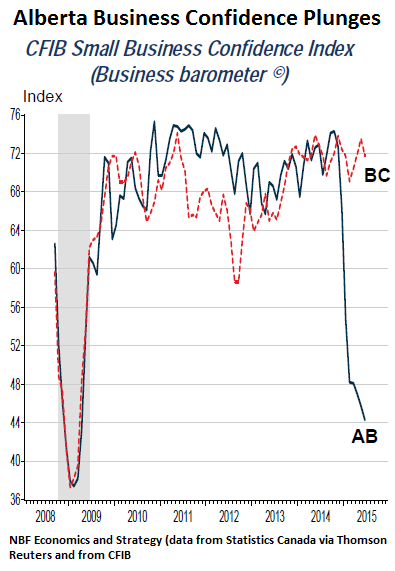
That kind of plunge in confidence is rare. The Financial Crisis was a terrifying event for businesses. And the oil bust is having a similar effect in Alberta. It speaks of the deep turmoil and anxieties in the business community that is trying to survive somehow even while the oil bust batters their business models, revenues, profits, and balance sheets. And it speaks of the myriad side effects it has on the rest of the business community, the broader economy, and government.
So in Alberta, the “difficult conditions seem set to endure for a while longer,” wrote NBF Senior Economist Marc Pinsonneault.
But the rest of Canada seems to be fine, still: “Things are actually looking up for most of the larger provinces with Ontario, Quebec, and British Columbia carrying a good amount of momentum going into H2 2015.”
And he concludes:
All and all, the data remain consistent with our view that Alberta’s woes are not translating into a full-fledge contagion to the rest of the country. As such, we remain comfortable with our view that after a difficult start to 2015, firmer growth in Canada’s three most populous provinces is poised to offset still-mounting weakness in previously high-flying resource-levered jurisdictions.
And hopefully – the operative word – that will be the case. Because some terrific bubbles in housing and commercial real estate have bloomed into majestic maturity, particularly in Toronto and Vancouver. Household indebtedness has soared. The banks are exposed, And it wouldn’t take much of a trigger to send treacherous vibrations through the whole precarious, debt-funded construct.
“All of that negative news has kind of put a downer on consumer sentiment,” is how Jharonne Martis, director of consumer research at Thomson Reuters, explained the crummy consumer confidence reading. Read… It Gets Messy in Canada
end
Your more important currency/interest rate yields and bourses results overnight from Europe and Asia:
Euro/USA 1.1199 down .0003
USA/JAPAN YEN 123.40 down .188
GBP/USA 1.5734 down .0010
USA/CAN 1.2343 up .0012
This morning in Europe, the Euro fell by a tiny 3 basis points, trading now just below the 1.12 level at 1.1199; Europe is still reacting to deflation, announcements of massive stimulation, a proxy middle east war, and the ramifications of a default at the Austrian Hypo bank, a possible default of Greece and the Ukraine, rising peripheral bond yields and today falling bourses.
In Japan Abe went all in with Abenomics with another round of QE purchasing 80 trillion yen from 70 trillion on Oct 31. The yen continues to trade in yoyo fashion as this morning it settled up again in Japan by 19 basis points and trading well above the 123 level to 123.40 yen to the dollar.
The pound was again down this morning as it now trades just above the 1.57 level at 1.5734, still very worried about the health of Barclay’s Bank and the FX/precious metals criminal investigation/Dec 12 a new separate criminal investigation on gold, silver and oil manipulation.
The Canadian dollar is down by 12 basis points at 1.2382 to the dollar.
We are seeing that the 3 major global carry trades are being unwound. The BIGGY is the first one;
1. the total dollar global short is 9 trillion USA and as such we are now witnessing a sea of red blood on the streets as derivatives blow up with the massive rise in the rise in the dollar against all paper currencies
2, the Nikkei average vs gold carry trade (still ongoing)
3. Short Swiss franc/long assets (European housing/Nikkei etc. This has partly blown up (see Hypo bank failure).
These massive carry trades are terribly offside as they are being unwound. It is causing global deflation ( we are at debt saturation already) as the world reacts to lack of demand and a scarcity of debt collateral. Bourses around the globe are reacting in kind to these events as well as the potential for a GREXIT>
The NIKKEI: this morning : down 65.25 points or 0.31%
Trading from Europe and Asia:
1. Europe stocks all in the red (except Spain)
2/ Asian bourses mostly in the red … Chinese bourses: Hang Sang red (massive bubble forming) ,Shanghai in the red (massive bubble ready to burst), Australia in the red: /Nikkei (Japan) red/India’s Sensex in the red/
Gold very early morning trading: $1173.25
silver:$15.80
Early Friday morning USA 10 year bond yield: 2.41% !!! up 1 in basis points from Thursday night and it is trading just above resistance at 2.27-2.32% and no doubt still setting off massive derivative losses.
USA dollar index early Friday morning: 95.20 down 2 cents from Thursday’s close. (Resistance will be at a DXY of 100)
This ends the early morning numbers, Friday morning
And now for your closing numbers for Friday:
Closing Portuguese 10 year bond yield: 2.72% up 3 in basis points from Thursday ( still very ominous/and dangerous with an accident waiting to happen)
Closing Japanese 10 year bond yield: .47% !!! down 1 in basis points from Thursday/very ominous
Your closing Spanish 10 year government bond, Friday, up 4 in basis points (still very ominous)
Spanish 10 year bond yield: 2.11% !!!!!!
Your Friday closing Italian 10 year bond yield: 2.15% up 6 in basis points from Thursday: (very ominous)
trading 4 basis points higher than Spain.
IMPORTANT CURRENCY CLOSES FOR TODAY
Closing currency crosses for Friday night/USA dollar index/USA 10 yr bond: 4 pm
Euro/USA: 1.1167 down .0035 ( Euro down 35 basis points)
USA/Japan: 123.80 up .2111 ( yen down 21 basis points)
Great Britain/USA: 1.5735 down .0009 (Pound down 9 basis points)
USA/Canada: 1.2314 down .0017 (Can dollar up 17 basis points)
The euro fell by a fair amount today. It settled down 35 basis points against the dollar to 1.1167 as the dollar traded in all directions today against the various major currencies. The yen was down by 21 basis points and closing well above the 123 cross at 123.80. The British pound gained tiny ground today, 9 basis points, closing at 1.5735. The Canadian dollar gained some ground against the USA dollar, 17 basis points closing at 1.2314.
As explained above, the short dollar carry trade is being unwound, the yen carry trade , the Nikkei/gold carry trade, and finally the long dollar/short Swiss franc carry trade are all being unwound and these reversals are causing massive derivative losses. And as such these massive derivative losses is the powder keg that will destroy the entire financial system. The losses on the oil front and huge losses on the USA dollar will no doubt produce many dead bodies.
Your closing 10 yr USA bond yield: 2.48% up 7 in basis point from Thursday// (just below the resistance level of 2.27-2.32%)/ and ominous
Your closing USA dollar index:
95.39 up 18 cents on the day
.
European and Dow Jones stock index closes:
England FTSE down 54.12 points or 0.79%
Paris CAC up 17.46 points or 0.35%
German Dax up 19.30 points or 0.17%
Spain’s Ibex up 63.90 points or 0.57%
Italian FTSE-MIB up 157.85. or 0.67%
The Dow up 56.66 or 0.32%
Nasdaq; down 31.69 or 0.62%
OIL: WTI 59.59 !!!!!!!
Brent:63.17!!!!
Closing USA/Russian rouble cross: 54.76 down 15/100 rouble per dollar on the day
end
And now for your more important USA stories.
NY trading for today:
“Blood On The Streets” – Bonds Battered, Stocks Slammed As Greece Suddenly “Matters”
How many Greeks will awake to this on Monday morning….
Before we start on the details, here is a quick summary of the turmoiling this week…
- Chinese stocks worst 2 week drop ever(CHINEXT -25%, Shenzhen -20%, Shanghai -19%, IPO -18.5%)

- Greek Stocks best week since post-Lehman dead-cat bounce (fell 37% after that)

- Trannies down 6 of last 7 weeks to 8-month lows
As the divergence between Industrials and Transports is getting insane…

- Nasdaq worst week in last 8 weeks (after record highs)
- S&P closed below 50DMA and tested 100DMA intraday

- Biotechs worst week since May

- USD Index best week in last 5 weeks
- Copper best week in last 8 weeks
- Gold worst week since March
- 30Y TSY Futures lowest weekly close since July 2014
- 10Y TSY Futures lowest close in 2015
- 7Y, 10Y, 30Y TSY Yield highest since Oct 2014
- 5Y Yield highest weekly close since Jan 2014
So suddenly – given no change in monetary policy machinations this week and no data to really spook or spectaculize the markets – everything was driven by Greek fears…
* * *
Remember Monday when “Greece was Rescued”… yeah…

Futures show the volatility even more as pre-US Open headline swings drove us all week…

Today was The Dow rescued by Nike’s channel stuffing (NKE accounted for over half the Dow’s gains on the day) as Nasdaq bit it on Micron’s weakness…

June remains red for most but Small Caps love it… (all the rebalance bullshit)

Here’s the last hour of the day in IWM (The Russell ETF)…

VIX had a week… from an 11 handle on Tuesday to almost 15 today…

NFLX knackered…

Micron Massacred…

Total and utter carnage in bond land today and this week…

The USDollar was well bid all week but the biggest moves were EUR weakness Monday and Friday…

Despite USD strength, copper managed gains on the week. Gold and Silver were ugly and Crude algos tried to rally it back but faded…

Just look at Silver today!!!!!

Charts: Bloomberg
Bonus Chart: Greece? or “Good” News?

Bonus Bonus Clip: Yeah, it’s that bad…
Leaking Las Vegas: Lake Mead At Record Lows, “We Have To Change”
This is it, warns one water advocate, “it really does (make critical) the fact that we have to start changing.” Lake Mead water levels have sunk to their lowest levels on record (below the levels when the dam was built) at 1075 feet. This is a major problem, as USA Today reports,since Las Vegas water authority’s current “straws” glean water from 1,050 feet and 1,000 feet – leaving the first straw just 25 feet away from pulling in air. With the drought only set to get worse as the summer begins, the water wars are just beginning as Lower-basin states are still taking more than the river system can sustain.

Bad and getting worse…

Lake Mead sunk to a record low Tuesday night, falling below the point that would trigger a water-supply shortage if the reservoir doesn’t recover soon.
…in the long run, as a U.S. Bureau of Reclamation spokeswoman said, “We still need a lot more water.”
The reservoir stores water for parts of Arizona, Southern California, southern Nevada and northern Mexico — all of which have endured a 15-year drought that continues.
…
But Tuesday’s record low signals that Colorado River water users consume more than the river provides, said water-policy manager Drew Beckwith of the Western Resource Advocates, a nonprofit environmental law and policy organization.
“This is the check-engine light,” Beckwith said.“It really does (make critical) the fact that we have to start changing.”
For Las Vegas, the record reinforces the need for a nearly $1.5 billion project to tap deeper into Lake Mead. The Southern Nevada Water Authority soon will complete a 3-mile tunnel that will suck water from an 860-foot elevation level. The plan also includes a pumping station.
…
The water authority’s current “straws” glean water from 1,050 feet and 1,000 feet. Lake Mead hovers around 1,075 feet Wednesday — leaving the first straw just 25 feet away from pulling in air.
Leaders launched the third intake project about 10 years ago, seeking to reach better-quality water at deeper depths. Water closer to the surface is warmer and requires more treatment to bring it to drinking quality, said Bronson Mack, a spokesman for the water authority.

* * *
Drought or no drought, the Colorado River is over allocated, Beckwith said.

Lower-basin states take more than the river system can sustain.

Obama Care Upheld at SCOTUS, Trade Treason Now Law, Lost Lerner Emails Destroyed-WNW 196
 By Greg Hunter’s USAWatchdog.com(6.26.15)
The huge concocted lie that is Obama Care was upheld by the Supreme Court. The majority opinion simply reworded the law because it did not want to stop subsidies to more than 8 million people. They are involving themselves in policy instead of interpreting the law. Now, there is talk of a bill in the House that will force the Supreme Court onto Obama Care by taking away their exemption. Obama Care is the biggest policy lie in U.S. history, and we know that to be fact because of MIT professor Jonathan Gruber who bragged on several videos about how the Obama Care lies were crafted with top Democrats including the White House. The Obama Administration said Gruber was not a key player in Obama Care, but that too is a big lie as new emails were released this week showing he was, according to published reports, “frequently consulted by staffers and advisers for both the White House and the Department of Health and Human Services (HHS) about the Affordable Care Act.” Obama says it’s “here to stay,” and the Republicans say Obama Care will be a campaign issue once again in 2016.
The trade treason known as the Trade Promotion Authority (TPA) and the Trans Pacific Partnership (TPP) have passed. You think I am too harsh saying this is trade treason? What do you call legislation that is totally secret? If lawmakers say what is in this legislation they can beprosecuted for a felony. They call this so-called “fast track” legislation, but it should be called neuter Congress legislation. There can be no debate, no amendments or no filibuster. The President negotiates a deal, and Congress votes Yes or No. The Republicans are handing this kind of power over to the same President they are currently suing in federal court because of hisoverreach on other issues such as immigration. I cannot make this stuff up. Oh, “We the People” can find out about what is in the legislation 4 or 5 years from now—when it’s declassified. As I said in the past, evil is done in the dark and good is done in the light. This is being done in the dark. One last thing, the biggest money supporter of the TPP, according to ZeroHedge.com, is Goldman Sachs, but many other companies pushed for this too. Zero Hedge figures corporate backers paid an average of $17,600 per Yes vote. Most of the Yes votes came from Republicans, but the Democrats had some key votes to get this secret legislation passed. I also say the Democrats and Republicans just take turns ripping us off.
The IRS now says it has accidentally erased Lois Lerner’s emails—all 24,000 of them!! She was at the center of the IRS scandal where the tax agency thwarted political opposition from conservatives. Originally, the head of the IRS testified in Congress that the emails were lost. In fact, they were not lost, and during the investigation, they were being destroyed. Did I say the IRS claims it was an accident? Just more of lawless government of men and not laws.
The Iran deal is going south as I predicted, and 5 top former Obama Administration officials and advisors say the Iran nuclear deal is a bad one. Even former General and CIA Chief David Petraeus says it is not in the best interests of the U.S., and he and others say the deal should be much tougher. Iran says it will not agree to inspections of its military installations, and it also wants to have the sanctions when a deal is signed. I don’t think Congress is going to let that happen, and therefore, I stand by my prediction that there will be no deal.
Join Greg Hunter as he talks about these stories and more in the Weekly News Wrap-Up.
Well that is all for today
I will try a give a report on Monday if I have time
If I do, it would be late in the evening….
Harvey


 harveyorganblog.com