
Good evening Ladies and Gentlemen:
We are entering options expiry week.
Comex options expiry Tuesday, July 28.
LMBA options expiry: noon London time July 31.2015
OTC options expiry: midnight July 31.2015
Here are the following closes for gold and silver today:
Gold: $1096.30 down 20 cents (comex closing time)
Silver $14.63 up 4 cents.
In the access market 5:15 pm
Gold $1095.50
Silver: $14.80
First, here is an outline of what will be discussed tonight:
At the gold comex today, we had a good delivery day, registering 21 notices for 2100 ounces . Silver saw 4 notices filed for 20,000 oz.
Several months ago the comex had 303 tonnes of total gold. Today, the total inventory rests at 243.94 tonnes for a loss of 59 tonnes over that period.
In silver, the open interest fell by 154 contracts despite the fact that Monday’s price was up by 11 cents (and the gold price was up $10.90). The total silver OI continues to remain extremely high, with today’s reading at 190,285 contracts now at decade highs despite a record low price. In ounces, the OI is represented by .951 billion oz or 135% of annual global silver production (ex Russia ex China). This dichotomy has been happening now for quite a while and defies logic. There is no doubt that the silver situation is scaring our bankers to no end as they continue to raid as basically they have no other alternative. Today again, we must have had bankers contemplating falling off the roof due to silver’s refusal to buckle with respect to open interest.
In silver we had 4 notices served upon for 20,000 oz.
In gold, the total comex gold OI rests tonight at 440,550 for a loss of 2,852 contracts despite the fact that gold was up $10.90 yesterday. We had 21 notices filed for 2100 oz today.
We had no withdrawals in gold tonnage at the GLD / thus the inventory rests tonight at 680.15 tonnes. The appetite for gold coming from China is depleting not only gold from the LBMA and GLD but also the comex is bleeding gold. I thought that 700 tonnes is the rock bottom inventory in GLD gold, but I guess I was wrong. However we must be coming pretty close to a level of only paper gold and the GLD being totally void of physical gold. In silver, we had a huge withdrawal of 2.005 million oz in inventory at the SLV / Inventory rests at 326.829 million oz.
We have a few important stories to bring to your attention today…
1. Today, we had the open interest in silver fall by 152 contracts down to 190,285 despite the fact that silver was up by 11 cents yesterday. We again must have had some shortcovering by the bankers as they feared something was brewing in the silver arena. The OI for gold fell by 2,852 contracts down to 440,550 contracts as the price of gold was up $10.90 with yesterday’s trading.
(report Harvey)
2 Today, 2 important commentaries on Greece
(zero hedge, Bloomberg/)
3. Today, 4 stories on the collapsing Chinese stock market and the huge deflationary forces heading our way on that collapse
(David Stockman/zero hedge)
4. Gold trading overnight
(Goldcore/Mark O’Byrne/)
5. A huge story on the collapse of Austrian bank Hypo. The constitutional courts have ruled the bail ins as unconstitutional and tis will have huge problems going forward for our bankers who thought they could orchestrate a bail in instead of a taxpayer bailout
(zero hedge)
6 Trading of equities/ New York
(zero hedge)
7. we have two oil related stories
(zero hedge/Arthur Berman)
8. Bill Holter’s topic tonight:
“Truth, Justice, and (no longer) The American Way!”
9. Craig Hemke on the huge leverage on the paper comex gold to actaul dealer inventories
(TF Metals/Craig Hemke)
10. USA stories:
i) home prices plummeting
ii) consumer confidence waning
iii) Toy’s R US bonds faltering terribly.
plus other topics…
Here are today’s comex results:
The total gold comex open interest fell by 2,852 contracts from 443,402 down to 440,550 despite the fact that gold was up $10.90 in price with yesterday’s trading (at the comex close).For the past two years, we have strangely witnessed the gold comex collapse in OI as we enter an active delivery month, and today this again is the norm. What is interesting is that the LBMA gold is witnessing a 7.40 premium spot/next nearby month as gold is now in backwardation over there. We are now in the contract month of July and here the OI fell by 101 contracts falling to 53 contracts. We had 95 notices filed on yesterday and thus we lost 6 gold contracts or an additional 600 oz will not stand in this non active delivery month of July. The next big delivery month is August and here the OI decreased by 21,741 contracts down to 103,827. We have 3 trading days before first day notice for the big August active gold contract (july 31). The estimated volume today (which is just comex sales during regular business hours of 8:20 until 1:30 pm est) was excellent at 267,555. However today’s volume was aided by HFT traders. The confirmed volume on Friday (which includes the volume during regular business hours + access market sales the previous day was excellent at 256,918 contracts. Today we had 21 notices filed for 2100 oz.
And now for the wild silver comex results. Silver OI fell by 152 contracts from 190,439 down to 190,285 despite the fact that the price of silver was up by 11 cents with respect to yesterday’s trading. We continue to have our bankers pulling their hair out with respect to the continued high silver OI as the world senses something is brewing in the silver arena. We are in the delivery month of July and here the OI fell by 10 contracts down to 163. We had 1 notice served upon yesterday and thus we lost 9 contracts or an additional 45,000 ounces of silver will stand for delivery in this active month of July. This is the first time in quite some time that we have not lost any silver ounces standing immediately after first day notice. The August contract month saw it’s OI fall by 3 contracts down to 163. The next major active delivery month is September and here the OI rose by 66 contracts to 129,666. The estimated volume today was fair at 29,898 contracts (just comex sales during regular business hours). The confirmed volume yesterday (regular plus access market) came in at 34,380 contracts which is fair in volume. We had 4 notices filed for 20,000 oz.
What is interesting with respect to comex silver OI, is that the open interest per day is hardly moving. In other words we have considerable silver trading, yet at the end of the day, the OI remains relatively constant as if everybody is standing pat.
July initial standing
July 28.2015
| Gold |
Ounces |
| Withdrawals from Dealers Inventory in oz | nil |
| Withdrawals from Customer Inventory in oz | 11,350.01 oz (Manfra,Scotia) |
| Deposits to the Dealer Inventory in oz | nil |
| Deposits to the Customer Inventory, in oz | nil |
| No of oz served (contracts) today | 21 contracts (2100 oz) |
| No of oz to be served (notices) | 32 contracts (3,200 oz) |
| Total monthly oz gold served (contracts) so far this month | 723 contracts(72,300 oz) |
| Total accumulative withdrawals of gold from the Dealers inventory this month | 203.60 oz |
| Total accumulative withdrawal of gold from the Customer inventory this month | 433,472.6 oz |
Today, we had 0 dealer transactions
total Dealer withdrawals: nil oz
we had 0 dealer deposits
total dealer deposit: zero
i) Out of Manfra: 192.90 oz (6 kilobars)
ii) Out of Scotia: 11,350.01 oz
total customer withdrawal: 11,350.01 oz
We had 0 customer deposits:
Total customer deposit: nil oz
We had 2 adjustments
i) Out of Delaware: 199.964 oz was adjusted out of the customer and this landed into the dealer account of Delaware
ii) 32.154 oz was added to the customer account of Scotia
JPMorgan has only 3.600 tonnes left in its registered or dealer inventory.
.
Today, 0 notices was issued from JPMorgan dealer account and 0 notices were issued from their client or customer account. The total of all issuance by all participants equates to 21 contracts of which 0 notices were stopped (received) by JPMorgan dealer and 0 notices were stopped (received) by JPMorgan customer account
To calculate the total number of gold ounces standing for the July contract month, we take the total number of notices filed so far for the month (723) x 100 oz or 72,300 oz , to which we add the difference between the open interest for the front month of July (53) and the number of notices served upon today (21) x 100 oz equals the number of ounces standing.
Thus the initial standings for gold for the July contract month:
No of notices served so far (723) x 100 oz or ounces + {OI for the front month (53) – the number of notices served upon today (21) x 100 oz which equals 75,500 oz standing so far in this month of July (2.348 tonnes of gold).
We lost 6 contracts or an additional 600 oz will not stand in this non active delivery month of JULY.
Total dealer inventory 378,676.094 or 11.778 tonnes
Total gold inventory (dealer and customer) = 7,842,682.724 oz or 243.94 tonnes
Several months ago the comex had 303 tonnes of total gold. Today the total inventory rests at 243.94 tonnes for a loss of 59 tonnes over that period.
end
And now for silver
July silver initial standings
July 28 2015:
| Silver |
Ounces |
| Withdrawals from Dealers Inventory | nil |
| Withdrawals from Customer Inventory | 691,937.05 oz (CNT, Delaware,HSBC,Scotia) |
| Deposits to the Dealer Inventory | nil |
| Deposits to the Customer Inventory | 594,820.400 oz (CNT,) |
| No of oz served (contracts) | 4 contracts (20,000 oz) |
| No of oz to be served (notices) | 159 contracts (795,000 oz) |
| Total monthly oz silver served (contracts) | 3478 contracts (17,390,000 oz) |
| Total accumulative withdrawal of silver from the Dealers inventory this month | nil |
| Total accumulative withdrawal of silver from the Customer inventory this month | 10,007,569.0 oz |
Today, we had 0 deposits into the dealer account:
total dealer deposit: nil oz
we had 0 dealer withdrawal:
total dealer withdrawal: nil oz
We had 1 customer deposits:
i) Into CNT: 594,820.400 oz
total customer deposit: 594,820.400 oz
We had 4 customer withdrawals:
i)Out of Scotia: 38,381.54 oz
ii) Out of CNT: 599,362.600 oz
iii) Out of Delaware: 3970.900 oz
iv) Out of HSBC: 50,222.01 oz
total withdrawals from customer: 691,937.05 oz
we had 1 adjustment
From CNT:
Total dealer inventory: 57.559 million oz
Total of all silver inventory (dealer and customer) 177.240 million oz
The total number of notices filed today for the July contract month is represented by 4 contracts for 20,000 oz. To calculate the number of silver ounces that will stand for delivery in July, we take the total number of notices filed for the month so far at (3478) x 5,000 oz = 17,390,000 oz to which we add the difference between the open interest for the front month of July (163) and the number of notices served upon today (4) x 5000 oz equals the number of ounces standing.
Thus the initial standings for silver for the July contract month:
3478 (notices served so far) + { OI for front month of July (163) -number of notices served upon today (4} x 5000 oz ,= 18,185,000 oz of silver standing for the July contract month.
We lost 45,000 oz that will not stand for delivery in this non active month of July. Somebody was in great need of silver and gold today.
for those wishing to see the rest of data today see:
http://www.harveyorgan.wordpress.comorhttp://www.harveyorganblog.com
end
The two ETF’s that I follow are the GLD and SLV. You must be very careful in trading these vehicles as these funds do not have any beneficial gold or silver behind them. They probably have only paper claims and when the dust settles, on a collapse, there will be countless class action lawsuits trying to recover your lost investment.
There is now evidence that the GLD and SLV are paper settling on the comex.
***I do not think that the GLD will head to zero as we still have some GLD shareholders who think that gold is the right vehicle to be in even though they do not understand the difference between paper gold and physical gold. I can visualize demand coming to the buyers side:
i) demand from paper gold shareholders
ii) demand from the bankers who then redeem for gold to send this gold onto China
vs no sellers of GLD paper.
And now the Gold inventory at the GLD:
July 28/no change in inventory/rests tonight at 680.13 tonnes
July 27/no change in inventory/rests tonight at 680.13 tonnes
July 24.2015/we had another massive withdrawal of 4.48 tonnes of gold form the GLD/Inventory rests at 680.13 tonnes.
July 23.2015: we had another withdrawal of 2.68 tonnes of gold from the GLD/Inventory rests at 684.63 tonnes
july 22/another withdrawal of 2.38 tonnes of gold from the GLD/Inventory rests at 687.31
July 21.2015: a massive withdrawal of 6.56 tonnes of gold from the GLD.
Inventory rests at 689.69 tonnes. China and Russia need their physical gold badly and they are drawing their physical from this facility.
July 2o.2015: no change in inventory
July 17./a massive withdrawal of 11.63 tonnes in gold tonnage tonight from the GLD/Inventory rests at 696.25 tonnes
July 16./we lost 1.19 tonnes of gold tonight/Inventory rests at 707.88 tonnes
July 15/no change in inventory/gold inventory rests tonight at 709.07 tonnes.
July 14.2015:no change in inventory/gold inventory rests at 709.07 tonnes
July 13.2015: a big inventory gain of 1.49 tonnes/Inventory rests tonight at 709.07 tonnes
July 10/ we had a big withdrawal of 2.07 tonnes of gold from the GLD/Inventory rests this weekend at 707.58 tonnes
July 28 GLD : 680.13 tonnes
end
And now for silver (SLV)
July 28/we had a huge withdrawal of 2.005 million oz from the SLV/Inventory rests at 326.829 oz
July 27/no change in silver inventory/inventory rests tonight at 328.834 million oz
July 24/no change in silver inventory/inventory rests tonight at 328.834 million oz
July 23.2015; no change in silver inventory/rests tonight at 328.834 million oz
july 22/no change in silver inventory/inventory rests at 328.834 million oz.
July 21.we had a massive addition of 1.241 million oz into the SLV/Inventory rests tonight at 328.834 million oz.
Please note the difference between gold and silver (GLD and SLV). In GLD gold is being depleted and sent to the east. In silver: no depletions, as I guess this vehicle cannot supply physical metal.
July 20/no change
july 17.2015/no change in silver inventory tonight/inventory at 327.593 million oz
July 16./no change in silver inventory/rests tonight at 327.593 million oz
July 15./no change in silver inventory/rests tonight at 327.593 million oz/
July 14.2015: no change in silver inventory/rests tonight at 327.593 million oz.
July 13./an inventory gain of 1.051 million oz/Inventory rests at 327.593 million oz
july 10/no change in silver inventory at the SLV tonight/inventory 326.542 million oz/
July 9/ a huge increase in inventory at the SLV of 1.337 million oz. Inventory rests tonight at 326.542 million oz
July 28/2015: tonight inventory rests at 326.829 million oz
end
And now for our premiums to NAV for the funds I follow:
Sprott and Central Fund of Canada.
(both of these funds have 100% physical metal behind them and unencumbered and I can vouch for that)
1. Central Fund of Canada: traded at Negative 11.3 percent to NAV usa funds and Negative 11.3% to NAV for Cdn funds!!!!!!!
Percentage of fund in gold 62.2%
Percentage of fund in silver:37.5%
cash .3%
( July 28/2015)
2. Sprott silver fund (PSLV): Premium to NAV rises to -.23%!!!! NAV (July 28/2015) (silver must be in short supply)
3. Sprott gold fund (PHYS): premium to NAV falls to – .73% to NAV(July 28/2015)
Note: Sprott silver trust back into negative territory at- 0.23%
Sprott physical gold trust is back into negative territory at -.73%
Central fund of Canada’s is still in jail.
Sprott formally launches its offer for Central Trust gold and Silver Bullion trust:
SII.CN Sprott formally launches previously announced offers to CentralGoldTrust (GTU.UT.CN) and Silver Bullion Trust (SBT.UT.CN) unitholders (C$2.64)
Sprott Asset Management has formally commenced its offers to acquire all of the outstanding units of Central GoldTrust and Silver Bullion Trust, respectively, on a NAV to NAV exchange basis.
Note company announced its intent to make the offer on 23-Apr-15 Based on the NAV per unit of Sprott Physical Gold Trust $9.98 and Central GoldTrust $44.36 on 22-May, a unitholder would receive 4.45 Sprott Physical Gold Trust units for each Central GoldTrust unit tendered in the Offer.
Based on the NAV per unit of Sprott Physical Silver Trust $6.66 and Silver Bullion Trust $10.00 on 22-May, a unitholder would receive 1.50 Sprott Physical Silver Trust units for each Silver Bullion Trust unit tendered in the Offer.
* * * * *
>end
And now for your overnight trading in gold and silver plus stories
on gold and silver issues:
(courtesy/Mark O’Byrne/Goldcore)
Buy and “Own Krugerrands” Says Legendary Jim Grant
– “I own Krugerrands” says legendary Jim Grant
– He is “very bullish indeed” on gold
– Gold is “investment in financial and monetary disorder” – says Grant
– It thrives in current environment – “uncertainty, turbulence and disorder”
– “One of the most radical periods of monetary experimentation in the annals of money”
– “Gold…is now the conjunction of price, value and sentiment”
– Reminds owners of gold that the original reasons for buying gold have not gone away
– Believes Fed will raise rates despite deflationary environment
– Explains detrimental effect of excessive debt on an economy
– Grant light-heartedly destroys Jason Zweig’s “pet rock” gold jibe

Jim Grant, publisher of Grant’sInterest Rate Observer says that gold is “an investment in financial and monetary disorder.” He believes that today we are experiencing “uncertainty, turbulence and disorder”.
When asked how he liked to own gold he said he owned physical, generic, non-numismatic coins – specifically mentioning South African Gold Krugerrands and also mining shares.
Krugerrands are one of the cheapest and most cost effective ways to buy gold with very low premiums. Clients in Ireland, the UK, the U.S. and internationally are currently buying Krugerrands at extremely low premiums of just 2.5%. They remain some of the most popular bullion coins in the market due to their durability (harder 22-carat gold coin), recognisability, portability and liquidity throughout the world.
He warns:
“You look around the world and you see exchange rates are properly disorderly, when you look around the world of lending and borrowing — we are in a regime of price control by another name, so-called zero percent rates and quantitative easing by the world central banks”.
He adds, “We are in one of the most radical periods of monetary experimentation in the annals of money”, with a “low probability” of a favourable outcome.
Given the disorder he sees in the world due to monetary experimentation and the very low gold price Grant says,
“You want to have exposure to the reciprocal asset of the paper assets that are the most popular – so gold, to me, is now the conjunction of price, value and sentiment, and I am very bullish indeed.”
He describes the recent fall in prices as “terrifically vexing but a wonderful opportunity” and reminds owners of gold that the reasons for owning gold have not gone away. He emphasises that gold thrives in periods of turbulence and disorder and uncertainty adding “I think we have all three of these things.”
On interest rates Grant believes that the Fed – having talked interest rate rises for so long – must soon take action to maintain “institutional pride”. However, it may be economically counterproductive given the deflationary forces still extant.

“The Fed feels it must act just for institutional pride; but, money supply growth is dwindling, the turnover rate of money likewise, the only thing that is dynamic in the world of money and credit is the issuance of more and more dubiously sourced debt, and more and more lenient terms”.
Grant takes a light hearted pop at Jason Zweig’s theory that gold is simply a “pet rock”. He jokes that gold can make people say ridiculous things they may soon regret – pointing out that Zweig had written a piece “within two weeks of the top of the bullion price” in 2011 extolling the virtues of gold mining stocks.
During the course of the interview he also explains how excessive debt can be detrimental to an economy.
“What debt does is two things: it pulls forward consumption and pushes back evidence of business failure”.
Debt allows us to spend more on what we want today at the expense of what we need in the future. Businesses which should fail are kept alive by easy credit leading to a backlog of bankruptcies and more loan defaults in the future.
While optimists in general, we share Jim Grant’s pessimism with regards to the health of the global monetary and economic system. and the usefulness of gold as to protect one’s wealth in the current environment.
We also believe that physical bars and coins including Krugerrands, should form the bedrock of any gold investment strategy. We offer delivery and storage of Krugerrands at the most competitive prices, in the safest vaults in the safest jurisdictions in the world.
Jim Grant interview with Kitco on Value Walk can be watchedhere
Gold Krugerrands at record low premiums of just 2.5% here
MARKET UPDATE
Today’s AM LBMA Gold Price was USD 1,095.60, EUR 990.06 and GBP 702.13 per ounce.
Yesterday’s AM LBMA Gold Price was USD 1,098.60, EUR 992.41 and GBP 708.39 per ounce.
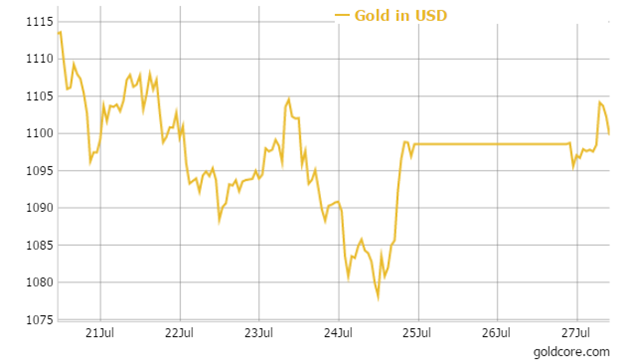
Gold in USD – 1 Week
Today, gold in Singapore ticked lower initially prior to seeing gains in late Asian and early Swiss gold bullion trading.
This morning in European trading, silver for immediate delivery was 0.3 percent lower at $14.78 an ounce. The metal slumped to $14.3842 on Friday, the lowest price since 2009.
Spot platinum fell 0.7% percent to $985 an ounce, while palladium fell 1.1% percent to $622 an ounce.
Must-read bullion guide: Gold and Silver Storage Must Haves
end
(courtesy the Silver Institute)
Upticks in Silver Demand Seen in First Half of 2015
WASHINGTON, DC–(Marketwired – Jul 28, 2015) – Through the first half of this year, silver experienced increased demand for jewelry and important industrial applications, two signals of demand growth for this most versatile of metals.
Silver jewelry, a mainstay of silver demand, was strong in the first half of 2015. In the U.S., imports of silver jewelry jumped 11 percent through the end of May, as consumer desire for silver jewelry increased significantly this year. The U.S. is the largest importer of silver jewelry, as measured in dollar terms, and this demand impacts silver trade across Asia. U.S. imports from Thailand are up 18.5 percent through the end of May while China showed an increase of 14 percent in the same period. GFMS Thomson Reuters (GFMS), the precious metals consultancy, estimates that globally silver jewelry will grow 5 percent in 2015.
With almost 60 percent of silver demand tied to industrial use, silver’s role in industrial applications is looking brighter in several important areas. GFMS forecasts a 2 percent growth in industrial applications for silver this year.
In the renewable energy industry sector, the demand for silver by solar panel producers is expected to increase 8 percent to 65 million ounces this year. The rise reflects increased solar cell production and a higher number of installations. The increase is due to the U.S., which had a 76 percent increase in solar installations in the first quarter of 2015 when compared to last year. China and India both have aggressive solar installation plans and are expected help drive this projected growth as well.
Silver demand from ethylene oxide producers is expected to increase to 8.6 million ounces in 2015, which would represent a 61 percent increase over 2014. Most of this increase will be driven by Chinese demand. Ethylene oxide is a vital building block chemical, critical in the production of plastics, solvents, and detergents and a broad range of organic chemicals, and represents one more example of the unmatched importance of silver in industry.
Electronics demand is forecast to increase modestly in 2015, by 0.4 percent. A decline in silver demand by computer and tablet producers, by an expected 4.5 percent drop in shipments this year, should be partially offset by a 3 percent increase in mobile phone shipments in 2015.
Additionally, the silver market is expected to be in a deficit of 57.7 million ounces in 2015, as supply contracts and physical demand grows. This would mark the third consecutive year that the market is in a physical deficit. When the market experiences an annual shortfall from mine supply, users must drawdown on above ground stocks, thereby tightening available supply.
On the investment side, retail investor demand for the white metal has been sturdy in the first half of 2015, in what has been a challenging precious metals investment market. Through July 24, global silver ETF holdings increased by over 4.7 million ounces in 2015, indicating that these investors likely have a more positive longer-term view of the silver price.
In the first half of the year, global bullion coin sales totaled 43.6 million ounces, 6 percent below levels seen in the same period a year ago. However, first half 2015 global sales were the fifth highest on record. The U.S. Mint, faced with a significant spike in investor interest, temporarily suspended sales of its silver bullion coins on July 7, after exhausting its inventory when investor demand in June surged 80 percent above the previous year’s June coin sales. The Mint resumed bullion coin sales on July 27 on an allocated basis. Similarly, Australia’s Perth Mint saw its silver coins sales spike in June due to a more attractive silver price, though sales overall are down 18 percent from the same period in 2014.
The gold/silver ratio, a simple measure of the metals’ relative prices calculated by dividing the price of an ounce of gold by the corresponding price of silver, has averaged 58 since 2000. The ratio averaged 73 in the first half of 2015, indicating that silver is underpriced relative to gold. This gives way to increased potential for buying in the silver market.
The Silver Institute is a nonprofit international industry association headquartered in Washington, D.C. Established in 1971, the Institute’s members include leading silver producers, prominent silver refiners, manufacturers and dealers. The Institute serves as the industry’s voice in increasing public understanding of the value and the many uses of silver,. For more information on the Silver Institute, or silver in general, please visit: www.silverinstitute.org.
CONTACT INFORMATION
- Contact:
Michael DiRienzo
The Silver Institute
T: (202) 495-4030
Email Contact
end
(courtesy Mineweb)
Silver takeover gets a shrug

On Monday, First Majestic Silver shares fell more than 10% on news it had inked a friendly, nearly all-share takeover with Silvercrest Mines. It seems the prospect of a bigger silver mining company, with more shares out, drove shareholders to dump shares amid an increasingly bearish precious metals market.
Still, some analysts agreed with First Majestic reasoning that the takeover could buoy First Majestic cash flow and improve its operating cost outlook.
“I think it is a good deal for First Majestic as it is free cash flow accretive and [comes with] a lower cost asset – so good on both of those items,” Desjardins analyst Michael Parkins said by email. “The mine life looks good based on the reserves and the balance sheet of First Majestic will also improve on a net cash basis.”
The deal adds another mine in Mexico to First Majestic’s stable of six operations in that country. Silvercrest owns the Santa Elena gold-silver mine that is to produce some 4 to 5 million ounces silver-equivalent (gold is a major component) over the next few years. The mine plan shows declining production, falling to under 4 million ounces silver after that to 2022.
First Majestic estimated production next year will grow by about 5 million ounces silver equivalent to 16.8 million ounces silver equivalent.
Ownership-wise the combination mirrors the reserve base of both miners. Silvercrest is to own 21% of the combined company and brings a similar amount of silver-equivalent reserves to the table, 19 million ounces versus First Majestic’s 101 million ounces.
Silvercrest forecast operating costs per silver-equivalent ounce beats out First Majestic somewhat. Silvercrest estimates all-in sustaining costs in 2015 just over $12/oz silver-equivalent versus First Majestic’s estimate for this year between about $14/oz and $15.50/oz.
So, if 2015 turns out as expected, First Majestic’s all-in sustaining operating costs, with Santa Elena on board, could come down slightly and, assuming the price of silver doesn’t drop much further, boost cash flow.
Meantime, First Majestic as a silver miner will gain in the ranks of silver producers (assuming silver-equivalent production), growing production in the near future by as much as 45%. It will potentially exceed Coeur Mining production next year, which is expected to produce about 15.8 million ounces silver in 2016 or about 1 million ounces less than a combined First Majestic and Silvercrest.
end
(courtesy Craig Hemke/TFMetals)
TF Metals Report: Comex gold leverage widens to record
12:13p ET Tuesday, July 28, 2015
Dear Friend of GATA and Gold:
Leverage for the big bullion banks in the New York Commodities Exchange’s gold futures contracts now has reached 116 times the metal available on the exchange, the TF Metals Report’s Turd Ferguson reports today.
Ferguson writes: “Is this fair and does this market discover an accurate representation of price when it uses a leverage of paper to physical at 116 times? And this is where this is all just one big scam. With no boundaries or limits placed on the bullion banks that issue these paper contracts, what’s to stop them from extending the leverage to 200X? Maybe 300X? How about 500X?”
Ferguson concludes: “All we can do is continue to force the banks’ leverage even higher by removing physical metal from their system and placing it out of their collective reach.”
His analysis is headlined “Comex Leverage Widens to Record” and it’s posted at the TF Metals Report here:
http://www.tfmetalsreport.com/blog/7027/comex-leverage-widens-record
CHRIS POWELL, Secretary/Treasurer
Gold Anti-Trust Action Committee Inc.
CPowell@GATA.org
end
(courtesy Bill Holter/Holter/Sinclair collaboration)
Truth, Justice, and (no longer) The American Way!
This is not rocket science. It is not hocus pocus or even anything “special”. Time and sales have been around since the dawn of trading. Even prior to computers, handwritten records were taken to record who traded what, when and in what quantities. Should the SEC, NYSE, CFTC or anyone else want to know who is doing what, it takes five seconds or less to find out.. (This includes the Chinese who have outlawed selling under the penalty of firing squad!!! So who is doing all the selling?) In my opinion, the regulators should be strung up on lampposts for their lack of doing the jobs they are being paid public tax money to do. They have turned a blind eye, presumably because they are told or believe it is for “the greater good”? …the greater good… sounds like something out of Russia or China back in the day when I was a youngster in the 1960’s – or even something in the history books we read as kids in school regarding Nazi Germany.
Do you remember this time period? I still remember this time frame very well and pine for it every day. Back in those days we couldn’t wait to get home from school so we could get to play baseball, football, basketball or even hike it to the nearest pond in winter time to play some pickup hockey. Back in those days our parents knew where we were by where our bicycle was.
There were no cell phones and if we needed to make a call from a public place, we would pull the dime out of our pocket our parents always insisted we have.
After playing, we’d all head home for dinner and get to watch some TV. Remember? ” TV” where no cussing was allowed. Most shows had a “theme” or an underlying lesson that taught kids “good always triumphed over evil”. We watched Batman, Superman and others. Western’s were in vogue and there was always a lesson to be learned from watching The Rifleman or Gunsmoke. I have said several times over the years when writing on this subject, “Leave it to Beaver cannot even be found on syndicated reruns anymore”. My point is, the “wholesome” world we grew up in is so far gone, current history books don’t even mention it as a footnote!
Think about where we are today. Where handshakes used to suffice, contracts are now drawn up to be purposely broken. More than half of our population “takes” while less than half the population supports this spending habit. Worse, it is the “supporters” who are vilified today because they don’t “give enough.” We used to have free speech as outlined in The Constitution, now there is only free speech for the “special” groups. Anyone who speaks against any of these very special groups is branded a racist, sexist, homophobe, or religious persecutor (except of course, unless you’re speaking against Christians – that’s OK… even seemingly encouraged). Or worst of all, you could be labeled a “CONSERVATIVE!”
You could not have told me even 20 years ago we would be where we are today. We have a system where the president makes up laws as he goes along, the Supreme Court rubber stamps his illusions and Congress has been relegated to irrelevance. Speaking of Congress, didn’t “We the People” just throw the bums out? Didn’t the Republicans run on a ticket that said they would overturn all sorts of ridiculous (and if you ask me) tyrannical laws? Have they overturned anything? No, they just passed the fast track trade bill which will gut our economy even further …while the Democrats voted against it …? Forget about the giant sucking sound Ross Perot spoke of, we will soon hear the wheezing and gurgling last breaths of a nation, in my sad opinion. In the interest of not losing you as a reader, I could go on and on about subjects like guns, GMO’s, baby parts for sale or whatever but I think you get the point and I’ll stop here.
From an economic and financial standpoint, it is funny that while away I read “The Scarlet Woman of Wall Street.” This was the story of Daniel Drew, Vanderbilt, Fisk, Gould and Erie railroad during the mid to late 1800’s. There were no financial laws back then that prevented anything with the exception of bribery which was impossible to prove unless the giver and receivers were both stupid beyond their years. Then all sorts of laws were written and the playing field was somewhat leveled (as much as it could have been). Now, there are so many laws on the books, it is impossible not to break one of them. The thing is, financial institutions do not care. Since no one goes to jail (except for a couple of hedge fund managers), it is more profitable to illegally and blatantly swipe $10 billion because you know your fine will only be $100 million. If you think about it, management in today’s world could probably be held accountable in today’s civil legal system for NOT BREAKING THE LAW and leaving money on the table. Why play fair when everything is rigged, while you can steal and pay only 1% or less of what you made? It is almost management’s “fiduciary duty” to lie, cheat and steal in order to not fall behind!
To wrap this piece up I would like to say this, if you don’t believe or cannot see that all markets are rigged all of the time I’m sorry. If I offended anyone for any reason, again I’m sorry. If you believe today is “normal” in any way, I am sorry. Actually, let me clarify this: I am not sorry, but I am sorry you don’t understand the point I am trying to get across and sorry you cannot see it. Unfortunately, the American people have been slow boiled into believing our lives are normal and things are “just the way they are.” We have been lulled into believing we are an “exceptional” people and “deserve” the finer things in life. What we have forgotten is that hard work, hard money, and innovation is what made this country great to begin with. Many today don’t remember or never knew this very basic tenet…but ignorance does not change the fact. Truth and justice (and for the most part “business”) was what America was once all about. Please do not tell me I am naïve. I am not. Please do not tell me this is not being done according to a plan. It is. There is zero percent probability the policies in place today are by mistake. They are not by mistake and no one could be so stupid which leaves only one option …”purposeful” is the operative word.
The United States was the shining light of the world in so many ways. We are no longer. We were built as a Republic that followed The Constitution which was written mainly by God fearing Christians. We have evolved into a perverted, apologetic, weak and slovenly society with little to no values regarding anything from our ethics, morals, constitutions, or anything else. We believe we deserve the best and should work the least (if at all). It’s the American WAY!!! Unfortunately, what I write here is now considered by the majority as either anti-government or unpatriotic. It is neither. In fact, all I advocate is following The Constitution. You know, that “thing” our politicians “swear to God to uphold” (did you catch that? They swear to God! Not to Walt Disney, Facebook or even the almighty Google!) while raising their right hand with their left hand on The Bible? I am a true patriot in a world where burning the flag, shredding The Constitution and spitting on The Bible is considered sane and normal. I am here to remind you it certainly is not! I am not writing this to convert the perverts, only to let those who are still sane know that yes, you are still sane. That said, in today’s ludicrous world, what I write here can be used as proof of my “insanity” and my lack of “patriotism.” You decide.

Standing watch (with tears in my eyes),
end
And now your overnight trading in bourses, currencies, and interest rates from Europe and Asia:
1 Chinese yuan vs USA dollar/yuan remains constant at 6.2094/Shanghai bourse: red and Hang Sang: green
2 Nikkei down 21.21 or 0.10%
3. Europe stocks all in the green /USA dollar index up to 96.89/Euro down to 1.1034
3b Japan 10 year bond yield: falls to 41% !!!!(Japan buying 100% of bond issuance)/Japanese yen vs usa cross now at 123.74
3c Nikkei still just above 20,000
3d USA/Yen rate now just below the 124 barrier this morning
3e WTI 47.09 and Brent: 52.78
3f Gold down (options exiry on comex) /Yen down
3gJapan is to buy the equivalent of 108 billion uSA dollars worth of bond per month or $1.3 trillion. Japan’s GDP equals 5 trillion usa.
Japan to buy 100% of all new Japanese debt and by 2018 they will have 25% of all Japanese debt. Fifty percent of Japanese budget financed with debt.
3h Oil down for WTI and down for Brent this morning
3i European bond buying continues to push yields lower on all fronts in the EMU. German 10 yr bund falls to .693 per cent. German bunds in negative yields from 4 years out.
Except Greece which sees its 2 year rate rises to 21.12%/Greek stocks this morning: still expect continual bank runs on Greek banks /stock markets not allowed to be open as per ECB
3j Greek 10 year bond yield rises to: 11.71%
3k Gold at $1094.07 /silver $14.58
3l USA vs Russian rouble; (Russian rouble down 65/100 in roubles/dollar) 60.30,
3m oil into the 47 dollar handle for WTI and 52 handle for Brent/Saudi Arabia increases production to drive out competition.
3n Higher foreign deposits out of China sees huge risk of outflows and a currency depreciation. This can spell financial disaster for the rest of the world/China may be forced to do QE!!
30 SNB (Swiss National Bank) still intervening again in the markets driving down the SF. It is not working: USA/SF this morning .9655 as the Swiss Franc is still rising against most currencies. Euro vs SF is 1.0655 well above the floor set by the Swiss Finance Minister. Thomas Jordan, chief of the Swiss National Bank continues to purchase euros trying to lower value of the Swiss Franc.
3p Britain’s serious fraud squad investigating the Bank of England/
3r the 4 year German bund remains in negative territory with the 10 year moving closer to negativity at +.693%
3s The ELA rose another 900 million euros to 90.4 billion euros. The bank withdrawals were causing massive hardship to the Greek bank. the Greek referendum voted overwhelming “NO”. Greece votes again and agrees to more austerity even though 79% of the populace are against.
4. USA 10 year treasury bond at 2.26% early this morning. Thirty year rate above 3% at 2.96% / yield curve flatten/foreshadowing recession.
5. Details Ransquawk, Bloomberg, Deutsche bank/Jim Reid.
(courtesy Jim Reid/Bloomberg/Deutsche bank/zero hedge)
Futures Soar On Hope Central Planners Are Back In Control, China Rollercoaster Ends In The Red
For the first half an hour after China opened, things looked bleak: after opening down 5%, the Shanghai Composite staged a quick relief rally, then tumbled again. And then, just around 10pm Eastern, we saw acoordinated central bank intervention stepping in to give the flailing PBOC a helping hand, driven by the BOJ but also involving NY Fed members, that sent the USDJPY soaring which in turn dragged ES and most risk assets up with it. And while Shanghai did end up closing down -1.7%, with Shenzhen 2.2% lower at the close, the final outcome was far better than what could have been, with the result being that S&P futures have gone back to doing their thing, and have wiped out all of yesterday’s losses in the levitating, zero volume, overnight session which has long become a favorite setting for central banks buying E-Minis.

As Bloomberg’s Richard Breslow comments, the majority of Asian equity indexes finished with losses but on an upbeat note, helping most European markets to start with modest gains that have increased with the morning, thanks to the aforementioned domestic and global mood stabilization. S&P futures have been positive all day other than a brief dip negative at the worst of the day’s China levels. Chinese equities opened quite weak and were down another 5% before the authorities assured the market that speculation they would withdraw from market supportive measures was misguided. This began a rally of over 6% before a mid-afternoon swoon.
There was the usual propaganda out of China, which requested traders rat out any “malicious sellers” and appears to have been inundated with responses…
… mixed with the facts that China also reported that margin leveraged positions were reported to have been reduced on Monday by the most in two week. Additionally, the PBOC injected CNY 50 billion worth of funds, marking the 10th consecutive injection of liquidity by the central bank.
There was some discussion early over comments by Tom DeMark, popular for predicting the 2013 bottom in the Shanghai Composite, who wrote that “Chinese stocks will decline by an additional 14% over the next three weeks as the market demonstrates a trading pattern that mimics that of the U.S. crash in 1929.”
More troubling was the WSJ’s assessment that the continuing “losses are casting doubt on Beijing’s ability to contain the slide, and has left investors and analysts wondering what officials might do next to reverse it.
Whether the government’s rescue measures are successful or not hinges on performance through the rest of the week, said Zhou Xu, an analyst at Nanjing Securities. “The market consensus that the bottom line for the government is around the 3400 point. If the market slides further, it will be a real disaster.”
Government measures to step up purchases of stocks, announced late Monday, appeared to reassure some investors shaken earlier by the steep losses the day before, when the Shanghai benchmark fell 8.5%. That marked its worst one-day percentage decline since 2007.
On Tuesday afternoon, China’s securities regulator announced it would launch an investigation into Monday’s selloff.
“Right now the [Chinese] central government is trying to maintain the confidence of the individual investors” that drive China’s stock market, said Castor Pang, head of research for Core Pacific-Yamaichi International. If the government “can maintain their confidence, everything can be solved.”
Good luck China, your dazed and confused central planning overlords need it now more than ever.
Elsewhere, the Nikkei 225 (+0.1%) saw a choppy price action, led by sentiment in China. Finally, JGBs traded higher following spill over buying in USTs and Bunds.
With Macro news fairly light in terms of Europe, price action today has shrugged off the ongoing tensions surround the volatility in Chinese equity markets, to focus on stock specific news and specifically earning season, with indices trading higher (Euro Stoxx: +1.1%) supported by consumer discretionary sector following an encouraging earnings report by Kering (7.0%), with a weaker EUR continuing to provide supportive tailwind. The risk on sentiment ensured that Bunds edged lower, with T-Notes moving in sympathy, while peripheral bond yield spreads narrowed, albeit marginally.
In FX, there was little in terms of macroeconomic data, but the advanced UK GDP report came in line with estimates at 0.7% Q/Q and 2.6% Y/Y and has seen GBP supported despite a stronger USD weighing on other major pairs . The USD-index resides in positive territory (+0.2%) to pare back some of yesterday’s losses with price action relatively subdued during the European Morning.
Looking ahead, today sees the release of the latest US services and composite PMIs, consumer confidence report and S&P/Case-Shiller House Price Index. Also of note, Greek negotiations with creditors are set to kick off today after a week long delay due to logistical issues, while the FOMC are also set to begin their 2 day meeting today, with a rate decision scheduled for tomorrow.
Brent and WTI head into the NYMEX pit open trading firmly in negative territory as bearish sentiment continues, with Brent Crude at its lowest level since Feb 2nd , weighed on by firmer USD as well as ongoing concerns surrounding the economic slowdown in China. The latest DOE estimates have stockpiles for Crude, Cushing OK, Gasoline and Distillate all show a build, while participants will be looking out for today’s API Crude oil inventories (Prey. +2300K). NatGas has bucked the trend of the as a spate of hotter Weather is about to hit the eastern coast of USA. Gold trades in modest negative territory, however remaining below the USD 1100 handle.
Today’s US earnings include 40 S&P500 companies among which Merck, Ford, Reynolds American and Pfizer pre market, with Twitter and Gilead scheduled to report after market. This afternoon the two-day FOMC meeting begins today while data wise we get the flash composite and services PMI’s for July, S&P/Case Shiller house price index, consumer confidence and finally the Richmond Fed manufacturing activity reading.
Bulletin headline summary from Bloomberg and RanSquawk
- European equities trade in positive territory, taking the lead from earnings specific news.
- USD is stronger against most major pairs with the exception of GBP, which saw strength after Q2 GDP printed in line with expectations
- Today’s highlights include US services and composite PMIs, consumer confidence report and the latest API crude oil inventories after the closing bell on Wall Street with earnings expected from Pfizer, Gilead Sciences and Merck.
- Treasuries decline before Fed begins two-day meeting in Washington and week’s auctions begin with $26b 2Y notes; WI 0.695%, highest since Dec., vs 0.692% in June.
- Economists remain somewhat divided over when Fed will begin to hike rates after this week’s FOMC meeting, though most see Sept. liftoff, based on published research
- Chinese stocks extended yesterday’s losses, with the Shanghai Composite closing with a 1.7% loss after sinking as much as 5.1%
- China’s securities regulator is investigating yesterday’s stocks selloff, the latest effort by the government to crack down on reports of market manipulation after a recent equities rout wiped out nearly $4t
- Greece’s latest cycle of talks with its creditors started with a quarrel, as officials argued over what upfront commitments the government has yet to implement in order to tap emergency loans next month
- U.K. GDP increased 0.7% in 2Q, in line with median forecast; growth in services accelerated while manufacturing declined and construction was unchanged
- Sovereign 10Y bond yields higher. Asian stocks extend yesterday’s losses; European stocks, U.S.equity- index futures rise. Crude oil lower, copper and gold gain
DB’s Jim Reid completes the overnight wrap
When we went to press yesterday Chinese equities were down about 1.5% broadly in line with the rest of the region. A couple of hours later at the close the Shanghai Comp was down -8.5% – the 2nd worst day in history. These violent late day movements are something we’ve highlighted a few times in recent weeks so by the time you’re reading this the China’s words below could be completely out of date. In total over 60% of the Shanghai and Shenzhen were limit-down at the -10% floor which means the end result could have been even worse. There was no obvious explanation for the timing or magnitude of the slump. It ceased to be a free market a long time ago so analysing it is tough. Does the slump really reflect concerns over weaker economic growth when the dramatic bubble ascent occurred at a time of sharply weaker growth in the first half? It all seems pretty random to me.
Confusion around support from the China Securities Finance Corporation (CSFC) was a talking point yesterday. According to Reuters early chatter in markets suggested that the CSFC had returned ahead of schedule some of the loans it had taken to stabilise the market while other commentaries at the same time highlighted the suspicious absence of any support from the Corporation. Following the market close however the China Securities Regulatory Commission (CSRC) put out a statement denying any such retreat from the CSFC and instead reinforced that the Commission will ‘continue efforts to stabilise market and investor sentiment and prevent systematic risk’. Interestingly yesterday’s selloff comes after the IMF on Friday urged China to eventually unwind its support to the equity market and allow prices to settle through market forces.
This morning we’ve seen more huge swings in the Chinese equity markets. Having initially plunged some 5% lower at the open, the Shanghai Comp briefly moved about a percent into positive territory only to then decline once again into the midday break to -1.00%. There’s been similar volatile moves for the CSI 300 (-0.21%), Shenzhen (-1.30%) and ChiNext (-2.18%) this morning while the PBoC has announced that it will inject 50bn yuan into money markets, its largest liquidity boost since early July. The volatility this morning has seen a large range of price action across the rest of Asia. In Japan the Nikkei (-0.04%) and Topix (-0.34%) have both declined slightly along with the ASX (-0.21%) in Australia while in Hong Kong the Hang Seng (+1.52%) has completely reversed a weak start to trade firmer. Elsewhere, in Korea the Kospi (-0.03%) is more or less unchanged. Credit markets have reflected the choppy trading this morning with Asia CDS currently unchanged while Japan is 2bps tighter and Australia half a basis point wider. Oil markets have weakened with WTI -0.5% while Treasury yields have moved 2.7bps higher.
China aside, the wider theme in markets at present continues to be the commodities slump and yesterday we saw another decent leg lower for Oil markets in particular with Brent (-2.11%) now joining WTI (-0.68%) in re-entering a bear market having slumped to $53.47/bbl. It has now lost 20% from the June 10th high of $67.00, declining to a four-month low in the process. The turbulence in China certainly isn’t helping matters while export data showing Southern Iraq output rising to an all-time high added to the weakness. Meanwhile Gold (-0.47%) did its best to wipe out the bulk of Friday’s gains while Silver (-0.78%) and Platinum (-0.53%) also moved lower. Copper (-1.43%) added to the broad-based weakness, extending its record lows while Aluminum (-0.21%) also declined. All-told that’s seen the Bloomberg commodity index fall further, declining 1.22% overnight for its fourth consecutive down day and 10th in the last 11 sessions and in turn extending its 13-year lows.
The equity selloff stemming from China helped support a decent drop across most global equity markets yesterday. In Europe we saw the Stoxx 600 fall 2.21% while the DAX (-2.56%), CAC (-2.57%), IBEX (-1.45%) and FTSE MIB (-2.97%) also fell. In the US the S&P 500 (-0.58%) completed five-days of declines now for the first time since January (down 2.9% in that time) with nine out of ten sectors closing in negative territory, led unsurprisingly by energy (-3.31%) and materials (-3.29%). The Dow (-0.73%) and NASDAQ (-0.96%) also suffered similar falls. There was little help from the bottom-up earnings releases after a reasonably quiet day. The latest count on our earnings monitor shows EPS beats at 76% (a modest rise from Friday at 75%) while sales beats have ticked down again to 51% now (from 53% on Friday).
Credit markets also suffered with the weakness in risk assets. CDX IG moved +1.5bps wider while in Europe Main and Crossover were +2bps and +9bps wider respectively. Treasury yields on the other hand continue to march lower with the benchmark 10y yield ending 4.5bps lower at 2.218% and just a couple of basis points off the MTD lows while 30y yields (-2.9bps) fell to a near two-month low at 2.933%. That came despite an OK day for data. Durable goods orders for June rose 3.4% mom (vs. +3.2% expected) while the ex transportation print also increased above consensus during the month (+0.8% mom vs. +0.5% expected) although we did see downward revisions to prior months. Core capex orders rose +0.9% mom during June and also above expectations of +0.5% for just the second monthly increase this year, although shipments edged down during the month (-0.1% mom vs. +0.6% expected). Finally there was a 2.4pt improvement in the Dallas Fed manufacturing activity print for July but to a still weak -4.6 (vs. -3.5 expected), the eight consecutive sub-zero reading.
There was reason for optimism out of the European data flow yesterday following a better German IFO survey reading. The 108.0 reading (vs. 107.2 expected) was up 0.5pts from an upwardly revised June print, signaling an easing of concerns around Greece, while both the current assessment (113.9 vs. 112.9 expected) and expectations (102.4 vs. 101.8 expected) surveys also came in above market. That helped support a strong day for the Euro which finished +0.95% against the Dollar while 10y Bunds finished unchanged at 0.691% after a choppy session. Elsewhere, in its annual report published yesterday the IMF warned that developments in Greece still remain a risk and that authorities shouldn’t become too complacent. The fund did however ‘urge policymakers to use all the available instruments, if needed, to manage contagion risks’ while strongly supporting the ECB’s current plans to keep QE running through September 2016.
Taking a look at today’s calendar now, this morning’s dataflow is centered on the UK where we get the Q2 GDP reading while over in Italy consumer and business confidence readings are expected. Over in the US this afternoon the two-day FOMC meeting begins today while data wise we get the flash composite and services PMI’s for July, S&P/Case Shiller house price index, consumer confidence and finally the Richmond Fed manufacturing activity reading. It’s a busier day for earnings with 40 S&P 500 companies due to report including Gilead Sciences, Ford and Pfizer.
end
Early last night, trading in China: carnage!!…until the cavalry arrived:
(courtesy zero hedge)
China Carnage Continues; Investors “Lost & Concerned” Despite PBOC Reassurance
“China’s market is so distorted, you can’t sell short very confidently and you can’t buy up very confidently either,” warns one Hong Kong-based asset manager as despite massive “measures” and manipulation, Chinese stocks extend yesterday’s stunning losses (CSI-300 -5% at the open, Shanghai -4.1%).As Bloomberg reports, investors “are concerned and lost,” although government officials tried to claim the situation by explaining they will “continue efforts to stabilize market and investor sentiment, and prevent systemic risk.” As stocks continued to fall, the market is summed up by the opposing views of one broker noting “China won’t tolerate a worsening stock market, so those state-backed financial institutions may start buying,” and another who warned “it’s hard to start a new up move after a bubble bursts… I don’t think they are able to prevent it falling.”
The PBOC is desperate to reasure on the fundamentals backing the bubble:
- *PBOC SAYS POSITIVE CHANGES SHOWN IN ECONOMY
- *CHINA PBOC REITERATES TO PURSUE PRUDENT MONETARY POLICY IN 2H
- *PBOC TO KEEP SUPPORTING REAL ECONOMY DEVELOPMENT
- *PBOC TO CUT FINANCING COSTS
But even after that, the market keeps crashing…
- *CHINA’S CSI 300 STOCK-INDEX FUTURES FALL 4% TO 3,611..
- *CHINA SHANGHAI COMPOSITE SET TO OPEN DOWN 4.1% TO 3,573.14 and more…


Bloomberg quotes another analyst who perfectly sums up the world…
“The markets in China now are not really markets,” Donald Straszheim, head of China research at New York-based Evercore ISI, said on Bloomberg Television last week.
“They are government operations.”
But as one manager concluded, if state-run funds withdrew support to test whether shares could stabilize at current levels on their own, the resulting retreat may prompt the government to step back in immediately to prop up prices, said Hann, who oversees about $350 million. On the other hand, if policy makers are starting to unwind support measures to let the market play a bigger role, shares may have further to fall, he said.
And here is CNBC from June 10th proclaiming how awesome the Chinese Stocvk Bubble was…
Farmers are eschewing crops to plough their cash into the booming stock market, a journey by CNBC into the heart of rural China discovered
http://player.cnbc.com/cnbc_global?playertype=synd&byGuid=3000387192&size=530_298
Six months ago, apple farmer Liu Jianguo invested $8,000 into the Shanghai Composite, a big chunk of his life savings.
“It’s a lot easier to make money from stocks than farm work,” he told CNBC’s Eunice Yoon.
…
The investment craze in Chinese rural areas comes as more retail investors play a bigger role in the market,encouraged by the Shanghai Composite rally which has risen 110 percent since last November.
Moreover, the country’s high degree of financial literacy is a key factor; China ranked first in the investment component of the MasterCard Financial Literary Index Report this April.
“China is just beginning to catch up. In the United States 50 percent of families are investing in stock markets [whereas] in China, it’s less than 9 percent,” said Uwe Parpart, MD and head of research at Reorient Financial Markets.
Maybe farmwork is better after all?
As we noted earlier, clearly, this is has the potential to exacerabte capital outflows given the pressure it could put on the yuan. Nevertheless, “stabilizing” the market is likely to take precedence in the short-term which is why you should expect the plunge protection headlines to come fast and furious. And sure enough, just moments ago:
- CHINA TO CONTINUE STABILIZING MARKET, SENTIMENT, PREVENT RISKS
- CHINA SEC. FIN. CORP. HASN’T EXITED STOCK MARKET: CHINA’S CSRC
“[The turmoil] has come to an end.”
Umm no, not so much!
* * *
There is only one thing left…
Charts: Bloomberg
end
And the global cavalry arrive to save the day in China for today only
(courtesy zero hedge)
Global Plunge Protection Team Rescues Chinese Stocks Back To Unchanged At Break
In what appears like a coordinated USDJPY-driven intervention, the Panic Plunge Protection Team has swung into action not once but twice tonight so far. After China opened down between 5% and 7%, and initial momentum bounce from USDJPY failed onlyt to be followed by a bigger more energentic push to get Shaghai Composite back to unchanged… but Chinese stocks are once again losing momentum…
Double PPPT effort tonight…Spot The Difference

But it appears to be fading fast… as dip-buyers cover into the government buying

We’re gonna need moar JPY selling…
MUST.REGAIN.CONTROL… MUST.SHOW.OMNIPOTENCE… #FAIL
- *CHINA’S SHANGHAI COMPOSITE FALLS 1% TO 3,688.48 AT BREAK
- *CHINA’S CSI 300 INDEX FALLS 0.2% TO 3,810.65 AT BREAK
Charts: Bloomberg
end
this should give you a clear picture as to how the fall in stocks is hurting Chinese farmers etc who have no knowledge about stock markets;
Stuck In Market Purgatory: How China’s Citizens Lash Out At The Broken Market, In Their Own Words
What a difference a month makes: back in June, Chinese farmers could barely wait long enough to open one (or more) brokerage accounts and leave the pig herd for good, filled with dreams of getting filthy rich and early retirement happy endings; farmers who said on the record that “it’s a lot easier to make money from stocks than farmwork.”
Alas, like with every rigged market (which in the New Normal is every market), dreams always turn into nightmares for the participants, and as we documented earlier, the same farmers who were giddy with delight a month ago realized that there is no such thing as a guaranteed “get rich quick” scheme, and the full extent of their naive stupidity:
“I have lost everything. I don’t know what to do… I trusted the government too much…” he exclaims, adding “I won’t touch stocks again, I have ruined everyone in my family.”

Even sadder, like the Greeks, these poor (and now even poorer) representative of China’s lower/middle class only have themselves to blame. Call it Natural Selection with a margin call…
However, not everyone was stupid enough to gamble (with 5x leverage), and get wiped out. Some are stuck in stock market purgatory, or as Reuters puts it“trapped in the market” and now they are hoping, praying and “plotting their escape with government money.”
Some, like Mrs Zhu who is the “type of investor the Chinese government should worry about as it tries to engineer a turnaround in the country’s stock markets, whose massive swings have heightened fears for the country’s financial health.” Mrs. Zhu is one of millions of retail investors who bought at what they thought was a low price with hope of selling to a greater fool higher, however the greater fools ran out and sho is now “trapped by the market crash in June who prefer to hold losing positions rather than take a loss” – in short, Zhu is just waiting for indexes to rise so she can sell.
She could be waiting for a long time. In the meantime, this is how millions of hopeful underwater investors pray their purgatory ends:
“I will sell all my shares tomorrow if there is a chance,” said the government clerk, who almost hit the sell button last week after markets had recovered somewhat from June’s slump. But because she was still set to take a loss, she held on.
“I am pretty sure that if the government does not come to rescue us, the situation will get much worse,” she said.
As Reuters highlights, Zhu’s way of thinking is so common there a Chinese phrase for it: “Tao lao” once meant being captured by a lasso, but is now most commonly used to mean “trapped in the stock market”, which implies an investor cannot sell out of a losing position.
Which reveals Beijing’s paradox: the more funds it deploys to prop up the burst stock bubble, the bigger the selling deluge it faces as “released” investors eagerly cash out breakeven, and move on, having had their fill with the excitement that only China’s rigged market can deliver.
This highlights the risk Beijing faces in sustaining a market turnaround. Every time the government succeeds in pushing up share prices, an army of retail investors jump in to sell at their break even point, immediately knocking back market confidence. And “given that retail investors conduct an estimated 80 percent of trades, that means the government could face a long, hard grind before it can stabilize markets.”
Which assumes that China will continue its unprecedented market bailout: “Monday’s plunge showed the Chinese authorities that even governmental measures have their limits. It’s anybody’s guess what else they can do to shore up market sentiment,” said Bernard Aw, a market strategist at financial spreadbetting company IG.
To be sure not everyone needs rescuing: those who bought and held stocks before mid-March are still in the black as many commentators are quick to point out. The problem is everyone else who is still deeply underwater, which according to Reuters may be as many as 10 million investors.
While investors who bought before mid March are still in the black thanks to previous gains, a Reuters analysis of public data shows that another 10 million investors opened new accounts since April, helping push up China’s market capitalization by a net $4.5 trillion – until the bottom fell out in mid June.
This also excludes investors who god greedy:
Those figures do not include existing investors who added to their positions during this period, nor the famously stubborn holdouts who are sticking to loss-making positions that are years old.
Mrs Xu is one of them. She said she has been holding shares in China Life Insurance (601628.SS) since 2007, when it traded for around 75 yuan ($12.08) per share.
The stock gained a bit during the recent rally, at one point crossing over 42 yuan per share but then fell back to around 28, and Xu is still holding on.
“I thought I might be able to taking the losses back riding on this round of bull market, but it is still losing money so far,” she said, adding she is also holding onto loss-making positions she took earlier this year and plans to sell as soon as they break even.“Maybe I am too greedy,” she said.
But while China, which already has 300% in total government, financial, corporate and household debt, more than the US, Germany, Canada and Australia…

… can probably afford adding another 50% in debt/GDP to fully bail out the stock market – after all it isn’t as if the credit bubble will ever shrink at this point now that all dreams of a “beautiful deleveraging” in China have been crushed – the biggest concern for Beijing is time, and specifically how long before investor patience runs out with carrying deep losses.
One upside for Chinese regulators is the “tao lao” mentality can slow selling in a falling market, explaining why there was so little popular outcry in June when nearly 40 percent of listed companies halted trading in their shares so they could ride out the crash. It could also explain why the government set a semi-official recovery target of 4,500 points for the Shanghai Composite Exchange, which would encourage investors who think this way to wait. The index closed on Tuesday at 3,662.81 points.
For Beijing, the biggest worry is that investors who were once patient are now so rattled by the big market swings that they are ready to accept losses just for peace of mind.
“Yesterday all my stocks hit limit down and I lost 20 percent of my money. Today all my stocks fell limit down again!” said student Liu Fangrui.
“I managed to sell them all at a loss today, and so I lost 320,000 yuan in two days. I don’t have confidence on the market any more. I don’t want to get into the market again.”
But while losing patience in a rigged market and selling is one thing, a worse outcome would be when millions of Chinese lower-middle class citizens, deep in margin debt, suddenly realize they have nothing more to lose and lash out against the system which failed them, and the government which was so quick to promise stock market riches only to admit it has no control over the stock market let alone the economy.
To be sure, China has already announced it may arrested “malicious sellers” – how long before it preemptively arrests anyone who has suffered losses?
Perhaps it is concerns about this final crackdown which explains the following line from the Reuters piece: “Both Mrs Zhu and Mrs Xu declined to provide their full names.”

Wall Street Still Didn’t Get The Memo – China’s Done, Top’s In!
Submitted by David Stockman via Contra Corner blog,
Bubblevision’s Scott Wapner nearly split a neck vessel today denouncing the US stock market sell-off. It was completely unwarranted, he thundered, because China don’t have nothin’ to do with anything.
Why, insisted CNBC’s best dressed pom-pom boy, China’s stock market has never been correlated with its economy, and, anyhow, its economy doesn’t matter all that much to the S&P 500 because China accounts for only 14% of global GDP.
Besides that, China’s stock market is exactly like what Yogi Berra said about his favorite restaurant: It’s so crowded, nobody goes there anymore!
That is, according to the talking heads Chinese household’s don’t go to the bourses, either. Few of them own stock and equities account for only 20% of household wealth compared to upwards of 65% in the US.
So enough of the schwitzing about the red chip sideshow. Buy the dip!
Indeed, that’s exactly what the insentient robo-traders did at the close. After banging the 200DMA, they bid the S&P right back-up to Monday’s VWAP (volume weighted average price) in the final seconds, thereby filling-up their sell buckets to unload on tomorrow’s dip buyers. As Zero Hedge noted,
On the day, US equities staged their standard JPY ignited momo bounce off the 200DMA – running perfectly to VWAP in the S&P, before limping lower…and a mini algo meltup to VWAP at the close… all completely human!!

As for purportedly sentient humans, however, the better advice would be to flee the dip with all due haste. The truth is, China is not a sideshow; its the radioactive core of the entire global bubble.
Needless to day, the Wall Street shills and touts are so oblivious to this fundamental reality that they can not even see the obvious facts about China—-to say nothing of the macro-quick sand upon which the entire global economy is poised.
The meme of the day – that China doesn’t have so many gamblers – is hilarious. From stem to stern, China’s version of red capitalism has evolved into the greatest gambling den in history. The whole thing is a giant punt—from 60 million empty high rise apartments, to ghost cities and malls, to endless bridges, highways and airports to nowhere, to laying down more cement in three years than the US did during the entire 20th century.
But today’s Wall Street admonition to move along because there is nothing to see in the plunging red bourses really takes the cake. In fact, yesterday’s 8.5% plunge on the Shanghai market—–mostly in the last hour and in the face of $1 trillion of state buying power and several thousand paddy wagons thrown at sellers, malicious or otherwise—-is merely a foreshock; it’s a fateful warning about the global-scale financial temblors heading at the incorrigible army of dip buyers in New York, London and their farm teams elsewhere.
In the first place, upwards of 90 million households are in the Chinese stock market, most of them buried under margin debt. Among them, they hold exactly 258 million trading accounts and a significant fraction of these were opened in just the past year by Chinese pig farmers, bus drivers and banana vendors, among millions of quasi-literate others.
The country went nuts speculating in stocks just like it has in empty apartments, coal mines, expensive watches, Macau slot machines, fine wines, copper stockpiles, and almost anything else that can be bought and sold. So when the Beijing overlords go into full panic mode about the stock market plunge, they actually have a reason: There are more trading accounts in their red casinos than there are people in Japan, Korea, Thailand and Malaysia, combined!.

Do they fear the wrath of the tens of million of newly affluent Chinese that they have lured into the stock market? Yes they do, and for good reason. Namely, if the stock market comes crashing back to earth—–then what is at stake is not merely several trillion in paper wealth, but the essential credibility of the regime itself.
After all, even in China’s fevered gambling halls the people would surely notice the $7 trillion elephant missing from the room, and wonder about its implications for the rest of the Beijing Ponzi. That is to say, at its June 13 peak the Shanghai index was trading at 70X the reported LTM earnings of its constituent companies. Were these nosebleed valuations to be re-rated to a merely bubbly 30X, the Shanghai index would plunge back to its level of one year ago, vaporizing the aforementioned $7 trillion in the process.

The truth is, the Chinese stock market is not even worth 30X because the entire Ponzi is unraveling. The Chinese economy is bloated with monumental malinvestments and stupendous excesses—–the likes of which have never previously been visited upon a modern industrial economy.
Accordingly, while it is impossible to gauge the magnitude and timing of the hard landing now imminent, one thing is certain. Namely, the virtual impossibility that an economy flushed with a helter-skelter debt expansion from $2 trillion to $28 trillion in just 14 years—-especially one that has no rule of contract law or even semblance of honest capital markets—- can avoid a thundering deflationary collapse.
Stated differently, profits have already nearly vanished in upstream sectors like coal, steel, aluminum and cement; are now eroding in shipbuilding, construction equipment, solar equipment, and other capital goods; and will soon be falling in overbuilt consumer industries, especially, automobiles, as well. Like Japan in the mid-1990s, China is heading for an era of profitless deflation as its credit binge comes to an end.
In short, China’s companies are not worth last July’s stock market valuation, let alone their current perilous perch. And that’s where the skunk in the woodpile comes in. The Beijing suzerains have shot their wad. They cannot afford to pump more fiat credit into the stock market, meaning that the only remaining recourse is to arrest the sellers as enemies of the state.

Needless to say, red capitalism is not the same as Mao’s red socialism. The latter held that power comes from the barrel of a gun, and if push-came-to-shove, full jails and energetic firing squads could enforce the regime. Indeed, even after Mao foolishly denuded the countryside of insect-eating birds and farm implements during the Great Leap Forward, the regime handily survived 40 million deaths from the resulting famines.
But since the time of Mr. Deng, the power of the Chinese communist party has come from the end of a printing press, and for all practical purposes the People’s Printing Press is out of business. That because China is now imperiled by massive capital flight.
During the last five quarters its external accounts have hemorrhaged upwards of $800 billion of private capital outflows. That staggering figure represents the the sum of its current account surpluses plus its drawdown of official reserve assets. Stated differently, had China’s $400 billion of current account surpluses been added to its reserves during that period, its reserve balance would total $4.5 trillion, not $3.7 trillion. The difference is a massive stampede of hot capital, as depicted in the chart below.

So here’s the thing. A regime that lives by the printing press is consigned to eventually dying by it. Accordingly, Beijing cannot open up the credit spigot again without further exacerbating its torrid capital flight.
So the only tool left to prop-up the red casinos is Beijing’s enormous fleet of paddy wagons. But with 258 million trading accounts in place, it is doubtful that even Beijing can arrest the sellers fast enough to forestall the stock market plunge still ahead.
As the communist oligarchs desperately hop from increasingly gimmicky stimulus ploys to the mailed fist of economic repression, one thing is quite predictable. Even its phony numbers machine will not much longer be able to hide the fact that the Chinese economy is grinding to a halt, and that the miracle of red capitalism was never remotely what Wall Street cracked it up to be.
Here’s the thing. Between the 2007 pre-crisis peak and 2014, the estimated world GDP expanded from $53 trillion to about $69 trillion. But fully 33% of that $17 trillion gain was directly accounted for by China; and far more than half of the total is actually attributable when the multiplier effect on resource suppliers like Australia, Brazil and Canada is accounted for, and when the pull effect on intermediate component suppliers like south Korea, Malaysia, Japan and Taiwan is added to the brew.
That’s not 14%. The collapse of red capitalism in China is exporting gale force deflation to the global economy, meaning that the already evident rollover of world trade is just beginning its descent.

So S&P profits are not immune, not by a longshot. One of these days, perhaps soon, even Scott Wapner will get the memo.
end
And now onto Greek affairs:
This is one trader who thinks that Greece is playing it perfectly so that they continue to receive money: (we differ in opinion)
(courtesy zero hedge)
According To One Veteran FX Trader, “Greece Is Playing It Correctly”
Some interesting, and contrarian, observations from former FX trader and fund manager, and current Bloomberg commentator, Richard Breslow on Greece – which for all the bashing, may be doing just what it is supposed to be doing.
From Breslow:
Greece Has More Friends Than You Think
As frustrating as trading the EUR has been over the last four months, traders in fact are the lucky ones. We can play the range. We can stop out, improve our average, buy options protection or change our minds. We can go trade something that is easier at the moment and decide to come back to the EUR later.
Most of Europe has no such luxury. They are stuck in the trade. They are stuck with unemployment rates that are destroying their social fabric. They are stuck with aggregated euro-zone numbers that hide a recession in Finland or a depression in Greece. Every time the EUR rallies, true economic recovery remains merely a projection on an economist’s drawing board. The only way to save the EUR is to devalue it. Everyone is trying in their own way to tell the Germans this reality. So far with little effect
Economist after Nobel-winning economist apoplectically argue that the conditions being imposed on Greece are unrealistic (how’s that for being diplomatic.) What is playing out is a charade. Most Europeans and the IMF know this as well. Marek Belka in the Sunday Telegraph offered the politician’s solution of dealing with debt relief, “I would call it a debt reprofiling, rather than debt relief which is the same but sounds better and politically more acceptable.” He did go on to agree that “Either way, I think at one point sooner or later Greece needs it.”
Greece is playing it correctly. Agree to everything. Give Germany no excuse to do what they want. Get the money. This is why France, among others, want this all agreed as quickly as possible, because they know this deal is not how it will end, but an end that keeps the EUR together must be found. The Germans know it too. They also know that they have been had and it is their own fault.
Too many times in post French Revolution European history, they have opted for injustice over what they perceived as disorder. But Greece is no revolution, yet. It is a long series of mistakes by many actors across the continent and the viable solution won’t be found here without an admission of mutual culpability.
end
Greek Economy Faces Total Collapse As Doctors Flee, Retail Sales Plunge 70%
Back in May we outlined the cost to the Greek economy of each day without a deal between Athens and creditors.
At the time, a report from the Hellenic Confederation of Commerce and Enterprises showed that 60 businesses closed and 613 jobs were lost for each business day that the crisis persisted without a resolution.
Since then, things have deteriorated further and indeed, with the imposition of capital controls, businesses found that supplier credit was difficult to come by, leading to the very real possibility that Greece would soon face a shortage of imported goods, something many Greeks clearly anticipated in the wake of the referendum call as evidenced by the lines at gas stations and empty shelves at grocery stores.
As a reminder, here’s what WSJ said earlier this month:
Wholesalers can’t pay for supplies. Importers’ foreign counterparts won’t trade.
Greece’s cash crunch hit small merchants first. They are less able to get credit from their suppliers, especially those dealing in perishable products that are continually imported. Christos Georgiopoulos owns a gourmet supermarket in Plaka, a picturesque Athens neighborhood frequented by tourists. He sells Champagne and Russian crab legs.
Nobody is buying. “I haven’t had a single customer in two days,” he said Wednesday. He is shutting down his shop and says he doesn’t know when he will reopen. He gave some crab legs to his workers and is taking some home. “I haven’t paid my staff and don’t know if and when I will,” he added.
And then there was this rather disconcerting commentary from AFP:
Greece’s dive into financial uncertainty is forcing struggling businesses to take unusual steps to survive, including hoarding euros in cash.
Businesses which import their raw materials have been the hardest hit, says Vassilis Korkidis, head of the National Confederation of Hellenic Commerce (ESEE).
As unease spreads, getting ones hands on cash has become a sort of national sport, with businesses from restaurants to car mechanics telling customers paying by card is no longer an option.
The inevitable result of the above is that banks’ already stratospheric NPLs are set to rise further meaning that with each passing day, the banking sector’s recapitalization needs grow as the economy sinks further into depression.
Perhaps now that the “Quadriga” (the new moniker for Athens’ creditors which was ostensibly adopted to reflect the fact that there are now four institutions involved rather than three but which incidentally conjures images of the triumphant statue atop the Brandenburg Gate in Berlin) has touched down in Athens, creditors’ “technical teams” will get a good hard look at what happens when you force deep fiscal retrenchment on a country whose economy is collapsing and then rub salt in the wound by cutting off liquidity and enforcing capital controls.
Here’s some color on just how dire the economic situation has become, via Kathimerini:
Turnover in retail commerce is posting an annual drop that in some cases amounts to 70 percent even though the market is in a sales period. Capital controls have prevented Greek consumers from shopping, while even foreign tourists appear reserved due to the increased uncertainty on developments in Greece.
An extraordinary meeting of the board of the Hellenic Confederation of Commerce and Entrepreneurship (ESEE) on Monday heard data from representatives of local associations that pointed to an annual drop of between 40 and 70 percent since the capital controls were imposed.
In Athens, the decline came to 40 percent, while in markets outside the city center it was even greater. Thessaloniki and Piraeus reported a 60 percent fall and Trikala, in central Greece, a 60-70 percent shrinking. Even tourism hotspots such as Rhodes had a 50 percent decline in turnover.

And a bit more from Greek Reporter:
The Athens Medical Association (ISA) warned about major shortages in medical staff over the next years, since an increasing number of Greek doctors, especially those working in highly specialized fields, and nurses are looking for jobs abroad and leaving the country.
According to the association’s figures, more than 7,500 doctors have migrated to other countries since 2010. It was reported that in the first six months of 2015, ISA issued 790 certificates of competence, an official document required for medical sector employees who wish to work abroad. However, the report also noted that up until 2009, on average, 550 doctor were taking jobs abroad each year.
“One of the biggest losses in the crisis has been that of great minds,” ISA chief Giorgos Patoulis stated to Greek newspaper Kathimerini. “In a short time, the national healthcare system will have an aged personnel and will be unable to staff services.”
Furthermore, the data showed that a total of 8,000 unemployed Greeks have been forced to look for job opportunities abroad. The Greek Nurses Union announced that it issued 349 certificates just last year, 357 in 2012 and 74 certificates in 2010.
And don’t expect this situation to improve any time soon because despite the passage of two sets of prior bailout measures, still more austerity will need to be pushed through the Greek parliament if Athens hopes to activate bailout funds by August 20, in time to make a €3.2 billion payment to the ECB. Here’s Reuters:
“More reforms are expected from the Greek authorities to allow for a swift disbursement under the ESM. This is also what is being discussed right now,” [and EU Commission spokesperson] said.
The banks have reopened after the ECB increased emergency funding but capital controls remain in place. Doubts persist about whether a severely weakened Greek economy can support another programme after a six-year slump that has cut output by a quarter and sent unemployment over 25 percent.
Among politically sensitive measures held back from the initial package were curbs on early retirement and changes in the taxation of farmers to close loopholes that are highly costly for the Greek state. A source close to the talks said these reforms were expected to be enacted by mid-August.
However, touching pensions is sensitive with Tsipras’s left-wing Syriza party, which has already suffered a substantial revolt over the Brussels agreement, and the main opposition New Democracy party opposes ending tax breaks for farmers.
In other words, Tsipras is about to go back to parliament and attempt to pass a third set of prior actions that will further imperil Greeks’ ability to spend, and he must do so quickly because if creditors aren’t satisfied with the progress by August 18, then paying the ECB won’t be possible and then it’s either tap the remainder of the funds in the EFSM (which would require still more discussions with the UK and other decidedly unwilling non-euro states) or risk losing ELA which would trigger the complete collapse of not only the economy but the banking sector and then, in short order, the government.
And through it all, Tsipras is attempting to beat back a Syriza rebellion (which will only be exacerbated by the upcoming vote on the third set of measures) while convincing the opposition that he’s not secretly backing the very same Syriza rebels in their attempts to forcibly take the country back to the drachma.
The only real question at this point is whether Greece can possibly navigate the next several months without descending into outright chaos, politically, economically, and socially.

Austrian Bad Bank “Black Swan” Bail-In Is Unconstitutional, Austria Declares
The subject of bail-ins and bank resolutions is back in the news this month as every eurocrat in Brussels scrambles to determine the best way to recapitalize Greece’s ailing banking sector, which, you’re reminded, is sinking further into insolvency with each passing day thanks to the unyielding upward pressure on NPLs that’s part and parcel the country’s outright economic collapse.
And while you could be forgiven for focusing squarely on the trainwreck that’s occurring in Athens, it would be a mistake to ignore the fact that just a few months back, ablack swan landed in Austria when a €7.6 billion capital hole was “discovered” in Heta Asset Resolution, the vehicle set up to resolve the now defunct lender Hypo Alpe-Adria-Bank.
In short, the bad bank went bad, and when it became clear that no further state support was forthcoming, Heta Asset Resolution was itself put into resolution and a moratorium on bond payments was declared.
The debacle raised a number of troubling issues not the least of which involves the beautifully picturesquesouthern Austrian province of Carinthia, which had guaranteed some €10 billion worth of Heta debt despite the rather inconvenient fact that annual provincial revenues only amount to around €2.3 billion.


So here was a bad bank gone bad with billions in outstanding debt that carried public sector guarantees or, as we described it previously, “we now have a waterfall bailout chain whereby the state guaranteeing the debt of the insolvent entity that guaranteed yet another insolvent entity, will itself need to be bailed out by the sovereign.”
We went on to note (in what now looks remarkably prescient with regard to Greece) that “while the world waits for Greece to announce capital controls, or a bail-in, it’s none other than one of the Europe’s most pristine credits (one which until recently was rated AAA/Aaa) that informed creditors a bail-in is imminent: ‘The finance ministry noted that creditors can be forced to contribute to the costs of winding down Heta – or bailed in – under new European legislation that Austria adopted this year so that taxpayers do not have to shoulder the entire burden.'”
Or maybe not, because now, it appears as though the law which would have allowed for the imposition of some €800 million in losses on junior bondholders (i.e. a bail-in) has been ruled unconstitutional, meaning the debt will now be reinstated under the moratorium which is bad news for Carinthia and ultimately, for taxpayers. Here’s FT with more:
An attempt by Austria to slash the cost to taxpayers of Hypo Alpe Adria bank, a high-profile European casualty of the financial crisis, by imposing losses on some bondholders has been thrown out by the country’s top judges.
In a ruling that came as relief for investors who feared a precedent would be set for other European bank failures, Austria’s constitutional court on Tuesday declared illegal a law that would have “bailed in” €890m in subordinated debt.
The act would have breached the constitution by reversing guarantees given to bondholders by the province of Carinthia as well as treating investors unfairly, the court ruled. The law would be “repealed in its entirety”, the judges said in a statement.
Introduced last year by Michael Spindelegger, then finance minister, the law created alarm in Austria and elsewhere in Europe amid fears investors would question the value of guarantees given by other regional governments — for instance in Germany.
The Austrian law highlighted the pressures on European politicians to limit the impact of bank failures on stretched government finances. Mr Spindelegger “needed something to show the electorate he would prevent taxpayers bearing the cost”, said Josef Christl at Macro-Consult, a Vienna-based financial consultancy. “It was a political decision, not economically or legally based.”
Tuesday’s constitutional court reversal was “a good decision for bondholders but it’s embarrassing for the government. This was not a law you would have expected from Austria and a lot of PR damage has been done,” added Franz Schellhorn, director of the Agenda Austria think-tank.
Got it. So essentially, the finance ministry passed a law they knew was unconstitutional in order to pay lip service to taxpayer concerns regarding whether the government would ultimately end up on the hook for enormous losses at banks. Meanwhile, private sector creditors were unnerved by the law because they feared it might set a precedent for bail-ins going forward. For now at least, it looks as though the creditors have prevailed.
Here’s a bit more from Bloomberg:
Austria is breaking new ground in Europe with the wind-down of Heta, the bad bank of failed Hypo Alpe-Adria-Bank International AG. Lawmakers in Vienna last year enacted legislation that wiped out Heta’s junior debt and the state guarantees on which creditors had relied. That bill preceded Heta’s own resolution, which kicked off in March when regulators imposed a moratorium on its remaining debts.
The debt moratorium, as well as Austria’s bank restructuring law on which it is based, are expected to become the subject of a separate case at the Constitutional Court, court president Gerhart Holzinge said.
The Constitutional Court’s decision comes less than a month after Austria agreed to pay 1.23 billion euros to the German state of Bavaria to settle all the pending litigation over Heta between the neighbors. Under the deal, BayernLB will drop its claim concerning 800 million euros it was owed by Heta and that were also reinstated by today’s court decision, according to the Austrian finance ministry.
Austrian lawmakers may be well advised to read the Constitutional Court’s ruling closely and draw their conclusions for the future, Holzinger said. If the cancellation of guarantees is necessary to prevent the collapse of Carinthia, bailing in bondholders of Heta while sparing all other creditors of Carinthia won’t work, he said.
In short, the ruling raises more questions than it answers. If Austria has just declared creditor bail-ins to be unconstitutional, then one certainly wonders what that means in terms of the future scope of government-sponsored bailouts especially in light of the potential for a domino-like collapse, as outlined in our discussion of Pfandbriefbank back in March. Furthermore, as indicated in the excerpts cited above, the case is far from over as the legality of the moratorium as well as the fate of the entire wind down effort still hangs in the balance. Here’s FT again:
Investors may not get any answers until they find out the amount of their shortfall in May 2016, when Heta knows how much money it can pay bondholders, so lawsuits could be years away.
“This discussion is not helpful for the market, this is clear,” said Karl Sevelda, chief executive of Austria’s Raiffeisen. “The consequences of uncertainty are never good because investors want certainty.”
Finally, it’s unclear what, if any, impact this will have on how resolutions for failed banks are handled across the eurozone. As one lawyer who spoke to FT back in April put it, “there will be extremely important precedent set” in terms of “how publicly guaranteed debt should be dealt with when banks are wound down.” Which raises the rather interesting question of how Greek banks’ Pillar II “assets” (some of which may or may not have been pledged for ELA) will ultimately be treated when it comes time to recapitalize the country’s banking sector.
The Economic And Financial Problems In Europe Are Only Just Beginning…
 By Michael Snyder, on July 27th, 2015
 Right now, the financial world is focused on the breathtaking stock market crash in China, but don’t forget to keep an eye on what is happening in Europe. Collectively, the European Union has a larger population than the United States, a larger economy than either the U.S. or China, and the banking system in Europe is the biggest on the planet by far. So what happens in Europe really matters, and at this point the European economy is absolutely primed for a meltdown. European debt levels have never been higher, European banks are absolutely loaded with non-performing loans and high-risk derivatives, and the unemployment rate in the eurozone is currently more than double the unemployment rate in the United States. In all the euphoria surrounding the “deal” that temporarily kept Greece in the eurozone, I think that people have forgotten that the economic and financial fundamentals in Europe have continued to deteriorate. Whether Greece ultimately leaves the eurozone or not, a great financial crisis is inevitably coming to Europe. It is just a matter of time.
In many ways, the economy of Europe is in significantly worse shape than the U.S. economy. Just recently, the IMF issued a report which warned that the eurozone is “susceptible to negative shocks” and could be facing very tough economic times in the near future. The following comes from the Guardian…
The International Monetary Fund has warned the eurozone faces a gloomy economic outlook thanks to lingering worries over Greece, high unemployment and a banking sector still battling to shake off the financial crisis.
The IMF’s latest healthcheck on the eurozone found it was“susceptible to negative shocks” as growth continues to falter and monetary policymakers run out of ways to help. It called for an urgent “collective push” from the currency union to speed up reforms or else risk years of lost growth.
“A moderate shock to confidence – whether from lower expected future growth or heightened geopolitical tensions –could tip the bloc into prolonged stagnation,” said Mahmood Pradhan, the IMF’s mission chief for the eurozone.
But even if there are no “shocks” to the European economy in the months ahead, the truth is that it is already in terrible shape and much of the continent is already mired in an ongoing economic depression.
Today, the official unemployment rate in the United States is just 5.3 percent, but the unemployment rate for the eurozone as a whole is sitting at 11.1 percent. That is an absolutely terrible number, but most Europeans have come to accept it as “the new normal”. The following are some of the prominent nations in Europe that currently have an unemployment rate of above 10 percent…
France: 10.3 percent
Italy: 12.4 percent
Portugal: 13.7 percent
Spain: 22.37 percent
Greece: 25.6 percent
And remember, these unemployment numbers often greatly understate the true scope of the problem.
For instance, in Italy the number of people “willing to work but not actively searching” is much higher than the number of Italians that are officially unemployed…
For every 100 working Italians, there are 15 people seeking a job and another 20 willing to work but not actively searching, the highest level among the 28 EU countries, according to statistics agency Eurostat.
So would the true rate of unemployment in Italy be greater than 30 percent if honest numbers were being used?
That is something to think about.
Meanwhile, debt levels in virtually all European nations have shot up substantially since the last financial crisis. Just consider the staggering debt to GDP ratios in the following nations…
France: 95.0 percent
Spain: 97.7 percent
Belgium: 106.5 percent
Ireland: 109.7 percent
Portugal: 130.2 percent
Italy: 132.1 percent
Greece: 177.1 percent
Greece is not the only debt crisis that Europe is facing by a long shot. All of the other nations on that list are going down the exact same path that Greece has gone down.
So whether or not a “permanent solution” can be found for Greece, the reality of the matter is that Europe’s debt problems are only just beginning.
Meanwhile, the economic crisis in Greece continues to become even more dire. At this point, nearly half of all loans in the country are non-performing, authorities are warning that bank account holders may be forced to take 30 percent haircuts when the banks are finally “bailed in”, and it is being reported that Greek banks may keep current restrictions on cash “in place for months”…
Greek banks are set to keep broad cash controls in place for months, until fresh money arrives from Europe and with it a sweeping restructuring, officials believe.
Rehabilitating the country’s banks poses a difficult question. Should the eurozone take a stake in the lenders, first requiring bondholders and even big depositors to shoulder a loss, or should the bill for fixing the banks instead be added to Greece’s debt mountain?
Answering this could hold up agreement on a third bailout deal for Greece that negotiators want to conclude within weeks.
The longer it takes, the more critical the banks’ condition becomes as a 420 euro ($460) weekly limit on cash withdrawals chokes the economy and borrowers’ ability to repay loans.
Nothing has been “solved” in Greece. The only thing that has been accomplished so far is that Greece has been kept in the euro (at least for the moment). But for the average person on the street things continue to go from bad to worse.
How soon will it be until we see similar scenarios play out in Italy, Spain, Portugal and France?
As things in the eurozone continue to deteriorate, nations that were planning to join the euro are suddenly not so eager to do so…
Poland will not join the euro while the bloc remains in danger of “burning”, its central bank governor said. Marek Belka, who has also served as the country’s prime minister, said the turmoil in Greece had weakened confidence in the single currency. “You shouldn’t rush when there is still smoke coming from a house that was burning. It is simply not safe to do so. As long as the eurozone has problems with some of its own members, don’t expect us to be enthusiastic about joining,” he said.
Yes, definitely keep an eye on what is happening in China. Without a doubt, it is very big news.
But I believe that what is going on in Europe will ultimately prove to be an even bigger story.
The greatest financial crisis that Europe has ever seen is coming, and it is going to shake up the entire planet.
Oil related stories
(courtesy Arthur Berman/Oil price.com)
Has The E&P Industry Lost Touch With Reality?
Submitted by Arthur Berman via OilPrice.com,
The U.S. rig count increased by 19 this week as oil prices dropped below $48 per barrel – the latest sign that the E&P industry is out of touch with reality.

Getty Images from The New York Times (July 26, 2015)
The last time the rig count increased this much was the week ending August 8, 2014 when WTI was $98 and Brent was $103 per barrel.
What are they thinking?
In fairness, the contracts to add more rigs were probably signed in May and June when WTI prices were around $60 per barrel (Figure 1) and some felt that a bottom had been found, left behind in January through March, and that prices would continue to increase.

Figure 1. Daily WTI crude oil prices, January 2-July 24, 2015. Source: EIA and NYMEX futures prices (July 21-24).
(click image to enlarge)
Even then, however, the fundamentals of supply, demand and inventories pointed toward lower prices–and still, companies decided to add rigs.
In mid-May, I wrote in a post called “Oil Prices Will Fall: A Lesson in Gravity”,
“The data so far says that the problem that moved prices to almost $40 per barrel in January has only gotten worse. That means that recent gains may vanish and old lows might be replaced by lower lows.”
In mid-June, I wrote in a post called “For Oil Price, Bad Is The New Good”,
“Right now, oil prices are profoundly out of balance with fundamentals. Look for a correction.”
Oil prices began falling in early July and fell another 6% last week. Some of that was because of the Iran nuclear deal, the Greek debt crisis and the drop in Chinese stock markets. But everyone knew that the first two were coming, and there were plenty of warnings about the Chinese stock exchanges long before July.
The likelihood of lower oil prices should not have been a surprise to anyone.
Of the 19 rigs added this week, 12 were for horizontal wells (Figure 2) and 7 of those were in the Bakken, Eagle Ford and Permian plays that account for most of the tight oil production in the U.S.

Figure 2. Rig count change table for horizontal wells. Source: Baker-Hughes and Labyrinth Consulting Services, Inc.
Horizontal shale gas plays added 8 rigs. That is as out-of-touch as the tight oil rig additions since gas prices averaged only $2.75 in the second quarter of 2015 (Figure 3) and are almost half of what they were in the first quarter of 2014.

Figure 3. Henry Hub natural gas daily prices and quarterly average prices. Source: EIA and Labyrinth Consulting Services, Inc.
(click image to enlarge)
The U.S. E&P industry is really good at spending other people’s money to increase production. It doesn’t matter if there is a market for the oil and gas. As long as the capital keeps flowing, they will do what they do best.
Don’t be distracted by the noisy chatter about savings through efficiency or re-fracking. Just look at the income statements and balance sheets from first quarter and it’s pretty clear that most companies are hemorrhaging cash at these prices. Second quarter is likely to be worse and it gets uglier when credit is re-determined in Q3, hedges expire, and reserves are written down after Q4.
This is an industry in crisis despite the talk about showing OPEC a thing or two about American ingenuity. Increasing drilling when you’re losing money and prices are falling doesn’t sound very ingenious to anyone.
Watch for the markets to agree as oil prices fall lower in coming weeks.
Stocks Melt-Up On Oil Bounce As JPY Carry Breaks
In case you were wondering WTF… it’s oil, as the algos pin to WTI after JPY failed to follow through on overnight intervention…
Dumping bonds didn’t work… so they ramped JPY and when that failed switched to oil…

Of course the ramp is volumeless…

It appears bonds and stocks needed to recouple…

Because fun-durr-mentals. That’s why.
Your early morning currency, and interest rate moves
Euro/USA 1.1034 down .0054
USA/JAPAN YEN 123.74 up .476
GBP/USA 1.5597 up .0035
USA/CAN 1.3017 down .0019
Early this morning in Europe, the Euro fell by 54 basis points, trading now well above the 1.10 level at 1.1034; Europe is still reacting to deflation, announcements of massive stimulation, a proxy middle east war, and the ramifications of a default at the Austrian Hypo bank, an imminent default of Greece and the Ukraine, rising peripheral bond yields, and flash crashes.
In Japan Abe went all in with Abenomics with another round of QE purchasing 80 trillion yen from 70 trillion on Oct 31. The yen continues to trade in yoyo fashion as this morning it settled down again in Japan by 48 basis points and trading just below the 124 level to 123.74 yen to the dollar.
The pound was up this morning by 35 basis points as it now trades just below the 1.55 level at 1.5492, still very worried about the health of Barclay’s Bank and the FX/precious metals criminal investigation/Dec 12 a new separate criminal investigation on gold, silver and oil manipulation.
The Canadian dollar rose by 19 basis points at 1.3017 to the dollar.
We are seeing that the 3 major global carry trades are being unwound. The BIGGY is the first one;
1. the total dollar global short is 9 trillion USA and as such we are now witnessing a sea of red blood on the streets as derivatives blow up with the massive rise in the rise in the dollar against all paper currencies
2, the Nikkei average vs gold carry trade (still ongoing)
3. Short Swiss franc/long assets (European housing/Nikkei etc. This has partly blown up (see Hypo bank failure).
These massive carry trades are terribly offside as they are being unwound. It is causing global deflation ( we are at debt saturation already) as the world reacts to lack of demand and a scarcity of debt collateral. Bourses around the globe are reacting in kind to these events as well as the potential for a GREXIT>
The NIKKEI: this morning: down 21.21 or 0.10%
Trading from Europe and Asia:
1. Europe stocks all green
2/ Asian bourses mostly in the red … Chinese bourses: Hang Sang green (massive bubble forming) ,Shanghai in the red (massive bubble ready to burst), Australia in the green: /Nikkei (Japan) red/India’s Sensex in the red/
Gold very early morning trading: $1092.77
silver:$14.58
Early Tuesday morning USA 10 year bond yield: 2.26% !!! up 2 in basis points from Monday night and it is trading just at resistance at 2.27-2.32%
USA dollar index early Tuesday morning: 96.89 up 34 cents from Monday’s close. (Resistance will be at a DXY of 100)
This ends the early morning numbers, Tuesday morning
And now for your closing numbers for Tuesday:
Closing Portuguese 10 year bond yield: 2.52% down 1 in basis points from Monday
Closing Japanese 10 year bond yield: .41% !!! par in basis points from Monday/still very ominous
Your closing Spanish 10 year government bond, Tuesday, down 2 in basis points
Spanish 10 year bond yield: 1.91% !!!!!!
Your Tuesday closing Italian 10 year bond yield: 1.88% down 2 in basis points from Friday: (very ominous)
trading 3 basis point lower than Spain.
IMPORTANT CURRENCY CLOSES FOR TODAY
Closing currency crosses for Tuesday night/USA dollar index/USA 10 yr bond: 4 pm
Euro/USA: 1.1056 down .0033 ( Euro down 33 basis points)
USA/Japan: 123.58 up .306 ( yen down 31 basis points)
Great Britain/USA: 1.5604 up .0042 (Pound up 42 basis points)
USA/Canada: 1.2936 up .0100 (Can dollar up 100 basis points)
The euro fell today. It settled down 33 basis points against the dollar to 1.1056 as the dollar traded northbound today against most of the various major currencies. The yen was down by 31 basis points and closing well below the 124 cross at 123.58. The British pound was up by 42 basis points, closing at 1.5604. The Canadian dollar was finally out of the toilet rising by 100 basis points closing at 1.2936.
As explained above, the short dollar carry trade is being unwound, the yen carry trade , the Nikkei/gold carry trade, and finally the long dollar/short Swiss franc carry trade are all being unwound and these reversals are causing massive derivative losses. And as such these massive derivative losses is the powder keg that will destroy the entire financial system. The losses on the oil front and huge losses on the USA dollar will no doubt produce many dead bodies.
Your closing 10 yr USA bond yield: 2.25% up 1 in basis point from Monday// (at the resistance level of 2.27-2.32%)/ominous
Your closing USA dollar index:
96.72 up 17 cents on the day
.
European and Dow Jones stock index closes:
England FTSE up 50.15 points or 0.77%
Paris CAC up 49.72 points or 1.01%
German Dax up 117.51 points or 1.06%
Spain’s Ibex up 107.00 points or 0.96%
Italian FTSE-MIB up 518.72 or 2.27%
The Dow up 189.68 or 1.09%
Nasdaq; up 49.43 or 0.98%
OIL: WTI 47.69 !!!!!!!
Brent:53.06!!!
Closing USA/Russian rouble cross: 59.98 down 1/2 rouble per dollar on the day
end
And now for your more important USA stories.
Your closing numbers from New York
‘Investors’ Panic-Buy Stocks After Confidence Collapse Sparks Biggest Short-Squeeze In 6 Months
China closes weak… Europe weak… US Consumer Confidence collapses… Energy credit risk increases dramatically… and stocks rip led by Energy in yet another epic short squeeze…
We can’t help but think this happens…
It seems some think China was up last night… sure it was up off the lows… but is this really the backbone of a face-ripping rally in US Stocks…?

And Japanese stocks hit a 2-week low…

US Stocks traded weaker into the open… but once Consumer Confidence collapsed, Energy stocks went into full short squeeze mode and exploded everything higher…

With cash indices all soaring…

Getting everything back to green from Friday briefly… before Nasdaq and Small Caps faded back…and then a final ramp to get Nasdaq green on the week!

As the big triple short squeeze hit…

This was the biggest short squeeze in 6 months

Much was made of the ramp in Energy stocks… best day for Energy sector since Dec 2014…

Well we’ve seen this before… BTFD once, shame on me…Energy Credit ain’t buying it…

And neither is WTI Crude!!!

Yet another breadth indicator flashes red…

Treasury yields rose on the day but rallied after the weak confidence data…

The USDollar closed higher but once again flipped its regime at the EU close…

Commodities all rose on the day with Copper and Crude popping most…

WTI Crude tested a $46 handle overnight before its mini melt-up ahead of API tonight…

Charts: Bloomberg
Bonus Chart: No Corrections Allowed…
Bonus Bonus Chart: The Collapse in Confidence Is Not Good News…

Bonus Bonus Bonus Chart: You Are Here…

Home Prices tumble again, the most in almost a year:
(Courtesy Case Shiller/zero hedge)
Housing Recovery? Case Shiller Home Prices Tumble Most In 10 Months
The 0.18% month-over-month decline in Case Shiller home price index is the biggest since July 2014 which confirms the David Blitzer’s view that “over the next two years or so, the rate of home price increases is more likely to slow than to accelerate.” His biggest fear is that “first time homebuyers are the weak spot in the market,” adding that prices are increasing about twice as fast as inflation or wages. Moreover, other housing measures are less robust – housing starts are only at about 1.2 million units annually, and only about half of total starts are single family homes. Sales of new homes are low compared to sales of existing homes.
From the report:
The 10-City Composite and National indices showed slightly higher year-over-year gains while the 20-City Composite had marginally lower year-over-year gains when compared to last month. The 10-City Composite gained 4.7% year-over-year, while the 20-City Composite gained 4.9% year-over-year. The S&P/Case-Shiller U.S. National Home Price Index, covering all nine U.S. census divisions, recorded a 4.4% annual increase in May 2015 versus a 4.3% increase in April 2015.
Denver, San Francisco, and Dallas reported the highest year-over-year gains among the 20 cities with price increases of 10.0%, 9.7% and 8.4%, respectively. Ten cities reported greater price increases in the year ended May 2015 over the year ended April 2015. New York and Phoenix reported six consecutive months of increases in their year-over-year returns since November 2014. Year-over-year returns in New York increased from 1.3% in November 2014 to 3.0% in May 2015, and Phoenix climbed from 2.0% to 3.8% in the same period.
Month-over-Month
Before seasonal adjustment, in May the National index, 10-City Composite and 20-City Composite all posted a gain of 1.1% month-over-month. After seasonal adjustment, the National index was unchanged; the 10-City and 20-City Composites were both down 0.2% month-over-month. All 20 cities reported increases in May before seasonal adjustment; after seasonal adjustment, 10 were down, eight were up, and two were unchanged.
The commentary was, in typical Case Shiller style, mixed with the usual warning that the current pace of price appreciation is unsustainable:
“As home prices continue rising, they are sending more upbeat signals than other housing market indicators,” says David M. Blitzer, Managing Director and Chairman of the Index Committee at S&P Dow Jones Indices. “Nationally, single family home price increases have settled into a steady 4%-5% annual pace following the double-digit bubbly pattern of 2013. Over the next two years or so, the rate of home price increases is more likely to slow than to accelerate. Prices are increasing about twice as fast as inflation or wages. Moreover, other housing measures are less robust. Housing starts are only at about 1.2 million units annually, and only about half of total starts are single family homes. Sales of new homes are low compared to sales of existing homes.
“First time homebuyers are the weak spot in the market. First time buyers provide the demand and liquidity that supports trading up by current home owners. Without a boost in first timers, there is less housing market activity, fewer existing homes being put on the market, and more worry about inventory. Research at the Atlanta Federal Reserve Bank argues that one should not blame millennials for the absence of first time buyers. The age distribution of first time buyers has not changed much since 2000; if anything, the median age has dropped slightly. Other research at the New York Fed points to the size of mortgage down payments as a key factor. The difference between a 5% and 20%
Visually:

More details on the monthly move:

… and the Year over Year:

Breakdown shows even high flyer San Francisco saw a MoM drop (seasonally adjusted)…

As David M. Blitzer, Managing Director and Chairman of the Index Committee at S&P Dow Jones Indices explains:
“Nationally, single family home price increases have settled into a steady 4%-5% annual pace following the double-digit bubbly pattern of 2013. Over the next two years or so, the rate of home price increases is more likely to slow than to accelerate. Prices are increasing about twice as fast as inflation or wages. Moreover, other housing measures are less robust. Housing starts are only at about 1.2 million units annually, and only about half of total starts are single family homes. Sales of new homes are low compared to sales of existing homes.
And more importantly:
“First time homebuyers are the weak spot in the market. First time buyers provide the demand and liquidity that supports trading up by current home owners. Without a boost in first timers, there is less housing market activity, fewer existing homes being put on the market, and more worry about inventory. Research at the Atlanta Federal Reserve Bank argues that one should not blame millennials for the absence of first time buyers. The age distribution of first time buyers has not changed much since 2000; if anything, the median age has dropped slightly. Other research at the New York Fed points to the size of mortgage down payments as a key factor. The difference between a 5% and 20% down payment, particularly for people who currently rent, has a huge impact on buyers’ willingness to buy a home. Mortgage rates are far less important to first time buyers than down payments.”
But apart from that, it’s time to raise rates, make housing less affordable than it already is, and show just how strong the economy really is.
Charts: Bloomberg
end
Home ownership is dropping like a stone, i.e. it is at 48 year lows.
The middle class is disappearing and not only that, but rents are skyrocketing:
(courtesy zero hedge)
US Middle Class Stays Dead: Homeownership Drops To 48 Year Low; Median Asking Rent Soars To All Time High
Three months ago, just as the last Census Homeownership and residential vacancy report hit, Gallup released its latest survey which confirmed just how dead the American Dream has become for tens if not hundreds of millions of Americans.
According to the poll, the number of Americans who did not currently own a home and say they do not think they will buy a home in “the foreseeable future,” had risen by one third to 41%, vs. “only” 31% two years ago. Non-homeowners’ expectations of buying a house in the next year or five years were unchanged, suggesting little change in the short-term housing market.
As Gallup wryly puts it, “what may have been a longer-term goal for many may now not be a goal at all, and this could have an effect on the longer-term housing market.”

Earlier today, the US Census released its latest homeownership data, which confirmed that for what is left of America’s middle class, owning a home has become virtually impossible, with the homeownership rate plunging from the lowest level since 1986, or 63.7%, to just 63.4% the lowest reading since the first quarter of 1967.
Three months ago, when compiling this data we said that “at this rate, by the end of the 2015 and certainly by the end of Obama’s second term, the US homeownership rate will drop to the lowest in modern US history.” That moment, as shown on the chart below, came far sooner than ever we had expected. The only question is whether the lowest homeownership print on record reported in 1965 and standing at 62.9% will be taken out in the next 2 quarters or in early 2016.

There is no surprise why this is happening. As Bloomberg notes, the biggest culprit is wage growth which “hasn’t kept up with surging home prices. The average household income in June was 4 percent below a record high set in early 2008, even as unemployment dropped to its pre-recession rate, according to Sentier Research LLC.”
“We’re still suffering the effects of the housing collapse and the financial crisis,” said Mark Vitner, senior economist with Wells Fargo Securities in Charlotte, North Carolina. “We may have another percentage point to go before we see a bottom” in the homeownership rate, he said.
Words, however do not do the relentless increase in rent justice, so here is something far better. Charts.

The same, only broken down by region.

And as we showed just two days ago, these are the cities where rents have increased by at least 10% in the past year:

Our condolences dear former members of what was once the world’s most vibrant middle class and is anything but any more. Our only advice, the same as last quarter: BTFATH as you turn off the light, and pray that central banks never lose control of this so-called “market” or else having any roof above your head will promptly become an unaffordable luxury…. As many Chinese investors just found out the hard way.
end
USA consumer confidence plunges again to 10 month lows. Hope crashes! Remember that the consumer spending is 70% of USA GDP.
(courtesy zero hedge)
US Economic & Consumer Confidence Plunges To 10-Month Lows As “Hope” Crashes
The Conference Board just reported that US Consumer Confidence, having bounced in June, has collapsed in July (and saw the bounce revised drastically lower). At 90.9, this is the lowest since September 2014 and is below the lowest economist estimate. More worrying is the crash in “hope” – as consumer expectations plunge from 92.8 to 79.9 (lowest since Feb 2014). This should not be a surprise since Gallup has been indicating fading confidence in its weekly survey for a while. 57% of Americans believe the US economy is “getting worse,” which has left Gallup’s Economic Confidence Index tumbling to its lowest in 10 months.
Confidence plunges…

Driven by a collapse in Hope…

Gallup’s Economic Confidence Index continued its gradual, downward slide, reaching -14 for the week ending July 26. This represents a 10-month low for the index.

Meanwhile, 39% of Americans said the economy is “getting better,” while 57% said it is “getting worse.”

As Gallup concludes, the findings are rather ominous…
Though Americans’ confidence in the national economy has skewed negative for six months now, the recent drop of the current conditions component comes on the heels of a new path for solving the Greek debt crisis and amid a tumultuous period for Chinese stocks. The instability abroad could be fueling Americans’ doubts about the health of the U.S. economy, not to mention that the Dow closed lower several days in a row last week.
* * *
More clearly…
Toys’R’Us Bonds Crash As Suppliers Set To Tighten Credit Lines
 As Bloomberg reports,
Insurance companies are cutting back on their coverage of Toys “R” Us Inc. suppliers, bringing another headache to a retailer that has suffered more than two years of losses, people familiar with the matter said.
Coface SA and Euler Hermes Group, which sell credit insurance to vendors, are removing Toys “R” Us from some policies and declining to renew coverage in other cases, said the people, who asked not to be identified because the process isn’t public. The carriers may still negotiate with some vendors to keep providing some protection, one of the people said.
Losing coverage could raise concerns for toy suppliers as they weigh the risks of shipping to the retail chain, which scrapped plans for an initial public offering in 2013. Credit insurance protects suppliers in case a retailer fails to pay them for merchandise, as in the event of a bankruptcy.
Toys “R” Us also has been seeking additional restructuring advisers, who would look for ways to cut costs and explore the company’s next steps, said one of the people. The moves signal mounting troubles at the toy-store chain, which was taken private by Bain Capital Partners, KKR & Co. and Vornado Realty Trust in a $6.6 billion deal in 2005. Though it’s working on a comeback, Toys “R” Us has struggled to compete against online sellers and mass merchants like Wal-Mart Stores Inc.
The retailer has already been working with consultants at AlixPartners to cut expenses. It said last year that the firm helped it identify $150 million to $200 million in cost savings that could be achieved by the end of 2016. Toys “R” Us has since updated that target to $325 million.
* * *
Toys’R’Us bonds have collapsed to lows as investors recognize that credit insurers sometimes cancel existing policies if a company’s performance declines precipitously enough to place its ability to keep operating in doubt.
That occurred in the months before bankruptcy filings at RadioShack, Borders, and Circuit City.
Charts: Bloomberg


 harveyorganblog.com