
Gold: $1097.20 down $1.90 (comex closing time)
Silver $14.04 down 4 cents
In the access market 5:15 pm
Gold $1098.00
Silver: $14,02
At the gold comex today, we had a poor delivery day, registering 1 notices for 100 ounces.Silver saw 2 notices for 10,000 oz.
Several months ago the comex had 303 tonnes of total gold. Today, the total inventory rests at 199.10 tonnes for a loss of 104 tonnes over that period.
In silver, the open interest rose by 461 contracts up to 157,314. In ounces, the OI is still represented by .786 billion oz or 112% of annual global silver production (ex Russia ex China).
In silver we had 2 notices served upon for 10,000 oz.
In gold, the total comex gold OI fell by 8,524 contracts to 407,938 contracts as gold was down $8.00 with yesterday’s trading.
Today both the gold comex and the silver comex are in severe stress with gold in backwardation up to August.
We had no changes into inventory at the GLD, / thus the inventory rests tonight at 662.09 tonnes. The appetite for gold coming from China is depleting not only gold from the LBMA and GLD but also the comex is bleeding gold. Our 670 tonnes of rock bottom inventory in GLD gold has been broken. It looks to me that China has taken the last amounts of physical gold from the GLD. I guess the only place left for China to receive physical gold, after they deplete the GLD will be the FRBNY and the comex. In silver,/we had a huge withdrawal of 2.0 million oz of inventory and thus/Inventory rests at 311.606 million oz.
First, here is an outline of what will be discussed tonight:
1. Today, we had the open interest in silver rise by 461 contracts up to 157,314 despite the fact that silver was down by 8 cents with respect to yesterday’s trading. The total OI for gold fell by 8,524 contracts to 407,938 contracts as gold was down $8.00 in price yesterday
(report Harvey)
2 a) Gold trading overnight, Goldcore
(Mark OByrne)
b) COT report/Harvey
3. ASIAN AFFAIRS
i) The situation in Italy is very precarious. The new rules came into effect on Jan 1.2016 whereby bail in’s are the order of the day. Also if state aid is to be given, then the banks must remove 8% of their liabilities, an event that will not happen. Renzi missed his opportunity to do a good bank/bad bank routine. Now the banking system has 200 billion euros worth of bad loans. The EU may be ready to change the rules back again to allow state aid. They are racing against the clock to get a deal done by the weekend.
i) More than 50% of the wealth created (approximately 17 trillion usa) from the lows of 2011 to today have been wiped out.
ii) Two commentaries on the fall of the Canadian loony and the effect it has on the economy
Venezuela’s crude basket crashes to a low of $20.20 and as I reported to you yesterday, they are already past the point of no return.They will default shortly
( zero hedge)
i)Just the start: Giant oil and gas company Chesapeake suspends preferred dividends:( zero hedge)
ii) Barclay’s rigged the system and thus hosed the investing public:
iii) Oil spikes to the 31 dollar level, but the oil basket of OPEC falls to the lowest on record at $22.48 per barrel. Citibank claims that oil is now the trade of the year! Is it?
v) Rig counts lower by a fraction. Oil is unimpressed:
i) Bellwether American Express down 9% following lower revenues and a weak forward guidance.( zero hedge)
iii)Although the USA PMI bounces back we will have a drop in the key employment index:
iv) A terrific exchange with Felix Zulauf as he explains the huge problems facing the globe. Pay special attention to the section on China;
(courtesy zero hedge/Felix Zulauf)
Let us head over to the comex:
| Gold COT Report – Futures | ||||||
| Large Speculators | Commercial | Total | ||||
| Long | Short | Spreading | Long | Short | Long | Short |
| 158,320 | 114,626 | 76,043 | 140,723 | 180,866 | 375,086 | 371,535 |
| Change from Prior Reporting Period | ||||||
| -335 | 689 | 17,206 | -1,498 | -4,940 | 15,373 | 12,955 |
| Traders | ||||||
| 138 | 115 | 96 | 47 | 56 | 231 | 230 |
| Small Speculators | ||||||
| Long | Short | Open Interest | ||||
| 33,749 | 37,300 | 408,835 | ||||
| -4,103 | -1,685 | 11,270 | ||||
| non reportable positions | Change from the previous reporting period | |||||
| COT Gold Report – Positions as of | Tuesday, January 19, 2016 | |||||
Our large specs that have long in gold pitched a tiny 335 contracts from their long side
Our large specs that have been short in gold added 689 contracts to their short side
Our commercials:
Those commercials that have been long in gold pitched 1498 contracts from their long side
Those commercials that have been short in gold covered 4940 contracts from their short side.
Our small specs:
Those small specs that have been long in gold pitched 4103 contracts from their long side
Those small specs that have been short in gold covered 1685 contracts from their short side.
Conclusion: commercials go net long by 3442 contracts which is bullish
And now for our silver COT
| Silver COT Report: Futures | |||||
| Large Speculators | Commercial | ||||
| Long | Short | Spreading | Long | Short | |
| 68,196 | 39,238 | 19,274 | 49,508 | 85,542 | |
| -3,059 | -9,534 | -422 | -1,182 | 4,290 | |
| Traders | |||||
| 83 | 53 | 43 | 32 | 38 | |
| Small Speculators | Open Interest | Total | |||
| Long | Short | 159,521 | Long | Short | |
| 22,543 | 15,467 | 136,978 | 144,054 | ||
| -1,988 | -985 | -6,651 | -4,663 | -5,666 | |
| non reportable positions | Positions as of: | 135 | 121 | ||
| Tuesday, January 19, 2016 | |||||
Our large specs:
Those large specs that have been long in silver pitched 3059 contracts from their long side
Those large specs that have been short in silver covered a massive 9034 contracts from their short side
Our commercials;
Those commercials that have been long in silver pitched 1182 contracts from their long side.
Those commercials that have been short in silver added 4290 contracts to their short side.
Our small specs;
Those small specs that have been long in silver pitched 1988 contracts from their long side
Those small specs that have been short in silver covered 985 contracts from their short side.
Conclusions: commercials go net short by 5492 contracts which is bearish.However OI is declining daily and that is very good for silver.
And now your overnight trading in gold, FRIDAY MORNING and also physical stories that may interest you:
Investing in Silver – 3 Must See Charts
Precious metals continue to look very undervalued vis a vis most asset classes – particularly stocks and bonds.
This is especially the case with silver which has fallen by more than 70% from what we believe was an intermediate price high of $49 in 2011 – despite surging demand for silver bullion coins and bars from canny buyers investing in silver.

Silver Eagle Sales – Full Year 1996 and First 19 Days of 2016
Silver is currently trading at just over $14.25 per ounce – 1/77th of the price of gold at $1,100/oz. GoldCore continue to believe that silver will surpass its non-inflation adjusted, nominal high of $50 per ounce in the coming years. Indeed, we believe that silver will surpass its inflation adjusted high or real record high of over $150 per ounce in the next 5 to 7 years.
We are currently doing a research note on silver which will outline why we are so positive on silver.
In the meantime, let us whet your appetite and give you an understanding of the rationale for our bullishness. Steve St Angelo of the SRSrocco REPORT has just done an excellent blog with three very interesting charts which contribute to our positive outlook for silver bullion.

He points out that
In 1996, total Silver Eagle sales for the year were 3,466,000. Now compare that to the 4,950,000 Silver Eagles sold in the first half of January. We must remember, Silver Eagle sales in 2016 started on January 11th. So, in just six working days (this Monday was a holiday), the U.S. Mint sold 43% more Silver Eagles than all of 1996.
Furthermore, if we compare sales of Silver Eagles in 1996 versus 2015, this was the result:
Investors purchased a record 47 million Silver Eagles in 2015 compared to 3.5 million in 1996. Basically, investors bought 13.5 times more Silver Eagles in 2015 than they did in 1996.
This next charts compares the 20-year change of silver investment versus Jewelry and Silverware demand:
In 1996, total global Silver Bar and Coin investment was only 23 million oz (Moz) versus 264 Moz of Jewelry & Silverware. However, 20 years later… we see a much different picture. While global Jewelry & Silverware demand increased to 280 Moz, Silver Bar & Coin investment surged to 236 Moz.
Steve’s blog in full and charts can be seen here
Precious Metal Prices
22 Jan LBMA Gold Prices: USD 1,097.65, EUR 1,012.55 and GBP 769.63 per ounce
21 Jan LBMA Gold Prices: USD 1,096.80, EUR 1,006.98 and GBP 774.99 per ounce
20 Jan LBMA Gold Prices: USD 1,093.20, EUR 999.73 and GBP 771.08 per ounce
19 Jan LBMA Gold Prices: USD 1,087.00, EUR 999.77 and GBP 759.79 per ounce
18 Jan LBMA Gold Prices: USD 1,090.45, EUR 1,001.06 and GBP 763.67 per ounce
Breaking Gold and Silver News Today – Click here

Alasdair Macleod: Out of the mouths of babes. …
Submitted by cpowell on Thu, 2016-01-21 19:59. Section: Daily Dispatches
By Alasdair Macleod
GoldMoney.com, St. Helier, Jersey, Channel Islands
Thursday, January 21, 2016
Parents will tell you the most difficult questions to answer sometimes come from their children.
Here are some apparently innocent questions to ask of economists, journalists, financial commentators, and central bankers, questions designed to expose the contradictions in their economic beliefs. They are at their most effective using a combination of empirical evidence and simple, unarguable logic. References to economic theory are minimal, but in all cases the respondent is invited to present a valid theoretical justification for what invariably are little more than baseless assumptions.
A pretense of economic ignorance by the questioner is best, because it is most disarming. Avoid asking questions couched in anything but the simplest logical terms. You will probably get only two or three questions in before the respondent sees you as a troublemaker and refuses to cooperate further.
The nine questions that follow are best asked so that they are answered in front of witnesses, adding to the respondent’s discomfort. Equally, journalists and financial commentators, who make a living from mindlessly recycling others’ beliefs, can be great sport for an interrogator.
The game is simple: We know that macroeconomics is a fiction from top to bottom; the challenge is to expose it as such. If appropriate, preface the question with an earlier statement by the respondent, which he cannot deny; i.e. “Last week you said that…”
… For the remainder of the commentary:
https://www.goldmoney.com/out-of-the-mouths-of-babes?gmrefcode=gata
China vice president vows to ‘look after’ stock market investors
Submitted by cpowell on Thu, 2016-01-21 19:42. Section: Daily Dispatches
By John Micklethwait and John Fraher
Bloomberg News
Thursday, January 21, 2016
China is willing to keep intervening in the stock market to make sure that a few speculators don’t benefit at the expense of regular investors, China’s vice president said in an interview.
Calling the country’s market “not yet mature,” Vice President Li Yuanchao said the government would boost regulation in an effort to avoid too much volatility.
“An excessively fluctuating market is a market of speculation where only the few will gain the most benefit when most people suffer,” Li said in an interview with Bloomberg News after arriving at the World Economic Forum’s annual meeting in Davos, Switzerland. “The Chinese government is going to look after the interests of most of the people, most of the investors.”
Li, 65, is the most senior Chinese official yet to underline the government’s readiness to intervene should the market turmoil of last summer and the start of 2016 continue. …
… For the remainder of the report:
http://www.bloomberg.com/news/articles/2016-01-21/china-vice-president-v…
end
(courtesy GATA/Bloomberg)
Someone Is Trying To Corner The Copper Market
It may not be as sexy as gold and silver, but sometimes even doctor copper needs a littlesqueeze and corner love as well, and according to Bloomberg, that is precisely what someone is trying to do.
One company whose identity is unknown, is “hoarding as much as half the copper available in warehouses tracked by the London Metal Exchange.”
However, unlike the famous cornering of silver by the Hunts in 1980 which sent the price soaring if only briefly, in this case the unknown manipulator is trying to push the price of the physical lower. By taking control of half the available copper, the trader can help drive up the fees associated with rolling forward a short position, making it tougher for speculators to keep their bearish, explains Bloomberg.
Indeed, as shown in the chart below, this week the borrowing cost jumped to the highest in three years, almost as if someone is desperately trying to punish the shorts in a strategy very comparable to what Shkreli did with KBIO, when he bought up 70% of the outstanding stock and then made removed his shares from the borrowable pool, forcing a massive short squeeze.

In its disclaimer warning, Bloomberg writes that the episode, which caught traders by surprise “is one example of the perils of trading on the London Metal Exchange, where contracts are physically settled and speculators can end up paying dearly if they leave their bets without an offsetting position. Money managers are holding a net-short position on the LME, with prices down 23 percent in the past year and no sign of a recovery in Chinese demand.”
Meanwhile, market participants are quietly moving to the sidelines ahead of what may be some serious copper price swings:
“A big trader is probably trying to squeeze the market,” said Gianclaudio Torlizzi, the managing director of T-Commodity srl, a Milan-based consultancy.“It’s an indication the supply side in copper is tightening.”
Bloomberg adds that yesterday was the third Wednesday of the month, when many traders settle their commitments. To renew a short position, traders have to buy back metal while selling it forward. The tom-next spread, a measure of how much the process costs over one day, jumped as high as $30 a metric ton on Tuesday, the highest since May 2012.
The declining amounts of physical copper mean that liquidity in the metal is evaporating, resulting in violent, sharp price swings. The amount of metal available in warehouses has dropped more than 40 percent since August, making it costly to roll shorts.

So who is trying to corner the plunging in price metal? According to Bloomberg, the suspect who controls a large portion of the copper is an unidentified company. “Two firms held 40 to 49 percent of copper inventories and short-dated positions, according to Jan. 19 exchange data that shows holdings as a proportion of available stockpiles. While the LME provides data on the approximate size of large positions, it doesn’t disclose who is behind them.”
One wonders if perhaps the question is not which company is behind the cornering, but rather which country.
Still, no matter who is behind this attempt to artificially push copper prices higher – which may explain the recent industrial metal strength – one can’t help but wonder how it plays out, because there is hardly a “cornering” episode in history that does not end in tears.
And certainly not in copper, where cornering attempts are nothing new, but perhaps few instances of manipulation are quite as infamous as that of “Mr. Copper” Yasuo Hamanaka. For those who are unfamiliar, here is a brief recap of what happened in the mid-1990’s.
The Copper King: An Empire Built On Manipulation
The commodities market has grown in importance since the 1990s, with more investors, traders and merchants buying futures, hedging positions, speculating and generally getting the most out of the complex financial instruments that make up the commodities market. With all the activity, people dependent on futures to remove risk have raised concerns over large speculators manipulating the markets. In this article we’ll look to the past for one of the biggest cases of market manipulation in commodities and what it meant to the future of futures.
The 5%
There is still a sense of mystery surrounding Yasuo Hamanaka, a.k.a. Mr. Copper, and the magnitude of his losses with the Japanese trading company Sumitomo. From his perch at the head of Sumitomo’s metal-trading division, Hamanaka controlled 5% of the world’s copper supply. This sounds like a small amount, since 95% was being held in other hands. Copper, however, is an illiquid commodity that cannot be easily transferred around the world to meet shortages. For example, a rise in copper prices due to a shortage in the U.S. will not be immediately canceled out by shipments from countries with an excess of copper. This is because moving copper from storage to delivery to storage costs money, and those costs can cancel out the price differences. The challenges in shuffling copper around the world and the fact that even the biggest players only hold a small percentage of the market made Hamanaka’s 5% very significant.
The Setup
Sumitomo owned large amounts of physical copper, copper sitting in warehouses and factories, as well as holding numerous futures contracts. Hamanaka used Sumitomo’s size and large cash reserves to both corner and squeeze the market via the London Metal Exchange (LME). As the world’s biggest metal exchange, the LME copper price essentially dictated the world copper price. Hamanaka kept this price artificially high for nearly a decade leading up to 1995, thus getting premium profits on the sale of Sumitomo’s physical assets.
Beyond the sale of its copper, Sumitomo benefited in the form of commission on other copper transactions it handled, because the commissions are calculated as a percentage of the value of the commodity being sold, delivered, etc. The artificially high price netted the company larger commissions on all of its copper transactions.
Smashing the Shorts
Hamanaka’s manipulation was common knowledge among many speculators and hedge funds, along with the fact that he was long in both physical holdings and futures in copper. Whenever someone tried to short Hamanaka, however, he kept pouring cash into his positions, outlasting the shorts simply by having deeper pockets. Hamanaka’s long cash positions forced anyone shorting copper to deliver the goods or close out their position at a premium.
He was helped greatly by the fact that, unlike the U.S., the LME had no mandatory position reporting and no statistics showing open interest. Basically, traders knew the price was too high, but they had no exact figures on how much Hamanaka controlled and how much money he had in reserve. In the end, most cut their losses and let Hamanaka have his way.
Mr. Copper’s Fall
Nothing lasts forever, and it was no different for Hamanaka’s corner on the copper market. The market conditions changed in 1995, in no small part thanks to the resurgence of mining in China. The price of copper was already significantly higher than it should have been, but an increase in the supply put more pressure on the market for a correction. Sumitomo had made good money on its manipulation, but the company was left in a bind because it still was long on copper when it was heading for a big drop.
Worse yet, shortening its position – that is, hedging with shorts – would simply make its significant long positions lose money faster, as it would be playing against itself. While Hamanaka was struggling over how to get out with most of the ill-gotten gains intact, the LME and Commodity Futures Trading Commission (CFTC) began looking into the worldwide copper-market manipulation.
Denial
Sumitomo responded to the probe by “transferring” Hamanaka out of his trading post. The removal of Mr. Copper was enough to bring the shorts on in earnest. Copper plunged, and Sumitomo announced that it had lost over $1.8 billion, and the losses could go as high as $5 billion, as the long positions were settled in a poor market. They also claimed Hamanaka was a rogue trader and his actions were completely unknown to management. Hamanaka was charged with forging his supervisor’s signatures on a form and was convicted.
Sumitomo’s reputation was tarnished, because many people believed that the company couldn’t have been ignorant of Hamanaka’s hold on the copper market, especially as it profited from it for years. Traders argued that Sumitomo must have known, as it funneled more money to Hamanaka every time speculators tried to shake his price.
Fallout
Sumitomo responded to the allegations by implicating JPMorgan Chase and Merrill Lynch. Sumitomo blamed the two banks for keeping the scheme going by granting loans to Hamanaka through structures like futures derivatives. All of the corporations entered litigation with one another, and all were found guilty to some extent. This fact hurt Morgan’s case on a similar charge related to the Enron scandal and the energy-trading business Mahonia Ltd. Hamanaka, for his part, served the sentence without comment.
What a tangled web the global geopolitical situation has become. Geopolitics and finance have always been interrelated but recently much more so. As many readers know, I have speculated we would be hit over the head with a “truth bomb” from the East and most likely from Mr. Putin himself. Just this week Britain has alleged Mr. Putin personally ordered a “hit” on an ex KGB agent for calling him a pedophile http://nypost.com/2016/01/21/murdered-ex-spy-accused-putin-of-pedophilia/ . Another story came out that Turkey shot down a NATO helicopter which made no press coverage at all in the West. Also, Victoria Nuland recently travelled to Russia and was refused an audience by Mr. Putin. This, after John Kerry had a meeting where he went into it saying “Assad must go” and came out saying Mr. Assad can stay … Why all of this now? I would simply say this reeks of desperation and also a VERY dangerous strategy to attack Mr. Putin personally. I say “dangerous” because it raises the likelihood of a response from him. Can you imagine the outrage were Russia to accuse president Obama or the Prime Minister Cameron of Britain for ordering the murder of someone who called them a pedophile?
Just a couple of days ago, President Xi of China met with Iranian leaders one day and then the Saudis the following day. We can only speculate what was discussed but surely oil was the centerpiece. Naturally China wants to make and diversify oil supply deals from them both. We have no proof but I believe it is a very good bet President Xi told the Saudis they would be expected to accept yuan for settlement instead of dollars. There is no denying, the Chinese have done everything in their power to prepare for the dollar being dumped as the world’s reserve currency. You can argue about timing, you cannot argue about “intent” as China/Russia have set up non Western clearing facilities similar to SWIFT but without any Western interference, trade deals, currency hubs, trading banks, and even gold and oil exchanges where the dollar will not be welcome.
The Government Will Never Let It Happen!
And now your overnight FRIDAY morning trades in bourses, currencies and interest rate from Asia and Europe:
1 Chinese yuan vs USA dollar/yuan FALLS to 6.5785 / Shanghai bourse: in the GREEN/ hang sang: GREEN
2 Nikkei closed up 941.27 or 5.88%
3. Europe stocks IN THE GREEN /USA dollar index up to 99.27/Euro DOWN to 1.0832
3b Japan 10 year bond yield: falls to .226 !!!!(Japan buying 100% of bond issuance)/Japanese yen vs usa cross now at 118.17
3c Nikkei now well below 18,000
3d USA/Yen rate now well below the important 120 barrier this morning
3e WTI:: 30.94 and Brent: 31.09
3f Gold down /Yen down
3g Japan is to buy the equivalent of 108 billion uSA dollars worth of bond per month or $1.3 trillion. Japan’s GDP equals 5 trillion usa.
Japan to buy 100% of all new Japanese debt and by 2018 they will have 25% of all Japanese debt. Fifty percent of Japanese budget financed with debt.
3h Oil up for WTI and up for Brent this morning
3i European bond buying continues to push yields lower on all fronts in the EMU. German 10 yr bund falls to .463% German bunds in negative yields from 6 years out
Greece sees its 2 year rate rise to 14.22%/: still expect continual bank runs on Greek banks
3j Greek 10 year bond yield rise to : 9.93% (yield curve deeply inverted)
3k Gold at $1097.00/silver $14.14 (7:45 am est)
3l USA vs Russian rouble; (Russian rouble up 3 and 23/100 in roubles/dollar) 79.22
3m oil into the 30 dollar handle for WTI and 31 handle for Brent/
3n Higher foreign deposits out of China sees huge risk of outflows and a currency depreciation (already upon us). This can spell financial disaster for the rest of the world/China forced to do QE!! as it lowers its yuan value to the dollar.
30 SNB (Swiss National Bank) still intervening again in the markets driving down the SF. It is not working: USA/SF this morning 1.0018 as the Swiss Franc is still rising against most currencies. Euro vs SF is1.0959 well above the floor set by the Swiss Finance Minister. Thomas Jordan, chief of the Swiss National Bank continues to purchase euros trying to lower value of the Swiss Franc.
3p Britain’s serious fraud squad investigating the Bank of England on criminal charges/arrests 10 traders for Euribor manipulation
3r the 6 year German bund now in negative territory with the 10 year falls to + .463%/German 6 year rate negative%!!!
3s The ELA at 75.8 billion euros,
The bank withdrawals were causing massive hardship to the Greek bank. the Greek referendum voted overwhelming “NO”. Next step for Greece will be the recapitalization of the banks and that will be difficult.
4. USA 10 year treasury bond at 2.07% early this morning. Thirty year rate at 2.83% /POLICY ERROR)
5. Details Ransquawk, Bloomberg, Deutsche bank/Jim Reid.
(courtesy Jim Reid/Bloomberg/Deutsche bank/zero hedge)
Global Stocks Surge, Oil Soars As Hopes For Central Bank Stimulus Return
In retrospect it appears Tom DeMark was spot on with his Wednesday prediction, made just as the Dow Jones was down some 500 points that that very day was “an interim low” to be followed by a 5-8% rebound (at which point the selling would resume). In fact, those trading Japanese stocks saw virtually the entire predicted rebound take place in just one day as the Nikkei soared by almost 6% overnight, or nearly 1000 points, the biggest jump in 4 months, while risk everywhere else around the globe has likewise exploded higher, as crude has stormed back over $31/barrel.
In other words, overnight we have seen a tremendous relief rally from historically oversold conditions in which AAII bulls hit a 10 year low: largely as most predicted, despite (actually thanks to) even more negative global macro economic data.

There was just one problem: recall what DeMark said about the market forming a bottom:
Markets bottom when the last seller has sold and markets top when the last buyer has bought. We are looking for a bottom that’s a secondary bottom where you make one bottom, you rally, make a lower low and the internals of the market show that there’s strength and at the same time when we make that low there’s a low of negative news: we don’t want to see positive news from the government; we don’t want to see positive news from central banks. That interferes with the rhythm of the market.
So what drove the overnight surge? Here is a sample of “explanatory” headlines from Bloomberg:
- Stocks Rebound on Stimulus Speculation
- Oil Rallies in Biggest 2-Day Surge Since August on Stimulus Bets
- Yen Investors Homeward Bound as BOJ Stimulus Seen Boosting Bonds
To be sure, it all started with Draghi’s latest jawboning of risk higher, which sent oil surging above $28, pushing up all risk assets with it, on expectations that March is the date when the ECB will boost its QE, memories of the December slaughter long forgotten.

In case it is still unclear, Bloomberg lays it out: “The turnaround in sentiment came amid signs central banks may be prepared to act after $7.8 trillion was erased from the value of global equities this year on China’s slowdown and oil’s crash. Diminished inflation expectations and a strengthening yen are seen as increasing pressure on the Bank of Japan to enlarge stimulus at its meeting next week. China will keep intervening in its equity market to “look after” investors and has no intention of further devaluing the yuan, Vice President Li Yuanchao said.”
And just in case, here is another explainer: “There is hope of more stimulus in March and potential for even more stimulus in Japan and China, so if we get concrete positive economic news the rebound could last into next week,” said John Plassard, senior equity- sales trader at Mirabaud Securities. “I told my clients to fasten their seatbelts and wait for better news, and this is finally happening.”
In other words, more of the same that brought the market to the same unsustainable level from which we just had a crash big enough to validate half a recession. No wonder even JPM says to sell all rallies.
For now, however, enjoy the bear-market rally in which stocks rose around the world, extending Thursday’s rebound from a 2 1/2-year low. Oil surged with emerging-market currencies, while haven assets retreated. European shares headed for the best week in two months, the euro approached a two-week low and Spanish and Italian bonds rallied after European Central Bank President Mario Draghi indicated he may bolster economic support as soon as March. Crude was poised for its steepest two-day rally in five months and the Russian ruble rebounded from a record low. Asian stocks climbed the most since September on speculation Japan and China may also take steps to calm markets.
“It’s a classic oversold bounce after Draghi’s comments yesterday and the noise on Japanese stimulus overnight, the question is where do we go from here,” said Veronika Pechlaner, who helps oversee $10 billion at Ashburton Investments, part of FirstRand Group. “It’s become harder and harder for stimulus to really support the economic fundamentals so it doesn’t mean a medium- and long-term change, but at least we have a bit more stable trading environment for a couple of days.”
Summarizing where we stand:
- S&P 500 futures up 1.4% to 1887
- Stoxx 600 up 2.5% to 337
- FTSE 100 up 2.1% to 5893
- DAX up 1.8% to 9747
- German 10Yr yield up 4bps to 0.49%
- Italian 10Yr yield down 4bps to 1.52%
- Spanish 10Yr yield down 5bps to 1.67%
- MSCI Asia Pacific up 3.7% to 119
- Nikkei 225 up 5.9% to 16959
- Hang Seng up 2.9% to 19081
- Shanghai Composite up 1.3% to 2917
- S&P/ASX 200 up 1.1% to 4916
- US 10-yr yield up 4bps to 2.07%
- Dollar Index up 0.18% to 99.24
- WTI Crude futures up 4.6% to $30.90
- Brent Futures up 5.5% to $30.86
- Gold spot down 0.4% to $1,097
- Silver spot up 0.3% to $14.14
And just like that, we have gone from epic gloom and doom and a 560 Dow Jones plunge to sheer euphoria in about 48 hours.
* * *
Looking closer at regional markets, we start in Asia where equity markets traded mostly higher following the positive close on Wall St. in the wake of ECB President Draghi’s dovish comments, while a rebound in the energy complex and hopes of BoJ easing also bolstering sentiment. Nikkei 225 (+5.9%) outperformed as the weaker JPY supported exporters, while reports that the BoJ is said to be considering further easing saw the index advance by nearly 1000 points. Elsewhere, the ASX 200 (+1.1%) was led higher by gains in energy and large mining names, while the Shanghai Comp (+1.3%) was also led by the crude recovery, despite underperforming after Shanghai margin debt fell for the 15th consecutive day which is the longest streak of declines on record. Finally 10yr JGBs traded flat initially tracked the losses in USTs, but then pared with the BoJ also in the market for JPY 1.26tr1 of government debt.
BoJ is said to be considering further easing amid economic uncertainty, with the central bank said to be mulling measures to address the impact of the slump in oil prices on its price target and is likely to extend the time frame to reach the price-goal, according to a senior official.
Top Asian News:
- PBOC Said to Tell Lenders to Cancel Repos With Excessive Rates: Some banks are said to have been set rate caps for such loans.
- Soros Says China Hard Landing Will Deepen the Rout in Stocks: He’s betting against Asian currencies, buying Treasuries.
- SoftBank’s Slide Leaves It Worth Less Than Stake in Alibaba: 4-day stock slide triggered by rising pessimism about Sprint’s ability to pay down debt.
- China Vice President Vows to ‘Look After’ Stock Market Investors: Leaders will make market dynamic while boosting regulation.
- Japanese Stocks Jump Most in Four Months Amid Stimulus Signals: Nikkei-225 closed up 5.9%, most since Sept. 9.
- Islamic State Threat Reaches India Before Hollande Visits: Police arrest four for plotting attack at Hindu holy site.
In Europe, risk on appetite is in full swing in Europe, following a positive close in Asia after energy held onto, and built upon gains before European participants came to their desks. Comments yesterday from ECB’s Draghi that the March meeting is live in terms of policy decisions, has continued to bolster equity markets this morning. Peripheral bond yield spreads are also tighter in early trade, as Draghi’s comments linger in participants ears. Comments from the ECB’s survey of professional forecasters today seems to justify Draghi’s comments —they downgraded the 2016 inflation forecast to 0.7% from 1.0%.
The Stoxx Europe 600 Index rose 2.6 percent at 10:53 a.m. in London. The index is heading for a 2.3 percent weekly advance — its biggest such gain since November — after rising the most in a month yesterday following Draghi’s indication that monetary policy will be reviewed as early as March. He reiterated his stance in Davos on Friday.
Banca Monte dei Paschi di Siena SpA surged 12 percent after saying it’s bringing forward the board meeting on its results to reassure markets. Chairman Massimo Tononi separately told Il Sole 24 Ore that the lender has no plans for a capital increase, while not ruling out the possibility of being helped by the Italian government’s plan for a bad bank.
Top European News
- Draghi Says ECB Has ‘Plenty of Instruments’ to Revive Inflation: ECB president concerned about outlook for euro- area inflation; is determined to reach his price-stability mandate. Euro Area Hit by Market Volatility as ECB Mulls March Action
- SAP Raises 2017 Forecasts as Cloud Business Growth Quickens: Co. raised the top end of its forecast for 2017 sales by 7% to as much as EU23.5b.
- U.K. Retail Sales Plunge as Mild Weather Curbs Clothes Spending: volume of sales including fuel fell 1%, biggest drop since September 2014.
- ABN Amro, Rabobank Say They Meet ECB Capital Requirements: ABN Amro required to hold CET1 capital level of 10.25% in 2016; Rabobank says it’s required to maintain CET1 ratio of 9.5%.
- Goldman Makes U-Turn on Euro Forecast After 6 Weeks: Analysts revived their bearish call for currency to drop to 95c in next 12 months.
In FX, EUR/USD looks to be on the mend after yesterday’s ECB press conference set up March as a potential month of further accommodative action. The Negative manufacturing and services data from the Eurozone this morning, showing growth in both of these sectors at 11 month lows, has been brushed aside.
Russia’s ruble jumped 3.2 percent, trimming this month’s slide to 8 percent. That’s the worst performance among 31 major currencies worldwide. Malaysia’s ringgit jumped 1.9 percent and South Korea’s won climbed 1.1 percent on Friday. A gauge of exchange rates for 20 developing nations rose 0.6 percent.
Hong Kong’s dollar gained the most in 12 years, rising as much as 0.4 percent, before trading 0.3 percent stronger to 7.7916 against the dollar. The currency, which sank to an eight-year of HK$7.8295 on Wednesday, erased the week’s loss and returned to the strong side of its HK$7.75-HK$7.85 trading range.
The yen was set for its biggest weekly drop in more than two months. The currency was down 0.4 percent, extending its weekly decline to 1 percent. The euro fell 0.3 percent against the dollar. Monetary easing tends to debase the value of currencies.
In commodities, WTI and Brent have been continuing their bullish moves during the European session, in in the wake of gains in the US/Asia sessions . Gold has weakened in early EU trade after risk on sentiment continued after ECB’s Draghi’s comments yesterday pushed equities higher. Industrial metals are higher across the board on the back of increased risk appetite.
Brent crude rose as much as 6.3 percent to $31.10 a barrel on the ICE
Futures Europe exchange, before trading at $30.83. Prices headed for an
11 percent two-day advance, the biggest since the end of August. In New
York, West Texas Intermediate crude climbed 4.6 percent to $30.89. U.S.
natural gas headed for a weekly gain as a snow storm approached the
eastern U.S. Futures for February rose 1.9 percent this week and were
little changed on Friday at $2.130 per million British thermal units.
Looking at the day ahead, this morning in Europe will be all about the January flash PMI indicators where we get manufacturing, services and composite readings for Germany, France and the Euro area. Also due out this morning will be the December retail sales and public sector net borrowing data for the UK. Across the pond this afternoon in the US the early print will be the Chicago Fed national activity index reading for last month, before we then get the flash January manufacturing PMI, December’s existing home sales data as well as perhaps the most significant data this afternoon – the conference board’s leading indicators. First thing this morning we should also hear from ECB President Draghi again, speaking in Davos at the World Economic Forum, while Governing Council member Weidmann is also scheduled to speak later this morning. So there could be conflicting signals here. On the earnings front just 6 S&P 500 companies are due to report with General Electric being the highlight.
Bulletin Headline Summary frrom RanSquawk and Bloomberg
- Comments yesterday from ECB’s Draghi that the March meeting is live in terms of policy decisions, has continued to bolster equity markets this morning (Euro Stoxx +2.6%)
- With oil comfortably back above USD 30.0, CAD continues its recovery to record a 5 cent retracement (through 1.4200) from multi year highs seen this week, USDRUB dipped back under 80.00 after yesterday’s sharp hit to 86.00
- Highlights today include: US Manufacturing PM! and existing home sales, comments from ECB’s Nowotny and Coeure as well as BoE’s Cunliffe and Forbes
- Treasuries lower in overnight trading as oil rises and world equity markets rally on hopes of more central bank interventions to help financial markets.
- Over the seven weeks until the March 10 gathering, ECB officials are likely to try to guide investors to avoid a repeat of last month’s meeting, when fresh stimulus fell short of predictions stoked at the previous decision
- Fallout from slumping commodities and China’s slowdown has investors increasingly predicting that the Federal Reserve will slow its campaign to raise interest rates and that the ECB and BOJ will soon deploy more stimulus
- The Federal Reserve’s efforts to ensure its interest rate increase filters through to the broader U.S. economy have found an unexpected counterparty: foreign central banks
- Violent swings in global markets fretting over the Chinese economy are being exacerbated by tougher capital rules imposed on the world’s biggest banks, according to former Barclays Plc CEO Bob Diamond and Goldman Sachs President Gary Cohn
- A secret — just how much of America’s debt does Saudi Arabia own? — unanswered since the 1970s under an unusual blackout by the U.S. Treasury has come to the fore as Saudi Arabia is pressured by plunging oil prices and costly wars
- Goldman Sachs revived its bearish call for the Euro to drop to $0.95 in the next 12 months on Thursday, less than two months after changing its 2016 year-end call for the euro to $1
- U.K. retail sales plunged 1% m/m in December, the most in more than a year, as mild weather damped clothing demand and early discounting boosted spending the previous month
- A dangerous winter storm will bring snow by the foot to the U.S. mid-Atlantic, including Washington, threatening at least 50 million people in its path while canceling thousands of flights and closing schools and government offices
- Sovereign 10Y bond yields mostly wider. Asian and European stocks rally; U.S. equity-index futures rise. Crude oil, copper and gold higher
Top Global News
- Paralyzing Storm Threatens U.S. East as Washington in Bull’s-Eye: Washington, Baltimore more than a foot of snow by Saturday; New York may get buried in 6-10 inches.
- Goldman Says Investors Overreacting to China Creates Problems: Investors tend to overstate China’s impact on world, according to new report.
- Sprint to Report Earnings a Week Earlier Amid Investor Worries: Co. expected to post first full year of subscriber gains in 8 years on Jan. 26.
- Starbucks Blames Paris Attacks for Hurting European Sales: “dramatic decline” in consumer, tourist activity in W. Europe following Nov. Paris attacks.
- Google’s Android Revenue Put at $31b by Oracle Lawyer: Analysis of Google’s tightly held financial information was disclosed Jan. 14 by an Oracle attorney.
- Google Paid Apple $1b to Keep Search Bar on IPhone: Apple received $1b from its rival in 2014, according to transcript of court proceedings from Oracle’s copyright lawsuit against Google.
- AmEx’s Chenault Braces for ’New Reality’ as Profit Declines 38%: CEO outlined plan to cut costs by $1b by end-2017, including further restructuring.
- SunEdison to Hand Solar Farms Right Back to the Previous Owners: Co. outlined Wednesday details of 4 Hawaii, Utah assets involved in handover.
- Commodity Rout Spurs Moody’s to Review Dozens of Ratings: 69 U.S. E&P cos., as well as 11 mining cos., put under review for downgrade.
- Junk Bond Market Braces for What Could Be a $117b Logjam: Securities maturing in 10 years or more could be cut to junk by end-2017, say UBS strategists.
- Dimon’s Pay Jumps to $27m, Mostly Tied to Performance: Bankin creased CEO’s pay 35%, tying most of package to future performance.
DB’s Jim Reid concludes the overnight wrap
The last time the market flirted with Mr Draghi’s seductive sound bites it eventually got jilted at the easing aisle. However there was a hint of giving him a second chance yesterday with a fairly positive market reaction to pretty firm signaling that the ECB will ease again in March. Although the meeting is 7 weeks away could yesterday mark the start of another plate spinning cycle from the central banks? The market chatter is now looking towards Kuroda to signal more action when the BoJ meet this time next week. Will Yellen also signal a more cautious and dovish stance at the FOMC next Wednesday? We continue to think central bank money printing globally remains in the early stages. Such policies could go on for several years yet even if there are periodic pauses. Ultimately we continue to think monetary policy will finance fiscal spending but that will take a recession to focus policy makers’ minds. For now with inflation so low it would be strange if central banks didn’t do more in the face of such market turmoil, low inflation and elevated risk factors. It won’t be a major growth stimulant but any extra liquidity provided will have to go somewhere so it’s too early to say the central bank era of elevating asset prices is over even if it’s becoming more difficult to get the same response.
Notwithstanding another choppy session, European risk assets got the much needed ECB-stimulus boost yesterday with European equity markets finishing broadly 2% higher, although Italian equities (which have been hard hit of late) stood out after the FTSE MIB finished with a +4.20% gain. Draghi downplayed recent concerns over Italian banks which undoubtedly helped. Elsewhere the S&P 500 was up over +1.5% by the end of the European close, dragging US 10y Treasury yields back up above 2%, but hopes for a big bounce-back faded as the session wore on with the S&P 500 being pared back to close up just +0.52%. This came despite a much better day for Oil with the new WTI contract at one stage trading back up above $30/bbl. It closed just below that by the close of play ($29.53/bbl) but was still up +4.16% on the day.
The loss of momentum late in the US session hasn’t deterred bourses in Asia this morning however where we’ve seen strong gains across the region. The Nikkei (+5.65%), Hang Seng (+2.49%), Kospi (+1.94%) and ASX (+1.07%) are all up with markets in Japan in particular seemingly buoyed by a report in the Nikkei newspaper this morning suggesting that the BoJ is seriously mulling an expansion of its current QE programme. This seems to have offset a slightly lower than expected flash manufacturing PMI for Japan (52.4 vs. 52.8 expected). Markets in China had been trading with modest losses but the Shanghai Comp and CSI 300 are back in positive territory at +0.52% and +0.48% respectively, the lag perhaps reflecting the latest MNI business indicator print for China which fell to 52.3 from 52.7 in December. Meanwhile Oil has extended gains in early trading and is rallying hard as we go to print (+3%) while Asia and Australia credit indices are 2bps and 4bps tighter respectively.
In terms of Draghi’s comments yesterday then, the ECB President highlighted that officials will review and possibly reconsider its policy stance at the next meeting. Importantly he made reference to the fact that while ‘the measures we decided in December were entirely appropriate at that time’, ‘since then these circumstances have changed’. In a strong signal of defiance Draghi said that ‘we are not surrendering in front of these global factors’ – namely plummeting oil prices and the slowdown in China. Draghi added that ‘we are adapting our instruments to the changing conditions’ and that ‘the credibility of the ECB would be harmed if we weren’t ready to revise the monetary-policy stance’ while also adamantly stating that the ECB has the ‘power, the willingness, the determination to act, and the fact that there are no limits to our action’.
The signal was also strong enough for our European economists to revise their call to an easing at the March meeting. The question instead becomes how and their baseline expectation is for a 10bp cut in the deposit rate and a change to the asset purchase programme. Absent a major euro crisis, they see the latter going no further than a front-loading of purchases, i.e. a temporary acceleration in the pace of QE and may be less than this if the global risks recede by March.
The market was clearly disappointed with the outcome in December after expectations had been set so high. So with seven weeks to go, expect a lot of focus and close scrutiny around all of Draghi’s comments and other ECB policy makers now. Given the possibility of a second chance, it’s hard to imagine Draghi letting expectations climb as high as they did last time round without being convinced of action.
In terms of the remainder of the price action yesterday, the rally for European risk assets didn’t end with equity markets as credit indices put in a strong performance too as Crossover and Main tightened 21bps and 5bps respectively. The Euro initially plunged over a 1% but actually rallied back later in the evening to finish more or less unchanged around the 1.09 mark. Meanwhile those gains for Oil yesterday came despite another bounce in US inventories last week according to the latest EIA data, although the increase was less than that reported by the API on Wednesday and so was seemingly a rare reason to help justify a leg up in prices.
Speaking of Oil, yesterday saw Schlumberger release its latest quarterly report, the first of the big US oil names to do so. The company reported a $1bn loss for the quarter alone which was actually less than expected although revenues missed relative to consensus. The bigger news however was that the company is to cut another 10,000 jobs, bringing total job cuts in the last twelve months to 30,000 in the face of plummeting energy prices. The positive announcement of a share buyback did however lend some support to the share price in post-market trading. Of the 18 S&P 500 names to release earnings yesterday just seven beat revenue expectations (below the overall trend this quarter) but 14 beat earnings expectations (in line with the overall trend).
Wrapping up, US economic data yesterday was a tad mixed. The January Philly Fed business outlook print came in at a slightly better than expected -3.5 (vs. -5.9 expected), a gain of 6.7pts from a downwardly revised December reading. Meanwhile the latest initial jobless claims print revealed an unexpected 10k rise to 293k (vs. 278k expected) which is the most in six months and continues what has been an upward trend from the October lows now. In the European session and away from the ECB the only data to report of was a slightly softer than expected Euro area consumer confidence print for this month (-6.3 vs. -5.7 expected).
Looking at the day ahead, this morning in Europe will be all about the January flash PMI indicators where we get manufacturing, services and composite readings for Germany, France and the Euro area. Also due out this morning will be the December retail sales and public sector net borrowing data for the UK. Across the pond this afternoon in the US the early print will be the Chicago Fed national activity index reading for last month, before we then get the flash January manufacturing PMI, December’s existing home sales data as well as perhaps the most significant data this afternoon – the conference board’s leading indicators. First thing this morning we should also hear from ECB President Draghi again, speaking in Davos at the World Economic Forum, while Governing Council member Weidmann is also scheduled to speak later this morning. So there could be conflicting signals here. On the earnings front just 6 S&P 500 companies are due to report with General Electric being the highlight.
“China Is Not Contained” Credit Market Screams
We have seen this pattern before, and it did not end well. While the most mainstream indications of China’s “stability” are droned on about as indicating some level of control (i.e. Yuan volatility suppression), the fact is that no matter how hard China tries to centrally plan the entire world, segments of the credit market are screaming “uncontained.”
First, China was forced to inject the most liquidity in three years… and it’s still not helping support risk…

The last time China supressed FX volatility, in the desperate hopes of holding the balloon underwater long enough for everything to be fine, China’s sovereign CDS market was screaming that devaluation was coming… and it did – and large. Now, we see the same pressures building…

And finally, despite record amounts of liquidity being spewed into China’s financial markets,China’s largest bank – ICBC – is seeing its credit risk explode…

Do these pictures look like China is “contained” as Bernanke and Dalio believe?
Chinese Stocks Face Derivatives-Driven Trigger Of Doom
Despite the collapse in Chinese stocks, Bloomberg reports annual sales of Chinese equity-linked structured notes across AsiaPac rose to a record(prompting Korea’s financial regulator to warn investors in August that their holdings had become too concentrated in notes tied to the China H-Shares index). When banks sell the structured products to investors, they take on an exposure that’s similar to purchasing a put option on the index… which needs to be hedged via index futures; and if BofAML is right, Chinese stocks in Hong Kong are poised for a fresh wave of selling now that HSCEI has crossed 8,000 as banks are forced to hedge.
[The selling pressure] is because the benchmark Hang Seng China Enterprises Index is approaching a level that forces investment banks to pare back their bullish futures positions, according to William Chan, the head of Asia Pacific equity derivatives research at BofA’s Merrill Lynch unit in Hong Kong. The trades, tied to banks’ issuance of structured products, are likely to start unwinding when the index falls through 8,000, a level it briefly breached on Wednesday. The gauge dropped 1 percent to 7,932.24 at 1:05 p.m. local time on Thursday.
Banks have purchased futures on the gauge of so-called H shares to hedge exposure to structured products that they’ve sold to clients,according to Chan. Many of those products have a “knock-in” feature at the 8,000 level that will spur banks to cut futures positions to maintain the effectiveness of their hedges, he said. Additional pressure points may also come at lower levels, Chan said.
“As the market goes lower from here, the downward move may accelerate,” he said. “There will be a large amount of hedging in futures which dealers need to unwind.”
And it appears that has already begun as not only did stocks accelerate through the “pin” level of 8,000 but Chinese ‘VIX’ has surged as banks look for alternative ways to hedge their implied positions…

When banks sell the structured products to investors, they take on an exposure that’s similar to purchasing a put option on the index, Chan said.
To hedge against the possibility of a rally, the banks buy Hang Seng China index futures. If the stock gauge falls below knock-in levels for the structured products — the price at which investors begin to lose their principal — the sensitivity of the bank’s position to index swings gets smaller, and banks respond by selling futures to reduce their hedge.
“There will certainly be a build-up of pin risk at given strikes,” said Andrew Scott, head of flow strategy and solutions for Asia Pacific at Societe Generale SA in Hong Kong. “But it is clearly very difficult to accurately identify specific key market trigger levels with a great deal of confidence.”
Still, if Chan’s scenario plays out, the market could soon come under pressure. A notional $13.6 billion of structured products linked to the H-share measure will get knocked in between levels of 7,000 and 8,000 on the index, and $16.8 billion between 6,000 and 7,000, he said.

It was clear that is what happened yesterday, but how many more are to follow?
Kuroda’s Comments Stall Central Bank Stimulus Rally
Despite promising more QQE if necessary (having said that more asset purchases threaten the nation’s central bank’s balance sheet just a week ago), it appears BoJ Governor Kuroda’s comments on inflation expectations and oil prices have stalled the exuberant “global stimulus” rally (albeit briefly).
Kuroda muttered the following:
- *KURODA: TIMING OF REACHING TARGET DEPENDS ON OIL PRICES
- *KURODA: BOJ’S FOCUS IS THAT 2% TO BE REACHED IN 2H OF FY2016
- *KURODA: PROLONGED OIL-PRICE DROP COULD AFFECT INFL EXPECTATIONS
- *KURODA:COULD REACH 2% TARGET EARLIER OR LATER, DEPENDS ON OIL
Which appears to have stalled the stimulus rally as tying Japanese monetray policy to oil prices appears to imply hopeful expectations of higher oil prices mean less QQE going forward…
And this did not help “hope” for stimulus:
- *KURODA: WE DON’T THINK CURRENT MARKET HAS AFFECTED COS MUCH
Which pushed USDJPY lower… (and therefore crude and stocks)

But as USDJPY started to tumble he managed a quick rescue, by promising moar…
- *KURODA: IF NECESSARY TO REACH TARGET, BOJ CAN EXPAND QQE
- *KURODA SAYS THERE ARE MANY WAYS TO STRENGTHEN QQE PROGRAM
And then dropping this idiocy…
- *KURODA: 2/3 OF GOVT BOND MARKET STILL NOT YET BOUGHT BY BOJ
- *KURODA: NOT FACED WITH TECHNICAL LIMITATION TO POLICY NOW
“at the current pace, the BOJ will hold about 40 percent of the bond market by end-2016 and close to 60 percent by end-2018.” – IMF
And Kuroda ended with this:
- *KURODA SAYS `I AM ALWAYS CAUTIOUSLY OPTIMISTIC’
- *KURODA: NEXT YEAR WILL BE MUCH BETTER, OR AT LEAST BETTER
Or a lot worse?
Italy Races To Defuse €200 Billion Bad Loan Time Bomb With “Bad Bank”
When Portugal “surprised” senior Novo Banco bondholders with a €2 billion bail-in late last month, the market got an unwelcome reminder that euro periphery banks are far from “solid.”
Novo was supposed to house the “good” assets salvaged from the wreckage of failed lender Banco Espirito Santo, but as it turned out, a lot of those “good” assets were actually bad, and Novo ended up needing to plug a €1.4 billion hole. Initially, the plan was to sell assets but seizing €2 billion from bondholders ended up being a whole lot easier and far more efficient.
News of the bail-in came just a week after Lisbon announced that a second bank – Banif –would need state aid after running out of cash to repay a previous cash injection from the government.
As we head into the weekend, periphery banks are back in the spotlight, only this time in Italy where PM Matteo Renzi is scrambling to put the finishing touches on a plan to guarantee hundreds of billions of NPLs sitting on the books of Italian banks.
Talks with the EU Commission “have already dragged on for two years,” FT notes and need to be concluded over the next few days lest “the whole initiative should collapse.”
Of course Renzi missed what amounted to a deadline on “fixing” the problem under the old rules governing bank resolutions.
One reason the Novo Banco and Banif bail-in and bailout (respectively) were pushed through in what appeared to be a kind of haphazard, ad hoc fashion was because new rules came into effect on January 1 that would have put uninsured depositors on the hook for losses. The same rules require 8% “of a bank’s liabilities to be wiped out before public money can be used,” FT adds.
In short, creditors at Italy’s banks would need to take a hit before Renzi’s government would be allowed to extend state aid. That is unless Italy can devise some kind of end-around, which is precisely what Renzi is attempting to do now.
“Even if approved, the scheme will not be a panacea for the problems afflicting the banks because Italy will have had to limit the impact of the scheme significantly to comply with EU state aid rules,” FT goes on to note. “While previous discussions had focused on the setting up of a sector-wide bad bank, Italy has now shifted to proposing a lighter-touch guarantee system in an attempt to avoid it being designated by the commission as state aid.”
So “state aid” that isn’t “state aid.” Got it.
“Even if we reach a deal over the weekend it would not be decisive… (the bad bank) should have been done before the new rules came into force,” Renzi said on Thursday, acknowledging that Italy may have missed its window.
Shares in Italian banks have been in a veritable death spiral of late but got a bit of respite on Thursday as news of the potential deal crossed the wires. “The situation is much less serious than the market thinks,” Renzi said, in what is perhaps the surest sign yet that things are indeed very serious. He added that his economy minister is “working miracles” to solve the banking sector’s €200 billion euro bad loan problem.
“The recent turbulence around some Italian banks shows that our credit system – solid and strong thanks to Italians’ extraordinarily high household savings – still needs consolidation in order for there to be fewer but stronger banks,” Renzi said in an op-ed for The Guardian. “When the market speaks, as it has done in recent days, it is right that bank executives and shareholders comprehend the need for serious and swift intervention.”

Shares of Monte Paschi – the world’s oldest bank – surged 43% yesterday but as Bloomberg’s Mark Cudmore notes, the stock is still worth less than 1% of its 2007 peak value.
On Friday, things seemed to be moving towards an agreement. “[We’re] working as quickly as we can and we have been working on a continuous basis for months to reach an agreement with the Commission,” Italian FinMin Pier Carlo Padoan said in Davos.
- ITALY, EU DISCUSSING PRICING OF GUARANTEES: PADOAN
- ITALY’S TALKS WITH EU ON BAD BANK DOWN TO ‘DETAILS’: PADOAN
So why is the EU suddenly willing to concede to the plan, Cudmore asks? Well first because this is all unfolding against a backdrop of record low interest rates. If rates were to ever rise (chuckle) then these sour loans would turn even sour-er-er.
Additionally, you might recall that one of the biggest stumbling blocks for Europe during the sovereign debt crisis was the link between the banks and sovereigns. Governments depended on domestic banks to buy their debt, but as borrowing costs rose, the banks took a hit on their government bonds, inhibiting their ability to continuously finance government deficits, creating a decisively negative feedback loop that very nearly drove the PIIGS to the brink of implosion. Well three and a half years after “whatever it takes” and Italy is still sitting on a debt pile that amounts to 133% of GDP. If the banks are saddled with €200 billion in bad loans, they may not be able or willing to roll that debt, which sets the stage for Italian borrowing costs to rise.
Commenting on the EU’s about face, Cudmore notes that “the authorities’ ability to change their mind as the situation evolves may temporarily help reassure the markets, but ultimately it could shake confidence in the euro.”
Right. And Italy’s beleaguered banks aren’t out of the woods yet. “I wouldn’t say it is over,” Francesco Galietti, an analyst at Policy Sonar in Rome told The Guardian. “Everyone is giving the government some extra hours to come up with a solution. Once there is a solution, it will either stabilise the situation or things will come sharply down.”
END
The Fragile Forty & How The World Lost $17 Trillion In 6 Months
It’s official. More than 50% of the “wealth” effect created from the 2011 lows to the 2015 highs has been destroyed (despite the world’s central banks going into money-printing overdrive over that period). Almost $17 trillion of equity market capitalization has evaporated in just over 6 months with over 40 global stock indices in bear markets…

The U.K. was the latest market to fall 20 percent from its peak, while India is less than 1 percent away from crossing the threshold that traders describe as the onset of bear market. Nineteen countries with $30 trillion have declined between 10 percent and 20 percent, thereby entering a so-called correction, according to data compiled by Bloomberg from the 63 biggest markets on Wednesday.
Emerging nations bore the brunt of the meltdown, accounting for two out of every three bear markets. Slowing Chinese growth, the 24 percent slump in oil this year and currency volatility have driven developing-nation stocks to the worst start to a year on record.
Among equity indexes that are on the cusp of entering bear territory are Australia, India and the Czech Republic, each having fallen about 19 percent from their rally highs. New Zealand and Hungary are putting up the best resistance to the turmoil, limiting their losses to less than 7 percent.

So just before you (Jim Cramer et al.) demand the central banks do more, just remember what reality looks like – will you use any centrally-planned rally to buy moar or sell into as the smoke and mirrors of yet another bubble is exposed with the business cycle inevitably beating the rigging…

In Canada, the 8-Dollar Cauliflower Shows the Pain of Falling Oil Prices

JANUARY 20, 2016
OTTAWA — Steamed, sautéed or stir-fried, cauliflower is standard fare on many dinner tables. In Canada, it is a luxury.
A head of cauliflower there now goes for around 8 Canadian dollars, a tripling in price, the strange foodie fallout from the low price of oil and other commodities.
The recipe for high-priced cauliflower starts with the currency.
As prices for commodities have dropped, the value of the Canadian dollar has fallen, a direct link to an economy that is dependent on oil and other resources. It makes imports, like fresh American vegetables during the dark Canadian winter, look especially costly. Two years ago, one Canadian dollar was worth 93 American cents. On Wednesday, it stood at 69 American cents.

The drought in California, where Canadians get most of their vegetables in the off-season, just compounds the sticker shock. With less bounty in the fields, farmers’ prices, in American dollars, are higher.
As a result, fresh vegetables feel more like a splurge for Canadian consumers.
Iceberg lettuce sells for 3 Canadian dollars, up from the typical 90 Canadian cents. One head of broccoli goes for $4, compared with $1.50 for two in the past. Last winter, a head of cauliflower was selling for 2.50 Canadian.
“We’ve gone through this cycle before with the dollar,” said Jim McKeen, owner of McKeen Metro Glebe, a grocery store in downtown Ottawa. “But there were issues on prices anyways because of supply in addition to this whole fiasco with the Canadian dollar. It’s a perfect storm.”

Graphic | Why Oil Is Plummeting A glut of crude oil on the markets is pushing the price of oil down to levels not seen since the global financial crisis.
The Canadian dollar, in part, reflects the trouble in the country’s economy.
For years, Canada rode the global commodities boom. The rapidly growing Chinese economy — and its seemingly insatiable appetite for commodities — helped increase the price of oil, potash, nickel and the other Canadian resources.
With China’s demand now faltering, commodity prices have reversed course. Oversupply of oil has similarly devastated its price. Both factors are taking their toll on the Canadian economy. The gross domestic product increased just 0.6 percent in the third quarter of 2015, after six months of negative growth.
Since October, the decline in the Canadian dollar, already looking shaky against a surging American currency, has picked up speed.

Prime Minister Justin Trudeau, in Davos, Switzerland, stressed Canada’s technology strengths.
end
In many ways, a weaker currency is helpful to the economy. The United States is overwhelmingly the largest market for Canadian exports, which are now less expensive across the border because of the currency’s fall.
And commodity exports are almost all priced in American dollars. So foreign exchange gains have helped cushion some of the blow to Canadian oil producers and mining companies.
“From a household point of view, what Canadians see is that their dollar isn’t going as far,” said Craig Alexander, vice president of economic research at the C.D. Howe Institute, an economic analysis and policy group. “But it’s good for Canadians, it’s good for jobs. The primary driver for economic growth going forward has to come from nonresource export sectors.”
Canada’s tourism industry and other service sectors, which had been suffering, are already experiencing gains from the currency drop. Luke Azevedo, the film commissioner for Calgary Economic Development, said there had been a notable rise in production in Alberta, where large portions of the movie “The Revenant” and the television series “Fargo” were filmed last year.

Multimedia Feature | Oil Prices: What’s Behind the Drop? Simple Economics The oil industry, with its history of booms and busts, is in a new downturn.
“It’s across the country and the dollar plays a fairly significant role,” Mr. Azevedo said.
Speaking at the World Economic Forum in Davos, Switzerland, on Wednesday, Prime Minister Justin Trudeau emphasized Canada’s strengths in technology and education rather than its ailing natural resource sector.
“Our natural resources are important and always will be,” Mr. Trudeau said. “But Canadians know that growth and prosperity is not only based on what’s under our feet but particularly on what we have between our ears.”
Consumer costs are creeping up in a number of areas.
Just over a year ago, a 16-gigabyte iPad Mini 2 cost roughly the same in Canada and the United States. But this week, it was priced at $269 in the United States and 329 Canadian dollars.
Still, it could be worse. If the device’s price were based on the full movement in the exchange rate, the iPad would have been around 390 Canadian dollars.
Food is more price-sensitive.
The turnover in the grocery aisle, compared with, say, a clothing store, is faster, so changes in currency are more quickly reflected. And profit margins are thin, so grocery stores are less willing to absorb the losses.
The current collapse of the country’s dollar could have a more significant impact in supermarkets than it did in the early 2000s, according to Sylvain Charlebois, a professor at the University of Guelph in Ontario and an author of an annual study of Canadian food prices.
Professor Charlebois estimated that about 140 Canadian food processing plants have closed in recent years. Many were owned by multinationals that have replaced Canadian production with imports from their larger American plants. Kellogg’s ended a century of production in London, Ontario, just over a year ago.
The result, Professor Charlebois said, is that price increases will be seen throughout grocery stores and not just in their fresh produce aisles. Already, he said, some breakfast cereals have hit 10 Canadian dollars.
“We’re only 35 million people in Canada,” he said. “It’s a very small market on the global scale.”
Certain foods may be more insulated. Professor Charlebois said prices had risen only slightly for dairy, poultry and eggs. Those products are protected by a government-sanctioned cartel. The system limits production by farmers to keep prices stable, if high, in comparison with the United States, while effectively shutting out price competition from imports through high tariffs.
After announcing on Wednesday that the country’s key lending rate would stay at 0.5 percent, Stephen Poloz, the governor of the Bank of Canada, noted the impact of oil prices on the cost of groceries. “I sympathize very much for those for who food is a bigger percentage of their spending,” he said during a news conference. But he added that over all, savings from lower energy costs had more than offset price increases for imported products.
Nonetheless, food prices in Canada are climbing, leaving wholesalers, restaurateurs and grocery store owners scrambling.
Fishermen in Prince Edward Island now send most of their oyster harvest to the United States to capitalize on the currency difference. That’s leading to shortages at Canadian fishmongers, forcing some restaurant owners to reimport from the United States.
“It’s mind-boggling that I have to buy Malpeque oysters from my American importer in Boston,” said David McMillan, the co-owner of Joe Beef and two other restaurants in Montreal, adding that the cost of the oysters from Prince Edward Island had risen to 120 Canadian dollars a box from about 90 Canadian dollars. “That’s a lot of money for not a special oyster.”
A similar pattern is developing with Canadian beef heading to the United States. It has prompted Mr. McMillan to develop menus based around less expensive cuts and the recipes that suit them, like stews.
“We’re getting back to basics,” he said. “You roll with the punches. A good restaurant adapts.”
Sal Howell, the owner of two Calgary restaurants, River Café and Boxwood, said she was placing a renewed focus on locally available produce, not easy during Canada’s winter. “There’s a lot to do to wean yourself off of head lettuce from California,” she said. “I think root vegetables will definitely be the kind of thing people are talking about.”
END
EMERGING MARKETS
Venezuela’s crude basket crashes to a low of $20.20 and as I reported to you yesterday, they are already past the point of no return.They will default shortly
(courtesy zero hedge)
Maduro “Wake Up” Call For OPEC As Venezuela Crude Crashes To 13 Year Lows
Venezuela’s crude oil basket price collapsed to as low as $20.20 yesterday, according to the socialist utopia’s President Maduro. Having already “passed the point of no return,”Maduro rages that OPEC producers appear to be “finally waking up” to what they have unleashed noting that, according to him, Russia’s Putin has agreed to “work on oil price issues.”
More jawboning and hope…
- *VENEZUELA’S MADURO SAYS HE SPOKE W/RUSSIA’S PUTIN ON OIL
- *RUSSIA’S PUTIN AGREED TO WORK ON OIL PRICE ISSUES: MADURO
- *SOME OPEC PRODUCERS ‘WAKING UP’ TO OIL SITUATION: MADURO
- *VENEZUELA OIL PRICE REACHED $20.20/BBL YESTERDAY, MADURO SAYS
- *VENEZUELA SHOULD REPLACE OIL AS MAIN FX INCOME SOURCE: MADURO
- *VENEZUELA’S MADURO SAYS HE HOPES OIL MARKET RECOVERS
“Some OPEC countries that flooded the oil market are now waking up,” President Nicolas Maduro said on state television.
Flooding oil market was “suicidal policy” by some oil producers: Maduro
Maduro said he spoke with Russia President Vladimir Putin on oil prices – “We agreed to continue working on a common vision, a common plan”
Hope is not a strategy…

As we concluded previously, what all this translates to is simple: first default, then revolution.

Which is good news for those who buy CDS. Our only hope for those who have held so far is that the counterparty you will have to novate with will still be around once the sparks fly, because once this first OPEC member goes bankrupt, things will start moving very fast.
Finally, for all those who are praying for an oil bounce, your day may be near, because nothing will send the price of crude soaring quite as fast as one entire OPEC nation suddenly entering a death spiral of chaos.
your early morning currency/gold and silver pricing/Asian and European bourse movements/ and interest rate settings/FRIDAY morning 7:00 am
Euro/USA 1.0832 down .0024
USA/JAPAN YEN 118.17 up .247
GBP/USA 1.4175 down .0075
USA/CAN 1.4175 down .0093
Early this FRIDAY morning in Europe, the Euro fell by 24 basis points, trading now just above the important 1.08 level rising to 1.0832; Europe is still reacting to deflation, announcements of massive stimulation (QE), a proxy middle east war, and the ramifications of a default at the Austrian Hypo bank, an imminent default of Greece, Glencore, Nysmark and the Ukraine, along with rising peripheral bond yield further stimulation as the EU is moving more into NIRP and the threat of continuing USA tightening by raising their interest rate / Last night the Chinese yuan was up in value (onshore). The USA/CNY down in rate at closing last night: 6.5785 / (yuan up but will still undergo massive devaluation/ which will cause deflation to spread throughout the globe)
In Japan Abe went all in with Abenomics with another round of QE purchasing 80 trillion yen from 70 trillion on Oct 31/2014. The yen now trades in a southbound trajectory as settled up again in Japan by 25 basis points and trading now well below that all important 120 level to 118.17 yen to the dollar.
The pound was up this morning by 72 basis point as it now trades just above the 1.42 level at 1.4295.
The Canadian dollar is now trading up 95 in basis points to 1.4175 to the dollar.
We are seeing that the 3 major global carry trades are being unwound. The BIGGY is the first one;
1. the total dollar global short is 9 trillion USA and as such we are now witnessing a sea of red blood on the streets as derivatives blow up with the massive rise in the rise in the dollar against all paper currencies and especially with the fall of the yuan carry trade. The emerging market which house close to 50% of the 9 trillion dollar short is feeling the massive pain as their debt is quite unmanageable.
2, the Nikkei average vs gold carry trade (blowing up and the yen carry trade also blowing up)
3. Short Swiss franc/long assets blew up ( Eastern European housing/Nikkei etc.
These massive carry trades are terribly offside as they are being unwound. It is causing global deflation ( we are at debt saturation already) as the world reacts to lack of demand and a scarcity of debt collateral. Bourses around the globe are reacting in kind to these events as well as the potential for a GREXIT>
The NIKKEI: this FRIDAY morning: closed up 941.77 or 5.88%
Trading from Europe and Asia:
1. Europe stocks all in the green
2/ Asian bourses all in the green/ Chinese bourses: Hang Sang green (massive bubble forming) ,Shanghai in the green after central bank intervention (massive bubble bursting), Australia in the green: /Nikkei (Japan)green/India’s Sensex in the green /
Gold very early morning trading: $1098.20
silver:$14.16
Early FRIDAY morning USA 10 year bond yield: 2,07% !!! up 6 in basis points from last night in basis points from THURSDAY night and it is trading BELOW resistance at 2.27-2.32%. The 30 yr bond yield rises to 2.83 up 5 in basis points. ( still policy error)
USA dollar index early FRIDAY morning: 99.27 up 16 cents from THURSDAY’s close.(Now below resistance at a DXY of 100)
This ends early morning numbers FRIDAY MORNING
OIL MARKETS
Just the start: Giant oil and gas company Chesapeake suspends preferred dividends:
(courtesy zero hedge)
Chesapeake Suspends Preferred Stock Dividends
With Chesapeake Energy hitting its lowest stock price since 2000 earlier this week, it was only a matter of time before US gas giant Chesapeake halted all “discretionary” cash payments, which it did moments ago when it announced it would halt dividend payments on its preferred stock.
From the release:
Chesapeake Energy Corporation (CHK) announced today that it has suspended payment of dividends on each series of its outstanding convertible preferred stock effective immediately.
Doug Lawler, Chesapeake’s Chief Executive Officer, commented, “The board and management believe this decision is in the best long-term interest of all Company stakeholders. Today’s decision to suspend our preferred stock dividends will allow the company to retain approximately $170 million of additional cash per year and use these funds to purchase debt at significant discounts in the near term. Given the current commodity price environment for oil, natural gas and natural gas liquids, we believe that redirecting this cash toward debt retirement provides better returns for the Company. We currently have senior debt securities trading at significant discounts, and we will continue to take advantage of that within the coming year.”
Suspension of the dividend does not constitute an event of default under the Company’s revolving credit facility or outstanding bond indentures.
We expect many more energy companies to follow in CHK’s shoes.
Oil Spikes As Citi Calls It “Trade Of The Year” Even As OPEC Oil Basket Price Near Lowest On Record
With all eyes on the overnight spike in crude oil prices (up 5% and back over $30, this must be the bottom right?), OPEC remains far from impressed with its basket price hovering at (or near) record low levels at $22.48. In fact, the collapse of the OPEC basket price in the last 3 weeks has been the fastest drop since October 2008. However, no matter the chaos occurring various oil instruments (OIL 40% premium to NAV), Citi has decided this is it and dubbed being long oil from here “the trade of the year.”
WTI Crude Oil is spiking (back to critical stop-run high volume nodes)…

But OPEC is not buying it…

However, as Bloomberg reports, that has not stopped Citi from calling “long oil” the “trade of the year”…
The outlook for crude isn’t all bad, even as prices head for the worst start to a year since 1991 and there are dire warnings of the world drowning in supply. Forecasters from UBS Group AG to Societe Generale SA are predicting a rebound in the second half andCitigroup says the market just needs to weather a surge of exports from Iran after the removal of sanctions.
“There will be an initial wave of supply from Iran, but once that’s done, it will be flat and I think that’s when you start seeing opportunities for oil to turn,” Ivan Szpakowski, an analyst at Citigroup in Hong Kong, said Friday. “Part of the reason oil is the trade of the year is because it’s going to have such a broad affect, it’s going to take a lot of asset classes up with it.”
Oil should hit a bottom within one to three months, according to Szpakowski. Citigroup is among forecasters predicting a gain in the second half, projecting an average Brent price of $41 a barrel in the third quarter and $52 in the last three months. This compares with a mean of about $47 for the fourth quarter, according to 12 estimates this year compiled by Bloomberg.
A decline in U.S. oil output will help rebalance the global market in the second half of the year, Dominic Schnider, the head of commodities and Asia-Pacific foreign exchange at UBS’s wealth-management unit in Hong Kong, said earlier this month. Schnider correctly predicted Brent would drop near $30 a barrel.
So US production will have to drop? Which means guaranteed bankruptcies and considerably more pain in the short-term. So, yeah, oil may rally at some point but that’s a simple thing to predict IF you assume US oil production drops – the problem is – that hasn’t happened yet (US production up 7 weeks in a row despite the carnage).
But don’t buy just yet…
“Within the next one to three months, that’s when investors should be looking for the opportunity to get in,” Szpakowski said.
Which suggests the “trade of the year” will actually be from a lower low – as opposed to the bullishness that current specs are betting on.
Of course, everyone claimed Iran was “priced in” but we now know different and while this ramp could well last into month-end, squeezing the arms and legs of speculative shorts (except do not look at credit where they are far less impressed), it’s just a correction (as @FXMacro notes), since the world is about to become even more glutted…

end
Barclays Rigged Its OIL ETN By Limiting New Creation Units
Submitted by Daniel Drea via Dark-Bid.com,
On Sunday, we warned readers that the iPath OIL ETN was trading at a 36% premium to its fair value. Today, we witnessed the brutal consequences of a two-class market where institutional traders steamroll the clueless retail investor. The OIL ETN plummeted by 17%, representing a loss of $126 million. Today’s trading volume was 36.6 million vs average volume of 3.8 million, as institutional selling absolutely crushed retail investors.
Not what mom-and-pop were hoping for…

And compared to other exchange-traded instruments, it was a bloodbath…

Despite Larry Fink’s relentless efforts to convince everyone how safe ETFs are, these products and their bastard offspring – ETNs – continue to demonstrate exactly how rigged financial markets have become.Barron’s uncovered the cause of the huge anomaly in the OIL ETN: The wide premium developed after Barclays limited how many new shares could be created, inhibiting the normal mechanism that keeps an ETN’s price in line with its index. The effect of this action appeared immediately:
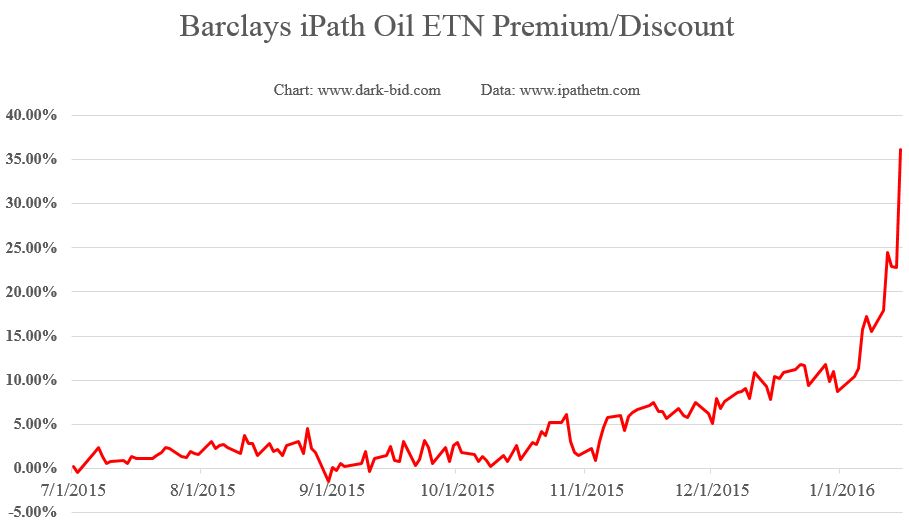
Of course, Barclays dodges any responsibility for this, as their ETN disclaimer reads as follows:
Although the ETNs are listed on a U.S. national securities exchange, a trading market for the ETNs may not develop and the liquidity of the ETNs may be limited, as we are not required to maintain any listing of the ETNs.
Barclays is like a casino boss who shakes down a winning blackjack player. Plummeting oil prices sent the value of their ETN plunging. Any short sellers were sitting on massive gains. The easiest way to prop up the price of something is to limit the supply. Barclays did exactly that, artificially inflating the price of the ETN, and crushing any shorts in the process. This is similar to what happened in the mortgage market in 2007 when bearish investors bought credit default swaps on subprime mortgages. As defaults soared, their credit default swaps declined in value because the banks who sold them the insurance were also the market makers who set the prices. Well guess what? The market maker is going to finish unloading his junk before he lets you get out. Oil is the new subprime, and Barclays is rigging the price by restricting the number of OIL creation units they will sell each day.
After we brought the premium to readers’ attention on Sunday, Barclays was in the spotlight, and yesterday, they issued an “investor guidance” press release warning investors that the ETN was 41% overvalued. As Barron’s noted, “Most investors wouldn’t have known anything was amiss.” And that’s exactly the problem. Why the SEC still allows ETNs to be sold to the average investor remains a mystery.
This isn’t the first time an ETN has gone rogue. Last summer, a Goldman Sachs commodity ETNsoared after it halted creation units.
Until the SEC gets a clue, the burden remains on financial blogs such as this one to disclose security mispricings that are now frequently exceeding $100 million.
Schlumberger’s Terrifying Moment Of Truth About The US Energy Sector
Having laid off 10,000 employees (and boosted his share buyback program by $10 billion – because that has worked out so well in the past), it appears Schlumberger CEO Paal Kibsgaard unleashes some very uncomfortable truthiness on his audience this morning during the earnings call… “For many of our customers, available cash and annual budgets were exhausted well before the halfway point for the fourth quarter… as pricing levels for frackers has dropped into unsustainable territory.”
Kibsgaard started by explaining why his firm has unveiled the massive layoffs and cost cuts:
we have faced the most severe industry downturn in 30 years
Then explained that this situation is unsustainable for American frackers…
On land in both the U.S. and Canada, the weakening activity resulted in additional commercial pressure for all product lines, and in particular in pressure pumping, where pricing levels dropped further into unsustainable territory for both operating margins and cash flow.
Which means, the pain has already started…
The burgeoning market conditions added to the pressure to the deep financial crisis throughout the oil and gas value chain and prompted operators to make further cuts to the already low EMP investment levels.
For many of our customers, available cash and annual budgets were exhausted well before the halfway point for the fourth quarter, leading to unscheduled and abrupt activity cancellations, creating an operating environment that is increasingly complex to navigate, and where the traditional year-end product and multi-client site mix sales were largely muted.
While not ready to call a bottom in the oil market for this year, Kibsgaard said he didn’t think 2017 would be worse… but then again he said that at the start of 2015 too?
Still who cares the stock price is higher… which is all that matters…

As Schlumberger’s brand new “yield starved” bondholders will give the company $10 billion to create 10,000 new fast food jobs.
And that is what, as the US economy careens into recession, passes for growth. Anyone who says otherwise is peddling fiction.
end
Crude Unmoved As Rig Count Extends Decline To New 6 Year Lows
With crude soaring despite DOE showing inventories surging, production up fgor the 7th week in a row, and demand plummeting, Baker Hughes oil rig count dropped 5 more to 510 this week – the lowest since April 2010 (after a de minimus 1 rig drop last week). Crude had ripped higher into this print but was thoroughly unimpressed in its unchangedness.
- *U.S. TOTAL RIG COUNT DOWN 13 TO 637 , BAKER HUGHES SAYS
- *U.S. OIL RIG COUNT DOWN 5 TO 510 , BAKER HUGHES SAYS
The lagged crude price suggests rig count declines are about to accelerate…

- *OIL RIGS IN PERMIAN FELL BY 3 TO 195, BAKER HUGHES SAYS
- *OIL RIGS IN WILLISTON FELL BY 2 TO 45, BAKER HUGHES SAYS
Charts: Bloomberg
Portuguese 10 year bond yield: 2.93% up 16 in basis points from THURSDAY
New York equity performances plus other indicators for today:
“Worst Start To Year Since 2008” But Stocks Bounce On Crude Squeeze, Global Jawbone
There’s always hope…
Summing the week up perfectly…
As a reminder, this is still the 2nd worst start to a year ever…

- *MSCI ALL-COUNTRY WORLD INDEX CLIMBS 2.6%, MOST SINCE JUNE 2012
And yet propagandists are proclaiming victory? Of course it was all about Crude’s recovery… From the $27.56 lows on Wednesday, WTI March crude oil futures contract is up nearly 20% in just over 48 hours…

Enabling a v-shaped recovery in stocks…

With all major indices closing green for the week…

2016 still ugly…

AAPL soared 5.2% today alone!! Running stops above the last week’s highs…

HYG V-Shaped recovery…

Not everybody was loving it – Treasuries were bid despite today’s euphoria…

On the week, Treasury yields v-shape recovered back to slightly higher with the belly underperforming… Bonds undergo The Batman Pattern!!!

Today’s weakness in JPY and and EUR (following moar ECB and BOJ blather from Davos) left The USD Index notably higher on the week…

- *RUBLE RISES 5.9% TO CLOSE AT 78.024 PER DOLLAR
Leaving The USD Index at 8 week highs…

And despite the USD strength, all commodities closed the week green with crude’s epic meltup making it the outperformer…

Charts: Bloomberg
Bellwether American Express down 9% following lower revenues and a weak forward guidance.
American Depress
(courtesy zero hedge)
AMEX is crashing, down over 9%, following lower revenues and weak guidance…

Analysts are jumping ship…
RBC Capital Markets’ Jason Arnold cut the stock to Underperform and sliced $10 off his target, to $59, citing the company’s guidance:
We remain concerned that Amex continues to face multiple fronts of fundamental challenges in its business: 1) competitive challenges to replace lost business, potential to lose Starwood cobrand/other business; 2) pressure on discount fee revenue from competition/business mix/ DOJ and regulation; 3) expense management is likley to prove difficult withoutcutting into bone, in our view.
Keefe, Bruyette & Wood’s Sanjay Sakhrani cut the shares to Market Perform:
It’s without question that AXP has strong assets and an unparalleled brand that can capitalize on the convergence of payments and commerce. This is why we have been a proponent of the company and its shares. Clearly, more recently this has been the wrong call. Despite the bar being pretty low at this point from a valuation standpoint, we think it’s best for us to downgrade the shares to MP from OP. While there is certainly value at current levels (particularly for long-term investors) and downside risk seems to be somewhat limited, all else equal, we think the road ahead could be bumpy for the foreseeable future. The main reason behind our thesis is that it is difficult for us to be constructive given the extended timeline for a return to the company’s 12-15% EPS growth targets and the need for evidence of traction and execution on the substantial investments being made. This is particularly the case in light of management’s commentary that revenue growth had not accelerated according to plan in the back half of 2015, despite heightened investment initiatives. Ultimately, in the current volatile macro environment we believe there is better relative value elsewhere in our coverage universe where growth is a more prevalent part of the story today.
Stifel’s Christopher Brendler, reiterated a Hold rating on the stock:
In our view, AXP’s disappointing 2016-2017 EPS guidance confirms our long-standing concerns about its ability to compete in today’s intensely competitive card market. While we applaud the decision to finally shutdown Enterprise Growth and refocus on cost cutting, we are disappointed with the inability to re-inspire confidence in the top-line turnaround in such a tough environment. Although several of these headwinds are unfortunate timing, we struggle to find a easy answers and instead see AXP facing years of below average growth. Combined with the macro sell-off and rock-bottom valuations at its closest card-issuing peers, we continue to await better visibility.
Freeport McMoran Is Collapsing (Despite Copper Surge)
Just around half an hour ago, we pointed out that while the rest of the market was surging, one stock – a core commodity bellwether – was not buying it:
Fast forward when things have gone from bad to worse for the copper giant: either biggest holder Icahn is dumping his stake or the “real” economy is not buying this short squeeze in commodities, or China was just “unfixed” yet again…

FCX is down 9% as everything else soars.

US Manufacturing PMI Bounces Despite Drop In Employment Index
US manufacturing PMI printed a preliminary 52.7 for January, boucing from the 38-month lows of December and above expectations as output and new business improved (somewhat aberrantly given every other indication). This is still the 2nd lowest print for US manufacturing since October 2013. It’s not all great news though as job creation dropped to 4-month lows “softer overall employment growth reflected a wait-and-see approach to staff recruitment at the start of the year and, in some cases, the need to focus on efforts to reduce costs.”
Bounce? We will wait for the final print…

Commenting on the flash PMI data, Chris Williamson, chief economist at Markit said:
“The US manufacturing sector found a new lease of life at the start of the year, with growth of factory output and orders both picking up after the slowdown seen late last year.
“Producers appear to have shrugged off worries about China, helped by export orders showing signs of reviving. It looks like weak demand from China is being offset by improved demand for USproduced goods in other markets.
“It’s clearly too early to declare that recent slowdown fears are overplayed, but the sector’s resilience in the face of recent financial market volatility is an encouraging omen for growth and employment in the wider economy, especially as sectors such as transport and business services typically move in the same cycle as manufacturing.”
One wonders just how much of this ‘bounce’ was due to war-effort manufacturing?
end
David Stockman in 5 minutes tells beautifully what we are up against much to the chagrin of his other panelists.
a must view..
(courtesy David Stockman)
David Stockman On CNBC: This Is A Dead Cat Bounce—-We’re At Peak Debt Headed For Recession
by CNBC • January 22, 2016


By CNBC
David Stockman joined CNBC’s Fast Money to discuss why we are at peak debt, and could be headed for a recession.
Watch the video here, or click on the play button in the video below…
http://player.cnbc.com/p/gZWlPC/cnbc_global?playertype=synd&byGuid=3000485766&size=530_298
Source: Stockman: We Are At Peak Debt Headed For a Recession – CNBC

I will leave you tonight, with this terrific exchange with Felix Zulauf as he explains the huge problems facing the globe. Pay special attention to the section on China;
(courtesy zero hedge/Felix Zulauf)
“China 2016 Is US 2008” Felix Zulauf Warns “The Outcome Of A Major Yuan Devaluation Would Be Disastrous”

Submitted by Tyler Durden on 01/22/2016 15:55 -0500


 harveyorganblog.com