
Gold $1313.50 up $7.70
Silver 19.21 up 43 cents
In the access market 5:15 pm
Gold: 1313.45
Silver: 19.16
THE DAILY GOLD FIX REPORT FROM SHANGHAI AND LONDON
.
The Shanghai fix is at 10:15 pm est and 2:15 am est
The fix for London is at 5:30 am est (first fix) and 10 am est (second fix)
Thus Shanghai’s second fix corresponds to 195 minutes before London’s first fix.
And now the fix recordings:
Shanghai morning fix Sept 19 (10:15 pm est last night): $ 1318.17
NY ACCESS PRICE: $1316.04 (AT THE EXACT SAME TIME)
Shanghai afternoon fix: 2: 15 am est (second fix/early morning):$ 1323.24
NY ACCESS PRICE: 1316.00 (AT THE EXACT SAME TIME)
HUGE SPREAD TODAY!!
XXXXXXXXXXXXXXXXXXXXXXXXXXXXXXXXXXXXXXXX
London Fix: Sept 19: 5:30 am est: $1315.05 (NY: same time: $1315.08: 5:30AM)
London Second fix Sept 16: 10 am est: $1314.85 (NY same time: $1314.80 , 10 AM)
It seems that Shanghai pricing is higher than the other two , (NY and London). The spread has been occurring on a regular basis and thus I expect to see arbitrage happening as investors buy the lower priced NY gold and sell to China at the higher price. This should drain the comex.
Also why would mining companies hand in their gold to the comex and receive constantly lower prices. They would be open to lawsuits if they knowingly continue to supply the comex despite the fact that they could be receiving higher prices in Shanghai.
For comex gold:The front September contract month we had 0 notices filed for nil oz
For silver: the front month of September we have a total of 27 notices filed for 135,000 oz
Last night, in my commentary to you I wrote:
I am a little worried that the bankers have called for another raid on gold/silver tomorrow. Gold/silver equity shares fell badly in the last hr against hardly any movement in the price of gold/silver. Usually that is a signal to attack. The comex OI is low and it really makes no sense to raid. Let us see what tomorrow brings.
Let us have a look at the data for today
.
xxxxxxxxxxxxxxxxxxxxxxxxxxxxxxxxxxxxxxxxxxxxxxxxxxxxxxxxxxxxxxxxxxxxxxxxxxxxxxx
In silver, the total open interest FELL by 978 contracts down to 191,494. The open interest fell as the silver price was down 16 cents in Friday’s trading .In ounces, the OI is still represented by just LESS THAN 1 BILLION oz i.e. .957 BILLION TO BE EXACT or 137% of annual global silver production (ex Russia &ex China). the crooks are doing a great job fleecing unsuspecting longs
In silver we had 127 notices served upon for 135,000 oz
In gold, the total comex gold fell by 5,080 contracts as the price of gold fell BY $7.20 on Friday . The total gold OI stands at 565,539 contracts. The level of OI now is good for us as it will support a rise in gold price and it will be hardly for the boys to raid.
xxxxxxxxxxxxxxxxxxxxxxxxxxxxxxxxxxxxxxxxxxxxxxxxxxxxxxxxxxxx
With respect to our two criminal funds, the GLD and the SLV:
GLD
LAST NIGHT WE HAD A HUGE CHANGE out of the GLD/ 10.39 TONNES OF PAPER GOLD WERE “DEPOSITED” INTO THE GLD/
Total gold inventory rest tonight at: 942.61 tonnes of gold
SLV
we had A HUGE change with respect to inventory at the SLV/ A DEPOSIT OF 1.045 MILLION OZ
THE SLV Inventory rests at: 363.479 million oz
.
First, here is an outline of what will be discussed tonight:
1. Today, we had the open interest in silver fell by 5080 contracts down to 191,496 as the price of silver fell by 16 cents with Friday’s trading.The gold open interest fell 5,080 contracts down to 565,539 as the price of gold fell $7.20 IN FRIDAY’S TRADING.
(report Harvey).
2.a) The Shanghai and London gold fix report
(Harvey)
2 b) Gold/silver trading overnight Europe, Goldcore
(Mark O’Byrne/zerohedge
and in NY: Bloomberg
end
3. ASIAN AFFAIRS
i)Late SUNDAY night/MONDAY morning: Shanghai closed UP 23.20 POINTS OR .77%/ /Hang Sang closed UP 214.86 PONTS OR .92%. The Nikkei closed for holiday Australia’s all ordinaires CLOSED down 0.04% Chinese yuan (ONSHORE) closed HUGELY DOWN at 6.6720/Oil rose to 43.60 dollars per barrel for WTI and 46.31 for Brent. Stocks in Europe: ALL IN THE GREEN Offshore yuan trades 6.669 yuan to the dollar vs 6.6720 for onshore yuan.THE SPREAD BETWEEN ONSHORE AND OFFSHORE NARROWS HUGELY AGAIN TO BLOCK MORE USA DOLLARS AS IT ATTEMPTS TO LEAVE CHINA’S SHORES
REPORT ON JAPAN SOUTH KOREA NORTH KOREA AND CHINA
3a)Korea:
none
b) REPORT ON JAPAN
none today/holiday in Japan
c) REPORT ON CHINA
i)China reports that 22 billion USA has left its shores and now its holdings of USA securities is the lowest since 2013 at 3.2 trillion USA but this will be before futures transactions involving the dollar is released. Expect its real holdings of USA dollars to be around 3.1 trillion USA
( Bloomberg)
ii)Hibor rises to 23.7% as the POBC tried to:
i) punish the CNY shorts
ii) support their currency below 6.70 and thus trying to prevent dollars from leaving Chinese shores
( zero hedge)
4 EUROPEAN AFFAIRS
i)Merkel suffers a huge defeat in Berlin elections with the surge of the anti immigrant AFD party
( zero hedge)
ib)Merkel admits “mistakes were made” on the migrant crisis in explanation of her horrendous defeat in state elections (Berlin region)
( zero hedge)
ii)Deutsche bank continues to extend losses in trading and now they are close to record lows as the bank is terribly under-capitalized. Even if the fine from the D of J is reduced they will still need to raise huge amounts of capital.
( zero hedge)
iii)As Merkel lost big time in Berlin elections due to the populace wanting no more immigrant seeking asylum in their country, the doorknobs from Europe are demanding that the USA and Canada take up more refugees
iv)With high total social financing still at record highs and thus adding to the China’s shadow banking sector, we now see a massive bubble forming in their housing sectorThis will not end well
( zero hedge)
5. RUSSIAN AND MIDDLE EASTERN AFFAIRS
OHOH! this does not looks good! The USA admits it struck a Syrian army base killing 62 Syrian soldiers. Immediately after the hit, ISIS militants launched an offensive.Russia and of course Syria are very angry!
“Russia has repeatedly alleged that the US is failing to keep its part of the bargain. The US, on its part, has blamed Russia for not pressuring Damascus enough to facilitate humanitarian access to Syria.
Both allegations may now be moot if Russia decides to retaliate against members of the US-led coalition, or directly against US forces.”
6.GLOBAL ISSUES
none today
7.OIL ISSUES
From our resident expert of USA shale production: Steve St Angelo. He now comments that the huge BAKKEN shale oil field is down in production by 25% and EAGLE FORD at 40%. Shale production if you include costs of rigs etc has not produced a dime in profits but the losses will be immense
( St Angelo/SRSRocco report)
8.EMERGING MARKETS
none today
9.PHYSICAL STORIES
i)Alasdair Macleod explains why the EU is doomed as problems are surfacing with the huge debt of Italy:
( Alasdair Macleod..)
ii)Greyerz and Stephen Leeb comment on gold with Eric king of kingworldnews
( Stephen Leeb/Egon von Greyerz/Kingworldnews/GATA)
iii)A must listen to interview of Chris Powell
( Chris Powell/Wesleyan University Radio station/GATA)
iv)What took them so long: The BIS is flashing red lights due to the huge debt inside China at roughly 30 trillion USA or 300% of their GDP
( BIS/Ambrose Evans Pritchard/GATA)
v)Gold miners are sticking close to home in the hunt for more metal And they are seeking safer jurisdictions like Agnico Eagle’s Canada, Finland and Mexico
( Reuters/GATA))
10.USA STORIES WHICH MAY INFLUENCE THE PRICE OF GOLD/SILVER
i)Bomb explodes at New Jersey train station on Sunday after explosions occurred in New York on Saturday.
(courtesy zero hedge)
ii)Bombing suspect on the loose: identified as Ahmad Khan Rahami. And Europe is asking for more refugees?
iib)One officer shot in Elizabeth NJ with the shooter allegedly in custody. Rahami is still on the loose;
iic)Rahami arrested:
iii)Pater Tenebrarum describes a situation that is now before us whereby both ISM service and ISM manufacturing are below 52. When both of these occur at the same time, a huge recession is the resultant as indicated by the economies in 2008-2009 and 2001-2002.
a must read….
( Pater Tenebrarum/Acting-Man.com)
iv)This is a first: auto loans for cars drop for the first time since the Fed started reporting on this. And yet auto production still rises. That is going to lead to a catastrophe as more inventory is produced and nobody buying:
( zero hedge)
v)Trump odds surge as millennials are shying away from Hillary
( ICAP/zero hedge)
viii) Another great reason for Janet and Stan to raise interest rates on Wednesday: K-Mart closing 64 more stores and laying off thousand of employees
( Business Insider)
Let us head over to the comex:
The total gold comex open interest fell to an OI level of 565,539 for a loss of 5080 contracts as the price of gold FELL by $7.20 with Friday’s trading. We are now in the NON active month of SEPTEMBER/
The contract month of Sept saw it’s OI FALL by 11 contracts DOWN to 137. We had 11 notices filed yesterday so we neither gained nor lost any gold ounces that will stand for delivery. The next delivery month is October and here the OI FELL by 1994 contracts down to 37,539. This level is extremely high and no doubt many of these will wait it out and take delivery at the end of the month. The next contract month of December showed an decrease of 4,386 contracts down to 419,511 .The estimated volume today at the comex: 152,716,811 fair Confirmed volume on Friday: 152,695 which is good.
And now for the wild silver comex results. Total silver OI fell by 978 contracts from 192,474 down to 191,496 with the FALL in price of silver to the tune of 16 cents on Friday. We are moving away from the all time record high for silver open interest set on Wednesday August 3: (224,540). We are now into the next active month of September and here the OI fell by 91 contracts down to 711. We had 149 notices filed on FRIDAY so we GAINED BACK ANOTHER 58 contracts or 290,000 additional oz will stand for delivery in this active month of September. The next non active delivery movement of October hardly moved as it ROSE by 15 contracts UP to 291 contracts. The next big delivery month is December and here it FELL by 1098 contracts DOWN to 166,269. The volume on the comex today (just comex) came in at 55,503 which is excellent The confirmed volume on Friday (comex and globex) was very good at 44,812 . Silver is not in backwardation. London is in backwardation for several months.
today we had 27 notices filed for silver: 135,000 oz
| Gold |
Ounces
|
| Withdrawals from Dealers Inventory in oz |
NIL |
| Withdrawals from Customer Inventory in oz nil |
100.219 oz
Scotia
|
| Deposits to the Dealer Inventory in oz | NIL oz |
| Deposits to the Customer Inventory, in oz |
63,437.219 oz
Scotia
|
| No of oz served (contracts) today |
0 notices
nil oz
|
| No of oz to be served (notices) |
137 contracts
(13,700 oz)
|
| Total monthly oz gold served (contracts) so far this month |
2427 contracts
242,700 oz
7.5489 tonnes
|
| Total accumulative withdrawals of gold from the Dealers inventory this month | 192.90 oz |
| Total accumulative withdrawal of gold from the Customer inventory this month | 170,109.9 oz |
Today, 0 notices were issued from JPMorgan dealer account and 0 notices were issued form their client or customer account. The total of all issuance by all participants equates to 0 contract of which 0 notices were stopped (received) by jPMorgan dealer and 0 notice(s) was (were) stopped (received) by jPMorgan customer account.
| Silver |
Ounces
|
| Withdrawals from Dealers Inventory | NIL |
| Withdrawals from Customer Inventory |
1,323,951.843 oz
HSBC
Scotia
|
| Deposits to the Dealer Inventory |
nil OZ
|
| Deposits to the Customer Inventory |
2,477,518.610 oz
CNT
HSBC
Scotia
|
| No of oz served today (contracts) |
27 CONTRACTS
(135,000 OZ)
|
| No of oz to be served (notices) |
653 contracts
(3,420,000 oz)
|
| Total monthly oz silver served (contracts) | 2486 contracts (12,430,000 oz) |
| Total accumulative withdrawal of silver from the Dealers inventory this month | NIL oz |
| Total accumulative withdrawal of silver from the Customer inventory this month | 5,345,623.9 oz |
SEPT 9/ we had a big changes tonight out of the GLD/ there were two major withdrawals
i) first early morning: 1.19 tonnes
ii) second: 10.68 tonnes of gold
total: 11.87 tonnes
Total gold inventory rest tonight at: 939.94 tonnes of gold
end
NPV for Sprott and Central Fund of Canada
end
‘Hard’ Brexit Looms For Ireland

O’Brien outlines the risks on the horizon in the article in the Sunday Independent is well worth a read as it highlights the risks posed by Brexit to the Irish economy.
“A hard Brexit is now the most probable of the possible outcomes, with all the negative consequences for this island that such a rupture would entail.”
‘Things go from bad to worse for Ireland as a ‘hard’ Brexit looms over the horizon’ can be read here
Gold and Silver Bullion – News and Commentary
Gold Climbs as Investors Count Down to Fed Meeting, Dollar Sags (Bloomberg)
Gold prices gain in Asia on rebound as investors eye central bank meets (Investing)
Gold steady on uncertainty ahead of central bank meetings (Reuters)
Funds Dump Gold at Fastest Pace Since May as Fed Outlook Shifts (Bloomberg)
World’s gold miners stick close to home in hunt for more metal (Reuters)

Things go from bad to worse for Ireland as a ‘hard’ Brexit looms (Independent)
Ireland, Apple and Leprechaun Economics – Keiser Report (MaxKeiser)
Why Has Gold Stalled? (GoldSeek)
War is Peace, Ignorance Is Strength, Silver is Plentiful … (SilverSeek)
BIS flashes red alert for a banking crisis in China (Telegraph)

Gold Prices (LBMA AM)
19 Sep: USD 1,315.05, GBP 1,007.99 & EUR 1,177.36 per ounce
16 Sep: USD 1,314.25, GBP 999.56 & EUR 1,170.08 per ounce
15 Sep: USD 1,320.10, GBP 998.26 & EUR 1,174.23 per ounce
14 Sep: USD 1,323.20, GBP 1,001.40 & EUR 1,177.91 per ounce
13 Sep: USD 1,328.50, GBP 1,000.36 & EUR 1,183.69 per ounce
12 Sep: USD 1,327.50, GBP 1,000.80 & EUR 1,182.54 per ounce
09 Sep: USD 1,335.65, GBP 1,004.68 & EUR 1,184.86 per ounce
08 Sep: USD 1,348.00, GBP 1,009.11 & EUR 1,195.81 per ounce
Silver Prices (LBMA)
19Sep: USD 19.12, GBP 14.65 & EUR 17.13 per ounce
16 Sep: USD 18.91, GBP 14.36 & EUR 16.85 per ounce
15 Sep: USD 18.96, GBP 14.32 & EUR 16.87 per ounce
14 Sep: USD 19.04, GBP 14.42 & EUR 16.96 per ounce
13 Sep: USD 19.16, GBP 14.44 & EUR 17.06 per ounce
12 Sep: USD 18.72, GBP 14.11 & EUR 16.68 per ounce
09 Sep: USD 19.41, GBP 14.58 & EUR 17.23 per ounce
08 Sep: USD 19.93, GBP 14.90 & EUR 17.65 per ounce
Recent Market Updates
– EU Bail In Rules Ignored By Italy – Mother Of All Systemic Threats and World War?– Buy Gold – Bonds Are ‘Biggest Bubble In World’ – Billionaire Singer Warns
– Silver Bullion Market – “Most Bullish Story Ever Told?”
– “Sorry, You Can’t Have Your Gold Bullion”
– Global Stocks, Bonds Fall Sharply – Gold Consolidates After Two Weeks Of Gains
– Gold, Silver, Blockchain and Fintech – Solutions To Negative Rates, Bail-ins, Cash Confiscations and Cashless Society
– Jan Skoyles Appointed Research Executive At GoldCore
– Silver Bullion Surges 3.5% To Over $20/oz
– Ireland “Especially Exposed” To “International Shocks” Warns Central Bank
– Deutsche Bank Tries To Explain Failure To Deliver Physical Gold
– Physical Gold Delivery Failure By German Banks
– Avoid Paper Gold – “Gold Delivery” Refused By Gold Exchange Traded Commodity
– Debt Bubble in Ireland and Globally Sees Wealthy Diversify Into Gold
– “Why Case Against Gold Is Wrong” – James Rickards

end
Alasdair Macleod explains why the EU is doomed as problems are surfacing with the huge debt of Italy:
(courtesy Alasdair Macleod..)
Why The EU Is Doomed
Submitted by Alasdair Macleod via The Mises Institute,
We are accustomed to looking at Europe’s woes in a purely financial context. This is a mistake, because it misses the real reasons why the EU will fail and not survive the next financial crisis. We normally survive financial crises, thanks to the successful actions of central banks as lenders of last resort. However, the origins and construction of both the the euro and the EU itself could ensure the next financial crisis commences in the coming months, and will exceed the capabilities of the ECB to save the system.
It should be remembered that the European Union was originally a creation of US post-war foreign policy. The priority was to ensure there was a buffer against the march of Soviet communism, and to that end three elements of the policy towards Europe were established. First, there was the Marshall Plan, which from 1948 provided funds to help rebuild Europe’s infrastructure. This was followed by the establishment of NATO in 1949, which ensured American and British troops had permanent bases in Germany. And lastly, a CIA sponsored organisation, the American Committee on United Europe was established to covertly promote European political union.
It was therefore in no way a natural European development. But in the post-war years the concept of political union, initially the European Coal and Steel Community, became fact in the Treaty of Paris in 1951 with six founding members: France, West Germany, Belgium, Luxembourg and Italy. The ECSC evolved into the EU of today, with an additional twenty-one member states, not including the UK which has now decided to leave.
With the original founders retaining their national characteristics, the EU resembles a political portmanteau, a piece of assembled furniture, each component retaining its original characteristics.After sixty-five years, a Frenchman is still a staunch French nationalist. Germans are characteristically German, and the Italians remain delightfully Italian. Belgium is often referred to as a non-country, and is still riven between Walloons and the Flemish. As an organisation, the EU lacks national identity and therefore political cohesion.
This is why the European Commission in Brussels has to go to great lengths to assert itself. But it has an insurmountable problem, and that is it has no democratic authority. The EU parliament was set up to be toothless, which is why it fools only the ignorant. With power still residing in a small cabal of nation states, national powerbrokers pay little more than lip-service to the Brussels bureaucracy.
The relationship between national leaders and the European Commission has been deliberately long-term, in the sense that loss of sovereignty is used to gradually subordinate other EU members into the Franco-German line. The driving logic has been to make the European region a protected trade area in Franco-German joint interests, and to protect them from free markets.
It was not easy to find the necessary compromise. Since the Second World War, France has been strongly protectionist over her own culture, insisting that the French only buy French goods. Germany’s success was rooted in savings, which encouraged industrial investment, leading to strong exports. These two nations with a common border had, and still have, very different values, but they managed to conceive and set up the European Central Bank and the euro.
In Germany, the sound-money men in the Bundesbank lost out to industrial interests, which sought to profit from a weaker currency. This was actually in line with her political preferences, and it was the political class that controlled the relationship with France. In France the integrationists, politicians again, defeated the industrialists, who sought to insulate their home markets from German competition.
When a common currency was first mooted, two future problems were ignored. The first was how would the other states joining the euro adapt to the loss of their national currencies, and the second was how would the UK, with her Anglo-Saxon market-based culture adapt to a more European model. It wasn’t long before the latter issue was met head-on, with the withdrawal of sterling from the Exchange Rate Mechanism, the forerunner of the euro, in September 1992.
The euro was eventually born at the turn of the century. The Franco-German compromise led to the appointment of a Frenchman, Jean-Claude Trichet, as the ECB’s second president. All was well, because the abandonment of national currencies and the gradual acceptance of the euro meant that states in the Eurozone were able to borrow more cheaply in euros than they ever could in their own national currencies.
Bond risk was measured against German bunds, traditionally the lowest yielding bonds in Europe. It was not long before the spread between bunds and other Eurozone debt was commonly seen as a profitable opportunity, instead of a reflection of relative risk. European banks, insurance companies and pension funds all benefited from the substantial rise in the prices of bonds issued by peripheral EU members, and invested accordingly. In turn, these borrowers were only too willing to supply this demand by issuing enormous quantities of debt, in contravention of the Maastricht Treaty. Bank credit expanded as well, leaving the banking system highly geared.
The control mechanism for this explosion in borrowing was meant to be the Exchange Stability and Growth Pact, agreed in Maastricht in 1993. This laid down five rules, of which two concern us. Member states were bound to keep their national budget deficits to a maximum of 3% of GDP, and national government debt was limited to 60% of GDP. Neither Germany nor France qualified on the debt criteria, without rigging their national accounts, and the only reason that deficits came within the Pact was a mixture of dodgy accounting and fortuitous timing of the economic cycle. The control mechanism was never enforced.
So from the outset, no nation had any sense of responsibility towards the new currency. The rules were ignored and the euro became a gravy-chain for all member governments, spectacularly brought to public attention by the failure of Greece.
The Eurozone’s banking system, incorporating the national central banks and the ECB, bound together in a bizarre settlement system called TARGET, became the means for member nations to buy German goods on credit. Very good for Germany, you may say, but the problem was that the credit was supplied by Germany herself. It is the same as lending money to the buyer of your business in a rigged transaction. This flaw in the system’s construction is now a rumbling volcano ready to blow at any moment.
The Germans want their money back, or at least don’t want to write it off. The debtors cannot pay, and need to borrow more money just to survive. Neither side wishes to face reality. It started with Ireland, then Cyprus, followed by Greece and Portugal. These are the smaller creditors, which Germany, led by its Finance Minister Wolfgang Schäuble, managed to crush into debtor submission and are now economic zombies. The real problem comes with Italy, which is also failing and has a debt-to-GDP ratio estimated to be over 133% and rising. If Italy goes, it will be followed by Spain and France. Herr Schäuble cannot force these major creditors into line so easily, because at this stage the whole Eurozone banking system will be in deep trouble, as will the German government itself. German savers are also becoming acutely aware that they will pick up the bill.
The first line of defense, as always, will be for the ECB as lender of last resort to keep the banks afloat. The only way it can do this is to accelerate the printing of euros and to monopolise Eurozone debt markets. Whether or not the ECB can hold the currency with all these liabilities on board its own balance sheet, and for how long, remains to be seen.
For the moment, the euro stands there like a Goliath, seemingly invincible. It represents the anti-free-market European establishment, which no one has dared to challenge. This surely is the underlying reason the ECB can impose negative interest rates and get away with it. But serious cracks are appearing. First we had Brexit, likely to be followed by other small states wanting out. The Italian banking crisis is almost certain to come to a head soon, and an Italian referendum on the constitution next month is also an important hurdle to be overcome. The politicians are in panic mode, reassuring everyone there is nothing wrong more integration and a new army won’t cure.
Meanwhile, the overbearing attitude of the European Commission and the refugee crisis are undermining public support for the status quo. Angela Merkel, hitherto regarded as invincible, has lost her public support in Germany. Marine Le Pen, leader of the Front National and who wants France to leave the EU, led the opinion polls recently for France’s next President, due to be elected next year. The strongmen of Europe are on the back foot.
All the elements for a mighty political and economic smash are now there. Whether or not it will be the trigger for, or itself be triggered by external events remains to be seen. Either way, the Eurozone’s crisis time-line now appears to be measured in months.
The market effect, besides being a severe shock to all markets, is likely to be two-fold. Firstly, international flows will sell down the euro in favour of the dollar. Given the euro’s weighting in the dollar index, this will be a major disruption for all currency markets. Secondly, Eurozone residents with bank deposits are likely to increasingly seek refuge in physical gold, as signs of their currency’s impending collapse emerge, because there is nowhere else for them to go.
Whichever way one looks at it, it is increasingly difficult to accept any other outcome than a complete collapse of this ill-found political construction, originally promoted in US interests by a CIA-sponsored organisation. The euro, being dependent on political cohesion instead of original market demand, will simply cease to be money, somewhat rapidly.
END
Greyerz and Stephen Leeb comment on gold with Eric king of kingworldnews
(courtesy Stephen Leeb/Egon von Greyerz/Kingworldnews)
Greyerz and Leeb comment on gold at King World News
Submitted by cpowell on Sun, 2016-09-18 23:02. Section: Daily Dispatches
7p ET Sunday, September 18, 2016
Dear Friend of GATA and Gold:
At King World News, gold fund manager Egon von Greyerz predicts that the euro won’t survive, driving Europeans into gold:
http://kingworldnews.com/greyerz-the-roadmap-to-a-staggering-10000-gold-…
And fund manager Stephen Leeb argues that China wants an orderly transition to a new world monetary system, which for the time being requires controlling the gold price:
http://kingworldnews.com/chinas-stunning-plan-for-gold-a-new-monetary-sy…
CHRIS POWELL, Secretary/Treasurer
Gold Anti-Trust Action Committee Inc.
CPowell@GATA.org
end
A must listen to interview of Chris Powell
(courtesy Chris Powell/Wesleyan University Radio station)
GATA secretary interviewed on Wesleyan University radio station
Submitted by cpowell on Sun, 2016-09-18 13:42. Section: Daily Dispatches
9:41a ET Sunday, September 18, 2016
Dear Friend of GATA and Gold:
Your secretary/treasurer was interviewed about gold market rigging by central banks for about an hour yesterday, with occasional musical relief, on John Way’s “The Blue Cafe” program on WESU-FM88.1, the radio station of Wesleyan University in Middletown, Connecticut. The program has been archived at Soundcloud.com here:
https://soundcloud.com/johnlway/tbc017_chris-powell-gold-the-value-of-mo…
CHRIS POWELL, Secretary/Treasurer
Gold Anti-Trust Action Committee Inc.
CPowell@GATA.org
end
What took them so long: The BIS is flashing red lights due to the huge debt inside China at roughly 30 trillion USA or 300% of their GDP
(courtesy BIS/Ambrose Evans Pritchard)
BIS flashes red alert for a banking crisis in China
Submitted by cpowell on Sun, 2016-09-18 14:00. Section: Daily Dispatches
By Ambrose Evans-Pritchard
The Telegraph, London
Sunday, September 18, 2016
China has failed to curb excesses in its credit system and faces mounting risks of a full-blown banking crisis, according to early warning indicators released by the world’s top financial watchdog.
A key gauge of credit vulnerability is now three times over the danger threshold and has continued to deteriorate, despite pledges by Chinese premier Li Keqiang to wean the economy off debt-driven growth before it is too late.
The Bank for International Settlements warned in its quarterly report that China’s “credit to GDP gap” has reached 30.1, the highest to date and in a different league altogether from any other major country tracked by the institution. It is also significantly higher than the scores in East Asia’s speculative boom on 1997 or in the US subprime bubble before the Lehman crisis. …
… For the remainder of the report:
http://www.telegraph.co.uk/business/2016/09/18/bis-flashes-red-alert-for…
end
Gold miners are sticking close to home in the hunt for more metal And they are seeking safer jurisdictions like Agnico Eagle’s Canada, Finland and Mexico
(courtesy Reuters)
Gold miners stick close to home in hunt for more metal
Submitted by cpowell on Sun, 2016-09-18 14:21. Section: Daily Dispatches
By Susan Taylor and Nicole Mordant
Reuters
Sunday, September 18, 2016
The world’s biggest gold miners are taking a cautious approach in their hunt for bullion, spending more money to explore around existing mines rather than new territory in a strategy that may have short-term gains but risks future production growth.
Top producers are relying more than ever on small companies to do the heavy lifting of searching for new deposits and increasingly taking 10 to 20 percent equity stakes in the junior miners.
Exploring close to home is more cost efficient and improves the odds of discoveries. But the chances of making major new finds are limited, diminishing global gold output, which is expected to decline by nearly 9 percent in the next three years. …
… For the remainder of the report:
http://www.reuters.com/article/us-mining-gold-idUSKCN11O0F8
end
For those of you who are following Agnico Eagle: their new Amaruq project near Meadowbank is going to be a dandy
(courtesy seeking alpha)
Agnico Eagle – Production Update On Amaruq Project In The Kivalliq- Nunavut, Northern Canada
Sep. 19, 2016 12:14 AM ET
Summary
AEM released an Update on exploration drilling results at its Amaruq gold project in Nunavut, northern Canada.
Overall mineral resources increased by 13% in the Amaruq project. 3.714 million Oz from 3.283 million Oz in December 31, 2015.
AEM is one of my main long-term gold miners with a solid balance sheet and constant production stream. I recommend the stock as a hold on valuation.
On September 15, 2016, Agnico Eagle announced the following:
Update on exploration drilling results at its Amaruq gold project in Nunavut, northern Canada. This deposit continues to grow and remains a focus for the Company given its potential and its proximity to Agnico Eagle’s Meadowbank mine and mill. This update includes an expanded mineral resource estimate for the project based on drilling through June 30, 2016.
- Overall mineral resources increased by 13% at the Amaruq project.3.71 million ounces of gold (19.4 million tonnes grading 5.97 grams per tonne (“g/t”) gold) as of June 30, 2016.
- Open pit mineral resources increase by 33%. 598,000-ounce increase (on a contained gold basis) in open pit inferred mineral resources to 2.42 million ounces gold (13.6 million tonnes grading 5.53 g/t).
- 319% expansion in the IVR deposit mineral resources; V Zone confirmed as potential second source of open pit ore
The Amaruq gold project in Nunavut, Northern Canada, is located 50 kms (31.25 miles) northwest of Agnico Eagle’s Meadowbank mine. The project hosts the Whale Tail gold deposit as well as the I, R, V, and Mammoth 1 and 2 zones, and several other targets. The company acquired the original property in 2013.
M. Sean Boyd, Agnico Eagle’s Vice-Chairman and Chief Executive Officer said:
The 2016 exploration program at Amaruq has resulted in an increase in gold resources and the delineation of a potential second source of open pit ore at the V Zone. In just a short period of time, we have seen Amaruq advance from a grassroots discovery to a significant development project with 3.7 million ounces of gold resources.
We anticipate an updated mineral resource estimate in February 2017, and Amaruq is expected to provide a new source of ore for the Meadowbank mill starting in 2019.
Amaruq is a satellite of the Meadowbank mine, as we can see in the plan above. AEM indicated at the 2Q’16 results.
Meadowbank – Good Cost Performance Despite Lower Production Volumes in the Second Quarter of 2016
The 100% owned Meadowbank mine in Nunavut, northern Canada, achieved commercial production in March 2010.
The Meadowbank mill processed an average of 10,918 tpd in the second quarter of 2016, compared to the 11,199 tpd achieved in the second quarter of 2015. Year-over-year, mill throughput levels were lower primarily due to harder ore being processed from the Vault pit. Minesite costs per tonne were approximately C$73 in the second quarter of 2016. These costs were lower than the C$74 per tonne in the second quarter of 2015. The lower costs per tonne in the 2016 period were primarily due to lower production costs (for drilling, blasting and fuel consumption) and an increase in deferred stripping compared to the 2015 period.
Studies are ongoing to investigate additional opportunities to extend production at Meadowbank through year-end 2018. Potential opportunities include the development of the Phaser pit, which is located to the southwest of the Vault pit, and an additional pushback to access additional ore in the E3 pit at the Portage deposit.

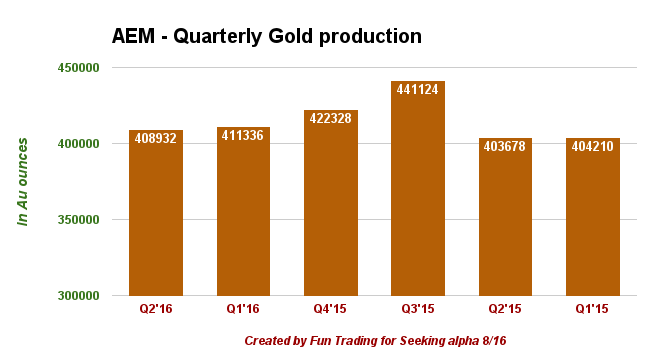
It is not a secret, AEM is interested in the development of this segment, even if Meadowbank mine is slowly reaching the end of the road. Just as a reminder, the company took a big loss of $1 billion on Meadowbank, in early 2015. The mine was slated to close in 3Q’2017, but recently the company indicated that it may extend the production at Meadowbank through year-end 2018. Probably to be prepared for the Amaruq mine in 2019.
AEM has now two encouraging prospects near the Meadowbank mine. The Amaruq deposit, just 50 kilometers north of Meadowbank, and the Meliadine project near Rankin Inlet.
M. Sean Boyd indicated in the 2Q’16 conference call that Meliadine is now fully permitted. The company will look at Meliadine in the context of
the overall entire Nunavut strategy, so the focus remains on looking at ways that we can optimize construction capital as well as work some of the large resources into the mine plant. So those efforts continue and we will have an update on that early in 2017.
As we can see with this news update, the Kivalliq sector of the Nunavut region will be a significant part of the gold production by 2019. Agnico Eagle is facing a production gap at Meadowbank/Amaruq. In an interview last year, M. Boyd, explained it well:
Meadowbank has done a really good job getting their costs down. There’s a really good skillset there. We clearly want to continue to utilize that skillset in Nunavut. The best opportunity to do that is Amaruq. It’s a satellite deposit. The only way that it can work, based on what we know now, is to truck the material to Meadowbank. It’s still early, but it has the potential to continue our business at Meadowbank, to preserve all those jobs, to continue to use all those skills and allow us to use a lot of that Meadowbank equipment because it fits the type of mine that would begin potentially at Amaruq, a larger open pit. We couldn’t use any of the things at Meadowbank for Meliadine, because Meliadine is going to start as an underground mine.
We have our best people focused on trying to find opportunities in the North. Amaruq looks good because my experience tells me if that team and the leaders of that group-Alain Blackburn and Guy Gosselin-are excited, then we should be excited. Our biggest dilemma now is, if we follow the general timeline of getting things moving in Nunavut, we’re going to have a production gap. That’s no good. What we’re trying to do is work at it from the Meadowbank end and see if we can extend the life maybe a year.
Conclusion:
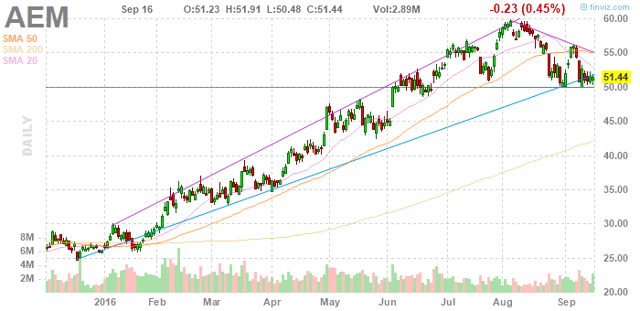
In my preceding article my technical analysis was quite clear and accurate. I said,
Technically, I estimate that the resistance should be around $60, and the downside from here, could be around $51.50 (first support).
If the first support does not hold, then we will have to look for the low-$40s eventually. Personally, I started to take profit off the table at $56, and will continue on any upside. My goal is to bring down my long-term AEM position by about 40%.
I was able to add my first small lot after selling about 42% of my holding as I have indicated above at around $56-$59. I do not suggest an active trading with AEM, but the situation was quite exceptional and it was time to take a large profit off the table due to an atypical overbought situation. The stock has corrected a little, but is still pricey with a Price earnings to growth — PEG — at over 9 and price to Free cash flow — P/FCF — at over 100.
AEM confirmed again, with this update, that it is a company that should be considered as a long-term investment grade. However, I still believe that the stock is overvalued, especially with the uncertainty hovering around the gold price situation and what will be the move of the FED this month. I recommend now a hold.
Important note: Do not forget to follow me on AEM and the gold sector. Thank you
Disclosure: I am/we are long AEM.
I wrote this article myself, and it expresses my own opinions. I am not receiving compensation for it (other than from Seeking Alpha). I have no business relationship with any company whose stock is mentioned in this article.
end
Motley fool has just come out with their rare buy signal of a gold mining company: and they agree with me that the new Amaruq deposit is going to be a dandy!
(courtesy Motley Fool)
Agnico Eagle Mines Ltd. Will Grow Gold Production Like a Weed

By Ryan Vanzo – September 19, 2016 More on: AEM AEM
With gold prices up 26% this year, most gold miners have seen their stocks explode higher. Agnico Eagle Mines Ltd. (TSX:AEM)(NYSE:AEM), for example, is up 88% since January.
This week, the company released some data showing that gold reserves are ramping up. This growth is expected to continue for some time and, in a short time, result in production gains. Plus, the CEO has made some rosy comments about his expectations for the future price of gold.
Continued resource growth at its biggest project
Amaruq, a mega project located in Nunavut, which was acquired in 2013, is seeing big strides in both production and reserves.
Drilling in the first half of 2016 resulted in an updated inferred mineral resource estimate of 3.71 million ounces of gold. This represents an increase of 432,000 ounces compared to the company’s previous estimate. Additionally, the company discovered a new resource vein that may hold over 500,000 ounces of gold.
“The 2016 exploration program at Amaruq has resulted in an increase in gold resources and the delineation of a potential second source of open pit ore at the V Zone. In just a short period of time, we have seen Amaruq advance from a grassroots discovery to a significant development project with 3.7 million ounces of gold resources,” said Sean Boyd, Agnico’s CEO.
Exploration efforts are expected to wrap up in October with new results to be released in February.
Is growth ready to roar?
Thanks to its successful exploration attempts, Agnico has quickly built a portfolio of high-quality assets that will likely produce 30-40% more gold by 2020. Costs are also low and falling. This year they should come in at $840-880 per ounce (previously $850-890).
Even if you missed gold’s climb to a two-year high in early July, CEO Sean Boyd recently said that the rally in gold miners is just getting started.
“I think in this cycle, they will ultimately set an all-time high,” Boyd commented, adding that Agnico is “one of the very few companies that can see its output 30-40% higher in five years from now from stuff we already own.”
There are some major macroeconomic tailwinds ready to drive the gold market to new heights.
“There’s still a tremendous amount of debt in the system,” he said. “There’s an inability to create conditions for growth. You’ve got a negative-interest-rate environment, which is a great environment for gold from an opportunity-cost standpoint. And you’ve still got very strong demand coming out of China and India. So all the factors are there that can steadily move gold up.”
Next year the average Wall Street analyst is expecting the company to grow earnings by about 80%.
Is the valuation too high?
This summer Agnico was downgraded three times by Wall Street analysts due to an overstretched valuation. It appears as if the market has caught on to the company’s record of success.
Still, according to an analysis done by Royal Bank of Canada, Agnico’s stock is only pricing in gold prices of $1,315 an ounce–slightly below the current price of $1,319. The valuation looks fully priced, but if you’re a believer in higher gold prices (like Agnico’s CEO), shares surely have further upside to go.
The exclusive buy “signal” you can’t ignore
Over the course of The Motley Fool U.S.’s 23-year history, this rare buy “signal” has generated massive wealth for those that have been smart enough to pay attention to it. It’s so rare, that it’s happened less than two dozen times… but when it does, it’s made investors undoubtedly rich. If you’re interested in knowing the stock behind this rare buy “signal”–and you’re excited to take advantage of this golden opportunity, then you’re going to want to read this. Click here to unlock all the details behind this new recommendation from Stock Advisor Canada.
end
Your early MONDAY morning currency, Asian stock market results, important USA/Asian currency crosses, gold/silver pricing overnight along with the price of oil Major stories overnight
:
1 Chinese yuan vs USA dollar/yuan DOWN to 6.6720( REVALUATION NORTHBOUND /CHINA UNHAPPY TODAY CONCERNING USA DOLLAR RISE/MORE $ USA DOLLARS LEAVE CHINA/OFFSHORE YUAN NARROWS HUGELY TO 6.6691) / Shanghai bourse CLOSED UP 23.20 POINTS OR .77% / HANG SANG CLOSED UP 214.86 POINTS OR 0.92%
2 Nikkei closed /USA: YEN FALLS TO 101.84
3. Europe stocks opened ALL IN THE GREEN ( /USA dollar index DOWN to 95.89/Euro UP to 1.1164
3b Japan 10 year bond yield: REMAINS CONSTANT AT -.039% !!!!(Japan buying 100% of bond issuance)/Japanese yen vs usa cross now at 101.87/ THIS IS TROUBLESOME AS BANK OF JAPAN IS RUNNING OUT OF BONDS TO BUY.
3c Nikkei now JUST BELOW 17,000
3d USA/Yen rate now well below the important 120 barrier this morning
3e WTI:: 43.60 and Brent: 46.31
3f Gold UP /Yen UP
3g Japan is to buy the equivalent of 108 billion uSA dollars worth of bond per month or $1.3 trillion. Japan’s GDP equals 5 trillion usa./“HELICOPTER MONEY” ON THE TABLE
Japan to buy 100% of all new Japanese debt and by 2018 they will have 25% of all Japanese debt. Fifty percent of Japanese budget financed with debt.
3h Oil DOWN for WTI and DOWN for Brent this morning
3i European bond buying continues to push yields lower on all fronts in the EMU. German 10 yr bund RISES to +.010%
3j Greek 10 year bond yield RISE to : 8.645%
3k Gold at $1314.60/silver $19.12(7:45 am est) SILVER FINAL RESISTANCE AT $18.50 WILL BE DEFENDED
3l USA vs Russian rouble; (Russian rouble UP 48/100 in roubles/dollar) 64.80-
3m oil into the 43 dollar handle for WTI and 46 handle for Brent/
3n Higher foreign deposits out of China sees huge risk of outflows and a currency depreciation (already upon us). This can spell financial disaster for the rest of the world/China forced to do QE!! as it lowers its yuan value to the dollar/GOT a DEVALUATION DOWNWARD from POBC.
JAPAN ON JAN 29.2016 INITIATES NIRP. THIS MORNING THEY SIGNAL THEY MAY END NIRP. TODAY THE USA/YEN TRADES TO 101.84 DESTROYING WHATEVER IS LEFT OF OUR YEN CARRY TRADERS
30 SNB (Swiss National Bank) still intervening again in the markets driving down the SF. It is not working: USA/SF this morning .9806 as the Swiss Franc is still rising against most currencies. Euro vs SF is 1.0947 well above the floor set by the Swiss Finance Minister. Thomas Jordan, chief of the Swiss National Bank continues to purchase euros trying to lower value of the Swiss Franc.
3p BRITAIN VOTES AFFIRMATIVE BREXIT
3r the 10 Year German bund now POSITIVE territory with the 10 year RISES to +.010%
/German 10+ year rate BASICALLY negative%!!!
3s The Greece ELA NOW at 71.4 billion euros,AND NOW THE ECB WILL ACCEPT GREEK BONDS (WHAT A DISASTER)
The bank withdrawals were causing massive hardship to the Greek bank. the Greek referendum voted overwhelming “NO”. Next step for Greece will be the recapitalization of the banks and that will be difficult.
4. USA 10 year treasury bond at 1.689% early this morning. Thirty year rate at 2.438% /POLICY ERROR)
5. Details Ransquawk, Bloomberg, Deutsche bank/Jim Reid.
(courtesy Jim Reid/Bloomberg/Deutsche bank/zero hedge)
Global Stocks, US Futures Rebound As Oil Rises, Dollar Drops
Stocks across the board, and US equity futures are broadly in the green this morning as markets shrug off the terror-related events in the NYC area over the weekend. There wasn’t a single positive “reason” for the green price action but the bond “tantrum” that caught the attention of stocks beginning back on 9/8 is increasingly fading and investors are hopeful this week’s central bank decisions (BOJ and FOMC both on Wed 9/21) will further ease yield anxieties.
One of the catalysts for the rebound in stocks was today’s rise in oil, which rebounded from Friday’s lows as renewed clashes halted what would be the first crude shipment from one of Libya’s largest export terminals since 2014. The tanker Seadelta suspended loading after fighting started Sunday between local Petroleum Facilities Guard units and forces loyal to eastern-based military commander Khalifa Haftar. Brent added 1.3 percent to $46.36. OPEC may call an extraordinary meeting if ministers reach consensus at an informal gathering next week, Secretary General Mohammed Barkindo said, according to Algerian Press Service.
“Sentiment is being boosted by a rebound in oil,” Vasu Menon, VP at Oversea-Chinese Banking Corp. in Singapore told Bloomberg. “Investors are also hoping the BOJ will do something more dramatic though I don’t think that’s going to make a lot of difference. With inflation numbers picking up a little bit in the U.S., the market will start worrying about the Fed again at some stage down the road.”

Major oil producers will meet next week in Algiers to discuss cooperating to shore up prices amid a global oversupply that has hurt state budgets. Before that, the Bank of Japan will undertake a review of its monetary policy and the Federal Reserve will meet to determine whether to raise rates. Volatility has picked up in financial markets over the past two weeks amid concern central banks are becoming reluctant to loosen monetary policy, while at least three bombs discovered in New York and New Jersey over the weekend may increase political turmoil.
The MSCI All-Country World Index climbed 0.4 percent at 11:16 a.m. in London as U.S. crude added 1.6 percent to $43.73 a barrel. The Bloomberg Dollar Spot Index declined 0.3 percent.
The Stoxx Europe 600 Index climbed 0.9% after its biggest weekly slide in three months. Rio Tinto Group and BHP Billiton Ltd. rose at least 2.8 percent, contributing the most to gains among miners. Total SA and BP Plc were among those that led oil-related stocks higher. Weir Group Plc added 3.1 percent after JPMorgan Chase & Co. recommended buying shares of the maker of fracking pumps for oil companies, citing improving prospects. U.K. builders gained, with Barratt Development Plc and Berkeley Group Holdings Plc adding 1.2 percent or more, as a report showed London house prices rebounded from their post-Brexit drop in September. HSBC Holdings Plc was among banks that gained the most. Deutsche Bank AG, which sparked a selloff on Friday after rebuffing a U.S. Justice Department claim to settle a probe tied to mortgage-backed securities, bucked the trend on Monday, with a 0.3 percent drop.
Emerging-market shares and currencies rallied with developed markets, led by a 2.8 percent gain in Taiwan’s Taiex Index and a 0.8 percent advance in Taiwan’s dollar. HTC surged 10 percent in Taiwan, the biggest gain since May 25, on reports the company will unveil a new mobile-phone handset.
S&P 500 Index futures added 0.5%, indicating U.S. equities will recover from Friday’s 0.4 percent retreat.
The yield on Treasuries due in a decade was little changed at 1.69 percent. It erased a three basis point decline on Friday following the release of the American inflation data, which boosted the probability of an interest-rate hike this year by five percentage points in the futures market to 55 percent. Spanish and Italian securities led gains in Europe. The yield on 10-year Spanish bonds slipped three basis points to 1.05 percent, while that on similar-maturity Italian debt fell two basis points to 1.32 percent, after adding nine basis points last week. Portugal’s 10-year bond yield was steady at 3.39 percent, after surging 26 basis points last week. The nation’s debt rating was affirmed on Friday by S&P, which forecast the economy will lose momentum this year.
Market Wrap
- S&P 500 futures up 0.5% to 2142
- Stoxx 600 up 1% to 341
- FTSE 100 up 1.5% to 6810
- DAX up 0.8% to 10357
- German 10Yr yield up less than 1bp to 0.01%
- Italian 10Yr yield down 1bp to 1.33%
- Spanish 10Yr yield down 2bps to 1.06%
- S&P GSCI Index up 0.8% to 350.7
- MSCI Asia Pacific up 0.9% to 138
- Hang Seng up 0.9% to 23550
- Shanghai Composite up 0.8% to 3026
- S&P/ASX 200 down less than 0.1% to 5295
- US 10-yr yield up less than 1bp to 1.69%
- Dollar Index down 0.27% to 95.85
- WTI Crude futures up 1.5% to $43.69
- Brent Futures up 1.2% to $46.33
- Gold spot up 0.4% to $1,316
- Silver spot up 1.7% to $19.13
Global Headline News
- More Guns to Greet New York as Another Suspicious Package Found: 1,000 more police blanket NYC, videos of Chelsea street sought
- Stiglitz Grades Trump F on Economics, Cites China Trade Risk: Nobelist says more American jobs would be lost than created
- Market Resilience Post-Brexit Masks Underlying Risks, BIS Says: Rally in stocks as bond yields plunged signals ‘dissonance’
- EU’s Vestager Signals Apple Just the Start of U.S. Tax Probes: Competition chief will meet in Washington with Lew, lawmakers
- Merkel Dealt Berlin Defeat With Worst Result Since World War II: Voters punish two biggest German parties in capital city vote
- U.K. Business Confidence Drops to Four-Year Low, Lloyds Says: Economic uncertainty, U.K. demand seen as biggest threats, according to Lloyds’ Business in Britain report
- Global Investors Bet $7.3b on Australia’s No. 1 Port: Port of Melbourne handles 2.6m containers a year
- Saudi Telecom Said to Mull Options for Stake in Malaysia’s Maxis: Gulf carrier owns indirect holding valued at $1.8b
- Noble Group Eyes Investor as Profit Seen Up to 2 Years Away: Strategic partner ‘still very possible,’ founder Elman says
- Oracle’s Ellison Takes Shot at Amazon With New Cloud Services: co. unveiled new services that help customers take advantage of cloud computing
- Oracle Buys Palerra to Boost ‘Security Stack’: TechCrunch: Terms weren’t disclosed, TechCrunch reports
Looking at regional markets, we start in Asia, where stock markets began the week relatively quiet with Japan away for public holiday, while a glitch in ASX interrupted trade in Australia. Nonetheless, the region’s bourses were mostly higher amid a rebound across the commodities complex, with Shanghai Comp (+0.8%) and Hang Seng (+0.9%) also lifted following a firm injection by the PBoC and continued strength in the property sector. Elsewhere, TAIEX (+2.8%) outperformed following recent advances in tech names with Apple suppliers boosted by record breaking demand for the iPhone 7. Chinese House Prices soared (Aug) Y/Y 9.2% (Prey. 7.9%). House prices rose M/M in 64 out of 70 cities (Prey. 51) and Y/Y in 62 cities (Prey. 58). The monthly jump was the biggest increase in more than six years. PBoC set mid-point at 6.6786 (Prey. 6.6895) and injected CNY 180bIn via 7-day reverse repo and CNY 70bIn via 28-day reverse repos. As noted earlier, Hong Kong overnight funding rates soared to over 23%, the second highest on record as the PBOC continued its onslaught against Yuan shorts.
Top Asian News
- Yuan Interbank Rate Surges in Hong Kong in Sign of Intervention: Overnight Hibor increases 15.7 ppts on Monday
- Warning Indicator for China Banking Stress Climbs to Record: Credit-to-GDP “gap” exceeds all other nations in BIS study
- China’s Home Prices Rise Most in Six Years as Sales Gain: New-home prices gained in 64 cities in August vs 51 in July
- Hanjin Reduces Fleet by Returning Chartered Carriers to Owners: Returned 4 box movers, 3 bulk carriers to charterers
- Samsung Exploding Battery Crisis Began With Rush to Beat IPhone: Korean company recalls 2.5m phones weeks after launch
- ASX Closes Stock Market for Rest of Monday on Technical Problem: No closing price auction that normally takes place at end of trading day
In Europe, stocks trade higher as the much anticipated Fed/BoJ week begins, with Eurostoxx 50 trading higher by 1.1% and the Energy/Materials heavy FTSE 100 (+1.3%) outperforming. It is worth noting that Japanese Silver Week has kept some participants away from market for the European morning, as such volumes have been marginally lighter than usual. Fixed income markets have been uneventful so far with German 10y hovering around 0% yield with Portuguese paper reversing Friday’s S&P inspired caution and the periphery generally benefiting from the modest return of risk to the market with Spanish and Italian yields tighter to the German benchmark.
Top European News:
- Permira Said Near Deal to Buy German Payroll Provider P&I: Owner HgCapital said to fetch more than $900m for firm
- EDF Cashes In on U.K. Heatwave That Made Power Prices Jump: Aurora Energy estimates EDF plants made $152m early September
- Deutsche Bank Needs $14b Even Without an RMBS Fine, SocGen Says: Lender is “significantly undercapitalized” by about EU12.5b, Societe Generale says in note
- London Asking Prices Picked Up in September as Lull Ended: Prices rose 1.9% from the previous month, Rightmove says
- Siemens CEO Says Geopolitical Upheaval Could Crimp Orders: Kaeser speaks in interview with Bloomberg TV in Singapore
- Rolls-Royce Cuts 200 Managers to Extend Savings Push: Restructuring adds to earlier plans to trim 400 senior roles
In FX, the Bloomberg Dollar Spot Index fell back after a 0.7 percent advance on Friday, when data showed the U.S. consumer-price index climbed 0.2 percent after being little changed in July. Economists predicted a 0.1 percent increase, a Bloomberg survey showed. The Japanese yen gained 0.4 percent and the British pound rose 0.4 percent. Australia’s dollar strengthened 0.8 percent versus the greenback, buoyed by the pickup in oil prices and the A$9.7 billion ($7.3 billion) sale of a 50-year lease in Australia’s busiest port to a group of global investors. Among the currencies of other crude-exporting nations, the Mexican peso and the Canadian dollar rose at least 0.4 percent, while the Norwegian krone was up 0.3 percent. The offshore yuan was one of the few currencies to lose ground against the dollar, weakening 0.3 percent to 6.6702 per dollar. Its overnight borrowing costs in Hong Kong almost tripled to 23.7 percent on Monday, spurring speculation China was mopping up liquidity to deter bets on depreciation before the yuan joins the International Monetary Fund’s basket of reserve currencies next month. “The result is to support the currency at a time when 6.70 suddenly seems a very important line in the sand,” said Michael Every, Hong Kong-based head of financial markets research for Asia-Pacific at Rabobank Group. “You’d almost think it was a pegged currency.”
In commodities, oil rose as renewed clashes halted what would be the first crude shipment from one of Libya’s largest export terminals since 2014. The tanker Seadelta suspended loading after fighting started Sunday between local Petroleum Facilities Guard units and forces loyal to eastern-based military commander Khalifa Haftar. Brent added 1.3 percent to $46.36. OPEC may call an extraordinary meeting if ministers reach consensus at an informal gathering next week, Secretary General Mohammed Barkindo said, according to Algerian Press Service. Nickel rebounded from the biggest weekly slump in ten months after the Philippines said more mine closures were possible. The metal used in stainless steel gained 1.9 percent to $9,910 a metric ton. Copper dropped 0.7 percent, declining from a four-week high as Anglo American Plc restarted operations after a strike at its Los Bronces mine in central Chile, bolstering supply from the world’s largest producer. Gold climbed 0.3 percent to $1,314.35 an ounce and silver jumped 1.7 percent.
It’s a fairly quiet start datawise today with nothing particularly interesting in Europe this morning and just the NAHB housing market index reading in the US to highlight.
US Event Calendar
- 10am: NAHB Housing Market Index, Sept., est. 60 (prior 60)
Bulletin Headline Summary From RanSquawk and Bloomberg
- European equities start the week off on the front-foot with the FTSE 100 outperforming alongside gains in energy and mining names
- Early FX trade on Monday pretty thin, with 2-way flow seeing some moderation in the USD against most of its counterparts
- Looking ahead, highlights include the US NAHB Housing Market Index
- Treasuries little changed in overnight trading with global equities and commodities higher, U.S. dollar lower, FOMC rate decision on Wednesday afternoon followed by BOJ in the evening. Japan closed for holiday today.
- Time and again, Fed officials have tried to jawbone investors into believing they were finally ready to raise interest rates. Yet time and again, whether it was because of Brexit, a slowing Chinese economy or just lackluster growth at home, they lost their nerve
- If the BOJ wants to increase price pressure in a sustainable manner and weaken the yen the central bank will have to come up with something new, Commerzbank strategist Thu Lan Nguyen writes in a client note
- Norway’s central bank is predicted to leave its key policy rate unchanged at a record low 0.5% as the economy of western Europe’s biggest oil producer fights off the biggest slump in crude prices in a generation
- Chancellor Angela Merkel’s party was dealt another blow in a regional election, posting its worst result in Berlin since the end of World War II as the anti-immigration Alternative for Germany extended its challenge to the political establishment by siphoning off voters
- Deutsche Bank AG extended losses as analysts signaled that the German lender’s capital position will be eroded by mounting legal costs such as charges for a U.S. penalty tied to faulty securities
- A warning indicator for banking stress rose to a record in China in the first quarter, underscoring risks to the nation and the world from a rapid build-up of Chinese corporate debt
- Hitting forecasts for next year would require S&P 500 Index companies to increase profits by 13%, something that hasn’t happened since 2011. Failing to do so would risk inflating equity valuations that at 20 times annual income are already the highest since the financial crisis
- Homeland security and terror threats are back on the front burner for the presidential campaign after an explosive device blew up in New York City on Saturday night, injuring 29 people, following incidents in New Jersey and Minnesota earlier in the day
* * *
DB’s Jim Reid concludes the overnight wrap
Perhaps the more interesting and market moving event will now be the BoJ meeting which concludes earlier that morning with BoJ Governor Kuroda due to speak after 7.30am BST. To say I’ve no idea what they are going to do is an understatement. Last week’s press speculation hasn’t helped as it’s suggested a split in the committee. Do they really have time to build a consensus if these reports are true? However a lot is up for discussion. Will we see a small rate cut, will we see an adjustment of long-end purchases, will policy be skewed towards steepening the curve? Difficult to tell. Overall our economists expect them to keep powder dry at this meeting. Indeed they maintain their view that the BoJ is unlikely to cut rates further (or deepen NIRP) and will do little more than indicate its intent to base its policy implementation on the yield curve. A strengthening of forward guidance would theoretically encourage a downward shift in intermediate yields, thus realizing a steepening effect in the long sector, so the adoption of this measure is therefore a possibility. That said they also highlight that the effect is likely to be minimal since few market participants consider the 2% price stability target achievable. As it stands the wider market is also leaning towards the BoJ holding the current -0.10% policy rate as is, albeit by a narrow margin.
In terms of the interesting snippets from the weekend, the latest round of regional elections took place in Germany yesterday, this time in Berlin. Wires are dominated by the news that the populist Alternative for Germany (AfD) party has secured a foothold in the city having taking 12% of the votes, although it’s worth highlighting that this is less than what the pre-election opinion polls had suggested (15% according to the FT) and also the party’s lofty 20% target. Merkel’s Christian Democratic Party secured 18% which is the party’s lowest ever tally in Berlin and down 5% from the 2011 elections and means that the party will possibly lose its position as junior partner in the coalition in Berlin. The governing Social Democrats’ share also tumbled 5% to 23%.
Elsewhere, the rest of the headlines are dominated by the news of the bomb blast in New York which has put the city on high alert. Despite the news risk appetite appears to be fairly decent this morning with US equity index futures currently up +0.30% and emerging market currencies also off to a decent start. Bourses in Asia are also trading with a relatively positive tone with the Hang Seng (+0.51%), Shanghai Comp (+0.54%) and Kospi (+0.55%) all up, with bourses in China reopening following a public holiday. Markets in Japan are closed today for the same reason. The August home prices data has also been released in China this morning. Prices were reported as gaining in 64 of the 70 cities tracked by the government, compared with 51 in July. Prices fell in only 4 cities as opposed to 16 in July.
Also of significance in markets this morning is the huge spike in the overnight offshore yuan interbank rate. The CNH-HIBOR has jumped 15.7ppts to 23.7% and so putting it at the highest level since January. This follows a number of similar moves in the last week or so with speculation mounting that the PBoC has been intervening to make it more expensive to short the yuan.
A quick run through Friday’s session now. Markets concluded a fairly volatile and choppy week with a pretty soft day on Friday. The S&P 500 finished -0.38% and in the process pared its weekly gain to just +0.53%. Energy and financials were most under pressure and it was the same in Europe where the Stoxx 600 closed -0.74%, and down -2.23% over the five days. WTI finished a shade above $43/bbl following a -2% decline on Friday as expectations rose that the supply glut would be back in focus with the resumption of exports from the Ras Lanuf port in Libya following the country’s civil strife. However the news this morning that the country has been forced to halt loading from the port following further fighting has seen WTI rally back +1.60% in early trading. With the OPEC meeting just 8 days away now and an expected informal sideline meeting of major producers’, it wouldn’t be a surprise to see plenty of jawboning on the topic this week.
Meanwhile, Friday’s slightly higher than expected inflation numbers in the US helped to support the Greenback (Dollar index +0.86%) and also send 2y Treasury yields up nearly 4bps. Headline CPI printed at +0.2% mom last month, ahead of the +0.1% expected and helped to send the YoY rate up three-tenths to +1.1%. The core (+0.3% mom vs. +0.2% expected) was also ahead of the market although it’s worth noting that the unrounded number was +0.252%. That also helped lift the annual rate up to +2.3% from +2.2%. Prices did however benefit from a massive surge in medical costs (+0.9% mom) which was in fact the largest since 1990 so it’ll be interesting to see if there is any payback next month. Interestingly that inflation data was in contrast to the preliminary University of Michigan September survey where 1y inflation expectations declined two-tenths to 2.3% from August. 5-10y inflation expectations did stay put at 2.5%. The headline sentiment reading was unchanged at 89.8 (vs. 90.6 expected) while the current conditions index slumped to 103.5 from 107.0 which puts it at the lowest reading since October last year. There was better news in the expectations component which rose 2.4pts to 81.1 and a three month high.
The other big mover on Friday came in currency markets where Sterling (-1.79%) had its worst day since June 27th. The move appeared to come as a result of comments from Chancellor Hammond who said that the UK is ready to accept that it will have to give up membership of the EU’s single market in order to achieve immigration restrictions. Reports suggest that Treasury staff are drawing up plans which they hope will allow Britain’s financial services firms to retain similar levels of access to the continent.
Turning now to what looks set to be a pivotal week ahead in markets. It’s actually a fairly quiet start datawise today with nothing particularly interesting in Europe this morning and just the NAHB housing market index reading in the US tonight to highlight. Tomorrow we have PPI data for Germany in the morning, before we get the August housing starts and building permits data in the US in the afternoon. The key day is of course Wednesday. During Asia time we’ll have the all important BoJ meeting, while the latest Japan trade data for August will also be released. In the UK we then get the latest public sector net borrowing data. That’s before we turn focus over to the Fed in the evening when we’ll get the outcome of the two-day FOMC meeting and also the latest economic projections from the committee members. Kicking things off on Thursday will be France with September confidence indicators, while in the UK the CBI trends data for this month is released. In the US on Thursday there’s a bunch of second tier data including initial jobless claims, Chicago Fed national activity index, existing home sales, leading index and Kansas City Fed’s manufacturing survey. The Euro area consumer confidence reading (for September) also gets released on Thursday afternoon. Friday is all about the PMI’s where we’ll firstly get the flash September manufacturing print in Japan, followed by the flash services, manufacturing and composite readings for the Euro area, Germany and France. The US will also release the flash manufacturing print. Away from that we get the final Q2 GDP revisions in France.
Away from the data the key speakers will of course come after the two Central Bank meetings on Wednesday with BoJ Governor Kuroda and Fed Chair Yellen both due to speak. Also of note is the scheduled speech from ECB President Draghi on Thursday at a conference in Frankfurt, with the BoE’s Cunliffe also scheduled to speak. The Fed’s Harker, Mester and Lockhart are also due to take part in a conference on Friday evening.
end
3.REPORT ON JAPAN SOUTH KOREA NORTH KOREA AND CHINA
i)Late SUNDAY night/MONDAY morning: Shanghai closed UP 23.20 POINTS OR .77%/ /Hang Sang closed UP 214.86 PONTS OR .92%. The Nikkei closed for holiday Australia’s all ordinaires CLOSED down 0.04% Chinese yuan (ONSHORE) closed HUGELY DOWN at 6.6720/Oil rose to 43.60 dollars per barrel for WTI and 46.31 for Brent. Stocks in Europe: ALL IN THE GREEN Offshore yuan trades 6.669 yuan to the dollar vs 6.6720 for onshore yuan.THE SPREAD BETWEEN ONSHORE AND OFFSHORE NARROWS HUGELY AGAIN TO BLOCK MORE USA DOLLARS AS IT ATTEMPTS TO LEAVE CHINA’S SHORES
3a)NORTH KOREA:
none today
b) REPORT ON JAPAN
c) Report on CHINA
(courtesy Bloomberg)
China reports that 22 billion USA has left its shores and now its holdings of USA securities is the lowest since 2013 at 3.2 trillion USA but this will be before futures transactions involving the dollar is released. Expect its real holdings of USA dollars to be around 3.1 trillion USA
( Bloomberg)
China’s Holdings of U.S. Treasuries Fall to Lowest Since ’13
end
Hibor rises to 23.7% as the POBC tried to:
i) punish the CNY shorts
ii) support their currency below 6.70 and thus trying to prevent dollars from leaving Chinese shores
(courtesy zero hedge)
Overnight Hibor Soars To 23.7%, Second Highest On Record, As PBOC War With Yuan Shorts Turns Ugly
When last week Hong Kong’s overnight CNH funding rates exploded to the highest since January, many ascribed it to the liquidity scarcity ahead of Chinese holidays on Thursday and Friday. However, we claimed that as the PBOC continues its struggles to prevent USDCNH from rising above 6.70, pushing funding costs to stratospheric levels was precisely one of the tools it was using.
As we explained last Wednesday, “one reason for the latest surge in funding costs is that with Chinese and Hong Kong holidays on deck, liquidity is scarce. The Hong Kong market will be closed on Friday for the mid-autumn festival and the China markets will be closed on Thursday and Friday. China has traditionally intervened in currency markets just before holidays: last October using illiquidity just before its long National Day celebrations to intervene in Hong Kong and reduce an embarrassingly wide gap between the offshore and onshore rates. Of course, next week we will have the Fed and BOJ meetings as well, where uncertainty is leading to even more illiquidty.”
However, the most likely explanation is that in order to force Yuan shorts to capitulate as 6.70 remains just barely within reach, the PBOC is simply continuing to squeeze the yuan shorts and raising the cost of shorting yuan, as explained last week. Ultimately, the PBoC weakened its yuan fix by 169 pips to 6.6895 versus yesterday’s 6.6726, even as many were expecting the USDCNY to finally breach the the 6.70 resistance level, the defense of which may have explained today’s aggressive spike in HIBOR tightening.
This theory was validated overnight when the overnight interbank yuan rate surged the most since January in Hong Kong amid what Bloomberg said was “speculation China’s central bank is intervening to fend off bearish bets on the currency.” The offshore yuan funding cost, known as Hibor, jumped 15.7% points in its second-biggest gain on record to 23.7% according to a fixing from the Treasury Markets Association. That’s the highest since January, when the People’s Bank of China was also suspected to be mopping up liquidity to boost the exchange rate. Funding conditions tightened on Monday even after the Hong Kong Monetary Authority said Thursday banks in the city had tapped its liquidity facilities. The three-month yuan interbank rate climbed 81 basis points in Hong Kong to 5.86%, the highest since February, while the one-month rate increased to an eight-month high.

As we explained previously, amid expectations that the Yuan would fall following the end of last week’s G-20 meeting in China, the yuan instead stabilized as offshore funding costs climbed ahead of last week’s holidays and amid speculation the PBOC was engineering a squeeze. Such a crunch would help discourage short positions on the currency before the Federal Reserve’s review of monetary policy this week and the yuan’s entry into the International Monetary Fund’s basket of reserve currencies next month.
A jump in yuan Hibor hurts bears in two ways: by increasing the cost to borrow the currency and sell it, and also by prompting lenders that want to avoid paying the higher rates to buy the yuan they need in the spot market instead, bolstering the exchange rate. The rate surged to a record 66.8 percent in January, prompting turmoil in local and global financial markets.
“The result is to support the currency at a time when 6.70 suddenly seems a very important line in the sand,” said Michael Every, Hong Kong-based head of financial markets research for Asia-Pacific at Rabobank Group. “You’d almost think it was a pegged currency.”
Sure enough, the USDCNH has remained under 6.70 however at a price: namely the PBOC tipping its hands that it has to actively punish Yuan shorts by making shorting effectively impossible.

Additionally, despite last week’s dollar gains, the PBOC strengthened the yuan’s fixing by 0.16 percent Monday, in another sign stability is preferred before the U.S. and Japan both deliberate monetary policy this week.
There is another reason why rates have soared: according to Sue Trinh, Royal Bank of Canada’s Hong Kong-based head of Asian foreign-exchange strategy, the recent crunch was partly caused by the PBOC not rolling over its forward positions from last year . Chinese banks were suspected to have sold dollar-yuan forwards last year at the PBOC’s behest, and now that these positions aren’t being extended, the lenders have to settle the contracts by delivering yuan.
“It is reasonable to say that the Chinese authorities are increasingly ‘de-sensitizing’ the yuan from external uncertainties and potential shocks from the Bank of Japan and Fed this week,” said Christy Tan, head of markets strategy in Hong Kong at National Australia Bank Ltd. Tight liquidity before Mid-Autumn Festival holidays last week and the weeklong break in October “provides an additional avenue for the Chinese authorities to maintain the squeeze and ward off speculative selling in the offshore yuan,” she added.
Some more sellside observations on the ongoing liquidity squeeze in the Hong Kong overnight market:
Rabobank Group (Michael Every, head of financial markets research for Asia Pacific)
- Hibor isn’t as high as in January but same message is being sent
- CNH liquidity is tight either by design or by error; result is to support the currency at a time when 6.70 suddenly seems a very important line in the sand. See more
RBC (Sue Trinh, head of Asian FX strategy)
- If China doesn’t roll over positions built during the intervention last yr as they come to maturity it removes CNH liquidity from the market
- As intervention was heaviest in Sept. 2015, funding squeeze related to 1-yr fwd intervention last year maturing will abate
Societe Generale (Frances Cheung, head of Asia ex-Japan rates strategy)
- CNH Hibor rates are probably boosted by temporary demand on offshore yuan as China might choose not to rollover previous positions in forward market
- Liquidity is tightening as previous forward/swap positions that China probably built since last August mature. See more
Mizuho Bank (Ken Cheung, FX strategist)
- CNH liquidity remains tight despite HKMA yuan injection, suggesting market participants are cautious in offering CNH in the interbank market
- Soaring carry costs for short positions appear to reverse bearish sentiment on the yuan
- Cash supply will remain relatively tight as HKMA’s liquidity injection looks to have failed to smooth over concerns
NAB (Christy Tan, head of markets strategy)
- Chinese authorities are increasingly “desensitizing” yuan from external uncertainties from BOJ and Fed meetings this week; Preference is for currency stability ahead of the October 1 SDR entry
- Thin liquidity ahead of the Mid-Autumn holiday and then the Golden Week holidays provides an additional avenue for China to maintain the squeeze and ward off speculative selling in CNH
Commerzbank (Zhou Hao, economist)
- Betting against yuan won’t be profitable now
- PBOC is trying to squeeze out bears by pushing the costs to short the currency very high
It remains to be seen how long the PBOC can maintain this charade of stability and lack of outflows at the expense of crushing shorts and anyone else who dares to take on the Chinese central bank.
end
With high total social financing still at record highs and thus adding to the China’s shadow banking sector, we now see a massive bubble forming in their housing sector
This will not end well
(courtesy zero hedge)
Chinese Home Prices Jump Most On Record: “The Numbers Are Hard To Believe”
Even before the latest Chinese home price data was released overnight, it was a pure bubble-buying frenzy.
As Chris Watling, the CEO of Longview Economics, told CNBC Thursday, “I think what’s going on in China is troubling … some of the valuations there are really quite extraordinary… We’ve double checked these numbers about seven times, because I found them quite hard to believe.”
What Watling found is that housing in major cities in China has seen price hikes over the last year
that resemble the famous Dutch “Tulip Fever” bubble of 1637, according
to new research by economic consultancy firm Longview Economics: the firm found that only San Jose in the Silicon Valley is more expensive than Shenzhen. The Chinese city has seen prices rise 76% since the start of 2015, with the acceleration beginning in April 2015 as the country’s stock market was nearing its peak. The situation in Beijing and Shanghai is similar, albeit less extreme, the company states.
According to Watling, the typical home in Shenzhen costs approximately $800,000. Watling said that the house-income ratio in Shenzhen is now running at 70 times, compared to around 16 times in somewhere like London.


“Housing in some of the tier 1 cities is more expensive than it is in London, which I think itself is on a bubble, Watling added. “The (stock) market exploded to the upside and then crashed dramatically. That money had to go somewhere, so it washed around the system … so a lot of it has gone into housing.”
China, the biggest economic story of the last 30 years, has soured in the eyes of many analysts. A stock market crash that began in the country last summer has highlighted the vast difficulties Chinese lawmakers are now facing. Watling said Chinese housing was a story built on credit, lots of liquidity and lots of debt. He added that all bubbles, though, once established, will eventually burst and deflate.
It will, but not yet.
According to the latest Chinese housing data released overnight, Chinese home prices rose the most in more than six years last month, suggesting local government efforts to avert a housing bubble are having only a limited effect according to Bloomberg. Average new-home prices in the 70 cities rose 1.2% in August from July, the biggest increase since Bloomberg started tracking records in January 2010. The value of home sales jumped 33 percent last month from a year earlier, the fastest pace in four months.

“Price growth accelerated in cities all of tiers,” the statistics bureau said in a statement released with the data. Almost half of the cities where prices increased had larger gains than in July, it added.
New-home prices, excluding government-subsidized housing, in August gained in 64 of the 70 cities the government tracks, compared with 51 in July, the National Bureau of Statistics said Monday. Prices fell in four cities, compared with 16 a month earlier, and were unchanged in two.
As Bloomberg notes, the jump in home prices comes in spite of lending curbs which have spread from major cities such as Shanghai and Shenzhen to regional hubs. That may may lead to further restrictions as policymakers become increasingly concerned about averting an asset bubble, said Xia Dan, a Shanghai-based analyst at Bank of Communications Co.
More importantly, Standard Chartered head of Greater China economic research Ding Shuang the latest surge in Chinese property prices in August suggests further broad-base easing by the PBOC is unlikely this year. He added that the home prices divergence continues with tier 1 and tier 2 cities overheating, whereas smaller cities are struggling to reduce inventory. As a result, Shuang expects PBOC to keep monetary policy prudent; and sees no further interest rate cut for the rest of the year. He also believes the Chinese government will introduce more curbs in major cities, such as a higher down-payment as mortgage loans are growing quickly
Hangzhou, Zhejiang’s provincial capital, on Sunday halted home sales to some non-local residents, adding to similar restrictions introduced last month in Suzhou and Xiamen. China’s top leaders, after a Politburo meeting led by President Xi Jinping, in July pledged to curb asset bubbles amid a renewed focus on financial stability.
However, for most Tier 1 cities, the curvs are having zero impact: prices climbed a record 4.4 percent and 3.6 percent in Shanghai and Beijing respectively, taking the year-on-year gains to 31 percent and 24 percent. Values rose 2.1 percent in Shenzhen and 2.4 percent in Guangzhou, both faster than a month earlier. Home prices climbed the fastest in regional hubs where local authorities haven’t introduced curbs. Zhengzhou, the provincial capital of central Henan province, led gains with a 5.5 percent increase, up from a 2 percent gain in July. Prices in Wuxi, a manufacturing base in southern Jiangsu province, followed with a 4.9 percent gain, compared with 2.7 percent a month earlier.
Some more details from Goldman:
Housing prices in the primary market increased 1.6% month-over-month after seasonal adjustment (weighted by population) in August, higher than the growth rate in July. Almost all cities saw price increases in August from July: Out of 70 cities monitored by China’s National Bureau of Statistics (NBS), 66 saw housing prices increase in August from the previous month (58 in July, on a seasonally-adjusted basis).
On a year-over-year, population-weighted basis, housing prices in the 70 cities were up 9.7% (vs. 8.3% yoy in July).
House price inflation accelerated across all tiers in August. In tier-1 cities, August price growth showed a spike to 3.5% month-over-month after seasonal adjustment, the largest price increase since the series started in Jan 2011. (Total property sales in tier-1 cities accounted for around 5% of nationwide property sales in volume terms.) August housing price growth was also at record high levels in tier-2 and 3 cities, with prices increasing at 1.8% mom sa and 1.1% mom sa respectively. The fast extension of mortgages likely contributed to the housing price rally – in August mortgage loans continued to be strong: medium- to long-term new loans to the household sector were Rmb 529bn, vs. Rmb 477bn in July. (see China: August money and credit data above expectations, reflecting supportive policy, Sep 14, 2016) In response to the fast growth of housing prices, many cities (such as Hangzhou, Suzhou, Xiamen, Zhengzhou) have announced tightening policies to curb the rapid price growth.

* * *
Finally, the main reason why tightening measures by local governments are unlikely to rein in prices is that credit remains easily attainable, said Jeffrey Gao, a Hong Kong-based property analyst at Nomura Holdings Inc. “The local curbs have limited impact as home inventory has already fallen to a low level,” Gao said. “Prices will not fall unless the government moves to tighten credit and add more land supply.”
Chinese authorities are facing a monetary policy dilemma amid “rapid” home-price growth, Zhou Hao, an economist at Commerzbank AG in Singapore, wrote in a note Monday. “The overall monetary policy should remain accommodative as inflation remains subdued and growth is still trending down. However, concern about an asset bubble will limit room for further easing.”
And, as we showed two weeks ago, the Chinese housing situation is likely to get even more bubbly in the coming weeks as mortgage loans as a % of total loans, the primary culprit behind the ongoing price surge, continues to rise to all time highs.

4 EUROPEAN AFFAIRS
Merkel suffers a huge defeat in Berlin elections with the surge of the anti immigrant AFD party
(courtesy zero hedge)
Merkel Suffers Another Humiliating Defeat In Berlin, As Surge Of Anti-Immigrant AfD Continues
Last Thursday, when previewing the outcome of Sunday’s Berlin election, we said that “Merkel Braces For More Misery With Humiliating Berlin Election Rout.” And, as Reuters, observes, that is precisely what happened after Angela Merkel’s conservatives suffered their second electoral blow in two weeks on Sunday, with support for her Christian Democrats (CDU) plunging to a post-reunification low in a Berlin state vote due to unease with her migrant policy.
In the final count, according to Deutsche Welle, Merkel’s CDU finished second with only 17.6% and the Left Party came in third with 15.7% of the vote, marking a 4 percent gain from the 2011. The CDU dropped 5.7 percent, marking its worst performance in the capital since German reunification, public broadcaster ARD reported. The Social Democratic Party picked up 21.5% of the vote in Berlin’s state election. But the biggest winner agai was the anti-immigrant Alternative for Germany party, which won 14.1% of the vote – more than initial exit polls revealed and even beating surprisingly high polls in the days ahead of the election, which saw it winning 14% of the vote – and entered its 10th regional assembly. As a reminder, the AfD has only been around for three years, and is already breathing down the neck of such established German political scions as the CDU.
The reason for the AfD surge was the wide turnout, which at 66.4%, was 15% more than at the last election in 2011, as angry locals turned out to cast a protest vote following a heated campaign marked by what was by standards of German political discourse, unusually harsh rhetoric.
Overal,, as ARD tabulated, the center-left SPD remains the biggest party with 21.6 percent of the vote, followed by Angela Merkel’s CDU with 17.6%, the left-wing Linke party with 15.7%, and the Greens at 15.2%. The Pirate Party, which won over 7% five years ago, was decimated, to less than 2%.
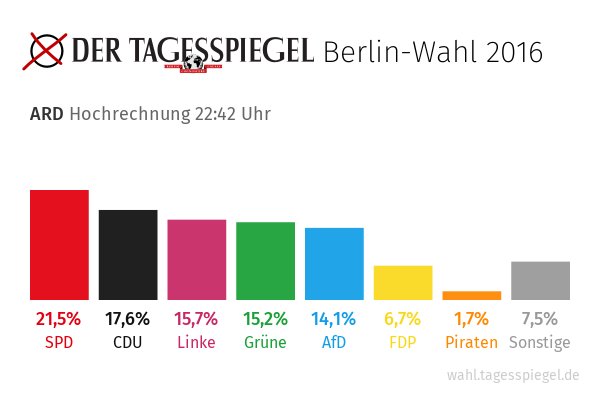
ARD Hochrechnung 22:42: SPD 21,5%, CDU 17,6%, LIN 15,7%, GRÜ 15,2%, AfD 14,1%, FDP 6,7%, PIR 1,7%… #agh16

With the top two parties losing more than 5 percent of the vote each, the existing grand coalition between the two centrist mainstays of Germany’s political system – which is currently in power at the national level – is no longer possible.
“There is no question. We didn’t get a good result in Berlin today,” admitted Michael Grosse-Broemer, a senior CDU politician, who nonetheless cautioned interpreting the capital results as a bellwether for next year’s countrywide polls. The AfD earlier proclaimed that the result augured the end of the stranglehold of long-established centrist parties on the country’s political levers of power.
“It’s not a good day for the traditional parties,” Frank Henkel, the CDU’s defeated mayoral candidate, told supporters. For the Christian Democrats, “this result is absolutely unsatisfactory.”

Top candidate of the anti-immigration party AfD Georg Pazderski and AfD
co-leader Joerg Meuthen (L) react after first exit polls of the Berlin city-state elections.
The blow to the CDU came two weeks after the party suffered heavy losses in Mecklenburg-Vorpommern, Merkel’s home state. The setbacks have raised questions about whether Merkel will stand for a fourth term next year, but her party has few good alternatives so she still looks like the most likely candidate.
As Bloomberg adds, electoral successes by the AfD in a string of state votes are roiling politics in Europe’s biggest economy after last year’s record influx of asylum seekers, dragging down poll ratings for Merkel, her party and the Social Democrats, her junior partner at the national level. While the AfD won almost 21 percent on Sept. 4 in the rural eastern state of Mecklenburg-Western Pomerania with its demands for an immigration cap, it fell short of poll predictions of as much as 14 percent in in the more diverse capital of 3.5 million.
Merkel campaigned last week in Berlin against the AfD, while making it clear that she’s sticking to her course on refugees. “Right now it’s hard to reach some people with reasoning and still we have to keep trying again and again,” she said in a local radio interview. Still, the string of losses has escalated the pressure on Merkel to change course as she weighs running for a fourth term next year. Her sharpest critic within her ruling coalition is the CDU’s Bavarian sister party, the Christian Social Union. CSU leader Horst Seehofer told Der Spiegel magazine that his party is making an annual migration cap a condition for backing Merkel as joint chancellor candidate.
* * *
And so the startling fall from grace for the woman who until recently was perceived as the most powerful in all of Europe, continues; and with every successive loss in German elections, it looks increasingly likely that the Chancellor, who did everything to preserve Europe during the Greek crisis days, may have been sabotaged by her own immigration policies.
end
Merkel admits “mistakes were made” on the migrant crisis in explanation of her horrendous defeat in state elections (Berlin region)
(courtesy zero hedge)
After Disastrous Berlin Election, Angela Merkel Admits “Mistakes Were Made” On Migrant Crisis
After the CDU’s latest disastrous showing in Sunday’s Berlin election, which as reported last night saw Germany’s conservative party end second with only 17.6% of the vote, dropping 5.7% from the 2011 election, and marking its worst performance in the capital since German reunification, Angela Merkel took responsibility for her party’s disastrous showing in Sunday’s Berlin state election, “admitting mistakes in her handling of last year’s refugee crisis.”
As reported by the Guardian, in an unusually self-critical but also combative speech, the German chancellor said on Monday afternoon she was “fighting” to make sure that there would be no repetition of the chaotic scenes on Germany’s borders last year, when “for some time, we didn’t have enough control” adding that “No one wants this to be repeated, and I don’t either,” Ms. Merkel said of last year’s refugee influx at Germany’s borders. “We have learned from history.”

Angela Merkel, said: ‘No one wants a repeat of last year’s situation, including me’.
Still, Merkel did not distance herself from her decision last September to keep open Germany’s borders to thousands of refugees stranded at Budapest’s Keleti station. The mistake, the chancellor said, was that she and her government had not been quicker to prepare for the mass movement of people triggered by conflicts in the Middle East.
“If I could, I would turn back time many, many years to be able to better prepare myself and the whole government and all those in positions of responsibility for the situation that met us rather unprepared in late summer 2015,” Ms. Merkel said at a news conference at her party’s headquarters in the German capital.
As the WSJ adds, Merkel reacted to her party’s latest electoral loss by sticking to her migration policy on Monday but acknowledging, more explicitly than before, that she had made mistakes along the way. Merkel described her center-right Christian Democratic Union’s second-place performance in Sunday’s election in the city-state of Berlin as a “very unsatisfactory, disappointing” result. She acknowledged widespread public discomfort with the influx of more than a million asylum applicants to Germany this year and last and said that she heard voters’ concerns.
Nevertheless, Ms. Merkel—whose steadfast refusal to close the German border to asylum seekers has become a focal point in the global debate over how to treat refugees—said she would stick to her current policy. She said she was guided both by a conviction that Germany has a duty to take in people in need but also that the sort of chaotic, mass influx of people as this country experienced last year had to be prevented.
That said, perhaps confirming the realization she may have made a mistake, on Saturday she said she would no longer use “we can do it” as her rallying cry to welcome and integrate migrants in the belief it has become a mere slogan, the local.de reported. Merkel first used the much-repeated phrase at the end of August last year to lay out her welcoming stance on migrants, after saying Germany could cope with an influx of around one million refugees, many fleeing the war in Syria. But as the worst migrant crisis in Europe since World War II has continued Merkel has come under pressure and her approval ratings have plunged.
But back to Sunday’s election, where Germany’s two governing establishment parties, the Christian Democratic Union (CDU) and the Social Democratic party (SPD) on Sunday night both plummeted to the worst Berlin result in their parties’ histories, while both leftwing Die Linke and anti-immigrant Alternative für Deutschland (AfD) enjoyed impressive gains.
On Monday, Merkel admitted she had in the past failed to sufficiently explain her refugee policy, and that her phrase “Wir schaffen das” (“We can do it ”) had “provoked” some of those who didn’t agree with her political course. Her words will be interpreted as an olive branch to the leader of her CDU’s sister party, the Bavarian CSU, who have in recent months repeatedly called on her to distance herself from the much-cited slogan.
For too long, Merkel said, she had relied on the Dublin procedure, “which, to put it simply, had taken the problem off Germany’s hands”, adding: “And that was not good”.
The 62-year-old also rebutted the CSU’s calls for a “static upper limit” to the amount of asylum seekers Germany could accept in 2016, arguing that it “would not solve the problem”. Banning people from entering the country on the basis of their religion, she said, would be incompatible with Germany’s constitution and her own party’s “ethical foundation”.
Of course, one alternative is watching as her approval rating implodes in not so slow-motion, and as her CDU continues to tank in future elections.
Merkel lamented that the European Union as a whole was failing to recognise the refugee as “a global and a moral challenge”. “What we are seeing in Europe is a realisation that we are no longer leading the field when it comes to globalisation, we are not setting the pace.
“In 1990, when the wall fell, the cold war came to an end and freedom blossomed everywhere; it looked like we were on an irreversible road to victory, and that it was just up to the rest of the world to join our model. Freedom had won. It now turns out things aren’t that simple”.
Somewhere George Soros is smiling.
Deutsche bank continues to extend losses in trading and now they are close to record lows as the bank is terribly under-capitalized. Even if the fine from the D of J is reduced they will still need to raise huge amounts of capital.
(courtesy zero hedge)
Deutsche Bank Extends Losses Near Record Lows: “Significantly Undercapitalzied… Even Without Bad Outcomes”
Things are going from worse to worst once again for Deutsche Bank as equity and credit markets deteriorate further as analysts warn Germany’s biggest (and the world’s most systemically dangerous) bank would be “significantly undercapitalized” even if an eventual settlement with the DoJ can be covered by the bank’s reserves. Despite multiple capital raises over the past few years, as Bloomberg notes, any likely settlement would imply a capital increase – just to pay the fine.
Deutsche equity down another 3% this morning, near record lows…

As Bloomberg reports, The U.S. Department of Justice opened negotiations with a demand for $14 billion to settle a dispute over mortgage-backed securities, more than twice the 5.5 billion euros ($6.1 billion) the bank had set aside for all legal disputes at the end of the first half.
Germany’s biggest bank would be “significantly undercapitalized” even if an eventual settlement with the DoJ can be covered by the bank’s reserves, Andrew Lim, a Societe Generale analyst, said in a note to investors Monday. Any settlement above 5.4 billion euros would imply a capital increase is needed just to pay the fine, he wrote.
…
“Even without bad outcomes on litigation, the capital position is precariously thin in the event of a failure to sell Postbank,” said Piers Brown, a Macquarie analyst with an underperform rating on the stock.
But CoCos (the most likely investment vehicle to get hit should further problems emerge) continue to plunge, as JPMorgan analysts wrote in a note to clients that a U.S. settlement of $3 billion to $3.5 billion would leave the German lender room to settle other legal issues. Any additional $1 billion in litigation charges would erode capital by 24 basis points. The bank’s common equity Tier 1 ratio stood at 10.8 percent at the end of June.

Deutsche Bank has raised 31.7 billion euros through three capital increases since the global financial crisis erupted and was among the worst-capitalized lenders in European stress tests earlier this year. Though the bank said it will seek to negotiate a lower settlement, Deutsche Bank still has to deal with a
probe of its equities business in Russia and is struggling to sell its
German retail lender Deutsche Postbank AG.
end
Despite Record Syrian Immigration, Europe Says It Expects US, Canada To Take More Refugees
We recently reported on the Obama administration’s plan admit 110,000 refugees into the United States in 2017, representing a 30% increase over 2016 and a 57% increase from 2015 (see “Hillbama Administration Plans To Admit At Least 110,000 Refugees In 2017“). But, apparently that is not enough for European Migration Commissioner, Dimitris Avramopoulos, who, according to the Wall Street Journal, recently said he expects more help from the U.S. and Canada.
“They are refugees so it is a problem that has to be addressed globally. The European Union has done a lot but we are not there yet,” he said.
The commissioner, a former Greek diplomat, said he expects to see pledges to take in more refugees “not only from the U.S. government, also from Canada and maybe other big countries on the American continent.”
Rather than yielding to the obvious desires of European citizens to reduce the migrant influx (perhaps he has already forgotten the whole Brexit thing?), Avramopoulos, like Merkel, doubled down saying that “populism and nationalism are undermining the European project.” He also took the opportunity to admonish citizens to stop “almalgamating terroritst with refugees” and instead blamed recent migrant attacks on a failure of the European intelligence services.
“Populism and nationalism are undermining the European project, they are against the basic principles on which Europe is built. In the end, is not the economic crisis that is putting the European project at stake, but the refugee crisis management,” he said.
“We must avoid amalgamating terrorists with refugees and migrants.”
But he noted, “if the intelligence services of Europe had established [a closer] cooperation, many of the perpetrators would have been arrested and hindered from committing those crimes.”
So the fault lies with the cops and intelligence community and not the reckless actions of a few politicians, got it.

It sounds like Avramopoulos has been spending too much time with Peter Sutherland (United Nations Special Representative of the Secretary-General for International Migration) who recently declared in an interview with the UN News Center that “sovereignty is an absolute illusion that has to be put behind us.” Sutherland also drew upon the standard progressive narrative that anyone who disagrees that “sovereignty is an absolute illusion” is just “racist and xenophobic, and [ought] to be condemned.”
“I will ask the governments to cooperate, to recognize that sovereignty is an illusion — that sovereignty is an absolute illusion that has to be put behind us. The days of hiding behind borders and fences are long gone. We have to work together and cooperate together to make a better world. And that means taking on some of the old shibboleths, taking on some of the old historic memories and images of our own country and recognizing that we’re part of humankind.”
“Refugees are the responsibility of the world. They’re the responsibility of the United States, of Canada, of Latin America and of Asia, as well as Europe. Proximity doesn’t define responsibility.”
Wow, won’t you please tell us how you really feel?
Avramopoulos also weighed in on the U.S. presidential election taking the opportunity to slam Trump’s immigration policies by saying “we are against whatever divides people, we are against walls.”
“The positive response of the Canadians is showing the way. I understand that migration is a domestic issue these days in the U.S., with the election campaign. I hope after the elections we’ll find a way to cooperate with the American government on this issue,” Mr. Avramopoulos said.
“Given the basic democratic principles on which the postwar European architecture is made, we are against whatever divides people, we are against walls. We must find human and legal ways to treat these desperate people who flee war and poverty.”
Meanwhile, Avramopoulos points out that Europe is in the process of implementing migration policies modeled after the U.S. border-screening system. Well isn’t that convenient?
“In Europe we didn’t have this experience before. Some member states, yes, but not Europe as such. Now we have learned. In order to better protect our borders we have decided—and are now finalizing a European Border and Coast Guard, to better protect Europe’s borders,” the commissioner said.
He said the EU has learned from the U.S. border-screening system on checking the identity of people entering and leaving its territory. The bloc is now discussing putting in a similar system at the EU level.
The EU’s focus on border protection marks a shift in policy from last year, when its main response to the unchecked wave of migrants was to set up a quota system under which member countries would be obliged to take in a certain number of refugees based on the size of their economy and population.
We would kindly suggest that Avramopoulos take the opportunity to review a couple of polls from around Europe sampling public opinion on the influx of migrants and consider that data when reflecting upon who he is intended to serve.
5. RUSSIAN AND MIDDLE EASTERN AFFAIRS
OHOH! this does not looks good! The USA admits it struck a Syrian army base killing 62 Syrian soldiers. Immediately after the hit, ISIS militants launched an offensive.Russia and of course Syria are very angry!
“Russia has repeatedly alleged that the US is failing to keep its part of the bargain. The US, on its part, has blamed Russia for not pressuring Damascus enough to facilitate humanitarian access to Syria.
Both allegations may now be moot if Russia decides to retaliate against members of the US-led coalition, or directly against US forces.”
(courtesy zero hedge)
US Admits It Made A Mistake After Syria Accuses Coalition Of Killing 62 Soldiers In Act Of “Blatant Aggression”
Update: Centcom has issued a statement admitting the killing of over 60 Syrian troops was a mistake.
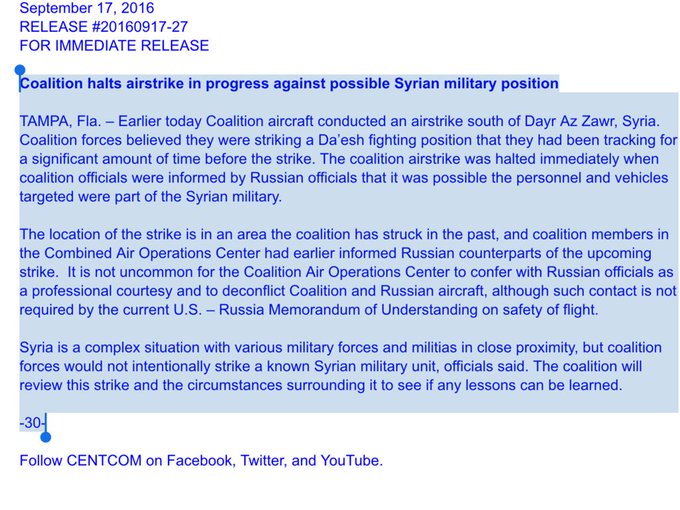
Centcom. sounds like it was a mistake

Earlier:
If the latest news out of Syria are confirmed, one can not only kiss last weekend’s so-called “ceasefire” goodbye, but a full blown war may be about to erupt. The reason: moments ago the Syrian Army General Command reported, and shortly thereafter the Russian military confirmed, that US-coalition forces struck the Syrian airbase at Deir el-Zour, killing at least 62 Syrian army troops, “paving the way” for ISIS militants to advance in the fiercely contested area..

#Syria State TV: U.S. warplanes hit Syrian army base in Deir ez-Zor

According to Syria’s official SANA news agency, the bombing took place on al-Tharda Mountain in the region of Deir ez-Zor and caused casualties and destruction on the ground.
Sixty-two Syrian soldiers were killed and over 100 injured in the airstrike by the US-led coalition, Russia’s Defense Ministry spokesman, Major-General Igor Konashenkov, confirmed citing information received from the Syrian General Command.
There was no immediate comment from Washington. If confirmed, the attack could be tantamount to an act of war as it would be the first time the coalition has targeted Syrian government forces. Subsequently, the Pentagon told RT that it is “aware of the reports and checking with Centcom and CJTF (Combined Joint Task Force).”

U.S. Secretary of State John Kerry (R) and Russian Foreign Minister
Sergei Lavrov walk into their meeting room in Geneva, Switzerland
In a statement Saturday, the Syrian military says the airstrikes caused casualties and damage to equipment, and enabled an IS advance on the hill overlooking the air base. The statement calls it a “serious and blatant attack on Syria and its military” and “firm proof of the U.S. support of Daesh and other terrorist groups.” Daesh is an Arabic acronym for IS.
The Russian Defense Ministry said on Saturday that the aircraft which carried out the bombings had entered Syrian airspace from the territory of Iraq. Four strikes against Syrian positions was performed by two F-16 jet fighters and two A-10 support aircraft, it added.
“Immediately after the airstrike by coalition planes, Islamic State militants launched their offensive. Fierce fighting with the terrorists is currently underway in the area of the airport where for a long a time humanitarian aid for civilians was parachuted,” Konashenkov said.
“If the airstrike was caused by the wrong coordinates of targets than it’s a direct consequence of the stubborn unwillingness of the American side to coordinate with Russia in its actions against terrorist groups in Syria,” Konashenkov stressed. Alternatively, the Syrians – and Russians – may claim that the US coalition attack meant to cripple Syrian army forces, taking the lethal conflict to an entirely new level, one where Syria and Russia are effectively at war with the US coalition.
Meanwhile, it appears that the Assad regime, which recently also garnered the support of Chinese military forces, is preparing for a full-blown escalation: the Syrian General Command has called the bombing a “serious and blatant aggression” against Syrian forces, and said it was “conclusive evidence” that the US and its allies support IS militants.
* * *
Earlier on Saturday, Russia accused the US of being reluctant to take measures to force rebels under its control to fall in line with the terms of the Syrian ceasefire. As RT reported, numerous Russian appeals to the American side remain unanswered, which “raises doubts over the US’s ability to influence opposition groups under their control and their willingness to further ensure the implementation of the Geneva agreements,” senior Russian General Staff official, Viktor Poznikhir, said. Poznikhir also said that the truce is being used by the militants to regroup, resupply and prepare an offensive against government troops.
Last week, Moscow and Washington agreed to influence the Syrian government and the so-called moderate rebel forces respectively in order to establish a ceasefire in the country “over pizza and vodka.” We were skeptical, and for good reason: one week later it appears that not only is the ceasefire over but a whole new phase in the war may have broken out.
Russia has repeatedly alleged that the US is failing to keep its part of the bargain. The US, on its part, has blamed Russia for not pressuring Damascus enough to facilitate humanitarian access to Syria.
Both allegations may now be moot if Russia decides to retaliate against members of the US-led coalition, or directly against US forces.
6. GLOBAL ISSUES
7. OIL ISSUES
From our resident expert of USA shale production: Steve St Angelo. He now comments that the huge BAKKEN shale oil field is down in production by 25% and EAGLE FORD at 40%. Shale production if you include costs of rigs etc has not produced a dime in profits but the losses will be immense
(courtesy St Angelo/SRSRocco report)
THE DEATH OF THE BAKKEN FIELD HAS BEGUN: Big Trouble For The U.S.

By the SRSrocco Report,
The Death of the Great Bakken Oil Field has begun and very few Americans understand the significance. Just a few years ago, the U.S. Energy Industry and Mainstream media were gloating that the United States was on its way to “Energy Independence.”
Unfortunately for most Americans, they believed the hype and are now back to driving BIG SUV’s and trucks that get lousy fuel mileage. And why not? Americans now think the price of gasoline will continue to decline because the U.S. oil industry is able to produce its “supposed” massive shale oil reserves for a fraction of the cost, due to the new wonders of technological improvement.
I actually hear this all the time when I travel and talk to family, friends and strangers. I gather they have no clue that the Great Bakken Oil Field is now down in production a stunning 25% from its peak in just a little more than a year and half ago:
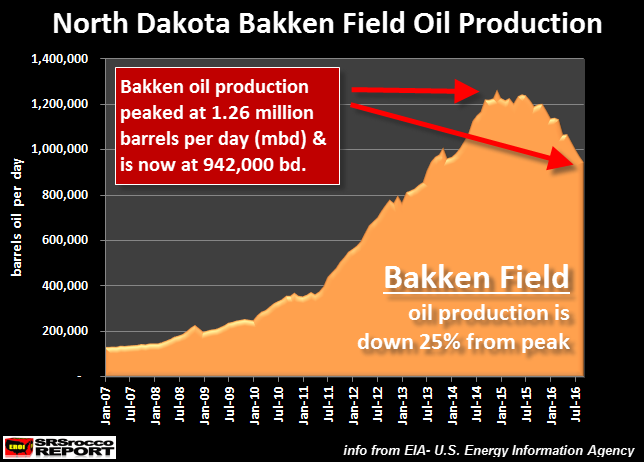
The mighty Bakken oil field located in North Dakota reached peak production in December 2014 at 1.26 million barrels per day (mbd) and is now down to 942,000 bd. This decline is no surprise to me or to my readers who have been following my work for the past several years.
I wrote about the upcoming crash of the Bakken oil field in my article (click here to read article)–Published, NOV. 2013:
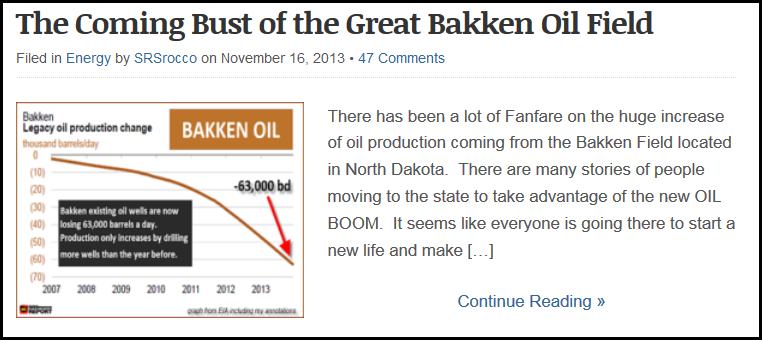
I ended the article with these sobering words:
There are only so many drilling locations available and once they run out, the Great Bakken Field will become a BUST as the high decline rates will push overall oil production down the very same way it came up.
Those who moved to the frigid state of North Dakota with Dollar signs in their eyes and images of sugar-plums dancing in their heads will realize firsthand the negative ramifications of all BOOM & BUST cycles.
Well, the Bust of North Dakota economy has arrived and according to the article, “The North Dakota Great Recession“:
Unfortunately by April 2015 it was clear that the oil markets were in a secular decline brought on by oversupply in the global energy markets fueled by a deep recession in China. As a result, companies started to lay off workers, and over the following months caused a massive exodus of people as jobs were eliminated. Nobody is exactly sure how many people have left the state, but some put estimates as high as 25,000.
The strongest real estate market continues to be Watford City with the weakest in Minot. However, even in Watford City the price of a three-bedroom rental home has come down from $2,500 in 2015 to a current price of $1,400. This represents a 44 percent decline of the rental price in the market.
Some folks believe the reason for the decline in oil production at the Bakken was due to low oil prices. While this was part of the reason, the Bakken was going to peak and decline in 2016-2017 regardless of the price. This was forecasted by peak oil analyst Jean Laherrere. I wrote about this in my article below (click here to read article)– Published, APRIL 2015:
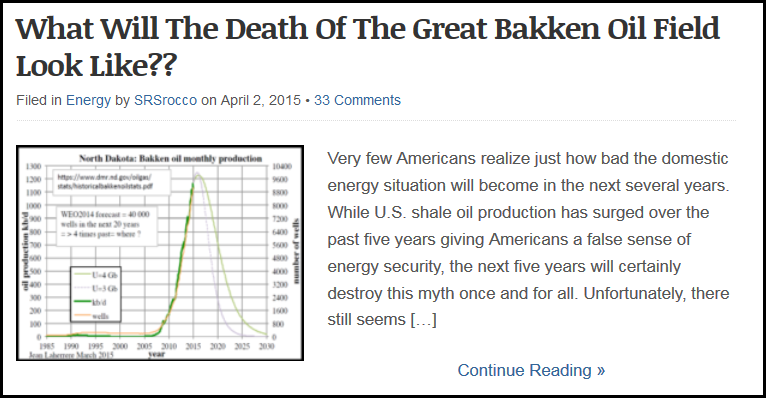
I took Jean Laherrere’s chart and placed it next to the current actual Bakken oil field production:
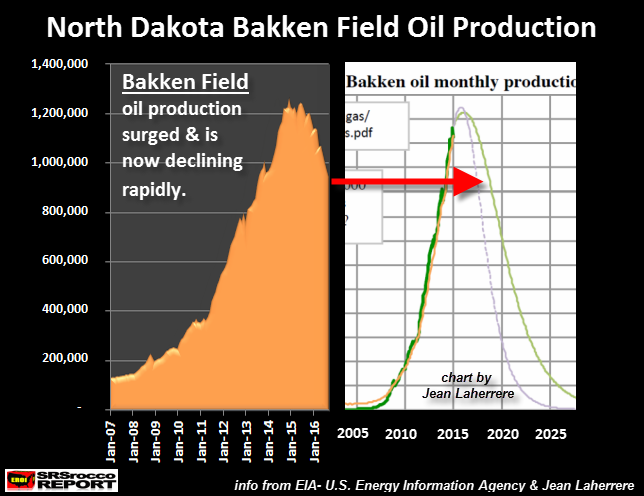
As we can see in the chart above, the rise and fall of Bakken oil production is very close to what Jean Laherrere forecasted several years ago (shown by the red arrow). According to Laherrere’s chart, the Bakken will be producing a lot less oil by 2020 and very little by 2025. This would also be true for the Eagle Ford Field in Texas.
According to the most recent EIA Drilling Productivity Report, the Eagle Ford Shale Oil Field in Texas will be producing an estimated 1,026,000 barrels of oil per day in September, down from a peak of 1,708,000 barrels per day in May 2015. Thus, Eagle Ford oil production is slated to be down a stunning 40% since its peak last year.
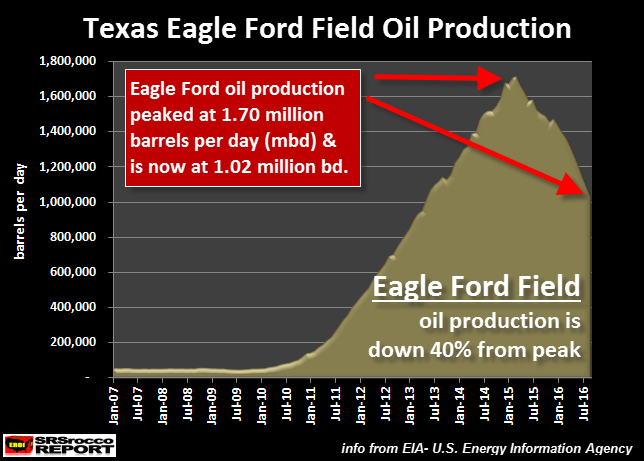
Do you folks see the writing on the wall here? The Bakken down 25% and the Eagle Ford down 40%. These are not subtle declines. This is much quicker than the U.S. Oil Industry or the Mainstream Media realize.
And… it’s much worse than that.
The U.S. Oil Industry Hasn’t Made a RED CENT Producing Shale
Rune Likvern of Fractional Flow has done a wonderful job providing data on the Bakken Shale Oil Field. Here is his excellent chart showing the cumulative FREE CASH FLOW from producing oil in the Bakken:
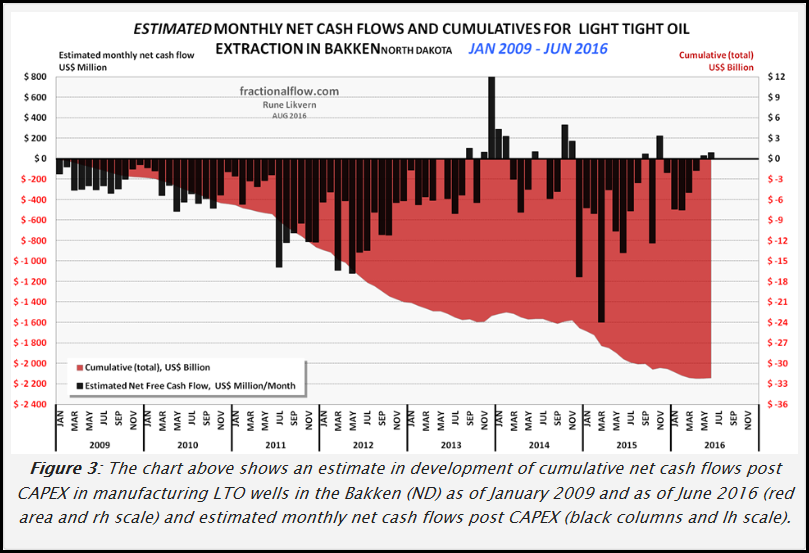
I will simply this chart by explaining that the BLACK BARS are estimates of the monthly Free Cash flow from producing oil in the Bakken since 2009, while the RED AREA is the cumulative negative free cash flow. As we can see there are very few black bars that are positive. Most are negative, heading lower.
Furthermore, the red area shows that the approximate negative free cash flow (deducting CAPEX- capital expenditures) is $32 billion. So, with all the effort and high oil prices from 2011-2014 (first half of 2014), the energy companies producing shale oil in the Bakken are in the hole for $32 billion. Well done…. hat’s off to the new wonderful fracking technology.
According to Rune Likvern in his article on the Bakken, he stated the following:
Just to retire estimated total debts (about $36 Billion, including costs for DUCs, SDWs, excluding hedges and income/loss of natural gas and NGLs) would require about 7 years with extraction and prices at Jun-16 levels.
Nominally to retire all debts (reach payout) would take an (average) future oil price close to $65/bo (WTI) for all the wells in operation as of end June – 16. This is without making any profit.
For the wells in production as per Jun-16, the total extraction of these will decline about 40% by Jun-17, and depletes their remaining reserves with about 20%. By assuming the operations remain cash flow neutral, total debt remains at $36 B in Jun-17.
As from Jul-17 this would now require an average oil price of about $73/bo (WTI) for these wells to nominally retire all debts (reach payout). Additional wells will add to what price is required to retire the total debt.
What Rune is stating here is that the $36 billion in total cumulative debt will occur by June 2017. Thus, it would take an average $65 a barrel to just pay back the debt in seven years. With the way things are going in the U.S. and world economies, I doubt we are going to see much higher oil prices.
Furthermore, the work by Louis Arnoux and the Hills Group suggest the price of oil will fall, not rise due to a Thermodynamic Collapse. More about this in an upcoming interview.
The United States Is In Big Trouble & Most Americans Have No Clue
As I have been documenting in previous articles (going back until 2013) the U.S. Shale Oil Industry was a house-of-cards. Readers who have been following my work, based on intelligent work of others, understood that Shale Oil is just another Ponzi Scheme in a long list of Ponzi Schemes.
From time to time, I look around different websites that publish my work and read some of the comments. I am surprised how many individuals still don’t believe in Peak Oil even though I explained the Falling EROI – Energy Returned On Investment quite clearly.
For some strange reason, some individuals cannot use deductive reasoning to destroy lousy conspiracy theories. Moreover, if they do believe in Peak Oil, then they think there is a wonderful “Silver-Bullet Energy Technology” that will save us all. I gather they believe this because the REALITY and IMPLICATIONS of Peak Oil are just too horrible, to say the least. So, holding onto HOPE that something will save us, just in the nick of time, is better than accepting the awful reality heading our way.
And the awful reality of Peak Oil will be felt more by Americans as their lifestyles have been highly elevated by the ability to extract wealth and resources from other countries through the issuing of massive amounts of paper Dollars and debt. Basically, they work, and we eat.
Unfortunately, the propping up of the U.S. market by the Fed and the domestic shale energy Ponzi scheme is running out of time. This is why it is imperative for investors to start moving out of Bonds, Stocks and Real Estate and into physical gold and silver to protect wealth.
For the wealthy investor or institution that believe a 5-10% allocation in physical gold is good insurance, you are sadly mistaken. While Donald Trump is receiving more support from Americans in his Presidential race, his campaign motto that he will “Make American Strong Again”, will never happen. The America we once knew is over. There just isn’t the available High EROI – Energy Returned On Investment energy supplies to allow us to continue the same lifestyle we enjoyed in the past.
So, now we have to transition to a different more local or regional way of living. This new living arrangement will be based on capital that is “STORED ECONOMIC ENERGY or WEALTH.” This can only come via the best sources such as physical gold and silver.
If individuals and countries have been acquiring physical gold and silver, they will be in better shape and will be able to enjoy more options than those who have been selling their gold and accumulating lots of debt and derivatives.
Lastly, if you haven’t checked out our new PRECIOUS METALS INVESTING section or our newLOWEST COST PRECIOUS METALS STORAGE page, I highly recommend you do.
Check back for new articles and updates at the SRSrocco Report.
end
Your early morning currency/gold and silver pricing/Asian and European bourse movements/ and interest rate settings MONDAY morning 7:00 am
Euro/USA 1.1164 UP .0012 (STILL REACTING TO BREXIT/REACTING TO BRITISH CUT IN INTEREST RATE TO .25%
USA/JAPAN YEN 101.84 DOWN .074(Abe’s new negative interest rate (NIRP), a total DISASTER/SIGNALS U TURN WITH INCREASED NEGATIVITY IN NIRP/JAPAN OUT OF WEAPONS TO FIGHT ECONOMIC DISASTER/KURODA: HELICOPTER MONEY ON THE TABLE BUT DISAPPOINTS WITH STIMULUS
GBP/USA 1.3051 UP .0055
USA/CAN 1.3162 DOWN .0032
Early THIS MONDAY morning in Europe, the Euro ROSE by 12 basis points, trading now well above the important 1.08 level FALLING to 1.1242; Europe is still reacting to Gr Britain BREXIT,deflation, announcements of massive stimulation (QE), a proxy middle east war, and the ramifications of a default at the Austrian Hypo bank, an imminent default of Greece, Glencore, Nysmark and the Ukraine, along with rising peripheral bond yield further stimulation as the EU is moving more into NIRP, and NOW THE USA’S NON tightening by FAILING TO RAISE THEIR INTEREST RATE / Last night the Shanghai composite CLOSED UP 23.20 OR .77% / Hang Sang CLOSED UP 214.86 POINTS OR .92% /AUSTRALIA IS LOWER BY 0.04% / EUROPEAN BOURSES ALL IN THE GREEN
We are seeing that the 3 major global carry trades are being unwound. The BIGGY is the first one;
1. the total dollar global short is 9 trillion USA and as such we are now witnessing a sea of red blood on the streets as derivatives blow up with the massive rise in the rise in the dollar against all paper currencies and especially with the fall of the yuan carry trade. The emerging market which house close to 50% of the 9 trillion dollar short is feeling the massive pain as their debt is quite unmanageable.
2, the Nikkei average vs gold carry trade ( NIKKEI blowing up and the yen carry trade HAS BLOWN up/and now NIRP)
3. Short Swiss franc/long assets blew up ( Eastern European housing/Nikkei etc.
These massive carry trades are terribly offside as they are being unwound. It is causing global deflation ( we are at debt saturation already) as the world reacts to lack of demand and a scarcity of debt collateral. Bourses around the globe are reacting in kind to these events as well as the potential for a GREXIT>
The NIKKEI: this MONDAY morning CLOSED FOR HOLIDAY
Trading from Europe and Asia:
1. Europe stocks ALL IN THE GREEN
2/ CHINESE BOURSES / : Hang Sang CLOSED UP 214.86 OR .92% ,Shanghai CLOSED UP 23.20 POINTS OR .77% / Australia BOURSE IN THE RED: /Nikkei (Japan)CLOSED INDIA’S SENSEX IN THE GREEN
Gold very early morning trading: $1314.90
silver:$19.12
Early MONDAY morning USA 10 year bond yield: 1.689% !!! DOWN 1 in basis points from FRIDAY night in basis points and it is trading WELL BELOW resistance at 2.27-2.32%. The 30 yr bond yield 2.438, DOWN 1 IN BASIS POINTS from YESTERDAY night.
USA dollar index early MONDAY morning: 95.89 DOWN 14 CENTS from FRIDAY’s close.
This ends early morning numbers MONDAY MORNING
END
xxxxxxxxxxxxxxxxxxxxxxxxxxxxxxxxxxxxxxxxxxxxxxxxxxxxxxxxxxxxxxxxxxxxxxxxxxxxxxxxxxxxxxxxxxxxxxxxxxxxxxxxxxxxxxx
And now your closing MONDAY NUMBERS
Portuguese 10 year bond yield: 3.37% DOWN 5 in basis point yield from FRIDAY (does not buy the rally)
JAPANESE BOND YIELD: -.039% par in basis point yield from FRIDAY
SPANISH 10 YR BOND YIELD:1.034% DOWN 4 IN basis point yield from FRIDAY (this is totally nuts!!/
ITALIAN 10 YR BOND YIELD: 1.312 DOWN 3 in basis point yield from FRIDAY
the Italian 10 yr bond yield is trading 28 points HIGHER than Spain.
GERMAN 10 YR BOND YIELD: +0.016% UP 2 IN BASIS POINTS ON THE DAY
END
xxxxxxxxxxxxxxxxxxxxxxxxxxxxxxxxxxxxxxxxxxxxxxxxxxxxxxxxxxxxxxxxxxxxxxxxxxxxxxxxxxxxxxxxxxxxxxxxxxxxxxxxxxxxxxxxxxxxxxxxxxxxxxxxxxxxx
IMPORTANT CURRENCY CLOSES FOR MONDAY
Closing currency crosses for MONDAY night/USA DOLLAR INDEX/USA 10 YR BOND YIELD/2:30 PM
Euro/USA 1.1173 UP .0021 (Euro UP 21 basis points/ represents to DRAGHI A COMPLETE POLICY FAILURE/
USA/Japan: 101.79 DOWN: 0.125 (Yen UP 13 basis points/
Great Britain/USA 1 .3027 UP 0.0030 ( PoOUND UP 30 basis points
USA/Canada 1.3194 UP 0.0001 (Canadian dollar DOWN 1 basis points AS OIL FELL (WTI AT $43.40). Canada keeps rate at 0.5% and does not cut!
xxxxxxxxxxxxxxxxxxxxxxxxxxxxxxxxxxxxxxxxxxxxxxxxxxxxxxxxxxxxxxxxxxxxxxxxxxxxxxxxx
This afternoon, the Euro was UP by 21 basis points to trade at 1.1173
The Yen FELL to 101.79 for a GAIN of 13 basis points as NIRP is STILL a big failure for the Japanese central bank/HELICOPTER MONEY IS NOW DELAYED/BANK OF JAPAN NOW WORRIED AS AS THEY ARE RUNNING OUT OF BONDS TO BUY AS BOND YIELDS RISE
The POUND was ROSE 30 basis points, trading at 1.3027/
The Canadian dollar FELL by 1 basis points to 1.31938, WITH WTI OIL AT: $43.40
the 10 yr Japanese bond yield closed at -.039% UP 1/10 IN BASIS POINTS / yield/ AND THIS IS BECOMING BOTHERSOME TO THE BANK OF JAPAN
Your closing 10 yr USA bond yield: DOWN 1 IN basis points from FRIDAY at 1.685% //trading well below the resistance level of 2.27-2.32%) very problematic
USA 30 yr bond yield: 2.437 DOWN 1 in basis points on the day /*very problematic as all bonds globally rose in yield (lowered in price)
BANKS NEED THE LONGER BOND HIGHER IN YIELD: INSTEAD THE SPREAD LESSENS.
Your closing USA dollar index, 95.85 DOWN 18 CENTS ON THE DAY/4 PM
Your closing bourses for Europe and the Dow along with the USA dollar index closing and interest rates for MONDAY: 2:30 PM EST
London: CLOSED UP 103.27 POINTS OR 1.54%
German Dax :CLOSED UP 97.70 OR 0.95%
Paris Cac CLOSED UP 61.74 OR 1.43%
Spain IBEX CLOSED UP 82.10 OR 0.95%
Italian MIB: CLOSED UP 207.10 POINTS OR 1.28%
The Dow was DOWN 3.63 points or 0.02% 4 PM EST
NASDAQ DOWN 9.54 points or 0.18% 4 PM EST
WTI Oil price; 43.40 at 2:30 pm; 2:30 EST
Brent Oil: 46.13 2:30 EST
USA DOLLAR VS RUSSIAN ROUBLE CROSS: 64.65(ROUBLE UP 63/100 ROUBLES PER DOLLAR FROM FRIDAY) 2:30 EST
TODAY THE GERMAN YIELD FALLS TO +0.016% FOR THE 10 YR BOND 2:30 EST
END
This ends the stock indices, oil price, currency crosses and interest rate closes for today
Closing Price for Oil, 5 pm/and 10 year USA interest rate:
WTI CRUDE OIL PRICE 5 PM:$43.25
BRENT: $45.95
USA 10 YR BOND YIELD: 1.714%
USA DOLLAR INDEX: 95.86 DOWN 17 cents
The British pound at 5 pm: Great Britain Pound/USA: 1.3026 UP 0.0030 or 30 basis pts.
German 10 yr bond yield at 5 pm: +0.016%
END
And now your more important USA stories which will influence the price of gold/silver
“Buy-The-Bombing” Stock Rally Fades Amid Crude Tumble & China Turmoil
Too soon?
The market is simply not buying the premise that The Fed will hike rates…

And the reason is not a good one – macro data is tumbling…

And China is turmoiling…

Maduro’s pointless ramblings sparked overnight strength however on the back of oil’s jolt…

But that exuberance did not last long…some clear sell programs hit a number of times… (Small Caps strong gains on the huge short squeeze)

Nasdaq underperformed as AAPL slipped on JPM’s less than exuberant note and chatter of iPhone battery problems…

And a massive, manic short squeeze…

VIX swung violently along with stocks… (not VIX bounced hard off its 100DMA at 14.6).. NOTe the effort to keep S&P green failed.

Despite the equity market’s swings, bonds went nowhere fast… (not Japan was closed overnight)

Stocks decoupled then recoupled with bond yields…

The USD Index slipped notably lower led by JPY strength….

Silver surged over 2% on the day as the USD slid. Copper was modestly lower and crude roundtripped…

Charts: Bloomberg
end
Bomb explodes at New Jersey train station on Sunday after explosions occurred in New York on Saturday.
(courtesy zero hedge)
Bomb Explodes At New Jersey Train Station As Police Discover Five Explosive Devices
One day after an IED exploded in a busy midtown Manhattan sidewalk, an explosion took place at a train station in Elizabeth, New Jersey, after a suspicious backpack was found. The detonation was “not controlled”, the city’s mayor said. Meanwhile, the FBI has questioned five people in connection with Saturday’s Manhattan blast. Elizabeth’s mayor, Christian Bollwage, said the blast occurred when authorities were trying to “disarm” the backpack, and that the explosion was not controlled.
PHOTO: Blast near Elizabeth NJ train station as bomb robot was inspecting suspicious device – @ADiLorenzoTVpic.twitter.com/wxgcdUvxvA

VIDEO: Moment of explosion at the Elizabeth NJ train station –@ADiLorenzoTV

No one was injured in the blast. The device in Elizabeth, a city south of Newark, had been left in a backpack placed in a trash can near a train station and a bar, Mayor Christian Bollwage told reporters.

“This was an explosive device” containing as many as five devices, Bollwage said. “Based on the loudness, I think people could have been severely hurt or injured if they had been in the vicinity.”

WATCH: Explosive device detonates near Elizabeth train station as robot was examining it

As many as five potential explosive devices tumbled out of the backpack when it was emptied, Bollwage said. After cordoning off the area, a bomb squad used a robot to cut a wire to try to disable the device, but inadvertently set off an explosion, he said. “I can imagine that if all five of them went off at the same time, that the loss of life could have been enormous if there was an event going on,” Bollwage said.

FBI Bomb Squad is on scene and continuing the investigation at the train station in Midtown Elizabeth.

Journalist Andy Mai from the New York Daily News reported that there will be no more detonations, and the remaining four devices will be taken to Middlesex Fire Academy and picked up by the FBI.
.@MayorBollwage explains the FBI robot cutting the wire
Said there could of been deaths if bomb went off #Elizabethpic.twitter.com/QGhLH0XiiV

There will be no more detonations
Remaining four devices will be taken to Middlesex Fire Academy where the FBI will pick them up #Elizabeth
According to Reuters, bomb technicians from the Federal Bureau of Investigation, Union County and New Jersey were involved in the operation that resulted in the detonation of the object, one of multiple explosive devices at the site, the FBI confirmed on Twitter.
CORRECTION: Detonation was not controlled, the FBI robot cut the wire
There was no one in the vicinity when it happened #Elizabeth
.@MayorBollwage explains the FBI robot cutting the wire
Said there could of been deaths if bomb went off #Elizabeth

The bag was discovered in the area of North Broad and Westfield Avenue, CBS local reported, adding that local businesses have been ordered to evacuate.
Bollwage said it was unclear whether Elizabeth, a city with a population of nearly 130,000 people that is less than 15 miles (24 km) southwest of Manhattan, was targeted or if the backpack might have been discarded to elude investigators. Authorities early on Monday were working to remove the other devices found in the backpack, Bollwage said.
Bollwage also told reporters that at around 9:30pm on Sunday two men “noticed a package in the waste basket.” The men then took the package from the bin, thinking “it was of value to them” before they saw “wires and a pipe.” They then proceeded to “drop the package” and notified the local police headquarters.
Police then called a bomb squad who sent a drone to examine the package further. Bomb technicians also deployed a robot to the scene. The bomb supposedly went off during the robot’s attempt to disarm it. Authorities at the scene were conducting a “secondary search” of waste bins for other possible threats, Bollwage added.
All Amtrak and local trains bound for New Jersey were halted during the investigation. Sometime before 4am Eastern, authorities “rendered the area safe,” the FBI’s New York bureau tweeted.
Bomb techs from the FBI, Union County, & the New Jersey State Police have arrived on the scene and are now rendering the area safe

The device found in Elizabeth appears similar to a device that exploded Saturday morning in Seaside Park, NJ, according to senior law enforcement officials cited by NBC.
Meanwhile, sources told the New York Post that five men were reportedly taken in for questioning by the FBI after agents pulled over their car in Brooklyn. Those detained were reportedly heading over the Verrazano Bridge from Staten Island to Brooklyn. NYPD officers assisted federal agents at the scene, NBC reported.
We did a traffic stop of a vehicle of interest in the investigation. No one has been charged with any crime. The investigation is continuing

Although the FBI clarified that it conducted a traffic stop, it said that no arrests were made or charges brought about in connection with the explosion that rocked New York on Saturday, stating that earlier media reports were inaccurate.
“We conducted a traffic stop of a vehicle of interest in New York City but no arrests were made and no one has been charged with any crime,” FBI spokeswoman Kelly Langmesser told Reuters.
The surrounding area of New York City remains on high alert after two bombs went off, firstly in New Jersey and later in Manhattan, on Saturday. Earlier on Sunday, NY governor Andrew Cuomo announced the deployment of close to 1,000 state police officers and National Guard servicemen to monitor bus terminals, airports, and subway stations.
Police Identify Suspect In NYC Bombing As Ahmad Khan Rahami
Moments ago, the NYPD announced that it seeking 28-year-old Ahmad Khan Rahami of New Jersey in connection to the pressure-cooker bomb, assistant commissioner J. Peter Donald said.
“Wanted: Ahmad Khan Rahami, 28 year old male, is being sought in connection with the Chelsea bombing,” NYPD Assistant Commissioner J. Peter Donald wrote on his Twitter account with a photograph of the suspect.

Wanted: Ahmad Khan Rahami, 28 year old male, is being sought in connection with the Chelsea bombing. #nyc

The NYPD urges anyone with information on Rahami to call 1-800-577-TIPS

WANTED: Ahmad Khan Rahami, 28, in connection to the Chelsea explosion. Call #800577TIPS with any information.

In the DOJ’s statement, the suspect is said to be considered armed and dangerous.

According to ABC, the address of a home being searched by FBI agents in Elizabeth, New Jersey is linked to a person with a similar name.

NYPD released this photo of this man Ahmad Khan Rahami could be armed and dangerous


#Chelseablast suspect could be “armed and dangerous,” says@BilldeBlasio.

JUST IN: Investigators have ID’d man via surveillance video from NYC bombing scene and are actively searching for him –@PeteWilliamsNBC

BREAKING: NYPD: Ahmad Khan Rahami, 28, of Elizabeth, NJ, “is being sought in connection with” the NYC bombing.pic.twitter.com/D34Icpv9KK

At Least One Police Officer Shot In Elizabeth, NJ As Massive Manhunt Begins For Rahami
Shortly after the NYPD released the ID of the alleged bombmaker in Saturday’s terrorist attack on NYC, a massive manhunt started on Monday morning as the FBI announced the identity of a suspect wanted for questioning in connection with weekend explosions in New York and New Jersey. The identification of 28-year-old Ahmad Khan Rahami, a U.S. citizen born in Afghanistan, sparked a frenzied search around the region, as officials suggested that as many as four separate incidents could be linked, and may have be connected to an international network.

And while it is unknown if it is related to the manhunt, moments ago the Breaking News twitter feed reported that two police officers were shot in Elizabeth, New Jersey, the location of the latest discovery of 5 improvied explosive devices, and the alleged location of Rahami.
So far we have been able to independently verify that at least one officer has been shot in Linden NJ:
Linden NJ Active Shooter 500 Elizabeth Ave LPD reporting they have 1 officer who took around to his vest, requesting EMS to the scene

The shooter is allegedly in custody and a suspicious package has been found on the scene:
Linden NJ Active Shooter 500 East Elizabeth Ave 1 perp in custody and they just found a suspicious package req Bomb Sq & K-9 to the scene
* * *
While we await more information on the police officer shooting, we report what NY Governor Andrew Cuomo said this morning on CBS when he reported that “you have some similarities among the bombs and the way they were made and put together and some of the technology that was used in the bombs. So there is some suggestion that there might have been a common identity across all the bombs. But again this is preliminary.
“I suspect there might be a foreign connection. That’s what we’re hearing today as the investigation goes on.”
New York Mayor Bill de Blasio (D) warned that Rahami, a resident of Elizabeth, N.J., should be considered armed and dangerous, but declined to detail how he might be have been involved in the Saturday evening blast in Manhattan, which injured at least 29 people but left no casualties.
The New Jersey State Police on Monday said that Rahami was wanted in connection with both the New York and Seaside Park explosions. President Obama had been updated on the developments, spokesman Josh Earnest said.
Before dawn on Monday, FBI agents and Elizabeth police reportedly raided multiple homes and small businesses in Elizabeth, including an apartment suspected to belong to Rahami.
Hours earlier, agents questioned five people in a car stopped on a Brooklyn highway in connection with the investigation.
“I can safely say that that stop of that vehicle was helpful and important,” de Blasio said on MSNBC’s “Morning Joe.” “We know [police have] gotten a lot more information in the last 24 hours along with FBI, and I do think each hour is changing the situation now,” he added. “Things are emerging very rapidly.
“But this individual is the key, getting him in for questioning. I think that’s going to tell us a lot as to whether it was a lone wolf or something bigger.” The FBI described Rahami as being approximately 5’6” tall and weighing roughly 200 pounds, with brown hair, brown eyes and dark facial hair.
Across the city, emergency alerts flashed on New Yorkers’ cell phones to warn them of Rahami’s identity, and to call 911 if they spot him. The warning appeared to be the first of its kind ever deployed in America’s largest city.
* * *
The manhunt kicked off just as diplomats from around the globe were descending on New York for the annual United Nations General Assembly, an event notorious for halting traffic and shutting down sections of the city over security concerns.
According to The Hill, the police presence is only likely to escalate, officials suggested, as more heavily-armed officers take position across the city. So far, there are no public clues as to what may have inspired the apparent terror plot, which notably did not target major New York tourist sites or transit hubs. Officials said there were no signs of a connection to the Islamic State in Iraq and Syria (ISIS) or other similar extremist groups.
Finally, moments ago, Bloomberg confirmed what we reported earlier, namely the possibility of a terrorist cell being behind the NY and NJ bombings;
- U.S. OFFICIALS PROBING POSSIBLE TERRORIST CELL IN BOMBINGS
This is a developing story.
Bombing Suspect Ahmad Rahami Arrested After Shootout With Police
Police have arrested the 28-year-old Ahmad Rahami, the alleged suspect behind the bombings in Elizabeth, New Jersey and the Manhattan neighborhood of Chelsea, after a shoot-out in Linden, New Jersey. Two officers were reported injured, one struck by a car and another by gunfire, after they responded to reports of a suspect shooting at passing cars in Linden, a city just south of Elizabeth.
Rahami, who according to NBC was also shot, was taken to an ambulance in a stretcher with his right shoulder bloodied and bandaged.
The alleged Afghani-born bomber, whose fingerprint was found on an unexploded device, was hunted in connection with the explosions that sparked fears of a local terror cell, according to federal officials. Earlier Monday, FBI agents raided the Elizabeth, New Jersey, home of Rahami, a naturalized US citizen who was deemed armed and dangerous, Mayor Bill de Blasio said.
Rahami’s moment of capture was memorialized.

#BREAKING
Unconfirmed active shooter #Elizabeth NJ#ChelseaExplosion
Photo is possibly related to #activeshooter

Police confirmed that the suspect was detained. Sources told NBC News the suspect was identified as Rahami, a 28-year-old Elizabeth, NJ resident suspected in a series of explosions in New Jersey and New York over the weekend.
#BREAKING NEWS 28 Year old suspect involved in the bombings attacks in NY & NJ is in Police custody after a shootout with Police in NJ

According to police reports, when Rahami was captured, police also found a suspicious package, and requested a bomb squad and a K-9 unit to the scene.
“We need to get this guy in right away,” de Blasio sadi earlier on CNN. “My experience is once the FBI zeroes in on someone, they will get them.” The apartment search began after one of five devices found in a backpack at a nearby Elizabeth train station exploded while a bomb squad robot tried to disarm it. No one was injured.
Authorities have evidence that Rahami also was connected to an unexploded device on 27th Street and a blast Saturday morning at Seaside Heights, New Jersey, ahead of a race for Marines and sailors, The New York Times reported. A key piece of evidence to Rahami was a fingerprint found on an unexploded device, a law enforcement official told The Post.
Authorities also were able to identify the suspect with the help of a cell phone left behind with a pressure cooker found on West 27th Street — blocks away from the explosion on West 23rd Street, a source told ABC News.
A law enforcement official told The Times there was no direct evidence yet linking Rahami to ISIS or Al Qaeda. “We don’t know his particular ideology or what his inspiration was or whether he was directed or whether he was inspired,” the official said. “We don’t have any of that.
“So, the ideology, the connection to international terrorism, we might flesh that out as we go through the results of search warrants, looking for computers, discs, things like this. Search warrants that we did Sunday night at the residence in Elizabeth,” the official added.
“Here’s a guy who has been involved in what appears to be four bombings in rapid succession in recent days in crowded places,” the official said. “So we need to get him.”
* * *
Earlier:
Update: Ahmad Khan Rahami, the Manhattan bombing suspect is now in custody:
END
SENATOR Cruz has now called for a refugee crackdown after finally the mayor admits the NY/NJ BOMBING was an act of terror
(courtesy zero hedge)
Cruz Calls For Refugee Crackdown As De Blasio Admits NY/NJ Bombing Was “Act Of Terror”
As NY Mayor Bill de Blasio stated during a press conference that officials “have every reason to believe [the NY/NJ bombings] was an act of terror,” Sen. Ted Cruz has called on Congress to crack down on accepting refugees saying it’s “past time to take off the blinders.”
While establishment officials have seemingly been loathed to admit it, de Blasio just did...
- *DE BLASIO SAYS EVERY REASON TO BELIEVE THIS WAS ACT OF TERROR
- “There is no other individual we’re looking for at this time”
And NYPD chief O’Neil noting that the investigation now focuses on motive and if there were others who helped the bomber
- *NYPD COMMISSIONER O’NEILL SAYS UNCLEAR AS TO MOTIVE YET
And The FBI stated that:
- No indication terror cell operating in NY or NJ
- *FBI’S SWEENEY SAYS NO INDICATION SUSPECT WAS ON TERROR RADAR
So a “lone wolf” narratuve is in place… for now.
As this was happening, The Hill reports that Senator Ted Cruz stated:
“Congress should act to prevent Americans who have travelled abroad for training from returning here, and to stop the flow of refugees from hotbeds of terrorism in the Middle East that President Obama is determined to bring to our country,” Cruz, who has been a vocal critic of the Obama administration’s terrorism policy, said in a statement on Monday.
Cruz added that the attacks, including a separate stabbing in a Minnesota mall, indicate that the country is “moving into a new phase of the war against ISIS and al-Qaida.”
“We can’t overcome our enemies by pretending they don’t exist, and undermining our first line of defenders. Only together, clear-eyed and determined, can we defeat this foe,” he said.
Cruz has pushed legislation for years that would revoke citizenship for anyone fighting with, or providing material support to, the Islamic State of Iraq and Syria and terrorist groups abroad. He also renewed his push to block President Obama’s plan to increase the number of Syrian refugees accepted into the United States in the wake of a terrorist attack in Brussels earlier this year.
Pater Tenebrarum describes a situation that is now before us whereby both ISM service and ISM manufacturing are below 52. When both of these occur at the same time, a huge recession is the resultant as indicated by the economies in 2008-2009 and 2001-2002.
a must read….
(courtesy Pater Tenebrarum/Acting-Man.com)
A Striking Chart
Submitted by Pater Tenebrarum via Acting-Man.com,
The Economy and the Stock Market
As long time readers know, we are always paying close attention to the manufacturing sector, which is far more important to the US economy than is generally believed. In terms of gross output it is the largest sector of the economy, and it should of course be obvious that saving, investment and production are the only ways to create wealth.

What’s left of the Brooklyn Domino Sugar Refinery.
Contrary to what one often hears from central bankers and their courtier economists, we cannot consume ourselves to prosperity. Rising consumption is a possible effect of economic growth, not a cause of it. Debt-funded capital consumption promoted by loose monetary policy can only lead to impoverishment.
Our friend Jonathan Tepper of Variant Perception (VP) is doing a lot of excellent and highly creative econometric work. It is strongly focused on the discovery and creation of proprietary leading indicators that can provide actionable information to stock market investors.
In the course of an email discussion with him and several others on the above-mentioned topic, he has provided a number of charts developed by VP that bring the current weakness in a number of economic data into context with the stock market’s performance.
We felt that one of these charts (which he has created only two days ago), was particularly striking. It shows past instances when both the manufacturing and services ISM headline indexes were below the level of 52 (50 is the threshold between expansion and contraction, readings between 50 and 52 indicate a weak expansion).
This state of affairs has recently returned, after both the August manufacturing and services ISM numbers came in well below expectations, with the former actually dipping into contraction territory slightly below the 50 level. It is incidentally quite funny (but not unusual) that the Fed is musing about hiking rates at this particular juncture. Here is Jonathan’s chart:

The Variant Perception ISM signal: The red bars indicate times when both the manufacturing and non-manufacturing ISM headline readings were below the level of 52. Evidently, this kind of environment has not been particularly friendly to stock market investors in the past – click to enlarge.
Will brisk money supply growth and ample liquidity combined with financial engineering by listed companies overrule the signal this time? That is of course possible. After all, we only have one reading to go on so far, which may yet turn out to be an outlier (we actually don’t think it is, as it is corroborated by other data as well).
In any case, we thought this is a very interesting data point and we will keep readers posted on future developments. At the very least this should be seen as an important heads-up.

US broad true money supply TMS-2: as of July 2016 its y/y growth rate stands at a brisk 8.43%; since early 2008 it has grown by a cumulative 128%. This is the main driver of asset price inflation – click to enlarge.
Conclusion
The stock market can defy economic weakness up to a point, particularly during times of strong money supply growth – but this isn’t going to last if the weakness continues or worsens.Ultimately it will hinge on the state of the economy’s pool of real funding, and all indications are that it is increasingly in trouble.
end
This is a first: auto loans for cars drop for the first time since the Fed started reporting on this. And yet auto production still rises. That is going to lead to a catastrophe as more inventory is produced and nobody buying:
(courtesy zero hedge)
“Well, That’s Never Happened Before”
In the history of data from The Fed, this has never happened before…

Aggregate Auto Loan volume actually fell last week… And less loans means one simple thing… less sales (because prices have never been higher and no one is paying cash)…

Which is a major problem since motor vehicle production continues to rise as management is blindly belieiving the Hillbama narrative that everything is (and will be) awesome.
The problem is… inventories are already at near record highs relative to sales (which are anything but plateauing)…

In fact, the last time inventories were this high relative to sales, GM went bankrupt and was bailed out by Obama.
The big picture here is simple… US Automakers face a plunge in auto loans for the first time in this ‘recovery’, and with sales plunging and inventories near record highs, production (i.e. labor) will have to take a hit… and that plays right into Trump’s wheelhouse and crushes Hillbama’s narrative just weeks before the election.
Trump Surge Continues As Latest LA Times Poll Reveals Millennials Aren’t Hillary’s Only Problem
Yesterday, we highlighted Hillary’s growing “Millennial Problem” pointing out that her support among young voters seemingly collapsed at the same time she took her 9/11 “stumble” off the sidewalk (see: “Hillary’s Growing “Millennial Problem” Forces A Reset“). In fact, the collapse is reflected in the Real Clear Politics average of national polls, which shows Clinton’s lead has now been reduced to the smallest margin since the DNC.

But, according to the latest polling data from the USC Dornsife/Los Angeles Times daily tracking poll, Millennial voters aren’t the only demographic hurting Clinton. First, the overall daily poll, which tracks 3,000 U.S. citizens from around the country, shows Trump opening up a massive 7-point national lead, his largest since the DNC.

And, as we mentioned yesterday, the LA Times poll confirms a Trump surge with Millennial voters.

But perhaps evening more shocking is the Trump surge among black voters. After polling at basically 0% for the past several months, the latest data suggests that Trump has surged to over 20% as Hillary has tanked.

Meanwhile, Trump has also surged with people having a high school education or less…

And male voters, in general…

While his support from female voters has improved marginally as well.
end
Confidence among the USA consumer is fading
(courtesy zero hedge)
If “Everything’s So Awesome”, Explain This
It appears the American People are losing faith in the American Dream as no matter how much the American President tells the paeons that everything is awesome, they are just not buying it. In fact, according to the latest survey by the University of Michigan, the percentage of US consumers who are ‘uncertain’ about the the economy has never, ever been higher…
Good times ahead, or bad times? The percentage of U.S. consumers saying “it depends” rose to the highest on record in September, according to preliminary results of the University of Michigan’s monthly survey.

As Bloomberg reports, the upcoming presidential election may be leading to increased uncertainty over the outlook, Richard Curtin, the director of the survey, said in an e-mail. However, as we have detailed previously, things have not been too rosy for the last few years, no matter how rose-colored one’s glasses are… (at least according to Harvard)…

It’s not “election uncertainty” – as Harvard points out that the key affliction of the U.S. economy is a completely broken political system that is “no longer delivering good results for the average American.”
The U.S. political system was once the envy of many nations. Over the last two decades, however, it has become our greatest liability. Americans no longer trust their political leaders, and political polarization has increased dramatically. Americans are increasingly frustrated with the U.S. political system. Independents now account for 42% of Americans, a greater percentage than that of either major party.
The political system is no longer delivering good results for the average American.Numerous indicators point to failure to compromise and deliver practical solutions to the nation’s problems. Political polarization has especially made it harder to build consensus on sensible economic policies that address key U.S. weaknesses. It is at the root of our inability to progress on the consensus Eight-Point Plan.
end
The Fed never likes to surprise the markets. The odds of a rate hike are now down to 10% with the upcoming Wednesday FOMC meeting. Thus do not expect a hike at this meeting
(courtesy ICAP/zero hedge)
ICAP: “The Window Of Opportunity For A Fed Rate Hike Has Closed”
With September rate hike odds coiling bloe 10%, the market has already spoken about the possibility of a rate hike in 2 days. And since the Fed has never “surprised” the market by hiking when expectations of a rate increase were below 60% as we documented last year, it is unlikely that Yellen will seek to shock the market into an aggressive selloff.

And sure enough, in a note by Wrightson ICAP economist Lou Crandall, he writes that “the window of opportunity for a Fed rate hike has closed before the FOMC has a chance to meet, again.”
He adds that “no doubt” that Yellen will say at her press conference that Fed expects to tighten over time; yet hard for Fed to be “overly hawkish” since September statement will need to explain why policy makers aren’t hiking this week. FOMC may decide statement should remain neutral, leave it to Yellen to deliver “close but not quite there yet” message.
Crandall believes that while a “comfortable” majority on FOMC probably sees justification in at least a quarter point move at this point, ambiguity in near-term direction of economic data makes this a “ticklish” time to announce a hike.
Making matters worse for the Fed, the central bank would take a “reputational hit” if economic data remain ambiguous next month.
Looking at the dot plot, the ICAP economist believes that the “dots” will likely continue to show almost all FOMC members favoring at least one hike in 2016, along with slightly shallower tightening trajectory in 2017 and additional downward drift in estimates of long-run neutral rate. He concludes that the FOMC’s forecasting record has become a “sore point for many”; tightening in middle of what turned out to be a “soft” spell of data “would not be helpful to the institution”
Finally, looking at the near future, he says that a November hike “is not very plausible”; in absence of “extreme data outcome,” Fed should “keep its head down” in the week before a presidential election.
The question then is whether December is still live. The answer most likely depends on who the next US president is.
end
Another great reason for Janet and Stan to raise interest rates on Wednesday: K-Mart closing 64 more stores and laying off thousand of employees
(courtesy Business Insider)
Kmart is closing 64 more stores and laying off thousands of employees — see if your store is on the list

 A Kmart store in Richmond, Virginia. Business Insider/Hayley Peterson
Kmart is closing 64 stores across 28 states.
Sears Holdings, which owns Sears and Kmart, informed Kmart employees of the closures on Friday, according to several localnewsreports and multiple employees who spoke with Business Insider.
The stores that are closing will begin liquidation sales on September 22 and close by mid-December, employees said.
Sears did not respond to Business Insider’s request for comment.
Separately on Friday, Seritage Growth Properties, a real-estate investment trust that owns 235 Sears and Kmart stores, revealed in a filing that Sears had decided to terminate leases on 17 stores, meaning it would close those stores.
According to RBC Capital Markets analysts, all 17 closures are Kmart stores and they will close by January.
The new wave of closures follows Sears’ decision to shut down nearly 80 stores — most of which were Kmart stores — in July. Moody’s analysts warned last week that Kmart doesn’t have enough cash or access to cash to stay in business. Kmart has about 870 stores today, down from about 1,300 in 2012.
end
Well that will do it for tonight
I will see you tomorrow night
harvey


 harveyorganblog.com