
GOLD: $1246.30 DOWN $9.90
Silver: $16.56 DOWN 7 cent(s)
Closing access prices:
Gold $1244.00
silver: $16.59
SHANGHAI GOLD FIX: FIRST FIX 10 15 PM EST (2:15 SHANGHAI LOCAL TIME)
SECOND FIX: 2:15 AM EST (6:15 SHANGHAI LOCAL TIME)
SHANGHAI FIRST GOLD FIX: $1263.54 DOLLARS PER OZ
NY PRICE OF GOLD AT EXACT SAME TIME: $1254.45
PREMIUM FIRST FIX: $9.09
xxxxxxxxxxxxxxxxxxxxxxxxxxxxxxxxxxxxxxxxxxxxxx
SECOND SHANGHAI GOLD FIX: $1263.54
NY GOLD PRICE AT THE EXACT SAME TIME: $1254.50
Premium of Shanghai 2nd fix/NY:$9.04
xxxxxxxxxxxxxxxxxxxxxxxxxxxxxxxxxxxxxxxxxxxxxxxxxxx
LONDON FIRST GOLD FIX: 5:30 am est $1240.85
NY PRICING AT THE EXACT SAME TIME: $1241.85
LONDON SECOND GOLD FIX 10 AM: $1245.25
NY PRICING AT THE EXACT SAME TIME. $1244.25
For comex gold:
JUNE/
NOTICES FILINGS TODAY FOR APRIL CONTRACT MONTH: 103 NOTICE(S) FOR 10300 OZ.
TOTAL NOTICES SO FAR: 2773 FOR 277,300 OZ (8.625 TONNES)
For silver:
JUNE
0 NOTICES FILED TODAY FOR
nil OZ/
Total number of notices filed so far this month: 991 for 4,905,000 oz
XXXXXXXXXXXXXXXXXXXXXXXXXXXXXX
END
Over at the comex, the amount standing for the silver metal again rose in similar fashion to what we witnessed last month and also in April. It is up for the 18th consecutive trading day. We certainly have a determined entity trying to get its hands on whatever silver is available.
We have now officially entered options expiry week:
comex options expiry TOMORROW: Tuesday June 27
London options expiry: Friday June 30
first day notice Friday June 30
It is going to be interesting to see the open interest for silver tomorrow. The volumes today was astronomically high and the crooks had trouble witnessing silver leaves falling from the silver tree.
end
Let us have a look at the data for today
xxxxxxxxxxxxxxxxxxxxxxxxxxxxxxxxxxxxxxxxxxxxxxxxxxxxxxxxxxxxxxxxxxxxxxxxxx
In silver, the total open interest SURPRISINGLY FELL BY 1,254 contract(s) DOWN to 204616 WITH THE RISE IN PRICE OF SILVER THAT TOOK PLACE WITH FRIDAY’S TRADING (UP 8 CENT(S). In ounces, the OI is still represented by just OVER 1 BILLION oz i.e. 1.0230 BILLION TO BE EXACT or 146% of annual global silver production (ex Russia & ex China).
FOR THE NEW FRONT MAY MONTH/ THEY FILED: 0 NOTICE(S) FOR nil OZ OF SILVER
In gold, the total comex gold SURPRISINGLY FELL BY A CONSIDERABLE 2,426 CONTRACTS DESPITE THE RISE IN PRICE OF GOLD ($7.60 with FRIDAY’S TRADING). The total gold OI stands at 450,301 contracts.
we had 103 notice(s) filed upon for 10,300 oz of gold.
xxxxxxxxxxxxxxxxxxxxxxxxxxxxxxxxxxxxxxxxxxxxxxxxxxxxxxxxxxx
With respect to our two criminal funds, the GLD and the SLV:
GLD:
We had a big change in tonnes of gold at the GLD: a withdrawal of 2.66 tonnes from the GLD
Inventory rests tonight: 851.02 tonnes
.
SLV
Today: no change in silver inventory at the SLV:
THE SLV Inventory rests at: 339,888 million oz
end
.
First, here is an outline of what will be discussed tonight:
1. Today, we had the open interest in silver FELL BY 1,254 contracts DOWN TO 204,616 (AND now A LITTLE FURTHER FROM THE NEW COMEX RECORD SET ON FRIDAY/APRIL 21/2017 AT 234,787), DESPITE THE RISE IN PRICE FOR SILVER WITH YESTERDAY’S TRADING (UP 8 CENTS).We LOST A FEW BUT MOST EVERYBODY remains firm and determined.
(report Harvey)
.
2.a) The Shanghai and London gold fix report
(Harvey)
2 b) Gold/silver trading overnight Europe, Goldcore
(Mark O’Byrne/zerohedge
and in NY: Bloomberg
3. ASIAN AFFAIRS
i)Late SUNDAY night/MONDAY morning: Shanghai closed UP 27.57 POINTS OR 0.87% / /Hang Sang CLOSED UP 201.84 POINTS OR 0.79% The Nikkei closed UP 20.68 POINTS OR 0.10%/Australia’s all ordinaires CLOSED UP 0.07%/Chinese yuan (ONSHORE) closed DOWN at 6.8406/Oil UP to 43.17 dollars per barrel for WTI and 45.58 for Brent. Stocks in Europe OPENED ALL IN THE GREEN,, Offshore yuan trades 6.8540 yuan to the dollar vs 6.8406 for onshore yuan. NOW THE OFFSHORE IS MUCH WEAKER TO THE ONSHORE YUAN/ ONSHORE YUAN WEAKER (TO THE DOLLAR) AND THE OFFSHORE YUAN IS A LOT WEAKER TO THE DOLLAR AND THIS IS COUPLED WITH THE STRONGER DOLLAR. CHINA IS NOT HAPPY TODAY
3a)THAILAND/SOUTH KOREA/NORTH KOREA
i)NORTH KOREA
b) REPORT ON JAPAN
c) REPORT ON CHINA
4. EUROPEAN AFFAIRS
i)ITALY
It is now Italy’s turn: two Italian banks failed Friday night which will no doubt cause junior bond holders and equity stock holders to lose everything.
( WolfRichter/WolfStreet)
ii)Italy
Theresa May strikes a deal with Northern Ireland and that will give the conservatives sufficient votes for pass the Queen’s speech.
(courtesy zero hedge)
5. RUSSIAN AND MIDDLE EASTERN AFFAIRS
6 .GLOBAL ISSUES
7. OIL ISSUES
8. EMERGING MARKET
9. PHYSICAL MARKETS
i)More derivatives are planned to entice gold investors to go with paper gold rather than the real thing.
( zero hedge)
ii)Monetary Metals (of which I am now reported) has provided forward rates for GOLD and SILVER. Silver has just been added.
( Monetary Metals/GATA)
iii)Gold and silver will following the cryptos higher states John Embry
( Kingworldnews/John Embry)
iv)Chris Powell on this morning’s 18,000 contract short ($2 billion)
(Chris Powell)
v)As promised, a huge 2 billion USA dollars worth of gold supplied and that knocked gold down. It was not a fat finger!
( zero hedge)
vi)All Cryptos suffer a huge loss of trading today
( zero hedge)
vii)
This is good; Louisiana ends sales tax on both gold and silver bullion:
( Money Metals Exchange/)
10. USA Stories
( Reuters)
iv)Seattle raised its minimum wage to 15 dollars starting in April 2015. A study shows that this caused the equivalent of 6700 jobs lost and many full time workers moving to the part time category due to the higher cost
( zero hedge)
v)The independent CBO has now scored the new Republican Senate Health bill and it is not pretty: 22 million more uninsured under the Senate Bill and the premiums will be initially 20% higher, then move 30% lower.
( zerohedge)
Let us head over to the comex:
The total gold comex open interest SURPRISINGLY FELL BY 2,426 CONTRACTS DOWN to an OI level of 449,164 DESPITE THE RISE IN THE PRICE OF GOLD ($7.60 with FRIDAY’S trading). An open interest of around 390,000 to 400,000 is core and nothing will move these guys from their contracts.
We are now in the contract month of JUNE and it is one of the BETTER delivery months of the year. In this JUNE delivery month we had A LOSS OF 120 contract(s)FALLING TO 398. We had 42 notices filed yesterday so we LOST 78 contract(s) or an additional 7800 oz will NOT stand for delivery in this very active delivery month of June AND 78 CONTRACT(S) RECEIVED AN EFP CONTRACT WHICH ENTITLES THEM TO A FIAT BONUS PLUS A FUTURE GOLD CONTRACT/OR A LONG CALL OR MOST LIKELY A LONDON BASED FORWARD GOLD CONTRACT. THESE EFP’S ARE PRIVATE OFF COMEX TRANSACTIONS. THE STUBBORN LONGS WHO ARE REMAINING STOIC AT THE COMEX ARE SO FAR REFUSING THAT FIAT BONUS (JUST UNDER 10 TONNES STANDING)
The non active July contract LOST 275 contracts to stand at 921 contracts. The next big active month is August and here the OI LOST 5451 contracts DOWN to 300,446, as the bankers trying to keep this month down to manageable size.
We had 103 notice(s) filed upon today for 10300 oz
The next big active month will be July and here the OI LOST 10,064 contracts DOWN to 48,785 as we start to wind down before first day notice Friday, June 30. July will be interesting to watch in silver as we witness fewer players pitching for EFP contracts than with gold. We have 4 trading days left before first day notice
The month of August, a non active month picked up 21 contracts to stand at 170. The next big active delivery month for silver will be September and here the OI already jumped by another 8569 contracts up to 113,367.
I will give you a snapshot as to what happened last year at the exact number of days before first day notice:
June 27.2016: 44,936 contracts were still outstanding vs 48,785 contracts June 26.2017.WITH THE EXACT SAME NUMBER OF TRADING DAYS BEFORE FIRST DAY NOTICE
At the conclusion of June, the final standing for physical silver was 3,080,000 oz and we have already surpassed that number this year (4,595,000 oz).
The line in the sand is $18.50 for silver and again it has been defended by the criminal bankers. Once this level is pierced, the monstrous billion oz of silver shorts will blow up. The bankers are defending the Alamo with their last stand at the $18.50 mark. THE NEW RECORD HIGH IN OPEN INTEREST WAS SET FRIDAY APRIL 21/2017 AT: 234,787.
As for the July contracts:
Initial amount that stood for silver for the July 2016 contract: 14.785 million oz
Final standing: 12.370 million with the difference being EFP’s taking delivery in London.
We had 0 notice(s) filed for NIL oz for the June 2017 contract
VOLUMES: for the gold comex
Today the estimated volume was 213,159 contracts which is GOOD/BUT VOLUME DUE TO RAID
Yesterday’s confirmed volume was 174,020 contracts which is fair
volumes on gold are STILL HIGHER THAN NORMAL!
| Gold | Ounces |
| Withdrawals from Dealers Inventory in oz | nil |
| Withdrawals from Customer Inventory in oz |
nil
|
| Deposits to the Dealer Inventory in oz | NIL oz |
| Deposits to the Customer Inventory, in oz |
nil oz
|
| No of oz served (contracts) today |
103 notice(s)
10300 OZ
|
| No of oz to be served (notices) |
295 contracts
29,500 oz
|
| Total monthly oz gold served (contracts) so far this month |
2773 notices
277,300 oz
8.625 tonnes
|
| Total accumulative withdrawals of gold from the Dealers inventory this month | NIL oz |
| Total accumulative withdrawal of gold from the Customer inventory this month | 326,769.0 oz |
Today, 0 notice(s) were issued from JPMorgan dealer account and 0 notices were issued from their client or customer account. The total of all issuance by all participants equates to 103 contract(s) of which 0 notices were stopped (received) by j.P. Morgan dealer and 65 notice(s) was (were) stopped/ Received) by j.P.Morgan customer account.
| Silver | Ounces |
| Withdrawals from Dealers Inventory | nil |
| Withdrawals from Customer Inventory |
337,867.892 oz
CNT
DELAWARE
SCOTIA
|
| Deposits to the Dealer Inventory |
nil oz
|
| Deposits to the Customer Inventory |
972,881.97 oz
HSBC
|
| No of oz served today (contracts) |
0 CONTRACT(S)
(NIL OZ)
|
| No of oz to be served (notices) |
4 contracts
( 20,000 oz)
|
| Total monthly oz silver served (contracts) | 981 contracts (4,905,000 oz) |
| Total accumulative withdrawal of silver from the Dealers inventory this month | NIL oz |
| Total accumulative withdrawal of silver from the Customer inventory this month | 6,332,238.3 oz |
NPV for Sprott and Central Fund of Canada
Sprott’s hostile 3.1 billion bid to take over Central Fund of Canada
(courtesy Sprott/GATA)
Sprott makes hostile $3.1 billion bid for Central Fund of Canada
Submitted by cpowell on Thu, 2017-03-09 01:19. Section: Daily Dispatches
From the Canadian Press
via Canadian Broadcasting Corp. News, Toronto
Wednesday, March 8, 2017
http://www.cbc.ca/news/canada/calgary/sprott-takeover-bid-central-fund-c…
Toronto-based Sprott Inc. said Wednesday it’s making an all-share hostile takeover bid worth $3.1 billion US for rival bullion holder Central Fund of Canada Ltd.
The money-management firm has filed an application with the Court of Queen’s Bench of Alberta seeking to allow shareholders of Calgary-based Central Fund to swap their shares for ones in a newly-formed trust that would be substantially similar to Sprott’s existing precious metal holding entities.
The company is going through the courts after its efforts to strike a friendly deal were rebuffed by the Spicer family that controls Central Fund, said Sprott spokesman Glen Williams.
“They weren’t interested in having those discussions,” Williams said.
Sprott is using the courts to try to give holders of the 252 million non-voting class A shares a say in takeover bids, which Central Fund explicitly states they have no right to participate in. That voting right is reserved for the 40,000 common shares outstanding, which the family of J.C. Stefan Spicer, chairman and CEO of Central Fund, control.
If successful through the courts, Sprott would then need the support of two-thirds of shareholder votes to close the takeover deal, but there’s no guarantee they will make it that far.
“It is unusual to go this route,” said Williams. “There’s no specific precedent where this has worked.”
Sprott did have success last year in taking over Central GoldTrust, a similar fund that was controlled by the Spicer family, after securing support from more than 96 percent of shareholder votes cast.
The firm says Central Fund’s shares are trading at a discount to net asset value and a takeover by Sprott could unlock US$304 million in shareholder value.
Central Fund did not have any immediate comment on the unsolicited offer. Williams said Sprott had not yet heard from Central Fund on the proposal but that some shareholders had already contacted them to voice their support.
Sprott’s existing precious metal holding companies are designed to allow investors to own gold and other metals without having to worry about taking care of the physical bullion.
end
And now the Gold inventory at the GLD
June 26/a withdrawal of 2.66 tonnes from the GLD and this gold no doubt was part of the raid/Inventory rests at 851.02
June 23/no change in gold inventory at the GLD/Inventory rests at 853.68 tonnes
June 22/no change in gold inventory at the GLD/Inventory rests at 853.68 tonnes
June 21/no change in gold inventory at the GLD/Inventory rests at 853.68 tonnes
June 20/no change in gold inventory at the GLD//Inventory rests at 853.68 tonnes
June 19/NO CHANGE IN GOLD INVENTORY AT THE GLD/INVENTORY RESTS AT 853.68 TONNES
June 16/no changes in gold inventory at the GLD/Inventory rests at 853.68 tonnes
June 15/ a monstrous “paper” withdrawal of 13.32 tonnes/Inventory rests at 853.68 tonnes
June 14./NO CHANGE IN GOLD INVENTORY AT THE GLD/INVENTORY RESTS AT 867.00 TONNES
June 13. No change in gold inventory at the GLD/Inventory rests at 867.00 tonnes
June 12/No change in gold inventory at the GLD/Inventory rests at 867.00 tonnes
June 9/no change in inventory at the GLD/Inventory rests at 867.00 tonnes
June 8/AN ADDITION OF 3.07 TONNES OF GOLD ADDED TO THE GLD/INVENTORY RESTS AT 867.00 TONNES
June 7 a huge change in inventory/a deposit of 13.93 tonnes/inventory rests at 864.93 tonnes
June 6/ no changes in inventory at the GLD/Inventory remains at 851.00 tonnes
June 5.2017/no changes at the GLD/Inventory remain at 851.00 tonnes
June 2/2017/a huge deposit of 3.55 tonnes of gold into the GLD/Inventory rests at 851.00 tonnes
June 1/NO CHANGE IN GOLD INVENTORY AT THE GLD/INVENTORY RESTS AT 847.45 TONNES
May 31./ no change in gold inventory at the GLD/Inventory rests at 847.45 tonnes
May 30/no change in gold inventory at the GLD/Inventory rests at 847.45 tonnes
May 26./no change in inventory at the GLD/Inventory rests at 847.45 tonnes
May 25./no change in inventory at the GLD/Inventory rests at 847.45 tonnes
May 24/no change in inventory at the GLD/inventory rests at 847.45 tonnes
May 23/a paper withdrawal of 5.03 tonnes of gold from the GLD/Inventory rests at 847.45 tonnes
May 22/A DEPOSIT OF 1.77 TONNES IN GOLD INVENTORY AT THE GLD/INVENTORY RESTS AT 852.48 TONNES
May 19/NO CHANGE IN GOLD INVENTORY AT THE GLD/INVENTORY RESTS AT 850.71 TONNES
May 18/a withdrawal of 1.18 tonnes of gold from the GLD/Inventory rests at 850.71
May 17/no change in the GLD inventory/inventory rests at 851.89 tonnes
end
Now the SLV Inventory
June 26/no change in the silver inventory at the SLV/Inventory rests at 339.888 million oz/
June 23/no change in silver inventory at the SLV/Inventory rests at 339.888 million oz
June 22/ a big change; a huge deposit of 2.175 million oz into the SLV/Inventory rests at 339.888 million oz
June 21/no change in silver inventory at the SLV/inventory rests at 337.713 million oz
June 20/a deposit of 1.513 million oz/inventory rests at 337.713 million oz/.
June 19/NO CHANGE IN SILVER INVENTORY AT THE SLV/INVENTORY RESTS AT 336.200 MILLION OZ
June 16/no changes in inventory at the SLV/inventory rests at 336.200 million oz
June 15/ a massive “paper withdrawal” of 3.405 million oz of silver/Inventory rests at 336.200 million oz/
June 14/NO CHANGE IN SILVER INVENTORY AT THE SLV/INVENTORY RESTS AT 339.605 MILLION OZ/
June 13/no change in silver inventory at the SLV/Inventory rests at 339.605 million oz
June 12/no change in silver inventory at the SLV/Inventory rests at 339.605 million oz/
June 9/no change in silver inventory at the SLV/Inventory rests at 339.605 million oz/
June 8/NO CHANGE IN SILVER INVENTORY AT THE SLV/INVENTORY RESTS AT 339.605 MILLION OZ/
June 7/no change in inventory at the SLV/inventory rests at 339.605 million oz/
June 6/no change in inventory at the SLV/Inventory rests at 339.605 million oz.
June 5/a huge change at the SLV/a withdrawal of 1.371 million oz /inventory rests at 339.605 million oz/
June 2/no change in silver inventory at the SLV/Inventory rests at 340.976 million oz/
June 1/NO CHANGE IN INVENTORY AT THE SLV/INVENTORY RESTS AT 340.976 MILLION OZ
May 31./ no change in silver inventory at the SLV/inventory rests at 340.976 million oz/
May 30/no change in silver inventory at the SLV/inventory rests at 340.976 million oz
May 26/another paper withdrawal of 946,000 oz of silver from the SLV with silver rising/inventory rests at 340.976 million oz
May 25/no change in silver inventory at the SLV/Inventory rests at 341.922 million oz
May 24./a “paper” withdrawal of 1.893 million oz from the SLV/inventory rests tonight at 341.922 million oz
May 23/no change in silver inventory at the SLV/inventory rests at 343.815 million oz
May 19/no change in silver inventory at the SLV/Inventory rests at 343.815 million oz.
may 18/2017/another big deposit of 1.42 million oz added to the SLV/inventory rests at 343.815 million oz.
may 17/no change in silver inventory at the SLV/Inventory rests at 342.395 million oz/
-
 Indicative gold forward offer rate for a 6 month duration+ 1.22%
 -
+ 1.42%

end
Major gold/silver trading/commentaries for MONDAY
GOLDCORE/BLOG/MARK O’BYRNE.
GOLD/SILVER
Worst Crash In Our Lifetime Coming – Jim Rogers
Worst Crash In Our Lifetime Is Coming – Jim Rogers
Legendary investor Jim Rogers sat down with Business Insider CEO Henry Blodget on this week’s episode of “The Bottom Line.”
Rogers predicts a market crash “later this year or next …. write it down.” Rogers say the crash will rival anything he has seen in his lifetime.
 Jim Rogers holds a gold coin (Digital Journal)
Here is a transcript of the Business Insider video:
Blodget: One of the things I’ve always admired about you as an investor is that you don’t talk about what should be. You figure out what is going to be and then you do that. So what is going to be with respect to the stock market? What’s going to happen?
Rogers: I learned very early in my investing careers: I better not invest in what I want. I better invest in what’s happening in the world. Otherwise I’ll be broke — dead broke. Well, what’s going to happen is it’s going to continue. Some stocks in America are turning into a bubble. The bubble’s gonna come. Then it’s going to collapse, and you should be very worried. But, Henry, this is good for you. Because someone has to report it. So you have job security. You’re a lucky soul.
Blodget: Well, yeah, TV ratings do seem to go up during crashes, but then they completely disappear when everyone is obliterated, so no one is hoping for that. So when is this going to happen?
Rogers: Later this year or next.
Blodget: Later this year or next?
Rogers: Yeah, yeah, yeah. Write it down.
Blodget: And what will trigger it?
Rogers: Well, it’s interesting because these things always start where we’re not looking. In 2007, Iceland went broke. People said, ‘Iceland? Is that a country? They have a market?’ And then Ireland went broke. And then Bear Stearns went broke. And Lehman Brothers went broke. They spiral like that. Always happens where we’re not looking.
I don’t know. It could be an American pension plan that goes broke, and many of them are broke, as you know. It could be some country we’re not watching. It could be all sorts of things. It could be war — unlikely to be war, but it’s going to be something. When you’re watching Business Insider and you see, “That’s so interesting. I didn’t know that company could go broke.” It goes broke. Send me an email, and then I’ll start watching.
Blodget: And how big a crash could we be looking at?
Rogers: It’s going to be the worst in your lifetime.
Blodget: I’ve had some pretty big ones in my lifetime.
Rogers: It’s going to be the biggest in my lifetime, and I’m older than you. No, it’s going to be serious stuff.
We’ve had financial problems in America — let’s use America — every four to seven years, since the beginning of the republic. Well, it’s been over eight since the last one.
This is the longest or second-longest in recorded history, so it’s coming. And the next time it comes — you know, in 2008, we had a problem because of debt. Henry, the debt now, that debt is nothing compared to what’s happening now.
In 2008, the Chinese had a lot of money saved for a rainy day. It started raining. They started spending the money. Now even the Chinese have debt, and the debt is much higher. The federal reserves, the central bank in America, the balance sheet is up over five times since 2008.
It’s going to be the worst in your lifetime — my lifetime too. Be worried.
Blodget: I am worried.
Rogers: Good. Good.
Blodget: Can anybody rescue us?
Rogers: They will try. What’s going to happen is, they’re going to raise interest rates some more. Then when things start going really bad, people are going to call and say, “You must save me. It’s Western civilization. It’s going to collapse.” And the Fed, who is made up of bureaucrats and politicians, will say, “Well, we better do something.” And they’ll try, but it won’t work. It’ll cause some rallies, but it won’t work this time.
Blodget: And we are in a situation where Western civilization already seems to be possibly collapsing, even with the market going up all the time. Often when you do have a financial calamity, you get huge turmoil in the political system. What happens politically if that happens?
Rogers: Well, that’s why I moved to Asia. My children speak Mandarin because of what’s coming.
You’re going to see governments fail. You’re going to see countries fail, this time around. Iceland failed last time. Other countries fail. You’re going to see more of that.
You’re going to see parties disappear. You’re going to see institutions that have been around for a long time — Lehman Brothers had been around over 150 years — gone. Not even a memory for most people. You’re going to see a lot more of that next around, whether it’s museums or hospitals or universities or financial firms.
Must watch interview can be viewed on “The Bottom Line”
Conclusion
Jim Rogers continues to buy gold bullion on dips. He resides in Singapore and extols the virtues of the Asian country as a precious metal hub that acts as the gateway to the gold market between East and West. It will come as no surprise that he also advocates storing physical gold in Singapore .
http://www.goldcore.com/us/gold-blog/worst-crash- lifetime-coming-year-next-jim-rogers/
end
More derivatives are planned to entice gold investors to go with paper gold rather than the real thing.
(courtesy zero hedge)
More derivatives planned to entice gold investors in India
Submitted by cpowell on Fri, 2017-06-23 18:03. Section: Daily Dispatches
Options on Gold Futures May Be Launched in August
By Ram Sahgal
The Times of India, Mumbai
Friday, June 23, 2017
http://economictimes.indiatimes.com/markets/commodities/news/options-on-…
Traders of equity options will soon get a new product to punt or hedge on — options on gold futures. MCX, the country’s largest commodity derivatives exchange, could introduce the options by August, two persons familiar with the development said. One of them said the chief draw for equity option players would be the cheaper cost to trade.
The cost to trade one lot (1 kilo) of gold futures at Ruprees 28.6 lakh was Rupees 1.43 lakh, or around 5 percent intraday on Thursday. An option contract will be available at just a fifth of that, or Rupees 29,000, one of the persons said. The gold futures contract is costlier than trading even one lot of Titan futures at Rupeess 1.25 lakh intraday on Thursday.
Gold options “would be a draw for those who want to take exposure to commodity futures and options at a cheaper cost,” the other person said. …
… For the remainder of the report:
http://economictimes.indiatimes.com/markets/commodities/news/options-on-…
END
Monetary Metals (of which I am now reported) has provided forward rates for GOLD and SILVER. Silver has just been added.
(courtesy Monetary Metals/GATA)
Monetary Metals reconstructs gold and silver forward rates
Submitted by cpowell on Fri, 2017-06-23 21:15. Section: Daily Dispatches
5:18p ET Friday, June 23, 2017
Dear Friend of GATA and Gold:
Monetary Metals, the Scottsdale, Arizona-based company that provides investors opportunities to earn interest on gold that is paid in gold, today announced that it is publishing daily “gold forward” and “silver forward” interest rates of the sort formerly published by the London Bullion Market Association — the interest rate charged by bullion dealers for lending gold and silver against U.S. dollars.
In an announcement written by the comapny’s vice president for operations, Bron Suchecki, formerly of the Perth Mint, Monetary Metals said: “The forward rate is important to gold mining, refining, jewelry, mint, and industrial manufacturing companies because their financing and hedging transactions depend on it. However, the LBMA stopped publishing GOFO in January 2015 and SIFO in in November 2012.”
Monetary Metals Chief Executive Officer Keith Weiner said: “We are providing the daily forward and lease rates as a service to the industry.”
The announcement by Monetary Metals is posted at the company’s internet site here:
https://monetary-metals.com/monetary-metals-brings-back-the-gold-forward…
Monetary Metals’ gold forward rate can be found here:
https://monetary-metals.com/thought-leadership/data-science-charts/gold-…
Monetary Metals’ silver forward rate can be found here:
https://monetary-metals.com/thought-leadership/data-science-charts/silve…
CHRIS POWELL, Secretary/Treasurer
Gold Anti-Trust Action Committee Inc.
CPowell@GATA.org
END
Gold and silver will following the cryptos higher states John Embry
(courtesy Kingworldnews/John Embry)
Monetary metals will follow cryptocurrencies upward, Embry tells KWN
Submitted by cpowell on Sun, 2017-06-25 23:47. Section: Daily Dispatches
7:50p ET Sunday, June 25, 2017
Dear Friend of GATA and Gold:
The explosion in cryptocurrencies, Sprott Asset Management’s John Embry tells King World News today, signifies the growing desire of people to escape the fiat currency system, an escape cut off for the moment by the suppression of gold and silver prices by shorting by governments and their allied investment banks. But, Embry says, this only makes the monetary metals, and especially silver, the most undervalued assets and they will follow the cryptos eventually. Embry’s comments are excerpted at KWN here:
http://kingworldnews.com/silver-and-the-biggest-asset-inflation-in-histo…
CHRIS POWELL, Secretary/Treasurer
Gold Anti-Trust Action Committee Inc.
CPowell@GATA.org
END
Chris Powell on this morning’s 18,000 contract short ($2 billion)
(courtesy ChrisPowell)
Another flash crash in gold but few will express curiosity about it
Submitted by cpowell on Mon, 2017-06-26 11:21. Section: Daily Dispatches
7:24a ET Monday, June 26, 2017
Dear Friend of GATA and Gold:
Zero Hedge this morning seems first to notice the punishment inexplicably inflicted on the gold futures market “on a surge in volume with 18,000 contracts, or just over $2 billion notional, trading in a one-minute window, with “volumes running around 150 percent of recent averages” as of 9:20 a.m. London time.
Zero Hedge adds that “the sudden selling soaked up all the liquidity in the gold market in seconds, with the clear intention of repricing gold lower.”
Fortunately for the people manipulating the market, the monetary metals mining industry, the World Gold Council, and mainstream financial news organizations, and most gold and silver market analysts won’t express the slightest curiosity about this.
The Zero Hedge report is headlined “Gold Flash Crashes As ‘Someone’ Dumps $2 Billion; ‘Fat Finger’ Blamed” and it’s posted here:
http://www.zerohedge.com/news/2017-06-26/gold-crashes-someone-dumps-2-bi…
CHRIS POWELL, Secretary/Treasurer
Gold Anti-Trust Action Committee Inc.
CPowell@GATA.org
END
As promised, a huge 2 billion USA dollars worth of gold supplied and that knocked gold down. It was not a fat finger!
(courtesy zero hedge)
Gold Flash Crashes As “Someone” Dumps $2 Billion, “Fat Finger” Blamed
One minute after 4am EDT, as the European market was warming up for trading, Gold suddenly plunged $12, or 1%, to $1,242 an ounce, on a surge in volume with 18k contracts, or just over $2 billion notional, trading in a one-minute window; as of 9:20am London, volumes running around 150% of recent averages. As so often happens, the gold plunge dragged silver down with it as well.

A better chart of the move comes courtesy of Nanex which shows how the sudden selling soaked up all the liquidity in the gold market in seconds, with the clear intention of repricing gold lower.

With no clear driver for the move, Bloomberg has suggested it may be a “fat-finger” mistake, although many are skeptical and see either algo or central bank intervention, as the gold plunge was offset by the usual USDJPY spike, which jumped as high as 0.35% to Y111.66.
The sharp move in gold sent Treasurys to session lows as the “unexplained drop” in gold pushes the dollar index to session high.
end
All Cryptos suffer a huge loss of trading today
(courtesy zero hedge)
Crypto-Carnage Hits Entire Virtual Universe: Bitcoin, Ethereum, Litecoin Crushed

Extending its overnight decline, Bitcoin is now down almost 15% from last week’s highs, back at its lowest since June 16th…

It’s not just Bitcoin either…

And all of the largest 30 virtual currencies are deep in the red…

Catalysts for this most recent drop remain unclear but as we noted last night, chatter is focused on uncertainty surrounding SegWit (another potential fork in the codebase) and some looming large ICOs.
Some are also wondering how inter-related the Nasdaq and Bitcoin have become…

end
Is this another ploy of Goldman Sachs?:
Goldman Sachs bullish on gold!
The 3 Reasons Why Goldman Just Turned Bullish On Gold
Following this morning’s flash crash in gold, in which a “fat finger” – usually a euphemism for any trade that can not be logically explained yet one which reprices a given asset class substantially lower as happened with gold – suddenly sold $2.2 billion worth of gold in under a minute, taking out the entire bidside stack, we were expecting banks to immediately come out with bearish reports on gold, piggybacking on the latest central bank-facilitiated smackdown, and allegedly allowing their prop desks to load up on the yellow metal on the cheap.
We were surprised, however, when moments ago Goldman came out with a report explaining why the bank is now bullish on gold, Further, in the note from Goldman’s x-asset strategist, the bank laid out three specific reasons why gold may trade well above the bank’s commodity team year-end target of $1,250.
This is what Goldman said moments ago:
Across asset classes last week copper was the best performing asset (+2.5%), while oil was the worst performing asset (-4.3%, Exhibit 3). Gold’s performance was flat (+0.1%) over the same period, but had an intraday min at 1.6% today. Much of the focus has obviously been on oil where concerns are that expanding supply in the US and Libya will counter OPEC cuts. Gold has received less focus, although its cross-asset correlations have quietly been rising to new extremes (Exhibit 1).
Our commodity team’s view is gold at $1250/oz over 12 months as higher real rates from Fed tightening could put further pressure on gold, but this may be offset by 3 things:
- lower returns in US equity (as we expect) should support a more defensive investor allocation,
- EM $GDP acceleration would add purchasing power to EM economies with high propensity to consume gold, and
- GS expects gold mine supply to peak in 2017.
Gold has been increasingly trading as a “risk off” asset, with its correlation with global bonds at the 100th percentile since 2002…
… and should thus be sensitive to our expectation of rising rates from here. However, with global growth momentum likely having peaked, gold could represent a good hedge for equity, in particular in currencies with low and anchored real yields.
Gold implied vol remains attractive for investors’ of either view: it trades at its 0th percentile relative to the past 10 years (Exhibit 28).


While Goldman’s arguments are sound, the fact that the bank is urging its clients to buy gold, ideally from Goldman, suggests that the selloff is most likely nowhere near done.
end
This is good; Louisiana ends sales tax on both gold and silver bullion:
(courtesy Money Metals Exchange/)
Louisiana Ends Sales Tax On Gold & Silver Bullion
By Money Metals Exchange on June 26, 2017 11:29 am in Politics
Louisiana Governor John Bel Edwards Signs House Bill 396 to Remove Sales Tax from Certain Precious Metals
Baton Rouge, Louisiana — Sound money advocates rejoiced as Governor John Bel Edwards signed House Bill 396 into law in recent days. HB 396, which passed in the Louisiana state house and senate earlier this month by overwhelming majorities, removes state sales taxation of precious metals, specifically gold, silver, and platinum coins and ingots.
Representative Stephen Dwight (R-Lake Charles) and Representative Mark Abraham (R-Lake Charles) introduced HB 396 with the goal of encouraging precious metals purchasers to keep more of their investment dollars inside the state rather making investments elsewhere.
The bill impacts purchases of platinum, gold, or silver bullion that is valued solely upon its precious metal content, whether in coin or ingot form. It also impacts numismatic coins that have a sales price of no more than one thousand dollars ($1,000) and numismatic coins that are sold at a national, statewide, or multi-parish numismatic trade show.
The Sound Money Defense League made the case to Louisiana legislators that charging sales taxes on money itself is beyond the pale. In effect, those states that collect taxes on purchases of precious metals are inherently saying gold and silver are not money at all.
“Louisiana has taken a meaningful step forward with the passage of HB 396. Thanks to the efforts of Representatives Dwight and Abraham and grassroot supporters, it is now less difficult for Louisiana citizens to protect themselves from the inflationary practices of the Federal Reserve,” said Jp Cortez, Assistant Director of the Sound Money Defense League.
“While Louisiana still levies income taxes on the monetary metals, HB 396 removes one barrier for citizens to avoid the inherent losses in purchasing power when holding savings in Federal Reserve Notes.”
The Sound Money Defense League pointed out that charging sales taxes on purchasing the monetary metals was tantamount to charging 7-cent tax after asking a gas station attendant to exchange a dollar bill into four quarters.
“By putting a sales tax on gold and silver when other states do not, our coin dealers are at an economic disadvantage. Instead of a sales tax creating an increase in state revenue it would actually be a state revenue decrease because gold and silver dealers lost an average of over 80% of sales and reduced their income tax to the state. Therefore, by removing the sales tax we actually helped our dealers and kept our state revenue from declining,” said Representative Abraham.
Local Louisiana dealers will still need to contend with extremely attractive pricing offered by national precious metals dealers with substantial buying power such as Money Metals Exchange, but the end of the state’s sales tax gives them a much better shot at winning in-state customer business.
Louisiana has now joined the ranks of the 25 other states that do not levy sales taxes on precious metals at all, and the 34 states that include at least a partial exemption on levying sales taxes on precious metals purchases. Other states have advanced legislation to eliminate income taxation on gold and silver (Arizona, Utah, and Idaho) or set up precious metals depositories to help citizens save and transact in gold and silver bullion (Texas and Tennessee).
Learn more about what states are doing to promote sound money policies here.
###
The Sound Money Defense League is a national grassroots organization working to bring back gold and silver as America’s constitutional money.
http://www.valuewalk.com/2017/06/louisiana-ends-sales- tax-gold
Your early MONDAY morning currency, Asian stock market results, important USA/Asian currency crosses, gold/silver pricing overnight along with the price of oil Major stories overnight
1 Chinese yuan vs USA dollar/yuan WEAKER 6.8406(DEVALUATION SOUTHBOUND /OFFSHORE YUAN MOVES A LOT WEAKER TO ONSHORE AT 6.8540/ Shanghai bourse CLOSED UP 27.57 POINTS OR 0.87% / HANG SANG CLOSED UP 201.84 POINTS OR 0.79%
2. Nikkei closed UP 20.68 POINTS OR 0.10% /USA: YEN RISES TO 111.65
3. Europe stocks OPENED ALL IN THE GREEN ( /USA dollar index RISES TO 97.40/Euro DOWN to 1.1179
3b Japan 10 year bond yield: FALLS TO +.054%/ !!!!(Japan buying 100% of bond issuance)/Japanese yen vs usa cross now at 110.06/ THIS IS TROUBLESOME AS BANK OF JAPAN IS RUNNING OUT OF BONDS TO BUY./JAPAN 10 YR YIELD FINALLY IN THE POSITIVE/BANK OF JAPAN LOSING CONTROL OF THEIR YIELD CURVE AS THEY PURCHASE ALL BONDS TO GET TO ZERO RATE!!
3c Nikkei now JUST BELOW 17,000
3d USA/Yen rate now well below the important 120 barrier this morning
3e WTI:: 43.17 and Brent: 45.58
3f Gold DOWN/Yen DOWN
3g Japan is to buy the equivalent of 108 billion uSA dollars worth of bond per month or $1.3 trillion. Japan’s GDP equals 5 trillion usa./“HELICOPTER MONEY” OFF THE TABLE FOR NOW /REVERSE OPERATION TWIST ON THE BONDS: PURCHASE OF LONG BONDS AND SELLING THE SHORT END
Japan to buy 100% of all new Japanese debt and by 2018 they will have 25% of all Japanese debt. Fifty percent of Japanese budget financed with debt.
3h Oil UP for WTI and UP for Brent this morning
3i European bond buying continues to push yields lower on all fronts in the EMU. German 10yr bund FALLS TO +.237%/Italian 10 yr bond yield DOWN to 1.876%
3j Greek 10 year bond yield FALLS to : 5.40???
3k Gold at $1240.65 silver at:16.50 (8:15 am est) SILVER BELOW RESISTANCE AT $18.50
3l USA vs Russian rouble; (Russian rouble UP 38/100 in roubles/dollar) 59.07-
3m oil into the 43 dollar handle for WTI and 45 handle for Brent/
3n Higher foreign deposits out of China sees huge risk of outflows and a currency depreciation (already upon us). This can spell financial disaster for the rest of the world/China forced to do QE!! as it lowers its yuan value to the dollar/GOT A GOOD SIZED DEVALUATION SOUTHBOUND
JAPAN ON JAN 29.2016 INITIATES NIRP. THIS MORNING THEY SIGNAL THEY MAY END NIRP. TODAY THE USA/YEN TRADES TO 111.65 DESTROYING JAPANESE CITIZENS WITH HIGHER FOOD INFLATION
30 SNB (Swiss National Bank) still intervening again in the markets driving down the SF. It is not working: USA/SF this morning 0.9733 as the Swiss Franc is still rising against most currencies. Euro vs SF is 1.0879 well above the floor set by the Swiss Finance Minister. Thomas Jordan, chief of the Swiss National Bank continues to purchase euros trying to lower value of the Swiss Franc.
3p BRITAIN VOTES AFFIRMATIVE BREXIT/LOWER PARLIAMENT APPROVES BREXIT COMMENCEMENT/ARTICLE 50 COMMENCES MARCH 29/2017
3r the 10 Year German bund now POSITIVE territory with the 10 year FALLING to +0.237%
The bank withdrawals were causing massive hardship to the Greek bank. the Greek referendum voted overwhelming “NO”. Next step for Greece will be the recapitalization of the banks and that will be difficult.
4. USA 10 year treasury bond at 2.152% early this morning. Thirty year rate at 2.724% /POLICY ERROR)GETTING DANGEROUSLY HIGH
5. Details Ransquawk, Bloomberg, Deutsche bank/Jim Reid.
(courtesy Jim Reid/Bloomberg/Deutsche bank/zero hedge)
Italy Bank Bailouts Send European, Global Stocks Higher; Gold Flash Crashes
S&P futures point to a higher open following gains in Asian markets supported by stronger commodities but mostly European bourses, which are sharply higher following the €17 billion bailout of the two Veneto banks in Italy, the biggest taxpayer funded bank rescue in modern Italian history, as well as Dan Loeb’s activist campaign of the world’s biggest food company, Nestle which sent the stock up 5%, and finally Germany’s Ifo business climate index which hit new all time highs.
Risk sentiment is broadly higher thanks to European equity markets which have rallied strongly from the open led by the Italian banking sector following the Veneto banks resolution. As shown in the chart below, EutoStoxx banks are about 2% higher as markets celebrate the return of taxpayer bailouts and the apparent death of Europe’s bail-in regime.

The bailout capped a weekend in which Italy’s center-right parties were the big winners in mayoral elections on Sunday, in a vote likely to put pressure on the center-left government ahead of national elections due in less than a year. In the most closely watched contest, the northern port city of Genoa – a traditional left-wing stronghold – seemed certain to pass to the center-right for the first time in more than 50 years. The candidate backed by the anti-immigrant Northern League and Silvio Berlusconi’s Forza Italia party will get around 54 percent of the vote, compared with 46 percent for the candidate backed by the ruling Democratic Party (PD), according to final projections based on the vote count.
However Italian BTPs rallied with domestic banks, ignoring mayoral election results, BTP/bund spread tightens 2.0bps and iTraxx Crossover tightens 2.5bps. As a result of Italy’s historic bailouts, default probabilities across virtually all Italian banks tumbled.

The Stoxx Europe 600 Index rallied 0.7% led by food and beverage shares and Nestle SA after hedge fund Third Point announced on Sunday it had amassed a $3.5 billion stake in the region’s biggest company and was going activist. Nestle (25% of SMI) rose ~5% after Third Point took a $3.5b stake, providing further lift to risk sentiment.
The MSCI Asia Pacific Index rose 0.2 percent, with Hon Hai Precision Industry Co. jumping 6.7 percent to lead an advance among technology shares. Taiwan’s Taiex index rallied 1.3 percent to the highest since 1990, while South Korea’s Kospi increased 0.4 percent to a record. Markets in India, Singapore and throughout much of Southeast Asia were closed for a holiday.
Sterling declined as battle lines appeared to harden just a week into Brexit negotiations, and as Theresa May prepared to spell out how EU citizens living in the U.K. will be protected in Brexit.
Large spike lower in spot gold, amid little news, became a market focus with USD rallying in tandem. USD/JPY well supported breaking towards 100DMA at 111.80. USTs consequently pressured lower with Eurodollar curve bear steepening. As noted earlier, the big story in commodities this morning was the larger order in Gold futures going through the CME, with up to 20k contracts hitting the yellow metal USD20.0 lower to hit levels just under USD1240.

The timing of the move created the volatility, as in terms of volume, this was a relatively moderate amount when taking into account daily volumes, and many see this little more than an exercise in tripping stops through some notable levels on the charts. The 200dma circa USD1237.00 held firm though. On the day, we are still down net 1%, as is Silver, with Platinum and Palladium are also lower by a similar amount.
Crude futures hold overnight gain, up 0.8% to trade around $43.35bbl.
In FX, the yen fell 0.4 percent to 111.68 per dollar. The pound increased slipped 0.1 percent to $1.2710. The euro weakened 0.1 percent to $1.1182. The Bloomberg Dollar Spot Index rose 0.1 percent after three days of declines.
In economic news, the German June IFO Business Climate rose to new all time highs, hitting 115.1 vs 114.5 est; Expectations also beat (106.8 vs 106.4 est); as did the Current Assessment at 124.1 vs 123.2 est.

Over in the UK, a deal between Theresa May and the DUP was finally confirmed according to Bloomberg. Brexit Minister Davis stated he opposes EU demands that its judges retain ability to safeguard 3.2mln EU nationals living in UK after 2019 Brexit. Davis added that tourists will be guaranteed free health cover when they are on holiday in the EU. UK Press also reports that PM May will ensure that thousands of EU criminals will face deportation after Brexit as a key demand when she publishes a 15 page document detailing how she intends to protect the rights of 3.2mln EU nationals residing in Britain.
ECB’s Weidmann said an extension of QE has not been discussed and that the time may be approaching for the ECB to exit stimulus if the Euro area economy develops as expected.
In rates, the yield on 10-year Treasuries rose one basis point to 2.16 percent. U.K. benchmark yields were little changed at 1.03 percent. Italian yields fell three basis points to 1.88 percent.
Bulletin headline Summary from RanSquawk
- European equities begin the week on the front foot led by Italian banking names and Nestle
- GBP has pre-empted source reports suggesting a deal between the Conservatives and the DUP will be announced later today
- Looking ahead, highlights include German IFO, US Durables and ECB’s Draghi
Market Snapshot
- S&P 500 futures up 0.2% to 2,440.75
- STOXX Europe 600 up 0.7% to 390.32
- MXAP up 0.2% to 155.45
- MXAPJ up 0.6% to 507.53
- Nikkei up 0.1% to 20,153.35
- Topix up 0.05% to 1,612.21
- Hang Seng Index up 0.8% to 25,871.89
- Shanghai Composite up 0.9% to 3,185.44
- Sensex down 0.5% to 31,138.21
- Australia S&P/ASX 200 up 0.08% to 5,720.16
- Kospi up 0.4% to 2,388.66
- German 10Y yield fell 0.3 bps to 0.252%
- Euro down 0.03% to 1.1191 per US$
- Brent Futures up 1% to $46.01/bbl
- Italian 10Y yield rose 1.0 bps to 1.627%
- Spanish 10Y yield rose 0.4 bps to 1.385%
- Gold spot down 0.9% to $1,244.94
- U.S. Dollar Index up 0.08% to 97.34
Top Overnight News
- Italian banks: govt. commits up to EU17b to clean up failed Veneto banks; will be split into good and bad banks, Intesa Sanpaolo acquires good assets for token amount
- Italy: Berlusconi party and center right allies perform well in second round of local mayoral elections; of 16 larger cities which had Renzi party-backed mayors, 12 switched to the centre-right
- German Jun. IFO Business Climate: 115.1 vs 114.5 est; Expectations 106.8 vs 106.4 est; Curr. Assessment 124.1 vs 123.2 est.
- Fed’s Williams: transitory factors have been pulling inflation lower recently; very strong labor market actually carries with it the risk of the economy overheating
- ECB’s Weidmann: ECB must resist any outside pressure to continue loose monetary policy longer than needed; council hasn’t discussed possible extension of bond- buying program
- U.K.: Deal between Conservatives and DUP expected by “lunchtime” today: BBC
- House Defense Panel Proposes $18.4b Boost to Pentagon Budget
- Modi Meets Top U.S. CEOs Including Apple’s Cook, Amazon’s Bezos
- Fed’s Williams Sees Interest Rates Rising as Inflation Moves Up
- EU Said to Decide on EU1B Fine for Google on Wednesday: FT
- These Are the U.S. Cities Where It Costs Too Much to Build
- Corporate Tax Rate at 28% Seen as More Likely Than Historic Cut
- McConnell’s Health Bill Gamble Hinges on Converting GOP Holdouts
- Lithuania’s LDT Buys LNG Cargo From U.S. Cheniere Marketing
- Enterprise’s Seaway Legacy Crude Pipeline Said to Resume Service
- Bristol-Myers Phase 3 Follow-Up Shows L/T Efficacy of ELd
- U.S. Asks Supreme Court to Overturn Microsoft Email Ruling
- Nasdaq Offers Data on Russell Reconstitution for Listed Shares
Asian equity markets traded higher across the board, following the mostly positive Wall St. close on Friday where tech outperformed and energy snapped a 4-day losing streak. In Asia, Nikkei 225 (+0.1%) saw minor upside after USD/JPY recovered from opening losses and ASX 200 (+0.1%) was also in the green as utilities and consumer staples kept the index afloat. Elsewhere, Shanghai Comp. (+0.6%) and Hang Seng (+0.4%) led the positive tone in the regions as financials outperformed, despite the PBoC refraining from OMOs for the 2nd consecutive session. 10yr JGBs saw minor gains amid the BoJ’s presence in the market for JPY 550b1n of JGBs mostly concentrated in the 5yr-10yr range, while the curve was mixed with outperformance in the belly. BoJ Summary of Opinions from June 15-16th said that Japan’s economy has been turning towards a moderate expansion and that the most effective way to reach inflation goal is to continue with the current monetary policy. BoC skipped open market operations
Top Asian News
- As Airbag Crisis Spirals, Takata Files for Bankruptcy Protection
- Rio Backs Yancoal’s Improved Offer for Coal Mines Over Glencore
- Naver, Mirae Asset to Buy 500b Won of Shares in Each Other
- Japanese Banks at Risk as Dollar Borrowing Doubles, BIS Says
- Takashimaya Reports 1st Qtr Group Earnings Result
- China to Step Up Scrutiny of Outbound Investments, Xinhua Says
- Nomura CEO Nagai Gets Record Pay After Reviving Overseas Profit
- Thai Airways Aims to Buy Almost 30 Planes to Modernize Fleet
- Toshiba Chip-Unit Bidders Said to Push Back Final Agreement
European equities begin the week on the front foot led by banking names after Italy began winding up two failed regional banks over the weekend in a deal that could cost the state as much as EUR 17bIn. Elsewhere, Nestle shares are at record highs this morning following reports that Third Point have purchased a USD 3.5bIn stake in the Co., also supporting L’Oreal shares as Nestle holds a 23% holding. This comes despite reports that Third Point may urge Nestle to offload their stake in L’Oreal. Across fixed income markets, EGB’s have been slightly dented by the risk on appetite, which the German curve has seen some modest underperformance in the belly of the curve. Within peripheral markets, BTP’s are outperforming Bono’s following the weekend bailouts of the troubled Italian banks.
Top European News
- Nestle Targeted by Activist Third Point With $3.5 Billion Stake
- NN Mis-Selling Case May Require EU500m in Compensation, CS Says
- Romanian Ruling Party Head Says He Has 5-6 Candidates for New PM
- ‘Overvalued’ U.K. Bonds Running Out of Reasons to Rally Further
- Hammerson Rises After Report That Whittaker Builds Stake
- What One Premier’s Demise Says About Who Runs Europe’s East
- Russia Tycoon to Buy Holland & Barrett for $2.3 Billion
- Investment Funds Said to Show Interest in Cortefiel:Confidencial
- Morgan Stanley May Add 200 Jobs in Frankfurt Over Brexit: WamS
In currencies, Monday has seen the usual order testing flow in the markets, with few leads to go off as the bulk of the data slate is stacked up towards the end of the week. Early EUR/USD tests through 1.1200 have failed to generate any fresh momentum, but this has come through a fresh bid in USD/JPY, taking the lead over the cross rates to a modest degree. GBP has pre-empted source reports suggesting a deal between the Conservatives and the DUP will be announced later today, Cable has struggled through the 1.2750 level as there is plenty of interest to sell on the upside with such a lengthy period of uncertainty ahead. EUR/GBP is pushing back to 0.8800 also, but in both cases, we can only see tight ranges — in relative terms playing out, but any announcement alluding to the above will see a GBP bid, temporarily at the very least. In the commodity linked currencies, we have seen some early signs of exhaustion in the NZD, but this may be coming through the AUD/NZD rate as we suggested, but the move above 1.0400 is sluggish as yet. NZD/USD continues to struggle ahead of 0.7300, but AUD/USD also faces resistance closer 0.7600.
In commodities, the big story in commodities this morning was the larger order in Gold futures going through the CME, with up to 20k contracts hitting the yellow metal USD20.0 lower to hit levels just under USD1240. The timing of the move created the volatility, as in terms of volume, this was a relatively moderate amount when taking into account daily volumes, and many see this little more than an exercise in tripping stops through some notable levels on the charts. The 200dma circa USD1237.00 held firm though. On the day, we are still down net 1%, as is Silver, with Platinum and Palladium are also lower by a similar amount. Copper has given back some ground, but only after tipping USD2.65 in the move higher. Zinc and Lead outperform on the day however. Oil prices stabilising thankfully, with WTI now settling in the mid USD43.00’s, with Brent back above USD46.00 for now. No change in the overall drivers (US shale) in sentiment however, so we remain wary of the sustainability in current levels.
Looking at the day ahead, this afternoon in the US the most significant release is the May durable and capital goods orders reports, while the Dallas Fed manufacturing survey will also be released later this afternoon.
US Event Calendar
- 8:30am: Durable Goods Orders, est. -0.6%, prior -0.8%; Durables Ex Transportation, est. 0.4%, prior -0.5%
- 8:30am: Cap Goods Orders Nondef Ex Air, est. 0.3%, prior 0.1%; Cap Goods Ship Nondef Ex Air, est. 0.3%, prior 0.1%
- 8:30am: Chicago Fed Nat Activity Index, est. 0.2, prior 0.5
- 10:30am: Dallas Fed Manf. Activity, est. 16, prior 17.2
- 1:20am: Fed’s Williams Speaks in Sydney
- June 26-June 28: ECB Forum in Sintra With Draghi, BOE’s Carney, BOJ’s Kuroda
- June 26- June 28: ECB’s Draghi and Former FRB Chair Bernanke Gives A Speech
DB’s Jim Reid concludes the overnight wrap
As we approach the dog days of summer it’s a real struggle to get very excited about much in financial markets at the moment with volatility so low. However there are a few things to watch for this week outside of the usual data points discussed at the end in the week ahead.
One of the things to watch out for this week is a potential vote on the Republican’s healthcare bill. According to the FT the non-partisan Congressional Budget Office could release its assessment of the bill as soon as today. The Republican Senate majority leader McConnell suggested a vote could follow later this week. However it remains to be seen if McConnell has enough Republican senators on board with 5 senators supposedly still against the bill in its current form (can only afford 2 dissenters). One of the dissenters, Susan Collins, confirmed that she will wait to see what the CBO analysis today shows.
So it’ll be interesting to see how this plays out. It’s worth noting that this also follows calls from House Speaker Ryan last week to push ahead with tax reform. So a potential spotlight is being placed back on Washington.
Oil is another one to watch with all sorts of micro and macro consequences. WTI is now down -20.72% since closing at its YTD highs towards the end of February and actually -16.13% in the last 23 trading sessions (it is up 1% in the early going this morning however). Obviously this has huge medium term implications for the economy and central banks and with it asset prices. However of more immediate concern is the impact it’s having on US Energy credit again. The sector has now given up 6 months of tightening over the last month with our US strategist Oleg Melentyev detailing that spreads have widened by 55bps over the last 2 weeks adding to their previous widening of 50bps from early-May. Ex Energy there are small signs of contagion with US HY spreads 5bp wider over the last two weeks. However pretty much all of this is in effect driven by retail.
At $43 oil, Oleg’s model shows fair value energy HY spreads being about 50-75bps wider from here. Every further $1 move lower in oil should produce 10bps in energy HY spread widening on top of the stated move to fair value. In their note from Friday they discuss how much lower oil can go before it becomes problematic to the broader HY market? To answer this question, they use a model they created in late 2014 to estimate the breaking point between WTI and potential pickup in credit losses and scatter the oil price to HY Energy Debt/ Enterprise Values. This relationship shows that D/EV is expected to stay inside 50% with oil over $40, and it could reach 55% at $35 oil. Historical evidence suggests that D/EV ratios at 60% or higher lead to a material jump in expected credit losses. See the following note for more on this. A reminder that in Europe we much prefer IG over HY on a valuation basis so perhaps the recent weakness in US HY may help this trade a little.
Away from Oil the main piece of news to report from the weekend is the rescue of two Italian Banks. Both Banca Popolare di Vicenza and Veneto Banca are to have €5bn of taxpayer money pumped in to them with their “good” assets transferred to Intesa Sanpaolo for a token price. The vast majority of the €5bn will be for Intesa to allow it to maintain capital ratios. In addition Italy’s government confirmed that the state will make a further €12bn in additional guarantees available. The European Commission has since approved the plan. Italy’s PM confirmed that the lenders will be split into “good” and “bad” banks. Remember that this comes two weeks after Spain’s Banco Popular was rescued by Santander which presented the first test for Europe’s new European bank resolution mechanism. Bloomberg is reporting that senior bondholders for the 2 failed Veneto Banks will be protected while retail sub bondholders (who can be reimbursed up to 80% according to rules) will be fully refunded with Intesa filling the gap. The FT is reporting that around €4bn in shareholder equity and €1.2bn in junior debt will be kept in the liquidated bank and wiped out.
Staying with Italy, exit polls and early projections from vote counts reveal that candidates from the centre right including former PM Berlusconi and Salvini (leader of far right Northern League) have won contests for muni elections in the cities of Verona and Genoa (a traditional left-wing stronghold) amongst other smaller towns. The early counts appear to mark a setback for the ruling Democratic Party with the Berlusconi bloc running at about 30% in nationwide polls and tied with the PD, although there is no suggestion yet that Berluscino and Salvini would be willing to form a coalition at the national level.
In terms of other things to keep an eye on this week, one event which could be interesting is the annual ECB Forum on Central Banking in Sintra. The forum kicks off this evening and continues through to Wednesday and is more or less equivalent to the Fed’s Jackson Hole event. Mario Draghi is due to speak 3 times over the next couple of days however perhaps the most interesting part of it will be a policy panel on Wednesday afternoon (1.30pm BST) between the ECB’s Draghi, BoE’s Carney, BoJ’s Kuroda and BoC’s Poloz. Given that two of these Central Banks (ECB and BoE) have been the subject of much debate of late this could perhaps throw up one or two interesting snippets.
Also of note on Wednesday is the results of the second part of the Fed’s annual bank stress test. The results of this test determine whether or not banks can increase dividends and share repurchases. As a reminder all 34 banks passed the first part of the stress test last week.
So all that to look forward to. Before we get there though, the highlight of an otherwise fairly quiet session last Friday was the release of the global flash PMIs for June. Driven by a steep fall in the services reading (-1.6pts to 54.7; 56.1 expected), the composite reading for the Euro area declined to 55.7 for June versus 56.8 in May. That is in fact the lowest reading since January. That said the manufacturing PMI did surpass expectations after rising another 0.3pts to 57.3 (vs. 56.8 expected) and to the highest since April 2011. Regionally services sector declines saw composite readings for both Germany (-1.3pts to 56.1) and France (-1.6pts to 55.3) edge lower while the implied read-through to the non-core countries is an average 0.4pt decline. Our economists in Europe note that the data is however consistent with 0.7% to 0.8% qoq GDP growth in Q2 in the Euro area which represents upside relative to their 0.5% forecast. They also see the weaker June PMIs as a normalisation from elevated levels that overstated the underlying domestic momentum. That said, with evidence of some upward revisions to Q1 GDP data it may be that the survey-hard data gap is closing from both sides.
Across the pond the flash PMIs in the US were also a little disappointing. Both the manufacturing and services readings slipped 0.6pts to 52.1 and 53.0 respectively, which resulted in an equal decline in the composite reading to 53.0 which matches March’s level. The only other data in the US on Friday was new home sales for May which rose +2.9% mom and a little less than expected. The end result of that data for markets was a modest gain for US equities with the S&P 500 closing up +0.16% and snapping a run of three consecutive declines.
A more stable session for Oil prices (WTI +0.63%) was enough to help energy stocks bounce back and lead gains however in Europe we did see markets close a little off the pace with the Stoxx 600 ending -0.23%. This morning in Asia we’ve seen most bourses kick off the week on the front foot, helped in part by that further bounce back for Oil. The Nikkei (+0.12%), Hang Seng (+0.39%), Shanghai Comp (+0.56%), ASX (+0.06%) and Kospi (+0.37%) are all currently up while US equity index futures are also pointing towards a small positive start.
With regards to the other news from Friday, there was a bit more Fedspeak to take note of. The Cleveland Fed’s Mester said that the recent soft inflation data had not changed her view that inflation is on a “gradual path upward”. The St Louis Fed’s Bullard spoke again and reiterated his concerns about the Fed’s projection of another 200bps of policy tightening, but indicated that the Fed could kick off the process of reducing its balance sheet as soon as September.
Over to the week ahead now. This morning in Europe we’re kicking off in Germany where the June IFO survey is due out. This afternoon in the US the most significant release is the May durable and capital goods orders reports, while the Dallas Fed manufacturing survey will also be released later this afternoon. Tuesday kicks off in China with industrial profits data. In the UK we’ll then get the CBI retailing sales data before we then get the conference board consumer confidence, Richmond Fed manufacturing index and S&P/Case-Shiller house prices readings in the US. Turning to Wednesday, the early data in Europe includes France consumer confidence and Euro area M3 money supply. Over in the US on Wednesday we are due to get the advance goods trade balance for May, wholesale inventories for May and pending home sales for May. Thursday kicks off early in Japan with the latest retail trade report. In Europe we’ll then get consumer confidence in Germany, UK money and credit aggregates and confidence indicators for the Euro area. The afternoon will then see Germany release its flash June CPI print while in the US we’ll receive the third and final Q1 GDP report revisions and initial jobless claims data. We end the week on Friday with Japan employment data and CPI along with the China PMIs for June. It’s a busy end to the week in Europe too on Friday with CPI in France, unemployment in Germany, Q1 GDP in the UK (final revision) and a first look at Euro area CPI in June. A busy day concludes in the US with personal income and spending in May, core and deflator PCE readings, Chicago PMI and the final University of Michigan consumer sentiment reading for June.
Away from the data the Fedspeak this week consists of Fed Chair Yellen tomorrow evening along with Williams, Harker and Kashkari also at various stages tomorrow, and Williams again on Wednesday and Bullard on Thursday. China Premier Li Keqiang speaks early tomorrow morning. Meanwhile the ECB forum which kicks off today will see Carney, Draghi and Kuroda all speak on Wednesday. Other things to note this week is the UK PM May’s speech this afternoon, US Supreme Court decision on Trump’s travel ban today, BoE stability report on Tuesday, the result of the second part of the Fed’s bank stress tests on Wednesday and UK House of Commons vote on Thursday.
3. ASIAN AFFAIRS
i)Late SUNDAY night/MONDAY morning: Shanghai closed UP 27.57 POINTS OR 0.87% / /Hang Sang CLOSED UP 201.84 POINTS OR 0.79% The Nikkei closed UP 20.68 POINTS OR 0.10%/Australia’s all ordinaires CLOSED UP 0.07%/Chinese yuan (ONSHORE) closed DOWN at 6.8406/Oil UP to 43.17 dollars per barrel for WTI and 45.58 for Brent. Stocks in Europe OPENED ALL IN THE GREEN,, Offshore yuan trades 6.8540 yuan to the dollar vs 6.8406 for onshore yuan. NOW THE OFFSHORE IS MUCH WEAKER TO THE ONSHORE YUAN/ ONSHORE YUAN WEAKER (TO THE DOLLAR) AND THE OFFSHORE YUAN IS A LOT WEAKER TO THE DOLLAR AND THIS IS COUPLED WITH THE STRONGER DOLLAR. CHINA IS NOT HAPPY TODAY
3a)THAILAND/SOUTH KOREA/NORTH KOREA
NORTH KOREA
end
b) REPORT ON JAPAN
c) REPORT ON CHINA
4. EUROPEAN AFFAIRS
ITALY
It is now Italy’s turn: two Italian banks failed Friday night which will no doubt cause junior bond holders and equity stock holders to lose everything.
(courtesy WolfRichter/WolfStreet)
Wolf Richter: Two Italian Zombie Banks Toppled Friday Night
By Wolf Richter, a San Francisco based executive, entrepreneur, start up specialist, and author, with extensive international work experience. Originally published at Wolf Street
ECB shuts down Veneto Banca and Banca Popolare di Vicenza.
When banks fail and regulators decide to liquidate them, it happens on Friday evening so that there is a weekend to clean up the mess. And this is what happened in Italy – with two banks!
It’s over for the two banks that have been prominent zombies in the Italian banking crisis: Veneto Banca and Banca Popolare di Vicenza, in northeastern Italy.
The banks have combined assets of €60 billion, a good part of which are toxic and no one wanted to touch them. They already received a bailout but more would have been required, and given the uncertainty and the messiness of their books, nothing was forthcoming, and the ECB which regulates them lost its patience.
In a tersely worded statement, the ECB’s office of Banking Supervision ordered the banks to be wound up because they “were failing or likely to fail as the two banks repeatedly breached supervisory capital requirements.”
“Failing or likely to fail” is the key phrase that banking supervisors use for banks that “should be put in resolution or wound up under normal insolvency proceedings,” the statement said. This is the first Italian bank liquidation under Europe’s new Single Resolution Mechanism Regulation. The ECB explained:
The ECB had given the banks time to present capital plans, but the banks had been unable to offer credible solutions going forward.
Consequently, the ECB deemed that both banks were failing or likely to fail and duly informed the Single Resolution Board (SRB), which concluded that the conditions for a resolution action in relation to the two banks had not been met. The banks will be wound up under Italian insolvency procedures.
And the ECB provides a little history of its failed efforts to put these banks on the right track:
(Harvey: history of trouble with these two banks)
ECB Banking Supervision has closely monitored the two banks since capital shortfalls were identified by the comprehensive assessment in 2014. Since then, the two banks have struggled to overcome high levels of non-performing loans and underlying challenges to their business models, which resulted in further deterioration of their financial position.
In 2016, the Atlante fund [Italy’s government-sponsored “bad bank” set up in Luxembourg to take toxic assets off Italian banks books] invested approximately €3.5 billion in Veneto Banca and Banca Popolare di Vicenza. However, the financial position of the two banks deteriorated further in 2017.
The ECB had therefore asked the banks to provide a capital plan to ensure compliance with capital requirements. Both banks presented business plans which were deemed not to be credible by the ECB.
So nothing worked. Private sector money stayed away in droves. JP Morgan, which had been recruited to save the Italian banks, threw in the towel. These banks had been zombies for too long. Everybody knew it. But the government kept denying it.
Just weeks ago, Italy’s Minister of Economy Pier Carlo Padoan insisted that the two banks would not be wound down. Last year, to dispel the mountain of evidence to the contrary, he insisted that that there would be no need of any future bail outs; and that, furthermore, Italy did not even have a banking problem. (Harvey: wrong!!)
In early June, the two banks were instructed by the European Commission to raise an additional €1.25 billion in private capital. No one bit. Italy’s government then tried to persuade the European Commission and the ECB to water down the requirement to €600-800 million, and it urged Italian banks to chip in to the bank rescue fund.
All that failed. So this weekend, the Italian government gets to sit down together for a friendly chat to enact the necessary measures to protect depositors and senior bondholders in those two banks. Stockholders will be crushed. Junior bondholders will likely get slammed hard. And the Italian taxpayer might face some additional pain – all of it caused by many years of terrible and reckless bank management. The saga of the long-festering banking crisis has thus moved on to the next chapter.
A new era has begun in Europe. And it started in Spain. Many Banco Popular investors were wiped out. Taxpayers are off the hook. Read… “Bail-In” Era for Europe’s Banking Crisis Begins
END
Robert H. comments on the above huge story:
“And now watch the dominos start to topple! You’ll see more bank failures in Spain, Portugal, France, Italy, Germany, Greece and probably in Eastern Europe over the summer. Kicking the can down the road for 10 years certainly hasn’t helped in Europe. Now who knows if the reach of mismanagement and greed reaches the the shores of North America?”
Italy Bails Out Two Failed Banks; Cost To Taxpayers: $17 Billion
Two weeks after the first, and biggest, European bank bail-in took place under the relatively new European bank resolution mechanism, the EBRD, when Spain’s Banco Popular wiped out the holders of its most risky securities, including equity and AT bonds, and then selling what was left of the bank to Santander for €1 – a process that took place without a glitch – Italy may have just killed any hope of a European banking union, when the bailout of two small banks made a “mockery” of Europe’s new regulation.
Late on Sunday, Italy passed a decree that will effectively sell the good part of the two banks to Intesa, Italy’s second-largest and best-capitalized bank. Intesa said last week that it would be willing to buy the best assets for a token price of €1 as long as the government assumed responsibility for liquidating the banks’ large portfolio of sour loans. As a result, Italy said it would commit as much as €17 billion in taxpayer funds to clean up the two failed “Veneto” banks in one of Italy’s wealthiest regions and support the takeover of their good assets by Intesa Sanpaolo SpA for a token amount. After an emergency cabinet meeting on Sunday, Finance Minister Pier Carlo Padoan said the Italian government will provide Milan-based Intesa with about €5.2 billion euros to allow it to take on Banca Popolare di Vicenza SpA and Veneto Banca SpA assets without hurting capital ratios, The European Commission, in a separate statement, said it approved the plan for the two banks and that it is in-line with state-aid rules.
Unlike the Banco Popular bail-in by Santander, however, Intesa would only take on the good assets. PM Gentiloni said the lenders will be split into good and bad banks and that the firms, with taxpayers on the hook for the bad banks. The process was rushed to allow the failed banks to reopen on Monday and avoid a depositor panic and bank run. The intervention is necessary because depositors and savers were at risk, Gentiloni said. The northern region where they operate “is one of the most important for our economy, above all for small- and medium-size businesses.”
In addition to the €5.2bn handed to Intesa, an additional €12bn will be available to cover potential further losses at the bad banks, Padoan said, while the Italian Treasury estimates the fair value of the losses at about €400 million. The final number will be far greater.
Just like in the case of Banco Popular, the government tried for months to find a way to keep the banks afloat, including an appeal to wealthy businessmen in the region to contribute to a rescue according to Bloomberg. Those efforts ended on Friday when the European Central Bank said the two banks are failing or were likely to fail and turned the matter over to the Single Resolution Board in Brussels for disposal. The SRB, in turn, passed the issue back to Italian authorities to allow the banks to be wound down under local law. In the subsequent 48 hours, culminating with today’s announcement by the prime minister, which also required a change to Italy’s bankruptcy law, Italy rushed to assemble the measures to carry out the plan because a local regulatory framework was required to allow the banks to open on Monday.
Ultimately, the plan unveiled by the government is virtually the same as that suggested earlier in the week by Intesa, which “offered” to take on the assets of the two Veneto banks on the condition that it wouldn’t harm its own capital and dividends, in some ways mirroring an FDIC-backed bailout of a US bank, in which a safe lender assumes all the deposits and loans, which the insurer plugs the capital shortfall. Only in this case, the NPLs are spun off into a separate entity: Intesa’s proposal excluded soured debt, higher-risk performing loans and subordinated bonds, along with shareholdings and other “legal relationships.” A purchase would only move forward if it didn’t lower Intesa’s common equity Tier 1 ratio, the bank said.
But where the rest of Europe will be infurated, is that unlike the recent bail-in of Popular in which billions in unsecured liabilities were wiped out, in the case of the Veneto banks the proposed bail out ensures that senior creditors and depositors of Popolare di Vicenza and Veneto Banca would be protected in the wind-down under national insolvency law, and customers would see no interruption in service. Retail junior bondholders involved in the burden sharing – who can be reimbursed up to 80 percent according to rules – will be totally refunded because Intesa said it can fill the gap.
And, as the WSJ adds, “the decision over the weekend to spare two failed Italian lenders from the full force of those new rules raises questions about the effectiveness of the banking union.“
* * *
Some background:
The decision to create a banking union was the decisive moment in the eurozone’s response to the global financial crisis. The establishment of common banking rules and oversight institutions were intended to help restore trust in a system badly shaken by concerns that weak national supervisors in thrall to local political pressures were colluding to hide from investors the full scale of bad debts.
It also formed the centerpiece of a grand political bargain: By committing to sever the link between weak banks and over-indebted sovereigns, governments prepared the way for European Central Bank president Mario Draghi’s 2012 promise to do “whatever it takes” to save the eurozone, including buying government bonds.
The centerpiece of the new regime was the Bank Resolution and Recovery Directive — rules to ensure that no taxpayer money is used to bail out banks and that losses fall on private-sector creditors — and the creation of the Single Resolution Board to oversee the process.
There was relief last month when this new regime was tested for the first time by the failure of the Spanish lender Banco Popular, which was sold to Santander for one euro after its shareholders and junior bondholders had been wiped out, with no adverse effect on the market. But Veneto Banca and Banco Populare di Vincenza will be spared the same treatment. Using a loophole in the BRRD, the Single Resolution Board has ruled that the two banks are not systemically important and therefore can be liquidated under Italian insolvency rules, which permit the use of government cash without the need for senior bondholders to take losses.
As noted above, the plan is that the good assets of the banks will be transferred to Intesa Sanpaulo for a euro, but the bad assets and the cost of redundancies will be left with the government, which faces losses of up to €10 billion.
* * *
As the WSJ’s Deborah Ball observes, the case of the Veneto banks is yet another example of Italy wriggling out of strict EU rules built after the financial crisis to prevent taxpayers from footing the bill in the event of the collapse of such institutions as banks. When the EU authority in charge of winding down the bloc’s failing banks—the Single Resolution Board—decided it wouldn’t take the case, it handed all power over to Italian authorities. This was followed by a Friday announcement by the SRB that it wouldn’t take action because neither of the banks would have “a significant adverse impact on financial stability” which is ironic becauase the whole point of the bailout – and not bial in – is to avoid a bankrun at the two banks which could then spread to the rest of the Italy’s banking system.
So the two banks will be closed down under national insolvency procedures, and the painful process of EU bail-in—under which junior and senior bondholders absorb the losses—is averted. In Italy, a majority of bonds are in the hands of mom and pop investors.

Ironically, the EU Commission which pushed hard for the BRRD insists this is not a loophole and that the possibility of using national as opposed to eurozone-level insolvency regimes was clearly envisaged under the Bank Resolution and Recovery Directive. It points out that a number of failed banks have been liquidated using national insolvency regimes since 2015.
* * *
Even so, the WSJ notes that this decision has taken most observers by surprise. The two Italian banks, though smaller than Banco Popular, were large enough to be supervised by the European Central Bank. It therefore was widely assumed that their resolution would also be handled at the European level. Instead, it now appears that the SRB has discretion as to whether to apply the BRRD rules. Meanwhile the eurozone finds itself in the paradoxical situation where systemically unimportant banks are eligible for state aid, while systemically important banks must be subject to full bail-in.
And, as the WSJ correctly adds, it is hard to avoid the conclusion that the SRB’s decision to spare senior bondholders in the two lenders is primarily political.
Adding insult to injury, and even more questions about whether the BRRD is even relevant any more, back in March Italian authorities tried in March to use another exception in EU rules to prop up the two Veneto banks. Under so-called precautionary recapitalization, Italy could have injected state money into the ailing lenders, but the commission didn’t approve the plans.
More from the WSJ:
The Italian authorities have been fighting a rear-guard action to save the two banks from insolvency for two years, not least because they are major employers in the region and because many of the bondholders are retail customers of the banks who may not have known of the risks they were taking when they bought what were marketed as high interest savings products.
Liquidating the banks under national rules at least removes the risk that 300, 000 retail investors might be hit by substantial losses less than a year before a general election is due.
No one wants to reignite a new political crisis in the eurozone just as the economy, including that of Italy, appears to have finally turned a corner.
Maybe, but Berlin, Europea’s paymaster who had pushed hard for a uniform bank resolution mechanism and now finds Italian banks abusing one after another loophole to get bailed out instead of in, is not happy.
Speaking to Germany’s Die Welt, Isabel Schnabel, a member of Germany’s Council of Economic Experts said that the wind-down of Italy’s Veneto Banca and Banca Popolare de Vicenza under national insolvency law is “a serious blow to the European settlement regime.” and added that “the cases show that European settlement regime offers too many loopholes” as in the end bank senior creditors will be completely spared from losses while Italian taxpayers will foot the bill. According to Scnabel, the Single Resolution Board’s authority should be expanded to include smaller banks in order to avoid situations where “creditors of banks are being spared from losses according to the convenience of the host countries.”
For now, however it is too late, and Rome has once again outsmarted Berlin.
* * *
So with yet another gross evasion of Europe’s bank resolution mechanism, where does that lead the banking union?
As WSJ writes, “the decision to put the liquidation into the hands of the Italian authorities is not being questioned by Germany. From Berlin’s perspective, it is enough that it has headed off a long-standing attempt by Rome to try to keep the banks alive by injecting government capital using another controversial BRRD loophole known as precautionary recapitalization.”
The decision to spare senior bondholders represents a pragmatic compromise to a saga that has cast a shadow on the Italian and eurozone banking system for too long — and which German officials believe should have been addressed years ago. Nonetheless, Berlin wants reassurance that this deal doesn’t set a precedent and that the state aid rules will be rigorously applied to minimize the use of taxpayers’ money, according to German officials.
In recent weeks, there has been much speculation about a fresh political push to strengthen the eurozone, including the creation of new mechanisms to pool banking risks via a common backstop to the eurozone’s Single Resolution Fund and a common deposit-insurance scheme.
But the Italian episode highlights that before any steps can be taken to complete the banking union, new measures may be needed to strengthen the rules already in place.
A much more harsh assessment was offered earlier over the weekend by Bloomberg commentator Ferdinando Giugliano who wrote that as a result of today’s bailout, “Europe’s Banking Union Is Dying in Italy“
and that “Italy’s plan to rescue two small banks makes a mockery of Europe’s new regulations.”
This plan is a slap in the face of Italian taxpayers, who according to some estimates could end up paying around 10 billion euros ($11.1) for it. The government could have taken a less expensive route, involving the “bail in” of senior bondholders. It chose not to: Many of these instruments are in the hands of retail investors, who bought them without being fully aware of the risks involved.
The government wants to avoid a political backlash and the risk of contagion spreading across the system. However, 10 billion euros is a whale of a premium to pay as an insurance against a contagion. And Rome may still face a backlash — from taxpayers who will feel defrauded.
Most importantly, this plan is a dagger in the heart of the euro zone banking union. This was one of Europe’s main responses to the sovereign debt crisis, designed to limit the contribution of taxpayers to bank rescues and to ensure all euro zone lenders faced a coherent set of rules…. This means the European Commission must take a hard look at it and decide whether it really fits within existing laws. Intesa Sanpaolo is cherry-picking the assets it wants and leaving the bill to the government: It’s hard to see how this doesn’t involve state aid, which the EU forbids.
Ultimately, however, as the WSJ notes the decision to bail out the two banks and their stakeholders was entirely political (involving fears over a popular backlash of impaired senior bondholders), which means that Italy’s government will continue bailing out those exposed to bank risk as long as Italy’s taxpayers – and voters – keep silent; after all the risks from the alternative: depositors runs, contagion, bank crisis, are just too high and could remind Europe that 7 years after the first Greek bailout, absolutely nothing has been fixed in Europe, where the artificial sense of calm is only at the behest of a European central bank which now owns a record €4.2 trillion in assets and rising every week.
end
Theresa May strikes a deal with Northern Ireland and that will give the conservatives sufficient votes for pass the Queen’s speech.
(courtesy zero hedge)
Theresa May Strikes $1 Billion Governing Deal With Northern Irish Party
UK Prime Minister Theresa May has struck a so-called confidence and supply deal with Northern Ireland’s Democratic Unionist Party, one which will give the Conservatives sufficient votes to pass the Queen’s Speech and the budget, while Northern Ireland will get an extra €1 billion over two years as a result of the deal.
Together, the Conservatives and the DUP will have 327 MPs, representing a tiny but sufficient working majority in the 650-member House of Commons. The two parties however do not have a majority in the House of Lords the upper chamber, which plays a revising role on legislation.
The deal was preannounced on Monday morning, and was finalized at Downing 10 around noon on Monday, just over two weeks after talks began following the June 8 election. Arlene Foster, the DUP leader, held talks with Theresa May from 10.30am. Photos showed Gavin Williamson, the Conservative chief whip, and Sir Jeffrey Donaldson, the DUP chief whip, signing copies of the agreement.

According to the DUP’s Arlene Foster, who announced the agreement with the Conservatives on support for the government in parliament, the two parties have “focused on enhancing prosperity, strengthening the union and working towards Brexit” and according to the Guardian have agreed to:
- Keeping the triple lock for pensions
- Keeping winter fuel payments for all pensioners
- Keeping defence spending at 2% of GDP
- Extending the armed forces covenant to Northern Ireland
There is also a financial package, she says. It is worth £1bn over two years. There will also be “new flexibilities” in terms of how £500m already committed to Northern Ireland can be spent, she says.
- Northern Ireland to get an extra £1bn over two years as a result of the deal, Foster says.
Foster also says the government and the DUP will set up a coordination committee to oversee implementation of this deal.
The full text of the deal can be found here.
Finally, what does the deal mean for cable: according to Viraj Patel, a currency strategist at ING Groep NV in London, the pound’s move higher on news that U.K. Prime Minister Theresa May has struck a deal with Northern Ireland’s Democratic Unionist Party is unlikely to be sustained.
“Wouldn’t necessarily expect the pound to move much higher from current levels on this story,” he says, cited by Bloomberg and adds that the story itself “is pretty much priced in, the drop from today’s high may have been due to some doubts creeping in”
One of the supporting factors for the pound “is the fact that it is trading at a discount to what short-term rate spreads would suggest and with political clarity, and the certainty now that we have a relatively stable government, the focus can switch to what really matters: BOE policy in the short-run and Brexit in the long-run.”
Patel foresees declines in sterling, forecasts cable at 1.24, EUR/GBP in the 0.88-0.90 range this summer.
end
5. RUSSIAN AND MIDDLE EASTERN AFFAIRS
end
6 .GLOBAL ISSUES
7. OIL ISSUES
8. EMERGING MARKET
end
Your early morning currency/gold and silver pricing/Asian and European bourse movements/ and interest rate settings MONDAY morning 7:00 am
Euro/USA 1.1179 UP .0009/REACTING TO + huge Deutsche bank problems + USA election:/TRUMP HEALTH CARE DEFEAT//ITALIAN REFERENDUM DEFEAT/AND NOW ECB TAPERING BOND PURCHASES/ /USA RAISING INTEREST RATES AGAIN/EUROPE BOURSES ALL IN THE GREEN
USA/JAPAN YEN 111.65 UP 0.443(Abe’s new negative interest rate (NIRP), a total DISASTER/SIGNALS U TURN WITH INCREASED NEGATIVITY IN NIRP/JAPAN OUT OF WEAPONS TO FIGHT ECONOMIC DISASTER/KURODA: HELICOPTER MONEY ON THE TABLE AND DECISION ON SEPT 21 DISAPPOINTS WITH STIMULUS/OPERATION REVERSE TWIST
GBP/USA 1.2741 UP .0036 (Brexit March 29/ 2017/ARTICLE 50 SIGNED
THERESA MAY FORMS A NEW GOVERNMENT/STARTS BREXIT TALKS
USA/CAN 1.3243 DOWN .0018 (CANADA WORRIED ABOUT TRADE WITH THE USA WITH TRUMP ELECTION/ITALIAN EXIT AND GREXIT FROM EU/TRUMP INITIATES LUMBER TARIFFS ON CANADA)
Early THIS MONDAY morning in Europe, the Euro FELL by 9 basis points, trading now ABOVE the important 1.08 level FALLING to 1.1179; Europe is still reacting to Gr Britain HARD BREXIT,deflation, announcements of massive stimulation (QE), a proxy middle east war, and the ramifications of a default at the Austrian Hypo bank, an imminent default of Greece, Glencore, Nysmark and the Ukraine, along with rising peripheral bond yield further stimulation as the EU is moving more into NIRP, and now the Italian referendum defeat AND NOW THE ECB TAPERING OF ITS PURCHASES/ THE USA’S NON tightening by FAILING TO RAISE THEIR INTEREST RATE AND NOW THE HUGE PROBLEMS FACING TOO BIG TO FAIL DEUTSCHE BANK + THE ELECTION OF TRUMP IN THE USA+ TRUMP HEALTH CARE BILL DEFEAT AND MONTE DEI PASCHI NATIONALIZATION / Last night the Shanghai composite CLOSED UP 27.57 POINTS OR 0.87% / Hang Sang CLOSED UP 201.84 POINTS OR 0.78% /AUSTRALIA CLOSED UP 0.07% / EUROPEAN BOURSES OPENED ALL IN THE GREEN
We are seeing that the 3 major global carry trades are being unwound. The BIGGY is the first one;
1. the total dollar global short is 9 trillion USA and as such we are now witnessing a sea of red blood on the streets as derivatives blow up with the massive rise in the rise in the dollar against all paper currencies and especially with the fall of the yuan carry trade. The emerging market which house close to 50% of the 9 trillion dollar short is feeling the massive pain as their debt is quite unmanageable.
2, the Nikkei average vs gold carry trade ( NIKKEI blowing up and the yen carry trade HAS BLOWN up/and now NIRP)
3. Short Swiss franc/long assets blew up ( Eastern European housing/Nikkei etc.
These massive carry trades are terribly offside as they are being unwound. It is causing global deflation ( we are at debt saturation already) as the world reacts to lack of demand and a scarcity of debt collateral. Bourses around the globe are reacting in kind to these events as well as the potential for a GREXIT>
The NIKKEI: this MONDAY morning CLOSED UP 20.68 POINTS OR 0.10%
Trading from Europe and Asia:
1. Europe stocks OPENED ALL IN THE GREEN
2/ CHINESE BOURSES / : Hang Sang CLOSED UP 201.84 POINTS OR 0.78% / SHANGHAI CLOSED UP 27.57 POINTS OR 0.87% /Australia BOURSE CLOSED UP 0.07% /Nikkei (Japan)CLOSED UP 20.69 POINTS OR 0.10% / INDIA’S SENSEX IN THE GREEN
Gold very early morning trading: 1242.45
silver:$16.49
Early MONDAY morning USA 10 year bond yield: 2.152% !!! UP 1 IN POINTS from FRIDAY night in basis points and it is trading JUST BELOW resistance at 2.27-2.32%.
The 30 yr bond yield 2.724, UP 1 IN BASIS POINTS from FRIDAY night.
USA dollar index early MONDAY morning: 97.40 UP 13 CENT(S) from FRIDAY’s close.
This ends early morning numbers MONDAY MORNING
xxxxxxxxxxxxxxxxxxxxxxxxxxxxxxxxxxxxxxxxxxxxxxxxxxxxxxxxxxxxxxxxxxxxxxxxxxxxxxxxxxxxxxxxxxxxxxxxxxxxxxxxxxxxxxx
And now your closing MONDAY NUMBERS
Portuguese 10 year bond yield: 2.931% DOWN 1 in basis point(s) yield from FRIDAY
JAPANESE BOND YIELD: +.054% DOWN 3/10 in basis point yield from FRIDAY/JAPAN losing control of its yield curve
SPANISH 10 YR BOND YIELD: 1.377% DOWN 1/ 2 IN basis point yield from FRIDAY (this is totally nuts!!/
ITALIAN 10 YR BOND YIELD: 1.899 DOWN 2 POINTS in basis point yield from FRIDAY (THIS IS ALSO NUTS!!)
the Italian 10 yr bond yield is trading 52 points HIGHER than Spain.
GERMAN 10 YR BOND YIELD: +.245% DOWN 1 IN BASIS POINTS ON THE DAY
END
xxxxxxxxxxxxxxxxxxxxxxxxxxxxxxxxxxxxxxxxxxxxxxxxxxxxxxxxxxxxxxxxxxxxxxxxxxxxxxxxxxxxxxxxxxxxxxxxxxxxxxxxxxxxxxxxxxxxxxxxxxxxxxxxxxxxx
IMPORTANT CURRENCY CLOSES FOR MONDAY
Closing currency crosses for MONDAY night/USA DOLLAR INDEX/USA 10 YR BOND YIELD/1:00 PM
Euro/USA 1.1188 DOWN .0001 (Euro DOWN 1 Basis points/ represents to DRAGHI A COMPLETE POLICY FAILURE/
USA/Japan: 111.66 UP 0.459 (Yen DOWN 46 basis points/
Great Britain/USA 1.2717 UP 0.0013( POUND UP 13 basis points)
USA/Canada 1.3246 DOWN .0014 (Canadian dollar UP 14 basis points AS OIL ROSE TO $43.45
xxxxxxxxxxxxxxxxxxxxxxxxxxxxxxxxxxxxxxxxxxxxxxxxxxxxxxxxxxxxxxxxxxxxxxxxxxxxxxxx
This afternoon, the Euro was DOWN by 1 basis points to trade at 1.1188
The Yen FELL to 111.66 for a LOSS of 46 Basis points as NIRP is STILL a big failure for the Japanese central bank/HELICOPTER MONEY IS NOW DELAYED/BANK OF JAPAN NOW WORRIED AS AS THEY ARE RUNNING OUT OF BONDS TO BUY AS BOND YIELDS RISE /OPERATION REVERSE TWIST ANNOUNCED SEPT 21.2016
The POUND ROSE BY 13 basis points, trading at 1.2717/
The Canadian dollar ROSE by 14 basis points to 1.3246, WITH WTI OIL RISING TO : $43.45
Your closing 10 yr USA bond yield DOWN 3 IN basis points from FRIDAY at 2.1281% //trading well ABOVE the resistance level of 2.27-2.32%) very problematic USA 30 yr bond yield: 2.690 DOWN 3 in basis points on the day /
Your closing USA dollar index, 97.36 UP 10 CENT(S) ON THE DAY/1.00 PM
Your closing bourses for Europe and the Dow along with the USA dollar index closing and interest rates for MONDAY: 1:00 PM EST
London: CLOSED UP 22.67 POINTS OR 0.31%
German Dax :CLOSED UP 37.42 POINTS OR 0.29%
Paris Cac CLOSED UP 29.23 POINTS OR 0.56%
Spain IBEX CLOSED UP 65.80 POINTS OR 0.62%
Italian MIB: CLOSED UP 168.07 POINTS/OR 0.81%
The Dow closed UP 14.79 OR 0.07%
NASDAQ WAS closed DOWN 18.10 POINTS OR 0.29% 4.00 PM EST
WTI Oil price; 43.45 at 1:00 pm;
Brent Oil: 45.75 1:00 EST
USA /RUSSIAN ROUBLE CROSS: 58.95 DOWN 50/100 ROUBLES/DOLLAR (ROUBLE HIGHER BY 50 BASIS PTS)
TODAY THE GERMAN YIELD FALLS TO +0.245% FOR THE 10 YR BOND 4.PM EST EST
END
This ends the stock indices, oil price, currency crosses and interest rate closes for today
Closing Price for Oil, 5 pm/and 10 year USA interest rate:
WTI CRUDE OIL PRICE 5:00 PM:$43.49
BRENT: $45.94
USA 10 YR BOND YIELD: 2.137% (ANYTHING HIGHER THAN 2.70% BLOWS UP THE GLOBE)
USA 30 YR BOND YIELD: 2.696%
EURO/USA DOLLAR CROSS: 1.1182 DOWN .0006
USA/JAPANESE YEN:111.84 UP 0.637
USA DOLLAR INDEX: 97.41 UP 14 cent(s) ( HUGE resistance at 101.80 broken TO THE DOWNSIDE)
The British pound at 5 pm: Great Britain Pound/USA: 1.2720 : UP 16 POINTS FROM last NIGHT
Canadian dollar: 1.3245 UP 18 BASIS pts
German 10 yr bond yield at 5 pm: +0.245%
END
And now your more important USA stories which will influence the price of gold/silver
TRADING IN GRAPH FORM FOR THE DAY
Bitcoin Bloodbath Leads Tech Stock Tumble; Gold Gouged As Credit Curve Crushed To New Lows
hmmm….
We started the day with a gold flash-crash…

Then Durable Goods data and The Chicago Fed’s National Activity Index both tumbled and massively missed expectations -smashing the Citi Macro Surprise Index to its weakest since August 2011…

Then Nasdaq (led by FANGs) tumbled at the cash open after levitating overnight – oddly reactive to the tumble in Bitcoin…

Bitcoin was clubbed like a baby seal – down over 15% – the biggest drop since Jan 2015…

On the day, only Nasdaq closed red…markets closed weak (NOTE, the European close saw a buying panic reappear in Nasdaq briefly)

FANG Stocks fell most since the day after the tech-wreck closing NOT “off the lows”…


VIX was smashed back to a 9 handle…But as the chart below shows, it didn’t help push stocks back up…

Treasury yields all fell on the day – even the short-end was bid in a very strong auction. The drop started on the dismal data early…

The Treasury yield curve slumped flatter once again with 2s10s dropping to a 78bps handle – lowest since Aug 2016

2s30s tumbled again to 134bps – the flattest since the last recession begain…

The Dollar Index roller-coastered to end the day slightly higher…

Yen was sold hard today (and Yuan weakened)…

Both Gold and Silver flash-crashed overnight but rallied on the weak US data…

On the bright side, WTI Crude saw a modest bounce today… testing below $3 briefly…

We note that while Bitcoin was battered today, it found support at its exponential trendline off March lows…

All 20 of the largest cryptocurrencies were deep in the red…

Finally, we note that at least one corner of the equity market might be getting nervous about the S&P 500 Index hovering near all-time highs. Options contracts that pay off with a drop in the benchmark gauge outnumber those betting on a gain by a rate of more than 2-to-1, the most since January 2016, according to data compiled by Bloomberg.

Since the start of the bull market, the S&P 500 has lost 0.3 percent in the 10 days following put-to-call ratios at or above the current level, compared with a 0.6 percent gain in all 10-day stretches during that period.
Canary In The Coal Mine: Unfunded Liabilities Have Turned Illinois Into A “Banana Republic”
Authored by Daniel Lang via SHTFplan.com,
Illinois is the perfect example of what happens when your state is run by fiscally irresponsible dunces for decades.

The state is buried debt, and hasn’t passed a budget in over 700 days. 100% of their monthly revenue is being consumed by court ordered payments, and the Illinois Department of Transportation has revealed that they may not be able to pay contractors (who are working on over 700 infrastructure projects) after July 1st if the state doesn’t pass a budget. To top it all off, the state’s credit rating is one step away from junk status, the lowest of any state. Because of these factors, Illinois may become the first state to declare bankruptcy since the Great Depression.
Governor Bruce Rauner has gone so far as to call his state a “banana republic.”
The state’s comptroller has admitted that “We are in massive crisis mode.”
And a reporter for the Chicago Tribune thinks Illinois has gone so far past the point of no return, that the state should be broken up. He recently wrote what basically sounds like a suicide note for Illinois.
Dissolve Illinois. Decommission the state, tear up the charter, whatever the legal mumbo-jumbo, just end the whole dang thing.
We just disappear. With no pain. That’s right. You heard me.
The best thing to do is to break Illinois into pieces right now. Just wipe us off the map. Cut us out of America’s heartland and let neighboring states carve us up and take the best chunks for themselves.
The group that will scream the loudest is the state’s political class, who did this to us, and the big bond creditors, who are whispering talk of bankruptcy and asset forfeiture to save their own skins.
But our beloved Illinois has proved that it just doesn’t deserve to survive.
So how did it get to this point?
The root of the problem is Illinois’ unfunded pension liabilities, which amount to $130 billion. The state’s leaders simply promised what could not be delivered. Most of their employees can retire in their 50’s, and many of them will receive 1-2 million dollars over the course of their retirements. As the debts associated with those pensions reached astronomical levels, the government increased taxes so much that many of the wealthiest and most productive citizens and businesses have moved away, leaving an even smaller tax base to draw from.
In short, Illinois is in a death spiral, but it’s not alone. Illinois is merely the canary in the coal mine.
We’re only hearing about Illinois right now because the percentage of their pensions that have been funded is the lowest in the nation. However, there are plenty of states that aren’t too far behind Illinois. There are plenty of states with a higher debt to GDP ratio, and more debt per person. And it’s not just public pensions. The pension funds for every company in the the S&P 500 are underfunded by $375 billion. Before the last financial crisis, they were fully funded. And globally, the problem is far worse. 20 countries in the OECD, whose members include every western and developed nation, have a combined $78 trillion in unfunded liabilities, from both private and public pensions.
During the economic crash of 2008, we all saw how contagious an economic calamity could be. A crash in one market can put many others over the edge, and cause them to crash as well. What started with a subprime mortgage crisis in the United States, quickly turned into a global economic crash that we still haven’t truly recovered from.
So when Illinois does crash and burn as a result of their pension funds (and it is a matter of when, not if), then it’s time to buckle up. It could be just the beginning of a global financial unraveling that will affect us all.
end
Bernie and wife under FBI investigation for bank fraud
(courtesy zero hedge)
Bernie Sanders & Wife Under FBI Investigation For Bank Fraud
Vermont Senator Bernie Sanders and his wife Jane have lawyer’d up amid an FBI investigation into a loan obtained to expand Burlington College while she was its president.
As we noted just over a year ago, Burlington College, a small Vermont private school once led by the wife of Democratic presidential candidate Bernie Sanders, said Monday it will close later this month, citing “the crushing weight” of debt incurred during the presidency of Jane Sanders who was in charge of the college until 2011.

According to WaPo, the college which enrolled 224 students as of fall 2014, said it faced financial troubles connected to its 2010 purchase of 32 acres of lakefront property from the Archdiocese of Burlington, according to the Burlington Free Press. The college said it had sold property to reduce its debt to a manageable level, but it was placed on probation in 2014 by its accrediting agency and it faced cash flow problems due to the imminent loss of a line of credit.

The reason for the small liberal school’s terminal financial trouble is that to fund the property purchase from the Catholic diocese, Sanders took out $10 million in loans. As HeatStreet reported last year, the college almost immediately fell short on its financial obligations as fundraising pledges and commitments Ms. Sanders cited in the loan agreements never materialized. Less than a year after leading Burlington College into massive debt, Ms. Sanders resigned, taking with her a $200,000 severance package. By 2014, because of its shaky finances and running deficits, Burlington College found itself placed on probation for two years by the regional accreditation agency.
Jane Sanders was president of the college from 2004 to 2011. Her husband, Bernie Sanders (I-Vt.), a former mayor of Burlington, served in the U.S. House of Representatives from 1991 to 2007 and since then has represented Vermont in the U.S. Senate.
Jane Sanders stepped down in 2011 amid a dispute with the college’s board. After her husband launched his presidential campaign, news stories emerged that scrutinized her role in a loan application for the lakefront real-estate purchase. Jane Sanders has dismissed those stories as politically motivated and said the issue was not a factor in her departure from the college.
A Burlington College news release issued this morning called these financial hurdles insurmountable at this time.
And now, as Politico Magazine first reported the Sanders have hired lawyers to defend them in the probe.
Sanders’ top adviser Jeff Weaver told CBS News the couple has sought legal protection over federal agents’ allegations from a January 2016 complaint accusing then-President of Burlington College, Ms. Sanders, of distorting donor levels in a 2010 loan application for $10 million from People’s United Bank to purchase 33 acres of land for the institution.
According to Politico, prosecutors might also be looking into allegations that Sen. Sanders’ office inappropriately urged the bank to approve the loan.
Brady Toensing of Burlington, the man responsible for the claims filed to the U.S. attorney for Vermont, was a chairman for the Trump campaign in his state.
“I filed a request for an investigation in January 2016 and an investigation appears to have been started right away,” he said in an email to CBS News. “It was started under President Obama, his Attorney General, and his U.S. Attorney, all of whom are Democrats.”
“My only hope is for a fair, impartial, and thorough investigation,” Toensing added.
Weaver told CBS News that Toensing’s claim that Sen. Sanders used his influence to lobby for the loan is a “political charge” that is “baseless” and “false.”
Interesting that a growing number of people around Hillary Clinton are suddenly under FBI scrutiny?
end
A partial victory for Trump as the Supreme Court of the uSA mostly reinstates the Trump travel ban. They have scheduled October hearings:
(courtesy zero hedge)
SCOTUS “Mostly” Reinstates Trump Travel Ban; Schedules October Hearing
Update:
It appears that Trump has been handed a ‘partial’ victory on his travel ban by the Supreme Court. While SCOTUS revived a “narrowed” ban, they found that it can not be applied to people with a “credible claim of a bona fide relationship with a person or entity in the United States.”
- SUPREME COURT TEMPORARILY NARROWS TRAVEL BAN
- SUPREME COURT LIFTS MOST OF INJUNCTION THAT BLOCKED TRUMP’S TRAVEL BAN ON SIX MUSLIM-MAJORITY NATIONS
- COURT SAYS BAN CAN APPLY TO PEOPLE WITHOUT U.S. RELATIONSHIP
- U.S. SUPREME COURT AGREES TO HEAR TRUMP APPEALS OF RULINGS BLOCKING TRAVEL BAN ON SIX MUSLIM-MAJORITY NATIONS
The ban will exclude people visiting a close family member, students who have been admitted to a university or workers who have accepted an employment offer, the court said. But the court said people can’t avoid the travel ban by entering into a relationship solely to enter the U.S.
The policy will suspend entry into the U.S. by people from Iran, Libya, Somalia, Sudan, Syria and Yemen for a period of 90 days and it will take effect in 72 hours.
Justices Clarence Thomas, Samuel Alito and Neil Gorsuch said they would have let the entire ban take effect immediately.
- THOMAS, ALITO, GORSUCH ISSUE PARTIAL DISSENT ON TRAVEL BAN
It seems that we won’t know more until October.
Travel ban will be argued in October

Meanwhile, it seems that SCOTUS may be taking tweeting tips from the President…though we’re not entirely sure…maybe “bona dude” is a technical term.

end
Durable goods order fall a huge 1.1% in May (expected .6% drop)
We continually get hard data to the downside
(courtesy Reuters)
US durable goods orders fall 1.1% in May vs 0.6% drop expected
- New orders for key U.S.-made capital goods unexpectedly fell in May.
- Shipments also declined, suggesting a loss of momentum in the manufacturing sector.
- Overall orders for durable goods fell 1.1 percent after declining 0.8 percent in April.
New orders for key U.S.-made capital goods unexpectedly fell in May and shipments also declined, suggesting a loss of momentum in the manufacturing sector halfway through the second quarter.
The Commerce Department said on Monday that non-defense capital goods orders excluding aircraft, a closely watched proxy for business spending plans, dropped 0.2 percent.
These so-called core capital goods orders were revised up to show an increase of 0.2 percent for April. They were previously reported to have risen 0.1 percent.
Shipments of core capital goods fell 0.2 percent last month after rising 0.1 percent in April. Core capital goods shipments are used to calculate equipment spending in the government’s gross domestic product measurement.
-END-
Seattle raised its minimum wage to 15 dollars starting in April 2015. A study shows that this caused the equivalent of 6700 jobs lost and many full time workers moving to the part time category due to the higher cost
(courtesy zero hedge)
Seattle Min Wage Hikes Crushing The Poor: 6,700 Jobs Lost, Annual Wages Down $1,500 – UofW Study
Just last week we noted that McDonalds launched plans to replace 2,500 human cashiers with digital kiosks like the ones below (see: McDonalds Is Replacing 2,500 Human Cashiers With Digital Kiosks: Here Is Its Math):

Of course, no matter how much anecdotal and/or hard evidence is presented to liberals on the negative consequences on higher minimum wages they simply can’t be convinced it’s a bad idea. Somehow, the basic economic concept that raising the price of good (i.e. wages) would somehow destroy demand (i.e. employment levels) for that good just does not compute in the minds of progressives.
Never the less, below is yet another study from economists at the University of Washington that reveals some fairly startling takeaways about Seattle’s minimum wage. Per the chart below, minimum wages in Seattle increased from $11 in 2015 to $13 in 2016 and $15 in 2017 for large employers.

To our total shock, the study found that higher minimum wages caused a 9.4% reduction to total hours worked by low-skilled workers, or roughly 14 million hours per year. Given that a full-time employee works 2,080 hours per year, that’s equivalent to just over 6,700 full-time equivalents who have lost their jobs, just in the city of Seattle, courtesy of moronic politicians who don’t seem to grasp basic mathematical concepts.
Our preferred estimates suggest that the Seattle Minimum Wage Ordinance caused hours worked by low-skilled workers (i.e., those earning under $19 per hour) to fall by 9.4% during the three quarters when the minimum wage was $13 per hour, resulting in a loss of 3.5 million hours worked per calendar quarter. Alternative estimates show the number of low-wage jobs declined by 6.8%, which represents a loss of more than 5,000 jobs. These estimates are robust to cutoffs other than $19.45 A 3.1% increase in wages in jobs that paid less than $19 coupled with a 9.4% loss in hours yields a labor demand elasticity of roughly -3.0, and this large elasticity estimate is robust to other cutoffs.
Adding insult to injury, pay hikes weren’t nearly enough to offset lost hours…
Importantly, the lost income associated with the hours reductions exceeds the gain associated with the net wage increase of 3.1%. Using data in Table 3, we compute that the average low-wage employee was paid $1,897 per month. The reduction in hours would cost the average employee $179 per month, while the wage increase would recoup only $54 of this loss, leaving a net loss of $125 per month (6.6%), which is sizable for a low-wage worker.
To our complete ‘surprise’, the study found that demand for low-wage jobs is more elastic than prior studies from more liberal institutions may have suggested. Shockingly, low-wage jobs are apparently particularly susceptible to automation…who knew?
These results suggest a fundamental rethinking of the nature of low-wage work. Prior elasticity estimates in the range from zero to -0.2 suggest there are few suitable substitutes for low-wage employees, that firms faced with labor cost increases have little option but to raise their wage bill. Seattle data show – even in simple first differences – that payroll expenses on workers earning under $19 per hour either rose minimally or fell as the minimum wage increased from $9.47 to $13 in just over nine months. An elasticity of -3 suggests that low-wage labor is a more substitutable, expendable factor of production. The work of least-paid workers might be performed more efficiently by more skilled and experienced workers commanding a substantially higher wage. This work could, in some circumstances, be automated. In other circumstances, employers may conclude that the work of least-paid workers need not be done at all.
Here is a look at the estimated percentage change in hours worked…

…and total hours.

Conclusion: Keep up the good fight, Bernie. With policies like these, Nancy Pelosi may be the least of Democrats’ worries.

end
The independent CBO has now scored the new Republican Senate Health bill and it is not pretty: 22 million more uninsured under the Senate Bill and the premiums will be initially 20% higher, then move 30% lower.
(courtesy zerohedge)
CBO Says 22 Million More Uninsured Under Senate Bill, Premiums Initially 20% Higher Then 30% Lower
The CBO has scored the Senate version of the healthcare bill, which was passed by the House as H.R.1628, and found a few more modest improvements relative to its scoring of the Healthcare Bill as of May 24 . Here are the apples to apples comparisons with the last proposed version of the bill:
- Under the Senate Bill, the US budget deficit would be reduced by $321 billion between 2017 and 2026, which is $202 billion better than the House version, which would have cut the cumulative deficit by $119 billion. This
- The CBO also found that the number of Americans expected to lose their health coverage would rise to 22 million in 2026, which is 1 million fewer than the 23 million forecast in the May scoring of the House bill. It is also a little over 100% more than are currently enrolled in Obamacare.
- The CBO concludes that in 2026, an estimated 49 million people under age 65 would be uninsured, compared with 28 million who would lack insurance that year under current law. Under the last CBO estimate, the number of Americans wihtout insurance in 2026 was 51 million of Americans under 65, so an improvement of 2 million.
- Under the Senate bill, average premiums for benchmark plans for single individuals would be about 20% higher in 2018 than under current law, mainly because the penalty for not having insurance would be eliminated, Those premiums would be about 10 percent higher than under current law in 2019.
- However, in 2020, average premiums for benchmark plans for single individuals would be about 30 percent lower than under current law.
Below is the “bridge” of the budget deficit reduction from the CBO. Of note: virtually all of the $541 billion in cumulative increase in deficits due to “non-coverage provisions” shown below, is the result of “repeal or delay of taxes on high-income people.”

Some quickly highlighted the only two categories that matter:
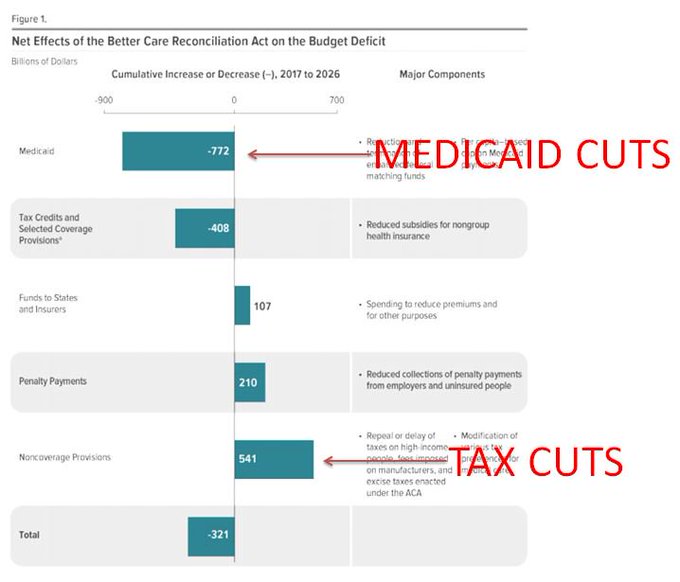
The Senate bill in basically one chart: https://www.cbo.gov/system/files/115th-congress-2017-2018/costestimate/52849-hr1628senate.pdf …

And comparing budget outlays in the Senate bill and current legislation:

The White House took aim at the CBO’s forecasting skills, although it appears to have launched another round of mockery regarding what base the White House’s 100% comparison was referring to.
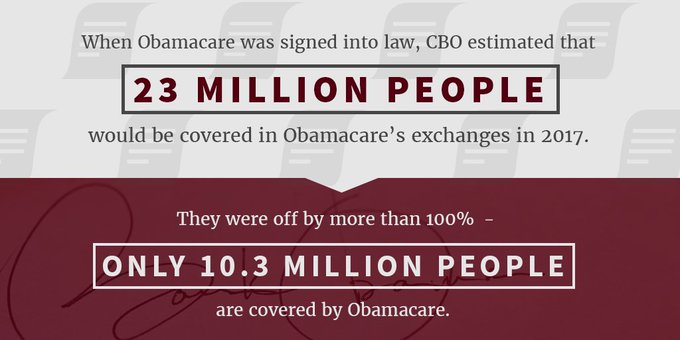
FACT: when #Obamacare was signed, CBO estimated that 23M would be covered in 2017. They were off by 100%. Only 10.3M people are covered.

The key highlights from the official score:
- CBO and JCT estimate that, over the 2017-2026 period, enacting this legislation would
reduce direct spending by $1,022 billion and reduce revenues by $701 billion, for a net reduction of $321 billion in the deficit over that period (see Table 1, at the end of this document): - The largest savings would come from reductions in outlays for Medicaid— spending on the program would decline in 2026 by 26 percent in comparison with what CBO projects under current law—and from changes to the Affordable Care Act’s (ACA’s) subsidies for nongroup health insurance (see Figure 1). Those savings would be partially offset by the effects of other changes to the ACA’s provisions dealing with insurance coverage: additional spending designed to reduce premiums and a reduction in revenues from repealing penalties on employers who do not offer insurance and on people who do not purchase insurance.
- The largest increases in deficits would come from repealing or modifying tax provisions in the ACA that are not directly related to health insurance coverage, including repealing a surtax on net investment income and repealing annual fees imposed on health insurers.
Some other observations from the CBO, first a chronology of major proposed changes:
- In 2018, the legislation would provide funding to health insurers to stabilize premiums and promote participation in the marketplaces.
- In 2019, four major coverage provisions would take effect:
- Appropriating funding for grants to states through the Long-Term State Stability and Innovation Program.Requiring insurers to impose a six-month waiting period before coverage starts for people who enroll in insurance in the nongroup market if they have been uninsured for more than 63 days within the past year.
- Setting a limit whereby insurers would charge older people premiums that are up to five times higher than those charged younger people in the nongroup and small-group markets, unless a state sets a different limit.
- Removing the federal cap on the share of premiums that may go to insurers’ administrative costs and profits (also known as the minimum medical loss ratio requirement) and effectively allowing each state to set its own cap.
- In 2020, the following additional major coverage provisions would take effect:
- Changing the tax credit for health insurance coverage purchased through the nongroup market and repealing current-law subsidies to reduce cost-sharing payments. People with income below 100 percent of the federal poverty level (FPL) who are not eligible for Medicaid would become eligible for the tax credit, and people with income between 350 percent and 400 percent of the FPL would no longer be eligible. The maximum percentage of income specified by the bill that people would pay at different ages toward the purchase of a benchmark plan would be lower for some younger people and higher for some older people. The benchmark plan used to determine the amount of the tax credit would have a lower actuarial value.
- Capping the growth in per-enrollee payments for nondisabled children and nondisabled adults enrolled in Medicaid at no more than the medical care component of the consumer price index (CPI-M) and for most enrollees who are disabled adults or age 65 or older at no more than the CPI-M plus 1 percentage point, starting in 2020 and going through 2024. Starting in 2025, the rate of growth in per-enrollee payments for all groups would be pegged to the consumer price index for all urban consumers (CPI-U).
- Starting in 2021, the bill would reduce the federal matching rate for funding for adults made eligible for Medicaid by the ACA; that rate would decline 5 percentage points per year through 2023 and then fall to equal the rate for other enrollees in a state in later years.
And most importanly, Effects on Premiums and Out-of-Pocket Payments
- The legislation would increase average premiums in the nongroup market prior to 2020 and lower average premiums thereafter, relative to projections under current law, CBO and JCT estimate. To arrive at those estimates, the agencies examined how the legislation would affect the premiums charged if people purchased a benchmark plan in the nongroup market. In 2018 and 2019, under current law and under the legislation, the benchmark plan has an actuarial value of 70 percent—that is, the insurance pays about 70 percent of the total cost of covered benefits, on average. In the marketplaces, such coverage is known as a silver plan.
- Under the Senate bill, average premiums for benchmark plans for single individuals would be about 20 percent higher in 2018 than under current law, mainly because the penalty for not having insurance would be eliminated, inducing fewer comparatively healthy people to sign up. Those premiums would be about 10 percent higher than under current law in 2019—less than in 2018 in part because funding provided by the bill to reduce premiums would affect pricing and because changes in the limits on how premiums can vary by age would result in a larger number of younger people paying lower premiums to purchase policies.
- In 2020, average premiums for benchmark plans for single individuals would be about 30 percent lower than under current law. A combination of factors would lead to that decrease—most important, the smaller share of benefits paid for by the benchmark plans and federal funds provided to directly reduce premiums.
- That share of services covered by insurance would be smaller because the benchmark
plan under this legislation would have an actuarial value of 58 percent beginning in 2020.
That value is slightly below the actuarial value of 60 percent for “bronze” plans currently
offered in the marketplaces. Because of the ACA’s limits on out-of-pocket spending and
prohibitions on annual and lifetime limits on payments for services within the EHBs, all
plans must pay for most of the cost of high-cost services. To design a plan with an
actuarial value of 60 percent or less and pay for those high-cost services, insurers must
set high deductibles—that is, the amounts that people pay out of pocket for most types of
health care services before insurance makes any contribution. Under current law for a
single policyholder in 2017, the average deductible (for medical and drug expenses
combined) is about $6,000 for a bronze plan and $3,600 for a silver plan. CBO and JCT
expect that the benchmark plans under this legislation would have high deductibles
similar to those for the bronze plans offered under current law. Premiums for a plan with
an actuarial value of 58 percent are lower than they are for a plan with an actuarial value
of 70 percent (the value for the reference plan under current law) largely because the
insurance pays for a smaller average share of health care costs.
And looking all the way at the end of the 10 year horizon:
By 2026, average premiums for benchmark plans for single individuals in most of the country under this legislation would be about 20 percent lower than under current law, CBO and JCT estimate—a smaller decrease than in 2020 largely because federal funding to reduce premiums would have lessened. The estimates for both of those years encompass effects in different areas of the country that would be substantially higher and substantially lower than the average effect nationally, in part because of the effects of state waivers. Some small fraction of the population is not included in those estimates. CBO and JCT expect that those people would be in states using waivers in such a way that no benchmark plan would be defined. Hence, a comparison of benchmark premiums is not possible in such areas.
Full estimate is below (link)
end
I will be preparing for tomorrow and in so doing I receive the preliminary numbers for open interest. I will be quite intrigued especially if it advances in number from today’s reading. For those of you who want to see that number I will post it right here tonight after 11:30 pm
SURPRISINGLY IN GOLD: OI ROSE BY 2051 CONTRACTS UP TO 451,215
IN SILVER, SURPRISINGLY THE oi ROSE BY 96 CONTRACTS UP TO 204,712
We will see you TUESDAY night
Please forgive me as I was not feeling well and thus my report is not as detailed as I would have liked.
Harvey.


 harveyorganblog.com
I hope you feel better soon. Thanks for posting.
LikeLike
[…] JUNE 26/BANKERS SUPPLY $2 BILLION IN PAPER GOLD SHORT AT 4 AM THIS MORNING; THEY ALSO SUPPLY 27.5 MI… […]
LikeLike