
GOLD: $1263.95 UP $1.45
Silver: $15.96 DOWN 10 cents
Closing access prices:
Gold $1263.70
silver: $15.97
SHANGHAI GOLD FIX: FIRST FIX 10 15 PM EST (2:15 SHANGHAI LOCAL TIME)
SECOND FIX: 2:15 AM EST (6:15 SHANGHAI LOCAL TIME)
SHANGHAI FIRST GOLD FIX: $1272.97 DOLLARS PER OZ
NY PRICE OF GOLD AT EXACT SAME TIME: $1266.07
PREMIUM FIRST FIX: $6.90
xxxxxxxxxxxxxxxxxxxxxxxxxxxxxxxxxxxxxxxxxxxxxx
SECOND SHANGHAI GOLD FIX: $1274.72
NY GOLD PRICE AT THE EXACT SAME TIME: $1267.70
Premium of Shanghai 2nd fix/NY:$7.02
SHANGHAI REJECTS NY /LONDON PRICING OF GOLD
xxxxxxxxxxxxxxxxxxxxxxxxxxxxxxxxxxxxxxxxxxxxxxxxxxx
LONDON FIRST GOLD FIX: 5:30 am est $1268.55
NY PRICING AT THE EXACT SAME TIME: $1268.70
LONDON SECOND GOLD FIX 10 AM: $1263.20
NY PRICING AT THE EXACT SAME TIME. 1264.71???
For comex gold:
DECEMBER/
NUMBER OF NOTICES FILED TODAY FOR DECBER CONTRACT: 2981 NOTICE(S) FOR 298,100 OZ.
TOTAL NOTICES SO FAR: 5995 FOR 599,500 OZ (18.646 TONNES)
For silver:
DECEMBER
137 NOTICE(S) FILED TODAY FOR
685,000 OZ/
Total number of notices filed so far this month: 5147 for 25,735,000 oz
XXXXXXXXXXXXXXXXXXXXXXXXXXXXXX
Bitcoin: BID $12,612/OFFER $12,673, up $987 (morning)
BITCOIN : BID $13,152 OFFER: $13,212 // UP $1527 (CLOSING)
end
Let us have a look at the data for today
xxxxxxxxxxxxxxxxxxxxxxxxxxxxxxxxxxxxxxxxxxxxxxxxxxxxxxxxxxxxxxxxxxxxxxxxxx
In silver, the total open interest ROSE BY HUGE 2915 contracts from 190,005 RISING TO 192,970 DESPITE YESTERDAY’S HUGE 28 CENT FALL IN SILVER AND NOW WELL BELOW THE HUGE $17.25 SILVER RESISTANCE. WE HAD SURPRISINGLY NO COMEX LIQUIDATION AS WE WERE AGAIN NOTIFIED THAT WE HAD ANOTHER GIGANTIC NUMBER OF COMEX LONGS TRANSFERRING THEIR CONTRACTS TO LONDON THROUGH THE EFP ROUTE : 4432 EFP’S FOR MARCH (AND ZERO FOR DEC AND OTHER MONTHS) AND THUS TOTAL ISSUANCE OF 4452 CONTRACTS. I GUESS WHAT THE CME IS STATING IS THAT THERE IS NO SILVER (OR GOLD) TO BE DELIVERED UPON AT THE COMEX AS THEY MUST EXPORT THEIR OBLIGATION TO LONDON. YESTERDAY WITNESSED 2881 EFP’S FOR SILVER ISSUED.
ACCUMULATION FOR EFP’S/SILVER/ STARTING FROM FIRST DAY NOTICE/FOR MONTH OF DECEMBER: 15,454 CONTRACTS (FOR 4 TRADING DAYS TOTAL 15,454 CONTRACTS OR 77.27 MILLION OZ: AVERAGE PER DAY: 3,863 CONTRACTS OR 19.31 MILLION OZ/DAY)
RESULT: A HUGE SIZED RISE IN OI COMEX DESPITE THE 28 CENT FALL IN SILVER PRICE. HOWEVER WE HAD ALL OF OUR COMEX LONGS WHICH EXITED OUT OF THE SILVER COMEX TRANSFERRED THEIR OI TO LONDON THROUGH THE EFP ROUTE: FROM THE CME DATA 4432 EFP’S WERE ISSUED TODAY FOR A DELIVERABLE CONTRACT OVER IN LONDON WITH A FIAT BONUS. IN ESSENCE THE DEMAND FOR SILVER PHYSICAL INTENSIFIES GREATLY. WE REALLY GAINED 7347 OI CONTRACTS i.e. 4432 open interest contracts headed for London (EFP’s) TOGETHER WITH A INCREASE OF 2915 OI COMEX CONTRACTS. AND ALL OF THIS INCREASED DEMAND HAPPENED WITH THE FALL IN PRICE OF SILVER BY ANOTHER 28 CENTS WITH A LOW CLOSING PRICE OF $16.06 YESTERDAY. YET WE STILL HAVE A MASSIVE AMOUNT OF SILVER STANDING AT THE COMEX.
In ounces AT THE COMEX, the OI is still represented by just UNDER 1 BILLION oz i.e. 0.964 BILLION TO BE EXACT or 138% of annual global silver production (ex Russia & ex China).
FOR THE NEW FRONT DECEMBER MONTH/ THEY FILED: 137 NOTICE(S) FOR 685,000 OZ OF SILVER
In gold, the open interest FELL BY A TINY 611 CONTRACTS DOWN TO 472,795 DESPITE THE HUGE FALL IN PRICE OF GOLD YESTERDAY ($12.50). HOWEVER, THE TOTAL NUMBER OF GOLD EFP’S ISSUED TUESDAY FOR WEDNESDAY TOTALED ANOTHER GIGANTIC 21,484 CONTRACTS OF WHICH THE MONTH OF DECEMBER SAW 0 CONTRACTS AND FEB SAW THE ISSUANCE OF 21,484 CONTRACTS. The new OI for the gold complex rests at 473,438. DEMAND FOR GOLD INTENSIFIES GREATLY AS WE WITNESS THE HUGE NUMBER OF EFP TRANSFERS TOGETHER WITH THE MASSIVE AMOUNT OF GOLD OUNCES STANDING FOR DECEMBER. EVEN THOUGH THE BANKERS ISSUED THESE MONSTROUS EFPS, THE OBLIGATION STILL RESTS WITH THE BANKERS TO SUPPLY METAL BUT IT TRANSFERS THE RISK TO A LONDON BANKER OBLIGATION AND NOT A NEW YORK COMEX OBLIGATION. LONGS RECEIVE A FIAT BONUS TOGETHER WITH A LONG LONDON FORWARD. THUS, BY THESE ACTIONS, THE BANKERS AT THE COMEX HAVE JUST STATED THAT THEY HAVE NO APPRECIABLE METAL!! THIS IS A MASSIVE FRAUD: THEY CANNOT SUPPLY ANY METAL TO OUR COMEX LONGS BUT THEY ARE QUITE WILLING TO SUPPLY MASSIVE NON BACKED GOLD (AND SILVER) PAPER KNOWING THAT THEY HAVE NO METAL TO SATISFY OUR LONGS. LONDON IS NOW SEVERELY BACKWARD IN BOTH GOLD AND SILVER AND ON TOP OF THAT IT IS TAKING A FURTHER 13 WEEKS TO OBTAIN PHYSICAL FROM THE POINT WHEN FORWARDS BECOME DUE. IN ESSENCE WE HAVE A NET GAIN OF 20,905 OI CONTRACTS: 611 OI CONTRACTS LEFT THE COMEX BUT 21,484 OI CONTRACTS NAVIGATED OVER TO LONDON. THE CME HAS BEEN VERY TARDY IN THEIR REPORTING OF EFP ISSUANCE. THEY ARE IMMEDIATELY REMOVING COMEX OPEN INTEREST NUMBERS BUT DELAYING RELEASE OF EFP’S FOR 24 HOURS OR GREATER AS NO DOUBT THEY ARE NEGOTIATING WITH THE LONGS FOR A FIAT BONUS.
YESTERDAY, WE HAD 11,033 EFP’S ISSUED.
ACCUMULATION OF EFP’S/ GOLD(EXCHANGE FOR PHYSICAL) FOR THE MONTH OF DECEMBER STARTING WITH FIRST DAY NOTICE: 63,752 CONTRACTS OR 6.375 MILLION OZ OR 198 TONNES (4 TRADING DAYS AND THUS AVERAGING:15,938 EFP CONTRACTS PER TRADING DAY OR 1.594 MILLION OZ)
Result: A SMALL SIZED INCREASE IN OI WITH THE HUGE SIZED FALL IN PRICE IN GOLD YESTERDAY ($12.50). WE HAD A HUMONGOUS NUMBER OF COMEX LONG TRANSFERRING TO LONDON THROUGH THE EFP ROUTE: 21,484. THERE OBVIOUSLY DOES NOT SEEM TO BE MUCH PHYSICAL GOLD AT THE COMEX AND YET WE REACHED THE HUGE DELIVERY MONTH OF DECEMBER. I GUESS IT EXPLAINS THE HUGE ISSUANCE OF EFP’S…THERE IS HARDLY ANY GOLD PRESENT AT THE GOLD COMEX FOR DELIVERY PURPOSES. IF YOU TAKE INTO ACCOUNT THE 21,484 EFP CONTRACTS ISSUED, WE HAD A NET GAIN OPEN INTEREST OF 20,905 contracts:
21,484 CONTRACTS MOVE TO LONDON AND 611 CONTRACTS LEFT THE COMEX. THE NET GAIN IN OZ: 2.091 MILLION OZ AND IN TONNES: 65.04 TONNES
we had: 2981 notice(s) filed upon for 298,100 oz of gold.
xxxxxxxxxxxxxxxxxxxxxxxxxxxxxxxxxxxxxxxxxxxxxxxxxxxxxxxxxxx
With respect to our two criminal funds, the GLD and the SLV:
GLD:
Today, NO CHANGES in gold inventory at the GLD/
Inventory rests tonight: 845.47 tonnes.
SLV
TODAY WE HAD NO CHANGES IN SILVER INVENTORY AT THE SLV:
INVENTORY RESTS AT 321.713 MILLION OZ
end
First, here is an outline of what will be discussed tonight:
1. Today, we had the open interest in silver SURPRISINGLY ROSE BY A HUMONGOUS 2915 contracts from 190,055 UP TO 192,970 (AND now A LITTLE FURTHER FROM THE NEW COMEX RECORD SET ON FRIDAY/APRIL 21/2017 AT 234,787) DESPITE THE HUGE LOSS IN PRICE OF SILVER PRICE AND CONTINUAL BOMBARDMENT (A FALL OF 28 CENTS ). HOWEVER,OUR BANKERS USED THEIR EMERGENCY PROCEDURE TO ISSUE ANOTHER HUGE 4432 PRIVATE EFP’S FOR MARCH (WE DO NOT GET A LOOK AT THESE CONTRACTS AS IT IS PRIVATE BUT THE CFTC DOES AUDIT THEM). EFP’S GIVE OUR COMEX LONGS A FIAT BONUS PLUS A DELIVERABLE PRODUCT OVER IN LONDON. WE HAD ZERO COMEX SILVER COMEX LIQUIDATION. IF WE TAKE THE OI GAIN AT THE COMEX (2915 CONTRACTS) TO THE 4432 OI TRANSFERRED TO LONDON THROUGH EFP’S WE OBTAIN A NET GAIN OF 7347 OPEN INTEREST CONTRACTS, ON TOP OF THE HUGE AMOUNT OF SILVER OUNCES THAT ARE STANDING FOR METAL IN DECEMBER (SEE BELOW). THE NET GAIN IN OZ: 36.73 MILLION OZ!!!
RESULT: A HUGE SIZED INCREASE IN SILVER OI AT THE COMEX WITH THE 28 CENT FALL IN PRICE (WITH RESPECT TO YESTERDAY’S TRADING). BUT WE ALSO HAD ANOTHER 4432 EFP’S ISSUED TRANSFERRING COMEX LONGS OVER TO LONDON . TOGETHER WITH THE HUGE AMOUNT OF SILVER OUNCES STANDING FOR DECEMBER, DEMAND FOR PHYSICAL SILVER INTENSIFIES.
(report Harvey)
.
2.a) The Shanghai and London gold fix report
(Harvey)
2 b) Gold/silver trading overnight Europe, Goldcore
(Mark O’Byrne/zerohedge
and in NY: Bloomberg
3. ASIAN AFFAIRS
i)Late MONDAY night/TUESDAY morning: Shanghai closed DOWN 9.71 points or .29% /Hang Sang CLOSED DOWN 618.00 pts or 2.34% / The Nikkei closed DOWN 445.34 POINTS OR 1.97%/Australia’s all ordinaires CLOSED DOWN 0.45%/Chinese yuan (ONSHORE) closed DOWN at 6.6150/Oil DOWN to 56.89 dollars per barrel for WTI and 62.20 for Brent. Stocks in Europe OPENED MOSTLY IN THE RED . ONSHORE YUAN CLOSED DOWN AGAINST THE DOLLAR AT 6.6150. OFFSHORE YUAN CLOSED DOWN AGAINST THE ONSHORE YUAN AT 6.6180 //ONSHORE YUAN WEAKER AGAINST THE DOLLAR/OFF SHORE WEAKER TO THE DOLLAR/. THE DOLLAR (INDEX) IS SLIGHTLY STRONGER AGAINST ALL MAJOR CURRENCIES. CHINA IS NOT HAPPY TODAY.(MARKETS VERY WEAK)
3a)THAILAND/SOUTH KOREA/NORTH KOREA
i)North Korea/South Korea/Russia
b) REPORT ON JAPAN
3 c CHINA
Overnight Chinese stocks plunge
( zerohedge)
4. EUROPEAN AFFAIRS
i)The pound tumbles amid Brexit chaos. Theresa May seems to want a soft BREXIT but many of her party want a complete and hard exit. There seems to be a mutiny in her party
( zerohedge)
ii)The ECB is not caught up in a sprawling scandal after Steinoff Corp’s CEO resigns amidst a tax and criminal investigation into the company.
(courtesy zerohedge)
5. RUSSIAN AND MIDDLE EASTERN AFFAIRS
Trump will declare Jerusalem as the true capital of Israel and pledges that the uSA will move its embassy from Tel Aviv to Jerusalem in 6 months. This has sparked outrage from the Muslim countries as well as concerns from China and Gr. Britain
( zerohedge)
6 .GLOBAL ISSUES
i)CANADA
This may escalate: we have another Canadian mortgage lender admits to mortgage fraud
ii)The Canadian loonie tumbles after the Bank of Canada keeps rates on hold as they continue to state caution and uncertainty
( zerohedge)
The world’s third largest shipbuilder crashes 29% indicating a slowing down in the economy
( zerohedge)
7. OIL ISSUES
WTI and Gasoline falter as we witness a huge gasoline build and a record crude production
( zerohedge)
8. EMERGING MARKET
9. PHYSICAL MARKETS
i)Bitcoin now well above $12,000 as the futures market will begin its operation on the 10th of December.
( zerohedge)
ii)The market does not believe this $814 million exists.
( Leising/Bloomberg/GATA)
iii)Wales to start mining again as a mining operation has taken control of the old Clogau deposit
( Wales on line/GATA)
iv)Bill Holter discusses the EFP issue for us today:
( Bill Holter/Holter-Sinclair collaboration)
10. USA stories which will influence the price of gold/silver
ii)Nearly insolvent Chicago has just issued AAA rated bonds with the help from shady Goldman Sachs. They are allowing bond holders first dibs on sales tax. However in a bankruptcy they will have to stand in line just like everybody else
iii)Michael Snyder has been warning about this for quite some time: NY commercial real estate has plunged over 50% due to absence of buyers. The big problem will be when mortgages come due next year:
iv)Let us conclude tonight with this masterpiece form David Stockman(David Stockman/ContraCorner)
Let us head over to the comex:
The total gold comex open interest FELL BY A TINY 611 CONTRACTS UP to an OI level of 472,795 DESPITE THE HUGE SIZED FALL IN THE PRICE OF GOLD ($12.50 LOSS WITH RESPECT TO YESTERDAY’S TRADING). IN ACTUAL FACT WE DID NOT HAVE ANY GOLD LIQUIDATION. WE HAD ANOTHER LARGE COMEX TRANSFER THROUGH THE EFP ROUTE AS THESE LONGS RECEIVED A DELIVERABLE LONDON FORWARD TOGETHER WITH A FIAT BONUS. THE CME REPORTS THAT 0 EFPS WERE ISSUED FOR DECEMBER AND 21,484 EFP’S WERE ISSUED FOR FEBRUARY FOR A TOTAL OF 21,484 CONTRACTS. THE OBLIGATION STILL RESTS WITH THE BANKERS ON THESE TRANSFERS. THE CONSTANT BANKER RAIDS CONTINUE AS THEY TRY TO GET OUR “MATHEMATICAL PAPER LONGS” IN GOLD TO LIQUIDATE THEIR POSITIONS AT THE COMEX. SO FAR IT HAS NOT SUCCEEDED (AS THEY MORPH INTO LONDON FORWARDS) AND THUS THE CONTINUAL RAID WE WITNESSED YESTERDAY. THE CME HAS BEEN VERY TARDY IN THEIR REPORTING OF EFP’S CONTRACTS AFTER A COMEX OI MORPHS INTO AN EFP WHICH WAS THE REASON FOR MY 2ND LETTER TO THE CFTC.
ON A NET BASIS IN OPEN INTEREST WE GAINED TODAY: 20,905 OI CONTRACTS IN THAT 121,484 LONGS WERE TRANSFERRED AS LONGS TO LONDON AS A FORWARD AND WE LOST 611 COMEX CONTRACTS. NET GAIN: 20,905 contracts OR 2.091 MILLION OZ OR 65.03 TONNES
Result: A SURPRISING INCREASE IN COMEX OPEN INTEREST WITH THE FALL IN THE PRICE OF GOLD YESTERDAY ($12.50.) WE HAD NO REAL GOLD LIQUIDATION. TOTAL OPEN INTEREST GAIN ON THE TWO EXCHANGES: 20,905 OI CONTRACTS…
We have now entered the active contract month of DECEMBER. The open interest for the front month of December saw it’s open interest decline by 1108 contracts down to 5627. We had 2 notices filed upon yesterday so we lost 1108 COMEX contracts or an additional 110,800 oz will not stand for delivery in this active delivery month of December but they did migrate over to London as a forward for February…the reason for the move is that there is not any gold for them at the comex.
January saw its open interest LOSS OF 33 contracts DOWN to 2149. FEBRUARY saw a loss of 1454 contacts down to 363,639.
We had 2981 notice(s) filed upon today for 298,100 oz
PRELIMINARY VOLUME TODAY ESTIMATED; did not supply yet
FINAL NUMBERS CONFIRMED FOR YESTERDAY: 345,498
comex gold volumes are increasing dramatically
xxxxxxxxxxxxxxxxxxxxxxxxxxxxxxxxxxxxxxxxxxxxxxxxxxxxxxxxxxxxxxxxxxxx
And now for the wild silver comex results.
Total silver OI ROSE BY A HUGE 2915 CONTRACTS FROM 190,055 UP TO 192,970 WITH YESTERDAY’S 28 CENT LOSS IN PRICE (AND CONTINUAL RAIDING OF OUR PRECIOUS METALS). HOWEVER WE DID HAVE ANOTHER STRONG 4432 EMERGENCY EFP’S FOR MARCH ISSUED BY OUR BANKERS (ZERO FOR DECEMBER) TO COMEX LONGS WHO RECEIVED A FIAT BONUS PLUS A DELIVERABLE PRODUCT OVER IN LONDON.THE TOTAL EFP’S ISSUED: 4432. IT SURE LOOKS LIKE THE SILVER BOYS HAVE STARTED TO MIGRATE TO LONDON FROM THE START OF DELIVERY MONTH AND CONTINUING RIGHT THROUGH UNTIL FIRST DAY NOTICE JUST LIKE WE ARE WITNESSING TODAY. USUALLY WE NOTED THAT CONTRACTION IN OI OCCURRED ONLY DURING THE LAST WEEK OF AN UPCOMING ACTIVE DELIVERY MONTH. THIS PROCESS HAS JUST BEGUN IN EARNEST IN SILVER STARTING IN SEPTEMBER. HOWEVER, IN GOLD, WE HAVE BEEN WITNESSING THIS FOR THE PAST 2 YEARS. WITHOUT A DOUBT WE HAD NO LONG SILVER LIQUIDATION AS DEMAND FOR PHYSICAL SILVER REMAINS STRONG ESPECIALLY AS WE WITNESS A HUGE AMOUNT OF SILVER OUNCES STANDING FOR METAL IN DECEMBER AS WELL AS THAT MASSIVE MIGRATION OF EFPS OVER TO LONDON. IT SEEMS THAT ALL OF OUR LOST SILVER COMEX OI CONTRACTS HAVE MIGRATED OVER TO THE PHYSICAL HUB OF OUR PRECIOUS METALS, LONDON. ON A NET BASIS WE GAINED 7347 OPEN INTEREST CONTRACTS:
2915 CONTRACTS GAINED AT THE COMEX WITH THE ADDITION OF 4432 OI CONTRACTS NAVIGATING OVER TO LONDON.
We are now in the big active delivery month of December and here the OI fell by 399 contracts down to 944. We had 405 notices filed upon yesterday so we GAINED 6 contract or an additional 30,000 oz will stand in this active delivery month of December.
The January contract month ROSE by 96 contracts UP to 1372. February saw a GAIN OF 41 OI contract RISING TO 63. The March contract GAINED 2895 contracts UP to 154.051.
We had 137 notice(s) filed initially for 685,000 oz for the DECEMBER. 2017 contract
INITIAL standings for DECEMBER
Dec 6/2017.
| Gold | Ounces |
| Withdrawals from Dealers Inventory in oz | nil oz |
| Withdrawals from Customer Inventory in oz |
nil oz
|
| Deposits to the Dealer Inventory in oz | nil oz |
| Deposits to the Customer Inventory, in oz |
100.85
oz
Delaware
|
| No of oz served (contracts) today |
2981 notice(s)
298,100 OZ
|
| No of oz to be served (notices) |
2646 contracts
(264,600 oz)
|
| Total monthly oz gold served (contracts) so far this month |
5995 notices
599,500 oz
18.646 tonnes
|
| Total accumulative withdrawals of gold from the Dealers inventory this month | NIL oz |
| Total accumulative withdrawal of gold from the Customer inventory this month | xxx oz |
WE HAD nil DEALER DEPOSIT:
total dealer deposits: nil oz
We had nil dealer withdrawals:
total dealer withdrawals: nil oz
we had 1 customer deposit(s):
i) Into Delaware: 100,85 oz
total customer deposits 100.85 oz
We had 0 customer withdrawal(s)
Total customer withdrawals: nil oz
we had 1 adjustment(s)
i) out of Delaware: 1,370.319 oz was adjusted out of the customer and lands into the dealer account of Delaware
ii) Out of HSBC: 10,410.948 oz was adjusted out of the dealer and lands into the customer account of HSBC
*December is the biggest delivery month of the year for gold and the fact that no gold has entered the vaults these past three trading days speaks volumes that there is no appreciable gold at the comex to deliver upon our longs and thus the reason for the migration to London
For DECEMBER:
Today, 0 notice(s) were issued from JPMorgan dealer account and 0 notices were issued from their client or customer account. The total of all issuance by all participants equates to 2981 contract(s) of which 2180 notices were stopped (received) by j.P. Morgan dealer and 31 notice(s) was (were) stopped/ Received) by j.P.Morgan customer account.
xxxxxxxxxxxxxxxxxxxxxxxxxxxxxxxxxxxxxxxxxxxxxxxxxxxxxxxxxxxxxxxxxxxxxxxxxx
To calculate the INITIAL total number of gold ounces standing for the DECEMBER. contract month, we take the total number of notices filed so far for the month (5995) x 100 oz or 599,500 oz, to which we add the difference between the open interest for the front month of DEC. (5627 contracts) minus the number of notices served upon today (2981 x 100 oz per contract) equals 864,100 oz, the number of ounces standing in this active month of DECEMBER
Thus the INITIAL standings for gold for the DECEMBER contract month:
No of notices served (5995) x 100 oz or ounces + {(5627)OI for the front month minus the number of notices served upon today (2981) x 100 oz which equals 864,100 oz standing in this active delivery month of DECEMBER (26.46 tonnes). THERE IS 28 TONNES OF REGISTERED GOLD AVAILABLE FOR DELIVERY SO FAR.
WE LOST 1108 COMEX CONTRACTS STANDING OR 110,800 OZ BUT THESE CONTRACTS MORPHED INTO A FEB LONDON FORWARD.
.
xxxxxxxxxxxxxxxxxxxxxxxxxxxxxxxxxxxxxxxxxxxxxxxxxxxxxxxxxxxxxxxxxxxxxxx
ON FIRST DAY NOTICE FOR DECEMBER, THE INITIAL GOLD STANDING: 39.038 TONNES STANDING
BY THE END OF THE MONTH: FINAL: 29.791 TONNES STOOD FOR COMEX DELIVERY AS THE REMAINDER HAD TRANSFERRED OVER TO LONDON FORWARDS.
XXXXXXXXXXXXXXXXXXXXXXXXXXXXXXXXXXXXXXXXXXXXXXXX
Total dealer inventory 913,599.261 or 28.41 tonnes (dealer gold continues to disappear)
Total gold inventory (dealer and customer) = 8,906,586.808 or 277.03 tonnes
I have a sneaky feeling that these withdrawals of gold in kilobars are being used in the hypothecating process and are being used in the raiding of gold!
The gold comex is an absolute fraud. The use of kilobars and exact weights makes the data totally absurd and fraudulent! To me, the only thing that makes sense is the fact that “kilobars: are entries of hypothecated gold sent to other jurisdictions so that they will not be short with their underwritten derivatives in that jurisdiction. This would be similar to the rehypothecated gold used by Jon Corzine at MF Global.
IN THE LAST 14 MONTHS 77 NET TONNES HAS LEFT THE COMEX.
end
And now for silver
AND NOW THE DECEMBER DELIVERY MONTH
DECEMBER INITIAL standings
| Silver | Ounces |
| Withdrawals from Dealers Inventory | 4,978.850 oz
international Delaware |
| Withdrawals from Customer Inventory |
226,603.610 oz
Brinks
|
| Deposits to the Dealer Inventory |
nil
oz
|
| Deposits to the Customer Inventory |
83,147.690 oz
Scotia
|
| No of oz served today (contracts) |
137 CONTRACT(S)
(685,000 OZ)
|
| No of oz to be served (notices) |
807 contract
(4,035,000 oz)
|
| Total monthly oz silver served (contracts) | 5147 contracts
(25,735,000 oz) |
| Total accumulative withdrawal of silver from the Dealers inventory this month | NIL oz |
| Total accumulative withdrawal of silver from the Customer inventory this month |
today, we had 0 deposit(s) into the dealer account:
total dealer deposit: nil oz
we had 1 dealer withdrawals:
i) out of Brinks: 226,603.610 oz was withdrawn
total dealer withdrawals: 226,603.610 oz
we had 0 customer withdrawal(s):
TOTAL CUSTOMER WITHDRAWAL 0 oz
We had 1 Customer deposit(s):
i) Into Brinks: 83,147.690 oz
***deposits into JPMorgan have stopped again
In the month of March and February, JPMorgan stopped (received) almost all of the comex silver contracts.
why is JPMorgan bringing in so much silver??? why is this not criminal in that they are also the massive short in silver
total customer deposits: 83,147.690 oz
we had 2 adjustment(s)
i) Out of CNT:
601,333.436 oz was adjusted out of the dealer and this landed into the customer account of CNT
ii) Out of HSBC: 5,084.650 oz was adjusted out of the customer and this lands into the dealer account of HSBC
The total number of notices filed today for the DECEMBER. contract month is represented by 137 contract(s) FOR 685,000 oz. To calculate the number of silver ounces that will stand for delivery in DECEMBER., we take the total number of notices filed for the month so far at 5147 x 5,000 oz = 25,735,0000 oz to which we add the difference between the open interest for the front month of DEC. (944) and the number of notices served upon today (137 x 5000 oz) equals the number of ounces standing.
.
Thus the INITIAL standings for silver for the DECEMBER contract month: 5147 (notices served so far)x 5000 oz + OI for front month of DECEMBER(944) -number of notices served upon today (137)x 5000 oz equals 29,770,000 oz of silver standing for the DECEMBER contract month. This is EXCELLENT for this active delivery month of November.
WE GAINED AN ADDITIONAL 7 CONTRACTS OR 35,000 OZ THAT WILL STAND AT THE COMEX
ON FIRST DAY NOTICE FOR THE DECEMBER 2016 CONTRACT WE HAD 15.282 MILLION OZ STAND.
THE FINAL STANDING: 19.900 MILLION OZ AS QUEUE JUMPING INTENSIFIED.
xxxxxxxxxxxxxxxxxxxxxxxxxxxxxxxxxxxxxxxxxxxxxxxxxxxxxxxxxxx
ESTIMATED VOLUME FOR TODAY: 66,726
CONFIRMED VOLUME FOR YESTERDAY: 89,501 CONTRACTS
YESTERDAY’S CONFIRMED VOLUME OF 89,501 CONTRACTS EQUATES TO 447 MILLION OZ OR 63.9% OF ANNUAL GLOBAL PRODUCTION OF SILVER
COMMODITY LAW SUGGESTS THAT OPEN INTEREST SHOULD NOT BE MORE THAN 3% OF ANNUAL GLOBAL PRODUCTION. THE CROOKS ARE SUPPLYING MASSIVE PAPER TRYING TO KEEP SILVER IN CHECK.
Total dealer silver: 57.258 million
Total number of dealer and customer silver: 239.851 million oz
The record level of silver open interest is 234,787 contracts set on April 21./2017 with the price at that day at $18.42
The previous record was 224,540 contracts with the price at that time of $20.44
end
NPV for Sprott and Central Fund of Canada
1. Central Fund of Canada: traded at Negative 2.4 percent to NAV usa funds and Negative 2.1% to NAV for Cdn funds!!!!
Percentage of fund in gold 63.2%
Percentage of fund in silver:36.5%
cash .+.3%( Dec 6/2017)
2. Sprott silver fund (PSLV): NAV FALLS TO -0.62% (Dec 6 /2017)
3. Sprott gold fund (PHYS): premium to NAV RISES TO -0.39% to NAV (Dec 6/2017 )
Note: Sprott silver trust back into NEGATIVE territory at -0.62%-/Sprott physical gold trust is back into NEGATIVE/ territory at -0.39%/Central fund of Canada’s is still in jail but being rescued by Sprott.
Sprott WINS hostile 3.1 billion bid to take over Central Fund of Canada
(courtesy Sprott/GATA)
END
And now the Gold inventory at the GLD
Dec 6/No changes in GOLD inventory at the GLD/Inventory rests at 845.47 tonnes
Dec 5/A WITHDRAWAL OF 2.64 TONNES FROM THE GLD/INVENTORY RESTS AT 845.47 TONNES
Dec 4/A MASSIVE DEPOSIT OF 8.56 TONNES OF GOLD INTO THE GLD/THE BLEEDING OF GLD GOLD HAS STOPPED/INVENTORY RESTS TONIGHT AT 848.11 TONNES
Dec 1/NO CHANGE IN GOLD INVENTORY AT THE GLD/INVENTORY RESTS AT 839.55 TONNES
Nov 30/no change in gold inventory at the GLD. Inventory rests at 839.55 tonnes
Nov 29/a withdrawal of 2.66 tonnes at the GLD/Inventory rests at 839.55 tonnes
NOV 28/ no change in gold inventory at the GLD/inventory rests at 842.21 tonnes
Nov 27 Strange!! we gold up by $6.40 today, we had a good sized withdrawal of 1.18 tonnes from the GLD. Here is something that is also strange: we have had exactly 1.18 tonnes of gold withdrawn from the comex on 5 separate occasions in the past 30 days..explanation?
Nov 24/no change in gold inventory at the GLD/Inventory rests at 843.09 tonnes
Nov 22/no change in gold inventory at the GLD/Inventory rests at 843.39 tonnes
Nov 21/no change in gold inventory at the GLD/inventory rests at 843.39 tonnes
NOV 20/no change in gold inventory at the GLD/Inventory rests at 843.39 tonnes
Nov 17/no change in gold inventory at the GLD/inventory rests at 843.39 tonnes
Nov 16./NO CHANGE IN GOLD INVENTORY AT THE GLD/INVENTORY RESTS AT 843.39 TONNES
Nov 15./no change in gold inventory at the GLD/inventory rests at 843.09 tonnes
NOV 14/a small deposit of .300 tonnes into the GLD inventory/Inventory rests at 843.39 tonnes
Nov 13/NO CHANGE IN GOLD INVENTORY AT THE GLD/INVENTORY RESTS AT 843.09 TONNES
Nov 10/no change in gold inventory at the GLD/Inventory rests at 843.09 tonnes
Nov 9/no changes in inventory at the GLD/Inventory rests at 843.09 tonnes
NOV 8/ANOTHER HUGE WITHDRAWAL OF 1.18 TONNES OF GOLD FROM THE GLD DESPITE GOLD’S RISE TODAY. INVENTORY RESTS AT 843.09
Nov 7/a huge withdrawal of 1.48 tonnes of gold from the GLD/Inventory rests at 844.27 tonnes
NOV 6/ a tiny withdrawal of .29 tonnes to pay for fees etc/inventory rests at 845.75 tonnes
Nov 3/no change in gold inventory at the GLD/Inventory rests at 846.04 tonnes
NOV 2/STRANGE!!! WE HAD ANOTHER WITHDRAWAL OF 3.55 TONNES FROM THE GLD DESPITE GOLD’S RISE OF $6.60 YESTERDAY AND $1.55 TODAY/INVENTORY RESTS AT 846.04 TONNES
Nov 1/a withdrawal of 1.18 tonnes of gold from the GLD/Inventory rests at 849.59 tonnes
xxxxxxxxxxxxxxxxxxxxxxxxxxxxxxxxxx
Dec 6/2017/ Inventory rests tonight at 845.47 tonnes
*IN LAST 287 TRADING DAYS: 95.48 NET TONNES HAVE BEEN REMOVED FROM THE GLD
*LAST 222 TRADING DAYS: A NET 61.80 TONNES HAVE NOW BEEN ADDED INTO GLD INVENTORY.
*FROM FEB 1/2017: A NET 30.69 TONNES HAVE BEEN ADDED.
end
Now the SLV Inventory
Dec 6/no change in silver inventory at the SLV/Inventory remains at 21.713 million oz.
Dec 5/THIS ONE HIT ME LIKE A TON OF BRICKS: SLV ADDS 2.507 MILLION OZ DESPITE THE HUGE DRUBBING SILVER TOOK TODAY. (PRICE DISCOVERY?)
Dec 4/NO CHANGE IN SILVER INVENTORY AT THE SLV
INVENTORY RESTS AT 319.207 MILLION OZ/
Dec 1/VERY STRANGE!! WITH SILVER IN THE DUMPSTER THESE PAST FEW DAYS, SLV ADDS 2.076 MILLION OZ/???
INVENTORY 319.207 MILLION OZ/
Nov 30/no changes in silver inventory despite the huge drop in price/inventory rests at 317.130 million oz
Nov 29/no changes in silver inventory at the SLV/Inventory rests at 317.130 million oz/strange!! at drop of 32 cents and no change in inventory?
Nov 28/no change in silver inventory at the SLV/Inventory rests at 317.130 million oz.
Nov 27/NO CHANGE IN SILVER INVENTORY DESPITE A ZERO GAIN IN PRICE /QUITE OPPOSITE TO GOLD WHICH SAW 1.18 TONNES OF GOLD WITHDRAWN DESPITE A RISE IN PRICE OF $6.40
Nov 24/A WITHDRAWAL OF 944,000 OZ OF SILVER FROM THE SLV//INVENTORY RESTS AT 317.130 MILLION OZ
Nov 22/no change in silver inventory at the SLV/Inventory rests at 318.074 million oz.
Nov 21/no change in silver inventory at the SLV/inventory rests at 318.074 million oz/
NOV 20/no change in silver inventory at the SLV/inventory rests at 318.074 million oz
Nov 17/no change in silver inventory at the SLV/inventory rests at 318.074 million oz/
Nov 16./NO CHANGE IN SILVER INVENTORY AT THE SLV/INVENTORY RESTS AT 318.074 MILLION OZ/
Nov 15./no change in silver inventory at the SLV/inventory rests at 318.074 tones
NOV 14/no change in silver inventory at the SLV/Inventory rests at 318.074 tonnes
Nov 13/NO CHANGE IN SILVER INVENTORY AT THE SLV/INVENTORY RESTS AT 318.074 MILLION OZ
Nov 10/no change in silver inventory at the SLV/Inventory rests at 318.074 million oz/
Nov 9/no change in silver inventory at the SLV/inventory rests at 318.074 million oz.
NOV 8/NO CHANGE IN SILVER INVENTORY AT THE SLV/INVENTORY RESTS AT 318.074 MILLION OZ
Nov 7/a huge withdrawal of 944,000 oz from the SLV/inventory rests at 318.074 million oz/
NOV 6/no change in silver inventory at the SLV/Inventory rests at 319.018 million oz/
Nov 3/NO CHANGE IN SILVER INVENTORY AT THE SLV/INVENTORY RESTS TONIGHT AT 319.018 MILLION OZ.
NOV 2/A TINY LOSS OF 137,000 OZ BUT THAT WAS TO PAY FOR FEES LIKE INSURANCE AND STORAGE/INVENTORY RESTS AT 319.018 MILLION OZ/
Nov 1/STRANGE! WITH SILVER’S HUGE 48 CENT GAIN WE HAD NO GAIN IN INVENTORY AT THE SLV/INVENTORY RESTS AT 319.155 MILLION OZ/
Dec 6/2017:
Inventory 321.713 million oz
end
6 Month MM GOFO
Indicative gold forward offer rate for a 6 month duration
+ 1.55%
12 Month MM GOFO
+ 1.83%
30 day trend
end
Major gold/silver trading /commentaries for WEDNESDAY
GOLDCORE/BLOG/MARK O’BYRNE.
GOLD/SILVER
Goldcore:
UK Pensions Risk – Time to Rebalance and Allocate to Cash and Gold
UK Pensions Risk – Time to Rebalance and Allocate to Cash and Gold
– Value of Sterling and increased risks place pressure on pensioners both in UK and abroad
– 500,000 British expats face ‘frozen’ pensions
– 61% of UK Direct Benefit pension schemes have more money going out than coming in
– OECD report finds ‘UK workers face the biggest retirement cliff edge in developed world’
– Combined pension deficit of FTSE 350 companies is at 70% of their profits
– One in three wealth managers are holding cash for clients in anticipation of a market crash
The UK’s future pensioners should not rely on their state pension or they may face a huge fall in earnings, says a new report by the OECD.
Should Brits rely solely on their UK state pension then they will face the largest income drop of any OECD country. UK pensions represent on average 29% of in-work earnings, the OECD average is 63%.
The OECD explains:
‘Retirees without such additional sources of revenue [i.e. private pensions] are left with few resources; this is reflected in the poverty rate and high income inequality in the United Kingdom for the over 65s.
‘Following the sharp rise of income disparities during the 1980s in the United Kingdom, inequalities in later life will rise further as generation X approaches retirement.’
Once private pensions are factored in then the UK does not fair so badly; ahead of Germany but behind France, Italy and Spain.
But this is not something that should relax future retirees. There is a major pensions crisis in the UK, for both state and private funds. The OECD even refers to the UK’s defined benefit workplace pension plans (final salary schemes) as ‘persistently underfunded’.
This, combined with a low contribution rate by individuals, is down to a number of factors. The conclusion of the OECD report reminds readers of the importance of saving and politicians of the need for long-term planning over short-term policy gains.
There is little hope of politicians taking their attentions away from either Brexit or short-term economic results. We suggest the UK’s future pensioners, both at home and abroad, look to diversify their portfolios away from the risks currently facing the country.
Discrimination of expat pensioners
Expats living in the EU breathed a sigh of relief in September when a deal was confirmed regarding the ‘triple lock’ of their UK state pensions.
The ‘triple lock’ means pensions increase by the highest of earnings, inflation or 2.5%. This means pensioners’ income keeps pace with the rising cost of living. The September deal confirmed that this would continue to happen for those British nationals living in both the EU and EEA, following Brexit.
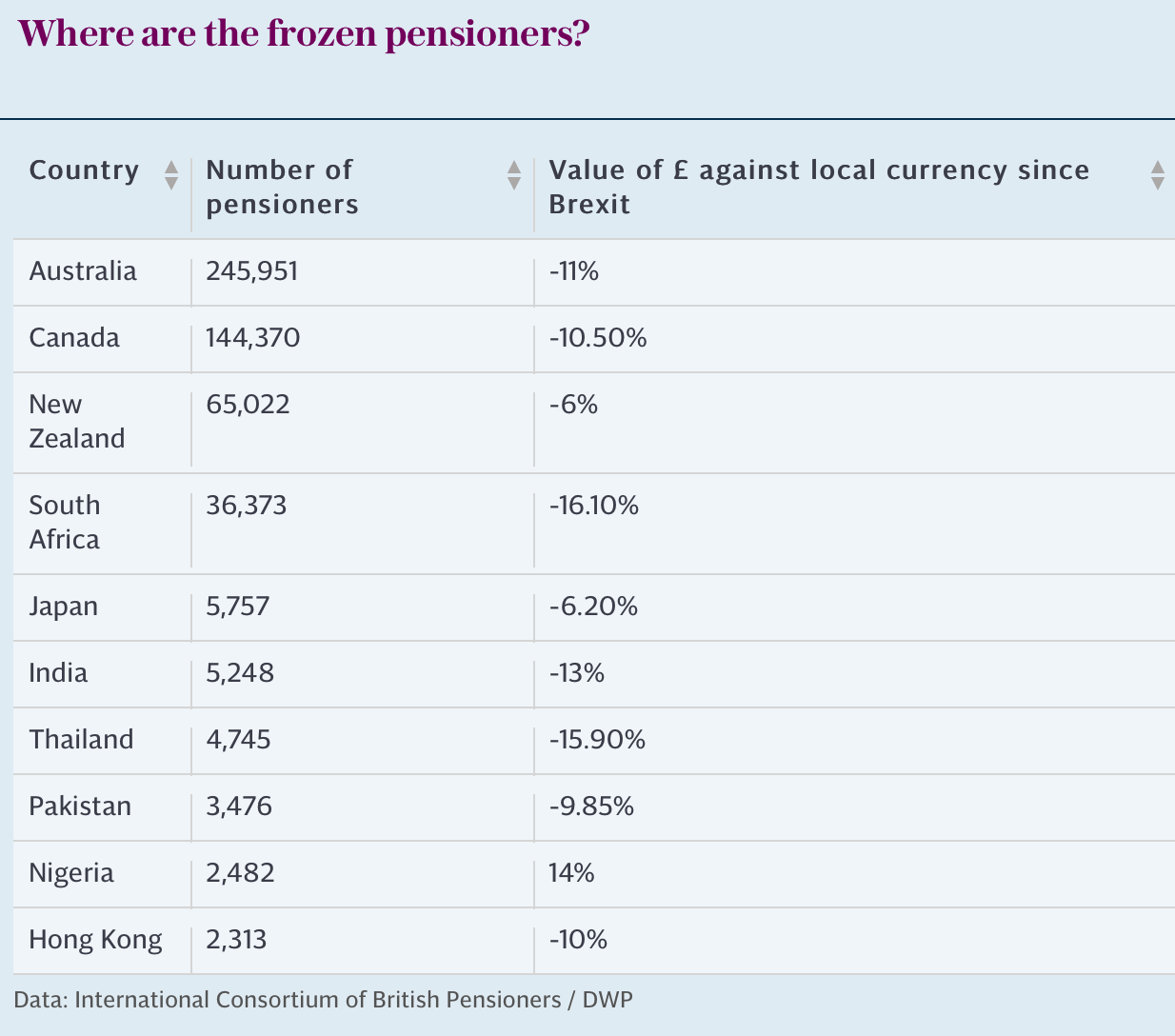
Sadly this is not the case for expats who have chosen to live abroad and outside of these economic zones. Of whom, there are more of than those living in either the EU or EEA. There is estimated to be over half a million Brits now highly exposed to weaknesses in the British pound and UK economy. These individuals will not see an increase in their pensions each year.
Not only have these expats been suffering as a result of the falling value of the pound thanks to inflation, but their plight has been made worse since Brexit. Of the top ten most populated countries by ‘frozen’ pensioners, Nigeria is the only country where sterling has gained strength.
Source: The Telegraph
There are arguments that the government’s approach to frozen pensions discriminates randomly between countries. Nigel Nelson, former president of the International Consortium of British Pensioners, explains:
“One colleague of mine retired to Canada in 1998 and received a state pension of £64.70 a week and nearly 20 years later he is still getting £64.70.
“As a result he’s received £27,945 less than his peers in Britain even though he has made the same level of National Insurance Contributions. This is just not right, it is immoral and discriminatory.”
Sadly, even those who live within the EU and EEA cannot count their chickens too soon. By 2020 the Conservatives intend to remove the 2.5% underpin which currently forms part of the ‘triple-lock’. This means pensioners will no longer be protected from the onslaught of inflation.
Responsible savers punished by irresponsible governments
It is not just the onslaught of inflation that is going to prove to be a pensioner’s biggest nemesis. Whether relying on state or private pensions, retirees are facing huge risks in coming years.
In May the OECD announced that it expected the UK’s pension deficit to increase by around 4 per cent per year, reaching more than £25 trillion by 2050. It seems that the black hole of retirement funds is much deeper and darker than any authority in the UK was prepared to admit.
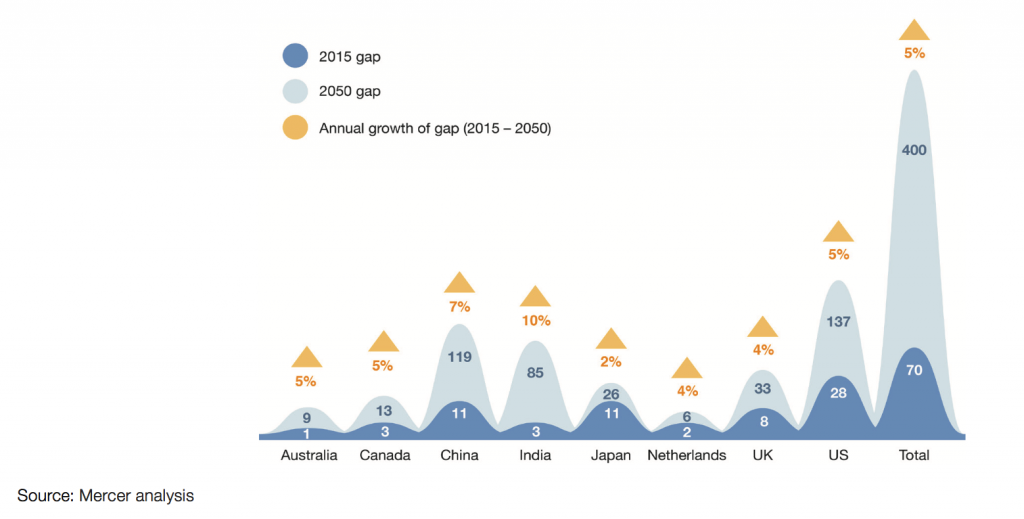
This black hole is something we have in common with many countries, for two reasons.
Firstly, record low interest rates and quantitative easing have inflated the present value of future liabilities. Nothing has been able to offset these. We now live in an era of low prospective returns, with little sign of let-up.
One might have hoped that the surges in share prices around the world might have helped manage the above issue. It hasn’t and the record valuation levels have begun to make fund managers nervous. One in three are now building cash positions in their clients’ portfolios as they protect themselves against a sudden market crash.
Secondly, the retirement of baby boomers has sent more schemes offering direct benefit pensions in to the red. This is happening on average to 35% of direct pension schemes in Europe, but to 61% in the UK. Unsurprisingly schemes are forced to raid their capital base. This places final salary pension schemes at risk as more companies look at pensions as a liability.
In the UK the Pension Protection Fund works to support pensioners whose companies’ pension schemes need to be bailed out. In the year to March 2017 it paid out £661.3million to 129,661 pensioners. When the PPF launched in 2007 it paid out just up from £1.4million.
The fund is sustained by charging a levy on those companies who have final pension salary schemes. Costs are expected to climb as the PPF faces bailing out the likes of BHS and Monarch. How will small firms cope with the pressures of covering this levy as well as their own employees’ schemes?

The chances are this rescue fund is not sustainable. Especially when one considers the increased costs to companies through employees taking early retirement for medical reasons (obesity related, very often). This is sad news given more people are set to rely on these pension schemes as others backfire on them, namely state pension and any opportunity they took by raiding their pension pots by the UK government’s ‘freedom and choice scheme’.
What are we left with? A broken pension system thanks to a series of bad policy decisions by governments looking for quick wins and approaching the economy like an ostrich.
Do not rely on others for your pension: rebalance to cash and gold
Sadly there is little to be done to save the pension schemes. It would take nothing short of a miracle to stave off the numerous risks facing them. The likes of inflation and market shocks are inevitable given the last decade of QE. In addition the UK has not helped itself with its irresponsible policies that encourage us to spend more, save less and raid whatever savings we still have.
In short, ignore government advice. As we are now seeing, it comes too little too late and always with an agenda. Instead, look to diversify your assets with cash and gold.
Dr. Constantin Gurdgiev, formerly an adviser to GoldCore, says the following about the importance of having gold in your pension:
“Gold is a long-term risk management asset, not a speculative one.
As such it should be analysed and treated predominantly in the context of its role as a part of a properly structured, risk-balanced and diversified portfolio spanning the full life-cycle of the investment and pension horizon for individual investors and those with pensions.
Whether they be SIPPs in the UK or IRAs in the USA.”
Investors in the UK and Ireland, the US, the EU can invest in gold bullion in their pension, through self-administered pension funds.
UK investors can invest in gold bullion through their Self-Invested Personal Pensions (SIPPs), Irish investors can invest in gold in Small Self Administered Schemes (SSAS) and US investors can invest in gold in their Individual Retirement Accounts (IRAs).
The pension crisis is a multi-trillion dollar/pound crisis. It is not going to go away. Adding gold to your pension is a key way to protect your retirement from the pensions time bomb.
Pension funds, throughout the West, have a distinct lack of diversification when it comes to assets. This has cost pension holders a huge amount of money and places their future livelihoods and risk.
Gold has an important role to play over the long term in preserving and growing pension wealth. You can read our guide about how to invest in gold in a pension in the UK here.
Related reading
Survey shows UK and US Pensions Crisis is Imminent
UK Pensions and Debt Time Bomb: £1 Trillion Crisis Looms
Pensions Timebomb – Pensions Are A “National Crisis” Now
Pension Funds, Sovereign Wealth Funds, Central Banks “Stock Up” on Gold “Amid Uncertainty”
News and Commentary
Asian Stocks Fall as Miners Decline; Yen Gains (Bloomberg.com)
Gold prices ease despite slightly weaker dollar (Reuters.com)
Bitcoin Hits New All-Time High Above $12,250 (GoldSeek.com)
Don’t Expect Gold to Go Wild Next Year (Bloomberg.com)
Bitcoin hits new record high of $11,850 (Reuters.com)
Source: Ctit Research
Gold mining to resume in Wales after 20 years, just in time for royal wedding (WalesOnline.co.uk)
Era of Low Volatility Will Unwind Formulaically (Bloomberg.com)
Most Brits Still Want Brexit But Expect It All to End Badly (Bloomberg.com)
Don’t Just Hold It, Keep Buying Is the Recipe for Successful QE (Bloomberg.com)
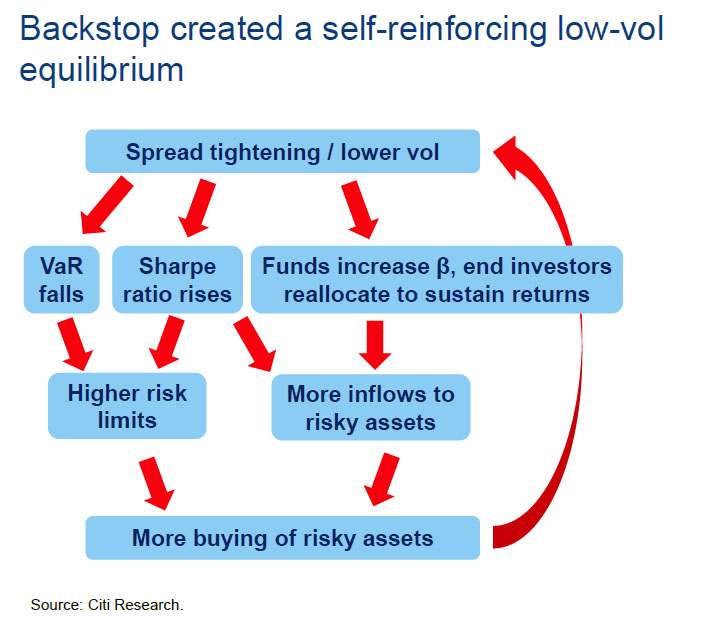
Citi Shows What Today’s Artificial Market Looks Like In One Chart (ZeroHedge.com)
Gold Prices (LBMA AM)
06 Dec: USD 1,268.55, GBP 948.37 & EUR 1,072.31 per ounce
05 Dec: USD 1,275.90, GBP 950.29 & EUR 1,075.71 per ounce
04 Dec: USD 1,279.10, GBP 952.67 & EUR 1,079.43 per ounce
01 Dec: USD 1,277.25, GBP 946.57 & EUR 1,072.51 per ounce
30 Nov: USD 1,282.15, GBP 952.64 & EUR 1,084.06 per ounce
29 Nov: USD 1,294.85, GBP 965.70 & EUR 1,092.46 per ounce
28 Nov: USD 1,293.90, GBP 972.75 & EUR 1,088.95 per ounce
Silver Prices (LBMA)
06 Dec: USD 16.12, GBP 12.06 & EUR 13.64 per ounce
05 Dec: USD 16.29, GBP 12.14 & EUR 13.72 per ounce
04 Dec: USD 16.33, GBP 12.09 & EUR 13.77 per ounce
01 Dec: USD 16.42, GBP 12.16 & EUR 13.80 per ounce
30 Nov: USD 16.57, GBP 12.32 & EUR 14.00 per ounce
29 Nov: USD 16.90, GBP 12.60 & EUR 14.26 per ounce
28 Nov: USD 17.07, GBP 12.84 & EUR 14.36 per ounce
Recent Market Updates
– Bailins Coming In EU – 114 Italian Banks Have NP Loans Exceeding Tangible Assets
– Silver’s Positive Fundamentals Due To Strong Demand In Key Growth Industries
– An Interview with GoldCore Founder, Mark O’Byrne
– Risk Of Online Accounts Seen As One of Largest Brokerages In World Halts Online Trading After “Glitch”
– Low Cost Gold In The Age Of QE, AI, Trump and War
– Own Gold Bullion To “Support National Security” – Russian Central Bank
– Bitcoin $10,000 – Huge Volatility of Cryptocurrencies and Risky Fiat Making Gold Attractive
– Financial Advice from Dr Wayne Dyer
– Buy Gold As Fed Shows Uncertainty And Concern Over Financial ‘Imbalances’
– Brexit Budget – Grim Outlook As UK Economy Downgraded
– Geopolitical Risk Highest “In Four Decades” – Gold Demand in Germany and Globally to Remain Robust
– Gold Versus Bitcoin: The Pro-Gold Argument Takes Shape
– Money and Markets Infographic Shows Silver Most Undervalued Asset
END
Early morning/Wednesday
Bitcoin now well above $12,000 as the futures market will begin its operation on the 10th of December.
(courtesy zerohedge)
Bitcoin Blasts Above $12,000, Soars To New All Time High
After slowing down fractionally in its relentless ascent after topping $11,000 for the first time less than a week ago, Bitcoin has brushed off the weekend selloff and on Wednesday morning (Asian time) exploded higher following a renewed burst of buying out of the usual Asian suspect exchanges – and Bitfinex – surging above $12,000 for the first time ever, and trading at a new all time high of $12,200 at publication time.

For those keeping track, this is how long it has taken the cryptocurrency to cross the key psychological levels:
- $0000 – $1000: 1789 days
- $1000- $2000: 1271 days
- $2000- $3000: 23 days
- $3000- $4000: 62 days
- $4000- $5000: 61 days
- $5000- $6000: 8 days
- $6000- $7000: 13 days
- $7000- $8000: 14 days
- $8000- $9000: 9 days
- $9000-$10000: 2 days
- $10000-$11000: 1 day
- $11000-$12000: 6 days
The skeptics can take heart: at least the rate of ascent appears to have slowed down.
There has been no news to catalyze the move, and as most recent buying, it has been attributed to excitement over the upcoming December 10 CFTC bitcoin futures launch.
And speaking of bitcoin futures, the CEO of ICE, the owner of the New York Stock Exchange, Jeff Sprecher told a Goldman investor conference on Tuesday that that “we may be stupid for not being first on that” adding that “I don’t have the answers, I wish I knew” how the investments will evolve, he said. “I don’t know what to make of cryptocurrencies.”
In a surprising tangent, Sprecher gave another impetus for the bulls when he questioned the existence of natural sellers of bitcoin futures, or investors who short the contract, noting that much of the wealth in the bitcoin world has been amassed by data miners in China and algorithmic traders.
“To short that, that means they’re deciding to exit” the market through a futures market, Sprecher said. He decided that may not be a good scenario for one of his exchanges.
They may have a reason to do that if there are additional state crackdowns: one emerged on Wednesday morning in South Korea, where according to a Yonhap report a private association of cryptocurrency exchanges in South Korea which has emerged as one of the most active trading venues for cryptocurrencies, said that it will voluntarily restrict cryptocurrency transactions with bank accounts starting next year, in a bid to prevent such transactions from being used for money laundering and other crimes.
However, contrary to some headlines that South Korea would restrict crypto transactions, all this means is that the Blockchain Association, an industry group of some 30 cryptocurrency exchanges, including Bithumb and Korbit, said it will encourage customers just one bank account in the selling and buying of cryptocurrencies.
Under the voluntary restrictions, which will be implemented Jan. 1, customers will be discouraged from using multiple bank accounts, the association said. Currently, customers use virtual bank accounts when they buy or sell cryptocurrencies.
South Korea is home to one of the world’s largest bitcoin exchanges, with about 1 million people estimated to trade the digital currency.
END
Late afternoon: Bitcoin tops $13,000.00
(courtesy zerohedge)
Bitcoin Tops $13,000 – Bigger Than Citigroup
For the first time in history, the price of Bitcoin has surpassed $13,000 (rising from $12,000 in less than a day).

For those keeping track, this is how long it has taken the cryptocurrency to cross the key psychological levels:
- $0000 – $1000: 1789 days
- $1000- $2000: 1271 days
- $2000- $3000: 23 days
- $3000- $4000: 62 days
- $4000- $5000: 61 days
- $5000- $6000: 8 days
- $6000- $7000: 13 days
- $7000- $8000: 14 days
- $8000- $9000: 9 days
- $9000-$10000: 2 days
- $10000-$11000: 1 day
- $11000-$12000: 6 days
- $12,000-$13,000: <1 day!

image courtesy of CoinTelegraph
This pushes Bitcoin’s market cap to around $220 billion (above that of Citigroup) as the market cap of the entire cryptocurrency space is now bigger than JPMorgan.

While no specific catalyst is clear, we note two headlines that stood out:
Congress discussing new bill to make it illegal not to disclose your ownership of cryptocurrencies to the government
In the wake of last night’s announcement by UK Finance Ministers that Bitcoin and other cryptocurrencies need to be strongly regulated due to their potential for funding terrorism and acting as a medium of exchange in money laundering, a potential new bill in the U.S. is being debated that would force all Americans who own cryptocurrencies of any fashion to report their ownership to government authorities.
The US Senate is reportedly considering a bill to outlaw the concealment of ownership of digital currency accounts by American citizens domestically and abroad.
The Senate Judiciary Committee says existing anti-money laundering (AML) laws need to be modernized. The bill will amend the definition of ‘financial account’ and ‘financial institution’ to include cryptocurrencies and digital exchanges.
Experts warn that if the law is passed, it will likely have far-reaching effects for digital currencies’ users both in the US and abroad. “It’s bad… I think it’s going to end in a very confrontational way between bitcoin—even bitcoin holders and users—and the US Government,” said Tone Vays, the head of research at BraveNewCoin and a 10- year Wall Street veteran. – Russia Today
The U.S. already has regulations in place through FATCA which force foreign banks to have to disclose accounts held by American citizens under the guise of cracking down on tax avoidance and hidden safe havens.
It appears we are now starting to see the crackdown on cryptocurrencies by sovereign governments at a time when more and more wealthy individuals are funneling their cash into alternative forms of currency, and where fears of capital flight are becoming more prevalent in the face of a future financial crash.
-END
And for those of you who are thinking of buying these cryptocurrencies, think again> one of largest crypto mining exchange confirmed that all of its Bitcoins has been stolen and never to return. It will be impossible for them to replace the Bitcoin value to those who were stolen
sorry about that..
(courtesy zero hedge)
Largest Crypto-Mining Exchange Confirms It Was Hacked, Over $50 Million In Bitcoin Stolen
As Bitcoin explodes higher on what now appears to be constant demand out of South Korea, there were unconfirmed (at least until recently) reports that Nice Hash, the largest crypto-mining marketplace, has been hacked with over 4,000 bitcoins worth over $50 million stolen.
NiceHash has suffered a completely unpredictable and unforeshadowed cut and run^W^W^Whack, so much for the home miners and their extensive graphics card collections https://www.reddit.com/r/NiceHash/comments/7hy6tp/looks_like_the_end_of_nicehash_how_much_did_you/ … https://steemit.com/nicehash/@quatar/nicehash-outage …
Nicehash outage — Steemit
No one is really talking about it yet. But rumors at around 4am pst on the nicehash discord are stating Nicehash may… by quatar
steemit.com


Visits to the website over the past 13 hours were greeted with the following maintenance notice.

Dear NiceHash user, our service is currently under maintenance.
We are sorry for the inconvenience and please stay tuned for updates.
Thank you for your understanding.

According to TweakTown, there are some posts by people saying that NiceHash transferred all of the BTC sitting in miners’ wallets into a single wallet before NH fully went down.
Dear NiceHash user, our service is currently under maintenance.
We are sorry for the inconvenience and please stay tuned for updates.
Thank you for your understanding.
Why is my nicehash wallet zero? I checked the transactions on a 3rd party website and my balance was zeroed out.

If NiceHash were hacked, then it makes sense that the hacker pushed all of the Bitcoin into a single wallet and then transferred it to their own wallet. There’s no way of getting it back if that’s the case, and if that is indeed the case, there’s no way NiceHash can restore money to miners’ wallets. If we’re talking about $50 million or more, it’s going to hurt, bad.
Earlier, WklTribune reported that they’ve been in contact with NiceHash CEO Andrej Nabergoj, who said that NiceHash is “assessing the situation and working with the authorities. We’ll have a public statement shortly”.
And then, moments ago NiceCash confirming there was a security breach:
Here is our official PRESS RELEASE about the security breach!https://www.reddit.com/r/NiceHash/comments/7i0s6o/official_press_release_statement_by_nicehash/ …
Official press release statement by NiceHash • r/NiceHash
Unfortunately, there has been a security breach involving NiceHash website. We are currently investigating the nature of the incident and, as a…
reddit.com

Unfortunately, there has been a security breach involving NiceHash website. We are currently investigating the nature of the incident and, as a result, we are stopping all operations for the next 24 hours.
Importantly, our payment system was compromised and the contents of the NiceHash Bitcoin wallet have been stolen. We are working to verify the precise number of BTC taken.
Clearly, this is a matter of deep concern and we are working hard to rectify the matter in the coming days. In addition to undertaking our own investigation, the incident has been reported to the relevant authorities and law enforcement and we are co-operating with them as a matter of urgency.
We are fully committed to restoring the NiceHash service with the highest security measures at the earliest opportunity.
We would not exist without our devoted buyers and miners all around the globe. We understand that you will have a lot of questions, and we ask for patience and understanding while we investigate the causes and find the appropriate solutions for the future of the service. We will endeavour to update you at regular intervals.
And the best part:
While the full scope of what happened is not yet known, we recommend, as a precaution, that you change your online passwords. We are truly sorry for any inconvenience that this may have caused and are committing every resource towards solving this issue as soon as possible.
One wonders: if one has just had millions in bitcoin stolen, will changing the password really help?
So far Bitcoin has taken the massive hack well, and continues to rise, approaching $13,500.
The news could be negative – at least in the short-term – for companies catering to “home miners” such as Nvidia, the biggest beneficiary of the bitcoin mining euphoria.
end
The market does not believe this $814 million exists.
(courtesy Leising/Bloomberg/GATA)
An $814 million mystery near the heart of the biggest bitcoin exchange
Submitted by cpowell on Tue, 2017-12-05 13:59. Section: Daily Dispatches
By Matthew Leising
Bloomberg News
Tuesday, December 5, 2017
Among the many mysteries at the heart of the cryptocurrency market are these: Does $814 million of a digital token known as tether really exist? And what is tether’s connection to Bitfinex, the world’s biggest bitcoin exchange?
This is the state of crypto in late 2017, where questions about the companies behind the currencies are multiplying with the profits. While cryptocurrencies appeal to people who lack faith in governments and banks, the digital assets often require a blind trust in companies about which few facts are available.
Take tether. The currency, which started trading in 2015, is described as a stable alternative to bitcoin’s wild price swings. A restaurant owner who accepts bitcoin but fears its volatility could shift bitcoin into tether, which can be easier to do than exchanging bitcoin for dollars. Its price has stayed near $1 for most of its life because Tether, the company behind the digital token, says that every tether is backed by one U.S. dollar held in reserve. Since there’s $814 million of tether circulating, there should be $814 million parked in bank accounts somewhere.
Not everyone believes there is. …
… For the remainder of the report:
https://www.bloomberg.com/news/articles/2017-12-05/mystery-shrouds-tethe…
END
Wales to start mining again as a mining operation has taken control of the old Clogau deposit
(courtesy Wales on line/GATA)
Gold mining to resume in Wales after 20 years, just in time for royal wedding
Submitted by cpowell on Tue, 2017-12-05 15:19. Section: Daily Dispatches
From Wales Online, Cardiff, Wales, United Kingdom
Monday, December 4, 2017
There are plans to restart gold mining in north Wales after a major mineral firm took a large stake in the owner of the Clogau gold project.
Alba Mineral Resources has taken a 49-percent stake in Gold Mines of Wales Ltd. (GMOW), which owns the the Clogau gold project, situated within the Dolgellau gold belt.
Just in time for Meghan Markle’s wedding ring when she marries Prince Harry.
The British Royal Family has been using Welsh gold to create their wedding rings since 1923. …
… For the remainder of the report:
http://www.walesonline.co.uk/business/business-news/gold-mining-wales-se…
END
Bill Holter discusses the EFP issue for us today:
(courtesy Bill Holter/Holter-Sinclair collaboration)
The Dirty Secret of COMEX Delivery Revealed!
Since the outsized dumps of paper gold and silver dating all the way back to 2013, we goldbugs have claimed COMEX was ripe for a delivery default. We were of course viciously trolled and called crazies in comment sections after going through the logic of how much was being sold and how much open interest there was going into “first notice” days versus inventory.
We were called chicken littles because each delivery month would see open interest collapse going into and during the delivery process and default from excess demand always evaporated at the last moments. I wrote several times and questioned the logic of accounts that were fully funded to take delivery …they just “went away”. It defied logic to say the least. We also speculated but could never prove these fully funded longs were “bribed” to not take delivery. It turns out we were correct and wrong at the same time. As it turns out, it looks like some fiat did change hands AND deliveries were made after all but it turns out they have been hidden and did not come from COMEX per se!
Koos Jansen originally found that “EFP’s” (exchange for physical)were being used to divert long’s being delivered to, away from the COMEX and toward London. James Turk then took the baton and actually found the reporting of EFP deliveries on the CME website! As a background, EFP’s have actually been around since 1974 but rarely if ever used. They were originally created as a stop gap measure for a way a short could deliver in an emergency situation. Now, we have discovered this “emergency measure” is being used on a daily basis and in HUGE amounts! For years, Harvey Organ followed all movements in COMEX gold and silver but the final analysis never equated with logic because we did not have this missing “EFP” piece.
To explain as an example, this past Friday saw a decrease of roughly 10,000 Dec. gold contracts. In the past we would wonder why 1,000,000 ounces of gold did not stand for delivery since the accounts were fully funded and ready to take delivery? We also see that 15,000 EFP contracts were written …which means rather than losing 1,000,000 ounces standing, there were actually 500,000 more totaling 1.5 million ounces in the delivery process for just the one day. To put this in perspective for you, Friday’s 1.5 million ounces works out to about 47 tons …in just one day. COMEX claims to have a whopping 28 tons of deliverable gold currently …(less than 900,000 ounces)! Is this “legal”? Yes, I guess you could say it is. Is it “transparent” and has COMEX, CME or even the CFTC alerted the public that this is how deliveries are being made? If nothing else, settling the majority of demand in this fashion is “sneaky”, certainly not transparent.
These EFP transactions have now become “normal” business practice. By looking back to October, roughly 8,500 contracts each and every day were being EFP’d …call this a pace of about 17 million ounces of gold for the month! This equates to eating up total global annual gold production in less than five months assuming no other demand at all. Obviously this cannot continue as London, nor anywhere else has an infinite horde to divest. (As a complete side note but parallel in my opinion, do you remember when QE was used originally for “emergency” purposes and is now considered “normal business practice”)?
The question now becomes “how long can they continue to deliver” at this pace before supply is exhausted? As London’s books are closed and secret, we cannot do the math but we do know they face an impossible task.
Remembering a little history, during the 1800’s, Britain absolutely beat up on China financially, diplomatically and even in war. China was forced to turn ports over to Britain, enter into unfair trade deals and even divest Hong Kong. China was humiliated, lost much of their gold and saw their silver devalued by the West.
We know massive amounts of gold have been going East from the West, this is fact. We also have speculated for years that Western central banks have been supplying gold in order to support currencies and credit markets. Has the clandestine movement of “public” gold away from Western vaults occurred? In my opinion yes, and I do believe this will become a very hot topic and be considered a truth bomb by the public … they will see it as the Treasury being pilfered.
How long and how much gold has been bought by and delivered to China? I believe 20,000 tons at least, which means some of it was “official” Western gold. The Chinese by the way have VERY long memories. They have not forgotten their past treatment. Are they gutting “Britain and the West” by purchasing much of our gold? Are they now returning the favor 150 years later? I have to say, they certainly have good reason to if this is the case.
So there you have it folks, is this COMEX living up to their nickname as they are now caught red handed? The longs have not been abandoning their requests for delivery as we were led to believe. Instead, the deliveries are being diverted to London and not reported by COMEX in their open interest nor delivery figures.
At this point, nearly any short sale to “open” based on COMEX inventories are virtually naked …not to mention each time several million paper ounces are dumped in minutes to crush price. Does this mean COMEX blows up tomorrow? No, but it does mean we now understand “how” the paltry inventories have been protected and how real delivery has been diverted away from annihilating the COMEX inventories. “Fair and transparent price discovery”? I don’t think so but I do believe the Russians and Chinese have seen this day coming. Why else have they have set up markets and clearing facilities of their own? I believe the obvious answer is in the question above …”fair and transparent price discovery”!
This is a subscription article and will be held 24 hours before public post.
Standing watch,
Bill Holter
Holter-Sinclair collaboration
Your early WEDNESDAY morning currency, Asian stock market results, important USA/Asian currency crosses, gold/silver pricing overnight along with the price of oil Major stories overnight/9 AM EST
i) Chinese yuan vs USA dollar/CLOSED DOWN AT 6.6150 /shanghai bourse CLOSED DOWN AT 9.71 POINTS .29% / HANG SANG CLOSED DOWN 618.00 POINTS OR 2.34%
2. Nikkei closed DOWN 445.34 POINTS OR 1.97% /USA: YEN RISES TO 112.17
3. Europe stocks OPENED IN THE RED /USA dollar index RISES TO 93.40/Euro FALLS TO 1.1812
3b Japan 10 year bond yield: RISES TO . +.055/ GOVERNMENT INTERVENTION !!!!(Japan buying 100% of bond issuance)/Japanese yen vs usa cross now at 112.17/ THIS IS TROUBLESOME AS BANK OF JAPAN IS RUNNING OUT OF BONDS TO BUY./JAPAN 10 YR YIELD FINALLY IN THE POSITIVE/BANK OF JAPAN LOSING CONTROL OF THEIR YIELD CURVE AS THEY PURCHASE ALL BONDS TO GET TO ZERO RATE!!
3c Nikkei now JUST BELOW 17,000
3d USA/Yen rate now well below the important 120 barrier this morning
3e WTI:: 56.89 and Brent: 62.20
3f Gold UP/Yen UP
3g Japan is to buy the equivalent of 108 billion uSA dollars worth of bond per month or $1.3 trillion. Japan’s GDP equals 5 trillion usa./“HELICOPTER MONEY” OFF THE TABLE FOR NOW /REVERSE OPERATION TWIST ON THE BONDS: PURCHASE OF LONG BONDS AND SELLING THE SHORT END
Japan to buy 100% of all new Japanese debt and by 2018 they will have 25% of all Japanese debt. Fifty percent of Japanese budget financed with debt.
3h Oil DOWN for WTI and DOWN FOR Brent this morning
3i European bond buying continues to push yields lower on all fronts in the EMU. German 10yr bund FALLS TO +.312%/Italian 10 yr bond yield DOWN to 1.710% /SPAIN 10 YR BOND YIELD UP TO 1.430%
3j Greek 10 year bond yield FALLS TO : 4.816?????????????????????
3k Gold at $1266.30 silver at:16.08: 6 am est) SILVER NEXT RESISTANCE LEVEL AT $18.50
3l USA vs Russian rouble; (Russian rouble UP 1/100 in roubles/dollar) 59.08
3m oil into the 56 dollar handle for WTI and 62 handle for Brent/
3n Higher foreign deposits out of China sees huge risk of outflows and a currency depreciation. This can spell financial disaster for the rest of the world/China forced to do QE!! as it lowers its yuan value to the dollar/GOT A SMALL SIZED DEVALUATION SOUTHBOUND
JAPAN ON JAN 29.2016 INITIATES NIRP. THIS MORNING THEY SIGNAL THEY MAY END NIRP. TODAY THE USA/YEN TRADES TO 112.17 DESTROYING JAPANESE CITIZENS WITH HIGHER FOOD INFLATION
30 SNB (Swiss National Bank) still intervening again in the markets driving down the SF. It is not working: USA/SF this morning 0.9885 as the Swiss Franc is still rising against most currencies. Euro vs SF is 1.1677 well above the floor set by the Swiss Finance Minister. Thomas Jordan, chief of the Swiss National Bank continues to purchase euros trying to lower value of the Swiss Franc.
3p BRITAIN VOTES AFFIRMATIVE BREXIT/LOWER PARLIAMENT APPROVES BREXIT COMMENCEMENT/ARTICLE 50 COMMENCES MARCH 29/2017
3r the 10 Year German bund now POSITIVE territory with the 10 year RISING to +0.312%
The bank withdrawals were causing massive hardship to the Greek bank. the Greek referendum voted overwhelming “NO”. Next step for Greece will be the recapitalization of the banks and that will be difficult.
4. USA 10 year treasury bond at 2.335% early this morning. Thirty year rate at 2.7120% /
5. Details Ransquawk, Bloomberg, Deutsche bank/Jim Reid.
(courtesy Jim Reid/Bloomberg/Deutsche bank/zero hedge)
Asian Market Rout Goes Global On Tech, Tax And Government Shutdown Tremors
A selloff which started in Asia, driven by renewed liquidation of Chinese and Hong Kong tech stocks and accelerated by weaker metal prices which pushed the Shanghai Composite below a key support and to 4 month lows…

… which sent the Nikkei to its worst day since March and the second worst day of the year, while the overall Asia Pac equity index slumped for the 8th day – the longest streak for two years, spread to Europe adn the rest of the world, pushing the MSCI world index lower by 0.3% as investors continued to lock in year-end gains among the best performing assets amid a broad risk-off mood. In FX, the dollar stabilized as emerging-market currency weakness meets yen gains while Treasuries and euro-area bonds gain as focus now turns to efforts to avert a U.S. government shutdown on Saturday. Euro and sterling trade heavy in average volumes while the loonie consolidates before BOC decision.
The VIX was up again in early trading, its eighth day of gains in the last ten sessions as investors grow increasingly jittery about stock markets driven to pricey levels by widespread enthusiasm about the economy.
Investors concerned about high valuations took the top off the tech sector, where stocks such as Facebook, Alphabet, Tencent and Alibaba have reached prices some describe as “eye-watering”.
Quoted by Reuters, Ken Hsia, European equities portfolio manager at Investec Asset Management, said he had shifted positioning this year from tech into other sectors including financials which he thought would gain from higher yields and fiscal shrinking. “Their valuations needed something more heroic in terms of the earnings growth they were reporting, and we sold some and rotated that into other parts of the market,” he said.
“We really don’t see great bargains in any market right now with the U.S. trading at 18.2x price to earnings and 14 percent above its average, and Europe at 15.1x, 10 percent ahead of the average,” said Jefferies analysts in a note.
Asia was broadly lower, with the MSCI Asia index down 1.3% to 167.27 while MSCI Asia ex japan slid 1.5% to 543.05, pressured by a 2% drop in the Nikkei. The MSCI Asia Pacific Index is set to fall for the eighth day, the longest run of losses since 2015, and emerging-market stocks slumped to a two-month low and is nearing a critical 100-DMA support level.

The Shanghai composite recouped some losses, closing down only 0.3%, after the PBoC skipped open market operations for a 4th consecutive day, but lent CNY 188bln via its Medium-term Lending Facility, matching the maturity of a similar maturing facility.Australia’s ASX 200 (-0.4%) weakened with miners dampened in Australia by losses across the metals complex in which gold slipped to near 4-month lows and copper prices slumped, while underperformance was seen in Japan as exporters took the brunt of a firmer JPY. Hang Seng (-1.7%) and Shanghai Comp. (-0.9%) conformed to the downbeat tone after the CBRC signalled further regulation in the financial sector and the PBoC skipped on Reverse Repo operations for a 4th consecutive day, but instead opted for its Medium-term Lending Facility. The Hong Kong market tumbled on Wed, with the Hang Seng sliding 2.1%…

… and the Hang Seng China enterprises index down 2.8%, suffering losses seen across the board, but tech stocks leading the drop again with Tencent sliding another over 2.6%. Earlier, it was reported that Pony Ma, Tencent’s founder, was very interested in AI healthcare companies; it has invested in at least seven companies of the type.

Elsewhere, automaker BYD plunged near 7%, biggest drop in a year.
Japan’s 10yr JGBs were relatively unchanged and failed to benefit from abroad risk-averse tone, while the BoJ’s Rinban operation for JPY 460bln of JGBs concentrated in the belly was also largely ignored.
Europe’s Stoxx 600 Index dropped a second day as technology and basic resource shares declined. European tech shares led the fall, with the sector index (SX8P) the worst-performer in the Stoxx 600. The SX8P has lost more than 5% since Nov. 29, when a broad selloff of large-cap U.S. tech stocks began, with the index now testing a key support level and approaching the 200-DMA. Among biggest decliners on Wednesday are chip stocks AMS, STMicroelectronics and Infineon, which have been among the year’s best performers. U.S. and European technology shares have been falling over the past week amid a widespread rotation from momentum to value stocks, with some investors noting reallocation into financials and industrials, which are seen as more likely to benefit from a U.S. tax cut. That said, Bloomberg notes that some strategists, notably SocGen’s Andrew Lapthorne, say that the size of the tech selloff indicates that computer-driven funds liquidated or readjusted factor exposures.
The MSCI Asia Pacific Index is set to fall for the eighth day, the longest run of losses since 2015, and emerging-market stocks slumped to a two-month low. European bonds followed the U.S. benchmark higher. Sterling weakened as efforts to rescue Brexit talks prompted fresh divisions in the U.K. Cabinet. The euro drifted even as an unexpected rise in German factory orders showed Europe’s largest economy will carry its strong momentum into 2018.
Copper prices recovered slightly in early London trading, up 0.1 percent having hit a two-month low, but European mining stocks .SXPP fell 1.1 percent.
As Bloomberg notes, global markets have succumbed to a bout of profit taking as traders move out of some of 2017’s biggest winners, including technology shares and emerging-market equities. The selloff comes as investors assess U.S. tax reform developments and wrangling over the American debt ceiling after a Republican plan to avoid a federal shutdown on Saturday were thrown into disarray by infighting. Investors are “locking in profits earlier than usual for the year and not opening any new positions,” said Andrew Clarke, director of trading at Mirabaud (Asia) Ltd. “Eventually, as profit taking subsides, buying for the new year will appear as people look toward 2018.”
In the ongoing Brexit saga, DUP Party says no plans for a phone call between its leader Foster & UK PM May today. However, it was later reported that UK PM May had been speaking to DUP Party leader Foster. Overnight we also got reports that PM Theresa May is reportedly facing cabinet revolt led by Boris Johnson and Michael Gove over concerns she is forcing a soft Brexit. Similar reports in the Guardian stated that Brexit supporters in May’s top team would object if they believed that anything was agreed that could limit the UK’s ability to diverge from the EU in the future.
In overnight geopolitical developments, the US flew B-1B bombers over the South Korean peninsula, according to the South Korean military, while the Russian Deputy Foreign Minister stated that North Korea has shown interest to Russia’s diplomatic initiative regarding settlement of the situation on the Korean Peninsula and stated that Kim Jong Un is ready for negotiations in any format. Separately, Trump is set to recognize Jerusalem as Israel’s capital, although will not specify timeframe for moving embassy to Jerusalem which will take years, according to senior administration. Some see the move as sotking tension between the US and its mid-east allies with the Palestinians’ chief envoy to Great Britain said the move was “declaring war”.
In euro zone debt markets, German 10-year bunds yields were close to three month lows on Wednesday as risk-off sentiment drove investors into safer assets. The two-year Treasury yield fell slightly but still hovered near the nine-year high it’s been driven to by the Fed’s monetary tightening plans and hopes tax reform will boost the economy. The 10Y Tsy yield also declined, helping the yield curve steepen slightly from its decade low. The flattening yield curve has obsessed investors concerned it may be a sign of imminent market stress.
“At the moment it is a market signal to watch and interpret, should the Fed start moving aggressively however it will become key to assessing the market’s longer term economic view,” said Edward Park, investment director at Brooks Macdonald.
Oil declined after industry data showed U.S. gasoline stockpiles expanded for the first time in four weeks. WTI crude futures are lower following the API weekly inventory report which despite showing headline crude inventories at a larger than expected drawdown, was accompanied by large builds in gasoline and distillate components. Elsewhere, gold was relatively flat which provided much needed reprieve from the prior day’s losses that saw the precious metal slump to near 4-month lows, while copper languished following its largest daily decline in 2 years amid increased LME inventories and as Shanghai prices tracked the losses.
Things to keep an eye on today:
- U.S. ADP data, unit labor costs
- BOC rate decision; no change expected, traders are speculating policy makers will signal a brighter outlook
- U.K. PM May’s question time in House of Commons; the European Commission College of Commissioners discusses Brexit progress while May could make her offer to unlock trade talks
Market Snapshot
- S&P 500 futures down 0.2% to 2,623.30
- STOXX Europe 600 down 0.6% to 384.40
- MSCI Asia down 1.3% to 167.27
- MSCI Asia ex japan down 1.5% to 543.05
- Nikkei down 2% to 22,177.04
- Topix down 1.4% to 1,765.42
- Hang Seng Index down 2.1% to 28,224.80
- Shanghai Composite down 0.3% to 3,293.97
- Sensex down 0.7% to 32,582.79
- Australia S&P/ASX 200 down 0.4% to 5,945.71
- Kospi down 1.4% to 2,474.37
- German 10Y yield fell 1.3 bps to 0.307%
- Euro down 0.05% to $1.1820
- Italian 10Y yield fell 1.0 bps to 1.442%
- Spanish 10Y yield fell 0.7 bps to 1.406%
- Brent futures down 0.6% to $62.50/bbl
- Gold spot up 0.2% to $1,267.94
- U.S. Dollar Index little changed at 93.33
Top Overnight News
- British PM May is facing a revolt from inside her Cabinet over her plan to keep U.K. regulations aligned with the EU after Brexit, a split that threatens to undermine her chances of breaking the deadlock in negotiations
- The U.S. is ready to talk with North Korea if it renounces further nuclear or missile tests and follows through on the pledge, U.S. Ambassador to China Terry Branstad said
- The Federal Reserve Bank of Richmond’s decision to hire Thomas Barkin as its next president has renewed questions over the secretive process of selecting U.S. rate- setters
- German factory orders unexpectedly rose for a third month in October. Orders were driven by gains in export demand for investment goods
- India’s central bank kept its benchmark repurchase rate unchanged at 6 percent, with five of the six- member monetary policy committee voting for the move. The decision was predicted by 42 of 48 economists in a Bloomberg survey with the rest seeing a cut to 5.75 percent
- India’s equities rally, which has made the market the region’s most expensive, is causing the nation’s largest investor, Life Insurance Corp. of India, to restrain new purchases through the March year-end
Asia equity markets were lower as the region followed suit from Wall St, where the major indices finished an indecisive trading day mostly negative. ASX 200 (-0.4%) and Nikkei 225 (-2.0%) weakened with miners dampened in Australia by losses across the metals complex in which gold slipped to near 4-month lows and copper prices slumped, while underperformance was seen in Japan as exporters took the brunt of a firmer JPY. Hang Seng (-1.7%) and Shanghai Comp. (-0.9%) conformed to the downbeat tone after the CBRC signalled further regulation in the financial sector and the PBoC skipped on Reverse Repo operations for a 4th consecutive day, but instead opted for its Medium-term Lending Facility. Finally, 10yr JGBs were relatively unchanged and failed to benefit from abroad risk-averse tone, while the BoJ’s Rinban operation for JPY 460bln of JGBs concentrated in the belly was also largely ignored. PBoC skipped open market operations for a 4th consecutive day, but lent CNY 188bln via its Medium-term Lending Facility, matching the maturity of a similar maturing facility. PBoC set CNY mid-point at 6.6163 (Prev. 6.6113). The Indian central bank keps its rates constant as expected: Indian Repo Rate (N/A) 6.00% vs. Exp. 6.00% (Prev. 6.00%); Reverse Repo Rate (N/A) 5.75% vs. Exp. 5.75% (Prev. 5.75%).
Top Asian News
- Japan Retail Giant FamilyMart Uny Is Said to Mull Hong Kong Exit
- India Holds Rates as Inflation Nears Central Bank’s Target
- Alibaba’s Ma Argues China Benefits From One-Party Stability
- Hong Kong Stock Selloff Quickens as Year’s Top Performers Slide
- As Selloff Hits Asian Stocks, Some Investors Point to Jerusalem
European bourses have taken the lead from their Asia-Pac counterparts to trade lower across the board. Macro newsflow has been light from a European perspective with focus on the continent continuing to remain on any updates between the UK and Brussels on Brexit with next week’s BoE and ECB meetings unlikely to provide much in the way of fireworks. In terms of sector specifics, material names lag given the recent traction seen in metals markets, notably Copper. IT names are also seen softer in what has been a tough week for the tech sector given rotation plays seen in the US. Notable individual equity movers include Intu Properties (+20%) given their tie-up with Hammerson with German-listed Steinhoff (-59%) markedly lower in the wake of accounting irregularities which have subsequently led to the resignation of their CEO.
Top European News
- German Factory Orders Unexpectedly Rise Amid Unabated Momentum
- Surging Koruna Yield May Boost Case for Czech Eurobond Comeback
- Is This the Silver Bullet for Italy’s Bad Loan Problem?
In FX, the GBP has been undermined by ongoing Brexit deal apprehension and latest pressure on UK PM May on the home front. Cable has revisited bids/tech support under 1.3400. GBP has been hampered throughout the latest press statement from David Davis with the Brexit secretary failing to assure markets that he has carried out a thorough assessment of post-Brexit life for the UK. JPY has been the main beneficiary of risk-off positioning, with USD/JPY back down towards the 112.00 following peaks just above 113.00 in recent sessions. Elsewhere, NZD vying for the title of top G10 currency performer, but by virtue of weakness in its AUD antipodean counterpart. CAD likely to come into focus ahead of the BoC meeting at 1500GMT. Australia’s dollar dropped and bonds rose as slower-than-expected GDP growth spurred traders to delay their expectations on interest-rate increases. Australian GDP (Q3) Q/Q 0.6% vs. Exp. 0.7% (Prev. 0.8%, Rev. 0.9%), Australian GDP (Q3) Y/Y 2.8% vs. Exp. 3.0% (Prev. 1.8%, Rev. 1.9%)
In commodities, energy markets have been lacklustre thus far with WTI crude futures softer following the API weekly inventory report which despite showing headline crude inventories at a larger than expected drawdown, was accompanied by large builds in gasoline and distillate components. Elsewhere, gold was relatively flat which provided much needed reprieve from the prior day’s losses that saw the precious metal slump to near 4-month lows, while copper languished following its largest daily decline in 2 years amid increased LME inventories and as Shanghai prices tracked the losses
Looking at the day ahead, another another key date arrives for Brexit talks with the EC College of Commissioners likely to make a recommendation on whether or not sufficient progress has been made. UK Brexit Secretary David Davis is also due to address a Brexit Parliamentary Committee. Away from that, the most significant data release will be the November ADP employment change report in the US, while final revisions to Q3 nonfarm productivity and unit labour costs will also be released. German factory orders for October will be out in the morning. Away from that the BoJ’s Masai speaks early in the morning, while the ECB’s Mersch speaks later on. In the afternoon, UK Chancellor of the Exchequer Philip Hammond is due to speak at the Treasury Select committee.
US Event Calendar
- 7am: MBA Mortgage Applications, prior -3.1%
- 8:15am: ADP Employment Change, est. 190,000, prior 235,000
- 8:30am: Nonfarm Productivity, est. 3.3%, prior 3.0%
- 8:30am: Unit Labor Costs, est. 0.2%, prior 0.5%
DB’s Jim Reid concludes the overnight wrap
Morning from Germany. Maybe the way Brexit talks are going I should have brought my chequebook with me and scrambled enough money together to reserve the few school places left and put a deposit down for a flat before property prices get out of hand. I’ve always been very resistant to working abroad as I’d miss the domestic UK sport on TV. However yet again I find myself watching the England cricket team live on my iPad from Australia via a VPN connection. However after a rousing day yesterday where a miracle comeback was looking increasingly possible England have capitulated this morning and have just lost as I’ve been typing this. So maybe moving somewhere that doesn’t show the cricket might not be such a bad idea.
The mood in Asia is matching that of an England cricket fan this morning with markets down sharply. China’s CSI 300 (-1.31%), Kospi (-1.28%), Hang Seng (-1.80%) and Nikkei (-1.95%) are all down as we type. For the latter two, all sectors are in the red with losses led by auto car marker and speciality retailing sectors respectively. The Nikkei is on course for its worst day since March and the second worst day of the year. Overall the Asia Pac equity index is now down for the 8th day – the longest streak for two years.
This follows another day when US equities couldn’t hold on to early gains. However the recent sector rotation out of tech did partly reverse yesterday. The Nasdaq was up +0.9% in the morning, but gains were pared back with the index down 0.19% for the day. Both the S&P (-0.37%) and Dow (-0.45%) also reversed course and weakened into the close with only the tech sector in the green (+0.21%) while losses were led by the telco (-1.78%) and utilities sector. The mood has changed quite sharply from the Monday’s early trading where tax reform euphoria dominated.
Staying in the US, the nomination of new Fed Chief Powell was formally passed by the Senate Banking Committee by a 22-1 vote, with the lone against vote reportedly due to concerns that Mr Powell may weaken financial regulations. Elsewhere, the reconciliation of the House and Senate’s versions of the tax bill continues, with some of the current debate focusing on whether to repeal the alternative minimum tax rate.
Back in the UK, there does not seem to be a breakthrough on Brexit talks, but EU officials expect PM May to return to Brussels later in the week to discuss next steps. Yesterday, the Brexit Secretary Davis proposed aligning some of Britain’s economy regulations to those in the EU to get talks back on track, although Foreign Secretary Johnson later raised concerns that this may dilute Brexit, in part due to reduced flexibility on trade deals around the world. Further, Scotland’s conservative leader Ruth Davidson noted if Northern Ireland is able to get access to the EU single market, then so must the whole of the UK. Elsewhere, Chancellor Hammond was relatively upbeat, noting “I’m optimistic that we’ll achieve sufficient progress at the (EU) Council next week, and move on to the next stage of negotiations”. On the other side, the EC spokesman Ms Schinas said “the show is now in London…we stand ready…to resume talks…at any moment when we get the sign that London is ready”. So much at stake over the coming days and weeks.
Following on Brexit, DB’s Oliver Harvey believes the question of a December breakthrough is now in doubt after the DUP rejected the proposed compromise over Northern Ireland’s status after Brexit, and so scuppering talks. He notes that the failure of the UK to reach agreement is problematic for four reasons. 1) the DUP appears to have drawn a red line over continued regulatory alignment between Northern Ireland the Republic. 2) proposed regulatory alignment between Northern Ireland and the Republic has emboldened leaders of other devolved administrators, most notably in Scotland. 3) the rejection of the deal has emboldened some hard Brexiteers within the Conservative Party, and 4) time is now tight. The UK must reach a final agreement by the end of this week to have a chance of reaching sufficient progress at next week’s Council. Overall, Oliver’s baseline view remains that sufficient progress will however be reached, after compromise with the DUP.
Now recapping other markets performance from yesterday. European bourses were broadly lower, with the Stoxx 600 (-0.19%), DAX (-0.08%) and FTSE (-0.16%) all modestly down, impacted by mining stocks following a fall in base metals and copper prices. Peripheral markets such as Spain’s IBEX (+0.03%) and Italy’s FTSE MIB (+0.24%) outperformed, with the latter likely helped by a solid PMI reading. Elsewhere, after six consecutive days of gains, the VIX fell 3% yesterday to 11.33.
Government bonds were firmer with core 10y yields down 2-3bp (UST -2.1bp; Bunds -2.4bp; Gilts -2.9bp). The flattening across the treasury curve has continued, with the 2s10 now down to 53bp (-3bp) and 5s30s down to 59bp, with the latter below 60 for the first time in a decade. Elsewhere, Greece’s 10y bond yields fell below 5% for the first time since 2009, following news over the weekend that Greece has reached a pact with international creditors which has since been approved by the Eurogroup on Monday. Note that 10y bonds were yielding over 18% back in July 2015.
Turning to currencies, the US dollar index firmed 0.13% while Sterling and the Euro weakened 0.27% and 0.34% respectively. In commodities, WTI oil was broadly flat while precious metals weakened c1% (Gold -0.82%; Silver -1.33%). Elsewhere, copper fell the most in c3 years (-3.32%), impacted by a rise in stock piles and expected slower demand from China, while other base metals also trended lower (Aluminium -1.40%; Zinc -2.05%).
Over in Germany, a Spiegel online election poll suggests SPD respondents favour a minority coalition government with Ms Merkel’s CDU/CSU party. In the details, 28% of the SPD respondents favour a grand coalition and 57% is in favour of tolerating a minority government. In terms of party preference across all respondents, there were little changes versus last week with CDU/CSU achieving 31% support and the SPD at c20%.
In the US, the Fed’s Evans has reiterated his dovish views on rates. He noted “is there really a hurry to raise rates?” as the data he has been looking at have not been strongly indicating “we should continue with a rate increase’. Further, he said “maybe we would stop briefly and assess for more info, maybe wait until mid-2018”.
Before we take a look at today’s calendar, we wrap up with other data releases from yesterday. In the US, the November non-manufacturing ISM retreated from last month’s 12 year high and was slightly lower than expectations at 57.4 (vs. 59 expected). In the details, the activity index eased 0.8pts to 61.4, but the employment index fell 2.2pts to 55.3 and the new orders index fell 4.1pts to 58.7, perhaps reflecting an end to the post-storm restocking. Elsewhere, the final reading for November’s US PMIs were slightly softer, with the composite PMI at 54.5 (vs. 54.6 previous) and services PMI at 54.5 (vs. 55.2 expected). Finally, the October trade deficit was more than expected at -$48.7$bln (vs. -$47.5bln), with exports flat for the month but imports rose 1.8% mom and 7.4% yoy.
In Europe, the final reading of November’s PMIs were a bit mixed. For the Eurozone, the services (56.2) and composite PMI (57.5) were both unrevised, with the latter at a six year high. Across the countries, France’s composite and services PMI were both 0.2ppt higher than expectations, at 60.3 and 60.4 respectively, with the latter at the highest since May 2011. Over in Italy, the composite (56 vs. 55 expected) and services PMI (54.7 vs. 53.2 expected) were also above market. Conversely, both Germany and UK’s readings were below market, with Germany’s composite PMI at 57.3 (vs. 57.6) and services at 54.3 (vs. 54.9), while the UK’s composite PMI came in at 54.9 (vs. 55.8) and services PMI was weaker at 53.8 (vs. 55 expected).
Elsewhere, the Eurozone’s October retail sales number was below market at -1.1% mom (vs. -0.7% expected) and 0.4% yoy (vs. 1.6% expected) but Spain’s October IP was above at 0.6% mom to lift annual growth to 4.1% yoy (vs. 3.6% expected).
Looking at the day ahead, another key date arrives for Brexit talks with the EC College of Commissioners likely to make a recommendation on whether or not sufficient progress has been made. UK Brexit Secretary David Davis is also due to address a Brexit Parliamentary Committee. Away from that, the most significant data release will be the November ADP employment change report in the US, while final revisions to Q3 nonfarm productivity and unit labour costs will also be released. German factory orders for October will be out in the morning. Away from that the BoJ’s Masai speaks early in the morning, while the ECB’s Mersch speaks later on. In the afternoon, UK Chancellor of the Exchequer Philip Hammond is due to speak at the Treasury Select committee.
3. ASIAN AFFAIRS
i)Late MONDAY night/TUESDAY morning: Shanghai closed DOWN 9.71 points or .29% /Hang Sang CLOSED DOWN 618.00 pts or 2.34% / The Nikkei closed DOWN 445.34 POINTS OR 1.97%/Australia’s all ordinaires CLOSED DOWN 0.45%/Chinese yuan (ONSHORE) closed DOWN at 6.6150/Oil DOWN to 56.89 dollars per barrel for WTI and 62.20 for Brent. Stocks in Europe OPENED MOSTLY IN THE RED . ONSHORE YUAN CLOSED DOWN AGAINST THE DOLLAR AT 6.6150. OFFSHORE YUAN CLOSED DOWN AGAINST THE ONSHORE YUAN AT 6.6180 //ONSHORE YUAN WEAKER AGAINST THE DOLLAR/OFF SHORE WEAKER TO THE DOLLAR/. THE DOLLAR (INDEX) IS SLIGHTLY STRONGER AGAINST ALL MAJOR CURRENCIES. CHINA IS NOT HAPPY TODAY.(MARKETS VERY WEAK)
3 a NORTH KOREA/USA
NORTH KOREA/South Korea/Russia
b) REPORT ON JAPAN
c) REPORT ON CHINA
Overnight Chinese stocks plunge
(courtesy zerohedge)
Chinese Stocks Plunge Below Key Support, Global Tech Wreck Escalates
Asia’s ‘FANG’ stocks are tumbling once again as the global tech wreck continues to escalate (TATS down 10% from highs).
Taiwan Semi, Alibaba, Tencent, and Samsung (TATS) are down 7 days in a row and over 10% – the biggest such drop on record…

While Chinese bonds are holding back from their 4.00% yield line of doom, Chinese stocks are tumbling with the benchmark Shanghai Composite breaking below key support to 4-month lows.
But whoile Shanghai Comp is down notably, it is the tech and small cap heavy Shenzhen and CHINEXT that are getting hit hard…

END
4. EUROPEAN AFFAIRS
GREAT BRITAIN
The pound tumbles amid Brexit chaos. Theresa May seems to want a soft BREXIT but many of her party want a complete and hard exit. There seems to be a mutiny in her party
(courtesy zerohedge)
Pound Tumbles Amid Brexit Chaos, “Headline Havoc”
Cable traders are suffering through a news overload this morning, with the optimism and euphoria which sent the pound to two month highs as recently as 2 days ago fading fast on speculation whether UK PM Theresa May will be able to engineer a Brexit breakthrough in time. And following overnight speculation that her cabinet may revolt, and what one desk dubbed “headline havoc” this morning in which DUP sources saying that there will be no deal this week, it’s looking increasingly in jeopardy.
Overnight the Telegraph and Bloomberg reported that Theresa May is facing a revolt from inside her Cabinet over her plan to keep U.K. regulations aligned with the European Union after Brexit, “a split that threatens to undermine her chances of breaking the deadlock in negotiations.” Foreign Secretary Boris Johnson and Environment Secretary Michael Gove “will lead a Cabinet revolt against Theresa May over fears she is forcing a soft Brexit” the Telegraph reported. While this is hardly the first time we’ve heard this sort of speculation, considering the closeness to the EU Council Summit next Thursday/Friday, the clock is ticking for May to come up with a solution.
That may be tricky because with just days to go until a deadline to get talks back on track and the pound sliding for a second day, May is struggling to get the Northern Irish party that props up her government to sign up to her Brexit strategy. Wednesday had been tipped as the day May could head back to Brussels to resume talks that suffered an embarrassing breakdown on Monday. Explaining the tension, DB’s Oliver Harvey believes the question of a December breakthrough is now in doubt after the DUP rejected the proposed compromise over Northern Ireland’s status after Brexit, and so scuppering talks. He notes that the failure of the UK to reach agreement is problematic for four reasons. 1) the DUP appears to have drawn a red line over continued regulatory alignment between Northern Ireland the Republic. 2) proposed regulatory alignment between Northern Ireland and the Republic has emboldened leaders of other devolved administrators, most notably in Scotland. 3) the rejection of the deal has emboldened some hard Brexiteers within the Conservative Party, and 4) time is now tight.
In short, the UK must reach a final agreement by the end of this week to have a chance of reaching sufficient progress at next week’s Council.
Meanwhile, EU officials have repeatedly said that an agreement needs to come in this week to be able to discuss at the Summit in time. May could return to Brussels as early as Wednesday to continue talks, a Downing Street official said. However the DUP might prevent that:
Uh oh, hold your fire. A DUP source: “No deal this week”. Hopes now fading fast in No10 of Theresa May going back to Brussels on Thursday too. https://twitter.com/tnewtondunn/status/938353721725083649 …

And then there was the “headline havoc” with Reuters first stating that:
DUP SAYS “NO PLANS TODAY” FOR PHONE CALL BETWEEN LEADER ARLENE FOSTER AND UK PM THERESA MAY
Followed by this from Bloomberg:
DUP SAID TO DEMAND SIGNIFICANT CHANGES TO TEXT ON BORDER
Separately, Bloomberg adds that the Irish government views the chances of a deal this month as falling, and adds that the collapse presented May with three unappealing options:
- change her Brexit policy,
- risk a constitutional crisis in the U.K., or
- face the prospect of a no-deal split from the EU.
For a context of timing, the EU and UK are both aiming to get close enough to an agreement this week so that a summit of leaders on Dec. 14 can give the green light for talks to move on to the future relationship early next year. Almost 18 months on from the referendum, the UK Cabinet has yet to set out the future relationship it wants with the EU. Eight months since May triggered the divorce proceedings, negotiations have barely made progress. In March 2019, Britain will leave the bloc, with or without a deal and the longer talks drag on, the greater the chance of a messy exit.
As a result, cable has tumbled to session lows, nearly 200 pips from Monday’s optimistic highs and last trading at 1.3370 as traders struggle to figure out what happens next amid the growing chaos.

end
The ECB is not caught up in a sprawling scandal after Steinoff Corp’s CEO resigns amidst a tax and criminal investigation into the company.
(courtesy zerohedge)
ECB Caught In Sprawling Scandal After Bonds It Owns Implode
While you were sleeping, the stock and bonds of a relatively unknown company in the US, but is a household name in much of the rest of the world, Steinhoff International Holdings NV, plunged after its chief executive officer resigned amid accounting irregularities, with the company announcing that it was indefinitely delaying the release of its results, citing a criminal and tax investigation in Germany that dates back to 2015, rocking a company that’s rapidly expanded from its roots in South Africa into a retail empire spanning Australia, Europe and the U.S.
As Bloomberg reported, the owner of the France-based Conforama furniture chain, Mattress Firm in the U.S. and Poundland in the U.K. and which employs 130,000 people worldwide, said late Tuesday that CEO Markus Jooste quit as it appointed auditor PwC to probe the matter. Prosecutors have said they’re looking into contracts valued in triple-digit millions of euros that appeared to have been conducted with third parties but may have actually involved different units within the company. The company said in August that “no evidence exists” that Steinhoff broke Germany’s commercial laws. It also said a report in Manager-Magazin that Jooste is among employees being investigated by German prosecutors contained information that was “wrong or misleading.”
Snarkily summarizing the scandalous events involving the aggressive acquiror, Bloomberg said “Retailers Can Forget About Being Bought by Steinhoff Now.”
While the back story behind this sprawling scandal – much of which has to do with South Africa’s culture of corporate corruption – and the company’s sudden implosion is fascinating…
The findings mark a striking turnabout for billionaire Chairman Christo Wiese, South Africa’s fourth-richest man and Steinhoff’s biggest shareholder, who’s taking over the CEO role on an interim basis. Since he bought into the company in 2014, he’s accelerated an acquisition drive alongside long-term ally Jooste. In addition to purchases like the U.K.’s Bensons for Beds, the company has made plays for appliance chain Darty in France and household-goods retailer Argos in Britain.
As recently as Nov. 3, Wiese bought 2 million Steinhoff shares at more than three times the price at which they were trading in Johannesburg on Wednesday. That deal alone has cost the chairman 87.7 million rand ($6.4 million). In October, Steinhoff bought back 78 million shares, a deal handled by Johannesburg-based PSJ Capital Pty Ltd. Jooste also resigned as a non-executive director of PSG.
Wiese had a net worth of $4.3 billion as of Tuesday, according to the Bloomberg Billionaires Index. He and Jooste, 56, both own properties in the scenic wine country around Cape Town, alongside other notable South African businessmen including Whitey Basson, who ran retailer Shoprite Holdings Ltd. for 37 years until earlier this year.
…. it’s what happened to the company’s publicly traded securities that was just as interesting, and could have far greater implications.
In kneejerk response to the news, Steinhoff’s stock slumped as much as 72% Wednesday in Frankfurt, wiping out more than €7 billion ($8.3 billion) in value, before closing 64% lower at €1.08 euros. The stock closed at €5.075 on its first day of trading in the German city in December 2015, when the company moved its primary listing from Johannesburg.
But it is what happened to the company’s bonds that mattered most: Steinhoff International debt plunged, with €800 million of senior unsecured bonds due in 2025 falling as much as 41 cents on the euro, to 42 cents, before rebounding modestly. What makes the collapse remarkable is that the notes were issued just six months ago, in July, and have a Baa3 investment-grade rating from Moody’s Investors Service.

But the real punchline is who was one of the bond buyers: this guy.

That’s right: the ECB has emerged as the most prominent, if not so proud, owner of Steinhoff 2025 bonds as a cursory look of the ECB’s latest holdings (courtesy of UBS) reveals:

An ECB official confirmed, telling Bloomberg that the central bank owns “some” of the January 2025 bonds, declining to elaborate on the size of the holding (although it is limited to 70% of the total issue size). As Bloomberg notes, the ECB bought into the 800 million-euro Steinhoff Europe AG bond in July, the same month the note was issued. It is also distinctly possible that the ECB bought the bonds directly from Steinhoff, bypassing the secondary market directly and monetizing what would soon be “half off” paper.
The Steinhoff notes are among the about 129 billion euros ($152 billion) of corporate debt bought by the ECB since June 2016 as part of efforts to “spur the euro-zone economy”. Little did the ECB know that one of its purchases would soon become its most prominent land mine.
While the central bank has limited its risk by only acquiring investment-grade notes, this will be cold comfort now. Incidentally, this reminds us of a question we asked on March 10, 2016, the day the ECB announced its CSPP program: “It is unclear what happens to those IG bonds that the ECB has purchased if and when they get downgraded to junk” which is precisely what is about to happen to Steinhoff bonds.
Furthermore, while there’s no obligation for bonds to be sold if they’re downgraded to junk, according to published guidelines, it is especially unclear what happens if – or rather when in the case of Steinhoff – a company whose bonds the ECB has bought files for bankruptcy, and the debt becomes equitized: this would force the ECB to hold equity in a post-reorganized company, something the ECB has no mandate for. What happens then?
For now, Moody’s rates the Steinoff 1.875% notes Baa3, its lowest investment grade. The bonds will soon be downgraded to junk.
Meanwhile, the ECB’s monetization of all European debt continues apace, and as of last Friday, the ECB held over 40% of Europe’s GDP on its balance sheet.

And while the chart above is the main reason why credit spreads have never been tighter and corporate bond yields, lower, it is also the potential time bomb that threatens to crush up the ECB’s credibility once more Steinhoff grenades blow up. And blow up they will: according to the latest breakdown of ECB holdings by UBS, the central bank now owns 26 “fallen angel”-equivalent bonds with a junk, or BB+ rating, amounting to €18 billion in notional debt.

END
5. RUSSIA AND MIDDLE EASTERN AFFAIRS
Trump will declare Jerusalem as the true capital of Israel and pledges that the uSA will move its embassy from Tel Aviv to Jerusalem in 6 months. This has sparked outrage from the Muslim countries as well as concerns from China and Gr. Britain
(courtesy zerohedge)
“Declaration Of War”: Trump Jerusalem Decision Sparks Outrage, Warning Of “A Fire With No End In Sight”
Today at 1pm, president Trump will announce the U.S. recognizes Jerusalem as the capital of Israel, but will sign a waiver delaying the relocation of the U.S. embassy from Tel Aviv to there for 6 months. Trump’s decision to unilaterally recognize Jerusalem upends decades of American policy in the Middle East and risks inflaming violence in an already-tense region. And sure enough, the announcement prompted an immediate – and furious – response sparking Arab, Muslim and European opposition to a move that risks violent protests.
While Israel naturally welcomed the news, Palestinian officials declared the Mideast peace process “finished”, calling it a declaration of war, and Turkey announced it would host a meeting of Islamic nations next week to give Muslim countries’ leaders an opportunity to coordinate a response.
Palestinian Authority President Mahmoud Abbas and Jordan’s King Abdullah II, warned him the announcement would have “dangerous” repercussions for regional stability. Separately, the Palestinian delegate to the United Kingdom said on Wednesday that President Trump’s move to recognize Jerusalem as the capital of Israel signals “a declaration of war” in the region. “He is declaring war in the Middle East, he is declaring war against 1.5 billion Muslims, hundreds of millions of Christians that are not going to accept the holy shrines to be totally under the hegemony of Israel,” Manuel Hassassian told BBC 4 Radio’s “Today.”
The Palestinians seek east Jerusalem as the capital of a future independent state and fear that Trump’s declaration essentially imposes on them a disastrous solution for one of the core issues in the Israeli-Palestinian conflict. “There is no way that there can be talks with the Americans. The peace process is finished. They have already pre-empted the outcome,” said Palestinian official Hanan Ashrawi. “They cannot take us for granted.”
The U.S. decision “destroys the peace process,” added Palestinian Prime Minister Rami Hamdallah. Top Palestinian officials were meeting Wednesday to plot their course forward.
Elsewhere, the Turkish government’s spokesman on Wednesday said that the United States’ decision to recognize Jerusalem as the capital of Israel will plunge the region and the world into “a fire with no end in sight”.
“Declaring Jerusalem a capital is disregarding history and the truths in the region, it is a big injustice/cruelty, shortsightedness, foolishness/madness, it is plunging the region and the world into a fire with no end in sight,” Deputy Prime Minister Bekir Bozdag said on Twitter. “I call on everyone to act logically, respect the agreements they signed and behave reasonably, avoid risking world peace for domestic politics or other reasons,” he said.
Turkish Foreign Minister Mevlut Cavusoglu said the “whole world is against” Trump’s move. He says that moving the embassy to Jerusalem would be a “grave mistake” and would “not bring any stability, peace but rather chaos and instability.”
Turkish President Recep Tayyip Erdogan said on Tuesday that US recognition of Jerusalem as Israel’s capital would be a “red line” for Muslims and “a big blow to the conscience of humanity.” The leader of NATO ally Turkey warned that the US taking such a step would force Ankara to sever diplomatic ties with the Jewish state. Erdogan has called for an emergency summit of the Organization of Islamic Cooperation on December 13 to discuss the possibility of Jerusalem becoming Israel’s capital.
The Council of the League of Arab States released a statement calling the recognition of Jerusalem as Israel’s capital an act of “open aggression” against “the rights of the Palestinian people and all Muslims and Christians.”
Iran’s Supreme Leader Ayatollah Ali Khamenei has also blasted Washington’s decision to relocate the US embassy to Jerusalem as a display of incompetence. “That they claim they want to announce Quds as the capital of occupied Palestine is because of their incompetence and failure,” Khamenei said, using the Arabic name for Jerusalem.
The Syrian government also weighed in on the planned move. “[The move] is the culmination of the crime of usurping Palestine and displacing the Palestinian people,” a Foreign Ministry official told state news agency SANA.
On Tuesday, Palestinian Christians in Bethlehem were spotted burning photographs of Donald Trump and holding signs reading “Move the embassy to your country, not ours,” and “Jerusalem, Palestine’s heart, is not up to negotiations.”

Palestinian protesters burn Trump pictures in Bethlehem on December 5, 2017
* * *
The harsh global reaction cast questions about the feasibility of a brewing U.S. peace plan that is expected to be presented by the White House in the near future.
The one winner, Israel, was happy with the outcome: Israel’s prime minister, Benjamin Netanyahu, said on Facebook that “Our historical national identity is receiving important expressions everyday.” He said he would comment further later in the day. Other members of his Cabinet were more forthcoming. Education Minister Naftali Bennett, head of the nationalist Jewish Home party, praised what he called Trump’s “bold and yet natural” move.
“The sooner the Arab world recognizes Jerusalem as our capital, the sooner we will reach real peace. Real peace that is not predicated on an illusion that we are going to carve up Jerusalem and carve up Israel,” Bennett told The Associated Press on the sidelines of the Jerusalem Post Diplomatic Conference.
Other international leaders, however, swiftly criticized Trump’s plan.
According to AP, Pope Francis said he was “profoundly concerned” and appealed that “everyone respects the status quo of the city.” China, which has good ties with Israel and the Palestinians, expressed concerns over “possible aggravation of regional tensions.” Two leading Lebanese newspapers published front-page rebukes of Trump.
Britain’s Foreign Minister, Boris Johnson, who had already expressed concern about the U.S. decision, on Wednesday said it was now time for the Americans to present their peace plan for the region.
Trump’s Mideast team, led by his adviser and son-in-law, Jared Kushner, have spent months meeting with Israeli, Palestinian and Arab leaders. Details of their long awaited plan remain a mystery.
“Clearly this is a decision that makes it more important than ever that the long-awaited American proposals on the Middle East peace process are now brought forward,” Johnson told reporters in Brussels.
In his speech, Trump was expected to instruct the State Department to begin the multi-year process of moving the American Embassy from Tel Aviv to the holy city. It remained unclear, however, when he might take that physical step, which is required by U.S. law but has been waived on national security grounds for more than two decades.
The officials said numerous logistical and security details, as well as site determination and construction, could take three or four years to sort out.
To that end, the officials said Trump would delay the embassy move by signing a waiver, which is required by U.S. law every six months. He will continue to sign the waiver until preparations for the embassy move are complete.
The officials, speaking on condition of anonymity pending Trump’s announcement, said the decision was merely an acknowledgment of “historical and current reality” rather than a political statement and said the city’s physical and political borders will not be compromised. They noted that almost all of Israel’s government agencies and parliament are in Jerusalem, rather than Tel Aviv, where the U.S. and other countries maintain embassies.
Still, the declaration of Jerusalem as Israel’s capital carries deep symbolic significance and could have dangerous consequences. The competing claims to east Jerusalem, the section of the city captured by Israel in 1967, have frequently boiled over into deadly violence over the years. East Jerusalem is home to the city’s most sensitive Jewish, Muslim and Christian holy sites, as well as its 330,000 Palestinian residents.
* * *
The United States has never endorsed the Jewish state’s claim of sovereignty over any part of Jerusalem and has insisted its status be resolved through Israeli-Palestinian negotiation.
The mere consideration of Trump changing the status quo sparked a renewed U.S. security warning on Tuesday. America’s consulate in Jerusalem ordered U.S. personnel and their families to avoid visiting Jerusalem’s Old City or the West Bank, and urged American citizens in general to avoid places with increased police or military presence.
Israel is bracing for demonstrations in the West Bank, the Gaza Strip and East Jerusalem ahead of Trump’s announcement. The Israel Defense Forces (IDF) are preparing for violence after Hamas called for a “day of rage” in response to Trump’s controversial decision. The main demonstration is planned for Thursday afternoon at al-Manara Square in Ramallah. People from across the West Bank are expected to participate.
On Wednesday, a large demonstration is scheduled to take place in Jenin. Israeli police and military are also preparing for demonstrations near the American embassy in Tel Aviv. Thousands of Israeli law enforcers are expected to be on duty in Jerusalem on Friday.
Foreign governments are already anticipating violence. The German Foreign Ministry updated its travel advice for Israel and the Palestinian territories on Wednesday, warning that “from December 6, 2017, there may be demonstrations in Jerusalem, the West Bank and the Gaza Strip. Violent clashes cannot be ruled out.”
The US State Department also issued a travel warning, urging government employees and their families not to visit Jerusalem’s Old City or the West Bank.
As a result, many have speculated overnight if instead promoting peace, Trump’s or rather Kushner’s decision wasn’t a catalyst for even more deadly fighting in the region, which would only ultimately benefit the US military-industrial complex.
Trump Recognizes Jerusalem As Israel’s Capital As Middle East Prepares For Violence
As expected, President Trump on Wednesday recognized Jerusalem as Israel’s capital and announced plans to relocate the U.S. embassy there, a decision that is certain to inflame tensions in the region and throw a wrench in potential peace negotiations, paradoxically uniting the fractured middle east world against Israel and the U.S.
“I have determined that it is time to officially recognize Jerusalem as the capital of Israel,” Trump said shortly after 1pm in the White House.
Trump said the announcement “marks the beginning of a new approach to conflict between Israel and Palestinians.”
As discussed earlier, Trump’s move reverses decades of American policy in the Middle East and alienates regional allies, even as the president has made brokering an elusive Middle East peace deal a key goal.
“This is a long overdue step to advance the peace process and work towards a lasting agreement”, Mr Trump said in his remarks. He added that he was directing the US State Department to develop a plan to move its Israel embassy from its current location in Tel Aviv to Jerusalem.
Trump framed the decision as a way to put his own stamp on one of history’s oldest conflicts.
“The record is in: after more than two decades of waivers, we are no closer to a lasting peace agreement between Israel and the Palestinians,” the president said. “It would be folly to assume that repeating the exact same formula would now produce a different or better result.”
The move showed Trump’s inclination to prioritize domestic politics over the desires of U.S. allies in the Middle East and Europe who warned the announcement could spark violence in a region that is already a powder keg.
“While previous presidents have made this a major campaign promise, they failed to deliver,” the president said. “Today, I am delivering.”
It will hardly play out that way.
As Bloomberg notes, leaders across the Middle East, including from Jordan, Egypt, Turkey, Saudi Arabia and the Arab League have also spoken out against the plan, and Iran’s Supreme Leader Ayatollah Ali Khamenei called Trump’s plan a sign of U.S. “failure and impotence.”
Palestinian Authority President Mahmoud Abbas and Jordan’s King Abdullah II, warned him the announcement would have “dangerous” repercussions for regional stability. Separately, the Palestinian delegate to the United Kingdom said on Wednesday that President Trump’s move to recognize Jerusalem as the capital of Israel signals “a declaration of war” in the region. “He is declaring war in the Middle East, he is declaring war against 1.5 billion Muslims, hundreds of millions of Christians that are not going to accept the holy shrines to be totally under the hegemony of Israel,” Manuel Hassassian told BBC 4 Radio’s “Today.”
The Turkish government’s spokesman on Wednesday said that the United States’ decision to recognize Jerusalem as the capital of Israel will plunge the region and the world into “a fire with no end in sight”.
Turkish Foreign Minister Mevlut Cavusoglu said the “whole world is against” Trump’s move. He says that moving the embassy to Jerusalem would be a “grave mistake” and would “not bring any stability, peace but rather chaos and instability.”
Iran’s Supreme Leader Ayatollah Ali Khamenei has also blasted Washington’s decision to relocate the US embassy to Jerusalem as a display of incompetence. “That they claim they want to announce Quds as the capital of occupied Palestine is because of their incompetence and failure,” Khamenei said, using the Arabic name for Jerusalem.
The Syrian government also weighed in on the planned move. “[The move] is the culmination of the crime of usurping Palestine and displacing the Palestinian people,” a Foreign Ministry official told state news agency SANA.
Palestinian Christians in Bethlehem were spotted burning photographs of Donald Trump and holding signs reading “Move the embassy to your country, not ours,” and “Jerusalem, Palestine’s heart, is not up to negotiations.”
The declaration of Jerusalem as Israel’s capital carries deep symbolic significance and could have dangerous consequences. The competing claims to east Jerusalem, the section of the city captured by Israel in 1967, have frequently boiled over into deadly violence over the years. East Jerusalem is home to the city’s most sensitive Jewish, Muslim and Christian holy sites, as well as its 330,000 Palestinian residents.
The United States has never endorsed the Jewish state’s claim of sovereignty over any part of Jerusalem and has insisted its status be resolved through Israeli-Palestinian negotiation.
The mere consideration of Trump changing the status quo sparked a renewed U.S. security warning on Tuesday. America’s consulate in Jerusalem ordered U.S. personnel and their families to avoid visiting Jerusalem’s Old City or the West Bank, and urged American citizens in general to avoid places with increased police or military presence.
end
The World Reacts To Trump’s Jerusalem Decision, In Photos
President Trump formally declared Jerusalem to be Israel’s capital and directed the State Department to start the process of moving the U.S. Embassy there from Tel Aviv. The move was said to demonstrate Trump’s inclination to prioritize domestic politics over the desires of U.S. allies in the Middle East and Europe who warned the announcement could spark violence in a region that is already a powder keg, with the exception of Israel of course.
Here, courtesy of Bloomberg and Reuters, is a snapshot of the world’s response to the historic Trump announcement:


Palestinian demonstrators burn Israeli and American flags in Gaza City on Dec. 6, 2017.

Palestinians burn posters Benjamin Netanyahu and President Donald Trump.

Palestinian men protest in Gaza City

Palestinians watch a televised broadcast of President Donald Trump delivering an address

Iran’s Ayatollah Ali Khamenei slammed Trump’s decision on Dec. 6, 2017

Pope Francis denounced Trump’s plan to declare Jerusalem Israel’s capital.

Demonstrators shout slogans during a protest near the U.S. Consulate in Istanbul, Turkey

An ultra-Orthodox Jewish in Jerusalem, next to a poster blessing President Trump

A Palestinian man walks past Israeli border guards in Jerusalem’s Old City on Dec. 6, 2017
6 .GLOBAL ISSUES
CANADA
Second Cockroach: Canadian Mortgage Lender Crashes After Admitting Mortgage Fraud
Back in April/May, Canada’s biggest mortgage lender, Home Capital Group, crashed its way into the headlines, coming clean over its balance sheet-full of liar loans, suffered a bank run, and was forced to take emergency liquidty from taxpaying pensioners, and was eventually bailed out by good old Warren Buffett.
“Probably nothing…”

Well just when everyone though that crisis was over, a second cockroach in the Canadian mortgage bubble fiasco just emerged…

Laurentian Bank of Canada fell the most in almost nine years after reporting it found customer misrepresentations on some mortgage loans it sold to another firm.
Echoing problems that almost sunk Home Capital Group, Bloomberg reports that:
An audit “identified documentation issues and client misrepresentations” with some mortgages from its B2B Bank unit that were sold to a third-party firm, the lender said Tuesday in its annual report.
Laurentian said it will repurchase about C$89 million ($70 million) of those mortgages in the first quarter, or 4.9 percent of such loans sold to the firm.
It will buy back an additional C$91 million of mortgages “inadvertently” sold to the firm, also in the first quarter.
Just as we saw with Home Capital, the CEO initially shrugged it off as immaterial:
“This is largely a documentation and securitization-eligibility issue,” Chief Executive Officer Francois Desjardins said in a call with analysts.
“It is not material for the bank, its operations, its funding nor its capital. We have worked to change processes to ensure that this issue is resolved.”
However, the total value of the mortgages sold to the third-party issuer was about C$1.16 billion, according to the bank.
Laurentian said it was first alerted of the issue in September by the purchaser and initiated its own audit.
Have no fear though:
“The bank intends to perform an in-depth review of the mortgages originated in its branch network that have been sold to the third-party purchaser and to work with such purchaser to resolve any issues it identifies,” Laurentian said in the annual report.
A spokeswoman for Canada’s Office of the Superintendent of Financial Institutions said it doesn’t comment on specific companies it regulates… that is until it absolutely has to engender some confidence and forestall a bank run.
So while this could be another tempest in a teapot, given the recent collapse in Canada’s housing bubble, we suspect this could escalate a lot quicker than the Laurentian CEO hopes.
END
The Canadian loonie tumbles after the Bank of Canada keeps rates on hold as they continue to state caution and uncertainty
(courtesy zerohedge)
Loonie Tumbles After BOC Keeps Rates On Hold, Signals “Continued Caution”, “Considerable Uncertainty”
After two rate hikes earlier in the year, one of which caught traders by surprise, moments ago the Bank of Canada announced that it had kept its rate on hold at 1.00% as expected.
Stateing that “the global economy is evolving largely as expected in the Bank’s October Monetary Policy Report (MPR)” the central bank noted that while in the United States, “growth in the third quarter was stronger than forecast but is still expected to moderate in the months ahead.” It added that “growth has firmed in other advanced economies. Meanwhile, oil prices have moved higher and financial conditions have eased.”
Looking back the data was “in line with October’s outlook, which was for growth to moderate while remaining above potential in the second half of 2017.” Employment growth has been very strong and wages have shown some improvement, supporting robust consumer spending in the third quarter. Business investment continued to contribute to growth after a strong first half, and public infrastructure spending is becoming more evident in the data. Following exceptionally strong growth earlier in 2017, exports declined by more than was expected in the third quarter. However, the latest trade data support the MPR projection that export growth will resume as foreign demand strengthens. Housing has continued to moderate, as expected.
The BOC also noted that it “inflation has been slightly higher than anticipated and will continue to be boosted in the short term by temporary factors, particularly gasoline prices.”
Measures of core inflation have edged up in recent months, reflecting the continued absorption of economic slack. Revisions to past quarterly national accounts have resulted in a higher level of GDP. However, this is unlikely to have significant implications for the output gap because the revisions also imply a higher level of potential output. Meanwhile, despite rising employment and participation rates, other indicators point to ongoing – albeit diminishing – slack in the labour market
However, while recent BOC announcement have sent the loonie surging, today the Canadian currency tumbled after it reiterated that it “while higher interest rates will likely be required over time, Governing Council will continue to be cautious, guided by incoming data in assessing the economy’s sensitivity to interest rates, the evolution of economic capacity, and the dynamics of both wage growth and inflation.”
And another caution: “the global outlook remains subject to considerable uncertainty, notably about geopolitical developments and trade policies.”
In immediate kneejerk response, the loonie is lower some 100 pips against the dollar, with the USDCAD rising to 1.2745 at publication time.

end
The world’s third largest shipbuilder crashes 29% indicating a slowing down in the economy
(courtesy zerohedge)
World’s Third Largest Shipbuilder Crashes 29% Amid Asian Equity Carnage
Shares in Samsung Heavy, the world’s third largest shipbuilder, plunged by 29% during Wednesday’s trading session after unexpectedly forecasting operating losses this year and 2018 and announcing a capital raise. Meanwhile, Asian equities tumbled, led by technology, mining and industrial companies, with the MSCI Asia Pacific Index falling for eight straight days, its longest run of down days since 2015.

“Things are really getting bad for Samsung Heavy because they have been slow to respond to the weakening market conditions,” said Park Moo Hyun, an analyst at Hana Financial Investment Co. in Seoul. “It’s not going to look good for the company next year.”
The news from Samsung Heavy is a blow to hopes that the shipbuilding industry was poised for a revival after order trends across the industry in 2016 fell to a level below that seen at the nadir of the financial crisis.

Shares in Samsung Heavy’s main rivals fell in sympathy with Hyundai Heavy down 6.2% and Daewoo Shipbuilding & Marine 2.8% lower. According to Bloomberg.
The world’s third-largest shipbuilder said Wednesday it plans to raise 1.5 trillion won ($1.4 billion) by selling new shares in a rights offering. Samsung Heavy, saddled with 3.3 trillion won of short-term debt, expects demand for new vessels and offshore projects to continue shrinking and that will push the company into losses this year and next, compared with analyst estimates for a profit.
Shipyards from South Korea to Singapore have been struggling to emerge from losses since the global financial crisis amid excess capacity worldwide and a plunge in oil prices that damped demand for vessels and offshore drilling rigs. Last year was the worst for the industry, with the collapse of Hanjin Shipping Co., previously among the world’s largest container lines, and freight rates tumbling to record lows.

Samsung Heavy cited falling new order demand, losses on some contracts it won this year and higher raw material costs. However, it sees some light at the end of the tunnel…eventually, expecting the “situation to improve in 2019”. The company said in a statement it expects operating losses of 490 billion won in 2017 and 240 billion won in 2018. The Bloomberg analyst consensus had been for an operating profit of 90 billion this year. Today’s news will bring Samsung Heavy’s financial position back into focus. Speaking to Bloomberg, the company’s largest shareholder, Samsung Electronics with 16.9%, said it had not made a decision on the rights offering, while its biggest creditor, Korea Development Bank, said that it is “monitoring the situation closely”. As Bloomberg notes.
As of Sept. 30, Samsung Heavy had 3.3 trillion won of debt maturing within a year, compared with 451 billion won of cash and equivalents, according to its financial report. The company, rated BBB+ by Korea Ratings, has sold 255 billion won of bonds this year via private placement, according to data from Korea Securities Depository.
The share sale is the second in as many years for Samsung Heavy, which raised 1.1 trillion won in 2016. The company, which reported losses in the past two years, said Wednesday it expects to complete the latest sale by May.
Samsung Heavy’s collapse helped to drag the South Korean Kospi Index 1.4% lower during Tuesday’s trading. The weakness in Asian equities was led by Hong Kong with the Hang Seng Index 1.9% lower. Having briefly exceeded the 30,000 mark, it has fallen for seven out of the last eight days and broke the 50-day moving average to the downside.

The momentum trade continued to unwind with some of the year’s best performing shares sharply lower, for example Geely Automobile Holdings (-8.8%), AAC Technologies (-7.8%) and Sunny Optical Technology Group (-12.5%). The Shanghai Composite fell 0.3% to 3,294.0, although it would have been much worse if the National Team hadn’t ridden to the rescue in the last hour, pushing the index up from an intra-day low of 3,259.3.
Before the cavalry arrived, the PBoC conducted its biggest single-day net withdrawal of open-market operation funds since September 2016. The net 240 billion yuan ($36.3 billion) took the aggregate for the last four days to 540 billion yuan ($81.7 billion).
Furthermore, funds added as part of the Medium-term Lending Facility (MLF) matched the amount due. Westpac’s head of Asia macro strategy Frances Cheung told Bloomberg that by breaking the recent pattern of pre-emptively covering maturities for the entire month, the PBoC was sending a mild tightening signal.
Still, sentiment remained bullish as the following excerpts from Bloomberg reveal:
Investors are “locking in profits earlier than usual for the year and not opening any new positions,” said Andrew Clarke, director of trading at Mirabaud (Asia) Ltd. “Eventually, as profit taking subsides, buying for the new year will appear as people look toward 2018,” he added.
(Daniel So, strategist at CMB International Securities) remains bullish on Hong Kong equities, saying this correction shouldn’t last too long and the Hang Seng Index may rise to 35,000 next year, while the H-share index might reach 14,400. That represents gains of more than 20 percent for both.
“Profit-taking trades are putting strong pressures on the markets,” said Ken Peng, an investment strategist at Citi Private Bank in Hong Kong. “This is especially the case in Hong Kong, where equities are among the strongest in Asia this year.”
Peng said a slump in technology stocks in the U.S. is weighing on Asia, and investors are also worried about tighter liquidity and tougher regulations in China. He added that tension between North Korea and the U.S. could be an issue as well.
“The market is nervous but it hasn’t reached a point that there’s a sense of panic,” Peng said. “If a sense of panic appears, I would say it would be a great buying opportunity, because the cycle of global economic recovery isn’t over yet, meaning that stocks still have room to climb. The end of the cycle will appear in 2019 or 2020.”
And so, despite Wednesday’s Asian equity carnage, analysts and portfolio managers approached by Bloomberg remain bullish, looking for the right moment to BTFD.
7. OIL ISSUES
WTI and Gasoline falter as we witness a huge gasoline build and a record crude production
(courtesy zerohedge)
WTI/RBOB Extend Losses On Biggest Gasoline Build In 11 Months, Record Crude Production
Following last night’s API-reported huge product inventory builds, bulls were hoping DOE would rescue WTI/RBOB prices but it did not as the dat confirmed a huge crude draw and even bigger product build (gasoline’s biggest weekly build since January). Adding to the pain, US crude production rose to another new record.
A gasoline build is likely as “refineries have been running very high, so it’s pretty natural,” James Williams, president of energy researcher WTRG Economics, says, adding that investors will also look to see the magnitude of a potential drop at Cushing.
API
- Crude -5.48mm (-2.5mm exp)
- Cushing -1.95mm (-2.4mm exp)
- Gasoline +9.196mm – biggest build since Jan 2016
- Distillates +4.259mm – biggest build since Jul 2017
DOE
- Crude -5.61mm (-2.5mm exp)
- Cushing -2.753mm (-2.4mm exp)
- Gasoline +6.78mm (+2.56mm exp) – biggest build since Jan 2017
- Distillates +1.667mm
Confirming API’s data, DOE showed a major crude draw, big drop at Cushing but major builds in products…

US Crude production rose 25k b/d to a new record high…

And WTI/RBOB prices were unable to bounce…

8. EMERGING MARKET
Your early morning currency/gold and silver pricing/Asian and European bourse movements/ and interest rate settings WEDNESDAY morning 7:00 am
Euro/USA 1.1812 DOWN .0019/ REACTING TO MERKEL’S FAILED COALITION/ SPAIN VS CATALONIA/REACTING TO +GERMAN ELECTION WHERE ALT RIGHT PARTY ENTERS THE BUNDESTAG/ huge Deutsche bank problems + USA election:/TRUMP HEALTH CARE DEFEAT//ITALIAN REFERENDUM DEFEAT/AND NOW ECB TAPERING BOND PURCHASES/ /USA FALLING INTEREST RATES AGAIN/HOUSTON FLOODING/EUROPE BOURSES MOSTLY RED EXCEPT LONDON FTSE
USA/JAPAN YEN 112.17 DOWN 0.287(Abe’s new negative interest rate (NIRP), a total DISASTER/SIGNALS U TURN WITH INCREASED NEGATIVITY IN NIRP/JAPAN OUT OF WEAPONS TO FIGHT ECONOMIC DISASTER/
GBP/USA 1.3374 DOWN .0036 (Brexit March 29/ 2017/ARTICLE 50 SIGNED
THERESA MAY FORMS A NEW GOVERNMENT/STARTS BREXIT TALKS/MAY IN TROUBLE WITH HER OWN PARTY/
USA/CAN 1.2664 DOWN .0031(CANADA WORRIED ABOUT TRADE WITH THE USA WITH TRUMP ELECTION/ITALIAN EXIT AND GREXIT FROM EU/(TRUMP INITIATES LUMBER TARIFFS ON CANADA)
Early THIS WEDNESDAY morning in Europe, the Euro FELL by 19 basis points, trading now ABOVE the important 1.08 level FALLING to 1.1812; / Last night the Shanghai composite CLOSED DOWN 9.71 POINTS OR .29% / Hang Sang CLOSED DOWN 618.00 POINTS OR 2.34% /AUSTRALIA CLOSED DOWN 0.45% / EUROPEAN BOURSES OPENED MOSTLY DEEP RED EXCEPT LONDON
The NIKKEI: this WEDNEDAY morning CLOSED DOWN 445.34 POINTS OR 1.97%
Trading from Europe and Asia:
1. Europe stocks OPENED MOSTLY IN THE RED
2/ CHINESE BOURSES / : Hang Sang CLOSED DOWN 618.00 POINTS OR 2.34% / SHANGHAI CLOSED DOWN 9.71 POINTS OR .29% /Australia BOURSE CLOSED DOWN 0.45% /Nikkei (Japan)CLOSED DOWN 445.34 POINTS OR 1.97%
INDIA’S SENSEX IN THE RED
Gold very early morning trading: 1266.30
silver:$16.07
Early WEDNESDAY morning USA 10 year bond yield: 2.335% !!! DOWN 2 IN POINTS from TUESDAY night in basis points and it is trading JUST BELOW resistance at 2.27-2.32%. (POLICY FED ERROR)
The 30 yr bond yield 2.712 DOWN 2 IN BASIS POINTS from TUESDAY night. (POLICY FED ERROR)
USA dollar index early WEDNESDAY morning: 93.40 UP 2 CENT(S) from TUESDAY’s close.
This ends early morning numbers WEDNESDAY MORNING
xxxxxxxxxxxxxxxxxxxxxxxxxxxxxxxxxxxxxxxxxxxxxxxxxxxxxxxxxxxxxxxxxxxxxxxxxxxxxxxxxxxxxxxxxxxxxxxxxxxxxxxxxxxxxxx
And now your closing WEDNESDAY NUMBERS \1 PM
Portuguese 10 year bond yield: 1.880% DOWN 1/2 in basis point(s) yield from TUESDAY
JAPANESE BOND YIELD: +.055% UP 1 in basis point yield from TUESDAY/JAPAN losing control of its yield curve/
SPANISH 10 YR BOND YIELD: 1.434% UP 2 IN basis point yield from TUESDAY
ITALIAN 10 YR BOND YIELD: 1.727 DOWN 2 POINTS in basis point yield from TUESDAY
the Italian 10 yr bond yield is trading 31 points HIGHER than Spain.
GERMAN 10 YR BOND YIELD: +.295% DOWN 3 IN BASIS POINTS ON THE DAY
END
xxxxxxxxxxxxxxxxxxxxxxxxxxxxxxxxxxxxxxxxxxxxxxxxxxxxxxxxxxxxxxxxxxxxxxxxxxxxxxxxxxxxxxxxxxxxxxxxxxxxxxxxxxxxxxxxxxxxxxxxxxxxxxxxxxxxx
IMPORTANT CURRENCY CLOSES FOR WEDNESDAY
Closing currency crosses for WEDNESDAY night/USA DOLLAR INDEX/USA 10 YR BOND YIELD/1:00 PM
Euro/USA 1.1786 DOWN.0044 (Euro DOWN 44 Basis points/ represents to DRAGHI A COMPLETE POLICY FAILURE/
USA/Japan: 112.35 DOWN 0.109(Yen UP 11 basis points/
Great Britain/USA 1.3371 DOWN 0.0043( POUND DOWN 43 BASIS POINTS)
USA/Canada 1.2798 UP .0104 Canadian dollar DOWN 104 Basis points AS OIL FELL TO $56.21
xxxxxxxxxxxxxxxxxxxxxxxxxxxxxxxxxxxxxxxxxxxxxxxxxxxxxxxxxxxxxxxxxxxxxxxxxxxxxxxx
This afternoon, the Euro was DOWN 44 to trade at 1.1786
The Yen fell to 112.35 for a GAIN of 11 Basis points as NIRP is STILL a big failure for the Japanese central bank/HELICOPTER MONEY IS NOW DELAYED/BANK OF JAPAN NOW WORRIED AS AS THEY ARE RUNNING OUT OF BONDS TO BUY AS BOND YIELDS RISE
The POUND FELL BY 43 basis points, trading at 1.3371/
The Canadian dollar FELL by 104 basis points to 1.2798/ WITH WTI OIL FALLING TO : $56.21
The USA/Yuan closed AT 6.6149
the 10 yr Japanese bond yield closed at +.055% UP 1 IN BASIS POINTS / yield/
Your closing 10 yr USA bond yield DOWN 2 IN basis points from TUESDAY at 2.324% //trading well ABOVE the resistance level of 2.27-2.32%) very problematic USA 30 yr bond yield: 2.701 DOWN 4 in basis points on the day /
Your closing USA dollar index, 93.63 UP 25 CENT(S) ON THE DAY/1.00 PM/BREAKS RESISTANCE OF 92.00
Your closing bourses for Europe and the Dow along with the USA dollar index closing and interest rates for WEDNESDAY: 1:00 PM EST
London: CLOSED UP 20.53 POINTS OR 0.28%
German Dax :CLOSED DOWN 49.69 POINTS OR 0.38%
Paris Cac CLOSED DOWN 1.19 POINTS OR 0.02%
Spain IBEX CLOSED DOWN 27.30 POINTS OR 0.27%
Italian MIB: CLOSED DOWN 109.03 POINTS OR 0.49%
The Dow closed DOWN 39.73 POINTS OR 0.16%
NASDAQ WAS closed UP 14.16 Points OR 0.19% 4.00 PM EST
WTI Oil price; 56.21 1:00 pm;
Brent Oil: 61.49 1:00 EST
USA /RUSSIAN ROUBLE CROSS: 59.21 UP 46/100 ROUBLES/DOLLAR (ROUBLE LOWER BY 46 BASIS PTS)
TODAY THE GERMAN YIELD FALLS TO +.293% FOR THE 10 YR BOND 1.00 PM EST EST
END
This ends the stock indices, oil price, currency crosses and interest rate closes for today 4:30 PM
Closing Price for Oil, 4:30 pm/and 10 year USA interest rate:
WTI CRUDE OIL PRICE 4:30 PM:$55.96
BRENT: $61.23
USA 10 YR BOND YIELD: 2.339% (ANYTHING HIGHER THAN 2.70% BLOWS UP THE GLOBE)
USA 30 YR BOND YIELD: 2.730%
EURO/USA DOLLAR CROSS: 1.1795 DOWN .0035
USA/JAPANESE YEN:112.29 DOWN 0.173
USA DOLLAR INDEX: 93.56 UP 19 cent(s)/
The British pound at 5 pm: Great Britain Pound/USA: 1.3381 : DOWN 31 POINTS FROM LAST NIGHT
Canadian dollar: 1.2786 DOWN 92 BASIS pts
German 10 yr bond yield at 5 pm: +0.293%
END
And now your more important USA stories which will influence the price of gold/silver
TRADING IN GRAPH FORM FOR THE DAY
Tech Stocks Jump But Banks, Bond Yields, & Black Gold Dump
Tech stocks bounced today (perhaps on AMT chatter) sparking a chorus of confirmation-bias-based commentary that the bull is back… but we suspect that parrot is still dead…
Ugly night in Asian equities but it appears The National Team stepped in during the afternoon to save the world…

“It ain’t cheap…”

Small Caps were today’s biggest loser as Tech-heavy NASDAQ outperformed…

For the second day in a row “Most Shorted” stocks were lower…

For the second day in a row, VIX was down with stocks…

For the second day in a row, high tax stocks underperformed low tax stocks…

For the second day in a row, tech outperformed financials…

FANG stocks saw BTFDers at the open…

Goldman is now lower on the week post-Tax vote…

after Citi cut its trading revenue outlook… and said that the tax reform would cost them $20 billion!!

High yield bonds continue to slide…

Treasury yields declined across the board today as the long-end outperformed once again… (all but 2Y yields are now lower on the week)…

And so the yield curve just keeps tumbling…2s30s hits 88bps handle today and 5s30s 57bps handle (both down 1-2bps

The Dollar Index rallied for the 3rd day in a row…

Bitcoin surged from $12,000 to over $13,000 in the last 24 hours…

Commodities are suffering across the board with crude (on target for worst week in 7 months) and copper (on target for worst week in 19 months) worst…

WTI/RBOB really giving up their OPEC-hope gains…

Finally, some might say “we’re toppy”…

Higher Wage Hope Hammered As American Worker Compensation Slumps
US labor productivity rose 3.0% QoQ in Q3, the biggest rise since Q3 2014.
Great news, right?

Not so much, as the rise in productivity comes at the expense of the wages of the American worker who saw unit labor costs (wages) decline 0.2% (against expectations of a 0.2% gain) – down for 2 straight quarters for the first time since 2014.
Real compensation declined 1.1% YoY – falling for the fourth straight quarter…

Nearly Insolvent Illinois Just Issued AAA-Rated Bonds Via This Shady Goldman Sachs Financing Structure
The state of Illinois is a financial disaster that will undoubtedly be forced into bankruptcy at some point in the future. As we’ve pointed out multiple times over the past several months, the state faces a staggering $130 billion funding gap on its public pensions, a mountain of debt and $16.4 billion in accrued payables because they can’t even afford to pay their bills on a timely basis. Here are just a couple of our recent posts on these topics:
- Illinois Pension Funding Ratio Sinks To 37.6% As Unfunded Liabilities Surge To $130 Billion
- Illinois Unpaid Vendor Backlog Hits A New Record At Over $16 Billion
- The State Of Illinois Is “Past The Point Of No Return”
So what do you do when you’re effectively a junk-rated credit risk but you need to sell another bond deal to keep your ponzi scheme going a little longer? Well, you turn to Goldman Sachs to help you engineer a shady corporate structure that supposedly gives new bondholders first dibs on sales tax revenue (i.e. you prime other unsecured bondholders)…which is just clever enough to fool the rating agencies into giving it a AAA-rating but, as analysts and investors point out, is unlikely to mean much of anything in a bankruptcy scenario. Per the Wall Street Journal:
Yet the nation’s third-largest city is on the verge of selling as much as $3 billion in bonds at a triple-A rating, the latest twist in the tale of cash-strapped U.S. municipalities adopting Wall Street financial engineering in their struggle to raise money in the market.
Echoing methods adopted by Puerto Rico and New York, Chicago has created a new company to sell debt, offering a tempting pledge to investors: a dedicated first claim to the city’s sales-tax revenue.
In theory, that should make the debt as secure as U.S. Treasury bonds. But there is a catch: analysts and investors say in the scenario of a bankruptcy, it is difficult to predict whether owners of the new bonds would get paid back ahead of other creditors, pensioners or even police and emergency services workers.
The deal tests whether years of near-zero interest rates will send yield-starved investors into complex bond structures. And Chicago—with a school system that has teetered near bankruptcy and greater expenses than its revenues—could still face a funding gap down the line even if it manages to lower its borrowing costs, analysts say.
Thornburg’s Mr. Ryon said Chicago’s new entity doesn’t deserve separate credit ratings from the city’s other debt. “It’s a bit of smoke and mirrors,” he said.

Of course, anyone with half a brain should be able to realize that for Goldman’s structure to be effective it would necessarily mean that other outstanding Illinois bonds would have just been put in a subordinated position and should therefore be worth less. That said, per the chart below, legacy ILS bondholders still seem to be pretty optimistic about their future recovery potential.

But while the jury is still out on whether this financing ponzi scheme will be effective at priming other bondholders or is truly nothing more than “smoke and mirrors” designed to fool the always gullible rating agencies, you can rest assured that other failing states like California will line up to take advantage of similar schemes in the near future…
Other cities and states will be watching Chicago’s bond sales. Illinois passed a special statute allowing the city to issue the bonds, and now other municipalities in the state can do the same.
States including California, Nebraska and Rhode Island have passed laws in recent years aimed at giving bondholders first claims on some taxes even if the issuer is in financial distress. Illinois and Michigan have also proposed similar laws.
Investors say municipalities with weaker financials will continue to try to woo bondholders with proposed safeguards, especially with the market rattled by Puerto Rico’s restructuring.
“The idea is to provide a little more reassurance to potential creditors that they’ve got first crack at the money,” said Glenn Weinstein, a Chicago attorney at Pugh, Jones & Johnson P.C., who has advised the city in the past.
At the same time, Mr. Weinstein said, “if you don’t have financial difficulties and your credit is good, you don’t need this.”
…all of which means that when the municipal ponzi scheme, with their $5 trillion in unfunded pension liabilities, finally goes bust it will be even worse than expected.
Moody’s Warns U.S. Office Real Estate At “Cyclical Tipping Point” That Will Devastate CMBS Market
We’ve frequently written about the growing supply problem in the major commercial real estate markets across the country (for example: NYC Commercial Real Estate Sales Plunge Over 50% As Owners Lever Up In The Absence Of Buyers). Now it seems that Moody’s is also growing somewhat concerned that growing supply, combined with waning demand and bubbly valuations, is a toxic combination for commercial office real estate projects and could result in disastrous consequences for the CMBS market. Here are the highlights from Moody’s:
Referring to business cycles, the stock investor Sir John Templeton once said that the four most dangerous words investors say are “this time it’s different.” This axiom applies to the current US commercial mortgage backed securities (CMBS) market as the commercial real estate (CRE) cycle is on the verge of another tipping point, and some market participants are hoping that this cycle will be different. Issuers are aggressively underwriting loans to peaking property values and cash flows, while new office construction is ramping up in a number of major cities. Supply is set to exceed demand in many cases, a credit negative for office-backed CMBS.
» Late-cycle supply-demand imbalances and aggressive underwriting weaken credit quality of CMBS office issuance. Underwritten office property values far surpass those of the pre-financial crisis peak, especially for central business district (CBD) offices, while many US cities are set to have an oversupply of new office inventory. Over the last 12 months, office properties backing new issue conduit/fusion CMBS received our highest value haircuts of any major property type, averaging 53% for CBD offices and 48% for suburban offices.
» The imbalance caused by new construction and softening economic demand mirrors the inflection points of previous cycles. Through 2018, we expect the annual growth rate of US office space to roughly double that of the last three years. Meanwhile, the 2018 growth rate of office-using employment will decelerate by about half that of 2017. As supply exceeds demand, the overall office vacancy rate will likely climb more than 1.5 percentage points over the next three years from the current cyclical low of about 13%.
» Clear signs of a momentum shift in the largest CBD office markets. San Francisco and Seattle are the two largest supply-demand imbalanced CBD office markets, and both have vacancy rates likely to double in the next three years to over 12%. Vacancy rates of the four other largest markets will rise 1%-2% over the same period. Additionally, cap rates have been rising in these six markets, signaling a cyclical inflection point in the CRE capital markets as well as in the CRE space market.
» Many suburban office markets have equal or greater risk of oversupply. Three suburban office markets with significant upcoming supply-demand imbalance are San Francisco, Austin and San Jose, each driven by the latest technology industry boom. Further, in some cases, such as CBD San Francisco and Oakland, downtown building booms have spilled over to surrounding “fringe” submarkets with transformative effects.
Of course, as we’ve noted numerous times before, it’s not difficult to understand why Moody’s is concerned with where we are in the commercial real estate cycle. Here’s a quick primer…perpetually low interest rates from the Fed has caused a massive bubble to form in the valuations of commercial real estate projects as cap rates have trended ever lower over the past several years. These lucrative valuations have resulted in a flood of new supply…

…just as demand is waning…

…resulting in surging vacancy rates.

It all adds up to a very consistent commercial real estate cycle which Moody’s figures we’re in the later innings of and could result in some pain for CMBS investors in the near future.
As numbered in the exhibit, the property market cycle has five key stages:
1. The economy recovers from a down cycle, businesses open and expand, and employment levels and tenant demand for space grow.
2. Vacancy rates decline and rents rise as the economy expands because CRE supply is inelastic and generally slow to respond to increased demand for space.
3. Rents rise and cap rates compress to the point where property values exceed the cost of construction including builder’s profit. New construction ramps up.Because of CRE market inefficiencies such as developers’ overly optimistic expectations of future demand and long delivery times of large building projects, supply of new CRE space tends to overshoot that of demand.
4. The broader economy peaks and market corrections spur an economic contraction period. Demand for space recedes while multiyear construction projects are still underway and delivering new supply into a waning market.
5. The imbalance of supply and demand causes vacancy to spike. Property values fall, as landlords accept lower rents and skittish investors demand higher risk premiums in cap rates in the uncertainty of a downturn.

With that, here’s a list of which markets are most at risk of oversupply…not surprisingly several markets on the west coast that cater to the tech industry are most overheated…

…and here’s a list of which cities are currently in the process of making their problems even worse by adding new capacity to already oversupplied markets.

But this time is probably different…
Citi Tumbles After CFO Warns Of $20 Billion Charge If Senate Tax Bill Passes
Citi stock tumbled, closing at session lows after the bank’s CFO John Gerspach confirmed that the trading woes plaguing other banks would impact it as well, previewing Q4 trading as down “in the high teens.” The percentage decline in trading revenue from a year earlier is largely driven by the bank’s fixed-income unit, Gerspach said on Wednesday at an investor conference in New York.
He added that G10 rates- and G10 currencies-trading have been challenged in quarter, although the woes were offset by Citi’s co-brand credit-card deal with Costco Wholesale Corp. which has been a bigger success than expected.
However the bigger surprise was the Gerspach’s disclosure that he expects the bank to take a noncash earnings charge of about $20 billion if the Senate’s version of the tax reform bill is enacted. He explaine that the hit to profit would result in part from writing down deferred tax assets in the period the bill is signed. The number is far greater than what the company had provisioned, and analysts had expected previously expected a writedown of around $12 billion.
Which is odd since the entire tax law was written with banks pardon corporations in mind.
While there was no explanation as of publication time on what precisely would be the catalyst behind this massive loss – although it likely has to do with the impact of taxation on repatriated earnings – the stock was not happy and closed at session lows, dragging other money-center banks down with it.


US Officials Confirm Mysterious Cuba Attack Victims Suffered Brain Abnormalities
In the most specific finding to date about physical damage, AP reports that doctors treating the U.S. Embassy victims of mysterious, invisible attacks in Cuba have discovered brain abnormalities as they search for clues to explain the hearing, vision, balance and memory damage.

Medical testing has revealed the embassy workers developed changes to the white matter tracts that let different parts of the brain communicate, several U.S. officials said, describing a growing consensus held by university and government physicians researching the attacks. White matter acts like information highways between brain cells.
As AP details, loud, mysterious sounds followed by hearing loss and ear-ringing had led investigators to suspect “sonic attacks.”
But officials are now carefully avoiding that term. The sounds may have been the byproduct of something else that caused damage, said three U.S. officials briefed on the investigation.
Whatever it was that harmed the Americans, it led to perceptible changes in their brains.
Physicians, FBI investigators and U.S. intelligence agencies have spent months trying to piece together the puzzle in Havana, where the U.S. says 24 U.S. government officials and spouses fell ill starting last year in homes and later in some hotels. The United States refers to “specific attacks” but says it doesn’t know who’s behind them. A few Canadian Embassy staffers also got sick.
The Cubans have urged the U.S. to release information about what it’s found. FBI investigators have spent months comparing cases to pinpoint what factors overlap.
U.S. officials told the AP that investigators have now determined:
- The most frequently reported sound patients heard was a high-pitched chirp or grating metal. Fewer recalled a low-pitched noise, like a hum.
- Some were asleep and awakened by the sound, even as others sleeping in the same bed or room heard nothing.
- Vibrations sometimes accompanied the sound. Victims told investigators these felt similar to the rapid flutter of air when windows of a car are partially rolled down.
- Those worst off knew right away something was affecting their bodies. Some developed visual symptoms within 24 hours, including trouble focusing on a computer screen.
Cuba has adamantly denied involvement, and calls the Trump administration’s claims that U.S. workers were attacked “deliberate lies.”
The new medical details may help the U.S. counter Havana’s complaint that Washington hasn’t presented any evidence
end
Let us conclude tonight with this masterpiece form David Stockman
(David Stockman/ContraCorner)
Spend, Cut And Borrow – How The GOP Is Heading For Fiscal Calamity
Ain’t them Republicans something?
They just gifted to American businesses (corporate and pass-thrus) a $1.8 trillion tax cut over the next decade—most of it permanent.
And, seemingly, it was as easy as pie to accomplish. That’s because beforehand they had written themselves the equivalent of a parental note to the teacher saying it was OK to borrow $1.5 trillion of the cost.
This meant, in turn, they didn’t have to squeeze K-Street too hard for offsetting “payfors”. And off-setting spending cuts weren’t even on the table.
Moreover, the fiscal ease of it was aided immensely by the fact that they wrote the big revenue-loss hogs on the individual income tax side in disappearing ink—otherwise known as a “sunset”.
For instance, the GOP pols have been talking up a storm about doubling the standard deduction to $24,000 per family and raising the child credit from $1,000 to $2,000. Absolutely pro-working family, that. Woo-woo!
And, yes, while these provisions are operative, they will provide some semblance of tax relief. Among the middle quintile of taxpayers ($55k-$95k), 86% of filers under the Senate-passed bill will get an average tax cut of $1,250 by 2025.
At the same time, the principle measures which deliver this cut are mighty expensive. The child credit will cost $78 billion that year, the new modified seven brackets reduce current law revenue by $166 billion and the doubled standard deduction costs $102 billion—-for a total cost of $346 billion in 2025.
Furthermore, that huge revenue drain is only partially off-set by broad-based “payfors” in the form of the repealed $4,050 personal exemption which “saves” $171 billion and the short-sheeting of the tax bracket indexing mechanism to protect against inflation, which generates $20 billion.
Here’s the thing, however. The $155 billion net cost in 2025 of the five big provisions which broadly effect middle-income taxpayers and deliver the aforementioned $1,250 per household cut, morph into a $35 billion tax increase in 2027 because all these provisions disappear into the sunset save for the bracket indexing squeeze.
So this $190 billion swing toward the black at the end of the 10-year budget envelope helps shoe-horn the bill into the $1.5 trillion deficit allowance.
But it also gives rise to a patent political absurdity. Namely, the 20% corporate rate is made permanent and provides $171 billion of annual relief in 2027—even as taxes on 150 million household filers actually rise by a net $35 billion that year.
If you think that will actually transpire, we have some bargain-priced beach-front property in Tennessee that you might want to look into. And if you think Washington will resolve that staggering political imbalance by repealing the 20% corporate rate, we will throw in some choice wetlands in Arizona!
That is to say, if the 20% corporate rate gets signed into law they will never walk it back because K-Street, Wall Street, and the business PACs own the tax-writing process, as the Senate bill so undisputedly demonstrates.
What that means, of course, is simply that we will have another “fiscal cliff” after 2025 like that of 2013. Back then, the “temporary” Bush tax cuts expired, threatening to monkey-hammer US households with a $500 billion annual tax increase. That threat was removed, of course, when the Bush cuts were permanently extended with overwhelming bipartisan support at a long-run budget cost of trillions.
Needless to say, the same dynamic will be extant this time, as well, meaning that the true cost of the Senate-approved bill is at least $2.2 trillion over the next decade when the sunset gimmick on the household tax cuts is removed and the cost of debt service is added in. And it also means that beyond 2027, the annual cost will approach the same $500 billion per year range that loomed during the last fiscal cliff episode.
Yes, we recognize the proper angle here is that lower income taxation is always and everywhere to be preferred and that the matter at hand is to cut spending and reform runaway entitlements.
We couldn’t agree more in principle, but in the realm of fact we are certain the GOP will do absolutely nothing about the big entitlements (social security, Medicare, and Medicaid); and when it comes to spending for defense, veterans, law enforcement, border control and even the $150 billion annual Federal budget for “infrastructure”(highways, mass transit, airports, waterways and ports, sewage treatment plants etc.), the direction will be up, not down.
So we dwell on the Senate tax bill’s 2025 fiscal cliff as an empirical matter because we think the total cost of the bill is much greater than $2.2 trillion sans the phony sun-set. Indeed, in the interim years, the run-up in the public debt will far exceed the 10-year total because the bill is so front-loaded and tricked-up.
In fact, the bill passed in the wee hours Saturday morning is riddled with additional gimmicks and non-starters on the “payfor” front. For instance, the 20% corporate AMT (alternative minimum tax) meant nothing to most companies at the 35% statutory rate. Even after exploiting every deduction, deferral, and dodge that high priced tax planners could concoct, most companies faced an effective rate above 20% and therefore didn’t have AMT liability.
Still, thanks to effective lobbying by the small phalanx of corporations actually subject to the AMT, it was repealed by the Senate Finance committee bill at a cost of $40 billion over the decade.
Yet at the last minute during Senate floor consideration the corporate AMT was reinstated so that the $40 billion could be used to help fund Senator Collin’s restoration of the property tax deduction (capped at $10,000) at a cost of $148 billion over 10 years, among others.
Needless to say, all of the industries in the chart below which were already at or below the 20% effective rate—-especially technology and pharmaceutical companies, which make heavy use of the R&D tax credit against regular tax—discovered over the week-end that they had been shanghaied, and that many of the heaviest R&D credit users—Apple, Microsoft, Pfizer etc—could end up with tax increases.
For that reason, the corporate AMT will be back in the repeal column and the $40 billion will be gone even before the House/Senate conference convenes its first meeting.

Likewise, as written, the bill provides for 100% first-year depreciation through 2023 at a cost of $130 billion. That may temporarily lead to more investments in robots and state of the art warehouse equipment, but it will also fund a lot of corporate aircraft and other follies.
But what it will not do is sunset in 2023—nor will it generate a revenue gain of $30 billion in the out-years when depreciation allowances are purportedly scheduled to revert to current law.
Similarly, the Senate’s midnight special continues to include the $318 billion “payfor” owing to the repeal of the individual mandate and fines under ObamaCare.
In a word, we don’t buy it because the CBO analysis actually says the provision will result in a loss of $50 billion in ACA fines over the decade, which does make sense, but that this will be offset by $370 billion of reduced Medicaid costs and lower tax credits claimed by ObamaCare exchange participants.
As we said the other day, come again?
The CBO analysis is tantamount to saying that the government is forcing people to take welfare (Medicaid) and free stuff (tax credits) from the ObamaCare exchanges—who don’t want it or don’t need it.
Needless to say, we’ll take the unders on the $370 billion of savings—-even as we applaud the Senate for repealing one of the more odious features of ObamaCare.
Our larger point is that the GOP tax bill will put the Federal deficit in the $1 trillion-plus category beginning in FY 2019, as we shall demonstrate in Part 2. And it will remain in that zone through the middle of the next decade waiting for two more giant, red-ink spewing shoes to drop.
To wit, the new Fiscal Cliff being structured into the GOP tax bill will arrive in 2025, while the next recession is virtually certain to arrive considerably before that date. It would be the height of folly, in fact, to otherwise bet on the prospect that the US economy will go upwards of 200 months without a recession and the resulting plunge in Federal receipts.
Stated differently, in the name of imaginary growth—which will not happen from the $1.8 trillion of business cuts as we will also elaborate in Part 2—the GOP is driving straight toward a fiscal calamity.
You would think they might sense that already—since it appears the best they can agree to on Friday’s CR expiration and threatened government shutdown is a only a two-week extension.
And perhaps they have also noted that November clocked in as month #101 in the current expansion, making it the third longest in US history and not far behind the 118-month expansion of the 1990s under far more beneficent circumstances.
We mention this because as of November 30, the net Federal debt was up by $880 billion from just one year ago!
That’s right. At what the Fed alleges to be “full employment” and what we believe to be a business cycle that is exceedingly weak and long-in-the-tooth, the Federal government’s fiscal posture has deteriorated so badly that borrowing is already approaching the $1 trillion annual level.
Yet now the GOP is on the cusp of opening up a new torrent of red ink for tax cuts, defense spending and much else.
It’s a fiscal calamity in the making by any other name.
.end
Well that about does it for today
…
I will see you THURSDAY night
HARVEY


 harveyorganblog.com

end