
GOLD: $1334.70 UP $0.30
Silver: $16.70 down 7 cents
Closing access prices:
Gold $1339.60
silver: $16.72
SHANGHAI GOLD FIX: FIRST FIX 10 15 PM EST (2:15 SHANGHAI LOCAL TIME)
SECOND FIX: 2:15 AM EST (6:15 SHANGHAI LOCAL TIME)
SHANGHAI FIRST GOLD FIX: $1339.75 DOLLARS PER OZ
NY PRICE OF GOLD AT EXACT SAME TIME: $1330.00
PREMIUM FIRST FIX: $9.75
xxxxxxxxxxxxxxxxxxxxxxxxxxxxxxxxxxxxxxxxxxxxxx
SECOND SHANGHAI GOLD FIX: $1344.47
NY GOLD PRICE AT THE EXACT SAME TIME: $1332.70
Premium of Shanghai 2nd fix/NY:$11.77
SHANGHAI REJECTS NY /LONDON PRICING OF GOLD
xxxxxxxxxxxxxxxxxxxxxxxxxxxxxxxxxxxxxxxxxxxxxxxxxxx
LONDON FIRST GOLD FIX: 5:30 am est $1337.10
NY PRICING AT THE EXACT SAME TIME: $1336.00
LONDON SECOND GOLD FIX 10 AM: $1333.60
NY PRICING AT THE EXACT SAME TIME. $1333.95
For comex gold:
FEBRUARY/
NUMBER OF NOTICES FILED TODAY FOR FEBRUARY CONTRACT: 431 NOTICE(S) FOR 43100 OZ.
TOTAL NOTICES SO FAR:1302 FOR 130200 OZ (4.049 TONNES),
For silver:
jANUARY
0 NOTICE(S) FILED TODAY FOR
nil OZ/
Total number of notices filed so far this month: 124 for 620,000 oz
XXXXXXXXXXXXXXXXXXXXXXXXXXXXXX
Bitcoin: BID $7,518/OFFER $7,582: DOWN $1014(morning)
Bitcoin: BID/ $7167/offer $7237: down $1360 (CLOSING/5 PM)
end
Let us have a look at the data for today
xxxxxxxxxxxxxxxxxxxxxxxxxxxxxxxxxxxxxxxxxxxxxxxxxxxxxxxxxxxxxxxxxxxxxxxxxx
In silver, the total open interest ROSE BY GIGANTIC 6702 contracts from 202,554 (CME CORRECTED) RISING TO 209,256 DESPITE FRIDAY’S HUGE 43 CENT FALL IN SILVER PRICING. WE OBVIOUSLY (SHOCKINGLY) HAD NO COMEX LIQUIDATION. HOWEVER, WE WERE AGAIN NOTIFIED THAT WE HAD ANOTHER HUGE SIZED NUMBER OF COMEX LONGS TRANSFERRING THEIR CONTRACTS TO LONDON THROUGH THE EFP ROUTE: 4782 EFP’S FOR MARCH AND AND 14 EFP’S FOR MAY AND ZERO FOR ALL OTHER MONTHS AND THUS TOTAL ISSUANCE OF 4796 CONTRACTS. HOWEVER THE MOVEMENT ACROSS TO LONDON IS NOT AS SEVERE AS IN GOLD AS THERE SEEMS TO BE MAJOR PLAYERS WILLING TO TAKE ON THE BANKS AT THE COMEX. STILL, WITH THE TRANSFER OF 4796 CONTRACTS, WHAT THE CME IS STATING IS THAT THERE IS NO SILVER (OR GOLD) TO BE DELIVERED UPON AT THE COMEX AS THEY MUST EXPORT THEIR OBLIGATION TO LONDON. ALSO KEEP IN MIND THAT THERE CAN BE A DELAY OF 24 HRS IN THE ISSUING OF EFP’S. THE 4796 CONTRACTS TRANSLATES INTO 23.98 MILLION OZ
ACCUMULATION FOR EFP’S/SILVER/ STARTING FROM FIRST DAY NOTICE/FOR MONTH OF FEBRUARY:
11,342 CONTRACTS (FOR 4 TRADING DAYS TOTAL 11,342 CONTRACTS OR 56.710 MILLION OZ: AVERAGE PER DAY: 2835 CONTRACTS OR 14.175 MILLION OZ/DAY)
TO GIVE YOU AN IDEA AS TO THE HUGE SUPPLY THIS MONTH IN SILVER: SO FAR THIS MONTH: 56.71 MILLION PAPER OZ HAVE MORPHED OVER TO LONDON. THIS REPRESENTS AROUND 8.10% OF ANNUAL GLOBAL PRODUCTION
ACCUMULATION IN YEAR 2018 TO DATE SILVER EFP’S: 291.68 MILLION OZ.
ACCUMULATION FOR JAN 2018: 236.879 MILLION OZ
RESULT: A HUGE SIZED GAIN IN OI SILVER COMEX DESPITE THE GIGANTIC 43 CENT FALL IN SILVER PRICE. WE HOWEVER HAD A HUGE SIZED EFP ISSUANCE OF 4796 CONTRACTS WHICH EXITED OUT OF THE SILVER COMEX AND TRANSFERRED THEIR OI TO LONDON AS FORWARDS. SPECULATORS CONTINUED THEIR INTEREST IN ATTACKING THE SILVER COMEX FOR PHYSICAL SILVER . FROM THE CME DATA 4796 EFP’S FOR MONTHS MARCH AND MAY WERE ISSUED FOR MONDAY FOR A DELIVERABLE FORWARD CONTRACT OVER IN LONDON WITH A FIAT BONUS. WE REALLY GAINED 11,498 OI CONTRACTS i.e. 4796 open interest contracts headed for London (EFP’s) TOGETHER WITH A INCREASE OF 6702 OI COMEX CONTRACTS. AND ALL OF THIS HAPPENED WITH THE FALL IN PRICE OF SILVER OF 43 CENTS AND A CLOSING PRICE OF $16.77 WITH RESPECT TO FRIDAY’S TRADING. YET WE STILL HAVE A FAIR AMOUNT OF SILVER STANDING AT THE COMEX.
In ounces AT THE COMEX, the OI is still represented by just OVER 1 BILLION oz i.e. 1.046 BILLION TO BE EXACT or 149% of annual global silver production (ex Russia & ex China).
FOR THE NEW FRONT FEBRUARY MONTH/ THEY FILED: 0 NOTICE(S) FOR NIL OZ OF SILVER
In gold, the open interest FELL BY A TINY 704 CONTRACTS DOWN TO 548,278 (CME CORRECTED) DESPITE THE GOOD SIZED FALL IN PRICE OF GOLD WITH FRIDAY’S TRADING ($10.50). IN ANOTHER DEVELOPMENT, WE RECEIVED THE TOTAL NUMBER OF GOLD EFP’S ISSUED FOR MONDAY AND IT TOTALED A GIGANTIC SIZED 14,200 CONTRACTS OF WHICH APRIL SAW THE ISSUANCE OF 13500 CONTRACTS AND JUNE SAW THE ISSUANCE OF 700 CONTRACTS AND THEN ALL OTHER MONTHS ZERO. The new OI for the gold complex rests at 548,278. ALSO REMEMBER THAT THERE WILL BE A DELAY IN THE ISSUANCE OF EFP’S. THE BANKERS REMOVE LONG POSITIONS OF COMEX GOLD IMMEDIATELY. THEN THEY ORCHESTRATE THEIR PRIVATE EFP DEAL WITH THE LONGS AND THAT COULD TAKE AN ADDITIONAL 48 HRS SO WE GENERALLY DO NOT GET A MATCH WITH RESPECT TO DEPARTING COMEX LONGS AND NEW EFP LONG TRANSFERS. DEMAND FOR GOLD INTENSIFIES GREATLY AS WE CONTINUE TO WITNESS A HUGE NUMBER OF EFP TRANSFERS TOGETHER WITH THE MASSIVE INCREASE IN GOLD COMEX OI TOGETHER WITH THE TOTAL AMOUNT OF GOLD OUNCES STANDING FOR FEBRUARY COMEX. EVEN THOUGH THE BANKERS ISSUED THESE MONSTROUS EFPS, THE OBLIGATION STILL RESTS WITH THE BANKERS TO SUPPLY METAL BUT IT TRANSFERS THE RISK TO A LONDON BANKER OBLIGATION AND NOT A NEW YORK COMEX OBLIGATION. LONGS RECEIVE A FIAT BONUS TOGETHER WITH A LONG LONDON FORWARD. THUS, BY THESE ACTIONS, THE BANKERS AT THE COMEX HAVE JUST STATED THAT THEY HAVE NO APPRECIABLE METAL!! THIS IS A MASSIVE FRAUD: THEY CANNOT SUPPLY ANY METAL TO OUR COMEX LONGS BUT THEY ARE QUITE WILLING TO SUPPLY MASSIVE NON BACKED GOLD (AND SILVER) PAPER KNOWING THAT THEY HAVE NO METAL TO SATISFY OUR LONGS. LONDON IS NOW SEVERELY BACKWARD IN BOTH GOLD AND SILVER (BIG RISE IN BOTH GOFO AND SIFO) AND WE ARE WITNESSING DELAYS IN ACTUAL DELIVERIES. IN ESSENCE TODAY WE HAVE A GAIN OF 13,496 CONTRACTS: 704 OI CONTRACTS DECREASED AT THE COMEX AND A STRONG SIZED 14,200 OI CONTRACTS WHICH NAVIGATED OVER TO LONDON.(14,200 CONTRACTS EQUATES TO 41.97 TONNES)
YESTERDAY, WE HAD 6579 EFP’S ISSUED.
ACCUMULATION OF EFP’S/ GOLD(EXCHANGE FOR PHYSICAL) FOR THE MONTH OF FEBRUARY STARTING WITH FIRST DAY NOTICE: 43,412 CONTRACTS OR 4,341,200 OZ OR 135.02 TONNES (4 TRADING DAYS AND THUS AVERAGING: 10,853 EFP CONTRACTS PER TRADING DAY OR 1,085,300 OZ/DAY)
TO GIVE YOU AN IDEA AS TO THE HUGE SIZE OF THESE EFP TRANSFERS : SO FAR THIS MONTH IN 4 TRADING DAYS: IN TONNES: 135.02 TONNES
TOTAL ANNUAL GOLD PRODUCTION, 2017, THROUGHOUT THE WORLD EX CHINA EX RUSSIA: 2200 TONNES
THUS EFP TRANSFERS REPRESENTS 135.02/2200 x 100% TONNES = 6.13% OF GLOBAL ANNUAL PRODUCTION SO FAR IN FEBRUARY ALONE.
ACCUMULATION OF GOLD EFP’S YEAR 2018 TO DATE: 787.33 TONNES
ACCUMULATION OF GOLD EFP’S FOR JANUARY 2018: 653.22 TONNES
Result: A SURPRISING TINY SIZED DECREASE IN OI AT THE COMEX DESPITE THE CONSIDERABLE FALL IN PRICE IN GOLD TRADING FRIDAY ($10.50). IT IS WITHOUT A DOUBT THAT MANY OF THE DEPARTED COMEX LONGS RECEIVED THEIR PRIVATE EFP CONTRACT FOR EITHER APRIL OR JUNE. WE HAD ANOTHER GOOD SIZED NUMBER OF COMEX LONG TRANSFERRING TO LONDON THROUGH THE EFP ROUTE: 14200 AS THESE HAVE ALREADY BEEN NEGOTIATED AND CONFIRMED. THERE OBVIOUSLY DOES NOT SEEM TO BE MUCH PHYSICAL GOLD AT THE COMEX AND YET WE ALSO OBSERVED A HUGE DELIVERY MONTH FOR THE MONTH OF DECEMBER. I GUESS IT EXPLAINS THE HUGE ISSUANCE OF EFP’S…THERE IS HARDLY ANY GOLD PRESENT AT THE GOLD COMEX FOR DELIVERY PURPOSES. IF YOU TAKE INTO ACCOUNT THE 14,200 EFP CONTRACTS ISSUED, WE HAD A NET GAIN IN OPEN INTEREST OF 13,496 contracts ON THE TWO EXCHANGES:
14,200 CONTRACTS MOVE TO LONDON AND 704 CONTRACTS DECREASED AT THE COMEX. (in tonnes, the GAIN in total oi equates to 41.97 TONNES).
we had: 431 notice(s) filed upon for 43100 oz of gold.
xxxxxxxxxxxxxxxxxxxxxxxxxxxxxxxxxxxxxxxxxxxxxxxxxxxxxxxxxxx
With respect to our two criminal funds, the GLD and the SLV:
GLD
STRANGE, WITH ALL OF TODAY’S TURMOIL: No change in gold inventory at the GLD/
Inventory rests tonight: 841.35 tonnes.
SLV/
HUGE CHANGES IN SILVER INVENTORY AT THE SLV/ A DEPOSIT OF 1.31 MILLION OZ INTO THE SLV
/INVENTORY RESTS AT 314.045 MILLION OZ/
end
First, here is an outline of what will be discussed tonight:
1. Today, we had the open interest in silver ROSE BY A HUGE 6702 contracts from 202,554 (CME CORRECTED) UP TO 209,256 (AND now A LITTLE CLOSER TO THE NEW COMEX RECORD SET ON FRIDAY/APRIL 21/2017 AT 234,787) DESPITE THE FALL IN PRICE OF SILVER (43 CENTS WITH RESPECT TO FRIDAY’S TRADING). OUR BANKERS USED THEIR EMERGENCY PROCEDURE TO ISSUE ANOTHER GOOD 4782 PRIVATE EFP’S FOR MARCH AND 14 EFP CONTRACTS OR MAY (WE DO NOT GET A LOOK AT THESE CONTRACTS AS IT IS PRIVATE BUT THE CFTC DOES AUDIT THEM) AND 0 EFP’S FOR ALL OTHER MONTHS . EFP’S GIVE OUR COMEX LONGS A FIAT BONUS PLUS A DELIVERABLE PRODUCT OVER IN LONDON. WE HAD ZERO COMEX SILVER COMEX LIQUIDATION. IF WE TAKE THE OI GAIN AT THE COMEX OF 6702 CONTRACTS TO THE 4796 OI TRANSFERRED TO LONDON THROUGH EFP’S WE OBTAIN A GAIN OF 11,498 OPEN INTEREST CONTRACTS. WE STILL HAVE A GOOD AMOUNT OF SILVER OUNCES THAT ARE STANDING FOR METAL IN JANUARY (SEE BELOW). THE NET GAIN TODAY IN OZ ON THE TWO EXCHANGES: 57.490 MILLION OZ!!!
RESULT: A HUGE SIZED INCREASE IN SILVER OI AT THE COMEX DESPITE THE HUGE SIZED FALL OF 43 CENTS IN PRICE (WITH RESPECT TO FRIDAY’S TRADING). BUT WE ALSO HAD ANOTHER GOOD 4796 EFP’S ISSUED TRANSFERRING COMEX LONGS OVER TO LONDON. TOGETHER WITH THE GOOD SIZED AMOUNT OF SILVER OUNCES STANDING FOR FEBRUARY, DEMAND FOR PHYSICAL SILVER INTENSIFIES AS WE WITNESS MAJOR BANK SHORT COVERING ACCOMPANIED BY INCREASES IN GOFO AND SIFO RATES INDICATING SCARCITY.
(report Harvey)
.
2.a) The Shanghai and London gold fix report
(Harvey)
2 b) Gold/silver trading overnight Europe, Goldcore
(Mark O’Byrne/zerohedge
and in NY: Bloomberg
3. ASIAN AFFAIRS
i)Late SUNDAY night/MONDAY morning: Shanghai closed UP 25.41 points or 0.73% /Hang Sang CLOSED DOWN 356.56 or 1.09% / The Nikkei closed DOWN 592.45 POINTS OR 2.55%/Australia’s all ordinaires CLOSED DOWN 1.63%/Chinese yuan (ONSHORE) closed DOWN at 6.2915/Oil DOWN to 64.89 dollars per barrel for WTI and 67.64 for Brent. Stocks in Europe OPENED RED . ONSHORE YUAN CLOSED DOWN AGAINST THE DOLLAR AT 6.2915. OFFSHORE YUAN CLOSED DOWN AGAINST THE ONSHORE YUAN AT 6.2928//ONSHORE YUAN A LITTLE WEAKER AGAINST THE DOLLAR/OFF SHORE A LITTLE WEAKER TO THE DOLLAR/. THE DOLLAR (INDEX) IS MUCH STRONGER AGAINST ALL MAJOR CURRENCIES. CHINA IS NOT TOO HAPPY TODAY.(WEAKER CURRENCY AND WEAK MARKETS THROUGHOUT THE GLOBE )
3a)THAILAND/SOUTH KOREA/NORTH KOREA
i)North Korea
b) REPORT ON JAPAN
3 c CHINA
4. EUROPEAN AFFAIRS
GERMANY
Support for the 2nd largest party in Germany, the SPD under Martin Schulz dives and puts the German coalition in doubt. Maybe this coalition lasts a year to which another election is called and both Schulz and Merkel step down.
( Mish Shedlock)
5. RUSSIAN AND MIDDLE EASTERN AFFAIRS
Hamas leader in the Gaza Strip warns that war with Israel will erupt within days. There have been rockets fired into Israel from Gaza to which Israel responded by blowing up a military weapons depot in the south of GAZA
( zero hedge)
6 .GLOBAL ISSUES
7. OIL ISSUES
This should save Suncor tonnes of money: They are replacing 400 truck drivers with self driving trucks
(courtesy zerohedge)
8. EMERGING MARKET
9. PHYSICAL MARKETS
i)Gold expert Robert Lambourne reports that BIS gold derivatives fell by quite a bit in December but the sight swaps still remain relatively high. This is the major source of gold used by the bankers to whack gold
( Robert Lambourne/GATA)
ii)This should hurt the price of Bitcoin: USA banks are set to ban to use of credit cards to purchase bitcoin
( zerohedge)
iii)Bitcoin tumbles to below $8,000.00 as China launches another new crypto crackdown
( zerohedge)
10. USA stories which will influence the price of gold/silver
( David Stockman/ContraCorner)
iv b)With three days to go before another shutdown both sides are not any closer. They also seem to forget about the big debt ceiling which will come on or about March 5
v)Take your pick: either the uSA service spikes to a 13 year high or slumps to a 9 month low
After the release of the memo, GOP reps are now seeking criminal prosecution of certain FBI and Dept of Justice officials for illegal misconduct and “treason”
( zerohedge)
vii)In Hannity on Friday night, Nunes remarks that the release of the memo is just phase one. They are now targeting the State Dept and the likes of Clapper
viii)Here we see certain CIA and FBI agents responding to the Nunes memo. Take particular interest in CIA agent Ray McGovern’s commentary including the excellent summary of events by Publicus Tacitus( zerohedge)
ix)It sure looks like his days are numbered: Rod Rosenstein apparently threatened Nunes with a subpoena trying to stop the release of the 4 page memo and on obtaining all of their texts and messages between them
( zerohedge)
xi)The FISA memo is just the beginning in the fight to drain the swamp
xii)Here is the Democrats version and it is total garbage: read Byron York of the Washington Examiner who puts the issue in total perspective
xiii)It looks like the House Intel Committee wil take up the Democratic memo on Monday and will likely allow its release to the public( zerohedge)
xiv)Seems that the FBI are accused of blocking key details on the Trump Dossier’s author, Glen Simpson
( zerohedge)
xv)The war between the FBI and the Dept of Justice just went nuclear..and it should
Trump attorneys approve a second special counsel to probe the FBI and the Dept of Justice with respect to the election of Nov 8 2016
( zerohedge)
Let us head over to the comex:
The total gold comex open interest SURPRISINGLY FELL BY ONLY 704 CONTRACTS DOWN to an OI level 548,278 (CME CORRECTED) DESPITE THE GOOD SIZED FALL IN THE PRICE OF GOLD ($10.5 LOSS WITH RESPECT TO FRIDAY’S TRADING). WE HAD NO COMEX GOLD LIQUIDATION. HOWEVER THE CME REPORTS THAT THE BANKERS ISSUED ANOTHER STRONG COMEX TRANSFER THROUGH THE EFP ROUTE AS THESE LONGS RECEIVED A DELIVERABLE LONDON FORWARD TOGETHER WITH A FIAT BONUS. WE HAD A GOOD SIZED 13,500 EFP’S ISSUED FOR APRIL AND 700 EFP’s FOR JUNE AND ZERO FOR ALL OTHER MONTHS: TOTAL 14,200 CONTRACTS. THE OBLIGATION STILL RESTS WITH THE BANKERS ON THESE TRANSFERS. ALSO REMEMBER THAT THERE IS NO DOUBT A HUGE DELAY IN THE ISSUANCE OF EFP’S AND IT PROBABLY TAKES AT LEAST 48 HRS AFTER LONGS GIVE UP THEIR COMEX CONTRACTS FOR THEM TO RECEIVE THEIR EFP’S AS THEY ARE NEGOTIATING THIS CONTRACT WITH THE BANKS FOR A FIAT BONUS PLUS THEIR TRANSFER TO A LONDON FORWARD… THE COMEX IS NOW AN ABSOLUTE FRAUD!!
ON A NET BASIS IN OPEN INTEREST WE GAINED TODAY: 15,876 OI CONTRACTS IN THAT 14200 LONGS WERE TRANSFERRED AS FORWARDS TO LONDON AND WE GAINED 1676 COMEX CONTRACTS.
NET GAIN ON THE TWO EXCHANGES: 15,876 contracts OR 1,587,600 OZ OR 49.38 TONNES,
Result: A GOOD SIZED INCREASE IN COMEX OPEN INTEREST DESPITE THE LOSS IN YESTERDAY’S GOLD TRADING ($10.50.) WE HAD ZERO COMEX GOLD LIQUIDATION. TOTAL OPEN INTEREST GAIN ON THE TWO EXCHANGES: 13,496 OI CONTRACTS..
We have now entered the active contract month of FEBRUARY where we lost 689 contracts to 2239 contracts. We had 196 notices filed upon yesterday, so we lost 490 contracts or 49,000 oz will not stand in this active contract month of February AND THESE WERE MORPHED INTO LONDON BASED FORWARDS.
March saw a GAIN of 35 contracts UP to 2110. April saw a LOSS of 1358 contracts DOWN to 394,477.
We had 431 notice(s) filed upon today for 19600 oz
PRELIMINARY COMEX VOLUME FOR TODAY: 250,485 contracts
CONFIRMED COMEX VOLUME FOR YESTERDAY: 446,668
comex gold volumes are RISING AGAIN
Here is a summary of the latest gold trading volumes at the Comex per year
certainly the introduction of EFP’s has certainly had an effect:
Trading Volumes on the COMEX
Meanwhile, gold-trading volumes on the COMEX have never been higher:

end
xxxxxxxxxxxxxxxxxxxxxxxxxxxxxxxxxxxxxxxxxxxxxxxxxxxxxxxxxxxxxxxxxxxx
And now for the wild silver comex results.
Total silver OI ROSE BY A HUGE 6702 CONTRACTS FROM 202,554(CME CORRECTED UP TO 209,256 DESPITE FRIDAY’S 43 CENT LOSS. WE WERE ALSO INFORMED THAT WE HAD ANOTHER HUGE SIZED 4782 EMERGENCY EFP’S FOR MARCH ISSUED BY OUR BANKERS (WITH 14 EFP CONTRACTS FOR MAY AND ZERO FOR ALL OTHER MONTHS) TO COMEX LONGS WHO RECEIVED A FIAT BONUS PLUS A DELIVERABLE PRODUCT OVER IN LONDON: THE TOTAL EFP’S ISSUED: 4796. THE SILVER BOYS HAVE STARTED TO MIGRATE TO LONDON FROM THE START OF DELIVERY MONTH AND CONTINUING RIGHT THROUGH UNTIL FIRST DAY NOTICE JUST LIKE WE ARE WITNESSING TODAY. USUALLY WE NOTED THAT CONTRACTION IN OI OCCURRED ONLY DURING THE LAST WEEK OF AN UPCOMING ACTIVE DELIVERY MONTH AS WE HAVE JUST SEEN IN GOLD TODAY. THIS PROCESS HAS JUST BEGUN IN EARNEST IN SILVER STARTING IN SEPTEMBER 2017. HOWEVER, IN GOLD, WE HAVE BEEN WITNESSING THIS FOR THE PAST 2 YEARS. NICK LAIRD WAS KIND ENOUGH TO SUPPLY US THE TOTAL FOR 2017 GOLD EFP’S AND IT WAS 6600 TONNES FOR THE ENTIRE YEAR. WE OBVIOUSLY HAD ZERO LONG COMEX SILVER LIQUIDATION AND A HUGE SIZED GAIN IN TOTAL SILVER OI. WE ARE ALSO WITNESSING A FAIR AMOUNT OF SILVER OUNCES STANDING FOR COMEX METAL IN THIS NON ACTIVE JANUARY AS WELL AS THAT CONTINUAL MIGRATION OF EFPS OVER TO LONDON. ON A PERCENTAGE BASIS THERE ARE MORE EFP’S ISSUED FOR GOLD THAN SILVER. ON A NET BASIS WE GAINED 11,498 SILVER OPEN INTEREST CONTRACTS:
6702 CONTRACT GAIN AT THE COMEX COMBINING WITH THE ADDITION OF 4796 OI CONTRACTS NAVIGATING OVER TO LONDON.
NET GAIN TWO EXCHANGES: 11,498 CONTRACTS
We are now in the poor non active delivery month of FEBRUARY and here the front month lost 2 contracts DOWN TO 1 contracts. We had 0 notices filed upon yesterday so we LOST 1 contracts or 5,000 ADDITIONAL oz will NOT stand for delivery AND THIS CONTACT MORPHED INTO A LONDON BASED FORWARD.
The March contract GAINED 1027 contracts UP to 127,259
April gained 9 contracts up to 11.
.
We had 0 notice(s) filed for NIL NIL for the FEBRUARY 2018 contract for silver
INITIAL standings for FEBRUARY
Feb5/2018.
| Gold | Ounces |
| Withdrawals from Dealers Inventory in oz | nil oz |
| Withdrawals from Customer Inventory in oz |
31,950.851 oz
DELAWARE
SCOTIA
|
| Deposits to the Dealer Inventory in oz | nil oz |
| Deposits to the Customer Inventory, in oz |
128,128.425
oz HSBC
|
| No of oz served (contracts) today |
431 notice(s)
43,100 OZ
|
| No of oz to be served (notices) |
1808 contracts
(180,800 oz)
|
| Total monthly oz gold served (contracts) so far this month |
1302 notices
130,200 oz
4.049 tonnes
|
| Total accumulative withdrawals of gold from the Dealers inventory this month | NIL oz |
| Total accumulative withdrawal of gold from the Customer inventory this month | xxx oz |
For FEBRUARY:
Today, 0 notice(s) were issued from JPMorgan dealer account and 0 notices were issued from their client or customer account. The total of all issuance by all participants equates to 431 contract(s) of which 392 notices were stopped (received) by j.P. Morgan dealer and 24 notice(s) was (were) stopped/ Received) by j.P.Morgan customer account.
xxxxxxxxxxxxxxxxxxxxxxxxxxxxxxxxxxxxxxxxxxxxxxxxxxxxxxxxxxxxxxxxxxxxxxxxxx
To calculate the INITIAL total number of gold ounces standing for the FEBRUARY. contract month, we take the total number of notices filed so far for the month (1302) x 100 oz or 130,200 oz, to which we add the difference between the open interest for the front month of FEB. (2239 contracts) minus the number of notices served upon today (431 x 100 oz per contract) equals 321,000 oz, the number of ounces standing in this active month of FEBRUARY
Thus the INITIAL standings for gold for the FEBRUARY contract month:
No of notices served (1302 x 100 oz or ounces + {(2239)OI for the front month minus the number of notices served upon today (431 x 100 oz )which equals 321,000 oz standing in this active delivery month of February (9.9944 tonnes). THERE IS 12.68 TONNES OF REGISTERED GOLD AVAILABLE FOR DELIVERY SO FAR.
WE LOST 490 CONTRACTS OR AN ADDITIONAL 49,000 OZ WILL NOT STAND BUT THEY WILL JOIN OTHER LONGS AS THEY HAVE BEEN TRANSFERRED TO A LONDON BASED FORWARD THROUGH THE EFP ROUTE.
THE COMEX IS NOW UNDER STRESS AS THE REGISTERED GOLD FALLS BELOW 13 TONNES.
xxxxxxxxxxxxxxxxxxxxxxxxxxxxxxxxxxxxxxxxxxxxxxxxxxxxxxxxxxxxxxxxxxxxxxx
XXXXXXXXXXXXXXXXXXXXXXXXXXXXXXXXXXXXXXXXXXXXXXXX
IN THE LAST 17 MONTHS 63 NET TONNES HAS LEFT THE COMEX.
end
And now for silver
AND NOW THE DECEMBER DELIVERY MONTH
FEBRUARY FINAL standings
| Silver | Ounces |
| Withdrawals from Dealers Inventory | nil oz |
| Withdrawals from Customer Inventory |
983.81 oz
DELAWARE
|
| Deposits to the Dealer Inventory |
nil
oz
|
| Deposits to the Customer Inventory |
1,553,271.050 OZ
JP.MORGAN
MALCA
|
| No of oz served today (contracts) |
0
CONTRACT(S)
(NIL OZ)
|
| No of oz to be served (notices) |
1 contracts
(5,000 oz)
|
| Total monthly oz silver served (contracts) | 124 contracts
(620,000 oz) |
| Total accumulative withdrawal of silver from the Dealers inventory this month | NIL oz |
| Total accumulative withdrawal of silver from the Customer inventory this month |
we had no inventory movement at the dealer side of things
total inventory movement dealer: nil oz
we had 1 inventory deposits into the customer account
i) into JPMORGAN: 952,899.140 oz
ii) into Malca: 600,371.910 oz
total inventory deposits: 1,553,271.050 oz
JPMORGAN CONTINUES TO ADD TO ITS INVENTORY DESPITE BEING THE BIGGEST SHORT AT THE COMEX. ACCORDING TO BUTLER JPMORGAN HAS AMASSED IN 2 YRS: 700 MILLION OZ PHYSICAL SILVER. THIS COULD EASILY BE PROVEN. THIS BEHAVIOUR IS TOTALLY CRIMINAL
we had 2 withdrawals from the customer account;
i) out of DELAWARE: 1527.480 oz
ii) out of Scotia: 30,423.371 oz
total withdrawals; 31,950.851 oz
we had 1 adjustment
i) from international Delaware vault:
50,619.981 oz was removed from I-D dealer into the customer account of ID
total dealer silver: 43.080 million
total dealer + customer silver: 248.051 million oz
The total number of notices filed today for the FEBRUARY. contract month is represented by 0 contract(s) FOR NIL oz. To calculate the number of silver ounces that will stand for delivery in FEBRUARY., we take the total number of notices filed for the month so far at 124 x 5,000 oz = 620,000 oz to which we add the difference between the open interest for the front month of FEB. (1) and the number of notices served upon today (0 x 5000 oz) equals the number of ounces standing.
.
Thus the INITIAL standings for silver for the FEB contract month: 124(notices served so far)x 5000 oz + OI for front month of FEBRUARY(1) -number of notices served upon today (0)x 5000 oz equals 625,000 oz of silver standing for the FEBRUARY contract month.
WE LOST 1 CONTRACTS OR AN ADDITIONAL 5,000 OZ WILL NOT STAND AT THE COMEX
xxxxxxxxxxxxxxxxxxxxxxxxxxxxxxxxxxxxxxxxxxxxxxxxxxxxxxxxxxx
ESTIMATED VOLUME FOR TODAY: 85.186
CONFIRMED VOLUME FOR YESTERDAY: 152,793 CONTRACTS
YESTERDAY’S CONFIRMED VOLUME OF 152,793 CONTRACTS EQUATES TO 763 MILLION OZ OR 109.1% OF ANNUAL GLOBAL PRODUCTION OF SILVER
COMMODITY LAW SUGGESTS THAT OPEN INTEREST SHOULD NOT BE MORE THAN 3% OF ANNUAL GLOBAL PRODUCTION. THE CROOKS ARE SUPPLYING MASSIVE PAPER TRYING TO KEEP SILVER IN CHECK.
The record level of silver open interest is 234,787 contracts set on April 21./2017 with the price at that day at $18.42
The previous record was 224,540 contracts with the price at that time of $20.44
end
NPV for Sprott
1. Sprott silver fund (PSLV): NAV RISES TO -2.24% (FEB 5/2018)
2. Sprott gold fund (PHYS): premium to NAV FALLS TO -0.65% to NAV (FEB 5/2018 )
Note: Sprott silver trust back into NEGATIVE territory at -2.24%-/Sprott physical gold trust is back into NEGATIVE/ territory at -0.65%/Central fund of Canada’s is still in jail but being rescued by Sprott.
Sprott WINS hostile 3.1 billion bid to take over Central Fund of Canada
(courtesy Sprott/GATA)
3.SPROTT CEF.A FUND (FORMERLY CENTRAL FUND OF CANADA): NAV FALLS TO -3.49%: NAV 13.77/TRADING 13.30//DISCOUNT 3.49%
END
And now the Gold inventory at the GLD/
Feb 5 Strange,with all of today’s turmoil, the crooks at the GLD decided to add zero ounces into GLD inventory/inventory rests at 841.35 tonnes
Feb 2/no change in gold inventory at the GLD/Inventory rests at 841.35 tonnes
Feb 1/with gold up by $8.00/the crooks decided not to add any new physical gold metal into the GLD./inventory rests at 841.35 tonnes
Jan 31/with gold up $3.15 today, GLD shed another 5.32 tonnes of gold from its inventory/inventory rests at 841.35 tonnes
jan 30/with gold down by $4.85/GLD shed another 1.47 tonnes of gold from its inventory/inventory rests at 846.67 tonnes
JAN 29/with gold down $11.25, the GLD shed 1.18 tonnes of gold/inventory rests at 848.14 tonnes
jan 26/2018/no changes in gold inventory at the GLD/inventory rests at 849.32 tonnes
jan 25/no changes in gold inventory at the GLD/inventory rests at 849.32 tonnes
Jan 24/A HUGE DEPOSIT OF 2.65 TONNES OF GOLD INTO GLD/INVENTORY RESTS AT 849.32 TONNES
Jan 23/NO CHANGE IN GOLD INVENTORY DESPITE GOLD’S RISE/INVENTORY RESTS AT 846.67 TONNES
Jan 22/a huge deposit of 5.71 tonnes of gold despite a drop in price/inventory rests at 846.67 tonnes. In 3 trading days, the GLD has added 17.71 tonnes/the bankers are now in trouble!!
Jan 19/no change in gold inventory at the GLD/Inventory rests at 840.76 tonnes
Jan 18/SHOCKINGLY A HUGE DEPOSIT OF 11.80 TONNES WITH GOLD DOWN ALMOST $12.00/INVENTORY RESTS AT 840.76
Jan 17/no changes in gold inventory at the GLD/inventory rests at 828.96 tonnes
Jan 16/NO CHANGES IN GOLD INVENTORY AT THE GLD/INVENTORY RESTS AT 828.96 TONNES
Jan 12/no changes in inventory at the GLD despite the rise in gold price/inventory rests at 828.96 tonnes
Jan 11/ANOTHER IDENTICAL WITHDRAWAL OF 2.95 TONNES FROM THE GLD INVENTORY/INVENTORY RESTS AT 828.96 TONNES
Jan 10/with gold up today, a strange withdrawal of 2.95 tonnes/inventory rests at 831.91 tonnes
Jan 9/no changes in gold inventory at the GLD/Inventory rests at 834.88 tonnes
Jan 8/with gold falling by a tiny $1.40 and this being after 12 consecutive gains, today they announce another 1.44 tonnes of gold withdrawal from the GLD/
Jan 5/NO CHANGE IN GOLD INVENTORY AT THE GLD/INVENTORY RESTS AT 836.32 TONNES
Jan 4/2018/no change in gold inventory at the GLD/Inventory rests at 836.32 tonnes
Jan 3/a huge withdrawal of 1.18 tonnes of gold from the GLD/Inventory rests at 836.32 tonnes
Jan 2/2018/no changes in gold inventory at the GLD/inventory rests at 837.50 tonnes
Dec 29/NO CHANGES IN GOLD INVENTORY AT THE GLD/INVENTORY RESTS AT 837.50 TONNES
Dec 28/NO CHANGES IN GOLD INVENTORY AT THE GLD/INVENTORY RESTS AT 837.50 TONNES
Dec 27/NO CHANGES IN GOLD INVENTORY AT THE GLD/ INVENTORY RESTS AT 837.50 TONNES
Dec 26/no change in gold inventory at the GLD
Dec 22/ A DEPOSIT OF 1.48 TONNES OF GOLD INTO GLD INVENTORY/INVENTORY RESTS AT 837.50 TONNES
Dec 21′ NO CHANGE IN GOLD INVENTORY AT THE GLD/INVENTORY RESTS AT 836.02 TONNES
xxxxxxxxxxxxxxxxxxxxxxxxxxxxxxxxxx
Feb 5/2018/ Inventory rests tonight at 841.35 tonnes
*IN LAST 319 TRADING DAYS: 99.80 NET TONNES HAVE BEEN REMOVED FROM THE GLD
*LAST 253 TRADING DAYS: A NET 57.51 TONNES HAVE NOW BEEN ADDED INTO GLD INVENTORY.
end
Now the SLV Inventory
Feb 5/ we had HUGE change in silver inventory at the SLV/ A DEPOSIT OF 1.131 MILLION OZ INTO THE SLV/Inventory rests at 314.045 million oz/
Feb 2/we lost 982,000 oz from the SLV inventory /inventory rests at 312.914 million oz/
Feb 1/no change in silver inventory at the SLV/Inventory rests at 313.896 million oz/
Jan 31/ no change in inventory at the slv in total contrast to gold/inventory rests at 313.896 million oz/
Jan 30/no change in inventory/SLV inventory rests at 313.896 million oz/
Jan 29/no change in inventory/SLV inventory rests at 313.896 million oz/
Jan 26.2018/inventory rests at 313.896 million oz
Jan 25/with silver up today and yesterday, the SLV could only muster a gain of 848,000 oz
Inventory rests at 313.896 oz
jan 24/NO CHANGE IN SILVER INVENTORY DESPITE THE GOOD ADVANCE IN PRICE/INVENTORY RESTS AT 313.048 MILLION OZ/
Jan 23/ANOTHER HUGE WITHDRAWAL OF 1.131 MILLION OZ OF SILVER DESPITE THE TINY LOSS/THE CROOKS ARE USING THE INVENTORY TO RAID ON SILVER.
JAN 22.2018/with silver down by 5 cents/ the crooks at the SLV liquidate 1.321 million oz of silver/inventory rests at 314.179 million oz/
Jan 19/ no changes in silver inventory at the SLV/inventory rests at 315.500 million oz/
jan 18/A WITHDRAWAL OF 848,000 OZ OF SILVER FROM THE SLV/INVENTORY RESTS AT 315.500 MILLION OZ/
Jan 17/no changes in silver inventory at the SLV/inventory rests at 316.348 million oz/
Jan 16/NO CHANGES IN SILVER INVENTORY AT THE SLV/INVENTORY RESTS AT 316.348 MILLION OZ
Jan 12/no changes in silver inventory at the SLV/inventory rests at 316.348 million oz/
Jan 11/NO CHANGE IN SILVER INVENTORY AT THE SLV/INVENTORY RESTS AT 316.348 MILLION OZ/
Jan 10/with silver up again, we had a huge withdrawal of 1.227 million oz from the SLV/inventory rests at 316.348 million oz
Jan 9/a withdrawal of 848,000 oz from the SLV/Inventory rests at 317.575 million oz/
jan 8/no change in silver inventory at the SLV/Inventory rests at 318.423 million oz/
Jan 5/DESPITE NO CHANGE IN SILVER PRICING, WE HAD A HUGE WITHDRAWAL OF 2.026 MILLION OZ/INVENTORY RESTS AT 318.423 MILLION OZ.
Jan 4.2018/a slight withdrawal of 180,000 oz and this would be to pay for fees/inventory rests at 320.449 million oz/
Jan 3/NO CHANGE IN SILVER INVENTORY AT THE SLV/INVENTORY RESTS AT 320.629 MILLION OZ.
Jan 2/WITH SILVER UP DRAMATICALLY THESE PAST 4 TRADING DAYS, THE FOLLOWING MAKES NO SENSE: WE HAD A WITHDRAWAL OF 2.83 MILLION OZ FROM THE SLV
INVENTORY RESTS AT 320.629 MILLION OZ/
Dec 29/no changes in silver inventory at the SLV/inventory rests at 323.459 million oz/
Dec 28/DESPITE THE RISE IN SILVER AGAIN BY 13 CENTS, WE LOST ANOTHER 1,251,000 OZ OF SILVER FROM THE SILVER.
Dec 27/WITH SILVER UP AGAIN BY 17 CENTS, WE LOST ANOTHER 802,000 OZ OF SILVER INVENTORY/WHAT CROOKS/INVENTORY RESTS AT 324.780 MILLION OZ/
Dec 26/no change in silver inventory at the SLV./Inventory rests at 325.582
Dec 21/NO CHANGE IN SILVER INVENTORY AT THE SLV/INVENTORY RESTS AT 326.227 MILLION OZ/
.
Feb 5/2017:
Inventory 314.045 million oz
end
6 Month MM GOFO
Indicative gold forward offer rate for a 6 month duration
+ 1.68%
12 Month MM GOFO
+ 2.10%
end
Major gold/silver trading /commentaries for MONDAY
GOLDCORE/BLOG/MARK O’BYRNE.
GOLD/SILVER
Shrinkflation Intensifies – Stealth Inflation As Thousands of Food Products Shrink In Size, Not Price
– Shrinkflation continues to take hold across UK, Ireland and US for sixth year running
– Shrinkflation sees consumers gets less product, but at the same or increased price
– 2,500 products have shrunk according to Office of National Statistics in UK
– Reported inflation is between 1.7% and 3% but actually much higher
– Shrinkflation is financial fraud, unreported inflation in stealth mode
– Gold is hedging inflation and shrinkflation
Editor: Mark O’Byrne
 Two bars of the Toblerone Swiss chocolate. New style 150 gram bar showing the reduction in triangular pieces (front) and older style 360 gram bar at back. Credit: Alastair Grant via The Telegraph
Your wallet might still be feeling the pinch after Christmas. Shrinkflation means this is likely to continue. Now in its sixth (official) year the phenomenon that sees you get less product for the same price is beginning to be covered more frequently.
Another example of this came last week when McVitie’s biscuits, some of the most popular digestive biscuits in the UK and Ireland, saw a 20% cut in volume, but not in price.
Officially, inflation is pretty low across the developed world. In the US, it is so low (1.8%) that it is proving to be a cause for concern for policy wonks. It is 1.7% in the EU and in the UK it is at 3%. None of those readings are a true reflection of where prices really are and how much the cost of living has increased.

One of the best measures of inflation is shrinkflation. We’ve written about it before in reference to Toblerones and toilet rolls. This time, its all about the Brits’ and Irish precious McVitie’s Digestive biscuits.
Last month the manufacturer announced they were shrinking the packet a 500g packet of 34 biscuits down to 400g. The price will be 10p less, but this is nowhere near the 20% cut in product amount.

McVitie’s insists the quality is the same. The reduction in biscuits is thanks to rising raw ingredient and manufacturing costs. Rather than increase the price onto customers they have decided to maintain quality, but with fewer biscuits.
When the UK’s rate of inflation fell from 3.1% to 3% last month, many economists and financial commentators were quick to point out that this was evidence that the era of low inflation had not yet come to an end.
The problem is inflation measures as published by central banks and campaigned upon by governments, do not give markets a real portrayal of how much living really does cost.
Shrinkflation is a real indicator of inflation
Just a simple glance at a packet of biscuits gives you more information than any RPI or CPI reading can. For example, in the case of the digestive biscuits, under the RRP of £1.25 for the 500g packet, each biscuit cost roughly 0.037 pence. Now, the price is under the RRP of £1.15 for the 400g packet, which means each biscuit costs roughly 0.043 pence.
McVitie’s is just one in a long line (2,500 to be exact) of food and other household items that have fallen victim to the invisible inflation ray that has so far eluded the sights of so many economists.
In the last four years Snickers, Toblerone and KitKat have each shrunk by at least 20% in size, not always accompanied by a matching price change. A bag of Snickers Bites rocketed from 74p per 100g to £1.26, up 70.9 per cent, whilst a four-finger KitKat bar lost just 3g in weight, dropping from 45g to 42g, a difference of 7.8 per cent, yet 100g of the snack soared by 62.7 per cent, from 89p to £1.45.
The two main culprits of rising prices, according to the manufacturers is the cost of raw materials and the weak pound, which makes imports more expensive. Obviously the pound has gained in strength recently and the European import price of sugar has been falling since the middle of 2014, and reached a record low in March 2017, but consumers shouldn’t expect these to make much difference.
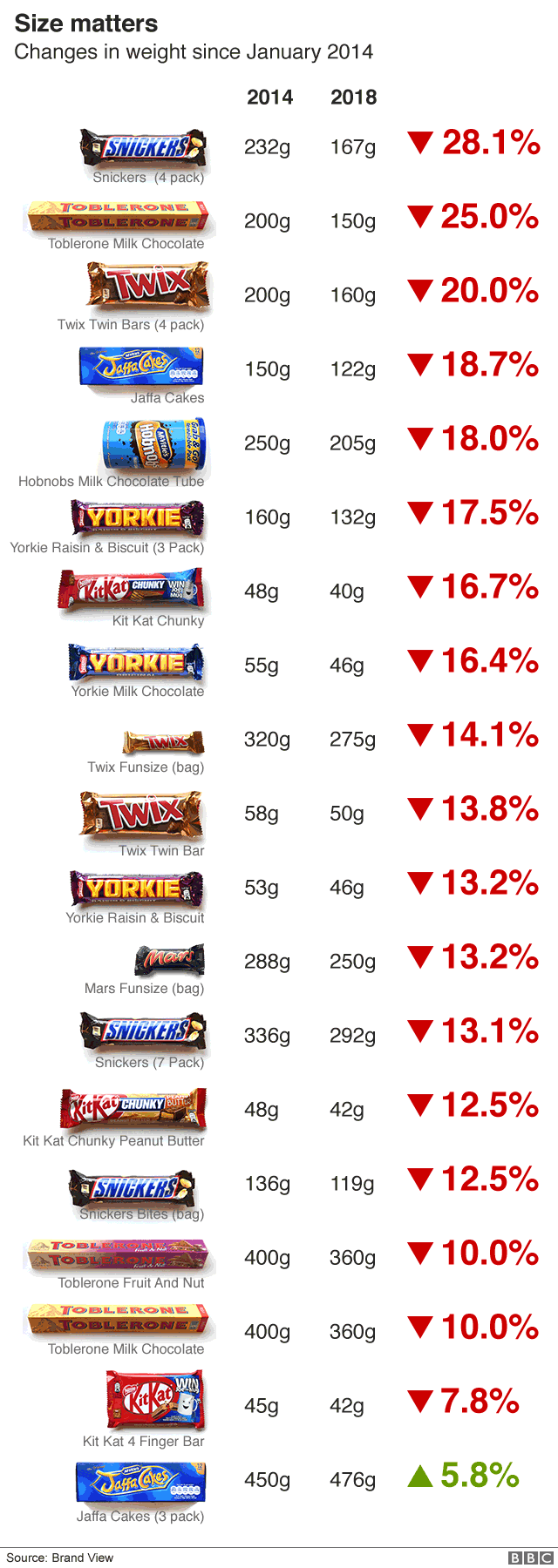
Source: BBC
A lack of innovation?
Food manufactures do not want to be seen bowing down to rising costs and passing them onto consumers. It’s obviously bad for business as most food items have straight forward substitutes to which consumers have few qualms when it comes to switching to. Yet there is also a growing view amongst the consumers that ‘rich’ manufacturers should not pass on rising costs to the poor consumer. It is bad PR basically.
But the manufacturer does still have to run a profitable business. Hence why shrinkflation is such a common phenomenon. They have been accused of lacking innovative ideas by Clive Black, head of research at Shore Capital.
Speaking at the Food Manufacturer’s Business Forum Black told leaders shrinkflation should be the last resort. He asked whether shrinkflation is “an admittance of a lack of innovation, a lack of capability to add value to a product and keep it relevant in consumers’ minds?”
It seems to me that manufacturers are perhaps showing little innovation but more likely they have little choice. Margins are being squeezed, uncertainty is rife when it comes to which manufacturers the Brexit deal will leave you able to work with and costs are rising despite statistics telling you otherwise.
The BBC has recently tried to argue that a decrease in product size sometimes means sees a bigger fall in price. However when looking at their analysis it is clear to see that products which did not increase in price were mainly those in ‘bulk buy’ or large pack products. This just shows that economies of scale makes margins less stringent.
This is perhaps the only place where ‘innovation’ can currently be seen.
Ultimately a smaller pack size does mean a higher price.
How to protect yourself from the rising of living
This is a bit like the Emperor’s New Clothes scenario. We can all see inflation is happening in front of our very eyes, yet economists and central banks are telling us the opposite.
Shrinkflation is happening and real inflation is much higher than is being reported.
Your purchasing power and your wealth can be preserved from the ravages of shrinkflation. Investments such as gold and silver by their very nature are immune to the shrinkflation effect and are an important hedge against it.
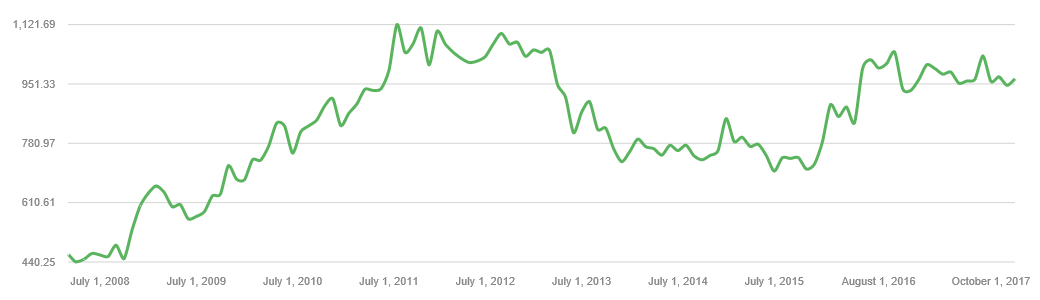
Gold prices in GBP (10 Years) via GoldCore
Next time you’re considering that packet of biscuits at the supermarket checkout, just imagine how much is missing compared to when you would have bought it say 10 years ago, or anytime before the financial crisis.
Then consider how much a bar of gold would have changed since then. The fact is that it hasn’t. You would still have the same sized gold bars (1 oz), with the same gold content or purity and they are worth a lot more now than they were 10, 15 or 20 years ago.
Related reading
This Is Why Shrinkflation Is Impacting Your Financial Wellbeing
Shrinkflation in UK & Ireland – Real Inflation Much Higher Than Reported
Gold Hedges Devaluation, Rise in Oil, Food and Cost of Living Since 1971 – Must See Charts
News and Commentary
PRECIOUS-Gold rises on declining equities amid rate hike views (Reuters.com)
Gold edges up on global cues, jewellers’ buying (AsianAge.com)
Stocks Extend Selloff as Dollar Drops; Gold Rises: Markets Wrap (Bloomberg.com)
Yellen Says Prices `High’ for Stocks, Commercial Real Estate (Bloomberg.com)
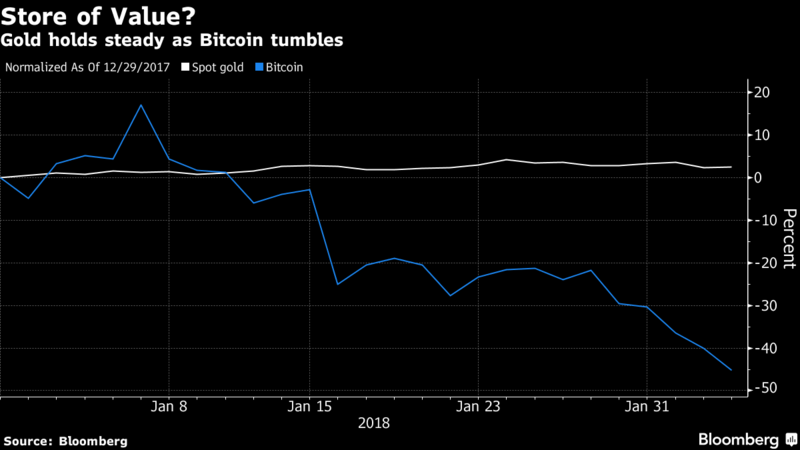
Source: Bloomberg
Crypto Isn’t Like Gold During a Stock Rout (Bloomberg.com)
Stockmarkets have finally noticed the widening cracks in the bond market (MoneyWeek.com)
History says we’re nearing the end of the U.S. bull market (StansBerryChurcHouse.com)
Gold-Backed Cryptocurrencies: Icing On An Already Tasty Cake (GoldSeek.com)
Forget bitcoin and give unloved gold a chance (Independent.ie)
Gold Prices (LBMA AM)
05 Feb: USD 1,337.10, GBP 947.20 & EUR 1,072.49 per ounce
02 Feb: USD 1,345.00, GBP 946.48 & EUR 1,077.61 per ounce
01 Feb: USD 1,341.10, GBP 941.99 & EUR 1,077.98 per ounce
31 Jan: USD 1,343.35, GBP 950.29 & EUR 1,078.98 per ounce
30 Jan: USD 1,345.70, GBP 954.37 & EUR 1,083.56 per ounce
29 Jan: USD 1,348.40, GBP 955.07 & EUR 1,085.46 per ounce
Silver Prices (LBMA)
05 Feb: USD 16.88, GBP 12.01 & EUR 13.56 per ounce
02 Feb: USD 17.14, GBP 12.05 & EUR 13.72 per ounce
01 Feb: USD 17.19, GBP 12.09 & EUR 13.82 per ounce
31 Jan: USD 17.23, GBP 12.17 & EUR 13.84 per ounce
30 Jan: USD 17.30, GBP 12.24 & EUR 13.91 per ounce
29 Jan: USD 17.34, GBP 12.33 & EUR 13.99 per ounce
Recent Market Updates
– U.S. Debt Is “Extraordinarily High” and Are Stock And Bond Bubbles – Greenspan
– Gold Bullion Price Suppression To End? Bullion Bank Traders Arrested For Manipulating Market
– ATMs Hit By Malware “Jackpotting” Attacks That Dispense All Cash In Minutes
– London Property Market Tumbles As Glut of Luxury Apartments Grows To 3,000
– Silver Bullion: Once and Future Money
– Greatest Stock Bubble In History? GoldNomics Podcast Transcript
– Davos – My Personal Experience of the $100,000 Event, $60 Burgers, Massive Inequality and the Blockchain Revolution
– Is This The Greatest Stock Market Bubble In History? Goldnomics Podcast
– Cyber War Coming In 2018?
– Government Shutdown Ends – Markets Ignore Looming Debt and Bond Market Threat
– Global Pension Ponzi – Carillion Collapse One Of Many To Come
– The Next Great Bull Market in Gold Has Begun – Rickards
– Gold Bullion May Have Room to Run As Chinese New Year Looms

end
Gold expert Robert Lambourne reports that BIS gold derivatives fell by quite a bit in December but the sight swaps still remain relatively high. This is the major source of gold used by the bankers to whack gold
(courtesy Robert Lambourne/GATA)
Robert Lambourne: BIS gold derivatives fall in December but remain hefty
Submitted by cpowell on Sat, 2018-02-03 21:27. Section: Documentation
The bank still fails to explain its activity in the gold market.
* * *
By Robert Lambourne
Disclosures in the December 2017 statement of account published by the Bank for International Settlements —
https://www.bis.org/banking/balsheet/statofacc171231.pdf
— indicate that during December the bank reduced substantially its use of gold swaps and other gold-related derivatives. The information provided in the BIS monthly statement of account is not sufficient to calculate a precise amount of gold-related derivatives, including swaps, but it appears that the total exposure as of December 31, 2017, was around 450 tonnes of gold. This compares to estimates of 570 tonnes and 600 tonnes respectively at the October and November month ends and an audited swaps figure of 438 tonnes as of March 31, 2017.
Despite the substantial reduction made in December, the BIS is still party to a substantial volume of gold swaps and the amount held is still higher than any of the year-end gold swap levels quoted in the eight-year table below. It is evident that the BIS remains an active participant in the gold swaps market with seemingly high volumes of trade taking place regularly.
When it comes to its activities in the gold market, the BIS is like a duck seeming to glide smoothly over the surface of the water, but underneath the surface it is paddling furiously to reach its destination. The bank’s lack of transparency fuels the suspicion that all this underwater activity is not being properly explained.
The use of gold swaps reported by the BIS in recent years is summarized here:
— March 2010: 346 tonnes.
— March 2011: 409 tonnes.
— March 2012: 355 tonnes.
— March 2013: 404 tonnes.
— March 2014: 236 tonnes.
— March 2015: 47 tonnes.
— March 2016: 0 tonnes.
— March 2017: 438 tonnes.
As this table shows, the use of gold swaps by the BIS fell considerably from 2013 to zero in March 2016. In the financial year ending in March 2017 a new year-end peak of 438 tonnes was reported.
In addition, while 2017 saw record use of gold derivatives by the BIS, this has been happening when the bank’s traditional gold banking business has been in decline with far less gold being deposited by central banks in BIS-controlled gold sight accounts.
In March 2010 gold swaps represented just 20 percent of the gold that the BIS had placed in gold sight accounts with central banks. By March 2017 59 percent of the gold the BIS had placed in gold sight accounts with central banks had come from gold swaps and other gold derivatives.
From the BIS statement of account for October 2017 it appears that gold swaps and other gold-related derivatives accounted for 66 percent of the gold the BIS had placed in gold sight accounts at central banks.
Hence gold derivatives have become the dominant source of gold used in the BIS banking business. The BIS itself has elected not to highlight or explain this change.
Indeed, the BIS has offered no explanation for its renewed use of gold swaps since March 2016. By contrast, back in 2010 the BIS discussed its gold swaps with the Financial Times in an article published July 29 that year. BIS General Manager Jaime Caruana said the gold swaps were “regular commercial activities” for the bank:
http://www.ft.com/cms/s/0/3e659ed0-9b39-11df-baaf-00144feab49a.html
Here are excerpts from the article:
“Some analysts speculated that the swap deals were a surreptitious bailout of the European banking system ahead of last week’s publication of stress tests. But bankers and officials have described the transactions as ‘mutually beneficial.’ …
“‘The client approached us with the idea of buying some gold with the option to sell it back,’ said one European banker, referring to the BIS.
“Another banker said: ‘From time to time central banks or the BIS want to optimize the return on their currency holdings.'”
None of these comments in the FT article focused on the gold market itself but implicitly accepted that gold was being used as collateral to support dollar loans to commercial banks.
An alternative explanation — that the swap transactions were initiated by the BIS to place more unallocated gold in the hands of certain central banks — seemed plausible, since the gold market was tight at the time.
Perhaps not coincidentally, the BIS has renewed its use of gold swaps since March 2016 just when many commentators consider gold market conditions to be tightening again, as they were in 2010 and 2011.
—–
Robert Lambourne is a retired business executive in the United Kingdom who consults with GATA about the involvement of the Bank for International Settlements in the gold market.
end
This should hurt the price of Bitcoin: USA banks are set to ban to use of credit cards to purchase bitcoin
(courtesy zerohedge)
Bitcoin ban expands across credit cards as big U.S. banks recoil
Submitted by cpowell on Sat, 2018-02-03 22:03. Section: Daily Dispatches
By Jennifer Surane and Laura J. Keller
Bloomberg News
Friday, February 2, 2018
A growing number of big U.S. credit-card issuers are deciding they don’t want to finance a falling knife.
JPMorgan Chase & Co., Bank of America Corp., and Citigroup Inc. said they’re halting purchases of bitcoin and other cryptocurrencies on their credit cards. JPMorgan, enacting the ban today, doesn’t want the credit risk associated with the transactions, company spokeswoman Mary Jane Rogers said.
Bank of America started declining credit card transactions with known crypto exchanges on Friday. The policy applies to all personal and business credit cards, according to a memo. It doesn’t affect debit cards, said company spokeswoman Betty Riess.
And late Friday Citigroup said it too will halt purchases of cryptocurrencies on its credit cards. “We will continue to review our policy as this market evolves,” company spokeswoman Jennifer Bombardier said. …
… For the remainder of the report:
https://www.bloomberg.com/news/articles/2018-02-02/bofa-to-decline-all-c…
end
Sudan devalues its pound to 28.85 to 31.5 pounds per dollar
(courtesy Reuters/gata)
Sudanese pound is on the way to becoming an ounce
Submitted by cpowell on Sun, 2018-02-04 21:40. Section: Daily Dispatches
Sudan Central Bank Weakens Bank Trading Exchange Rate to 31.5 Pounds to Dollar
From Reuters
Sunday, February 4, 2018
KHARTOUM, Sudan — Sudan’s central bank said today it had decided to weaken the exchange rate at which banks can trade their scarce supply of dollars to an upper limit of 31.5 Sudanese pounds per U.S. dollar.
The Sudanese pound has plummeted to record lows on the black market this year after it was devalued to 18 per dollar from 6.7 following a call by the International Monetary Fund to let the currency float freely.
That band will weaken to 28.8-31.5 pounds per dollar, effective Monday, Central Bank Governor Hazem Abdelqader told Reuters. The black market exchange rate on Sunday was 38 pounds per dollar, according to traders. …
… For the remainder of the report:
https://www.reuters.com/article/us-sudan-economy-exclusive/exclusive-sud..
end
Eric Sprott in his latest remarks states that the jobs number on Friday were really not very good. He also states that the fines against the bullion banks for market rigging vindicates GATA who for years have stated that the bullion banks have been rigging the precious metals markets.
(courtesy Eric Sprott/GATA)
Fines against bullion banks for market rigging vindicate GATA, Sprott says
Submitted by cpowell on Mon, 2018-02-05 01:46. Section: Daily Dispatches
8:47p ET Sunday, February 4, 2018
Dear Friend of GATA and Gold:
Reviewing last week’s market action in an interview with Craig Hemke for Sprott Money News, mining entrepreneur Eric Sprott remarks that the details of Friday’s U.S. jobs report were actually not very good. Sprott adds that the U.S. Commodity Futures Trading Commission’s fining last week of three European bullion banks for gold and silver market manipulation since 2008 vindicates GATA and others who have complained about such manipulation.
The interview with Sprott is 16 minutes long and can be heard here:
https://soundcloud.com/sprottmoney/sprott-money-news-weekly-wrap-up-2218
CHRIS POWELL, Secretary/Treasurer
Gold Anti-Trust Action Committee Inc.
CPowell@GATA.org
END
Bitcoin tumbles to below $8,000.00 as China launches another new crypto crackdown
(courtesy zerohedge)
Bitcoin Tumbles Below $8,000 As China Launches New Crypto-Crackdown
After surging to $20,000 less than three weeks ago, Bitcoin tumbled below $8,000 again overnight following a report from Chinese media that China will block all websites related to cryptocurrency trading and initial coin offerings (ICOs) – including foreign platforms – in a bid to finally quash the market completely, according to Sina.
On February 4, 2018, according to the Financial Times newspaper run by the People’s Bank of China, a series of regulatory measures will be taken against ICO and virtual currency transactions at home and abroad, including banning the existence of relevant businesses and banning and disposing of domestic and foreign virtual currency exchange websites. –Sina (translated)
As SCMP adds, quoting an article published on Sunday night by Financial News, a publication affiliated to the People’s Bank of China (PBOC), “To prevent financial risks, China will step up measures to remove any onshore or offshore platforms related to virtual currency trading or ICOs.”
Meanwhile, reports are rolling in that crypto-related content are being actively blocked by Chinese search engines.

The rest of the major cryptocurrencies are taking hits as well:

The cryptoheatmap is, in a word, red.

In September of last year, Bitcoin plunged around 20% after seven Chinese ministries banned ICOs and shuttered local Bitcoin exchanges in their “Notice on Preventing the Financing Risk of Token Issuance.”
Fast forward to today, when China appears to have unleashed its latest crackdown on cryptos. In the Financial News article, it acknowledged that recent attempts to stamp out digital currencies by shutting down domestic exchanges had failed to completely eradicate trading.
“ICOs and virtual currency trading did not completely withdraw from China following the official ban … after the closure of the domestic virtual currency exchanges, many people turned to overseas platforms to continue participating in virtual currency transactions.
Chinese authorities pointed to Bitcoin’s ability to facilitate “illegal fund-raising and other types of illegal financial activities,” pointing to “pyramid schemes, fraud and other issues.”
In response, some of those business have simply sidestepped the September regulations by relocating their business off of mainland China to Hong Kong. Sunday’s announcement is designed to mitigate that by banning domestic and foreign “virtual currency exchange websites” from web searches.
“Overseas transactions and regulatory evasion have resumed … risks are still there, fuelled by illegal issuance, and even fraud and pyramid selling,” the article said.
China’s official Xinhua news agency quoted the PBOC on Monday afternoon as saying it would tighten regulations on domestic investors’ participation in overseas transactions of ICOs and virtual currencies, as risks are still high in the sector.
To that end, Chinese search engines Baidu and microblog Weibo have begun blocking crypto-conent.
the South China Morning Post news site reported that when the terms, in Chinese, bitcoin, cryptocurrency, and ICO were searched on Chinese search-engine Baidu and microblog Weibo, no obvious paid sponsored content came up alongside the expected organic results.
While Baidu had stopped advertising cryptocurrency-related searches back in August 2016, it is unclear when they started allowing them again, and they have not confirmed any new crypto-based advertising block. Weibo has confirmed that they have banned cryptocurrency-related advertising. –Cointelegraph.com
“It is common for people to use VPNs [virtual private networks] to trade cryptocurrencies, as many exchange platforms relocated to Japan or Singapore,” said Donald Zhao, an individual bitcoin trader who relocated to Tokyo from Beijing late last year, following the ban.
“I think the new move literally means it would be even harder to circumvent the ban in China … people promoting related business programmes may be arrested,” Zhao said.
The tighter regulation from the PBOC will “definitely weigh on the cryptocurrency universe,” said Wayne Cao, who runs a company that recently offered 10 billion tokens in an ICO. “Most of the Chinese ICO projects are invested in by Chinese investors. So if they are blocked, the whole cryptocurrency market will be dragged down.”
* * *
As we reported on Friday, NYU economist Nouriel “Dr. Doom” Roubini, after taking a very, very long sabbatical from the media scene – told Bloomberg TV that Bitcoin is “the biggest bubble in human history” and that this “mother of all bubbles” is finally crashing.
Given that the skyrocketing price of Bitcoin and other cryptocurrencies has driven the price of video cards (used to mine cryptocurrency) through the roof – robbing eager PC gamers of their cutting edge rigs, it will be interesting to see if a protracted drop in the price of Bitcoin and other cryptocurrencies will result in a flood of cheap GPUs hitting the market. Shares of AMD and Nvidia – the primary manufacturers of cards used for crypto mining, should also be interesting to watch.
end
Late this afternoon, with the only thing entity up was gold/silver, suddenly cryptos rose mimicking the proper behaviour of what gold/silver should have done if they were not manipulated:
(courtesy zerohedge)
Cryptos Are Suddenly Soaring
Just as the S&P plummeted into the abyss, tumbling to a low of 24,022 or over 1,500 points…

… cryptos found a bid, and after plunging all day in what until this afternoon was one of the worst days for bitcoin and the crypto space in history, cryptos suddenly blasted off and soared at precisely 3pm just as stocks were crashing, in the process undoing much of today’s staggering losses.

The move prompted some to ask if the new “great rotation” is out of crashing equities and into post-crash cryptos?
The good news: the 3pm is still here. The bad news, if only for stocks, is that it now appears to target cryptocurrencies.
end
Basically most of Swiss exports land into China and India
(courtesy Lawrie Williams/Lawrie on Gold)
Swiss Gold Exports in 2017 – Down but far from out
February 3, 2018lawrieongold
Another of my articles published on the Sharps Pixley website looks at total gold exports from Switzerland last year – the lowest level for 11 years, but still substantial at 1,600 tonnes. As has been apparent throughout the year over 80% of the gold routed through Switzerland has been headed for relatively strong hands in Asia and the Middle East, and taken together with gold production in Asia in particular – mostly China, but also in countries like Indonesia which is a significant producer in its own right (No. 9 in the world in 2016) [see:World Top 20 Gold: Countries, Companies and Mines]– these areas probably account for the accumulation of more than 80% of all the world’s newly mined gold. China in particular absorbs goldlike a sponge and doesn’t release it back into the global market place.
With Asian populations growing, gold demand will continue to rise there given the propensity for the citizenry to own gold, while peak newly mined gold is almost certainly already with us we are going to see supplies squeezed in the years ahead with a consequent positive effect on the price regardless of the powers that be trying to suppress it. Switzerland’s re-refining and expoirt business thus remains an excellent pointer to current and future gold flows.
The Sharps Pixley article follows:
SWISS GOLD EXPORTS IN 2017 LOWER BUT STILL 80% PLUS FLOWING EAST
The continued accumulation of physical gold in Asia and the Middle East goes on regardless as shown by gold exports from Switzerland – the leading national conduit for gold bullion. Switzerland has achieved this position through its refineries specialising in taking gold in unmarketable forms and importing dore bullion from mines and refining, or re-refining it into the sizes and purities in demand in the eastern market place. This is combined with the great reputation of Switzerland in the gold marketplace and as a conduit for such activities.
Although Swiss gold exports in 2017 were the lowest in 11 years they were still substantial at over 1,600 tonnes. That is equivalent to half the world’s annual new mined gold output, and with China the world’s largest gold miner already, and a known non-exporter, the Asian and Middle Eastern regions will have accumulated at least 65% of global gold output adding up the imports from Switzerland plus Chinese domestic production alone. But other countries also export gold directly to Asian and Middle Eastern refineries and we would guesstimate that perhaps 80% of all the gold bullion moving around the world may be ending up in these regions – a huge proportion of what remains the world’s No.1 monetary asset (in our opinion at least). With bitcoin continuing to crash – it has lost almost 60% of its value from its peak in December and could well crash much further as scared investors offload on the way down – gold may be again coming into its own as a key investment asset class in the minds of investors seeking to preserve their wealth.
In December, Swiss gold exports followed the pattern established over the year with India the no. 1 individual destination with 32.3 tonnes – or around 21.5% of the total – closely followed by China (25.7 tonnes) and Hong Kong (21.1 tonnes). Assuming that most, if not all, the Hong Kong exports are also bound for the Chinese mainland, greater China was thus the biggest recipient of the Swiss gold. Overall around 86% of Switzerland’s December gold exports (totalling 150.4 tonnes) was destined for Asian and Middle Eastern nations.
If we look at the full year 20i7 figures for Swiss gold exports – neatly laid out in the bar chart below from Nick laird’s http://www.goldchartsrus service – we see that these proportions pretty well mimic the full annual picture:
This chart shows that over the full year around 81.6% of the Swiss gold was headed for Asia and the Middle East with India the biggest individual national importer with 26.2%, but with China and Hong Kong combined taking 35.8%.
The other point which is apparent from the Swiss gold export figures is something we have stressed continually over the past year – that Hong Kong gold exports to mainland China can no longer be seen as a proxy for Chinese gold imports – or even a rough guide. Mainstream media, and some analysts who should know better, still seem to equate the regularly published Hong Kong gold export figures as such, but as the Swiss figures show the greater part of mainland China’s gold imports now comes in direct – avoiding Hong Kong altogether. This percentage of direct imports appears to be growing.
The figures also show that there has been a major recovery in Indian gold imports last year after a very low 2016 figure, but still Greater China remains comfortably the biggest importer – and if you add China’s own gold production of perhaps 450 tonnes last year into the mix, as well as direct imports from a number of other countries, China remains easily the world’s No. 1 accumulator of gold – although the breakdown of where this gold actually goes internally is rather less certain – hence the seeming anomalies in the nation’s estimated consumption figures from the big precious metals consultancies like Metals Focus and GFMS.
https://lawrieongold.com/2018/02/03/swiss-gold-exports- in-2017-down-but-far-from-out/
-END-
The following is a huge story. China produces around 445 tonnes per year, so it needs to import to satisfy its citizens. In all of 2017, total conduction in China hit almost 1090 tonnes.
China tops gold consumption table for fifth consecutive year
by Weida Li Feb 05, 2018 08:43 INVESTMENT MARKETS
The consumption of gold in China hit 1089.07 tonnes in 2017 – the highest in the world for the fifth consecutive year. China News Service
China is among 25 countries where capital punishment is still not only written in the criminal code, but also regularly enforced.
The consumption of gold in China hit 1089.1 tonnes in 2017, making the country the world’s largest gold consumer for the fifth consecutive year, according to statistics released by the China Gold Association (CGA) on February 1.
China consumed 696.5 tonnes of gold jewellery and 276.39 tonnes of bullion last year – an increase of 10.35 and 7.28 percent respectively compared to 2016. However, the 26 tonnes of gold coin procured marks a decrease of 16.64 percent, reports Chinese news outlet Xinhua.
The main reasons behind the increase in gold investment are the recovery of high-end consumption in 2017, especially in second- and third-tier cities, and the fluctuations experienced in the real estate and securities markets, said the CGA.
China’s total domestic gold production stood at 426.14 tonnes in 2017, down 6.35 percent year on year, which represents the first fall since 2000.
Despite production being the highest in the world for the 11th straight year, the implementation of environmental and resource taxes, plus the closure of gold mines in nature reserves, has played a key part in this decline.
https://gbtimes.com/china-tops-gold-consumption-table- for-fifth-consecutive-year
–END-
Your early MONDAY morning currency, Asian stock market results, important USA/Asian currency crosses, gold/silver pricing overnight along with the price of oil Major stories overnight/9 AM EST
i) Chinese yuan vs USA dollar/CLOSED DOWN AT 6.2915 /shanghai bourse CLOSED UP AT 25.41 POINTS 0.73% / HANG SANG CLOSED DOWN 356.56 POINTS OR 1.09%
2. Nikkei closed DOWN 592.45 POINTS OR 2.55% /USA: YEN RISES TO 109.81
3. Europe stocks OPENED RED /USA dollar index RISES TO 89.81/Euro FALLS TO 1.2443
3b Japan 10 year bond yield: FALLS TO . +.084/ (CENTRAL BANK INTERVENTION THIS MORNING) GOVERNMENT INTERVENTION !!!!(Japan buying 100% of bond issuance)/Japanese yen vs usa cross now at 109.88/ THIS IS TROUBLESOME AS BANK OF JAPAN IS RUNNING OUT OF BONDS TO BUY./JAPAN 10 YR YIELD FINALLY IN THE POSITIVE/BANK OF JAPAN LOSING CONTROL OF THEIR YIELD CURVE AS THEY PURCHASE ALL BONDS TO GET TO ZERO RATE!!
3c Nikkei now JUST BELOW 17,000
3d USA/Yen rate now well below the important 120 barrier this morning
3e WTI:: 64.89 and Brent: 67.64
3f Gold UP/Yen UP
3g Japan is to buy the equivalent of 108 billion uSA dollars worth of bond per month or $1.3 trillion. Japan’s GDP equals 5 trillion usa./“HELICOPTER MONEY” OFF THE TABLE FOR NOW /REVERSE OPERATION TWIST ON THE BONDS: PURCHASE OF LONG BONDS AND SELLING THE SHORT END
Japan to buy 100% of all new Japanese debt and by 2018 they will have 25% of all Japanese debt. Fifty percent of Japanese budget financed with debt.
3h Oil DOWN for WTI and DOWN FOR Brent this morning
3i European bond buying continues to push yields lower on all fronts in the EMU. German 10yr bund FALLS TO +.728%/Italian 10 yr bond yield UP to 2.017% /SPAIN 10 YR BOND YIELD UP TO 1.452%
3j Greek 10 year bond yield RISES TO : 3.722?????????????????
3k Gold at $1335.40 silver at:16.81: 7 am est) SILVER NEXT RESISTANCE LEVEL AT $18.50
3l USA vs Russian rouble; (Russian rouble DOWN 16/100 in roubles/dollar) 56.70
3m oil into the 64 dollar handle for WTI and 67 handle for Brent/
3n Higher foreign deposits out of China sees huge risk of outflows and a currency depreciation. This can spell financial disaster for the rest of the world/
JAPAN ON JAN 29.2016 INITIATES NIRP. THIS MORNING THEY SIGNAL THEY MAY END NIRP. TODAY THE USA/YEN TRADES TO 109.81 DESTROYING JAPANESE CITIZENS WITH HIGHER FOOD INFLATION
30 SNB (Swiss National Bank) still intervening again in the markets driving down the SF. It is not working: USA/SF this morning 0.9322 as the Swiss Franc is still rising against most currencies. Euro vs SF is 1.1598 well above the floor set by the Swiss Finance Minister. Thomas Jordan, chief of the Swiss National Bank continues to purchase euros trying to lower value of the Swiss Franc.
3p BRITAIN VOTES AFFIRMATIVE BREXIT/LOWER PARLIAMENT APPROVES BREXIT COMMENCEMENT/ARTICLE 50 COMMENCES MARCH 29/2017
3r the 10 Year German bund now POSITIVE territory with the 10 year FALLING to +0.728%
The bank withdrawals were causing massive hardship to the Greek bank. the Greek referendum voted overwhelming “NO”. Next step for Greece will be the recapitalization of the banks and that will be difficult.
4. USA 10 year treasury bond at 2.8356% early this morning (THIS IS DEADLY TO ALL MARKETS). Thirty year rate at 3.0970% /
5. Details Ransquawk, Bloomberg, Deutsche bank/Jim Reid.
(courtesy Jim Reid/Bloomberg/Deutsche bank/zero hedge)
Global Market Rout Resumes: Asian Bloodbath Spills Over Into Europe, US Sharply Lower
Global markets were routed for the second day in a row on Monday, with Asian and European indexes opening lower and bond yields rising as resurgent U.S. inflation raised the possibility central banks would tighten policy more aggressively than had been expected.
Asian stocks suffered broad losses, with the MSCI Asia-Pacific index ex-Japan plunging as much as 2%, its largest daily drop since late 2016, while S&P futures extended Friday’s decline; the Nikkei dropped 2.6% while Hang Seng plunged as much as 2.7% before rebounding. The selling fed through into Europe, however without heavy continuing momentum.

Meanwhile, U.S. equity futures are above initial lows printed straight from Globex electronic re-open, helped in part by reports that China’s regulator would act to “mitigate” the equity selloff, which helped Chinese indices to rally into close, and close green.

Friday’s payrolls report showed wages growing at their fastest pace in more than eight years, fuelling expectations for both inflation and interest rates would rise more than previously forecast. That sparked a global sell-off that continued on Monday. Futures markets priced in the risk of three, or even more, rate rises by the Federal Reserve this year.
“This added fuel to a bond market sell-off, pushing US 10 year Treasury bond yields closer to the magic 3 percent level, which will only increase borrowing costs for corporates following years of cheap financing, thus ushering equities further from recent highs,” said Mike van Dulken, head of research at Accendo Markets.
As a result, all eyes remain on the 10Y US Treasury for indication if last week’s rout would continue, and while treasuries remain under pressure, with the yield briefly touching 2.885%, the selloff appears to have since moderated. Elsewhere, Aussie bonds were sharply lower aided by soft 15-year auction, while the 10Y JGB was trading comfortably below the BOJ’s 0.11% redline, at 0.084%. German 10-year yields rose to 0.774%, their highest since September 2015. German 30-year yields rose to two-year highs at 1.429%.

The Bloomberg Dollar Index was little changed, modestly lower from the Friday close; yen marginally firmer. The Norwegian crown, a key commodity currency, was one of the biggest losers in Europe on Monday, down 0.3 percent against the U.S. dollar. In emerging markets, the South African rand fell 0.7 percent and the Chinese yuan and Polish zloty 0.2 percent.

The yen gained against all its major peers as shares slumped across Asia following a rout in U.S. equities and Treasuries on Friday. Japan’s currency gained for the first time in four days against the dollar as the Nikkei 225 Stock Average headed for its biggest slide since November 2016.
““Higher U.S. yields are weighing on risk assets, exerting upward pressure on the yen from risk aversion,” said Minori Uchida, Tokyo head of global market research at Bank of Tokyo- Mitsubishi UFJ Ltd.
“Nikkei’s big drop is behind the yen’s strength today,” says Masakazu Satou, currency adviser in Tokyo at Gaitame Online, retail FX brokerage. “While U.S. stocks are likely undergoing a temporary adjustment, today’s performance is important. If U.S. stocks fall further significantly, they will likely enter a full-blown correction phase.”
In China, the PBOC weakened the daily CNY fixing and drained a net 40b yuan of liquidity after the 8th consecutive day of no open market reverse-repo operations; Shanghai Composite pares early losses after Caixin services PMI beats estimates and following reports of possible regulatory intervention to prop up stocks. Dalian iron 1.2% stronger.
Europe’s benchmark Stoxx 600 index fell 0.9%, its sixth consecutive day of losses totaling 4.1%, the biggest decline since Brexit and the longest rout since November; more importantly, the Stoxx 600 dipped below its 200-DMA for first time since early December and is now at two-month lows. As a reminder, European stocks suffered their biggest weekly selloff since November 2016 last week amid rising bond yields. The Stoxx 600 is now down 1.3% in 2018.
All major indexes in Europe fell: the UK’s FTSE 100 dropped 1 percent, France’s CAC 40 0.8 percent and Germany’s DAX 0.6 percent. In terms of sector specifics, losses have been relatively broad-based thus far with all ten sectors in the red. Airline names have been suffering this morning with RyanAir (-3%) softer in the wake of a disappointing earnings update, subsequently dragging easyJet (-2.3%) lower. Deutsche Lufthansa (-1.6%) were seen lower at the open amid reports that German coalition negotiators could drop proposal to abolish air transport tax. Elsewhere, markets will be looking out for any follow up to Friday’s reports that US regulators are seeking major fines for Fiat Chrysler as part of its motor settlement.
As we reported on Friday night, the Federal Reserve sanctioned Wells Frago after the fake accounts scandal. Wells Fargo said it could reduce profits by as much as USD 400mln this year, and the stock was down over 9% in the premarket.
Meanwhile, according to Bloomberg, investors are watching closely for clues on the direction of the rout that started in U.S. Treasuries and spread across global markets last week, with some pointing to synchronized economic growth as a reason to remain optimistic. European Central Bank President Mario Draghi could help stem further losses when he delivers an annual report to the European Parliament on Monday.
In the commodities complex, WTI and Brent crude futures pared earlier losses after hitting a one-month low in early European trade. Friday’s rig count saw oil drillers add rigs for the second consecutive week, a sign that US oil production could soon exceed 10mln bpd. The Iranian Oil Minister Zanganeh stated that OPEC’s step to push up oil prices is short-lived and that any country that builds oil output capacity will ultimately win, while he also suggested to wait until the June meeting for a decision regarding an extension of cuts. In metals markets, spot gold trades higher, benefiting from its safe-haven status, albeit gains are relatively modest thus far with reports suggesting that Indian gold imports fell to a 17-month low in Jan. Elsewhere, Chinese steel futures were seen lower in quiet trading conditions while nickel prices in London have recovered from recent losses.
In other news, UK PM May will face a coup that would install Boris Johnson, Jacob Rees-Mogg and Michael Gove if she persists with plans to keep Britain in a customs union with the European Union, Tory MPs warned according to the Sunday Times. Downing Street has since ruled out joining a customs union with the EU, while EU and UK said to seek quick Brexit agreement on defence and security.
The Bank of England is expected to raise interest rates twice this year after a surprisingly strong showing from the economy at the end of last year and a brightening outlook in 2018, leading economists say.
Germany’s CDU, CSU, and SPD want to present a coalition agreement by Tuesday.
Reports stated that Italian election polls could be downplaying possibility that centre-right coalition backed by Berlusconi could be closer to a majority victory at election next month.
Outgoing Fed Chair Yellen stated that asset valuations are generally elevated but added that she doesn’t want to call it a bubble.
Economic data include Markit PMIs. Bristol-Myers Squibb, Sysco, Skyworks are among companies reporting earnings.
Bulletin Headline Summary from RanSquawk
- European equities join the global sell-off as markets reassess their Fed outlook for 2018
- UK PM May rules out staying in the Customs Union post-Brexit amid reports that she faces a coup from pro-
- Brexit MPs
- Looking ahead, highlights today include: US Markit Services PMI, ISM Non-Manufacturing and ECB’s Draghi
- speaks
Top Overnight News from BBG:
- Chancellor Angela Merkel and party leaders of SPD, CSU want to present a final grand coalition agreement on Tuesday, Rheinische Post reports, citing an internal SPD planning paper
- U.K. Prime Minister Theresa May has ruled out staying in the EU’s customs union after Brexit, a government official said, adding it isn’t government policy to stay in “a” customs union either
- Tory MPs earlier said May would face a coup to install three pro-Brexit leaders if she continues with plans to keep Britain in a customs union with the EU
- Investors have ramped up bets that the follow- up to BOE’s November’s tightening — the first in a decade — will come as soon as May
- Maintaining QE and 2% inflation target are still important, BOJ Governor Haruhiko Kuroda says in Japan’s parliament on Monday; PM Abe says that while Japan hasn’t escaped from deflation yet, momentum toward 2% inflation is still maintained
- China composite PMI rose to 53.7 in January, up from 53 in December and to the highest reading since January 2011
- ellen: Wages are beginning to rise at a faster pace; asset values are high but would not say they are too high; a drop in asset values would not unduly damage core financial system
- Fed’s Williams: no need to change path of gradual hikes; not too bothered by inflation overshooting target for a time
- European Jan. Service PMIs: Spain 56.9 vs 55.0 est; Italy 57.7 vs 55.9 est; France 59.2 vs 59.3 est; Germany 57.3 vs 57.0 est; Eurozone 58.0 vs 57.6 est; Markit note first concurrent rise in selling prices across survey nations since July 2008
- U.K. Jan. Services PMI: 53.0 vs 54.1 est; slowest upturn in services output for 16 months
- German Coalition: parties want to present final grand coalition agreement on Tuesday: Rheinische Post
- China regulator (CSRC) is urging domestic brokerages to ask investors to add to their collateral when share prices drop instead of closing out the positions according to people familiar
Market Snapshot
- S&P 500 futures down 0.1% at 2,752.90
- STOXX Europe 600 down 0.9% to 384.54
- MSCI Asia Pacific down 1.4% to 179.82
- MSCI Asia Pacific ex Japan down 1.3% to 590.34
- Nikkei down 2.6% to 22,682.08
- Topix down 2.2% to 1,823.74
- Hang Seng Index down 1.1% to 32,245.22
- Shanghai Composite up 0.7% to 3,487.50
- Sensex down 1.1% to 34,692.40
- Australia S&P/ASX 200 down 1.6% to 6,026.23
- Kospi down 1.3% to 2,491.75
- German 10Y yield fell 2.9 bps to 0.738%
- Euro up 0.09% to $1.2474
- Brent Futures down 0.6% to $68.16/bbl
- Italian 10Y yield rose 8.4 bps to 1.781%
- Spanish 10Y yield fell 3.9 bps to 1.433%
- Brent Futures down 0.5% to $68.25/bbl
- Gold spot up 0.2% to $1,335.43
- U.S. Dollar Index down 0.2% to 89.06
A bloodbath was seen across equity markets in Asia trade as most major bourses suffered deep losses after Friday’s slump on Wall St, where stocks failed to benefit from the better than expected NFP jobs data and sold-off on the bond market weakness as markets reprice expectations for the Fed’s tightening cycle. ASX 200 (-1.6%) and Nikkei 225 (-2.6%) opened with firm losses amid a continued rout in US equity futures, while mining and oil-related sectors were the worst performers following weakness in the commodities complex. Hang Seng (-1.1%) conformed to the downbeat tone with notable pressure in the energy giants, while Macau gambling stocks also racked up losses on competition concerns after reports that China is drafting a proposal to permit gambling on Hainan Island. Conversely, Shanghai Comp (+0.7%) pared opening losses and outperformed the region after encouraging Chinese Caixin Services and Composite PMI data releases, in which the former posted its highest since May 2012. Finally, 10yr JGBs were relatively flat and held on to Friday’s BoJ-induced gains, with only brief support seen amid a wide-spread risk-averse tone.
Top Asian News
- Chinese Funds Buy Record $1.6 Billion of Hong Kong Stocks Today
- China Is Said to Ask Brokerages to Help Avert Stock Declines
- Indonesia’s Economy Grows Faster Than Estimated in 4th Quarter
- Samsung’s Jay Y. Lee Set Free in Unexpected Seoul Court Reversal
- Value Stocks Are Still Unloved Everywhere Except for China
- China Regulator Is Said to Allow Rollover of Share Pledged Loans
European equities have very much kicked the week off on the back-foot as Friday’s sell off in US equities has spread into Asia-Pac and European trade (Eurostoxx 50 -0.7%) as markets re-price expectations of the Fed’s tightening cycle. In terms of sector specifics, losses have been relatively broad-based thus far with all ten sectors in the red. Airline names have been suffering this morning with RyanAir (-3%) softer in the wake of a disappointing earnings update, subsequently dragging easyJet (-2.3%) lower. Deutsche Lufthansa (-1.6%) were seen lower at the open amid reports that German coalition negotiators could drop proposal to abolish air transport tax. Elsewhere, markets will be looking out for any follow up to Friday’s reports that US regulators are seeking major fines for Fiat Chrysler as part of its motor settlement. Wells Fargo (WFC) – The Federal Reserve has sanctioned the bank after the fake accounts scandal. Wells Fargo said it could reduce profits by as much as USD 400mln this year. Broadcom (AVGO)/Qualcomm (QCOM) – Broadcom is set to raise its bid for Qualcomm to about USD 145bln or USD 80/share, according to sources.
Top European News
- May Under Fire as Brexit Reality Sparks Conservative Civil War
- Prudential Financial Agrees $1.8b Reinsurence Deal With Lloyds
- Bund Futures Are Underpinned as Small Dovish Repricing Supports
- German CDU, CSU, SPD Want to Present Coalition Deal Tuesday: RP
- Bayer, Monsanto Submit Concessions in EU Deal Review
In FX, the Dollar index has consolidated post-NFP recovery gains above the 89.000 level, despite losing some ground against the traditional safe-haven currencies amidst the ongoing pull-back in global equities (in part triggered by higher bond yields and Fed tightening perceptions in wake of Friday’s US jobs report). Eur/Usd is back down around 1.2450 vs last week’s 1.2500+ peaks, as specs increased long positions yet again (to fresh record highs), while Cable is pivoting around 1.4100 amidst more UK/Brexit-related claims and denials (latest concerning a plot against PM May on EU customs union issues). Usd/Cad has rebounded above 1.2400 with the Loonie undermined by reports that Canada could walk away from NAFTA, while Aud/Usd and Nzd/Usd are both sitting just above recent lows and round numbers (0.7900 and 0.7300) awaiting this week’s RBA and RBNZ policy meetings). Conversely, Usd/Jpy has retreated from Friday’s US labour data inspired highs and back below 110.00, with resistance seen ahead of the 110.37 Fib (38.2%) and 110.50 offers, but 109.79 and 109.83 MAs (ascending 55 hourly and descending 100 weekly respectively) providing support. Usd/Chf is hovering just under 0.9300 within a tight range up to around 0.9325.
In commodities, WTI and Brent crude futures have pared earlier losses after hitting a one-month low in early European trade. Friday’s rig count saw oil drillers add rigs for the second consecutive week, a sign that US oil production could soon exceed 10mln bpd. The Iranian Oil Minister Zanganeh stated that OPEC’s step to push up oil prices is short-lived and that any country that builds oil output capacity will ultimately win, while he also suggested to wait until the June meeting for a decision regarding an extension of cuts. In metals markets, spot gold trades higher, benefiting from its safe-haven status, albeit gains are relatively modest thus far with reports suggesting that Indian gold imports fell to a 17-month low in Jan. Elsewhere, Chinese steel futures were seen lower in quiet trading conditions while nickel prices in London have recovered from recent losses.
On today’s calendar, we will see the remaining January services and composite PMIs released in Europe and the US. Also due in the US is the January ISM non-manufacturing while in Europe the February Sentix investor confidence reading and December retail sales data for the Euro area will be due. Of most interest however will likely be ECB President Draghi’s comments in front of the European Parliament.
US Event Calendar
- Feb. 5-Feb. 9: MBA Mortgage Foreclosures, prior 1.23%; Mortgage Delinquencies, prior 4.88%
- 9:45am: Markit US Services PMI, est. 53.3, prior 53.3; Markit US Composite PMI, prior 53.8
- 10am: ISM Non-Manf. Composite, est. 56.7, prior 55.9
DB’s Jim Reid concludes the overnight wrap
I’ve had plenty of time to contemplate last week’s price action as my late flight home last night from Geneva was cancelled after several hours hanging about. We were left stranded after midnight looking for a hotel. Given I do an annual mapping the world’s prices document that shows Switzerland has the most expensive hotels in the world this was a little suboptimal. It’s slightly ruined a great weekend skiing. Fantastic conditions but very cold.
So good morning from the Holiday Inn Express Geneva Airport where I’m about to see how good the all inclusive breakfast is. Anyway, bond markets. If you thought last week was a shock in fixed income, just imagine what would happen if we actually saw CPI numbers consistently beat expectations on either/both sides of the Atlantic. Global bond markets are still set up for a long period of low inflation ahead, in our view. In our global 2018 outlook tour, the biggest push back to our view was that most didn’t believe inflation would misbehave as much on the upside in 2018 as we did, so I don’t think markets will be well prepared if it does.
One higher average US hourly earnings print (2.9% yoy vs 2.6% expected) doesn’t make a trend but as we’ve been saying for several months now, in our view, everything is set up for higher US inflation this year (eg labour market tightness, late cycle tax cut boost, traditional lag between growth and inflation etc.). If it doesn’t happen this year with all the forces present you’d have to tear up all your textbooks really.
In terms of what impact higher inflation would have. You only have to see last week’s price actions for some clues. 10yr Treasuries moved 19bps higher (+5.1bps Friday), the S&P 500 -3.85% (-2.12% Friday) and the VIX (from 11.08 to 17.31 on the week, 3.8 points higher Friday). In the process, 10yr Treasuries hit their highest yield since January 2014, the S&P500 had its worst day since September 2016 and the VIX climbed to its highest level since the week of the Trump election victory 15 months ago. So for equity vol we’ve already bypassed the whole of the 2017 levels now in early 2018.
This move to higher inflation and higher yields probably won’t be a straight line but the risks are building that 2018 could have moments of big adjustments and spikes in vol. A reminder that our credit forecasts for 2018 are for IG to widen 25bps and HY c.100bps due to higher inflation and yields.
On this, our colleagues in rates and economics have raised their end-2019 Fed Terminal rates to 2.75% (from 2.45%) and year-end 2018 10yr US yield forecast to 3.25% (from 2.95% prior).
The post payroll week is typical pretty light on data so perhaps the shutdown risks towards the end of the week (Thursday 8th Feb.) will come into view. The number two US Senate Democrat Mr Durbin does not believe a deal to protect the c700k of undocumented immigrants brought to the US as children can be reached by this Thursday, but at the same time “don’t see a government shutdown coming”, in part as he expects Senator McConnell to bring the DACA issue “….to a full debate in the Senate” later on. Elsewhere, Bloomberg has noted Republicans are looking at extending the government funding till 23 March. This is broadly consistent with our US economist’s view where they expect another 3-4 week continuing resolution as the most likely outcome. They note the risk of a shutdown this week is not negligible, in part as it would begin to bring the debt ceiling into the mix as the Congressional Budget Office has recently estimated that the Treasury will run out of cash in the first half of March. Though our economists think the probability of a debt ceiling breach is extremely remote, the mid-March deadline adds pressure to already complicated funding negotiations.
Staying with politics, in Germany, Ms Merkel’s bloc and the SPD will resume talks this morning to potentially form the next coalition government. Talks over the weekend were “very constructive” and achieved agreement on many topics, but some topics are still far apart which both parties want to discuss “thoroughly and with focus” on Monday morning. Elsewhere, the Handelsblatt reported that the EU commission may scrap structural fund payments to relatively wealthier countries such as Germany, France, Netherlands and Sweden. The change could save about €100bn over the next seven years.
This morning in Asia, markets are extending the selloff. The Nikkei (-2.13%), Hang Seng (-1.36%), Kospi (-1.19%) and China’s CSI 300 (-0.49%) are all down and UST 10y yields are up c2bp as we type. Datawise, both China’s January Caixin and Japan’s Nikkei composite PMI were modestly above last month’s readings, at 53.7 (vs. 53) and 52.8 (52.2) respectively. After the bell on Friday, Wells Fargo was down c6% after the Fed banned the bank from increasing its total assets beyond their size at the end of 2017 (US$1.95trn) until it cleans up its consumer and compliance issues. Elsewhere, the WSJ reported the CEO of JP Morgan has called some of the bank’s clients to assuage concerns and emphasis the bank’s plans to start a new healthcare company was only for its own staff.
Now recapping other markets performance from Friday. Key US bourses dropped 2%-2.5%, with all sectors in the S&P in the red, weighted down by softer results from energy companies and increased concerns from rising yields. Notably, the S&P was up 5.6% in January and +19.4% in CY17 so this is a small dent for now. In Europe, the FTSE (-0.63%), Stoxx 600 (-1.38%) and DAX (-1.68%) were all down, with the latter down the most since June 17 and erasing all YTD gains for this year.
In government bonds, both Bunds and Gilt 10y yields rose c4.7bp while peripherals rose 6-8bp. The US 5y breakeven rose to 2.04% (the highest since March last year) and the 2-10s curve steepened 7bps to 69.9bps (the highest since November). In currencies, the US dollar index rose for the first time in four days (+0.59%) while the Euro and Sterling fell 0.38% and 1.02% respectively.
In commodities, WTI oil fell 0.53% on Friday and is down further this morning. Elsewhere, Gold weakened 1.14% and Silver dropped 3.75% while other base metals were little changed (Copper -0.43%; Zinc flat; Aluminium +0.17%). Following on the strength of the USD, DB’s Alan Ruskin has looked back at history and noted that in an environment where 10y yields go up and equities go down, the USD tends to go up sharply versus the AUD and up substantially versus the JPY, but mixed to near flat versus the EUR. To summarize, past history does tend to support the thesis that when it feels like there is nowhere to hide between poor simultaneous trading conditions in the equity and fixed income markets, the USD and more recently the EUR have been the currencies to shelter in. Refer to his note for more details.
Away from markets and onto central bankers commentaries. Before we do this, it’s worth noting that Mr Powell will be sworn in at the Fed today. We hope he’s fresh from his 65th birthday celebrations from yesterday. On Friday, the Fed’s Kaplan’s hawkish comments partly accelerated the selloff in bonds after he noted “I think the base case for 2018 should be three (rate hikes) – it could be more than that, we’ll have to see”. Conversely, the Fed’s Williams has maintained his moderately dovish views. He noted that recent price data have been encouraging and that “we’ll continue to see inflation pick up this year and next”, but “given the economy is performing almost exactly as expected, you can expect policy makers to do the same”. Overall, he does not “…see an economy that’s fundamentally shifted gear” and that either three or four rate hikes are “both possibilities (that) are reasonable to think about, at this point, as options”.
Later on Sunday, former Fed Chair Mrs Yellen noted valuation in US equities were “high…but I don’t want to say too high”. Similarly, commercial real estate prices are now “quite high relative to rents”, but “it’s very hard to tell” whether it’s a bubble or not, although it is a source of some concern that asset valuations are so high. Overall she believes that if there were a decline in asset valuations, “it would not damage unduly the core of our financial system”, in part as the financial system is now “much better capitalised”.
In the UK, the BOE’s Deputy Governor Woods warned against loosening regulations post Brexit. He noted the Prudential regulation authority will “maintain standards of resilient in the financial sector at least as high as those we have today” and that “the idea that we would want to be sub-EU standard doesn’t bear scrutiny”.
We wrap up with other data releases from Friday. In the US, the January change in nonfarm payrolls was above market at 200k (vs. 180k expected), with the average payroll gains over the pastt hree months outpacing the last six months (192k vs. 180k). The average hourly earnings growth also beat at 2.9% yoy (vs. 2.6% expected) – marking the highest annual pace since May 2009. The unemployment rate was in line and steady for the fourth consecutive month at 4.1%. Elsewhere, December factory orders was above expectations at 1.7% mom (vs. 1.5%) while the final reading of the January Uni. of Michigan consumer sentiment was revised slightly higher at 95.7 (vs. 95 expected).
The Eurozone’s December PPI was in line at 0.2% mom while prior revisions lowered the annual growth to 2.2% yoy (vs. 2.3% expected). Italy’s January CPI fell less than expected at -1.6% mom (vs. -1.7%) and 1.1% yoy (vs. 0.8%).
The start of the week will see the remaining January services and composite PMIs released in Europe and the US. Also due in the US is the January ISM non-manufacturing while in Europe the February Sentix investor confidence reading and December retail sales data for the Euro area will be due. Of most interest however will likely be ECB President Draghi’s comments in front of the European Parliament.
3. ASIAN AFFAIRS
i)Late SUNDAY night/MONDAY morning: Shanghai closed UP 25.41 points or 0.73% /Hang Sang CLOSED DOWN 356.56 or 1.09% / The Nikkei closed DOWN 592.45 POINTS OR 2.55%/Australia’s all ordinaires CLOSED DOWN 1.63%/Chinese yuan (ONSHORE) closed DOWN at 6.2915/Oil DOWN to 64.89 dollars per barrel for WTI and 67.64 for Brent. Stocks in Europe OPENED RED . ONSHORE YUAN CLOSED DOWN AGAINST THE DOLLAR AT 6.2915. OFFSHORE YUAN CLOSED DOWN AGAINST THE ONSHORE YUAN AT 6.2928//ONSHORE YUAN A LITTLE WEAKER AGAINST THE DOLLAR/OFF SHORE A LITTLE WEAKER TO THE DOLLAR/. THE DOLLAR (INDEX) IS MUCH STRONGER AGAINST ALL MAJOR CURRENCIES. CHINA IS NOT TOO HAPPY TODAY.(WEAKER CURRENCY AND WEAK MARKETS THROUGHOUT THE GLOBE )
3 a NORTH KOREA/USA
/NORTH KOREA
3 b JAPAN AFFAIRS
END
c) REPORT ON CHINA
end
4. EUROPEAN AFFAIRS
GERMANY
Support for the 2nd largest party in Germany, the SPD under Martin Schulz dives and puts the German coalition in doubt. Maybe this coalition lasts a year to which another election is called and both Schulz and Merkel step down.
(courtesy Mish Shedlock)
Support For SPD Dives: German Coalition Doubts Mount
Authored by Mike Shedlock via MishTalk,
Support for SPD, in coalition talks with CDU/CSU to form a German government, is now at a record low. Doubts mount.
The poll results are from the Tagesschau.De article SPD Trend Slips to 18 Percent.

The article is in German. As is typically the case with Google translations from German, the results need quite a bit of working over. I cannot read or write German but it is usually easy to spot errors.
“As Bad as Never”
I like this amusing as-translated subtitle regarding SPD party leader Martin Schulz: “Schulz rated as bad as never”.

Only 25 percent of citizens are satisfied with his work, five points less than last month, a record low.
Impatience Mounts
That Germany has no new government more than four months after the election is barely comprehensible to the Germans: 71 percent do not understand why it takes so long to form a government.
The above paragraph is my translation. As translated by Google “71 percent have no understanding that the formation of a government takes so long.”
It’s usually easy to make such corrections but sometimes I am scratching my head. Typically, I ignore offending paragraphs.
Let’s now turn our attention to comments from Eurointelligence regarding the poll.
Agreement Not in Doubt, Ratification Is
There can be no doubt whatsoever that CDU/CSU and SPD will conclude a coalition agreement. The doubt is only about whether SPD members will accept it. The reason why the SPD leadership is now becoming desperate to strike a deal is the latest polls.
The CDU/CSU is stable at 33%, but the combined share of the two largest parties would only be 51%. With this poll we are now within the margin of error of a result in which a grand coalition becomes no longer arithmetically possible. This has already happened in the Netherlands, and we think it will happen in Italy on March 4, too. In this case, the smaller parties will become disproportionately powerful. The AfD has 14% and is only 4 points behind the SPD. That gap, too, is within the margin of error of the polls. The other three parties are all scoring 10-11%. With this poll, even a Jamaica coalition would only have the thinnest of majorities.
While it makes sense for the SPD leadership to support a grand coalition out of pure self-interest, SPD members have different incentives. They couldn’t care less whether MPs who narrowly managed to get a seat at the last election will have to fight for their seat again and possibly lose it. Or that Martin Schulz and Sigmar Gabriel may have to look for another job.
All we know is that the SPD grassroots activists are massively opposed to a grand coalition and that SPD voters are split – we’ve seen polls of 50/50 and 60/40. But the voters are not necessarily representative of the members, nor are the activists. The outcome of the party referendum is genuinely uncertain, and we believe that the financial markets, in particular, are underestimating the possibility of a rejection.
Buddy System
Eurointelligence notes that Merkel and SPD now agree on “almost everything”.
This buddy system offends the SPD rank and file. It also offends CDU/CSU party members accusing Merkel of giving in.
For example, Angela Merkel made a big concession to Schulz by accepting the principle that the ESM is to be brought under EU law. But this is under attack by components of CDU/CSU as well as FDP and AfD.
Sleight of Mouth
Merkel upset the Greens and SPD rank and file by backing off diesel emissions. She and Schulz also upset SPD rank and file when they agreed via sleight of mouth to both cut and expand immigration.
As I pointed out before this coalition agreement is about nothing more than keeping both Merkel and Schulz in power. The latter wants to hang on to his political perks like free limousines for as long as he can.
Outcome?
On January 21, when SPD and Merkel announced coalition talks, I offered this assessment:
“Don’t celebrate yet. Once a final deal is reached, assuming a deal is reached, the party’s 450,000 members have an up or down vote on the package. With only 56% of the party leaders in favor of the deal, the membership vote is certainly questionable.”
Ratification is at best 50-50. New elections are the most likely result if the rank-and-file vote this mess down.
Peak Merkel – Peak Schulz
Bid both Schulz and Merkel adieu. Their time is in the past via Waterloos of their own making.https://www.themaven.net/mishtalk/politics/spd-s-no-win-dilemma-peak-schulz-peak-merkel-hoR4mwDYu0GrM34Th0nscw …
SPD’s No-Win Dilemma: Peak Schulz, Peak Merkel – Mish Talk
As some hailed the “success” of the “Grand Coalition,” I see things differently, as does Eurointelligence.
themaven.net


Best Possible Result
The best possible result depends on your outlook. If you are eurosceptic, the best result is this sequence of events:
- A grand coalition that lasts for a year or so, with AfD gaining parliamentary powers.
- The grand coalition then splinters with infighting and another election in which Merkel steps down and SPD is trounced.
END
5. RUSSIAN AND MIDDLE EASTERN AFFAIRS
ISRAEL
Hamas leader in the Gaza Strip warns that war with Israel will erupt within days. There have been rockets fired into Israel from Gaza to which Israel responded by blowing up a military weapons depot in the south of GAZA
(courtesy zero hedge)
Hamas Leader Warns War With Israel Will Erupt “Within Days”
Next week a significant war drill will be conducted across Israel by Israel Defense Forces (IDF) together with the American military, as part of the biennial Juniper Cobra military exercise, which this year will imitate a simultaneous missile attack on Israel from both its northern and southern fronts.
Meanwhile, as Israel prepares for armed conflict, Al Hayat, an Arabic-language London-based newspaper, writes that Hamas’ chief Yahya Sinwar has ordered the Gaza-based Islamist militant group on high alert, indicating that war is a “95 percent probability” and it could erupt in hours or within days.

Hamas leader in Gaza Yahya Sinwar
According to Haaretz, Hamas’ chief in Gaza anticipates Israel will use the upcoming military exercises in the south to spark new conflict, and as a result Hamas has started preparing the Gaza Strip for a military incursion by Israel forces:
Sources that have met with Yahya Sinwar, Hamas’ political leader in Gaza, say that Palestinian factions believe that Israel will use a training exercise planned on the southern front to open a military operation against Hamas. The report further said that the military wing of Hamas has declared a state of high alert, evacuating sites and headquarters and even deploying road blocks accross the Strip.
Political and human rights activists in Gaza told Haaretz that the atmosphere in the Strip is very grim in light of the humanitarian crisis, some of which involves the non-implementation of the reconciliation agreement between Hamas and the Palestinian Authority and mutual recriminations between the PA and Hamas over the freeze in talks.
Hamas’ war preparations in the Gaza strip are in anticipation that the Israel Defense Forces (IDF) and the American military could use the Juniper Cobra war drill to strike the Gaza Strip.

Michael Shuval, a BBC News Arabic service producer in Israel and the West Bank states, “Israel conducted a wide scale security exercise in the south this morning. Police spox said it was “part of exercises planned throughout the year to be ready for a range of scenarios”, while Al Hayat reports Gaza’s leaders believe there’s a 95% likelihood of war “within days”.
Israel conducted a wide scale security exercise in the south this morning. Police spox said it was “part of exercises planned throughout the year to be ready for range of scenarios”, while Al Hayat reports Gaza’s leaders believe there’s a 95% likelihood of war “within days”.

Haaretz also notes that the humanitarian crisis in the Gaza Strip is rapidly deteriorating.
Political and human rights activists in Gaza told Haaretz that the atmosphere in the Strip is very grim in light of the humanitarian crisis, some of which involves the non-implementation of the reconciliation agreement between Hamas and the Palestinian Authority and mutual recriminations between the PA and Hamas over the freeze in talks.
Over the weekend, Israeli warplanes bombed a Hamas military compound in the southern Gaza Strip, after Gaza militants launched a rocket into Israeli territory in the southern front. This was the second exchange of fire between Gaza militants and the IDF, after Israel bombed Hamas’ targets on Friday.

Fighters from the armed wing of Hamas march in the city of Khan
In total, at least 20 Hamas rockets have been fired into Israel – with Israel responding to every attack – since Trump’s controversial December 2017 declaration, which sparked the largest incidence of military exchanges between Israel-Hamas since 2014. According to i24 news, most of the rocket attacks have been attributed to splinter Palestinian factions in the Gaza Strip, and not Hamas, but Israel nonetheless holds Hamas responsible for any fire coming from the enclave. Israel and Hamas have fought three blood wars since the Islamic movement won elections in Gaza in 2006.
Israel And Egypt Form Secret Alliance To Wipe Out Egyptian Jihadists
Israel has been conducting bombing raids on jihadists within Egypt’s borders since at least late 2015 as part of a secret two-year alliance. For more than two years, unmarked Israeli drones, helicopters and jets have carried out a covert air campaign, conducting more than 100 airstrikes inside Egypt, frequently more than once a week — and all with the approval of President Abdel Fattah el-Sisi, the NYT reported on Sunday.
Once enemies in three wars, and having struggled to reach peace agreements for decades, Egypt and Israel are now (not so) secret allies against a common foe.

In late 2015, jihadists in Egypt’s Northern Sinai moved in, killing hundreds of soldiers and police officers and briefly seizing a major town – setting up armed checkpoints as they established control over the area. On October 31, 2015, the Islamic State of Iraq and the Levant’s Sinai branch, formerly known as Ansar Bait al-Maqdis, brought down a Russian passenger flight with an explosive device – killing all 224 people aboard.

With Egypt seemingly unable to stop the jihadists, Israel – alarmed by the threat just over the border, began taking action – sending a barrage of airstrikes into the neighboring Arab country whose officials and media continued to vilify the Jewish state in public.
In order to conceal their involvement, Israel’s drones, jets and helicopters have covered up their markings. “Some fly circuitous routes to create the impression that they are based in the Egyptian mainland,” according to American officials briefed on the operations.

It is unclear whether any Israeli troops have actually set foot inside Egyptian borders.
Despite efforts by both Israel and Egypt to hide the origin of the strikes and censor public reports, Egypt and Israel’s two-year alliance has become somewhat of an open secret in intelligence circles:
Inside the American government, the strikes are widely known enough that diplomats and intelligence officials have discussed them in closed briefings with lawmakers on Capitol Hill. Lawmakers in open committee hearings have alluded approvingly to the surprisingly close Egyptian and Israeli cooperation in the North Sinai.
In a telephone interview, Senator Benjamin L. Cardin of Maryland, the ranking Democrat on the Senate Foreign Relations Committee, declined to discuss specifics of Israel’s military actions in Egypt, but said Israel was not acting “out of goodness to a neighbor.”
“Israel does not want the bad stuff that is happening in the Egyptian Sinai to get into Israel,” he said, adding that the Egyptian effort to hide Israel’s role from its citizens “is not a new phenomenon.” –NYT
Moreover, despite Israeli military censors preventing reports of the strikes from becoming public, certain news outlets circumvented the censorship by citing a 2016 Bloomberg report in which a former Israeli official admitted to drone strikes inside of Egypt.
The two-year alliance between the two countries is thought to have begun after Egypt’s relatively new president Mohamed Morsi – a leader within the Muslim Brotherhood who came to power after the Arab Spring revolt, was outed in a military takeover by el-Sisi – then defense minister.
Israel welcomed the change in government, urging Washington to accept it.
And Egypt needed the help; following Mr. Sisi’s takeover, Islamist militants who had established a refuge in the North Sinai region between the Suez Canal and the Israeli border began a wave of deadly assaults against Egyptian security forces.
A few weeks after Mr. Sisi took power, in August 2013, two mysterious explosions killed five suspected militants in a district of the North Sinai not far from the Israeli border. The Associated Press reported that unnamed Egyptian officials had said Israeli drones fired missiles that killed the militants, possibly because of Egyptian warnings of a planned cross-border attack on an Israeli airport. (Israel had closed the airport the previous day.)
At the time, both Israel and Egypt vehemently denied the reports – however after the Russian charter jet was brought down in October of 2015, Israel began its wave of airstrikes, killing a long list of militant leaders according to an American official who spoke on the condition of anonymity in order to discuss classified operations.
After Israel wiped out much of the jihadist leadership in the region, less ambitious successors stepped in. No longer employing armed checkpoints, closing roads or claiming territory – the group began targeting “softer” targets like Christians in Sinai and Muslims they considered heretics. As an example, the militant group killed over 300 worshippers at a Sufi Mosque in North Sinai.

Since Israel has effectively been keeping jihadists at bay in a mutually beneficial arrangement, some American supporters of Israel have been complaining that given Egypt’s reliance on the Israeli military, “Egyptian officials, diplomats and state-controlled news media should stop publicly denouncing the Jewish state.”
“You speak with Sisi and he talks about security cooperation with Israel, and you speak with Israelis and they talk about security cooperation with Egypt, but then this duplicitous game continues,” said Representative Eliot L. Engel of New York, the ranking Democrat on the House Foreign Relations Committee. “It is confusing to me.”
Israel’s prime minister, Benjamin Netanyahu, has also pointedly reminded American diplomats of the Israeli military role in Sinai. In February 2016, for example, Secretary of State John Kerry convened a secret summit in Aqaba, Jordan, with Mr. Sisi, King Abdullah of Jordan and Mr. Netanyahu, according to three American officials involved in the talks or briefed about them.
Mr. Kerry proposed a regional agreement in which Egypt and Jordan would guarantee Israel’s security as part of a deal for a Palestinian state. –NYT
Netanyahu scoffed at the idea – arguing that if Egypt was unable to control the ground within its own borders, it was hardly in a position to guarantee Israel’s safety.
END
6 .GLOBAL ISSUES
END
7. OIL ISSUES
This should save Suncor tonnes of money: They are replacing 400 truck drivers with self driving trucks
(courtesy zerohedge)
Canada’s Largest Energy Company Is Replacing 400 Truck Drivers With Self-Driving Trucks
Canada’s largest oil company announced last week that it will be cutting about 400 heavy-equipment operator positions over the next six years as they phase in a new fleet of self-driving trucks. Suncor Energy, based in Calgary, Alberta, Canada, announced on Wednesday that it plans to deploy over 150 driver-less trucks, leading to job cuts starting as soon as 2019.
“We have about 500 roles that will get eliminated through this and we’re going to add about 100. So the net change in our workforce is about 400 positions,” COO Mark Little said in an interview Wednesday. Suncor is the first oilsands mining operation to adopt the technology.
At present, Suncor has nine self-driving trucks moving building materials at a job site in Alberta, making it one of the first companies in Canada to use autonomous trucks, according to Reuters.
As CBC reports, the company has been testing the 400-tonne capacity Komatsu trucks for about four years and has nine now. It announced Tuesday it will gradually build a fleet of more than 150 driverless trucks over the next six years, starting with the North Steepbank mine at its Base Camp north of Fort McMurray.

According to CBC News, each job site will feature its own control center to manage the Komatsu autonomous vehicles, which will be specially programmed for optimum performance in the unique conditions of each job site.
The self-driving trucks can operate 24 hours a day, stopping only for fuel, and their tires even last 40% longer by avoiding the sudden acceleration and abrupt steering caused by human driver error. Because of these statistics, Chief Operating Officer Mark Little believes that the $5 million apiece autonomous vehicles will not only reduce operating costs but increase overall safety at job sites.
To be sure, while the company and shareholders will be delighted by the efficiency improvements, the losers are the company’s employees.
“Often, people hear about how productive these autonomous trucks are,” said Steve Kelly, who is currently a truck driver for Suncor. “If given the same conditions… that these autonomous units are running in, I’m sure we’d be more productive as well,” he said to CBC Radio.
“It’s two different running conditions… and we’re constantly stressing. Give us [truck drivers] the same conditions and give us some opportunities… We can show how productive our workforce can be.”
Predictably, Suncor’s plan to test the autonomous truck systems was criticized by the Unifor union local because of job losses. But COO Little says Suncor is working with the union to minimize job impacts by retraining workers whose jobs will disappear.
The company has been preparing for the switch by hiring its truck drivers, including those at its just-opened Fort Hills mine, on a temporary basis, he added. Suncor said the earliest there will be a decrease in heavy equipment operator positions at Base Plant operations is 2019.
He said the autonomous trucks are so efficient — because they operate 24 hours a day and stop only for fuel — the company will need fewer trucks in the future than it employs now.
Little added that the company will replace trucks that have reached the end of their useful life with new Komatsu trucks. He said they cost about $5 million each, not including the obstacle detection systems and computer gear needed for autonomy.
Meanwhile, Tokyo-based Komatsu this week celebrated the 10th anniversary of deployment of its first autonomous truck at a Codelco copper mine in Chile, noting that more than 100 trucks now operate at four Rio Tinto Ltd. iron ore mines in Australia, the mine in Chile and at Suncor. Komatsu also said tires on its autonomous trucks last 40 per cent longer because the trucks avoid sudden acceleration and abrupt steering.
Also confirming that the future of industrial trucking is driverless, last week Rio Tinto announced that its autonomous haul trucks had achieved a milestone of moving a total of one billion tonnes of material without being involved in any injury accidents.
In December, the Australian mining giant announced it would expand its fleet of about 80 trucks to 140 by the end of 2019. Rio Tinto’s trucks are controlled remotely from its operations centre in Perth, about 1,50kms from the mines, but Little said Suncor is initially going to operate the trucks from control rooms at each mine site.
8. EMERGING MARKET
Your early morning currency/gold and silver pricing/Asian and European bourse movements/ and interest rate settings MONDAY morning 7:00 am
Euro/USA 1.2443 DOWN .0010/ REACTING TO MERKEL’S FAILED COALITION/ SPAIN VS CATALONIA/REACTING TO +GERMAN ELECTION WHERE ALT RIGHT PARTY ENTERS THE BUNDESTAG/ huge Deutsche bank problems + USA election:/TRUMP HEALTH CARE DEFEAT//ITALIAN REFERENDUM DEFEAT/AND NOW ECB TAPERING BOND PURCHASES/JAPAN TAPERING BOND PURCHASES /USA FALLING INTEREST RATES AGAIN/HOUSTON FLOODING/EUROPE BOURSES RED
USA/JAPAN YEN 109.81 DOWN 0.322 (Abe’s new negative interest rate (NIRP), a total DISASTER/SIGNALS U TURN WITH INCREASED NEGATIVITY IN NIRP/JAPAN OUT OF WEAPONS TO FIGHT ECONOMIC DISASTER/
GBP/USA 1.4043 DOWN .0067 (Brexit March 29/ 2017/ARTICLE 50 SIGNED
THERESA MAY FORMS A NEW GOVERNMENT/STARTS BREXIT TALKS/MAY IN TROUBLE WITH HER OWN PARTY/
USA/CAN 1.2437 UP .0016 (CANADA WORRIED ABOUT TRADE WITH THE USA WITH TRUMP ELECTION/ITALIAN EXIT AND GREXIT FROM EU/(TRUMP INITIATES LUMBER TARIFFS ON CANADA)
Early THIS MONDAY morning in Europe, the Euro FELL by 10 basis points, trading now ABOVE the important 1.08 level RISING to 1.2457; / Last night Shanghai composite CLOSED UP 25.42 POINTS PR 0.73 % / Hang Sang CLOSED DOWN 356.56 POINTS OR 1.09% /AUSTRALIA CLOSED DOWN 1.63% / EUROPEAN BOURSES RED
The NIKKEI: this MONDAY morning CLOSED DOWN 598.45 POINTS OR 2.55%
Trading from Europe and Asia:
1. Europe stocks OPENED RED
2/ CHINESE BOURSES / : Hang Sang CLOSED DOWN 356.56 POINTS OR 1.09% / SHANGHAI CLOSED UP 25.42 POINTS OR 0.73% /
Australia BOURSE CLOSED DOWN 1.63% /
Nikkei (Japan)CLOSED DOWN 592.45 POINTS OR 2.55%
INDIA’S SENSEX IN THE RED
Gold very early morning trading: 1335.25
silver:$16.83
Early MONDAY morning USA 10 year bond yield: 2.8356% !!! DOWN 1 IN POINTS from FRIDAY night in basis points and it is trading WELL ABOVE resistance at 2.27-2.32%. (POLICY FED ERROR)/ALSO PAST THE KEY 2.70%
The 30 yr bond yield 3.03970 UP 1 IN BASIS POINTS from FRIDAY night. (POLICY FED ERROR)
USA dollar index early MONDAY morning: 89.25 UP 5 CENT(S) from FRIDAY’s close.
This ends early morning numbers MONDAY MORNING
xxxxxxxxxxxxxxxxxxxxxxxxxxxxxxxxxxxxxxxxxxxxxxxxxxxxxxxxxxxxxxxxxxxxxxxxxxxxxxxxxxxxxxxxxxxxxxxxxxxxxxxxxxxxxxx
And now your closing MONDAY NUMBERS \1 PM
Portuguese 10 year bond yield: 2.044% UP 3 in basis point(s) yield from FRIDAY/
JAPANESE BOND YIELD: +.0.084% DOWN 1/5 in basis points yield from FRIDAY/JAPAN losing control of its yield curve/
SPANISH 10 YR BOND YIELD: 1.459% DOWN 2 IN basis point yield from FRIDAY/
ITALIAN 10 YR BOND YIELD: 2.026 DOWN 1 POINTS in basis point yield from FRIDAY/
the Italian 10 yr bond yield is trading 57 points HIGHER than Spain.
GERMAN 10 YR BOND YIELD: +.736% DOWN 3 IN BASIS POINTS ON THE DAY
END
xxxxxxxxxxxxxxxxxxxxxxxxxxxxxxxxxxxxxxxxxxxxxxxxxxxxxxxxxxxxxxxxxxxxxxxxxxxxxxxxxxxxxxxxxxxxxxxxxxxxxxxxxxxxxxxxxxxxxxxxxxxxxxxxxxxxx
IMPORTANT CURRENCY CLOSES FOR MONDAY
Closing currency crosses for MONDAY night/USA DOLLAR INDEX/USA 10 YR BOND YIELD/1:00 PM
Euro/USA 1.2421 DOWN.0031 (Euro DOWN 31 Basis points/ represents to DRAGHI A COMPLETE POLICY FAILURE/
USA/Japan: 109.84 DOWN 0.300 Yen UP 30 basis points/
Great Britain/USA 1.4018 DOWN .0092( POUND DOWN 92 BASIS POINTS)
USA/Canada 1.2492 UP .0072 Canadian dollar DOWN 72 Basis points AS OIL FELL TO $63.65
xxxxxxxxxxxxxxxxxxxxxxxxxxxxxxxxxxxxxxxxxxxxxxxxxxxxxxxxxxxxxxxxxxxxxxxxxxxxxxxx
This afternoon, the Euro was DOWN 31 to trade at 1.2421
The Yen FELL to 109.84 for a LOSS of 30 Basis points as NIRP is STILL a big failure for the Japanese central bank/HELICOPTER MONEY IS NOW DELAYED/BANK OF JAPAN NOW WORRIED AS AS THEY ARE RUNNING OUT OF BONDS TO BUY AS BOND YIELDS RISE
The POUND FELL BY 92 basis points, trading at 1.4018/
The Canadian dollar FELL by 72 basis points to 1.2492/ WITH WTI OIL FALLING TO : $63.65
The USA/Yuan closed AT 6.2926
the 10 yr Japanese bond yield closed at +.084% DOWN 1/5 BASIS POINTS / yield/
Your closing 10 yr USA bond yield DOWN 3 IN basis points from FRIDAY at 2.821% //trading well ABOVE the resistance level of 2.27-2.32%) very problematic USA 30 yr bond yield: 3.098 UP 2 in basis points on the day /
THE RISE IN BOTH THE 10 YR AND THE 30 YR ARE VERY PROBLEMATIC FOR VALUATIONS
Your closing USA dollar index, 89.45 UP 25 CENT(S) ON THE DAY/1.00 PM/
Your closing bourses for Europe and the Dow along with the USA dollar index closing and interest rates for MONDAY: 1:00 PM EST
London: CLOSED DOWN 109.45 POINTS OR 1.46%
German Dax :CLOSED DOWN 97.67 POINTS OR 0.76%
Paris Cac CLOSED DOWN 79.15 POINTS OR 1.48%
Spain IBEX CLOSED DOWN 116,70 POINTS OR 1.44%
Italian MIB: CLOSED DOWN 381.03 POINTS OR 1.44%
The Dow closed DOWN 1175.21 POINTS OR 4.60%
NASDAQ WAS DOWN 273.42 Points OR 3.78% 4.00 PM EST
WTI Oil price; 63.65 1:00 pm;
Brent Oil: 67.36 1:00 EST
USA /RUSSIAN ROUBLE CROSS: 56.99 UP 45/100 ROUBLES/DOLLAR (ROUBLE LOWER BY 44 BASIS PTS)
TODAY THE GERMAN YIELD RISES TO +.736% FOR THE 10 YR BOND 1.00 PM EST EST
END
This ends the stock indices, oil price, currency crosses and interest rate closes for today 4:30 PM
Closing Price for Oil, 4:30 pm/and 10 year USA interest rate:
WTI CRUDE OIL PRICE 4:30 PM:$63.80
BRENT: $67.08
USA 10 YR BOND YIELD: 2.7075% THIS RAPID ASSENT IN YIELD IS VERY DANGEROUS/DERIVATIVES START TO BLOW UP
USA 30 YR BOND YIELD: 3.000%/BROKE GUNDLACH’S KEY 3.00% WHERE ALL VALUATIONS ON STOCKS BLOW UP/
EURO/USA DOLLAR CROSS: 1.2384 DOWN.0071 OR 71 BASIS POINTS
USA/JAPANESE YEN:109.24 DOWN 0.892/ YEN UP 89 BASIS POINTS
USA DOLLAR INDEX: 89.555 UP 36 cent(s)/
The British pound at 5 pm: Great Britain Pound/USA: 1.3968 : DOWN 0.01412 POINTS FROM LAST NIGHT (141 POINTS)
Canadian dollar: 1.2519 UP 97 BASIS pts
German 10 yr bond yield at 5 pm: +0.736%
END
And now your more important USA stories which will influence the price of gold/silver
TRADING IN GRAPH FORM FOR THE DAY
S&P Crashes Most Since US Downgrade As VIX Explodes, Bond Yields Flash-Crash
CNBC Pisani: “This has the feel of a textbook pullback”
This was the biggest drop for the S&P since August 2011

The 410-day record streak without a 5% correction is over… Nasdaq is over 7% off highs, DOw and S&P over 8% off their highs…

Only Nasdaq remains green in 2018…

Some headlines…

- S&P 500 CLOSES DOWN 113.33 POINTS, OR 4.10 PERCENT, AT 2,648.80
- DOW JONES CLOSES DOWN 1,176.68 POINTS, OR 4.61 PERCENT, AT 24,344.28
- NASDAQ UNOFFICIALLY CLOSES DOWN 271.50 POINTS, OR 3.75 PERCENT, AT 6,969.45
Selling continues after the close…

Does that look like a ‘textbook’ pullback?
Someone got a major tap on the shoulder…
This is Jay Powell’s first full ‘official’ day on the job!

Before we get started:
Some historical context: On this date in 1637 the Tulip price index started its crash

Gold is now outpacing stocks and bonds notably on the year…

And the biggest 5-day crash in aggregate bond and stock returns since Aug 2015’s China devaluation and US flash-crash…

And late last week saw a Hindenburg Omen strike…

Putting last week into context – stocks and bonds losses were outliers…

US Equities broke critical technical support levels today.

The Dow, Small Caps, and Trannies erased all of 2018’s gains today…

The Dow ripped through its 50DMA but found support at its 100DMA…

VIX exploded today…

As Morgan Stanley notes, VIX futures traded 897k total across the curve so far today. Previous FULL DAY record was 850k (aug 10 2017). Liquidity in the top of the S&P futures book 50% worse than Friday. Avg available size is 111 contracts since 3PM today on the top of the S&P book. Friday avg. size was 209 (for the entire day Beginning of Jan this was 800. End of Jan it was 300.
And for now Equities remain alone at the extremes across asset-classes…

High yield bonds extended their losses to the lowest since Dec 2016…

And ironically, having been blamed for the collapse in stocks, bond yields flash-crashed (30Y back below 3.00%) as equities got slammed…

The entire bond yield complex is down around 6 to 10bps…

Great News ‘Murica! The Dollar rallied today – all it took was panic liquidity needs…

Gold and Silver ended the day positive, copper unchanged after a strong start and crude notably lower…

Bitcoin was a total bloodbath today – making for one of its biggest crashes ever…

But the entire crypto space was utter carnage…NOTE – as stocks collapsed so cryptos saw a bid which bounced ETH back to unchanged on the year…

And finally, amid a ‘modest’ pullback in stocks, investors have slashed their expectations of the number of rate-hikes in 2018…

From an 80% chance of a 3rd rate hike to a 50% chance in two days. For those hoping for Powell to rescue them.. here’s what he said in 2012!!

We started with CNBC so we’ll end with someone who perhaps gets it:
CNBC Santelli: “This is about Central Bank religion gone bad”
END
EARLY THIS MORNING
This morning, investors are worried that the USA will not be able to raise the debt ceiling which will put bonds maturing on or after March 8 in jeopardy
(courtesy zerohedge)
“They’re Running Out Of Maneuvering Room” – Debt Ceiling Alarms Are Ringing In The Bond Market
While all eyes were glued to the collapsing stock market and soaring long-bond yields on Friday, the $2 trillion Treasury-bill market, where the U.S. government turns for short-term funding, was suddenly showing serious anxiety about the approaching deadline to raise the nation’s debt ceiling.
As Bloomberg reports, there’s growing concern that the impasse over the debt limit will become entangled with efforts to keep the government open.

Critically, with Treasury expected to exhaust its borrowing authority as early as the first half of March, a four-week bill sale on Tuesday will serve as the latest gauge of investor anxiety.
Current federal funding expires Feb. 8, and the Republican-led Congress has been working on a stopgap measure to extend that into late March.
“People are kind of getting skeptical of March 8 bills,” said Joseph Abate, a strategist at Barclays Capital in New York. “You might argue that the March 1 bill isn’t necessarily vulnerable to payment delay because the Treasury probably has sufficient resources to meet outflows and thus might be able to last until” March 5.

Treasury has placed the drop-dead date around the end of February. But investors are leaning toward the projection from the nonpartisan CBO, which said last week that the U.S. may run the risk of default without a debt-ceiling increase in the first half of March.
After the Jan. 30 auction of bills maturing March 1, the rate on those securities was higher than debt due a week later. Since then, the rate on debt expiring March 8 has climbed to 1.40 percent, exceeding that on bills due a week later.

So far, Republican leaders’ plan for keeping the government open doesn’t include a move to lift the cap. As long as that’s the case, dislocations in the bills market may persist.
“They reset the clock on extraordinary measures, but Congress hasn’t moved on the debt ceiling since Dec. 8,” Abate said. “They’re running out of maneuvering room.”
But hey, why worry? Stocks are only 2% off record highs, so everything must be awesome?
end
AFTER HOURS:
BOTH DOW FUTURES AND THE NIKKEI FUTURES CRASHED AND THAT DOES NOT BODE WELL FOR TOMORROW
(COURTESY ZEROHEDGE)
S&P, Nikkei Futures Crash After Hours As VIX Volumes Hit All Time High
Here is the simple summary of what happened today courtesy of Morgan Stanley’s quants: market liquidity collapsed while VIX futs volumes hit an all time high, as countless vol-sellers were forced to cover.
The details from Morgan Stanley’s quant team:
- Liquidity in the top of the S&P futures book 50% worse than Friday.
- Avg available size is 111 contracts since 3PM today on the top of the S&P book. Friday avg. size was 209 (for the entire day
- Beginning of Jan this was 800. End of Jan it was 300.
- VIX futures traded 897k total across the curve so far today. Previous FULL DAY record was 850k (aug 10 2017)
For those wondering, the market on close imbalance was a whoppoing $3.4 billion.
What does this mean in practical terms: as shown in the chart below, the crash is continuing after the close.

S&P Futures (and Dow Futures) plunged back below the key 100-day moving average after the cash-close.

Meanwhile, don’t wake up Mrs. Watanabe, she is due for a shock when she learns that Nikkei futures are now down -8% and crashing lower.
END

Friday night: huge sanctions against Wells Fargo
(courtesy zerohedge)
Wells Fargo Crashes After Fed’s Shocking Crackdown Bans Bank From Growing
Is this what a “soft nationalization” looks like?
Wells Fargo may be Warren Buffett’s favorite bank, but the endorsement of America’s favorite benevolent plutocrat hasn’t spared it from an unusually severe punishment: two hours after markets closed on Janet Yellen’s last day in office, the Fed announced unexpectedly harsh sanctions against Wells for a host of consumer and oversight abuses dating back to its infamous cross-selling scandal, barring the bank from growing until it fixes its criminal culture.
In a late Friday press release – one which is certain to exacerbate today’s selloff when markets reopen on Monday- the Fed said it would bar Wells from expanding its assets beyond their end-2017 level until it “sufficiently improves its governance and controls.”
Also, the Fed is demanding that Wells replace three current board members by April and a fourth board member by the end of the year. The release says the board of directors must also improve its oversight practices. The bank will not be allowed to grow until the Fed approves a detail plan of action to be submitted by the bank.
“The enforcement action we are taking today will ensure that Wells Fargo will not expand until it is able to do so safely and with the protections needed to manage all of its risks and protect its customers,” Yellen said in a statement. “The enforcement action we are taking today will ensure that Wells Fargo will not expand until it is able to do so safely and with the protections needed to manage all of its risks and protect its customers.”
As the release explains, in recent years, Wells pursued a business strategy that prioritized growth over managing risks and offering sufficient oversight of the firm’s lending practices. As a result, the firm cheated customers of its auto-lending division and also overcharged some mortgage borrowers. And that was AFTER the cross-selling scandal mentioned above. The bank is also facing a criminal probe into its foreign-exchange desk, which allegedly overcharged its large corporate clients. The firm also lacked “an effective firm-wide risk management framework in place that covered all key risks.” This, the Fed says, prevented the serious compliance breakdowns from being adequately reviewed by the board.
Emphasizing the need for improved director oversight of the firm, the Fed’s disciplinary board sent a letter to Wells Fargo board members confirming that the firm’s board of directors did not meet supervisory expectations during the period when these abuses were perpetrated. Letters were also sent to former Chairman and Chief Executive Officer John Stumpf and past lead independent director Stephen Sanger stating that their performance in those roles, in particular, did not meet the Federal Reserve’s expectations.
Wells has provoked a vociferous public outcry because of these abusive lending practices, which have impacted millions of Americans. The pension funds of several states and municipalities have even divested their WFC shares in protest.
Responding to the letter, Wells promised to make things right and its board said it would deliver its improvement plan within 60 days.
As a result of Yellen’s “parting gift” which came after today’s market bloodbath which in point terms was the biggest Dow plunge since the financial crisis, even greater than the US downgrade in August 2011, WFC shares plunged a staggering 8% in after-hours trading now that the Fed appears to also be finally a regulator as well.

Or maybe not, because now Wells at least has an excuse justifying why its business model is in secular decline.
Remember that earlier this month we showed that Wells reported the worst mortgage numbers since the crisis. It’s not as if the bank needed the Fed to tell it it is prohibited from growing – there just was no demand for its core products: mortgage loans.

Now Wells has a convenient scapegoat to explain away why it sucks so bad at what it does: the Fed’s crackdown on its criminal culture… an act which may have just bought Wells 2-3 quarters of time before it has to explain to Wall Street why its “bread and butter” mortgage lending business is in the shitter.
END
Wow!! that did not take long. Wells Fargo plunges 9% on huge sanctions orchestrated by the Fed
(courtesy zerohedge)
Wells Fargo Plunges 9%, Biggest Drop Since August 2015 “ETFlash Crash”
Following Friday’s stunning announcement by the Fed penalizing Wells Fargo, and effectively quasi-nationalizing America’s largest mortgage lender (or maybe not largest any more), ordering it to “stop growing” until its gets its criminal house in order, on Monday Wells stock is reeling, tumbling as much as 9%, its biggest intraday drop since the August 2015 ETFlash Crash.

Not helping Wells was a batter of downgrades as analysts from Citi, JPMorgan, Morgan Stanley and RBC cut their ratings, using language like “Fed doesn’t pull any punches,” Fed “pounces,” and noting Wells Fargo “will have to be defensive” as summarized by Bloomberg.
Not everyone was gloomy, however: the Fed’s enforcement effort may create “political capital” it can use to justify regulatory relief for big banks and that Congress can use to enact legislation easing regulations, Cowen’s Jaret Seiberg writes in a note.
According to Siebert, the Fed’s enforcement action is positive for new Fed Chairman Jerome Powell, as he can start his tenure touting the action instead of answering questions about why the Fed hasn’t done anything about the fake account controversy. “Creating the perception that regulators are willing to take harsh actions against mega banks for misdeeds is critical in building and maintaining political support for bank deregulation,” Seiberg wrote.
Meanwhile, Nomura’s Bill Carcache concurs in a note that the Fed’s order “offers a healthy progress sign,” as the “unprecedented penalty may allow political pressure to ease.” He also writes that the “financial impact is manageable.”
He’s among the analysts keeping a buy rating on the bank, for now, however, he has an uphill climb to convince traders to stop selling.

US Services Economy Spikes To 13 Year High (Or Slumps To 9-Month Low)
Last week saw mixed messages on Manufacturing (ISM down, PMI up), and Services was even more so (ISM surged, PMI down).
- Markit PMI Manufacturing – 3 year high
- Markit PMI Services – 9-month low
- ISM Manufacturing – fading from multi-year high
- ISM Services – highest since Aug 2005
Take your pick – 13-year high or 9-month low?

Overall the Composite US PMI dropped to its lowest since May 2017, down 3 months straight signaling an unimpressive 2-to-2.5% GDP growth…

Commenting on the PMI data, Chris Williamson, Chief Business Economist at IHS Markit said:
“A slowdown in the service sector comes as a disappointment, though was partially offset by faster manufacturing growth during the month. Combined, the two PMI surveys point to the economy expanding at a reasonably solid, albeit not exciting, 2-2.5% annualised rate at the start of the first quarter.
“Beneath the headline numbers, the survey findings are more encouraging, and suggest the pace of economic growth could accelerate in coming months. Most importantly, growth of new orders jumped higher in both sectors in January, registering the largest upturn in new work since last August and one of the biggest gains seen over the past three years.
“Back orders also showed the biggest rise for almost three years as firms struggled to cope with rising demand.
“This upturn in client demand was a key factor behind another month of strong hiring, but also encouraged firms to hike prices. Selling price inflation accelerated in both manufacturing and services as pricing power continued to return.”
And ISM soared to 13-year highs. topping all forecasts. Under the covers, ISM was incredible:
- Employment gauge rose to 61.6, the strongest in records to July 1997, from 56.3
- Measure of new orders surged to a seven-year high of 62.7 last month from 54.5
The month-over-month advance in orders was the second-biggest in data going back to mid-1997 and suggests businesses are responding to the passage of tax-cut legislation and boosting capital spending. What’s more, a gauge of export orders edged up to a three-month high as global economic growth picks up.
Confused? That’s the goal!
We’ve seen this kind of decoupling before – it did not end well for the surging ISM…

Immigration Deal Remains Elusive As Lawmakers Scramble To Avert Another Shutdown
If Congress doesn’t pass another continuing resolution – what would be its fifth since September – by midnight Thursday, the federal government will shut down for the second time in the span of a month.
And as CNN points out, there are two pressing priorities that must be worked out if lawmakers want to eventually open the door to a more-permanent spending agreement.
Lawmakers are up against two key deadlines that were put in place as part of the negotiations to reopen the government last month, creating a short window to show substantial signs of progress on a deal to protect undocumented immigrants who came to this country as children and their families. Immigration negotiators say they’ve taken steps in the right direction, but no deal to address the contentious issue has thus far emerged.
The first deadline is Thursday, when government funding runs out. The second is to reach a long-stalled deal on immigration before Senate Majority Leader Mitch McConnell opens a promised freewheeling floor debate to try to settle the contentious issue.
Lawmakers from both parties insist there won’t be another shutdown: But then again, they said that last month, before a three-day shutdown that ultimately left Democratic leaders looking impotent in the eyes of progressives who want them to show more of a backbone on immigration.
At the behest of their base, Democrats are insisting that Congress pass an immigration bill before they agree to a budget caps deal, which is needed to write a massive omnibus-spending bill for the rest of the fiscal year, as the Hillexplains.

In a maneuver that’s becoming a hallmark of legislative procedure during the Trump era, House Republicans are planning to hold yet another “wing it” vote, this time on a bill to keep the lights on until March 22. But if the past is any guide, we imagine the vote will be canceled at the last minute once it becomes clear that the bill has no chance of passing. The Senate hasn’t planned a vote, and it’s unclear if GOP leaders would be able to muster enough support in the House.
Bloomberg reported Monday morning that House Republicans are planning to meet tonight at 7 pm to discuss their plan to avert the shutdown.
Even if it were to pass in the lower chamber, 60 votes will be needed in the Senate, meaning at least nine Democrats must vote yes. It’s too soon to know if they will back the House’s six-week proposal – in part, because it blows past a March 5 deadline when the Deferred Action for Childhood Arrivals program expires.
This time around, there appears to be a degree of comity in the negotiations, as both Republican and Democratic leaders have said the negotiations have made strong progress and that they don’t expect another shutdown.
Democrats apparently expect Mitch McConnell to uphold his promises about bringing an immigration bill for a vote and, as the GOP Senate leader so eloquently put it, “there’s no education in the second kick of a mule,” McConnell said about the short-lived shutdown.”
Already, Republicans are signaling that they might be willing to agree on an immigration deal without including funding for 700 miles of border wall, as the White House has insisted.
According to CNN, John Thune, a member of Senate Republican leadership, told reporters last week that he favors narrowing the immigration debate from President Donald Trump’s suggested “four pillars” to two: legal status for DACA recipients and border security.
The framework suggested by the White House would provide 1.8 million undocumented immigrants a pathway to citizenship in exchange for $25 billion for border security, in addition to the eradication of the diversity lottery and changes to curtail chain migration.
Senators John McCain and Christopher Coons have taken things one step further, announcing that they will introduce a bill Monday that omits funding for a southern border wall while providing a path to citizenship for more “Dreamers” than President Trump has agreed to, and calls for a study to determine whether additional border security measures are needed.
The announcement swiftly provoked a reaction from President Donald Trump, who tweeted that there will be no DACA without “STRONG border security and the desperately needed WALL”.
Any deal on DACA that does not include STRONG border security and the desperately needed WALL is a total waste of time. March 5th is rapidly approaching and the Dems seem not to care about DACA. Make a deal!

If no immigration deal is reached this week, McConnell is expected to call for an open-ended floor debate to begin some time next week. The threat of an open debate is essentially another incentive to get a deal done quickly. An open debate would probably be extremely chaotic, resulting in marathon discussions until an agreement is hammered out.
Adding another layer of complications to the already fraught negotiations between Republicans and Democrats, conservative Freedom Caucus Republicans in the House are demanding spending hikes for the military and have already declared a deal without funding for the wall to be a non-starter.
In addition to the defense spending issue, lawmakers are also facing pressure to approve more disaster relief for areas affected by hurricanes and wildfires. And Democrats and some moderate Republicans are also calling for a deal to restore some of the federal cost-sharing for Obamacare that Trump scrapped last fall.
After months of negotiations, it appears lawmakers aren’t substantially closer to striking an immigration deal – let alone solving these other priorities. That’s certainly a lot of ground to cover in three days. And while lawmakers have tried their hardest to reassure markets, one detail that’s been lost amid the shuffle is that lawmakers will also need to raise the US borrowing limit again to continue funding the government – a detail that has not been lost on the $2 trillion market for short-term Treasury bills.
Critically, with Treasury expected to exhaust its borrowing authority as early as the first half of March, a four-week bill sale on Tuesday will serve as the latest gauge of investor anxiety.

Indeed, the bill curve spread is already blowing out, as we pointed out earlier.

END
The following is no doubt your most important commentary so far this year. The key to this discussion is the fact that the Fed is slowing unwinding its balance sheet and by the end of 2018 it will roll off 50 billion dollars worth of bonds per month or 600 billion dollars per year. This is occurring at the same time as Trump needs new spending (to pay for tax cuts and military and wall spending). This will cause bond yields to skyrocket and no doubt bring down the entire financial system
(courtesy David Stockman/ContraCorner)
Stockman Exposes The Two Elephants In The Room That The GOP Has Completely Forgotten
Authored by David Stockman via Contra Corner blog,
The US economy is threatened by two giant problems which cause all others to pale into insignificance.
We are referring to a rogue central bank that has become an absolute enemy of capitalist prosperity and a fiscal doomsday machine that is hostage to the ceaseless budgetary demands of the Warfare State, the Welfare State and the Baby Boom’s demographic imperatives.
Needless to say, both ends of the Acela Corridor are completely oblivious to these twin menaces. Indeed, they are the proverbial elephants in the room, thereby giving rise to a considerable irony: To wit, the GOP party of the elephant, which is supposed to be the palladium of financial rectitude in American politics, has forgotten about them completely.
For instance, in his tri
umphalist SOTU, the Donald didn’t utter so much as a single syllable about the Fed, the budget, entitlements, the $1 trillion per year deficits looming ahead or the nation’s soaring public debt. Yet after omitting virtually everything which counts, he went on to crow about how he is making America Great Again (MAGA) by making better trade deals and borrowing untold sums from future generations.
That is to say, when he did veer into fiscal territory it was to demand repeal of the sequester caps, which are the one thing that has slightly braked runaway spending, and to boast about his own favorite deficit financed twins: The $1.5 trillion tax cut already passed and the additional $1.5 trillion infrastructure boondoggle he proposed to lob on top.
Oh, and there was also his $33 billion Mexican Wall, 5,000 new border patrol agents (in addition to 20,000 already) and Federalization of two purported crises—the opioid epidemic and gangs like MS-13—-which should be a matter for local government, if the latter have any purpose at all.
As to the Wall Street end of the corridor, we got a good reminder of that during our appearance on Bloomberg TV last evening. The host objected to our fiscal warnings on the grounds that these threatened CR (continuing resolution) showdowns and debt ceiling crises arise episodically, but after a lot of partisan fire and brimstone they always get resolved.
The implication was that the fiscal file embodies just a messy process equation, but the pols eventually and reluctantly do their jobs. Accordingly, Wall Street’s cynicism about the matter is understandable and justified as in: Nothing to see here. Move along!
Needless to say, we beg to differ. In fact, the budget process is so utterly and irretrievably broken that by default Congress ends up kicking the can for want of an alternative; it’s evidence of serial failure, not of rising to the occasion.
The degree to which this has become institutionalized also became starkly evident yesterday when the new GOP chairman of the House budget committee, Rep. Steve Womack (R-Arkansas), announced that he wants to dispense with the legally required budget resolution for FY 2019 on the grounds that getting a consensus in an election year is just too hard!
“If I can read the tea leaves on what’s coming from the Senate, that doing a budget resolution that will be meaningful, that we can get House and Senate together on, is very problematic right now,” the Arkansas Republican said at a Thursday press conference here, where GOP lawmakers were having their annual retreat…… Of course, we add to the fact that it’s an election year and that makes it even more difficult to get things done,” he added.
Let’s see. The House GOP majority had no problem passing an unfinanced tax cut bill which will add $280 billion to the FY 2019 deficit alone; or approving $85 billion of disaster relief with no off-setting cuts or revenues; or enacting a $700 billion defense authorization with hardly a dissenting vote, while knowing that it would require busting the sequester caps by upwards of $80 billion.
Yet the once and former party of fiscal rectitude has apparently now found a Congressman from some Arkansas trailer park to head the budget committee, but who doesn’t want to bother with the real job of Congress, which is to safeguard the nation’s fiscal solvency.
Here’s the thing, however. Can-kicking has an inherent sell-by date. Hence the very nomenclature of it.
Yet there should never have been any mystery to economic conservatives as to the soaring public debt. To wit, the ills that have been ascribed to it from time immemorial were certain to reappear at the time that the Fed and other central banks stopped monetizing it.
After all, massive QE is, well, a massive fraud. It involved the removal from the global bond markets of upwards of $20 trillion worth of sovereign debt and other securities since 1995 by central banks, thereby tilting the market clearing yield sharply lower.
At the same time, the fiat credits snatched from thin air by the central banks to pay for these QE purchases flowed back into the financial markets where they became buying power for other securities such as corporates, junk bonds, ETFs, equities and various forms of Wall Street confected bespoke trades (gambles); or in the case of so-called excess bank reserves, they were hypothecated in support of bank borrowings that indirectly fattened the bid for risk assets.
At the end of the day, the QE bonds ended up sequestered in central bank vaults—even as the consequent rising pricing for these same securities encouraged private speculators to extract even more trillions of bonds from the trading pits.
This was accomplished by sequestering notes and bonds in the next best thing to a central bank vault. That is, a repo trade where said securities could be immobilized indefinitely by adroit traders, hedge funds and dealer prop desks making use of overnight funding pegged at zero cost by the Fed and other central banks.
So if the now apparently de-feathered GOP deficit hawks wondered how they got away with kicking the fiscal can for so many years, the smoking gun is embedded in the chart below.
The Fed and other central banks had their Big Fat Thumb on the supply/demand scales in the markets for savings and debt. The “crowding out” effect and rising yields that enforced fiscal rectitude in the pre-Greenspan era were unplugged by Keynesian central bankers who discovered that having the central banking branch of the state print money is a lot more efficacious—as least in the middle term—than having the Treasury borrow it honestly in the capital markets.
Alas, even the middle-term is over. With the books now closed on January, it is evident that the Fed has indeed made an epochal pivot to QT (quantitative tightening) and is shrinking its balance according to the automatic pilot plan it has set in motion.
Thus, during the current quarter it intends to let $12 billion per month of maturing treasury debt and $8 billionof GSE securities roll-off, which from a market pricing viewpoint amounts to the same thing as selling them.
That’s because neither Uncle Sam nor Fannie/Freddie are shrinking their own balance sheets. Instead, what the Fed doesn’t repurchase when securities in its swollen portfolio mature results in new issuance and sale to the dealers—-that is, ultimately to real money savers.
As Wolf Richter reminds in the post from which the above chart is extracted, the $20 billion per month shrinkage which happened in January will escalate to $30 billion per month in Q2, $40 billion per month in Q3 and then $50 billion per month in Q4 and for a considerable period thereafter.
There is exactly no secret about this schedule, nor a shred of evidence that the law of supply and demand has been repealed. So after touching a generational low at 1.36% on July 8, 2016, the bond yield has already begin to rise sharply in anticipation of the rapidly escalating central bank drainage of cash from the dealer markets.
But there is something more. The same front-runners who functioned as private quasi-central bankers by sequestering debt paper in repo silos alongside the real central bank vaults, are not waiting around for the central bank bond dumping campaign to reach full stride.
In fact, when the 10-year UST hit 2.85% today that represented a 45 basis point rise since the last day of 2017. Stated differently, it also meant a 16% mark-to-market loss for repo carry traders since the turn of the year, and, in theory, a 48% loss since the generational bottom 19 months ago.

Needless to say, no hedge fund that wishes to survive is going to sit patiently on their repo silos at 95% leverage after their tiny slice of equity in the trade has been mauled and they are called upon to post more collateral.
To the contrary, as the bond yield reset accelerates, they are likely to not only begin selling with malice aforethought, but also to actually pivot to the other side. That is, start “shorting” what in effect the Fed has announced it will be shorting to the tune of $600 billion per year commencing next October.
So the quasi-hidden “accelerator” effect of the bond market front-runners is now about to shock both ends of the Acela Corridor. When the 10-year note pierces the 3.03% yield mark, where it topped out after the original Bernanke taper tantrum in 2013, it will be off to the races as the chart-driven robo-traders pile on.
To be sure, this will be described by Wall Street stock peddlers as an “oversold market”, which presents another swell opportunity to jump back in and buy the dip.
We sincerely doubt it. To the contrary, we think the denizens of the Imperial City are going to react badly as the carry cost of the Federal debt soars. Rather than the congealing of a last minute majority to kick-the-can, as has occurred so many times since August 2011, we think the kicking this time around will be more akin to that of a Polish firing squad.
That is to say, the fiscal bloodbath we have been predicting is now on the doorstep of Capitol Hill. As the latter stumbles from one false start to the next, and resorts to hideously abbreviated CR and debt ceiling fixes, the pandemonium will soon hop aboard the Acela and reach the canyons of Wall Street in no time.
As we said earlier this week: If you are still in the casino, run, don’t walk, toward the nearest emergency exit. The Trumpite/GOP is about to learn that deficits do matter and that what really ails the economy of Flyover America is the destructive Keynesian posse domiciled in the Eccles Building.
end
After the release of the memo, GOP reps are now seeking criminal prosecution of certain FBI and Dept of Justice officials for illegal misconduct and “treason”
(courtesy zerohedge)
GOP Reps Seek Criminal Prosecution Of FBI, DOJ Officials For “Full Throated” Illegal Misconduct And “Treason”
Following the release of a four-page memo detailing rampant FISA warrant abuse by the FBI and DOJ, Rep. Paul Gosar (R-AZ) announced that he will seek the criminal prosecution of FBI and DOJ officials for the “full throated adoption of this illegal misconduct and abuse of FISA by James Comey, Andrew McCabe, Sally Yates and Rod Rosenstein” who Gosar called “traitors to our nation.”

Gosar focuses on the memo’s claim that the FBI and DOJ did not mention that Christopher Steele, the ex-MI6 spy who compiled the dossier, was partially funded by the Clinton campaign and the DNC.
“This is third world politics where the official government agencies are used as campaign attack dogs,” Gosar said.
The letter reads in part:
The House Permanent Select Committee on Intelligence memorandum on the FBI abuse of FISA warrants and targeting a sitting President is not just evidence of incompetence but clear and convincing evidence of treason….
I will be leading a letter to the Attorney General seeking criminal prosecution against these traitors to our nation.”
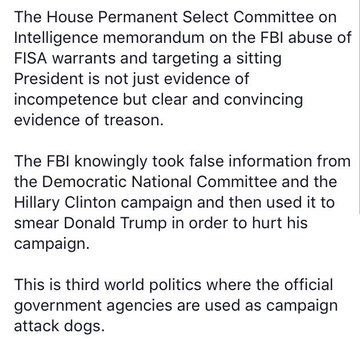

My full statement on the declassified memo:

Meanwhile, Georgia GOP Gubernatorial candidate Sen. Michael Williams is calling for the prosecution of Comey – saying he should be “sent to prison for his crimes“:
“The leadership of the FBI and DOJ behaved in a way we would expect of the former Soviet Union, not the United States of America. I applaud Representative Nunes and other Republican members of the House Intel Committee for fighting and exposing corruption. Americans are tired of corrupt bureaucrats and their career politician enablers. If powerful leaders are not held accountable, the American people will never regain faith in the institutions meant to protect us. Former FBI Director James Comey was entrusted with one of the most powerful positions in the world. Sadly, he intentionally abused his power in an effort to destroy Donald Trump’s presidency. He should be prosecuted to the fullest extent of the law and sent to prison for his crimes. No one is above the law. No one.”
We’re sure Attorney General Jeff Sessions – who resisted calls for a second special counsel to investigate FBI misconduct – will take Gosar’s request seriously, despite praising Deputy AG Rod Rosenstein earlier today for representing “the kind of quality and leadership that we want in the department” – right after the FISA memo detailing his conduct was released.

As the memo showing Rosenstein’s role in signing FISA applications based on faulty evidence was released this morning, Jeff Sessions said that he represents “the kind of quality and leadership that we want in the department.”

Nunes: FISA Memo Just “Phase One,” Now Targeting State Department In “Phase Two”
Devin Nunes (R-CA) said that the investigation leading up to the four-page FISA memo released on Friday was only “phase one,” and that the House Intelligence Committee is currently in the middle of investigating the State Department over their involvement in surveillance abuses.
“We are in the middle of what I call phase two of our investigation, which involves other departments, specifically the State Department and some of the involvement that they had in this,” said Nunes.
“That investigation is ongoing and we continue work towards finding answers and asking the right questions to try to get to the bottom of what exactly the State Department was up to in terms of this Russia investigation.”

#BREAKING: Devin Nunes says this is just the first memo to be released. He says there will be another one dealing specifically with the State Department’s role in everything that happened.


While it is unclear what role the State Department may have in surveillance abuses, the Washington Examiner‘s Byron York noted last month that former MI6 spy, Christopher Steele, was “well-connected with the Obama State Department,” according to the book Collusion: Secret meetings, dirty money, and how Russia helped Donald Trump win” written by The Guardian correspondent Luke Harding and published last November.

Glenn Simpson, Christopher Steele
Harding notes that Steele’s work during the World Cup soccer corruption investigation earned the trust of both the FBI and the State Department:
The [soccer] episode burnished Steele’s reputation inside the U.S. intelligence community and the FBI. Here was a pro, a well-connected Brit, who understood Russian espionage and its subterranean tricks. Steele was regarded as credible. Between 2014 and 2016, Steele authored more than a hundred reports on Russia and Ukraine.These were written for a private client but shared widely within the State Department and sent up to Secretary of State John Kerry and to Assistant Secretary of State Victoria Nuland, who was in charge of the U.S. response to the Ukraine crisis. Many of Steele’s secret sources were the same sources who would supply information on Trump. One former State Department envoy during the Obama administration said he read dozens of Steele’s reports on Russia. The envoy said that on Russia, Steele was “as good as the CIA or anyone.” Steele’s professional reputation inside U.S. agencies would prove important the next time he discovered alarming material, and lit the fuse again.
Aside from the infamous 35-page “Trump-Russia” dossier Steele assembled for opposition research firm Fusion GPS (a report which was funded in part by Hillary Clinton and the DNC), Congressional investigators have been looking into whether Steele compiled other reports about Trump – and in particular, whether those other reports made their way to the State Department, according to The Examiner.
…they are looking into whether those reports made their way to the State Department. They’re also seeking to learn what individual State Department officials did in relation to Steele, and whether there were any contacts between the State Department and the FBI or Justice Department concerning the anti-Trump material.
It will be interesting to see how the State Department – and in particular Secretary of State Rex Tillerson – responds to “phase two.”

Good thing Sessions isn’t some deep-state concession Trump had to agree to in exchange for GOP support during the election
end
Here we see certain CIA and FBI agents responding to the Nunes memo. Take particular interest in CIA agent Ray McGovern’s commentary including the excellent summary of events by Publicus Tacitus
(courtesy zerohedge)
CIA, FBI Agents Respond To Nunes’ Memo
We already noted the opposing perspectives of those in the media with regard the Nunes’ memo as being on the one hand “a nothing-burger” and on the other “we have never ever in history seen anything like this.”
And we have heard from current (“talk is cheap… keep calm and tackle hard”) and former (“dishonest and misleading”) heads of The FBI.
But now we get to hear from the rank-and-file of America’s intelligence agencies and, once again, the perspectives could not be further apart…
First, as The Hill reports,a former FBI agent says in a new op-ed that he has left the nation’s top law enforcement agency due to the “relentless” attacks on the bureau from critics such as President Trump and congressional Republicans.
In an op-ed for The New York Times, former supervisory special agent Josh Campbell wrote that “political attacks on the bureau must stop.”
“After more than a decade of service, which included investigating terrorism, working to rescue kidnapping victims overseas and being special assistant to the director, I am reluctantly turning in my badge and leaving an organization I love.” Campbell wrote.
“Why? So I can join the growing chorus of people who believe that the relentless attacks on the bureau undermine not just America’s premier law enforcement agency but also the nation’s security,” he continued.
“My resignation is painful, but the alternative of remaining quiet while the bureau is tarnished for political gain is impossible.”
Campbell also defended the agency’s involvement in the events described in the memo, which alleges the FBI and Department of Justice abused their surveillance powers.
“[E]very statement of fact included in an affidavit for foreign intelligence collection must withstand the scrutiny of at least 10 people in the Department of Justice hierarchy before it is reviewed by an independent court,” he wrote.
Campbell goes on to argue it would be “disingenuous” for Republicans to argue that the FBI is “plotting from within” against Trump or in favor of his 2016 opponent, Hillary Clinton, despite text messages between FBI employees Peter Strzok and Lisa Page seeming to confirm Strzok’s political bias against Trump.
“These political attacks on the bureau must stop. If those critics of the agency persuade the public that the FBI cannot be trusted, they will also have succeeded in making our nation less safe,” he said.
Campbell’s op-ed comes after the publication Friday of Nunes’ memo allegedly detailing abuses of the Foreign Intelligence Surveillance Act by the FBI.
However, another former intelligence agency operative saw things very differently.
Ray McGovern, 27-year veteran of the CIA and co-founder of Veteran Intelligence Professionals for Sanity (VIPS), exclaims the newly released “Nunes Memo” reveals felony wrongdoing by top members of the FBI and DOJ for misrepresenting evidence to obtain a FISA warrant and may implicate other intelligence officials.
The long-awaited House Intelligence Committee report made public today identifies current and former top officials of the FBI and the Department of Justice as guilty of the felony of misrepresenting evidence required to obtain a court warrant before surveilling American citizens. The target was candidate Donald Trump’s adviser Carter Page.
The main points of what is widely known as the “Nunes Memo,” after the House Intelligence Committee Chair Devin Nunes (R-Calif.), have been nicely summarized by blogger Publius Tacitus, who noted that the following very senior officials are now liable for contempt-of-court charges; namely, the current and former members of the FBI and the Department of Justice who signed off on fraudulent applications to the Foreign Intelligence Surveillance Court: James Comey, Andy McCabe, Sally Yates, Dana Boente and Rob Rosenstein. The following is Publius Tacitus’s summary of the main points:
- The dubious but celebrated Steele Dossier played a critical role in obtaining approval from the FISA court to carry out surveillance of Carter Page according to former FBI Deputy Director Andy McCabe.
- Christopher Steele was getting paid by the DNC and the FBI for the same information.
- No one at the FBI or the DOJ disclosed to the court that the Steele dossier was paid for by an opposition political campaign.
- The first FISA warrant was obtained on October 21, 2016 based on a story written by Michael Isikoff for Yahoo News based on information he received directly from Christopher Steele — the FBI did not disclose in the FISA application that Steele was the original source of the information.
- Christopher Steele was a long-standing FBI “source” but was terminated as a source after telling Mother Jones reporter David Corn that he had a relationship with the FBI.
- The FBI signers of the FISA applications/renewals were James Comey (three times) and Andrew McCabe.
- The DOJ signers of the FISA applications/renewals were Sally Yates, Dana Boente and Rod Rosenstein.
- Even after Steele was terminated by the FBI, he remained in contact with Deputy Attorney General Bruce Our, whose wife worked for FUSION GPS, a contractor that was deeply involved with the Steele dossier.
From what Michael Isikoff reported in September 2016 it appears that the CIA and the Director of National Intelligence (as well as the FBI) are implicated in spreading the disinformation about Trump and Russia. Isikoff wrote:
“U.S. intelligence officials are seeking to determine whether an American businessman identified by Donald Trump as one of his foreign policy advisers has opened up private communications with senior Russian officials — including talks about the possible lifting of economic sanctions if the Republican nominee becomes president, according to multiple sources who have been briefed on the issue. […]
“But U.S. officials have since received intelligence reports that during that same three-day trip, Page met with Igor Sechin, a longtime Putin associate and former Russian deputy prime minister who is now the executive chairman of Rosneft, Russian’s leading oil company, a well-placed Western intelligence source tells Yahoo News.”
Who were the “intelligence officials” briefing the select members of the House and Senate? That will be one of the next shoes to drop. We are likely to learn in the coming days that John Brennan and Jim Clapper were also trying to help the FBI build a fallacious case against Trump, adds Tacitus.
Indeed, Rep. Greg Walden (R-OR), Chair of the House Energy and Commerce Committee, has already indicated that his disclosures in the Nunes Memo represent just “one piece of a probably much larger mosaic of what went on.”
The Media Will Determine What Comes Next
As for Congressman Adam Schiff (D-Calif.), ranking member of the House Intelligence Committee, it is now abundantly clear why he went to ridiculous lengths, as did the entire Democratic congressional leadership, to block or impugn the House Intelligence Committee report.
Until the mid-December revelations of the text messages between FBI lovers Peter Strzok and Lisa Page turned Russia-gate into FBI/DOJ-gate, Schiff had been riding high, often hiding behind what he said “he could not tell” the rest of us.
With the media, including what used to be the progressive media, fully supporting the likes of Adam Schiff, and the FBI/CIA/NSA deep state likely to pull out all the stops, the die is now cast. We are in for a highly interesting time over the next months.
* * *
So – which is it? Crime of the century, or political grandstanding, or both?
end
It sure looks like his days are numbered: Rod Rosenstein apparently threatened Nunes with a subpoena trying to stop the release of the 4 page memo and on obtaining all of their texts and messages between them
(courtesy zerohedge)
Rod Rosenstein Reportedly Threatened Nunes, House Intel Members With Subpoena: Report
Deputy Attorney General Rod Rosenstein threatened to subpoena the “texts and messages” of House Intel Committee Chairman Devin Nunes and other members of Congress, according to legal analyst Greg Jarrett.
I can tell you a congressional source tells me that Rod Rosenstein in a meeting three weeks ago threatened Chairman Nunes and members of Congress he was going to subpoena their texts and messages because he was tired of dealing with the intel committee. That’s threats and intimidation and retaliation. –Greg Jarrett
Rosenstein was named in the four-page FISA memo as both signing off on one or more FISA applications on behalf of the DOJ, and working closely with then-Associate Deputy Attorney General Bruce Ohr – who was demoted for failing to reveal his ties to the author of the infamous 35-page “Trump-Russia” dossier.
Moments after the announcement that the memo was declassified, Trump spoke to reporters and was asked if the memo makes it more likely that he will fire Deputy AG Rod Rosenstein, to which Trump responded:
When asked if the memo makes it more likely he will fire Deputy Attorney General Rod Rosenstein, Trump responds: “You figure that one out.”

The FISA Memo, Obama, And The Election that Almost Wasn’t
“Round up the usual suspects,” will be as far as the Democrats will be willing to go in the wake of the FISA memo’s release. There is nothing in that memo that anyone following the Special Counsel Robert Mueller’s investigation doesn’t already know.
All the memo does is corroborate the bread crumbs left behind by a drip feed of leaks, counter-leaks and good ol’ fashioned investigative journalism. Since the memo is based on actual evidence that the FBI admits is real but will not allow us to see, the memo itself can be taken as fact.
The FBI has the evidence. They’ve showed it to the House Intelligence Committee. Both agree on the facts. So, by extension, the memo is all the evidence we need.
Put that in your DNC-scripted talking point pipe and blow it out your ass.

Conclusions Matter
Now that the timeline and paper trail have been determined the real implications of the memo and its facts can be discussed. I’m no longer interested in the game of cut and thrust to stop the truth from coming out.
I’m only interested now in the conclusions we can draw from the memo itself.
And those conclusions are chilling.
The out-going Obama administration, at the highest levels in coordination with the media, conspired to create news stories that supported a FISA warrant based on politically-motivated opposition research to undermine the newly-elected President of the United States.
Moreover, it knowingly omitted material facts to the court not once, but four times, to keep that surveillance warrant open in service of this operation. A warrant the FBI deputy director, Andrew McCabe, testified under oath to Congress that was key to its issuance.
They knew the dossier on Trump, compiled by Michael Steele, was unverifiable. They hid its origin and motivation from the court. The information from this warrant and the details of the dossier were used to move public opinion and Congress into supporting Robert Mueller’s investigation.
But, to what end?
To disgrace and force from office the President of the United States. Thus, these people, and the leadership of the Democratic Party, President Obama himself and Hillary Clinton’s staff all conspired to criminally disenfranchise more than 60 million Americans who voted for Donald Trump.
To say that this is bigger than Watergate is like calling World War II a minor kerfuffle.
What About the Voters!?
Think about this for one second and you know what I’m saying.
All of these people are guilty, at a minimum of corruption, conspiracy and fraud. I’m no legal scholar, so I’m sure the list of offenses is longer than one of Hillary Clinton’s tirades after someone criticized her latest pantsuit atrocity.
This ultimately opens all of these organizations up to the biggest civil rights class action lawsuit in the history of this country. The Obama administration and the Democratic Party used opposition research to paint a false narrative of corruption in the Oval Office to discredit the election.
How many riots and street demonstrations did we see in 2017 as outraged and triggered liberals ran around smashing in windows and beating people up because of their delusion based on a lie?
How many hours of lost productivity did the country suffer because of FBI complicity in an operation to overturn a legal election?
How many millions in property damage? Destroyed careers?
What about the direct victims of this disgusting display of government corruption taken to its logical conclusion?
Why is Michael Flynn nearly bankrupt after being hounded by Mueller for months only to get a nothing guilty plea on the thinnest of procedural offenses?
When the corruption is this venal isn’t it our right under the Constitution to petition our government for a redress of grievances? Who do we sue?
Because there’s material harm here and someone should be held responsible. This began under Obama’s watch. He set this whole process in motion. High ranking members of his cabinet are directly implicated by the facts in the memo.
And the memo is just the beginning of the discovery phase of this very public trial.
Government on Trial
But, I want more than that. I want it all out in the open. And I want those responsible, those for whom the titles, salaries, benefits and power we bestow on them to do our work, to stand up and be accountable.
And if they are too venal, feckless and narcissistic to admit these things, then we’ll drag them through the most embarrassing of show trials.
And that means stripping them of their wealth, power and privilege.
It means turning off their house organs in the media; outing the enablers, leakers, trolls and spooks.
It means releasing everything, unredacted, in the name of national security.
It means reminding them of just how much all of that depends on our consent, not theirs.
Because if we don’t demand these things, then next time there won’t even be the pretense of an election.
The FISA Memo Is Just The Beginning Of Fighting The Swamp
The FISA memo was released by the White House Friday. Completely unredacted. The fight to keep this memo out of the public eye has been intense. And since it’s existence was made known it has clarified our domestic politics in a way that few objects ever have.
With Russia-gate failing, Special Counsel Robert Mueller’s investigation stalling, this memo will make it clear that the only thing that matters in Washington D.C. is winning.
Political victories, not serving the people who elected you, are more important than any other consideration.
From Rep. Adam Schiff’s increasingly desperate attempts to stonewall the truth to the FBI’s predictable appeals to secrecy from law enforcement to cover corruption, this memo is lifting the scales from the eyes of voters all over the country.
It’s telling them the cockroaches have run out of corners to hide in.
Time to put on our pointy shoes and start kickin’.
The reaction to this memo puts paid the classic libertarian critique that an organization’s highest priority is self-preservation. Doing what you formed the organization to do comes a distant second.
Government creates organizations that are not directly accountable to the people who fund them and therefore can dig moats around themselves to ensure their survival no matter what.
This is the essence of corruption. It is the essence of why the Swamp needs to be drained.
The FBI is a corrupt and venal organization of power-hungry, self-righteous arbiters of arbitrary justice. Even the good agents are tainted by the organizational rot. The same is true in every government department.
No one sees corruption like a government employee with half a conscience.
The pressure to not release this memo comes from formerly very powerful people – Obama and his staff, the Clintons, the DNC, etc. The fallout will be an overhaul from the ground up of multiple powerful agencies within the Federal Government.
This is what Donald Trump was elected to do.
It will destroy the credibility of the Democratic Party. It will further weaken the credibility of their enablers at the top of the Republican Party. Make no mistake, no one important in Washington wants this memo released.
They know it will destroy careers and upset the normal way of doing things.
Good.
The normal way of doing things is awful. It leads to abuse, waste, fraud and enables the worst kind of criminal behavior. But, it also allows a system of corruption to throw dirt on everyone; making all involved, including the good people, choose between staying and fighting within that system or walking away knowing someone worse will come behind them.
That is the means by which these organizations preserve their survival.
And this memo is a direct threat to that. We may watch shows like House of Cards or even Game of Thrones and see the corruption play out in front of us.
But by dramatizing it we lose our fear of it.
Now we’ll get to see first-hand just how bad the corruption is and for those that still believe Trump is the anti-Christ or at least a repulsive boor, they will have to admit that the campaign against him was wrong.
That winning at all costs is not winning. It’s just another day at the Swamp.

That mobilizing the resources of multiple intelligence agencies to stop his election, or overturn it, is anathema to what our government exists for in the first place.
The memo shows that this is true. It’s time to end the childish tantrums, ask for some hip waders and get busy cleaning things up.
end
“An Organized Effort By Republicans To Obstruct”: Democrats Draft Talking Points To Refute FISA Memo
Top House Judiciary Committee Democrat Jerry Nadler (D-NY) has circulated talking points to refute the four-page FISA memo created by GOP staffers for House Intel Committee Chairman Devin Nunes (R-CA), detailing abuses of US surveillance capabilities against the Trump campaign.

Maxine Waters (D-CA), Jerry Nadler (D-NY)
Nadler’s talking points – which are separate from the official response by House Intel Committee Democrats – call the GOP-authored memo “deeply misleading,” according to Bloomberg, and claims that Republicans are now “part and parcel to an organized effort to obstruct” Special Counsel Robert Mueller’s investigation into Russian interference in the 2016 election.
“Until now, we could only really accuse House Republicans of ignoring the President’s open attempts to block the Russia investigation,” Democratic members of the House Judiciary Committee said in the four-page letter released on Saturday. The document provided a point-by-point rebuttal to the Republican memo alleging bias in Mueller’s probe of possible links between Russia and Trump’s campaign, according to Bloomberg’s summary.
“With the release of the Nunes memo — a backhanded attempt to cast doubt on the origins of the Special Counsel’s investigation — we can only conclude that House Republicans are complicit in the effort to help the President avoid accountability for his actions and for the actions of his campaign,” reads the talking points.
The “Nunes memo,” as Democrats call it, claims that the FBI obtained a FISA warrant against one-time low-level Trump advisor, Carter Page.
“Carter Page was, more likely than not, an agent of a foreign power. The Department of Justice thought so. A federal judge agreed. The consensus, supported by the facts, forms the basis of the warrant issued,” Nadler writes in the rebuttal.
Meanwhile, President Trump tweeted on Saturday morning that the FISA memo had “totally vindicated” him – despite the “Russian Witch Hunt” continuing.
This memo totally vindicates “Trump” in probe. But the Russian Witch Hunt goes on and on. Their was no Collusion and there was no Obstruction (the word now used because, after one year of looking endlessly and finding NOTHING, collusion is dead). This is an American disgrace!
Trump then quotes a Wall Street Journal article which says “the FBI became a tool of anti-Trump political actors.
“The four page memo released Friday reports the disturbing fact about how the FBI and FISA appear to have been used to influence the 2016 election and its aftermath….The FBI failed to inform the FISA court that the Clinton campaign had funded the dossier….the FBI became….
…a tool of anti-Trump political actors. This is unacceptable in a democracy and ought to alarm anyone who wants the FBI to be a nonpartisan enforcer of the law….The FBI wasn’t straight with Congress, as it hid most of these facts from investigators.” Wall Street Journal
Ranking House Democrat Adam Schiff (CA) disagreed, tweeting “quite the opposite, Mr. President.”
Quite the opposite, Mr. President. The most important fact disclosed in this otherwise shoddy memo was that FBI investigation began July 2016 with your advisor, Papadopoulos, who was secretly discussing stolen Clinton emails with the Russians. https://twitter.com/realDonaldTrump/status/959798743842349056 …

According to the New York Times, the FBI investigation into Russian collusion began after drunken Trump campaign volunteer, George Papadopoulos, reportedly told Australian diplomat Alexander Downer at a London bar in May, 2016 that “Russia had political dirt on Hillary Clinton.” When DNC emails began to leak, Australia apparently contacted US intelligence to report the drunken admission by Papadopoulos – igniting the Russia probe.
WASHINGTON — During a night of heavy drinking at an upscale London bar in May 2016, George Papadopoulos, a young foreign policy adviser to the Trump campaign, made a startling revelation to Australia’s top diplomat in Britain: Russia had political dirt on Hillary Clinton.
About three weeks earlier, Mr. Papadopoulos had been told that Moscow had thousands of emails that would embarrass Mrs. Clinton, apparently stolen in an effort to try to damage her campaign.
Exactly how much Mr. Papadopoulos said that night at the Kensington Wine Rooms with the Australian, Alexander Downer, is unclear. But two months later, when leaked Democratic emails began appearing online, Australian officials passed the information about Mr. Papadopoulos to their American counterparts, according to four current and former American and foreign officials with direct knowledge of the Australians’ role. –NYT
This is in stark contrast to GOP leaders who say that the salacious and unverified 34-page opposition research dossier triggered the probe.
For the New York Times – much like CNN’s botched “Bombshell” report from a few weeks ago that Donald Trump Jr. was told about the WikiLeaks emails before their release, only to issue a major correction because Trump Jr. was told after they were made public (by a random person), this “startling revelation” by the NYT that Papadopoulos spilled the beans about Russia having dirt on Clinton was already public information.
The Washington Examiner‘s Byron York tore into the NYT report:
NYT reports George Papadopoulos was a ‘driving factor’ that led FBI to start Trump-Russia probe in July 2016. Dossier played no role. 1/4 http://ow.ly/FZgg30hv6wU

So: 1) If Papadopoulos actions drove FBI probe, why wait til nearly Feb 2017 to interview him? If done to keep probe quiet before election, why wait more than two months after vote? 2/4
2) When did officials brief Congress about Papadopoulos? They briefed Congress about Carter Page in late summer 2016. 3/4
3) Did officials seek a surveillance warrant on Papadopoulos? They reportedly got one on Carter Page in summer 2016. Did they try to get one on Papadopoulos? If not, why not? 4/4
Some have suggested that Trump is now contemplating firing Rosenstein while give Mueller 30 days to present all evidence gathered thus far before shutting down his probe, although that move is sure to be met with renewed claims by Democrats that Trump will launch a constitutional crisis should he interfere in the probe in any way.
end
It looks like the House Intel Committee wil take up the Democratic memo on Monday and will likely allow its release to the public
(courtesy zerohedge)
House Intel Committee Will Take Up Democratic Memo On Monday: Report
As the fallout from the Friday release of the Republicans’ long-awaited FISA memo dominates the weekend news cycle, Reuters is reporting that the House Intelligence Committee will take up consideration of the Democrats’ rebuttal memo on Monday, according to two anonymous sources familiar with the deliberations.
The panel, which on Friday released the Republican document, will consider whether to declassify the Democratic memo, which Democrats say will highlight flaws and other shortcomings in the Republicans’ memo, which President Donald Trump tweeted Saturday that the memo “totally vindicates” him in the Russia probe. The meeting will take place at 5 pm ET on Monday, one of the sources said.
As we pointed out earlier, Democrats have begun drafting talking points to help rebut the memo – though these have been drafted independent of the memo.
Nadler’s talking points – which are separate from the official response by House Intel Committee Democrats – call the GOP-authored memo “deeply misleading,” and claim that Republicans are now “part and parcel to an organized effort to obstruct” Special Counsel Robert Mueller’s investigation into Russian interference in the 2016 election.
“Until now, we could only really accuse House Republicans of ignoring the President’s open attempts to block the Russia investigation,” Democratic members of the House Judiciary Committee said in the four-page letter released on Saturday. The document provided a point-by-point rebuttal to the Republican memo alleging bias in Mueller’s probe of possible links between Russia and Trump’s campaign, according to Bloomberg’s summary.

House Intel Committee Ranking Member Adam Schiff
“With the release of the Nunes memo – a backhanded attempt to cast doubt on the origins of the Special Counsel’s investigation – we can only conclude that House Republicans are complicit in the effort to help the President avoid accountability for his actions and for the actions of his campaign,” the talking points read.
In the memo, Democrats argue that the Page warrant was justified because he was “more likely than not, an agent of a foreign power.”
“Carter Page was, more likely than not, an agent of a foreign power. The Department of Justice thought so. A federal judge agreed. The consensus, supported by the facts, forms the basis of the warrant issued,”Nadler writes in the rebuttal.
Assuming the issue of releasing the document is taken up by the House committee on Monday, it’s unclear when it will be released.
* * *
As a reminder, the House Intel Committee already voted down Ranking Member Adam Schiff’s demand that the committee vote to declassify the Democrats’ memo…
Schiff: “.. I find the memo to be deeply misleading. We wrote for the committee a memo that sets out the accurate facts and their proper context. And, of course, not surprisingly, when we took this up the last night and the majority said that in the interest of full transparency they thought the public should see this, we moved to make our own memoranda public at the same time, and they voted that down.”
“And you could certainly say, well, isn’t the Democratic memo going to be just as skewed as the Republican memo? That’s not always the case. There are times when one party gets it right. The problem is the public won’t get to see the underlying materials, won’t get to make that judgment.”
But that’s the whole point of this GOP exercise. It’s the politicization of intelligence to protect the president, to circle the wagons around the White House as Bob Mueller’s investigation gets closer and closer to the president.”
Meanwhile, the Hill reports that, after initially opposing the release, Republicans on the Intel Committee are signaling mounting openness toward releasing the Democrats’ memo as political pressure mounts.
end
Seems that the FBI are accused of blocking key details on the Trump Dossier’s author, Glen Simpson
(courtesy zerohedge)
FBI Accused Of Blocking Key Details On “Trump Dossier” Author
Senate Judiciary Committee Chairman Chuck Grassley’s push to force the DOJ to open a criminal investigation into ex-British spy and “Trump dossier” author Christopher Steele is being met with resistance from the bureau, the latest sign that it doesn’t want information about its relationship with Steele to be shared with the public.
Bloomberg reported Monday that Senate Judiciary Chairman Chuck Grassley criticized the FBI for blocking the release of key portions of a memo he wrote calling for a criminal investigation of Christopher Steele, the former British spy who compiled a dossier of unverified allegations on Donald Trump.
Grassley also released the memo in its redacted form to the press.
“Seeking transparency and cooperation should not be this challenging,” Grassley said in a statement after posting a heavily redacted version of the criminal referral that he and GOP Senator Lindsey Graham of South Carolina sent to the Justice Department last month. “The government should not be blotting out information that it admits isn’t secret.”
Grassley has been pursuing questions about the FBI’s reliance on Steele separately from House Intelligence Chairman Devin Nunes, the author of the four-page “FISA memo” that was released last week and inspired President Trump to declare that he has been “vindicated” by its findings.
Conservative lawmakers have demanded that President Trump fire Deputy AG Rod Rosenstein, the official responsible for supervising the Mueller probe – and some have even called for Mueller’s firing. But others, including outgoing Congressman and House Oversight Committee Chairman Trey Gowdy, have said the revelations packaged in the memo wouldn’t justify ending the Russia probe.

Grassley’s push is emblematic of the intense rivalry that has sprung up between the various Congressional committees pursuing their own independent investigations of Trump and Hillary Clinton’s relationships with Russian entities or officials.
Democrats have dismissed the memo as inaccurate and misleading and are pushing for release of their own document challenging the Republican account. The Intel Committee is set to meet Monday at 5 pm to decide on whether to release the memo. Washington time to vote on the possible release of the Democratic response.
As the rivalry between the White House and Republicans on one side, and the FBI and DOJ, on the other, accelerates, Grassley and Graham asked the DOJ to investigate whether Steele made false statements to federal investigators.
In the newly released memo, the pair wrote that they had sent the criminal referral because there’s evidence that Steele, whose opposition research was funded largely by Trump rival Hillary Clinton and the Democrats, either lied to the FBI or to a British court, or that classified documents reviewed by the committee are false.
As Bloomberg also notes, Grassley asked the FBI to approve a declassified version of his Steele referral by Tuesday.
Meanwhile, Politico reports that Grassley and Graham on Monday also asked the Department of Justice and FBI to declassify more information related to their Steele referral, including an application to conduct surveillance of former Trump campaign adviser Carter Page.
That surveillance application, Republicans have said, improperly involved research conducted by Steele that was paid for by the Clinton campaign. Republicans on Friday released a declassified memo they wrote on the subject.
Suspiciously, the redacted letter includes a blacked-out section led by the sentence “there is substantial evidence suggesting that Mr. Steele materially misled the FBI about a key aspect of his dossier efforts, one which bears on his credibility.”
Furthermore, a section on a second memo by Steele says he received information from the State Department, which in turn got it from a foreign source who was in touch with “a friend of the Clintons.”
“It is troubling enough that the Clinton Campaign funded Mr. Steele’s work, but that these Clinton associates were contemporaneously feeding Mr. Steele allegations raises additional concerns about his credibility,” Grassley and Graham wrote in their criminal referral.
Full memo below
see zerohedge
end
The war between the FBI and the Dept of Justice just went nuclear..and it should
Trump attorneys approve a second special counsel to probe the FBI and the Dept of Justice with respect to the election of Nov 8 2016
(courtesy zerohedge)
Trump Attorneys Approve Second Special Counsel To Probe FBI and DOJ
The war between the White House and the FBI/DOJ complex may be turning nuclear.
While speaking to reported aboard Air Force 1, Deputy Press Secretary Raj Shah said that President Trump’s attorneys have already approved the idea of appointing a second special counsel to investigate the FBI and Justice Department’s actions during the 2016 presidential campaign, according to White House pool reports.

The excerpt from the pool in question:
*FISA warrant should it be released? and what about a second special counsel?*
**
Presidents attorneys have addressed this and said yes to a second special counsel.
FISA: That document along with any other that the House Intelligence Committee chooses to vote out of its committee through its process and all the House procedures, we would entertain like anything else.
As Axios adds, Shah also said that the White House will approach further memos, including the one created by Democrats, in the same way they handled the memo authored by Devin Nunes:
“Which is to allow for a legal review, national security review led by the White House Counsel’s Office, and then within five days the president will make a decision about declassifying it,” said Shah.
And another highlight from the gaggle summarized by Axios:
Trump’s tweet calling Rep. Adam Schiff a leaker: “We don’t really see any reason why anybody else would leak his information other than partisan political stunts by Adam Schiff and other members of the minority.”
Fed Wants Lower Dollar and Inflation – Craig Hemke
By Greg Hunter On February 4, 2018 In Market Analysis
By Greg Hunter’s USAWatchdog.com (Early Sunday Release)
Financial writer and precious metals expert Craig Hemke contends there is no mystery why the dollar is going down in value. Hemke explains, “You’ve got the Fed wanting a lower dollar.You’ve got the President of the United States wanting a lower dollar and, lo and behold, the dollar is going down. It was a year ago, about this time, when the predominate story was “king dollar.” The dollar was going to soar and all this kind of jazz. Last year (2017), it looked like it was breaking out, and it got to 103 (on the USDX). Instead, it fell by 10% and, so far this year, it’s already down about 3%, and here we are just in early February. It’s not straight down. It’s probably not going to plunge in 2018 as fast as it rose in 2014, but anyone can take a look at a chart and see it’s going down. This has significant implications for this year and going into next year. If it was disinflation on the way up, it will be inflation on the way down.”Hemke thinks commodities are undervalued and cheap relative to stocks, which just had the biggest one day sell-off in years. Hemke contends, “$15 trillion worth of QE has been applied, $15 trillion worth of currency created in the last 8 years. . . . So, there are trillions and trillions of dollars that are sloshing around the planet, and when they all head in one direction, you get things like Bitcoin. If all of this money starts to head into commodities due to a falling dollar and recognition of inflation, commodities are going up, as is crude, as is silver. I think it would be wise of people to position themselves ahead of it. . . . The commodities sector will rebound on the sinking dollar.”
Hemke says the dollar is not just facing technical forces of devaluation, but it also faces some political risk. The dollar is basically a confidence game, and if people lose confidence in the U.S., the dollar can take a sharp beating. Hemke says, “This is something we are going to be talking about all year. I call it the three major themes for 2018. . . . Political risk. . . . Geopolitical risk . . . and de-dollarization. You can see how these pieces fit together. . . . This could get more disorderly than it was in 2008. . . . The point of this forecast is not to sit here and say gold is going back to $1,900 (per ounce) by this time next year and then going to $5,000. What I am trying to say is people need to recognize an opportunity when it presents itself. We have had to sit and put up with this garbage for the last five years with prices getting continually pounded, rallying and then getting beaten back. Now, you can see on the chart, and not just gold, it’s silver, it’s crude oil, it’s copper and all these other commodities . . . There is an opportunity here for people who want to take advantage of it.”
Join Greg Hunter as he goes One-on-One with Craig Hemke of TFMetalsReport.com.
Video Link
https://usawatchdog.com/fed-wants-lower-dollar-and- inflation-craig-hemke/
-END-
HARVEY


 harveyorganblog.com
Good post! I can learn much stuff from your article. And I have shared
this post to my facebook and reddit. The followers all loved it.
Thank you again.
LikeLike