
GOLD: $1318,20 DOWN $ 2,35 (COMEX TO COMEX CLOSINGS)
Silver: $16.62 DOWN 10 CENTS (COMEX TO COMEX CLOSINGS)
Closing access prices:
Gold $1313.50
silver: $16.52
For comex gold:
MAY/
NUMBER OF NOTICES FILED TODAY FOR MAY CONTRACT:3 NOTICE(S) FOR 300 OZ.
TOTAL NOTICES SO FAR 621 FOR 62100 OZ (1.9315 tonnes)
For silver:
MAY
72 NOTICE(S) FILED TODAY FOR
360,000 OZ/
Total number of notices filed so far this month: 5909 for 29,545,000 oz
XXXXXXXXXXXXXXXXXXXXXXXXXXXXXX
Bitcoin: BID $8361/OFFER $8461: DOWN $17(morning)
Bitcoin: BID/ $8777/offer $8877: UP $398 (CLOSING/5 PM)
end
First Shanghai gold fix comes at 10 pm est
The second Shanghai gold fix: 2:15 pm
First Shanghai gold fix gold: 10 pm est: 1327.92
NY price at the same time: 1320.25
PREMIUM TO NY SPOT: $7,67
ss
Second gold fix early this morning: 1328.02
USA gold at the exact same time: 1321.00
PREMIUM TO NY SPOT: $7.02
AGAIN, SHANGHAI REJECTS NEW YORK PRICING.
WE WILL NOT PROVIDE LONDON FIXES AS THEY ARE NOT ACCURATE AS TO WHAT IS GOING ON AT THE SAME TIME FRAME.
Let us have a look at the data for today
xxxxxxxxxxxxxxxxxxxxxxxxxxxxxxxxxxxxxxxxxxxxxxxxxxxxxxxxxxxxxxxxxxxxxxxxxx
In silver, the total OPEN INTEREST FELL BY A TINY 347 CONTRACTS FROM 198,275 FALLING TO 197,928 WITH FRIDAY’S 2 CENT LOSS IN SILVER PRICING. WE ARE NOW WITNESSING OUR USUAL AND CUSTOMARY COMEX LONG LIQUIDATION AS WE ENTERED INTO THE ACTIVE DELIVERY MONTH OF MAY AS LONGS PACK THEIR BAGS AND MIGRATE OVER TO LONDON. WE WERE NOTIFIED THAT WE HAD A STRONG SIZED NUMBER OF COMEX LONGS TRANSFERRING THEIR CONTRACTS TO LONDON THROUGH THE EFP : 2799 EFP’S FOR JULY AND ZERO FOR ALL OTHER MONTHS AND THEREFORE TOTAL ISSUANCE OF 2799 CONTRACTS. WITH THE TRANSFER OF 2799 CONTRACTS, WHAT THE CME IS STATING IS THAT THERE IS NO SILVER (OR GOLD) TO BE DELIVERED UPON AT THE COMEX AS THEY MUST EXPORT THEIR OBLIGATION TO LONDON. ALSO KEEP IN MIND THAT THERE CAN BE A DELAY OF 24-48 HRS IN THE ISSUING OF EFP’S. THE 2799 EFP CONTRACTS TRANSLATES INTO 16.31 MILLION OZ ACCOMPANYING:
1.THE TINY 2 CENT FALL IN SILVER PRICE AT THE COMEX AND
2. THE STRONG AMOUNT OF SILVER OUNCES STANDING FOR MAY COMEX DELIVERY. (30.04 MILLION OZ)
ACCUMULATION FOR EFP’S/SILVER/J.P.MORGAN’S HOUSE OF BRIBES, / STARTING FROM FIRST DAY NOTICE/FOR MONTH OF APRIL: (FINAL)
18,995 CONTRACTS (FOR 10 TRADING DAYS TOTAL 18,995 CONTRACTS) OR 94.975 MILLION OZ: AVERAGE PER DAY: 1900 CONTRACTS OR 9.500 MILLION OZ/DAY
TO GIVE YOU AN IDEA AS TO THE HUGE SUPPLY THIS MONTH IN SILVER: SO FAR THIS MONTH: 94.975 MILLION PAPER OZ HAVE MORPHED OVER TO LONDON. THIS REPRESENTS AROUND 13.567% OF ANNUAL GLOBAL PRODUCTION (EX CHINA EX RUSSIA)
ACCUMULATION IN YEAR 2018 TO DATE SILVER EFP’S: 1,240.3 MILLION OZ.
ACCUMULATION FOR JAN 2018: 236.879 MILLION OZ
ACCUMULATION FOR FEB 2018: 244.95 MILLION OZ
ACCUMULATION FOR MARCH 2018: 236.67 MILLION OZ
ACCUMULATION FOR APRIL 2018: 385.75 MILLION OZ
RESULT: WE HAD A TINY SIZED DECREASE IN COMEX OI SILVER COMEX OF 347 WITH THE 2 CENT LOSS IN SILVER PRICE. WE HAVE NOW ENTERED THE NEW ACTIVE MONTH OF MAY. THE CME NOTIFIED US THAT IN FACT WE HAD AN STRONG SIZED EFP ISSUANCE OF 2799 CONTRACTS WHICH EXITED OUT OF THE SILVER COMEX AND TRANSFERRED THEIR OI TO LONDON AS FORWARDS. SPECULATORS CONTINUED THEIR INTEREST IN ATTACKING THE SILVER COMEX FOR PHYSICAL SILVER (SEE COMEX DATA) . FROM THE CME DATA: 2799 EFP CONTRACTS FOR JULY, AND ZERO FOR ALL OVER MONTHS FOR A DELIVERABLE FORWARD CONTRACT OVER IN LONDON WITH A FIAT BONUS (TOTAL: 2799). TODAY WE GAINED 2452 TOTAL OI CONTRACTS ON THE TWO EXCHANGES: i.e. 2799 OPEN INTEREST CONTRACTS HEADED FOR LONDON (EFP’s) TOGETHER WITH AN DECREASE OF 347 OI COMEX CONTRACTS. AND ALL OF THIS HAPPENED WITH THE FALL IN PRICE OF SILVER OF 2 CENTS AND A CLOSING PRICE OF $16.71 WITH RESPECT TO YESTERDAY’S TRADING. YET WE STILL HAVE A STRONG AMOUNT OF SILVER STANDING AT THE COMEX FOR DELIVERY IN THIS ACTIVE MAY DELIVERY MONTH. IT SURE SEEMS THAT WE MUST HAVE HAD SOME BANKER SHORT COVERING ON BOTH EXCHANGES.
In ounces AT THE COMEX, the OI is still represented by UNDER 1 BILLION oz i.e. .990 MILLION OZ TO BE EXACT or 142% of annual global silver production (ex Russia & ex China).
FOR THE NEW FRONT MAY MONTH/ THEY FILED AT THE COMEX: 72 NOTICE(S) FOR 360,000 OZ OF SILVER
IN SILVER, WE HAVE NOW SET THE NEW RECORD OF OPEN INTEREST AT 243,411 AND AGAIN THIS HAS BEEN SET WITH A LOW PRICE OF $16.51 ON APRIL 9.2018.
ON THE DEMAND SIDE WE HAVE THE FOLLOWING:
- HUGE AMOUNTS OF SILVER STANDING FOR DELIVERY (MARCH: 27 MILLION OZ , APRIL: 2.485 MILLION OZ AND MAY: 30.04 MILLION OZ )
- HUGE RECORD OPEN INTEREST IN SILVER 243,411 CONTRACTS (OR 1.217 BILLION OZ/ SET APRIL 9/2018
- HUGE ANNUAL EFP’S ISSUANCE EQUAL TO 2.9 BILLION OZ OR 400% OF SILVER ANNUAL PRODUCTION/2017
- RECORD SETTING EFP ISSUANCE FOR ANY MONTH IN SILVER; APRIL/2018/ 385.75 MILLION OZ/ (FINAL)
AND YET, WITH THE EXTREMELY HIGH EFP ISSUANCE, WE HAVE A CONTINUAL LOW PRICE OF SILVER DESPITE THE ABOVE HUGE DEMAND. TO ME THE ONLY ANSWER IS THAT WE HAVE SOVEREIGN (CHINA) WHO IS ENDEAVOURING TO GOBBLE UP ALL AVAILABLE PHYSICAL SILVER NO MATTER WHERE, EXACTLY WHAT J.P.MORGAN IS DOING. AND IT IS MY BELIEF THAT J.P.MORGAN IS HOLDING ITS SILVER FOR ITS BENEFICIAL OWNER..THE USA GOVERNMENT WHO IN TURN IS HOLDING THAT SILVER FOR CHINA.(FOR A SILVER LOAN REPAYMENT). IT ALSO LOOKS LIKE BANKER CAPITULATION IN SILVER AS THEY STRUGGLE TO REMOVE SOME OF THEIR HUGE OBLIGATIONS.
In gold, the open interest FELL BY A CONSIDERABLE 4138 CONTRACTS DOWN TO 502,178 WITH THE LOSS IN THE GOLD PRICE/FRIDAY’S TRADING (LOSS OF $1.75). WE ARE NOW IN THE NON ACTIVE DELIVERY MONTH OF MAY. THE CME RELEASED THE DATA FOR EFP ISSUANCE AND IT TOTALED A SMALL SIZED 2819 CONTRACTS : JUNE SAW THE ISSUANCE OF 2819 CONTRACTS , MAY SAW THE ISSUANCE OF 0 CONTRACTS AND AUGUST SAW THE ISSUANCE OF: 0 CONTRACTS WITH ALL OTHER MONTHS ZERO. The new OI for the gold complex rests at 502,732. ALSO REMEMBER THAT THERE WILL BE A DELAY IN THE ISSUANCE OF EFP’S. THE BANKERS REMOVE LONG POSITIONS OF COMEX GOLD IMMEDIATELY. THEN THEY ORCHESTRATE THEIR PRIVATE EFP DEAL WITH THE LONGS AND THAT COULD TAKE AN ADDITIONAL 48 HRS SO WE GENERALLY DO NOT GET A MATCH WITH RESPECT TO DEPARTING COMEX LONGS AND NEW EFP LONG TRANSFERS. . EVEN THOUGH THE BANKERS ISSUED THESE MONSTROUS EFPS, THE OBLIGATION STILL RESTS WITH THE BANKERS TO SUPPLY METAL BUT IT TRANSFERS THE RISK TO A LONDON BANKER OBLIGATION AND NOT A NEW YORK COMEX OBLIGATION. LONGS RECEIVE A FIAT BONUS TOGETHER WITH A LONG LONDON FORWARD. THUS, BY THESE ACTIONS, THE BANKERS AT THE COMEX HAVE JUST STATED THAT THEY HAVE NO APPRECIABLE METAL!! THIS IS A MASSIVE FRAUD: THEY CANNOT SUPPLY ANY METAL TO OUR COMEX LONGS BUT THEY ARE QUITE WILLING TO SUPPLY MASSIVE NON BACKED GOLD (AND SILVER) PAPER KNOWING THAT THEY HAVE NO METAL TO SATISFY OUR LONGS. LONDON IS NOW SEVERELY BACKWARD IN BOTH GOLD AND SILVER AND WE ARE WITNESSING DELAYS IN ACTUAL DELIVERIES.
IN ESSENCE WE HAVE A SMALL SIZED OI LOSS IN TOTAL CONTRACTS ON THE TWO EXCHANGES: 4138 OI CONTRACTS DECREASED AT THE COMEX AND AN SMALL SIZED 2819 EFP OI CONTRACTS WHICH NAVIGATED OVER TO LONDON.THUS TOTAL OI LOSS: 1319 CONTRACTS OR 131,900 OZ = 4.10 TONNES. AND ALL OF THIS OCCURRED WITH A LOSS OF $1.75
FRIDAY, WE HAD 8945 EFP’S ISSUED.
ACCUMULATION OF EFP’S GOLD AT J.P. MORGAN’S HOUSE OF BRIBES: (EXCHANGE FOR PHYSICAL) FOR THE MONTH OF MAY : 88,950 CONTRACTS OR 8,895,000 OZ OR 276.67 TONNES (10 TRADING DAYS AND THUS AVERAGING: 8,895 EFP CONTRACTS PER TRADING DAY OR 889,500 OZ/ TRADING DAY),,
TO GIVE YOU AN IDEA AS TO THE HUGE SIZE OF THESE EFP TRANSFERS : THIS MONTH IN 10 TRADING DAYS IN TONNES: 276.67 TONNES
TOTAL ANNUAL GOLD PRODUCTION, 2017, THROUGHOUT THE WORLD EX CHINA EX RUSSIA: 2555 TONNES
THUS EFP TRANSFERS REPRESENTS 276.67/2550 x 100% TONNES = 10.84% OF GLOBAL ANNUAL PRODUCTION SO FAR IN APRIL ALONE.*** THE ACCUMULATION OF EFP CONTRACTS IS RISING PER MONTH.
ACCUMULATION OF GOLD EFP’S YEAR 2018 TO DATE: 3,034.61* TONNES *SURPASSED ANNUAL PROD’N
ACCUMULATION OF GOLD EFP’S FOR JANUARY 2018: 653.22 TONNES
ACCUMULATION OF GOLD EFP’S FOR FEBRUARY 2018: 649.45 TONNES
ACCUMULATION OF GOLD EFP’S FOR MARCH 2018: 741.89 TONNES (22 TRADING DAYS)
ACCUMULATION OF GOLD EFP’S FOR APRIL 2018: 713.84 TONNES (21 TRADING DAYS)
WHAT IS ALARMING TO ME, ACCORDING TO OUR LONDON EXPERT ANDREW MAGUIRE IS THAT THESE EFP’S ARE BEING TRANSFERRED TO WHAT ARE CALLED SERIAL FORWARD CONTRACT OBLIGATIONS AND THESE CONTRACTS ARE LESS THAN 14 DAYS. ANYTHING GREATER THAN 14 DAYS, THESE MUST BE RECORDED AND SENT TO THE COMPTROLLER, GREAT BRITAIN TO MONITOR RISK TO THE BANKING SYSTEM. IF THIS IS INDEED TRUE, THEN THIS IS A MASSIVE CONSPIRACY TO DEFRAUD AS WE NOW WITNESS A MONSTROUS TOTAL EFP’S ISSUANCE AS IT HEADS INTO THE STRATOSPHERE.
Result: A CONSIDERABLE SIZED DECREASE IN OI AT THE COMEX OF 4138 WITH THE $1.75 FALL IN PRICE // GOLD TRADING FRIDAY ($1.75 LOSS). WE ALSO HAD A SMALL SIZED NUMBER OF COMEX LONG TRANSFERRING TO LONDON THROUGH THE EFP ROUTE: 2819 CONTRACTS AS THESE HAVE ALREADY BEEN NEGOTIATED AND CONFIRMED. THERE OBVIOUSLY DOES NOT SEEM TO BE MUCH PHYSICAL GOLD AT THE COMEX. I GUESS IT EXPLAINS THE HUGE ISSUANCE OF EFP’S…THERE IS HARDLY ANY GOLD PRESENT AT THE GOLD COMEX FOR DELIVERY PURPOSES. IF YOU TAKE INTO ACCOUNT THE 2819 EFP CONTRACTS ISSUED, WE HAD A SMALL SIZED NET LOSS OF 1319 CONTRACTS IN TOTAL OPEN INTEREST ON THE TWO EXCHANGES:
2819 CONTRACTS MOVE TO LONDON AND 4138 CONTRACTS DECREASED AT THE COMEX. (in tonnes, the LOSS in total oi equates to 4.10 TONNES). ..AND ALL OF THESE OCCURRED AT THE COMEX WITH A LOSS OF $1.75 IN TRADING.
we had: 3 notice(s) filed upon for 300 oz of gold at the comex.
xxxxxxxxxxxxxxxxxxxxxxxxxxxxxxxxxxxxxxxxxxxxxxxxxxxxxxxxxxx
With respect to our two criminal funds, the GLD and the SLV:
GLD…
WITH GOLD DOWN $2.35 /TWO HUGE CHANGES IN GOLD INVENTORY AT THE GLD/a) A DEPOSIT OF 4.68 TONNES (ARRIVED LAST FRIDAY NIGHT)
b) a withdrawal of 1.48 tonnes: net transaction: a gain of 3.2 tonnes
Inventory rests tonight: 866.17 tonnes.
SLV/
WITH SILVER DOWN 10 CENTS A SMALL CHANGES IN THE SILVER INVENTORY AT THE SLV INVENTORY/ A WITHDRAWAL OF 848,000 OZ FROM THE SLV
/INVENTORY RESTS AT 319.591 MILLION OZ/
end
First, here is an outline of what will be discussed tonight:
1. Today, we had the open interest in SILVER FELL BY A TINY SIZED 347 CONTRACTS from 198,275 UP TO 197,928 (AND, FURTHER FROM THE NEW COMEX RECORD SET /APRIL 9/2017 AT 243,411/SILVER PRICE AT THAT DAY: $16.53). THE PREVIOUS RECORD OTHER THAN WAS ESTABLISHED AT: 234,787, SET ON APRIL 21.2017 OVER ONE YEAR AGO. THE PRICE OF SILVER ON THAT DAY: $17.89. OUR CUSTOMARY MIGRATION OF COMEX LONGS MORPH INTO LONDON FORWARDS CONTINUES AS OUR BANKERS USED THEIR EMERGENCY PROCEDURE TO ISSUE: 0 EFP CONTRACTS FOR APRIL, 0 EFP CONTRACTS FOR MAY (WE DO NOT GET A LOOK AT THESE CONTRACTS AS IT IS PRIVATE BUT THE CFTC DOES AUDIT THEM), AND 2799 EFP’S FOR JULY AND ALL OTHER MONTHS ZERO. TOTAL EFP ISSUANCE: 2799 CONTRACTS. EFP’S GIVE OUR COMEX LONGS A FIAT BONUS PLUS A DELIVERABLE PRODUCT OVER IN LONDON. IF WE TAKE THE OI LOSS AT THE COMEX OF 347 CONTRACTS TO THE 2799 OI TRANSFERRED TO LONDON THROUGH EFP’S, WE OBTAIN A GAIN OF 2452 OPEN INTEREST CONTRACTS. THUS IN OUNCES, THE GAIN ON THE TWO EXCHANGES: 12.26 MILLION OZ!!! AND THIS OCCURRED WITH A 2 CENT LOSS IN PRICE . THE BANKERS ORCHESTRATED THEIR RAID THROUGHOUT LAST WEEK DESPERATELY TRYING TO PARE THEIR GIGANTIC OPEN INTEREST SHORT ON BOTH EXCHANGES BUT TO NO AVAIL. JUDGING BY THE RECORD NUMBER OF EFP ISSUANCE DURING LAST MONTH OF APRIL AT 385.75 MILLION OZ AND THE TOTAL OI GAIN ON THE TWO EXCHANGES, I DO NOT THINK THAT OUR BANKERS HAVE BEEN TOO SUCCESSFUL. THE CONSTANT RAIDS ARE NOW BEING CALLED UPON BY OUR BANKER FRIENDS ARE DONE IN AN ATTEMPT TO SHAKE AS MANY SILVER LEAVES FROM THE SILVER TREE AS POSSIBLE.
RESULT: A TINY SIZED DECREASE IN SILVER OI AT THE COMEX WITH THE 2 CENT FALL IN SILVER PRICING FRIDAY. BUT WE ALSO HAD ANOTHER STRONG SIZED 2799 EFP’S ISSUED TRANSFERRING COMEX LONGS OVER TO LONDON. TOGETHER WITH THE STRONG SIZED AMOUNT OF SILVER OUNCES STANDING FOR APRIL, DEMAND FOR PHYSICAL SILVER CONTINUES TO INTENSIFY AS WE WITNESS SEVERE BACKWARDATION IN SILVER IN LONDON.
(report Harvey)
.
2.a) The Shanghai and London gold fix report
(Harvey)
2 b) Gold/silver trading overnight Europe, Goldcore
(Mark O’Byrne/zerohedge
and in NY: Bloomberg
3. ASIAN AFFAIRS
i)MONDAY MORNING/SUNDAY NIGHT: Shanghai closed UP 10.77 points or 0 .34% /Hang Sang CLOSED UP 419,02 points or 1.35% / The Nikkei closed UP 107.18 POINTS OR 0.47% /Australia’s all ordinaires CLOSED UP .30% /Chinese yuan (ONSHORE) closed DOWN at 6.3379/Oil DOWN to 70.77 dollars per barrel for WTI and 77.34 for Brent. Stocks in Europe OPENED RED. ONSHORE YUAN CLOSED UP AT 6.3379 AGAINST THE DOLLAR. OFFSHORE YUAN CLOSED UP ON THE DOLLAR AT 6.3303/ONSHORE YUAN TRADING WEAKER AGAINST OFFSHORE YUAN/ONSHORE YUAN TRADING WEAKER AGAINST USA DOLLAR/OFFSHORE YUAN TRADING WEAKER AGAINST THE DOLLAR /CHINA RETALIATES WITH TARIFFS/ TRUMP RESPONDS TO NEW TARIFFS AND IT NOW LOOKS LIKE A FULL TRADE WAR IS BEGINNING/
/NORTH KOREA/SOUTH KOREA
i)North Korea/South Korea/USA
b) REPORT ON JAPAN
3 c CHINA
Is this why Trump folded on Chinese telecom ZTE?
( zerohedge)
4. EUROPEAN AFFAIRS
ITALY
i)Saturday: The Italian coalition takes shape and the platform includes a parallel currency something that the EU will certainly frown upon
( Mish Shedlock/Mishtalk)
ii)An extremely important commentary from Tom Luongo re the merger or the two Euroskeptic parties to form a government. In essence, Luongo correctly states that the two parties will pinpoint immigration immediately and not target leaving the euro immediately. The new government’s new platform consists of a flat tax of 15% which will surely win over the populace. The new government intends on introducing a parallel currency which will help stimulate their moribund economy. In short order, Italy’s deficit will increase dramatically, setting the stage for the government to eventually leave the Euro
( Tom Luongo)
iii)The 5 tar and League have now reached a deal clearing way for the first European” anti establishment government”. The key question: Who will buy Italian bonds once the ECB stops its QE. The ECB is the only buyer of Italian bonds!!
( zerohedge)
iv)ECB
The ECB has been constant with their rhetoric that QE will end by September. How on earth investors are spooked on is beyond me
( zerohedge)
5. RUSSIAN AND MIDDLE EASTERN AFFAIRS
ii)ISRAEL
Sunday: Israeli Air Force strikes the Gaza strip as more than 20 missiles have been fired
( zerohedge)
( zerohedge)
iv)ISRAEL/GAZA STRIP
( zerohedge)
v)IRAN/CHINA
A fallout from the Iran sanctions: China is now set to replace the huge oil company Total with its own sovereign wealth company: CNPC
Beijing also launches a new Iranian train route from Beijing to Tehran
( zerohedge)
6 .GLOBAL ISSUES
7. OIL ISSUES
Even though Europe continues to buy Iranian oil, it is the financing of these purchases through banks that may be thwarted.
( Paraskova/OilPrice.com)
8. EMERGING MARKET
i)ARGENTINA
Sunday
Argentina has been suffering with high inflation as the government cuts off subsidies. Now the higher dollar is creating massive problems for this nation which has massive external debt denominated in dollars
( zero hedge)
Monday
The Argentine government has spent on Friday 1 billion defending its currency at 24 to the dollar. Today, it is offering 5 billion dollars in the peso market at 25 to the dollar and that is 10% of its entire reserves
( zero hedge)
9. PHYSICAL MARKETS
10. USA stories which will influence the price of gold/silver
c)In our Friday commentary we noted that there is an FBI mole who became part of the Trump team. The hunt for him (her) intensifies. We now have information that Brennan Strzok and Kerry set “spy traps” for the Trump team.( zerohedge)
d)Another biggy!!
Steven Calabresi who clerked for Antonin Scalia writes a scathing attack on Mueller in the Wall Street Journal claiming that his appointment was unconstitutional. His reasoning is straight forward.
a must read…
(zerohedge)
e)funny!!
Trading Volumes on the COMEX
PRELIMINARY COMEX VOLUME FOR TODAY: 236,657 contracts
CONFIRMED COMEX VOL. FOR YESTERDAY: 295,690 contracts
xxxxxxxxxxxxxxxxxxxxxxxxxxxxxxxxxxxxxxxxxxxxxxxxxxxxxxxxxxxxxxxxxxxx
And now for the wild silver comex results.
Total silver OI FELL BY A TINY SIZED 347 CONTRACTS FROM 198,275 DOWN TO 197,928 (AND CLOSER TO THE NEW RECORD OI FOR SILVER SET APRIL 9.2018/ 243,411 CONTRACTS) WITH THE 2 CENT FALL IN SILVER PRICING ON FRIDAY. SINCE WE ARE NOW INTO THE ACTIVE DELIVERY MONTH OF MAY. WE WERE INFORMED THAT WE HAD A STRONG SIZED 2799 EFP CONTRACT ISSUANCE FOR JULY AND ZERO FOR ALL OTHER MONTHS. THESE EFPS WERE ISSUED TO COMEX LONGS WHO RECEIVED A FIAT BONUS PLUS A DELIVERABLE PRODUCT OVER IN LONDON. THE TOTAL EFP’S ISSUED: 2799. ON A NET BASIS WE GAINED 2640 SILVER OPEN INTEREST CONTRACTS AS WE OBTAINED A 347 CONTRACT LOSS AT THE COMEX COMBINING WITH THE ADDITION OF 2799 OI CONTRACTS NAVIGATING OVER TO LONDON.
NET GAIN ON THE TWO EXCHANGES: 2452 CONTRACTS
AMOUNT STANDING FOR SILVER AT THE COMEX
We are now in the active delivery month of MAY and here the front month LOST 156 contracts FALLING TO 170 contracts. We had 173 notices filed upon yesterday so we SURPRISINGLY AGAIN GAINED 17 contracts or 85,000 additional ounces will stand for delivery in this active delivery month of May AS SOMEBODY AGAIN WAS DESPERATE FOR PHYSICAL SILVER ON THIS SIDE OF THE POND..
June saw a GAIN of 37 contracts to stand at 784 The next big delivery month for silver is July and here the OI FELL by 1655 contracts DOWN to 139,242. The next active delivery month after July for silver is September and here the OI ROSE by 917 contracts UP to 25,061
We had 72 notice(s) filed for 360,000 OZ for the MAY 2018 contract for silver
INITIAL standings for MAY/GOLD
MAY 14/2018.
| Gold | Ounces |
| Withdrawals from Dealers Inventory in oz | nil oz |
| Withdrawals from Customer Inventory in oz |
nil OZ
|
| Deposits to the Dealer Inventory in oz | NIL oz |
| Deposits to the Customer Inventory, in oz | nil OZ |
| No of oz served (contracts) today |
3 notice(s)
300 OZ
|
| No of oz to be served (notices) |
101 contracts
(10100 oz)
|
| Total monthly oz gold served (contracts) so far this month |
621 notices
62100 OZ
1.9315 TONNES
|
| Total accumulative withdrawals of gold from the Dealers inventory this month | NIL oz |
| Total accumulative withdrawal of gold from the Customer inventory this month | xxx oz |
For MAY:
Today, 0 notice(s) were issued from JPMorgan dealer account and 0 notices were issued from their client or customer account. The total of all issuance by all participants equates to 3 contract(s) of which 0 notices were stopped (received) by j.P. Morgan dealer and 3 notice(s) was (were) stopped/ Received) by j.P.Morgan customer account.
xxxxxxxxxxxxxxxxxxxxxxxxxxxxxxxxxxxxxxxxxxxxxxxxxxxxxxxxxxxxxxxxxxxxxxxxxx
To calculate the INITIAL total number of gold ounces standing for the MAY. contract month, we take the total number of notices filed so far for the month (621) x 100 oz or 62100 oz, to which we add the difference between the open interest for the front month of MAY. (104 contracts) minus the number of notices served upon today (3 x 100 oz per contract) equals 72,200 oz, the number of ounces standing in this active month of APRIL (2.227 tonnes)
Thus the INITIAL standings for gold for the MAY contract month:
No of notices served (621 x 100 oz) + {(104)OI for the front month minus the number of notices served upon today (3 x 100 oz )which equals 72,200 oz standing in this active delivery month of MAY . THERE ARE 9.0356 TONNES OF REGISTERED GOLD AVAILABLE FOR DELIVERY SO FAR.
WE GAINED 300 OZ OF GOLD (3 CONTRACTS) STANDING IN THIS NON ACTIVE DELIVERY MONTH OF MAY AS SOMEBODY BADLY NEEDED PHYSICAL GOLD AT THIS SIDE OF THE POND..
IN THE LAST 18 MONTHS 73 NET TONNES HAS LEFT THE COMEX.
end
And now for silver
AND NOW THE APRIL DELIVERY MONTH
MAY INITIAL standings/SILVER
| Silver | Ounces |
| Withdrawals from Dealers Inventory | nil oz |
| Withdrawals from Customer Inventory |
15,010.580 oz
Delaware
|
| Deposits to the Dealer Inventory |
nil
oz
|
| Deposits to the Customer Inventory |
nil oz
|
| No of oz served today (contracts) |
72
CONTRACT(S)
(360,000 OZ)
|
| No of oz to be served (notices) |
98 contracts
(490,000 oz)
|
| Total monthly oz silver served (contracts) | 5909 contracts
(29,545,000 oz) |
| Total accumulative withdrawal of silver from the Dealers inventory this month | NIL oz |
| Total accumulative withdrawal of silver from the Customer inventory this month |
we had 0 inventory movement at the dealer side of things
i
total dealer deposits: nil oz
we had 0 deposits into the customer account
i) Into JPMorgan: nil oz
*** JPMorgan for most of 2017 and in 2018 has adding to its inventory almost every single day.
JPMorgan now has 140 million oz of total silver inventory or 53.4% of all official comex silver. (140 million/263 million)
JPMorgan did not deposit into its warehouses (official) today.
ii) Into everybody else: 0
total customer deposits today: 0 oz
we had 1 withdrawals from the customer account;
i) out of Delaware:
total withdrawals; 15,010.580 oz
we had 0 adjustments
i
total dealer silver: 69.161 million
total dealer + customer silver: 268,521 million oz
The total number of notices filed today for the MAY. contract month is represented by 72 contract(s) FOR 360,000 oz. To calculate the number of silver ounces that will stand for delivery in MAY., we take the total number of notices filed for the month so far at 5909 x 5,000 oz = 29,545,000 oz to which we add the difference between the open interest for the front month of MAY. (170) and the number of notices served upon today (72 x 5000 oz) equals the number of ounces standing.
.
Thus the INITIAL standings for silver for the MAY contract month: 5909(notices served so far)x 5000 oz + OI for front month of MAY(170) -number of notices served upon today (72)x 5000 oz equals 30,035,000 oz of silver standing for the MAY contract month
WE GAINED 17 CONTRACTS OR AN ADDITIONAL 85,000 OZ WILL STAND AT THE COMEX AS SOMEBODY WAS IN URGENT NEED OF PHYSICAL SILVER ON THIS SIDE OF THE POND.
xxxxxxxxxxxxxxxxxxxxxxxxxxxxxxxxxxxxxxxxxxxxxxxxxxxxxxxxxxx
ESTIMATED VOLUME FOR TODAY: 63,081 CONTRACTS
CONFIRMED VOLUME FOR YESTERDAY: 91,311 CONTRACTS
YESTERDAY’S CONFIRMED VOLUME OF 91311 CONTRACTS EQUATES TO 456 MILLION OZ OR 65.22% OF ANNUAL GLOBAL PRODUCTION OF SILVER
COMMODITY LAW SUGGESTS THAT OPEN INTEREST SHOULD NOT BE MORE THAN 3% OF ANNUAL GLOBAL PRODUCTION. THE CROOKS ARE SUPPLYING MASSIVE PAPER TRYING TO KEEP SILVER IN CHECK.
The record level of silver open interest is 234,787 contracts set on April 21./2017 with the price at that day at $18.42
The previous record was 224,540 contracts with the price at that time of $20.44
end
NPV for Sprott
1. Sprott silver fund (PSLV): NAV FALLS TO -1.59% (MAY14/2018)
2. Sprott gold fund (PHYS): premium to NAV FALLS TO -0.42% to NAV (MAY 14/2018 )
Note: Sprott silver trust back into NEGATIVE territory at -1.59%-/Sprott physical gold trust is back into NEGATIVE/ territory at -0.42%/Central fund of Canada’s is still in jail but being rescued by Sprott.
Sprott WINS hostile 3.1 billion bid to take over Central Fund of Canada
(courtesy Sprott/GATA)
3.SPROTT CEF.A FUND (FORMERLY CENTRAL FUND OF CANADA): NAV FALLS TO -2.29%: NAV 13.60/TRADING 13.37//DISCOUNT 2.29.
END
And now the Gold inventory at the GLD/
MAY 14/ WITH GOLD DOWN $2.35: A HUGE DEPOSIT OF 4.68 TONNES OF GOLD INTO THE GLD and then a withdrawal of 1.48 tonnes /INVENTORY RESTS AT 866.17
A net gain of 3.2 tonnes of gold.
MAY 11/WITH GOLD DOWN $1.75/NO CHANGES IN GOLD INVENTORY AT THE GLD/INVENTORY RESTS AT 862.96 TONNES/
MAY 10/WITH GOLD UP $9.60/A WITHDRAWAL OF 1.17 TONNES FROM THE GLD/INVENTORY RESTS AT 862.96 TONNES/SUCH CROOKS
MAY 9/WITH GOLD DOWN $0.55/NO CHANGES IN GOLD INVENTORY AT THE GLD/INVENTORY RESTS AT 864.13 TONNES
MAY 8/WITH GOLD DOWN $0.10/NO CHANGES IN GOLD INVENTORY AT THE GLD/INVENTORY RESTS AT 864.13 TONNES
MAY 7/WITH GOLD DOWN $0.55/ANOTHER WITHDRAWAL OF 1.47 TONNES OF GOLD FROM THE GLD/INVENTORY RESTS AT 864.13 TONNES
MAY 4/WITH GOLD UP $2.05/A WITHDRAWAL OF 1.13 TONNES OF GOLD FROM THE GLD/INVENTORY RESTS AT 865.60 TONNES
MAY 3/WITH GOLD UP $7.05/NO CHANGES IN GOLD INVENTORY AT THE GLD/INVENTORY RESTS AT 866.77 TONNES
MAY 2/WITH GOLD DOWN $1.15/ A HUGE WITHDRAWAL OF 4.43 TONNES FROM THE GLD/INVENTORY RESTS AT 866.77 TONNES
MAY 1/WITH GOLD DOWN $12.15/NO CHANGE IN GOLD INVENTORY AT THE GLD/INVENTORY RESTS AT 871.20 TONNES
APRIL 30/WITH GOLD DOWN $4.05/NO CHANGE IN GOLD INVENTORY AT THE GLD/INVENTORY RESTS AT 871.20 TONNES.
APRIL 27./WITH GOLD UP $5.90/NO CHANGE IN GOLD INVENTORY AT THE GLD/INVENTORY RESTS AT 871.20 TONNES/
APRIL 26/WITH GOLD DOWN $4.90/NO CHANGE IN GOLD INVENTORY AT THE GLD/INVENTORY RESTS AT 871.20 TONNES
APRIL 25/AFTER 9 CONSECUTIVE DAYS OF NO MOVEMENT OF GOLD INTO OUT OF THE GLD, WE HAD A HUGE DEPOSIT OF 5.31 TONNES OF GOLD INTO THE GLD/INVENTORY RESTS AT 871.20 TONNES.
APRIL 24./WITH GOLD UP $9.90, WE HAD NO CHANGES IN GOLD INVENTORY AT THE GLD/INVENTORY RESTS AT 865.89 TONNES/
APRIL 23.2018/WITH GOLD DOWN $14.00/NO CHANGE IN GOLD INVENTORY AT THE GLD/INVENTORY RESTS AT 865.89 TONNES.
APRIL 20/WITH GOLD DOWN $10.20: NO CHANGES IN GOLD INVENTORY AT THE GLD/INVENTORY RESTS AT 865.89 TONNES
APRIL 19/WITH GOLD DOWN $4.25: NO CHANGES IN GOLD INVENTORY AT THE GLD/INVENTORY RESTS AT 865.89 TONNES/
APRIL 18/WITH GOLD UP $3.65: NO CHANGES IN GOLD INVENTORY AT THE GLD/INVENTORY RESTS AT 865.89 TONNES
APRIL 17/WITH GOLD DOWN $1.00 NO CHANGES IN GOLD INVENTORY AT THE GLD/INVENTORY RESTS AT 865.89 TONNES/
April 16/WITH GOLD UP$2.80/NO CHANGES IN GOLD INVENTORY AT THE GLD/INVENTORY RESTS AT 865.89 TONNES/
April 13/WITH GOLD UP $6.15, A HUGE DEPOSIT OF 5.90 TONNES INTO THE GLD INVENTORY/INVENTORY RESTS AT 865.89 TONNES
April 12/WITH GOLD DOWN $17.40/NO CHANGES IN GOLD INVENTORY AT THE GLD/INVENTORY RESTS AT 859.99 TONNES
April 11/WITH GOLD UP $13.85/NO CHANGES IN GOLD INVENTORY AT THE GLD/INVENTORY RESTS AT 859,99 TONNES
xxxxxxxxxxxxxxxxxxxxxxxxxxxxxxxxxx
MAY 14/2018/ Inventory rests tonight at 866.17 tonnes
*IN LAST 381 TRADING DAYS: 74.84 NET TONNES HAVE BEEN REMOVED FROM THE GLD
*LAST 331 TRADING DAYS: A NET 81.46TONNES HAVE NOW BEEN ADDED INTO GLD INVENTORY.
end
Now the SLV Inventory/
MAY 14/WITH SILVER DOWN 10 CENTS/A SMALL CHANGES IN SILVER INVENTORY AT THE SLV/ A WITHDRAWAL OF 858,000 FROM THE SLV/INVENTORY RESTS AT 319.591 MILLION OZ/
MAY 11/WITH SILVER DOWN 2 CENTS/THE CROOKS WITHDREW A MONSTROUS 2.824 MILLION OZ FROM THE SLV INVENTORY/INVENTORY RESTS AT 320.439 MILLION OZ/
MAY 10/WITH SILVER UP 22 CENTS/NO CHANGES IN SILVER INVENTORY AT THE SLV/INVENTORY RESTS AT 323.263 MILLION OZ/
MAY 9/WITH SILVER UP 6 CENTS/NO CHANGES IN SILVER INVENTORY AT THE SLV/INVENTORY RESTS AT 323.263 MILLION OZ/
MAY 8/WITH SILVER DOWN 2 CENTS:NO CHANGES IN SILVER INVENTORY AT THE SLV/INVENTORY RESTS AT 323.263 MILLION OZ.
MAY 7/WITH SILVER FLAT: A BIG CHANGE IN SILVER INVENTORY AT THE SLV// A WITHDRAWAL OF 942,000 OZ OF SILVER FROM THE SLV INVENTORY/INVENTORY RESTS AT 323.263 MILLION OZ/
MAY4/WITH SILVER UP 5 CENTS/A BIG CHANGES IN SILVER INVENTORY AT THE SLV/ A DEPOSIT OF 1.224 MILLION OZ/INVENTORY RESTS AT 324.205 MILLION OZ/
MAY 2/WITH SILVER UP 24 CENTS/A HUGE CHANGE IN SILVER INVENTORY AT THE SLV// A DEPOSIT OF 6.082 MILLION OZ INTO THE SLV/INVENTORY RESTS AT 322.981 MILLION OZ/
MAY 1/WITH SILVER DOWN 24 CENTS/NO CHANGE IN SILVER INVENTORY AT THE SLV/INVENTORY RESTS AT 316.899 MILLION OZ/
APRIL 30/WITH SILVER DOWN 11 CENTS/NO CHANGES IN SILVER INVENTORY AT THE SLV/INVENTORY RESTS AT 316.899 MILLION OZ/
APRIL 27/WITH SILVER DOWN 5 CENTS/NO CHANGES IN SILVER INVENTORY AT THE SLV/INVENTORY RESTS AT 316.899 MILLION OZ/
APRIL 26/WITH SILVER DOWN 2 CENT/NO CHANGES IN SILVER INVENTORY AT THE SLV/INVENTORY RESTS AT 316,899 MILLION OZ/
APRIL 25./WITH SILVER DOWN 18 CENTS/NO CHANGES IN SILVER INVENTORY AT THE SLV/INVENTORY RESTS AT 316.899 MILLION OZ/
APRIL 24./WITH SILVER UP 8 CENTS/SOMETHING SPOOKED OUR CROOKS TO ADD SOME PAPER SILVER: A DEPOSIT OF 1.601 MILLION OZ/INVENTORY RESTS AT 316.899 MILLION OZ/
APRIL 23.2018/WITH SILVER DOWN 50 CENTS, ANOTHER HUGE WITHDRAWAL FROM THE SLV INVENTORY: A WITHDRAWAL OF 1.413 MILLION OZ/INVENTORY RESTS AT 315.298 MILLION OZ.
APRIL 20/WITH SILVER DOWN 11 CENTS: ANOTHER HUGE CHANGE IN SILVER INVENTORY: A WITHDRAWAL OF 1.13 MILLION OZ//SLV RESTS TONIGHT AT 316.711 MILLION OZ/
APRIL 19/WITH SILVER UP 3 CENTS TODAY: WE HAD A BIG CHANGE IN SILVER INVENTORY AT THE SLV: A WITHDRAWAL OF 2.355 MILLION OZ/ MAKES ABSOLUTELY NO SENSE!!/INVENTORY RESTS AT 317.841 MILLION OZ
APRIL 18/WITH SILVER UP 44 CENTS TODAY: NO CHANGES IN SILVER INVENTORY AT THE SLV/INVENTORY RESTS AT 320.196 MILLION OZ
APRIL 17/WITH SILVER UP 10 CENTS TODAY/NO CHANGES IN SILVER INVENTORY AT THE SLV/INVENTORY RESTS AT 320.196 MILLION OZ
April 16/WITH SILVER UP 7 CENTS TODAY: NO CHANGES IN SILVER INVENTORY AT THE SLV/INVENTORY RESTS AT 320.196 MILLION OZ/
April 13/WITH SILVER UP 17 CENTS TODAY: NO CHANGES IN SILVER INVENTORY AT THE SLV/INVENTORY RESTS AT 320.196 MILLION OZ.
April 12/WITH SILVER DOWN 27 CENTS/NO CHANGES IN SILVER INVENTORY AT THE SLV/INVENTORY RESTS AT 320.196 MILLION OZ/
April 11/2018/WITH SILVER UP 16 CENTS: NO CHANGES IN SILVER INVENTORY AT THE SLV/INVENTORY RESTS AT 320.196 MILLION OZ/
MAY 14/2018:
Inventory 319.591 million oz
end
6 Month MM GOFO 2.11/ and libor 6 month duration 2.54
Indicative gold forward offer rate for a 6 month duration/calculation:
G0FO+ 2.09%
libor 2.54 FOR 6 MONTHS/
GOLD LENDING RATE: .43%
XXXXXXXX
12 Month MM GOFO
+ 2.77%
LIBOR FOR 12 MONTH DURATION: 2.54
GOFO = LIBOR – GOLD LENDING RATE
GOLD LENDING RATE = +.23
end
Major gold/silver trading /commentaries for MONDAY
GOLDCORE/BLOG/MARK O’BYRNE.
GOLD/SILVER
“Oil price highest in 3 years, gold ready to follow”, by Daniel March
“Oil price highest in 3 years, goldready to follow”, by Daniel March
- U.S. withdraws from Iran nuclear deal
- Oil jumps past $70
- Argentina hikes interest rates to 40%
- S. 10 year disparity
- Western buying returns to gold
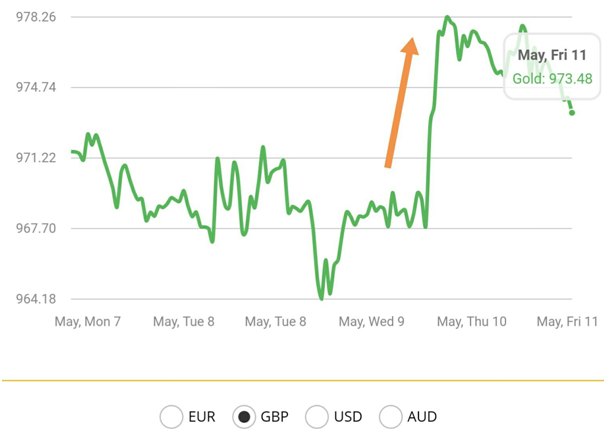
Gold and silver both ended slightly up in a week dominated by heightening geopolitical news, weakening inflation data, and emerging market concerns.With gold closing the week at $1,318 (up 0.28%), €1,104 (0.37%), and £973 (0.2%).
In sterling, gold was up strongly on Thursday following the BOE’s decision not to raise rates, and from the weaker than expected industrial production data.
Listen on SoundCloud , Blubrry & iTunes. Watch on YouTube below

On Tuesday the U.S. pulled out a nuclear deal with Iran with oil jumping on the news, pushing past $70 for the first time since November 2014. In other markets, the move was less pronounced, prompting suggestions the move in oil was more over concerns of losing production (at a time of already falling crude inventory), rather than from the geopolitical event itself.
However, with middle east tensions rising by the day, the geopolitical risk remains extremely high. With the main question remaining, will gold soon follow oil’s move higher as investors seek protection in the world’s premium safe haven asset?
Economic data this week came in worse than expected, with inflation readings of 0.1% vs consensus of 0.2%. The market was initially unmoved following the PPI release on Tuesday, but once CPI confirmed the prospect of weakening inflationary pressures on Thursday, both gold and silver reacted along with the rest of the commodities sector, including platinum, palladium and copper, all ending the day notably higher.
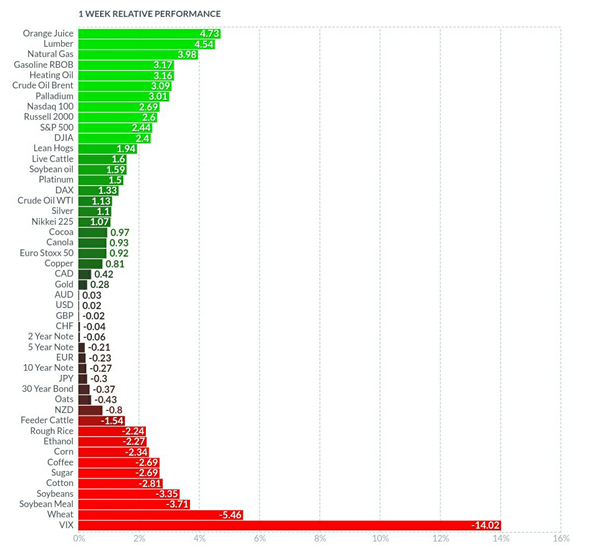
Stocks were one of the best performing assets this week, with U.S. indices up between 2-3%, with investors in the short-term moving back into risk assets. The U.S. dollar ended the week flat (up 0.02%), giving back early weak gains from the miss in inflation, and talk of ‘profit taking’. Yields, like the dollar, started the week strong but ended the week down 0.27%. Full weekly performance, courtesy of Finviz.com. (https://finviz.com/futures_performance.ashx?v=12)
Emerging markets continued to deteriorate this week, with Argentina and Turkey notably effected. Argentina has recently hiked interest rates to 40% in an attempt to stabilise a free falling peso,and is currently seeking assistance from the IMF to avoid outright default.Turkey are taking similar measures, albeit not so aggressive, but still in attempt to fight soaring inflation at 11%
A strong U.S. dollar, and bond yield (when compared to global peers), is the main catalyst behind the deteriorating situation. During the expansionary period, following the 2008 financial crisis, low interest rates and an abundant supply of fresh Central Bank liquidity allowed easy money to flow into the emerging markets.But as U.S. yields went up, so too did the funding costs, making emerging market investments a less attractive prospect, causing capital to flow out of these markets and back into the ‘perceived’ safety of a 3% return in the U.S.
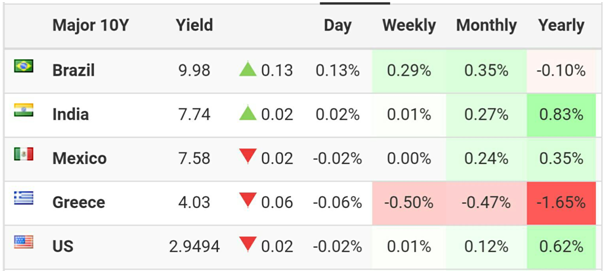
Highlighting the disparity in global yields,only Greece, Mexico, India and Brazil currently pay more than the U.S. to service their 10 year debt – quite a startling statistic for the world’s reserve currency.
https://tradingeconomics.com/bonds
While Fed members have indicated they are staying put on their current ‘dot plot’ rate hike trajectory, at some point they will need to take note of the growing yield disparity.It’s this writer’s view that if the spread continues to widen, and the effects start to begin to spill over into the wider economy, the Fed will be forced to take action and realign to a more accomodative global policy – all of which is a bullish prospect for the precious metals complex.
Taking a look at the latest fundamental developments, the WGC have released their ETF inflow/outflow data this week, with the report showing strong growth in April.
“Global gold-backed ETFs holdings added 72.2 tonnes (t) to 2,481t in April. This is the strongest month of net inflows in more than a year. Growth in global holdings was les by significant North American and European inflows and supported by a small increase in Asia” (https://www.gold.org/data/gold-etf-holdings)
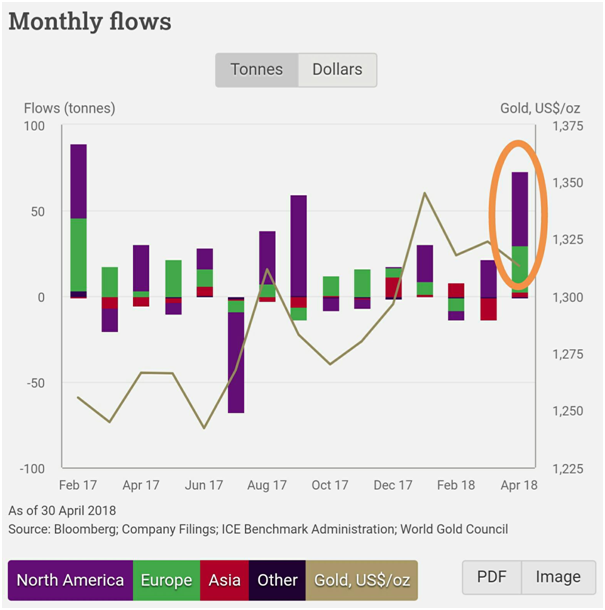
While the latest data represents the largest monthly inflow since February 2017, more importantly it shows North American and European buyers coming back into the market. Western demand has long been regarded as the key to higher gold pricing, and while this is first significant inflow from the west this year, should this trend continue it has bullish implications moving forward.
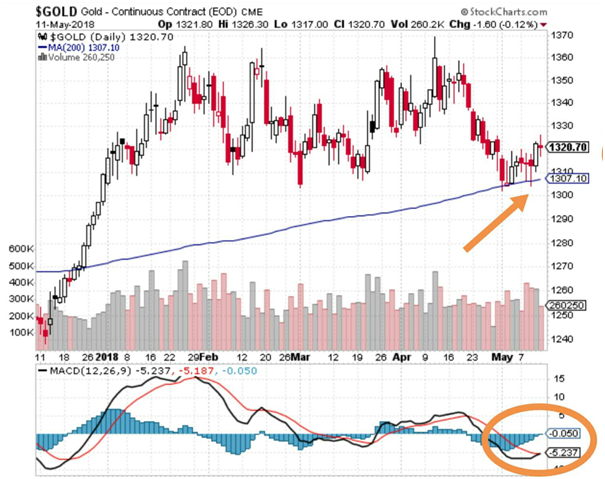
From a technical perspective, we can see gold has found significant support at 200 day moving average ($1307), while building positive momentum that looks poised to breakout to the upside.
Should gold push higher from here, key resistance will be at the $1360/$1370 level, an area gold continues to test. (Charts courtesy of Stockchart.com)
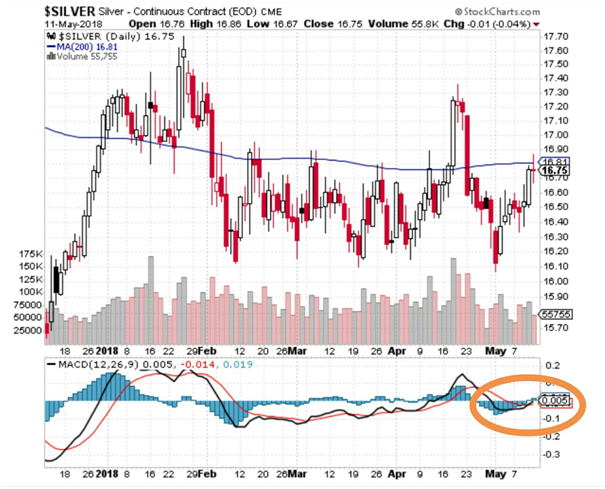
In silver we can see the 200 day moving average ($16.81)acting as resistance. However, just like gold, positive momentum is building.
Key resistance for silver will be at $17.30, and then $17.70, with further resistance at the psychological $18 level. Given the bullish technical picture in both gold and silver, and improving COT positioning, means we a likely building a base here, for a more substantial move higher.
The U.S. is meeting with North Korea this weekend, in an attempt to forge a long standing agreement. With the U.S. withdrawing from the Iran nuclear deal this week, it will interesting to see if this impacts the North Korean’s willingness to enter into such a deal. As always the key will be in the detail
In Europe, Italian bond yields continue to climb on the prospect of an anti-establishment coalition coming to power, with the League and 5-star movement party making significant steps towards forming government. Their final policies are an unknown factor for the markets, but with Italy the 3rd largest economy in Eurozone, investors should take note of the Italian yield, and more importantly yields in the rest of the Eurozone, for signs on how the situation is developing.
On economic data next week, investors should pay close attention to ‘Retail Sales’and the ‘Philadelphia Fed Manufacturing Index’ for further signs of weakness, April ‘CPI’ from Europe for the latest on inflationary pressures, and April ‘Industrial Production’ from China for an update on global growth.
These events, plus developments in the middle east, will help shape the near term direction in the dollar, bonds, stocks, and more importantly the next direction for gold and silver.
And finally, a quick look to the key FOMC meeting next month, and the latest Fed Futures pricing (a tool from the CME to indicates future rate hike probabilities). Where, as of the 12th May, the market is pricing a 100% chance of a rate hike June
(http://www.cmegroup.com/trading/interest-rates/countdown-to-fomc.html)
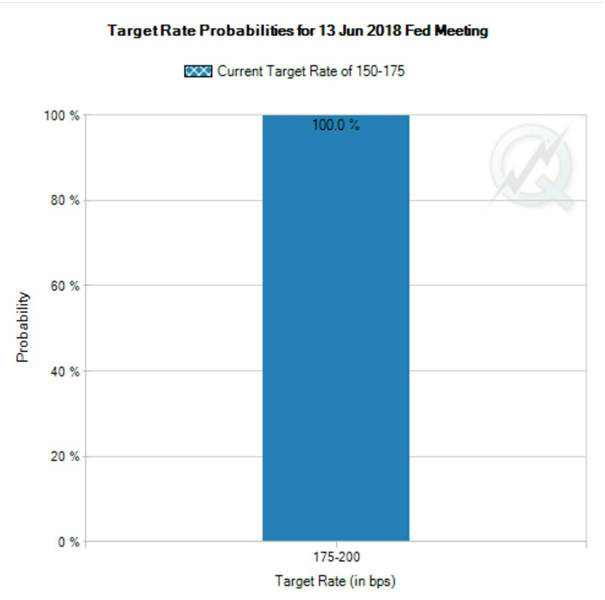
Given the market is pricing the event as a certainty means there’s a good chance we could be setting up for disappointment,where gold sells off in the run up the meeting only to rally on the news. A play gold has followed many times on recent rate hike announcements.
All of which means the prospect for the seasonal ‘summer doldrums’ (a seasonal phenomenon discussed last week 5th May) may be short lived, and the buying opportunity in gold may come a lot sooner than many people expect.
News and Commentary
PRECIOUS-Gold eases on firmer dollar; but eyes first weekly gain in four (Reuters.com)
Gold steady as dollar hovers below 2018 peak (Reuters.com)
Bottom in place? Gold jumped to 10-day high (FXStreet.com)
U.K. House-Price Gauge Drops to 5 1/2-Year Low as London Slumps (Bloomberg.com)
London house prices predicted to keep falling (CityAM.com)
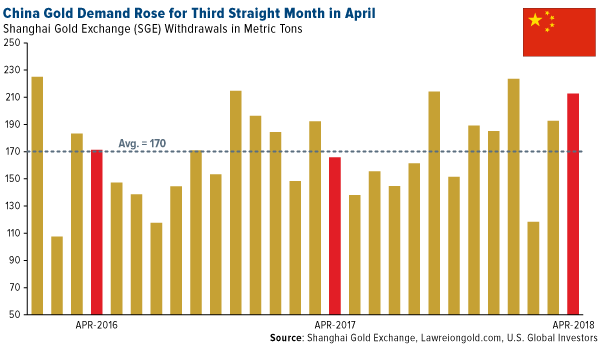
Source: US Funds
Gold Love Trade Looks Promising in India and China (USFunds.com)
The Wealthy Are Hoarding $10 Billion of Bitcoin in Bunkers (Bloomberg.com)
Gold Gets a Lifeline From a Surprising Source: Cheap Flights and Cars (Bloomberg.com)
Putin Wants to `Break’ With the Dollar But Dumps Euros Instead (Bloomberg.com)
The 1970s All Over Again? Part 1: The Middle East Explodes (GoldSeek.com)
Central Banks: The Great Experiment Has Failed (DailyReckoning.com)
Listen on SoundCloud , Blubrry & iTunes. Watch on YouTube below
Gold Prices (LBMA AM)
10 May: USD 1,314.80, GBP 969.27 & EUR 1,106.80 per ounce
09 May: USD 1,306.85, GBP 965.11 & EUR 1,102.07 per ounce
08 May: USD 1,310.05, GBP 969.44 & EUR 1,101.88 per ounce
04 May: USD 1,309.35, GBP 965.78 & EUR 1,094.09 per ounce
03 May: USD 1,313.30, GBP 966.19 & EUR 1,094.64 per ounce
02 May: USD 1,310.75, GBP 960.52 & EUR 1,091.99 per ounce
Silver Prices (LBMA)
10 May: USD 16.60, GBP 12.24 & EUR 13.97 per ounce
09 May: USD 16.44, GBP 12.12 & EUR 13.84 per ounce
08 May: USD 16.45, GBP 12.17 & EUR 13.85 per ounce
04 May: USD 16.42, GBP 12.10 & EUR 13.72 per ounce
03 May: USD 16.47, GBP 12.12 & EUR 13.74 per ounce
02 May: USD 16.35, GBP 11.98 & EUR 13.62 per ounce
Recent Market Updates
– Gold Mining Supply Globally Looks Set To Decline
– Gold Bullion Demand In Iran May Surge On Trump Sanctions
– “Money Is Gold — and Nothing Else”
– U.K. Home Prices Plunge 3.1% In April – Largest Monthly Drop Since Financial Crisis In 2011
– Weekly Gold Update – Gold In Dollars Lower Despite Poor US Jobs and Other Data
– Own Some Gold and Avoid Overvalued Assets
– Gold Demand Falls In Q1 Despite Robust Central Bank and Investment Demand and Surging Demand In Turkey and Iran
– Smart Money Diversifying Into Gold – One Billionaire Invests Half His Net Worth
– “Blood In The Streets” Of U.S. Gold Bullion Market As Sale Of Gold Coins Collapse
– Most Important Chart Of The Century For Investors?
– Gold Mining Shares Are Speculative Making Gold Bullion A Better Investment
– Gold Price Increasingly Influenced By Declining Dollar Rather Than Interest Rates
– Cash “Vanishes” From Bank Accounts In Ireland
END
Andrew Maguire’s Kinesis money which is a “bitcoin” but backed 100% by allocated gold and silver is set to go.
it think it would be a great idea to look at this!
please read at: https://kinesis.money/#/
(Andrew Maguire)
|
2:57 PM (1 hour ago) | ||
|
|||
Harvey
Here It is my friend! https://kinesis.money/#/ Please let everyone know.
Let catch up on Monday if you have time. We have billions in the hopper ready to be allocated on the 1st day of trading. The paper market days are over.
Warm regards
Andy
U.S. retreat from trade deals poses new threat to the dollar
Submitted by cpowell on Sun, 2018-05-13 13:49. Section: Daily Dispatches
By Chelsey Dulaney and Joshua Zumbrun
The Wall Street Journal
Sunday, May 13, 2018
Trade friction is emerging as the latest threat to the U.S. dollar’s position at the heart of the global financial system.
For decades, central banks have held the bulk of their foreign-exchange reserves in the dollar, reflecting the dominant role the U.S. and its currency have played in global trade. As the U.S. pulls back from partnerships while countries like Mexico and Japan strike their own trade deals, the dollar’s dominance could be undermined, investors and analysts said. That dominance has been referred to as an “exorbitant privilege,” allowing the U.S. to borrow cheaply and run persistent deficits.
Though a less U.S.-centric trade system would take years to fully evolve, it would have significant implications for global central bankers charged with allocating some $11 trillion in reserves. Many are now ramping up investment in such currencies as the euro and Chinese yuan, reflecting the effects of such moves as the U.S. retreat from the North American Free Trade Agreement and Trans-Pacific Partnership.
While the U.S. and Mexico remain in negotiations over Nafta, which could come to a head in the coming days as House Speaker Paul Ryan has set a Thursday deadline to receive paperwork, Mexico has struck major trade deals in recent months with the European Union and the group of Pacific Rim nations that make up the TPP.
Alejandro Díaz de León, governor of Mexico’s central bank, said that while the U.S. remains Mexico’s most important trade partner, he expects the euro to play a bigger role in the country’s foreign-exchange holdings in coming years as the balance of the nation’s bilateral trade shifts in that direction. …
Jens Nordvig, chief executive of analytics firm Exante Data, estimates global central banks could shift $200 billion to $300 billion in reserves into the yuan, euro and a handful of other foreign currencies this year as a result of trade changes. His estimate is based on central banks’ increased buying of Chinese bonds in the first few months this year.
While he cautions that central bankers tend to adjust reserves slowly, “the flows that potentially come out of this are really big.”
Few are calling for an immediate end to the dollar’s reign as the world’s primary reserve currency.
Central banks held about 63% of their reserves in U.S. dollars at the end of last year, the lowest level in four years, according to data from the International Monetary Fund. Meanwhile, allocations to the euro rose to 20% and reserves held in the Japanese yen rose to 4.9%.
“What’s sure is that over the long term, if trade relations change, it will have an implication on the currency makeup of the reserves,” said Christian Deseglise, global head of central banks for HSBC . “As trade becomes more denominated in euros [and yuan], they’ll need to have currencies to match.” …
… For the remainder of the report:
https://www.wsj.com/articles/u-s-retreat-from-trade-deals-poses-a-new-th…
end
Your early MONDAY morning currency, Asian stock market results, important USA/Asian currency crosses, gold/silver pricing overnight along with the price of oil Major stories overnight/9 AM EST
i) Chinese yuan vs USA dollar/CLOSED DOWN 6.3379 /shanghai bourse CLOSED UP 10.77 POINTS OR 0 .34% / HANG SANG CLOSED UP 419.02 POINTS OR 1.35%
2. Nikkei closed UP 107.18 POINTS OR 0.47% / /USA: YEN FALLS TO 109.51/
3. Europe stocks OPENED RED /USA dollar index FALLS TO 92.33/Euro RISES TO 1.1987
3b Japan 10 year bond yield: RISES TO . +.05/ !!!!(Japan buying 100% of bond issuance)/Japanese yen vs usa cross now at 109.51/ THIS IS TROUBLESOME AS BANK OF JAPAN IS RUNNING OUT OF BONDS TO BUY./JAPAN 10 YR YIELD FINALLY IN THE POSITIVE/BANK OF JAPAN LOSING CONTROL OF THEIR YIELD CURVE AS THEY PURCHASE ALL BONDS TO GET TO ZERO RATE!!
3c Nikkei now JUST BELOW 17,000
3d USA/Yen rate now well below the important 120 barrier this morning
3e WTI:: 70.77 and Brent: 77.34
3f Gold DOWN/Yen DOWN
3g Japan is to buy the equivalent of 108 billion uSA dollars worth of bond per month or $1.3 trillion. Japan’s GDP equals 5 trillion usa./“HELICOPTER MONEY” OFF THE TABLE FOR NOW /REVERSE OPERATION TWIST ON THE BONDS: PURCHASE OF LONG BONDS AND SELLING THE SHORT END
Japan to buy 100% of all new Japanese debt and by 2018 they will have 25% of all Japanese debt. Fifty percent of Japanese budget financed with debt.
3h Oil DOWN for WTI and UP FOR Brent this morning
3i European bond buying continues to push yields lower on all fronts in the EMU. German 10yr bund RISES TO +.60%/Italian 10 yr bond yield UP to 1.92% /SPAIN 10 YR BOND YIELD UP TO 1.31%
3j Greek 10 year bond yield FALLS TO : 4.04?????????????????
3k Gold at $1319.40 silver at:16.63 7 am est) SILVER NEXT RESISTANCE LEVEL AT $18.50
3l USA vs Russian rouble; (Russian rouble UP 28/100 in roubles/dollar) 61.64
3m oil into the 71 dollar handle for WTI and 77 handle for Brent/
3n Higher foreign deposits out of China sees huge risk of outflows and a currency depreciation. This can spell financial disaster for the rest of the world/
JAPAN ON JAN 29.2016 INITIATES NIRP. THIS MORNING THEY SIGNAL THEY MAY END NIRP. TODAY THE USA/YEN TRADES TO 109.51 DESTROYING JAPANESE CITIZENS WITH HIGHER FOOD INFLATION
30 SNB (Swiss National Bank) still intervening again in the markets driving down the SF. It is not working: USA/SF this morning 0.9980 as the Swiss Franc is still rising against most currencies. Euro vs SF is 1.1957 well above the floor set by the Swiss Finance Minister. Thomas Jordan, chief of the Swiss National Bank continues to purchase euros trying to lower value of the Swiss Franc.
3p BRITAIN VOTES AFFIRMATIVE BREXIT/LOWER PARLIAMENT APPROVES BREXIT COMMENCEMENT/ARTICLE 50 COMMENCES MARCH 29/2017
3r the 10 Year German bund now POSITIVE territory with the 10 year RISING to +0.60%
The bank withdrawals were causing massive hardship to the Greek bank. the Greek referendum voted overwhelming “NO”. Next step for Greece will be the recapitalization of the banks and that will be difficult.
4. USA 10 year treasury bond at 2.98% early this morning (THIS IS DEADLY TO ALL MARKETS). Thirty year rate at 3.11%
5. Details Ransquawk, Bloomberg, Deutsche bank/Jim Reid.
(courtesy Jim Reid/Bloomberg/Deutsche bank/zero hedge)
S&P Futures Jump After Trump’s ZTE U-Turn As Nervous Traders Eye Italy; EMs Boosted By Weaker Dollar
S&P futures are higher, maintaining overnight gains as most Asian markets advance with the MSCI Asia Pacific index 0.5% higher, as sentiment was boosted by President Trump unexpected reversal on China telecom giant ZTE over the weekend when in a Sunday morning tweet, Trump vowed to get the Chinese telco back to business in a surprising policy U-turn after the company announced a halt to major operating activities following a US 7-year supply ban order.
Europe was broadly, if modestly, in the red as a result of the EUR rising to session highs just shy of 1.20, the highest in over a week, after the ECB’s Villeroy said the first rate hike could come quarters, not years after the end of asset purchases, while political strains in Italy outweighed optimism over waning global trade tensions. Thanks to the weaker dollar, emerging-market stocks built on their first weekly advance in four weeks.

Elsewhere in Asia, Malaysia’s markets showed only short-lived post-election panic, with the ringgit rebounding from 1% drop while stocks in Kuala Lumpur recover opening losses to gain 0.5% as trade returns after a historic election loss by the ruling Razal-led coalition, its first in over 60 years.

Also in Asia, the PBOC conducted a 156BN yuan MLF operation to boost liquidity helping H shares rally 1.5%. And speaking of China, the onshore yuan surged the most in almost three weeks against the trade-weighted basket of currencies, as the central bank boosted its daily reference rate for a second day, pushing up the yuan fixing by 0.28% to 6.3345 per dollar, extending the two-day increase to 0.66%. The Bloomberg replica of the CFETS RMB Index, which tracks the yuan against 24 exchange rates, jumped 0.18%, the most since April 24, to 97.77; According to Bloomberg that was the highest level since China adjusted the basket in Jan. 2017.
Emerging markets currencies were stronger as the Bloomberg dollar index softened marginally, with the euro and pound rising to the top of G-10 scoreboard. The Bloomberg Dollar Spot Index fell 0.2% to hover near Friday’s one-week low. The euro gained 0.4% to touch $1.1990, the strongest in more than a week, while sterling gained as much as 0.4% to $1.3597 after advancing 0.2% on Friday. The Swiss franc climbed 0.1% to $0.9992, staying close to Friday’s one- week high.

Treasuries are weaker, with the firmer with 10-year yield rising from 2.96% at the European open to a session high of 2.985%, while Australian and Japanese government bonds grind sideways. European bonds edge higher after ECB’s Villeroy says the first rate hike could come “some quarters, but not years,” after policy makers end their bond-buying program.
While the EUR strengthened, there was some modest selling for Italian government bonds following late Sunday’s news that the 5-Star and League have reached an agreement on forming the first anti-establishment government, although so far the move remains largely contained and is far less troubling than the capitulation some had expected with Italy faced with a populist coalition.

In a curious rate arb move, Bloomberg reports that the U.K.’s biggest bond-mutual fund is shifting money to the other side of the Atlantic as the interest-rate gap between Europe and the U.S. widens to record levels. M&G Ltd. has boosted U.S. holdings in its 23.4 billion-pound ($32 billion) Optimal Income Fund this year to more than a third. To cushion inflation risks and the impact of rising U.S. rates, it’s gorging on short-term Treasury bills and paring credit risk.
Oil prices are modestly lower, subdued on continued profit taking with WTI crude below the USD 71.00/bbl level, while some reports also noting increased efforts by European nations to salvage the Iranian nuclear deal and will be meeting with Iranian Foreign Minister Zarif tomorrow. Dalian iron ore strengthens for second day. Elsewhere, gold trades flat with marginal gains observed on the back of a subdued USD, while copper (-0.5%) is lower amid reports Japanese miners plan to boost Chilean copper output this year. Aluminium prices eased for a third session as markets continue to correct following the rally last month supported by US sanctions against Rusal. Meanwhile, Chinese iron ore prices extended gains, supported by a firm demand outlook and a decline in the metal’s inventories at ports
In geopolitical updates, Iranian foreign minister Zarif said he had good meetings with China and Russian counterparts, adding they will soon determine how nations can guarantee Iran’s benefit under the nuclear deal. As reported over the weekend, North Korea is planning to take apart its nuclear test site during a ceremony to be held between May 23rd-25th, while there were also comments from US Secretary of State Pompeo that North Korea sanctions will be lifted if the nation proceeds with total denuclearizarion of the Korean peninsula.
In central bank news, Fed’s Mester (Voter, Hawk) said she doesn’t expect inflation to pick up sharply and she supports gradual rise in US interest rates and adds she does not expect to hike rates beyond 3% in the near future.
Earlier, ECB’s Villeroy (Dovish) said the end of net asset purchases is nearing, but whether this is in September of December is not an existential question, adding that communication will be adjusted given current rate guidance is conditioned on the end of net asset purchases, could give additional guidance on timing of rate hike – “well past” seeming some quarters rather than years. He believes underlying inflation is set to strengthen irrespective of short-run fluctuations in energy inflation, sees the current slowdown in inflation as temporary and expects it to resume its progress in the coming months.
Also overnight, Norges bank Governor Olsen reiterates outlook shows it will be the right time to hike key interest rates soon; adding that their latest analyses presented in March 2018 suggest that the key interest rate will likely be raised after summer 2018.
It’s a quiet day, with the only expected data including mortgage delinquencies and foreclosures. Agilent, Invitation Homes, and Vipshop are among companies reporting earnings. ECB Executive Board member Sabine Lautenschlaeger, chief economist Peter Praet, Executive Board member Benoit Coeure speak.
Bulletin Headline Summary from RanSquawk
- The biggest DXY currency components are leading broad gains vs the Dollar
- Italian President Mattarella to hold government formation talks with 5 Star at 16:30 (15:30 BST), with League at 18:00 (17:00 BST)
- Looking ahead, highlights include the OPEC Monthly Report (05:40 CDT/11:40 BST), Fed’s, Bullard, ECB’s Praet, Lautenschlaeger, Coeure
Market Snapshot
- S&P 500 futures up 0.2% to 2,736.25
- STOXX Europe 600 down 0.06% to 392.16
- MSCI Asia Pacific up 0.5% to 176.48
- MSCI Asia Pacific ex Japan up 0.5% to 576.26
- Nikkei up 0.5% to 22,865.86
- Topix up 0.6% to 1,805.92
- Hang Seng Index up 1.4% to 31,541.08
- Shanghai Composite up 0.3% to 3,174.03
- Sensex down 0.1% to 35,488.55
- Australia S&P/ASX 200 up 0.3% to 6,135.30
- Kospi down 0.06% to 2,476.11
- German 10Y yield rose 2.3 bps to 0.582%
- Euro up 0.3% to $1.1974
- Italian 10Y yield fell 6.2 bps to 1.616%
- Spanish 10Y yield rose 3.0 bps to 1.303%
- Brent futures down 0.1% at $77.04/bbl
- Gold spot up 0.1% at $1,320.94
- U.S. Dollar Index down 0.2% to 92.34
Top Overnight News
- In a sign that the U.S. may be open to easing trade tensions ahead of a meeting in Washington with Chinese officials this week, President Trump made a major reversal on an earlier move to block telecom equipment maker ZTE Corp. from its American suppliers
- Chinese regulators have restarted their review of Qualcomm Inc.’s application to acquire NXP Semiconductors NV after having shelved the work earlier in reaction to the growing trade tensions with the U.S., according to people familiar with the matter
- Italy’s populist duo has all but completed a governing plan that includes a flat tax as low as 15%, a guaranteed income for the poor and a lower retirement age as they prepare to seek a green light to form an administration from the president on Monday
- U.K. Prime Minister Theresa May faces a crunch week for her leadership and Brexit plan, with ministers and backbenchers in her Conservative Party feuding over Britain’s future ties to the European Union. May issued a plea for unity in an opinion piece in the Sunday Times newspaper, calling on Brexiters to “trust me to deliver.” “I will not let you down,” she wrote
- One of Trump’s most contentious foreign policy projects, the inauguration of a U.S. embassy in Jerusalem, will be carried out Monday with the president addressing the ceremony via video. His daughter and son-in-law, Ivanka Trump and Jared Kushner, Treasury Secretary Steven Mnuchin, and deputy Secretary of State John Sullivan are among the U.S. delegation
- Fed’s Mester (voter): recent move higher in PCE inflation may not last due to base effects; Fed may eventually need to raise federal funds above its longer-run neutral rate
- ECB’s Villeroy: ECB could give additional guidance on timing of first hike; current “well past” language means at least some quarters, but not years
- German Construction sector agrees wage hike of roughly 6% for over 800,000 workers; strongest wage deal sealed so far this year: Reuters
- U.S. sells three-, six-month bills; St. Louis Fed President James Bullard speaks at a blockchain technology conference
Asian equity markets began the week mostly positive but with trade relatively rangebound following Friday’s mixed performance on Wall St, where stocks saw an indecisive finish to their best week since March. In addition, US equity futures also received a modest uplift after US President Trump provided a lifeline for ZTE over the weekend as he vowed to get the Chinese telco back to business in a surprising policy U-turn after the Co. had announced a halt to major operating activities following a US 7-year supply ban order. ASX 200 (+0.3%) was positive with M&A activity underpinning Healthscope, while Nikkei 225 (+0.5%) was also in the green as
earnings remained in focus with Shiseido among the index leaders on record Q1 sales. Shanghai Comp. (+0.3%) and Hang Seng (+1.4%) conformed to the broad risk appetite as trade concerns eased following the ZTE policy reversal by Trump and as participants also reacted to better than expected lending data. Elsewhere, KLCI (+0.4%) saw an early slump with losses of over 2% on reopen from the surprise election result, but then pared all the weakness as the fears of a new government gradually subsided. Finally, 10yr JGBs were flat amid similar price action in T-notes and with demand sapped amid gains in stocks, while downside was also counterbalanced by the BoJ’s presence in the market for a respectable JPY 1.03tln of JGBs in 1yr-10yr maturities. US President Trump said he instructed the US Commerce Department to assist Chinese telecoms firm ZTE to get back into business which is seen as a U-turn on the firm which was previously placed under a 7-year supply ban by the US.
Top Asian News
- ZTE China Suppliers Jump After Trump Provides Lifeline to Firm
- Nissan Forecast Misses Estimates on Yen, Slower U.S. Demand
- Hong Kong’s Most Popular ETF Is Short the Whole Stock Market
- Sumitomo Mitsui Sees Lower Profit as Negative Rates Persist
European equities are currently trading with no firm directions (Euro Stoxx 50 -0.1%) with the SMI the outperforming bourse (+0.3%) aided by Novartis (+0.8%) and Roche (+1.2%) both receiving positive news from the FDA pertaining to drug expansions. The modestly underperforming bourse is currently the FTSE MIB (-0.5%) with traders mindful of upcoming developments on the Italian Government formation. The automotive sector is being weighed on following the US proposition of 20% tariffs of foreign cars imported to the US. Further effects in European equities from US actions has seen the healthcare sector showing positivity in the wake of the Trump administration releasing a (vague) blueprint for drug pricing; and Ericsson and Nokia down on Trump’s tweet that he will help the penalized ZTE. In stock specifics, strength is being seen for IWG (+21.2%) on the news that the co. has received separate takeover proposals from private equity groups Starwood, Lone Star and TDR Capital, raising prospects of a bidding war.
Top European News
- Norway’s Olsen Says Outlook Indicates Soon Right to Raise Rates
- TPG Is Said to Mull Sale of U.K.’s Poundworld: Sky News
- Germany Seeks Out Russia, Ukraine to Ease Nord Stream 2 Rift
- Nordea Says EUR/SEK Above 10 ‘Is Here to Stay’ Due to Riksbank
- Airbus CFO Wilhelm to Leave in 2019 Along With CEO Enders
In FX, the biggest DXY currency components are leading broad gains vs the Dollar on a combination of supportive fundamentals (relatively hawkish rhetoric from ECB’s Villeroy and further progress towards an Italian coalition Government in the case of the single currency), and a more positive technical landscape after recent sharp declines. It appears that Eur/Usd and Cable have both formed fairly solid bases circa 1.1820 and 1.3460 respectively, and dip-buyers/fresh longs are looking for extended recoveries towards 1.2000 and 1.3600 with stops said to be poised around 1.1980 and 1.3610. Market contacts also note that chart resistance in Eur/Jpy has been breached at 130.86, with bulls eyeing a 50% Fib next (131.86 vs 131.20 top so far). CAD/AUD/CHF: All mildly firmer vs the aforementioned depressed Greenback overall (index still sub-92.500), with the Loonie still benefiting from latest NAFTA reports suggesting a deal could be forthcoming by Thursday and Usd/Cad retesting bids/support ahead of 1.2750. Aud/Usd is maintaining recovery momentum around 0.7550 amidst less against on the global trade front after US President Trump’s volte-face on China’s ZTE, and with cross Aud/Nzd also a prop (over 1.0850 and edging towards the 200 DMA at 108.81). Usd/Chf is holding just below parity, prompting more pledges from the SNB to keep rates negative and active in terms of direct FX intervention to curb Franc demand/appreciation. NZD/JPY: The G10/major laggards and bucking the overall trend with losses vs the Usd, albeit modest, as the Kiwi hovers near 0.6950 and Usd/Jpy rebounds from the low 109.00 area to 109.50.
Top Asian News
- ZTE China Suppliers Jump After Trump Provides Lifeline to Firm
- Nissan Forecast Misses Estimates on Yen, Slower U.S. Demand
- Hong Kong’s Most Popular ETF Is Short the Whole Stock Market
- Sumitomo Mitsui Sees Lower Profit as Negative Rates Persist
In commdities, oil prices are lower, subdued on continued profit taking with WTI crude below the USD 71.00/bbl level, while some reports also noting increased efforts by European nations to salvage the Iranian nuclear deal and will be meeting with Iranian Foreign Minister Zarif tomorrow. Elsewhere, gold trades flat with marginal gains observed on the back of a subdued USD, while copper (-0.5%) is lower amid reports Japanese miners plan to boost Chilean copper output this year. Aluminium prices eased for a third session as markets continue to correct following the rally last month supported by US sanctions against Rusal. Meanwhile, Chinese iron ore prices extended gains, supported by a firm demand outlook and a decline in the metal’s inventories at ports.
US Event Calendar
- May 14-May 18: Mortgage Delinquencies, prior 5.17%
- May 14-May 18: MBA Mortgage Foreclosures, prior 1.19%
- 2:45am: Fed’s Mester Speaks at Bank of France Conference
- 9:40am: Fed’s Bullard Speaks at Crypto Conference in New York
DB’s Jim Reid concludes the overnight wrap
At first glance the week looks a bit less hectic than my weekend with the US retail sales number and the monthly China data dump tomorrow being the data highlights. We do have a busy Fedspeak calendar though and expect a lot of focus on the recent slightly weaker-than-expected inflation numbers. Meanwhile trade talks might come back to the fore with China’s Vice Premier traveling to Washington to continue talks with Treasury Secretary Steven Mnuchin. There’s also a few Brexit meetings to flag and Iran, North Korea and the Oil price will no doubt stay on the radar. The full week ahead preview is at the end today.
We start this morning with Italy, where we seem to be inching closer to a new government. The leaders from the two largest parties are expected to meet the head of state later today and “report back on everything” they had negotiated over the weekend. Earlier, La Repubblica reported that the Leaders of the 5SM (Luigi Di Maio) and League party (Matteo Salvini) have decided that neither should be Premier of the new government, but did not elaborate on a potential candidate.
According to Bloomberg and newspaper Repubblica, measures agreed in a draft government program include: a citizen’s income for the poor, a flat tax at 15% (20% for higher earners), renegotiating EU accords and complying with EU limits on public spending. However, there are no details on how they will fund these proposals but at first glance this seems like a lot of potential spending promises.
Now turning to other headlines over the weekend. On trade, President Trump seemed to partly reverse the sanctions on China’s number 2 telco company (ZTE) as he and China’s President Xi are working together to give ZTE “a way to get back into business, fast”. He added that the “(US) Commerce Department has been instructed to get it done”. In geopolitics, North Korea said it will dismantle its nuclear test sites within two weeks and invited international journalists to watch. On the other side, the US National Security adviser Bolton said “we’re prepared to open the trade and investment with North Korea as soon as we can” while the Secretary of State Pompeo noted that NK will have access to US capital if “complete, verifiable, irreversible denuclearisation” occurs. Then finally on Iran, Security adviser Mr Bolton warned that US sanctions on European companies that continue to maintain business dealings with Iran were “possible”, while Mr Pompeo was hopeful that the US and its allies can strike a new nuclear deal with Iran.
This morning in Asia, markets are broadly higher, with the Hang Seng (+1.28%), Nikkei (+0.40%) and Shanghai Comp. (+0.55%) all up while the Kospi is slightly lower. Elsewhere, the Malaysian ringgit pared back losses to be broadly flat vs. the USD as markets resumed trading following Mahathir’s historic election victory last week. Datawise, Japan’s April PPI eased 0.1ppt mom to an in line print of 2.0% yoy.
Now briefly recapping markets from Friday. The Stoxx 600 edged up +0.11% while the S&P rose +0.17%, supported by the telco sector as Verizon jumped 3.0% after announcing a buyback of its debt securities. In government bonds, core 10y bond yields were slightly higher (UST +0.8bp; Bunds +0.2bp; Gilts +1.2bp) while peripherals outperformed. The yield on 10y Italian BTPs fell -6.3bp, reversing its prior losses on Thursday. In FX, the US dollar index was marginally higher (+0.02%), while the Euro and Sterling rose 0.23% and 0.17% respectively. Lastly, WTI oil fell for the first time in three days (-0.92% to $70.70/bbl) and precious metals softened slightly (Gold -0.17%; Silver -0.31%) while other base metals were little changed.
Now turning to the Fed Bullard’s views on the yield curve. He noted that “…the yield curve inversion is getting close to crunch time” and that we “could be talking about it in September”, although he does not think it’s likely to happen that fast, but it will be an issue next year. On inflation, he said “we’re not in any danger of any breakout in inflation any time over the forecast horizon” and he basically has “no problem with some overshooting of the (2%) target”. On rates, he believes the Fed does not need to raise rates further, in part as rates have reached its neutral setting and “it’s not necessary to change the policy rate to keep inflation at target”.
Ahead of more Brexit talks this week, the UK’s PM May wrote in the Sunday Times newspaper to reiterate her calls for unity over Brexit, she noted that “you can trust me to deliver….the path I’m setting out is the path to deliver the Brexit people voted for”. So lots bubbling along until we get more clarity on the issue.
Before we take a look at this week’s calendar, we wrap up with other data releases from Friday. In the US, the May University of Michigan consumer sentiment index was steady mom and slightly above consensus at 98.8 (vs. 98.3 expected). In the details, the current conditions index edged down 1.6pts mom to 113.3, while the expectations index firmed 1.1pts mom to 89.5. The 1y inflation expectation edged up 0.1ppt mom to 2.8% while the 5-10y inflation expectation was steady mom at 2.5%. Elsewhere, import prices rose 0.3% mom in April while exports grew 0.6% mom. Following the above, the NY Fed’s Nowcast measure of Q2 GDP growth ended the week unchanged at 3.0% saar, while the Atlanta Fed estimate is 4.0% saar. In Europe, the final reading of Spain’s April inflation was unrevised at 1.1% yoy.
On Monday’s Calendar, central bank speak will be the focus of today with the Fed’s Mester and ECB’s Villeroy both speaking in the morning in Paris, followed by the ECB’s Lautenschlaeger, Praet and Coeure later in the day. Brexit developments could also come back to the forefront with the EU’s Barnier due to brief European affairs ministers on the status of talks. Datawise the only release of note is the Bank of France industry sentiment print for April. Senior officials from Euro area finance ministries are also due to meet to discuss the latest Greek bailout review.
3. ASIAN AFFAIRS
i)MONDAY MORNING/SUNDAY NIGHT: Shanghai closed UP 10.77 points or 0 .34% /Hang Sang CLOSED UP 419,02 points or 1.35% / The Nikkei closed UP 107.18 POINTS OR 0.47% /Australia’s all ordinaires CLOSED UP .30% /Chinese yuan (ONSHORE) closed DOWN at 6.3379/Oil DOWN to 70.77 dollars per barrel for WTI and 77.34 for Brent. Stocks in Europe OPENED RED. ONSHORE YUAN CLOSED UP AT 6.3379 AGAINST THE DOLLAR. OFFSHORE YUAN CLOSED UP ON THE DOLLAR AT 6.3303/ONSHORE YUAN TRADING WEAKER AGAINST OFFSHORE YUAN/ONSHORE YUAN TRADING WEAKER AGAINST USA DOLLAR/OFFSHORE YUAN TRADING WEAKER AGAINST THE DOLLAR /CHINA RETALIATES WITH TARIFFS/ TRUMP RESPONDS TO NEW TARIFFS AND IT NOW LOOKS LIKE A FULL TRADE WAR IS BEGINNING/
3 a NORTH KOREA/USA
North Korea/South Korea/usa
END.
3 b JAPAN AFFAIRS
end
c) REPORT ON CHINA/HONG KONG
Is this why Trump folded on Chinese telecom ZTE?
(courtesy zerohedge)
Is This Why Trump Folded: China Holds Up U.S. Pork,
Auto Imports
President Trump surprised pundits and assorted watchers of the ongoing simmering trade war between China and the US on Sunday, when he pledged to help China’s telecom giant ZTE Corp “get back into business, fast” after a U.S. ban crippled the technology company, offering a job-saving concession to Beijing ahead of high-stakes trade talks this week.
Donald J. Trump
✔@realDonaldTrump
President Xi of China, and I, are working together to give massive Chinese phone company, ZTE, a way to get back into business, fast. Too many jobs in China lost. Commerce Department has been instructed to get it done!

What surprised most, however, is that Trump appears to make this concession out of the blue, without any obvious pressure out of China which has been patiently biding its time until the US implements sanctions under Section 301.
Maybe not: according to Reuters, on Monday China’s customs said it had ramped up inspections of U.S. pork and had taken unspecified regulatory steps on high-risk waste imports. In a move that could potentially cripple another group of exporting US farmer, China’s General Administration of Customs said it has increased inspections of U.S. pork imports “after finding problems recently”, according to a fax it sent to Reuters.
Today’s news confirms a report from Reuters which last week, according to which Beijing had stepped up inspections of pork imported from the United States, a move that many saw as a warning by Beijing in response to sweeping U.S. trade demands made on China.

And while China’s customs administration denied that it was targeting the US, saying it had not taken extra steps to check imports of U.S. agricultural products, instead giving equal treatment to inspections of agricultural products from all countries and districts, the U.S. had become the largest exporter of waste that failed checks, the customs said. Surely this was purely a coincidence.
The pork halt was merely the latest quiet escalation in China’s response arsenal: the North American unit of a Chinese customs inspection firm said on May 4 it would suspend checks on cargoes of scrap metal from the United States for a month, effectively halting all imports of U.S. scrap.
Last week, Reuters also reported that imported Ford vehicles are being held up at Chinese ports, underscoring how U.S. goods are facing increased customs scrutiny in China amid a tense trade stand-off.
Three people said Ford cars and those of its premium Lincoln brand were facing unusual delays at customs, with officials asking for extra technical checks. Two of the people said U.S.-made models of some German carmakers, mainly SUVs, being brought into China, were also affected.
Ford was being asked to do extra checks on emission components, said a China-based Ford executive familiar with the matter, asking not be named because of the sensitivity of the issue.
The world’s two largest economies have been dragged into a trade spat in recent months, which has spread to the agricultural sector, fuelling worries that Beijing and Washington may plunge into full-scale trade war.
The United States has proposed tariffs on $50 billion of Chinese goods under its “Section 301” probe. Those could go into effect in June following the completion of a 60-day consultation period, but activation plans have been kept vague. China has said its own retaliatory tariffs on U.S. goods, including soybeans and aircraft, will go into effect if the U.S. duties are imposed.
However, all that may soon be moot if Trump has indeed folded on the crackdown against Chinese telecom such as ZTE, which more than anything is just a signal to Xi that Beijing may have won the war without firing a single shot.
4. EUROPEAN AFFAIRS
Saturday: The Italian coalition takes shape and the platform includes a parallel currency something that the EU will certainly frown upon
(courtesy Mish Shedlock/Mishtalk)
Italian Coalition Takes Shape: Platform Includes Parallel Currency
Authored by Mike Shedlock via MishTalk,
Five Star and Lega want another three days to conclude talks. Neither Di Maio nor Salvini would be Prime Minister.

A reader informed me yesterday that Five Star was pro-Europe and not Eurosceptic.
Compared to what?
Certainly Five Star leader Luigi Di Maio is a far cry from former Five Star leader, Beppe Grillo. But some of that change in positioning was little more than political expediency to win votes.
The platform now in the works includes a parallel currency, reduced immigration, and flat taxes.
Eurointelligence Comments
This is what real coalition negotiations look like. The leaders meet and set the agenda for sub-committees to talk about specific policy issues. That process will start in Italy tomorrow, when the deputy leaders of the two parties come together, but some of the outlines have already been drawn up by the leaders themselves.
What do we know so far? Five Star and Lega are very different political parties, but they have enough in common for a radical legislative agenda. The two sides seem to be inching towards a neutral prime minister, in other words neither Di Maio nor Salvini. The name mentioned by Italian newspapers this morning is that of Giampiero Massolo, a career diplomat who seems to be acceptable to both parties. Massolo will clearly only be the frontman. Power will rest with Di Maio and Salvini.
It will be interesting to see how the two sides will legislate together on issues that might affect Silvio Berlusconi personally. We don’t think he accepted to step aside and let Salvini run the show himself without any clandestine conditions. Any undertaking Salvini might have given him would be difficult for Five Star politically, though.
Corriere della Sera lists the following as the main legislative priorities. If implemented it would be the biggest shake-up of the Italian economic system in modern times.
Platform Provisions
- The end of the pension reforms under Mario Monti; Five Star is softer on this point than Lega, but together the two parties can be expected to agree fundamental changes.
- A flat tax on companies and people – in other words a massive tax reduction.
- A study on the so-called minibot. This is a parallel currency based on future tax receipts, similar to the plans proposed by Yanis Varoufakis in Greece. The minibot was in the Lega’s election manifesto. Five Star is far less radical on the eurozone, having dropped the idea of a referendum, but also seeks changes that are incompatible with the the EU fiscal rules. A parallel currency stands a much greater chance of success in Italy, and it would go some way to solving the government’s fiscal dilemmas. The open question is whether it would constitute a slippery slope towards euro exit.
- And a citizens’ income, which is Five Star’s big idea, to be implemented next year.
EU’s Worst Nightmare
The Express describes the EU’s Worst Nightmare as Eurosceptics Join Forces.
One of the first things the two parties are likely to agree on will be to scrap a 2011 pension reform which raised the retirement age and required further hikes over time. Economists say repealing the law would cost 20 billion euros ($24 billion) a year, but opponents say it is unfair on ordinary Italians.
Both parties also want to renegotiate the EU’s fiscal rules to allow Italy to spend more. 5-Star has rowed back on a pledge to hold a referendum on Italy’s membership of the eurozone, but the League still calls the euro a “flawed currency” and wants to exit it as soon as is politically feasible.
Setting up a possible institutional clash in Italy, President Mattarella made clear on Thursday that he did not want to see any confrontation with Brussels.
“To think that one can go-it-alone in Europe is knowingly deceptive in front of public opinion,” Mattarella said in a pointedly pro-European speech at a conference on the state of the European Union in the central town of Fiesole.
Major Changes
President Mattarella can make all the pro-Europe noises he wants, but other than force new elections which would likely give Five Star and Lega a bigger majority, there is little he can do.
Major changes are coming but there is no way to pay for them.
Flat taxes and a tax reduction are good ideas. A guaranteed income is a bad idea, but it’s on the way.
Both parties are staunchly anti-immigration.
A parallel currency is indeed a stepping stone to a break from the Eurozone.
Flashback March 1
I do not believe anyone else suggested this outcome: Italy Election March 4: Consider a Surprise M5S + NL Alliance.
In March, many thought I was crazy.
end
An extremely important commentary from Tom Luongo re the merger or the two Euroskeptic parties to form a government. In essence, Luongo correctly states that the two parties will pinpoint immigration immediately and not target leaving the euro immediately. The new government’s new platform consists of a flat tax of 15% which will surely win over the populace. The new government intends on introducing a parallel currency which will help stimulate their moribund economy. In short order, Italy’s deficit will increase dramatically, setting the stage for the government to eventually leave the Euro
(courtesy Tom Luongo)
Italy, A Parallel Currency, And Immigration – Merkel’s Worst Nightmare
Here comes the flood. My worst fears of The League’s leader Matteo Salvini’s ego getting in the way of seizing the political moment by the horns were overblown. It feels good to be wrong every once in a while.
It looks like coalition talks between The League and Five Star Movement (MS5) have been productive. A new post from Mike “Mish” Shedlock reveals the likely structure of a new parliamentary deal which has neither Salvini nor M5S’s Luigi Di Maio taking the role of Prime Minister.
From Mish the Platform contains:
- The end of the pension reforms under Mario Monti; Five Star is softer on this point than Lega, but together the two parties can be expected to agree fundamental changes.
- A flat tax on companies and people – in other words a massive tax reduction.
- A study on the so-called minibot. This is a parallel currency based on future tax receipts, similar to the plans proposed by Yanis Varoufakis in Greece. The minibot was in the Lega’s election manifesto. Five Star is far less radical on the eurozone, having dropped the idea of a referendum, but also seeks changes that are incompatible with the the EU fiscal rules. A parallel currency stands a much greater chance of success in Italy, and it would go some way to solving the government’s fiscal dilemmas. The open question is whether it would constitute a slippery slope towards euro exit.
- And a citizens’ income, which is Five Star’s big idea, to be implemented next year.
Because M5S and The League are so fundamentally different this platform is going to be schizophrenic. Basic Income is idiotic, especially with a radical tax reduction. But, it’s the price to getting the deal done.
The most important part of this deal is the realization on both sides that leaving the euro is not politically viable in the near term.
Believe me, I wish it were otherwise. M5S was smart to soften its stance to get the votes.
That is going to have to be a conversation with Italians over time.
First, the outsiders have to prove they can work together. Then they have to lead and gain real and visceral support from the people. Trust first, rebellion later, as it were.
Where they gain immense political capital is in standing up for Italy against Brussels on Immigration.
Immigrant Song
Immigration and economic opportunity are two sides of the same coin, politically. This link gets stronger the worse the economic conditions are. When you have a sclerotic democratic socialist system like in most of Europe and then add a technocratic bureaucracy on top of it you have a powder keg of political revolt.
When the foreign bureaucracy demands enforced immigration to lower labor costs and destroy your culture on the altar of Marxism and globalism, it creates the perfect vehicle for the newly-elected rebel parties to gain tremendous political capital with its people by saying no more.
Just look at places like Hungary, Austria, the Czech Republic and Russia. Viktor Orban and Vladimir Putin have provided the blueprint for how to consolidate power in response to irresponsible immigration policy.
Now look at Italy. The League and M5S can form a lasting partnership if they present a fully-united front to Brussels on this issue. And by being opposed on certain issues it presents an honest face to the people that Italy comes first and from there we can sort out the other problems.
Parallel Goals
Salvini knows the euro is killing Italy slowly. So did M5S’s former leader Beppe Grillo. Both parties want out of the euro but for different reasons. The Jury is out on Di Maio.
And in the long-run, absent a shift in political philosophy, this coalition will be, at best, difficult to hold together. But a study on a parallel currency is the Goldilocks path on the other pressing issue to Make Italy Great Again.
Creating an internal domestic currency to run the country on while settling cross-border payments in euros is the means by which to prove to the people what the euro has done to them. And, any opposition to this plan from Brussels will be seen as yet another way to subjugate Italians a la immigration.
Build the opposition to the euro over time while capitalizing on the anger at the EU now.
Two birds, one stone.
By having this in their back pocket Salvini and Di Maio can present a stronger front to the EU over debt relief and gaining some much-needed fiscal wiggle room. The flat income tax proposal is a brilliant move. If done right, it will lower taxes, cut bureaucracy and introduce new efficiencies to the Italian economy currently stifled by what I like to call “German Austerity.”
Austerity is what we Austrian economists preach: lower taxes, less government spending, fewer regulations. Also, hold monetary policy as neutral as possible and let the currency do what it’s going to do to balance the government’s books.
German Austerity is higher taxes to balance the budget, lowered spending and a strong euro. The latter benefits Germany, under-pricing German labor and over-pricing the vassal state’s. This keeps that country trapped through high debt servicing costs, never paying off its bills.
Eventually, it sells to Germany its tangible assets at stink bid prices and while rolling the debt out farther in time, c.f. Greece.

Enter a caption
Merkel will push this hard-line stance. That’s her democratic mandate. Italians aren’t ready to give up the euro, which damned Greece in 2015. Salvini and Di Maio need room to negotiate.
But, they have to be united on this issue. Brussels will try to drive a wedge between them. Look for Berlusconi to re-emerge as a “voice of reason” during Italian debt talks.
The parallel currency offers a way around this stalemate while they remind Italians what Germany did to Greece. If they were really smart they would link Merkel’s immigration policy to the damage she did to her image in the Greek debt negotiations.
She used a unilateral open borders mandate to re-frame herself as Mother Theresa after Europeans were outraged at how Greece was thrown to the wolves.
This Rocky Road
I don’t envy the task ahead of Salvini and Di Maio. But, they have the tools to push for a great deal on debt relief from Merkel and the EU. But, they have to have their ducks in a row.
Things are accelerating quickly. And if I’m right and Donald Trump just touched off the next big dollar rally, a plunging euro will help them in this initial stage of their coalition.
Because with this coalition and this proposed platform the markets will react negatively to lower taxes and universal basic income at the same time. This will push up Italian bond yields and CDS spreads. It will make it harder for the ECB to maintain its negative interest rate policy if the euro begins crashing.
But, at some point this false equilibrium has to be tested by the markets. The euro at $1.19 is a fiction. Italian 10 year debt trading at 1.85%, more than a full point below the U.S. 10 year note, is a fiction.
3 month EURIBOR rates at -0.33% is a fiction.
That the ECB is ever going to stop buying Italian debt is the biggest fiction of all.
And once the bond vigilantes call Mario Draghi’s bluff, which could be as soon as Monday, many, if not all, of these fictions will be revealed overnight. At that point Salvini and Di Maio better be ready to move quickly from studying their parallel currency to printing it.
Because if they don’t this new alliance will be broken up before it even begins.
END
The 5 tar and League have now reached a deal clearing way for the first European” anti establishment government”. The key question: Who will buy Italian bonds once the ECB stops its QE. The ECB is the only buyer of Italian bonds!!
(courtesy zerohedge)
Italy’s 5-Star, League Reach Deal Clearing Way For “Anti-establishment” Government
Back on March 4, the Euro was spooked and Italian bonds tumbled, if only briefly, following the shocking outcome from the Italian elections which saw the eurosceptic 5-Star party and the anti-immigrant League party win an outright majority. The only thing that prevented an even more violent reaction was the market’s “expert” take that a joint Italian government between these two forces was highly unlikely.

Well, as of this moment, a coalition government between the anti-establishment 5-Star Movement and right-wing League party is no longer not only likely, but appears to be a virtual certainty after the two political forces reached an agreement on a government program, one which was catalyzed by Sylvio Berlusconi’s blessing late last week, greenlighting what may be the biggest shock in European politics since Brexit.
As the WSJ frames it, “the formation of a new government—which is expected in the coming days—between the two groups marks one of the biggest wins yet for the political insurgencies shaking Europe’s establishments.” The alliance between the two parties follows more than two months of bickering among political leaders following March elections that handed no clear majority to any single party or coalition.

And since both parties have, at their core, an anti-immigrant platform, Angela Merkel can pat herself on the back for yet another job well done, by unleashing the unprecedented anti-immigrant, populist revulsion wave which swept across Europe with the chancellor’s “open door” policy to admit over 1 million mostly Syrian refugees inside Germany’s, and Europe’s, borders.
As the WSJ details, the two parties struck a deal Sunday evening on a pact that would underpin a government coalition between the two.
Leaders of the two groups, however, are still negotiating the members of a government cabinet, including the prime minister. An announcement of those names should come early this week, according to weekend statements by leaders of both groups.
With the general agreement now reached, leaders of 5 Star and League will meet on Monday with Italy’s President Sergio Mattarella, who will guide the formation of a new government. And while the coalition must then win votes in both houses of parliament, that shouldn’t be a problem as the League and 5 Star together enjoy a comfortable majority in each house.
Meanwhile, as we described earlier, the coalition agreement includes measures such as a universal basic income for the unemployed, a rock-bottom flat tax and the revocation of a sweeping pension reform introduced in 2011.
* * *
To be sure, what happens next is unclear as Italy’s soon-to-be-governing coalition has made economic promises that seem incompatible with Europe’s fiscal rules and will be hard, if not impossible, to keep or even implement. These, as Reuters details, include:
- slashing taxes for companies and individuals,
- boosting welfare provision,
- cancelling a scheduled increase in sales tax
- dismantling a 2011 pension reform which sharply raised the retirement age.
Yet while these two pre-election adversaries spent the last few days trying to meld their very different programs into a “contract” of mutually acceptable policy commitments, what they have in common is that they are extremely expensive.
On the face of it their plans, which they say may also include a form of parallel currency, could push the budget deficit far above targets agreed with the EU, setting up a clash with the European Commission and Italy’s partners.
“We will need to renegotiate EU agreements to stop Italy suffocating,” League leader Matteo Salvini said on Saturday after a day of talks with his 5-Star counterpart Luigi Di Maio. Separately, 5-Star’s flagship policy of a universal income for the poor has been costed at around 17 billion euros ($20 billion) per year. The League’s hallmark scheme, a flat tax rate of 15 percent for companies and individuals, is estimated to reduce tax revenues by 80 billion euros per year.
That’s just the start of the new costs: scrapping the unpopular pension reform would cost 15 billion euros, another 12.5 billion is needed to head off the planned hike in sales tax. But the biggest wildcard is that the parties are considering printing a new, special-purpose currency to pay off state debts to firms.
It is entirely unclear how any of that can happen, or be approved, under existing the European framework.
“If implemented, it would be the biggest shake-up of the Italian economic system in modern times,” said Wolfgang Munchau, head of the London-based Eurointelligence think-tank.
* * *
But just how “anti-establishment” will the coalition be?
Well, prior to the election, 5-Star and the League both blamed the EU’s fiscal rules for Italy’s chronically weak growth and rising poverty, and promised to defy Brussels by spending more if they managed to enter government. However, since then the parties have used less strident tones, and a 5-Star official said on Friday any plans to raise the budget deficit will first be discussed with Brussels in a “courteous” way.
Furthermore, whereas the outgoing administration promised the fiscal deficit would fall this year to 1.6% of GDP from 2.4% in 2017, and then drop to 0.8% next year with a balanced budget in 2020, 5-Star leader Di Maio said that he would hold the deficit at 1.5%, having previously pledged to raise it above the EU’s 3% ceiling to allow extra spending on public investments.
His latest position is still not consistent with Italy’s commitment to balance its budget, and also out of line with the more confrontational stance of the League. “The goal to balance the budget has destroyed our economy,” said League senator Alberto Bagnai, a eurosceptic economist. Incidentally, the League wants to raise the deficit to 2.8% this year and to 3.0% in 2020. Bagnai said negotiation would be needed to find common ground on the matter with 5-Star.
* * *
To be sure, some of the parties’ negotiators now suggest a more pragmatic approach will probably prevail, by implementing their pre-election proposals only partially and gradually. In the face of voter disappointment, each group will be able to say it was forced to compromise with its partner. Even so, it is still unclear how all this will square with Italy’s commitments to reduce its budget deficit and its public debt, which at more than 130% of gross domestic product, is the highest in the euro zone after Greece.

Worse, growing signs of an economic slowdown will make the new government’s task even harder. Industrial output stagnated in the first quarter and business confidence fell in April to a 14-month low.
In fact, the only thing Italy may have going for it is that Italy’s borrowing costs are currently the lowest on record, despite the political storm clouds that are about to be unleashed. But that will only persist as long as the ECB is active in the market, soaking up any Italian bonds offered for sale.
Commenting on the Italian developments, Barclays over the weekend said that news of a coalition among the anti-system parties quickly brought investors’ attention back to Italy, and that should the economic policies disclosed in the campaigns be enacted, “this outcome would very likely be negative for markets and a direct challenge to the European fiscal compact.” To wit:
[The two parties] campaigned on a number of expensive fiscal promises, including the roll-back of the pension reform, the implementation of a universal income and a flat income tax. Altogether, these measures would cost about EUR100bn, according to our preliminary estimates.
Without offsetting fiscal measures, this outcome would very likely be negative for markets and a direct challenge to the European fiscal compact. While market positioning, decent growth and QE have cushioned Italy from an adverse market reaction thus far, growth needs to remain supportive for the fiscal position to be sustainable and prevent history from repeating itself

The good news for Italy, at least for now, is that the ECB’s QE continues to monetize virtually all Italian net bond issuance, making the likelihood of a crash remote. That, however is also the biggest problem facing Italy, because as we have shown previously, for well over a year, the only marginal buyer of Italian debt was the ECB.

As Citi said last December looking at the future of Italian bonds, it is “pretty likely that there will need to be an adjustment in prices” once the the ECB’s purchases of Italian bonds start to fade, resulting in an exponential jump in risks. Quote Citi:
To our minds, this remains one of the most significant political risks to € credit in 2018. Most likely the spillover on credit would be concentrated on Italian and other periphery names, banks in particular. The scenario of a full-on funding crisis is a much lower probability in our view, but would obviously have more systemic implications across the € credit market.
And, as we said last week, “a governing coalition between the Five Star and the League is all that would take to launch the first steps of this funding crisis.” The only question is when will the market react accordingly and “price out” the soothing effect of the ECB?
For more, please read Goldman’s note from last week: “Italy’s political risk increases, and yet the markets remain complacent”
END
ECB
The ECB has been constant with their rhetoric that QE will end by September. How on earth inestors are spooked on is beyond me
(courtesy zerohedge)
ECB’s Villeroy Spooks Europe With “End Of QE” Talk; Spikes EUR, Bund Yields
ECB member and Bank of France governor, Francois Villeroy de Galhau, hit the wires this morning insisting that despite sluggish inflation, the governing council is set to stick with the plan and end QE over he near term, citing September or December as the likely cut off point, and warning that the first rate hike could come quarters, not years after the end of asset purchases.
Absent some political fiasco (ahem Italy), the ECB wants to stick with the current plan of normalisation, to some degree, and on inflation alone he went on to say that the governing council view the slowdown as ‘temporary’ and that it expects a pick up to ‘resume over coming months’.

In light of this, the Bank of France governor deemed it necessary to quantify the meaning of rate hikes ‘well past’ the end of QE, saying that this does not mean years but rather quarters. Naturally central bankers like to maintain a level of consistency to their guidance – much like we saw with the Bank of England last week and their more optimistic take on the Q1 GDP data, and in the same way, the ECB will be loath to back down from previous assessments, with less caution required on their wording and general rhetoric now that we have seen the EUR moderate levels against the resurgent USD.
Villeroy’s comments prompted a spike in the Euro, which rose to session, and one week highs, rising as much as 1.990, while 10Y bund yields similarly bounces during the speech, rising as high as 0.60% this morning.

Later on this week we get the final reading of Apr CPI which is expected to remain at 1.2%, but ahead of this, on Tuesday, Q1 GDP is expected to show a 0.4% rise which should alleviate some of the concerns over damp inflation levels. Nevertheless, this is the ECB’s primary mandate, and they will dance to the tune of asset price stability or not, but at least they will be less concerned over the level of the exchange rate which almost moderated to their forecast level of 1.1800 used as reference late last year.
That said, in a classic case of reflexivity, the ECB is only considering pulling back on QE (and eventually hiking rates) as long as European markets are stable, which they are currently, and surprisingly so in light of the latest political developments in Italy, although the moment the ECB hints QE is over, expect turmoil and chaos to turn, because – as we have shown on several occasions in the past week – the only buys of Italian bonds in the past few years, has been the ECB. Take the ECB out and all that’s left are sellers.
5. RUSSIAN AND MIDDLE EASTERN AFFAIRS
Russia/Israel
After a lengthy meeting with Putin by Netanyahu, Russia has decided not to supply the S300 missiles to Syria
(courtesy zerohedge)
Russia Says No S-300 Missiles For Syria After Netanyahu Visit
Russia has made an apparent U-turn on its prior signaling that it would supply the advanced S-300 surface-to-air missiles to Syriaafter this week’s major escalation between Syria and Israel, which involved scores of surface-to-surface rockets being fired by both sides, primarily across the contested Golan border, and some 28 Israeli aircraft firing around 60 air-to-surface missiles at Syria during the exchange.
Is this the beginning of a Russian lack of commitment in Syria? Or is this the realization that Syria can stand on its own after creating new rules of engagement with Israel?
Russia is now indicating Syria has “everything it needs” to repel Israeli aggression.

Reuters reports that Putin’s personal aide indicated the change in calculus:
The comments, by Vladimir Kozhin, an aide to President Vladimir Putin who oversees Russian military assistance to other countries, follow a visit to Moscow by Israeli Prime Minister Benjamin Netanyahu this week, who has been lobbying Putin hard not to transfer the missiles.
“For now, we’re not talking about any deliveries of new modern (air defense) systems,” Izvestia cited Kozhin as saying when asked about the possibility of supplying Syria with S-300s.
The Syrian military already had “everything it needed,” Kozhin added.
Late last month Russian Defense Ministry officials caught the world’s attention by announcing through state-run RIA that it “plans to deliver new air defense systems to Syria in the near future” after a series of unprovoked Israeli strikes inside Syria, which Israel claims targets Iranian troops and assets. Talk of delivery of the S-300 has been a constant since President Trump ordered a massive tomahawk missile attack on Damascus and other locations on April 13th, ostensibly in retaliation for al-Qaeda linked Jaish al-Islam claims of a chemical attack on civilians by the Syrian Army.
It must also be remembered that this week’s exchange of fire began just as Israeli Prime Minister Benjamin Netanyahu concluded the 10-hour visit with Russian President Vladimir Putin in Moscow, and less than a day after Trump pulled out of the Iran nuclear deal. Netanyahu told reporters immediately after the short meeting that he didn’t expect Russia to act against Israeli forces as they continue escalating attacks on Syria, supposedly while enforcing their “Iranian red line.”
While it’s possible that Putin may have personally given a green light for Netanyau to act (or at least discussed understood limitations and conditions), what is certain is that Syria has—given its significant response in the form of between 20 and 50 missiles launched in return fire—imposed new rules of engagement.
Though international reports have consistently pointed to hits on the Israeli side, Israel has apparently been extremely careful in preventing photographs or video of any potential damage on the Israeli side to see the light of day. According to professor of Middle East history Asad AbuKhalil, “Israel censor still hasn’t allowed any reports about casualties or damage.”
Syria’s current missile defense systems appear to have performed well. The Syrian Arab News Agency (SANA) reported, citing a military source, that the army’s air defenses had “shot down dozens of Israeli missiles, preventing most of them from reaching their targets,” however, some of the rockets managed to hit radars and an ammunition depot. But beyond this, the multiple videos purporting to show direct intercepts by Syrian defenses make for a convincing case.
Could it be that Moscow understands that Syria’s current Soviet supplied S-200 system (among other integrated systems) is doing just fine against Israeli incursions, and sees no need to further escalate tensions with Tel Aviv? Israel has long promised to attack any S-300 deliveries or installation sites even before they come online.
There’s the other possibility that Moscow has in fact decided to move forward with the S-300’s for Syria while publicly distancing itself. To train Syrians on the new system would take at least a month, according to past Russian military statements, and would initially involve Russian personnel to man the systems—all of which would further risk escalation with Israel, especially if Israel followed through on threats of striking missile locations with Russians present.
Kremlin spokesman Dmitry Peskov has previously warned that, “We never announced these deliveries as such. However, we said that after the strikes [by the US, France and the UK on Syria], Russia reserves the right to do whatever it deems necessary.”
The Russian-made S-300 and S-400 are widely acknowledged to be far superior in their capability and reach that Syria’s current S-200 system. If installed—something which now appears unlikely to occur anytime soon—Syria might very well become untouchable. But this is precisely what Israel worries about, as Haaretz noted recently, “With Putin’s S-300, Assad’s army could even ‘lock-on’ IAF aircraft as they take off from bases within Israel.” And as one Israeli defense analyst put it, “Israel should be worried.”
For now, however, it could be that Netanyahu’s lobbying worked. Or perhaps Israel is already worried that Syria seems to an impressive degree already deterring some of the Israeli barrage even with its current 30-year old systems.
END
ISRAEL
Sunday: Israeli Air Force strikes the Gaza strip as more than 20 missiles have been fired
(courtesy zerohedge)
Israeli Air Force Strikes Gaza Strip, More Than 20 Missiles Fired
Three days after the biggest military escalation between Israel and Syria in years, in which the IDF launched dozens of air force attack missions on alleged Iranian sites operating out of Syria, on Saturday evening the Israeli military struck Gaza with explosions heard in the Strip’s north.
Asaf Ronel✔@AsafRonelIsraeli aircraft fired at least 10 missiles at a target in northern #Gaza in 3 consecutive air raids – Palestinian media

Asaf Ronel✔@AsafRonelFootage of multiple explosions in the Israeli airstrike in northern #Gaza. Palestinian media report Hamas is firing back at the Israeli airplanes (lately they tried to use machine guns against the Israeli aircraft, notSUCCESSFULLY




According to Palestinian reports, the Israel Air Force targeted a generator and fired as many as 20 missiles toward an agricultural area east of the city of Beit Hanoun. No casualties have been reported according to local press.
Asaf Ronel✔@AsafRonelHamas official to @galberger re:the damage protesters caused yesterday to Kerem Shalom crossing: unacceptable. We won’t let it happen againhttps://twitter.com/galberger/status/995351052374376448?s=19 …
Asaf Ronel✔@AsafRonelMore than 20 missiles launched at a target in northern Gaza – Palestinian media. Here are some of the explosions pic.twitter.com/71TnzG3Mg1

According to Haaretz, the attack comes hours after Defense Minister Avigdor Lieberman announced that Israel is closing the Kerem Shalom crossing between Israel and the Gaza Strip due to arson caused by Palestinian protesters along the border. According to the Israeli army, the crossing will be closed except for humanitarian cases that will be approved on an individual basis. The crossing, the only one through which cargo passes from Israel to Gaza, will stay closed until the damage caused by the arson is repaired.
Asaf Ronel
Hamas official to @galberger re:the damage protesters caused yesterday to Kerem Shalom crossing: unacceptable. We won’t let it happen againhttps://twitter.com/galberger/status/995351052374376448?s=19 …
Gal Berger גל ברגר
On Friday, Palestinians protesting along the border reportedly set fire to a pipeline through which Israel supplies gas and fuel to Gaza and a conveyor belt near the crossing. This is the second consecutive week that demonstrators have set fire to the Palestinian side of the crossing.
The attack comes just two days ahead of the US embassy moving to Jerusalem.
END
Jews and Arabs clash with Jewish settlers storming the Temple Mount as today is the day for the opening of the Jerusalem Embassy opening.
(courtesy zerohedge)
Jews, Arabs Clash At Temple Mount As Ivanka and Jared Arrive For Jerusalem Embassy Opening
A day after Israel fired over 20 missiles into the Gaza Strip, tensions exploded in the heart of Jerusalem’s Old City where Jewish settlers attempted to storm Islam’s third holiest site, the Al-Aqsa Mosque, and raise Israel’s flag. “Hundreds of settlers stormed the compound along with a large Israeli police force,” Firas al-Dibis, a Palestinian official who oversees the city’s Islamic religious sites said in a statement.

Though tensions are already high with the impending American embassy opening in Jerusalem as part of the White House’s recognition of Jerusalem as Israel’s capital, today also marks ‘Jerusalem Reunification Day’ (or simply Jerusalem Day) – an Israeli national holiday commemorating the reunification of Jerusalem in the aftermath of the June 1967 Six-Day War, when the Israelis gained permanent control over the Old City.
During the morning hours on Sunday, hundreds of Jewish settlers reportedly forced their way into East Jerusalem’s Al-Aqsa mosque compound and unfurled a large Israeli flag in the courtyard before being pushed back by police as fighting ensued.

Nasser Atta@nasseratta5More than 500 #Israeli settlers enter #alAqsa mousqe in the day of what Israeli consider #Jerusalem unification day, leading to clashes between #Palestinians and Israel security. Video by Rami khatib

Nasser Atta@nasseratta5More than 500 #Israeli settlers enter #alAqsa mousqe in the day of what Israeli consider #Jerusalem unification day, leading to clashes between #Palestinians and Israel security. Video by Rami khatib pic.twitter.com/nC5kWqrPRJ
Nasser Atta@nasseratta5#Israeli settlers who stormed #alAqsa mousqe raised the Israeli flag inside the the Plaza of al Harem al sharif in #Jerusalem , very tense now and several #Palestinians were arrested. Video by Firas Dibs pic.twitter.com/09N8MTOpF6

Israelis refer to the area on top of which Islam’s third holiest mosque sits as the “Temple Mount” as it is purported to be the site of two Jewish temples in ancient times, now the location of the Western Wall.
Much of the event was filmed and shows the aftermath, with both Israelis and Arabs chanting and screaming at each other while being separated by Israeli police. At the moment the flag was unfurled, however, Israeli police do appear to briefly allow the stunt to take place, before pushing the crowd of Jewish settlers back.
Palestinian Authority (PA) government spokesman Yousef al-Mahmoud formally condemned the incursion: “What the settlers have done is a heinous crime against our people, our nation, our sacred sites and our history.” Neighboring Arab countries like Jordan also issued formal statements of condemnation of “Israeli violations and provocations against Al-Aqsa Mosque”
Nasser Atta@nasseratta5#Israeli settlers who stormed #alAqsa mousqe raised the Israeli flag inside the the Plaza of al Harem al sharif in #Jerusalem , very tense now and several #Palestinians were arrested. Video by Firas Dibs pic.twitter.com/09N8MTOpF6
Nasser Atta@nasseratta5It’s the most tense days in #Jerusalem ( US embassy move , #Nakba day, ) and its even more intense after allowing hundreds of right wing settlers activist storming #alAqsa mousqe in #Jerusalempic.twitter.com/91Xzh2DEld


Press TV✔@PressTVIsraeli forces attack worshipers, arrest guard in al-Aqsa Mosque. Palestinians will mark anniversary of Nakba day or ‘catastrophe’ on Tuesday. #FreePalestine

Middle East based reporter Nasser Atta put the Jewish settler numbers at 500. Meanwhile video footage shows the Palestinian side of the melee to be much smaller, and it appears that Muslim clerics were present. Atta further reported, “Israeli settlers who stormed Al-Aqsa Mosque raised the Israeli flag inside the the Plaza of al-Harem al-Sharif in Jerusalem, very tense now and several Palestinians were arrested.
And fighting in the Old City and around Jerusalem is sure to vastly increase in the coming days as Palestinians prepare for Nakba Day on May 15. The “Nakba” which literally translates to ‘disaster’ or ‘catastrophe’ is an annual day remembering the Palestinian displacement that preceded and followed the Israeli Declaration of Independence in 1948.

Karen Vaughn@KarenVaughn_GSMJerusalem Day has arrived! Huge celebration at the Western Wall.

Widespread protests and violence break out every year, but this week promises to be particularly explosive as ceremonies marking the opening of the new US embassy in Jerusalem are set to begin Monday— one day before the Nakba.
A number of high US officials will be in attendance for Monday’s embassy opening ceremony, including Ivanka Trump and Jared Kushner who have already arrived in Israel on Sunday.
BBC News (World)✔@BBCWorldJerusalem embassy: Ivanka Trump and Jared Kushner arrive for Monday opening https://bbc.in/2KZCzUb
Trump delegation arrives in Israel
Ivanka Trump and Jared Kushner will open the new US embassy in Jerusalem on Monday.
bbc.co.uk


About 800 guests are likely to attend Monday’s ceremony, including members of Congress. Deputy Secretary of State John Sullivan will lead the U.S. delegation, along with Ivanka Trump and her husband, Jared Kushner, the president’s son-in-law and adviser; Treasury Secretary Steven Mnuchin; and U.S. Middle East peace envoy Jason Greenblatt, the White House said this week.
Good timing? We think not. Or perhaps it’s a purposeful and forceful message to both Hamas and Palestinian National Authority leadership, and to Palestinians in general. But clearly they are not going to receive the message with any level of resigned passivity.
end
ISRAEL/GAZA STRIP
Hamas instigates marches on a daily basis to the border fence. It culminated today with Israel killing 28 and inuring 900 as protesters were planning on breaching the fence
(courtesy zerohedge)
Israel Kills 28, Injures 900 In Gaza As Palestinians Protest Opening Of US Embassy In Jerusalem
The Israeli military continued its violent repression of Palestinian protesters on Monday when soldiers once again gunned down unarmed demonstrators whom it claimed were trying to penetrate the border fence separating Israel from the Gaza Strip.
According to Italian newspaper Il Sole 24 Ore, Israeli soldiers said they were “provoked into violence” when small groups of Palestinians began throwing stones at IDF soldiers from the other side of the border fence. The soldiers responded by gunning down demonstrators; by the time the demonstrations had quieted down, at least 28 Palestinians had been killed, and another 600 had been wounded, according to the Hamas-controlled Health Ministry.
Michael A. Horowitz✔@michaelh992#Gaza March of Return thus far:
– 17 Palestinian killed by Israeli fire
– Confrontations in West Bank (Qalandia, Atara, Bethlehem etc.)
– IDF claims to have thwarted an IED attack
– IDF responded to shooting attack by targeting Hamas observation post in Jabaliya with artillery

Michael A. Horowitz✔@michaelh992Hamas-controlled Health Ministry reports 25 killed during #Gaza protests
The Wall Street Journal reported that a 12-year-old and a 14-year-old had been counted among the dead.
At least 10,000 Palestinians had gathered early Monday local time along more than 10 locations along the border fence, which is one of several closed borders that has effectively cut off Gaza from the rest of the world (though Hamas has been known to dig tunnels to help people move in and out of the territory), Il Sole 24 Ore reported.
The international community has widely condemned President Trump’s decision to move the US embassy to Jerusalem (though, as Trump has correctly pointed out, every US president since at least Bill Clinton had promised to move the embassy). The UK reiterated Monday that it doesn’t intend to move its embassy, adding that it doesn’t agree with President Trump’s decision.


Since late March, Hamas has been organizing protests along the border fence as part of six weeks of protests meant to demand the long-sought “right of return” for Palestinians who were forced off their land by Jewish settlers during the genesis of the Israeli state.

The IDF has blamed Hamas, which controls Gaza’s government – of instigating the “March of Return” protests with the intention of ultimately breaching the border fence, something that the army says would threaten Israeli towns near the border.
On Sunday, Israel dropped leaflets throughout Gaza warning Palestinians to stay away from the border fence. They also accused Hamas of “stealing your money and using it to dig tunnels at your expense.”
IDF✔@IDFSpokespersonA few minutes ago, IDF jets once again distributed leaflets warning against approaching the security fence, attempting to sabotage it or to carry out terror attacks pic.twitter.com/dJcBcUYiiz

IDF✔@IDFSpokespersonThis is what is written on the leaflets pic.twitter.com/s88z1P83QM

Ruptly is broadcasting a live feed from the Gaza side of the border, where demonstrators could still be seen milling about amid clouds of smoke – though the protest had largely subsided.
On Monday, Israel is celebrating its 70th Independence Day. However, among Palestinians – many of whom are descendants of the Arabs who were forced off their land by the Israelis – the anniversary is known as the Nakba, or “catastrophe”.
In a series of tweets, the IDF accused Hamas of leading a “terrorist operation under the cover of the masses throughout Gaza” and said the army would “destroy Hamas infrastructure, which was intended to be used as forward operating bases for terrorist activity today and tomorrow.”
The IDF added that, should Hamas succeed in breaching the border, Palestinians would threaten thousands of Israeli lives.

IDF✔@IDFSpokespersonIf Hamas breaches the border thousands of Israelis will be in danger
IDF✔@IDFSpokespersonHamas is leading a terrorist operation under the cover of the masses throughout Gaza. According to Hamas’ declarations & IDF intelligence, Hamas ultimately intends to carry out terror attacks, including a mass infiltration
IDF
Around 10,000 violent rioters are currently assembled along the security fence & thousands more are approximately 0.3mi away from the security fence. IDF troops are operating in accordance with standard procedures
Of course, Gaza isn’t the only area where tensions were flaring. As we pointed out yesterday, Israeli police swarmed Jerusalem’s Old City to try and stop radical Jewish settlers from storming Islam’s third-holiest site, the Al-Aqsa Mosque, and raise Israel’s flag over the monument.
“Hundreds of settlers stormed the compound along with a large Israeli police force,” Firas al-Dibis, a Palestinian official who oversees the city’s Islamic religious sites said in a statement.
Donald J. Trump✔@realDonaldTrumpU.S. Embassy opening in Jerusalem will be covered live on @FoxNews & @FoxBusiness. Lead up to 9:00 A.M. (eastern) event has already begun. A great day for Israel!
President Trump tweeted Monday morning that the opening of the US embassy in Jerusalem would be covered live on Fox News beginning at 9 am. Treasury Secretary Steven Mnuchin was in Jerusalem for the occasion. In recognition of Trump’s decision to move the embassy despite widespread international outrage, one of Israel’s top football teams announced Sunday night that it would rename itself in honor of President Trump.
According to the Mirror, Beitar Jerusalem said it would now be called Beitar Trump Jerusalem.
end
IRAN/CHINA
A fallout from the Iran sanctions: China is now set to replace the huge oil company Total with its own sovereign wealth company: CNPC
Beijing also launches a new Iranian train route from Beijing to Tehran
(courtesy zerohedge)
Iran Sanctions Fallout: China Set To Replace Total In Giant Iran Gas Project, As Beijing Launches New Iran Train Route
Last week, when commenting on the world’s response to Trump’s decision to pull out of the Iran nuclear deal, we said that while Europe still remains in no-man’s land – after all Putin still remains the biggest supplier of Europe’s energy needs, especially in the winter, Trump’s decision to withdraw has officially pitted the US, Israel and Saudi Arabia against not only both Russia, but also China, whose interests in the region were until now, mostly dormant. And, as a next step, we said that “we now look forward to China deploying troops and military equipment to Syria and Iran as the inevitable next step in this escalating global proxy war.”
But first, China will deploy a far more nuanced Iranian invasion force consisting of… its mega corporations.
According to Iran’s PressTV, China’s state-owned CNPC – the world’s third largest oil and gas company by revenue behind Saudi Aramco and the National Iranian Oil Company – is set to take over a leading role held by Total in a huge gas project in Iran should the French energy giant decide to quit amid US sanctions against the Islamic Republic.

Industry sources quoted by Reuters siad that while it was not clear if CNPC had received approvals from Beijing to take over from Total, they said chances that the move could strain relations between the US and China were already high.
“The possibility of Total’s pullout is quite high now, and in that scenario CNPC will be ready to take it over fully,” Reuters quoted a senior state oil official with knowledge of the contract as saying. The news wire also quoted an executive with direct knowledge of the project as adding that planning began “the day the investment was approved.”
“CNPC foresaw a high probability of a reimposition of (US) sanctions,” the executive said.
Last December, Reuters reported that CNPC had already started talks with Iran over replacing Total in South Pars. Under the alleged terms of the agreement to develop Phase 11 of South Pars, CNPC could take over Total’s 50.1% stake and become operator of the project. CNPC already holds a 30% stake in the field, while Iranian national oil company subsidiary Petropars holds the remaining 19.9%. So far, Reuters said, the Chinese oil giant, which already operates two oil fields in Iran, has spent about $20 million on planning to develop the field.
Meanwhile, the question is what Total will end up doing: a source “close to Total” was quoted as saying that the French company was analyzing the impact of new sanctions and whether it could get a waiver that would allow it to keep its stake. That however may prove extremely problematic following the threat earlier today by Trump’s new National Security Advisor, John Bolton, that EU firms would face US sanctions if they continued to work with the Iranian government.
And if Total calls it quits, China is already prepared to swoop in: according to PressTV, CNPC will use its banking unit Bank of Kunlun as a funding and clearing vehicle if it takes over operation of South Pars; the bank was used to settle tens of billions of dollars worth of oil imports during the UN sanctions against Tehran between 2012 and 2015, and is thus well-equipped to skirt US sanctions.
Sure enough, the US Treasury sanctioned Kunlun in 2012 for conducting business with Iran, however since most of the bank’s settlements during that time were in euros and Chinese renminbi, there was little it could do in terms of credible punishment.
If CNPC goes ahead, it would also likely have to develop crucial equipment, such as large-powered compressors needed for developing gas deposits on this scale, on its own. And since leading manufacturers like U.S. firm GE and Germany’s Siemens could be barred from supplying to Iran under US sanctions, it means even more Chinese companies will find willing demand for their services in Iran.
* * *
And just to make sure that trade relations between China and Iran only accelerate, China on Thursday launched a freight train service that connects its northern regions to Iran’s capital Tehran in what could be a major connectivity project of vital importance to the flow of trade between the two countries.
The freight train service would take cargoes from Bayannur in the Inner Mongolia Autonomous Region to Tehran, PressTV reported. China sent an inaugural train toward Iran carrying 1,150 tonnes of sunflower seeds. It would travel a distance of around 8,000 kilometers through Kazakhstan and Turkmenistan and would arrive in Iran within two weeks.

The new train route will shorten transportation time by at least 20 days compared with ocean shipping, according to a report by Xinhua news agency.
Establishing new train routes toward the Islamic Republic is accordingly seen as a gesture by Beijing that it wants to maintain trade with its biggest trade partner even when the sanctions are put into effect.
“While the United States is now urging foreign companies to wind down their operations in Iran, China appears to be doing the opposite,” wrote the Washington Post in an analysis. And for once, the WaPo was spot on, even without assistance from FBI or NSA leaks.
“Thursday’s launch of a freight train connection was only the latest measure that Beijing has taken to intensify trade relations with Iran, and there seem to be no plans so far to give in to US demands.”
In February 2017, China also launched a long-distance train service that would take cargoes from its east to Iran through a route of above 10,000 kilometers – what could be one of the world’s longest rail routes.
Iranian officials have indicated that the ultimate aim is to extend the rail route to Europe, positioning Iran on a key stretch to the continent, the Guardian wrote in an analysis on the development. These are seen as part of China’s efforts to revive the ancient Silk Road – a trans-Asian trade route that connected the east to Europe and the Mediterranean Sea.
END
6 .GLOBAL ISSUES
Even though Europe continues to buy Iranian oil, it is the financing of these purchases through banks that may be thwarted.
(courtesy Paraskova/OilPrice.com)
Europe Keeps Buying Iran Oil, But Banks May Hinder Trade
Authored by Tsvetana Paraskova via OilPrice.com,
In the days following the U.S. withdrawal from the Iran nuclear deal, Iran’s European customers continue to buy Iranian oil and are in no immediate rush to replace volumes, but some refiners and traders have flagged financing issues as having the potential stop to crude trade with Iran.

After the U.S. walked out of the Iran deal, the U.S. will be targeting Iran’s crude oil sales, and sanctions previously lifted under the deal will be re-imposed following a 180-day wind-down period, the U.S. Treasury said.

European buyers are not in an immediate rush to replace Iranian supplies due to that wind-down period, with sanctions expected to kick in in November. All buyers report that they are complying and will comply with any sanctions imposed on Iranian trade, and some of them expect that banking issues will arise from the sanctions, such as the availability of trade finance.
Marta Llorente, a spokeswoman for Spanish oil company Cepsa, one of Iran’s customers in Europe, told Reuters:
“At this moment, our trading activity is business as usual.”
Italy’s Eni also continues to buy Iranian oil and it is buying 2 million barrels of oil per month from Iran under a deal that expires at the end of the year.
“We’re doing nothing,” said the head of trading at another European customer of Iran’s. “It’s wait and see. If we’re forced to reduce, we will. Iranian is not the only crude,” the manager told Reuters.
Sources at trading companies tell Reuters that “It looks like you can still go on for six months,” but traders expect the banks to be the key in determining whether Iran’s customers in Europe can buy oil, and even if the U.S. grants waivers to European buyers, whether they will need to reduce their volumes during the wind-down period.
Outside Europe, one of Iran’s single biggest customers—China—has already reassured Tehran that it would continue to import its crude.
Amidst the still ‘wait-and-see’ mode in Europe—especially when financing crude oil trade is concerned—Iran says that its oil exports will not be disrupted by the re-imposition of sanctions.
8. EMERGING MARKET
ARGENTINA
Sunday
Argentina has been suffering with high inflation as the government cuts off subsidies. Now the higher dollar is creating massive problems for this nation which has massive external debt denominated in dollars
(courtesy zero hedge)
Argentina Haunted By Ghosts Of Crises Past
The last two weeks have seen Argentina’s peso plummet 20% against the US dollar, as despite billions being blow by BRCA intervening to support the collapsing currency (and hopes of an IMF bailout), it remains at a record low…

And as the central bank pukes reserves at the fastest pace in years, capital flight is outpacing their efforts…

As Benjamin Gedan writes at The Hill, Argentina is haunted by the ghosts of crises past…

They call it “green fever.” As the peso loses value against the dollar, Argentines panic. Suddenly, everyone is an economist, tracking the exchange rate like the score in a World Cup match.
In some ways, that angst is understandable, as vivid memories of economic chaos have left the impression that Argentina is forever on the verge of collapse.
In good times, that sentiment merely stunts growth by discouraging investment. But in moments of financial stress, Argentina’s reputation deprives its leadership of an indispensable resource: the benefit of the doubt. The rush to the exits reinforces doubts, raising borrowing costs and bludgeoning the peso.
That is what is happening today. As the United States raises interest rates, investors are trading emerging market currencies for dollars. This has depressed the value of many currencies, notably the Turkish lira. But the Fed’s actions were widely expected, and the global impacts have been relatively modest.
Argentines, however, are prone to overreact, and alarmist theatrics are a national pastime.
Fearful that the weakening peso would worsen inflation, Argentina’s central bank sold $5.3 billion — 10 percent of its hard currency reserves. Nevertheless, the peso lost 12 percent of its value in less than a week. This spooked the central bank. In three unscheduled meetings, it repeatedly raised interest rates, from 27 percent to 40 percent.
In most countries, this type of decisive intervention would have been reassuring. But in Argentina, South America’s second-largest economy, the markets did not calm until President Mauricio Macri announced on television that he was seeking International Monetary Fund (IMF) support. Though the IMF is reviled in Argentina, the president said he needed its help to “prevent a crisis.”
A crisis? It seems like yesterday that Argentina was the international prom queen.
The election in late 2015 of a pro-market government had reawakened investor interest. At the “Casa Argentina” in Davos in January, Bill Gates, Facebook’s Sheryl Sandberg and the Coca-Cola CEO queued up to meet Macri. Argentina hosted the World Trade Organization ministerial last December, and it holds the G-20 presidency this year.
In March, the IMF’s managing director, Christine Lagarde, visited Buenos Aires, where she spoke glowingly of the economic reforms. Macri, she said, was making adjustments with “determination and will.”
Observers understood that Macri’s reforms were built upon a shaky foundation. His populist predecessors had overspent and over-promised for a decade.
His government inherited double-digit inflation, empty central bank vaults, capital controls and unsustainable subsidies on utilities and public transportation. The primary fiscal deficit in 2016 was 4.6 percent of GDP.
As is often the case, fixing one problem worsened another. Reductions in public spending and lifting capital controls contributed to a recession and ballooned inflation in 2016. The economy expanded again last year, growing by 2.9 percent, after a 1.8-percent contraction the year before.
But cutting public subsidies has kept inflation high; the rate last year hit 25 percent, far above the government’s 17-percent target. Avoiding an even sharper deficit reduction has forced heavy borrowing.
Even so, observers had been satisfied with the pace of reform. Last August, Vice President Pence traveled to the Olivos presidential residence, where he lavished praise on his host:
“I’m here to commend you, President Macri, for your bold reform agenda, an agenda that’s transforming Argentina’s economy at home and restoring its reputation around the world,” he said.
“Argentina, in many ways, is an inspiration across this hemisphere and across the wider world.”
So what changed? A minor external shock, and a major reminder of Argentina’s checkered past.
Since 1827, Argentina has defaulted on its debt five times. The last was in 2001, a catastrophic meltdown. The $100 billion default was the largest in world history, and it sunk Argentina into a painful depression. For years, it refused to repay Paris Club creditors, and its wrangling with a group of private bondholders lasted until 2016.
Because a center-right government had provoked the crisis — through excessive borrowing and an overvalued exchange rate — Argentines turned to leftist Peronists, first Néstor Kirchner and then his wife, Cristina Fernández de Kirchner.
Their populist policies brought Argentina to the edge of yet another collapse. Hostility to the private sector made the country an international financial pariah. Locked out of capital markets, Argentina printed pesos to cover chronic deficits, leading to sky-high inflation.
Mercifully, Macri’s reforms prevented the imminent collapse. In his first two years in office, he has slowly rebuilt Argentina’s economy, though the policy obstacles are immense. But as it turns out, Argentina’s biggest challenge was not the economic wreckage left by the Kirchners, but rather the ghosts of crises past.
end
The Argentine government has spent on Friday 1 billion defending its currency at 24 to the dollar. Today, it is offering 5 billion dollars in the peso market at 25 to the dollar and that is 10% of its entire reserves
(courtesy zerohedge)
The Argentine Peso Collapses To New Low Despite Massive Intervention
Update: *ARGENTINE CENBANK SAID TO OFFER $5B IN PESO MARKET AT 25/USD – That’s 10% of reserves!!
* * *
The Argentine Central Bank spent over $1 billion buying pesos on Friday (and another billion to buy short-term bonds back) to support the collapsing currency…

But… the weekend appears to have provided no confidence improvement for investors who are wary of this week’s maturing bills (traders see Tuesday as key day for the BCRA, when it is scheduled to faces maturity of ARS673mm in Lebacs) and the potential delays of any IMF bailout…

However, BNP Paribas says the Peso is too risky to even short, even taking into account the carry return…
“…we prudently decided to close our tactical short 1m NDF USDARS at 23.75,” strategists led by Gabriel Gersztein write in a report,
“If anything, this is not the time to be structurally positioned in ARS assets, in our view”
But JPMorgan is even more concerned, warning that the peso may face “disorder” this week if the nation’s central bank struggles to roll over about $30 billion of short-term notes set to expire.

As Bloomberg reports, the central bank is scheduled to auction notes known as Lebacs on Tuesday, in order to roll over about 674 billion pesos ($30 billion) of securities that mature on Wednesday.

The yield on Lebacs due June jumped to 58.1 percent in the secondary market today, forcing the central bank to intervene in secondary markets.
“A failure in rolling over the maturing Lebac stock would lead to a disorder bid on the dollar and renovated capital outflow,” JPMorgan analysts Diego Pereira and Lucila Barbeito wrote in a note.
“The recent measures by the central bank, together with Lebac rates above 40 percent suggest the authority would be able to roll a significant share of the stock.”

Some investors are spooked by the fact that, as Bloomberg reports, members of the central bank’s monetary policy committee met with representatives of the nation’s top banks on Saturday to discuss the recent FX volatility and Tuesday’s note auction, according to two people with direct knowledge of the matter.

Furthermore, the central bank asked banks to guarantee branches have enough cash on hand.
end
Your early morning currency/gold and silver pricing/Asian and European bourse movements/ and interest rate settings MONDAY morning 7:00 am
Euro/USA 1.1987 UP .0050/ REACTING TO MERKEL’S FAILED COALITION/ SPAIN VS CATALONIA/REACTING TO +GERMAN ELECTION WHERE ALT RIGHT PARTY ENTERS THE BUNDESTAG/ huge Deutsche bank problems + USA election:/TRUMP HEALTH CARE DEFEAT//ITALIAN REFERENDUM DEFEAT/AND NOW ECB TAPERING BOND PURCHASES/JAPAN TAPERING BOND PURCHASES /USA FALLING INTEREST RATES AGAIN/HOUSTON FLOODING/EUROPE BOURSES ALL RED
USA/JAPAN YEN 109,51 UP 0.161(Abe’s new negative interest rate (NIRP), a total DISASTER/SIGNALS U TURN WITH INCREASED NEGATIVITY IN NIRP/JAPAN OUT OF WEAPONS TO FIGHT ECONOMIC DISASTER/
GBP/USA 1.3596 UP 0.0067 (Brexit March 29/ 2017/ARTICLE 50 SIGNED/BREXIT FEES WILL BE CAPPED
USA/CAN 1.2767 DOWN .0018 (CANADA WORRIED ABOUT TRADE WITH THE USA WITH TRUMP ELECTION/ITALIAN EXIT AND GREXIT FROM EU/(TRUMP INITIATES LUMBER TARIFFS ON CANADA/CANADA HAS A HUGE HOUSEHOLD DEBT/GDP PROBLEM)
Early THIS MONDAY morning in Europe, the Euro ROSE by 50 basis points, trading now ABOVE the important 1.08 level RISING to 1.1987; / Last night Shanghai composite CLOSED UP 10.77 POINTS OR 0.34% / Hang Sang CLOSED UP 419.02 POINTS OR 1.35% /AUSTRALIA CLOSED UP.30% / EUROPEAN BOURSES ALL RED
The NIKKEI: this MONDAY morning CLOSED UP 107.18 OR 0.47%
Trading from Europe and Asia
1/EUROPE OPENED ALL RED
2/ CHINESE BOURSES / : Hang Sang CLOSED UP 419,02 POINTS OR 1.35% / SHANGHAI CLOSED UP 10.77 POINTS OR 0.34% /
Australia BOURSE CLOSED UP .30%
Nikkei (Japan) CLOSED UP 107.18 POINTS OR 0.47%
INDIA’S SENSEX IN THE GREEN
Gold very early morning trading: 1319.90
silver:$16.64
Early MONDAY morning USA 10 year bond yield: 2.98% !!! UP 2 IN POINTS from FRIDAY night in basis points and it is trading WELL ABOVE resistance at 2.27-2.32%. (POLICY FED ERROR)/
The 30 yr bond yield 3.11 DOWN 0 IN BASIS POINTS from FRIDAY night. (POLICY FED ERROR)/
USA dollar index early FRIDAY morning: 92.33 DOWN 21 CENT(S) from FRIDAY’s close.
This ends early morning numbers MONDAY MORNING
xxxxxxxxxxxxxxxxxxxxxxxxxxxxxxxxxxxxxxxxxxxxxxxxxxxxxxxxxxxxxxxxxxxxxxxxxxxxxxxxxxxxxxxxxxxxxxxxxxxxxxxxxxxxxxx
And now your closing MONDAY NUMBERS \1: 00 PM
Portuguese 10 year bond yield: 1.715% UP 4 in basis point(s) yield from FRIDAY/
JAPANESE BOND YIELD: +.0.53% UP 1/2 in basis points yield from FRIDAY/JAPAN losing control of its yield curve/
SPANISH 10 YR BOND YIELD: 1.332% UP 6 IN basis point yield from FRIDAY/
ITALIAN 10 YR BOND YIELD: 1.929 UP 6 POINTS in basis point yield from FRIDAY/
the Italian 10 yr bond yield is trading 60 points HIGHER than Spain.
GERMAN 10 YR BOND YIELD:RISES TO +.611% IN BASIS POINTS ON THE DAY
END
xxxxxxxxxxxxxxxxxxxxxxxxxxxxxxxxxxxxxxxxxxxxxxxxxxxxxxxxxxxxxxxxxxxxxxxxxxxxxxxxxxxxxxxxxxxxxxxxxxxxxxxxxxxxxxxxxxxxxxxxxxxxxxxxxxxxx
IMPORTANT CURRENCY CLOSES FOR MONDAY
Closing currency crosses for MONDAY night/USA DOLLAR INDEX/USA 10 YR BOND YIELD/1:00 PM
Euro/USA 1.1974 UP .0036(Euro UP 36 Basis points/ represents to DRAGHI A COMPLETE POLICY FAILURE/
USA/Japan: 109.51 UP 0.164 Yen DOWN 16 basis points/
Great Britain/USA 1.3590 UP .0061( POUND UP 61 BASIS POINTS)
USA/Canada 1.2763 DOWN .0023 Canadian dollar UP 23 Basis points AS OIL ROSE TO $71,15
xxxxxxxxxxxxxxxxxxxxxxxxxxxxxxxxxxxxxxxxxxxxxxxxxxxxxxxxxxxxxxxxxxxxxxxxxxxxxxxx
This afternoon, the Euro was UP 36 to trade at 1.1974
The Yen FELL to 109.51 for a LOSS of 16 Basis points as NIRP is STILL a big failure for the Japanese central bank/HELICOPTER MONEY IS NOW DELAYED/BANK OF JAPAN NOW WORRIED AS AS THEY ARE RUNNING OUT OF BONDS TO BUY AS BOND YIELDS RISE
The POUND ROSE BY 61 basis points, trading at 1.3590/
The Canadian dollar ROSE by 23 basis points to 1.2763/ WITH WTI OIL RISING TO : $71.15
The USA/Yuan closed AT 6.3393
the 10 yr Japanese bond yield closed at +.053% UP 1/2 IN BASIS POINTS / yield/
Your closing 10 yr USA bond yield UP 3 IN basis points from FRIDAY at 2.9899% //trading well ABOVE the resistance level of 2.27-2.32%) very problematic USA 30 yr bond yield: 3.12 UP 2 in basis points on the day /
THE RISE IN BOTH THE 10 YR AND THE 30 YR ARE VERY PROBLEMATIC FOR VALUATIONS
Your closing USA dollar index, 92.35 DOWN 17 CENT(S) ON THE DAY/1.00 PM/
Your closing bourses for Europe and the Dow along with the USA dollar index closing and interest rates for MONDAY: 1:00 PM EST
London: CLOSED UP 13.37 POINTS OR 0.18%
German Dax :CLOSED DOWN 23.53 POINTS OR 0.18%
Paris Cac CLOSED DOWN 1.26 POINTS OR .02%
Spain IBEX CLOSED DOWN 13.60 POINTS OR 0.13%
Italian MIB: CLOSED UP 62.13 POINTS OR 0,26%
The Dow closed UP 68.24 POINTS OR 0.27%
NASDAQ closed UP 8.43 Points OR 0.11.% 4.00 PM EST
WTI Oil price; 71,15 1:00 pm;
Brent Oil: 78.16 1:00 EST
USA /RUSSIAN ROUBLE CROSS: 61.75 DOWN 17/100 ROUBLES/DOLLAR (ROUBLE HIGHER BY 17 BASIS PTS)
TODAY THE GERMAN YIELD RISES TO +.611% FOR THE 10 YR BOND 1.00 PM EST EST
END
This ends the stock indices, oil price, currency crosses and interest rate closes for today 4:30 PM
Closing Price for Oil, 4:30 pm/and 10 year USA interest rate:
WTI CRUDE OIL PRICE 4:30 PM:$71.14
BRENT: $78.44
USA 10 YR BOND YIELD: 3.000% THIS RAPID RISE IN YIELD IS ALSO VERY DANGEROUS/RECESSION COMING/DERIVATIVES FRY!!
USA 30 YR BOND YIELD: 3.13%/DEADLY
EURO/USA DOLLAR CROSS: 1.1928 DOWN .0010 (DOWN 210BASIS POINTS)
USA/JAPANESE YEN:109.68 UP 0.333 YEN DOWN 33 BASIS POINTS/ .
USA DOLLAR INDEX: 92.58 UP 5 cent(s)/dangerous as the lower the dollar the higher the inflation.
The British pound at 5 pm: Great Britain Pound/USA: 1.3560 up 0.0031 (FROM YESTERDAY NIGHT UP 31 POINTS)
Canadian dollar: 1.2803 DOWN 17 BASIS pts
German 10 yr bond yield at 5 pm: +0.611%
VOLATILITY INDEX: 12.93 CLOSED UP 0.28
LIBOR 3 MONTH DURATION: 2.342% .
And now your more important USA stories which will influence the price of gold/silver
TRADING IN GRAPH FORM FOR THE DAY
end
Afternoon trading
Dollar Jumps, Stocks Dump As Ross Ruins Trump Bump
The Dollar is rallying as stocks give up their overnight gains following remarks from Commerce Secretary Wilbur Ross that seemed to pour cold water on Trump’s overnight tweet on ZTE and hopes that a trade war with China was easing…
U.S. Commerce Secretary Wilbur Ross speaking Monday at National Press Club in Washington (via Bloomberg)
Ross says China has not beenplaying fair on trade and the U.S. will impose EU steel tariffs if deal not reached by June 1.
Ross says that the dollar does factor into trade balances, the gap remains wide between China and U.S. on trade, and he hopes relationship between President Trump and President Xi can facilitate an agreement.
Then Ross commented directly on ZTE…
Ross says steps taken against Chinese telecoms equipment maker ZTE Corp. were an enforcement action, to be viewed separately to negotiations over trade.
Says ZTE violated sanctions against North Korea and Iran.
The Dollar started to rise…

And stocks dumped into the red…

An excellent commentary by Tom Luongo as he discusses what comes next in the failed nuclear deal with Iran. He feels that sanctions by the USA (or West) will not work as friends of Iran will come and help. This the starving of dollars to Iran while not work as Iran will receive whatever dollars it needs from China. However emerging markets will certainly react to the higher dollar value and this will no doubt set off a huge global debt crisis.
(courtesy Tom Luongo)
Trump’s Neocon Folly: Goodbye Nuke Deal, Hello Global Debt Crisis
At least it is confirmed for us. Donald Trump wants regime change in Iran. His cancellation of the JCPOA was a decision born his myopia. He has surrounded himself with people who reinforce his view and manipulate him via his vanity.
And the price of implementing his current plan will be a global debt crisis which no one will escape. The problem will be very few will see the links.
He wants to remake America and the world in his image while undoing anything President Obama touched. Most of this I’m wholly on board with. Obama was a vandal. So, however, were Bush the Lesser and Bill Clinton.
We’re All Neocons Now
We have a leaked (yeah, right) memo explaining this is the plan. But, we didn’t need this if we were being honest with ourselves. Nothing Trump has done since he’s been in office has been contra to this goal; overthrowing the theocracy in Iran.
In fact, it has been a step-wise move in this direction with each decision he’s made. Commentators I respect and have learned at the knee of still want to give Trump the benefit of the doubt. Not me.
It’s right there in plain text.
Trump has capitalized on the insane Deep State opposition to his presidency to politicize this goal and get his base to ab-react for regime change, when he explicitly said that was off the table at his inauguration.
If the Democrats and Merkel want to stay in the deal, then the deal must be bad. Obama Bad, Trump Good. Trump is Orange Jesus. He knows stuff, man.
What was a worry about Israeli influence in his administration in 2017 has now morphed into a call to duty to create chaos in Iran to assuage the American ego by saving the Iranian people from themselves.
You have to hand it to these folks, they understand how to run a successful mass psy-op. Beware the Master Persuader, as Scott Adams would put it, his skills can be put to any use.
These men and their Deep State handlers/billionaire donors have had a strategic goal for decades, remake the Middle East for Israel and the Oil Complex, bottle up Russia and China.
Donald Trump’s patriotism is revealed to be jingoism. But, he made this clear in his speech to the U.N. last year. At some point you have to put away childish things and face the world we’ve got.
And that world is one of extreme uncertainty.
Back to the Future
As I said the other day, Trump wants to reset the clock back to 2012. Bottle up Iran, cut its ties to the world. Remove 1 million barrels of oil per day from the markets (for his Saudi weapons customers “Look! Yuge JOBS!”). And bully our allies into getting the plan to atomize Syria back on track.
But, it’s not 2012. It’s 2018 and everything is different. Iran has friends it didn’t have then. Yes, there is local unrest and unhappiness which could grow. The rial is falling like a rock, people in Iran can’t get dollars. Not solely because Trump has cut them off from the dollar but because Iran has.
It anticipated this move by him and the chaos of today turns into the de-dollarization of tomorrow. These people still think destroying a national currency is the path to political change. It’s a dangerous gambit that doesn’t always work.
It didn’t work with Russia in 2014/5. It’s not working in Venezuela today. And if those countries have friends, China for Russia in 2015, Russia and others for Venezuela today, then the longer the regime stays in power once the worst of the crisis hits, the lower the probability regime change becomes.
I told everyone last year the Saudi gambit to isolate Qatar wouldn’t work. If they didn’t get regime change in Doha within two weeks, then the government would survive. It has and now it is free to pursue whatever it wants, having finally bought a 19% stake in Russian state oil giant Rosneft.
Trump has been signaling this moment for almost two years. Do you think Russia, Iran and China have not been game-planning this? When the attack on the ruble began in 2014, Putin did the unthinkable. In doing so revealed his central bank’s disloyalty.
By demanding to free-float the ruble, under objection from his economic advisor Alexander Kudrin and central bank President Elvira Nabullina, Putin stabilized the situation quickly. Then he ordered the Bank of Russia to assist payment of more than $50 billion in Russian corporate debt denominated in dollars from central bank reserves.
China opened up ruble/yuan swap lines to help funnel dollars into Russia. The Bank of Russia had to abandon IMF-style austerity and serve Russian interests first rather than continue playing into the hands of U.S. hybrid war tactics.
Iran has these people as its friends now. They are committed to its survival. They may not be committed to the IRGC staying in Syria post-ISIS/Al-Qaeda, but they are committed to an Iran aligned with them for the road ahead. And that Road has a Belt attached to it.
Because they know that if they lead the opposition to U.S. aggression, then they will gain allies over time. In acting this way Trump is revealing the U.S. to be the repressive, messianic global oligarch of the world order it claims the Iranian Islamic Republic to be over its citizens.
Everyone will get in line behind the Orange Emperor or suffer his wrath. Why? Because Bibi Netanyahu can’t sleep at night? Get that psychopath a plushie and leave a night light on for pity’s sake.
It also has an EU wanting to establish itself as a separate power from the U.S. Angela Merkel and French Poodle Emmanuel Macron both want an independent EU foreign policy and a Grand Army of the EU to put down any internal rebellions.
China can and will assist Iran in overcoming the sanctions. So will Turkey, who did so in 2012. Will it be enough save the Islamic Republic? Possibly. If that happens will the U.S. get what it wants?
Most probably not. National Security Advisor and Certified Crazy Person John Bolton wants to put the Saudi-backed MEK (Mujahedeen-e-Khalq), a cult-like Sunni group with zero support in Iran. You’ll hear in the coming days about how great these guys are.
Just like U.S. NGO-backed Russian agitator Alexei Navalny is promoted in the Western press even though he can’t get 2,000 people to march in Moscow on the day of Putin’s inarguration.
Sanctions Cut Both Ways
Russia, ultimately, has the sanctions hammer in its control of the uranium market. It’s also a major supplier of both titanium and aluminum. The U.S. has never considered sanctioning the first two and it’s plan to sanction Rusal has been close to a disaster.
Trump believes in the primacy of the U.S. threat both militarily and financially so much that he’s willing to project it everywhere and at everyone to get what he wants in Iran. We thought he reluctantly signed those new sanctions last summer. Nonsense.
If so, he wouldn’t be using those new powers in ways that are the height of hubris. Explicit in his threats to Iran and his demands that are, as Alexander Mercouris put it at The Duran yesterday, “so extreme that no sovereign state could ever accept them and retain its independence.”
So, let’s again put away childish things and think that Trump will not take this to whatever point he thinks is necessary to get his desired outcome.
But, in doing this he will upset world financial markets already fragile from a decade of QE and an explosion of cheap dollar-denominated debt. The Fed is raising interest rates. Bond traders are resisting raising rates at the long-end of the U.S. Treasury yield curve, causing it to flatten dangerously.
Trump wants a continued weaker dollar but geopolitical uncertainty creates dollar demand because so much of the world’s debt and trade is based in it. For over a year Foreign Central Banks have been parking U.S. Treasury purchases with the Fed as the dollar weakened.
Now that trend has firmly changed.

The Dollar Debt Bomb
Moreover, the ECB is trapped at the negative-bound. Mario Draghi keeps telling everyone he has no Plan B. He will keep being the marginal (or only) buyer of EU sovereign debt until the market finally pukes all over him.
If Trump is serious about putting sanctions on any foreign entity that does any business with Iran then that will set off chain reactions around the globe. It’s why I’m not sanguine about EU leadership standing up to Trump in the long run.
But it’s a real opportunity for Merkel et. al. to establish a new pole in the proposed multi-polar world advocated by Putin and Chinese Premier Xi Jinping.
The worry now is a technical breakout of the U.S. 10 year above 3.05%. U.S./EU credit spreads With the dollar strengthening low loan servicing costs become big quick. Anyone who has/had an adjustable rate mortgage understands this viscerally.
With China no long buying U.S. debt, it is free to funnel dollars to Iran through proxies and its own oil trade to keep things from escalating. That lack of recycling of its trade surplus is part of what kept the dollar weaker longer. Now that the dollar is rising, we can safely say that that effect has been over-run.
China can and will put pressure on the Saudis by buying more Iranian oil. Expect Iran now to cut it’s monthly tender price to undercut Saudi Arabia on a forward basis. In 2012 U.S. sanctions made it difficult for shippers to insure oil shipments and that was part of the reason they were initially so successful.
With the Fed tightening, reserves of the U.S. banking system are falling thanks to excess reserves being mobilized. The U.S. budget will strain from rising debt servicing costs, now above 8.6% of total outlay, compared to less than 8% this time last year. Again this puts upward pressure on the dollar as foreign markets are starved of dollars.
Next, Trump wants more balanced trade with China and Europe and he’s willing to guy global trade to do it. But that also means a stronger dollar in the long run as debt still needs to be serviced while trade is falling.
Again, fewer exported dollars while the budget deficit grows. Emerging Markets are already suffering horrendous capital outflows. Just wait until things actually get bad.

Eurodollar markets have been drained of their liquidity in recent months as U.S. corporates repatriate funds and, like Apple, buy back their stock.
All of this points to reaping a whirlwind of dollar strength, not weakness, which to me, looks like the spark of the global debt crisis the Fed delayed for over a year by not raising interest rates sooner. It bowed to IMF pressure in 2014/15 to delay raising rates.
And the world is not prepared for the dollar spiking 20 or 30% over the next year. It is not prepared for a shift in risk assets stocks to bonds. A spiking dollar will create a perfect storm of debt defaults that will unleash chaos which will topple governments (and not Iran’s).
Trump will not react well to this, claiming, like all U.S. Presidents that China is manipulating its currency down to harm us. That’s utter nonsense. As I’ve laid out, Trump is creating the very whirlwind he’s trying to avoid.
It’s why the DOW is holding above 24,000. And why the euro is about to collapse.
Survival is Winning
So, here we are. This is why I keep saying China, Russia and Iran’s best moves politically are to do nothing overt. Iran was not the aggressor the other day. That’s another of Bibi’s blatant lies.
Russia looks weak by not responding to Israel’s spastic flailing the other day, but it knows that time is on its side. The SAA/IRGC and Russian forces continue to destroy pocket after pocket of resistance in Syria.
Putin will continue to hold his water, waiting for the opportune moment to reverse his opponent. Russia’s limit has not been reached in Syria yet. Putin always does this. It drives his critics and his supporters crazy.
It’s geopolitical judo and he’s the master at it. And when that reversal comes and Israel has been thrown flat on its back, Trump’s only move will be to settle. Why speculate on what he’ll do. Just watch and wait it out. The signs are all there.
When that happens John Bolton will retreat farther into madness, hopefully he’ll throw himself off a building and put us all out of his misery. Let’s hope someone’s iPhone captures it for posterity’s sake.
After a brief spasm in the financial markets thanks to Trump’s insane aluminum tariffs, Russian equities and the ruble are rallying.

In fact the MICEX Index just put in its all-time highest weekly closing price. Its sovereign debt markets are stable and the yield curve is widening. Capital is flowing into Russia despite horrific U.S. sanctions.
This is the model for Iran’s resistance.
Russia is winning the financial war of attrition and the stronger it gets the more it can support Iran in the long run alongside China.
This is the limit of Trump’s unwillingness to update his worldview from 2003. He’s held this view of Iran his entire life and surrounded himself with the ‘experts’ to take Iran out. Even if the Mullahs fall, the backlash from the process whatever form it takes will set the global debt markets aflame, a bonfire of Trump’s vanity.
* * *
To support work like this and find out how you can de-stress your investment portfolio as we live through a period of global geopolitical strife sign up for my Patreon and subscribe to the Gold Goats ‘n Guns Investment Newsletter.
end
What on earth is John Kerry doing: he meets with Iranian officials in Paris. Bolton threatens EU firms with sanctions
(courtesy zerohedge)
John Kerry Spotted In Secret Meeting With Iranian Officials As Bolton Threatens EU Firms With Sanctions
In response to growing confusion and burning questions among most European nations, National Security Advisor John Bolton told CNN on Sunday that U.S. sanctions on European businesses doing business with Iran are “possible,” and that it “depends on the conduct of other governments.“

CNN Politics
✔@CNNPolitics
.@jaketapper: “Is the US going to impose sanctions on European companies that continue to do business with Iran?”
National security adviser John Bolton: “The answer is, it’s possible, it depends on the conduct of other governments” #CNNSOTU

“I think the Europeans will see that it’s in their interest ultimately to come along with us,” Bolton added – noting that Europe was still digesting the May 8 US exit from the 2015 Iran nuclear deal in which President Trump said U.S. sanctions on Iran would be reimposed.
Of note, China, France, Russia, the UK, EU and Iran still remain in the accord. Reuters notes that the pullout from nuclear deal has upset Washington’s European allies, cast uncertainty over global oil supplies and raised the risk of conflict in the Middle East.
“I think at the moment there’s some feeling in Europe – they’re really surprised we got out of it, really surprised at the reimposition of strict sanctions. I think that will sink in; we’ll see what happens then,” Bolton said.
Secretary of State Mike Pompeo offered a more optimistic take, alluding to a new nuclear deal and saying he’s “hopeful in the days and weeks ahead we can come up with a deal that really works, that really protects the world from Iranian bad behavior, not just their nuclear program, but their missiles and their malign behavior as well.”
* * *
Meanwhile, former Secretary of State John Kerry appeared to be secretly meeting with Iranian officials to discuss the fallout of the nuclear deal, which Rep. Devin Nunes (R-CA) called a violation of the Logan Act.
On Saturday, Kerry was spotted dining with several Iranian regime officials in Paris. Former senior advisor to Donald Trump’s 2016 campaign, Jason Osborne, tweeted “So John Kerry just left a meeting @ L’Avenue in Paris w/3 Iranians. A friend was sitting next to their table and heard JK blasting @realDonaldTrump. The Iranians had a 5 person security detail and left in diplomatic vehicles. Is he FARA registered?”

Jason Osborne
✔@_JasonOsborne
So John Kerry just left a meeting @ L’Avenue in Paris w/3 Iranians. A friend was sitting next to their table and heard JK blasting @realDonaldTrump. The Iranians had a 5 person security detail and left in diplomatic vehicles. Is he FARA registered? @seanhannity@TuckerCarlson


Jack Posobiec
✔@JackPosobiec
#BREAKING New photos emerge of 3 Iranians who held secret meeting with John Kerry yesterday in Paris

One of the officials, the man with the overstarched collar, was identified as Kamal Kharzai – Iran’s Minister of Foreign Affairs from August 1997 until 2005.

Heshmat Alavi@HeshmatAlaviKamal Kharazi, an Iranian politician & diplomat who was the Minister of Foreign Affairs from 20 August 1997 to 24 August 2005 as appointed by Mohammad Khatami serving for eight years.


Jack Posobiec
✔@JackPosobiec
Hello there
North Korea Denuclearization
Separately, appearing on ABC’s This Week, Bolton said “We’re prepared to open trade and investment with North Korea as soon as we can,” however before any benefits flow, “we want to see the denuclearization process so completely underway that it’s irreversible.”
This Week
✔@ThisWeekABC
WH Nat’l Security Adviser John Bolton tells @MarthaRaddatz permanent, verifiable, and irreversible denuclearization “has to happen before the benefits start to flow” to North Korea. “We want to see the denuclearization process so completely underway that it’s irreversible.”

Bolton’s comments come ahead of a historic June 12 summit between US President Trump and North Korean leader Kim Jong Un, set to be held in Singapore. It will mark the first time a sitting US president has met with the leader of North Korea.
Kim is expected to seek swift relief from severe economic sanctions in exchange for steps to shut down its nuclear program. The U.S. has insisted that Pyongyang completely abandon its nuclear program before easing its “maximum pressure campaign” of sanctions and diplomatic isolation. –Bloomberg
“He sees the chance of a breakthrough, but I don’t think he has stars in his eyes over this,” Bolton said of Trump.
* * *
Meanwhile, Secretary of State Mike Pompeo said on Fox News Sunday that US private sector capital would be available for North Korea to use on infrastructure projects but only if “complete, verifiable, irreversible denuclearization” occurs. Pompeo’s comments echo those he made on Friday, when he said that the North Korean people will have a brighter, more prosperous future if an agreement is reached.
“If North Korea takes bold action to quickly denuclearize, the United States is prepared to work with North Korea to achieve prosperity on the par with our South Korean friends,” he said, adding that “Private sector Americans, not the U.S. taxpayer” would go into North Korea to “help build out the energy grid, to work with them to develop infrastructure. All the things that the North Korean people need.”
North Korea said it would dismantle its [already collapsed] nuclear test site and invite foreign journalists to observe. Kim Jong Un also freed three U.S. citizens who had been imprisoned in the country, who Secretary of State Pompeo flew home last week.

Fox & Friends First
✔@FoxFriendsFirst
THANK YOU. One of the freed American hostages hands Secretary of State Mike Pompeo a note after he helped secure their release from North Korea

end
This is interesting; Iran is threatening to name politicians who took bribes to pass the nuclear deal.
treason…?
(courtesy Joe/ILoveMyFreedom.org)
Iran Threatened To Name Politicians Who Took Bribes To Pass Nuclear Deal
Authored by Joe via ILoveMyFreedom.org,
President Trump announced early this week that the US will withdraw from the deceptive Iranian nuclear deal. President Trump made his position on the terrible Iran deal clear during his 2016 campaign.
This didn’t stop former Secretary of State John Kerry from acting as a rogue government agent against the Trump administration, in order to redeem the lame deal with the oppressive Iranian regime.
Many have referred to this as “Shadow diplomacy,” we prefer to call it treason.
The President was quick to call Kerry out:
Donald J. Trump
✔@realDonaldTrump
The United States does not need John Kerry’s possibly illegal Shadow Diplomacy on the very badly negotiated Iran Deal. He was the one that created this MESS in the first place!
During his speech to the NRA, Trump criticized Kerry for his fundamental role in negotiating the Iran deal.
“We have the former administration as represented by John Kerry, not the best negotiator we’ve ever seen,” Trump stated.
“He never walked away from the table, except to be in that bicycle race where he fell and broke his leg.”
Naturally, the Iranian regime is extremely upset with President Trump and his decision to re-impose a great number of sanctions on Iran.
Here’s where it gets good…
Iran’s Foreign Ministry Spokesman Hossein Jaberi Ansari has just warned Western politicians that if they do not put pressure on the Trump administration the Iranian regime will leak the names of all officials who accepted bribes to pass the disastrous deal in the first place!


Stay tuned, and grab the popcorn!
Banafsheh Pour’Zand@BanafshehZandLooking fwd to finding out!
#HosseinJaberiAnsari@JZarif ’s sr advsr: “If #Europeans stop trading with #Iran & don’t put pressure on #USA then we’ll reveal which #Western#politicians & how much money they receivd durng #nuclear#negotiations to make #IranDeal happen.” #JCPOAhttps://twitter.com/Raman_Ghavami/status/993932711315329025 …


We know someone will…

SWAMP STORIES
This is huge” Grassley demands to sit down with Mystery FBI agent, who has now been revealed as Pientka who happened to be the 2nd FBI agent in the room with Peter Strzok as they both interviewed Michael Flynn. It seems that these two agents thought and wrote that Flynn was telling the truth. For over a year the Dept of Justice/FBI refused to hand over any emails, or notes written by Pientka . It now seems that the 302’s which gives a detailed analysis of the interview with Michael Flynn was altered and that has been the rumour for quite some time. It also looks likely that Pientka is a whistleblower on the 302’s as he most likely was interviewed by Horowitz.
Grassley is demanding transcripts of the interview, and the 302’s as he tries to get to the bottom of things and exonerate Flynn
(courtesy zerohedge) .
Grassley Demands Sit-Down With Mystery FBI Agent To Discuss Flynn “302” Forms

- Last week, an unredacted House Intel Committee report revealed that former Deputy FBI Director Andrew McCabe told Congressional investigators that the FBI had virtually no case against former National Security Advisor Mike Flynn, and “The two people who interviewed [Flynn] didn’t think he was lying[.]”
- “[N]ot [a] great beginning of a false statement case.” McCabe told the Committee.
- The same House Intel report revealed that James Comey contradicted himself in a Fox News interview when he denied telling lawmakers those agents thought Flynn was telling the truth, when in fact he did.
- There is an unconfirmed rumor that McCabe instructed agents to alter their “302” forms from the Flynn interview, effectively changing their written accounts.
- Now, Senate Judiciary Committee Chairman Chuck Grassley (R-IA) says Comey also told them the FBI thought Flynn was telling the truth – only to say the opposite on Fox.
- Grassley is now zeroing in on the Flynn interview – and has demanded the “302” forms, as well as a sit-down with Special Agent Joe Pientka – who Grassley revealed as the second FBI agent in the Flynn interview aside from Peter Strzok.
- Grassley is also demanding a transcript of the reportedly intercepted calls between Flynn and former Russian Ambassador Sergey Kislyak central to the Flynn case.
Republican Senator Chuck Grassley of Iowa is getting to the bottom of things, and some think he’s laying out a path to exonerate former National Security Advisor Mike Flynn – who pleaded guilty of lying to the FBI over his contacts with former Russian Ambassador Sergei Kislyak.
It has been suggested that the FBI set Flynn up, and his admission of guilt could have been to avoid sure financial ruin trying to fight the Special Counsel. Others say Flynn was protecting his son, Michael Flynn Jr., who served as his father’s aide for his consulting company, Flynn Intel Group.

In a very direct Friday letter to Deputy Attorney General Rod Rosenstein and FBI Director Christopher Wray, Grassley gets straight to the point – going after former FBI Director Comey’s blatant contradiction between what he told two Congressional committees – which was that the FBI agents who interviewed Lt. Gen. Michael Flynn “saw nothing that led them to believe [he] was lying.” – and what Comey told Fox News host Bret Baier – the complete opposite of his Congressional testimony.
Grassley’s letter reads:
Director Comey specifically told us during that briefing that the FBI agents who interviewed Lt. General Michael Flynn, “saw nothing that led them to believe [he was] lying.” Our own Committee staff’s notes indicate that Mr. Comey said the “agents saw no change in his demeanor or tone that would say he was being untruthful.” Contrary to his public statements during his current book tour denying any memory of those comments, then-Director Comey led us to believe during that briefing that the agents who interviewed Flynn did not believe he intentionally lied about his conversation with the Ambassador and that the Justice Department was unlikely to prosecute him for false statements made in that interview.
Now compare to what Comey said on Fox while promoting his book, A Higher Loyalty:
Baier: Did you tell lawmakers that FBI agents didn’t believe former National Security Advisor Michael Flynn was lying intentionally to investigators?
Comey: No. And I saw that in the media. I don’t know what – maybe someone misunderstood something I said. I didn’t believe that, and didn’t say that.
Grassley’s Friday letter also notes that “The Department has withheld the Flynn-related documents since our initial bipartisan request last year,” referring to the FBI’s materials from the Flynn interview.
Then comes the bottom line:
“the Committee’s oversight interest in the underlying documents requested more than a year ago now outweighs any legitimate executive branch interest in withholding it. So too does the Committee’s interest in learning the FBI agents’ actual assessments of their interview of Lt. Gen. Flynn, particularly given the apparent contradiction between what then-Directory [sic] Comey told us in March 2017 and what he now claims.”
In other words, the DOJ is out of excuses – and in light of the Comey contradictions – including the fact that he gave Congress the impression Flynn wasn’t going to be prosecuted, it’s clear that the DOJ has been hiding key facts that would significantly weaken the Flynn case.
Grassley then demands the following no later than May 25, 2018:
1. “The information requested in our February 15, 2017 letter, including the transcripts of the reportedly intercepted calls and any FBI reports summarizing them; and”
2. The FBI agents’ 302s memorializing their interview of Flynn and 1A supporting docs, including the agents’ notes.
Then it gets really interesting
Grassley demands a transcribed interview with Special Agent Joe Pientka – who he reveals to be the second FBI agent that interviewed Flynn. Prior to Friday, it was only known that (Trump-hating) Special Agent Peter Strzok was in the Flynn interview, while Pientka’s name was kept nonpublic.
Pientka can now testify to whether or not McCabe had him alter his 302 form, which would send things nuclear. Given the DOJ’s stonewalling to this point, it will be interesting to see how they respond to Grassley’s new demands. Deputy AG Rod Rosenstein has likened Congressional efforts to pry information from the agency “extortion.”
Clues to piece things together
Speaking to the suggestion that the 302 forms were altered is an analysis by Sundance of Conservative Tree House, who says “it’s likely Chairman Grassley outed the name [Pientka’s] for a reason.” (h/t American Thinker)
Regarding the “widely held belief” that Deputy FBI Director Andrew McCabe told the FBI agents (Strzok and Pientka) to shape their FBI reports of the interview (FD-302’s) to assist a “Flynn lied” narrative…. evidence of that is within the most recent text messages between Lisa Page and Peter Strzok:
♦January 23, 2017, the day before the Flynn interview, Lisa Page says: “I can feel my heart beating harder, I’m so stressed about all the ways THIS has the potential to go fully off the rails.” Weird!
♦Strzok replies: “I know. I just talked with John, we’re getting together as soon as I get in to finish that write up for Andy (MCCABE) this morning.” Strzok agrees with Page about being stressed that “THIS” could go off the rails…(Strzok’s meeting w Flynn the next day)
♦Why would Page & Strzok be stressed about “THIS” potentially going off the rails if everything was by the book?
BECAUSE IT WASN’T!
It was a conspiracy to entrap Gen Mike Flynn. All Strzok needed was an excuse to speak w Flynn. Everything in the 302 was likely fabricated.
♦February 14th, 2017, there is another note about the FBI reports filed from the interview.
Peter Strzok asks Lisa Page if FBI Deputy Director Andrew McCabe is OK with his report: “Also, is Andy good with F-302?”
Lisa Page replies: “Launch on F 302”.
And he reminds us that previously, on September 10, 2016, Strzok texted about withholding 302s that he called “VERY inflammatory”

“is Andy good with F-302?” Strzok asks page, weeks after they’re stressing out about something going “off the rails.” While not conclusive evidence that the 302’s were altered, at least points to some sort of crisis management within the agency in relation to recent events.
Meanwhile, Twitter user @drawandstrike offers some thoughts:
Stealth Jeff@drawandstrikeNow try this on for size. Sessions/Horowitz/Huber knew who this other FBI agent at the Flynn interview was over a year ago. They got to him early.
AND THEY KEPT HIS IDENTITY FROM LEAKING FOR OVER A YEAR.
Nobody was allowed to know who it was. No evidence was handed over.

Stealth Jeff@drawandstrikeAny text messages bearing his name, any official documents revealing his name were withheld.
This was to protect a whistleblower.
Stealth Jeff@drawandstrikeAnd the fact that Grassley has now gotten the go ahead to publicly reveal this FBI agent’s name is HUGE.
Stealth Jeff@drawandstrikeThe endgame is approaching. They can reveal who their whistleblower is because it’s too late. The IG reports on the Clinton Email fiasco and the FISC Court scheme are dropping any day now.
After that, when the public has digested them, the indictments are unsealed.
Stealth Jeff@drawandstrikeGrassley assumes the ‘ongoing criminal investigation’ he discusses at the top of page 2 of his letter was the FBI’s investigation into Flynn himself.
In fact, I suspect that’s the investigation of who LEAKED that classified intelligence report on his calls with Kislyak. pic.twitter.com/rkxABvsiLl
For further analysis on the Strzok-Page texts that point to Flynn’s interview, click into this tweet for another cogent analysis:
Falco@Nick_Falco1) Last night, more Strzok-Page Texts were released. There are some suspicious texts sent prior to the @GenFlynn interview. Were they talking about Flynn? I think so
Full Texts here:https://www.scribd.com/document/377540616/PS-LP-Text-Messages-Dec-2016-May-2017#from_embed …
PS LP Text Messages Dec 2016 May 2017
.
scribd.com


Finally, let’s give credit where it’s due if all of this turns out to be exactly what happened -as journalist Sara Carter has been on this since January:
FBI Veteran Blasts The Agency’s “Shocking Disrespect For Congress”
Did the tide just change? Yesterday, we detailed The Wall Street Journal’s extraordinary claims that The FBI hid a mole in the Trump campaign and the ongoing debacle playing out between House Intel Committee Chairman Devin Nunes (R-CA), the Department of Justice, and the Mueller investigation concerning a cache of intelligence that Deputy Attorney General Rod Rosenstein refuses to hand over.

And tonight, The Wall Street Journal again dares to publish an op-ed from a 33-year veteran of The FBI who reflects on the debacle above, proclaiming his “shock” at the disrespect being shown to Congress…
“When I was at the bureau, lawmakers’ requests for information got prompt responses…”
As Thomas Baker exclaims “it truly is a change in culture.”
Last week we learned that some Republican members of Congress are considering articles of impeachment against Deputy Attorney General Rod Rosenstein if he doesn’t hand over certain Federal Bureau of Investigation documents. In January, House Speaker Paul Ryan had to threaten the deputy attorney general and FBI Director Christopher Wray with contempt to get them to comply with a House subpoena for documents about the Steele dossier.
I spent 33 years in the FBI, including several working in the Office of Congressional and Public Affairs. The recent deterioration in the bureau’s relationship with Congress is shocking. It truly is a change in culture.
Former Directors William Webster (1978-87) and Louis Freeh (1993-2001) insisted that the FBI respond promptly to any congressional request. In those days a congressional committee didn’t need a subpoena to get information from the FBI. Yes, we were particularly responsive to the appropriations committees, which are key to the bureau’s funding. But my colleagues and I shared a general sense that responding to congressional requests was the right thing to do.
The bureau’s leaders often reminded us of Congress’s legitimate oversight role. This was particularly true of the so-called Gang of Eight, which was created by statute to ensure the existence of a secure vehicle through which congressional leaders could be briefed on the most sensitive counterintelligence or terrorism investigations.
On Aug. 27, House Intelligence Committee Chairman Devin Nunes asked the FBI to deliver certain documents immediately. The bulk of the documents weren’t actually delivered until Jan. 11. I can’t imagine Mr. Webster or Mr. Freeh tolerating such a delay. One of the documents Mr. Nunes requested is the electronic communication believed to have initiated the counterintelligence investigation of Donald Trump in July 2016. The FBI had previously provided a redacted text of that communication, but the Intelligence Committee wanted to see more.
On March 23 the bureau essentially told the committee it wouldn’t lift the redactions. There are legitimate reasons why the FBI would want certain portions of a sensitive document redacted, such as when information comes from a foreign partner. But there are ways around such difficulties. Select members of Congress have in the past been allowed to read highly sensitive documents under specific restrictions.
Former FBI Director James Comey didn’t even inform the Gang of Eight that the bureau had opened a counterintelligence investigation into the campaign of a major-party candidate for president. He testified on March 20, 2017, that he had kept Congress in the dark about the Trump investigation because he’d been advised to do so by his assistant director of counterintelligence—due to “the sensitivity of the matter.”
The Gang of Eight exists for precisely this purpose. Not using it is inexplicable.
This isn’t the way a law-enforcement agency should behave under our system of separation of powers.
Attorney General Jeff Sessions must push Mr. Wray to get the FBI’s relationship with Congress back on track. It won’t be easy, but the American people deserve it and the Constitution demands it.
One wonders how long before Mr. Baker – a retired FBI special agent and legal attaché – is ‘probed’ for being a puppet of Putin? Or when The Wall Street Journal will be ‘investigated’ for ‘something… anything’ just to slow their roll a little on this anti-establishment tilt they seem to have taken. Either way, for now, it is a refreshing change to read some common sense.
end
In our Friday commentary we noted that there is an FBI mole who became part of the Trump team. The hunt for him (her) intensifies. We now have information that Brennan Strzok and Kerry set “spy traps” for the Trump team.
(courtesy zerohedge)
Brennan, Strzok And Kerry Allegedly Set “Spy Traps” For Trump Team; Hunt For FBI Mole Intensifies
Yesterday we reported on a disturbing op-ed in the Wall Street Journal by Kimberly Strassel suggesting the FBI had a mole within the Trump campaign.
After a battle between House Intel Committee Chair Devin Nunes (R-CA) and Deputy Attorney General Rod Rosenstein over the release of classified information that was so top-secret that the DOJ refused to show Nunes on the grounds that it “could risk lives by potentially exposing the source, a U.S. citizen who has provided intelligence to the CIA and FBI” – the agency finally relented on Wednesday, allowing Nunes and Rep. Trey Gowdy (R-SC) to receive a classified briefing.

This U.S. citizen, according the WSJ report, is a spy that the FBI embedded in the Trump campaign – and Strassel says she knows who it is but won’t say.
“I believe I know the name of the informant, but my intelligence sources did not provide it to me and refuse to confirm it. It would therefore be irresponsible to publish it.”
Mole hunt
In February, The Last Refuge reported that Trump campaign advisor Carter Page was working as an “under-cover employee” (UCE) for the FBI – helping the agency build a case against “Evgeny Buryakov,” Then – seven months later, the FBI told a FISA court Page was a spy.
In April 2017, writing a story about Carter Page (trying to enhance/affirm the Russian narrative), the New York Times outlined Page’s connections to the Trump campaign. However, New York Times also references Page’s prior connection to the Buryakov case. If you ignore the narrative, you discover the UCE1 description is Carter Page. READ [Notice how the story is shaped] LINK HERE –The Last Refuge
When asked over Twitter by OANN‘s Jack Posobiec whether it was him, Page denied the charge – replying “But if what I’m hearing alleged is correct, it’s a guy I know who splits most his time between inside the Beltway and in one of the other Five Eyes countries,” adding “And if so, it’d be typical: swamp creatures putting themselves first.”
Carter Page, Ph.D.@carterwpageNo @JackPosobiec, not me. But if what I’m hearing alleged is correct, it’s a guy I know who splits most his time between inside the Beltway and in one of the other Five Eyes countries.
And if so, it’d be typical: swamp creatures putting themselves first.https://twitter.com/JackPosobiec/status/994788187301179394 …
Jack Posobiec
✔@JackPosobiec
Hey @CarterWPage! Have you seen this?
Comment? https://twitter.com/techno_fog/status/994775731929538563 …

Another person of interest is Stefan Halper, a foreign policy expert and Cambridge professor who is connected to the CIA and its British counterpart, MI6.

Halper set up a February, 2016 meeting between Trump campaign advisor George Papadopoulos and former Australian High Commissioner (and Clinton pal) Alexander Downer. Downer’s tip to Australian authorities that Papadopoulos knew of hacked emails which would be harmful to Hillary Clinton was a major factor in the FBI’s decision to launch its counterintelligence operation against the Trump campaign.
Halper had several other contacts with Trump campaign officials, as the Daily Caller‘s Chuck Ross reported in March.
Halper’s September 2016 outreach to Papadopoulos wasn’t his only contact with Trump campaign members. The 73-year-old professor, a veteran of three Republican administrations, met with two other campaign advisers, The Daily Caller News Foundation learned. –Daily Caller
Interestingly, The New York Post‘s Paul Sperry points out that Stefan Halper’s Wikipedia page had been updated to include “He has been exposed as a CIA and M-16 spy behind the FBI Russiagate investigations of the Trump Campaign and is an informant to the Mueller Special Prosecutor investigation” – an addition which was quickly deleted.
Paul Sperry@paulsperry_Interesting recent addition to STEFAN A HALPER’s Wikipedia page …
“He has been exposed as a CIA and M-16 spy behind the FBI Russiagate investigations of the Trump Campaign and is an informant to the Mueller Special Prosecutor investigation.”https://en.wikipedia.org/wiki/Stefan_Halper …

MAGA
Good catch! It’s already been removed. Here are the screenshots.

Perhaps Page and Halper are connected through London-based Hakluyt & Co. – founded by three former British intelligence operatives in 1995 to provide the kind of otherwise inaccessible research for which select governments and Fortune 500 corporations pay huge sums.
Interestingly, Alexander Downer has been on their advisory board for a decade, while Halper is connected to Hakluyt through Jonathan Clarke, with whom he has co-authored two books. You can find a June 2004 video of the pair discussing their first book here. (h/t themarketswork.com)
Jonathan Clarke is the U.S. Representative – Director U.S. Operations for Hakluyt. Clarke is a fairly public figure – but it was quite difficult to locate references to his association with Hakluyt.
Given the lengthy association between Halper and Clarke, I expect we will find additional ties between Halper, other members of Hakluyt and members of British Intelligence.
Halper’s association with former MI6 Head Richard Dearlove – via their previous positions at Cambridge Intelligence Seminar – is already known. –Themarketswork.com
Here’s Posobiec’s take on the FBI mole situation and Hakluyt. In short “Page got played” and the rabbit hole appears to be very deep…
Jack Posobiec
✔@JackPosobiec
BREAKING: FBI Trump Source https://www.pscp.tv/w/bcYLBjF4ZUtXeEdWcnJhalB8MWVhSmJwelFsUHFLWFS5q2YxzzPxPtrDgTdY4CcO8aNb4iy9Zp3nousndQa- …
JackPosobiec @JackPosobiec
BREAKING: FBI Trump Source — Washington, DC, United States

Paul Sperry made another titillating tweet Friday morning, in which he writes:
“DEVELOPING: A major new front is opening in the political espionage scandal. In summer 2016, Brennan with his FBI liaison Strzok, along with help from Kerry @ State, were trying to set Russian espionage traps for minor players in the Trump campaign through cultivated intel assets”

Paul Sperry@paulsperry_DEVELOPING: A major new front is opening in the political espionage scandal. In summer 2016, Brennan with his FBI liaison Strzok, along with help from Kerry @ State, were trying to set Russian espionage traps for minor players in the Trump campaign through cultivated intel assets
As we reported in March, Nunes and the House Intelligence Committee was investigating the Obama State Department under John Kerry for its involvement in the dissemination of the unverified “Steele Dossier,” along with a second anti-Trump dossier written by Clinton confidant Cody Shearer. Nunes referred to this as “Phase 2” of his committee’s probe into Russian influence in the 2016 US election.
Nunes is also investigating whether former CIA director John Brennan perjured himself during Congressional testimony about the Steele Dossier. As Paul Sperry wrote in February:
In his May 2017 testimony before the intelligence panel, Brennan emphatically denied the dossier factored into the intelligence community’s publicly released conclusion last year that Russia meddled in the 2016 election“to help Trump’s chances of victory.”
Brennan also swore that he did not know who commissioned the anti-Trump research document (excerpt here), even though senior national security and counterintelligence officials at the Justice Department and FBI knew the previous year that the dossier was funded by the Hillary Clinton campaign. –RealClear Investigations
So, if Sperry’s tweet is correct, the Obama State department, CIA, and FBI conspired to set “Russian espionage traps” for minor players in the Trump campaign, and the FBI had a mole within the Trump campaign, that giant sucking sound you might hear is nothing short of the US Intelligence community starting to implode.
end
Another biggy!!
Steven Calabresi who clerked for Antonin Scalia writes a scathing attack on Mueller in the Wall Street Journal claiming that his appointment was unconstitutional. His reasoning is straight forward.
a must read…
WSJ: “Mueller’s Investigation Crosses the Legal Line”
The Wall Street Journal continues to counter the liberal mainstream media’s anti-Trump-ness with today’s op-ed from Steven Calabresi, who served as a special assistant to Attorney General Edwin Meese (1985-87) and a law clerk to Justice Antonin Scalia (1987-88). Calabresi proclaims that Mueller’s investigation has crossed the legal line, explaining that it’s unconstitutional under ‘Morrison vs Olson’ – the decision, not the dissent…

Judge T.S. Ellis has expressed skepticism about the scope of special counsel Robert Mueller’s investigation. “What we don’t want in this country is… anyone with unfettered power,” Judge Ellis, who is to preside over the trial of former Trump campaign manager Paul Manafort, told prosecutor Deputy Solicitor General Michael Dreeben May 4. “So it’s unlikely you’re going to persuade me that the special prosecutor has unlimited powers.”
Judge Ellis is right to be skeptical. Mr. Mueller’s investigation has crossed a constitutional line, for reasons the U.S. Supreme Court made clear in the 1988 case Morrison v. Olson. That case is best known for Justice Antonin Scalia’s powerful lone dissent arguing that the post-Watergate independent counsel statute was unconstitutional. But Chief Justice William Rehnquist’s opinion for the court, while upholding the statute, set forth limits that the Mueller investigation has exceeded.
At issue is the Constitution’s Appointments Clause, which provides that “principal officers” must be appointed by the president with the Senate’s consent. Rehnquist wrote that independent counsel Alexia Morrison qualified as an “inferior officer,” not subject to the appointment process, because her office was “limited in jurisdiction” to “certain federal officials suspected of certain serious federal crimes.”
Mr. Mueller, in contrast, is investigating a large number of people and has already charged defendants with many different kinds of crimes, including – as in Mr. Manafort’s case – ones unrelated to any collaboration between the Trump campaign and Russia. That’s too much power for an inferior officer to have. Only a principal officer, such as a U.S. attorney, can behave the way Mr. Mueller is behaving. Mr. Mueller is much more powerful today than any of the 96 U.S. attorneys. He is behaving like a principal officer.
Rehnquist’s majority opinion has never been overturned. In Edmund v. U.S. and in Free Enterprise Fund v. Public Company Oversight Board, the justices said that an officer cannot be inferior unless he has a boss – as Mr. Mueller does in Deputy Attorney General Rod Rosenstein, who appointed him. But that’s not a sufficient condition. As a principal officer, Mr. Rosenstein could legally have brought all the indictments Mr. Mueller has. But he may not delegate that authority to Mr. Mueller, any more than President Trump could delegate his veto power to Mr. Rosenstein.

The Framers struggled long and hard over the Appointments Clause. For better or worse, they arrived at the process of presidential nomination with senatorial consent. The Justice Department’s Office of Legal Counsel should confirm the analysis set forth above in a legal opinion to guide Mr. Rosenstein in the exercise of his duties. Judge Ellis should dismiss the indictment against Mr. Manafort on Appointments Clause grounds. All other defendants Mr. Mueller charges, and witnesses he subpoenas, should challenge the constitutionality of his actions on Appointments Clause grounds.
Mueller Indicted A Russian Company That Didn’t Even Exist, Court Transcripts Say
Authored by Ryan Saavedra via The Daily Wire,
This week, one of the Russian companies accused by Special Counsel Robert Mueller of funding a conspiracy to meddle in the 2016 U.S. presidential election was revealed in court to not have existed during the time period alleged by Mueller’s team of prosecutors, according to a lawyer representing the defendant.

U.S. Magistrate Judge G. Michael Harvey asked Eric Dubelier, one of two lawyers representing the accused Russian company, Concord Management and Consulting LLC, if he was representing a third company listed in Mueller’s indictment.
“What about Concord Catering?” Harvey asked Dubelier.
“The government makes an allegation that there’s some association. I don’t mean for you to – do you represent them, or not, today? And are we arraigning them as well?”
“We’re not,” Dubelier responded.
“And the reason for that, Your Honor, is I think we’re dealing with a situation of the government having indicted the proverbial ham sandwich.”
“That company didn’t exist as a legal entity during the time period alleged by the government,” Dubelier continued.
“If at some later time they show me that it did exist, we would probably represent them. But for purposes of today, no, we do not.”
The term “indict a ham sandwich” is believed to have originated from a 1985 report in the New York Daily News when New York Chief Judge Sol Wachtler told the news publication that government prosecutors have so much influence over grand juries that they could get them to “indict a ham sandwich.”
END
HARVEY


 harveyorganblog.com