
GOLD: $1292.05 UP $1.80 (COMEX TO COMEX CLOSINGS)
Silver: $16.45 UP 0 CENTS (COMEX TO COMEX CLOSINGS)
Closing access prices:
Gold $1292..65
silver: $16.44
For comex gold:
MAY/
NUMBER OF NOTICES FILED TODAY FOR MAY CONTRACT:0 NOTICE(S) FOR nil OZ.
TOTAL NOTICES SO FAR 649 FOR 64900 OZ (2.018 tonnes)
For silver:
MAY
16 NOTICE(S) FILED TODAY FOR
80,000 OZ/
Total number of notices filed so far this month: 6090 for 30,450,000 oz
XXXXXXXXXXXXXXXXXXXXXXXXXXXXXX
Bitcoin: BID $8044/OFFER $8156: UP $44(morning)
Bitcoin: BID/ $8171/offer $8271: UP $160 (CLOSING/5 PM)
end
First Shanghai gold fix comes at 10 pm est
The second Shanghai gold fix: 2:15 pm
First Shanghai gold fix gold: 10 pm est: 1295.97
NY price at the same time: 1288.70
PREMIUM TO NY SPOT: $7.27
ss
Second gold fix early this morning: 1296.70
USA gold at the exact same time: 1290.45
PREMIUM TO NY SPOT: $6.25
AGAIN, SHANGHAI REJECTS NEW YORK PRICING.
WE WILL NOT PROVIDE LONDON FIXES AS THEY ARE NOT ACCURATE AS TO WHAT IS GOING ON AT THE SAME TIME FRAME.
Let us have a look at the data for today
xxxxxxxxxxxxxxxxxxxxxxxxxxxxxxxxxxxxxxxxxxxxxxxxxxxxxxxxxxxxxxxxxxxxxxxxxx
In silver, the total OPEN INTEREST FELL BY A SMALL 782 CONTRACTS FROM 200,198 FALLING TO 199,277 DESPITE YESTERDAY’S 6 CENT GAIN IN SILVER PRICING. WE ARE NOW WITNESSING OUR USUAL AND CUSTOMARY COMEX LONG LIQUIDATION AS WE ENTERED INTO THE ACTIVE DELIVERY MONTH OF MAY AS LONGS PACK THEIR BAGS AND MIGRATE OVER TO LONDON. WE WERE NOTIFIED THAT WE HAD A GOOD SIZED NUMBER OF COMEX LONGS TRANSFERRING THEIR CONTRACTS TO LONDON THROUGH THE EFP : 1621 EFP’S FOR JULY AND ZERO FOR ALL OTHER MONTHS AND THEREFORE TOTAL ISSUANCE OF 1621 CONTRACTS. WITH THE TRANSFER OF 1621 CONTRACTS, WHAT THE CME IS STATING IS THAT THERE IS NO SILVER (OR GOLD) TO BE DELIVERED UPON AT THE COMEX AS THEY MUST EXPORT THEIR OBLIGATION TO LONDON. ALSO KEEP IN MIND THAT THERE CAN BE A DELAY OF 24-48 HRS IN THE ISSUING OF EFP’S. THE 1621 EFP CONTRACTS TRANSLATES INTO 8.105 MILLION OZ ACCOMPANYING:
1.THE 6 CENT GAIN IN SILVER PRICE AT THE COMEX AND
2. THE STRONG AMOUNT OF SILVER OUNCES STANDING FOR MAY COMEX DELIVERY. (31.250 MILLION OZ)
ACCUMULATION FOR EFP’S/SILVER/J.P.MORGAN’S HOUSE OF BRIBES, / STARTING FROM FIRST DAY NOTICE/FOR MONTH OF APRIL: (FINAL)
26,978 CONTRACTS (FOR 14 TRADING DAYS TOTAL 26,978 CONTRACTS) OR 134.890 MILLION OZ: (AVERAGE PER DAY: 1927 CONTRACTS OR 9.635 MILLION OZ/DAY)
TO GIVE YOU AN IDEA AS TO THE HUGE SUPPLY THIS MONTH IN SILVER: SO FAR THIS MONTH: 134.890 MILLION PAPER OZ HAVE MORPHED OVER TO LONDON. THIS REPRESENTS AROUND 19.27% OF ANNUAL GLOBAL PRODUCTION (EX CHINA EX RUSSIA)
ACCUMULATION IN YEAR 2018 TO DATE SILVER EFP’S: 1,280.21 MILLION OZ.
ACCUMULATION FOR JAN 2018: 236.879 MILLION OZ
ACCUMULATION FOR FEB 2018: 244.95 MILLION OZ
ACCUMULATION FOR MARCH 2018: 236.67 MILLION OZ
ACCUMULATION FOR APRIL 2018: 385.75 MILLION OZ
RESULT: WE HAD A SMALL SIZED DECREASE IN COMEX OI SILVER COMEX OF 782 DESPITE THE 6 CENT GAIN IN SILVER PRICE. WE HAVE NOW ENTERED THE NEW ACTIVE MONTH OF MAY. THE CME NOTIFIED US THAT IN FACT WE HAD AN STRONG SIZED EFP ISSUANCE OF 1621 CONTRACTS WHICH EXITED OUT OF THE SILVER COMEX AND TRANSFERRED THEIR OI TO LONDON AS FORWARDS. SPECULATORS CONTINUED THEIR INTEREST IN ATTACKING THE SILVER COMEX FOR PHYSICAL SILVER (SEE COMEX DATA) . FROM THE CME DATA: 1621 EFP CONTRACTS FOR JULY, AND ZERO FOR ALL OVER MONTHS FOR A DELIVERABLE FORWARD CONTRACT OVER IN LONDON WITH A FIAT BONUS (TOTAL: 1621). TODAY WE GAINED 1045 TOTAL OI CONTRACTS ON THE TWO EXCHANGES: i.e. 1621 OPEN INTEREST CONTRACTS HEADED FOR LONDON (EFP’s) TOGETHER WITH AN DECREASE OF 782 OI COMEX CONTRACTS. AND ALL OF THIS HAPPENED WITH THE RISE IN PRICE OF SILVER OF 6 CENTS AND A CLOSING PRICE OF $16.45 WITH RESPECT TO YESTERDAY’S TRADING. YET WE STILL HAVE A STRONG AMOUNT OF SILVER STANDING AT THE COMEX FOR DELIVERY IN THIS ACTIVE MAY DELIVERY MONTH. IT SURE LOOKS LIKE A FAILED BANKER SHORT COVERING EXERCISE!!
In ounces AT THE COMEX, the OI is still represented by UNDER 1 BILLION oz i.e. 0.996 MILLION OZ TO BE EXACT or 142% of annual global silver production (ex Russia & ex China).
FOR THE NEW FRONT MAY MONTH/ THEY FILED AT THE COMEX: 16 NOTICE(S) FOR 80,000 OZ OF SILVER
IN SILVER, WE HAVE NOW SET THE NEW RECORD OF OPEN INTEREST AT 243,411 AND AGAIN THIS HAS BEEN SET WITH A LOW PRICE OF $16.51 ON APRIL 9.2018.
ON THE DEMAND SIDE WE HAVE THE FOLLOWING:
- HUGE AMOUNTS OF SILVER STANDING FOR DELIVERY (MARCH: 27 MILLION OZ , APRIL: 2.485 MILLION OZ AND MAY: 31.250 MILLION OZ )
- HUGE RECORD OPEN INTEREST IN SILVER 243,411 CONTRACTS (OR 1.217 BILLION OZ/ SET APRIL 9/2018
- HUGE ANNUAL EFP’S ISSUANCE EQUAL TO 2.9 BILLION OZ OR 400% OF SILVER ANNUAL PRODUCTION/2017
- RECORD SETTING EFP ISSUANCE FOR ANY MONTH IN SILVER; APRIL/2018/ 385.75 MILLION OZ/ (FINAL)
AND YET, WITH THE EXTREMELY HIGH EFP ISSUANCE, WE HAVE A CONTINUAL LOW PRICE OF SILVER DESPITE THE ABOVE HUGE DEMAND. TO ME THE ONLY ANSWER IS THAT WE HAVE SOVEREIGN (CHINA) WHO IS ENDEAVOURING TO GOBBLE UP ALL AVAILABLE PHYSICAL SILVER NO MATTER WHERE, EXACTLY WHAT J.P.MORGAN IS DOING. AND IT IS MY BELIEF THAT J.P.MORGAN IS HOLDING ITS SILVER FOR ITS BENEFICIAL OWNER..THE USA GOVERNMENT WHO IN TURN IS HOLDING THAT SILVER FOR CHINA.(FOR A SILVER LOAN REPAYMENT). IT ALSO LOOKS LIKE BANKER CAPITULATION IN SILVER AS THEY STRUGGLE TO REMOVE SOME OF THEIR HUGE OBLIGATIONS.
In gold, the open interest ROSE BY A SMALL SIZED 550 CONTRACTS UP TO 512,963 DESPITE THE LOSS IN THE GOLD PRICE/YESTERDAY’S TRADING (LOSS OF $1.75). WE ARE NOW IN THE NON ACTIVE DELIVERY MONTH OF MAY. THE CME RELEASED THE DATA FOR EFP ISSUANCE AND IT TOTALED AN STRONG SIZED 8516 CONTRACTS : JUNE SAW THE ISSUANCE OF 7816 CONTRACTS , MAY SAW THE ISSUANCE OF 0 CONTRACTS AND AUGUST SAW THE ISSUANCE OF: 700 CONTRACTS WITH ALL OTHER MONTHS ZERO. The new OI for the gold complex rests at 514,692. ALSO REMEMBER THAT THERE WILL BE A DELAY IN THE ISSUANCE OF EFP’S. THE BANKERS REMOVE LONG POSITIONS OF COMEX GOLD IMMEDIATELY. THEN THEY ORCHESTRATE THEIR PRIVATE EFP DEAL WITH THE LONGS AND THAT COULD TAKE AN ADDITIONAL 48 HRS SO WE GENERALLY DO NOT GET A MATCH WITH RESPECT TO DEPARTING COMEX LONGS AND NEW EFP LONG TRANSFERS. . EVEN THOUGH THE BANKERS ISSUED THESE MONSTROUS EFPS, THE OBLIGATION STILL RESTS WITH THE BANKERS TO SUPPLY METAL BUT IT TRANSFERS THE RISK TO A LONDON BANKER OBLIGATION AND NOT A NEW YORK COMEX OBLIGATION. LONGS RECEIVE A FIAT BONUS TOGETHER WITH A LONG LONDON FORWARD. THUS, BY THESE ACTIONS, THE BANKERS AT THE COMEX HAVE JUST STATED THAT THEY HAVE NO APPRECIABLE METAL!! THIS IS A MASSIVE FRAUD: THEY CANNOT SUPPLY ANY METAL TO OUR COMEX LONGS BUT THEY ARE QUITE WILLING TO SUPPLY MASSIVE NON BACKED GOLD (AND SILVER) PAPER KNOWING THAT THEY HAVE NO METAL TO SATISFY OUR LONGS. LONDON IS NOW SEVERELY BACKWARD IN BOTH GOLD AND SILVER AND WE ARE WITNESSING DELAYS IN ACTUAL DELIVERIES.
IN ESSENCE WE HAVE A STRONG SIZED OI GAIN IN TOTAL CONTRACTS ON THE TWO EXCHANGES: 550 OI CONTRACTS INCREASED AT THE COMEX AND AN STRONG SIZED 8516 EFP OI CONTRACTS WHICH NAVIGATED OVER TO LONDON.THUS TOTAL OI GAIN: 9066 CONTRACTS OR 906,600 OZ = 28.199 TONNES. AND ALL OF THIS OCCURRED WITH A LOSS OF $1.75
YESTERDAY, WE HAD 12,098 EFP’S ISSUED.
ACCUMULATION OF EFP’S GOLD AT J.P. MORGAN’S HOUSE OF BRIBES: (EXCHANGE FOR PHYSICAL) FOR THE MONTH OF MAY : 134,594 CONTRACTS OR 13,459,400 OZ OR 418.63 TONNES (14 TRADING DAYS AND THUS AVERAGING: 9,613 EFP CONTRACTS PER TRADING DAY OR 961,300 OZ/ TRADING DAY),,
TO GIVE YOU AN IDEA AS TO THE HUGE SIZE OF THESE EFP TRANSFERS : THIS MONTH IN 14 TRADING DAYS IN TONNES: 418.63 TONNES
TOTAL ANNUAL GOLD PRODUCTION, 2017, THROUGHOUT THE WORLD EX CHINA EX RUSSIA: 2555 TONNES
THUS EFP TRANSFERS REPRESENTS 418.63/2550 x 100% TONNES = 16.41% OF GLOBAL ANNUAL PRODUCTION SO FAR IN APRIL ALONE.*** THE ACCUMULATION OF EFP CONTRACTS IS RISING PER MONTH.
ACCUMULATION OF GOLD EFP’S YEAR 2018 TO DATE: 3,176.57* TONNES *SURPASSED ANNUAL PROD’N
ACCUMULATION OF GOLD EFP’S FOR JANUARY 2018: 653.22 TONNES
ACCUMULATION OF GOLD EFP’S FOR FEBRUARY 2018: 649.45 TONNES
ACCUMULATION OF GOLD EFP’S FOR MARCH 2018: 741.89 TONNES (22 TRADING DAYS)
ACCUMULATION OF GOLD EFP’S FOR APRIL 2018: 713.84 TONNES (21 TRADING DAYS)
WHAT IS ALARMING TO ME, ACCORDING TO OUR LONDON EXPERT ANDREW MAGUIRE IS THAT THESE EFP’S ARE BEING TRANSFERRED TO WHAT ARE CALLED SERIAL FORWARD CONTRACT OBLIGATIONS AND THESE CONTRACTS ARE LESS THAN 14 DAYS. ANYTHING GREATER THAN 14 DAYS, THESE MUST BE RECORDED AND SENT TO THE COMPTROLLER, GREAT BRITAIN TO MONITOR RISK TO THE BANKING SYSTEM. IF THIS IS INDEED TRUE, THEN THIS IS A MASSIVE CONSPIRACY TO DEFRAUD AS WE NOW WITNESS A MONSTROUS TOTAL EFP’S ISSUANCE AS IT HEADS INTO THE STRATOSPHERE.
Result: A SMALL SIZED INCREASE IN OI AT THE COMEX OF 550 DESPITE THE $1.75 FALL IN PRICE // GOLD TRADING YESTERDAY ($1.75 LOSS). WE ALSO HAD AN STRONG SIZED NUMBER OF COMEX LONG TRANSFERRING TO LONDON THROUGH THE EFP ROUTE: 8516 CONTRACTS AS THESE HAVE ALREADY BEEN NEGOTIATED AND CONFIRMED. THERE OBVIOUSLY DOES NOT SEEM TO BE MUCH PHYSICAL GOLD AT THE COMEX. I GUESS IT EXPLAINS THE HUGE ISSUANCE OF EFP’S…THERE IS HARDLY ANY GOLD PRESENT AT THE GOLD COMEX FOR DELIVERY PURPOSES. IF YOU TAKE INTO ACCOUNT THE 8516 EFP CONTRACTS ISSUED, WE HAD A STRONG SIZED NET GAIN OF 9066 CONTRACTS IN TOTAL OPEN INTEREST ON THE TWO EXCHANGES:
8516 CONTRACTS MOVE TO LONDON AND 550 CONTRACTS INCREASED AT THE COMEX. (in tonnes, the GAIN in total oi equates to 28.199 TONNES). ..AND BELIEVE IT OR NOT BUT ALL OF THESE OCCURRED AT THE COMEX WITH A LOSS OF $1.75 IN TRADING!!!.
we had: 0 notice(s) filed upon for NIL oz of gold at the comex.
xxxxxxxxxxxxxxxxxxxxxxxxxxxxxxxxxxxxxxxxxxxxxxxxxxxxxxxxxxx
With respect to our two criminal funds, the GLD and the SLV:
GLD…
WITH GOLD UP $1.80 / A HUGE CHANGE IN GOLD INVENTORY AT THE GLD/ A DEPOSIT OF 9.11 TONNES OF GOLD INTO THE GLD/INVENTORY RESTS AT 865.28 TONNES
Inventory rests tonight: 865.28 tonnes.
SLV/
WITH SILVER UP 0 CENTS A SMALL CHANGE IN THE SILVER INVENTORY AT THE SLV INVENTORY/ A WITHDRAWAL OF 942,000 OZ/
/INVENTORY RESTS AT 321.003 MILLION OZ/
end
First, here is an outline of what will be discussed tonight:
1. Today, we had the open interest in SILVER FELL BY A SMALL SIZED 782 CONTRACTS from 200,059 DOWN TO 199,277 (AND, FURTHER FROM THE NEW COMEX RECORD SET /APRIL 9/2017 AT 243,411/SILVER PRICE AT THAT DAY: $16.53). THE PREVIOUS RECORD OTHER THAN WAS ESTABLISHED AT: 234,787, SET ON APRIL 21.2017 OVER ONE YEAR AGO. THE PRICE OF SILVER ON THAT DAY: $17.89. OUR CUSTOMARY MIGRATION OF COMEX LONGS MORPH INTO LONDON FORWARDS CONTINUES AS OUR BANKERS USED THEIR EMERGENCY PROCEDURE TO ISSUE: , 0 EFP CONTRACTS FOR MAY (WE DO NOT GET A LOOK AT THESE CONTRACTS AS IT IS PRIVATE BUT THE CFTC DOES AUDIT THEM), AND 1621 EFP’S FOR JULY AND ALL OTHER MONTHS ZERO. TOTAL EFP ISSUANCE: 1621 CONTRACTS. EFP’S GIVE OUR COMEX LONGS A FIAT BONUS PLUS A DELIVERABLE PRODUCT OVER IN LONDON. IF WE TAKE THE OI LOSS AT THE COMEX OF 782 CONTRACTS TO THE 1621 OI TRANSFERRED TO LONDON THROUGH EFP’S, WE OBTAIN A GOOD SIZED GAIN OF 839 OPEN INTEREST CONTRACTS. THUS IN OUNCES, THE GAIN ON THE TWO EXCHANGES: 4.195 MILLION OZ!!! AND THIS OCCURRED WITH THAT TINY 6 CENT GAIN IN PRICE . THE BANKERS ORCHESTRATED THEIR RAID THROUGHOUT LAST WEEK DESPERATELY TRYING TO PARE THEIR GIGANTIC OPEN INTEREST SHORT ON BOTH EXCHANGES BUT TO NO AVAIL. JUDGING BY THE RECORD NUMBER OF EFP ISSUANCE DURING LAST MONTH OF APRIL AT 385.75 MILLION OZ AND THE TOTAL OI GAIN ON THE TWO EXCHANGES, THE CONSTANT RAIDS, LIKE YESTERDAY ARE NOW BEING CALLED UPON BY OUR BANKER FRIENDS IN AN ATTEMPT TO SHAKE AS MANY SILVER LEAVES FROM THE SILVER TREE AS POSSIBLE AND JUDGING BY THE RESULTS TO YESTERDAYS ACTION THEY WERE NOT AT ALL SUCCESSFUL.
RESULT: A SMALL SIZED DECREASE IN SILVER OI AT THE COMEX WITH THE 6 CENT GAIN IN SILVER PRICING YESTERDAY. BUT WE ALSO HAD ANOTHER STRONG SIZED 1621 EFP’S ISSUED TRANSFERRING COMEX LONGS OVER TO LONDON. TOGETHER WITH THE STRONG SIZED AMOUNT OF SILVER OUNCES STANDING FOR APRIL, DEMAND FOR PHYSICAL SILVER CONTINUES TO INTENSIFY AS WE WITNESS SEVERE BACKWARDATION IN SILVER IN LONDON.
(report Harvey)
.
2.a) The Shanghai and London gold fix report
(Harvey)
2 b) Gold/silver trading overnight Europe, Goldcore
(Mark O’Byrne/zerohedge
and in NY: Bloomberg
3. ASIAN AFFAIRS
i)FRIDAY MORNING/THURSDAY NIGHT: Shanghai closed UP 39.02 points or 1 .24% /Hang Sang CLOSED UP 105.76 points or 0.34% / The Nikkei closed UP 91.99 POINTS OR 0.40% /Australia’s all ordinaires CLOSED DOWN .10% /Chinese yuan (ONSHORE) closed DOWN at 6.3788/Oil UP to 71.57 dollars per barrel for WTI and 79.58 for Brent. Stocks in Europe OPENED ALL RED. ONSHORE YUAN CLOSED DOWN AT 6.3788 AGAINST THE DOLLAR. OFFSHORE YUAN CLOSED DOWN ON THE DOLLAR AT 6.3652/ONSHORE YUAN TRADING WEAKER AGAINST OFFSHORE YUAN/ONSHORE YUAN TRADING WEAKER AGAINST USA DOLLAR/OFFSHORE YUAN TRADING MUCH WEAKER AGAINST THE DOLLAR /CHINA RETALIATES WITH TARIFFS/ TRUMP RESPONDS TO NEW TARIFFS AND IT NOW LOOKS LIKE A FULL TRADE WAR IS BEGINNING/
/NORTH KOREA/SOUTH KOREA
i)North Korea/South Korea/USA
Trump did a smart move: he scrapped the B 52 military drill with South Korea. He wants to give peace a chance
( zerohedge)
b) REPORT ON JAPAN
3 c CHINA
i)Supposedly China offers 200 billion reduction in their trade deficit
( zerohedge)
ii)Then China denies making this offer to Trump
( zerohedge)
4. EUROPEAN AFFAIRS
i)This is deadly: Our two anti establishment parties have reached a government deal:
- TALY FIVE STAR, LEAGUE PROGRAM URGES REVIEW OF EU FISCAL RULES
- FIVE STAR, LEAGUE PLAN SEEKS 15%, 20% TAX RATES FOR COS, PEOPLE
- FIVE STAR, LEAGUE PLAN SEEKS REVIEW OF BAIL-IN RULES: PROGRAM
Credit default swaps skyrockets as debt forgiveness by the new coalition government is scaring the living daylights out of the bankers.
( zero hedge)
ii)No substance to the EU bluff that they will place tariffs on USA goods. It is nothing but a bluff
( Mish Shedlock/Mishtalk)
iii)France/Syria/ Nine companies assets frozen including one Chinese firm
France seizes Chinese firm’s assets over alleged links to Syria chemical weapons
( zerohedge)
5. RUSSIAN AND MIDDLE EASTERN AFFAIRS
Netanyahu’s son sends a cryptic message to Turkey over the Gaza deaths once the world finds out that 80% of those deaths were militants who wanted to storm the fence, enter Israel and kill as many citizens as possible. Israel was just defending itself
( Middle East Eye)
ii)Syria/Israel/Saudi Arabia?)
Looks like Israel has struck an Iranian ammunition depot or their new anti missile defense system in Hama Syria
(zero hedge)
6 .GLOBAL ISSUES
i)I won’t bore you with the details, but this is a huge development. We have been reporting on the huge shortage dollars in the world and this started with the USA repatriation of European held dollars with respect to tax reform. This shortage of dollars caused the dollar to rise setting off huge problems for our emerging nations. Now it seems that we have just had a “margin” call on countries scramble to balance their huge burgeoning external debt
( Jeff Snider/Alhambra Investment Partners)
7. OIL ISSUES
A good study on how gasoline prices having risen above $3.00 per gallon will hurt the USA economy
( zerohedge)
8. EMERGING MARKET
9. PHYSICAL MARKETS
ii)It is happening!! We have been pounding the table for the past several years on the danger of the huge Italian debt and the huge liabilities of over 400 billion euros owed by Italy. We have also commented that the Target 2 balances of over 900 billion euros owed to Germany will never be paid. This will set off the atomic blast, bust the Euro and send gold skyrocketing..ending the foolish experiment of non backed paper currency( Ambrose Evans Pritchard/GATA)
iii)We brought this story to you yesterday. Chris Powell is correct: who cares about “peak gold” as long as you have “unlimited peak paper”
(Chris Powell/GATA/National Post/Toronto)
iv)This author believes that the removal of the uSA form the Iran nuclear deal will lessen the USA hegemony as the dominant world’s reserve currency
( Salam/National Review/NY/GATA)
10. USA stories which will influence the price of gold/silver
ii)SWAMP STORIES
Trading Volumes on the COMEX
PRELIMINARY COMEX VOLUME FOR TODAY: 268,573 contracts
CONFIRMED COMEX VOL. FOR YESTERDAY: 328,206 contracts
xxxxxxxxxxxxxxxxxxxxxxxxxxxxxxxxxxxxxxxxxxxxxxxxxxxxxxxxxxxxxxxxxxxx
And now for the wild silver comex results.
Total silver OI FELL BY A SMALL SIZED 782 CONTRACTS FROM 200,059 DOWN TO 199277 (AND CLOSER TO THE NEW RECORD OI FOR SILVER SET APRIL 9.2018/ 243,411 CONTRACTS) DESPITE THE TINY 6 CENT GAIN IN SILVER PRICING YESTERDAY. SINCE WE ARE NOW INTO THE ACTIVE DELIVERY MONTH OF MAY. WE WERE INFORMED THAT WE HAD A STRONG SIZED 1621 EFP CONTRACT ISSUANCE FOR JULY AND ZERO FOR ALL OTHER MONTHS. THESE EFPS WERE ISSUED TO COMEX LONGS WHO RECEIVED A FIAT BONUS PLUS A DELIVERABLE PRODUCT OVER IN LONDON. THE TOTAL EFP’S ISSUED: 1621. ON A NET BASIS WE GAINED 839 SILVER OPEN INTEREST CONTRACTS AS WE OBTAINED A 782 CONTRACT LOSS AT THE COMEX COMBINING WITH THE ADDITION OF 1621 OI CONTRACTS NAVIGATING OVER TO LONDON.
NET GAIN ON THE TWO EXCHANGES: 839 CONTRACTS
AMOUNT STANDING FOR SILVER AT THE COMEX
We are now in the active delivery month of MAY and here the front month ROSE BY 82 contracts RISING TO 176 contracts. We had 35 notices filed upon yesterday so we SURPRISINGLY GAINED 117 contracts or 585000 additional ounces will stand for delivery in this active delivery month of May AS SOMEBODY AGAIN WAS DESPERATE FOR PHYSICAL SILVER ON THIS SIDE OF THE POND..
June saw a LOSS of 9 contracts to stand at 762. The next big delivery month for silver is July and here the OI LOST 1134 contracts DOWN to 137,090. The next active delivery month after July for silver is September and here the OI ROSE by 141 contracts UP to 27,282
We had 16 notice(s) filed for 80,000 OZ for the MAY 2018 contract for silver
INITIAL standings for MAY/GOLD
MAY 17/2018.
| Gold | Ounces |
| Withdrawals from Dealers Inventory in oz | nil oz |
| Withdrawals from Customer Inventory in oz |
nil OZ
|
| Deposits to the Dealer Inventory in oz | NIL oz |
| Deposits to the Customer Inventory, in oz | nil OZ |
| No of oz served (contracts) today |
0 notice(s)
NIL OZ
|
| No of oz to be served (notices) |
86 contracts
(8600 oz)
|
| Total monthly oz gold served (contracts) so far this month |
649 notices
64900 OZ
1.20186 TONNES
|
| Total accumulative withdrawals of gold from the Dealers inventory this month | NIL oz |
| Total accumulative withdrawal of gold from the Customer inventory this month | xxx oz |
For MAY:
Today, 0 notice(s) were issued from JPMorgan dealer account and 0 notices were issued from their client or customer account. The total of all issuance by all participants equates to 0 contract(s) of which 0 notices were stopped (received) by j.P. Morgan dealer and 0 notice(s) was (were) stopped/ Received) by j.P.Morgan customer account.
xxxxxxxxxxxxxxxxxxxxxxxxxxxxxxxxxxxxxxxxxxxxxxxxxxxxxxxxxxxxxxxxxxxxxxxxxx
To calculate the INITIAL total number of gold ounces standing for the MAY. contract month, we take the total number of notices filed so far for the month (649) x 100 oz or 64900 oz, to which we add the difference between the open interest for the front month of MAY. (86 contracts) minus the number of notices served upon today (0 x 100 oz per contract) equals 73,500 oz, the number of ounces standing in this active month of APRIL (2.286 tonnes)
Thus the INITIAL standings for gold for the MAY contract month:
No of notices served (649 x 100 oz) + {(86)OI for the front month minus the number of notices served upon today (0 x 100 oz )which equals 73,500 oz standing in this active delivery month of MAY . THERE ARE 9.0356 TONNES OF REGISTERED GOLD AVAILABLE FOR DELIVERY SO FAR.
WE GAINED 0 OZ OF GOLD (0 CONTRACTS) STANDING IN THIS NON ACTIVE DELIVERY MONTH OF MAY
IN THE LAST 18 MONTHS 73 NET TONNES HAS LEFT THE COMEX.
end
And now for silver
AND NOW THE APRIL DELIVERY MONTH
MAY INITIAL standings/SILVER
| Silver | Ounces |
| Withdrawals from Dealers Inventory | nil oz |
| Withdrawals from Customer Inventory |
203,372.540 oz
Delaware
Scotia
|
| Deposits to the Dealer Inventory |
nil
oz
|
| Deposits to the Customer Inventory |
150,098.690
oz
JPMorgan
|
| No of oz served today (contracts) |
16
CONTRACT(S)
(80,000 OZ)
|
| No of oz to be served (notices) |
160 contracts
(800,000 oz)
|
| Total monthly oz silver served (contracts) | 6090 contracts
(30,450,000 oz) |
| Total accumulative withdrawal of silver from the Dealers inventory this month | NIL oz |
| Total accumulative withdrawal of silver from the Customer inventory this month |
we had 0 inventory movement at the dealer side of things
i
total dealer deposits: nil oz
we had 1 deposits into the customer account
i) Into JPMorgan: 150,098.690 oz
*** JPMorgan for most of 2017 and in 2018 has adding to its inventory almost every single day.
JPMorgan now has 140 million oz of total silver inventory or 53.4% of all official comex silver. (140 million/263 million)
ii) Into everybody else: 0
total customer deposits today: 150,098.690 oz
we had 2 withdrawals from the customer account;
i) out of Delaware: 2997.900 oz
ii) Out of Scotia: 200,374.640 oz
total withdrawals; 203,372.54 oz
we had 1 adjustments
i) Out of HSBC 5,061,0000?? was adjusted out of the dealer and this landed into the customer account of HSBC
total dealer silver: 69.156 million
total dealer + customer silver: 267.583 million oz
The total number of notices filed today for the MAY. contract month is represented by 16 contract(s) FOR 80,000 oz. To calculate the number of silver ounces that will stand for delivery in MAY., we take the total number of notices filed for the month so far at 6090 x 5,000 oz = 30,450,000 oz to which we add the difference between the open interest for the front month of MAY. (176) and the number of notices served upon today (16 x 5000 oz) equals the number of ounces standing.
.
Thus the INITIAL standings for silver for the MAY contract month: 6074(notices served so far)x 5000 oz + OI for front month of MAY(176) -number of notices served upon today (16)x 5000 oz equals 31,250,000 oz of silver standing for the MAY contract month
WE GAINED 117 CONTRACTS OR AN ADDITIONAL 585,000 OZ WILL STAND AT THE COMEX AS SOMEBODY WAS IN URGENT NEED OF PHYSICAL SILVER ON THIS SIDE OF THE POND.
xxxxxxxxxxxxxxxxxxxxxxxxxxxxxxxxxxxxxxxxxxxxxxxxxxxxxxxxxxx
ESTIMATED VOLUME FOR TODAY: 40,814 CONTRACTS
CONFIRMED VOLUME FOR YESTERDAY: 72398 CONTRACTS
YESTERDAY’S CONFIRMED VOLUME OF 72,398 CONTRACTS EQUATES TO 366 MILLION OZ OR 52.3% OF ANNUAL GLOBAL PRODUCTION OF SILVER
COMMODITY LAW SUGGESTS THAT OPEN INTEREST SHOULD NOT BE MORE THAN 3% OF ANNUAL GLOBAL PRODUCTION. THE CROOKS ARE SUPPLYING MASSIVE PAPER TRYING TO KEEP SILVER IN CHECK.
The record level of silver open interest is 234,787 contracts set on April 21./2017 with the price at that day at $18.42
The previous record was 224,540 contracts with the price at that time of $20.44
end
NPV for Sprott
1. Sprott silver fund (PSLV): NAV FALLS TO -1.88% (MAY16/2018)
2. Sprott gold fund (PHYS): premium to NAV RISES TO -0.65% to NAV (MAY 16/2018 )
Note: Sprott silver trust back into NEGATIVE territory at -1.88%-/Sprott physical gold trust is back into NEGATIVE/ territory at -0.65%/Central fund of Canada’s is still in jail but being rescued by Sprott.
Sprott WINS hostile 3.1 billion bid to take over Central Fund of Canada
(courtesy Sprott/GATA)
3.SPROTT CEF.A FUND (FORMERLY CENTRAL FUND OF CANADA): NAV FALLS TO -2.23%: NAV 13.42/TRADING 13.11//DISCOUNT 2.23.
END
And now the Gold inventory at the GLD/
MAY 18/WITH GOLD UP $1.80/A HUGE CHANGE IN GOLD INVENTORY AT THE GLD/ A DEPOSIT OF 9.11 TONNES INTO GLD INVENTORY/INVENTORY RESTS AT 865.28 TONNES/
GLD WAS ONE MASSIVE FRAUD
May 17/WITH GOLD DOWN $1.75/NO CHANGE IN GOLD INVENTORY AT THE GLD/INVENTORY RESTS AT 856.17 TONNES
MAY 16./WITH GOLD UP $1.05: NO CHANGE IN GOLD INVENTORY AT THE GLD/INVENTORY RESTS AT 856.17 TONNES
MAY 15/WITH GOLD DOWN $27.35, THE CROOKS WITHDREW 10 TONNES OF GOLD FROM THE GLD WHICH WAS USED IN THE RAID TODAY/INVENTORY RESTS AT 856.17 TONNES
MAY 14/ WITH GOLD DOWN $2.35: A HUGE DEPOSIT OF 4.68 TONNES OF GOLD INTO THE GLD and then a withdrawal of 1.48 tonnes /INVENTORY RESTS AT 866.17
A net gain of 3.2 tonnes of gold.
MAY 11/WITH GOLD DOWN $1.75/NO CHANGES IN GOLD INVENTORY AT THE GLD/INVENTORY RESTS AT 862.96 TONNES/
MAY 10/WITH GOLD UP $9.60/A WITHDRAWAL OF 1.17 TONNES FROM THE GLD/INVENTORY RESTS AT 862.96 TONNES/SUCH CROOKS
MAY 9/WITH GOLD DOWN $0.55/NO CHANGES IN GOLD INVENTORY AT THE GLD/INVENTORY RESTS AT 864.13 TONNES
MAY 8/WITH GOLD DOWN $0.10/NO CHANGES IN GOLD INVENTORY AT THE GLD/INVENTORY RESTS AT 864.13 TONNES
MAY 7/WITH GOLD DOWN $0.55/ANOTHER WITHDRAWAL OF 1.47 TONNES OF GOLD FROM THE GLD/INVENTORY RESTS AT 864.13 TONNES
MAY 4/WITH GOLD UP $2.05/A WITHDRAWAL OF 1.13 TONNES OF GOLD FROM THE GLD/INVENTORY RESTS AT 865.60 TONNES
MAY 3/WITH GOLD UP $7.05/NO CHANGES IN GOLD INVENTORY AT THE GLD/INVENTORY RESTS AT 866.77 TONNES
MAY 2/WITH GOLD DOWN $1.15/ A HUGE WITHDRAWAL OF 4.43 TONNES FROM THE GLD/INVENTORY RESTS AT 866.77 TONNES
MAY 1/WITH GOLD DOWN $12.15/NO CHANGE IN GOLD INVENTORY AT THE GLD/INVENTORY RESTS AT 871.20 TONNES
APRIL 30/WITH GOLD DOWN $4.05/NO CHANGE IN GOLD INVENTORY AT THE GLD/INVENTORY RESTS AT 871.20 TONNES.
APRIL 27./WITH GOLD UP $5.90/NO CHANGE IN GOLD INVENTORY AT THE GLD/INVENTORY RESTS AT 871.20 TONNES/
APRIL 26/WITH GOLD DOWN $4.90/NO CHANGE IN GOLD INVENTORY AT THE GLD/INVENTORY RESTS AT 871.20 TONNES
APRIL 25/AFTER 9 CONSECUTIVE DAYS OF NO MOVEMENT OF GOLD INTO OUT OF THE GLD, WE HAD A HUGE DEPOSIT OF 5.31 TONNES OF GOLD INTO THE GLD/INVENTORY RESTS AT 871.20 TONNES.
APRIL 24./WITH GOLD UP $9.90, WE HAD NO CHANGES IN GOLD INVENTORY AT THE GLD/INVENTORY RESTS AT 865.89 TONNES/
APRIL 23.2018/WITH GOLD DOWN $14.00/NO CHANGE IN GOLD INVENTORY AT THE GLD/INVENTORY RESTS AT 865.89 TONNES.
APRIL 20/WITH GOLD DOWN $10.20: NO CHANGES IN GOLD INVENTORY AT THE GLD/INVENTORY RESTS AT 865.89 TONNES
APRIL 19/WITH GOLD DOWN $4.25: NO CHANGES IN GOLD INVENTORY AT THE GLD/INVENTORY RESTS AT 865.89 TONNES/
APRIL 18/WITH GOLD UP $3.65: NO CHANGES IN GOLD INVENTORY AT THE GLD/INVENTORY RESTS AT 865.89 TONNES
xxxxxxxxxxxxxxxxxxxxxxxxxxxxxxxxxx
MAY 18/2018/ Inventory rests tonight at 865.28 tonnes
*IN LAST 385 TRADING DAYS: 75.73 NET TONNES HAVE BEEN REMOVED FROM THE GLD
*LAST 335 TRADING DAYS: A NET 80.57 TONNES HAVE NOW BEEN ADDED INTO GLD INVENTORY.
end
Now the SLV Inventory/
MAY 18/WITH GOLD FLAT, A SMALL CHANGE IN SILVER INVENTORY AT THE SLV/ A WITHDRAWAL OF 942,000 OZ/INVENTORY RESTS AT 321.003 MILLION OZ/
May 17/WITH GOLD UP 6 CENTS/A SMALL CHANGES IN SILVER INVENTORY AT THE SLV: A DEPOSIT OF 471,000 OZ//INVENTORY RESTS AT 321.945 MILLION OZ/
MAY 16./WITH SILVER UP 10 CENTS/A HUGE DEPOSIT OF 1.883 MILLION OZ OF SILVER INTO THE SLV/INVENTORY RESTS AT 321.474 MILLION OZ
MAY 15/WITH SILVER DOWN 33 CENTS, NO CHANGES AT THE SLV; THE CROOKS COULD NOT BORROW ANY SILVER BECAUSE THERE IS NONE: INVENTORY RESTS AT 319.591 MILLION OZ
MAY 14/WITH SILVER DOWN 10 CENTS/A SMALL CHANGES IN SILVER INVENTORY AT THE SLV/ A WITHDRAWAL OF 858,000 FROM THE SLV/INVENTORY RESTS AT 319.591 MILLION OZ/
MAY 11/WITH SILVER DOWN 2 CENTS/THE CROOKS WITHDREW A MONSTROUS 2.824 MILLION OZ FROM THE SLV INVENTORY/INVENTORY RESTS AT 320.439 MILLION OZ/
MAY 10/WITH SILVER UP 22 CENTS/NO CHANGES IN SILVER INVENTORY AT THE SLV/INVENTORY RESTS AT 323.263 MILLION OZ/
MAY 9/WITH SILVER UP 6 CENTS/NO CHANGES IN SILVER INVENTORY AT THE SLV/INVENTORY RESTS AT 323.263 MILLION OZ/
MAY 8/WITH SILVER DOWN 2 CENTS:NO CHANGES IN SILVER INVENTORY AT THE SLV/INVENTORY RESTS AT 323.263 MILLION OZ.
MAY 7/WITH SILVER FLAT: A BIG CHANGE IN SILVER INVENTORY AT THE SLV// A WITHDRAWAL OF 942,000 OZ OF SILVER FROM THE SLV INVENTORY/INVENTORY RESTS AT 323.263 MILLION OZ/
MAY4/WITH SILVER UP 5 CENTS/A BIG CHANGES IN SILVER INVENTORY AT THE SLV/ A DEPOSIT OF 1.224 MILLION OZ/INVENTORY RESTS AT 324.205 MILLION OZ/
MAY 2/WITH SILVER UP 24 CENTS/A HUGE CHANGE IN SILVER INVENTORY AT THE SLV// A DEPOSIT OF 6.082 MILLION OZ INTO THE SLV/INVENTORY RESTS AT 322.981 MILLION OZ/
MAY 1/WITH SILVER DOWN 24 CENTS/NO CHANGE IN SILVER INVENTORY AT THE SLV/INVENTORY RESTS AT 316.899 MILLION OZ/
APRIL 30/WITH SILVER DOWN 11 CENTS/NO CHANGES IN SILVER INVENTORY AT THE SLV/INVENTORY RESTS AT 316.899 MILLION OZ/
APRIL 27/WITH SILVER DOWN 5 CENTS/NO CHANGES IN SILVER INVENTORY AT THE SLV/INVENTORY RESTS AT 316.899 MILLION OZ/
APRIL 26/WITH SILVER DOWN 2 CENT/NO CHANGES IN SILVER INVENTORY AT THE SLV/INVENTORY RESTS AT 316,899 MILLION OZ/
APRIL 25./WITH SILVER DOWN 18 CENTS/NO CHANGES IN SILVER INVENTORY AT THE SLV/INVENTORY RESTS AT 316.899 MILLION OZ/
APRIL 24./WITH SILVER UP 8 CENTS/SOMETHING SPOOKED OUR CROOKS TO ADD SOME PAPER SILVER: A DEPOSIT OF 1.601 MILLION OZ/INVENTORY RESTS AT 316.899 MILLION OZ/
APRIL 23.2018/WITH SILVER DOWN 50 CENTS, ANOTHER HUGE WITHDRAWAL FROM THE SLV INVENTORY: A WITHDRAWAL OF 1.413 MILLION OZ/INVENTORY RESTS AT 315.298 MILLION OZ.
APRIL 20/WITH SILVER DOWN 11 CENTS: ANOTHER HUGE CHANGE IN SILVER INVENTORY: A WITHDRAWAL OF 1.13 MILLION OZ//SLV RESTS TONIGHT AT 316.711 MILLION OZ/
APRIL 19/WITH SILVER UP 3 CENTS TODAY: WE HAD A BIG CHANGE IN SILVER INVENTORY AT THE SLV: A WITHDRAWAL OF 2.355 MILLION OZ/ MAKES ABSOLUTELY NO SENSE!!/INVENTORY RESTS AT 317.841 MILLION OZ
APRIL 18/WITH SILVER UP 44 CENTS TODAY: NO CHANGES IN SILVER INVENTORY AT THE SLV/INVENTORY RESTS AT 320.196 MILLION OZ
MAY 18/2018:
Inventory 321.003 million oz
end
6 Month MM GOFO 2.04/ and libor 6 month duration 2.50
Indicative gold forward offer rate for a 6 month duration/calculation:
G0FO+ 2.04%
libor 2.50 FOR 6 MONTHS/
GOLD LENDING RATE: .46%
XXXXXXXX
12 Month MM GOFO
+ 2.77%
LIBOR FOR 12 MONTH DURATION: 2.56
GOFO = LIBOR – GOLD LENDING RATE
GOLD LENDING RATE = +.21
end
At 3:30 today we receive a totally useless report, the COT report which gives position levels of our
major players. Due to the onslaught of EFP’s which transfer longs to London, this report has zero value
However for completeness, I will add it for use to peruse.
gold COT
| Gold COT Report – Futures | ||||||
| Large Speculators | Commercial | Total | ||||
| Long | Short | Spreading | Long | Short | Long | Short |
| 201,468 | 109,025 | 65,319 | 195,925 | 314,014 | 462,712 | 488,358 |
| Change from Prior Reporting Period | ||||||
| 2,920 | 17,917 | 7,706 | 14,339 | -2,556 | 24,965 | 23,067 |
| Traders | ||||||
| 193 | 84 | 83 | 54 | 52 | 288 | 189 |
| Small Speculators | ||||||
| Long | Short | Open Interest | ||||
| 57,246 | 31,600 | 519,958 | ||||
| 3,595 | 5,493 | 28,560 | ||||
| non reportable positions | Change from the previous reporting period | |||||
| COT Gold Report – Positions as of | Tuesday, May 15, 2018 | |||||
Our large speculators
those large specs who have been long in gold added 2920 contracts to their long side
those large specs who have been short in gold added a whopping 17,917 contracts to their short side
at the comex, the large specs went net short by 15,000 contracts
Our commercials
those commercials who have been long in gold added 14,339 contracts to their long side
those commercials who have been short in gold added 3595 contracts to their short side
commercials go net long by 11,000 contracts
Our Small Speculators
those small specs who have been long in gold pitched (transferred) 2556 contracts to their long side
those small specs who have been short in gold added 5493 contracts to their short side
silver cot
| Silver COT Report: Futures | |||||
| Large Speculators | Commercial | ||||
| Long | Short | Spreading | Long | Short | |
| 72,663 | 72,005 | 16,450 | 78,406 | 96,472 | |
| -50 | -829 | 1,217 | 1,279 | 2,268 | |
| Traders | |||||
| 103 | 67 | 42 | 38 | 37 | |
| Small Speculators | Open Interest | Total | |||
| Long | Short | 198,065 | Long | Short | |
| 30,546 | 13,138 | 167,519 | 184,927 | ||
| -246 | -456 | 2,200 | 2,446 | 2,656 | |
| non reportable positions | Positions as of: | 160 | 134 | ||
| Tuesday, May 15, 2018 | |||||
Our large speculators
those large speculators that have been long in silver pitched (transferred) a net 50 contracts from their long side
those large speculators that have been short in silver covered (transferred) 829 contracts from their short side
Our commercials
those commercials that have been long in silver added 1279 contacts to their long side
those commercials that have been short in silver added 2268 contracts to their short side
Our Small Speculators
those small specs that have been long in silver added 233 contracts to their long side
those small specs that have been short in silver covered (transferred) 269 contacts from their short side.
end
Major gold/silver trading /commentaries for FRIDAY
GOLDCORE/BLOG/MARK O’BYRNE.
GOLD/SILVER
Welsh Gold Being Hyped Due To The Royal Wedding?
Welsh Gold Being Hyped Due To The Royal Wedding?
– Welsh gold and the misconceptions surrounding it – GoldCore speak to China Central Television (CCTV)
– Welsh gold mired in misconceptions, namely that it is ‘rarest’ and most ‘sought after’ gold in world
– Investors to be reminded that all mined gold is rare and homogenous
– Nothing chemically different between Welsh gold and that mined elsewhere
– Investors led to believe Welsh gold is more valuable, despite lack of authenticity in some Welsh gold products
– Peak gold: We tell Beijing’s largest TV network that Welsh gold is limited but so too is gold everywhere
Editor: Mark O’Byrne
Is ‘Welsh gold’ more valuable than gold mined from anywhere else? Some believe it is. Others believe this is just hype ahead of the big day for Harry and Meghan.
Since 1923 various members of the British Royal family have chosen to use Welsh gold in their wedding rings. Famous wearers include Queen Elizabeth II, her daughter Princess Anne, Princess Diana and the Duchess of Cambridge.
This, combined with the fact that there is no active Welsh gold mine today confers on “Welsh gold” a certain exclusivity.
The prices charged for Welsh gold very much play on this desire for it to be seen as the ‘rarest’ and most ‘sought after’ gold in the world.
In reality the rarest thing about it is the lack of Welsh gold in the jewellery and other items claiming to be “Welsh gold”. Welsh gold jewellery made today is likely to contain far less than 1% of the exclusive metal. The rest of the piece will be made up of gold from elsewhere.
Such little gold is used in the items of jewellery that the main jeweller in Welsh gold will not even say how much is in each piece. Speaking to the BBC in 2011, Ben Roberts MD of Clogau Gold said:
“The precise amount is a common question but one that we try not to stipulate because it puts us on the hook to continue using the same percentage and it’s one which might be subject to change in the future depending on supplies (although at present we have no plans to change the mix).”
Gold has many uses. For some it is for wedding rings, for others it is the backbone of internet technology, for millions it is financial insurance and a store of value. Each industry impacts the other as they clearly affect demand and supply. Very rarely does one industry claim to play the role for another.
Except in the case of Welsh gold.
As a result of both the 2011 and upcoming Royal Weddings there have been several reports regarding Welsh gold and its value. Welsh gold is not for the exclusive use of the royals. There is now jewellery to buy with the ‘Welsh gold’ label. Promising the wearer that they are adorned by the ‘Gold of Royalty’.
Many make it sound as though Welsh gold is a sure fire investment, even more so than ‘normal’ gold. This is misleading.
Listen on SoundCloud , Blubrry & iTunes. Watch on YouTube below

Jewellery is for romance, not for investment
Currently Welsh gold is predominantly used in jewellery and other artisan items. A premium is placed on the items because of the provenance of less than 1% of the total gold use in the piece.
Jewellery is a product and it is not an investment. As we have explained before it is not a good investment:
It is estimated that the markup on a diamond wedding and engagement ring is between 300% and 1000%, with a tendency towards the lower end of the scale. The chances of us seeing this back are unlikely in the extreme as a buyer will only take into account the components of the jewellery rather than the purchase price.
This should be considered when buying any piece of jewellery that you are hoping will make a good return. It should particularly be remembered if you’re considering a piece of jewellery containing a small amount of Welsh gold. At the end of the day, no one will care where the gold came from. They just want to know it is gold, as we explained to CCTV earlier this month:
‘Welsh gold sells very well in a jewellery level. But when we look at it in terms of investment ultimately Welsh gold is gold…chemically it is no different that has perhaps been mined in China, South Africa and so on. It is a nice premium to put on something but if you were to take it to a refinery and get it melted down it would be considered no different [to gold from elsewhere] and so you would receive the spot price that day.’
Why is the gold considered to be rare? Because the gold used in Welsh gold jewellery today comes from mines that are no longer in use. It is not because it is different to any other mined gold. It is not purer than other jewellery and it has no evidence of being a better investment than any other item or gold for investment. This means that is as rare as the gold that has been mined for thousands of years around the globe and continues to be today.
Today, gold is rarer than it has ever been.
‘Gold is a finite asset. It cannot be reproduced at the rate that we create money and no-one has discovered the art of alchemy. Gold will run out. We are now at a point known as Peak Gold. We are discovering and mining less and less gold in order to meet demand.’
Don’t invest in gold because of its provenance, invest in gold because it is gold
Welsh gold is a great thing for the British Isles to have. It has a long history and its connections with the Royal family certainly makes it feel very special. However, it is a romantic notion that its provenance makes it more valuable.
If you wish to hold gold as part of a balanced portfolio then buy investment grade gold, for example a bullion bar or sovereign coin. Do not think that an item of jewlery (no matter its history) will afford you the same protection and return on investment.
When you buy gold bullion for your portfolio ensure it is of a purity not less than 995 thousandths or 99.5% pure. It must be in the form of a bar, or of a wafer, of a weight accepted by the bullion markets. The bullion must be immoveable and stored with a secure third party. It cannot be taken possession of. Ensure it is stored in allocated and segregated storage.
The purity is important here, unlike with Welsh gold jewellery you must know how much gold is in the bar. Do not be dismissed by the seller to be told that ‘we try not to stipulate’ how much gold is in the bar ‘because it puts us on the hook’. This is not good enough for an investment product.
Buy your gold from a trusted dealer, long established dealer and own gold in the safest way possible – allocated and segregated. With investment grade 0.9999 pure gold, there will be no quibbles regarding its price should you wish to sell it in the future and it will always be liquid. Something which cannot be guaranteed with jewellery, Welsh or not.
Peak Gold – Biggest Gold Story Not Being Reported
Goldman Sachs on ‘Peak Gold’ – Only 20 Years of Gold Supply Left
Peak Gold: Global Gold Supply Flat In 2017 As China Output Falls By 9%
News and Commentary
Gold flat after hitting 2018 low as dollar, Treasuries firm (Reuters.com)
Gold settles at the year’s low as Treasury yields hold near 2011 high (MarketWatch.com)
U.S. Stocks Slip as Dollar Rises, Treasuries Fall (Bloomberg.com)
U.S., China launch trade talks to avert tariff war, economic damage (Reuters.com)
Italy’s insurgent parties want debt forgiveness and exit from EU (Reuters.com)
“If Gold is Worthless and Meaningless, Why Hold It?” – Greenspan (GoldSeek.com)
Gold 2048 | Future of the Global Gold Market (Gold.org)
Italy’s insurgents enrage Germany and risk ECB payment freeze (Telegraph.co.uk)
10 Years After Financial Crisis of 2008 – Keiser Report (YouTube.com)
4 Common Capitalism Myths Debunked (Fee.org)
Listen on SoundCloud , Blubrry & iTunes. Watch on YouTube below
Gold Prices (LBMA AM)
17 May: USD 1,288.85, GBP 952.07 & EUR 1,090.50 per ounce
16 May: USD 1,291.75, GBP 958.61 & EUR 1,093.60 per ounce
15 May: USD 1,310.05, GBP 966.42 & EUR 1,098.35 per ounce
14 May: USD 1,320.70, GBP 972.30 & EUR 1,101.86 per ounce
11 May: USD 1,324.80, GBP 978.23 & EUR 1,110.45 per ounce
10 May: USD 1,314.80, GBP 969.27 & EUR 1,106.80 per ounce
Silver Prices (LBMA)
17 May: USD 16.39, GBP 12.14 & EUR 13.90 per ounce
16 May: USD 16.26, GBP 12.07 & EUR 13.79 per ounce
15 May: USD 16.41, GBP 12.12 & EUR 13.77 per ounce
14 May: USD 16.65, GBP 12.25 & EUR 13.89 per ounce
11 May: USD 16.76, GBP 12.35 & EUR 14.04 per ounce
10 May: USD 16.60, GBP 12.24 & EUR 13.97 per ounce
Recent Market Updates
– Oil Price Is Going To Keep Rising And Inflation Is Coming
– Gold Price Manipulation – A Comprehensive Guide By James Rickards
– EU ‘Nightmare Scenario’ As Popular Anti-Euro and Anti-EU Government Takes Power In Italy
– “Oil price highest in 3 years, gold ready to follow”, by Daniel March
– Gold Mining Supply Globally Looks Set To Decline
– Gold Bullion Demand In Iran May Surge On Trump Sanctions
– “Money Is Gold — and Nothing Else”
– U.K. Home Prices Plunge 3.1% In April – Largest Monthly Drop Since Financial Crisis In 2011
– Weekly Gold Update – Gold In Dollars Lower Despite Poor US Jobs and Other Data
– Own Some Gold and Avoid Overvalued Assets
– Gold Demand Falls In Q1 Despite Robust Central Bank and Investment Demand and Surging Demand In Turkey and Iran
– Smart Money Diversifying Into Gold – One Billionaire Invests Half His Net Worth
– “Blood In The Streets” Of U.S. Gold Bullion Market As Sale Of Gold Coins Collapse
Andrew Maguire’s Kinesis money which is a “bitcoin” but backed 100% by allocated gold and silver is set to go.
it think it would be a great idea to look at this!
please read at: https://kinesis.money/#/
(Andrew Maguire)
|
2:57 PM (1 hour ago) | ||
|
|||
Harvey
Here It is my friend! https://kinesis.money/#/ Please let everyone know.
Let catch up on Monday if you have time. We have billions in the hopper ready to be allocated on the 1st day of trading. The paper market days are over.
Warm regards
Andy
Italy’s insurgent parties want debt forgiveness and exit from EU
Submitted by cpowell on Thu, 2018-05-17 13:11. Section: Daily Dispatches
5-Star, League Want ECB to Forgive 250 Billion Euros of Italy Debt: Draft
By Gavin Jones
Reuters
Tuesday, May 15, 2018
ROME — The anti-establishment 5-Star Movement and far-right League plan to ask the European Central Bank to forgive 250 billion euros ($296 billion) of Italian debt, according to a draft of a coalition program the parties are working on.
The 39-page document, obtained by Huffington Post Italia, also calls for a renegotiation of Italy’s European Union budget contributions, an end to sanctions against Russia, and plans to dismantle a 2011 pension reform that raised the retirement age.
The proposal likely to cause most alarm to financial markets is the creation in the EU of “economic and judicial procedures that allow member states to leave monetary union.” …
… For the remainder of the report:
https://www.reuters.com/article/us-italy-politics-draft/5-star-league-wa…
END
It is happening!! We have been pounding the table for the past several years on the danger of the huge Italian debt and the huge liabilities of over 400 billion euros owed by Italy. We have also commented that the Target 2 balances of over 900 billion euros owed to Germany will never be paid. This will set off the atomic blast, bust the Euro and send gold skyrocketing..ending the foolish experiment of non backed paper currency
(courtesy Ambrose Evans Pritchard)
Ambrose Evans-Pritchard: Italy’s insurgents enrage
Germany and risk ECB payment freeze
Submitted by cpowell on Fri, 2018-05-18 00:25. Section: Daily Dispatches
By Ambrose Evans-Pritchard
The Telegraph, London
Thursday, May 17, 2018
https://www.telegraph.co.uk/business/2018/05/17/italys-insurgents-enrage…
The European Central Bank may be forced to sever credit lines to Italy in a drastic financial showdown if the country’s insurgent coalition tears up EU spending rules and subverts the treaty foundations of the euro.
Professor Clemens Fuest, head of Germany’s influential IFO Institute, said the EU authorities cannot stand idly by if the neo-anarchist Five Star Movement and anti-EU Lega nationalists press ahead with revolutionary policies and endanger the stability of monetary union
Professor Fuest warned that the ECB would have to cut off Target 2 credits to the Bank of Italy within the internal payments system, potentially bringing the crisis to a climactic head. “If they start to violate eurozone fiscal rules, the ECB will reluctantly have to act. It will be like the Greek crisis. Italy will have to introduce capital controls and will be forced out of the euro,” he said.
“It would be a massive blow but I think the euro would survive with France and Germany, and Spain still in there. It would be a different euro,” he said.
The German establishment has reacted with fury to a leaked plan by the Lega and the Five Star “Grillini” to overthrow the disciplinary architecture of the euro project, warning that it kills off any chance of German assent to shared debts or tentative fiscal union.
“The bottom line is that they are issuing almost an ultimatum. They are saying that either there are fundamental changes to the eurozone, with fiscal transfers for Italy, or they will leave the euro,” he told The Daily Telegraph.
Professor Fuest said the original draft text prepared by the two radical parties exposed their ideological reflexes and fatally damaged trust, even if the final text is being toned down.
“It has confirmed people’s worst fears and had a very bad impact in Germany. How can you have a shared deposit insurance (for banks) with a government like that in Italy? It is just unthinkable,” he said.
“They are threatening to undermine the Fiscal Compact and the Stability Pact and the entire institutional basis of monetary union.”
German economists have been stunned by radical demands for a cancellation of E250 billion (L220 billion) of Italian bonds held by the ECB. The clause has since been removed but the damage is done.
“Italy’s policy is unmasked. They want others to finance their debt,” said Lars Feld, one of Germany’s “Five Wise Men” on the Council of Economic Experts.
“Why should there be any risk sharing in EMU if the new Italian government asks for a E250 billion haircut? It is time to ring-fence against Italian risk,” he said on Twitter. (Harvey; impossible)
Whether the fall-out from “Italexit” really could be contained is an open question. Many think contagion would spin out of control.
Furthermore, it is the express intention of some Lega-Grillini hardliners to force Germany to leave the euro by making it unworkable. They would retaliate by issuing a parallel currency within the eurozone and sending troops into the Bank of Italy if necessary. This vastly complicates the picture.
Italy’s Target 2 debt within the ECB’s internal payments nexus has become a neuralgic subject. The liabilities topped E426 billion in April — 26 percent of GDP — reflecting chronic capital outflows from the country. The worry is that they might spike to systemic levels in a crisis.
Willem Buiter, Citigroup’s chief economist and a former UK rate-setter, says weaker EMU central banks are little more than currency boards. They can go bankrupt and are not “credible counterparties.” He argues that the ECB may ultimately have to suspend funding lines to “irreparably insolvent” central banks in order to protect itself.
Hans-Werner Sinn, a celebrated economist at Munich University, said there is no mechanism for Germany to retrieve the vast sums that it has sunk into the eurozone, including the E923 billion of Target 2 credits owed to the Bundesbank. “We will never get the money back. It is already lost,” he said.
Professor Sinn said the structure is equally unworkable for Europe’s North and South, leaving both in a state of smouldering resentment. “There is no possible solution to this. The catastrophe is happening. This is going to lead to the destruction of Europe, to say it bluntly. It will also bring AfD (Right-wing populists) to power in Germany,” he told The Daily Telegraph.
The Lega and Grillini were still arguing over the terms of the coalition deal on Thursday. There is no agreement yet on the choice of prime minister. Five Star intends to submit the coalition plan to an online vote. The deal may yet fall apart.
Italy’s constitution gives president Sergio Mattarella de facto power to impose the premier and the finance minister. He can order the government to stay within agreed EU treaties. But these are largely untested waters in the Italian post-War republic.
If he pushes too hard, talks will collapse and lead to a fresh elections. Polls suggest that the insurgent parties would increase their votes. President Mattarella must pick his poison.
The volcanic developments in Italy doom Emmanuel Macron’s hopes of a “grand bargain” for the eurozone. The French leader had been gambling that Germany might accept some steps towards economic union, with a eurozone budget and finance minister, if France delivered on economic reform.
It was already a hard sell. The Dutch-led “Hanseatic League” of Nordic states warned that they will not be dragged into “romantic” adventures, calling for strict budget rules. Each state must be responsible for its own debt. The Lega-Grillini démarche is the last straw.
Olaf Scholz, Germany’s Social Democrat (SPD) finance minister, has warned that much of the Macron plan will never see the light of day. This week he rowed back further, suggesting that there will be no fiscal backstop for the Single Resolution Mechanism until deep into the 2020s. This eviscerates a key pillar of the EMU banking union.
It was wishful thinking to suppose that an SPD finance minister would deviate far from the “Ordoliberal” reign of Wolfgang Schauble. “Macron will not get anything from Germany. Scholz is exactly the same as Schauble,” said Heiner Flassbeck, the former German economic state secretary.
“The German view is that they are right all the time and the only way to run the eurozone is for everybody to be like them,” he said.
The resounding German “Nein” means the eurozone will remain unreformed and naked when the next global downturn arrives. Little has been done to avert a repetition of the “doom loop.” Vulnerable banks and sovereign states can still drag each other down in a vicious spiral.
The situation is bleak. Almost a decade after the Lehman crisis, eurozone interest rates are still negative and quantitative easing has reached technical and political limits. The bloc is still in a Japanese “lowflation” trap. Debt levels are much higher.
Now intra-EMU politics are turning particularly toxic. The project will face an ordeal by fire when the economic cycle turns in earnest.
* * *
END
This author believes that the removal of the uSA form the Iran nuclear deal will lessen the USA hegemony as the dominant world’s reserve currency
(courtesy Salam/National Review/NY/GATA)
Reihan Salam: The downside of the dollar’s reserve-currency status
Submitted by cpowell on Fri, 2018-05-18 00:58. Section: Daily Dispatches
By Reihan Salam
National Review, New York
Thursday, May 17, 2018
https://www.nationalreview.com/corner/dollar-reserve-currency-status-dow…
Martin Sandbu of the Financial Times posits that President Donald Trump’s decision to withdraw from the Iran deal could greatly diminish America’s economic power. Sandbu’s story is a bit involved, but the short version is that if the U.S. decided to bar companies that do business with Iran from using the U.S. financial system and dollar transactions, European governments might decide to build up an alternative global payment and settlement system.
…
hough he acknowledges this would take “more nerve and assertiveness than Europeans have mustered till now,” Sandbu ends his column on a chest-thumping note, warning that Trump’s America First approach might herald the end of the U.S. dollar’s role as the world’s reserve currency. And that would be a disaster, or so he leads us to believe.
But there is another possibility Sandbu neglects, namely that the so-called exorbitant privilege of supplying the world’s reserve currency is in fact an “exorbitant burden,” as veteran China-watcher Michael Pettis has argued on numerous occasions.
For a good distillation of this line of argument, see Gwynn Guilford and Corinne Purtill in Quartz. Supplying the world’s reserve currency ensures that the U.S. always has access to cheap financing. However, as a modern market economy, the United States has more than enough savings to fund productive investments. So where does the cheap financing go?
Guilford and Purtill observe that it contributes to credit-backed consumer and asset bubbles, as seen during the subprime housing bubble. Moreover, they point to the fact that inflows of foreign capital push up the value of the dollar, which in turn makes the U.S. tradable sector less competitive than it would be otherwise.
According to Pettis, the dominant reserve-currency status of the dollar has proven extremely destabilizing for the U.S. economy, which is why other major economies have resisted rather than embraced the prospect of sharing in America’s dubious “privilege.”
There are many good arguments against Trump’s decision to withdraw from the Iran deal — such as Kenneth Pollack’s nuanced case that we ought to have pressured Iran on other fronts with an eye toward degrading their strategic position before pressing to revise the deal in concert with our allies. But if his decision leads Europe’s fiscal and monetary authorities to share in the “exorbitant burden,” as Sandbu suggests it might, it would be cause for celebration. Let’s hope the Europeans muster the necessary nerve and assertiveness.
—–
Reihan Salam is executive editor of National Review and a National Review Institute policy fellow.
END
An excellent commentary from Steve St Angelo on the total amount of gold and silver produced from the beginning of time
(courtesy Steve St Angelo/SRSRocco report)
Why Gold Is The King Monetary Asset, Not Bitcoin
There seems to be a lot of misinformation being peddled on the internet about gold and bitcoin. One major misconception is the notion that bitcoin will replace gold as a monetary instrument. Some analysts, once stanch precious metals advocates now turned crypto aficionados, believe in such theories that there is too much gold in the world to be used as money or that it is now just a barbarous relic. Just a year or so ago, these same supposed analysts were criticizing the Mainstream media financial network talking heads for calling gold as a barbarous relic, but now have jumped on the bandwagon.
Well, in one small way, who can blame them. It has been frustrating holding onto gold and silver patiently waiting for their inevitable rise. So, when Bitcoin and the crypto prices moved up exponentially last year, promising investors vast riches in the future, it was easy for many to drop the precious metals and move into the crypto market. The mindset today is to make lots of money doing nothing. Thus, it’s not surprising to see many fall into this delusion and way of thinking.
A few of the crypto aficionados tell their followers that gold can’t be a monetary asset because there are millions of tons of gold hidden in secret vaults or that there are billions of ounces locked away in the Grand Canyon. While this may sound like quite an interesting conspiracy, there is no sound evidence to back it up. To believe in these fanciful conspiracies defies all logic. However, with logic being in short supply currently, I am not surprised that many believe in these fairy tales.
One of these ex- precious metals, now a highly qualified cryptoanalyst, suggested in a recent video that the “Gold is owned by the Bankers” so why would you want to own gold? Unfortunately, this is a false statement . While the Central banks own a lot of gold, it’s a lot less than what the private investors and jewelry owners hold. According to the World Gold Council, jewelry accounted for the largest stocks of above ground gold at 90,700 metric tons (mt), followed by 40,000 mt of private investment, 32,600 mt of Central bank holdings and 26,700 mt of Industrial usage and other:

Of the total 190,000 mt of the world above ground gold stocks, jewelry consists of 48%, private investment 21%, Central bank 17%, and Industrial and other at 14% (Source: World Gold Council – Total above-ground stocks 2017) So, if we realize that nearly half of all above-ground gold stocks are in the form of jewelry, and then another 21% is owned by private investors, Central banks DO NOT own most of the gold. Even if we compare private investment to Official holdings, private investors own more gold than Central banks.
Now, to the incorrect theory that there are millions of tons of gold in the world, can someone please tell me where all this additional gold came from?? If we understand that the increase in gold mine production paralleled the rise in silver and copper production, how could there be 10-20 times more gold than copper and silver???
First, most of the gold ever mined was produced after 1900:

According to the best data, we can get our hands on, 91% of all gold mined since 1493 was produced after 1900. Limited records of gold produced before 1493 suggest that wasn’t more than 10,000-15,000 mt.
Secondly, if we look at historical world silver production, we see the same pattern:

Of the total 48.5 billion oz of silver mined in the world between 1493 and 2016, 81% of it was produced after 1900. Also, the amount of silver mined annually compared to gold has been about 10 to 1. Assuming that total historical silver production was approximately 55 billion oz compared to 5.7 billion oz of gold, it turns out to be nearly a 10/1 ratio.
For there to be just 1 million tons of gold in above-ground stocks in the world, that would equal 32 billion oz of gold. Considering a 10/1 ratio of silver to gold production, then we should have mined 300+ billion oz of silver, not the 55 billion oz stated by the world authorities.
So, if we understand the logic here, why on earth do people continue to believe in the LOUSY CONSPIRACY that there are millions of tons of gold in the world?? Why, because lousy conspiracies sell a hell of a lot more newsletters and subscriptions than those that put out the facts and fundamentals.
Regardless, Central banks own less gold than above ground jewelry stocks or private investors. While Central banks are controlling the gold and silver prices by funneling 99%+ of investors into stocks, bonds, real estate and cryptos, they cannot manipulate the price of precious metals too far below their cost of production.

Unfortunately, the crypto aficionados do not understand energy or the cost of production as a FLOOR for the gold and silver prices. Which means, the Central banks cannot push the price of gold and silver anywhere they please. What the Central banks CAN DO, is that they can BAMBOOZLE the public in putting their funds into the biggest Ponzi Schemes in history. By funneling the public’s money into stocks, bonds, and real estate, this caps the gold and silver price. This is the manipulation.
Now, the notion that Bitcoin will replace gold as the King Monetary Asset is patently false because Bitcoin fails several important tests. First, Bitcoin trading volatility is too high to be used as a currency. I have heard from several people that using Bitcoin as a payment method is very frustrating because the price can fluctuate $1,000 in a very short time, thus making it a very stressful transaction for both buyer and seller.
If we compare the volatility of Bitcoin versus gold and fiat currencies, Bitcoin is the clear loser:

Bitcoin’s 30-day volatility of 3.73% is nearly 9 times more gold and 10 times more than the USD/EUR (US Dollar-Euro). While Bitcoin’s volatility could continue to decline in the future, it still needs a very high-tech electronic system to allow trade and payment.
Secondly, Bitcoin and cryptos will not function well as the EROI of energy continues to fall, destroying the ability to scale up or maintain high technology . I recently watched a documentary about the Dark Ages on the history channel. After the fall of the ancient western Roman Empire (5th century), people who lived around the once great city in the 6th and 7th century knew that life was better in the past because they saw all these massive buildings and structures, but were now living mostly a peasant’s life.
In just 3-4 generations, people no longer remembered what it was like to live in Rome during its heyday. The great culture, technology, food, and trade of the ancient Roman Empire were gone for good. Most Americans today have no idea what life is like after a collapse of society.
Not only will Bitcoin and the cryptos not survive the coming Falling EROI energy collapse, either will most of the advanced technology. Sure, some technology will be around, but it will claim the same fate as the ancient Roman Empire. For this reason, gold will always remain the KING MONETARY METAL and asset.
Unfortunately, the crypto aficionados do not understand the Falling EROI of energy as they mislead their followers into investing in just another fly-by-night bubble.
-END-
Your early FRIDAY morning currency, Asian stock market results, important USA/Asian currency crosses, gold/silver pricing overnight along with the price of oil Major stories overnight/9 AM EST
i) Chinese yuan vs USA dollar/CLOSED UP 6.3788 /shanghai bourse CLOSED UP 39.02 POINTS OR 1 .24% / HANG SANG CLOSED UP 105.76 POINTS OR 0.34%
2. Nikkei closed UP 91.99 POINTS OR 0.40% / /USA: YEN RISES TO 110.98/
3. Europe stocks OPENED RED /USA dollar index RISES TO 93.58/Euro FALLS TO 1.1781
3b Japan 10 year bond yield: RISES TO . +.06/ !!!!(Japan buying 100% of bond issuance)/Japanese yen vs usa cross now at 110.64/ THIS IS TROUBLESOME AS BANK OF JAPAN IS RUNNING OUT OF BONDS TO BUY./JAPAN 10 YR YIELD FINALLY IN THE POSITIVE/BANK OF JAPAN LOSING CONTROL OF THEIR YIELD CURVE AS THEY PURCHASE ALL BONDS TO GET TO ZERO RATE!!
3c Nikkei now JUST BELOW 17,000
3d USA/Yen rate now well below the important 120 barrier this morning
3e WTI:: 71.57 and Brent: 79.58
3f Gold DOWN/Yen DOWN
3g Japan is to buy the equivalent of 108 billion uSA dollars worth of bond per month or $1.3 trillion. Japan’s GDP equals 5 trillion usa./“HELICOPTER MONEY” OFF THE TABLE FOR NOW /REVERSE OPERATION TWIST ON THE BONDS: PURCHASE OF LONG BONDS AND SELLING THE SHORT END
Japan to buy 100% of all new Japanese debt and by 2018 they will have 25% of all Japanese debt. Fifty percent of Japanese budget financed with debt.
3h Oil DOWN for WTI and DOWN FOR Brent this morning
3i European bond buying continues to push yields lower on all fronts in the EMU. German 10yr bund RISES TO +.62%/Italian 10 yr bond yield UP to 2.19% /SPAIN 10 YR BOND YIELD UP TO 1.43%
3j Greek 10 year bond yield RISES TO : 4.47?????????????????
3k Gold at $1288.55 silver at:16.44 7 am est) SILVER NEXT RESISTANCE LEVEL AT $18.50
3l USA vs Russian rouble; (Russian rouble DOWN 3/100 in roubles/dollar) 62.19
3m oil into the 71 dollar handle for WTI and 79 handle for Brent/
3n Higher foreign deposits out of China sees huge risk of outflows and a currency depreciation. This can spell financial disaster for the rest of the world/
JAPAN ON JAN 29.2016 INITIATES NIRP. THIS MORNING THEY SIGNAL THEY MAY END NIRP. TODAY THE USA/YEN TRADES TO 110.98 DESTROYING JAPANESE CITIZENS WITH HIGHER FOOD INFLATION
30 SNB (Swiss National Bank) still intervening again in the markets driving down the SF. It is not working: USA/SF this morning 0.9998 as the Swiss Franc is still rising against most currencies. Euro vs SF is 1.1780 well above the floor set by the Swiss Finance Minister. Thomas Jordan, chief of the Swiss National Bank continues to purchase euros trying to lower value of the Swiss Franc.
3p BRITAIN VOTES AFFIRMATIVE BREXIT/LOWER PARLIAMENT APPROVES BREXIT COMMENCEMENT/ARTICLE 50 COMMENCES MARCH 29/2017
3r the 10 Year German bund now POSITIVE territory with the 10 year RISING to +0.620%
The bank withdrawals were causing massive hardship to the Greek bank. the Greek referendum voted overwhelming “NO”. Next step for Greece will be the recapitalization of the banks and that will be difficult.
4. USA 10 year treasury bond at 3.10% early this morning (THIS IS DEADLY TO ALL MARKETS). Thirty year rate at 3.24%
5. Details Ransquawk, Bloomberg, Deutsche bank/Jim Reid.
(courtesy Jim Reid/Bloomberg/Deutsche bank/zero hedge)
S&P Futures Rise, Yields Drop As Ongoing Dollar Juggernaut Routs Emerging Markets
In a surprising twist to end the week, global markets are in the green and US equity futures are near session highs despite two negative overnight developments: China denying it had agreed to cut the US trade deficit by $200BN, and the official formation of a populist, budget-busting Italian government. There were also some disappointing earnings overnight (Applied Materials, Deere, Nordstrom), which followed drops in marquee names Walmart and Cisco after their results failed to impress the market.

European stocks traded little changed after erasing initial declines as the euro tumbled amid uncertainties in Italy, sending Europe’s Stoxx 600 Index heading for an 8th straight week of gains, even as Italian bond yields spiked to 2.22%, the highest in 10 months, with the BTP/Bund spread blowing out another 10bps, and Italy’s default risk surging.

The biggest European underperformer this morning was Italy’s FTSE MIB (-1.1%). The Italian benchmark has fallen to a one-month low as details of the 5SM and League government contract emerged with measures such as a universal basic income, adjusting tax bands and limited deficit spending; both parties are yet to agree on a PM. Given the ‘alliances’ view on the banking sector, Italian banks sit at the foot of the index (Ubi Banca -4.5%, Banco BPM -4.9%, Bper Banca -4.3%, Intesa Sanpaolo -1.7%).
As a result of the latest Italian developments, Europe failed to follow Asian peers higher which however rose on news that China has offered a $200BN deficit-reduction deal, only for China to deny that was the case as the Asian session drew to a close. Australia’s ASX 200 (-0.1%) initially opened higher but failed to hold on to gains amid weakness
in financials and mining-related sectors, while Nikkei 225 (+0.4%) was kept afloat by a weaker currency. Chinese markets were supported amid trade optimism in the wake of US-China trade talks with the Shanghai Comp. (+1.2%) and Hang Seng (+0.3%) closing in positive territory.
More importantly, however, the dollar reversed an early decline and Treasury yields edged lower after reaching the highest level since 2011. With nothing seemingly able to stop it, the Bloomberg Dollar Spot index heads for its longest streak of weekly gains since July 2015.

The latest bout of Dollar strength means another day of “sea of red” pain for Emerging Markets, which are now scrambling to hike rates to offset capital flight (see Brazil, Indonesia hikes in the past 48 hours) although it may be too little too late. No surprise: the Turkish lira weakened to a fresh record low as emerging market currencies headed for their biggest weekly slump since November 2016.

Dollar strength was not enough to pressure US Treasurys lower however, and the yield on 10-year U.S. Treasuries fell for the first time in more than a week, after rising overnight with the 30Y rising as high as 3.26%, above Bill Gross’ threshold level, and the highest since Sept. 2014 while also a critical downward channel resistance level.
Janus Henderson U.S.@JHIAdvisorsUSGross: US 30yr Tsy now the focus as oil price keeps going up. 3.23% technical cap currently breached on an intraday basis.

Today investors will be closely watching progress on the latest China-U.S. trade talks for signs of a breakthrough that could reignite the recent stock rally, even as they remain on edge over oil prices at a four-year high and a 10-year Treasury yield now firmly above 3%.
WTI and Brent are currently trading in positive territory approaching the week end, with Brent once again approaching the in-focus figure of USD 80BBL, currently trading +0.48% at USD 79.61/BBL. Traders awaiting further direction from Baker Hughes’ rig count later in the day. As the weeks’ close approaches, Gold is seeing some profit taking, with the yellow metal currently down 0.1%. Aluminium has also witnesses a slide as the metal fell for the third straight session on increasing inventories. Nickel is currently the outperformer in the metals scope, as it has risen to a near one month high of USD 14,830/tonne.
No major economic data is expected, while Campbell Soup and Deere are among companies reporting earnings.
Bulletin Headline Summary from RanSquawk
- Five Star and League release government programme, with traders awaiting news on the name of the Italian premier; FTSE MIB underperforming
- US-China trade tensions hit a stumbling block as China deny USD 200bln trade surplus reduction; risk tone hitting European bourses
- Looking forward, highlight include, Canadian CPI, retail sales, Fed’s Mester, Kaplan and Brainard
Market Snapshot
- S&P 500 futures up 0.2% to 2,724.50
- MXAP up 0.1% to 174.34
- MXAPJ up 0.02% to 567.54
- Nikkei up 0.4% to 22,930.36
- Topix up 0.4% to 1,815.25
- Hang Seng Index up 0.3% to 31,047.91
- Shanghai Composite up 1.2% to 3,193.30
- Sensex down 0.7% to 34,913.00
- Australia S&P/ASX 200 down 0.1% to 6,087.36
- Kospi up 0.5% to 2,460.65
- STOXX Europe 600 down 0.3% to 394.53
- German 10Y yield fell 1.0 bps to 0.63%
- Euro up 0.1% to $1.1807
- Italian 10Y yield fell 0.2 bps to 1.856%
- Spanish 10Y yield rose 0.3 bps to 1.411%
- Brent futures up 0.5% to $79.73/bbl
- Gold spot down 0.2% to $1,288.82
- U.S. Dollar Index little changed at 93.47
Top Overnight News from Bloomberg
- Italy’s populist leaders sealed a coalition agreement that aims to ramp up spending on the poor and slash taxes in a direct challenge to the European Union establishment; however, plan drops request to cut QE bonds from debt ratio, doesn’t mention EU250b ECB write-off and drops reference to euro exit process
- Fed’s Mester: monetary policy should be on the table to defend financial stability if macroprudential tools fail to contain stability risks
- Lighthizer says Nafta countries are ’nowhere near close to a deal’
- China denied it has offered President Donald Trump a $200 billion reduction in its annual trade surplus. Trump seen following through on threat to impose China tariffs
- President Donald Trump rebutted his national security adviser, telling reporters that he didn’t consider the nuclear disarmament of Libya a model for negotiations with North Korea over its atomic weapons program
- President Donald Trump’s chief Nafta negotiator said the U.S., Canada and Mexico are “nowhere near close to a deal” to update the region’s 24-year-old free-trade pact as U.S. lawmakers warn that time is almost up to reach a agreement that can pass the current Congress.
- Oil headed for a third weekly gain as tensions in the Middle East intensified and the International Energy Agency said global stockpiles have shrunk
- EU Commission activates measures to try to block the effect of U.S. sanctions on European firms
- Japan April CPI y/y 0.6% vs 0.7% est; Core CPI 0.7% vs 0.8% est.
Asian stocks traded mostly positive but with gains contained as focus remained on US-China trade talks and the current geopolitical climate. Nonetheless, the region showed some improvement from the weakness on Wall St, after the Chinese trade delegation was said to offer a package to reduce the US trade deficit by USD 200bln annually. This was the same amount the US had demanded during the 1st round of trade talks earlier this month in Beijing, while President Trump also commented that it is important to keep trade cooperation between US and China, which is in contrast to an earlier pessimistic tone from Trump that he doubted trade talks would be successful. In addition, sentiment was further underpinned by China ending its anti-dumping investigation on US sorghum, while North Korea seemed to have reverted back from its recent change in temperament and is said to increase efforts to defuse military tensions. ASX 200 (-0.1%) initially opened higher but failed to hold on to gains amid weakness in financials and mining-related sectors, while Nikkei 225 (+0.4%) was kept afloat by a weaker currency. Chinese markets were supported amid trade optimism in the wake of US-China trade talks with Shanghai Comp. (+1.2%) and Hang Seng (+0.3%) closing in positive territory. Finally, 10yr JGBs were marginally softer amid similar price action in T-notes and as yields tracked continued gains in their counterparts stateside, which saw the US 10yr yield extend above 3.100% and the 30yr yield reach its highest since September 2014.
Top Asian News
- Kaisa Group Repurchases Partial Senior Notes Due 2022, 2024
- U.S. Hedge Fund Questions Korea’s Accounting Probe of Biologics
- China NDRC Talks to Cos. Over Violations in Overseas Borrowing
- Chinese Bank’s $150,000 Trump Dinner Invite Draws Complaint
European equities are trading mixed with (Eurostoxx 50 +0.1%) with underperformance in Italy’s FTSE MIB (-1.1%). The Italian benchmark has fallen to a one-month low as details of the 5SM and League government contract emerge with measures such as a universal basic income, adjusting tax bands and limited deficit spending; both parties are yet to agree on a PM. Given the ‘alliances’ view on the banking sector, Italian banks sit at the foot of the index (Ubi Banca -4.5%, Banco BPM -4.9%, Bper Banca -4.3%, Intesa Sanpaolo -1.7%). Moving on, telecoms lag following downgrades of Altice and Telecom Italia as well as a few ex-dividends weighing on the sector. Elsewhere, Swiss luxury goods maker Richemont (-5.2%) took a hit amid disappointing earnings, dragging Swatch (-1.2%) down in sympathy. Finally, FTSE 100 heavyweight AstraZeneca (-2.0%) shares fell ill after reporting a miss on revenue and EPS.
Top European News
- PayPal to Buy IZettle for $2.2 Billion to Compete With Square
- Italy FTSE MIB Falls as 5 Star Leader Says Govt Contract Agreed
- Italy’s Di Maio Says Final Government Contract Agreed
- Italian Bonds Set for Worst Week Since 2015 on Political Concern
In FX, The DXY index is still largely trading sideways within recent ranges above 93.000 and underpinned by lofty US Treasury yields that are shielding the Greenback from trade-related bumps and bruises as talks between the US, China and other nations on tariffs continue. NZD: The outlier amidst very tight Usd/major moves, as the Kiwi revisits 0.6900 and recoups losses vs the Aud with the cross back down under 1.0900. JPY/CHF: Contrasting fortunes as the Jpy extends losses vs the Dollar to 111.00 in wake of more disappointing Japanese data (CPI softer than forecast following the surprise GDP contraction), and clears a key Fib resistance level (110.85) along the way. Stops reportedly at 111.20 unscathed so far. Conversely, the Franc has rebounded to trade through parity vs the Greenback, and is also testing bids below 1.1800 vs the Eur. EUR/GBP/CAD/AUD: All encircling round numbers vs the Usd and not showing much sign or inclination to break away, as Eur/Usd hugs 1.1800, Cable clings to 1.3500, Usd/Cad drifts back down to 1.2800 and Aud/Usd sits just above 0.7500. A large Eur/Usd option expiry at the strike (1.8 bn) could keep that pair tethered, but the Loonie could well see more volatile price action after displaying resilience in the face of no NAFTA deal (and reports suggesting no agreement in the offing) given looming Canadian CPI and retail sales data. On that note, the break-even via options indicates a circa +/- 75 pip reaction that could trigger 1.2700 expiries or a topside barrier.
In commodities, WTI and Brent are currently trading in positive territory approaching the week end, with Brent once again approaching the in-focus figure of USD 80BBL, currently trading +0.48% at USD 79.61/BBL. Traders awaiting further direction from Baker Hughes’ rig count later in the day. As the weeks’ close approaches, Gold is seeing some profit taking, with the yellow metal currently down 0.1%. Aluminium has also witnesses a slide as the metal fell for the third straight session on increasing inventories. Nickel is currently the outperformer in the metals scope, as it has risen to a near one month high of USD 14,830/tonne.
US Event Calendar
- 3am: Fed’s Mester Speaks at ECB on Macroprudential, Monetary Policy
- 9:15am: Fed’s Kaplan Speaks in Moderated Q&A
- 9:15am: Fed’s Brainard Speaks About Community Reinvestment Act
DB’s Jim Reid concludes the overnight wrap
Happy Friday. The trick for all of us here in the UK this weekend is to stay out of the house as much as possible tomorrow and not get sucked into the coverage of the Royal Wedding here at Windsor. I got home last night to find my wife watching an hour long special on the event. I asked her why she was so fascinated by it. She replied that when she was young all her class dreamt of marrying a prince after Charles and Diana’s wedding. She reminded me that she failed in this dream as she’s married a banker and had to live vicariously through Meghan Markle. I think I’m annoyed by the wedding as I quite liked Suits (the big TV show Miss Markle was in) and the royal romance has kind of ruined part of it.
Anyway, back in the normal world yesterday was a case of another day, another survey that showed prices going through the roof in the US. Although this won’t be the main headline you’ve seen over the last 24 hours, I still think the fact that ‘prices received’ in the Philly Fed report were at their highest in 29 years merits close attention. This follows numerous equivalents across the different regional and national US surveys. The prices received number is less commodity influenced and should reflect more ‘core’ type inflationary pressures. The overall Philly Fed number was very strong even if there were concerns about falling capex spend within the report. See below for more on the data.
Meanwhile US 10yr Treasury yields continued to edge higher (+1.5bps) to 3.112% – to fresh 7 years highs and the 30yr up around 3bps to 3.247% – highest since September 2014. Yields are up another basis point or so in the overnight session too. US equities held in ok (S&P 500 -0.09%) especially after an earlier dip with Mr Trump not sounding optimistic on China trade talks although overnight developments appear more positive (see below). Europe saw a stronger day with most European bourses up 0.7% to 1.0% with the exception of Italy (‘only’ +0.29%). Core European bonds were 2-3bps higher with peripherals outperforming (Italy & Spanish yields flat) which was impressive given the Italian newsflow. Gilts soared 6bps as lots of stories circulated as to whether Mrs May is preparing a more prolonged stay within the custom union perhaps until an alternative can be worked out.
Overnight, price action has been generally muted in Asia for the most part with little reaction to the headlines which broke last night suggesting that China was to offer the US a $200bn reduction in its annual trade surplus with the country. As a reminder the $200bn number was demanded by Trump’s administration earlier this month following a visit to Beijing. A Bloomberg story noted that China would increase imports of US goods following talks between the two nations in Washington this week and on a similar note China has also said that it will end its anti-dumping and anti-subsidy investigations into US imports of sorghum. The Hang Seng (+0.12%), Shanghai Comp (+0.28%) and Nikkei (+0.40%) are all up modestly on the news, as are US equity futures (+0.22%) however all eyes will likely be on Trump’s twitter account at the US open to see his response. In other news, Japan has reported slightly softer than expected inflation data overnight (core +0.7% yoy vs. +0.8% expected) which is weighing on the Yen (+0.20%). So with yields generally on a rising trend again its worth keeping an eye on Oil.
Yesterday’s focus was on Brent which rose to around $80.50 intra-day and with an 8-handle for the first time since December 2014, on the back of a decline in US crude oil inventories and continued geo-political tensions. We closed back down at $79.30 but overnight have added about 20c to that.
Meanwhile, in Italy the wait for the coalition agreement as well as who will be PM continues for now but the 5SM and League parties have stated that they have virtually completed a draft government program with more confirmation that they have dropped the request for €250bn write-off of the Italian debt held by the ECB. However, a 5SM official said that the draft agreement contains a proposal that the Italian bonds bought by the ECB under PSPP should not be counted towards country’s gross debt to GDP ratio (Eurostat said this was not possible). There’s been a lot of talk and opinion pieces about the €250bn write off draft request over the last 36+ hours and a common worry would be that creates a wedge between the new coalition and the core of Europe even though the request has seemingly been removed. It will be interesting to see whether this impacts the ECB’s decision of QE. It complicates things on both sides. Carry on for longer and you may be seen as enabling populist policies but stop at this point and you may be creating more Italian instability. The can of worms has been opened.
Further, the draft program still carries the pledge of tax cuts, pension reforms (likely EU unfriendly) and the reviewing of EU treaties even as the reference to the € has been dropped. The document also calls for a review of European “bail-in” rules for the banking industry while adding that small shareholders should also be entitled to partial reimbursements in the event of a lender becoming insolvent. So lots to look forward to when we see the actual final agreement.
Fully reviewing yesterday’s data now. The US was a little mixed in nature, with initial jobless claims increasing to 222k as against consensus of 215k while the Philly Fed surprised significantly on the upside by reaching 34.4 (highest since June 2017), as against Bloomberg consensus of 21 and the previous read of 23.2. The rise in the Philadelphia Fed Business Outlook index was on the back of a robust rise in new orders (surging 22.2pts to a huge 40.6) and employment components of the index. We’ve already remarked on the 29-yearhigh ‘prices received’ index but what was a little worrying was the decline in the component for six-month outlook for the capex to 21.6 from 29.8 last month. The April Leading Index rose in line with expectations at +0.4% mom. In the Euro area, construction output declined to -0.3% mom in March while the previous months figure got revised lower to -0.7% mom from -0.5% mom.
In terms of the day ahead then, it’s another fairly quiet morning for data in Europe with the April PPI print in Germany and the March trade balance reading for the Eurozone the only data of significance. It’s similarly quiet in the US with no releases to highlight however we are due to hear from the Fed’s Mester at 8am BST this morning when she speaks on monetary policy at an ECB conference in Frankfurt, followed by Kaplan and Brainard at separate events at 2.15pm BST this afternoon. The latter is speaking on modernization of the Community Reinvestment Act at a housing conference so it’s unlikely to be market sensitive.
3. ASIAN AFFAIRS
i)FRIDAY MORNING/THURSDAY NIGHT: Shanghai closed UP 39.02 points or 1 .24% /Hang Sang CLOSED UP 105.76 points or 0.34% / The Nikkei closed UP 91.99 POINTS OR 0.40% /Australia’s all ordinaires CLOSED DOWN .10% /Chinese yuan (ONSHORE) closed DOWN at 6.3788/Oil UP to 71.57 dollars per barrel for WTI and 79.58 for Brent. Stocks in Europe OPENED ALL RED. ONSHORE YUAN CLOSED DOWN AT 6.3788 AGAINST THE DOLLAR. OFFSHORE YUAN CLOSED DOWN ON THE DOLLAR AT 6.3652/ONSHORE YUAN TRADING WEAKER AGAINST OFFSHORE YUAN/ONSHORE YUAN TRADING WEAKER AGAINST USA DOLLAR/OFFSHORE YUAN TRADING MUCH WEAKER AGAINST THE DOLLAR /CHINA RETALIATES WITH TARIFFS/ TRUMP RESPONDS TO NEW TARIFFS AND IT NOW LOOKS LIKE A FULL TRADE WAR IS BEGINNING/
3 a NORTH KOREA/USA
North Korea/South Korea/usa
Trump did a smart move: he scrapped the B 52 military drill with South Korea. He wants to give peace a chance
(courtesy zerohedge)
US Scrapped B-52 Military Drill With South Korea After Kim Jong Un Complained
Earlier this week we reported that in response to North Korea’s decision to suspend talks with the South and threatening to cancel the historic June 12 summit between Kim Jong-Un and Donald Trump, the US was considering withholding its B-52 bombers from joint exercises with South Korea taking place this week. The move, if confirmed, would demonstrate a rare capitulation by a president who has traditionally relished browbeating his opponents with his leverage from a position of force.
This morning, it was indeed confirmed that the North Korean leader had managed to outbluff his adversaries when the WSJ reported that a training exercise involving U.S. B-52 bombers and South Korean planes was scrapped earlier this week when as we reported, “the South Korean government expressed concerns that it could generate tensions before the summit meeting between President Donald Trump and North Korean leader Kim Jong Un.”

The move follows repeated assertions by the Trump administration that it is keeping up a campaign of maximum economic and military pressure until North Korea gives up its nuclear-weapons programs and that the U.S. has not changed the scope of its exercises.
It is worth noting, however, it wasn’t Trump that “folded” in this case, but rather his South Korean colleague:
But the South Koreans asked not to participate in what was intended to be a three-nation air drill involving the U.S., South Korea and Japan, the U.S. officials said. The U.S., which has sought to maintain political solidarity with Seoul during a turbulent period of diplomacy with North Korea, has not commented publicly on the South Korean decision.
“The B-52s are currently executing their continuous bomber presence mission in the theater, which sometimes includes joint or allied interactions,” said an official at the U.S. Pacific Command, without providing further details.
North Korea has sent mixed messages on joint U.S. and South Korean training. After a meeting between Kim and Moon earlier this year, South Korean officials told the Trump administration that the North Korean leader understood the need for joint U.S. and South Korean exercises. But in recent days North Korea “complained emphatically” that major military exercises like Max Thunder have gone ahead, and on Thursday, Ri Son Gwon, a senior North Korean official, threatened to shelve inter-Korean talks because of the exercise.
Meanwhile, reflecting the recent changes in the regional balance of power, South Korea’s government has been of two minds about the deployment of U.S. bombers and submarines near the Korean Peninsula.
After North Korea conducted a series of missile and nuclear tests last year, South Korean Defense Minister Song Young-moo said at a Pentagon press conference in October that he and Defense Secretary Jim Mattis had agreed that U.S. “strategic assets” should be deployed on a rotating basis to South Korea.
But as South Korean President Moon Jae-in has tried to improve ties with North Korea, his government has been concerned about the timing of such deployments.
Mr. Moon’s administration also has been concerned about the visibility of annual U.S.-South Korea military exercises, and has played down arms purchases from the U.S. Earlier this year, it requested that the U.S. delay this year’s joint spring exercises, known as Foal Eagle and Key Resolve, until after the Winter Olympics. The U.S. agreed to the request, but the exercises went ahead later.
The initial plan for the three-nation air drill was for two U.S. B-52s to fly from Guam and participate in training with the Japanese and South Korean air forces, the U.S. officials said. Because of lingering tensions between Japan and South Korea, the U.S. bombers were to train separately with each nation’s air force before returning to base. The main purpose this time, however, was training, including enabling the South Korean Air Force to practice intercepting bombers. To avoid a diplomatic provocation with a summit coming up, the B-52s were to have made “minimal entry” into South Korean airspace, U.S. officials said. The training mission was dubbed Blue Lightning.
But the South Korean government was concerned about upsetting the atmosphere for the summit and told the U.S. it did not want to participate in the exercise with the bombers, the officials said. After Mr. Song met earlier this week with Gen. Vincent Brooks, the U.S. commander in Korea, the B-52 training mission was adjusted to avoid South Korean airspace and to involve only the Japanese, these officials said.
Neither the South Korean Defense Ministry nor the Pentagon have commented on Seoul’s decision to drop out of the training mission with the B-52s, which was supposed to take place at the same time as a separate air exercise in South Korea, dubbed Max Thunder.
3 b JAPAN AFFAIRS
end
c) REPORT ON CHINA/HONG KONG
Supposedly China offers 200 billion reduction in their trade deficit
(courtesy zerohedge)
China Reportedly Offers $200BN Trade Deficit
Reduction
While President Trump warned during a Thursday press conference that a trade deal with China is far from guaranteed, it appears the White House might have won at least one concession during talks with Vice Premier Liu He Thursday afternoon.
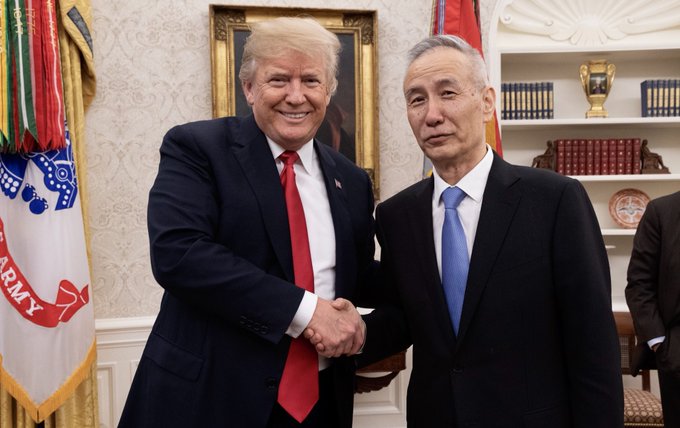
Donald J. Trump
✔@realDonaldTrump
Talking trade with the Vice Premier of the People’s Republic of China, Liu He.

Reuters is reporting that China has offered the US a trade-deficit reduction package amounting to roughly $200 billion annually. Demands that China take steps to reduce the US-China trade deficit have long been a part of Trump’s rhetoric, as have greater protections for US intellectual property. It was not immediately clear how the value of the package would be determined. One source told Reuters that Boeing would be a major beneficiary of the Chinese offer. The company already sells about a quarter of its aircraft to Chinese buyers.

Reuters Business
✔@ReutersBiz
China said to offer Trump a U.S. trade deficit reduction package approaching $200 billion annually – sources

The dollar rose in a kneejerk reaction to the headline but its gains are fading fast.
This is a developing story. Check back for updates…
end
Then China denies making this offer to Trump
(courtesy zerohedge)
“We Won’t Make Unilateral Concessions”: China Denies It Offered To Slash U.S. Trade Gap By $200BN
Overnight, experts and pundits were stumped by the biggest geopolitical news from Thursday: how could China possibly – or feasibly – agree to a $200 billion cut in the US-China trade deficit, even if merely to placate President Trump. Speaking to Bloomberg, Victor Shih, a China politics and finance professor at the University of California in San Diego said earlier that he finds an agreement to cut the U.S. deficit by $200 billion “difficult to contemplate.”
“Even with a drastic reallocation of Chinese imports of energy, raw materials and airplanes in favor of the U.S., the bilateral trade deficit may reduce by $100 billion,” he said. “A $200 billion reduction would mean a drastic reduction in Chinese exports to the U.S. and a dramatic restructuring of the supply chain.”
On Friday morning we got the answer: the entire story was nothing more than the latest fake news concocted by a “US official” and then promptly spun by the US media without actual confirmation by China.
And so, the mystery of just how China would shrink its $200 billion trade deficit with the US died on Friday morning, when China gave the answer: it wouldn’t, after Beijing denied it had offered the deficit-cutting package, just hours after it dropped an anti-dumping probe into U.S. sorghum imports in a conciliatory gesture as top officials meet in Washington.
“This rumor is not true. This I can confirm to you,” Chinese foreign ministry spokesman Lu Kang politely told a news briefing saying “the question is about some US officials who said China will cut the deficit. As I understand, the relevant consultations are ongoing and they are constructive,” he said, adding that he could not elaborate on the specifics of the negotiations.
Commentary posted in an article on WeChat accounts run by Xinhua News Agency and People’s Daily overseas edition was less restrained, and said that the offer to cut China’s trade surplus with the U.S. is “nonexistent” and that reports that China accepted the U.S. demand to narrow the trade gap are “purely a misreading.”
The article said that China will “never negotiate under the conditions set by the U.S.” and added that “two sides made progress in areas such as the U.S. allowing more exports of technology products including semiconductors, as well as lifting restrictions on energy exports” but stressed that “China won’t make unilateral concessions.”
The article also underscored that just hours before President Donald Trump met Vice Premier Liu He, the two sides were at loggerheads on key issues, and concluded that negotiations are ongoing and called on China to “fight for the best, and prepare for the worst.” It added that “tomorrow is a crucial day” without elaborating.
As a reminder, a $200 billion reduction in the trade gap with China by 2020 was on a list of demands the Trump administration made earlier this month as Treasury Secretary Steven Mnuchin led a delegation to Beijing. That mission left with little common ground with China and reports emerging of infighting among the U.S. officials. The U.S. merchandise trade deficit with China hit a record $375 billion last year. The Trump administration has threatened to impose tariffs on as much as $150 billion of Chinese imports to the U.S. as tensions over trade have escalated. Trump expressed doubt before his meeting with Liu that China and the U.S. would come to an agreement to avoid a damaging trade war.
“Will that be successful? I tend to doubt it,” Trump said during a press briefing on Thursday with NATO Secretary-General Jens Stoltenberg. “The reason I doubt it is because China’s become very spoiled.”
* * *
What wasn’t fake news, is that earlier on Friday, China did offer a conciliatory olive branch when it announced that it would end its sorghum anti-dumping and anti-subsidy investigation, which had effectively halted a trade worth over $1 billion last year. The United States shipped 4.76 million tonnes of sorghum to China in 2017, worth about $1.1 billion, accounting for the bulk of Chinese imports of the grain used in animal feed and Chinese liquor.
“The imposition of anti-dumping and anti-subsidy measures on imports of sorghum originating from the United States would have a widespread impact on consumer living costs, and does not accord with the public interest,” the Commerce Ministry said in a statement.
In April, China forced U.S. sorghum exporters to put up a 178.6% deposit on the value of sorghum shipments to the country after launching an investigation in February following Trump’s imposition of steep tariffs on imports of solar panels and washing machines.
“China has taught a lesson to the United States and showed how it can hurt U.S. exports,” said Ole Houe, director of advisory services at brokerage IKON Commodities in Sydney.
“Now they are showing goodwill by halting its anti-dumping investigation into sorghum imports, but it is a cheap way of showing goodwill as the U.S. doesn’t have much sorghum left to export. The next U.S. sorghum crop will be harvested in August,” Houe said.
end
Kudlow, who happens to be a complete moron, and no doubt under the influence, basically called China a liar
(courtesy zerohedge)
Calling China A Liar, Kudlow Says Beijing Offered To Reduce Trade Deficit By “At Least $200 Billion”
Trump’s top economic advisor, Larry Kudlow (it’s still a shock) did not get the memo that Beijing vocally denied last night’s “fake news” report that it was ready to slash the US trade deficit with China, and speaking to reporters at the White House, the former CNBC commentator said China offered to reduce its trade surplus with the U.S. by “at least $200 billion” in talks to head off a possible trade war, according to Bloomberg.
As a reminder, this is patently false as China’s foreign ministry spokesman Lu Kang politely told a news briefing this morning, flatly stating that “this rumor is not true. This I can confirm to you” adding “the question is about some US officials who said China will cut the deficit. As I understand, the relevant consultations are ongoing and they are constructive.”

Commentary posted bu Xinhua News Agency and People’s Daily overseas edition was less polite and said that the offer to cut China’s trade surplus with the U.S. is “nonexistent” and that reports that China accepted the U.S. demand to narrow the trade gap are “purely a misreading.” also known as fake news.
The article said that China will “never negotiate under the conditions set by the U.S.” and added that “two sides made progress in areas such as the U.S. allowing more exports of technology products including semiconductors, as well as lifting restrictions on energy exports” but stressed that “China won’t make unilateral concessions.”
However, none of these facts bothered Larry, who boldly continued making up stuff: “The number’s a good number,” Kudlow said. “I think just as important, they have to lower their tariff rates, they have to lower their non-tariff barriers. We have to have a verifiable process whereby the technology transfers and the theft of intellectual property stops.”
Then, Larry – who may or may not have been under the influence, once again confirmed the trade surplus offer supposedly made by China – which China explicitly denied – but declined to detail it. “They’re showing us some substance, and that’s a sign of respect. It’s a constructive approach.”
Actually, they said exactly the opposite, but Larry went on:
“China’s come to trade; they are meeting many of our demands,” he said, continuing this fantastically bizarre nonsense.
The one thing that Larry said that was true, was the following: “There’s no deal yet to be sure – it’s probably going to take awhile. It’s a process. But they’re coming to play”, and added hopefully “I believe they want to make a deal.”
Instead of grappling with the futile task of who is the bigger source of “fake news”, China or the Trump administration, we are more curious how many dry martinis Larry had for lunch.
4. EUROPEAN AFFAIRS
This is deadly: Our two anti establishment parties have reached a government deal:
- TALY FIVE STAR, LEAGUE PROGRAM URGES REVIEW OF EU FISCAL RULES
- FIVE STAR, LEAGUE PLAN SEEKS 15%, 20% TAX RATES FOR COS, PEOPLE
- FIVE STAR, LEAGUE PLAN SEEKS REVIEW OF BAIL-IN RULES: PROGRAM
Credit default swaps skyrockets as debt forgiveness by the new coalition government is scaring the living daylights out of the bankers.
(courtesy zero hedge)
Italy CDS Blows Out As Anti-Establishment Parties Reach Government Deal
After a series of false alarms over the past week, on Friday morning Italy’s anti-establishment Five Star Movement (M5S) and the far-right Northern League have finally agreed on a policy program, ending a monthslong stalemate.
The 57-page “Contract for a Government of Change” was published early Friday and includes a handful of key provisions that have, unsurprisingly, made bondholders nervous:
- ITALY FIVE STAR, LEAGUE PROGRAM URGES REVIEW OF EU FISCAL RULES
- FIVE STAR, LEAGUE PLAN SEEKS 15%, 20% TAX RATES FOR COS, PEOPLE
- FIVE STAR, LEAGUE PLAN SEEKS REVIEW OF BAIL-IN RULES: PROGRAM
According to Bloomberg, the proposed program, published on Di Maio’s Facebook page, includes a review of EU fiscal rules, the rolling back of pension reforms that raised the retirement age, as well 15-20% tax thresholds for companies and people. According to an estimate by former IMF official Carlo Cottarelli, it may cost as much as 126 billion euros ($148 billion).
The document, the culmination of two months of work following a political stalemate in the euro zone’s third-largest economy, calls for billions of euros in tax cuts, additional spending on welfare for the poor and a roll-back of pension reforms. Here’s a roundup of its key clauses courtesy of the Financial Times:
- Universal basic income of €780 per person per month, funded in part through EU
- No mention of a referendum on membership of either the EU or the euro
- Agreement to meet the goals of the Maastricht Treaty
- No plans to ask the ECB to cancel debt
- Calls for airline Alitalia to be relaunched
- Flat tax to become a dual rate with deductions
- Seeks a strong contribution to EU immigration policy
There was some good news: the plan does not mention the dreaded €250BN write-off, and drops the request to exclude QE bonds from Italy’s debt/GDP calculations, both seen as euro-positive although the EURUSD promptly sank to session lows after the contract was revealed. The plan also drops reference to euro-exit procedure. An earlier draft of the accord, reviewed by Reuters, had called for the EU to create fiscal headroom for Italy by adjusting the formula used to calculate the nation’s debt burden, which the rules say must be reduced.
The “contract” has still to be approved by their memberships, in votes to be concluded by Sunday.
“This government contract binds two political forces that are and remain alternative, to respect and achieve what they promised to citizens,” Di Maio said, quickly sinking the euro as it headed for what would be its fifth straight weekly fall against the dollar since 2015. Meanwhile, stocks in Milan hit their lowest level in a month as Italian investor fears, inexplicably dormant for months, finally reappeared.
Italian government bonds also retreated on Friday, sending 10-year yields to their highest levels in seven months as investors worried that the new ruling coalition was about to embark on a spending spree.

Meanwhile traders and hedgers – concerned about an imminent deficit-busting debt issuance spree – are starting to wave in Italian default protection, and this morning, Italian credit default swaps soared to their highest levels since January…

… while BTP/Bund spreads are also soaring:


The deal ends a lengthy stalemate that had persisted since Italy’s March elections. Recently, the party’s were facing the prospect of another vote either over the summer or early next year if they did not agree on a platform. The two parties still need to pick a prime minister.
End
No substance to the EU bluff that they will place tariffs on USA goods. It is nothing but a bluff
(courtesy Mish Shedlock/Mishtalk)
Windbag Jean-Claude Juncker’s Pathetic Bluff
Regarding Iran Sanctions
Authored by Mike Shedlock via MishTalk,
EC president Jean-Claude Juncker says the EU will activate a ‘blocking statute’ to avoid Iran sanctions.

Five hours ago Reuters reported the EU Will Start Iran Sanctions Blocking Law Process on Friday.
“As the European Commission we have the duty to protect European companies. We now need to act and this is why we are launching the process of to activate the ‘blocking statute’ from 1996. We will do that tomorrow morning at 1030,” European Commission President Jean-Claude Juncker said.
“We also decided to allow the European Investment Bank to facilitate European companies’ investment in Iran. The Commission itself will maintain its cooperation will Iran,” Juncker told a news conference after a meeting of EU leaders.
Solidarity Busted Already
Two hours ago the Nasdaq reportedMacron Rules Out Trade War Over Iran Deal as Firms Head for Exit.
French President Emmanuel Macron ruled out on Thursday any trade war with the United States over its withdrawal from the Iranian nuclear deal as a wave of European companies quit business with Tehran, fearing the global reach of U.S. sanctions.
Macron acknowledged the predicament of firms wanting to trade with Iran or invest there, especially multinationals with close business ties to the United States. But he made clear bigger matters were at stake.
“We won’t start a strategic trade war against the U.S. about Iran,” he said on arriving for a second day of a European Union summit in Bulgaria. “We’re not going to take counter-sanctions against U.S. companies, it wouldn’t make sense.”
“All European Union member states are still backing this agreement, despite the fact the United States has decided not to, and we will continue talks with the United States,” German Chancellor Angela Merkel told reporters at the EU summit.
Actions Speak Louder Than Bluffs
The EU can claim it is still honoring the deal, but ultimately the decision is up to corporate CEOs. And we have seen the response.
- Soren Skou, chief executive of Danish-based A.P. Moller-Maersk, made this statement: “With the sanctions the Americans are to impose, you can’t do business in Iran if you also have business in the U.S., and we have that on a large scale. I don’t know the exact timing details, but I am certain that we’re also going to shut down.”
- Italian steel manufacturer Danieli announced it has halted work on finding financial coverage for orders it won in Iran worth 1.5 billion euros ($1.8 billion). “With the withdrawal of the U.S. from the treaty the banks are no longer ready to fund Iranian projects for fear of secondary sanctions,” Danieli CEO Alessandro Trivillin said.
EU’s Pathetically Weak Response to Donald Trump
Eurointelligence mocked the Juncker’s response last night, even before Juncker made it.
It is really quite sad to see the lack of gumption by EU leaders when confronted with Donald Trump’s threats.
The fundamental tenet of German policy will be to protect the interests of industry in general, and of the car industry specifically. That clearly sets limits to the EU’s ability to stand up to Donald Trump, and risks a major trade conflict.
Yesterday’s EU summit in Sofia agreed a broad strategy of the neither-here-nor-there kind to deal with Trump. The leaders managed to agree that they will not enter into a trade talks if the US applies tariffs to steel and aluminium from June 1, when the current and final exemption expires.
The leaders also agreed the implausible strategy to prepare protection for European companies against secondary US sanctions to be slapped on EU companies dealing with Iran. But they gave no details on how this can be done. As FAZ recently pointed out, the only companies willing and able to resist US pressure will be European importers of Persian carpets.
Jean-Claude Juncker even mentioned the possibility of invoking the blocking statute. This is the ultimate bluff. The statute would allow the EU to impose sanctions on European companies that comply with US sanctions. In other words, it would give EU companies a choice between pest and cholera. Needless to say, this has not been agreed. Nor will it be. It is a sign of the helplessness and panic of EU leaders that they even talk about it.
Windbags Juncker, Merkel, Macron
Merkel’s role in Europe is now essentially the same as Juncker’s. Both are nothing but pathetic windbags with dwindling power.
Macron wants to be the European savior but he is just another windbag who bows down to Trump internationally while accomplishing nothing domestically.
Nonetheless, this story is not over yet. The EU will at some point be forced to respond and the results won’t be pretty
end
France/Syria/ Nine companies assets frozen including one Chinese firm
France seizes Chinese firm’s assets over alleged links to Syria chemical weapons
(courtesy zerohedge)
Chinese Firm’s Assets Frozen By France Over Alleged Links To Syria’s Chemical Weapons
Despite the fact that the Organization for the Prohibition of Chemical Weapons (OPCW) has yet to produce its fact-finding report into last month’s alleged chemical attack in Douma, France has implicated and moved on a Chinese firm said to be connected with Syria’s chemical weapon’s program.
France has frozen the assets of multiple international and Middle East companies, including a China based trading company over links to the Syrian Scientific Studies and Research Centre (SSRC) – also widely known by its French initials CERS – which is the Syrian government’s chief defense technology and missile research arm widely blamed for producing Syria’s chemical weapons.

The South China Morning Post reports via the AFP:
The businesses include Sigmatec and the Al Mahrous Group, both based in Damascus; Technolab in Lebanon; and a trading company in Guangzhou in China, according to a list published in the government’s official gazette.
Two Syrian nationals will also face asset freezes, as well as a person born in Lebanon in 1977 whose nationality was not given.
The asset freezes were signed by French Finance minister Bruno Le Maire.
French finance minister Le Maire and Foreign Minister Jean-Yves Le Drian in public statements linked the businesses to CERS, which they alleged is “the main Syrian laboratory in charge of developing and producing unconventional chemical weapons and ballistic launchers.”
Last month’s US-led airstrikes on Damascus primarily targeted sites connected with CERS such as the Barzeh research center, which was destroyed by well over a dozen tomahawk missile strikes; however, the OPCW during prior routine inspections connected with the late 2013 US-Russia brokered deal to decommission Syria’s sarin stockpiles reported that it found “no evidence” of chemical weapons at the site.
Over the past years of war in Syria, France has consistently accused President Bashar al-Assad of both using chemical weapons on civilians and misleading weapons inspectors as to the current status of his program, in spite of both former Secretary of State John Kerry and OPCW inspectors declaring the 2013-2014 decommissioning process a monumental success. France was part of the US-led coalition that launched a massive missile attack against Damascus and other locations in Syria on April 13.
John Kerry in May of 2014 to CNN: “We got all of the chemical weapons out.”
In April 2017 France produced an intelligence paper which attempted to cast doubt over Syria’s US-Russian sponsored decommissioning of its chemical program: “France assesses that major doubts remain as to the accuracy, exhaustiveness and sincerity of the decommissioning of Syria’s chemical weapons arsenal,” the paper stated.
Concerning the latest asset freeze targeting Chinese and other international companies with links to the Damascus based Syrian research center, the French ministers’ joint statement identified a total of nine companies implicated, according to Reuters: “Three people and nine companies have been targeted for their role in the research and/or acquisition of materials for the development of chemicals and ballistic weapons for this country,” the statement said.
The punitive measures come just as some 30 countries are set to meet in Paris on Friday to discuss erecting international mechanisms aimed at identifying and punishing countries involved in the development and use of internationally banned chemical weapons.
Last January France announced that it sanctioned 25 individuals and companies over suspected links to Syria’s program, which also included Chinese citizens. China has been long positioned itself as the chief international investor in post-war Syria, with Defense One news reporting that “Over the past year, Chinese-Syrian negotiations over trade and investment expanded from early diplomatic exchanges to commitments of nearly $2 billion in reconstruction contracts. China has become Syria’s largest trade partner, snapping up 80 percent of its exports.”
As China eyes rebuilding Syria in close economic partnership with Damascus, its companies will likely increasingly be targeted by the West, itself hopeful of sweeping up the economic spoils of a post-Assad Syria.
Meet ‘Mini-BOT’: Italy’s New Parallel Currency Plan
In 2009/10, squeezed by insolvency, a lack of liquidity, and Federal limitations, the California government began to issue a ‘parallel currency’ in IOUs in lieu of payment on everything from supplies to contracted services and health-care costs, so it can actually preserve cash to make payments to its generous debtors.
Now, eight years later, despite all the talk of ‘recovery’ and ‘global synchronous growth’ and ‘normalization’, Italy’s newly-formed coalition of The League and Five Star (which some have likened to Trumpian ‘nationalist’ Republicans merging with Bernie leftists) have put forward a plan that, among other things, includes the introduction of a parallel currency for Italy – ‘mini-BOTs’.
The chart below, created by analysts at Nomura, shows where both stand on key policy issues, highlighting both their similarities and their differences as they prepare to govern together.

It is the Italian euroskepticism that dominates market concerns. Investors were initially spooked by a section where the nascent coalition floated plans to ask for €250 billion in debt forgiveness for the country. But, as Credit Suisse argued,
“A markedly Eurosceptic prime minister… as well as concrete support for the introduction of a parallel currency (so-called Mini-BOTs’), would be major negatives, in our view.“
So what are ‘Mini-BOTs’?
In order to settle bills with suppliers or creditors the state might consider “instruments such as mini-government notes” which may also be used in turn to repay tax arrears, says the government program agreed by the two parties’ representatives and leaders.
Earlier this year, outgoing Economy Minister Pier Carlo Padoan described the proposal as “a plan to circulate a disguised parallel currency”.
It is this section of the Five Star-League Accord that raised eyebrows…
“Something must be done to resolve the problem of the public administration debts to taxpayers.”
Claudio Borghi, the League’s economic chief who helped write the government plan, told la Verita newspaper that the new securities “could be spent anywhere, to buy anything”.
Mike Shedlock previously noted that ‘Mini-Bots’ are a parallel currency based on future tax receipts, similar to the plans proposed by Yanis Varoufakis in Greece.
The minibot was in the Lega’s election manifesto. Five Star is far less radical on the eurozone, having dropped the idea of a referendum, but also seeks changes that are incompatible with the the EU fiscal rules.
A parallel currency stands a much greater chance of success in Italy, and it would go some way to solving the government’s fiscal dilemmas. The open question is whether it would constitute a slippery slope towards euro exit.
How would it work?
Bloomberg’s Stephen Spratt explains that basically the Italian government would mail you a certificate that says it’s worth a certain amount — and you can sell that if you want to get the money quicker.
But it would be likely to trade at a discount to its face value in euros, in effect creating a parallel currency — particularly if people were to start using the new note as cash to exchange for goods and services, rather than using euros.
There are reasons to be skeptical – not least that these notes are likely to be in small denomination and won’t be perfectly fungible with bills or cash. It may seem far fetched, and may never come to pass, but that’s bound to make investors nervous.
Of course, the question is ‘what is a mini-BOT’ worth?’ For now, it is impossible to tell but we do note that Italy’s relative creditworthiness for Euros is about 20-30bps higher than its recent norms…

And Italian Euro debt trades at around a 160bps haircut to German Euro debt…

Which could perhaps be extrapolated to indicate an Italian Euro is worth around 98c on the German Euro… for now.
Finally, we note that while mini-BOTs, for now, are still effectively backed by the full faith and credit of Italy, MishTalk’s Mike Shedlock had a suggestion that could really be dramatic…What If Italy’s Parallel Currency Was Backed By Gold?
The parties are eurosceptic to varying degrees. Part of their platform includes a Parallel Currency.
Heck, why not back it with gold?
After all, the bank of Italy has the third largest gold reserves in the world after the US and Germany.

Banca d’Italia’s Mammoth Gold Reserves
The BullionStar discusses Banca d’Italia’s Mammoth Gold Reserves.
Italy’s gold has had an eventful history. Robbed by the Nazis and taken to Berlin. Loaded on to gold trains and sent to Switzerland. Flown from London to Milan and Rome. Used as super-sized collateral for gold backed loans from West Germany while sitting quietly in a vault in New York. Leveraged as a springboard to prepare for Euro membership entry. Inspired Italian senators to visit the Palazzo Koch in Rome. Half of it is now in permanent residency in downtown Manhattan, or is it? Even Mario Draghi, European Central Bank (ECB) president, has a view on Italy’s gold. The below commentary tries to make sense of it all by bringing together pieces of the Italian gold jigsaw that I have collected.
According to officially reported gold holdings, and excluding the gold holdings of the International Monetary Fund (IMF), Italy’s central bank, the Banca d’Italia, which holds Italy’s gold reserves, is ranked as the world’s third largest official holder of gold after the US and Germany, with total gold holdings of 2,451.8 tonnes, worth more than US$ 105 billion at current market prices. Notable, Italy’s gold is owned by the Banca d’Italia, and not owned by the Italian State. This contrasts to most European nations where the gold reserves are owned by the state and are merely held and managed by that country’s respective central bank under an official mandate.
Palazzo Koch
In its Palazza Koch vaults in Rome, the Banca d’Italia claims to store 1199.4 tonnes of gold. Of this total, 1195.3 tonnes are in the form of gold bars (represented by 95,493 bars), and 4.1 tonnes are in the form of gold coins (represented by 871,713 coins). While most of the bars in Rome are prism-shaped (trapezoidal), there are also brick-shaped bars with rounded corners (made by the US Mint’s New York Assay Office) and also ‘panetto’ (loaf-shaped) ‘English’ bars. The average weight of the bars in Palazzo Koch is 12.5 kg (400 oz), with bar weights ranging from relatively small 4.2 kgs up to some very large 19.7 kgs bars. The average fineness / gold purity of the Rome stored bars is 996.2 fine, with some of the holdings being 999.99 fine bars.
The Banca d’Italia also states that 141 tonnes of gold that it transferred to the ECB in 1999 as a requirement for membership of the Euro is also stored in Palazzo Koch. This would put the total gold holdings in the Palazzo Koch vaults at 1340 tonnes. Gold transferred to the ECB by its Euro member central banks is managed by the ECB on a decentralised basis, and is held by the ECB in whatever location it was stored in when the initial transfers occurred, subject to various location swaps which may have taken place since 1999.
Where’s the Rest?
Bullion Star writer Ronan Manly asked the Bank of Italy, Mario Draghi, and other officials a bunch of question on location, leasing, etc. The questions were all refused.
Manly also uncovered a bit of history, translating a video in Italian into English, noting that when the bars were moved to Germany they were stamped with a Swastika:
“The RAI broadcast video shows a 1940 Nazi bar from Berlin, stamped with the eagle and swastika insignia and with Prussian mint markings. The Nazi bar holdings can be explained by the fact that the Italian gold was confiscated by the Nazis during World War 2 and ended up being moved out of Rome up to the north of Italy and then most of it was transported onwards to Berlin in Germany or else to Switzerland.”
The reporter, Angela, states that in addition to Rome, the Italian gold is stored at the Federal Reserve Bank in New York, the Bank of England in London, and at the Bank of International Settlements (BIS) in Switzerland. The reporter uses the exact words “Banca dei Regolamenti Nazionali”.
Even in Italian, the video is fascinating. Here are some image clips.

Italy’s National Debt
Italy’s National Debt Clock stands at 2.331 Trillion as of May 11, 2018.
Italy’s gold is worth a bit over $100 billion. Thus, Italy could not wipe out its debt with gold, nor could the US or any other country.
That aside, backing a new currency with gold, gets my endorsement. How might that work?
Consider Hugo Salinas Price’s idea: A Silver Coin for Mexico: History Lesson and a Stellar Proposal.
5. RUSSIAN AND MIDDLE EASTERN AFFAIRS
Israel/Turkey
Netanyahu’s son sends a cryptic message to Turkey over the Gaza deaths once the world finds out that 80% of those deaths were militants who wanted to storm the fence, enter Israel and kill as many citizens as possible. Israel was just defending itself
(courtesy Middle East Eye)
“Fuck Turkey”: Netanyahu Son’s Message to Ankara Over Gaza Massacre
The row between Tel Aviv and Ankara over the killing of 62 Palestinians sinks to new depths, with Israeli PM’s son posting explicit message…

“Fuck Turkey.”
That was the message the Israeli prime minister’s son gave to the world, as a state-level row with Ankara over Israel’s killing of 62 Palestinians on Monday descended into the bawdiest of insults.
Yair Netanyahu posted the message on Instagram on Wednesday, as Israel and Turkey expelled each other’s top diplomats after Ankara’s condemnation of Israel’s live-fire tactics against Gaza protesters.
Benjamin Netanyahu’s son included the message in an image similar to the Turkish flag, which has a red background and white star and crescent moon in the centre. The image showed the words “Fuck Turkey” with the crescent moon in place of the letter ‘c’.

Amichai Stein
✔@AmichaiStein1
#BREAKING: Yair Netanyahu, the son of Israeli PM @netanyahu, published a post against Turkey on his instagram acount

Monday was the bloodiest day in Gaza since 2014, as tens of thousands of people protested as part of the “Great March of Return”, a demonstration that was enflamed by the US opening its new embassy in Jerusalem at the same time.
Two more Palestinians were killed on Tuesday, as protesters in the Gaza Strip and the occupied West Bank marked 70 years since the Nakba – or Catastrophe – when 750,000 people were forced from their homes in historic Palestine.
Israeli tear gas, rubber-coated steel bullets and live ammunition also wounded 3,188 Palestinians.
Turkey’s foreign ministry on Tuesday ordered Israeli Ambassador Eitan Naeh to leave the country.Earlier on Wednesday, Israel’s ministry of foreign affairs summoned the sole remaining Turkish representative to the country to protest the treatment of Israel’s ambassador to Turkey during a security check when leaving the country.
In retaliation to Naeh’s expulsion, Israel ordered the Turkish consul-general in Jerusalem to return home for consultations. Husnu Gurcan Turkoglu was responsible for Turkey’s relations with the Palestinians. Turkey’s ambassadors to both Tel Aviv and Washington had already been recalled.
Turkey summoned Israel’s consul-general in Istanbul following Turkoglu’s expulsion, and also asked him to leave the country.
The leaders of the two countries fired rounds of comments at each other as the rift continued.
On Tuesday, Turkish President Recep Tayyip Erdogan said:
“Netanyahu is the PM of an apartheid state … He has the blood of Palestinians on his hands and can’t cover up crimes by attacking Turkey.”
The Israeli premier hit back at Erdogan, saying:
“A man who sends thousands of Turkish soldiers to hold the occupation of northern Cyprus and invades Syria will not preach to us when we defend ourselves from an attempt by Hamas.”
The killing of scores of Palestinian protesters in Gaza has put Israel’s use of snipers and live fire under the spotlight, but its political leaders and military are insisting on a different narrative – one that blames the Hamas movement.
The Israelis say Hamas organised the Great March of Return protests, paid people to attend, and incited them to break through Israel’s security fence along Gaza’s perimeter.
However, organisers of the protests over the last six weeks said they were led by Palestinian civil society.
“We’re a group of 20 organisers, only two of whom are affiliated with Hamas,” organiser Hassan al-Kurd told the Israeli 972 magazine before the protests started.
“Actually, most of us, including myself, are leftists. All the political parties in Palestine are behind us and supporting us, and Hamas – being an elected party – is one of those parties.”
This is not the first time Yair Netanyahu has caused controversy. An Israeli television channel aired recordings from 2015 earlier this year, in which he pressured an Israeli gas tycoon’s son for money for a prostitute, using a controversial gas deal as leverage.
The recordings come as Israeli police continue their investigation into suspicions that the prime minister received gifts from tycoons in exchange for political favours.
“Bro, you have to spot me,” Yair Netanyahu was recorded telling Nir Maimon, the son of Kobi Maimon, a major shareholder in Isramco.
“My dad made an awesome deal for your dad, bro. He fought, fought in the Knesset for this, bro.”
“What?” Maimon replied.
Yair Netanyahu continued:
“Bro, my dad now arranged a $20bn show for you, and you can’t spot me 400 shekels [$115]?”
Turkey has called on the United Nations General Assembly to pass a motion on Jerusalem, Turkish Foreign Minister Mevlut Cavusoglu said on Thursday, as discomfort over Palestinians killed in Gaza grows.
Speaking in an interview to state broadcaster TRT Haber, Cavusoglu also said that an independent commission needs to prepare a report on the violence in Gaza and that Israel needs to stand in the face of law.
Since the events in Gaza, a number of countries, including Ireland, Belgium and Luxembourg, have summoned their Israeli ambassadors and expressed protest and concern over the death toll of Palestinians.
South Africa also recalled its ambassador from Tel Aviv.
end
Syria/Israel/Saudi Arabia?)
Looks like Israel has struck an Iranian ammunition depot or their new anti missile defense system in Hama Syria
(zero hedge)
Massive Explosions, Smoke Plume Over Hama Leads To Confusion, Panic In Syria
Syrians in the central part of the country are on edge after a series of massive explosions rocked a Hama military airport on Friday. Local reports indicate up to seven explosions were heard, after which a mushroom could hung over the edge of Hama city.
“The explosions struck several regime depots of weapons and fuel at Hama military airport,” Rami Abdel Rahman, the head of the pro-opposition source Syrian Observatory for Human Rights, said.
Conflicting accounts quickly emerged as to what caused the blasts, with UK and Abu Dhabi based Sky News Arabia claiming there was an attack on Hama province’s Iranian air defenses, though most early reporting only admitted speculation.

The Times of Israel reports concerning early confusion in the media:
The Sky News Arabia outlet reported that the explosions were caused by an attack on an advanced Iranian air defense system.
However, Syrian military sources told the Lebanese el-Nashra TV station that the blasts were caused by an accident at a weapons storage depot.
There were no immediate comments by Syrian officials on who or what was behind the explosions.
After the May 10 Israeli attack on dozens of targets inside Syria in what was the biggest military escalation between the two countries in decades, some premature reports pointed to another possible Israeli strike on the base which some now allege houses Iranian troops and equipment.

Danny Makki@DannymakkisyriaVideo of aftermath of ammunition storage explosion in #Hama military airport

The Times of Israel further indicates that the Arabic language Sky News reporting asserts specifically that “the target of the [Israeli or allied coalition] strike was an Iranian Bavar 373 long-range missile defense system, a state-of-the-art model that was unveiled in 2016 and put into service in March 2017. Iranian officials compare the system to the Russian-made S-300 system, which is considered a powerful air defense platform.”
However, little information has yet to be actually confirmed as to the cause, and local reporters say the specific base has never been targeted by Israeli or US strikes, suggesting there is no history of Iranian troop presence in that location.
An early reporting consensus suggests an arms and munitions warehouse may have exploded in an event that’s currently receiving a lot of media attention due to the size and stunning nature of the images.


Danny Makki@DannymakkisyriaA total of 4 explosions were heard in #Hama military airport, ammunition depot blew up, heard all over the city
Danny Makki@DannymakkisyriaJudging by the pictures coming out it seems as though ammunition depots in Hama military airbase went off. pic.twitter.com/oZ2JcxY9mk

As South Front reports, Syrian sources reveal that several ammo depots were part of the airbase and had exploded for unknown reasons, further indicating the possibility that poorly stored ammunition may have ignited as result of a heat wave that’s hitting central Syria.
Other sources claimed that a poorly controlled explosion of dozens of IEDs, captured from militants, led to the explosion of all the ammo depots in the airbase.
Danny Makki@DannymakkisyriaIf it was such an important base for the “Iranians” then why wasn’t it targeted once over the last 4 years when #Israel kept striking? https://twitter.com/evacool_/status/997443014741102593 …
Local observers didn’t rule out the possibility of an Israeli airstrike, especially that Israel had targeted similar ammo depots in the eastern Hama countryside on April 29. Another possibility is that Hay’at Tahrir al-Sham (HTS) or the Free Syrian Army (FSA) targeted Hama airbase with grad rockets, as they do on a regular basis.
Syrian state TV confirmed that several explosions occurred in Hama airbase, however, no further information was provided.
This is a developing story
6 .GLOBAL ISSUES
I won’t bore you with the details, but this is a huge development. We have been reporting on the huge shortage dollars in the world and this started with the USA repatriation of European held dollars with respect to tax reform. This shortage of dollars caused the USA dollar to rise setting off huge problems for our emerging nations. Now it seems that we have just had a massive “margin” call on countries scramble to balance their huge burgeoning external debt
(courtesy Jeff Snider/Alhambra Investment Partners)
This Is A Really Strange Development
Authored by Jeffrey Snider via Alhambra Investment Partners,
Observing the eurodollar system as I’ve done for so many years, you have to be prepared for curve balls thrown at you. Just when you think you’ve got it clocked (sometimes literally), something changes and it all gets tossed out the window.
About a month ago, the Federal Reserve reported a sharp drop of UST’s in custody on behalf of foreign agents. I noted then, and remain convinced now, that was something like a collateral call. It happened the week of April 18.
Not surprisingly, the same data shows over subsequent weeks the amount of UST’s in custody continued to decline sharply. The four-week total (through the week of May 9, the latest available) is about -$66 billion. That’s an enormous drop, a level in the same class as other episodes where global liquidity problems were obvious.

Not only that, gold prices have been exhibiting the same repo-related tendency (crashes) dating back to that same week. Yesterday, gold fell below $1,300 for the first time since the last trading day of last year. It’s the same anti-reflation/collateral deflation pattern we’ve become accustomed to.

As if we needed more evidence, this latest currency crisis (and it is now a crisis) spreading across the world traces its origins to the same week. The Argentine peso, for one, had been merely falling prior. Since the week of April 18, it has crashed. The same goes for others like the rupiah and real.


It’s also the week when EUR turned and HKD exhibited the heaviest HKMA interventions.

We know without a doubt that something turned really bad the week of April 18, but what was it?
With the euro now trading under 1.18, I figured it was a safe bet that we’d later find out during this period since mid-April there would have been another spike in repo fails. Fails aren’t necessarily a coincident indication. At several times in past eurodollar events, they have led, at others lagged. Given the surge in indicated dealer hoarding in the week prior, the week of April 11, a jump in fails at some point seemed almost guaranteed to go along with this increasing “dollar” mess.
Quite the contrary.
FRBNY reports today that there were practically no repo fails last week. The total combined (“to receive” plus “to deliver”) was $22.9 billion; not $229 billion, as had become almost the baseline, but a level so low we’ve not seen it in the fails data for seven years going back to just before the outbreak of the 2011 crisis.

This is some pretty weird stuff. Perhaps it was a misprint or typo in the FRBNY data. While that’s not impossible, it would have had to been applied to both sides (“to receive” as well as “to deliver”) making it less likely. But the New York branch also reported a serious collateral de-hoarding coincident to what I’m going to call the week of no fails.

The pattern itself is not unprecedented. In 2008 as well as 2011, when some of the truly worst stuff was going on repo fails were not a pressing issue. They had in both cases preceded all that, and indicated systemic problems that were likely breaking out in that way. Again, as a coincident indication they weren’t always there.
What’s unique, obviously, is the scale of the decline this time around, particularly in how it is such a clear change from what’s been standard operative conditions – as well as the specific period in which this has happened. The week of May 9 saw some of the biggest currency declines since the last “rising dollar” and they hit practically everyone (including to limited extent CNY).
Is this overseas capacity being asked to contribute collateral strictly to domestic participants? A one-way collateral call that offshore can’t meet? It might explain the different direction reported for overseas collateral stock from what the limited view domestically (and repo fails only apply to what repo market transactions are reported by primary dealers operating in US capacities) is suggesting. There aren’t a lot of answers here.
Another possibility is intervention. But who? Certainly not the Fed and not likely any of the ECB, SNB, or equivalent (BoJ and BoE would be the two most likely candidates, especially the former given TIC data). To whom? Through what channels?
As if we needed any more to investigate, it has gotten real interesting yet again.
end
7. OIL ISSUES
A good study on how gasoline prices having risen above $3.00 per gallon will hurt the USA economy
(courtesy zerohedge)
This Is How The “Oil Price Shock” Will Hurt The US Economy
One month ago, when looking at the sharp spike in oil and gasoline prices (which at the time averaged $2.73), we said that the surge in energy costs – largely the result of geopolitical risk emanating from Iran for which Trump was been responsible – will wipe out any remaining benefits for the middle class from Trump tax reform. Fast forward to today, when gas is nearly 20c higher than it was a month ago, and fast approaching the critical for middle-class consumption level of $3.00.

Since then the topic of how much of an adverse impact rising oil prices will have on the economy has emerged front and center, with pundits and economists debating at what price the negative consequences from reduced consumer spending will offset the favorable benefits from increased CapEx spending by US shale and energy companies.
Picking up on this topic overnight, Bank of America’s energy analyst Francisco Blanch said that he expects Brent crude oil prices to trend gradually higher, hitting an average of $80/bbl by mid-2019 before then just as gradually trending lower to an average of $71/bbl by year-end 2019. This amounts to approximately a $20 appreciation in crude oil from the end of last year to the peak in the outlook.
But the real question is what does this $20 jump in the price of oil mean for the economy?
As BofA explains, to get a sense of how the rise in oil prices will affect growth, the bank ran a one-time $20 oil shock in FRB/US, the Federal Reserve Board’s general equilibrium macroeconomic model.
It found only a modest impact: real GDP growth initially slows by less than 0.1pp relative to baseline before some modest positive payback in following years (Chart 1). It also ran an “oil shock” scenario that doubles the increase in the baseline forecast which aligns with the BofA Commodity Research team’s upside risk scenario. Predictably, in that case growth slows more noticeably – to the tune of roughly 0.1-0.2% – before retracing some of the drag in the out years.

So, to the Trump administration this is good news, if only superficially: these simulations suggest a temporary rally in oil prices is unlikely to create a major headwind for the economy. As we said, that the “superficial” case.
However, a sustained oil price shock where crude oil prices remain at peak levels would be significant. The BofA model simulations indicate a permanent oil price shock to $80/bbl would shave roughly 0.2pp from growth over the next eight quarters while a sustained shock to $100/bbl would cut roughly 0.5pp. Also note that the economic literature finds that large movements in oil prices could have negative nonlinear effects on growth as consumers may be slow to adjust to higher energy prices. However, given that the bank is only forecasting a gradual rise in prices over the outlook, it does not expect a material slowdown in growth and maintain our current growth forecast.
* * *
Here are some more details from the BofA analysts:
Drilling into energy inflation
Energy is broken up into energy commodities and energy services in consumer inflation. The former reflect products like retail gasoline that are refined from crude oil, while the latter capture electricity and piped gas where natural gas is the primary consideration. As of 2017, petroleum only accounted for 0.5% of electricity generation, so it really is not an important driver of energy services.
Energy commodities largely reflect gasoline and other motor fuels, which account for more than 90%. To model the elasticity of energy commodities to crude oil, first think about the retail gasoline pipeline. Crude oil is first refined into gasoline and sold wholesale before reaching consumers. Without getting too into the weeds, BofA estimates the elasticity of crude oil onto energy commodities to be roughly 0.7, meaning that a 1% increase in crude oil over a two month period results in a 0.7% increase to energy commodities Accounting for energy commodities making up 2.3% of headline inflation, a $20 increase in crude oil would add 0.3% to headline PCE and a $40 increase would boost headline inflation by 0.6%.
Hitting (headline) inflation
Based on the analysis above, a transitory increase in crude oil prices would be reflected quickly in headline inflation via the energy component (Chart 2). Indeed, the crude oil rally through the first quarter has contributed to headline PCE running, on average, 14bp higher than core PCE on a % yoy basis. However, the effects would filter out just as quickly if there was a reversal, and core inflation would be largely unaffected by the noise.
On core inflation, the literature generally finds limited pass-through of energy prices. Cavallo (2008) finds that oil price inflation have had a small and statistically insignificant effect on core inflation while Hooker (2002) finds little or no passthrough to core inflation since the 1980s. On the other hand, Conflitti and Luciani (2017) find some impact with their estimates showing an average elasticity of 0.01 in the first year of the shock and a small but lasting 0.003 over the next several years. Their estimates suggest that a $20 oil shock would boost core inflation by about 0.2pp in the first year, and less than a tenth thereafter. The more extreme $40 scenario would boost core inflation by roughly 0.4pp in the first year and 0.1pp after.
As BofA notes, the “Bottom line is that we think the new outlook for oil prices will temporarily lift headline inflation but have little to no effect on core inflation, leaving us comfortable with our call for core PCE inflation to hit 1.9% yoy and 2.1% yoy this year and next, respectively.”
These aren’t your parent’s oil shocks
Another reason why BofA doesn’t expect the rise in oil prices to materially impact its outlook is that the importance of oil shocks has diminished over time. In the past, changes in oil prices were a major source of economic fluctuation. For example, oil price shocks of the 1970s led to bouts of stagflation (i.e., low growth, high unemployment, and high inflation). However, since the late-1990s, growth and inflation have remained relatively stable in the face of major oil shocks. There are several factors for this phenomenon.
First, we now consume less energy goods than in the past. Consumption of gasoline, fuel oil and other energy goods as a share of total consumption has fallen from around 8% before the 1970s to around 2.5% today, limiting the effect of oil shocks (Chart 3). Second, the US produces more oil domestically, reducing our reliance on foreign production (Chart 4). Production of crude petroleum and natural gas extraction has been surging since the mid-2000s.
Therefore, a rise in oil prices today redirects more income between domestic consumers and producers than it did previously, cushioning some of the negative impact of an oil shock.
Third, monetary policy credibility has improved over time. Blanchard and Gali (2007) find that fluctuations in inflation and growth diminished over time owing to the FOMC stronger commitment to price stability in the Volcker era. All these factors suggest the increases in oil prices will only have a mild effect on growth and inflation.

Heightened risk
Despite the generally favorable conditions, BofA admits that higher oil prices are a key risk to its growth outlook but at this stage, the bank maintains its view that growth will remain on target to hit 2.9% this year and 2.4% next year. The bank underscores that only a sustained pickup in oil prices is likely to weigh on the economy which appears unlikely given its current forecast for oil prices. Moreover, BofA adds that the likelihood that an oil shock will lead to recession appears low, for now, especially since the fiscal stimulus from tax cuts and the budget deal should buffer against any downturn. Moreover, structural changes to the economy should limit the negative impact.
On inflation, the pass-through of oil shocks to core inflation appears fairly limited while headline inflation is likely to respond quickly.
To BofA, all this suggest that Fed should remain comfortable in its gradually hiking cycle and keep them on track to raise rates two to three more times this year. Of course, if BofA is wrong and the inflationary impact is more acute, it will simply mean that the Fed is even further behind the curve, forcing it to hike at an even faster pace if and when the wage inflation finally spills over into the economy.
8. EMERGING MARKET
BRAZIL
VENEZUELA
Your early morning currency/gold and silver pricing/Asian and European bourse movements/ and interest rate settings FRIDAY morning 7:00 am
Euro/USA 1.1781 DOWN .0009/ REACTING TO MERKEL’S FAILED COALITION/ SPAIN VS CATALONIA/REACTING TO +GERMAN ELECTION WHERE ALT RIGHT PARTY ENTERS THE BUNDESTAG/ huge Deutsche bank problems + USA election:/TRUMP HEALTH CARE DEFEAT//ITALIAN REFERENDUM DEFEAT/AND NOW ECB TAPERING BOND PURCHASES/JAPAN TAPERING BOND PURCHASES /USA FALLING INTEREST RATES AGAIN/HOUSTON FLOODING/EUROPE BOURSES RED
USA/JAPAN YEN 110.98 UP 0.138 (Abe’s new negative interest rate (NIRP), a total DISASTER/SIGNALS U TURN WITH INCREASED NEGATIVITY IN NIRP/JAPAN OUT OF WEAPONS TO FIGHT ECONOMIC DISASTER/
GBP/USA 1.3487 DOWN 0.0023 (Brexit March 29/ 2017/ARTICLE 50 SIGNED/BREXIT FEES WILL BE CAPPED
USA/CAN 1.2815 DOWN .0020 (CANADA WORRIED ABOUT TRADE WITH THE USA WITH TRUMP ELECTION/ITALIAN EXIT AND GREXIT FROM EU/(TRUMP INITIATES LUMBER TARIFFS ON CANADA/CANADA HAS A HUGE HOUSEHOLD DEBT/GDP PROBLEM)
Early THIS FRIDAY morning in Europe, the Euro FELL by 9 basis points, trading now ABOVE the important 1.08 level FALLING to 1.1781; / Last night Shanghai composite CLOSED UP 39.02 POINTS OR 1.24% / Hang Sang CLOSED UP 105.76 POINTS OR 0.34% /AUSTRALIA CLOSED DOWN .10% / EUROPEAN BOURSES ALL RED
The NIKKEI: this FRIDAY morning CLOSED UP 91.99 OR 0.40%
Trading from Europe and Asia
1/EUROPE OPENED RED
2/ CHINESE BOURSES / : Hang Sang CLOSED UP 105.76 POINTS OR 0.34% / SHANGHAI CLOSED UP 39.02 POINTS OR 1.24% /
Australia BOURSE CLOSED DOWN .10%
Nikkei (Japan) CLOSED UP 91.99 POINTS OR 0.40%
INDIA’S SENSEX IN THE RED
Gold very early morning trading: 1287.50
silver:$16.40
Early FRIDAY morning USA 10 year bond yield: 3.10% !!! UP 0 IN POINTS from THURSDAY night in basis points and it is trading WELL ABOVE resistance at 2.27-2.32%. (POLICY FED ERROR)/
The 30 yr bond yield 3.24 UP 2 IN BASIS POINTS from THURSDAY night. (POLICY FED ERROR)/
USA dollar index early MONDAY morning: 93.58 UP 11 CENT(S) from YESTERDAY’s close.
This ends early morning numbers FRIDAY MORNING
xxxxxxxxxxxxxxxxxxxxxxxxxxxxxxxxxxxxxxxxxxxxxxxxxxxxxxxxxxxxxxxxxxxxxxxxxxxxxxxxxxxxxxxxxxxxxxxxxxxxxxxxxxxxxxx
And now your closing FRIDAY NUMBERS \1: 00 PM
Portuguese 10 year bond yield: 1.868% UP 7 in basis point(s) yield from THURSDAY/
JAPANESE BOND YIELD: +.0.61% DOWN 1/5 in basis points yield from THURSDAY/JAPAN losing control of its yield curve/
SPANISH 10 YR BOND YIELD: 1.443% UP 4 IN basis point yield from THURSDAY/
ITALIAN 10 YR BOND YIELD: 2.229 UP 11 POINTS in basis point yield from THURSDAY/
the Italian 10 yr bond yield is trading 79 points HIGHER than Spain.
GERMAN 10 YR BOND YIELD: FALLS TO +.61% IN BASIS POINTS ON THE DAY
END
xxxxxxxxxxxxxxxxxxxxxxxxxxxxxxxxxxxxxxxxxxxxxxxxxxxxxxxxxxxxxxxxxxxxxxxxxxxxxxxxxxxxxxxxxxxxxxxxxxxxxxxxxxxxxxxxxxxxxxxxxxxxxxxxxxxxx
IMPORTANT CURRENCY CLOSES FOR FRIDAY
Closing currency crosses for FRIDAY night/USA DOLLAR INDEX/USA 10 YR BOND YIELD/1:00 PM
Euro/USA 1.1778 DOWN .0014(Euro DOWN 14 Basis points/ represents to DRAGHI A COMPLETE POLICY FAILURE/
USA/Japan: 110.70 DOWN 0.115 Yen UP 12 basis points/
Great Britain/USA 1.3476 DOWN .0033( POUND DOWN 33 BASIS POINTS)
USA/Canada 1.2890 UP .0055 Canadian dollar DOWN 55 Basis points AS OIL FELL TO $71.43
xxxxxxxxxxxxxxxxxxxxxxxxxxxxxxxxxxxxxxxxxxxxxxxxxxxxxxxxxxxxxxxxxxxxxxxxxxxxxxxx
This afternoon, the Euro was DOWN 14 to trade at 1.1778
The Yen ROSE to 110.70 for a GAIN of 12 Basis points as NIRP is STILL a big failure for the Japanese central bank/HELICOPTER MONEY IS NOW DELAYED/BANK OF JAPAN NOW WORRIED AS AS THEY ARE RUNNING OUT OF BONDS TO BUY AS BOND YIELDS RISE
The POUND FELL BY 33 basis points, trading at 1.3476/
The Canadian dollar FELL by 55 basis points to 1.2890/ WITH WTI OIL FALLING TO : $71.43
The USA/Yuan closed AT 6.3800
the 10 yr Japanese bond yield closed at +.061% DOWN 1/5 IN BASIS POINTS / yield/
Your closing 10 yr USA bond yield DOWN 4 IN basis points from THURSDAY at 3.076 % //trading well ABOVE the resistance level of 2.27-2.32%) very problematic USA 30 yr bond yield: 3.219 DOWN 2 in basis points on the day /
THE RISE IN BOTH THE 10 YR AND THE 30 YR ARE VERY PROBLEMATIC FOR VALUATIONS
Your closing USA dollar index, 93.66 UP 19 CENT(S) ON THE DAY/1.00 PM/
Your closing bourses for Europe and the Dow along with the USA dollar index closing and interest rates for FRIDAY: 1:00 PM EST
London: CLOSED DOWN 9.18 POINTS OR 0.12%
German Dax :CLOSED DOWN 36.89 POINTS OR 0.28%
Paris Cac CLOSED DOWN 7.41 POINTS OR .13%
Spain IBEX CLOSED DOWN 104.00 POINTS OR 1.02%
Italian MIB: CLOSED DOWN 352.54 POINTS OR 1,48%
The Dow closed DOWN 1.11 POINTS OR 0.00%
NASDAQ closed DOWN 28.13 Points OR 0.38.% 4.00 PM EST
WTI Oil price; 71,43 1:00 pm;
Brent Oil: 78.79 1:00 EST
USA /RUSSIAN ROUBLE CROSS: 62.37 UP 20/100 ROUBLES/DOLLAR (ROUBLE LOWER BY 20 BASIS PTS)
TODAY THE GERMAN YIELD FALLS TO +.61% FOR THE 10 YR BOND 1.00 PM EST EST
END
This ends the stock indices, oil price, currency crosses and interest rate closes for today 4:30 PM
Closing Price for Oil, 4:30 pm/and 10 year USA interest rate:
WTI CRUDE OIL PRICE 4:30 PM:$71.38
BRENT: $78.64
USA 10 YR BOND YIELD: 3.06% THIS RAPID RISE IN YIELD IS ALSO VERY DANGEROUS/RECESSION COMING/DERIVATIVES FRY!!
USA 30 YR BOND YIELD: 3.20%/DEADLY
EURO/USA DOLLAR CROSS: 1.1768 DOWN .0022 (DOWN 22 BASIS POINTS)
USA/JAPANESE YEN:110.74 DOWN 0.104 YEN UP 10 BASIS POINTS/ .
USA DOLLAR INDEX: 93.68 UP 21 cent(s)/dangerous as the lower the dollar the higher the inflation.
The British pound at 5 pm: Great Britain Pound/USA: 1.3483 down 0.0028 (FROM YESTERDAY NIGHT down 28 POINTS)
Canadian dollar: 1.2873 DOWN 37 BASIS pts
German 10 yr bond yield at 5 pm: +0.64%
VOLATILITY INDEX: 13.42 CLOSED down 0.02`
LIBOR 3 MONTH DURATION: 2.331% .
And now your more important USA stories which will influence the price of gold/silver
TRADING IN GRAPH FORM FOR THE DAY
Giuliani Rejects “Fishing Expedition”, Mueller Agrees To Reduce Scope Of Trump Questions
While it’s unclear whether he has the authorization to do so, Rudy Giuliani has just proposed a new timeline for the Mueller probe – which celebrated its one-year anniversary on Thursday – saying an interview with President Trump could happen by July, with a final report issued by Mueller by Labor Day.
In an interview with the Washington Times, Giuliani said that Mueller has agreed to avoid a “fishing expedition” by narrowing the subject of questions that he might ask President Trump during a possible interview. Giuliani added that he believes James Comey “is not going to be worth anything as a witness,” and wouldn’t be a threat to the president.
“He’s eliminated a lot of subjects that would have indicated he was fishing,” Mr. Giuliani told The Times on Thursday. “He’s eliminated those and he’s into a much more relevant area where we know the answers and we know the answers really can’t be effectively contradicted.”
He has contended from the start that there is no evidence of Trump collusion in Russian election interference. The other two major topics: whether the president somehow obstructed justice in the firing of Mr. Comey, a Mueller friend, and whether he might commit perjury in answering questions under oath.

However, Giuliani emphasized that nothing had been agreed to yet, and that there was no guarantee that Trump would go through with an interview.
Mr. Giuliani is a longtime Trump friend who was brought in to try to bring an end to Mr. Mueller’s inquiry re the president. He said a final agreement on testifying would include: the subjects; an exchange of questions and any Trump objections; a place and time; and a schedule for a final report.
“What I’m telling you none has been agreed to,” he said, putting the chance of an interview at 50-50. He said he could agree to a two to three-hour interview.
On perjury, the issue would be Mr. Comey’s word in contemporaneous memos he wrote of discussions with the president versus Mr. Trump’s recollection.
Mr. Comey leaked his memos to the press with the express purposes of prompting the appointment of a special counsel, on which Deputy Attorney General Rod Rosenstein complied.
Mr. Comey said Mr. Trump urged him to end a probe into retired Army Lt. Gen. Michael Flynn, his brief national security adviser. Mr. Trump says he did not.
Giuliani added that Mueller’s team is focusing on obstruction because the Russian collusion narrative has “gone nowhere.”
“I think they are relying more on obstruction and they wish perjury from their point of view than they are on collusion with the Russians. I think every time they’ve gone up the collusion alley it’s gone nowhere. That becomes the biggest obstacle to our testifying. Why are we going to get them to use the president’s word against himself? He’s already given all the explanations that they need to make a decision in his public comments. His comments under oath are not going to be materially different than this public comments. And if they would be we would tell them that. ‘On further reflection, he remembers this and that.’ So far there haven’t been too many further reflections.”
Any meeting between Trump and Mueller would take place after the summit with North Korea, which is set for June 12 in Singapore.
Was Gina Haspel, Trump’s New CIA Chief, Involved In Secret Spy Op On Trump Campaign?
Senator Rand Paul (R-KY) expressed concern on Fox News Tuesday over CIA director-designate Gina Haspel’s potential involvement in a recently exposed surveillance campaign against Donald Trump’s campaign, noting her close relationship with former CIA Director John Brennan.

Speaking with host Neil Cavuto, Paul said he doesn’t want “people running our intelligence agencies that have an axe to grind or have some sort of partisanship lurking beneath the surface.”
Paul connects the dots:
Well, you know, I’m concerned that there are reports that John Brennan, the former head of the CIA under President Obama that he was cooperating with British intelligence to spy on the Trump campaign. This is a big deal.
…
I think that she is a close acolyte of John Brennan. So, I think some have called her a protégé.
…
There are some accusations it was actually ordered by President Obama`s administration, either through John Brennan or others. Gina Haspel is the acting director of the CIA. She is high enough up in the CIA. I think we should know what she knows about whether the Trump campaign was surveilled upon.
The biggest dot?
Yesterday we profiled a puff piece “planted” in the New York Times which effectively attempts to mount a public defense of the FBI ahead of a much anticipated report later this year by the DOJ’s Inspector General, Michael Horowitz. Horowitz’s first report on the Clinton email investigation is expected within weeks, however he is also investigating the FBI’s conduct during the 2016 US election.
And as we found out last week, it’s looking fairly certain that the FBI embedded at least one mole, and possibly more, inside Trump’s 2016 campaign.
The NYT piece reveals that the FBI launched “Operation Crossfire Hurricane” against the Trump campaign, sending anti-Trump agent Peter Strzok to London 90 days before the 2016 election to meet with Alexander Downer. According to the Times,Strzok and Downer met to describe his meeting with Trump campaign advisor, George Papadopoulos – in which Papadopoulos purportedly said he knew that the Russians had Hillary Clinton’s hacked emails.
The meeting with Downer was described as “highly unusual,” and “helped provide the foundation for a case that, a year ago Thursday, became the special counsel investigation.” The FBI kept details of the operation secret from most of the DOJ – with “only about five Justice Department officials” aware of the full scope of the case.
Moreover, we know that several other meetings of high profile individuals involved in the anti-Trump effort occurred in London, where former MI6 agent Christopher Steele is based.
What does this have to do with Haspel? OAN’s Jack Posobiec lays it out:
Jack Posobiec
✔@JackPosobiec
Crossfire Hurricane was the codename for Brennan and Comey’s operation in London
Strzok, Steele, Downer, Papadopoulos, Misfud, Halper, and Page meetings were all based in London
Who was the CIA London Station Chief in 2016?
Gina Haspel


Brennan, by all appearances, was deeply involved in the operation against the Trump campaign. As Paul Sperry of RealClear Investigationsreported on Wednesday, Two former colleagues of ex-CIA Director John Brennan have contradicted his claim that the unverified “Steele Dossier” was not part of the US Intelligence Community Assessment (ICA) on Russian interference in the 2016 election.
Brennan was feeding some of the dossier material to President Obama and passing it off as credible, reports Sperry.

“Brennan put some of the dossier material into the PDB [presidential daily briefing] for Obama and described it as coming from a ‘credible source,’ which is how they viewed Steele,” said the source familiar with the House investigation. “But they never corroborated his sources.” –RCI
And while Brennan was feeding Obama unverified information from the Steele dossier, his “Acolyte” Gina Haspel ran the London CIA station – in very close proximity to nearly the entire cast of characters involved in the alleged setup.
Mueller Files Unredacted Memo Revealing Scope Of Russia Probe, There Is Just One Problem…
Special Counsel Robert Mueller has handed over an unredacted memo to a Virginia judge on Thursday outlining the scope of his wide-ranging probe into Russian interference in the 2016 U.S. election. There is just one problem: the memorandum, written by Deputy Attorney General Rod Rosenstein was filed under seal in the Eastern District of Virginia after judge T.S. Ellis, who is overseeing the case against former Trump campaign manager Paul Manafort, excoriated a Special Counsel attorney two weeks ago during a “motion to dismiss” hearing.
In other words, virtually nobody can read the 3-page memo that Deputy Attorney General Rod Rosenstein wrote on Aug. 2, 2017, explaining why Manafort was a target of the special counsel; although now that it is in the “public arena” we fully expect its contents to leak within days: after all, if this was a memo with any Trump-damaging information, it would have been leaked by “sources” inside the FBI and NSA long before it was even submitted to the court.
During a May 4 hearing in which Judge Ellis made the demand to see the full, unredacted memo, after DOJ attorney Michael Dreeben argued at the hearing that the redacted version offered the relevant paragraphs about Manafort, Ellis said: “I’ll be the judge of whether it relates to the others.”
Meanwhile, as twitter commentators suspect, the presence of the memo “will fuel calls by Trump allies on the hill to obtain the memo themselves.”

Kyle Cheney
✔@kyledcheney
NEWS: The Special Counsel has filed under seal what is believed to be the unredacted memo detailing the scope of Mueller’s investigation.
Will almost certainly fuel (likely futile) calls by Trump allies on the hill to obtain the memo themselves: https://www.politico.com/story/2018/05/16/trump-mueller-russia-probe-doj-documents-592148 …


A leaked transcript of a heated exchange between attorney Michael Dreeben and Eastern District of Virginia Judge T.S. Ellis revealed that the entire Manafort case was in jeopardy if the Special Counsel didn’t produce an unredacted copy of the original order from Deputy AG Rod Rosenstein authorizing the original investigation.

Techno Fog@Techno_FogHere, Judge Ellis is requesting the full August 2 Rosenstein memo.
Important Q: What if the memo proves right Judge Ellis’s suspicions about the SC being a means to impeachment?

Ellis also said that Mueller shouldn’t have “unfettered power” to prosecute Manafort for charges that have nothing to do with collusion between the Trump campaign and the Russians, and called out the DOJ’s efforts in the case as an attempt by Mueller to gain leverage over Manafort.
“You really care about what information Mr. Manafort can give you that would reflect on Mr. Trump or lead to his prosecution or impeachment or whatever. That’s what you’re really interested in.” –Judge Ellis
Ellis also noted that the Special Counsel’s indictment against Manafort doesn’t mention:
(1) Russian individuals
(2) Russian banks
(3) Russian money
(4) Russian payments to Manafort
To which Dreeben provided an unsatisfactory lawyerly response about how everything is connected to everything (including, apparently, whether Trump paid a woman to keep quiet about consensual sex).
Ellis also gave prosecutors two weeks to show what evidence they have that Manafort was complicit in colluding with the Russians.
Manafort faces two indictments by Mueller in Washington D.C. and Virginia, charging him with various crimes ranging from conspiring to launder money and failing to register as a foreign agent, to bank and tax fraud.
Manafort’s lawyers had asked the judge in the Virginia case to dismiss an indictment filed against him in what was their third effort to beat back criminal charges by attacking Mueller’s authority. In addition to pushing back against the Special Counsel’s argument for why Manafort’s bank fraud charges are related to the Russia investigation, the judge also questioned why Manafort’s case could not be handled by the U.S. attorney’s office in Virginia, rather than the Special Counsel’s office, as it is not Russia-related.
Brennan “Needs Very Good Lawyer” Says DiGenova; “He’s Going To Be In Front Of A Grand Jury Shortly”
Veteran D.C. attorney Joe diGenova – who President Trump initially wanted to hire to represent him in the Mueller probe, only to have to step aside due to conflicts – sat down on Fox News on Thursday where he put a bow on what many believe was a high-stakes gamble by various members within the Obama Intelligence Community (IC) and others to infiltrate the Trump campaign and frame Donald Trump with Russiagate.

Key among the participants in this alleged plot is former CIA director John Brennan, whose involvement is thought to have dovetailed with the FBI’s recently disclosed “operation Crossfire Hurricane” – the code name given to the agency’s earliest counterintelligence investigation into the Trump campaign. The FBI says the operation was launched following a drunken conversation between a Clinton-linked Australian ambassador and a low-level Trump associate, George Papadopoulos, who may have been set up from the start after being fed information by a professor named Joseph Mifsud, who is currently missing.
Jack Posobiec
✔@JackPosobiec
It’s becoming more and more clear John Brennan ran a Russian false flag operation against the Trump campaign, using elements associated with the DOJ, the DNC, and MI6
When Carlson asked diGenova for an update on recent developments, the former federal prosecutor (and special counsel to boot) said:
- We know that Hillary Clinton was illegally exonerated
- We know that there was a substantial effort to frame the current President of the United States with crimes by infiltrating his campaign and then his administration with spies that the FBI had set upon them
- We have learned that the crimes were committed by the FBI, senior members of the Department of Justice, John Brennan, Mr. Clapper, Mr. Comey, and others associated with the Democratic party
- Donald Trump and his associates committed no crimes

When asked to explain the mechanics of the setup, diGenova tells Carlson that the FBI “purposely sent people into the Trump campaign to plant false information, then forced that information to be forwarded back to CIA and then funneled to the FBI, to be used as false information in FISA applications.”
“Everybody involved in that process who knowingly participated committed a crime,” diGenova added. The lawyer then offered Brennan some legal advice:
Tucker: So why aren’t they being held to account?
diGenova: As of today, I understand that a referral for criminal prosecution has been made by Mr. Horowitz to Mr. Huber, who is investigating the FISA leaks, the unmasking, the leaks of the unmasking and everything we described tonight. Criminal referrals have already been made, and I suggest that Mr. Brennan – who loves to make comments about the process, get himself a good lawyer. Not a good writer.
Tucker: Wait, John Brennan the NBC news paid consultant?
diGenova: Yes, NBC News’ consultant, the former Director of the Central Intelligence Agency, the most partisan hack leader of the CIA in history, needs a very very good lawyer.
Tucker: Criminal lawyer?
diGenova: Yes, criminal lawyer – oh yes, he doesn’t need a slip-and-fall lawyer, although he’s going to slip and fall. He’s going to be in front of a grand jury shortly.
Tucker: That’s news.
diGenova: Yes, and that’s good news.
Brennan, along with Strzok and former Secretary of State John Kerry were recently accused of setting “Russian espionage traps for minor players in the Trump campaign,” according to journalist Paul Sperry.

Paul Sperry@paulsperry_DEVELOPING: A major new front is opening in the political espionage scandal. In summer 2016, Brennan with his FBI liaison Strzok, along with help from Kerry @ State, were trying to set Russian espionage traps for minor players in the Trump campaign through cultivated intel assets

Brennan also appears to have perjured himself during Congressional testimony about the Steele Dossier – and is being investigated by House Intelligence Committee Chairman, Devin Nunes. As Paul Sperry wrote in February:
In his May 2017 testimony before the intelligence panel, Brennan emphatically denied the dossier factored into the intelligence community’s publicly released conclusion last year that Russia meddled in the 2016 election “to help Trump’s chances of victory.”
Brennan also swore that he did not know who commissioned the anti-Trump research document (excerpt here), even though senior national security and counterintelligence officials at the Justice Department and FBI knew the previous year that the dossier was funded by the Hillary Clinton campaign. –RealClear Investigations
Except, Brennan was feeding President Obama unverified dossier information according to Sperry – directly contradicting his testimony, while former NSA Director Michael Rogers told Congressional investigators that the dossier was in fact part of the Intelligence Community Assessment (ICA) in the Russia investigation.

In a March 5, 2018, letter to House Intelligence Committee Chairman Devin Nunes, Adm. Rogers informed the committee that a two-page summary of the dossier — described as “the Christopher Steele information” — was “added” as an “appendix to the ICA draft,” and that consideration of that appendix was “part of the overall ICA review/approval process.”
…
“Brennan put some of the dossier material into the PDB [presidential daily briefing] for Obama and described it as coming from a ‘credible source,’ which is how they viewed Steele,” said the source familiar with the House investigation. “But they never corroborated his sources.” -RCI
So, if Sperry’s tweet is correct, Brennan, the Obama State department, the CIA and the FBI conspired to set “Russian espionage traps” for minor players in the Trump campaign, planted a mole (or several) within the Trump campaign, and then used a phony Clinton-funded dossier created by a former British spy to bolster their flimsy claims as part of the ICA.
Indeed, it appears the whole house of cards is about to collapse.
Brennan keeps flying off the handle…
As various aspects of the alleged plot have unraveled, Brennan – who insisted on being sworn in under Obama on an original draft of the constitution (without the Bill of Rights and all those inconvenient amendments), spied on members of Congress, endorsed torture, and ran Obama’s covert drone war. has become progressively unhinged.
When former Deputy FBI Director Andy McCabe was fired in March for lying under oath about leaks to the media, Brennan fired off an angry screed over Twitter in response to a celebratory tweet by President Trump, writing “When the full extent of your venality, moral turpitude, and political corruption becomes known, you will take your rightful place as a disgraced demagogue in the dustbin of history. You may scapegoat Andy McCabe, but you will not destroy America…America will triumph over you.”
John O. Brennan
✔@JohnBrennan
When the full extent of your venality, moral turpitude, and political corruption becomes known, you will take your rightful place as a disgraced demagogue in the dustbin of history. You may scapegoat Andy McCabe, but you will not destroy America…America will triumph over you. https://twitter.com/realdonaldtrump/status/974859881827258369 …

McCabe was fired after the DOJ’s Inspector General, Michael Horowitz, found that he lied four times about authorizing a self-serving leak to the New York Times claiming that the FBI had not put the brakes on the Clinton Foundation investigation, during a period in which he was coming under fire over a $467,500 campaign donation his wife Jill took from Clinton pal Terry McAuliffe.
Brennan lost it again in April after President Trump called James Comey a “proven LEAKER & LIAR,” who “leaked CLASSIFIED information, for which he should be prosecuted,” firing back once again to let Trump know that his “kakistocracy is collapsing after its lamentable journey.”
John O. Brennan
✔@JohnBrennan
Your kakistocracy is collapsing after its lamentable journey. As the greatest Nation history has known, we have the opportunity to emerge from this nightmare stronger & more committed to ensuring a better life for all Americans, including those you have so tragically deceived. https://twitter.com/realdonaldtrump/status/984763579210633216 …
Several weeks later after Trump tweeted “Clapper lied about (fraudulent) Dossier leaks to CNN … He is a lying machine who now works for Fake News CNN,” Brennan – who now works for MSNBC, fired back “Mr. Trump: Your hypocrisy knows no bounds. Jim Clapper is a man of integrity, honesty, ethics, & morality. You are not.”
John O. Brennan
✔@JohnBrennan
Mr. Trump: Your hypocrisy knows no bounds. Jim Clapper is a man of integrity, honesty, ethics, & morality. You are not. Jim Clapper served his country for over a half century, including in Vietnam. You did not. By your words & behavior, you diminish the Office of the Presidency. https://twitter.com/realdonaldtrump/status/990213619190202369 …
Clapper notably leaked information about the Steele Dossier to CNN’s Jake Tapper and appears to have lied to Congress about it under oath.
The revelation that Clapper was responsible for leaking details of both the dossier and briefings to two presidents on the matter is significant, because former Federal Bureau of Investigation (FBI) director James Comey wrote in one of four memos that he leaked that the briefing of Trump on salacious and unverified allegations from the dossier was necessary because “CNN had them and were looking for a news hook.” –The Federalist
Integrity, Honesty, Ethics, Morality & Leaking like a sieve
Speaking of leaks, Former Assistant FBI Director James Kallstrom told Fox‘s Maria Bartiromo in March that there was a plot among “high-ranking” people throughout government – “not just the FBI,” who coordinated in a scheme to help Hillary Clinton avoid indictment.
Kallstrom rattled off a list of involved parties – ending with Brennan…
Kallstrom: There’s no question that he and McCabe and others in the FBI and the Justice Department, and, we’re gonna find out the State Department and the National Security Advisor to the President, and the Deputy National Security advisor, and John Brennan.
While discussing Brennan’s pithy tweet in response to McCabe’s firing, Kallstrom dropped a bombshell: that Brennan had projected extreme animosity towards Trump, and was directly involved in leaks to the press.
Kallstrom: My sources tell me that he was leaking almost weekly and daily. He was taking that bunch of phony crap supposedly from Russia, and peddling that through the Congress, all his buddies in the media, he was one of the active people. I’ve known him a long time.
Bartiromo: You think he’s involved?
Kallstrom: Oh I think he’s involved, absolutely. And I think it goes right to the top Maria.
Considering the direction things seem to be going for John Brennan and his role in what may be the largest scandal in US history, diGenova’s advice to get a “very very good lawyer” seems sound. Meanwhile, as Congressional investigators and the DOJ’s Inspector General wrap up their investigations of what happened, we wonder how much deeper the rabbit hole goes. Maybe even undersea?
Jack Posobiec
✔@JackPosobiec
Remember these:
John Brennan
Upstream collection
Undersea cables
end
The Wall Street Journal and Kim Strassel are now asking “was the Trump campaign “set up”
It sure looks that way
(courtesy zerohedge/Wall Streetn Journal)
WSJ Asks “Was Trump’s Campaign ‘Set Up’?”
The Wall Street Journal continues to counter the liberal mainstream media’s anti-Trump-ness with Kimberly Strassel leading the charge, dropping uncomfortable truth-bombs in a forum that is hard for the establishment to shrug off as ‘Alt-Right’ or ‘Nazi’ or be ‘punished’ by search- and social-media-giants.

Earlier in the week, with Trump now calling out the debacle as “possible bigger than Watergate,” Strassel tweet-stormed some key points that everyone – leftist and right – should consider… (that’s wishful thinking)…
1. So a few important points on that new NYT “Hurricane Crossfire” piece. A story that, BTW, all of us following this knew had to be coming. This is DOJ/FBI leakers’ attempt to get in front of the facts Nunes is forcing out, to make it not sound so bad. Don’t buy it. It’s bad.
2. Biggest takeaway: Govt “sources” admit that, indeed, the Obama DOJ and FBI spied on the Trump campaign.Spied. (Tho NYT kindly calls spy an “informant.”) NYT slips in confirmation far down in story, and makes it out like it isn’t a big deal. It is a very big deal.
3. In self-serving desire to get a sympathetic story about its actions,DOJ/FBI leakers are willing to provide yet more details about that “top secret” source (namely, that spying was aimed at Page/Papadopoulos)–making all more likely/certain source will be outed. That’s on them
4. DOJ/FBI (and its leakers) have shredded what little credibility they have in claiming they cannot comply with subpoena. They are willing to provide details to friendly media, but not Congress? Willing to risk very source they claim to need to protect?
5. Back in Dec., NYT assured us it was the Papadopoulos-Downer convo that inspired FBI to launch official counterintelligence operation on July 31, 2016. Which was convenient, since it diminished the role of the dossier. However . . .
6. Now NYT tells us FBI didn’t debrief downer until August 2nd. And Nunes says no “official intelligence” from allies was delivered to FBI about that convo prior to July 31. So how did FBI get Downer details? (Political actors?) And what really did inspire the CI investigation?
7. As for whether to believe line that FBI operated soberly/carefully/judiciously in 2016, a main source for this judgment is, um . . .uh . . . Sally Yates. Who was in middle of it all. A bit like asking Putin to reassure that Russia didn’t meddle in our election.
8. On that, if u r wondering who narrated this story, note paragraphs that assure everybody that hardly anybody in DOJ knew about probe. Oh, and Comey also was given few details. Nobody knew nothin’!(Cuz when u require whole story saying u behaved, it means u know you didn’t.)
And now Strassel is asking “Was Trump’s Campaign ‘Set Up’?”
At some point, the Russia investigation became political. How early was it?

House Intelligence Committee Chairman Devin Nunes appeared on “Fox & Friends” Tuesday, where he provided a potentially explosive hint at what’s driving his demand to see documents related to the Federal Bureau of Investigation’s Trump-Russia probe. “If the campaign was somehow set up,” he told the hosts, “I think that would be a problem.”
Or an understatement. Mr. Nunes is still getting stiff-armed by the Justice Department over his subpoena, but this week his efforts did force the stunning admission that the FBI had indeed spied on the Trump campaign. This came in the form of a Thursday New York Times apologia in which government “officials” acknowledged that the bureau had used “at least one” human “informant” to spy on both Carter Page and George Papadopoulos. The Times slipped this mind-bending fact into the middle of an otherwise glowing profile of the noble bureau—and dismissed it as no big deal.
But there’s more to be revealed here, and Mr. Nunes’s “set up” comment points in a certain direction. Getting to the conclusion requires thinking more broadly about events beyond the FBI’s actions.
Think of the 2016 Trump-Russia narrative as two parallel strands—one politics, one law enforcement. The political side involves the actions of Fusion GPS, the Hillary Clinton campaign and Obama officials—all of whom were focused on destroying Donald Trump. The law-enforcement strand involves the FBI—and what methods and evidence it used in its Trump investigation. At some point these strands intersected—and one crucial question is how early that happened.
What may well have kicked off both, however, is a key if overlooked moment detailed in the House Intelligence Committee’s recent Russia report.
In “late spring” of 2016, then-FBI Director James Comey briefed White House “National Security Council Principals” that the FBI had counterintelligence concerns about the Trump campaign. Carter Page was announced as a campaign adviser on March 21, and Paul Manafort joined the campaign March 29. The briefing likely referenced both men, since both had previously been on the radar of law enforcement. But here’s what matters: With this briefing, Mr. Comey officially notified senior political operators on Team Obama that the bureau had eyes on Donald Trump and Russia. Imagine what might be done in these partisan times with such explosive information.
And what do you know? Sometime in April, the law firm Perkins Coie (on behalf the Clinton campaign) hired Fusion GPS, and Fusion turned its attention to Trump-Russia connections. The job of any good swamp operator is to gin up a fatal October surprise for the opposition candidate. And what could be more devastating than to paint a picture of Trump-Russia collusion that would provoke a full-fledged FBI investigation?
We already know of at least one way Fusion went about that project, with wild success. It hired former British spy Christopher Steele to compile that infamous dossier. In July, Mr. Steele wrote a memo that leveled spectacular conspiracy theories against two particular Trump campaign members—Messrs. Manafort and Page. For an FBI that already had suspicions about the duo, those allegations might prove huge—right? That is, if the FBI were to ever see them. Though, lucky for Mrs. Clinton, July is when the Fusion team decided it was a matter of urgent national security for Mr. Steele to play off his credentials and to take this political opposition research to the FBI.
The question Mr. Nunes’s committee seems to be investigating is what other moments—if any—were engineered in the spring, summer or fall of 2016 to cast suspicion on Team Trump. The conservative press has produced some intriguing stories about a handful of odd invitations and meetings that were arranged for Messrs. Page and Papadopoulos starting in the spring—all emanating from the United Kingdom. On one hand, that country is home to the well-connected Mr. Steele, which could mean the political actors with whom he was working were involved. On the other hand, the Justice Department has admitted it was spying on both men, which could mean government was involved. Or maybe . . . both.
Which brings us to timing. It’s long been known that Mr. Steele went to the FBI in early July to talk about the dossier, and that’s the first known intersection of the strands. But given the oddity and timing of those U.K. interactions concerning Messrs. Page and Papadopoulos, and given the history of some of the people involved in arranging them, some wonder if the two strands were converging earlier than anyone has admitted. The Intelligence Committee subpoena is designed to sort all this out: Who was pulling the strings, and what was the goal? Information? Or entrapment?
Whatever the answer—whether it is straightforward, or whether it involves political chicanery—Congress and the public have a right to know. And a Justice Department willing to leak details of its “top secret” source to friendly media can have no excuse for not sharing with the duly elected members of Congress.
END
Clapper: it is a good thing that the FBI was spying on the Trump campaign. Bot are these guys bozos
(courtesy zerohedge)
Clapper Says “Good Thing” FBI Was Spying On Trump Campaign
Following the president’s tweet Thursday morning:
Donald J. Trump
✔@realDonaldTrump
Wow, word seems to be coming out that the Obama FBI “SPIED ON THE TRUMP CAMPAIGN WITH AN EMBEDDED INFORMANT.” Andrew McCarthy says, “There’s probably no doubt that they had at least one confidential informant in the campaign.” If so, this is bigger than Watergate!
The Daily Caller’s Julia Nista pointed out the hypocrisy of former Director of Intelligence James Clapper, who said Thursday night on CNN that it was “a good thing” there was an FBI informant spying on the Trump campaign.
Clapper admitted the FBI “may have had someone who was talking to them in the campaign,”referring to President Trump’s 2016 presidential campaign.
He tried to explain away the possibility of an FBI informant spying on the campaign as the bureau was trying to find out “what the Russians were doing to try to substantiate themselves in the campaign or influence or leverage it.”
Obama’s Director of National Intelligence then went on to say,
“So, if there was someone that was observing that sort of thing, that’s a good thing.”

Nista then tweeted a quick summary of the sheer farce…
Julia Nista@julia_nistaA) Clapper, Brennan, Rogers testify before Senate
B) Clapper: “it’s possible” FBI was spying on Trump campaign
C) Clapper says this informant was “a good thing”How can you be a former member of the intel community and claim spying on a presidential campaign is a ‘good thing’?

Clapper then concluded, that he believes:
“it’s hugely dangerous if someone like that is exposed because the danger to that person” and the potential “reluctance of others to be informants for the FBI” could possibly devastate the FBI.
In other words – don’t try to find out who the spy was because it’s just too dangerous to national security!!
We leave it to Fox’s Sara Carter to summarize…
Sara A. Carter
✔@SaraCarterDC
Wait… Clapper the leaker who denied the IC was being used to spy on the Trump campaign, now says it was a good thing they did.. unfettered power
The Daily Caller
✔@DailyCaller
Clapper: ‘It’s A Good Thing’ FBI Was Spying On Trump Campaign https://trib.al/yh1Wcjs


END
As is our custom, let us close out the week with this offering courtesy of Greg Hunter of USAWatchdog
(courtesy Greg Hunter)
It Just Hit the Fan for Clinton and Pals, Mueller a Fool, Economic Update
By Greg Hunter On May 18, 2018 In Weekly News Wrap-Ups

By Greg Hunter’s USAWatchdog.com (WNW 335 5/18/18)
Forget the stupid story about Trump calling MS-13 gang members “animals” and the phony racism charges because the crooked propaganda press is covering up the stuff hitting the fan for the Clintons and her pals that covered her crimes. In a just released report, Inspector General Michael Horowitz finds the “FBI, DOJ Broke Law in Clinton Probe and refers to prosecutor for criminal charges.” Anthony Weiner’s laptop and all the evidence will come to light, and Clinton and many of her friends in the Obama Administration are going to find themselves in very deep trouble.
Special Prosecutor Robert Mueller could not look any dumber after it was revealed the Mueller team indicted a Russian company that did not exist. Mueller has been excoriated in court for what the judge essentially said was an attempt to try to frame Donald Trump and anyone in his Administration for crimes they did not commit to drive Trump from office. This while the FBI and DOJ covered up real crimes and collusion with Clinton and the Obama Administration. The whole investigation is a fraud, and it is falling apart and exposing Mueller for the clown he has become.
Is the economy really that good? There is plenty of evidence that the economy has gotten better, but there is also evidence that the economy is headed for a big fall too. An economic update is in this report.
Join Greg Hunter as he gives you the top stories in the past week.
After the Wrap-Up:
Renowned geopolitical and financial expert Martin Armstrong will be the guest for the Early Sunday Release.
Video Link
https://usawatchdog.com/it-just-hit-the-fan-for- clinton-and-pals-mueller-a-fool-economic-update/
end
to our all Canadian friends, I wish you all a very happy and safe Victoria day holiday weekend
to all our American friends, I wish you all a very happy and safe Memorial day holiday weekend.
.and…………
HARVEY


 harveyorganblog.com