
April 4, 2022 · by harveyorgan · in Uncategorized · Leave a comment·Edit
April 5, 2022 · by harveyorgan · in Uncategorized · Leave a comment·Edit
april5, 2022 · by harveyorgan · in Uncategorized · Leave a comment·Edit
GOLD; $1924.60 DOWN $5.70
SILVER: $24.43 DOWN $0.16
ACCESS MARKET: GOLD $1923.75
SILVER: $24.33
Bitcoin morning price: $46,686 UP 855
Bitcoin: afternoon price: $45,936 up 105
Platinum price: closing DOWN $12.00 to $975.40
Palladium price; closing DOWN 46.15 at $2240.10
END
Today is options expiry for the comex
end
DONATE
Click here if you wish to send a donation. I sincerely appreciate it as this site takes a lot of preparation
comex notices/
March: JPMorgan stopped/total issued 63/260
EXCHANGE: COMEX
CONTRACT: APRIL 2022 COMEX 100 GOLD FUTURES
SETTLEMENT: 1,929.200000000 USD
INTENT DATE: 04/04/2022 DELIVERY DATE: 04/06/2022
FIRM ORG FIRM NAME ISSUED STOPPED
072 C GOLDMAN 16
099 H DB AG 1
104 C MIZUHO 250
118 C MACQUARIE FUT 2
132 C SG AMERICAS 1
167 C MAREX 2
363 H WELLS FARGO SEC 7
365 H ED&F MAN CAPITA 7
435 H SCOTIA CAPITAL 15
624 H BOFA SECURITIES 26
657 C MORGAN STANLEY 1 18
661 C JP MORGAN 63
709 C BARCLAYS 57
880 H CITIGROUP 54
TOTAL: 260 260
MONTH TO DATE: 21,624
NUMBER OF NOTICES FILED TODAY FOR APRIL. CONTRACT 26,000 NOTICE(S) FOR 26,000 OZ (.8087 TONNES)
total notices so far: 21,624 contracts for 2,162,400 oz (67.259 tonnes)
SILVER NOTICES:
29 NOTICE(S) FILED TODAY FOR 145,000 OZ/
total number of notices filed so far this month 714 : for 3,570,000 oz
END
Russia is a major supplier of silver to London while Mexico supplies the COMEX
With the sanctions, London has no way to obtain silver other than compete with NY.
END
GLD
WITH GOLD DOWN $5.70
WITH RESPECT TO GLD WITHDRAWALS: (OVER THE PAST FEW MONTHS):
GOLD IS “RETURNED” TO THE BANK OF ENGLAND WHEN CALLING IN THEIR LEASES: THE GOLD NEVER LEAVES THE BANK OF ENGLAND IN THE FIRST PLACE. THE BANK IS PROTECTING ITSELF IN CASE OF COMMERCIAL FAILURE
ALSO INVESTORS SWITCHING TO SPROTT PHYSICAL (phys) INSTEAD OF THE FRAUDULENT GLD//
A hHUGE CHANGES IN GOLD INVENTORY AT THE GLD A WITHDRAWAL OF 1.75 TONNES FROM THE GLD//
INVENTORY RESTS AT 1089.98 TONNES
Silver//SLV
WITH NO SILVER AROUND AND SILVER DOWN 16 CENTS
AT THE SLV// A HUGE CHANGE IN SILVER INVENTORY AT THE SLV/ THE SLV//A DEPOSIT OF 1.386 MILLION OZ INTO THE SLV
INVESTORS ARE SWITCHING SLV TO SPROTT’S PSLV
CLOSING INVENTORY: 566.392 MILLION OZ
Let us have a look at the data for today
SILVER//OUTLINE
SILVER COMEX OI ROSE BY A GOOD SIZED 512 CONTRACTS TO 147,545 AND CLOSER TO THE NEW RECORD OF 244,710, SET FEB 25/2020 AND THE STRONG LOSS IN OI WAS ACCOMPLISHED WITH OUR $0.05 LOSS IN SILVER PRICING AT THE COMEX ON MONDAY. OUR BANKERS WERE SUCCESSFUL IN KNOCKING THE PRICE OF SILVER DOWN (IT FELL BY $0.05) BUT WERE UNSUCCESSFUL IN KNOCKING OUT ANY SILVER LONGS AS WE HAD A STRONG GAIN OF 1780 CONTRACTS ON OUR TWO EXCHANGES
WE MUST HAVE HAD:
I) HUGE BANKER SHORT COVERING AS THEY ARE VERY ANXIOUS TO GET OUT OF DODGE!!/. II)WE ALSO HAD SOME REDDIT RAPTOR BUYING//. iii) A SMALL ISSUANCE OF EXCHANGE FOR PHYSICALS iiii) A STRONG INITIAL SILVER STANDING FOR COMEX SILVER MEASURING AT 4.305 MILLION OZ FOLLOWED BY TODAY’S QUEUE JUMP OF 370,000 OZ//NEW STANDING: 4.760 MILLION OZ// V) STRONG SIZED COMEX OI GAIN/
I AM NOW RECORDING THE DIFFERENTIAL IN OI FROM PRELIMINARY TO FINAL:
THE DIFFERENTIAL FROM PRELIMINARY OI TO FINAL OI SILVER TODAY: CONTRACTS : —-678
HISTORICAL ACCUMULATION OF EXCHANGE FOR PHYSICALS APRIL. ACCUMULATION FOR EFP’S SILVER/JPMORGAN’S HOUSE OF BRIBES/STARTING FROM FIRST DAY/MONTH OF APRIL:
TOTAL CONTACTS for 3 days, total 1262 contracts: 6.310 million oz OR 2.1033MILLION OZ PER DAY. (420 CONTRACTS PER DAY)
TOTAL NO OF OZ UNDERGOING EFP TO LONDON 1262 CONTRACTS X 5,000 PER CONTRACT:
EQUATES TO: 6.310 MILLION OZ
.
LAST 11 MONTHS TOTAL EFP CONTRACTS ISSUED IN MILLIONS OF OZ:
MAY 137.83 MILLION
JUNE 149.91 MILLION OZ
JULY 129.445 MILLION OZ
AUGUST: MILLION OZ 140.120
SEPT. 28.230 MILLION OZ//
OCT: 94.595 MILLION OZ
NOV: 131.925 MILLION OZ
DEC: 100.615 MILLION OZ
JAN 2022// 90.460 MILLION OZ
FEB 2022: 72.39 MILLION OZ//
MARCH: 207.430 MILLION OZ//A NEW RECORD FOR EFP ISSUANCE AND WE ARE STILL GOING STRONG THIS MONTH.
APRIL: 6.310 MILLION OZ
RESULT: WE HAD A GOOD SIZED INCREASE IN COMEX OI SILVER COMEX CONTRACTS OF 512 DESPITE OUR SMALL $0.05 LOSS IN SILVER PRICING AT THE COMEX// MONDAY THE CME NOTIFIED US THAT WE HAD A GOOD SIZED EFP ISSUANCE OF 590 CONTRACTS( 590 CONTRACTS ISSUED FOR MAY AND 0 CONTRACTS ISSUED FOR ALL OTHER MONTHS) WHICH EXITED OUT OF THE SILVER COMEX TO LONDON AS FORWARDS THE DOMINANT FEATURE TODAY: /HUGE BANKER SHORT COVERING AS THEY GET OUT OF DODGE//// WE HAVE A HUGE INITIAL SILVER OZ STANDING FOR MAR. OF 4.305 MILLION OZ FOLLOWED BY TODAY’S 370,000 OZ QUEUE JUMP//NEW STANDING: 4.760 MILLION OZ/// .. WE HAD AN STRONG SIZED 1102 OI CONTRACTS ON THE TWO EXCHANGES FOR 5.510
MILLION OZ DESPITE THE LOSS IN PRICE.
WE HAD 29 NOTICES FILED TODAY FOR 145,000 OZ
THE SILVER COMEX IS NOW BEING ATTACKED FOR METAL BY LONDONERS ET AL.
GOLD//OUTLINE
IN GOLD, THE COMEX OPEN INTEREST FELL BY A GOOD SIZED 4510 CONTRACTS TO 560,605 AND FURTHER FROM NEW RECORD (SET JAN 24/2020) AT 799,541 AND PREVIOUS TO THAT: (SET JAN 6/2020) AT 797,110.
THE DIFFERENTIAL FROM PRELIMINARY OI TO FINAL OI IN GOLD TODAY: +465 CONTRACTS. (differentials are lowering in gold)
THE BIS HAS ABANDONED THE GOLD COMEX TRADING!!!
.
THE GOOD SIZED DECREASE IN COMEX OI CAME DESPITE OUR GAIN IN PRICE OF $0.70//COMEX GOLD TRADING/MONDAY /.AS IN SILVER WE MUST HAD HUGE BANKER/ALGO SHORT COVERING ACCOMPANYING OUR SMALL SIZED EXCHANGE FOR PHYSICAL ISSUANCE. WE HAD SOME LONG LIQUIDATION
WE ALSO HAD A HUGE INITIAL STANDING IN GOLD TONNAGE FOR APRIL AT 79.380 TONNES
YET ALL OF..THIS HAPPENED WITH OUR GAIN IN PRICE OF $0.70 WITH RESPECT TO WEDNESDAY’S TRADING
WE HAD AN GOOD SIZED LOSS OF 3882 OI CONTRACTS (12.074 PAPER TONNES) ON OUR TWO EXCHANGES
E.F.P. ISSUANCE
THE CME RELEASED THE DATA FOR EFP ISSUANCE AND IT TOTALED A SMALL SIZED 628 CONTRACTS:
The NEW COMEX OI FOR THE GOLD COMPLEX RESTS AT 560,140.
IN ESSENCE WE HAVE AN GOOD SIZED DECREASE IN TOTAL CONTRACTS ON THE TWO EXCHANGES OF 4347, WITH 4975 CONTRACTS DECREASED AT THE COMEX AND 628 EFP OI CONTRACTS WHICH NAVIGATED OVER TO LONDON. THUS TOTAL OI LOSS ON THE TWO EXCHANGES OF 4347 CONTRACTS OR 13.520 TONNES.
CALCULATIONS ON GAIN/LOSS ON OUR TWO EXCHANGES
WE HAD A SMALL SIZED ISSUANCE IN EXCHANGE FOR PHYSICALS (628) ACCOMPANYING THE GOOD SIZED LOSS IN COMEX OI (4510,): TOTAL LOSS IN THE TWO EXCHANGES 3882 CONTRACTS. WE NO DOUBT HAD 1) HUGE BANKER SHORT COVERING ,2.) HUGE INITIAL STANDING AT THE GOLD COMEX FOR APRIL. AT 78.33 TONNES FOLLOWED BY TODAY’S 7900 OZ QUEUE JUMP//NEW STANDING 79.380 TONNES/// 3) SOME LONG LIQUIDATION ///. ,4) STRONG SIZED COMEX OI. LOSS 5) SMALL ISSUANCE OF EXCHANGE FOR PHYSICAL/
HISTORICAL ACCUMULATION OF EXCHANGE FOR PHYSICALS IN 2022 INCLUDING TODAY
MARCH
ACCUMULATION OF EFP’S GOLD AT J.P. MORGAN’S HOUSE OF BRIBES: (EXCHANGE FOR PHYSICAL) FOR THE MONTH OF APRIL :
9816 CONTRACTS OR 981600 OR 30.53 TONNES 3 TRADING DAY(S) AND THUS AVERAGING: 3272 EFP CONTRACTS PER TRADING DAY
TO GIVE YOU AN IDEA AS TO THE SIZE OF THESE EFP TRANSFERS : THIS MONTH IN 3 TRADING DAY(S) IN TONNES: 30.53TONNES
TOTAL ANNUAL GOLD PRODUCTION, 2020, THROUGHOUT THE WORLD EX CHINA EX RUSSIA: 3555 TONNES
THUS EFP TRANSFERS REPRESENTS 30.53/3550 x 100% TONNES 0.860% OF GLOBAL ANNUAL PRODUCTION
ACCUMULATION OF GOLD EFP’S YEAR 2021 TO 2022
JANUARY/2021: 265.26 TONNES (RAPIDLY INCREASING AGAIN)
FEB : 171.24 TONNES ( DEFINITELY SLOWING DOWN AGAIN)..
MARCH:. 276.50 TONNES (STRONG AGAIN/
APRIL: 189..44 TONNES ( DRAMATICALLY SLOWING DOWN AGAIN//GOLD IN BACKWARDATION)
MAY: 250.15 TONNES (NOW DRAMATICALLY INCREASING AGAIN)
JUNE: 247.54 TONNES (FINAL)
JULY: 188.73 TONNES FINAL
AUGUST: 217.89 TONNES FINAL ISSUANCE.
SEPT 142.12 TONNES FINAL ISSUANCE ( LOW ISSUANCE)_
OCT: 141.13 TONNES FINAL ISSUANCE (LOW ISSUANCE)
NOV: 312.46 TONNES FINAL ISSUANCE//NEW RECORD!! (INCREASING DRAMATICALLY)//SIGN OF REAL STRESS//SURPASSING THE MARCH 2021 RECORD OF 276.50 TONNES OF EFP
DEC. 175.62 TONNES//FINAL ISSUANCE//
JAN:2022 247.25 TONNES //FINAL
FEB: 196.04 TONNES//FINAL
MARCH: 409.30 TONNES INITIAL( THIS IS NOW A RECORD EFP ISSUANCE FOR MARCH AND FOR ANY MONTH.
APRIL: 30.53 TONNES
SPREADING OPERATIONS
(/NOW SWITCHING TO GOLD) FOR NEWCOMERS, HERE ARE THE DETAILS
SPREADING LIQUIDATION HAS NOW COMMENCED AS WE HEAD TOWARDS THE NEW ACTIVE FRONT MONTH OF MAY.WE ARE NOW INTO THE SPREADING OPERATION OF SILVER
HERE IS A BRIEF SYNOPSIS OF HOW THE CROOKS FLEECE UNSUSPECTING LONGS IN THE SPREADING ENDEAVOUR ;MODUS OPERANDI OF THE CORRUPT BANKERS AS TO HOW THEY HANDLE THEIR SPREAD OPEN INTERESTS:HERE IS HOW THE CROOKS USED SPREADING AS WE ARE NOW INTO THE NON ACTIVE DELIVERY MONTH OF APRIL HEADING TOWARDS THE ACTIVE DELIVERY MONTH OF MAY, FOR SILVER:
YOU WILL ALSO NOTICE THAT THE COMEX OPEN INTEREST STARTS TO RISE BUT SO IS THE OPEN INTEREST OF SPREADERS. THE OPEN INTEREST IN WILL CONTINUE TO RISE UNTIL ONE WEEK BEFORE FIRST DAY NOTICE OF AN UPCOMING ACTIVE DELIVERY MONTH (MAR), AND THAT IS WHEN THE CROOKS SELL THEIR SPREAD POSITIONS BUT NOT AT THE SAME TIME OF THE DAY. THEY WILL USE THE SELL SIDE OF THE EQUATION TO CREATE THE CASCADE (ALONG WITH THEIR COLLUSIVE FRIENDS) AND THEN COVER ON THE BUY SIDE OF THE SPREAD SITUATION AT THE END OF THE DAY. THEY DO THIS TO AVOID POSITION LIMIT DETECTION. THE LIQUIDATION OF THE SPREADING FORMATION CONTINUES FOR EXACTLY ONE WEEK AND ENDS ON FIRST DAY NOTICE.”
WHAT IS ALARMING TO ME, ACCORDING TO OUR LONDON EXPERT ANDREW MAGUIRE IS THAT THESE EFP’S ARE BEING TRANSFERRED TO WHAT ARE CALLED SERIAL FORWARD CONTRACT OBLIGATIONS AND THESE CONTRACTS ARE LESS THAN 14 DAYS. ANYTHING GREATER THAN 14 DAYS, THESE MUST BE RECORDED AND SENT TO THE COMPTROLLER, GREAT BRITAIN TO MONITOR RISK TO THE BANKING SYSTEM. IF THIS IS INDEED TRUE, THEN THIS IS A MASSIVE CONSPIRACY TO DEFRAUD AS WE NOW WITNESS A MONSTROUS TOTAL EFP’S ISSUANCE AS IT HEADS INTO THE STRATOSPHERE.
First, here is an outline of what will be discussed tonight:
1.Today, we had the open interest at the comex, in SILVER, ROSE BY A STRONG SIZED 512 CONTRACTS TO 147,545 AND CLOSER TO OUR COMEX RECORD //244,710(SET FEB 25/2020). THE LAST RECORDS WERE SET IN AUG.2018 AT 244,196 WITH A SILVER PRICE OF $14.78/(AUGUST 22/2018)..THE PREVIOUS RECORD TO THAT WAS SET ON APRIL 9/2018 AT 243,411 OPEN INTEREST CONTRACTS WITH THE SILVER PRICE AT THAT DAY: $16.53). AND PREVIOUS TO THAT, THE RECORD WAS ESTABLISHED AT: 234,787 CONTRACTS, SET ON APRIL 21.2017 OVER 4 1/2 YEARS AGO.
EFP ISSUANCE 590 CONTRACTS
OUR CUSTOMARY MIGRATION OF COMEX LONGS CONTINUE TO MORPH INTO LONDON FORWARDS AS OUR BANKERS USED THEIR EMERGENCY PROCEDURE TO ISSUE:
MAY 280 ALL OTHER MONTHS: ZERO. TOTAL EFP ISSUANCE: 280 CONTRACTS. EFP’S GIVE OUR COMEX LONGS A FIAT BONUS PLUS A DELIVERABLE PRODUCT OVER IN LONDON. IF WE TAKE THE COMEX OI LOSS OF 1811 CONTRACTS AND ADD TO THE 280 OI TRANSFERRED TO LONDON THROUGH EFP’S,
WE OBTAIN A STRONG SIZEDN GAIN OF 1102 OPEN INTEREST CONTRACT FROM OUR TWO EXCHANGES.
THUS IN OUNCES, THE LOSS ON THE TWO EXCHANGES 5,510 MILLION OZ,
OCCURRED WITH OUR STRONG LOSS $0.05 IN PRICE.
OUTLINE FOR TODAY’S COMMENTARY
1/COMEX GOLD AND SILVER REPORT
(report Harvey)
2 ) Gold/silver trading overnight Europe,
(Peter Schiff,
3. Egon von Greyerz///Matthew Piepenburg via GoldSwitzerland.com,
4. Chris Powell of GATA provides to us very important physical commentaries
5. Other gold commentaries
6. Commodity commentaries/cryptocurrencies
3. ASIAN AFFAIRS
i)TUESDAY MORNING// MONDAY NIGHT
SHANGHAI CLOSED U0 30.51 PTS OR .94% //Hang Sang CLOSED /The Nikkei closed UP 51.51 PTS OR 0.19% //Australia’s all ordinaires CLOSED UP 0.18% /Chinese yuan (ONSHORE) closed DOWN 6.3638 /Oil UP TO 100.23 dollars per barrel for WTI and DOWN TO 105.35 for Brent. Stocks in Europe OPENED ALL MIXED // ONSHORE YUAN CLOSED DOWN AGAINST THE DOLLAR AT 6.3638 OFFSHORE YUAN CLOSED DOWN ON THE DOLLAR AT 6.3697: /ONSHORE YUAN TRADING ABOVE LEVEL OF OFFSHORE YUAN/ONSHORE YUAN TRADING WEAKER AGAINST US DOLLAR/OFFSHORE WEAKER/
/
A)NORTH KOREA/
b) REPORT ON JAPAN
OUTLINE
3 C CHINA
OUTLINE
4/EUROPEAN AFFAIRS
OUTLINE
5. RUSSIAN AND MIDDLE EASTERN AFFAIRS
OUTLINE
6.Global Issues
OUTLINE
7. OIL ISSUES
OUTLINE
8 EMERGING MARKET ISSUES
COMEX DATA//AMOUNTS STANDING//VOLUME OF TRADING/INVENTORY MOVEMENTS
GOLD
LET US BEGIN:
THE TOTAL COMEX GOLD OPEN INTEREST FELL BY A GOOD SIZED 4510 CONTRACTS TO 560,605 AND FURTHER FROM THE RECORD THAT WAS SET IN JANUARY/2020: {799,541 OI(SET JAN 16/2020)} AND PREVIOUS TO THAT: 797,110 (SET JAN 7/2020). AND THIS COMEX DECREASE OCCURRED DESPITE OUR GAIN OF $0.70 IN GOLD PRICING MONDAY’S COMEX TRADING. WE ALSO HAD A SMALL SIZED EFP (628 CONTRACTS). . THEY WERE PAID HANDSOMELY NOT TO TAKE DELIVERY AT THE COMEX AND SETTLE FOR CASH.
WE NORMALLY HAVE WITNESSED EXCHANGE FOR PHYSICALS ISSUED BEING SMALL AS IT JUST TOO COSTLY FOR THEM TO CONTINUE SERVICING THE COSTS OF SERIAL FORWARDS CIRCULATING IN LONDON. HOWEVER, MUCH TO THE ANNOYANCE OF OUR BANKERS, THE COMEX IS THE SCENE OF AN ASSAULT ON GOLD AS LONDONERS, NOT BEING ABLE TO FIND ANY PHYSICAL ON THAT SIDE OF THE POND, EXERCISE THESE CIRCULATING EXCHANGE FOR PHYSICALS IN LONDON AND FORCING DELIVERY OF REAL METAL OVER HERE AS THE OBLIGATION STILL RESTS WITH NEW YORK BANKERS. IT SEEMS THAT ARE BANKERS FRIENDS ARE EXERCISING EFP’S FROM LONDON AND NOW THEY ARE LOATHE TO ISSUE NEW ONES.
EXCHANGE FOR PHYSICAL ISSUANCE
WE ARE NOW MOVING TO THE ACTIVE DELIVERY MONTH OF APRIL.. THE CME REPORTS THAT THE BANKERS ISSUED A FAIR SIZED TRANSFER THROUGH THE EFP ROUTE AS THESE LONGS RECEIVED A DELIVERABLE LONDON FORWARD TOGETHER WITH A FIAT BONUS.,
THAT IS 628 EFP CONTRACTS WERE ISSUED: ;: , . 0 JUNE :628 & ZERO FOR ALL OTHER MONTHS:
TOTAL EFP ISSUANCE: 628 CONTRACTS
WHEN WE HAVE BACKWARDATION, EFP ISSUANCE IS VERY COSTLY BUT THE REAL PROBLEM IS THE SCARCITY OF METAL AND IT IS FAR BETTER FOR OUR BANKERS TO PAY OFF INDIVIDUALS THAN RISK INVESTORS ESPECIALLY FROM LONDON STANDING FOR DELIVERY. THE LOWER PRICES IN THE FUTURES MARKET IS A MAGNET FOR OUR LONDONERS SEEKING PHYSICAL METAL. BACKWARDATION ALWAYS EQUAL SCARCITY OF METAL!
ON A NET BASIS IN OPEN INTEREST WE LOST THE FOLLOWING TODAY ON OUR TWO EXCHANGES: A GOOD SIZED TOTAL OF 3882 CONTRACTS IN THAT628 LONGS WERE TRANSFERRED AS FORWARDS TO LONDON AND WE HAD A GOOD SIZED COMEX OI LOSS OF 4510 CONTRACTS..AND THIS GOOD SIZED GAIN OCCURRED DESPITE THE GAIN IN PRICE OF $0.70.
// WE HAVE A STRONG AMOUNT OF GOLD TONNAGE STANDING FOR APRIL (79.380),
HERE ARE THE AMOUNTS THAT STOOD FOR DELIVERY IN THE PRECEDING 12 MONTHS OF 2021:
DEC 2021: 112.217 TONNES
NOV. 8.074 TONNES
OCT. 57.707 TONNES
SEPT: 11.9160 TONNES
AUGUST: 80.489 TONNES
JULY: 7.2814 TONNES
JUNE: 72.289 TONNES
MAY 5.77 TONNES
APRIL 95.331 TONNES
MARCH 30.205 TONNES
FEB ’21. 113.424 TONNES
JAN ’21: 6.500 TONNES.
TOTAL SO FAR THIS YEAR (JAN- DEC): 601.213 TONNES
YEAR 2022:
JANUARY 2022 17.79 TONNES
FEB 2022: 59.023 TONNES
MARCH: 36.678 TONNES
APRIL: 79.381
THE BANKERS WERE UNSUCCESSFUL IN LOWERING GOLD’S PRICE //// (IT ROSE $0.70) BUT THEY WERE SUCCESSFUL IN FLEECING SOME LONGS AS WE HAVE REGISTERED A FAIR SIZED LOSS OF 13.520 TONNES ON TOTAL OI FROM OUR TWO EXCHANGES, ACCOMPANYING OUR HUGE GOLD TONNAGE STANDING FOR APRIL (79.3810 TONNES)…
WE HAD +465 CONTRACTS ADDED FROM COMEX TRADES. THESE WERE REMOVED AFTER TRADING ENDED LAST NIGHT
NET LOSS ON THE TWO EXCHANGES 4347 CONTRACTS OR 434700 OZ OR 13.520 TONNES
Estimated gold volume today: 143,094 ///poor
Confirmed volume yesterday: 115,371 contracts extremely poor
INITIAL STANDINGS FOR APRIL ’22 COMEX GOLD //APRIL 5
| Gold | Ounces |
| Withdrawals from Dealers Inventory in oz | nil oz |
| Withdrawals from Customer Inventory in oz | 321,51 oz Int Delaware 10 kilobars |
| Deposit to the Dealer Inventory in oz | nil OZ |
| Deposits to the Customer Inventory, in oz | 31,421.640 oz Brinks |
| No of oz served (contracts) today | 260 notice(s)26,000 OZ 0.8087 TONNES |
| No of oz to be served (notices) | 3897 contracts 389,700 oz 12.121 TONNES |
| Total monthly oz gold served (contracts) so far this month | 21,624 notices 2,162,400 OZ 67.259 TONNES |
| Total accumulative withdrawals of gold from the Dealers inventory this month | NIL oz |
| Total accumulative withdrawal of gold from the Customer inventory this month | xxx oz |
For today:
dealer deposits 0
total dealer deposit nil oz//
No dealer withdrawal 0
1 customer deposits
i) Into Brinks 31,421,64 oz
total customer deposit: 31,421,64 oz //
1 customer withdrawal
ii) Out of Int Delaware: 321.51 oz 10 kilobars
total withdrawals: 321.51 oz
ADJUSTMENTS: customer to dealer
i) Loomis: 16,011.198 oz
ii) HSBC 22,184.180 iz
CALCULATIONS FOR THE AMOUNT OF GOLD STANDING FOR APRIL.
For the front month of APRIL we have an oi of 4157 contracts having LOST 7,444.
We had 7523 notices filed yesterday so we gained 79 contracts or 7900 oz will stand for delivery at the comex
May saw a LOST of 146 contracts to stand at 5179
June saw a GAINED of 1665 contracts down to 473,713 contracts
We had 260 notice(s) filed today for 26,000 oz FOR THE APRIL 2022 CONTRACT MONTH.
Today, 0 notice(s) were issued from J.P.Morgan dealer account and 0 notices were issued from their client or customer account. The total of all issuance by all participants equates to 260 contract(s) of which 0 notices were stopped (received) by j.P. Morgan dealer and 63 notice(s) was (were) stopped/ Received) by J.P.Morgan//customer account and 16 notice(s) received (stopped) by the squid (Goldman Sachs)
To calculate the INITIAL total number of gold ounces standing for the APRIL /2021. contract month,
we take the total number of notices filed so far for the month (21,624) x 100 oz , to which we add the difference between the open interest for the front month of (APRIL 4157 CONTRACTS ) minus the number of notices served upon today 260 x 100 oz per contract equals 2,552,100 OZ OR 79.381 TONNES the number of TONNES standing in this active month of APRIL.
thus the INITIAL standings for gold for the APRIL contract month:
No of notices filed so far (21,624) x 100 oz+ (4157) OI for the front month minus the number of notices served upon today (260} x 100 oz} which equals 2,552,100 oz standing OR 79.380 TONNES in this active delivery month of APRIL.
We gained 4000 oz queue jump on day two as our banker friends are desperate for gold.
TOTAL COMEX GOLD STANDING: 79.381 TONNES (A WHOPPER FOR A APRIL ( ACTIVE) DELIVERY MONTH)
XXXXXXXXXXXXXXXXXXXXXXXXXXXXXXXXXXXXXXXXXXXXXXXXXXXXXXXXXXXXX
COMEX GOLD INVENTORIES/CLASSIFICATION
NEW PLEDGED GOLD:
191,133,764.7, oz NOW PLEDGED /HSBC 5.94 TONNES
99,258.893 PLEDGED MANFRA 3.08 TONNES
54,339.114oz PLEDGED JPMorgan no 1 1.690 tonnes
243,923.704, oz JPM No 2 7.58 TONNES
898,821.330 oz pledged Brinks/27,96 TONNES
International Delaware:: 0
Loomis: 18,615.429 oz
total pledged gold: 1,487,476.805 oz 46.27 tonnes
TOTAL REGISTERED AND ELIG GOLD AT THE COMEX: 35,767,335.514 OZ (1112.51TONNES)
TOTAL ELIGIBLE GOLD: 18,346,419.421 OZ (570.65 tonnes)
TOTAL OF ALL REGISTERED GOLD: 17,420,916.093 OZ (541.86 tonnes)
REGISTERED GOLD THAT CAN BE SERVED UPON: 15,933.440.0 OZ (REG GOLD- PLEDGED GOLD) 495.59 tonnes
END
APRIL 2022 CONTRACT MONTH//SILVER//APRIL 5
| Silver | Ounces |
| Withdrawals from Dealers Inventory | NIL oz |
| Withdrawals from Customer Inventory | 2,248,417.870 oz Brinks CNT Manfra Delaware JPMorgan |
| Deposits to the Dealer Inventory | nil OZ |
| Deposits to the Customer Inventory | 600,051,480 oz CNT |
| No of oz served today (contracts) | 29CONTRACT(S )145,000 OZ) |
| No of oz to be served (notices) | 238 contracts (1,190,000 oz) |
| Total monthly oz silver served (contracts) | 714 contracts 3,570,000 oz) |
| Total accumulative withdrawal of silver from the Dealers inventory this month | NIL oz |
| Total accumulative withdrawal of silver from the Customer inventory this month |
And now for the wild silver comex results
we had 0 deposits into the dealer
total dealer deposits: nil oz
i) We had 0 dealer withdrawal
total dealer withdrawals: nil oz
We have 1 deposits into the customer account
i) Into CNT: 600,051.480 oz
total deposit: 600, 051.480oz
JPMorgan has a total silver weight: 177,721 million oz/337.524 million =52.65% of comex
i) Comex withdrawals: 5
i) Out of JPM 1,211,002.400 oz
ii) Out of CNT 589,999.500 oz
iii) Out of Delaware: 1000.00 oz
iv) Out of Brinks 193,387.940 oz
v) Out ofManfra 342,068.831 oz
total withdrawal 2,248,417.870 oz
2 adjustments: customer to dealer
cnt: 5048.910
jpmorgan; 54,217.100 oz
the silver comex is in stress!
TOTAL REGISTERED SILVER: 85.778 MILLION OZ
TOTAL REG + ELIG. 337.524 MILLION OZ
CALCULATION OF SILVER OZ STANDING FOR APRIL
silver open interest data:
FRONT MONTH OF APRIL OI: 267, HAVING GAINED 71 CONTRACTS FROM MONDAY. We had 3 notices filed yesterday,
so we gained 74 contracts or an additional 370,000 oz will stand on this side of the pond
MAY HAD A LOSS OF 1636 CONTRACTS DOWN TO 101,049 contracts
JUNE HAD A GAIN OF 283 TO STAND AT 301
.
TOTAL NUMBER OF NOTICES FILED FOR TODAY: 29 for 145,000 oz
Comex volumes: 49,860// est. volume today// extremely poor/
Comex volume: confirmed yesterday: 47,118 contracts ( poor )
To calculate the number of silver ounces that will stand for delivery in APRIL. we take the total number of notices filed for the month so far at 714 x 5,000 oz = 3,570,000oz
to which we add the difference between the open interest for the front month of APRIL (267) and the number of notices served upon today 29 x (5000 oz) equals the number of ounces standing.
Thus the standings for silver for the APRIL./2021 contract month: 714 (notices served so far) x 5000 oz + OI for front month of APRIL (267) – number of notices served upon today (29) x 5000 oz of silver standing for the APRIL contract month equates 4,760,000 oz. .
the record level of silver open interest is 234,787 contracts set on April 21./2017 with the price on that day at $18.42. The previous record was 224,540 contracts with the price at that time of $20.44
END
GLD AND SLV INVENTORY LEVELS:
APRIL 5/WITH GOLD DOWN $5.70: A HUGE CHANGE IN GOLD INVENTORY AT THE GLD: A WITHDRAWAL OF 1.75 TONNES FROM THE GLD//INVENTORY RESTS AT 1089.98 TONNES
APRIL 4/WITH GOLD UP $.70//NO CHANGES IN GOLD INVENTORY AT THE GLD//INVENTORY RESTS AT 1091.73 TONNES
APRIL 1///WITH GOLD DOWN $19.00 : A SMALL CHANGE IN GOLD INVENTORY AT THE GLD: A DEPOSIT OF .29 TONNES INTO THE GLD///INVENTORY RESTS AT 1091.73 TONNES
MARCH 31/WITH GOLD UP $13.30 TODAY: A HUGE CHANGE IN GOLD INVENTORY AT THE GLD FROM MONDAY A WITHDRAWAL OF 1.71 TONNES FROM THE GLD:INVENTORY RESTS AT 1091.44
MARCH 28/WITH GOLD DOWN $14.65: NO CHANGES IN GOLD INVENTORY AT THE GLD//INVENTORY RESTS AT 1093.18 TONNES
MARCH 25/WITH GOLD DOWN $7.60 : A HUGE CHANGE IN GOLD INVENTORY AT THE GLD: A DEPOSIT OF 5.52 TONNES INTO THE GLD///INVENTORY RESTS AT 1093.18 TONNES
MARCH 24/WITH GOLD UP $24.95: HUGE CHANGES IN GOLD INVENTORY AT THE GLD: A DEPOSIT OF 4.06 TONNES INTO THE GLD..//INVENTORY RESTS AT 1087.66 TONNES
MARCH 23/WITH GOLD UP $15.75//NO CHANGES IN GOLD INVENTORY AT THE GLD//INVENTORY RESTS AT 1083.60 TONNES
MARCH 22/WITH GOLD DOWN $7.75: A HUGE CHANGE IN GOLD INVENTORY AT THE GLD: A DEPOSIT OF 1.16 TONNES OF GOLD DEPOSITED INTO THE GLD//INVENTORY RESTS AT 1083.60 TONES
MARCH 21//WITH GOLD UP $.25 : A HUGE CHANGE IN GOLD INVENTORY AT THE GLD: A DEPOSIT OF 9.00 TONNES INTO THE GLD////INVENTORY RESTS AT 1082.44 TONES
MARCH 18/WITH GOLD DOWN $13.55 NO CHANGES IN GOLD INVENTORY AT THE GLD//INVENTORY RESTS AT 1073.44 TONES
MARCH 17/WITH GOLD UP $33.50: A HUGE CHANGE IN GOLD INVENTORY AT THE GLD: A DEPOSIT OF 11.61 TONNES INTO THE GLD//INVENTORY RESTS AT 1073.44 TONNES
MARCH 16/WITH GOLD DOWN $18.50//A HUGE CHANGE IN GOLD INVENTORY AT THE GLD: A WITHDRAWAL OF 2.33 TONNES FROM THE GLD///INVENTORY RESTS AT 1061.83 TONNES
MARCH 15/WITH GOLD DOWN $30.80 TODAY: NO CHANGES IN GOLD INVENTORY AT THE GLD//INVENTORY RESTS AT 1064.16 TONNES
MARCH 14//WITH GOLD DOWN $22.75, HUGE CHANGES IN GOLD INVENTORY AT THE GLD//STRANGE: A DEPOSIT OF 2.62 TONNES INTO THE GLD.//INVENTORY RESTS AT 1064.16 TONNES
MARCH 11/WITH GOLD DOWN $14.60: A BIG CHANGE IN GOLD INVENTORY AT THE GLD A WITHDRAWAL OF 1.74 TONNES FROM THE GLD////INVENTORY RESTS AT 1061.54 TONNES
MARCH 10//WITH GOLD UP $11.55: A HUGE CHANGES IN GOLD INVENTORY AT THE GLD: A WITHDRAWAL OF 4.06 TONNES FORM THE GLD///INVENTORY RESTS AT 1063.28 TONNES
MARCH 9/WITH GOLD DOWN $53.85//A HUGE CHANGE IN GOLD INVENTORY AT THE GLD: A DEPOSIT OF 4.64 TONNES INTO THE GLD//INVENTORY RESTS AT 1067.34 TONNES
MARCH 8/WITH GOLD UP $46.10: A HUGE CHANGE IN GOLD INVENTORY AT THE GLD: A DEPOSIT OF 8.42 TONNES INTO THE GLD///INVENTORY RESTS AT 1062.70 TONNES
MARCH 7/WITH GOLD UP $28.40 A HUGE CHANGES IN GOLD INVENTORY AT THE GLD: A DEPOSIT OF 4.06 TONNES INTO THE GLD..//INVENTORY RESTS AT 1054.28 TONNES
MARCH 4/WITH GOLD UP $28.40//NO CHANGES IN GOLD INVENTORY AT THE GLD//INVENTORY RESTS AT 1050.22 TONNES
MARCH 3/WITH GOLD UP $13.95: A HUGE CHANGE IN GOLD INVENTORY AT THE GLD: A DEPOSIT OF 7.84 TONNES//INVENTORY RESTS AT 1050.22 TONNES
MARCH 2/WITH GOLD DOWN $20.80//A MONSTER CHANGES IN GOLD INVENTORY AT THE GLD: A DEPOSIT OF 13.36 TONNES OF GOLD INTO THE GLD////INVENTORY RESTS AT 1042.38 TONNES
MARCH 1/WITH GOLD UP $42.60: NO CHANGES IN GOLD INVENTORY AT THE GLD: //INVENTORY RESTS AT 1029.32 TONNES
FEB 28/WITH GOLD UP $12.95: NO CHANGES IN GOLD INVENTORY AT THE GLD//INVENTORY RESTS AT 1029.32 TONNES
FEB 25/WITH GOLD DOWN $38.95: NO CHANGES IN GOLD INVENTORY AT THE GLD//INVENTORY RESTS AT 1029.32 TONNES
FEB 24/WITH GOLD UP $17.35//A HUGE CHANGE AT THE GLD: 5.23 TONNES INTO THE GLD// IN GOLD INVENTORY AT THE GLD/INVENTORY REST AT 1029.32 TONNES
FEB 23/WITH GOLD UP $2.00 : NO CHANGES IN GOLD INVENTORY AT THE GLD//INVENTORY RESTS AT 1024.09 TONNES
CLOSING INVENTORY FOR THE GLD//1089.98 TONNES
Now the SLV Inventory/( vehicle is a fraud as there is no physical metal behind them
APRIL 5/WITH SILVER DOWN 16 CENTS : A HUGE CHANGES IN SILVER INVENTORY AT THE SLV: A DEPOSIT OF 1.386 MILLION OZ INTO THE SLV..//INVENTORY RESETS AT 564.966 MILLION OZ//
APRIL 4/WITH SILVER DOWN 5 CENTS TO CHANGES IN SILVER INVENTORY AT THE SLV//: A DEPOSIT OF 6.326 MILLION OZ//INVENTORY REST AT 564.966 MILLION OZ//
APRIL 1/WITH SILVER DOWN 39 CENTS A BIG CHANGES IN SILVER INVENTORY AT THE SLV: A DEPOSIT OF 2.302 MILLION OZ INTO THE SLV////INVENTORY REST AT 558.647 MILLION OZ//
MARCH 31/WITH SILVER UP 3 CENTS TODAY: HUGE CHANGES IN SILVER INVENTORY AT THE SLV//A DEPOSIT OF 2.171 MILLION OZ INTO THE SLV//INVENTORY RESTS AT 556.345 MILLION OZ
MARCH 28/WITH SILVER DOWN 30 CENTS TODAY: A HUGE CHANGES IN SILVER INVENTORY AT THE SLV: A DEPOSIT OF 1.847 MILLION OZ INTO THE SLV///INVENTORY RESTS AT 554.167 MILLION OZ//
MARCH 25/WITH SILVER DOWN 20 CENTS TODAY: NO CHANGES IN SILVER INVENTORY AT THE SLV//INVENTORY RESTS AT 552.320 MILLION OZ//
MARCH 24/WITH SILVER UP 54 CENTS TODAY; A HUGE CHANGES IN SILVER INVENTORY AT THE SLV: A DEPOSIT OF 2.092 MILLION OZ INTO THE SLV//INVENTORY RESTS AT 552.320 MILLION OZ//
MARCH 23/WITH SILVER UP 24 CENTS TODAY: NO CHANGES IN SILVER INVENTORY AT THE SLV//INVENTORY RESTS AT 550.288 MILLION OZ//
MARCH 22/WITH SILVER DOWN $0.29 TODAY : NO CHANGES IN SILVER INVENTORY AT THE SLV//INVENTORY RESTS AT 550.288 MILLION OZ//
MARCH 21/WITH SILVER UP 16 CENTS TODAY: NO CHANGES IN SILVER INVENTORY AT THE SLV//INVENTORY RESTS AT 550.288 MILLION OZ//
MARCH 18/WITH SILVER DOWN 37 CENTS TODAY: A HUGE CHANGES IN SILVER INVENTORY AT THE SLV: A DEPOSIT OF 2.217 MILLION OZ INTO THE SLV//INVENTORY RESTS AT 550.288 MILLION OZ//
MARCH 17/ WITH SILVER UP 72 CENTS TODAY: A HUGE CHANGE IN SILVER INVENTORY AT THE SLV: A DEPOSIT OF 3.049 MILLION OZ INTO THE SLVV//INVENTORY RESTS AT 548.071 MILLION OZ
MARCH 16/WITH SILVER DOWN 56 CENTS TODAY: A SMALL CHANGE IN SILVER INVENTORY AT THE SLV: A WITHDRAWAL OF 462,000 OZ FROM THE SLV//INVENTORY RESTS AT 544.560 MLLION O
MARCH 15/WITH SILVER DOWN 18 CENTS TODAY: NO CHANGES IN SILVER INVENTORY AT THE SLV//INVENTORY RESTS AT 545.022 MILLION OZ
MARCH 14/WITH SILVER DOWN 64 CENTS TODAY; STRANGE A HUGE CHANGE IN SILVER INVENTORY AT THE SLV: A DEPOSIT OF 2.125 MILLION OZ/INVENTORY RESTS AT 545.022 MILLIONOZ
MARCH 11/WITH SILVER DOWN 13 CENTS TODAY: NO CHANGES IN SILVER INVENTORY AT THE SLV//INVENTORY RESTS AT 542.897 MILLION OZ
MARCH 10/WITH SILVER UP 39 CENTS TODAY: NO CHANGES IN SILVER INVENTORY AT THE SLV//INVENTORY RESTS AT 542.897 MILLION OZ/
MARCH 9/WITH SILVER DOWN 88 CENTS TODAY: A HUGE CHANGE IN SILVER INVENTORY AT THE SLV: A WITHDRAWAL OF 5.174 MILLION OZ OF FAKE SILVER.//INVENTORY RESTS AT 542.897 MILLION OZ//
MARCH 8/WITH SILVER UP 88 CENTS TODAY; HUGE CHANGES IN SILVER INVENTORY AT THE SLV: A DEPOSIT OF 2.217 MILLION OZ INTO THE SLV////INVENTORY RESTS A 548.071 MILLION OZ//
MARCH 7/WITH SILVER UP 40 CENTS TODAY: NO CHANGES IN SILVER INVENTORY AT THE SLV//INVENTORY RESTS AT 545.854 MILLION OZ//
MARCH 4/WITH SILVER UP 50 CENTS TODAY: NO CHANGES IN SILVER INVENTORY AT THE SLV//INVENTORY RESTS AT 545.854 MILLION OZ/
MARCH 3/WITH SILVER UP 2 CENTS TODAY: NO CHANGES IN SILVER INVENTORY AT THE SLV//INVENTORY RESTS AT 545.854 MILLION OZ//
MARCH 2/WITH SILVER DOWN $.32 TODAY: A SMALL CHANGES IN SILVER INVENTORY AT THE SLV: A WITHDRAWAL OF 198,000 OZ FROM THE SLV//INVENTORY RESTS AT 545.854 MILLION OZ//
MARCH 1/WITH SILVER UP $1.13 TODAY: NO CHANGES IN SILVER INVENTORY AT THE SLV//INVENTORY RESTS AT 546.052 MILLION OZ//
FEB 28/WITH SILVER UP 31 CENTS TODAY: NO CHANGES IN SILVER INVENTORY AT THE SLV//INVENTORY REST AT 546.052 MILLION OZ//
FEB 25/WITH SILVER DOWN 64 CENTS TODAY: A HUGE CHANGE IN SILVER INVENTORY AT THE SLV: A WITHDRAWAL OF 5.510 MILLION OZ FROM THE SLV///INVENTORY RESTS AT 546.052 MILLION OZ/
FEB 24/WITH SILVER UP 15 CENTS TODAY: NO CHANGES IN SILVER INVENTORY AT THE SLV//INVENTORY RESTS AT 551.597 MILLION OZ
FEB 23/WITH SILVER UP 22 CENTS TODAY; NO CHANGES IN SILVER INVENTORY AT THE SLV//INVENTORY RESTS AT 551.597 MILLION OZ//
SLV FINAL INVENTORY FOR TODAY: 566.392 MILLION OZ//
PHYSICAL GOLD/SILVER STORIES
1.PETER SCHIFF
Russia Is Quietly Making The Case For Owning Gold
TUESDAY, APR 05, 2022 – 05:00 AM
Russia has quietly made the case for owning gold.

The head of the Russian Parliament, Pavel Zavalny, made comments recently addressing the subject of economic and financial sanctions. It’s clear that gold is playing a large role in protecting Russian wealth. That role may get bigger and it could create a paradigm shift in how the world does business.
Russia has a lot of natural gas and oil. And it sells a lot of natural gas and oil to the world. Zavalny made it clear that Russia is happy to sell — in hard currency. And what is hard currency? Not dollars.
If they want to buy, let them pay either in hard currency, and this is gold for us, or pay as it is convenient for us, this is the national currency. As for friendly countries, China or Turkey, which are not involved in the sanctions pressure. We have been proposing to China for a long time to switch to settlements in national currencies for rubles and yuan. With Turkey, it will be lira and rubles. The set of currencies can be different and this is normal practice. You can also trade bitcoins.”
Zavalny said Russia has no interest in dollars, saying “this currency turns into candy wrappers for us.”
In an op-ed published by MarketWatch, Brett Arends said this might not mean anything. But it could mean a lot if other countries like China and India follow Russia’s lead. As Arends notes, a lot of countries aren’t thrilled with the United Sates’ ability to control the global financial system with a monopoly on the reserve currency.
Arends also says this adds to the argument for having gold in a long-term investment portfolio.
Not because it is guaranteed to rise, or maybe even likely to. But because it might — and might do so while everything else went nowhere, or went down. Like in a geopolitical or financial crisis where the non-western bloc decides to challenge America’s financial hegemony and ‘king dollar.’”
Arends calls himself “gold agnostic,” but he said there is no question “it has its uses.”
Gold is completely private. It is completely independent of the SWIFT or any other banking system. And despite the rise of cryptocurrencies, it remains the most widespread and viable global currency that is not controlled by any individual country.”
Moves made by Russia in recent weeks could represent a huge paradigm shift in global finance. Many countries have been building toward this for years as the US has weaponized the dollar.
In effect, Russia put the ruble on a gold standard that is now linked to natural gas.
Russia holds the fifth-largest gold reserves in the world. After pausing during the COVID-19 pandemic, the Central Bank of Russia resumed gold purchases in early March before suspending them again a couple of weeks later. The Russian central bank resumed buying gold from local banks on March 28 at a fixed price of 5,000 roubles ($52) per gram.

Since Russia is insisting on payment of natural gas in rubles and they’ve linked the ruble to gold, natural gas is now indirectly linked to gold. The Russians can do the same to oil, as ZeroHedge explained.
If Russia begins to demand payment for oil exports with rubles, there will be an immediate indirect peg to gold (via the fixed price ruble – gold connection). Then Russia could begin accepting gold directly in payment for its oil exports. In fact, this can be applied to any commodities, not just oil and natural gas.”
So, what does this mean for the price of gold?
By playing both sides of the equation, i.e. linking the ruble to gold and then linking energy payments to the ruble, the Bank of Russia and the Kremlin are fundamentally altering the entire working assumptions of the global trade system while accelerating change in the global monetary system. This wall of buyers in search of physical gold to pay for real commodities could certainly torpedo and blow up the paper gold markets of the LBMA and COMEX.”
“The fixed peg between the ruble and gold puts a floor on the RUB/USD rate but also a quasi-floor on the US dollar gold price. But beyond this, the linking of gold to energy payments is the main event. While increased demand for rubles should continue to strengthen the RUB/USD rate and show up as a higher gold price, due to the fixed ruble – gold linkage, if Russia begins to accept gold directly as a payment for oil, then this would be a new paradigm shift for the gold price as it would link the oil price directly to the gold price.”
We could be seeing a slow unwinding of the petrodollar. And the petrodollar is one of the foundations of the dollar’s position as the world currency. We’ve already heard rumblings of Saudi Arabia accepting yuan for oil.
The US and other western powers have tried to lock down Russia’s gold. But as Arends explains, that is virtually impossible in effect.
Despite some laughable suggestions that the West might somehow sanction ‘Russian gold,’ there is no way of tracing the identity, nationality, or provenance of bullion. American Eagle coins or South African Krugerrands can be melted down into bars. Gold is gold. And someone will always take it. Carry a Krugerrand to any major city anywhere in the world and you will find people willing and eager to take it off your hands in return for any other currency you want.”
At the current price, the world’s gold supply is valued at about $13 trillion. Can you imagine where that price would go if gold once again became the global reserve currency? Or even if it plays a more prominent role in the sale of oil and natural gas.
Given gold’s position in the world financial system, it just makes sense to own some in your portfolio. Arends said, “the argument isn’t that we want to own all gold or mostly gold or even a lot of gold, but that we want at least to own some gold, simply for diversification.”
2.LAWRIE WILLIAM//,//Egon von Greyerz///Matthew Piepenburg via GoldSwitzerland.com, James RICKARDS/
LAWRIE WILLIAMS: Gold demand in balance despite strong buying
London-based BullionVault, claims to be the world’s largest online and smartphone platform for physical precious metals trading with some US$4.0 billion in precious metals held on behalf of more than 100,000 users from 175 countries. Writing recently, Adrian Ash, head of research at the online platform, reports that it saw the fastest rise in the amount of new gold investment in March since the Covid pandemic took hold and just about outweighed near- record investor selling at almost all-time high prices, although the March figures pretty much ended up in balance between purchasing and sales.
With profit taking at high levels during a month when the gold price briefly exceeded $2,000 an ounce again, investment demand continued to fall slightly short of the peak inflows to gold of the Covid Crisis and the global financial crisis of 2007/8.
Obviously gold thrived on the twin crisis elements of sky-high inflation and the horrendous daily news reports emanating from the Russian invasion of Ukraine, which caused stock markets to fall back and the gold price remain above the $1,900 level. But gold actually underperformed many expectations given the severity of the economic setbacks from already-high inflation, exacerbated by the effects of the economic sanctions imposed to bring pressure on the Russian economy, and, hopefully, help lead to an end to the Ukraine conflict.
BullionVault is an excellent source of news, information and commentary on what is going on in precious metals prices worldwide. Inter alia it publishes continually updated interactive price charts for gold, silver and platinum in a variety of currencies which are very valuable in determining percentage price movements over specific periods of time for the precious metals so covered.
It looks like Russia’s President Putin had been hugely misinformed regarding the Ukrainian people’s desire to maintain their independence and not become purely a vassal state to Russia. The military response by the Ukrainian army, and the country’s population has already led to the deaths of huge numbers of Russian soldiers and losses of a significant amount of military equipment. Some estimates put Russian deaths from the invasion as higher than those suffered in Afghanistan and Chechnya combined and has raised huge questions about the supposed invincibility of the Russian armed forces, which may help prevent any attempted incursions into other former Russia-aligned nations in Europe.
But then perhaps Ukraine was a special case in President Putin’s thought processes and strategic planning. He had always considered that Ukraine should technically have remained part of Russia and with a large part of Ukraine’s population ethnic Russians, coupled with lack of international and domestic reaction to Russia’s annexation of the Crimea together with the separatist ambitions in the Donbass region, he may well have been led to believe that the Russian forces would be welcomed. This has not proved to be the case with Ukrainian desire for continued independence, from both Ukrainian and Russian speaking sectors of the populace, seemingly dominant.
It appears, admittedly from Western media reports, that areas occupied by the Russian armed forces have been subjected to particularly brutal treatment. Kremlin attempts to portray all this as ‘fake news’ have obviously been overtaken in global belief by satellite images of the attrition meted out to key Ukrainian cities which Russian forces have been unable to subdue. Russia is losing the propaganda battle big time which will have huge long-term consequences on future geopolitical trust when dealing with the superpower.
We were among those that had believed, mistakenly, that Russian denials that an invasion of Ukraine was planned and imminent were real. Perhaps President Putin now wishes they were. His failure so far to subdue a much smaller and less well-equipped Ukrainian army is likely to colour his global standing, and that of the Russian nation, for many years to come, and perhaps lead to his eventual downfall. He no longer appears to be the master-strategist that some of his admirers, including former U.S. President Trump, would have had us believe.
The BullionVault take on the likely future of the gold price is largely inconclusive despite the high inflation levels and the progress of the Ukraine war and although there has been a big rise in purchases through the online platform. But, in his commentary, Ash concedes that there is no real short term rush into vaulted bullion and any that has arisen has been largely countered by profit taking and rebalancing by existing investors. Overall this looks to be leaving the market pretty much in balance as it stands at the moment.
All this could change quite rapidly though if there is seen to be any serious breakthrough in the Russia/Ukraine peace talks currently being held in Istanbul among other geopolitical factors. A military flare-up in the Far East, for example between China and the U.S. over Taiwan, or perhaps between North and South Korea, could also have a dramatic impact. Meanwhile global inflation will almost certainly get worse before it begins to get better which should be gold positive as real interest rates become even more strongly negative.
We do live, thus, in a seemingly ever more uncertain world which would tend to favour investment in wealth protection assets like gold. We therefore suggest that there’s a good chance that the gold price could top $2,000 again by the mid-year and we are also upping our year-end forecast to $2,250. Not the kind of massive increase predicted by the gold perma-bulls, but one which would still see an above 20% increase on the year, a pretty decent return on investment in a year which could see negative equity growth given high inflation and potentially recession-provoking Fed moves to try and control it.
-END-
-END
–
-END-
3. Chris Powell of GATA provides to us very important physical commentaries
For your interest….
1 1795 USA silver dollar is expected to sell for $1.25 million
Barrons/GATA
A 1795 silver dollar is expected to sell for a record $1.25 million
Submitted by admin on Mon, 2022-04-04 20:14 Section: Daily Dispatches
By Fang Block
Penta / Barron’s, New York
Monday, April 4, 2022
A 1795 silver dollar is expected to set an all-time record for the category when it goes up for sale on Tuesday with an estimated value of $1.25 million.
The rare coin will be offered at a live auction at the Whitman Coin and Collectibles Expo in Baltimore, marking its first appearance on the market since 1996, according to Stack’s Bowers Galleries, which is handling the sale.
.
The Draped Bust silver dollar, featuring a bust of Liberty, was minted from 1795 to 1803 and was reproduced, dated 1804, into the 1850s. The design succeeded the Flowing Hair dollar, the first silver dollar struck by the United States Mint.
The silver dollar offered for sale is one of only three specimens with a centered bust, according to Stack’s Bowers Galleries, a leading numismatics auction house. …
… For the remainder of the report:
* * *
end
Amazing!!
Pam and Russ Martens: $1 trillion in Fed’s repo loans rescued stocks in March 2020
Submitted by admin on Mon, 2022-04-04 11:32Section: Daily Dispatches
In a Six-Day Span in March 2020, the Dow Crashed 5,676 Points; the Fed Responded with Almost $1 Trillion in Repo Loans to 24 Trading Houses
By Pam and Russ Martens
Wall Street on Parade
Monday, April 4, 2022
The Federal Reserve, the central bank of the United States, has a “dual mandate” to target inflation and to maintain “maximum sustainable employment.”
The Fed has zero mandate to target a specified level for the Dow Jones Industrial Average or to prevent stock market crashes by printing money out of thin air and pumping it out to the trading houses on Wall Street.
But under Fed Chair Ben Bernanke during the Wall Street crisis in 2008 and Fed Chair Jerome Powell in 2019-2020, that’s exactly what the Fed decided to do.
The majority of the stock market is owned by the wealthiest 10% of Americans. Thus, when the stock market is bailed out by the Fed, which we can now show overtly occurred from March 9-16, 2020, the Fed is effectively bailing out the rich. …
… For the remainder of the analysis:
end
END
END
4.OTHER GOLD/SILVER COMMENTARIES
This is a must read as Bill Holter explains how the dollar/ruble cross will destroy the USA hegemony
(Bill Holter)
It Is Now All About The Dollar/Ruble Cross (Oh The Irony)!! (jsmineset.com)
It Is Now All About The Dollar/Ruble Cross (Oh The Irony)!!
Posted April 4th, 2022 at 8:09 AM (CST) by Bill Holter & filed under Bill Holter.
What a two weeks this has been! First, Russia announced they would only accept rubles (or of course gold) for gas, then followed by a 5,000 ruble bid per gram through June 28 for any sellers of gold. As mentioned in my article last week “Did you hear the shot” Did You Hear The Shot? (jsmineset.com) this was THE biggest (and most ingenious) news since 1973.
Ingenious? Absolutely! I have been on record for many years that COMEX/LBMA/LME would eventually be broken and forced into a failure to deliver. I stand by that, but I must admit that the method being used by Russia is not what I had envisioned. I was wrong. My thought process was that a cartel, or foreign sovereigns (or just one sovereign) would load up on contracts and demand delivery. This type of action would certainly have elicited the response of the US military.
Rather than a frontal assault on deliverable gold, Russia has chosen to let the world assault the exchanges via arbitrage, let me explain. When Russia first announced their bid for gold grams, because the ruble had fallen so dramatically after their operations in Ukraine began, the math worked out to only about $1,450 per gold ounce. Naturally the gold bugs panicked because the bid was so low. What they missed was looking at the 30 days before the invasion. If that average ruble price was used, then gold would have been bid near $2,000. In the days that followed Russia’s bid, we have seen the ruble continue to strengthen where the 5,000 ruble bid is now just under $1,900. In fact, early last week when gold (and silver) were attacked on the COMEX, price got to within about $20 of Russia’s bid and then immediately rallied back above $1,900. I give you this background to see where this will lead…
So here we are, Russia will only accept rubles (or gold) for their gas, it can only be a short time before rubles will be demanded for ALL Russian commodities. They have created their own positively self-reenforcing loop! Very few nations hold any rubles as part of their monetary reserves. On average, global central banks hold roughly 60% of their reserves in dollars. What this will do is force buyers of Russian goods to sell some of their monetary reserves (whether they be dollars, euros, yen, pounds, or what have you) to purchase rubles for payment.
This is almost an exact mirror of Kissinger’s deal with the Saudis which created the petrodollar. Without a doubt, the ruble will strengthen versus the dollar (and all the other fiats) because dollars etc. will necessarily be sold to purchase rubles for trade settlement. The genius of this is that as the ruble strengthens, the bid for gold grams will go higher and higher and thus revaluing Russia’s gold reserves higher. But this is only part of the genius …as the West is and has been massively “short” paper gold contracts used to suppress price. Vladimir Putin well knows that the Achilles heel to the dollar and all other fiats is Gold, or better described, the PRICE of gold in those fiats. As the gold price rises, confidence in those fiats wane.
So rather than a frontal assault on exchanges which would be seen publicly as an attack, Mr. Putin decided to act in a manner that benefits Russia …without forcing an immediate and public attack. Make no mistake, the outcome and consequences will be exactly the same, but no one can claim Russia is demanding anything other than to sell their resources in their own national currency AND accumulate more gold reserves along the way! The “consequences” by the way are extremely ruble friendly and dollar negative.
Another aspect that I must admit I missed is this; prior to Russia’s announcement, who in the world would have projected it would be the ruble that took down the dollar? It was only 30 years ago that the ruble, and thus the Soviet Union collapsed as they ran out of hard currency (gold). In all the 30 years since, I have never seen or heard of the scenario where the ruble takes down the dollar but here it is and in your face! Year after year and bubble after burst bubble, the West has financially engineered themselves into a corner. More and more debt was assumed and paper derivatives of all sorts were written at the expense of commodity pricing. That has now changed and the massive commodity shorts will be burned in nickel fashion!
The world has changed more dramatically in the last month than any time since 1971 when the US defaulted the gold standard and 1973 when the petrodollar was cooked up. As a child of the 1960’s who practiced “duck and cover” in elementary school, I find it astonishing that it took Russia to start the world back on the road to REAL and FAIR settlement. Oh the irony!
Lastly, over the years, Wall St. has been fixated on many things from money supply, to unemployment, the 10 yr Treasury yield and even overnight repo loans. Now, the only thing that matters for the foreseeable future will be the dollar/ruble cross exchange rate. In essence, a financial war between Russia and the US via their currencies has begun. I do not envision this to be a protracted “financial war” for the simple reason that the US and the rest of the West is so highly indebted and financially entangled via derivatives. The nickel market implosion is the road map to financial and living standard hell for the West, other commodity markets will ultimately follow as sure as the Sun will rise tomorrow. If you wondered what the reset will look like, just keep your eyes open and watch what unfolds over the next several months!
Standing watch,
Bill Holter
end
5.OTHER COMMODITIES/
French Power/USA coal
USA coal hits record high prices as well as French power which is limit up this morning
(zerohedge)
Commodity Crucible: US Coal Hits Record High As French Power Prices Go Limit Up
MONDAY, APR 04, 2022 – 06:40 PM
If one pretends hard enough that the Ukraine war isn’t sending already record high commodity prices even higher, do commodity prices really rise? Unfortunately for much of the western world, the answer is yes, and not just oil and gasoline, but diesel. electricity, coal and even jet fuel.
At a time when Europe is desperately trying to come up with some brilliant scheme to wean itself away from Russian energy supplies (spoiler alert: there is none), French supermarkets have joined a national effort to curb the country’s electricity consumption, as cold weather and nuclear reactor outages pushed domestic power prices to a 13-year high.
The country’s largest retailer, Carrefour, said it was cutting power consumption Monday morning, heeding calls from France’s grid operator RTE to households and industries to reduce usage in order to tackle a surge in demand coupled with nuclear outages and colder weather. Carrefour told Bloomberg that it is using methods like “reducing heating in offices, and dimming lighting in the group’s 400 stores across the country.” Adding insult to injury, in a stunning twist, one which nobody can blame on Putin (but they can sure blame on Greta), Bloomberg writes that as many as 25 of state-run utility Electricite de France SA’s 56 nuclear reactors are offline, just as overnight temperatures in most of the country are set to fall below freezing.
With a collapse in electricity production, power deliveries between 8 a.m. and 9 a.m. Paris time surged to as much as 2,987.89 euros ($3,286) per megawatt-hour, while the average price for the entire day settled at 551.43 euros on the Epex Spot SE’s day-ahead auction, the most since a record set in October 2009. It was also high enough to trigger an increase of the maximum upper price limit on power exchanges across Europe.

To be sure, France has an alternative to draconian power conservation: freezing. Households turned up electrical heating amid freezing temperatures across the country on Sunday night, which was the coldest for that period of the year since 1947, according to Meteo France. A return to warmer weather is expected Tuesday, with close to average temperatures seen, at least until the next cold snap.
Meanwhile, as French power prices were trading limit up, the commodity crucible also hit the US where while oil was trading around $100 thanks to Biden’s desperate political gamble to dump a third of the US SPR ahead of the midterms in hopes of keeping gas prices low, U.S. coal prices topped $100 a ton for the first time in 13 years.
While prices for coal from Central Appalachia surged 9% to $106.15 a ton last week, the highest since late 2008, prices in the Illinois Basin rose to $109.55, topping $100 for the first time in records dating to 2005. The surge matches increases around the world as the Ukraine war prompts users to seek alternatives to Russian coal, which accounted for almost 18% of global exports in 2020. That’s exacerbating a surge in demand that began last year as a global economic recovery from pandemic drove up electricity consumption.

Prices in Central Appalachia and the Illinois basin are rising more than in other U.S. coal-producing regions because they have easier access to international markets. U.S. exports climbed 23% last year and are expected to increase another 3.3% this year as miners take advantage of record international prices.
In its recent discussion of the record surge in coal prices, Bank of America writes that Newcastle coal prices surged to record highs, $440/t, in early March as chaos swept through global commodity markets in the wake of the Russian invasion of Ukraine. While Russia is the world’s largest exporter of natural gas, it is also the world’s third-largest exporter of thermal coal, trailing only Indonesia and Australia. Last year Russia accounted for roughly 15% of the seaborne thermal coal market and shipped nearly 150 mn tons of thermal coal around the globe and made up roughly half of Europe’s coal imports. The disruption of Russian coal supply is just the latest in a wave of supply issues that have hounded the market since early last year.
And yet, despite record prices last year, major thermal coal suppliers struggled to boost output due to a litany of issues including weather events, rail disruptions, Covid outbreaks, and equipment shortages. Then, for most of January, Indonesia, the world’s largest coal exporter, banned coal exports to combat low domestic stockpiles, sending Newcastle prices to over $220/t and leaving the seaborne market with little room to maneuver. Then, Russia invaded Ukraine at the end of February, which threatened further disruption to global coal supplies, launching Newcastle prices to well over $400/t before retreating some in recent weeks. Adding further flames to the coal fire, record-high European natural gas prices have incentivized near maximum coal generation in Europe. Despite the rally, thermal coal remains one of the cheapest MMBtu’s on the planet, with a gas equivalent cost of around $15/MMBtu, significantly cheaper than crude at $25/MMBtu or global natural gas near $35/MMBtu.
Adding to the supply issues, Russia accounted for over 25% of the world’s high calorific value (CV) coal exports, which has driven high CV coal to record premiums over low quality coal. While an increase in Indonesian exports could help offset the lost tonnage from Russia, it won’t make up for the quality difference. With supply issues abounding, the market will have to balance through demand destruction. India, one of the world’s largest importers, has historically been a very price-sensitive buyer, and BofA expects imports to eventually decline this year to the lowest level since 2013.

“The energy fallout from Russia’s invasion of Ukraine could last for a while,” Michelle Bloodworth, CEO of coal-power trade group America’s Power, told Bloomberg in an interview. “Coal is going to be needed for the foreseeable future.”
Which is odd considering the past 4 years were spent by the environmentalists and their teenage god to wean the world away from coal. Almost as if all of that was one giant spectacle, and meanwhile reliance on coal only grew!

But wait, the absurdity gets better: while U.S. power producers have reportedly been quote unquote shifting away from coal, consumption actually jumped last year – as in before the Ukraine war- as prices also increased for natural gas.
The bottom line is that American consumers, already facing the highest inflation in four decades and paying higher utility bills, as food prices are surging and housing costs are up, are about to pay up even more and Biden will be scrambling to find even more creative ways to blame it all on Putin (which almost explains why the US appears so perplexingly interested in perpetuating the Ukraine war).
The hilarious conclusion to this tragic story, however, comes from Bloomberg which notes that the rebound in coal comes as a United Nations-backed panel of climate scientists warned Monday that the world may be on track to warm at a pace that would painfully remake societies and life on the planet. In other words, the Ukraine war crisis is already being put to use by the same crony capitalists who will now be pushing very hard to greenlight the $150 trillion in spending (and QE) needed to usher in the “green” agenda (as described in “Here is The Hidden $150 Trillion Agenda Behind The “Crusade” Against Climate Change“). All they need is a strong enough deflationary crisis that transitions the current inflation-fighting posture to a world permitting nearly $5 trillion in annual QE. We are confident they will find it.
end
end
6.CRYPTOCURRENCIES
7. GOLD/ TRADING TODAY
Your early currency/gold and silver pricing/Asian and European bourse movements/ and interest rate settings TUESDAY morning 7:30 AM
ONSHORE YUAN: CLOSED DOWN 6.3637
OFFSHORE YUAN: 6.3694
HANG SANG CLOSED UP PTS OR 2.10%
2. Nikkei closed UP 51/51PTS OR 0.94%
3. Europe stocks ALL RED ESCEPT SPAIN
USA dollar INDEX DOWN TO 98.83/Euro FALLS TO 1.0962
3b Japan 10 YR bond yield: FALLS TO. +.211/ !!!!(Japan buying 100% of bond issuance)/Japanese yen vs usa cross now at 122.91/ THIS IS TROUBLESOME AS BANK OF JAPAN IS RUNNING OUT OF BONDS TO BUY./JAPAN 10 YR YIELD IS NOW TARGETED AT .11%/JAPAN LOSING CONTROL OF THEIR BOND MARKET//
3c Nikkei now ABOVE 17,000
3d USA/Yen rate now well below the important 120 barrier this morning
3e WTI:: 103.82 and Brent: 108.31
3f Gold DOWN /JAPANESE Yen DOW CHINESE YUAN: DOWN -SHORE CLOSED DOWN// OFF- SHORE DOWN
3g Japan is to buy the equivalent of 108 billion uSA dollars worth of bond per month or $1.3 trillion. Japan’s GDP equals 5 trillion usa./“HELICOPTER MONEY” OFF THE TABLE FOR NOW /REVERSE OPERATION TWIST ON THE BONDS: PURCHASE OF LONG BONDS AND SELLING THE SHORT END
Japan to buy 100% of all new Japanese debt and by 2018 they will have 25% of all Japanese debt. Fifty percent of Japanese budget financed with debt.
3h Oil UP for WTI and UP FOR Brent this morning
3i European bond buying continues to push yields lower on all fronts in the EMU. German 10yr bund RISES TO +.0.58%/Italian 10 Yr bond yield FALLS to 2.20% /SPAIN 10 YR BOND YIELD FALLS TO 1.56%…ITALIAN 10 YR BOND YIELD/GERMAN BUND: 1.53: DANGEROUS FOR THE ITALIAN BANKING SYSTEM
3j Greek 10 year bond yield RISES TO : 2.61
3k Gold at $1951.75 silver at: 24.71 7 am est) SILVER NEXT RESISTANCE LEVEL AT $30.00
3l USA vs Russian rouble;// Russian rouble DOWN 0 1/2 in roubles/dollar; ROUBLE AT 83.93
3m oil into the 103 dollar handle for WTI and 108 handle for Brent/
3n Higher foreign deposits out of China sees huge risk of outflows and a currency depreciation. This can spell financial disaster for the rest of the world/
JAPAN ON JAN 29.2016 INITIATES NIRP. THIS MORNING THEY SIGNAL THEY MAY END NIRP. TODAY THE USA/YEN TRADES TO 122.91 DESTROYING JAPANESE CITIZENS WITH HIGHER FOOD INFLATION
30 SNB (Swiss National Bank) still intervening again in the markets driving down the FRANC. It is not working: USA/SF this morning .9246– as the Swiss Franc is still rising against most currencies. Euro vs SF 1.0137 well above the floor set by the Swiss Finance Minister. Thomas Jordan, chief of the Swiss National Bank continues to purchase euros trying to lower value of the Swiss Franc.
USA 10 YR BOND YIELD: 2.477 UP 7 BASIS PTS
USA 30 YR BOND YIELD: 2.539 UP 8 BASIS PTS
USA DOLLAR VS TURKISH LIRA: 14.73
Futures Slide To Overnight Lows As Algos Spooked By EU Ban On Russian Coal
TUESDAY, APR 05, 2022 – 08:02 AM
After initially trading sharply higher around the European open, US stock futures dropped to session lows as traders digested the latest developments in the Ukraine war, including a EU proposal to ban Russian coal imports, the same coal which we profiled yesterday as hitting record highs on lack of Russian supplies and where Russia accounts for nearly half of all European coal imports… it makes one wonder if Europe can’t stop, won’t stop until it commits energy suicide.
In any case, S&P500, Nasdaq 100, and Dow Jones futures all fell 0.3% each, with Bloomberg adding that the European Commission is also expected to propose banning most Russian trucks and ships from entering the bloc, although the EU isn’t planning to sanction oil or gas for now.

Market moves are continuing to be shaped by the ramifications of the war in Ukraine and tightening monetary policy as raw-material costs stoke inflation. The Federal Reserve minutes Wednesday will guide expectations for how rapidly the U.S. central bank will increase rates and reduce its bond holdings. The Covid-19 resurgence in Europe and Asia and renewed lockdowns in China are also clouding the outlook for global growth.
In the latest step to punish Russia, the EU is planning to propose a mandatory phaseout on coal imports from Russia in a direct response to reports that Russian forces committed apparent war crimes in Ukraine. The action on coal would be added to a package of steps aimed at strengthening existing measures and correcting loopholes that was already set to be debated this week by EU ambassadors. And since fading Ukraine ceasefire hopes and more sanctions means even higher inflation (thanks to lower Russian energy exports) inflation reared its ugly head again and the 10-year Treasury yield rose for a third day to near a three-year high, with the spotlight remaining on inverted yield curves that signal a recession is coming should the Federal Reserve tighten aggressively to quell price increases.
“Between now and June we’re going to get a lot of information the market has to price in,” SocGen rates strategist Subadra Rajappa, told Bloomberg Television. “In that sort of context the bias is potentially towards higher yields and flatter curves.”
Back to stacks, and looking at premarket trading, Sphere 3D jumped 9% after it agreed to terminate its merger agreement with its crypto-currency mining peer, Gryphon Digital, while U.S.-listed shares of Teva Pharmaceutical Industries gained after Barclays upgraded its rating on the stock to overweight. Here are some other notable premarket movers:
- Twitter (TWTR US) shares gained Tuesday in premarket trading for a second day after Monday’s 27% jump following Elon Musk’s investment. Jefferies analyst Brent Thill said the rally was potentially an overreaction given the unclear rationale behind the investment.
- Teva (TEVA US) was 1% higher in premarket as Barclays upgraded the pharma firm’s ADRs to overweight from equal-weight.
- Lilium (LILM US) gains as much as 39% in premarket after jumping 25% Monday as the electrically powered air vehicle maker said it began the next phase of its flight testing in Spain with the Phoenix 2 demonstrator aircraft.
- Xponential (XPOF US) declined in postmarket trading after holdings including Snapdragon offered the stake via BofA, Jefferies.
After a glum start to the year, US stocks have rebounded in the past few weeks on optimistic signals from the Federal Reserve about the strength of the economy. Technology-heavy stocks, which tend to underperform when interest rates are high, have also shrugged off surging bond yields and signs of a looming recession.
“While risks have increased and we advise investors to add hedges to their portfolios, our base case remains that the U.S. economy can avoid a recession,” Mark Haefele, chief investment officer at UBS Global Wealth Management, wrote in a note. “Recent market volatility can be used to add exposure to industries backed by long-term structural trends, such as 5G, robotics, smart mobility, and consumer experience.”
Citigroup strategists said investor positioning in stock futures was largely unchanged last week, although net positioning flows ended increasingly negative as new shorts were incrementally added later in the week. “Overall changes in positioning were less indicative of any clear shift in direction, perhaps reflecting mixed opinions across the investor community,” strategist Chris Montagu wrote in a note. Amundi said it prefers U.S. equities over other developed markets on the back of strong nominal gross domestic product, resilient earnings and ability of many companies to pass through cost increases.
In Europe, the Stoxx 600 slipped, weighed down by banks and carmakers as chemical and utilities stocks outperformed. Societe Generale and other French stocks dropped, underperforming the wider European market, after latest polls showed a potential tight runoff between Emmanuel Macron and Marine Le Pen (BNP -1.5% and SocGen -3.4%, Airbus -1.8%, ArcelorMittal -2.9%, Vinci -2.3%). Bond market also shows volatility, with French OAT – German Bund spread at highest since pandemic. The energy sector outperformed, with Vestas Wind Systems A/S leading gains for renewable-energy companies amid an uncertain outlook for oil and gas supplies. Here are some of the biggest European movers today:
- Vestas Wind Systems surges as much as 11% after Credit Suisse double-upgrades the shares to outperform after 6 1/2 years with an underperform rating
- Other wind-energy stocks jump too with Nordex +10% and Siemens Gamesa up 8.3%, with renewable names Orsted, EDPR, EDP outperforming in the Stoxx 600 Utilities index
- Storskogen rises as much as 13% after initially dropping as much as 8.7% following the expiry of the 180-day lock-up period after the investment company’s Oct. 6 IPO
- Sixt climbs as much as 8.2% in a third day of gains after preliminary first-quarter sales beat analyst estimates, with analysts noting favorable pricing for the car rental firm.
- Ambu rises as much as 8.8%, extending Monday’s 9% advance, after the U.S. FDA issued new and simplified sterilization guidance for a rival’s urological endoscopes.
- Aareal Bank gains as much as 4.2% as major shareholders Petrus Advisers, Teleios Capital, Vesa Equity Investment and Talomon Capital agreed to accept a tender offer.
- Moonpig climbs as much as 3.4% after the online greeting- card company increased its sales outlook for the year. Analysts called the update “solid” and “strong.”
- Moneysupermarket sinks as much as 7.4% after the price comparison firm was downgraded to equal-weight at Barclays. While the broker still likes the stock, it sees more upside elsewhere.
Earlier in the session, Asian stocks were mixed as investors assessed the impact of additional measures taken against Russia and the outlook for China’s economic growth, where financial hub Shanghai remained in lockdown. The MSCI Asia Pacific Index was up 0.1% as of 5:38 p.m. in Singapore, reversing an earlier loss of a similar magnitude. Technology shares rose, following their U.S. peers higher, while industrials and financials fell. Stocks in Australia ended higher despite a hawkish signal by the central bank, which left its cash rate unchanged. Indexes in Singapore and New Zealand also gained, while benchmarks in India and Vietnam slipped. Meanwhile, South Korea’s Kospi clung onto gains after the Bank of Korea warned that decade-high inflation will probably persist for the foreseeable future. Trading in the region was muted as markets in China and Hong Kong were shut for a holiday.
Investors will be keenly watching the reopen on Wednesday after Shanghai reported more than 13,000 daily Covid cases. Russia tensions continue to be in focus, with the U.S. Treasury halting dollar-debt payments from Russian government accounts at American financial institutions. Asian equities have had a positive start to April as investors look ahead to economic reopenings and commodity prices remain below recent highs. While the MSCI Asia gauge is up about 10% from a trough, geopolitical tensions, higher interest rates and China’s Covid-zero policy pose headwinds. “Our base case is that we have a much better second half than a first half,” said Sean Taylor, Asia Pacific chief investment officer at DWS. “This is driven by three factors: one is opening up more, better growth in China, and the third is the relativity of Asia in the second half of the year should look better than the developed markets” because economic growth will normalize, he added.
In FX, Bloomberg dollar spot index is slightly in the red. AUD/USD rallies over 1.2% after the RBA signaled a hawkish policy tack. The yen strengthened following comments from Bank of Japan Governor Haruhiko Kuroda, who said its current moves are somewhat rapid. The yen is this year’s weakest performer in the Group-of-10 currency basket.
In rates, Treasuries bear-steepened, following European bond selloff led by Italian and French markets after ECB PEPP purchases ended in March. Treasury yields cheaper by up to 7.5bp from intermediates out to long-end of the curve, steepening 2s10s spread by 2.2bp; 10-year yields around 2.47% with Italian bonds lagging by 4bp in the sector. IG dollar issuance slate includes IADB 5Y SOFR; six names priced $7.4b Monday, with $20b-$25b projected for the week. Bond yields across Europe also climbed as a report Tuesday showed input costs for French services firms accelerated to a record.
In commodities, crude oil advanced but traded off Asia’s best levels. WTI remains in the green, but back on a $103-handle. Most base metals trade well with LME nickel outperforming. Spot gold is steady near $1,930/oz. JPMorgan Chase is reviewing its business with some commodity clients after last month’s nickel short squeeze, a move that threatens to drain more liquidity out of the sector.
Bitcoin is slightly firmer, residing near the top end of a slim USD 46,188-46,889 range.
Looking the day ahead now, we get data releases include the services and composite PMIs for March from around the world, as well as the ISM services index. In addition, there’s French industrial production and the US trade balance for February. Finally we’ll hear from the Fed’s influential doves, Vice Chair in waiting Brainard and Presidents Daly and Williams, ahead of tomorrow’s FOMC minutes release.
Market Snapshot
- S&P 500 futures down 0.2% at 4,568
- STOXX Europe 600 up 0.3% to 463.51
- MXAP up 0.1% to 182.09
- MXAPJ up 0.4% to 602.59
- Nikkei up 0.2% to 27,787.98
- Topix down 0.2% to 1,949.12
- Hang Seng Index up 2.1% to 22,502.31
- Shanghai Composite up 0.9% to 3,282.72
- Sensex down 0.3% to 60,400.49
- Australia S&P/ASX 200 up 0.2% to 7,527.86
- Kospi little changed at 2,759.20
- Brent Futures up 0.7% to $108.30/bbl
- Gold spot down 0.3% to $1,927.83
- U.S. Dollar Index little changed at 98.99
- German 10Y yield little changed at 0.54%
- Euro little changed at $1.0967
- Brent Futures up 0.7% to $108.29/bbl
Top Overnight News from Bloomberg
- The U.S. Treasury has halted dollar debt payments from Russian government accounts at U.S. financial institutions as the country’s troops stand accused of committing war crimes in Ukraine
- A call between top diplomats from China and Ukraine sends a fresh signal that President Xi Jinping could soon speak with Volodymyr Zelenskiy for the first time since Russia’s invasion more than a month ago.
- Recent moves in Japan’s currency have been “somewhat rapid,” though a weak yen is still positive for the economy overall, Bank of Japan Governor Haruhiko Kuroda said during a regular policy update in parliament Tuesday
- JPMorgan Chase & Co. is reviewing its business with some commodity clients after last month’s nickel short squeeze, a move that threatens to drain more liquidity out of the sector
- Oil rose as the U.S. and Europe prepared to impose a fresh wave of sanctions on Russia for alleged atrocities committed by its forces against civilians in Ukraine
- P. Nandalal Weerasinghe, a career central banker, was appointed to head Sri Lanka’s monetary authority as the government seeks to pull the South Asian nation out of an economic tailspin, avoid a bond default and start aid talks with the International Monetary Fund
- Shanghai reported more than 13,000 daily Covid cases for the first time, as a sweeping lockdown of its 25 million residents and mass testing uncovered extensive spread of the highly infectious omicron variant
A more detailed look at global markets courtesy of Newsquawk
Asia-Pac stocks traded mixed as the region also observed mass closures. Mainland China, Hong Kong, and Taiwan were all closed today due to domestic holidays. ASX 200 traded in the green in the run-up to the RBA release but trimmed those gains following the RBA’s hawkish hold. Nikkei 225 reversed the gains seen at the open amid unfavourable currency dynamics after verbal jawboning from Japanese officials. KOSPI traded lacklustre as South Korean March CPI rose at its fastest pace since 2011
Top Asian News
- U.S. Isn’t Seeking a ‘Divorce’ From China, Trade Chief Says
- UBS, Haitong Are Leading Hong Kong’s SPAC Rush: ECM Watch
- Vietnam Police Detain Ex-Bamboo Air Chairman’s Aide in Probe
- Asia’s $350 Billion Gas Buildout Intensifies Clean Energy Debate
European bourses began the session lacklustre before seeing a marginal pick up amid broader risk-on moves as Ukraine’s Zelensky spoke. However, this upside was fleeting and bourses are now softer, Euro Stoxx 50 -0.5%; note, the pullback began before, but has been exacerbated by, the latest sanctions updates. Sectors, has Energy Names outperforming amid benchmark action while Basic Resources lag awaiting the touted next set of EU sanctions. Stateside, US futures have moved directionally in tandem with EZ peers but magnitudes were more contained initially, but have slipped further amid the latest sanctions reports.
Top European News
- U.K. March Composite PMI 60.9 vs Flash Reading 59.7
- European Gas Swings as Traders Weigh Russian Sanctions Outlook
- BofA Securities Overtakes JPM, Joins Top 3 in Euro CLO Sales
- Eurozone March Composite PMI 54.9 vs Flash Reading 54.5
In FX, Aussie rules as RBA removes patience from policy guidance to imply upcoming meetings are live for rate hikes; AUD/USD approaches 0.7650 after round number and Fib resistance (circa 0.7609) breaks. Kiwi tags along after BNZ raised its May call for the RBNZ to a 50 bp tightening move from 25 bp previously, NZD /USD probes 0.7000 as AUD/NZD runs into headwinds above 1.0900.
Dollar underpinned by bear-steepening US Treasury backdrop, but DXY unable to extend much beyond 99.000. Swedish Crown bid as another Riksbank member registers concern over inflation and contends that it’s time to re-evaluate policy at the next meeting, EUR/SEK edges close to 10.3000. Loonie and Nokkie firm as WTI and Brent crude continue to rebound amidst ongoing geopolitical supply risk; USD/CAD near 1.2450 and EUR/NOK around 9.5300 at one stage Japanese Finance Minister Suzuki said they are closely watching FX impact on Japan’s economy and must look out for any sharp FX moves. Japanese Vice Finance Minister declined to comment on FX intervention, closely watching FX with a sense of urgency.
In commodities, WTI and Brent reside towards the top-end of another relatively modest range at this point in the session, as fundamentals haven’t significantly changed and we await Ukraine-Russia updates. Thus far, talks are ongoing, Ukraine acknowledges they are very difficult but there is no alternative and Russia continues to pushback on Bucha allegations. JP Morgan (JPM) is reportedly mulling its commodity exposure following the nickel episode, according to Bloomberg sources. Russia prevented the movement of a ship loaded with Ukrainian wheat after it was bought by Egypt, according to the Embassy of Ukraine in Cairo cited by Al Jazeera. Russian oil and gas condensate output is down 4% in early April, according to Interfax. Some Japanese aluminium buyers agreed a Q2 premium of USD 172/T, -2.8% QQ, according to Reuters sources. Spot gold/silver eased from best amid the initial risk-on action.
In Fixed Income, bonds back in reverse gear after Monday’s bounce, with Bunds around 100 ticks off their 159.42 overnight Eurex peak, Gilts 71 ticks below par circa 121.17 and the 10 year T-note closer to 121-22+ than 122-10. French OATs underperforming and testing 150.00 support in futures as polls predict a tight run-off between Macron and Le Pen for the Presidency. 2026 UK DMO issuance draws decent demand, but tail a tad longer and yield much higher.
US Event Calendar
- 08:30: Feb. Trade Balance, est. -$88.5b, prior -$89.7b
- 09:45: March S&P Global US Composite PMI, est. 58.5, prior 58.5
- 09:45: March S&P Global US Services PMI, est. 58.9, prior 58.9
- 10:00: March ISM Services Index, est. 58.5, prior 56.5
DB concludes the overnight wrap
Reports of Russian atrocities in formerly occupied Ukrainian territories have beckoned a renewed call for sanctions among western allies. Crucially, the prospect of Russia’s energy sector falling within the sanction crosshairs is becoming a more realistic possibility, which drove crude oil futures +3.01% higher to $107.53/bbl to start this week after their worst week in nearly two years. The EU’s High Representative Josep Borrell said in a statement that the EU would “advance, as a matter of urgency, work on further sanctions against Russia”. President Macron echoed those comments, affirming that “what happened in Bucha demands a new round of sanctions”, noting that the EU is set to discuss expanding sanctions to Russian oil and coal. US rhetoric escalated in response to the reported atrocities as well, with President Biden warning President Putin he could face trials for war crimes. The US also prepared a fresh round of sanctions and military aid to Ukraine, as they prepare for a renewed offensive in the east.
Another developing story to keep an eye on, reports (Bloomberg) indicate the US Treasury is preventing US custodian banks from processing Russian sovereign debt coupon payments. It appears that is part of official policy to increase pressure on Russia given the news over the weekend, as such payments were permitted in March. The move would force Russia to further drain dwindling reserves, cut into new revenue, or default, which has heretofore been avoided.
Outside of oil, it was a more subdued day for most markets after a volatile week to end a volatile quarter. Yesterday on Yield Curve Watch: the 2s10s Treasury curve staged another bounce, with 2yr yields falling -3.8bps and 10yr yields gaining +1.5bps, which left the curve inverted (-3.1bps) at the close for the third straight session. As a reminder from Jim’s work, the average time between 2s10s inversion and the start of the next recession has been around 18 months, while equity performance holds up quite well. So if history is any guide, there’s still some room to run.
European sovereign yields went the other direction, with 10yr bunds, OATs, and BTPs falling -5.0bps, -1.9bps, and -2.3bps, respectively, while all of their yield curves flattened. Those moves occurred as Slovenia’s central bank governor Bostjan Vasle said that there would be “the opportunity to be out of negative territory by the turn of the year”. That’s a slightly tighter path of policy than is currently being priced in by markets, where +53.5 bps of ECB rate hikes are implied, which would put rates at -4.4bps by year’s end. The latter measure got as high as +4.5bps last week, the only time it has closed in positive territory.
Equities on both sides of the Atlantic put in a decent performance, with the STOXX 600 gaining +0.84% and the S&P 500 +0.81% higher. Despite the similar headline figures, the underlying composition was very different. In Europe, the gains were broad-based, as only financials (-0.32%) and energy (-0.07%) ended the day in the red, and only just, while the S&P saw much more narrow leadership, with just over half (254) of the index in the green. Over the last 20 years, there’s only been 5 days where the S&P 500 gained at least +0.80% and had fewer individual stocks advance. Mega-cap growth stocks were the clear outperformers on the top-heavy day. The divergence was clear with the FANG+ picking up +4.15% while the Russell 2000 managed just a +0.21% gain. The proximate driver for mega-cap outperformance were reports that Elon Musk took a 9.2% stake in Twitter to become their largest shareholder, which sent Twitter +27.12% higher yesterday, dragging other growth stocks higher with it.
This morning the RBA kept policy rates on hold, but dropped statement language that they would be ‘patient’ in evaluating the outlook, opening the door to rate hikes in the coming months. 2yr to 5yr Australian sovereign bond yields were as many as +8.0bps higher as we go to press this morning, while the Australian dollar appreciated +0.67% against its US counterpart.
Elsewhere, Asian equity markets are quiet despite the transatlantic equity performance yesterday, with the Nikkei (+0.05%) and Kospi (+0.07%) essentially flat and Hong Kong and Chinese indices closed for holiday. Japanese household spending (+1.1% y/y) rose for the second consecutive month in February but was below market expectations (+2.7% y/y). The reading fell short of January’s +6.9% increase as tighter Covid restrictions slowed activity as soaring food and fuel prices dragged household purchasing power. BOJ Governor Kuroda opined that the recent moves in the Japanese Yen were “somewhat rapid” and bear close policymaker scrutiny. Kuroda reiterated that the central bank will offer to buy an unlimited amount of 10-year JGBs if long-term yields rise rapidly.
S&P 500 (-0.11%) and Nasdaq (-0.11%) futures are pointing toward a slower start in the US. Brent futures are up +1.53% to $109.58/bbl this morning, while Treasury yields are little changed as we head into the European open.
Staying on Asia, our head of EM research Sameer Goel features in our latest DB Research podcast, in which he discusses the impact of the war in Ukraine on Asian markets, including the complex trade relationships that have knock-on effects to the rest of the world. You can listen to that here.
Over in France, there’s just 5 days to go until the first round of the Presidential Election on Sunday, and the polls are continuing to narrow between President Macron and his main challenger Marine Le Pen. Politico’s polling average now puts Macron at 27% and Le Pen at 20% for the first round, which compares to 29%-18% only a couple of weeks earlier. Furthermore, the second round average is at 55%-45%, which is significantly tighter than the 66%-34% victory Macron won against Le Pen back in 2017. Yesterday added to that theme, with polls from both Opinionway and Ifop putting Macron ahead by 53%-47% in the second round, whilst another from Ipsos had Macron 54%-46% ahead, and the tightest from Harris had Macron ahead by just 51.5%-48.5%.
There wasn’t a massive amount of data yesterday, though we did get US factory orders for February, which showed a -0.5% contraction (vs. -0.6% expected). Otherwise, the final reading for durable goods orders in February showed a -2.1% decline (vs. -2.2% in preliminary reading).
To the day ahead now, and data releases include the services and composite PMIs for March from around the world, as well as the ISM services index. In addition, there’s French industrial production and the US trade balance for February. Finally we’ll hear from the Fed’s influential doves, Vice Chair in waiting Brainard and Presidents Daly and Williams, ahead of tomorrow’s FOMC minutes release.
3. ASIAN AFFAIRS
i)TUESDAY MORNING// MONDAY NIGHT
SHANGHAI CLOSED U0 30.51 PTS OR .94% //Hang Sang CLOSED /The Nikkei closed UP 51.51 PTS OR 0.19% //Australia’s all ordinaires CLOSED UP 0.18% /Chinese yuan (ONSHORE) closed DOWN 6.3638 /Oil UP TO 100.23 dollars per barrel for WTI and DOWN TO 105.35 for Brent. Stocks in Europe OPENED ALL MIXED // ONSHORE YUAN CLOSED DOWN AGAINST THE DOLLAR AT 6.3638 OFFSHORE YUAN CLOSED DOWN ON THE DOLLAR AT 6.3697: /ONSHORE YUAN TRADING ABOVE LEVEL OF OFFSHORE YUAN/ONSHORE YUAN TRADING WEAKER AGAINST US DOLLAR/OFFSHORE WEAKER//
3 a./NORTH KOREA/ SOUTH KOREA
///NORTH KOREA
END
3B JAPAN
end
3c CHINA
CHINA/
end
CHINA/SHANGHAI/COVID
Shanghai is now in a total mess with their lockdowns. They are a major port and it is killing their economy
(zerohedge)
Beijing Dispatches Military To Shanghai As Expanded Lockdown Triggers More Unrest
MONDAY, APR 04, 2022 – 07:20 PM
As local authorities expand what was supposed to be a staggered, nine-day lockdown in Shanghai (China’s most populous city and also its financial hub), the CCP has decided to send in the military as the backlash worsens in a city that has become a critical battleground in the government’s fight to legitimize its “Zero COVID” policy.
After the city reported a record 9,000 COVID cases, the CCP announced the deployment of thousands of soldiers and military personnel to Shanghai in order for them to assist in the mandatory screening of all 25 million inhabitants (the latest in a seemingly interminable policy of mandatory testing). The next round of nucleic acid tests will begin Monday. The reinforcements include more than 2,000 military personnel and another 30,000 “medical workers”, per CNN.

The BBC pointed out that the latest lockdown will be “particularly costly” for China’s economy – and for western companies like Tesla and Disney which have major bases of operations in the city (including Tesla’s Shanghai gigafactory).
On top of this, Shanghai is a hub for semiconductor, electronics, car manufacturing and China’s financial services industry. It is also the world’s busiest shipping port.
The CCP has struggled to meet the needs of the local population, which has grown restive in the face of shortages of essential goods like food and medicine. Cases of locals dying after being turned away from local hospitals for non-COVID-related illnesses have also rattled them.
Xu Tianchen, China economist for the Economist Intelligence Unit, warned that short-term supply chain disruptions tied to the city’s lockdown could have a serious impact on China’s economy.
“There will also be ripple effects elsewhere because of the interconnectedness between Shanghai and other regions of China, especially the manufacturing hub of the Yangtze River Delta,” he said.
What’s more, consumer spending in a city known for its luxury storefronts has also fallen precipitously. Lost business at retailers, hotels, and restaurants could directly cost Shanghai 3.7% of its annual GDP.
All of this threatens to undermine China’s target for the country’s GDP: the CCP has promised growth of 5.5% this year, but a growing number of analysts doubt that the government will achieve this goal (unless its resorts to even larger-than-normal distortions in its official economic data).
Shanghai isn’t the only Chinese city to face mass lockdowns. Shenzhen, known as China’s technology hub, and the Province of Jilin, situated in China’s industrial heartland, have also faced lockdowns earlier in the year.
But as President Xi has called for increasingly “targeted” COVID restrictions to minimize the blowback for residents, some have taken to the country’s heavily censored social media platforms to address the growing chorus of concerns, and to accuse the CCP of breaking its ‘social compact’ to take care of the population. Locals have been particularly incensed by the CCP’s decision to separate COVID positive children from their parents, triggering a wave of outrage that swept across China’s social media.
Political pressure has been mounting on Shanghai authorities to both quell the outbreak and address the growing chorus of concerns from residents grappling with the costs and inconveniences of the stringent measures.
end.
4/EUROPEAN AFFAIRS//UK AFFFAIRS
GERMANY//EU/GAZPROM
END
EUROPE
European nations are now starting to ration food and fuel because of shortages
(The no report//Arsenio Toledo)
Collapse Incoming: European Nations Start RATIONING Food and Fuel and America Isn’t Far Behind
There are different reasons for what’s happening in Europe and what’s about to happen in the United States, but it all seems to be pointing in one direction: Food shortages are coming.
in Opinions
Editor’s Commentary: There was a time not so long ago when I would lambast “Chicken Littles” for claiming we’re on the verge of an economic collapse. I’ve been hearing it for decades and I’ve made a habit of pushing back. Even as recently as 2020, I railed against those who were buying up all the face masks, flour, and hand sanitizer because I thought the unhinged reaction to the pandemic was destructive, not to mention my annoyance of having to go to the grocery store several days in a row to find out they still had no toilet paper.
This is very different. For the last several months, I’ve become a “Late Prepper” with the intention of not only learning about and preparing for whatever is to come, but also to help others who find themselves in a similar situation. I researched all the emergency supply stores and chose to take on My Patriot Supply as a sponsor. I even recently started a new podcast about it. After being the guy who shook my head at people who bought a bunker ahead of Y2K, I’m now finding myself feeling ill-prepared for the current situation.
The article below by Arsenio Toledo focuses on Europe, but we have to assume that such challenges there will also reach our shores. It will be for different reasons; the Biden-Harris regime seems determined to do their part to usher in The Great Reset with open borders, energy production restrictions, and intentional failures on every economic front. What we’re seeing in Europe is a harbinger for what we’re almost certainly going to see in the United States very soon. Here’s Arsenio…
Countries all over the world, especially in Europe, have started implementing policies that ration food and fuel.
Europe’s struggles with its food and fuel supplies began after most nations on the continent imposed economic sanctions on Russia following its invasion of Ukraine. This threatened the flow of already-critical commodities in Europe and threatened to collapse already-struggling global supply chains.
As a result, the prices of everything from oil to wheat have soared, leading to multi-decade high inflation rates. Supplies of these essential products have also dwindled after exports from Russia were completely strangled.
Sunflower oil, wheat, dairy and gas are being rationed
In Spain, the country started experiencing sporadic shortages of different products like eggs, milk and other dairy products almost immediately following the outbreak of the war in Ukraine. In early March, major supermarkets like Mercadona and Makro began rationing sunflower oil.
Spain’s left-wing government even went further and gave stores the option to temporarily impose limits on the number of certain products customers purchase.
In Greece, at least four national supermarket chains have started rationing food products like flour and sunflower oil due to critically low supplies caused by the crippled supply chains coming out of Russia and Ukraine.
The supermarkets claim the current rationing is only a preventive measure that will be rolled back once Greece’s supplies of flour and sunflower oil stabilize. Around 30 percent of Greece’s wheat imports come from Russia and Ukraine.
“The reason for the cap on these products is only precautionary, as our customers are concerned about the war in Ukraine,” said one official from supermarket chain Alfa-Beta Vassilopoulos. “We want to ensure we will be able to serve our customers’ needs in the future too.”
“Flour and sunflower oil are the two products which, apart from energy, the war has affected more than anything else,” said Greek Minister for Development and Investment Adonis Georgiadis. “There are already shortages throughout Europe.”
In Germany, the nation triggered the first part of a three-stage emergency plan to conserve the country’s natural gas supply. This move came after Russian President Vladimir Putin demanded that Germany pay for Russian gas in rubles in an attempt to twist Western sanctions against Russia.
The first stage of the emergency plan will lead to “targeted” shutdowns of the flow of natural gas to “specified individual large consumers.”
German Vice-Chancellor and Minister for Economic Affairs Robert Habeck explained that the current rationing plan is a preventive measure implemented to make sure the country doesn’t experience a critical shortage.
Germany is also attempting to reduce or outright eliminate its dependence on Russian gas. Before the war, 55 percent of Germany’s natural gas came from Russia. Now, that number has been reduced to 40 percent with the help of natural gas flows from the Netherlands, France and Belgium.
Food and fuel rationing a consequence of globalism
“The collapse is on … and no signs of slowing down anytime soon,” said Harrison Smith of InfoWars. “In fact, all evidence points to the contrary. It points to those in charge and with the ability to prevent the downside doing everything they can to exacerbate and perpetuate the total collapse of the world economy, particularly in Western countries.” (Related: Gas rationing, food vouchers and hunger are now being normalized for the war phase of the plandemic.)
Smith, the host of “American Journal” on InfoWars, noted that if the global economy wasn’t so dependent on imports from other nations, the war in Ukraine would not have caused such a massive problem for the food and fuel supplies of other nations.
“All of this is really just predicated on globalism. It wouldn’t really be that big of an issue if we didn’t get our toilet paper from China,” he said. “If some ship running aground in the Suez Canal, quite literally on the polar opposite side of the world, somehow makes it so that I can’t buy toilet paper … that’s a problem, and it’s a problem in our world structure.”
Learn more about the state of the global economy and the rationing of food and fuel around the world by reading the latest articles at MarketCrash.news.
end
EU RUSSIA/
Insanity: the EU continues to shoot itself in the foot. With no energy supplies they are now proposing to ban Russian coal imports
(zerohedge)
EU Pushes To Break “Energy Taboo” With Proposed Ban On Russian Coal Imports
TUESDAY, APR 05, 2022 – 08:33 AM
Update (0825ET): As EU ambassadors meet on Tuesday to discuss another proposal on Russian sanctions, German Foreign Minister Annalena Baerbock insisted that the EU would “completely end” its fossil fuel dependence on Russia, starting with coal.
Of course, as we noted below, Germany is among the most dependent EU economies on Russian energy. Weaning its economy off Russian energy without triggering a major domestic crisis and “total collapse.”
US equity futures tumbled on the news as investors braced for more international fallout from increasing tensions between Europe and the Russians, which could lead to even higher energy prices.
* * *
Not to be outdone by tiny Lithuania (which claims to have officially weaned itself off Russian gas imports by building an LNG terminal), the European Commission has devised a controversial proposal to ban imports of Russian coal, along with a host of other measures comprising a new sanctions package to be introduced on Tuesday, according to reports from WSJ, Reuters and a host of other media outlets.

Along with banning imports of Russian coal, the package also calls for an import ban on rubber, chemicals and other products from Russia worth up to €9 billion a year.
If passed, the proposal would mark the first energy sanctions on Russia since the start of the conflict in Ukraine. Although it wouldn’t touch oil and gas, such a ban would break the so-called “energy taboo”, according to Bloomberg’s Javier Blas.
While thermal coal isn’t nearly as critical as oil and gas, it’s still a “big deal,” Blas pointed out.
Coal-fired power plants are still being used across the EU, though most member states expect to completely phase them out by 2030. Russia has the second-largest coal reserves in the world. In 2020, it mined 328 million metric tons, making it the sixth-largest producer globally. According to Eurostat data, nearly half of the bloc’s coal comes from Russia.

Source: Visual Capitalist
Russia is the world’s third-largest exporter of thermal coal.

Despite the country’s heavy dependence on Russian energy, a German government source (according to Reuters) said the country would support a ban on Russian coal imports (so long as oil and gas are left alone). German Finance Minister Christian Lindner said Germany is “open to everything” when asked about the coal embargo, and added that more steps should be taken to break dependence on Russian energy.
Here are some other details from the proposal (as reported by Reuters):
- Russian vessels and trucks will also be prevented from accessing the EU, further crippling trade with Russia, the source said, adding that exceptions will be made for energy products, food and medicines.
- The EU will also ban all transactions with VTB (VTBR.MM) and another three Russian banks which had already been excluded from the SWIFT messaging system, the source said.
- Dozens more individuals, including oligarchs and politicians, will be added to the EU sanction list, the source said.
Meanwhile, WSJ noted that US officials are already in Brussels to discuss sanctions enforcement and that the EU’s next round of sanctions (what would be its fifth) will steer clear of oil and gas. WSJ also noted that there are no plans at this point to add Gazprombank or Sberbank (which handle energy payments by European firms to Russia) to the sanctions list.
Over the last 24 hours, several European leaders – most notably French President Emmanuel Macron – have stepped up calls for a ban on Russian energy exports (specifically coal and gas), per the FT.
“There are very clear indications of war crimes,” Macron said in an interview on France Inter radio on Monday. “What happened in Bucha demands a new round of sanctions and very clear measures, so we will co-ordinate with our European partners, especially with Germany.”
“I think that on oil and coal we must be able to move forward. We should certainly advance on sanctions…We can’t accept this.”
Finance Minister Bruno Le Maire reiterated that France would support the import bans, and told reporters before a meeting of EU finance ministers Tuesday that “we will see what the position of the other members will be” (EU sanctions must be decided unanimously by all 27 member states).
Of course, Germany and other states dependent on Russian energy have warned that the bloc shouldn’t jump to conclusions without carefully weighing the consequences.
European Commission VP Valdis Dombrovskis said earlier that oil and coal sanctions “are definitely an option”, while Commissioner for Economy Paolo Gentiloni said these sanctions definitely weren’t “off the table”.
Other potential escalations could involve blocking new machinery exports to Russia, targeting Russian oligarchs and some family members and slashing the access of Russian road and shipping goods carriers into the bloc.
Any proposal would still need backing from the bloc’s 27 member states.
END
EU/SANCTIONS/RUSSIA/UKRAIND BUCHA
to me the Bucha affair looks like the massacre was fake. reports of manniquins etc
(zerohedge0
EU Urgently Readies Energy Sanctions After Kremlin Challenges Bucha Narrative
TUESDAY, APR 05, 2022 – 10:45 AM
The European Union has confirmed it’s working on big anti-Russia sanctions as a “matter of urgency” – in the words of foreign policy chief Josep Borrell – and as French President Macron has said he’s in favor of a “total ban” on Russian coal and oil exports as soon as next week.
Macron told a French broadcaster there were “very clear signs” of war crimes committed by Russian forces at Bucha. “We can’t let it slide. We must have sanctions that dissuade with what’s happened there [in Bucha], what’s happening at Mariupol,” Macron had warned.
The first tranche of in preparation EU sanctions are expected to hit energy. On Tuesday Germany’s foreign minister cited that so far there’s been EU agreement to “completely end” fossil fuel dependency on Russia, which will start with coal but followed with oil and eventually gas.Via Reuters
The Kremlin for its part has called the allegations over Bucha “without foundation” and an attempt to “smear” the Russian army, with a spokesman dismissing the charge of mass killings as a “monstrous forgery”.
“It is a simply a well-directed – but tragic – show,” Kremlin spokesman Dimitry Peskov responded at a press conference. “It is a forgery aimed at denigrating the Russian army – and it will not work. We once again urge the international community: detach yourself from such emotional perceptions and think with your head.” He added: “Compare the facts and understand what a monstrous forgery we are dealing with.” Further Peskov called Biden’s war crimes remarks directed at Putin “unacceptable and unworthy” of a US leader.
And in separate statements, Deputy Chairman of the Russian Security Council Dmitry Medvedev stated Tuesday:
The situation in the Ukrainian town of Bucha is another example of Ukraine’s fake propaganda…
“An aircraft picture taken from a computer game. A drone downed by a jar of pickles. ‘Dead heroes’ who surrendered to a Russian warship. A Mariupol maternity home. And now Bucha,” he said.
This also in response to Joe Biden saying Monday that the US will back formal war crimes charges at the Hague. Biden had said of Putin, “This guy is brutal and what’s happening in Bucha is outrageous and everyone has seen it.” He told reporters, “I think it is a war crime.” He called for a war crimes trial while saying “we have to gather all the details” to be able to have one, according to AFP.
Biden’s Monday comments were the first he had issued specifically on Bucha, where Ukraine officials are alleging that Russian troops “massacred” over 400 civilians, which they say in many instances had hands tied behind their backs and were shot at close range execution-style. The allegations have triggered rapid sanctions package preparations underway in the EU and Washington.
Details of EU sanctions which have been unveiled Tuesday…
The scope of the fresh sanctions is spelled out in the European Commission statement. “Today, more than 40 countries apply sanctions like these. To take a clear stand is not only crucial for us in Europe, but also for the rest of the world. A clear stand against Putin’s war of choice,” it reads, listing the following…
“This fifth package has six pillars. First, we will impose an import ban on coal from Russia, worth EUR 4 billion per year. This will cut another important revenue source for Russia.”
- Second: a full transaction ban on four key Russian banks, among them VTB, the second largest Russian bank. These four banks, which we now totally cut off from the markets, represent 23% of market share in the Russian banking sector. This will further weaken Russia’s financial system.
- Third: a ban on Russian vessels and Russian-operated vessels from accessing EU ports. Certain exemptions will cover essentials, such as agricultural and food products, humanitarian aid as well as energy. Additionally, we will propose a ban on Russian and Belarusian road transport operators. This ban will drastically limit the options for the Russian industry to obtain key goods.
- Fourth: further targeted export bans, worth EUR 10 billion, in areas in which Russia is vulnerable. This includes, for example, quantum computers and advanced semiconductors, but also sensitive machinery and transportation equipment. With this, we will continue to degrade Russia’s technological base and industrial capacity.
- Fifth: specific new import bans, worth EUR 5.5 billion, to cut the money stream of Russia and its oligarchs, on products from wood to cement, from seafood to liquor. In doing this, we also close loopholes between Russia and Belarus.
- Sixth: We take a number of very targeted measures, such as a general EU ban on participation of Russian companies in public procurement in Member States, or an exclusion of all financial support, be it European or national, to Russian public bodies. Because European tax money should not go to Russia in whatever shape or form.
In response, below is the official Russian narrative of events surrounding Bucha published in state media…
On April 3, the Russian Defense Ministry rejected the Kiev regime’s accusations of civilian killings in Bucha, Kiev Region. The ministry noted that the Russian Armed Forces had left Bucha on March 30, while “the evidence of crimes” emerged only four days later, after Ukrainian Security Service officers had entered the town. The ministry stressed that on March 31, the town’s Mayor Anatoly Fedoruk had confirmed in a video address that there were no Russian troops in Bucha. However, he did not say a word about civilians shot dead on the street. Russian Permanent Representative to the United Nations Vasily Nebenzya held an emergency press conference on Monday after the United Kingdom, who is currently presiding in the UN Security Council, had twice in one day rejected Russia’s requests for a UNSC meeting on the Bucha developments. At the press conference, Russian diplomats presented videos made in Bucha right after the withdrawal of Russian troops. The videos show Ukrainian troops and the town’s mayor in high spirits, talking about their “victory” and failing to mention any killings.
END
HUNGARY/EU
That did not take long: 48rs after Orban’s solid victory, the EU launches punitive rule of law mechanism against Hungary.
(zerohedge)
48 Hours After Orban’s Landslide Victory, EU Launches Punitive Rule Of Law Mechanism
TUESDAY, APR 05, 2022 – 01:25 PM
The EU Commission has announced Tuesday it will launch the so-called rule of law mechanism against Hungary, which links EU funds to whether or not democracy is being upheld. Newly re-elected Hungarian Prime Minister Viktor Orban hailed the “great victory” in Sunday’s general election for he and his Fidesz party. Orban had said: “We have won a great victory – a victory so great you can perhaps see it from the moon and certainly from Brussels”.
Indeed they most certainly “see it” from Brussels, given that now a mere 48 hours after the landslide win which ensures Orban’s fourth consecutive term in office, their sour grapes are being made known swiftly in the following:
The EU Commission will launch the so-called conditionality mechanism against Hungary which links EU funds to the respect of rule of law, commission president Ursula von der Leyen announced on Tuesday in the European Parliament. The commission has been under pressure to trigger the mechanism over concerns of fraud and corruption of EU funds and worries over democratic backsliding. The commission will now send a letter to the Hungarian authorities.

“We’ve carefully assessed the result of these questions,” von der Leyen told European Parliament. “Our conclusion is we have to move on [to] the next step.”
The timing makes obvious that what she asserts as… “we’ve carefully assessed” – is really more about we reject the man the Hungarian people voted for in their democratic elections.
Also, commissioner for Budget and Administration, Johannes Hahn, announced that he will “take action with Hungary and set the mechanism in motion – because of suspicions of corruption and problems with public procurement.”
People did “go vote” and now elites in Brussels and Washington are raging at the outcome.
As Rod Dreher at The American Conservative points out:
It’s always the same with these people: it’s only “democracy” when people vote the way they want them to. People did “go vote” — and they returned Orban and his Fidesz party to power by margins that even Fidesz did not expect (trust me on this — I was there last night at Fidesz HQ, talking to people as the numbers came in).
Hungary will become the first country to endure proceedings under the relatively new ‘rule of law’ power, and could see millions in EU funds cut.
In light of this, Politico notes that there will be a long haul process ahead: “Still, while von der Leyen is now prepared to move ahead after months of deliberation, significant bureaucracy and political debate must unfold before it’s known whether Hungary will ultimately lose out on critical EU funds.”
“Once the Commission formally begins the process, a lengthy back-and-forth with Budapest is expected,” Politico continues. “Then it will be up to the Council of the EU, composed of representatives from each country, to ultimately determine whether to slash the money. Any funding reduction needs a ‘qualified majority’ to pass — meaning at least 55 percent of EU countries representing at least 65 percent of the bloc’s population.”
5. RUSSIAN AND MIDDLE EASTERN AFFAIRS
RUSSIA/UKRAINE/THE WEST
Now Washington blocks Russian dollar bond payments in its latest attempt to isolate Moscow. They will find a way to pay in roubles
(zerohedge)
Washington Blocks Russian Dollar Bond Payments In Latest Attempt To Isolate Moscow
TUESDAY, APR 05, 2022 – 07:43 AM
As Washington casts about for ways to tighten the financial screws on Russia, the Treasury late last night announced another measure to try and isolate Moscow from the international financial system.

Per Reuters, the Russian state will no longer be allowed to make dollar debt payments from its accounts at US banks going forward. Of course, the west has already frozen hundreds of billions of dollars’ worth of Russia’s dollar and euro reserves held abroad (a decision that will likely backfire by pushing China, Russia, India and others to diversify away from those reserve assets, as Credit Suisse’s Zoltan Pozsar, the IMF’s Gita Gopinath and even Vladimir Putin himself have already warned).
The most recent stress test came when a $2 billion dollar bond matured Monday, although Russia was able to buy back about three-quarters of the outstanding amount in rubles before the note came due. These latest restrictions will likely disrupt a coupon payment on a 2042 bond that was due Monday, which the Treasury has yet to approve (the payment is set to be handled by JPM’s correspondent bank).
Washington appears to have used Russia’s alleged massacre of civilians in Bucha to justify the decision to tighten financial sanctions.
According to a spokesperson for the Treasury’s Office of Foreign Assets Control, the decision is intended to force Russia into either draining its domestic dollar reserves or spending new revenue to make bond payments, or else go into default.
This “increases the risk of default, not because of lack of money,” said Lutz Roehmeyer, chief investment officer at Berlin-based Capitulum Asset Management. “The new sanction will cause technical issues with regard to the settlement systems, so it is now an open question how Russia will construct the payment routes.”
Although billions have been seized by western governments due to the sanctions, Moscow has managed to blunt their impact by diversifying its reserves away from dollars and euros.

Russia’s dollar-denominated bonds tumbled on the news. However, while the new Treasury restrictions will make payments more difficult, they won’t be impossible, Bloomberg reports.
Richard Briggs, a money manager at GAM Holdings in London, said the latest move makes sovereign payments “more challenging,” but the exemption means they’re still possible.
“That being said, it’s fast moving, and they could change those restrictions and effectively force a default earlier,” he added.
Investors will now turn their attention to foreign-currency coupon payments due next month on bonds that are set to come to due in 2026 and 2036.
Despite widespread warnings from Wall Street and the credit-rating firms, the middle of last month came and went, and the Kremlin still managed to make payments on its foreign-currency debt. Still, banks have done everything in their power to disrupt this by slowing Russian interest payments with a series of careful checks to ensure no sanctions are being violated.
END
ROMANIA/UKRAINE/RUSSIA
Romania issues potassium iodide pills to its citizens fearful of a nuclear war
(zerohedge)
Romania Issues Potassium Iodide Pills To Citizens As War In Neighboring Ukraine Rages
TUESDAY, APR 05, 2022 – 05:45 AM
Romania is preparing to hand out potassium iodide tablets to its citizen in case of a nuclear incident, as the conflict in neighboring Ukraine continues to rage on.
“The Romanian Government and the Ministry of Health will start the campaign to inform the population on how to administer and store potassium iodide tablets,” the Romanian health ministry said in a statement on Sunday.
It said, “the Ministry of Health and the National Health Insurance House will establish the legal procedure for the distribution of potassium iodide pills for the population aged 0 to 40 years.”
Potassium iodide can help block radioactive iodine from being absorbed by the thyroid gland, therefore protecting the gland from radiation injury during a nuclear incident. The distribution of the tablets is expected in the second half of April.

The Romanian health ministry didn’t mention the reasons for the upcoming handout. However, they said, “at this time, there is no danger of making these pills necessary.”
Romania shares a 381-mile border with Ukraine. Russian forces have captured multiple nuclear power stations as the conflict enters the 40th day. Fears of a nuclear accident (read: here & here) have flared up numerous times during the conflict.

Last month, the European Commission encouraged EU members to begin stockpiling iodide tablets.
“The commission is working to ensure it enhances preparedness in the area of chemical, biological, radiological, nuclear threats (CRBN) generally, and this predates the war in Ukraine,” a commission spokesman told FT:
Google searches for the tablets have spiked to levels not seen since the 2011 Fukushima nuclear disaster.

What is NATO planning that requires mass distribution of potassium iodide tablets?
end
/USA/IRAN
Iran Says Nuclear Negotiations Effectively Over, Blames US for Impasse
TUESDAY, APR 05, 2022 – 01:05 PM
Authored by Jason Ditz via AntiWar.com,
Officials with Iran’s Foreign Ministry are giving indications that the Vienna negotiations are not just “stalled” but effectively over. They say they are prepared to return to Vienna to sign the final deal, but not if it’s just for more negotiations.
Its not always clear how the Vienna talks are going since the US and Iran have been the only really negotiating parties for weeks, and they don’t meet face to face. Indirect talks through EU negotiators look similar no matter how active they are.

All the reports of things being “close” seem to be accurate, with Iran interpreting things as finished, and just waiting for the US to settle any internal issues on accepting the final pact.
The big question remains the removal of Iran’s Revolutionary Guards from the US terror blacklist, something that is politically difficult for the US. Iran is also keen to get a US assurance that the next president won’t unilaterally withdraw from the deal, but that may not be achievable.
Iran’s Foreign Ministry spokesman Saeed Khatibzadeh accused the United States during a Monday press conference:
Khatibzadeh accused the United States of bringing the talks to a “suspension point.” He said, “What has become clear for us in the last two weeks is that [US President Joe] Biden and the White House have not made a decision.” He continued that the United States has made the nuclear talks a “hostage” in domestic partisan issues.
…He added, “The US is responsible for the suspension of the negotiations.” If talks are resumed, the United States must provide a “logical answer” to Iran’s demands, Khatibzadeh said.
State Dept officials offered an unusually upbeat assessment, saying they believe differences can still be overcome. This is a stark difference to their usual predictions that the deal will fall apart. It’s not clear if they picture more negotiations either, or if they, who also believe the deal is near, might resolve the last little bit on their own.
Iran’s Foreign Ministry also indicated openness to resume other talks in the region to resolve key issues outside of the nuclear deal, including getting back to bilateral talks with Saudi Arabia.
Efforts to keep regional issues separate from the nuclear one is probably a good idea, because some regional powers, like Israel and Saudi Arabia, are so generally hostile to Iran that they’re liable to use anything and everything as an excuse to pressure the US away from a nuclear pact.
end
6// GLOBAL COVID ISSUES/VACCINE MANDATE
ISSUES/GLOBAL ISSUES//ORIGINS OF COVID 19//COVID 19
Meet our newest variant COVID XE a new mutant strain from the Omnicrom
(zerohedge)
Introducing ‘COVID XE’: New Mutant Strain Found In UK As WHO Warns It’s More Contagious Than Omicron
TUESDAY, APR 05, 2022 – 04:15 AM
As China and Hong Kong continue to struggle with the worst COVID outbreak since Wuhan, the West has mentally moved on from COVID. That being said, COVID still isn’t quite done with the West. Or at least that’s what the ‘experts’ are saying.

As cases, hospitalizations, and even deaths have begun to creep higher once again in the US, Europe and the UK (for Americans, this trend has been made more visible by a flurry of headlines warning that senior Democrats have curiously tested positive, including Bill and Hillary Clinton) a new variant has recently been confirmed in the UK.
The new mutant, called XE, may be more transmissible than any strain of COVID so far, according to the WHO and local health authorities in the UK.
XE is a “recombinant” strain – that is, a mutation that combines features of the BA.1 and BA.2 omicron sub-strans. Recombinant mutations emerge when a patient is infected by multiple variants of COVID at the same time. The variants interbreed and combine their genetic material during replication, forming an entirely new mutated strain. A team of researchers from the UK said as much in a paper released this week.
The UK’s health agency said that XE was first detected on Jan. 19. Since then, 637 cases of the new variant have been reported.
Authorities said 4.9 million people in the UK are believed to have contracted COVID in the week ending March 26 – that’s 600,000 more than the previous week.
Despite the increasingly widespread use of home COVID tests, which make it increasingly difficult for authorities to track the true number o infections, global COVID cases on Sunday topped 490 million, according to the John Hopkins University data. Meanwhile, the world has confirmed over 6.15 million deaths attributed to the virus (although in many cases patients were counted as ‘COVID deaths’ even if they died from something unrelated – just because they tested positive for the virus).
Instead of rushing to label XE as a ‘variant of concern’ (which would entail bestowing the strain with its own Greek letter name), the WHO says the new strain will be counted as omicron until further notice.
In the US, states like New York and California have seen an increase in new cases, but the degree to which XE is contributing to this is unclear (if it’s contributing at all). At least one case of the new strain has been confirmed in Thailand. But one Asian viral expert told Bloomberg that there’s no need to panic about the new variant – at least not yet.
“We should monitor the new recombinants closely, but we should not panic at the moment,” said Leo Poon, a virologist and University of Hong Kong professor who has tracked and written reports on the emergence of new strains.
It’s not unexpected to see Covid recombinant variants, or a mix of two previous strains, particularly since the delta and omicron strains have been circulating widely, he said. It’s likely that some people would be infected by both strains. If a variant were to be detected in multiple regions and was spreading in the community, then that would be of concern, he said.
Finally, an epidemiological update published March 29 by the WHO estimated that XE could be as much as 10% more transmissible than BA.2. However, these findings require further confirmation.
end
The following is important: Fauci’s united front is collapsing
Jeffrey Tucker/Brownstone
Fauci’s United Front Is Collapsing
MONDAY, APR 04, 2022 – 04:20 PM
Authored by Jeffrey Tucker via The Brownstone Institute,
Last week, medical journalist Katherine Eban posted at Vanity Fair the results of a long and detailed investigation into the lab-leak theory of the origins of SARS-CoV-2. The subject is moving ever more to the front-and-center of efforts to find out exactly what was going on at the highest levels in early 2020 that resulted in the greatest societal, political, and economic upheaval of our lives.
How precisely did we move so quickly from the “germ games” of October 2019 – when the virus was already circulating in the US – to full-scale global lockdown by March? Why did Anthony Fauci, who in early February was downplaying the seriousness of the virus, flip to the other side (which we know from emails)? It was Fauci, according to many reporters, who tapped Deborah Birx to huddle with Trump and convince him that the only way to battle the virus was to “shut down” the economy – as if anything like that was possible much less effective for controlling a respiratory virus.

For two years now, and despite endless writing and reflection, this change from the top has puzzled me. Lockdowns contradicted not only a century of public-health practice but even WHO guidelines. Even on March 2, 2020, 850 scientists signed a letter to the White House warning against lockdowns, closures, and travel restrictions. Within days, everything changed.
There were hints of extreme measures in the CDC pandemic planning manuals since 2006 but the idea was hardly orthodoxy in the profession. It’s also true that there were elite scientists who longed for the chance to try out the new theory of virus suppression. But how did Fauci and Birx, to say nothing of Jared Kushner, become converts of the idea to the point that they were able to convince Trump to betray everything he believed in?
This is quite probably where the lab-leak theory comes in. It’s not so much about whether the virus was an accidental or even deliberate leak that matters so much as whether Fauci, Francis Collins, and Jeremy Farrrar of the UK’s Wellcome Trust believed it was possible or even likely. In that case, we have our motive. Did they deploy the chaos of lockdowns as a genuine if wildly misguided attempt to suppress the virus as a way of avoiding culpability? Or perhaps it was deployed as a kind of smokescreen to distract from a closer examination of the Wuhan’s lab’s funding sources? Or possibly there is a third reason.
We have a very long way to go before the full truth is out. But Eban’s article adds tremendous detail about the great lengths to which our Fauci-led cabal of officials worked hard to suppress dissent on the question of lab-vs-natural origin. They kept papers from being posted on preprint servers, held Zoom sessions with authors in an attempt to intimidate them, and spent tremendous energy making it clear that there would be a no-leak “united front” no matter what.
Writes Eban: “At the highest levels of the U.S. government, alarm was growing over the question of where the virus had originated and whether research performed at the WIV, and funded in part by U.S. taxpayers, had played some role in its emergence.”
Eban’s intrepid journalism now has former CDC director Robert Redfield opening up about how he not only warned about the possibility of a lab leak but also that he was then excluded from all strategy meetings thereafter.
To Dr. Robert Redfield, the director of the CDC at the time, it seemed not only possible but likely that the virus had originated in a lab. “I personally felt it wasn’t biologically plausible that [SARS CoV-2] went from bats to humans through an [intermediate] animal and became one of the most infectious viruses to humans,” he told Vanity Fair. Neither the 2002 SARS virus nor the 2012 MERS virus had transmitted with such devastating efficiency from one person to another.
What had changed? The difference, Redfield believed, was the gain-of-function research that Shi and Baric had published in 2015, and that EcoHealth Alliance had helped to fund. They had established that it was possible to alter a SARS-like bat coronavirus so that it would infect human cells via a protein called the ACE2 receptor. Although their experiments had taken place in Baric’s well-secured laboratory in Chapel Hill, North Carolina, who was to say that the WIV had not continued the research on its own?
In mid-January of 2020, Vanity Fair can reveal, Redfield expressed his concerns in separate phone conversations with three scientific leaders: Fauci; Jeremy Farrar, the director of the U.K.’s Wellcome Trust; and Tedros Adhanom Ghebreyesus, director general of the World Health Organization (WHO). Redfield’s message, he says, was simple: “We had to take the lab-leak hypothesis with extreme seriousness.”
In sessions from which Redfield was excluded from early February, Fauci’s chosen participants strategized a statement published in the form of a medical paper: “The proximal origin of SARS-CoV-2.” The publication date was March 17, 2020, the day following Trump’s lockdown press conference. The paper was in fact written as early as February 4. Eban makes the salient point: “How they arrived at such certainty within four days remains unclear.”
[Redfield] concluded there’d been a concerted effort not just to suppress the lab-leak theory but to manufacture the appearance of a scientific consensus in favor of a natural origin. “They made a decision, almost a P.R. decision, that they were going to push one point of view only” and suppress rigorous debate, said Redfield. “They argued they did it in defense of science, but it was antithetical to science.”
Two weeks following the drafting of the paper, “in a letter published in the influential medical journal the Lancet, [Peter Dazsak of EcoHealth, which had funneled US money to the Wuhan lab] joined 26 scientists in asserting, ‘We stand together to strongly condemn conspiracy theories suggesting that COVID-19 does not have a natural origin.’”
A conspiracy theory!
We know for sure that those never turn out to be true!
Surely there was no such thing as a powerful cabal plotting to force a single orthodoxy on science in order to protect themselves from too much investigation into their own role in funding gain-of-function research! Except that this appears to be exactly what was happening.
This strategy of information suppression and intimidation of dissent, along with the manufacturing of a fake consensus that in fact did not exist, continued through 2020 and arguably to the present. Among the other victims of such propaganda and smears were the authors of the Great Barrington Declaration. We know from emails that Fauci and Collins collaborated in a deliberate attempt to drum up a “quick and devastating” takedown.
It was a rather bizarre thing to do. The GBD was a rather conventional statement of public health principles along with a warning against the devastating consequences of extreme measures of coercion. Today it reads almost like a summary of what most people have come to believe after long and terrible experiences. Why did the Fauci cabal believe it was so very important to stop this statement?
What we need now is a clearer linkage behind the now-documented attempt to forge a single narrative on the lab leak question and the decision to forge a single narrative about the need to lock down, and thus overthrow a century of public-health practice. What was the motivation here? What were they discussing in private in those crucial weeks in February 2020 leading up to the disaster?
What is unbearably clear at this point is that this gang’s obsession with covering up a possible lab leak, in the interest of keeping their own fingerprints off the deed, completely distracted the leadership of the National Institutes of Health from what it was supposed to be doing at the time. And what was that? It’s not complicated. If you have a new pathogen sweeping a country, you want to focus on ways to keep vulnerable populations safe (for example, not forcing nursing homes to admit Covid-infected people) and discovering the best therapeutics to minimize severity for the general population.
This is not what happened. Instead, we had a plot against the US president, the deliberate cultivation of mass panic, forced closures of schools and businesses, wild demands for mass human separation, travel restrictions, ineffective mask and vaccine mandates, and the general triumph of crank science over experience, at the great cost of human liberties and rights and hence social and economic well-being.
The reason for the chaos appears, in part, that during those crucial early months, public-health leadership in the US had another private agenda centered not on health but their own reputations and professional standing. Two years later, we live with the devastating consequences that have affected the whole of our lives.
end
GLOBAL ISSUES
Facts on the emerging global food shortages
(Michael Snyder)
20 Facts About The Emerging Global Food Shortage That Should Chill You To The Core
TUESDAY, APR 05, 2022 – 06:30 AM
Authored by Michael Snyder via TheMostImportantNews.com,
A very alarming global food shortage has already begun, and it is only going to get worse in the months ahead.
I realize that this is not good news, but I would encourage you to share the information in this article with everyone that you can. People deserve to understand what is happening, and they deserve an opportunity to get prepared. The pace at which things are changing around the globe right now is absolutely breathtaking, but most people assume that life will just continue to carry on as it normally does. Unfortunately, the truth is that a very real planetary emergency is developing right in front of our eyes.

The following are 20 facts about the emerging global food shortage that should chill you to the core…
#1 One of France’s most important government officials is telling us that we should brace ourselves for an “extremely serious” global food crisis…
France’s Foreign Affairs Minister Jean-Yves Le Drian said the EU must get to grips with the prospect that the war in Ukraine could prompt an “extremely serious” global food crisis.
#2 Joe Biden recently admitted that food shortages are “going to be real”, and his administration is now openly using the word “famine” to describe what is coming…
The Biden administration is worried Russia’s invasion of Ukraine will cause famine in parts of the world, White House Council of Economic Advisers Chair Cecilia Rouse told CNBC on Friday.
#3 It is being reported that food prices at German supermarkets will soon go up between 20 and 50 percent…
Just days after Germany reported the highest inflation in generation (with February headline CPI soaring at a 7.6% annual pace and blowing away all expectations), giving locals a distinctly unpleasant deja vu feeling even before the Russian invasion of Ukraine broke what few supply chains remained and sent prices even higher into the stratosphere…
… on Monday, Germany will take one step toward a return of the dreaded Weimar hyperinflation, when according to the German Retail Association (HDE), consumers should prepare for another wave of price hikes for everyday goods and groceries with Reuters reporting that prices at German retail chains will explode between 20 and 50%
#4 Rationing has already begun in Spain…
In Spain, the country started experiencing sporadic shortages of different products like eggs, milk and other dairy products almost immediately following the outbreak of the war in Ukraine. In early March, major supermarkets like Mercadona and Makro began rationing sunflower oil.
#5 Rationing has also already started in Greece…
In Greece, at least four national supermarket chains have started rationing food products like flour and sunflower oil due to critically low supplies caused by the crippled supply chains coming out of Russia and Ukraine.
#6 The head of BlackRock is warning that this will be the very first time this generation “is going to go into a store and not be able to get what they want”…
On Tuesday, BlackRock Inc. President Rob Kapito told an audience in Austin, Texas, hosted by the Texas Independent Producers and Royalty Owners Association, that an entire younger generation is quickly finding out what it means to suffer from shortages, according to Bloomberg.
“For the first time, this generation is going to go into a store and not be able to get what they want,” Kapito said. “And we have a very entitled generation that has never had to sacrifice.”
#7 Since this time last year, some fertilizer prices have gone up by as much as 300 percent.
#8 Many farmers in Africa will not be able to afford fertilizer at all this year, and it is being projected that this will reduce agricultural production by an amount capable of feeding “100 million people”…
With prices tripling over the past 18 months, many farmers are considering whether to forgo purchases of fertilizers this year. That leaves a market long touted for its growth potential set to shrink by almost a third, according to Sebastian Nduva, program manager at researcher group AfricaFertilizer.Org.
That could potentially curb cereals output by 30 million tons, enough to feed 100 million people, he said.
#9 Russia is normally one of the biggest global exporters of fertilizer…
Russia is a key global player in natural gas, a major input to fertilizer production. Higher gas prices, and supply cuts, will further drive fertilizer prices higher. Russia is one of the biggest exporters of the three major groups of fertilizers (nitrogen, phosphorus and potassium). Physical supply cuts could further inflate fertilizer prices.
#10 In a typical year, Russia and Ukraine collectively account for approximately 30 percent of all global wheat exports.
#11 Half of Africa’s wheat imports usually come from either Russia or Ukraine.
#12 Other nations rely on wheat exports from Russia and Ukraine even more than Africa does…
Armenia, Mongolia, Kazakhstan and Eritrea have imported virtually all of their wheat from Russia and Ukraine and must find new sources. But they are competing against much larger buyers, including Turkey, Egypt, Bangladesh and Iran, which have obtained more than 60 percent of their wheat from the two warring countries.
#13 One Russian official is warning that his nation may soon only export food to “friendly nations”…
A Russian government official has threatened that Russia will limit its vital food exports to only nations it considers “friendly”.
Dmitry Medvedev, a senior Russian security official who previously served as the nation’s president, has threatened that Russia may soon cut off the West from food exports.
#14 On Friday, it was announced that another 5 million egg-laying chickens in Iowa would have to be put down because of the bird flu.
#15 The death toll from the bird flu in Iowa alone will be pushed beyond 13 million as a result of this latest incident.
#16 Overall, this is what the total national death toll from the bird flu currently looks like: “22 million egg-laying chickens, 1.8 million broiler chickens, 1.9 million pullet and other commercial chickens, and 1.9 million turkeys”.
#17 China’s agricultural minister has announced that the winter wheat harvest in China could be “the worst in history”.
#18 We are being warned that the winter wheat harvest in the United States will be “disastrous” due to severe drought.
#19 During a recent interview, one prominent U.S. farmer stated that most Americans won’t like it when “your grocery bill is up $1,000.00 a month”.
#20 The head of the UN World Food program says that what the planet is now facing is unlike anything that we have seen since World War II…
“Ukraine has only compounded a catastrophe on top of a catastrophe,” said David M. Beasley, the executive director of the World Food Program, the United Nations agency that feeds 125 million people a day. “There is no precedent even close to this since World War II.”
We have been warned over and over again that this day was coming, and now it is here.
Like I said at the beginning of this article, I hope that you will share this information with as many people as possible, because this crisis really is going to affect every man, woman and child on the entire planet.
In my entire lifetime, I have never seen anything like this, and conditions are getting worse with each passing day.
A truly nightmarish global food crisis really is upon us, and hundreds of millions of innocent people are going to deeply suffer as a result.
end
VACCINE MANDATES/
University of Toronto drops vaccine mandate after being hit with human rights complaint – LifeSite
Inbox

| Milan Sabioncello | 11:05 PM (17 minutes ago) |  | |
| to me |
University of Toronto drops vaccine mandate after being hit with human rights complaint – LifeSite
VACCINE INJURIES//
Mask-Wearing Has Left A Generation Of Toddlers Struggling With Speech And Social Skills
MONDAY, APR 04, 2022 – 07:00 PM
Authored by Paul Joseph Watson via Summit News,
Lockdown restrictions, including adults wearing face masks, has left a generation of babies and toddlers struggling with speech and social skills, according to an official report.

Inspectors working for Ofsted found that infants being surrounded by adults wearing face masks for significant periods of time over the last two years has damaged their learning and communication abilities.
Those turning two “will have been surrounded by adults wearing masks for their whole lives and have therefore been unable to see lip movements or mouth shapes as regularly,” the report found.
“Some providers have reported that delays to children’s speech and language development have led to them not socialising with other children as readily as they would have expected previously,” it added.
The restrictions also left toddlers struggling with crawling, using the toilet independently and making friends.
Delays in learning had also regressed some children to the stage where they needed help with basic tasks such as putting on their coats and blowing their noses.
“I’m particularly worried about younger children’s development which, if left unaddressed, could potentially cause problems for primary schools down the line,” said chief inspector Amanda Spielman.
We previously highlighted another study out of Germany which found that the reading ability of children has plummeted compared to pre-COVID times thanks to lockdown policies that led to the closure of schools.
Speech therapist Jaclyn Theek said that mask wearing during the pandemic has caused a 364% increase in patient referrals of babies and toddlers.
“They’re not making any word attempts and not communicating at all with their family,” she said, adding that symptoms of autism are also skyrocketing.
* * *
Brand new merch now available! Get it at https://www.pjwshop.com/
In the age of mass Silicon Valley censorship It is crucial that we stay in touch. I need you to sign up for my free newsletter here. Support my sponsor – Turbo Force – a supercharged boost of clean energy without the comedown. Get early access, exclusive content and behinds the scenes stuff by following me on Locals.
END
Pfizer Bombshell: ‘Stay Away from the Vaccinated’ – News Punch
Inbox

| Robert Hryniak | 10:21 AM (1 hour ago) | | |
| to |
This is shocking and yet what is more shocking is that anyone would encourage more shots of the same upon the public.
I seriously doubt that anyone full grasps the damage done to society.
The betrayal of confidence by politicians and the drug mafia is striking. Why anyone trusts anything coming from them is astonishing.
Rather than be distracted by the clown show of Zelensky who clearly is the new poster child of distraction, we should be focused on what has been done to our societies by these fools and hold them to account. Because war or cries of war crimes in the Ukraine pale to the crimes against humanity already perpetrated.
Read the document of 146 pages for yourself.
VACCINE IMPACT
425 Different Tests for COVID Still Have Emergency Use Authorizations from the FDA in Third Year of “Pandemic”
April 4, 2022 6:49 pm
 Almost 2 years ago, on May 5, 2020, we published an article reporting that not a single test being used to allegedly detect the COVID-19 virus was approved by the FDA, and that the ones that were granted emergency use authorizations (EUAs) were admitted to be unreliable by the FDA and the pharmaceutical manufacturers. I included testimony from a reader of Health Impact News who had 43 years of experience in Clinical Diagnostics and was appalled that our nation was being locked down over an alleged virus for which there was no accurate test. Fast forward now 2 years to today, and the only thing that has changed over these faulty tests is that now there are a lot more of them that have been given EUAs, and still none of them have been granted FDA approval. We have previously reported on how the CDC withdrew their EUA request on certain PCR tests at the end of 2021 because they claimed that some of these COVID tests could not distinguish between an influenza virus, or a COVID-19 virus. We have also previously reported how the CDC changed how they reported deaths at the end of 2020, because the statistics at the end of the year were not showing excess deaths in the year the COVID “pandemic” started, and they added about 400,000 deaths to make COVID appear to be a serious killer virus, which then hid the real increase in deaths that occurred in 2021 after the COVID-19 vaccines were rolled out. This is the biggest scam in the history of the world, as the flu disappeared in 2020 and still remains absent here in 2021, because there just are not enough sick people dying to inflate both flu and COVID numbers. And the real tragedy that this corruption has caused, besides the fact that the COVID-19 vaccines are destroying people’s lives, is that this group of upper respiratory symptoms that used to be called “influenza” but is now called “COVID-19” is very easily treatable, by either using older drugs that are generally safe such as Ivermectin, or even natural products such as high-dose Vitamin C IV treatment. But to make sure these existing treatments do not interfere with the new vaccines and drugs that have been given EUAs by the FDA, the FDA has issued 215 warning letters for “Fraudulent Coronavirus Disease 2019 (COVID-19) Products” to protect the pharmaceutical industry and their EUA products “by pursuing warning letters, seizures, injunctions or criminal prosecutions against products and firms or individuals” that dare to defy the FDA by using unauthorized products to actually heal people.
Read More…
DEBATE: “Russia & the Great Reset – Resistance or Complicity?”
April 4, 2022 7:07 pm
 OffGuardian and Unlimited Hangout, two publications we have featured frequently here at Health Impact News, just had their first panel discussion recently which was a debate about Russia and their role in the “Great Reset.” I have so many daily videos in my newsfeed that there are literally not enough hours in the day to watch them all. So it takes some pretty engaging conversation to get me to watch 2 hours of anything. This one was worth it. It was moderated by Whitney Webb (and we get to see her new baby!) and Kit Knightly, and I highly recommend it. And while at times the debate got hot and loud, the four guests, two each representing different views, had much more in common than they had differences. They all believe COVID is a big scam, for example, and they all believe there are much larger issues at play in the Ukrainian conflict. So even if you just want to get an understanding of what is really happening in the geo-political scene right now which will affect us all, and which the corporate media narrative is not telling the truth about, this is a very informative and insightful discussion. Thank you Whitney and Kit!
Read More…
Michael Every
Michael Every on the day’s major topics
Rabobank: Can You See The Fat Tail Risks?
TUESDAY, APR 05, 2022 – 10:32 AM
By Michael Every of Rabobank
Obviously, markets are all a-Twitter after Elon Musk’s decision to buy 9.2% of said social media company and, presumably, stop it being a vehicle for censorship. That may matter a lot to Western society over the long run. Will even former President Trump get his Twitter account back, or if he will prefer to bumble along with Truth social, which is hardly taking off so far? He seems to be doing far better in the polls by NOT tweeting all the time, so who knows what the outcome will be. Will we also re-open doors to debate (and trolling, screaming, doxing, and pile-ons) on now-taboo topics? I ask, as today someone is complaining their article on high rents was banned from being shared on another social media platform…. because it was unfair to landlords(!) If we have to censor, could we not at least have a policy of redirecting to articles blaming those really responsible – central banks?
It’s a particularly live question in Australia where the RBA –who can always find a panoply of reasons why house prices are soaring, but their rates policy is never one– will today be examined for signs of life by the markets to see if it might actually raise rates at some point again soon.
Markets are also looking at energy prices heading higher again, and more pressure on the EU to act on Russian energy, which it will discuss tomorrow. Yes, just words for now. Yet Germany just nationalized Gazprom’s gas storage unit in the country, which holds 25% of total capacity, which is a significant deed. So is Poland and the Baltics appearing close to sealing their borders with Russia to all goods going in and out.
On words, deeds, and Russia, I need to share an article, ‘Что Россия должна сделать с Украиной’ (‘What Russia Should Do With Ukraine’) from state media published Monday. The original link is no longer working for me, which perhaps isn’t a surprise when you read it. Translated highlights include:
“…besides the elite, a significant part of the masses of the people, who are passive Nazis, are accomplices to Nazism. They have supported the Nazi authorities and indulged them…The just punishment for this part of the population is possible only as the bearing of the inevitable hardships of a just war against the Nazi system.
The name Ukraine can seemingly not be retained as the title of any fully denazified state formation on the territory liberated from the Nazi regime. Denazification is inevitably also deukrainisation – a rejection of the large-scale artificial inflation of the ethnic element of self-identification of the population of the territories of the historical Malorossiya and Novorossiya begun by the Soviet authorities. Unlike, let’s say, Georgia or the Baltics, Ukraine, as history has shown, is unviable as a national state, and attempts to ‘build’ one logically lead to Nazism. The Banderite elite must be liquidated, its re-education is impossible. The social ‘swamp’ which actively and passively supports it must undergo the hardships of war and digest the experience as a historical lesson and atonement.’
In short, this is a call for the removal of Ukraine, not just parts of its territory, or EU or NATO membership. It also implies terrible violence at a time when Russian state TV, with no irony, states the footage of atrocities in Bucha “…was done by professionals, probably British. They’re the best in the area of information operations. [They know how] to place the bodies correctly, do everything correctly, create a nice picture for the necrophiliac Western consciousness.” They even allege that the town of Bucha was chosen because it sounds like “butcher” in English. That is the level of homophone conspiracy theory now on state TV.
Yes, I also know there is twaddle, clickbait, shilling, activism dressed up as journalism, and/or outright lies and censorship –such as Hunter Biden’s laptop– in Western media and social media too. I poke at that where and when I can too. But pointing to that over calls for mass murder verging on the legal definition of genocide is straw-manning. One can logically oppose *both*.
Yes, this isn’t about markets – but if markets only trade (or write about) what is said or done about them directly, then they are no real markets at all. Think of what that article’s rhetoric means on a spectrum from sustainable de-escalation to the scenarios of global bifurcation now rolling out everywhere. Or don’t. Just don’t be surprised when markets then surprise you.
Yet as the Western needle moves on Russia we are seeing a flow of articles trying to ‘do a Nixon’ and argue China should be hugged tightly. Some come from Wall Street; some from US neo-realists; some from US think-tanks that accept lobbying money; and some from Guardian readers who think that the nicer you are, the nicer everyone else must then be. (A demographic well-represented in the US State Department by the way, especially in their Middle East team.)
For an example of all rolled into one, see ‘Don’t assume Russia and China are on the same page. The US can work with China’ from the director of Justice Is Global, a group against neoliberalism and nationalism –who might be surprised to know just how deeply ingrained both are in China– and a post-doctoral research fellow at the Boston University Global Development Policy Centre, which is so Bostonian and global its website is available in both English and Chinese. They conclude that if:
“…the escalating spiral of confrontation, insecurity, nationalism, and bloc formation continues unchecked, it threatens to unleash a global conflict that will undermine liberal values on both sides even more surely than current fears about the supposed “arc of autocracy”.
In other words, it is the West who started this all and are making it worse. Haven’t we heard that argument before?
Moreover:
“…it is not too late to choose a different path. Cooperation between China and the West, coupled with the acceptance of China’s peaceful rise, would increase China’s sense of its options and its willingness to take risks in line with other western priorities. That could include applying pressure to limit Russian aggression. Greater US-China cooperation on infrastructure and other global public goods would both benefit developing countries and point towards a just, sustainable and peaceful alternative to escalating great power rivalry. We should take China’s openness to this seriously.”
Again, we hear that a lot – but it doesn’t seem to be winning over the US, perhaps no surprise, or the EU, which is a much larger ‘tell’.
To show the benefits of free speech and looking well outside naval-gazing bubbles, Asia-watcher @Geringtuvia shares a video of Professor Song Zhongping, a military commentator for Phoenix TV, explaining:
“One could argue that [the Bucha massacre] was staged; after all, Zelenskiy is an actor doing what actors are trained to do… The suppression, warmongering, and joint strangulation of Russia expose the hegemonic thinking and practices of the US and the West, who will go to any length to achieve their objectives.”
We just heard that argument elsewhere – and recall messaging on Chinese TV is tightly controlled, not the polarized situation we have in the West.
Moreover, sociologist Li Yi, speaking to CCP cadres at Beijing’s Chaoyang District Party School on the lessons for China from the Ukraine War stated:
“We need to reunify with Taiwan province as soon as possible with our overwhelming troops and firepower. The war between Russia and Ukraine has proved that, as I stated in December of last year, the campaign to liberate Taiwan necessitates the rapid elimination of Taiwan’s air force, navy, missile forces, and armoured forces. Simultaneously it demands cutting off water, electricity, mobile phones throughout the island….
For the past eight years, Putin has been preparing for a showdown with the US and NATO in Ukraine in all aspects of Russian military, economic, diplomatic, financial, and social life, including the localization of key components… a full demonstration of what China should do. All China has to do now is follow suit.
China’s economy is ten times that of Russia’s, and it can accomplish these goals with ease and delight. It can, for example, sell $3 trillion in debt, withdraw $60 billion in gold, locally produce and reserve enough important spare parts for military and civilian use, and produce and reserve enough ammunition. A particular focus should be on producing enough ICBMs, hydrogen bombs, and atomic bombs. China should also locally produce and reserve enough food, withdraw state assets in the US, Japan, and Europe, and so on.”
And the messaging given to CCP cadres is even more tightly controlled than that for the public on TV.
Of course, some will say “He’s a sociologist!”, but weren’t greatly transformative thinkers Polanyi and Graeber both sociologists, not economists? Others, including myself, will point out that China cannot just sell its US Treasury holdings, at least not while it is tied to running large trade surpluses with the US; that selling $60bn in gold is irrelevant; and selling off state assets abroad doesn’t help it much geostrategically. Agri experts would also seriously question the projection that China can ever locally produce and reserve enough food – at least not and keep the diet it has now. For example, it made a huge US corn purchase yesterday. A US naval blockade of all goods going in and out of China, including agri, would also not be difficult to impose according to geostrategist Luttwak.
Meanwhile, the stocks of other key goods can be achieved: and the rearmament is clearly happening. And on key goods, and pertinent to both any secondary sanctions over Russia and hypothetical Chinese action over Taiwan, Bloomberg’s Shuli Ren shrilled yesterday: “Good Luck Trying to Sanction China’s 4,762 Little Giants” In other words, the West won’t dare act against China because it is too integrated into their supply chains, just as Russia is on commodities. And has that stopped Russia acting?
Can you see the potential fat tail risks?
For markets still trying to believe that everything will work out for the best “because markets”, and for humanists who believe the same “because people are good”, the key points are:
It’s arguably better to let everyone have their say;
Sometimes you need to look at what people are actually doing, not what they are saying; and
Sometimes you need to listen to what they are saying they are going to do.
Relatedly, and breaking news as I conclude, after the threat of more sanctions, the US Treasury just halted dollar debt payments from Russian government accounts at US financial institutions, according to a Bloomberg source. This policy is seen as forcing Russia to choose between draining its own remaining dollar reserves, spending new revenue, or going into default. Let’s see how the market unpacks that one: but isn’t the above choice one that every country faces regarding debt, and doesn’t Russia, like China, run a vast EUR/USD trade surplus?
7. OIL ISSUES
Biden Admin Desperate For Canadian Oil… But Won’t Resurrect Keystone XL Pipeline
TUESDAY, APR 05, 2022 – 11:25 AM
With Brent crude oil hovering around prices not seen since 2014 amid a geopolitical supply crunch, the Biden administration is looking to boost oil imports from Canada – but refuses to resurrect the Keystone XL pipeline that President Biden eliminated on his first day in office, according to the Wall Street Journal.Pipes for the Keystone XL pipeline sat stacked in a yard near Oyen, Alberta, in January 2021.Photo: Jason Franson/Bloomberg News
According to people familiar with the situation, no clear-cut solutions have emerged – with the most promising option appearing to be importing via rail, as well as increasing pressure on existing lines or installing larger pipelines along permitted routes.
That said, those options would provide limited relief because rail transport is expensive, and existing pipelines are at or near capacity. One such pipeline, Enbridge’s Mainline system, carries 2.85 million barrels of Canadian crude daily from Alberta to the Midwest – however company officials say it’s running at full capacity.
Canadian officials say expanding the Keystone XL pipeline network is the way to go – and would offer a larger, more efficient solution. The project would have carried 830,000 barrels a day of Canadian crude to Nebraska, and then on to refineries on the US Gulf Coast.

According to S&P Global Commodity analyst Kevin Birn, Canada has sufficient reserves to meet US demand – they just can’t efficiently deliver it. And of course, we can thank Biden’s ‘green’ decision to kill Keystone XL for the current predicament.
“There’s not a limitation in terms of resource potential,” said Birn, adding “There’s a limitation of capacity.”
With gasoline prices at near-record levels, President Biden last week ordered 180 million barrels of crude oil to be taken from the nation’s emergency reserves to increase supplies.
At the same time, White House officials say Mr. Biden has no interest in reviving the Keystone XL pipeline project. They say that it couldn’t be completed in time to address today’s shortfall and that the president is still committed to reducing greenhouse gas emissions from fossil fuels over the long term. -WSJ
The White House insists keeping Keystone XL alive wouldn’t have made a difference.
“While the U.S. continues to engage with a variety of producing countries to address the current supply imbalance we are seeing, the Keystone XL pipeline would have done little to nothing in addressing that supply,” said a spokesman, without elaboration.
One potential source of relief, Canada’s Trans-Mountain pipeline from Alberta, won’t be completed until the end of 2023, when it will be able to provide an additional 590,000 barrels per day to Canada’s West Coast, where it will then travel by ship to refineries in the US and Asia.
More expensive rail options would provide an additional 200,000 barrels a day – a fraction of the average 4.3 million barrels the country exported every day last year, according to the US Energy Information Administration.
One Canadian official pushing for the revival of Keystone XL is Alberta premier Jason Kenney, who’s criticized the Biden administration for looking at Venezuelan and Saudi oil over Canadian oil.
“We’re pleased to hear that there are discussions around enhancing North American energy security,” said a Kenney spokesman. “Instead of going cap in hand to the Saudis, Iranians and Venezuelans to replace Russian energy, instead of replacing dictator oil with dictator oil, come to your liberal democratic friends and allies in Canada.”
According to the report, Kenney spoke with moderate Democrat Sen. Joe Manchin of West Virginia last month to discuss options. Manchin notably asked Biden to reconsider his decision to scrap the Keystone XL project.
As a reminder, when Biden took office crude was $60 a barrel and gasoline averaged less than $2.40 a gallon in the US.
8 EMERGING MARKET& AUSTRALIA ISSUES
Australia//// NEW ZEALAND/ SOUTH AFRICA/BRAZIL/ARGENTINA/INDIA
PERU
Inflation Protests Erupt Across Peru As President Imposes Curfew, Calls In Military
TUESDAY, APR 05, 2022 – 04:40 PM
Inflation poses severe challenges for emerging market economies. The latest example is in Peru, where social unrest spreads across the country, forcing the government to impose a curfew in the capital, Lima, on Tuesday, according to Reuters.
“The cabinet has agreed to declare a ban on the mobility of citizens from 2 a.m. through 11:59 p.m. of Tuesday, April 5, to protect the fundamental rights of all people,” Peruvian President Pedro Castillo said in a live broadcast last night.
The South American country was already struggling before commodity prices jumped to record highs because of the Ukraine invasion and virus pandemic supply chain disruptions. Social unrest began last month as demonstrations led by farmers and truckers have intensified over soaring food, fuel, and fertilizer prices.
Days ago, Peru Finance Minister Oscar Graham reduced the consumption tax for fuel and basic food items, hoping it would quell protests.
This all comes as Peru’s annual inflation hit 6.82% in March from a year earlier, the most since August 1998. April’s number is expected to top 7%.
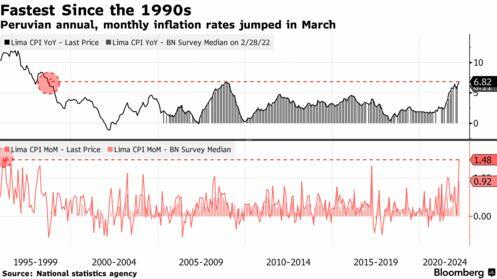
Higher commodity prices, pushing up overall inflation, is metastasizing into a political crisis for Castillo, whose slumping popularity could fall even faster. Castillo has also called in the military to control violent protests.
“This strike isn’t happening just here, it’s all over Peru,” one unnamed protester told Reuters.
Besides tax cuts, the government has desperately raised the minimum wage by about 10% to about $322 per month.
As the situation worsens in Peru, none of this should be surprising to readers. We’ve explained that social unrest in emerging market economies was inevitable due to the rapidly rising cost of everything.
… and it’s just not Peru that is being impacted by inflationary forces on the continent but every country in South America. The continent is a ticking time bomb for unrest.
We’ve also outlined countries outside South America that could be prone to unrest due to inflation and food shortages.
end
Your early currency/gold and silver pricing/Asian and European bourse movements/ and interest rate settings TUESDAY morning 7:30 AM
Euro/USA 1.0962 DOWN .0012 /EUROPE BOURSES //MOSTLY RED EXCEPT SPAIN
USA/ YEN 122.91 UP 0.111 /NOW TARGETS INTEREST RATE AT .11% AS IT WILL BUY UNLIMITED BONDS TO GETS TO THAT LEVEL…
GBP/USA 1.3136 UP 0.0024
Last night Shanghai COMPOSITE CLOSED UP 30 .51 PTS OR .94%
Hang Sang CLOSED
AUSTRALIA CLOSED UP 0.18% // EUROPEAN BOURSES OPENED MOSTLY GREEN EXCEPT SPAIN
Trading from Europe and ASIA
I) EUROPEAN BOURSES MOSTLY RED EXCEPT SPAIN
2/ CHINESE BOURSES / :Hang SANG CLOSED
/SHANGHAI CLOSED UP 30.51 PTS OR .94%
Australia BOURSE CLOSED UP 0.18%
(Nikkei (Japan) CLOSED UP 51.51 PTS OR 0.19%
INDIA’S SENSEX IN THE RED
Gold very early morning trading: 1927.90
silver:$24.65-
USA dollar index early TUESDAY morning: 98.93 DOWN 7 CENT(S) from MONDAY’s close.
THIS ENDS TUESDAY MORNING NUMBERS
xxxxxxxxxxxxxxxxxxxxxxxxxxxxxxxxxxxxxxxxxxxxxxxxxxxxxxxxxxxxxxxxxxxxxxxxxxxxxxxxxxxxxxxxxxxxxxxxxxxxxxxxxxxxxx
And now your closing TUESDAY NUMBERS 1: 00 PM
Portuguese 10 year bond yield: 1.50% UP 15 in basis point(s) yield
JAPANESE BOND YIELD: +0.211% DOWN 0 AND 5/10 BASIS POINTS /JAPAN losing control of its yield curve/
SPANISH 10 YR BOND YIELD: 1.60%// UP 14 in basis points yield
ITALIAN 10 YR BOND YIELD 2.65 UP 57 points in basis points yield ./
the Italian 10 yr bond yield is trading 105 points higher than Spain.
GERMAN 10 YR BOND YIELD: RISES TO +0.620% IN BASIS POINTS ON THE DAY//
THE IMPORTANT SPREAD BETWEEN ITALIAN 10 YR BOND AND GERMAN 10 YEAR BOND IS 2.03% AND NOW ABOVE THE 3.00% LEVEL WHICH WILL IMPLODE THE ENTIRE ITALIAN BANKING SYSTEM. AT 4% SPREAD THERE WILL BE A HUGE BANK RUN…
END
IMPORTANT CURRENCY CLOSES FOR TUESDAY
Closing currency crosses for MONDAY /USA DOLLAR INDEX/USA 10 YR BOND YIELD/1:00 PM
Euro/USA 1.0923 DOWN .0051 or 51 basis points
USA/Japan: 123.17 UP .569 OR YEN DOWN 57 basis points/
Great Britain/USA 1.3102 DOWN 11 BASIS POINTS
Canadian dollar UP 28 BASIS pts to 1.2458
xxxxxxxxxxxxxxxxxxxxxxxxxxxxxxxxxxxxxxxxxxxxxxxxxxxxxxxxxxxxxxxxxxxxxxxxxxxxxxxx
The USA/Yuan, CNY: closed ON SHORE (CLOSED ..DOWN 6.3638
THE USA/YUAN OFFSHORE: (YUAN CLOSED (DOWN)..6.3756
TURKISH LIRA: 14.73 EXTREMELY DANGEROUS LEVEL/DEATH WISH/HYPERINFLATION TO BEGIN.
the 10 yr Japanese bond yield at +0.211
Your closing 10 yr US bond yield UP 14 IN basis points from MONDAY at 2.547% //trading well ABOVE the resistance level of 2.27-2.32%) very problematic
USA 30 yr bond yield: 2.6000 UP 15 in basis points
Your closing USA dollar index, 99.29 UP 29 CENT(S) ON THE DAY/1.00 PM/
Your closing bourses for Europe and the Dow along with the USA dollar index closing and interest rates TUESDAY: 12:00 PM
London: CLOSED UP 36.10PTS OR 0.48%
German Dax : CLOSED DOWN 118.30 POINTS OR 0.81%
Paris CAC CLOSED DOWN 98.10PTS OR 1.46%
Spain IBEX CLOSED UP 90.10PTS OR 1.46%
Italian MIB: CLOSED DOWN 243.36 PTS OR 0.97%
WTI Oil price 103.24 12: EST
Brent Oil: 106.95 12:00 EST
USA /RUSSIAN /// RUBLE FALLS TO: 83.50 UP 0 RUBLES/DOLLAR
GERMAN 10 YR BOND YIELD; +.620
CLOSING NUMBERS: 4 PM
Euro vs USA: 1.0901 DOWN .0073 OR down 73 BASIS POINTS
British Pound: 1.3069 down .0042 or DOWN 42 basis pts
USA dollar vs Japanese Yen: 123.62 up 0.816//YEN DOWN 82 PTS
USA dollar vs Canadian dollar: 1.2490 UP .0006 (CDN dollar DOWN 6 basis pts)
West Texas intermediate oil: 100.87
Brent OIL: 104.85
USA 10 yr bond yield: 2.543 up 14 points
USA 30 yr bond yield: 2.575 UP 12 pts
USA DOLLAR VS TURKISH LIRA: 14.73
USA DOLLAR VS RUSSIA///USA/ ROUBLE: 84,00 UP 1/2 ROUBLES (ROUBLE DOWN 1/2 ROUBLES/USA )//
DOW JONES INDUSTRIAL AVERAGE: DOWN 280.70//.80% PTS OR 0.30%
NASDAQ 100 DOWN 338.94 PTS OR 2.24%
VOLATILITY INDEX: 21.30 UP 2.73PTS (14.40%)
GLD: 179.23 DOWN 1.14 PTS OR 0.63%
SLV/ 22.37 DOWN .36 PTS OR 0.26%
end)
USA trading day in Graph Form
END
I) /MORNING TRADING/
Stocks & Bonds Dumped After Fed’s Brainard Hawkish Comments
TUESDAY, APR 05, 2022 – 10:17 AM
In case anyone had doubts about The Fed’s Lael Brainard’s transformation from dove to hawk, she opened her speech today by citing both Paul Volcker and Arthur Burns…
Forty years ago, Paul Volcker noted that the dual mandate isn’t an either-or proposition and that runaway inflation “would be the greatest threat to the continuing growth of the economy… and ultimately, to employment.”
Arthur Burns noted in the late 1960s that “there can be little doubt that poor people…are the chief sufferers of inflation.”
Brainard then ripped off her historically dovish mask completely and unveiled the uber-hawk in a speech at a conference sponsored by the central bank’s regional bank in Minneapolis this morning:
“Currently, inflation is much too high and is subject to upside risks,” Brainard said, adding that “it is of paramount importance to get inflation down.”

Nothing really new there BUT, then Brainard dropped the following on the balance sheet:
To bring inflation down, the Fed will “continue tightening monetary policy methodically through a series of interest rate increases and by starting to reduce the balance sheet at a rapid pace as soon as our May meeting,” Brainard said.
The Fed is “prepared to take stronger action if indicators of inflation and inflation expectations indicate that such action is warranted,” she said.
She then went even further…
“Given that the recovery has been considerably stronger and faster than in the previous cycle, I expect the balance sheet to shrink considerably more rapidly than in the previous recovery, with significantly larger caps and a much shorter period to phase in the maximum caps compared with 2017–19.”
Concluding that:
“I expect the combined effect of rate increases and balance sheet reduction to bring the stance of policy to a more neutral position later this year with the full extent of additional tightening over time dependent on how the outlook for inflation and employment evolves.”
And that was enough to slam stocks lower…

Rapidly erasing yesterday’s exuberance…

Bond yields spiked further with 10Y hitting 2.50%…

It appears The Fed is preparing the stock market for pain ahead… will it get the message that bonds have been getting for weeks?

We wait in anxious anticipation for this narrative to be spun for why investors should BTFD – What Brainard really said: the Fed will accelerate the onset of the next recession so its can accelerate the ETF-buying QE that follows.
END
AFTERNOON
END
II)USA data
US Services Surveys Disappoint In March, Confirm Rise In Prices “Sharpest On Record”
TUESDAY, APR 05, 2022 – 10:04 AM
Following the mixed picture from US manufacturing surveys (PMI up, ISM down), the US Services surveys were both expected to rise in March.
- Markit (S&P Global) US Services PMI rose from 56.5 in Feb to 58.0 in March (less than the 58.9 exp), but this was a drop from the preliminary print of 58.9.
- ISM Services rose from 56.5 in Fed to 58.3 in March (after 3 straight months lower), but was lower than the expected rise to 58.5
This is as US macro surprise data’s recent improving trend stalled in March.

Source: Bloomberg
Only ISM’s Manufacturing survey dropped in March…

The detailed breakdown saw relatively flat prices, modest improvements in New Orders, New Export Orders and Employment, and a collapse in imports and inventory sentiment.

The rise in selling prices was the sharpest on record (since October 2009), as service providers reportedly passed through higher costs to clients, where possible. The rate of cost inflation accelerated to the quickest since December’s series-record high, and was the third-steepest on record. Where higher cost burdens were reported, firms linked this to broad-based increases in input prices. Companies once again highlighted hikes in fuel, energy and wage bills as driving inflation.
It seems the prices of Steel Products are both rising and falling…

Meanwhile the survey respondents were confused if they are in the US or Weimar Germany:

Chris Williamson, Chief Business Economist at S&P Global, said:
“Business activity in the vast service sector enjoyed a boost from the relaxation of virus-fighting restrictions in March, regaining strong momentum after the Omicron-induced slowdown seen at the start of the year. Demand for services is in fact growing so fast that companies are increasingly struggling to keep pace with customer orders, leading to the largest rise in backlogs of work recorded since the survey began in 2009.
“However, while this suggests that companies have a healthy book of orders to sustain strong output in the coming months, the downside is further upward pressure on prices as demand exceeds supply. With firms’ costs inflated by the soaring price of energy, fuel and other raw materials, as well as rising wages, prices charged for services are rising at an unprecedented rate. Consumer price inflation therefore looks likely to accelerate further as we head into the spring.”

The S&P Global US Composite PMI Output Index posted 57.7 in March, up from 55.9 in February (but down from the preliminary 58.5 print for March), with a familiar theme – inflationary pressures intensified as supplier costs soared. Input prices rose at one of the fastest rates on record, whilst costs passed through to customers drove up output charges at the joint-sharpest pace since data collection began in October 2009.
end
U.S. trade deficit dips to $89.2 billion, but stays near record high
April 5, 2022 at 8:44 a.m. ET
MarketWatch
Imports rise 1.3% in February and top $300 billion for fourth month in a row
The numbers: The U.S. posted a near-record $89.2 billion trade deficit in February, reflecting an ongoing surge in imports and ramped-up efforts to offload foreign goods at congested West Coast ports.
The trade gap fell a slight 0.1% from an all-time high in January. Economists polled by The Wall Street Journal had forecast a $88.5 billion trade gap.
Imports rose 1.3% in February to a record $317.8 billion. Exports climbed 1.8% to $228.6 billion — also a record.
Last year, the U.S. posted the highest international trade deficit ever. The U.S. economy has recovered faster than other countries and that’s allowed Americans to spend more on imported goods. Exports have rebounded more slowly.
Big picture: The U.S. economy is likely to show a paltry increase in growth in the first quarter — at least officially — and the record trade deficit is a big reason why. High deficits subtract from gross domestic product, the official scorecard for the economy.
Yet by most other measures, the U.S. is still expanding at a fairly strong pace. Consumer spending, the main driver of the economy, has accelerated and most businesses are hiring.
The U.S. has run large trade deficits for years without much effect on the broader economy.
Key details: U.S. imports topped $300 billion in November for the first time ever and have now exceeded that benchmark for four months in a row.
The U.S. bought less foreign oil in February, but higher oil prices drove up the value of petroleum imports . The U.S. also imported more chemicals and capital supplies.
The amount of exports rebounded from a decline in January, led by increases in drugs such as coronavirus vaccines.
The U.S. also exported more oil and coal, a response to the Russian war on Ukraine and the need in Europe and elsewhere for alternative sources of fossil fuels.
The surge in the trade deficit since last fall partly reflects U.S. ports trying to clear a backlog of goods that have piled up in nearby warehouses or on ships waiting to unload.
end
IIB) USA COVID/VACCINE MANDATES
end
end
iiia) USA inflation//SHIPPING commentaries//LOG JAMS//
New York jet fuel soars to record highs with inventory plunging
(zerohedge)
New York Jet Fuel Soars To Record High As Inventories Plunge
TUESDAY, APR 05, 2022 – 09:38 AM
Wholesale jet fuel prices in New York have risen more than 162% since mid-March, as buyers at some of the world’s busiest airports, located on the US East Coast, anticipate dwindling supplies as Western sanctions shun Russian energy exports.
On Monday, jet fuel prices jumped 93 cents to $7.61 a gallon, a new record high, according to Bloomberg data going back to 1988.

According to Reuters, there are two major issues. The first is East Coast depends on fuel shipments via the Texas-to-New Jersey Colonial Pipeline for refined products and imports from Europe. But there’s been a snag as distillate shortages in Europe and shunning of Russian energy exports have helped accelerate the decline in distillate stockpiles in PADD 1.
Distillate stockpiles at PADD 1 are at 2015 levels.

For this time of year, ahead of the summer flying season, distillate levels are at some of their lowest levels in two decades (besides 2003 & 2015).

“It is ridiculous what’s going on in PADD I with jet, and it’s not sustainable,” Patrick DeHaan, lead petroleum analyst at GasBuddy, told Reuters.
DeHaan tweeted a video of airline ticket prices soaring, likely because airlines are price sensitive to jet fuel and may already pass higher costs to consumers.
S&P Global Commodity Insights said industry insiders “do not attribute this exponential leap in jet fuel’s value to a single, consequential event confined within the parameters of the Atlantic Coast jet fuel market. Rather, it is regarded as only the most recent development in a sequence of events beginning with the conflict between Russia and Ukraine. “
The best and easiest cure for soaring jet fuel prices is demand destruction, which will be costly for airlines that will see a collapse in ticket sales.
end
Natgas Soars As “Big Shot Of Cold Air” Expected By Weekend
TUESDAY, APR 05, 2022 – 02:05 PM
U.S. natural gas prices jumped Tuesday after weather forecasters pointed to colder weather expected to drive up heating demand through mid-April.
Meteorologists at private weather forecaster BAMWX said a “big shot of cold air” is expected to arrive in the eastern half of the U.S. “later this week into this weekend, leading to well below normal temperatures.”
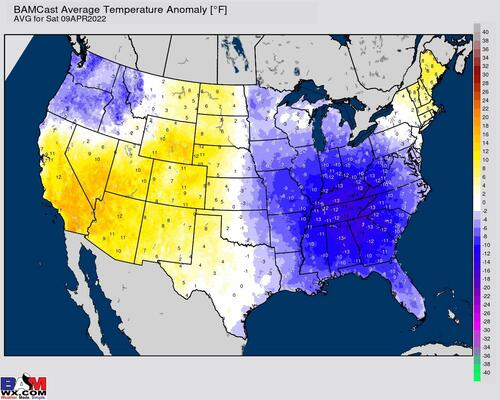
Natgas futures for May delivery were up 7.5% to $6.14/MMBtu on the news.
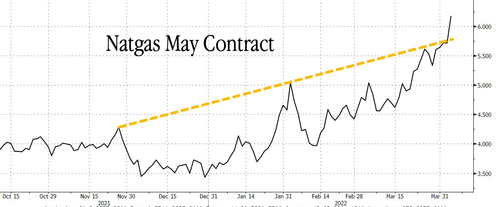
There are freeze risks for farmers who just planted across the Midwest between Friday and Sunday. BAMWX also believes “freeze risks remain at play from the northern Plains, Midwest to Ohio Valley over the next 10-20 days.”
Friday
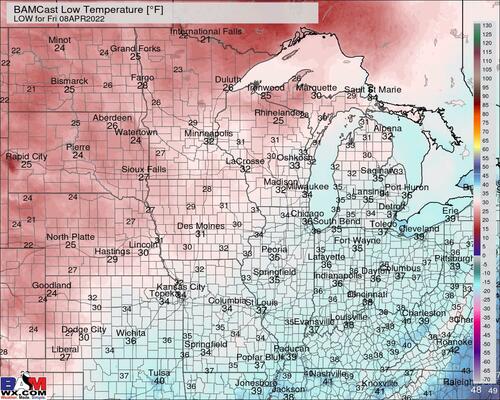
Saturday
Sunday

BAMWX expects “conditions start to warm up early next week.” However, they expect by the end of week two, “a period of colder air to have the potential to be more potent due to a snapback of the Pacific Jet and the colder MJO risks. Data has generally been trending colder over the past few runs with this signal.”

Hopefully, this will be the last shot of cooler air as Midwest plantings begin.
iiib) USA economic stories
iv)swamp stories
Media ‘Caught In A Cover-Up’ Of Hunter Biden’s Laptop Story: Sen. Johnson
MONDAY, APR 04, 2022 – 07:40 PM
Authored by Katabella Roberts via The Epoch Times (emphasis ours),
Sen. Ron Johnson (R-Wis.) on April 3 claimed that some major media outlets have been “caught in a cover-up” regarding the Hunter Biden laptop story.Sen. Ron Johnson (R-Wis.) speaks during a hearing in Washington on Jan. 24, 2022. (Drew Angerer/Getty Images)
Johnson’s remarks come shortly after The Washington Post and The New York Times published articles verifying and acknowledging the authenticity of Hunter Biden’s laptop, nearly two years after it was first reported by the New York Post shortly before the 2020 election.
However, the New York Post’s reporting of the scandal was promptly suppressed by social media sites including Facebook and Twitter, the latter of which also locked the NY Post’s account for more than two weeks, citing the outlet’s alleged publication of “hacked material” as its justification.
In an editorial titled “The Hunter Biden story is an opportunity for a reckoning,” The Washington Post blamed the reluctance among some media to publish the story on the possibility of it being one of the “unwitting tools of a Russian influence campaign in 2016” among other things.
The Post’s editorial board also stressed that President Joe Biden himself had not “acted corruptly.”
Johnson told Fox News Channel’s “Sunday Morning Futures” that the recent admissions by both The New York Times and The Washington Post prove “how complicit the media was” in concealing Hunter Biden’s laptop before the 2020 presidential election.
“I really think what the New York Times and Washington Post stories prove is how complicit they have been and continue to be in the cover-up,” Johnson said. “And, you know, quite honestly, they’re not impartial. They are the defenders of the Democratic Party of the radical left. You know, The Washington Post learned a lot from their coverage of Nixon. When you get caught up in a cover-up—and that’s what happened, the media get caught up in a cover-up. They are caught with their lies.”
Johnson said that some outlets had participated in “what they call a limited hangout or in [President Richard] Nixon’s case, a modified limited hangout. You’ve let out just enough information, just enough truth to try and get you by the moment.”
A modified limited hangout is a public relations or propaganda technique in which the individual or official involved releases some information that was previously hidden, albeit still retaining important key facts, in an effort to prevent more important details from being exposed.
According to former Central Intelligence Agency official Victor Marchetti, the technique results in the public being “so intrigued by the new information that it never thinks to pursue the matter further.”
“We can’t allow our intelligence agencies, the Department of Justice, the FBI, or the media to get away with this,” Johnson said on Sunday. “This is serious business. This is incredible corruption at the highest levels of government and within our media.”
“We are all being snookered by them. This has been a—from my standpoint—a massive diversionary operation to, you know, to try and take the American public’s attention away from their wrongdoing, their lies, their cover-ups.”
The GOP senator added that “now, we have actual bank records that verify what we reported” and that Hunter Biden’s “laptop is obviously a treasure-trove of additional corroborating evidence as well.”
According to a recent article for The Washington Post, which hired two security experts to authenticate what is purportedly Hunter Biden’s laptop, documents, and messages on the device, Biden pursued a deal with a Chinese Communist Party-linked emergency firm, CEFC China Energy, and its executives “paid $4.8 million to entities controlled by Hunter Biden and his uncle [James Biden].”
Further emails related to his work for the Ukrainian gas company Burisma Holdings, for which he was a board member.
Former President Donald Trump previously claimed that Joe Biden, while still vice president, threatened to withhold $1 billion from Ukraine unless a prosecutor investigating Burisma Holdings was ousted.
White House chief of staff Ron Klain told ABC News’ “This Week” in an interview on Sunday that Biden believes his son didn’t break the law with regards to his overseas business ties in China, Ukraine, and other countries.
“Of course, the president is confident that his son didn’t break the law,” Klain said.
Biden himself has also stated that his son “did nothing wrong at Burisma.”
end
Clinton Campaign, DNC Are Paying FEC Fines In Effort To Bury Story: Kash Patel
MONDAY, APR 04, 2022 – 09:00 PM
Authored by Masooma Haq and Jan Jekielek via The Epoch Times (emphasis ours),
The lead investigator for the House Intelligence Committee’s 2018 probe into the FBI’s investigation of alleged Trump–Russia collusion, Kash Patel, said the fact that the Hillary Clinton campaign is paying a penalty to Federal Election Commission (FEC) is an admittance of guilt.
Clinton and DNC are doing so to bury the narrative and prevent more media coverage of these illegal activities, said Patel.
“I think the public sees what that is. It’s their way of burying the narrative, because if they contested what happens, more media coverage, more people start looking into these things,” Patel said.
“So the Hillary Clinton campaign is not contesting it, they’re paying the fine. It’s basically admitting that they did this and they’re out is: ‘we just don’t want a protracted legal deal, as if the Hillary Clinton campaign and DNC ever shied away from taking something or someone to court,” Patel added.
Clinton’s campaign and the DNC agreed to pay a combined $113,000 to the FEC, according to documents made public on March 30, after the commission found probable cause that the entities violated federal law by describing payments that ultimately went to the Fusion GPS research group as going toward legal services and consulting.
“It shows them how wrong they were to violate the law and spend political campaign dollars on hit job, opposition research pieces for then-candidate Trump, all of which, [to] remind the audience, was then used intentionally by the FBI—even though they knew it was false—to go to a federal secret court and surveil a presidential candidate and later a president of the United States.”
The FEC, which is responsible for overseeing federal elections, including the presidential election, found that the Hillary Clinton campaign broke FEC rules about how donations can be used.
“What we knew when we ran the Russiagate investigation, Chairman Nunes and I, we exposed that the Hillary Clinton campaign paid for the Steele dossier, an opposition research hit job. We had proven that some years ago,” said Patel.
“What the Coolidge Reagan Foundation did … based on our investigation, said ‘wait a second FEC, you as a political campaign cannot spend political dollars launching opposition research, false or otherwise,’” said Patel.
Dan Backer, an attorney who lodged the complaint with the election commission against the Clinton campaign and the DNC, told The Epoch Times that it’s the first time Clinton “has actually been held accountable for misconduct,” calling the fines “a great step for accountability.”
“So they fined them, that’s the FEC’s job. And the Hillary Clinton campaign could have said: ‘We disagree with your finding. We’re going to go to court.’ What did the Hillary Clinton campaign do? … They agreed to the finding of probable cause by the FEC, which means they’re basically agreeing that it happened. … Like we’ve always said, ‘follow the money.’”
Patel said while the FEC fine is an important step toward holding the Clinton campaign and other key players involved in the Russia disinformation campaign accountable, the true victory, he hopes, will be indictments made by U.S. special counsel John Durham.
In October 2020, Durham was appointed by the Dept. of Justice as special counsel to investigate the FBI’s handling of Russiagate. His recent filings revealed that internet traffic at Trump Tower and the White House was accessed to fabricate ties between Trump and Russia.
The filing, which was submitted late on Feb. 11 in connection with the indictment of Michael Sussmann, a former attorney to Hillary Clinton’s 2016 campaign, reveals that Rodney Joffe, a tech executive who was working with Sussmann, had exploited access to domain name system (DNS) internet traffic pertaining to the Executive Office of the President of the United States (EOP) as well as Trump Tower and Donald Trump’s Central Park West apartment building.
“This FEC fine is another step towards accountability. But [for] me as a former federal prosecutor, maybe I’m biased, but the ultimate step of accountability which the American public is waiting for,comes in the form of indictments, especially to those people who violated their oath of office,” Patel said.
The Epoch Times reached out to the Clinton campaign for comment.
end
Revealed: New Doc Shows How an Obama-Tied Dark Money Group Used Zuckerberg’s Cash to Swing Election
Inbox
| Robert Hryniak | 3:07 PM (27 minutes ago) |  | |
| to |
No surprise …
END
The King Report (including swamp stories)
Elon Musk purchases stake (9.2%) in Twitter after slamming its approach to ‘free speech’
Twitter’s shares jumped more than 25% (31% at midday) in price following Monday’s news. Musk now controls nearly 73.5 million shares of the company, making him the largest shareholder…
https://www.foxbusiness.com/business-leaders/elon-musk-purchases-stake-in-twitter-after-slamming-its-approach-to-free-speech
Jamie Dimon warns JPMorgan could take $1B hit over Russia-Ukraine war https://trib.al/KXlM6ZS
Germany is the main roadblock for tougher Russian sanctions, Poland’s PM says http://reut.rs/3xiOkQr
Fangs soared due to Twitter’s ginormous rally. This pushed Nasdaq and the Nasdaq 100 to gains of over 1% during early trading. Oil, gasoline, and industrial commodities rallied sharply early on Monday. WTI Oil hit +4.1% by 10:00 ET. Gold rallied modestly. Bonds tumbled, declining 1 9/32 by 10:10 ET.
ESMs declined during Asian trading but hit a session low at 20:20 ET. They then rallied 24 handles by the Chinese close at 2 ET. ESMs then sank 21 handles by 3:13 ET due to selling just before and after the 3 ET European opening. ESMs rallied steadily until 6:22 ET. They then commenced an 18-handle decline that ended on the NYSE open.
The usual suspects poured into ESMs and stocks on the NYSE open. ESMs surged to a session high of 4557.25, +50 handles from the low, at 9:55 ET. Sellers then appeared. The rally halted. After gyrating in a tight range for 21 minutes, ESMs and stocks then broke lower. The DJTA, like on Friday, was conspicuously weak, falling triple digits within 5 minutes of the NYSE open.
Buyers quickly halted the decline that commenced after 10:00 ET by 10:17 ET. ESMs then jumped to new highs. The rally plodded higher until peaking 5 minutes before midday. The decline ended when the afternoon arrived. New highs were hit near 14:00 ET. The rally persisted until the close.
Positive aspects of previous session
Twitter induced retail and trading lemmings to pour into techs and Fangs
Negative aspects of previous session
The economically sensitive DJTA and the DJUA declined
The 2-10 yield curve remains inverted despite bonds declining over 1 point
The profound divergence between the DJIA and the DJTA increased
For the first time since 2008, US coal prices traded above $100/ton.
Ambiguous aspects of previous session
Bonds rallied sharply after an early plunge – Is this good news or bad news?
First Hour/Last Hour Action [S&P 500 Index]: 1st Hour from NYSE open: Up; Last Hour: Up
Pivot Point for S&P 500 Index [above/below indicates daily trend to traders]: 4568.44
Previous session High/Low: 4583.50; 4539.21
Germany says ‘not possible’ for now to cut Russian gas supply: minister – AFP
Reuters: German President Frank-Walter Steinmeier, long an advocate of Western rapprochement with Russia, expressed regret for his earlier stance, saying his years of support for the Nord Stream 2 gas pipeline had been a clear mistake. “My adherence to Nord Stream 2 was clearly a mistake… We were sticking to a bridge in which Russia no longer believed and which other partners had warned us against.”
@CBSNews: President Biden calls Putin a “war criminal” again, says he should face a war crimes trial for alleged atrocities in Ukraine (“I am going to add sanctions” on Putin and Russia.) https://twitter.com/CBSNews/status/1511008075804721154
For perspective on the scope of the US stock market bubble, it is necessary to compare US Nominal GDP to the stock market. For decades Nominal GDP growth equated to stock market growth. Stocks became unhinged during The Great US Stock Bubble of 1999-2000 and the Great US Housing Bubble. Those bubbles pail compared to the Everything Bubble that has endured for over 10 years.
S&P 500 Index vs. US Nominal GDP – Normalized return
When this bubble bursts, will the S&P fall to the level of Nominal GDP, ala Q3 2002 & Q1 2009?
@DiMartinoBooth: Greenspan shocked markets in 1998 by bailing out Long Term Capital Management …in a falling inflation environment. Given current backdrop, where are we in terms of “wait time” post-inversion? This chart in today’s @SoberLook from last week @Quillintel should help focus thoughts.
https://twitter.com/DiMartinoBooth/status/1511019226898833416
@albertedwards99: The shock to me was that The Fed ‘arranged’ (forced) a banking rescue of LTCM whereas a private sector solution led by Buffet was on the table, but was turned down because it wasn’t so advantageous to the LTCM shareholders. (Goldmans role was interesting!)
https://twitter.com/albertedwards99/status/1511027711577403399
Nasdaq closed at 1760.27 on September 23, 1998. That evening, the Fed orchestrated a bailout of LTCM. The Great Bubble in US stock market history commenced. Nasdaq hit 5132.52 on March 10, 2000.
@BurggrabenH: An EV battery weighs 1,000 pounds. Providing the refined minerals needed to fabricate this battery requires the mining, moving, & processing of >500,000 pounds of materials. That’s 20x > 25,000 pounds of petroleum that an internal combustion engine uses over the life of a car.
https://twitter.com/BurggrabenH/status/1510763372509384712
Gloom in Transports Sends a Scary Smoke Signal for U.S. Stocks
Transports, especially trucking and railroad stocks, is the worst performing group in the U.S. in the past week… The Dow Jones Transportation Average, whose gains from the depth of the pandemic outpaced those of the broader market, has plunged 7.4% since March 29 compared with a 1.1% decline in the S&P 500 Index. It’s the transportation gauge’s biggest four-day decline Dec. 1…
https://www.bloombergquint.com/business/gloom-in-transports-sends-a-scary-smoke-signal-for-u-s-stocks
Today – Will Twitter mania persist for another session? If not, what will drive retail and lemming traders to buy stocks? We don’t have a clue. However, SPY (S&P 500 ETF) had its lowest volume of the year yesterday. The stock market is thinning; retail and lemming traders are bold buyers. In fact, SPY volume progressively decreased during the post-FOMC Communique rally.
SPY (S&P 500 ETF) with volume – Volume jumped on 3/31 due to end of Q1 rebalancing & schemes
Stocks are rallying on momentum, conditioned buying, the belief that the Fed will abort the new tightening cycle early, and pattern buying for April, which is usually the best month of the year. This dynamic occurs because Q1 earnings and guidance tend to be embellished so companies can float bonds and there used to be an inordinate number of annul meetings in April.
Best Month for Stocks Now Faces Off with Fed, Inflation Catch
Since 1997, the S&P 500 has averaged a return of 2.5% in April… (When the age of bubbles started!)
https://www.bloombergquint.com/onweb/best-month-for-stocks-now-faces-off-with-fed-inflation-catch
| Ex-intel officer: Spy agency sought Hunter Biden laptop back in 2020 to see if family compromised Spy agency wanted to know if “there’s compromising information on that hard drive,”… A three-letter agency came to me and said, ‘Hey, we’ve heard that you have access to a copy of the Hunter Biden hard drive. Could we get a copy?… And I said, like, ‘… we’re talking about everything from child porn, to… all these issues regarding the president.’ “And they said, ‘We don’t care. … What our concern is, is that if there’s compromising information on that hard drive, this is before the election, the president could be compromised to the level of owing either China or Ukraine something…” https://justthenews.com/accountability/russia-and-ukraine-scandals/hldex-intel-officer-spy-agency-sought-hunter-biden ‘Bombshell’ Hunter Biden Text Reveals Joe Biden Made Him Give Him ‘Half’ His Salary for Over 30 Years – “…But don’t worry, unlike pop, I won’t make you give me half your salary.”… https://trendingpolitics.com/bombshell-hunter-biden-text-reveals-joe-biden-made-him-give-him-half-his-salary-for-over-30-years-knab/ Throwing Hunter Biden under the bus won’t be enough to clear Joe “Hunter Biden called his dad ‘the Big Guy’ or ‘my Chairman,’ and frequently referenced asking him for his sign-off or advice on various potential deals that we were discussing,” Bobulinski wrote in a letter to The Post in October 2020… There is no country in the world where millions of dollars paid to a top official’s son for doing nothing would not be regarded as corruption… https://nypost.com/2022/04/04/throwing-hunter-biden-under-the-bus-wont-be-enough-to-clear-joe/ @frankgaffney: (ex-CIA officer) @RealSamFaddis: This is not about Hunter. It’s not about hookers. It’s not about drugs…the central issue is that what is being purchased here is Joe. That’s what Hunter selling. That’s what all this money and cash is for.” GOP @SenRonJohnson: The cover-up of the Biden’s vast web of foreign financial entanglements by our intelligence agencies is the worst corruption I’ve ever seen in the United States government. https://twitter.com/SenRonJohnson/status/1510975098131558402 ABC: Secret Service paying over $30K per month for Malibu mansion to protect Hunter Biden https://abcnews.go.com/US/secret-service-paying-30k-month-malibu-mansion-protect/story @JonathanTurley: NBC’s Chuck Todd interviewed Hillary Clinton just days after the FEC fined her campaign for hiding the funding of the Steele Dossier as “legal costs.” The campaign lied repeatedly to reporters, but Todd did not ask a single question on the FEC sanction. https://t.co/QTI7OGy2Q1 Former President Barack Obama will return to the White House on Tuesday for the first time since he left office to promote the Affordable Care Act – NBC News (Is this the real reason for the visit?) VP Kamala Harris’s deputy chief of staff Michael Fuchs is leaving the administration. – Reuters @DanProft: Mayor Triple Threat says the root of Chicago’s violence is kids who are unloved. Wait, let me guess what the solution is to our 60-yr experiment with replacing mom and dad with govt, is it by any chance to make the welfare state bigger? |
Let us close with this offering courtesy of Greg Hunter intervewing |


 harveyorganblog.com


Harvey: Stick with financial related facts and news and keep your trump and conspiracy loving bull shit opinions to your self. Watch the real news, there’s no doubt that the Russians have killed thousands of Ukrainians both with rockets and bombs and also intentional direct rifle gunfire. I don’t understand your need to try spin plain and obvious facts into brain scrambling crap. Keep it up and I’ll stop have to stop reading your blog.
LikeLike
[…] by Harvey Organ, Harvey Organ Blog: […]
LikeLike
[…] by Harvey Organ, Harvey Organ Blog: […]
LikeLike
[…] April 5, 2022 · by harveyorgan · in Uncategorized · Leave a comment·Edit […]
LikeLike