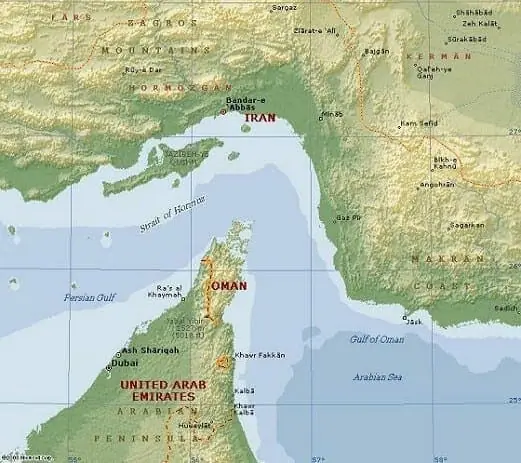
JULY 21//GOLD CLOSED DOWN $3.80 TO $1964.75//SILVER CLOSED DOWN 14 CENTS TO $14 CENTS//PLATINUM CLOSED UP $7.80 TO $966.70//PALLADIUM CLSOED UP $10.35 TO $1295.00//IMPORTANT READS FOR TODAY: ALASDAIR MACLEOD//USA SENDS THOUSANDS OF MARINES TO WARD OFF IRANIAN ATTACKS ON GULF CARRIERS//COVID UPDATES/VACCINE UPDATES//DR PAUL ALEXANDER//SLAY NEWS/EVOLV NEWS//NEWS ADDICTS//UPDATES ON THE YELLOW CARRIER STRIKE/STARWOOD’S CEO CLAIMS THAT CRE IS IN A CATEGORY 5 HURRICANE AND HE SHOULD KNOW//HUGE SWAMP STORIES FOR YOU TONIGHT ESPECIALLY ON THE SENATOR GRASSIE FBI DOCUMENT RELEASE//
132 C SG AMERICAS 14 190 H BMO CAPITAL 3 363 H WELLS FARGO SEC 600 435 H SCOTIA CAPITAL 19 624 H BOFA SECURITIES 616 690 C ABN AMRO 12 726 C CUNNINGHAM COM 1 737 C ADVANTAGE 1 905 C ADM 6
TOTAL: 636 636
MONTH TO DATE: 3,270
JPMorgan stopped 0/636 contracts.
FOR JULY:
GOLD: NUMBER OF NOTICES FILED FOR JULY/2023. CONTRACT: 636 NOTICES FOR 63,600 OZ or 1.9782 TONNES
total notices so far: 3270 contracts for 327000 oz (10.1710 tonnes)
FOR JULY:
SILVER NOTICES: 234 NOTICE(S) FILED FOR 1,170,000 OZ/
total number of notices filed so far this month : 5055 for 25,295,000 oz
XXXXXXXXXXXXXXXXXXXXXXXX
Click here if you wish to send a donation. I sincerely appreciate it as this site takes a lot of preparation
END
GLD
WITH GOLD DOWN $3.80
INVESTORS SWITCHING TO SPROTT PHYSICAL (PHYS) INSTEAD OF THE FRAUDULENT GLD//
NO CHANGES IN GOLD INVENTORY AT THE GLD//
INVENTORY RESTS AT 913.80 TONNES
Silver//
WITH NO SILVER AROUND AND SILVER DOWN $0.14 AT THE SLV// HUGE CHANGES IN SILVER INVENTORY AT THE SLV: A WITHDRAWAL OF 1.101 MILLION OZ OF SILVER FROM THE SLV//
INVESTORS ARE SWITCHING SLV TO SPROTT’S PSLV.
CLOSING INVENTORY: 453.306 MILLION OZ
Let us have a look at the data for today
SILVER//OUTLINE
SILVER COMEX OI FELL BY A SMALL SIZED 209 CONTRACTS TO 149,599 AND FURTHER FROM THE RECORD HIGH OI OF 244,710, SET FEB 25/2020 AND THIS HUGE SIZED GAIN IN COMEX OI WAS ACCOMPLISHED DESPITE OUR STRONG $0.38 LOSS IN SILVER PRICING AT THE COMEX ON THURSDAY. TAS ISSUANCE WAS A STRONG SIZED 1498 CONTRACTS. THESE WILL BE USED FOR MANIPULATION LATER THIS MONTH . CRAIG HEMKE HAS POINTED OUT THAT THE CROOKS USE THE MID MONTH FOR MANIPULATION AS THEY SELL THEIR BUY SIDE OF THE CALENDAR SPREAD FIRST AND THEN KEEP THE SELL SIDE TO LIQUIDATE AT A LATER DATE. THUS WE HAVE TWO VEHICLES THE CROOKS USE FOR MANIPULATION AND BOTH ARE SPREADERS: 1) AT MONTH’S END/SPREADERS COMEX AND 2/ TAS SPREADERS, MID MONTH. TOTAL TAS ISSUED ON THURSDAY NIGHT: 1498 CONTRACTS. DESPITE MANY COMPLAINTS THAT THE CROOKS HAVE VIOLATED POSITION LIMITS DUE TO THE FACT THAT THE TAS ISSUED HAVE A VALUE OF ZERO (AS TO POSITION LIMITS FOR OUR CROOKED BANKERS). THE PROBLEM OF COURSE IS THAT THE CROOKS DO NOT LIQUIDATE THE TAS TOGETHER BUT SELL THE BUY SIDE FIRST AND THEN LIQUIDATE THE SELL SIDE TWO MONTHS HENCE. IT IS OBVIOUS MANIPULATION TO THE HIGHEST DEGREE BUT IT NATURALLY FELL ON DEAF EARS WITH OUR REGULATORS (OCC) WHEN THEY RECEIVED OUR COMPLAINTS. IT THUS LOOKS LIKE THE FED (GOV’T) IS BEHIND ALL OF THESE TRADES.
WE HAVE NOW SET ANOTHER RECORD LOW AT 114,102 CONTRACTS ///JULY 3.2023// OUR BANKERS WERE SUCCESSFUL IN KNOCKING THE PRICE OF SILVER DOWN (IT FELL BY $0.38). BUT WERE UNSUCCESSFUL IN KNOCKING ANY SPEC LONGS AS WE HAD A HUGE GAIN ON OUR TWO EXCHANGES OF 1178CONTRACTS. WE HAD A HUGE 0 CRIMINAL NOTICES FILED IN THE CATEGORY OF EXCHANGE FOR RISK TRANSFER FOR 0 MILLION OZ// ( THE TOTAL ISSUED IN THIS CATEGORY SO FAR THIS MONTH TOTAL 5.25MILLION OZ.). WE HAVE NOW RETURNED TO OUR USUAL AND CUSTOMARY SCENARIO: BANKERS SHORT AND SPECS LONG WITH MANIPULATION NOW MID MONTH AND BEYOND, DUE TO (TAS) MANIPULATION.
WE MUST HAVE HAD:
A HUGE ISSUANCE OF EXCHANGE FOR PHYSICALS( 1387 CONTRACTS) iiii) AN INITIAL SILVER STANDING FOR COMEX SILVER MEASURING AT 16.110 MILLION OZ (FIRST DAY NOTICE) FOLLOWED BY TODAY’S HUGE 1.975 MILLION OZ QUEUE JUMP+ 0 MILLION OZ EXCHANGE FOR RISK FOR TODAY//NEW STANDING: 25.415 MILLION OZ + 5.25 MILLION OZ EXCHANGE FOR RISK/PRIOR: NEW TOTAL 30.665 MILLION OZ// // SMALL SIZED COMEX OI GAIN/ HUGE SIZED EFP ISSUANCE/VI) HUGE NUMBER OF T.A.S. CONTRACT ISSUANCE (1498CONTRACTS)/ZERO EXCHANGE FOR RISK ISSUED/
I AM NOW RECORDING THE DIFFERENTIAL IN OI FROM PRELIMINARY TO FINAL –385 CONTRACTS
HISTORICAL ACCUMULATION OF EXCHANGE FOR PHYSICALS JULY. ACCUMULATION FOR EFP’S SILVER/JPMORGAN’S HOUSE OF BRIBES/STARTING FROM FIRST DAY/MONTH OF JULY:
TOTAL CONTRACTS for 13 days, total 15,341 contracts: OR 76.705 MILLION OZ (1180 CONTRACTS PER DAY)
TOTAL EFP’S FOR THE MONTH SO FAR: 76.705 MILLION OZ
LAST 23 MONTHS TOTAL EFP CONTRACTS ISSUED IN MILLIONS OF OZ:
MAY 137.83 MILLION
JUNE 149.91 MILLION OZ
JULY 129.445 MILLION OZ
AUGUST: MILLION OZ 140.120
SEPT. 28.230 MILLION OZ//
OCT: 94.595 MILLION OZ
NOV: 131.925 MILLION OZ
DEC: 100.615 MILLION OZ
YEAR 2022:
JAN 2022-DEC 2022
JAN 2022// 90.460 MILLION OZ
FEB 2022: 72.39 MILLION OZ//
MARCH: 207.140 MILLION OZ//A NEW RECORD FOR EFP ISSUANCE
APRIL: 114.52 MILLION OZ FINAL//LOW ISSUANCE
MAY: 105.635 MILLION OZ//
JUNE: 94.470 MILLION OZ
JULY : 87.110 MILLION OZ
AUGUST: 65.025 MILLION OZ
SEPT. 74.025 MILLION OZ///FINAL
OCT. 29.017 MILLION OZ FINAL
NOV: 134.290 MILLION OZ//FINAL
DEC, 61.395 MILLION OZ FINAL
TOTALS YR 2022: 1135.767 MILLION OZ (1.1356 BILLION OZ)
JAN 2023/// 53.070 MILLION OZ //FINAL
FEB: 2023: 100.105 MILLION OZ/FINAL//MUCH STRONGER ISSUANCE VS THE LATTER TWO MONTHS.
MARCH 2023: 112.58MILLION OZ//FINAL//STRONG ISSUANCE
APRIL 118.035 MILLION OZ(SLIGHTLY GREATER THAN THAN LAST MONTH)
MAY 66.120 MILLION OZ/INITIAL (MUCH SMALLER THIS MONTH)
JUNE: 110.395 MILLION OZ//MUCH LARGER THAN LAST MONTH
JULY 76.705 MILLION OZ (LARGER THAN LAST MONTH)
RESULT: WE HAD A SMALL SIZED DECREASE IN COMEX OI SILVER COMEX CONTRACTS OF 209 CONTRACTS DESPITE OUR STRONG LOSS IN PRICE OF $0.38 IN SILVER PRICING AT THE COMEX//THURSDAY.,. THE CME NOTIFIED US THAT WE HAD A HUGE EFP ISSUANCE CONTRACTS: 1387 ISSUED FOR JULY AND 0 CONTRACTS ISSUED FOR ALL OTHER MONTHS) WHICH EXITED OUT OF THE SILVER COMEX TO LONDON AS FORWARDS./ WE HAVE A GOOD INITIAL SILVER OZ STANDING FOR JULY OF 16.110 MILLION OZ FOLLOWED BY TODAY’S MASSIVE 1.972 OZ QUEUE JUMP + 0 MILLION OZ EXCHANGE FOR RISK TODAY + (PRIOR EXCHANGE FOR RISK : 5.25 MILLION OZ): TOTAL NOW STANDING 25.415 MILLION OZ NORMAL STANDING + 5.25 MILLION EXCHANGE FOR RISK = 30.665 MILLION OZ.///// .. WE HAVE A HUGE SIZED GAIN OF1553 OI CONTRACTS ON THE TWO EXCHANGES. THE TOTAL OF TAS INITIATED CONTRACTS TODAY: A HUGE 1387//CONSIDERABLE FRONT END OF THE TAS CONTRACTS WERE LIQUIDATED DURING THE THURSDAY COMEX SESSION TO CONTAIN SILVER PRICE’S RISE. THE NEW TAS ISSUANCE TODAY (1498) WILL BE PUT INTO “THE BANK” TO BE COLLUSIVELY USED AT A LATER DATE./
WE HAD 234 NOTICE(S) FILED TODAY FOR 1,170,000 OZ
THE SILVER COMEX IS NOW BEING ATTACKED FOR METAL BY LONDONERS ET AL.
GOLD//OUTLINE
IN GOLD, THE COMEX OPEN INTEREST ROSE BY A SMALL SIZED 701 CONTRACTS TO 483,396 AND CLOSER TO THE RECORD (SET JAN 24/2020) AT 799,541 AND PREVIOUS TO THAT: (SET JAN 6/2020) AT 797,110.
THE DIFFERENTIAL FROM PRELIMINARY OI TO FINAL OI IN GOLD TODAY: REMOVED: 863 CONTRACTS
WE HAD A SMALL SIZED DECREASE IN COMEX OI ( 701CONTRACTS) DESPITE OUR STRONG $8.70 LOSS IN PRICE. WE ALSO HAD A STRONG INITIAL STANDING IN GOLD TONNAGE FOR JULY. AT 5.1975 TONNES ON FIRST DAY NOTICE FOLLOWED BY TODAY’S 1.972 TONNE QUEUE JUMP: NEW TOTAL OF GOLD STANDING FOR JULY: 10.267 TONNES// + /A FAIR (AND CRIMINAL) ISSUANCE OF 1130 T.A.S. CONTRACTS /// ALL OF..THIS HAPPENED WITH A $8.70 LOSS IN PRICEWITH RESPECT TO THURSDAY’S TRADING.WE HAD A FAIR SIZED GAIN OF 1100 OI CONTRACTS (3.421 PAPER TONNES) ON OUR TWO EXCHANGES.
E.F.P. ISSUANCE
THE CME RELEASED THE DATA FOR EFP ISSUANCE AND IT TOTALED A FAIR SIZED 1801CONTRACTS:
The NEW COMEX OI FOR THE GOLD COMPLEX RESTS AT 483,396
IN ESSENCE WE HAVE A FAIR SIZED INCREASE IN TOTAL CONTRACTS ON THE TWO EXCHANGES OF 1100 CONTRACTS WITH 701 CONTRACTS DECREASED AT THE COMEX// AND A FAIR 1801 EFP OI CONTRACTS WHICH NAVIGATED OVER TO LONDON. THUS TOTAL OI GAIN ON THE TWO EXCHANGES OF 1100CONTRACTS OR 3.421 TONNES. WE HAD THE FOLLOWING TAS CONTRACTS INITIATED (ISSUED): A FAIR 1130 CONTRACTS)
CALCULATIONS ON GAIN/LOSS ON OUR TWO EXCHANGES
WE HAD A FAIR SIZED ISSUANCE IN EXCHANGE FOR PHYSICALS (1130 CONTRACTS) ACCOMPANYING THE SMALL SIZED LOSS IN COMEX OI (701) //TOTAL GAIN FOR OUR THE TWO EXCHANGES: 1100 CONTRACTS. WE HAVE ( 1) NOW RETURNED TO OUR NORMAL FORMAT OF BANKERS GOING SHORT AND SPECULATORS GOING LONG ,2.) GOOD INITIAL STANDING AT THE GOLD COMEX FOR JULY AT 5.1975 TONNES FOLLOWED BY TODAY’S 1.9720TONNE QUEUE JUMP//NEW TOTAL 10.267 TONNES ///// /3) ZERO LONG LIQUIDATION BUT CONSIDERABLE TAS LIQUIDATION TO CONTAIN GOLD’S PRICE//4) SMALL SIZED COMEX OPEN INTEREST LOSS/ 5) FAIR ISSUANCE OF EXCHANGE FOR PHYSICAL PAPER///6: FAIR T.A.S. ISSUANCE: 1130 CONTRACTS
HISTORICAL ACCUMULATION OF EXCHANGE FOR PHYSICALS IN 2023 INCLUDING TODAY
JULY
ACCUMULATION OF EFP’S GOLD AT J.P. MORGAN’S HOUSE OF BRIBES: (EXCHANGE FOR PHYSICAL) FOR THE MONTH OF JULY :
TOTAL EFP CONTRACTS ISSUED: 29,799 CONTRACTS OR 2,979,900 OZ OR 95,803 TONNES IN 13 TRADING DAY(S) AND THUS AVERAGING: 2292 EFP CONTRACTS PER TRADING DAY
TO GIVE YOU AN IDEA AS TO THE SIZE OF THESE EFP TRANSFERS : THIS MONTH IN 13 TRADING DAY(S) IN TONNES 95.803 TONNES
TOTAL ANNUAL GOLD PRODUCTION, 2022, THROUGHOUT THE WORLD EX CHINA EX RUSSIA: 3555 TONNES
THUS EFP TRANSFERS REPRESENTS 95.803/3550 x 100% TONNES 2.70% OF GLOBAL ANNUAL PRODUCTION
SEPT 142.12 TONNES FINAL ISSUANCE ( LOW ISSUANCE)_
OCT: 141.13 TONNES FINAL ISSUANCE (LOW ISSUANCE)
NOV: 312.46 TONNES FINAL ISSUANCE//NEW RECORD!! (INCREASING DRAMATICALLY)//SIGN OF REAL STRESS//SURPASSING THE MARCH 2021 RECORD OF 276.50 TONNES OF EFP
DEC. 175.62 TONNES//FINAL ISSUANCE//
TOTALS: 2,578.08 TONNES/2021
JAN:2022 247.25 TONNES //FINAL
FEB: 196.04 TONNES//FINAL
MARCH: 409.30 TONNES INITIAL( THIS IS NOW A RECORD EFP ISSUANCE FOR MARCH AND FOR ANY MONTH.
APRIL: 169.55 TONNES (FINAL VERY LOW ISSUANCE MONTH)
MAY: 247.44 TONNES FINAL//
JUNE: 238.13 TONNES FINAL
JULY: 378.43 TONNES FINAL
AUGUST: 180.81 TONNES FINAL
SEPT. 193.16 TONNES FINAL
OCT: 177.57 TONNES FINAL ( MUCH SMALLER THAN LAST MONTH)
NOV. 223.98 TONNES//FINAL ( MUCH LARGER THAN PREVIOUS MONTHS//comex running out of physical)
DEC: 185.59 tonnes // FINAL
TOTAL: 2,847,25 TONNES/2022
JAN 2023: 228.49 TONNES FINAL//HUGE AMOUNT OF EFP’S ISSUED THIS MONTH!!
FEB: 151.61 TONNES/FINAL
MARCH: 280.09 TONNES/INITIAL (ANOTHER STRONG MONTH FOR EFP ISSUANCE)
APRIL: 197.42 TONNES
MAY: 236.67 TONNES (A VERY STRONG ISSUANCE FOR THIS MONTH)
JUNE: 172.667 TONNES (WEAKER ISSUANCE THIS MONTH)
JULY: 95.803 TONNES
SPREADING OPERATIONS
(/NOW SWITCHING TO GOLD) FOR NEWCOMERS, HERE ARE THE DETAILS
SPREADING LIQUIDATION HAS NOW COMMENCED AS WE HEAD TOWARDS THE NEW ACTIVE FRONT MONTH OF JUNE. WE ARE NOW INTO THE SPREADING OPERATION OF GOLD
HERE IS A BRIEF SYNOPSIS OF HOW THE CROOKS FLEECE UNSUSPECTING LONGS IN THE SPREADING ENDEAVOUR ;MODUS OPERANDI OF THE CORRUPT BANKERS AS TO HOW THEY HANDLE THEIR SPREAD OPEN INTERESTS:HERE IS HOW THE CROOKS USED SPREADING AS WE ARE NOW INTO THE NON ACTIVE DELIVERY MONTH OF MAY HEADING TOWARDS THE ACTIVE DELIVERY MONTH OF JUNE., FOR BOTH GOLD:
YOU WILL ALSO NOTICE THAT THE COMEX OPEN INTEREST STARTS TO RISE BUT SO IS THE OPEN INTEREST OF SPREADERS. THE OPEN INTEREST IN WILL CONTINUE TO RISE UNTIL ONE WEEK BEFORE FIRST DAY NOTICE OF AN UPCOMING ACTIVE DELIVERY MONTH (JUNE), AND THAT IS WHEN THE CROOKS SELL THEIR SPREAD POSITIONS BUT NOT AT THE SAME TIME OF THE DAY. THEY WILL USE THE SELL SIDE OF THE EQUATION TO CREATE THE CASCADE (ALONG WITH THEIR COLLUSIVE FRIENDS) AND THEN COVER ON THE BUY SIDE OF THE SPREAD SITUATION AT THE END OF THE DAY. THEY DO THIS TO AVOID POSITION LIMIT DETECTION. THE LIQUIDATION OF THE SPREADING FORMATION CONTINUES FOR EXACTLY ONE WEEK AND ENDS ON FIRST DAY NOTICE.”
WHAT IS ALARMING TO ME, ACCORDING TO OUR LONDON EXPERT ANDREW MAGUIRE IS THAT THESE EFP’S ARE BEING TRANSFERRED TO WHAT ARE CALLED SERIAL FORWARD CONTRACT OBLIGATIONS AND THESE CONTRACTS ARE LESS THAN 14 DAYS. ANYTHING GREATER THAN 14 DAYS, THESE MUST BE RECORDED AND SENT TO THE COMPTROLLER, GREAT BRITAIN TO MONITOR RISK TO THE BANKING SYSTEM. IF THIS IS INDEED TRUE, THEN THIS IS A MASSIVE CONSPIRACY TO DEFRAUD AS WE NOW WITNESS A MONSTROUS TOTAL EFP’S ISSUANCE AS IT HEADS INTO THE STRATOSPHERE.
The crooks also use the spread in the TAS account (trade at settlement). They buy the spot TAS (e.g. June) and sell the future TAS two months out (e.g. August). Then they unload the front month (i.e. unload the buy side first so the price of gold/silver falls. This occurs in the middle of the front delivery month cycle. They unload the sell side of the equation, two months down the road. The crooks violate position limits as the OCC refuse to hear our complaints.
First, here is an outline of what will be discussed tonight:
1.Today, we had the open interest at the comex, in SILVER ROSE BY A SMALL SIZED GAIN OF 166 CONTRACTS OI TO 149,974 AND CLOSER TO OUR COMEX HIGH RECORD //244,710(SET FEB 25/2020). THE LAST RECORDS WERE SET IN AUG.2018 AT 244,196 WITH A SILVER PRICE OF $14.78/(AUGUST 22/2018)..THE PREVIOUS RECORD TO THAT WAS SET ON APRIL 9/2018 AT 243,411 OPEN INTEREST CONTRACTS WITH THE SILVER PRICE AT THAT DAY: $16.53). AND PREVIOUS TO THAT, THE RECORD WAS ESTABLISHED AT: 234,787 CONTRACTS, SET ON APRIL 21.2017 OVER 5 YEARS AGO. HOWEVER WE HAVE NOW SET A NEW RECORD LOW OF 114,102 CONTRACTS JULY 3.2023
EFP ISSUANCE 1387 CONTRACTS
OUR CUSTOMARY MIGRATION OF COMEX LONGS CONTINUE TO MORPH INTO LONDON FORWARDS AS OUR BANKERS USED THEIR EMERGENCY PROCEDURE TO ISSUE:
SEPT 1387and ALL OTHER MONTHS: ZERO. TOTAL EFP ISSUANCE: 1387 CONTRACTS. EFP’S GIVE OUR COMEX LONGS A FIAT BONUS PLUS A DELIVERABLE PRODUCT OVER IN LONDON. IF WE TAKE THE COMEX OI GAIN OF 2945 CONTRACTS AND ADD TO THE 1387 OI TRANSFERRED TO LONDON THROUGH EFP’S,
WE OBTAIN A HUGE SIZED GAIN OF OPEN INTEREST CONTRACTS FROM OUR TWO EXCHANGES OF 1178 CONTRACTS
THUS IN OUNCES, THE GAIN ON THE TWO EXCHANGES TOTAL 5.890 MILLION OZ
ii a) Chris Powell of GATA provides to us very important physical commentaries
b. Other gold/silver commentaries
c. Commodity commentaries//
d)/CRYPTOCURRENCIES/BITCOIN ETC
2.ASIAN AFFAIRS//
FRIDAY MORNING//THURSDAY NIGHT
SHANGHAI CLOSED DOWN 1.78 PTS OR 0.06% //Hang Seng CLOSED UP 147.24 PTS OR 0.78% /The Nikkei CLOSED DOWN 185.27 PTS OR 0.57% //Australia’s all ordinaries CLOSED DOWN 0.20 % /Chinese yuan (ONSHORE) closed DOWN 7.1795 /OFFSHORE CHINESE YUAN DOWN TO 7.1838 /Oil UP TO 75.53 dollars per barrel for WTI and BRENT UP AT 80.46 / Stocks in Europe OPENED ALL MIXED// ONSHORE YUAN TRADING ABOVE LEVEL OF OFFSHORE YUAN/ONSHORE YUAN TRADING WEAKER AGAINST US DOLLAR/OFFSHORE WEAKER
1. COMEX DATA//AMOUNTS STANDING//VOLUME OF TRADING/INVENTORY MOVEMENTS
GOLD
LET US BEGIN:
THE TOTAL COMEX GOLD OPEN INTEREST FELL BY A SMALL SIZED 701CONTRACTS DOWN TO 483,396 DESPITE OUR STRONG LOSS IN PRICE OF $8.70 ON THURSDAY.
EXCHANGE FOR PHYSICAL ISSUANCE
WE ARE NOW IN THE NON ACTIVE DELIVERY MONTH OF JULY… THE CME REPORTS THAT THE BANKERS ISSUED A FAIR SIZED TRANSFER THROUGH THE EFP ROUTE AS THESE LONGS RECEIVED A DELIVERABLE LONDON FORWARD TOGETHER WITH A FIAT BONUS.,
THAT IS 1801 EFP CONTRACTS WERE ISSUED: : AUGUST 1801 & ZERO FOR ALL OTHER MONTHS:
TOTAL EFP ISSUANCE: 1801 CONTRACTS
ON A NET BASIS IN OPEN INTEREST WE GAINED THE FOLLOWING TODAY ON OUR TWO EXCHANGES: A FAIR SIZED TOTAL OF 1963 CONTRACTS IN THAT 1801LONGS WERE TRANSFERRED AS FORWARDS TO LONDON AND WE HAD A SMALL SIZED LOSS OF 701 COMEX CONTRACTS..AND THIS FAIR SIZED GAIN ON OUR TWO EXCHANGES HAPPENED DESPITE OUR LOSS IN PRICE OF $8.70//THURSDAY COMEX. AS PER OUR NEWBIE TRADE AT SETTLEMENT (TAS) MANIPULATION OPERATION (WHICH CRAIG HEMKE HAS POINTED OUT HAPPENS DURING MID MONTH IN THE DELIVERY CYCLE), THE CME REPORTS THAT THE TOTAL T.A.S. ISSUANCE FOR THURSDAY NIGHT WAS A FAIR 1130 CONTRACTS. THROUGHOUT THE PAST WEEKS, THE BANKERS SOLD OFF THE LONG SIDE OF THE SPREAD WHICH OF COURSE CONTINUES TO MANIPULATE THE PRICE OF GOLD SOUTHBOUND. (THEY KEEP THE SHORT SIDE OF THE CALENDAR SPREAD WHICH WILL BE LIQUIDATED TWO MONTHS HENCE)//THE HUGE NUMBER OF T.A.S. CONTRACTS INITIATED OVER THE PAST SEVERAL WEEKS SPELLS TROUBLE FOR THE GOLD/SILVER MARKET AS RAIDS WILL SURELY BE UPON US TRYING TO CONTAIN OUR PRECIOUS METALS RISE IN PRICE. IT MAY BE TO NO AVAIL!!
// WE HAVE A STRONG AMOUNT OF GOLD TONNAGE STANDING: JULY (10.267) (NON ACTIVE MONTH)
TONNES),
HERE ARE THE AMOUNTS THAT STOOD FOR DELIVERY IN THE PRECEDING 12 MONTHS OF 2021-2022:
DEC 2021: 112.217 TONNES
NOV. 8.074 TONNES
OCT. 57.707 TONNES
SEPT: 11.9160 TONNES
AUGUST: 80.489 TONNES
JULY: 7.2814 TONNES
JUNE: 72.289 TONNES
MAY 5.77 TONNES
APRIL 95.331 TONNES
MARCH 30.205 TONNES
FEB ’21. 113.424 TONNES
JAN ’21: 6.500 TONNES.
TOTAL YEAR 2021 (JAN- DEC): 601.213 TONNES
YEAR 2022:
JANUARY 2022 17.79 TONNES
FEB 2022: 59.023 TONNES
MARCH: 36.678 TONNES
APRIL: 85.340 TONNES FINAL.
MAY: 20.11 TONNES FINAL
JUNE: 74.933 TONNES FINAL
JULY 29.987 TONNES FINAL
AUGUST:104.979 TONNES//FINAL
SEPT. 38.1158 TONNES
OCT: 77.390 TONNES/ FINAL
NOV 27.110 TONNES/FINAL
Dec. 64.000 tonnes
(TOTAL YEAR 656.076 TONNES)
2023:
JAN/2023: 20.559 tonnes
FEB 2023: 47.744 tonnes
MAR: 19.0637 TONNES
APRIL: 75.676 tonnes
MAY: 19.094 TONNES + 1.244 tonnes of exchange for risk = 20.338
JUNE: 64.354 TONNES
JULY: 10.267 TONNES
THE SPECS/HFT WERE SUCCESSFUL IN LOWERING GOLD’S PRICE( IT LOST $8.70) //// AND WERE UNSUCCESSFUL IN KNOCKING ANY SPECULATOR LONGS AS WE HAD A FAIR SIZED GAIN OF 1100 CONTRACTS ON OUR TWO EXCHANGES. WE HAD CONSIDERABLE TAS LIQUIDATION THROUGHOUT THE THURSDAY COMEX SESSION TRYING DESPERATELY TO CONTAIN GOLD’S RISE. THE TAS ISSUED THURSDAY NIGHT, WILL BE “PUT INTO THE BANK” TO BE USED AT A LATER DATE AT THE COLLUSIVE CHOOSING OF OUR BANKERS. THE MASSIVE T.A.S. ISSUED ON MONDAY WAS USED THROUGHOUT THE WEEK CONTAINING GOLD’S RISE.
WE HAVE GAINED A TOTAL OI OF 3.421 PAPER TONNES OF TOTAL OI FROM OUR TWO EXCHANGES, ACCOMPANYING OUR INITIAL GOLD TONNAGE STANDING FOR JULY. (5.11974 TONNES) ON FIRST DAY NOTICE FOLLOWED BY TODAY’S MASSIVE QUEUE JUMP OF 1.972 TONNES//TOTAL STANDING FOR JULY GOLD: 10.267 TONNES // ALL OF THIS WAS ACCOMPLISHED WITH OUR STRONG LOSS IN PRICE TO THE TUNE OF $8.70.
WE HAD – REMOVED 863 CONTRACTS TO THE COMEX TRADES TO OPEN INTEREST AFTER TRADING ENDED LAST NIGHT
NET GAIN ON THE TWO EXCHANGES 1100 CONTRACTS OR 110,000 OZ OR 3.421 TONNES.
Total monthly oz gold served (contracts) so far this month
3270 notices 327,000 OZ 10.1710 TONNES
Total accumulative withdrawals of gold from the Dealers inventory this month
NIL oz
Total accumulative withdrawal of gold from the Customer inventory this month
x
0 dealer deposit:
total dealer deposits: nil oz
total customer deposits: 0 oz
we had 1 customer withdrawals:
i)out of Brinks 203.400 oz
total withdrawals: 203.400 oz
Adjustments; 2// dealer to customer
i) Brinks 183,453.006 oz
ii) Out of JPMorgan 7916.198 oz
CALCULATIONS FOR THE AMOUNT OF GOLD STANDING FOR JULY.
For the front month of JULY we have an oi of 667 contracts having GAINED 607 contracts. We had 27 contracts served on Thursday. Thus we gained 634 contracts or an additional 63,400 oz of gold will stand at the comex.
AUGUST LOST 17,096 contracts DOWN to 179,016 contracts
SEPT gained 207 contracts to stand at 732
We had 636 contracts filed for today representing 63,600 oz
Today, 0 notice(s) were issued from J.P.Morgan dealer account and 0 notices were issued from their client or customer account. The total of all issuance by all participants equate to 636 contract(s) of which 0 notices were stopped (received) by j.P. Morgan dealer and 0 notice(s) was (were) stopped received by J.P.Morgan//customer account and 0 notice(s) received (stopped) by the squid (Goldman Sachs)
To calculate the INITIAL total number of gold ounces standing for the JULY /2023. contract month,
we take the total number of notices filed so far for the month (3270 x 100 oz ), to which we add the difference between the open interest for the front month of JULY (667 CONTRACT) minus the number of notices served upon today 636 x 100 oz per contract equals 330,100 OZ OR 10.267 TONNES the number of TONNES standing in this NON active month of July.
thus the INITIAL standings for gold for the JULYcontract month: No of notices filed so far (3270) x 100 oz + (667) {OI for the front month} minus the number of notices served upon today (636) x 100 oz) which equals 330,100oz standing OR 10.267 TONNES
TOTAL COMEX GOLD STANDING: 10.267 TONNES WHICH IS STRONG FOR A NON ACTIVE DELIVERY MONTH.
TOTAL OF ALL GOLD ELIGIBLE AND REGISTERED: 22,242,511.168 OZ
TOTAL REGISTERED GOLD: 11,641,351.245 (362.10 tonnes)..
TOTAL OF ALL ELIGIBLE GOLD: 10,601,159.920 O Z
REGISTERED GOLD THAT CAN BE SERVED UPON: 9,769,793 OZ (REG GOLD- PLEDGED GOLD) 303.88 tonnes//
END
SILVER/COMEX
JULY 21
//2023// THE JULY 2023 SILVER CONTRACT
Silver
Ounces
Withdrawals from Dealers Inventory
NIL oz
Withdrawals from Customer Inventory
nil
.
Deposits to the Dealer Inventory
nil oz
Deposits to the Customer Inventory
600,739.378 oz CNT
No of oz served today (contracts)
234 CONTRACT(S) (1,170,000 OZ)
No of oz to be served (notices)
28 contracts (140,000 oz)
Total monthly oz silver served (contracts)
5055 Contracts (25.275,000 oz)
Total accumulative withdrawal of silver from the Dealers inventory this month
NIL oz
Total accumulative withdrawal of silver from the Customer inventory this month
i) 0 dealer deposit
total dealer deposit: nil oz
i) We had 0 dealer withdrawal
total dealer withdrawals: 0 oz
We had 1 deposits customer account:
i) Into CNT: 600,739.378 oz
total customer deposits: 600,739.378 oz
JPMorgan has a total silver weight: 139.936 million oz/276.718 million =50.59% of comex .//
Comex withdrawals 0
total: nil oz
adjustments: 0
TOTAL REGISTERED SILVER: 35.379 MILLION OZ//.TOTAL REG + ELIGIBLE. 276.718 million oz
CALCULATIONS FOR THE NEW STANDING FOR SILVER FOR JULY:
silver open interest data:
FRONT MONTH OF JULY /2023 OI: 262 CONTRACTS HAVING GAINED 207 CONTRACT(S). WE HAD 2 NOTICES FILED ON THURSDAY SO WE GAINED 209 CONTRACTS OR AN ADDITIONAL 1,045,000 OZ WILL STAND AT THE COMEX FOR DELIVERY IN JULY,
AUGUST LOST 13 CONTRACTS TO STAND AT 830
SEPT HAS A LOSS OF 1366 CONTRACTS UP TO 126,069
TOTAL NUMBER OF NOTICES FILED FOR TODAY: 234 for 1,170,000 oz
Comex volumes// est. volume today 36,962 poor /
Comex volume: confirmed yesterday: 61,615 good
To calculate the number of silver ounces that will stand for delivery in JULY. we take the total number of notices filed for the month so far at 5055 x 5,000 oz = 25,275,000 oz
to which we add the difference between the open interest for the front month of JULY(262) and the number of notices served upon today 234 x (5000 oz) equals the number of ounces standing.
Thus the standings for silver for the JULY/2023 contract month: 5055 (notices served so far) x 5000 oz + OI for the front month of JULY (262) – number of notices served upon today (234 )x 500 oz of silver standing for the JULY contract month equates to 25.415 million oz + 0.0 MILLION OZ EXCHANGE FOR RISK TODAY//PRIOR EXCHANGE FOR RISK TOTALS 5.25 MILLION OZ /NEW TOTAL STANDING FOR DELIVERY: 30.665 MILLION OZ..WE HAVE 35 MILLION OZ OF REGISTERED SILVER AT THE COMEX//
the record level of silver open interest is 234,787 contracts set on April 21./2017 with the price on that day at $18.42. The previous record was 224,540 contracts with the price at that time of $20.44
END
GLD AND SLV INVENTORY LEVELS
JULY 21/WITH GOLD DOWN $3.80 TODAY: NO CHANGES IN GOLD INVENTORY AT THE GLD: / .////INVENTORY RESTS AT 913.80 TONNES
JULY 20/WITH GOLD DOWN $8.70 TODAY: HUGE CHANGES IN GOLD INVENTORY AT THE GLD: A DEPOSIT OF 1.73 TONNES FROM THE GLD/ .////INVENTORY RESTS AT 913.80 TONNES
JULY 19/WITH GOLD UP $0.65 TODAY: SMALL CHANGES IN GOLD INVENTORY AT THE GLD: A WITHDRAWAL OF .86 TONNES FROM THE GLD/ .////INVENTORY RESTS AT 912.07 TONNES
JULY 18/WITH GOLD UP $23.45 TODAY:NO CHANGES IN GOLD INVENTORY AT THE GLD: .////INVENTORY RESTS AT 912.93 TONNES
JULY 17/WITH GOLD DOWN $6.60 TODAY: HUGE CHANGES IN GOLD INVENTORY AT THE GLD: A WITHDRAWAL OF 1.73 TONNES OF GOLD FROM THE GLD.////INVENTORY RESTS AT 912.93 TONNES
JULY 14/WITH GOLD UP $0.75 TODAY: NO CHANGES IN GOLD INVENTORY AT THE GLD: ////INVENTORY RESTS AT 914.66 TONNES
JULY 13/WITH GOLD UP $3.30 TODAY: SMALL CHANGES IN GOLD INVENTORY AT THE GLD: A WITHDRAWAL OF 0.29 TONNES OF GOLD OUT OF THE GLD////INVENTORY RESTS AT 914.66 TONNES
JULY 12/WITH GOLD UP $24.50 TODAY: SMALL CHANGES IN GOLD INVENTORY AT THE GLD: A WITHDRAWAL OF 0.31 TONNES OF GOLD OUT OF THE GLD////INVENTORY RESTS AT 914.95 TONNES
JULY 11/WITH GOLD UP $6.15 TODAY: BIG CHANGES IN GOLD INVENTORY AT THE GLD: A WITHDRAWAL OF 1.0 TONNES OF GOLD OUT OF THE GLD////INVENTORY RESTS AT 915.26 TONNES
JULY 10 WITH GOLD DOWN $1.35 TODAY; HUGE CHANGES IN GOLD INVENTORY AT THE GLD: A WITHDRAWAL OF 1.60 TONNES OF GOLD FROM THE GLD////INVENTORY RESTS AT 916.26 TONNES.
JULY 7 WITH GOLD UP $16.80 TODAY; NO CHANGES IN GOLD INVENTORY AT THE GLD//INVENTORY RESTS AT 917.86 TONNES.
JULY 6/WITH GOLD DOWN $9.90 TODAY:HUGE CHANGES IN GOLD INVENTORY AT THE GLD: A WITHDRAWAL OF 4.04 TONNES OF GOLD FROM THE GLD//INVENTORY RESTS AT 917.86 TONNES
JULY 5/WITH GOLD DOWN $2.20 TODAY:HUGE CHANGES IN GOLD INVENTORY AT THE GLD; A WITHDRAWAL OF 2.6 TONNES FROM THE GLD///INVENTORY RESTS AT 921.90 TONNES
JULY 3/WITH GOLD UP $1.90 TODAY: NO CHANGES IN GOLD INVENTORY AT THE GLD/INVENTORY RESTS AT 924.50 TONNES//
JUNE 30/WITH GOLD UP $10.00 TODAY; HUGE CHANGES IN GOLD INVENTORY AT THE GLD: A WITHDRAWAL OF 2.31 TONNES OF GOLD FROM THE GLD////INVENTORY RESTS AT 924.50 TONNES
JUNE 29/WITH GOLD DOWN $3.20 TODAY: HUGE CHANGES IN GOLD INVENTORY AT THE GLD: A DEPOSIT OF 1.26 TONNES OF GOLD INTO THE GLD////INVENTORY RESTS AT 926.81 TONNES
JUNE 28/WITH GOLD DOWN $1.15 NO CHANGES IN GOLD INVENTORY AT THE GLD/INVENTORY RESTS AT 925.65 TONNES
JUNE 27/WITH GOLD DOWN $9.15 TODAY HUGE CHANGES IN GOLD INVENTORY AT THE GLD: A WITHDRAWAL OF 1.45 TONNES OF GOLD FROM THE GLD./INVENTORY RESTS AT 925.65 TONNES
JUNE 26/WITH GOLD UP $4.65 TODAY: HUGE CHANGES IN GOLD INVENTORY AT THE GLD: A WITHDRAWAL OF 2.6 TONNES OF GOLD FROM THE GLD/////INVENTORY RESTS AT 927.10 TONNES
JUNE 23/WITH GOLD UP $5.15 TODAY: HUGE CHANGES IN GOLD INVENTORY AT THE GLD: WITHDRAWALS OF 4.33 TONNES OF GOLD OVER THE PAST TWO DAYS. /INVENTORY RESTS AT 929.70 TONNES
JUNE 21/WITH GOLD DOWN $2.45 TODAY: NO CHANGES IN GOLD INVENTORY AT THE GLD//INVENTORY REST AT 934.03 TONNES
JUNE 20/WITH GOLD DOWN $22.40 TODAY: NO CHANGE IN GOLD INVENTORY AT THE GLD/INVENTORY RESTS AT 934.03 TONNES
JUNE 16/WITH GOLD UP $0.70 TODAY: HUGE CHANGES IN GOLD INVENTORY AT THE GLD: A DEPOSIT OF 4.33 TONNES OF GOLD INTO THE GLD///INVENTORY RESTS AT 934.03 TONNES
JUNE 15/WITH GOLD UP $2.80 TODAY: HUGE CHANGES IN GOLD INVENTORY AT THE GLD: A WITHDRAWAL OF 1.74 TONNES OF GOLD FROM THE GLD//INVENTORY RESTS AT 929.70 TONNES
JUNE 14/WITH GOLD UP $10.30 TODAY: NO CHANGES IN GOLD INVENTORY AT THE GLD//INVENTORY RESTS AT 931.44 TONNES
JUNE 13/WITH GOLD DOWN $10.30 TODAY:HUGE CHANGES IN GOLD INVENTORY AT THE GLD: A WITHDRAWAL OF 3.01 TONNES FORM THE GLD///INVENTORY RESTS AT 931.44
GLD INVENTORY: 913.80 TONNES
Now the SLV Inventory/( vehicle is a fraud as there is no physical metal behind them
JULY 21/WITH SILVER DOWN 14 CENTS TODAY: HUGE CHANGES IN SILVER INVENTORY AT THE SLV:A WITHDRAWAL OF 1.101 MILLION OZ OF SILVER FROM THE SLV ////INVENTORY RESTS AT 453.306 MILLION OZ/
JULY 20/WITH SILVER DOWN 38 CENTS TODAY: HUGE CHANGES IN SILVER INVENTORY AT THE SLV:A WITHDRAWAL OF 1.468 MILLION OZ OF SILVER FROM THE SLV ////INVENTORY RESTS AT 454.107 MILLION OZ/
JULY 19/WITH SILVER UP 11 CENTS TODAY: NO CHANGES IN SILVER INVENTORY AT THE SLV:A ////INVENTORY RESTS AT 455.875 MILLION OZ/
JULY 18/WITH SILVER DOWN 19 CENTS TODAY: NO CHANGES IN SILVER INVENTORY AT THE SLV:A ////INVENTORY RESTS AT 455.875 MILLION OZ/
JULY 17/WITH SILVER UP 25 CENTS TODAY: HUGE CHANGES IN SILVER INVENTORY AT THE SLV:A WITHDRAWAL OF 4.856 MILLION OZ OF SILVER FROM THE SLV////////INVENTORY RESTS AT 455.875 MILLION OZ/
JULY 14/WITH SILVER UP 27 CENTS TODAY: HUGE CHANGES IN SILVER INVENTORY AT THE SLV:A WITHDRAWAL OF 2.21 MILLION OZ OF SILVER FROM THE SLV////////INVENTORY RESTS AT 455.875 MILLION OZ/
JULY 13/WITH SILVER UP 64 CENTS TODAY: NO CHANGES IN SILVER INVENTORY AT THE SLV//////INVENTORY RESTS AT 462.941 MILLION OZ/
JULY 12/WITH SILVER UP $1.00 TODAY: HUGE CHANGES IN SILVER INVENTORY AT THE SLV: A WITHDRAWAL OF 1.881 MILLION OZ INTO THE SLV////INVENTORY RESTS AT 462.941 MILLION OZ/
JULY 11/WITH SILVER DOWN 5 CENTS TODAY: SMALL CHANGES IN SILVER INVENTORY AT THE SLV: A DEPOSIT OF .020 MILLION OZ INTO THE SLV////INVENTORY RESTS AT 464.822 MILLION OZ/
JULY 10/WITH SILVER UP 2 CENTS TODAY: HUGE CHANGES IN SILVER INVENTORY AT THE SLV: A WITHDRAWAL OF 1.672 MILLION OZ FROM THE SLV///INVENTORY RESTS AT 464.802 MILLION OZ
JULY 7/WITH SILVER UP 42 CENTS TODAY: NO CHANGES IN SILVER INVENTORY AT THE SLV/INVENTORY RESTS AT 466.474 MILLION OZ
JULY 6/WITH SILVER DOWN 50 CENTS TODAY: HUGE CHANGES IN SILVER INVENTORY AT THE SLV: A WITHDRAWAL OF 1.667 MILLION OZ FROM THE SLV///INVENTORY RESTS AT 466.474 MILLION OZ//
JULY5/WITH SILVER UP 30 CENTS TODAY; NO CHANGES IN SILVER INVENTORY AT THE SLV//INVENTORY RESTS AT 468.141 MILLION OZ//
JULY 3/WITH SILVER UP 7 CENTS TODAY; NO CHANGES IN SILVER INVENTORY AT THE SLV//INVENTORY RESTS AT 468.141 MILLION OZ//
JUNE 30/WITH SILVER UP 19 CENTS TODAY; HUGE CHANGES IN SILVER INVENTORY AT THE SLV: A DEPOSIT OF 1.377 MILLION OZ INTO THE SLV/////INVENTORY RESTS AT468.141 MILLION OZ//
JUNE 29/WITH SILVER DOWN 23 CENTS TODAY: HUGE CHANGES IN SILVER INVENTORY AT THE SLV: A WITHDRAWAL OF 3.763 MILLION OZ FROM THE SLV///INVENTORY RESTS AT 466.764 MILLION OZ//
JUNE 28/WITH SILVER DOWN 2 CENTS TODAY: NO CHANGES IN SILVER INVENTORY AT THE SLV//INVENTORY RESTS AT 470.527 MILLION OZ//
JUNE 27/WILVER SILVER UP 7 CENTS TODAY: HUGE CHANGES IN SILVER INVENTORY AT THE SLV: A DEPOSIT OF 734,000 OZ INTO THE SLV////INVENTORY RESTS AT 470.527 MILLION OZ
JUNE 26/WITH SILVER UP 44 CENTS TODAY: NO CHANGES IN SILVER INVENTORY AT THE SLV//INVENTORY REST AT 469.793 MILLION OZ.
JUNE 23/WITH SILVER DOWN 9 CENTS TODAY HUGE CHANGES IN SILVER INVENTORY AT THE SLV: A NET DEPOSIT OF 6.61 MILLION OZ INTO THE SLV OVER THESE PAST TWO DAYS//INVENTORY RESTS AT 469.793 MILLION OZ//
JUNE 21/WITH SILVER DOWN $.40 TODAY: HUGE CHANGES IN SILVER INVENTORY AT THE SLV: A DEPOSIT OF 5.784 MILLION OZ OF SILVER INTO THE SLV////INVENTORY RESTS AT 463.183 MILLION OZ//
JUNE 20/WITH SILVER DOWN 89 CENTS TODAY: NO CHANGES IN SILVER INVENTORY AT THE SLV//INVENTORY RESTS AT 463.183 MILLION OZ//
JUNE 16/WITH SILVER UP 23 CENTS TODAY :SMALL CHANGES IN SILVER INVENTORY AT THE SLV: A WITHDRAWAL OF 459,000 OZ FROM THE SLV///INVENTORY RESTS AT 463.183 MILLION OZ
JUNE 15/WITH SILVER DOWN 17 CENTS TODAY; HUGE CHANGES IN SILVER INVENTORY AT THE SLV: A WITHDRAWAL OF 1.377 MILLION OZ OF SILVER FROM THE SLV////INVENTORY RESTS AT 463.642 MILLION OZ//
JUNE 14/WITH SILVER UP 29 CENTS TODAY: HUGE CHANGES IN SILVER INVENTORY AT THE SLV: A WITHDRAWAL OF 735,000 OZ FROM THE SLV///INVENTORY RESTS AT 465.019 MILLION OZ//
JUNE 13/WITH SILVER DOWN 25 CENTS TODAY; HUGE CHANGES IN SILVER INVENTORY AT THE SLV: A WITHDRAWAL OF 1.515 MILLION OZ OF SILVER FROM THE SLV///INVENTORY RESTS AT 465.754 MILLION OZ//
JUNE 12/WITH SILVER DOWN 26 CENTS TODAY: NO CHANGES IN SILVER INVENTORY AT THE SLV//INVENTORY RESTS AT 467.269 MILLION OZ//
3,Chris Powell of GATA provides to us very important physical commentaries
the new BRICS currency backed by gold is not on summit agenda?
(Reuters)
BRICS currency not on summit agenda, S. African official says
Submitted by admin on Thu, 2023-07-20 19:24Section: Daily Dispatches
By Rachel Savage and Carien du Plessis Reuters Thursday, July 20, 2023
JOHANNESBURG, South Africa — A BRICS currency will not be on the agenda of the bloc’s summit in South Africa next month, but Brazil, Russia, India, China, and South Africa will continue to switch away from the U.S. dollar, South Africa’s senior BRICS diplomat said today.
“There’s never been talk of a BRICS currency. It’s not on the agenda,” Anil Sooklal, South Africa’s ambassador at large for Asia and BRICS, told a media briefing. “What we have said and we continue to deepen is trading in local currencies and settlement in local currencies.”
Brazil’s President Luiz Inacio Lula da Silva and Russian foreign minister Sergei Lavrov are among BRICS leaders who touted the idea of a common currency as the bloc aims to challenge the Western dominance of global finance amid Russia’s sanctions-imposed exile after it invaded Ukraine last year.
This has pushed countries to find alternatives to the dollar, especially among non-U.S. allies. …
China’s central bank manipulates Shanghai gold price
(Jan Nieuwenjuijs)
Jan Nieuwenhuijs: China’s central bank manipulates Shanghai gold price
Submitted by admin on Thu, 2023-07-20 16:06Section: Daily Dispatches
By Jan Nieuwenhuijs Gainsville Coins, Lutz, Florida Thursday, July 20, 2023
By obstructing gold imports and exports, the People’s Bank of China greatly amplifies the gold premiums or discounts on the Shanghai Gold Exchange relative to metal traded in London.
In the past 12 months the PBoC has restricted gold imports to curb capital flight and defend the renminbi, resulting in exaggerated Shanghai Gold Exchange premiums. With these interventions the Chinese central bank risks preventing the gold market it supervises from functioning properly, and stagnates internationalization
The core responsibilities of the PBoC are to “maintain financial stability … and to maintain the stability of the value of the currency and thereby promote economic growth.”
To this end it wants to strengthen China’s economic security by letting the population accumulate gold. Additionally, the Chinese central bank uses capital controls to manage the renminbi’s exchange rate.
A dilemma arises, for example, when Chinese people rush to buy gold as a form of capital flight, which undesirably weakens the renminbi.
Since 2016 there have been several periods in which the PBoC restricted gold imports into the Chinese domestic market to stem capital flight, lifting Shanghai premiums over the international benchmark (London spot).
Remarkably, when there is no capital flight and China is a net gold importer, the PBoC seems to aim at a 0.5% floor for Shanghai premiums. …
Submitted by admin on Thu, 2023-07-20 13:06Section: Daily Dispatches
By Alasdair Macleod GoldMoney, Toronto Thursday, July 20, 2023
Last week in my Goldmoney Insight I analysed the rationale for a new gold-backed trade settlement currency on the agenda of the BRICS summit in Johannesburg on August 22-24. This article is about the consequences for the dollar-based fiat currency regime.
There is strong evidence that planning for this new trade settlement currency has been in the works for some time and has been properly considered
That being so, we are witnessing the initial step away from fiat to gold-backed currencies. Without the burden of expensive welfare commitments, all the attendees in Johannesburg can back or tie their currency values to gold with less difficulty than our welfare-dependent nations. And it is now in their commercial interests to do so.
We have been brainwashed with Keynesian misconceptions and the state theory of money for so long that our statist establishments and market participants fail to see the logic of sound money, and the threat it presents to our own currencies and economies. But there is a precedent for this foolishness from John Law, the proto-Keynesian who bankrupted France in 1720. I explain the similarities.
That experience, and why it led to the destruction of Law’s livre currency, illustrates our own dilemma and its likely outcome.
It’s not just a comparison between fiat currency and gold. America’s financial position is dire, more so than is generally realised. The euro is additionally threatened with extinction because of flaws in the euro system, and the UK is already in a deeper credit crisis than most commentators understand. …
1.YOUR EARLY CURRENCY VALUES/GOLD AND SILVER PRICING/ASIAN AND EUROPEAN BOURSE MOVEMENTS/AND INTEREST RATE SETTINGS FRIDAY MORNING.7:30 AM
ONSHORE YUAN: CLOSED DOWN TO 7.1795
OFFSHORE YUAN: DOWN TO 7.1838
SHANGHAI CLOSED DOWN 1.78 PTS OR 0.06%
HANG SENG CLOSED UP 147,24 PTS OR 0.78%
2. Nikkei closed DOWN 185.27 PTS OR 0.57%
3. Europe stocks SO FAR: ALL MIXED
USA dollar INDEX DOWN TO 100.84 EURO FALLS TO 1.1118 DOWN 15 BASIS PTS
3b Japan 10 YR bond yield: FALLS TO. +.421 Japan buying 100% of bond issuance)/Japanese YEN vs USA cross now at 141.77/JAPANESE YEN FALLING AS WELL AS LONG TERM 10 YR. YIELDS RISING //EVENTUALLY THIS WILL BREAK THE JAPANESE CENTRAL BANK
3c Nikkei now ABOVE 17,000
3d USA/Yen rate now well ABOVE the important 120 barrier this morning
3e Gold DOWN /JAPANESE Yen DOWN CHINESE ON SHORE YUAN: DOWN// OFF- SHORE: DOWN
3f Japan is to buy INFINITE TRILLION YEN’S worth of BONDS. Japan’s GDP equals 5 trillion USA
Japan to buy 100% of all new Japanese debt and NOW they will have OVER 50% of all Japanese debt.
3g Oil UP for WTI and UP FOR Brent this morning
3h European bond buying continues to push yields lower on all fronts in the EMU. German 10yr bund UP TO +2.4510***/Italian 10 Yr bond yield RISES to 4.095*** /SPAIN 10 YR BOND YIELD RISES TO 3.479…**
3i Greek 10 year bond yield RISES TO 3.761
3j Gold at $1966.90 silver at: 24.85 1 am est) SILVER NEXT RESISTANCE LEVEL AT $30.00
3k USA vs Russian rouble;// Russian rouble UP 0 AND 14 /100 roubles/dollar; ROUBLE AT 90.37//
3m oil into the 76 dollar handle for WTI and 80 handle for Brent/
3n Higher foreign deposits out of China sees huge risk of outflows and a currency depreciation. This can spell financial disaster for the rest of the world/
JAPAN ON JAN 29.2016 CONTINUES NIRP. THIS MORNING RAISES AMOUNT OF BONDS THAT THEY WILL PURCHASE UP TO .5% ON THE 10 YR BOND///YEN TRADES TO 141.77// 10 YEAR YIELD AFTER BREAKING .54%, FALLS TO 0.421% STILL ON CENTRAL BANK (JAPAN) INTERVENTION
30 SNB (Swiss National Bank) still intervening again in the markets driving down the FRANC. It is not working: USA/SF this 0.8663 as the Swiss Franc is still rising against most currencies. Euro vs SF 0.9632 well above the floor set by the Swiss Finance Minister. Thomas Jordan, chief of the Swiss National Bank continues to purchase euros trying to lower value of the Swiss Franc.
USA 10 YR BOND YIELD: 3.850 DOWN 1 BASIS PTS…
USA 30 YR BOND YIELD: 3.901 DOWN 1 BASIS PTS/
USA 2 YR BOND YIELD: 4.801 UP 2 BASIS PTS
USA DOLLAR VS TURKISH LIRA: 26.93…(TURKEY SET TO BLOW UP FINANCIALLY)
GREAT BRITAIN/10 YEAR YIELD: UP 10 BASIS PTS AT 4.3405
end
2. Overnight: Newsquawk and Zero hedge:
Futures Rebound After Thursday’s Tech Rout As Record July OpEx Looms
FRIDAY, JUL 21, 2023 – 08:19 AM
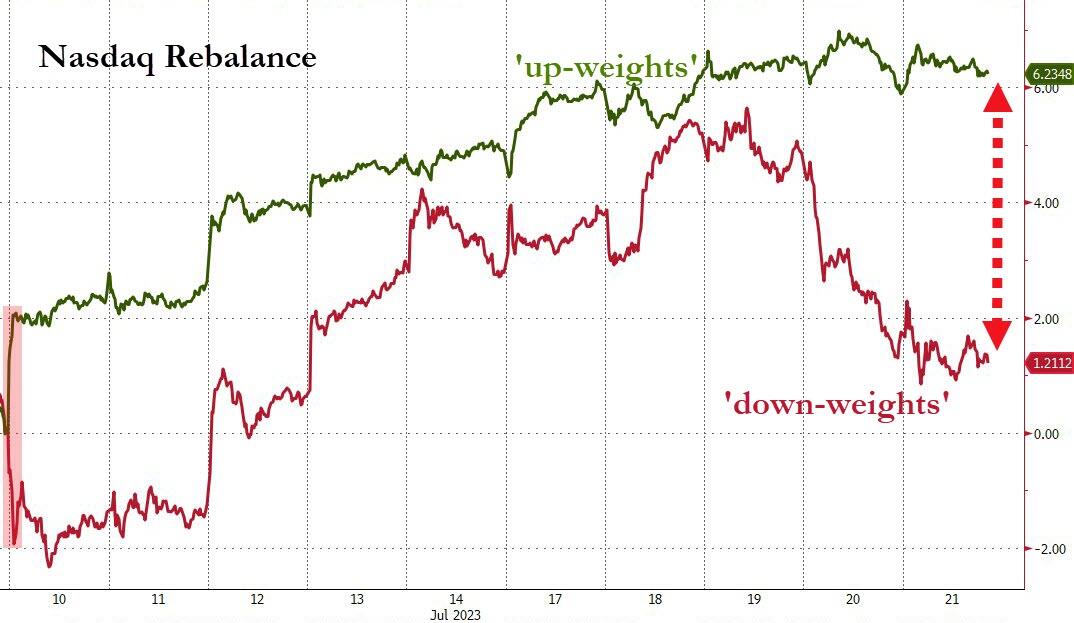
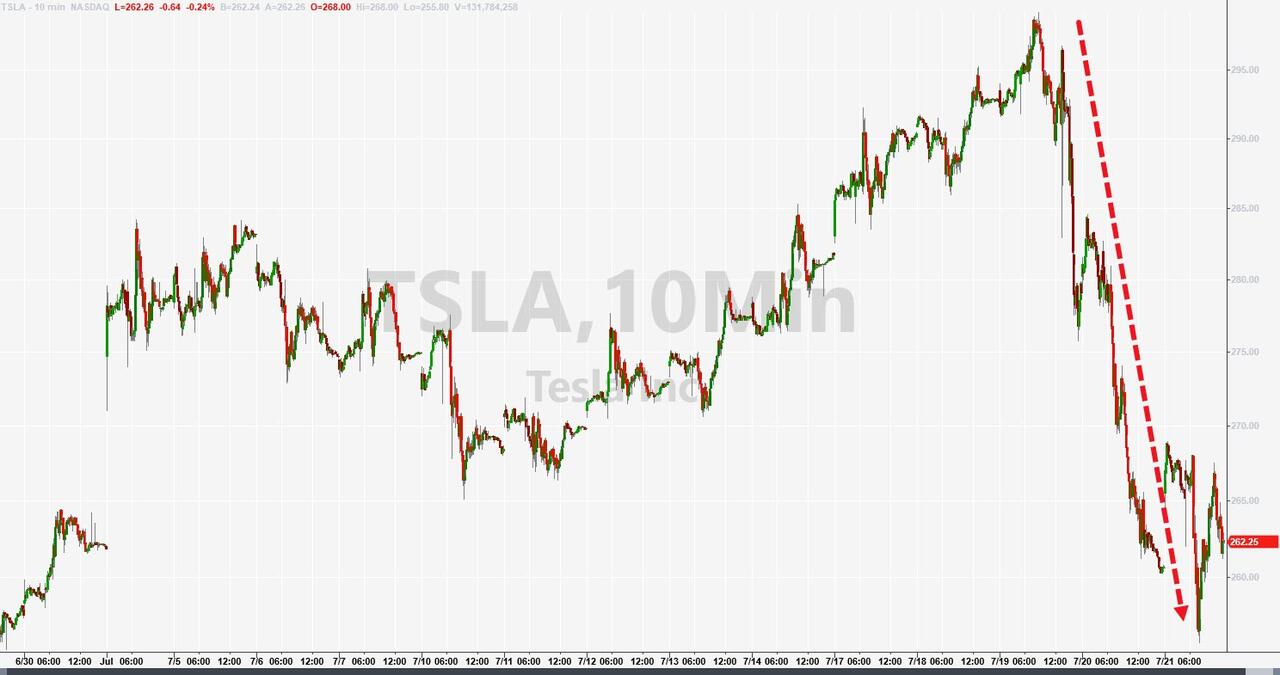
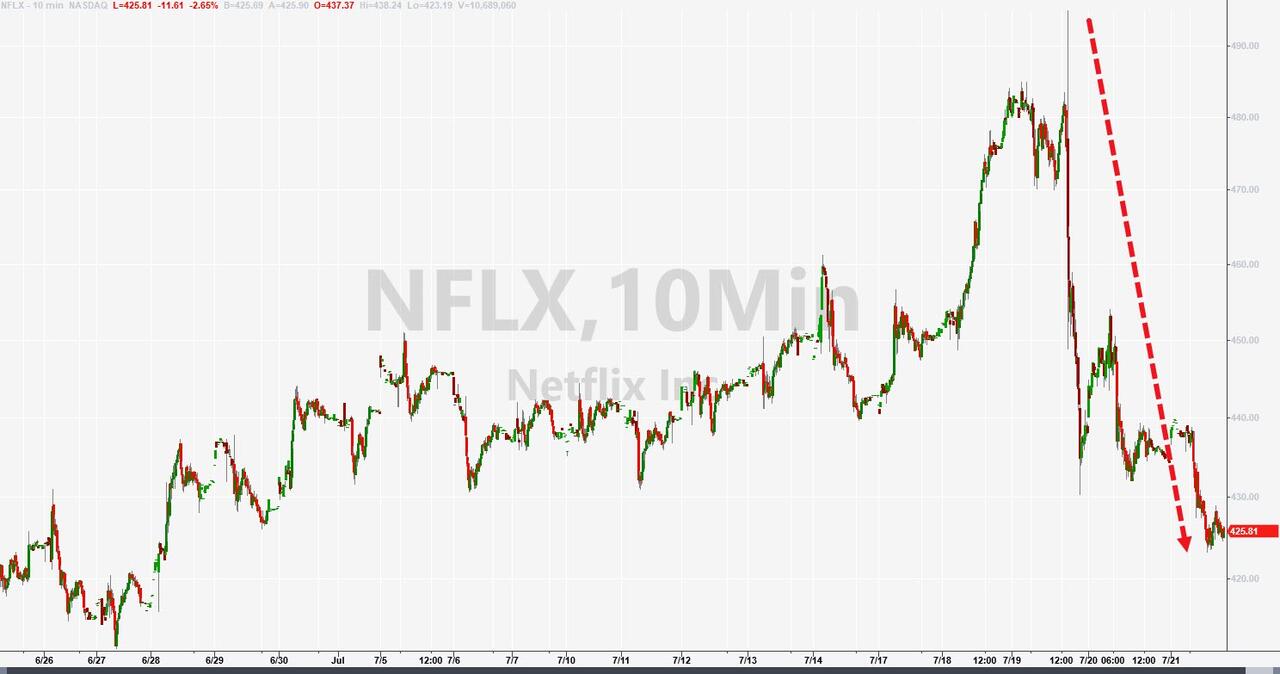
US equity futures are higher as futures pointed to a rebound from yesterday’s selloff, while the yen weakened on a BBG report that the the Bank of Japan won’t make any changes to its yield curve control program. As of 7:45am ET, S&P futures were 0.2% higher while Nasdaq futures rebounded 0.4% from yesterday’s 2.3% rout. Netflix and Tesla climbed in pre-market trading after leading the Nasdaq to sharp losses on Thursday on the back of disappointing results. The Bloomberg Dollar Spot Index traded near the day’s highs, pressuring most Group-of-10 currencies, with the yen suffering the biggest declines after Bloomberg reported that Bank of Japan officials see little urgent need to address the side effects of its yield curve control program. Treasury yields were little changed, mirroring lackluster trading in European and UK bond markets. Brent crude rose more than 1%, while gold fell and Bitcoin gained 0.2%. The Nasdaq rebalance will take effect after close today. Headlines remain quiet this morning; next week, we will receive key MegaCap Tech earnings, starting with GOOGL and MSFT on Tuesday (7/25), and the July FOMC on Wednesday.
In premarket trading, American Express fell almost 3% after the company reported discount revenue for the second quarter that missed the average analyst estimate. Tesla led electric-vehicle stocks higher in US premarket trading after weighing on the sector on Thursday. The stock had slumped after the world’s most valuable carmaker warned of more hits to its already-shrinking profitability. Digital World Acquisition Corp, the SPAC working to bring Donald Trump’s media venture public, soared 21% in premarket trading on Friday after the SEC said it settled fraud charges against the SPAC. Here are some other notable premarket movers:
Intuitive Surgical shares drop 4.9% in premarket trading. The medtech’s second- quarter earnings beat was overshadowed by a continued decline in growth rates for bariatric surgery in the US amid patient interest in the new class of weight-loss drugs as an alternative. The weakness in this area was the only “nitpick” in performance across the company’s procedures, Truist Securities said.
Emergent BioSolutions rises as much as 20% in premarket trading on Friday after the company said it got FDA approval for its anthrax vaccine. Cowen analyst notes that the approval is an incremental positive as it was largely expected.
Sirius XM falls 10% in premarket trading on Friday after Evercore ISI cut its rating on the satellite radio company’s stock to underperform from in line. The downgrade comes after a 42% rally on Thursday that was powered by a short squeeze rather than any fundamental change in the business, the analyst notes.
Rayonier Advanced Materials obtains $250m term loan financing from Oaktree Capital Management funds. The stock jumped 9% in postmarket trading.
Scholastic climbed 9% in postmarket trading as the distributor of children’s educational books reported adjusted earnings per share for the fourth quarter that rose over 30% from the same quarter a year earlier.
Trading on Friday will be affected by a flood of expiring options before an out-of-cycle rebalancing in the Nasdaq 100. The index shuffle, which takes effect on Monday, is designed to reduce the dominance of megacaps and boost the presence of smaller members. The tech-heavy index’s rejig coincides with the monthly options expiration – which at $2.4 trillion is a record for the month of July (see our preview here)- at a time when traders are anxiously waiting for corporate earnings and next week’s Federal Reserve policy meeting for clues on the market’s outlook.
Stocks slipped Thursday for the first time this week as fresh signs of labor-market resiliency bolstered the case for at least another Fed hike this year. Underscoring the risk-off mood, investors withdrew $2.1 billion from equity funds in the week to July 19, while adding $7.5 billion to money markets and $1.4 billion to bond funds, according to BofA’s Michael Hartnett.
The main focus continues to be whether the rally in a handful of megacap stocks and hype over artificial intelligence has staying power. The S&P 500 has already surpassed most estimates for where it would end the year, confounding strategists convinced that 2023 would be another bad year for markets heading into recession.
“So where we are right now, we are resting after the massive move over the course of many weeks,” Ken Mahoney, CEO of Mahoney Asset Management, wrote in a note. “A lot of stocks were creating and still are creating bases to break out higher from. No one could believe their eyes after being so conditioned to 2022’s nasty selling conditions when this market gained steam again.”
European stocks were mixed, trading between gains and losses with the German DAX underperforming as SAP shares slump after cloud sales missed estimates. Here are the most notable European stock moves:
Schindler shares climb as much as 6.9% to highest since March, after the Swiss elevator maker surprised analysts with a full- year net income guidance that beat estimates, thanks to an uptick in orders
Wartsila gains as much as 15%, the most since April 2021, after the Finnish power and marine propulsion products maker positively surprised the market with better-than- expected margins and reassuring order intake
Recordati gains as much as 3.6%, the most intraday since June 1, after the Italian drugmaker made an agreement with GSK to commercialize Avodart and Combodart/Duodart products across 21 countries
Volvo Cars gained as much as 7.3% after being double-upgraded to outperform at BNP Paribas Exane, which shifts its focus in autos manufacturers to now favor “affordable premium”
Babcock shares gain as much as 6.5%, as Citi analyst Samuel Burgess raised his recommendation on the stock to buy from hold, a day after the defense outsourcing company released strong full-year results. He also increased the PT by 35%
Truecaller shares surge as much as 34%, the most since Oct. 2021, as the Swedish caller-ID platform delivered results which DNB expects will trigger a rise in 2024 Ebitda consensus by up to 10%
Viaplay gains as much as 31% after France’s Canal+ Group said it has built a stake in the Swedish streaming entertainment group. The jump trims some of Thursday’s 49% drop
SAP drops as much as 5.6%, the biggest intraday decline since 2022, after the software company reported second-quarter sales in its cloud unit that missed estimates. Jefferies says the miss is a surprise
Lonza shares drop as much as 10% as the Swiss pharmaceutical company cut its core Ebitda margin forecast for the full year after posting “weak” 1H, Citi says. ZKB was also critical of communication toward investors
Thales falls as much as 4.9%, after the French defense group posted results slightly above expectations but produced a revised assumption on the impact of currency swings
SSAB shares plunge as much as 16% after the Swedish steelmaker reported weaker-than-expected second-quarter earnings and gave an outlook that pointed to a worsening environment
Stora Enso shares dropped as much as 7.7%, the most in four months, after the Finnish paper & packaging company’s operating Ebit for the second quarter missed estimates
Norsk Hydro shares fall as much as 3.9% after the aluminum miner reported 2Q results. Analysts say the firm’s decision to hike its capital expenditure guidance outweighs the earnings beat
Earlier in the session, Asian stocks dropped, as tech stocks led losses following TSMC’s guidance cut while benchmarks in Hong Kong climbed. The MSCI Asia Pacific Index slumped 1.5% mainly because of the sharp drop in Indian stocks. TSMC, Tokyo Electron and other chip stocks were the biggest drags on the gauge after TSMC cut its annual outlook for revenue and delayed production at a planned facility in Arizona. The Hang Seng China Enterprises Index advanced as much as 1.4%, while other other Hang Seng gauges were also among the region’s notable outperformers. Their gains come after losses in the past several sessions amid disappointments over the second-quarter growth figures and underwhelming support pledges from Beijing. Investors said the valuations of Chinese equities remained cheap even as it may take time to see a comeback in investor confidence.
Japan’s Nikkei 225 slumped at the open but was well off its lows amid currency swings and somewhat ambiguous CPI data which printed mostly in line with expectations but showed a slight acceleration for the headline and core inflation.
Key stock gauges in India snapped a six-day winning run to end as the worst performing market in the region on Friday due to a sell off in technology stocks. The S&P BSE Sensex fell 1.3% to 66,684.26 in Mumbai, while the NSE Nifty 50 Index declined 1.2% to 19,745.00. For the week, Sensex and Nifty climbed about 0.9% on continued net buying from foreign institutional investors amid optimism for earnings growth. Global funds net buying of India stocks have climbed to more than $15 billion since February. The MSCI India index ended with a 9.2% drop after a sudden decline in the index around 1:20 pm with index provider MSCI saying it is looking into the movement.
“We need to see evidence of economic data recovering,” Abhilash Narayan, senior investment strategist at Standard Chartered Wealth Management, said in an interview with Bloomberg TV. “But from a valuation perspective, Chinese equities are extremely cheap,” he said adding that there is “a fairly good likelihood” that they will outperform global peers over the next 12 months. The main Asian equity benchmark is set for about a 1% decline this week, its worst weekly performance this month. Investors are monitoring corporate earnings reports with many heavyweights in Asia scheduled to report their quarterly results next week.
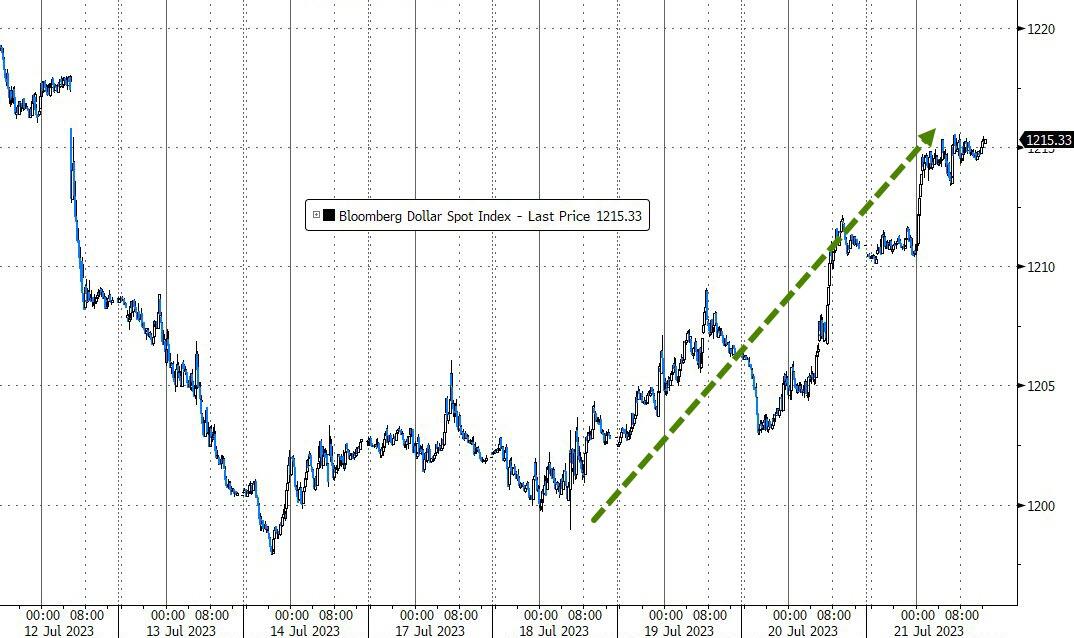
In FX, the Bloomberg dollar index extended gains to a fourth day, its longest winning streak since May. The yen tumbled as much as 1.4% and led losses among Group-of-10 currencies after traders confirmed what we have been saying all along – that there is little chance for a hawkish surprise at the BOJ’s policy decision next week as Bloomberg reported that officials see little urgent need to address the side effects of its yield curve control at this point.
The currency traded at 141.81 against the dollar, its weakest level in almost three weeks, amid reduced odds for a hawkish surprise at the BOJ’s policy decision next Friday.
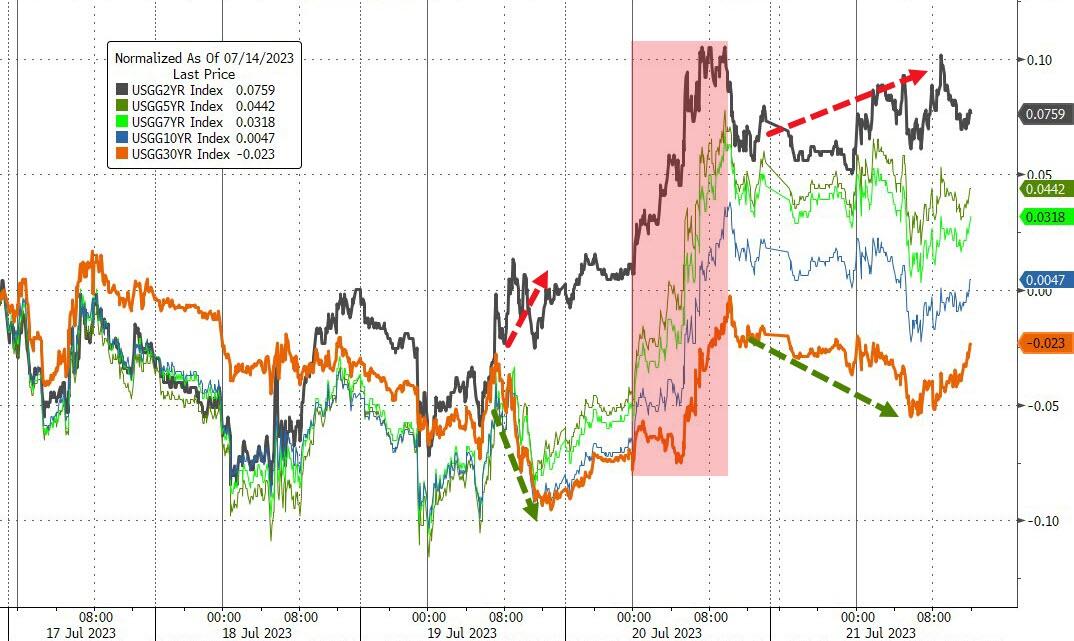
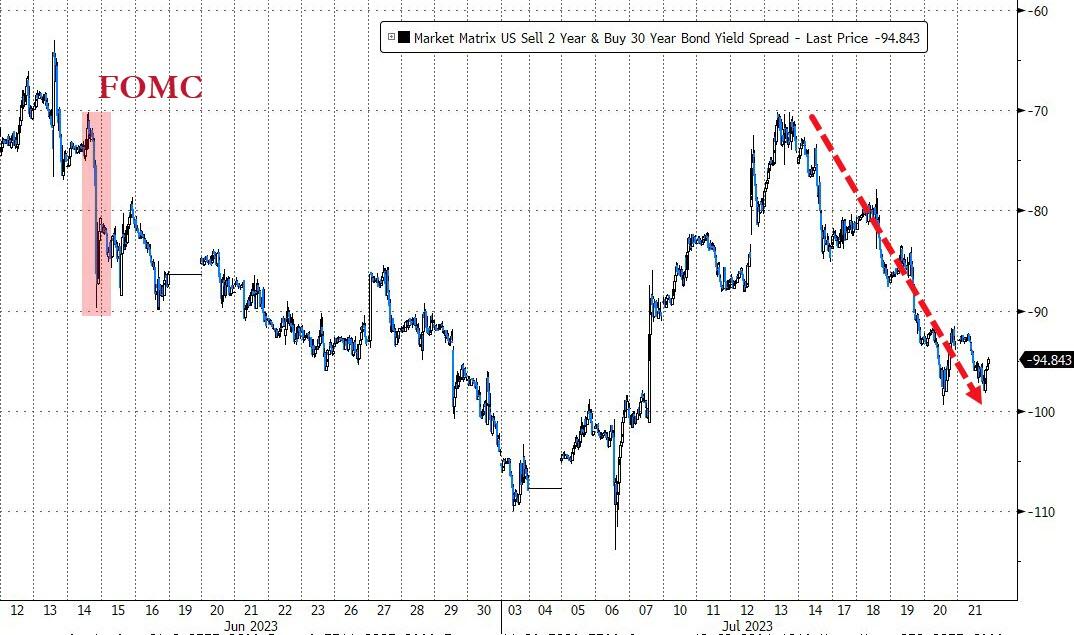
In rates, treasury yields edged lower as US trading day begins, led by longer-dated tenors. Narrow ranges during Asia session and European morning include 2.4bp for 10-year yield. On the week, yields are likewise mixed with the curve flatter, after swaps fully priced in a Fed rate hike on July 26 while auctions of 20-year bonds and 10-year TIPS drew strong demand. Yields remain within about 2bp of Thursday’s closing levels, 10- year around 3.84%, holding above 50-day average level breached this week for the first time since May; most other sovereign debt markets also little changed. Inverted 2s10s curve slightly flatter on the day at around -100bp; Thursday’s low -105bp was deepest inversion since July 6. Fed swaps continue to fully price in a 25bp rate hike on July 26 and about a third of an additional quarter-point hike this year.
The pound also jumped after UK retail sales topped estimates, although gains proved short lived with cable now negative. The Bloomberg Dollar Spot Index is up 0.3%. European stocks are little changed with the Stoxx 600 flat after a three-day rally.
Wall Street looks set for a higher open with S&P futures up 0.2% and Nasdaq 100 futures adding 0.4%. Gilts are in the red while bunds and Treasuries trade close to unchanged. Crude futures advance, with WTI rising 1.2% to trade near $76.60
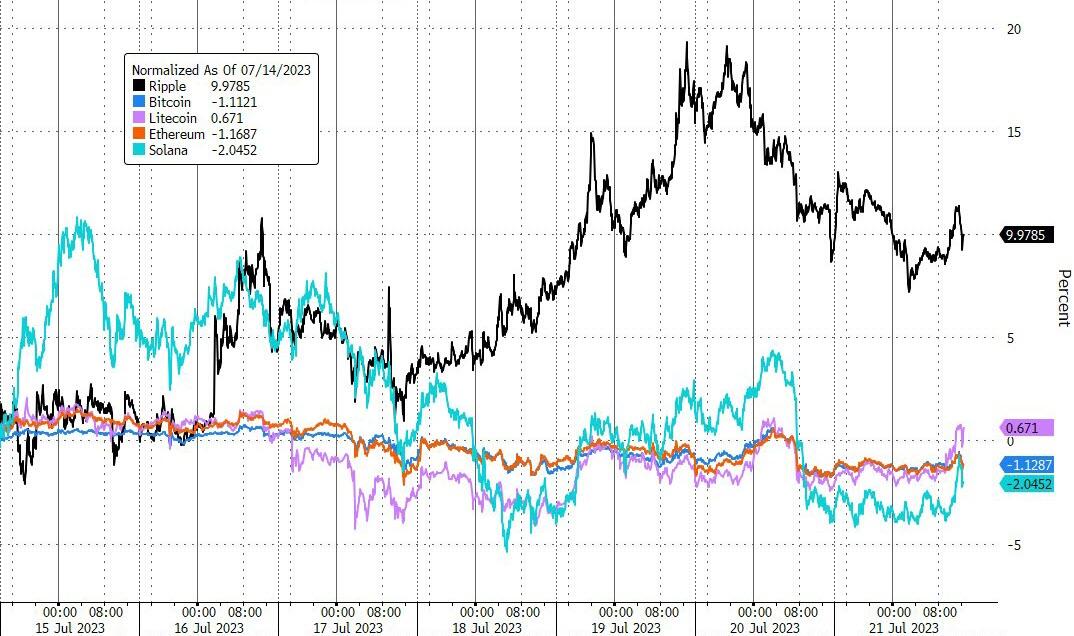
In bitcoin, US House Republicans introduced a new digital assets oversight bill that aims to establish a regulatory framework to protect crypto investors, according to CoinDesk. FTX sues Sam Bankman-Fried and other former executives to recoup hundreds of millions of dollars of alleged fraudulent transfers, according to Reuters.
In commodities,
Wheat fell about 3% as Ukraine made preparations to continue a grain-export deal, which Russia exited this week. The grain is still poised for a weekly gain of 7%, after prices surged on threats to ships arriving at Black Sea ports. The rise in prices could again stoke food costs and feed inflation.
Looking to the day ahead, it’s a fairly quiet one on the calendar with nothing on the US docket. Global data releases include UK retail sales for June, which came in handily above expectations, while earnings releases include American Express which missed expectations.
Market Snapshot
S&P 500 futures up 0.2% to 4,574.75
STOXX Europe 600 little changed at 463.76
German 10Y yield little changed at 2.48%
Euro little changed at $1.1136
MXAP down 1.5% to 164.63
MXAPJ down 1.7% to 519.09
Nikkei down 0.6% to 32,304.25
Topix little changed at 2,262.20
Hang Seng Index up 0.8% to 19,075.26
Shanghai Composite little changed at 3,167.75
Sensex down 1.1% to 66,806.37
Australia S&P/ASX 200 down 0.2% to 7,313.89
Kospi up 0.4% to 2,609.76
Brent Futures up 0.7% to $80.22/bbl
Gold spot down 0.3% to $1,964.31
U.S. Dollar Index up 0.10% to 100.98
Top Overnight News from Bloomberg
Japan’s BOJ is “leaning towards” keeping the YCC policy unchanged at next week’s meeting as policymakers want to see further data before making adjustments. RTRS
Japan’s national CPI for June overshoots the Street at +3.3% on the headline (vs. the Street’s +3.2% and up from +3.2% in May) while ex-energy and ex-energy/food are inline at +3.3% and +4.2%, respectively (the ex-energy/food number of +4.2% ticked down from +4.3% in May, leading some to think inflation may have peaked in Japan). RTRS
Chinese authorities announced measures on Friday intended to help boost sales of automobiles and electronics with the goal of shoring up a sluggish economy, but the steps failed to impress investors who have been clamoring for stronger stimulus. RTRS
The Asian Infrastructure Investment Bank, Beijing’s answer to the World Bank, has approved one of its highest-profile international partnerships, just weeks after it was accused of being infiltrated by China’s Communist party. FT
In the most detailed public account yet given by a U.S. official, the director of the C.I.A. offered a biting assessment on Thursday of the damage done to President Vladimir V. Putin of Russia by the mutiny of the Wagner mercenary group, saying the rebellion had revived questions about Mr. Putin’s judgment and his detachment from events. NYT
Russia’s navy conducted a live fire exercise at a training range in the Black Sea, escalating the war’s risk to global food markets. Wheat headed for a weekly gain of more than 10% as the tensions added to concern about extreme weather. BBG
Fed Vice Chair for Supervision Michael Barr has laid out a plan to increase capital requirements for the nation’s largest banks in the wake of recent bank failures and is expected to unveil the broad proposal to implement new risk-based capital requirements on July 27, according to three industry officials. RTRS
The potential strike by 340,000 UPS workers threatens to revive two of the US economy’s biggest hurdles: inflation and supply-chain disruptions. A walkout would snarl the 19 million US packages UPS moves daily and enable competitors to raise prices. But meeting the Teamsters’ wage demands may also spur inflation pressures. BBG
FTX sued Sam Bankman-Fried and his top lieutenants over $1 billion in bad deals as it tries to recover cash for creditors. BBG
A more detailed look at global markets courtesy of newsqquawk
APAC stocks were mixed as further support efforts from China partially offset the headwinds from Wall St where the Nasdaq 100 suffered its second-worst day of the year on tech disappointment and amid a rising yield environment. ASX 200 was subdued amid losses in tech, financials and the mining-related sectors, albeit with downside limited amid the lack of catalysts from Australia. Nikkei 225 slumped at the open but was well off its lows amid currency swings and somewhat ambiguous CPI data which printed mostly in line with expectations but showed a slight acceleration for the headline and core inflation. Hang Seng and Shanghai Comp were underpinned by further supportive efforts from China in which the NDRC released policies to boost electronics products consumption and measures to promote automobile consumption.
Top Asian News
China’s NDRC released policies to boost electronic product consumption and encourages scientific research institutes and market entities to apply domestic AI technology to improve the intelligence level of electronic products.
NDRC also issued measures to promote automobile consumption and are to encourage regions with purchase restrictions to issue annual purchase targets as soon as possible, according to Reuters.
China is to explain anti-espionage law and mineral export restrictions to Japanese, US, South Korean and EU company executives on Friday, according to Jiji.
China’s state planner NDRC is to hold a press conference on Monday at 10am local time (03:00BST) on private investments.
European bourses are relatively steady after mixed APAC performance as Chinese support offset the subdued handover, Euro Stoxx 50 -0.1%; in Europe, Tech lags with SAP -3.9%. Sectors are somewhat mixed with Energy seeing upside on benchmark pricing, though off best as the USD picks up, while Tech and the DAX 40 -0.5% lag after SAP missed on top & bottom. Stateside, futures are little changed amid a sparse US-specific docket ahead, ES +0.1%; NQ +0.3% is the incremental outperformer after Thursday’s marked pressure and as the dovish-BoJ reports lend support via lower yields.
Top European News
UK PM Sunak’s ruling Conservative party won Boris Johnson’s former parliamentary seat of Uxbridge and South Ruislip but lost the seat of Somerton and Frome, as well as the Selby and Ainsty seat in the by-elections, while the Selby loss broke the record for the largest Tory majority overturned at a byelection by Labour since 1945, according to The Guardian’s Pippa Crerar.
UK-India trade talks have gained momentum in the latest rounds, though there is still a long way to go, according to Reuters citing sources.
VCI, German Chemical Industry Association’s H1 update: Production -10.5% YY; Revenue -11.5% YY; Producer Prices +5% YY. 2023 guidance: Production -8% (prev. -5%); Revenue -14% (prev. -7%).
FX
Yen slides as UST/JGB spreads blow out amidst BoJ sources saying no inclination to tweak YCC next week.
USD/JPY close to 142.00 after breach of Fib and psych levels on the way up from sub-140.00 low; subsequent remarks from Kanda pressured it back to 141.40 briefly.
DXY boosted by Yen collapse as index tops 101.00 within 100.710-101.080 range.
Kiwi and Aussie undermined by a downturn in risk sentiment and Greenback gains, with NZD/USD and AUD/USD under 0.6200 and 0.6750 respectively, while AUD/NZD cross eyes expiry at 1.0900.
Sterling unable to appreciate better than forecast UK retail sales as Cable retreats from just over 1.2900 towards 21 DMA not far below 1.2850 in face of broad Buck strength.
Euro clings to 1.1100 handle and Loonie underpinned by decent expiry interest around 1.3150 ahead of Canadian retail sales.
PBoC set USD/CNY mid-point at 7.1456 vs exp. 7.1965 (prev. 7.1466)
China’s FX regulator said yuan flexibility is increasing and market understanding of two-way fluctuation and risk-neutral also increased. China will prevent sharp volatility in the exchange rate and will keep the yuan basically stable at balanced levels in a forceful manner, as well as comprehensively use policy measures to stabilise expectations.
Turkey introduced a 15% reserve requirement for FX-protected Lira deposits and is to withdraw TRY 450bln-500bln liquidity from the market through the change in reserves, according to Reuters.
Fixed Income
Bonds see-saw in aimless fashion, beyond Gilts and JGBs that have a clearer sense of direction.
Bunds volatile either side of 133.00 and T-note pivoting parity within 112-02/08+ confines.
Gilts retrace more post-UK CPU upside between 96.70-11 parameters and JGBs rebound firmly from 147.73 to 148.74 at best on the back of dovish BoJ sources
Commodities
WTI and Brent September futures are firmer in the early European hours of Friday and hold onto the APAC gains which emanated from further Chinese economic support measures.
Spot gold is pressured by the Yen-induced Dollar strength and dips from its intraday peak of USD 1,973.40/oz closer to its 100 DMA which resides around USD 1,960.55/oz today.
Base metals meanwhile are broadly underpinned by the aforementioned Chinese stimulus measures.
Russian Deputy PM Novak says Russia is not ruling out introducing oil export products quotas; says some domestic refineries postponed maintenance to a later date, via IFX.
Asian refiners have booked near-record volumes of August crude for August shipping, replacing Middle Eastern oil, via Reuters citing sources; amid competitive prices and large supplies attracting substantial purchases. Source adds that recently US crude is being aggressively pushed to Asia.
Russian missiles have hit the grain terminal of an agricultural enterprise in Ukraine’s Odessa region, with two people injured, according to the Governor of the region cited by Reuters.
Geopolitics
US Central Command said the US is to deploy a marine unit following Iran’s recent attempts to seize ships.
Poland is to move military formations from the west to the east of the nation due to possible threats from Russia’s Wagner group, according to PAP.
Russian navy carried out live fire ‘exercise’ in Black Sea: defence ministry, according to AFP.
Russia’s Black Sea Fleet practices firing rockets at surface targets following a warning to Ukraine on ships, via the Defence Ministry. Warships and planes practised sealing off areas temporarily closed to shipping and seizing ships.
US Event Calendar
07:00: Bloomberg July United States Economic Survey
DB’s Jim Reid concludes the overnight wrap
After a pretty strong last couple of weeks for bonds and equities, both sold off yesterday in the US, with tech having one of the worst days of the year. Ironically, outside of disappointing tech earnings, the main catalyst was actually some positive US data, which shifted the debate back towards next week not necessarily being the last Fed hike in the cycle.
Indeed, more hawkish expectations meant that the 2yr real yield hit a post-GFC high intra-day, though it was breakevens that drove the rates sell off at the end of the day. The rates environment was a setback for equities, while weak tech earnings releases weighed even more, with the NASDAQ falling -2.05% in its biggest post-SVB decline and the 3rd worst day of the year.
In terms of the specific data releases, the most important were the weekly US initial jobless claims, which fell to 228k (vs. 240k expected) over the week ending July 15. That’s the lowest claims number we’ve had in a couple of months, and there are growing signs that this is a trend, with the 4-week moving average down for a third week running to 237.5k. It’s true that the continuing claims were above expectations at 1.754m (vs. 1.722m expected), but that was for the previous week ending July 8, and the broader trend downwards is also still evident from the chart. As well as the jobless claims, the Philadelphia Fed released their manufacturing business outlook survey, with the headline index up slightly to -13.5 (vs. -10.0 expected). But the much better news was on the expectations side, with the headline index for 6 months from now up to a 23-month high of 29.1.
With those more positive releases in hand, investors moved to price in a growing chance of further hikes over the months ahead. For instance, futures raised the chances of a second further hike from the Fed after next week to 35%, having been at 30% the previous day. They also dialled back the chances of rate cuts in 2024, with the rate priced in for December up +10.4bps on the day to 4.03%. In Europe it was much the same story, albeit to a lesser extent, with pricing for a second ECB hike after next week up from 87% to 94%.
All that led to a significant selloff among sovereign bonds, with yields on 10yr Treasuries up +10.3bps on the day to 3.85%. That’s their biggest increase in three weeks, and this was echoed across the curve, with the 2yr yield up +7.4bps to 4.84%. As mentioned at the top, there was a shift in the drivers of higher rates through the course of the day. The 2yr real yield hit a post-GFC high intra-day, but breakevens drove most of increase by the close with 10yr breakevens (+8.6bps) seeing their sharpest daily rise since January.
Europe got some positive, albeit backward looking, economic news as well yesterday, as the latest data revisions showed that the Euro Area avoided a technical recession over the winter. That’s because growth in Q1 was revised up to 0.0% (vs. -0.1% previously), so the latest data now only shows one quarterly contraction in Q4, rather than the two consecutive contractions that are often used to define a recession. Alongside the US data, that supported a fresh rise in yields there too, with those on 10yr bunds (+4.6bps), OATs (+5.0bps) and BTPs (+2.9bps) all moving higher.
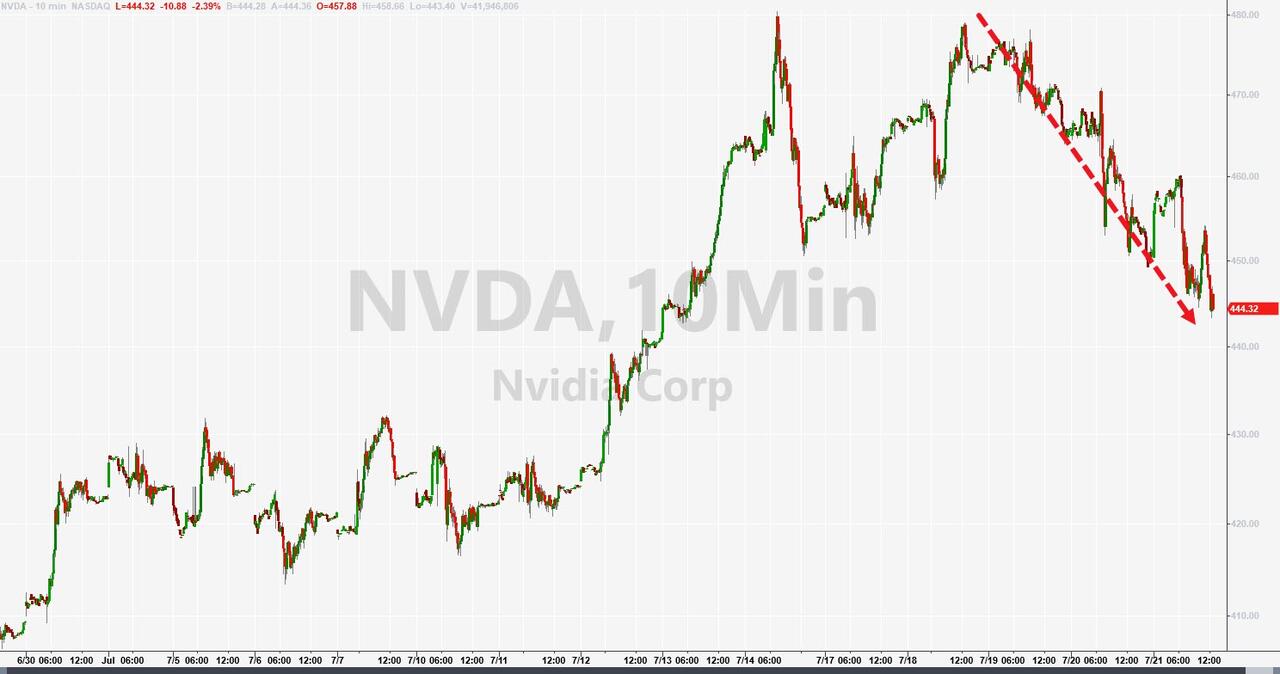
This put a dent in US equities, with the S&P 500 (-0.68%) seeing its biggest decline in two weeks. That said, more than 50% of the S&P 500 actually posted gains on the day with the decline driven by tech stocks. Tesla (-9.74%) and Netflix (-8.41%) both lost significant ground following their earnings after the previous day’s close. This weakness among tech stocks meant that the NASDAQ (-2.05%) suffered its worst day in four months, whilst the FANG+ index (-4.60%) of megacap tech stocks had its worst day of 2023 so far. In other negative news on the tech front, leading chipmaker TSMC cut its 2023 outlook and signaled a delay on a new planned production facility in Arizona. TSMC shares are trading more than -3% lower in Asia this morning. Finally, the underperformance of tech megacaps may have been exacerbated by a special rebalancing of the NASDAQ 100 index, which will be effective as of next Monday (24 July) and will see a decline in the index weights of the tech megacaps.
On the other hand, with utilities, energy and industrials outperforming, the Dow Jones (+0.47%) advanced for a 9th consecutive session for the first time since 2017. The European bourses also fared much better, with the STOXX 600 up +0.42% to a one-month high.
In the geopolitical sphere, Ukraine said that ships heading to Russian ports may be military targets following the collapse of the Black Sea grain deal, which comes in response to Russia announcing a similar move regarding ships heading to Ukraine. Wheat prices initially spiked higher following the news, but they pared back their gains and ended the session -0.10% lower after a run of 5 consecutive gains. They are +17% up from their recent lows on 12 July.
Asian equity markets are mixed this morning with the Hang Seng (+0.80%) leading gains while the CSI (+0.24%) and the Shanghai Composite (+0.08%) edging higher after the Chinese government announced detailed measures to support the private sector. Elsewhere, the Nikkei (-0.22%) is lower with the KOSPI (-0.08%) swinging between gains and losses. S&P 500 (+0.12%) and NASDAQ 100 (+0.11%) futures have seen a small rebound.
Early morning data showed that Japan’s consumer inflation climbed by +3.3% y/y in June (v/s +3.2% expected), and slightly higher than May’s +3.2% increase while the core consumer prices rose +3.3% y/y in June, in line with market expectations and against the prior month’s gain of +3.2%. Core core was in-line at +4.2% y/y, down a tenth from last month, the first decrease in the y/y rate since January and likely marks the start of a trend lower. The pace of the decline will determine the BoJ’s policy over that period though. Remember we have an important BoJ meeting next week with some whispers of policy change although the market will be once bitten twice shy on this.
In UK by-elections, the Conservative government suffered a double by-election defeat after Selby and Ainsty (considered as a safe seat) voted against the government giving the Labour its largest swing since 1997 and its biggest ever reversal of a numeric majority in a by-election in history. The Government surprisingly held ex-PM Boris Johnson’s seat in Uxbridge London, as an unpopular scheme by the Labour London mayor on expanding the ultra low emissions zone in the capital, put off voters.
Before we look at the day ahead a quick wrap of yesterday’s other data. US existing home sales for June fell to an annualised rate of 4.16m (vs. 4.20m expected), which is their lowest level in 5 months. Separately, the Conference Board’s leading index for June posted a -0.7% decline (vs. -0.6% expected), marking its 15th consecutive monthly decline. Finally in Europe, German PPI inflation fell to just +0.1% in June, which is its lowest level since November 2020.
To the day ahead now, and it’s a fairly quiet one on the calendar. Data releases include UK and Canadian retail sales for June, whilst earnings releases include American Express.
2 b) NOW NEWSQUAWK (EUROPE/REPORT)/ASIA REPORT
EUROPE
BoJ sources spark dovish reaction in JPY & JGBs, effects seen in broader assets – Newsquawk US Market Open
FRIDAY, JUL 21, 2023 – 05:45 AM
BoJ sources around YCC spark marked dovish reaction in JPY and JGBs, which has filtered through to broader assets
DXY back above 101.00 with USD/JPY testing 142.00; action which eroded GBP’s retail-driven upside
European/US equity benchmarks relatively contained, Tech hit by SAP while NQ benefits from yield action
JGB upside briefly lifts peers with EGBs/USTs struggling for direction while Gilts slip on data
Crude largely resilient to the USD’s upside with base metals underpinned on Chinese stimulus, XAU pressured
Looking ahead, highlights include Canadian Retail Sales. Earnings from American Express & Schlumberger
2. Listen to this report in the market open podcast (available on Apple and Spotify)
3. Trial Newsquawk’s premium real-time audio news squawk box for 7 days
BOJ
BoJ is reportedly leaning towards keeping its yield control policy unchanged at the upcoming meeting, via Reuters citing sources. No consensus within the BoJ on how soon it should begin phasing out stimulus; many policymakers see no imminent need for fresh steps given the 10yr yield is trading stably within the 0.50% cap. Adding, BoJ can wait until there is more clarity on whether a hard landing can be avoided and allow for further wage increases next year. Sources add, YCC needs to end at some point. Though, the timing is not now. Another source said even if tweaks were made, likely be a minor fine-tuning to make YCC sustainable. Expected to revise up core inflation forecasts for FY23, via source; though, FY23 & FY25 expected to be largely in-line with current projections.
Subsequently, BoJ reportedly sees little need to act on YCC for now, via Bloomberg.
Reports which sparked a marked dovish reaction in the JPY and BoJ, click here for details and analysis. A reaction that has also had an influence on the USD, lifting the DXY above 101.00 to the detriment of FX peers and the commodity space across the European morning.
Most recently, Japanese Top Currency Diplomat Kanda says excessive FX moves are undesirable and watching FX markets with a sense of urgency, according to JiJi; Considering all options from the standpoint that excessive moves are undesirable. Will not comment on the current situation.
An update which sparked a brief pullback in USD/JPY, to circa. 141.40 before the move largely reversed.
Japanese Top Currency Diplomat Kanda says he is not in a position to comment on monetary policy; says expectations are spreading in the market of possible monetary policy changes. Expects the BoJ to make appropriate judgement taking account of price conditions and its outlook at every meeting. Signs of changes in corporate price-setting behaviours are emerging.
EUROPEAN TRADE
EQUITIES
European bourses are relatively steady after mixed APAC performance as Chinese support offset the subdued handover, Euro Stoxx 50 -0.1%; in Europe, Tech lags with SAP -3.9%.
Sectors are somewhat mixed with Energy seeing upside on benchmark pricing, though off best as the USD picks up, while Tech and the DAX 40 -0.5% lag after SAP missed on top & bottom.
Stateside, futures are little changed amid a sparse US-specific docket ahead, ES +0.1%; NQ +0.3% is the incremental outperformer after Thursday’s marked pressure and as the dovish-BoJ reports lend support via lower yields.
Click here and here for a recap of the main European equity updates.
FX
Yen slides as UST/JGB spreads blow out amidst BoJ sources saying no inclination to tweak YCC next week.
USD/JPY close to 142.00 after breach of Fib and psych levels on the way up from sub-140.00 low; subsequent remarks from Kanda pressured it back to 141.40 briefly.
DXY boosted by Yen collapse as index tops 101.00 within 100.710-101.080 range.
Kiwi and Aussie undermined by a downturn in risk sentiment and Greenback gains, with NZD/USD and AUD/USD under 0.6200 and 0.6750 respectively, while AUD/NZD cross eyes expiry at 1.0900.
Sterling unable to appreciate better than forecast UK retail sales as Cable retreats from just over 1.2900 towards 21 DMA not far below 1.2850 in face of broad Buck strength.
Euro clings to 1.1100 handle and Loonie underpinned by decent expiry interest around 1.3150 ahead of Canadian retail sales.
PBoC set USD/CNY mid-point at 7.1456 vs exp. 7.1965 (prev. 7.1466)
China’s FX regulator said yuan flexibility is increasing and market understanding of two-way fluctuation and risk-neutral also increased. China will prevent sharp volatility in the exchange rate and will keep the yuan basically stable at balanced levels in a forceful manner, as well as comprehensively use policy measures to stabilise expectations.
Turkey introduced a 15% reserve requirement for FX-protected Lira deposits and is to withdraw TRY 450bln-500bln liquidity from the market through the change in reserves, according to Reuters.
Click here for the notable option expiries, NY cut.
FIXED INCOME
Bonds see-saw in aimless fashion, beyond Gilts and JGBs that have a clearer sense of direction.
Bunds volatile either side of 133.00 and T-note pivoting parity within 112-02/08+ confines.
Gilts retrace more post-UK CPU upside between 96.70-11 parameters and JGBs rebound firmly from 147.73 to 148.74 at best on the back of dovish BoJ sources
WTI and Brent September futures are firmer in the early European hours of Friday and hold onto the APAC gains which emanated from further Chinese economic support measures.
Spot gold is pressured by the Yen-induced Dollar strength and dips from its intraday peak of USD 1,973.40/oz closer to its 100 DMA which resides around USD 1,960.55/oz today.
Base metals meanwhile are broadly underpinned by the aforementioned Chinese stimulus measures.
Russian Deputy PM Novak says Russia is not ruling out introducing oil export products quotas; says some domestic refineries postponed maintenance to a later date, via IFX.
Asian refiners have booked near-record volumes of August crude for August shipping, replacing Middle Eastern oil, via Reuters citing sources; amid competitive prices and large supplies attracting substantial purchases. Source adds that recently US crude is being aggressively pushed to Asia.
Russian missiles have hit the grain terminal of an agricultural enterprise in Ukraine’s Odessa region, with two people injured, according to the Governor of the region cited by Reuters.
US President Biden launched a working group aimed at ending debt-limit standoffs and the White House will explore all legal and policy options to prevent a future debt-ceiling standoff, while it will examine potential actions Congress could take to make default risk a thing of the past, according to a White House official.
US President Biden’s admin. says it has come to a deal with large tech names to place more safeguards around AI, via WSJ; reminder, Biden will meet with the CEO’s of the Cos on Friday at the White House. Cos include Amazon (AMZN), Alphabet’s (GOOGL) Google, Meta (META) and Microsoft (MSFT).
NOTABLE EUROPEAN HEADLINES
UK PM Sunak’s ruling Conservative party won Boris Johnson’s former parliamentary seat of Uxbridge and South Ruislip but lost the seat of Somerton and Frome, as well as the Selby and Ainsty seat in the by-elections, while the Selby loss broke the record for the largest Tory majority overturned at a byelection by Labour since 1945, according to The Guardian’s Pippa Crerar.
UK-India trade talks have gained momentum in the latest rounds, though there is still a long way to go, according to Reuters citing sources.
VCI, German Chemical Industry Association’s H1 update: Production -10.5% YY; Revenue -11.5% YY; Producer Prices +5% YY. 2023 guidance: Production -8% (prev. -5%); Revenue -14% (prev. -7%).
DATA RECAP
UK Retail Sales MM (Jun) 0.7% vs. Exp. 0.2% (Prev. 0.3%); YY (Jun) -1.0% vs. Exp. -1.5% (Prev. -2.1%)
UK Retail Sales Ex-Fuel MM (Jun) 0.8% vs. Exp. 0.2% (Prev. 0.1%); YY (Jun) -1.0% vs. Exp. -1.5% (Prev. -2.1%)
UK GfK Consumer Confidence (Jul) -30.0 vs. Exp. -26.0 (Prev. -24.0)
GEOPOLITICS
US Central Command said the US is to deploy a marine unit following Iran’s recent attempts to seize ships.
Poland is to move military formations from the west to the east of the nation due to possible threats from Russia’s Wagner group, according to PAP.
Russian navy carried out live fire ‘exercise’ in Black Sea: defence ministry, according to AFP.
Russia’s Black Sea Fleet practices firing rockets at surface targets following a warning to Ukraine on ships, via the Defence Ministry. Warships and planes practised sealing off areas temporarily closed to shipping and seizing ships.
CRYPTO
US House Republicans introduced a new digital assets oversight bill that aims to establish a regulatory framework to protect crypto investors, according to CoinDesk.
FTX sues Sam Bankman-Fried and other former executives to recoup hundreds of millions of dollars of alleged fraudulent transfers, according to Reuters.
APAC TRADE
APAC stocks were mixed as further support efforts from China partially offset the headwinds from Wall St where the Nasdaq 100 suffered its second-worst day of the year on tech disappointment and amid a rising yield environment.
ASX 200 was subdued amid losses in tech, financials and the mining-related sectors, albeit with downside limited amid the lack of catalysts from Australia.
Nikkei 225 slumped at the open but was well off its lows amid currency swings and somewhat ambiguous CPI data which printed mostly in line with expectations but showed a slight acceleration for the headline and core inflation.
Hang Seng and Shanghai Comp were underpinned by further supportive efforts from China in which the NDRC released policies to boost electronics products consumption and measures to promote automobile consumption.
NOTABLE ASIA-PAC HEADLINES
China’s NDRC released policies to boost electronic product consumption and encourages scientific research institutes and market entities to apply domestic AI technology to improve the intelligence level of electronic products.
NDRC also issued measures to promote automobile consumption and are to encourage regions with purchase restrictions to issue annual purchase targets as soon as possible, according to Reuters.
China is to explain anti-espionage law and mineral export restrictions to Japanese, US, South Korean and EU company executives on Friday, according to Jiji.
China’s state planner NDRC is to hold a press conference on Monday at 10am local time (03:00BST) on private investments.
DATA RECAP
Japanese National CPI YY (Jun) 3.3% vs. Exp. 3.5% (Prev. 3.2%); Ex. Fresh Food YY (Jun) 3.3% vs. Exp. 3.3% (Prev. 3.2%)
Japanese National CPI Ex. Fresh Food & Energy YY (Jun) 4.2% vs. Exp. 4.2% (Prev. 4.3%)
2 c. ASIAN AFFAIRS
ASIAN AND AUSTRALIAN CLOSINGS//EUROPE OPENING TRADING:
FRIDAY MORNING/THURSDAY NIGHT
SHANGHAI CLOSED DOWN 1.78 PTS OR 0.06% //Hang Seng CLOSED UP 147.24 PTS OR 0.78% /The Nikkei CLOSED DOWN 185.27 PTS OR 0.57% //Australia’s all ordinaries CLOSED DOWN 0.20 % /Chinese yuan (ONSHORE) closed DOWN 7.1795 /OFFSHORE CHINESE YUAN DOWN TO 7.1838 /Oil UP TO 75.53 dollars per barrel for WTI and BRENT UP AT 80.46 / Stocks in Europe OPENED ALL MIXED// ONSHORE YUAN TRADING ABOVE LEVEL OF OFFSHORE YUAN/ONSHORE YUAN TRADING WEAKER AGAINST US DOLLAR/OFFSHORE WEAKER
2 d./NORTH KOREA/ SOUTH KOREA/
////SOUTH KOREA/CHINA
END
2e) JAPAN
JAPAN/
Yen plummets after the BOJ states that there will be no changes to the YCC. Goldman then states the USA/Yen is headed to 150
(zerohedge)
Yen Plummets After BOJ Crushes Hopes For YCC “Tweak”; Goldman Says To Position For USDJPY 150
FRIDAY, JUL 21, 2023 – 10:45 AM
Despite our repeated attempts to disabuse traders of the laughable notion that the BOJ is about to adjust its Yield Curve Control again…
…. after the catastrophic band widening in December which led to hundreds of billions in emergency spending by the central bank to contain the rout and avoid a bond market catastrophe, the market had nonetheless made up its mind that because Japan’s inflation had spiked in recent months, the BOJ would seek to crush inflation spirits and further revise YCC, even though CPI had clearly peaked already and was turning down.
As a result, after peaking just around 145 in early July, the yen exploded higher as the idiotic tag-team of Mrs Watanabe and momentum-chasing CTAs accelerated the yen short squeeze and pushed the USDJPY as low as 137 one week ago, huge carry and rate differentials be damned.
But not for long: confirming what we had been saying all along, this morning the yen plunged just shy of 142, the USDJPY surging almost 200 pips after Bloomberg cited “people familiar” that Bank of Japan officials see “little urgent need to address the side effects of its yield curve control program, though they expect to discuss the issue.” Reuters echoed that and reported that the BOJ is “leaning towards keeping its yield control policy unchanged at the upcoming meeting”
According to the report, there was “no consensus” within the BoJ on how soon it should begin phasing out stimulus as many policymakers saw “no imminent need for fresh steps given the 10yr yield is trading stably within the 0.50% cap.” Furthermore, the “BoJ can wait until there is more clarity on whether a hard landing can be avoided and allow for further wage increases next year.” And taking a page out of the HBO series Silo, the sources noted that while “YCC needs to end at some point” that point the not today (or next week).
Another source added that even if tweaks were made, it would likely be a minor fine-tuning to make YCC sustainable. Still, the BOJ is expected to revise up its core inflation forecasts for FY23, via source; though, FY23 & FY25 expected to be largely in-line with current projections.
The reaction in the yen was predictable, with USDJPY spiking to 142 and rapidly approaching where it was before the entire idiotic move lower started.
What is remarkable is that none of this should have been news: just two weeks ago Reuters made it very clear that YCC would not be changing.
So what happens next? While yen bulls had a lot of egg to wash off their collective faces for an extremely wrong call, those who correctly called the move as transitory are already positioning for USDJPY 150.
As Goldman FX trader Matt Dewitter wrote in a note titled “Positioning for 150 in USDJPY”, the asymmetry in the FX pair is very clearly for the topside. Consider this: “premium you pay to own a 2-month USDJPY put, say 2% from spot, isn’t just 20% more than the equivalent USDJPY call. Or even 50% more. Its nearly 2.5 times more.”
Here is the math:
USD puts cost 1.25%
USD calls cost 0.55%
All for the same 2-month 2% away from spot strike. (Spot 140.55, strikes 137.75 and 143.35 respectively).
Dewitter continues:
At the extremes this imbalance becomes even more pronounced: 10-delta USD calls are now SO LOW they cannot help but offer you exceptionally cheap exponential leverage for a BOJ on hold scenario.
Buy 2-month 4.5% above spot call, roughly 10d, for 0.199% of notional
That’s 200k for $100m of exposure. Strike ~147.00. (the equivalent 134 put would costs 600k.. ) Per the chart, you would expect a 4-5x return on a spot move back to the level from just a few days ago (~145).
The returns get even more exponential, 12-15x, on a BOJ disappointment, with a 145 break plausibly seeing us back to 150 highs.
Note that the price for these USD calls has collapsed. It is 70% cheaper than this time last year. And 50% cheaper than the past 1-year average. That effectively DOUBLES your leverage
Bottom Line:
Combine this with a very attractive spot entry level after the 3% collapse, and these wingy USDJPY calls are very compelling.
As Goldman concludes, “Yes BOJ may move. But if they don’t, you can expect a return back to the prevailing level, and a very attractive return.”
Pay 20bp to own a 2-month 4.5% above spot USDJPY call
Well, we now know they won’t move, so the road to 150 is once again clear. Once there, we cross intervention redlines so it will be time to cover.
In the first half of 2023, China imported 2.13 million barrels per day of Russian crude oil, making Russia its single biggest supplier.
In June, China once again imported record-breaking levels of Russian crude, a 44% increase compared to the same month in 2022.
Total Chinese oil imports are also soaring, with the country importing the second-highest monthly import figure on record in June.
Despite an apparent weakness in its economy, China is importing record volumes of oil and is buying record amounts of Russian crude to add to stockpiles.
During the first half of 2023, Chinese imports of Russian crude oil averaged 2.13 million barrels per day (bpd), which helped Russia oust its OPEC+ partner Saudi Arabia from the top spot as the single biggest supplier to the world’s top crude importer so far this year, per Financial Times estimates based on Chinese customs data. Imports from the world’s top crude oil exporter, Saudi Arabia, averaged 1.88 million bpd between January and June, according to FT’s calculations.
In June alone, China broke – for yet another month – the record for importing Russian crude oil, per data from the Chinese General Administration of Customs cited by Reuters. Chinese imports from Russia averaged 2.56 million bpd last month, a surge of 44% compared to the same month in 2022, the Chinese customs data showed.
The previous record, of 2.29 million bpd, was set in May as Chinese refiners continued to buy discounted Russian oil. The discounts for Russia’s crude narrowed relative to the benchmarks in June, but this didn’t stop China from boosting imports and breaking in June the record from May.
China’s imports from Saudi Arabia also rose in June, compared to May and June last year. But at 1.93 million bpd in June 2023, those imports still trailed behind the record-breaking Chinese crude oil imports from Russia.
Total Chinese oil imports are also surging. China’s crude oil imports in June jumped by 45.3% on the year to the second-highest monthly figure on record, as refiners continued building up inventories despite weak domestic demand. Oil imports in June totaled 12.67 million bpd—a sharp increase from a year ago when the country was still under Covid-19 lockdowns.
END
4.EUROPEAN AFFAIRS//UK /SCANDAVIAN AFFAIRS
UK
They apologize but still Nigel does not have his bank accounts back
(Evans//EpochTimes)
Coutts Apologises To Nigel Farage After Bank Account Closure
Natwest’s chief executive, owner of the prestigious bank Coutts, has apologised to Nigel Farage and has promised a full review of the bank’s processes after a dossier said that his views “were at odds with our position as an inclusive organisation.”
On Thursday, Alison Rose, chief executive of NatWest Group, of which Coutts is part of the wealth management division, wrote to the former Brexit Party leader Mr. Farage to apologise for “deeply inappropriate comments” made about him in official documents.
Mrs. Rose did not give him the option of having his original Coutts account back.
In July, Mr. Farage claimed the prestigious bank he has been with for over 40 years has closed his account with “no explanation.”
He said that he believe that he had been persecuted for his views and that he may have been deemed a politically exposed person (PEP), a term used for someone who, through their prominent position or influence, is more susceptible to being involved in bribery or corruption.
The document, cited that he reshared a tweet by the comedian Ricky Gervais mocking transgenderism, which the document called “a transphobic comedy sketch” as well as his friendship with tennis player Novak Djokovic, who is opposed to Covid vaccinations. It also said that Mr. Farage is “xenophobic and racist.”
In document cited Brexit 86 times, Russia 144 times and PEP ten times. His support for former President Donald Trump as well as his views on immigration, net zero and the COVID-19 vaccine are listed as reasons to exit him.
Mrs. Rose said:
“Both freedom of expression and access to banking are fundamental to our society. It is not our policy to exit a customer on the basis of legally held political and personal views. Decisions to close an account are not taken lightly and involve a number of factors including commercial viability, reputational considerations, and legal and regulatory requirements.
“I fully understand the public concern that the processes for bank account closure are not sufficiently transparent. Customers have a right to expect their bank to make consistent decisions against publicly available criteria. Those decisions should also be communicated clearly and openly with them, within the constraints imposed by the law.
“To achieve this, wider change is required. But the experience of clients highlighted in recent days has shown we need to act now to put our processes under scrutiny.
“The deeply inappropriate comments made in the now published papers prepared for the Wealth Reputation Risk Committee, do not reflect the view of the bank. No individual should have to read such comments and I apologise to Mr. Farage for this. I have written to him today to make that apology and reiterate our offer of alternative banking arrangements.”
Lobbying
Toby Young from Free Speech Union told The Epoch Times by email that after his organisation was de-banked by PayPal last year, they started talking to City and Treasury Minister Andrew Griffith about what “could be done to stop this happening to other people.”
“He invited us to submit evidence to the Treasury about how widespread this form of censorship is. We duly did that, citing numerous cases, and the upshot is that the Payment Services Regulations are now being tightened up to stop banks and payment processors from closing people’s accounts for exercising their right to lawful free speech,” said Mr. Young.
He added that the government “deserves a lot of credit for acting quickly to stamp out this sinister new form of cancel culture.”
“We kicked up a stink about it, the government listened and I’m happy to say it has done something about it,” said Mr. Young.
Conservative MP Sally-Ann Hart told The Epoch Times by email that “this is an extremely worrying development that needs to stop now.”
She said she was “appalled to see wider financial services being denied to individuals exercising their right to lawful free speech.”
Last year, after the Free Speech Union’s dealings with PayPal, Mrs. Hart had floated a potential amendment to the Financial Services and Markets Bill, which would have made it illegal for a financial services provider to withhold or withdraw service from a customer if it was related to their freedom of expression. She removed it due to the issue needing to be looked at by the British government in more detail.
On Mr. Farage’s case, she said:
“We are not a totalitarian country that silences legitimate views, however much we might disagree with them, nor should we tolerate attempts by any individual or organisation to silence them.”
“I am aware that the Chancellor will be setting out plans soon to toughen up the rules regarding account closures. This is absolutely necessary to protect freedom of expression,” she added.
Cracking Down
On Wednesday, the government announced that it is in the process of cracking down on financial services being denied to anyone exercising their right to lawful free speech.
During Prime Minister’s questions, Rishi Sunak said it “wouldn’t be right” for financial services to be denied for lawful free speech.
MP Jacob Rees-Mogg called for an inquiry.
Mr. Rees-Mogg told the Commons: “Does (the prime minister) share my unease that a bank that has the Government as its largest shareholder should close the account of a senior opposition politician?
“Will he use the Government’s shareholding to ensure that there is an inquiry into these circumstances?”
Mr. Sunak said: “It wouldn’t be right if financial services were being denied to anyone exercising their right to lawful free speech.
“Our new Financial Services and Markets Act puts in place new measures to ensure that politically exposed persons are being treated in an appropriate and proportionate manner.
“Having consulted on the Payment Services Regulations, we are in the process of cracking down on this practice by tightening the rules around account closures.
“But, in the meantime, any individual can complain to the Financial Ombudsman Service, which has the power to direct a bank to reopen their account.”
The Epoch Times contacted the Treasury for comment.
-END-
5 RUSSIA//UKRAINE AND MIDDLE EASTERN AFFAIRS
RUSSIA/UKRAINE
Ukraine Begins Firing US Cluster Bombs At Russian Troops, Kirby Touts ‘Quite Effective’ Use
FRIDAY, JUL 21, 2023 – 01:45 PM
Ukrainian officials have confirmed their forces have begun firing US-provided cluster munitions at Russian positions in southeastern Ukraine, which has also been validated by the White House.
“U.S.-supplied cluster munitions are in Ukrainian hands and being deployed in the field as part of Kyiv’s battle against Russia,” national security spokesman John Kirby said Thursday, according to Reuters. Kirby has cited the controversial munitions are already having a positive impact in Ukraine’s war effort.
“We have gotten some initial feedback from the Ukrainians, and they’re using them quite effectively,” Kirby told a briefing. Reuters has noted that Ukraine “pledged to use the cluster bombs only to dislodge concentrations of Russian enemy soldiers.”
The pledge came following the Biden administration’s decision to send cluster bombs resulting in some degree of backlash from the press and international human rights groups, given they kill indiscriminately and unexploded bomblets can kill or maim civilians for many years even after a conflict is over.
President Biden had called it a “difficult decision” – given the munitions are banned by over 120 countries; however, neither the US nor Ukraine nor Russia are signatories to the international treaty banning their use.
Col. Oleksandr Bakulin, a Ukrainian commander, told BBC News that his forces need cluster bombs to “inflict maximum damage on enemy infantry,” but he also admitted they would not “solve all our problems on the battlefield.”
Despite the Biden White House prior to the start of the Ukraine war having highlighted the greater likelihood of potential “war crimes” when using cluster bombs, the US administration now maintains the transfer hasn’t damaged America’s “moral authority”. National Security Council spokesman Jake Sullivan pushed back against media criticism as follows in a recent interview:
“Our moral authority and Ukraine’s moral authority in this conflict comes from the fact that we are supporting a country under a brutal, vicious attack by its neighbor with missiles and bombs raining down in its cities, killing its civilians, destroying its schools, its churches, its hospitals,” Sullivan said. “And the idea that providing Ukraine with a weapon in order for them to be able to defend their homeland, protect their civilians, is somehow a challenge to our moral authority — I find questionable.”
But The Washington Post has documented that Biden is having to bypass US laws regulating cluster munitions exports:
The president’s decision bypassed U.S. law prohibiting the production, use, or transfer of cluster munitions with a “dud rate” of more than 1 percent. The dud rate refers to the share of munitions that remain unexploded.
WaPo wrote further: “Biden circumvented the law under a rare provision of the Foreign Assistance Act, which allows the president to provide aid, regardless of arms export restrictions, as long as he determines that doing so is in vital U.S. national security interest.”
The White House has in a fashion typical of US foreign policy crafted a message of the end justifies the means in defending its new cluster munitions for Ukraine policy. This also comes amid worsening ammo shortages among the Western allies, but the Pentagon reportedly has cluster bombs stockpiled in abundance.
END
ROBERT H TO US:
RUSSIA/UKRAINE/NATO
Why NATO was Obsessed with Ukraine and is Now in a Panic | The Gateway Pundit | by Larry Johnson
It is always about money and resources to plunder. There is a saying that “one man’s misery is another man’s gain”. In the nation state wealth grab, it is one nation’s wealth is another nation’s plunder.
This is not new and has been the case for centuries by many an empire. So why is anyone so surprised? National leaders who are corruptible are always corrupted by eager minds seeking to plunder. Largely because our education systems fails to teach how to adopt mutual resolving win win solutions as opposed to a win lose approach. Business relationships prosper when all parties proper as opposed one party prospering at the expense of the other. Actually all relationships work this way.
Traversing the globe of nations and watching the rise of the BRICS signals that upcoming nations may have understood and have adopted a desire to off load the plunderers. The nail in the coffin was gross error of taking Russia off Swift and thereby weaponizing the dollar in an effort to secure servitude. And why Ukrainians die in industrial numbers in the Donbas is because that is where real natural resource wealth lies there and not in the Western Ukraine. This is not new but is something people chose not to talk about.
And just like the wealth of Afghanistan is going to the Chinese, the wealth of Syria and Iraq will soon be denied to the West as well.
To answer the question in my title you need only look at two numbers — 1) Ukraine’s rank in terms of natural resources and 2) the size of Ukraine’s Army in February 2022. Since the end of World War II the West has viewed Ukraine as a critical piece on the global chess board for attacking and defeating Russia. The joint CIA/MI-6 effort to destabilize the Soviet Union, which started in 1947 with the provision of funds, weapons and training to Stefan Bandera’s organization, was crushed by the Soviets by 1952. It was shortly after that, following the death of Stalin in 1953, that Khrushchev gifted Crimea to Ukraine (1954). Was it a reward for Ukrainian assistance in wiping out the CIA-backed OUN uprising?
How is it that on the eve of the Russian Special Military Operation in February 2022 that Ukraine was the poorest country in Europe but was ranked number four in the world in terms of natural resources?
The country [Ukraine] ranks fourth globally in terms of total assessed value of natural resources, with roughly $15 billion in annual output and a potential “assessed value [that] could be as high as $7.5 trillion,” according to the report.
Beyond that, Ukraine is thought to have the largest supply of recoverable rare earth resources in Europe, although much of it is undeveloped. Rare earth minerals (cerium, yttrium, lanthanum and neodymium) and alloys are used in many devices people use every day, such as computer memory, rechargeable batteries, cellphones and much more.
The answer is simple — the Western oligarchs who fund the political leaders of the NATO countries were busy cutting deals with Ukrainian oligarchs to get control of those rare earth minerals and energy resources. Do you think that putting Hunter Biden on the Board of Burisma, along with former CIA Counter Terrorism Chief Cofer Black, was just a coincidence? But note — the plan to pillage Ukraine of its natural wealth did not include a plan to ensure the economic development of the Ukrainian people. Only those closely tied to Western oligarchs would profit.
Simply compare what Russia achieved since Vladimir Putin took the reins of government in August 1999 with Ukraine’s national squalor. Russia is number one in the world in terms of natural resources and Putin put a stop to the oligarchs plan, along with Western partners in the 1990s who gleefully raped Russia for their own enrichment. During the last 23 years Putin has resurrected Russia from the ashes of economic ruin, restored the military, rebuilt infrastructure throughout the 11 time zones that comprise Russia and created a vibrant, modern economy. Oh yeah, almost forgot. Russia’s space program surpasses that of all Western countries, including the United States.
Ukraine by contrast, thanks to a clown parade of incompetent, corrupt leaders, sold their country and their souls to the West. That is why Ukraine is the poorest country in Europe instead of one of the wealthiest.
The West had zero interest in fostering a genuine, legitimate democracy in Ukraine. Ukraine was nothing more than a proxy for weakening Russia and carving it up into pieces the West could readily devour to sustain faltering economies. Prior to the start of Russia’s Special Military Operation, Ukraine was treated as a de facto member of NATO. There were NATO training bases in Ukraine. The U.S. Department of Defense set up dozens of bio-research labs across Ukraine. And NATO and the U.S. European Command conducted annual military training exercises in Ukraine with Ukrainian forces.
The numbers tell the story. Ukraine’s Army (according to data from February 2022) had 700,000 active duty forces and a million men in reserve. That made Ukraine, as a de facto member, the second largest army in NATO. The United States provides the largest share of troops to NATO — 2,307,630. Coming in third, behind Ukraine, is Turkey with 1,069,900. Ukraine’s force is larger than France, Great Britain and Germany combined. We now know that NATO envisaged using Ukraine as the shock troops to weaken Russia so that NATO could finish off Putin and his military.
After 18 months of combat Ukraine has at least 600,000 military casualties (killed and wounded). That represents over 30% of its manpower at the start of the war in February 2022. NATO does not have the stomach, the resources nor the political support in their respective countries to send their troops into the maw of death and destruction that is Ukraine. NATO will not admit it publicly, but without Ukraine and Turkey, it has zero chance of defeating Russia.
end
Robert H to us;
ODESSA UKRAINE//RUSSIA
“Hell” for a third day in Odessa: Non Stop Russian bombing – Massive attack swept the coastline and ports – 50 mercenaries dead – WarNews247
Zelensky can stop dreaming about the huge money BlackRock and JP Morgan have promised in rebuilding. Ukraine will be reduced to a rump land locked state as an expendable border area and be totally disarmed. It is what the SMO is about. Should Poland test it’s bravery in occupying western Ukraine or parts of Belarus; what the world will see will make the devastation seen to date, child’s play. NO one will come to their defense. Perhaps Lithuania will test its blood but that will be over before it starts. It is why you are seeing the narrative change to Ukraine giving up territory. However, it should be remembered it will be on Russian terms and no one else. Those times are long gone. The West has shown its colors and will pay the price. Broken economies first saddled by Covid and bleeding of treasuries for war have produced a broken engine with few coins to pay for its repair. Today, fashionable shoes are more likely to worn on well dressed women in Ghana than on the streets of Western Europe.
President Vladimir Putin signed a decree in April allowing for “temporary” state control over the assets of companies or individuals from “unfriendly” states — which include the US and its allies.
Sunday’s move is the second time the Kremlin has used the decree to seize assets. Previously, Russia took control of utilities owned by Finland’s Fortum Oyj and Germany’s Uniper SE.
Russia and Ukraine accounted for about 13% of Carlsberg’s total sales and about 9% of operating profit in 2021. The company employs about 8,400 people in Russia and had previously separated the operations there from the rest of the group.
Carlsberg is assessing the legal and operational consequences. Fortum last week started a process of arbitration over the April seizure. But with Russia no longer concerned about appearing fair to western investors, it’s difficult to see how much recourse these or any other multinationals will have.
Procter & Gamble, Colgate-Palmolive and Philip Morris International have also remained. Coca-Cola HBC has the largest revenue exposure to Russia among European consumer-staple companies, Morgan Stanley said, saying the regional Coke bottler gets 12% of sales from that market.
After Russia took over Danone and Carlsberg, what fate is awaiting Austria’s Raiffeisen bank? The US and EU’s banking authorities pressure the bank for some time now to exit Russia, but progress is slow and risks are getting higher. After some failed attempts to swap assets with Russian banks in Europe, Raiffeisen is stuck between the rock and a hard place. They still serve western clients present in Russia and face the dilemma of either being hit by sanctions from the US and the EU if they stay or a hostile takeover from the Kremlin if they were to seek an exit.
Amongst western banks, Raiffeisen is the most important bank still operating in Russia, ahead of Italy’s Unicredit, the Dutch ING and the Hungarian OTP.
Half of the western companies still present in Russia have turned towards Raiffeisen since the outbreak of the war, according to Les Echos. Not yet subject to sanctions and still connected to the Swift interbank messaging system, Raiffeisen has been a valuable interconnection between the two worlds.
The result was an increase in its assets by 36% since then. Despite losing 500,000 customers, it still has a total of 3.2m, and deposits have risen by 28% to €20.8bn for their Russian subsidiary. The number of employees rose to 9,890. Its profits for the first three months of this year were up 214% on the first quarter of last year.
Could the Kremlin do to Raiffeisen what it has done to Danone? Taking over a systemically relevant bank has more repercussions than taking over a dairy producer. The moment Russia seizes Raiffeisen’s assets, their link to Swift would be cut off. It also would cause a domino effect to all those other western companies that still rely on Raiffeisen to protect their assets. Either it is done overnight or not at all. It depends on how valuable the link to the Swift system and the presence of those remaining western companies still is to the Kremlin. The move on Danone certainly was a shock and a reminder of how precarious the situation of companies still operating in Russia is.
Weaponization of the Dollar
Neither Bloomberg nor Eurointelligence mentioned retaliation for weaponization of the dollar as the prelude to these recent beer and yogurt events.
The only possible surprise in this story is why it took so long.
At the onset of the war, the Fed, under direction of the Biden Administration, illegally seized Russia’s foreign reserves. Illegal is the correct word.
Federal Reserve Act
The Federal Reserve Act mandates that the Federal Reserve conduct monetary policy “so as to promote effectively the goals of maximum employment, stable prices, and moderate long-term interest rates.”
Nowhere does the act give the Fed the right or power to confiscate the reserves of sovereign nations. But that is exactly what the Fed did when it seized Russia’s US dollar reserves.
If the Fed can confiscate Russia’s reserves, who’s next?
The recent removal of Russian banks from the SWIFT messaging system has highlighted the importance of payments in supporting economies. But the weaponization of SWIFT has also left some commentators worrying about the loss of the U.S. dollar’s dominance, as it might drive banks and firms to other substitutes. This Economic Brief discusses the economics of SWIFT and explains why emigrating from the U.S. dollar may be more difficult than we thought.
The Richmond’s Fed’s assessment is self-serving. Yet, it appears accurate. Importantly the Fed even admits weaponization, the emphasis was mine.
Dollar Weaponization Expands – FDIC Message to Foreign Depositors Is Don’t Trust the US
The FDIC made a “systemic risk exception” for Silicon Valley Bank to protect depositor funds beyond its limit of $250,000 per bank account.
FDIC’s stated “insurance” is for US depositors only. But the exception to make all US depositors whole means foreign depositors bear 100% of responsibility for the collapse of SVB.
Since bond holders rate higher than unsecured depositors, and the FDIC had significant losses rated to SVB, foreign depositors may get zero cents on the dollar.
If you are a foreign depositor at any small or midsized bank, the FDIC is affirming that you better get your money out now.
What Does China Do With a Dollar That’s No Longer Risk Free?
In light of Fed actions against Russia, I pinged Michael Pettis at China Financial Markets some questions on China’s reserves on March 18, 2022.
Mish: Will China now hold more commodities and fewer dollars despite the pro-cyclical nature of it? More Euros or Yen over dollars? More gold?
Michael Pettis (emphasis mine):
1: “Given that so much of China’s “reserves” are now indirect and held by state-owned banks (all the increase since 2017) it’s hard to say what the currency composition of China’s reserves are.
2: “Officially the US dollar is still by far the biggest component, but it is slowly declining.
3: “I expect that this will continue as far as the official reserves go but, as you know, the hard part of reducing the US dollar component of your reserves is figuring out what the alternative should be, and with such high and growing reserves (once you include the indirect reserves at the state-owned banks) that is a very difficult question to resolve.”
Gold-Backed BRIC Silliness
Pettis’ comment on the hard part is precisely why all the discussion on BRICs and a new currency backed by gold or some sort of weighted or commingled currency is 95 percent hot air.
Launching a BRIC currency is, for now, somewhere between extremely difficult and impossible, in any meaningful sense.
Thorsten Polleit, chief economist at Degussa, told Kitco, “For making the new currency as good as gold, a truly sound currency, it must be convertible into gold on demand. I am not sure whether this is what Brazil, Russia, India, China and South Africa have in mind.“
Marc Chandler, managing director of Bannockburn Global Forex, told Kitco: “Talk of BRICS gold backed currency seems like an echo chamber. They do not have the gold to back a currency meaningfully. Have we not learned anything from the EMU experience of monetary union without fiscal union. Color me profoundly skeptical.“
Importantly, there are no details to the BRIC announcement. The current discussion involves a “trading currency”.
A “trading currency” is a laughable construct because nations don’t trade, individuals and corporations do. It is the sum of individual and corporate actions that give rise to the concept of national trade deficits.
In essence, the proposed trading currency is a return to Bretton Woods, minus the gold, which surely will not be convertible on demand for the actual traders, individuals and corporations.
Details await. If you are honest about things, and understand trade at all, expect to be underwhelmed.
Not Now Does Not Mean Never
The demise of the current US-dollar financial system with SWIFT at the heart of it is underway. I just cannot tell you when the system crumbles, nor can anyone else.
Although the dollar avoidance the BRICs seek is much easier said than done, not now doesn’t mean never. The recognition phase has started.
Most do not realize the EU is involved even though it wants no part of the BRIC structure. Importantly, the EU’s annoyance at SWIFT is far more significant than any yapping by Brazil.
So, don’t be surprised if something truly significant starts with the EU, not the BRICs. That’s an idea I have not seen anyone else suggest.
The EU is hopping mad over US sanctions on Iran. Germany was hopping mad at Trump for threatening to sanction Gazprom. The latter point is now moot, yet still a sore point.
Regardless of where de-dollarization picks up steam, it will mark the end of global sanction madness by Trump and dramatically escalated by Biden. Bring it on.
END
IRAN/USA
Pentagon Sends Thousands Of Marines To Deter Iran Tanker Seizures In Persian Gulf
FRIDAY, JUL 21, 2023 – 11:25 AM
In a major development the Pentagon has confirmed it is sending a new deployment of Marines to the Middle East region as tensions with Iran heat up.
Defense Secretary Lloyd Austin said late Thursday the new forces, along with warships, are being sent in order to deter Iran from interfering with international shipping in the Persian Gulf region, following at least two recent attempts by Iranian commandos to seize oil tankers in international waters of the Gulf of Oman.
Austin said the USS Bataan amphibious readiness group and the 26th Marine Expeditional Unit are being sent to the Gulf region, which consists of about 2,500 Marines, to provide “even greater flexibility and maritime capability in the region.”
The amphibious readiness group consists of the Bataan warship and two others, the USS Mesa Verde and the USS Carter Hall. The group had already left Norfolk, Virginia earlier this month.
Weeks ago the Pentagon sent the USS Thomas Hudner and additional F-35 and F-16 fighter jets to the region, to assist A-10 attack aircraft, as tankers have come under increasing threat – including an incident in which one was fired upon.
A fresh Central Command (CENTCOM) statement said the additional assets will “provide unique capabilities, which alongside our partner nations in the region, further safeguard the free flow of international commerce and uphold the rules based international order, and deter Iranian destabilizing activities in the region.”
US officials are fearful that the Iranians are poised to seize additional vessels, given that US-captured Iranian oil currently sits off the Texas coast. As we detailed earlier, the US Justice Department seized the Greek tanker Suez Rajan in April under the pretext of sanctions enforcement and forced the ship to head for Texas instead of China. The Suez Rajan is carrying 800,000 barrels of stolen oil and is currently off the coast of Galveston. US officials are now hoping a US company agrees to offload the seized oil, but the companies are fearful of Iranian retaliation.
US officials back in April made the following belated admission:
The previously unreported US action towards the Suez Rajan shines a new light on Iran’s decision to capture the Advantage Sweet, a US-bound tanker of Kuwaiti crude that was chartered by Chevron.
A US official said Thursday’s “seizure appears to be in retaliation for a prior US seizure of Iranian oil, which Iran recently attempted to get back but failed”.
As the tit-for-tat shapes up into another ‘tanker wars’ summer, the Pentagon is bracing for more with its new deployment of the additional Marines. The two sides have on multiple occasions in recent years come close to firing on each other, and the situation remains at boiling point.
END
GLOBAL ISSUES//MEDICAL ISSUES
We are now getting main stream to realize that there is a link to autoimmune disorders and covid shots
(EpochTimes)
After Long Silence On ‘Long Vax’, Science Magazine Links Autoimmune Disorders To COVID Shots
However, on July 3, the journal Science published an article confirming that COVID-19 vaccines are linked to autoimmune disorders, such as small fiber neuropathy and postural orthostatic tachycardia syndrome (POTS).
“We’ve been screaming from the top of our lungs about these things happening,” Agnieszka Wilson, founder of #CanWeTalkAboutIt told The Defender. “And finally, slowly, it’s being acknowledged.”
The #CanWeTalkAboutIt campaign is a global effort to break the silence around injuries from the COVID-19 vaccine.
Suzanna Newell, former board member of the vaccine-injured patient advocacy group React19, told The Defender:
“I am extremely grateful that doctors and medical institutions are now willing to talk about adverse reactions. [They] should have been listening to the injured. We even have many injured medical professionals among the injured who have had trouble being heard.”
Science reported that in addition to abnormal blood clotting and heart inflammation, the COVID-19 mRNA vaccines give rise to “another apparent complication”:
“[This] debilitating suite of symptoms that resembles Long Covid, has been more elusive, its link to vaccination unclear and its diagnostic features ill-defined.
“But in recent months, what some call Long Vax has gained wider acceptance among doctors and scientists, and some are now working to better understand and treat its symptoms.”
According to Science, Long Vax cases “seem very rare.” They include a wide range of symptoms such as persistent headaches, severe fatigue, and abnormal heart rate and blood pressure.
The symptoms can begin to appear within hours or weeks after vaccination and are difficult to study, the authors of the article said.
Science reported that increasing numbers of researchers are making diagnoses that include small fiber sensory neuropathy, which causes tingling or electric shock-like sensations, burning pain and blood circulation problems, and POTS [postural orthostatic tachycardia syndrome]—a condition that affects blood flow and can result in symptoms such as lightheadedness, fainting, and increased heartbeat—that appear when standing up from a reclined position.
Post-vaccination symptoms could have features of one or both conditions. People with long COVID can suffer similar symptoms, according to the article.
Small sensory fiber neuropathy and POTS also are associated with other vaccines such as Gardasil, Merck’s human papillomavirus (HPV) vaccine.
Commenting on the article, Substacker Igor Chudov wrote that the authors acknowledge the suffering, but also minimize it, falsely asserting that it is rare. “It goes on and on about how ‘rare’ vaccine injuries are.”
Brianne Dressen, founder of React19, said that despite the fact the article qualifies some of its key claims, she sees it as an important step toward getting these conditions more widely recognized.
Dressen told The Defender:
“Science Magazine is speaking to an audience that the rest of us who have been pigeonholed into this corner can’t speak to because they don’t even know we exist. We’ve all been censored to no end. So how are we going to reach those people?
“They’ve been hammered over and over again in outlets like Science Magazine—which is kind of ironic—with the idea that the vaccines are wonderful and there’s no possible way that anything bad can happen …
“So if we ever get an opportunity to put a little bit of content out there in their lane for them to question even just a little bit what’s going on around them, then we’ll be able to pull them back over to, you know, to the truth.”
Vaccine-Related Autoimmune Disorders Are Underreported
Scientists at the National Institutes of Health (NIH) were attempting to study and treat patients with Long Vax symptoms in 2021. They published a preprint report on their work, but the study was abruptly halted without explanation and the NIH has stonewalled attempts to discover details about what the agency knew early on.
A total of 1,569,668 reports of adverse events following COVID-19 vaccines were submitted between Dec. 14, 2020, and June 23, 2023, to VAERS.
The latest available data from VAERS show 770 reports of POTS with 578 cases attributed to Pfizer’s vaccine, 160 reports attributed to Moderna’s and 31 reports to Johnson & Johnson’s.
Rose wrote, “Unfortunately, we can never really know how many people are suffering from adverse events. Reports can go missing, reports can remain in temporary VAERS ID limbo or never get filed in the first place.”
Scientists Hesitantly Speak Out
“You see one or two patients and you wonder if it’s a coincidence,” Anne Louise Oaklander, M.D. Ph.D., a neurologist and researcher at Harvard Medical School, told Science. “But by the time you’ve seen 10, 20,” she continued, “where there’s smoke, there’s fire.”
In addition to Oaklander, a top researcher on small fiber neuropathy, Harlan Krumholz, M.D., a Yale cardiologist, Sujana Reddy, D.O., an internal medicine resident physician at East Alabama Health, Tae Chung, M.D., a neuromuscular physiatrist who runs a POTS clinic at Johns Hopkins, Matthew Schelke, M.D., a neurologist at Columbia University Lawrence Purpura, M.D., MPH, an infectious disease specialist at Columbia University, and William Murphy, Ph.D., an immunologist at the University of California, Davis all commented on their ongoing research on autoimmune illness associated with COVID-19 vaccination.
The article also reports that “regulators in the US and Europe say they have not found a connection between COVID-19 vaccines and small fiber neuropathy or POTS.”
But even Peter Marks, M.D., Ph.D., director of the U.S. Food and Drug Administration’s Center for Biologics Evaluation and Research, which has denied and downplayed the existence of vaccine autoimmune side effects, conceded to Science, “If a provider has somebody in front of them, they may want to take seriously the concept [of] a vaccine side effect.”
Marks told Science he worried “the sensational headline” about vaccine side effects could “mislead” the public. And several other researchers quoted in the article also expressed concern that their research could “undermine trust in COVID-19 vaccines.”
Dressen said researchers are hesitant to speak out because it carries great risk.
“There is not a single person, whether they are new to the game or whether they’ve been in this for decades, there’s not a single person that when they do step across that line and they do speak out, that they don’t get punished,” Dressen said.
She added, “There’s not a single person that gets hailed a hero and money flows and their research happens. There’s always repercussions. And these researchers knew that, right? Which is why they came out together and they came out in force.”
The Power of Patient Advocacy
Dressen also told The Defender that doctors and researchers are finally speaking out because of the work being done by vaccine-injured patients.
“The interesting thing about these researchers though,” she said, “is that they too had to be deprogrammed. And that happened because of … the patients [who] ended up in their offices,” she said.
“The majority of the advocacy that happened to get these researchers to where they were willing to speak out, it happened on the ground floor with their own patients. So, you know, that’s the power that the patients have.”
Newall, who suffers from COVID-19 vaccine-related autoimmune disease, said:
“The best advice and support I have had about my reactions have come directly from other injured. They have been a lifeline for me. I knew to ask for a skin punch biopsy only because other injured people had told me to based on my symptoms.
“Even knowing what to ask for, the first neurologist wanted to wait and run other tests because he said small fiber neuropathy doesn’t normally present the way I was presenting. I told him we are in unchartered [sic] waters learning as we go, so please run the test.
“Finally after months of waiting, he tested me and I was positive for small fiber polyneuropathy.”
Immune Overreaction to Spike Protein
The article hypothesizes that the Long Vax symptoms might be caused by an immune overreaction to the SARS-CoV-2 spike protein. Science wrote:
“One theory is that after vaccination some people generate another round of antibodies targeting the first. Those antibodies could function somewhat like spike itself: Spike targets a cell surface protein called the angiotensin-converting enzyme 2 (ACE2) receptor, enabling the virus to enter cells.”
Bernhard Schieffer, M.D, Ph.D., a cardiologist at the University of Marburg, is also quoted:
“The rogue antibodies might also bind to ACE2, which helps regulate blood pressure and heart rate. … If those antibodies disrupt ACE2 signaling, that could cause the racing heart rates and blood pressure swings seen in POTS.
“Small fiber neurons also have the ACE2 receptor on their surface, so in theory rogue antibodies could contribute to neuropathy.”
Rose told The Defender that “molecular mimicry” is a possible action for spike-induced autoimmunity. Molecular mimicry refers to a significant similarity between pathogenic elements contained in a vaccine and some human proteins.
According to Nature, this similarity may lead to immune cross reactivity, where the reaction of the immune system toward the pathogenic antigens may harm the similar human proteins, essentially causing autoimmune disease.
‘Needless Gaslighting’ Has to End
Vaccine-injured advocates say that much more research into these types of adverse events is imperative.
“This is just one of the many injuries and many side effects that they write about in this article. There’s so much more work to be done in the area, so much more attention to be given to a lot of people who are suffering today,” Wilson said.
Newell said that when vaccine-injured can get access to early treatments, they are more likely to recover.
“But, that requires acknowledgment,” she said, adding, “Just like Guillain-Barré [syndrome] is recognized as a vaccine reaction, we need small fiber neuropathy and POTS to be recognized as well.”
She added:
“Had there been a medical and financial safety net along with processes to accurately research the injured and adequately support us, we would be much farther along than we are and so many wouldn’t have had to needlessly be gaslit at the doctor’s office with all of these new symptoms.
“I wish those of us who were not using the medical system prior to our Covid vaccines and were now suddenly showing up with debilitating and scary symptoms would have been at the very least researched.
“We needed acknowledgment even though our truths are uncomfortable. It has been a painful and lonely ride that I would not wish on anyone. We need to be able to talk openly about reactions because what doesn’t get talked about leads to shame and isolation. Isolation can lead to suicide. We have seen far too many injured take their lives.
“We have waited years because our reactions might cause vaccine hesitancy. That has delayed progress. We are part of the science. The medical world needs to study our reactions to make this brand-new vaccine safer for all people.”
Science reported that a few university-sponsored research projects are moving forward. Yale’s LISTEN study will examine both long COVID and Long Vax cases.
React19 also plans to distribute small grants for studying immunology, biomarkers, and other features of post-vaccine illness. “Even modest support matters,” Krumholz told Science, because “it’s incumbent on us to produce preliminary data” to win over funders with deep pockets.
“The deep-pocketed funders of Covid vaccines had no problem pouring billions into them without any preliminary data—but helping their victims is not one of their financial priorities,” Chudov commented.
He added, “Thus, the researchers helping the vaccine-injured operate with tens of thousands of dollars, while Pfizer shareholders enjoy their multi-billion windfall.”
Wilson, who is also a journalist who interviews doctors and scientists on her program, the “Aga Wilson Show,” added, “This is not a fight between the anti and the pro-vax. It’s a fight for people’s health.”
She said public health agencies should be responsible for creating better systems to track injuries and should be funding research to understand and treat them and stop them from happening again.
“We are in a very bad situation because the governments are not taking responsibility for this. This research needs to be funded,” she said.
investigated, questioned under oath & jailed if we have to, take all their money and punish them! These are bad malfeasant people…if Malone is willing to shed light on mRNA technology, would help
Wang’s trial should have ensured Remdesivir was DOA, but NIH & Fauci disregarded this study that was released SAME day, ‘remdesivir was not associated with statistically significant clinical benefit’
Fwd: While Stanford’s Scott Atlas sought to advise POTUS Trump (’45’) with real science & took punishing blows from corrupted swamp DC media and deepstate…
Tessier-Lavigne failed to act over fraud manipulated Stanford research….he had no issue standing back and allowing Atlas to be savaged, now he must resign in shame over manipulated papers
WATCH: Iowa Crowd Overwhelmingly Approves Of Trump’s Plan To End Ukraine Conflict ‘In 24 Hours’Read more…House Republicans Introduce Resolution That Would Withdrawal Remaining U.S. Forces From IraqRead more…JUST IN: Louisiana Legislature Overrides Veto On Bill That Bans Sex Change Surgeries For MinorsRead more…CNN’s King: Jack Smith Getting Subway for Lunch Was ‘Message’ to TrumpRead more…Michigan AG Brings Felony Charges Against 16 ‘False Electors’ In 2020 Presidential ElectionRead more…Trump’s Inner Circle Hit As Feds Seize Phones In J6 InvestigationRead more…16 Trump Supporters Charged with ‘Conspiracy’ in Michigan Over Alleged Alternate Electors SchemeRead more…Las Vegas Police Execute Search Warrant on Home in Connection to the Murder of Tupac Shakur Embattled California DA Compares Recall Efforts To January 6 In Outlandish StatementREAD MORE…LATEST NEWS:Netflix subscriber growth skyrockets amid strike, password sharing crackdownRead more…Did FDA Approve New Drug to Help Biden in His 2024 Re-Election Campaign?Read more…GOING VIRAL: German Woman Drags Global Warming Idiot Off the Road by Her Hair – TWICE! (VIDEO) | by Jim Hoft | 2Read more…Sen. Kennedy: Democrats’ Supreme Court ethics bill is as ‘dead as fried chicken’Read more…Watch: MTG Shows Stills from Hunter’s Alleged Porn at HearingRead more…WATCH: Chris Christie Lashes Out When Asked About Abysmal Poll NumbersRead more…Biden Admin Releases Thousands Of Children Infected With Tuberculosis Into 44 StatesRead more…WATCH: Illegal Immigrants Demand Free Housing, Paid Job Training During Chicago ProtestRead more…Read more…
WATCH: ‘Gay Democrat’ Whistleblower Exposes Corrupt Hunter Biden InvestigationThe lead investigator in the Hunter Biden investigation, until his abrupt removal from the case, provided bombshell testimony about the case before Congress on Wednesday. Joe Ziegler, the second IRS whistleblower, explained how the Hunter Biden investigation was corrupted in front of lawmakers. His testimony follows in full below: “And members of the committee today, I sit here before you …READ THE FULL REPORT
Michigan’s Prosecution of Trump-Supporting ‘Fake Electors’ Raises Political ControversyMichigan’s Democratic Attorney General, Dana Nessel, filed charges on Tuesday against 16 individuals who allegedly attempted to act as electors for the Electoral College in favor of then-President Donald Trump during the 2020 election. Post the November 3, 2020 election, Trump asserted that electoral fraud was the reason for his defeat both nationally and in Michigan, where he lost to …READ THE FULL REPORT
VACCINE IMPACT/
Sound of Freedom: A Movie About Child Trafficking Produced by Child Traffickers?
July 20, 2023 7:18 pm
I have been vehemently attacked and criticized by some people for daring to publish critical articles about the Sound of Freedom movie, especially the article about the people who funded the movie, the billionaire philanthropists with ties to human trafficking. But the source for this funding is Tim Ballard himself, who stated who was funding the movie in an interview in Utah 5 years ago on Fox News. This same local news outlet, Fox 13 News Utah, also reported in 2020 that Tim Ballard’s organization, Operation Underground Railroad, was under criminal investigation for its fundraising methods. Some people have also attacked me for referring to Sound of Freedom as a fictional movie, and not a documentary. But again, the source of this information is Tim Ballard himself, who put up a page on the Operation Underground Railroad website stating that the movie was “based on a true story,” but that many parts of the movie never happened and were fictional. Why did Tim Ballard wait until the week before the movie appeared in theaters on July 4th to publish this, when for years he gave interviews about the movie portraying it as a true story leading people to believe it was like a documentary? Also, why did Tim Ballard walk away from his $525,958.00 a year salary as the CEO and founder of Operation Underground Railroad just before the film was released on the Big Screen? The predominant narrative in the Right-wing Christian media is that only the “godless, leftist” media is criticizing the Sound of Freedom movie. Here is a headline from an article that was in my newsfeed today: “Journalists Attacking The Film Sound Of Freedom Should Have Their Hard Drives Investigated.” Really?? Is it true that only the “godless, leftist” media is criticizing the Sound of Freedom movie??
MICHAEL EVERY/PHIL MAREY/OR OTHER EXECS //RABOBANK
Land Of The Rising Prices
FRIDAY, JUL 21, 2023 – 02:05 PM
By Maartje Wijffelaars, Senior economist at Rabobank
Over the past few days, Russia has made it all the more clear that its only concern is winning the war, whatever the collateral damage. Not only has the country withdrawn itself from the Black Sea Grain Initiative deal, but has also bombed port infrastructure, grain silos and processing equipment. Subsequently it warned that any ships sailing to Ukraine’s Black Sea ports would be seen as “potentially carrying military cargoes”, further escalating the situation. In response, Ukraine on Thursday said it will do the same with ships sailing to Russian ports or ports in territories occupied by Russia.
If anything, de-escalation of tensions seems very difficult at this point, let alone the renewal of the Grain deal – even though Russia risks alienating ‘friendly’ countries in the middle east, Africa and Asia who suffer from a smaller supply of wheat and higher prices. Uncertainty, higher transportation costs to get grains out of the country, and the burning of crops, have send for example wheat futures for September some 10% higher over the past few days – though they have started to come down from their peak somewhat. The higher prices have already led Egypt, which is usually wary of expressing hard words against Russia due to its economic dependence, to condemn Russia’s withdrawal from the deal and the bombing. It has already been forced to ask for financial support from the United Arab Emirates to help buy grains at the higher costs.
Importantly, even if tensions de-escalate and the Grain deal were to be renewed at some point, the destruction of infrastructure would mean the deal would be less effective as before, according to our agri commodity analysts.
An ongoing increase in food prices next to a hike in utility bills were also among the main drivers of Japan’s headline inflation, which came in at 3.3% in June. The figure matches expectations and follows a 3.2% rate in May. Fun fact is that Japanese inflation is now higher than that in the US for the first time since October 2015.
More important, however, is that the indicator more closely watched by the Bank of Japan, i.e. CPI excluding fresh food and energy, dropped slightly from 4.3% to 4.2%. The decline was small and the first in over a year, but it could well fit the narrative the BoJ has been trying to bring across. The BoJ argues that recent inflation has been cost push and that it will come down again in line with fallen commodity prices, absent any significant and sustainable increase in wages that is.
Even though wages have increased this year and some more wage pressure is in the cards, it remains to be seen if this trend can be sustained into next year. In any case, given its long history of very low inflation, policy makers will likely be wary of tightening monetary policy too soon, which is underscored by recent comments by the governor. Earlier this week Kazuo Ueda, said “There is still a distance to sustainably and stably achieving our 2 per cent inflation target”. While the BoJ could present an upwardly revised inflation outlook after its policy meeting next week, such statements signal that a policy tweak is likely to be delayed. Based on this expectation, our FX strategist Jane Foley last week softened some of our JPY forecasts.
The ultra-loose policy in Japan marks a stark contrast with the policy tightening in the rest of the world. While Turkish policy rates of 17.5%, where the central bank yesterday hiked the rate with 250bps, are unthinkable in western economies, policy rates are nevertheless highest in over a decade and hiking cycles have not fully run their course yet. Our US analyst Philip Marey, for example, expects the Fed to hike its policy rate once more at its meeting next week, raising its target range by 25bps to 5.25%-5.5%.
Meanwhile, the ECB has pretty much confirmed another 25 basis point hike next week. We still subscribe to the view that this takes the ECB’s rates to the peak of this cycle, but September remains a very close call. Any setback in terms of inflation data or doubts about policy transmission could force the ECB to continue hiking after summer. On that note, yesterday’s second revision of the eurozone’s Q1 GDP figure showing that the Eurozone managed to escape a recession after all is a case in point. It shows weakness, as growth stalled, but also relative strength, as it did not contract. The ECB’s internal indecisiveness, while fully justifiable given the current backdrop, creates additional challenges when it comes to the communication strategy. All the more so because there is some time inconsistency in the ECB’s communication needs. Whereas the Council wants to keep their options open in the near-term, they will probably also want to send a much stronger message for the medium-term in order to lower expectations of rate cuts in early 2024. It may be difficult to reconcile these two objectives.
Finally, our UK analyst Stefan Koopman still projects two more 25bps hikes by the BoE, one in early August and another mid-September. This would raise the policy rate to 5.5%. This morning’s retail and confidence data have not altered that view. Retail sales in the UK rose by 0.7% m/m in June, well above the expectation of 0.2% growth. The country’s warmest June ever recorded spurred retail sales growth, as consumers flocked to department stores and supermarkets to purchase items ranging from home furnishings to groceries. There remains, however, a continued divergence between volumes and values due to inflation. Compared to February 2020 levels, total retail sales were 17.9% higher in value terms, but volumes were still 0.2% lower. Meanwhile, consumer confidence declined significantly in July, falling by 6 points to -30 according to GfK. It was the sharpest monthly drop in confidence in over a year and brought the index down to its lowest level since April. The decline interrupts a rebound in sentiment over the previous six months, reflecting concerns about rising prices and mortgage rates impacting household finances
end
7//OIL ISSUES//NATURAL GAS ISSUES/USA AND GLOBE
end
8. EMERGING MARKETS//AUSTRALIA NEW ZEALAND ISSUES
CANADA
SPECIAL THANKS TO MILAN S FOR THIS;
Canadians Feeling the Pinch of Latest Bank of Canada Rate Hike: Poll
A majority of Canadians say they will be financially hurting due to the latest Bank of Canada (BoC) rate hike, according to a new poll.
With another recent increase to the BoC’s key overnight rate—the tenth rise since the start of 2022—59 percent of Canadians say it will have a negative impact on their personal finances, according to the survey released by the polling firm Angus Reid on July 20.
The BoC has been raising interest rates in an effort to get inflation down to 2 percent, with the bank’s benchmark interest rate sitting at 5 percent for the first time since April 2001. However, Canadians may not be seeing the anticipated benefit yet.
“A higher policy rate increases the cost of borrowing—including credit cards, mortgages, lines of credit—for all Canadians. Eventually, it should also have benefits for Canadians’ savings accounts, but interest rates on those have been slower to adjust than they have in the past,” said Angus Reid in a July 20 release.
According to the survey, the majority of Canadians say the latest bank hike will have a negative impact on their finances.
Canadians who have mortgages are reporting the most financial stress, with 37 percent reporting they are having a difficult time making their payments. Within this group, another 89 percent say the latest bank rate increases will further exacerbate their financial difficulties
Among those mortgaged homeowners who say their payments are currently “manageable,” 60 percent say the rate increase will negatively affect their ability to keep payments comfortable in the future.
A third (34 percent) of Canadians said they expected “significant challenges due to the rate hike.” Only 10 percent of Canadians said they expected positive results from the newest bank rate hike, while 22 percent said they would not be affected.
Renters
It isn’t just homeowners worried about paying their bills. Almost half of renters (45 percent) said they were having a difficult time making their rent payments. Within this group, 63 percent expect a worsening of their own financial conditions due to another interest rate boost, said Angus Reid.
The polling firm noted many Canadians are holding off on purchasing a home while waiting for interest rates to improve, which is also increasing the competition for rental housing amid what is already a nationwide shortage.
Of the Canadians polled, one-in-three said the BoC should keep the rate at 5 percent “and await the downstream economic impacts, the target of which is a further reduction in inflation.”
Eleven percent said they would increase the rate further.
Overall, the largest group of Canadians (36 percent) said the BoC should decrease rates, which is a 13-point rise in polling numbers since September 2022 when the policy rate was 3.25 percent.
The poll also found that half of Canadians (49 percent) are finding the costs of groceries difficult, with only half saying they can keep up with rising prices. Within households earning less than $50,000 annually, a majority (63 percent) report they are having issues with the cost of groceries.
The poll found that two-thirds of Canadians (68 percent) are going to delay making any major purchases. This is significantly higher than how surveys reported in 2019 and 2020, but not as high as in July 2022, when 75 percent of Canadians said they would not be making major purchases.
The news is also bad for charities. According to Angus Reid, 40 percent of Canadians will be cutting back their charitable donations because of difficulties in the current economy.
END
YOUR EARLY CURRENCY/GOLD AND SILVER PRICING/ASIAN CLOSING MARKETS AND EUROPEAN BOURSE OPENING AND CLOSING/ INTEREST RATE SETTINGS FRIDAY MORNING 7;30AM//OPENING AND CLOSINGS
EURO VS USA DOLLAR: 1.1118 DOWN 0.0015
USA/ YEN 141.77 UP 1.924 NOW TARGETS INTEREST RATE AT .50% AS IT WILL BUY UNLIMITED BONDS TO GETS TO THAT LEVEL…//YEN STILL FALLS//
GBP/USA 1.2828 DOWN 0.0045
USA/CAN DOLLAR: 1.3188 UP .0014 (CDN DOLLAR DOWN 14 BASIS PTS)
Last night Shanghai COMPOSITE CLOSED DOWN 1.78 PTS OR 0.06%
Hang Seng CLOSED UP 147.24 PTS OR 0.78%
AUSTRALIA CLOSED DOWN .20 % // EUROPEAN BOURSE: ALL MIXED
Trading from Europe and ASIA
I) EUROPEAN BOURSES: ALL MIXED
2/ CHINESE BOURSES / :Hang SENG DOWN 24.29 PTS OR 0.13%
/SHANGHAI CLOSED DOWN 1.78 PTS OR 0.06%
AUSTRALIA BOURSE CLOSED DOWN 0.20%
(Nikkei (Japan) CLOSED DOWN 405.51 PTS OR 1.23%
INDIA’S SENSEX IN THE RED
Gold very early morning trading: 1965.45
silver:$24.75
USA dollar index early FRIDAY morning: 100.84 UP 24 BASIS POINTS FROM THURSDAY’s CLOSE.
The USA/Yuan, CNY: closed ON SHORE CLOSED (DOWN) …7.1880
THE USA/YUAN OFFSHORE: (YUAN CLOSED (DOWN)…. (7.1898)
TURKISH LIRA: 26.94 EXTREMELY DANGEROUS LEVEL/DEATH WATCH/HYPERINFLATION TO BEGIN.//ON DEATH WATCH
the 10 yr Japanese bond yield at +0.432…VERY DANGEROUS
Your closing 10 yr US bond yield DOWN 3 in basis points from THURSDAY at 3.823% //trading well ABOVE the resistance level of 2.27-2.32%) very problematic
USA 30 yr bond yield 3.873 DOWN 4 in basis points ON THE DAY/12.00 PM
Your 12:00 AM bourses for Europe and the Dow along with the USA dollar index closing and interest rates FRIDAY: CLOSING TIME 12:00 PM
London: CLOSED UP 13.42 points or 0.08%
German Dax : CLOSED DOWN 20.97 PTS OR 0.17%
Paris CAC CLOSED UP 45.49 PTS OR 0.62%
Spain IBEX UP 40.20 PTS OR 0.42%
Italian MIB: CLOSED UP 49.53 PTS OR 0.17%
WTI Oil price 76.46 12: EST
Brent Oil: 80.50 12:00 EST
USA /RUSSIAN /// AT: 90.97 ROUBLE DOWN 0 AND 73//100 RUBLES/DOLLAR
GERMAN 10 YR BOND YIELD; +2.4230 DOWN 2 BASIS PTS
UK 10 YR YIELD: 4.3505 DOWN 1 BASIS PTS
CLOSING NUMBERS: 4 PM
Euro vs USA: 1.1122 DOWN 0.013 OR 13 BASIS POINTS
British Pound: 1.2853 DOWN .0020 or 20 basis pts
BRITISH 10 YR GILT BOND YIELD: 4.3125 % DOWN 1 BASIS PTS//
USA dollar vs Japanese Yen: 141.75 UP 1.90 //YEN DOWN 190 BASIS PTS//
USA dollar vs Canadian dollar: 1.3214 UP .0040 CDN dollar, DOWN 40 basis pts)
West Texas intermediate oil: 76.94
Brent OIL: 80.87
USA 10 yr bond yield DOWN 2 BASIS pts to 3.838%
USA 30 yr bond yield DOWN 1 BASIS PTS to 3.909%
USA 2 YR BOND: UP 1 PTS AT 4.848%
USA dollar index: 100.82 UP 22 BASIS POINTS
USA DOLLAR VS TURKISH LIRA: 26.94 (GETTING QUITE CLOSE TO BLOWING UP/
USA DOLLAR VS RUSSIA//// ROUBLE: 90.92 DOWN 0 AND 67/100 roubles
DOW JONES INDUSTRIAL AVERAGE: UP 2.51 PTS OR 0.01%
NASDAQ 100 up 30.63 PTS OR 0.20%
VOLATILITY INDEX: 13.50 DOWN 0.49 PTS (3.50)%
GLD: $182.18 DOWN 0.56 OR 0.31%
SLV/ $22.57 DOWN .11 OR 0.49%
end
USA AFFAIRS
USA TRADING IN GRAPH FORM:
Dow’s Longest Win-Streak In 6 Years Shrugs Off Recession-Signaling Yield-Curve Collapse
FRIDAY, JUL 21, 2023 – 04:00 PM
Ever so quietly under the covers of a quiet summer week, US Macro data surprised to the downside, with the biggest weekly drop since Feb 2019…
Source: Bloomberg
But that didn’t disturb the equity market melt-up (except for Nasdaq but more on that later). This was The Dow’s best week in 4 months (best 2-weeks since Oct ’22), Nasdaq’s 3rd weekly loss in last 5 weeks.
The Dow is up 10 days in a row (managing to hold on with a 0.01% gain on the day!!) – its longest winning streak since Feb 2017…
It was quite a week for ‘most shorted’ stocks with the opening 30 mins every day either a pukefest or buying-panic…
Source: Bloomberg
Some of the lipstick came off the un-profitable tech stocks pig this week…
Source: Bloomberg
Bank earnings dominated the early week with MS outperforming and Citi not so much…
Source: Bloomberg
Tough week for some of the big-tech firms…
Treasuries were mixed this week with the short-end underperforming (2Y +8bps, 30Y -2bps)…
Source: Bloomberg
The yield curve flattened (deeper inversion) this week, having reversed from the pre-FOMC levels…
Source: Bloomberg
The dollar bounced back to its best weekly gain since Feb ’23…
Source: Bloomberg
Crypto was basically flat on the week with Ripple the only standout…
Source: Bloomberg
In commodity-land, crude managed gains, but copper was ugly; gold was slightly higher and silver down…
Source: Bloomberg
NatGas ripped higher to its first positive week in over a month…
Finally, as Goldman points out, there is an increasing bifurcation between optimism on main street (AAIIBULL) and optimism on wall street (GS sentiment score)…
While the two were on relatively the “same page” over the last four years, retail is much more positive than professional traders.
And the decoupling between the decade-old regime of global liquidity and US equities continues to widen…
Source: Bloomberg
Probably nothing, right?
b) THIS MORNING TRADING//
END
II) USA DATA/
III) USA ECONOMIC STORIES
Updates on the Yellow Freight carrier mess
(Freightwaves)
Yellow Blames Teamsters For Liquidity Crunch, Union Barks Back
Yellow Corp. pointed the finger at the International Brotherhood of Teamsters on Wednesday evening, saying the union is responsible for its “inability to make its monthly contribution to Central States Funds.”
Yellow’s (NASDAQ: YELL) news release said the request to defer payment with interest was “not without precedent” and that it was “regrettably” refused an extension “despite the funds’ healthy reserves.”
“Even more regrettably, Teamsters General President Sean O’Brien has blamed Yellow for failing its workers, but it is the Teamsters’ leadership who has failed the 22,000 Teamsters employed by Yellow as well as the 8,000 non-union employees who may soon become the Teamsters’ collateral damage.”
Yellow contends the “union’s breaches of the collective bargaining agreement” have resulted in the missed payment. It recently filed a $137 million lawsuit against the union alleging Teamsters leadership didn’t have the authority to reject the proposed change of operations and it didn’t schedule a required hearing on the matter.
“In short, Teamsters’ leadership’s obstruction of One Yellow directly caused Yellow’s liquidity crisis and Yellow’s need to implement cash-conservation measures, including its benefit funding deferral request,” Yellow said.
Yellow accuses Teamsters of “freezing the company’s business plan for nine months” as it has made attempts to negotiate its proposed changes, which would consolidate terminals, create additional utility positions to maximize labor efficiency and lower its cost structure to allow it to compete with other carriers.
“For many months, Teamsters’ leadership has steadfastly refused to negotiate the company’s long-planned and necessary modernization effort that would enable Yellow, a 100-year-old company, to streamline and strengthen its operations to compete against non-union carriers,” Yellow said.
Yellow also said that it offered the Teamsters “a significant wage increase that aligns with its union competitors” last week. No further details on the offer were provided by Yellow.
However, the Teamsters referred to the offer as “a back-door deal to rescue [CEO Darren Hawkins] humiliatingly mismanaged freight company,” in a statement Wednesday evening.
“From July 12-13, Hawkins made informal offers to the Teamsters begging the union to return to the bargaining table well before the expiration of the current contract, suggesting the beleaguered freight company could offer workers hourly increases of just over $2 in the first year of a hypothetical new contract,” the statement read. “Shockingly, the communications from Yellow were stipulated on the Teamsters agreeing to a new five-year contract as quickly as possible.”
“It is not left to rank-and-file Teamsters to drag Yellow’s sinking ship to shore,” O’Brien said. “We are not going to agree to informal offers for new wages in the hopes of getting a fair contract next year when YRC Freight and Holland can’t even figure out how to pay their bills right now.”
The union’s statement ended with a reminder of the March 31 expiration date for the collective bargaining agreement.
Yellow said the Teamsters claim it can call a strike due to the missed plan contribution payment due July 15, “would be anything but lawful, as it would violate the parties’ collective bargaining agreement.”
“Commencement of meaningful negotiations with the Teamsters would set the stage for Yellow to reengage in comprehensive refinancing efforts with its lenders while clearing a path to advance One Yellow,” the carrier’s news release said. “All stakeholders — lenders, shareholders, employees and customers — need to see progress.”
Starwood Capitals Barry Sternlicht warns the CRE storm is now a category 5 hurricane
(zerohedge)
Billionaire Sternlicht Warns CRE Storm Now “Category 5 Hurricane”
FRIDAY, JUL 21, 2023 – 06:55 AM
Days after Barry Sternlicht’s Starwood Capital Group defaulted on a $212.4 million mortgage backed by an Atlanta office tower, Bloomberg released an eye-opening interview with the billionaire investor about mounting distress in US commercial real estate.
“We’re in a Category 5 hurricane,” Sternlicht said in an interview on June 28 taped for a July 25 release in an upcoming episode of Bloomberg Wealth with David Rubenstein.
Sternlicht warned, “It’s sort of a blackout hovering over the entire industry until we get some relief or some understanding of what the Fed’s going to do over the longer term.”
He explained the CRE downturn was sparked by the Federal Reserve’s sixteen months of aggressive interest rate hikes to tame inflation — and unlike past downturns — not due to reckless speculation.
Tighter credit conditions following the regional bank crisis in March have made refinancing existing buildings exceptionally hard for landlords and come as vacancies rise.
Sternlicht recalled that his firm tried to obtain a bank loan for a small property not too long ago. He said his staff reached out to 33 banks, and only two came back with offers.
According to Morgan Stanley, the elephant in the room is a massive debt maturity wall of CRE loans that totals $500 billion in 2024 and $2.5 trillion over the next five years.
As we’ve seen in San Francisco, the inability to refinance as some properties sustain rising vacancies will pressure landlords to sell properties or walk away from them.
Sternlicht said there’s a very real possibility of a “second RTC” event playing out, referring to Resolution Trust Corp., the government entity that led the effort to liquidate assets of the savings and loan associations that failed three decades ago.
“You could see 400 or 500 banks that could fail,” he said. “And they will have to sell. It also will be a great opportunity.”
Sternlicht launched his real estate firm during the era of RTC, purchasing multi-family units and flipping them to billionaire Sam Zell 18 months later for triple the price.
Sternlicht said the Federal Deposit Insurance Corp would likely begin offloading CRE loans on Signature Bank’s books, which failed in March. He said, “The government’s going to prop up the value of that portfolio by providing very cheap financing to it.”
* * *
Transcript of the interview:
David Rubenstein:
Sometimes people are saying that the best investment opportunity now is distressed real estate debt — that you can buy the debt from banks at a discount. But do you think it’s too early for that?
Barry Sternlicht:
You know, we were gonna give back an office building. And they said, “Well, not so fast. If you want to, we’ll restructure the loan. And we’ll cut the loan in half. And you put the money in here. And we’ll take this as a junior note.” Because the banks don’t want the assets back. They’re not set up to carry these assets. It’s not their business.
So you’re beginning to see stuff. We’re going to see this big trade of the [Signature] Bank portfolio. That’s going to be a benchmark for market.
David Rubenstein:
A lot of fortunes were made in the real estate world in’ 07-’08 when people bought distressed real estate. The late ’80s too, when the RTC was here. Do you see funds being formed to buy these assets? But you think they won’t be available for a year or two?
Barry Sternlicht:
Right now you have an unusual situation in the real estate markets because everyone’s sort of looking at the yield curve. And it says rates will be lower later. Everyone says, “You know, survive till ’25. Hold onto your assets.” So transaction volumes have plummeted.
Unless you have to sell something today, nobody wants to sell anything today. They think tomorrow will be rosier. So for the most part, everybody’s pushing any sales back. But what you’re seeing is when a loan is maturing and a borrower can’t cover the current debt service. Something’s gotta give. Unfortunately, we’re also a lender.
David Rubenstein:
Are we going to change the way office buildings are really valued in the future because tenants aren’t going to need as much space? Or do you think eventually the tenants will come back and the employees will come back?
Barry Sternlicht:
The work-from-home phenomenon is a US phenomenon. If you go to England or Germany, rents are up, and vacancy rates in the top German property markets — Berlin, Frankfort, Munich, Hamburg — are less than 5%. People are back in the office. You and I go to the Middle East, they’re full. We have offices in Asia, they’re full. So this is a US situation.
In the US you have two markets. The nice buildings will stay rented and my guess is at pretty good rates. And the B and C stuff is going to be — maybe fields of grain or something. It’ll be very pretty. We’ll have all these little mid-block parks in New York City because there won’t be anything else to do with those buildings.
The other thing about office is AI. AI is going to hit a couple of these industries that have been big users of office space. So that’s sort of a big question mark in the investment equation.
David Rubenstein:
Let’s suppose I’m an average person. Where should I put my money as an investor in real estate?
Barry Sternlicht:
High interest rates are depressing the number of single-family home units that have been built so now you’re having an ever-increasing scarcity of residential. Given the cost of construction, the whole residential complex — including single-families for rent, multi-family, the housing market, even residential land — I think they make interesting investment opportunities today.
David Rubenstein:
Is it a good thing for people to now invest in a real REIT?
Barry Sternlicht:
I think real estate has a nice place in the balance sheet of any individual. In the pandemic, we raised a special-situations fund and bought 15 names in the REIT business, and we were up, like 70% at one point. We’re going to do that again. And if you take a long-term view, some of these are good companies with the wrong interest-rate environment. I wouldn’t even say they have the wrong balance sheet, but they are so out of favor. There are some really good buys out there. So if you’re clever, you could buy some public REITs.
David Rubenstein:
What kind of return should an average REIT investor expect?
Barry Sternlicht:
In the mortgage REIT, Starwood Property Trust, we’re paying a 10% dividend. So you get that and any appreciation in the stock, and the stock’s currently trading below book value. It usually trades above book value. It used to trade at 1.23 times and now it’s trading at .9. So if it reverts, you’ll get a 15% return. We’ve averaged 11.3% over 10 years.
David Rubenstein:
Why should somebody want a career in real estate? Why is that a good business to be in?
Barry Sternlicht:
You’ve got to find niches, and there are a lot of niches in real estate. And it’s very micro, block by block. If I didn’t have my firm today, could I buy — even in a city like New York — and redo apartments and housing. I could make money doing that. I have a friend of a friend who’s bought 300 homes. He turned living rooms into bedrooms, put them all on Airbnb. He’s earning a fortune and using Airbnb as his distribution set. It’s a giant industry. There’s always something to do.
David Rubenstein:
You were based in the northeast part of the US for much of your career. You grew up in Connecticut, you were born in Long Island. But you picked up and moved to Miami. Why did you do that a few years ago? And any regrets about moving to Miami?
Barry Sternlicht:
Well, my mom’s down there. And I got divorced. That was one reason. Change your life, start over. There was obviously a tax benefit to doing so. And I had sold an interest in my firm at the time. I was based in Connecticut. I was based in Greenwich, our headquarters was there. I looked at my travel calendar in a normal year and I was only home for about a third of it. So I didn’t think it’d be that hard to move and make that my base of operations. It turned I caught the wave perfectly.
I was an early settler into Miami. And, you know, the home prices probably tripled there. I should have bought everything with my house. I would have had the best-performing real estate fund in the world.
David Rubenstein:
If your mother came to you and said, “I have $100,000. I need to invest it somewhere. Where should I invest it?” You would say where, real estate?
Barry Sternlicht:
Today if you look at my portfolio, I have a significant amount of cash that I never had before because I’m getting 5% for the cash. Pretty soon I’m going to just start deploying that capital when I can see the sun coming through the clouds of the Fed’s movement. When the Fed basically tells you they’re done, I think real estate will catch a very firm bid.
end
USA corporate debt defaults in 2023 already surpass last year
(zerohedge)
US Corporate Debt Defaults In 2023 Surpass Last Year’s Total: Moody’s
The total amount of corporate debt defaults in the United States this year have already exceeded the amount seen in 2022.
Experts have been warning of a wave of defaults to hit the economy for some time due to higher borrowing rates.
At least fifty-five American-based companies defaulted on their loans in the first half of 2023, according to data from Moody’s Investors Services.
That is a 53 percent increase from the total number of defaults last year, when just 36 companies said they would fail to repay their debt obligations to lenders.
Moody’s blamed higher borrowing costs and tight lending standards for adding pressure on companies reliant on credit. In May alone, there were 16 corporate debt defaults worldwide, up from 12 in April.
Company Defaults on the Rise as Borrowers Unable to Repay Lenders
Economic uncertainty and higher interest rates have made it more difficult for borrowers to refinance existing loans or mature their debt, and has them with few options because they lack the cash to repay their creditors.
The aggressive monetary-tightening policies of the Federal Reserve have been a major factor in pushing many companies into default by making it harder to pay back their loans.
The spike in interest rates and the growing number of banks unwilling to issue new loans in the wake of the regional bank crisis this spring has exacerbated the situation.
Firms unable to repay their creditors are prevented from restructuring and forced to file for bankruptcy.
“Banks are battening down the hatches, hogging their bailout money instead of lending it out,” said Pete St. Onge, a Heritage Foundation economist, in a recent podcast.
“That credit crunch means not only do we get bankruptcies like in any recession, on top of that, we get a lending wall that cuts off even the healthy businesses. Of course, their jobs go down with them.”
Although the Fed paused rate hikes at its last policy meeting in June, policymakers are expected to raise rates again this month in their efforts to bring down inflation to the central bank’s inflation target of 2 percent.
All of these factors have tightened financial conditions across the board, raising the risk of recession, said Moody’s.
Loans Harder to Get Since Recent Bank Crisis
“Capital is much more expensive now,” Mohsin Meghji, chairman of the restructuring advisory firm M3 Partners, told CNBC on June 24.
“Look at the cost of debt. You could reasonably get debt financing for 4 percent to 6 percent at any point on average over the last 15 years. Now that cost of debt has gone up to 9 percent to 13 percent,” he said.
Mr. Meghji said that while his firm had been busy since the fourth quarter dealing with troubled companies, he expected that even financially stable firms would start having issues refinancing due to high interest rates.
Meanwhile, Bank of America warned in May that a tougher credit environment combined with a full-blown recession could result in nearly a $1 trillion in corporate debt defaults.
Total loan defaults in the United States could rise to 11.3 percent in a credit crunch, just below the all-time-high of 12 percent seen during the Great Recession, according to Deutsche Bank.
Mark Hootnick, a partner and co-head of capital transformation and debt advisory at Solomon Partners, told CNBC that it was a safe bet there would be additional defaults this year.
“We’ve been in an environment of incredibly lax credit, where, frankly, companies that shouldn’t be tapping the debt markets have been able to do so without limitations” until now, explained Mr. Hootnick.
Corporate Defaults Likely to Hit All-Time Record
Moody’s analysts noted that the five sectors with the most defaults in 2023 were business services, health care and pharmaceuticals, retail, telecommunications, and the hospitality sector.
U.S. corporate debt defaults account for the most of the total defaults worldwide this year, with 81 firms in total failing to make payments on their debts in the first half of 2023.
The annual global default rate jumped 3.8 percent in June, up from the 2.8 percent in December 2022.
Moody’s expects global corporate defaults to continue to rise, possibly hitting 4.7 percent at the end of the year.
The report’s worst-case scenario puts the global default rate at 13.7 percent, which the firm said was unlikely, but would surpass the levels of the 2008 financial crisis.
The corporate default rate is projected to climb to as high as 4.5 percent in 2023 from the previous forecast low of 2.5 percent, according to a separate Fitch Ratings report.
The report said its projections reflected “tighter lending conditions and capital access resulting from stress in the banking sector and inflation uncertainty.”
There were 340 bankruptcy filings by July of this year, not far behind the total of 374 in 2022, according to S&P Global Market Intelligence.
Standard & Poor’s reported more than 230 bankruptcy filings through April of this year, the highest rate for that period since 2010.
END
Wokism has caused this operation to fail. Disney is not far behind
(zerohedge)
Bud Light’s Popularity At Bars And Restaurants Is “Almost Non-Existent”
FRIDAY, JUL 21, 2023 – 08:45 AM
Union, a data-driven hospitality engagement platform with a point-of-sales system in bars and restaurants nationwide, published a new report showing Bud Light’s “fall from No. 1 was swift following the marketing controversy that spurred a nationwide boycott.”
“Sales of what was once America’s best-selling beer dropped 2.6 points from 11.3 percent dollar sales share to 8.73 percent at Union’s network of thousands of high-volume venues in the first week of the boycott alone,” the report said.
It continued, “That sales spiral continued throughout Q2 at Union venues as the boycott took a stronghold across the US, dropping 34 percentinsales share compared to the prior year, since the fallout began on April 1.”
On April 2, we were among the first to point out Did Bud Light Go ‘Woke’ With Trans-TikTok Star? Boycott Calls Intensify… And it was only weeks that high-frequency data from bars, restaurants, and distributors that Bud Light’s marketing partnership with transgender influencer Dylan Mulvaney on TikTok led to one of the largest boycotts by consumers of a product in recent memory. From neighborhood bars to high-end restaurants, even on golf courses, the message with many beer drinkers was consistent: Bud Light’s too ‘woke.’
“Our on-premise ordering data shows that domestic beer brands are reaping the most benefits from the Bud Light fallout,” said Layne Cox, chief marketing officer at Union.
Cox said, “Modelo may have unseated Bud Light at retail, but at high-volume bars and restaurants, it’s a different story.”
We have noted that Bud Light was dethroned last month as the number-one-selling beer in America by Constellation Brands’ Modelo. However, Cox said data from their POS machines “reveals that guests are now spending more on Miller Lite than Bud Light in on-premise accounts.”
POS data shows Miller Lite’s sales are up 21% in the three months ending June 30, while Bud Light’s sales tumbled 34%.
Miller Lite, Michelob Ultra, and Coors Light are now the top three selling beers on Union’s POS machines. AB InBev owns not just Bud Light but also Michelob Ultra, which many beer drinkers probably don’t realize of the parent company’s extensive beer portfolio.
“With the boycott still making headlines three months after the initial incident and Bud Light sales at Union venues still struggling, we believe it will take a while for the brand to see a full rebound,” said Cox.
POS data also showed North and South Carolina experienced the most significant declines in Bud Light sales while Miller Lite demand surged.
Clayton Dukes, general manager of the Blind Tiger Pub in Charleston, South Carolina, which uses Union’s POS, told the data firm that Bud Light sales became “almost non-existent” since the boycott erupted in early April.
Dukes continued, “At first I thought this might blow over pretty quick, but I think it is pretty apparent that this isn’t going anywhere for a long time.”
In a separate report, Deutsche Bank analyst Mitch Collett estimated Bud Light risks a permanent loss of nearly 25% of its business.
end
USA// COVID//VACCINE/MEDICAL PROBLEMS
Pfizer Plant Damaged In Tornado Could Worsen Nationwide Drug Shortage Crisis
FRIDAY, JUL 21, 2023 – 12:05 PM
A tornado caused extensive damage at a large Pfizer pharmaceutical plant in North Carolina on Wednesday, threatening critical supplies of medicines nationwide at a time of worsening drug shortages.
On Thursday, Food and Drug Administration Commissioner Dr. Robert Califf tweeted the FDA is “aware of the storm damage at Pfizer’s NC plant & is grateful employees there are unharmed.”
“I spoke w/Pfizer’s CEO this afternoon to understand the extent of the damage & any potential impact to the drug supply & to offer our support. We’re following the situation closely,” Califf said.
Not much is known in the public domain if the destruction of Pfizer’s Rocky Mount plant, one of the largest sterile injectable facilities in the world, with more than 1.4 million square feet of manufacturing space on 250 acres, will disrupt medical supply chains.
However, Bloomberg reports healthcare service providers Premier Inc. and Vizient Inc. have already asked other drugmakers to increase production. Vizient has also asked distributors to manage their drug inventory carefully. Before the tornado hit the plant, there were drug shortages across the US, including ADHD drugs, antibiotics, and cancer treatments. Recall this note we penned in June, “Drug And Food Shortages Are Here, And They Will Get A Lot Worse.”
In what could be a sign of future supply chain disruptions, a White House spokesperson said the FDA “is monitoring the situation closely as it evolves and is working with the company to understand the extent of the damage and any potential impact to the nation’s drug supply.”
Pfizer’s website says the plant produces a wide range of products, “including anesthesia, analgesia, therapeutics, anti-infectives and neuromuscular blockers.” It said, “More than 400 million units leaving the Rocky Mount site annually help treat patients around the world.”
Erin Fox, who runs the University of Utah’s drug information service, has warned that the scarcity of drugs in the US has reached a nine-year peak. Currently, there are 309 drugs medicines in short supply, including 177 sterile injectables.
Using the News Trend function on the Terminal, news stories containing “drug shortage” spiked during Covid and have surged since late 2022.
Due to a lack of transparency from Pfizer, there are still too many unknowns of what drugs might be in short supply following the tornado demolishing its Rocky Mount facility.
END.
SWAMP STORIES
A must read: the bombshell FBI document released which discusses the 10 million Biden bribe (zerohedge)
Grassley Releases Bombshell FBI Doc Discussing $10MM Biden Bribe; Burisma Boss Said Hunter ‘Dumber Than His Dog’
THURSDAY, JUL 20, 2023 – 04:20 PM
Senator Chuck Grassley (R-IA) has released a bombshell FBI document dated July 30,2020, in which a respected confidential human source (CHS) alleged that then-presidential candidate Joe Biden and his son Hunter Biden received $10 million in bribes.
The document, a FD-1023 form, also alleges that the boss of Burisma, a Ukrainian energy firm which employed Hunter Biden to the tune of $80,000 per month, thought Hunter was a moron.
Hunter Biden “was stupid, and his (Zlochevsky’s) dog was smarter,” but the Burisma boss “needed to keep hunter [sic] Biden (on the board) “so everything will be ok.””
As the Epoch Times notes, the CHS said he traveled to Burisma’s office in Ukraine in 2015 or 2016 with a man named Oleksandr Ostapenko. During the meeting, Vadim Pojarskii, chief financial officer of Burisma, told the source that the company hired Hunter Biden “to protect us, through his dad, from all kinds of problems.”
Burisma contacted the source to seek assistance in buying an American company to merge with in the hope that it could go public in the United States.
After an investigation of Burisma by Ukraine Prosecutor General Viktor Shokin was disclosed in 2016, the source told Mykola Zlochevsky, the owner of Burisma , that the disclosure would have a negative impact on the prospective initial public offering. Mr. Zlochevsky replied that Mr. Hunter Biden “will take care of all of those issues through his dad,” according to the document.
Mr. Zlochevsky was also cited as saying that it cost $5 million to pay one Biden, and $5 million to pay another Biden.
The source replied that payments to the Bidens would complicate matters and the Bidens did not have experience with the oil and gas sector, according to the document. Mr. Zlochevsky said his dog was smarter than Mr. Hunter Biden but that he needed to keep him on the board “so everything will be okay.” Both Mr. Hunter Biden and Mr. Joe Biden had told Mr. Zlochevsky that Hunter Biden needed to remain on the board, Mr. Zlochevsky said.
Around the same time, Mr. Joe Biden, the U.S. vice president at the time, was pressuring Ukrainian officials to fire Mr. Shokin. “We’re leaving in six hours. If the prosecutor’s not fired, you’re not getting the money,” Mr. Joe Biden said at a public event about the interaction, referring to a $1 billion loan guarantee he threatened to withhold. “Well, son of a [expletive]. He got fired.”
Mr. Shokin has said that the threat was cited when he was ousted. He said in a sworn statement that then-Ukrainian President Petro Poroshenko “asked me to resign due to pressure from the U.S. presidential administration, in particular from Joe Biden.”
The FBI source told the bureau that he gleaned from the conversation that payments had already been made to the Bidens, presumably to deal with Mr. Shokin.
Read the entire release below:
In May, House Republicans laid out evidence of a vast network of Biden family dealings which reek of corruption – including;
The Biden family received, and tried to hide, over $10 million in payments from foreign nationals
A previously undisclosed $1 million in Romanian-linked payments
Ties to Romanian ‘influence peddling’
A ‘web’ of 20 LLCs created while Joe Biden was Vice President with a ‘complicated corporate structure’
‘At least 15’ of the LLCs were formed after Biden became VP in 2009 – several of which were owned or co-owned by Hunter
These LLCs accepted payments ranging from $5,000 to $3 million
The committee wants to know what legitimate business the Biden family was in
“Biden family members and business associates created a web of over 20 companies—most were limited liability companies formed during Joe Biden’s vice presidency,” reads a memorandum. “Bank records show the Biden family, their business associates, and their companies received over $10 million from foreign nationals’ companies. The Committee has identified payments to Biden family members from foreign companies while Joe Biden served as Vice President and after he left public office.?
“These complicated financial transactions appear to conceal the source of the funds and reduce the conspicuousness of the total amounts made into the Biden bank accounts. Chinese nationals and companies with significant ties to Chinese intelligence and the Chinese Communist Party hid the source of the funds by layering domestic limited liability companies,” according to Chairman James Comer.
end
Rand Paul’s Kentucky Office Damaged In Fire, Roof Collapses
FRIDAY, JUL 21, 2023 – 11:35 AM
Just one day after news broke that Rand Paul has referred Dr. Anthony Fauci to the DOJ for prosecution, the Bowling Green, Kentucky office of the Republican Senator was damaged in a fire.
According to the Bowling Green Daily News, the early Friday morning fire severely damaged a commercial building on State Street in which Paul’s local office is located.
According to Katie McKee, public information officer for the Bowling Green Fire Department, no injuries were sustained.
Friday’s sunrise had to compete with the plume of gray smoke spewing out the top of the structure, home to Paul’s office, the law office of Kerrick Bachert, and Dezign Tees.
Several large tree limbs in front of Paul’s office had to be cut down so a hose could reach through the second floor windows. Firefighters manned the aerials of trucks 1 and 6 to get at the flames from above.
According to McKee, nine units responded to the scene – a total of 31 personnel, not including two deputy chiefs and Bowling Green Fire Chief Justin Brooks. -BG Daily News
Authorities responded to the blaze at 1:45 a.m., according to a spokeswoman for the Bowling Green Fire Department, who added that the roof had caved in and the building had sustained structural damage.
“We are thankful for the Bowling Green first responders who arrived quickly to the scene to put out the fire, and are continuing to work with authorities to assess damages and to determine a cause. We have a very well established emergency management plan and have the ability to continue operations that will not impact our work helping Kentuckians,” Paul told the outlet in a statement.
END
THE KING REPORT
The King Report July 21, 2023 Issue 7037
Independent View of the News
Due to Tesla and Netflix’s disappointing results and large declines in after-hour trading, traders and investors realized that Fangs and techs would be under pressure early on Thursday. But even worse, the largest semiconductor manufacturer in the world, Taiwan Semiconductor, announced dismal FY 2023 and Q3 guidance and its first earnings decline in four years.
TSM reported net income of $5.85B (-23% from Q2 2022, -12% from Q1); EPS of 1.14 (1.08 expected) and a 10% sales decline vs. the same quarter a year ago. TSM forecasts Q3 sales of $16.7B to $17.5B; $17.68B expected. It also said full-year 2023 sales will decline 10% in dollar terms; it was -5% three months ago. Analysts lamented that TSM’s dismal guidance ruined the Street’s AI euphoria.
TSM CEO C.C. Wei dispelled the notion of imminent AI riches: “While we have recently observed and increase in AI-related demand, it is not enough to offset the overall cyclicality of our business.”
TSM also announced it would delay the start of its Arizona chip factory to 2025 due to a shortage of skilled labor. The chip maker said it has to send trained technicians from Taiwan to teach local US workers to help with equipment installation. How is this possible? With all the trillions flowing into US tech stocks, there is a lack of skilled technicians in the USA?
The NY Fang+ Index hit -3.6% at 10:38 ET. Traders and investors satisfied their bullishness by pivoting to DJIA stocks. JNJ was +6.07% near the European close; IBM was +2.89%; The DJIA was +285.
ESUs traded negatively but sideways from the Nikkei opening until they broke down at 8 ET. The rally for the NYSE opening began at 8:15 ET. ESUs jumped from 4579.25 to 4594.25 on conditioned buying. Alas, the trained seals got punished; ESUs sank to a daily low of 4570.75 at 10:37 ET.
But, traders are used to seeing ESUs and stocks decline in early US trading on negative fundamentals only to rally soon thereafter – plus Friday was expiration! So, the usual suspects poured into ESUs.
ESUs hit 4590.50 at 12:16 ET. Unfortunately for the pattern trader, they ignored that pattern that we warned about in yesterday’s missive: After strong Monday thru Wednesday rallies during expiry week, Thursday has tended to be a down day. ESUs tumbled to 4557.25 at 15:30 ET. The usual late manipulation truncated losses.
Bonds got hammered on Thursday. Street experts attributed the carnage to the unexpected decline in US Initial Jobless Claims (228k from 237k, 240k consensus). Continuing Claims increased to 1.754m from 1.721m (revised from 1.729); 1.722m was expected. USMs were -1 25/32 at 13:15 ET.
The June LEI slipped to -0.7% from -0.6% (revised from -0.7%). -0.6% was consensus. The Philly Fed Business Outlook index improved to -13.5 from -13.7; but -10.0 was expected.
June New Home Sales fell to 4.16m from 4.3m; 4.2m was expected.
Positive aspects of previous session Stocks rallied during early US trading, which is now a market staple
Negative aspects of previous session Fangs got hammered; the NY Fang+ Index hit -5% at 15:22 ET Stocks again peaked near noon ET and then sank Bonds declined as much as 1 25/32
Ambiguous aspects of previous session Are traders too long for expiration and Q2 results?
First Hour/Last Hour Action [S&P 500 Index]: 1st Hour from NYSE Open: Down; Last Hour: Down
Pivot Point for S&P 500 Index [above/below indicates daily trend to traders]: 4542.39 Previous session S&P 500 Index High/Low: 4564.74; 4527.56
You mean Hollywood sold their souls to the CCP for naught?
Congressional panel probes US firms’ investments in China A US House of Representatives committee has launched an investigation into investments by four US venture capital firms into Chinese artificial intelligence and semiconductor companies. The House Select Committee on the Chinese Communist Party sent letters to GGV Capital, GSR Ventures, Walden International and Qualcomm Ventures, the investment arm of Qualcomm Inc, asking for information on their investments in China and setting an Aug. 1 deadline for the firms to respond…https://t.co/G9mtHRGoty
From Q1 1978 until August 2008, Reserves at the Fed ranged between $53.72B and $465B. They averaged $208.25B. They did NOT go above $1 trillion until Lehman collapsed in September 2008.
US Reserve Balances with the Fed – Even with last 14-year surge, still $730B average since Q1 1978
Today is July options expiration and a summer Friday. The usual suspects will play for a rally. The key could be the action in Fangs. If selling persists, stocks in general could be soft. Bonds could be a factor. If Mr. Bond keeps sliding, some defensive asset allocators will eventually buy bonds and sell stocks.
Expiration is always a crapshoot. The DJIA has been down on 15 of the past 22 July expiration days. ESUs were 0.50 at 20:30 ET. Expected earnings: CMA 1.88, AXP 2.81, SLB .71
S&P 500 Index 50-day MA: 4320; 100-day MA: 4182; 150-day MA: 4115; 200-day MA: 4048 DJIA 50-day MA: 33,821; 100-day MA: 33,462; 150-day MA: 33,500; 200-day MA: 33,200 (Green is positive slope; Red is negative slope)
S&P 500 Index – Trender trading model and MACD for key time frames Monthly: Trender is negative, MACD is positive – a close above 4514.50 triggers a buy signal Weekly: Trender and MACD are positive – a close below 4256.94 triggers a sell signal Daily: Trender and MACD are positive – a close below 4478.56 triggers a sell signal Hourly: Trender and MACD are negative – a close above 4558.85 triggers a sell signal
The NY Post’s @mirandadevine: GOP Sen. @ChuckGrassley just dropped FBI FD-1023 in which Burisma owner Mykola Zlochevsky says he paid Joe & Hunter Biden millions to make corruptionprosecutions go away. Says he put Hunter on board to “protect us, through his dad…Hunter will take care of these things through his dad.” Zlochevsky refers to Joe Biden as the “Big Guy” and tell the FBI Confidential Human Source “he did not send any funds directly to the ‘Big Guy’ (which CHS understood was a reference to Joe Biden).”https://grassley.senate.gov/imo/media/doc/ During the meeting… Pojarskii said Burisma hired … Hunter Biden to “protect us, through his dad, from all kinds of problems”. “Pojarskii replied that Hunter Biden was not smart, and they wanted to get additional counsel.” “Zlochevsky also laughed at CHS’s number of $50,000 … and said that ‘it costs (million) to pay one Biden, and 5 (million) to another Biden’.”… Zlochevsky made some comment that although Hunter Biden ‘was stupid, and his (Zlochevsky’s) dog was smarter,’ Zlochevsky needed to keep Hunter Biden (on the board) ‘so everything will be okay.’ CHS inquired whether Hunter Biden or Joe Biden told Zlochevsky he should retain Hunter Biden; Zlochevsky replied, ‘They both did’… CHS understood this to mean that Zlochevsky had already paid the Bidens, presumably to ‘deal with Shokin (Prosecutor)’.” CHS then stated, ‘l hope you have some back-up (proof)… (namely, that Zlochevsky was ‘forced’ to pay the Bidens). Zlochevsky replied he has many text messages and ‘recordings’ that show that he was coerced to make such payments.” During a call with the CHS in 2019, Zlochevsky said “he did not send any funds directly to the ‘Big Guy’ (which CHS understood was a reference to Joe Biden). CHS asked Zlochevsky how many companies/bank accounts Zlochevsky controls; Zlochevsky responded it would take them (Investigators) 10 years to find the records (i.e. illicit payments to Joe Biden). “On June 29, 2020, CHS provided the following supplemental reporting: Regarding CHS’s aforementioned reporting that Zlochevsky said – ‘he has many text messages and ‘recordings’ that show he was coerced to make such payments – CHS clarified Zlochevsky said he had a total of ‘17 recordings’ involving the Bidens; two of the recordings included Joe Biden, and the remaining 15 recordings only included Hunter Biden. CHS reiterated that, per Zlochevsky, these recordings evidence Zlochevsky was somehow coerced into paying the Bidens to ensure Ukraine Prosecutor General Viktor Shokin was fired. Zlochevsky stated he has two ‘documents (which CHS understood to be wire transfer statements, bank records, etc.), that evidence some payment(s) to the Bidens were made, presumably in exchange for Shokin’s firing.”… It is an outrage that the FBI, under director Christopher Wray, buried this FD-1023, and that Delaware US Attorney David Weiss, when provided with the FD-1023 by then Trump AG Bill Barr in September 2020, after it had been vetted as credible by the US Attorney in Pittsburgh, buried it again, and did not give it to his criminal investigators working on the Hunter Biden probe. IRS supervisory agent Gary Shapley did not know the document existed and testified yesterday that it would have been helpful to his investigation to overcome pressure from DOJ prosecutors not to follow leads to the “Big Guy” aka Joe Biden. (If Biden, Garland, and Wray and NOT impeached, the GOP should dissolve.) The FBI gratuitously redacted sections of this document before grudgingly showing it to congressional oversight members last month. Many redactions only served to protect the Bidens. For eg, Zlochevsky’s comment that “Hunter Biden was stupid, and his dog was smarter.” OnMonday, Devon Archer is testifying to House Oversight. Hunter Biden used to call him his “best friend in business” but the Bidens threw Devon under the bus and now he is facing prison. He knows a lot about the Big Guy and has nothing to lose.
Biden $10M bribe file released: Burisma chief said he was ‘coerced’ to pay Joe, ‘stupid’ Hunter in bombshell allegations – The “big guy” reference is significant because the same nickname also was used to describe a tentative 10% cut for Joe Biden in 2017 as part of a partnership with Chinese-government-linked CEFC China Energy. The moniker wasn’t publicly known until October 2020 — months after the informant file was created. At the Vienna meeting in 2016, Zlochevsky allegedly described Hunter as a conduit to his father when asked about Shokin’s investigation of Burisma… https://nypost.com/2023/07/20/biden-bribe-file-released-burisma-chief-said-both-joe-and-hunter-involved/
@JonathanTurley: The release of the FD 1023 is alarming, including the statement that the payment of millions would be worth it to “protect us, through his dad, from all kinds of problems.” The source added that steps were taken to avoid direct payments to the “Big Guy.”https://t.co/4VhksuKcra
GOP Rep @laurenboebert: Joseph Ziegler testified that Biden and his family of grifters received $17.3 million from Ukraine, Romania and China. This is going to get worse.
Don’t forget, in 2018, big-mouth boaster Biden bragged that he extorted the Ukraine to fire its prosecutor that was investigating Burisma and other corruption. Video at: https://t.co/IhQUVZ1DS1
Trump was impeached because he inquired about the Bidens’ corrupt deal with Zlochevsky).
@paulsperry_: Hunter Biden’s daughter Naomi met overseas w Burisma oligarch Zlochevsky’s daughter Karina. The 2 attended Burisma board meetings w their fathers. Naomi Biden works at Arnold & Porter LLP. IRS agents testified they were prevented from interviewing her in tax fraud case.
FBI official testifies agency knew Hunter Biden laptop was realhttps://t.co/7c10cUHKp2 FBI nevertheless allegedly ‘conditioned’ social media companies to believe it was Russian disinformation
@paulsperry_: Congressional investigators tell me AG Garland refused to appoint a special counsel to investigate the Hunter Biden case because a special counsel would have stumbled on the OBSTRUCTION of Justice that occurred in Garland’s own department, as outlined by the IRS agents
@paulsperry_: 3 House chairs have fired off letter to Secret Service Director Cheatle demanding she make SS officials & agents available for transcribed interviews to find out who passed along a tip to Biden transition team that IRS agents sought to question Hunter in L.A in Dec 2020.
GOP Rep @mtgreenee:The Biden Crime Family needs to face Justice for their crimes!
GOP Sen. @tedcruz: The whistleblower testimony today (Wed.) was damning. We saw two different career IRS employees testify before the House, at great risk to themselves, that Attorney General Merrick Garland has committed multiple felonies. https://t.co/UjgpLed3F0
Biden downplays age talk — but subtle accommodations are being made: (left-leaning) Politico From the dinners declined, to the way he boards Air Force One and the shoes he wears, Biden’s routines are changing… (Dems must replicate 2020 Election chicanery to win) https://t.co/fyctw67njR
GOP @RepThomasMassie: Ironically, Democrats began today’s @Weaponization hearing on censorship by voting to censor Robert Kennedy Jr’s testimony. (You can’t make this up!) Watch @robertkennedyjr’s answer …. https://twitter.com/RepThomasMassie/status/1682047478420365315
Fox’s @ChadPergram: House Com Chair Jordan: It’s amazing to me that in a hearing on censorship, they (Dems) want to censor the witness who’s a Democrat, the most well-known name in Democrat politics. Go figure. That’s today’s Democrat Party. And I think that was a key takeaway.
GOP @repdarrellissa: Democrats calling for censorship during today’s hearing on censorship just made my day.
@ClayTravis: This defense of the first amendment by @RobertKennedyJr today is phenomenal. He calls out Democrats for their rejection of free speech principles and says his father and his uncle would have been appalled by it. Watch: https://t.co/q7pd55R2mz
@CitizenFreePres: Robert Kennedy Jr mic drop: “Trusting the experts is not a function of science. It is not a function of democracy. It is a function of religion and totalitarianism, and it does not make for a healthier population.” https://twitter.com/CitizenFreePres/status/1682110324336631813
@marklevinshow: Second day in a row. Democrat Party at a hearing demonstrates its totalitarian core. Trying to silence – to censor – RFK Jr. Democrats SUPPORT Biden’s Stalinist interference in free speech. These are dark days. The Democrat Party Hates America.
Dem Rep Plaskett’s censorship remark would have been vehemently condemned years ago. Now, leftist oppressors and their cult members don’t even conceal or veil their reprehensible views and behavior.
@ggreenwald: The FBI and Nashville police continue to keep concealed the manifesto left by the Nashville murderer, despite repeated promises to release it. That means we still don’t know who and what radicalized and motivated her – a topic in which the media is otherwise quite interested.
General Spalding @robert_spalding: People keep asking if I support President Trump, so I thought I would do a thread. For me the answer is complicated and based on personal experience. In 2017 I was the Senior Defense Official and Defense Attache in Beijing… I left China in April 2017 after telling Liu He’s assistant this was China’s last chance to change. I knew they wouldn’t, but couldn’t help but inform them of the consequences of their malign behavior. I arrived to a war zone. The Trump administration was full of self-serving people all trying to advance on the backs of their peers… That said, it was clear the bureaucracy did not feel the CCP was a threat. This meant execution of the strategy was not going to be as desired, but rather continuously undermined by the bureaucracy… I decided to focus on our digital infrastructure knowing it was vulnerable to sabotage and manipulation… What happened afterwards is still a mystery to me. Evidently someone from the telecom industry complained to the White House… From what I’ve been able to gather, someone at the NSC leaked the paper. I know this because Jonathan Swan was the reporter who received the paper. He was the one who was receiving leaks from the White House at the time… At the time, only the NSC leadership knew that. That meant the White House had leaked the paper to make it look like I was doing something wrong… I wasn’t the only one done dirty by the Trump White House. I watched as Rich Higgins was marched out in 2017… There is much more to the story, so please leave me alone about my political beliefs. They have nothing to do with my crusade against the CCP. The only thing that matters to me is the constitution and our republic… https://twitter.com/robert_spalding/status/1681839024225533952
@ggreenwald: Psychological studies demonstrate that people who attempt to convince others to support a political cause a political idea (such as: the climate crisis is deadly) will have no credibility if their own lives don’t align with and reflect that claim: Here’s a NYT op-ed in April on the studies showing why left-liberals can’t convince others the climate crisis is real if they refuse to make any sacrifices in their own lives, from their recreational activities to their diets, that reflect this crisis:
The Superyachts of Billionaires Are Starting to Look a Lot Like Theft – NYT On an individual basis, the superrich pollute far more than the rest of us, and travel is one of the biggest parts of that footprint…Worldwide, more than 5,500 private vessels clock in about 100 feet or longer, the size at which a yacht becomes a superyacht. This fleet pollutes as much as entire nations: The 300 biggest boats alone emit 315,000 tons of carbon dioxide each year, based on their likely usage… Private aviation added 37 million tons of carbon dioxide to the atmosphere in 2016, which rivals the annual emissions of Hong Kong or Ireland. (Private plane use has surged since then, so today’s number is likely higher.)… Research in economics and psychology suggests humans are willing to behave altruistically — but only when they believe everyone is being asked to contribute. People “stop cooperating when they see that some are not doing their part,” as the cognitive scientists Nicolas Baumard and Coralie Chevallier wrote last year in Le Monde… https://dnyuz.com/2023/04/10/the-superyachts-of-billionaires-are-starting-to-look-a-lot-like-theft/
@RNCResearch: Kamala Harris takes the stage and immediately starts laughinghttps://t.co/8RhCXjQ97X
This week was a rough week for the people supporting President Biden. IRS whistleblower testimony in Congress under oath made it abundantly clear President Biden and his family enriched themselves at the expense of America. In short, it looks like they took treasonous bribes, and this may be just scratching the surface. How many other people in the Washington, D.C. swamp got a cut of Biden booty? We don’t know, but the evidence presented this week shows the Bidens, including the President (aka “The Big Guy”), took money from foreign sources, including China. The Constitution clearly says a President can be impeached for taking a bribe.
While the Lying Legacy Media ignores evidence of real crime, they are reporting on the crimes being made up by the Biden Administration DOJ. The Deep State wants to jail President Trump so he cannot run in 2024 for another term in the White House. Will they use the J6 strategy that got convictions of 350 protesters at the capitol so far? It sure looks that way, and even President Trump is expecting charges soon, which is the ultimate election interference.
There is no doubt America is at war with Russia. We keep sending in arms and munitions, and there are no peace talks whatsoever. Now, a bridge linking Russia to Crimea has been blown up again, and the Russians responded by destroying a port in Ukraine that exports wheat. Higher food prices and shortages will be hitting the world soon. Meanwhile, the U.S. dollar is under attack, and a new global currency is going to be released by the so-called BRICS countries. Is a new currency war coming to go along with the real war already underway? The short answer is yes, and this spells big trouble to the buck.
There is much more in the 1-hour & 2-minute newscast.
(Tech Note: If you do not see the video, know it is there. Unplug your modem and plug it back in after 30 sec. This will clear codes that may be blocking you from seeing it. In addition, try different browsers. Also, turn off all ad blockers if you have them. All the above is a way Big Tech tries to censor people like USAWatchdog.com.)
After the Wrap-Up:
Six-time, best-selling financial book author James Rickards will be the guest for the “Saturday Night Post.” Rickards will explain the currency war already under way and how Americans will be hit hard in the pocketbook.





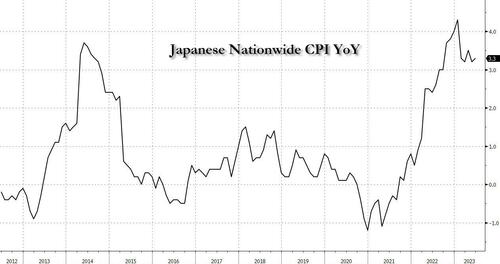
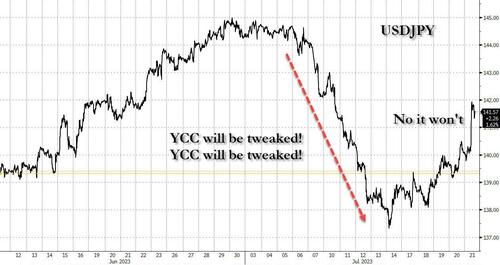
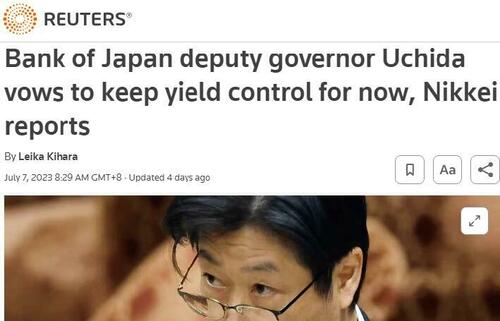
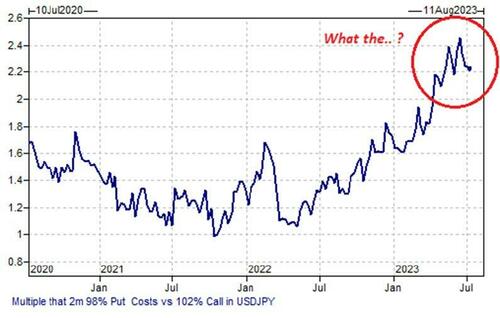
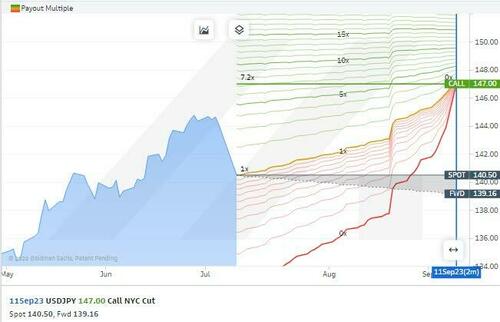
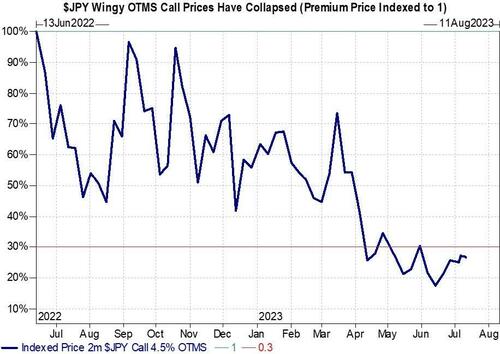
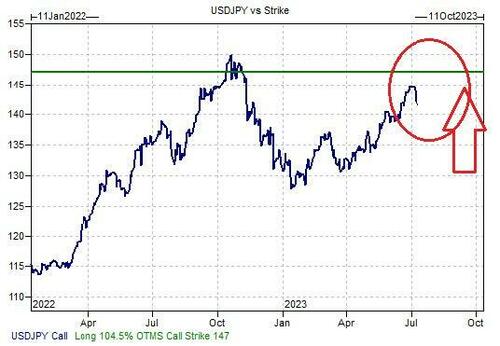





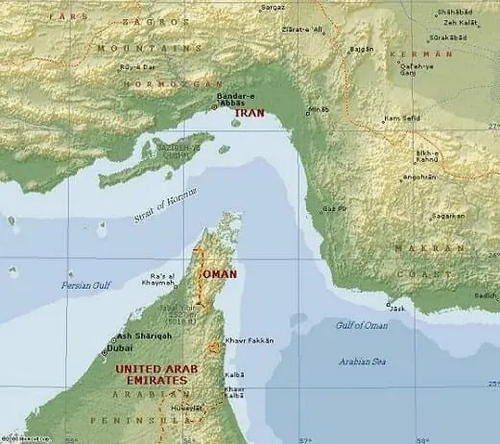


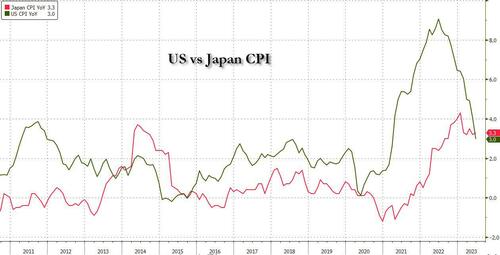
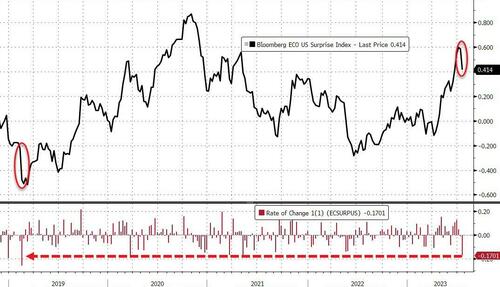
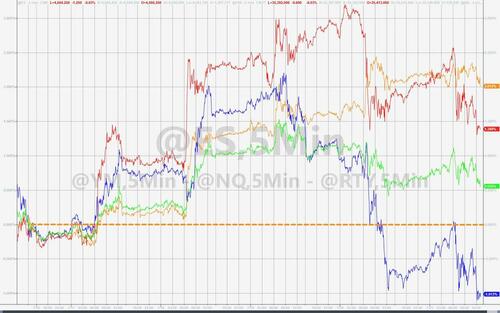
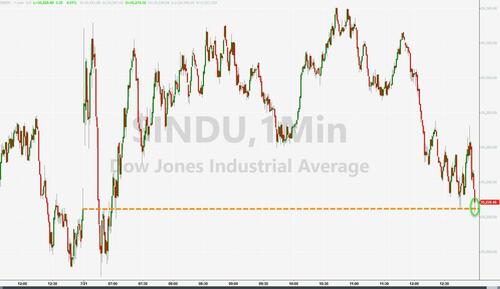
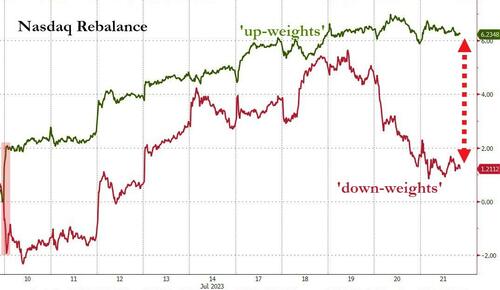
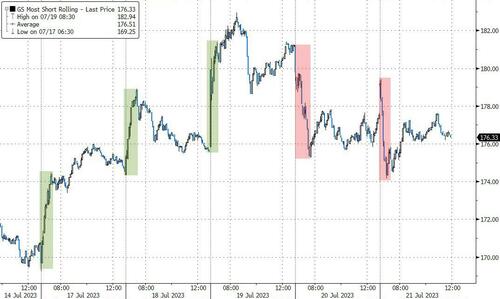
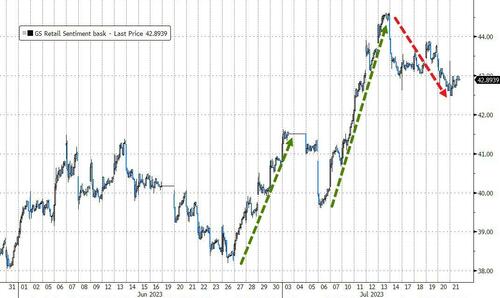
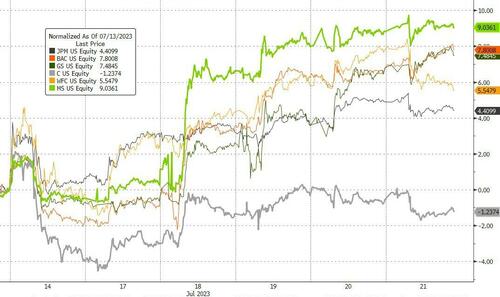
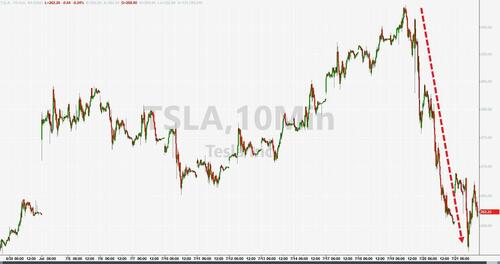
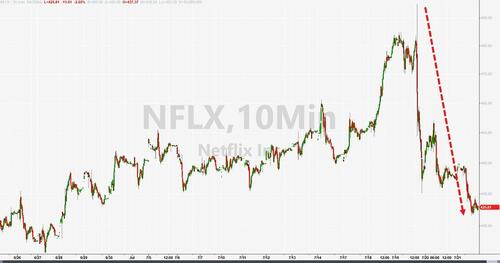
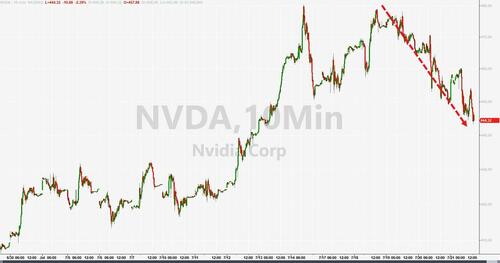
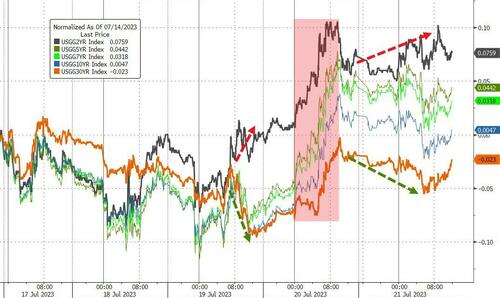
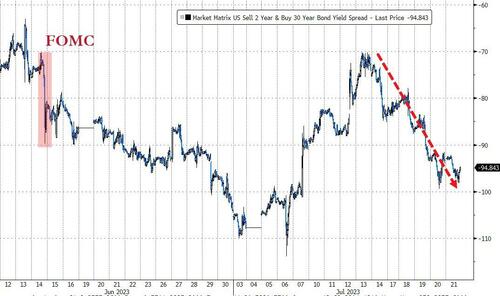
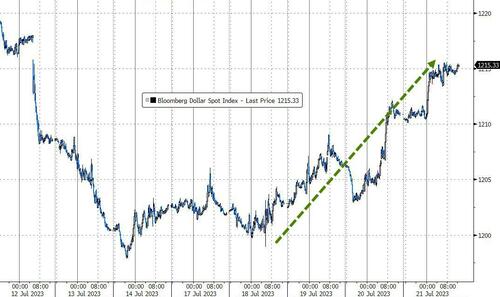
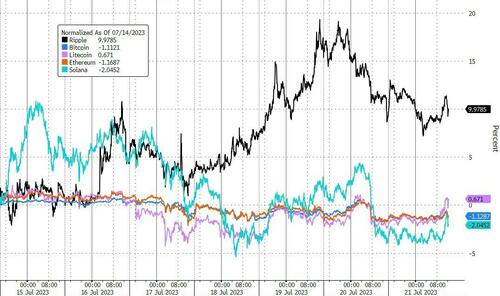
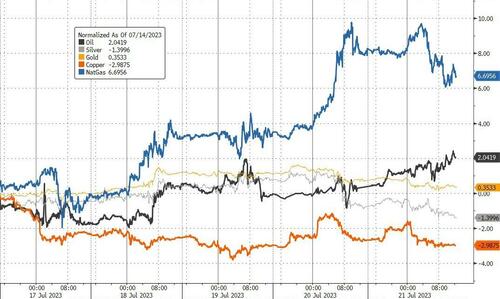
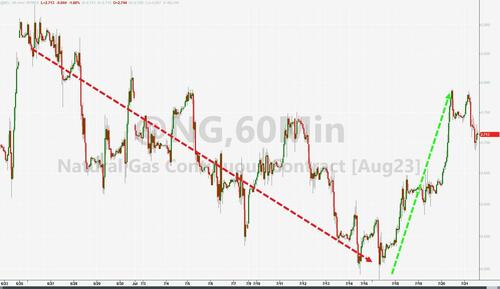
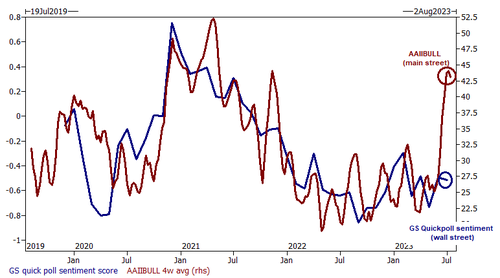
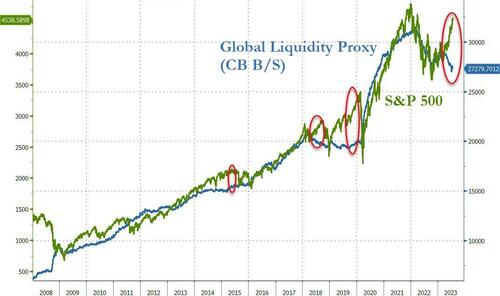



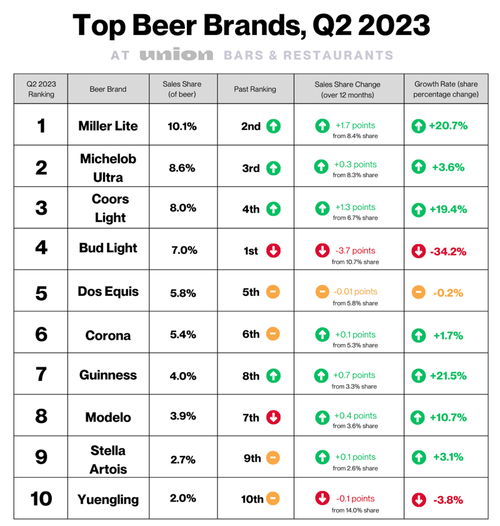






 harveyorganblog.com