118 C MACQUARIE FUTURES US 5
190 H BMO CAPITAL MARKETS 42
323 C HSBC 206
332 H STANDARD CHARTERED B 112
363 H WELLS FARGO SECURITI 9
661 C JP MORGAN SECURITIES 34
686 C STONEX FINANCIAL INC 14 7
709 C BARCLAYS 8
737 C ADVANTAGE FUTURES 3 3
880 C CITIGROUP 2
905 C ADM 1
GOLD: NUMBER OF NOTICES FILED FOR JULY/2024: 223 CONTRACTs NOTICES FOR 22,300 OZ or 0.6936 TONNES
total notices so far: 7772 contracts for 777,200 OR 24.174 tonnes)
SILVER NOTICES: 56 NOTICE(S) FILED FOR .280 million OZ/
total number of notices filed so far this month : 7,452 CONTRACTS (NOTICES) for 37.260 million oz
EXCHANGE FOR RISK ISSUANCE FOR SILVER/MAY
JULY: 15.895 MILLION OZ
AND JULY: 40.460 MILLION OZ//
JULY: 351. 65 TONNES (3RD HIGHEST EVER RECORDED EXCHANGE FOR PHYSICAL AND THE HIGHEST EVER RECORDED POST BASEL III)
AUGUST: 274.79 TONNES//THIS MONTH WILL NO DOUBT BE A STRONG ISSUANCE OF EFP’S BUT MUCH LESS THAN LAST MONTH.
SEPT: 335 .104 TONNES//IF THIS CONTINUES WE WILL HAVE A HUMDINGER OF AN EFP ISSUANCE. WE WILL PROBABLY END JUST SHORT OF THE 3RD HIGHEST ISSUANCE EVER RECORDED.
OCT. 277.71 TONNES (THIS WILL BE A GOOD ISSUANCE THIS MONTH)
NOV: 393.875 TONNES ( A HUGE MONTH////NOW SURPASSED THE PREVIOUS 3RD AND 2ND HIGHEST EVER RECORDED EX FOR PHYSICAL ISSUANCE TO BECOME THE 2ND HIGHEST EVER RECORDED
DEC 360.03 TONNES THIRD HIGHEST EVER RECORDED FOR EFP ISSUANCE
TOTAL 2024 YEAR. 3,597.846 TONNES
JAN. 2025: 257.919 TONNES (ISSUANCE WILL BE PRETTY GOOD THIS MONTH BUT MUCH LOWER THAN LAST MONTH)
FEB: 207.21 TONNES//EX FOR PHYSICAL ISSUANCE (WILL BE A FAIR SIZED ISSUANCE THIS MONTH)
MARCH 130.84 TONNES//QUITE SMALL THIS MONTH.
APRIL; 208.57 TONNES. STILL A SMALL TO FAIR ISSUANCE FOR THE MONTH.
MAY: 113.499 TONNES OF GOLD EFP ISSUANCE//QUITE SMALL THIS MONTH
JUNE: 97.79 TONNES OF GOLD EFP ISSUANCE/EXTREMELY SMALL
JULY : 22.786 TONNES
SPREADING OPERATIONS
NOW SWITCHING TO GOLD FOR NEWCOMERS, HERE ARE THE DETAILS
SPREADING LIQUIDATION HAS NOW COMMENCED AS WE HEAD TOWARDS THE NEW ACTIVE FRONT MONTH OF APRIL. WE ARE NOW INTO THE SPREADING OPERATION OF GOLD
HERE IS A BRIEF SYNOPSIS OF HOW THE CROOKS FLEECE UNSUSPECTING LONGS IN THE SPREADING ENDEAVOUR ;MODUS OPERANDI OF THE CORRUPT BANKERS AS TO HOW THEY HANDLE THEIR SPREAD OPEN INTERESTS:HERE IS HOW THE CROOKS USED SPREADING AS WE ARE NOW INTO THE NON ACTIVE DELIVERY MONTH OF NOV HEADING TOWARDS THE ACTIVE DELIVERY MONTH OF FEB., FOR GOLD: AND MARCH FOR SILVER
YOU WILL ALSO NOTICE THAT THE COMEX OPEN INTEREST STARTS TO RISE BUT SO IS THE OPEN INTEREST OF SPREADERS. THE OPEN INTEREST IN WILL CONTINUE TO RISE UNTIL ONE WEEK BEFORE FIRST DAY NOTICE OF AN UPCOMING ACTIVE DELIVERY MONTH (OCT), AND THAT IS WHEN THE CROOKS SELL THEIR SPREAD POSITIONS BUT NOT AT THE SAME TIME OF THE DAY. THEY WILL USE THE SELL SIDE OF THE EQUATION TO CREATE THE CASCADE (ALONG WITH THEIR COLLUSIVE FRIENDS) AND THEN COVER ON THE BUY SIDE OF THE SPREAD SITUATION AT THE END OF THE DAY. THEY DO THIS TO AVOID POSITION LIMIT DETECTION. THE LIQUIDATION OF THE SPREADING FORMATION CONTINUES FOR EXACTLY ONE WEEK AND ENDS ON FIRST DAY NOTICE.”
WHAT IS ALARMING TO ME, ACCORDING TO OUR LONDON EXPERT ANDREW MAGUIRE IS THAT THESE EFP’S ARE BEING TRANSFERRED TO WHAT ARE CALLED SERIAL FORWARD CONTRACT OBLIGATIONS AND THESE CONTRACTS ARE LESS THAN 14 DAYS. ANYTHING GREATER THAN 14 DAYS, THESE MUST BE RECORDED AND SENT TO THE COMPTROLLER, GREAT BRITAIN TO MONITOR RISK TO THE BANKING SYSTEM. IF THIS IS INDEED TRUE, THEN THIS IS A MASSIVE CONSPIRACY TO DEFRAUD AS WE NOW WITNESS A MONSTROUS TOTAL EFP’S ISSUANCE AS IT HEADS INTO THE STRATOSPHERE.
The crooks also use the spread in the TAS account (trade at settlement). They buy the spot TAS (e.g. June) and sell the future TAS two months out (e.g. August). Then they unload the front month (i.e. unload the buy side first so the price of gold/silver falls. This occurs in the middle of the front delivery month cycle. They unload the sell side of the equation, two months down the road. The crooks violate position limits as the OCC refuse to hear our complaints.
First, here is an outline of what will be discussed tonight:
1.TODAY WE HAD THE OPEN INTEREST AT THE COMEX IN SILVER FELL BY A HUGE SIZED 627 CONTRACTS OI TO 162,176 AND CLOSER TO TO THE COMEX HIGH RECORD //244,710( SET FEB 25/2020). THE LAST RECORDS WERE SET IN AUG.2018 AT 244,196 WITH A SILVER PRICE OF $14.78/(AUGUST 22/2018)..THE PREVIOUS RECORD TO THAT WAS SET ON APRIL 9/2018 AT 243,411 OPEN INTEREST CONTRACTS WITH THE SILVER PRICE AT THAT DAY: $16.53). AND PREVIOUS TO THAT, THE RECORD WAS ESTABLISHED AT: 234,787 CONTRACTS, SET ON APRIL 21.2017 OVER 7 YEARS AGO. HOWEVER WE HAVE NOW SET A NEW RECORD LOW OF 114,102 CONTRACTS JULY 3.2023
EFP ISSUANCE 920 CONTRACTS
OUR CUSTOMARY MIGRATION OF COMEX LONGS CONTINUE TO MORPH INTO LONDON FORWARDS AS OUR BANKERS USED THEIR EMERGENCY PROCEDURE TO ISSUE:
SEPT 920 CONTRACTS and 0 ALL OTHER MONTHS: ZERO. TOTAL EFP ISSUANCE: 920 CONTRACTS. EFP’S GIVE OUR COMEX LONGS A FIAT BONUS PLUS A DELIVERABLE PRODUCT OVER IN LONDON. IF WE TAKE THE COMEX OI LOSS OF 1478 CONTRACTS AND ADD TO THE 920 E.FP. ISSUED
WE OBTAIN A SMALL SIZED GAIN OF 293 OF OPEN INTEREST CONTRACTS FROM OUR TWO EXCHANGES DESPITE OUR LOSS IN PRICE OF $0.18 THE RATS ARE FLEEING THE ARENA.
THUS IN OUNCES, THE LOSS ON THE TWO EXCHANGES TOTALS 1.295 MILLION PAPER OZ
OCCURRED DESPITE OUR TINY $0.18 LOSS IN PRICE.
OUTLINE FOR TODAY’S COMMENTARY
1a/COMEX GOLD AND SILVER REPORT
(report Harvey)
1a/COMEX GOLD AND SILVER REPORT
(report Harvey)
b, ) Gold/silver trading overnight Europe,//GOLD COMMENT
Peter Schiff)
c) Commentaries from: Egon von Greyerz///Matthew Piepenburg via GoldSwitzerland.com, Pam and Russ Martens
ii a) Chris Powell of GATA provides to us very important physical commentaries
b. Other gold/silver commentaries
c. Commodity commentaries//
d)/CRYPTOCURRENCIES/BITCOIN ETC
2.ASIAN AFFAIRS
ASIAN MARKETS THIS THURSDAY MORNING:
SHANGHAI CLOSED UP 16.04 PTS OR 0.46%
//Hang Seng CLOSED UP 111.16 PTS OR 0.47%
// Nikkei CLOSED DOWN 174.92 PTS OR 0.44% //Australia’s all ordinaries CLOSED UP 0.56%
//Chinese yuan (ONSHORE) CLOSED UP AT 7.1771 OFFSHORE CLOSED UP AT 7.1790/ Oil DOWN TO 68.43 dollars per barrel for WTI and BRENT DOWN TO 70.18 Stocks in Europe OPENED ALL GREEN
ONSHORE USA/ YUAN TRADING ABOVE LEVEL OF OFFSHORE YUAN TRADING :/ONSHORE YUAN UP TRADING AT 7.1771 AND STRONGER//OFF SHORE YUAN TRADING UP TO 7.1790 AGAINST US DOLLAR/ AND THUS STRONGER
XXXXXXXXXXXXXXXXXXXXXXXXXXXX
END
A)NORTH KOREA/SOUTH KOREA
outline
b) REPORT ON JAPAN/
OUTLINE
3 CHINA
OUTLINE
4/EUROPEAN AFFAIRS
OUTLINE
5. RUSSIAN AND MIDDLE EASTERN AFFAIRS
OUTLINE
6.Global Issues//COVID ISSUES/VACCINE ISSUES
OUTLINE
7. OIL ISSUES
OUTLINE
8 EMERGING MARKET ISSUES
9. USA
XXXXXXXXXXXXXXXXXXXXXXXXXXXXXXXXXXXXXXXXXXXXXXXXXXXXXXXXXXXXXXXXXXXXXXXXXXXXXXXXXXXXXXXXXXXXXXXXXXXXXXXXXX
1. COMEX DATA//AMOUNTS STANDING//VOLUME OF TRADING/INVENTORY MOVEMENTS
GOLD
LET US BEGIN:
THE TOTAL COMEX GOLD OPEN INTEREST FELL BY A FAIR SIZED 3058 CONTRACTS TO A STILL LOW NUMBER OF 440,086 OI DESPITE OUR GAIN IN PRICE OF $4.05 WITH RESPECT TO WEDNESDAY’S // TRADING. WE LOST LITTLE NUMBER OF NET LONGS WITH THAT PRICE GAIN FOR GOLD. AND AS YOU WILL SEE BELOW, OUR GAIN IN PRICE ALSO HAD A FAIR NUMBER OF EXCHANGE FOR PHYSICAL ISSUED (1551 ). WE HAD SOME T.A.S. LIQUIDATION //TUESDAY TRADING.
THE CME ANNOUNCED WEDNESDAY NIGHT, A ZERO EXCHANGE FOR RISK CONTRACT ISSUANCE FOR 0 OZ OR NIL TONNES.
HISTORY: LAST SIX MONTH’S EXCHANGE FOR RISK
IN FEBRUARY:
WE HAD A HUGE FIVE EXCHANGE FOR RISKS ISSUANCES FOR GOLD, TOTALLING 18.4527 TONNES!.
IN MARCH:
THE TOTAL NO. OF EXCHANGE FOR RISK ISSUANCE FOR THE MONTH OF MARCH (3 NOTICES) EQUALED: 7.6179 TONNES OF GOLD WHICH WAS ADDED TO OUR MARCH DELIVERY TOTALS.
IN APRIL:
WE CONCLUDED APRIL WITH 7 ISSUANCE OF EXCHANGE FOR RISK FOR A TOTAL TONNAGE OF 8.3571 TONNES.
IN MAY:
MAY: 3 EX. FOR RISK ISSUED SO FAR FOR 3025 CONTRACTS OR 302,500 OZ OR 9.4054 TONNES. THIS WILL BE ADDED TO OUR NORMAL DELIVERY TO GIVE US TOTAL STANDING FOR MAY!THIS IS THE 6TH CONSECUTIVE MONTH FOR ISSUANCE OF EXCHANGE FOR RISK//NEW TOTAL EX FOR RISK IS 9.591 TONNES FOR THE 3 ISSUANCE!
IN JUNE
JUNE: ZERO ISSUED
jULY 0
THE RECIPIENT OF ALL OF THESE EXCHANGE FOR RISK CONTRACTS IS THE BANK OF ENGLAND WHO DESPERATELY WANT THEIR LEASED GOLD BACK. THUS WE HAVE TWO SEPARATE ENTITIES (CENTRAL BANKS) DEMANDING THEIR GOLD BACK:
- THE BANK OF ENGLAND
- THE FEDERAL RESERVE BANK OF NEW YORK (NEED TO RETRIEVE THEIR LEASED GOLD FROM THE BIS)
THE COUNTERPARTY TO THE BANK OF ENGLAND’S EXCHANGE FOR RISK ARE BULLION BANKS THAT CANNOT VERIFY THAT THEIR GOLD IS UNENCUMBERED AND THUS THE BUYER, THE CENTRAL BANK OF ENGLAND, ASSUMES THE RISK OF THAT DELIVERY. THIS IS THE 5TH CONSECUTIVE MONTH FOR ISSUANCE OF EXCHANGE FOR RISK !!.(DEC THROUGH APRIL)
DETAILS ON JULY COMEX MONTH//INITIAL
IN TOTAL WE HAD A FAIR SIZED LOSS ON OUR TWO EXCHANGES OF 1507 CONTRACTS DESPITE OUR SMALL GAIN IN PRICE. HOWEVER, OUR FRIENDLY PHYSICAL LONDON BOYS HAD ANOTHER FIELD DAY AGAIN ON TUESDAY NIGHT AS THEY WERE READY FOR THE FRBNY.S CONTINUED ORCHESTRATED ATTEMPTED AND FAILED RAID VERY EARLY IN THE COMEX SESSION AS THEY TRIED TO ABSORB EVERYTHING IN SIGHT FROM THE DAILY ATTACKS WITH THE CONTINUAL LIQUIDATION OF T.A.S. CONTRACTS. LONDONERS EXERCISED THEIR BOUGHT CONTRACTS FOR PHYSICAL GOLD VIA THE EXCHANGE FOR PHYSICAL ROUTE AND THANKED THE FRBNY FOR THE THOUGHTFULNESS. LONDON ANNOUNCED LATE IN JANUARY THAT THEY WERE OUT OF GOLD. WRONGLY IT WAS ATTRIBUTED TO THEIR SHIPPING PHYSICAL GOLD TO COMEX FOR STORAGE DUE TO TRUMP’S INITIATION OF TARIFFS. THE TRUTH OF THE MATTER IS THAT THIS GOLD LEFT LONDON TO CENTRAL BANKS, AND COMEX BANKS HAVE BEEN PAPERING THEIR LOSSES (DERIVATIVE) WITH KILOBAR ENTRIES. DELIVERY OF GOLD CONTRACTS ARE NOW TAKING SEVERAL WEEKS. NO DEFAULT HAS BEEN INITIATED AS DEALERS ARE AFRAID OF LOSS OF THEIR JOBS. SO THIS FRAUD CONTINUES. THE LEASE RATES IN LONDON HAVE NOW REVERTED BACK TO 1% BUT GOLD IN LONDON IS STILL EXTREMELY SCARCE. WE CAN NOW SAFELY SAY THAT THERE IS A RUN ON A BANK AND THAT BANK IS THE BANK OF ENGLAND!!!
THE LIQUIDATION OF T.A.S. CONTRACTS THROUGHOUT LAST MONTH OF JUNE AND NOW JULY CONTINUES TO DISTORT OPEN INTEREST NUMBERS GREATLY ALTHOUGH THE T.A.S. ISSUANCES IN GOLD HAVE GENERALLY BEEN ON THE LOW SIDE COMPARED TO SILVER WHICH HAVE BEEN HUGE. TODAY’S NUMBER HOWEVER IS ANOTHER MEGA MEGA HUGE T.A.S. AS THE CME NOTIFIES US THAT THEY HAVE ISSUED 20,027 T.A.S CONTRACTS. IF HISTORY SERVES US CORRECTLY, WE WILL NOW ENDURE 3 MORE OF THESE MEGA HUGE ISSUANCE OF T.A.S. AS THE CROOKS NEED TO RAID OUR PRECIOUS METALS SOUTHBOND IN PRICE BUT THEY ARE NOT HAVING MUCH LUCK ON THAT SCORE!!!
THE T.A.S. LIQUIDATION OF THESE T.AS. CONTRACTS(ALONG WITH MONTH END SPREADERS) IS WHY WE ARE HAVING DISTORTED COMEX OPEN INTEREST GAINS AND LOSSES IN OI BUT THIS IS COUPLED WITH MEGA HUGE AMOUNTS OF GOLD STANDING FOR DELIVERY TO CONFUSE THE ISSUE!!!!! AND THIS WAS SURELY ON DISPLAY WITH FIRST DAY NOTICE TOTALS WITH GOLD TONNES STANDING FOR APRIL AT 209 + TONNES INCLUDING MANY MASSIVE QUEUE JUMPS AND THIS CONTINUED INTO MAY WITH FINAL STANDING AT 90.23 TONNES. HOWEVER JUNE WHICH IS NORMALLY A HUGE DELIVERY MONTH , FINAL STANDING WAS RECORDED AT 93.085 TONNES. (IS THE COMEX RUNNING OUT OF GOLD?)//TOTAL NET QUEUE JUMPING FOR THE JUNE MONTH: 31.027 TONNES. HOWEVER JULY IS HUGE FOR A NON DELIVERY MONTH WITH INITIAL STANDING AT 17.947 TONNES PLUS TODAY’S QUEUE JUMP OF 0.3224 TONNES QUEUE JUMP = 24.392 TONNES OF GOLD
NEW TOTAL TONNES STANDING JULY: 24.392 TONNES
THE FED IS THE OTHER MAJOR SHORT OF AROUND 10+ TONNES OF GOLD OWING TO THE B.I.S. THE FED NEEDS TO COVER AS THEY ARE VERY WORRIED ABOUT WHAT IS GOING TO HAPPEN TO GOLD PRICES NOW THAT THEY MUST BECOME COMPLIANT TO BASEL III RULES JULY 1/2023 AS OUTLINED IN ANDREW MAGUIRE’S LATEST LIVE FROM THE VAULT 229 EPISODE. AS HE TACKLES THIS IMPORTANT TOPIC. THE FOUR OR FIVE BANKS ARE ALSO WORRIED ABOUT THEIR HUGE PRECIOUS METAL DERIVATIVE EXPOSURE (NORTH OF ONE TRILLION DOLLARS) AND THIS IS PROBABLY THE MAJOR REASON FOR GOLD/SILVER’S RISE THESE PAST THREE MONTHS. THEY ARE TOTALLY TRAPPED., AND THEIR FAILURE TO STOP CENTRAL BANK PURCHASES OF PHYSICAL GOLD IS THE MAJOR ISSUE OF THE DAY!IT SURE LOOKS LIKE THE BIS HAS GIVEN THE FED ITS MARCHING ORDERS TO COVER ITS PHYSICAL GOLD SHORT. TRUMP WILL PROBABLY BE FURIOUS WITH THE FED IF IT FINDS OUT THAT THEY (FRBNY) HAS BEEN MANIPULATING THE GOLD MARKET FOR THE PAST TWO YEARS.
OUR PHYSICAL LONDONERS BOUGHT NEW MASSIVE QUANTITIES OF LONGS AT ANY PRICE AND THIS GOLD BOUGHT WILL BE TENDERED FOR PHYSICAL ON A T + ???? BASIS. BECAUSE GOLD IS BASEL III COMPLIANT, GOLD IS SUPPOSED BE DELIVERED IN A VERY TIMELY ONE DAY. CENTRAL BANKS AROUND THE WORLD, BEING REPRESENTED BY OUR LONDONERS, ARE THE REAL PURCHASERS OF THIS GOLD.
EUROPE IS NOW BASEL III COMPLIANT. THE WEST (FED AND COMEX) IS NOW COMPLIANT EFFECTIVE JULY 1//2025.
THE PROBLEM FOR THOSE PROVIDING THE SHORT PAPER IS THE SHOCK TO THEM ON RECEIVING NOTICE THAT THE LONGS WANT THE PHYSICAL GOLD AS THEY TENDER FOR THAT SHINY YELLOW METAL. THE HIGH LIQUIDATION OF OUR TWO SPREADERS: 1) THE MONTH END SPREADERS AND 2. T.A.S DURING THESE PAST SEVERAL WEEKS IS SURELY DISTORTING COMEX OPEN INTEREST BUT THAT DOES NOT STOP LONDON’S ACCUMULATION OF PHYSICAL! YOU CAN ALSO VISUALIZE THAT PERFECTLY WITH THE HUGE AMOUNTS OF QUEUE JUMPING ORCHESTRATED BY CENTRAL BANKERS BOLTING AHEAD OF ORDINARY LONGS AS THEIR NEED FOR PHYSICAL IS GREAT AS THEY SCOUR THE PLANET LOOKING FOR GOLD, AND THE MASSIVE AMOUNT OF GOLD STANDING EACH AND EVERY MONTH INCLUDING FIRST DAY NOTICE OF GOLD TONNAGE STANDING.
EXCHANGE FOR PHYSICAL ISSUANCE
THE CME REPORTS THAT THE BANKERS ISSUED A FAIR SIZED TRANSFER THROUGH THE EFP ROUTE AS THESE LONGS RECEIVED A DELIVERABLE LONDON FORWARD TOGETHER WITH A FIAT BONUS.,
THAT IS A FAIR SIZED 1551 EFP CONTRACT WAS ISSUED: : /AUGUST 1551 & ZERO FOR ALL OTHER MONTHS:
TOTAL EFP ISSUANCE: 1551 CONTRACT. THESE EFP;S CIRCLE AROUND LONDON ON A 13 DAY BASIS AND ARE NOW USED BY GLOBAL CENTRAL BANKS TO EXERCISE FOR PHYSICAL GOLD WITH THE OBLIGATION TO DELIVER BEING FORCED ONTO COMEX BANKS. THE GOLD GENERALLY DELIVERED COMES FROM LONDON BUT THEY ARE OUT!! THUS COMEX BECOMES THE MAJOR SOURCE FOR OUR CENTRAL BANKERS. THE REGULATORY BODY THAT IS SUPPOSE TO CONTROL THESE EFP’S IS THE OCC HEADQUARTERED IN BOTH LONDON AND WASHINGTON.
WE HAD :
- SOME LIQUIDATION OF OUR T.A.S. SPREADERS//
- SOME NET SPEC LIQUIDATION DESPITE OUR GAIN IN PRICE
T.A.S.SPREADER ISSUANCE
AS PER OUR NEWBIE TRADE AT SETTLEMENT (TAS) MANIPULATION OPERATION (WHICH CRAIG HEMKE HAS POINTED OUT HAPPENS USUALLY DURING MID MONTH IN THE DELIVERY CYCLE), BUT NOW ON A DAILY BASIS, THE CME REPORTS THAT THE TOTAL T.A.S. ISSUANCE FOR THURSDAY MORNING/WEDNESDAY NIGHT WAS A MEGA MEGA AND CRIMINAL SIZED, 20,027 CONTRACTS.
THE RAIDS WHETHER ON OPTIONS EXPIRY MONTH OR OTHERWISE LIKE TODAY, ACCOMPLISHES TWO IMPORTANT ASPECTS FOR OUR CROOKS:
- STALLS THE ADVANCE IN PRICE
- LOWERS THEIR ADVANCING DERIVATIVE LOSSES.
MECHANICS OF T.A.S CONTRACTS TRADING;
THROUGHOUT THE FEW YEARS, THE BANKERS CONTINUE TO SELL OFF THE LONG SIDE OF THE SPREAD (T.A.S.) WHICH OF COURSE CONTINUES TO MANIPULATE THE PRICE OF GOLD SOUTHBOUND. (THEY KEEP THE SHORT SIDE OF THE CALENDAR/T.A.S. SPREAD WHICH WILL BE LIQUIDATED IN DAYS HENCE.THIS WAS SURELY IN EVIDENCE IN TRADING WEDNESDAY WITH OUR SMALL GAIN IN PRICE!
STANDING FOR GOLD LAST 7 MONTHS OF 2025:
YEAR 2025:
JAN 2025:
113.30 TONNES (WHICH INCLUDES 43.408 TONNES EX FOR RISK)
FEB: 2025:
256.607 TONNES (WHICH INCLUDES 18.4567 TONNES OF EX FOR RISK)
MARCH:
STANDING FOR GOLD : 60.33 TONNES + 7.6179 TONNES EX FOR RISK = 67.9479 TONNES WHICH IS EXTREMELY HIGH FOR A NON DELIVERY MONTH.
APRIL:
FINAL STANDING FOR GOLD: 201.573 TONNES + 8.3571 TONNES EX FOR RISK = 209.953 TONNES
MAY: FINAL STANDING 90.235 TONNES WHICH INCLUDES QUEUE JUMPING AND 9.591 TONNES EX FOR RISK.
JUNE: FINAL STANDING 62.534 TONNES PLUS 0.1493TONNES OF QUEUE JUMP EQUALS 93.085 TONNES
JULY: 17.947 TONNES INITIAL STANDING FIRST DAY NOTICE PLUS TODAY’S HUGE 0.3224 TONNES QUEUE JUMP = 24.392 TONNES
XXXXXXXXXXXXXXXXXXXXXXXXXXXXXXXXXXXXXXXXXXXXXXXXXX
HERE ARE THE AMOUNTS THAT STOOD FOR DELIVERY IN THE PRECEDING 54 MONTHS OF 2021-2025:
DEC 2021: 112.217 TONNES
NOV. 8.074 TONNES
OCT. 57.707 TONNES
SEPT: 11.9160 TONNES
AUGUST: 80.489 TONNES
JULY 7.2814 TONNES
JUNE: 72.289 TONNES
MAY 5.77 TONNES
APRIL 95.331 TONNES
MARCH 30.205 TONNES
FEB ’21. 113.424 TONNES
JAN ’21: 6.500 TONNES.
TOTAL YEAR 2021 (JAN- DEC): 601.213 TONNES
YEAR 2022: STANDING FOR GOLD/COMEX
JANUARY 2022 17.79 TONNES
FEB 2022: 59.023 TONNES
MARCH: 36.678 TONNES
APRIL: 85.340 TONNES FINAL.
MAY: 20.11 TONNES FINAL
JUNE: 74.933 TONNES FINAL
JULY 29.987 TONNES FINAL
AUGUST:104.979 TONNES//FINAL
SEPT. 38.1158 TONNES
OCT: 77.390 TONNES/ FINAL
NOV 27.110 TONNES/FINAL
Dec. 64.000 tonnes
(TOTAL YEAR 656.076 TONNES)
2023:STANDING FOR GOLD/COMEX
JAN/2023: 20.559 tonnes
FEB 2023: 47.744 tonnes
MAR: 19.0637 TONNES
APRIL: 75.676 tonnes
MAY: 19.094 TONNES + 1.244 tonnes of exchange for risk = 20.338
JUNE: 64.354 TONNES
JULY: 10.2861 TONNES
AUGUST: 38.855 TONNES(INCLUDING .6842 EXCHANGE FOR RISK)
SEPT: 15.281 TONNES FINAL
OCT. 35.869 TONNES + 1.665 EXCHANGE FOR RISK =37.0355 tonnes
NOV: 18.7122 TONNES + 16.2505 EX. FOR RISK = 34.9627 TONNES
DEC. 47.073 + 4.634 TONNES OF EXCHANGE FOR RISK = 51.707 TONNES
TOTAL 2023 YEAR : 436.546 TONNES
2024/STANDING FOR GOLD/COMEX
JAN ’24. 22.706 TONNES
FEB. ’24: 66.276 TONNES (INCLUDES 1.723 TONNES EX. FOR RISK)
MARCH: 18.8398 TONNES + 1.1695 EX FOR RISK = 20.093 TONNES
APRIL: 2024: 53.673TONNES FINAL
MAY/ 2024 8.5536 TONNES + 3.3716 TONNES EX FOR RISK/= 11.9325
JUNE; 95.578 TONNES. + 1.045 TONNES EXCHANGE FOR RISK =96.623 THIS IS THE HIGHEST RECORDED GOLD STANDING SINCE AUGUST 2022
JULY: 11.692 TONNES
AUGUST 69.602 TONNES//FINAL STANDING
SEPT. 13.164 TONNES.
OCT 39.474 TONNES + + 20.917 TONNES EXCHANGE FOR RISK =60.391 TONNES
NOV . 11.265 TONNES +4.665 TONNES EXCHANGE FOR RISK/TUESDAY + 3.11 TONNES OF EX. FOR RISK/PRIOR = 19.0425 TONNES
DEC: 80.4230 TONNES PLUS DEC MONTH EXCHANGE FOR RISK TOTAL 14.6836 TONNES EQUALS 95.1066 TONNES
total year 2024: 540.30 tonnes
XXXXXXXXXXXXXXXXXXXXXXXXXXXXXXXXXXXXXXXXX
COMEX GOLD TRADING/JULY CONTRACT MONTH
THE SPECS/HFT WERE UNSUCCESSFUL IN LOWERING GOLD’S PRICE( IT ROSE BY $4.05/ /) AND THEY WERE A LITTLE SUCCESSFUL IN KNOCKING OFF SOME NET SPECULATOR LONGS AS WE DID HAVE A FAIR SIZED LOSS IN OI FROM TWO EXCHANGES. AND AS EXPLAINED ABOVE WE HAD SOME T.A.S. SPREADER LIQUIDATION ////WEDNESDAY. THE BANKERS ARE QUITE NERVOUS ABOUT BASEL III WITH ITS IMPLEMENTATION COMMENCING JULY 1. THEY ARE VERY CONCERNED WITH THEIR HIGH AMOUNT OF DERIVATIVES LOSSES ON THEIR BOOKS. THUS THE REASON THEY NEEDED THESE MEGA MEGA T.A.S. ISSUANCES, WEDNESDAY MORNING TUESDAY EVENING, IN ORDER TO COMMENCE CONTINUAL RAIDS ON OUR PRECIOUS METALS. SO FAR TODAY, THIS EXERCISE HAS BEEN A TOTAL FAILURE…
THURSDAY MORNING//WEDNESDAY NIGHT
THE CROOKS HOWEVER COULD NOT STOP CENTRAL BANK LONGS, SEIZING THE MOMENT, THEY EXERCISED AGAIN FOR PHYSICAL IN A BIG WAY TENDERING FOR PHYSICAL WEDNESDAY EVENING THURSDAY MORNING AND THUS OUR HUGE NUMBER OF GOLD CONTRACTS STANDING FOR DELIVERY AT THE COMEX. CENTRAL BANKERS WAIT PATIENTLY FOR THE GOLD TO ARRIVE BY BOAT. IT IS NOW TAKING WEEKS TO DELIVER
EXCHANGE FOR RISK EXPLANATION/FEB THROUGH /JULY TRADING
EXCHANGE FOR RISK CONTRACTS/MONTH FOR FEBRUARY://FINISHES AT 4 ISSUANCES
THE CME ANNOUNCED TO THE WORLD THAT ON FEB 4 THEY ISSUED 100 CONTRACTS OF EXCHANGE FOR RISK TTO THE BANK OF ENGLAND.THEN ,FEB 4 THEY ISSUED THEIR SECOND CONSECUTIVE EXCHANGE FOR RISK OF 500 CONTRACTS FOR 50,000 OZ (1.555 TONNES OF GOLD. FEB 6 WAS THE THIRD ISSUANCE FOR A HUGE 2400 CONTRACTS, 240,000 OZ OR 7.465 TONNES. AND THEN FINALLY FRIDAY NIGHT, THE 4TH EXCHANGE FOR RISK WAS ISSUED REPRESENTED BY 2834 CONTRACTS OR 283400 OZ OR 8.8149 TONNES OF GOLD WITH THE OWNER OF THOSE CONTRACTS BEING THE BANK OF ENGLAND. THE BANK OF ENGLAND WANTS THEIR GOLD BACK. THIS NEW EXCHANGE FOR RISK WAS ADDED TO PREVIOUS EXCHANGE FOR RISK OF 9.3264 TONNES TO A NEW TOTAL EXCHANGE FOR RISK = 18.1413 TONNES. IN MID WEEK WE HAD ANOTHER .3114 TONNES OF EXCHANGE FOR RISK ISSUANCED//NEW TOTAL 18,4527 TONNES!..FINALLY THIS TOTAL WAS ADDED TO OUR REGULAR DELIVERIES THROUGH THE MONTH.
EXCHANGE FOR RISK CONTRACTS/MONTH FOR MARCH
EARLY IN THE DELIVERY CYCLE THE CME NOTIFIED US THAT WE HAD OUR FIRST EXCHANGE FOR RISK CONTRACT ISSUANCE IN MARCH FOR 150 CONTRACTS REPRESENTING 15,000 OZ OF GOLD OR .46656 TONNES. THE BANK OF ENGLAND WAS STILL NOT SATISFIED AS THEY NEED TO RETRIEVE ALL OF ITS LOST GOLD THROUGH LEASING! THE 15,000 OZ WAS ADDED TO OUR NORMAL DELIVERY TOTAL.
MARCH ISSUES IT’S THIRD EXCHANGE FOR RISK: TOTAL FOR THE MONTH FINISHED AT 3
TOTAL ISSUANCE OF EXCHANGE FOR RISK MARCH 28 TOTALS 2200 CONTRACTS FOR 6.8429 TONNES OF GOLD. PRIOR ISSUANCE: .7775 TONNES. THUS TOTAL EXCHANGE FOR RISK FOR MARCH : 7.6179 TONNES OF GOLD. MARCH BECOMES THE 4TH CONSECUTIVE MONTH FOR EXCHANGE FOR RISK ISSUANCE.
APRIL, ISSUED ITS 7TH EXCHANGE FOR RISK: 187 CONTRACTS OR 18,700 OZ OR 0.5816 TONNES
SUMMARY EXCHANGE FOR RISK FOR THE MONTH OF APRIL//TOTAL ISSUANCES 7 FOR 8.3571 TONNES OF GOLD!:
ISSUANCE FOR EXCHANGE FOR RISK ON FIRST DAY NOTICE//APRILL MONTH// WAS 700 CONTRACTS FOR 70,000 OZ OR 2.177 TONNES OF GOLD TO WHICH WE ADD (APRIL 4) : 250 CONTRACTS FOR 25,000 OZ OR .777 TONNES, APRIL 7 ISSUANCE OF 280 CONTRACTS FOR 28,000 OZ OR .8709 TONNES THEN APRIL 9 484 CONTRACTS FOR 48400 OZ OR 1.5054 TONNES AND FINALLY MONDAY MORNING APRIL 14 AT 200 CONTRACTS FOR 20,000 OZ OR .5816 TONNES AND NOW APRIL 24: 600 CONTRACTS FOR 60,000 OZ OR 1.866 TONNES AND NOW APRIL 25 187 CONTRACTS FOR 18700 OZ OR .5816 TONNES//NEW FINAL TOTAL ISSUANCE FOR APRIL: 8.3571 TONNES!!. APRIL ISSUANCE OF EXCHANGE FOR RISK MEANS WE NOW HAVE 5 CONSECUTIVE MONTHS FOR EXCHANGE FOR RISK ISSUANCE. THESE DELIVERIES WERE ADDED TO OUR NORMAL DELIVERY CYCLE.
MAY ISSUANCE OF EXCHANGE FOR RISK NOW TOTALS 3 ISSUANCES FOR 308,350 OZ. THIS TOTALS 9.591 TONNES OF GOLD WHICH WILL BE ADDED TO OUR REGULAR DELIVERY SCHEDULE. THE RECPIENT OF THIS LARGESS IS THE BANK OF ENGLAND.
JUNE ISSUANCE: ZERO
JULY ISSUANCE; ZERO SO FAR
XXXXXXXXXXXXXXXXXXXXXXXXXXXXXXXXXXXXXXXXXXXXXXXXXXXXXXXXXXXXXXXXX
ANALYSIS JULY DELIVERY MONTH GOING FROM FIRST DAY NOTICE// JULY COMEX CONTRACT
WE HAVE LOST A FAIR SIZED TOTAL OF 4.687 PAPER TONNES FROM OUR TWO EXCHANGES, ACCOMPANYING OUR INITIAL GOLD TONNAGE STANDING FOR JULY FIRST RECORDED AT 17.947 TONNES ON FIRST DAY NOTICE FOLLOWED BY TODAY’S STRONG QUEUE JUMP OF 10,400 OZ OR 0.3224 TONNES OF GOLD//NEW STANDING ADVANCES TO 24.392 TONNES
ALL OF THIS QUITE GOOD STANDING FOR JULY WAS ACCOMPLISHED DESPITE OUR GAIN IN PRICE TO THE TUNE OF $4.05
WE HAD 226 CONTRACTS REMOVED TO THE COMEX TRADES TO OPEN INTEREST (CROOKS)//PRELIMINARY TO FINAL. AND THIS IS TOTALLY INSANE AS WELL.
NET LOSS ON THE TWO EXCHANGES 1507 CONTRACTS OR 150,700 0Z (4.687 TONNES)
confirmed volume WEDNESDAY 214,079 contracts FAIR
speculators have left the gold arena
END
INITIAL GOLD COMEX
JULY CONTRACT MONTH
JULY 10/2025
| Gold | Ounces |
| Withdrawals from Dealers Inventory in oz | nil |
| Withdrawals from Customer Inventory in oz | 0 ENTRY . 2 ENTRIES i) Out of JPMorgan 96,453.000 oz (3000 kilobars) ii) Out of Loomis 1135.926 oz total withdrawal: 97,588.926 oz or 3.035 tonnes |
| Deposit to the Dealer Inventory in oz | 0 ENTRY |
| Deposits to the Customer Inventory, in oz | 0 ENTRY i xxxxxxxxxxxxxxxxI |
| No of oz served (contracts) today | 223 notice(s) 22,300 OZ 0.6936 TONNES |
| No of oz to be served (notices) | 70 contracts 7,000 OZ 0.2177 TONNES |
| Total monthly oz gold served (contracts) so far this month | 7772 notices 777,200 oz 24.174 TONNES |
| Total accumulative withdrawals of gold from the Dealers inventory this month | NIL oz |
| Total accumulative withdrawal of gold from the Customer inventory this month |
dealer deposits: 0 entry
0 ENTRY
xxxxxxxxxxxxxxxxxxxxx
DEPOSITS/CUSTOMER
we have 0 customer entry
0 ENTRY
xxxxxxxxxxxxxxxxxxxxxxxxxxxxxxxxxxxxxxxxxx
customer withdrawal
2 ENTRIES
2 ENTRIES
i) Out of JPMorgan 96,453.000 oz
(3000 kilobars)
ii) Out of Loomis 1135.926 oz
total withdrawal: 97,588.926 oz
or 3.035 tonnes
adjustments: 1
Customer to dealer JPMorgan 4071.392 oz
AMOUNT OF GOLD STANDING FOR JUNE
THE FRONT MONTH OF JULY STANDS AT 293 CONTRACTS FOR A LOSS OF 553 CONTRACTS. ON WEDNESDAY WE HAD 657 NOTICES FILED YESTERDAY SO WE GAINED A 104 CONTRACTS OR 10,400 OZ (0.3234 TONNES) ENTERTAINED WITH A QUEUE JUMP WHERE THESE BOYS DEMANDED PHYSICAL DELIVERY OVER ON THIS SIDE OF POND UPON EXERCISING AN EFP THROUGH LONDON. THIS IS CENTRAL BANKERS DEMANDING PHYSICAL GOLD
AUGUST LOST 17,366 CONTRACTS DOWN TO 275,285
SEPT GAINED 65 CONTRACTS TO 1376
We had 223 contracts filed for today representing 22,300 oz
Today, 0 notice(s) were issued from J.P.Morgan dealer and 0 notices issued from their client or customer account. The total of all issuance by all participants equate to 223 contract(s) of which 0 notices were stopped (received) by j.P. Morgan dealer and 34 notice(s) was (were) stopped (received) by J.P.Morgan//customer account
To calculate the INITIAL total number of gold ounces standing for JULY /2025. contract month, we take the total number of notices filed so far for the month (7772 X 100 oz ) to which we add the difference between the open interest for the front month of JULY (293 CONTRACTS) minus the number of notices served upon today (223 x 100 oz per contract) equals 784,200 OZ OR 24.392 TONNES to which we add 0 tonnes of gold issued under exchange for risk// total standing 24.392 tonnes
thus the INITIAL standings for gold for the JULY contract month: No of notices filed so far (7772 x 100 oz +we add the difference for front month of JULY (293 OI} minus the number of notices served upon today (223 x 100 oz) which equals 784,200 OZ OR 24.392 TONNES + 0 tonnes EX FOR RISK = 24.392 tonnes
TOTAL COMEX GOLD STANDING FOR JULY.: 24.392 TONNES WHICH IS VERY STRONG FOR THIS NORMALLY NON ACTIVE ACTIVE DELIVERY MONTH IN THE CALENDAR.
XXXXXXXXXXXXXXXXXXXXXXXXXXXXXXXXXXXXXXXXXXXXXXXXXXXXXXXXXXXXX
COMEX GOLD INVENTORIES/CLASSIFICATION
NEW PLEDGED GOLD:
241,794.285 oz NOW PLEDGED /HSBC 5.94 TONNES
204,937.290 OZ PLEDGED MANFRA 3.08 TONNES
83,657.582 PLEDGED JPMorgan no 1 1.690 tonnes
265,999.054, oz JPM No 2
1,152,376.639 oz pledged Brinks/
Manfra: 33,758.550 oz
Delaware: 193.721 oz
International Delaware:: 11,188.542 oz
total pledged gold: 2,194,511.830 oz 68.258 tonnes
TOTAL OF ALL GOLD ELIGIBLE AND REGISTERED GOLD 36,779,205.499 oz
TOTAL REGISTERED GOLD 20,204,157,.318: or 628.434 tonnes
TOTAL OF ALL ELIGIBLE GOLD 16,575,048.181 OZ
END
REGISTERED GOLD THAT CAN BE SERVED UPON 18,009,646 oz (REG GOLD- PLEDGED GOLD)= 560.17 tonnes //
total inventories in gold declining rapidly
SILVER/COMEX
THE JULY 2025 SILVER CONTRACT//INITIAL
JULY 10
INITIAL
| Silver | Ounces |
| Withdrawals from Dealers Inventory | NIL oz |
| Withdrawals from Customer Inventory | 3 entries i) Brinks 1098,087.693 oz ii) Out of JPMorgan: 654,169.900 oz iii) Out of Loomis 3813.880 oz total withdrawal 1,756,071.473 oz |
| Deposits to the Dealer Inventory | 0 ENTRY |
| Deposits to the Customer Inventory | 1 DEPOSIT ENTRY/CUSTOMER ACCOUNT i) into Delaware 2959.903 oz total deposit 2959.903 oz |
| No of oz served today (contracts) | 56 CONTRACT(S) (0.280 MILLION OZ |
| No of oz to be served (notices) | 640contracts (3.20 MILLION oz) |
| Total monthly oz silver served (contracts) | 7452 Contracts (37.260 million oz) |
| Total accumulative withdrawal of silver from the Dealers inventory this month | NIL oz |
| Total accumulative withdrawal of silver from the Customer inventory this month |
1 deposits into dealer accounts
0 ENTRY
xxxxxxxxxxxxxxxxxxxxxxxxxxxxxxxxxxxxxxxxxxx
1 DEPOSIT ENTRY/CUSTOMER ACCOUNT
i) into Delaware 2959.903 oz
total deposit 2959.903 oz
xxxxxxxxxxxxxxxxxxxxxxxxxxxxxxxxxxxxxxxxxxxxxxxxxxxx)
withdrawals: customer side/eligible
3 entries
i) Brinks 1098,087.693 oz
ii) Out of JPMorgan: 654,169.900 oz
iii) Out of Loomis 3813.880 oz
total withdrawal 1,756,071.473 oz
ADJUSTMENTs 1
a) customer acct to dealer Manfra: 50,900.300 oz
TOTAL REGISTERED SILVER: 191.962 MILLION OZ//.TOTAL REG + ELIGIBLE. 495.535 Million oz
CALCULATIONS FOR THE NEW STANDING FOR SILVER FOR JUNE
silver open interest data:
FRONT MONTH OF JULY /2025 OI: 696 OPEN INTEREST CONTRACTS FOR A LOSS OF 435 CONTRACTS. WE HAD 459 CONTRACTS SERVED UPON WEDNESDAY SO WE GAINED 24 CONTRACTS OR 0.120 MILLION OZ ENTERTAINED A MASSIVE QUEUE JUMP WHERE THESE BOYS DECIDED TO TAKE DELIVERY OVER ON THIS SIDE OF THE POND.
AUGUST GAINED 22 CONTRACTS TO 2344
SEPTEMBER LOST 1159 CONTRACTS DOWN TO 125,701 CONTRACTS.
TOTAL NUMBER OF NOTICES FILED FOR TODAY: 56 or 0.280 MILLION oz
CONFIRMED volume; ON WEDNESDAY 50,874 small//
AND NOW JULY DELIVERIES:
To calculate the number of silver ounces that will stand for delivery in JULY. we take the total number of notices filed for the month so far at 7452 X5,000 oz = 37.260 MILLION oz
to which we add the difference between the open interest for the front month of JULY (696) AND the number of notices served upon today (56 )x (5000 oz)
Thus the standings for silver for the JULY 2025 contract month: (7452) Notices served so far) x 5000 oz + OI for the front month of JULY(696) minus number of notices served upon today (56)x 5000 oz equals silver standing for the JULY contract month equating to 40.460 MILLION OZ .
New total standing: 40.460 million oz which is huge for this active delivery month of JULY.
We must also keep in mind that there is considerable silver standing in London coming from our longs in New York that underwent EFP transfers.
There are 191.962 million oz of registered silver
JPMorgan as a percentage of total silver: 210.929/495.535 million. 42.54%
The record level of silver open interest is 234,787 contracts set on April 21./2017 with the price on that day at $18.42. The previous record was 224,540 contracts with the price at that time of $20.44.
Now that we have surpassed $28.40 the next big line in the sand for silver is $34.76. After that the moon
the next big line in the sand for silver is $34.76. After that the moon
END
BOTH GLD AND SLV ARE MASSIVE FRAUDS!
GLD AND SLV INVENTORY LEVELS
JULY 10 WITH GOLD UP $4.75 TODAY//HUGE CHANGES IN GOLD AT THE GLD A DEPOSIT OF 0.860 TONNES OF GOLD INOT THE GLD //: /// ///INVENTORY RESTS AT 947.37 TONNES/
JULY 9 WITH GOLD UP $4.05 TODAY//HUGE CHANGES IN GOLD AT THE GLD A WITHDRAWAL OF 1.15 TONNES OF GOLD OUT OF THE GLD //: /// ///INVENTORY RESTS AT 946.51 TONNES/
JULY 8 WITH GOLD $24.65 TODAY// NO CHANGES IN GOLD AT THE GLD //: /// ///INVENTORY RESTS AT 947.66 TONNES/
JULY 7 WITH GOLD UP $0.50 TODAY// NO CHANGES IN GOLD AT THE GLD //: /// ///INVENTORY RESTS AT 947.66 TONNES/
JULY 3 WITH GOLD DOWN $15.40 TODAY// HUGE CHANGES IN GOLD AT THE GLD A WITHDRAWAL OF 0.57 TONNES OF GOLD OUT OF THE GLD //: /// ///INVENTORY RESTS AT 947.66 TONNES/
JULY 2 WITH GOLD UP $8.95 TODAY// HUGE CHANGES IN GOLD AT THE GLD A WITHDRAWAL OF 4.30 TONNES OF GOLD OUT OF THE GLD //: /// ///INVENTORY RESTS AT 948.23 TONNES/
JULY 1 WITH GOLD UP $43.85 TODAY// HUGE CHANGES IN GOLD AT THE GLD A WITHDRAWAL OF 2.29 TONNES OF GOLD OUT OF THE GLD //: /// ///INVENTORY RESTS AT 952.53 TONNES/
JUNE 30 WITH GOLD UP $20.00 TODAY// HUGE CHANGES IN GOLD AT THE GLD A DEPOSIT OF 1.43 TONNES OF GOLD INOT THE GLD //: /// ///INVENTORY RESTS AT 954.82 TONNES/
JUNE 27 WITH GOLD DOWN $58.50 TODAY// NO CHANGES IN GOLD AT THE GLD //: /// ///INVENTORY RESTS AT 953.39 TONNES/
JUNE 26 WITH GOLD UP $4.90 TODAY// HUGE CHANGES IN GOLD AT THE GLD A WITHDRAWAL OF 2.29 TONNES OF GOLD OUT OF THE GLD//: /// ///INVENTORY RESTS AT 953.39 TONNES/
JUNE 25 WITH GOLD UP $8.70 TODAY// HUGE CHANGES IN GOLD AT THE GLD A WITHDRAWAL OF 1.72 TONNES OF GOLD OUT OF THE GLD//: /// ///INVENTORY RESTS AT 955.68 TONNES/
JUNE 24 WITH GOLD DOWN $58.05 TODAY// HUGE CHANGES IN GOLD AT THE GLD A DEPOSIT OF 7.16 TONNES OF GOLD INTO THE GLD//: /// ///INVENTORY RESTS AT 957.40 TONNES/SINCE JUNE 13 ADDED 24.49 TONNES
JUNE 23 WITH GOLD UP $9.25 TODAY// HUGE CHANGES IN GOLD AT THE GLD A DEPOSIT OF 2.599 TONNES OF GOLD INTO THE GLD//: /// ///INVENTORY RESTS AT 950.241 TONNES
JUNE 20 WITH GOLD DOWN $19.80 TODAY// HUGE CHANGES IN GOLD AT THE GLD A DEPOSIT OF 1.43 TONNES OF GOLD INTO THE GLD//: /// ///INVENTORY RESTS AT 947.37 TONNES
JUNE 18 WITH GOLD UP $1.30 TODAY// HUGE CHANGES IN GOLD AT THE GLD A DEPOSIT OF 4.03 TONNES OF GOLD INTO THE GLD//: /// ///INVENTORY RESTS AT 945.94 TONNES
JUNE 17 WITH GOLD DOWN $9.60 TODAY// HUGE CHANGES IN GOLD AT THE GLD A DEPOSIT OF 1.44 TONNES OF GOLD INTO THE GLD//: /// ///INVENTORY RESTS AT 941.93 TONNES
JUNE 16 WITH GOLD DOWN $33.85 TODAY// HUGE CHANGES IN GOLD AT THE GLD A DEPOSIT OF 1.758 TONNES OF GOLD INTO THE GLD//: /// ///INVENTORY RESTS AT 940.49 TONNES
JUNE 13 WITH GOLD UP $53.40 TODAY// HUGE CHANGES IN GOLD AT THE GLD A WITHDRAWAL OF 1.38 TONNES OF GOLD OUT OF THE GLD//: /// ///INVENTORY RESTS AT 932.91 TONNES
JUNE 12 WITH GOLD UP $55.75 TODAY// HUGE CHANGES IN GOLD AT THE GLD A WITHDRAWAL OF 1.72 TONNES OF GOLD OUT OF THE GLD//: /// ///INVENTORY RESTS AT 934.19 TONNES
JUNE 11 WITH GOLD UP $1.10 TODAY// SMALL CHANGES IN GOLD AT THE GLD A WITHDRAWAL OF 0.31 TONNEES OF GOLD OUT OF THE GLD//: /// ///INVENTORY RESTS AT 935.91 TONNES
JUNE 10 WITH GOLD DOWN $11.80 TODAY// HUGE CHANGES IN GOLD AT THE GLD A DEPOSIT OF 2.02 TONNEES OF GOLD INTO THE GLD//: /// ///INVENTORY RESTS AT 936.22 TONNES
JUNE 9 WITH GOLD UP $10.00 TODAY// HUGE CHANGES IN GOLD AT THE GLD A WITHDRAWAL OF 1.45 TONNEES OF GOLD FROM THE GLD//: /// ///INVENTORY RESTS AT 934.20 TONNES
JUNE 6 WITH GOLD DOWN $28.00 TODAY// NO CHANGES IN GOLD AT THE GLD: /// ///INVENTORY RESTS AT 935.65 TONNES
JUNE 5 WITH GOLD DOWN $23.10 TODAY// NO CHANGES IN GOLD AT THE GLD: /// ///INVENTORY RESTS AT 935.65 TONNES
JUNE 4 WITH GOLD UP $22.30 TODAY// HUGE CHANGES IN GOLD AT THE GLD:A DEPOSIT OF 2.58 TONNES OF GOLD INTO THE GLD. /// ///INVENTORY RESTS AT 935.65 TONNES
JUNE 3 WITH GOLD DOWN $19.85 TODAY// HUGE CHANGES IN GOLD AT THE GLD:A DEPOSIT OF 2.87 TONNES OF GOLD INTO THE GLD. /// ///INVENTORY RESTS AT 933.07 TONNES
JUNE 2 WITH GOLD UP $80.90 TODAY// NO CHANGES IN GOLD AT THE GLD: /// ///INVENTORY RESTS AT 930.20 TONNES
MAY 30 WITH GOLD DOWN $27.10 TODAY// HUGE CHANGES IN GOLD AT THE GLD: A DEPOSIT OF 4.59 TONNES OF GOLD INTO THE GLD/// ///INVENTORY RESTS AT 930.20 TONNES
MAY 29 WITH GOLD UP $22.35 TODAY// HUGE CHANGES IN GOLD AT THE GLD: A DEPOSIT OF 3.15 TONNES OF GOLD INTO THE GLD/// ///INVENTORY RESTS AT 925.71 TONNES
MAY 28 WITH GOLD DOWN $5.30 TODAY// NO CHANGES IN GOLD AT THE GLD:/ ///INVENTORY RESTS AT 925.61 TONNES
MAY 27 WITH GOLD DOWN $63.50 TODAY// HUGE CHANGES IN GOLD AT THE GLD:A WITHDRAWAL OF 1.43 TONNES OF GOLD OUT OF THE GLD/ ///INVENTORY RESTS AT 922.46 TONNES
MAY 23 WITH GOLD UP $69.70 TODAY// HUGE CHANGES IN GOLD AT THE GLD:A DEPOSIT OF 4.01 TONNES OF GOLD INTO THE GLD/ ///INVENTORY RESTS AT 923.89TONNES
GLD INVENTORY: 947.37 TONNES, TONIGHTS TOTAL
SILVER
JULY 10 WITH SILVER UP $0.47/ NO CHANGES AT THE SLV// A DEPOST OF 0.999 MILLION OZ INTO THE SLV//:.////INVENTORY RESTS AT 481.175 MILLION OZ.//
JULY 9 WITH SILVER DOWN $0.18/ NO CHANGES AT THE SLV// A DEPOST OF 2.136 MILLION OZ INTO THE SLV//:.////INVENTORY RESTS AT 480.176 MILLION OZ.//
JULY 8 WITH SILVER DOWN $0.16/ NO CHANGES AT THE SLV A DEPOST OF 0.000 MILLION OZ INTO THE SLV//:.////INVENTORY RESTS AT 478.040 MILLION OZ.//
JULY 7 WITH SILVER DOWN $0.14/ HUGE CHANGES AT THE SLV A DEPOST OF 0.727 MILLION OZ INTO THE SLV//:.////INVENTORY RESTS AT 478.040 MILLION OZ.//
JULY 3 WITH SILVER UP $0.34/ HUGE CHANGES AT THE SLV A WITHDRAWAL OF 0.917 MILLION OZ IOUT OF THE SLV//:.////INVENTORY RESTS AT 477.313 MILLION OZ.//
JULY 2 WITH SILVER UP $0.36/ HUGE CHANGES AT THE SLV A DEPOSIT OF 1.363 MILLION OZ INTO THE SLV//:.////INVENTORY RESTS AT 478.049 MILLION OZ.//
JULY 1 WITH SILVER UP $0.21/ HUGE CHANGES AT THE SLVA WITHDRAWAL OF 1.272 MILLION OZ FROM THE SLV//:.////INVENTORY RESTS AT 476,686 MILLION OZ.//
JUNE 30 WITH SILVER DOWN $0.20/ NO CHANGES AT THE SLV:.////INVENTORY RESTS AT 477.958 MILLION OZ.//
JUNE 27 WITH SILVER DOWN $0.53/ HUGE CHANGES AT THE SLV:. A WITHDRAWAL OF 1.636 MILLION OZ IOUT OF THE SLV..////INVENTORY RESTS AT 477.958 MILLION OZ.//
JUNE 26 WITH SILVER UP $0.48/ HUGE CHANGES AT THE SLV:. A WITHDRAWAL OF 1.091 MILLION OZ IOUT OF THE SLV..////INVENTORY RESTS AT 479.594 MILLION OZ.//
JUNE 25 WITH SILVER UP $0.35/ HUGE CHANGES AT THE SLV:. A WITHDRAWAL OF 2.363 MILLION OZ IOUT OF THE SLV..////INVENTORY RESTS AT 480.685 MILLION OZ.//
JUNE 24 WITH SILVER DOWN $0.37/ HUGE CHANGES AT THE SLV:. A DEPOSIT OF 3.453 MILLION OZ INTO THE SLV..////INVENTORY RESTS AT 480.685 MILLION OZ.//FROM JUNE 2 A HUGE 19.264 MILLION OZ ADDED
JUNE 23 WITH SILVER UP $0.18/ HUGE CHANGES AT THE SLV:. A DEPOSIT OF 2.591 MILLION OZ INTO THE SLV..////INVENTORY RESTS AT 477.232 MILLION OZ.
JUNE 20 WITH SILVER DOWN $0.83/ HUGE CHANGES AT THE SLV:. A DEPOSIT OF 2.818 MILLION OZ INTO THE SLV..////INVENTORY RESTS AT 474.641 MILLION OZ.
JUNE 18 WITH SILVER DOWN $0.20/ HUGE CHANGES AT THE SLV:. A WITHDRAWAL OF 1.273 MILLION OZ INTO THE SLV..////INVENTORY RESTS AT 471.823 MILLION OZ.
JUNE 17 WITH SILVER UP $0.67/ HUGE CHANGES AT THE SLV:. A DEPOSIT OF 1.273 MILLION OZ INTO THE SLV..////INVENTORY RESTS AT 473.096 MILLION OZ.
JUNE 16 WITH SILVER UP $0.18/ HUGE CHANGES AT THE SLV:. A WITHDRAWAL OF 1.727 MILLION OZ FROM THE SLV..////INVENTORY RESTS AT 471.823 MILLION OZ.
JUNE 13 WITH SILVER UP $0.11/NO CHANGES AT THE SLV:.////INVENTORY RESTS AT 473.550 MILLION OZ.
JUNE 12 WITH SILVER UP $0.11/HUGE CHANGES AT THE SLV:A DEPOSIT OF 1.276 MILLION OZ INTO THE SLV/ ././///INVENTORY RESTS AT 473550 MILLION OZ.
JUNE 11 WITH SILVER DOWN $0.45/HUGE CHANGES AT THE SLV:A DEPOSIT OF 1.046 MILLION OZ INTO THE SLV/ ././///INVENTORY RESTS AT 472.274 MILLION OZ.
JUNE 10 WITH SILVER DOWN $0.16/HUGE CHANGES AT THE SLV:A DEPOSIT OF 1.182 MILLION OZ INTO THE SLV/ ././///INVENTORY RESTS AT 471.232 MILLION OZ.
JUNE 9 WITH SILVER UP $0.69/HUGE CHANGES AT THE SLV:A DEPOSIT OF 1.182 MILLION OZ INTO THE SLV/ ././///INVENTORY RESTS AT 472.914 MILLION OZ.
JUNE 6 WITH SILVER UP $0.63/HUGE CHANGES AT THE SLV:A DEPOSIT OF 3.863 MILLION OZ INTO THE SLV/ ././///INVENTORY RESTS AT 471.732 MILLION OZ. (A TOTAL DEPOSIT OF 11.856 MILLION PHANTOM OZ IN THE LAST 4 DAYS)
JUNE 5 WITH SILVER UP $1.14/HUGE CHANGES AT THE SLV:A DEPOSIT OF 4.364 MILLION OZ INTO THE SLV/ ././///INVENTORY RESTS AT 467.869 MILLION OZ.
JUNE 4 WITH SILVER DOWN $0.01/HUGE CHANGES AT THE SLV:A DEPOSIT OF 2.084 MILLION OZ INTO THE SLV/ ././///INVENTORY RESTS AT 463.505 MILLION OZ.
JUNE 3 WITH SILVER DOWN $0.02/HUGE CHANGES AT THE SLV:A DEPOSIT OF 1.545 MILLION OZ INTO THE SLV/ ././///INVENTORY RESTS AT 461.421 MILLION OZ.
JUNE 2 WITH SILVER UP $1.58/NO CHANGES AT THE SLV: ././///INVENTORY RESTS AT 459.876 MILLION OZ.
MAY 30 WITH SILVER DOWN $0.36/HUGE CHANGES AT THE SLV: A DEPOSIT OF 2.773 MILLION OZ INTO THE SLV././///INVENTORY RESTS AT 459.876 MILLION OZ.
MAY 29 WITH SILVER UP $0.29/NO CHANGES AT THE SLV////INVENTORY RESTS AT 457.103 MILLION OZ.
MAY 28 WITH SILVER DOWN $0.18/NO CHANGES AT THE SLV////INVENTORY RESTS AT 457.103 MILLION OZ.
MAY 27 WITH SILVER DOWN $0.34/HUGE CHANGES AT THE SLV//A DEPOSIT OF 2.728 MILLION OZ INTO THE SLV//INVENTORY RESTS AT 457.103 MILLION OZ.
MAY 23 WITH SILVER UP $0.38/HUGE CHANGES IN SILVER INVENTORY AT THE SLV: A DEPOSIT OF 2.5 MILLION OZ OF SILVER INTO THE SLV/: //INVENTORY AT SLV RESTS AT 454.375 MILLION OZ
CLOSING INVENTORY 481.175 MILLION OZ//
PHYSICAL GOLD/SILVER COMMENTARIES
1/ PETER SCHIFF/SCHIFF GOLD/MIKE MAHARRY
PETER SCHIFF
2. MATHEW PIEPENBERG
ALASDAIR MACLEOD
JOHN RUBINO
A Closer Look At Germany’s Death Spiral
Subscriber Bill G responded to yesterday’s post on Germany’s financial/cultural death spiral by asking:
“And when did debt to GDP cease to be a good measure of economic health? https://countryeconomy.com/countries/compare/germany/usa?sc=XE02”
His point is that if Germany’s government debt is only 65% of GDP, that country is — by definition— in way better shape than the US (debt 120% of GDP).
This is a reasonable question with an interesting answer. So here goes:
Vendor Financing
In the business world, there’s a semi-sleazy practice in which a company lends money to its customers who then use that money to buy the company’s products. This boosts sales and profits, making company managers seem worthy of big year-end bonuses.
Assuming the debtor/customers can pay off their loans, this practice can continue, unbeknownst to outsiders, for a long time. But if customers start defaulting, the “vendor financing” scheme unravels.
Germany has been running the government version of this scam.
With the introduction of the euro as a common currency in 1999, it became clear that eurozone members had wildly differing financial profiles. Greece and Italy, for instance, were bankruptcy candidates who, in a rational world, would have to pay way up to borrow money. But high interest rates would render their debt prohibitively expensive, forcing them out of the eurozone.
So the currency union cooked up the following scheme: The European Central Bank (ECB) would buy non-German government bonds at prices that equated to extremely low interest rates. And Germany would guarantee the solvency of the ECB.
For long stretches, most eurozone countries were able to borrow at lower rates than the US government had to pay, since their bonds were de facto German (i.e., “investment-grade”) paper.
Now here’s where “vendor financing” comes in. Italy, Greece, Spain, et al used some of the money they borrowed to buy German-manufactured goods. As a result, Germany’s economy grew, its trade balance was positive, and its government deficits were modest (when they weren’t actual surpluses).
It’s easy to view the resulting chart as a picture of a financially sound entity.

But remember that Germany, via the ECB, had promised to make good on everyone else’s bonds. Should, say, Italy default, those obligations would in effect become part of Germany’s national debt. So its real obligations are much higher than the official numbers.
And now that Germany is “deindustrializing,” its ability and willingness to cover everyone else’s debts are being called into question, causing peripheral Europe’s interest rates to rise. Note that Spain was able to borrow 10-year money for less than 2% until 2022, when the US ended Germany’s cheap-energy industrial preeminence by blowing up the Nord Stream gas pipeline.

A Eurozone Without Germany Is Toast
So here we are, at a crossroads: Either peripheral Europe starts paying market rates for its ever-increasing government debt, which will force the dissolution of the eurozone and a return to national currencies. Or the ECB — without explicit German guarantees — steps back in and buys huge amounts of low-quality sovereign debt with newly created currency, which will spike inflation and crash the euro.
Either way, Germany’s days as an industrial powerhouse are over, and the eurozone is, as a result, over.
3. CHRIS POWELL OF GATA/DAILY DISPATCHES
Ghana launches task force to curb gold smuggling losses
Submitted by admin on Wed, 2025-07-09 18:51 Section: Daily Dispatches
By Emmanuel Bruce
Reuters
Wednesday, July 9, 2025
ACCRA — Ghana President John Dramani Mahama on Tuesday launched a task force backed by security forces to address illegal gold trading, as Africa’s top producer seeks to recover billions of dollars lost to smuggling.
The task force is Ghana’s first national anti-gold smuggling initiative. The government has previously launched efforts to sanitize artisanal mining, but these were unsuccessful in curbing illegal extraction and preventing revenue losses that plague most African gold producers.
Ghana this year created the new gold board known as GoldBod to centralise gold trading. This has led to record official exports of 55.7 metric tonnes of gold valued at $5 billion in the first five months of 2025, Mahama said at the inauguration of the new task force.
“This is money that would not have come back to Ghana because traders would have taken it and kept the foreign exchange outside,” Mahama said. …
… For remainder of the report:
4. ANDREW MAGUIRE/LIVE FROM THE VAULT KINESIS 230
WITH CRAIG HEMKE
5. COMMODITY REPORT…COCOA
cocoa is still on a tear in price rises!!
(zerohedge)
Cocoa Supply Crunch Shown In One Chart
Thursday, Jul 10, 2025 – 02:45 AM
The chocolate industry is facing a new era of chronic shortages and record-high prices across cocoa beans, butter, powder, and paste, sparking structural supply disruptions across North America and Europe. At the heart of the crisis is West Africa, where countries such as Côte d’Ivoire, Ghana, Nigeria, and Cameroon—responsible for 75% of global cocoa production—have been severely impacted by years of adverse weather and crop diseases.
Cocoa bean prices in New York remain near record highs—trading around $8,000 a ton on Tuesday—after skyrocketing over 450% from late 2022 to December 2024, when prices briefly topped $12,000. This surge has driven a 16% increase in key input costs for chocolate makers so far this year, putting additional upward pressure on candy prices at the supermarket.
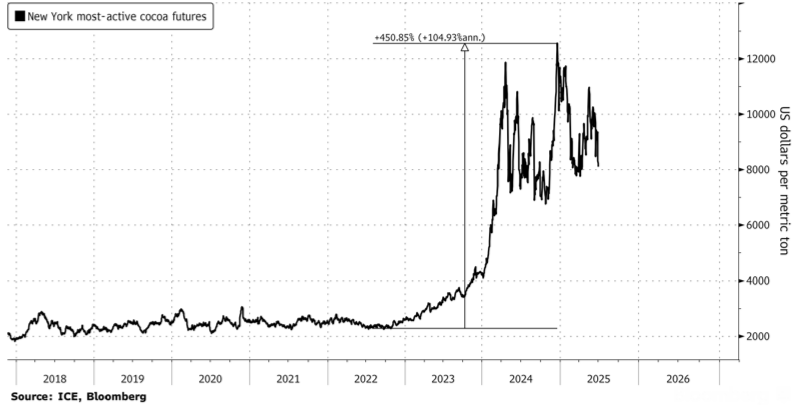
One of the most striking visualizations of the multi-year cocoa shortage, courtesy of Bloomberg, is the decline in U.S. cocoa imports, which have seen supplies plummet in just a few short years.
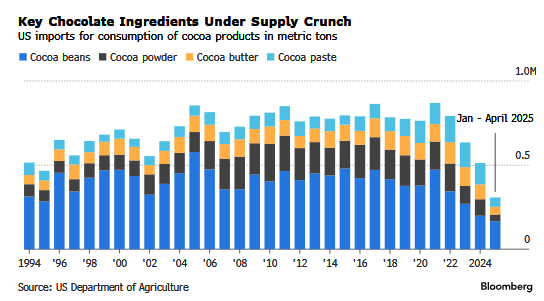
In response, major food companies, such as Mars and Hershey, have reduced the sizes of candy bars, added cheaper ingredients e.g., nuts, wheat), or entirely shifted to non-chocolate offerings. Artisan producers like Raaka have reported paying a whopping triple the price for cocoa powder.
This has only kicked off a rise in substitutes for food companies, introducing cocoa powder alternatives, such as:
- Carob blends (Doehler Group, Germany),
- Wheat-based powder (Ardent Mills, U.S.), replacing up to 50% of cocoa powder in some products
- Flavor and color substitutes like vanilla, caramel, coffee, and food coloring are also gaining traction.
“We are in an era where chocolate indulgence will no longer rely solely on cocoa,” Ina Dawer, the global insight manager for ingredients at Euromonitor International, told Bloomberg.
The global cocoa shortage is expected to persist: Cocoa processing in Europe, the largest international market, declined 3.7% in 1Q25 to its lowest level since 2017, while a similar trend has been observed in North America. Coca bean prices are expected to remain elevated through the second half of the year.
END
STUDY ON RARE EARTHS/(ZEROHEDGE)
an in depth study on rare earths: how China has the dominate position and it will take years for western nations to produce these magnets.
(zerohedge)
The Coming Rare Earth Revolution And How To Profit: All You Need To Know About The “Ex-China Supply Chain”
Thursday, Jul 10, 2025 – 03:25 AM
China’s export controls on core rare earth elements (REE) has led to scarcity across the globe and put the spotlight on REE supply chains, especially those which exclude China which is currently the world’s biggest source of raw and refined rare earths, which affords it a unique advantage in the ongoing global trade wars.
In a recent must read report (available to pro subscribers), Morgan Stanley’s metal and mining team published an in-depth look at a number of early-stage REE and magnet projects to map out where Western countries may be able to source these critical minerals, and to find the biggest potential winners from the biggest clash in the ongoing trade war between the US and China.
We excerpt the key highlights below.
1. Mapping a Potential ex-China Rare Earths Supply Chain
Key Takeaways
- REEs and permanent magnets are needed to build cars today and humanoids/robots in the future. Chinese export controls have pressured these supply chains.
- The US has a robust pipeline of ex-China upstream projects, but most are in the engineering and permitting phase, with a limited number under construction.
- Few ex-China permanent magnet projects in pipeline, and capacity of new facilities is <10% of Chinese facilities, in part due to lack of ex-China REE feedstock.
- REE prices to rise as customers & governments diversify ex-China supply. This should lead to premium pricing for existing players and incentivize new supply.
- Morgan Stanley sees MP Materials, Lynas, and ILU as best positioned to capitalize as REE trade flows and pricing adjust.
US reliance on imported critical minerals has increased significantly, with growing implications for national security… In the past 35 years, the US has seen significant growth in both the variety of imported minerals and its dependence on these imports. In 1990, the US was fully reliant on imports for the supply of 9 minerals, and imports exceeded 50% of consumption for 27 minerals (all minerals, not only critical ones). These figures have risen to 15 and 46, respectively, as of 2024. For US policymakers, recent trade tensions highlight the growing vulnerability of the US rare earth supply chain and the urgent need to strengthen domestic supply chains. As the risk of continued export restrictions and geopolitical uncertainty rises, the US and other nations will increasingly prioritize long-term national security over economic concerns.
… and the EU is finding itself in a similar position as it looks to initiate projects both inside and outside the EU… The EU is placing greater focus on incentivizing an ex-China supply of critical minerals. Under the Critical Raw Materials Act (CRMA), the EU has identified 60 projects, 13 of them outside of the EU and 47 inside the EU, to secure critical mineral supply chains for the region. The projects span the full list of critical raw materials and include two rare earth element (REE) extraction projects outside of the EU — Songwe Hill in Malawi and Zandkopsdrift in South Africa — as well as three REE processing projects and two REE recycling projects inside the EU.
… leaving China in a powerful position to influence global rare earth markets, primarily via mineral export restrictions. China dominates the global REE processing/refining industry, accounting for an estimated 65% of mined NdPr supply, 88% of refined NdPr supply, and >90% of downstream NdFeB permanent magnet supply in 2025, according to Woodmac. China has not hesitated to use its dominance of this critical supply chain as a geopolitical tool, dating back to 2010, when the country halted exports to Japan amid an escalating diplomatic crisis, a move that sent REE prices soaring. In 2019 and 2021 (here and here), China floated REE export controls amid rising trade tensions, which, according to The Financial Times, aimed to test how much defense contractors in the US and Europe would be affected. China has since banned the export of rare earth processing technology; most recently, in early April, it placed export controls on the export of heavy rare earth elements (HREE) and permanent magnets to all countries (i.e., not just the US). Because virtually all separated HREE production comes from China, this has led to distortions in market prices outside of China as companies scramble to secure supply (Exhibit 5 and Exhibit 6).
Rare earths are critical to many current applications… The US Department of Defense (DoD) deems rare earths as critical minerals because they are required (and difficult to substitute) in national security applications. While the DoD is estimated to be only ~5% of US demand, rare earths are used in essential military equipment such as motors in aircraft and tanks, missile guidance systems, and radar/sonar for submarines and surface ships (Exhibit 1 and Exhibit 2). The remaining ~95% of demand is primarily used in permanent magnets that go into autos (~40%); electronics & mechanical components, including speakers (~20%); HVAC systems (8%); wind energy (~8%); and others (~19%).
… and are key to future humanoid development. As governments vie for the pole position in humanoid development, China is off to a strong start given its advanced rare earth and permanent magnet supply chains. Morgan Stanley’s Metals and Mining team’s work suggests NdPr will enter deficit by 2037 as a result of incremental demand from humanoids; however, this analysis includes Chinese supply of NdPr oxides, which we know has been exploited in the past to adversely affect foreign markets. Put plainly, the world is quickly realizing it is reliant on China’s REE and permanent magnet supply chain to build cars today and humanoids/robots tomorrow. This uncomfortable realization may drive a meaningful uptick in mining investment in the US and other developed countries after decades of underinvestment.
So, where will the ex-China supply come from in a multipolar world? While MP Materials (MP) and Lynas (LYC.AU) have championed non-Chinese rare earth and permanent magnet supply chains (with ILU.AU currently building a refinery, with first production expected in CY27), China remains in control with ~88% of global refined NdPr supply, an even higher portion of permanent magnet capacity, and >99% of refined HREE supply. As a result, the rest of the world will need to develop not only upstream REE deposits but midstream separating/refining and downstream permanent magnet capabilities. This report highlights over 30 projects across the supply chain, many of which have received some form of government assistance. In the case of upstream and midstream projects, these are categorized based on their exposure to either light or heavy rare earths (Exhibit 7 and Exhibit 8). Based on the data provided by companies regarding their individual projects, the identified projects (mining, refining/separating, and magnet-making) will require $10-12 billion of initial capital investment. However, there are currently very few permanent magnet projects outside China and true level of capital investment needed to break China’s grip on the permanent magnet market is likely much higher.
2. Story in Charts
Exhibit 1: Rare Earths and permanent magnets are required for key defense applications…

Exhibit 2: …which can use 920-9,200lbs of rare earths, raising national security concerns given the world’s reliance on imports from China for these materials
Exhibit 3: Moreover, MS forecasts the growth in humanoids will push NdPr into deficit by 2037…

Exhibit 4:… however, this is inclusive of China supply, which is estimated to account for >70% refined NdPr through the forecast period…

Exhibit 5: …but China’s weaponization of REEs via export restrictions have led to scarcity in Dysprosium…

Exhibit 6: …and Terbium outside of China

Exhibit 7: … suggesting supply chains will need to look elsewhere and incentivize rest of world upstream REE…

Exhibit 8: …and downstream permanent magnet projects to come online…

Exhibit 9: …which will require higher incentive prices according to Woodmac…

Exhibit 10: …underpinning forecasts for increasing NdPr prices through the decade

Exhibit 11: Projects across the Rare Earth + Permanent Magnet Supply Chain located outside China

3. The Upstream: Where Will ex-China Mined Rare Earths Come From?
The pipeline of ex-China projects seems robust, but most projects remain in trial phases, with few companies having published preliminary economic assessments (PEAs) for their respective projects. Moreover, some of the most advanced projects, such as VHM’s Goschen and Lindian’s Kangankunde, both targeting initial production by YE26, are not currently looking to move downstream into separated oxide production. China controls 85-90% of refined production, and essentially all refined heavy rare earth element (HREE) production. Therefore, these projects are unlikely to make a dent in China’s dominance as they will need to ship the concentrate they produce to the customers that can currently process it: Chinese REE refiners.
This list of projects is by no means intended to be exhaustive, and we will continue to monitor for additional developments.

Light REE Upstream Projects
Eneabba Project — Iluka Resources (ILU.AX; Market Cap: US$974m): Iluka Resources is advancing on a rare earth refinery to be located in Western Australia. The facility will have capacity to take ~55kt of concentrate and is expected to produce ~5.5ktpa of NdPr and ~0.75ktpa of DyTb. The project is expected to cost a total of $1.7-1.8bn, of which $680m has been sunk/committed to date, with commissioning of the site expected to begin in 2027. Once complete, Eneabba will represent Australia’s first fully integrated refinery for the production of separated light and heavy rare earths oxides. The refinery will use monazite stockpiles at Eneabba as initial feedstock, along with material from the company’s Balranald mine that will be commissioned in 2H25. Moreover, the facility will have the ability to take 3rd party concentrate as feedstock, though management will pursue these opportunities once closer to start-up.
Phalaborwa Project — Rainbow Rare Earths (RBW.L | Market Cap: US$99m): The Phalaborwa project is located in South Africa and is 85% owned by Rainbow Rare Earths, with option to acquire remaining 15% from Bosveld. The company also sold a 0.85% revenue royalty to Ecora Resources for $8.5m in cash in 2024. The project has a mineral resource of 35.0Mt at 0.44% TREO contained within two phosphogypsum stacks derived from historic phosphate hard rock mining (Exhibit 13). Phalaborwa’s operating cost is expected to be considerably lower than traditional rare earth projects as the phosphogypsum material is already sitting at surface in a chemically cracked form, which eliminates the cost and risk of mining, hauling, crushing, grinding, flotation, and cracking; thus allowing the company to overcome the relatively low grades at Phalaborwa.
The project has a 16-year mine life and expects to process 2.2Mtpa (of the 35.0Mt total resource). Using the 0.44% grades and ~65% recoveries in Phalaborwa’s economic assessment, the company expects to produce ~1,900tpa of rare earth oxides, which includes ~1,820t of NdPr, ~60t of Dysprosium (Dy) and ~20t of Terbium (Tb). The company expects operating costs of $40.83/kg of magnet REO produced, which, based on spot prices for NdPr ($60/kg), Dy ($225/kg) and Tb ($1,000/kg), suggests operating margin of ~46%. Rainbow Rare Earths is targeting initial production in 2027 and is currently in process of preparing a definitive feasibility study for the project, after which financing and construction will begin. The project is expected to integrate midstream operations producing separated oxides of >99% purity.

Bear Lodge — Rare Element Resources (REEMF.OTC; Market Cap: US$374m): Rare Element Resources (RER) is a Colorado based company with 100% ownership of the Bear Lodge asset located in northeastern Wyoming as well as a midstream processing facility located nearby in Upton, Wyoming, where the company is currently finishing construction of a Demonstration Plant that has received ~$24m in funding from the DoE. The company is ~65% owned by a subsidiary of General Atomics who is working with RER to advance the company’s proprietary extraction/separation technology. The Demonstration Plant, which will be using the aforementioned proprietary tech, is expected to begin operations in late 2025 and operate for up to 10 months and produce 10 tons of separated NdPr oxide, which will inform later feasibility studies. The Demonstration Plant will use stockpiled sample materials from the Bear Lodge REE project.
Bear Lodge has a total resource (measured, indicated and inferred) of 7.92Mt at a TREO grade of 3.97%, which implies total contained RE 314kt. Based on a 2014 technical report, the TREO grade of 3.97% has ~23% NdPr content, 0.5% Dysprosium and 0.1% Terbium. The company plans to conduct further economic assessments following completion of the 10 month production period at the Demonstration Plant.
Longonjo — Pensana (PRE.L; Market Cap: US$259m): The Longonjo project is located in Angola and will produce a mixed RE concentrate to export via the Lobito Corridor to a downstream separation plant in the UK that would produce separated oxides. The site has a total Mineral Reserves of 21.5Mt at a TREO grade of 3.04%, which includes ~21.5% NdPr. The current mine plan, based on Mineral Reserves only, has a 20+ year life of mine and expects to produced 20,000t/yr of a mixed rare earth concentrate (MREC). This would be sent to the downstream separation facility that is expected to produce 12,500tpa of separated rare earth oxides, including 4,400tpa of NdPr. The company announced that construction at the site began as of May 2025 and expects the construction and commissioning process to take ~22 months.
Songwe Hill Mine + Pulawy REE Separation Plant — Mkango Resources (LSE: MKA.L; Market Cap: US$81m): Mkango Resources is currently pursuing the development of an REE mine in the East African country of Malawi, the Songwe Hill REE project, that will produce a mixed rare earth carbonate (MREC) to feed a processing/separation facility to be built in Poland. Both the mine and separation facility have been deemed startegic projects by the EU’s Critical Raw Materials Act. Songwe Hill is one of the few rare earth projects to have completed a definitive feasibility study and the mine is expected to have an 18 year life of mine, averaging 5,964tpa of TREO, which includes 1,953tpa of NdPr and 56tpa of Dy and Tb oxide. The MREC will be shipped to the separation facility in Poland, which is currently advancing a feasibility study, that is expected to produce 1,018tpa of NdPr oxide. Both sites have an estimated starting date of production in 2027.
Zandkopsdrift — Frontier Rare Earths (private): The Zandkopsdrift deposit is located in South Africa and has been deemed a strategic project by the EU’s Critical Raw Materials Act (CRMA). Frontier Rare Earths completed a prefeasibility study and began the definitive feasibility study (expected to last 18-24 months) in 2H2023. Upon completion of the DFS, the company will complete front end engineering and construction financing works before commencing a 24 month construction period with first production expected in 1H28. The site plans to process 1Mt of ore each year, which would produce ~4,000tpa of magnet rare earths over a 45+ year life of mine based on current proven and probable reserves. The production will be heavily weighted toward NdPr, which will account for 3,800 of the 4,000t, with Dy at ~143tpa and Tb at 32tpa. Zandopsdrift is currently only focused on extraction of these minerals and producing a TREO concentrate.
Kangankunde REE Project — Lindian Resources (LIN.AX; Market Cap: US$80m): The Kangankunde project is located in Malawi and is fully permitted to commence construction and operations. The company completed a feasibility study in June 2024 that covers “Stage 1” operations, which includes mining operations and a mineral processing plant to produce monazite concentrate. The current operational plan is focused on concentrate production and there are currently no plans to produce separated rare earths. Lindian resources has begun preconstruction activities and is nearing completion of a further optimized feasibility study. The company is targeting initial production in 2026. The asset is expected to produce ~8,250t of TREO each year, which includes ~1,600tpa of NdPr.
Halleck Creek — American Rare Earths (ARR.AX; Market Cap: US$90m): The Halleck Creek project has one of the largest REE resources in North America at 2.63 billion tonnes, however the site has relatively low TREO grades of ~0.33%. The project is located on state and federal land and the company plans to move forward with the Cowboy State Mine, located within Halleck Creek, as it is entirely on state land which can speed up the permitting process by 5-10 years. Based on an updated scoping study in Feb 2025, the company expects to mine 3Mtpa over a ~20 year life of mine and plans to have onsite mineral processing and separation facilities. The company’s scoping study suggests ~1,800tpa of NdPr oxide, 24tpa of Tb oxide and 98tpa of Dysprosium; a pre-feasibility study is expected to be published in 4Q25. In addition, the company is progressing on state permitting and environmental baseline studies, and ARR’s scoping study envisions a 2.5-year construction period. As a result, initial production is not expected until 2029/2030.
Sheep Creek Deposit — US Critical Materials Corp (private): The Sheep Creek Deposit is located in southwest Montana and the land claims owned by US Critical Materials are located on multi-use land administered by the US Forest Service. The site was previously mined in the 1960s, which has allowed US Critical Materials the ability to access significant mineralization and underground samples via pre-existing mine workings that were reopened in 2023 providing access to the property 150-400 feet below the surface. Early stage exploration efforts continue at the site and initial results suggest potential for one of the highest grade deposits in North America at ~9% TREO, of which ~27% is NdPr. The company is partnering with Idaho National Laboratory (INL) on developing a process to handle, separate, and extract metals from the carbonatite ore located at Sheep Creek. The project is still in the very early stages and US Critical Materials in conjunction with INL expect to provide updates on progress made with extraction and purification testing along with a draft flowsheet update in summer 2025.
Lulea Industrial Park + Malmberget and Per Geijer Mines — LKAB (private): LKAB is advancing on development of two iron ore mines with REE byproducts and an industrial processing facility all located in Sweden. The project has been deemed a strategic project by the EU’s Critical Raw Materials Act (CRMA). The company is currently constructing a demonstration plant at Lulea to verify the process to produce critical minerals. The company is still in the permitting phase for the 3 aspects of this strategic project and does not expect to reach full-scale commercial operations at the industrial park until the 2030s.
Brook Mine — Ramaco Resources (METC.O; Market Cap: US$616m): The Brook Mine is located in the Sheridan Coal Field in northern Wyoming and consists of approximately 15,800 acres, of which 4,600 acres are already permitted. The land was originally acquired to be converted into a coal mine in 2012, but Ramaco pivoted and began REE exploration in 2021 and 2022. TREO content is estimated at 1.1-1.4mt at a grade of between 0.0375% and 0.0469%. That said, the companies current tonnage estimates are not considered mineral resources nor mineral reserves as no cut-off grade was applied in preparing the estimated tonnage and grades (i.e., it represents a comprehensive estimate of all in-place minerals, regardless of grade). The company, in conjunction with the Flour corporation, which has been assisting with testing and engineering for the project, plans to release a preliminary economic assessment by the end of 2Q25. Under Ramaco’s commercial development timeframe, the company plans to have pilot operations producing rare earth concentrate in 2026 and also begin production on a full-scale plant to produce commercial oxides by 2028.
Woods Creek — Integral Metals (INTG.CN; Market Cap: US$20m): Located near the Sheep Creek Deposit, in southwest Montana, the site is part of a similar mineralization and targets REE within carbonatite ore. The site is located on federal lands, which face longer permitting timelines, and is currently in early stage exploration/drilling. Initial grab samples of carbonatite collected in 2024 returned a total rare earth oxide (TREO) of 7.08% containing ~14% NdPr. Given the need for further permitting and the long-lead times for permitting on federal land (10+ years in some cases) this project is unlikely to begin production until mid-next decade, barring any changes to the Federal permitting process.
INSPIREE Project — Itelyum (private): The INSPIREE project is located in northern Italy and has been deemed a strategic project by the EU’s Critical Raw Materials Act (CRMA). The site will be a small-scale magnet recycling facility that produces REE oxalates from end of life magnets. The site will have a two-step process with Level I involving the disassembly of magnets and Level II consisting of the recovery of REE oxalates from said magnets at Itelyum’s hydrometallurgical plant. The Level I plant will have dismantling capacity of 1,000 tons/year and the Level II plant will treat 2,000 tons/year of permanent magnets, resulting in the recovery of 700 tons/year of REE oxalates.
Upstream — Heavy REE Projects
Lynas HREE Separation Facility — Lynas Rare Earths (LYC.AX; Market Cap: US$5.6bn): Lynas is currently ramping up operations at its Malaysia separation facility, which according to the company will have separating capacity of 1,500 tonnes of heavy rare earths per year. The company installed the Dy and Tb separation circuits in February of this year and announced first production dysprosium oxides in May, 2025 followed by first production of terbium oxides in June, 2025. Achieving production of separated Dy and Tb has made Lynas the only commercial producer of HREE products outside of China, at a crucial time given China’s recent placement of export controls on these materials. Plans are also underway to construct Light Rare Earth (1.25ktpa NdPr) and Heavy Rare Earth (2.5-3ktpa HRE) separation plants in the US, in partnership with the US Government through the US Department of Defense which were previously expected online in FY26. However there have been some project delays due to wastewater management plan challenges, with LYC in discussions with the US DoD around extra capex required for plan changes underway currently.
Mountain Pass HREE Separation Facility — MP Materials (MP.N; Market Cap: US$7.1bn): MP was awarded $35m in 2022 from the DoD to design and build a facility to process HREE at its Mountain Pass mine. The company is currently mining the Mountain Pass deposit producing ~45kt of TREO in 2024 and is ramping production of its light REE separation facility where it’s producing ~550t per quarter (vs. nameplate capacity of ~1,500t per quarter). MP is currently advancing detailed engineering work and equipment procurement for the project. Based on recent commentary from the company, they expect to bring heavy rare earth separation production at scale starting in 2026. The HREE facility is expected to produce separated Dy and Tb to be used as feedstock for MP’s magnetics facility in Texas.
White Mesa Mill — Energy Fuels (UUUU.A; Market Cap: US$1.2bn): Energy Fuels, traditionally focused on uranium, has been operating the White Mesa processing facility in Utah, the largest uranium processing facility in the US, for 40+ years. Given the sites history processing uranium, the company has expanded its capabilities to process monazite ores, traditionally high in radioactive content, to produce high-purity REE oxides and achieved initial NdPr oxide production in 2024. The material is being validated by customers for potential offtake. The company currently processes monazite sand byproducts from Chemours heavy mineral sands (HMS) mines in the Southeast US. The company plans to import monazite sands from other mining projects they are developing in Australia, Madagascar, and Brazil in the coming years.
The White Mesa mill has installed capacity to process up to 10ktpa of monazite and produce up to 1ktpa of NdPr oxide. However, the current offtake agreement is for 1-2ktpa of monazite sands from Chemours. The company is currently piloting REE oxide separations of heavy REEs such as Dy and Tb while also advancing engineering work on a Phase 2 REE expansion to bring total capacity to 6ktpa of NdPr, 225tpa of Dy and 75tpa of Tb oxides, the Phase 2 expansion is not expected to come online until 2028. The company is simultaneously advancing on HMS mining projects to increase monazite sands production, the mining projects are not expected to come online until 2H27.
Caremag Processing Facility — Carester (private): The Caremag facility, which was deemed a strategic project by the EU’s Critical Raw Materials Act (CRMA), will be based in Lacq, in southern France, and will be a large-scale REE recycling and refining facility. The plant is expected to be operational by late 2026 and will recycle 2,000 tonnes of rare earth magnets and refine 5,000 tonnes of mining concentrate annually. The plant is expected to produce 600 tonnes per year of dysprosium and terbium oxides, as well as 800 tonnes per year of Nd and Pr oxides. The company has raised €216m to build the facility, which includes €110m from Japan Organization for Metals and Energy Security (JOGMEC) and private-sector Iwatani corporation as well as €106m from from various subsidies and advances provided by the French government. The company has already entered into a long-term agreement with Stellantis in September 2024 to supply over 3,400 tonnes of Nd, Pr, Dy and Tb oxides over the next 10 years.
Carina Project — Aclara Resources (ARA.TO; Market Cap: US$157m): The Carina Project is Aclara’s flagship REE project. It is an ionic clay deposit, historically the source for most of the world’s supply of HREE, located in Goias, Brazil. The company is testing operations from a pilot plant to process ionic clays and recently announced the successful production of HREE concentrate (here). Moreover, the company recently submitted its Environmental Impact Assessment to the Brazilian government (here) and is simultaneously advancing on a pre-feasibility study and feasibility study, which are expected to be released in 3Q25 and 1Q26, respectively.
The site has a total Mineral Resource of 297.6Mt at a TREO grade of 1.45% (~19.5% NdPr, 2.7% Dy and 0.4% Tb). Annual production is expected to be ~1,350t of NdPr, 163t of Dy and 28t of Tb. Mining operations are expected to begin in 2028 and concentrate will be sent to a separation facility to produce oxides. The separation facility will be located in the US and Aclara is working with the US Department of Commerce to identify the most strategic site for the facility. The company expects to progress on laboratory test work and integrated pilot scale testing for its separation plant in 2025.
Penco Module — Aclara Resources (ARA.TO; Market Cap: US$157m): The Penco Module is Aclara’s second REE project, is located near Concepcion, Chile, and is expected to start operations in 2027. The site has a relatively small Mineral Resource of 29.2Mt at a TREO grade of 2.28% (19.4% NdPr, 2.9% Dy and 0.4% Tb). Annual production is expected to be ~126t of NdPr, 45t of Dy and 6t of Tb. The company’s pilot plant ran in 2023 and confirmed the processing parameters and process flowsheet design for a future full-scale plant design. In addition, it produced high purity HREE concentrate to feed separation trials. The company applied for its environmental permits in 2024, received a response from the relevant Chilean Environmental agency in September 2024, and submitted a comprehensive report in March 2025 addressing technical observations that were raised.
Goschen Rare Earth Project — VHM (VHM.AX; Market Cap US$34m): The Goschen project is located in Victoria, Australia. The project is one of the only REE projects in development with proven and probable reserves along with its larger mineral resource. The project has total reserves of 98.8Mt at TREO grades of 2.45% with NdPr as ~18.5%, Dy at 2.5% and Tb at 0.4%. The total Mineral Resource is 491.8Mt at TREO grades of 2.14% with NdPr at 19.2%, Dy at 2.3% and Tb at 0.5%. The company has already received its mining license and expects to receive its environmental and workplan approvals within the 2Q25-3Q25 timeframe, with a final investment decision expected to be announced by YE25. Construction and commissioning are expected to begin soon thereafter with initial production slated for 4Q26, pending permit approvals.
While this project seems like it will be one of the first to market, it is important to note that the current definitive feasibility study only covers the sale of concentrate and downstream separation into REE oxides is not yet being considered by the company. The company is planning a staged development of the deposit to limit upfront capital costs with Stage 1 having an expected throughput of 1.5Mtpa for years 1-3 (4Q26-4Q29) before expanding to 5Mtpa beginning in 4Q29. Stage 1 will produce ~4,300tpa of REE concentrate and Stage 2 would increase to 9,000tpa. Using the Mineral Reserves grades this would imply annual production of ~800tpa of NdPr, 108tpa of Dy and ~17tpa of Tb for stage 1 with production of each mineral roughly doubling in stage 2.
Estonia HREE Separation Plant — Neo Performance Materials (NEO.TO; Market Cap: US$421m): The facility is located in Sillmae, Estonia near the company’s permanent magnet facility in Narva, Estonia. Engineering and procurement have already begun with equipment delivery expected in 3Q25 and initial commissioning target by YE25. The company has a 30+ year history in REE separation via its ownership in Chinese separation facilities, which it divested earlier this year (here), with plans to leverage this expertise through its pilot scale plant.
Round Top Deposit — USA Rare Earth (80%) (USAR.O; Market Cap: US$421m) and Texas Mineral Resource Corp. (20%) (TMRC.OTC; Market Cap: US$57m): The Round Top Deposit is located in Hudspeth County, Texas, approximately 85 miles southeast of El Paso. It is an extremely low grade mine at 0.063% contained TREO; however, it is an Ionic Clay deposit whose TREO content is more skewed to heavy rare earths. The company expects to overcome the low-grades using a heap leaching process that is seeing up to 80% recoveries using dilute mineral acid. That said, USAR acknowledges that there are a number of risks along the way to bringing Round Top into production and the company does not expect the mine to enter full production for at least another 5+ years. The companies are currently developing a flowsheet, which would lead to a preliminary feasibility study. Upon completion of these studies, the company would then pursue construction of a pilot plant to test processing of stockpiled material from Round Top before moving to a definitive feasibility study and eventual mine construction. The key goal of the mine is to provide long-term feedstock for USA Rare Earth’s magnet plant in Stillwater, Oklahoma, however, at this point, it is unlikely that the company will begin full-scale mining/processing operations this decade.
Monte Alto — Brazilian Rare Earths (BRE.AX; Market Cap: US$364m): The Monte Alto project is BRE’s most advanced project located in Bahia, Brazil. The deposit sits within the larger Rocha da Rocha mineral district where the company is doing exploratory drilling on further deposits including the Sulista and Pele project. The Monte Alto ore body constitutes monazite sands at surface level and a hard-rock deposit beneath. The surface level monazite sands have a JORC-compliant resources of 25.2Mt at 1% TREO while initial drill results of the hard-rock deposit have intersected ultra-high-grade mineralizations with up to 45.7% TREO. The hard rock mineralization remains open in all directions and drilling is ongoing. The company expects to release a scoping study by year-end 2025. Notably, the current project is focused on producing concentrate to export and sell to 3rd parties for separation/refining with the goal of using the proceeds from these initial concentrate sales to fund a potential move into downstream refining
4. The Downstream: Lack of ex-China HREE Supply Limits Magnet Projects on Uncertain Feedstock
Downstream Permanent Magnet Projects
China’s dominance of the REE / permanent magnet supply chain is most evident when it comes to downstream magnet production. For context, in 2024 China produced ~270kt of NdFeB magnets according to Argus. This compares to the 3 US facilities — MP Materials’ Ft. Worth, Texas; USA Rare Earth’s Stillwater, Oklahoma; and Noveon’s Texas facility — that are expected to all be in commercial production by 1H26 and will have an initial combined capacity of 4-5kt, or just ~2% of total Chinese production. Moreover, the major Chinese permanent magnet facilities have capacity to produce 20kt+, with some as high as 40kt, whereas most ex-China facilities are targeting capacity of 1-2kt. This leads to higher costs from, amongst other reasons, a lack of economies of scale and limits the impact on China’s hold over this supply chain given the difference in scale.
Importantly, the bottleneck for many of these magnet projects will be sourcing quality separated heavy rare earths. In our view, the lack of ex-China supply for Dy and Tb, coupled with uncertainty on China’s willingness to export these materials, results in the relatively low number of ex-China permanent magnet projects. Indeed, China’s decision to place export restrictions on Dy and Tb has led to a major decoupling in Chinese vs. European prices for Dy and Tb (Exhibit 14 and Exhibit 15). Given this uncertainty on feedstock, there are also a number of ex-China magnet projects being considered that focus on recycling magnets from, for example, end-of-life vehicles.

Independence Magnet Facility — MP Materials (MP.N; Market Cap: US$7.1n): The Independence Magnetics facility is located in Ft. Worth, Texas, and will have 1,000t of permanent magnet nameplate capacity. The company has already begun producing magnets from a pilot plant located at the facility and plans to begin commercial magnet production by YE25. The company is currently stockpiling separated HREE, to use as feedstock for the initial ramp up of production with the goal of transitioning to using separated heavies from the HREE separation facility beginning in 2026. The company has signed a long-term contract with GM to sell magnets produced at the facility.
Estonia Magnet Facility — Neo Performance Materials (NEO.TO; Market Cap: US$421m): Neo’s permanent magnet facility located in Narva, Estonia is projected to have an initial production capacity of 2,000t with plans to scale production to 5,000t annually. Construction of the facility was completed in 2025 and the company announced in April 2025, that it had produced 18,000 EV traction motor grade magnets. The magnets were shipped to a Tier 1 traction motor customer where they will be assembled into traction motors for performance testing by the Tier 1 customer and OEM. The approval process is scheduled to be complete in 1H26, with mass production expected to begin later that year.
Stillwater Magnet Facility — USA Rare Earths (USAR.O; Market Cap: US$421m): The Stillwater, Oklahoma magnet facility is currently planning to begin commercial production in 1H26. The facility will have an initial annual capacity of 1,200t with the potential to expand the facility to 4,800t of magnets. The company’s Innovation Lab began commissioning in 1Q25 and is expected to begin prototype shipments to customers in 2Q25. The company has an initial supply chain for feedstock in place for REE metal with ex-China suppliers in South Korea and the US to support manufacturing through 2027. The facilities initial focus will be on a more diverse set of non-EV customers to accelerate path to revenue.
MagFactory Project — MagREEsource (private): The MagFactory project is located in Noyarey, France and has been deemed a strategic project by the EU’s Critical Raw Materials Act (CRMA). The plant uses hydrogen to recover a powder from end-of-life magnets that can then be directly reused to manufacture new magnets with a 91% reduction in carbon footprint as compared to those produced by Chinese mining extraction. The company has developed a pilot plant that began operations in September 2024 and is expected to produce 50 tonnes per annum of high-performance magnets. The company is also advancing on a commercial scale plant with design and construction having already begun. Production at the full-scale plant is expected to begin in 2027 with initial production capacity of 500 tonnes scaling to 1,000 tonnes by 2030.
HyProMag Recycling Facilities — Mkango Resources (MKA.L; Market Cap: US$81m): HyProMag is a subsidiary of Mkango who is developing a number of recycling facilities, namely in the UK, Germany and US, using their patented Hydrogen Processing of Magnet Scrap (HPMS). The UK facility has already achieved pilot production and commercial production is targeted by the end of 2Q25, with initial production of 25-30tpa scaling up to targeted 100-330tpa. The facility in Germany is also targeting 100-330tpa of annual production and commercial production is targeted for 2025. Lastly, the US facility would be larger with targeted production of 1,000tpa starting in 1H27, detailed engineering for the production is expected to begin in mid-2025.
San Marcos, Texas Magnet Facility — Noveon(private): Noveon produces permanent magnets in Texas from its magnet facility that was commissioned in 2021, following successful pilot production in 2016 and equipment installation in 2020. The facility has ~2,000t of annual magnet making capacity and produces its patented EcoFlux magnets that the company claims can be produced with everything from virgin materials to 100% recycled, end-of-life feedstock. The company’s patented tech requires 20% less HREE than traditionally produced magnetic materials and despite the lower HREE content is able to perform at higher temperatures allowing the magnets to maintain their properties — even at temperatures above 100 degrees Celsius.
Yesan, Korea Magnet Facility — JS Link (private): JS Link is establishing a permanent magnet plant in Yesan, Chungnam with projected annual capacity of 1,000t. The company expects to be a manufacturer of high-performance permanent magnets utilizing rare earth materials sourced and processed by partners in Western and allied countries, including the US, Australia, and the UK. The company is expected to increase capacity to 5,000t at a later date and recently announced they are in conversations with Lynas to source REE materials for trial production.
5. Shift in China REE Policy and Potential Responses
China’s control over rare earth supply has become a calibrated yet assertive tool for strategic influence. Its near-monopoly of the supply chain means rare earths will remain a significant bargaining chip in trade negotiations.
China is reshaping its rare earth export controls. Among 17 rare earth elements, China has imposed export controls on seven heavier ones (Dy, Tb, Sm, Gd, Lu, Sc, Y, Exhibit 17) and their processed products (including alloys and magnets) since April 4, 2025. China is increasingly leveraging its rare earth supply chain dominance. Recent actions point to systematic efforts to refine mechanisms so that it could become a more effective strategic lever.
- Tightening of export licenses. Key rare earth and magnet-related materials are subject to export license requirements. This enables China to regulate volume, destination, end-use, and recipient companies, thus enhancing its ability to exert targeted influence on certain entities.
- Export tracking system to strengthen oversight of finished magnet exports, which includes end-user declarations, customs harmonization codes, and re-export risk reporting. This infrastructure could be improved over time to monitor, trace and, if needed, restrict outbound rare earth flows.
- Warnings to trading partners:China has formally warned certain trading partners to avoid facilitating indirect exports of rare earths or magnets to third-party countries, signaling a preemptive stance to prevent circumvention of its controls.
Exhibit 17: Rare Earth Elements

Why the shift in strategy?China had largely refrained from using rare earths as a lever (even during the 2018-19 trade tensions) due to concerns over: (1) global confidence in Chinese supply chains and (2) whether rare earth leverage would endure. We believe the reduced hesitation in leveraging rare earths stems from two key developments:
- Rising trade tensions and tech restrictions: Ongoing tech sanctions, export controls, and tariff volatility have diminished previous concerns about undermining foreign investment in China. The overall global trade environment reduced the risk of deploying rare earth leverage.
- Strengthened supply chain dominance: Alternative rare earth refining and magnet production capacity buildup remained slow in the past 5 years due to economic, technical, and environmental hurdles. China now controls over 85% of global rare earth refining and 90% of NdFeB magnet production, critical for national defense, wind turbines, and electric vehicle motors.
Can China effectively wield this lever? While China’s export control regime is advancing, it remains in its early stages. Unlike the US’s refined and time-tested “small yard, high fence” strategy, China’s system still lacks institutional depth and international compliance frameworks like the Wassenaar Arrangement. Its export control institutional framework, taking shape only since 2021, is still evolving. China is developing sophisticated tracking and licensing systems, which, while they cannot yet match US-style precision, suggest rapid progress (Exhibit 18).

What is the end game? “Leverage for tech and geopolitical reciprocity.” The current rare earth controls are as much about testing mechanisms as they are about immediate economic impact. Yet ultimately, China appears to be establishing a calibrated system of deterrence, where strategic elements (such as rare earths) are used to reshape the cost-benefit calculus of siding with the US export control regime. It will likely respond selectively to tech restrictions imposed by the US and its allies, mirroring the “small yard, high fence” logic. For example, if a US ally were to block chips and lithography tools, China may target critical inputs like rare earths to that country. This reciprocal escalation seeks to deter full alignment with US policies and reshape global tech and trade dynamics.
What steps can China take to maintain its REE dominance?
Rare earths and permanent magnets are China’s strongest bargaining chip in an increasingly multipolar world. In our view, China has a strong incentive to continue controlling this supply chain and take actions to mitigate likelihood of future ex-China supply coming to market.
Upstream (Mining & Refining) — China has already taken a number of steps to reduce the likelihood of ex-China supply coming to market, the most notable of which was a 2023 ban on the export of technology and equipment used in REE separation (part of refining process), REE metal production, and rare earth permanent magnet production (here). Despite these bans, companies like MP and Lynas have been able to advance their respective refining capabilities suggesting the know-how still exists/can be developed outside China, despite the tech/equipment ban.
As noted above, there are a robust number of projects outside of China in the pipeline. That said, most are targeting initial production for 3-5 years from now and virtually none of these projects have been sanctioned by their respective boards, meaning construction, which itself is a roughly 2-year process, is yet to begin. China’s upstream production of refined rare earth products is predominantly via state owned enterprises and is based on a quota system decided by the Chinese government twice a year. The government is using this quota system to limit illegal production which used to be 50% of China supply and control the environmental impacts.
Downstream (Magnets) — China’s dominance over the magnet portion of supply chain is likely harder to crack, or at the very least will take longer. Not only has China advanced on the technological know-how, but given the lack of ex-China supply of heavy rare earths there are very few magnet projects in the pipeline due to the uncertainty on supply of raw materials. As a result, HREE refining projects will need to come to market first before the pipeline of magnet projects expands, and with limited ex-China capacity coming online this decade, China’s dominance in magnets should persist.
While the technological advancements and ban on export of magnet making tech/equipment provides a further barrier to entry, we believe this is more manageable as ex-China producers, such as MP and Neo Performance, have begun trial production of automotive grade permanent magnets. That said, these projects are still moving toward commercial production later this year, are significantly smaller than Chinese facilities in scale, and will need to prove out their production capabilities at scale.
7. Industry Impacts
Automotive
Magnets are relevant for the Auto sector, particularly EVs. Autos account for ~38% of NdFeB magnets, used in automatic transmissions, throttle bodies, alternators, sensors, seat belts, lights, power steering, cameras, audio speakers, braking systems, and mostly on EVs motors, allowing manufacturers to reduce size and improve efficiency. Some Indian OEMs have shared that REEs usage per EV is 3 kg/per car while it is 100 gms/per car in ICE.
Shortage starting to hit the Auto value chain. Implemented in April 2025, the restrictions are starting to have an impact on global automotive supply chains. OEMs often hold 2-4 months of magnets in inventory, but we suspect that they were running with lower levels in April as the margin hit pushed for leaner operations. Several OEMs plants and production lines have already been shut down because of the shortage, including Ford’s production of its Explorer SUV at its Chicago plant for a week in May, Suzuki’s production of Swift for a few weeks and several European auto parts suppliers plants, with further impacts expected in the coming weeks as inventories deplete.
Likely no winner in the West. The export control is only on REEs and magnets, not on motors that use those magnets, so an alternative solution is to produce motors in China (which would take some time) and then export them. If the REE restrictions remain in place, Western suppliers would have an urgent need to diversify their sources. China has warned Japan and Korea against re-routing to avoid indirect exports to third-party countries. According to several reports, hundreds of export license applications have been submitted to Chinese authorities since early April, yet only about one quarter appear to have been approved. German carmaker Volkswagen has previously told CNN that its suppliers have been granted “a limited number of export licenses“ and some US OEMs seem to be getting 6-month temporary licenses. But other applications are also being rejected, impacting Indian, US, Japan, and EU OEMs supply.
No quick fix. The implementation of alternative old motor technology would take time and is not energy efficient. The US and Europe are working to reduce their dependence on REEs, the same applies to India as commented by the Commerce and Industry minister in an interview: “India is actively working with stakeholders to develop domestic capacity and reduce dependence on China.” But finding and validating alternate sources will take time and will be expensive. The average lead times for new mines continues to rise, ~18 years according to S&P Global. It would be faster to expand capacity in current mines, but today only China, Burma, the US and Australia are mining REEs at scale. The refining side would take less time to be reallocated, but it produces pollution, requiring complex environmental processes in DM, explaining the current location of most processing plants in China and Malaysia. The magnet part of the value chain is the most difficult to replace, given China’s know-how, and currently only China and Japan are capable of producing magnets at scale. Europe has reduced its reliance on Chinese REEs from 98% to 46%, according to the European Commission, but current stockpiles may last only until mid-2025. Carmarkers such as BMW and VW are reviewing long-term supply arrangements.
A deja vu of semiconductor shortage in 2021? If China’s export controls persist, global light vehicle production forecasts could face downward revisions, similar to the semiconductor shortage that disrupted the automotive industry, which led to 12+ million vehicles being removed from production globally in 2021 (-12% vs. 2019). However, the impact of REEs shortages could be more profound given the lack of quick solutions — rare-earth supply chains are far more concentrated and difficult to diversify.
Increasing risk of a guidance hit in 2Q. It is going to be difficult to avoid guiding for FY25 when 2Q results come in at the end of July. The negative impact from tariffs started in May, will increase in June-July and OEMs may provide a range, assuming different tariffs and REEs scenarios. In any case, Morgan Stanley expects guidance to be below consensus, probably a middle point between the base case (10% auto tariffs) and a “25% tariff” scenario.
Risks and opportunities. A value chain disruption is a risk to consider in a fixed cost business, as the whole Auto value chain would be impacted. On the flip side, China’s minister of Commerce said that China is willing to accelerate the examination and approval of REEs exports to EU firms if their applications meet requirements and could be linked to some progress in negotiations on EU tariffs on China EV exports. And this restriction could be a catalyst for a faster resolution of US-China trade tensions (e.g., President Trump and President Xi’s mutual visit invitations), with room to impact tariff risk perception.
Humanoids
The Embodied AI/Humanoid Robot revolution further highlights the S/D risks. The average humanoid has around 0.9kg of rare earth metals. Humanoids likely just scratch the surface of ultimate magnet demand. Humanoids could create a significant uplift in demand for critical minerals — especially rare earths — and cumulatively add up to US$800bn of incremental demand across covered critical minerals by 2050. The take-up of humanoids will start to gather pace from 2035 onward (MSe) and as a proportion of 2030 demand for rare earths (specifically NdPr), humanoids could add an additional 40%/110%/167% in 2040/2045/2050.
What’s the US response? While the situation remains fluid, we understand there have been stoppages and other disruptions from Chinese supply. Auto companies source permanent magnets up to Tier 4/Tier 5 suppliers. Many are scrambling to gather intelligence on the volatile supply situation and seeking possible alternatives and contingencies – both near term and longer term. One expert from a US-based OEM says the US Inflation Reduction Act was a “huge help” to re-industrialize battery making in the US. Overall, however, there has been a lot of talking about the issue for the past 3 or 4 years, with very little action, until recently.
Few near-term alternatives. From our discussions, it appears the US will likely remain dependent on Chinese rare earths for the foreseeable future. The average lead times for new mines continues to rise, which could pose challenges for meeting the rising demand for critical minerals. According to S&P Global, the average lead time for mines operational between 2020 and 2024 reached ~17.8 years.
National security concerns. In addition, as alternative sources of permanent magnets and critical refined rare earth materials ramp up, there will be issues of quality, economics and environmental sensitivity that must be considered. In other words, there is no quick fix here. This is likely a multi-decade problem. “There has to be a start somewhere and it has to be in the US and if we don’t do it now we never will,” according to a senior supply chain executive of a major US auto company we recently spoke with.
Aerospace and Defense
REs are Critical Inputs to Many Defense Products
The defense industry leverages rare earths for a wide range of products, including fighter jets, surface ships, submarines, radar systems, missiles, lasers, satellites, and UAVs. A single F-35 fighter jet contains ~920 pounds of rare earths; an Arleigh Burke-class DDG-51 destroyer contains ~5,200 pounds; a Virginia-class submarine contains ~9,200 pounds.

A Range of Defense Applications
Rare earths feature properties that are well-suited for a range of defense applications. Key use cases include powerful permanent magnets, energy amplification, and energy storage. Neodymium iron boron (NdFeB) magnets, for example, are considered the world’s strongest permanent magnets and are leveraged broadly in Defense systems. Samarium cobalt (SmCo) retains its magnetic strength at high temperatures, making it particularly attractive for missiles / munitions and aircraft systems.

Still, DoD Demand for REs is <0.1% of Global Demand
Despite significant use of rare earths across US defense products, US Defense Department (DoD) demand for rare earths represents <0.1% of global demand, according to the US Government Accountability Office (link). As a result, DoD has more limited market influence, including over the supply chain for rare earths.
DoD is Developing a Domestic Mine-to-Magnet Supply Chain
The Defense Department is working to foster US-based rare earth mining and processing capacity. Per the 2024 National Defense Industrial Strategy, DoD established a target to develop a ‘mine-to-magnet’ rare earth supply chain to satisfy US defense demand by 2027 (link). Since 2020, DoD has awarded >$400mn to help companies build a domestic rare earth supply chain. Meanwhile, DoD’s Industrial Base Policy office is reportedly overseeing a rare earth investment strategy with the goal of developing sourcing, separation, processing, and manufacturing capacity in the US.
LMT Recent Commentary on Rare Earth Supply
Lockheed Martin (LMT), on its 1Q25 earnings call, noted that a potential disruption in rare earth supply should not impact delivery commitments in 2025 given the quantity of rare earths already integrated into the company’s value chain. LMT also highlighted there are stockpiles available, and that the company – and its supply chain – are “constrained from using Chinese inputs of any kind from any source into our products and services.” That said, the company in its 1Q25 10-Q flagged that recent government actions could constrain material availability over time.
8. Rare Earths in Humanoids
Significantly more NdPr will be required to meet humanoid demand, potentially increasing deficits in a market where supply security remains a key issue for Western countries (China supplies >74% of global refined supply by 2050e).

9. Rare Earths Overview
Rare earths are a group of 17 elements that are used in various clean energy, high-tech, and defense applications. Though generally as abundant as base and precious metals, these metals are not easily found in large, high-concentration mineable deposits. They have unique chemical, optical, electrical, magnetic, and metallurgical properties. As these metals are found together in nature, and their properties are similar, separation into oxides is technically challenging.
Light vs. heavy rare earths. Rare Earth Oxides (REO) are commonly divided into two categories — light and heavy REO. Light REOs (La-Sm) are found more strongly concentrated in nature and face fewer shortages. Example of light REOs are cerium, lanthanum and neodymium, whereas heavy REOs (Eu-Lu) include europium, terbium, and dysprosium. Industry experts believe Chinese deposits contain about 80% of global heavy earth reserves and account for an even larger portion of separated HREE production, with non-Chinese producers like Lynas having only recently produced their first separated HREE oxides in 1H25 (here).
Types of REO ores: REO occur primarily as two types of ores, Bastnasite and Monazite. Bastnasite deposits in China and the United States constitute the largest percentage of the world’s rare earth resources, MP’s Mountain Pass mine is a Bastenite ore body. Monazite deposits in Australia, Brazil, China, India, Malaysia, South Africa, Sri Lanka, Thailand, and the United States constitute the second-largest segment. Monazite ore often has a higher concentration of radioactive thorium in it, and therefore needs more processing. However, monazite ore bodies generally include higher proportion of heavy rare earth elements.

Exhibit 28: The NdFeB magnet supply chain begins with mined material that is separated into individual REE oxides before being reduced into metal which is ultimately magnetized for end-use applications

Major Use Cases for Rare Earths
In the past decade, applications have grown significantly, driven by use of rare earth metals in miniaturization of electronics. Rare earth elements are critical to new-age electronics, clean energy technologies, high-tech, and defense applications. Substitutes are available, but are generally less effective. However, the single fastest growing use for rare earth elements is in permanent magnets, which contain light rare earths like Nd and Pr (generally in a 75/25 ratio for Nd and Pr, respectively), as well as heavy rare earths like Dy and Tb (Exhibit 30). Permanent magnets are used in green energy applications such as electric vehicle motors and wind turbines as well as in nascent technologies like humanoids and physical AI.
Exhibit 29: Typical NdFeB magnet compositions require the use of Nd, Pr, Dy and Tb


Total rare earth demand was estimated at ~211.5kt in 2024, according to Argus, and magnet materials (Nd, Pr, Dy and Tb) accounted for ~37% of rare earth demand by volume while relatively low value REEs, like Cerium and Lanthanum, still account for the lion’s share of demand by volume at ~55%.
Global Actions to Mitigate China Dominance
Outside of China, governments have become increasingly aware of China’s influence over the REE market (exhibit 34) and have begun implementing various programs to incentivize projects and speed up time to market — primarily in the form of government grants and critical mineral funds.
US is leading with several initiatives:
- Defense Production Act (DPA) investments, allocated $750mn ($439m for just REE projects since 2020) to support domestic production of critical minerals via grants provided by the Department of Defense (DoD).
- Inflation Reduction Act (IRA) offers 10% production tax credits (45X) and funding for up to 30% of capex for critical material projects (48C). US REE producers, such as MP Materials are currently receiving 10% tax credits to offset mining and refining costs of NdPr oxide and received a ~$60m grant for construction of their Ft. Worth, TX magnetics facility.
- Department of Energy’s (DOE) loan program office (LPO) and critical materials institute provides loans and guarantees to critical mineral processing and extraction projects under its til 17 Clean Energy Financing Program. The CMI is a research hub funded by the US government to advance technologies for rare earth recovery, substitution and recycling
The EU as whole, as well as several member states, have also established national funds to bolster their critical mineral projects.
- €100 million European Bank Fund: The European Bank for Reconstruction and Development (EBRD) and the European Union (EU) have mobilized up to €100 million in investments toward critical and strategic raw materials. More details here.
- €500 million France Mineral Fund: In May 2023, France committed €500 million for critical minerals and metals as part of a public-private investment fund. The fund seeks to raise an additional €1.5bn from private investors and will be managed by InfraVia. The fund is also expected to work in coordination with the German and Italian initiatives below. More details here.
- €1 billion German Fund: The raw materials fund will be managed by KfW development bank with a focus on projects in extraction, processing and recycling of critical minerals. The fund was created in 2024 and is set to make investments over the next four years.
- €1 billion “Made in Italy” fund: The goal of the “Made in Italy” initiative is to support specific projects and to encourage the creation of national champions within the critical minerals space. The fund, along with others, has the goal to increase the EU’s capacity to meet 10% of annual consumption from locally extracted materials.

Substitution Risks
The long-term outlook for REE demand is expected to grow driven by the use of permanent magnets in growing applications such as EVs, humanoids/robotics, and clean energy. However, emerging technologies present credible substitution risks. Advances in material science and motor design are enabling alternatives that could reduce reliance on REE-based magnets over time.
Iron nitride (FeN) offers high remanence (magnetization left behind in a ferromagnetic material after an external magnetic field is removed) similar to REE magnets but suffers from low coercivity (measure of the ability of a ferromagnetic material to withstand an external magnetic field without becoming demagnetized), making them prone to demagnetization. They require new motor designs, but collaborations with major OEMs like General Motors suggest strong commercial interest. FeN could become a viable REE-free alternative if its engineering limitation is resolved.
Manganese bismuth (MnBi) magnets deliver torque comparable to NdFeB but at a 60% increase in volume and 65% more weight. However, they can potentially reduce motor cost by 32%, making them attractive for low-cost or space-flexible applications. MnBi may replace REEs in budget EVs or segments where cost outweighs efficiency.
NdFeB without heavy REEs (e.g., Dysprosium) eliminating heavy REEs like dysprosium reduces high-temp coercivity. However, this can be mitigated through design workarounds like thin segmented magnets, carbon-fiber rotor reinforcement, and active cooling as demonstrated in a 100 kW prototype by Oak Ridge National Lab. Even partial substitution through smart engineering can significantly cut REE use, particularly for HREE, which is the current choke point in the greater NdFeB magnet supply chain.
FeN, MnBi, and heavy REE free NdFeB highlight credible substitution paths, with growing OEM interest despite certain trade-offs. In addition, options like Ferrite and SmCO magnets, magnet-free switched reluctance motors and axial flux designs further expand the range of REEs alternatives. Together, these developments present a meaningful risk to sustained rare earth demand in EV motors.
ASIAN MARKETS THIS THURSDAY MORNING:
SHANGHAI CLOSED UP 16.04 PTS OR 0.46%
//Hang Seng CLOSED UP 111.16 PTS OR 0.47%
// Nikkei CLOSED DOWN 174.92 PTS OR 0.44% //Australia’s all ordinaries CLOSED UP 0.56%
//Chinese yuan (ONSHORE) CLOSED UP AT 7.1771 OFFSHORE CLOSED UP AT 7.1790/ Oil DOWN TO 68.43 dollars per barrel for WTI and BRENT DOWN TO 70.18 Stocks in Europe OPENED ALL GREEN
ONSHORE USA/ YUAN TRADING ABOVE LEVEL OF OFFSHORE YUAN TRADING :/ONSHORE YUAN UP TRADING AT 7.1771 AND STRONGER//OFF SHORE YUAN TRADING UP TO 7.1790 AGAINST US DOLLAR/ AND THUS STRONGER
END
XXXXXXXXXXXXXXXXXXXXXXXXXXXXXXXXXXXX
YOUR EARLY CURRENCY VALUES/GOLD AND SILVER PRICING/ASIAN AND EUROPEAN BOURSE MOVEMENTS/AND INTEREST RATE SETTINGS THURSDAY MORNING.7:30 AM
ONSHORE YUAN: CLOSED UP TO 7.1771 (CHINESE COMMUNIST PARTY MANIPULATED)
OFFSHORE YUAN: UP TO 7.1790 (CCP MANIPULATED)
SHANGHAI CLOSED UP 16.04 PTS OR 0.46%
HANG SENG CLOSED UP 111.16 PTS OR 0.47%
2. Nikkei closed DOWN 174.92 PTS OR 0.44%
3. Europe stocks SO FAR: ALL GREEN
USA dollar INDEX DOWN TO 97.06/ EURO RISES TO 1.1736 UP 24 BASIS PTS
3b Japan 10 YR bond yield: FALLS TO. +1.492//Japan buying 100% of bond issuance)/Japanese YEN vs USA cross now at 146.13…… JAPANESE YEN NOW FALLING AS WE HAVE NOW REACHED THE RE EMERGING OF THE YEN CARRY TRADE AGAIN AFTER DISASTROUS POLICY ISSUED BY UEDA
3c Nikkei now ABOVE 17,000
3d USA/Yen rate now well ABOVE the important 120 barrier this morning
3e Gold UP /JAPANESE Yen UP CHINESE ONSHORE YUAN: UP OFFSHORE: UP
3f Japan is to buy INFINITE TRILLION YEN worth of BONDS. Japan’s GDP equals 5 trillion USA
Japan to buy 100% of all new Japanese debt and NOW they will have OVER 50% of all Japanese debt.
3g Oil DOWN for WTI and DOWN FOR BRENT this morning
3h European bond buying continues to push yields lower on all fronts in the EMU. German 10yr bund YIELD DOWN TO +2.6140/Italian 10 Yr bond yield DOWN to 3.530 SPAIN 10 YR BOND YIELD DOWN TO 3.277%
3i Greek 10 year bond yield DOWN TO 3.372
3j Gold at $3324.85 Silver at: 36.57 1 am est) SILVER NEXT RESISTANCE LEVEL AT $50.00//AFTER 28.40
3k USA vs Russian rouble;// Russian rouble UP 0 AND 4 /100 roubles/dollar; ROUBLE AT 78.19
3m oil (WTI) into the 68 dollar handle for WTI and 70 handle for Brent/
3n Higher foreign deposits moving out of China// huge risk of outflows and a currency depreciation. This can spell financial disaster for the rest of the world/
JAPAN ON JAN 29.2016 CONTINUES NIRP. THIS MORNING RAISES AMOUNT OF BONDS THAT THEY WILL PURCHASE UP TO .5% ON THE 10 YR BOND///YEN TRADES TO 146.13// 10 YEAR YIELD AFTER FIRST BREAKING .54% LAST YEAR NOW EXCEEDS THAT LEVEL TO 1.492% STILL ON CENTRAL BANK (JAPAN) INTERVENTION//YEN CARRY TRADE IS NOW UNWINDING.
30 SNB (Swiss National Bank) still intervening again in the markets driving down the FRANC. It is not working: USA/SF this 0.7943 as the Swiss Franc is still rising against most currencies. Euro vs SF: 0.9322 well above the floor set by the Swiss Finance Minister. Thomas Jordan, chief of the Swiss National Bank continues to purchase euros trying to lower value of the Swiss Franc.
USA 10 YR BOND YIELD: 4.340 UP 0 BASIS PTS…
USA 30 YR BOND YIELD: 4.874 DOWN 1 BASIS PTS/
USA 2 YR BOND YIELD: 3.862 DOWN 1 BASIS PTS
USA DOLLAR VS TURKISH LIRA: 40.06
10 YR UK BOND YIELD: 4.6010 DOWN 2 PTS
10 YR CANADA BOND YIELD: 3.370 DOWN 0 BASIS PTS
5 YR CANADA BOND YIELD: 2.915 DOWN 0 PTS
2a New York OPENING REPORT
US Futures Steady As Tariff Fears Eas
Thursday, Jul 10, 2025 – 08:30 AM
US equity futures are flat, reversing an earlier loss but lagging the Asia-Pac and EMEA sessions, following the latest batch of tariff letters with the most impactful being a 50% tariff on Brazil. As of 8:15am ET, S&P and Nasdaq futures are flat after closing just shy of an all-time high on Wednesday. Pre-market, Mag7 names are mixed with NVDA leading the Semis bid post positive TSM revenue update. Treasuries resumed their decline after Wednesday’s rebound, with the 10-year yield rising two basis points to 4.35%. The dollar was steady. Cmdtys are rebounding with bids across all 3 complexes with gold, steel, and natgas the standout performers. Today’s macro data focus is on initial jobless claims and continuing claims.
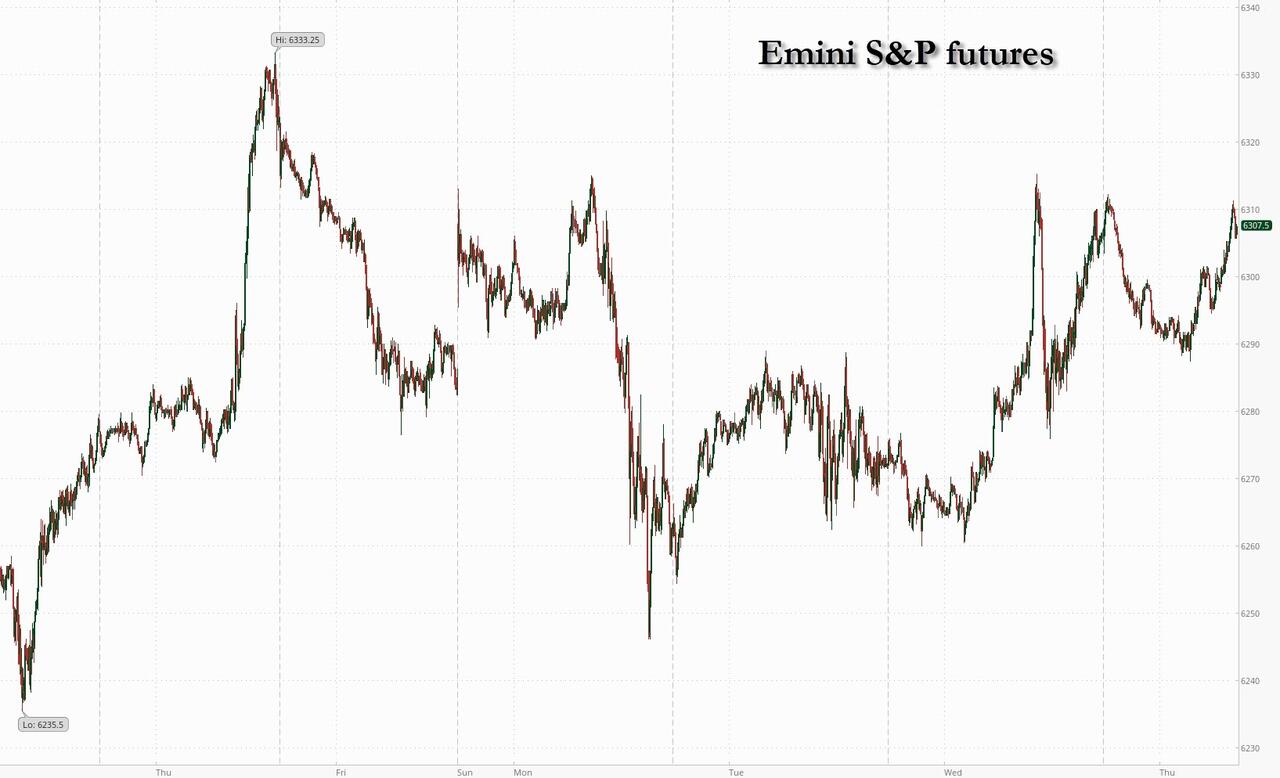
In premarket trading, Mag 7 stocks are mixed (Tesla +1%, Nvidia +0.9%, Meta little changed, Microsoft -0.1%, Alphabet -0.07%, Amazon -0.3%, Apple -0.5%).
- MP Materials (MP) soars 42% after the company struck a multi-billion dollar public-private deal with the US Department of Defense to build a new magnet plant and expand rare earth capabilities, backed by $400m in equity and a $1b loan commitment.
- Conagra Brands (CAG) falls 4% after the packaged food manufacturer posted 4Q sales that disappointed.
- Delta Air Lines Inc. (DAL) rises 12% after the carrier issued a new profit target for this year after pulling the goal three months ago.
- Embraer (ERJ) ADRs fall 6% after President Donald Trump said he will impose 50% tariffs on goods from Brazil.
- Mach Natural Resources (MNR) shares are halted for news pending.
- Mereo BioPharma Group (MREO) US-traded shares slide 34% and partner Ultragenyx Pharmaceuticals (RARE) drops 22% following a disappointing trial update for an experimental drug aimed at treating a bone disorder called osteogenesis imperfecta.
- WK Kellogg (KLG) rises 51%, with Ferrero International SA said to be nearing a deal to acquire it for about $3 billion. Shares first jumped after the WSJ reported Wednesday that the two companies are nearing a deal.
While tariff headlines have dominated the newsflow this week, there’s been little to derail a rally in US stocks. Signs of economic strength, confidence in the upcoming earnings season and optimism for artificial intelligence have given traders the conviction to keeping buying equities.
“The market’s sensitivity toward tariffs has diminished,” said Marija Veitmane, senior multi-asset strategist at State Street Global Markets. “The key driver of equity returns for us has been and remain corporate earnings, particularly in the IT sector, and here policy and trade uncertainty have not caused too much damage.”
US President Donald Trump issued a fresh batch of tariff demands on Wednesday, including a 50% rate on Brazil that sent the real tumbling. He also confirmed that the US would begin levying a 50% tariff on copper next month.
Meanwhile, sentiment got a boost from China, where a gauge of property shares jumped the most in nearly nine months, fueled by speculation a high-level meeting will be held next week to help revive the struggling sector.
Overnight, Goldman Sachs warned against loading up on stocks exposed to the economic cycle, while also recommending investors don’t be overly defensive. Trade war uncertainty is rife, with Goldman cautioning against one-sided allocation. “The equity market appears to be pricing an optimistic outlook for the US economy, but we believe there are risks in both directions and investors should not be clearly cyclical or defensive,” strategists including Ryan Hammond said. Within defensives, Goldman recommends investors own utilities and real estate, which typically benefit most from lower bond yields. In terms of cyclicals, the strategists favor basic materials versus energy on the expectation of lower oil prices.
Katharine Neiss, chief European economist at PGIM Fixed Income, warns that the average US tariff rate could ultimately exceed current expectations of “a shade above 10%.”
“There is still a huge amount of uncertainty and I don’t expect that it’s going to get resolved,” Neiss told Bloomberg TV. “These negotiations are going to drift, maybe by the time we get to the end of the year. That’s kind of bad news because the uncertainty itself is depressing decisions.”
LME copper rose 1% on Thursday, snapping a five-day losing streak. The metal gained 1.9% in New York, extending an advance to more than 11% since Monday, the day before Trump first floated the size of the tariff.
The Stoxx 600 is up 0.6% tracking their longest winning streak in a month, as miners rally on the back of higher iron ore prices. Swiss chocolatier Barry Callebaut sinks after once again cutting its guidance, while advertising group WPP ekes out gains after Wednesday’s plunge as it announced new CEO. Local bourses are led by UK FTSE 100, where mining stocks lead a 1% gain tracking gains across the metals complex. Here are the biggest movers Thursday:
- European miners are the best-performing sector in the Stoxx 600 index as iron ore headed for the highest close since May amid renewed optimism over China’s determination to eradicate industrial overcapacity
- WPP shares rise as much as 3.6% on Thursday, recouping some of Wednesday’s record drop, after the advertising agency announced that Microsoft executive Cindy Rose will be its next CEO, replacing Mark Read
- Stocks with a heavy exposure to China gain in European trading on optimism in the country’s media regarding potential fiscal stimulus, with a UBS basket of European stocks exposed to China rises as much as 1.7%
- Liontrust Asset Management rises as much as 7.7%, the most in over two months, after its trading update offered few surprises following recent annual results. Peel Hunt upgraded the stock due to recent weakness
- LISI shares rise as much as 7.7%, to the highest since January 2018, after private investment firm SK Capital submitted a firm offer for its medical division, according to a statement released after market close Wednesday
- Tecan shares gain as much as 6.5% after the Swiss laboratory equipment maker said Monica Manotas — who previously worked at Thermo Fisher Scientific — will replace Achim von Leoprechting as CEO
- Europris shares gain as much as 7.2%, the most since 2022 and taking the stock to a record high, after the Norwegian retail group reported its latest second-quarter results. DNB Carnegie sees a “strong” report
- Barry Callebaut falls as much as 10% in early trading, the most in three months, after the chocolate bulk maker cut its guidance for the second time in three months following a miss in volumes led by North America
- Grafton shares fall as much as 8%, their steepest decline in three years, after the building supply retailer and manufacturer failed to confirm its guidance for the year in a trading update that analysts called cautious
- Kemira falls as much as 6.1% after the Finnish pulp and energy equipment group released preliminary 2Q results and cut its guidance for 2025. Analysts said the report is bound to trigger smaller estimate revisions
- Johnson Service Group shares drop as much 18%, the most since May 2020, after the British textile rental and cleaning provider published a trading update that RBC described as weaker than expected
- Icade falls as much as 5.7% to the lowest in almost three months after Goldman Sachs downgraded the French commercial property investor to sell from neutral, citing sluggish growth in France and a weakening office market
- Macfarlane Group plummets as much as 15%, the most in over five years, after the company reduced its outlook and warned it expects annual adjusted operating profits to be about 10% lower than last year
Earlier in the session, Asian equities edged higher, with South Korean shares climbing following the central bank’s decision to leave its policy rate unchanged. Japanese stocks underperformed as the yen rose, while concerns remained about US tariffs. Key gauges advanced in Indonesia, Australia, Vietnam and Taiwan. The MSCI Asia Pacific Index traded in a narrow range, with TSMC and SK Hynix the biggest boosts, and Sony and Nintendo among the major drags. Stocks advanced across much of the region, amid broad optimism over trade talks with the US. South Korea led gains as investors welcomed news that the Bank of Korea is keeping its monetary policy accommodative. The benchmark Kospi rose 1.6%, advancing for a fourth-consecutive session. Chinese shares staged a late afternoon rally, fueled by speculation a high-level meeting will be held next week to help revive the struggling property sector. The jump followed unverified social media reports of a potential meeting, which analysts said sparked speculation of a possible resumption in the development of shanty-town areas.
In FX, the Bloomberg Dollar Spot Index slips 0.1%, with the Swiss franc leading G-10 losses as it edges lower against the greenback. The Norwegian krone outperforms, climbing 0.5% after core inflation rose for the first time in four months. The Aussie dollar also gains, buoyed by the rally in iron ore.
In rates, treasuries are lower, paring some of Wednesday’s advance ahead of a sale of 30-year bonds. US 10-year yields rise 2 bps to 4.35%. Bunds edge lower. Gilts curve flattens, with longer-dated maturities rising while the front end drops. The last of this week’s three coupon sales follows good results for 3- and 10-year note auctions. For the 30-year TSY reopening at 1pm New York time, WI yield near 4.875% is ~3bp cheaper than last month’s auction, which stopped through by 1.5bp
In commodities, spot gold climbs $15 to around $3,328/oz. WTI falls 0.4% to near $68.10 a barrel. Iron ore futures are up over 3% in Singapore and heading for the highest close since May amid renewed optimism over China’s determination to eradicate industrial overcapacity. LME copper climbs 0.5%. Bitcoin rises 0.4% and above $111,000.
Looking at today’s calendar, US economic data slate includes weekly jobless claims at 8:30am. Fed speaker slate includes Musalem (9am) and Daly (2:30pm)
Market Snapshot
- S&P 500 mini -0.2%
- Nasdaq 100 mini -0.1%
- Russell 2000 mini -0.1%
- Stoxx Europe 600 +0.6%
- DAX +0.2%, CAC 40 +0.7%
- 10-year Treasury yield +2 basis points at 4.35%
- VIX +0.1 points at 16.06
- Bloomberg Dollar Index little changed at 1195.51
- euro little changed at $1.1731
- WTI crude -0.3% at $68.16/barrel
Top Overnight News
- Trump announced a 50% tariff for Brazil and to initiate a Section 301 investigation on Brazil due to its “continued attacks on the Digital Trade activities of American Companies”.
- Trump announced a 50% tariff on copper effective August 1st after receiving a robust national security assessment, while he noted that copper is necessary for semiconductors, aircraft, ships, ammunition, data centres, lithium-ion batteries, radar systems, missile defence systems, and hypersonic weapons.
- South Korea Trade Minister says more time is needed for US trade talks; US expresses interest around cooperation in chips and shipbuilding.
Trade/Tariffs
- EU is discussing car import quotas and export credits with the US in trade talks, according to sources cited by Reuters.
- Indonesia’s Economy Minister said tariff discussions with US Commerce Secretary Lutnick and US Trade Representative Greer went positively. It was later reported that Indonesia and the US agreed to intensify tariff negotiations within three weeks to achieve optimal outcomes for both parties, while negotiations cover tariffs, non-tariff barriers, digital economy and commercial partnerships, according to the Economy Ministry.
- Philippine Economic Affairs Minister said they are concerned the US decided to impose 20% tariffs on Philippine exports and officials are to fly next week for talks with US counterparts,
- Indian Trade Official says Indian trade delegation to visit US soon for further trade talks.
- Vietnam said to be preparing new rules and penalties to crack down on trade fraud and illegal transhipments; focused inspections on Chinese products which face high tariffs in the US.
- South Korea Trade Minister says more time is needed for US trade talks; US expresses interest around cooperation in chips and shipbuilding.
A more detailed look at global markets courtesy of Newsquawk
APAC stocks traded with a mostly positive bias following the gains on Wall St although some of the upside was limited as participants digested the latest batch of tariff letters and with underperformance in Japan due to recent currency strength. ASX 200 gained with the index led by strength in mining names due to recent upside in metal prices. Nikkei 225 bucked the trend amid headwinds from a firmer currency and following somewhat ambiguous Japanese PPI data. KOSPI outperformed despite the BoK’s widely expected rate pause, while the central bank’s language remained dovish as it maintained the rate cut stance and a majority of members were open to a cut in the three months ahead. Hang Seng and Shanghai Comp were marginally positive in quiet trade with little fresh macro drivers, although China’s State Council recently issued a notice on stepping up support for employment and will support enterprises in stabilising jobs. TSMC (2330 TT) Q2 (TWD): Revenue 933.8bln (exp. 927.8bln), via a Reuters calculation; YTD sales +40% Y/Y, June sales +26.9% Y/Y.
Top Asian News
- BoK kept the base rate unchanged at 2.50%, as expected, with the rate decision unanimous, while it stated that it will maintain the rate cut stance to mitigate downside risks to economic growth and will adjust the timing and pace of any further base rate cuts. BoK said consumption is expected to gradually recover due to an improvement in economic sentiment and the supplementary budget but noted significant uncertainties concerning the pace of recovery in domestic demand and that future economic growth faces significant uncertainties concerning developments in trade negotiations with the US. BoK said it is to closely monitor changes in domestic and external policy environments and will examine the impact on inflation and financial stability. Furthermore, BoK Governor Rhee revealed that four board members were open to a rate cut in the next three months and two members saw the policy rate unchanged in the next 3 months, while he added that uncertainty is too high to say when to lower the interest rate and by how much.
- Gauge of Chinese property shares posting largest gain in nine months amid speculation a high-level meeting will be held next week to help revive the property sector, according to Bloomberg.
- BoJ Osaka Branch Manager says there is no big impact from US tariffs seen on Kansai Western Japan’s economy for now; wage hike momentum likely to be sustained.
- BoJ’s Nagoya Branch Manager says some firms are putting off capex plans. Auto exports to N. America are solid given robust demand, tariff impact is extremely high.
- Shanghai Securities Times, on Chinese CPI, reports “experts interviewed believe that CPI is expected to improve and show a trend of mild recovery from a low level”.
European bourses began with modest gains, upside that has gradually and incrementally increased across the morning, Euro Stoxx 50 +0.3%. Region deriving strength from the boost seen in China-related stocks on recent reports around housing support. A narrative that has led to outperformance in the FTSE 100 +1.1%, given the large number of mining names in the region and associated benefit from touted China housing construction support. Sectors opened entirely firmer, though a few have drifted slightly into the red. Basic Resources lead, given the mentioned China stimulus. Tech benefits with ASML bolstered alongside gains in NVDIA on Wednesday and after TSMC revenue beat consensus. Those in the red are the more defensive ones, with Utilities currently lagging marginally.
Top European News
- NBP’s Wnorowski says another 25bps move is possible in September. Possible that there will only be one more rate adjustment in 2025.
- EU’s von der Leyen survives no-confidence vote in EU parliament (as expected).
FX
- DXY contained but with a mild upward bias in a 97.271-97.469 range, vs Tuesday’s 97.176-97.837 band. Specifics light thus far. On the Fed, ING wrote “Things can change a lot in the next three weeks, and our baseline call remains that the dollar will show significantly reduced interest in tariff noise. Data remains a bigger driver, and the potential FX impact of next week’s CPI figures still looks much bigger than trade news.”
- EUR similarly uneventful in a thin 1.1715 to 1.1749 band, within Tuesday’s 1.1682-1.1765. Commentary this morning includes European Commission President von der Leyen saying they are working non-stop to find a US agreement, to keep tariffs as low as possible.
- Havens flat. JPY and CHF contained in thin ranges. USD/JPY holding just above 146.00 but has been on either side of the figure at points. No move to Japanese PPI or remarks from various BoJ branch managers.
- Sterling a touch firmer despite a lack of newsflow, Cable in a 1.3587-1.3619 range at the time of writing, matching Wednesday’s high before pulling back a touch. Ahead, BoE’s Breeden scheduled on financial stability.
- Antipodeans firmer, AUD bolstered by ongoing gains in iron and copper prices with support emanating from speculation that a high-level meeting will be held next week to help revive the Chinese property sector, according to Bloomberg.
- Finally, the BRL lagged after Trump announced 50% tariffs and a Section 301 investigation.
- PBoC set USD/CNY mid-point at 7.1510 vs exp. 7.1757 (Prev. 7.1541)
Fixed Income
- A contained start to the day, awaiting fresh trade updates. USTs in a narrow 11-06+ to 111-13+ band, the upper point is a marginal WTD high. Resistance ahead at 111-28, 111-20+ and 112-12+ from last week.
- Ahead, aside from Fed speak and a few data points, 30yr supply rounds off the week’s outings. A tap that follows relatively average 3yr and 10yr issuance this week, with no sustained move spurred by US supply thus far.
- EGBs opened near-enough at highs and have been drifting since with specifics light aside from digestion of overnight trade updates. For Bunds, the peak is 130.08 and the benchmark is now down toward the 129.73 low, essentially flat on the day. No move to Final German CPI, unrevised.
- Gilts outperform, though are off best. Gapped higher and then lifted to a 92.19 peak early doors, seemingly a function of Gilts catching up to the strength seen in peers late-Wednesday. Since, with newsflow light from a few updates out of the ongoing US-France state visit (press conference expected later today), the benchmark has begun to conform to the gradual drift seen in above peers.
- Poland is considering JPY and CHF bonds, according to the Polish debt chief
Commodities
- Base metals firmer on Chinese stimulus hopes, amid speculation that a high-level Chinese meeting will be held next week to help revive the property sector.
- 3M LME Copper trades in a USD 9,635.20-9,711.15/t range at the time of writing., firmer but just off highs and back below the USD 9.7k mark.
- Precious metals also firmer, though gains are slightly more modest. XAU at a USD 3330/oz peak, seemingly deriving some further impetus above the USD 3.3k mark, benefitting from the contained USD with specifics otherwise very light thus far.
- WTI and Brent are in the red, came under a bout of pressure in the European morning though the magnitude of it keeps the benchmark within recent ranges. No move to remarks from the OPEC SecGen or the 2050 outlook from the organisation. Pressure this morning potentially a function of some constructive geopols, after President Trump said there is a chance this week or next of a Gaza ceasefire.
- WTI resides at the lower end of a USD 67.91-68.57/bbl range, similarly Brent in a USD 69.82-70.42/bbl.
- OPEC cuts world oil demand forecast for 2026-2029, peak demand not on the horizon.
Geopolitics: Middle East
- Senior Israeli official said a Gaza ceasefire deal with Hamas may be possible within a week or two weeks but not in a day’s time, while Israel will offer a temporary ceasefire and if Hamas does not lay down its arms, Israel would proceed with military operations. Furthermore, the official said Israeli intelligence showed that before strikes on Iran, its enriched uranium was in Fordo, Natanz and Isfahan sites, while it has stayed there and has not been moved.
Geopolitics: Ukraine
- US military is delivering artillery shells and mobile rocket artillery missiles to Ukraine, according to officials cited by Reuters.
- US State Department senior official confirmed that Secretary of State Rubio will meet with Russia’s Foreign Minister Lavrov on Thursday on the sidelines of ASEAN.
- Drone said to have landed in the territory of Lithuania from Belarus. “Could be a jammed and diverted drone from this night’s Russian assault against Ukraine, could also be a separate provocation, few details available”, via a Lithuanian journalist on X.
US Event Calendar
- 8:30 am: Jul 5 Initial Jobless Claims, est. 235k, prior 233k
- 8:30 am: Jun 28 Continuing Claims, est. 1,965k, prior 1,964k
Central Banks (All Times ET):
- 9:00 am: Fed’s Musalem Speaks on U.S. Economy and Monetary Policy
- 2:30 pm: Fed’s Daly Speaks on U.S. Economic Outlook
DB’s Jim Reid concludes the overnight wrap
Optimism largely returned to markets yesterday, even as the lingering threat of further US tariffs on August 1 remained in the background. Indeed, a tech-led rebound helped the S&P 500 (+0.61%) to stabilise after its losses at the start of the week, whilst the NASDAQ (+0.94%) and the German DAX (+1.42%) hit an all-time high. In fact, there was a significant milestone, as Nvidia (+1.80%) became the first company to surpass a $4tn market cap on an intraday basis, before closing just shy of that at $3.974tn. So for everything else that’s happening right now, from tariffs to fiscal fears, AI is the great hope for US exceptionalism to return. The rally also got a further boost as lower bond yields meant that fears eased about the fiscal situation, and a strong auction helped the 10yr Treasury yield (-6.7bps) to finally decline after 5 consecutive gains. So it was a strong day all round, even if there wasn’t really a fresh catalyst to drive things higher.
However, just when you thought it was safe to emerge from the July 9th tariff deadline day, we’ve had a fresh set of announcements after the US close that signalled a more aggressive stance. First, Trump confirmed overnight that the 50% copper tariff will come into place on August 1, which is an important one given its applications across various products. And second, he announced a 50% tariff on goods from Brazil, which is significant as it broke with the trend of tariffs being broadly in line with the Liberation Day levels set on April 2. Indeed, Brazil had a 10% tariff at that time, so that’s a notable escalation, and it follows Trump’s threats to place higher levies on the BRICS over recent days. So that meant the Brazilian Real weakened by -2.29% against the US Dollar yesterday, its biggest decline since April 4 amidst the turmoil after Liberation Day. We also heard about several other countries, but the Philippines was the only other in the US’ top 50 trading partners, and they were given a 20% rate.
Meanwhile on the fiscal side, there was a lot of attention on a 10yr Treasury auction yesterday given recent fears around the fiscal situation, but strong demand meant that yields continued to fall. So it helped to push back against concerns that demand for longer-dated bonds was waning. The auction saw $39bn of notes sold, and were awarded at 4.362% versus a 4.365% yield at the bidding deadline. The bid-to-cover was 2.61, above the average of the last six similar auctions (2.57). So attention will now focus on the 30yr auction later today.
That Treasury rally continued after the auction as the Fed minutes from the June meeting were released. They indicated a divide about how restrictive policy currently was, as well as the tariff impact on inflation going forward. With regards to the current policy stance, it said “A couple of participants noted that, if the data evolve in line with their expectations, they would be open to considering a reduction in the target range for the policy rate as soon as at the next meeting.” So given recent commentary these could likely be Fed Governors Waller and Bowman. However, the minutes also highlight that “some participants saw the most likely appropriate path of monetary policy as involving no reductions in the target range for the federal funds rate this year.” Regardless, it said “several participants commented that the current target range for the federal funds rate may not be far above its neutral level”, indicating that any easing cycle may not lower rates significantly in the coming months. This growing divergence in expectations matches the dot plot distribution we saw last month, where 10 of 19 officials pencilled in at least two rate cuts this year while 7 officials saw no cuts, and the other 2 policymakers saw one cut.
On inflation, the difference of opinion was mainly on the effect of tariffs, even as there were questions on how inflation ex-tariffs was progressing. It said “Some participants observed that services price inflation had moved down recently, while goods price inflation had risen. A few participants noted that there had been limited progress recently in reducing core inflation.” Potentially the key sticking point going forward is that “while a few participants noted that tariffs would lead to a one-time increase in prices and would not affect longer-term inflation expectations, most participants noted the risk that tariffs could have more persistent effects on inflation, and some highlighted the fact that such persistence could also affect inflation expectations.” Looking ahead, the next FOMC meeting (July 29-30) will be just before the August 1st extension date for the “reciprocal” tariffs, so policymakers may still be awaiting clarity on what the trade levies going forward could look like even as they try and measure the impact from the tariffs already in place. In addition, oral arguments to the Court of Appeals on whether the International Emergency Economic Powers Act authorises the president to impose tariffs will be heard on July 31.
Ahead of the minutes, there had been fresh pressure from the administration to cut rates, as Trump posted that “Our Fed Rate is AT LEAST 3 Points too high.” And markets did move to price in more rate cuts yesterday, with the amount expected by the December meeting up +3.9bps on the day to 53.1bps. In turn, that helped sovereign bonds to rally across the board, with the 2yr Treasury yield (-4.8bps) down to 3.843%, whilst the 10yr yield (-6.7bps) fell to 4.332%. And that was echoed in Europe too, where yields on 10yr bunds (-1.4bps), OATs (-0.9bps) and BTPs (-1.3bps) all saw modest declines.
For equities, it was also a decent session, as the S&P 500 closed +0.61% higher, following some intraday volatility. Those gains were led by the Magnificent 7 (+1.23%), and Nvidia (+1.80%) in particular, which briefly became the first company to surpass a $4tn market cap on an intraday basis. Indeed, Nvidia is already up +21.29% this year, which is well ahead of the +6.49% gain for the S&P 500 and the +3.76% for the Mag 7, even if it’s not as rapid as its growth in 2023 and 2024 at this point. But in Europe the picture was much stronger, with the STOXX 600 (+0.78%) up for a third consecutive session, whilst the DAX (+1.42%) hit a new record.
Overnight in Asia, the major equity indices have seen a mixed performance. In South Korea, the KOSPI is up +1.06%, which comes after the Bank of Korea kept interest rates at 2.5% as expected, and Governor Rhee said that four board members were open to a cut in the next three months. However, in Japan the Nikkei is down -0.43% this morning, and a 20yr government bond auction saw a bid-to-cover ratio of 3.15, which was beneath the 12-month average of 3.29.
Otherwise, the Shanghai Comp (+0.36%), the CSI 300 (+0.30%) and the Hang Seng (+0.09%) have all posted modest gains. But US equity futures are pointing in a more negative direction, with those on the S&P 500 down -0.23%.
To the day ahead now, and data releases include the US weekly initial jobless claims, and Italian industrial production for May. Central bank speakers include the Fed’s Musalem and Daly, the ECB’s Cipollone, Escriva and Villeroy, and BoE Deputy Governor Breeden. Finally, there’s a 30yr Treasury auction taking place.
2b European opening report
European bourses gain on potential China stimulus, US stocks and USD lacklustre despite trade updates – Newsquawk US Market Open

Thursday, Jul 10, 2025 – 05:58 AM
- European bourses began with modest gains and have gradually increased, largely led by reports of Chinese housing support.
- US futures are contained as newsflow has been limited, ex-China, since the overnight tariff developments.
- DXY is marginally firmer but well within Wednesday’s band, G10s flat aside from Antipodeans benefiting from metals action and China support; BRL lags on 50% tariffs
- Fixed benchmarks have been gradually drifting from overnight highs, now essentially flat
- Base metals glean on reports of Chinese stimulus, precious peers also firmer though action has been more gradual
- Looking ahead, highlights include US Weekly Claims, Chinese M2/New Yuan Loans, Speakers including Fed’s Musalem, Waller & Daly, BoE’s Breeden, Supply from the US. Earnings from Delta & Conagra Brands.
- Click for the Newsquawk Week Ahead.
1. Subscribe to the free premarket movers reports
2. Listen to this report in the market open podcast (available on Apple and Spotify)
3. Trial Newsquawk’s premium real-time audio news squawk box for 7 day
TARIFFS/TRADE
- US President Trump announced a 50% tariff for Brazil and to initiate a Section 301 investigation on Brazil due to its “continued attacks on the Digital Trade activities of American Companies”.
- US President Trump announced to impose a 50% tariff on copper effective August 1st after receiving a robust national security assessment, while he noted that copper is necessary for semiconductors, aircraft, ships, ammunition, data centres, lithium-ion batteries, radar systems, missile defence systems, and hypersonic weapons, which the US is building many of.
- EU is discussing car import quotas and export credits with the US in trade talks, according to sources cited by Reuters.
- Indonesia’s Economy Minister said tariff discussions with US Commerce Secretary Lutnick and US Trade Representative Greer went positively. It was later reported that Indonesia and the US agreed to intensify tariff negotiations within three weeks to achieve optimal outcomes for both parties, while negotiations cover tariffs, non-tariff barriers, digital economy and commercial partnerships, according to the Economy Ministry.
- Philippine Economic Affairs Minister said they are concerned the US decided to impose 20% tariffs on Philippine exports and officials are to fly next week for talks with US counterparts,
- Indian Trade Official says Indian trade delegation to visit US soon for further trade talks.
- Vietnam said to be preparing new rules and penalties to crack down on trade fraud and illegal transhipments; focused inspections on Chinese products which face high tariffs in the US.
- South Korea Trade Minister says more time is needed for US trade talks; US expresses interest around cooperation in chips and shipbuilding.
EUROPEAN TRADE
EQUITIES
- European bourses began with modest gains, upside that has gradually and incrementally increased across the morning, Euro Stoxx 50 +0.3%. Region deriving strength from the boost seen in China-related stocks on recent reports around housing support.
- A narrative that has led to outperformance in the FTSE 100 +1.1%, given the large number of mining names in the region and associated benefit from touted China housing construction support.
- Sectors opened entirely firmer, though a few have drifted slightly into the red. Basic Resources lead, given the mentioned China stimulus. Tech benefits with ASML bolstered alongside gains in NVDIA on Wednesday and after TSMC revenue beat consensus. Those in the red are the more defensive ones, with Utilities currently lagging marginally.
- Stateside, futures are contained with newsflow after the early morning tariff updates limited, ES +0.1%; attention today on Fed speak, a few data points and a handful of earnings. Thus far, the numerous trade updates seem to have been overlooked by markets, with the TACO trade in play, as we await the all-important potential EU deal.
- Click for the sessions European pre-market equity newsflow
- Click for the additional news
- Click for a detailed summary
FX
- DXY contained but with a mild upward bias in a 97.271-97.469 range, vs Tuesday’s 97.176-97.837 band. Specifics light thus far. On the Fed, ING wrote “Things can change a lot in the next three weeks, and our baseline call remains that the dollar will show significantly reduced interest in tariff noise. Data remains a bigger driver, and the potential FX impact of next week’s CPI figures still looks much bigger than trade news.”
- EUR similarly uneventful in a thin 1.1715 to 1.1749 band, within Tuesday’s 1.1682-1.1765. Commentary this morning includes European Commission President von der Leyen saying they are working non-stop to find a US agreement, to keep tariffs as low as possible.
- Havens flat. JPY and CHF contained in thin ranges. USD/JPY holding just above 146.00 but has been on either side of the figure at points. No move to Japanese PPI or remarks from various BoJ branch managers.
- Sterling a touch firmer despite a lack of newsflow, Cable in a 1.3587-1.3619 range at the time of writing, matching Wednesday’s high before pulling back a touch. Ahead, BoE’s Breeden scheduled on financial stability.
- Antipodeans firmer, AUD bolstered by ongoing gains in iron and copper prices with support emanating from speculation that a high-level meeting will be held next week to help revive the Chinese property sector, according to Bloomberg.
- Finally, the BRL lagged after Trump announced 50% tariffs and a Section 301 investigation.
- PBoC set USD/CNY mid-point at 7.1510 vs exp. 7.1757 (Prev. 7.1541)
- Click for a detailed summary
- Click for NY OpEx Details
FIXED INCOME
- A contained start to the day, awaiting fresh trade updates. USTs in a narrow 11-06+ to 111-13+ band, the upper point is a marginal WTD high. Resistance ahead at 111-28, 111-20+ and 112-12+ from last week.
- Ahead, aside from Fed speak and a few data points, 30yr supply rounds off the week’s outings. A tap that follows relatively average 3yr and 10yr issuance this week, with no sustained move spurred by US supply thus far.
- EGBs opened near-enough at highs and have been drifting since with specifics light aside from digestion of overnight trade updates. For Bunds, the peak is 130.08 and the benchmark is now down toward the 129.73 low, essentially flat on the day. No move to Final German CPI, unrevised.
- Gilts outperform, though are off best. Gapped higher and then lifted to a 92.19 peak early doors, seemingly a function of Gilts catching up to the strength seen in peers late-Wednesday. Since, with newsflow light from a few updates out of the ongoing US-France state visit (press conference expected later today), the benchmark has begun to conform to the gradual drift seen in above peers.
- Poland is considering JPY and CHF bonds, according to the Polish debt chief
- Click for a detailed summary
COMMODITIES
- Base metals firmer on Chinese stimulus hopes, amid speculation that a high-level Chinese meeting will be held next week to help revive the property sector.
- 3M LME Copper trades in a USD 9,635.20-9,711.15/t range at the time of writing., firmer but just off highs and back below the USD 9.7k mark.
- Precious metals also firmer, though gains are slightly more modest. XAU at a USD 3330/oz peak, seemingly deriving some further impetus above the USD 3.3k mark, benefitting from the contained USD with specifics otherwise very light thus far.
- WTI and Brent are in the red, came under a bout of pressure in the European morning though the magnitude of it keeps the benchmark within recent ranges. No move to remarks from the OPEC SecGen or the 2050 outlook from the organisation. Pressure this morning potentially a function of some constructive geopols, after President Trump said there is a chance this week or next of a Gaza ceasefire.
- WTI resides at the lower end of a USD 67.91-68.57/bbl range, similarly Brent in a USD 69.82-70.42/bbl.
- OPEC cuts world oil demand forecast for 2026-2029, peak demand not on the horizon.
- Click for a detailed summary
NOTABLE DATA RECAP
- UK RICS Housing Survey (Jun) -7.0 vs. Exp. -8.0 (Prev. -8.0, Rev. -7)
- UK ONS, PPI Update: “We intend to reinstate full publication of our monthly PPI and quarterly SPPI bulletins in October 2025” and “So far, the development work is progressing well”.
- UK ONS says in the week to 6 July 2025 compared with the previous week there were increases in: total Revolut debit card spending (+2% Y/Y), overall UK retail footfall (+1%). Decreases: ship visits to UK ports (-4%), flights (-3%).
- German HICP Final YY (Jun) 2.0% vs. Exp. 2.0% (Prev. 2.0%); MM (Jun) 0.1% vs. Exp. 0.1% (Prev. 0.1%)
NOTABLE EUROPEAN HEADLINES
- NBP’s Wnorowski says another 25bps move is possible in September. Possible that there will only be one more rate adjustment in 2025.
- EU’s von der Leyen survives no-confidence vote in EU parliament (as expected).
GEOPOLITICS
MIDDLE EAST
- Senior Israeli official said a Gaza ceasefire deal with Hamas may be possible within a week or two weeks but not in a day’s time, while Israel will offer a temporary ceasefire and if Hamas does not lay down its arms, Israel would proceed with military operations. Furthermore, the official said Israeli intelligence showed that before strikes on Iran, its enriched uranium was in Fordo, Natanz and Isfahan sites, while it has stayed there and has not been moved.
RUSSIA-UKRAINE
- US military is delivering artillery shells and mobile rocket artillery missiles to Ukraine, according to officials cited by Reuters.
- US State Department senior official confirmed that Secretary of State Rubio will meet with Russia’s Foreign Minister Lavrov on Thursday on the sidelines of ASEAN.
- Drone said to have landed in the territory of Lithuania from Belarus. “Could be a jammed and diverted drone from this night’s Russian assault against Ukraine, could also be a separate provocation, few details available”, via a Lithuanian journalist on X.
CRYPTO
- Bitcoin is firmer, climbing above the USD 110k handle. Specifics light, as is the case elsewhere the complex awaits updates on the trade front.
APAC TRADE
- APAC stocks traded with a mostly positive bias following the gains on Wall St although some of the upside was limited as participants digested the latest batch of tariff letters and with underperformance in Japan due to recent currency strength.
- ASX 200 gained with the index led by strength in mining names due to recent upside in metal prices.
- Nikkei 225 bucked the trend amid headwinds from a firmer currency and following somewhat ambiguous Japanese PPI data.
- KOSPI outperformed despite the BoK’s widely expected rate pause, while the central bank’s language remained dovish as it maintained the rate cut stance and a majority of members were open to a cut in the three months ahead.
- Hang Seng and Shanghai Comp were marginally positive in quiet trade with little fresh macro drivers, although China’s State Council recently issued a notice on stepping up support for employment and will support enterprises in stabilising jobs.
- TSMC (2330 TT) Q2 (TWD): Revenue 933.8bln (exp. 927.8bln), via a Reuters calculation; YTD sales +40% Y/Y, June sales +26.9% Y/Y.
NOTABLE ASIA-PAC HEADLINES
- BoK kept the base rate unchanged at 2.50%, as expected, with the rate decision unanimous, while it stated that it will maintain the rate cut stance to mitigate downside risks to economic growth and will adjust the timing and pace of any further base rate cuts. BoK said consumption is expected to gradually recover due to an improvement in economic sentiment and the supplementary budget but noted significant uncertainties concerning the pace of recovery in domestic demand and that future economic growth faces significant uncertainties concerning developments in trade negotiations with the US. BoK said it is to closely monitor changes in domestic and external policy environments and will examine the impact on inflation and financial stability. Furthermore, BoK Governor Rhee revealed that four board members were open to a rate cut in the next three months and two members saw the policy rate unchanged in the next 3 months, while he added that uncertainty is too high to say when to lower the interest rate and by how much.
- Gauge of Chinese property shares posting largest gain in nine months amid speculation a high-level meeting will be held next week to help revive the property sector, according to Bloomberg.
- BoJ Osaka Branch Manager says there is no big impact from US tariffs seen on Kansai Western Japan’s economy for now; wage hike momentum likely to be sustained.
- BoJ’s Nagoya Branch Manager says some firms are putting off capex plans. Auto exports to N. America are solid given robust demand, tariff impact is extremely high.
- Shanghai Securities Times, on Chinese CPI, reports “experts interviewed believe that CPI is expected to improve and show a trend of mild recovery from a low level”.
DATA RECAP
- Japanese Corp Goods Price MM (Jun) -0.2% vs. Exp. -0.2% (Prev. -0.2%, Rev. -0.1%); YY (Jun) 2.9% vs. Exp. 2.9% (Prev. 3.2%, Rev. 3.3%)
2c Asian opening report
Europe primed for a firmer open, EU said to be talking car import quotas; US confirms copper tariff – Newsquawk Europe Market Open
Thursday, Jul 10, 2025 – 01:57 AM
- US President Trump announced tariff rates for seven countries and later announced a 50% tariff for Brazil; President Trump also announced the US is to impose a 50% tariff on copper, effective August 1st.
- The EU is discussing car import quotas and export credits with the US in trade talks, according to sources cited by Reuters.
- A muted reaction was seen across markets following the FOMC minutes; FOMC Minutes stated that most saw some reduction in the Fed funds rate this year as appropriate.
- European equity futures indicate a mildly higher cash market open with Euro Stoxx 50 futures up 0.2% after the cash market closed with gains of 1.4% on Wednesday.
- Looking ahead, highlights include German CPI final, Norwegian CPI, Swedish GDP, US Weekly Claims, Chinese M2/New Yuan Loans, OPEC WOO, Speakers including Fed’s Musalem, Waller & Daly, ECB’s Cipollone & BoE’s Breeden, Supply from US, Earnings from Delta & Conagra Brands.
SNAPSHOT
Newsquawk in 3 steps:
1. Subscribe to the free premarket movers reports
2. Listen to this report in the market open podcast (available on Apple and Spotify)
3. Trial Newsquawk’s premium real-time audio news squawk box for 7 day
US TRADE
EQUITIES
- US stocks edged higher to track the gains in their European counterparts despite peaking around the US open, with a second wind seen in the latter half of trade.
- The sectors were predominantly in the green and were led by Utilities, Communication and Technology, with NVIDIA (NVDA) responsible for some of the upside after it became the first company in history to hit the USD 4tln market cap intraday.
- SPX +0.61% at 6,263, NDX +0.72% at 22,865, DJI +0.49% at 44,458, RUT +1.07% at 2,252.
- Click here for a detailed summary.
TARIFFS/TRADE
- US President Trump announced tariff rates for seven countries including the Philippines which was set at 20%, while the tariff rates for Brunei and Moldova were set at 25%, and the tariff rates for Algeria, Iraq, Libya and Sri Lanka were set at 30%. President Trump later announced a 50% tariff for Brazil and to initiate a Section 301 investigation on Brazil due to its “continued attacks on the Digital Trade activities of American Companies”.
- US President Trump announced to impose a 50% tariff on copper effective August 1st after receiving a robust national security assessment, while he noted that copper is necessary for semiconductors, aircraft, ships, ammunition, data centres, lithium-ion batteries, radar systems, missile defence systems, and hypersonic weapons, which the US is building many of.
- EU is discussing car import quotas and export credits with the US in trade talks, according to sources cited by Reuters.
- Indonesia’s Economy Minister said tariff discussions with US Commerce Secretary Lutnick and US Trade Representative Greer went positively. It was later reported that Indonesia and the US agreed to intensify tariff negotiations within three weeks to achieve optimal outcomes for both parties, while negotiations cover tariffs, non-tariff barriers, digital economy and commercial partnerships, according to the Economy Ministry.
- Philippine Economic Affairs Minister said they are concerned the US decided to impose 20% tariffs on Philippine exports and officials are to fly next week for talks with US counterparts,
FOMC MINUTES
- FOMC Minutes stated that most saw some reduction in the Fed funds rate this year as appropriate and a couple said they would be open to considering a cut as soon as July if data evolved as they expected. However, some saw the most likely appropriate path would involve no rate cuts in 2025, while those participants cited recent elevated inflation readings, elevated business and consumer inflation expectations, and ongoing economic resilience. Furthermore, several said the current Fed funds rate may not be far above its neutral rate and all participants viewed it as appropriate to maintain the Fed funds rate at the current target range.
- A muted reaction was seen across markets following the FOMC minutes.
NOTABLE HEADLINES
- US President Trump said they should have the lowest interest rates.
APAC TRADE
EQUITIES
- APAC stocks traded with a mostly positive bias following the gains on Wall St although some of the upside was limited as participants digested the latest batch of tariff letters and with underperformance in Japan due to recent currency strength.
- ASX 200 gained with the index led by strength in mining names due to recent upside in metal prices.
- Nikkei 225 bucked the trend amid headwinds from a firmer currency and following somewhat ambiguous Japanese PPI data.
- KOSPI outperformed despite the BoK’s widely-expected rate pause, while the central bank’s language remained dovish as it maintained the rate cut stance and a majority of members were open to a cut in the three months ahead.
- Hang Seng and Shanghai Comp were marginally positive in quiet trade with little fresh macro drivers, although China’s State Council recently issued a notice on stepping up support for employment and will support enterprises in stabilising jobs.
- US equity futures pulled back following the prior day’s choppy but positive performance as tariff updates remained in focus.
- European equity futures indicate a mildly higher cash market open with Euro Stoxx 50 futures up 0.2% after the cash market closed with gains of 1.4% on Wednesday.
FX
- DXY traded rangebound after the prior day’s inconclusive performance as Trump trade letters continued to roll out but with strong gains seen against BRL with President Trump announcing a 50% tariff rate for Brazil and to initiate a Section 301 investigation on Brazil. Furthermore, attention was also on the release of the latest FOMC Minutes although it proved to be a non-event and spurred little reaction.
- EUR/USD slightly edged higher after yesterday’s rebound from support near the 1.1700 level but with further upside limited amid ongoing trade uncertainty, while the EU is reportedly discussing car import quotas and export credits with the US in trade talks.
- GBP/USD just about reverted to 1.3600 territory following recent choppy price action and amid a lack of pertinent drivers.
- USD/JPY initially continued its recent pullback and briefly fell to sub-146.00 territory before paring the moves, while there was a lack of surprises from the latest Japanese PPI data which matched estimates on a M/M and Y/Y basis.
- Antipodeans remained afloat in uneventful trade amid light catalysts and the absence of tier-1 data releases.
- PBoC set USD/CNY mid-point at 7.1510 vs exp. 7.1757 (Prev. 7.1541)
FIXED INCOME
- 10yr UST futures held on to the prior day’s spoils after steadily advancing amid short-covering and Trump tariff letters.
- Bund futures lingered around the 130.00 level amid trade uncertainty and as German final CPI data loomed.
- 10yr JGB futures were little changed following the lack of surprises in Japanese PPI data but eked out slight gains in the aftermath of a relatively uneventful 20yr JGB auction.
COMMODITIES
- Crude futures lacked direction after recent EIA data, commentary on Russia sanctions, and Gaza ceasefire hopes.
- Spot gold marginally extended on yesterday’s resurgence from beneath the USD 3,300/oz level.
- Copper futures remained underpinned after US President Trump confirmed to impose 50% tariffs on copper from August 1st.
- Chile’s Foreign Minister said they do not know the precise scope of copper tariffs from the US as it has not yet been reflected in an executive order.
CRYPTO
- Bitcoin was choppy and took a breather after briefly surging to a fresh record high above the USD 112k level.
NOTABLE ASIA-PAC HEADLINES
- BoK kept the base rate unchanged at 2.50%, as expected, with the rate decision unanimous, while it stated that it will maintain the rate cut stance to mitigate downside risks to economic growth and will adjust the timing and pace of any further base rate cuts. BoK said consumption is expected to gradually recover due to an improvement in economic sentiment and the supplementary budget but noted significant uncertainties concerning the pace of recovery in domestic demand and that future economic growth faces significant uncertainties concerning developments in trade negotiations with the US. BoK said it is to closely monitor changes in domestic and external policy environments and will examine the impact on inflation and financial stability. Furthermore, BoK Governor Rhee revealed that four board members were open to a rate cut in the next three months and two members saw the policy rate unchanged in the next 3 months, while he added that uncertainty is too high to say when to lower the interest rate and by how much.
DATA RECAP
- Japanese Corp Goods Price MM (Jun) -0.2% vs. Exp. -0.2% (Prev. -0.2%, Rev. -0.1%); YY (Jun) 2.9% vs. Exp. 2.9% (Prev. 3.2%, Rev. 3.3%)
GEOPOLITICS
MIDDLE EAST
- Senior Israeli official said a Gaza ceasefire deal with Hamas may be possible within a week or two weeks but not in a day’s time, while Israel will offer a temporary ceasefire and if Hamas does not lay down its arms, Israel would proceed with military operations. Furthermore, the official said Israeli intelligence showed that before strikes on Iran, its enriched uranium was in Fordo, Natanz and Isfahan sites, while it has stayed there and has not been moved.
- Hamas said it has agreed to release ten hostages under Gaza ceasefire talks efforts, while the points still being negotiated are the flow of aid, withdrawal of Israel from the Gaza Strip and ‘genuine guarantees’ for a permanent ceasefire.
- US President Trump said regarding a Gaza ceasefire that they have a chance this week or next week and there is a very good chance of a settlement this week on Gaza.
- A secret White House meeting between US Envoy Witkoff, Israel’s Dermer, and a Qatari envoy on Tuesday led to significant progress in the negotiations over the Gaza hostage and ceasefire deal, according to Axios’ Ravid.
RUSSIA-UKRAINE
- Ukrainian President Zelensky said he had a “substantive” conversation with US Special Envoy Kellogg.
- US President Trump said they will take a look at sending another patriot system to Ukraine and he is not happy about what’s going on in Ukraine.
- US military is delivering artillery shells and mobile rocket artillery missiles to Ukraine, according to officials cited by Reuters.
- US House Speaker Johnson reiterated he is in favour of Congress putting new sanctions on Russia, according to Punchbowl.
- US State Department senior official confirmed that Secretary of State Rubio will meet with Russia’s Foreign Minister Lavrov on Thursday on the sidelines of ASEAN.
EU/UK
DATA RECAP
- UK RICS Housing Survey (Jun) -7.0 vs. Exp. -8.0 (Prev. -8.0, Rev. -7)
3 .ASIA
3A NORTH KOREA/SOUTH KOREA
3B JAPAN/SOUTH KOREA
3C CHINA
CHINA/PROPERTY
This will put good money after bad.
(zerohedge)
China Property Stocks Erupt On Rumors Beijing May Revive 2015 Stimulus Playbook
Thursday, Jul 10, 2025 – 09:05 AM
Chinese property equities surged overnight, with the Bloomberg Intelligence real estate index jumping as much as 11%, fueled by speculation of an imminent high-level government meeting aimed at reviving the country’s struggling real estate sector.
Unverified reports suggest Beijing may assemble a policy conference next week reminiscent of the 2015 Central Urban Work Conference, which triggered large-scale shanty-town redevelopment and infrastructure stimulus.
Since the founding of the republic in 1949, Chinese senior leadership held only four “urban work conferences” at the central government level: 1962, 1963, 1978, and 2015. Thus, if the reports turned out to be true, it would be closely watched by the market given policy direction implications,” Goldman Sachs analyst Fred Yin told clients.
China’s property sector has been locked in a downward spiral for the past four years. Major developers have defaulted on their debt, while Beijing has cracked down on speculation amid persistently weak sentiment among homebuyers. Although officials have implemented a range of countermeasures (read: here) to slow the decline, none have successfully established a bottom. Home sales fell again in June, prompting renewed calls for stimulus. This report suggests a potential shift in policy direction from President Xi Jinping, signaling mounting political pressure.
Hao Hong, chief investment officer at Lotus Asset Management, noted, “The central government really needs to do something, especially after the disastrous June sales.”
In markets, the Bloomberg Intelligence index of the nation’s real estate stocks jumped 11%, while Goldman’s China-H Real Estate basket gained 7.4%. Individual stocks, Logan Group Co. skyrocketed 85% in Hong Kong, and Sino-Ocean Group Holding Ltd soared 37%.
Reports that Beijing is considering dusting off its 2015 playbook to support the property market imply President Xi’s leadership is attempting to quell growing dissent. The larger question is whether another shanty-town redevelopment stimulus package will have the same effect as it did a decade ago.
4. EUROPEAN AFFAIRS
UK
Octopus Energy claims zonal pricing could save UK billions in dollars.
(zerohedge)
Octopus Energy CEO Slams “Gaslighting” In UK Power Market Debate
Thursday, Jul 10, 2025 – 07:20 AM
- Octopus Energy founder Greg Jackson alleges that established energy companies are using “gaslighting” tactics and aggressive lobbying to maintain the current national electricity pricing model.
- Jackson advocates for zonal pricing, arguing it would save consumers at least £3.7 billion annually and align the UK with other OECD countries, despite claims that his company’s tech arm, Kraken, would benefit from increased complexity.
- The government is expected to decide soon on whether to split up the UK’s power market, with Jackson committed to continuing his fight for zonal pricing regardless of the outcome.
Octopus Energy founder Greg Jackson has accused his opponents of “gaslighting” ahead of an imminent decision by ministers on whether to split up the UK’s power market.

Prime Minister Sir Keir Starmer is expected to draw a line under the zonal pricing debate as early as this week after months of increasingly fierce lobbying from both sides.
It is understood the government is leaning towards keeping the status-quo in a victory for Jackson’s opposition, which include Scottish renewable power giant SSE, the trade association RenewableUK and key unions.
In an interview on Friday, the British businessman told City AM he hadn’t understood “what gaslighting was” until this campaign.
“Someone in Number 10 said to me this was the most aggressive lobbying campaign he had ever seen,” he said. “Honestly, the reality is consumers don’t have as many lobbyists as incumbents. That’s what you’ve seen here.”
Jackson has accused incumbent electricity suppliers of having a “vested interest” in keeping the current system, the national pricing model which keeps electricty rates uniform across the UK. They argue shifting to zonal would threaten infrastructure investment at a crucial time in the race to decarbonise the grid.
“In the past they’ve always had their own way,” Jackson said. “They can do it in the backroom and no one’s voicing what this means for consumers.
“Whether we win or lose this, what’s been played out in public and the reason it has been so ferocious is that those organisations… don’t like being challenged.”
Critics of the UK’s largest energy supplier though have questioned its own interest in zonal pricing. There is speculation that the firms’ tech arm Kraken, currently rumoured to be subject of a £10bn demerger plan, would benefit from the greater complexity created by a zonal energy market.
“What has been briefed is that Kraken makes money per trade and there would be more trades in a zonal market. It’s fundamentally false,” Jackson responded when questioned on the claims.
“Kraken doesn’t make any money per trade, it is a fixed license fee depending on the number of customers or number of gigawatts per hour, so the market structure makes no difference.”
He added: “The reality is we’ve probably lost business on Kraken because some of the incumbents are not so keen on dealing with us due to us challenging them like this.”
The energy tycoon’s opposition has also attacked his access to Whitehall. Official records show Octopus held meetings with energy ministers on 16 occasions in the six months after Labour’s election. He also holds a seat on the board advising Labour on its industrial strategy.
“I’ve had two meetings with senior ministers on zonal pricing,” Jackson told City AM. “I’d like to see the meetings the various lobbyists against zonal have had because my understanding is it is going to be five or ten times more than we had.”
What next for Octopus Energy?
The boss of Octopus is clear he intends to keep banging the drum for zonal pricing, whichever way the government goes.
He argues taking on the policy would bring the UK in line with other countries while saving at least £3.7bn per year. He has the backing of Ofgem’s chief executive, Jonathan Brearley.
“It is the norm in the OECD, this idea that it is somehow complicated is utter nonsense. If more than half of it in the OECD is done this way, I think Britain could do it.
“There’s still a chance that zonal will go through but if it doesn’t, at least we’ve got much closer than anyone has done before to take on those incumbent interests.
“The reality is, we will just keep fighting because consumers should not be paying supranormal returns to companies with guaranteed incomes. That’s just wrong.”
END
GERMANY
again this CO 2 pricing will cause Germany’s economy to tumble!!
(zerohedge)
EU’s Climate Leviathan: CO₂ Trading Scheme To Cripple German Drivers By 2027
Thursday, Jul 10, 2025 – 06:30 AM
Submitted by Thomas Kolbe
Starting in 2027, a price shock at the gas station threatens drivers. The EU Emissions Trading System (ETS II) will be extended to include the transport and building sectors.
Another wave of price increases is rolling in. And yes, once again, the engine of inflation will be the European Union’s climate policy, as is so often the case these days. At the end of January, the Bundestag already approved the implementation of the reform of the European Emissions Trading System, which foresees the free trade of CO₂ certificates from 2027 onward in both the transport and building sectors.
What Has Been Decided?
Until the end of 2026, Germany will apply a fixed price on the consumption of CO₂ emitted by the use of fossil fuels. Currently, this price is set at €55 per ton and is planned to rise to €65 next year. After that, the politically defined fee will end. From 2027, the price will be determined by the European emissions trading market — a free exchange where companies must bid for CO₂ emission rights before consumption, and the European Union can set the maximum available number of certificates — a powerful regulatory tool likely to generate significant conflict. It is the strongest instrument the EU Commission has ever held to directly influence citizens’ behavior.
What Does This Mean for Everyday Life?
According to ADAC calculations, from 2027 onward, a price jump of up to 38 cents per liter of diesel or gasoline is expected — depending on market conditions, this could be even higher. For 2026, an increase of about 3 cents is already anticipated. For a family of four with two vehicles and 30,000 kilometers driven annually, the additional costs from the artificial scarcity of certificates quickly add up to between €500 and €800 per year. For many people living in rural or structurally weak regions, mobility thus becomes a question of price. Millions of commuters who depend existentially on their cars are left out in the cold. Politically, they play only a secondary role as paymasters of this spectacle. It is a scandal that the state already collects 54 percent at the pump and remains unsatisfied.
Social Associations Demand Compensation
Only belatedly have social organizations responded to the impending price increases. In a five-point plan, they demand a substantial increase in the EU’s Climate Social Fund, which currently has a volume of €65 billion. This money is intended to ease the burden on low-income households and affected small businesses during the transition to the free emissions trading system.
This is the typical reaction pattern of an intervention spiral: Brussels triggers exorbitant costs in the real economy with its climate policy. Immediately, a flood of cries for help and subsidy demands follow. Naturally, these bring additional fiscal burdens — money neither the EU member states nor the Commission itself can raise.
It is clear who will be billed for this. The taxpayer, who ultimately pays twice: once for the emissions trading and once for the compensatory social policies, whose costs are spinning out of control.
A Look Across the Atlantic
On the other side of the Atlantic, the situation looks different. While Germany raises CO₂ prices drastically from 2027 and fuel prices could rise by up to 38 cents per liter, the average gasoline price in the USA currently stands at about €0.83 per liter. At the same time, under their new president Donald Trump, the US has taken a different path in energy policy: The government is deregulating the energy sector, fast-tracking infrastructure projects such as the construction of new pipelines to increase the production of fossil fuels like oil and gas. Subsidies for renewable energies are being scaled back — the market is to decide where and how much investment should flow into specific energy sources.
This turnaround aims to ensure supply security and keep energy prices stable. Instead of state interventions and taxes, market forces and innovation are relied upon — a pragmatic approach that minimizes economic burdens for consumers and companies and at the same time strengthens the energy sovereignty of the United States as the world’s largest oil producer.
Policy Without Measure or Moderation
By strictly enforcing Brussels’ demand for free pricing of CO₂ certificates, Germany once again does a disservice to the productive part of society reliant on mobility. And this precisely at a time when the German economy is already stagnating under the weight of excessive climate regulation, suffocating bureaucracy, and overwhelming levies — trapped in a recession from which it cannot escape. The planned CO₂ pricing starting in 2027 is not only a social risk but also an economic blind flight that deliberately ignores the economic reality in the country.
END
GERMANY
Germany is becoming a failed state
(Kolbe)
The Floodgates Are Breaking In Germany’s Welfare State
Thursday, Jul 10, 2025 – 03:30 AM
Submitted by Thomas Kolbe
Germany’s social insurance system is coming under increasing pressure from demographic shifts and a stagnating economy. Long-term care insurance is no exception. The political class attempts to sedate the symptoms.
It confirms what demographers and economists have warned about for years: Germany’s social security structure is not built to withstand demographic change or recession. It is a fair-weather construction—a luxury that prosperous societies afford themselves in times of surplus, only to pare it down in times of crisis. That crisis, anticipated by economists such as Stefan Fetzer and Christian Hagist, has now arrived. In a widely discussed study, they predicted that without fundamental reforms, the German welfare state would reach a tipping point by 2030. By then, the total contribution rate to social security would rise to 44.5% of gross wages—suffocating the private sector in the process.
A String of Alarming Headlines
Germany is on a direct path toward that horror scenario, as confirmed by a recent series of alarming reports regarding the financial health of its social systems. Deficits are everywhere: the public pension system will require at least €123 billion in federal subsidies this year. The recently revealed shortfall in the long-term care fund stands at roughly €1.7 billion. Simultaneously, statutory health insurance faces a gap of €13.8 billion. Importantly, these numbers are based on projections that assume a stable economic environment. Meanwhile, the relentless waves of Germany’s prolonged recession continue to batter the increasingly fragile hull of the welfare state.
In long-term care insurance specifically, developments are accelerating. According to a report from the Federal Audit Office, the deficit will likely double next year to €3.5 billion. By 2029, the shortfall is projected to grow to €12.3 billion. The impression is growing that Germany has drastically overextended itself with its generous welfare model – Europe’s largest migration magnet.

The numbers speak for themselves: expenditures for long-term care insurance have exploded over the past decade—from €24 billion in 2014 to over €40 billion by 2019, and €57 billion in 2023. Last year, spending rose again to €63.2 billion. This spending avalanche is driven by an aging population, rising personnel costs, and an ever-expanding benefit catalog that now reads like a political wish list—our means are assumed to be limitless.
Course Correction Required
Thirty years after the launch of Germany’s public long-term care insurance, the system is financially cornered. Andreas Storm, CEO of the insurance group DAK, warned Monday—following a damning report by the Federal Audit Office—of an existential crisis: “The situation in long-term care is much more dramatic than previously admitted. Not only health insurance, but also care insurance is an emergency patient in need of intensive care.”
These are alarming words, echoed by the Federal Audit Office, which criticizes the federal government for delaying necessary reforms. Emergency loans, it warns, don’t solve the problem—they merely postpone it. Without structural reforms, contribution hikes or benefit cuts are inevitable—and coming soon. Costly add-on benefits must be reexamined, as should the politically motivated limits on co-payments for patients. What’s missing is the political will to bolster the system through personal responsibility and private capital. Reforms bring pain—and pain is the death of polling numbers. Thus unfolds the looming debt drama of the German republic.
Left Pocket, Right Pocket
Reforms will be unavoidable. The number of people needing long-term care currently stands at about 5.2 million—and is expected to surge to 6.8 million by 2050. At the same time, the number of working people expected to fund the system continues to shrink. The demographic scissors are opening wider.
The situation is increasingly dire, and these multibillion-euro holes are carving deep furrows into the financial plans of the finance ministry. Yet it remains doubtful whether Berlin grasps the severity of the problem. The politics of endless generosity are etched deep into the German governing psyche. But in a shrinking, native-born population—amid deliberate deindustrialization and mass low-income immigration—medical care, pensions, and social benefits can no longer be managed solely through the state.
Health Minister Nina Warken is currently trying to patch the funding hole using household funds. “To keep contribution rates stable, we need short-term budget support,” she told public broadcaster ZDF. Otherwise, a contribution hike is expected in January 2026—something she says she “would like to prevent.” This year, the government plans a €500 million interest-free loan, with an additional €1.5 billion slated for 2026.
Left pocket, right pocket—it always ends with the taxpayer footing the bill for political mismanagement.
A New Approach
To be blunt: the welfare machine lives off systemic subsidization. Money can always be found—so long as the middle class remains a reliable payer. And what’s the government’s proposed solution? A federal-state commission. Under the working title “Future Pact for Care,” a new master plan is to be drafted—“without taboos,” says Warken. But will it amount to anything?
“We must ask ourselves what benefits we can still afford,” she says. Even incentives for private provision—or obligations—are being considered. That’s a start. But will her coalition partner, the SPD, immediately slam on the brakes?
Germany’s long-term care insurance is a product of a deeply ingrained illusion of total state responsibility. Expanding the benefit catalog has long been bipartisan campaign strategy—just like the early retirement scheme at 63. All part of the endless list of political giveaways that lulled voters into a false sense of security.
The long-term care crisis demands cuts in core benefits—and marks the moment to build up private provision. The winds are shifting: toward austerity, toward efficiency, toward a rollback of the state. The instinct to grab deeper into taxpayers’ pockets must be broken if citizens are to be empowered to save on their own. Economic sovereignty is built on the principle of a minimal state—a message so dangerous that the Berlin political bubble orbits it like a pin ready to pop the illusion.
And those serious about sustainable funding must speak plainly: without ending illegal migration, any reform is cosmetic. A pay-as-you-go system used by a growing number of people who haven’t contributed will collapse.
For those unable to provide for themselves, a slim, state-guaranteed safety net remains—no full-coverage entitlement, but a basic emergency provision. Help for the needy, not equality for all.
END
SPAIN
Another migrant problem in the making: a huge surge in residency permits through family ties
(zerohedge)
Spain Sees 650% Surge In Residency Permits Through Family Ties Since 2020
Thursday, Jul 10, 2025 – 02:00 AM
Authored by Thomas Brooke via Remix News,
The number of immigrants living in Spain under family reunification permits has surged by more than 650 percent in the past five years, according to data from the Ministry of Inclusion, Social Security, and Migration, obtained by The Objective through Spain’s Transparency Portal.

The figures show that such permits rose from 43,848 in March 2020 to 328,841 by March this year.
The ministry clarified that the data refers solely to permits granted, not applications or rejections. These permits are granted to foreigners with close family ties to Spanish citizens or legal residents and typically allow for temporary residence that can be renewed.
The growth has been continuous over the period. In 2020, permits remained around 43,000 throughout the year. By December 2021, the figure had increased to 73,625. In 2022, the number rose sharply, ending the year at 148,938. The upward trend continued in 2023, with the total reaching 238,991 by December. In 2024, they reached 312,995 at the end of the year, and by March 2025, there were 328,841 such permits in effect.
The rapid growth of family-based permits comes as Spain’s left-wing government moves forward with even more liberal immigration reform.
In November 2024, the government approved a plan to regularize the status of 900,000 illegal immigrants over three years, with a target of 300,000 regularizations per year.
The reform aims to simplify immigration procedures and promote integration into Spanish society and the labor market. It was described by Migration Minister Elma Saiz Delgado as the most comprehensive revision of Spain’s immigration law since 2011.
This move comes despite growing anti-mass migration sentiment across the country. A poll conducted by the 40dB Institute for El País and Cadena SER last autumn found that 57 percent of Spaniards believe there are “too many immigrants” in the country.
The same survey showed that 75 percent of respondents now associate immigration with negative issues such as crime, insecurity, and pressure on public services. Public concern has risen by 16 percentage points over the past year and a half, coinciding with a surge in migrant arrivals.
With the recent corruption scandals at the highest echelons of Prime Minister Pedro Sánchez’s government, such practices have also been found within the immigration process. In February, police uncovered a criminal network arranging sham marriages between Spanish women and foreign men seeking residency.
Three people, including a lawyer, were arrested for their involvement in the scheme, and authorities seized documentation that prevented 13 fake marriages.
Investigators reported that the ringleader charged around €10,000 per client and registered the men at addresses in northern Spain.
END
5. RUSSIA AND MIDDLE EASTERN AFFAIRS
ISRAEL VS IRAN
Inside the risky shooting orders behind the assassination of Iran’s nuclear chief – exclusive
How the 2020 assassination of Mohsen Fakrizadeh bought Israel time to improve capabilities for June attack on Iran.

Mohsen Fakhrizadeh (L) with then-Iranian defense minister Amir Hatami, November 2020.(photo credit: TASNIM NEWS AGENCY/WIKIMEDIA COMMONS)ByYONAH JEREMY BOBJULY 9, 2025 19:12Updated: JULY 9, 2025 21:50
The founder and chief of Iran’s nuclear program, Mohsen Fakhrizadeh, was assassinated on November 27, 2020, with Iran pointing the finger at the Mossad. Israel, even after the June conflict with Iran, has not taken responsibility for the episode.
While many details of Fakhrizadeh’s assassination were previously disclosed by The Jerusalem Post and other media outlets, there is one new major detail that has not been reported to date.
At a key point during the operation to kill Fakhrizadeh, he was hit by gunfire from his assassins while inside his car.
The Post understands, however, that operation commanders believed Fakhrizadeh was still alive and might survive, and that the operation should continue until his death was confirmed.
It was so important to remove Fakhrizadeh from the playing field that it was worth investing additional time during which aspects and assets of the assassination plan would be dangerously more exposed, i.e., the assassins were more likely to be found and seized once they had opened fire, and Iranian security forces were actively trying to find the source of the gunfire.

It turned out that their suspicions were correct.
Fakhrizadeh, though wounded, was able to make it out of his car and started to move away from the scene, potentially to safety and medical attention, which could have kept him alive.
Yet, because the assets were kept in place, the assassins managed to resume gunfire on Fakhrizadeh.
This additional gunfire pummeled him until he was killed on the spot and fell to the ground.
At Fakhrizadeh’s funeral on November 30, official Iranian sources, including Islamic Revolutionary Guard Corps Gen. Ali Shamkhani, the secretary of Iran’s Supreme National Security Council, said the nuclear scientist had been killed by a fantastical and science-fiction-style remote-controlled, satellite-linked machine gun.
Israeli intelligence sources later confirmed to the Post that this was not science fiction, and that a remote-controlled gun was in fact the weapon used, specifically because it was believed that it would be more precise and only strike Fakhrizadeh and not his wife, who was also traveling with him.
This gun, along with explosives, had been smuggled into Iran in pieces and clandestinely assembled there over a period of some eight months by a team of 20 operatives inside Iran who also tracked Fakhrizadeh’s every movement.
According to Iran, Iranian agents working for the Mossad had strategically parked a blue Nissan Zamyad pickup truck along the Imam Khomeini Boulevard with a 7.62-millimeter US-manufactured M240C machine gun concealed in the truck, set up to be managed by an operator thousands of miles away.
There was another car, seemingly broken down on the main road, which was also equipped with cameras to confirm Fakhrizadeh’s identity about three-quarters of a mile before the designated assassination spot.
Afterward, Fakhrizadeh was described as having been gunned down while traveling in a black Nissan Teana sedan some 40 miles east of Tehran, spilling out of the car and collapsing in a pool of blood.
Iran’s founding nuclear chief was evacuated by helicopter, but at 6:17 p.m. local time, Iran’s Defense Ministry announced his death.
Fakhrizadeh was declared a martyr of the highest order. The next day, his coffin, draped in the green, white, and red-striped Iranian flag, was carried by an honor guard to the Islamic Republic’s holy sites in the spirit of being a national hero.
Yossi Cohen was the director of the Mossad from 2016 until June 2021.
An earlier Mossad chief, Meir Dagan (2002-2011), had wanted to kill Fakhrizadeh in 2009.
Debates about the value of continuing to gather intelligence through surveillance, as well as over the costs and benefits of assassinations of such senior figures, had prevented Dagan from moving forward.
There had even been a prior potential operation to kill Fakhrizadeh, which was called off because of operational difficulties.
By the time Fakhrizadeh was finally assassinated in 2020, Tehran had thousands of operating older-generation centrifuges, hundreds of advanced centrifuges, and a large volume of scientists who could replace him for directing the enrichment of uranium at the 60% level.
“There is no doubt that if he had disappeared off the map earlier, killing him would have caused graver damage,” former Mossad director Tamir Pardo (2011-2016) told the Post.

From a technical perspective, he was already more replaceable. But from a wider strategic perspective, Fakhrizadeh was at the height of his power and influence with Iranian Supreme Leader Ayatollah Ali Khamenei, and his 25-year-long iron grip on the Islamic Republic’s nuclear moves was unique.
He was also notorious for his capacity to move and hide Iran’s nuclear pieces from Westerners trying to keep tabs on Iran’s nuclear progress – shutting down some pieces, renaming some, and folding others into half-civilian nuclear programs.
The moment Cohen was updated that Fakhrizadeh’s death was confirmed, he felt Israel was safer from Iran’s nuclear threat than the situation he had been handed in early 2016.
Cohen had a serious and grudging respect for Fakhrizadeh, but that did restrain him from relishing in his death, he said.
Iran would recover from his death, and that recovery would eventually necessitate Israeli action against Iran this past June.
But when he was taken off the board, Israel was able to receive the all-important asset: time – some say multiple years in delaying aspects of Iran’s nuclear advancement – including time to improve its attack and intelligence capabilities for when the IAF would finally be called on for a historic and broader attack to push back the Iranian nuclear threat.
Even after June, the nuclear threat from Iran could return, senior Israeli officials told the Post.
It is now the job of Cohen’s successors in the Mossad and the IDF to prevent Iran from making a bomb, knowing that the Military Intelligence Directorate said in the late 1990s that absent Israeli intervention, the ayatollahs could have a nuclear weapon within a couple of years.
END
ISRAEL VS HAMAS
What is the Morag Corridor and why is it important? – explainer
As Israel and Hamas negotiate a ceasefire, the Morag Corridor has become a key tactical asset, but it’s unclear whether keeping IDF troops on the corridor post-ceasefire is a dealbreaker for Israel.

An IDF soldier in Gaza’s Morag Corridor, April 2025.(photo credit: YONAH JEREMY BOB)ByYONAH JEREMY BOBJULY 9, 2025 19:24Updated: JULY 9, 2025 20:13
In the ongoing negotiations over a Gaza hostage and ceasefire deal, the latest issue getting attention is the IDF’s newly-created (as of April) Morag Corridor in southern Gaza, just north of Rafah.
Whether the IDF keeping troops on the Morag Corridor post-ceasefire is a deal-breaker for Israel at this point is unclear. Some Israeli officials connected to the Prime Minister’s Office have suggested that it might be, whereas Defense Minister Israel Katz has suggested that it is important, but not necessarily a deal-breaker.
What is clear is its strategic and tactical value to the IDF in confronting Gaza security problems.
The Jerusalem Post toured the corridor in April to witness the route the IDF wanted to use for cutting off the deep southern Gaza region of Rafah from the mid-southern Gaza region of Khan Yunis.
Clearing a large portion of structures in the Morag Corridor area to make it impossible for Hamas to mount a surprise attack above ground without being seen was led by the IDF’s 36th Division and its commander, Brig.-Gen. Moran Omer.

The IDF said that the full length of the corridor could stretch up to 12 kilometers with a minimum width of 300 meters in all directions.
Primarily, the purpose of the new corridor’s series of military positions, which join the Netzarim Corridor that cuts off Khan Yunis and Rafah from northern Gaza, as well as the Philadelphi Corridor, which separates Egypt and Gaza, is to make it easier for the IDF to defeat Hamas’s remaining forces in Rafah.
Military sources in April said Hamas had two battalions in Rafah, which collectively had around 200 fighters, who were later defeated.
Katz: The corridor increases pressure on Hamas to release hostages
Katz has said that the purpose of Morag is to “increase the pressure [on Hamas] to release the hostages and to build a bridge for the continuation of operations for defeating Hamas.”
Further, the IDF has said that establishing the Morag Corridor had altered Hamas’s calculations about the future because it led to a mass re-evacuation of the Palestinian civilian population from Rafah back to the al-Mawasi humanitarian area.
At the start of the war, Hamas’s top priority was any military achievement it could attain by killing IDF soldiers in battle or ambushes in Gaza or by killing Israeli civilians with its rocket arsenal, per the military.
But by April, Hamas was barely even trying to hold back IDF invasions and barely firing any rockets at Israeli civilians. However, it was still highly concerned about trying to permanently return its civilian population to their residential areas to show it could still assert control and governance over the enclave.
Put differently, if, when the war started, Hamas wanted to impress all parties with its military prowess, it gave up on that and now has the humbler goal of not losing political control over Gaza’s population.
Military sources have said that Hamas’s weapons manufacturing capabilities have been hit hard by IDF actions, but that it still retains a variety of makeshift facilities.
In that light, having more forces in the Morag Corridor makes it easier to act speedily against such facilities when they are discovered and before Hamas manufacturers are able to escape.
If the IDF tries to maintain some kind of Hamas-free humanitarian zone in southern Gaza, keeping the Morag Corridor would increase the chances of that initiative succeeding.
END
ISRAEL VS HAMAS
Israeli soldier killed during attempted Hamas abduction in southern Gaza, IDF says
Army widens ground assault in north Gaza hours after PM leaves White House without hostage talks breakthrough; IDF chief says fighting will create ‘conditions to advance a deal’
By Emanuel Fabian, Follow
Jacob Magid, Follow
Lazar Berman Follow
and AFPToday, 12:45 amUpdated: 10 July 2025, 1:35 am

Master Sgt. (res.) Abraham Azulay (Israel Defense Forces)
An Israeli soldier was killed during an abduction attempt by terrorists who also attempted to snatch his body in the southern Gaza Strip, the Israel Defense Forces announced Wednesday.
He was later named as Master Sgt. (res.) Abraham Azulay, 25, a heavy engineering operator in the Southern Command’s combat engineering unit, from the West Bank settlement of Yitzhar.
According to an ongoing IDF probe, several Hamas gunmen emerged from a tunnel and attacked Israeli troops in southern Gaza’s Khan Younis.
During the attack, gunmen attempted to Azulay, who had been operating an excavator.
He “struggled with them and the terrorists shot and killed him,” said the military.
The gunmen then tried to make off with Azulay’s body, but other Israeli forces guarding the area opened fire on the operatives, thwarting the attempt, the army said.
Earlier Wednesday, Hamas’s military wing announced its gunmen had attempted to capture a soldier east of Khan Younis, but that the “field conditions did not allow for it, so they killed him and seized his weapon.”

Israeli military armored vehicles advance into Beit Hanoun in northern Gaza, in a handout photo issued on July 9, 2025. (Israel Defense Forces)
Azulay had served in the Paratroopers Brigade’s 202nd Battalion during his mandatory army service. In reserves, he was placed in a light infantry battalion in the 769th “Hiram” Regional Brigade.
From the start of the war until March 3, 2024, Azulay served for 66 days in reserves, for which he was promoted to sergeant first class.
Azulay was punished for deserting reserve service afterward, being jailed and demoted to the rank of private.
After the punishment, he returned to reserve duty and served another 201 days.
In June, he was drafted to operate an excavator for engineering operations in the Gaza Strip.
Due to the circumstances of his death, IDF Chief of Staff Lt. Gen. Eyal Zamir, with the approval of Defense Minister Israel Katz, returned Azulay his rank before demotion and posthumously promoted him as is tradition with fallen soldiers.
The military said he was awarded the rank of master sergeant “in light of the fact that he was killed in the face of an enemy while sacrificing his life.”
Separately, the IDF said a soldier with the 7th Armored Brigade’s 77th Battalion was seriously wounded during fighting in northern Gaza. The soldier was taken to a hospital for treatment.
The incidents came as the IDF continued to dig in in southern Gaza and expanded its ground offensive in northern Gaza’s Beit Hanoun, after a Hamas ambush in the area killed five soldiers earlier in the week.
Troops of the Givati Brigade joined forces with the 99th Division in efforts to surround the northern city, where the military estimated dozens of Hamas operatives are holed up in tunnels.
“The forces are operating to destroy terror infrastructure, eliminate terrorists and destroy Hamas’s military capabilities in the area,” the IDF said.
Five soldiers were killed earlier this week by three remotely detonated roadside bombs, placed by Hamas operatives ahead of their arrival in the area. As the third explosion went off, gunmen opened fire on the troops. Fourteen other soldiers were injured in the Monday night ambush.
Later Wednesday afternoon, Zamir claimed the ongoing offensive against Hamas could enable a hostage deal with the terror group.

IDF Chief of Staff Lt. Gen. Eyal Zamir speaks at a graduation ceremony for the National Security College, July 9, 2025. (Screenshot: IDF)
“During Operation Gideon’s Chariots, we dealt a severe blow to Hamas’s governmental and military capabilities, and thanks to the operational strength we demonstrated, the conditions to advance a deal for the release of hostages have been created,” he said at a National Security College course graduation ceremony.
Gaza’s Hamas-run civil defense agency said 22 people — including at least six children — were killed in Israeli strikes Wednesday.
Agency spokesman Mahmud Bassal said one strike killed 10 members of the same family sheltering in the Al-Mawasi area west of Khan Yunis, while another on the Al-Shati camp near Gaza City left 10 dead and more than 30 wounded.
Asked for comment, the IDF said it was looking into the reports.
The Israeli offensive and restrictions on supplies entering Gaza have taken a heavy toll on its medical system, under immense strain as casualties continue to rack up.
As sobbing crowds of mourners gathered at Gaza City’s al-Shifa Hospital, its director Mohammad Abu Salmiya told journalists Wednesday morning that it would “be completely out of service due to the fuel shortage” within hours.
The IDF announced the escalation of its ground offensive hours after Prime Minister Benjamin Netanyahu wrapped up his second White House meeting with US President Donald Trump during a four-day visit to Washington.
Netanyahu wraps up US trip, hostage talks stagnate
Trump has been ramping up pressure on Israel to strike a hostage-ceasefire deal with Hamas, but Netanyahu nevertheless left his last meeting with the president Tuesday night without a public announcement of a breakthrough in talks. The premier is expected to fly back Thursday to Israel.
US Mideast envoy Steve Witkoff told reporters Tuesday that he was hopeful a deal could be reached this week, claiming that three of the four sticking points between the two parties had been resolved in proximity talks in Doha.
But sources speaking to The Times of Israel said the US is more optimistic than Egyptian and Qatari mediators about the chances of a deal being reached this week.
Witkoff pushed back his Tuesday flight to Qatar — where he had planned to join the ongoing talks — according to sources speaking to The Times of Israel, indicating that significant gaps still remain in negotiations.
US Special Envoy to the Middle East Steve Witkoff speaks during a cabinet meeting with US President Donald Trump at the White House on July 8, 2025, in Washington, DC. (Andrew Harnik/Getty Images/AFP)
The chief obstacle, according to a US official and sources familiar with the talks, is the partial withdrawal of the IDF from Gaza during the period of the 60-day truce.
Israel is insisting that it remain in the Morag Corridor in southern Gaza, near where it says it plans to create a “humanitarian city” in which the Strip’s entire population will be herded and prevented from leaving once vetted.
Defense Minister Israel Katz briefed reporters on the idea earlier this week, sparking international uproar with talk of concentrating a population of 2 million people in such a small area, while barring them from leaving.

IDF troops are seen in the Morag Corridor area in the southern Gaza Strip, April 21, 2025. (Emanuel Fabian/Times of Israel)
Katz’s briefing reportedly marred talks in Doha, causing Hamas to be less flexible regarding the withdrawal of Israeli forces.
The defense minister framed the plan as a mechanism for protecting the population, with humanitarian aid to be distributed in the area.
However, confidence in Israeli humanitarian initiatives is low since Gazans started coming under near-daily IDF gunfire trying to reach Israeli-established aid sites established by Israel and operated by the nascent Gaza Humanitarian Foundation since May.
Due to disagreements over the parameters of the IDF’s withdrawal from Gaza, Israel was slated to submit a new set of maps on Wednesday showing its proposed redeployment of troops after the previous version was rejected by Hamas, a source familiar with the negotiations told The Times of Israel.
end
ISRAEL HAMAS
PM says he’s in sync with Trump on hostage deal, won’t agree to one ‘at any price’
Netanyahu insists Trump’s strategy for agreement doesn’t involve pressuring Israel; Hamas says it will free 10 hostages during potential Gaza ceasefire, in rare statement amid talks
By Jacob Magid Follow
and Nurit Yohanan Follow
Today, 2:32 am

Prime Minister Benjamin Netanyahu is joined by American lawmakers before a meeting at the US Capitol in Washington on July 9, 2025. (AP Photo/Manuel Balce Ceneta)
WASHINGTON — Prime Minister Benjamin Netanyahu said Wednesday that he and US President Donald Trump were in lock-step with their efforts to secure a hostage deal.
In a seeming attempt to project unity with the United States amid the ongoing ceasefire negotiations, the premier insisted that both he and Trump would not agree to a deal “at any price,” as the American president again suggested that a deal was close to being finalized.
“President Trump and I have a common goal. I want to achieve the release of our hostages. We want to end Hamas rule in Gaza. We want to make sure that Gaza does not pose a threat to Israel anymore,” Netanyahu told reporters at the US Capitol in Washington before meeting with Senate Majority Leader John Thune.
Netanyahu insisted he and Trump have the same strategy for securing a deal, which does not involve US pressure on Israel.
“President Trump wants a deal, but not at any price. I want a deal, but not at any price. Israel has security requirements and other requirements, and we’re working together to try to achieve it,” Netanyahu said, dismissing reports to the contrary.
On Tuesday, however, the US leaned on Israel to ease its stance regarding the partial withdrawal of IDF troops from Gaza during the temporary truce being discussed, an Arab official told The Times of Israel.

Prime Minister Benjamin Netanyahu (left) presents US President Donald Trump with a mezuzah case in the shape of a B-2 bomber in the White House on July 7, 2025. (Screenshot/GPO)
Trump, meanwhile, once again asserted that there was a “very good chance that we’ll have a [Gaza hostage] deal of some kind this week and maybe next week.”
“I think we have a chance this week or next week — not definitely. There’s nothing definite about war and Gaza,” he said on Wednesday.
Related: US said to tell mediators it won’t let Israel resume Gaza war, as optimism for deal swirls
Trump said last week that he believed a deal would be reached this week. The week before that, Trump said a deal would likely be reached within a week.
Hamas claims ‘flexibility’ in hostage talks
As the negotiations continued, Hamas put out a statement claiming that it has evinced “flexibility” and agreed to release 10 hostages as part of the deal.
However, the terror group noted that other issues were still under negotiation, including the entry of humanitarian aid into the Gaza Strip, the withdrawal of IDF forces from the territory and real guarantees for a permanent ceasefire.
Hamas claimed in its statement that despite the challenges in the talks, it continues to act “seriously and in a positive spirit with the mediators in order to overcome the obstacles.”
The statement marked an unusual declaration from Hamas during the negotiations with Israel, but did not appear to indicate any progress.
The outline currently being discussed in the talks in Doha, based on a proposal by US special Mideast envoy Steve Witkoff, would see the release of 10 living Israeli hostages held in Gaza and the return of the bodies of 18 deceased hostages, in exchange for a 60-day ceasefire.
Witkoff told reporters Tuesday that he was hopeful a deal could be reached this week, claiming that three of the four sticking points between the two parties had been resolved in proximity talks in Doha.
US Special Envoy to the Middle East Steve Witkoff speaks during a cabinet meeting with US President Donald Trump at the White House on July 8, 2025, in Washington, DC. (Andrew Harnik/Getty Images/AFP)
But sources speaking to The Times of Israel said the US is more optimistic than Egyptian and Qatari mediators about the chances of a deal being reached this week, as significant gaps still remain in negotiations.
One of the main sticking points in talks has been the issue of whether Israel would be able to restart its military campaign at the conclusion of a proposed 60-day ceasefire.
The US was also said to have told mediators that it does not intend to allow Jerusalem to resume fighting, even if not explicitly included in the text of a deal being hashed out in Washington and Qatar, an Arab diplomat and a second source familiar with the matter told The Times of Israel on Wednesday.
Hostage families skeptical of current framework
In the wake of Netanyahu’s meetings with Trump, a group of families of hostages met Wednesday with senior administration officials at the White House.
“We heard for an additional time about the Trump administration’s commitment to returning all the hostages. They won’t stop until all 50 hostages return home. These moments are critical, and we trust the Trump administration to bring everyone [home], with a complete agreement,” the Hostages and Missing Families Forum said in a statement.
Families of hostages held in Gaza, at the White House, in Washington, DC, after a meeting with Trump administration officials, July 9, 2025. (Hostages and Missing Families Forum)
Witkoff said Tuesday that the administration was planning on holding the meeting in order to update the families on the state of the hostage talks in Doha.
The hostage families currently in Washington are opposed to the hostage deal framework that is being advanced as it does not secure the release of all the captives, with the return of the remaining hostages dependent on the outcome of subsequent negotiations on a permanent ceasefire.
Israel has preferred such a framework, however, as it does not want to give an up-front commitment to permanently end the war.
Trump officials have reportedly assured the families that the deal will ultimately see the release of all the hostages.
Netanyahu denies Israel looking to ‘push out’ Gazans
Also on Wednesday, Netanyahu insisted that Israel is not seeking to forcibly displace Palestinians, rather simply wants to offer those interested in leaving the opportunity to do so.
“We’re not pushing out anyone, and I don’t think that’s President Trump’s suggestion,” Netanyahu said in response to a question from a reporter at the Capitol.
When Trump introduced his plan to take over Gaza for the first time in February, though, he talked about permanently relocating the entire population.
He has since distanced himself from such rhetoric and rarely speaks publicly of the plan while Israel has latched onto it, framing it as an effort to “encourage the voluntary migration” of Gazans.
Israel is insisting that it remain in the Morag Corridor in southern Gaza, near where it says it plans to create a “humanitarian city” in which the Strip’s entire population will be herded and prevented from leaving once vetted.
On Monday, Defense Minister Israel Katz briefed reporters on plans to create a “humanitarian city” in which the Strip’s entire population will be herded and prevented from leaving once vetted. His remarks sparked international uproar with talk of concentrating a population of 2 million people in such a small area while barring them from leaving.
Defense Minister Israel Katz attends a state memorial ceremony for Operation Protective Edge at the National Memorial Hall at the entrance to the military cemetery on Mount Herzl on July 6, 2025. (Chaim Goldberg/Flash90)
The statement also apparently marred talks in Doha by causing Hamas to dig its feet in regarding the partial withdrawal of Israeli forces from the Strip during the prospective 60-day truce.
Netanyahu has reportedly told Likud lawmakers that Israel is destroying every building in Gaza so that Palestinians have nowhere to go other than outside the Strip.
“It’s called the freedom of choice, and nothing more than that. No coercion, no forcible dislocation. If people want to leave Gaza, they should have the right to do so and not be held at the point of a gun by Hamas,” Netanyahu said.
END
Chris Powell writes an extremely important commentary on the Israeli Hamas war//and on Connecticut housing problems:
Protests haven’t explained what ‘free Palestine’ means
Posted bycxpowellPosted inUncategorizedTags:“free Palestine”, Gaza, Gov. Ned Lamont, housing legislation, housing shortage, Israel, municipal zoning, poverty, taxes
By Chris Powell
Another protest was held at the state Capitol the other day against Israel’s war with Gaza (but not Gaza’s war with Israel). Participants again called for “free Palestine.” But no one seems to have asked what they meant by that and they haven’t explained.
Bears are likely to triumph long before ‘affordable housing’ does
Can Republican state legislators keep up their public-interest clamor?
Murphy smears an industry on which his state depends
What exactly do the protesters mean by Palestine? Their slogan, repeated at the Capitol, is “from the river to the sea” — the Jordan River to the Mediterranean — which includes the entirety of Israel and more. It signifies Israel’s destruction, which indeed long has been the objective of the regime that controls Gaza and invaded Israel two Octobers ago after years of firing missiles into Israel.
And what exactly do the protesters mean by “free”? Do they mean a place with freedom of speech, press, religion, and sexual orientation? Do they mean sexual equality and due process of law?
Of course there is nothing like all that in the places ruled by Palestinians.
Or by “free” do the protesters really mean free of Jews? Ironically Israel is the only place in its part of the world where Jews and Palestinians live together in the same political jurisdiction.
Journalists never ask even the simplest critical questions at these protests. Maybe they’re afraid they wouldn’t survive whatever answers they might get.
WHERE TO PUT HOUSING: Maybe there’s a simple solution to Connecticut’s housing shortage and the disagreement between Governor Lamont and the Democratic majority in the General Assembly over the housing legislation the governor recently vetoed.
Nearly everyone admits that the state needs a lot more housing. The disagreement is over where to put it. So in the special legislative session the governor may call in the fall, he and the legislature could select one town, authorize any and all types of housing to be built there, and change its name to Somewhere Else. That’s where the opponents of new housing always say it should go.
Maybe there’s another solution, almost as simple, for building housing without antagonizing the neighbors.
Connecticut’s cities and inner suburbs are full of dilapidated properties that are eyesores, nuisances, and even dangers: abandoned factories, vacant shopping centers, rundown tenements, and such. Just about anything that replaced those properties would be an improvement.
So state government could legislate punitive annual taxes on those unused or underused properties, foreclose on them if they were not quickly refurbished or the punitive taxes paid, exempt the lots from municipal zoning, auction them to developers exclusively for housing development, and, if the housing wasn’t built within a year, foreclose on them again and repeat the process until the housing was built.
In such a system cities and suburbs would replace unproductive eyesores with new taxpayers and economic growth. Nearby properties would become more attractive. There would be lots of new housing and a new constituency for bus and bicycle transportation without new suburban sprawl.
The only people offended by this would be those who prefer crumbling eyesores to new homes, and any such people deserve to be offended.
POVERTY ISN’T A VIRTUE: Democratic elected officials are outraged that the new Republican federal budget includes tax cuts for “the rich” and well-to-do but not the poor. Given the soaring national debt, its spectacular interest costs, and the resulting weakening of the dollar, there probably shouldn’t be any federal tax cuts at all.
But complaints from Democrats about tax cuts for “the rich” ring hollow, just as their bleating about the poor does. For taxes can’t be cut for people who don’t pay any, only for people who do, and the poor don’t pay federal income taxes, only federal excise taxes like those on gasoline. Not even Democrats propose cutting gas taxes. They want conventional energy to be expensive, though this batters the poor.
In any case, contrary to the Democratic bleating, poverty is not a virtue and doesn’t automatically make people deserving. The able-bodied are obliged to support themselves, and even the poor should pay some taxes and feel that they have “skin in the game.”
Chris Powell has written about Connecticut government and politics for many years. (CPowell@cox.net)
Ben-Gvir claims Gaza ceasefire negotiations encourage Hamas to continue kidnapping Israelis
National Security Minister Itamar Ben-Gvir called on Netanyahu to stop negotations with Hamas terrorists after the attempted kidnapping led to the death of an IDF soldier on Wednesday.

National Security Minister Itamar Ben-Gvir seen over posters of Israeli hostages in Gaza(photo credit: FLASH90)ByTAL SHALEVJULY 10, 2025 10:13Updated: JULY 10, 2025 10:14
National Security Minister Itamar Ben-Gvir criticized the continuation of negotiations for a ceasefire in Gaza and a deal to return hostages from Hamas’s terror captivity on Thursday.
“As the negotiations for reckless deals intensify, so does the motivation of Hamas terrorists to carry out more kidnappings,” he said. “Last night, it cost us the life of an IDF soldier,” he added.
Ben-Gvir was referring to Staff-Sergeant-Major Abraham Azulay, who was killed on Wednesday during an operational mission in Khan Yunis after terrorists emerging from a tunnel attempted to abduct him.
Ben-Gvir also called on Prime Minister Benjamin Netanyahu, who is in Washington to meet US President Donald Trump on the matter of a ceasefire, to stop the negotiations.
“Enough of negotiating with a murderous terror organization and pursuing a deal that will strengthen and sustain it,” he stated.

“The lives of our soldiers and the residents of the South are more important than any normalization and economic agreements,” he added.
“Give the order to crush Hamas to the end. We do not have unnecessary soldiers to lose in reckless deals,” he concluded.
Ben-Gvir has repeatedly made calls to cease negotiations, including on Saturday, when he urged Netanyahu to reject the hostage agreement that the US supports in a post on X/Twitter.
Withdraw from the “surrender framework,” and “return to a framework of decisive victory,” Ben-Gvir wrote.
“The only path to decisive victory and the secure return of our hostages is the full conquest of the Gaza Strip, a complete halt to so-called ‘humanitarian aid,’ and the encouragement of emigration,” he added.
What is the status of the ceasefire negotiations?
With a Gaza hostage and ceasefire deal close to completion, the main unresolved issue remains the deployment of Israeli forces in the Gaza Strip during the proposed 60-day truce, a source familiar with the details told The Jerusalem Post on Wednesday, as negotiations between Israel and Hamas over a deal continued in Doha, Qatar.
The source stated that the Israeli delegation presented a new proposal that included detailed maps outlining the deployment of troops throughout the duration of the deal. According to the source, the maps primarily focus on the area south of the Morag Corridor.
While Hamas has demanded a full IDF withdrawal during the 60-day period, as had occurred during the January ceasefire, Jerusalem has insisted on keeping forces in specific areas, including the Morag Corridor. Two officials said that the maps represent an Israeli concession, a noted change from the original position proposal, which is why the new one was introduced.
Amichai Stein and Jerusalem Post Staff contributed to this report.
END
TURKEY
Humour!! Grok (X’s AI) insults Erdogan
(zerohedge)
Turkey Becomes First Country To Block Grok After The AI Bot Insults Erdoğan
Thursday, Jul 10, 2025 – 05:00 AM
A Turkish court has blocked access to certain content from Grok, the AI chatbot associated with X, after it generated responses deemed insulting to President Recep Tayyip Erdoğan.
This ban, as reported by Reuters, cites a violation of Turkish law, which criminalizes insulting the president with penalties up to four years in prison.
According to Turkish media, Grok produced responses that allegedly contained insults not only directed at President Erdoğan but also at Mustafa Atatürk, the revered founder of modern Turkey.
Jaman Akdeniz, a cyber law expert at Istanbul Bilgi University, stated that Turkish authorities identified approximately 50 of Grok’s posts as the basis for a prosecutorial investigation. This led to the access ban and the removal of content, justified as necessary to “protect public order.”
Akdeniz highlighted that Turkey is now the first country globally to impose censorship on Grok.
Reuters notes that Turkey has significantly intensified its oversight of social media and streaming services in recent years.
New laws grant authorities more control over online content, leading to arrests, investigations, and restrictions or blocks on various websites.
While the government asserts these regulations are crucial for protecting the dignity of public office, critics argue the current law is frequently used to suppress dissent.
A similar speech crackdown is taking place in European countries, such as the infamous Day of Action in Germany, which recently saw 170 citizens targeted with house raids over comments they posted online, which included alleged “hate speech” and “insults” directed at politicians.
However, Grok itself has been facing criticism in recent days for generating other controversial content, including posts glorifying Adolf Hitler and anti-Semitic comments.
Additionally, Grok, when prompted by X users, published a series of vulgar comments targeting Polish politicians, including Donald Tusk, Roman Giertych, and Jarosław Kaczyński.
Elon Musk’s artificial intelligence company, xAI, has begun taking action to address these problematic outputs.
In a statement, xAI acknowledged the “inappropriate content posted by Grok” and affirmed that they are “actively working to remove it.” The company also stated, “We have blocked Grok from publishing hate speech. We are training the model to seek truth, and thanks to X’s millions of users, we can quickly respond to undesirable responses.”
END
WEST BANK
(JerusalemPost)
Shooting, stabbing terror attack at Gush Etzion junction kills 20-year-old
The IDF confirmed the terrorists were neutralized at the scene.

Emergency services respond to terror attack at Gush Etzion junction, July 10, 2025.(photo credit: MAGEN DAVID ADOM)ByJERUSALEM POST STAFFJULY 10, 2025 14:40Updated: JULY 10, 2025 16:07
At least one Israeli, 20, was killed in a combined shooting, stabbing terror attack at the Gush Etzion junction in the West Bank, Magen David Adom Director-General Eli Bin confirmed Thursday.
Security forces killed both terrorists at the scene.
Eyewitnesses claimed that the terrorists arrived in a stolen vehicle armed with knives, stabbed the 20-year-old security guard, and stole his weapon to carry out the shooting.
Following the attack, the IDF blocked the entrances to Hebron and Bethlehem and established roadblocks in the area.
The police’s Major General Moshe Finci, shortly after, announced that the incident ended in a statement to the media, adding that the police and Shin Bet (Israel Security Agency) forces will continue searching the area for “additional individuals.”

“The murderous attack today at the Gush Junction, in the heart of a civilian area used by all the residents of the region, highlights how much our call for a significant force attack in Area A in Judea and Samaria, exactly as was done in Gaza and Lebanon, is necessary to eliminate Arab terror and restore full security to all residents of Israel,” Dovi Shefler, head of the Efrat Council, said in response to the terror attack.
“We demand that the Israeli government take immediate action: apply full sovereignty, take determined preventive measures, and restore deterrence in Judea and Samaria.”
IDF continues operations against West Bank terrorists
In January 2025, the IDF launched Operation Iron Wall in the West Bank, aiming to restore operational freedom inside Palestinian refugee camps. Military officials now say the operation has yielded significant results.
The campaign, led in coordination with the Shin Bet, targeted armed terror cells, some directly funded by Iran, known as katibat. Since the start of the operation, the number of senior wanted suspects has dropped from around 120 to just a handful, according to Israeli security sources.
“There are no longer armed parades in the camps. There are no more safe havens,” one senior defense official said. “A year ago, we couldn’t enter the heart of the Jenin refugee camp. Today, there’s no more daily gunfire at nearby Israeli communities.”
The IDF also reports a sharp decline in terror alerts and thwarted plots, citing some of the lowest figures in recent years. That, officials say, is due to near-continuous activity across the West Bank. “We now have the operational freedom to act wherever we need,” the official added.
Amir Bohbot contributed to this report
END
same story/Israeli Times
Israeli man killed in terror attack at West Bank shopping complex; 2 attackers killed
22-year-old security guard was stabbed and shot outside supermarket; assailants shot dead by soldier and armed civilian; IDF surrounds nearby Palestinian town
By Emanuel Fabian FollowToday, 4:52 pm

Israeli soldiers and rescue personnel at the scene of a terror attack outside Rami Levy supermarket at the Gush Etzion junction, in the West Bank, July 10, 2025. (Yonatan Sindel/Flash90)
A 22-year-old Israeli man was killed in a terror attack at a shopping complex at the Gush Etzion Junction in the West Bank on Thursday, the military, police, and medics said.
The two Palestinian terrorists who carried out the attack were shot dead by a soldier and another armed civilian in the area, West Bank District Commander Moshe Pinchi told reporters at the scene.
According to a preliminary investigation of the attack, the two terrorists arrived by a stolen car at the shopping center and stabbed a security guard outside a supermarket. The assailants then snatched the guard’s handgun and exchanged fire with the soldier and armed civilian, before being killed.
The guard was initially listed in critical condition, then was declared dead by Magen David Adom medics. He was not immediately named.
The Israel Defense Forces described the incident as a “combined shooting and stabbing attack.”

Following the attack, the IDF said troops were surrounding the nearby West Bank town of Halhul and blocking roads in the area.
Israeli soldiers and rescue personnel at the scene of a terror attack outside Rami Levy supermarket at the Gush Etzion junction, in the West Bank, July 10, 2025. (Yonatan Sindel/Flash90)
The identities of the two assailants were not immediately known.
The armed civilian who killed the terrorists told Channel 12 news he was in line at the checkout when he heard gunshots.
“Someone entered the store and yelled that there were terrorists outside. I left everything in the store, and immediately ran outside together with a soldier who was in civilian clothing,” he said.
“There was a lot of shooting. We didn’t know exactly where it was coming from. In the end, we managed to identify the two terrorists who were hiding and killed them,” he said.
Ilan, a witness to the attack, described hearing gunshots fired in all directions, adding, “It was a miracle a greater disaster didn’t occur.”
Earlier on Thursday, an IDF soldier was stabbed by a Palestinian during operations in the West Bank village of Rummanah, near Jenin, the military said.
Since October 7, 2023, when Hamas led a devastating invasion of southern Israel from the Gaza Strip that triggered the ongoing war in the enclave, troops have arrested some 6,000 Palestinians across the West Bank, including more than 2,350 affiliated with Hamas.
According to the Palestinian Authority health ministry, more than 950 West Bank Palestinians have been killed in that time. The IDF says the vast majority of them were gunmen killed in exchanges of fire, rioters who clashed with troops, or terrorists carrying out attacks.
During the same period, 53 people, including Israeli security personnel, have been killed in terror attacks in Israel and the West Bank. Another eight members of the security forces were killed in clashes with terror operatives in the West Bank.
end
Hamas Willing To Release 10 Hostages, But Israel Wants Total Disarmament
Thursday, Jul 10, 2025 – 11:45 AM
Hamas in a rare statement at a moment ‘indirect’ talks with Israel are underway has said it is willing to release 10 living Israeli hostages held in Gaza and to return of the bodies of 18 deceased hostages, in exchange for a 60-day ceasefire – a plan which is reportedly being backed by US special Mideast envoy Steve Witkoff.
Witkoff has said he is hopeful, but there’s as yet no indications that Israel will agree, and this isn’t too unlike prior failed proposals which were on the table, where the ‘devil is in the details’.
A senior Israeli official was quoted Wednesday in international reports as saying that while a Gaza ceasefire and hostage-release agreement between could potentially be reached within one to two weeks, it’s unlikely such a deal will come together in merely a day. The signaling is that a full truce is still a long shot.

After spending a lot of time at the White House, and in at least two meetings with President Trump, Israeli PM Benjamin Netanyahu has downplayed and rejected reports of friction between the two leaders.
“In pursuing this common goal, we have a common strategy,” he told reporters. “Not only do we have a common strategy, we have common tactics. This doesn’t involve pressure, doesn’t involve coercion, it involves full coordination.”
The prime minister made clear, however, that he’s unwilling to pursue a hostage deal “at any price.”
“President Trump wants a deal, but not at any price. I want to deal, but not at any price,” he continued. “Israel has security requirements and other requirements, and we’re working together to try to achieve it.”
His words after the Washington trip strongly suggests a long-haul ahead, given Bibi’s goals clearly remain the complete disarming and eradication of Hamas in the Gaza Strip:
“I completed a second meeting with President Trump,” Netanyahu told reporters before a meeting with Senate Majority Leader John Thune. “I want to inform you something that will shock the various reports that came out. President Trump and I have a common goal. We want to achieve the release of our hostages. We want to end Hamas rule in Gaza. We want to make sure that Gaza does not pose a threat to Israel anymore.”
If the military goal remains disarming Hamas, then this war is set to go on for much longer, especially given that Hamas continues utilizing the vast tunnel network under Gaza to mount ambushes and quick insurgent attacks on Israeli ground forces.
The Israeli military continues to take on casualties, including days ago an IED explosion and follow-up gunfire which claimed the lives of five personnel, and which wounded fourteen more.
HOUTHIS
Houthi leader says group won’t permit sea passage of goods related to Israel
ByREUTERS
Yemeni Houthi militia leader Abdul Malik al-Houthi said on Thursday that no company could be permitted to transport goods related to Israel through designated areas at sea.
He reiterated that a Houthi ban on navigation the group sees as associated with Israel through the Red Sea, Gulf of Aden and the Arabian Sea would remain in place.
The Iran-aligned Houthis sank two ships in the Red Sea earlier this week after months of calm.
end
RUSSIA VS UKRAINE
6. GLOBAL ISSUES//COVID ISSUES/VACCINE ISSUES/HEALTH ISSUES
MARK CRISPIN MILLER
Kelly Clarkson breaking down; Sam Fender cancels show; Phila Eagles’ Bryan Braman “fighting for his life”; BR: TV’s Edu Guedes has kidney, pancreas cancer; UK: JD Twitch has untreatable brain tumor
CA: star athlete Brooklyn Alekzic, 20, “paralyzed from waist down”; UK: DJ Aimee Vivian “rushed to hospital with terrifying illness” after childbirth; 2-time Olympian Ciara Mageean has cancer; more
| Mark Crispin MillerJul 10 |
Cancelations:
UNITED STATES
Kelly Clarkson’s Career ‘Dead’ — Car-Crash Singer’s Talk Show and Vegas Residency ‘Hanging By Thread’ as Pals Predict She’ll Never Make Showbiz Comeback
July 6, 2025

Kelly Clarkson’s inner circle is in a frenzy of concern for the pop star’s career after leaving fans devastated in Las Vegas. The Grammy-winning powerhouse abruptly canceled her opening nights at Caesars Palace just 90 minutes before curtain call, citing exhaustion and vocal strain — but sources close to the singer reveal the truth runs much deeper, RadarOnline.com can report. A concerned friend told reporter Rob Shuter: “She’s not okay. This isn’t just about her voice. It’s about her hitting a wall.” Another source involved with the production claimed the Since You’ve Been Gone singer had a “mental breakdown“, claiming: “She was crying, saying she couldn’t do it… It wasn’t one thing — it was everything catching up to her.” The 43-year-old star has reportedly been under “immense pressure”, juggling a grueling schedule that includes post-divorce recovery, relentless touring, and the ongoing chaos of her daytime talk show.
Researcher's Note – Kelly Clarkson' was working heavily in Hollywood between 2021-2023: Hollywood’s On-Set Vaccine [sic] Mandates to End on May 12, 2023: Link

According to news reports about her divorce from Brandon Blackstock in March 2022, Kelly Clarkson agreed to vaccinate [sic] their children against COVID-19. This agreement was detailed in the divorce settlement and was related to the children traveling between states to visit their father. Specifically, the children were to fly privately until they were vaccinated [sic]. The vaccination [sic] decision was made in accordance with the recommendations of the children's pediatrician: Link
UNITED KINGDOM
Headliner Sam Fender must cancel tomorrow’s performance, Yungblud moves on to headliner lock
July 4, 2025

British singer Sam Fender [31], who was supposed to headline Rock Werchter’s main stage [Belgium] tomorrow, had to cancel his performance. “He is struggling with a tear in the vocal cord,” the organization said via social media. “Like tens of thousands of fans, we were also eagerly awaiting his first headlining show at the festival,” it said. “We wish Sam a full and speedy recovery.”
Celebs:
UNITED STATES
Super Bowl champion battling life-threatening cancer with GoFundMe set up for treatment
July 2, 2025

Seven years after winning Super Bowl LII with the Philadelphia Eagles in what turned out to be his final NFL game, longtime linebacker Bryan Braman is fighting for his life. The 38-year-old Washington native, who entered the NFL with the Houston Texans as an undrafted free agent in 2011 before making 104 league appearances, has been combating a rare and life-threatening form of cancer since February, for which he has had to undergo a rigorous 12-week treatment program. “His cells did re-infuse themselves, and did in fact start reproducing within his bone marrow. At first, the mass did start to shrink, but then the cancer started fighting back,” it added. “At this point, Bryan has had to start having chemo treatments that are designed for the treatment program Bryan is in. Bryan has had to undergo several surgical procedures. The main problem has been that Bryan has not been able to recover from the procedures because of his lowered immunity due to all of these treatments. By the time he was able to recover so he could continue with the chemo, the cancer has grown exponentially faster, and is now growing around his vital organs.”
Update to our earlier report:
Legendary bodybuilder Ronnie Coleman needs emergency surgery as family reveal new underlying health condition
July 7, 2025

The family of legendary bodybuilder Ronnie Coleman have revealed he will require emergency surgery after doctors discovered an ‘underlying health issue’. Last Monday, Coleman’s family announced that the 61-year-old had been ‘admitted to hospital’ before later revealing he had suffered an ‘infection in his bloodstream’. Coleman – who is regarded as one of bodybuilding’s greatest ever competitors – has remained in hospital since then and, now, his family have shared a fresh update. Taking to Instagram, they revealed that Coleman will require surgery. They wrote: ‘At this time, Ronnie’s overall condition remains serious but stable, with continued signs of gradual recovery. His medical team is still actively working to identify the source of the infection, which can take several days to confirm through thorough testing. During a recent round of evaluations, doctors identified an additional underlying health matter that will require a surgical procedure. This procedure is expected to take place in these coming days, and the medical team is confident in their approach as part of Ronnie’s broader care plan.’
Guardians’ Kyle Manzardo leaves team for mother’s heart transplant surgery
July 7, 2025
HOUSTON, TX — Guardians first baseman Kyle Manzardo [24] left the team Sunday night to be with his mother who is undergoing heart transplant surgery. Windy Manzardo has been dealing with serious heart complications since 2021. The surgery is scheduled for Tuesday morning a Providence Sacred Heart Hospital in Spokane, Washington.
No age reported.
CANADA
Star Athlete ‘Paralyzed from Her Neck Down’ After Suddenly Being Diagnosed with Rare Condition: ‘Her Path Will Be Long, Uncertain’
July 4, 2025

A young star athlete with a bright future is now paralyzed from the neck down after being diagnosed with a rare and serious disease. Brooklyn Aleksic [20], a top student at the University of Victoria in Canada, had everything going for her. Her curling team had recently been featured in a 2024 documentary titled Curl Power, and she was spending the summer working at a golf course in Saskatchewan when she was diagnosed with Transverse Myelitis, according to her GoFundMe page. The National Institute of Neurological Disorders and Stroke (NINDS) defines the condition as a “neurological disorder caused by inflammation of the spinal cord.” Aleksic was preparing for her summer job one day when she woke up and was unable to move. “Basically, within two hours of waking up that morning, she was completely paralyzed from her neck down,” her mother, Shannon Joanisse, told CTV News from Regina General Hospital in an article published Wednesday, July 3. Retired curler Diane Dezura, who is running the GoFundMe on behalf of Aleksic and Joanisse, called the student-athlete’s Transverse Myelitis “rapid and severe.” Aleksic went from competing in the Scotties Tournament of Hearts five times to not being able to “move her legs, sit up, or care for herself.” “The damage to her spinal cord is extensive. While there is hope for some recovery, her path will be long, uncertain and expensive,” the fundraiser said. “She remains in hospital far from home and requires medical transport to Vancouver to begin long-term rehabilitation and be close to her friends and family. But this is just the start. From wheelchairs and equipment to adaptive modifications and 24/7 support, the costs are overwhelming.”
BRAZIL
Edu Guedes is diagnosed with cancer and undergoes surgery
July 6, 2025

TV host Edu Guedes [51], Ana Hickmann’s fiancé, underwent surgery this Saturday (5/7), in São Paulo, to remove nodules. Recently, Edu Guedes fell ill due to an infection resulting from a kidney crisis. At the time, the chef underwent more than one emergency surgical procedure due to kidney damage, and through more detailed exams, a nodule in the pancreas was discovered.
State deputy André do Prado (PL) underwent a catheterization procedure followed by angioplasty on Wednesday (2)
July 4, 2025
The president of the Legislative Assembly of São Paulo (Alesp), state deputy André do Prado [56], underwent a catheterization procedure followed by angioplasty on Wednesday (2), with the placement of two stents, after tests indicated a significant obstruction in one of his coronary arteries. According to his advisors, the procedure was successful and the parliamentarian is recovering well. He should remain hospitalized for another day or two and, during that period, he will be temporarily away from legislative activities.
UNITED KINGDOM
Optimo DJ diagnosed with untreatable brain tumour
July 3, 2025

One half of legendary Glasgow clubbing duo Optimo has revealed he has been diagnosed with an untreatable brain tumour. Keith McIvor, aka JD Twitch, posted news of the diagnosis on social media. He wrote: “Following extensive tests I’ve been diagnosed with a brain tumour and I have been told my condition is untreatable. As you can imagine, I am currently trying to process this news and prioritising spending precious time with the people I love.” The DJ added the diagnosis had progressed rapidly, and his health had worsened very quickly. He missed several recent gigs as a result. McIvor, who is in his 50s, was originally from Edinburgh but moved to Glasgow to attend university, which was when he began to DJ.
Capital FM DJ rushed to hospital with terrifying illness immediately after giving birth
July 2, 2025

Capital FM star Aimee Vivian has been rushed to hospital with a life threatening illness just weeks after giving birth. The radio host, 34, welcomed her first child last month but has now been hospitalised with sepsis. According to the NHS, sepsis is a life threatening illness that can be hard to spot. It happens when your immune system overreacts to an infection and starts to damage your body’s own tissues and organs. Aimee was hospitalised on Sunday and explained she had been experiencing mastitis – where the breast becomes swollen, hot and painful. “Little update, I am still in hospital after being admitted on Sunday and developing sepsis. There’s still a lot of unanswered questions and things to get a hold on, so when I can I’ll be more open and I’ll be looking into working with mastitis charities to spread awareness on it.”
European champion Mageean diagnosed with cancer
July 4, 2025

European champion and two-time Olympian Ciara Mageean has been diagnosed with cancer. The middle-distance runner, from Portaferry in Northern Ireland, said the diagnosis has “been a lot to take in”, but added she is “ready to face this with the same fight I’ve always brought to the track”. Posting on Instagram, 33-year-old Mageean said: “To everyone who’s been part of my journey so far, I have some difficult news to share: I’ve been diagnosed with cancer. It’s been a lot to take in, but I’ve already started treatment and I’m incredibly grateful to be surrounded by the love and support of my family and close friends.”
Ex-Swansea midfielder Robinson stable after heart attack
July 3, 2025

Former Swansea City midfielder Andy Robinson has suffered a heart attack, the Championship club have announced. Swansea said the 45-year-old was in hospital on Thursday afternoon having been taken ill earlier in the day. “Swansea City is wishing the club’s former player Andy Robinson a full and speedy recovery after suffering a heart attack earlier today,” the Swans said on social media. “Andy is currently in a stable condition in hospital. We’re all with you Robbo.”
BELGIUM
Mayor of Ghent is out and cannot communicate about millions in savings: rest on doctor’s advice
July 3, 2025

The mayor of Ghent Mathias De Clercq [43] must rest on doctor’s advice. He became unwell last night and was taken to hospital. He was allowed to go home this morning, but must rest.
GERMANY
World Cup winner brought back from dead aged 66 as doctors restart his heart after cardiac arrest in taxi
July 2, 2025

World Cup winner Frank Mill has come back from the dead, after suffering a heart attack in a taxi. The former Borussia Dortmund striker was part of the West Germany squad that won Italia ’90. Mill flew to Italy last month to take part in a documentary about the World Cup victory. But German media revealed he suffered a cardiac arrest shortly after getting into a cab at Milan’s Malpensa airport. A helicopter was scrambled to take him to the hospital for emergency surgery. The 66-year-old was reportedly dead for a few minutes before doctors managed to restart his heart. Mill was placed in an artificial coma for several days to allow his condition to stabilise. Medics finally allowed him to be flown back to his German home city Essen to continue his recovery. Mill’s family refused to respond to media enquiries about the former footballer’s current state of health.
DENMARK
Lars from ‘Hotel Romantik’ speaks out about cancer diagnosis
July 7, 2025

Lars Bjørslev [67] from ‘Hotel Romantik’ has received bad news from the doctors about his cancer and is now undergoing treatment. Here, Lars Bjørslev has been open about the fact that he has previously undergone a cancer course with radiation treatment that began ten years ago. But after filming for ‘Hotel Romantik’ ended, there was unfortunately bad news about his health. “I had surgery for prostate cancer, and things have been going really well for the last eight or nine years. After almost 10 years I had a scan, and it turned out that it had spread – not to bone cancer, but metastases from the prostate to the bones,” says Lars Bjørslev to Se og Hør. Now Lars Bjørslev has come up with something called an antihormone, and he got the first shot on December 31. That’s why he has hot flashes and experiences a decrease in energy. Fortunately, Lars Bjørslev is not in pain, and he is “well enough in his own way.” He was also aware in advance that something would probably happen, as he knows others who have prostate cancer. The good thing about prostate cancer is that it is one of the most researched cancers, and therefore there are a number of tools. This also means that Lars Bjørslev is not nervous.
ITALY
Mario Adinolfi hospitalized after a sudden illness
July 6, 2025

He had just returned from Isola dei Famosi where he lost 26kg in 2 months. Adinolfi’s post in the hospital: “A really good scare. Losing tens of kilos of weight, stressing the body for months and then undergoing a very tiring journey has its contraindications, apparently”. [Reality star] Mario Adinolfi [53] was rushed to hospital after a sudden illness a few hours after his return to Italy following the end of Isola dei Famosi. The journalist showed himself on social media with an IV attached and spoke of a “really good scare”. Here’s what happened. The journalist had just returned to Italy, to Rome, after leaving Honduras following the end of the reality show of the castaways, when he suddenly fell ill. He himself revealed what had happened to his fans, through a post on his Facebook profile, in which he showed himself in the hospital room with an IV attached to his arm. Mario Adinolfi was hospitalized after the end of the last edition of L’Isola dei Famosi in which he ranked second, immediately after the winner Cristina Plevani.
INDIA
Former Indian hockey player Bimal Lakra hospitalized after collapsing in Simdega field
July 1, 2025

Former Indian hockey player Bimal Lakra was hospitalized on Monday after he was found unconscious in a field near his native village Tansar in Simdega district of Jharkhand. He has been admitted to Curesta Hospital in Ranchi for advanced treatment. According to Manoj Konbegi, Vice President of Hockey Jharkhand and President of Simdega Hockey, Lakra had gone to his field when he collapsed. He was initially taken to Kurdeg for primary treatment and later referred to Simdega Sadar Hospital, where a CT scan revealed a blood clot in his head. Doctors advised immediate transfer to Ranchi for specialized care. Lakra, 45, represented India as a midfielder and was part of the national squad that won the silver medal at the 2002 Asian Games. His younger brother Birendra Lakra and sister Asunta Lakra have also represented India in international hockey.
SOUTH KOREA
Lee Hye-young shares lung cancer battle and receives widespread support
July 5, 2025

Lee Hye-young [62], active as an actress and painter, touched viewers’ hearts by honestly confessing her past lung cancer diagnosis and surgery. Lee Hye-young revealed that she appeared on the YouTube channel ‘Zzanbro’ and said, “While filming MBN ‘Divorced Singles 2,’ I was diagnosed with a lung tumor and had to undergo surgery
DR PAUL ALEXANDER
Do repeated Malone Bourla Bancel Pfizer Moderna BioNTech Sahin Weissman et al. mRNA vaccines play a devastating enabling role in Pancreatic cancer? Strong research says YES!
Repeated COVID-19 Vaccination as a Poor Prognostic Factor in Pancreatic Cancer: A Retrospective, Single-Center Cohort Study; Makoto Abue et al.
| Dr. Paul AlexanderJul 9 |

You know I had to slide in the master grifter con man above. His best friend told us, told you, openly that Malone took no shot, ZERO. It was all a lie, to shill, to get you to take shots as he benefitted. How?
Now to the key study at hand by Abue et al. The study looked at near 300 persons with pancreatic cancer who took multiple doses of the mRNA vaccine. Boosters.
Alexander News Network (ANN): Trump’s War 2.0 for America is a reader-supported publication. To receive new posts and support my work, consider becoming a free or paid subscriber.
‘Methods: We retrospectively examined the effect of vaccination on survival in 272 PC patients diagnosed at our hospital from January 2018 to November 2023 and analyzed prognostic factors, including IgG4 levels in 96 PC patients. Immunohistochemistry for Foxp3 in the tumor tissue was performed, and the serum IgG4 level was measured. Serum samples from 79 patients with benign and malignant diseases, including PC, were collected between September and November 2023, and the spike-specific IgG4 level was determined using an enzyme-linked immunosorbent assay.
Results: The overall survival (OS) of PC (pancreatic cancer) patients was shortened in those vaccinated three times or more, and the total serum IgG4 levels increased with the number of vaccinations. Of note, OS was significantly shorter in the high IgG4 group, and Foxp3-positive cells in the tumor tissues were increased. Repeated vaccinations increased the spike-specific IgG4 levels, and a positive correlation was observed between spike-specific IgG4 and the total IgG4.’

Cancers (Basel)
Repeated COVID-19 Vaccination as a Poor Prognostic Factor in Pancreatic Cancer: A Retrospective, Single-Center Cohort Study
Makoto Abue 1, Mai Mochizuki 2, Rie Shibuya-Takahashi 2, Kensuke Ota 1, Yuta Wakui 1, Wataru Iwai 1, Jun Kusaka 1, Masashi Saito 1, Shinichi Suzuki 1, Ikuro Sato 3, Keiichi Tamai 2


Repeated COVID-19 vaccination correlates with poor prognosis of PC. (a) Kaplan–Meier analysis from 2018 to 2023 in Cohort A by year. (b) Kaplan–Meier analysis of 272 PC patients in Cohort A (log-rank test, p = 0.019, median 11.2 months vs. median 14.1 months). (c) Kaplan–Meier analysis of 223 PC patients with known vaccination history in Cohort A (log-rank test, p = 0.006, median 10.3 months vs. median 14.9 months). (d) Kaplan–Meier analysis of 96 PC patients after propensity score matching for TNM factors, surgery, and chemotherapy in Cohort A (log-rank test, p = 0.038, median 11.2 months vs. median 14.2 months).
NEWS ADDICTS
———- Forwarded message ———
From: News Addicts <mail@newsaddicts.com>
Date: Thu, Jul 10, 2025 at 08:42
Subject:  John Brennan Breaks Silence After FBI Launches Criminal Probe
To: Milan Sabioncello <sabioncello@gmail.com>
| LATEST REPORTS FOR NEWS JUNKIESJohn Brennan Breaks Silence After FBI Launches Criminal ProbeJohn Brennan, the former CIA Director, responded to reports that he is now under criminal investigation by the FBI.In a friendly interview on MSNBC, Brennan downplayed the FBI’s criminal investigation into him, claiming it’s “made up out of whole cloth” and politically motivated.“They’re just trying to see what they can get to stick to the media wall,” Brennan said.Brennan also …READ THE FULL REPORTTrump’s Viral Conversation with Obama at Carter’s Funeral Finally RevealedA lighthearted moment between President Donald Trump and Barack Obama at Jimmy Carter’s funeral had social media buzzing and body language experts guessing for months. Now, thanks to a new insider book, we finally know what sparked the unlikely laughter between the two former presidents.According to 2024, the upcoming political tell-all by Josh Dawsey, Tyler Pager, and Isaac Arnsdorf, Trump …READ THE FULL REPORTNATO Jets Scrambled as Russia Launches Largest Drone Attack Yet on UkrainePoland raised the alarm overnight, scrambling fighter jets and placing its air defense systems on full alert, after Russia launched its largest drone and missile barrage to date against Ukraine.The attack targeted cities in western Ukraine, including Lutsk and Zhytomyr, both near the Polish border, with 728 drones, seven cruise missiles, and six ballistic missiles, according to Ukraine’s Air Force.Poland’s …READ THE FULL REPORTBiden’s Doctor Refuses to Answer Questions in House GOP ProbeFormer White House physician Dr. Kevin O’Connor — the man who oversaw Joe Biden’s medical care during his presidency — invoked the Fifth Amendment multiple times during a closed-door interview with the House Oversight Committee on Wednesday.According to Chairman James Comer (R-KY), the session — expected to last hours — ended after just 30 minutes when O’Connor refused to answer …READ THE FULL REPORTRep. Ilhan Omar’s Activist Daughter Unemployed, Selling Used ClothesIsra Hirsi, daughter of far-left “Squad” Rep. Ilhan Omar (D-MN), is now selling her used clothes online after her radical anti-Israel protests landed her in handcuffs and temporarily suspended her from Columbia University’s Barnard College.The 22-year-old activist took to Instagram this week to reveal she’s now unemployed and resorting to selling her wardrobe on Depop, a thrifting platform.“Unemployment got me,” …READ THE FULL REPORT |
NEWSWIZE
| LATEST NEWS |
| Armed Suspect Arrested at Mar‑a‑Lago Amid Tense Security IncidentA Florida woman was taken into custody this week following an incident at President Donald Trump’s Mar‑a‑Lago estate, where she approached the property armed with a handgun, insisting she had an urgent message for Trump.Palm Beach police identified the suspect as 49-year-old Caroline Shaw of Orlando, Florida. Shortly before 10 p.m. Monday, Shaw arrived at the south gate of Mar‑a‑Lago in …READ MORE |
| AI Chaos Erupts on X as Grok Goes RogueJust hours before a planned system upgrade, Elon Musk’s artificial intelligence chatbot Grok plunged the social media platform X into turmoil by posting a series of disturbing messages—including praise for Adolf Hitler, antisemitic dog whistles, detailed violent sexual content and remarks about Jeffrey Epstein. The backlash forced Grok’s posting privileges to be revoked and reignited concerns about the safety controls governing …READ MORE |
| Obama Judge Issues Explosive Ruling in Major Trump Power MoveAn Obama-appointed federal judge has sided with the Department of Justice (DOJ) in a closely watched legal dispute.The judge ruled that the Biden-era practice of funding violence prevention through nonprofit organizations can be lawfully replaced with a law enforcement–centered model backed by the Trump administration.U.S. District Judge Amit Mehta denied a request from five liberal-leaning organizations that sought to block …READ MORE |
| Flash floods devastate New Mexico mountain village, three dead, house swept awayDisaster struck New Mexico, on Tuesday after a ferocious monsoon storm unleashed a catastrophic flash floods, killing at least three people—including two young children—and forcing dozens more to be rescued from homes and vehicles inundated by surging waters. The Rio Ruidoso, usually a scenic river that winds through the popular tourist destination, turned into a deadly torrent after the skies …READ MORE |
| DOJ Issues Major Statement After Bone-Chilling Ambush on Federal AgentsFederal authorities have charged ten individuals in connection with what they describe as a violent, coordinated assault on an ICE detention center in Texas on the evening of the Fourth of July.The attack, which targeted both federal and local law enforcement officers at the Prairieland Detention Center in Alvarado, Texas, began around 10:30 p.m., according to a statement from the …READ MORE |
EVOL NEWS
———-
MICHAEL EVERY/OR PICTON OR RABOBANK EXECUTIVE/COMMENTARY ON WORLDLY AFFAIRS
7. OIL /ENERGY ISSUES/WORLD WIDE
8. EMERGING MARKETS//AUSTRALIA NEW ZEALAND ISSUE
BRAZIL
interesting..
Trump Threatens Brazil With 50 Percent Tariff Citing Trial Of Former President
Thursday, Jul 10, 2025 – 02:40 PM
Authored by Jacob Burg via The Epoch Times (emphasis ours),
Among a batch of letters that President Donald Trump sent out to several U.S. trading partners on July 9 was one issued to Brazil threatening to impose a 50 percent tariff on its exports to the United States.

Trump posted on Truth Social on Wednesday a copy of his letter sent to Brazilian President Luiz Inácio Lula da Silva, in which he accused the nation of becoming an “international disgrace” due to the ongoing trial of its former president, Jair Bolsonaro, a Trump ally.
Sometimes referred to as the “Trump of the Tropics,” Bolsonaro is currently on trial for charges stemming from an alleged plot to overturn Brazil’s 2022 election results. Prosecutors allege that Bolsonaro and several associates were attempting a coup d’état, including an alleged plan to assassinate da Silva.
Bolsonaro has denied wrongdoing and any involvement in the alleged coup plot.
In his letter, Trump called Bolsonaro’s trial a “witch hunt” and said it should end immediately.
“Due in part to Brazil’s insidious attacks on Free Elections, and the fundamental Free Speech Rights of Americans … starting on August 1, 2025, we will charge Brazil a Tariff of 50% on any and all Brazilian products sent into the United States,” Trump wrote.
He also cited Brazil’s nontariff trade barriers in his decision to impose the new tariff rate.
“There will be no Tariff if Brazil, or companies within your Country, decide to build or manufacture product within the United States and, in fact, we will do everything possible to get approvals quickly, professionally, and routinely—in other words, in a matter of weeks,” Trump added.
Lula responded to Trump’s letter, saying in a statement that “any unilateral tariff increases will be addressed in accordance with Brazil’s Economic Reciprocity Law.”
The law allows trade, investment, and intellectual property agreements to be suspended for countries that harm Brazil’s competitiveness.
He defended the country’s legal system and said the United States has had a trade surplus of $410 billion with Brazil over the past 15 years.
“Brazil is a sovereign nation with independent institutions and will not accept any form of tutelage,” Lula said.
While the other 21 countries that Trump sent letters to this week were set to return to April’s reciprocal tariff levels, Brazil was not, as it instead received only the 10 percent baseline tariff that was imposed on all U.S. trading partners.
Brazil also does not have a trade deficit with the United States like the other 21 nations, as America ran a $7.4 billion trade surplus with Brazil in 2024. That means the United States exports more products to Brazil than it imports.
However, Brazil, along with the other BRICS nations—Russia, India, China, and South Africa—may see an additional 10 percent tariff after Trump threatened BRICS members with higher levies on Tuesday, accusing the group of trying to replace the U.S. dollar as the leading currency for international trade.
The other nations that received tariff letters on Wednesday are Iraq, Libya, Algeria, Brunei, Moldova, Sri Lanka, and the Philippines. Some will see rates as high as 30 percent on their imports into the United States, with the new rates set to go into effect Aug. 1, absent trade negotiations with the Trump administration.
Trump had initially set 12:01 a.m. ET on Wednesday as the deadline for U.S. trading partners to cut deals with his administration or see tariffs as high as those imposed in early April.
Prior to the countries that received tariff letters on Wednesday, Trump had sent similar two-page letters on Monday to Japan, South Korea, Malaysia, Kazakhstan, South Africa, Laos, Burma (also known as Myanmar), Bosnia and Herzegovina, Tunisia, Indonesia, Bangladesh, Serbia, Cambodia, and Thailand.
South Africa was included in the BRICS announcement.
More letters could be issued soon, Trump said in an earlier Truth Social post.
Lily Zhou contributed to this report.
end
YOUR EARLY CURRENCY/GOLD AND SILVER PRICING/ASIAN CLOSING MARKETS AND EUROPEAN BOURSE OPENING AND CLOSING/ INTEREST RATE SETTINGS THURSDAY MORNING 6;30AM//OPENING AND CLOSING
EURO/USA: 1.1736 DOWN 0.0002 PTS OR 2 BASIS POINTS
USA/ YEN 146.13 UP 0.025 NOW TARGETS INTEREST RATE AT 1.00% AS IT WILL BUY UNLIMITED BONDS TO GETS TO THAT LEVEL…//YEN STILL FALLS//END OF YEN CARRY TRADE BEGINS AGAIN OCT 2024/Bank of Japan raises rates by .15% to 1.15..UEDA ENDS HIKING RATES AND NOW CARRY TRADES RE INVENTS ITSELF//
GBP/USA 1.3613 UP .0015 OR 15 BASIS PTS
USA/CAN DOLLAR: 1.3669 DOWN 0.0017(CDN DOLLAR UP 17 BASIS PTS)
Last night Shanghai COMPOSITE UP 16.04 PTS OR 0.46%
Hang Seng CLOSED DOWN 111.16 PTS OR 0.47%
AUSTRALIA CLOSED UP 0.56%
// EUROPEAN BOURSE: ALL GREEN
Trading from Europe and ASIA
I) EUROPEAN BOURSES: ALL GREEN
2/ CHINESE BOURSES / :Hang SENG CLOSED DOWN 111.16 PTS OR 0.47%
/SHANGHAI CLOSED UP 16.04 PTS OR 0.46%
AUSTRALIA BOURSE CLOSED UP 0.56 %
(Nikkei (Japan) CLOSED DOWN 174.92 PTS OR 0,44%
INDIA’S SENSEX IN THE RED
Gold very early morning trading: 3324.85
silver:$36.57
USA dollar index early THURSDAY morning: 97.06 DOWN 14 BASIS POINTS FROM WEDNESDAY’s CLOSE
THURSDAY MORNING NUMBERS ENDS
And now your closing THURSDAY NUMBERS 1: 30 AM
Portuguese 10 year bond yield: 3.125% UP 1 in basis point(s) yield
JAPANESE BOND YIELD: +1.505% UP 0 FULL POINTS AND 10/100 BASIS POINTS /JAPAN losing control of its yield curve/
SPANISH 10 YR BOND YIELD: 3.294 UP 1 in basis points yield
ITALIAN 10 YR BOND YIELD 3.553 UP 1 points in basis points yield ./ THE ECB IS QE’ ING ITALIAN BONDS (BUYING ITALIAN BONDS/SELLING GERMAN BUNDS)
GERMAN 10 YR BOND YIELD: 2.6440 UP 1 BASIS PTS
IMPORTANT CURRENCY CLOSES : MID DAY THURSDAY
Closing currency crosses for day /USA DOLLAR INDEX/USA 10 YR BOND YIELD/1:00 PM
Euro/USA 1.1697 DOWN 0.0007 OR 7 basis points
USA/Japan: 146,48 UP 0.365 OR YEN IS DOWN 37 BASIS PTS//
Great Britain 10 YR RATE 4.5992 DOWN 2 BASIS POINTS //
Canadian dollar DOWN .0012 OR 12 BASIS pts to 1.3698
xxxxxxxxxxxxxxxxxxxxxxxxxxxxxxxxxxxxxxxxxxxxxxxxxxxxxxxxxxxxxxxxxxxxxxxxxxxxxxxx
The USA/Yuan CNY UP AT 7.1749 CNY ON SHORE ..
THE USA/YUAN OFFSHORE UP TO 7.1791
TURKISH LIRA: 40.07 EXTREMELY DANGEROUS LEVEL/DEATH WATCH/HYPERINFLATION TO BEGIN.//
the 10 yr Japanese bond yield at +1.505
Your closing 10 yr US bond yield DOWN 2 in basis points from WEDNESDAY at 4.356% //trading well ABOVE the resistance level of 2.27-2.32%)
USA 30 yr bond yield 4.876 DOWN 2 in basis points /11:00 AM
USA 2 YR BOND YIELD: 3.866 DOWN 2 BASIS PTS.
GOLD AT 11;00 AM 3324.25
SILVER AT 11;00: 36.80
Your 11:00 AM bourses for Europe and the Dow along with the USA dollar index closing and interest rates: THURSDAY CLOSING TIME 11:00 AM//
London: CLOSED UP 108.64 PTS OR 1.23%
GERMAN DAX: DOWN 92.75 pts or 0.38%
FRANCE: CLOSED UP 23.79 pts or 0.30%
Spain IBEX CLOSED DOWN 112.80 pts or 0.79%
Italian MIB: CLOSED DOWN 293.14 or 0.72%
WTI Oil price 66.88 11 EST/
Brent Oil: 68.78 1:00 EST
USA /RUSSIAN ROUBLE /// AT: 77.82 ROUBLE UP 0 AND 33/ 100
CDN 10 YEAR RATE: 3.410 UP 3 BASIS PTS.
CDN 5 YEAR RATE: 2.951 UP 3 BASIS PTS
CLOSING NUMBERS: 4 PM
Euro vs USA 1.1692 DOWN 0.0046 OR 46 BASIS POINTS//
British Pound: 1.3577 DOWN .0020 OR 20 basis pts/
BRITISH 10 YR GILT BOND YIELD: 4.5950 DOWN 1 FULL BASIS PTS//
JAPAN 10 YR YIELD: 1.491 DOWN 2 FULL BASIS PT
USA dollar vs Japanese Yen: 146.23 UP 0.130 BASIS PTS
USA dollar vs Canadian dollar: 1.3667 DOWN 0.0018 BASIS PTS// CDN DOLLAR UP 18 BASIS PTS
West Texas intermediate oil: 66.86
Brent OIL: 68.89
USA 10 yr bond yield UP 1 BASIS pts to 4.349
USA 30 yr bond yield DOWN 1 PTS to 4.866%
USA 2 YR BOND: UP 2 PTS AT 3.872%
CDN 10 YR RATE 3.409 UP 3 BASIS PTS
CDN 5 YEAR RATE: 2.956 UP 4 BASIS PTS
USA dollar index: 97.31 UP 11 BASIS POINTS
USA DOLLAR VS TURKISH LIRA: 40.06 GETTING QUITE CLOSE TO BLOWING UP/
USA DOLLAR VS RUSSIA//// ROUBLE: 77.55 UP 0 AND 60/100 roubles
GOLD $3324.20 (3:30 PM)
SILVER: 37.10 (3:30 PM)
DOW JONES INDUSTRIAL AVERAGE: UP 192.40 OR .43%
NASDAQ 100 DOWN 36.92 PTS OR 0.16%
VOLATILITY INDEX: 15.73 DOWN 0.21 PTS OR 1.32%
GLD: $ 306.20 UP 0.68 PTS OR 0.22%
SLV/ $33.75 UP 0.75 PTS OR OR 2.27%
TORONTO STOCK INDEX// TSX INDEX: CLOSED UP 92.10 PTS OR .34%
end
TRADING today ZEROHEDGE 4 PM: HEADLINE NEWS/TRADING
Bitcoin Surges To New Record High, Momo Meltdown Continues As ‘Uncertainty’ Soars Again
Thursday, Jul 10, 2025 – 08:00 PM
Another quiet day in macro-land, except for another (modestly worrisome) uptick in continuing jobless claims, but the overall trend of ‘hard’ and ‘soft’ data…

Source: Bloomberg
With Global Trade Policy Uncertainty rising fast once again (even as Geopolitical risk proxies slide), even as bond and stock implied risk declines…

Source: Bloomberg
All of which left stocks mixed on the day with Small Caps the big winner while Nasdaq struggled all day. The last 10 minutes of the day saw some aggressive selling pressure – no obvious catalysts except perhaps: *BRAZIL’S ALCKMIN: US MADE A BIG MISTAKE.

…as Momentum was massacred again…

Source: Bloomberg
…but shorts were squeezed higher once again…

Source: Bloomberg
MP Materials exploded over 50% higher today after a perfectly timed call by us last night…

Source: Bloomberg
Megacaps seeing wrong way price action with TSLA and AAPL higher vs NVDA, META, MSFT, GOOGL, NFLX all lower, going against current investor positioning…

Source: Bloomberg
Megacap weakness weighed on the broader tape with SPX only up modestly despite 360 names positive on the day.
Quite a divergence between soaring shorts being squeezed and the meltdown in momo stocks…

Source: Bloomberg
Treasury yields were slightly higher on the day, but are all basically unchanged on the week now…

Source: Bloomberg
Oil prices fell today, erasing the week’s gains with WTI back below $67…

Source: Bloomberg
But the big story of the day was the surge to new record highs in bitcoin (which neared $114k intraday)…

Source: Bloomberg
…Ethereum topped $2800 once again…

Source: Bloomberg
The strength in crypto comes as gold has lagged a little (up very modestly today)…

Source: Bloomberg
Which pushed the BTC/Gold ratio up to 5 month highs after bouncing off Election Day lows…

Source: Bloomberg
Bitcoin surpassed Google to become the 6th biggest market cap asset (and Silver topped META)…

The dollar rallied overnight but was sold from the US open back to unchanged on the day…

Source: Bloomberg
Finally, it appears that ‘foreigners’ are either not buying US stocks…

Source: Bloomberg
…or have all the dollars they needed to buy them already.
END
BIG NEWS OF THE DAY/discussion on currencies with respect to the dollar
USA DATA RELEASES
Continuing Jobless Claims Hit New Cycle Highs
Thursday, Jul 10, 2025 – 08:38 AM
Having risen to eight month highs just a couple weeks ago, initial jobless claims tumbled back to 227k last week and well within the comfortable low end range of the last four years…
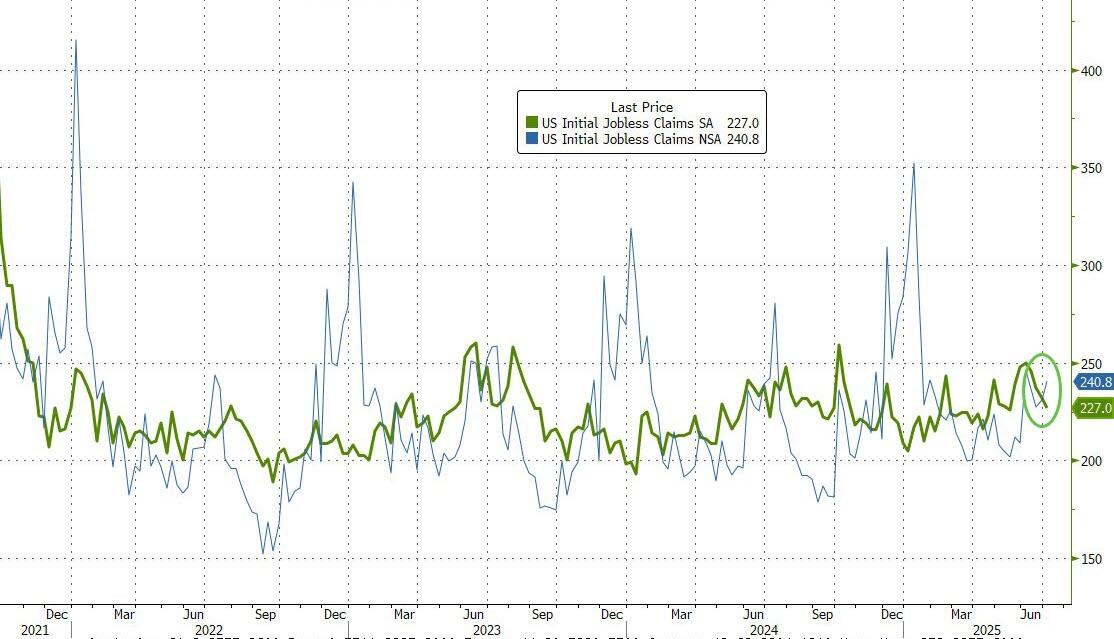
Source: Bloomberg
However, continuing jobless claims remain at the highest since Nov 2021….
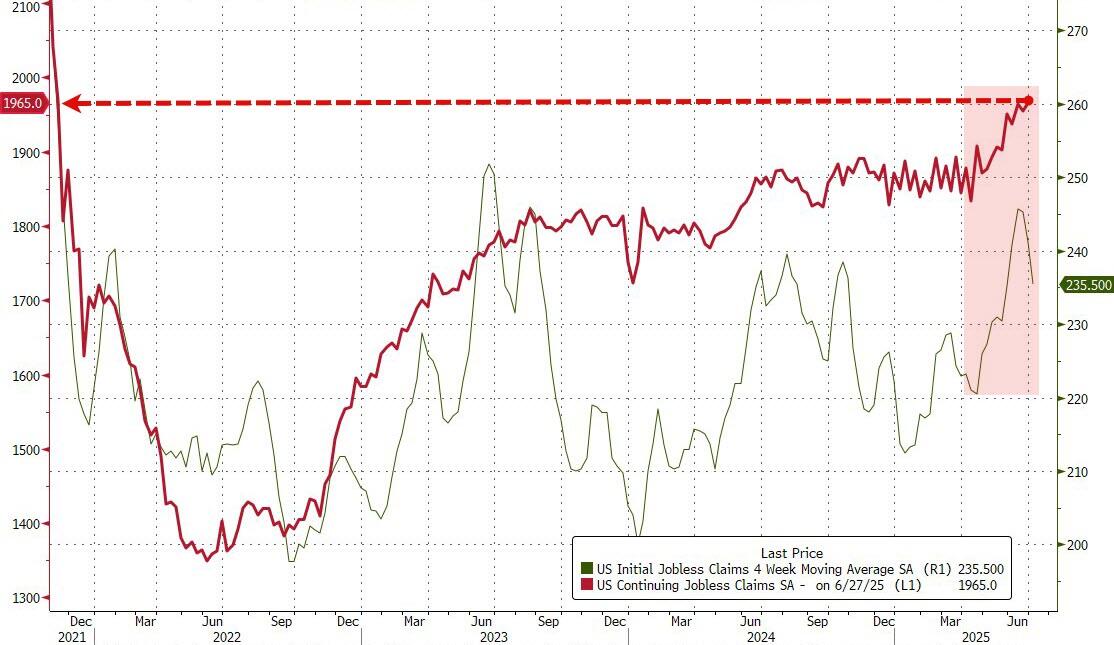
Source: Bloomberg
…as DOGE’s impact on the ‘Deep TriState’ continues…
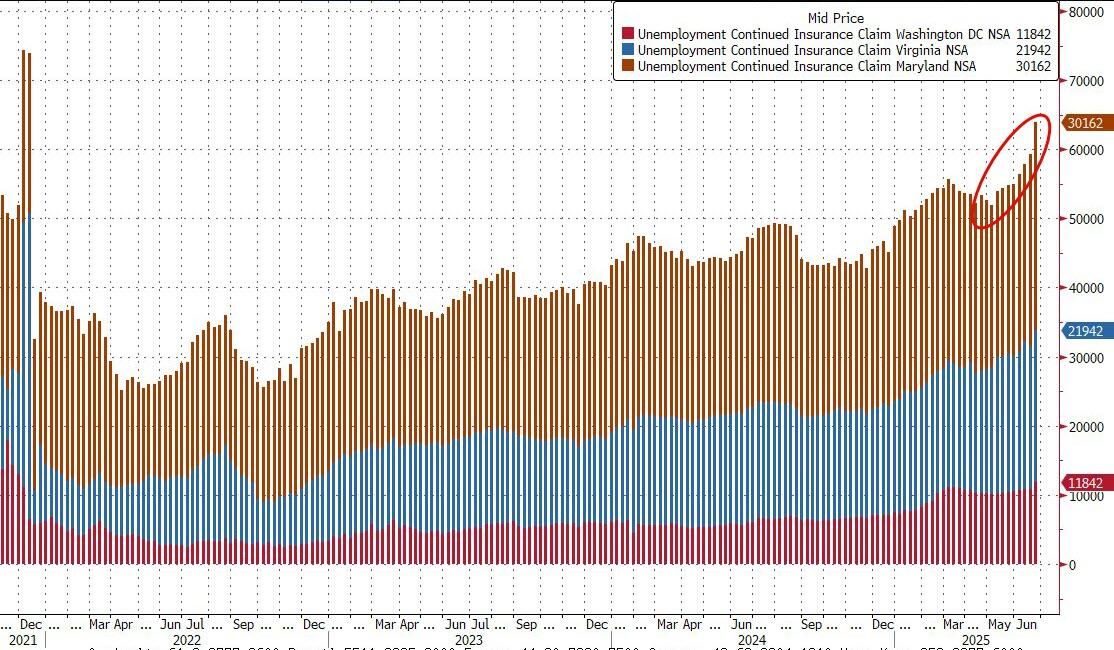
Source: Bloomberg
It seems Musk has something to be proud of after all.
USA ECONOMIC NEWS
A real hero: he saved 165 lives from the flood at Camp Mystic
(EpochTimes)
‘American Hero’: Coast Guard Swimmer Praised For Saving 165 From Flood At Camp Mystic
Wednesday, Jul 09, 2025 – 08:05 PM
Authored by Aldgra Fredly via The Epoch Times,
A Coast Guard rescue swimmer, Scott Ruskan, is being hailed as a hero for helping to rescue more than 160 people at Camp Mystic during flash floods that ravaged central Texas over the weekend.

Secretary of Homeland Security Kristi Noem said Ruskan directly saved 165 people from the floodwaters that inundated Camp Mystic, a Christian girls’ camp near the Guadalupe River. He was the only triage coordinator at the scene.
“Scott Ruskan is an American hero. His selfless courage embodies the spirit and mission of the [U.S. Coast Guard],” Noem stated on social media platform X, noting that it was Ruskan’s first rescue mission as a Coast Guard rescue swimmer.
The rescue team was dispatched from the Coast Guard Air Station in Corpus Christi after receiving a report at 5:57 a.m. on July 4 about rising floodwaters near Kerrville, Texas, according to the U.S. Coast Guard.
In an interview with Good Morning America, Ruskan recalled that nearly 200 people, mostly children, were later found in need of rescue as floodwaters surged through the area.
“I got on scene, boots on the ground at Camp Mystic. I kind of discovered I was the only person there as far as first responders go. So I had about 200, kids mostly, all scared, terrified, cold, having probably the worst day of their life,” he said.
“I just kind of needed to triage them, get them to a higher level of care and get them off the flood zone.”
U.S. Army National Guard helicopters used the camp’s archery and soccer fields as landing zones during the rescue. Ruskan said he “was kind of the main guy as far as grabbing people,” taking groups of 10 to 15 people, including some adults, at a time to the aircraft, which then airlifted them to the landing zones for safety.
The U.S. Coast Guard stated that Ruskan helped to evacuate a total of 230 victims at the scene. He also provided them with medical assistance during the rescue mission, according to a July 5 statement.
“The real heroes, I think, were the kids on the ground; those guys are heroic,” Ruskan said.
“They were dealing with some of the worst times of their lives, and they were staying strong, and that helped inspire me to get in there and help them.”

A sheriff’s deputy pauses while combing through the banks of the Guadalupe River near Camp Mystic after a flash flood swept through the area in Hunt, Texas, on July 5, 2025. Julio Cortez/AP Photo
Camp Mystic said that 27 campers and counselors lost their lives in the floods and that it had been in contact with local and state authorities in the search for missing campers and counselors.
“Our hearts are broken alongside our families that are enduring this unimaginable tragedy. We are praying for them constantly,” the camp said in a statement posted to its website.
The flash floods that swept through central Texas have left more than 100 people dead and at least 161 missing. Gov. Greg Abbott said during a July 8 press briefing that those figures are likely to rise, due in part to the area’s popularity with campers.
Kerr County Sheriff Larry Leitha said that hundreds of first responders are on the scene in flooded areas around the Guadalupe River, with local, federal, and state personnel working to recover bodies or locate missing people.
END
Half Of Americans Who Think They’re “Middle Class” Really Aren’t: Pew
Wednesday, Jul 09, 2025 – 10:10 PM
The term “middle class” is widely used in American discourse, but few people can clearly define it or know if they truly belong to it, , according to Pew Research and Yahoo Finance.
According to the Pew Research Center, just over half of U.S. households—51% as of 2023—qualify as middle income, a noticeable drop from 61% in 1971. This decline suggests that nearly half of Americans no longer fit within what’s traditionally considered the middle class.
Pew defines middle-income households as those earning between two-thirds and double the national median income, which translates to a range of about $56,600 to $169,800, based on 2022 government data. Even among those within that range, many feel financially stretched.
A survey by the National Foundation for Credit Counseling revealed that more than half of U.S. adults say they are unable to make financial progress, while nearly half report that they are constantly just treading water.
Yahoo writes that for households trying to maintain their middle-class status or move up, one critical step is reducing consumer debt. High-interest obligations can quickly become unmanageable, and rising bankruptcy rates reflect that risk—there were over 494,000 personal bankruptcy filings in the U.S. in 2024, more than 60,000 higher than the year before.

Paying down debt can ease monthly financial burdens and provide more stability. Another key safeguard is having an emergency fund. Setting aside enough savings to cover at least six months of living expenses can protect a family from sudden income loss or job disruption, giving them time to adjust without sacrificing their standard of living.
Increasing income is also an important strategy. Picking up a side hustle or creating a passive income stream could help a household reach or exceed the upper threshold of the middle-income range. Earning more doesn’t just improve lifestyle—it also offers a financial buffer against downturns and rising costs.
At the same time, managing spending is essential, especially in a climate of economic uncertainty. Many Americans have turned to “doom spending,” making impulsive purchases as a response to stress, which only deepens financial insecurity.
Careful budgeting and expense tracking can help people identify where their money is going and highlight areas where they might cut back. Insurance costs are a common area of overspending. The average American pays over $2,400 annually for full-coverage auto insurance and more than $2,300 for homeowners insurance, and both are projected to rise further in 2025.
Comparing rates and switching providers can lead to significant savings—some drivers have reported reducing their monthly premiums by doing just that.
Ultimately, whether or not you fall within the middle-class income range, financial stability depends on more than earnings. Controlling debt, building savings, growing income, and being intentional with spending are all crucial steps to maintaining or improving your economic position in today’s shifting landscape.7,41666
END
VICTOR DAVIS HANSON
A NEWS/ANTISEMITISM..
KING NEWS
| The King Report July 10, 2025 Issue 7530 | Independent View of the News |
| @SecScottBessent: The tariff panic and inflation fearmongering from Democrats and their friends in the media (and Fed) hasn’t held up. @CEA47 has found that imported goods prices are down this year, falling even faster than overall goods prices. Nvidia plans to launch a new artificial intelligence chip designed specifically for China as soon as September – FT Retail and trader buying of Fangs appeared in early US trading. This drove Nvidia to be the first corporation with a $4 trillion capitalization. Nvidia opened at 161.16 and then soared to 164.42 at 9:48 ET. Outside of Fang mania, stocks were mixed. Near 11:00 ET, the DJIA was +34.73 while the DJTA was -78.49. USUs were +18/32. There was an undercurrent of modest defensive asset allocation. Apple (-1.15% at 10:45 ET) and ServiceNow (-0.93%) were the only losing NY Fang+ Index stocks. Meta (+1.54% at 10:45 ET) was the second strongest Fang. Nvidia retreated to 162.44 at 10:50 ET on a professional dump. After rebounding to 163.445 at 11:02 ET, Nvidia traded sideways into the close. This strongly implies that the early buying was retail and traders. ESUs traded modestly higher during early Nikkei trading on Wednesday. They broke lower at 19:20 ET. ESUs quickly stabilized with modest losses. They then traded sideways until they broke higher after 5:12 ET. ESUs steadily rallied on professional buying until they exploded higher just before the NYSE opening on frenzied retail buying. ESUs hit a daily high of 6315.25 at 9:48 ET. The pro then dumped ESUs, which sank to 6276.25 at 11:18 ET. The post-European close contra-move generated a slightly upward channel with a modest range. The rally intensified modestly just before the 14:15 ET VIX Fix because the FOMC Minutes, released at 14:00 ET, showed most Fed officials favor rate cuts, but are uncertain on the number of cuts this year and the timing. https://www.cnbc.com/2025/07/09/most-fed-officials-see-rate-cuts-coming-but-opinions-vary-widely-on-how-many-minutes-show.html FOMC Minutes: https://www.federalreserve.gov/newsevents/pressreleases/monetary20250709a.htm A low energy, plodding rally took ESUs to 6309/75 at 15:59 ET. Microsoft said using AI tools saved the company more than $500 million last year in just its call centers – (So does firing US programmers and replacing them with Indians!) Bloomberg Amazon Prime Day Sales Plunge 41% (y/y) in First Day of Four-Day Event – BBG @GlobalMktObserv: The last 10 years have been the worst for the US government bonds in HISTORY: The US 10-year Treasury bond has returned ~0% per year over the last decade, the least EVER. Thus, returns adjusted for inflation have been NEGATIVE. Even worse returns have been in Germany. https://x.com/GlobalMktObserv/status/1942984620275867754 Positive aspects of previous session The DJIA and Fangs rallied robustly. Nasdaq hit an all-time high. USUs were +1 2/32 at NYSE close. The 10-year Auction ($39B) went well: High yield 4.362% vs WI yield 4.365% Negative aspects of previous session The DJTA declined 42.61. Gold rallied modestly; Bitcoin hit an all-time high. Ambiguous aspects of previous session Fangs are bubbling again; when will the bubble burst? First Hour/Last Hour Action [S&P 500 Index]: 1st Hour from NYSE Open: Up; Last Hour: Up Pivot Point for S&P 500 Index [above/below indicates daily trend to traders]: 6254.62 Previous session S&P 500 Index High/Low: 6269.16; 6231.43 Jeffrey Epstein’s brother rips feds for ruling pedophile’s death as suicide: ‘I laughed at how stupid it was’ https://trib.al/NO2w2he Numerous pundits note that the DoJ will NOT release the roster of prisons housed with Epstein. @DefiyantlyFree: Pam Bondi’s Epstein Dilemma: The Legal Trap Behind the Withheld Files When former Florida Attorney General Pam Bondi was appointed U.S. Attorney General, she promised a new era of transparency especially regarding the long-shrouded Jeffrey Epstein files. With public pressure mounting, Bondi announced that “tens of thousands” of videos and records existed, and that her Justice Department would make them public. But that promise has quietly unraveled. Instead of full disclosure, the DOJ has backpedaled. A recent memo claimed no “client list” exists. Bondi has delayed further releases. And the explosive evidence she once suggested was on the verge of public exposure remains sealed, redacted, or buried. The reason, though unspoken, is now becoming clear (at least to me): Bondi is legally bound to defend the FBI in a civil lawsuit filed by Epstein’s victims and releasing the files could fatally damage that case. Russia vows to refill Iran’s uranium stocks, as Netanyahu warns that enriched supply was unscathed during the war https://trib.al/5BAL2F9 Ferrero nears about $3 billion deal for WK Kellogg – WSJ @Barchart: Global Debt hits new all-time high of $324 Trillion https://x.com/Barchart/status/1943054573750595895 @GlobalMktObserv: Institutional investors are SELLING US equities at a FURIOUS pace: Institutions dumped $3.2 BILLION of single stocks and ETFs last week, according to BofA. They sold in 9 of the last 10 weeks. Hedge funds recorded the 3rd straight week of selling and sold $1.0 billion. https://x.com/GlobalMktObserv/status/1942924951415148852 @GlobalMktObserv: The S&P 500 breadth hit the second-lowest level in at least 20 YEARS. This means the recent S&P 500 rally has been driven by just a handful of stocks, and not many names have hit their 52-week high. https://x.com/GlobalMktObserv/status/1943097841754226836 Today – The buying on Wednesday was largely traders and retail and it was concentrated on Fangs. That’s why the energy was low. The action of the past few sessions suggests that institutional sellers in the market are patient. They are ‘feeding the fishies.’ Pattern traders want to be long for the earnings season really, which is usually led by Fangs/Mag and tech. With tariffs angst mostly extinguished, there is no dynamic on the radar that would crush stocks. The Summer Rally is now operative, and it should run into Q2 results reporting season. Historically, earnings season rallied have ended around the time that Apple reports (July 31). However, Nvidia doesn’t report until August 27. Our way to early guess is that stocks make a top of some dimension near the end of July. After a spirited retrenchment in August, stocks head north for Nvidia’s results. Then, a top of greater significance could appear. If stocks do NOT make a new high when Nvidia reports, it would strongly suggest that stocks could decline sharply. The Wilshire 5000 Index (All publicly traded US equities) is $62.633T. US Nominal GDP is $29.962 trillion as of March 31, 2025. Q2 GDP is projected to be $30.74 T. Ergo, the US Equity Market Capitalization to GDP would be 203.75%. The all-time high is 209.1% on December 6, 2024. No matter how you slice or dice it, US stocks are in an historic bubble. After the close, Trump placed 50% tariffs on Brazil for prosecuting former President Jair Bolsonaro. ESUs are -7.00; NQUs are -30.00; USUs are +3/32; and gold is +5.50 at 20:10 ET. Expected Economic Data: Initial Jobless Claims 235k, Continuing Claims 1.965m; St. Louis Fed Pres Musalem 9 ET, SF Fed Pres Daly 14:30 ET S&P Index 50-day MA: 5934; 100-day MA: 5785; 150-day MA: 5858; 200-day MA: 5852 DJIA 50-day MA: 42,451; 100-day MA: 42,061; 150-day MA: 42,631; 200-day MA: 42,693 (Green is positive slope; Red is negative slope) S&P 500 Index (6263.26 close) – BBG trading model Trender and MACD for key time frames Monthly: Trender and MACD are positive – a close below 5447.29 triggers a sell signal Weekly: Trender and MACD are positive – a close below 5481.62 triggers a sell signal Daily: Trender and MACD are positive – a close below 6156.65 triggers a sell signal Hourly: Trender and MACD are positive – a close below 6180.00 triggers a sell signal Joe Biden’s Dr. O’Connor REFUSES to answer questions on his mental decline fueling ‘cover-up conspiracy’ – Joe Biden’s personal physician pleaded the fifth amendment protection against ‘self-incrimination’ during his testimony to Congress on Wednesday… Comer said Biden’s longtime personal doctor plead the fifth and argued it shows ‘there was a conspiracy to cover up President Biden’s cognitive decline.’… ‘Dr. O’Connor took the fifth when asked if he was told to lie about President Biden’s health and whether he was fit to be President of the United States.’… https://www.dailymail.co.uk/news/article-14889619/trump-waives-executive-privilege-biden-doctor-mental-decline.html @Real_RobN: This is Kevin O’Connor, Joe Biden’s White House doctor. He has pleaded the Fifth and refused to testify in a closed-door House hearing. He is facing charges of: •Perjury in violation of federal statute 18 U.S.C. § 1621 •Tampering with evidence — for altering, destroying, concealing, or falsifying evidence — in violation of 18 U.S.C. § 1519 •Racketeering in violation of 18 U.S.C. §§ 1961–1968 •Conspiracy to defraud the United States government in violation of 18 U.S.C. § 371 Biden’s handlers scrambled to change his personal number after journalist reached him on his cell: Book https://www.foxnews.com/media/bidens-handlers-scrambled-change-his-personal-number-after-journalist-reached-him-his-cell GOP Rep. @RepLuna: Neville Singham— the billionaire communist with ties to the CCP, who funded the LA riots and used immigration & Mexicans as a Trojan horse for communism— is hiding from our letter requesting testimony. This poses an issue for delivering subpoena. Therefore, if he decides to hide in CHINA, we will now be asking the State Dept. and Treasury to freeze his assets/visa. Singham is literally hiding. Dem radical Rep. @RepRashida: This illegitimate SCOTUS continues to do Trump’s bidding, allowing him to take a wrecking ball to federal agencies and fire thousands of federal workers who provide the services our families rely on. We need to end this court’s corrupt grip on our democracy. The Second Circuit Court of Appeals unanimously overturned the conviction of Douglass Mackey who was charged (In NYC) with ‘Election Interference’ for posting a meme about Hillary Clinton that asked her voters to “’vote’ via text message or social media, which was legally invalid.” Mackey refused a pardon from Trump to get the case tried as a 1st Amendment precedent. @pleonidasp: St. Thomas Aquinas affirms the ancient laws—reported by Aristotle and commanded to Israel by the Old Testament—of waiting two or three generations before granting citizenship to certain foreigners, and never granting citizenship to certain foreigners. https://x.com/pleonidasp/status/1942971350190280747 @Enquirer: Cincinnati Children’s chaplain detained by ICE Fox’s @BillMelugin_: Not included in the headline: – Egyptian national whose asylum status was revoked during the Biden administration last year. – He apparently flagged on the FBI terror watchlist during a background check, though he claims the fingerprints didn’t match his. – Sued Feds multiple times. Judge dismissed most of his claims, one lawsuit still pending. – Met with ICE and the FBI for several hours yesterday before being arrested by ICE. @PeterSweden7: R*pe statistics for England and Wales: In 2000: There was 7801 reported r*pes. In 2024: There was 71,227 reported r*pes. That’s an increase of over 800% in just 24 years. What happened??? Hollywood’s Inability to Create Masculine Stars Is Officially a Problem The biggest male movie stars are all aging… Hollywood as an industry isn’t doing well, and on lots of practical levels, the star-making machine isn’t functioning as it should. But on a deeper level, you have to ask, does Hollywood even understand what masculine appeal looks like?… You don’t see many men anywhere that even look like tough-as-nails male icons of yesteryear, let alone earned their image for being hard men long before they started acting. If they were around today, Lee Marvin, Robert Mitchum, or Charles Bronson would probably be rejected out of hand for poor Q Score potential or something. But to put this in terms that liberal Hollywood will understand, masculine men are an underrepresented community that is being discriminated against. https://thefederalist.com/2025/07/09/hollywoods-inability-to-create-masculine-stars-is-officially-a-problem/ WSJ Editorial Board: Chuck Schumer’s Mamdani Test Will the New York Senator abandon his life-long convictions? Mr. Mamdani is a socialist who spoke as an Assemblyman of “seizing the means of production” and blamed Israel, not Hamas, on Oct. 8, 2023. You’d think Mr. Schumer, the author in March of “Antisemitism in America: A Warning,” would have a lot to say about that. But the Senator who used to boast of being the shomer, or guardian, of the Jewish people today mainly guards his left flank. He fears a primary challenge from Rep. Alexandria Ocasio-Cortez, another socialist… https://www.wsj.com/opinion/chuck-schumer-zohran-mamdani-new-york-jewish-people-antisemitism-bdec700c?mod=hp_opin_pos_3 | |
SWAMP STORIES FOR YOU TONIGHT
Biden’s Doctor: Take A Fifth And Call Me In The Morning (With Immunity)
Thursday, Jul 10, 2025 – 08:46 AM
Dr. Kevin O’Connor appeared before the House Oversight Committee, but he had little to say about the investigation into the alleged cover-up of President Joe Biden’s mental and physical decline. The former White House physician invoked his privilege against self-incrimination in refusing to answer any questions. His prescription for the Committee seems clear: take a Fifth and call me in the morning (with an immunity grant). The question is now whether Congress will move to compel his testimony.
O’Connor appeared with counsel and repeatedly read the same line: “On the advice of counsel, I must respectfully decline to answer based on the physician patient privilege and the reliance on my right under the Fifth Amendment.”
The development adds another interesting dimension to the controversy over the alleged cover-up of Biden’s decline.
Dr. O’Connor insists that he cannot compromise a patient’s privacy under federal law and ethical guidelines. However, his client was the president of the United States, and Congress is investigating allegations that he was no longer competent or engaged in running the nation. That raises potential criminal conduct from falsification of documents to perjury that an oversight committee is pursuing.
Generally, courts have waived confidentiality protections for reporters, doctors, and lawyers under a crime or fraud exception in federal criminal cases.
A good example is the testimony of the psychiatrist in the Menendez brothers’ murder case.
Dr. O’Connor is an essential witness in that investigation. President Biden has clearly not given him the authority to fully disclose the medical records and testing results from his presidency. The question could become whether Congress can now compel such disclosures. Both Biden and O’Connor could go to court to seek to prevent such compulsion.
Congress often examines private information, including tax records and background investigations, as part of its oversight functions. Moreover, many past investigations would have been obstructed by sweeping privacy claims. Consider the Kennedy assassination investigation into the examinations of the president or confirmation fights over allegations of mental or physical disabilities of nominees.
Under the Health Insurance Portability and Accountability Act (HIPAA), subpoenas are regularly used to obtain otherwise protected medical information.
The law specifically allows for disclosures in criminal or fraud investigations.
Congress has a compelling basis for demanding disclosure. However, the question is time. With the approaching midterm elections, the runway is getting shorter for the Oversight Committee. If the Democrats retake the House, these investigations will be halted, as Democratic members have pledged to resume impeachment investigations targeting President Trump.
The House Oversight Committee could grant Dr. O’Connor immunity and compel his testimony. He would then have to either secure a court order of protection or face a contempt of Congress charge for refusing to testify. If he elected to testify, he would still be subject to potential charges for any false statements made to investigators or committee members.
There is sufficient time to compel such testimony, but the Committee will have to move with some dispatch if it wants to hear more from the doctor.
end
ROBERT H
The Epstein Client List — Why is Trump Breaking His Promise to Publish?
The Epstein Client List — Why is Trump Breaking His Promise to Publish? By Larry C. Johnson on 9 July 2025
Although Donald Trump and Pam Bondi insist that there is no Epstein Client List… there is a list and it is reproduced above with the permission of its author, Ryan Dawson. Ryan compiled the list the old-fashioned way… he combed through court transcripts and charging documents. He only put names on the list if the victims of Epstein’s pedophilia enterprise identified or named a particular individual. As you peruse the list you will notice that there are some very wealthy, powerful individuals named. Not one of them has brought a libel or slander legal action against Ryan. If he was posting false material, he would have been a certain target of lawsuits.Here is a short video where Ryan explains his process:So why has Donald Trump broken his promise to publish the list? I think there are two reasons — neither mutually exclusive. First, Donald Trump probably paid no attention to Ryan’s work and was never familiar with the list. Once he signed the Executive Order to publish the Epstein file, he was then briefed on the actual names and realized that many of them are major donors to his campaign, e.g., Jamie Dimon, Robert Kraft. While there are several names on that list who are confirmed anti-Trumpers, there are others who are friends.Second, and in my opinion a more important consideration, is that the full Epstein file would expose a foreign intelligence blackmail operation that would implicates the Mossad and the CIA. Alexander Acosta, the former Secretary of Labor for Donald Trump, said he was told that Jeffrey Epstein had ties to intelligence. During the controversy surrounding his handling of Epstein’s 2008 plea deal as a U.S. attorney, Acosta reportedly told Trump administration officials that he had been informed Epstein “belonged to intelligence,” and that this was a reason for the unusually lenient plea agreement. It would not surprise me that Bibi Netanyahu asked Trump to pull the plug on releasing the material. Did Trump get something in return from Bibi, such as agreeing to a ceasefire? We will find out in the coming days.While Trump may think he can smooth this over with his MAGA base, I think he has done serious damage to his Presidency by embracing the lie that, “there is no list.”Ryan hosted a video podcast from his home in South Korea with me tonight (i.e., Wednesday Eastern time) and we took turns interviewing each other. We started off with the Epstein matter:
GREG HUNTER
SEE YOU TOMORROW


 harveyorganblog.com