we are now beginning to deal with OTC/London LBMA options expiry Friday July 31
as always the crooks raid gold/silver so be careful!!. The reason is suppress the price
due to huge derivative losses endured the banks. Do not fear the raids.
platinum ..OFF THE CHART//29.5%
gold: 6.0%
silver lease rate today//6.5%
099 H DEUTSCHE BANK AG 13
624 H BOFA SECURITIES 12
661 C JP MORGAN SECURITIES 1
GOLD: NUMBER OF NOTICES FILED FOR JULY/2024: 13 CONTRACTs NOTICES FOR 1300 OZ or 0.0404 TONNES
total notices so far: 12,010 contracts for 1,201,000 OR 37.356 tonnes)
SILVER NOTICES: 9 NOTICE(S) FILED FOR 0.045 million OZ/
total number of notices filed so far this month : 9344 CONTRACTS (NOTICES) for 46.720 million oz
EXCHANGE FOR RISK ISSUANCE FOR SILVER/MAY
JULY: 44.88 MILLION OZ (QUITE SMALL)
AND JULY: 46.720 MILLION OZ//
JAN. 2025: 257.919 TONNES (ISSUANCE WILL BE PRETTY GOOD THIS MONTH BUT MUCH LOWER THAN LAST MONTH)
FEB: 207.21 TONNES//EX FOR PHYSICAL ISSUANCE (WILL BE A FAIR SIZED ISSUANCE THIS MONTH)
MARCH 130.84 TONNES//QUITE SMALL THIS MONTH.
APRIL; 208.57 TONNES. STILL A SMALL TO FAIR ISSUANCE FOR THE MONTH
MAY: 113.499 TONNES OF GOLD EFP ISSUANCE//QUITE SMALL THIS MONTH
JUNE: 97.79 TONNES OF GOLD EFP ISSUANCE/EXTREMELY SMALL
JULY : 143.256 TONNES//STILL QUITE SMALL
SPREADING OPERATIONS
NOW SWITCHING TO GOLD FOR NEWCOMERS, HERE ARE THE DETAILS
SPREADING LIQUIDATION HAS NOW COMMENCED AS WE HEAD TOWARDS THE NEW ACTIVE FRONT MONTH OF APRIL. WE ARE NOW INTO THE SPREADING OPERATION OF GOLD
HERE IS A BRIEF SYNOPSIS OF HOW THE CROOKS FLEECE UNSUSPECTING LONGS IN THE SPREADING ENDEAVOUR ;MODUS OPERANDI OF THE CORRUPT BANKERS AS TO HOW THEY HANDLE THEIR SPREAD OPEN INTERESTS:HERE IS HOW THE CROOKS USED SPREADING AS WE ARE NOW INTO THE NON ACTIVE DELIVERY MONTH OF NOV HEADING TOWARDS THE ACTIVE DELIVERY MONTH OF FEB., FOR GOLD: AND MARCH FOR SILVER
YOU WILL ALSO NOTICE THAT THE COMEX OPEN INTEREST STARTS TO RISE BUT SO IS THE OPEN INTEREST OF SPREADERS. THE OPEN INTEREST IN WILL CONTINUE TO RISE UNTIL ONE WEEK BEFORE FIRST DAY NOTICE OF AN UPCOMING ACTIVE DELIVERY MONTH (OCT), AND THAT IS WHEN THE CROOKS SELL THEIR SPREAD POSITIONS BUT NOT AT THE SAME TIME OF THE DAY. THEY WILL USE THE SELL SIDE OF THE EQUATION TO CREATE THE CASCADE (ALONG WITH THEIR COLLUSIVE FRIENDS) AND THEN COVER ON THE BUY SIDE OF THE SPREAD SITUATION AT THE END OF THE DAY. THEY DO THIS TO AVOID POSITION LIMIT DETECTION. THE LIQUIDATION OF THE SPREADING FORMATION CONTINUES FOR EXACTLY ONE WEEK AND ENDS ON FIRST DAY NOTICE.”
WHAT IS ALARMING TO ME, ACCORDING TO OUR LONDON EXPERT ANDREW MAGUIRE IS THAT THESE EFP’S ARE BEING TRANSFERRED TO WHAT ARE CALLED SERIAL FORWARD CONTRACT OBLIGATIONS AND THESE CONTRACTS ARE LESS THAN 14 DAYS. ANYTHING GREATER THAN 14 DAYS, THESE MUST BE RECORDED AND SENT TO THE COMPTROLLER, GREAT BRITAIN TO MONITOR RISK TO THE BANKING SYSTEM. IF THIS IS INDEED TRUE, THEN THIS IS A MASSIVE CONSPIRACY TO DEFRAUD AS WE NOW WITNESS A MONSTROUS TOTAL EFP’S ISSUANCE AS IT HEADS INTO THE STRATOSPHERE.
The crooks also use the spread in the TAS account (trade at settlement). They buy the spot TAS (e.g. June) and sell the future TAS two months out (e.g. August). Then they unload the front month (i.e. unload the buy side first so the price of gold/silver falls. This occurs in the middle of the front delivery month cycle. They unload the sell side of the equation, two months down the road. The crooks violate position limits as the OCC refuse to hear our complaints.
First, here is an outline of what will be discussed tonight:
1.TODAY WE HAD THE OPEN INTEREST AT THE COMEX IN SILVER ROSE BY A SMALL SIZED 75 CONTRACTS OI TO 170,329 AND FURTHER FROM TO THE COMEX HIGH RECORD //244,710( SET FEB 25/2020). THE LAST RECORDS WERE SET IN AUG.2018 AT 244,196 WITH A SILVER PRICE OF $14.78/(AUGUST 22/2018)..THE PREVIOUS RECORD TO THAT WAS SET ON APRIL 9/2018 AT 243,411 OPEN INTEREST CONTRACTS WITH THE SILVER PRICE AT THAT DAY: $16.53). AND PREVIOUS TO THAT, THE RECORD WAS ESTABLISHED AT: 234,787 CONTRACTS, SET ON APRIL 21.2017 OVER 7 YEARS AGO. HOWEVER WE HAVE NOW SET A NEW RECORD LOW OF 114,102 CONTRACTS JULY 3.2023
EFP ISSUANCE 650 CONTRACTS
OUR CUSTOMARY MIGRATION OF COMEX LONGS CONTINUE TO MORPH INTO LONDON FORWARDS AS OUR BANKERS USED THEIR EMERGENCY PROCEDURE TO ISSUE:
SEPT 650 CONTRACTS and 0 ALL OTHER MONTHS: ZERO. TOTAL EFP ISSUANCE: 650 CONTRACTS. EFP’S GIVE OUR COMEX LONGS A FIAT BONUS PLUS A DELIVERABLE PRODUCT OVER IN LONDON. IF WE TAKE THE COMEX OI GAIN OF 75 CONTRACTS AND ADD TO THE 650 E.FP. ISSUED
WE OBTAIN A HUGE SIZED GAIN OF 725 OF OPEN INTEREST CONTRACTS FROM OUR TWO EXCHANGES WITH OUR SMALL GAIN IN PRICE OF $0.11 THE RATS ARE FLEEING THE ARENA.
THUS IN OUNCES, THE GAIN ON THE TWO EXCHANGES TOTALS 4.395 MILLION PAPER OZ
OCCURRED WITH OUR $0.11 GAIN IN PRICE.
OUTLINE FOR TODAY’S COMMENTARY
1a/COMEX GOLD AND SILVER REPORT
(report Harvey)
1a/COMEX GOLD AND SILVER REPORT
(report Harvey)
b, ) Gold/silver trading overnight Europe,//GOLD COMMENT
Peter Schiff)
c) Commentaries from: Egon von Greyerz///Matthew Piepenburg via GoldSwitzerland.com, Pam and Russ Martens
ii a) Chris Powell of GATA provides to us very important physical commentaries
b. Other gold/silver commentaries
c. Commodity commentaries//
d)/CRYPTOCURRENCIES/BITCOIN ETC
2.ASIAN AFFAIRS
ASIAN MARKETS THIS WEDNESDAY MORNING:
SHANGHAI CLOSED UP 6.01 PTS OR 0.17%
//Hang Seng CLOSED DOWN 347.52 PTS OR 1.36%
// Nikkei CLOSED DOWN 19.85 PTS OR 0.05% //Australia’s all ordinaries CLOSED UP 0.54%
//Chinese yuan (ONSHORE) CLOSED DOWN AT 7.1813 OFFSHORE CLOSED DOWN AT 7.1876/ Oil UP TO 69.22 dollars per barrel for WTI and BRENT UP TO 72.54 Stocks in Europe OPENED ALL MOSTLY MIXED
ONSHORE USA/ YUAN TRADING ABOVE LEVEL OF OFFSHORE YUAN TRADING :/ONSHORE YUAN DOWN IN TRADING AT 7.1813 AND WEAKER//OFF SHORE YUAN TRADING UP TO 7.1876 AGAINST US DOLLAR/ AND THUS WEAKER
XXXXXXXXXXXXXXXXXXXXXXXXXXXX
END
A)NORTH KOREA/SOUTH KOREA
outline
b) REPORT ON JAPAN/
OUTLINE
3 CHINA
OUTLINE
4/EUROPEAN AFFAIRS
OUTLINE
5. RUSSIAN AND MIDDLE EASTERN AFFAIRS
OUTLINE
6.Global Issues//COVID ISSUES/VACCINE ISSUES
OUTLINE
7. OIL ISSUES
OUTLINE
8 EMERGING MARKET ISSUES
9. USA
XXXXXXXXXXXXXXXXXXXXXXXXXXXXXXXXXXXXXXXXXXXXXXXXXXXXXXXXXXXXXXXXXXXXXXXXXXXXXXXXXXXXXXXXXXXXXXXXXXXXXXXXXX
1. COMEX DATA//AMOUNTS STANDING//VOLUME OF TRADING/INVENTORY MOVEMENTS
GOLD
LET US BEGIN:
THE TOTAL COMEX GOLD OPEN INTEREST FELL BY A STRONG SIZED 5,582 CONTRACTS TO 445,257 OI DESPITE OUR STRONG GAIN IN PRICE OF $16.45 WITH RESPECT TO TUESDAY’S // TRADING.. WE LOST ZERO NET LONGS, WITH THAT PRICE GAIN FOR GOLD. AND AS YOU WILL SEE BELOW, OUR GAIN IN PRICE ALSO HAD A STRONG NUMBER OF EXCHANGE FOR PHYSICAL ISSUED (3542 ). WE HAD CONSIDERABLE T.A.S. LIQUIDATION //TUESDAY TRADING AS WE HAD A TOTAL LOSS IN OI ON BOTH OF OUR EXCHANGES, THE COMEX AND LONDON’S EXCHANGE FOR PHYSICAL EQUATING TO 2140 CONTRACTS WITH ALL OF THAT LOSS DUE TO BOTH SPREADERS, THE T.A.S. LIQUIDATION AND MONTHLY SPREADERS.
LAST WEDNESDAY MORNING,JULY 23, MUCH TO MY SHOCK, AFTER A TWO MONTH HIATUS,THE CME ANNOUNCED A 500 EXCHANGE FOR RISK CONTRACT ISSUANCE FOR 50,000 OZ OR 1.555 TONNES. THEN LAST NIGHT THE CME ANNOUNCED (ISSUED) MUCH TO MY HORROR ITS SECOND EXCHANGE FOR RISK FOR 706 CONTRACTS OR 70,600 OZ (2.195 TONNES) AS THE BANK OF ENGLAND WAS NOT SATISFIED AND NEEDS MORE GOLD TO COVER ITS LEASES TO BULLION BANKS. THE TOTAL EXCHANGE FOR RISK FOR THE MONTH OF JULY IS NOW 3.750 TONNES OF GOLD WHICH WILL BE ADDED TO OUR REGULAR DELIVERY TO GIVE US OUR FINAL TOTALS.
HISTORY: LAST SIX MONTH’S EXCHANGE FOR RISK
IN FEBRUARY:
WE HAD A HUGE FIVE EXCHANGE FOR RISKS ISSUANCES FOR GOLD, TOTALLING 18.4527 TONNES!.
IN MARCH:
THE TOTAL NO. OF EXCHANGE FOR RISK ISSUANCE FOR THE MONTH OF MARCH (3 NOTICES) EQUALED: 7.6179 TONNES OF GOLD WHICH WAS ADDED TO OUR MARCH DELIVERY TOTALS.
IN APRIL:
WE CONCLUDED APRIL WITH 7 ISSUANCE OF EXCHANGE FOR RISK FOR A TOTAL TONNAGE OF 8.3571 TONNES.
IN MAY:
MAY: 3 EX. FOR RISK ISSUED SO FAR FOR 3025 CONTRACTS OR 302,500 OZ OR 9.4054 TONNES. THIS WILL BE ADDED TO OUR NORMAL DELIVERY TO GIVE US TOTAL STANDING FOR MAY!THIS IS THE 6TH CONSECUTIVE MONTH FOR ISSUANCE OF EXCHANGE FOR RISK//NEW TOTAL EX FOR RISK IS 9.591 TONNES FOR THE 3 ISSUANCE!
IN JUNE
JUNE: ZERO ISSUED
jULY: 2 OCCASIONS: 1206 CONTRACTS FOR 120,600 OZ OR 3.750 TONNES/ISSUED JULY 23/2025 AND JULY 30/2025
THE RECIPIENT OF ALL OF THESE EXCHANGE FOR RISK CONTRACTS IS THE BANK OF ENGLAND WHO DESPERATELY WANT THEIR LEASED GOLD BACK. THUS WE HAVE TWO SEPARATE ENTITIES (CENTRAL BANKS) DEMANDING THEIR GOLD BACK:
- THE BANK OF ENGLAND
- THE FEDERAL RESERVE BANK OF NEW YORK (NEED TO RETRIEVE THEIR LEASED GOLD FROM THE BIS)
THE COUNTERPARTY TO THE BANK OF ENGLAND’S EXCHANGE FOR RISK ARE BULLION BANKS THAT CANNOT VERIFY THAT THEIR GOLD IS UNENCUMBERED AND THUS THE BUYER, THE CENTRAL BANK OF ENGLAND, ASSUMES THE RISK OF THAT DELIVERY. THIS IS THE 5TH CONSECUTIVE MONTH FOR ISSUANCE OF EXCHANGE FOR RISK !!.(DEC THROUGH APRIL)
DETAILS ON JULY COMEX MONTH//INITIAL
IN TOTAL WE HAD A FAIR SIZED LOSS ON OUR TWO EXCHANGES OF 1644 CONTRACTS DESPITE OUR GAIN IN PRICE. HOWEVER, OUR FRIENDLY PHYSICAL LONDON BOYS HAD ANOTHER FIELD DAY AGAIN MONDAY AND TUESDAY NIGHT AS THEY WERE READY FOR THE FRBNY.S CONTINUED ORCHESTRATED ATTACKS VERY EARLY IN THE COMEX SESSION AS THEY TRIED TO ABSORB EVERYTHING IN SIGHT FROM THEIR DAILY ATTACKS. LONDONERS EXERCISED THEIR BOUGHT CONTRACTS FOR PHYSICAL GOLD VIA THE EXCHANGE FOR PHYSICAL ROUTE AND THANKED THE FRBNY FOR THE THOUGHTFULNESS. LONDON ANNOUNCED LATE IN JANUARY(AND SCARCITY CONTINUES TO THIS DAY) THAT THEY WERE OUT OF GOLD. WRONGLY IT WAS ATTRIBUTED TO THEIR SHIPPING PHYSICAL GOLD TO COMEX FOR STORAGE DUE TO TRUMP’S INITIATION OF TARIFFS. THE TRUTH OF THE MATTER IS THAT THIS GOLD LEFT LONDON TO CENTRAL BANKS, AND COMEX BANKS HAVE BEEN PAPERING THEIR LOSSES (DERIVATIVE) WITH KILOBAR ENTRIES. DELIVERY OF GOLD CONTRACTS ARE NOW TAKING SEVERAL WEEKS. NO DEFAULT HAS BEEN INITIATED AS DEALERS ARE AFRAID OF LOSS OF THEIR JOBS. SO THIS FRAUD CONTINUES. THE LEASE RATES IN LONDON HAVE NOW INCREASED TO 6.0% AS GOLD IN LONDON IS STILL EXTREMELY SCARCE.
THE LIQUIDATION OF T.A.S. CONTRACTS THROUGHOUT LAST MONTH OF JUNE AND NOW JULY CONTINUES TO DISTORT OPEN INTEREST NUMBERS GREATLY ALTHOUGH THE T.A.S. ISSUANCES IN GOLD HAVE GENERALLY BEEN ON THE LOW SIDE COMPARED TO SILVER WHICH HAVE BEEN HUGE. TODAY’S NUMBER IS A FAIR T.A.S ISSUANCE AS THE CME NOTIFIES US THAT THEY HAVE ISSUED A 1080 T.A.S CONTRACTS. THESE T.A.S ISSUANCES ARE USED FOR RAID PURPOSES TO STOP GOLD’S RISE AND TO TEMPER HUGE LOSSES IN OTC DERIVATIVE BETS AND IT WAS IN FULL FORCE WITH LAST FRIDAY’S RAID DURING COMEX OPTION EXPIRY WEEK. THE TAS SPREADER LIQUIDATIONS ARE JOINED WITH OUR MONTHLY SPREADERS AS THEY JOIN FORCES IN AN ATTEMPT TO TEMPER THE GOLD/SILVER PRICE GAINS.
THE T.A.S. LIQUIDATION OF THESE T.AS. CONTRACTS(ALONG WITH MONTH END SPREADERS) IS WHY WE ARE HAVING DISTORTED COMEX OPEN INTEREST GAINS AND LOSSES IN OI BUT THIS IS COUPLED WITH MEGA HUGE AMOUNTS OF GOLD STANDING FOR DELIVERY TO CONFUSE THE ISSUE!!!!! AND THIS WAS SURELY ON DISPLAY WITH FIRST DAY NOTICE TOTALS WITH GOLD TONNES STANDING FOR APRIL AT 209 + TONNES INCLUDING MANY MASSIVE QUEUE JUMPS AND THIS CONTINUED INTO MAY WITH FINAL STANDING AT 90.23 TONNES. HOWEVER JUNE WHICH IS NORMALLY A HUGE DELIVERY MONTH , FINAL STANDING WAS RECORDED AT 93.085 TONNES. (IS THE COMEX RUNNING OUT OF GOLD?)//TOTAL NET QUEUE JUMPING FOR THE JUNE MONTH: 31.027 TONNES. NOW IN JULY WE HAVE HUGE DELIVERY NOTICES ESPECIALLY FOR A NON ACTIVE DELIVERY MONTH WITH INITIAL STANDING AT 17.947 TONNES PLUS TODAY’S QUEUE JUMP OF 1.577 TONNES QUEUE JUMP + 1.555 TONNES EX FOR RISK PRIOR + 2.195 TONNES EX FOR RISK TODAY = 41.106 TONNES OF GOLD
NEW TOTAL TONNES STANDING JULY: 41.106 TONNES
THE FED IS THE OTHER MAJOR SHORT OF AROUND 34+ TONNES OF GOLD OWING TO THE B.I.S. THE FED NEEDS TO COVER AS THEY ARE VERY WORRIED ABOUT WHAT IS GOING TO HAPPEN TO GOLD PRICES NOW THAT THEY MUST BECOME COMPLIANT TO BASEL III RULES JULY 1/2023 AS OUTLINED IN ANDREW MAGUIRE’S LATEST LIVE FROM THE VAULT 231 TO 233 EPISODES AS HE TACKLES THIS IMPORTANT TOPIC. THE MAJOR FOUR OR FIVE BANKS ARE ALSO WORRIED ABOUT THEIR HUGE PRECIOUS METAL DERIVATIVE SHORT EXPOSURE (NORTH OF ONE TRILLION DOLLARS) AND THIS IS PROBABLY THE MAJOR REASON FOR GOLD/SILVER’S RISE THESE PAST THREE MONTHS. THEY ARE TOTALLY TRAPPED., AND THEIR FAILURE TO STOP CENTRAL BANK PURCHASES OF PHYSICAL GOLD IS THE MAJOR ISSUE OF THE DAY!IT SURE LOOKS LIKE THE BIS HAS GIVEN THE FED ITS MARCHING ORDERS TO COVER ITS PHYSICAL GOLD SHORT. TRUMP WILL PROBABLY BE FURIOUS WITH THE FED IF IT FINDS OUT THAT THEY (FRBNY) HAS BEEN MANIPULATING THE GOLD MARKET FOR THE PAST TWO YEARS. THE FRBNY IS NOW NONE COMPLIANT WITH RESPECT TO BASEL III BUT IT IS NOT NECESSARY FOR THEM TO BE COMPLIANT ONLY COMMERCIAL BANKERS MUST BE.
OUR PHYSICAL LONDONERS BOUGHT NEW MASSIVE QUANTITIES OF LONGS AT ANY PRICE AND THIS GOLD BOUGHT WILL BE TENDERED FOR PHYSICAL ON A T + ???? BASIS. BECAUSE GOLD IS BASEL III COMPLIANT, GOLD IS SUPPOSED BE DELIVERED IN A VERY TIMELY ONE DAY. CENTRAL BANKS AROUND THE WORLD, BEING REPRESENTED BY OUR LONDONERS, ARE THE REAL PURCHASERS OF THIS GOLD.
EUROPE IS NOW BASEL III COMPLIANT. THE WEST ( COMEX) IS NOW COMPLIANT EFFECTIVE JULY 1//2025.
THE PROBLEM FOR THOSE PROVIDING THE SHORT PAPER IS THE SHOCK TO THEM ON RECEIVING NOTICE THAT THE LONGS WANT THE PHYSICAL GOLD AS THEY TENDER FOR THAT SHINY YELLOW METAL. THE HIGH LIQUIDATION OF OUR TWO SPREADERS: 1) THE MONTH END SPREADERS AND 2. T.A.S DURING THESE PAST SEVERAL WEEKS IS SURELY DISTORTING COMEX OPEN INTEREST BUT THAT DOES NOT STOP LONDON’S ACCUMULATION OF PHYSICAL! YOU CAN ALSO VISUALIZE THAT PERFECTLY WITH THE HUGE AMOUNTS OF QUEUE JUMPING ORCHESTRATED BY CENTRAL BANKERS BOLTING AHEAD OF ORDINARY LONGS AS THEIR NEED FOR PHYSICAL IS GREAT AS THEY SCOUR THE PLANET LOOKING FOR GOLD, AND THE MASSIVE AMOUNT OF GOLD STANDING EACH AND EVERY MONTH INCLUDING FIRST DAY NOTICE OF GOLD TONNAGE STANDING.
EXCHANGE FOR PHYSICAL ISSUANCE
THE CME REPORTS THAT THE BANKERS ISSUED A STRONG SIZED TRANSFER THROUGH THE EFP ROUTE AS THESE LONGS RECEIVED A DELIVERABLE LONDON FORWARD TOGETHER WITH A FIAT BONUS.,
THAT IS A STRONG SIZED 3542 EFP CONTRACT WAS ISSUED: : /AUGUST 3542 & ZERO FOR ALL OTHER MONTHS:
TOTAL EFP ISSUANCE: 3542 CONTRACT. THESE EFP;S CIRCLE AROUND LONDON ON A 13 DAY BASIS AND ARE NOW USED BY GLOBAL CENTRAL BANKS TO EXERCISE FOR PHYSICAL GOLD WITH THE OBLIGATION TO DELIVER BEING FORCED ONTO COMEX BANKS. THE GOLD GENERALLY DELIVERED COMES FROM LONDON BUT THEY ARE OUT!! THUS COMEX BECOMES THE MAJOR SOURCE FOR OUR CENTRAL BANKERS. THE REGULATORY BODY THAT IS SUPPOSE TO CONTROL THESE EFP’S IS THE OCC HEADQUARTERED IN BOTH LONDON AND WASHINGTON.
WE HAD :
- CONSIDERABLE LIQUIDATION OF OUR T.A.S. SPREADERS//TUESDAY AND THEY WERE JOINED BY OUR MONTHLY SPREADER LIQUIDATION
- ZERO NET SPEC LIQUIDATION WITH OUR STRONG GAIN IN PRICE DESPITE OUR TOTAL LOSS IN OI ON OUR TWO EXCHANGES.
T.A.S.SPREADER ISSUANCE
AS PER OUR NEWBIE TRADE AT SETTLEMENT (TAS) MANIPULATION OPERATION (WHICH CRAIG HEMKE HAS POINTED OUT HAPPENS USUALLY DURING MID MONTH IN THE DELIVERY CYCLE), BUT NOW ON A DAILY BASIS, THE CME REPORTS THAT THE TOTAL T.A.S. ISSUANCE FOR TUESDAY NIGHT/WEDNESDAY WAS A FAIR SIZED SIZED 1080 CONTRACTS
THE RAIDS WHETHER ON OPTIONS EXPIRY MONTH OR OTHERWISE LIKE THIS PAST WEEK ON OPTIONS EXPIRY WEEK ACCOMPLISHES TWO IMPORTANT ASPECTS FOR OUR CROOKS:
- STALLS THE ADVANCE IN PRICE
- LOWERS THEIR ADVANCING DERIVATIVE LOSSES.
MECHANICS OF T.A.S CONTRACTS TRADING;
THROUGHOUT THE FEW YEARS, THE BANKERS CONTINUE TO SELL OFF THE LONG SIDE OF THE SPREAD (T.A.S.) WHICH OF COURSE CONTINUES TO MANIPULATE THE PRICE OF GOLD SOUTHBOUND. (THEY KEEP THE SHORT SIDE OF THE CALENDAR/T.A.S. SPREAD WHICH WILL BE LIQUIDATED IN DAYS HENCE..
THAT SET UP YESTERDAY’S HUGE GAIN IN PRICE IN GOLD AND SILVER AND A CORRESPONDING LIQUIDATION OF SOME COMEX OI. THE COMEX IS IN TOTAL TURMOIL ESPECIALLY WITH THE RARE TWO ISSUANCES OF EXCHANGE FOR RISK! THE UNUSUALLY SMALL RAIDS THROUGHOUT OPTION EXPIRY WEEK USED TO LOWER THE HUGE DERIVATIVE LOSSES ENDURED BY THE BANKERS IS QUITE A SURPRISE.
STANDING FOR GOLD LAST 7 MONTHS OF 2025:
YEAR 2025:
JAN 2025:
113.30 TONNES (WHICH INCLUDES 43.408 TONNES EX FOR RISK)
FEB: 2025:
256.607 TONNES (WHICH INCLUDES 18.4567 TONNES OF EX FOR RISK)
MARCH:
STANDING FOR GOLD : 60.33 TONNES + 7.6179 TONNES EX FOR RISK = 67.9479 TONNES WHICH IS EXTREMELY HIGH FOR A NON DELIVERY MONTH.
APRIL:
FINAL STANDING FOR GOLD: 201.573 TONNES + 8.3571 TONNES EX FOR RISK = 209.953 TONNES
MAY: FINAL STANDING 90.235 TONNES WHICH INCLUDES QUEUE JUMPING AND 9.591 TONNES EX FOR RISK.
JUNE: FINAL STANDING 62.534 TONNES PLUS 0.1493TONNES OF QUEUE JUMP EQUALS 93.085 TONNES
JULY: 17.947 TONNES INITIAL STANDING FIRST DAY NOTICE PLUS TODAY’S 0 TONNES QUEUE JUMP + 1.555 TONNES EX FOR RISK/PRIOR + 2.195 EX FOR RISK TODAY = = 41.106 TONNES
XXXXXXXXXXXXXXXXXXXXXXXXXXXXXXXXXXXXXXXXXXXXXXXXXX
HERE ARE THE AMOUNTS THAT STOOD FOR DELIVERY IN THE PRECEDING 48 MONTHS OF 2021-2025:
DEC 2021: 112.217 TONNES
NOV. 8.074 TONNES
OCT. 57.707 TONNES
SEPT: 11.9160 TONNES
AUGUST: 80.489 TONNES
JULY 7.2814 TONNES
JUNE: 72.289 TONNES
MAY 5.77 TONNES
APRIL 95.331 TONNES
MARCH 30.205 TONNES
FEB ’21. 113.424 TONNES
JAN ’21: 6.500 TONNES.
TOTAL YEAR 2021 (JAN- DEC): 601.213 TONNES
YEAR 2022: STANDING FOR GOLD/COMEX
JANUARY 2022 17.79 TONNES
FEB 2022: 59.023 TONNES
MARCH: 36.678 TONNES
APRIL: 85.340 TONNES FINAL.
MAY: 20.11 TONNES FINAL
JUNE: 74.933 TONNES FINAL
JULY 29.987 TONNES FINAL
AUGUST:104.979 TONNES//FINAL
SEPT. 38.1158 TONNES
OCT: 77.390 TONNES/ FINAL
NOV 27.110 TONNES/FINAL
Dec. 64.000 tonnes
(TOTAL YEAR 656.076 TONNES)
2023:STANDING FOR GOLD/COMEX
JAN/2023: 20.559 tonnes
FEB 2023: 47.744 tonnes
MAR: 19.0637 TONNES
APRIL: 75.676 tonnes
MAY: 19.094 TONNES + 1.244 tonnes of exchange for risk = 20.338
JUNE: 64.354 TONNES
JULY: 10.2861 TONNES
AUGUST: 38.855 TONNES(INCLUDING .6842 EXCHANGE FOR RISK)
SEPT: 15.281 TONNES FINAL
OCT. 35.869 TONNES + 1.665 EXCHANGE FOR RISK =37.0355 tonnes
NOV: 18.7122 TONNES + 16.2505 EX. FOR RISK = 34.9627 TONNES
DEC. 47.073 + 4.634 TONNES OF EXCHANGE FOR RISK = 51.707 TONNES
TOTAL 2023 YEAR : 436.546 TONNES
2024/STANDING FOR GOLD/COMEX
JAN ’24. 22.706 TONNES
FEB. ’24: 66.276 TONNES (INCLUDES 1.723 TONNES EX. FOR RISK)
MARCH: 18.8398 TONNES + 1.1695 EX FOR RISK = 20.093 TONNES
APRIL: 2024: 53.673TONNES FINAL
MAY/ 2024 8.5536 TONNES + 3.3716 TONNES EX FOR RISK/= 11.9325
JUNE; 95.578 TONNES. + 1.045 TONNES EXCHANGE FOR RISK =96.623 THIS IS THE HIGHEST RECORDED GOLD STANDING SINCE AUGUST 2022
JULY: 11.692 TONNES
AUGUST 69.602 TONNES//FINAL STANDING
SEPT. 13.164 TONNES.
OCT 39.474 TONNES + + 20.917 TONNES EXCHANGE FOR RISK =60.391 TONNES
NOV . 11.265 TONNES +4.665 TONNES EXCHANGE FOR RISK/TUESDAY + 3.11 TONNES OF EX. FOR RISK/PRIOR = 19.0425 TONNES
DEC: 80.4230 TONNES PLUS DEC MONTH EXCHANGE FOR RISK TOTAL 14.6836 TONNES EQUALS 95.1066 TONNES
total year 2024: 540.30 tonnes
XXXXXXXXXXXXXXXXXXXXXXXXXXXXXXXXXXXXXXXXX
COMEX GOLD TRADING/JULY CONTRACT MONTH
THE SPECS/HFT WERE UNSUCCESSFUL IN LOWERING GOLD’S PRICE( IT ROSE BY A STRONG $16.45/ /) AND THEY WERE UNSUCCESSFUL IN KNOCKING OFF ANY NET SPECULATOR LONGS AS WE DID HAVE A FAIR SIZED LOSS IN OI FROM TWO EXCHANGES. BUT AS EXPLAINED ABOVE WE HAD CONSIDERABLE T.A.S. SPREADER LIQUIDATION AND MONTH END SPREADER LIQUIDATION ////TUESDAY WHICH ACCOUNTS FOR THE LOSS IN TOTAL OI. THE BANKERS ARE QUITE NERVOUS ABOUT BASEL III WITH ITS IMPLEMENTATION COMMENCING JULY 1. THEY ARE VERY CONCERNED WITH THEIR HIGH AMOUNT OF DERIVATIVES LOSSES ON THEIR BOOKS. THUS THE REASON THEY NEEDED THESE STRONG T.A.S. ISSUANCES, IN ORDER TO FORMALIZE RAIDS ON OUR PRECIOUS METALS WHICH OF COURSE NORMALLY ENDS IN TOTAL FAILURE!
WEDNESDAYS MORNING//TUESDAY NIGHT
THE CROOKS HOWEVER COULD NOT STOP CENTRAL BANK LONGS, SEIZING THE MOMENT, THEY EXERCISED AGAIN FOR PHYSICAL IN A BIG WAY TENDERING FOR PHYSICAL TUESDAY EVENING/ WEDNESDAY MORNING AND THUS OUR HUGE NUMBER OF GOLD CONTRACTS STANDING FOR DELIVERY AT THE COMEX. CENTRAL BANKERS WAIT PATIENTLY FOR THE GOLD TO ARRIVE BY BOAT. IT IS NOW TAKING WEEKS TO DELIVER
EXCHANGE FOR RISK EXPLANATION/FEB THROUGH /JULY TRADING
EXCHANGE FOR RISK CONTRACTS/MONTH FOR FEBRUARY://FINISHES AT 4 ISSUANCES
THE CME ANNOUNCED TO THE WORLD THAT ON FEB 4 THEY ISSUED 100 CONTRACTS OF EXCHANGE FOR RISK TTO THE BANK OF ENGLAND.THEN ,FEB 4 THEY ISSUED THEIR SECOND CONSECUTIVE EXCHANGE FOR RISK OF 500 CONTRACTS FOR 50,000 OZ (1.555 TONNES OF GOLD. FEB 6 WAS THE THIRD ISSUANCE FOR A HUGE 2400 CONTRACTS, 240,000 OZ OR 7.465 TONNES. AND THEN FINALLY FRIDAY NIGHT, THE 4TH EXCHANGE FOR RISK WAS ISSUED REPRESENTED BY 2834 CONTRACTS OR 283400 OZ OR 8.8149 TONNES OF GOLD WITH THE OWNER OF THOSE CONTRACTS BEING THE BANK OF ENGLAND. THE BANK OF ENGLAND WANTS THEIR GOLD BACK. THIS NEW EXCHANGE FOR RISK WAS ADDED TO PREVIOUS EXCHANGE FOR RISK OF 9.3264 TONNES TO A NEW TOTAL EXCHANGE FOR RISK = 18.1413 TONNES. IN MID WEEK WE HAD ANOTHER .3114 TONNES OF EXCHANGE FOR RISK ISSUANCED//NEW TOTAL 18,4527 TONNES!..FINALLY THIS TOTAL WAS ADDED TO OUR REGULAR DELIVERIES THROUGH THE MONTH.
EXCHANGE FOR RISK CONTRACTS/MONTH FOR MARCH
EARLY IN THE DELIVERY CYCLE THE CME NOTIFIED US THAT WE HAD OUR FIRST EXCHANGE FOR RISK CONTRACT ISSUANCE IN MARCH FOR 150 CONTRACTS REPRESENTING 15,000 OZ OF GOLD OR .46656 TONNES. THE BANK OF ENGLAND WAS STILL NOT SATISFIED AS THEY NEED TO RETRIEVE ALL OF ITS LOST GOLD THROUGH LEASING! THE 15,000 OZ WAS ADDED TO OUR NORMAL DELIVERY TOTAL.
MARCH ISSUES IT’S THIRD EXCHANGE FOR RISK: TOTAL FOR THE MONTH FINISHED AT 3
TOTAL ISSUANCE OF EXCHANGE FOR RISK MARCH 28 TOTALS 2200 CONTRACTS FOR 6.8429 TONNES OF GOLD. PRIOR ISSUANCE: .7775 TONNES. THUS TOTAL EXCHANGE FOR RISK FOR MARCH : 7.6179 TONNES OF GOLD. MARCH BECOMES THE 4TH CONSECUTIVE MONTH FOR EXCHANGE FOR RISK ISSUANCE.
APRIL, ISSUED ITS 7TH EXCHANGE FOR RISK: 187 CONTRACTS OR 18,700 OZ OR 0.5816 TONNES
SUMMARY EXCHANGE FOR RISK FOR THE MONTH OF APRIL//TOTAL ISSUANCES 7 FOR 8.3571 TONNES OF GOLD!:
ISSUANCE FOR EXCHANGE FOR RISK ON FIRST DAY NOTICE//APRILL MONTH// WAS 700 CONTRACTS FOR 70,000 OZ OR 2.177 TONNES OF GOLD TO WHICH WE ADD (APRIL 4) : 250 CONTRACTS FOR 25,000 OZ OR .777 TONNES, APRIL 7 ISSUANCE OF 280 CONTRACTS FOR 28,000 OZ OR .8709 TONNES THEN APRIL 9 484 CONTRACTS FOR 48400 OZ OR 1.5054 TONNES AND FINALLY MONDAY MORNING APRIL 14 AT 200 CONTRACTS FOR 20,000 OZ OR .5816 TONNES AND NOW APRIL 24: 600 CONTRACTS FOR 60,000 OZ OR 1.866 TONNES AND NOW APRIL 25 187 CONTRACTS FOR 18700 OZ OR .5816 TONNES//NEW FINAL TOTAL ISSUANCE FOR APRIL: 8.3571 TONNES!!. APRIL ISSUANCE OF EXCHANGE FOR RISK MEANS WE NOW HAVE 5 CONSECUTIVE MONTHS FOR EXCHANGE FOR RISK ISSUANCE. THESE DELIVERIES WERE ADDED TO OUR NORMAL DELIVERY CYCLE.
MAY ISSUANCE OF EXCHANGE FOR RISK NOW TOTALS 3 ISSUANCES FOR 308,350 OZ. THIS TOTALS 9.591 TONNES OF GOLD WHICH WILL BE ADDED TO OUR REGULAR DELIVERY SCHEDULE. THE RECPIENT OF THIS LARGESS IS THE BANK OF ENGLAND.
JUNE ISSUANCE: ZERO
JULY ISSUANCE; AFTER A TWO MONTH HIATUS AFTER AN INITIAL ISSUANCE OF 500 CONTRACTS FOR 50,000 OZ OR 1.555 TONNES OF GOLD (OCCURRED ON JULY 25) THE CME NOTIFIED US OF A SECOND ISSUANCE OF 706 CONTRACTS FOR 70,600 OZ OR 2.195 TONNES WHICH WILL BE ADDED TO OUR OFFICIAL STANDING. THUS 35.176 TONNES OFFICIAL STANDING + 1.555 TONNES EX FOR RISK PRIOR + 2.195 TONNES EX FOR RISK TODAY = 41.106 TONNES OF GOLD STANDING
XXXXXXXXXXXXXXXXXXXXXXXXXXXXXXXXXXXXXXXXXXXXXXXXXXXXXXXXXXXXXXXXX
ANALYSIS JULY DELIVERY MONTH GOING FROM FIRST DAY NOTICE// JULY COMEX CONTRACT
WE HAVE LOST A FAIR SIZED TOTAL OF 6.656 PAPER TONNES FROM OUR TWO EXCHANGES, ACCOMPANYING OUR INITIAL GOLD TONNAGE STANDING FOR JULY FIRST RECORDED AT 17.947 TONNES ON FIRST DAY NOTICE FOLLOWED BY TODAY’S QUEUE JUMP OF 0 OZ OR 0 TONNES OF GOLD TO WHICH WE ADD OUR TWO CRAZY EXCHANGE FOR RISK FOR 3.750//NEW STANDING ADVANCES TO 37.356 TONNES + 3.75 TONNES EX FOR RISK = 41.106 TONNES
ALL OF THIS QUITE GOOD STANDING FOR JULY WAS ACCOMPLISHED DESPITE OUR GAIN IN PRICE TO THE TUNE OF $24.00
WE HAD A SMALL 463 CONTRACTS REMOVED TO THE COMEX TRADES TO OPEN INTEREST (CROOKS)//PRELIMINARY TO FINAL. AND THIS IS TOTALLY INSANE AS WELL.
NET LOSS ON THE TWO EXCHANGES 2140 CONTRACTS OR 214,000 0Z (6.656 TONNES)
confirmed volume TUESDAY 288,682 contracts// strong
speculators have left the gold arena
END
INITIAL GOLD COMEX
JULY CONTRACT MONTH
JULY 30/2025
| Gold | Ounces |
| Withdrawals from Dealers Inventory in oz | nil |
| Withdrawals from Customer Inventory in oz | 1 entry Brinks 1671.852 oz . |
| Deposit to the Dealer Inventory in oz | 2 ENTRIES i) Into Asahi Dealer: 160,621.119 oz (4996 kilobars) ii) Into Brinks dealer 24,884.874 oz (774 kilobars) total deposit 185,505.993 ox (5770 lilobars) or 5.77 tonnes |
| Deposits to the Customer Inventory, in oz | 2 ENTRIES i) Into HSBC enhanced: 160,944.725 oz (402 Good London delivery bars of 400 oz each) ii) Into Manfra: 3150.504 oz (98 kilobars) total deposit: 164,095.229 oz or 5.104 tonnes total gold deposit dealer and customer; 10.874 tonnes xxxxxxxxxxxxxxxxI |
| No of oz served (contracts) today | 13 notice(s) 1300 OZ 0.0404 TONNES |
| No of oz to be served (notices) | 0 contracts 0 OZ 0.0000 TONNES |
| Total monthly oz gold served (contracts) so far this month | 12,010 notices 1,201,000 oz 37.356 TONNES |
| Total accumulative withdrawals of gold from the Dealers inventory this month | NIL oz |
| Total accumulative withdrawal of gold from the Customer inventory this month |
dealer deposits: 2 entries
2 ENTRIES
i) Into Asahi Dealer: 160,621.119 oz (4996 kilobars)
ii) Into Brinks dealer 24,884.874 oz (774 kilobars)
total deposit 185,505.993 ox (5770 lilobars)
or 5.77 tonnes
xxxxxxxxxxxxxxxxxxxxx
DEPOSITS/CUSTOMER
2 ENTRIES
i) Into HSBC enhanced: 160,944.725 oz
(402 Good London delivery bars of 400 oz each)
ii) Into Manfra: 3150.504 oz (98 kilobars)
total deposit: 164,095.229 oz or 5.104 tonnes
total gold deposit dealer and customer; 10.874 tonnes
xxxxxxxxxxxxxxxxxxxxxxxxxxxxxxxxxxxxxxxxxx
customer withdrawal
1 entry
Brinks
1671.852 oz
adjustments: 2
a)JPMorgan: customer to dealer 104,427.482 oz
b) Malca 42,220.901 oz
AMOUNT OF GOLD STANDING FOR JULY
THE FRONT MONTH OF JULY STANDS AT 13 CONTRACTS FOR A LOSS OF 516 CONTRACTS. ON TUESDAY WE HAD 516 NOTICES FILED YESTERDAY, SO WE GAINED 0 CONTRACTS OR NIL OZ (0 TONNES) ENTERTAINED WITH A QUEUE JUMP WHERE THESE BOYS DEMANDED PHYSICAL DELIVERY OVER ON THIS SIDE OF POND UPON EXERCISING AN EFP THROUGH LONDON. THIS IS CENTRAL BANKERS DEMANDING PHYSICAL GOLD AND COMPLETELY GOES AGAINST A NARRATIVE OF A GOLD RAID ON PRICE.
AUGUST LOST 40,296 CONTRACTS DOWN TO 26,497 AS AUGUST BECOMES THE FRONT MONTH AND IT’S OI IS STILL VERY HIGH. WE WILL PROBABLY HAVE A STRONG NUMBER OF TONNES STANDING. WE HAVE ONLY 2 MORE TRADING DAYS BEFORE FIRST DAY NOTICE JULY 31.
SEPT GAINED 433 CONTRACTS TO 4568
We had 13 contracts filed for today representing 1300 oz
Today, 0 notice(s) were issued from J.P.Morgan dealer and 0 notices issued from their client or customer account. The total of all issuance by all participants equate to 13 contract(s) of which 0 notices were stopped (received) by j.P. Morgan dealer and 1 notice(s) was (were) stopped (received) by J.P.Morgan//customer account
To calculate the INITIAL total number of gold ounces standing for JULY /2025. contract month, we take the total number of notices filed so far for the month (12,010 X 100 oz ) to which we add the difference between the open interest for the front month of JULY (13 CONTRACTS) minus the number of notices served upon today (13 x 100 oz per contract) equals 1,201,000 OZ OR 37.356 TONNES to which we add 1.555 tonnes of gold issued under exchange for risk/PRIOR + 2.195 TONNES TODAY// total standing 41.106 tonnes
thus the INITIAL standings for gold for the JULY contract month: No of notices filed so far (12,010 x 100 oz +we add the difference for front month of JULY (xxxx OI} minus the number of notices served upon today (13 x 100 oz) which equals 1,201,000OZ OR 37.356 TONNES + 3.75 tonnes EX FOR RISK = 41.106 tonnes
TOTAL COMEX GOLD STANDING FOR JULY.: 41.106 TONNES WHICH IS VERY STRONG FOR THIS NORMALLY NON ACTIVE ACTIVE DELIVERY MONTH IN THE CALENDAR.
XXXXXXXXXXXXXXXXXXXXXXXXXXXXXXXXXXXXXXXXXXXXXXXXXXXXXXXXXXXXX
COMEX GOLD INVENTORIES/CLASSIFICATION
NEW PLEDGED GOLD:
241,794.285 oz NOW PLEDGED /HSBC 5.94 TONNES
204,937.290 OZ PLEDGED MANFRA 3.08 TONNES
83,657.582 PLEDGED JPMorgan no 1 1.690 tonnes
265,999.054, oz JPM No 2
1,152,376.639 oz pledged Brinks/
Manfra: 33,758.550 oz
Delaware: 193.721 oz
International Delaware:: 11,188.542 oz
total pledged gold: 1,884,653.175 oz 58.61 tonnes declining rapidly
TOTAL OF ALL GOLD ELIGIBLE AND REGISTERED GOLD 38,514,461.359 oz
TOTAL REGISTERED GOLD 20,920,934.783 or 650.72 tonnes
TOTAL OF ALL ELIGIBLE GOLD 17,593,526.576 OZ
END
REGISTERED GOLD THAT CAN BE SERVED UPON 19,036281 oz ((REG GOLD- PLEDGED GOLD)= 592.11tonnes //
total inventories in gold declining rapidly
SILVER/COMEX
SILVER/COMEX
THE JULY 2025 SILVER CONTRACT//INITIAL
JULY 30
INITIAL
| Silver | Ounces |
| Withdrawals from Dealers Inventory | NIL oz |
| Withdrawals from Customer Inventory | 0 ENTRY |
| Deposits to the Dealer Inventory | 1 ENTRY i) Into Ashai dealer 585,279.220 oz total deposit 585,279.220 oz |
| Deposits to the Customer Inventory | 2 DEPOSIT ENTRY/CUSTOMER ACCOUNT i) Into Brinks 255,824.679 oz ii) Into Loomis: 1200,645.820 oz oz total deposit: 1,456,470.496 oz |
| No of oz served today (contracts) | 38 CONTRACT(S) (0.190 MILLION OZ |
| No of oz to be served (notices) | 0 contracts (0.000 MILLION oz) |
| Total monthly oz silver served (contracts) | 9344 Contracts (46.720 million oz) |
| Total accumulative withdrawal of silver from the Dealers inventory this month | NIL oz |
| Total accumulative withdrawal of silver from the Customer inventory this month |
1 deposit into dealer accounts
1 ENTRY
i) Into Ashai dealer 585,279.220 oz
total deposit 585,279.220 oz
xxxxxxxxxxxxxxxxxxxxxxxxxxxxxxxxxxxxxxxxxxx
2 DEPOSIT ENTRY/CUSTOMER ACCOUNT
i) Into Brinks 255,824.679 oz
ii) Into Loomis: 1200,645.820 oz oz
total deposit: 1,456,470.496 oz
xxxxxxxxxxxxxxxxxxxxxxxxxxxxxxxxxxxxxxxxxxxxxxxxxxxx)
withdrawals: customer side/eligible
0 entry
ADJUSTMENTs 0
TOTAL REGISTERED SILVER: 191.541 MILLION OZ//.TOTAL REG + ELIGIBLE. 504.338Million oz
CALCULATIONS FOR THE NEW STANDING FOR SILVER FOR JULY
silver open interest data:
FRONT MONTH OF JULY /2025 OI: 9 OPEN INTEREST CONTRACTS FOR A LOSS OF 32 CONTRACTS. WE HAD 38 CONTRACTS SERVED ON TUESDAY SO WE GAINED 6 CONTRACTS OR 30,000 OZ ENTERTAINED A QUEUE JUMP WHERE THESE BOYS DECIDED TO TAKE DELIVERY OVER ON THIS SIDE OF THE POND.
AUGUST LOST 105 CONTRACTS TO 1,031 AS THIS MONTH BECOMES THE FRONT MONTH FOR SILVER
SEPTEMBER LOST 1652 CONTRACTS DOWN TO 121,325 CONTRACTS.
TOTAL NUMBER OF NOTICES FILED FOR TODAY: 9 or 0.045 MILLION oz
CONFIRMED volume; ON MONDAY 49.378 poor//
AND NOW JULY DELIVERIES:
To calculate the number of silver ounces that will stand for delivery in JULY. we take the total number of notices filed for the month so far at 9344 X5,000 oz = 46.720 MILLION oz
to which we add the difference between the open interest for the front month of JULY (9) AND the number of notices served upon today (9 )x (5000 oz)
Thus the standings for silver for the JULY 2025 contract month: (9344) Notices served so far) x 5000 oz + OI for the front month of JULY(9) minus number of notices served upon today (9)x 5000 oz equals silver standing for the JULY contract month equating to 46.720 MILLION OZ .
New total standing: 46.720 million oz which is huge for this active delivery month of JULY. THE SILVER COMEX IS NOW UNDER SIEGE!!
We must also keep in mind that there is considerable silver standing in London coming from our longs in New York that underwent EFP transfers.
There are 191.541 million oz of registered silver
JPMorgan as a percentage of total silver: 210.283/504.338 million. 41.94%
The record level of silver open interest is 234,787 contracts set on April 21./2017 with the price on that day at $18.42. The previous record was 224,540 contracts with the price at that time of $20.44.
Now that we have surpassed $28.40 the next big line in the sand for silver is $34.76. After that the moon
the next big line in the sand for silver is $34.76. After that the moon
END
BOTH GLD AND SLV ARE MASSIVE FRAUDS!
GLD AND SLV INVENTORY LEVELS
JULY 30 WITH GOLD DOWN $27.50 TODAY//NO CHANGES IN GOLD AT THE GLD://// ///INVENTORY RESTS AT 956.23 TONNES/
JULY 29 WITH GOLD UP $16.45 TODAY//SMALL CHANGES IN GOLD AT THE GLD:A WITHDRAWAL OF 0.86 TONNES OF GOLD FROM THE GLD/ //// ///INVENTORY RESTS AT 956.23 TONNES/
JULY 28 WITH GOLD DOWN $24.00 TODAY//NO CHANGES IN GOLD AT THE GLD: //// ///INVENTORY RESTS AT 957.09 TONNES/
JULY 25 WITH GOLD DOWN $37.30 TODAY//HUGE CHANGES IN GOLD AT THE GLD: A HUGE DEPOSIT OF 2.29 TONNES OF GOLD INTO THE GLD//// ///INVENTORY RESTS AT 957.09 TONNES/
JULY 24 WITH GOLD DOWN $17.30 TODAY//HUGE CHANGES IN GOLD AT THE GLD: NO CHANGES AT THE GLD// ///INVENTORY RESTS AT 954.80 TONNES/
JULY 23 WITH GOLD DOWN $40.00 TODAY//HUGE CHANGES IN GOLD AT THE GLD:A FRAUDULENT DEPOSIT OF 7.74 TONNES OF GOLD OUT OF THE GLD// ///INVENTORY RESTS AT 954.80 TONNES/
JULY 22 WITH GOLD UP $36.60 TODAY//HUGE CHANGES IN GOLD AT THE GLD:A FRAUDULENT DEPOSIT OF 3.43 TONNES OF GOLD INTO THE GLD// ///INVENTORY RESTS AT 947.06 TONNES/
JULY 21 WITH GOLD UP $40.30 TODAY//HUGE CHANGES IN GOLD AT THE GLD:A FRAUDULENT WITHDRAWAL OF 4.87 TONNES OF GOLD OUT OF THE GLD// ///INVENTORY RESTS AT 943.63 TONNES/
JULY 18 WITH GOLD UP $11.10 TODAY//HUGE CHANGES IN GOLD AT THE GLD:A WITHDRAWAL OF 2.29 TONNES OF GOLD OUT OF THE GLD// ///INVENTORY RESTS AT 948.50 TONNES/
JULY 17 WITH GOLD DOWN $11.10 TODAY//HUGE CHANGES IN GOLD AT THE GLD:A DEPOSIT OF 3.14 TONNES OF GOLD INTO THE GLD// ///INVENTORY RESTS AT 950.79 TONNES/
JULY 16 WITH GOLD UP $22.70 TODAY//NO CHANGES IN GOLD AT THE GLD: ///INVENTORY RESTS AT 947.64 TONNES/
JULY 15 WITH GOLD DOWN $20.80 TODAY//HUGE CHANGES IN GOLD AT THE GLD A WITHDRAWAL OF 1.17 TONNES OF GOLD INOT THE GLD //: /// ///INVENTORY RESTS AT 947.64 TONNES/
JULY 14 WITH GOLD UP $0.90 TODAY//HUGE CHANGES IN GOLD AT THE GLD A DEPOSIT OF 1.44 TONNES OF GOLD INOT THE GLD //: /// ///INVENTORY RESTS AT 948.81 TONNES/
JULY 11 WITH GOLD UP $32.35 TODAY//HUGE CHANGES IN GOLD AT THE GLD A DEPOSIT OF 1.44 TONNES OF GOLD INOT THE GLD //: /// ///INVENTORY RESTS AT 948.81 TONNES/
JULY 10 WITH GOLD UP $4.75 TODAY//HUGE CHANGES IN GOLD AT THE GLD A DEPOSIT OF 0.860 TONNES OF GOLD INOT THE GLD //: /// ///INVENTORY RESTS AT 947.37 TONNES/
JULY 9 WITH GOLD UP $4.05 TODAY//HUGE CHANGES IN GOLD AT THE GLD A WITHDRAWAL OF 1.15 TONNES OF GOLD OUT OF THE GLD //: /// ///INVENTORY RESTS AT 946.51 TONNES/
JULY 8 WITH GOLD $24.65 TODAY// NO CHANGES IN GOLD AT THE GLD //: /// ///INVENTORY RESTS AT 947.66 TONNES/
JULY 7 WITH GOLD UP $0.50 TODAY// NO CHANGES IN GOLD AT THE GLD //: /// ///INVENTORY RESTS AT 947.66 TONNES/
JULY 3 WITH GOLD DOWN $15.40 TODAY// HUGE CHANGES IN GOLD AT THE GLD A WITHDRAWAL OF 0.57 TONNES OF GOLD OUT OF THE GLD //: /// ///INVENTORY RESTS AT 947.66 TONNES/
JULY 2 WITH GOLD UP $8.95 TODAY// HUGE CHANGES IN GOLD AT THE GLD A WITHDRAWAL OF 4.30 TONNES OF GOLD OUT OF THE GLD //: /// ///INVENTORY RESTS AT 948.23 TONNES/
JULY 1 WITH GOLD UP $43.85 TODAY// HUGE CHANGES IN GOLD AT THE GLD A WITHDRAWAL OF 2.29 TONNES OF GOLD OUT OF THE GLD //: /// ///INVENTORY RESTS AT 952.53 TONNES/
JUNE 30 WITH GOLD UP $20.00 TODAY// HUGE CHANGES IN GOLD AT THE GLD A DEPOSIT OF 1.43 TONNES OF GOLD INOT THE GLD //: /// ///INVENTORY RESTS AT 954.82 TONNES/
JUNE 27 WITH GOLD DOWN $58.50 TODAY// NO CHANGES IN GOLD AT THE GLD //: /// ///INVENTORY RESTS AT 953.39 TONNES/
JUNE 26 WITH GOLD UP $4.90 TODAY// HUGE CHANGES IN GOLD AT THE GLD A WITHDRAWAL OF 2.29 TONNES OF GOLD OUT OF THE GLD//: /// ///INVENTORY RESTS AT 953.39 TONNES/
JUNE 25 WITH GOLD UP $8.70 TODAY// HUGE CHANGES IN GOLD AT THE GLD A WITHDRAWAL OF 1.72 TONNES OF GOLD OUT OF THE GLD//: /// ///INVENTORY RESTS AT 955.68 TONNES/
JUNE 24 WITH GOLD DOWN $58.05 TODAY// HUGE CHANGES IN GOLD AT THE GLD A DEPOSIT OF 7.16 TONNES OF GOLD INTO THE GLD//: /// ///INVENTORY RESTS AT 957.40 TONNES/SINCE JUNE 13 ADDED 24.49 TONNES
JUNE 23 WITH GOLD UP $9.25 TODAY// HUGE CHANGES IN GOLD AT THE GLD A DEPOSIT OF 2.599 TONNES OF GOLD INTO THE GLD//: /// ///INVENTORY RESTS AT 950.241 TONNES
GLD INVENTORY: 956.23 TONNES, TONIGHTS TOTAL
SILVER
JULY 30 WITH SILVER DOWN $0.54/ HUGE CHANGES AT THE SLV//: A DEPOSIT OF 0.454 MILLION OZ INTO THE SLV.////INVENTORY RESTS AT 487.852 MILLION OZ.//
JULY 29 WITH SILVER UP $0.11/ HUGE CHANGES AT THE SLV//: A WITHDRAWAL OF 2.211 MILLION OZ OUT OF THE SLV.////INVENTORY RESTS AT 487.398 MILLION OZ.//
JULY 25 WITH SILVER DOWN $0.84/ NO CHANGES AT THE SLV//:.////INVENTORY RESTS AT 488.942 MILLION OZ.//
JULY 24 WITH SILVER DOWN $0.11/ HUGE CHANGES AT THE SLV// A FRAUDLENT DEPOSIT OF 4.906 MILLION OZ INTO THE SLV//:.////INVENTORY RESTS AT 488.942 MILLION OZ.//
JULY 23 WITH SILVER DOWN $0.04/ HUGE CHANGES AT THE SLV// A FRAUDLENT DEPOSIT OF 4.906 MILLION OZ INTO THE SLV//:.////INVENTORY RESTS AT 487.353 MILLION OZ.//
JULY 22 WITH SILVER UP $0.20/ HUGE CHANGES AT THE SLV// A FRAUDLENT DEPOSIT OF 11.175 MILLION OZ OUT OF THE SLV//:.////INVENTORY RESTS AT 482.447 MILLION OZ.//
JULY 21 WITH SILVER UP $0.78/ HUGE CHANGES AT THE SLV// A FRAUDLENT WITHDRAWAL OF 1.181 MILLION OZ OUT OF THE SLV//:.////INVENTORY RESTS AT 471.272 MILLION OZ.//
JULY 18 WITH SILVER UP $0.13/ HUGE CHANGES AT THE SLV// A FRAUDLENT WITHDRAWAL OF 3.998 MILLION OZ OUT OF THE SLV//:.////INVENTORY RESTS AT 472.453 MILLION OZ.//
JULY 17 WITH SILVER UP $0.22/ HUGE CHANGES AT THE SLV// A FRAUDLENT WITHDRAWAL OF 1.181 MILLION OZ OUT OF THE SLV//:.////INVENTORY RESTS AT 476.451 MILLION OZ.//
JULY 16 WITH SILVER UP $0.09/ HUGE CHANGES AT THE SLV// A FRAUDLENT WITHDRAWAL OF 3.543 MILLION OZ OUT OF THE SLV//:.////INVENTORY RESTS AT 477.632 MILLION OZ.//
JULY 15 WITH SILVER DOWN $0.65/ HUGE CHANGES AT THE SLV// A DEPOSIT OF 2.453 MILLION OZ OUT OF THE SLV//:.////INVENTORY RESTS AT 481.175 MILLION OZ.//
JULY 14 WITH SILVER UP $0.14/ HUGE CHANGES AT THE SLV// A WITHDRAWAL OF 2.453 MILLION OZ OUT OF THE SLV//:.////INVENTORY RESTS AT 478.722 MILLION OZ.//
JULY 11 WITH SILVER UP $1.42/ HUGE CHANGES AT THE SLV// A WITHDRAWAL OF 2.453 MILLION OZ OUT OF THE SLV//:.////INVENTORY RESTS AT 478.722 MILLION OZ.//
JULY 10 WITH SILVER UP $0.47/ NO CHANGES AT THE SLV// A DEPOST OF 0.999 MILLION OZ INTO THE SLV//:.////INVENTORY RESTS AT 481.175 MILLION OZ.//
JULY 9 WITH SILVER DOWN $0.18/ NO CHANGES AT THE SLV// A DEPOST OF 2.136 MILLION OZ INTO THE SLV//:.////INVENTORY RESTS AT 480.176 MILLION OZ.//
JULY 8 WITH SILVER DOWN $0.16/ NO CHANGES AT THE SLV A DEPOST OF 0.000 MILLION OZ INTO THE SLV//:.////INVENTORY RESTS AT 478.040 MILLION OZ.//
JULY 7 WITH SILVER DOWN $0.14/ HUGE CHANGES AT THE SLV A DEPOST OF 0.727 MILLION OZ INTO THE SLV//:.////INVENTORY RESTS AT 478.040 MILLION OZ.//
JULY 3 WITH SILVER UP $0.34/ HUGE CHANGES AT THE SLV A WITHDRAWAL OF 0.917 MILLION OZ IOUT OF THE SLV//:.////INVENTORY RESTS AT 477.313 MILLION OZ.//
JULY 2 WITH SILVER UP $0.36/ HUGE CHANGES AT THE SLV A DEPOSIT OF 1.363 MILLION OZ INTO THE SLV//:.////INVENTORY RESTS AT 478.049 MILLION OZ.//
JULY 1 WITH SILVER UP $0.21/ HUGE CHANGES AT THE SLVA WITHDRAWAL OF 1.272 MILLION OZ FROM THE SLV//:.////INVENTORY RESTS AT 476,686 MILLION OZ.//
JUNE 30 WITH SILVER DOWN $0.20/ NO CHANGES AT THE SLV:.////INVENTORY RESTS AT 477.958 MILLION OZ.//
JUNE 27 WITH SILVER DOWN $0.53/ HUGE CHANGES AT THE SLV:. A WITHDRAWAL OF 1.636 MILLION OZ IOUT OF THE SLV..////INVENTORY RESTS AT 477.958 MILLION OZ.//
JUNE 26 WITH SILVER UP $0.48/ HUGE CHANGES AT THE SLV:. A WITHDRAWAL OF 1.091 MILLION OZ IOUT OF THE SLV..////INVENTORY RESTS AT 479.594 MILLION OZ.//
JUNE 25 WITH SILVER UP $0.35/ HUGE CHANGES AT THE SLV:. A WITHDRAWAL OF 2.363 MILLION OZ IOUT OF THE SLV..////INVENTORY RESTS AT 480.685 MILLION OZ.//
JUNE 24 WITH SILVER DOWN $0.37/ HUGE CHANGES AT THE SLV:. A DEPOSIT OF 3.453 MILLION OZ INTO THE SLV..////INVENTORY RESTS AT 480.685 MILLION OZ.//FROM JUNE 2 A HUGE 19.264 MILLION OZ ADDED
JUNE 23 WITH SILVER UP $0.18/ HUGE CHANGES AT THE SLV:. A DEPOSIT OF 2.591 MILLION OZ INTO THE SLV..////INVENTORY RESTS AT 477.232 MILLION OZ.
CLOSING INVENTORY 487.852 MILLION OZ//
PHYSICAL GOLD/SILVER COMMENTARIES
1/ PETER SCHIFF/SCHIFF GOLD/MIKE MAHARRY
PETER SCHIFF
2. MATHEW PIEPENBERG/VON GREYERZ/RON STOEFERLE
ALASDAIR MACLEOD…
Credit collapse and the gold bull
Recession, commodity-driven inflation, and higher interest rates all point to a crisis undermining stocks, bonds, and even currencies. It’s why gold is ready to rise again.
| Alasdair MacleodJul 30∙Paid |
Introduction
Markets are asleep, affected by a general summer torpor. But in the background, there are growing signs that all is not well. Precious metals are in early-stage bull markets for good reasons. CPI price inflation is not going away, and market expectations of lower interest rates are in retreat. It is increasingly evident that bond markets are reluctant to absorb medium and long maturity debt, signalling a destabilising preference for near-cash.
That is the evidence from Wall Street. Anecdotal evidence from Main Street not reflected in official statistics are of small and medium sized businesses struggling outside the major cities, retail outlets closing, and rural communities in trouble. In the shops, food prices and those of other consumer necessities appear to be rising more quickly than government statisticians admit. The term “stagflation” is increasingly used to describe current conditions.
In this article, I examine the common driving forces behind G7 economies and their outlook. The dominant features are a new bull market in commodities, increasing credit risk in bond markets undermining wider financial values, and a deepening recession. I shall consider each in turn.
Commodity outlook
Most important for humanity is energy, and despite the move to more expensive non-fossil fuels crude oil is the basis of all economic activity. Its price matters. Measured in real corporeal money without counterparty risk, which is gold, it is exceptionally cheap.

It is also the most political commodity. In the past the price in dollars has been manipulated by the OPEC cartel, wars, and sanctions against various producers. New technologies such as fracking have contributed to supply, and environmental policies have impacted on demand. But that is just one side of the price equation with gold. Gold itself has been suppressed, firstly by US Treasury sales to keep the Bretton Woods $35 gold standard intact, and subsequently by the creation of gold derivatives to absorb demand which otherwise would have driven gold prices higher relative to dollars. Furthermore, the US treasury’s immense anti-gold propaganda effort all but drove it out of the monetary system.
Much, if not most of the volatility in the oil/gold price is due to these factors rather than supply and demand. But with the fiat currency era ending, gold is beginning to be rehabilitated as the risk-free escape from increasingly dodgy dollars. And we know that while commodities and wholesale goods can and do vary priced in gold, over the long-term gold’s purchasing power is remarkably stable. It is in this context that we note since 1950 WTI crude’s price in gold has fallen by 75%.
Gold’s inherent stability of value means we can expect a rebound towards 1950s gold standard levels, implying up to a 300% increase in the oil/gold ratio. How long it takes depends in turn on the relationship between gold and the dollar along with the other G7 fiat currencies.
We see the same situation in base metals, illustrated next.

In this chart, I include the basket of base metals priced in dollars, illustrating how it increased substantially between 2002—2008, principally due to increasing Chinese manufacturing demand and the expansion of dollar credit, initially under Greenspan and then Bernanke. The subsequent reaction to end-2019 changed with the inflationary covid lockdowns, imparting a new round of price inflation which peaked in 2022. And since last year, base metals priced in dollars have begun to rise again.
Valued in gold, base metals tell a different story. Their most recent value is only 14% of that in 1950, the lowest ever. To an extent, this reflects gold rising against the dollar front-running base metals and commodities generally.
However, as is the case with crude oil, monetary, geopolitical, and economic factors have combined to suppress base metals measured in gold. On the basis that this index can be expected to return towards its gold-standard average, price increases of five or six times in gold alone might reasonably be expected.
Since 2019, food prices have been rising as well, indicated by the chart of Invesco’s DB Agriculture fund — the largest ETF in the sector:

To summarise, irrespective of opinions on the economic outlook, consumer price inflation is going to become a significant problem again sooner rather than later. The implication is that any reduction in interest rates will be short-lived if they occur. Instead, in accordance with their inflation mandates central banks will be forced to raise interest rates unless they are prepared to let their currencies slide. That is, until the debt overload on the private sector leads to or threatens widespread bankruptcies.
Inflation and financial asset values
The correct way to look at price inflation is that it represents loss of a currency’s purchasing power. In order to compensate creditors, the interest on bonds must incorporate compensation for the use of a creditor’s funds and risk to the purchasing power of final repayment. Simplistically, an investor in a currency will require a return which gives him a margin over his expectation of its debasement.
We have seen that commodity prices have only one way to go and that is up. Partly, this may reflect falling fiat currency values, but there is no doubt that the G7 nations have cast themselves away from the new dynamic economies of China, Russia, their Shanghai Cooperation Organisation partners, BRICS members, and the wider global south desperate to move away from US hegemony in favour of the Asian superpowers. In the old dying G7 economies, the public, including the mainstream media upon which they rely for guidance, are hardly aware of this change which is set to energise fully 70% of the world’s population into a new industrial revolution.
Bond yields and interest rates are therefore bound to rise. The importance of this new trend is illustrated in the chart below:

That a 40-year downtrend in bond yields was smashed in 2022 is not trivial. And now we face a new round of commodity price rises and currency debasement. Clearly, bond yields are on a new rising trend of which the last two years merely represent a consolidation. And if economies go into recession, which is almost certainly their trend direction, both private and public sectors will find it increasingly difficult to service their increasing debt as interest rates rise.
The public sector prints, while the private sector goes bust. This brings us to the relationship between long bond yields and equities, which is probably more stretched than it has ever been in history.
In the chart below, I have inverted the yield on the long bond (right hand scale) to illustrate the reverse correlation with the S&P 500 Index (left hand scale), indexing both to 100 in 1985. As one would expect, it confirms that a falling yield normally accompanies an equity bull market, and a rising yield leads to a bear market in equities.
The reason is that investors will increase their bond allocations by selling equities when yields rise and vice-versa. But from time to time, valuation differences can become significant when other factors are present. We saw this in April 2020 at the time of covid, when the long bond yield fell to 1.12% while many businesses effectively ceased trading.

That was an aberration. But note how the bond’s yield rose between October 1998 and January 2000, before bursting the dot-com bubble. The S&P then fell nearly 50%, and the NASDAQ 100 75%. In an effort to stop the slide, the Fed reduced its funds rate from 6.53% in early-2000 to 1% in July 2003 bringing the long bond yield back in line with equities.
The dot-com experience was the top of a credit induced bubble exhibiting speculative behaviour seen during the South Sea Bubble of 1715—1720, and the 1928—1929 period on Wall Street.
This time, the valuation disparity is twice as great as the dot-com bubble, almost certainly the greatest in stock market history. Market expectations are for interest rate cuts which would reduce the overvaluation of equities. But as pointed out above, inflation not only remains above the Fed’s 2% target but will be going higher as commodity prices and Trump’s tariffs bite.
Importantly, there are no offsets to these price pressures this time. Base metals priced in dollars soared between 2002 and 2011, but cheap manufacturing of imported goods from China and East Asian nations absorbed these costs keeping consumer price rises relatively subdued. This time, the one-off effect of cheap Chinese and east Asian production cannot absorb a second commodity shock, and Trump’s tariffs will add to consumer price pressures.
1929—1932 redux
Few investors realise that the reason their portfolios have been doing well is that stock prices have been fuelled by ephemeral credit, which is the other side of debt. Initially, rising bond yields lead to losses in bond portfolios encouraging credit flows into equities, until the valuation disparity described above begins to pop the equity bubble.
We are close to that point, which saw similarities with the US stock market in 1928—1929. Furthermore, the Smoot-Hawley Tariff Act of 1930 became a real risk in September 1929, having been ignored by markets when Congress debated it that summer. President Hoover signed it into law in June1930. The Dow lost 89% of its index value from September 1929 to mid-1932 and 9,000 small and regional banks went bankrupt or closed.
Will September 2025 prove to be a fateful anniversary of events in 1929?
The conditions in today’s credit bubble appear to be more extreme, to which we can add the lack of a gold standard. Not only will the lessons from the Wall Street crash and the thirties depression apply, but we can add a currency collapse into the mix.
Our analysis has rightly focused on the dollar, the King Rat of fiat currencies. Where the dollar goes, the other fiat currencies will get sucked into the same vortex. The other G7 nations share similar debt and overvaluation problems, rendering the entire post-Bretton Woods fiat currency system as unstable as a house of cards.
One puff of wind and it’s all over.
3. CHRIS POWELL AND GATA GOLD DISPATCHES
4. ANDREW MAGUIRE/LIVE FROM THE VAULT KINESIS 233
5. COMMODITY REPORT..COBALT/COPPER/CONGO
“The US Is Catching Up”: Competition With China Over DR Congo Minerals Intensifies
Tuesday, Jul 29, 2025 – 06:50 PM
After years of near-exclusive control over the Democratic Republic of Congo’s (DRC) rich mineral reserves, China now faces growing competition from the United States. Washington is moving aggressively to secure access to cobalt, copper, and lithium—vital for electric vehicles, green energy, and defense technologies, according to the South China Morning Post.
Last year, the US reportedly pressured Kinshasa to block a Chinese acquisition of Chemaf Resources. Now, a US consortium, including firms led by former military executives, has bid for Chemaf’s operations, including the major Mutoshi copper-cobalt project. Bill Gates- and Jeff Bezos-backed KoBold Metals has also signed a deal to explore the Manono lithium deposit, despite a legal dispute with Australia’s AVZ Minerals.
These moves follow a US-brokered “minerals-for-security” agreement between the DRC and Rwanda aimed at stabilizing eastern Congo. In return, American companies gain mineral access.
Joseph Cihunda, a law professor at the University of Kinshasa, said the Congolese government is trying to avoid becoming a battleground between global powers. “Even in Congolese public opinion, they do not want such a confrontation,” he noted. President Félix Tshisekedi recently met with Chinese officials to reassure them of continued cooperation.

“Minerals are abundant in the DR Congo and there is room for everyone, American, European and Chinese,” Cihunda added.
SCMP writes that China remains deeply embedded in the DRC mining sector. Its ambassador to Kinshasa, Zhao Bin, rejected claims Beijing had neglected Congo, saying: “We have neither treated the DR Congo as a bargaining chip nor imposed any discriminatory measures against it.” Zhao emphasized China’s “non-interference” policy and its practical support, from military aid to economic assistance.
Analysts say the US is now trying to catch up. Sun Yun of the Stimson Center said, “The US is catching up on its critical mineral vulnerability and it will have to vigorously push for more assets and security in its supply chain.”
Much of the competition centers on cobalt—of which the DRC supplies roughly 70% of the global total—as well as copper, lithium, and other key metals. Western companies ceded many assets to Chinese control in past years, including Freeport-McMoRan’s sale of Tenke Fungurume and Kisanfu to China Molybdenum in 2016 and 2020.
Chris Berry of House Mountain Partners said US policy on minerals has shifted from environmental goals to security priorities: “Rather than a focus on ESG or ‘green growth’ the focus is now on national defence and self-sufficiency in critical mineral access.” He expects US companies to be “much more aggressive in deal making” as they compete with China.
END
COPPER
US Copper Prices Crash Most On Record After Trump Confirms 50% Tariff Excludes Refined Products
Wednesday, Jul 30, 2025 – 03:41 PM
U.S. copper futures crashed over 19% within minutes around 2:00 p.m. ET, marking the largest intraday drop on record, after the White House announced a 50% tariff on all semi-finished copper imports starting August 1.
Largest daily decline on record!
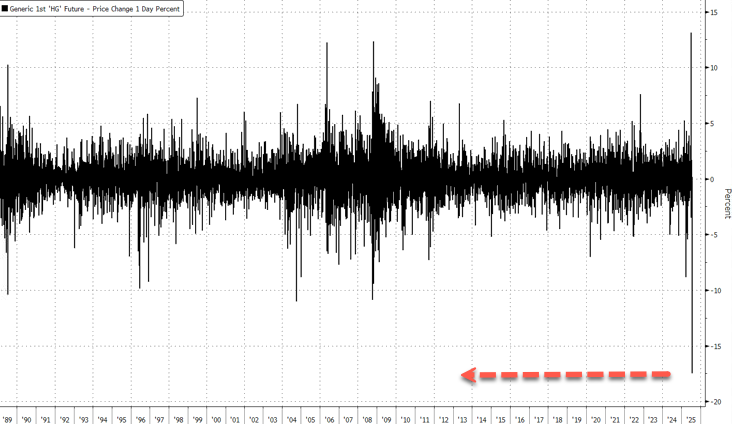
Traders were stunned when copper cathodes, the most widely imported and traded form of refined copper, were exempted from the new duties, triggering a vicious unwinding of bullish bets. The initial expectation had been that the tariffs would apply to all refined imports.
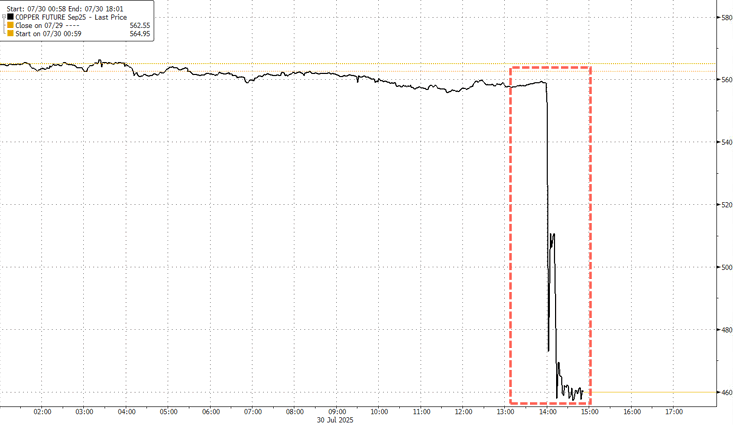
Pre-2:00 p.m. ET, U.S. copper prices were trading at record highs.
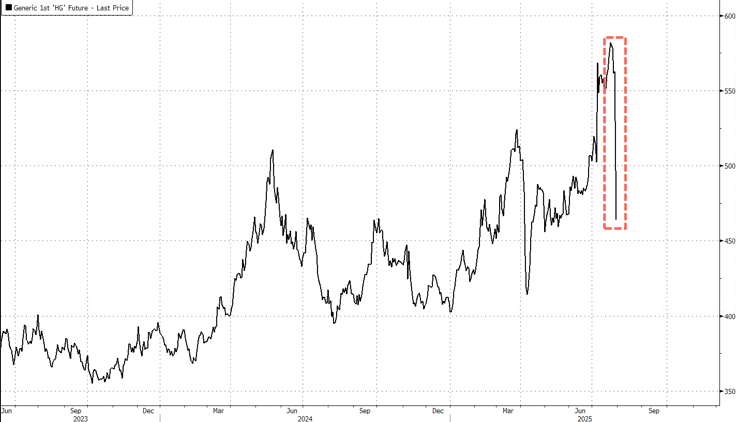
President Trump invoked the Defense Production Act, which allows his administration to direct industries to boost production of copper critical to national security. This means 25% of high-quality copper scrap and forms of raw copper must be made in the U.S. and sold domestically in 2027. That percentage would rise to 40% by the end of the decade. This move should be enough to boost domestic refining capacity while supporting U.S. refiners.
Trump wrote in the order that the Commerce Secretary concluded copper imports threaten U.S. national security, citing overreliance on foreign sources, weakened domestic capacity, and global overproduction.
The metal is critical to defense systems, infrastructure, and the broader industrial base, with no adequate substitutes.
“Today, a single foreign country dominates global copper smelting and refining, controlling over 50 percent of global smelting capacity and holding four of the top five largest refining facilities,” the order said, stopping short of naming China.
Trump’s actions:
- Effective August 1, 2025, Trump imposed a 50% tariff on semi-finished copper products and intensive copper derivatives.
- Refined copper (cathodes) was excluded for now, but a phased tariff of 15% in 2027 and 30% in 2028 is under consideration.
- The tariff is in addition to any existing duties from other executive actions, such as those targeting drug trafficking or trade imbalances.
- The proclamation includes a mechanism to add further copper derivatives to the tariff list.
- Strict customs enforcement is ordered, including criminal penalties for underreporting copper content.
Trump’s order seeks to rebuild America’s copper industrial base, strengthen supply chain resilience, accelerate domestic production and investment, and reduce the alarming dependence on China for base metals and rare earths (think magnets). It’s a strategic move to prepare for the volatile 2030s, as the global order fractures into a dangerous bipolar world. Securing critical supply chains now is essential to safeguarding the nation’s future.
END
ASIAN MARKETS THIS WEDNESDAY MORNING:
SHANGHAI CLOSED UP 6.01 PTS OR 0.17%
//Hang Seng CLOSED DOWN 347.52 PTS OR 1.36%
// Nikkei CLOSED DOWN 19.85 PTS OR 0.05% //Australia’s all ordinaries CLOSED UP 0.54%
//Chinese yuan (ONSHORE) CLOSED DOWN AT 7.1813 OFFSHORE CLOSED DOWN AT 7.1876/ Oil UP TO 69.22 dollars per barrel for WTI and BRENT UP TO 72.54 Stocks in Europe OPENED ALL MOSTLY MIXED
ONSHORE USA/ YUAN TRADING ABOVE LEVEL OF OFFSHORE YUAN TRADING :/ONSHORE YUAN DOWN IN TRADING AT 7.1813 AND WEAKER//OFF SHORE YUAN TRADING UP TO 7.1876 AGAINST US DOLLAR/ AND THUS WEAKER
YOUR EARLY CURRENCY VALUES/GOLD AND SILVER PRICING/ASIAN AND EUROPEAN BOURSE MOVEMENTS/AND INTEREST RATE SETTINGS WEDNESDAY MORNING.7:30 AM
ONSHORE YUAN: CLOSED DOWN TO 7.1813 (CHINESE COMMUNIST PARTY MANIPULATED)
OFFSHORE YUAN: DOWN TO 7.1876
HANG SENG CLOSED DOWN 347.52 PTS OR 1.36%
2. Nikkei closed DOWN 19.85 PTS OR 0.05%
3. Europe stocks SO FAR: ALL MOSTLY MIXED
USA dollar INDEX DOWN TO 98.63/ EURO RISES TO 1.15562 UP 2 BASIS PTS
3b Japan 10 YR bond yield: FALLS TO. +1.553//Japan buying 100% of bond issuance)/Japanese YEN vs USA cross now at 148.08…… JAPANESE YEN NOW FALLING AS WE HAVE NOW REACHED THE RE EMERGING OF THE YEN CARRY TRADE AGAIN AFTER DISASTROUS POLICY ISSUED BY UEDA
3c Nikkei now ABOVE 17,000
3d USA/Yen rate now well ABOVE the important 120 barrier this morning
3e Gold UP /JAPANESE Yen UP CHINESE ONSHORE YUAN: DOWN OFFSHORE: DOWN
3f Japan is to buy INFINITE TRILLION YEN worth of BONDS. Japan’s GDP equals 5 trillion USA
Japan to buy 100% of all new Japanese debt and NOW they will have OVER 50% of all Japanese debt.
3g Oil UP for WTI and UP FOR BRENT this morning
3h European bond buying continues to push yields lower on all fronts in the EMU. German 10yr bund YIELD DOWN TO +2.6750/Italian 10 Yr bond yield DOWN to 3.520 SPAIN 10 YR BOND YIELD DOWN TO 3.257%
3i Greek 10 year bond yield DOWN TO 3.377
3j Gold at $3331.70 Silver at: 38.10 1 am est) SILVER NEXT RESISTANCE LEVEL AT $50.00//AFTER 28.40
3k USA vs Russian rouble;// Russian rouble DOWN 1 AND 27 /100 roubles/dollar; ROUBLE AT 82.37
3m oil (WTI) into the 69 dollar handle for WTI and 72 handle for Brent/
3n Higher foreign deposits moving out of China// huge risk of outflows and a currency depreciation. This can spell financial disaster for the rest of the world/
JAPAN ON JAN 29.2016 CONTINUES NIRP. THIS MORNING RAISES AMOUNT OF BONDS THAT THEY WILL PURCHASE UP TO .5% ON THE 10 YR BOND///YEN TRADES TO 148.08// 10 YEAR YIELD AFTER FIRST BREAKING .54% LAST YEAR NOW EXCEEDS THAT LEVEL TO 1.553% STILL ON CENTRAL BANK (JAPAN) INTERVENTION//YEN CARRY TRADE IS NOW UNWINDING.
30 SNB (Swiss National Bank) still intervening again in the markets driving down the FRANC. It is not working: USA/SF this 0.8045 as the Swiss Franc is still rising against most currencies. Euro vs SF: 0.9293 well above the floor set by the Swiss Finance Minister. Thomas Jordan, chief of the Swiss National Bank continues to purchase euros trying to lower value of the Swiss Franc.
USA 10 YR BOND YIELD: 4.326 DOWN 1 BASIS PTS…
USA 30 YR BOND YIELD: 4.867 DOWN 0 BASIS PTS/
USA 2 YR BOND YIELD: 3.873 UP 0 BASIS PTS
USA DOLLAR VS TURKISH LIRA: 40.58
10 YR UK BOND YIELD: 4.5940 DOWN 6 PTS
10 YR CANADA BOND YIELD: 3.473 UP 0 BASIS PTS
5 YR CANADA BOND YIELD: 3.037 DOWN 0 PTS
2a New York OPENING REPORT
Futures Rise Ahead Of Huge Day: Fed, Mag7 Earnings, Refunding, GDP And More
Wednesday, Jul 30, 2025 – 07:52 AM
US equity futures were modestly higher in the hours before Wednesday’s Fed rate decision (where Powell is expected to keep rates unchanged) as traders also braced for the restart of Mag7 earnings with META and MSFT reporting after the close, while also bracing for an avalanche of macro news. As of 7:45am, S&P 500 futures rose 0.1% and Nasdaq 100 contracts add 0.2%, with all Mag7 names (ex-GOOG) higher premarket with Semis also bid up.Expectations are for the Fed to hold rates steady, with as much as 2 governor dissents (for the first time since 1993), with a focus on the Powell press conference for any hints of what the Fed will do in Sept. The Treasury’s refunding announcement is today which may add some bond vol. The yield curve is seeing bear steeping (10Y trading 4.33%, up 1bps) with the Bloomberg Dollar Index snapping a 4-day rally that followed trade pacts with the European Union and Japan. Commodities are mixed with profit-taking in Energy, Ags/Base higher, and gold up but silver down. There is a flood of data: first at 8:30am, we get US GDP (Q2 advance; consensus +2.4%, last -0.5), ADP employment (GS +90k, consensus +80k, last -33k), and Treasury QRA (GIR sees a 50–100% increase in buybacks. The key: a) Will coupon sizes be reduced? (low chance) b) How much of the buyback is aimed at long-dated paper? This afternoon, all eyes are on FOMC decision (no change expected // watch for 2 dissenters in Bowman + Waller // mkt pricing in 1.86 cuts through YE). Tonight, watching MSFT + META earnings (positioning in both remains elevated).
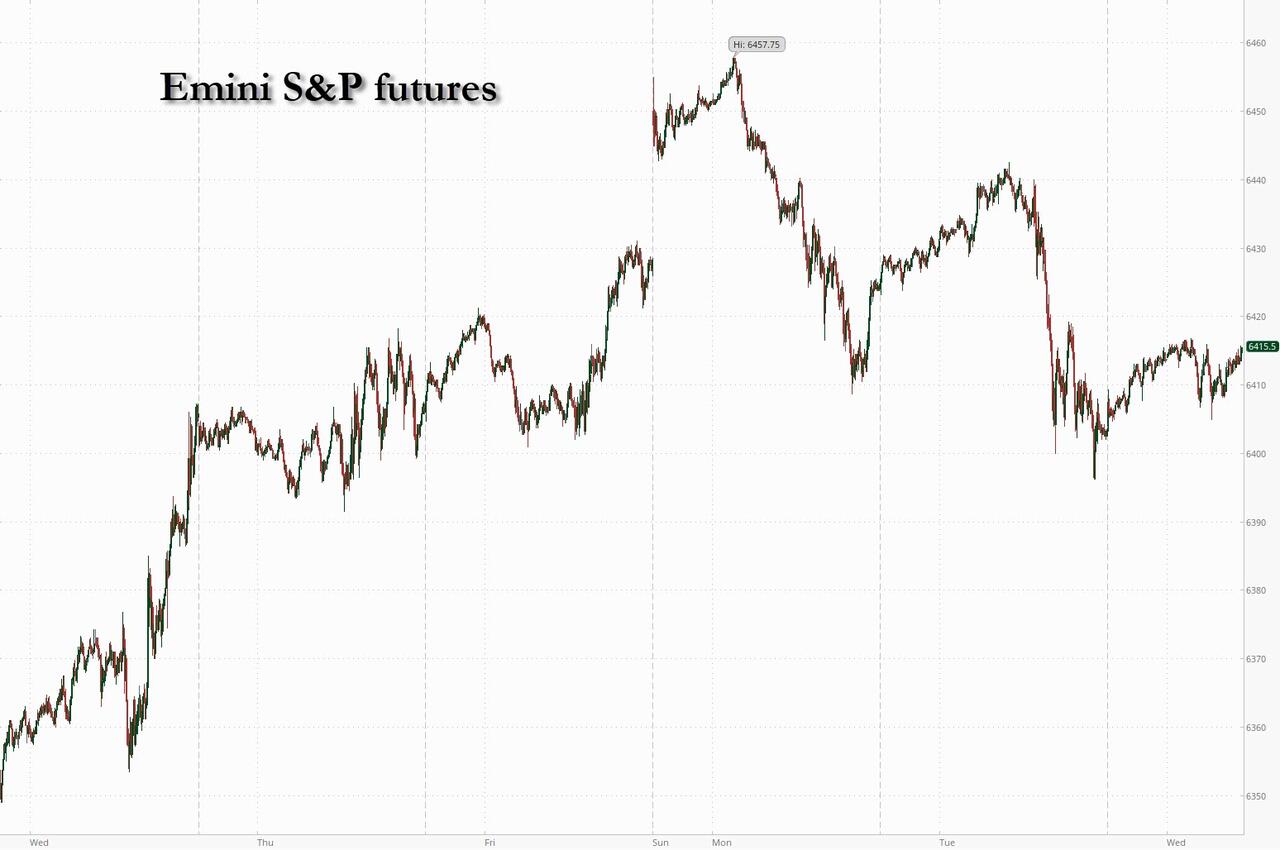
In premarket trading, Meta leads gains among Mag 7 ahead of its earnings report. Microsoft is also slated to report after the market closes (Meta +1.%, Nvidia +0.5%, Tesla +0.2%, Microsoft +0.3%, Apple +0.2%, Amazon +0.1%, Alphabet -0.1%). Here are some other notable premarket movers:
- AtriCure (ATRC) jump 10% after the medical-device firm forecast full-year adjusted Ebitda and revenue ahead of Wall Street’s expectations.
- Etsy (ETSY) climbs 6% after the online marketplace for crafts and vintage items posted 2Q gross merchandise sales that beat the average analyst estimate.
- Harley-Davidson (HOG) rises 8% after the motorcycle company also confirmed a deal where HDFS agreed to sell a 4.9% interest to KKR and PIMCO.
- Humana (HUM) rises 7% after the health insurer raised its profit guidance for the year, bucking a trend in the US health-insurance industry after most other companies cut their forecasts in recent months.
- LendingClub (LC) soars 24% after the financial services company forecast new originations for the third quarter, and its guidance beat the average analyst estimate. JPMorgan and Piper Sandler raise their price targets for the stock.
- Mondelez International Inc. (MDLZ) slips 1% after management said unease around the economy drove a bigger-than-expected decline in North American sales in the second quarter.
- Peloton Interactive (PTON) shares rise 7% after UBS upgraded to buy, citing upside to full-year 2026 Ebitda expectation supported by top line growth and further cost cuts.
- Qorvo (QRVO) rises 9% after the Apple supplier reported stronger-than-expected earnings and gave an upbeat forecast.
- Seagate Technology (STX) falls 6% after the computer-hardware manufacturer gave an outlook that was described as disappointing. It also reported fourth-quarter results that beat expectations.
- SoFi Technologies Inc. (SOFI) drops 8% after the provider of consumer financial services said it’s selling $1.5 billion of stock.
- Starbucks (SBUX) is up 4% after the coffee chain reported net revenue for the third quarter that beat the average analyst estimate. The report also showed that comparable sales came in better-than-expected in China and North America, two of the company’s key markets.
- Teradyne (TER) rises 6% after the chip manufacturer reported adjusted earnings per share for the second quarter that beat the average analyst estimate. Analysts noted that management now sees greater visibility into the second half of the year.
- VF Corp. (VFC) soars 15% after the the apparel and shoe company reported fiscal first-quarter earnings that beat Wall Street expectations, signaling that turnaround efforts are beginning to show results.
- Visa Inc. (V) is down 1.5% after the world’s biggest payments network left its earning outlook unchanged for the rest of the fiscal year.
In other corporate news, Tesla is said to have signed a $4.3 billion agreement to source lithium iron phosphate batteries from LG Energy in the second tie-up for the EV maker in South Korea this month. Anthropic is said to be nearing a deal to raise as much as $5 billion in a new round of funding that would value the AI startup at $170 billion.
The Fed is almost unanimously expected to hold rates steady for a fifth consecutive meeting in the face of sustained pressure from President Donald Trump on Powell to lower borrowing costs, but watch out for the number of dissenting rate-setters and Chair Jerome Powell’s commentary, as well as Trump’s undoubtedly angry response to it all. There is just a 3% market implied chance of a 25 rate cut today (our full preview is here).
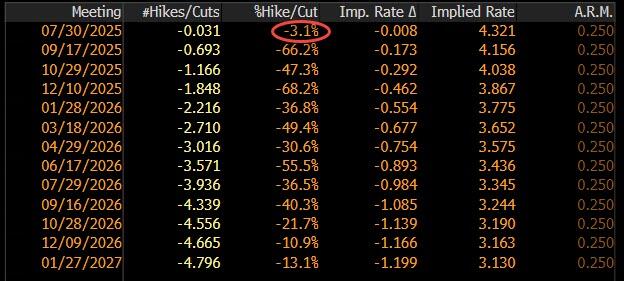
Investors will watch for any signs of a greater openness from the Fed to easing when it next gathers in September as they take stock of the number of dissenting policymakers. Swap markets have priced around 100 basis points of easing over the next 12 months.
“They’ll want to see what happens on the inflation side, so the speed of those cuts may not be as much as risk assets might want,” Priya Misra, portfolio manager at J.P. Morgan Asset Management, told Bloomberg TV. “Interest rates are still restrictive. How much do they need to cut to get into accomodative territory? They have to cut a lot.”
Inflation and jobs data since the Fed’s June meeting, as well as trade-policy developments, haven’t moved the Fed any closer to a cut, according to Bloomberg Economics’ Anna Wong, “If anything, the core PCE inflation data release due July 31 — which we expect to be a hot print – and July’s nonfarm payrolls, due Aug. 1 and also likely to be strong — may divide the committee even further,” she wrote.
Before the Fed, GDP figures will offer an update on the health of the American economy in the buildup to Friday’s key payrolls report. The relentless rush of big earnings continues in the US later, with Microsoft and Meta both reporting. Theire results will be a crucial barometer for growth stocks — which have supercharged gains for US equities this year. Meta’s ad impressions and pricing could see some pressure amid a spending pullback among Chinese advertisers, according to Bloomberg Intelligence. Microsoft is expected to post a 14% rise in sales when it reports results Wednesday, driven by growth in its Azure cloud-computing unit.
“Earnings and data matter more than Wednesday’s Fed meeting, and that’s why stocks will likely nudge higher again this week, despite any possible short-term disruption from the central bank decision” said BBG macro strategist Mark Cudmore. “This year is primarily about trade policy, and the most important issue for markets and consumers is, when will the impact of tariffs show up in prices and profits? It’s the answer to that question that will dictate the future US rate path more than any sell-side generated excitement over the number of dissents.”
On the trade front, there were signs of rapprochement between the US and China. Trump is set to make the final call on maintaining their tariff truce before it expires in two weeks, an extension that would mark a continued stabilization in ties between the world’s two biggest economies. Chinese trade negotiator Li Chenggang told reporters in Stockholm the two sides had agreed to prolong the pause, without providing further details.
“It’s clear both sides want to do a deal,” said Justin Onuekwusi, chief investment officer at St James’s Place in London. “That willingness at the moment is enough to appease markets.”
Elsewhere, the US West Coast and countries in the Pacific braced for tsunamis in the wake of a powerful earthquake in Russia’s Far East, although the initial waves to hit Japan were small. The yen gained 0.4% against the dollar after a tsunami warning for areas including the Tokyo Bay.
According to Barclays strateeegists, the US stock rally has been fueled by retail traders, while institutional buying has been more measured. CTA and vol target funds’ exposure has increased only modestly, suggesting more room for upside, while hedge funds trimmed long bets.
In Europe, the Euro Stoxx 600 edges higher, reversing earlier losses after data showed the euro-area economy unexpectedly grew in the second quarter. Gains in consumer goods, food, and construction offset losses in chemicals and retail. Mercedes-Benz and Porsche fall after cutting profit forecasts, citing tariff pressure, while HSBC drags on banks after missing estimates. Luxury group Kering and food giant Danone jumped following their respective earnings, while HSBC and Adidas fell on theirs. Amplifon plunges most on record after posting weak results and cutting its full-year outlook. Here are the biggest movers Wednesday:
- Danone rises 7.3% after the packaged food company reported recurring operating income for the first half-year that met the average analyst estimate. Analysts view outperformance in Specialized Nutrition as key to strong results
- Kering shares jumped as much as 4.8% after the luxury-goods maker reported better-than-expected operating profit. Sales however plunged at its key unit Gucci which is undergoing a second design revamp in three years
- JDE Peet’s shares gained as much as 13%, the most since October, after the coffee company reported revenue for the first half-year that beat the average analyst estimate and raised its outlook
- Grifols shares jumped as much as 10% as the Spanish blood plasma company resumed dividend payment after four years and beat 2Q estimates; Renta 4 says company continues to demonstrate strength in underlying business
- Porsche shares rise as much as 4.1% as analysts highlight free cash flow and revenue strength in second-quarter results, despite another outlook cut. Shares are still down more than 20% so far this year
- L’Oreal shares rise as much as 2.9% to the highest in almost eight weeks, reversing a fall in early trading. Analysts note significant phasing effects which impacted the cosmetics company’s second quarter results
- Nexans shares gained as much as 6.2% to highest level since November, after cable manufacturer reported earnings that analysts say are strong and boosted its adjusted Ebitda guidance for the full year
- Amplifon plunges as much as 27%, their biggest drop on record, after the hearing care specialist posted results significantly below expectations and cut its FY outlook. Banca Akros and Mediobanca both downgraded the stock
- Adidas plunges as much as 8.6% after the footwear giant reported weaker than expected revenue growth which offset a margin beat. The lack of guidance upgrade is said to be driven by increased tariff uncertainty
- HSBC slumps 5.1% in London trading, the worst performing stock among Stoxx 600 banks, after its 2Q pretax profit missed the consensus analyst estimate. The lender reported an increase in expenses and took a $2.1b impairment
- Inficon shares fall as much as 10% after the Swiss vacuum instruments maker reported second-quarter earnings that missed estimates, and cut its operating margin forecast for the year
- AUTO1 shares fall as much as 4.8% as the firm’s guidance raise failed to enthuse the market, with the stock already up over 50% this year, with UBS noting the company’s investments in Autohero, though Ebitda still beat estimates
Earlier in the session, Asian stocks eked out small gains as investors looked past some tariff developments and turned their focus to key monetary policy decisions from Japan and the US. The MSCI Asia Pacific Index gained as much as 0.6%, poised to snap a three-day decline, with chipmakers TSMC and Samsung Electronics among the top contributors. Equities advanced in tech-heavy South Korea and Taiwan. The regional benchmark has slipped slightly after climbing to a four-year high last week. Markets in Hong Kong traded lower as trade talks between Beijing and Washington were set to continue ahead of the expiry of a tariff truce in two weeks. Adding an extra 90 days is one option, Treasury Secretary Scott Bessent said, while President Donald Trump will make the final call. Separately, the US also said that India may be hit with a tariff rate of 20% to 25%. Stocks were mixed in Tokyo ahead of Bank of Japan’s policy decision Thursday. The central bank is expected to keep rates unchanged this time, while the market gauges prospects for another hike this year. Investors have also moved to the sidelines as they await the August 1 tariff deadline after Japan forged a trade deal with the US last week.
In FX, the Bloomberg Dollar Spot Index slips 0.1%. The yen leads G-10 FX, up 0.3% against the dollar, while the Aussie lags, down 0.2% after softer-than-expected inflation.
In rates, treasuries dip ahead of the quarterly refunding and Fed decision, with US 10-year yields up 1bp to 4.33%.
Bunds hold gains, with German 10-year yields down 2bps to 2.69%. Gilts outperform, pushing UK 10-year yields 4bps lower.
In commodities, oil falls 0.6%, with WTI near $68.80, while spot gold gains $6 to around $3,332/oz.
Bitcoin is a little lower and trades just above the USD 118k mark; Ethereum posts deeper losses and holds just above USD 3.8k.
Looking ahead to today, the main event will be the Fed rate decision at 2pm ET. Before the decision, the main data releases will be the ADP’s employment change data for July at 8:15am. At 8:30am, markets will pay close attention to readings of GDP, personal consumption and core personal consumption expenditures prices for the second quarter. Pending home sales for June are due at 10am, before the day’s main event — the Fed’s latest policy decision at 2pm. On the earnings side, we will hear from two of the Mag-7 with Microsoft and Meta reporting after the US close. Other US results include Qualcomm and Ford, while in Europe the highlights include Airbus, BAE, Mercedes-Benz and Porsche
Market Snapshot
- S&P 500 mini +0.1%,
- Nasdaq 100 mini +0.2%,
- Russell 2000 mini +0.4%
- Stoxx Europe 600 little changed,
- DAX little changed
- CAC 40 +0.5%
- 10-year Treasury yield +1 basis point at 4.33%
- VIX -0.1 points at 15.88
- Bloomberg Dollar Index little changed at 1209.31
- euro little changed at $1.1552
- WTI crude -0.5% at $68.89/barrel
Top Overnight News
- Tsunami waves of 3.6ft seen at Crescent City in California, according to NTWC.
- The Fed is expected to hold rates, despite Donald Trump’s calls for cuts. Any policymaker dissent may send the message that some prefer to cut sooner rather than later, but with an onslaught of data due before their next meeting, Jerome Powell will probably keep his options open. BBG
- Chinese leaders signaled they would refrain from rolling out more major stimulus for now, as authorities pivot to addressing excess capacity in the economy. Instead of announcing more policy support to bolster growth, the ruling Communist Party’s Politburo, pledged Wednesday to better execute policies that are already in place. WSJ
- Trump’s recent trade deals with Japan and the EU boast big investment numbers, but lack crucial details, raising questions about the deals’ true impact. BBG
- L/S hedge funds have made a comeback during this year’s market turbulence, with sizeable gains helping attract fresh cash from investors after nearly a decade of outflows. These funds took in $10bn from investors in the first half of the year, following more than $120bn of withdrawals since 2016. FT
- China’s gold-backed ETFs are seeing record outflows this month as investors shift into local equities. BBG
- Australia’s inflation continued to ease in the second quarter, raising bets that the central bank will deliver its third interest rate cut next month. WSJ
- India is skeptical it can reach a deal w/the US by the 8/1 deadline and plans to continue negotiating even if its hit w/higher tariffs for a period of time. BBG
- The euro-area economy unexpectedly eked out 0.1% growth last quarter, benefiting from better-than-predicted performances in France and Spain. But the resilience masked contractions in Germany and Italy. BBG
- Companies are making it clear how they intend to deal with tariff costs – passing them on to American consumers. Throughout the spring, big retailers and consumer product makers warned that levies on imported goods would squeeze their operations, forcing them to choose between lower earnings and passing on higher costs to customers. RTRS
Trade/Tariffs
- Taiwan trade delegation will continue talks with the US on tariffs in Washington, according to three people familiar with the matter cited by Reuters.
- Brazil’s Vice President Alckmin said they are working towards a tariff reduction in all sectors and should not rush into discussions on big tech regulation.
- India is said to be eying a deadline in the autumn for a US deal, according to Bloomberg sources
A more detailed look at global markets courtesy of Newsquawk
APAC stocks traded mixed following the subdued handover from Wall St, where the S&P 500 snapped a six-day win streak and as participants braced for approaching key events, including the FOMC and several megacap earnings releases. ASX 200 advanced with gains led by strength in Real Estate and Consumer Staples, while stocks also benefited from the softer yield environment after CPI data either matched or printed below forecasts. Nikkei 225 lacked conviction amid little pertinent catalysts, and as the BoJ kicked off its two-day policy meeting. Hang Seng and Shanghai Comp were mixed with the mainland underpinned following the conclusion of the two-day talks between the US and China, where negotiators were pushing for a 90-day truce extension and await a sign-off from US President Trump.
Top Asian News
- Chinese Finance Minister Lan said China will continue to enhance consumption and will make good use of more proactive fiscal policies, while he added that the uncertainty of China’s development environment is rising. Lan stated China will promote healthy development of the property market and actively address local government debt risks.
- Monetary Authority of Singapore maintained its FX-based policy as it kept the prevailing rate of appreciation of the SGD NEER policy band, while it made no change to the width and level at which the band is centred. MAS said prospects for the Singapore economy remain subject to significant uncertainty, especially in 2026, and Singapore’s GDP growth is projected to moderate in the second half of 2025 from its strong pace in H1. Furthermore, it stated that inflationary pressures should remain contained in the near term and the MAS is in an appropriate position to respond to risks to medium-term price stability.
- A magnitude 8.7 earthquake struck Petropavlovsk-Kamchatsky, Russia region, while the Russian regional governor said the earthquake off Kamchatka was the strongest in decades, with a tsunami threat declared, and people were urged to move away from the coastline. Japan’s government also issued an emergency warning and ordered an evacuation, while it expected a tsunami as high as 3 metres to arrive along large coastal areas along Pacific Ocean, although Japan’s Chief Cabinet Secretary Hayashi later stated there were no casualties or damage reported so far after the quake of Kamchatka triggered a tsunami and NHK reported a tsunami of 30 centimetre reaching Japan’s northern Hokkaido. Furthermore, the Honolulu Department of Emergency Management called for evacuation of some coastal areas after the earthquake in Russia and warned destructive tsunami waves were expected, while USCG Oceania issued an order for all commercial vessels to evacuate all commercial harbours in Hawaii with all harbours closed to incoming vessel traffic and California Governor Newsom confirmed that a tsunami warning is in effect for California, particularly the north coast.
- China’s Politburo held a meeting on the economy; says economy still faces challenges, says China should accelerate the issuance of government bonds; calls to implement more proactive fiscal policy, via Xinhua. President Xi says China “must break down over-competition”, urges measures to boost consumption and the expansion of domestic demand in all directions.
- Nissan (7201 JT) Q1 (JPY): Net loss 115.8 (prev. profit 28.56bln Y/Y). Operating loss 79.12bln (prev. profit 995mln). Notes of impairment loss of JPY 40.6bln, recorded as an extraordinary loss in statement; forecasts JPY 180bln operating loss for Apr-Sep.
- United Microelectronics (UMC) Q2 (TWD): net 8.9bln (prev. 13.79bln Y/Y), revenue 58.76bln (prev. 56.80bln Y/Y).
European bourses (STOXX 600 +0.1%) opened mixed and have continued to trade sideways throughout the morning; though more recently, some upside has been seen. European traders have had French GDP (marginally beat expectations), German Retail Sales (beat), Spanish CPI (mixed), German GDP (Q/Q in-line; Y/Y firmer), EZ Sentiment (stronger-than-expected), EZ GDP (above expectations) – little move seen across the equities complex. European sectors are mixed and with the breadth of the market fairly narrow, aside from the day’s underperformer. Chemicals is weighed on by post-earning losses in Symrise (-6%), where the co. reported a rev. slowdown. Consumer Products is found around the middle of the pile, given the mixed earnings from within the sector; in Luxury, Kering (+4%) and Hermes (-4%) are playing tug-of-war, whilst Adidas (-7%) adds to the downside after its H1’25 update. The German sportswear giant reported strong profits, attributed to resilience in the retro shoe market – though it was still shy of expectations; further adding to the pressure is the co. flagging a USD 231mln tariff-related hit.
Top European News
- ECB Blog: “China-US trade tensions could bring more Chinese exports and lower prices to Europe”
FX
- DXY is a touch softer as the recent recovery in the USD pauses for breath. The USD has been bolstered in recent sessions by developments on the trade front following the recent EU-US agreement and expectations of an extension to the 90-day truce between the US and China; subject to Trump’s approval. Market pricing places the odds of a September reduction at 68% with a total of 46bps of loosening priced by year-end. DXY is currently tucked within Tuesday’s 98.58-99.14 range. Ahead, a slew of US data points and the FOMC announcement.
- EUR is attempting to atone for recent losses following the downside seen in the wake of the recent EU-US trade deal, which has been framed by many as a “win” for the US and subsequently drawn objections from various European leaders. Note, the agreement still requires ratification from the EU and national parliaments. Focus today turned back to the data slate following national and EZ-wide GDP metrics; the latter saw growth slow to 0.1% from 0.6% following an unwind of the front-loading seen in Q1 ahead of expected tariffs. Elsewhere, the ECB’s wage tracker passed with little in the way of fanfare; 2025 metric was revised a touch higher to 3.152% from 3.144%. EUR/USD remains within Tuesday’s 1.1519-99 range and below its 50DMA at 1.1574.
- JPY is attempting to claw back some lost ground vs. the USD with some tailwinds seen overnight after Japan’s government issued an emergency warning and ordered an evacuation following a powerful 8.7 magnitude earthquake in Russia’s far east region. Attention now turns towards the upcoming BoJ policy announcement, which is set to see policymakers stand pat on current policy settings. USD/JPY has slipped below the 148 mark with a session low at 147.81.
- GBP is marginally firmer vs. the USD after a run of four consecutive losses. UK-specific newsflow light, more focus on US developments today. Cable remains on a 1.33 handle and trades in close proximity to Tuesday’s 1.3364 peak.
- AUD sits at the foot of the G10 leaderboard following a soft outturn for Australian CPI overnight, which saw headline Y/Y CPI slow to 2.1% from 2.4%. Oxford Economics writes that the data clears the way for another rate cut in August (currently priced at 92%). AUD/USD has slipped back below its 50DMA at 0.6513.
- CAD is flat ahead of the BoC rate announcement, which is expected to see the policy rate left unchanged at 2.75%. Additionally, the BoC is likely to leave out forward guidance again, given uncertainties in the economy. USD/CAD remains on a 1.37 handle and within Tuesday’s 1.3731-88 range.
- PBoC set USD/CNY mid-point at 7.1441 vs exp. 7.1742 (Prev. 7.1511).
Fixed Income
- USTs are contained ahead of a packed day. In a 111-10 to 111-13 band, matching the WTD peak from Tuesday. A number of key events today, including US ADP National Employment, GDP/PCE (Q2), BoC/Fed Policy Announcements. Also in focus is US President Trump who may provide some US-China trade updates, following the meeting between the two countries in Sweden. Into the packed docket, given the contained benchmark action, yields are also near-enough unchanged but with a very marginal steepening bias. An upward move for USTs brings last week’s 111-14+ high into view. On the flip side, 111-00 is the first support point before 110-24+ and 110-24 from earlier in the week.
- Bunds spent much of the European morning a touch firmer having picked up gradually throughout the European morning but action is still relatively muted into the above US risk events. As high as 129.84 with gains of c. 20 ticks at best. The morning has been dominated by earnings (see Equities) with the European risk tone largely contained but with some earnings-driven regional variation. Equities aside, the first readings of Q2 GDP saw stronger-than-forecast quarterly French release, in-line German and weaker Italian (Y/Y outside forecast range) & Dutch readings. No move to these. Thereafter the EZ wide figures (beat both Q/Q and Y/Y) – again no reaction.
- Gilts are managing to eek some marginal outperformance vs peers, with gains of 21 ticks at best vs 19 at most in Bunds. If the current 91.96 high is breached then we look to last week’s 92.15 peak and then 92.24 from the week before.
- UK DMO sells GBP 300mln 3.75% 2052 Gilt via tender; b/c 4.62x, average yield 5.383%
- Italy sells EUR 7.0bln vs exp. EUR 5.5-7.0bln 2.70% 2030, 3.60% 2035, 1.35% 2030 BTP & EUR 2.0bln vs exp. EUR 1.5-2.0bln 2034 CCTeu
Commodities
- Flat/subdued trade across the crude complex as prices take a breather following Tuesday’s hefty gains. This morning, some downticks in the complex coincided with comments from Polish PM Tusk, who sees a chance that the Russia-Ukraine conflict could be paused in the near future, via Bloomberg. That being said, Tusk is not involved in any Russia-Ukraine talks. WTI resides in a USD 69.01-69.79/bbl range with its Brent counterpart in a USD 72.52-72.24/bbl range.
- Precious metals are mixed today with spot palladium/silver marginally lower whilst gold is flat. Spot gold resides in a USD 3,321.79-3,333.77/oz range, and within Monday’s USD 3,308.16-3,334.27/oz parameter.
- Mixed trade across base metals with newsflow on the lighter side ahead of the aforementioned risk events. This morning, China’s Politburo held a meeting on the economy, and said the economy still faces challenges, adding that China should accelerate the issuance of government bonds, and called to implement more proactive fiscal policy, via Xinhua. 3M LME copper resides in a USD 9,726.35-9,826.65/t range at the time of writing.
- US Private inventory data (bbls): Crude +1.5mln (exp. -1.3mln), Distillate +4.2mln (exp. +0.3mln), Gasoline -1.7mln (exp. -0.6mln), Cushing +0.5mln.
Geopolitics
- Polish PM Tusk sees a chance that the Russia-Ukraine conflict could be paused in the near-future, via Bloomberg; “There are many signs pointing to the fact that the Russia-Ukraine war may be at least suspended in the nearest time” Tusk said.
- “A senior Israeli official briefed the Saudi Al-Arabiya channel that there are warnings that elements backed by Iran are planning to attack Israel from southern Syria.”, according to journalist Elster.
- Kremlin spokesman says a meeting between the Presidents of Russia and the US is not on the agenda, according to Russian representative Ulyanov on X
- China Defence Ministry says Chinese and Russian navies will hold joint military exercise in waters and airspace near Vladivostok in August.
US Event Calendar
- 7:00 am: Jul 25 MBA Mortgage Applications, prior 0.8%
- 8:15 am: Jul ADP Employment Change, est. 75.5k, prior -33k
- 8:30 am: 2Q A GDP Annualized QoQ, est. 2.6%, prior -0.5%
- 8:30 am: 2Q A Personal Consumption, est. 1.5%, prior 0.5%
- 8:30 am: 2Q A GDP Price Index, est. 2.2%, prior 3.8%
- 8:30 am: 2Q A Core PCE Price Index QoQ, est. 2.3%, prior 3.5%
- 10:00 am: Jun Pending Home Sales MoM, est. 0.2%, prior 1.8%
- 2:00 pm: Jul 30 FOMC Rate Decision est. 4.5%, prior 4.5%
DB’s Jim Reid concludes the overnight wrap
The main story over the last 24 hours has been a reversal from Monday’s divergent price action in transatlantic fixed income markets, and a jaw-dropping intraday -30% plunge in Novo Nordisk — Europe’s second-largest company, now relegated to sixth with the move. The stock eventually closed -23.11% lower. What’s remarkable is that indices including Novo, like the Stoxx 600 (+0.33%), still managed to finish higher, outperforming the S&P 500 (-0.30%). Imagine if one of the top two or three S&P 500 names dropped that much in a single session—it would be absolute chaos. For context, Microsoft, the second-largest US company, has a market cap of $3.81trn, while Novo fell from $313bn to $240bn yesterday. Talking of Microsoft, they report after the closing bell today, alongside Meta.
In fixed income, US Treasuries saw a strong rally, as 2yr yields fell -5.8bps, while 10yr (-9.1bps) and 30yr (-10.2bps) yields saw their biggest daily declines since early June. There’s a growing narrative that today’s refunding announcement could include measures aimed at helping to cap yields. See our strategists’ preview here where they don’t see much new being delivered. A strong 7yr auction after the European close also helped sentiment, as $44bn of bonds were issued -2.6bps below the pre-sale yield with the highest bid-to-cover ratio for a 7yr auction since 2012. For more context on the drop in yields, see yesterday’s CoTD (link here), which highlighted that we’re in a seasonally strong period for bonds. Our rates strategists are waiting for these seasonal effects to fade before initiating more bearish trades. Interestingly, European yields moved in the opposite direction though, reversing Monday’s rally, with 10yr Bunds, OATs, and BTPs rising +1.9bps, +1.4bps, and +1.2bps, respectively.
The large fall in US yields came ahead of the FOMC today with our economists expecting the Fed to keep rates on hold for a fifth straight meeting at 4.00-4.25%. The decision is unlikely to be unanimous, and they expect two governors to dissent for the first time since 1993. Just before the blackout period Governor Waller reinforced his case for a July rate cut, while Vice Chair of Supervision Bowman earlier left open the door to supporting a cut if “upward pressures remain limited to goods prices.” In terms of near-term policy, our economists think Powell is unlikely to remove a September rate cut from consideration nor intentionally raise the probability of that outcome. Even though political pressure on Powell to cut rates remains high, our view is that due to modestly stronger inflation prints over the coming months, the first cut should be in December, after which we expect a further 50bps reduction in Q1 2026.
The decline in yields came even as breakevens moved higher amid a new spike in oil prices as Trump suggested that he would impose new measures against Russia if Moscow failed to agree to a ceasefire within 10 days. While there was no new detail on what shape sanctions or tariffs would take, Trump said he was not worried about the potential impact on oil prices, saying “I don’t worry about it. We have so much oil in our country. We’ll just step it up, even further”. Brent rose +3.53% to $72.51/bbl, its biggest spike in six weeks and extending a +2.34% rise on Monday.
It was a busy day in the corporate world, especially in pharma, where both tariffs and earnings were in focus. As mentioned earlier, Novo Nordisk had a brutal session after revising its sales growth forecast from 21–24% down to 8–14% amid a slowdown in sales of its weight-loss drug Wegovy, and announcing a new CEO. Shares plunged as much as -30% before recovering slightly to close -23.11% lower, which was still its largest fall since data starts in 1991. Shares in rival Eli Lilly & Co also fell -5.59% as investors worried about broader sector weakness.
US equities retreated more broadly, with the S&P 500 (-0.30%) ending a run six consecutive record highs. Among the post-earnings underperformers, UnitedHealth fell -7.46% on weaker Q2 sales and PayPal dropped -8.66% as volume growth disappointed, though it announced a new feature for merchants to accept crypto payments from consumers while receiving USD for a fee of just 0.99%. The Mag-7 fell -0.68% ahead of results from Microsoft and Meta this evening, with Meta sliding by -2.46%.
Over in Europe, the STOXX 600 (+0.29% after -0.22% Monday) and Germany’s DAX (+1.03% after -1.02%) reversed Monday’s declines but the STOXX Autos & Parts index fell another -0.18% after the -1.82% slump in the fallout from the US-EU trade deal. Another European asset that continued Monday’s decline was the euro, which fell -0.36% to 1.1547, while the dollar index hit a five-week high.
Following the weekend US-EU deal, US Commerce Secretary Lutnick said there’s still “plenty of horse trading left to do” before finalising agreements. He noted that the EU accepted the deal to protect its pharmaceutical and automotive sectors, but said he expected to continue discussing with the EU on issues like digital services taxes and metals tariffs. President Trump is expected to announce pharma tariffs within the next two weeks, which for the EU should now be covered by the 15% tariff level.
In other trade news, US Treasury Secretary Bessent said the US and China were continuing talks on maintaining their current trade truce before it expires in two weeks’ time. He said another 90-day extension, which had been indicated by China’s delegation, was an option but that the final decision lay with Trump. National Economic Council Chair Hassett said Trump would see the final details on the China talks today. Meanwhile, Trump suggested that India could be hit with a tariff rate 20-25%, though he cautioned that the final rate had not yet been finalised as both sides are still negotiating ahead of Friday’s deadline. We are yet to hear a response from PM Modi’s government as we go to print.
We are mostly edging higher this morning in Asia led by the KOSPI (+0.87%), buoyed by hopes of a US trade agreement prior to the August 1 deadline, with the S&P/ASX 200 (+0.65%) also benefiting from a soft quarterly inflation report (details below). In other regions, both the CSI and the Shanghai Composite are trading +0.52% higher. Meanwhile, the Nikkei (+0.02%) is flat with the Hang Seng dipping -0.43%. S&P 500 (+0.12%) and NASDAQ 100 (+0.18%) futures are slightly higher.
Returning to Australia, core inflation eased in the three months leading up to June, reinforcing the argument for the RBA to cut rates as soon as August. The trimmed CPI rose by +0.6% in the second quarter compared to the previous three months, falling short of the 0.7% forecast. On a yearly basis, it increased by +2.7%, only because of higher revisions earlier in the year, aligning with expectations and down from +2.9% in the first quarter. Following the data, yields on the policy-sensitive 3-year government bonds has continued to decline (-5.7bps on the day) as traders have fully incorporated expectations for an RBA rate cut next month, with the likelihood of an additional cut at the September meeting rising to approximately 40%.
Yesterday was also a busy day for US data, which sent a decent signal on the state of the US economy. The Conference Board’s July consumer confidence index came in stronger than expected at 97.2 (vs 96.0), while inflation expectations continued to reverse their spike earlier in the year. And the advance goods trade balance for June came in at -$86bn, less negative than the -$98bn expected. This stronger net exports signal pushed up the Atlanta Fed’s GDPNow for Q2 from 2.4% to 2.9%. There was a slight softness in the June JOLTS job openings at 7.437 million (vs 7.5m expected) but the quits and layoffs rates held steady at low levels of 2.0% and 1.0%, respectively, suggesting a still solid labour market.
In Europe, the ECB’s latest consumer expectations survey showed 1yr inflation at 2.6% and 3yr inflation at 2.4%, both in line with forecasts. Ahead of tomorrow’s flash GDP prints for the Euro Area’s largest economies, Spain reported Q2 GDP growth of +0.7% QoQ (vs +0.6% expected), while Belgium came in at +0.2%. Our economists expect Euro Area GDP to grow +0.1% QoQ (consensus 0.0%) and see upside risks to that forecast.
Looking ahead to today, the main event will be the Fed rate decision at 19:00 LDN time. Before the decision, the main data releases will be US GDP, ADP employment change and personal consumption. In Europe, the focus will be on the eurozone flash GDPs and consumer confidence. On the earnings side, we will hear from two of the Mag-7 with Microsoft and Meta reporting after the US close. Other US results include Qualcomm and Ford, while in Europe the highlights include Airbus, BAE, Mercedes-Benz and Porsche
2b European opening report
2c/ Asian opening report
Europe primed for a firmer open ahead of data, earnings & Fed – Newsquawk Europe Market Open

Wednesday, Jul 30, 2025 – 01:51 AM
- US Treasury Secretary Bessent said he will see US President Trump regarding the China tariff pause on Wednesday and some technical details remain on the China tariff pause, while the China tariff extension decision will be up to Trump and if he does not approve tariff pause extension, tariffs on Chinese goods would ‘boomerang’ back to April 2nd levels, or another level that he chooses.
- US President Trump said Chinese President Xi wants to meet and he thinks it will happen before the end of the year, while he stated that they will either approve the trade extension or not. Chinese Vice Commerce Minister Li said the US and China have agreed to extend the trade truce; Bessent said China jumped the gun a little on the 90-day pause.
- Crude futures surged yesterday amid comments from US President Trump who confirmed changing the deadline for Russia to reach a Ukraine ceasefire agreement to 10 days, while there were simultaneous comments from Treasury Secretary Bessent who told Chinese officials that China could face high tariffs if it continues to purchase sanctioned Russian oil due to US secondary tariff legislation.
- APAC stocks traded mixed following the subdued handover from Wall St; European equity futures indicate a mildly positive cash market open with Euro Stoxx 50 futures up 0.3% after the cash market closed with gains of 0.8% on Tuesday.
- Looking ahead, highlights include French GDP, Spanish CPI, German GDP & Retail Sales, Italian GDP, ECB Wage Tracker, EZ GDP & Sentiment, US ADP National Employment, GDP Advance (Q2), PCE (Q2), Fed, BoC, BCB Policy Announcements Speakers including Fed Chair Powell, BoC’s Macklem & Rogers, Supply from Italy, US Quarterly Treasury Refunding Announcement.
- Earnings from Hermes, Airbus, Vinci, Danone, Capgemini, HSBC, GSK, Aston Martin, Santander, Caixabank, Telefonica, Intesa Sanpaolo, Leonardo, Mercedes Benz, Siemens Healthineers, BASF, Adidas, Porsche AG, Meta, Microsoft, RobinHood, Carvana, Lam Research, Qualcomm, Ford, Arm, eBay, FMC, Vertiv, Altria, Kraft Heinz, GE Healthcare & VF Corp.
SNAPSHOT
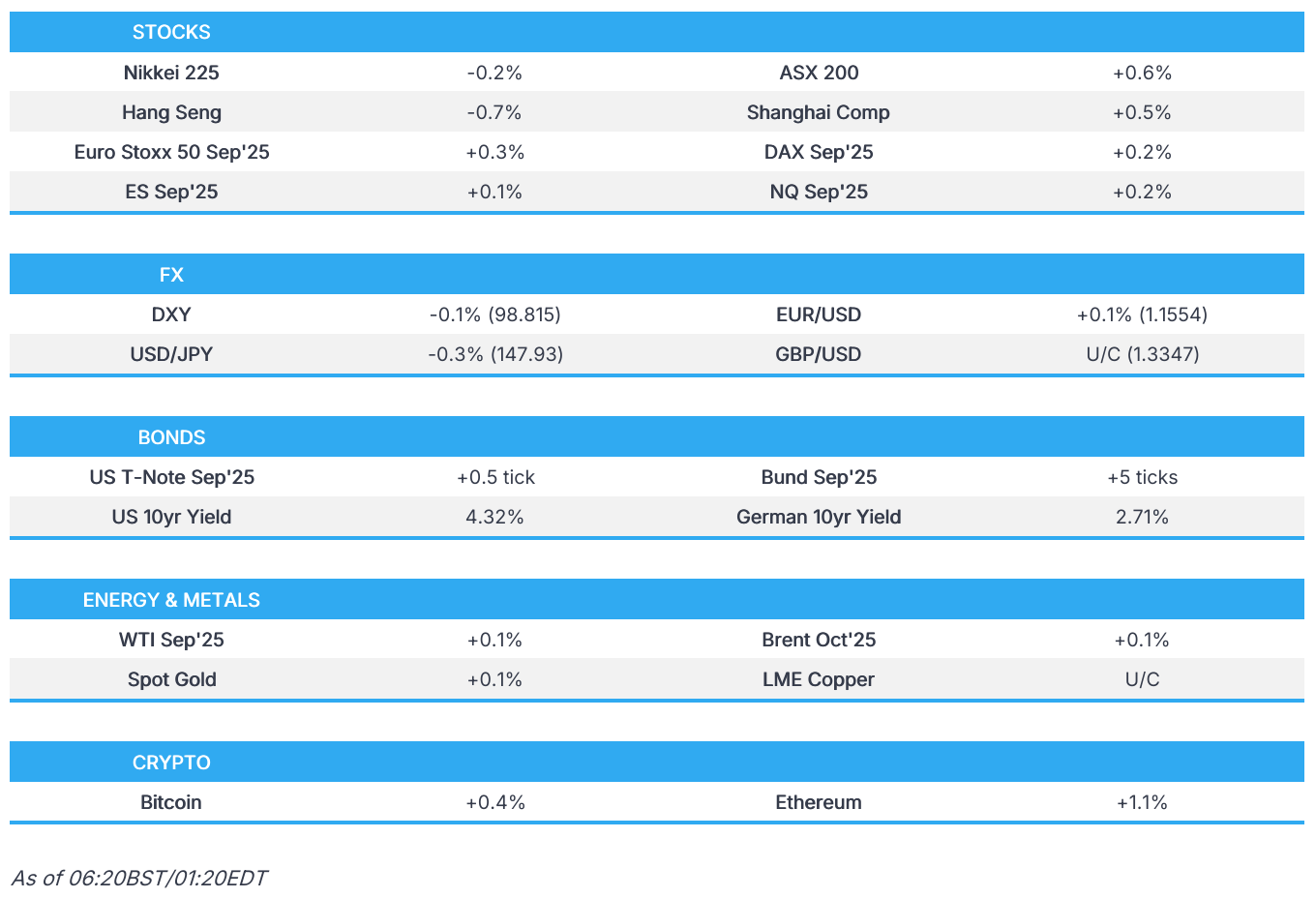
Newsquawk in 3 steps:
1. Subscribe to the free premarket movers reports
2. Listen to this report in the market open podcast (available on Apple and Spotify)
3. Trial Newsquawk’s premium real-time audio news squawk box for 7 day
US TRADE
EQUITIES
- US stocks were lower on Tuesday amid a deluge of earnings, which saw Industrials reside as the sectoral laggard and hit by Boeing (BA) (-4%) and UPS (UPS) (-10.5%) post-results, with the latter weighed on as it didn’t provide revenue or operating profit guidance amid the current macro uncertainty.
- In terms of the sectors, Real Estate, Utilities, and Energy were at the top of the pile with the latter buoyed by gains of more than 3.5% in oil prices amid comments from US President Trump and Treasury Secretary Bessent on the timeframe for Russia to agree to a ceasefire and warning of Russian oil sanctions.
- Attention was also on US-China trade talks, with the overwhelming readout being positive, although Bessent said he will be meeting with Trump in the Oval Office on Wednesday and that the final decision on the trade truce will be up to the President.
- SPX -0.30% at 6,371, NDX -0.21% at 23,308, DJI -0.46% at 44,633, RUT -0.61% at 2,243.
- Click here for a detailed summary.
TARIFFS/TRADE
- US President Trump said Chinese President Xi wants to meet, and he thinks it will happen before the end of the year. Trump also said he spoke with Treasury Secretary Bessent and that it was a very good meeting with the China trade team, while he stated regarding China, that they will either approve the trade extension or not. Furthermore, Trump said the India trade deal is not finalised and that India may pay tariffs of 20%-25%.
- US Treasury Secretary Bessent said he will see US President Trump regarding the China tariff pause on Wednesday and some technical details remain on the China tariff pause, while the China tariff extension decision will be up to Trump and if he does not approve tariff pause extension, tariffs on Chinese goods would ‘boomerang’ back to April 2nd levels, or another level that he chooses. Bessent also stated he hopes China’s 5yr plan would include rebalancing and 90 days is one option for a trade truce extension, as well as suggested they could have another meeting in 90 days and noted there was no discussion in Stockholm regarding a possible Trump-Xi meeting.
- US Treasury Secretary Bessent told Chinese officials that, given US secondary tariff legislation on sanctioned Russian oil, China could face high tariffs if it continues to purchase it. It was separately reported that Bessent said they are discussing big economic frameworks regarding China trade and that China jumped the gun a little on the 90-day pause, while he added that China trade and the August 12th deadline are pending Trump’s approval and he doesn’t know where they will be in 90 days but noted good news is they’re talking.
- USTR Greer confirmed verification of the London framework and is to make sure magnets are flowing. Greer said they are discussing details on the tariff pause with China, and a 90-day extension is one option for Trump to approve, while he added the US did not agree to any changes on export controls.
- US NEC Director Hassett said Treasury Secretary Bessent and USTR Greer are to give President Trump a briefing on talks on Wednesday regarding China tariff negotiations, and he is hearing it was a very, very positive meeting, while he added that Trump will be pleased with things. Hassett also commented that a number of deals are very close and just awaiting tariff rates, as well as noted that Trump and his team decided to let the NVIDIA (NVDA) chips go, in apparent reference to H20 AI chip shipments to China.
- Chinese Vice Commerce Minister Li said the US and China have agreed to extend the trade truce and both sides will continue to push forward the extension of the pause of reciprocal tariffs as well as Chinese countermeasures, while they will continue to maintain communication and will have timely communication on trade and economic issues.
- China’s top trade Negotiator Li said China and US teams continued to make use of the trade consultation mechanism and the two sides had candid, in-depth and constructive discussions, as well as reviewed the implementation of the Geneva consensus. Furthermore, it was reported that China’s top trade negotiator said at the close of talks that the two sides “will continue to push for the continued extension of the pause” in tariffs.
- China and the US are to continue pushing for a continued extension of the pause on 24% reciprocal tariffs of the US side and countermeasures of the Chinese side, according to CNBC’s Yoon, citing a Chinese international trade representative.
- US Commerce Secretary Lutnick urged South Korea to bring its best trade offer to talks, according to WSJ.
- Taiwan trade delegation will continue talks with the US on tariffs in Washington, according to three people familiar with the matter cited by Reuters.
- The US ambassador to Canada said, “Hopefully very soon,” a trade deal between Canada and the US will be reached.
- Brazil’s Vice President Alckmin said they are working towards a tariff reduction in all sectors and should not rush into discussions on big tech regulation.
APAC TRADE
EQUITIES
- APAC stocks traded mixed following the subdued handover from Wall St, where the S&P 500 snapped a six-day win streak and as participants braced for approaching key events, including the FOMC and several megacap earnings releases.
- ASX 200 advanced with gains led by strength in Real Estate and Consumer Staples, while stocks also benefited from the softer yield environment after CPI data either matched or printed below forecasts.
- Nikkei 225 lacked conviction amid little pertinent catalysts, and as the BoJ kicked off its two-day policy meeting.
- Hang Seng and Shanghai Comp were mixed with the mainland underpinned following the conclusion of the two-day talks between the US and China, where negotiators were pushing for a 90-day truce extension and await a sign-off from US President Trump.
- US equity futures traded rangebound after the prior day’s declines and as participants await data, earnings and the Fed.
- European equity futures indicate a mildly positive cash market open with Euro Stoxx 50 futures up 0.3% after the cash market closed with gains of 0.8% on Tuesday.
FX
- DXY pared some of its gains after advancing yesterday alongside the continued post-EU/US trade deal pressure in EUR, while the US Commerce Secretary expects talks to continue but noted there was “Plenty of horse trading left to do in EU talks”. Elsewhere, focus yesterday was also on the second day of US-China trade talks in Stockholm, where officials were pushing for a 90-day extension on the tariff truce but with the final decision up to President Trump who will meet with Treasury Secretary Bessent today, while participants also await data releases including the latest GDP and ADP figures stateside, as well as the FOMC policy announcement.
- EUR/USD attempted to nurse some of this week’s losses, although the recovery lost steam with the single currency languishing firmly beneath the 1.1600 level.
- GBP/USD traded uneventfully as price action was confined within tight parameters at the 1.3300 handle.
- USD/JPY retreated to below the 148.00 level with gradual headwinds seen after Japan’s government issued an emergency warning and ordered an evacuation following a powerful 8.7 magnitude earthquake in Russia’s far east region, although Japan’s Chief Cabinet Secretary later stated that there had been no casualties or damage reported so far.
- Antipodeans were rangebound with AUD/USD shrugging off the bout of selling pressure seen following the quarterly and monthly CPI data, which mostly printed softer than expected.
- PBoC set USD/CNY mid-point at 7.1441 vs exp. 7.1742 (Prev. 7.1511).
FIXED INCOME
- 10yr UST futures plateaued after rallying throughout the prior day amid cooling house price data, soft JOLTS data and a stellar 7yr auction ahead of the Fed.
- Bund futures struggled for direction following the recent indecision, and as German GDP and Retail Sales data loom.
- 10yr JGB futures mildly gained but with upside capped amid a lack of data from Japan and with the BoJ kick-starting its 2-day policy meeting.
COMMODITIES
- Crude futures were little changed overnight after surging yesterday amid comments from US President Trump who confirmed changing the deadline for Russia to reach a Ukraine ceasefire agreement to 10 days, while there were simultaneous comments from Treasury Secretary Bessent who told Chinese officials that China could face high tariffs if it continues to purchase sanctioned Russian oil due to US secondary tariff legislation.
- US Private inventory data (bbls): Crude +1.5mln (exp. -1.3mln), Distillate +4.2mln (exp. +0.3mln), Gasoline -1.7mln (exp. -0.6mln), Cushing +0.5mln.
- Spot gold lacked direction with participants awaiting upcoming key events, including the FOMC announcement.
- Copper futures gradually edged higher amid the slight improvement in risk appetite overnight and mild optimism in its largest buyer following trade talks with the US.
CRYPTO
- Bitcoin saw two-way trade and rebounded from an early dip to reclaim the USD 118k status.
NOTABLE ASIA-PAC HEADLINES
- Chinese Finance Minister Lan said China will continue to enhance consumption and will make good use of more proactive fiscal policies, while he added that the uncertainty of China’s development environment is rising. Lan stated China will promote healthy development of the property market and actively address local government debt risks.
- Monetary Authority of Singapore maintained its FX-based policy as it kept the prevailing rate of appreciation of the SGD NEER policy band, while it made no change to the width and level at which the band is centred. MAS said prospects for the Singapore economy remain subject to significant uncertainty, especially in 2026, and Singapore’s GDP growth is projected to moderate in the second half of 2025 from its strong pace in H1. Furthermore, it stated that inflationary pressures should remain contained in the near term and the MAS is in an appropriate position to respond to risks to medium-term price stability.
DATA RECAP
- Australian CPI QQ (Q2) 0.7% vs. Exp. 0.8% (Prev. 0.9%)
- Australian CPI YY (Q2) 2.1% vs. Exp. 2.2% (Prev. 2.4%)
- Australian RBA Trimmed Mean CPI QQ (Q2) 0.6% vs. Exp. 0.7% (Prev. 0.7%)
- Australian RBA Trimmed Mean CPI YY (Q2) 2.7% vs. Exp. 2.7% (Prev. 2.9%)
- Australian RBA Weighted Median CPI QQ (Q2) 0.6% vs. Exp. 0.6% (Prev. 0.7%)
- Australian RBA Weighted Median CPI YY (Q2) 2.7% vs. Exp. 2.7% (Prev. 3.0%)
- Australian Weighted CPI YY (Jun) 1.9% vs. Exp. 2.1% (Prev. 2.1%)
GLOBAL NEWS
GLOBAL NEWS
- A magnitude 8.7 earthquake struck Petropavlovsk-Kamchatsky, Russia region, while the Russian regional governor said the earthquake off Kamchatka was the strongest in decades, with a tsunami threat declared, and people were urged to move away from the coastline. Japan’s government also issued an emergency warning and ordered an evacuation, while it expected a tsunami as high as 3 metres to arrive along large coastal areas along Pacific Ocean, although Japan’s Chief Cabinet Secretary Hayashi later stated there were no casualties or damage reported so far after the quake of Kamchatka triggered a tsunami and NHK reported a tsunami of 30 centimetre reaching Japan’s northern Hokkaido. Furthermore, the Honolulu Department of Emergency Management called for evacuation of some coastal areas after the earthquake in Russia and warned destructive tsunami waves were expected, while USCG Oceania issued an order for all commercial vessels to evacuate all commercial harbours in Hawaii with all harbours closed to incoming vessel traffic and California Governor Newsom confirmed that a tsunami warning is in effect for California, particularly the north coast.
GEOPOLITICS
MIDDLE EAST
- UK PM Starmer’s office told the cabinet that the UK will recognise the state of Palestine in September before the UNGA, unless the Israeli government takes substantive steps to end the situation in Gaza.
- US President Trump said he never discussed the UK decision to recognise the Palestinian state unless Israel acts on Gaza, and the US is not in that camp.
RUSSIA-UKRAINE
- US President Trump said on Tuesday that it’s 10 days away regarding changing the Russia deadline and the threat of secondary sanctions on Russian oil, while he added that tariffs may or may not impact Russia and that there was no response from Russia on tariffs. Trump commented on Russian oil that he doesn’t worry about it as they have so much oil in the US and will just step it up further, as well as noted that oil prices are currently pretty low.
3 .ASIA
3A NORTH KOREA/SOUTH KOREA
SOUTH KOREA
3B JAPAN/
3C CHINA/
CHINA/USA
HARVEY:
A low current account surplus (2% of GDP) despite China’s 30% share of global production can signal several issues:
- Underreported Exports or Overreported Imports: Discrepancies in trade data, possibly due to capital flight, misinvoicing, or transfer pricing, could mask the true surplus. For example, Chinese customs data often diverges from partner countries’ records, with some estimates suggesting billions in unreported capital outflows.
- Weak Domestic Demand: A low surplus may indicate insufficient domestic consumption, forcing reliance on external demand. China’s high savings rate (around 45% of GDP) and low household consumption (38% of GDP) suggest an economy overly dependent on investment and exports, which can lead to imbalances.
- Currency Manipulation Concerns: A smaller surplus might be strategically reported to deflect accusations of currency undervaluation, especially amid trade tensions. However, this risks masking structural issues like overcapacity.
- Global Trade Frictions: With 30% of global production, a low surplus could imply China is absorbing global demand without contributing enough through imports, potentially exacerbating trade disputes with countries like the US and EU.
- Economic Vulnerability: If production far exceeds export earnings reflected in the surplus, it could indicate inefficiencies, such as overproduction or reliance on low-margin goods, making the economy vulnerable to external shocks.
These factors suggest potential distortions in trade reporting, economic imbalances, or strategic underreporting, which could complicate China’s global economic relations and domestic stability.
THUS THE IMPORTANCE OF THE FOLLOWING COMMENTARY:
Bessent Warns Of Backlash Over Xi’s Export Machine
Wednesday, Jul 30, 2025 – 03:50 PM
By Ye Xie, Bloomberg markets live reporter and strategist
The third round of US-China trade talks concluded with the two sides agreeing to keep talking about maintaining a tariff truce. US Treasury Secretary Scott Bessent, however, warned that it’s in Beijing’s own interest to rebalance its economy, or it will face tariff barriers across the world.
Chinese trade negotiator Li Chenggang told reporters on Tuesday that both sides agree to the truce, but Bessent cautioned that US President Donald Trump will make the final call on any extension.
While both the European Union and Japan yielded to Trump’s demands with little in return, China has shown it holds greater leverage in standing up to him. In China, “President Trump was widely perceived as a ‘paper tiger’ who will fail to hold back the rise of China’s manufacturing sector,” Julian Evans-Pritchard at Capital Economics concluded after visiting clients in Beijing and Shanghai recently.
Indeed, Chinese exports have been resilient. With real effective exchange rates at the cheapest level since 2011, it helps China maintain its competitiveness.

But at Tuesday’s press conference, Bessent laid out the case for why it’s in Beijing’s own interest to increase consumption and reduce exports:
China is the most imbalanced economy in modern times. They are 30% of the global manufacturing, they have a 2% current account surplus of the global GDP, which we have never seen before and probably not since the 1870s with the British Empire. and that is not sustainable. So the tariff levels will have quite a bit to do with that.

Bessent also said that a second “China shock” is coming. The first shock refers to China entering the WTO, which Trump has blamed for hollowing the US’ manufacturing sector.
A lot of the European business model was predicated on cheap Russian energy, a depressed exchange rate…and then selling goods into China. Now that China has jiujitsu-ed the model under the cover of Covid, rather than increasing their consumer, they upped their export capacity and they did it quite a bit up the value chain… My guess is that over time the other economies, developed economies will start increasing their tariff barriers, and the Global South, they just cannot absorb all this Chinese production.”
The second China shock is something Brad Setser at the Council on Foreign Relations has been warning about for some time. In a report this week, he said China’s manufacturing boom is hurting Europe and called for EU to take the issues around China’s imbalances “seriously.”

President Xi Jinping has recognized that the economic imbalance is unsustainable. The recent campaign against the “invasion” and step-up efforts to build a social safety net are moving to address the issue.
But so far, it remains a piecemeal approach. More needs to be done.
END
CHINA/USA
Probably the right thing to do; China getting away with murder!!
Trump Closes Duty-Free De Minimis Loophole With Executive Order
Wednesday, Jul 30, 2025 – 03:00 PM
President Donald Trump signed an executive order Wednesday to shut down the de minimis loophole, a move aimed at protecting Americans from a surge of fentanyl, counterfeit goods, and economic sabotage. In effect, the Trump administration is cracking down on low-value shipments from Chinese e-commerce giants like Temu and Shein, which have flooded the U.S. market with literal junk.
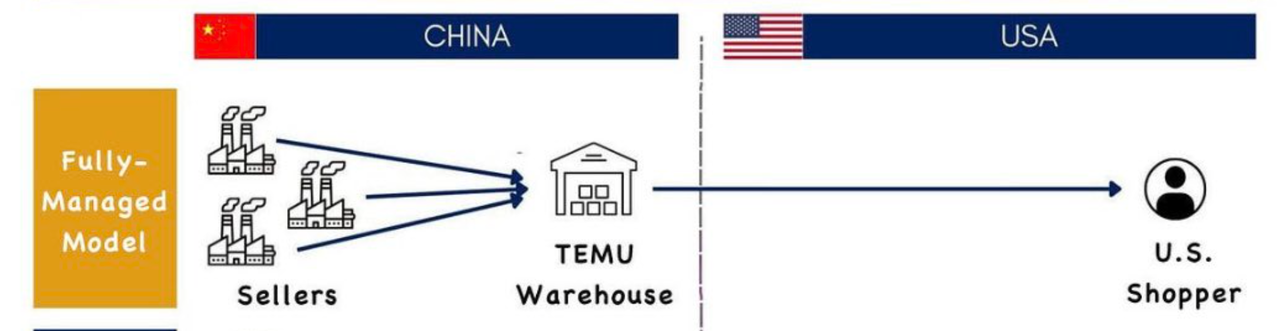
Effective August 29, the Trump administration will end de minimis exemptions for imported goods sent through the international postal network that are valued at or under $800. These items will be subject to full customs duties.

These imported goods will be subject to a new two-tier tariff structure, including a temporary flat-rate duty of $80 to $200 per item before transitioning to an ad valorem duty methodology based on country-specific tariff rates under the International Emergency Economic Powers Act (IEEPA).
The White House says the move is part of a broader campaign to combat what it has declared a series of national emergencies, including “closing the catastrophic loophole used to, among other things, evade tariffs and funnel deadly synthetic opioids as well as other unsafe or below-market products that harm American workers and businesses into the United States.”
“The de minimis exemption has been abused, with shippers sending illicit fentanyl and other synthetic opioids, precursors, and paraphernalia into the United States in reliance on the lower security measures applied to de minimis shipments, killing Americans,” the White House stated.
The bottom line is that Trump closing the de minimis loophole (order values under the $800 threshold) will be disastrous for Temu and Shein, who have exploited the loophole to ship millions of low-value packages directly to U.S. consumers without paying tariffs or undergoing rigorous inspections.
Related:
4. EUROPEAN AFFAIRS
EUROPE
seems that they agree with me: the math seems impossible for Europe to fund these kind of purchases
“Beyond Realistic”: Why Europe’s Pledge To Buy $750BN In US Energy Is Mathematically Impossible
Wednesday, Jul 30, 2025 – 04:15 AM
As part of the U.S.-EU trade deal agreed over the weekend, the EU committed to purchasing a mindblowing $750 billion worth of US energy products over three years ($250 per year) including LNG, oil, and nuclear fuel (again this is very big picture: neither side has detailed what was included in the energy deal – or whether it covered items such as energy services or parts for power grids and plants).
There is just one problem: this number is laughably unrealistic because it would require the redirection of most US energy exports towards Europe and the EU has little control over the energy its companies import.
Indeed, as Rabobank explains, unless energy prices increase materially, that figure remains beyond realistic expectations. The EU imported roughly €65 billion worth of energy products from the U.S. in 2024, including €20 billion (35 million tons) of U.S. LNG and €44 billion of oil and oil products. To reach the required $250 billion per year, the EU would need to import roughly 67% of its energy needs from the US, based on 2024 Eurostat data.
Even if the EU were to purchase all of its LNG from the U.S., the total would rise to only €40–50 billion, based on 2024 prices. This would require countries like Russia, Algeria, Qatar, Nigeria, and even Norway to completely relinquish their market share in the EU, while the U.S. government would need to mandate its LNG exporters to prioritize Europe.
The shift in flows for crude oil and refined products would be even more substantial, as the EU currently imports only around 17% of its needs from the U.S. Existing suppliers in the Middle East and India are unlikely to surrender market share without significant economic incentives, while U.S. refining and export capacity is already stretched. Capacity, cost, and competition will continue to shape energy flows, regardless of political intent.
Reuters adds that “there is strong competition for U.S. energy exports as other countries need the supplies – and have themselves pledged to buy more in trade deals. Japan agreed to a “major expansion of U.S. energy exports” in its U.S. trade deal last week, the White House said in a statement. South Korea has also indicated interest in investing and purchasing fuel from an Alaskan LNG project as it seeks a trade deal.”
The flipside is just as laughable: total U.S. energy exports to all buyers worldwide in 2024 amounted to $318 billion. Of that, the EU imported a combined $76 billion of U.S. petroleum, LNG and solid fuels such as coal in 2024, according to Reuters’ calculations based on Eurostat data.
More than tripling those imports was unrealistic, analysts said.
Arturo Regalado, senior LNG analyst at Kpler, said the scope of the energy trade envisioned in the deal “exceeds market realities.”
“U.S. oil flows would need to fully redirect towards the EU to reach the target, or the value of LNG imports from the US would need to increase sixfold,” Regalado said.
Competition for U.S. energy could drive up benchmark US oil and gas prices and encourage U.S. producers to favour exports over domestic supply. That could make fuel and power costs more expensive, which would be a political and economic headache for U.S. and EU leaders.
Meanwhile, the EU estimates its member countries’ plans to expand nuclear energy would require hundreds of billions of euros in investments by 2050. Its nuclear reactor-related imports, however, totalled just 53.3 billion euros in 2024, trade data shows.
The energy pledge reflected the EU’s analysis of how much U.S. energy supply it could accommodate, a senior EU official told Reuters, but that would depend on investments in U.S. oil and LNG infrastructure, European import infrastructure, and shipping capacity.
“These figures, again, are not taken out of thin air. So yes, they require investments,” said the senior official, who declined to be named. “Yes, it will vary according to the energy sources. But these are figures which are reachable.”
There was no public commitment to the delivery, the official added, because the EU would not buy the energy – its companies would. Private companies import most of Europe’s oil, while a mix of private and state-run companies import gas. The European Commission can aggregate demand for LNG to negotiate better terms, but cannot force companies to buy fuel. That is a commercial decision.
“It’s just unrealistic,” ICIS analysts Andreas Schröder and Ajay Parmar said in written comments to Reuters. “Either Europe pays a super high non-market reflective price for U.S. LNG or it takes way too much LNG volumes, more than it can cope with.”
The United States is already the EU’s top supplier of LNG and oil – thanks to the Biden-inspired war in Ukraine and the CIA blowing up the Nord Stream pipeline from Russia – shipping 44% of EU LNG needs and 15.4% of its oil in 2024, according to EU data. Raising imports to the target would require a U.S. LNG expansion way beyond what is planned through 2030, said Jacob Mandel, research lead at Aurora Energy Research.
“You can add on capacity,” Mandel said. “But if you’re talking about the scale that would be necessary to meet these targets, the $250 billion, then it’s not really feasible.” Europe could buy $50 billion more of U.S. LNG annually as supply increases, he said.
Amusingly, higher EU fuel purchases would, however, run counter to forecasts for EU demand to decline as it shifts to clean energy, analysts said.
“There is no major need for the EU to import more oil from the U.S., in fact, its oil demand peaked a number of years ago,” Schröder and Parmar said.
* * *
According to Rabobank, the most plausible outcome of the trade deal’s energy provisions is increased European participation in U.S. LNG projects (which would also have been achieved without the deal). Unlike crude and refined products, LNG offers scalable, long-term opportunities through joint investments in liquefaction capacity and infrastructure.
European firms are likely to commit capital to U.S. terminals to secure future supply and diversify away from Russian gas. However, this will not materially alter market balances over the next five years and by then Trump will be long gone.
end
EUROPE
Trump’s tariffs are hurting European car manufacturers
(zerohedge)
Mercedes, Porsche Slash Forecasts As Tariffs Hit Sales
Wednesday, Jul 30, 2025 – 09:15 AM
Mercedes-Benz Group and Porsche have both reported earnings, and the outlook is grim. Both German luxury automakers slashed full-year profit guidance, citing a double hit from President Trump’s ongoing trade war and an intensifying EV price war as China floods the world with low-cost vehicles.
Mercedes-Benz warned that full-year revenue will slide below last year’s levels, citing steep U.S. tariff-related headwinds impacting car and van sales. The automaker said it could no longer provide financial guidance with the required level of certainty due to ongoing trade uncertainty. It now expects car sales in 2H25 to remain in line with the first-half performance.
Due to a combination of soft unit sales, weaker-than-expected pricing, and import tariffs, Mercedes-Benz was forced to lower its return-on-sales outlook for its auto division to 4%–6%, down from the 6%–8% guidance issued at the start of the year.

Porsche is under financial pressure from weakening EV demand, declining sales in China, and rising U.S. tariffs. CEO Oliver Blume has warned employees of upcoming cost-cutting measures. The company flagged that its return on sales could drop to 5%, down from a previous forecast of 6.5%, and projected a $1.5 billion hit from U.S. tariffs.
“We continue to face significant challenges around the world,” CEO Blume said. “And this is not a storm that will pass.”
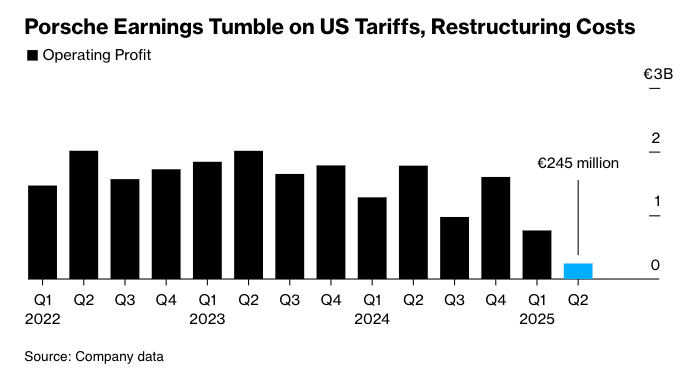
Also on Wednesday, Aston Martin Lagonda Global Holdings Plc revised forecasts lower, one day after Stellantis NV warned that U.S. tariffs would weigh on Jeep maker’s struggling North American business. Let’s not forget that Volvo scrapped its guidance and reported an impairment of around $1.2 billion.
The series of dismal earnings reports from European automakers comes after the U.S. and European Union on Sunday agreed on a trade deal that will apply 15% on EU autos shipped to the U.S. That marks a drop from 27.5% since April but a massive increase from 2.5% before Trump’s second term.
EU TURKEY
EU for some reason believe it is necessary to court this nutcase: Erdogan
(zerohedge)
EU Courts Turkey As It Overlooks Istanbul Mayor Arrest, Opposition Crackdown
Wednesday, Jul 30, 2025 – 03:30 AM
When Istanbul Mayor Ekrem Imamoglu was detained in February on charges of corruption, European officials were stunned. Imamoglu, widely regarded as the most important contender against Turkish President Recep Tayyip Erdogan, had faced legal challenges before. But few expected his dramatic detention in a dawn raid and his treatment as little more than a common criminal.
At the same time, another court case was launched against the leadership of the main opposition Republican People’s Party (CHP) to remove them from office, again on charges of bribery. “These steps risk setting Turkey-EU relations back by a decade,” a senior EU official fumed earlier this year. Five months forward, Ankara’s relationship with Brussels couldn’t be better.

The EU last year decided to deepen its dialogue with Turkey, and many questioned whether the hard-found momentum, after years of frozen EU membership negotiations, would last amid an increasing crackdown on the opposition.
In the weeks after the Imamoglu incident, EU officials met Turkish Finance Minister Mehmet Simsek as part of the Turkey-EU High-Level Economic Dialogue meeting in Brussels. In May, Turkish Foreign Minister Hakan Fidan attended an informal meeting of the EU foreign ministers, known as Gymnich.
The meetings continued uninterrupted as Turkish courts arrested more popularly elected mayors aligned with the CHP.
“Waiting for an EU’s reaction similar to Georgia’s one,” Nacho Sanchez Amor, a Turkey rapporteur at the European Parliament, posted on July 5, when three mayors were arrested. “A new test for a coherent foreign policy or an invitation to exhibit our traditional ‘double standards’?” That reaction didn’t come.
In July, Turkish Trade Minister Omer Bolat met his counterparts as the two sides held the Turkey-EU High-Level Trade Dialogue meeting. The next day, Turkish Interior Minister Ali Yerlikaya met his European counterpart as they held the Turkey-EU High-Level Migration and Security Dialogue meeting.
And finally, on Monday, the EU commissioner for enlargement, Marta Kos, met Fidan in Istanbul, releasing a joint statement that underlined areas of collaboration, from EU’s projects linking Europe to Central Asia to visa liberalization, an update to the customs union and Ukraine’s reconstruction.
“Commissioner Kos also emphasized that dialogue on rule of law and democratic standards is an integral part of our relationship and a commitment by Turkiye as a candidate country,” the joint statement said.
Kos and Fidan didn’t hold a news conference, a sign that neither side wanted to get antagonistic questions from media on Imamoglu’s case, among other issues.
“The EU doesn’t want to rock the ship,” a western diplomat told Middle East Eye. “The EU needs Turkey on Ukraine, on the defense industry overhaul and for the stability in the region as Syria recovers from the civil war.” The diplomat added that other concerns around human rights issues in Turkey are taking the back seat as the world enters a new era of conflicts and risks with Donald Trump’s presidency in the US.
EU with few options
Turkey has emerged as a global arms producer following a series of western sanctions that have restricted Ankara’s access to military equipment since 2016. Over the past two decades, the country has invested billions of dollars in its domestic defense industry.
Last year, Turkish firms exported $7.2bn worth of defense products to global markets, as Ankara now produces its own fighter jets, tanks, artillery, armoured vehicles and electronic warfare systems.
Turkey has been essential in supplying arms to Ukraine and hosting peace talks between Kyiv and Moscow since 2021. Despite Ankara’s refusal to join full international sanctions on Russia, Turkey has recently taken two important steps that indicate the direction Erdogan is taking in the war. “It has become clear once again,” Erdogan said on 11 April, “that European security is unthinkable without Turkey.”
Ankara earlier this month joined the “international drone coalition” supporting Ukraine by providing armed and unarmed military drones to Kyiv. Turkey is one of the three main drone producers in the world.
Turkey also in March joined the Coalition of the Willing to support Ukraine, and in July broadly committed itself to post-war security guarantees for the country.
Ozgur Unluhisarcikli, a regional director at German Marshall Fund, said the EU doesn’t have many options to counter Turkey’s democratic backsliding other than fully suspending the official membership negotiations, which isn’t seen currently as a real option since it would be too difficult to reverse once taken. Unluhisarcikli added that Trump assuming office has weakened the US security commitment to Europe and Europeans are looking for ways to fend for themselves if necessary.
“This encourages both the EU and Turkey to view each other more favorably in terms of security and defence industry cooperation, rather than within the framework of full membership,” Unluhisarcikli told MEE. “The EU does not want to weaken the option of strategic cooperation by criticizing Turkey based on its domestic political developments.”
With this spirit, the EU is looking forward to focusing on joint areas of interest, as alluded to by the joint declaration on Monday, said Samuel Doveri Vesterbye, a managing director at the European Neighbourhood Council.
This includes the Middle Corridor, a scheme also known as the Trans-Caspian International Transport Route, which links Europe, including Turkey and the Caucasus, to Central Asia.
“Why is this a priority for EU and Turkiye? It’s because the Central Asian region presents many opportunities for industry, critical raw materials, renewable energy production, trade and geo-political considerations linked to Turkic, Central Asian nations,” Vesterbye told MEE. “And regional integration of wider Europe, which today includes countries like Tajikistan, Armenia, Turkiye, Kazakhstan, Azerbaijan, Georgia and many others.”
A second western diplomat said the EU was focusing on the practical deliverables to improve EU-Turkey relations and keep Ankara on track while trying not to antagonize it – basically offering carrots rather than sticks to make progress on bilateral issues.
An ‘opportunity’ for Turkey
Marc Pierini, senior fellow at Carnegie Europe and former EU ambassador to Turkey, however, has a differing opinion, saying that the EU government and its bodies all have expressed their dismay at the constant degradation of rule of law in Turkey.
“Given the worsened geopolitical situation in the world, an unavoidable evolution takes place: it’s called the hierarchy of crises. Big powers tend to prioritise those crises closer to their core interests,” he told MEE. “Simultaneously, Turkey’s leadership is probably seeing this geopolitical situation as an ‘opportunity’ to further consolidate its autocratic model for domestic and electoral reasons while western partners are otherwise preoccupied.”
But Turkey continues to face hurdles: for example in gaining access to the EU arms fund known as SAFE, which has a €170bn budget for European joint defence projects. SAFE mandates that 65 percent of projects are funded by firms in the bloc, the broader European Economic Area or Ukraine, only allowing Turkey to join the project with limited participation.
Greek Prime Minister Kyriakos Mitsotakis, however, last week continued to argue that Turkish firms won’t be able to participate in the SAFE program unless Turkey lifts its 1995 declaration of casus belli if Greece decides to increase its territorial waters from six to 12 miles.
end
5. RUSSIA AND MIDDLE EASTERN AFFAIRS
ISRAEL /GAZA/HEZBOLLAH/IRAN/SUMMARY OF THE LAST 24 HRS
iSRAEL VS IRAN
ISRAEL/GAZA/UK
Israel’s UN ambassador slams UK’s threat to recognize Palestinian state
“The State of Israel will not lower its waiver after the atrocities committed by Hamas on October 7,” Danon stressed.

Israel’s UN ambassador Danny Danon addresses the UN General Assembly in New York. September 22, 2024.(photo credit: REUTERS/CAITLIN OCHS)ByJERUSALEM POST STAFFJULY 30, 2025 00:16
Israel’s ambassador to the UN, Danny Danon, criticized the United Kingdom’s threat to recognize a Palestinian state in September unless Israel takes “substantive steps to end the appalling situation in Gaza,” according to British Prime Minister Keir Starmer’s statement to the UK Cabinet on Tuesday.
“Israel has already agreed many times to a ceasefire,” Danon wrote on X/Twitter, following the UK’s demands for an immediate ceasefire, aid to be allowed into Gaza on a continuing basis, and the release of hostages.
Danon pointed out, “No token recognition and no UN resolution will change the basic fact that there are those who fight terrorists and extremist forces, and then there are those who turn a blind eye or resort to appeasement.”
“The State of Israel will not lower its waiver after the atrocities committed by Hamas on October 7,” Danon stressed. “We will do whatever is necessary to bring home the hostages and defeat Hamas.”

Danon slams UN for hypocrisy
Last week, Danon condemned the UN for its hypocrisy regarding Israel. In an interview with The Jerusalem Post, he stated, “Hamas causes the crisis, and we get the blame.”
“We are not ignoring the suffering in Gaza, but the blame lies with Hamas, not Israel,” Danon added.
He argued that the pressure Israel is facing in recent weeks stems more from “a calculated propaganda campaign orchestrated by Hamas and its allies” than from genuine humanitarian concern.
“People see the images, they hear the outcry, but they don’t check the facts,” Danon said. “That’s why we’re fighting not only on the battlefield, but in the arena of perception.”
END
Netanyahu accuses Europeans of ‘rewarding Hamas’ by recognizing Palestinian state
Trump says Starmer didn’t discuss move with him, says he’s ‘not in the camp’ of pressing Israel for long-term solution * Arab states join call for terror group to disarm, end rule of Gaza at UN two-state conference
Netanyahu says Starmer ‘rewarding monstrous terrorism,’ claims Palestinian state will threaten UK
By Lazar Berman Follow29 July 2025, 10:52 pm
Prime Minister Benjamin Netanyahu blasts his British counterpart Keir Starmer for announcing conditional plans to recognize a Palestinian state, saying that it “rewards Hamas’s monstrous terrorism and punishes its victims.”
“A jihadist state on Israel’s border TODAY will threaten Britain TOMORROW,” writes Netanyahu in English on X.
“Appeasement towards jihadist terrorists always fails. It will fail you too. It will not happen,” he concludes.
Starmer told his cabinet that Britain will recognize a Palestinian state in September unless the Israeli government takes substantive steps to end the “appalling situation” in Gaza, including agreeing to a ceasefire, dropping any plans to annex land claimed as part of a future Palestinian state and committing to a long-term peace process.
Starmer’s announcement of the potential move came days after French President Emmanuel Macron said Paris would recognize a Palestinian state at the United Nations General Assembly in September.
end
ISRAEL IRAQ/IRAN
Iran is quite concerned over Iraq’s weakness
(JerusalemPost)
Qaani’s Baghdad visit signals Tehran’s concern over Iraqi instability – analysis
Qaani met with top Shiite leaders in Baghdad to contain internal splits and preserve Iran’s influence in Iraq ahead of parliamentary elections.

Brigadier General Esmail Ghaani, the newly appointed commander of the country’s Quds Force, is seen in Tehran, Iran, in this undated picture obtained January 3, 2020(photo credit: TASNIM NEWS AGENCY/HANDOUT VIA REUTERS)BySETH J. FRANTZMANJULY 30, 2025 14:35Updated: JULY 30, 2025 14:41
Iranian Islamic Revolutionary Guard Corps Quds Force chief Esmail Qaani recently made a secretive visit to Iraq. This is according to a new report in Al-Ain media in the UAE. This media outlet has published details on secretive Iranian actions in the region in the past, and the report is worth examining for its details.
The report says that Qaani made a “secret” trip to Iraq in connection with the upcoming elections. The Iranian-backed parties in Iraq have been struggling to unify in recent months.
They have many divisions. Some of the parties are linked to militias that also work for the Iraqi state. These militias are called the Popular Mobilization Forces. They are a paramilitary arm of the Iraqi state, but also have loyalties to Iran. Kataib Hezbollah, for instance, is very close to the Quds Force.
Qaani was rumored to have been killed in Israeli airstrikes during the 12-day Iran-Israel war. However, he reappeared in July on the streets of Iran, indicating he was not dead.
Qaani has often been mocked on social media for his habit of surviving, with rumors presenting him as an agent of Israel. This has likely created some headaches for him as he tries to lead the Quds Force.

The Quds Force is responsible for Iranian operations outside of Iran, particularly in support of various militias in the region, such as Hezbollah, the Houthis, and PMF.
“As tensions escalate among Shiite forces in Iraq ahead of the parliamentary elections scheduled for November, Tehran is rushing to contain the divisions that threaten its traditional influence in Baghdad through field operations led by Quds Force commander Esmail Qaani,” al-Ain media noted.
The report says that Iran is seeking to reconcile a number of parties under the banner of the Coordination Framework with various militias. “This heralds imminent changes in the Shiite balance of power within Iraq.”
A setback for Iran in Iraq would add to Iran’s woes. Iran has lost out on its ally in Syria when the Assad regime fell on December 8, 2024. Hezbollah is also weakened.
Reflects Tehran’s growing concern over internal Shiite divisions
Qaani apparently made an “unannounced visit to the Iraqi capital, Baghdad, on Sunday evening. He met with a number of the country’s most prominent Shiite political and militia leaders, a move that reflects Tehran’s growing concern over internal Shiite divisions and growing external threats,” Al-Ain noted.
The report goes on to note that Qaani brought a message about “Iran’s support for the Iraqi government in extending its authority and its rejection of any unilateral actions by armed factions.”
This may be an attempt to reduce tensions with the US or the Kurdistan region after numerous drone attacks. The US anti-ISIS coalition has a new commander in Iraq. Iran is watching closely what the US policy will be in Iraq and Syria.
Qaani is also concerned about the possibility of Israeli airstrikes on Iranian-backed militias, the report says. “He also expressed Tehran’s dismay at the continued conduct of operations by some groups without coordination with the government.”
Qaani was only in Iraq for ten hours. He likely recalls that his predecessor Qasem Soleimani was killed in a US drone strike in Iraq in January 2020. Abu Mahdi al-Muhandis, the head of Kataib Hezbollah, was in the same car as Soleimani when it was hit with a missile.
Qaasni met Nouri al-Malaki, the former prime minister of Iraq. Malaki was a sectarian pro-Iranian figure who weakened Iraq. Qaasni also met the leader of the State of Law Coalition, Ammar al-Hakim, and Hadi al-Amiri, Secretary-General of the Badr Organization. Amiri is a key figure in supporting the PMF and also controlling various Interior Ministry forces in Baghdad. Qaani also met Humam Hamoudi, leader of the Supreme Islamic Council, the report said.
The report added that “the meetings focused on analyzing the Shiite political landscape ahead of the upcoming elections and reorganizing the ranks of the Coordination Framework, which is divided over the mechanism for participating in the elections, according to Al-Ain News sources.” The report added that this is the second visit by Qaani in the last two months.
The visit comes after a month of drone attacks on Iraq. The report noted that the US may reconsider financial support for Iraq due to the attacks. “A leader within the ruling Shiite bloc, speaking on condition of anonymity, told Al-Ain Al-Akhbariya that Qaani’s visit at this time indicates a relative shift in Iran’s approach to its relationship with Shiite components in Iraq,” the report added.
“At the same time, Iran seeks to maintain the cohesion of the Coordination Framework and prevent disagreements from affecting the unity of the Shiite ranks. This was clearly evident in Qaani’s emphasis on the need to prevent political competition from turning into field divisions that could weaken the Shiite front in the face of its local and international opponents,” the source told Al-Ain.
See more on
ISRAEL VS HAMAS
US envoy Steve Witkoff heads to Israel for ceasefire, humanitarian talks, source tells ‘Post’
Witkoff’s first trip to Israel in nearly six months comes as the international community pushes for more humanitarian aid to enter Gaza.

US Special Envoy to the Middle East Steve Witkoff speaks during a dinner with US President Donald Trump and Prime Minister Benjamin Netanyahu in the Blue Room of the White House, July 7, 2025(photo credit: Andrew Harnik/Getty Images)ByAMICHAI STEIN, JERUSALEM POST STAFFJULY 30, 2025 15:59
US Special Envoy to the Middle East Steve Witkoff is expected to arrive in Israel on Thursday, a source familiar with the details told The Jerusalem Post.
Witkoff’s first trip to Israel in nearly six months comes as the international community pushes for more humanitarian aid to enter Gaza, Axios reported. He also might visit the Gaza Humanitarian Foundation in the Palestinian enclave.
“The president wants to know more about what the humanitarian situation in Gaza is in order to know how to get more assistance to civilians in Gaza,” one US official told Axios.
This is a developing story.
end
ISRAEL VS HAMAS/ENGLAND/FRANCE
good for Ohana. Put them in place
(JerusalemPost)
Knesset Speaker Ohana: ‘If you want a Palestinian state, build it in London or Paris’
During his speech, Ohana also pulled out a tablet showing a video from Iran’s parliament in June during which members shouted “Death to Israel, Death to America.”

Knesset Speaker Amir Ohana speaks at the Inter-Parliamentary Union in Geneva, Switzerland, July 30, 2025.(photo credit: Noam Moskowitz/Knesset Spokesperson’s Office)ByJERUSALEM POST STAFFJULY 30, 2025 16:18Updated: JULY 30, 2025 16:33
Knesset Speaker Amir Ohana gave a speech at the Inter-Parliamentary Union (IPU) conference in Geneva on Wednesday, in which he denounced plans to recognize a Palestinian state, a Knesset spokesperson confirmed.
“If you want a Palestinian state, build it in London or Paris,” Ohana told the participants, referring to recent statements by both British Prime Minister Keir Starmer and French President Emmanuel Macron that they will recognize a Palestinian state.
During his speech, Ohana also pulled out a tablet showing a video from Iran’s parliament in June during which members shouted “Death to Israel, Death to America” after passing a law to sever ties with the International Atomic Energy Agency.
Ohana also denounced Iranian Parliament Speaker Mohammad Bagher Ghalibaf, who showed a photo from The New York Times of a dying child in Gaza, claiming he is starving to death. However, Israel has shown that the child is suffering from cerebral palsy, NYT has since amended its article to include the medical condition, and Ohana reaffirmed it in his speech denouncing Ghalibaf’s “fake claim.”
During Ohana’s speech, representatives from Iran, Yemen, and the Palestinian Authority left the chamber in protest.

What is the IPU?
The IPU is an international organization of parliamentary bodies from around the world. It consists of 193 countries, including Iran and Arab states.
This is a developing story.
END
this is a first!! but Israel will not agree to the right of return
In 1st, entire Arab League condemns Oct. 7, urges Hamas to disarm, at 2-state confab
Declaration, also signed by EU and over a dozen countries, urges terror group to give up Gaza rule, free hostages; calls on Israel to end war, agree to Palestinian state, ‘right of return’
By Agencies and ToI StaffToday, 5:20 am
Palestinian Authority Prime Minister Mohammed Mustafa addresses the United Nations General Assembly, July 28, 2025. (AP Photo/Richard Drew)
Arab and Muslim countries, including Saudi Arabia, Qatar, Egypt, Jordan and Turkey, signed a declaration Tuesday condemning for the first time Hamas’s onslaught of October 7, 2023, and calling on the Palestinian terror group to release all the hostages it is holding, disarm and end its rule of Gaza, in a bid to end the devastating war in the Strip.
Seventeen countries, plus the 22-member Arab League and the entire European Union, threw their weight behind a seven-page text — obtained by The Times of Israel — agreed at a United Nations conference on reviving the two-state solution for Israel and the Palestinians.
The “New York Declaration” sets out a phased plan to end the nearly eight-decade conflict and the ongoing war in Gaza. The plan would culminate with an independent, demilitarized Palestine living side by side peacefully with Israel, and their eventual integration into the wider Middle East region.
Prime Minister Benjamin Netanyahu opposes a two-state solution and has rejected the meeting on both nationalistic and security grounds. Israel’s close ally, the United States, is also boycotting, calling the meeting “unproductive and ill-timed.”
Israel’s UN Ambassador Danny Danon late Tuesday sharply criticized the some 125 countries participating in the conference, saying “there are those in the world who fight terrorists and extremist forces and then there are those who turn a blind eye to them or resort to appeasement.”
The conference, which was postponed from June and downgraded from world leaders to ministers, for the first time established eight high-level working groups to examine and make proposals on wide-ranging topics related to a two-state solution.
“In the context of ending the war in Gaza, Hamas must end its rule in Gaza and hand over its weapons to the Palestinian Authority, with international engagement and support, in line with the objective of a sovereign and independent Palestinian State,” said the declaration.
“We condemn the attacks committed by Hamas against civilians on the 7th of October,” the declaration added. “We also condemn the attacks by Israel against civilians in Gaza and civilian infrastructure, siege and starvation, which have resulted in a devastating humanitarian catastrophe and protection crisis.”
It followed a call Monday by the Palestinian Authority delegation at the United Nations for both Israel and Hamas to leave Gaza, allowing the PA to administer the coastal territory.
Hamas terrorists move towards the Erez crossing between Israel and the northern Gaza Strip, during the terror group’s onslaught on October 7, 2023. (Mohammed ABED / AFP)
The text also condemned the deadly Hamas-led October 7 assault on Israel, in which some 1,200 people were killed and 251 were taken hostage — of whom 50 are still held, most of them not alive — and which sparked the war in Gaza. It marks a first condemnation by virtually all Arab nations of the attack.
It also condemned Israeli attacks in Gaza that killed civilians, calling on Jerusalem to abandon many of its policies throughout the war and beyond, including its limiting of humanitarian aid to the Strip, its military rule and construction of settlements in the West Bank, its failure to prevent settler violence against Palestinians, and its alleged alteration of status quos in Jerusalem.
The declaration also called for the possible deployment of foreign forces to stabilize Gaza after the end of hostilities.
It urged an end to Israel’s ban of the UN agency for Palestinian refugees and their descendants, UNRWA, while reiterating the Palestinian “right of return” to places in Israel they left or were expelled from surrounding the 1948 creation of the State of Israel — a notion ruled out by successive Israeli governments which contend this would undermine its existence as a Jewish state.
The text also urged the rehabilitation of the Palestinian economy, as well as the removal of inciting and hateful material from the Palestinian Authority school curriculum — a demand also directed at Israel.
France, which co-chaired the conference with Saudi Arabia, called the declaration “both historic and unprecedented,” calling on UN member countries to support the declaration, which outlines “tangible, timebound, and irreversible steps” toward implementing the two-state solution — which is strongly rejected by the current Israeli government.
“For the first time, Arab countries and those in the Middle East condemn Hamas, condemn October 7, call for the disarmament of Hamas, call for its exclusion from Palestinian governance, and clearly express their intention to normalize relations with Israel in the future,” said French Foreign Minister Jean-Noel Barrot.
However, while the declaration included general pledges for “full regional integration” and “tangible steps in promoting mutual recognition, peaceful coexistence, and cooperation among all States in the region,” it did not include an explicit intent by the signatories to establish full diplomatic ties with the Jewish state.
The declaration, spearheaded by France and Saudi Arabia, was signed by the Arab League, the EU, Egypt, Qatar, Jordan, Turkey, Indonesia, United Kingdom, Canada, Ireland, Spain, Italy, Japan, Brazil, Mexico, Norway and Senegal.
Palestinian Authority Prime Minister Mohammad Mustafa (2L), conference co-chair Saudia Arabia’s Foreign Minister Faisal bin Farhan Al-Saud (3L), UN Secretary General Antonio Guterres (C), and conference co-chair French Foreign Minister Jean-Noel Barrot (2R) stand for a group photo with high level ministers during the United Nations conference on a two state solution for Israel and the Palestinians, at UN headquarters on July 28, 2025, in New York City. (Photo by CHARLY TRIBALLEAU / AFP)
“We call on you to support this document before the end of the 79th session of the General Assembly by contacting the missions of Saudi Arabia and France in New York,” Saudi Foreign Minister Faisal bin Farhan Al-Saud told the conference on Tuesday. The 80th UN General Assembly is due to start in September.
The first step outlined in the declaration is to end the 22-month war between Israel and Hamas.
“Following the ceasefire, a transitional administrative committee must be immediately established to operate in Gaza under the umbrella of the Palestinian Authority,” it reads.
The declaration supports the deployment of a temporary international stabilization mission, mandated by the UN Security Council, and welcomes “the readiness expressed by some member states to contribute troops.”
It calls on Israel’s leadership to “issue a clear public commitment to the Two-State Solution, including a sovereign, and viable Palestinian State, to immediately end violence and incitement against Palestinians, [and] to halt all settlement, land grabs and annexation activities in the Occupied Palestinian Territories, including East Jerusalem.”
The declaration commits to adopting restrictive measures against violent extremist settlers and those who support illegal settlements, and adopting targeted measures “against entities and individuals acting against the principle of the peaceful settlement of the question of Palestine, through violence or acts of terrorism, and in breach of international law.”
It also describes regional integration and independent Palestinian statehood as “intertwined objectives.”
Left image: Prime Minister Benjamin Netanyahu, right, speaks with Finance Minister Bezalel Smotrich during the weekly cabinet meeting at the Defense Ministry in Tel Aviv on January 7, 2024. Right image: Palestinian Authority President Mahmoud Abbas, left, poses with newly appointed PA Prime Minister Mohammad Mustafa, in Ramallah on March 14, 2024. (Ronen Zvulun/Pool via AP; PPO / AFP)
“Only by ending the war in Gaza, releasing all hostages, ending occupation, rejecting violence and terror, realizing an independent, sovereign, and democratic Palestinian State, ending the occupation of all Arab territories and providing solid security guarantees for Israel and Palestine, can normal relations and coexistence among the region’s peoples and States be achieved,” it reads.
The declaration urges countries to recognize the state of Palestine, calling this “an essential and indispensable component of the achievement of the two-state solution.” Without naming Israel but clearly referring to it, the document says “illegal unilateral actions are posing an existential threat to the realization of the independent state of Palestine.”
French President Emmanuel Macron announced ahead of the meeting that his country will recognize the state of Palestine at the General Assembly’s meeting of world leaders in late September.
The document was issued on the second day of the conference in New York, at which Britain announced it would recognize a Palestinian state in September unless Israel halts fighting in Gaza and commits to a peace process that ends with a two-state solution. Planned for two days, the meeting was extended into Wednesday because representatives of about 50 countries have not spoken.
For decades, most UN members have supported a two-state solution with Israel and a future Palestinian state existing side-by-side.
But after almost 22 months of war in Gaza, the ongoing expansion of Israeli settlements in the West Bank, and Israeli officials declaring designs to annex parts of Gaza and the West Bank, many countries fear that a Palestinian state could become geographically impossible.
United Nations Secretary-General Antonio Guterres said at the meeting Monday: “The two-state solution is farther than ever before.”
Attendees stand during a moment of silence during a ministerial high-level meeting during the United Nations conference on a two-state solution for Israel and the Palestinians, at UN headquarters on July 28, 2025, in New York City. (TIMOTHY A. CLARY / AFP)
A separate one-page statement titled the “New York Call” was circulated by France, but the language was considered too strong, especially for Arab nations. It was only approved by 15 Western nations, including six that have recognized a Palestinian state and nine others: Andorra, Australia, Canada, Finland, Luxembourg, Malta, New Zealand, Portugal and San Marino.
The statement, issued late Tuesday, says the 15 countries have recognized, “expressed or express the willingness or the positive consideration… to recognize the state of Palestine, as an essential step towards the two-state solution, and invite all countries that have not done so to join this call.”
Israel, under the current government led by Netanyahu, has long rejected the establishment of a Palestinian state, and has refused to entertain the possibility of the PA playing any role in the future governance of Gaza.
But it has offered few details of what it envisions as an alternative to the PA in postwar Gaza, beyond advocating for what it insists would be the voluntary mass migration of its population.
Israel’s offensive against Hamas has killed over 60,000 Palestinians, according to the Hamas-run Gaza health ministry, which doesn’t distinguish between civilians and terror operatives.
On Tuesday, Foreign Minister Gideon Sa’ar told international journalists that Israel would not give in to the “distorted campaign of international pressure” to end the war in Gaza and force a two-state solution on Israel.
“Establishing a Palestinian state today is establishing a Hamas state. A jihadist state,” said Sa’ar. “It ain’t gonna happen.”
Michael Bachner, Jacob Magid and Lazar Berman contributed to this report.
Is The Times of Israel important to you?
If so, we have a request.
Every day, even during war, our journalists keep you abreast of the most important developments that merit your attention. Millions of people rely on ToI for fast, fair and free coverage of Israel and the Jewish world.
END
SYRIA/ISRAEL
Israeli, Syrian officials to meet in Azerbaijan to discuss situation in southern Syria – report
Israel’s Strategic Affairs Minister Ron Dermer and Syria’s Foreign Minister Asaad al-Shaibani are scheduled to attend the meeting, which will focus on the security situation in southern Syria.

Syria’s Foreign Minister Asaad al-Shaibani speaks during a press conference in Damascus, May 20, 2025; illustrative.(photo credit: REUTERS/KHALIL ASHAWI)ByJERUSALEM POST STAFFJULY 30, 2025 18:21Updated: JULY 30, 2025 18:28
A meeting between Israeli and Syrian ministers is due to take place in Baku, Azerbaijan, on Thursday, a diplomatic source told French outlet Agence France-Presse.
The diplomat noted that Israel’s Strategic Affairs Minister Ron Dermer and Syria’s Foreign Minister Asaad al-Shaibani are scheduled to attend.
The meeting will focus on “the security situation, particularly in southern Syria,” the diplomat told AFP, requesting anonymity due to the sensitive nature of the meeting.
Last week, Dermer and Shaibani met in Paris along with US Special Envoy to Syria Tom Barrack and discussed the violence in southern Syria’s Sweida.
Notably, a US citizen was killed during the clashes between Druze and Bedouin militias in Sweida.

Syrian media corroborates report of upcoming meeting
Syrian and Israeli officials agreed to meet again after no final accord was reached in US-mediated talks in Paris on de-escalating the conflict in southern Syria, state-run Ekhbariya TV reported on Saturday, citing a diplomatic source.
The source described the dialogue as “honest and responsible,” in the first confirmation from the Syrian side that talks had taken place.
On Friday, US envoy Tom Barrack said officials from both countries spoke about de-escalating the situation in Syria during the talks on Thursday.
Amichai Stein and Reuters contributed to this story.
END
WEST BANK
RUSSIA VS UKRAINE/EU/SLOVAKIA
Slovakia’s Fico has got it right. Why are clamoring for a ceasefire in Gaza and not Ukraine??
(zerohedge)
EU Country’s Leader Says Ukraine’s Backers ‘Tired’ Of Peace
Wednesday, Jul 30, 2025 – 07:45 AM
Slovak Prime Minister Robert Fico at the start of this week lambasted the West’s approach to the Russia-Ukraine war in a video message, accusing European leaders of acting recklessly and intentionally misleading Moscow, also while Europe prioritizes calls for peace in Gaza but still remains silent concerning the same for Ukraine. He went so far as to suggest that European leaders are tired of peace.
“It seems some European leaders have grown weary of eight decades of peace,” Fico remarked, highlighting how easy a broader NATO-Russia war could be sparked.

He emphasized that smaller countries like Slovakia have no interest in being part of such escalation and confrontation while cautioning against the assumption that such a bigger conflict could be managed and restrained.
He said that Russia’s decision to invade militarily broke international law, but that context is vital and cannot be ignored, pointing to the Donbass civil war and constant NATO expansion over the decades.
Below are more of his criticisms as translated and presented in Russia’s RT:
Whereas dozens of countries backed a call for ceasefire in Gaza, “no joint call … for an immediate end to the war and for peace” was organized concerning Ukraine, he lamented.
According to Fico, his attempt to initiate a comparable declaration at the European Council has failed. “It seems that the leaders of some countries in Europe are already tired and bored of 80 years of peace.”
“Artificially provoking a conflict between one of the NATO member states and Russia is easy. History gives us thousands of examples of how to do it. And what happens then?” he questioned, warning that those thinking they could control such a clash are gravely mistaken.
Fico also accused European leaders of strategic failure concerning their efforts to punish and isolate Russia through sanctions, stating that the Russian economy is now perceived by many to be stronger than Germany’s, something unimaginable within just years ago.
“The Ukraine conflict has no military solution…the West had no interest in ending the war back in April 2022 when such a real possibility existed. The West naively believed that it could use Ukraine as a battering ram to weaken Russia.” —PM Fico
The outspoken prime minister, who has survived an assassination attempt, has in the recent past asserted that Ukraine will never join NATO “on my watch” – adding that Kiev’s membership the Western military alliance “would be a good basis for a World War III.“
end
RUSSIA/UKRAINE/USA UK
US, UK In Secret Talks With Ukrainian Officials To ‘Replace Zelensky’: Russian Intelligence Claims
Wednesday, Jul 30, 2025 – 10:30 AM
Russia’s Foreign Intelligence Service (SVR) has claimed in a new statement published by TASS state news agency that US and British officials recently met with senior Ukrainian figures in an undisclosed Alpine resort in Europe to discuss the possible replacement of President Volodymyr Zelensky.
The meeting allegedly included top Ukrainian officials such as Andrey Yermak, head of the presidential office; Kirill Budanov, head of Ukraine’s military intelligence; and Valery Zaluzhny, the former commander-in-chief now serving as Ukraine’s ambassador to the UK.
Given the high stature of these individuals, this is a massive claim, and it could be that Russian intelligence is is releasing such a report – even if unverified and/or possibly untrue – in order to sow discord, suspicion and paranoia within the Ukrainian presidency’s office. But some recent independent reports in the West have also pointed to a key former top general being groomed as a potential successor.

TASS reports that the Western representatives at the meeting proposed Valery Zaluzhny as Zelensky’s potential successor. He had long been Ukraine’s most visible and celebrated general, as the Commander-in-Chief of the Armed Forces of Ukraine from 2021 until his controversial dismissal by Zelensky in 2024.
His dismissal from the top command post over the armed forces to now serve as Ambassador of Ukraine to the United Kingdom was widely seen as in effect a political exile of sorts.
The SVR and state media are claiming further that Yermak and Budanov accepted the US-UK proposal, securing assurances that they would retain their current roles and have influence over future appointments if Zaluzhny took power.
At the moment the European Union has made the unprecedented threat to cut off funding to Kiev, after Zelensky moved to undermine Ukraine’s anti-corruption institutions, which was formalized in a law Zelensky signed this month.
President Trump has clearly been putting immense pressure on the Russian side after the latest round of failed talks in Istanbul, giving Putin just ten days to show serious progress toward negotiating peace – but could the same level of pressure now be on Zelensky behind the scenes?

The new claims out of Russian intelligence might not entirely be without merit, given recently legendary American journalist Seymour Hersh wrote an article titled The End of Zelensky?
The main thesis was that Zaluzhny is now seen by Washington insiders as the most credible successor to Zelensky, as seen in Hersh’s introduction to the July 18 story below:
In fall of 2023, Ukrainian General Valerii Zaluzhnyi, the commander in chief of the country’s armed forces, gave an interview to the Economist and declared the war with Russia had become a “stalemate.” It took three months for President Volodymyr Zelensky to fire him. The general, who is the most popular public figure in Ukraine, was named ambassador to London a month later and has served there with distinction, if quietly.
Zaluzhnyi is now seen as the most credible successor to Zelensky. I have been told by knowledgeable officials in Washington that that job could be his within a few months. Zelensky is on a short list for exile, if President Donald Trump decides to make the call. If Zelensky refuses to leave his office, as is most likely, an involved US official told me: “He’s going to go by force. The ball is in his court.” There are many in Washington and in Ukraine who believe that the escalating air war with Russia must end soon, while there’s still a chance to make a settlement with its president, Vladimir Putin.
This week, Russian sources have been highlighting a suspiciously timed article and photoshoot featuring Gen. Zaluzhnyi in Vogue magazine…
At the same time, Zelensky – once Time’s ‘person of the year’ (in 2022) – hasn’t been featured of late in any more glam-filled western media photo shoots. His ‘star power’ has most definitely been fading in western capitals, also as populations are war-weary and desirous of peace in eastern Europe, but which would require Zelensky to make territorial concessions. He’s refusing to do this.
END
6. GLOBAL ISSUES//COVID ISSUES/VACCINE ISSUES/HEALTH ISSUES
Colorectal Cancer Rising Among People Under 50: American Medical Association
Tuesday, Jul 29, 2025 – 10:35 PM
Authored by Naveen Athrappully via The Epoch Times (emphasis ours),
Younger people are increasingly being diagnosed with colorectal cancer, a disease typically associated with people age 50 and older, the American Medical Association (AMA) said in a July 24 report.

Colorectal cancer, which includes both colon and rectal cancers, is the second-leading cause of cancer deaths in the United States, even though overall incidence rates have declined since the 1980s, the AMA said.
Among people younger than 50, “the number of incidences has increased by about 2 percent per year,” the association said. “The death rate in the same population has risen 1 percent annually.”
The chief research officer of The Permanente Medical Group, Doug Corley, said in the report that colorectal cancer was a substantial problem that causes “a lot of mortality … and morbidity.”
While researchers cannot identify the exact reasons behind the rise in colorectal cancer among young people, being overweight or obese is known to increase the risk of various cancer types, he said, adding that changes in bacteria inside a person’s gut can also contribute to cancer risk.
A study presented at the Digestive Disease Week 2024 in May last year raised similar concerns.
The study analyzed data from a U.S. Centers for Disease Control and Prevention database to determine incidence rates of colorectal cancer between 1999 and 2020.
The changes in colorectal cancer incidence rates for each age group were:
- Ages 10 to 14: increased by 500 percent
- Ages 15 to 19: increased by 333 percent
- Ages 20 to 24: increased by 185 percent
- Ages 25 to 29: increased by 68 percent
- Ages 30 to 34: increased by 71 percent
- Ages 35 to 39: increased by 58 percent
- Ages 40 to 44: increased by 45 percent
“This data reveals some very concerning trends, particularly in our younger population who do not typically come to mind when considering CRC (colorectal cancer) screening for patients,” Dr. Islam Mohamed, the study’s lead author, said in a statement at the time.
In the July 24 AMA statement, Corley said that since older people are being screened regularly for colorectal cancer, the total number of cases, including both younger and older individuals, was declining.
“If we weren’t doing screening, we would probably be seeing an increase in older people too,” he said. “As people get screened, we find and remove pre-cancerous polyps. That decreases their future risk of cancer.”
The American Cancer Society currently recommends that people with an average risk of colorectal cancer start regular screening at the age of 45.
People are considered to have an average risk if they have no personal or family history of colorectal cancer, no personal history of inflammatory bowel disease, no suspected or confirmed hereditary colorectal cancer syndrome, and no history of radiation exposure to the abdomen or pelvic area to treat a prior cancer.
“The most effective thing we have is screening,” Corley said. “It’s so impactful compared to most other medical interventions.”

FIT Versus Colonoscopy
In a July 2024 study published by the JAMA Network, Corley and colleagues analyzed data from 10,711 individuals to determine the effectiveness of the fecal immunochemical test (FIT) to screen for colorectal cancer.
It found that completing a FIT screening was associated with a “reduction in risk of dying from colorectal cancer of approximately 33 percent overall, and there was a 42 percent lower risk for left colon and rectum cancers.”
A one-third reduction in mortality is “a pretty substantial decrease,” Corley said. “We would anticipate it to be even stronger over time or with more frequent screening, such as the recommended once a year screening with FIT.”
FIT is different from colonoscopy, the most common form of colon cancer screening.
A colonoscopy provides a doctor with a direct look inside a patient’s colon. The procedure requires the person to take a day off to prepare their bowel for the process. The patient must be sedated during the procedure.
In contrast, a FIT looks for small amounts of blood in stool, Corley said.
“It’s very helpful because it’s noninvasive. It can be done at home. This provides multiple different modes of screening and increased patient choice,” he said.
This flexibility allows for FIT tests to be conducted via mail in rural settings where people may not communicate regularly with their health care provider, he said.
While a colonoscopy is usually done once every 10 years, FIT is recommended as an annual test, he said.
Those who test positively on their FIT screening can then move to colonoscopy for a better diagnosis, according to the AMA.
END
This is important!
Scientists Sound Alarm as Deadly Abnormalities Found in mRNA ‘Boosted’ Healthy Young Adults
July 29, 2025 – 12:54 pm


A group of scientists has just issued a chilling warning after a major new study confirmed that dangerous abnormalities are triggering in healthy young adults within hours of receiving a Covid mRNA “booster” injection.
The six-month longitudinal study uncovered evidence confirming that the “vaccines” cause almost immediate damage in people with no underlying conditions.
Tracking 68 healthy young adults, the study observed significant health risks that emerged just 48 hours after vaccination, signaling potential long-term issues that must not be ignored by public health authorities.
The team of researchers was led by Dr. Waleed M. Bawazir of the King Abdulaziz University in Jeddah, Saudi Arabia.
The results of the study were published in Frontiers in Cellular and Infection Microbiology.
The findings have raised serious concerns regarding the potential biological consequences of receiving a third dose of Pfizer’s Covid mRNA “vaccine.”
The study indicates that young, otherwise healthy individuals experienced troubling biological markers after their third mRNA shot.
Within just two days after the “booster” injection, participants exhibited acute systemic inflammation, coagulation abnormalities, and a significant suppression of key immune markers.
One of the most concerning results was the dramatic spike in inflammation markers.
The C-reactive protein (CRP), a well-known marker for systemic inflammation, increased sharply from 6.12 mg/L to 14.84 mg/L, which is considered a significant rise, with the study showing this change was statistically significant (p < 0.0001).
Similarly, another inflammation marker, high-sensitivity CRP (hs-CRP), doubled from 1.47 mg/L to 3.52 mg/L (p < 0.0001).
This surge suggests that even a “booster” dose of the “vaccine” could trigger a heightened inflammatory state in the body.
The researchers warn that the finding is deeply concerning, as chronic inflammation can lead to serious health issues in the long term.
In addition to the inflammation, markers for coagulation abnormalities were also found to have increased.
D-dimers, which are associated with clot formation, rose from 0.20 mg/L to 0.47 mg/L (p < 0.005).
Such increases are indicative of pro-thrombotic activity, meaning the body is more likely to form clots, a concern that could potentially lead to life-threatening conditions such as thrombosis or stroke.
These findings further highlight the severe risks posed by the mRNA “vaccines,” which some critics have long warned about regarding clotting and blood vessel damage.
Even more concerning, the study showed evidence of immune suppression following the third dose. Lymphocyte counts, essential components of the immune system, dropped significantly from 2.34 × 10⁹/L to 1.91 × 10⁹/L (p < 0.0005).
Slay the latest News for free!
J
Interferon-gamma (IFN-γ), a critical protein involved in antiviral defense, also decreased from 54.7 ng/mL to 46.1 ng/mL (p < 0.05).
These findings suggest that the immune response following a third dose may be blunted, increasing the vulnerability of vaccinated individuals to infections or other diseases due to weakened immune defenses.
The study also pointed out a disruption in the participants’ coagulation profile, which was concerning despite the lack of overt symptoms.
Prothrombin time (PT) and activated partial thromboplastin time (aPTT) were significantly prolonged, patterns that are often seen in vaccine-induced thrombotic cases such as myocarditis, pericarditis, and other clotting syndromes.
Even in the absence of visible symptoms, this could signal underlying clotting disorders that might not be immediately apparent but could have severe long-term health implications.
This study is the first to document the simultaneous occurrence of immune suppression and clotting activation within just 48 hours of receiving a third mRNA “booster” dose, even in young, healthy adults.
These findings challenge the common narrative that “vaccine” reactions are “mild” and primarily concern localized pain or fever.
In reality, the study suggests that mRNA “boosters” can trigger hidden but dangerous disruptions in inflammation, coagulation, and immune function.
Experts warn that these issues act as a ticking time bomb that may not immediately present obvious symptoms but could lead to significant health consequences over time.
These revelations reinforce the concerns of “vaccine” critics, who argue that the full spectrum of risks from these injections, especially the so-called “boosters,” has not been adequately addressed.
Given these findings, it is crucial to take a closer look at the long-term effects of the Covid mRNA shots and whether their risks outweigh their purported benefits.
For those worried about their health, this study adds to the growing body of evidence that demands more caution and transparency before further mRNA “vaccines” are rolled out for widespread use among the general public.
MARK CRISPIN MILLER
In memory of those who “died suddenly” in the United States and worldwide, July 21-28, 2025
memory of those who “died suddenly” in the United States and worldwide, July 21-28, 2025
Hulk Hogan; rocker Ozzy Osbourne (Black Sabbath); actor Michael James Leslie; reality star Junior Edwards (Swamp People); reggae singer Fiji (55); drummer Peter Jackson (Killwhitneydead); & more
| Mark Crispin MillerJul 30 |
A survey of the likely global toll of COVID “vaccination,” based on the reports collected by our worldwide team of researchers this past week.
To help support our work, consider subscribing or making a donation.
UNITED STATES (109)
Hulk Hogan Dead at 71
July 24, 2025

Wrestling legend Hulk Hogan has died at 71 years old, TMZ Sports has learned. Medics were dispatched to the WWE icon’s Clearwater, Florida, home early Thursday morning … with operators stating it was regarding a “cardiac arrest.” A video of the scene outside Hogan’s residence shows responders desperately trying to save his life as he was transported to an ambulance. In the clip, several paramedics appear to be conducting chest compressions as Hogan is wheeled to the emergency vehicle. Cops tell us officials responded to the call at 9:51 AM and Hogan was treated by Clearwater Fire & Rescue personnel before being taken to a nearby hospital. He was pronounced dead at the hospital. During a news conference Thursday afternoon, Clearwater Police Maj. Nate Burnside said Hulk died at 11:17 AM before adding, there are “no signs of foul play or suspicious activity.”
No cause of death reported.
Ozzy Osbourne’s death was ‘unexpected’
July 22, 2025

Ozzy Osbourne’s death was “unexpected”, but he died surrounded by his family. The 76-year-old rocker passed away at his home in Buckinghamshire, UK, on Tuesday (07.22.25) following a long battle with Parkinson’s disease and his daughters had flown in from Los Angeles to be with him. A source told MailOnline: “[His passing was] unexpected to be this soon.” The insider added that daughters Aimee, 41, and Kelly, 40, had come from Los Angeles to be with their father. And Ozzy’s son Jack, 39, had flown in from his home in Idaho to watch his father perform at his final Black Sabbath gig in Birmingham on July 5. The source said: “Ozzy was always meant to come back to Britain to live in Buckinghamshire, it was where Sharon had spent so long preparing their family home for him. There was much hope that he would be around for a lot longer than this but at one point there were fears they would not get him back from Los Angeles for the concert earlier this month.”
Researcher’s Note – Ozzy Osbourne [who had lived in the US] has officially received the first dose of the COVID-19 vaccine [sic]: “My arm was hurting yesterday, but I’m glad I got it, you know?”: Link

Ozzy Osbourne Says He ‘Felt Relieved’ After Receiving First COVID Vaccine [sic] Dose: Link
Broadway Actor Michael James Leslie Dies
July 23, 2025

Musical theatre actor Michael James Leslie has died, per numerous memorial posts to his Facebook profile from friends and colleagues. Mr. Leslie’s age, nor the date of his death, was clear at the time of publication.
No cause of death reported.
Swamp People Star Junior Edwards Dies: ‘He Was One of the Greatest Alligator Hunters,’ Relative Says
July 26, 2025

Swamp People star Junior Edwards has died. His grandson, “Lil” Willie Edwards, announced the news in a Facebook post on Saturday, July 26. It is unclear how old Junior was. The date when Junior died, and other details — including his cause of death — have not yet been made public. However, the History Channel star’s grandson said earlier this month that Junior had been in poor health.
No age or cause of death reported.
Renowned reggae artist Fiji, who co-wrote Baywatch: Hawaii theme, dies suddenly aged 55
July 24, 2025
Award-winning Fijian-Hawaiian recording artist George Brooks Veikoso, better known to fans as Fiji, has died at the age of 55. Veikoso, who co-wrote the theme song for the Nineties drama series Baywatch: Hawaii, died Wednesday in his homeland of Fiji, surrounded by family, local outlet Hawaii News Now reported. Born in Fiji on May 10, 1970, Veikoso grew up singing in church. He moved to Hawaii in 1987, where he became one of the reggae music industry’s top singer-songwriters, recording artists, and producers.
No cause of death reported.
Killwhitneydead’s Drummer Peter Jackson Has Passed Away
July 24, 2025

Greensboro, NC – Killwhitneydead have announced the passing of their drummer Peter Jackson. A statement shared by the deathcore band’s vocalist, etc. Matthew H. Rudzinski today, July 24th, revealed the sad news.
No age or cause of death reported.
Rene Kirby dead: Shallow Hal star dies after two-month battle with severe infections
July 24, 2025

Rene Kirby, best known for his unforgettable role in Shallow Hal, has sadly died at the age of 70. His brother Jon Kirby disclosed that Rene’s passing on July 11 followed a lengthy two-month hospitalization due to serious infections and complications with his esophagus, kidneys and bladder. His last moments were spent at the University of Vermont Medical Center, as reported by local media outlet Seven Days. He had previously fought a battle against throat cancer, which included the removal of his larynx, resulting in the loss of his voice in recent years. He played a memorable character named Walt in the 2001 film Shallow Hal, who, like Rene, was unable to use his legs due to spina bifida. Amazingly, Rene was already getting around on his hands by his first birthday, eventually earning state gymnastics titles as a teenager before embarking on a 20-year stint with IBM.
Longtime Cubs star, Hall of Famer Ryne Sandberg dies after cancer battle
July 28, 2025

Longtime Chicago Cubs star and Hall of Famer Ryne Sandberg died Monday, the team announced. He was 65. Sandberg died due to complications with cancer, with which he was diagnosed twice in 2024. He revealed in January 2024 that he had been diagnosed with metastatic prostate cancer. Sandberg fended it off initially and about eight months later said he was cancer-free. In December, however, Sandberg announced that the cancer had spread to other organs in his body. That led him to undergo “more intensive treatment.”
Rapper Mack Maine announces sudden death of son: ‘I’m still in shock’
July 28, 2025

Mack Maine has announced the death of his son. The “Tapout” rapper, who has collaborated with hip-hop greats like Lil Wayne, Future and Nicki Minaj, took to Instagram to reveal that his young son Isaiah, also known as Zeke, died earlier this month from a fatal seizure. He was 20, TMZ reports. “On July 16th I received a call that my son Isaiah (Zeke) passed away at his home in California from a seizure,” the New Orleans native continued. “I’m still in shock and still processing the fact that he’s gone. Still confused, still questioning life and why my child and not me.”
CNMI governor Arnold Palacios, 69, passes away after medical incident
July 24, 2025

Governor Arnold Indalecio Palacios passed away at the age of 69 late Wednesday night after a medical incident led him to collapse in his office on Capitol Hill on Saipan [Commonwealth of the Northern Marianas Islands, a US commonwealth]. He was immediately rushed to the Commonwealth Health Center and later was medically evacuated by a military helicopter to the Guam Regional Medical Center in Guam. Acting governor David Apatang said it’s with profound sorrow and deep sadness that he’s announcing the untimely passing of Palacios. Apatang said Palacios passed away peacefully on the evening of Wednesday, July 23, 2025, surrounded by loved ones.
No cause of death reported.
Fashion Designer Charlene Hyman Dies at 68
July 22, 2025

Funeral services were held earlier this month for fashion designer Charlene Hyman, who counted Grammy winner Patti LaBelle and Grace Jones among other clients. Hyman, 68, died peacefully on June 20 at her home in Baltimore while recovering from some health issues, according to her friend of 40 years and fellow fashion designer Carlous Palmer. Before her passing, while in remission from cancer, the designer assured her son that the company was now his to do with it whatever that he chose to, Hyman-Sanford said Tuesday.
No cause of death reported.
An infant “died suddenly”:
Baby found unresponsive at Simpsonville area home has died, sheriff’s office says
July 27, 2025
SIMPSONVILLE, S.C. — Authorities say a baby is dead and an investigation is underway in Greenville County. The Greenville County Sheriff’s Office announced early Sunday morning that deputies responded to an address on South Garrison Road near Simpsonville around 10:40 p.m. on Saturday in reference to an infant who was not responsive. Arriving deputies found the female child, adding that she was later pronounced dead. The sheriff’s office stated that its investigation was still in the early stages as of about 1 a.m. on Sunday.
No cause of death reported.
Two children “died suddenly”:
Honorary Cop Connor Taverna, 7, Dies Of Rare Brain Cancer
July 22, 2025

CARLISLE, Pa. – A 7-year-old boy who stole the hearts of first responders across the region has </span
DR PAUL ALEXANDER
Jon Fleetwood’s excellent stack on Moderna and spraying mRNA into our foods; question is if RFK Jr. (Bobby Kennedy Jr.) knows about this & what he will do about this?
I trust RFK Jr. and wanting to do good so over to him based on Fleetwood’s reporting here; it is disturbing and makes you realize that the game by Malone Bourla etc. is to make mRNA part of our lives
| Dr. Paul AlexanderJul 30 |


Moderna’s Parent Company Now Spraying RNA Into Your Food
Support Jon’s scholarship:
Alexander News Network (ANN): Trump’s War 2.0 for America is a reader-supported publication. To receive new posts and support my work, consider becoming a free or paid subscriber.
Start here:
‘Flagship Pioneering—the biotech firm that founded Moderna—has launched a new company called Terrana Biosciences to spray crops with RNA designed to “actually go inside the plant,” move through its internal systems, persist under extreme environmental conditions, and become “heritable across plant generations,” using synthetic RNA constructs generated from “a vast library of RNAs” built with “advanced AI and computational models.”
Flagship Pioneering was originally founded as NewcoGen in 1999 by Noubar Afeyan and Ed Kania.
Afeyan, as founder and CEO and co-founder of Moderna, has established significant collaborations with U.S. government agencies such as NIAID, HHS, BARDA, FDA, and Operation Warp Speed, notably contributing to Moderna’s COVID-19 vaccine development.
News of Moderna’s new crop-spraying technology comes as EcoHealth Alliance’s DEFUSE proposal to DARPA is under renewed scrutiny for detailing plans to aerosolize chimeric coronavirus spike proteins, immune modulators, and self-spreading vaccines over humans using drones.
Those technologies were developed before the COVID pandemic, raising the question of whether the pandemic marked the covert launch of a premeditated biological spray operation—one that tested drone-based aerosol delivery of COVID-related substances on human populations under the guise of a global health emergency.
Whistleblower testimony and FOIA documents revealed that they included wide-area inoculation platforms described as suitable for “large area inoculation of animals/humans.”
Moreover, the PREP Act empowers the U.S. government to secretly administer drugs, biological products, and medical devices to the public during a declared emergency—without consent, geographic limits, legal accountability, or any obligation to disclose such actions if deemed classified for national defense.
According to Flagship Pioneering’s new press release, published earlier this month:
Flagship Pioneering, the bioplatform innovation company, today unveiled Terrana Biosciences™, a company pioneering RNA-based agricultural solutions to deliver protective and enhanced crop traits without altering the plant genome. Through its proprietary RNA technology platform, Terrana is developing targeted products designed to work at any time in a plant’s lifecycle, enabling a continuous product pipeline that is adaptive and responsive to variable climate conditions and capable of generating new solutions at a fraction of the time and cost associated with conventional agriculture approaches. Flagship has initially committed $50 million to Terrana to scale operations and develop its first products in crop protection and yield.
NEWS ADDICT
NEWSWIZE
EVOL NEWS
MICHAEL EVERY/OR PICTON/GIFFIN OR RABOBANK EXECUTIVE/COMMENTARY ON WORLDLY AFFAIRS
7. OIL /ENERGY ISSUES/WORLD WIDE
WTI Dips After Biggest Crude Build In 6 Months
Wednesday, Jul 30, 2025 – 10:43 AM
Oi prices were steady early on Wednesday, rising for a third session even as API reported an unexpected rise in US crude inventories.
Oil prices have been supported by U.S. threats to impose secondary sanctions of buyers of Russian oil after U.S. President Donald Trump this week cut his deadline for Russia to reach a ceasefire in its war on Ukraine from 50 days to 10 to 12 days.
“Displaying frustration with the lack of tangible progress in peace talks between Russia and Ukraine, the US President has shortened his ultimatum for the aggressor from 50 days to 10-12. The prevailing assumption is that, after this period, new sanctions, including measures targeting Russia’s energy sector, will be introduced … The geopolitical risk surrounding key oil-producing regions has therefore risen,” PVM Oil Associates noted.
Still, the geopolitical risk is countered by rising supply. With Western hemisphere production also increasing, OPEC+ is returning 2.2-million barrels per day of production cuts to market in monthly tranches that began in May, with the full return expected to be complete in September.
The question for traders this morning is simple – will the official data confirm API?
API
- Crude +1.54mm (-2.5mm exp)
- Cushing
- Gasoline -1.74mm
- Distillates +4.18mm
DOE
- Crude +7.698mm – biggest build since January
- Cushing
- Gasoline
- Distillates
Against expectations of a small drawdown, the official data showed a large build in crude stocks last week (the biggest since January and far bigger than the API-reported level). Cushing stocks rose for the fourth week in a row while gasoline inventories fell for the third week in a row…
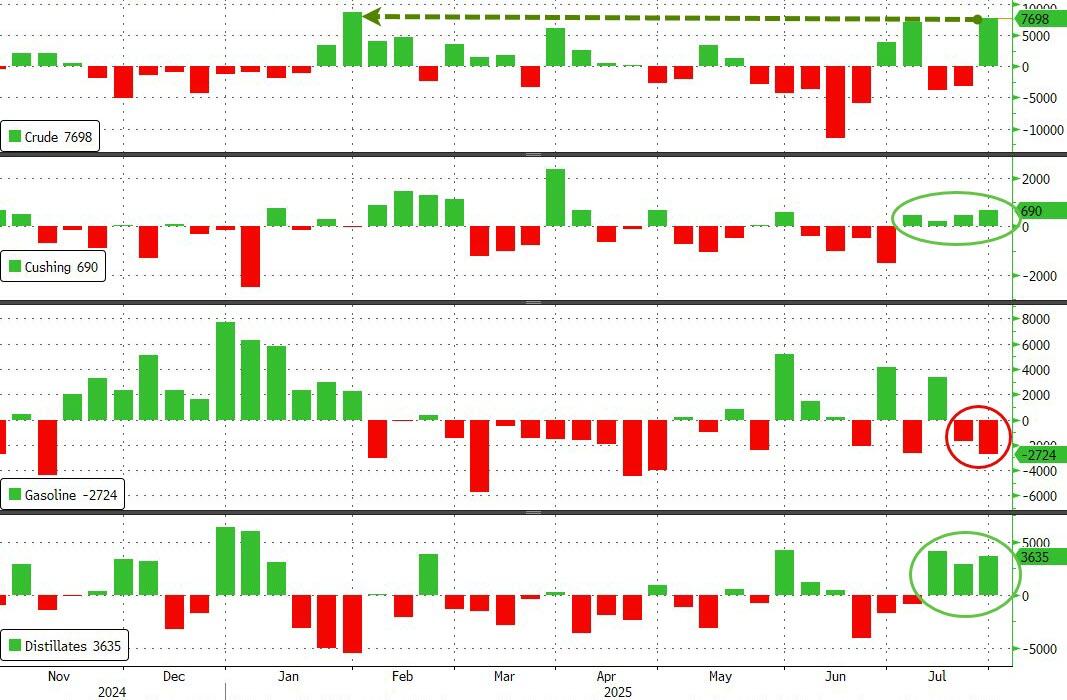
Source: Bloomberg
The Trump admin added 238k barrels to the SPR last weekj (after two weeks of drawdowns), adding to the largest rise in commercial crude stocks since January
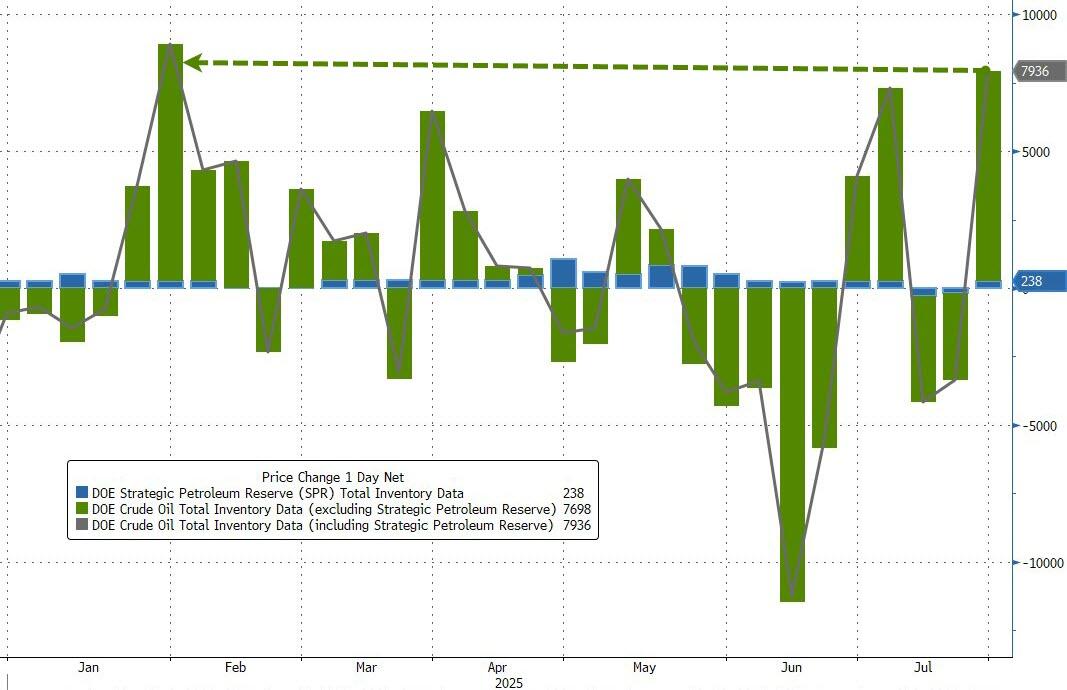
Source: Bloomberg
Despite the ongoing plunge in the rig count, US crude production remains near record highs…
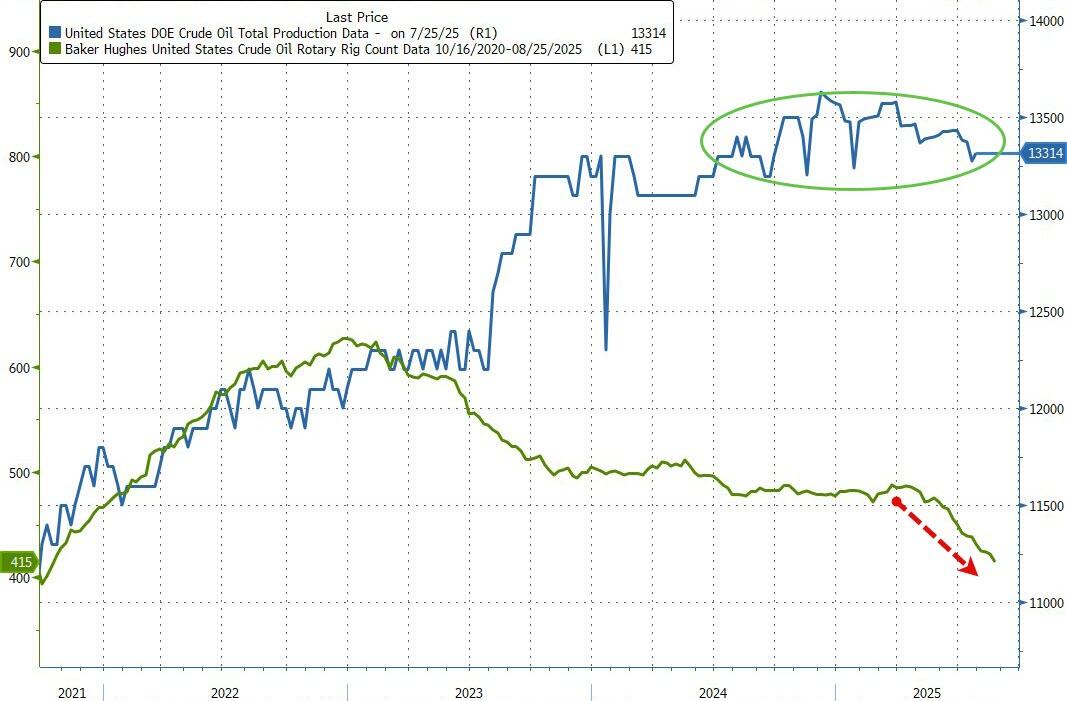
Source: Bloomberg
WTI Crude was largely unmoved by the DOE data coming slightly off the highs of the day…
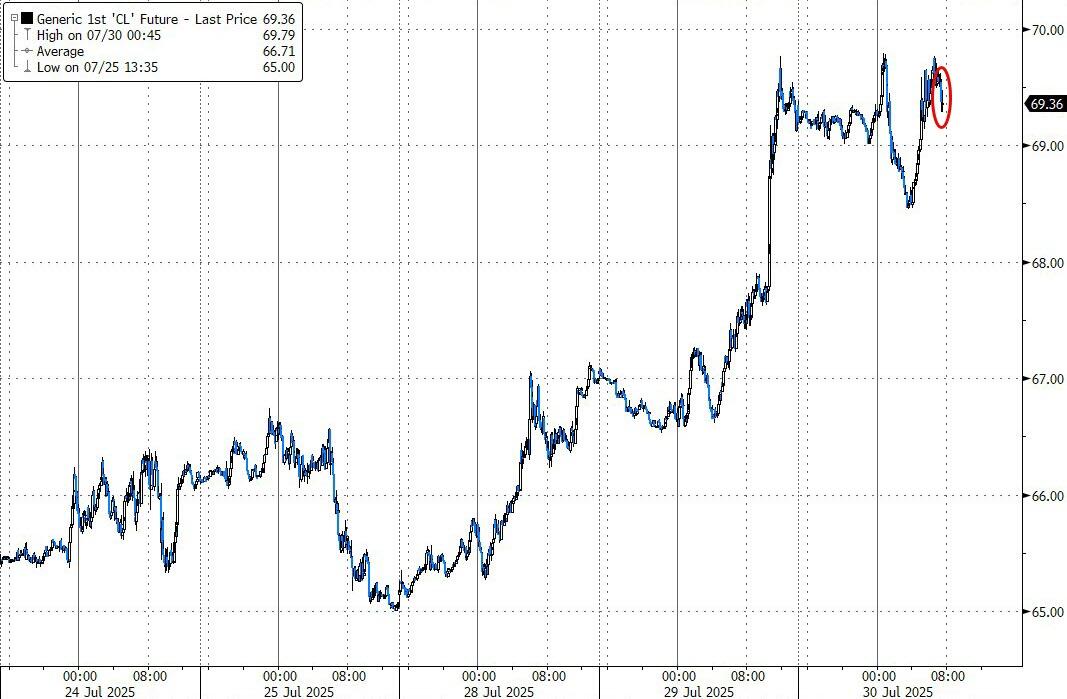
“President Trump’s patience with Russia seems to be wearing thin, and oil markets have reacted somewhat to the prospect of a potential supply disruption,” Barclays analyst Amarpreet Singh said.
“We recognize the upside risks from a potential binary outcome, but caution against assigning too high of a probability to it.”
Oil is on track for a third monthly gain, and markets also remain focused on the US deadline to nail down trade deals by Aug. 1, and the OPEC+ meeting over the weekend that will decide supply for September.
Traders expect the group to agree on another bumper increase to crude production.
end
8. EMERGING MARKETS//AUSTRALIA NEW ZEALAND ISSUES
INDIA/USA
Trump doing everything to stop Russia oil/gas to India
(zerohedge)
Rupee Slides After Trump Threatens India Over Russia Trade
Wednesday, Jul 30, 2025 – 08:37 AM
With the August 1st tariff pause deadline looming, President Trump has taken to his Truth Social account to lambast India for continuing to buy oil (on the cheap) from Russia. (emphasis ours)
Remember, while India is our friend, we have, over the years, done relatively little business with them because their Tariffs are far too high, among the highest in the World…
…and they have the most strenuous and obnoxious non-monetary Trade Barriers of any Country.
But, it’s clear what is really pissing President Trump off…
Also, they have always bought a vast majority of their military equipment from Russia, and are Russia’s largest buyer of ENERGY, along with China, at a time when everyone wants Russia to STOP THE KILLING IN UKRAINE — ALL THINGS NOT GOOD!
INDIA WILL THEREFORE BE PAYING A TARIFF OF 25%, PLUS A PENALTY FOR THE ABOVE, STARTING ON AUGUST FIRST.
THANK YOU FOR YOUR ATTENTION TO THIS MATTER. MAGA!
Any rate 20% or higher would come as a disappointment for India, which had been seeking a better deal than the 19% that Trump offered Indonesia and the Philippines.
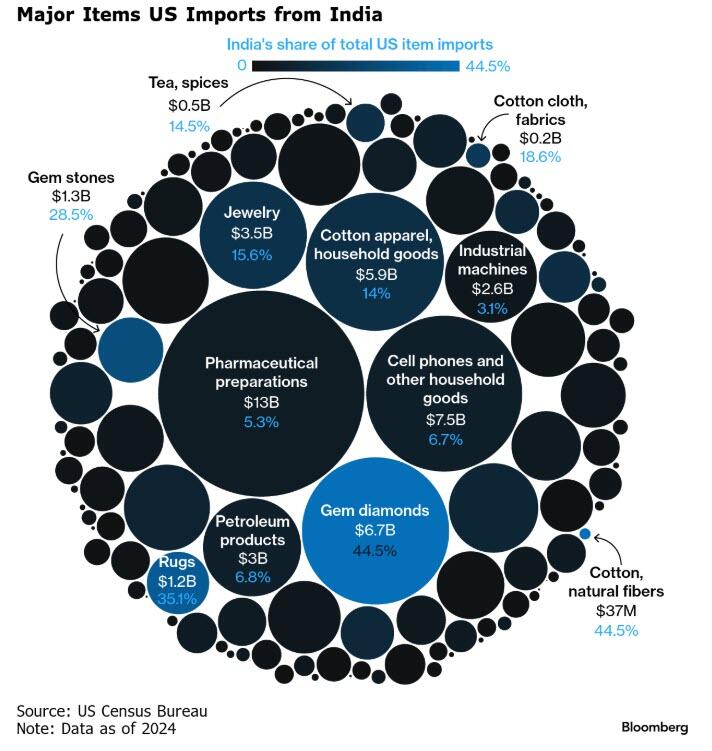
Bloomberg reports that India and the US have already signed terms of reference for a bilateral trade deal and have agreed to a fall deadline for that.
The two sides have been negotiating an interim agreement that New Delhi hoped would give it a reprieve from higher US import duties due to kick in on Friday.
Officials in India are still awaiting word from the White House on the extent of tariffs the South Asian nation will face this week, an official told reporters in New Delhi earlier this week, asking not to be identified as the discussions are private.
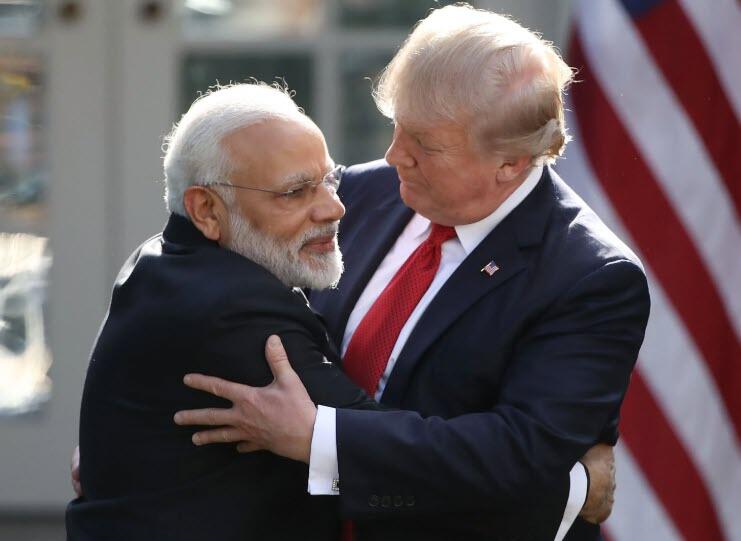
The most immediate reaction was selling pressure in equity futures…
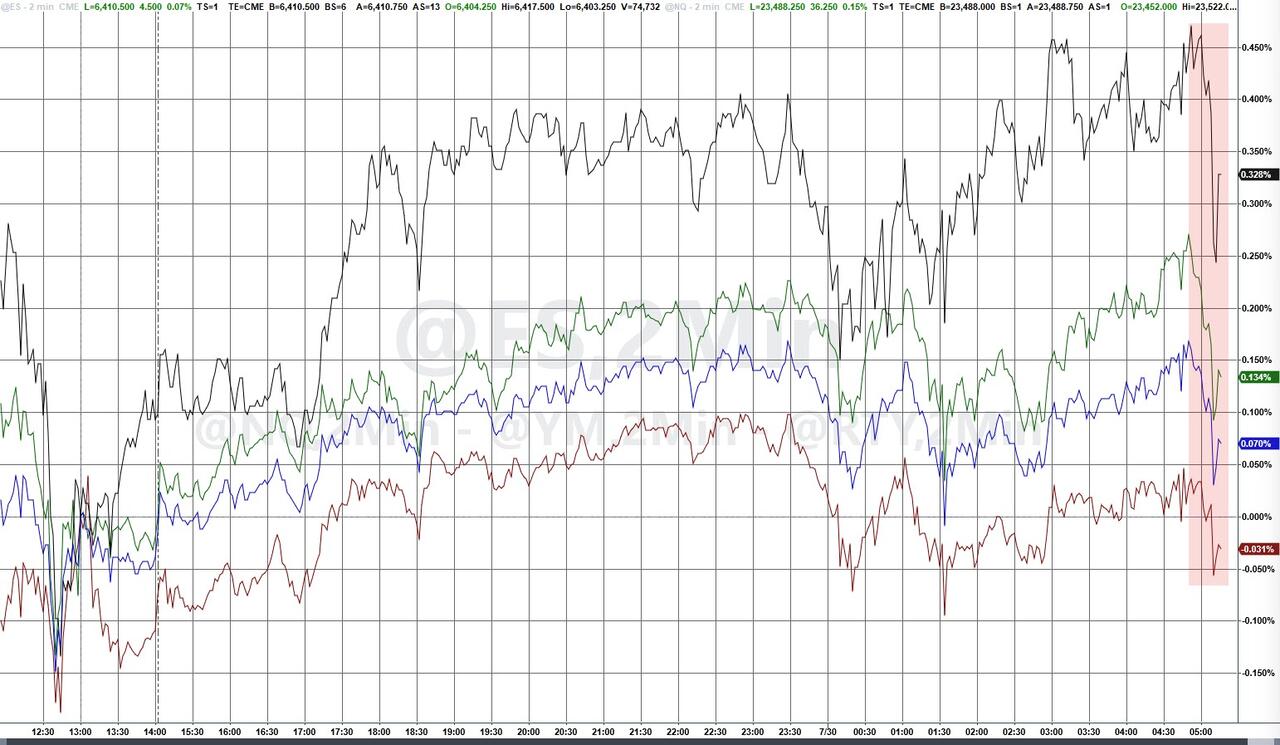
But how long that weakness will last is anyone’s guess as today’s avalanche of headlines and data is just starting.
The Indian rupee extended a three-day decline on the tariff threat, while the BSE Sensex gave up early gains to trade flat.
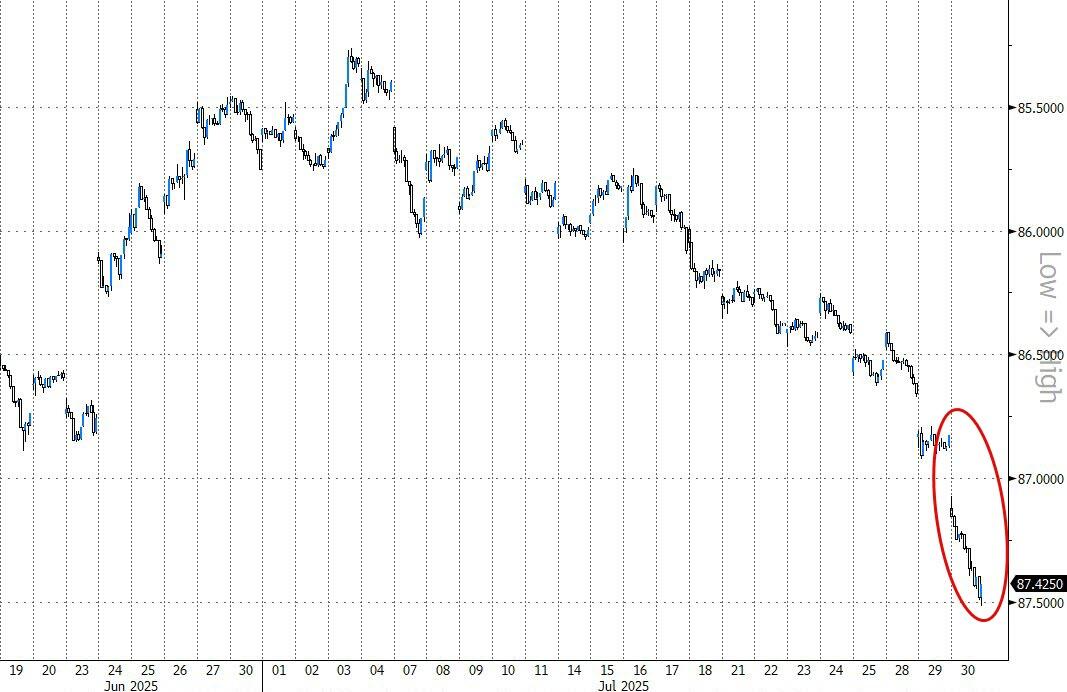
The local currency fell as much as 0.5% to 87.24 to the dollar.
end
USA private ADP jobs report
Seems that Trump is winning again
(ADP)
“Employers More Optimistic Than Consumers” As ADP Reports Big Rebound In Jobs In July
Wednesday, Jul 30, 2025 – 08:24 AM
The American economy added a larger than expected 104k jobs in July according to ADP Employment data released this morning.
This is better than the 76k expected and June’s 33k job loss was revised up to a 23k job loss…
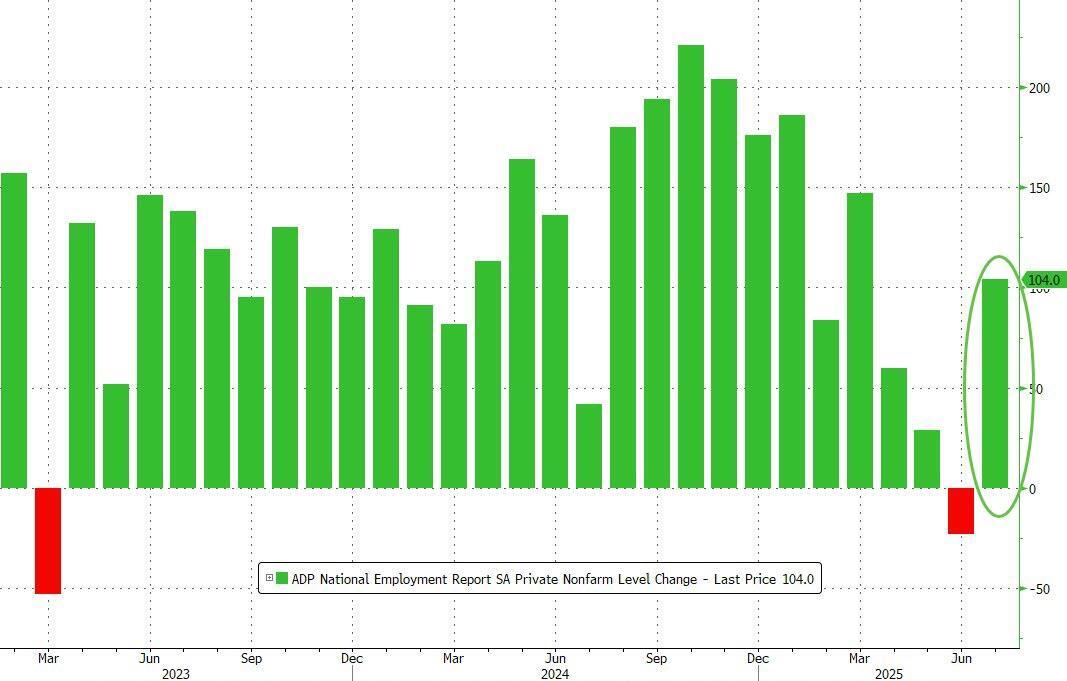
Source: Bloomberg
Hiring gains were led by a resurgence in services, with the exception of education and health, which has posted a net loss of jobs so far this year.
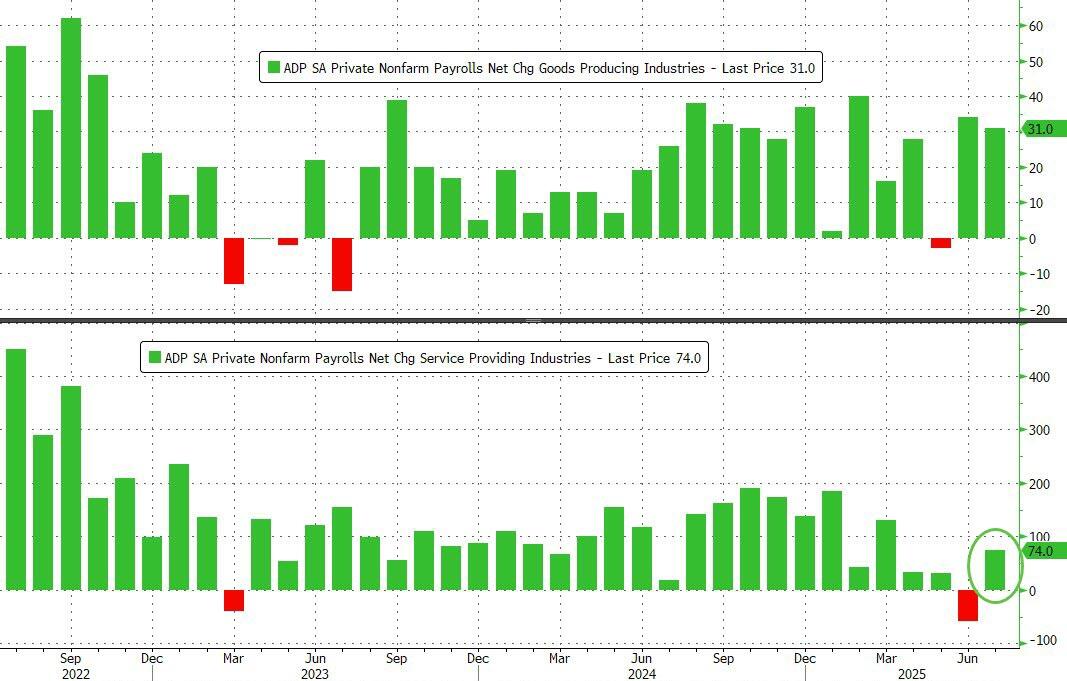
“Our hiring and pay data are broadly indicative of a healthy economy. Employers have grown more optimistic that consumers, the backbone of the economy, will remain resilient,” said Dr. Nela Richardson Chief Economist, ADP
Year-over-year pay growth in July was 4.4 percent for job-stayers (lowest since May 2021) and 7 percent for job-changers.
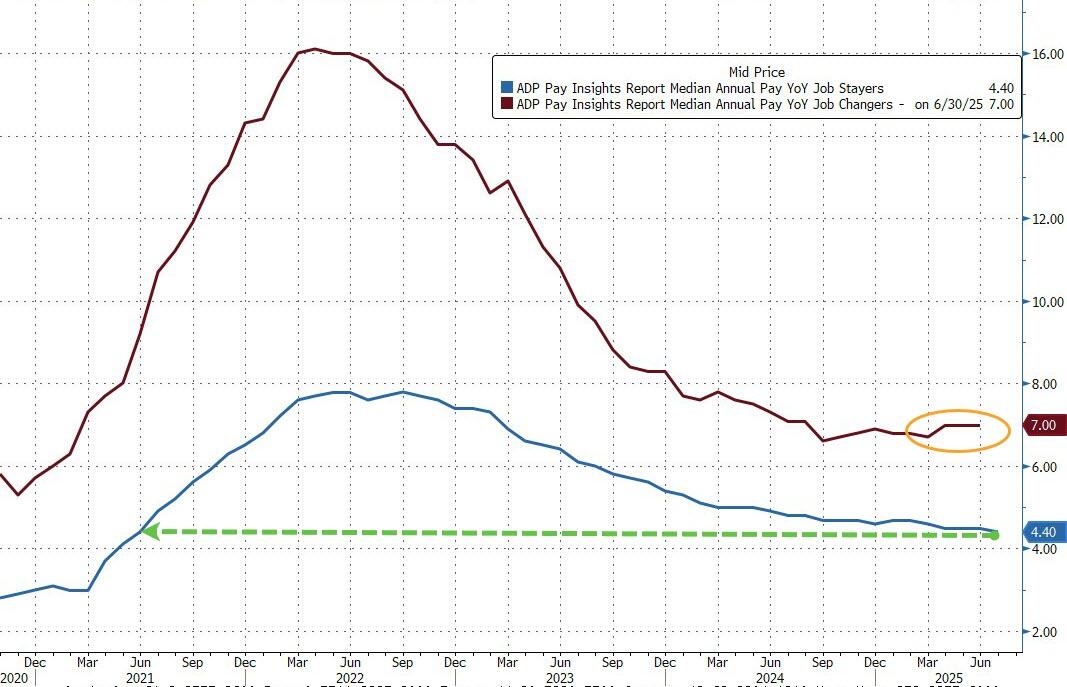
Finally, as a reminder, this data point is literally worthless…
So, trade accordingly.
end
YOUR EARLY CURRENCY/GOLD AND SILVER PRICING/ASIAN CLOSING MARKETS AND EUROPEAN BOURSE OPENING AND CLOSING/ INTEREST RATE SETTINGS WEDNESDAY MORNING 6;30AM//OPENING AND CLOSING
EURO/USA: 1.1552 UP 0.0002 PTS OR 2 BASIS POINTS
USA/ YEN 148.08 UP 0.044 NOW TARGETS INTEREST RATE AT 1.00% AS IT WILL BUY UNLIMITED BONDS TO GETS TO THAT LEVEL…//YEN STILL FALLS//END OF YEN CARRY TRADE BEGINS AGAIN OCT 2024/Bank of Japan raises rates by .15% to 1.15..UEDA ENDS HIKING RATES AND NOW CARRY TRADES RE INVENTS ITSELF//
GBP/USA 1.3361 UP .0008 OR 8 BASIS PTS
USA/CAN DOLLAR: 1.3775 UP 0.0008 (CDN DOLLAR DOWN 8 BASIS PTS)
Last night Shanghai COMPOSITE UP 6.01 PTS OR 0.17%
Hang Seng CLOSED DOWN 347.52 PTS OR 1.36%
AUSTRALIA CLOSED UP 0.54%
// EUROPEAN BOURSE: ALL MOSTLY MIXED
Trading from Europe and ASIA
I) EUROPEAN BOURSES: ALL MOSTLY MIXED
2/ CHINESE BOURSES / :Hang SENG CLOSED DOWN 347.52 PTS OR 1.36%
/SHANGHAI CLOSED UP 6.01 PTS OR 0.17%
AUSTRALIA BOURSE CLOSED UP 0.54 %
(Nikkei (Japan) CLOSED DOWN 19.85 PTS OR 0.05%
INDIA’S SENSEX IN THE GREEN
Gold very early morning trading: 3331.80
silver:$38.05
USA dollar index early WEDNESDAY morning: 98.63 DOWN 2 BASIS POINTS FROM MONDAY’s CLOSE
WEDNESDAY MORNING NUMBERS ENDS
And now your closing WEDNESDAY NUMBERS 1: 30 AM
Portuguese 10 year bond yield: 3.145% UP 3 in basis point(s) yield
JAPANESE BOND YIELD: +1.566% UP 1 FULL POINTS AND 00/100 BASIS POINTS /JAPAN losing control of its yield curve/
SPANISH 10 YR BOND YIELD: 3.3301 UP 3 in basis points yield
ITALIAN 10 YR BOND YIELD 3.563 UP 3 points in basis points yield ./ THE ECB IS QE’ ING ITALIAN BONDS (BUYING ITALIAN BONDS/SELLING GERMAN BUNDS)
GERMAN 10 YR BOND YIELD: 2.7110 UP 1 BASIS PTS
IMPORTANT CURRENCY CLOSES : MID DAY WEDNESDAY
Closing currency crosses for day /USA DOLLAR INDEX/USA 10 YR BOND YIELD/1:00 PM
Euro/USA 1.1463 DOWN 0.0088 OR 88 basis points
USA/Japan: 149.06 UP 0.641 OR YEN IS DOWN 64 BASIS PTS//
Great Britain 10 YR RATE 4.6120 DOWN 2 BASIS POINTS //
Canadian dollar DOWN .0042 OR 42 BASIS pts to 1.3817
xxxxxxxxxxxxxxxxxxxxxxxxxxxxxxxxxxxxxxxxxxxxxxxxxxxxxxxxxxxxxxxxxxxxxxxxxxxxxxxx
The USA/Yuan CNY UP AT 7.1895 CNY ON SHORE ..
THE USA/YUAN OFFSHORE UP TO 7.1994
TURKISH LIRA: 40.59 EXTREMELY DANGEROUS LEVEL/DEATH WATCH/HYPERINFLATION TO BEGIN.//
the 10 yr Japanese bond yield at +1.565
Your closing 10 yr US bond yield UP 3 in basis points from TUESDAY at 4.369% //trading well ABOVE the resistance level of 2.27-2.32%)
USA 30 yr bond yield 4.903 UP 4 in basis points /11:00 AM
USA 2 YR BOND YIELD: 3.918 UP 4 BASIS PTS.
GOLD AT 11;00 AM 3305.60
SILVER AT 11;00: 37.68
Your 11:00 AM bourses for Europe and the Dow along with the USA dollar index closing and interest rates: WEDNESDAY CLOSING TIME 11:00 AM//
London: CLOSED UP 0.62 PTS OR 0.00%
GERMAN DAX: UP 44.85 pts or 0.19%
FRANCE: CLOSED UP 4.60 pts or 0.06%
Spain IBEX CLOSED UP 32.90 pts or 0.23%
Italian MIB: CLOSED UP 403.42 or 0.98%
WTI Oil price 69.71 11.00 EST/
Brent Oil: 72.78 11:00 EST
USA /RUSSIAN ROUBLE /// AT: 81.01 ROUBLE UP 0 AND 8/ 100
CDN 10 YEAR RATE: 3.489 UP 2 BASIS PTS.
CDN 5 YEAR RATE: 3.045 UP 1 AND 0 BASIS PTS
CLOSING NUMBERS: 4 PM
Euro vs USA 1.1426 DOWN 0.0128 OR 128 BASIS POINTS//
British Pound: 1.3237 DOWN .01177 OR 118 basis pts/
BRITISH 10 YR GILT BOND YIELD: 4.5960 DOWN 2 FULL BASIS PTS//
JAPAN 10 YR YIELD: 1.554 DOWN 1 FULL BASIS PT
USA dollar vs Japanese Yen: 149.42 UP 0.994 BASIS PTS
USA dollar vs Canadian dollar: 1.3825 UP 0.0051 BASIS PTS// CDN DOLLAR DOWN 51 BASIS PTS
West Texas intermediate oil: 70.23
Brent OIL: 73.33
USA 10 yr bond yield UP 4 BASIS pts to 4.371
USA 30 yr bond yield UP 3 PTS to 4.897%
USA 2 YR BOND: UP 7 PTS AT 3.943%
CDN 10 YR RATE 3.493 UP 2 BASIS PTS
CDN 5 YEAR RATE: 3.058 UP 2 BASIS PTS
USA dollar index: 99.59 UP 96 BASIS POINTS
USA DOLLAR VS TURKISH LIRA: 40.58 GETTING QUITE CLOSE TO BLOWING UP/
USA DOLLAR VS RUSSIA//// ROUBLE: 81.01 UP 0 AND 9/100 roubles OUCH//
GOLD $3271.50 (3:30 PM)
SILVER: 36.84 (3:30 PM)
DOW JONES INDUSTRIAL AVERAGE: DOWN 171.71 OR 0.38%
NASDAQ 100 UP 37.11 PTS OR 0.16%
VOLATILITY INDEX: 16.61 UP 0.63 PTS OR 3.84%
GLD: $ 300.96 DOWN 5.29 PTS OR 1.73%
SLV/ $32.51 DOWN 1.15 PTS OR OR 3.32%
TORONTO STOCK INDEX// TSX INDEX: CLOSED DOWN 210.92 PTS OR .77%
end
TRADING today ZEROHEDGE 4 PM: HEADLINE NEWS/TRADING
Dollar Soars To 2-Mo Highs, Stocks Stumble As Hawkish Powell Trumps Dovish Fed
Wednesday, Jul 30, 2025 – 08:00 PM
The best financial instrument to show today’s chaos is probably the odds of a September rate cut... A clear dovish bias in the FOMC statement (dovish dissents and moderating growth fears) sent the odds of a cut notably higher then Fed Chair Powell stole the jam out of that donut with a series of less-than-dovish comments, sending rate-cut odds reeling lower…

Source: Bloomberg
The statement seemingly confirmed The Fed’s easing bias…
- The dot plot is clear on the fact that The Fed has a dovish bias.
- Today’s statement underlines that and is factual in nature, with ‘moderating’ growth comments the main focus.
- Waller and Bowman voted (dovishly) as anticipated.
The first double-dissent since 1993…

Source: Bloomberg
Until then, there was nothing new – it’s just a question of timing on the cuts.
But then Powell seemed to pour some cold water on the dovish bias during the presser:
- *POWELL: WOULD CHARACTERIZE POLICY AS MODESTLY RESTRICTIVE
- *POWELL: CURRENT POLICY STANCE APPROPRIATE WITH INFLATION RISKS
- *POWELL: WE’RE STILL A WAYS AWAY FROM SEEING WHERE THINGS SETTLE
Also:
- *POWELL: MANY LABOR MEASURES SIMILAR TO A YEAR AGO
- *POWELL: YOU DON’T SEE A WEAKENING IN THE LABOR MARKET
…which is when you cut rates by 100bps!?
- *POWELL: INFLATION IS FURTHER FROM OUR GOAL THAN EMPLOYMENT
Inflation is 0.5% closer to your goal than it was last September when you cut 50bps

Source: Bloomberg
Powell’s comments smashed 2025 rate-cut expectations down to 37bps (basically 1 cut priced in and a coin toss for a second cut). 2026 expectations rose (dovishly)…

Source: Bloomberg
One more thing… The Fed removed the word ‘diminished’ from its comments about ‘uncertainty’…claiming that ‘uncertainty… remains elevated’. What a crock of shit – if we combine geopolitical risk and global trade policy uncertainty, we see that uncertainty is dramatically lower than it was and even mnore notably, it’s at the same level as it was when The Fed cut 100bps around the election…

Source: Bloomberg
The effect of all that (dovish FOMC, hawkish Powell) was a serious kneejerk higher in the dollar and yields and lower in stocks… and Trump will be most disapleased…

The dollar rallied for the fifth straight day to its highest close in two months…

Source: Bloomberg
Treasury yields spiked with the short-end underperforming (2Y +8bps, 30Y +4bps). That dragged the short-end of the curve higher on the week (30Y still marginally lower in yield)..

Source: Bloomberg
The yield curve (2s30s) flattened significantly…

Source: Bloomberg
Stocks inched higher on the FOMC statement but tumbled on Powell’s less than dovish banter with Small Caps the biggest loser. A late-day buying panic lifted Nasdag green ahead of the big earnings results after the bell…

Meme stocks were monkey-hammered…

Source: Bloomberg
‘Most Shorted’ stocks were mullered…

Source: Bloomberg
Interestingly, even with the post-Powell pummeling, momo actually outperformed overall with longs solidly green and shorts significantly lower…

Source: Bloomberg
The surge in the dollar prompted panic-selling in gold, breaking down it one month lows…

Source: Bloomberg
…testing down to its 100DMA…

Source: Bloomberg
On the other side, oil prices rallied amid Trump threats to Russian oil buyers, continuing its slow recovery from post Israel-Iran pandemonium…

Source: Bloomberg
Crypto was clubbed like a baby seal, with bitcoin falling back to a $115k handle briefly intraday…

Source: Bloomberg
Finally, today was the 25th straight day without a 1% move in the S&P 500, longest stretch since Oct 2024…

Source: Bloomberg
But, with META & MSFT tonight; PCE, AAPL & AMZN tomorrow, and Payrolls on Friday, who knows how long that streak can last.
BIG NEWS; THE FED ON INTEREST RATES
‘Most Divided’ Fed In 32 Years Refuses To Cut Rates (Again)
Wednesday, Jul 30, 2025 – 02:00 PM
Since the last FOMC meeting (on June 18th), stocks have soared and gold (and crude oil) have been sold while bonds and the dollar have trod water...
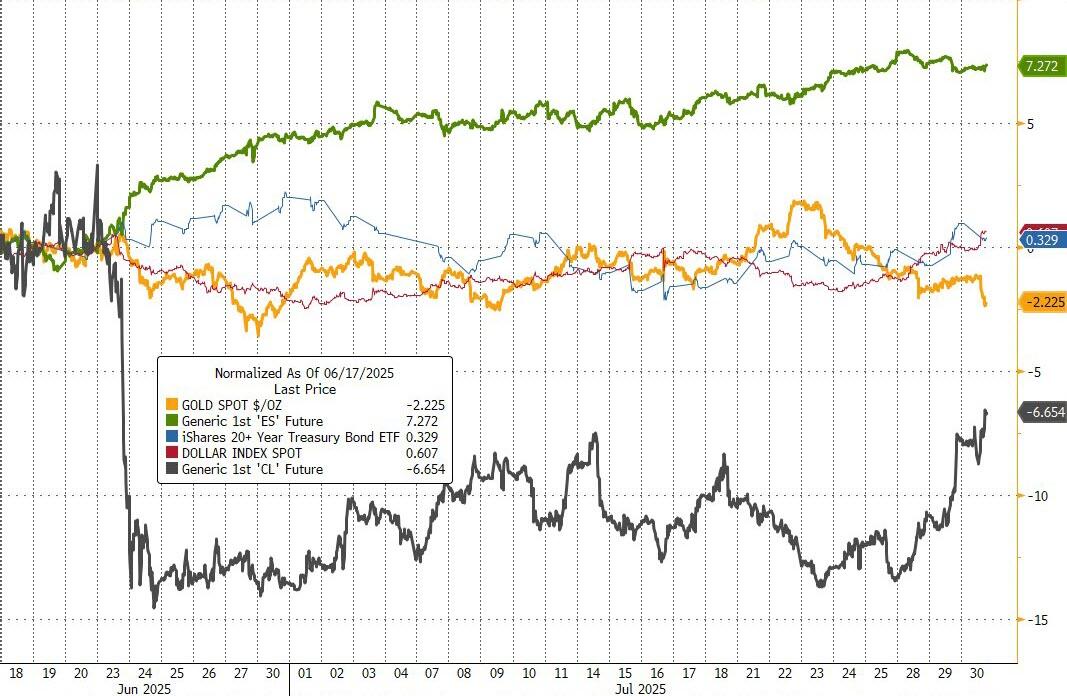
Source: Bloomberg
Most notably, while macro data has shown ‘growth’ has strengthened; ‘inflation’ has continued to fall, significantly…
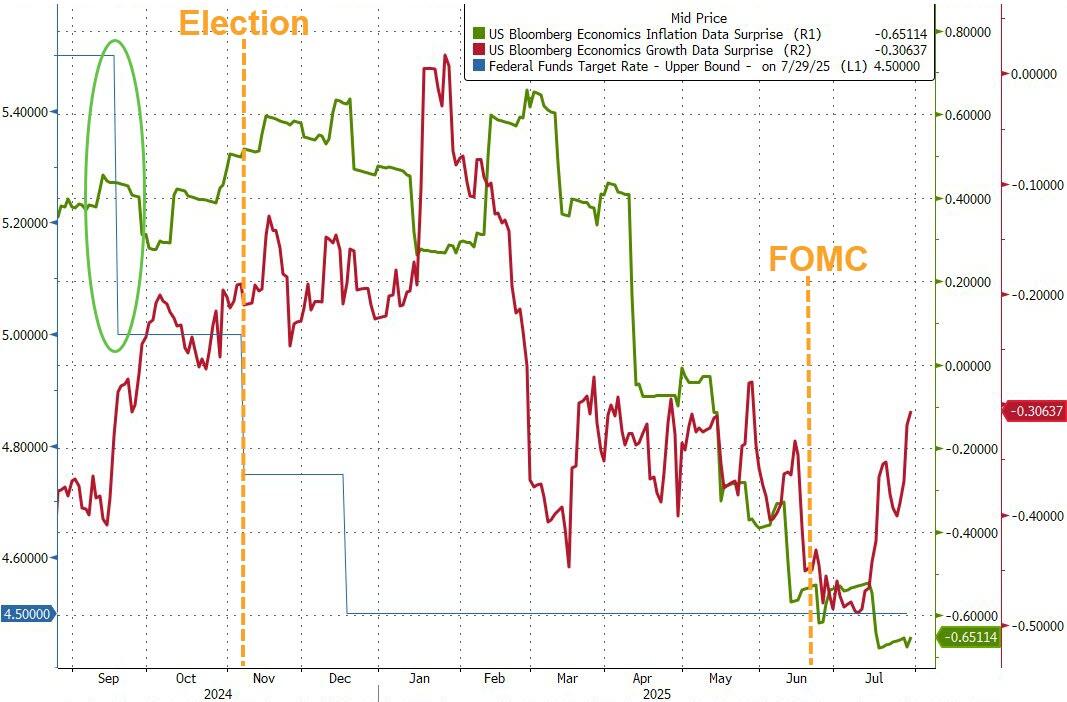
Source: Bloomberg
Interestingly, while the voyage has been eventful, the market’s expectations for rate-cuts in 2025 is exactly where it was at the last FOMC meeting (just below 2 full cuts)…
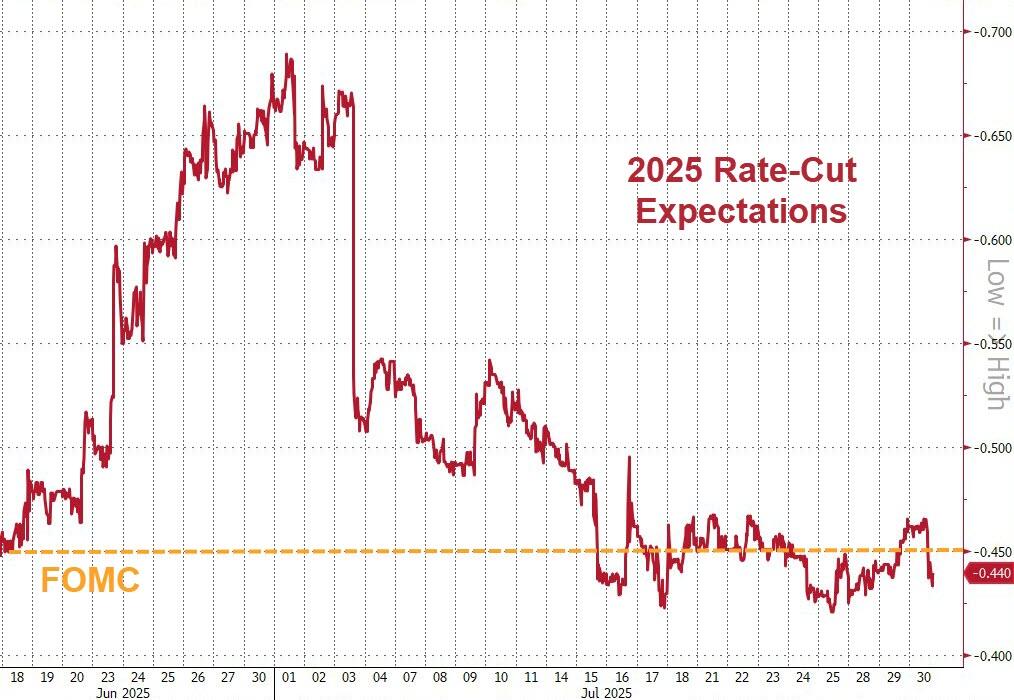
Source: Bloomberg
Heading in to today’s FOMC decision, expectations were unequivocally for no cut today, with September signaled as better than a coin-toss for the next cut (though those odds were falling into the FOMC statement)…
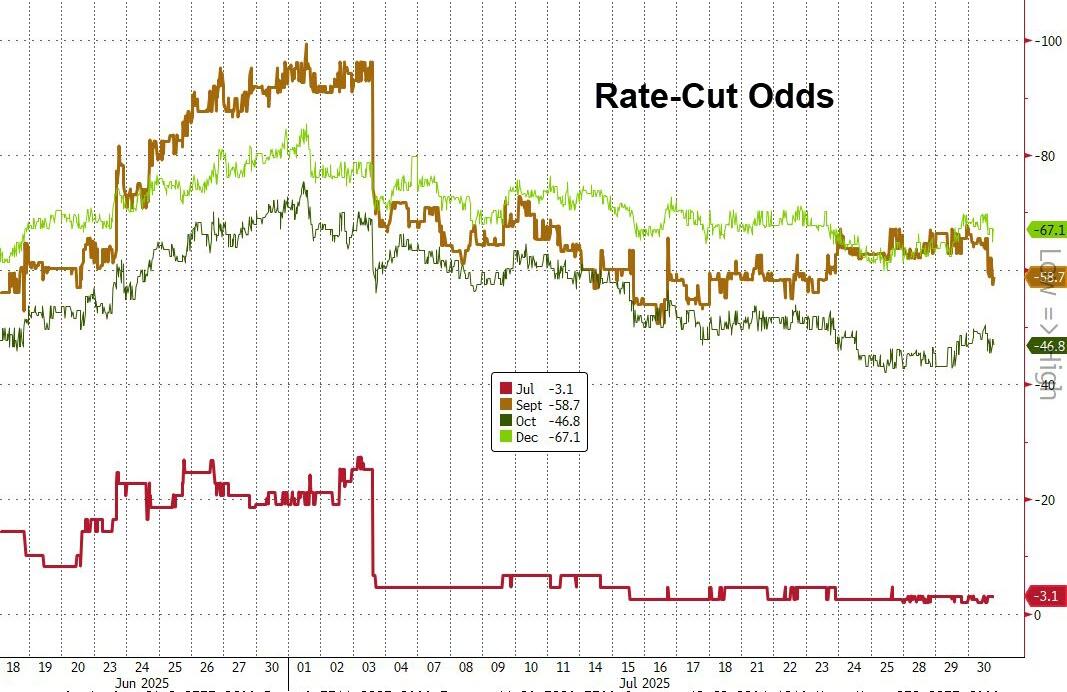
Source: Bloomberg
So, while expectations are for no rate-cut today, hints of future dovishness (in the statement as well as in Powell’s presser) are a key focus as the potential for the first double-Governor-dissent since 1993 is on the cards…
So, what did The Fed actually do (and say)…
The Fed held rates flat (as expected):
- *FED HOLDS BENCHMARK RATE IN 4.25%-4.5% TARGET RANGE
But see some weakness…
- *FED: ECONOMIC GROWTH MODERATED IN FIRST HALF OF YEAR
It’s a Double Dissent Day, dude!!
- *FED GOVERNORS WALLER, BOWMAN DISSENTED IN FAVOR OF RATE CUT
That’s the first time sine 1993…
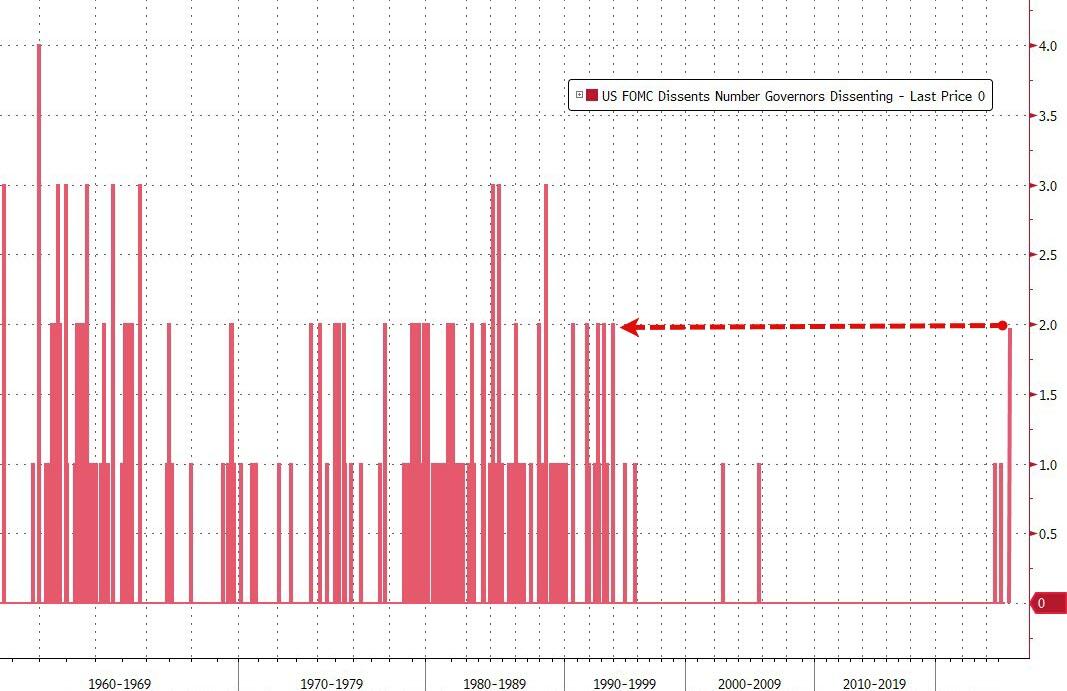
Now, all eyes on the press conference to see if Powell can tread the fine line between claiming data-dependence and admitting he is basing his decision not to cut rates on ‘gut’ feel that tariffs are inflationary.
Read the full redline below:
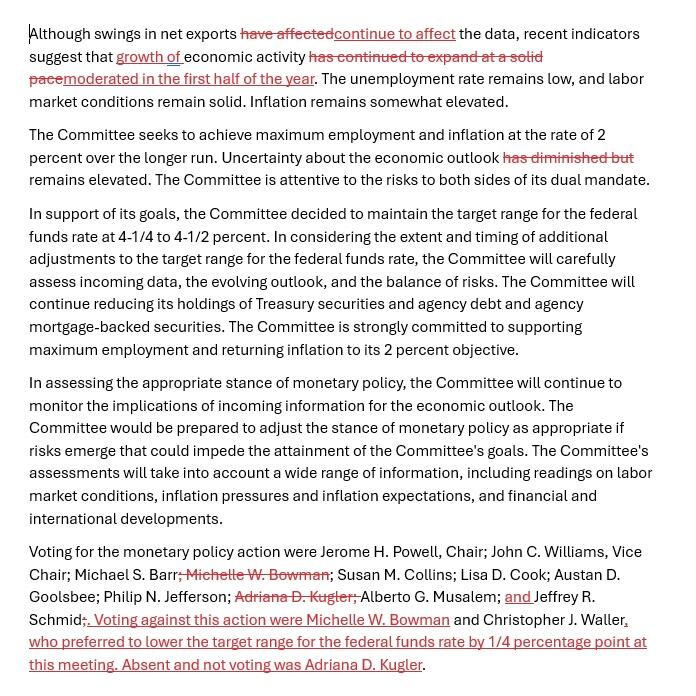
end
presser:
Watch Live: ‘Too Late’ Powell Explains Why Rate-Cuts Remain Off The Table Despite Dissents & Growth Doubts
Wednesday, Jul 30, 2025 – 02:25 PM
No rate cuts… as expected.
Two dissents… the most in 32 years!
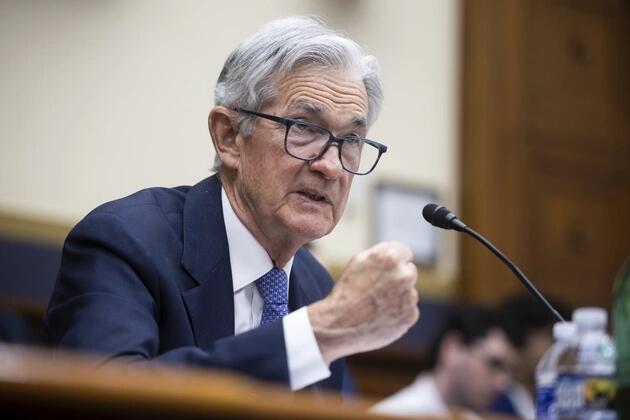
And all of that as, according to Goldman, the most notable change since the June FOMC meeting is that activity data have begun to show clearer signs of the below-potential growth that most forecasters have expected since it became clear in the spring that large tariff increases were coming.
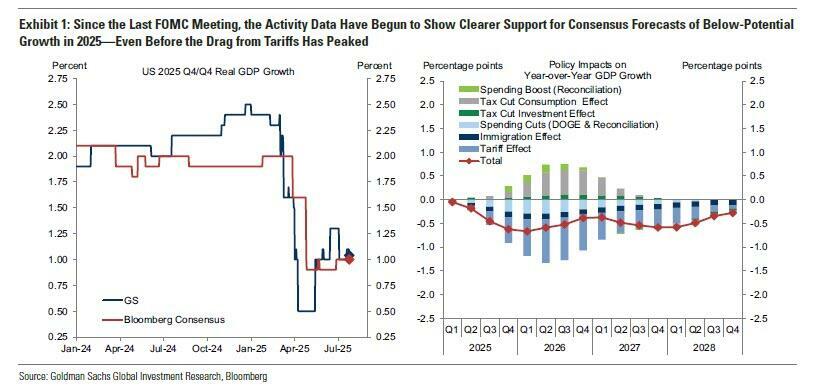
Concerningly, this deceleration has occurred before the drag from the trade war has likely peaked.
But apparently, that is of no importance (as a data point) to Powell and his pals.
So, brace yourself for the usual barrage of softball questions from reporters too afraid to actually ask Powell the pertinent question of just what data points he is looking at to justify continuing to sit on his hands… as inflation continues to surprise to the downside, rather dramatically…
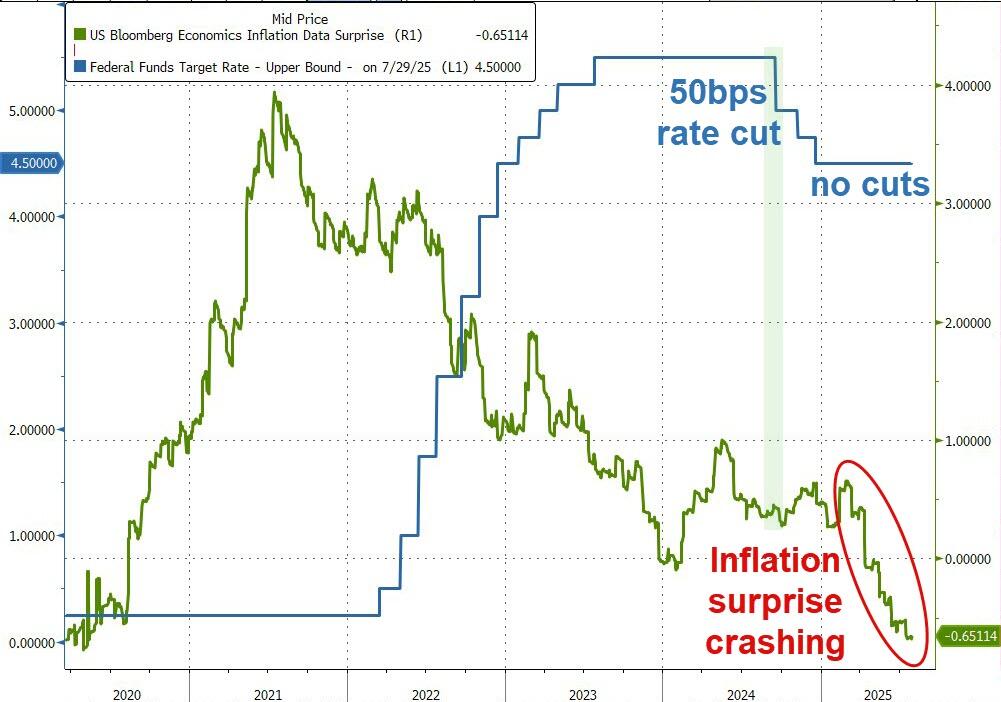
…because the lack of tariff-driven inflation is… transitory?
Our first take is that the combination of a double dissent (pro cuts) and the recognition that growth is ‘moderating’, strongly suggests a dovish tilt from the Fed and the market is seeing odds of a September cut rising…
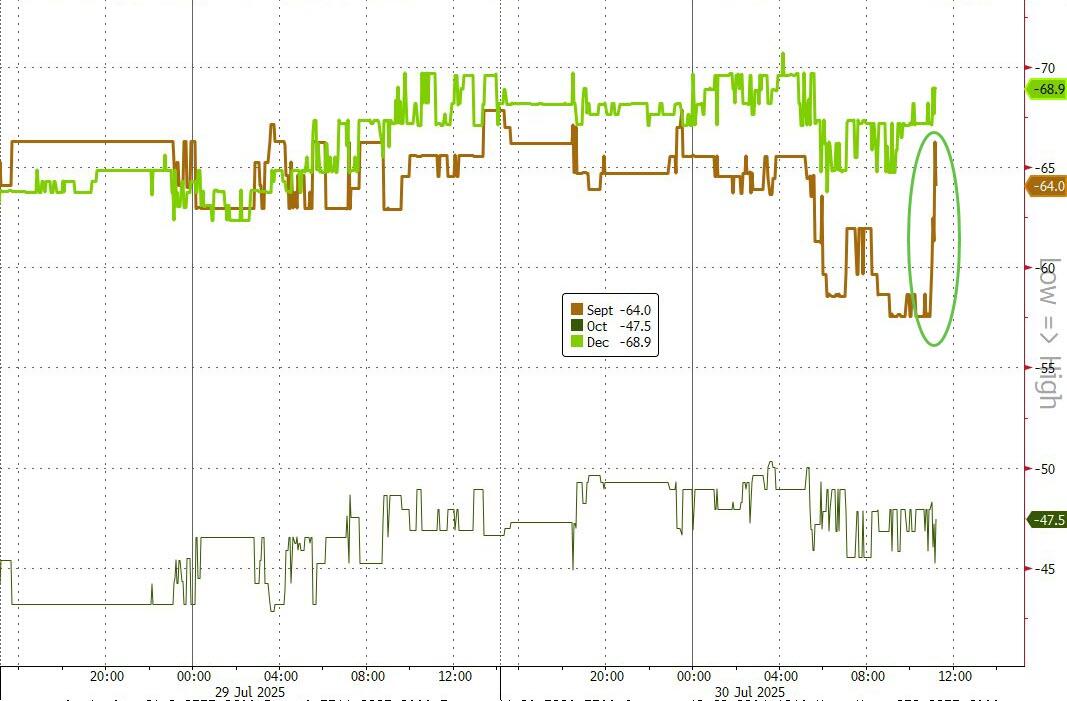
Attention at the press conference will be on whether Chair Powell offers any guidance for rates ahead, or if it may soon be time to lower rates, depending on the data, although the Fed has been reluctant to commit to future moves in the past, given the ongoing uncertainties around trade policies.
During the Presser, Powell will also likely be quizzed about his future given President Trumpʼs continuing criticisms of the Fed Chair. Powell tends to avoid these sorts of questions, usually stating that he is focused on the Fed’s mandate.
Watch the full press conference here live (due to start at 1430ET):
https://www.youtube.com/embed/u0V3gnOjOi0?si=EVSmej5FeQ3myFj8
USA DATA RELEASES
another win for Trump
US GDP Jumps To 3.0% In Second Quarter, Trouncing Estimates And Reversing Q1 Contraction
Wednesday, Jul 30, 2025 – 08:46 AM
So much for that imports-driven mini recession in Q1.
One quarter after liberal economists cried with delight when the US economy contracted as a result of a surge in imports (even as consumption remained solid) and which they said was the definitive confirmation Trump is the antichrist and the US economy is headed for another Great Depression, moments ago the Bureau of Econ Analysis reported that the first estimate of Q2 GDP came in at an unexpectedly brisk 3.0%, a complete reversal of the -0.5% decline in Q1…
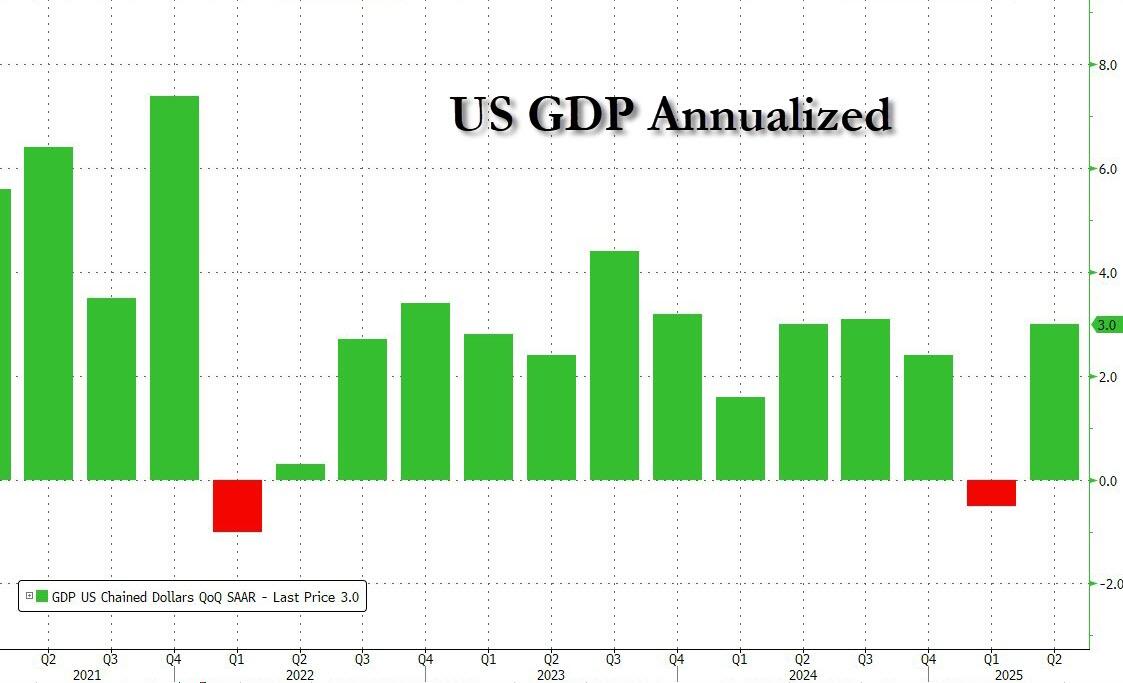
… and well above the 2.6% estimate, if inside the 1-sigma upper distribution band.
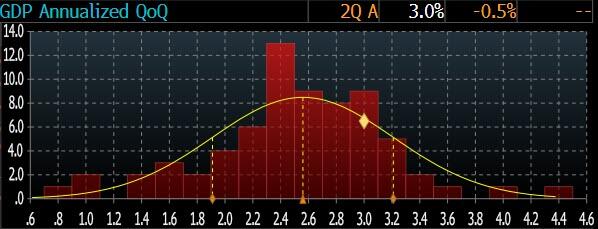
The increase in real GDP in the second quarter reflected a decrease in imports, which are a subtraction in the calculation of GDP (and thus boosted bottom-line GDP), and an increase in consumer spending. These movements were partly offset by decreases in investment and exports.
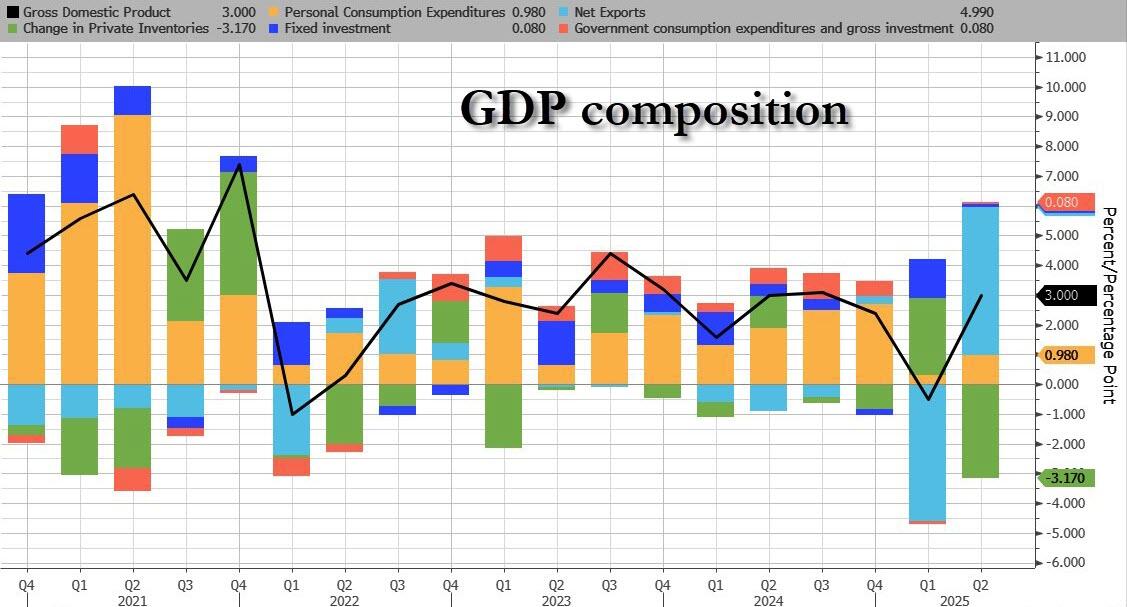
Compared to the first quarter, the upturn in real GDP in the second quarter reflected a downturn in imports and an acceleration in consumer spending that were partly offset by a downturn in investment. Looking at the contribution of various components, we find the following:
- Personal Consumption added 0.98% to the bottom line GDP, up from 0.31% in Q1.
- Fixed Investment came at 0.08%, a big drop from the 1.31%, and perhaps the only concerning point in today’s report: was there really no major data center investments in the second quarter… and if so what are the hyperscalers doing?
- The change in private inventories was a big drop, printing at -3.17% in the first estimate, up from 2.59% in the first quarter, and an expected reversal as retailers unloaded all that inventory they piled up ahead of tariffs.
- Trade or net exports (exports less imports), came at a whopping 4.99% – the biggest addition to the bottom line GDP number – as imports collapsed and added 5.18% to GDP, a stark reversal to the -4.66% contraction in Q1.
- Finally, government added just 0.08% to GDP, a reversal of the 0.10% subtraction in Q1.
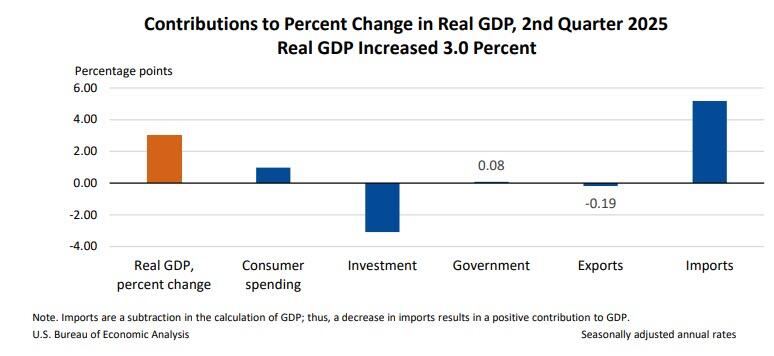
While Personal Consumption was a tad weaker than expected, printing at an annualized 1.4%, below the 1.5% estimate, but above the 0.5% in Q1…
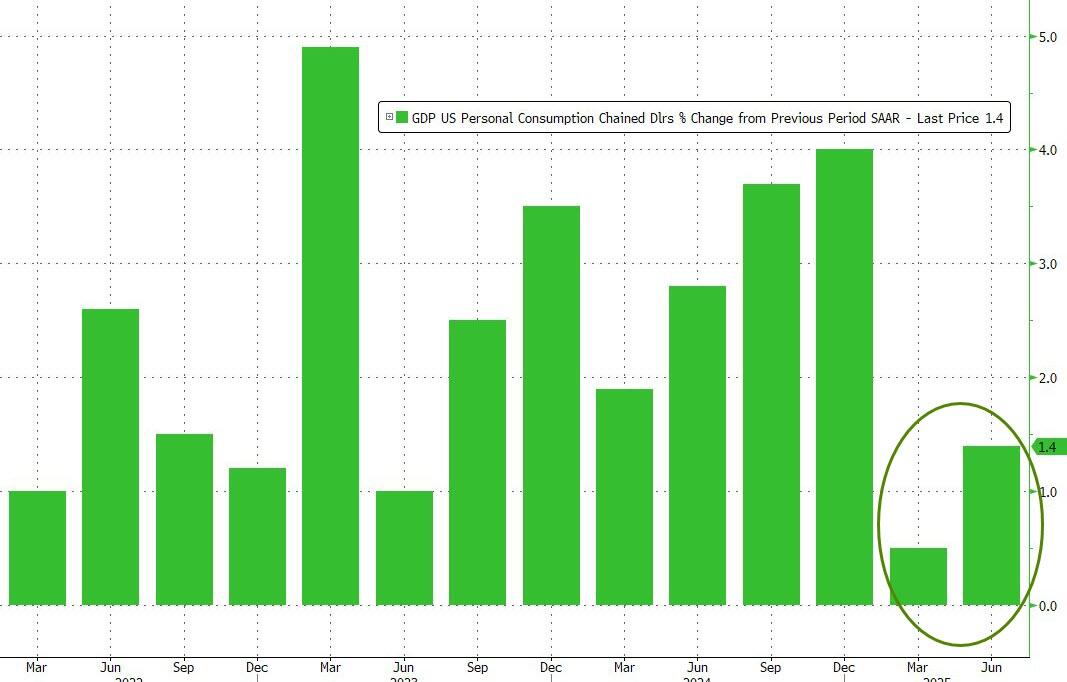
… it was the fixed investment print of just 0.1% that was concerning: why were no Data Centers counted?
And another somewhat troubling update: real final sales to private domestic purchasers, the sum of consumer spending and gross private fixed investment, increased 1.2% in the second quarter, compared with an increase of 1.9% in the first quarter.
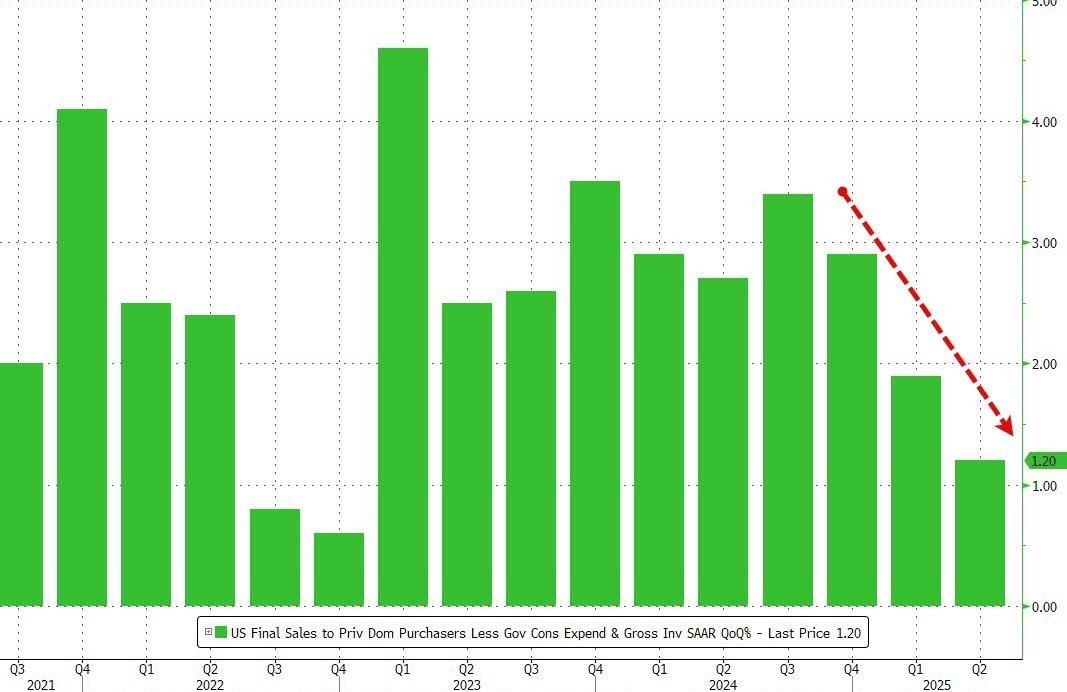
On the inflation side, the data came in mixed, with the GDP price index printing 2.0%, down from 3.8% in Q1 and below the 2.2% expected, while core PCE printed 2.5%, down from 3.5% but above the 2.3% expected. It is now up to the Fed to decide what to do with this data later today.
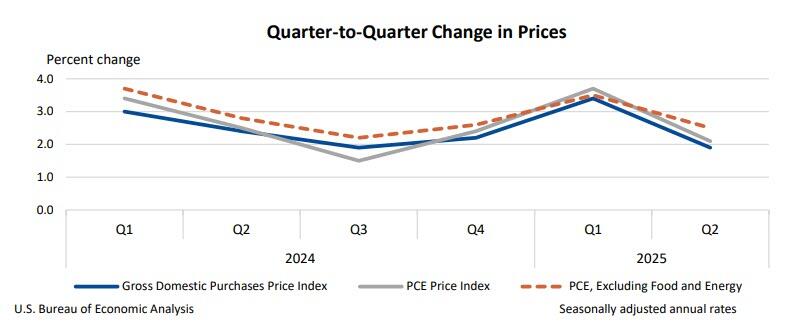
Commetning on the data, TradeStation head of market strategy David Russell said that “the economy rebounded as trade normalized in Q2. Investors will be happy to see the stronger growth, but core PCE is still running on the high side. This is an inconclusive number for the market overall, with continued red flags on inflation – especially with companies citing the impact of tariffs on earnings. The Fed could remain on guard against rising price pressures.”
Overall, this was a stronger than expected print, yet one which merely normalizes for all the trade/tariff noise from Q1, and one which should probably be looked at as an average between the Q1 and Q2 prints, in which case the US economy is probably growing somewhere around 1.3-1.4%, similar to what the (slowing) Real Final Sales indicate.
Moments after the report, Trump blasted on Truth Social that 2Q GDP was “WAY BETTER THAN EXPECTED! “Too Late” MUST NOW LOWER THE RATE.”
Actually, GDP coming in hot means the Fed should not cut rates, and instead what Trump should be focusing on is the slow down in Real Final Sales.
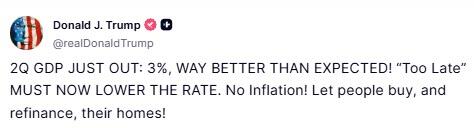
In any case, since the Fed will not cut today, expect some very angry Double Bolded, Underlined and ALL CAPS tweets at exactly 2:01pm today.
end
this is big!! Bessent to undergo YCC (yield control curve). this is stealth QE!!
Bessent Unleashes Treasury Buyback Overhaul In Major Step To Yield Curve Control, Doubles Down On Bill Dominance
Wednesday, Jul 30, 2025 – 10:50 AM
In today’s closely watched Quarterly Refunding Announcement on debt issuance – which to many was more important than the FOMC statement – the Treasury Department said at 8:30am ET that that it anticipates keeping the size of its note and bond auctions unchanged “for at least the next several quarters.” And since that was the same guidance the Treasury has given since the start of last year, it leaves bills, which were the fulcrum security of Janet Yellen’s Activist Treasury Issuance strategy so repeatedly penned by Scott Bessent, once again bearing the brunt of the government’s rising borrowing needs, although as the charts of Bill and Coupon issuance below show, the US is already pretty much at 10…. so these better go to 11.
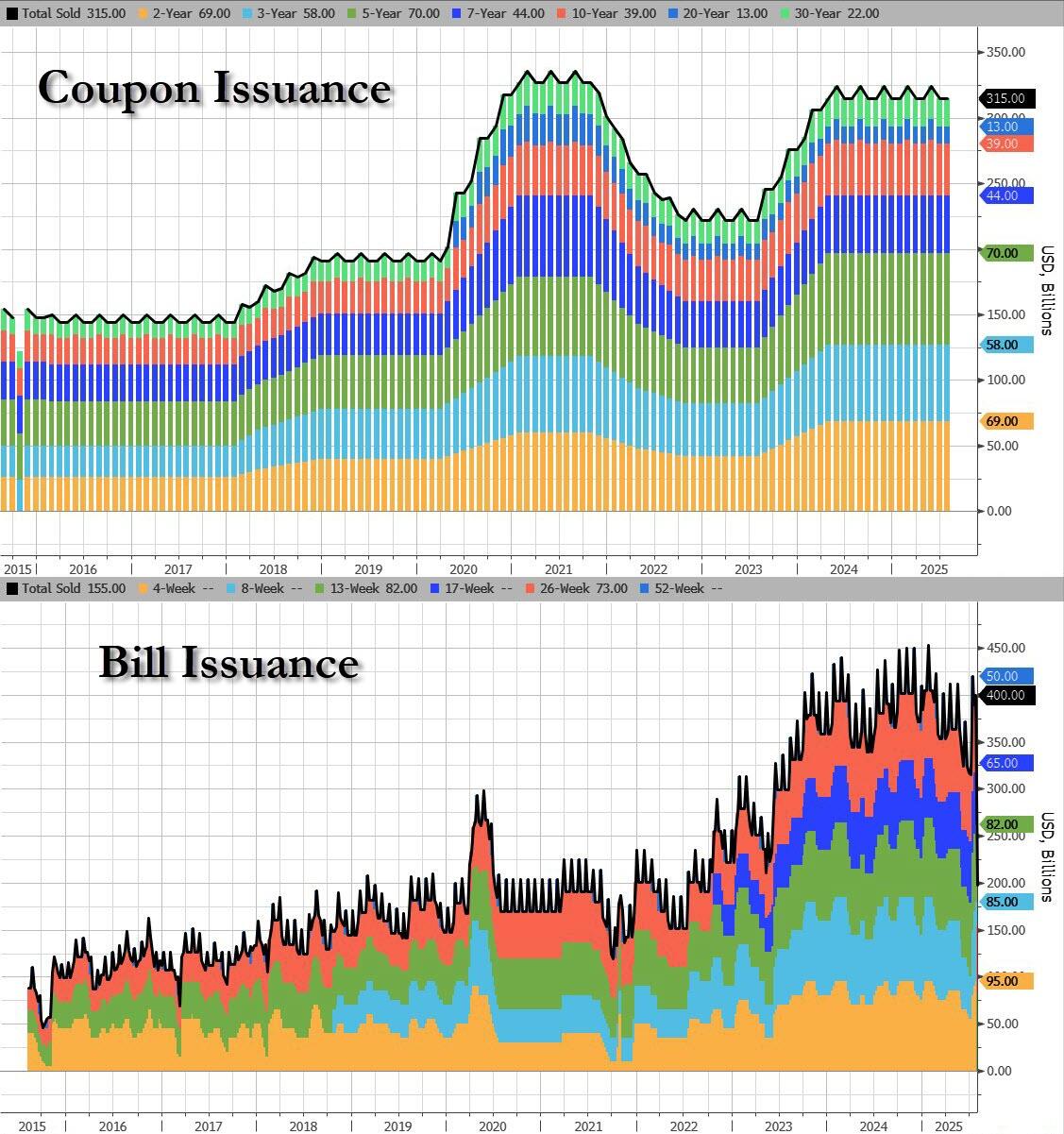
This means that the Treasury will rely more on the shortest-dated securities to fund the gaping federal deficit at least until 2026, after Treasury Secretary Bessent said last month that yields on longer-dated Treasuries were too high to consider boosting sales of such debt. In doing so he is implicitly endorsing the same strategy that he slammed when it took place under Janet Yellen.
As we noted in our QRA preview, and as Bloomberg notes, Wall Street had varying views on what guidance the Treasury would provide. Wells Fargo expected a reiteration of the previous language. JPMorgan strategists said officials “perhaps” might lop off the “at least” qualification for the coming several quarters, while Stephen Stanley at Santander US Capital Markets said his best guess was the entire removal of the guidance.
In the end this is what the Treasury did say:
“Treasury believes its current auction sizes leave it well positioned to address potential changes to the fiscal outlook and to the pace and duration of future SOMA redemptions. Based on current projected borrowing needs, Treasury anticipates maintaining nominal coupon and FRN auction sizes for at least the next several quarters.”
Which is nothing more than can kicking: “The longer debt managers wait to get started, the more difficult the job becomes” of preparing markets for bigger sales of interest-bearing debt, or coupons, Santander’s Stanley wrote before the Wednesday announcement.
Turning to the actual refunding, as widely expected by dealers, the Treasury maintained the size of next week’s quarterly refunding auctions, which span 3-, 10- and 30-year maturities. Specifically, the Treasury will offer $125 billion of Treasury securities to refund approximately $89.8 billion of privately-held Treasury notes and bonds maturing on August 15, 2025, both in line with estimates, and raising new cash of about $35.2 billion. The composition is as follows:
- 3-year note in the amount of $58 billion, maturing August 15, 2028
- 10-year note in the amount of $42 billion, maturing August 15, 2035
- 30-year bond in the amount of $25 billion, maturing August 15, 2055
The table below presents the actual auction sizes for the May to July 2025 quarter and the anticipated auction sizes for the August to October 2025 quarter. As one can see, the 3, 10 and 30Yr issuance sizes are identical as during the last refunding in May of 2025.
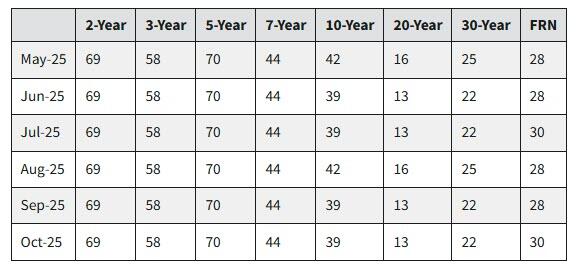
The Treasury also said it was continuing to nudge sales of some Treasury Inflation-Protected Securities, or TIPS, higher in order to keep their share of the overall Treasury market stable. It announced the following adjustments:
- A bump up of the September 10-year TIPS reopening auction to $19 billion
- An increase of the October 5-year new issue TIPS auction to $26 billion
And since there was no surprise in the coupon issuance schedule, it means Bills will once again have to step up and fund the balance. As the Treasury wrote, “since the $5 trillion increase to the debt limit on July 4, Treasury has increased bill issuance to continue to finance the government and to gradually rebuild the cash balance over time to a level more consistent with its cash balance policy.” As previously noted, Treasury anticipates that the cash balance will approach levels consistent with its policy in September. Accordingly, “Treasury anticipates further marginal increases in short-dated Treasury bill auction sizes in the coming days and then maintaining sizes at or near those levels through the end of September. Additional increases to Treasury bill auction sizes are anticipated in October. Treasury will carefully monitor market conditions and adjust its bill issuance plans as appropriate.”
Bessent had been among the most Republicans to criticize former Treasury Secretary Janet Yellen last year for artificially holding down sales of longer-term debt, saying it was an attempt to keep borrowing costs low before the election. And while Bills made up about 20% of the Treasuries market at the end of June, the ratio is now set to climb in the coming months as the Treasury continues to refrain from increasing note and bond issuance. The Treasury Borrowing Advisory Committee, an outside panel made up of dealers, investors and other market participants, last year recommended that bills average about 20% of total outstanding Treasuries over time.
Relying just on bills to fund the deficit would at some point make the ratio of those securities so large that it would introduce sharp volatility in the Treasury’s financing costs. It would also potentially force the department to set aside a bigger stockpile of cash in case of challenges in rolling over maturing bills on any given day.
For now, strategists say there’s ample demand for bills. Money-market funds are expected to keep growing, giving them the capacity to absorb part of the additional bill supply if those securities make up a bigger share of debt, according to Morgan Stanley strategists. The Fed may also emerge as a bigger buyer of bills as policymakers begin to discuss whether to tilt their bond portfolio toward shorter-duration securities. And Bessent has repeatedly pointed to stablecoins as a fresh source of demand. That’s right: very soon Tether will become just as important as the Fed when it comes to funding the US government.
Translation: expect a very, very front-end loaded Treasury curve, one which will be funded by stablecoin issuers and which will be at the whim of the Fed for short-term funding costs. Whatever can possibly go wrong.
But (re)funding schedules aside, which as noted were a snoozer, the most consequential aspect of today’s Quarterly Refunding was how the Treasury’s buyback program will be changed. As readers will recall, ahead of today’s refunding announcement, we said that Goldman was expecting a 50-100% increase in Treasury buybacks and said that “Calling this “shadow QE” is definitely a bridge too far…but it might on a path that leads to that bridge.”
That’s more or less what happened, because in the biggest news of the day, the department unveiled plans to beef up its program of buying back older securities, bringing that initiative to an annual target in excess of $300 billion.
The Treasury said it would double the frequency of long-end operations, boosting the liquidity support cap from $30 billion to $38 billion per quarter, and opening the door to broader market access through direct offers from a limited set of counterparties starting in 2026.
This change to buybacks is not a marginal tweak — it’s a structural shift aimed at injecting flexibility and smoothing market functioning as Treasury debt issuance ramps higher; and while nobody will ever admit it, it is also a shadow QE meant to prop up the long end in case the Fed refuses to step in similar to what happened in April.
Describing the changes to the buyback program meant “to better achieve its liquidity support and cash management goals”, the Treasury said that based on feedback from a wide range of market participants, including the primary dealers and the Treasury Borrowing Advisory Committee, Treasury believes it is appropriate to:
- Double the frequency of long-end nominal coupon liquidity support buybacks: Changes involved will boost the aggregate size of liquidity-support buybacks to a maximum par amount of $38 billion per quarter from $30 billion
- Increase the size of cash management buybacks: Ramping up the cash-management buybacks to a maximum par amount of $150 billion per year from $120 billion
- Make a technical adjustment to the TIPS buyback buckets: i) There will now be two operations per quarter of up to $750 million of 1- to 10-year TIPS buybacks; ii) There will be one operation per quarter of up to $500 million of 10- to 30-year TIPS
- Allow a limited number of additional counterparties to directly access buyback operations. I.e., spread the “NOT STEALTH QE” wealth.
These changes will be effective August 13, 2025 and are reflected in the tentative buyback schedule for the upcoming refunding quarter.
So what is really going on here? Well, recall that in April, just as yields exploded higher after Liberation Day, Powell appears on BBG TV and said that if the Fed does nothing, the Treasury has a “big toolkit” and could “up the Treasury buybacks” (to prop up Treasuries, in lieu of QE).
https://platform.twitter.com/embed/Tweet.html?dnt=false&embedId=twitter-widget-
Which of course is another way of saying that the Fed and Treasury are once again planning on “merging” and that Yield Curve Control – which requires a consolidated Fed/Treasury – is coming.
END
US Pending Home Sales Hover Near Record Lows After June Gloom
by Tyler Durden
Wednesday, Jul 30, 2025 – 10:09 AM
The choppy performance of the US housing market continued in June with pending home sales falling 0.8% MoM (considerably worse than the 0.2% MoM rise expected).
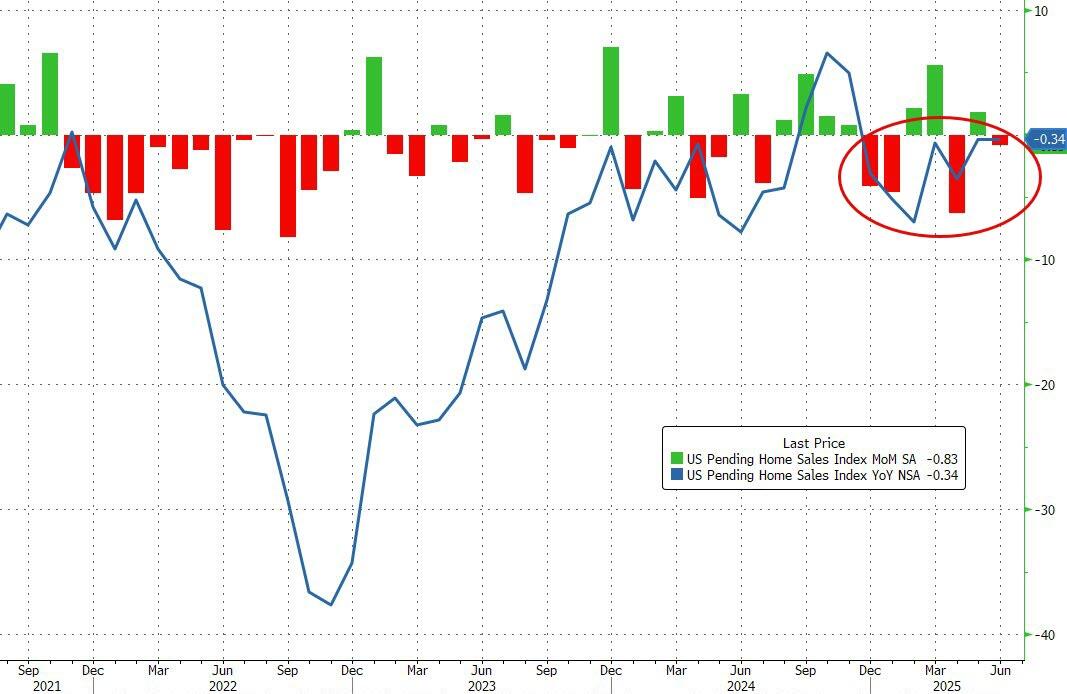
Source: Bloomberg
That left YoY sales down 0.3% – the seventh straight monthly decline in annual growth – leaving the total pending home sales index back near record lows…
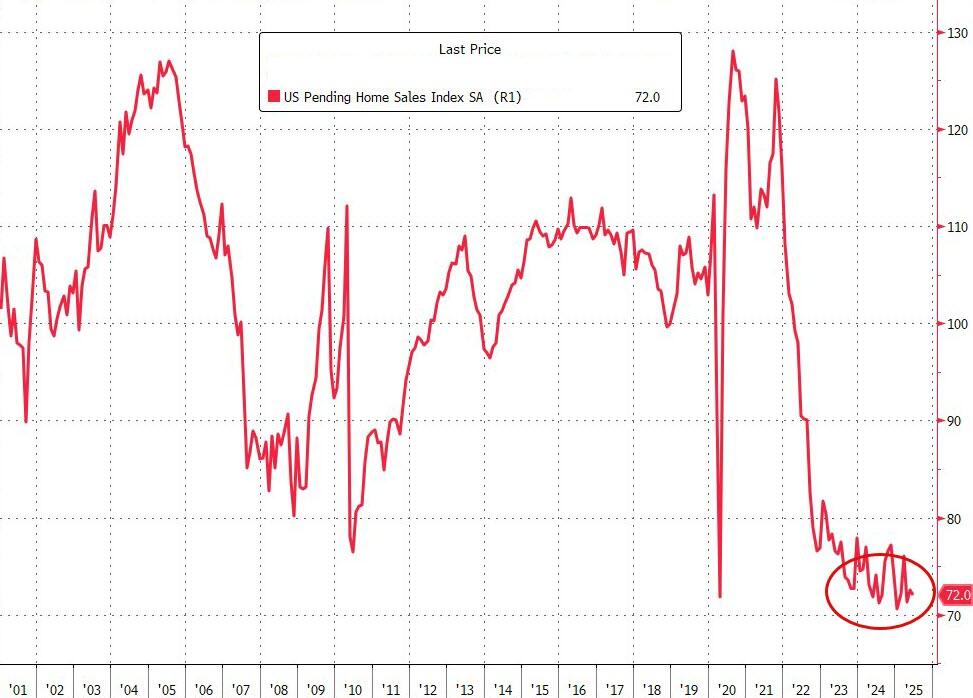
Source: Bloomberg
The supply of existing homes for sale has reached an almost five-year high, as more people list their homes for sale, but the extra inventory isn’t yet pushing prices down.
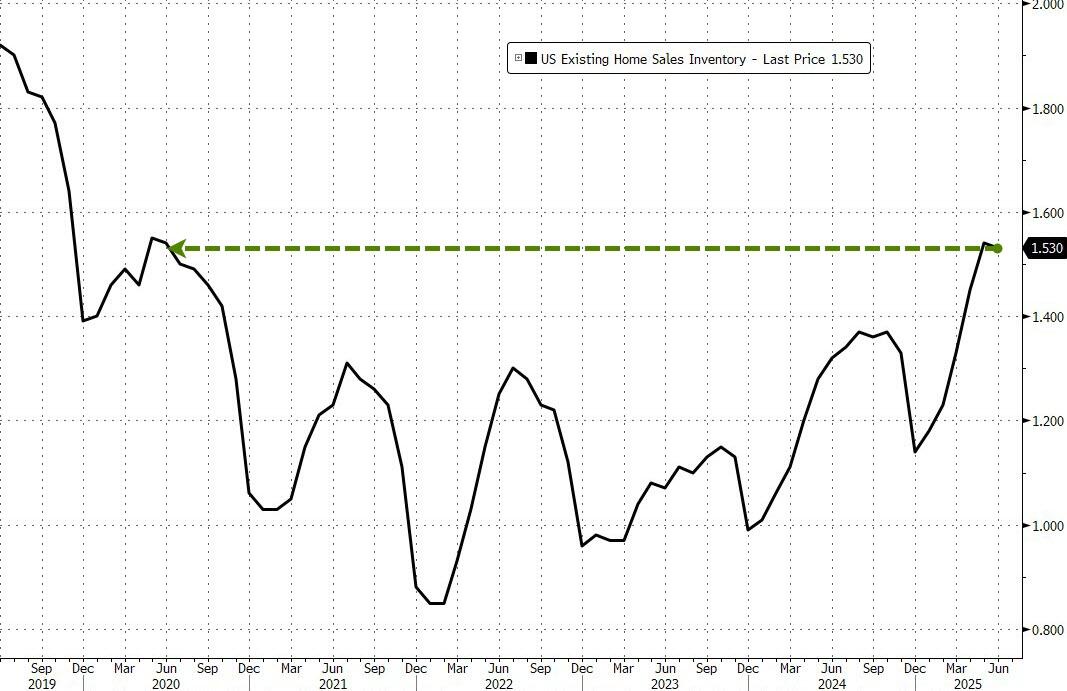
Source: Bloomberg
Mortgage applications to buy a home dropped 5% last week and are down for the last five weeks… so don’t hold your breath for any material improvement any time soon.
The Northeast was the only region to see a rise (+2.1% MoM) in pending home sales with sales in The West dropping the most (-3.9% MoM).
Pending-homes sales tend to be a leading indicator for previously owned homes, as houses typically go under contract a month or two before they’re sold.
END
USA ECONOMIC NEWS
A sure sign of trouble: Las Vegas
Another Canary: The Las Vegas Economy Is Tanking Just Like It Did In 2008 And 2009
Wednesday, Jul 30, 2025 – 10:15 AM
Authored by Michael Snyder via TheMostImportantNews.com,
If you want to get a really good indication of where the U.S. economy is heading, just look at what is happening in Las Vegas. During good times, hotel occupancy rates are very high and lots of money is thrown around in the casinos. But when times are getting tough, less people head to Las Vegas and those that do go tend to be tighter with their money. We saw a perfect example of this during the Great Recession.
Once the global financial crisis hit, gambling revenues in Las Vegas plunged. The following comes from an ABC News article that was published in 2009…
To almost everyone — and especially the Germans — Las Vegas seemed recession-proof. But now, since the summer of 2008, gambling revenues have dropped by more than 10 percent (see graphic) after having plunged to as much as 25 percent in the months immediately following the bankruptcy of Lehman Brothers.
Of course things eventually turned around and Las Vegas thrived for many years.

But now another enormous shift is taking place. A new downturn has begun “with hotel occupancy, visitor numbers and spending all slipping”…
Las Vegas is experiencing a notable downturn in tourism, with hotel occupancy, visitor numbers and spending all slipping.
Industry data points to several key reasons behind the shift, including rising costs, fewer international travellers, and broader economic uncertainties.
So why is this happening?
It doesn’t take a rocket scientist to figure it out.
Despite the absolutely nonsense that you hear on CNBC, the truth is that the U.S. economy is rapidly going in the wrong direction.
As a result, occupancy rates at Las Vegas hotels are absolutely plummeting…
Las Vegas hotels are posting some of the steepest year-over-year performance declines among major U.S. markets this summer as international visitor weakness and economic uncertainty take a toll.
Preliminary STR data indicates Las Vegas occupancy fell 14.9% in June, which, if actualized, would mark the city’s deepest monthly decline so far this year.
The deterioration continued into July, with the week ending July 5 showing Vegas with the worst declines across the top 25 U.S. markets: Occupancy fell 16.8%, to 66.7%, and revenue per available room (RevPAR) plunged 28.7%, to $102.75, according to STR.
Because things are so slow, workers are being laid off, and the unemployment rate in the Las Vegas area jumped quite a bit higher last month…
Las Vegas’ jobless rate ticked higher again last month amid a slump in tourism this year.
The Las Vegas-area’s unemployment rate was 5.8 percent in June, up from 5.5 percent in May, according to non-seasonally adjusted figures released this week by the Nevada Department of Employment, Training and Rehabilitation.
Nobody can deny what is happening in Las Vegas, because the numbers are telling a very clear story.
And it turns out that casinos in other areas of the country are also experiencing financial difficulties right now. Here is just one prominent example…
Earlier this month, resort and casino operator Maverick Gaming filed for Chapter 11 protection in the U.S. Southern District of Texas. The Kirkland, Washington-based company owns five casinos across Nevada, Colorado, and Washington and reported that it currently has between $100 million and $500 million in liabilities.
The Nevada properties include a combined 1,200 hotel rooms, 1,700 slot machines and 43 table games. The Washington resorts also have 17 card tables used by visitors specifically seeking out the hotels for gambling trips.
This reminds me so much of the Great Recession.
If you think that I am exaggerating, let me give you another parallel to 2008 and 2009. Our housing market just experienced “its slowest spring season in more than a dozen years”…
The US housing market just logged its slowest spring season in more than a dozen years, leaving Glennda Baker, a veteran real estate agent in Atlanta, struggling to sell 21 listings.
She’s been slashing prices. But months of chatter about AI taking jobs and tariffs tanking the economy is feeding into buyer indecision.
“People say price solves everything,” Baker said. “But price doesn’t solve uncertainty.”
For the entire year of 2025, home sales in the United States are expected to hit the lowest level in 30 years…
Home sales are set to plunge to a 30-year low — with experts warning the slump could deepen into a full‑blown collapse. Just four million transactions are expected in the US this year, according to new data from Realtor.com. That would mark the lowest level since 1995, according to the National Association of Realtors.
Yes, it is being projected that home sales in 2025 will be even lower than they were in 2008 and 2009.
That isn’t just bad.
That is really bad.
So why do the talking heads on CNBC continue to insist that the economy is strong?
Have they gone completely nuts?
I simply don’t understand why they can’t see the parallels to 2008 and 2009, but one thing that we didn’t have in 2008 and 2009 that we are dealing with today is rampant inflation.
If you can believe it, the average list price of a 3-year-old used vehicle has risen by $9,476 over the past six years…
Detroit Free Press autos writer Jamie LaReau reported recently that the average list price for a 3-year-old vehicle is now $32,635, an infuriating $9,476 more than it was six years ago.
This is one of the primary reasons why so many Americans are driving around in 20-year-old vehicles these days.
The average age of the vehicles on U.S. roads has reached an all-time record high, and that isn’t going to change any time soon.
Meanwhile, meat prices just continue to skyrocket…
In June, meat prices well outpaced the entire food-at-home category, with steak and ground beef prices rising 12.4% and 10.3%, respectively, compared with a year earlier, according to the Labor Department’s consumer price index (CPI).
Beef prices are now hitting a record $9.26 per pound at retailers as of June, according to the USDA.
Inflation is causing our standard of living to collapse.
This is something that I have written about over and over again.
At this stage, things are so bad that 83 percent of Americans are dealing with “stressflation”…
A LifeStance Health survey released today reveals “stressflation” is affecting most Americans, with 83% reporting financial stress driven by inflation, mass layoffs, the rising cost of living and recession fears. Millennials and Gen Z report the most significant mental health impacts.
So if you are feeling stressed about the rapidly rising cost of living, you are certainly not alone.
Sadly, the long-term trends that have brought us to this point are not going to abate any time soon.
In fact, a tremendous amount of societal chaos is on the horizon.
So I would encourage you to batten down the hatches, because the storm that is heading our way is not going to be pleasant.
* * *
Michael’s new book entitled “10 Prophetic Events That Are Coming Next” is available in paperback and for the Kindle on Amazon.com, and you can subscribe to his Substack newsletter at michaeltsnyder.substack.com.
END
VICTOR DAVIS HANSON//
USA NEWS/ANTISEMITISM..
KING NEWS
| The King Report July 30, 2025 Issue 7544 | Independent View of the News |
| WSJ Fed Whisperer @NickTimiraos: Fed officials expect they will need to resume lowering interest rates eventually—they just aren’t ready to do it this week. The questions dividing them center on what evidence they need to see first, and whether waiting for that clarity turns out to be a mistake. The Fed was united when officials paused cuts this year after tariffs raised fears of renewed inflation. But with tariff-related price hikes proving milder than feared and signs that hiring may be softening, officials are now fractured into three camps over whether to resume cuts. The focus will be whether Powell offers any hint of a September rate cut in his press conference Wednesday afternoon, and whether in the coming days and weeks his colleagues begin laying the groundwork for a cut at their next gathering. Perhaps the reason for stocks declining on Monday and Tuesday, when upward seasonal bias was strong and the EU-US trade deal was announced, is that Fed officials leaked to their buddies that there would be no rate cut announced today – and future rates cuts are iffy. July tariff revenues break monthly record, with $150B collected so far in 2025 The U.S. collected nearly $28 billion in customs duties in July, the highest monthly total so far this year… The July figures, based on data through July 25, have already surpassed June’s monthly record of $27 billion. In January, tariff revenues hovered around $7.9 billion and more than doubled in April to $16.3 billion… https://t.co/XmanrOKkhS Apple to shutter a retail store in China for first time It will shut its Parkland Mall store in the Zhongshan district of the city of Dalian on Aug 9, citing a changing landscape at the shopping complex. The iPhone maker has 56 stores in the Greater China region, making up over 10 per cent of its footprint of more than 530 outlets globally… https://www.straitstimes.com/business/companies-markets/apple-to-shutter-a-retail-store-in-china-for-first-time-ever The AI bubble today is now bigger than the dot-com bubble Today, bots—automated software that runs repetitive tasks—are still everywhere and play a major role in the AI boom. According to cybersecurity firm Imperva, bots now account for over half of global internet traffic. In 2024, they officially outpaced human-generated traffic… These bots can skew key web metrics by generating fake clicks, impressions, and user sessions—metrics investors rely on to evaluate companies. Cybersecurity firms estimate the economic impact in the hundreds of billions of dollars annually. Startups often showcase inflated “vanity metrics” like downloads or sign-ups, many of which may be bot-driven and self-reported… https://unusualwhales.com/news/the-ai-bubble-today-is-now-bigger-than-the-dot-com-bubble Is today’s AI boom bigger than the dotcom bubble? The broad tech sector now accounts for 34% of the S&P 500’s market cap, according to some data, exceeding the previous record of 33% set in March 2000… Of the top 10 companies by market capitalization today, eight are tech or communications behemoths. They include the so-called ‘Magnificent 7’ – Apple, Amazon, Alphabet, Meta, Microsoft, Nvidia, and Tesla… By contrast, only five of the 10 biggest companies in 1999 were tech firms… https://www.reuters.com/markets/europe/is-todays-ai-boom-bigger-than-dotcom-bubble-2025-07-22/ Bessent: Some Technical Issues Remain on China Tariff Pause – BBG 12:27 ET Bessent: Another China meeting probably in another 90 days – BBG 12:36 ET US Trade Representative Greer: We Don’t Ever Want to Talk About Magnets Again – BBG 12:35 ET Greer: We can move to further discussion once magnets overcome – BBG 12:36 ET Greer: Tariffs Going Back Up Is Always an Option – BBG 12:45 ET Bonds rallied sharply while stocks declined on Tuesday, apparently due to a Fed leak to its BFFs that it would NOT cut rates this week AND the Fed is fractured into three camps on future rate cuts. Mr. Bond is happy with that prospect; stocks are unhappy that future Fed rates cuts are not guaranteed. UPS declined as much as 10% because the company declined to provide full year EPS and sales guidance. This negated the positive feelings for transports from the UNP takeover of NSC. Norfolk sank as much as 4.3% because it cut full-year revenue guidance to +2% to +3% from +3%; and the $320/share takeover price was less than the expected $330 to $335. ESUs commenced a rally when the Nikkei opened on Tuesday that plodded higher until a daily high of 6442.50 at 7:00 ET appeared. ESUs then sank, with a modest bounce for the NYSE opening (9:17 to 9:27 ET), until they hit the psychologically important 6400.00 number at 11:40 ET. ESUs, via an A-B-C rally, rebounded to 6419.25 at 13:02 ET. After a retreat to 6402.25 at 13:50 ET, ESUs rebounded modestly and traded in a 7-handle range until they broke lower at 15:27 ET. ESUs hit a daily low of 6396.25 at 15:39 ET. The urgency to push ESUs above 6400 conflated with the usual late manipulation to force ESUs to 6408.00 at 15:59 ET. Positive aspects of previous session Bonds rallied sharply Negative aspects of previous session Stocks fell despite strong upward seasonal bias; the DJTA declined sharply despite the UNP-NSC deal Gasoline soared; oil rallied smartly; gold rallied modestly; the dollar rallied moderately. Ambiguous aspects of previous session The dollar soared! Who does this harm? Who does this hurt? First Hour/Last Hour Action [S&P 500 Index]: 1st Hour from NYSE Open: Down; Last Hour: Down Pivot Point for S&P 500 Index [above/below indicates daily trend to traders]: 6381.35 Previous session S&P 500 Index High/Low: 6409.26; 6363.92 UK PM Keir Starman warned Israel that it will recognize the state of Palestine in September, if Israel does not agree to a ceasefire with Hamas and take other actions to end the situation in Gaza. Starmer’s statement is blatant extortion. There is no call to recognize Palestine on inherent merits. Recognizing Palestine is solely punishment for not agreeing to a ceasefire. No demands for Hamas! France and the UK have such large, growing, and restive Arab populations that those countries are in appeasement mode. PS- No nation is more responsible for the Israel-Palestine mess than England! The Balfour Declaration of 1917 supported the creation of a Jewish state in Palestine; but Britain had already promised Palestine to Arabs – even though most of Palestine was still under Ottoman control. @Olivia_Reingold: New polling commissioned by @semafor shows how the anti-Israel craze has remade the Democratic Party. 78% of Democratic primary voters in New York City believe that Israel is committing a genocide in Gaza. https://x.com/Olivia_Reingold/status/1950258413134631218 Anti-Israel fervor was a major factor behind the support for Zohran Mamdani, per a new poll from @semafor. More than 80% said his support for Palestinian rights and willingness to criticize Israel was “important” to them. https://x.com/Olivia_Reingold/status/1950259531474489773 Today is Fed Day; plus, Facebook and Microsoft report results after the NYSE close. Normally, stocks rally into the FOMC Communique and/or Powell Press Conference, and on Mag 7 results. However, stocks have been under pressure the past two sessions with strong upward seasonal bias and great fundamental news. Ergo, if the Fed Day Rally appears, be alert for a reversal after or during Powell presser if the FOMC Communique and/or Powell are not more dovish than expected. As noted above, 6400.00 for ESUs is now important support. Expected Impact Results: HUM 5.74, MO 1.39, F .33, META 5.89, PRU 3.22, MSFT 3.37, CHRW 1.16 Expected Economic Data: July ADP Employment Change 75k; Q2 GDP 2.5%, Consumption 1.5%, GDP Price Index 2.2%, Core PCE Index 2.3% q/q; June Pending Home Sales 0.3% m/m; FOMC Communique (no change in rates expected) 14:00 ET, Powell Press Conference 14:30 ET ESUs are +4.50; NQUs are +28.50; USUs are +2/32; and gold is +3.80 at 20:16 ET. S&P Index 50-day MA: 6108; 100-day MA: 5831; 150-day MA: 5883; 200-day MA: 5893 DJIA 50-day MA: 43,357; 100-day MA: 42,172; 150-day MA: 42,662; 200-day MA: 42,861 (Green is positive slope; Red is negative slope) S&P 500 Index (6370.86 close) – BBG trading model Trender and MACD for key time frames Monthly: Trender and MACD are positive – a close below 5447.29 triggers a sell signal Weekly: Trender and MACD are positive – a close below 5890.09 triggers a sell signal Daily: Trender is positive; MACD is negative – a close below 6320.68 triggers a sell signal Hourly: Trender and MACD are negative – a close above 6395.76 triggers a buy signal @JerryDunleavy: Susan Miller, the CIA officer who says she was picked by Brennan to lead the team that wrote 2016’s ICA on Russia & who has called Ratcliffe & Gabbard liars, still thinks the Steele Dossier “might be true” and calls Trump a “dictator” & MAGA “Nazis.” (Why would the CIA hire this person?) https://justthenews.com/government/federal-agencies/dictator-trump-maga-nazis-2016-intel-report-team-leader-still-says @paulsperry_: A former sr US intelligence official tells me Susan Miller, who claims to be the lead drafter of the now-discredited Brennan ICA on Russia, doesn’t have clearance into any CIA facility, no badge, which wd mean she lied when told podcaster in April she trains CIA recruits @HansMahn>https://t.co/Z7h4Dn6aFs Intel Sources: CIA Director Gina Haspel Banking on Trump Loss to Keep Russiagate Documents Hidden October 05, 2020 https://t.co/fVtsQ4CxFC If the above story is true, and there were beaucoup Deep State actors in the same boat as Haspel, it’s reasonable to believe that the 2020 Election was rigged – and many US officials were involved. Maxwell offers to testify before Congress but with major conditions, including immunity https://amp.cnn.com/cnn/2025/07/29/politics/maxwell-conditions-congressional-testimony Trump says Epstein ‘stole’ Virginia Giuffre and several other young female Mar-a-Lago spa workers… leading to their falling out… https://www.dailymail.co.uk/news/article-14952095/trump-stole-virginia-giuffre-jeffrey-epstein-mar-lago-spa.html CBS News investigation of Jeffrey Epstein jail video reveals new discrepancies The FBI claimed “anyone entering or attempting to enter the tier where Epstein’s cell was located from the SHU common area would have been captured by this footage.” The video, cross-referenced with diagrams of the Epstein holding area, does not appear to support that finding… Experts question investigators’ interpretation of orange shape moving up the stairs… At 12:05:48 a.m., an unidentified individual passes through the SHU… Multiple staff members are seen entering the Epstein unit while Noel and Thomas remain visible in the common area… https://www.cbsnews.com/news/jeffrey-epstein-jail-video-investigation/ New York shooter apparently targeted NFL over brain injury: mayor The gunman who killed four and then committed suicide in a New York skyscraper was targeting the National Football League offices… “He did have a note on him. The note alluded to that he felt he had CTE, a known brain injury for those who participated in contact sports. He appeared to have blamed the NFL for his injury,” Adams told CBS News… https://t.co/GKwNsTxfOa Shane Tamura had a history of serious mental health issues before deadly NYC shooting rampage: officials (Again, mass shooter with mental health issues!) https://t.co/1xXHLGVlHA NYC gunman may have been targeting NFL office but took wrong elevator, mayor says – Fox NYPD commissioner says gunman in deadly Manhattan shooting had a “mental health history” and describes the weapons he was carrying (M4 rifle) https://t.co/w8qwMHylY4 CNN anchor Erin Burnett flamed for saying NYC shooter Shane Tamura was ‘possibly white’ https://t.co/rM8wzMy6vD NYC shooter Shane Tamura admitted to having suicidal thoughts — but was still allowed gun permit: sources https://trib.al/iQHfKps @JohnRLottJr: The New York City murderer who killed five people broke numerous gun control laws—he openly carried a rifle that was already illegal to possess in the city. Meanwhile, the law-abiding victims were defenseless, disarmed by the city’s strict regulations. Again and again, diaries and manifestos of mass public shooters show a disturbing pattern: they deliberately choose locations where they know their victims can’t fight back due to restrictive gun laws. While it remains unknown whether this particular killer made such a calculation, his actions align with a pattern we’ve seen repeatedly… @DailyCaller: Police Chief Teresa Theetge shames “social media and journalism” for sharing video footage of a woman being beaten during a brutal street fight in downtown Cincinnati, claiming the post is just “one version of what occurred.” https://x.com/DailyCaller/status/1950202606216757560 When a reporter asked Chief Theetge: “You said social media and news media distorted the context of what exactly happened. What exactly was distorted? Theetge refused to answer. Cincinnati police officers sue city, police chief claiming discrimination against white males The lawsuit claims that Police Chief Teresa Theetge gave preferred assignments more often to officers who are minorities or women. It also lists nine examples of women or minorities who were lower on the promotions list but were promoted over the officers who filed the lawsuit… https://www.wcpo.com/news/local-news/hamilton-county/cincinnati/cincinnati-police-officers-sue-city-police-chief-claiming-discrimination-against-white-males @GuntherEagleman: Cincinnati FOP President just went SCORCHED EARTH on the Progressive cancer that’s plaguing Cincinnati: “What kind of city and county do we wanna be?” “These people fear no consequences, and until that changes, unfortunately, we’re gonna see more things like this.” https://t.co/73RAtuqjub @TheBabylonBee: Cincinnati Police Chief Asks Citizens Not to Film Crimes Next Time as It Makes Her Look Bad https://buff.ly/Dv0WlbY Almost 2M illegal migrants with deportation orders or criminal records are roaming US https://trib.al/6EhTXg8 GOP @SenRonJohnson: Chuck Schumer destroyed Senate comity and is leading unprecedented obstruction of the confirmation process. Republicans should fix what Schumer broke and allow @POTUS to staff his administration. https://t.co/BRl4M1Vps7 Sydney Sweeney Wears Jeans in Ad, Woke Liberals See Nazis American Eagle Outfitters’ marketing pivot from the toxic ‘woke’ era, which originated from cultural Marxism, to actress Sydney Sweeney’s ‘assets’ appears to be the correct move for the clothing company, given that the Overton Window has shifted center-right, with mainstream Americans cheering the ‘end of woke’. But the woke mob isn’t taking it well; some unhinged liberals are now comparing Sweeney’s denim ads to Nazi propaganda… One leftist activist on TikTok, with an LGBTQIA plus whatever other letters come next, flag, claimed: “American Eagle is making fascist propaganda like this…” Another unhappy white liberal woman then claimed that American Eagle exactly knew what it was doing with this ad “to revive the Third Reich.”… https://www.zerohedge.com/political/sydney-sweeney-wears-jeans-ad-woke-liberals-see-nazis The Overton Window is the ideas and topics that are politically acceptable to the mainstream population. @libsoftiktok: Grown woman cries actual tears over Sydney Sweeney American Eagle ad (Legitimate need for help) https://x.com/libsoftiktok/status/1950248710778343573 @TheBabylonBee: Woman with Micro-Bangs Wondering How Everyone Knows She Hates Her Father https://buff.ly/ZvL4gUD MI Dems seek to prosecute mask-wearing ICE, after state instituted $500 fine for being maskless during COVID https://www.foxnews.com/politics/mi-dems-seek-prosecute-mask-wearing-ice-after-state-instituted-500-fine-being-maskless-during-covid Mayor Brandon Johnson: Corporate head tax on table to fix Chicago budget – Chicago Tribune Chicago is facing a $1.2B budget deficit – and business flight – and population flight – and a dynamic of productive taxpayers fleeing and the government-dependent population increasing. Wellington Altus’s James E. Thorne @DrJStrategy: The Fed’s role in a capitalist economy isn’t to be a central planner, but to maintain stability by “taking the punch bowl away” when markets get too rowdy. Instead, it’s become a bloated, compromised institution rooted in Keynesian decay, dangerously adrift and politically biased. Yes, the Fed has too much autonomy. Firing Powell is superficial, true reform demands a total overhaul. Until the Fed confronts its ideological rot and moral failure, meaningful change is impossible. It’s lost its moral compass, and superficial shifts won’t fix the systemic rot threatening our economy. | |
SWAMP STORIES
GREG HUNTER INTERVIEWING TOM HAVILLAND
Clot Coverup from CV19 Vax – Tom Haviland
By Greg Hunter On July 29, 2025 In Market Analysis, Political Analysis16 Comments

By Greg Hunter’s USAWatchdog.com
Retired Airforce Major Tom Haviland has been on a mission to uncover all the gruesome material that was being reportedly pulled out of the veins and arteries of the CV19 vaxed. For the past there years in a row, Haviland has been asking embalmers in the “Worldwide Embalmer Blood Clot Survey” what mortuary workers are finding in the bodies they are preparing for burial. Back in April on USAWatchdog, Haviland said, “I surveyed embalmers all around the world in the United States, Canada, UK, Australia and New Zealand. In my latest survey at the end of 2024, 301 embalmers did respond. 250 of them, or 83%, said they are still seeing the unusual white fibrous clots in the veins and arteries of their corpses.”
So, why is this not a huge story that the more than 5.5 billion CV19 vaxed should know about? Haviland thinks there is a clot coverup from the CV19 vax going on. Haviland found one vascular doctor who is consistently pulling long fibrous clots out of his patients since the CV19 shot rollout in 2021. Haviland says doctors are being threatened to keep quiet about fibrous clots in living patients. Haviland explains, “I was introduced to this gentleman Dr. Mohannad Bisharat, who is an endovascular specialist and cardiologist in Jacksonville, Florida. He admitted to me he had been removing these same white fibrous clots from living people in the last four years. He calls them ‘devious clots.’ I am showing you a fibrous clot still covered in blood (that Dr. Bisharat removed). When the blood is washed off, that will become a white fibrous clot. What is interesting is later that month, that same doctor Bisharat sent me this email. It says, ‘I was instructed to immediately terminate all communications in this regard. Sorry, apologies for the inconvenience.’ So, somebody got to him. Probably somebody at the hospital said, hey, we want you to stop talking about this. Don’t bring this up or else we will come after your license. We will take away your board certification and your ability to practice. The same thing could happen to him as people like Dr. Peter McCullough, Dr. Ryan Cole and Dr. Pierre Kory. The medical cartel came after them and their licenses and board certifications. So, obviously, Dr. Bisharat is afraid to speak out.”
That is not the only way the “Clot Coverup from CV19 Vax” is taking place. The Lying Legacy Media (LLM), who take billions in advertising dollars from Big Pharma, are keeping quiet and gaslighting the public. They seem to want people getting the CV19 vax and resulting death and disability to think it is simply just a few unlucky people, when millions are killed or injured by the CV19 bioweapon vax. So, that leaves the heavy weights of Alt Media to ride to the rescue and blow the whistle on the CV19 clot coverup—Wrong! Haviland has tried for three years to get on with the heavy weights in Alt Media to get the word out. Haviland tried in person to get Tucker Carlson to interview him about his astounding findings that are backed up by bonafide science. There were NO takers. Haviland says, “I paid $1,600 last September to go see Tucker Carlson in person to get a 30 second photo op with him, and I actually gave him one of these vials with the clots. I gave another vial to his producer Samantha and all the information to her to get on Tucker’s show. It’s not just to be on his show, but I want to get this important information out about these clots. Tucker has failed to contact me.”
None of the other big names in Alt Media have gotten back with Haviland either, and this includes Glenn Beck, Megyn Kelly and Joe Rogan. Haviland even wrote a post about getting rebuffed by the big cowardly Alt Media names on his Substack called Clotastrophe.
All I can say is SHAME on you all!!!!
There is much more in the 42-minute interview.
Join Greg Hunter of USAWatchdog as he goes One-on-One with Tom Haviland to do a deep dive into the “Worldwide Embalmer Blood Clot Survey” and why there is a gigantic “Clot Coverup from the CV19 Vax” for 7.29.25.
(To Donate to USAWatchdog.com Click Here)
After the Interview:
There is lots for free information on Laura Kasner’s Substack called “Clotastrophe.” This is where Tom Haviland posts his survey work. He has a new post called “Tucker, Glenn, Megyn, and Joe REFUSE to Address Embalmers’ Clots.” There is zero charge to visit this site. Tom Haviland accepts zero compensation for his work.
SEE YOU TOMORROW


 harveyorganblog.com