
099 H DEUTSCHE BANK AG 134
118 C MACQUARIE FUTURES US 3
118 H MACQUARIE FUTURES US 3
167 C MAREX 247
285 C NANHUA USA-HK 8
323 C HSBC 62
435 H SCOTIA CAPITAL (USA) 13
657 H MORGAN STANLEY 160
661 C JP MORGAN SECURITIES 148
709 C BARCLAYS 38
737 C ADVANTAGE FUTURES 1 2
905 C ADM 3
GOLD: NUMBER OF NOTICES FILED FOR AUGUST/2025: 411 CONTRACTs NOTICES FOR 41,100 OZ or 1.278 TONNES
total notices so far: 30,122 contracts for 3,012,200 OR 93.692 tonnes)
SILVER NOTICES:0 NOTICE(S) FILED FOR nil OZ/
total number of notices filed so far this month : 1720 CONTRACTS (NOTICES) for 8.600 million oz
EXCHANGE FOR RISK ISSUANCE FOR SILVER/MAY
JULY: 50.925 MILLION OZ (QUITE SMALL)
AUGUST: 26.345 MILLION OZ
AND JULY: 46.720 MILLION OZ//
AUGUST: 4.70 MILLION OZ INITIAL STANDING PLUS TODAY;S 15,000 OZ QUEUE JUMP//NEW STANDING ADVANCES AT 8.740 MILLION OZ
AUGUST: 60.547 TONNES OF INITIAL GOLD FIRST DAY NOTICE FOLLOWED BY THE MONTH’S QUEUE JUMP OF 37.353 TONNES TO WHICH WE ADD THE FOLLOWING EXCHANGE FOR RISK ISSUANCE RECEIVED FOR THE MONTH: 5.4432 TONNES EX FOR RISK/AUG 7 , AUG 11: 2.413 TONNES EX FOR RISK AND AUG. 12 OF 2.637 TONNES EX FOR RISK //NEW STANDING ADVANCES TO 97.90 TONNES OF GOLD (INCLUDES ALL MONTHLY QUEUE JUMPS) +10.4932 TONNES EX.FOR RISK = 108.3932 TONNES
JAN. 2025: 257.919 TONNES (ISSUANCE WILL BE PRETTY GOOD THIS MONTH BUT MUCH LOWER THAN LAST MONTH)
FEB: 207.21 TONNES//EX FOR PHYSICAL ISSUANCE (WILL BE A FAIR SIZED ISSUANCE THIS MONTH)
MARCH 130.84 TONNES//QUITE SMALL THIS MONTH.
APRIL; 208.57 TONNES. STILL A SMALL TO FAIR
MAY: 113.499 TONNES OF GOLD EFP ISSUANCE//QUITE SMALL THIS MONTH
JUNE: 97.79 TONNES OF GOLD EFP ISSUANCE/EXTREMELY SMALL
JULY : 150.877 TONNES// QUITE SMALL
AUGUST: 109.375 TONNES QUITE SMALL
SPREADING OPERATIONS
NOW SWITCHING TO GOLD FOR NEWCOMERS, HERE ARE THE DETAILS
SPREADING LIQUIDATION HAS NOW COMMENCED AS WE HEAD TOWARDS THE NEW ACTIVE FRONT MONTH OF APRIL. WE ARE NOW INTO THE SPREADING OPERATION OF GOLD
HERE IS A BRIEF SYNOPSIS OF HOW THE CROOKS FLEECE UNSUSPECTING LONGS IN THE SPREADING ENDEAVOUR ;MODUS OPERANDI OF THE CORRUPT BANKERS AS TO HOW THEY HANDLE THEIR SPREAD OPEN INTERESTS:HERE IS HOW THE CROOKS USED SPREADING AS WE ARE NOW INTO THE NON ACTIVE DELIVERY MONTH OF NOV HEADING TOWARDS THE ACTIVE DELIVERY MONTH OF FEB., FOR GOLD: AND MARCH FOR SILVER
YOU WILL ALSO NOTICE THAT THE COMEX OPEN INTEREST STARTS TO RISE BUT SO IS THE OPEN INTEREST OF SPREADERS. THE OPEN INTEREST IN WILL CONTINUE TO RISE UNTIL ONE WEEK BEFORE FIRST DAY NOTICE OF AN UPCOMING ACTIVE DELIVERY MONTH (OCT), AND THAT IS WHEN THE CROOKS SELL THEIR SPREAD POSITIONS BUT NOT AT THE SAME TIME OF THE DAY. THEY WILL USE THE SELL SIDE OF THE EQUATION TO CREATE THE CASCADE (ALONG WITH THEIR COLLUSIVE FRIENDS) AND THEN COVER ON THE BUY SIDE OF THE SPREAD SITUATION AT THE END OF THE DAY. THEY DO THIS TO AVOID POSITION LIMIT DETECTION. THE LIQUIDATION OF THE SPREADING FORMATION CONTINUES FOR EXACTLY ONE WEEK AND ENDS ON FIRST DAY NOTICE.”
WHAT IS ALARMING TO ME, ACCORDING TO OUR LONDON EXPERT ANDREW MAGUIRE IS THAT THESE EFP’S ARE BEING TRANSFERRED TO WHAT ARE CALLED SERIAL FORWARD CONTRACT OBLIGATIONS AND THESE CONTRACTS ARE LESS THAN 14 DAYS. ANYTHING GREATER THAN 14 DAYS, THESE MUST BE RECORDED AND SENT TO THE COMPTROLLER, GREAT BRITAIN TO MONITOR RISK TO THE BANKING SYSTEM. IF THIS IS INDEED TRUE, THEN THIS IS A MASSIVE CONSPIRACY TO DEFRAUD AS WE NOW WITNESS A MONSTROUS TOTAL EFP’S ISSUANCE AS IT HEADS INTO THE STRATOSPHERE.
The crooks also use the spread in the TAS account (trade at settlement). They buy the spot TAS (e.g. June) and sell the future TAS two months out (e.g. August). Then they unload the front month (i.e. unload the buy side first so the price of gold/silver falls. This occurs in the middle of the front delivery month cycle. They unload the sell side of the equation, two months down the road. The crooks violate position limits as the OCC refuse to hear our complaints.
First, here is an outline of what will be discussed tonight:
1.TODAY WE HAD THE OPEN INTEREST AT THE COMEX IN SILVER ROSE BY A HUMONGOUS 1667 CONTRACTS OI TO 158,722 AND CLOSER TO THE COMEX HIGH RECORD //244,710( SET FEB 25/2020). THE LAST RECORDS WERE SET IN AUG.2018 AT 244,196 WITH A SILVER PRICE OF $14.78/(AUGUST 22/2018)..THE PREVIOUS RECORD TO THAT WAS SET ON APRIL 9/2018 AT 243,411 OPEN INTEREST CONTRACTS WITH THE SILVER PRICE AT THAT DAY: $16.53). AND PREVIOUS TO THAT, THE RECORD WAS ESTABLISHED AT: 234,787 CONTRACTS, SET ON APRIL 21.2017 OVER 7 YEARS AGO. HOWEVER WE HAVE NOW SET A NEW RECORD LOW OF 114,102 CONTRACTS JULY 3.2023
EFP ISSUANCE 250 CONTRACTS
OUR CUSTOMARY MIGRATION OF COMEX LONGS CONTINUE TO MORPH INTO LONDON FORWARDS AS OUR BANKERS USED THEIR EMERGENCY PROCEDURE TO ISSUE:
SEPT 250 CONTRACTS and 0 ALL OTHER MONTHS: ZERO. TOTAL EFP ISSUANCE: 250 CONTRACTS. EFP’S GIVE OUR COMEX LONGS A FIAT BONUS PLUS A DELIVERABLE PRODUCT OVER IN LONDON. IF WE TAKE THE COMEX OI GAIN OF 1677 CONTRACTS AND ADD TO THE 250 E.FP. ISSUED
WE OBTAIN A HUMONGOUS SIZED GAIN OF 1917 OF OPEN INTEREST CONTRACTS FROM OUR TWO EXCHANGES DESPITE OUR TINY GAIN IN PRICE OF $0.06 THE RATS ARE FLEEING THE ARENA.
THUS IN OUNCES, THE GAIN ON THE TWO EXCHANGES TOTALS 9.585 MILLION PAPER OZ
OCCURRED WITH OUR $0.06 GAIN IN PRICE.
OUTLINE FOR TODAY’S COMMENTARY
1a/COMEX GOLD AND SILVER REPORT
(report Harvey)
1a/COMEX GOLD AND SILVER REPORT
(report Harvey)
b, ) Gold/silver trading overnight Europe,//GOLD COMMENT
Peter Schiff)
c) Commentaries from: Egon von Greyerz///Matthew Piepenburg via GoldSwitzerland.com, Pam and Russ Martens
ii a) Chris Powell of GATA provides to us very important physical commentaries
b. Other gold/silver commentaries
c. Commodity commentaries//
d)/CRYPTOCURRENCIES/BITCOIN ETC
2.ASIAN AFFAIRS
ASIAN MARKETS THIS TUESDAY MORNING:
SHANGHAI CLOSED DOWN 0.74 PTS OR 0.02%
//Hang Seng CLOSED DOWN 53.95 PTS OR 0.21%
// Nikkei CLOSED DOWN 168.02 PTS OR 0.38% //Australia’s all ordinaries CLOSED DOWN 0.76%
//Chinese yuan (ONSHORE) CLOSED DOWN AT 7.1821 OFFSHORE CLOSED DOWN AT 7.1855/ Oil DOWN TO 62.90 dollars per barrel for WTI and BRENT DOWN TO 65.90 Stocks in Europe OPENED ALL GREEN
ONSHORE USA/ YUAN TRADING ABOVE LEVEL OF OFFSHORE YUAN TRADING :/ONSHORE YUAN DOWN IN TRADING AT 7.1821 AND WEAKER//OFF SHORE YUAN TRADING DOWN TO 7.1855 AGAINST US DOLLAR/ AND THUS WEAKER
XXXXXXXXXXXXXXXXXXXXXXXXXXXX
END
A)NORTH KOREA/SOUTH KOREA
outline
b) REPORT ON JAPAN/
OUTLINE
3 CHINA
OUTLINE
4/EUROPEAN AFFAIRS
OUTLINE
5. RUSSIAN AND MIDDLE EASTERN AFFAIRS
OUTLINE
6.Global Issues//COVID ISSUES/VACCINE ISSUES
OUTLINE
7. OIL ISSUES
OUTLINE
8 EMERGING MARKET ISSUES
9. USA
XXXXXXXXXXXXXXXXXXXXXXXXXXXXXXXXXXXXXXXXXXXXXXXXXXXXXXXXXXXXXXXXXXXXXXXXXXXXXXXXXXXXXXXXXXXXXXXXXXXXXXXXXX
1. COMEX DATA//AMOUNTS STANDING//VOLUME OF TRADING/INVENTORY MOVEMENTS
GOLD
LET US BEGIN:
THE TOTAL COMEX GOLD OPEN INTEREST FELL BY A TINY SIZED 158 CONTRACTS TO 439,893 OI DESPITE OUR LOSS IN PRICE OF $4.05 WITH RESPECT TO MONDAY’S // TRADING.. WE LOST NO NET LONGS, WITH THAT PRICE LOSS FOR GOLD. AND AS YOU WILL SEE BELOW, OUR LOSS IN PRICE ALSO HAD A FAIR NUMBER OF EXCHANGE FOR PHYSICAL ISSUED (1447 ). WE HAD CONSIDERABLE T.A.S. LIQUIDATION //FRIDAY TRADING AS WE HAD A TOTAL GAIN IN OI ON BOTH OF OUR EXCHANGES, THE COMEX AND LONDON’S EXCHANGE FOR PHYSICAL EQUATING TO 1289 CONTRACTS (OR 4.009 TONNES). WE HAD 0 CONTRACTS ISSUED FOR EXCHANGE FOR RISK FRIDAY. THE CROOKS COULD NOT FLEECE ANY OF OUR NET LONGS AS THE COMEX LEVEL OI WAS EXTREMELY LOW AND THUS VERY VERY STICKY: AND AS SUCH THE OI ROSE A BIT DESPITE OUR LOSS IN PRICE.
SUMMARY: EXCHANGE FOR RISK ISSUANCE IN JULY:
ON WEDNESDAY MORNING,JULY 23, MUCH TO MY SHOCK, AFTER A TWO MONTH HIATUS,THE CME ANNOUNCED A 500 EXCHANGE FOR RISK CONTRACT ISSUANCE FOR 50,000 OZ OR 1.555 TONNES. THEN JULY 30 THE CME ANNOUNCED (ISSUED) MUCH TO MY HORROR ITS SECOND EXCHANGE FOR RISK FOR 706 CONTRACTS OR 70,600 OZ (2.195 TONNES) AS THE BANK OF ENGLAND WAS NOT SATISFIED AND NEEDS MORE GOLD TO COVER ITS LEASES TO BULLION BANKS. ( IT WAS NOT THE FRBNY WHO ALSO OWES GOLD TO THE BIS AND THEY NEED TO COVER BADLYAS YOU WILL SEE).THE TOTAL EXCHANGE FOR RISK FOR THE MONTH OF JULY WAS RECORDED AT 3.750 TONNES OF GOLD WHICH WAS ADDED TO OUR REGULAR DELIVERY TO GIVE US OUR FINAL TOTALS FOR JULY!
AS MENTIONED ABOVE: TONIGHT WE HAD 0 CONTRACTS ISSUED FOR EXCHANGE FOR RISK FOR AUGUST:
SUMMARY EXCHANGE FOR RISK ISSUANCE IN AUGUST;
EARLY THURSDAY MORNING, AUGUST 7 THE CME ANNOUNCED MUCH TO MY HORROR ITS FIRST EXCHANGE FOR RISK ISSUANCE FOR AUGUST OF A MONSTER 1750 CONTRACTS FOR 175,000 OZ OR (5.4432 TONNES OF GOLD, THIRD HIGHEST ON RECORD!!. WITH ALL THE CHAOS AT THE COMEX IT WAS NO SURPRISE THAT THEY ISSUED THEIR SECOND EXCHANGE FOR RISK, AUG 10 TOTALLING 776 CONTRACTS OR 77,600 OZ (2.418 TONNES).MUCH TO MY ANGER TONIGHT, THE CME ANNOUNCED ITS 3RD EXCHANGE FOR RISK OF 848 CONTRACTS TOTALLING 84,800 OZ OR 2.637 TONNES.
THUS THE TOTAL FOR AUGUST IS 3374 CONTRACTS OR 337,400OZ OR 10.4932 TONNES WHICH WILL BE ADDED TO OUR NORMAL DELIVERY TOTALS. THE RECEPIENT OF THIS LARGESS IS PROBABLY NOW THE BANK OF ENGLAND AS WE HAVE JUST LEARNED THAT THE FRBNY HAS RETURNED ONLY 14,000 OZ AS THEIR LOANS TO THE BIS REMAIN AT 34+ TONNES.(JULY 31 FIGURES) IT SEEMS NOW THAT THE BANK OF ENGLAND IS IN QUITE A HURRY TO GET ITS GOLD BACK!! (AND PROBABLE OWNER OF THOSE EXCHANGE FOR RISK CONTRACTS)
HISTORY: LAST SEVEN MONTH’S EXCHANGE FOR RISK
IN FEBRUARY:
WE HAD A HUGE FIVE EXCHANGE FOR RISKS ISSUANCES FOR GOLD, TOTALLING 18.4527 TONNES!.
IN MARCH:
THE TOTAL NO. OF EXCHANGE FOR RISK ISSUANCE FOR THE MONTH OF MARCH (3 NOTICES) EQUALED: 7.6179 TONNES OF GOLD WHICH WAS ADDED TO OUR MARCH DELIVERY TOTALS.
IN APRIL:
WE CONCLUDED APRIL WITH 7 ISSUANCE OF EXCHANGE FOR RISK FOR A TOTAL TONNAGE OF 8.3571 TONNES.
IN MAY:
MAY: 3 EX. FOR RISK ISSUED SO FAR FOR 3025 CONTRACTS OR 302,500 OZ OR 9.4054 TONNES. THIS WILL BE ADDED TO OUR NORMAL DELIVERY TO GIVE US TOTAL STANDING FOR MAY!THIS IS THE 6TH CONSECUTIVE MONTH FOR ISSUANCE OF EXCHANGE FOR RISK//NEW TOTAL EX FOR RISK IS 9.591 TONNES FOR THE 3 ISSUANCE!
IN JUNE
JUNE: ZERO ISSUED
jULY: 2 OCCASIONS LATE IN JULY: 1206 CONTRACTS FOR 120,600 OZ OR 3.750 TONNES/ISSUED JULY 23/2025 AND JULY 30/2025
AUGUST: 3 ISSUANCES FOR A MONSTER 3374 CONTRACTS OR 337,400 OZ ( 10.4932 TONNES)
AS I EXPLAINED ABOVE,:THE RECPIENT OF EXCHANGE FOR RISK COULD BE EITHER:
- THE BANK OF ENGLAND WHO CONTINUES TO LEASE OUT ITS GOLD TO BULLION BANKS
- THE FEDERAL RESERVE BANK OF NEW YORK (NEED TO RETRIEVE THEIR LEASED GOLD FROM THE BIS)
THE COUNTERPARTY TO EITHER THE BANK OF ENGLAND’S OR THE FRBNY ARE BULLION BANKS THAT CANNOT VERIFY THAT THEIR GOLD IS UNENCUMBERED. THE BUYER, REPRESENTING THE CENTRAL BANK OF ENGLAND OR THE FRBNY, ASSUMES THE RISK OF THAT DELIVERY. THIS IS THE 7TH MONTH FOR ISSUANCE OF EXCHANGE FOR RISK !!.(DEC THROUGH AUGUST.)……… THE FACT THAT A CENTRAL BANK TAKES THE RISK OF A DELIVERY IS TOTALLY INSANE.
DETAILS ON AUGUST COMEX MONTH//INITIAL
IN TOTAL WE HAD A FAIR SIZED GAIN ON OUR TWO EXCHANGES OF 1926 CONTRACTS DESPITE OUR LOSS IN PRICE. HOWEVER, OUR FRIENDLY PHYSICAL LONDON BOYS HAD ANOTHER FIELD DAY AGAIN THROUGHOUT OF THE WEEK AS THEY WERE READY FOR THE FRBNY.S CONTINUED ORCHESTRATED ATTACKS VERY EARLY IN THE COMEX SESSIONS AS THEY TRIED TO ABSORB EVERYTHING IN SIGHT FROM THEIR DAILY ATTACKS. LONDONERS EXERCISED THEIR BOUGHT CONTRACTS FOR PHYSICAL GOLD VIA THE EXCHANGE FOR PHYSICAL ROUTE AND THANKED THE FRBNY FOR THE THOUGHTFULNESS. LONDON ANNOUNCED EARLY IN THE YEAR (AND SCARCITY CONTINUES TO THIS DAY) THAT THEY WERE OUT OF GOLD. WRONGLY IT WAS ATTRIBUTED TO THEIR SHIPPING PHYSICAL GOLD TO COMEX FOR STORAGE DUE TO TRUMP’S INITIATION OF TARIFFS. THE TRUTH OF THE MATTER IS THAT THIS GOLD LEFT LONDON TO CENTRAL BANKS, AND COMEX BANKS HAVE BEEN PAPERING THEIR LOSSES (DERIVATIVE) WITH KILOBAR ENTRIES. DELIVERY OF GOLD CONTRACTS ARE NOW TAKING SEVERAL WEEKS. NO DEFAULT HAS BEEN INITIATED AS DEALERS ARE AFRAID OF LOSS OF THEIR JOBS. SO THIS FRAUD CONTINUES. THE LEASE RATES IN LONDON HAVE NOW INCREASED TO 5.0% LATELY AS GOLD IN LONDON IS STILL EXTREMELY SCARCE.
THE LIQUIDATION OF T.A.S. CONTRACTS THROUGHOUT THE MONTHS OF JUNE , JULY AND NOW AUGUST CONTINUES TO DISTORT OPEN INTEREST NUMBERS GREATLY ALTHOUGH THE T.A.S. ISSUANCES IN GOLD HAVE GENERALLY BEEN ON THE LOW SIDE COMPARED TO SILVER WHICH HAVE BEEN HUGE. TODAY’S NUMBER IS HOWEVER A SMALL T.A.S ISSUANCE AS THE CME NOTIFIES US THAT THEY HAVE ISSUED A 860 T.A.S CONTRACTS. THESE T.A.S ISSUANCES ARE USED FOR RAID PURPOSES TO STOP GOLD’S RISE AND TO TEMPER HUGE LOSSES IN OTC DERIVATIVE BETS AND IT WAS IN FULL FORCE WITH LAST WEEK’S RAID DURING COMEX OPTION EXPIRY WEEK. THE TAS SPREADER LIQUIDATIONS COMBINE AT MONTH END WITH OUR MONTHLY SPREADERS AS THEY JOIN FORCES IN AN ATTEMPT TO TEMPER THE GOLD/SILVER PRICE GAINS. THE RAIDS ON OUR PRECIOUS METALS CONTINUED THREE WEEKS AGO WITH HUGE FURY AS WE FINALIZED THE LONDON/OTC OPTION EXPIRY.
THE T.A.S. LIQUIDATION OF THESE T.AS. CONTRACTS (ALONG WITH MONTH END SPREADERS) IS WHY WE ARE HAVING DISTORTED COMEX OPEN INTEREST GAINS AND LOSSES IN OI BUT THIS IS COUPLED WITH MEGA HUGE AMOUNTS OF GOLD STANDING FOR DELIVERY TO CONFUSE THE ISSUE!!!!! AND THIS WAS SURELY ON DISPLAY WITH FIRST DAY NOTICE TOTALS WITH GOLD TONNES STANDING FOR APRIL AT 209 + TONNES INCLUDING MANY MASSIVE QUEUE JUMPS AND THIS CONTINUED INTO MAY WITH FINAL STANDING AT 90.23 TONNES. HOWEVER JUNE WHICH IS NORMALLY A HUGE DELIVERY MONTH , FINAL STANDING WAS RECORDED AT 93.085 TONNES. (IS THE COMEX RUNNING OUT OF GOLD?)//TOTAL NET QUEUE JUMPING FOR THE JUNE MONTH: 31.027 TONNES. IN JULY WE HAD HUGE DELIVERY NOTICES ESPECIALLY FOR A NON ACTIVE DELIVERY MONTH WITH INITIAL STANDING AT 17.947 TONNES PLUS MANY QUEUE JUMPS + + 3.75 TONNES EX FOR RISK = 41.106 TONNES OF GOLD
NEW FINAL TOTAL TONNES STANDING JULY: 41.106 TONNES
AND NOW FOR THE MONTH OF AUGUST:
INITIAL AMOUNT OF GOLD STANDING FOR AUGUST: 60.547 TONNES PLUS THE MONTHS HUGE QUEUE JUMPS OF 37.353 TONNES +10.4932 TONNES EX FOR RISK (3 ISSUANCES) //NEW STANDING 108.3932 TONNES
THE FED IS THE OTHER MAJOR SHORT OF AROUND 34+ TONNES OF GOLD OWING TO THE B.I.S. THE FED NEEDS TO COVER AS THEY ARE VERY WORRIED ABOUT WHAT IS GOING TO HAPPEN TO GOLD PRICES NOW THAT THEY MUST BECOME COMPLIANT TO BASEL III RULES JULY 1/2023 AS OUTLINED IN ANDREW MAGUIRE’S LATEST LIVE FROM THE VAULT 231 TO 235 EPISODES AS HE TACKLES THIS IMPORTANT TOPIC. THE MAJOR FOUR OR FIVE BANKS ARE ALSO WORRIED ABOUT THEIR HUGE PRECIOUS METAL DERIVATIVE SHORT EXPOSURE (NORTH OF ONE TRILLION DOLLARS) AND THIS IS PROBABLY THE MAJOR REASON FOR GOLD/SILVER’S RISE THESE PAST THREE MONTHS. THEY ARE TOTALLY TRAPPED., AND THEIR FAILURE TO STOP CENTRAL BANK PURCHASES OF PHYSICAL GOLD IS THE MAJOR ISSUE OF THE DAY!IT SURE DOES NOT LOOK LIKE THE BIS HAS GIVEN THE FED ITS MARCHING ORDERS TO COVER ITS PHYSICAL GOLD SHORT AS THEIR OUTSTANDING LOAN REMAINS ON THE BOOKS OF THE BIS. TRUMP WILL PROBABLY BE FURIOUS WITH THE FED IF HE FINDS OUT THAT THEY (FRBNY) HAS BEEN MANIPULATING THE GOLD MARKET FOR THE PAST TWO YEARS. THE FRBNY IS NOW NON COMPLIANT WITH RESPECT TO BASEL III BUT IT IS NOT NECESSARY FOR THEM TO BE COMPLIANT ONLY COMMERCIAL BANKERS MUST BE.
OUR PHYSICAL LONDONERS BOUGHT NEW MASSIVE QUANTITIES OF LONGS AT ANY PRICE AND THIS GOLD BOUGHT WILL BE TENDERED FOR PHYSICAL ON A T + ???? BASIS. BECAUSE GOLD IS BASEL III COMPLIANT, GOLD IS SUPPOSED BE DELIVERED IN A VERY TIMELY ONE DAY. CENTRAL BANKS AROUND THE WORLD, BEING REPRESENTED BY OUR LONDONERS, ARE THE REAL PURCHASERS OF THIS GOLD.
EUROPE IS NOW BASEL III COMPLIANT. THE WEST ( COMEX) IS NOW COMPLIANT EFFECTIVE JULY 1//2025.
THE PROBLEM FOR THOSE PROVIDING THE SHORT PAPER IS THE SHOCK TO THEM ON RECEIVING NOTICE THAT THE LONGS WANT THE PHYSICAL GOLD AS THEY TENDER FOR THAT SHINY YELLOW METAL. THE HIGH LIQUIDATION OF OUR TWO SPREADERS: 1) THE MONTH END SPREADERS AND 2. T.A.S DURING THESE PAST SEVERAL WEEKS IS SURELY DISTORTING COMEX OPEN INTEREST BUT THAT DOES NOT STOP LONDON’S ACCUMULATION OF PHYSICAL! YOU CAN ALSO VISUALIZE THAT PERFECTLY WITH THE HUGE AMOUNTS OF QUEUE JUMPING ORCHESTRATED BY CENTRAL BANKERS BOLTING AHEAD OF ORDINARY LONGS AS THEIR NEED FOR PHYSICAL IS GREAT AS THEY SCOUR THE PLANET LOOKING FOR GOLD, AND THE MASSIVE AMOUNT OF GOLD STANDING EACH AND EVERY MONTH INCLUDING FIRST DAY NOTICE OF GOLD TONNAGE STANDING.
WE HAVE A HUGE 60.547 TONNES OF INITIAL GOLD STANDING FOR AUGUST, FIRST DAY NOTICE FOLLOWED BY THE MONTHS HUGE 37.353 TONNES OF QUEUE JUMPS TO WHICH WE ADD AUGUST 7TH,S HUGE 5.443 TONNES EXCHANGE FOR RISK ISSUANCE +LAST SATURDAY’S/MONDAY AUG 10 HUGE 776 CONTRACT EXCHANGE FOR RISK FOR 2.413 TONNES AND THEN AUGUST 12: 2.637 TONNES:/NEW STANDING ADVANCES TO 108.3932 TONNES.
EXCHANGE FOR PHYSICAL ISSUANCE
THE CME REPORTS THAT THE BANKERS ISSUED A FAIR SIZED TRANSFER THROUGH THE EFP ROUTE AS THESE LONGS RECEIVED A DELIVERABLE LONDON FORWARD TOGETHER WITH A FIAT BONUS.,
THAT IS A FAIR SIZED 1447 EFP CONTRACT WAS ISSUED: : /DEC 1447 & ZERO FOR ALL OTHER MONTHS:
TOTAL EFP ISSUANCE: 1447 CONTRACT. THESE EFP;S CIRCLE AROUND LONDON ON A 13 DAY BASIS AND ARE NOW USED BY GLOBAL CENTRAL BANKS TO EXERCISE FOR PHYSICAL GOLD WITH THE OBLIGATION TO DELIVER BEING FORCED ONTO COMEX BANKS. THE GOLD GENERALLY DELIVERED COMES FROM LONDON BUT THEY ARE OUT!! THUS COMEX BECOMES THE MAJOR SOURCE FOR OUR CENTRAL BANKERS. THE REGULATORY BODY THAT IS SUPPOSE TO CONTROL THESE EFP’S IS THE OCC HEADQUARTERED IN BOTH LONDON AND WASHINGTON.
WE HAD :
- LITTLE LIQUIDATION OF OUR T.A.S. SPREADERS//FRIDAY
- MONTH END SPREADERS WILL APPEAR ON THE LAST WEEK OF AUGUST.
T.A.S.SPREADER ISSUANCE
AS PER OUR NEWBIE TRADE AT SETTLEMENT (TAS) MANIPULATION OPERATION (WHICH CRAIG HEMKE HAS POINTED OUT HAPPENS USUALLY DURING MID MONTH IN THE DELIVERY CYCLE), BUT NOW ON A DAILY BASIS, THE CME REPORTS THAT THE TOTAL T.A.S. ISSUANCE FOR MONDAY NIGHT/TUESDAY MORNING WAS A SMALL SIZED SIZED 860 CONTRACTS
THE RAIDS WHETHER ON OPTIONS EXPIRY MONTH OR OTHERWISE LIKE LAST WEEK ON OPTIONS EXPIRY WEEK ACCOMPLISHES TWO IMPORTANT ASPECTS FOR OUR CROOKS:
- STALLS THE ADVANCE IN PRICE
- LOWERS THEIR ADVANCING DERIVATIVE LOSSES.
MECHANICS OF T.A.S CONTRACTS TRADING;
THROUGHOUT THE FEW YEARS, THE BANKERS CONTINUE TO SELL OFF THE LONG SIDE OF THE SPREAD (T.A.S.) WHICH OF COURSE CONTINUES TO MANIPULATE THE PRICE OF GOLD SOUTHBOUND. (THEY KEEP THE SHORT SIDE OF THE CALENDAR/T.A.S. SPREAD WHICH WILL BE LIQUIDATED IN DAYS HENCE..
THAT SET UP YESTERDAY’S GAIN IN PRICE IN GOLD AND A CORRESPONDING SMALL LOSS OF COMEX OI AND A FAIR EXCHANGE FOR PHYSICAL ISSUANCE.. THE COMEX IS IN TOTAL TURMOIL ESPECIALLY WITH JULY’S RARE TWO ISSUANCES OF EXCHANGE FOR RISK (LATE IN JULY) AND THIS WAS FOLLOWED WITH AUGUST’S FIRST THREE ISSUANCES OF EXCHANGE FOR RISK FOR 10.4932 TONNES
STANDING FOR GOLD LAST 7 MONTHS OF 2025:
YEAR 2025:
JAN 2025:
113.30 TONNES (WHICH INCLUDES 43.408 TONNES EX FOR RISK)
FEB: 2025:
256.607 TONNES (WHICH INCLUDES 18.4567 TONNES OF EX FOR RISK)
MARCH:
STANDING FOR GOLD : 60.33 TONNES + 7.6179 TONNES EX FOR RISK = 67.9479 TONNES WHICH IS EXTREMELY HIGH FOR A NON DELIVERY MONTH.
APRIL:
FINAL STANDING FOR GOLD: 201.573 TONNES + 8.3571 TONNES EX FOR RISK = 209.953 TONNES
MAY: FINAL STANDING 90.235 TONNES WHICH INCLUDES QUEUE JUMPING AND 9.591 TONNES EX FOR RISK.
JUNE: FINAL STANDING 62.534 TONNES PLUS 0.1493TONNES OF QUEUE JUMP EQUALS 93.085 TONNES
JULY: 17.947 TONNES INITIAL STANDING FIRST DAY NOTICE PLUS TODAY’S 0 TONNES QUEUE JUMP + 1.555 TONNES EX FOR RISK/PRIOR + 2.195 EX FOR RISK TODAY = = 41.106 TONNES
AUGUST:INITIAL AMOUNT OF GOLD STANDING: 60.547 TONNES FOLLOWED TO TODAY’S QUEUE JUMP OF 1.058 TONNES TO WHICH WE ADD THURSDAY’S AUG 7 HUGE 5.4432 EXCHANGE FOR RISK, SATURDAY’S//MONDAY AUG 10 STRONG 776 CONTRACT ISSUANCE (77600 OZ) FOR 2.413 TONNES AND THEN WEDNESDAY.S AUGUST 12 FOR 2.637 TONNES/// TOTAL EX FOR RISK AUGUST = 10.4932 TONNES//NEW STANDING ADVANCES AS FOLLOWS:
97.90 TONNES NORMAL DELIVERIES (INCLUDES ALL QUEUE JUMPS) +
5.4432 TONNES EXCHANGE FOR RISK/PRIOR/AUGUST 7
2.413 TONNES EXCHANGE FOR RISK AUGUST 11
PLUS 2.637 TONNES EX FOR RISK AUGUST 12
EQUALS
108.3932 TONNES TONNES OF GOLD.
HERE ARE THE AMOUNTS THAT STOOD FOR DELIVERY IN THE PRECEDING 48 MONTHS OF 2021-2025:
DEC 2021: 112.217 TONNES
NOV. 8.074 TONNES
OCT. 57.707 TONNES
SEPT: 11.9160 TONNES
AUGUST: 80.489 TONNES
JULY 7.2814 TONNES
JUNE: 72.289 TONNES
MAY 5.77 TONNES
APRIL 95.331 TONNES
MARCH 30.205 TONNES
FEB ’21. 113.424 TONNES
JAN ’21: 6.500 TONNES.
TOTAL YEAR 2021 (JAN- DEC): 601.213 TONNES
YEAR 2022: STANDING FOR GOLD/COMEX
JANUARY 2022 17.79 TONNES
FEB 2022: 59.023 TONNES
MARCH: 36.678 TONNES
APRIL: 85.340 TONNES FINAL.
MAY: 20.11 TONNES FINAL
JUNE: 74.933 TONNES FINAL
JULY 29.987 TONNES FINAL
AUGUST:104.979 TONNES//FINAL
SEPT. 38.1158 TONNES
OCT: 77.390 TONNES/ FINAL
NOV 27.110 TONNES/FINAL
Dec. 64.000 tonnes
(TOTAL YEAR 656.076 TONNES)
2023:STANDING FOR GOLD/COMEX
JAN/2023: 20.559 tonnes
FEB 2023: 47.744 tonnes
MAR: 19.0637 TONNES
APRIL: 75.676 tonnes
MAY: 19.094 TONNES + 1.244 tonnes of exchange for risk = 20.338
JUNE: 64.354 TONNES
JULY: 10.2861 TONNES
AUGUST: 38.855 TONNES(INCLUDING .6842 EXCHANGE FOR RISK)
SEPT: 15.281 TONNES FINAL
OCT. 35.869 TONNES + 1.665 EXCHANGE FOR RISK =37.0355 tonnes
NOV: 18.7122 TONNES + 16.2505 EX. FOR RISK = 34.9627 TONNES
DEC. 47.073 + 4.634 TONNES OF EXCHANGE FOR RISK = 51.707 TONNES
TOTAL 2023 YEAR : 436.546 TONNES
2024/STANDING FOR GOLD/COMEX
JAN ’24. 22.706 TONNES
FEB. ’24: 66.276 TONNES (INCLUDES 1.723 TONNES EX. FOR RISK)
MARCH: 18.8398 TONNES + 1.1695 EX FOR RISK = 20.093 TONNES
APRIL: 2024: 53.673TONNES FINAL
MAY/ 2024 8.5536 TONNES + 3.3716 TONNES EX FOR RISK/= 11.9325
JUNE; 95.578 TONNES. + 1.045 TONNES EXCHANGE FOR RISK =96.623 THIS IS THE HIGHEST RECORDED GOLD STANDING SINCE AUGUST 2022
JULY: 11.692 TONNES
AUGUST 69.602 TONNES//FINAL STANDING
SEPT. 13.164 TONNES.
OCT 39.474 TONNES + + 20.917 TONNES EXCHANGE FOR RISK =60.391 TONNES
NOV . 11.265 TONNES +4.665 TONNES EXCHANGE FOR RISK/TUESDAY + 3.11 TONNES OF EX. FOR RISK/PRIOR = 19.0425 TONNES
DEC: 80.4230 TONNES PLUS DEC MONTH EXCHANGE FOR RISK TOTAL 14.6836 TONNES EQUALS 95.1066 TONNES
total year 2024: 540.30 tonnes
XXXXXXXXXXXXXXXXXXXXXXXXXXXXXXXXXXXXXXXXX
COMEX GOLD TRADING/AUGUST CONTRACT MONTH
THE SPECS/HFT WERE SUCCESSFUL IN LOWERING GOLD’S PRICE( IT FELL BY A $4.05/ /) BUT WERE UNSUCCESSFUL IN KNOCKING OFF ANY NET SPECULATOR LONGS AS WE DID HAVE A FAIR SIZED GAIN IN OI FROM TWO EXCHANGES. BUT AS EXPLAINED ABOVE WE HAD LITTLE T.A.S. SPREADER LIQUIDATION ///. THE BANKERS ARE QUITE NERVOUS ABOUT BASEL III WITH ITS IMPLEMENTATION COMMENCING JULY 1. THEY ARE VERY CONCERNED WITH THEIR HIGH AMOUNT OF DERIVATIVES LOSSES ON THEIR BOOKS. THUS THE REASON THEY NEEDED THESE T.A.S. ISSUANCES, IN ORDER TO FORMALIZE RAIDS ON OUR PRECIOUS METALS WHICH OF COURSE NORMALLY ENDS IN TOTAL FAILURE LIKE IT DID WITH LAST THURSDAYS TRADING/RAID!.
TUESDAY MORNING//MONDAY NIGHT
THE CROOKS HOWEVER COULD NOT STOP CENTRAL BANK LONGS, SEIZING THE MOMENT, THEY EXERCISED AGAIN FOR PHYSICAL IN A BIG WAY TENDERING FOR PHYSICAL MONDAY EVENING/ TUESDAY MORNING AND THUS OUR HUGE NUMBER OF GOLD CONTRACTS STANDING FOR DELIVERY AT THE COMEX. CENTRAL BANKERS WAIT PATIENTLY FOR THE GOLD TO ARRIVE BY BOAT. IT IS NOW TAKING WEEKS TO DELIVER
SUMMARY OF NUMBER OF EXCHANGE FOR RISK ISSUANCES: FEB THROUGH AUGUST TRADING:
EXCHANGE FOR RISK CONTRACTS/MONTH FOR FEBRUARY://FINISHES AT 4 ISSUANCES
THE CME ANNOUNCED TO THE WORLD THAT ON FEB 4 THEY ISSUED 100 CONTRACTS OF EXCHANGE FOR RISK TTO THE BANK OF ENGLAND.THEN ,FEB 4 THEY ISSUED THEIR SECOND CONSECUTIVE EXCHANGE FOR RISK OF 500 CONTRACTS FOR 50,000 OZ (1.555 TONNES OF GOLD. FEB 6 WAS THE THIRD ISSUANCE FOR A HUGE 2400 CONTRACTS, 240,000 OZ OR 7.465 TONNES. AND THEN FINALLY FRIDAY NIGHT, THE 4TH EXCHANGE FOR RISK WAS ISSUED REPRESENTED BY 2834 CONTRACTS OR 283,400 OZ OR 8.8149 TONNES OF GOLD WITH THE OWNER OF THOSE CONTRACTS BEING THE BANK OF ENGLAND. THE BANK OF ENGLAND WANTS THEIR GOLD BACK. THIS NEW EXCHANGE FOR RISK WAS ADDED TO PREVIOUS EXCHANGE FOR RISK OF 9.3264 TONNES TO A NEW TOTAL EXCHANGE FOR RISK = 18.1413 TONNES. IN MID WEEK WE HAD ANOTHER .3114 TONNES OF EXCHANGE FOR RISK ISSUANCED//NEW TOTAL 18,4527 TONNES!..FINALLY THIS TOTAL WAS ADDED TO OUR REGULAR DELIVERIES THROUGH THE MONTH.
EXCHANGE FOR RISK CONTRACTS/MONTH FOR MARCH
EARLY IN THE DELIVERY CYCLE THE CME NOTIFIED US THAT WE HAD OUR FIRST EXCHANGE FOR RISK CONTRACT ISSUANCE IN MARCH FOR 150 CONTRACTS REPRESENTING 15,000 OZ OF GOLD OR .46656 TONNES. THE BANK OF ENGLAND WAS STILL NOT SATISFIED AS THEY NEED TO RETRIEVE ALL OF ITS LOST GOLD THROUGH LEASING! THE 15,000 OZ WAS ADDED TO OUR NORMAL DELIVERY TOTAL.
MARCH ISSUES IT’S THIRD EXCHANGE FOR RISK: TOTAL FOR THE MONTH FINISHED AT 3
TOTAL ISSUANCE OF EXCHANGE FOR RISK MARCH 28 TOTALS 2200 CONTRACTS FOR 6.8429 TONNES OF GOLD. PRIOR ISSUANCE: .7775 TONNES. THUS TOTAL EXCHANGE FOR RISK FOR MARCH : 7.6179 TONNES OF GOLD. MARCH BECOMES THE 4TH CONSECUTIVE MONTH FOR EXCHANGE FOR RISK ISSUANCE.
APRIL, ISSUED ITS 7TH EXCHANGE FOR RISK: 187 CONTRACTS OR 18,700 OZ OR 0.5816 TONNES
SUMMARY EXCHANGE FOR RISK FOR THE MONTH OF APRIL//TOTAL ISSUANCES 7 FOR 8.3571 TONNES OF GOLD!:
ISSUANCE FOR EXCHANGE FOR RISK ON FIRST DAY NOTICE//APRILL MONTH// WAS 700 CONTRACTS FOR 70,000 OZ OR 2.177 TONNES OF GOLD TO WHICH WE ADD (APRIL 4) : 250 CONTRACTS FOR 25,000 OZ OR .777 TONNES, APRIL 7 ISSUANCE OF 280 CONTRACTS FOR 28,000 OZ OR .8709 TONNES THEN APRIL 9 484 CONTRACTS FOR 48400 OZ OR 1.5054 TONNES AND FINALLY MONDAY MORNING APRIL 14 AT 200 CONTRACTS FOR 20,000 OZ OR .5816 TONNES AND NOW APRIL 24: 600 CONTRACTS FOR 60,000 OZ OR 1.866 TONNES AND NOW APRIL 25 187 CONTRACTS FOR 18700 OZ OR .5816 TONNES//NEW FINAL TOTAL ISSUANCE FOR APRIL: 8.3571 TONNES!!. APRIL ISSUANCE OF EXCHANGE FOR RISK MEANS WE NOW HAVE 5 CONSECUTIVE MONTHS FOR EXCHANGE FOR RISK ISSUANCE. THESE DELIVERIES WERE ADDED TO OUR NORMAL DELIVERY CYCLE.
MAY ISSUANCE OF EXCHANGE FOR RISK NOW TOTALS 3 ISSUANCES FOR 308,350 OZ. THIS TOTALS 9.591 TONNES OF GOLD WHICH WILL BE ADDED TO OUR REGULAR DELIVERY SCHEDULE. THE RECPIENT OF THIS LARGESS IS THE BANK OF ENGLAND.
JUNE ISSUANCE: ZERO
JULY ISSUANCE; AFTER A TWO MONTH HIATUS AFTER AN INITIAL ISSUANCE OF 500 CONTRACTS FOR 50,000 OZ OR 1.555 TONNES OF GOLD (OCCURRED ON JULY 25) THE CME NOTIFIED US OF A SECOND ISSUANCE OF 706 CONTRACTS FOR 70,600 OZ OR 2.195 TONNES WHICH WILL BE ADDED TO OUR OFFICIAL STANDING. THUS 35.176 TONNES OFFICIAL STANDING + 1.555 TONNES EX FOR RISK PRIOR + 2.195 TONNES EX FOR RISK TODAY = 41.106 TONNES OF GOLD STANDING
AUGUST: THREE SO FAR, AUGUST 7 THROUGH AUG 12 AT 3374 CONTRACTS FOR 337,400 OZ (10.4932 TONNES OF GOLD) TOTAL EXCHANGE FOR RISK MONTH OF AUGUST 10.4932 TONNES
THUS 97.90 TONNES OF NORMAL GOLD STANDING (INCLUDING ALL QUEUE JUMPS) + 10.4932 TONNES = 108/3932 TONNES.
XXXXXXXXXXXXXXXXXXXXXXXXXXXXXXXXXXXXXXXXXXXXXXXXXXXXXXXXXXXXXXXXX
ANALYSIS AUGUST DELIVERY MONTH GOING FROM FIRST DAY NOTICE// AUGUST COMEX CONTRACT
WE HAVE GAIN A FAIR SIZED TOTAL OF 4.009 PAPER TONNES FROM OUR TWO EXCHANGES, ACCOMPANYING OUR INITIAL GOLD TONNAGE STANDING FOR AUGUST FIRST RECORDED AT 60.547 TONNES ON FIRST DAY NOTICE TO WHICH WE ADD LAST AUG 8 RECORD BREAKING QUEUE JUMP OF 10.8775 TONNES OF GOLD ON TOP OF AUG 12 1.7604 TONNES QUEUE JUMP AND THEN WEDNESDAY;S AUG 13 MASSIVE QUEUE JUMP OF 3.527 TONNES AND THEN THURSDAY AUG 14 HUGE 2.463 TONNES QUEUE JUMP AND FRIDAY;S AUG 15 QUEUE JUMP OF .7030 TONNES AND THEN SATURDAY’S 1.617 TONNE QUEUE JUMP AND THEN TODAY’S 1.058 QUEUE JUMP TO WHICH WE THEN ADD OUR THREE EXCHANGE FOR RISK/PRIOR FOR 10.4932 TONNES FOR RISK//NEW STANDING ADVANCES TO 108.3932 TONNES
ALL OF THIS HUGE STANDING FOR AUGUST WAS ACCOMPLISHED WITH OUR LOSS IN PRICE TO THE TUNE OF $4.05
WE HAD 637 CONTRACTS REMOVED TO THE COMEX TRADES TO OPEN INTEREST (CROOKS)//PRELIMINARY TO FINAL. AND THIS IS TOTALLY INSANE AS WELL.
NET GAIN ON THE TWO EXCHANGES 1289 CONTRACTS OR 128,900 0Z (4.009 TONNES)
confirmed volume MONDAY 129,128 contracts// extremely poor//everybody vacating the comex???
speculators have left the gold arena
END
INITIAL GOLD COMEX
END
INITIAL GOLD COMEX
AUGUST CONTRACT MONTH
AUGUST98 /2025
| Gold | Ounces |
| Withdrawals from Dealers Inventory in oz | nil |
| Withdrawals from Customer Inventory in oz | 2 entries i) Out of Loomis: 32,015.190 oz ??? same amt going into Loomis/are they crazy ii) Out of Asahi: 42,128.330 oz total withdrawal: 74,143.520 oz . |
| Deposit to the Dealer Inventory in oz | 1 ENTRY i) Into the dealer Loomis 24,702.47 oz total deposit: 24,702.47 oz |
| Deposits to the Customer Inventory, in oz | DEPOSITS/CUSTOMER 1 ENTRY i) into Loomis customer acct: 32,015.190 oz total entry: 32,015.190 oz xxxxxxxxxxxxxxxxI |
| No of oz served (contracts) today | 411 notice(s) 41100 OZ 1.278 TONNES |
| No of oz to be served (notices) | 1353 contracts 135300 OZ 3.855 TONNES |
| Total monthly oz gold served (contracts) so far this month | 30,122 notices 2,971,100 oz 93.692 TONNES |
| Total accumulative withdrawals of gold from the Dealers inventory this month | NIL oz |
| Total accumulative withdrawal of gold from the Customer inventory this month |
dealer deposits:
1 ENTRY
i) Into the dealer Loomis 24,702.47 oz
total deposit: 24,702.47 oz
xxxxxxxxxxxxxxxxxxxxx
DEPOSITS/CUSTOMER
DEPOSITS/CUSTOMER
1 ENTRY
i) into Loomis customer acct: 32,015.190 oz
total entry: 32,015.190 oz
xxxxxxxxxxxxxxxxxxxxxxxxxxxxxxxxxxxxxxxxxx
customer withdrawal
2 entries
i) Out of Loomis: 32,015.190 oz ???
same amt going into Loomis/are they crazy
ii) Out of Asahi: 42,128.330 oz
total withdrawal: 74,143.520 oz
adjustments: 1
a) out of Brinks 15,432.480 oz/customer acct to dealer account
AMOUNT OF GOLD STANDING FOR AUGUST
THE FRONT MONTH OF AUGUST STANDS AT 1764 CONTRACTS FOR A LOSS OF ONLY 82 CONTRACTS
WE HAD 422 CONTRACTS SERVED ON MONDAY SO WE GAINED A HUGE SIZED 340 CONTRACTS OR 34,000 OZ OF GOLD (1.058 TONNES) EXERCISED A QUEUE JUMP AS THEY WERE WILLING TO STAND FOR PHYSICAL METAL ON THIS SIDE OF THE POND.. THIS ALSO REPRESENTS CENTRAL BANKS STANDING FOR PHYSICAL GOLD AND THEIR APPETITE FOR THIS GOLD IS UNABATED!
SEPT LOST 239 CONTRACTS TO 4710
OCTOBER LOST 418 CONTRACTS UP TO 61,539
We had 411 contracts filed for today representing 41,100 oz
Today, 0 notice(s) were issued from J.P.Morgan dealer and 0 notices issued from their client or customer account. The total of all issuance by all participants equate to 411 contract(s) of which 0 notices were stopped (received) by j.P. Morgan dealer and 148 notice(s) was (were) stopped (received) by J.P.Morgan//customer account
To calculate the INITIAL total number of gold ounces standing for AUGUST /2025. contract month, we take the total number of notices filed so far for the month (30,122 X 100 oz ) to which we add the difference between the open interest for the front month of AUGUST ( 1764 CONTRACTS) minus the number of notices served upon today (411 x 100 oz per contract) equals 3,147,500 OZ OR 97.90 TONNES TO WHICH WE ADD OUR THREE ISSUANCES OF 10.4932 TONNES OF EXCHANGE FOR RISK/AUG 7 , 11 AND 12TH = 108.3932 TONNES.
thus the INITIAL standings for gold for the AUGUST contract month: No of notices filed so far (30,122 x 100 oz +we add the difference for front month of AUGUST (1764 OI} minus the number of notices served upon today (411 x 100 oz) which equals 3,147,500 OZ OR 97.90 TONNES + 10.4932 TONNES EX FOR RISK = 108.3932 TONNES
TOTAL COMEX GOLD STANDING FOR AUGUST.: 108.3932 TONNES WHICH IS HUGE FOR THIS NORMALLY ACTIVE ACTIVE DELIVERY MONTH IN THE CALENDAR.
XXXXXXXXXXXXXXXXXXXXXXXXXXXXXXXXXXXXXXXXXXXXXXXXXXXXXXXXXXXXX
COMEX GOLD INVENTORIES/CLASSIFICATION
NEW PLEDGED GOLD:
241,794.285 oz NOW PLEDGED /HSBC 5.94 TONNES
204,937.290 OZ PLEDGED MANFRA 3.08 TONNES
83,657.582 PLEDGED JPMorgan no 1 1.690 tonnes
265,999.054, oz JPM No 2
1,152,376.639 oz pledged Brinks/
Manfra: 33,758.550 oz
Delaware: 193.721 oz
International Delaware:: 11,188.542 oz
total pledged gold: 2,029,086.946 oz 63.11 tonnes
TOTAL OF ALL GOLD ELIGIBLE AND REGISTERED GOLD 38,629,130.617 oz
TOTAL REGISTERED GOLD 21,299,847.665 or 662.51 tonnes
TOTAL OF ALL ELIGIBLE GOLD 17,329.282.952 OZ
END
REGISTERED GOLD THAT CAN BE SERVED UPON 19,270,761 oz ((REG GOLD- PLEDGED GOLD)= 599.40tonnes // (
total inventories in gold declining rapidly
SILVER/COMEX
SILVER/COMEX
THE AUGUST 2025 SILVER CONTRACT//INITIAL
AUGUST 19 2025
INITIAL
| Silver | Ounces |
| Withdrawals from Dealers Inventory | NIL oz |
| Withdrawals from Customer Inventory | 0 entries: |
| Deposits to the Dealer Inventory | 0 ENTRY |
| Deposits to the Customer Inventory | 1 DEPOSIT ENTRY/CUSTOMER ACCOUNT i)Into Loomis 600,232.190 oz total deposit: 600,232.190 oz |
| No of oz served today (contracts) | 0 CONTRACT(S) (nil OZ |
| No of oz to be served (notices) | 25 contracts (0.125 MILLION oz) |
| Total monthly oz silver served (contracts) | 1720 Contracts (8.60 million oz) |
| Total accumulative withdrawal of silver from the Dealers inventory this month | NIL oz |
| Total accumulative withdrawal of silver from the Customer inventory this month |
1 deposit into dealer accounts
0 ENTRY
xxxxxxxxxxxxxxxxxxxxxxxxxxxxxxxxxxxxxxxxxxx
0 DEPOSIT ENTRY/CUSTOMER ACCOUNT
1 DEPOSIT ENTRY/CUSTOMER ACCOUNT
i)Into Loomis 600,232.190 oz
total deposit: 600,232.190 o
xxxxxxxxxxxxxxxxxxxxxxxxxxxxxxxxxxxxxxxxxxxxxxxxxxxx)
withdrawals: customer side/eligible
0 entries:
ADJUSTMENTs 0
TOTAL REGISTERED SILVER: 190.400 MILLION OZ//.TOTAL REG + ELIGIBLE. 508.651 Million oz
CALCULATIONS FOR THE NEW STANDING FOR SILVER FOR AUGUST
silver open interest data:
FRONT MONTH OF AUGUST /2025 OI: 28 OPEN INTEREST CONTRACTS FOR A GAIN OF 3 CONTRACTS. WE HAD 0 CONTRACTS SERVED ON MONDAY SO WE GAINED 3 CONTRACTS OR AN ADDITIONAL 15,000 OZ WILL STAND AT THE COMEX HAVING UNDERGONE A SMALLL QUEUE JUMP
SEPTEMBER LOST 2632 CONTRACTS DOWN TO 64,853 CONTRACTS.
OCTOBER GAINED 12 CONTRACTS TO 829
TOTAL NUMBER OF NOTICES FILED FOR TODAY: 0 or NIL oz
CONFIRMED volume; ON MONDAY 48.449 POOR//
AND NOW AUGUST DELIVERIES:
To calculate the number of silver ounces that will stand for delivery in AUGUST. we take the total number of notices filed for the month so far at 1720 X5,000 oz = 8.600 MILLION oz
to which we add the difference between the open interest for the front month of AUGUST (28) AND the number of notices served upon today (0 )x (5000 oz)
Thus the standings for silver for the AUGUST 2025 contract month: (1720) Notices served so far) x 5000 oz + OI for the front month of AUGUST(28) minus number of notices served upon today (0)x 5000 oz equals silver standing for the AUGUST contract month equating to 8.740 MILLION OZ .
New total standing: 8.740 million oz which is pretty good for this NON active delivery month of AUGUST. THE SILVER COMEX IS NOW UNDER SIEGE!!
We must also keep in mind that there is considerable silver standing in London coming from our longs in New York that underwent EFP transfers.
There are 190.400 million oz of registered silver
JPMorgan as a percentage of total silver: 210.283/508.151 million. 41.33%
The record level of silver open interest is 234,787 contracts set on April 21./2017 with the price on that day at $18.42. The previous record was 224,540 contracts with the price at that time of $20.44.
Now that we have surpassed $28.40 the next big line in the sand for silver is $34.76. After that the moon
the next big line in the sand for silver is $34.76. After that the moon
END
BOTH GLD AND SLV ARE MASSIVE FRAUDS!
AUGUST 19 WITH GOLD DOWN $16.90 TODAY/NO CHANGES IN GOLD AT THE GLD:/// ///INVENTORY RESTS AT 961.36 TONNES
AUGUST 18 WITH GOLD DOWN $4.05 TODAY/HUGE CHANGES IN GOLD AT THE GLD:A DEPOSIT OF 4.01 TONNES OF GOLD INTO THE GLD//// ///INVENTORY RESTS AT 961.36 TONNES
AUGUST 15 WITH GOLD DOWN $0.45 TODAY/HUGE CHANGES IN GOLD AT THE GLD:A WITHDRAWAL OF 2.86 TONNES OF GOLD//// ///INVENTORY RESTS AT 961.36 TONNES
AUGUST 14 WITH GOLD DOWN $20.80 TODAY//NO CHANGES IN GOLD AT THE GLD://// ///INVENTORY RESTS AT 964.22 TONNES
AUGUST 13 WITH GOLD UP $9.65 TODAY//NO CHANGES IN GOLD AT THE GLD://// ///INVENTORY RESTS AT 964.22 TONNES
AUGUST 12 WITH GOLD UP $2.65 TODAY//HUGE CHANGES IN GOLD AT THE GLD A DEPOSIT OF 4.58 TONNES OF GOLD INTO THE GLD/://// ///INVENTORY RESTS AT 964.22 TONNES
AUGUST 11 WITH GOLD DOWN $53.55 TODAY//SMALL CHANGES IN GOLD AT THE GLD A DEPOSIT DEPOSIT OF 0.55 TONNES OF GOLD INTO THE GLD/://// ///INVENTORY RESTS AT 959.64 TONNES
AUGUST 8 WITH GOLD UP $10.00 TODAY//HUGE CHANGES IN GOLD AT THE GLD A HUGE DEPOSIT OF 6.30 TONNES OF GOLD INTO THE GLD/://// ///INVENTORY RESTS AT 959.09 TONNES
AUGUST 7 WITH GOLD UP $16.10 TODAY//HUGE CHANGES IN GOLD AT THE GLD A WITHDRAWAL OF 3.15 TONNES OF GOLD OUT OF THE GLD/://// ///INVENTORY RESTS AT 952.79 TONNES
AUGUST 6 WITH GOLD DOWN $8.15 TODAY//HUGE CHANGES IN GOLD AT THE GLD A DEPOSIT OF 1.14 TONNES OF GOLD INTO THE GLD/://// ///INVENTORY RESTS AT 955.94 TONNES
AUGUST 5 WITH GOLD UP $8.45 TODAY//HUGE CHANGES IN GOLD AT THE GLD A DEPOSIT OF 1.72 TONNES OF GOLD INTO THE GLD/://// ///INVENTORY RESTS AT 954.80 TONNES
AUGUST 4 WITH GOLD UP $24.65 TODAY//HUGE CHANGES IN GOLD AT THE GLD A WITHDRAWAL OF 1.43 TONNES OF GOLD FROM THE GLD/://// ///INVENTORY RESTS AT 953.08 TONNES
AUGUST 1 WITH GOLD UP $51.40 TODAY//HUGE CHANGES IN GOLD AT THE GLD A WITHDRAWAL OF 1.72 TONNES OF GOLD FROM THE GLD/://// ///INVENTORY RESTS AT 954.51 TONNES/
JULY 31 WITH GOLD DOWN $2.65 TODAY//NO CHANGES IN GOLD AT THE GLD://// ///INVENTORY RESTS AT 956.23 TONNES/
JULY 30 WITH GOLD DOWN $27.50 TODAY//NO CHANGES IN GOLD AT THE GLD://// ///INVENTORY RESTS AT 956.23 TONNES/
JULY 29 WITH GOLD UP $16.45 TODAY//SMALL CHANGES IN GOLD AT THE GLD:A WITHDRAWAL OF 0.86 TONNES OF GOLD FROM THE GLD/ //// ///INVENTORY RESTS AT 956.23 TONNES/
JULY 28 WITH GOLD DOWN $24.00 TODAY//NO CHANGES IN GOLD AT THE GLD: //// ///INVENTORY RESTS AT 957.09 TONNES/
JULY 25 WITH GOLD DOWN $37.30 TODAY//HUGE CHANGES IN GOLD AT THE GLD: A HUGE DEPOSIT OF 2.29 TONNES OF GOLD INTO THE GLD//// ///INVENTORY RESTS AT 957.09 TONNES/
JULY 24 WITH GOLD DOWN $17.30 TODAY//HUGE CHANGES IN GOLD AT THE GLD: NO CHANGES AT THE GLD// ///INVENTORY RESTS AT 954.80 TONNES/
JULY 23 WITH GOLD DOWN $40.00 TODAY//HUGE CHANGES IN GOLD AT THE GLD:A FRAUDULENT DEPOSIT OF 7.74 TONNES OF GOLD OUT OF THE GLD// ///INVENTORY RESTS AT 954.80 TONNES/
JULY 22 WITH GOLD UP $36.60 TODAY//HUGE CHANGES IN GOLD AT THE GLD:A FRAUDULENT DEPOSIT OF 3.43 TONNES OF GOLD INTO THE GLD// ///INVENTORY RESTS AT 947.06 TONNES/
JULY 21 WITH GOLD UP $40.30 TODAY//HUGE CHANGES IN GOLD AT THE GLD:A FRAUDULENT WITHDRAWAL OF 4.87 TONNES OF GOLD OUT OF THE GLD// ///INVENTORY RESTS AT 943.63 TONNES/
JULY 18 WITH GOLD UP $11.10 TODAY//HUGE CHANGES IN GOLD AT THE GLD:A WITHDRAWAL OF 2.29 TONNES OF GOLD OUT OF THE GLD// ///INVENTORY RESTS AT 948.50 TONNES/
JULY 17 WITH GOLD DOWN $11.10 TODAY//HUGE CHANGES IN GOLD AT THE GLD:A DEPOSIT OF 3.14 TONNES OF GOLD INTO THE GLD// ///INVENTORY RESTS AT 950.79 TONNES/
JULY 16 WITH GOLD UP $22.70 TODAY//NO CHANGES IN GOLD AT THE GLD: ///INVENTORY RESTS AT 947.64 TONNES/
JULY 15 WITH GOLD DOWN $20.80 TODAY//HUGE CHANGES IN GOLD AT THE GLD A WITHDRAWAL OF 1.17 TONNES OF GOLD INOT THE GLD //: /// ///INVENTORY RESTS AT 947.64 TONNES/
JULY 14 WITH GOLD UP $0.90 TODAY//HUGE CHANGES IN GOLD AT THE GLD A DEPOSIT OF 1.44 TONNES OF GOLD INOT THE GLD //: /// ///INVENTORY RESTS AT 948.81 TONNES/
JULY 11 WITH GOLD UP $32.35 TODAY//HUGE CHANGES IN GOLD AT THE GLD A DEPOSIT OF 1.44 TONNES OF GOLD INOT THE GLD //: /// ///INVENTORY RESTS AT 948.81 TONNES/
JULY 10 WITH GOLD UP $4.75 TODAY//HUGE CHANGES IN GOLD AT THE GLD A DEPOSIT OF 0.860 TONNES OF GOLD INOT THE GLD //: /// ///INVENTORY RESTS AT 947.37 TONNES/
JULY 9 WITH GOLD UP $4.05 TODAY//HUGE CHANGES IN GOLD AT THE GLD A WITHDRAWAL OF 1.15 TONNES OF GOLD OUT OF THE GLD //: /// ///INVENTORY RESTS AT 946.51 TONNES/
JULY 8 WITH GOLD $24.65 TODAY// NO CHANGES IN GOLD AT THE GLD //: /// ///INVENTORY RESTS AT 947.66 TONNES/
JULY 7 WITH GOLD UP $0.50 TODAY// NO CHANGES IN GOLD AT THE GLD //: /// ///INVENTORY RESTS AT 947.66 TONNES/
JULY 3 WITH GOLD DOWN $15.40 TODAY// HUGE CHANGES IN GOLD AT THE GLD A WITHDRAWAL OF 0.57 TONNES OF GOLD OUT OF THE GLD //: /// ///INVENTORY RESTS AT 947.66 TONNES/
JULY 2 WITH GOLD UP $8.95 TODAY// HUGE CHANGES IN GOLD AT THE GLD A WITHDRAWAL OF 4.30 TONNES OF GOLD OUT OF THE GLD //: /// ///INVENTORY RESTS AT 948.23 TONNES/
JULY 1 WITH GOLD UP $43.85 TODAY// HUGE CHANGES IN GOLD AT THE GLD A WITHDRAWAL OF 2.29 TONNES OF GOLD OUT OF THE GLD //: /// ///INVENTORY RESTS AT 952.53 TONNES/
JUNE 30 WITH GOLD UP $20.00 TODAY// HUGE CHANGES IN GOLD AT THE GLD A DEPOSIT OF 1.43 TONNES OF GOLD INOT THE GLD //: /// ///INVENTORY RESTS AT 954.82 TONNES/
JUNE 27 WITH GOLD DOWN $58.50 TODAY// NO CHANGES IN GOLD AT THE GLD //: /// ///INVENTORY RESTS AT 953.39 TONNES/
JUNE 26 WITH GOLD UP $4.90 TODAY// HUGE CHANGES IN GOLD AT THE GLD A WITHDRAWAL OF 2.29 TONNES OF GOLD OUT OF THE GLD//: /// ///INVENTORY RESTS AT 953.39 TONNES/
JUNE 25 WITH GOLD UP $8.70 TODAY// HUGE CHANGES IN GOLD AT THE GLD A WITHDRAWAL OF 1.72 TONNES OF GOLD OUT OF THE GLD//: /// ///INVENTORY RESTS AT 955.68 TONNES/
JUNE 24 WITH GOLD DOWN $58.05 TODAY// HUGE CHANGES IN GOLD AT THE GLD A DEPOSIT OF 7.16 TONNES OF GOLD INTO THE GLD//: /// ///INVENTORY RESTS AT 957.40 TONNES/SINCE JUNE 13 ADDED 24.49 TONNES
JUNE 23 WITH GOLD UP $9.25 TODAY// HUGE CHANGES IN GOLD AT THE GLD A DEPOSIT OF 2.599 TONNES OF GOLD INTO THE GLD//: /// ///INVENTORY RESTS AT 950.241 TONNES
GLD INVENTORY: 965.37 TONNES, TONIGHTS TOTAL
SILVER
AUGUST 19 WITH SILVER DOWN $0.64/ HUGE CHANGES AT THE SLV: A MAMMOTH DEPOSIT OF 9.173 MILLION OZ OF SILVER VAPOUR ARRIVES AT THE SLV// ////INVENTORY RESTS AT 493.726 MILLION OZ.//
AUGUST 18 WITH SILVER UP $0.06/ NO CHANGES AT THE SLV ////INVENTORY RESTS AT 484.553 MILLION OZ.//
AUGUST 15 WITH SILVER DOWN $0.04/ SMALL CHANGES AT THE SLVA WITHDRAWAL OF .909 MILLION OZ FROM THE SLV//////INVENTORY RESTS AT 484.553 MILLION OZ.//
AUGUST 14 WITH SILVER DOWN $0.52/ NO CHANGES AT THE SLV/////INVENTORY RESTS AT 485.462 MILLION OZ.//
AUGUST 13 WITH SILVER UP $0.62/ HUGE CHANGES AT THE SLV// A DEPOSIT OF 1.317 MILLION OZ INTO THE SLV:.////INVENTORY RESTS AT 485.462 MILLION OZ.//
AUGUST 12 WITH SILVER UP $0.68/ HUGE CHANGES AT THE SLV// A DEPOSIT OF 2.18 MILLION OZ FORM THE SLV:.////INVENTORY RESTS AT 484.145 MILLION OZ.//
AUGUST 11 WITH SILVER DOWN $0.56/ HUGE CHANGES AT THE SLV// A WITHDRAWAL OF 3.905 MILLION OZ FORM THE SLV:.////INVENTORY RESTS AT 481.965 MILLION OZ.//
AUGUST 8 WITH SILVER UP $0.20/ NO CHANGES AT THE SLV//:.////INVENTORY RESTS AT 485.870 MILLION OZ.//
AUGUST 7 WITH SILVER UP $0.25/ HUGE CHANGES AT THE SLV//: A DEPOSIT OF 2.179 MILLION OZ OUT OF THE SLV.////INVENTORY RESTS AT 485.870 MILLION OZ.//
AUGUST 6 WITH SILVER UP $0.02/ SMALL CHANGES AT THE SLV//: A DEPOSIT OF 0.727 MILLION OZ OUT OF THE SLV.////INVENTORY RESTS AT 483.691 MILLION OZ.//
AUGUST 5 WITH SILVER UP $1.51/ SMALL CHANGES AT THE SLV//: A WITHDRAWAL OF 1.119 MILLION OZ OUT OF THE SLV.////INVENTORY RESTS AT 482.964 MILLION OZ.//
AUGUST 4 WITH SILVER UP $0.50/ SMALL CHANGES AT THE SLV//: A WITHDRAWAL OF 0.183 MILLION OZ INTO THE SLV.////INVENTORY RESTS AT 484.083 MILLION OZ.//
AUGUST 1 WITH SILVER UP $0.19/ HUGE CHANGES AT THE SLV//: A WITHDRAWAL OF 2.816 MILLION OZ INTO THE SLV.////INVENTORY RESTS AT 484.264 MILLION OZ.//
JULY 31 WITH SILVER DOWN $1.00/ HUGE CHANGES AT THE SLV//: A DEPOSIT OF 0.454 MILLION OZ INTO THE SLV.////INVENTORY RESTS AT 487/398 MILLION OZ.//
JULY 30 WITH SILVER DOWN $0.54/ HUGE CHANGES AT THE SLV//: A DEPOSIT OF 0.454 MILLION OZ INTO THE SLV.////INVENTORY RESTS AT 487.852 MILLION OZ.//
JULY 29 WITH SILVER UP $0.11/ HUGE CHANGES AT THE SLV//: A WITHDRAWAL OF 2.211 MILLION OZ OUT OF THE SLV.////INVENTORY RESTS AT 487.398 MILLION OZ.//
JULY 25 WITH SILVER DOWN $0.84/ NO CHANGES AT THE SLV//:.////INVENTORY RESTS AT 488.942 MILLION OZ.//
JULY 24 WITH SILVER DOWN $0.11/ HUGE CHANGES AT THE SLV// A FRAUDLENT DEPOSIT OF 4.906 MILLION OZ INTO THE SLV//:.////INVENTORY RESTS AT 488.942 MILLION OZ.//
JULY 23 WITH SILVER DOWN $0.04/ HUGE CHANGES AT THE SLV// A FRAUDLENT DEPOSIT OF 4.906 MILLION OZ INTO THE SLV//:.////INVENTORY RESTS AT 487.353 MILLION OZ.//
JULY 22 WITH SILVER UP $0.20/ HUGE CHANGES AT THE SLV// A FRAUDLENT DEPOSIT OF 11.175 MILLION OZ OUT OF THE SLV//:.////INVENTORY RESTS AT 482.447 MILLION OZ.//
JULY 21 WITH SILVER UP $0.78/ HUGE CHANGES AT THE SLV// A FRAUDLENT WITHDRAWAL OF 1.181 MILLION OZ OUT OF THE SLV//:.////INVENTORY RESTS AT 471.272 MILLION OZ.//
JULY 18 WITH SILVER UP $0.13/ HUGE CHANGES AT THE SLV// A FRAUDLENT WITHDRAWAL OF 3.998 MILLION OZ OUT OF THE SLV//:.////INVENTORY RESTS AT 472.453 MILLION OZ.//
JULY 17 WITH SILVER UP $0.22/ HUGE CHANGES AT THE SLV// A FRAUDLENT WITHDRAWAL OF 1.181 MILLION OZ OUT OF THE SLV//:.////INVENTORY RESTS AT 476.451 MILLION OZ.//
JULY 16 WITH SILVER UP $0.09/ HUGE CHANGES AT THE SLV// A FRAUDLENT WITHDRAWAL OF 3.543 MILLION OZ OUT OF THE SLV//:.////INVENTORY RESTS AT 477.632 MILLION OZ.//
JULY 15 WITH SILVER DOWN $0.65/ HUGE CHANGES AT THE SLV// A DEPOSIT OF 2.453 MILLION OZ OUT OF THE SLV//:.////INVENTORY RESTS AT 481.175 MILLION OZ.//
JULY 14 WITH SILVER UP $0.14/ HUGE CHANGES AT THE SLV// A WITHDRAWAL OF 2.453 MILLION OZ OUT OF THE SLV//:.////INVENTORY RESTS AT 478.722 MILLION OZ.//
JULY 11 WITH SILVER UP $1.42/ HUGE CHANGES AT THE SLV// A WITHDRAWAL OF 2.453 MILLION OZ OUT OF THE SLV//:.////INVENTORY RESTS AT 478.722 MILLION OZ.//
JULY 10 WITH SILVER UP $0.47/ NO CHANGES AT THE SLV// A DEPOST OF 0.999 MILLION OZ INTO THE SLV//:.////INVENTORY RESTS AT 481.175 MILLION OZ.//
JULY 9 WITH SILVER DOWN $0.18/ NO CHANGES AT THE SLV// A DEPOST OF 2.136 MILLION OZ INTO THE SLV//:.////INVENTORY RESTS AT 480.176 MILLION OZ.//
JULY 8 WITH SILVER DOWN $0.16/ NO CHANGES AT THE SLV A DEPOST OF 0.000 MILLION OZ INTO THE SLV//:.////INVENTORY RESTS AT 478.040 MILLION OZ.//
JULY 7 WITH SILVER DOWN $0.14/ HUGE CHANGES AT THE SLV A DEPOST OF 0.727 MILLION OZ INTO THE SLV//:.////INVENTORY RESTS AT 478.040 MILLION OZ.//
JULY 3 WITH SILVER UP $0.34/ HUGE CHANGES AT THE SLV A WITHDRAWAL OF 0.917 MILLION OZ IOUT OF THE SLV//:.////INVENTORY RESTS AT 477.313 MILLION OZ.//
JULY 2 WITH SILVER UP $0.36/ HUGE CHANGES AT THE SLV A DEPOSIT OF 1.363 MILLION OZ INTO THE SLV//:.////INVENTORY RESTS AT 478.049 MILLION OZ.//
JULY 1 WITH SILVER UP $0.21/ HUGE CHANGES AT THE SLVA WITHDRAWAL OF 1.272 MILLION OZ FROM THE SLV//:.////INVENTORY RESTS AT 476,686 MILLION OZ.//
JUNE 30 WITH SILVER DOWN $0.20/ NO CHANGES AT THE SLV:.////INVENTORY RESTS AT 477.958 MILLION OZ.//
JUNE 27 WITH SILVER DOWN $0.53/ HUGE CHANGES AT THE SLV:. A WITHDRAWAL OF 1.636 MILLION OZ IOUT OF THE SLV..////INVENTORY RESTS AT 477.958 MILLION OZ.//
JUNE 26 WITH SILVER UP $0.48/ HUGE CHANGES AT THE SLV:. A WITHDRAWAL OF 1.091 MILLION OZ IOUT OF THE SLV..////INVENTORY RESTS AT 479.594 MILLION OZ.//
JUNE 25 WITH SILVER UP $0.35/ HUGE CHANGES AT THE SLV:. A WITHDRAWAL OF 2.363 MILLION OZ IOUT OF THE SLV..////INVENTORY RESTS AT 480.685 MILLION OZ.//
JUNE 24 WITH SILVER DOWN $0.37/ HUGE CHANGES AT THE SLV:. A DEPOSIT OF 3.453 MILLION OZ INTO THE SLV..////INVENTORY RESTS AT 480.685 MILLION OZ.//FROM JUNE 2 A HUGE 19.264 MILLION OZ ADDED
JUNE 23 WITH SILVER UP $0.18/ HUGE CHANGES AT THE SLV:. A DEPOSIT OF 2.591 MILLION OZ INTO THE SLV..////INVENTORY RESTS AT 477.232 MILLION OZ.
CLOSING INVENTORY 493.726 MILLION OZ//
PHYSICAL GOLD/SILVER COMMENTARIES
1/ PETER SCHIFF/S
PETER SCHIFF
2. MATHEW PIEPENBERG/VON GREYERZ/RON STOEFERLE
ALASDAIR MACLEOD…
Bond collapse is coming
Long maturity bond yields are breaking out on the upside. Steepening global yield curves signal an imminent crisis in all fiat currencies and financial assets, driving gold higher.
| Alasdair MacleodAug 19∙Paid |
Long maturity bond yields are breaking out on the upside. Steepening global yield curves signal an imminent crisis in all fiat currencies and financial assets, driving gold higher.

We know that rising gold prices reflect falling currency values. Having consolidated previous rises for the last four months, gold appears ready to continue its upward trend. At the same time, long maturity bond yields in major credit markets are also signalling further increases. It would appear that these events are linked, and if so, a credit crisis from higher bond yields will undermine all credit values and will be reflected in far higher gold prices.
This article looks at how this credit crisis is likely to evolve.
Introduction
There is increasing concern over government debt, even leading to speculation that the US Treasury will mobilise its gold reserves to alleviate funding difficulties. And there is a growing realisation that President Trump’s spendthrift tendencies will not be covered by tariff revenues and that US debt is increasing at an accelerated rate. Currently at $37.25 trillion, it has increased by over $10 trillion in the last five years and is still accelerating.
It has to be financed at a time of growing reluctance to buy both dollars and longer maturity bonds at current yields. Consequently, government funding is increasingly short-term, notably in US treasuries where the Fed depends disproportionately on bank finance being directed into treasury bills. It is now becoming likely that the trigger point for an upcoming financial and systemic crisis will be a further lurch higher in global government bond yields. Yield is the price of risk, and risks of defaults are rising.
This article looks at government bond markets in the four major currencies. They all tell the same story, which is that long bond yields are going considerably higher, and very soon. Most likely, in the next few weeks yields will break out from their summer torpor, embarking on an unstoppable surge higher. The implications for all financial assets, particularly overvalued equities, are that they will crash. With capricious US tariff policies, it looks alarmingly like a September 1929 redux.
We have an extraordinary mismatch between investment expectations and what is happening to bond yields. Particularly at the long end, maturities are rising again, signalling higher yields to come. First, we look at Germany’s 30-year bund yield:

Germany’s bond market is the marker for the entire Eurozone debt market. After a 10-month consolidation from last October, the 30-year maturity yield is breaking out into new high ground. Over the same time period, the DAX equity index rose by 25% and is close to all-time highs. The kicker in this valuation lunacy is that Germany’s economy is being hollowed out, as respected economist Thorsten Polliet’s recent tweet shows:

Germany’s stock market is being driven by an unsustainable credit bubble, with investors partying on the slopes of an active volcano.
While Germany’s bond market is leading the way to asset destruction in the Eurozone, the US long bond is sending similar signals:

There can be little doubt about the strength of the underlying trend driving yields higher. And when, rather than if, the long bond’s yield leaves 5% behind there appears to be nothing to stop it going considerably higher.
The error made by investors schooled in Keynesian beliefs is to assume that the economy is probably heading into recession, permitting the Fed to accelerate its rate cutting programme as demand for credit declines. But with government borrowing soaring out of control while the means to pay for it (i.e. taxes based on private sector growth) deteriorating, longer maturity bond yields are bound to rise to reflect the very real credit risk of a debt trap. Then it is only a matter of time before the long bond yield goes above 5%, bursting the credit bubble which is fuelling the equity bull market. Since mid-May when the bond yield hit a multi-decade high at 5.1%, the S&P 500 has risen 15% and like Germany’s DAX is close to its all-time high.
The UK’s 30-year long gilt tells the same story, but even more aggressively.

Like the German bund, the long gilt’s yield has such strong rising momentum under it that not only is it already in new high ground, but it is set to accelerate rapidly higher. This timing is particularly awkward, because it looks like creating a financial crisis for the government ahead of the Autumn statement, whose date is yet to be announced but is usually in late-October or early-November.
Japan’s condition is also alarming. Our last chart is of the yield on the 30-year JGB bond:

This JGB’s yield is already rising exponentially, heading significantly higher and will lead the 10-year maturity higher which is the largest holding of the Bank of Japan. Japan’s financial condition, which everyone ignores, is chaotic and a collapse in its financial situation is increasingly inevitable.
Conclusion
We are beginning to see the shape of the next financial crisis. It will be triggered by rising bond yields — collapsing bond markets — and a growing realisation that instead of looking forward to lower interest rates they should be going higher, if the purchasing power of fiat currencies is to be protected.
It creates a dilemma for the four major central banks, because higher interest rates and bond yields will undermine over-valued financial assets and bankrupt zombie corporations faced with refinancing their over-leveraged balance sheets. Counterparty risk will spread rapidly through financial institutions, including banks. Collateral values will fall, forcing banks to liquidate leveraged market positions, potentially driving equities into freefall. And as buyers of last resort, central banks and finance ministries will almost certainly be overwhelmed.
This upcoming crisis marks the end of the fiat currency system. Not only will asset values collapse, wiping out personal wealth, but currency values will fail as well — currencies are simply central bank credit which without fixed rate convertibility into gold depend for their value entirely on its users’ faith in them.
The only escape route from this crisis is to preserve personal wealth as much as possible by holding corporeal money in everyone’s common law, which is physical gold and possibly silver.
3. CHRIS POWELL AND GATA GOLD DISPATCHES/OTHER GOLD RELATED TOPICS
4. ANDREW MAGUIRE/LIVE FROM THE VAULT KINESIS 236
5. COMMODITY REPORT.
ASIAN MARKETS THIS TUESDAY MORNING:
SHANGHAI CLOSED DOWN 0.74 PTS OR 0.02%
//Hang Seng CLOSED DOWN 53.95 PTS OR 0.21%
// Nikkei CLOSED DOWN 168.02 PTS OR 0.38% //Australia’s all ordinaries CLOSED DOWN 0.76%
//Chinese yuan (ONSHORE) CLOSED DOWN AT 7.1821 OFFSHORE CLOSED DOWN AT 7.1855/ Oil DOWN TO 62.90 dollars per barrel for WTI and BRENT DOWN TO 65.90 Stocks in Europe OPENED ALL GREEN
ONSHORE USA/ YUAN TRADING ABOVE LEVEL OF OFFSHORE YUAN TRADING :/ONSHORE YUAN DOWN IN TRADING AT 7.1821 AND WEAKER//OFF SHORE YUAN TRADING DOWN TO 7.1855 AGAINST US DOLLAR/ AND THUS WEAKER
YOUR EARLY CURRENCY VALUES/GOLD AND SILVER PRICING/ASIAN AND EUROPEAN BOURSE MOVEMENTS/AND INTEREST RATE SETTINGS TUESDAY MORNING.7:30 AM
ONSHORE YUAN: CLOSED DOWN TO 7.1826 (CHINESE COMMUNIST PARTY MANIPULATED)
OFFSHORE YUAN: UP TO 7.1855
HANG SENG CLOSED DOWN 53.95 PTS OR 0.21%
2. Nikkei closed DOWN 168.02 PTS OR 0.38%
3. Europe stocks SO FAR: ALL GREEN
USA dollar INDEX DOWN TO 97.92/ EURO RISES TO 1.1673 UP 6 BASIS PTS
3b Japan 10 YR bond yield: RISES TO. +1.591//Japan buying 100% of bond issuance)/Japanese YEN vs USA cross now at 147.72…… JAPANESE YEN NOW FALLING AS WE HAVE NOW REACHED THE RE EMERGING OF THE YEN CARRY TRADE AGAIN AFTER DISASTROUS POLICY ISSUED BY UEDA
3c Nikkei now ABOVE 17,000
3d USA/Yen rate now well ABOVE the important 120 barrier this morning
3e Gold UP /JAPANESE Yen UP CHINESE ONSHORE YUAN: DOWN OFFSHORE: DOWN
3f Japan is to buy INFINITE TRILLION YEN worth of BONDS. Japan’s GDP equals 5 trillion USA
Japan to buy 100% of all new Japanese debt and NOW they will have OVER 50% of all Japanese debt.
3g Oil DOWN for WTI and DOWN FOR BRENT this morning
3h European bond buying continues to push yields lower on all fronts in the EMU. German 10yr bund YIELD UP TO +2.7749/Italian 10 Yr bond yield UP to 3.598 SPAIN 10 YR BOND YIELD UP TO 3.328%
3i Greek 10 year bond yield UP TO 3.476
3j Gold at $3337.50 Silver at: 38.05 1 am est) SILVER NEXT RESISTANCE LEVEL AT $50.00//AFTER 28.40
3k USA vs Russian rouble;// Russian rouble UP 0 AND 11 /100 roubles/dollar; ROUBLE AT 80.21
3m oil (WTI) into the 62 dollar handle for WTI and 65 handle for Brent/
3n Higher foreign deposits moving out of China// huge risk of outflows and a currency depreciation. This can spell financial disaster for the rest of the world/
JAPAN ON JAN 29.2016 CONTINUES NIRP. THIS MORNING RAISES AMOUNT OF BONDS THAT THEY WILL PURCHASE UP TO .5% ON THE 10 YR BOND///YEN TRADES TO 147.72// 10 YEAR YIELD AFTER FIRST BREAKING .54% LAST YEAR NOW EXCEEDS THAT LEVEL TO 1.591% STILL ON CENTRAL BANK (JAPAN) INTERVENTION//YEN CARRY TRADE IS NOW UNWINDING.
30 SNB (Swiss National Bank) still intervening again in the markets driving down the FRANC. It is not working: USA/SF this 0.8060 as the Swiss Franc is still rising against most currencies. Euro vs SF: 0.9410 well above the floor set by the Swiss Finance Minister. Thomas Jordan, chief of the Swiss National Bank continues to purchase euros trying to lower value of the Swiss Franc.
USA 10 YR BOND YIELD: 4.340 UP 0 BASIS PTS…
USA 30 YR BOND YIELD: 4.940 UP 0 BASIS PTS/
USA 2 YR BOND YIELD: 3.767 DOWN 1 BASIS PTS
USA DOLLAR VS TURKISH LIRA: 40.89
10 YR UK BOND YIELD: 4.7480 UP 1 PTS
10 YR CANADA BOND YIELD: 3.490 UP 3 BASIS PTS
5 YR CANADA BOND YIELD: 3.01 UP 1 PTS
2a New York OPENING REPORT
Global Stock Rally Fades As Ukraine Talks Continue, Focus Turns To Jackson Hole
Tuesday, Aug 19, 2025 – 08:25 AM
Futures are flat ahead of consumer-sector earnings kicking off today, starting with a miss by Home Depot this morning. As of 8:00am ET, S&P futures were unchanged while Nasdaq futures drop 0.1% as Mag7 names are mostly lower ex-NVDA. Semis are mostly weaker ex-INTC which gained more than 6% on news SoftBank would invest $2 billion in the chipmaker and the US would take a 10% stake. Defensives are slightly outperforming Cyclicals. Europe’s Stoxx 600 rose 0.5% as signs of progress toward a peace settlement in Ukraine lifted sentiment. The dollar nudged lower. Treasuries eked out gains after S&P Global Ratings affirmed its AA+ long-term rating for the US, with the 10-year rate falling one basis point to 4.32%. Commodities are weaker dragged lower by energy despite strength in precious and Ags. BBG flags a trade escalation from Friday where Trump expanded the metals tariffs to more than 400 consumer goods, including baby gear, and there is no exemption for goods already in transit; the article states this impacting $328bn of goods based on 2024 trade levels vs. $191bn before the expansion and is more than 6x levels from 2018. Today’s macro data focus is on housing starts and building permits; XHB has lagged SPX YTD by 138bp but has outperformed the SPX by 912bp over the last month.
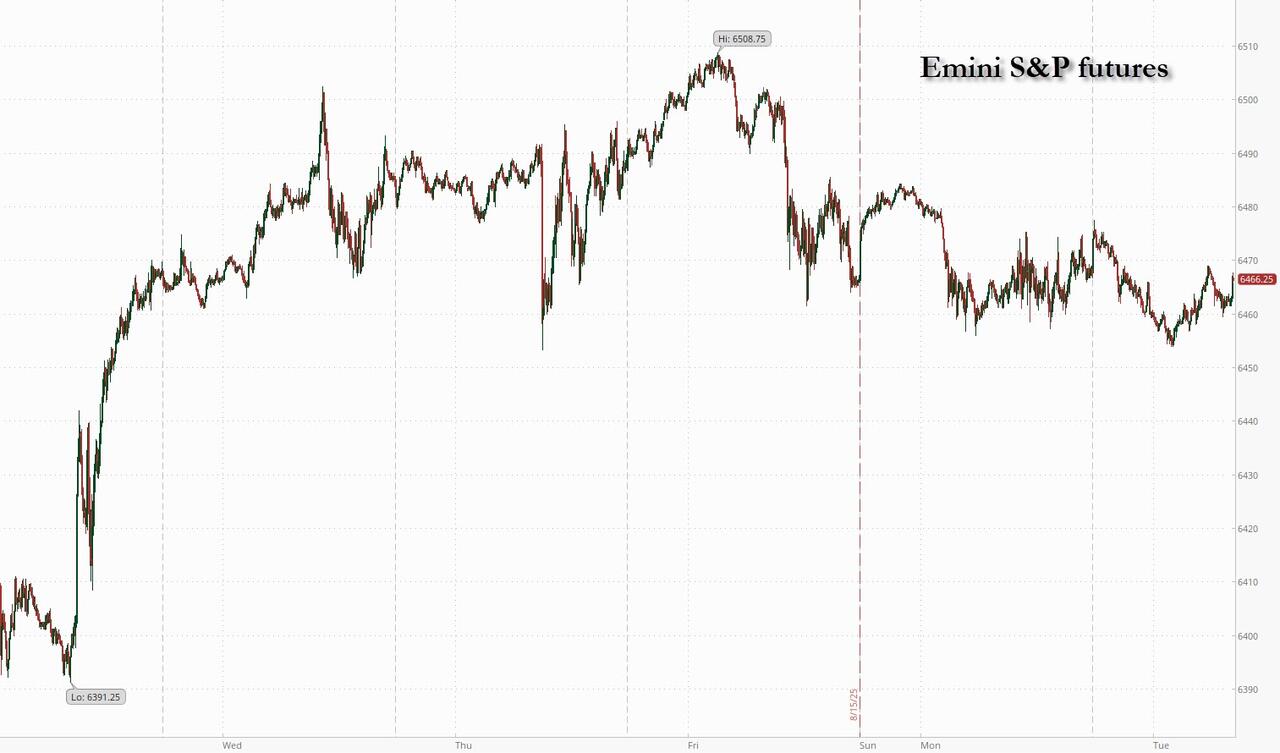
In premarket trading, Mag 7 stocks are mostly lower (Nvidia +0.3%, Tesla -0.2%, Microsoft -0.05%, Alphabet -0.2%, Apple -0.2%, Amazon -0.2%, Meta -0.3%).
- Fabrinet (FN) falls 8% after the optical device maker said it expects to see a sequential dip in datacom segment revenue in its fiscal 1Q, citing supply constraints for some critical components.
- Home Depot (HD) shares reversed a 2% drop after a closely watched sales measure missed estimates last quarter, suggesting consumers are holding back on major purchases.
- Intel (INTC) is up 5% after SoftBank Group Corp. agreed to buy $2 billion of the chipmaker’s stock.
- Iovance (IOVA) jumps 15% after the biotech said Health Canada approved Amtagvi to treat certain patients with unresectable or metastatic melanoma.
- Nexstar Media Group (NXST) rises 2% after agreeing to acquire all outstanding shares of Tegna (TGNA) for $22 per share in a cash deal valued at $6.2 billion. Tegna shares are up 3%.
- Opera Limited (OPRA) rise 3% after the software firm boosted its revenue guidance for the full year; the guidance beat the average analyst estimate.
- Palo Alto Networks (PANW) gains 6% after the security software company reported fourth-quarter results that beat expectations and gave a strong outlook.
- Peabody Energy (BTU) rises 7% after deciding to walk away from a $3.8 billion deal to buy Anglo American Plc’s steelmaking coal business following a fire at an Australian mine.
- Viking Therapeutics (VKTX) slumps 35% after the company announced top-line results from the Phase 2 clinical trial of its oral obesity drug.
The global stock rally has stalled as investors await new twist and turns in the Ukraine drama, awaited this Friday’s Jackson Hole symposium where Jerome Powell is set to unveil a new policy framework (and usher in a September rate cut), and watched earnings from the biggest US retailers. Money markets are currently betting the Fed will deliver its first rate cut for the year in September, as labor-market weakness outweighs inflation risks, with another move expected before year-end. Oil slipped as traders weighed the outlook for an end to the conflict in Ukraine and a potential future supply increase of Russian crude. Brent fell below $66 a barrel, extending a decline for the month to around 9%.
“With much of it priced in already, equities may need a new catalyst,” said Ipek Ozkardeskaya, a senior analyst at Swissquote Bank. “August through October is seasonally soft, and rising long-term bond yields could tempt investors to pocket recent gains.”
In other corporate news, Nvidia is said to be preparing a more powerful chip for China, according to Reuters. Apple is said to be expanding iPhone production in India as it seeks to lessen its reliance on China for US-bound models, Bloomberg News reported. The company is producing all four iPhone 17 models in India ahead of their debut next month, marking the first time that all new variations will ship from the South Asian country from the get-go. Tesla priced its updated, six-seat Model Y sport utility vehicle in the same range as local rival Li Auto’s extended-range L8 model, to win over middle-class families in China’s hyper-competitive market. Shein is said to be considering moving its base back to China to help sway Beijing authorities to sign off on its plans to go public.
In Europe, the Stoxx 600 climbed 0.6% to its highest level since March after Bloomberg reported US and European officials have started work on a Ukraine’s security plan. That is expected to include a package of guarantees that will open a path to a landmark meeting between presidents Vladimir Putin and Volodymyr Zelenskiy. Sweden’s Ambea and Sweco are among the biggest outperformers, on earnings and a broker upgrade, respectively. Defense stocks drop on Ukraine news, while London- and Warzaw-listed stocks exposed to the war-torn country gain. Here are the biggest movers Tuesday:
- Ambea gains as much as 9.5% after the Swedish care provider reported net sales for 2Q that beat the average analyst estimate. DNB Carnegie says the report shows “continued strong momentum” for the company
- Sweco gains as much as 5.2%, to the highest in more than a month, after DNB Carnegie reinstated coverage of the Swedish engineering consultancy with a price target just shy of the current Street-high
- Huber+Suhner shares rise as much as 9.8% to a record after the Swiss electrical components firm reported Ebit for the first half-year that beat estimates. Vontobel sees consensus estimates moving upward
- Shares in Ukraine-exposed companies surge in Warsaw and London amid revived hopes of a peace deal after Ukrainian President Zelenskiy and European leaders met US President Trump on Monday
- Odfjell Drilling gains as much as 11% and reaches a new all-time high after reporting second-quarter results. DNB Carnegie said the Norwegian offshore drilling firm’s report showed “continued strong performance”
- Applied Nutrition shares rise as much as 12%, the most on record, after the health supplements company said it anticipates revenue to be ahead of market expectations
- European defense companies’ shares are lower Tuesday amid prospects for a potential meeting between Ukrainian President Volodymyr Zelenskiy and Russian President Vladimir Putin
- DocMorris drops as much as 14% following the Swiss-based online pharmacy company’s first-half results. Analysts note that a significant step-up will be required in the second half to achieve the unchanged guidance
- Coloplast falls as much as 3.7%, the most in a month, after the Danish wound and ostomy care group reported disappointing third-quarter earnings, with sales and profit missing consensus estimates
- International Workplace shares slide as much as 18%, the most in three years, after guiding that full-year earnings are likely to come in toward the lower end of the range expected by analysts due to investments
- Basilea shares give up initial gains and head lower as much as 6.5% after the Swiss bio-pharmaceutical company reported results that ZKB analysts said showed a “disappointing” cashflow performance
- Skan shares fall as much as 12%, the most since July 2021, after the health care supplier reported weaker-than-expected results for the first half of 2025, with the Ebitda dropping to CHF0.9 million ($1.1 million)
Earlier in the session, Asian stocks declined for a second day, with South Korea and Australia leading losses, as markets take a breather after an extended rally. The MSCI Asia Pacific Index fell 0.2%, with Sydney-listed biotech CSL the biggest drag as it posted the worst decline on record after disappointing earnings. Equities also dropped in tech-heavy Hong Kong and Taiwan, while benchmarks advanced in Singapore, Malaysia and Vietnam. A gauge of Chinese equities reversed early gains after notching a record close Monday. Sentiment remains bullish, as gains from institutional money chasing these stocks bolster sentiment toward emerging markets and the broader Asian region. Indian shares also moved higher, on track for a fourth session of gains amid thawing relations with China and expectations of a boost in consumption from planned tax cuts.
In FX, the Bloomberg Dollar Spot Index is flat while the Swedish krona takes top spot among G-10 peers, rising 0.3% against the greenback.
Treasuries eked out gains after S&P Global Ratings affirmed its AA+ long-term rating for the US, with the 10-year rate falling one basis point to 4.32%. Treasury auctions resume Wednesday with $16 billion 20-year new issue; an $8 billion 30-year TIPS reopening is slated for Thursday.
In commodities, Brent crude futures fell 1% to near $66 a barrel extending a decline for the month to around 9%, as traders weighed the outlook for an end to the conflict in Ukraine and a potential future supply increase of Russian crude. European natural gas futures are down 0.4%.
Looking at today’s calendar, the data slate includes July housing starts and building permits (8:30am New York time). Fed speaker slate includes Governor Bowman (10am and 2:10pm).
Market Snapshot
- S&P 500 mini little changed
- Nasdaq 100 mini little changed
- Russell 2000 mini -0.2%
- Stoxx Europe 600 +0.5%
- DAX +0.4%
- CAC 40 +0.8%
- 10-year Treasury yield little changed at 4.33%
- VIX little changed at 14.96
- Bloomberg Dollar Index little changed at 1205.06
- euro +0.1% at $1.1675
- WTI crude -1.1% at $62.75/barrel
Top Overnight News
- President Trump on Monday urged Ukrainian President Volodymyr Zelensky and Russian President Vladimir Putin to meet face to face with him at a peace conference in a long shot U.S.-led bid to end the 3½-year-long war in Ukraine. Bloomberg reports that a summit between Putin and Zelenskiy may take place within two weeks, but the Kremlin has yet to confirm. WSJ, BBG
- S&P Global Ratings has affirmed the credit ratings of the U.S., saying it expects robust revenues from the Trump administration’s newly instituted tariff regime to help offset the expected fiscal deterioration resulting from recent legislative changes. WSJ
- Ukraine will promise to buy $100bn of American weapons financed by Europe in a bid to obtain US guarantees for its security after a peace settlement with Russia. FT
- Intel jumped premarket (INTC +5.8% pre) after SoftBank agreed to invest $2 billion, paying $23 per share — a slight discount to Intel’s last close. The deal would amount to about a 2% stake in the chipmaker. BBG
- NVDA is developing a new AI chip for China based on its latest Blackwell architecture that will be more powerful than the H20 model it is currently allowed to sell there, two people briefed on the matter said. RTRS
- Trump’s tariff war is speeding Beijing’s trade and investment drive into developing nations, potentially paving the way for a China-led trade order, S&P Global said. BBG
- Japan’s 20-year bond auction saw weaker demand than previous months, as investors remained wary of long-term debt given risks from rising spending and tax cuts. BBG
- Apple Inc. is expanding iPhone production in India at five factories, including a pair of recently opened plants, as it seeks to lessen its reliance on China for US-bound models. BBG
Trade/Tariffs
- Brazil’s government submitted its response to the US Section 301 investigation and said it urges the USTR to reconsider the initiation of the Section 301 investigation and to engage in constructive dialogue. It was separately reported that Brazil’s Finance Minister Haddad said Brazil is deadlocked with the US over 50% tariffs and reduction in high levies depends on Washington being open to talks, according to FT.
- India exempted import duty on cotton between August 19th to September 30th, according to a government order.
- Japan-India framework to focus on chips, mineral resources, and AI, according to reports citing Nikkei
A more detailed look at global markets courtesy of Newsquawk
APAC stocks traded mixed following the ultimately flat performance stateside amid a lack of fresh macro catalysts, as focus centred on geopolitical updates and amid cautiousness ahead of Powell’s speech at Jackson Hole on Friday. ASX 200 pulled back from record highs with heavy losses in healthcare as CSL shares fell by a double-digit percentage after the announcement to spin-off its flu vaccine business and cut 15% of its workforce, while tech was at the other end of the spectrum and miners also gained post-BHP earnings despite the mining giant reporting a 26% drop in FY underlying profit. Nikkei 225 swung between gains and losses after failing to sustain the initial upward momentum that had lifted the index to a fresh record high. Hang Seng and Shanghai Comp kept afloat following a firm liquidity effort by the PBoC which injected CNY 580bln through its 7-day reverse repo operation, while there were also comments on Monday by Chinese Premier Li who said the nation should consolidate and expand the positive trend in the economy, as well as stabilise market expectations and should continue to stimulate consumption potential.
Top Asian News
- China’s Foreign Minister Wang Yi held talks with his counterpart in India and said their countries should establish a correct strategic understanding, as well as regard each other as partners and opportunities, not as rivals or threats, while he added that China is ready to uphold the principle of cordiality and mutual benefit.
- China Jan-July Fiscal Revenue +0.1% Y/Y; Expenditures +3.4% Y/Y.
- XPeng (9868 HK) Q2 (CNY) Adj. EPS -0.20 (exp. -0.36, prev. -0.19 Y/Y), Revenue 18.27bln (exp. 18.11bln); Q3 deliveries: Vehicles to be between 113-118k.
- Russian Defence Ministry says they have conducted strikes on oil refinery supplying fuel to Ukrainian armed forces, according to Ifax.
European bourses (STOXX 600 +0.4%) opened modestly firmer across the board, with cautious optimism stemming from the recent US President Trump/Ukrainian President Zelensky/EU Leaders meeting. On that, Trump described it as a very good meeting, while he also called Russian President Putin to begin arrangements for a Putin-Zelensky meeting, which would be followed by a trilateral meeting with Trump. Reportedly, security agreements were discussed; on territorial developments, Zelensky suggested it would be a discussion between Ukraine and Russia. As the morning progressed, stocks have gradually climbed higher and currently sit at highs. European sectors hold a positive bias, but the breadth of the market is fairly narrow. Consumer Products takes the top spot, joined closely by Basic Resources and Retail; nothing really company-specific is driving the upside in these sectors, but largely benefiting from the slightly positive risk tone.
Top European News
- UK’s ONS says Friday’s scheduled retail sales data release has been delayed until September 5th
FX
- DXY is relatively rangebound this morning with a slight negative bias and price action contained to either side of the 98.00 mark. Currently in a narrow 97.99-98.32 parameter vs Monday’s 97.77-98.19 range. The theme over the last couple of days has been geopolitics, with deliberations over the Russia-Ukraine war in Washington concluding for now. Overall, there has been no breakthrough in Monday’s discussions, although talks may advance with a possible Zelensky–Putin meeting in two weeks, their first since the war began. Despite the mild optimism, betting markets remain pessimistic, with Polymarket pointing to a 38% chance of a Russia-Ukraine ceasefire this year.
- EUR/USD is holding a mild upward bias after finding support at its 50 DMA (1.1641) following Monday’s slide under 1.1700, with very little newsflow from the bloc aside from the comments from various European leaders following the multilateral meeting on Ukraine at the White House. EUR/USD resides in a current 1.1640-1.1685 range with the 50 DMA at 1.1641.
- Modest gains in the JPY, albeit in tandem with USD weakness, with little in terms of fresh catalysts from Japan. USD/JPY trades in either side of 148.00 in a 147.53-148.11 parameter, vs Monday’s 147.06-147.99 range, with the 50 DMA at 146.60 and the 200 DMA at 149.22.
- GBP continues to struggle for direction as newsflow from the UK remains very quiet, although there were reports that UK Chancellor Reeves is considering replacing stamp duty with a new property tax. GBP/USD trades in a 1.3486-1.3529 range (vs Monday’s 1.3501-1.3568), with the 50 DMA at 1.3501 today.
- Antipodeans are essentially flat vs the Dollar today, continuing the tentative risk tone seen in overnight trade.
- PBoC set USD/CNY mid-point at 7.1359 vs exp. 7.1846 (Prev. 7.1322)
Fixed Income
- A contained start to the day for USTs after the pressure that began towards the end of the European day and intensified into the mid-US morning. The pullback occurred as the White House meetings got underway and, ultimately, as the tone from the meeting was a positive one with progress made towards a trilateral summit and then security guarantees. On the guarantees, they are seemingly set to be formed of a coalition of the willing, which will be coordinated by the US. Currently, USTs are at a 111-15 trough, near enough unchanged on the session. If USTs conform to the bearish bias in EGBs, then Monday’s 111-13+ base is the first focal point before a bit of a gap until 110-23+ from the first week of August.
- As mentioned above, EGBs were slightly softer at this moment in time. Lower by as much as 10 ticks at worst. Pressure is seemingly a function of two bearish supply-side factors: 1) upcoming issuance, with Germany selling EUR 4.5bln of 2030 debt; 2) the funding security guarantees for Ukraine. Currently, the low point is 128.73. If we return to and move below this, Monday’s 128.70 base and then last week’s 128.64 trough comes into view. The German 2030 auction was well received, drawing a better-than-prior b/c – which helped to flip Bunds into positive territory.
- Gilts trade similar to Bunds but modestly underperforming. Thus far, to a 90.43 base with downside of just over 15 ticks at most. Taking out Monday’s 90.52 base and bringing levels from May into view. Given this, the UK 10yr yield is at a fresh WTD peak of 4.76%, approaching 4.69% from end-May.
- UK sells GBP 1.6bln 1.125% 2035 I/L Gilt: b/c 3.1x (prev. 3.35x) & real yield 1.728% (prev. 1.588%).
Commodities
- Crude oil trades softer following the Washington confabs between the US, Ukraine, EU, and NATO. Overall, there has been no breakthrough in Monday’s discussions, although talks may advance with a possible Zelensky–Putin meeting in two weeks, their first since the war began. The main obstacle remains Russia’s demand for full control of Donetsk and Luhansk, which Ukraine rejects. WTI currently resides in a 62.05-62.68/bbl range while Brent sits in a USD 66.58-66.02/bbl range.
- Mostly flat trade across precious metals amid quiet markets and with little fallout seen in the yellow metal from the deliberations on Russia-Ukraine, as traders await a clearer hint of what will result from the talks. Price action this morning sees the precious metals complex eking mild gains, with spot gold trading under its 50 DMA (3,349.61/oz) in a USD 3,326.28-3,341.88/oz range.
- Flat/mixed trade across base metals amid the broader tentative mood across the markets. 3M LME copper prices reside in a USD 9,739.40-9,782.00/t range.
- Equinor (EQNR NO) preparations for start up of Norway’s Hammerfest LNG terminal after outage are underway.
- Ukraine’s Energy Ministry says Russian attacks damaged gas transport infrastructure.
- Germany sells EUR 3.424bln vs exp. EUR 4.5bln 2.20% 2030 Bobl: b/c 1.90x (prev. 1.50x), average yield 2.32% (prev. 2.28%) & retention 23.19% (prev. 24.24%).
Geopolitics
- US and Europe to work immediately on Ukraine security guarantees, via Bloomberg.
- Poland PM Tusk will take part in meeting of the Coalition of the Willing at 11:00BST/06:00EDT, according to a spokesperson.
- Ukraine Foreign Minister says future trilateral leaders meeting can bring a breakthrough on the path to peace.
- US President Trump posted that he had a very good meeting with Ukrainian President Zelensky and European leaders, which ended in a further meeting in the Oval Office and during the meeting, they discussed security guarantees for Ukraine, which would be provided by the various European countries with coordination with the US. Trump added everyone is very happy about the possibility of peace for Russia and Ukraine, and at the conclusion of the meetings, he called Russian President Putin and began the arrangements for a meeting, at a location to be determined, between President Putin and President Zelensky. Furthermore, Trump said after that meeting takes place, they will have a trilateral between Trump, Putin and Zelensky, as well as noted that this was a very good, early step for a war that has been going on for almost four years and that VP Vance, Secretary of State Rubio, and Special Envoy Witkoff are coordinating with Russia and Ukraine.
- Russia’s Kremlin said US President Trump and Russian President Putin held a phone call which lasted 40 minutes and they discussed the idea of exploring the possibility of raising the level of Russian and Ukrainian representatives in the negotiations, while Putin warmly thanked Trump for the hospitality and well-organized meeting in Alaska, as well as for progress achieved at the summit. Furthermore, Putin and Trump spoke in favour of the continuation of direct talks between the Russian and Ukrainian delegations, while they agreed to continue close contact with each other on the Ukrainian crisis and other issues.
- Ukrainian President Zelensky said we need not a pause in the war, but real peace and territorial issues will be decided between Russia and Ukraine. Zelensky said he discussed security guarantees with Trump and European leaders, and received an important signal from the US on being part of security guarantees and help in coordinating it. Furthermore, he said the US offers to have a trilateral meeting as soon as possible and that Ukraine is ready for any format to meet with Putin.
- Ukraine reportedly offered a USD 100bln weapons deal to US President Trump in an effort to win security guarantees, according to the Financial Times citing documents laying out Kyiv’s proposal to Trump at the White House meeting.
- US Secretary of State Rubio told Fox News that they will work with European allies and non-European countries to build security guarantees for Ukraine. Rubio said he was in the room when Trump and Putin spoke, while he added that Trump suggested to Putin that he meet with Zelensky.
- NATO Secretary General Rutte said it was a very successful day in Washington where security guarantees were discussed and more details on security guarantees will be discussed in the coming days, while he added it is a breakthrough that the US will get involved and they are discussing some Article 5-type arrangement.
- European Commission President Von der Leyen said after the White House meeting that they are here as allies and friends for peace in Ukraine and in Europe, while she added this is an important moment as they continue to work on strong security guarantees for Ukraine.
- German Chancellor Merz that he feels these are decisive days for Ukraine and is not sure if Russian President Putin will have the courage to come to a summit with Zelensky present, while he added that expectations were not only met but were exceeded from this meeting. Merz also stated that US President Trump spoke with Russian President Putin and agreed that a Putin-Zelenskiy meeting will happen within two weeks, while the location is yet undecided, and that will be followed by a three-way meeting involving Trump.
- Finland’s President Stubb said they agreed on security guarantees and steps forward, as well as noted that talks were constructive and the Coalition of the Willing has already worked on security guarantees which they will build upon. Stubb also stated there is nothing concrete about US participation in security guarantees and that US President will inform them, with details of security guarantees to be ironed out in the next week or so.
- Debris from a destroyed Ukrainian drone sparked a fire at an oil refinery and hospital in Russia’s Volgograd, according to the regional administration.
- North Korea leader Kim said joint US-South Korea military drills show willingness for war provocation, while he also stated that the security environment requires North Korea to expand its nuclear armament rapidly.
- “Israeli media: The Chief of Staff will present today to the Minister of Defense the plan to occupy Gaza City”, according to Al Arabiya.
US Event Calendar
- 8:30 am: Jul Housing Starts, est. 1297k, prior 1321k
- 8:30 am: Jul P Building Permits, est. 1385.5k, prior 1393k
Central Banks
- 10:00 am: Fed’s Bowman Speaks on BTV
- 2:10 pm: Fed’s Bowman Speaks at Wyoming Blockchain Symposium 2025
DB’s Jim Reid concludes the overnight wrap
Geopolitical headlines continued to dominate yesterday, as Ukrainian President Zelenskiy and several other European leaders met President Trump at the White House. The main news is that Trump is now seeking to arrange a meeting between Putin and Zelenskiy, and he posted afterwards on Truth Social that he called Putin and “began the arrangements for a meeting” between the two. Zelenskiy said he was ready for these talks, but the Kremlin hasn’t committed to such a meeting yet, with Putin’s aide Ushakov making more ambiguous comments last night that they had “discussed the idea of raising the level of Russia’s and Ukraine’s representatives”.
The other major topic in yesterday’s talks were security guarantees for Ukraine, with Trump posting afterwards that “Guarantees would be provided by the various European Countries, with a coordination with the United States of America.” Zelenskiy called the US promises “a major step forward” and added that security guarantees for Ukraine could be formalised on paper within the next 10 days. That call for progress was echoed by others, and NATO Secretary General Rutte said that “Today was really about security guarantees, US getting more involved there, and all the details to be hammered out over the coming days”. Separately, the FT reported that to help secure those security guarantees, Ukraine had offered to buy $100bn of American weapons financed by Europe.
However, there were some differences between the US and the European countries. For instance, Trump said that a ceasefire was not needed to negotiate a resolution but France’s President Macron and Germany’s Chancellor Merz favouring a ceasefire before further talks. Zelenskiy said Ukraine would not insist on a ceasefire as a pre-condition for talks. But overall the meetings struck a constructive tone and we saw positive comments from European leaders following the meeting, with the UK’s Prime Minister Starmer saying he was “very pleased” with the outcomes.
The talks didn’t deliver decisive progress, but DB’s Peter Sidorov published a note this morning (link here) where he says that this marks the start of serious talks, with the prospect for peace better than they were earlier in the year. Nevertheless, there are still major obstacles in his view – most notably in terms of the gap over territorial issues and on agreeing credible security guarantees for Ukraine that would also be accepted by Moscow.
Against that backdrop, there hasn’t been a big market reaction in response to the talks. European equity futures are up a bit overnight, with those on the Euro STOXX 50 up +0.15%, whilst DAX futures are up +0.12%. Brent crude oil prices are also down -0.66% this morning to $66.16/bbl, but that follows a +1.14% increase yesterday which occurred as the prospects of a ceasefire appeared to diminish. So overall, the meetings haven’t led to an obvious shift in market pricing, although European equity futures are outperforming their US peers this morning, with those on the S&P 500 down -0.18%.
Meanwhile in Asian markets overnight, we haven’t seen many big moves for equities across the major indices. In Japan, the Nikkei (-0.15%) has slipped back a bit, which comes amidst weak demand at a 20yr bond auction that’s reminded investors about ongoing fiscal concerns. Bond yields have moved higher overnight as well, with the 10yr Japanese yield up +3.4bps to 1.59%. Meanwhile in South Korea, the KOSPI (-0.51%) has also lost ground for a second day running, falling to its lowest level in over two weeks. But there’s been a stronger performance for Chinese equities, with the Shanghai Comp (+0.30%) on track for its highest close since 2015, whilst the CSI 300 (+0.13%) is on course for its highest close since October.
Before the various geopolitical developments, there were some interesting moves in US Treasury markets yesterday as well, driven by growing doubts about how quickly the Fed would end up cutting rates over the months ahead. Those moves continued the trend which began last Thursday, back when the US PPI release showed producer prices rising at the fastest monthly pace since March 2022. And importantly, those concerns have lingered over recent days, given that inflation is still above the Fed’s target and expected to remain there given the tariff impact that’s filtering through. Moreover, broader measures of financial conditions are still fairly accommodative, and US IG spreads closed at their tightest since 1998 on Friday, where they remained after yesterday’s session as well.
That line of thinking meant that futures dialled back their expectations for Fed rate cuts this year. For instance, the amount of cuts priced in by the December meeting was down -1.4bps on the day to 53bps. So that’s down from 64bps last Wednesday before we had the PPI report, which demonstrates the scepticism about the Fed’s ability to rapidly cut rates at the next few meetings. In turn, that helped to drive a rise in Treasury yields across the curve, with the 2yr yield up +1.3bps to 3.76%, whilst the 10yr yield was up +1.5bps to 4.33%. There was also some fresh curve steepening, with the 5s30s curve up +0.5bps yesterday to its steepest since late-2021, at 108.5bps.
Meanwhile in the UK, there was a similar selloff for gilts as investors dialled back their expectations for rate cuts from the Bank of England. Indeed, a rate cut by the December meeting was down to just a 54% probability by the close, and at one point it fell to just 45%, so for market pricing at least, another rate cut this year was seen as unlikely. As with Treasuries, that helped to drive yields higher across the curve, and the 30yr gilt yield (+4.7bps) ended the day at a post-1998 high of 5.61%, whilst the 10yr yield (+4.1bps) rose to its highest since May, at 4.74%. However, it was a different story in the rest of Europe, with yields moving lower across the continent. So yields on 10yr bunds (-2.5bps), OATs (-2.1bps) and BTPs (-3.3bps) all moved lower, whilst the 30yr German yield (-1.1bps) moved off of its post-2011 high from Friday as well.
Equities also put in a subdued performance, with the S&P 500 (-0.01%) narrowly losing ground for a second day running. The Magnificent 7 (-0.16%) saw a modest decline while Intel (-3.66%) was the second-worst performer in the S&P amid reports that the Trump administration was in discussions to take a 10% stake in the company. And overnight we then heard that SoftBank agreed to buy $2bn of Intel stock at a small discount to the last closing price. More broadly, matters weren’t helped by the more hawkish rates re-pricing, and weak data further dampened sentiment, as the NAHB’s housing market index unexpectedly fell to 32 in August (vs. 34 expected). However, there were some brighter spots, and the small-cap Russell 2000 (+0.35%) posted a steady advance. And over in Europe, the STOXX 600 (+0.08%) just about inched up to its highest level in nearly three months.
To the day ahead now, and data releases include US housing starts and building permits for July, along with Canada’s CPI for July. Otherwise from central banks, we’ll hear from the Fed’s Bowman, and earnings releases include Home Depot.
2c European opening report
Cautious optimism following the Zelensky/Trump meeting into Fed speak – Newsquawk US Market Open

Tuesday, Aug 19, 2025 – 06:24 AM
- US President Trump posted that he had a very good meeting with Ukrainian President Zelensky and European leaders, which ended in a further meeting in the Oval Office and during the meeting, they discussed security guarantees for Ukraine, which would be provided by the various European countries with coordination with the US. In the aftermath, crude trades lower.
- Russia’s Kremlin said US President Trump and Russian President Putin held a phone call in which they discussed the idea of exploring the possibility of raising the level of Russian and Ukrainian representatives in the negotiations.
- S&P affirmed the US at AA+; Outlook Stable, S&P added that the revenue from President Trump’s tariffs will offset the fiscal hit from his recent tax-cut and spending bill.
- European bourses opened cautiously optimistic in the aftermath of the Trump/Zelensky/EU leaders meeting, but have gradually climbed higher; US equity futures trade tentatively.
- Tentative trade across FX while CAD eyes CPI. Fixed Income also trade tentatively, but have been moving higher in recent trade.
- Looking ahead, US Building Permits & Housing Starts, Canadian CPI, Atlanta Fed GDPNow, Comments from Fed’s Bowman, Earnings from Home Depot.
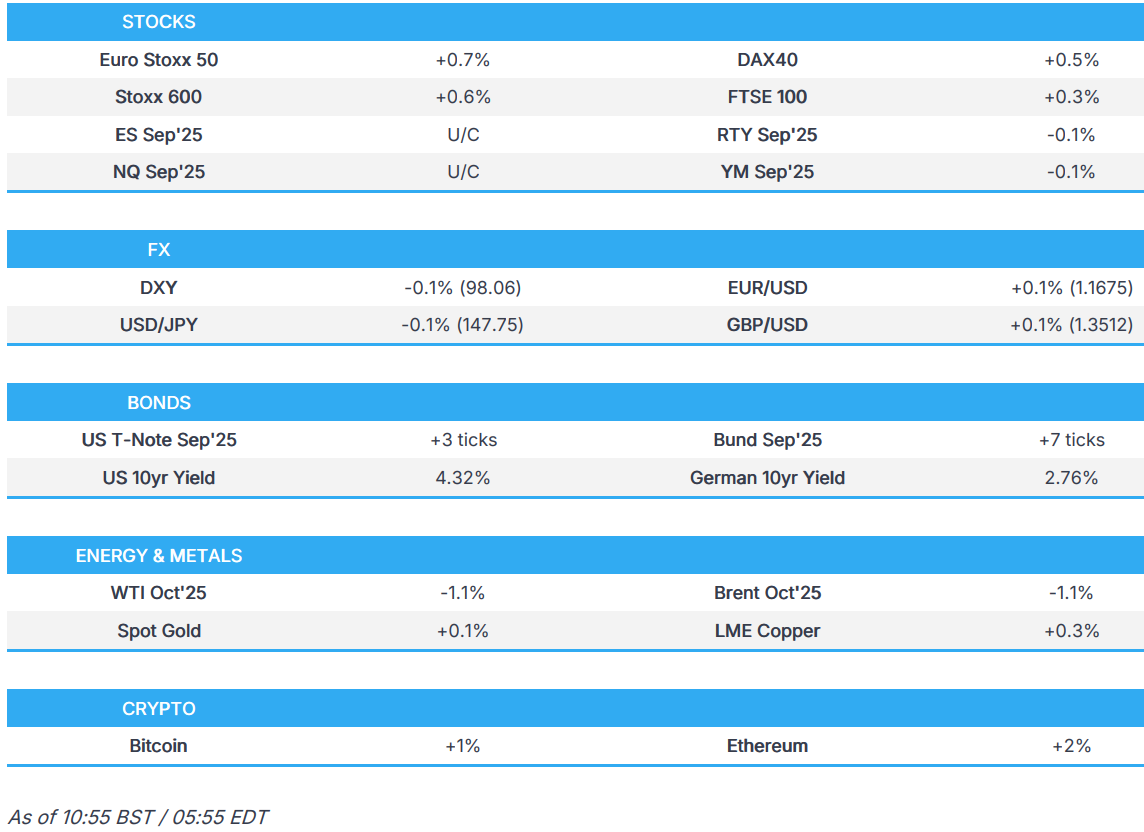
Newsquawk in 3 steps:
1. Subscribe to the free premarket movers reports
2. Listen to this report in the market open podcast (available on Apple and Spotify)
3. Trial Newsquawk’s premium real-time audio news squawk box for 7 days
TARIFFS/TRADE
- Brazil’s government submitted its response to the US Section 301 investigation and said it urges the USTR to reconsider the initiation of the Section 301 investigation and to engage in constructive dialogue. It was separately reported that Brazil’s Finance Minister Haddad said Brazil is deadlocked with the US over 50% tariffs and reduction in high levies depends on Washington being open to talks, according to FT.
- India exempted import duty on cotton between August 19th to September 30th, according to a government order.
- Japan-India framework to focus on chips, mineral resources, and AI, according to reports citing Nikkei
EUROPEAN TRADE
EQUITIES
- European bourses (STOXX 600 +0.4%) opened modestly firmer across the board, with cautious optimism stemming from the recent US President Trump/Ukrainian President Zelensky/EU Leaders meeting. On that, Trump described it as a very good meeting, while he also called Russian President Putin to begin arrangements for a Putin-Zelensky meeting, which would be followed by a trilateral meeting with Trump. Reportedly, security agreements were discussed; on territorial developments, Zelensky suggested it would be a discussion between Ukraine and Russia. As the morning progressed, stocks have gradually climbed higher and currently sit at highs.
- European sectors hold a positive bias, but the breadth of the market is fairly narrow. Consumer Products takes the top spot, joined closely by Basic Resources and Retail; nothing really company-specific is driving the upside in these sectors, but largely benefiting from the slightly positive risk tone.
- US equity futures (ES U/C, NQ U/C, RTY -0.1%) are modestly lower/flat across the board, with sentiment a little downbeat in comparison to the upside seen across Europe.
- NVIDIA (NVDA) is reportedly working on a new AI chip for China which outperforms the H20, via Reuters citing sources; likely deliver half of the computing power as the B300. Samples potentially to be delivered for testing in September.
- Click for the sessions European pre-market equity newsflow
- Click for the additional news
- Click for a detailed summary
FX
- DXY is relatively rangebound this morning with a slight negative bias and price action contained to either side of the 98.00 mark. Currently in a narrow 97.99-98.32 parameter vs Monday’s 97.77-98.19 range. The theme over the last couple of days has been geopolitics, with deliberations over the Russia-Ukraine war in Washington concluding for now. Overall, there has been no breakthrough in Monday’s discussions, although talks may advance with a possible Zelensky–Putin meeting in two weeks, their first since the war began. Despite the mild optimism, betting markets remain pessimistic, with Polymarket pointing to a 38% chance of a Russia-Ukraine ceasefire this year.
- EUR/USD is holding a mild upward bias after finding support at its 50 DMA (1.1641) following Monday’s slide under 1.1700, with very little newsflow from the bloc aside from the comments from various European leaders following the multilateral meeting on Ukraine at the White House. EUR/USD resides in a current 1.1640-1.1685 range with the 50 DMA at 1.1641.
- Modest gains in the JPY, albeit in tandem with USD weakness, with little in terms of fresh catalysts from Japan. USD/JPY trades in either side of 148.00 in a 147.53-148.11 parameter, vs Monday’s 147.06-147.99 range, with the 50 DMA at 146.60 and the 200 DMA at 149.22.
- GBP continues to struggle for direction as newsflow from the UK remains very quiet, although there were reports that UK Chancellor Reeves is considering replacing stamp duty with a new property tax. GBP/USD trades in a 1.3486-1.3529 range (vs Monday’s 1.3501-1.3568), with the 50 DMA at 1.3501 today.
- Antipodeans are essentially flat vs the Dollar today, continuing the tentative risk tone seen in overnight trade.
- PBoC set USD/CNY mid-point at 7.1359 vs exp. 7.1846 (Prev. 7.1322)
- Click for a detailed summary
- Click for NY OpEx Details
FIXED INCOME
- A contained start to the day for USTs after the pressure that began towards the end of the European day and intensified into the mid-US morning. The pullback occurred as the White House meetings got underway and, ultimately, as the tone from the meeting was a positive one with progress made towards a trilateral summit and then security guarantees. On the guarantees, they are seemingly set to be formed of a coalition of the willing, which will be coordinated by the US. Currently, USTs are at a 111-15 trough, near enough unchanged on the session. If USTs conform to the bearish bias in EGBs, then Monday’s 111-13+ base is the first focal point before a bit of a gap until 110-23+ from the first week of August.
- As mentioned above, EGBs were slightly softer at this moment in time. Lower by as much as 10 ticks at worst. Pressure is seemingly a function of two bearish supply-side factors: 1) upcoming issuance, with Germany selling EUR 4.5bln of 2030 debt; 2) the funding security guarantees for Ukraine. Currently, the low point is 128.73. If we return to and move below this, Monday’s 128.70 base and then last week’s 128.64 trough comes into view. The German 2030 auction was well received, drawing a better-than-prior b/c – which helped to flip Bunds into positive territory.
- Gilts trade similar to Bunds but modestly underperforming. Thus far, to a 90.43 base with downside of just over 15 ticks at most. Taking out Monday’s 90.52 base and bringing levels from May into view. Given this, the UK 10yr yield is at a fresh WTD peak of 4.76%, approaching 4.69% from end-May.
- UK sells GBP 1.6bln 1.125% 2035 I/L Gilt: b/c 3.1x (prev. 3.35x) & real yield 1.728% (prev. 1.588%).
- Click for a detailed summary
COMMODITIES
- Crude oil trades softer following the Washington confabs between the US, Ukraine, EU, and NATO. Overall, there has been no breakthrough in Monday’s discussions, although talks may advance with a possible Zelensky–Putin meeting in two weeks, their first since the war began. The main obstacle remains Russia’s demand for full control of Donetsk and Luhansk, which Ukraine rejects. WTI currently resides in a 62.05-62.68/bbl range while Brent sits in a USD 66.58-66.02/bbl range.
- Mostly flat trade across precious metals amid quiet markets and with little fallout seen in the yellow metal from the deliberations on Russia-Ukraine, as traders await a clearer hint of what will result from the talks. Price action this morning sees the precious metals complex eking mild gains, with spot gold trading under its 50 DMA (3,349.61/oz) in a USD 3,326.28-3,341.88/oz range.
- Flat/mixed trade across base metals amid the broader tentative mood across the markets. 3M LME copper prices reside in a USD 9,739.40-9,782.00/t range.
- Equinor (EQNR NO) preparations for start up of Norway’s Hammerfest LNG terminal after outage are underway.
- Ukraine’s Energy Ministry says Russian attacks damaged gas transport infrastructure.
- Germany sells EUR 3.424bln vs exp. EUR 4.5bln 2.20% 2030 Bobl: b/c 1.90x (prev. 1.50x), average yield 2.32% (prev. 2.28%) & retention 23.19% (prev. 24.24%).
- Click for a detailed summary
NOTABLE DATA RECAP
- EU Current Account SA, EUR (Jun) 35.8B (Prev. 32.3B); Current Account NSA,EUR (Jun) 38.9B (Prev. 1.02B)
NOTABLE EUROPEAN HEADLINES
- UK’s ONS says Friday’s scheduled retail sales data release has been delayed until September 5th
NOTABLE US HEADLINES
- S&P affirmed the US at AA+; Outlook Stable, while it stated the US outlook indicates fiscal deficit outcomes will not meaningfully improve, but does not project persistent deterioration over the next several years. S&P added that the revenue from President Trump’s tariffs will offset the fiscal hit from his recent tax-cut and spending bill.
GEOPOLITICS
RUSSIA-UKRAINE
Morning update:
- US and Europe to work immediately on Ukraine security guarantees, via Bloomberg.
- Poland PM Tusk will take part in meeting of the Coalition of the Willing at 11:00BST/06:00EDT, according to a spokesperson.
- Ukraine Foreign Minister says future trilateral leaders meeting can bring a breakthrough on the path to peace.
Overnight
- US President Trump posted that he had a very good meeting with Ukrainian President Zelensky and European leaders, which ended in a further meeting in the Oval Office and during the meeting, they discussed security guarantees for Ukraine, which would be provided by the various European countries with coordination with the US. Trump added everyone is very happy about the possibility of peace for Russia and Ukraine, and at the conclusion of the meetings, he called Russian President Putin and began the arrangements for a meeting, at a location to be determined, between President Putin and President Zelensky. Furthermore, Trump said after that meeting takes place, they will have a trilateral between Trump, Putin and Zelensky, as well as noted that this was a very good, early step for a war that has been going on for almost four years and that VP Vance, Secretary of State Rubio, and Special Envoy Witkoff are coordinating with Russia and Ukraine.
- Russia’s Kremlin said US President Trump and Russian President Putin held a phone call which lasted 40 minutes and they discussed the idea of exploring the possibility of raising the level of Russian and Ukrainian representatives in the negotiations, while Putin warmly thanked Trump for the hospitality and well-organized meeting in Alaska, as well as for progress achieved at the summit. Furthermore, Putin and Trump spoke in favour of the continuation of direct talks between the Russian and Ukrainian delegations, while they agreed to continue close contact with each other on the Ukrainian crisis and other issues.
- Ukrainian President Zelensky said we need not a pause in the war, but real peace and territorial issues will be decided between Russia and Ukraine. Zelensky said he discussed security guarantees with Trump and European leaders, and received an important signal from the US on being part of security guarantees and help in coordinating it. Furthermore, he said the US offers to have a trilateral meeting as soon as possible and that Ukraine is ready for any format to meet with Putin.
- Ukraine reportedly offered a USD 100bln weapons deal to US President Trump in an effort to win security guarantees, according to the Financial Times citing documents laying out Kyiv’s proposal to Trump at the White House meeting.
- US Secretary of State Rubio told Fox News that they will work with European allies and non-European countries to build security guarantees for Ukraine. Rubio said he was in the room when Trump and Putin spoke, while he added that Trump suggested to Putin that he meet with Zelensky.
- NATO Secretary General Rutte said it was a very successful day in Washington where security guarantees were discussed and more details on security guarantees will be discussed in the coming days, while he added it is a breakthrough that the US will get involved and they are discussing some Article 5-type arrangement.
- European Commission President Von der Leyen said after the White House meeting that they are here as allies and friends for peace in Ukraine and in Europe, while she added this is an important moment as they continue to work on strong security guarantees for Ukraine.
- German Chancellor Merz that he feels these are decisive days for Ukraine and is not sure if Russian President Putin will have the courage to come to a summit with Zelensky present, while he added that expectations were not only met but were exceeded from this meeting. Merz also stated that US President Trump spoke with Russian President Putin and agreed that a Putin-Zelenskiy meeting will happen within two weeks, while the location is yet undecided, and that will be followed by a three-way meeting involving Trump.
- Finland’s President Stubb said they agreed on security guarantees and steps forward, as well as noted that talks were constructive and the Coalition of the Willing has already worked on security guarantees which they will build upon. Stubb also stated there is nothing concrete about US participation in security guarantees and that US President will inform them, with details of security guarantees to be ironed out in the next week or so.
- Debris from a destroyed Ukrainian drone sparked a fire at an oil refinery and hospital in Russia’s Volgograd, according to the regional administration.
OTHER
- North Korea leader Kim said joint US-South Korea military drills show willingness for war provocation, while he also stated that the security environment requires North Korea to expand its nuclear armament rapidly.
- “Israeli media: The Chief of Staff will present today to the Minister of Defense the plan to occupy Gaza City”, according to Al Arabiya.
CRYPTO
- Bitcoin is a little firmer and trades around USD 115k whilst Ethereum trades just above USD 4.2k.
APAC TRADE
- APAC stocks traded mixed following the ultimately flat performance stateside amid a lack of fresh macro catalysts, as focus centred on geopolitical updates and amid cautiousness ahead of Powell’s speech at Jackson Hole on Friday.
- ASX 200 pulled back from record highs with heavy losses in healthcare as CSL shares fell by a double-digit percentage after the announcement to spin-off its flu vaccine business and cut 15% of its workforce, while tech was at the other end of the spectrum and miners also gained post-BHP earnings despite the mining giant reporting a 26% drop in FY underlying profit.
- Nikkei 225 swung between gains and losses after failing to sustain the initial upward momentum that had lifted the index to a fresh record high.
- Hang Seng and Shanghai Comp kept afloat following a firm liquidity effort by the PBoC which injected CNY 580bln through its 7-day reverse repo operation, while there were also comments on Monday by Chinese Premier Li who said the nation should consolidate and expand the positive trend in the economy, as well as stabilise market expectations and should continue to stimulate consumption potential.
NOTABLE ASIA-PAC HEADLINES
- China’s Foreign Minister Wang Yi held talks with his counterpart in India and said their countries should establish a correct strategic understanding, as well as regard each other as partners and opportunities, not as rivals or threats, while he added that China is ready to uphold the principle of cordiality and mutual benefit.
- China Jan-July Fiscal Revenue +0.1% Y/Y; Expenditures +3.4% Y/Y.
- XPeng (9868 HK) Q2 (CNY) Adj. EPS -0.20 (exp. -0.36, prev. -0.19 Y/Y), Revenue 18.27bln (exp. 18.11bln); Q3 deliveries: Vehicles to be between 113-118k.
- Russian Defence Ministry says they have conducted strikes on oil refinery supplying fuel to Ukrainian armed forces, according to Ifax.
2c Asian opening report
Mixed trade awaiting fresh geopolitical updates & looking to Jackson Hole – Newsquawk Europe Market Open
Tuesday, Aug 19, 2025 – 02:03 AM
- APAC stocks traded mixed following the ultimately flat performance stateside amid a lack of fresh macro catalysts, as focus centred on geopolitical updates and amid cautiousness ahead of Powell’s speech at Jackson Hole on Friday.
- Russia’s Kremlin said US President Trump and Russian President Putin held a phone call in which they discussed the idea of exploring the possibility of raising the level of Russian and Ukrainian representatives in the negotiations.
- S&P affirmed the US at AA+; Outlook Stable, S&P added that the revenue from President Trump’s tariffs will offset the fiscal hit from his recent tax-cut and spending bill.
- European equity futures indicate a positive cash market open with Euro Stoxx 50 futures up 0.2% after the cash market finished with losses of 0.3% on Monday.
- Looking ahead, highlights include US Building Permits & Housing Starts, Canadian CPI, Atlanta Fed GDPNow, Comments from Fed’s Bowman, Earnings from Home Depot, Supply from UK & Germany.
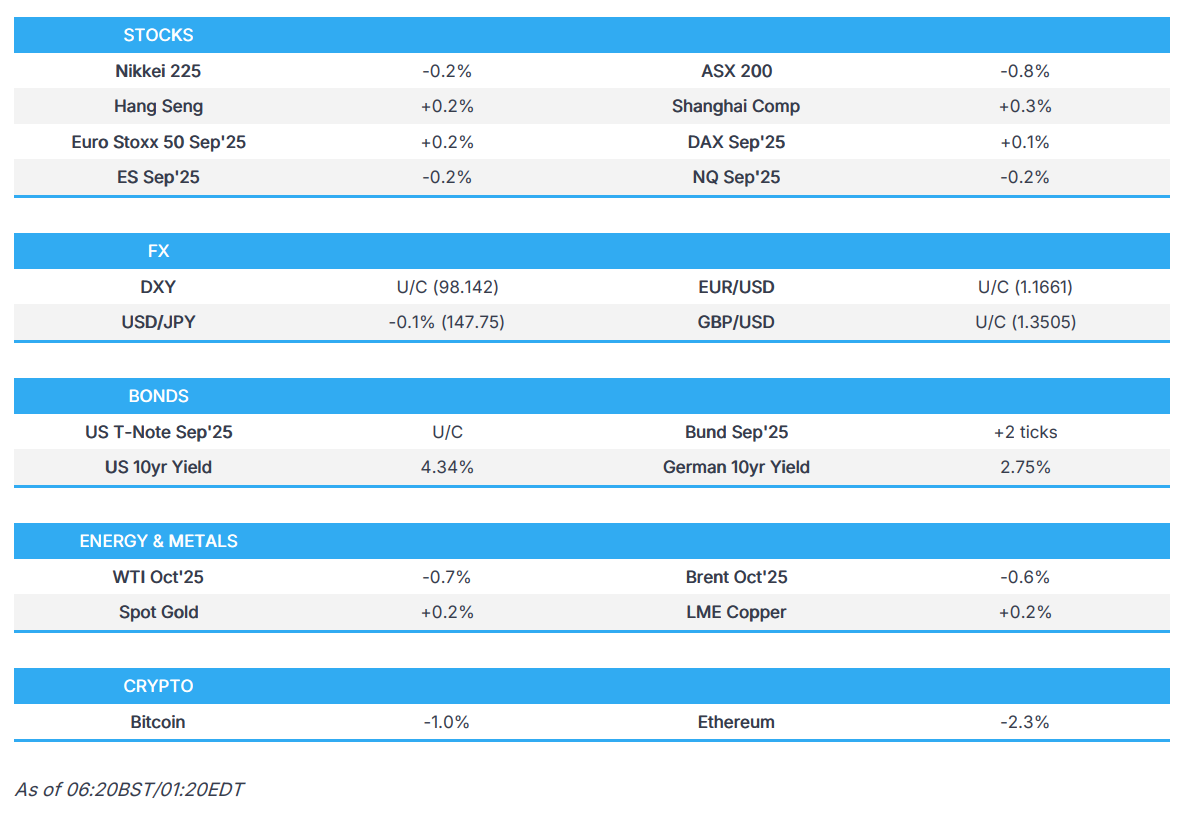
Newsquawk in 3 steps:
1. Subscribe to the free premarket movers reports
2. Listen to this report in the market open podcast (available on Apple and Spotify)
3. Trial Newsquawk’s premium real-time audio news squawk box for 7 days
US TRADE
EQUITIES
- US stocks were rangebound to start the week, although the Russell 2000 (+0.4%) outperformed in thin newsflow and typical summer trading conditions as focus resided around geopolitical updates amid a meeting between US President Trump, Ukrainian President Zelensky and various European leaders, while both Trump and Zelensky had earlier touted a possible trilateral meeting with Russia. In terms of the sectors, price action was mixed with Industrials and Consumer Discretionary sitting atop of the pile, while Real Estate and Energy were the laggards.
- SPX -0.02% at 6,449, NDX +0.01% at 23,713, DJI -0.08% at 44,910, RUT +0.40% at 2,296.
- Click here for a detailed summary.
TARIFFS/TRADE
- Brazil’s government submitted its response to the US Section 301 investigation and said it urges the USTR to reconsider the initiation of the Section 301 investigation and to engage in constructive dialogue. It was separately reported that Brazil’s Finance Minister Haddad said Brazil is deadlocked with the US over 50% tariffs and reduction in high levies depends on Washington being open to talks, according to FT.
- India exempted import duty on cotton between August 19th to September 30th, according to a government order.
NOTABLE HEADLINES
- S&P affirmed the US at AA+; Outlook Stable, while it stated the US outlook indicates fiscal deficit outcomes will not meaningfully improve, but does not project persistent deterioration over the next several years. S&P added that the revenue from President Trump’s tariffs will offset the fiscal hit from his recent tax-cut and spending bill.
- US President Trump’s administration is reportedly considering taking a 10% stake in Intel (INTC) and is considering converting the Co’s Chips Act grants into equity, according to Bloomberg citing sources, while a source added that the exact size of the stake and whether the White House moves ahead or not is still in flux.
APAC TRADE
EQUITIES
- APAC stocks traded mixed following the ultimately flat performance stateside amid a lack of fresh macro catalysts, as focus centred on geopolitical updates and amid cautiousness ahead of Powell’s speech at Jackson Hole on Friday.
- ASX 200 pulled back from record highs with heavy losses in healthcare as CSL shares fell by a double-digit percentage after the announcement to spin-off its flu vaccine business and cut 15% of its workforce, while tech was at the other end of the spectrum and miners also gained post-BHP earnings despite the mining giant reporting a 26% drop in FY underlying profit.
- Nikkei 225 swung between gains and losses after failing to sustain the initial upward momentum that had lifted the index to a fresh record high.
- Hang Seng and Shanghai Comp kept afloat following a firm liquidity effort by the PBoC which injected CNY 580bln through its 7-day reverse repo operation, while there were also comments yesterday by Chinese Premier Li who said the nation should consolidate and expand the positive trend in the economy, as well as stabilise market expectations and should continue to stimulate consumption potential.
- US equity futures were lacklustre after yesterday’s tentative mood and in the absence of any major drivers, while participants also await retailer earnings this week.
- European equity futures indicate a positive cash market open with Euro Stoxx 50 futures up 0.2% after the cash market finished with losses of 0.3% on Monday.
FX
- DXY marginally extended on recent gains after having returned to above the 98.00 level amid a lack of tier-1 data and absence of Fed speak, with participants awaiting Fed Chair Powell at Jackson Hole later in the week, while headline-driven trade was thin and focus resided around geopolitics.
- EUR/USD remained lacklustre after trickling further beneath the 1.1700 handle with very little newsflow from the bloc aside from the comments from various European leaders following the multilateral meeting on Ukraine at the White House.
- GBP/USD mildly breached through the prior day’s lows and briefly slipped beneath support at the 1.3500 level, while newsflow from the UK remained very quiet, although there were reports that UK Chancellor Reeves is considering replacing stamp duty with a new property tax.
- USD/JPY took a breather after recently advancing alongside a firmer dollar and with further gains limited by a lack of data releases and resistance at the 148.00 level.
- Antipodeans traded little changed amid the tentative mood, lack of pertinent data and after proceeding sideways for the majority of the previous US trading session.
- PBoC set USD/CNY mid-point at 7.1359 vs exp. 7.1846 (Prev. 7.1322)
FIXED INCOME
- 10yr UST futures attempted to nurse losses but was ultimately thwarted amid light catalysts ahead of FOMC Minutes on Wednesday and Fed Chair Powell’s speech at the Jackson Hole Symposium on Friday.
- Bund futures clawed back some of losses and briefly returned to the 129.00 level, but lost steam ahead of supply.
- 10yr JGB futures were subdued amid a lack of data releases and with pressure seen following weaker demand and lower accepted prices at the 20yr JGB auction.
COMMODITIES
- Crude futures pulled back overnight after the prior day’s choppy mood and following talks between US President Trump, Ukrainian President Zelensky and European leaders which Trump described as a very good meeting, while he also called Russian President Putin to begin arrangements for a Putin-Zelensky meeting, which would be followed by a trilateral meeting with Trump.
- Spot gold traded little changed after yesterday’s indecision amid little fresh macro drivers and with geopolitics in focus.
- Copper futures struggled for direction amid the mixed risk appetite in the Asia-Pac region and tentativeness ahead of Jackson Hole.
CRYPTO
- Bitcoin continued to retreat overnight and fell beneath the USD 115k level.
NOTABLE ASIA-PAC HEADLINES
- China’s Foreign Minister Wang Yi held talks with his counterpart in India and said their countries should establish a correct strategic understanding, as well as regard each other as partners and opportunities, not as rivals or threats, while he added that China is ready to uphold the principle of cordiality and mutual benefit.
- China lifts curbs on export of rare earth magnets to India, according to local media.
GEOPOLITICS
RUSSIA-UKRAINE
- US President Trump posted that he had a very good meeting with Ukrainian President Zelensky and European leaders, which ended in a further meeting in the Oval Office and during the meeting, they discussed security guarantees for Ukraine, which would be provided by the various European countries with coordination with the US. Trump added everyone is very happy about the possibility of peace for Russia and Ukraine, and at the conclusion of the meetings, he called Russian President Putin and began the arrangements for a meeting, at a location to be determined, between President Putin and President Zelensky. Furthermore, Trump said after that meeting takes place, they will have a trilat between Trump, Putin and Zelensky, as well as noted that this was a very good, early step for a war that has been going on for almost four years and that VP Vance, Secretary of State Rubio, and Special Envoy Witkoff are coordinating with Russia and Ukraine.
- US President Trump had earlier commented that they will be meeting for a while and in a week or two, they will know if they can solve it, but added that it is possible it might not be able to get done.
- Russia’s Kremlin said US President Trump and Russian President Putin held a phone call which lasted 40 minutes and they discussed the idea of exploring the possibility of raising the level of Russian and Ukrainian representatives in the negotiations, while Putin warmly thanked Trump for the hospitality and well-organized meeting in Alaska, as well as for progress achieved at the summit. Furthermore, Putin and Trump spoke in favour of the continuation of direct talks between the Russian and Ukrainian delegations, while they agreed to continue close contact with each other on the Ukrainian crisis and other issues.
- Ukrainian President Zelensky said we need not a pause in the war but real peace and territorial issues will be decided between Russia and Ukraine. Zelensky said he discussed security guarantees with Trump and European leaders, and received an important signal from the US on being part of security guarantees and help in coordinating it. Furthermore, he said the US offers to have a trilateral meeting as soon as possible and that Ukraine is ready for any format to meet with Putin.
- Ukrainian President Zelensky said they spoke about sensitive matters including security guarantees, and all of them want to finish this war and stop Russia, while he added it is important that the US gives a strong signal on security. Zelensky also earlier commented that they need to stop the war and are ready for a trilateral engagement, as well as noted he is open to holding elections after peace but can’t hold an election during war.
- Ukraine reportedly offered a USD 100bln weapons deal to US President Trump in an effort to win security guarantees, according to the Financial Times citing documents laying out Kyiv’s proposal to Trump at the White House meeting.
- US Secretary of State Rubio told Fox News that they will work with European allies and non-European countries to build security guarantees for Ukraine. Rubio said he was in the room when Trump and Putin spoke, while he added that Trump suggested to Putin that he meet with Zelensky.
- NATO Secretary General Rutte said it was a very successful day in Washington where security guarantees were discussed and more details on security guarantees will be discussed in the coming days, while he added it is a breakthrough that the US will get involved and they are discussing some Article 5-type arrangement.
- European Commission President Von der Leyen said after the White House meeting that they are here as allies and friends for peace in Ukraine and in Europe, while she added this is an important moment as they continue to work on strong security guarantees for Ukraine.
- German Chancellor Merz that he feels these are decisive days for Ukraine and is not sure if Russian President Putin will have the courage to come to a summit with Zelensky present, while he added that expectations were not only met but were exceeded from this meeting. Merz also stated that US President Trump spoke with Russian President Putin and agreed that a Putin-Zelenskiy meeting will happen within two weeks, while the location is yet undecided, and that will be followed by a three-way meeting involving Trump.
- Finland’s President Stubb said they agreed on security guarantees and steps forward, as well as noted that talks were constructive and the Coalition of the Willing has already worked on security guarantees which they will build upon. Stubb also stated there is nothing concrete about US participation in security guarantees and that US President will inform them, with details of security guarantees to be ironed out in the next week or so.
- Debris from a destroyed Ukrainian drone sparked a fire at an oil refinery and hospital in Russia’s Volgograd, according to the regional administration.
MIDDLE EAST
- Latest Gaza ceasefire proposal includes the temporary suspension of military operations for a 60-day period and includes a path to reach a comprehensive deal to end the war, according to Reuters citing Egyptian sources.
OTHER
- North Korea leader Kim said joint US-South Korea military drills show willingness for war provocation, while he also stated that the security environment requires North Korea to expand its nuclear armament rapidly.
3A NORTH KOREA/SOUTH KOREA
SOUTH KOREA//NORTH KOREA/
3B JAPAN/
Japan To Launch First Yen-Based Stablecoin
Tuesday, Aug 19, 2025 – 05:45 AM
The Nikkei reported that Japan’s Financial Services Agency (FSA) could approve the issuance of Japan’s first yen-denominated stablecoin as early as this fall, joining a global scramble to issue stablecoins denominated in one’s own currency (or linked to one’s stock, in the case of multiple publicly traded companies).
The report states that fintech company JPYC will register as a funds transfer service provider and begin selling its “JPYC” stablecoin within a few weeks. JPYC has been issuing a prepaid payment instrument called “Prepaid JPYC”, but has been preparing to issue and distribute “JPYC”, an electronic payment instrument exchangeable for Japanese yen, under the revised Payment Services Act, which came into effect in 2023.
The goal is to issue 1 trillion yen ($6.81 billion) of the JPYC stablecoin over three years. It has already drawn interest from multiple parties, including hedge funds that invest in cryptocurrencies and offices that manage the assets of wealthy individuals. Expected uses include carry trades, which aim to profit from interest rate differentials.
While attention has been focused mainly on USD stablecoins, the reported approval of a yen-based stablecoin could provide impetus to the digital currency ecosystem in Japan. In results briefings by fintech companies in Jul-Aug, some expressed expectations for domestic stablecoins. For the banking industry, Goldman sees potential for fee income from areas such as custodial services and collateral management. According to JPYC, its trust-type stablecoin is issued on the Progmat Coin platform of Mitsubishi UFJ Trust and Banking.
The Nikkei article cites cross-border remittances, corporate payments, and asset management as potential applications.
However, challenges remain. One concern is the risk of fluctuation and a potential decoupling from the assumption that each stablecoin unit would trade at one yen. While stablecoins generally have lower volatility than cryptocurrencies, in legal tender one yen is always worth one yen.
Meanwhile, Goldman sees debate soon focusing on anti-money laundering measures, e.g., remittances to recipients not subject to KYC restrictions in the event that stablecoins were used/traded by unspecified parties to be redeemed for legal tender or circulated on a blockchain.
3C CHINA
CHINA
Chinese Stocks Surge To A 10 Year High
Tuesday, Aug 19, 2025 – 02:10 AM
As we discussed last week in “China’s $11 Trillion Market Is Quietly Surging“, the Shanghai Composite closed just as quietly at its highest level in 10 years today. The 3700 level reclaimed was last seen when “Can’t Feel My Face” by The Weeknd was topping charts (Aug 2015), and the Chinese stock bubble of 2014-2015 had just burst.

But, as Goldman trader Fred Yin points out, there’s a big difference this time: “it’s been driven by elevated activity level in the market” and today’s 2.75 trillion yuan turnover in Shanghai + Shenzhen was the 3rd highest on record (behind only Oct ’24 rally).

For the Goldman cash desk, China A-shares was by far the largest net bought market on the cash pad with over 2x buy skew:
- Long-Onlies drove the buy skew overall on notional bought, with concentration in Info Tech / Consumer / Financials vs seller in Staples / Materials.
- Hedge Funds made up a smaller part of total flows but the buy skew was more extreme and it was almost all concentrated in Info Tech space (hardware).

By overall notional traded, China A was also the most active market on the bank’s regional cash pad. Total flow in China A today was nearly 6x the 4-week daily average.

This move is causing some stress in the funding market too: strong cover bids on the index side is causing funding “outperformance” for SMID indices to move sharply lower.
In terms of flow, the GS swap desk suggests L/S strategies are driving the buy cover as they unwind their hedges (i.e., panic cover shorts), while quants haven’t play a major role so far.
For those involved or looking into the “positive carry” trade on long China, this of course means pricing is less palatable than just 1-2 weeks ago. That, along with implied vol moving higher on back of strong demand (especially from macro community), makes outright calls relatively less attractive
Here, Goldman’s Yin chimes in that he still likes upside plays here but structuring it to minimize initial premium spent is getting more important,

Similar to the US, retail activity in China remains elevated, being a big driver of this most recent leg up. Margin trading outstanding balance now just ~10% below the previous all time high (also seen in 2015).

Yet while clearly picking up, retail sentiment isn’t stretched by any means, as shown in this Goldman proprietary proxy of retail sentiment.

Furthermore, Goldman’s proprietary equity risk barometer for China onshore is at its highest level in a year

What is remarkable about the latest melt-up is that National Team largely stayed on the sidelines throughout the recent romp higher.

The positive sentiment onshore is spilling over to offshore flow, and last Friday’s net inflow of US$4.6b was the largest on record.

Out of the $4.6b of inflows on Friday Aug 15th, $2.6b went to index ETFs (HSI / HSCEI / HSTECH), suggesting broad-based investor optimism instead of concentration within sectors.

Meanwhile, as we noted last week, one factor that can explain the recent surge is that hedge funds bought Chinese equities at the fastest pace in 7 weeks, driven by both long buys and short covers. Furthermore, as the GS Prime Desk noted over the weekend, China is now the most net bought market on Goldman’s Prime book so far in August.

This comes just after they net sold heavy amount of China equities in July

And finally, here’s what worked and what didn’t on Monday.

More in the full Goldman China recap note available to pro subscribers.
4. European affairs and NATO
EUROPE
On The Road To A Hyperstate: EU Commission Circumvents Financing Rule
Tuesday, Aug 19, 2025 – 03:30 AM
Submitted by Thomas Kolbe
The European Union is funded by contributions from its member states. At least, that’s what the founding treaties say. In practice, however, the EU has long been taking other paths.
At the core of Europe’s financial architecture lies a clear separation of responsibility and liability: Article 125 of the Treaty on the Functioning of the European Union (TFEU), the so-called “No-Bailout Clause.” It states, unequivocally, that neither the Union nor individual member states may assume the debts of other states. The purpose of this provision is to prevent free-rider effects (moral hazard) at the expense of other member states: each state is responsible for its own obligations.
Still, the clause does not exclude political support, as long as it does not mean assuming the existing debts of other states. A notable example of this practice were the bailout programs for Greece during the sovereign debt crisis one and a half decades ago.
Article 310 TFEU further regulates the EU budget: revenues and expenditures must be balanced every year, and the budget may only be financed through own resources such as member contributions, tariffs, or approved revenues. Independent loans by the EU Commission exceeding the approved framework are prohibited.
Together, these rules form the legal backbone of EU financial policy: no automatic liability, no autonomous EU debt, and only fully covered spending.
This design was deliberately chosen to prevent the emergence of a supra-state in Brussels and to defend the national scope of action of member states against an expanding Brussels bureaucracy.
Theory vs. Practice
That’s the theory. In practice, the EU has steadily increased its presence as a borrower in the bond market. It began in 1976 with the first European Community bond to support Italy and Ireland during the oil crisis. In the 1980s and 1990s, further issues followed for France, Greece, and Portugal—always aimed at demonstrating collective solidarity and easing fiscal tensions.
The 2008/2010 financial crisis marked a decisive turning point: with the European Financial Stabilisation Mechanism (EFSM) and, in 2012, the European Stability Mechanism (ESM), the EU began deliberately supporting over-indebted member states via bond issuance. In 2010, the European Central Bank announced it would purchase euro sovereign bonds on the open market to prevent the collapse of the monetary union—always in close coordination with EU institutions.
The COVID years saw a new dimension in 2020: for the first time, the EU issued Social Bonds under the “SURE” fund. At the same time, the “Next Generation EU” program started, providing around €800 billion in crisis aid. Since 2025, the Union has increasingly relied on so-called “sustainable bonds” (Green Bonds) and plans to issue short-term treasury bills for improved liquidity management.
The EU and ECB now operate in tandem, integrating ever-new financing instruments into the capital markets. The signal to the market is clear: we are ready to meet growing demand for euro bonds. And as collateral, not only the European taxpayer but also the ECB’s virtually unlimited liquidity is on standby. What could possibly go wrong?
Market Demand
For the second half of 2025, the European Commission plans to issue up to €70 billion in EU bonds across six auctions with maturities ranging from three to thirty years. Already in March 2025, the Commission achieved the world’s largest bond issuance increase, totaling $30.62 billion; three placements alone amounted to €13.7 billion.
Demand is plentiful, thanks to dual backing from member states and the ECB: an October 2024 issuance of a seven-year bond was oversubscribed 17 times. Green bonds are especially in focus: up to €250 billion are planned under NextGenerationEU, with €48.91 billion already issued.
Yields on these bonds currently trade about 40 basis points above German Bunds, making them attractive for investors.
Quo Vadis EU?
The European Union is undeniably moving toward a form of autonomous statehood. Its rigid ideological directives and the apodictic tone adopted by Commission representatives toward member states recently culminated in the Commission unilaterally negotiating the EU-US trade agreement.
Regardless of the agreement’s outcome, this sends a clear signal: decision-making power and political competence are shifting markedly from national capitals to Brussels, where a centralized bureaucracy increasingly calls the shots.
A return to national autonomy and a Commission limited to core functions appears out of the question. This is reflected in Commission President Ursula von der Leyen’s EU budget proposal for 2028–2034, projected at around €2 trillion—a 40% increase over the previous period.
Brussels’ fiscal megalomania has a single goal: enabling the EU to finance its activities independently, exploiting the fiscal constraints of member states. The outstanding €650 billion, formally to be raised by member states, hangs like a Damocles sword over ongoing negotiations—a constant pressure allowing the Commission to effectively enforce its financing plans through the bond market.
Apart from Hungary and the Czech Republic, there is broad agreement that Brussels’ financing will increasingly come from the bond market—no national budget could handle the extra levies. The Commission’s plans are therefore tacitly approved.
ECB as Lender of Last Resort
Everything points to a co-financing model that makes the EU increasingly independent of national budgets. Institutional constraints—such as individual member states’ say—are effectively bypassed, as is the Commission’s original prohibition on borrowing. Step by step, the Union is transforming from a rule-bound confederation into a centrally managed financial actor, increasingly deciding over its own resources and priorities.
Should debt ever spiral out of control, as has become common practice in the EU, the European Central Bank would be ready as a lender of last resort. This will work as long as the capital markets retain confidence in the EU’s creditworthiness, particularly Germany’s payment ability. If market faith collapses, the ECB would be forced to intervene in a way that would dwarf the 2010 debt crisis. The euro would then be history. The EU is skating on thin ice.
About the author: Thomas Kolbe, a German graduate economist, has worked for over 25 years as a journalist and media producer for clients from various industries and business associations. As a publicist, he focuses on economic processes and observes geopolitical events from the perspective of the capital markets. His publications follow a philosophy that focuses on the individual and their right to self-determination.
END
SPAIN
Over 40% Of Spaniards Are Worried About Their Financial Future
Tuesday, Aug 19, 2025 – 02:45 AM
It may come as no surprise that many people around the world are feeling concerned about their financial futures.
Years of global inflation, stagnant wages and mounting pressures on pensions systems are contributing to economic uncertainty.
These challenges are further compounded by the impacts of climate change and major geopolitical events, from trade tariffs to armed conflicts.
As Statista’s Anna Fleck shows in the chart below, data from a Statista Consumer Insights survey shows that four in ten respondents in Spain and South Africa voiced concerns on the topic between July 2024 and June 2025.

You will find more infographics at Statista
In the United States, 35 percent of respondents said the same, while in India and China the share of respondents worried about their financial futures was lower, at 27 and 13 percent, respectively.
END
GERMANY
Refugees In Austria Accused Of Failing German Courses To Stay On Benefits And Out Of Work
Tuesday, Aug 19, 2025 – 02:00 AM
Authored by Thomas Brooke via Remix News,
A new report by Austria’s Public Employment Service (AMS) has sparked controversy after suggesting that some refugees are intentionally failing German language courses to avoid being placed in low-paying jobs.

The findings, published in the study “New Refugees from Syria on the Austrian Labor Market,” highlight a growing challenge for integration policy, with concerns that language training, once seen as the key to employment, is becoming a barrier instead.
In the report, one first-hand account from a Syrian woman who studied medicine in her home country and worked as a paediatrician in Turkey, criticized what she sees as a systemic problem: qualified Syrian women being pushed into cleaning jobs without any consideration of their professional skills. She claims that, in response, some refugees purposely fail their language exams to avoid being forced into such low-status work.
Central to her complaint is the issue of inadequate wages, which she says often do not even cover basic living expenses, making social benefits a more attractive option.
The case study appears to be supported by AMS data, which showed that two-thirds of those granted asylum or subsidiary protection require literacy training, and 44 percent are completely illiterate. As reported by Kosmo, the AMS notes that 30 percent of refugees still have no German-language knowledge even 18 months after registering in Austria. Many spent years in transit countries before arriving, and in some cases, they cannot even read in their native language.
In July 2025, the unemployment rate for Syrians in Austria stood at 45.4 percent. Vienna is the epicenter of the problem, with more than half of all unemployed migrants living in the capital. Meanwhile, in other federal states, tens of thousands of low-skilled jobs remain unfilled.
The AMS acknowledges that deliberately failing courses to avoid work may occur, but insists this is not a widespread practice. “There are probably isolated cases, but this does not exist as a perceptible phenomenon,” the agency says. However, it concedes that proving deliberate failure is “hardly feasible in practice.” Sanctions are only possible if it can be clearly demonstrated that a person intentionally sabotaged their course or exam.
The issue is also closely linked to Austria’s welfare system. Some migrants may calculate that low-skilled work pays less than the combined value of unemployment benefits and minimum income support. The AMS does not deny that the financial incentive to remain unemployed exists.
The Austrian federal government is attempting to reform the system to ensure that work pays more than benefits. Starting in 2026, asylum seekers who skip compulsory language courses or fail the final exam will face cuts to their social welfare payments.
In Lower and Upper Austria, such measures are already in place, with reductions of up to 50 percent for those who refuse to participate.
Earlier this week, the reality of mass immigration in Austria was laid bare after new figures from the Statistical Yearbook on Migration and Integration found that women from Syria, Afghanistan, and Iraq living in Austria have an average birth rate almost three times higher than that of Austrian-born women.
The new generation with a growing Muslim population is having a profound effect in Austria, particularly in education.
In October 2024, federal data revealed that more than three-quarters of students in Vienna’s middle schools do not speak German at home, putting pressure on an education system designed for single-language learning.
A survey at the same time by the local teachers’ union at some of Vienna’s 100 compulsory schools revealed not only systematic issues like language barriers, but also extreme incidents, including assaults on teachers, situations where parents of schoolchildren asked a teacher to wear a burqa, and even the presence of mock executions.
It has led to teachers leaving their profession — 20 a day on average in 2024 — and other educators speaking out on the “rapid Islamization” of the Austrian capital.
“Islam is changing our society in ways we do not want,” said longtime principal of a Vienna middle school, Christian Klar, in an interview with Christian magazine Corrigenda last year.
END
EUROPE
FUNNY!!
Europe To Spend $100BN It Doesn’t Have, To Buy Weapons America Doesn’t Have, To Arm Soldiers Ukraine Now Lacks
Tuesday, Aug 19, 2025 – 12:00 PM
Part of Zelensky’s motive for wearing a suit Monday to the White House has become clearer with fresh reporting in the Financial Times, which reviewed a document showing Ukraine will promise to buy $100 billion of American weapons financed by Europe in a bid to obtain robust US security guarantees.
Additionally, “Under the proposals, Kyiv and Washington would also strike a $50bn deal to produce drones with Ukrainian companies that have pioneered the technology since Russia’s full-scale invasion in 2022,” the report continues. Ukraine pitched its plan during the Monday White House summit, which also involved seven EU leaders – and the $100BN arms deal became part of the key talking points pushed by the European allies.

This is an effort by design meant to ensure Ukraine can procure what it wants – and that its war efforts can still be funded uninterrupted – while still ultimately appeasing Trump. “We’re not giving anything. We’re selling weapons,” Trump had said Monday in response to a reporter’s question on the matter.
It remains very obvious that Europe’s demands of keeping up huge pressure on Russia, including through sanctions, are intended to stymie any US-backed deal seen as too favorable to Moscow. The FT report comments on this as follows:
The document details how Ukraine intends to make a counter-pitch to the US after Trump appeared to align himself with Russia’s position for ending the war following his meeting with President Vladimir Putin in Alaska last week.
It reiterates Ukraine’s call for a ceasefire that Trump had espoused but then dropped after his Putin meeting in favor of the pursuit of a comprehensive peace settlement.
Geopolitical analyst and commentator Glenn Diesen has pointed out, however, that Kiev is essentially attempting to create leverage out of nothing.
“Europe will spend $100 billion it does not have, to buy weapons from America that it does not have, to arm soldiers that Ukraine now lacks,” he wrote, explaining further: “This is to confront Russia, which for 30 years warned it would respond to NATO militarizing its borders.”
Diesen followed by doing something that Washington policy-makers refuse to do, and that is look at the big picture of how we got here [emphasis ZH]:
There was no threat to Ukraine before 2014, as only a tiny minority of Ukrainians wanted to join NATO, and Russia laid no claim to any of Ukraine’s territory. Western governments then supported a coup to pull Ukraine into NATO’s orbit – something that CIA Directors, Ambassadors, and Western state leaders had warned would instigate a security competition and likely trigger a war.
Russia predictably reacted fiercely. Ever since then, the only acceptable narrative has been that Russia wants to restore the Soviet Union and that Putin is Hitler. Any dissent is labelled as “disinformation”, “propaganda”, “hybrid warfare”, or even treason.
The war has now been lost, and the Americans are pulling away from it, asking the Europeans to absorb the consequences. How do the Europeans respond? By doubling down on this madness, which will destroy Ukraine, our economies, and our relevance in the world – and possibly trigger a nuclear war. – What is the strategy? More of the same? The best thing for Ukraine is to remove it from the frontlines of the geopolitical struggle over where to draw the new dividing lines in Europe: End the war, rebuild Ukraine, and replace expansionist military blocs with the principle of indivisible security.
This week, as negotiations proceed and Europe keeps up its drive to pile more and more pressure on Putin, the big question will be whether the Western side can indeed understand that it has lost the proxy war.
Many immense hurdles remain, and one could also point out there are too many cooks in the kitchen (judging by the over a half-dozen European leaders present in the Oval yesterday), making things all the more unnecessarily complicated – and that’s probably by design.
* * *
Glenn Greenwald agrees with this bleak assessment of Europe’s role in thwarting peace…
5. RUSSIA AND MIDDLE EASTERN AFFAIRS
ISRAEL /GAZA/HEZBOLLAH/IRAN/SUMMARY OF THE LAST 24 HR
ISRAEL VS HAMAS
All or nothing: Why Israel should stand firm, avoid phased hostage deals – editorial
Israel will no longer play Hamas’s game of drips and drabs. The demand is simple, moral, and unshakable: all of them, all at once. Nothing less.

A demonstrator with her face painted in the colors of the Israeli flag and red tears takes part in a protest demanding the immediate release of the hostages held by Hamas, and the end of the war, in Tel Aviv, Israel, August 16, 2025.(photo credit: RONEN ZVULUN/REUTERS)ByJPOST EDITORIALAUGUST 19, 2025 06:00
By any measure, Israel’s new stance in negotiations with Hamas – that any deal must include the release of all the hostages at once – is the right one. It is right strategically, politically, and most of all, morally.
For nearly two years, Israel has endured the unbearable reality of its sons and daughters held underground in Gaza.
For nearly two years, the families of those kidnapped on October 7 have lived in a torment without end, unsure whether their loved ones will ever return.
JPost Videos
And for nearly two years, Israel’s government has wrestled with the excruciating question of how to bring them home without empowering the very enemy that barbarically tore them from their families.
Up until now, the formula has been phased deals. A few hostages here, a few there, in exchange for temporary truces, prisoner releases, or humanitarian concessions.

Each partial deal brought relief to some families, moments of indescribable joy as loved ones were reunited. But each deal also left dozens still trapped in Gaza. Each deal left Hamas with more bargaining chips to play. And each deal kept Israeli society hostage to Hamas’s cynical manipulations.
That model must end. The shift to an “all or none” approach is not just a negotiating tactic. It is a much-needed strategic reset on multiple fronts.
Why Israel needs to switch to an all or nothing approach
First, partial deals have only prolonged the nightmare. Every time Israel agreed to a phased release, Hamas pocketed the gains and came back for more. More time, more leverage, more prisoners freed, and more pressure to halt military operations. This piecemeal process served Hamas’s interests perfectly: keep Israel waiting, keep the world watching, keep the families divided, and keep the terrorist organization calling the shots. Demanding all the hostages at once denies Hamas that advantage.
Second, the previous approach created a cruel hierarchy. Whose child comes home first? Whose parent is left behind? Whose turn is it to suffer longer? By insisting that all must be freed together, Israel affirms a fundamental moral truth: Every hostage is of equal worth. No life is expendable, no family’s anguish is less urgent.
Third, deterrence depends on clarity. As long as Hamas could calculate that abducting Israelis would generate repeated concessions, kidnapping remained a viable strategy. Requiring the release of all hostages at once is the clearest possible message: This tactic will yield no further dividends. The only way forward is to let everyone go.
Fourth, phased deals corrode national cohesion, prolong the whole trauma, and spark bitter protests and internal recriminations. The new position restores fairness and unity: either everyone comes home, or Israel presses on until they do. This is not only just, but it will reduce friction in a society frayed by nearly two years of war, mourning, and political turmoil.
Fifth, it shuts down Hamas’s psychological warfare. The terror group has never viewed the hostages purely in military terms; they are tools in cognitive warfare, designed to divide Israeli society, erode morale, and fracture cohesion. By releasing some while holding others, Hamas deliberately sowed discord and prolonged trauma. Requiring all of the hostages at once closes this front, denying Hamas its most effective psychological weapon.
Sixth, it aligns with Israel’s broader military and political goals. The war aims to dismantle Hamas as a governing and military entity and strip it of the power it held on October 7. Phased hostage deals undercut that aim by prolonging the terror group’s survival as an organization. The demand for the release of all hostages in one stroke supports the larger strategic vision: Hamas’s leverage must end.
Taken together, these reasons make clear that the old model of partial releases has run its course. It prolonged the nightmare, emboldened Hamas, and frayed Israel’s unity.
The new stance, by contrast, closes down avenues of exploitation, strengthens deterrence, and reasserts the principle that every life matters equally. It is natural to grasp at any deal that promises partial relief. But history shows that partial relief has come at the steep price of perpetuating the very captivity it sought to end.
This is not just a new negotiating formula but rather a reassertion of national resolve. Israel will no longer play Hamas’s game of drips and drabs. The demand is simple, moral, and unshakable: all of them, all at once. Nothing less.
end
ISRAEL VS HAMAS
Qatar: Gaza deal agreed by Hamas ‘almost identical’ to Witkoff’s plan
Hamas informed the Egyptian and Qatari mediators that it had agreed to the latest Gaza hostage-ceasefire proposal on Monday.

An illustrative photo of Hamas terrorists with hostage demonstrations in the background.(photo credit: MENAHEM KAHANA/AFP via Getty Images, Reuters/Hatem Khaled)ByREUTERS, JERUSALEM POST STAFFAUGUST 19, 2025 13:37Updated: AUGUST 19, 2025 14:38
The latest Gaza ceasefire proposal agreed by Hamas is “almost identical” to an earlier plan put forward by US special envoy Steve Witkoff, Qatar’s foreign ministry spokesperson said on Tuesday.
On Monday, Hamas informed the Egyptian and Qatari mediators that it had agreed to the latest Gaza hostage-ceasefire proposal, a source familiar with the details told The Jerusalem Post.
Israel received Hamas’s proposal on Monday evening. An Israeli official told the Post that Prime Minister Benjamin Netanyahu will consider Hamas’s proposal despite it being only a partial deal that doesn’t include the release of all the hostages. However, according to sources, Israel’s position, which includes the release of all the hostages and other conditions to end the war, has not changed.
The proposal would see the release of 10 living Israeli hostages in return for a 60-day ceasefire, and the release of 150 terrorists serving life sentences. The proposal on the table would also see Israel suspend military operations in the Gaza Strip for 60 days and could be seen as a path to reach a comprehensive deal to end the war, an Egyptian official told Reuters.
Axios reported that Hamas’s response “aligns 98%” with the proposal by US President Donald Trump’s envoy, Steve Witkoff, which Israel had previously agreed to. This was later echoed by senior Hamas official Taher al-Nunu in an interview with Al Jazeera on Sunday, who stated that there is “no clause in the proposal we agreed on related to Hamas’s weapons.”

Earlier, reports emerged that the meeting between Qatari Prime Minister Mohammed bin Abdulrahman bin Jassim Al Thani, Palestinian factions, the Egyptian intelligence minister, and Hamas representatives “was positive,” the Qatari Al-Araby TV said on Monday.
Egypt, Qatar worked on updated proposal
The meeting also “demonstrated a heightened sense of responsibility and determination to end the war,” Al-Araby TV continued.
Qatar’s prime minister arrived in Egypt to meet with mediators regarding a potential hostage deal on Monday, sources familiar with the details told the Post.
Hamas received an updated ceasefire proposal from Egypt and Qatar during a meeting also attended by representatives from several Palestinian factions, Al-Araby TV reported.
This is a developing story. Amichai Stein and Walla contributed to this report.
END
Hamas Agrees To Ceasefire-Hostage Release Deal With Israel
Tuesday, Aug 19, 2025 – 12:20 PM
Authored by Debra Heine via American Greatness,
Hamas has agreed to a new proposal for a ceasefire-hostage release deal with Israel.

The “comprehensive two-stage plan” was based on a framework advanced by US envoy Steve Witkoff and presented to Hamas by Qatari and Egyptian mediators, according to the BBC.
It would see Hamas free around half of the 50 remaining Israeli hostages – 20 of whom are believed to be alive – in two stages during a 60-day temporary truce.
During that time, there would be negotiations on a permanent ceasefire and an Israeli troop withdrawal.
The Egyptian and Qatari mediators reportedly met with Hamas representatives Sunday in Cairo, and presented them with the plan.
In a post on Facebook Monday, Hamas leader Basem Naim said Hamas and other Palestinian terror groups had agreed to the deal:
“The movement has submitted its response 💚 approving the new mediators’ proposal,” Naim wrote in Arabic.
“We pray to God to extinguish the fire of this war against our people.”
The deal was reached ahead of a major Israeli offensive to occupy Gaza City and just hours after President Donald Trump said Hamas needed to be “confronted and destroyed,” Axios noted.
“We will only see the return of the remaining hostages when Hamas is confronted and destroyed!!!,” Trump posted on Truth Social Monday morning.
“The sooner this takes place, the better the chances of success will be. Remember, I was the one who negotiated and got hundreds of hostages freed and released into Israel (and America!). I was the one who ended 6 wars, in just 6 months. I was the one who OBLITERATED Iran’s Nuclear facilities. Play to WIN, or don’t play at all!”
The plan is reportedly “98 percent similar” to the last U.S.-backed proposal, but the deal fell though when Hamas refused to sign on.
Hamas said at the time that it would only free the remaining hostages if Israel agreed to end the 22-month war. But Netanyahu said that would only happen once Hamas was disarmed and released all the hostages.
On Sunday, more than 200,000 Israelis took to the streets to demand Netanyahu not launch the new offensive in Gaza, and instead sign a deal to bring back the hostages. It was the biggest anti-war protest since the beginning of the war, according to Axios.
The Gaza War began in response to Hamas’ surprise attack in southern Israel on 7 October 2023.
The terrorists killed about 1,200 people—mostly civilians—in the attack, and took another 251 hostage.
SYRIA
Syria’s Sharaa Government Preps 50,000 Troops For Large Anti-Kurd Offensive In Northeast
Monday, Aug 18, 2025 – 09:45 PM
Authored by Jason Ditz via AntiWar.com,
The Islamist Syrian government is trying to give the impression they support peaceful unity in Syria, with President Ahmed al-Sharaa saying he believed Syria should be unified by some sort of understanding instead of by military force, because the Syrian people are tired of war.
His government’s actions tell a different story though, as after spurning Kurdish integration talks last week and refusing to allow any Druze to attend talks on the violence in Druze territory a few days later, the government is preparing a massive offensive against the Kurds.

Seeking to capture the Raqqa and Deir Ezzor Governorates from the Kurdish SDF’s control, the military is preparing some 50,000 troops for an offensive. The plan is to mass the troops at the city of Palmyra and sweep into Kurdish-controlled areas.
The SDF has an agreement in principle to integrate into the Syrian military, though it has been slowed by disagreements over the process.
The US has been critical of the SDF for delays, and envoy Tom Barrack has warned the Kurds that federalism “doesn’t work” and they must accept integration.
For the past decade the US has repeatedly backed the SDF against ISIS. Now, it seems they are increasingly aligned with Sharaa, with President Trump praising him as strong and attractive.
The US has also drawn down most of its forces from Kurdish territory, with their last substantial presence now far south at al-Tanf. The offensive against the SDF is expected some time before October, but it reportedly won’t happen without a US green light.
Map: the height of the Rojava project prior to fuller Turkish military cross-border intervention of the past years…

That would’ve been unthinkable in the past, though the administration’s current priority of uniting Syria behind the Islamist Hayat Tahrir al-Sham (HTS) may have changed things, and the narrative that the Kurds are delaying the process may lead the US to quietly give Syria the go-ahead to attack their long-standing allies.
END
SYRIA
Creative Chaos: Inside The CIA’s Covert War To Topple The Syrian Government
Monday, Aug 18, 2025 – 11:25 PM
Authored by Joseph Solis-Mullen via The Mises Institute,
For over a decade, the dominant Western narrative on the Syrian War has been simple: a peaceful uprising turned into a brutal civil war because of Bashar al-Assad’s ruthless crackdown on his own people.
But in Creative Chaos: Inside the CIA’s Covert War to Topple the Syrian Government, the Libertarian Institute’s latest book, William Van Wagenen methodically dismantles this mainstream version of events, exposing it as a convenient fiction crafted to justify one of the most disastrous regime change wars of the modern era.

His central thesis is clear: the war in Syria was not an organic revolution but a deliberate effort by Washington, Israel, and their regional partners to weaken Iran by toppling Assad’s government.
And when peaceful protests were hijacked by Islamist militants, instead of helping restore stability, the US and its allies deliberately prevented Assad from crushing the insurgency—even as it became dominated by al-Qaeda and ISIS-affiliated groups.
Now, years later, the result is a fractured Syria, ruled by jihadist warlords and occupied by foreign powers, with Israel consolidating its hold over strategic territory.
How and why did this disaster for Syria’s people come to pass? And why were the non-interventionists who called out Washington’s lies always right about the war and its likely outcome?
Regime Change: The Blueprint for Syria’s Destruction
Van Wagenen carefully documents how regime change in Syria had been a goal of US foreign policy long before the Arab Spring. The Bush administration set the groundwork, but the Obama administration accelerated the effort, seeing it as a way to strike a blow against Iran without a direct war.
His research confirms that the US and its allies—including Israel, Saudi Arabia, Qatar, and Türkiye—actively supported and armed the so-called “moderate opposition,” despite overwhelming evidence that jihadists controlled the rebellion almost from the start.
Instead of letting the Assad government restore order, Western intelligence agencies funneled billions in arms, logistics, and training to extremist groups, ensuring the war would drag on.
The leaked 2012 email from Jake Sullivan to Hillary Clinton (which Van Wagenen references) makes this reality undeniable: “AQ [Al-Qaeda] is on our side in Syria.”
This stunning admission exposes the real nature of US policy in Syria: at the same time they fought them on the other side of the line in Iraq, Washington was directly supporting al-Qaeda-linked groups because they served its geopolitical interests.
Note: For those who haven’t read the Libertarian Institute Director Scott Horton’s book Enough Already: Time to End the War on Terror, this was a reversion to form rather than a policy innovation: Washington had, as a rule, favored the fundamentalist and radical Sunni sects over secular alternatives in the region going back decades.
A War Hijacked by Jihadists
One of the book’s most important contributions is its wholesale demolition of the “moderate rebel” myth. While establishment media outlets painted the Free Syrian Army (FSA) as a legitimate opposition force, Van Wagenen presents overwhelming evidence that the so-called moderates:
- Were always outnumbered and outgunned by Islamist factions;
- Frequently collaborated with or defected to al-Qaeda’s Syrian affiliate, Jabhat al-Nusra (later HTS);
- Received direct support from the CIA despite ties to terror groups
By 2013, ISIS and al-Nusra dominated the battlefield, and yet the US still prevented Assad from crushing the insurgency. As Van Wagenen documents, Washington:
- Pressured Jordan to allow jihadists free movement across its border;
- Supplied weapons through covert programs like Operation Timber Sycamore;
- Worked with Türkiye and Saudi Arabia to keep a steady flow of foreign fighters into Syria
This policy—arming the terrorists who had just a decade previously attacked the United States, and who were attacking US forces in Iraq at the same time—wasn’t just reckless, it was criminal.
Israel’s Role: Engineering Chaos to Consolidate Power
Another key point in Van Wagenen’s book is that Israel was a major driver behind the push for Assad’s overthrow. While the establishment narrative claims Israel was just a passive observer, the book shows that Tel Aviv had a clear strategic interest in Syria’s disintegration.
- Israel viewed Assad as Iran’s key ally and wanted him removed;
- Israeli intelligence worked closely with Western planners to fuel the insurgency;
- Once jihadists took over much of the country, Israel used this as justification for expanding its own territorial ambitions
Fast forward to today, and Van Wagenen’s prediction has come true: Syria is permanently fractured, and Israel has occupied key territories under the pretense that there is “no legitimate partner for peace.”
As Israeli officials have repeatedly argued, Syria is too unstable to negotiate with because groups like HTS (formerly al-Qaeda’s affiliate) control large parts of it. But this outcome was engineered by Israel and its allies, who spent years ensuring jihadists gained the upper hand over Assad’s forces. In effect, the war has allowed Israel to tighten its grip on occupied Golan and extend its influence into Syrian territory.
The Role of Bureaucratic Interests: Why Regime Change Always Wins
One of the most compelling themes in Van Wagenen’s book is the way he implicitly ties the Syrian War to broader structural issues in US foreign policy—particularly Public Choice Theory and the Iron Law of Bureaucracy. Public Choice Theory teaches us that politicians and government agencies act in their own self-interest, not necessarily in the interest of the public. A subset of this is the so-called “Iron Law of Bureaucracy,” which states that bureaucracies eventually prioritize their own growth and survival over their original mission. The CIA, State Department, and Pentagon all had institutional incentives to prolong the war, expand their budgets, and justify continued intervention, as Van Wagenen’s book shows.
This explains why, despite overwhelming evidence that arming jihadists would lead to disaster, the policy continued for years. The bureaucratic and political interests pushing for intervention simply had too much to gain from prolonging the war.
The Devastating Human Cost
While Van Wagenen’s book is primarily focused on the geopolitical machinations behind the war, he never loses sight of the human cost of Washington’s policies:
- Hundreds of thousands of civilians were killed;
- Syria’s minority populations—Alawites, Christians, Druze, and Shiites—were slaughtered or driven into exile;
- Millions became refugees, fueling instability across the region and in Europe
Rather than bringing “freedom” to Syria, US intervention ensured endless war, ethnic cleansing, and the rise of brutal jihadist warlords.
Final Verdict: A Devastating Indictment of US Foreign Policy
Creative Chaos: Inside the CIA’s Covert War to Topple the Syrian Government is a deeply-researched, compelling, and devastating critique of Western intervention in Syria. Van Wagenen’s book should be required reading for anyone who wants to understand how Washington and its allies systematically engineered one of the most destructive conflicts of the 21st century. He methodically dismantles the legacy media’s lies, exposes the CIA’s reckless support for jihadists, and highlights Israel’s long-term strategic interest in Syria’s collapse.
For those who still believe that US intervention is a force for good in the world, this book is a wake-up call. Syria was not a “humanitarian” war. It was a calculated, brutal regime change operation that destroyed a nation for the sake of geopolitical gain. And, as Van Wagenen warns, despite the non-interventionists having always been right, it likely won’t be the last.
Washington must stop its meddling. This is a message particularly timely as Trump seems more and more inclined toward furthering US involvement in the region.
END
ISRAEL/RUSSIA
Putin Pressures Israel To Transfer Sprawling Christian Site In Jerusalem To Russia
Tuesday, Aug 19, 2025 – 04:15 AM
An ancient Christian area inside the walled Jerusalem Old City is at the center of diplomatic tensions between Russia and Israel, and President Putin is now openly requesting that the Netanyahu government hand over ownership to Russia.
The Alexander Courtyard is a 1,300-square-meter located near the Church of the Holy Sepulchre in the Christian Quarter, and is currently front and center of the intense ownership dispute. In the packed and densely populated Old City, land of this size is huge and very significant, considering every little meter of property has been hotly fought over for many decades.

The site, also often called simply the Russian Compound, includes the Orthodox Church of St. Alexander Nevsky – named after a 13th-century Russian warrior-prince, and has been at the heart of a long-running legal and diplomatic conflict between Israel and Russia.
The matter was reportedly raised directly during recent discussions between Russian President Vladimir Putin and Israeli Prime Minister Benjamin Netanyahu, which led to the PM appointing a special committee of senior Israeli ministers in order to handle the sensitive matter
Officials throughout the drawn-out saga have pointed out that President Putin views the issue as deeply personal, not just political.
Ynet News has reviewed that the Imperial Orthodox Palestine Society (OPS) has maintained de facto control over the Alexander Courtyard since its establishment in 1890.
Historical Ottoman documents list it as belonging to “the glorious Russian Empire” – though the OPS had also made formal purchase of the property.
But the Russian government has used this Ottomoman historic reference to argue that the land should now fall under Russian state ownership rather than OPS.
The OPS is a scholarly and charitable organization and insists that it is the sole owner, with both sides are appealing to the Israeli government to uphold and recognize their respective rights and claims.

Putin’s invervention has continued going back at least a half-decade. Adding to the complexity of the legal matter, in 2020 Netanyahu designated the Alexander Courtyard a “holy site” under British Mandate-era law.
In Israeli law this gives the government greater ability to decide on the matter, but the pressure from Moscow has ramped up in the meantime.
HEZBOLLAH
RUSSIA VS UKRAINE
6. GLOBAL ISSUES//COVID ISSUES/VACCINE ISSUES/HEALTH ISSUES
MARK CRISPIN MILLER
DR PAUL ALEXANDER
Pearson Syndrome study using placental mitochondria shows promise in slowing the rigors of aging? Very interesting concept IMO once done ethically; what is your view? idea is that mitochondrial
functions decline with age & we can supercharge it with some renewed energy as we senescence?? your thoughts? seems cells have been shown to take up mitochondria once next to it?
| Dr. Paul AlexanderAug 19 |
Your view?

Alexander News Network (ANN): Trump’s War 2.0 for America is a reader-supported publication. To receive new posts and support my work, consider becoming a free or paid subscriber.

The pioneering therapy that could roll back the rigours of ageing
Mitochondrial transplantation in humans could help treat incurable diseases and keep bodies younger for longer
The clock could be turned back on ageing with a groundbreaking new therapy that aims to recharge cells with “batteries” from the placenta of newborns.
Israel-based Minovia Therapeutics is the first company in the world to start testing mitochondrial transplantation in humans, which could treat incurable diseases and keep bodies younger for longer.
Mitochondria are tiny compartments within cells that act like batteries, supplying the cell with the energy it needs to function.
In ageing and certain diseases, the mitochondria stop working efficiently, starving the cells of energy, similar to the batteries running down in a machine.
Minovia has already completed clinical trials of the new therapy for patients with Pearson’s Syndrome – a mitochondrial disease – and is planning to trial the treatment in elderly people next year.
Dr Natalie Yivgi-Ohana, CEO and co-founder of Minovia, said: “It’s actually a very natural process for cells to take up mitochondria when they come in contact with them, but it was usually only one in 1000 cells that would do it.
“In the past 13 years, we’ve developed a method to maximise cellular take up without harming the cells or the mitochondria, so now more than 50 per cent of cells take up a significant amount of mitochondria.
“We take it from the youngest and healthiest organ, which is the placenta and which is full of super mitochondria and yet it’s normally thrown away like garbage. We could find it to be the fountain of youth.”
To make the therapy, scientists take the mitochondria from a healthy donated placenta and mix them with blood stem cells, which are then infused back into the patient’s bloodstream.
Not only do the super mitochondria help to produce more energy in cells, but they also reactivate natural quality control functions inside cells, which keep failing mitochondria at bay. So over time, the level of the body’s healthy mitochondria also goes up.
Last month, the company released phase 2 results for Pearson Syndrome, which can cause a range of problems in children, including failure to thrive, diabetes and neurological issues.
There are currently no approved therapies for the condition, and care is only palliative, with patients dying during childhood. But the new therapy has led to marked improvements.
‘Severe energy failure’
“These were all paediatric patients and they suffer severe energy failure, so they are not growing,” added Dr Yivgi-Ohana.
“It took a few months, but we have started observing improvement in their energy and less fatigue, more waking hours. We observed improvement in renal function, improvement in appetite, in growth.”
Now the company is turning its attention towards ageing, and is hoping that growing older may one day be seen as a treatable disease.
The company is planning to start trials of the treatment for elderly people in Israel next year and is developing biomarkers so they can test whether older people are experiencing mitochondrial dysfunction.
It could even help diseases of ageing, such as Parkinson’s, which is strongly linked to mitochondrial dysfunction.
‘Significant in almost every disease’
“We are all going to suffer mitochondrial disease as we age,” added Dr Yivgi-Ohana.
“Ageing is not considered a disease, but if we have a way to demonstrate that actually, as we age, we become mitochondrially dysfunctional, then that would be the trigger to propose a treatment.
“We want to start next year treating elderly people with mitochondrial dysfunction in longevity clinics and demonstrate that it really helps. “
She added: “The scalability in terms of the mitochondria is unlimited, there are no limitations of placentas and the amount of mitochondria that we can harvest and cryopreserve.”
“Mitochondria are such powerful organelles, and they can transfer between cells, so their sensing and their information transfer is so significant in almost every disease that you will look at.”
end
NEWS ADDICTS
| LATEST REPORTS FOR NEWS JUNKIESTrump Vows to End Mail-in Ballots Ahead of 2026 Midterm ElectionIn a lengthy Truth Social post, President Donald Trump announced plans to lead a movement to end both mail-in ballots and voting machines in U.S. elections.Trump’s Statement“I am going to lead a movement to get rid of MAIL-IN BALLOTS,” Trump wrote, also blasting what he called “Seriously Controversial VOTING MACHINES.” He pledged to sign an executive order on the issue …READ THE FULL REPORTHouse Committee to Withdraw Robert Mueller’s Subpoena Over Health IssuesThe House Oversight Committee plans to withdraw its subpoena for former Special Counsel Robert Mueller, citing health issues that prevent him from testifying.Subpoena Pulled“House Oversight is withdrawing its subpoena for Mueller due to ‘health issues’ that prevent him from testifying,” journalist Paul Sperry reported on Monday.Mueller, 80, was initially scheduled to appear for a deposition on September 2.The subpoena was …READ THE FULL REPORTBill Maher Says High-Profile Democrats Are ‘Afraid’ to Come on His ShowComedian and HBO host Bill Maher criticized leading Democrats — including former Presidents Bill Clinton and Barack Obama — for being too “afraid” to appear on his talk show Real Time, saying Republicans “take their beating like a man,” while Democrats repeatedly decline his invitations.“They Say No Every Week”“People ask me all the time, ‘Why haven’t you ever had Hillary …READ THE FULL REPORTIsrael’s Cyber Chief Arrested in US Child Sex Crimes StingTom Artiom Alexandrovich, 38, head of the Technological Defense Division at Israel’s National Cyber Directorate, was arrested in Las Vegas on suspicion of attempting to lure minors for sexual purposes, according to the Las Vegas Metropolitan Police Department (LVMPD).Details of the ArrestPolice said Alexandrovich was caught in a multi-agency sting targeting child sex predators and was charged with electronically soliciting …READ THE FULL REPORT‘Superman’ Actor Terence Stamp Dies at 87Terence Stamp, the acclaimed British actor best known for playing General Zod in the Christopher Reeve Superman films, has died at 87, his family said in a statement to Reuters.“He leaves behind an extraordinary body of work, both as an actor and as a writer that will continue to touch and inspire people for years to come. We ask for …READ THE FULL REPORT |
NEWSWIZE
EVOL NEWS
MICHAEL EVERY/OR PICTON/GIFFIN OR RABOBANK EXECUTIVE/COMMENTARY ON WORLDLY AFFAIRS
Tri-ing It On
Tuesday, Aug 19, 2025 – 01:00 PM
By Benjamin Picton of Rabobank
European leaders, including Volodymyr Zelenskyy, convened at the White House yesterday to discuss plans for peace in Ukraine. In defiance of the European position, President Trump reiterated that he is not interested in temporary ceasefires and will instead push for a lasting settlement. That will likely include “exchanges of territory” whereby Ukraine will presumably be forced to accept that Donbas will become part of Russia (and that Crimea already is) in exchange for freezing the frontline elsewhere and security guarantees being extended by Europe and the United States.
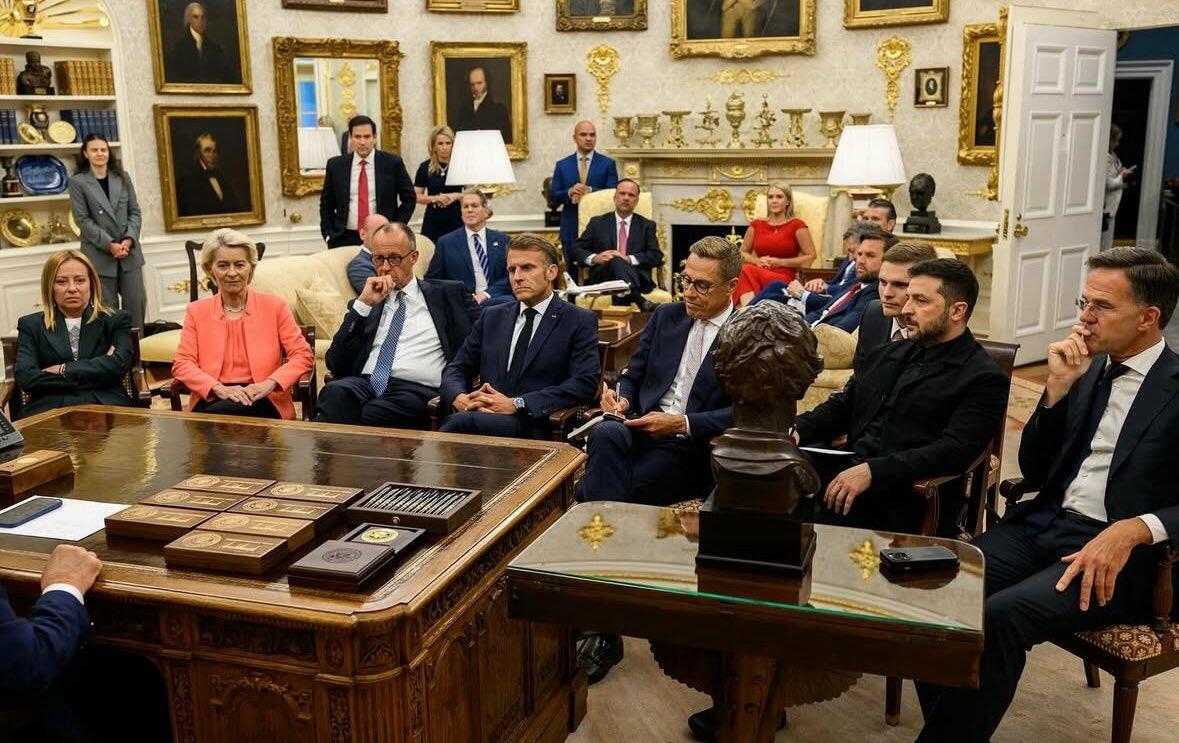
Vladimir Putin would likely see this as a significant victory because Russia does not currently control the entirety of the industrialised Donbas region where the need to ‘protect’ the Russian speaking population had been one of Putin’s professed cassus belli at the outbreak of the war.
For Ukraine’s part, Zelenskyy said that no “unacceptable decisions” were made yesterday. That could be interpreted as the Ukrainian leader grudgingly accepting that ceding territory to Russia is now an unfortunate fait accompli, or that Zelenskyy is still clinging to the more hairy-chested idea of “not one inch” of territory to be given up, because no formal agreement has been reached. I suspect it might be the former.
Of course, if security guarantees are to be provided the devil will be in the detail about who does the providing, with what, and paid for how. As our Global Strategist Michael Every implied in this note yesterday, Europe would like it to “still be the 1990s, please” with the USA shouldering the burden for all of the above. The Trump Administration – having won a sweeping electoral mandate by promising to end US military adventurism – will say it is Europe’s job to protect Europe, but that the USA would be happy to sell it the weapons required to do so. This is an argument that the US is winning and probably will win in the end.
The where to from here is a push by Trump to secure a bilateral meeting between Putin and Zelenskyy sometime in the next fortnight, to be followed by a trilateral meeting between Trump and the two other leaders after that. The EU, presumably, is set to be sidelined at that trilateral meeting despite the expectation that they will be writing the cheques for US arms and supplying the boots on the ground to enforce any security guarantees. As he pursues his ambition for a Nobel Peace Prize, Trump is playing poker with the house’s money and Ukraine’s land. EU pretentions to ‘strategic autonomy’ are once again exposed as an Emperor who has no clothes.
Elsewhere, Hamas has reportedly told Egyptian and Qatari mediators that it is willing to accept terms for a 60-day ceasefire in Gaza that would secure the release of half of the remaining Israeli hostages and include a surge of aid into the strip and Brazilian officials say that they are at an impasse with the United States over negotiations to reduce the punitive 50% tariff ostensibly applied in protest of the prosecution of former Brazilian President Bolsonaro.
The strategy by the Trump administration to employ carrots (in the case of Russia) and sticks (in the case of Russia, India, Brazil and Iran) against countries tempted to undermine US efforts to isolate China by deepening their own ties with the Middle Kingdom has been conspicuous. Consequently, the impasse with Brazil over the Bolsonaro prosecution perhaps only exists because the tariffs aren’t really related to Bolsonaro at all, but related to President Lula’s courting of closer ties with China. Similarly, the spurious fentanyl tariffs levied against Canada and Mexico probably have more to do with closing US land borders to transhipped Chinese goods than they do with the fentanyl figleaf, explaining why all of Mark Carney’s attempts to negotiate a better deal have mostly come to nought.
Speaking of figleafs, in Australia today a three-day productivity roundtable kicks off where the great and the good of Australian industry, bureaucracy and labor unions will gather to thrash out points of consensus on overdue economic reform. The day started with an address from Reserve Bank Governor Bullock – who recently told journalists in Sydney that productivity isn’t actually the RBA’s bailiwick – and the attendees will consider reform recommendations from Australia’s Productivity Commission – who the unions campaigned to abolish at the last election.
Meanwhile, the country’s largest steelmaker has said that energy-rich Australia’s gas is too expensive and a domestic reservation scheme needs to be implemented to protect manufacturing while the Prime Minister – whose party opposed a domestic gas reservation scheme at the recent election – continued to talk up the transition away from fossil fuels and towards renewables.
The Prime Minister used his own opening comments at the roundtable to suggest that GDP growth is not actually the be all and end all. That is just as well, because the central bank Governor also told journalists in Sydney that Australia’s productivity growth is sufficiently poor to ensure that there won’t actually be much GDP growth, unless something changes.
If all of this gives the impression that achieving reform consensus will be a bit like herding cats, it’s because it is. That is probably why Canberra has achieved little of substance on economic reform for the last 25 years.
7. OIL ISSUES/NATURAL GAS/ENERGY ISSUES/GLOBAL
8. EMERGING MARKETS//AUSTRALIA NEW ZEALAND ISSUES
SERBIA
“A Matter Of Days Before They Start Killing In The Open Streets”; Serbia President Decries Opposition Protests
Tuesday, Aug 19, 2025 – 05:00 AM
Serbian President Aleksandar Vučić said that the opposition’s protests have become so violent that it is “literally a matter of days before they start killing in the open streets.”
In response, he stated that the country’s leadership will make “surprising” decisions within a few days regarding tough actions against anti-government protesters after days of demonstrations that have turned violent.
“They’ve done everything else, all that’s left is for them to start killing. I’m not exaggerating, I’m saying it’s a matter of days for that to happen. It’s literally a matter of days for them to start killing in the open streets,” he stated.
The Serbian president also stated that “the violence is a sign of complete weakness” and promised to “punish the rioters.”
Vučić said his government will not back down against what he said was external pressure.
“We will resist external pressure and we will prevail,” he said.
According to the Serbian president, if there are no more decisive measures against the violence on the streets, the moment will come when someone will be killed.
Vučić called an emergency press conference for Sunday after more than nine months of anti-government protests in Belgrade, Novi Sad and Valjevo, sparked by the partial collapse of the Novi Sad railway station, which have turned increasingly violent in recent days. Protesters have clashed with members and supporters of the ruling Serbian Progressive Party (SNS) and police, and have set fire to the SNS party office.
The canopy of the Novi Sad railway station collapsed on Nov. 1 last year, killing 16 people. This sparked nationwide protests that continue to this day.
The demands from protesters included finding and holding accountable those responsible for the accident, as well as the publication of documents related to the renovation of the train station. They are also demanding the release of students and teachers detained during the protests, and increasing the budget for higher education by 20 percent. The government says the demands have already been met, making further protests unjustified.
The competent authorities have charged 16 people with negligence and endangerment, and the Novi Sad High Prosecutor’s Office has launched an investigation into suspicions of possible corruption during the renovation.
The railway station building, which was opened in 1964, was renovated in several waves in 2021-2022, and work continued last year. Minister of Construction Goran Vesic announced last July that the renovation was complete and the entire building could be used again.
The minister has since resigned, but said he does not consider himself responsible for the tragedy. However, the mayor of Novi Sad and the prime minister have accepted responsibility. Milan Djuric and Milos Vucevic announced their resignations at the end of January. The new prime minister and government were elected by parliament on April 16.
END
YOUR EARLY CURRENCY/GOLD AND SILVER PRICING/ASIAN CLOSING MARKETS AND EUROPEAN BOURSE OPENING AND CLOSING/ INTEREST RATE SETTINGS TUESDAY MORNING 6;30AM//OPENING AND CLOSING
EURO/USA: 1.1673 UP 0.0006 PTS OR 6 BASIS POINTS
USA/ YEN 147.72 DOWN 0.201 NOW TARGETS INTEREST RATE AT 1.00% AS IT WILL BUY UNLIMITED BONDS TO GETS TO THAT LEVEL…//YEN STILL FALLS//END OF YEN CARRY TRADE BEGINS AGAIN OCT 2024/Bank of Japan raises rates by .15% to 1.15..UEDA ENDS HIKING RATES AND NOW CARRY TRADES RE INVENTS ITSELF//
GBP/USA 1.3519 UP .0012 OR 12 BASIS PTS
USA/CAN DOLLAR: 1.3816 UP 0.0014 (CDN DOLLAR DOWN 14 BASIS PTS)
Last night Shanghai COMPOSITE DOWN 0.74 PTS OR 0.02%
Hang Seng CLOSED DOWN 53.95 PTS OR 0.21%
AUSTRALIA CLOSED UP 0.23%
// EUROPEAN BOURSE: ALL GREEN
Trading from Europe and ASIA
I) EUROPEAN BOURSES: ALL GREEN
2/ CHINESE BOURSES / :Hang SENG CLOSED DOWN 53.95 PTS OR 0.21%
/SHANGHAI CLOSED DOWN 0.74 PTS OR 0.02%
AUSTRALIA BOURSE CLOSED DOWN 0.76 %
(Nikkei (Japan) CLOSED DOWN 168.02 PTS OR 0.38%
INDIA’S SENSEX IN THE GREEN
Gold very early morning trading: 3338.20
silver:$38.03
USA dollar index early TUESDAY morning: 97.92 DOWN 11 BASIS POINTS FROM MONDAY’s CLOSE
TUESDAY MORNING NUMBERS ENDS
And now your closing TUESDAY NUMBERS 1: 30 AM
Portuguese 10 year bond yield: 3.147% down 3 in basis point(s) yield
JAPANESE BOND YIELD: +1.593% UP 0 FULL POINTS AND 10/100 BASIS POINTS /JAPAN losing control of its yield curve/
SPANISH 10 YR BOND YIELD: 3.316 DOWN 3 in basis points yield
ITALIAN 10 YR BOND YIELD 3.576 DOWN 2 points in basis points yield ./ THE ECB IS QE’ ING ITALIAN BONDS (BUYING ITALIAN BONDS/SELLING GERMAN BUNDS)
GERMAN 10 YR BOND YIELD: 2.7492 DOWN 3 BASIS PTS
IMPORTANT CURRENCY CLOSES : MID DAY TUESDAY
Closing currency crosses for day /USA DOLLAR INDEX/USA 10 YR BOND YIELD/1:00 PM
Euro/USA 1.1674 UP 0.0005 OR 5 basis points
USA/Japan: 147,68 DOWN 0.237 OR YEN IS UP 24 BASIS PTS//
Great Britain 10 YR RATE 4.7280 DOWN 2 BASIS POINTS //
Canadian dollar DOWN .0034 OR 34 BASIS pts to 1.3836
xxxxxxxxxxxxxxxxxxxxxxxxxxxxxxxxxxxxxxxxxxxxxxxxxxxxxxxxxxxxxxxxxxxxxxxxxxxxxxxx
The USA/Yuan CNY UP AT 7.1799 CNY ON SHORE ..
THE USA/YUAN OFFSHORE UP TO 7.1848
TURKISH LIRA: 40.88 EXTREMELY DANGEROUS LEVEL/DEATH WATCH/HYPERINFLATION TO BEGIN.//
the 10 yr Japanese bond yield at +1.593
Your closing 10 yr US bond yield DOWN 3 in basis points from MONDAY at 4.311% //trading well ABOVE the resistance level of 2.27-2.32%)
USA 30 yr bond yield 4.913 DOWN 3 in basis points /11:00 AM
USA 2 YR BOND YIELD: 3.746 DOWN 2 BASIS PTS.
GOLD AT 11;00 AM 3337.80
SILVER AT 11;00: 37.94
Your 11:00 AM bourses for Europe and the Dow along with the USA dollar index closing and interest rates: TUESDAY CLOSING TIME 11:00 AM//
London: CLOSED UP 31.48 PTS OR 0.34%
GERMAN DAX: UP 108.30 pts or 0.45%
FRANCE: CLOSED UP 95.03 pts or 1.21%
Spain IBEX CLOSED UP 52.10 pts or 0.34%
Italian MIB: CLOSED UP 379.50 or 0.89%
WTI Oil price 62.55 11.00 EST/
Brent Oil: 65,92 11:00 EST
USA /RUSSIAN ROUBLE /// AT: 80.89 ROUBLE DOWN 0 AND 20/ 100
CDN 10 YEAR RATE: 3.447 DOWN 4 BASIS PTS.
CDN 5 YEAR RATE: 2.967 DOWN 4 BASIS PTS
CLOSING NUMBERS: 4 PM
Euro vs USA 1.16644 DOWN 0.0023 OR 23 BASIS POINTS//
British Pound: 1.3484 DOWN .0023 OR 23 basis pts/
BRITISH 10 YR GILT BOND YIELD: 4.7190 DOWN 3 FULL BASIS PTS//
JAPAN 10 YR YIELD: 1.592 UP 1.1 FULL BASIS PT
USA dollar vs Japanese Yen: 147.47 DOWN 0.444 BASIS PTS
USA dollar vs Canadian dollar: 1.3865 UP 0.0062 BASIS PTS// CDN DOLLAR UP 4 BASIS PTS
West Texas intermediate oil: 62.48
Brent OIL: 65.95
USA 10 yr bond yield DOWN 4 BASIS pts to 4.302
USA 30 yr bond yield DOWN 4 PTS to 4.902%
USA 2 YR BOND: DOWN 2 PTS AT 3.754%
CDN 10 YR RATE 3.441 DOWN 5 BASIS PTS
CDN 5 YEAR RATE: 2.964 DOWN 5 BASIS PTS
USA dollar index: 98.13 UP 10 BASIS POINTS
USA DOLLAR VS TURKISH LIRA: 40.89 GETTING QUITE CLOSE TO BLOWING UP/
USA DOLLAR VS RUSSIA//// ROUBLE: 80.94 DOWN 0 AND 69/100 roubles //
GOLD $3317.20 (3:30 PM)
SILVER: 37.29 (3:30 PM)
DOW JONES INDUSTRIAL AVERAGE: UP 10.37 OR .024%
NASDAQ 100 DOWN 329.99 PTS OR 1.39%
VOLATILITY INDEX: 15.66 DOWN 0.67 OR 4.47%
GLD: $ 305.27 DOWN 1.68 PTS OR 0.55%
SLV/ $33.87 DOWN 0.68 PTS OR OR 0.34%
TORONTO STOCK INDEX// TSX INDEX: CLOSED DOWN 93.90 PTS OR 0.34%
end
TRADING today ZEROHEDGE 4 PM: HEADLINE NEWS/TRADING
‘Sell All The Things’… Except Bonds
Tuesday, Aug 19, 2025 – 08:00 PM
A good, bad, and ugly day in the markets depending on where you sit today…

- Good: Housing Starts exploded higher (for renter nation as home-buyer affordability remains at record lows); and Hedge Funds had a yuuge winning day (as their favorite shorts were dumped).
- Bad: Building Permits puked (as the supply of homes for sales surges); Gold & Crypto traders suffered some pain as expectations for Powell’s speech on Friday started to lean a little more hawkish
- Ugly: Meme stock, Mag7, and Momentum traders were clubbed like a baby seal today (with momo longs monkeyhammered most)
But, apart from that, everything is awesome!
All the US Majors were lower today, led by Nasdaq with The Dow scrambling back to unch by the close…

The Dow has outperformed Nasdaq for 4 of the last 5 days

Source: Bloomberg
Mag7 stocks are down hard for the last 5 days as the S&P 493 is flat…

Source: Bloomberg
‘Most Shorted’ Stocks plunged…

Source: Bloomberg
Which helped drive the best day for hedge funds since the Liberation Day pause rip (as their shorts massively outperformed)…

Source: Bloomberg
Meme stocks tested the July highs and then plunged intraday…

Source: Bloomberg
Momentum stocks were monkeyhammered lower again…

Source: Bloomberg
make or break moment for high beta momentum. trapdoor here and it gets ugly. pic.twitter.com/CaPSpW5khy
— zerohedge (@zerohedge) August 19, 2025
With the momo longs really getting slammed (far outpacing the gains from the momo shorts today)…

Source: Bloomberg
VIX pushed higher ahead of tomorrow’s OpEx…

Source: Bloomberg
With Jackson Hole and NVDA’s earnings the standouts looming on the vol horizon…

Source: Bloomberg
The dollar roller-coastered today to end higher, selling off overnight and bid during the US session. However, the dollar has been very rangebound since puking on the piss-poor-payrolls-print…

Source: Bloomberg
Bonds followed a similar trajectory, rallying during the US session (extending modest gains from the European session) with yields down, erasing yesterday’s selling during the US session…

Source: Bloomberg
Gold was sold for the 4th day in a row, breaking down below its 50DMA and testing its 100DMA…

Source: Bloomberg
Crypto did not escape the momentum massacre with Bitcoin battered down to near 3-week lows ($113k)…

Source: Bloomberg
…breaking below its 50DMA for the first time since June

Source: Bloomberg
Finally, with the world and his pet rabbit waiting on every word that Powell has to say on Friday, we see stocks and rate-cut expectations decouple significantly…

Source: Bloomberg
Meanwhile, as S&P affirms its USA sovereign rating, we couldn’t help but laugh a little at the timing of Moody’s downgrade….

Source: Bloomberg
…and the fact that S&P’s affirmation was driven in part by tariff revenues (when Moody’s cited ‘tariffs’ as one of the drivers of its downgrade). Nailed It!!
USA DATA RELEASES
They are building for renters but single family units fall. Permits plunge
(zerohedge)
Renter Nation Returns: Multi-Family Unit Starts Hit 2 Year Highs But Permits Plunge
Tuesday, Aug 19, 2025 – 08:42 AM
On the heels of homebuilder sentiment hitting COVID lockdown lows…
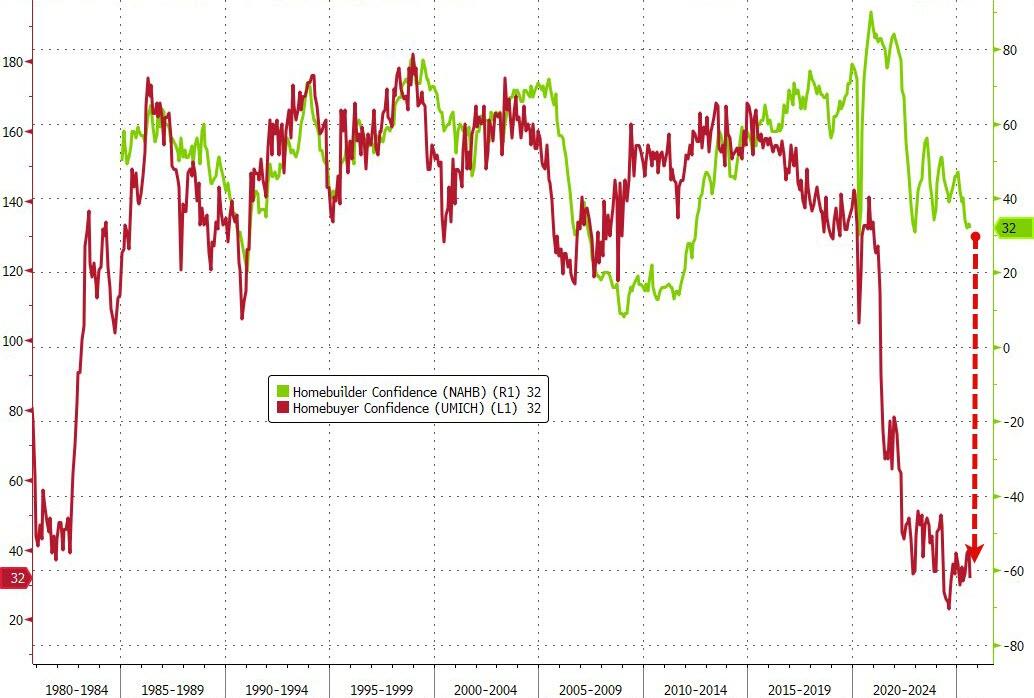
Source: Bloomberg
…US housing starts and permits data was mixed in July with Starts surging 5.2% MoM (far better than expected and following an upwardly revised 5.9% MoM jump in June). However, Building Permits disappointed, dropping 2.8% MoM (vs 0.5% MoM decline expected)…
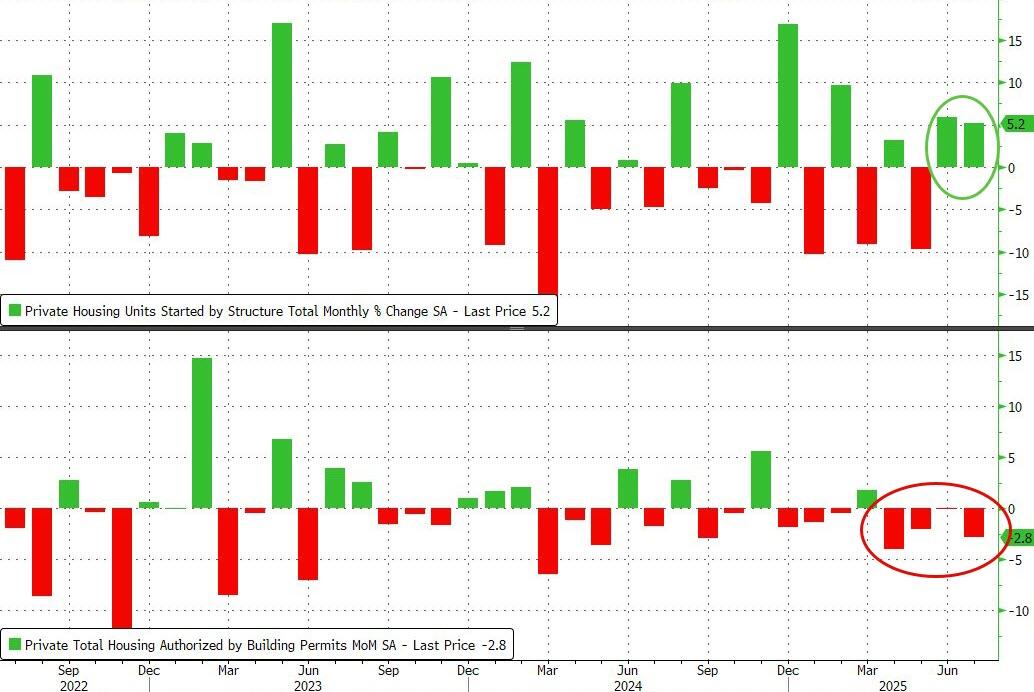
Source: Bloomberg
This is the fourth month in a row of declining building permits (the most forward-looking indicator for the US housing market), now at its lowest since the COVID lockdowns…
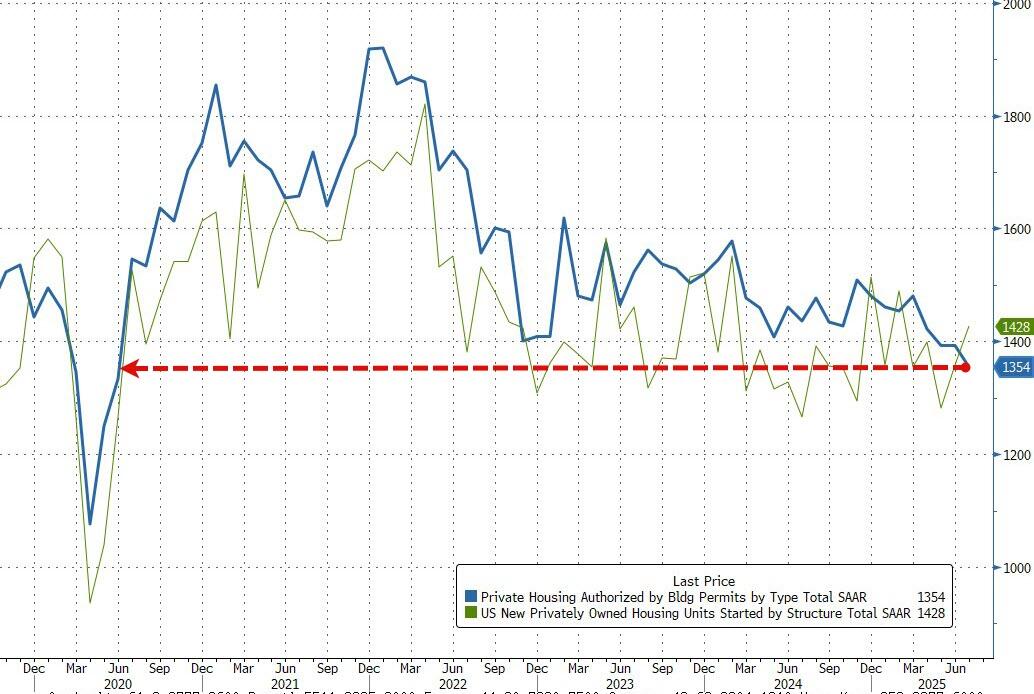
Source: Bloomberg
The decline in Permits was dominated by multi-family units (down 9.9% MoM) while Housing Starts saw multi-family units jump 11.6% MoM in July (after surging 34.5% MoM in June)…
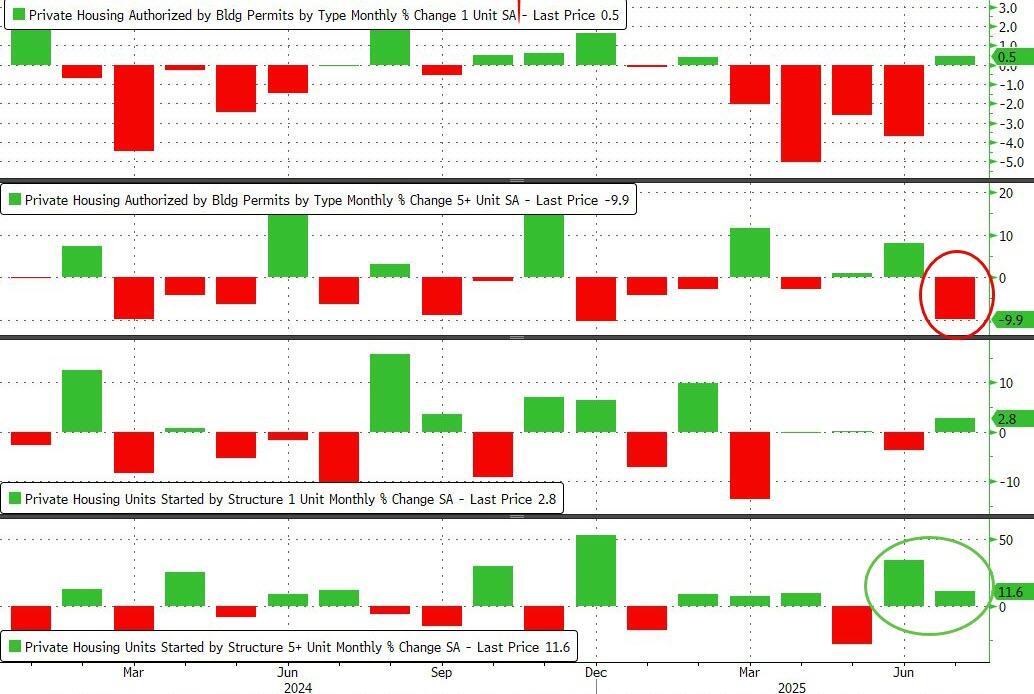
Source: Bloomberg
The number of multi-family unit starts is at the highest since June 2023…
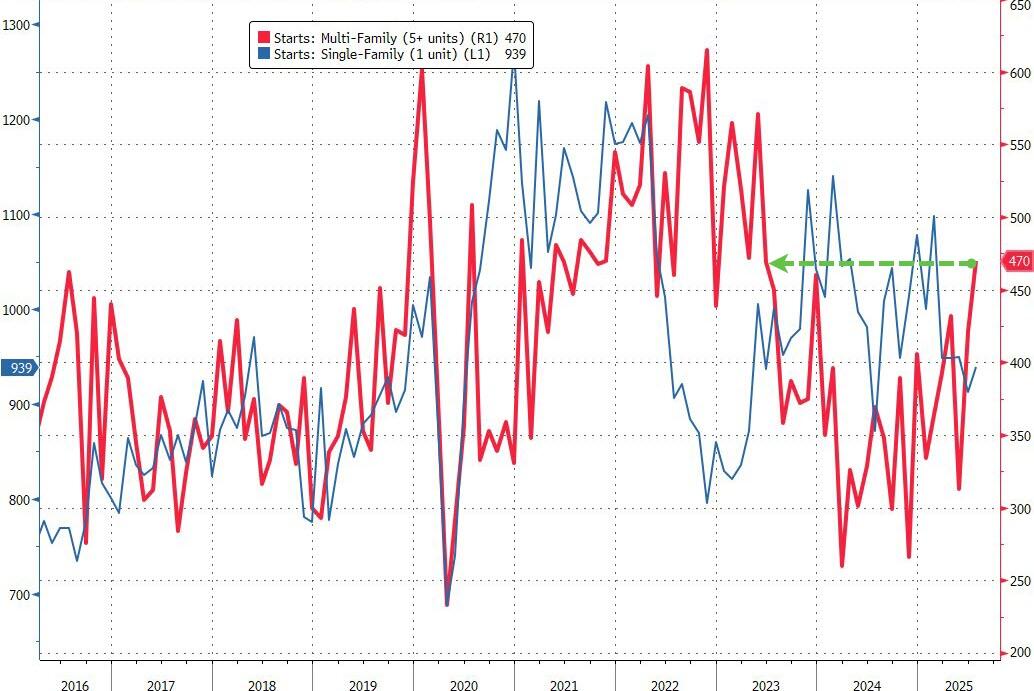
Source: Bloomberg
But, and it’s a big but, there is a big housing problem: US home construction pipeline is hopelessly clogged up, with completions crashing to 3 year low as builders prefer to hold off completing current units rather than go to market now, as they expect even higher prices.
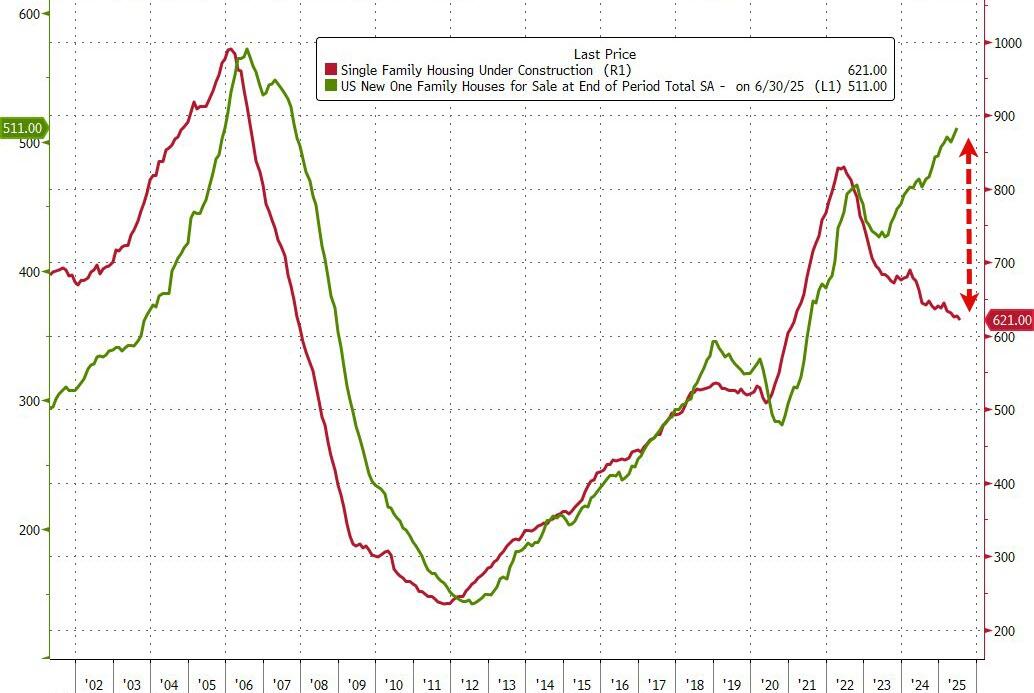
Source: Bloomberg
Cartel behavior to limit supply? Or did the deportation of all those illegals leave the country without anyone who knows how to build a house?
The question we have for the new guy at the BLS is simple – if housing construction is crashing, why aren’t construction jobs?
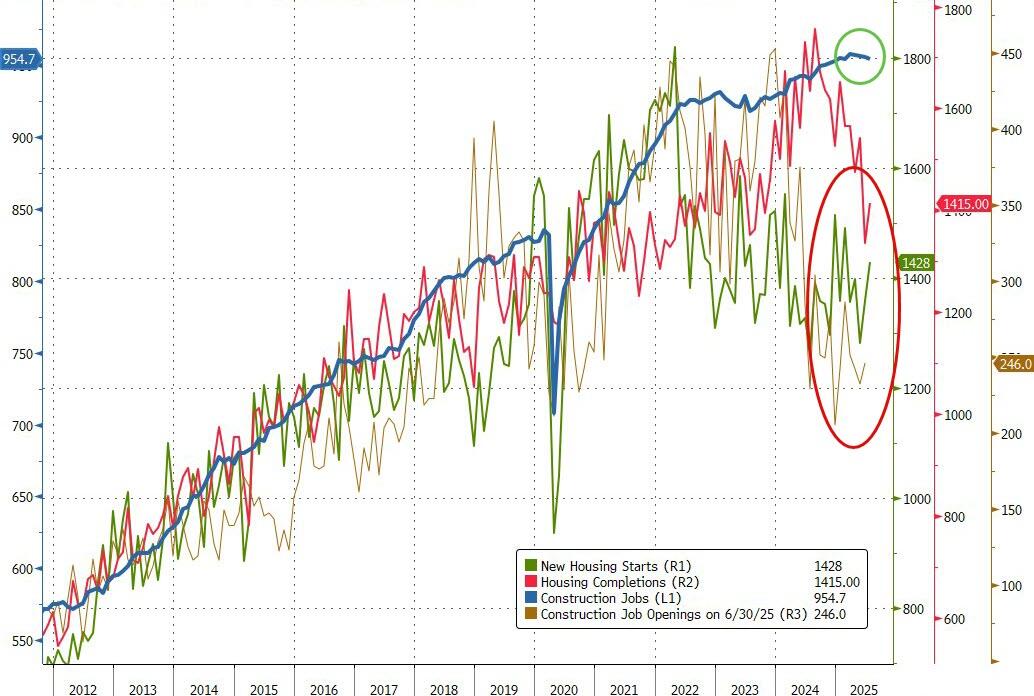
Source: Bloomberg
It appears Renter Nation is back and home (buying) affordability remains at historically lows
Will lower Fed Fund rates do anything to lower mortgage rates? Or will the implied curve steepening further crush affordability? Dear Mr. Trump, be careful what you wish for.
USA ECONOMIC NEWS
Explosion Rocks Cargo Ship Departing Baltimore Harbor
Monday, Aug 18, 2025 – 08:37 PM
An explosion has been reported on a cargo ship traveling through the outbound shipping lane of Baltimore’s Inner Harbor near the collapsed Francis Scott Key Bridge.
According to shipping expert Sal Mercogliano, the cargo ship MV W Sapphire “suffered an explosion in its forward hold” and was “fully loaded” at the time of the incident.
Mercogliano said the W Sapphire “had just departed from the CSX Curtis Bay coal piers in Baltimore” and suggested “this may have been a coal explosion in the forward hold.”
Shipping expert John Konrad notes, “Coal can create methane and is subject to self-heating and liquefication. Bulkers can explode…”
Baltimore City Fire spokesperson John Marsh told local station WBAL-TV that the explosion occurred around 6:28 p.m. local time. No details were provided about the source of the blast.
*Developing…
END
The Art Of The Tariff
Tuesday, Aug 19, 2025 – 06:30 AM
Authored by Michael Talbott via BondVigilantes.com,
Tariff headlines are designed to provoke and grab attention, with striking percentages quoted that appear to signal President Trump’s latest stance, framing the narrative around which country stands to win, and which to lose.
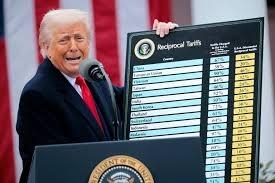
But the reality is far more nuanced than what a headline number suggests. Recently, we’ve seen that tariffs are driven not just by economic considerations, but increasingly by political motives
In this blog, I want to show why headline numbers can be misleading by highlighting the differences between two particular countries, Brazil and Vietnam, with both appearing to be on the opposite ends of the tariff spectrum. On paper, Brazil faces a 50% tariff on its exports to the US, while Vietnam faces just 20% after agreeing a trade deal with the US. By looking at headline numbers alone, you may be forgiven for concluding that Brazil’s economy is going to be worse hit than Vietnam’s, but once you dig into the finer details, and think about why these tariffs are in place, the conclusion is worlds apart.
When Trump first rolled out tariffs on Liberation Day, the logic was simple, albeit slightly misguided: target countries with big trade surpluses with the US i.e. target countries that exports more than it imports from the US. Based on this approach, Brazil faced the minimum 10% due to the fact they run a trade deficit with the US, whilst Vietnam received a level of 44% reflecting their large trade surplus with the US. So far so good. But in today’s environment, a mere four months post Liberation Day, the story is very different. This reversal reflects the changing scope of the tariffs from an economic tool, to a political tool designed to shape sovereign issues overseas.
The table below provides some examples of how much tariff levels have changed between Liberation Day and now. We can see that Brazil and India stand out as having received increasing levels and we know that these have been politically driven. India for their continued purchase of Russian oil, and Brazil for reasons we will discuss a little later. For those that have seen decreases, the driver has been agreeing trade deals with the US administration.
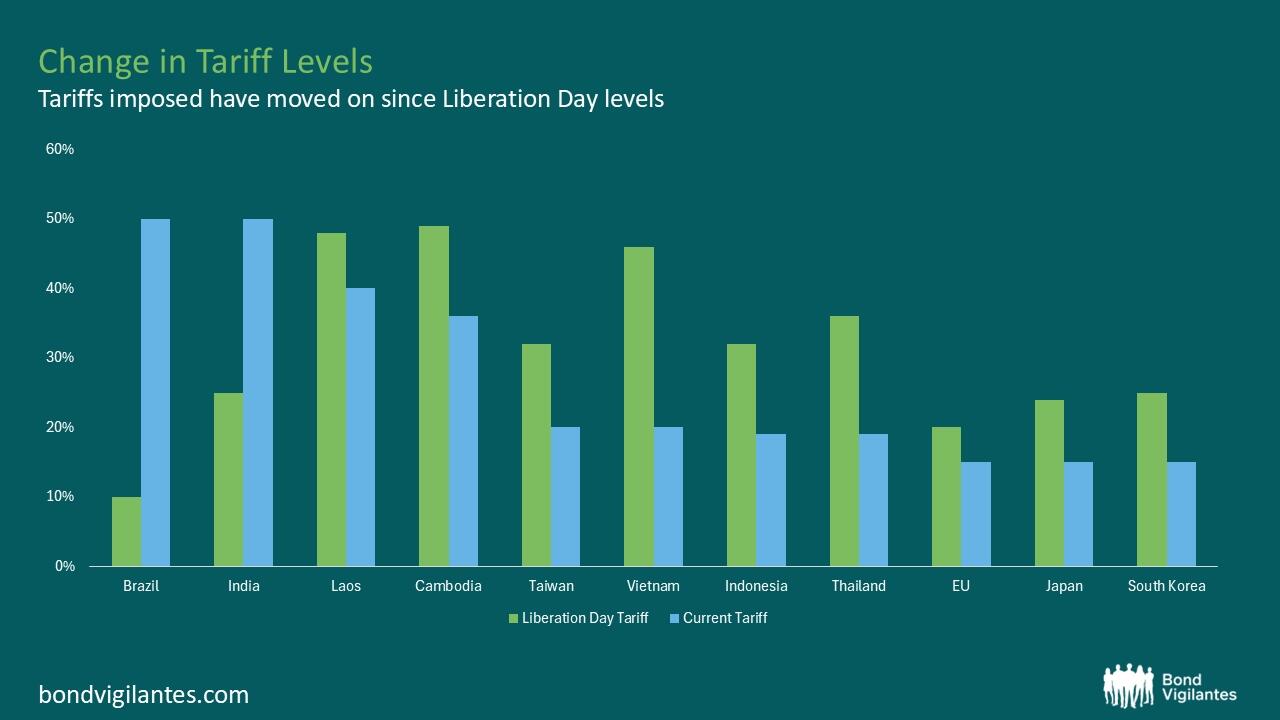
Source: M&G, Bloomberg, as 12 August 2025. Stated tariff levels may vary across goods.
The more recent escalation for Brazil came after former president Jair Bolsonaro was indicted for allegedly plotting a coup d’état to overturn the 2022 election, which he lost to Luiz Inácio Lula da Silva.
Prosecutors accused Bolsonaro and his allies of planning to nullify the election results with the charges being accepted by Brazil’s Supreme Court in early 2025, and the US response was swift: tariffs as a political weapon to support one of his closest allies in Bolsonaro. This isn’t new territory for Trump. He has long seen tariffs as a tool for leverage, but the speed and severity of this move underscores how far trade policy has drifted.
However, despite the headline-grabbing 50% tariff, the economic impact on Brazil is relatively muted. The US is not a major trading partner for Brazil, accounting for less than 10% of Brazil’s total exports. In fact, Brazil is one of the more closed-off economies when looking at major emerging markets. Moreover, most of Brazil’s high-value exports to the US, such as energy products, aircraft, and industrial materials, are exempt from the steep tariff and remain at 10%. The 50% rate mainly hits agricultural goods like coffee and beef, which, while symbolic, represent a smaller share of Brazil’s overall trade portfolio. And so, in practice, the tariff is more political theatre than it is an economic headwind for Brazil. And for this reason, it may be very unlikely to expect Lula to yield.
Vietnam, on the other hand, is far more exposed. The US is Vietnam’s single largest export market, absorbing roughly 30% of its total exports, primarily in electronics, textiles, and furniture. Even after the recent trade deal that capped tariffs at 20% (down from a threatened 44%), the hit is significant because Vietnam’s economy is deeply dependent on US demand. Add to that the complexity of transshipment rules, which impose 40% tariffs on goods suspected of being Chinese-origin, and compliance costs rise sharply. For Vietnam, this isn’t just a headline; it’s a structural challenge that will weigh on the economy.
The vulnerability gap becomes even clearer when you look at trade balances. Since 2018, Vietnam’s surplus with the US has ballooned, a direct consequence of supply chains shifting during the US-China trade war in 2018-19. Brazil, by contrast, has maintained its steady deficit.
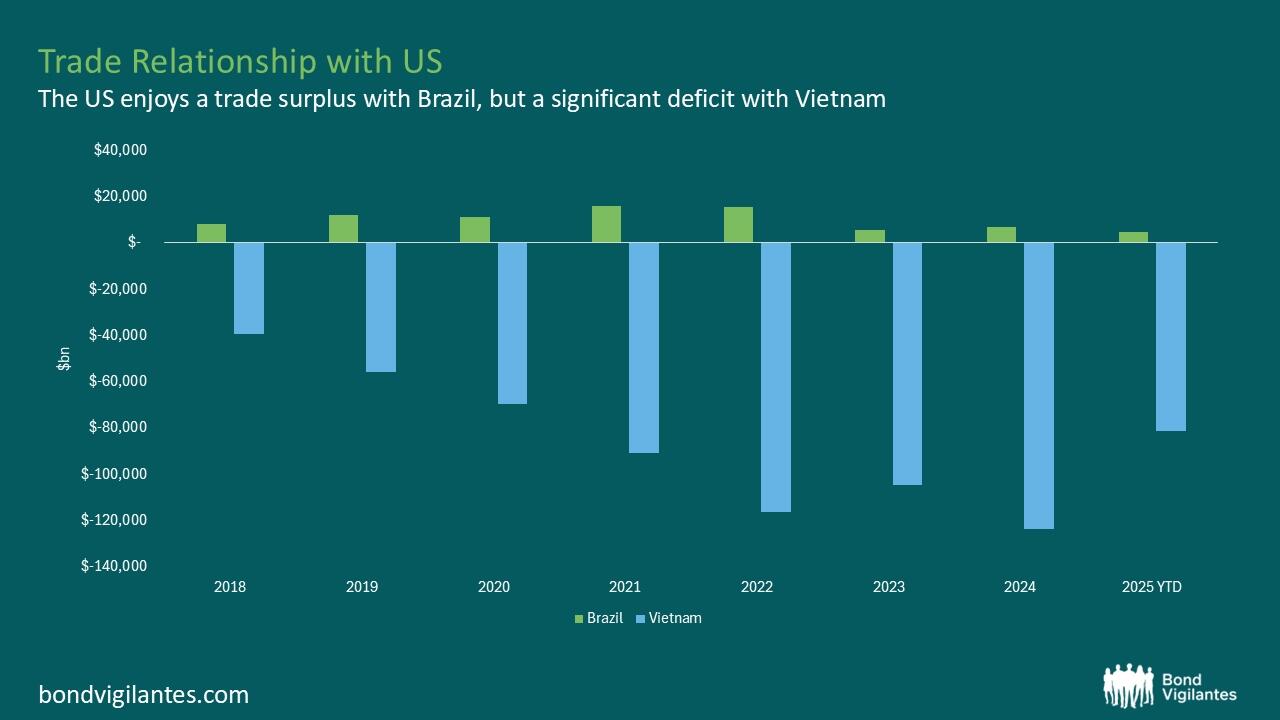
Source: M&G, Bloomberg, US Census as at 31 July 2025
And in the face of these varying vulnerabilities, what are the markets telling us? The cost of buying insurance on Vietnamese and Brazilian debt has fallen year-to-date, but more so for Brazil. During the same period the Brazilian real has strengthened against the dollar by c.14.5%, while the Vietnamese dong has weakened c.3%. Now, currencies and credit spreads are influenced by a whole host of factors, so it would be wrong to claim these moves are entirely a direct reflection of tariffs. But markets are a good barometer of stress, and if there were genuine fears about Brazil’s economy after the tariff hike, we could expect to see it in FX or credit pricing… but we don’t.
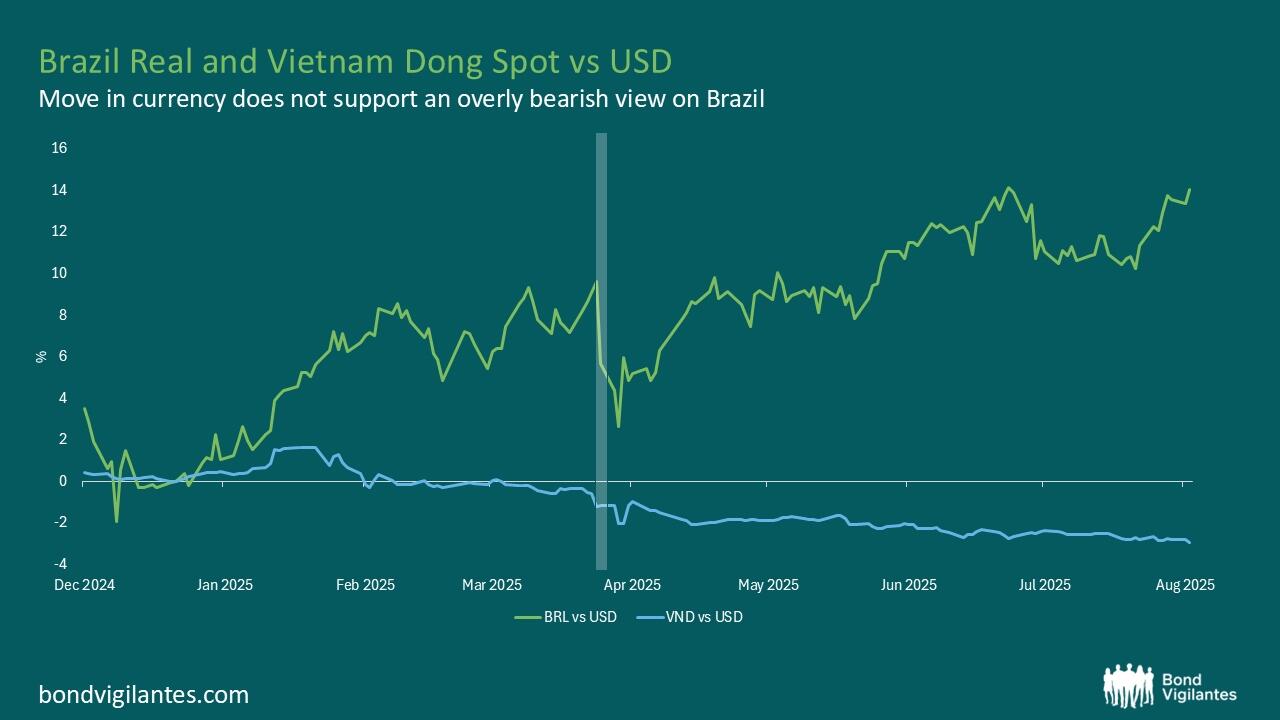
Source: M&G, Bloomberg, as 12 August 2025. Shaded area denotes Liberation Day announcement.
And so what we can conclude is that whilst tariffs may dominate headlines, they rarely capture the full picture.
Brazil and Vietnam offer an example of how the surface-level numbers obscure the economic impact. As we’ve seen, Brazil’s steep tariff hike is more about political signalling than economic punishment, while Vietnam’s seemingly lighter burden carries far heavier consequences due to its structural reliance on US trade. It would also seem that markets appear to understand this nuance better than the headlines do.
As we’re finding in today’s politically charged environment, whereby US trade policy is increasingly moving away from economic basis, it’s not enough to track the numbers, we need to understand the fine print that will determine the overall impact. Only then can we separate the noise from the signal.
end
NEW YORK/CHICAGO
New Yorkers: Pay Attention To What’s Happening In Chicago
Tuesday, Aug 19, 2025 – 08:55 AM
Authored by Daniel Idfresne , Micky Horstman via RealClearPolitics,
Zohran Mamdani attributes his Democratic nomination for New York City mayor to the confidence he has inspired in younger voters.

“I’ve been heartened in many of my conversations with older New Yorkers, who’ve told me they were introduced to the campaign by their son or their daughter,” Mamdani quipped. “I think it’s indicative of a new generation of leadership.”
His social media-savvy campaign promises to make NYC affordable and pursue social justice.
We get the appeal as Gen Zers – the generation who led Mamdani to triumph over Cuomo in the primary. We’re part of the most housing-burdened generation, and increasingly reliant on public transit.
But young voters shouldn’t be fooled by Mamdani’s vision. These lofty promises aren’t new. After all, Chicago Mayor Brandon Johnson has battle-tested Mamdani’s proposed solutions to housing, crime, and public transit – and failed to deliver a safer, more affordable city.
In 2023, Johnson campaigned on building affordable housing and enacting rent stabilization laws. Yet, Chicago experienced the highest annual rent hike compared to other metro areas, at 5.9%. And what about Johnson’s promise to build affordable units? Chicago spent $300 million in government subsidies with only 500 new units to show for it.
After failing to pass his more progressive policies, Johnson recently adopted proven, free-market solutions to combat rising housing costs, such as eliminating parking requirements near public transportation stops and cutting government red tape.
Mamdani should be championing his pro-growth solutions, but instead his leading proposal is $100 billion in taxpayer funds to create 200,000 housing units over the next decade. New Yorkers should be skeptical: If Chicago couldn’t muster at least 500 units after burning $300 million in subsidies, why would NYC fare differently?
Mamdani also proposes to freeze rent for rent-stabilized apartments. This tried-and-failed approach to affordability will lead to more vacancies, deteriorate housing quality, and create a spill-over demand in market-rate apartments.
Our Gen Z peers are now opting for Austin, Raleigh, and Baltimore for lower housing costs.
Mamdani’s vision to create a “Department of Community Safety” instead of empowering the NYPD isn’t “new leadership” either. Johnson enacted similar boutique police reforms during his tenure with dismal results.
The former teachers’ union lobbyist opted to override the City Council and terminate the Chicago police-approved ShotSpotter – a gunshot detection system – for more “holistic” solutions. He stripped police officers from schools to end the “school-to-prison pipeline” and eliminated over 2000 police positions.
The city leads America in homicides and mass shootings despite crime rates falling nationwide. Chicagoans have moved on from solving the “root problems” of crime, and now rank it as the preeminent issue facing the city. They voted out the progressive, “soft on crime” state’s attorney, and have expressed support for more police, not less.
New Yorkers agree with Chicagoans – they support more policing – but Mamdani’s proposed reforms are still rooted in these luxury beliefs. He argued that social workers, not the NYPD, should respond to domestic violence calls. He called for defunding the police in 2020. Mamdani may have walked back his rhetoric, but his $1.1 billion proposal rests on the same assumptions that guided Johnson’s failures.
If you thought the subway was overrun with crime and homelessness, just wait until New York State follows through with Mamdani’s plan to make buses fare-free.
Riders on the Chicago Transit Authority have seen dramatic scheduling delays since the pandemic, and homelessness, smoking, and crime dominate train cars. Ridership recovery lags behind other major cities. This decline has added up to a deficit of over $500 million. The NYC Metropolitan Transit Authority faces a similar crisis: a projected $900 million deficit.
Unlike us, Mamdani and Johnson aren’t transit users. They don’t rely on clean, well-managed trains to get to work. They get the privilege of casting societal failures on transit, when everyday riders just want to get home quickly and safely. Instead of relying on the state to bail out the struggling systems, riders in New York and Chicago would benefit from a thorough police presence that enforces fares and prevents anti-social behavior. Instead, Johnson and Mamdani’s solution is to put social workers on the trains.
Chicago’s rejection of Johnson’s progressive policies should have inspired a course correction. Instead, Johnson advised Mamdani to double down.
“What has happened historically, particularly for candidates like myself or even Mamdani, when we win, sometimes the movement doesn’t always show up after the win, right? So, we just have to stay committed as progressives to our values, and even when it gets bumpy a little bit, it doesn’t mean that we’re doing everything wrong.”
Young New Yorkers should pay attention. Like many of our peers, we want safe, affordable cities. But, Chicago’s experiment in progressive governance is already unraveling – and New Yorkers should think twice before importing the same failed blueprint.
Daniel Idfresne is a student at Syracuse University, a Young Voices writer, and a former intern for “The Story with Martha MacCallum.” Find him on Instagram and X.
Micky Horstman is the communications associate for the Illinois Policy Institute and a social mobility fellow for Young Voices.
Retail Chasing, Pros Fading, Crypto Wobbles, Edge to Hedge

Monday, Aug 18, 2025 – 22:30
Dumb beats smart
Retail punters continue to buy equities, while “pros” remain watching…

Source: GS
Crypto trying to tell us something?
ETH has been the poster child of the panic to buy “stuff” in recent weeks. The crypto “caught” up to NDX, but is down substantially from recent highs.

Source: LSEG Workspace
and BTC…
BTC and NASDAQ have moved in close tandem this entire year. BTC trying to tell us something about the general risk mood? Short term gap getting rather wide.

Source: LSEG Workspace
Edge to Hedge
QQQ 1-month implied vol just hit a YTD low and is nearing multi-year lows. More on this theme here.
GS options desk: “We see immense value in owning hedges thru the rest of summer”

Source: GS deriv
VVIX not buying it
The short term gap between VVIX and VIX is getting rather wide. Do not underestimate the VVIX…

Source: LSEG Workspace
RTY revisions overtake NDX
RTY earnings revisions have continued to strengthen through the 2Q reporting season. While SPX earnings revisions have been phenomenal, we think it’s notable that: 1) the RTY 2FY EPS revision ratio broke out above 1 for the first time in 3Y and 2) it’s better than the NDX’s for the first time in years as well. Given small cap earnings tend to tail (there’s still 20% of that index yet to report), there’s also room for further improvement. To us, this suggests that an approx. Recessionary relative value for the index is overly punitive.

Source: Jefferies
Past peak negativity for small caps
“Regarding price action & sentiment, we do have one positive data point. We ran the relative fund flows (active & passive) for US small caps vs. large caps and found that we may have seen peak ugliness this cycle. And what an ugliness it was. The relative flows (on a % of AUM basis) hit -4.4%, the worst level since 4Q08, but have subsequently lessened. Although small has continued to outflow with some consistency, we do call out that it slowed to just -$21M on the latest week’s data.” More on Russell here.

Source: Jefferies
Long
“Trend followers, regardless of model speed, are stretched long S&P 500 and NASDAQ- 100 futures. However, due to volatility levels, some trend followers may still have a slightly smaller S&P 500 long position than they did in Feb-25 and much of 2024. In contrast, the NASDAQ-100 long is near February levels. Positioning in both markets can still increase further on declines in realized volatility, while only a sharp reversal (3% to 4%) could trigger unwinds”. (BofA)

Source: BofA
Leveraged tech mania
Massive growth in leveraged NDX ETF strategies. Never forget, this works both ways…

Source: BofA
Awaiting the Giant
Afraid of NVDA heights?
Long into earnings hasn’t been only great….

Source: JPM
Overshooting?
NVDA stock vs NVDA sales.

Source: JPM/Bloomberg
VICTOR DAVIS HANSON:
USA NEWS/ANTISEMITISM
KING NEWs
| The King Report August 19, 2025 Issue 7558 | Independent View of the News |
| ESUs opened moderately lower on Sunday night but quickly rallied. ESUs hit a daily high of 6484.25 at 21:47 ET and then rolled over. After 23:30 ET, ESUs headed south and hit a daily low of 6456.00 at 5:26 ET. ESUs then plodded higher until they vacillated wildly after the NYSE opening. The usual buyers on or near the NYSE were repeatedly stymied by sellers. ESUs broke lower at 12:41 ET. After hitting 6457.25 at 12:48 ET, ESUs jumped to 6474.25 at 13:31 ET. Sellers resurfaced; ESUs dropped to 6460.00 at 14:18 ET. A jagged A-B-C rally lifted ESUs to 6474.50 at 15:54 ET. Alas, too many traders were long; ESUs fell to 6467.75 at 16:00 ET. Monday was an excruciatingly boring session. Tuesday might not be much better as traders wait for Powell’s tres important speech on Friday at Jackson Hole. Positive aspects of previous session The DJTA posted a 13.90-point gain. The dollar rallied modestly. Negative aspects of previous session All major equity indices, ex-the DJTA posted modest declines. USUs were -6/32 at the NYSE close. Action was extremely listless. Ambiguous aspects of previous session What will Powell and his cohorts say at Jackson Hole? First Hour/Last Hour Action [S&P 500 Index]: 1st Hour from NYSE Open: Up; Last Hour: Down Pivot Point for S&P 500 Index [above/below indicates daily trend to traders]: 6447.40 Previous session S&P 500 Index High/Low: 6455.35; 6437.60 Fox: Ahead of Trump meeting, Zelenskyy says it would be ‘impossible to give up territory’ to Russia @GlobalMktObserv: The US government is spending like a drunken sailor: US federal government expenditures have reached nearly $600 BILLION each month over the last 6 months. In July, the government spent $630 billion, up 9.7% from the $574 billion in the prior year. https://x.com/GlobalMktObserv/status/1957480109025251527 The US Debt Crisis is getting WORSE: The US budget deficit hit $291 BILLION in July, the 2nd-biggest for any July EVER. After 10 months of Fiscal Year 2025, the budget gap reached MIND-BLOWING $1.63 trillion, the 3rd-largest deficit in history. https://x.com/GlobalMktObserv/status/1957491240351514844 Today – Despite the upward bias of the Monday Rally, the post-expiry bounce, and Jackson Hole Week, stocks declined modestly, and activity was extremely boring/listless. It appears that traders are waiting for Powell’s address on Friday at Jackson Hole, and many are absent due to back-to-school obligations. Expected Economic Data: July Housing Starts 1.3m, Permits 1.387m; Fed Gov Bowman 14:10 ET ESUs are +1.00; NQUs are +1.25 (trading is listless); AU is +4.60; & USUs are +3/32 at 20:16 ET. S&P Index 50-day MA: 6138; 100-day MA: 5931; 150-day MA: 5925; 200-day MA: 5932 DJIA 50-day MA: 43,973; 100-day MA: 42,513; 150-day MA: 42,816; 200-day MA: 42,973 (Green is positive slope; Red is negative slope) S&P 500 Index (6449.15 close) – BBG trading model Trender and MACD for key time frames Monthly: Trender and MACD are positive – a close below 5447.29 triggers a sell signal Weekly: Trender and MACD are positive – a close below 6111.64 triggers a sell signal Daily: Trender and MACD are positive – a close below 6436.88 triggers a sell signal Hourly: Trender is positive; MACD is negative – a close below 6435.20 triggers a sell signal @realDonaldTrump: I am going to lead a movement to get rid of MAIL-IN BALLOTS, and also, while we’re at it, Highly “Inaccurate,” Very Expensive, and Seriously Controversial VOTING MACHINES, which cost Ten Times more than accurate and sophisticated Watermark Paper, which is faster, and leaves NO DOUBT, at the end of the evening, as to who WON, and who LOST, the Election. We are now the only Country in the World that uses Mail-In Voting. All others gave it up because of the MASSIVE VOTER FRAUD ENCOUNTERED. WE WILL BEGIN THIS EFFORT, WHICH WILL BE STRONGLY OPPOSED BY THE DEMOCRATS BECAUSE THEY CHEAT AT LEVELS NEVER SEEN BEFORE, by signing an EXECUTIVE ORDER to help bring HONESTY to the 2026 Midterm Elections. Remember, the States are merely an “agent” for the Federal Government in counting and tabulating the votes. They must do what the Federal Government, as represented by the President of the United States, tells them, FOR THE GOOD OF OUR COUNTRY, to do… Democrats are virtually Unelectable without using this completely disproven Mail-In SCAM. ELECTIONS CAN NEVER BE HONEST WITH MAIL IN BALLOTS/VOTING… https://x.com/GenFlynn/status/1957452084149731385/photo/1 @DHSgov: Three innocent people were killed in Florida because Gavin Newsom’s California DMV issued an illegal alien a Commercial Driver’s License—this state of governance is asinine. How many more innocent people have to die before Gavin Newsom stops playing games with the safety of the American public? We pray for the victims and their families. Secretary Noem and DHS are working around the clock to protect the public and get these criminal illegal aliens out of America. @CollinRugg: The truck driver who made an illegal U-turn on Florida’s Turnpike that led to the passing of 3 Americans, illegally entered the U.S. through the southern border in 2018. Harjinder Singh has been charged with three counts of vehicular homic*de. Singh got his Commercial Driver’s License in the state of California, according to the Florida Department of Highway Safety and Motor Vehicles… https://x.com/CollinRugg/status/1957113892284617073 Moped-riding perp shot dead after pulling gun on NYPD cop during robbery was an illegal migrant involved in three other thefts https://trib.al/6CQ5534 MSNBC gets mercilessly mocked over new MS NOW name: ‘Most Surely No One Watching’ https://trib.al/Hlno7Z2 | |
SWAMP STORIES FOR YOU TONIGHT
GREG HUNTER
SEE YOU TOMORROW


 harveyorganblog.com


