XXXXXXXXXXXXXXXXXXXXXXXXXXXXXXXXXXXXXXXXXXXXXXXXXX
072 C GOLDMAN 22
072 H GOLDMAN 5
092 C DEUTSCHE BANK 997
118 C MACQUARIE FUTURES US 346
118 H MACQUARIE FUTURES US 2446
132 C SG AMERICAS 92
167 H MAREX 18
190 H BMO CAPITAL MARKETS 7740
323 C HSBC 1338 183
332 H STANDARD CHARTERED B 1399
363 H WELLS FARGO SECURITI 122
435 H SCOTIA CAPITAL (USA) 3045
555 C BNP PARIBAS SEC CORP 224
624 C BOFA SECURITIES 6
657 C MORGAN STANLEY 3
657 H MORGAN STANLEY 816
661 C JP MORGAN SECURITIES 11656 10107
686 C STONEX FINANCIAL INC 112
690 C ABN AMRO CLR USA LLC 43
709 C BARCLAYS 283
732 C RBC CAP MARKETS 172
732 H RBC CAP MARKETS 707
DLV615-T CME CLEARING
BUSINESS DATE: 09/29/2025 DAILY DELIVERY NOTICES RUN DATE: 09/29/2025
PRODUCT GROUP: METALS RUN TIME: 22:02:03
880 C CITIGROUP 200 115
880 H CITIGROUP 300
905 C ADM 18 1
GOLD: NUMBER OF NOTICES FILED FOR OCT/2025: 21,258 CONTRACTs NOTICES FOR 2,125,088 OZ or 66.121 TONNES
total notices so far: 21258 contracts for 2,125,800 OR 66.121 tonnes)
SILVER NOTICES: 11 NOTICE(S) FILED FOR 0.055 MILLION OZ/
total number of notices filed so far this month : 11 CONTRACTS (NOTICES) for 0.055 million oz
INITIAL STANDING FOR OCT: 13.240 MILLION OZ
JULY: 50.925 MILLION OZ (QUITE SMALL)
AUGUST: 59.455 MILLION OZ (QUITE SMALL)
SEPT. 50.510 MILLION OZ.(QUITE SMALL)
AND JULY: 46.720 MILLION OZ//
AUGUST: 4.70 MILLION OZ INITIAL STANDING PLUS TODAY;S 5,000 OZ QUEUE JUMP //NEW STANDING ADVANCES TO 10.960 MILLION OZ
SEPTEMBER: 68.040 MILLION OZ NORMAL DELIVERY(INCLUDES ALL QUEUE JUMPING AND EXCHANGE FOR PHYSICAL TRANSFERS) PLUS 3.0 MILLION OZ EX FOR RISK = 71.040 MILLION OZ. (THIS IS THE FIRST AND ONLY ISSUANCE OF EXCHANGE FOR RISK FOR SILVER SINCE MAY.)
AND NOW OCTOBER: 13.240 MILLION OZ OF NORMAL DELIVERY
AUGUST: 60.547 TONNES OF INITIAL GOLD FIRST DAY NOTICE FOLLOWED BY THE NET MONTH’S QUEUE JUMP OF 47.2312 TONNES TO WHICH WE ADD THE FOLLOWING EXCHANGE FOR RISK ISSUANCE RECEIVED FOR THE MONTH: 5.4432 TONNES EX FOR RISK/AUG 7 , AUG 11: 2.413 TONNES EX FOR RISK AND AUG. 12 OF 2.637 TONNES EX FOR RISK//AUG 25: 9.107 TONNES , AUGUST 26: 9.1010 TONNES AND NOW AUGUST 27: 9.0699 TONNES//NEW STANDING ADVANCES TO 107.5117 TONNES OF GOLD NORMAL STANDING (INCLUDES ALL MONTHLY QUEUE JUMPS/EX FOR PHYSICAL TRANSFERS//) +44.696 TONNES EX.FOR RISK = 152.208 TONNES
SEPT: INITIAL 8.093 TONNES OF GOLD PLUS TODAY’S QUEUE JUMP OF 0.4883 TONNES PLUS 2.2827 TONNES OF EXCHANGE FOR RISK TODAY//NEW TOTAL EX. FOR RISK/MONTH = 22.923//NEW TOTAL STANDING FOR GOLD SEPT ADVANCES TO = 48.801 TONNES!!
AND NOW OCTOBER: 90.164 TONNES OF INITIAL GOLD STANDING PLUS 1.555 TONNES OF OUR FIRST ISSUANCE EXCHANGE FOR RISK//NEW TOTALS 91.719 TONNES OF GOLD.
JAN. 2025: 257.919 TONNES (ISSUANCE WILL BE PRETTY GOOD THIS MONTH BUT MUCH LOWER THAN LAST MONTH)
FEB: 207.21 TONNES//EX FOR PHYSICAL ISSUANCE (WILL BE A FAIR SIZED ISSUANCE THIS MONTH)
MARCH 130.84 TONNES//QUITE SMALL THIS MONTH.
APRIL; 208.57 TONNES. STILL SMALL TO FAIR
MAY: 113.499 TONNES OF GOLD EFP ISSUANCE//QUITE SMALL THIS MONTH
JUNE: 97.79 TONNES OF GOLD EFP ISSUANCE/EXTREMELY SMALL
JULY : 150.877 TONNES// QUITE SMALL
AUGUST: 175.86 TONNES A LOT LARGER THIS MONTH.
SEPT. 116.13 TONNES VERY SMALL
OCT.
SPREADING OPERATIONS
NOW SWITCHING TO GOLD FOR NEWCOMERS, HERE ARE THE DETAILS
SPREADING LIQUIDATION HAS NOW COMMENCED AS WE HEAD TOWARDS THE NEW ACTIVE FRONT MONTH OF OCT. WE ARE NOW INTO THE SPREADING OPERATION OF GOLD
HERE IS A BRIEF SYNOPSIS OF HOW THE CROOKS FLEECE UNSUSPECTING LONGS IN THE SPREADING ENDEAVOUR ;MODUS OPERANDI OF THE CORRUPT BANKERS AS TO HOW THEY HANDLE THEIR SPREAD OPEN INTERESTS:HERE IS HOW THE CROOKS USED SPREADING AS WE ARE NOW INTO THE NON ACTIVE DELIVERY MONTH OF NOV HEADING TOWARDS THE ACTIVE DELIVERY MONTH OF FEB., FOR GOLD: AND MARCH FOR SILVER
YOU WILL ALSO NOTICE THAT THE COMEX OPEN INTEREST STARTS TO RISE BUT SO IS THE OPEN INTEREST OF SPREADERS. THE OPEN INTEREST IN WILL CONTINUE TO RISE UNTIL ONE WEEK BEFORE FIRST DAY NOTICE OF AN UPCOMING ACTIVE DELIVERY MONTH (OCT), AND THAT IS WHEN THE CROOKS SELL THEIR SPREAD POSITIONS BUT NOT AT THE SAME TIME OF THE DAY. THEY WILL USE THE SELL SIDE OF THE EQUATION TO CREATE THE CASCADE (ALONG WITH THEIR COLLUSIVE FRIENDS) AND THEN COVER ON THE BUY SIDE OF THE SPREAD SITUATION AT THE END OF THE DAY. THEY DO THIS TO AVOID POSITION LIMIT DETECTION. THE LIQUIDATION OF THE SPREADING FORMATION CONTINUES FOR EXACTLY ONE WEEK AND ENDS ON FIRST DAY NOTICE.”
WHAT IS ALARMING TO ME, ACCORDING TO OUR LONDON EXPERT ANDREW MAGUIRE IS THAT THESE EFP’S ARE BEING TRANSFERRED TO WHAT ARE CALLED SERIAL FORWARD CONTRACT OBLIGATIONS AND THESE CONTRACTS ARE LESS THAN 14 DAYS. ANYTHING GREATER THAN 14 DAYS, THESE MUST BE RECORDED AND SENT TO THE COMPTROLLER, GREAT BRITAIN TO MONITOR RISK TO THE BANKING SYSTEM. IF THIS IS INDEED TRUE, THEN THIS IS A MASSIVE CONSPIRACY TO DEFRAUD AS WE NOW WITNESS A MONSTROUS TOTAL EFP’S ISSUANCE AS IT HEADS INTO THE STRATOSPHERE.
The crooks also use the spread in the TAS account (trade at settlement). They buy the spot TAS (e.g. June) and sell the future TAS two months out (e.g. August). Then they unload the front month (i.e. unload the buy side first so the price of gold/silver falls. This occurs in the middle of the front delivery month cycle. They unload the sell side of the equation, two months down the road. The crooks violate position limits as the OCC refuse to hear our complaints.
First, here is an outline of what will be discussed tonight:
1.TODAY WE HAD THE OPEN INTEREST AT THE COMEX IN SILVER FELL BY A MEGA HUGE SIZED 3469 CONTRACTS OI TO 166,174 AND FURTHER FROM THE COMEX HIGH RECORD //244,710( SET FEB 25/2020). THE LAST RECORDS WERE SET IN AUG.2018 AT 244,196 WITH A SILVER PRICE OF $14.78/(AUGUST 22/2018)..THE PREVIOUS RECORD TO THAT WAS SET ON APRIL 9/2018 AT 243,411 OPEN INTEREST CONTRACTS WITH THE SILVER PRICE AT THAT DAY: $16.53). AND PREVIOUS TO THAT, THE RECORD WAS ESTABLISHED AT: 234,787 CONTRACTS, SET ON APRIL 21.2017 OVER 7 YEARS AGO. HOWEVER WE HAVE NOW SET A NEW RECORD LOW OF 114,102 CONTRACTS JULY 3.2023
EFP ISSUANCE 1040 CONTRACTS
OUR CUSTOMARY MIGRATION OF COMEX LONGS CONTINUE TO MORPH INTO LONDON FORWARDS AS OUR BANKERS USED THEIR EMERGENCY PROCEDURE TO ISSUE:
DEC 1040 CONTRACTS and 0 ALL OTHER MONTHS: ZERO. TOTAL EFP ISSUANCE: 640 CONTRACTS. EFP’S GIVE OUR COMEX LONGS A FIAT BONUS PLUS A DELIVERABLE PRODUCT OVER IN LONDON. IF WE TAKE THE COMEX OI LOSS OF 3132 CONTRACTS AND ADD TO THE 1040 E.FP. ISSUED
WE OBTAIN A MEGA MEGA HUGE SIZED LOSS OF 2429 OF OPEN INTEREST CONTRACTS FROM OUR TWO EXCHANGES DESPITE OUR GAIN OF $0.37 THE RATS ARE FLEEING THE ARENA.
THUS IN OUNCES, THE LOSS ON THE TWO EXCHANGES TOTALS 12.145 MILLION PAPER OZ
OCCURRED WITH OUR GAIN $0.37 IN PRICE.
OUTLINE FOR TODAY’S COMMENTARY
1a/COMEX GOLD AND SILVER REPORT
(report Harvey)
1a/COMEX GOLD AND SILVER REPORT
(report Harvey)
b, ) Gold/silver trading overnight Europe,//GOLD COMMENT
Peter Schiff)
c) Commentaries from: Egon von Greyerz///Matthew Piepenburg via GoldSwitzerland.com, Pam and Russ Martens
ii a) Chris Powell of GATA provides to us very important physical commentaries
b. Other gold/silver commentaries
c. Commodity commentaries//
d)/CRYPTOCURRENCIES/BITCOIN ETC
2.ASIAN AFFAIRS
ASIAN MARKETS THIS TUESDAY MORNING:
//Hang Seng CLOSED UP 232.68 PTS OR 0.87%
// Nikkei CLOSED : DOWN 111.12PTS OR 0.25% //Australia’s all ordinaries CLOSED DOWN 0.14%
//Chinese yuan (ONSHORE) CLOSED DOWN AT 7.1196 OFFSHORE CLOSED UP AT 7.1276/ Oil DOWN TO 62.80 dollars per barrel for WTI and BRENT UP TO 66.43 Stocks in Europe OPENED MOSTLY RED
XXXXXXXXXXXXXXXXXXXXXXXXXXXX
A)NORTH KOREA/SOUTH KOREA
outline
b) REPORT ON JAPAN/
OUTLINE
3 CHINA
OUTLINE
4/EUROPEAN AFFAIRS
OUTLINE
5. RUSSIAN AND MIDDLE EASTERN AFFAIRS
OUTLINE
6.Global Issues//COVID ISSUES/VACCINE ISSUES
OUTLINE
7. OIL ISSUES
OUTLINE
8 EMERGING MARKET ISSUES
9. USA
XXXXXXXXXXXXXXXXXXXXXXXXXXXXXXXXXXXXXXXXXXXXXXXXXXXXXXXXXXXXXXXXXXXXXXXXXXXXXXXXXXXXXXXXXXXXXXXXXXXXXXXXXX
1. COMEX DATA//AMOUNTS STANDING//VOLUME OF TRADING/INVENTORY MOVEMENTS
GOLD
LET US BEGIN:
THE TOTAL COMEX GOLD OPEN INTEREST ROSE BY A GOOD SIZED 4108 CONTRACTS TO 517,465 OI WITH OUR GAIN IN PRICE OF $48.65 WITH RESPECT TO MONDAY’S // TRADING COMEX CLOSING TIME:… WE LOST ZERO NET LONGS, WITH THAT PRICE GAIN FOR GOLD. AND AS YOU WILL SEE BELOW, OUR GAIN IN PRICE ALSO HAD A STRONG NUMBER OF EXCHANGE FOR PHYSICAL ISSUED (3200). WE HAD LITTLE T.A.S. LIQUIDATION MONDAY(AS WE ARE IN OPTIONS EXPIRY WEEK FOR SEPT.) WE HAD A TOTAL GAIN IN OI ON BOTH OF OUR EXCHANGES, THE COMEX AND LONDON’S EXCHANGE FOR PHYSICAL EQUATING TO 7308 CONTRACTS (OR 22.73 TONNES).THEN WE WERE NOTIFIED, THAT WE HAD A HUGE 510 CONTRACTS EXCHANGE FOR RISK ISSUANCE IN GOLD CONTRACTS FOR 51,000 OZ OR 1.555 TONNES OF GOLD. THIS WAS ISSUED ON FIRST DAY NOTICE AND THAT IS QUITE UNUSUAL FOR THEM BUT THE CENTRAL BANK OF ENGLAND MUST BE DESPERATE!!
A LITTLE HISTORY ON OUR EXCHANGE FOR RISK ISSUANCES:
HERE IS A CLOSER LOOK AT EXCHANGE FOR RISK ISSUANCES FOR THESE PAST 4 MONTHS;
(TOTAL EXCHANGE FOR RISK LAST 4 MONTHS 70.097 TONNES//BANK OF ENGLAND TOTAL RESERVES LISTED AT 310 TONNES.)
JULY:
SUMMARY: EXCHANGE FOR RISK ISSUANCE IN JULY/2025: 2 ISSUANCES//3.75 TONNES
ON WEDNESDAY MORNING,JULY 23, MUCH TO MY SHOCK, AFTER A TWO MONTH HIATUS,THE CME ANNOUNCED A 500 EXCHANGE FOR RISK CONTRACT ISSUANCE FOR 50,000 OZ OR 1.555 TONNES. THEN JULY 30 THE CME ANNOUNCED (ISSUED) MUCH TO MY HORROR ITS SECOND EXCHANGE FOR RISK FOR 706 CONTRACTS OR 70,600 OZ (2.195 TONNES) AS THE BANK OF ENGLAND WAS NOT SATISFIED AND NEEDS MORE GOLD TO COVER ITS LEASES TO BULLION BANKS. ( IT WAS NOT THE FRBNY WHO ALSO OWES GOLD TO THE BIS AND THEY NEED TO COVER BADLY AS YOU WILL SEE).THE TOTAL EXCHANGE FOR RISK FOR THE MONTH OF JULY WAS RECORDED AT 3.750 TONNES OF GOLD WHICH WAS ADDED TO OUR REGULAR DELIVERY TO GIVE US OUR FINAL TOTALS FOR JULY!
AUGUST:
SUMMARY EXCHANGE FOR RISK ISSUANCE IN AUGUST; 7 ISSUANCES//44.696 TONNES
AUGUST: 7 ISSUANCES FOR A MONTHLY MONSTER 14,370 CONTRACTS OR 1,437,000 OZ ( 44.696) TONNES). EARLY IN THE MONTH THE CME ISSUED THE 2ND HIGHEST EVER MONTHLY RECORDED ISSUANCE OF 2924 CONTRACTS AND THIS IS FOLLOWED BY THURSDAY’S HUGE ISSUANCE OF 2226 CONTRACTS THUS BECOMING THE 4TH HIGHEST EVER RECORDED BY THE CME, SLIGHTLY BELOW AN ISSUANCE OF 2924 CONTRACTS. THE HUGE NUMBERS OF EXCHANGE FOR RISK SUGGEST THAT A MAJOR CENTRAL BANK IS DEMANDING ITS GOLD BACK.
SEPT:
SEPTEMBER: SEVEN ISSUANCES SO FAR TOTALLING 7,370 CONTRACTS OR 737,000 OZ OR 22.923 TONNES.
THESE ISSUANCES WILL OF COURSE BE ADDED TO OUR NORMAL DELIVERIES TO GIVE US OUR TOTAL SEPT STANDING FOR GOLD.
AND NOW OCTOBER:
WE RECEIVED NOTICE THAT OUR INITIAL EXCHANGE FOR RISK ISSUED ON FIRST DAY NOTICE FOR 510 CONTRACTS OR 51,000 OZ /1.555 TONNES OF GOLD!!
HISTORY: LAST 8 MONTH’S EXCHANGE FOR RISK
IN FEBRUARY:
WE HAD A HUGE FIVE EXCHANGE FOR RISKS ISSUANCES FOR GOLD, TOTALLING 18.4527 TONNES!.
IN MARCH:
THE TOTAL NO. OF EXCHANGE FOR RISK ISSUANCE FOR THE MONTH OF MARCH (3 NOTICES) EQUALED: 7.6179 TONNES OF GOLD WHICH WAS ADDED TO OUR MARCH DELIVERY TOTALS.
IN APRIL:
WE CONCLUDED APRIL WITH 7 ISSUANCE OF EXCHANGE FOR RISK FOR A TOTAL TONNAGE OF 8.3571 TONNES.
IN MAY:
MAY: 3 EX. FOR RISK ISSUED SO FAR FOR 3025 CONTRACTS OR 302,500 OZ OR 9.4054 TONNES. THIS WILL BE ADDED TO OUR NORMAL DELIVERY TO GIVE US TOTAL STANDING FOR MAY!THIS IS THE 6TH CONSECUTIVE MONTH FOR ISSUANCE OF EXCHANGE FOR RISK//NEW TOTAL EX FOR RISK IS 9.4054 TONNES FOR THE 3 ISSUANCE!
IN JUNE
JUNE: ZERO ISSUED
jULY: 2 OCCASIONS LATE IN JULY: 1206 CONTRACTS FOR 120,600 OZ OR 3.750 TONNES/ISSUED JULY 23/2025 AND JULY 30/2025
AUGUST: 7 ISSUANCES FOR A MONTHLY MONSTER 14,370 CONTRACTS OR 1,437,000 OZ ( 44.696) TONNES).AT THE BEGINNING OF THE MONTH THE CME ISSUED THE 2ND HIGHEST EVER MONTHLY RECORDED ISSUANCE OF 2924 CONTRACTS AND THIS IS FOLLOWED BY THURSDAY’S HUGE ISSUANCE OF 2226 CONTRACTS THUS BECOMING THE 4TH HIGHEST EVER RECORDED BY THE CME, SLIGHTLY BELOW PREVIOUS DAY’S ISSUANCE OF 2924 CONTRACTS. THE HUGE NUMBERS OF EXCHANGE FOR RISK SUGGEST THAT A MAJOR CENTRAL BANK IS DEMANDING ITS GOLD BACK.
SEPTEMBER: SEVEN ISSUANCES FOR 7370 CONTRACTS SO FAR FOR 737,000 OZ OR 22.923 TONNES OF GOLD!!
OCTOBER: FIRST INITIAL ISSUANCE OF 510 CONTRACTS FOR 51,000 OZ OR 1.555 TONNES OF GOLD.
AS I EXPLAINED ABOVE,:THE RECIPIENT OF EXCHANGE FOR RISK IS THE BANK OF ENGLAND
here are the only possible candidates who must bring back loaned gold
- THE BANK OF ENGLAND WHO CONTINUES TO LEASE OUT MUCH ITS GOLD TO BULLION BANKS AND :(EX FOR RISK 9 MONTH TOTALS 118 TONNES)//TOTAL RESERVES OF BOE EQUALS 310 TONNES)
- THE FEDERAL RESERVE BANK OF NEW YORK (NEED TO RETRIEVE THEIR LEASED GOLD FROM THE BIS).THE FED STILL REFUSES TO BRING BACK MUCH OF ITS 34 TONNES SHORTFALL. IT BOUGHT BACK ONLY 4 TONNES AND THUS THEIR SHORTFALL TO THE BIS IS 30 TONNES.
HOWEVER, IN OUR CASE, EXCHANGE FOR RISK RECIPIENT IS THE BANK OF ENGLAND. THE COUNTERPARTY TO THE BANK OF ENGLAND EXCHANGE FOR RISK ARE BULLION BANKS THAT CANNOT VERIFY THAT THEIR GOLD IS UNENCUMBERED. THE BUYER, REPRESENTING THE CENTRAL BANK OF ENGLAND ASSUMES THE RISK OF THAT DELIVERY. THIS IS THE 9TH MONTH FOR ISSUANCE OF EXCHANGE FOR RISK !!…..(DEC THROUGH OCT//ONLY MISSING JUNE. TOTAL 9 MONTHS ISSUANCE 118 TONNES)……… THE FACT THAT A CENTRAL BANK TAKES THE RISK OF A DELIVERY IS TOTALLY INSANE. THE VERY FIRST ISSUE OF EXCHANGE FOR RISK CAME IN DECEMBER 2024.
DETAILS ON OCTOBER COMEX MONTH//
IN TOTAL WE HAD A STRONG SIZED GAIN ON OUR TWO EXCHANGES OF 7308 CONTRACTS WITH OUR GAIN IN PRICE. HOWEVER, OUR FRIENDLY PHYSICAL LONDON BOYS HAD ANOTHER FIELD DAY AGAIN THROUGHOUT OF THE WEEK AS THEY WERE READY FOR THE FRBNY.S CONTINUED ORCHESTRATED ATTACKS VERY EARLY IN THE COMEX SESSIONS AS THEY TRIED TO ABSORB EVERYTHING IN SIGHT FROM THEIR DAILY ATTACKS. LONDONERS EXERCISED THEIR BOUGHT CONTRACTS FOR PHYSICAL GOLD VIA THE EXCHANGE FOR PHYSICAL ROUTE AND THANKED THE FRBNY FOR THE THOUGHTFULNESS. LONDON ANNOUNCED EARLY IN THE YEAR (AND SCARCITY CONTINUES TO THIS DAY) THAT THEY WERE OUT OF GOLD. WRONGLY IT WAS ATTRIBUTED TO THEIR SHIPPING PHYSICAL GOLD TO COMEX FOR STORAGE DUE TO TRUMP’S INITIATION OF TARIFFS. THE TRUTH OF THE MATTER IS THAT THIS GOLD LEFT LONDON TO CENTRAL BANKS, AND COMEX BANKS HAVE BEEN PAPERING THEIR LOSSES (DERIVATIVE) WITH KILOBAR ENTRIES. DELIVERY OF GOLD CONTRACTS ARE NOW TAKING SEVERAL WEEKS. NO DEFAULT HAS BEEN INITIATED AS DEALERS ARE AFRAID OF LOSS OF THEIR JOBS. SO THIS FRAUD CONTINUES. THE LEASE RATES IN LONDON HAVE NOW INCREASED TO 1.5% LATELY AS GOLD IN LONDON IS STILL EXTREMELY SCARCE. THE FORCE MAJEURE AT GRASBERG IS CERTAINLY HAVING AN EFFECT ON LEASE RATES IN LONDON WITH RESPECT TO GOLD/SILVER.
THE LIQUIDATION OF T.A.S. CONTRACTS THROUGHOUT THE MONTHS OF JUNE THROUGH SEPTEMBER/OCT CONTINUES TO DISTORT OPEN INTEREST NUMBERS GREATLY ALTHOUGH THE T.A.S. ISSUANCES IN GOLD HAVE GENERALLY BEEN ON THE LOW SIDE COMPARED TO SILVER WHICH HAVE BEEN HUGE. TODAY’S NUMBER IS HOWEVER A FAIR T.A.S ISSUANCE AS THE CME NOTIFIES US THAT THEY HAVE ISSUED 1393 T.A.S CONTRACTS. THESE T.A.S ISSUANCES ARE USED FOR RAID PURPOSES TO STOP GOLD’S RISE AND TO TEMPER HUGE LOSSES IN OTC DERIVATIVE BETS AND IT WAS IN FULL FORCE AGAIN LAST NIGHT DESPERATELY TRYING TO STOP GOLD’S ADVANCE. THIS GENERALLY ENDS IN FAILURE AS FOR THE FIRST TIME EVER, THEY FAILED TO RAID AT MONTH’S END AUGUST COMEX AND OTC/LONDON LBMA EXPIRY!! SO THE CROOKS DECIDED IT WAS NECESSARY TO RAID AROUND THE BIG INTEREST RATE ANNOUNCEMENT SEPT 17-SEPT 18 AND THEY TRIED AGAIN THIS PAST WEDNESDAY WITH MUCH FAILURE AS THE TOTAL OPEN INTEREST REFUSES TO BUCKLE!! THIS LEADS US TO TODAY, FIRST DAY NOTICE AND THE LAST POSSIBLE DAY FOR A RAID AND TRUE TO FORM OUR CROOKS DECIDED TO RAID MUCH TO THE DELIGHT OF OUR BOYS IN LONDON WHO PICKED UP EXTRA AMOUNTS OF GOLD AND TENDERED FROM THIS SHORTED PAPER ISSUANCE
THE T.A.S. LIQUIDATION OF THESE T.AS. CONTRACTS (ALONG WITH PREVIOUS AUGUST AND SEPTEMBER MONTH- END SPREADERS) IS THE REASON WHY WE ARE HAVING DISTORTED COMEX OPEN INTEREST GAINS AND LOSSES IN OI BUT THIS IS COUPLED WITH MEGA HUGE AMOUNTS OF GOLD STANDING FOR DELIVERY TO CONFUSE THE ISSUE!!!!! AND THIS WAS SURELY ON DISPLAY WITH FIRST DAY NOTICE TOTALS WITH GOLD TONNES STANDING FOR THE FOLLOWING MONTHS:
FOR APRIL AT 209 + TONNES INCLUDING MANY MASSIVE QUEUE JUMPS
AND THIS CONTINUED INTO MAY WITH FINAL STANDING AT 90.23 TONNES.
JUNE WHICH IS A HUGE DELIVERY MONTH , FINAL STANDING WAS RECORDED AT A STRONG 93.085 TONNES. (IS THE COMEX RUNNING OUT OF GOLD?)//TOTAL NET QUEUE JUMPING FOR THE JUNE MONTH: 31.027 TONNES.
IN JULY WE HAD HUGE DELIVERY NOTICES ESPECIALLY FOR A NON ACTIVE DELIVERY MONTH WITH INITIAL STANDING AT 17.947 TONNES PLUS MANY QUEUE JUMPS + 3.75 TONNES EX FOR RISK = 41.106 TONNES OF GOLD // FINAL TOTAL TONNES STANDING JULY: 41.106 TONNES
FOR THE MONTH OF AUGUST:
INITIAL AMOUNT OF GOLD STANDING FOR AUGUST: 60.547 TONNES PLUS THE MONTHS HUGE QUEUE JUMPS OF 47.2312 TONNES +44.696 TONNES EX FOR RISK (7 ISSUANCES) //NEW STANDING 152.208 TONNES WHICH IS MONSTROUS!!!
FINAL AMOUNT OF GOLD STANDING FOR SEPT; INITIAL STANDING; 2,602 CONTRACTS OR 260,200 OZ FOR 8.093 TONNES OF GOLD FOLLOWED BY TODAY’S 0.4883 TONNES QUEUE JUMP TO GO ALONG WITH TODAY’S 2.817 TONNES OF EXCHANGE FOR RISK ISSUANCE TODAY AND // TOTAL EXCHANGE FOR RISK ISSUANCE SEPT: 22.923 TONNES//NEW TOTALS STANDING ADVANCES TO 48.801 TONNES OF GOLD!!!
AND THIS NOW BRINGS US TO OCTOBER WHERE INITIAL AMOUNT OF GOLD STANDING IS 28,988 CONTRACTS FOR 90.114 TONNES OF GOLD AND THIS WAS AUGMENTED BY AN UNUSUAL 51000 CONTRACT EXCHANGE FOR RISK ISSUED ON FIRST DAY NOTICE//THUS TOTAL AMOUNT STANDING ON GOLD INITIAL EQUATES TO91,719 TONNES!!
THE FED IS THE OTHER MAJOR SHORT OF AROUND 30+ TONNES OF GOLD OWING TO THE B.I.S. THE FED NEEDS TO COVER AS THEY ARE VERY WORRIED ABOUT WHAT IS GOING TO HAPPEN TO GOLD PRICES NOW THAT THEY MUST BECOME COMPLIANT TO BASEL III RULES JULY 1/2023 AS OUTLINED IN ANDREW MAGUIRE’S LATEST LIVE FROM THE VAULT 231 TO 242 EPISODES AS HE TACKLES THIS IMPORTANT TOPIC. THE MAJOR FOUR OR FIVE BANKS ARE ALSO WORRIED ABOUT THEIR HUGE PRECIOUS METAL DERIVATIVE SHORT EXPOSURE (NORTH OF ONE TRILLION DOLLARS) AND THIS IS PROBABLY THE MAJOR REASON FOR GOLD/SILVER’S RISE THESE PAST THREE MONTHS. THEY ARE TOTALLY TRAPPED., AND THEIR FAILURE TO STOP CENTRAL BANK PURCHASES OF PHYSICAL GOLD IS THE MAJOR ISSUE OF THE DAY!IT SURE DOES NOT LOOK LIKE THE BIS HAS GIVEN THE FED ITS MARCHING ORDERS TO COVER ITS PHYSICAL GOLD SHORT AS THEIR OUTSTANDING LOAN REMAINS ON THE BOOKS OF THE BIS. TRUMP WILL PROBABLY BE FURIOUS WITH THE FED IF HE FINDS OUT THAT THEY (FRBNY) HAS BEEN MANIPULATING THE GOLD MARKET FOR THE PAST TWO YEARS. THE FRBNY IS NOW NON COMPLIANT WITH RESPECT TO BASEL III BUT IT IS NOT NECESSARY FOR THEM TO BE COMPLIANT ONLY COMMERCIAL BANKERS MUST BE.
OUR PHYSICAL LONDONERS BOUGHT NEW MASSIVE QUANTITIES OF LONGS AT ANY PRICE AND THIS GOLD BOUGHT WILL BE TENDERED FOR PHYSICAL ON A T + ???? BASIS. BECAUSE GOLD IS BASEL III COMPLIANT, GOLD IS SUPPOSED BE DELIVERED IN A VERY TIMELY ONE DAY. CENTRAL BANKS AROUND THE WORLD, BEING REPRESENTED BY OUR LONDONERS, ARE THE REAL PURCHASERS OF THIS GOLD.
EUROPE IS NOW BASEL III COMPLIANT. THE WEST ( COMEX) IS NOW COMPLIANT EFFECTIVE JULY 1//2025.
THE PROBLEM FOR THOSE PROVIDING THE SHORT PAPER IS THE SHOCK TO THEM ON RECEIVING NOTICE THAT THE LONGS WANT THE PHYSICAL GOLD AS THEY TENDER FOR THAT SHINY YELLOW METAL. THE HIGH LIQUIDATION OF OUR TWO SPREADERS: 1) THE MONTH END SPREADERS AND 2. T.A.S DURING THESE PAST SEVERAL WEEKS IS SURELY DISTORTING COMEX OPEN INTEREST BUT THAT DOES NOT STOP LONDON’S ACCUMULATION OF PHYSICAL! YOU CAN ALSO VISUALIZE THAT PERFECTLY WITH THE HUGE AMOUNTS OF QUEUE JUMPING ORCHESTRATED BY CENTRAL BANKERS BOLTING AHEAD OF ORDINARY LONGS AS THEIR NEED FOR PHYSICAL IS GREAT AS THEY SCOUR THE PLANET LOOKING FOR GOLD, AND THE MASSIVE AMOUNT OF GOLD STANDING EACH AND EVERY MONTH INCLUDING FIRST DAY NOTICE OF GOLD TONNAGE STANDING.
SUMMARY OF GOLD QUEUE JUMPING AND EXCHANGE FOR RISK ISSUANCE: AUGUST THROUGH OCTOBER AND SUBSEQUENT STANDING FOR GOLD.
AUGUST: TOTAL QUEUE JUMPING AND TOTAL EXCHANGE FOR RISKS ISSUANCE FOR THE MONTH OF AUGUST; AND THUS STANDING:
WE HAD A HUGE 60.547 TONNES OF INITIAL GOLD STANDING FOR AUGUST, FIRST DAY NOTICE FOLLOWED BY THE MONTHS HUGE TOTAL OF 47.2312 TONNES OF QUEUE JUMPS TO WHICH WE ADD AUGUST 7TH,S HUGE 5.443 TONNES EXCHANGE FOR RISK ISSUANCE +LAST SATURDAY’S/MONDAY AUG 10 HUGE 776 CONTRACT EXCHANGE FOR RISK FOR 2.413 TONNES THEN AUGUST 12: 2.637 TONNES: AND NOW AUG 25: 9.107 TONNES ISSUANCE MONDAY’S MASSIVE 9.1016 TONNES ISSUANCE/AUGUST 25, AUGUST 26 9.0699 TONNES , YESTERDAYDAY’S (AUGUST 27) 9.0699 TONNES AND FINALLY TODAY’S TODAL OF 6.923 TONNESS/NEW STANDING ADVANCES TO 152.208 TONNES.
SEPTEMBER: TOTAL EXCHANGE FOR RISK AND QUEUE JUMPING; STANDING FOR GOLD
SUMMARY SEPT: 8.093 TONNES INITIALLY STANDING FOR GOLD COUPLED WITH TODAY;S 0.4883 TONNES QUEUE JUMP AND 2.827 TONNES EXCHANGE FOR RISK TODAY// NEW TOTALS OF 22.923 TONNES OF EXCHANGE FOR RISK ISSUANCE/ SEPT MONTH AND THIS IS ADDED TO OUR NORMAL DELIVERY OF 25.878 TONNES
THAT IS;
A) 2.827 TONNES OF EXCHANGE FOR RISK ISSUANCE TODAY // =//TOTAL FOR MONTH EXCHANGE FOR RISK/MONTH: 22.923 TONNES EX FOR RISK!!
B) 0.4883 TONNES TODAY QUEUE JUMP//NORMAL DELIVERY OF 25.878 TONNES
TOTALS: 48.801 TONNES FINAL STANDING FOR GOLD/SEPT.
OCTOBER: INITIAL STANDING FOR GOLD: 90.164 TONNES TO WHICH WE ADD OUR INITIAL 51,000 OZ OR 1.555 TONNES OF EX FOR RISK TOTALS 91.719 TONNES
I.E.
a) INITIAL STANDING 91=0.164 TONNES
b) INITIAL EXCHANGE FOR RISK ISSUANCE OF 510 CONTRACTS FOR 51,000 OZ OR 1.555 TONNES
EQUALS
91.719 TONNES OF GOLD!!
EXCHANGE FOR PHYSICAL ISSUANCE/OCT
THE CME REPORTS THAT THE BANKERS ISSUED A STRONG SIZED TRANSFER THROUGH THE EFP ROUTE AS THESE LONGS RECEIVED A DELIVERABLE LONDON FORWARD TOGETHER WITH A FIAT BONUS.,
THAT IS A STRONG SIZED 3200 EFP CONTRACT WAS ISSUED: : /DEC 3200 & ZERO FOR ALL OTHER MONTHS:
TOTAL EFP ISSUANCE: 3200 CONTRACT. THESE EFP;S CIRCLE AROUND LONDON ON A 13 DAY BASIS AND ARE NOW USED BY GLOBAL CENTRAL BANKS TO EXERCISE FOR PHYSICAL GOLD WITH THE OBLIGATION TO DELIVER BEING FORCED ONTO COMEX BANKS. THE GOLD GENERALLY DELIVERED COMES FROM LONDON BUT THEY ARE OUT!! THUS COMEX BECOMES THE MAJOR SOURCE FOR OUR CENTRAL BANKERS. THE REGULATORY BODY THAT IS SUPPOSE TO CONTROL THESE EFP’S IS THE OCC HEADQUARTERED IN BOTH LONDON AND WASHINGTON.
WE HAD :
- LITTLE LIQUIDATION OF OUR T.A.S. SPREADERS//MONDAY AND THIS HAD NO EFFECT ON OUR TOTAL OPEN INTEREST AS IT ACTUALLY ROSE HUGELY!!
- MONTH END SPREADERS HAVE NOW COME IN THE PICTURE AND IT SURELY LOOKS LIKE THERE WILL BE DAMAGE TO THE PRICE OF GOLD AS A RAID WAS CALLED ON THIS LAST DAY OF OPTIONS EXPIRY
T.A.S.SPREADER ISSUANCE//OCT
AS PER OUR NEWBIE TRADE AT SETTLEMENT (TAS) MANIPULATION OPERATION (WHICH CRAIG HEMKE HAS POINTED OUT HAPPENS USUALLY DURING MID MONTH IN THE DELIVERY CYCLE), BUT NOW ON A DAILY BASIS, THE CME REPORTS THAT THE TOTAL T.A.S. ISSUANCE FOR MONDAY NIGHT/TUESDAY MORNING WAS A FAIR SIZED SIZED 1393 CONTRACTS
THE RAIDS WHETHER ON OPTIONS EXPIRY MONTH OR OTHERWISE LIKE LAST MONTH ON OPTIONS EXPIRY WEEK ACCOMPLISHES TWO IMPORTANT ASPECTS FOR OUR CROOKS:
- STALLS THE ADVANCE IN PRICE
- LOWERS THEIR ADVANCING DERIVATIVE LOSSES.
MECHANICS OF T.A.S CONTRACTS TRADING; (AND MONTH END SPREADERS)
THROUGHOUT THE FEW YEARS, THE BANKERS CONTINUE TO SELL OFF THE LONG SIDE OF THE SPREAD (T.A.S.) WHICH OF COURSE CONTINUES TO MANIPULATE THE PRICE OF GOLD SOUTHBOUND. (THEY KEEP THE SHORT SIDE OF THE CALENDAR/T.A.S. SPREAD WHICH WILL BE LIQUIDATED IN DAYS HENCE..
THAT SET UP YESTERDAY’S GAIN IN PRICE IN GOLD AND A CORRESPONDING GAIN OF COMEX OI AND A STRONG EXCHANGE FOR PHYSICAL ISSUANCE.. THE COMEX IS IN TOTAL TURMOIL ESPECIALLY THESE PAST 3 MONTHS ESPECIALLY WITH THE FOLLOWING;
- WITH JULY’S RARE TWO ISSUANCES OF EXCHANGE FOR RISK (LATE IN JULY)
- AND THIS WAS FOLLOWED WITH AUGUST’S 7 ISSUANCES OF EXCHANGE FOR RISK FOR 44.696 TONNES
- TO BE FOLLOWED BY SEPTEMBER’S 7 ISSUANCES FOR EXCHANGE FOR RISK FOR 22.923 TONNES.
- TO BE FOLLOWED BY OCTOBER’S FIRST INITIAL ISSUANCE FOR EXCHANGE FOR RISK OF 510 CONTRACTS OR 51,000 OZ OR 1.555 TONES OF GOLD.
GOLD STANDING AT THE COMEX FOR GOLD LAST 9 MONTHS OF 2025:
YEAR 2025:
JAN 2025:
113.30 TONNES (WHICH INCLUDES 43.408 TONNES EX FOR RISK)
FEB: 2025:
256.607 TONNES (WHICH INCLUDES 18.4567 TONNES OF EX FOR RISK)
MARCH:
STANDING FOR GOLD : 60.33 TONNES + 7.6179 TONNES EX FOR RISK = 67.9479 TONNES WHICH IS EXTREMELY HIGH FOR A NON DELIVERY MONTH.
APRIL:
FINAL STANDING FOR GOLD: 201.573 TONNES + 8.3571 TONNES EX FOR RISK = 209.953 TONNES
MAY: FINAL STANDING 90.235 TONNES WHICH INCLUDES QUEUE JUMPING AND 9.591 TONNES EX FOR RISK.
JUNE: FINAL STANDING 62.534 TONNES PLUS 0.1493TONNES OF QUEUE JUMP EQUALS 93.085 TONNES
JULY: 17.947 TONNES INITIAL STANDING FIRST DAY NOTICE PLUS TODAY’S 0 TONNES QUEUE JUMP + 1.555 TONNES EX FOR RISK/PRIOR + 2.195 EX FOR RISK TODAY = = 41.106 TONNES
AUGUST:INITIAL AMOUNT OF GOLD STANDING: 60.547 TONNES FOLLOWED TO TODAY’S QUEUE JUMP OF 0.5816TONNES TO WHICH WE ADD OUR 7 MONTHLY ISSUANCES OF: EXCHANGE FOR RISK TOTALLING 44.696 TONNES//NEW STANDING ADVANCES AS FOLLOWS:
107.5117 TONNES NORMAL DELIVERIES (INCLUDES ALL QUEUE JUMPS /EXCHANGE FOR PHYSICAL TRANSFERS) +
5.4432 TONNES EXCHANGE FOR RISK/PRIOR/AUGUST 7
2.413 TONNES EXCHANGE FOR RISK AUGUST 11
PLUS 2.637 TONNES EX FOR RISK AUGUST 12
PLUS: 9.107 TONNES EX FOR RISK AUGUST 25
PLUS 9.1010 TONNES EX FOR RISK AUGUST 26!!
PLUS 9.0699 TONNES EX FOR RISK AUGUST 27
PLUS 6.923 TONNES EX. FOR RISK/AUGUST 28
MONTHLY TOTAL 44.696 TONNES EXCHANGE FOR RISK!MONTH OF AUGUST.
EQUALS
152.208 TONNES TONNES OF GOLD.
SEPT:
SEPT: 25.878 TONNES OF GOLD (INCLUDES TODAY’S QUEUE JUMP OF .4883 TONNES) +2.827 TONNES EX FOR RISK TODAY//
TOTAL EX FOR RISK// FOR MONTH = 22.923//NEW TOTALS FOR GOLD STANDING SEPT ADVANCES TO 48.801 TONNES
THIS IS HUGE FOR A GENERALLY WEAK SEPTEMBER DELIVERY MONTH.
AND NOW OCTOBER: INITIAL AMOUNT OF GOLD STANDING: 90.164 TONNES OF GOLD FOLLOWED BY OUR INITIAL 1.555 TONNES OF GOLD EX FOR RISK/TOTALS 91.164 TONNES.
HERE ARE THE AMOUNTS THAT STOOD FOR DELIVERY IN THE PRECEDING 48 MONTHS OF 2021-2024:
DEC 2021: 112.217 TONNES
NOV. 8.074 TONNES
OCT. 57.707 TONNES
SEPT: 11.9160 TONNES
AUGUST: 80.489 TONNES
JULY 7.2814 TONNES
JUNE: 72.289 TONNES
MAY 5.77 TONNES
APRIL 95.331 TONNES
MARCH 30.205 TONNES
FEB ’21. 113.424 TONNES
JAN ’21: 6.500 TONNES.
TOTAL YEAR 2021 (JAN- DEC): 601.213 TONNES
YEAR 2022: STANDING FOR GOLD/COMEX
JANUARY 2022 17.79 TONNES
FEB 2022: 59.023 TONNES
MARCH: 36.678 TONNES
APRIL: 85.340 TONNES FINAL.
MAY: 20.11 TONNES FINAL
JUNE: 74.933 TONNES FINAL
JULY 29.987 TONNES FINAL
AUGUST:104.979 TONNES//FINAL
SEPT. 38.1158 TONNES
OCT: 77.390 TONNES/ FINAL
NOV 27.110 TONNES/FINAL
Dec. 64.000 tonnes
(TOTAL YEAR 656.076 TONNES)
2023:STANDING FOR GOLD/COMEX
JAN/2023: 20.559 tonnes
FEB 2023: 47.744 tonnes
MAR: 19.0637 TONNES
APRIL: 75.676 tonnes
MAY: 19.094 TONNES + 1.244 tonnes of exchange for risk = 20.338
JUNE: 64.354 TONNES
JULY: 10.2861 TONNES
AUGUST: 38.855 TONNES(INCLUDING .6842 EXCHANGE FOR RISK)
SEPT: 15.281 TONNES FINAL
OCT. 35.869 TONNES + 1.665 EXCHANGE FOR RISK =37.0355 tonnes
NOV: 18.7122 TONNES + 16.2505 EX. FOR RISK = 34.9627 TONNES
DEC. 47.073 + 4.634 TONNES OF EXCHANGE FOR RISK = 51.707 TONNES
TOTAL 2023 YEAR : 436.546 TONNES
2024/STANDING FOR GOLD/COMEX
JAN ’24. 22.706 TONNES
FEB. ’24: 66.276 TONNES (INCLUDES 1.723 TONNES EX. FOR RISK)
MARCH: 18.8398 TONNES + 1.1695 EX FOR RISK = 20.093 TONNES
APRIL: 2024: 53.673TONNES FINAL
MAY/ 2024 8.5536 TONNES + 3.3716 TONNES EX FOR RISK/= 11.9325
JUNE; 95.578 TONNES. + 1.045 TONNES EXCHANGE FOR RISK =96.623 THIS IS THE HIGHEST RECORDED GOLD STANDING SINCE AUGUST 2022
JULY: 11.692 TONNES
AUGUST 69.602 TONNES//FINAL STANDING
SEPT. 13.164 TONNES.
OCT 39.474 TONNES + + 20.917 TONNES EXCHANGE FOR RISK =60.391 TONNES
NOV . 11.265 TONNES +4.665 TONNES EXCHANGE FOR RISK/TUESDAY + 3.11 TONNES OF EX. FOR RISK/PRIOR = 19.0425 TONNES
DEC: 80.4230 TONNES PLUS DEC MONTH EXCHANGE FOR RISK TOTAL 14.6836 TONNES EQUALS 95.1066 TONNES
total year 2024: 540.30 tonnes
XXXXXXXXXXXXXXXXXXXXXXXXXXXXXXXXXXXXXXXXX
COMEX GOLD TRADING BEGINNING OCT,. CONTRACT;
THE SPECS/HFT WERE UNSUCCESSFUL IN LOWERING GOLD’S PRICE( IT ROSE BY A $48.65./ /) AND WERE UNSUCCESSFUL IN KNOCKING OFF ANY NET SPECULATOR LONGS AS WE DID HAVE A STRONG SIZED GAIN IN OI FROM TWO EXCHANGES. BUT AS EXPLAINED ABOVE WE HAD LITTLE T.A.S. SPREADER LIQUIDATION MONDAY. MUCH OF THAT GAIN IN OI FOR OUR TWO EXCHANGES WAS DUE TO VERY LITTLE SPREADER LIQUIDATION BUT MOSTLY SPECULATIVE LONGS PILING INTO COMEX GOLD TRADING. THIS WAS COUPLED WITH GOVERNMENT LIQUIDATING THEIR CONTRACTS OUT OF SEVERE FEAR!!(PRELIMINARY NUMBERS LOWERED TO FINAL SHOWING MASSIVE LIQUIDATION) /// THE BANKERS ARE QUITE NERVOUS ABOUT BASEL III WITH ITS IMPLEMENTATION COMMENCING JULY 1. THEY ARE VERY CONCERNED WITH THEIR HIGH AMOUNT OF DERIVATIVES LOSSES ON THEIR BOOKS. THUS THE REASON THEY NEEDED THESE T.A.S. ISSUANCES (WHICH ARE JOINED BY OUR MONTHLY SPREADERS NOW IN ORDER TO FORMALIZE RAIDS: OUR CROOKS ARE TRYING AGAIN TODAY ON THIS LAST DAY OF SEPT. OPTIONS EXPIRY WEEK AND LET US HOPE THEY FAIL LIKE THEY DID IN AUGUST. COMEX EXPIRY IS CONCLUDED YESTERDAY, SEPT 25 AND LBMA LONDON EXPIRY IS FINISHING TODAY TUESDAY SEPT 30.
SATURDAY MORNING//FRIDAY NIGHT
THE CROOKS HOWEVER COULD NOT STOP CENTRAL BANK LONGS, SEIZING THE MOMENT, THEY EXERCISED AGAIN FOR PHYSICAL IN A BIG WAY TENDERING FOR PHYSICAL MONDAY EVENING/ TUESDAY MORNING AND THUS OUR HUGE NUMBER OF GOLD CONTRACTS STANDING FOR DELIVERY AT THE COMEX. CENTRAL BANKERS WAIT PATIENTLY FOR THE GOLD TO ARRIVE BY BOAT. IT IS NOW TAKING WEEKS TO DELIVER
ANALYSIS SEPT DELIVERY MONTH GOING FROM FIRST DAY NOTICE// OCT COMEX CONTRACT
WE HAVE A STRONG SIZED GAIN TOTAL OF 22.73 PAPER TONNES FROM OUR TWO EXCHANGES, ACCOMPANYING OUR INITIAL GOLD TONNAGE STANDING FOR OCT AT 90.164 TONNES AND THIS WAS COUPLED STRANGELY WITH OUR INITIAL 51,000 OZ EXCHANGE FOR RISK ISSUANCE//1.555 TONNES/NEW TOTAL INITIAL STANDING FOR OCTOBER: 91.719 TONNES
ALL OF THIS HUGE STANDING FOR OCTOBER WAS ACCOMPLISHED WITH OUR GAIN IN PRICE TO THE TUNE OF $48.65
WE HAD A STRONG 705 CONTRACTS REMOVED TO THE COMEX TRADES TO OPEN INTEREST (CROOKS)//PRELIMINARY TO FINAL. AND THIS IS TOTALLY INSANE AS WELL. THIS IS THE HIGHEST EVER RECORDED REMOVAL OF CONTRACTS PRELIMINARY TO FINAL
NET GAIN ON THE TWO EXCHANGES 7308 CONTRACTS OR 730800 0Z (22.73TONNES)
confirmed volume MONDAY 281,594 contracts// fair//
speculators have left the gold arena
INITIAL GOLD COMEX
OCT CONTRACT MONTH
SEPT 30 /2025
FIRST DAY NOTICE
| Gold | Ounces |
| Withdrawals from Dealers Inventory in oz | nil |
| Withdrawals from Customer Inventory in oz | 0 entries . |
| Deposit to the Dealer Inventory in oz | 2 ENTRIES i) Into Asahi dealer 32,013.863 oz ii) Into Stonex Delaer 64,460.940 oz (2005 kilobars) total deposit dealer: 96,474.803 oz (3.000 tonnes) |
| Deposits to the Customer Inventory, in oz | DEPOSITS/CUSTOMER 1 ENTRIES i) Into Brinks customer account: 1800.286 oz (56 kilobars) total deposit 1800.286 oz xxxxxxxxxxxxxxxxI |
| No of oz served (contracts) today | 21,258 notice(s) 2,125,800 OZ 66. 121TONNES |
| No of oz to be served (notices) | 7730 contracts 773,000OZ 24.044 TONNES |
| Total monthly oz gold served (contracts) so far this month | 21,258 notices 2,125,800 oz 66.121 TONNES |
| Total accumulative withdrawals of gold from the Dealers inventory this month | NIL oz |
| Total accumulative withdrawal of gold from the Customer inventory this month |
dealer deposits: 2
2 ENTRIES
i) Into Asahi dealer 32,013.863 oz
ii) Into Stonex Delaer 64,460.940 oz
(2005 kilobars)
total deposit dealer: 96,474.803 oz
(3.000 tonnes)
xxxxxxxxxxxxxxxxxxxxx
DEPOSITS/CUSTOMER
1 ENTRIES
i) Into Brinks customer account: 1800.286 oz
(56 kilobars)
total deposit 1800.286 oz
xxxxxxxxxxxxxxxxxxxxxxxxxxxxxxxxxxxxxxxxxx
customer withdrawal
0 entries
ADJUSTMENTs 4
customer to dealer
a) Asahi 15,804.629 oz
b) Manfra: 44,947.098 oz
dealer to customer:
c) Brinks 39,487..630 oz
d) JPMorgan 5993.536
volume at the comex: MONDAY: 281,594 oz (FAIR)
AMOUNT OF GOLD STANDING FOR SEPTEMBER
THE FRONT MONTH OF OCTOBER STANDS AT 28,988 CONTRACTS FOR A LOSS OF 1559 CONTRACTS.
THUS BY DEFINITION, THE INITIAL AMOUNT OF GOLD STANDING FOR OCTOBER, A NORMALLY POOR DELIVERY MONTH IS AS FOLLOWS:
28,988 NOTICES FILED X 100 OZ PER NOTICE
EQUALS
2,898,800 OZ
OR
90.164 TONNES
TO WHICH WE ADD 1.555 TONNES OF GOLD/EXCHANGE FOR RISK
EQUATES TO
91.719 TONNES OF GOLD!!
NOVEMBER GAINED 7 CONTRACTS UP TO 4434 CONTRACTS.
DECEMBER GAINED 2987 CONTRACTS UP TO 406,043 CONTRACTS.
We had 21,258 contracts filed for today representing 2,125,800 oz
Today, 0 notice(s) were issued from J.P.Morgan dealer and 11,656 notices issued from their client or customer account. The total of all issuance by all participants equate to21,258 contract(s) of which 0 notices were stopped (received) by j.P. Morgan dealer an 10,107 notice(s) was (were) stopped (received) by J.P.Morgan//customer account
To calculate the INITIAL total number of gold ounces standing for OCT /2025. contract month, we take the total number of notices filed so far for the month (21,258 100 oz ) to which we add the difference between the open interest for the front month of SEPT ( 28,988 CONTRACTS) minus the number of notices served upon today (21,258 x 100 oz per contract) equals 2,898,800 OZ OR 90.164 TONNES OF GOLD TO WHICH WE ADD OUR INITIAL 1.555 TONNES OF EXCHANGE FOR RISK//NEW TOTALS STANDING FOR GOLD OCTOBER EQUATES TO 91.719 TONNES
thus the INITIAL standings for gold for the OCT contract month: No of notices filed so far (21,258 x 100 oz +we add the difference for front month of SEPT. (28,988 OI} minus the number of notices served upon today (21,258 x 100 oz) which equals 2,898,000 OZ OR 90.164 TONNES + 1.555 TONNES EXCHANGE FOR RISK//NEW TOTALS; 91.719 TONNES
TOTAL COMEX GOLD STANDING FOR OCT..: 91.164 TONNES TONNES WHICH IS HUGE FOR THIS NORMALLY SMALL ACTIVE ACTIVE DELIVERY MONTH OF OCT.
XXXXXXXXXXXXXXXXXXXXXXXXXXXXXXXXXX
COMEX GOLD INVENTORIES/CLASSIFICATION
NEW PLEDGED GOLD:
241,794.285 oz NOW PLEDGED /HSBC 5.94 TONNES
204,937.290 OZ PLEDGED MANFRA 3.08 TONNES
83,657.582 PLEDGED JPMorgan no 1 1.690 tonnes
265,999.054, oz JPM No 2
1,152,376.639 oz pledged Brinks/
Manfra: 33,758.550 oz
Delaware: 193.721 oz
International Delaware:: 11,188.542 oz
total pledged gold: 2,023,569.112 oz 62.94 tonnes
TOTAL OF ALL GOLD ELIGIBLE AND REGISTERED GOLD 40,044.675.826 oz
TOTAL REGISTERED GOLD 21,973,518.934 or 683.468 tonnes
TOTAL OF ALL ELIGIBLE GOLD 18,071,156.892 OZ
END
REGISTERED GOLD THAT CAN BE SERVED UPON 19,949,949oz ((REG GOLD- PLEDGED GOLD)= 620.527 tonnes // (
total inventories in gold declining rapidly
SILVER/COMEX
SILVER/COMEX
THE OCT. 2025 SILVER CONTRACTS
SEPT 30 2025
INITIAL/FIRST DAY NOTICE:
| Silver | Ounces |
| Withdrawals from Dealers Inventory | NIL oz |
| Withdrawals from Customer Inventory | 3 entries a) Out of Asahi 598,453.800 oz b) Brinks 1200,282.07 oz c) CNT 599,494.830 oz total withdrawal: 2,398,731.250 oz |
| Deposits to the Dealer Inventory | 0 ENTRY |
| Deposits to the Customer Inventory | 1 entry i) Into Asahi: 1,114,342.000 oz total deposit: 1,114,342.000 oz |
| No of oz served today (contracts) | 11 CONTRACT(S) ( 55,000 OZ |
| No of oz to be served (notices) | 2637 contracts (13.185 MILLION oz) |
| Total monthly oz silver served (contracts) | 11 Contracts (55,000 oz) |
| Total accumulative withdrawal of silver from the Dealers inventory this month | NIL oz |
| Total accumulative withdrawal of silver from the Customer inventory this month |
DEPOSITS INTO DEALER ACCOUNTS
0 ENTRY
xxxxxxxxxxxxxxxxxxxxxxxxxxxxxxxxxxxxxxxxxxx
DEPOSIT ENTRIES/CUSTOMER ACCOUNT
1 entry
i) Into Asahi: 1,114,342.000 oz
total deposit: 1,114,342.000 oz
xxxxxxxxxxxxxxxxxxxxxxxxxxxxxxxxxxxxxxxxxxxxxxxxxxxx)
withdrawals: customer side/eligible
3 entries
a) Out of Asahi 598,453.800 oz
b) Brinks 1200,282.07 oz
c) CNT 599,494.830 oz
total withdrawal: 2,398,731.250 oz
adjustments: all dealer to customer
2 adjustments//customer to dealer accounts
a) Brinks 422,869.800 oz
b) CNT 1,642,121.501 oz
TOTAL REGISTERED SILVER: 193.502 MILLION OZ//.TOTAL REG + ELIGIBLE. 530.200 Million oz
CALCULATIONS FOR THE NEW STANDING FOR SILVER FOR OCT.
silver open interest data:
FRONT MONTH OF OCT /2025 OI: 2648 OPEN INTEREST CONTRACTS FOR A LOSS OF 198 CONTRACTS.
THUS BY DEFINITION, THE INITIAL AMOUNT OF SILVER STANDING IN THIS NON ACTIVE DELIVERY MONTH OF OCTOBER IS AS FOLLOWS
2648 CONTRACTS X 5000 OZ PER CONTRACT
EQUASL 13.240 MILLION OZ WHICH IS PRETTY GOOD FOR A NON ACTIVE DELIVERY MONTH.
STANDING FOR SILVER OCT: 13.240 MILLION OZ
NOVEMBER LOST 54 CONTRACTS UP TO 789.
DECEMBER LOST 3551 CONTRACTS DOWN TO 133,005
TOTAL NUMBER OF NOTICES FILED FOR TODAY: 11 or 55,000 oz
CONFIRMED volume; ON MONDAY 121,352 huge//
AND NOW OCT. DELIVERIES:
To calculate the number of silver ounces that will stand for delivery in OCTOBER. we take the total number of notices filed for the month so far at 11 X5,000 oz = 0.055MILLION oz
to which we add the difference between the open interest for the front month of OCT (2648) AND the number of notices served upon today (11 )x (5000 oz)
Thus the standings for silver for the OCTOBER 2025 contract month: (11) Notices served so far) x 5000 oz + OI for the front month of OCTOBER(2648) minus number of notices served upon today (11)x 5000 oz equals silver standing for the OCT.contract month equating to 13.240 MILLION OZ
New total standing: 13.240 million oz which is STILL HUGE for this NON active delivery month of OCT. THE SILVER COMEX IS NOW UNDER SIEGE!!
We must also keep in mind that there is considerable silver standing in London coming from our longs in New York that underwent EFP transfers.
There are 193.502 million oz of registered silver
JPMorgan as a percentage of total silver: 210.283/530.200million. 39.75%
The record level of silver open interest is 234,787 contracts set on April 21./2017 with the price on that day at $18.42. The previous record was 224,540 contracts with the price at that time of $20.44.
Now that we have surpassed $28.40 the next big line in the sand for silver is $34.76. After that the moon
the next big line in the sand for silver is $34.76. After that the moon
END
BOTH GLD AND SLV ARE MASSIVE FRAUDS!
SEPT 30 WITH GOLD UP $18.95 TODAY/HUGE CHANGES IN GOLD AT THE GLD A MASSIVE DEPOSIT OF 6.01 TONNES OF GOLD VAPOUR ENTERED INTO THE GLD. . /// ///INVENTORY RESTS AT 1011.73 TONNES
SEPT 29 WITH GOLD UP $48.65 TODAY/HUGE CHANGES IN GOLD AT THE GLD A MASSIVE DEPOSIT OF 8.87 TONNES OF GOLD VAPOUR ENTERED INTO THE GLD. . /// ///INVENTORY RESTS AT 1005.72 TONNES
SEPT 26 WITH GOLD UP $38.40 TODAY/NO CHANGES IN GOLD AT THE GLD . /// ///INVENTORY RESTS AT 996.85 TONNES
SEPT 25 WITH GOLD UP $5.70 TODAY/HUGECHANGES IN GOLD AT THE GLD A WITHDRAWAL OF 3.82 TONNES OF GOLD FROM THE GLD/ . /// ///INVENTORY RESTS AT 996.85 TONNES
SEPT 24 WITH GOLD DOWN $47.70 TODAY/NO CHANGES IN GOLD AT THE GLD . /// ///INVENTORY RESTS AT 1000.67 TONNES
SEPT 23 WITH GOLD UP $42.10 TODAY/HUGE CHANGES IN GOLD AT THE GLD A MAMMOTH DEPOSIT OF 6/11 TONNES OF GOLD VAPOUR ENTERED THE GLD. /// ///INVENTORY RESTS AT 1001.67 TONNES
SEPT 22 WITH GOLD UP $68.40 TODAY/HUGE CHANGES IN GOLD AT THE GLD A MAMMOTH DEPOSIT OF 14.61 TONNES OF GOLD VAPOUR ENTERED THE GLD. /// ///INVENTORY RESTS AT 994.56 TONNES
SEPT 19 WITH GOLD UP $26.70 TODAY/HUGE CHANGES IN GOLD AT THE GLD A WITHDRAWAL OF 4.29 TONNES OF GOLD FROM THE GLD /// ///INVENTORY RESTS AT 979.95 TONNES
SEPT 18 WITH GOLD DOWN $37.50 TODAY/HUGE CHANGES IN GOLD AT THE GLD A WITHDRAWAL OF 4.29 TONNES OF GOLD FROM THE GLD /// ///INVENTORY RESTS AT 975.66 TONNES
SEPT 17 WITH GOLD DOWN $8.30 TODAY/NO CHANGES IN GOLD AT THE GLD /// ///INVENTORY RESTS AT 979.95 TONNES
SEPT 16 WITH GOLD UP $8.30 TODAY/HUGE CHANGES IN GOLD AT THE GLD A DEPOSIT OF 2.01 TONNES OF GOLD FROM THE GLD:/// ///INVENTORY RESTS AT 979.95 TONNES
SEPT 15 WITH GOLD UP $45.30 TODAY/HUGE CHANGES IN GOLD AT THE GLD A WITHDRAWAL OF 3.01 TONNES OF GOLD FROM THE GLD:/// ///INVENTORY RESTS AT 974.80 TONNES/
SEPT 12 WITH GOLD UP $12.40 TODAY/HUGE CHANGES IN GOLD AT THE GLD A WITHDRAWAL OF 2.01 TONNES OF GOLD FROM THE GLD:/// ///INVENTORY RESTS AT 977.95 TONNES/
SEPT 11 WITH GOLD DOWN $7.50 TODAY/SMALL CHANGES IN GOLD AT THE GLD A DEPOSIT OF .28 TONNES OF GOLD INTO THE GLD:/// ///INVENTORY RESTS AT 979.96 TONNES//
SEPT 10 WITH GOLD DOWN $1.10 TODAY/NO CHANGES IN GOLD AT THE GLD:/// ///INVENTORY RESTS AT 979.68 TONNES//
SEPT 9 WITH GOLD UP $47.40 TODAY/HUGE CHANGES IN GOLD AT THE GLD: A WITHDRAWAL OF 2.29 TONNES OF GOLD FROM THE GLD/// ///INVENTORY RESTS AT 979.68 TONNES//
SEPT 8 WITH GOLD UP $41.40 TODAY/NO CHANGES IN GOLD AT THE GLD// ///INVENTORY RESTS AT 981.97 TONNES//
SEPT 5 WITH GOLD UP $47.10 TODAY/HUGE CHANGES IN GOLD AT THE GLD ; A FRAUDULENT WITHDRAWAL OF 2.29 TONNES OF PAPER GOLD OUT OF THE GLD// ///INVENTORY RESTS AT 981.97 TONNES//
SEPT 4 WITH GOLD DOWN $22.70 TODAY/HUGE CHANGES IN GOLD AT THE GLD ; A FRAUDULENT WITHDRAWAL OF 6.30 TONNES OF PAPER GOLD OUT OF THE GLD// ///INVENTORY RESTS AT 984.26 TONNES//
SEPT 3 WITH GOLD UP $43.20 TODAY/HUGE CHANGES IN GOLD AT THE GLD ; A DEPOSIT OF 12.88 TONNES OF GOLD VAPOUR INTO THE GLD// ///INVENTORY RESTS AT 990.56 TONNES//FAIRY TALES
SEPT 2 WITH GOLD UP $79.90 TODAY/HUGE CHANGES IN GOLD AT THE GLD ; A DEPOSIT OF 9.74 TONNES OF GOLD VAPOUR INTO THE GLD// ///INVENTORY RESTS AT 977.68 TONNES
AUGUST 29 WITH GOLD UP $33.40 TODAY/HUGE CHANGES IN GOLD AT THE GLD ; A DEPOSIT OF 5.44 TONNES OF GOLD INTO THE GLD// ///INVENTORY RESTS AT 962.50 TONNES
AUGUST 28 WITH GOLD UP $18.20 TODAY/HUGE CHANGES IN GOLD AT THE GLD ; A DEPOSIT OF 2.58 TONNES OF GOLD INTO THE GLD// ///INVENTORY RESTS AT 962.50 TONNES
AUGUST 27 WITH GOLD UP $12.60 TODAY/HUGE CHANGES IN GOLD AT THE GLD ; A DEPOSIT OF 1.43 TONNES OF GOLD INTO THE GLD// ///INVENTORY RESTS AT 959.92 TONNES
AUGUST 26 WITH GOLD UP $12.15 TODAY/HUGE CHANGES IN GOLD AT THE GLD ; A DEPOSIT OF 1.72 TONNES OF GOLD INTO THE GLD// ///INVENTORY RESTS AT 958.49 TONNES
AUGUST 25 WITH GOLD DOWN $1.05 TODAY/NO CHANGES IN GOLD AT THE GLD// ///INVENTORY RESTS AT 956.77 TONNES
AUGUST 22 WITH GOLD UP $35.35 TODAY/HUGE CHANGES IN GOLD AT THE GLD: A WITHDRAWAL OF 1.44 TONNES OF GOLD FROM THE GLD/// ///INVENTORY RESTS AT 956.77 TONNES
AUGUST 21 WITH GOLD DOWN $6.80 TODAY/HUGE CHANGES IN GOLD AT THE GLD: A WITHDRAWAL OF 4.00 TONNES OF GOLD FROM THE GLD/// ///INVENTORY RESTS AT 958.21 TONNES
AUGUST 20 WITH GOLD UP $29.95 TODAY/HUGE CHANGES IN GOLD AT THE GLD: A WITHDRAWAL OF 3.16 TONNES OF GOLD FROM THE GLD/// ///INVENTORY RESTS AT 962.21 TONNES
AUGUST 19 WITH GOLD DOWN $16.90 TODAY/NO CHANGES IN GOLD AT THE GLD:/// ///INVENTORY RESTS AT 965. TONNES
AUGUST 18 WITH GOLD DOWN $4.05 TODAY/HUGE CHANGES IN GOLD AT THE GLD:A DEPOSIT OF 4.01 TONNES OF GOLD INTO THE GLD//// ///INVENTORY RESTS AT 961.36 TONNES
AUGUST 15 WITH GOLD DOWN $0.45 TODAY/HUGE CHANGES IN GOLD AT THE GLD:A WITHDRAWAL OF 2.86 TONNES OF GOLD//// ///INVENTORY RESTS AT 961.36 TONNES
AUGUST 14 WITH GOLD DOWN $20.80 TODAY//NO CHANGES IN GOLD AT THE GLD://// ///INVENTORY RESTS AT 964.22 TONNES
AUGUST 13 WITH GOLD UP $9.65 TODAY//NO CHANGES IN GOLD AT THE GLD://// ///INVENTORY RESTS AT 964.22 TONNES
AUGUST 12 WITH GOLD UP $2.65 TODAY//HUGE CHANGES IN GOLD AT THE GLD A DEPOSIT OF 4.58 TONNES OF GOLD INTO THE GLD/://// ///INVENTORY RESTS AT 964.22 TONNES
AUGUST 11 WITH GOLD DOWN $53.55 TODAY//SMALL CHANGES IN GOLD AT THE GLD A DEPOSIT DEPOSIT OF 0.55 TONNES OF GOLD INTO THE GLD/://// ///INVENTORY RESTS AT 959.64 TONNES
AUGUST 8 WITH GOLD UP $10.00 TODAY//HUGE CHANGES IN GOLD AT THE GLD A HUGE DEPOSIT OF 6.30 TONNES OF GOLD INTO THE GLD/://// ///INVENTORY RESTS AT 959.09 TONNES
GLD INVENTORY: 1011.73 TONNES, TONIGHTS TOTAL
SILVER
SEPT 30 WITH SILVER DOWN $0.34 TODAY/HUGE CHANGES IN SILVER AT THE SLV A HUGE DEPOSIT OF 5.129 MILLION OZ OF SILVER DEPOSITED INTO THE SLV/: /// ///INVENTORY RESTS AT 499.023 MILLION OZ/
SEPT 29 WITH SILVER UP $0.37 TODAY/SMALL CHANGES IN SILVER AT THE SLV A SMALL WITHDRAWAL OF 0.908 MILLION OZ OF SILVER DEPOSITED OUT OF THE COMEX/: /// ///INVENTORY RESTS AT 493.894 MILLION OZ//
SEPT 26 WITH SILVER UP $1.58 TODAY/SMALL CHANGES IN SILVER AT THE SLV A SMALL DEPOSIT OF 0.681 MILLION OZ OF SILVER DEPOSITED INTOTHE COMEX/: /// ///INVENTORY RESTS AT 494.802 MILLION OZ//
SEPT 25 WITH SILVER UP $1.44 TODAY/HUGE CHANGES IN SILVER AT THE SLV A MASSIVE WITHDRAWAL OF 3.222 MILLION OZ OF SILVER OUT OF THE COMEX THE COMEX/: /// ///INVENTORY RESTS AT 494.121 MILLION OZ//
SEPT 24 WITH SILVER DOWN $0.48 TODAY/HUGE CHANGES IN SILVER AT THE SLV A MASSIVE DEPOSIT OF 3.222 MILLION OZ OF SILVER VAPOUR ENTERED THE COMEX/: /// ///INVENTORY RESTS AT 497.343 MILLION OZ//
SEPT 23 WITH SILVER UP $0.32 TODAY/HUGE CHANGES IN SILVER AT THE SLV A MASSIVE DEPOSIT OF 5.265 MILLION OZ OF SILVER VAPOUR ENTERED THE COMEX/: /// ///INVENTORY RESTS AT 494.121 MILLION OZ//
SEPT 22 WITH SILVER UP $1.16 TODAY/NO CHANGES IN SILVER AT THE SLV: /// ///INVENTORY RESTS AT 488.357 MILLION OZ//
SEPT 19 WITH SILVER UP $0.89 TODAY/HUGE CHANGES IN SILVER A WITHDRAWAL OF 0.908 MILLION OZ OUT OF THE SLV: /// ///INVENTORY RESTS AT 488.357 MILLION OZ//
SEPT 18 WITH SILVER DOWN $0.69 TODAY/HUGE CHANGES IN GOLD AT THE GLD A WITHDRAWAL OF 0.908 MILLION OZ OUT OF THE SLV: /// ///INVENTORY RESTS AT 488.357 MILLION OZ//
SEPT 17 WITH SILVER DOWN $0.03 TODAY/HUGE CHANGES IN GOLD AT THE GLD A DEPOSIT OF 2.088 MILLION OZ INTO THE SLV: /// ///INVENTORY RESTS AT 489.265 MILLION OZ//
SEPT 16 WITH SILVER DOWN $0.05 TODAY/HUGE CHANGES IN GOLD AT THE GLD A DEPOSIT OF 1.500 MILLION OZ INTO THE SLV: /// ///INVENTORY RESTS AT 487.177 MILLION OZ//
SEPT 15 WITH SILVER UP $0.28 TODAY/NO CHANGES IN GOLD AT THE GLD: /// ///INVENTORY RESTS AT 485.677 MILLION OZ//
SEPT 12 WITH SILVER UP $0.46 TODAY/NO CHANGES IN GOLD AT THE GLD: /// ///INVENTORY RESTS AT 485.677 MILLION OZ//
SEPT 11 WITH SILVER UP $0.46 TODAY/NO CHANGES IN GOLD AT THE GLD: /// ///INVENTORY RESTS AT 485.677 MILLION OZ//
SEPT 10 WITH SILVER UP $0.28 TODAY/NO CHANGES IN GOLD AT THE GLD: /// ///INVENTORY RESTS AT 485.677 MILLION OZ //
SEPT 9 WITH SILVER DOWN $0.55/ HUGE CHANGES AT THE SLV AT WITHDRAWAL OF 1.816 MILLION OZ OUT OF THE SLV:// ////INVENTORY RESTS AT 486.677 MILLION OZ./
SEPT 8 WITH SILVER UP $0.35/ HUGE CHANGES AT THE SLV AT WITHDRAWAL OF 1.181 MILLION OZ OUT OF THE SLV:// ////INVENTORY RESTS AT 488.493 MILLION OZ./
SEPT 5 WITH SILVER UP $0.25/ HUGE CHANGES AT THE SLV AT WITHDRAWAL OF 2.735 MILLION OZ OUT OF THE SLV:// ////INVENTORY RESTS AT 489.674 MILLION OZ./
SEPT 4 WITH SILVER DOWN $0.68/ HUGE CHANGES AT THE SLV AT WITHDRAWAL OF 2.735 MILLION OZ OUT OF THE SLV:// ////INVENTORY RESTS AT 491.308 MILLION OZ./
SEPT 3 WITH SILVER UP $0.95/ HUGE CHANGES AT THE SLV AT DEPOSIT OF 1,816 MILLION OZ INTO THE SLV:// ////INVENTORY RESTS AT 494.043 MILLION OZ./
SEPT 2 WITH SILVER UP $0.95/ HUGE CHANGES AT THE SLV AT WITHDRAWAL OF .727 MILLION OZ FROM THE SLV:// ////INVENTORY RESTS AT 492.227 MILLION OZ./
AUGUST 29 WITH SILVER UP $0.80/ HUGE CHANGES AT THE SLV AT DEPOSIT 0F 1.862 MILLION OZ:// ////INVENTORY RESTS AT 492.954 MILLION OZ./
AUGUST 28 WITH SILVER UP $0.48/ NO CHANGES AT THE SLV:// ////INVENTORY RESTS AT 491.092 MILLION OZ./
AUGUST 27 WITH SILVER UP $0.04/ SMALL CHANGES AT THE SLV: A WITHDRAWAL OF 454,000 OZ FORM THE SLV// ////INVENTORY RESTS AT 491.092 MILLION OZ./
AUGUST 26 WITH SILVER DOWN $0.19/ NO CHANGES AT THE SLV: // ////INVENTORY RESTS AT 491.546 MILLION OZ./
AUGUST 25 WITH SILVER DOWN $0.28/ SMALL CHANGES AT THE SLV: A SMALL DEPOSIT OF 0.363 MILLION OZ OF SILVER LEAVES THE SLV// ////INVENTORY RESTS AT 491.546 MILLION OZ./
AUGUST 22 WITH SILVER UP $0.92/ SMALL CHANGES AT THE SLV: A SMALL WITHDRAWL OF 0.908 MILLION OZ OF SILVER LEAVES THE SLV// ////INVENTORY RESTS AT 491.183 MILLION OZ./
AUGUST 21 WITH SILVER UP $0.29/ SMALL CHANGES AT THE SLV: A SMALL WITHDRAWL OF 1.09 MILLION OZ OF SILVER LEAVES THE SLV// ////INVENTORY RESTS AT 492.091 MILLION OZ.//
AUGUST 20 WITH SILVER UP $0.41/ SMALL CHANGES AT THE SLV: A SMALL WITHDRAWL OF 545,000 OZ OF SILVER LEAVES THE SLV// ////INVENTORY RESTS AT 493.181 MILLION OZ.//
AUGUST 19 WITH SILVER DOWN $0.64/ HUGE CHANGES AT THE SLV: A MAMMOTH DEPOSIT OF 9.173 MILLION OZ OF SILVER VAPOUR ARRIVES AT THE SLV// ////INVENTORY RESTS AT 493.726 MILLION OZ.//
AUGUST 18 WITH SILVER UP $0.06/ NO CHANGES AT THE SLV ////INVENTORY RESTS AT 484.553 MILLION OZ.//
AUGUST 15 WITH SILVER DOWN $0.04/ SMALL CHANGES AT THE SLVA WITHDRAWAL OF .909 MILLION OZ FROM THE SLV//////INVENTORY RESTS AT 484.553 MILLION OZ.//
AUGUST 14 WITH SILVER DOWN $0.52/ NO CHANGES AT THE SLV/////INVENTORY RESTS AT 485.462 MILLION OZ.//
AUGUST 13 WITH SILVER UP $0.62/ HUGE CHANGES AT THE SLV// A DEPOSIT OF 1.317 MILLION OZ INTO THE SLV:.////INVENTORY RESTS AT 485.462 MILLION OZ.//
AUGUST 12 WITH SILVER UP $0.68/ HUGE CHANGES AT THE SLV// A DEPOSIT OF 2.18 MILLION OZ FORM THE SLV:.////INVENTORY RESTS AT 484.145 MILLION OZ.//
AUGUST 11 WITH SILVER DOWN $0.56/ HUGE CHANGES AT THE SLV// A WITHDRAWAL OF 3.905 MILLION OZ FORM THE SLV:.////INVENTORY RESTS AT 481.965 MILLION OZ.//
AUGUST 8 WITH SILVER UP $0.20/ NO CHANGES AT THE SLV//:.////INVENTORY RESTS AT 485.870 MILLION OZ.//
CLOSING INVENTORY 499.023 MILLION OZ//
PHYSICAL GOLD/SILVE
1/PETER SCHIFF
JOHN RUBINO
JAMES RICKARDS
FRANK HOLMES
He Nailed $4,000 Gold Call, Now He Says $7,000 Gold, $100 Silver Are Next

by ITM Trading
Monday, Sep 29, 2025 – 19:03
Gold at $7,000, silver at $100—Frank Holmes isn’t pulling punches. The U.S. Global Investors CEO, who called $4,000 gold back in 2020, warns that the world teeters on the edge of monetary and geopolitical chaos. Exploding global debt, record military spending, and a Fed trapped between inflation and recession are fueling the perfect storm for precious metals.
Cyberattacks, fracturing alliances, and the rise of “sovereign data” signal a new era of protectionism. In this climate, fiat currency is vulnerable, and hard assets—gold and silver—stand as the ultimate hedge against devaluation, systemic risk, and a crumbling financial order.
Follow Daniela on X: Daniela Cambone
About ITM Trading: ITM Trading has been a trusted leader in precious metals for over 28 years, helping clients protect and grow their wealth with custom gold and silver strategies designed for economic downturns and currency resets.
2. MATHEW PIEPENBERG/VON GREYERZ
ALASDAIR MACLEOD
3. CHRIS POWELL AND GATA GOLD DISPATCHES/OTHER GOLD RELATED TOPICS
4. ANDREW MAGUIRE/LIVE FROM THE VAULT KINESIS 242/ROBERT KIENTZ
5. COMMODITY REPORT GOLD
ASIAN MARKETS THIS TUESDAY MORNING:
SHANGHAI CLOSED UP 20,25 PTS OR 0.52%
//Hang Seng CLOSED UP 232.68 PTS OR 0.87%
// Nikkei CLOSED : DOWN 111.12PTS OR 0.25% //Australia’s all ordinaries CLOSED DOWN 0.14%
//Chinese yuan (ONSHORE) CLOSED DOWN AT 7.1196 OFFSHORE CLOSED UP AT 7.1276/ Oil DOWN TO 62.80 dollars per barrel for WTI and BRENT UP TO 66.43 Stocks in Europe OPENED MOSTLY RED
ONSHORE USA/ YUAN TRADING ABOVE LEVEL OF OFFSHORE YUAN TRADING :/ONSHORE YUAN DOWN IN TRADING AT 7.1196 AND WEAKER//OFF SHORE YUAN TRADING DOWN TO 7.1276 AGAINST US DOLLAR/ AND THUS WEAKER
YOUR EARLY CURRENCY VALUES/GOLD AND SILVER PRICING/ASIAN AND EUROPEAN BOURSE MOVEMENTS/AND INTEREST RATE SETTINGS TUESDAY MORNING.7:30 AM
ONSHORE YUAN: CLOSED DOWN TO 7.1196
OFFSHORE YUAN: DOWN TO 7.1276
HANG SENG CLOSED UP 232.68 PTS OR 0.87%
2. Nikkei closed DOWN 111.12 PTS OR 0.25%
3. Europe stocks SO FAR: ALL RED EXCEPT SPAIN
USA dollar INDEX DOWN TO 97.46 EURO RISES TO 1.1746 UP 16 BASIS PTS
3b Japan 10 YR bond yield: RISES TO. +1.652//Japan buying 100% of bond issuance)/Japanese YEN vs USA cross now at 147.36…… JAPANESE YEN NOW FALLING AS WE HAVE NOW REACHED THE RE EMERGING OF THE YEN CARRY TRADE AGAIN AFTER DISASTROUS POLICY ISSUED BY UEDA. JAPAN 30 YR BOND YIELD: 3.141 UP 2 BASIS PTS.
3c Nikkei now ABOVE 17,000
3d USA/Yen rate now well ABOVE the important 120 barrier this morning
3e Gold DOWN /JAPANESE Yen DOWN CHINESE ONSHORE YUAN: DOWN OFFSHORE: DOWN
3f Japan is to buy INFINITE TRILLION YEN worth of BONDS. Japan’s GDP equals 5 trillion USA
Japan to buy 100% of all new Japanese debt and NOW they will have OVER 50% of all Japanese debt.
3g Oil DOWN for WTI and DOWN FOR BRENT this morning
3h European bond buying continues to push yields lower on all fronts in the EMU. German 10yr bund YIELD DOWN TO +2.7076Italian 10 Yr bond yield DOWN to 3.563 SPAIN 10 YR BOND YIELD DOWN TO 3.257
3i Greek 10 year bond yield DOWN TO 3.402
3j Gold at $3809.90 Silver at: 46.20 1 am est) SILVER NEXT RESISTANCE LEVEL AT $50.00//AFTER 28.40
3k USA vs Russian rouble;// Russian rouble UP 0 AND 71 /100 roubles/dollar; ROUBLE AT 82.36
3m oil (WTI) into the 62 dollar handle for WTI and 66 handle for Brent/
3n Higher foreign deposits moving out of China// huge risk of outflows and a currency depreciation. This can spell financial disaster for the rest of the world/
JAPAN ON JAN 29.2016 CONTINUES NIRP. THIS MORNING RAISES AMOUNT OF BONDS THAT THEY WILL PURCHASE UP TO .5% ON THE 10 YR BOND///YEN TRADES TO 147.96/ 10 YEAR YIELD AFTER FIRST BREAKING .54% LAST YEAR NOW EXCEEDS THAT LEVEL TO 1.652% STILL ON CENTRAL BANK (JAPAN) INTERVENTION//YEN CARRY TRADE IS NOW UNWINDING.//JAPAN 30 YR: 3.141 UP 2 BASIS PTS.
30 SNB (Swiss National Bank) still intervening again in the markets driving down the FRANC. It is not working: USA/SF this 0.7959 as the Swiss Franc is still rising against most currencies. Euro vs SF: 0.9327 well above the floor set by the Swiss Finance Minister. Thomas Jordan, chief of the Swiss National Bank continues to purchase euros trying to lower value of the Swiss Franc.
USA 10 YR BOND YIELD: 4.130 DOWN 1 BASIS PTS…
USA 30 YR BOND YIELD: 4.7045 DOWN 1 BASIS PTS/
USA 2 YR BOND YIELD: 3.610 DOWN 2 BASIS PTS
USA DOLLAR VS TURKISH LIRA: 41.59 UP 1 BASIS PTS/LIRA GETTING KILLED
10 YR UK BOND YIELD: 4.7040 DOWN 1 PTS BUT STILL ESCALATING RAPIDLY
30 YR UK BOND YIELD: 5.510 DOWN 1 BASIS PTS
10 YR CANADA BOND YIELD: 3.185 DOWN 1 BASIS PTS
5 YR CANADA BOND YIELD: 2.749 DOWN 1 BASIS PTS.
2a New York OPENING REPORT
Futures, Gold Drop With Hours Left Until US Government Shutdown
Tuesday, Sep 30, 2025 – 08:35 AM
Futures are lower as we close out the quarter/month, ahead of what is a most likely (80% odds on Polymarket) government shutdown. As of 8:00am ET, S&P and Nasdaq futures are down 0.2% as sentiment sours after Monday’s optimism. Still, on the final trading day of the month, the S&P 500 is on track for its best September since 2010. Pre-market, Mag7 are all lower with Semis mixed; Defensives seeing outperformance relative to Cyclicals. Within commodities, virtually everything is lower ex-nat gas; gold/silver are down 86 and 196bps, respectively, on what looks like profit-taking / rebalancing with crude lower on potential increased OPEC+ supply. Bond yields are lower as the curve bull steepens; the USD is weaker, sitting ~1% above its 52-wk low. Gold fell toward $3,800 an ounce after touching a fresh all-time high earlier Tuesday just shy of $3900. After surging more than 10% this month on optimism over US interest rate cuts and haven demand, traders speculated that Chinese investors pared exposure ahead of the Golden Week holiday. Late on Monday, Trump set 10% tariffs on timber and 25% on kitchen cabinets as of Oct 14. Today’s macro data focus is JOLTS, Consumer Confidence, Housing Price Indices, and regional activity indicators. Expect headlines on the shutdown through the day, which most traders do not expect having a material impact on markets.
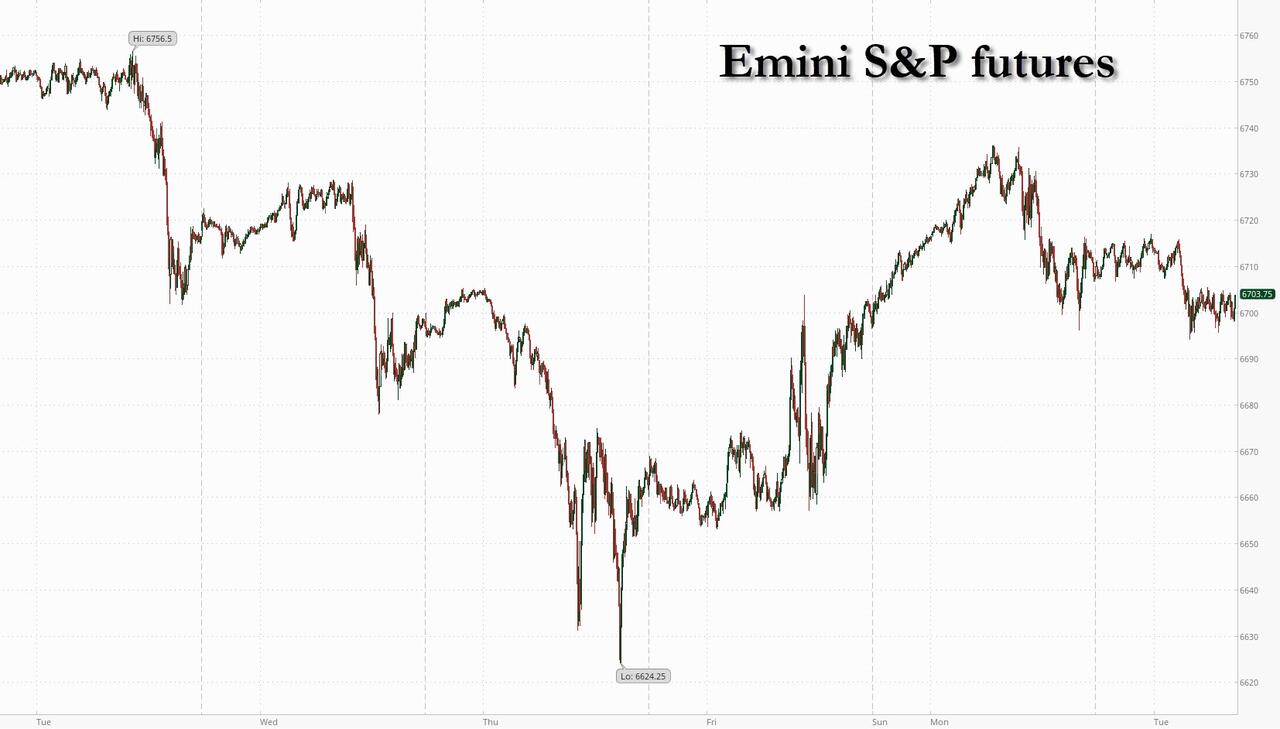
In premarket trading, Mag 7 stocks are mostly lower (Amazon -0.02%, Meta -0.1%, Nvidia +0.2%, Alphabet -0.1%, Microsoft -0.2%, Apple -0.3%, Tesla -0.7%).
- Celsius Holdings (CELH) rises 3% after Morgan Stanley upgraded the energy-drink maker to overweight from equal-weight, citing topline growth ahead.
- EchoStar (SATS) rises 8% as Verizon Communications is said to be in discussions with the company about purchasing some of its wireless spectrum.
- Energy Fuels Inc. (UUUU) falls 7% after a $550 million offering of six-year convertible bonds.
- Firefly Aerospace (FLY) is down 10% after the company disclosed an incident during a test at its facility in Texas that resulted in the loss of a rocket stage.
- Oklo (OKLO) falls 3% while NuScale Power (SMR) drops 4% after Bank of America downgraded the nuclear companies, seeing valuations as unrealistic at this stage of small modular reactor development.
- QuantumScape (QS) climbs 4% after saying it will jointly develop with Corning ceramic-separator manufacturing capabilities for QS solid-state batteries.
- Semtech (SMTC) rises 3.7% after Oppenheimer raised the stock to outperform, saying the semiconductor firm’s active copper cable offerings can win market share among hyperscalers and drive sales growth.
- Vail Resorts (MTN) slips 2% after providing a profit outlook that missed expectations as the company sold fewer passes than it previously expected for the upcoming ski season.
In corporate news:
- BHP Group Ltd. retreated in London after China’s state-run iron ore buyer temporarily halted purchases from the Australian miner. The dollar edged lower, erasing September’s advance.
- Boeing Co. has started working on a next-generation single-aisle aircraft that could eventually replace the 737 Max, the Wall Street Journal reported.
- Coty has begun a strategic review of its consumer beauty brands.
- DeepSeek updated an experimental AI model in what it called a step toward next-generation artificial intelligence.
- EchoStar Corp. shares jumped in premarket trading as the satellite-TV company engaged in talks to sell some of its wireless spectrum to Verizon Communications Inc.
- Exxon Mobil Corp. plans to cut about 2,000 jobs globally as the Texas oil company consolidates smaller offices into regional hubs as part of its long-term restructuring plan.
- Spotify Technology SA names Alex Norström and Gustav Söderström co-CEOs.
- UBS Group AG reiterated its scathing critique of Switzerland’s planned changes to banking regulation, saying they may put the firm’s role in the country at risk.
- Jefferies posted its best fiscal third-quarter revenue ever, buoyed by what the firm said is a strengthening environment for dealmaking and trading activity across the globe. Higher expenses were the “one sticking point” in the overall better-than-expected results, according to Bloomberg Intelligence’s Neil Sipes.
All eyes are on today’s government shutdown. Vice President JD Vance said the US government is on track for a shutdown after President Donald Trump’s last-ditch meeting with congressional leaders ended without a deal. Many federal operations would pause if lawmakers fail to compromise before the fiscal year ends.
The Bureau of Labor Statistics — responsible for a number of gold-standard US economic releases — would cease operations and likely delay Friday’s payroll report in the event of a shutdown. “We advise investors to look past shutdown fears and focus on other market drivers,” wrote Mark Haefele, chief investment officer at UBS Global Wealth Management. “We continue to prefer quality fixed income, particularly those with medium-term maturities, which we believe offers a compelling combination of income and resilience.”
Tariffs are back in focus. Trump ordered 10% duties on imports of softwood timber and lumber as well as 25% levies on some wood furniture products. China’s state-run iron ore buyer told major steelmakers and traders to temporarily halt purchases of all new cargoes from Australian miner BHP, widening an earlier curb as a price dispute escalated, according to people familiar.
Elsewhere, traders are looking ahead to a series of US labor reports due this week to gauge the Fed’s next move, with the release of Friday’s key payrolls report in doubt amid a budget impasse in Congress. The uncertainty comes as the S&P 500 is headed for its best September in 15 years, fueled by looser policy, strong earnings and optimism over artificial intelligence.
“The main focus will be the US labor market, which should either confirm or challenge expectations of two more rate cuts in 2025,” said Susana Cruz, a strategist at Panmure Liberum. “If the shutdown delays the release, that could spark some anxiety.”
Fed Vice Chair Philip Jefferson warned Tuesday that the central bank faces a cooling labor market alongside rising inflation pressures, complicating the policy outlook. “I see the risks to employment as tilted to the downside and risks to inflation to the upside,” Jefferson said in remarks prepared for the fourth International Monetary Policy Conference hosted by the Bank of Finland. “It follows that both sides of our mandate are under pressure.”
The Fed’s Susan Collins and Austan Goolsbee are due to deliver speeches later on Tuesday. Investors will also look at August JOLTS data, which is expected to show weakening demand for labor. “The closer the headline is to estimates, the better, as a too-hot or too-cold print could weigh on already shaky markets amid the government shutdown worries,” said Tom Essaye at The Sevens Report.
The Stoxx 600 drops 0.2%,taking the shine off the best September performance since 2019, as Bloomberg News reported that China moved to ban all iron ore cargoes from BHP Group. The market was led lower by energy names as oil prices fall for a second day – WTI crude futures slip 0.9% to $62.90 a barrel. Here are some of the biggest movers on Tuesday:
- Puma gains as much as 6.5% after BNP Paribas Exane upgrades to neutral from underperform and boosts its price target by 40%, saying the sportswear firm is “now in special situation territory.”
- Eiffage shares rise as much as 1.6% after the construction firm won a contract worth over €1.5 billion to build substations for French offshore wind farms.
- Knorr-Bremse shares rise as much as 2.6% after Hauck & Aufhaeuser upgraded the stock, saying the German firm’s acquisition of Swiss-based Duagon Group complements its train control systems offering.
- Valneva shares rise as much as 11.5% after the company reported positive antibody persistence data four years after a single shot of its chikungunya vaccine.
- European Luxury stocks fall after China’s factory activity extended its decline into a sixth month, the longest slump since 2019, indicating the country’s economy is at risk of a slowdown.
- Hornbach slumps 7.9% after the building materials and garden supplies retailer reported sales for the second quarter that missed the average analyst estimate.
- Asos slumps as much as 13% after the fashion retailer warned adjusted Ebitda will be at the lower-end of its guided range this year.
- Pandora drops as much as 4.3% following the announcement that CEO Alexander Lacik will retire next year, with RBC calling it “incrementally negative.”
- Close Brothers falls as much as 11% as the financial services group downgrades near-term adjusted earnings.
- Card Factory slides as much as 6.1% as first-half profit falls.
- European wood and forestry companies are underperforming the broader market on Tuesday after US President Donald Trump ordered tariffs on imports of softwood timber and lumber.
Earlier in the session, Asian equities climbed to cap September with their longest monthly winning streak since early 2018, led by gains in Taiwan and Hong Kong stocks. The MSCI Asia Pacific Index rose 0.6% Tuesday, with Alibaba among the top contributors. The regional benchmark gained about 4% in September, recording its sixth consecutive monthly advance. Key benchmarks also traded higher in Japan, mainland China and Singapore. Investors have remained anchored in the region, chasing potential artificial intelligence winners and driving recent tech stock gains. Many are also scouring for China’s homegrown tech developers, amid hopes for an economic revival driven by increased consumption. Hong Kong’s benchmark, up 7% for September, has posted its best month since February, while the key onshore index also climbed for a fifth straight month. The Hong Kong market will be closed Wednesday while mainland bourses will be shut through Oct. 8 for Golden Week holidays.
In FX, yen is leading gains against the dollar for a second day, rising 0.5% and taking USD/JPY below 148 after a weak JGB auction pushed Japanese two-year yields to the highest since 2008. The Aussie dollar is still outperforming after a hawkish hold by the RBA.
In rates, treasuries inch higher, pushing US 10-year yields lower by 1 bp to 4.13%. Bunds ticked lower when German state CPI data showed accelerations across the country’s biggest regions.
In commodities, gold also added to Monday’s surge before swiftly erasing gains and now sits ~$30 lower on the day.
Looking at today’s calendar, data due today include job openings for August and consumer confidence for September. Bloomberg Economist Anna Wong expects to see an improvement in confidence given the continued strength in spending through August. Still, she says sentiment measures have been diverging, with the U Michigan survey reflecting growing concerns about higher inflation and potential labor market weakness. US economic data slate includes July FHFA house price index, S&O Cotality house prices (9am), September MNI Chicago PMI (9:45am), August JOLTS job openings, September consumer confidence (10am) and Dallas Fed services activity (10:30am). Fed speaker slate includes Collins (9am), Goolsbee (1:30pm, 3:30pm) and Logan (7:10pm)
Market Snapshot
- S&P 500 mini -0.2%
- Nasdaq 100 mini -0.2%
- Russell 2000 mini -0.2%
- Stoxx Europe 600 -0.1%
- DAX little changed
- CAC 40 -0.3%
- 10-year Treasury yield -1 basis point at 4.13%
- VIX +0.4 points at 16.55
- Bloomberg Dollar Index -0.2% at 1200.18
- euro +0.2% at $1.1752
- WTI crude -0.9% at $62.88/barrel
Top Overnight News
- The US government is set for a shutdown tomorrow, JD Vance said, seeking to pin the blame on Democrats. Senate Minority Leader Chuck Schumer said he wouldn’t support a seven- or ten-day stopgap funding bill. The impasse has raised concerns that data releases, including Friday’s jobs report, may be delayed. BBG
- Senate Minority Leader Schumer said he met with President Trump, noting “we have large differences” and adding that the decision to avoid a government shutdown lies with Republicans. Democratic Leader Jefferies said Democrats will not support a partisan Republican bill that hurts healthcare, according to Reuters.
- Vice President Vance said he had frank talks with Democratic leadership, adding “you don’t shut government over disagreements,” but said “I think we’re headed to a shutdown because the Democrats won’t do the right thing.”, according to Reuters.
- Punchbowl’s Sherman said that from listening to Schumer, Jeffries, and Vance, it does not sound like there was a breakthrough in the meeting, adding that a shutdown is around the corner, via Punchbowl.
- House Speaker Johnson said they want to allow more time for negotiations, according to Reuters.
- Major airlines warned that a potential government shutdown could strain US aviation and cause flight delays, according to a statement.
- Schumer said he would not accept a 7–10 day stopgap bill, according to Reuters.
- Trump said the tariff on upholstered furniture will start at 25% and rise to 30% on Jan 1, with kitchen cabinets/bathroom vanities starting at 25% before rising to 50% (although imports from the EU and Japan will be capped at 15%, with the UK ceiling 10%). NYT
- Trump’s lumber/timber tariff details aren’t as bad as feared (the rate is only 10%, and payers of that tariff won’t be subject to the “reciprocal” tax). NYT
- China’s NBS PMIs for Sept are mixed, with modest upside on manufacturing (49.8 vs. the Street 49.6 and up from 49.3 in Aug) and a small miss on services (50 vs. the Street 50.2 and down from 50.3 in Aug). WSJ
- Japan’s factory output fell more than expected while retail sales declined for the first time in over three years in August, government data showed, heightening uncertainties about the economic outlook. Industrial production (-1.2% M/M vs. the Street -0.9%), retail sales (-1.1% M/M vs. the Street +1.2%), and housing starts (-9.8% Y/Y vs. the Street -5.2%). RTRS
- Taiwan Premier Cho Jung-tai said trade talks with the US have entered “the crucial closing stages,” indicating the global chip hub is finally nearing a deal with the Trump administration. Taiwan’s trade negotiators arrived in Washington late last week for discussions with their US counterparts aimed at lowering the 20% tariff imposed on the island. BBG
- Iron ore advanced after China’s state-run iron ore buyer told major steelmakers and traders in the world’s largest importer to temporarily halt purchases of all new BHP Group cargoes. BBG
- The SNB made its most significant sales of the franc in more than three years in the second quarter to stem a surge caused by Trump’s tariff push. BBG
- French inflation picked up on an acceleration in the services sector but remained well below the ECB’s 2% target. Consumer prices rose 1.1% in September from a year earlier. BBG
Trade/Tariffs
- The White House said US President Trump signed a proclamation adjusting imports of timber, lumber, and related derivatives into the US, imposing a 10% tariff on softwood, timber and lumber imports effective 14 October. It added that Trump intends to cap tariff rates for EU and Japanese wood products at 15%, according to Reuters.
- The White House confirmed new 25% tariffs on vanities and kitchen cabinets will take effect on 14 October, with imports of certain upholstered wooden products also subject to a 25% tariff. It announced tariffs on imported cabinets will rise from 25% to 50%, while tariffs on upholstered furniture will increase from 25% to 30% effective 1st January, unless trade agreements are reached beforehand, according to Reuters.
- South Korea’s Top Security Adviser Wi said it is challenging to strike a currency swap deal with the US, according to Reuters.
- EU Trade Commissioner Sefcovic says the EU and US are “very soon going to propose the post 2026 safeguard measures” on steel, working with tariff-rate quotas, to deal with “global overcapacity”.
A more detailed look at global markets courtesy of Newsquawk
APAC stocks traded flat/mixed following a mostly but modestly firmer handover from Wall Street, with focus on the looming US government shutdown and the possibility of delayed NFP data as a result. Meanwhile, the White House announcement of further tariff details overnight capped upside in sentiment. ASX 200 gave up initial mild gains to trade flat as strength across gold miners just about offset hefty losses in energy and a subdued performance in financials, with little move seen in the index after the RBA policy announcement, in which the central bank left rates unchanged as expected in a unanimous decision but struck a hawkish tone, noting inflation risks and that the decline in underlying inflation has slowed. Nikkei 225 narrowly underperformed at the start and briefly fell back under the 45,000 mark with losses led by energy names, while some hawkish undertones from the BoJ Summary of Opinions likely weighed, with some members arguing it may be time to consider another adjustment after more than six months since the last hike, while others cautioned against surprising markets or moving prematurely given uncertainty around the US outlook. Hang Seng and Shanghai Comp varied, the former gave up earlier upside and the latter held onto mild gains with newsflow light ahead of the weeklong break, whilst Chinese PMIs showed manufacturing beat expectations, but services declined from the prior month in both the NBS and RatingDog (formerly Caixin) releases. Furthermore, China’s Securities Journal suggested experts believe the PBoC may flexibly use a variety of monetary policy tools in the future to maintain ample liquidity. KOSPI was subdued with US-South Korean trade talks seemingly at a standstill, with the South Korean national security adviser suggesting it is tough to strike an FX swap deal with the US.
Top Asian News
- RBA maintained its Cash Rate at 3.60%, as expected, in a unanimous decision, noting that the decline in underlying inflation has slowed. It said recent data suggest September quarter inflation may be higher than expected in August, though both headline and trimmed mean inflation were within the 2–3% range in Q2. The Bank added that inflation has fallen substantially since the 2022 peak as higher rates have helped bring demand and supply closer to balance. RBA noted that financial conditions have eased since the beginning of the year, and this seems to be having some impact, but it will take some time to see the full effects of earlier cash rate reductions.
- RBA Governor Bullock says Board sees risks as broadly balanced; labour market remains solid, still a little tight; economy is in a good spot; need to be a little cautious on inflation; Policy is a little bit restrictive, not expansionary. Could be a couple more rate cuts, could not be. Not giving forward guidance, will have more data in November. Impact of past easing still to come.
- BoJ Summary of Opinions noted one member suggested it may be time to consider raising the policy interest rate again, while another said the BoJ gains more information on the US outlook by waiting, and one argued the Bank should maintain accommodative conditions at this point. On the economy, members said US tariffs will still impact Japan even after being reduced to 15%, with growth likely to moderate temporarily. On prices, CPI is expected to rise below 2% in fiscal 2026 as cost-push pressures ease, warranting continued accommodative policy. Some members argued that, given it has been more than six months since the last hike, the Bank should consider raising rates again at regular intervals if activity and prices remain in line with projections. Others noted that constraints from overseas factors have abated, allowing the Bank to return to a stance of raising rates and aligning real interest rates with overseas levels. However, members also stressed that the impact of prior hikes to 0.5% has been limited, and while risks to prices are skewed to the upside, the BoJ should avoid moving rates immediately to restrictive levels, instead gradually shifting closer to neutral to prevent shocks from rapid future hikes.
- Experts believe that to maintain ample liquidity, the PBoC may flexibly use a variety of monetary policy tools in the future, according to China’s Securities Journal.
European bourses lower across the board, Euro Stoxx 50 -0.3%; broader market narrative is dictated by the looming US government shutdown. Sectors are mostly lower after a mixed start to the session, just Financial Services & Media remain in the green. Energy hit by ongoing crude softness. Gambling names impacted by late-night comments from Chancellor Reeves. Mining sector underpinned by initial XAU strength.
Top European News
- Italy is set to forecast its 2025 budget deficit at or below 3% of GDP, in line with EU rules, according to Reuters, citing sources.
- Annual UK shop price inflation rose to 1.4% in September, up from 0.9% in August, according to the latest monthly report from the British Retail Consortium (BRC) and analysts NIQ, via the Guardian.
- ECB’s Vice President Guindos says the current level of interest rate is adequate and further decisions will be made meeting by meeting.
- SNB’s Schlegel says inflation is expected to rise slightly in the coming quarters. Indicators point to a stable situation and moderate growth. Uncertainty remains high. Pharmaceutical tariffs have raised the downside risk, “a bit”.
FX
- DXY is extending on the modest downside seen since last Friday and scaling back some of last week’s data-induced upside. Focus firmly on data, Fed speak and the increasingly likely government shutdown, a shutdown that will impact Friday’s BLS report. DXY briefly slipped below yesterday’s low @ 97.77 with the next downside target coming via the September 25th trough @ 97.37.
- EUR fractionally firmer against the USD, peaked just above 1.750 thus far. Modest move on the hotter-than-expected German state CPIs, no reaction to the cooler harmonised French measures. As we count down to the mainland German series, we also await several ECB speakers. Thus far, EUR/USD has ventured as high as 1.1761, taking out yesterday’s best @ 1.1754.
- JPY firmer vs USD for the 3rd consecutive session. USD/JPY below the 148.37 200-DMA and looking to the 50-DMA at 147.77. Modest strength on the latest BoJ SOO, as while the document was mixed the undertones were hawkish and signal the BoJ is moving closer to further tightening.
- Sterling firmer against the USD, relatively contained vs the EUR. UK drivers light as we await the speech from PM Starmer at the Labour conference, though he is unlikely to add anything new on the fiscal side of things vs Reeves on Monday. Cable is eyeing yesterday’s peak @ 1.3457. If breached, the 50DMA kicks in @ 1.3465.
- Antipodeans outperform, initially gaining on a firmer Yuan fixing. Thereafter, extended as the RBA left rates unchanged in a unanimous decision but with the tone hawkish. AUD/USD has made its way back onto a 0.66 handle with a current session peak @ 0.6613. The next target comes via last week’s high @ 0.6628.
- PBoC set USD/CNY mid-point at 7.1055 vs exp. 7.1166 (Prev. 7.1089)
Fixed Income
- Benchmarks contained overall into a session dominated by US data, with JOLTS and the labour metrics within consumer confidence likely to draw even greater attention than usual owing to the real possibility that Friday’s BLS report is delayed. Thus far, USTs to a 112-22 peak and looking to 112-31+. However, the strength was knocked in the mid-European morning by a move lower in EGBs on German state CPIs.
- Bunds initially bid, got to a 128.79 peak with gains of c. 20 ticks. A high that occurred after slightly cooler than expected French preliminary inflation data, following Spain on Monday. However, this was shortlived as Germany’s state CPIs saw a larger increase from the prior than consensus for the mainland implies and sent Bunds from the mentioned peak to a 128.54 trough, lower by six ticks at worst.
- Gilts opened on the front foot, got as high as 91.01 with gains of 12 ticks before succumbing to the pullback seen in fixed generally after the German state CPIs. Currently, Gilts reside below opening levels but near enough unchanged vs Monday’s close.
- Japan sold JPY 2.7tln in 2-year JGBs; b/c 2.81x (prev. 2.84x); average yield 0.949% (prev. 0.863%); Lowest cover ratio since September 2009.
Commodities
- Crude benchmarks continue to sell off following yesterday’s substantial move lower. At worst, benchmarks hit lows of USD 62.45/bbl and USD 66.10/bbl in WTI and Brent respectively.
- Newsflow for the space light, as such the move is likely a continuation of the bearishness from Monday which was driven by reports of an increased global oil supply from OPEC+ and the reopening of the Ceyhan pipeline.
- Initially, spot gold extended on yesterday’s gains to a new ATH at USD 3871/oz. However, the precious metal has since lost its allure and has found itself under increasing pressure. Down to a USD 3793/oz low. No clear fundamental driver behind the gold pullback this morning, instead it seems to be a function of some profit taking in XAU with a view that the recent move may be a little stretched.
- Base metals remain muted throughout the European session, with 3M LME Copper trading in a tight c. USD 100/t range. Copper got to just shy of yesterday’s high, peaking at USD 10.44k/t before falling to a low of USD 10.35k/t and oscillating within these bounds during the European morning.
- China bans all BHP (BHP LN) iron ore cargoes as pricing dispute continues, according to Bloomberg citing sources.
Geopolitics
- Several sources suggested that there is no certainty that Hamas will accept the deal, according to i24 correspondent Stein. He added that the fact that Arab countries, including Qatar, are supporting it strengthens the chances of acceptance.
- Russian President Putin said Russia’s military operation in Ukraine is a righteous battle and asserted that Russia will prevail, according to Reuters.
US Event Calendar
- 9:00 am: Jul FHFA House Price Index MoM, est. -0.2%, prior -0.2%
- 9:00 am: Jul S&P Cotality CS 20-City YoY NSA, est. 1.55%, prior 2.14%
- 9:00 am: Jul S&P Cotality CS U.S. HPI YoY NSA, prior 1.89%
- 9:45 am: Sep MNI Chicago PMI, est. 43.25, prior 41.5
- 10:00 am: Aug JOLTS Job Openings, est. 7200k, prior 7181k
- 10:00 am: Sep Conf. Board Consumer Confidence, est. 96, prior 97.4
Central Bank Speakers
- 6:00 am: Fed’s Jefferson Gives Keynote Speech
- 9:00 am: Fed’s Collins Speaks at Council on Foreign Relations
- 1:30 pm: Fed’s Goolsbee Participates in a Q&A at Midwest Agriculture Co
- 3:30 pm: Fed’s Goolsbee Speaks on Fox Business
DB’s Jim Reid concludes the overnight wrap
This time tomorrow the US government looks set to be in shutdown unless we have a last-minute deal today. To remind and extend on what we mentioned yesterday, the longest was the 35 days that straddled year end 2018. The median length historically is only 2-3 days, often over weekends, and only a handful have lasted more than a couple of weeks (1978, 1995-96, 2013, 2018-19). Last night’s talks with Democratic leadership at the White House ended with no signs of a deal and with no further talks currently scheduled. Comments by Vice President Vance and reports following the meeting did suggest that the White House was open to bipartisan negotiations over expiring health subsidies which have been a key Democratic demand, but that such talks should take place in the “context of an open government”. In turn, Democratic leaders said they would not accept such uncertain pledges. The Polymarket probability for a shutdown before tomorrow is now 79% and 85% by year-end.
In terms of the impact of a shutdown, Brett Ryan has written “Everything you didn’t want to know…” about it here. It was confirmed by the BLS yesterday that they would suspend operations and not release economic data during a government shutdown. So, no payrolls this Friday if it goes ahead. Indeed, a similar scenario happened back in October 2013, when the jobs report didn’t come out until the 22nd of the month. Moreover, the BLS also publish the monthly CPI data, which is due out on October 15. So, depending how long any shutdown drags on for, it’s even possible that the Fed might not have contemporaneous data going into their next meeting on October 28-29. Given the median shutdown lasts 2-3 days that’s a stretch for now but worth bearing in mind.
A global bond rally (10yr USTs -3.6bps) was the main market story yesterday, helped by WTI crude oil (-3.45%) seeing its largest single day decline since June. Equities posted small advances overall, with the S&P 500 (+0.26%) closing less than half a percent from last week’s record high. There were several factors behind the moves, but a key driver was that sharp decline in oil prices after signals that the OPEC+ group may raise production again at their meeting next week. This helped reignite hopes of deeper rate cuts and drove a decent day for most asset classes, as US IG credit spreads (-1bps) fell back to within 1bp of their post-1998 lows while gold prices (+1.96%) again hit a new record of $3,834/oz. Overnight, gold prices are an additional +0.83% higher on further shutdown talk.
Drilling in, US Treasuries rallied across the curve, with the 2yr yield (-2.2bps) falling back to 3.62%, whilst the 10yr and 30yr yield declined by -3.6bps and -4.5bps to 4.14% and 4.70%, respectively. Markets also priced in a slightly more dovish rate path, with the amount of cuts priced by June 2026 up +1.9bps on the day to 81bps. The moves were helped by the latest decline in oil prices, which helped to counteract inflation fears from Trump’s latest tariff announcements. He said he’d impose “a 100% Tariff on any and all movies that are made outside of the United States”, as well as “substantial Tariffs on any Country that does not make its furniture in the United States.” And last night, Trump’s order confirmed 10% tariffs on lumber, as well as 25% levies on kitchen cabinets, vanities and upholstered furniture. Whilst the moves likely won’t have a big impact on inflation on their own, it’s feeding the concern that the tariffs are far from over, particularly given there are still outstanding reviews into sectors like semiconductors and critical minerals.
As all this was going on, US equities put in a decent performance, led by more cyclical sectors. Tech stocks outperformed with the NASDAQ (+0.48%) and the Magnificent 7 (+0.37%) outpacing the S&P 500 (+0.26%). But it was a broad-based advance overall with the equal-weighted S&P up by +0.32%. Construction materials (+1.24%) were one of the best performing subsectors as pending home sales for August rose +4.0% to their highest in five months, in a sign that the move lower in rates is helping housing activity recover from anemic levels.
European markets followed a similar pattern yesterday, with bonds and equities both advancing. As in the US, sentiment was boosted by the fall in oil prices, which helped to dampen fears about inflationary pressures. So yields on 10yr bunds (-3.8bps), OATs (-3.7bps) and BTPs (-4.8bps) all moved lower. And the start of the flash CPI prints were also in line with expectations, with Spanish inflation at +3.0% in September. So there wasn’t much cause for alarm there either, although we’ll get a broader picture today as the German, French and Italian prints come out. Then on the equity side, the STOXX 600 (+0.18%) moved up to a two-week high, and the FTSE 100 (+0.16%) reached a five-week high.
In geopolitical news, Trump and Israel’s Prime Minister Netanyahu said they had agreed a 20-point plan aimed at ending the war in Gaza. Several countries in the region, including Saudia Arabia, UAE and Turkiye issued a statement welcoming the proposals. However, it is rather uncertain whether Hamas will accept the plan, with one of its conditions being that Hamas would have no future role in running Gaza. Still, regional assets gained on the news, with the Israeli shekel (+1.76% against the dollar) being the best performing major currency on the day.
Asian equity markets are fairly quiet this morning after mixed business activity reports from China. As I check my screens, the Shanghai Composite (+0.37%) and the CSI (+0.11%) are slightly higher. The KOSPI (+0.04%), Nikkei (-0.05%), Hang Seng (-0.02%) and the S&P/ASX 200 (-0.05%) are pretty flat along with US equity futures. The RBA have just left rates unanimously unchanged as expected. At first glance the statement is very slightly hawkish with several mentions of upside inflation risk but we’ll wait for the presser for more.
Coming back to China, official manufacturing activity contracted for the sixth consecutive month in September, while the service sector also experienced a decline. However, a separate private PMI survey indicated that both manufacturing and services activities expanded significantly more than anticipated in September. The official manufacturing PMI printed at 49.8 in September, which was marginally above the expected figure of 49.6, compared to the previous month’s reading of 49.4. It was the highest since March. The non-manufacturing PMI, encompassing services and construction, decreased to 50.0 from 50.3 in August (50.2 expected). Conversely, the RatingDog services PMI recorded a value of 52.9 for September, exceeding expectations of 52.3 but slightly lower than the previous month’s print of 53.0. Elsewhere the BoJ summary of opinions out this morning leans a touch hawkish with no real pushback against the need for rate hikes going forward.
To the day ahead now, and US data releases include the Conference Board’s consumer confidence for September, and the JOLTS report of job openings for August. Over in Europe, there’s the September flash CPI prints from Germany, France and Italy, as well as German unemployment for September. From central banks, we’ll hear from ECB President Lagarde, the ECB’s Cipollone and Nagel, Fed Vice Chair Jefferson, the Fed’s Colins, Goolsbee and Logan, and the BoE’s Lombardelli, Mann and Breeden.
2b European opening report
US futures lower amidst looming gov’t shutdown – US Opening News

Tuesday, Sep 30, 2025 – 06:13 AM
- European bourses & US futures modestly lower into a session of data & Fed speak, awaiting updates on the increasingly likely US gov’t shutdown.
- DXY extending on recent pressure, EUR and GBP both firmer, JPY bid for a 3rd consecutive session, AUD bolstered by a hawkish-hold.
- Fixed benchmarks hit highs on cooler French HICP but have since trimmed with EGBs in the red after hotter German State CPIs, mainland due shortly
- Crude continues to falter, XAU hit another ATH but has since come under pressure.
- Looking ahead, highlights include US Consumer Confidence, JOLTS Job Openings. Speakers include RBA’s Bullock, ECB’s Cipollone, Elderson, Fed’s Goolsbee, BoE’s Lombardelli, Mann, Breeden. Earnings from Nike, Lamb Weston.
- Click for the Newsquawk Week Ahead.
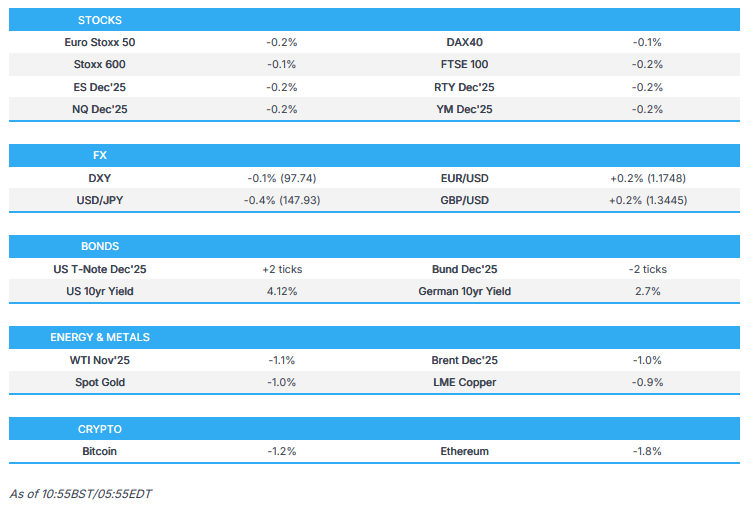
Newsquawk in 3 steps:
1. Subscribe to the free premarket movers reports
2. Listen to this report in the market open podcast (available on Apple and Spotify)
3. Trial Newsquawk’s premium real-time audio news squawk box for 7 days
TRADE/TARIFFS
- The White House said US President Trump signed a proclamation adjusting imports of timber, lumber, and related derivatives into the US, imposing a 10% tariff on softwood, timber and lumber imports effective 14 October. It added that Trump intends to cap tariff rates for EU and Japanese wood products at 15%, according to Reuters.
- The White House confirmed new 25% tariffs on vanities and kitchen cabinets will take effect on 14 October, with imports of certain upholstered wooden products also subject to a 25% tariff. It announced tariffs on imported cabinets will rise from 25% to 50%, while tariffs on upholstered furniture will increase from 25% to 30% effective 1st January, unless trade agreements are reached beforehand, according to Reuters.
- South Korea’s Top Security Adviser Wi said it is challenging to strike a currency swap deal with the US, according to Reuters.
- EU Trade Commissioner Sefcovic says the EU and US are “very soon going to propose the post 2026 safeguard measures” on steel, working with tariff-rate quotas, to deal with “global overcapacity”.
EUROPEAN TRADE
EQUITIES
- European bourses lower across the board, Euro Stoxx 50 -0.3%; broader market narrative is dictated by the looming US government shutdown.
- Sectors are mostly lower after a mixed start to the session, just Financial Services & Media remain in the green. Energy hit by ongoing crude softness. Gambling names impacted by late-night comments from Chancellor Reeves. Mining sector underpinned by initial XAU strength.
- Stateside, futures a touch softer in tandem with the above European performance; ES -0.2%, NQ -0.2%. Fresh catalysts light as we count down to data, Fed speak and the midnight ET shutdown.
- Equity specifics include Tesla’s TeslaAI Weibo account announced that they are working to aggressively scale the humanoid AI programme, intend to introduce 3rd gen by end-2025 and start mass production in 2026. CEO Musk forecasts an annual production rate of 1mln units before 2030.
- Click for the sessions European pre-market equity newsflow
- Click for the additional news
- Click for a detailed summary
FX
- DXY is extending on the modest downside seen since last Friday and scaling back some of last week’s data-induced upside. Focus firmly on data, Fed speak and the increasingly likely government shutdown, a shutdown that will impact Friday’s BLS report. DXY briefly slipped below yesterday’s low @ 97.77 with the next downside target coming via the September 25th trough @ 97.37.
- EUR fractionally firmer against the USD, peaked just above 1.750 thus far. Modest move on the hotter-than-expected German state CPIs, no reaction to the cooler harmonised French measures. As we count down to the mainland German series, we also await several ECB speakers. Thus far, EUR/USD has ventured as high as 1.1761, taking out yesterday’s best @ 1.1754.
- JPY firmer vs USD for the 3rd consecutive session. USD/JPY below the 148.37 200-DMA and looking to the 50-DMA at 147.77. Modest strength on the latest BoJ SOO, as while the document was mixed the undertones were hawkish and signal the BoJ is moving closer to further tightening.
- Sterling firmer against the USD, relatively contained vs the EUR. UK drivers light as we await the speech from PM Starmer at the Labour conference, though he is unlikely to add anything new on the fiscal side of things vs Reeves on Monday. Cable is eyeing yesterday’s peak @ 1.3457. If breached, the 50DMA kicks in @ 1.3465.
- Antipodeans outperform, initially gaining on a firmer Yuan fixing. Thereafter, extended as the RBA left rates unchanged in a unanimous decision but with the tone hawkish. AUD/USD has made its way back onto a 0.66 handle with a current session peak @ 0.6613. The next target comes via last week’s high @ 0.6628.
- PBoC set USD/CNY mid-point at 7.1055 vs exp. 7.1166 (Prev. 7.1089)
- Click for a detailed summary
- Click for NY OpEx Details
FIXED INCOME
- Benchmarks contained overall into a session dominated by US data, with JOLTS and the labour metrics within consumer confidence likely to draw even greater attention than usual owing to the real possibility that Friday’s BLS report is delayed. Thus far, USTs to a 112-22 peak and looking to 112-31+. However, the strength was knocked in the mid-European morning by a move lower in EGBs on German state CPIs.
- Bunds initially bid, got to a 128.79 peak with gains of c. 20 ticks. A high that occurred after slightly cooler than expected French preliminary inflation data, following Spain on Monday. However, this was shortlived as Germany’s state CPIs saw a larger increase from the prior than consensus for the mainland implies and sent Bunds from the mentioned peak to a 128.54 trough, lower by six ticks at worst.
- Gilts opened on the front foot, got as high as 91.01 with gains of 12 ticks before succumbing to the pullback seen in fixed generally after the German state CPIs. Currently, Gilts reside below opening levels but near enough unchanged vs Monday’s close.
- Japan sold JPY 2.7tln in 2-year JGBs; b/c 2.81x (prev. 2.84x); average yield 0.949% (prev. 0.863%); Lowest cover ratio since September 2009.
- Click for a detailed summary
COMMODITIES
- Crude benchmarks continue to sell off following yesterday’s substantial move lower. At worst, benchmarks hit lows of USD 62.45/bbl and USD 66.10/bbl in WTI and Brent respectively.
- Newsflow for the space light, as such the move is likely a continuation of the bearishness from Monday which was driven by reports of an increased global oil supply from OPEC+ and the reopening of the Ceyhan pipeline.
- Initially, spot gold extended on yesterday’s gains to a new ATH at USD 3871/oz. However, the precious metal has since lost its allure and has found itself under increasing pressure. Down to a USD 3793/oz low. No clear fundamental driver behind the gold pullback this morning, instead it seems to be a function of some profit taking in XAU with a view that the recent move may be a little stretched.
- Base metals remain muted throughout the European session, with 3M LME Copper trading in a tight c. USD 100/t range. Copper got to just shy of yesterday’s high, peaking at USD 10.44k/t before falling to a low of USD 10.35k/t and oscillating within these bounds during the European morning.
- China bans all BHP (BHP LN) iron ore cargoes as pricing dispute continues, according to Bloomberg citing sources.
- Click for a detailed summary
NOTABLE DATA RECAP
- UK GDP QQ (Q2) 0.3% vs. Exp. 0.3% (Prev. 0.3%); YY (Q2) 1.4% vs. Exp. 1.2% (Prev. 1.2%)
- German Retail Sales YY Real (Aug) 1.8% vs. Exp. 1.8% (Prev. 1.9%); MM Real (Aug) -0.2% vs. Exp. 0.6% (Prev. -1.5%)
- German Import Prices MM (Aug) -0.5% vs. Exp. -0.2% (Prev. -0.4%); YY (Aug) -1.5% vs. Exp. -1.4% (Prev. -1.4%)
- French CPI (EU Norm) Prelim YY (Sep) 1.1% vs. Exp. 1.3%; MM (Sep) -1.1% vs. Exp. -0.90% (Prev. 0.50%)
- Swiss KOF Indicator (Sep) 98.0 vs. Exp. 97.0 (Prev. 97.4, Rev. 96.2)
- German Unemployment Chg SA (Sep) 14.0k vs. Exp. 8.0k (Prev. -7.0k); Rate SA (Sep) 6.3% vs. Exp. 6.3% (Prev. 6.3%)
- German Bavaria State CPI YY (Sep) 2.4% (Prev. 2.1%); MM (Sep) 0.4% (Prev. 0.1%). Overall, the skew from the state CPIs is hotter than the mainland consensus implies, as such a hawkish reaction was seen.
- Italian CPI (EU Norm) Prelim YY (Sep) 1.8% vs. Exp. 1.7% (Prev. 1.6%); MM 1.3% vs. Exp. 1.1% (Prev. -0.2%)
- Italian Consumer Price Prelim YY * (Sep) 1.6% vs. Exp. 1.7% (Prev. 1.6%); MM -0.2% vs. Exp. -0.1% (Prev. 0.1%)
NOTABLE EUROPEAN HEADLINES
- Italy is set to forecast its 2025 budget deficit at or below 3% of GDP, in line with EU rules, according to Reuters, citing sources.
- Annual UK shop price inflation rose to 1.4% in September, up from 0.9% in August, according to the latest monthly report from the British Retail Consortium (BRC) and analysts NIQ, via the Guardian.
- ECB’s Vice President Guindos says the current level of interest rate is adequate and further decisions will be made meeting by meeting.
- SNB’s Schlegel says inflation is expected to rise slightly in the coming quarters. Indicators point to a stable situation and moderate growth. Uncertainty remains high. Pharmaceutical tariffs have raised the downside risk, “a bit”.
NOTABLE US HEADLINES
- US Senate Minority Leader Schumer said he met with President Trump, noting “we have large differences” and adding that the decision to avoid a government shutdown lies with Republicans. Democratic Leader Jefferies said Democrats will not support a partisan Republican bill that hurts healthcare, according to Reuters.
- US Vice President Vance said he had frank talks with Democratic leadership, adding “you don’t shut government over disagreements,” but said “I think we’re headed to a shutdown because the Democrats won’t do the right thing.”, according to Reuters.
- Punchbowl’s Sherman said that from listening to Schumer, Jeffries, and Vance, it does not sound like there was a breakthrough in the meeting, adding that a shutdown is around the corner, via Punchbowl.
- US House Speaker Johnson said they want to allow more time for negotiations, according to Reuters.
- Major airlines warned that a potential government shutdown could strain US aviation and cause flight delays, according to a statement.
- US Senate Minority Leader Schumer said he would not accept a 7–10 day stopgap bill, according to Reuters.
GEOPOLITICS
- Several sources suggested that there is no certainty that Hamas will accept the deal, according to i24 correspondent Stein. He added that the fact that Arab countries, including Qatar, are supporting it strengthens the chances of acceptance.
- Russian President Putin said Russia’s military operation in Ukraine is a righteous battle and asserted that Russia will prevail, according to Reuters.
APAC TRADE
- APAC stocks traded flat/mixed following a mostly but modestly firmer handover from Wall Street, with focus on the looming US government shutdown and the possibility of delayed NFP data as a result. Meanwhile, the White House announcement of further tariff details overnight capped upside in sentiment.
- ASX 200 gave up initial mild gains to trade flat as strength across gold miners just about offset hefty losses in energy and a subdued performance in financials, with little move seen in the index after the RBA policy announcement, in which the central bank left rates unchanged as expected in a unanimous decision but struck a hawkish tone, noting inflation risks and that the decline in underlying inflation has slowed.
- Nikkei 225 narrowly underperformed at the start and briefly fell back under the 45,000 mark with losses led by energy names, while some hawkish undertones from the BoJ Summary of Opinions likely weighed, with some members arguing it may be time to consider another adjustment after more than six months since the last hike, while others cautioned against surprising markets or moving prematurely given uncertainty around the US outlook.
- Hang Seng and Shanghai Comp varied, the former gave up earlier upside and the latter held onto mild gains with newsflow light ahead of the weeklong break, whilst Chinese PMIs showed manufacturing beat expectations, but services declined from the prior month in both the NBS and RatingDog (formerly Caixin) releases. Furthermore, China’s Securities Journal suggested experts believe the PBoC may flexibly use a variety of monetary policy tools in the future to maintain ample liquidity.
- KOSPI was subdued with US-South Korean trade talks seemingly at a standstill, with the South Korean national security adviser suggesting it is tough to strike an FX swap deal with the US.
NOTABLE ASIA-PAC HEADLINES
- RBA maintained its Cash Rate at 3.60%, as expected, in a unanimous decision, noting that the decline in underlying inflation has slowed. It said recent data suggest September quarter inflation may be higher than expected in August, though both headline and trimmed mean inflation were within the 2–3% range in Q2. The Bank added that inflation has fallen substantially since the 2022 peak as higher rates have helped bring demand and supply closer to balance. RBA noted that financial conditions have eased since the beginning of the year, and this seems to be having some impact, but it will take some time to see the full effects of earlier cash rate reductions.
- RBA Governor Bullock says Board sees risks as broadly balanced; labour market remains solid, still a little tight; economy is in a good spot; need to be a little cautious on inflation; Policy is a little bit restrictive, not expansionary. Could be a couple more rate cuts, could not be. Not giving forward guidance, will have more data in November. Impact of past easing still to come.
- BoJ Summary of Opinions noted one member suggested it may be time to consider raising the policy interest rate again, while another said the BoJ gains more information on the US outlook by waiting, and one argued the Bank should maintain accommodative conditions at this point. On the economy, members said US tariffs will still impact Japan even after being reduced to 15%, with growth likely to moderate temporarily. On prices, CPI is expected to rise below 2% in fiscal 2026 as cost-push pressures ease, warranting continued accommodative policy. Some members argued that, given it has been more than six months since the last hike, the Bank should consider raising rates again at regular intervals if activity and prices remain in line with projections. Others noted that constraints from overseas factors have abated, allowing the Bank to return to a stance of raising rates and aligning real interest rates with overseas levels. However, members also stressed that the impact of prior hikes to 0.5% has been limited, and while risks to prices are skewed to the upside, the BoJ should avoid moving rates immediately to restrictive levels, instead gradually shifting closer to neutral to prevent shocks from rapid future hikes.
- Experts believe that to maintain ample liquidity, the PBoC may flexibly use a variety of monetary policy tools in the future, according to China’s Securities Journal.
DATA RECAP
- Chinese NBS Manufacturing PMI (Sep) 49.8 vs. Exp. 49.6 (Prev. 49.4); Services PMI (Sep) 50.0 (Prev. 50.3)
- Chinese NBS Composite PMI (Sep) 50.6 (Prev. 50.5)
- Chinese RatingDog Manufacturing PMI Final (Sep) 51.2 vs. Exp. 50.3 (Prev. 50.5); Services PMI (Sep) 52.9 (Prev. 53.0)
- Chinese RatingDog Composite PMI (Sep) 52.5 (Prev. 51.9)
- Japanese Retail Sales YY (Aug) -1.1% vs. Exp. 1.0% (Prev. 0.3%, Rev. 0.4%)
- Japanese Industrial O/P Prelim MM SA (Aug) -1.2% vs. Exp. -0.8% (Prev. -1.2%)
- Japanese IP Forecast 2 Month Ahead (Oct) 1.2% (Prev. -0.3%); 1 Month Ahead (Sep) 4.1% (Prev. 2.8%)
- South Korean Industrial Output YY (Aug) 0.9% vs. Exp. 1.3% (Prev. 5.0%, Rev. 5.0%)
- South Korean Service Sector Output Gr (Aug) -0.7% (Prev. 0.2%, Rev. 0.2%)
- South Korean Industrial Output Growth (Aug) 2.4% vs. Exp. 0.4% (Prev. 0.3%, Rev. 0.3%)
- New Zealand ANZ Business Outlook (Sep) 49.6% (Prev. 49.7%); Own Activity (Sep) 43.4% (Prev. 38.7%)
- Australian Private Sector Credit (Aug) 0.6% (Prev. 0.7%)
- Australian Private House Approvals (Aug) -2.6% (Prev. 1.1%)
- Australian Housing Credit (Aug) 0.6% (Prev. 0.5%)
- Australian Building Approvals (Aug) -6.0% vs. Exp. 3.0% (Prev. -8.2%, Rev. -10.0%)
- END
2C ASIA OPENING REPORT
White House announce new tariffs and government shutdown looms – European Opening News
Tuesday, Sep 30, 2025 – 01:31 AM
- APAC stocks traded flat/mixed following a mostly but modestly firmer handover from Wall Street, with focus on the looming US government shutdown and the possibility of delayed NFP. Meanwhile, the White House announcement of further tariff details overnight capped upside in sentiment.
- The White House announced tariffs, including a 10% levy on timber and lumber from 14th October, alongside 25% duties on cabinets and vanities, with further hikes on cabinets and upholstered furniture set for 1st January unless trade deals are reached.
- Punchbowl’s Sherman said that from listening to Schumer, Jeffries, and Vance, it does not sound like there was a breakthrough in the meeting, adding that a shutdown is around the corner.
- BoJ Summary of Opinions noted one member suggested it may be time to consider raising the policy interest rate again, while another said the BoJ gains more information on the US outlook by waiting, and one argued the Bank should maintain accommodative conditions at this point.
- RBA maintained its Cash Rate at 3.60%, as expected, in a unanimous decision, noting that the decline in underlying inflation has slowed
- Looking ahead, highlights include UK GDP (Q2), French CPI Prelim (Sep), German CPI Prelim (Sep), Italian CPI Prelim (Sep), US Consumer Confidence, JOLTS Job Openings. Speakers include RBA’s Bullock, ECB’s Lagarde, Cipollone, Elderson, Fed’s Logan, Jefferson, Goolsbee, BoE’s Lombardelli, Mann, Breeden. Earnings from Nike, Lamb Weston.
SNAPSHOT
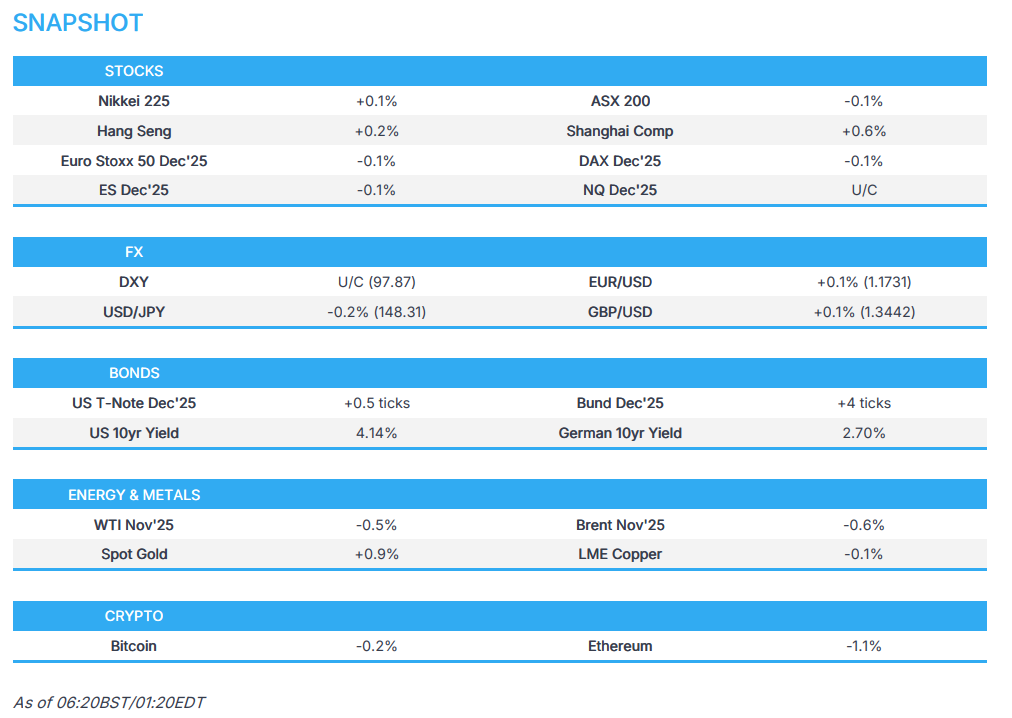
Newsquawk in 3 steps:
1. Subscribe to the free premarket movers reports
2. Listen to this report in the market open podcast (available on Apple and Spotify)
3. Trial Newsquawk’s premium real-time audio news squawk box for 7 days
US TRADE
EQUITIES
- US stocks posted mild gains at the start of the week, supported by strength in NVIDIA after a Jefferies price target upgrade, amid otherwise light newsflow. Attention was on Fed commentary from Williams, Musalem, and Hammack, while data showed pending home sales came in better than expected.
- SPX +0.26% at 6,661, NDX +0.44% at 24,611, DJI +0.15% at 46,316, RUT +0.04% at 2,435
- Click here for a detailed summary.
NOTABLE HEADLINES
- Fed’s Musalem (2025 voter) said short-term inflation expectations are somewhat high but long-term expectations remain anchored, while risks of labour market weakening have increased. He said inflation is expected to stay elevated for two or three quarters, noted monetary policy is between modestly restrictive and neutral, and added he is open-minded to potential future cuts but stressed the need for caution with limited room before policy becomes too loose. He said the impact of tariffs has been more muted than expected and accounts for perhaps 10% of current inflation, while the labour market continues to soften but remains near full employment, according to Reuters.
- Fed’s Williams (voter) said monetary policy remains restrictive and continues to put downward pressure on inflation, adding the Fed still has a way to go to reach its 2% target. He noted that underlying inflation is moderating and the labour market has been resilient but is gradually softening, stressing they do not want to see it weaken too far. Williams said policy is a balancing act; some upside inflation risks have ebbed, making recent rate cuts sensible, and decisions will be made meeting by meeting. He added that some factors keeping neutral rates low are still in place, a low underlying interest rate world is likely to persist, and his model estimates the real neutral rate at 0.75%, according to Reuters.
US GOVERNMENT SHUTDOWN
- US Senate Minority Leader Schumer said he met with President Trump, noting “we have large differences” and adding that the decision to avoid a government shutdown lies with Republicans. Democratic Leader Jefferies said Democrats will not support a partisan Republican bill that hurts healthcare, according to Reuters.
- US Vice President Vance said he had frank talks with Democratic leadership, adding “you don’t shut government over disagreements,” but said “I think we’re headed to a shutdown because the Democrats won’t do the right thing.”, according to Reuters.
- Punchbowl’s Sherman said that from listening to Schumer, Jeffries, and Vance, it does not sound like there was a breakthrough in the meeting, adding that a shutdown is around the corner, via Punchbowl.
- US House Speaker Johnson said they want to allow more time for negotiations, according to Reuters.
- Major airlines warned that a potential government shutdown could strain US aviation and cause flight delays, according to a statement.
- US Senate Minority Leader Schumer said he would not accept a 7–10 day stopgap bill, according to Reuters.
TRADE/TARIFFS
- The White House said US President Trump signed a proclamation adjusting imports of timber, lumber, and related derivatives into the US, imposing a 10% tariff on softwood, timber and lumber imports effective 14 October. It added that Trump intends to cap tariff rates for EU and Japanese wood products at 15%, according to Reuters.
- The White House confirmed new 25% tariffs on vanities and kitchen cabinets will take effect on 14 October, with imports of certain upholstered wooden products also subject to a 25% tariff. It announced tariffs on imported cabinets will rise from 25% to 50%, while tariffs on upholstered furniture will increase from 25% to 30% effective 1st January, unless trade agreements are reached beforehand, according to Reuters.
- Switzerland has offered to invest in the US gold-refining industry as part of efforts to persuade the Trump administration to lower the 39% import tariff imposed last month, according to Bloomberg.
- South Korea’s Top Security Adviser Wi said it is challenging to strike a currency swap deal with the US, according to Reuters.
APAC TRADE
EQUITIES
- APAC stocks traded flat/mixed following a mostly but modestly firmer handover from Wall Street, with focus on the looming US government shutdown and the possibility of delayed NFP data as a result. Meanwhile, the White House announcement of further tariff details overnight capped upside in sentiment.
- ASX 200 gave up initial mild gains to trade flat as strength across gold miners just about offset hefty losses in energy and a subdued performance in financials, with little move seen in the index after the RBA policy announcement, in which the central bank left rates unchanged as expected in a unanimous decision but struck a hawkish tone, noting inflation risks and that the decline in underlying inflation has slowed.
- Nikkei 225 narrowly underperformed at the start and briefly fell back under the 45,000 mark with losses led by energy names, while some hawkish undertones from the BoJ Summary of Opinions likely weighed, with some members arguing it may be time to consider another adjustment after more than six months since the last hike, while others cautioned against surprising markets or moving prematurely given uncertainty around the US outlook.
- Hang Seng and Shanghai Comp varied, the former gave up earlier upside and the latter held onto mild gains with newsflow light ahead of the weeklong break, whilst Chinese PMIs showed manufacturing beat expectations, but services declined from the prior month in both the NBS and RatingDog (formerly Caixin) releases. Furthermore, China’s Securities Journal suggested experts believe the PBoC may flexibly use a variety of monetary policy tools in the future to maintain ample liquidity.
- KOSPI was subdued with US-South Korean trade talks seemingly at a standstill, with the South Korean national security adviser suggesting it is tough to strike an FX swap deal with the US.
- Nifty 50 eked out mild gains ahead of the RBI announcement on Wednesday.
- US equity futures opened flat and traded sideways throughout the session, with focus on whether US lawmakers can avert a government shutdown by midnight Tuesday (ET). If they cannot, the BLS suggested that data will be delayed until the government reopens, threatening the release of the NFP report this Friday.
- European equity futures are indicative of a subdued cash open with the Euro Stoxx 50 future -0.1% after cash closed with gains of 0.1% on Monday.
FX
- DXY was choppy within a narrow band on either side of 98.00. The index saw some impetus from the White House releasing details on previously announced tariffs, though gains were short-lived, with focus firmly on efforts to avert a government shutdown.
- EUR/USD was flat and largely driven by the dollar, with little EUR-specific newsflow overnight. Traders now look ahead to CPI metrics from France and Germany as well as remarks from several ECB speakers, including President Lagarde.
- GBP/USD saw little action, with FX markets largely moving sideways. Cable held onto the 1.3400 handle as markets awaited commentary from BoE’s Lombardelli, Mann, and Breeden throughout the day.
- USD/JPY was ultimately unchanged, though some fleeting JPY strength followed the BoJ Summary of Opinions. The release was mixed but carried hawkish undertones, signalling the central bank is edging closer to further tightening while remaining highly sensitive to external risks, particularly from the US economy and trade policy.
- Antipodeans outperformed modestly, supported by a firmer CNY fixing. AUD/USD gained after the RBA left rates unchanged as expected in a unanimous decision but struck a hawkish tone, noting inflation risks and that the decline in underlying inflation has slowed.
- PBoC set USD/CNY mid-point at 7.1055 vs exp. 7.1166 (Prev. 7.1089)
FIXED INCOME
- 10yr UST futures traded flat, consolidating the prior day’s gains amid light newsflow and ahead of several risk events. Focus remains on the looming US government shutdown and its potential impact on BLS data, including Friday’s US jobs report.
- Bund futures were modestly firmer in uneventful trade, taking a breather from the prior day’s gains as the German benchmark awaits inflation metrics from France and Germany alongside remarks from several ECB speakers.
- 10yr JGB futures edged higher, catching up to gains across western counterparts, with short-lived two-way volatility following the release of the BoJ Summary of Opinions. Modest downticks were seen as the 2-year JGB auction drew the lowest cover ratio since 2009.
- Japan sold JPY 2.7tln in 2-year JGBs; b/c 2.81x (prev. 2.84x); average yield 0.949% (prev. 0.863%); Lowest cover ratio since September 2009.
COMMODITIES
- Crude futures resumed downward price action after Monday’s heavy selling, pressured by reports that OPEC+ is looking to increase output at its 5 October meeting and by Iraq resuming Kurdish oil exports to Turkey after a two-and-a-half-year halt. Sentiment was further dampened overnight by the White House tariff announcement.
- Spot gold extended higher in one-way trade, with some pointing to haven demand amidst geopolitics and government shutdown risks, whilst others suggested technical drivers. The yellow metal topped USD 3,800/oz yesterday for the first time and topped USD 3,850/oz today before extending further.
- Copper futures traded mixed in line with the broader market mood, with modest losses seen as sentiment in industrial commodities was weighed by the White House tariff announcement.
CRYPTO
- Bitcoin was uneventful and traded flat on either side of USD 114,500.
NOTABLE ASIA-PAC HEADLINES
- RBA maintained its Cash Rate at 3.60%, as expected, in a unanimous decision, noting that the decline in underlying inflation has slowed. It said recent data suggest September quarter inflation may be higher than expected in August, though both headline and trimmed mean inflation were within the 2–3% range in Q2. The Bank added that inflation has fallen substantially since the 2022 peak as higher rates have helped bring demand and supply closer to balance. RBA noted that financial conditions have eased since the beginning of the year, and this seems to be having some impact, but it will take some time to see the full effects of earlier cash rate reductions.
- BoJ Summary of Opinions noted one member suggested it may be time to consider raising the policy interest rate again, while another said the BoJ gains more information on the US outlook by waiting, and one argued the Bank should maintain accommodative conditions at this point. On the economy, members said US tariffs will still impact Japan even after being reduced to 15%, with growth likely to moderate temporarily. On prices, CPI is expected to rise below 2% in fiscal 2026 as cost-push pressures ease, warranting continued accommodative policy. Some members argued that, given it has been more than six months since the last hike, the Bank should consider raising rates again at regular intervals if activity and prices remain in line with projections. Others noted that constraints from overseas factors have abated, allowing the Bank to return to a stance of raising rates and aligning real interest rates with overseas levels. However, members also stressed that the impact of prior hikes to 0.5% has been limited, and while risks to prices are skewed to the upside, the BoJ should avoid moving rates immediately to restrictive levels, instead gradually shifting closer to neutral to prevent shocks from rapid future hikes.
- Experts believe that to maintain ample liquidity, the PBoC may flexibly use a variety of monetary policy tools in the future, according to China’s Securities Journal.
DATA RECAP
- Chinese NBS Manufacturing PMI (Sep) 49.8 vs. Exp. 49.6 (Prev. 49.4)
- Chinese NBS Non-Manufacturing PMI (Sep) 50.0 (Prev. 50.3)
- Chinese NBS Composite PMI (Sep) 50.6 (Prev. 50.5)
- Chinese RatingDog Manufacturing PMI Final (Sep) 51.2 vs. Exp. 50.3 (Prev. 50.5)
- Chinese RatingDog Services PMI (Sep) 52.9 (Prev. 53.0)
- Chinese RatingDog Composite PMI (Sep) 52.5 (Prev. 51.9)
- Japanese Retail Sales YY (Aug) -1.1% vs. Exp. 1.0% (Prev. 0.3%, Rev. 0.4%)
- Japanese Industrial O/P Prelim MM SA (Aug) -1.2% vs. Exp. -0.8% (Prev. -1.2%)
- Japanese IP Forecast 2 Month Ahead (Oct) 1.2% (Prev. -0.3%)
- Japanese IP Forecast 1 Month Ahead (Sep) 4.1% (Prev. 2.8%)
- South Korean Industrial Output YY (Aug) 0.9% vs. Exp. 1.3% (Prev. 5.0%, Rev. 5.0%)
- South Korean Service Sector Output Gr (Aug) -0.7% (Prev. 0.2%, Rev. 0.2%)
- South Korean Industrial Output Growth (Aug) 2.4% vs. Exp. 0.4% (Prev. 0.3%, Rev. 0.3%)
- New Zealand ANZ Business Outlook (Sep) 49.6% (Prev. 49.7%)
- New Zealand ANZ Own Activity (Sep) 43.4% (Prev. 38.7%)
- Australian Private Sector Credit (Aug) 0.6% (Prev. 0.7%)
- Australian Private House Approvals (Aug) -2.6% (Prev. 1.1%)
- Australian Housing Credit (Aug) 0.6% (Prev. 0.5%)
- Australian Building Approvals (Aug) -6.0% vs. Exp. 3.0% (Prev. -8.2%, Rev. -10.0%)
GEOPOLITICS
MIDDLE EAST
- The White House posted a 20-point comprehensive plan to end the Gaza conflict, stating that Gaza will be a deradicalised, terror-free zone that does not pose a threat to its neighbours and will be redeveloped for the benefit of its people. The plan says if both sides agree, the war will immediately end with Israeli forces withdrawing to the agreed line to prepare for a hostage release; during this period, all military operations will be suspended and battle lines frozen until conditions are met for a complete staged withdrawal. It adds that within 72 hours of Israel publicly accepting the agreement, all hostages, alive and deceased, will be returned, via X.
- US President Trump said they are beyond very close on a Gaza peace deal, and that if Hamas rejects the deal, Israel has his full backing to destroy Hamas; he thanked PM Netanyahu for agreeing to the plan and said Netanyahu spoke on Iran, trade, the Abraham Accords and ending the Gaza war. He added he is hearing Hamas wants to “get this done”, that parties will agree a timeline for Israeli withdrawal, and he feels they will have a positive answer from Hamas; he also said he expects Iran will be a member of the Abraham Accords one day, according to Reuters.
- Several sources suggested that there is no certainty that Hamas will accept the deal, according to i24 correspondent Stein. He added that the fact that Arab countries, including Qatar, are supporting it strengthens the chances of acceptance.
- A Dutch-flagged cargo ship sustained substantial damage after being hit by an explosive device in the Gulf of Aden, with a fire breaking out onboard and two crew members injured, via Reuters citing the ship operator.
- Israeli PM Netanyahu spoke with the Qatari PM by phone, apologised for violating Qatari sovereignty in the strike on Doha and expressed regret for the killing of a Qatari security guard, according to Axios’ Ravid, citing sources via X.
RUSSIA-UKRAINE
- Russian President Putin said Russia’s military operation in Ukraine is a righteous battle and asserted that Russia will prevail, according to Reuters.
EU/UK
NOTABLE HEADLINES
- Italy is set to forecast its 2025 budget deficit at or below 3% of GDP, in line with EU rules, according to Reuters, citing sources.
- Annual UK shop price inflation rose to 1.4% in September, up from 0.9% in August, according to the latest monthly report from the British Retail Consortium (BRC) and analysts NIQ, via the Guardian.
3A NORTH KOREA/SOUTH KOREA
SOUTH KOREA//NORTH KOREA/
3B JAPAN
3C CHINA
4. European affairs and NATO
FRANCE
(KOLBE)
France On The Brink: Debt Spiral And Political Paralysis
Tuesday, Sep 30, 2025 – 07:15 AM
Submitted by Thomas Kolbe
France remains paralyzed even after its latest government reshuffle. Time is running out to consolidate public finances before bond markets turn against Paris.
The office of Prime Minister has become a revolving door. In just three years, President Emmanuel Macron has burned through five governments without visible results. The country is trapped in political shock, a deadlock in parliament that appears unbreakable.
The Hyper-State Emerges
On September 9, Sébastien Lecornu of Macron’s Renaissance party took the poisoned chalice from his failed predecessor François Bayrou. Like those before him, Bayrou was broken by France’s structural inability to reform. The country sustains one of the most bloated welfare systems in the world, with government expenditure at 57% of GDP. This overextended welfare state acts as a sedative for a migration-driven society that has shifted into full socialist-style management of the economy—and now cannot find a way out.
France buys social peace with ever-larger sums of borrowed money. The strategy leaves deep holes in the public accounts and barely hides the fractures of a fragmented society, where class conflict grows more aggressive and Islamist subcultures flourish. With new borrowing at 5.6% of GDP this year and total debt at 114%, France faces the classic Ponzi dilemma: once old debt can no longer be rolled into new issuance, the entire system collapses.
Markets Focus on Assets, Not Just Debt Ratios
Such crises usually begin with a loss of confidence—either from political breakdown or from the realization that a debtor state lacks the real assets to cover obligations. Many commentators point to America’s even larger debt burden, but the comparison is misleading. The U.S. is the world’s largest economy, energy independent, with unmatched technological supremacy. Future productivity gains give Washington leeway to stabilize its debt. Europe, and especially France, cannot make the same claim.
Thus, one of the EU’s central pillars is heading into a showdown with investors. And as always, the European Central Bank will be forced to step in as the last line of defense to stave off systemic collapse.
ECB Fire Brigade: “Whatever It Takes” Redux
The ECB has developed a formidable toolbox: sovereign bond purchases on secondary markets (SMP/OMT), massive media management campaigns, liquidity injections into banks, and interest-rate maneuvers. Officially, such interventions are tied to austerity or reform requirements under EU or IMF supervision. In practice, those conditions are watered down to platitudes. Fiscal consolidation has become a theoretical construct—a ritual statement at summits designed to mask the reality of lost control.
The ECB can also cut policy rates or flood banks with short-term liquidity to prevent credit crunches and contagion. But this creates a deeper trap: each intervention erodes monetary stability and fiscal discipline further. The Eurozone now survives only under permanent monetary anesthesia.
Lecornu Inherits a Poisoned Chalice
Since summer 2024, France has been under EU deficit proceedings, joining six other violators of the Maastricht rules. But the procedure is toothless. No one in Brussels or Paris pretends the old stability pact matters anymore. The EU has become a debt union. Its political class assumes the printing press of the ECB will cover their deficits indefinitely.
Lecornu’s “reform” strategy is the same story: tax hikes instead of structural change. The government plans to reduce the deficit from 5.4% in 2025 to below 3% by 2029. To get there, Paris targets €44–50 billion in “savings”: €30 billion in spending restraint and €20 billion in new levies. Corporate taxes that were scheduled for repeal are extended to 2030. A special tax will hit high earners (€250,000 for singles, €500,000 for couples). Energy consumers will face higher costs on electricity, gas, and air travel. Even multinational corporations will face new surtaxes.
This is “consolidation” in the European sense: more revenue extraction, not genuine reform. The strategy seeks to buy social calm while reassuring bond markets—an impossible balancing act.
Markets Are Already Signaling Trouble
Whether Lecornu can deliver politically is doubtful. Bond markets are already voting. French 10-year yields, negative as recently as 2020, now hover around 3.57%, the highest in a decade. Spreads against German Bunds have blown out to 75–80 basis points from under 30 just a few years ago. Investors see mounting risk in French paper, a reflection of fiscal chaos and political paralysis.
Stripping out inflation (officially ~3%, realistically higher), the Eurozone now faces positive real rates after years of zero or negative policy. That exposes the zombification of its economies. Years of artificial support have left public and private sectors too weak to sustain debt under real market conditions.
Zombie Economy Without a Future
The Eurozone model—centralized control, endless debt, permanent ECB intervention—is reaching its limit. France exemplifies the result: a bloated welfare state, collapsing competitiveness, and a debt burden that can only be rolled until markets say “enough.”
Don’t expect Washington to rescue Europe. Dollar swap lines from the Fed are reserved for key allies such as Japan. Europe is no longer seen as a privileged partner, especially after Brussels’ hostile Digital Services Act and Digital Markets Act. In Washington, Brussels looks more like a second-class petitioner than a systemic ally.
The lesson is simple: ignore real risks long enough, paper over them with monetary morphine, and you guarantee a spectacular blow-up. France looks like the likeliest trigger point—a systemic crisis that will spread like wildfire across the Eurozone.
* * *
About the author: Thomas Kolbe, a German graduate economist, has worked for over 25 years as a journalist and media producer for clients from various industries and business associations. As a publicist, he focuses on economic processes and observes geopolitical events from the perspective of the capital markets. His publications follow a philosophy that focuses on the individual and their right to self-determination.
5. RUSSIA AND MIDDLE EASTERN AFFAIRS
TBN ISRAEL/LAST 24 HRS:
ISRAEL VS HAMAS/USA
“Israel Will Finish The Job” If Hamas Doesn’t Accept Trump’s 20-Point Gaza Plan & ‘Board Of Peace’
Monday, Sep 29, 2025 – 03:25 PM
Summary: Having finished their lengthy remarks, Trump and Netanyahu took no questions as they left to another room to sign documents related to the 20-point peace plan for Gaza, which Trump has hailed as having the backing of key Arab allies across the region. One consistent theme of both Trump’s and Bibi’s in the Monday afternoon presser was that if Hamas doesn’t agree, then “Israel will finish the job” – meaning completely take over and occupy the Gaza Strip while seeking the total eradication of Hamas. “If Hamas rejects your plan, Mr President, or if they supposedly accepted and then basically do everything to counter it, then Israel will finish the job by itself,” Netanyahu made clear, echoing remarks Trump issued just prior.
Trump had made clear that all the hostages are going to be released, but several big, obvious question remain: after several assassinations of leading Hamas officials and commanders, who is left to speak for Hamas? Is Hamas on board with any of this whatsoever? Why would Hamas sign on to its own demise, given the 20-point plan calls for a ‘Board of Peace’ to oversee the disarming of all Hamas militants? Despite all this, Trump said the sides are “very close” to a deal and that he wants to see “eternal peace” in the Middle East. Again, one wonders whether Hamas militants deep inside the tunnels preparing to launch ambushes on IDF infantry columns are aware of any of this.
Interestingly, Trump said he was asked to be head of this Board of Peace, and also mentioned the high-level participation of ex-British Prime Minister Tony Blair. Trump described that “A gentleman known as President Donald J. Trump” will be in charge of something called the “Board of Peace” to oversee post-war Gaza. Tony Blair, “a very good man” will be on the board, others “will be named over the next few days” – Trump added. Does any neutral observer think Hamas or the Palestinians will actually buy into this?
But again, as Trump emphasized, if Hamas doesn’t accept then Israel will have the “absolute right and full backing… to finish the job of destroying the threat of Hamas.” In reality it seems this is all an elaborate scheme for the US to simply and fully greenlight to total and permanent military takeover of Gaza (see the details of the 20-point plan below) – and as a way to get Arab Gulf countries on board, while mitigating the ongoing international pressure, especially from Europe. As an aside, Trump frequently invoked the ‘successes’ of the Abraham Accords and even mused that Iran might join one day (which must have been met with chuckles and derision in Tehran).
END
GAZA
A Breakdown Of Tony Blair’s Bizarre Proposal To Run Gaza: ‘Board Of Billionaires’
Tuesday, Sep 30, 2025 – 02:00 AM
An unlikely answer has been found for who should lead the process of running Gaza after Israel’s genocidal war: Tony Blair. It was revealed last week that the former British prime minister – a controversial figure in the Middle East, to say the least – was being considered to lead a transitional authority in the enclave.
Haaretz has now published a leaked draft plan of what Gaza would look like under Blair’s initiative. The plan reveals a hierarchy in which an international board of billionaires and businesspeople sit at the top, while highly vetted “neutral” Palestinian administrators are at the bottom.

It sets out a three-year plan, budgeted at $90m in the first year, $134m in the second and $164m in the third (these are solely management expenses, and don’t include reconstruction or aid).
The administration would work closely with Israel, Egypt and the US, and, according to Israeli sources cited by Haartez, has the backing of the White House. Middle East Eye breaks down key highlights from the 21-page leaked document.
Board of billionaires
Gaza International Transitional Authority, or Gita, is the name given to the new institution which will administer the Palestinian enclave. According to the draft, Gita will be run by an international board which has “supreme political and legal authority for Gaza during the transitional period”.
The board will be in charge of all appointments, and supervise every component of the authority. It will be made up of between seven and 10 members, including a chair.
The board will include a senior UN official, with Sigrid Kaag, the UN’s special coordinator for the Middle East peace process, cited as an example. It would also include “leading international figures with executive and financial expertise”.
Three names are cited as potential candidates: Marc Rowan, a billionaire who owns one of America’s largest private equity firms, Naguib Sawiris, an Egyptian billionaire in the telecommunications and technology sector, and Aryeh Lightstone, chief executive of the Abraham Accords Peace Institute.
Lightstone was a senior adviser to David Friedman, a staunch defender of Israel’s illegal settlement movement, when he was US ambassador to Israel between 2017 and 2021 under Donald Trump’s first administration. According to Haaretz, he was also deeply involved in the creation of the highly controversial Gaza Humanitarian Foundation.
Not every single board member will be a billionaire or have links to Israel or America. There will be “at least one qualified Palestinian representative”, potentially coming from the “business or security sector”. It wasn’t made clear what “qualified” means.
And finally, the document said that the board would have “a strong representation of Muslim members to ensure regional legitimacy and cultural credibility”. These Muslim figures would ideally have the political support of their countries, but also “long standing business credibility”.
Members of the board would be “nominated by contributing states and confirmed through a process coordinated by the UN”. The board would report to the UN Security Council, which would ultimately grant it authority to carry out its functions.
The Security Council currently includes non-permanent members that have been highly critical of Israel’s alleged genocide in Gaza, such as Algeria, Pakistan and Slovenia, in addition to permanent members Russia and China. It would be interesting to see if these countries would approve a transitional government in Gaza run mostly by non-Palestinian billionaires and business figures.
The chairman (probably Blair)
Various media outlets have reported that Blair is being touted to be the chair of the transitional authority, though his name is not mentioned in the draft. Public-private partnerships to run government projects, one of Blair’s hallmark policies as prime minister of the UK, is mentioned in the document.
According to the draft plan, the chairman will serve as the “senior political executive, principal spokesperson, and strategic coordinator for the entire transitional authority”. They would be appointed through “international consensus” and endorsement by the UN Security Council. There is no mention of Palestinian consensus in choosing them.
If Blair is indeed the proposed chairman, he may have his work cut out gaining “international consensus” for his appointment. His handling of the Iraq war as premier of the UK, as well as his dealings with a string of autocrats, has left him deeply unpopular across the globe.
The chair will represent Gita “in all diplomatic, donor and intergovernmental forums”. They will also lead “strategic security diplomacy” with other actors, “including Israel, Egypt and the United States”.
The document notes that initially, Gita’s senior officials won’t be in Gaza. In the first year, they’ll be based in “coordination cells” such as El-Arish in Egypt’s Sinai and “remote policy hubs” such as Cairo and Amman.
There would be partial deployment into Gaza by the second year, before “full operatationalization” into the enclave in the third year.
Hierarchical structure
An organizational chart at the end of the document lays out the hierarchical structure of Gita, with the board and chairman at the top. A security body, the “International Security Force”, is on the same row as the board and chairman and appears to be outside of the hierarchy.
This body will man crossings into Gaza, naval approaches and “perimeter zones” in coordination with Israel and Egypt.

Directly underneath the board and the chairman will be a number of bodies and structures – none of which appear to be directly Palestinian-run – including an investment and economic development authority and an “executive secretariat”.
The latter will coordinate daily operations, including digital creating systems to identify Palestinians in Gaza and “digital platforms for licensing and permits”. It will also run “targeted operations to prevent the resurgence of armed groups”. There is no mention of Hamas in the entire document.
Below that layer are several officials overseeing humanitarian work, reconstruction, legislative and legal issues, and security, as well as a coordinator with the Palestinian Authority (PA). It is below this, at the very bottom of the chart, where we see named Palestinian involvement: the “Palestinian Executive Authority”.
Palestinian Executive Authority, with little authority
Despite the name, the Palestinian Executive Authority, at the bottom of the hierarchy, has little to no independent authority. It is separate from the PA, which administers parts of the occupied West Bank.
It would be made up of technocratic ministries that administer health, education, water supply and energy, labour market policies, housing, local criminal justice and welfare, among a few other policy areas. It would be headed up by a “Palestinian Chief Executive Officer”, appointed by the international board.
It’s notable that the language used for all roles throughout the document, like board, chairman and CEO, reflects a business structure rather than a country or territory.
The Palestinian CEO will lead the process of identifying “directors” (not ministers) to head up the various departments like health, education, infrastructure and planning. The directors will need to “meet standards of technical competence, integrity, and neutrality”.
The international board of billionaires and businesspeople will have the final say on appointments “to safeguard institutional legitimacy and independence”.
“All department heads are subject to performance review and can be dismissed or replaced in accordance with transitional governance procedures,” the document notes.
An Israeli source told Haaretz that the Palestinian Executive Authority would be completely subordinate to the board and have no independent authority. As such, it would be far weaker than the technocratic administration set out in a joint Arab plan led by Egypt earlier this year.
Below the Palestinian Executive Authority are a number of municipal roles related to the running of local public services and utilities. “All mayors and senior municipal administrators are nominated by the Palestinian Executive Authority and formally appointed by the GITA International Board,” the plan states.
Once again, it is also spelled out that any Palestinian appointees to such roles “must meet strict standards of political neutrality”.
It is not spelled out whether the likes of Aryeh Lightstone, the pro-Israel former adviser named in the document as a potential board member, is considered “politically neutral”.
International law
There are various judicial and legal arms to the authority, too. That includes a legislative and legal supervisor who, among other things, would ensure that the transitional authority was operating in a manner “consistent with international law”.
Given how closely this authority states that it will work with Israel, which has been breaching international law in the West Bank and Gaza for over seven decades, it will have its work cut out.
There will also be a “judicial board” to oversee due process, legal compliance and justice sector reforms. The board will be “chaired by a reputable Arab jurist, preferably Palestinian”. Interestingly, one of its roles will include legally protecting the “right to return” for any Palestinian in Gaza who decides to voluntarily leave their home.
“GITA does not facilitate or endorse population relocation but ensures that all voluntary movement is conducted in accordance with international law and rights protections,” the plan states. Palestinians will likely be skeptical of any such promises, particularly from an authority that will have Israeli backing.
During the Nakba in 1948, when 750,000 Palestinians were forced from their homes in what is now Israel, many thought they would be gone for just days. Over 77 years later, they still have not been allowed to return.
The draft plan mentions that Gita will work “in close consultation” with the PA, with a view to eventually handing management over to it. It doesn’t set out a timetable for when this will happen.
ISRAEL VS HAMAS/PIJ
Arab, Muslim nations pledge to realize Trump’s Gaza plan; Hamas examining it ‘responsibly’
Palestinian Islamic Jihad decries proposal as ‘formula for igniting the region’ even as Palestinian Authority welcomes it, commits to carrying out necessary reforms
By Jacob Magid, Follow
Nava Freiberg Follow
and AgenciesToday, 5:04 am
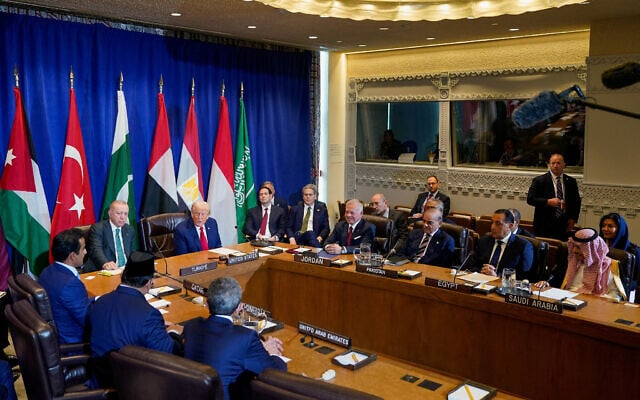
Arab leaders attend a multilateral meeting with US President Donald Trump to discuss the situation in Gaza, on the sidelines of the United Nations General Assembly in New York City on September 23, 2025. (Reuters)
The foreign ministers of eight Arab and Muslim majority countries issued a joint statement on Monday welcoming US President Donald Trump’s vision for ending the war in Gaza and restoring peace to the region, even as the Hamas terror group, which must agree to the deal for it to be fully implemented, had yet to issue a response.
The statement, published by the foreign ministers of Saudi Arabia, Jordan, the United Arab Emirates, Indonesia, Pakistan, Türkiye, Qatar, and Egypt welcomed Trump’s “sincere efforts” toward ending the war, and asserted their “confidence in his ability to find a path to peace.”
Trump’s 20-point plan, titled “Comprehensive Plan to End the Gaza Conflict,” was made public by the White House shortly before Trump’s joint press conference with Prime Minister Benjamin Netanyahu, who confirmed that Israel had accepted the proposal.
Hamas has yet to respond to the plan, although Qatari news outlet Al Jazeera reported that Qatar and Egypt had conveyed it to the terror group, and that the Hamas delegation promised to examine the proposal “responsibly.”
Noting the “importance of the partnership with the United States in securing peace in the region,” the eight Arab and Muslim top diplomats “reaffirm[ed] their joint commitment to engage positively and constructively with the United States and the parties toward finalising the agreement and ensuring its implementation.”
“They reaffirm their joint commitment to work with the United States to end the war in Gaza through a comprehensive deal that ensures unrestricted delivery of sufficient humanitarian aid to Gaza, no displacement of the Palestinians, the release of hostages, a security mechanism that guarantees the security of all sides, full Israeli withdrawal, rebuilds Gaza and creates a path for a just peace on the basis of the two state solution, under which Gaza is fully integrated with the West Bank in a Palestinian state in accordance with international law as key to achieving regional stability and security,” the statement added.

US President Donald Trump, right, and Prime Minister Benjamin Netanyahu shake hands at the conclusion of a joint press conference in the State Dining Room of the White House in Washington, September 29, 2025. (ANDREW CABALLERO-REYNOLDS / AFP)
Of the countries signed onto the statement, Israel has relations, in varying states of health, with Egypt, Jordan, the UAE and Türkiye.
Neither Qatar nor Saudi Arabia has any formal ties with Israel, although Qatar has played a key mediatory role in negotiations over the past two years of war, and Israel is eyeing normalization with Riyadh further down the line.
Indonesia and Pakistan, the world’s two most populous Muslim-majority countries, have indicated that they will not establish diplomatic ties with Israel until it has committed to the creation of a Palestinian state.
Still, Indonesia has offered troops as part of a future Gaza force, while Pakistan has been eager to woo Trump and improve its relationship with Washington.
Trump hailed a statement by Pakistani Prime Minister Shehbaz Sharif, posted on X even before the White House announcement, in which he voiced his “firm belief that President Trump is fully prepared to assist in whatever way necessary” to secure an end to the war.
Trump’s 20-point plan, if accepted by both sides, will immediately put an end to the fighting in Gaza and ensure that all remaining hostages are freed within 72 hours. Hamas members who commit to peaceful coexistance and to decommission their weapons will be given amnesty, and those who wish to leave Gaza will be provided safe passage.
Aid will then flow into the war-torn enclave, and a process of demilitarizing, deradicalizing, and redeveloping the Strip will begin.

Palestinians check the damage outside a house hit by an Israeli strike in the Nuseirat camp in the central Gaza Strip on September 27, 2025. (Photo by Eyad BABA / AFP)
A transitional government of Palestinian technocrats will be established, alongside an international advisory board chaired by Trump and including former UK prime minister Tony Blair. A temporary international security force (ISF) will be deployed to the Strip, which will gradually take over from the IDF as it withdraws.
Meanwhile, the Palestinian Authority will undergo long-demanded reforms until it is determined that the conditions are in place for a “credible pathway to Palestinian self-determination and statehood.”
The plan does not provide a timeline for this, choosing instead to leave it open-ended.
The Palestinian Authority nevertheless welcomed Trump’s “sincere and determined efforts” to end the war in Gaza, and affirmed “its confidence in his ability to find a path toward peace.”
The PA vowed to work with American, regional, and other partners on a comprehensive deal that delivers aid to Gaza, frees the hostages held there as well as Palestinian security prisoners held in Israeli prisons, ensures IDF withdrawal, and advances a two-state solution alongside internal reforms, swift elections, and building a democratic, demilitarized state.
The statement, published both in English and Arabic, stressed that it was committed to carrying out a series of long-demanded reforms to the structure of the Ramallah-based PA, including “holding presidential and parliamentary elections within one year after the end of the war,” and ensuring that all candidates meet both the PLO’s guidelines. and those of the international community.
“We have affirmed our desire for a modern, democratic, and non-militarized Palestinian state, committed to pluralism and the peaceful transfer of power,” the PA noted, adding that it would also carry out reforms to its school curriculum, which Israel has long said contains incitement to terror.
Not everyone was so effusive, however.

This handout picture provided by the Palestinian Authority’s press office shows Palestinian Authority President Mahmoud Abbas applauding as he gives a video address to a UN summit on a two-state solution in New York City, from his headquarters in Ramallah on September 22, 2025. (Thaer GHANAIM / PPO / AFP)
The Palestinian Islamic Terror group, which is still holding at least one hostage in the Gaza Strip, said in a scathing statement that Trump’s plan would fuel further aggression against Palestinians.
“It is a recipe for continued aggression against the Palestinian people. Through this, Israel is attempting — via the United States — to impose what it could not achieve through war,” the group said.
“Therefore, we consider the American-Israeli declaration a formula for igniting the region.”
Some suspect ‘farce,’ others long for ‘moment of joy’
On the ground in the war-ravaged Palestinian enclave, opinion was split as to whether Trump’s ambitious plan could create change on the ground, with some dismissing it as a farce that would fail to end the war.
“It’s clear that this plan is unrealistic,” 39-year-old Ibrahim Joudeh told AFP from his shelter in the so-called humanitarian zone of Al-Mawasi in south Gaza.
“It’s drafted with conditions that the US and Israel know Hamas will never accept. For us, that means the war and the suffering will continue,” said the computer programmer, originally from the southern city of Rafah, devastated by a military offensive that began in May.
Abu Mazen Nassar, 52, was equally pessimistic and feared that the plan aimed to trick Palestinian terror groups into releasing hostages held in Gaza, and no peace in return.
“This is all manipulation. What does it mean to hand over all the prisoners without official guarantees to end the war?” said Nassar, displaced from his home in north Gaza in central Gaza’s Deir al-Balah.
“We as a people will not accept this farce,” he said, adding that “whatever Hamas decides now about the deal, it’s too late.”
“Hamas has lost us and drowned us in the flood it created.”
Some, like Anas Sorour, a 31-year-old street vendor from the southern Gaza city of Khan Younis, also displaced to Al-Mawasi, dared to hope.
“Despite everything we’ve lived through and lost in this war… I still have hope,” Sorour told AFP.
“No war lasts forever. This time I am very optimistic, and God willing it will be a moment of joy that makes us forget our pain and our anguish,” he added.

An idle amusement park slide stands amid tents at a camp for displaced people in Khan Younis in the southern Gaza Strip, on September 29, 2025. (Omar AL-QATTAA / AFP)
But others, like 29-year-old homemaker Najwa Muslim, could no longer imagine anything changing.
“I haven’t only lost faith in the deal; I’ve lost faith in life”, Muslim told AFP from central Gaza, where she sought refuge after being displaced from Gaza City, currently under a massive Israeli military offensive.
“If there was a real intention to stop the war, they wouldn’t have waited this long. That’s why I don’t believe any of their words.”
Mohammed al-Beltaji, a 47-year-old from Gaza City, summarized his view of negotiations to AFP.
“As always, Israel agrees, then Hamas refuses — or the other way around. It’s all a game, and we, the people, are the ones paying the price.”
END
ISRAEL/HAMAS
Smotrich assails Gaza deal but doesn’t say he’ll try to sink it, as praise pours in
US-led proposal draws plaudits from broad swath of Israeli politicians; Netanyahu claims agreement won’t lead to Palestinian state; Hamas mulling terms
By Sam Sokol, Follow
Nava Freiberg Follow
and ToI StaffToday, 4:29 pm

Finance Minister Bezalel Smotrich attends a Finance Committee meeting at the Knesset, in Jerusalem on August 14, 2025. (Yonatan Sindel/Flash90)
Finance Minister Bezalel Smotrich slammed a US-led plan to end the war in Gaza as a “resounding diplomatic failure” in a lengthy social media post on Tuesday but stopped short of saying outright that his party would try to torpedo it.
The post was a rare note of criticism amid a chorus of Israeli and international praise for the plan, which US President Donald Trump unveiled on Monday at a White House press conference alongside Prime Minister Benjamin Netanyahu. Netanyahu said he accepted the plan and has since defended it against criticism from the right — vowing not to allow the establishment of a Palestinian state or to fully withdraw Israeli troops from Gaza.
Hamas, according to reports on Tuesday, is examining the proposal and will deliver its response in a matter of days, after meeting with representatives from Turkey and Qatar. The deal calls on the terror group to disarm, which it has refused to do in the past, as well as release all of the Israeli hostages it is holding within three days, in exchange for an immediate end to the war.
Hamas’s acceptance of the terms would be key to fulfilling the agreement in its entirety. CBS News reported on Tuesday that Hamas is leaning toward accepting the terms of the plan, citing an unnamed source “close to the process.”
But within the Israeli political sphere, the reactions of Smotrich and National Security Minister Itamar Ben-Gvir, both far-right partners of Netanyahu, are being closely watched. Either can collapse the Netanyahu’s government over the plan, and both have previously threatened to leave the coalition over ceasefire deals.
Ben-Gvir has yet to publicly weigh in on the deal. In a lengthy post on X, Smotrich, who heads the hardline Religious Zionism party, called celebrations over the plan premature, criticizing the scheme as giving up “real achievements on the ground for political illusions, and submitting to a diplomatic bear hug and glittering ceremonies.”
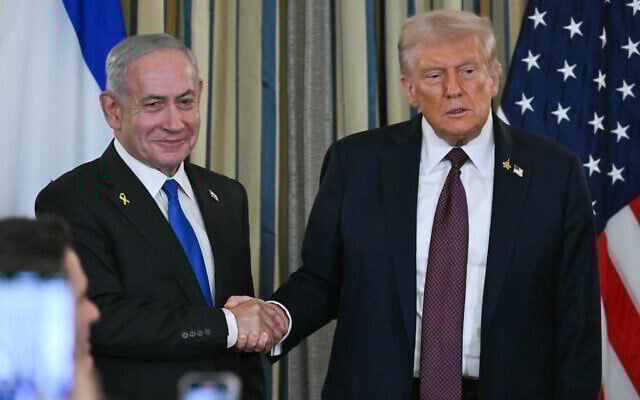
US President Donald Trump and Israeli Prime Minister Benjamin Netanyahu shake hands at the conclusion of a joint press conference in the State Dining Room of the White House in Washington, DC, on September 29, 2025. (ANDREW CABALLERO-REYNOLDS / AFP)
The finance minister wrote that the plan — which calls for an Arab-led security force and an independent Palestinian government to manage affairs in Gaza — marks a return to an era of Israeli-Palestinian peace talks that he firmly opposes.
In the wake of the Hamas-led October 7, 2023, attack that launched the war, Smotrich has called for Israel to occupy and resettle Gaza, which he has said is “inseparable” from Israel.
The deal, he wrote, is a “historic missed opportunity to finally break free from the shackles of Oslo, a resounding diplomatic failure, closing our eyes and turning our backs on all the lessons of October 7.”
He added, “In my estimation, this too will end in tears,” and said the situation was a “tragic case of leadership abstaining from any vision.”
While Smotrich expressed hope that Hamas’s “obstinacy” would scuttle the deal, he did not say whether he would do so himself by withdrawing his party from Netanyahu’s coalition. On Monday, he said that he had informed the prime minister of his party’s “red lines” ahead of the premier’s meeting with Trump to discuss the plan.
“[Given] Prime Minister Netanyahu’s initial unwillingness to conquer Gaza… is this the maximum that can be achieved right now?” he asked in the post. “These are good questions. We will consult, consider, and decide, with God’s help.”

Opposition Leader and Yesh Atid chairman MK Yair Lapid attends a Yesh Atid party conference in Tel Aviv, September 1, 2025.(Avshalom Sassoni/Flash90)
Even if Smotrich and Ben Gvir bring down Netanyahu’s government, he would still almost certainly have a parliamentary majority in favor of the agreement. A chorus of opposition figures, from liberal to hardline, have praised the plan since it was published.
Yair Golan, leader of the left-wing Democrats alliance, said the deal is in the “spirit” of his party. Avigdor Liberman, chair of the hardline Yisrael Beytenu party, posted that “every initiative that brings all the hostages home must be welcomed.”
Naftali Bennett, the former prime minister now mounting a political comeback, called the plan “a difficult, but necessary step” given the price Israel has paid over two years of war.
Opposition Leader Yair Lapid also came out in support of the plan.
“The 20-point plan that Donald Trump presented yesterday is not perfect, but it is the best option on the table,” Lapid posted. “We’ve squandered a tragic year of personal and national disasters, a year when hostages have died and soldiers have been killed as our international standing is disintegrating before our eyes. Time has run out.”
But Lapid added that Netanyahu could still torpedo the deal now that he was back in Israel.
“He usually says ‘yes’ in Washington, when he stands in front of cameras in the White House and feels like a groundbreaking statesman, and the ‘but’ when he returns to Israel and the ‘base’ reminds him who’s boss,” Lapid wrote.
Netanyahu appeared to be responding to critiques from right-wing voters. On Tuesday, he posted a brief video in which he responded to questions about the plan, assuring viewers that the IDF would be able to remain in Gaza and that the plan does not commit Israel to establishing a Palestinian state.
“It was a historic visit,” he said. “Instead of Hamas isolating us, we turned things around and isolated Hamas.
“Now the whole world, including the Arab and Muslim world, is pressuring Hamas to accept the terms that we created together with Trump, to bring back all the hostages — the living and the dead — while the IDF remains in the Strip.”
His remarks appeared to misrepresent a portion of Trump’s plan, which was published online by the White House. The plan does not envision the IDF remaining in Gaza indefinitely, but rather withdrawing gradually and handing over the reins to an international security force.
In response to a question as to whether the plan mandates a Palestinian state, Netanyahu said, “Absolutely not. It’s not written in the agreement.” The agreement does leave the door open to a Palestinian state in the future, though it does not guarantee one.
“We said we would strongly oppose a Palestinian state,” he added, claiming Trump agrees with him that Palestinian statehood would be a “massive prize for terrorism.”
Foreign Minister Gideon Sa’ar speaks during a press conference after talks with his Serbian counterpart Marko Djuric in Belgrade, Serbia, Tuesday, Sept. 30, 2025. (AP/Darko Vojinovic)
Some of Netanyahu’s lieutenants also praised the plan. Tourism Minister Haim Katz, a member of the prime minister’s Likud party, posted on X that the deal means “the return of all the hostages, the removal of every existential threat, and a generation of peace for Israel’s children in any way and as soon as possible.”
Foreign Minister Gideon Sa’ar, meanwhile, said while on a diplomatic visit to Serbia that Israel’s acceptance of the deal “shouldn’t surprise anyone,” as Israel remains “committed to the goals that we set” for the war, which include destroying Hamas’s military and governing capacity, freeing the hostages, and ensuring Gaza doesn’t pose a future threat to Israel.
Sa’ar said he was skeptical as to whether Hamas would agree to the deal’s terms.
“We know, based on the past, that they usually want to open and close, try changing the terms, and to escape from implementing,” he added. “But we will see.”
END
SYRIA
as we mentioned before, Jolani is not to be trusted:
Damascus Orders Troops To ‘Prepare For Operations’ Against US-Trained SDF

by Tyler Durden
Tuesday, Sep 30, 2025 – 03:20 PM
Syria’s government has asked factions within the military to prepare for operations against the US-backed Syrian Democratic Forces, the Syrian Observatory for Human Rights (SOHR) reported Monday.
According to SOHR, Turkish-aligned factions in the Syrian army were asked to “prepare for operations” against the SDF in Deir Hafer and the Tishreen Dam area. SOHR added that officials in Damascus have requested that a campaign against the SDF not take more than a week.
The operation would aim to pressure the Kurdish group into accepting the agreement signed with Damascus in March this year. Recent days have seen a significant buildup of both Syrian army forces and SDF troops in eastern Aleppo.

On Monday, SOHR reported escalating clashes in eastern Aleppo. More than 10 artillery shells struck areas around the Tishreen Dam following exchanges between the SDF and Turkish-backed Syrian factions.
Earlier in the day, SOHR sources confirmed that orders were issued to deploy “show-of-force” units with heavy vehicles, tanks, and artillery to the Deir Hafer frontline in anticipation of possible SDF operations.
There are also reports that the SDF has stationed kamikaze drones, rocket launchers, and long-range artillery near the local sugar factory.
Military reinforcements from Turkey also arrived at Kuweires Airport, while the Aleppo–Raqqa Road in Deir Hafer remained closed for a third consecutive day. Additional forces from both the SDF and Turkish-backed Syrian units have gathered around the Tishreen Dam, heightening concerns over an escalation.
SOHR added that an SDF drone strike destroyed two positions of Turkish-backed Syrian factions in Qashla village on Sunday.
There has been tension between the SDF and the government over a deal signed in March calling for the Kurdish group’s integration into Damascus’s forces. The two sides disagree about the deal’s implementation, particularly the SDF’s wish to remain under Kurdish command and enter the army as a bloc rather than dissolve and conscript.
Skirmishes between the SDF and the Syrian army have broken out several times since last month.
Ankara’s proxy, the Syrian National Army (SNA) coalition, was incorporated into Syria’s military after the fall of former Syrian president Bashar al-Assad’s government last year. These Turkish-backed forces have been at odds with the SDF for years and are responsible for war crimes against Kurdish civilians in northern Syria.
The SDF is made up predominantly of People’s Protection Units (YPG) forces. The YPG is the Syrian branch of Turkiye’s enemy, the Kurdistan Workers Party (PKK).
The Turkish army, which occupies Syria and has operated against the SDF in the past, may be gearing up for a new campaign, self-appointed Syrian President Ahmad al-Sharaa said earlier this month. Turkey “may act militarily if full integration is not achieved by December,” Sharaa warned. In late May, Turkish President Recep Tayyip Erdogan warned the SDF to “quit stalling” and integrate with the Syrian army.
Turkey is currently training Syria’s new extremist-dominated military. The National reported on August 17 that Damascus is assembling a force of 50,000 to capture Deir Ezzor and Raqqa from the SDF.
HOUTHIS HOLLAND
The Houthis attack a Dutch ship
(zerohedge)
Dutch Cargo Ship Attacked, Set Ablaze Off Yemen Coast
Monday, Sep 29, 2025 – 06:35 PM
Reports from earlier today indicate a Netherlands-flagged cargo ship is on fire in the Gulf of Aden near Yemen, after being struck by an unidentified projectile launched by the Houthis.
The UK Maritime Trade Operations has cited that “a vessel reported seeing a splash and smoke in the distance” and it’s as yet “unclear how severe the blaze was” – according to Bloomberg. The ship’s Amsterdam-based operator stated Monday, “Earlier today its general cargo vessel Minervagracht that was on passage in the Gulf of Aden, in international waters, has come under attack of an unidentified explosive device, inflicting substantial damage to the ship.”

“Security company Ambrey said the ship targeted on Monday was previously attacked on Sept. 23 when a French naval group reported an incident involving the Netherlands-flagged Minervagracht,” Bloomberg says further. “It’s a relatively small cargo vessel built in 2011 which can hold about 700 containers.”
Despite several rounds of attacks by Israeli jets in the past months, the Iran-aligned Houthis have remained undeterred in targeting any vessel deemed to have Israeli links, or bound for an Israeli port.
A Western warship is said to be heading to the scene of the distressed cargo ship to assess to the situation, and possibly commence with rescues.
The Amsterdam-based firm Spliethoff is the owner of the vessel. Additionally, the Joint Maritime Information Center, overseen by the US Navy, has said that the shipper had “no Israeli affiliations” – so this suggests the Houthis could be returning to a stance of willingness to attack any and all foreign vessels traversing the waters.
The Houthis have by and large respected the months-long US ceasefire declared by President Trump, but have said they have committed to continuing attacks on any Israeli-linked or Israel-bound vessel traversing the Red Sea.
As the US Navy stepped back from regional operations, Washington has pressured the Europeans to step up defense of the vital trade transit waters.
https://x.com/MartinKelly/status/1972679455714705669?ref_src=twsrc%5Etfw%7Ctwcamp%5Etweetembed%7Ctwterm%5E1972679455714705669%7Ctwgr%5E69d810691123d1a44ca6fd2a7673711171f13943%7Ctwcon%5Es1_&ref_url=https%3A%2F%2Fwww.zerohedge.com%2Fgeopolitical%2Fdutch-cargo-ship-attacked-set-ablaze-yemen-coast
The Houthis are an Iran-aligned movement which has shown resiliency, given that for over a half-decade it was bombed by the Saudi-US-UAE coalition, largely to no effect, and now it is in a war with Israel, and has managed to effectively shut down international transit shipping through the Red Sea.
RUSSIA VS UKRAINE/ISRAEL
Ships Running Blind: How GPS Spoofing Is On The Rise
Monday, Sep 29, 2025 – 05:20 PM
Authored by Chris Summers via The Epoch Times (emphasis ours),
There has been a big increase in the number of Global Positioning System (GPS) spoofing or jamming attacks, aimed at messing with the GNSS (Global Navigation Satellite System) data, which is standard on all international shipping.

Jeroen Pijpker, from NHL Stenden University of Applied Sciences in the Netherlands, told The Epoch Times they had recorded 400 GPS spoofing and jamming incidents in their database—25 percent of which related to actual vessels—but he believed it was the “tip of the iceberg.”
Nir Ayalon, the founder and CEO of Cydome, a maritime cybersecurity firm based in Israel, told The Epoch Times that 95 percent of incidents caused by spoofing or jamming do not end up making the news.
He said Cydome had seen a 500 percent increase in GPS spoofing and jamming this year, with a 2,000 percent rise in the number of maritime blackspot areas.
GPS jamming was blamed for a collision in the Gulf of Oman in June 2025, between the Liberia-flagged tanker Front Eagle, and the Adalynn, which has been identified by Lloyd’s List—the bible of the shipping industry—as a “dark fleet” vessel.
Ayalon said that GPS spoofing is sometimes carried out by the operators of ships in order to disguise their location or identity, but it is also perpetrated as a hostile act.
He said that was believed to be the case with the MSC Antonia, which ran aground in May in the Red Sea, close to the southern end of the Suez Canal, en route to Malta from the Saudi Arabian port of Jeddah.
‘Manipulation of the Data’
“When we talk about GPS spoofing or jamming, we have several methods that organizations will use,” Ayalon said. “So there is the manipulation on the RF [radio frequency] data from the satellite to the vessel or to the antenna itself, but we have also manipulation of the data itself.”
He said spoofing or jamming could be carried out in two ways—by intercepting GNSS messages from the antenna to the transceiver, or by manipulating the AIS (Automatic Identification System) data, which all ships use.
An attacker will manipulate this data, which is easier because it’s on the web, Ayalon said. “It does not require any encryption or any authentication, so you can basically add any information that you want there.”
“It’s very easy to get into AIS data,” he said.
He said GPS spoofing could, in effect, render ships invisible—in other words, they would show up on the map in a certain location, but in reality, they would not be there.
Referring to the MSC Antonia incident, he said: “Basically, their location was manipulated and the ship autopilot tried to fix the path to the path that it thought was the right one … so the ship grounded.”
“If you would look at the place where the AIS is telling you that the ship is … there’s no ship there,” Ayalon said.
Sometimes, spoofing was carried out by bad actors who were trying to damage a specific vessel, he said.
There were also reports of Russian oligarchs using spoofing to hide the location of their megayachts in 2022, when sanctions against Russia kicked in.
“There was a case in Dutch waters, near Den Helder, there was a Russian oligarch with his superyacht, and there was a lot of spoofing around the superyacht,” Pijpker said.
Jamming and Spoofing
Ayalon said that in order to carry out GPS jamming or spoofing, a bad actor needs only a relatively small high-frequency antenna, which would usually need to be sited on a tall building or on a cliff or other high place, close to a port or a shipping lane.
“They will need an antenna,” he said, adding that it is not always something that can be seen.
“It can be quite a small device,” he said.
The Norwegian shipping insurance company Gard published an article recently about GPS jamming, which said navigation in the shipping lanes of the Middle East have been impacted by GPS interference which was used as “defensive measures used to protect against drone and missile threats targeting critical infrastructure include the Israeli coast and the Red Sea during the Israel–Hamas conflict as well as the Persian Gulf and Arabian Gulf.”
Ayalon said there were a number of GPS spoofing blackspots around the world where mariners knew they had to keep especially alert.
These areas included the Black Sea, the Red Sea, the South China Sea, the Persian Gulf, the eastern end of the Mediterranean, the Barents Sea, and the seas around North Korea.
There is also a small blackspot near Pensacola, Florida, which may be linked to a U.S. naval air station.

Ayalon said a lot of the satellite data for shipping around China was also not accurate because of spoofing.
Pijpker pointed out a case in 2019, when a British ship, the Stena Impero, drifted into Iranian waters in the Persian Gulf after apparently having its GPS spoofed.
He said the Iranians allegedly used GPS spoofing to get the ship to unintentionally enter their national waters, and they then seized it. It left Iranian waters later that year.
Ship Honeynet Created
But Pijpker said GPS spoofing remained an “under-researched topic,” and he said his own university had created a ship honeynet in an attempt to understand the “malicious traffic,” referring to a network setup with intentional vulnerabilities to attract hackers.
He said it was a “virtual ship” that was linked to the internet by a Starlink device and a decoy server and was designed “to see what kind of people are attacking ships.”
Ayalon said the increase in Low Earth Orbit (LEO) satellites like Starlink had brought with it a lot of new maritime technology, but he said a lot of crew members trust what the computer and other semi-autonomous systems display.
“This means that we see more and more events like the MSC Antonia,” he said.
He said there were a lot of tools that enabled crews to check the integrity of their GNSS, and he said crews will need to start using these types of systems “in order to make sure that they’re in the right place.”
END
RUSSIA /UKRAINE
MASSIVE STRIKES ON KIEV
Russia Launches Massive Strikes On Kyiv As Kupiansk Ready To Fall
Tuesday, Sep 30, 2025 – 06:45 AM
Russia unleashed one of the largest missile and drone barrages of the war on September 27-28. The strikes targeted areas across Ukraine but the capital of Kyiv suffered notable damage.
Beyond Kyiv, Ukrainian President Volodymyr Zelenskyy said that the bombardment targeted the regions of Zaporizhzhia, Khmelnytskyi, Sumy, Mykolaiv, Chernihiv, and Odesa. Zelenskyy wrote on X that at least 40 people were wounded across the country. Later, Ukraine’s Interior Ministry stated the number of the wounded rose to 70, with more than 100 civilian objects damaged.
The attack was carried out using nearly 600 drones and 48 missiles. Ukraine continues to make grand claims on interceptions, asserting that air defenses shot down or jammed 566 drones and 45 missiles. Interception estimates rarely match with damage estimates, with Zelensky asking for more Patriot missiles from any country that will sell them.
Earlier in September, Russia launched over 810 Shahed-type drones and 13 missiles in a record-breaking attack that struck the Cabinet of Ministers building in central Kyiv.
Kyiv officials warned this week that they are expecting increased strikes on Ukraine’s power grid, a now annual event which forces the nation into rolling blackouts during the winter months.
Meanwhile, there are conflicting reports on Russia’s siege of the city of Kupiansk. Ukraine says the Russian advances have been repelled but reports from war tracker Deep State and other analysts indicate that Russian forces are gaining ground in the city center.
Ukrainian public broadcaster hromadske, citing Andrii Besedin, Head of Kupiansk City Military Administration, on the national joint 24/7 newscast, stated that:
“The situation is critical. In addition to sabotage and reconnaissance groups that have infiltrated or are infiltrating the city, the enemy carries out extensive attacks on the city and the surrounding territory. The proximity of the front line enables them to strike with everything in their arsenal: tanks, mortars, artillery and multiple-launch rocket systems. Guided aerial bombs are being dropped daily on the territory of the Kupiansk hromada. Fibre-optic FPV drones that cannot be jammed by electronic warfare are effectively hunting civilians and vehicles. Every route into and through the city, all logistical routes are, unfortunately, under the watch of enemy drones.”
Besedin added that the city’s infrastructure has collapsed: there is no power, water, gas supply, mobile connectivity or social services. Hundreds of residents have so far refused to evacuate.
This lines up with reports that civilians still in the city are only able to leave on foot and then find transport to the west. If Kupiansk falls then a large portion of the northeastern front will likely be enveloped by the Russians, allowing them to advance on Kharkiv.

Western analysts that lack a basic understanding on attrition tactics argue that Russia’s conflict with Ukraine reveals their “military weakness” due to their inability to gain ground quickly. But the primary goals of attrition is not necessarily to gain ground. Rather, the goal is to grind down enemy forces over time until they can no longer fight effectively.
Ukraine has already reached this point; it my be the reason why Europe seems poised to enter the war and the Trump Administration has indicated they might allow sales of Tomahawk Missiles to Kyiv. Peace negotiations appear to be off the table.
6. GLOBAL ISSUES//COVID ISSUES/VACCINE ISSUES/HEALTH ISSUES
Florida invests $60 million in cancer research, focusing on ivermectin and repurposed drugs – NaturalNews.com
Florida invests $60 million in cancer research, focusing on ivermectin and repurposed drugs

- Why: To explore alternative cancer treatments like ivermectin, which is cheap and lacks a profit-driven research model.
- Who: Governor Ron DeSantis and First Lady Casey DeSantis, with backing from Surgeon General Dr. Joseph Ladapo.
- When: Announced on World Cancer Research Day, September 24, 2025.
- Where: University of South Florida.
- What: Florida is investing $60 million into the Florida Cancer Innovation Fund, focusing on repurposed drugs and preventative nutrition.
On World Cancer Research Day, September 24, Florida’s Governor Ron DeSantis and First Lady Casey DeSantis announced a significant investment of $60 million into cutting-edge cancer research. The funds, part of the Florida Cancer Innovation Fund, aim to explore alternative cancer treatments using repurposed drugs, with a particular focus on ivermectin, a well-established anti-parasitic medication. This initiative reflects the state’s commitment to finding innovative solutions that can benefit taxpayers and patients alike, despite the lack of financial incentives for pharmaceutical companies.
The role of ivermectin in cancer research
Ivermectin, an anti-parasitic medication widely used to treat parasitic infections, has drawn attention for its potential applications in cancer treatment. This interest stems from promising pre-clinical data suggesting its ability to inhibit cancer cell proliferation. Dr. Joseph Ladapo, Florida’s surgeon general, emphasized the importance of investigating alternative therapies that can provide affordable and accessible treatment options. “We’re uniquely positioned to do this because big pharma doesn’t profit from relatively cheap drugs like ivermectin,” he stated. First Lady Casey DeSantis, a cancer survivor herself, echoed this sentiment, underscoring the need to look beyond conventional treatments.
Repurposing ivermectin for cancer treatment
While ivermectin is not currently approved by the FDA for cancer treatment, there is a growing body of research supporting its potential. Dr. Paul Marik, a prominent researcher in the field, highlighted its effectiveness in combination with other drugs. “Ivermectin inhibits cancer cell viability, showing promise in treating several types of cancer,” he told a press conference. However, cautious optimism is warranted given the limitations in clinical evidence. Some experts caution against the use of ivermectin due to insufficient rigorous evidence, emphasizing that further research is essential to validate its clinical effectiveness.
Historical context and current challenges
The push to repurpose ivermectin for cancer treatment is not without historical context. The off-patent nature of ivermectin—meaning it is inexpensive—has long been a barrier to pharmaceutical investment in expanding its use. This phenomenon exemplifies the broader debate surrounding drug repurposing and the emphasis on affordable treatments. Despite the potential benefits, these drugs often lack the financial incentives that drive large-scale clinical trials, thus remaining underutilized.
During the COVID-19 pandemic, ivermectin gained prominence, with some advocating for its use as a preventive and treatment option. The FDA issued warnings against its misuse, which further polarized opinions on the drug’s efficacy. The DeSantis administration’s current push to explore ivermectin in cancer treatment underscores the ongoing tension between scientific rigor and public health advocacy.
Collaboration and innovation at the forefront
The Florida Cancer Innovation Fund, initiated three years ago, has already made a substantial impact by funding 95 researchers with $80 million. This year’s $60 million injection aims to deepen these efforts, focusing particularly on nutrition and the repurposing of generic drugs like ivermectin. The fund’s distribution is guided by the potential for quick results and measurable outcomes, with priority given to translational research, 12-month clinical trials, and interventions benefiting rural and underserved populations.
During the press conference, Governor DeSantis emphasized the state’s dedication to making Florida a beacon of hope in cancer research. “Investing in innovation today means saving lives tomorrow,” he said. The initiative also highlights the role of academic partnerships, with the University of South Florida serving as a key player in advancing this research.
A vision for the future
As Florida embarks on this ambitious cancer research initiative, the state stands at the forefront of a broader movement advocating for affordable, innovative treatments. By focusing on ivermectin and other repurposed drugs, the DeSantis administration aims to bridge the gap between research and patient care. However, the success of this initiative hinges on rigorous scientific validation and maintaining ethical standards. As the world watches, Florida’s commitment to exploring alternative therapies may serve as a model for other states and nations, ultimately striving for a future where cancer is less of a death sentence and more of a manageable condition.
Sources for this article include:
GLOBAL ISSUES
MARK CRISPIN MILLER
DR PAUL ALEXANDER
NEWSWISE
NEWS ADDICTS
EVOL NEWS
| LATEST NEWS: |
MICHAEL EVERY/OR OR PICTON/GIFFIN OR RABOBANK EXECUTIVE/COMMENTARY ON WORLDLY AFFAIRS
Every highlights the last 24 hours on the worldly stage!
(Mike Every)
“The Implications Are Profound”: Trump May Have Helped Resolve A Key Global Conflict
Tuesday, Sep 30, 2025 – 02:40 PM
By Michael Every of Rabobank
In classic The Economist-style timing, Foreign Affairs just ran a lead ‘China Goes on Offence’ which underlined “Beijing’s Plans to Exploit American Retreat.” Subsequent developments in the Middle East underlined the complete opposite.
With wild headlines such as ‘Trump to run Gaza with Blair’, a Trump-Netanyahu joint White House press conference officially unveiled the former’s 20-point plan to end the Gaza war and move towards a resolution of that issue – which Netanyahu has signed up to alongside the Gulf Cooperation Council and a slew of leading Muslim countries.
The deal is basically this: Hamas releases all remaining hostages in 72 hours; disarms; and its members who wish to will be given safe passage to third countries; a new US and Arab-backed security force will step in as Israel pulls back in stages; Trump will act as head of a new body called the Board of Peace alongside Blair and other global technocrats; no Gazans will be forced to leave; Israel will not annex any land; and massive deradicalisation efforts will proceed in tandem with reconstruction. The issue of a Palestinian state is kicked into the long grass until the foundations are literally placed for a stable polity and economy. There will also be a US-Qatar-Israel trilateral forum to try to find ways to cooperate.
Of course, Netanyahu has his far-right government coalition parties to deal with – but he has the support of opposition parties if he needs them. That leaves Hamas. There, the crucial point is that, following an official apology to Qatar from Netanyahu for his recent strike in it, even Doha is pushing it to agree – it looks like it is feeling US pressure as much as Israel is. Indeed, if Hamas don’t agree, the US and other Muslim countries behind the deal will allow Israel to crush it and then hand over those territories it liberates to be run and rebuilt as above one by one. In short, this looks like it is going to be done, as was said, “either the easy way, or the hard way.”
If so, the implications are profound. Trump would have helped resolve a key global conflict; the Abraham Accords could rapidly expand, and even to places like Indonesia; and the Middle East would be even more clearly under the US umbrella. Where were China and Russia as this happened? Nowhere. Equally, where was Europe? Where it has been for decades now.
China is instead mentioned in foreign affairs via the Australia’s ABC, which claims classified US intelligence is warning of China’s preparation for a Taiwan invasion. That’s as the Wall Street Journal reports the Pentagon is pushing to double US missile production for a potential China conflict, where suppliers have been asked how they can hit 2.5 times higher output in just 6–24 months, with private capital and licensing options therefore on the table.
Moreover, the Nikkei Asia reports the China-focused AUKUS defence pact has apparently survived an internal Pentagon review, and the planned US nuclear submarine sale to Canberra is to proceed – but will that mean the US making even greater reforms to speed up military production and/or Australia spending 5% of GDP on defence like NATO? To say there are major market implications in these dramatic geopolitical headlines is an understatement.
Russia is mentioned as Medvedev warned Europe of the danger of nuclear danger ahead and Germany’s Chancellor Merz said Europe is “no longer at peace” with Moscow. As one global front may cool down, will another then heat up?
Which one though? Colombia’s President Petro is seeking to revise the US-Colombia trade deal following his recent expulsion from the US after his visa was withdrawn for participating in a political protest, and Venezuela’s President Maduro signed a decree granting himself additional security powers, including the ability to mobilize armed forces nationally, as well as placing public firms under military control, obviously in response to US military statecraft nearby. So, the US has Venezuela, Brazil, Argentina, and Colombia –and Panama and Greenland– to focus on under the Monroe Doctrine. That’s on top of Ukraine-Russia, and the Middle East, and the Indo-Pacific.
In geoeconomics, we see a slew of related news. A Saudi real estate developer is to build a $1bn Trump plaza in a Red Sea port; the Saudis also acquired Electronic Arts for $55bn as part of a plan to build a gaming hub; and Riyadh is “Losing its appetite for oil”, says Bloomberg, arguing it’s becoming Solar Arabia.
The US tightened export controls on Chinese companies where subsidiaries of blacklisted firms now are too, as China’s US ambassador chided it for “closing doors” and enacting tariffs, and Huawei announced it will double its output of top AI chips. The US also put tariffs on lumber to prop up that sector.
In politics, with no deal reached, a US government shutdown seems to loom; the UK’s PM Starmer is to tell his party conference that GDP growth is the ‘antidote to division’ – as Chancellor Reeves warns against ditching the fiscal rules that don’t allow for more fiscal stimulus; and France’s socialists are threatening to topple Macron’s new PM Lecornu for his “unreasonable” deficit-reduction plans. Can you spot a pattern there?
In markets, “The US and Switzerland reconfirmed they have undertaken under the IMF Articles of Agreement to avoid manipulating exchange rates or the international monetary system to prevent effective balance of payments adjustment or to gain an unfair competitive advantage,” in a joint official statement. Ironically, here it took geopolitical pressure to get a country to say, “OK, because markets!” rather than the opposite, which is the general economic statecraft trend.
Moreover, the key Swift system pledged to build a blockchain-based ledger for banks and financial firms, literally to make it swifter, as the geopolitical, geoeconomic, and global financial architecture all goes into joint flux.
Meanwhile, Aussie building approvals -6.0% m-o-m vs. +2.6% expected and China’s manufacturing PMI at 49.8 vs. 49.6 consensus, and non-manufacturing at 50.0 vs 50.2 are the kind of market minutiae that some might want to focus on instead.
The RBA left rates on hold at 3.60%, as expected and said growth in unit labour costs was too high, there are uncertainties over the domestic economic outlook (only the domestic?), and for now it was judged as better to “remain cautious.” Growth risks to the downside and inflation risks to the upside? This wasn’t supposed to happen.
Then again, neither were all of the foreign affairs developments we now see – which seem to have surprised some experts in Foreign Affairs.
7. OIL ISSUES/NATURAL GAS/ENERGY ISSUES/GLOBAL
Exactly what Trump wants; lower oil prices
(zerohedge)
Oil Prices Tumble After Report OPEC+ Will Accelerate Production Hikes
Tuesday, Sep 30, 2025 – 08:35 AM
OPEC+ is to discuss fast tracking its latest round of supply hikes in three monthly instalments of about 500,000 barrels a day to recoup market share.
This comes after the cartel announced earlier this month that they were adding a much smaller amount than that – about 137,000 barrels a day – leaving a question mark about how fast the rest will be returned.
So, now, Bloomberg reports that, according to a delegate, Saudi Arabia and its partners will review the expedited return of the remainder of a 1.66 million barrel-a-day supply tranche when they meet on Oct. 5.
The result is further pressure on the price of oil…
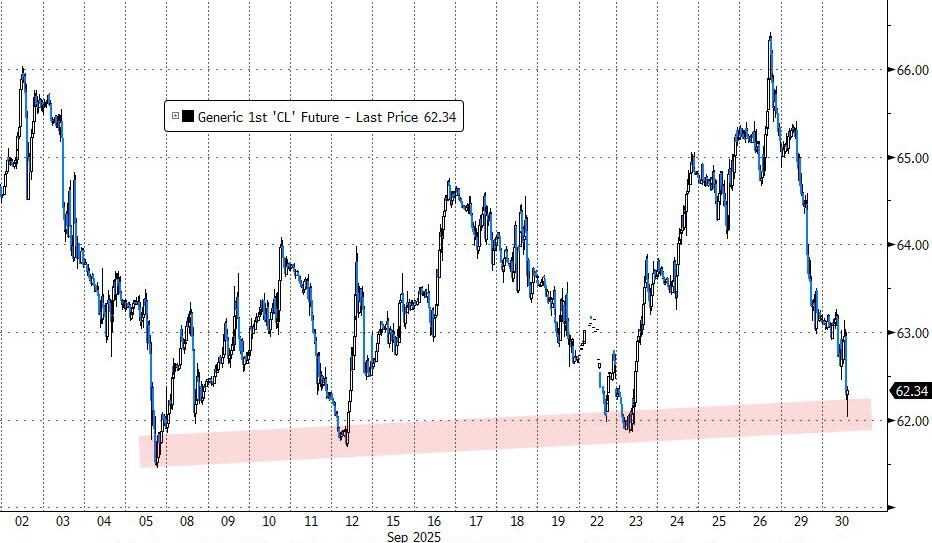
…testing the lows of its recent channel (ironically extending losses after similar rumors hit crude prices yesterday).
The IEA already forecast that the oil market is headed for a record supply-demand surplus next year.
Finally, we note that Saudi Crown Prince Mohammed bin Salman is heading to Washington in November to meet with President Donald Trump, who has called for lower oil prices (infuriating Dallas Fed survey respondents who said Trump’s energy policies are crushing local workers).
8. EMERGING MARKETS//AUSTRALIA NEW ZEALAND ISSUES
YOUR EARLY CURRENCY/GOLD AND SILVER PRICING/ASIAN CLOSING MARKETS AND EUROPEAN BOURSE OPENING AND CLOSING/ INTEREST RATE SETTINGS TUESDAY MORNING 6;30AM//OPENING AND CLOSING
EURO/USA: 1.1746 UP 0.0016 PTS OR 16 BASIS POINTS
USA/ YEN 147.96 DOWN 0.659 NOW TARGETS INTEREST RATE AT 1.00% AS IT WILL BUY UNLIMITED BONDS TO GETS TO THAT LEVEL…//YEN STILL FALLS//END OF YEN CARRY TRADE BEGINS AGAIN OCT 2024/Bank of Japan raises rates by .15% to 1.15..UEDA ENDS HIKING RATES AND NOW CARRY TRADES RE INVENTS ITSELF//JAPAN IN TROUBLE WITH RISING RATES
GBP/USA 1.3443 UP .0008 OR 8 BASIS PTS
USA/CAN DOLLAR: 1.3914 DOWN 0.0003 (CDN DOLLAR UP 3 BASIS PTS//CDN DOLLAR GETTING KILLED)
Last night Shanghai COMPOSITE UP 20.25 PTS OR 0.52%
Hang Seng CLOSED UP 232.68 PTS OR 0.87%
AUSTRALIA CLOSED DOWN 0.14%
// EUROPEAN BOURSE: ALL RED EXCEPT SPAIN
Trading from Europe and ASIA
I) EUROPEAN BOURSES: ALL RED EXCEPT SPAIN
2/ CHINESE BOURSES / :Hang SENG CLOSED UP 232.68 PTS OR 0.87%
/SHANGHAI CLOSED UP 20.25 PTS OR 0.52%
AUSTRALIA BOURSE CLOSED DOWN .14 %
(Nikkei (Japan) CLOSED DOWN 111.12 PTS OR 0.25%
INDIA’S SENSEX IN THE RED
Gold very early morning trading: 3805.85
silver:$46.11
USA dollar index early TUESDAY morning: 97.46 DOWN 13 BASIS POINTS FROM MONDAY’s CLOSE
TUESDAY MORNING NUMBERS ENDS
And now your closing TUESDAY NUMBERS 1: 30 AM
Portuguese 10 year bond yield: 3.123% DOWN 2 in basis point(s) yield
JAPANESE BOND 10 yr YIELD: +1.653% UP 1/2 FULL POINTS AND 0/100 BASIS POINTS /JAPAN losing control of its yield curve/
JAPAN 30 YR: 3.141 UP 2 BASIS PTS//DEADLY
SPANISH 10 YR BOND YIELD: 3.259 DOWN 3 in basis points yield
ITALIAN 10 YR BOND YIELD 3.566 DOWN 2 points in basis points yield ./ THE ECB IS QE’ ING ITALIAN BONDS (BUYING ITALIAN BONDS/SELLING GERMAN BUNDS)
GERMAN 10 YR BOND YIELD: 2.7111 DOWN 2 BASIS PTS
IMPORTANT CURRENCY CLOSES : MID DAY TUESDAY
Closing currency crosses for day /USA DOLLAR INDEX/USA 10 YR BOND YIELD/1:00 PM
Euro/USA 1.1731 UP 0.0000 OR 0 basis points
USA/Japan: 147.94 DOWN 0.681 OR YEN IS UP 68 BASIS PTS//
Great Britain 10 YR RATE 4.7060 DOWN 1 BASIS POINTS //
GREAT BRITAIN 30 YR BOND; 5.512 DOWN 1 BASIS POINTS.
Canadian dollar UP 0002 OR 2 BASIS pts to 1.3915
xxxxxxxxxxxxxxxxxxxxxxxxxxxxxxxxxxxxxxxxxxxxxxxxxxxxxxxxxxxxxxxxxxxxxxxxxxxxxxxx
The USA/Yuan CNY DOWN AT 7.1196 CNY ON SHORE ..
THE USA/YUAN OFFSHORE DOWN TO 7.1280
TURKISH LIRA: 41.58 EXTREMELY DANGEROUS LEVEL/DEATH WATCH/HYPERINFLATION TO BEGIN.//
the 10 yr Japanese bond yield at +1.653 UP 1/2 basis pts
THE 30 YR JAPANESE BOND YIELD: 3.141 UP 2 basis pts
Your closing 10 yr US bond yield DOWN 3 in basis points from MONDAY at 4.123% //trading well ABOVE the resistance level of 2.27-2.32%)
USA 30 yr bond yield 4.701 DOWN 3 in basis points /11:00 AM
USA 2 YR BOND YIELD: 3.606 DOWN 4 BASIS PTS.
GOLD AT 11;00 AM 3820.90
SILVER AT 11;00: 46.07
Your 11:00 AM bourses for Europe and the Dow along with the USA dollar index closing and interest rates:TUESDAY CLOSING TIME 11:00 AM//
London: CLOSED UP 50.29 PTS OR 0.54%
GERMAN DAX: UP 175.56 pts or 0.57%
FRANCE: CLOSED UP 15.07 pts or 0.19%
Spain IBEX CLOSED UP 158.70pts or 1.04%
Italian MIB: CLOSED UP 170.92 or 0.40%
WTI Oil price 62.58 11.00 EST/
Brent Oil: 66.05 11:00 EST
USA /RUSSIAN ROUBLE /// AT: 82.46 ROUBLE UP 0 AND 61/ 100
CDN 10 YEAR RATE: 3.185 DOWN 0 BASIS PTS.
CDN 5 YEAR RATE: 2.749 DOWN 1/2 BASIS PTS
CLOSING NUMBERS: 4 PM
Euro vs USA 1.1741 UP 0.0010 OR 10 BASIS POINTS//
British Pound: 1.3450 UP .0017 OR 17 basis pts/
BRITISH 10 YR GILT BOND YIELD: 4.7010 UP 1 FULL BASIS PTS//
BRITISH 30 YR BOND YIELD: 5.506 DOWN 1 IN BASIS PTS.
JAPAN 10 YR YIELD: 1.653 UP 1 FULL BASIS PTS (DANGEROUS TO THEIR ECONOMY
JAPANESE 30 YR BOND: 3.152 UP 4 AND STILL VERY DANGEROUS TO THEIR ECONOMY
USA dollar vs Japanese Yen: 147.86 DOWN 0.757 BASIS PTS EXTREMELY DANGEROUS/YEN FALLING IN VALUE
USA dollar vs Canadian dollar: 1.3915 DOWN 0.0003 PTS// CDN DOLLAR UP 3 BASIS PTS CDN DOLLAR FALLING OUT OF BED!
West Texas intermediate oil: 62.50
Brent OIL: 66.17
USA 10 yr bond yield UP 1 BASIS pts to 4.148
USA 30 yr bond yield UP 3 PTS to 4.730%
USA 2 YR BOND: DOWN 3 PTS AT 3.606%
CDN 10 YR RATE 3.185 DOWN 1 BASIS PTS
CDN 5 YEAR RATE: 2.749 DOWN 0 BASIS PTS
USA dollar index: 97.46 DOWN 13 BASIS POINTS
USA DOLLAR VS TURKISH LIRA: 41.58 GETTING QUITE CLOSE TO BLOWING UP/
USA DOLLAR VS RUSSIA//// ROUBLE: 82.16 UP 0 AND 91/100 roubles //
GOLD $3860.90 . (3:30 PM)
SILVER: 46.68 (3:30 PM)
DOW JONES INDUSTRIAL AVERAGE: UP 81.82 OR 0.18%
NASDAQ 100 UP 68.64 PTS OR 0.25%
VOLATILITY INDEX 16.20 UP 0.08 PTS OR 0.50%
GLD: $ 355.47 UP .301 PTS OR 0.85%
SLV/ $42.87 DOWN 0.13 PTS OR OR 0.31%
TORONTO STOCK INDEX// TSX INDEX: CLOSED UP 50.90 PTS OR 0.17%
end
TRADING today ZEROHEDGE 4 PM: HEADLINE NEWS/TRADING
Tech Jumps, Trannies Dump As Rate-Cuts Spark Gold’s Best Month In 14 Years
WRAP UP FOR THE DAY:
US stocks saw slight strength into the month/quarter-end – Newsquawk Asia-Pac Market Open
Tuesday, Sep 30, 2025 – 04:55 PM
- US stocks saw slight strength to settle around highs as they saw a bid through the US afternoon and into the month/quarter-end, although the Russell 2000 did still close marginally in the red.
- The Dollar saw slight losses on Tuesday heading into the month and quarter-end, with attention on Tuesday surrounding Fed speak, US data and Government shutdown.
- T-Notes saw two-way action on mixed data before settling flat as the US government heads for a shutdown.
- The US Labour Department clarified that the Weekly Jobless Claims report will not be released in the event of a government shutdown, according to Reuters.
- The OPEC Secretariat firmly rejected media reports alleging that the G8 countries are planning to increase production by 500k bpd, calling the claims wholly inaccurate and misleading.
- Looking ahead, highlights include New Zealand Building Consents, Australian AIG Index, Australian S&P Global Manufacturing PMI Final, Japanese Tankan Survey, South Korean Trade Balance Prelim, Japanese S&P Global Manufacturing PMI Final, Supply from Australia, Fed’s Logan, RBI Policy Announcement.
More Newsquawk in 2 steps:
1. Subscribe to the free premarket movers reports
2. Trial Newsquawk’s premium real-time audio news squawk box for 7 days
SNAPSHOT
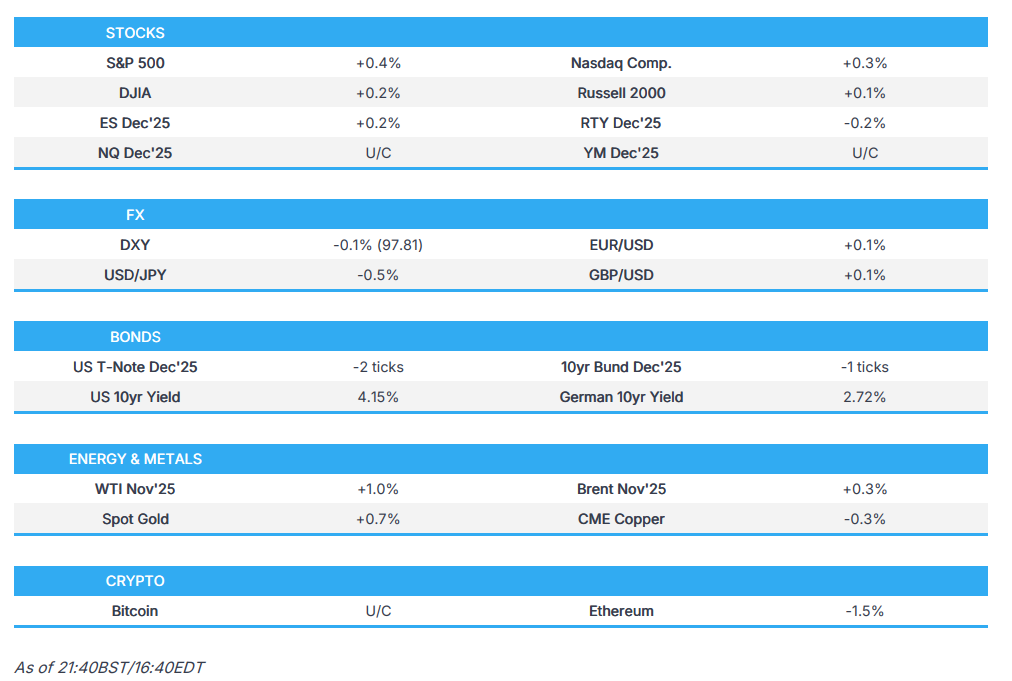
US TRADE
- US stocks saw slight strength to settle around highs as they saw a bid through the US afternoon and into month/quarter-end, although the Russell 2000 did still close marginally in the red. There was little headline driver for the paring of losses seen.
- Sectors were mixed, but with a green bias, as Energy lagged and weighed on by the aforementioned oil prices, while Health sat atop of the pile and was supported by Pfizer (+6.5%), in the wake of a raft of Trump announcements. Spot gold reversed earlier losses to continue its ascent higher and printed a new ATH.
- SPX +0.41% at 6,688, NDX +0.28% at 24,680, DJI +0.18% at 46,398, RUT +0.05% at 2,436
- Click here for a detailed summary.
NOTABLE HEADLINES
- The US Labour Department clarified that the Weekly Jobless Claims report will not be released in the event of a government shutdown, according to Reuters.
- US President Trump said “maybe a lot” of workers would be laid off in the event of a shutdown, according to Reuters.
- US President Trump said on government spending that they are going to see what happens, noting he had a good discussion with Schumer and Jeffries. On a potential government shutdown, he said “we’ll probably have one,” adding that Democrats are taking a risk and that during a shutdown the government can cut benefits and take medical actions that are irreversible, according to Reuters.
- USTR Greer, when asked whether the Trump administration has discussed taking a stake in NVIDIA (NVDA), said US President Trump would love a stake in every company that is doing well, according to Reuters.
- Fed’s Goolsbee (2025 voter) said the US seems to be headed into a new wave of tariffs, while the labour market remains pretty steady, according to Reuters.
DATA RECAP
- US CaseShiller 20 MM SA (Jul) -0.1% vs. Exp. -0.2% (Prev. -0.3%, Rev. -0.2%)
- US CaseShiller 20 YY NSA (Jul) 1.8% vs. Exp. 1.6% (Prev. 2.1%, Rev. 2.2%)
- US CaseShiller 20 MM NSA (Jul) -0.3%
- US Monthly Home Price MM (Jul) -0.1% (Prev. -0.2%)
- US Monthly Home Price YY (Jul) 2.3% (Prev. 2.6%, Rev. 2.7%)
- US Chicago PMI (Sep) 40.6 vs. Exp. 43.0 (Prev. 41.5)
- US JOLTS Job Openings (Aug) 7.227M vs. Exp. 7.185M (Prev. 7.181M, Rev. 7.208M). Vacancy Rate 4.3% (prev. 4.3%). Quits Rate 1.9% (prev. 2.0%)
- US Consumer Confidence (Sep) 94.2 vs. Exp. 96.0 (Prev. 97.4)
- US Texas Serv Sect Outlook (Sep) -5.6 (Prev. 6.8)
- US Dallas Fed Services Revenues (Sep) -2.4 (Prev. 8.6)
TARIFFS/TRADE
- EU Trade Commissioner Sefcovic said the EU and US are very soon going to propose post-2026 safeguard measures on steel, working with tariff-rate quotas to deal with global overcapacity, according to Reuters.
- US President Trump said Eli Lilly (LLY) has been fantastic, warning that pharma companies will face an extra 5–8% tariff if no deals are made. He said drug pricing will have a huge impact on the mid-term elections and that on Pfizer (PFE), drug price lowering will be immediate, according to Reuters.
- US President Trump said Pfizer (PFE) agreed to offer discounts, with the US paying the lowest price—50–100% off and in some cases more. He added that all US medications will be sold at most favoured nation prices and that Pfizer will offer all of its prescription medications to Medicaid at MFN prices, according to Reuters.
- US FDA Chief said that if drugmakers equalise their prices, their applications will go to the front of the line, and if they build in the US, they will also move to the front of the line, according to Reuters.
- USTR Greer said President Trump’s pharmaceutical tariff is aimed at ensuring that the most innovative drugs are produced in the US, according to the Economic Club of New York.
- US Commerce Secretary Lutnick, on 232 investigations, said that while negotiations are ongoing, they are going to let it play out, according to Reuters.
- USTR Greer said the US will always trade with China but needs to find a place where both countries are comfortable, adding that China’s reliance on exports is not sustainable and that trade should become more balanced. He said China’s “wolf warrior” ethos has leaked into US-China economic relations, noted that the average tariff of 55% on Chinese imports is the status quo, and added that the USTR will be fully functioning in the event of a government shutdown. He said US tariff revenues could reach USD 600bln to USD 1tln per year, according to Reuters.
- US President Trump said other drugmakers will commit in the coming weeks to sell at most favoured nation prices, which will help bring Medicaid costs down. He added that medicines will be available for direct purchase on a US government website, according to Reuters.
CENTRAL BANKS
- ECB Vice President Guindos said the current level of interest rates is adequate and that further decisions will be made on a meeting-by-meeting basis, according to Reuters.
- ECB President Lagarde said the risks to inflation appear contained and that the ECB is well placed to respond if risks shift or new shocks emerge. She noted policymakers are navigating a more difficult environment than before, which may factor into decisions, according to Bloomberg.
- SNB’s Schlegel said inflation is expected to rise slightly in the coming quarters, with indicators pointing to a stable situation and moderate growth. He added that uncertainty remains high and that pharmaceutical tariffs have “a bit” increased the downside risk, according to Reuters.
- Fed’s Jefferson (voter) said that if labour force growth continues to slow it will impact GDP and the output gap, while uncertainty remains over the neutral rate. He affirmed that the Fed funds rate is the policy instrument, said the probability of hitting the effective lower bound has declined, and stressed the Fed stands ready to use all its tools to fulfil its mandate, according to Bloomberg.
- Fed’s Collins (2025 voter) said it may be appropriate to cut rates again if data supports easing and that she backed the recent cut given risks to the Fed’s mandate. She said modestly restrictive policy is appropriate given inflation, though upside risks have waned. She noted worse outcomes for inflation and jobs cannot be ruled out, but her baseline outlook is relatively benign. She expects hiring to rebound once firms adjust to tariffs, sees inflation elevated into 2026 before easing, and warned labour demand could ebb and push unemployment higher, according to Reuters.
- Fed’s Collins (2025 voter) said inflation risks remain and the Fed should focus on both sides of the mandate. She said the economy is complicated to read right now, noted the Fed did not lay out a preset path at the September FOMC, and said tariffs will feed through but the impact will be small. She added that long periods of high inflation can shift psychology and that concerns about labour market fragility have risen, according to Bloomberg.
- BoE’s Lombardelli said the Bank may want to respond to temporary rises in inflation if they appear likely to have more persistent effects, according to BoE.
- BoE’s Mann said inflation expectations drifting away from the 2% target means there is a lot more work to do. She stressed inflation has been far above target for a long time and the persistence scenario is playing out, but this does not preclude rate cuts on the horizon. She added she voted for a reduced QT pace to avoid excessive action in the middle of the curve, said reserves are closer than people think to the sloping end of demand, and favours the same amount of sales in each duration bucket, according to BoE.
FX
- The Dollar saw slight losses on Tuesday as we come to month and quarter-end, with attention on Tuesday surrounding Fed speak, US data and Government shutdown.
- G10 FX was broadly firmer vs. the Buck with AUD outperforming post-RBA, and closely followed by the Yen and its Kiwi counterpart.
- For the Pound, UK Q2 GDP was better-than-expected Y/Y at 1.4% (exp. & prev. 1.2%), with Q/Q in line, and unchanged, at 0.3%. In BoE speak, Lombardelli said policymakers may want to respond to temporary rises in inflation if they think they may have more persistent effect.
FIXED INCOME
- T-Notes saw two-way action on mixed data before settling flat as US government heads for shutdown.
COMMODITIES
- The crude complex was lower and ultimately weighed on by OPEC sources, to which OPEC later refuted.
- Kpler reporter Amena Bakr said the possibility of a sped-up increment from OPEC-8 is due to real barrels returning from the UAE and Saudi Arabia, noting that of the 1.65mln to be unwound, around 700k are real barrels, according to Kpler.
- The OPEC Secretariat firmly rejected media reports alleging that the G8 countries are planning to increase production by 500k bpd, calling the claims wholly inaccurate and misleading. It said discussions among relevant ministers concerning the upcoming meeting have not yet commenced and urged media outlets to exercise accuracy and responsibility to avoid fuelling unnecessary speculation in the oil market, according to OPEC via X.
- Reuters poll showed Brent is expected to average USD 67.61/bbl in 2025 (prev. USD 67.65/bbl), while WTI is forecast to average USD 64.39/bbl in 2025 (prev. USD 64.65/bbl).
- Goldman Sachs expects a 140k bpd quota increase for November at Sunday’s OPEC+ meeting and said it is plausible the OPEC+8 quota could rise by more than that, according to Reuters.
- OPEC+ is to discuss fast-tracking its latest round of supply hikes in three monthly instalments of about 500k bpd as it seeks to recoup market share, according to Bloomberg.
- OPEC+ will reportedly consider a larger November oil output increase of 411k bpd at Sunday’s meeting and could discuss a hike as much as 500k bpd for November, according to Reuters citing sources.
- Private inventory data (bbls): Crude -3.7mln (exp. +1.0mln, prev. -3.8mln), Distillate +3.0mln (exp. -1.1mln, prev. +0.5mln), Gasoline +1.3mln (exp. +0.7mln, prev. +1.1mln), Cushing -0.7mln (prev. +0.072mln)
GEOPOLITICAL
- Russian Foreign Minister Lavrov said Russia does not believe a decision on Tomahawks has been taken, according to Reuters.
- Hamas negotiators will meet officials from Qatar, Egypt, and Turkey on Tuesday evening in Doha to discuss a response to the Trump administration’s proposal to end the war in Gaza, CNN’s Treene reported.
- China’s President Xi said China must “firmly oppose” the separatist act of “Taiwan independence,” firmly safeguard national sovereignty, and oppose interference by external forces, via local press.
- US President Trump said there is not much room to negotiate with Hamas and that he will give Hamas three to four days to respond to his ceasefire proposal, according to Reuters.
- US President Trump said it is necessary to get Russian President Putin and Ukrainian President Zelensky together, according to Reuters.
- A diplomatic source told i24NEWS that the plan presented by President Trump is without negotiations and that “the answer should be yes or no,” while the US administration is signalling it may be ready for some kind of minimal but not lengthy negotiations. On the other hand, Qatar and Hamas said the plan is in fact an opening, via Jerusalem Post’s Stein.
EU/UK
NOTABLE HEADLINES
- German Economy Minister said the Q3 slowdown is partly due to US tariffs, with problems continuing in the metals sector, according to Reuters.
- Italy is set to forecast its 2025 budget deficit at or below 3% of GDP, in line with EU rules, according to Reuters citing sources.
- Annual UK shop price inflation rose to 1.4% in September from 0.9% in August, according to the latest monthly report from the British Retail Consortium (BRC) and analysts NIQ, via the Guardian.
UK PM Starmer said economic growth is the antidote to division and stressed the need for firm and fair decisions to control debt, according to Reuters.
UK Chancellor Reeves said she cannot set out policies without explaining where the money will come from, adding that child poverty will be reduced in this Parliament and details will be laid out in the budget, according to Reuters.
- UK Chancellor Reeves will lift the two-child benefit cap in the November budget, according to The Guardian.
- BoE’s Breeden said the recent “hump” in inflation is unlikely to lead to additional inflationary pressure, noting that while the underlying disinflationary process looks on track, policymakers face a balancing act in managing the risks around the outlook. She said inflation this month is expected to peak at 4%, well above target, stressing it is too high and the BoE’s job is to return it sustainably. She added the hump reflects external shocks and is unlikely to create further pressures, and said she has not yet seen evidence that the underlying disinflationary process is veering off track. Breeden cautioned that the path ahead is uncertain, with risks on both sides, and stressed focus will be on indicators of wage and services price inflation, along with pricing intentions from surveys and BoE agents, as key signposts for when it might be appropriate to remove further restrictiveness, according to BoE.
DATA RECAP
- UK GDP QQ (Q2) 0.3% vs. Exp. 0.3% (Prev. 0.3%); YY (Q2) 1.4% vs. Exp. 1.2% (Prev. 1.2%)
- German Retail Sales YY Real (Aug) 1.8% vs. Exp. 1.8% (Prev. 1.9%); MM Real (Aug) -0.2% vs. Exp. 0.6% (Prev. -1.5%)
- German Import Prices MM (Aug) -0.5% vs. Exp. -0.2% (Prev. -0.4%); YY (Aug) -1.5% vs. Exp. -1.4% (Prev. -1.4%)
- French CPI (EU Norm) Prelim YY (Sep) 1.1% vs. Exp. 1.3%; MM (Sep) -1.1% vs. Exp. -0.90% (Prev. 0.50%)
- Swiss KOF Indicator (Sep) 98.0 vs. Exp. 97.0 (Prev. 97.4, Rev. 96.2)
- German Unemployment Chg SA (Sep) 14.0k vs. Exp. 8.0k (Prev. -7.0k); Rate SA (Sep) 6.3% vs. Exp. 6.3% (Prev. 6.3%)
- German CPI Prelim YY (Sep) 2.4% vs. Exp. 2.3% (Prev. 2.2%); Core 2.8% (prev. 2.7%)
- German CPI Prelim MM (Sep) 0.20% vs. Exp. 0.10% (Prev. 0.10%)
- German HICP Prelim YY (Sep) 2.4% vs. Exp. 2.2% (Prev. 2.1%)
- German HICP Prelim MM (Sep) 0.2% vs. Exp. 0.1% (Prev. 0.1%)
- Italian CPI (EU Norm) Prelim YY (Sep) 1.8% vs. Exp. 1.7% (Prev. 1.6%); MM 1.3% vs. Exp. 1.1% (Prev. -0.2%)Italian Consumer Price Prelim YY * (Sep) 1.6% vs. Exp. 1.7% (Prev. 1.6%); MM -0.2% vs. Exp. -0.1% (Prev. 0.1%)
USA DATA RELEASES
US Home Prices Drop For 5th Straight Month In July, Led By Tampa
Tuesday, Sep 30, 2025 – 09:10 AM
With new home prices falling and median existing home prices rising in August (while average existing home prices rise, signaling ‘expensive’ homes are selling), this morning’s (admittedly lagged and smoothed) Case-Shiller home price data was expected to decline (for July)… and it did, but ony marginally.
Home prices across the top 20 cities in the US fell by 0.07% MoM (less than the 0.2% decline expected) – the fifth straight monthly drop in prices. This pulled the YoY price appreciation down to 1.82%, the lowest since July 2023…
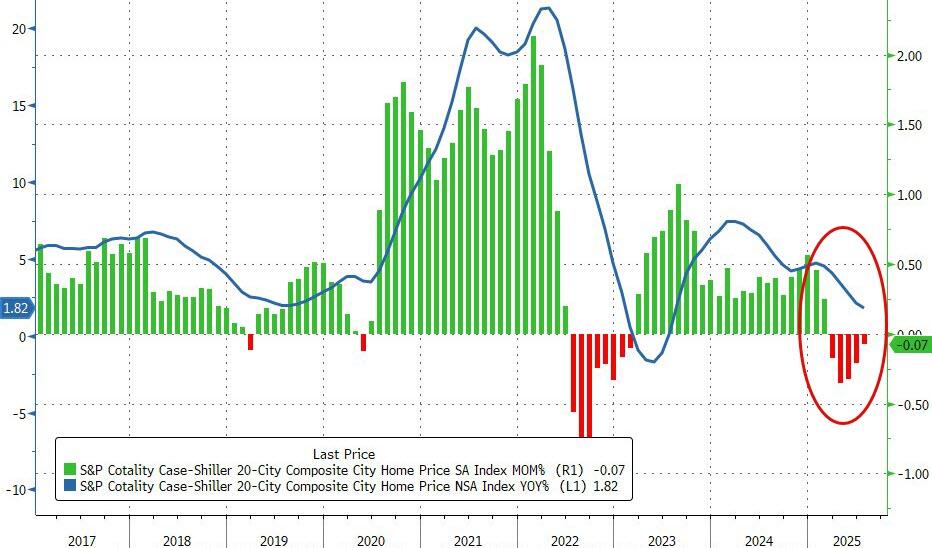
Source: Bloomberg
The US is coming off its weakest spring selling season in 13 years after high prices and mortgage rates sidelined many would-be buyers.
“July’s results reinforce that the housing market has downshifted to a much slower gear,” said Nicholas Godec, Head of Fixed Income Tradables & Commodities at S&P Dow Jones
Indices.
“In other words, U.S. home values have essentially stagnated after inflation, marking the third straight month of real housing wealth decline for homeowners. This reversal is striking: during the pandemic boom, home prices were climbing far faster than inflation, rapidly boosting homeowners’ real equity. Now, the situation has flipped – over the last year, owning a home yielded a modest nominal gain, but an inflation-adjusted loss. “
The geographic hierarchy of U.S. housing continues its dramatic shake-up, with 7 cities seeing outright price declines YoY…
- Denver -0.6%
- San Diego -0.7%
- Phoenix -0.9%
- Dallas -1.3%
- Miami -1.3%
- San Francisco -1.9%
- Tampa -2.8%
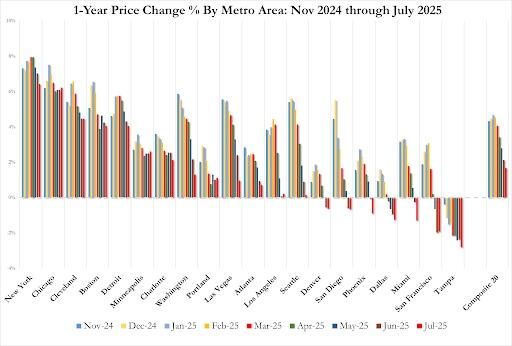
However, given the decline mortgage rates, one could argue that home prices are set to re-accelerate soon (which fits with the slowdown in the price depreciation)…
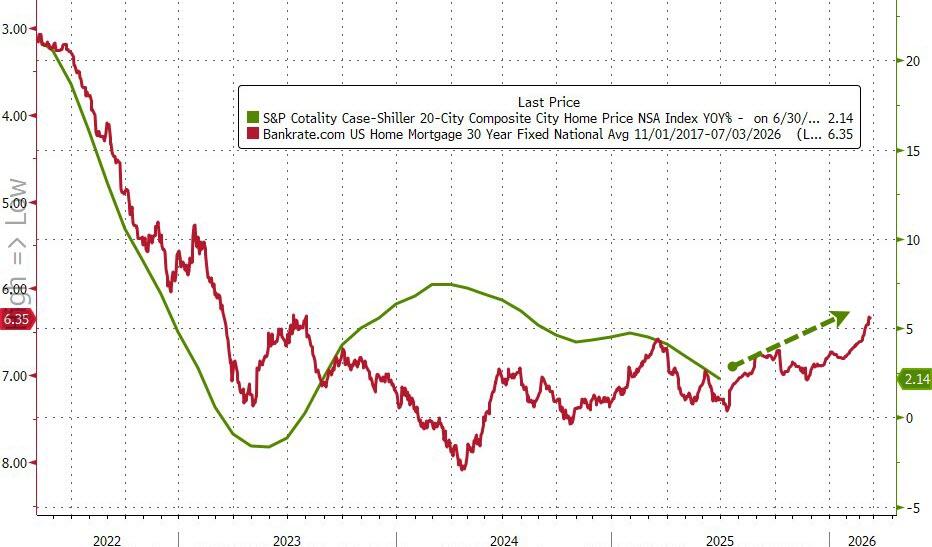
Source: Bloomberg
On the bright side, declining home prices (and the follow through into PCE/CPI calculations for Shelter costs) could more than offset any tariff-driven anxiety over the next few months.
But, home price changes do seem to track very closely with bank reserves at The Fed (6mo lag), which implies home prices could rapidly decelerate in the new year (after a brief rebound)…
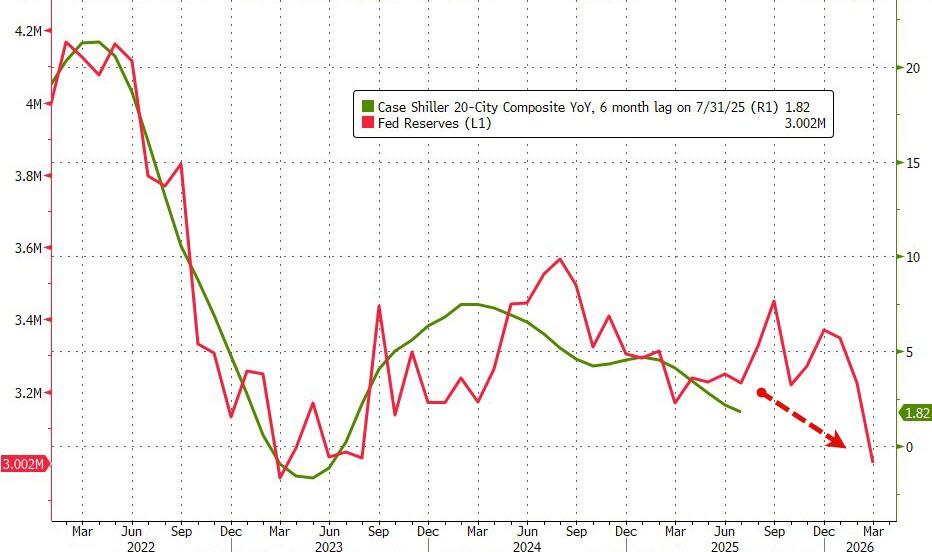
Source: Bloomberg
“Looking ahead, the housing market appears to be settling into a new, more measured equilibrium,” Godec concluded.
“The era of 15-20% annual home price jumps is behind us, and in its place we’re seeing growth rates closer to overall inflation – or even a bit below it. While that means homeowners aren’t gaining wealth at the breakneck pace of the recent past, it also signals a potentially healthier trajectory for housing in the long run.
The question remains, that after slashing rates by 100bps (last year), home prices have started to decline (with significant lag)… is that what The Fed wants this year too, now that the rate-cutting cycle has restarted?
USA ECONOMIC COMMENTARIES
PETER REAGAN
The GDP Illusion: Why Economic Growth Is Losing Its Meaning
Tuesday, Sep 30, 2025 – 01:21 PM
Authored by Peter Reagan,
Politicians celebrate GDP gains as proof of a strong economy. But if “growth” just means paying more for groceries, gas, and utilities, are we really better off? Here’s why GDP is a mirage – and why what happens to “the economy” may not apply to you…

Growing up, illusions were a wonderful thing. Watching David Copperfield fool the audience on television was amazing, even magical.
As you get older, though, you realize that there are really two different types of illusions, one magical and wonderful. The other, a sort of con game to distract us from paying attention to what really matters.
I’m not going to get political today. Instead, I’ll simply say that every presidential administration I can remember talked about our nation’s Gross Domestic Product (GDP) as the top measurement that we should all use to evaluate overall economic health.
So, the higher the GDP, the better the White House says the economy is doing. Thanks to their own policies and decisions, of course.
But is that true? Today we’ll explore the concept of a GDP and I’ll let you decide for yourself how relevant this number is for you…
What is included in that GDP figure?
GDP is a measure of economic activity. It’s calculated by adding up every dollar that was spent in the U.S. (Here’s a more technical definition for the curious, but honestly you don’t need to know everything about it.)
Here’s the formula for calculating GDP:
(Consumer spending) + (Government spending) + (Investment spending) + (Exports – Imports) = GDP
Here’s the breakdown (2024 numbers):
- 68%: Consumer spending is the biggest component, like I mentioned previously. Everything you spend money on, from haircuts to homes to Hawaiian vacations, increases GDP.
- 18%: Domestic investment is a business category that includes construction, capital investment like machinery purchases and business inventory (including, for example, unsold cars on a dealer’s parking lot. This is the most important category overall, in terms of boosting overall economic productivity.
- 17%: Government spending is also a significant component. Government spending on infrastructure, defense and payroll for both federal employees and contractors.
- -3%: Net exports of goods and services is negative because the U.S. imports more than we export.
First, you can see that “consumption” is by far the biggest category – and that’s troublesome, because most consumption is not economically productive. Necessary (food and fuel for example) but not productive.
Domestic investment includes building new factories, setting up or modernizing existing assembly lines and so on. This is by far the most important category for future economic growth.
Here’s the most worrisome thing about GDP calculations though – there’s no offset for debt! None!
Debt-financed purchases like a new home or a new federal construction program add to GDP. Paying off the debt incurred does not subtract from GDP. No matter when you pay it off.
In other words, GDP only tells you how much you spent on the shopping spree – and ignores the credit card bill that follows. ‘
Now that you know what GDP really means, let’s take another look at the current GDP report.
What current GDP figures are really saying
The most recent figures tell us GDP is growing. As Reuters informs us, “The U.S. economy grew faster than expected in the second quarter.” GDP grew 3.8% (annualized).
What changed? Well, imports dropped about 9% while exports fell a lot less, about -1%.
In other words, overall we shopped less and sold less internationally – which nets out as a win for GDP!
This seems so amazingly backwards to me… How can doing less business work out as a win?
Imagine you’re running a car dealership, for example. You bought 5,000 cars from the factory. You only sold 4,500 of them.
- For you, these unsold cars are a headache and a red flag about demand
- To the GDP statisticians, they’re a sign of “production,” so they count as growth!
How does this make any sense at all?
As confusing as it is, it helps you understand the difference between GDP reports and our personal experience with the economy…
What does this GDP surprise look like to American families?
What GDP isn’t telling you, though, is how the higher GDP is affecting the average family. See, according to the Bureau of Labor Statistics (BLS), the price of ground beef increased by nearly 65% over the last five years.
Other necessities, like electricity, only went up 36% since 2020.
Here’s the astonishing thing: As your cost of living increases, GDP increases too! That’s right – higher bills means “increased economic activity” which is often interpreted as a booming economy.
Do you feel wealthier at the grocery store, when your trip costs you 25% more than it would’ve in 2020?
I seriously doubt it. (I know I sure don’t!)
Here’s the reality: Higher GDP has nearly no correlation to prosperity. When you look at real-world changes in cost of living, we simply aren’t more prosperous than we were five years ago.
Period.
(No matter how much GDP increased over those years.)
The GDP illusion
Now do you understand how GDP is as much a measure of higher costs of living as it is a measure of real economic activity?
Every time an elected official says, “The economy is doing great,” that’s not the whole story.
Again, I’m not trying to be political here. I understand that all politicians, the best and the worst of them, need to paint a rosy picture of how great the economy is doing. And, frankly, “the economy” is an abstract concept. “The economy” doesn’t really exist! That’s just the word we use to describe the one billion transactions that happen across the nation every single day.
Obviously it’s completely impossible to say anything meaningful about a billion separate transactions. So lumping them all together and calling them “the economy” is a useful metaphor.
But metaphors aren’t reality. And when official GDP reports are contradicted by our actual experience in the real world?
It’s like my grandpa used to say: “Who are you going to believe, me or your lying eyes?”
The closer you look at abstractions like “the economy” or “GDP,” the less useful they are.
This is why it’s a mistake to take these numbers at face value.
Economists tell a nerdy joke about this: “An economic downturn is when your neighbor loses his job. A recession is when you lose yours.”
So what does this mean for you? Simply this: No matter how well (or poorly) “the economy” is doing, your experience is what matters. Your personal economic success is far more relevant than the second quarter’s GDP report.
Everyday Americans who’ve figured this out, who understand that their experience just isn’t accurately reflected by GDP reports or CPI updates – those are usually the folks who reach out to Birch Gold Group. When you understand that official numbers don’t always translate into stability or financial security for your family, you start looking for stability.
That’s where physical precious metals come in. Why precious metals? They aren’t an abstraction or a metaphor or a statistic. They’re real, tangible assets you can hold in your hand. And for thousands of different families all across the nation, physical gold and silver have become an anchor in uncertain times.
“Let Your Rage Fuel You”: Politicians And Pundits Embrace Rage Politics
Monday, Sep 29, 2025 – 08:40 PM
Authored by Jonathan Turley via jonathanturley.org,
“Let your rage fuel you.” Those words from Virginia Democratic gubernatorial nominee Abigail Spanberger captured what I have called “rage politics” in America.

Across the country, politicians and pundits are fueling rage, encouraging voters to embrace it. If you turn on the television, you would think that Darth Sidious had taken over: “Give in to your anger. With each passing moment, you grow stronger.”
I do not think for a second that Spanberger supports violence. She was sharing with voters the “sage advice” of her mother, which she said she has applied in her political career. However, the anger is all around us.
Recently, I debated Harvard Law Professor Michael Klarman, who declared, “I am very angry” and “I am enraged.” In denouncing ICE as “thugs” and saying Trump supporters are “fascists,” Klarman explained that the rage had a purpose: “to shake people out of their insomnia.”
Rage, however, comes at a cost in politics. I recently wrote a book about rage and free speech, “The Indispensable Right: Free Speech in an Age of Rage.” It discusses our history of rage politics and how it has led to violence and crackdowns. Rage gives people a license to say and do things that they would not otherwise say or do. It is addictive, it is contagious, and it is dangerous.
We are seeing the result of rage rhetoric all around us. That includes the assassination of Charlie Kirk and the sniper attack on ICE agents in Texas this week, in addition to violent protests around the country.
Rage allows you to deny the humanity of those you disagree with. Recently, two sisters were caught on video destroying a memorial to Kirk. Kerri and Kaylee Rollo were later arrested. However, they immediately opened a GoFundMe site to call for donations for “fighting fascism” and Kaylee wrote “my sibling was fired from their job.” Hundreds of donors gave the sisters thousands of dollars as a reward for the latest such attack on a Kirk memorial.
For many months, some of us have warned that violent rhetoric was crossing over into political violence. Democratic politicians have spent months ratcheting up the rhetoric against ICE agents, who have suffered more than a 1,000 percent increase in attacks, including the recent sniper attack.
Gov. Gavin Newsom (D), the day before that attack, signed a law that purports to bar ICE agents from wearing masks in California. He openly mocked them, asking, “What are you afraid of?“
Joshua Jahn answered that question the following day in Texas when he fired at ICE personnel, only to shoot three of their detainees.
Previously, Newsom had warned voters that Trump was building ICE into a personal army that might be used to suppress voting in the upcoming midterm elections. “Do you think ICE is not going to show up around voting and polling booths to chill participation?” he said.
Others added to the rage rhetoric by declaring the impending death of democracy and lashing out at ICE. Rep. Jasmine Crockett (D-Texas), who has used violent rhetoric in the past, declared that ICE agents were acting like “slave patrols” in hunting down immigrants in the streets.
Minnesota Gov. Tim Walz (D) used a commencement address to denounce “Donald Trump’s modern-day Gestapo is scooping folks up off the streets. They’re in unmarked vans, wearing masks, being shipped off to foreign torture dungeons… just grabbed up by masked agents, shoved into those vans, and disappeared.”
Others, like Boston Mayor Michele Wu, echoed the claims that ICE personnel are “Nazis” and called ICE Trump’s “secret police.”
The rage rhetoric (and claims of a fascist takeover) has been adopted by a wide range of Democratic politicians, often using the same catchphrases of an “authoritarian playbook.” In our debate, Professor Klarman warned that this was all “authoritarianism rooted in old-fashioned white supremacy.”
As discussed in my book, politicians and pundits have long sought to ride the wave of rage into power or influence. Rage is a powerful narcotic. The problem is when it becomes an addiction. There is always a certain percentage of the population that will believe such hyperbolic claims.
Those are the people who end up trying to kill jurists like Justice Brett Kavanaugh or politicians like Trump. It was also seen in the assassination of Democratic politicians earlier this year in Minnesota.
With the recent assassination and attacks on ICE, some are expressing regret. One of the most telling was Hillary Clinton on MSNBC, who said that we should “stop demonizing each other” while blaming “the right” for most of the hate. It was a curious call from a woman who called Trump supporters “deplorables” and suggested that they should collectively be forced into “deprogramming” as a cult. Just before the interview, Clinton had embraced the “fascism” mantra and, during the interview, she went right back to attacking Republicans.
A new poll shows that 71 percent view political violence as a serious problem, but the rage rhetoric continues unabated.
The perfunctory calls for lowering the temperature after the latest shooting are unlikely to last. Key figures in public life keep injecting rage directly into the veins of American politics. It is hard to go “cold turkey” in breaking that addiction, but you first have to want to do so. There is no indication that our rage-addicts are anywhere near a step-program for recovery. If history is any measure, this fever will only break when voters clearly reject the politics of rage.
Jonathan Turley is the Shapiro Professor of Public Interest Law at George Washington University. He is the author of the bestselling book “The Indispensable Right: Free Speech in an Age of Rage.”
END
FREE SPEECH WINS AGAIN DESPITE THE SUBJECT MATTER!!
Judge Reinstates Fired Professor Who Called Charlie Kirk A Nazi
Tuesday, Sep 30, 2025 – 06:15 AM
Authored by Tom Ozimek via The Epoch Times (emphasis ours),
A federal judge has ordered the reinstatement of a professor dismissed for writing on social media that he has “no thoughts and prayers” for assassinated conservative commentator Charlie Kirk, whom he called a “hate spreading Nazi.”

U.S. District Judge Karen Schreier issued the ruling on Sept. 24, granting Phillip Michael Hook’s request for a temporary restraining order and directing the University of South Dakota to reinstate Hook to his tenured position pending further proceedings.
Schreier said Hook showed a strong chance of winning his case, that protecting free speech was a “compelling” public interest, and that he would face “irreparable harm” if the firing stood.
Hook, a tenured art professor at the University of South Dakota, posted the remarks to his private Facebook page on Sept. 10, the same day Kirk was gunned down while speaking at Utah Valley University. “I have no thoughts or prayers for this hate spreading Nazi. A shrug, maybe,” Hook wrote.
Hook deleted the message three hours later and posted an apology.
“Apparently my frustration with the sudden onslaught of coverage concerning a guy shot today led to a post I [now] regret posting,“ he wrote, adding, ”I extend this public apology to those who were offended.”
By then, however, public and political backlash was mounting. His post drew swift rebukes from South Dakota Republicans, with House Speaker Jon Hansen saying he was “disgusted by his remarks” and contacted the university president to call for Hook’s termination.
“That kind of disgusting rhetoric from an employee and representative of our university directed toward a good man’s family who was recently assassinated will not be tolerated,” Hansen said in a post on X.
He later posted an update thanking the Board of Regents for “doing the right thing.”
South Dakota Gov. Larry Rhoden also weighed in.
“When I read this post, I was shaking mad. The Board of Regents intends to FIRE this University of South Dakota professor, and I’m glad,” he wrote on X. “We need more Charlie Kirks on campus and less hatred like this.”
Within days, the university placed Hook on administrative leave and delivered a letter citing “unfitness to discharge the trust reposed in public university faculty members or to perform assigned duties” and a policy requiring professors, even as private citizens, to remain accurate and respectful.
Hook sued, alleging unconstitutional retaliation against political speech.
“Professor Hook’s Facebook posts cannot possibly justify his dismissal under these rules,” his attorneys wrote in a court filing, alleging that the reason for his firing was pressure after his “post angered powerful politicians.”
“The First Amendment protects political speech even though it offends some. This lawsuit seeks to prohibit defendants from retaliating against Professor Hook for exercising his First Amendment right to speak on political matters.”
The judge agreed, concluding that the university failed to show evidence of workplace disruption and noting the close timing of the firing notice, its sole reliance on Hook’s Facebook post, and communications from South Dakota politicians urging his removal, as pointing to political pressure behind the termination.
The Epoch Times has contacted counsel representing the University of Dakota for comment.
END
VICTOR DAVIS HANSON
KING NEWS
SWAMP STORIES FOR YOU TONIGHT
Heartbreaking!
“You Pissed Off The Wrong Daddy!”: Father Of Murder Victim Unloads On Dems’ Soft-On-Crime Policies
Tuesday, Sep 30, 2025 – 08:55 AM
Authored by Debra Heine via American Greatness,
In emotionally fraught testimony Monday, Steve Federico, father of a young woman who was brutally murdered by a black career criminal in South Carolina, pleaded with Democrats to stop protecting dangerous criminals with soft-on-crime policies.
The House Judiciary Committee held a field hearing in Charlotte, North Carolina, Monday, to “examine violent crime in Charlotte, North Carolina and the surrounding areas looking at repeat offenders and lenient pretrial release policies and decisions among others.”
The man’s daughter, Logan Federico, 22, was fatally shot in the chest by Alexander Dickey, 30, during a home invasion on May 3, 2025. She had been visiting friends at a rented property in Columbia, South Carolina at the time of the execution-style murder.
“When I tell you this story, think about your kids,” her father said, his voice trembling with raw emotion.
“Think about your child coming home from a night out with their friends, laying down, going to sleep, feeling somebody come in the room and wake them and drag her out of bed, naked, forced on her knees, with her hands over her head! Begging for her life, begging for her hero, her father—ME!—that couldn’t be there,” Federico testified.

“She was five foot three, she weighed 115 pounds … BANG! … dead, gone!” he cried. “Why? Because Alexander Devante Dickey, who was arrested 39 G-d damn times—25 felonies!—was on the street. How about that?!”
Addressing the committee members, Federico asked, “how good are we doing for out families? How good are you doing for your kids?”
The father added: “He should have been in jail for over a 140 years for all the crimes he’d committed. You know how much time he spent in prison? A little over 600 days in ten years.”
Federico noted that Dickey had been “committing 2.6 crimes a year since he was 16-years-old” but nobody had figured out that he couldn’t be rehabilitated.
“Well, you’d have to put him in prison to see if he could be rehabilitated,” he pointed out.
Federico said his daughter had just decided she wanted to be a teacher “two weeks before she was executed.”
The grieving father noted that he has not heard from South Carolina’s Fifth Judicial Circuit Court Solicitor, Byron Gipson, a Democrat who was elected to the position in 2018.
“Not one word,” Federico fumed. “Four months, no communication!”
Gipson, with his 21 years as a defense attorney, quickly earned the reputation as a soft-on crime prosecutor after taking office in January 2019.
According to the National Police Association, Gipson has gained critics and detractors “among people who tend to think dangerous and violent criminals should be kept separated from docile and law-abiding citizens. Irrespective of his relatively short prosecutorial resume—and that’s being generous to the point of absurdity—Gipson has said and done things as Solicitor that warrant criticism and derision.”
Federico said Gipson’s “biggest concern” was how he’d made the prosecutor look during his Fox News interview with former House member Trey Gowdy (R-S.C.).
“How pathetic is that?” he thundered. “She was literally executed while on her knees! Begging for her life!”
He added indignantly, “her name is Logan Federico!—not Irena!”
Earlier in the hearing, Rep. Deborah Ross (D-N.C.) had confused Federico’s daughter with 23-year-old Ukrainian refugee Iryna Zarutska, who was fatally stabbed on August 22, 2025, while riding Charlotte’s LYNX Blue Line light rail by another black repeat offender. That suspect, 34-year-old Decarlos Brown Jr., also has a long history of prior convictions. He was charged with first-degree murder and also faces federal charges.
Federico demanded stronger protections against these dangerous repeat offenders, emphasizing the need for accountability and justice for the victims of violent crime.
“You will not forget her! I promise you. You will be sick and tired of my face and my voice until this gets fixed. I will fight until my last breath for my daughter,” he promised.
Addressing the committee again, he added, “you need to fight for the rest of our children, the rest of the innocents, and stop protecting the people that keep taking them from us!”
“Please! You have the power. We put you in power to do what you have to do. We’re asking you, we’re begging you all, to stop this!” Federico said, adding that was no good reason why someone who had committed 25 felonies would be walking the streets.
“What you all did, you woke up a beast and you pissed off the wrong daddy!” he declared.
GREG HUNTER…
SEE YOU TOMORROW
A LITTLE HEADS UP: I WILL NOT BE DOING A COMMENTARY ON THURSDAY.
THE DATA IS AGGREGATE SO ON FRIDAY EVERYTHING WILL BALANCE
H


 harveyorganblog.com