XXXXXXXXXXXXXXXXXXXXXXXXXXXXXXXXXXXXXXXXXXXXXXXXXX
118 C MACQUARIE FUTURES US 125
118 H MACQUARIE FUTURES US 229
323 C HSBC 42
332 H STANDARD CHARTERED B 313
435 H SCOTIA CAPITAL (USA) 746
657 H MORGAN STANLEY 1052
661 C JP MORGAN SECURITIES 457 631
709 C BARCLAYS 280
732 H RBC CAP MARKETS 200
905 C ADM 5 4
GOLD: NUMBER OF NOTICES FILED FOR OCT/2025: 2042 CONTRACTs NOTICES FOR 204,200 OZ or 6.3014 TONNES
total notices so far: 33,806 contracts for 3,380,600 OR 105.052 tonnes)
SILVER NOTICES: 519 NOTICE(S) FILED FOR 2.595 MILLION OZ/
total number of notices filed so far this month : 3432 CONTRACTS (NOTICES) for 17.160 million oz
INITIAL STANDING FOR OCT: 13.240 MILLION OZ PLUS 2.615 MILLION OZ QUEUE JUMP EQUATES TO 17.635 MILLION OZ//
JULY: 50.925 MILLION OZ (QUITE SMALL)
AUGUST: 59.455 MILLION OZ (QUITE SMALL)
SEPT. 50.510 MILLION OZ.(QUITE SMALL)
OCT; 28.725 MILLION OZ (WILL BE HUGE THIS MONTH)
AND JULY: 46.720 MILLION OZ//
AUGUST: 4.70 MILLION OZ INITIAL STANDING PLUS TODAY;S 5,000 OZ QUEUE JUMP //NEW STANDING ADVANCES TO 10.960 MILLION OZ
SEPTEMBER: 68.040 MILLION OZ NORMAL DELIVERY(INCLUDES ALL QUEUE JUMPING AND EXCHANGE FOR PHYSICAL TRANSFERS) PLUS 3.0 MILLION OZ EX FOR RISK = 71.040 MILLION OZ. (THIS IS THE FIRST AND ONLY ISSUANCE OF EXCHANGE FOR RISK FOR SILVER SINCE MAY.)
AND NOW OCTOBER: 17.635 MILLION OZ OF NORMAL DELIVERY INCLUDES ALL QUEUE JUMPING
AUGUST: 60.547 TONNES OF INITIAL GOLD FIRST DAY NOTICE FOLLOWED BY THE NET MONTH’S QUEUE JUMP OF 47.2312 TONNES TO WHICH WE ADD THE FOLLOWING EXCHANGE FOR RISK ISSUANCE RECEIVED FOR THE MONTH: 5.4432 TONNES EX FOR RISK/AUG 7 , AUG 11: 2.413 TONNES EX FOR RISK AND AUG. 12 OF 2.637 TONNES EX FOR RISK//AUG 25: 9.107 TONNES , AUGUST 26: 9.1010 TONNES AND NOW AUGUST 27: 9.0699 TONNES//NEW STANDING ADVANCES TO 107.5117 TONNES OF GOLD NORMAL STANDING (INCLUDES ALL MONTHLY QUEUE JUMPS/EX FOR PHYSICAL TRANSFERS//) +44.696 TONNES EX.FOR RISK = 152.208 TONNES
SEPT: INITIAL 8.093 TONNES OF GOLD PLUS TODAY’S QUEUE JUMP OF 0.4883 TONNES PLUS 2.2827 TONNES OF EXCHANGE FOR RISK TODAY//NEW TOTAL EX. FOR RISK/MONTH = 22.923//NEW TOTAL STANDING FOR GOLD SEPT ADVANCES TO = 48.801 TONNES!!
AND NOW OCTOBER: 90.012 TONNES OF INITIAL GOLD STANDING WITH AN INITIAL HUGE 4.878 TONNES QUEUE JUMP FOLLOWED BY LAST 3 DAYS OF QUEUE JUMPS OF 11.5354 TONNES,(TODAY’S QUEUE JUMP = 6.942 TONNES) PLUS 11.353 TONNES OF OUR ISSUANCE EXCHANGE FOR RISK/5 OCCASIONS//NEW TOTAL OF GOLD STANDING ADVANCES TO 118.5194 TONNES OF GOLD.
JAN. 2025: 257.919 TONNES (ISSUANCE WILL BE PRETTY GOOD THIS MONTH BUT MUCH LOWER THAN LAST MONTH)
FEB: 207.21 TONNES//EX FOR PHYSICAL ISSUANCE (WILL BE A FAIR SIZED ISSUANCE THIS MONTH)
MARCH 130.84 TONNES//QUITE SMALL THIS MONTH.
APRIL; 208.57 TONNES. STILL SMALL TO FAIR
MAY: 113.499 TONNES OF GOLD EFP ISSUANCE//QUITE SMALL THIS MONTH
JUNE: 97.79 TONNES OF GOLD EFP ISSUANCE/EXTREMELY SMALL
JULY : 150.877 TONNES// QUITE SMALL
AUGUST: 175.86 TONNES A LOT LARGER THIS MONTH.
SEPT. 116.13 TONNES VERY SMALL
OCT. 64.466 TONNES
SPREADING OPERATIONS
NOW SWITCHING TO GOLD FOR NEWCOMERS, HERE ARE THE DETAILS
SPREADING LIQUIDATION HAS NOW COMMENCED AS WE HEAD TOWARDS THE NEW ACTIVE FRONT MONTH OF OCT. WE ARE NOW INTO THE SPREADING OPERATION OF GOLD
HERE IS A BRIEF SYNOPSIS OF HOW THE CROOKS FLEECE UNSUSPECTING LONGS IN THE SPREADING ENDEAVOUR ;MODUS OPERANDI OF THE CORRUPT BANKERS AS TO HOW THEY HANDLE THEIR SPREAD OPEN INTERESTS:HERE IS HOW THE CROOKS USED SPREADING AS WE ARE NOW INTO THE NON ACTIVE DELIVERY MONTH OF NOV HEADING TOWARDS THE ACTIVE DELIVERY MONTH OF FEB., FOR GOLD: AND MARCH FOR SILVER
YOU WILL ALSO NOTICE THAT THE COMEX OPEN INTEREST STARTS TO RISE BUT SO IS THE OPEN INTEREST OF SPREADERS. THE OPEN INTEREST IN WILL CONTINUE TO RISE UNTIL ONE WEEK BEFORE FIRST DAY NOTICE OF AN UPCOMING ACTIVE DELIVERY MONTH (OCT), AND THAT IS WHEN THE CROOKS SELL THEIR SPREAD POSITIONS BUT NOT AT THE SAME TIME OF THE DAY. THEY WILL USE THE SELL SIDE OF THE EQUATION TO CREATE THE CASCADE (ALONG WITH THEIR COLLUSIVE FRIENDS) AND THEN COVER ON THE BUY SIDE OF THE SPREAD SITUATION AT THE END OF THE DAY. THEY DO THIS TO AVOID POSITION LIMIT DETECTION. THE LIQUIDATION OF THE SPREADING FORMATION CONTINUES FOR EXACTLY ONE WEEK AND ENDS ON FIRST DAY NOTICE.”
WHAT IS ALARMING TO ME, ACCORDING TO OUR LONDON EXPERT ANDREW MAGUIRE IS THAT THESE EFP’S ARE BEING TRANSFERRED TO WHAT ARE CALLED SERIAL FORWARD CONTRACT OBLIGATIONS AND THESE CONTRACTS ARE LESS THAN 14 DAYS. ANYTHING GREATER THAN 14 DAYS, THESE MUST BE RECORDED AND SENT TO THE COMPTROLLER, GREAT BRITAIN TO MONITOR RISK TO THE BANKING SYSTEM. IF THIS IS INDEED TRUE, THEN THIS IS A MASSIVE CONSPIRACY TO DEFRAUD AS WE NOW WITNESS A MONSTROUS TOTAL EFP’S ISSUANCE AS IT HEADS INTO THE STRATOSPHERE.
The crooks also use the spread in the TAS account (trade at settlement). They buy the spot TAS (e.g. June) and sell the future TAS two months out (e.g. August). Then they unload the front month (i.e. unload the buy side first so the price of gold/silver falls. This occurs in the middle of the front delivery month cycle. They unload the sell side of the equation, two months down the road. The crooks violate position limits as the OCC refuse to hear our complaints.
First, here is an outline of what will be discussed tonight:
1.TODAY WE HAD THE OPEN INTEREST AT THE COMEX IN SILVER ROSE BY A HUGE SIZED 746 CONTRACTS OI TO 166,474 AND CLOSER TO THE COMEX HIGH RECORD //244,710( SET FEB 25/2020). THE LAST RECORDS WERE SET IN AUG.2018 AT 244,196 WITH A SILVER PRICE OF $14.78/(AUGUST 22/2018)..THE PREVIOUS RECORD TO THAT WAS SET ON APRIL 9/2018 AT 243,411 OPEN INTEREST CONTRACTS WITH THE SILVER PRICE AT THAT DAY: $16.53). AND PREVIOUS TO THAT, THE RECORD WAS ESTABLISHED AT: 234,787 CONTRACTS, SET ON APRIL 21.2017 OVER 7 YEARS AGO. HOWEVER WE HAVE NOW SET A NEW RECORD LOW OF 114,102 CONTRACTS JULY 3.2023
EFP ISSUANCE A MONSTER 1470 CONTRACTS
OUR CUSTOMARY MIGRATION OF COMEX LONGS CONTINUE TO MORPH INTO LONDON FORWARDS AS OUR BANKERS USED THEIR EMERGENCY PROCEDURE TO ISSUE:
DEC 1470 CONTRACTS and 0 ALL OTHER MONTHS: ZERO. TOTAL EFP ISSUANCE: 875 CONTRACTS. EFP’S GIVE OUR COMEX LONGS A FIAT BONUS PLUS A DELIVERABLE PRODUCT OVER IN LONDON. IF WE TAKE THE COMEX OI GAIN OF 781 CONTRACTS AND ADD TO THE MONSTER 1470 E.FP. ISSUED
WE OBTAIN A MEGA HUGE SIZED GAIN OF 2216 OF OPEN INTEREST CONTRACTS FROM OUR TWO EXCHANGES DESPITE OUR LOSS OF $0.89 THE RATS ARE FLEEING THE ARENA.
THUS IN OUNCES, THE GAIN ON THE TWO EXCHANGES TOTALS 11.080 MILLION PAPER OZ
OCCURRED WITH OUR LOSS OF $0.89 IN PRICE.
OUTLINE FOR TODAY’S COMMENTARY
1a/COMEX GOLD AND SILVER REPORT
(report Harvey)
1a/COMEX GOLD AND SILVER REPORT
(report Harvey)
b, ) Gold/silver trading overnight Europe,//GOLD COMMENT
Peter Schiff)
c) Commentaries from: Egon von Greyerz///Matthew Piepenburg via GoldSwitzerland.com, Pam and Russ Martens
ii a) Chris Powell of GATA provides to us very important physical commentaries
b. Other gold/silver commentaries
c. Commodity commentaries//
d)/CRYPTOCURRENCIES/BITCOIN ETC
2.ASIAN AFFAIRS
ASIAN MARKETS THIS WEDNESDAY MORNING:
SHANGHAI CLOSED
//Hang Seng CLOSED CLOSED
// Nikkei CLOSED : DOWN 215.39 PTS OR 0.45% //Australia’s all ordinaries CLOSED DOWN 0.09%
//Chinese yuan (ONSHORE) CLOSED XXXX OFFSHORE CLOSED DOWN AT 7.1469/ Oil UP TO 62.33 dollars per barrel for WTI and BRENT UP TO 65.95 Stocks in Europe OPENED ALL GREEN
ONSHORE USA/ YUAN TRADING XXXX LEVEL OF OFFSHORE YUAN TRADING :/ONSHORE YUAN HOLIDAY IN TRADING AT XXXX AND XXXX//OFF SHORE YUAN TRADING DOWN TO 7.1469 AGAINST US DOLLAR/ AND THUS WEAKER
XXXXXXXXXXXXXXXXXXXXXXXXXXXX
A)NORTH KOREA/SOUTH KOREA
outline
b) REPORT ON JAPAN/
OUTLINE
3 CHINA
OUTLINE
4/EUROPEAN AFFAIRS
OUTLINE
5. RUSSIAN AND MIDDLE EASTERN AFFAIRS
OUTLINE
6.Global Issues//COVID ISSUES/VACCINE ISSUES
OUTLINE
7. OIL ISSUES
OUTLINE
8 EMERGING MARKET ISSUES
9. USA
XXXXXXXXXXXXXXXXXXXXXXXXXXXXXXXXXXXXXXXXXXXXXXXXXXXXXXXXXXXXXXXXXXXXXXXXXXXXXXXXXXXXXXXXXXXXXXXXXXXXXXXXXX
1. COMEX DATA//AMOUNTS STANDING//VOLUME OF TRADING/INVENTORY MOVEMENTS
GOLD
LET US BEGIN:
THE TOTAL COMEX GOLD OPEN INTEREST ROSE BY A FAIR SIZED 1887 CONTRACTS TO 485,559 OI WITH OUR STRONG GAIN IN PRICE OF $28.90 WITH RESPECT TO TUESDAY’S // TRADING COMEX CLOSING TIME:… WE LOST ZERO NET LONGS, WITH THAT PRICE GAIN FOR GOLD. AND AS YOU WILL SEE BELOW, OUR GAIN IN PRICE ALSO HAD A STRONG NUMBER OF EXCHANGE FOR PHYSICAL ISSUED (3565). WE HAD NO T.A.S. LIQUIDATION MONDAY BUT DID HAVE A STRONG LIQUIDATION OF GOLD/SILVER EQUITY SHARES…GO FIGURE!!. WE HAD A TOTAL GAIN IN OI ON BOTH OF OUR EXCHANGES, THE COMEX AND LONDON’S EXCHANGE FOR PHYSICAL EQUATING TO 5452 CONTRACTS (OR 16.958 TONNES).THEN MUCH TO MY SURPRISE WE WERE NOTIFIED OF A MASSIVE 1000 CONTRACTS EXCHANGE FOR RISK ISSUANCE IN GOLD CONTRACTS ISSUED FOR 100,000 OZ OR 3.11041 TONNES OF GOLD.
THUS THE TOTAL NUMBER OF CONTRACTS EXCHANGE FOR RISK ISSUED FOR THE MONTH OF OCT ADVANCES TO 11.353 TONNES OF GOLD UNDER THE GUIDANCE OF 5 ISSUANCES.
A LITTLE HISTORY ON OUR EXCHANGE FOR RISK ISSUANCES:
HERE IS A CLOSER LOOK AT EXCHANGE FOR RISK ISSUANCES FOR THESE PAST 4 MONTHS;
(TOTAL EXCHANGE FOR RISK LAST 4 MONTHS 70.097 TONNES//BANK OF ENGLAND TOTAL RESERVES LISTED AT 310 TONNES.)
JULY:
SUMMARY: EXCHANGE FOR RISK ISSUANCE IN JULY/2025: 2 ISSUANCES//3.75 TONNES
ON WEDNESDAY MORNING,JULY 23, MUCH TO MY SHOCK, AFTER A TWO MONTH HIATUS,THE CME ANNOUNCED A 500 EXCHANGE FOR RISK CONTRACT ISSUANCE FOR 50,000 OZ OR 1.555 TONNES. THEN JULY 30 THE CME ANNOUNCED (ISSUED) MUCH TO MY HORROR ITS SECOND EXCHANGE FOR RISK FOR 706 CONTRACTS OR 70,600 OZ (2.195 TONNES) AS THE BANK OF ENGLAND WAS NOT SATISFIED AND NEEDS MORE GOLD TO COVER ITS LEASES TO BULLION BANKS. ( IT WAS NOT THE FRBNY WHO ALSO OWES GOLD TO THE BIS AND THEY NEED TO COVER BADLY AS YOU WILL SEE).THE TOTAL EXCHANGE FOR RISK FOR THE MONTH OF JULY WAS RECORDED AT 3.750 TONNES OF GOLD WHICH WAS ADDED TO OUR REGULAR DELIVERY TO GIVE US OUR FINAL TOTALS FOR JULY!
AUGUST:
SUMMARY EXCHANGE FOR RISK ISSUANCE IN AUGUST; 7 ISSUANCES//44.696 TONNES
AUGUST: 7 ISSUANCES FOR A MONTHLY MONSTER 14,370 CONTRACTS OR 1,437,000 OZ ( 44.696) TONNES). EARLY IN THE MONTH THE CME ISSUED THE 2ND HIGHEST EVER MONTHLY RECORDED ISSUANCE OF 2924 CONTRACTS AND THIS IS FOLLOWED BY THURSDAY’S HUGE ISSUANCE OF 2226 CONTRACTS THUS BECOMING THE 4TH HIGHEST EVER RECORDED BY THE CME, SLIGHTLY BELOW AN ISSUANCE OF 2924 CONTRACTS. THE HUGE NUMBERS OF EXCHANGE FOR RISK SUGGEST THAT A MAJOR CENTRAL BANK IS DEMANDING ITS GOLD BACK.
SEPT:
SEPTEMBER: SEVEN ISSUANCES SO FAR TOTALLING 7,370 CONTRACTS OR 737,000 OZ OR 22.923 TONNES.
THESE ISSUANCES WILL OF COURSE BE ADDED TO OUR NORMAL DELIVERIES TO GIVE US OUR TOTAL SEPT STANDING FOR GOLD.
AND NOW OCTOBER: 5 ISSUANCES
WE RECEIVED NOTICE THAT OUR INITIAL EXCHANGE FOR RISK ISSUED ON FIRST DAY NOTICE FOR 500 CONTRACTS OR 50,000 OZ /1.555 TONNES OF GOLD!!THAT WAS FOLLOWED BY A STRONG 650 CONTRACT ISSUED THURSDAY OCT 2 FOR 2.0217 TONNES AND THAT WAS FOLLOWED THE NEXT DAY BY ANOTHER HUGE 1320 CONTRACT ISSUANCE FOR 13,200 OZ OR 4.1057 TONNES AND THIS WAS FOLLOWED BY SATURDAY’S OCT 4: 180 CONTRACT ISSUANCE FOR 18,000 OZ OR .5596 TONNES:THIS BRINGS US TO TODAY, OCT 8 WITH A HUGE ISSUANCE OF 1000 CONTRACTS FOR 100,000 OZ OR 3.1104 TONNES TOTAL ISSUANCES 5 OCCASIONS FOR 3650 CONTRACTS OR 365,000 OZ OR 11.353 TONNES
HISTORY: LAST 8 MONTH’S EXCHANGE FOR RISK
IN FEBRUARY:
WE HAD A HUGE FIVE EXCHANGE FOR RISKS ISSUANCES FOR GOLD, TOTALLING 18.4527 TONNES!.
IN MARCH:
THE TOTAL NO. OF EXCHANGE FOR RISK ISSUANCE FOR THE MONTH OF MARCH (3 NOTICES) EQUALED: 7.6179 TONNES OF GOLD WHICH WAS ADDED TO OUR MARCH DELIVERY TOTALS.
IN APRIL:
WE CONCLUDED APRIL WITH 7 ISSUANCE OF EXCHANGE FOR RISK FOR A TOTAL TONNAGE OF 8.3571 TONNES.
IN MAY:
MAY: 3 EX. FOR RISK ISSUED SO FAR FOR 3025 CONTRACTS OR 302,500 OZ OR 9.4054 TONNES. THIS WILL BE ADDED TO OUR NORMAL DELIVERY TO GIVE US TOTAL STANDING FOR MAY!THIS IS THE 6TH CONSECUTIVE MONTH FOR ISSUANCE OF EXCHANGE FOR RISK//NEW TOTAL EX FOR RISK IS 9.4054 TONNES FOR THE 3 ISSUANCE!
IN JUNE
JUNE: ZERO ISSUED
jULY: 2 OCCASIONS LATE IN JULY: 1206 CONTRACTS FOR 120,600 OZ OR 3.750 TONNES/ISSUED JULY 23/2025 AND JULY 30/2025
AUGUST: 7 ISSUANCES FOR A MONTHLY MONSTER 14,370 CONTRACTS OR 1,437,000 OZ ( 44.696) TONNES).AT THE BEGINNING OF THE MONTH THE CME ISSUED THE 2ND HIGHEST EVER MONTHLY RECORDED ISSUANCE OF 2924 CONTRACTS AND THIS IS FOLLOWED BY THURSDAY’S HUGE ISSUANCE OF 2226 CONTRACTS THUS BECOMING THE 4TH HIGHEST EVER RECORDED BY THE CME, SLIGHTLY BELOW PREVIOUS DAY’S ISSUANCE OF 2924 CONTRACTS. THE HUGE NUMBERS OF EXCHANGE FOR RISK SUGGEST THAT A MAJOR CENTRAL BANK IS DEMANDING ITS GOLD BACK.
SEPTEMBER: SEVEN ISSUANCES FOR 7370 CONTRACTS SO FAR FOR 737,000 OZ OR 22.923 TONNES OF GOLD!!
OCTOBER: FIRST INITIAL ISSUANCE OF 500 CONTRACTS FOR 50,000 OZ OR 1.555 TONNES OF GOLD. THIS WAS FOLLOWED BY AN ISSUANCE OF 650 CONTRACTS OR 65000 OZ OR 2.0217 TONNES. THEN ON OCT 3 WE RECEIVED OUR 3RD NOTICE FOR A HUGE 1320 CONTRACTS OR 132000 OZ OR 4.1057, AND THEN SATURDAY OCT 4, THE CME ISSUED ITS 4 ISSUANCE FOR 180 CONTRACTS FOR 18,000 OZ OR .5594 TONNES. THEN FINALLY OCT 8 FOR 1000 CONTRACTS, OR 100,000 OZ OR 3.1104 TONNES TOTAL ISSUANCE ON 5 OCCASIONS: 11.353 TONNES
AS I EXPLAINED ABOVE,:THE RECIPIENT OF EXCHANGE FOR RISK IS THE BANK OF ENGLAND
here are the only possible candidates who must bring back loaned gold
- THE BANK OF ENGLAND WHO CONTINUES TO LEASE OUT MUCH ITS GOLD TO BULLION BANKS AND :(EX FOR RISK 9 MONTH TOTALS 129.6 TONNES)//TOTAL RESERVES OF BOE EQUALS 310 TONNES)
- THE FEDERAL RESERVE BANK OF NEW YORK (NEED TO RETRIEVE THEIR LEASED GOLD FROM THE BIS).THE FED STILL REFUSES TO BRING BACK MUCH OF ITS 30 TONNES SHORTFALL. IT BOUGHT BACK ONLY 4 TONNES LAST MONTH AND THUS THEIR SHORTFALL TO THE BIS IS 30 TONNES.
HOWEVER, IN OUR CASE, EXCHANGE FOR RISK RECIPIENT IS THE BANK OF ENGLAND. THE COUNTERPARTY TO THE BANK OF ENGLAND EXCHANGE FOR RISK ARE BULLION BANKS THAT CANNOT VERIFY THAT THEIR GOLD IS UNENCUMBERED. THE BUYER, REPRESENTING THE CENTRAL BANK OF ENGLAND ASSUMES THE RISK OF THAT DELIVERY. THIS IS THE 9TH MONTH FOR ISSUANCE OF EXCHANGE FOR RISK !!…..(DEC THROUGH OCT//ONLY MISSING JUNE. TOTAL 9 MONTHS ISSUANCE 118.5 TONNES)……… THE FACT THAT A CENTRAL BANK TAKES THE RISK OF A DELIVERY IS TOTALLY INSANE. THE VERY FIRST ISSUE OF EXCHANGE FOR RISK CAME IN MAY 2023. HUGE ISSUANCES BEGAN OCT AND DEC 2024. ROBERT LAMBOURNE, GATA CONSULTANT AND EXPERT ON BIS AND BANK OF ENGLAND ISSUES HAS WRITTEN TO THE BANK OF ENGLAND AUTHORITIES CONCERNING THE REFUSAL OF THE BANK OF ENGLAND’S AUDITORS TO SUPPLY A POSITIVE AUDIT ON THEIR GOLD TONNAGE AND OTHER ASSETS HELD UNDER THE E.E.A. . PLEASE SEE THE LETTER WRITTEN TODAY AND YOU WILL FIND IT UNDER CHRIS POWELL OF GATA’S DISPATCHES. YOU WILL FIND IT FASCINATING!!
DETAILS ON OCTOBER COMEX MONTH//
IN TOTAL WE HAD A STRONG SIZED GAIN ON OUR TWO EXCHANGES OF 6,643 CONTRACTS WITH OUR GAIN IN PRICE. HOWEVER, OUR FRIENDLY PHYSICAL LONDON BOYS HAD ANOTHER FIELD DAY AGAIN THROUGHOUT OF THE WEEK AS THEY WERE READY FOR THE FRBNY.S CONTINUED ORCHESTRATED ATTACKS VERY EARLY IN THE COMEX SESSIONS AS THEY TRIED TO ABSORB EVERYTHING IN SIGHT FROM THEIR DAILY ATTACKS. LONDONERS EXERCISED THEIR BOUGHT CONTRACTS FOR PHYSICAL GOLD VIA THE EXCHANGE FOR PHYSICAL ROUTE AND THANKED THE FRBNY FOR THE THOUGHTFULNESS. LONDON ANNOUNCED EARLY IN THE YEAR (AND SCARCITY CONTINUES TO THIS DAY) THAT THEY WERE OUT OF GOLD. WRONGLY IT WAS ATTRIBUTED TO THEIR SHIPPING PHYSICAL GOLD TO COMEX FOR STORAGE DUE TO TRUMP’S INITIATION OF TARIFFS. THE TRUTH OF THE MATTER IS THAT THIS GOLD LEFT LONDON TO CENTRAL BANKS, AND COMEX BANKS HAVE BEEN PAPERING THEIR LOSSES (DERIVATIVE) WITH KILOBAR ENTRIES. DELIVERY OF GOLD CONTRACTS ARE NOW TAKING SEVERAL WEEKS. NO DEFAULT HAS BEEN INITIATED AS DEALERS ARE AFRAID OF LOSS OF THEIR JOBS. SO THIS FRAUD CONTINUES. THE LEASE RATES IN LONDON HAVE NOW INCREASED TO 6.0% LATELY AS GOLD IN LONDON IS STILL EXTREMELY SCARCE. THE FORCE MAJEURE AT GRASBERG IS CERTAINLY HAVING AN EFFECT ON LEASE RATES IN LONDON WITH RESPECT TO GOLD/SILVER.
THE LIQUIDATION OF T.A.S. CONTRACTS THROUGHOUT THE MONTHS OF JUNE THROUGH SEPTEMBER/OCT CONTINUES TO DISTORT OPEN INTEREST NUMBERS GREATLY ALTHOUGH THE T.A.S. ISSUANCES IN GOLD HAVE GENERALLY BEEN ON THE LOW SIDE COMPARED TO SILVER WHICH HAVE BEEN HUGE. TODAY’S NUMBER IS HOWEVER A HUGE T.A.S ISSUANCE AS THE CME NOTIFIES US THAT THEY HAVE ISSUED 5362 T.A.S CONTRACTS. THESE T.A.S ISSUANCES ARE USED FOR RAID PURPOSES TO STOP GOLD’S RISE AND TO TEMPER HUGE LOSSES IN OTC DERIVATIVE BETS AND IT WAS IN FULL FORCE AGAIN LAST NIGHT DESPERATELY TRYING TO STOP GOLD’S ADVANCE. THIS GENERALLY ENDS IN FAILURE AS FOR THE FIRST TIME EVER, THEY FAILED TO RAID AT MONTH’S END AUGUST COMEX AND OTC/LONDON LBMA EXPIRY!! SO THE CROOKS DECIDED IT WAS NECESSARY TO RAID AROUND THE BIG INTEREST RATE ANNOUNCEMENT SEPT 17-SEPT 18 AND THEY TRIED AGAIN THIS PAST WEDNESDAY/RIGHT BEFORE FIRST DAY NOTICE, WITH MUCH FAILURE AS THE TOTAL OPEN INTEREST REFUSED TO BUCKLE!! THIS LEADS US TO FIRST DAY NOTICE SEPT 30 AND THE LAST POSSIBLE DAY FOR A RAID AND TRUE TO FORM OUR CROOKS DECIDED TO RAID MUCH TO THE DELIGHT OF OUR BOYS IN LONDON WHO PICKED UP EXTRA AMOUNTS OF GOLD AND TENDERED FROM THIS SHORT PAPER ISSUANCE. THEN MUCH TO MY ANGER THEY DECIDED TO RAID AGAIN ON OCT 2 WITH CHINA OFF THIS WEEK FOR THEIR FALL FESTIVAL AND OF COURSE THE IMPORTANT RELIGIOUS HOLIDAY FOR THE JEWISH PEOPLE OCT 1-2, YOM KIPPUR. AGAIN THIS ENDED IN ABSOLUTE FAILURE AS LONDON AGAIN CAME TO THE RESCUE (MARCHING TO WILLIAM TELL’S OVERTURE) WITH THEIR MASSIVE TENDERING FOR PHYSICAL. YOU CAN JUST VISUALIZE THE MASSIVE HEADACHE THE CROOKS UNDERWENT WITH THIS HUGE PHYSICAL TENDERING FOR GOLD. WITH MUCH FAILURES THE CROOKS DECIDED TO RAID OUR EQUITY SHARES WHERE WE WITNESSED A HUGE DOWNFALL IN PRICES DESPITE GOLD’S HUGE ADVANCE IN PRICE.
THE T.A.S. LIQUIDATION OF THESE T.AS. CONTRACTS CONTINUED LAST THURSDAY AND FRIDAY, OCT 1 AND OCT 2 AND THAT IS THE REASON WHY WE ARE HAVING HUGE DISTORTED COMEX OPEN INTEREST LOSSES IN OI. HOWEVER THIS IS COUPLED WITH MEGA HUGE AMOUNTS OF GOLD STANDING FOR DELIVERY TO CONFUSE THE ISSUE!!!!! AND THIS WAS SURELY ON DISPLAY WITH FIRST DAY NOTICE/OCTOBER COMEX GOLD TOTALS WITH MASSIVE GOLD TONNES STANDING FOR GOLD IN OCTOBER AND THE HUGE QUEUE JUMPING THAT FOLLOWED!
HERE IS A SUMMARY OF GOLD STANDING FOR DELIVERY ON OUR LAST 7 MONTHS:
FOR APRIL AT 209 + TONNES
AND THIS CONTINUED INTO MAY WITH FINAL STANDING AT 90.23 TONNES.
JUNE WHICH IS A HUGE DELIVERY MONTH , FINAL STANDING WAS RECORDED AT A STRONG 93.085 TONNES. (IS THE COMEX RUNNING OUT OF GOLD?)//TOTAL NET QUEUE JUMPING FOR THE JUNE MONTH: 31.027 TONNES.
IN JULY WE HAD HUGE DELIVERY NOTICES ESPECIALLY FOR A NON ACTIVE DELIVERY MONTH WITH INITIAL STANDING AT 17.947 TONNES PLUS MANY QUEUE JUMPS + 3.75 TONNES EX FOR RISK = 41.106 TONNES OF GOLD // FINAL TOTAL TONNES STANDING JULY: 41.106 TONNES
FOR THE MONTH OF AUGUST:
INITIAL AMOUNT OF GOLD STANDING FOR AUGUST: 60.547 TONNES PLUS THE MONTHS HUGE QUEUE JUMPS OF 47.2312 TONNES +44.696 TONNES EX FOR RISK (7 ISSUANCES) //NEW STANDING 152.208 TONNES WHICH IS MONSTROUS!!!
FINAL AMOUNT OF GOLD STANDING FOR SEPT; INITIAL STANDING; 2,602 CONTRACTS OR 260,200 OZ FOR 8.093 TONNES OF GOLD FOLLOWED BY TODAY’S 0.4883 TONNES QUEUE JUMP TO GO ALONG WITH TODAY’S 2.817 TONNES OF EXCHANGE FOR RISK ISSUANCE TODAY AND // TOTAL EXCHANGE FOR RISK ISSUANCE SEPT: 22.923 TONNES//NEW TOTALS STANDING ADVANCES TO 48.801 TONNES OF GOLD!!!
AND THIS NOW BRINGS US TO OCTOBER WHERE INITIAL AMOUNT OF GOLD STANDING IS 28,988 CONTRACTS FOR 90.114 TONNES OF GOLD TO WHICH WE ADD OUR FIRST MASSIVE QUEUE JUMP OF 4.898 TONNES QUEUE JUMP FOLLOWED BY OCT 4 QUEUE JUMP OF 0.9704 TONNES TO BE FOLLOWED BY OCT 7 QUEUE JUMP OF 3.623 TONNES AND FINALLY OCT 8’S HUGE 6.942 TONNES QUEUE JUMP TO //// AND THIS WAS AUGMENTED BY AN UNUSUAL 50,000 CONTRACT EXCHANGE FOR RISK ISSUED ON FIRST DAY NOTICE AND THEN ON THREE CONSECUTIVE OCCASIONS, OCT 2 THROUGH TO THE OCT 4.THEY TOOK ONE DAY OFF AND THEN ISSUED ITS 5 EXCHANGE FOR RISK ISSUANCE FOR 1000 CONTRACTS OR 100,000 OZ/3.1105 TONNES THE NEW TOTAL ON THESE 5 ISSUANCES IS 3650 CONTRACTS FOR 365,000 OZ OR 11.353 TONNES WHICH WILL BE ADDED TO OUR NORMAL DELIVERIES INCLUDING QUEUE JUMPS. NEW TOTALS FOR GOLD STANDING ADVANCES TO 118.5194 TONNES
THE FED IS THE OTHER MAJOR SHORT OF AROUND 30+ TONNES OF GOLD OWING TO THE B.I.S. THE FED NEEDS TO COVER AS THEY ARE VERY WORRIED ABOUT WHAT IS GOING TO HAPPEN TO GOLD PRICES NOW THAT THEY MUST BECOME COMPLIANT TO BASEL III RULES JULY 1/2023 AS OUTLINED IN ANDREW MAGUIRE’S LATEST LIVE FROM THE VAULT 231 TO 242 EPISODES AS HE TACKLES THIS IMPORTANT TOPIC. THE MAJOR FOUR OR FIVE BANKS ARE ALSO WORRIED ABOUT THEIR HUGE PRECIOUS METAL DERIVATIVE SHORT EXPOSURE (NORTH OF ONE TRILLION DOLLARS) AND THIS IS PROBABLY THE MAJOR REASON FOR GOLD/SILVER’S RISE THESE PAST THREE MONTHS. THEY ARE TOTALLY TRAPPED., AND THEIR FAILURE TO STOP CENTRAL BANK PURCHASES OF PHYSICAL GOLD IS THE MAJOR ISSUE OF THE DAY!IT SURE DOES NOT LOOK LIKE THE BIS HAS GIVEN THE FED ITS MARCHING ORDERS TO COVER ITS PHYSICAL GOLD SHORT AS THEIR OUTSTANDING LOAN REMAINS ON THE BOOKS OF THE BIS. TRUMP WILL PROBABLY BE FURIOUS WITH THE FED IF HE FINDS OUT THAT THEY (FRBNY) HAS BEEN MANIPULATING THE GOLD MARKET FOR THE PAST TWO YEARS. THE FRBNY IS NOW NON COMPLIANT WITH RESPECT TO BASEL III BUT IT IS NOT NECESSARY FOR THEM TO BE COMPLIANT ONLY COMMERCIAL BANKERS MUST BE.
OUR PHYSICAL LONDONERS BOUGHT NEW MASSIVE QUANTITIES OF LONGS AT ANY PRICE AND THIS GOLD BOUGHT WILL BE TENDERED FOR PHYSICAL ON A T + ???? BASIS. BECAUSE GOLD IS BASEL III COMPLIANT, GOLD IS SUPPOSED BE DELIVERED IN A VERY TIMELY ONE DAY. CENTRAL BANKS AROUND THE WORLD, BEING REPRESENTED BY OUR LONDONERS, ARE THE REAL PURCHASERS OF THIS GOLD.
EUROPE IS NOW BASEL III COMPLIANT. THE WEST ( COMEX) IS NOW COMPLIANT EFFECTIVE JULY 1//2025.
THE PROBLEM FOR THOSE PROVIDING THE SHORT PAPER IS THE SHOCK TO THEM ON RECEIVING NOTICE THAT THE LONGS WANT THE PHYSICAL GOLD AS THEY TENDER FOR THAT SHINY YELLOW METAL. THE HIGH LIQUIDATION OF OUR TWO SPREADERS: 1) THE MONTH END SPREADERS AND 2. T.A.S DURING THESE PAST SEVERAL WEEKS IS SURELY DISTORTING COMEX OPEN INTEREST BUT THAT DOES NOT STOP LONDON’S ACCUMULATION OF PHYSICAL! YOU CAN ALSO VISUALIZE THAT PERFECTLY WITH THE HUGE AMOUNTS OF QUEUE JUMPING ORCHESTRATED BY CENTRAL BANKERS BOLTING AHEAD OF ORDINARY LONGS AS THEIR NEED FOR PHYSICAL IS GREAT AS THEY SCOUR THE PLANET LOOKING FOR GOLD, AND THE MASSIVE AMOUNT OF GOLD STANDING EACH AND EVERY MONTH INCLUDING FIRST DAY NOTICE OF GOLD TONNAGE STANDING.
SUMMARY OF GOLD QUEUE JUMPING AND EXCHANGE FOR RISK ISSUANCE: AUGUST THROUGH OCTOBER AND SUBSEQUENT STANDING FOR GOLD.
AUGUST: TOTAL QUEUE JUMPING AND TOTAL EXCHANGE FOR RISKS ISSUANCE FOR THE MONTH OF AUGUST; AND THUS STANDING:
WE HAD A HUGE 60.547 TONNES OF INITIAL GOLD STANDING FOR AUGUST, FIRST DAY NOTICE FOLLOWED BY THE MONTHS HUGE TOTAL OF 47.2312 TONNES OF QUEUE JUMPS TO WHICH WE ADD AUGUST 7TH,S HUGE 5.443 TONNES EXCHANGE FOR RISK ISSUANCE +LAST SATURDAY’S/MONDAY AUG 10 HUGE 776 CONTRACT EXCHANGE FOR RISK FOR 2.413 TONNES THEN AUGUST 12: 2.637 TONNES: AND NOW AUG 25: 9.107 TONNES ISSUANCE MONDAY’S MASSIVE 9.1016 TONNES ISSUANCE/AUGUST 25, AUGUST 26 9.0699 TONNES , YESTERDAYDAY’S (AUGUST 27) 9.0699 TONNES AND FINALLY TODAY’S TODAL OF 6.923 TONNESS/NEW STANDING ADVANCES TO 152.208 TONNES.
SEPTEMBER: TOTAL EXCHANGE FOR RISK AND QUEUE JUMPING; STANDING FOR GOLD
SUMMARY SEPT: 8.093 TONNES INITIALLY STANDING FOR GOLD // 7 ISSUANCES OF 22.923 TONNES OF EXCHANGE FOR RISK ISSUANCE/ SEPT MONTH AND THIS IS ADDED TO OUR NORMAL DELIVERY OF 25.878 TONNES
THAT IS;
A) //TOTAL FOR MONTH EXCHANGE FOR RISK/MONTH: 22.923 TONNES EX FOR RISK!!
B) //NORMAL DELIVERY OF 25.878 TONNES
TOTALS: 48.801 TONNES FINAL STANDING FOR GOLD/SEPT.
AND THIS BRINGS US TO OCTOBER:
OCTOBER: INITIAL STANDING FOR GOLD: 90.164 TONNES TO WHICH WE ADD OUR LATEST OCT 8, 6.942 TONNES OF QUEUE JUMP TO OUR 3,650 EXCHANGE FOR RISK CONTRACTS ON 5 OCCASIONS FOR 365,000 OZ OR 11.353 TONNES.! TOTAL STANDING ADVANCES TO 118.5194
SUMMARY FOR OCTOBER STANDING:
THAT IS;
a) INITIAL STANDING 90.164 TONNES
b) INITIAL EXCHANGE FOR RISK ISSUANCE OF 500 CONTRACTS FOR 50,000 OZ OR 1.555 TONNES
c) ANOTHER 3 CONSECUTIVE EXCHANGE FOR RISK ISSUANCES OF 2150 CONTRACTS FOR 215000 OZ OR 6.687 TONNES
D) AFTER A ONE DAY HIATUS, A 5TH ISSUANCE FOR 1000 CONTRACTS //100,000 OZ OR 3.1104 TONNES
TOTAL EXCHANGE FOR RISK OCT 5 OCCASIONS: 11.353 TONNES
E) A MASSIVE QUEUE JUMP,OCT 3 OF 4.898 TONNES OF GOLD
F) STRONG QUEUE JUMP OCT 4: 0.9704 TONNES
G) A MASSIVE QUEUE JUMP OCT 7 OF 3.623 TONNES
H) A MASSIVE QUEUE JUMP OCT 8 FOR 6.942 TONNES
EQUALS
118.5194 TONNES OF GOLD!!
EXCHANGE FOR PHYSICAL ISSUANCE/OCT
THE CME REPORTS THAT THE BANKERS ISSUED A STRONG SIZED EXCHANGE FOR PHYSICAL OF 4130 CONTRACTS.
THAT IS A STRONG SIZED 4130 EFP CONTRACT WAS ISSUED: : /DEC 4130 & ZERO FOR ALL OTHER MONTHS:
TOTAL EFP ISSUANCE: 4130 CONTRACT. THESE EFP;S CIRCLE AROUND LONDON ON A 13 DAY BASIS AND ARE NOW USED BY GLOBAL CENTRAL BANKS TO EXERCISE FOR PHYSICAL GOLD WITH THE OBLIGATION TO DELIVER BEING FORCED ONTO COMEX BANKS. THE GOLD GENERALLY DELIVERED COMES FROM LONDON BUT THEY ARE OUT!! THUS COMEX BECOMES THE MAJOR SOURCE FOR OUR CENTRAL BANKERS. THE REGULATORY BODY THAT IS SUPPOSE TO CONTROL THESE EFP’S IS THE O.C.C. HEADQUARTERED IN BOTH LONDON AND WASHINGTON.
WE HAD :
- ZERO LIQUIDATION OF OUR T.A.S. SPREADERS//TUESDAY + GOVERNMENT LIQUIDATION
- MONTH END SPREADERS HAVE NOW FINISHED AS IT WAS IN FULL FORCE ON FIRST DAY NOTICE SEPT 30 WITH OUR ATTEMPTED FAILED RAID, FOLLOWED BY ANOTHER RAID OCT 2 AND THAT ENDED IN TOTAL FAILURE! TODAY OCT 7 WE WITNESSED A SMALL RAID TRYING TO STOP GOLD’S ADVANCE TO THE 4000 BARRIER!! EARLY THIS MORNING THE BARRIER TO 4,000 DOLLAR GOLD WAS PIERCED!!
T.A.S.SPREADER ISSUANCE//OCT
AS PER OUR NEWBIE TRADE AT SETTLEMENT (TAS) MANIPULATION OPERATION (WHICH CRAIG HEMKE HAS POINTED OUT HAPPENS USUALLY DURING MID MONTH IN THE DELIVERY CYCLE), BUT NOW ON A DAILY BASIS, THE CME REPORTS THAT THE TOTAL T.A.S. ISSUANCE FOR TUESDAY NIGHT/WEDNESDAY MORNING WAS A HUGE SIZED SIZED 5362 CONTRACTS
THE RAIDS WHETHER ON OPTIONS EXPIRY MONTH OR OTHERWISE LIKE LAST MONTH ON OPTIONS EXPIRY WEEK ACCOMPLISHES TWO IMPORTANT ASPECTS FOR OUR CROOKS:
- STALLS THE ADVANCE IN PRICE
- LOWERS THEIR ADVANCING DERIVATIVE LOSSES.
MECHANICS OF T.A.S CONTRACTS TRADING; (AND MONTH END SPREADERS)
THROUGHOUT THE FEW YEARS, THE BANKERS CONTINUE TO SELL OFF THE LONG SIDE OF THE SPREAD (T.A.S.) WHICH OF COURSE CONTINUES TO MANIPULATE THE PRICE OF GOLD SOUTHBOUND. (THEY KEEP THE SHORT SIDE OF THE CALENDAR/T.A.S. SPREAD WHICH WILL BE LIQUIDATED IN DAYS HENCE..
THAT SET UP YESTERDAY’S GAIN IN PRICE IN GOLD AND A CORRESPONDING STRONG GAIN OF COMEX OI AND A STRONG EXCHANGE FOR PHYSICAL ISSUANCE.. THE COMEX IS IN TOTAL TURMOIL ESPECIALLY THESE PAST 3 MONTHS ESPECIALLY WITH THE FOLLOWING;
- WITH JULY’S RARE TWO ISSUANCES OF EXCHANGE FOR RISK (LATE IN JULY)
- AND THIS WAS FOLLOWED WITH AUGUST’S 7 ISSUANCES OF EXCHANGE FOR RISK FOR 44.696 TONNES
- TO BE FOLLOWED BY SEPTEMBER’S 7 ISSUANCES FOR EXCHANGE FOR RISK FOR 22.923 TONNES.
- TO BE FOLLOWED BY OCTOBER’S 5 ISSUANCES FOR 11.383 TONNES
- THE LONDON BANKING AUDITORS HAVE SO FAR REFUSED TO GIVE THE GREEN LIGHT ON THE BANK OF ENGLAND’S GOLD AND OTHER ASSETS HELD UNDER THE E.E.A.(SEE ROBERT LAMBOURNE’S LETTER OCT 8/
GOLD STANDING AT THE COMEX FOR GOLD LAST 9 MONTHS OF 2025:
YEAR 2025:
JAN 2025:
113.30 TONNES (WHICH INCLUDES 43.408 TONNES EX FOR RISK)
FEB: 2025:
256.607 TONNES (WHICH INCLUDES 18.4567 TONNES OF EX FOR RISK)
MARCH:
STANDING FOR GOLD : 60.33 TONNES + 7.6179 TONNES EX FOR RISK = 67.9479 TONNES WHICH IS EXTREMELY HIGH FOR A NON DELIVERY MONTH.
APRIL:
FINAL STANDING FOR GOLD: 201.573 TONNES + 8.3571 TONNES EX FOR RISK = 209.953 TONNES
MAY: FINAL STANDING 90.235 TONNES WHICH INCLUDES QUEUE JUMPING AND 9.591 TONNES EX FOR RISK.
JUNE: FINAL STANDING 62.534 TONNES PLUS 0.1493TONNES OF QUEUE JUMP EQUALS 93.085 TONNES
JULY: 17.947 TONNES INITIAL STANDING FIRST DAY NOTICE PLUS TODAY’S 0 TONNES QUEUE JUMP + 1.555 TONNES EX FOR RISK/PRIOR + 2.195 EX FOR RISK TODAY = = 41.106 TONNES
AUGUST:INITIAL AMOUNT OF GOLD STANDING: 60.547 TONNES TO WHICH WE ADD OUR 7 MONTHLY ISSUANCES OF: EXCHANGE FOR RISK TOTALLING 44.696 TONNES//NEW STANDING ADVANCES AS FOLLOWS:
107.5117 TONNES NORMAL DELIVERIES (INCLUDES ALL QUEUE JUMPS /EXCHANGE FOR PHYSICAL TRANSFERS) +
5.4432 TONNES EXCHANGE FOR RISK/PRIOR/AUGUST 7
2.413 TONNES EXCHANGE FOR RISK AUGUST 11
PLUS 2.637 TONNES EX FOR RISK AUGUST 12
PLUS: 9.107 TONNES EX FOR RISK AUGUST 25
PLUS 9.1010 TONNES EX FOR RISK AUGUST 26!!
PLUS 9.0699 TONNES EX FOR RISK AUGUST 27
PLUS 6.923 TONNES EX. FOR RISK/AUGUST 28
MONTHLY TOTAL 44.696 TONNES EXCHANGE FOR RISK!MONTH OF AUGUST.
EQUALS
152.208 TONNES TONNES OF GOLD.
SEPT:
SEPT: 25.878 TONNES OF GOLD INITIAL GOLD STANDING TO WHICH WE ADD OUR 22.923 TONNES OF EXCHANGE FOR RISK ISSUED 7 TIMES DURING THE MONTH:
TOTAL EX FOR RISK// FOR MONTH = 22.923//NEW TOTALS FOR GOLD STANDING SEPT ADVANCES TO 48.801 TONNES
THIS IS HUGE FOR A GENERALLY WEAK SEPTEMBER DELIVERY MONTH.
AND NOW OCTOBER: INITIAL AMOUNT OF GOLD STANDING: 90.164 TONNES OF GOLD FOLLOWED BY TODAY;S 6/942 TONNES OF A QUEUE JUMP WHICH MUST BE ADDED TO OUR 5 ISSUANCES OF 11.353 TONNES EXCHANGE FOR RISK//TOTAL NEW STANDING FOR GOLD IN THIS ACTIVE OCTOBER DELIVERY MONTH ADVANCES TO 118.5194 TONNNES.
HERE ARE THE AMOUNTS THAT STOOD FOR DELIVERY IN THE PRECEDING 48 MONTHS OF 2021-2024:
DEC 2021: 112.217 TONNES
NOV. 8.074 TONNES
OCT. 57.707 TONNES
SEPT: 11.9160 TONNES
AUGUST: 80.489 TONNES
JULY 7.2814 TONNES
JUNE: 72.289 TONNES
MAY 5.77 TONNES
APRIL 95.331 TONNES
MARCH 30.205 TONNES
FEB ’21. 113.424 TONNES
JAN ’21: 6.500 TONNES.
TOTAL YEAR 2021 (JAN- DEC): 601.213 TONNES
YEAR 2022: STANDING FOR GOLD/COMEX
JANUARY 2022 17.79 TONNES
FEB 2022: 59.023 TONNES
MARCH: 36.678 TONNES
APRIL: 85.340 TONNES FINAL.
MAY: 20.11 TONNES FINAL
JUNE: 74.933 TONNES FINAL
JULY 29.987 TONNES FINAL
AUGUST:104.979 TONNES//FINAL
SEPT. 38.1158 TONNES
OCT: 77.390 TONNES/ FINAL
NOV 27.110 TONNES/FINAL
Dec. 64.000 tonnes
(TOTAL YEAR 656.076 TONNES)
2023:STANDING FOR GOLD/COMEX
JAN/2023: 20.559 tonnes
FEB 2023: 47.744 tonnes
MAR: 19.0637 TONNES
APRIL: 75.676 tonnes
MAY: 19.094 TONNES + 1.244 tonnes of exchange for risk = 20.338
JUNE: 64.354 TONNES
JULY: 10.2861 TONNES
AUGUST: 38.855 TONNES(INCLUDING .6842 EXCHANGE FOR RISK)
SEPT: 15.281 TONNES FINAL
OCT. 35.869 TONNES + 1.665 EXCHANGE FOR RISK =37.0355 tonnes
NOV: 18.7122 TONNES + 16.2505 EX. FOR RISK = 34.9627 TONNES
DEC. 47.073 + 4.634 TONNES OF EXCHANGE FOR RISK = 51.707 TONNES
TOTAL 2023 YEAR : 436.546 TONNES
2024/STANDING FOR GOLD/COMEX
JAN ’24. 22.706 TONNES
FEB. ’24: 66.276 TONNES (INCLUDES 1.723 TONNES EX. FOR RISK)
MARCH: 18.8398 TONNES + 1.1695 EX FOR RISK = 20.093 TONNES
APRIL: 2024: 53.673TONNES FINAL
MAY/ 2024 8.5536 TONNES + 3.3716 TONNES EX FOR RISK/= 11.9325
JUNE; 95.578 TONNES. + 1.045 TONNES EXCHANGE FOR RISK =96.623 THIS IS THE HIGHEST RECORDED GOLD STANDING SINCE AUGUST 2022
JULY: 11.692 TONNES
AUGUST 69.602 TONNES//FINAL STANDING
SEPT. 13.164 TONNES.
OCT 39.474 TONNES + + 20.917 TONNES EXCHANGE FOR RISK =60.391 TONNES
NOV . 11.265 TONNES +4.665 TONNES EXCHANGE FOR RISK/TUESDAY + 3.11 TONNES OF EX. FOR RISK/PRIOR = 19.0425 TONNES
DEC: 80.4230 TONNES PLUS DEC MONTH EXCHANGE FOR RISK TOTAL 14.6836 TONNES EQUALS 95.1066 TONNES
total year 2024: 540.30 tonnes
XXXXXXXXXXXXXXXXXXXXXXXXXXXXXXXXXXXXXXXXX
COMEX GOLD TRADING BEGINNING OCT,. CONTRACT;
THE SPECS/HFT WERE UNSUCCESSFUL IN LOWERING GOLD’S PRICE( IT ROSE BY $29.20./ /) AND WERE UNSUCCESSFUL IN KNOCKING OFF ANY NET SPECULATOR LONGS AS WE DID HAVE STRONG SIZED GAIN IN OI FROM TWO EXCHANGES OF 7,695 CONTRACTS.. BUT AS EXPLAINED ABOVE WE HAD ZERO T.A.S. SPREADER LIQUIDATION MONDAY .THIS WAS COUPLED WITH GOVERNMENT LIQUIDATING THEIR CONTRACTS OUT OF SEVERE FEAR!!(PRELIMINARY NUMBERS LOWERED TO FINAL SHOWING MASSIVE LIQUIDATION). HOWEVER WE WITNESSED FOR NO REASON A MASSIVE LIQUIDATION IN PRICE OF OUR GOLD EQUITY SHARES LIKE AGNICO EAGLE AND BARRICK GOLD /// THE BANKERS ARE QUITE NERVOUS ABOUT BASEL III WITH ITS IMPLEMENTATION COMMENCING JULY 1. THEY ARE VERY CONCERNED WITH THEIR HIGH AMOUNT OF DERIVATIVES LOSSES ON THEIR BOOKS. THUS THE REASON THEY NEEDED THESE T.A.S. ISSUANCES NOW IN ORDER TO FORMALIZE RAIDS: OUR CROOKS TRIED AGAIN LATE WEDNESDAY-THURSDAY OCT 2 WITH CHINA OUT FOR A WEEK, WITH NOT MUCH LUCK. WITH CHINA COMING BACK ON THURSDAY OCT 9 THE CROOKS NEEDED TO RAID TODAY TRYING DESPERATELY TO HALT GOLD’S ADVANCE. I GUESS THAT THEIR LUCK HAS RUN OUT WITH GOLD PIERCING THE 4000 DOLLAR BARRIER THIS EARLY MORNING.
WEDNESDAY MORNING//TUESDAY NIGHT
THE CROOKS HOWEVER COULD NOT STOP CENTRAL BANK LONGS, SEIZING THE MOMENT, THEY EXERCISED AGAIN FOR PHYSICAL IN A BIG WAY TENDERING FOR PHYSICAL TUESDAY EVENING/ WEDNESDAY MORNING AND THUS OUR HUGE NUMBER OF GOLD CONTRACTS STANDING FOR DELIVERY AT THE COMEX. CENTRAL BANKERS WAIT PATIENTLY FOR THE GOLD TO ARRIVE BY BOAT. IT IS NOW TAKING WEEKS TO DELIVER
ANALYSIS OCT DELIVERY MONTH GOING FROM FIRST DAY NOTICE// OCT COMEX CONTRACT
WE HAVE A STRONG SIZED GAIN OF A TOTAL OF 16.958 PAPER TONNES FROM OUR TWO EXCHANGES, ACCOMPANYING OUR INITIAL GOLD TONNAGE STANDING FOR OCT AT 90.164 TONNES TO BE FOLLOWED BY TODAY’S HUGE 6.942 TONNES OF QUEUE JUMP TO WHICH WE ADD OUR 11.353 TONNES EX FOR RISK/5 OCCASIONS:
/ NEW TOTAL STANDING 118.5194 TONNES.
ALL OF THIS HUGE STANDING FOR OCTOBER WAS ACCOMPLISHED WITH OUR GAIN IN PRICE TO THE TUNE OF $29.20
WE HAD A HUGE 2243 CONTRACTS REMOVED TO THE COMEX TRADES TO OPEN INTEREST (CROOKS)//PRELIMINARY TO FINAL. AND THIS IS TOTALLY INSANE AS WELL.
NET GAIN ON THE TWO EXCHANGES 5452 CONTRACTS OR 545200 0Z (16.958TONNES)
speculators have left the gold arena
INITIAL GOLD COMEX
OCT CONTRACT MONTH
OCT 8 /2025
| Gold | Ounces |
| Withdrawals from Dealers Inventory in oz | nil |
| Withdrawals from Customer Inventory in oz | i) Out of Asahi 80,028.907 oz total withdrawal 80,028.907 oz (.24 tonnes) . |
| Deposit to the Dealer Inventory in oz | 1 ENTRIES ONE ENTRY i) Into Brinks dealer: 482.265 oz (15 kilobars) total deposit; 482.265 oz |
| Deposits to the Customer Inventory, in oz | DEPOSITS/CUSTOMER 1 ENTRIES one entry i) Into Looms 32,151.000 oz (1000 kilobars) total deposit 32,151.000 oz one tonne xxxxxxxxxxxxxxxxI |
| No of oz served (contracts) today | 2042 notice(s) 204,200 OZ 6.3514 TONNES |
| No of oz to be served (notices) | 648 contracts 64,800OZ 2.0155 TONNES |
| Total monthly oz gold served (contracts) so far this month | 33,806 notices 3,380,600 oz 105.052 TONNES |
| Total accumulative withdrawals of gold from the Dealers inventory this month | NIL oz |
| Total accumulative withdrawal of gold from the Customer inventory this month |
dealer deposits: 0
1 ENTRIES
ONE ENTRY
i) Into Brinks dealer: 482.265 oz (15 kilobars)
total deposit; 482.265 oz
xxxxxxxxxxxxxxxxxxxxx
DEPOSITS/CUSTOMER
one entry
i) Into Looms 32,151.000 oz (1000 kilobars)
total deposit 32,151.000 oz
one tonne
xxxxxxxxxxxxxxxxxxxxxxxxxxxxxxxxxxxxxxxxxx
customer withdrawal
1 entries
i) Out of Asahi 80,028.907 oz
total withdrawal 80,028.907 oz
(.24 tonnes)
ADJUSTMENTs 6
first 4: dealer to customer
i)Asahi 5,202.320 oz oz
ii) JPMorgan: 83,528.298 oz
iii) Stonex 51,119.657 oz
iv) Manfra 1060.983 oz
last two customer to dealer:
v) Brinks 54,785.314 oz
vi) Int Delaware: 83,528.298 oz
volume at the comex: Monday: 333,332 oz (excellent)
AMOUNT OF GOLD STANDING FOR OCTOBER
THE FRONT MONTH OF OCTOBER STANDS AT 2690 CONTRACTS FOR A GAIN OF 1067 CONTRACTS.
WE HAD 1131 CONTRACTS FILED ON TUESDAY SO WE GAINED A MONSTROUS 2232 CONTRACT QUEUE JUMP FOR 223,200 OZ OR 6.942 TONNES OF GOLD. THUS OUR NEW NORMAL DELIVERY RISES TO 107.1664 TONNES WHICH INCLUDES ALL PREVIOUS QUEUE JUMPS) PLUS OUR 11.353 TONNES EX FOR RISK//NEW TOTAL STANDING FOR GOLD ADVANCES TO 118.5194 TONNES
NOVEMBER GAINED 153 CONTRACTS UP TO 4705 CONTRACTS.
DECEMBER LOST 2041 CONTRACTS DOWN TO 389,335 CONTRACTS.
We had 2042 contracts filed for today representing 204,200 oz
Today, 0 notice(s) were issued from J.P.Morgan dealer and 457 notices issued from their client or customer account. The total of all issuance by all participants equate to 2042 contract(s) of which 0 notices were stopped (received) by j.P. Morgan dealer an 631 notice(s) was (were) stopped (received) by J.P.Morgan//customer account
To calculate the INITIAL total number of gold ounces standing for OCT /2025. contract month, we take the total number of notices filed so far for the month (33,806 oz ) to which we add the difference between the open interest for the front month of OCT ( 2690 CONTRACTS) minus the number of notices served upon today (2042 x 100 oz per contract) equals 3,445,400 OZ OR 107.1664 TONNES OF GOLD TO WHICH WE ADD OUR 5 ISSUANCES OF 11.353 TONNES OF EXCHANGE FOR RISK //NEW TOTALS STANDING FOR GOLD OCTOBER ADVANCES TO 118.5194 TONNES
thus the INITIAL standings for gold for the OCT contract month: No of notices filed so far (33,806 x 100 oz +we add the difference for front month of OCT. (2690 OI} minus the number of notices served upon today (2042 x 100 oz) which equals 3,445,400 OZ OR 107.1664 TONNES + 11.353 TONNES EXCHANGE FOR RISK//NEW TOTAL OF GOLD STANDING IN OCTOBER ADVANCES TO 118.5194 TONNES
TOTAL COMEX GOLD STANDING FOR OCT..: 118.5194 TONNES TONNES WHICH IS HUGE FOR THIS NORMALLY SMALL ACTIVE ACTIVE DELIVERY MONTH OF OCT.
XXXXXXXXXXXXXXXXXXXXXXXXXXXXXXXXXX
COMEX GOLD INVENTORIES/CLASSIFICATION
NEW PLEDGED GOLD:
241,794.285 oz NOW PLEDGED /HSBC 5.94 TONNES
204,937.290 OZ PLEDGED MANFRA 3.08 TONNES
83,657.582 PLEDGED JPMorgan no 1 1.690 tonnes
265,999.054, oz JPM No 2
1,152,376.639 oz pledged Brinks/
Manfra: 33,758.550 oz
Delaware: 193.721 oz
International Delaware:: 11,188.542 oz
total pledged gold: 1,952,857.469 oz 60.680 tonnes
TOTAL OF ALL GOLD ELIGIBLE AND REGISTERED GOLD 40,097.505.318 oz
TOTAL REGISTERED GOLD 21,812,144.110 or 678.449 tonnes
TOTAL OF ALL ELIGIBLE GOLD 18,285,361.208 OZ
END
REGISTERED GOLD THAT CAN BE SERVED UPON 1,985,928oz ((REG GOLD- PLEDGED GOLD)= 617.709 tonnes // (
total inventories in gold declining rapidly
SILVER/COMEX
SILVER/COMEX
THE OCT. 2025 SILVER CONTRACTS
OCT 8 2025
INITIAL/
| Silver | Ounces |
| Withdrawals from Dealers Inventory | NIL oz |
| Withdrawals from Customer Inventory | 5 entries i) Out of Asahi 1,482,186.500 oz ii) Out of Brinks 4,779.100 oz iii) Out of Delaware 2,145,400 oz iv) Out of HSBC 15,261.100 oz v) Out of jPMorgan; 644,286.600 oz total withdrawal 2,148,618.200 oz 2 entries a) Out of Brinks 379,298.630 oz b) Out of Loomis 601,016.340 oz total withdrawal: 980,315.870 oz |
| Deposits to the Dealer Inventory | 0 ENTRY |
| Deposits to the Customer Inventory | 0 entries |
| No of oz served today (contracts) | 519 CONTRACT(S) ( 2.595 MILLION OZ |
| No of oz to be served (notices) | 101 contracts (0.505 MILLION oz) |
| Total monthly oz silver served (contracts) | 3432 Contracts (17.160 MILLION oz) |
| Total accumulative withdrawal of silver from the Dealers inventory this month | NIL oz |
| Total accumulative withdrawal of silver from the Customer inventory this month |
DEPOSITS INTO DEALER ACCOUNTS
0 ENTRY
xxxxxxxxxxxxxxxxxxxxxxxxxxxxxxxxxxxxxxxxxxx
DEPOSIT ENTRIES/CUSTOMER ACCOUNT
0 entries
xxxxxxxxxxxxxxxxxxxxxxxxxxxxxxxxxxxxxxxxxxxxxxxxxxxx)
withdrawals: customer side/eligible
5 entries
i) Out of Asahi 1,482,186.500 oz
ii) Out of Brinks 4,779.100 oz
iii) Out of Delaware 2,145,400 oz
iv) Out of HSBC 15,261.100 oz
v) Out of jPMorgan; 644,286.600 oz
total withdrawal 2,148,618.200 oz
adjustments: 4 all dealer to customer
a) Brinks 1,883,186.05 oz
b) CNT 389,614.302 oz
c) Delaware 72,738.573 oz
d) Manfra 161,613.737 oz
TOTAL REGISTERED SILVER: 186.512 MILLION OZ//.TOTAL REG + ELIGIBLE. 528.182 Million oz
CALCULATIONS FOR THE NEW STANDING FOR SILVER FOR OCT.
silver open interest data:
FRONT MONTH OF OCT /2025 OI: 614 OPEN INTEREST CONTRACTS FOR A GAIN OF 484 CONTRACTS.
WE HAD 39 CONTRACTS SERVED ON TUESDAY, SO WE GAINED 523 CONTRACTS WHICH UNDERWENT A HUGE QUEUE JUMP OF 2.615 MILLION OZ.
STANDING FOR SILVER OCT ADVANCES TO 17.635 MILLION OZ
NOVEMBER LOST 116 CONTRACTS DOWN TO 2388
DECEMBER LOST 411 CONTRACTS DOWN TO 130,383
TOTAL NUMBER OF NOTICES FILED FOR TODAY: 519 or 2.595 MILLION oz
CONFIRMED volume; ON TUESDAY 113,780 huge//
AND NOW OCT. DELIVERIES:
To calculate the number of silver ounces that will stand for delivery in OCTOBER. we take the total number of notices filed for the month so far at 3432 X5,000 oz = 17.160 MILLION oz
to which we add the difference between the open interest for the front month of OCT (614) AND the number of notices served upon today (519 )x (5000 oz)
Thus the standings for silver for the OCTOBER 2025 contract month: (3432) Notices served so far) x 5000 oz + OI for the front month of OCTOBER(614) minus number of notices served upon today (519)x 5000 oz equals silver standing for the OCT.contract month equating to 17.635 MILLION OZ
New total standing: 17.635 million oz which is HUGE for this NON active delivery month of OCT. THE SILVER COMEX IS NOW UNDER SIEGE!!
We must also keep in mind that there is considerable silver standing in London coming from our longs in New York that underwent EFP transfers.
There are 186.512 million oz of registered silver
JPMorgan as a percentage of total silver: 209.936/528.182million. 39.73%
The record level of silver open interest is 234,787 contracts set on April 21./2017 with the price on that day at $18.42. The previous record was 224,540 contracts with the price at that time of $20.44.
Now that we have surpassed $28.40 the next big line in the sand for silver is $34.76. After that the moon
the next big line in the sand for silver is $34.76. After that the moon
END
BOTH GLD AND SLV ARE MASSIVE FRAUDS
OCT 8 WITH GOLD UP $68.60 TODAY/NO CHANGES IN GOLD AT THE GLD . /// ///INVENTORY RESTS AT 1013.17 TONNES
OCT 7 WITH GOLD UP $29.20 TODAY/HUGE CHANGES IN GOLD AT THE GLD A WITHDRAWAL OF 1.17 TONNES OF GOLD OUT OF THE GLD. . /// ///INVENTORY RESTS AT 1013.17 TONNES
OCT 6 WITH GOLD UP $68.70 TODAY/HUGE CHANGES IN GOLD AT THE GLD A WITHDRAWAL OF 0.86 TONNES OF GOLD OUT OF THE GLD. . /// ///INVENTORY RESTS AT 1014.88 TONNES
OCT 3 WITH GOLD UP $38.40 TODAY/HUGE CHANGES IN GOLD AT THE GLD A MASSIVE DEPOSIT OF 2.86 TONNES OF GOLD VAPOUR ENTERED INTO THE GLD. . /// ///INVENTORY RESTS AT 1015.74 TONNES
OCT 1 WITH GOLD UP $25.65 TODAY/HUGE CHANGES IN GOLD AT THE GLD A MASSIVE DEPOSIT OF 1.15 TONNES OF GOLD VAPOUR ENTERED INTO THE GLD. . /// ///INVENTORY RESTS AT 1012.88TONNES
SEPT 30 WITH GOLD UP $18.95 TODAY/HUGE CHANGES IN GOLD AT THE GLD A MASSIVE DEPOSIT OF 6.01 TONNES OF GOLD VAPOUR ENTERED INTO THE GLD. . /// ///INVENTORY RESTS AT 1011.73 TONNES
SEPT 29 WITH GOLD UP $48.65 TODAY/HUGE CHANGES IN GOLD AT THE GLD A MASSIVE DEPOSIT OF 8.87 TONNES OF GOLD VAPOUR ENTERED INTO THE GLD. . /// ///INVENTORY RESTS AT 1005.72 TONNES
SEPT 26 WITH GOLD UP $38.40 TODAY/NO CHANGES IN GOLD AT THE GLD . /// ///INVENTORY RESTS AT 996.85 TONNES
SEPT 25 WITH GOLD UP $5.70 TODAY/HUGECHANGES IN GOLD AT THE GLD A WITHDRAWAL OF 3.82 TONNES OF GOLD FROM THE GLD/ . /// ///INVENTORY RESTS AT 996.85 TONNES
SEPT 24 WITH GOLD DOWN $47.70 TODAY/NO CHANGES IN GOLD AT THE GLD . /// ///INVENTORY RESTS AT 1000.67 TONNES
SEPT 23 WITH GOLD UP $42.10 TODAY/HUGE CHANGES IN GOLD AT THE GLD A MAMMOTH DEPOSIT OF 6/11 TONNES OF GOLD VAPOUR ENTERED THE GLD. /// ///INVENTORY RESTS AT 1001.67 TONNES
SEPT 22 WITH GOLD UP $68.40 TODAY/HUGE CHANGES IN GOLD AT THE GLD A MAMMOTH DEPOSIT OF 14.61 TONNES OF GOLD VAPOUR ENTERED THE GLD. /// ///INVENTORY RESTS AT 994.56 TONNES
SEPT 19 WITH GOLD UP $26.70 TODAY/HUGE CHANGES IN GOLD AT THE GLD A WITHDRAWAL OF 4.29 TONNES OF GOLD FROM THE GLD /// ///INVENTORY RESTS AT 979.95 TONNES
SEPT 18 WITH GOLD DOWN $37.50 TODAY/HUGE CHANGES IN GOLD AT THE GLD A WITHDRAWAL OF 4.29 TONNES OF GOLD FROM THE GLD /// ///INVENTORY RESTS AT 975.66 TONNES
SEPT 17 WITH GOLD DOWN $8.30 TODAY/NO CHANGES IN GOLD AT THE GLD /// ///INVENTORY RESTS AT 979.95 TONNES
SEPT 16 WITH GOLD UP $8.30 TODAY/HUGE CHANGES IN GOLD AT THE GLD A DEPOSIT OF 2.01 TONNES OF GOLD FROM THE GLD:/// ///INVENTORY RESTS AT 979.95 TONNES
SEPT 15 WITH GOLD UP $45.30 TODAY/HUGE CHANGES IN GOLD AT THE GLD A WITHDRAWAL OF 3.01 TONNES OF GOLD FROM THE GLD:/// ///INVENTORY RESTS AT 974.80 TONNES/
SEPT 12 WITH GOLD UP $12.40 TODAY/HUGE CHANGES IN GOLD AT THE GLD A WITHDRAWAL OF 2.01 TONNES OF GOLD FROM THE GLD:/// ///INVENTORY RESTS AT 977.95 TONNES/
SEPT 11 WITH GOLD DOWN $7.50 TODAY/SMALL CHANGES IN GOLD AT THE GLD A DEPOSIT OF .28 TONNES OF GOLD INTO THE GLD:/// ///INVENTORY RESTS AT 979.96 TONNES//
SEPT 10 WITH GOLD DOWN $1.10 TODAY/NO CHANGES IN GOLD AT THE GLD:/// ///INVENTORY RESTS AT 979.68 TONNES//
SEPT 9 WITH GOLD UP $47.40 TODAY/HUGE CHANGES IN GOLD AT THE GLD: A WITHDRAWAL OF 2.29 TONNES OF GOLD FROM THE GLD/// ///INVENTORY RESTS AT 979.68 TONNES//
SEPT 8 WITH GOLD UP $41.40 TODAY/NO CHANGES IN GOLD AT THE GLD// ///INVENTORY RESTS AT 981.97 TONNES//
SEPT 5 WITH GOLD UP $47.10 TODAY/HUGE CHANGES IN GOLD AT THE GLD ; A FRAUDULENT WITHDRAWAL OF 2.29 TONNES OF PAPER GOLD OUT OF THE GLD// ///INVENTORY RESTS AT 981.97 TONNES//
SEPT 4 WITH GOLD DOWN $22.70 TODAY/HUGE CHANGES IN GOLD AT THE GLD ; A FRAUDULENT WITHDRAWAL OF 6.30 TONNES OF PAPER GOLD OUT OF THE GLD// ///INVENTORY RESTS AT 984.26 TONNES//
SEPT 3 WITH GOLD UP $43.20 TODAY/HUGE CHANGES IN GOLD AT THE GLD ; A DEPOSIT OF 12.88 TONNES OF GOLD VAPOUR INTO THE GLD// ///INVENTORY RESTS AT 990.56 TONNES//FAIRY TALES
SEPT 2 WITH GOLD UP $79.90 TODAY/HUGE CHANGES IN GOLD AT THE GLD ; A DEPOSIT OF 9.74 TONNES OF GOLD VAPOUR INTO THE GLD// ///INVENTORY RESTS AT 977.68 TONNES
AUGUST 29 WITH GOLD UP $33.40 TODAY/HUGE CHANGES IN GOLD AT THE GLD ; A DEPOSIT OF 5.44 TONNES OF GOLD INTO THE GLD// ///INVENTORY RESTS AT 962.50 TONNES
AUGUST 28 WITH GOLD UP $18.20 TODAY/HUGE CHANGES IN GOLD AT THE GLD ; A DEPOSIT OF 2.58 TONNES OF GOLD INTO THE GLD// ///INVENTORY RESTS AT 962.50 TONNES
AUGUST 27 WITH GOLD UP $12.60 TODAY/HUGE CHANGES IN GOLD AT THE GLD ; A DEPOSIT OF 1.43 TONNES OF GOLD INTO THE GLD// ///INVENTORY RESTS AT 959.92 TONNES
AUGUST 26 WITH GOLD UP $12.15 TODAY/HUGE CHANGES IN GOLD AT THE GLD ; A DEPOSIT OF 1.72 TONNES OF GOLD INTO THE GLD// ///INVENTORY RESTS AT 958.49 TONNES
AUGUST 25 WITH GOLD DOWN $1.05 TODAY/NO CHANGES IN GOLD AT THE GLD// ///INVENTORY RESTS AT 956.77 TONNES
AUGUST 22 WITH GOLD UP $35.35 TODAY/HUGE CHANGES IN GOLD AT THE GLD: A WITHDRAWAL OF 1.44 TONNES OF GOLD FROM THE GLD/// ///INVENTORY RESTS AT 956.77 TONNES
GLD INVENTORY: 1013.17 TONNES, TONIGHTS TOTAL
SILVER
OCT 8 WITH SILVER UP $1.75 TODAY/HUGE CHANGES IN SILVER AT THE SLV A HUGE DEPOSIT OF 2.723 MILLION OZ OF SILVER INTO THE SLV/: /// ///INVENTORY RESTS AT 494.985 MILLION OZ
OCT 7 WITH SILVER DOWN $0.89 TODAY/HUGE CHANGES IN SILVER AT THE SLV A HUGE DEPOSIT OF 4.538 MILLION OZ OF SILVER INTO THE SLV/: /// ///INVENTORY RESTS AT 492.262 MILLION OZ
OCT 6 WITH SILVER UP $0.63 TODAY/HUGE CHANGES IN SILVER AT THE SLV A HUGE WITHDRAWAL OF 7.67 MILLION OZ OF SILVER OUT OF THE SLV/: /// ///INVENTORY RESTS AT 487.724 MILLION OZ
OCT 3 WITH SILVER UP $1.43 TODAY/HUGE CHANGES IN SILVER AT THE SLV A HUGE WITHDRAWAL OF 8.893 MILLION OZ OF SILVER OUT OF THE SLV/: /// ///INVENTORY RESTS AT 495.394 MILLION OZ
OCT 1 WITH SILVER UP $1.09 TODAY/HUGE CHANGES IN SILVER AT THE SLV A HUGE DEPOSIT OF 5.264 MILLION OZ OF SILVER DEPOSITED INTO THE SLV/: /// ///INVENTORY RESTS AT 504.287 MILLION OZ
SEPT 30 WITH SILVER DOWN $0.34 TODAY/HUGE CHANGES IN SILVER AT THE SLV A HUGE DEPOSIT OF 5.129 MILLION OZ OF SILVER DEPOSITED INTO THE SLV/: /// ///INVENTORY RESTS AT 499.023 MILLION OZ/
SEPT 29 WITH SILVER UP $0.37 TODAY/SMALL CHANGES IN SILVER AT THE SLV A SMALL WITHDRAWAL OF 0.908 MILLION OZ OF SILVER DEPOSITED OUT OF THE COMEX/: /// ///INVENTORY RESTS AT 493.894 MILLION OZ//
SEPT 26 WITH SILVER UP $1.58 TODAY/SMALL CHANGES IN SILVER AT THE SLV A SMALL DEPOSIT OF 0.681 MILLION OZ OF SILVER DEPOSITED INTOTHE COMEX/: /// ///INVENTORY RESTS AT 494.802 MILLION OZ//
SEPT 25 WITH SILVER UP $1.44 TODAY/HUGE CHANGES IN SILVER AT THE SLV A MASSIVE WITHDRAWAL OF 3.222 MILLION OZ OF SILVER OUT OF THE COMEX THE COMEX/: /// ///INVENTORY RESTS AT 494.121 MILLION OZ//
SEPT 24 WITH SILVER DOWN $0.48 TODAY/HUGE CHANGES IN SILVER AT THE SLV A MASSIVE DEPOSIT OF 3.222 MILLION OZ OF SILVER VAPOUR ENTERED THE COMEX/: /// ///INVENTORY RESTS AT 497.343 MILLION OZ//
SEPT 23 WITH SILVER UP $0.32 TODAY/HUGE CHANGES IN SILVER AT THE SLV A MASSIVE DEPOSIT OF 5.265 MILLION OZ OF SILVER VAPOUR ENTERED THE COMEX/: /// ///INVENTORY RESTS AT 494.121 MILLION OZ//
SEPT 22 WITH SILVER UP $1.16 TODAY/NO CHANGES IN SILVER AT THE SLV: /// ///INVENTORY RESTS AT 488.357 MILLION OZ//
SEPT 19 WITH SILVER UP $0.89 TODAY/HUGE CHANGES IN SILVER A WITHDRAWAL OF 0.908 MILLION OZ OUT OF THE SLV: /// ///INVENTORY RESTS AT 488.357 MILLION OZ//
SEPT 18 WITH SILVER DOWN $0.69 TODAY/HUGE CHANGES IN GOLD AT THE GLD A WITHDRAWAL OF 0.908 MILLION OZ OUT OF THE SLV: /// ///INVENTORY RESTS AT 488.357 MILLION OZ//
SEPT 17 WITH SILVER DOWN $0.03 TODAY/HUGE CHANGES IN GOLD AT THE GLD A DEPOSIT OF 2.088 MILLION OZ INTO THE SLV: /// ///INVENTORY RESTS AT 489.265 MILLION OZ//
SEPT 16 WITH SILVER DOWN $0.05 TODAY/HUGE CHANGES IN GOLD AT THE GLD A DEPOSIT OF 1.500 MILLION OZ INTO THE SLV: /// ///INVENTORY RESTS AT 487.177 MILLION OZ//
SEPT 15 WITH SILVER UP $0.28 TODAY/NO CHANGES IN GOLD AT THE GLD: /// ///INVENTORY RESTS AT 485.677 MILLION OZ//
SEPT 12 WITH SILVER UP $0.46 TODAY/NO CHANGES IN GOLD AT THE GLD: /// ///INVENTORY RESTS AT 485.677 MILLION OZ//
SEPT 11 WITH SILVER UP $0.46 TODAY/NO CHANGES IN GOLD AT THE GLD: /// ///INVENTORY RESTS AT 485.677 MILLION OZ//
SEPT 10 WITH SILVER UP $0.28 TODAY/NO CHANGES IN GOLD AT THE GLD: /// ///INVENTORY RESTS AT 485.677 MILLION OZ //
SEPT 9 WITH SILVER DOWN $0.55/ HUGE CHANGES AT THE SLV AT WITHDRAWAL OF 1.816 MILLION OZ OUT OF THE SLV:// ////INVENTORY RESTS AT 486.677 MILLION OZ./
SEPT 8 WITH SILVER UP $0.35/ HUGE CHANGES AT THE SLV AT WITHDRAWAL OF 1.181 MILLION OZ OUT OF THE SLV:// ////INVENTORY RESTS AT 488.493 MILLION OZ./
SEPT 5 WITH SILVER UP $0.25/ HUGE CHANGES AT THE SLV AT WITHDRAWAL OF 2.735 MILLION OZ OUT OF THE SLV:// ////INVENTORY RESTS AT 489.674 MILLION OZ./
SEPT 4 WITH SILVER DOWN $0.68/ HUGE CHANGES AT THE SLV AT WITHDRAWAL OF 2.735 MILLION OZ OUT OF THE SLV:// ////INVENTORY RESTS AT 491.308 MILLION OZ./
SEPT 3 WITH SILVER UP $0.95/ HUGE CHANGES AT THE SLV AT DEPOSIT OF 1,816 MILLION OZ INTO THE SLV:// ////INVENTORY RESTS AT 494.043 MILLION OZ./
SEPT 2 WITH SILVER UP $0.95/ HUGE CHANGES AT THE SLV AT WITHDRAWAL OF .727 MILLION OZ FROM THE SLV:// ////INVENTORY RESTS AT 492.227 MILLION OZ./
AUGUST 29 WITH SILVER UP $0.80/ HUGE CHANGES AT THE SLV AT DEPOSIT 0F 1.862 MILLION OZ:// ////INVENTORY RESTS AT 492.954 MILLION OZ./
AUGUST 28 WITH SILVER UP $0.48/ NO CHANGES AT THE SLV:// ////INVENTORY RESTS AT 491.092 MILLION OZ./
AUGUST 27 WITH SILVER UP $0.04/ SMALL CHANGES AT THE SLV: A WITHDRAWAL OF 454,000 OZ FORM THE SLV// ////INVENTORY RESTS AT 491.092 MILLION OZ./
AUGUST 26 WITH SILVER DOWN $0.19/ NO CHANGES AT THE SLV: // ////INVENTORY RESTS AT 491.546 MILLION OZ./
AUGUST 25 WITH SILVER DOWN $0.28/ SMALL CHANGES AT THE SLV: A SMALL DEPOSIT OF 0.363 MILLION OZ OF SILVER LEAVES THE SLV// ////INVENTORY RESTS AT 491.546 MILLION OZ./
AUGUST 22 WITH SILVER UP $0.92/ SMALL CHANGES AT THE SLV: A SMALL WITHDRAWL OF 0.908 MILLION OZ OF SILVER LEAVES THE SLV// ////INVENTORY RESTS AT 491.183 MILLION OZ./
CLOSING INVENTORY 494.985 MILLION OZ//
PHYSICAL GOLD/SILVE
1/PETER SCHIFF
JOHN RUBINO
JAMES RICKARDS
2. MATHEW PIEPENBERG/VON GREYERZ
ALASDAIR MACLEOD
A brief history of the gold standard
An essay for free for all MacleodFinance Substack subscribers. It gives context to the problems we face as the fiat currency era ends and in the struggle towards solutions.
| Alasdair MacleodOct 8 |
As evidence mounts that the major western economies are heading into a debt crisis, we face the consequences of unsound money. The era of fiat is drawing to a close and its death will be painful for the highly indebted advanced economies in North America, Europe, and Japan. History and legal precedent tell us that fiat will die, and only gold can provide an anchor to credit values.
As always, there are lessons to be learned from monetary history, particularly in the context of credit-dependent post-feudal economies, when in a post-feudal world gold standards evolved to support mountains of credit in the forms of bank notes and commercial bank deposits.
MacleodFinance Substack is a reader-supported publication. To receive new posts and support my work, consider becoming a free or paid subscriber.
In this article, I look at lessons from nineteenth century gold standards and the mistakes made. Mostly, they could have been easily avoided but are lessons for designing tomorrow’s monetary systems.
The debate over the return of gold backing for credit is becoming urgent, not just because the fiat currency system has run its course, but because it is increasingly in the developing world’s interests to embrace it.
Introduction
We know that from the dawn of monetary history, money is gold, silver, or copper and everything else is credit. The relationship between money and credit was codified in a series of Roman law pronouncements dating back to Rome’s Twelve Tables in 449 BC. It was the successor nations of the Roman Empire, stretching from the Atlantic seaboard to the Urals which colonised the world, apart from China and Japan. But coincidentally with the Twelve Tables, it was the era of Confucius, who had died only thirty years before, and the flowering of Chinese philosophy which confirmed similar conclusions about money in the unknown Far East. But since the end of barter, there have been numerous attempts by rulers to fraudulently misrepresent or confiscate money, usually to finance wars or disguise their debts.
The transition from agricultural feudalism to industrialisation was facilitated by the expansion of credit, not money, though above-ground stocks of gold and silver available for coining did continue to accumulate. And with its expansion, banking systems evolved to deal in credit, creating it as demanded. Banking was invented by the Romans leading to jurors such as Ulpian, Paul, and Gaius in the early Christian era ruled on the differences between money and credit.
In his 1751 treatise Della Moneta [On Money], the Italian economist Ferdinando Galiani confirmed the origins of Italian banking which spread throughout Europe:
“Notably, the first banks were in the hands of private persons with whom people deposited money and from whom they received bills of credit and who were governed by the same rules as the public banks are now. And thus, the Italians have not only been the fathers, the masters, and the arbiters of commerce so that in all Europe they have been the depositories of money and are called bankers.”
Banking as we know it today was developed in England by London’s goldsmiths, who began to receive the gold and silver coin of the merchants in deposit. They not only agreed to repay it on demand, but to pay 6% interest per annum for the use of it. Consequently, in order to enable them to pay the interest promised it necessarily became their property to trade with as they wished. They were not the trustees of the money, but its proprietors. And it was not placed with them as a depositum to be restored in identified specie, but it became the goldsmiths’ property as a mutuum to be restored to the merchant on demand. This business flourished after the Restoration in 1660, and expanded significantly under William of Orange, following the Glorious Revolution when the Catholic James II was banished.
When the goldsmith bankers received money in deposit, it was agreed in exchange that a credit or right of action be given in favour of the merchant for an equal amount of money to be restored to him on demand. It is this banker’s obligation to the depositor which in banking language today is termed a deposit.
As this business became mainstream, experience showed that if some of a banker’s customers demanded payment of their deposits or credits from day-to-day, others would probably pay in about an equal amount, so that at the end of the day they would not be much difference in his cash balance. In practice, it was found that ordinarily the bank’s balance in cash would seldom differ by more than 1/36th of total deposits from day-to-day. Therefore, if a banker retained 1/10th of his cash to meet any demands for payments that may be made, it would be ample cover for deposit outflows in ordinary conditions.
This allowed the banker to buy commercial and other bills in far larger quantities at a discount in return for a deposit credited in favour of the sellers. The sellers of these bills could draw upon their credits at the bank at will. By dealing in credit this way, the leverage the banker could apply to his own balance sheet was safely up to ten times on the assumptions above. And with the rate of discount on commercial bills typically 8% or more, the banker was able to pay 6% to his original depositors and retain a good profit.
Clearly, the value of a banker’s credit had to be expressed in money. That is to say, a deposit was expected to be encashable for specie. But with the evolution of the goldsmiths’ business and the mountains of credit created by their activities, the relationship between gold and silver on the one hand and legal obligations to pay on the other would also evolve.
The gold standard as our nineteenth century forbears knew it was basically a child of the British government and its bank in London, the Bank of England. The Bank itself opened for business on 1 August 1694 with a staff of nineteen. For most of the period between 1717 to 1931, Britain operated either a formal or de facto gold standard. The gold standard commenced after Sir Isaac Newton, as Master of the Mint, valued the gold guinea at 21 silver shillings, marking an important shift from sterling silver towards a gold standard. After a period of bimetallism, gold gradually became to be regarded as the measure of value in preference to silver. And in 1816, gold was declared to be the legal measure of value in England and the pound became the equivalent in gold of 20 silver shillings. Silver became legal tender for sums of no more than 40 shillings.
By the 1816 Regulations of the Mint, forty pounds weight of standard gold bullion are cut into £1,869 in sovereigns, fixing the mint price of gold at £3/17/6d. In modern measures, a sovereign weighs 7.99 grammes with a gold content of 7.32 grammes.
In the United States, before the War of Independence English law prevailed and in the late 1700s Blackstone’s Commentaries was the standard legal treatise among Americans. Blackstone was clear on what constituted money:
“Money is the medium of commerce. It is the King’s prerogative as the arbiter of domestic commerce to give it all authority or make it current. Money is a universal medium or common standard by comparison with which the value of all merchandise may be ascertained: a sign which represents the respective values of all commodities…
“The coining of money is in all states the act of the sovereign power that its value may be known on inspection. And with respect to coinage in general there are three things to be considered therein: the materials, the impression, and the denomination. With respect to the materials Sir Edward Coke lays it down that the money of England must be either of gold or silver…”[i]
The framers of the Constitution adapted Blackstone to replace the King’s prerogative with the new Congress, giving the federal government the power to coin money. And that money could only be coined. To get around this restriction, which is every spendthrift politician’s desire, the government would have to have a tame commercial bank to produce gold substitutes in the form of bank notes. But even that course was controversial.
In 1790, Alexander Hamilton as the first secretary of the Treasury submitted a report to Congress in which he outlined his proposal to establish a government-owned bank, the Bank of the United States, using the charter of the Bank of England as the basis for his plan. It was passed and a 20-year charter was signed into law by President Washington the following February. As well as acting as the government’s fiscal agent and making loans to the government, it also operated as a commercial bank, issuing banknotes. In 1811, Hamilton was dead, the Republican Party had taken control from the Federalists, and the charter was not renewed.[ii]
Just five years after Hamilton’s proposal, the Bank of England began experiencing a significant drain on its bullion reserve, due to the government’s need for gold to finance the war with France and also to pay for imported grain after a succession of bad harvests. In 1797, the Bank suspended payments in cash (i.e. gold and silver coin). The suspension continued through the Napoleonic Wars, during which the Bank inflated its note issue causing the price of gold to rise against the Bank’s paper currency. In 1810, this led to the appointment of a Select Committee “to enquire into the high price of bullion”, which concluded that the depreciation of the currency was due to the excessive issue of bank notes. The following which is extracted from its report to Parliament is the most relevant passage:
“…there is at present an excess of paper in circulation in this Country, of which the most unequivocal symptom is the very high price of Bullion, and next to that, the low state of the Continental Exchanges; that this excess is to be ascribed to the want of a sufficient check and control in the issues of paper from the Bank of England; and originally, to the suspension of cash payments, which removed the natural and true control. For upon a general view of the subject, Your Committee are of opinion, that no safe, certain, and constantly adequate provision against an excess of paper currency, either occasional or permanent, can be found, except in the convertibility of all such paper into specie. Your Committee cannot, therefore, but see reason to regret, that the suspension of cash payments, which, in the most favourable light in which it can be viewed, was only a temporary measure, has been continued so long; and particularly, that by the manner in which the present continuing Act is framed, the character should have been given to it of a permanent war measure.
The Committee recommended to Parliament that placing numerical restrictions on the note issue would be impossible to judge and that in the absence of an exchange facility between notes and coin, the only sure criterion was to be found in monitoring the price of bullion and the state of the foreign exchanges. It was a conclusion which has stood the test of time because ever since all attempts to manage the note issue and other forms of central bank credit to achieve price stability have failed.
Perhaps the implication that Parliament was unable to control monetary matters was unacceptable, because the Select Committee’s report was rejected. Consequently, being unrestrained the Bank of England was free to increase its note issue without restriction, reducing the gold value of the Bank’s paper pound even further.
In an inflationary free-for-all, bank notes were also being issued in increasing numbers by country banks outside London, in what would turn out to be a classic cycle of bank credit expansion. The consequence of the note expansion was rising prices: between 1808 and 1813, the general level of consumer prices is estimated to have risen 25%, admittedly this was in war-time. Inevitably, a credit squeeze followed after Napoleon was defeated at Waterloo and between 1814—1816 half of the country banks failed in the subsequent slump, reducing the total volume of paper currency circulating substantially. The shortage of bank notes led to the value of the Bank of England’s notes increasing accordingly, proving that the Bullion Report was correct in its analysis: that it was impossible to judge what restrictions to put on the note issue, and the best solution was to be found in a firm relationship with specie.
Though Parliament had rejected the Bullion Report, it became the subject of much debate with the result that businessmen and traders were won over by it. It also converted Robert Peel, who later became the first Prime Minister with a business background. Peel also became Chairman of the Bullion Committee in 1819, and he pushed through an Act initially introducing a gold bullion standard to be followed by a resumption in 1823 of the previous sovereign coin standard. But the Bank had accumulated enough gold to press for the Act to be amended so that it could resume coin payments in May 1821.
However, a run on the Bank’s reserves began only three years later, taking the bullion reserves from £13 million in January 1824 down to a little over a million in December 1825. A credit crisis developed on the back of the note issue contracting, which was only arrested by the bank issuing yet more bank notes. At last, the directors of the Bank became convinced there was something in the Bullion Report after all, and from 1827 endeavoured to ensure its balance sheet assets were maintained two-thirds in favour of government debt and one-third in coin and bullion.
From time to time the Bank had great difficulty maintaining this position, and in 1839 was forced to obtain loans from Paris and Hamburg of £3,500,000 in gold to stave off bankruptcy. The ups and downs of the Bank acting as an issuer of bank notes and operating as a commercial bank led to a debate between two schools of thought: the currency and banking schools. From experience and some would claim self-interest, the banking school was against the rules-based approach of the currency school, preferring demand for bank credit to be left to the markets, echoing the conclusions of the Bullion Committee.
The currency school argued that the issuing of bank notes should be separated from banking activities. It was a rules-based approach imposed by law, based on David Ricardo’s analysis of 1824 from which the following extract is relevant:
“The Bank of England performs two operations of banking, which are quite distinct, and have no necessary connection with each other: it issues a paper currency as a substitute for metallic one; and it advances money in the way of a loan, to merchants and others. That these two operations of banking have no necessary connection, will appear obvious from this — that they might be carried on by two separate bodies, without the slightest loss of advantage, either to the country, or to the merchants who receive accommodation from such loans.”
Accordingly, under the Bank Charter Act of 1844, the Bank of England was split into two departments: the Issue Department and the Banking Department. The Directors were to transfer to the Issue Department £14,000,000 of securities (mostly government stock) and all gold coin and gold and silver bullion not required by the Banking Department for its immediate purposes. Under Orders in Council the level of securities was subsequently increased to £15,000,000 to compensate for the private banks who ceased to issue banknotes after the introduction of the Act. The increase in the Issuing department’s balance sheet allowed it to increase its note issue.
The framers of the 1844 Act assumed that if there was a contraction of the note issue due to notes being submitted for coin, the lower quantity of notes in circulation would support their value, so that the arrangement would always ensure that a potential run on the Issue Department would be self-correcting. But crucially, a number of errors in the framing of the act transpired.
In effect, the Act attempted to set up the Issue Dept as a bank of deposit, issuing banknotes as tokens for bullion held on the asset side of its balance sheet. It was forbidden from dealing in credit. But by allowing the balance sheet to record assets of £15m in debt securities, this principle was abused, because those securities had to be bought by the issue of credit. Furthermore, it was apparent that there are irrecoverable costs in converting coin into notes and vice-versa. Presumably, the framers in the currency school thought that these could be offset by the income on securities.
The second error was more serious. The framers of the Act had assumed that only banknotes would be submitted to the Bank in exchange for coin. They had omitted to understand that cheques encashed in the Banking Department could equally be exchanged for coin or bullion, so that when there was a run on the Issue Department it came from cheques being encashed, not notes presented for payment in gold. This refuted the hope that the submission of notes for bullion would support their value through scarcity. This error led to the temporary suspensions of the Act in 1847, 1857, and 1865.
An extension of the second error was a third. When there were a number of currencies on gold standards (which were always the case de facto or de jure), a run on the Issuing Department’s gold reserves would occur if the Bank kept its discount rate too low. To illustrate this point, in 1799 there was a banking crisis in Hamburg and the discount rate there rose to 15%, drawing bullion out of London.
To understand why this is so, be it understood that both principal and interest are payable in gold or gold substitutes. Therefore, irrespective of trade imbalances and other factors which might be ascribed to the risks relative between one centre and another, when the rate of discount between two places differs by more than the cost of transmitting bullion between them, bullion will flow from where the discount is lower to where it is higher.
The Act could have worked, despite the lack of the Issue Department not being a proper bank of deposit, if as well as the powers given to it by the Act it was also given the power to set the discount rate purely with the intention of maintaining the bullion reserve. On each of the three failures above, it was this power being in the hands of the Banking Department that led to runs on the Bank’s gold reserves and the suspensions of the Act in 1847, 1857, and 1866.
The underlying point is that you cannot have a note issuing function exchangeable for gold on demand as part of a wider banking business, as the Americans clearly understood when Congress did not renew the 20-year charter of the Bank of the United States in 1811.
Before 1834, the United States was on a bimetallic (gold and silver) standard, switching to gold in 1834 at a rate of $20.67 to the ounce, confirmed by the Gold Standard Act in 1900 and which continued at that rate until 1933 when by Executive Order President Roosevelt rescinded it for US citizens. That America’s gold standard stood for nearly a century without alteration or compromise through cycles of bank credit is proof that a central bank, even split into departments of issue and banking, is so conflicted in its objectives as to be incapable of securing monetary stability. Therefore, it was the establishment of the Fed in 1913 and its post-war meddling in credit markets which led to the devaluation of the dollar.
The future of gold standards
We know from the long history of the division of labour that money and credit, however defined, have progressed the human condition following the restrictions of barter. And we also know that in a post-barter world credit must take its value from a higher form of money for which there is no counterparty risk. Both in practice, and in law for nearly 2,500 years the higher form of credit has been metallic money.
Therefore, the current situation whereby commercial bank credit takes its value from a government’s credit is an aberration. Indeed, every time the state has tried to take ultimate control over commercial credit, it has always failed. Our current monetary system, which has been in place since the suspension of the Bretton Woods Agreement in 1971 is now showing signs of having run its course. There can be little doubt that however long its ending is resisted, the legal and historical precedents will reassert themselves eventually. Gold bullion will then return as the ultimate backstop for all credit because it is accumulated by global central banks, and therefore anchors the values of all commercial activities and wealth.
There is no doubt that the return to a gold standard will face fierce resistance from western governments, which have come to depend on the expansion of their credit to finance excess spending. As we saw when the British Parliament rejected the Bullion Report of 1810, the political class has a fundamental belief that money and credit is something that can be controlled, and any evidence to the contrary is disregarded. The failure of free market economics to gain intellectual traction against statist interests has many examples in history. Germany’s historical school adopted Georg Knapp’s 1905 State Theory of Money while dismissing the Vienna-based free market intellectuals as a bunch of (Austrian) country hicks.
So it was that despite the collapse of the European paper currencies in the wake of the First World War, the lessons that should have been learned from the detachment of state credit from specie were not. “We can always prevent a monetary problem by managing it better”, was the common statist cry. And when the roaring twenties, stoked by credit expansion under Benjamin Strong’s Fed ended with the Wall Street crisis in 1929—1932 together with Smoot Hawley tariffs causing the following depression and bank failures, free market economics were blamed instead. “It must never be allowed to happen again”, the statists said. Economists have had free markets and sound money educated out of them subsequently to be replaced by macroeconomics and statistical modelling.
The establishment is simply not equipped to face the challenges of returning to monetary stability. Its experts cannot even diagnose the problems in advance, only reacting to events with an overriding motive to preserve their status quo. All we can say is that in the aftermath of Waterloo, Britain’s leadership of Liverpool, Castlemaine, Beresford, and Wellington were sound money men, understanding the importance of free markets, imbued with Adam Smith, and the importance of a gold standard, sadly absent in our leadership today.
Following Waterloo, Liverpool’s government set in motion an economy which expanded in real terms on the basis of non-intervention, allowing the government’s debt to fall from 172% of estimated 1819 GDP to 21% in 1914. According to the Bank of England’s own research, this debt declined from a total of £893 million to £706 million between those dates, the rest of its statistical decline being from economic progression. An additional benefit to government funding was the use of undated consolidated loan stock, which never had to be refinanced or redeemed.
This is the other essential policy behind sound money: government discipline over its own spending. In 1820, once war-time spending had ended government spending was just 13% of GDP, leaving businesses and individuals with 87% of their own money with which to go about their business. Today, government spending is far higher and rising, even exceeding half their economies in some European nations. Unless these excesses are dramatically reduced, there is no chance of a gold standard lasting.
[i] As quoted from Pieces of Eight, Book 1 by Edwin Vieira Jr.
[ii] For a fuller description of monetary developments in the US after Independence, see James Turk’s Money and Liberty Chapter 9 (woodlanebooks.co.uk)
END
3. CHRIS POWELL AND GATA GOLD DISPATCHES/OTHER GOLD RELATED TOPICS
extremely important: the Bank of England’s account, the EEA has its independent auditor so far refuse to sign off on it. It’s major holding of course is 310 tonnes of gold. Seems that the gold is not there and compromised which would cause the auditor headaches and thus refuse to give the Bank, the green light!
Robert Lambourne: UK’s gold account is unusually late with annual report
Submitted by admin on Tue, 2025-10-07 18:39 Section: Daily Dispatches
By Robert Lambourne
Tuesday, October 7, 2025
The annual report of the vehicle used by the United Kingdom government to hold most of its foreign exchange and gold reserves, the Exchange Equalisation Account (EEA), is unusually late.
Normally the UK Treasury publishes an audited annual report of the EEA in the July following its reporting year end of March 31. So far no annual report for the EEA covering the year to March 31, 2025, has been published, more than six months since the year end.
For context, the annual report of the EEA for the year to March 31, 2024, disclosed the gross value of assets held as £149.2 billion. The array of assets includes debt securities, money-market instruments, reverse repo agreements, derivative financial assets, International Monetary Fund Special Drawing Rights, and gold. The Treasury is responsible for the management of the EEA and an agreement is in place whereby the Bank of England assumes responsibility for executing trades and other aspects of managing the EEA’s assets.
In late August this writer contacted the Treasury via his member of Parliament to request an explanation for the delay and a likely publication date. It took more than five weeks to get a response that offered no detail on the reasons for the delay, other than to suggest that certain audit procedures needed to be completed. Neither was any likely deadline provided for publication of the annual report.
It’s not clear why a five-week delay was needed to say nothing.
Hence there appears to be a problem with obtaining an approval of the accounts from an independent auditor. While not wholly analogous, it is unlikely that a public company listed on a stock exchange could avoid disclosing far more information than has happened here, especially six months after the end of the reporting year. Furthermore, its share price would probably plummet if it wasn’t more forthcoming.
The Treasury appears to be keen to avoid any reference to the delayed annual report in its monthly statistical release covering the EEA’s assets.
The latest monthly release, dated October 3, 2025, is here:
Footnote 30 on Page 8 mentions the internet location of audited annual reports, but the footnote fails to explain that no annual report for the year to March 31, 2025, has been issued.
There are many potential problems that might affect the judgment of an independent auditor.
Consider one possibility where some adverse publicity had already arisen this year.
Shortly after the Trump administration came into office, it was widely reported that the Bank of England was having problems getting gold out of its vaults. In a meeting with media outlets the following statement was made February 6 by Dave Ramsden, deputy governor of the Bank of England about gold delivery delays:
“Gold is a physical asset, so there are real logistical constraints and security constraints. Getting into the Bank for me this morning was a bit trickier because there was a lorry in the bullion yard. … It takes time and the stuff is also quite heavy. … We’ve got slots for all the people who currently want to get their gold … [but] if you were coming in new to us you might have to wait a bit longer because all the existing slots are booked up.”
Some knowledgeable people suggested that the Bank of England or commercial bullion banks might be in default because of the delays in moving the gold. Here are some relevant comments from the time:
And then from June 2025:
During the second and third quarters of 2025 there was a substantial increase in the use of the “Exchange for Risk” mechanism on the New York Commodities Exchange. This transaction type is known as an “Exchange of Futures for Risk” (EFR). This is a type of “Exchange for Related Position” (EFRP) transaction where a futures contract is simultaneously exchanged for an over-the-counter derivative, such as a swap.
There was speculation from GATA’s consultant on the Comex, Harvey Organ, that one of the major users of the EFR mechanism was the Bank of England, pursuing an unconventional way to acquire physical gold.
Now is it really just a coincidence that the annual report of the EEA in the UK is still not published when the Bank of England was not only having problems getting gold out of its vaults but is subsequently suspected of being behind the increased volumes of “Exchange for Risk” transactions in recent months?
In the absence of more information from the Treasury, the question remains open.
—
Robert Lambourne is a retired businessman in the UK who consults for GATA about the Bank for International Settlements, U.S. government debt, and related matters.
END
a must read…
CHRIS POWELL
COMMENTARY….
Is gold six weeks overbought or 60 years oversold?
Submitted by admin on Wed, 2025-10-08 14:25 Section: Daily Dispatches
2:37p ET Wednesday, October 8, 2025
Dear Friend of GATA and Gold:
For a few weeks now mainstream financial news organizations and commentators have been casting around for explanations for the extraordinary rise in gold prices and, to a lesser extent, silver prices this year. The consensus is that it is all a matter of geopolitical tensions, excessive government debt and money creation, the disruption and chaos of a second Trump administration, and central bank purchases.
.
All this analysis leaves out something potentially much more compelling: the huge naked short position in gold long undertaken by the United States and United Kingdom governments in the implementation of gold and interest-rate suppression policy.
Of course geopolitical tensions, excessive government debt, and Trumpian disruption may have sparked central bank and some investor demand for gold, but as Federal Reserve Chairman Alan Greenspan testified to Congress in 1998, no “private counterparties” could ever corner the gold market as long as “central banks stand ready to lease gold in increasing quantities should the price rise”:
https://www.federalreserve.gov/boarddocs/testimony/1998/19980724.htm
So are central banks no longer ready to lease gold in increasing quantities against a rising price? Indeed, have most of the central banks that were participating in gold price suppression policy dating back to the London Gold Pool of the 1960s —
— withdrawn from gold price suppression because, as with the gold pool, they have run out of gold they are willing to risk losing?
Can the gold short derivative positions engineered by the U.S. and U.K. governments — like gold leasing — no longer be covered because there simply isn’t enough gold available to those governments anymore?
The abrupt disappearance of the Fort Knox gold audit issue last March, just a few weeks after President Trump and Elon Musk were demanding such an audit, implied a belated realization that a serious audit would reveal surreptitious intervention in the gold market by the U.S. government through leases, swaps, and other mechanisms and would reveal that the U.S. gold reserve had been impaired.
Back in 2009 a member of the Federal Reserve’s Board of Governors admitted to GATA that the Fed had gold swap arrangements with foreign banks and insisted on keeping them secret:
In 2012 GATA published the secret March 1999 report of the staff of the International Monetary Fund, which disclosed that central banks, in their gold reserve data, were refusing to distinguish between unimpaired gold and leased gold because such information would impair their surreptitious interventions in the gold and currency markets:
Noting the sudden disappearance of the Fort Knox gold audit issue, Gold Newsletter’s Brien Lundin speculated two weeks ago that maybe the increasingly frantic recent buying of physical gold was a matter of the U.S. government’s trying to get its gold back:
Yesterday GATA’s consultant on the Bank for International Settlements, the indispensable Robert Lambourne, noted that the annual report of the British government’s Exchange Equalization Account, which includes the U.K.’s gold reserves, is two months late, that no clear explanation is being offered, and that earlier this year the Bank of England delayed delivery of custodial gold for weeks, pleading logistical problems in the bank’s basement:
Has the Bank of England been putting custodial gold in play for price-control purposes and has it too been striving to recover it?
London metals trader Andrew Maguire told Kinesis Money’s “Live from the Vault” program last week that the Federal Reserve is now the only central bank running a short position in gold and seems able to manage it only by covering at higher prices, not by delivering metal:
GATA’s friend the Canadian market analyst and financial letter writer Michael Ballanger writes today that gold, as measured by the exchange-traded fund GLD, has been technically overbought for six weeks, the longest overbought stretch ever, which ordinarily would foreshadow a serious “correction.” Ballanger writes, “While we can all listen to Peter Schiff and Rick Rule and the other slurry of gold gurus all telling us that ‘it’s different this time,’ I will tell you that it is never ‘different this time.'”
Indeed, ordinarily when a market gets as one-sided as gold seems today, a reversal is inevitable. Hope, as the saying goes, is not an investment strategy.
Even so, anyone who has observed and publicized government’s corruption, deceit, venality, and arrogance with gold for as long as GATA has can’t help but wonder whether gold is not as much overbought for six weeks as it is catastrophically oversold for six decades.
What if it is that oversold? And what if mainstream financial news organizations ever attempted actual journalism about gold and put a few critical questions to the Federal Reserve, the U.S. Treasury Department, the U.K. Treasury, and the Bank of England?
Unfortunately actual journalism about gold may be the biggest “hope trade” of all.
CHRIS POWELL, Secretary/Treasurer
Gold Anti-Trust Action Committee Inc.
CPowell@GATA.org
END
If everybody does this the dollar sinks. Kenya converts 3.5 billion usa loans from China into yuan
(Reuters)
Kenya has converted $3.5 billion in dollar loans from China into yuan to cut interest
Submitted by admin on Tue, 2025-10-07 18:16 Section: Daily Dispatches
By Duncan Miriri
Reuters
Tuesday, October 7, 2025
NAIROBI — Kenya has completed converting three railway construction dollar-denominated loans from China into yuan in order to save on interest payments, its Finance Minister John Mbadi said today.
The swap, which allows the floating, dollar-based interest rates across the three loans from China Exim Bank to drop into their lower, yuan-based rates, will save the country about $215 million a year, Mbadi told reporters.
It kicks off immediately and it is a saving in our fiscal space,” Mbadi told journalists at a briefing, without providing a figure for the outstanding loan amounts that were converted. …
… For the remainder of the report:
4. ANDREW MAGUIRE/LIVE FROM THE VAULT KINESIS 243/
END
ifted dramatically since Oct.7.
5. COMMODITY REPORT/COPPER
Goldman: $10,000 Is New Price Floor For Copper
Wednesday, Oct 08, 2025 – 04:15 AM
Copper futures on the London Metal Exchange are near record highs as traders weighed supply disruptions at major mines, the Federal Reserve’s interest rate outlook, the ongoing U.S. government shutdown, and demand outlooks tied to power grid upgrades and AI-related growth.
Focusing on copper prices, a team of Goldman analysts led by Eoin Dinsmore told clients on Monday that the industrial metal is entering a new structural price range of $10,000 to $11,000 per ton.
Dinsmore’s thesis is clear:
We believe that the copper price is resetting in a new range of $10,000-$11,000/t – a range copper has never held for longer than two months – as resource constraints and structural demand growth from critical sectors set a new price floor from 2026 onward. We lift our 2026 copper price forecast to $10,500/t (from $10,000) following the Grasberg outage, also supported by U.S. Fed rate cuts and further U.S. dollar depreciation, and maintain our $10,750/t 2027 forecast.
While we are bullish on copper prices vs. historical averages and the 2027 forwards, we believe that there is a ceiling at $11,000 for the coming two years. The copper market is currently in a modest surplus, which we expect to be maintained in 2026, even after a significant drop in global refined output following recent mine disruptions. We do not see a deficit materialising until the end of the decade.
The commodity analyst outlined three reasons why copper should trade in the $10,000 to $11,000 range through 2027:
- Mine supply is constrained, but enough to meet demand for now: Multiple recent mine incidents highlight the growing structural challenges in copper mining as copper mines get deeper, grades get lower and ore gets harder, requiring greater investment. This caps our mine supply growth forecast at an annual average of +1.5% YoY in 2025-30. While high copper prices are already delivering investment in China, DR Congo, Russia, and Uzbekistan, which we believe will be enough to meet demand over the next two years, a price above $10,500 is needed to incentivise investment in brownfield South American mines, required to balance the market later in the decade. Meanwhile, we expect a pick up in copper scrap use to help delay any deficit in the copper market until later in the decade, likely limiting copper price upside beyond $11,000/t in 2026/27.
- Structural demand growth from critical sectors moderated by accelerated substitution in cyclical sectors: We forecast global refined copper demand growth to moderate from +2.8% YoY in 2025 to an average of +2.1% YoY in 2026-2030. We continue to see grid and power infrastructure driving over 60% of the growth in our forecasts, with additional direct boosts from defense, electric vehicles, wind and datacenters. Importantly, we see investment in aging Western power grids as a national security priority, due to its critical role in AI, defense and energy security. However, we also forecast accelerated copper to aluminium substitution in cyclical sectors, which slows copper demand growth and keeps the market in small surplus. This substitution contributes to copper pricing into a higher range, rather than an open-ended rally.
- Strategic Stockpiling: Given copper’s dual nature of constrained resources and essential use in critical sectors, it is a compelling commodity to strategically stockpile. This means that even as our balance implies that the market will remain in a small surplus over the coming years (vs our leaning towards a small deficit previously), this inventory build is likely to be at least partly absorbed by strategic stockpiles, limiting the visible stockbuild and downward pressure on exchange prices.
Dinsmore expects prices to remain above $10,000 for the remainder of this year, primarily due to Freeport-McMoRan’s force majeure declaration on contracted supplies from its giant Grasberg mine in Indonesia, the second-largest source of the metal, following a mudslide last month.
At the time, Goldman’s commodity specialist, James McGeoch, called the event a “black swan event” (see the report)…
Dinsmore noted, “The global copper market to move into deficit by the end of the decade.”
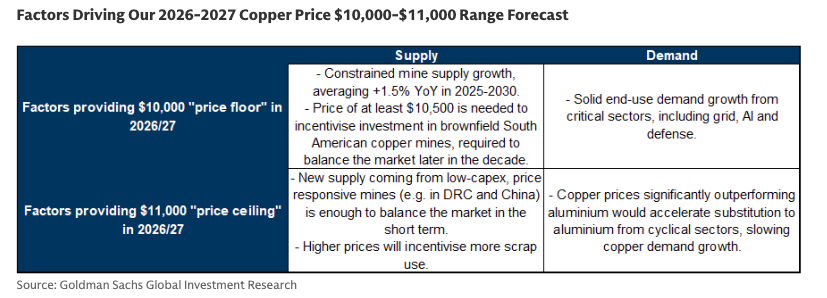
Copper Price Already Near Top End of Goldman’s Price Anchors
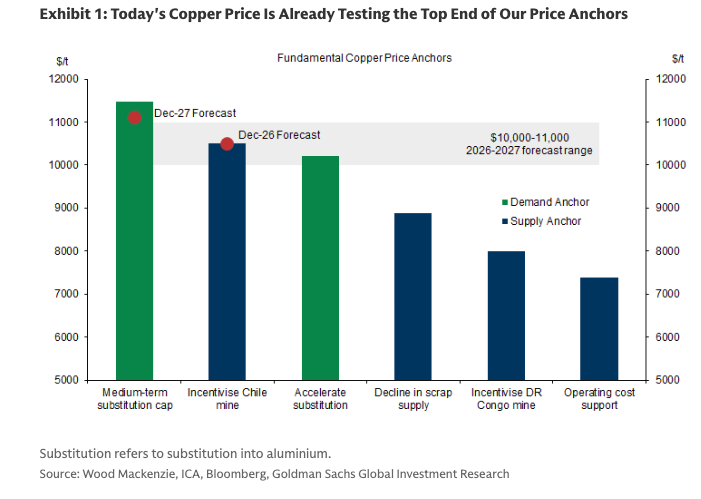
When to Expect the Deficit
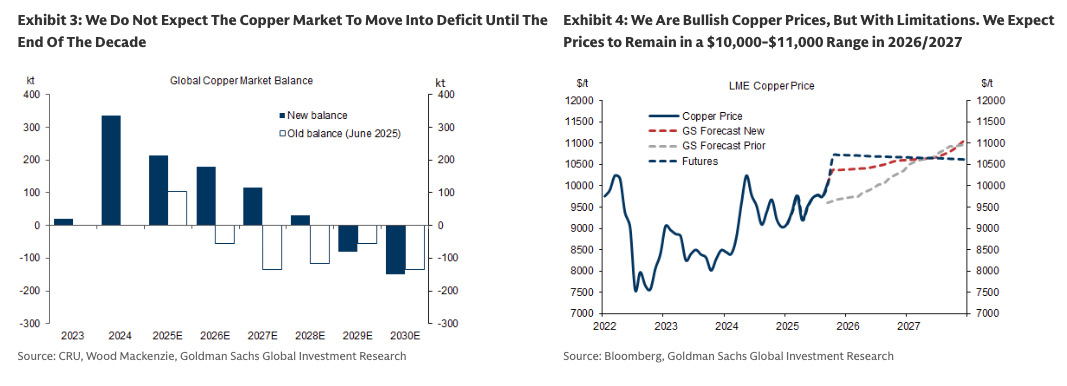
The note includes tons of charts and an in-depth analysis of global copper markets, outlining what to expect through the end of the decade. ZeroHedge Pro Subs can read the full report in the usual place.
END
GOLD
Can’t Keep Gold Down: RSI Screaming, 200-Day Left in the Dust

Wednesday, Oct 08, 2025 – 6:25
Can’t keep a good man down
Gold continues surging, trading at the most overbought levels since July 2020 (RSI at 87!). Note we are overshooting the upper trend line.
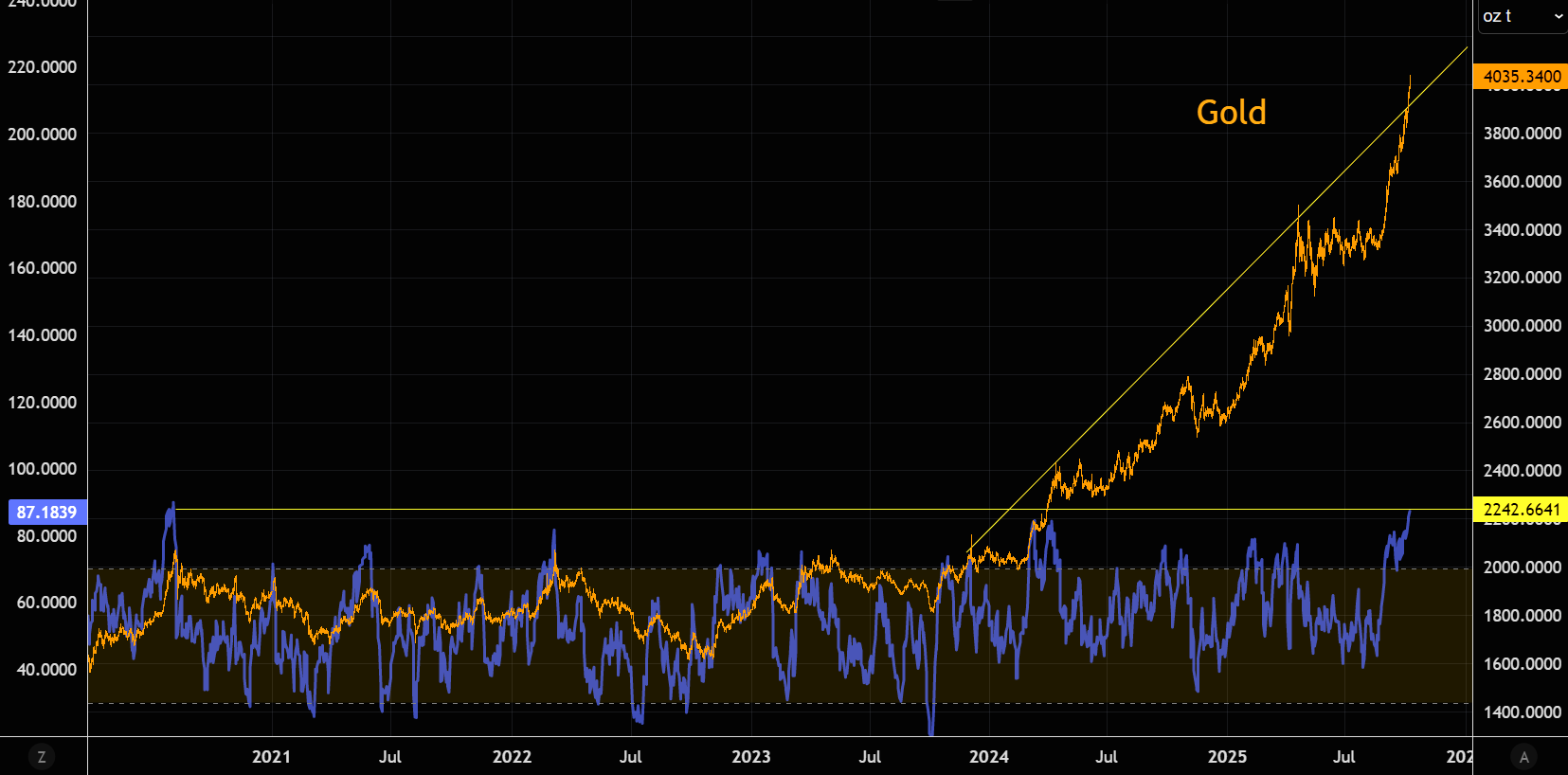
Source: LSEG Workspace
ETF hunger
GS raised their gold 2026 price target earlier this week “…western ETF inflows – a key driver of the rally since late august – is a stickier high-conviction holder in our pricing framework“.
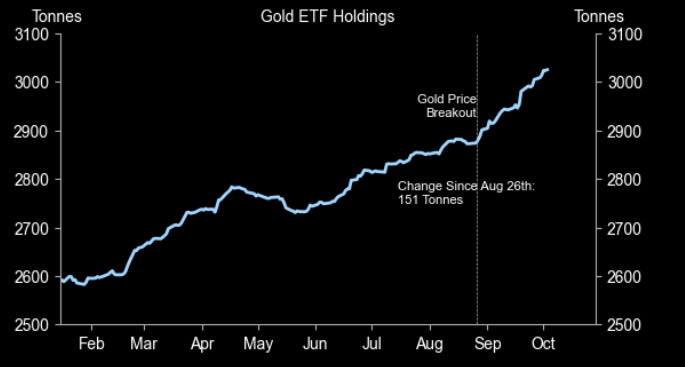
Source: GS
Decoupled
Gold has left the 200 day way behind. Last time gold squeezed this hard, we saw it trade some 28% above the 200 day. We are now 25% above the long term moving average.
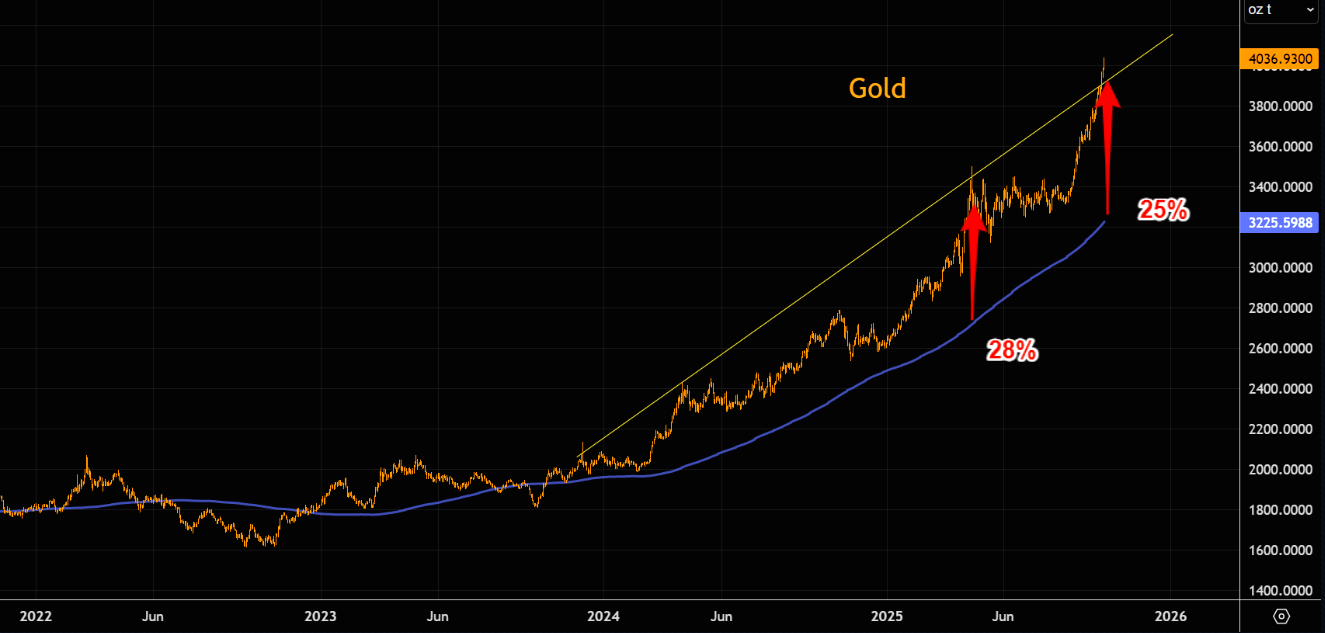
Source: LSEG Workspace
Bargain
Sharp gold moves higher tend to be accompanied with gold volatility moving sharply higher as well (gold’s upside skew feature). This time around, the GVZ reaction has stayed relatively calm, offering cheap options plays. The call spreads logic we have been outlining for weeks has done very well, but make sure to roll into higher strikes as we move higher.
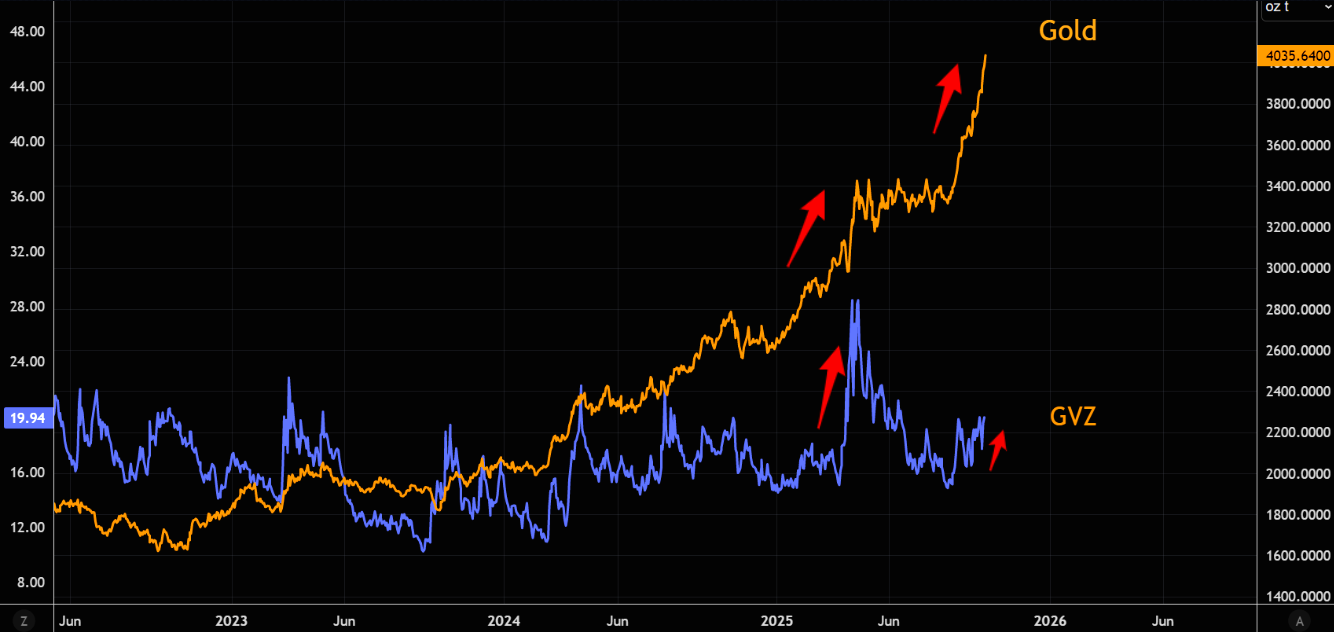
Source: LSEG Workspace
Haven’t seen this in a while
Gold surging and the dollar bid is rare. Big capital trying to park money in “real” safe havens?
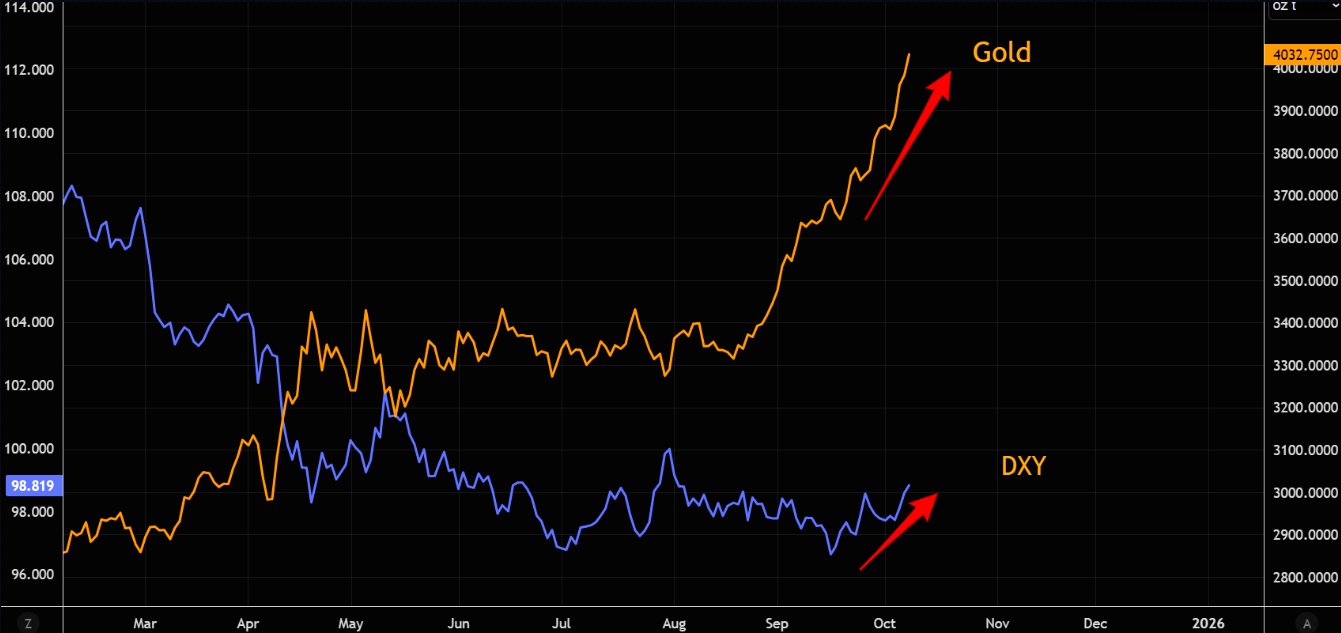
Source: LSEG Workspace
Specs
Gold net non commercials have increased the long lately, but they are still “lagging” price action.
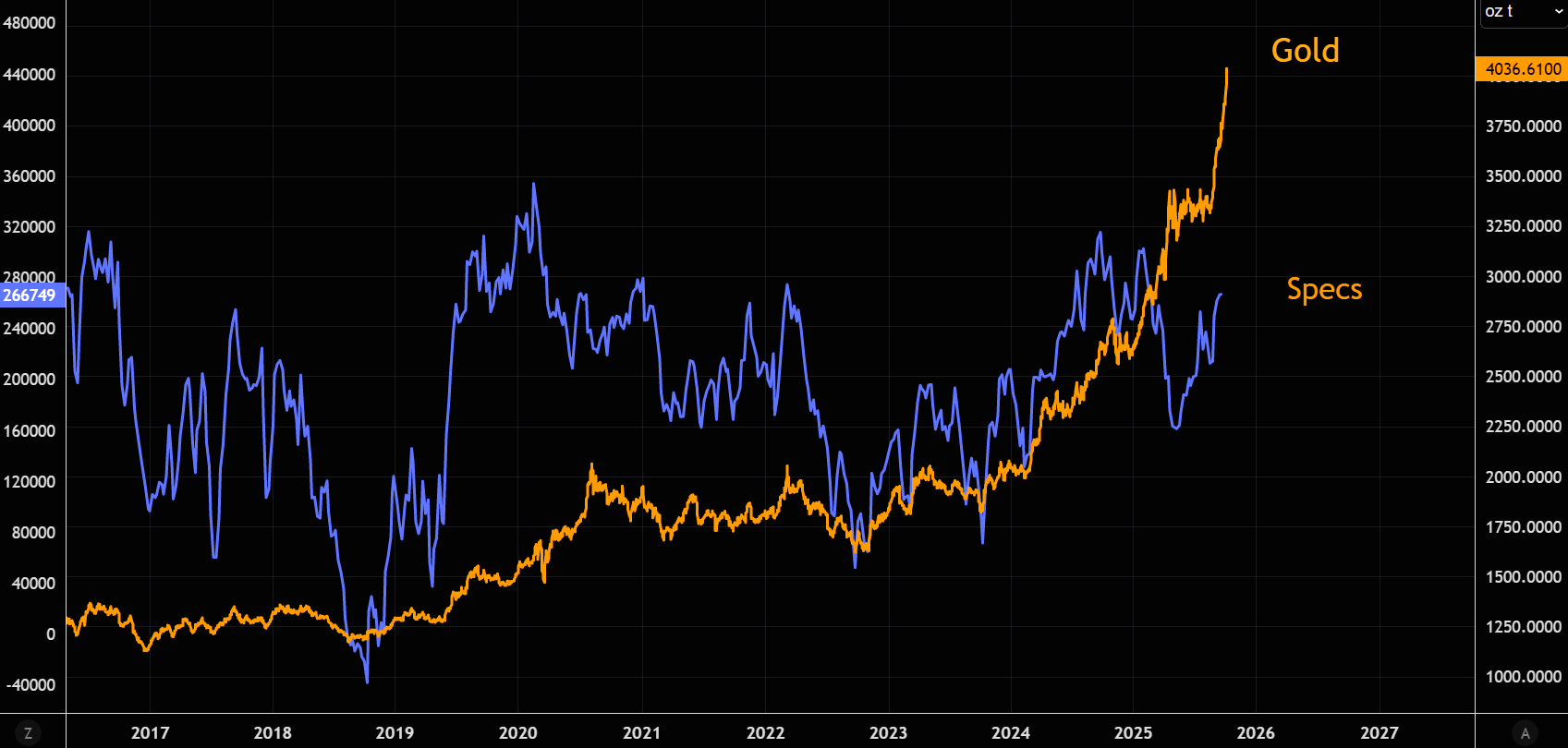
Source: LSEG Workspace
Magnificent miners
Gold up over 50% YTD is impressive, but that looks tiny compared to gold miners, up 127% this year.
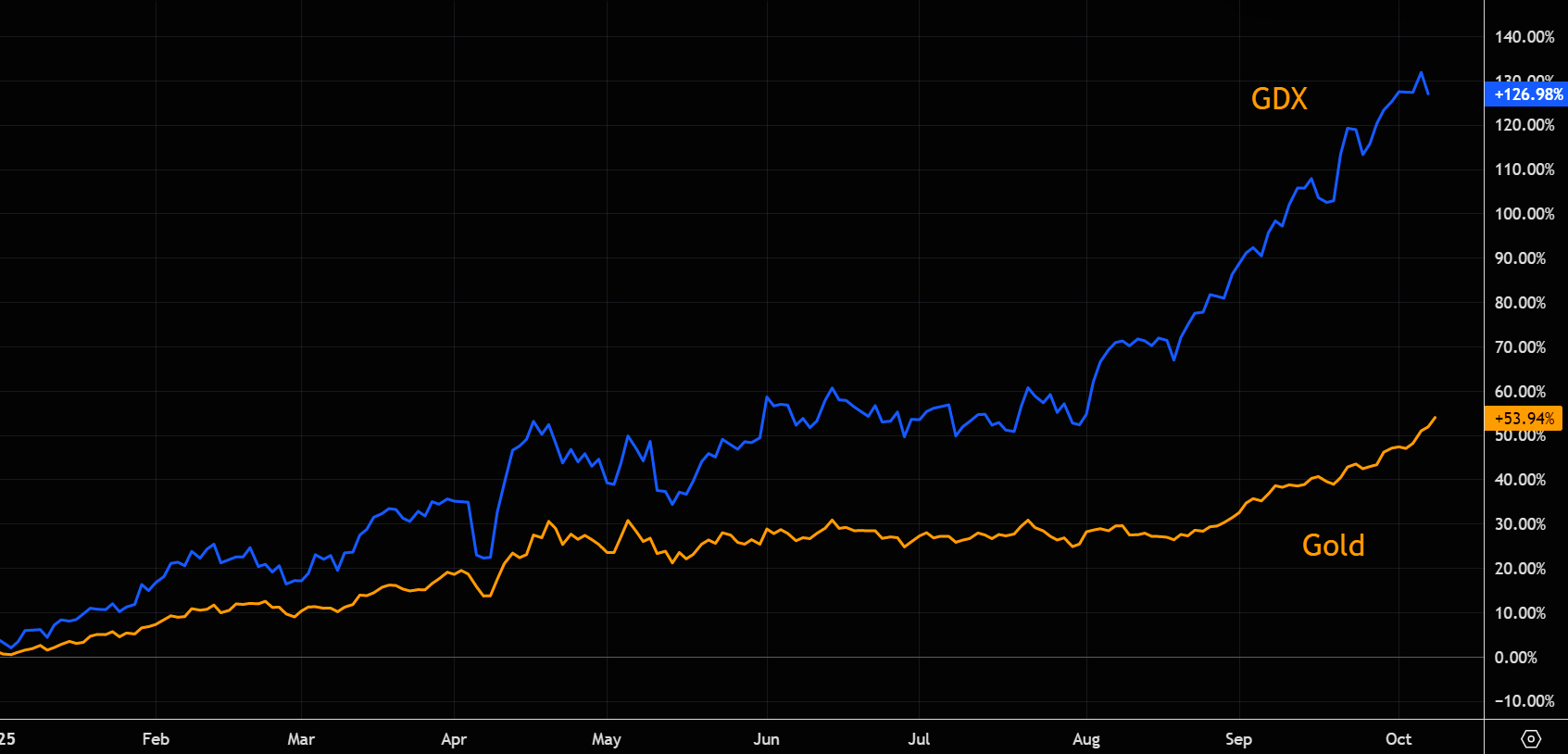
Source: LSEG Workspace
More upside risks
“Risks to our upgraded forecast remain skewed to the upside if private-sector diversification into the much smaller gold market materializes“. You need a magnifying glass to see the gold bar…
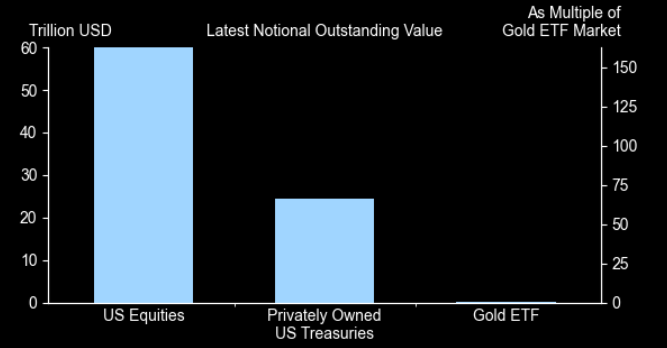
Source: GS
END
IRON ORE/USA DOLLAR/ROBERT H
The demise of the Federal Reserve Dollar
Many years ago it was clear that the so called Referee of the Federal Reserve System was less than trustworthy. All Central Bank currencies are FIAT in nature based on confidence both in value and use. Freezing of funds or worse theft of transfer amounts is a vote for departure from such claws. It is why the whole world is in flux. What has taken time is now accelerating as people scramble for seats on lifeboats to escape. And like always the mainstream news is silent. The FIFTH ESTATE is long time buried. It is why trust in mainstream media is so low.
About 10 days ago now, China refused to buy iron ore from Australia largest mining company, BHP **in US Dollars**. As we saw at the Shanghai Cooperation Organization at the start of September, China wants a greater global role for the China National Yuan (CNY) currency, and less for the USD. THIS IS NOT ABOUT AMERICA BUT ABOUT THE FEDERAL RESERVE SYSTEM! America will have to find itself in this mess unfolding. Likely with a new currency in time to come.
China told its steelmakers to pause buying iron ore from BHP, a massive Australian mining company. Iron ore is Australia’s most valuable export, and without it, both countries lose money.
The order came from the Chinese government because they no longer choose to utilize USD for Iron Ore purchases. They want the USD out of commerce transactions, because using the USD makes China susceptible to US-imposed economic sanctions, and blocking of payments through the US-dominated SWIFT banking system. It is also why they have been using TREASURIES to pay for things in other countries and selling them.
BHP did not want to halt using the US Dollar, so China halted import of Iron Ore through BHP. WHERE IS THIS NEWS STORY?
China buys 85% of Australia’s iron ore so this is most concerning for Australia, as it affects their own viability.
Most international commerce utilizes USD between sellers and buyers because the US Dollar has been the de-facto reserve currency for the whole world, since World War 2. Today the second largest value point in trade settlement is the GOLD PRICE AND RELATIVE CURRENCY VALUE AGAINST THIS POINT OF REFERENCE. This means that people rather have their own currency set against gold rather than use USD. This in effect is the use of a gold standard in trade. And as certain countries realize their own trade value in trade goods they may price in their own currencies which rise against a gold fix and a declining dollar value.
As more and more countries halt using the US Dollar, to make it impossible for the US to impose economic sanctions, those Dollars will begin flooding back into the US from countries around the world who don’t use them anymore.
That influx of dollars will cause the USD value – the purchasing power – of the Dollar to plummet relative to many foreign currencies and against gold. As the Dollar plummets in value, imported goods will cost more and more USD.
Inflation inside the US will skyrocket. Already the USD has declined over 10% against gold.
This is one of the quiet reasons the price of Gold is rising. Countries are realizing they need to get OUT of the US Dollar and buy into something that everyone will accept as payment for international trade.
MSN will not tell you this nor will governments because inflation will rise in many countries. And no government ever admits the error of their ways. The next 7-8 years will be full of change as this departure from the Federal Reserve Dollar runs its course. And no currency will remain unaffected including the YUAN. There are many issues in places like Hong Kong where many billions in bank losses have not yet been admitted.
ASIAN MARKETS THIS WEDNESDAY MORNING:
SHANGHAI CLOSED
//Hang Seng CLOSED CLOSED
// Nikkei CLOSED : DOWN 215.39 PTS OR 0.45% //Australia’s all ordinaries CLOSED DOWN 0.09%
//Chinese yuan (ONSHORE) CLOSED XXXX OFFSHORE CLOSED DOWN AT 7.1469/ Oil UP TO 62.33 dollars per barrel for WTI and BRENT UP TO 65.95 Stocks in Europe OPENED ALL GREEN
ONSHORE USA/ YUAN TRADING XXXX LEVEL OF OFFSHORE YUAN TRADING :/ONSHORE YUAN HOLIDAY IN TRADING AT XXXX AND XXXX//OFF SHORE YUAN TRADING DOWN TO 7.1469 AGAINST US DOLLAR/ AND THUS WEAKER
YOUR EARLY CURRENCY VALUES/GOLD AND SILVER PRICING/ASIAN AND EUROPEAN BOURSE MOVEMENTS/AND INTEREST RATE SETTINGS WEDNESDAY MORNING.7:30 AM
ONSHORE YUAN: CLOSED HOLIDAY
OFFSHORE YUAN: DOWN TO 7.1469
HANG SENG CLOSED HOLIDAY
2. Nikkei closed DOWN 215.89 PTS OR 0.45%
3. Europe stocks SO FAR: ALL GREEN
USA dollar INDEX UP TO 98.52 EURO FALLS TO 1.1631 DOWN 22 BASIS PTS
3b Japan 10 YR bond yield: RISES TO. +1.6910//Japan buying 100% of bond issuance)/Japanese YEN vs USA cross now at 152.36…… JAPANESE YEN NOW FALLING AS WE HAVE NOW REACHED THE RE EMERGING OF THE YEN CARRY TRADE AGAIN AFTER DISASTROUS POLICY ISSUED BY UEDA. JAPAN 30 YR BOND YIELD: 3.151 DOWN 12 BASIS PTS.
3c Nikkei now ABOVE 17,000
3d USA/Yen rate now well ABOVE the important 120 barrier this morning
3e Gold UP /JAPANESE Yen DOWN CHINESE ONSHORE YUAN: XXX OFFSHORE: DOWN
3f Japan is to buy INFINITE TRILLION YEN worth of BONDS. Japan’s GDP equals 5 trillion USA
Japan to buy 100% of all new Japanese debt and NOW they will have OVER 50% of all Japanese debt.
3g Oil UP for WTI and UP FOR UP this morning
3h European bond buying continues to push yields lower on all fronts in the EMU. German 10yr bund YIELD DOWN TO +2.6892// Italian 10 Yr bond yield DOWN to 3.526 SPAIN 10 YR BOND YIELD DOWN TO 3.227
3i Greek 10 year bond yield DOWN TO 3.337
3j Gold at $4038.60 Silver at: 48.79 1 am est) SILVER NEXT RESISTANCE LEVEL AT $50.00//AFTER 28.40
3k USA vs Russian rouble;// Russian rouble UP 0 AND 23 /100 roubles/dollar; ROUBLE AT 81.76
3m oil (WTI) into the 62 dollar handle for WTI and 65 handle for Brent/
3n Higher foreign deposits moving out of China// huge risk of outflows and a currency depreciation. This can spell financial disaster for the rest of the world/
JAPAN ON JAN 29.2016 CONTINUES NIRP. THIS MORNING RAISES AMOUNT OF BONDS THAT THEY WILL PURCHASE UP TO .5% ON THE 10 YR BOND///YEN TRADES TO 152.36/ 10 YEAR YIELD AFTER FIRST BREAKING .54% LAST YEAR NOW EXCEEDS THAT LEVEL TO 1.691% STILL ON CENTRAL BANK (JAPAN) INTERVENTION//YEN CARRY TRADE IS NOW UNWINDING.//JAPAN 30 YR: 3.151 DOWN 12 BASIS PTS.
30 SNB (Swiss National Bank) still intervening again in the markets driving down the FRANC. It is not working: USA/SF this 0.8003 as the Swiss Franc is still rising against most currencies. Euro vs SF: 0.9314 well above the floor set by the Swiss Finance Minister. Thomas Jordan, chief of the Swiss National Bank continues to purchase euros trying to lower value of the Swiss Franc.
USA 10 YR BOND YIELD: 4.113 DOWN 2 BASIS PTS…
USA 30 YR BOND YIELD: 4.707 DOWN 2 BASIS PTS/
USA 2 YR BOND YIELD: 3.564 DOWN 1 BASIS PTS
USA DOLLAR VS TURKISH LIRA: 41.71 UP 1 BASIS PTS/LIRA GETTING KILLED
10 YR UK BOND YIELD: 4.7130 DOWN 3 PTS BUT STILL ESCALATING RAPIDLY
30 YR UK BOND YIELD: 5.521 DOWN 2 BASIS PTS
10 YR CANADA BOND YIELD: 3.185 DOWN 4 BASIS PTS
5 YR CANADA BOND YIELD: 2.730 DOWN 3 BASIS PTS.
2a New York OPENING REPORT
Futures Rise As Global Debasement Trade Sends Gold Over $4000
Wednesday, Oct 08, 2025 – 08:44 AM
Futures are higher again, reversing Tuesday’s modest Oracle-led decline, and are led by small caps despite additional multi billion tech investment headlines. As of 8:00am ET, S&P 500 futures were 0.1% higher, set for their 8th gain in the past 9 days, with Nasdaq 100 contacts +0.2% with Mag7, Semis, and AI-themed plays all rallying off the investment news. In premarket trading, AMD extended gains after an explosive rally following its multibillion-dollar AI deal with OpenAI. Tesla advanced after it unveiled a cheaper version of its top-selling electric vehicle. Cyclicals poised to outperform Defensive even as Ray Dalio warned that the AI-driven market rally “feels frothy.” Of course, it is all now just a debasement trade with everyone and their mother dumping fiat and buying hard currencies, sending gold above $4,000 an ounce for the first time, and silver above $49. The dollar gained for a third day against major peers and is now 2.5% off its 52-wk low as 96.00, while Treasury yields dipped. In commodities, Energy and Precious metals are the stand outs as gold breaks above $4k. The Administration said ~$13bn in farming aid may be rolled out soon. Today we get the FOMC minutes at 2pm; the Federal Budget Balance will likely be delayed due to the government shutdown.
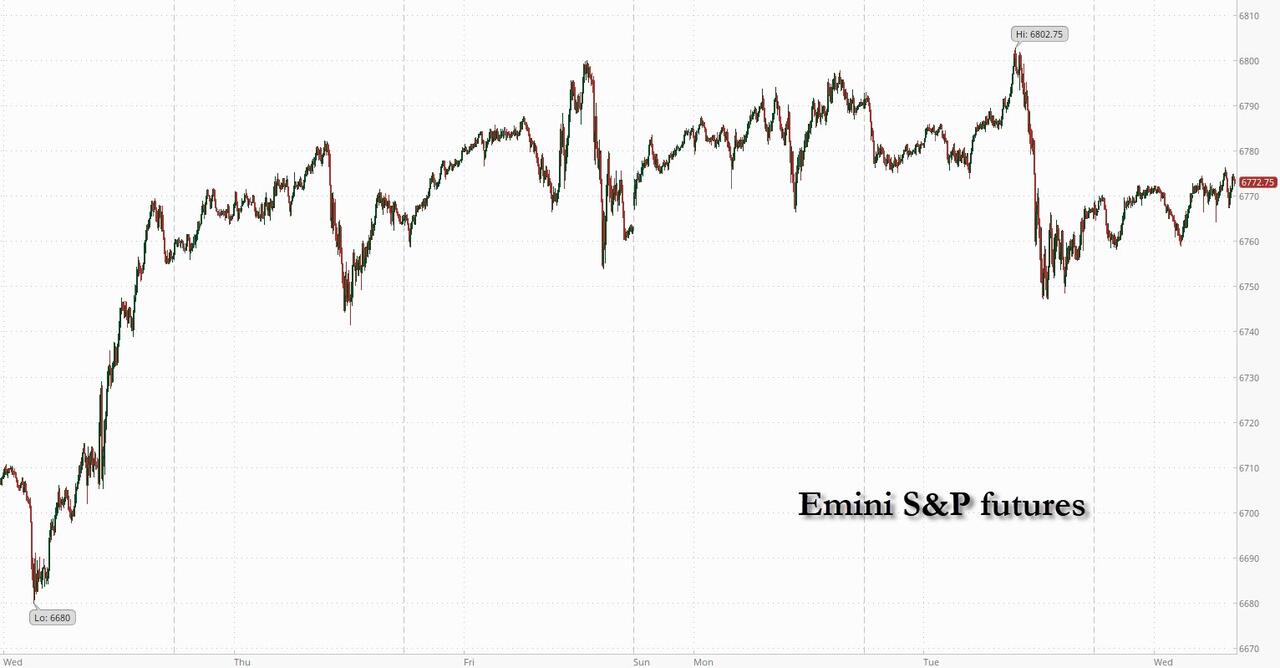
In premarket trading, Mag 7 stocks are mixed (Tesla +0.3%, Nvidia +0.6%, Amazon +0.4%, Microsoft +0.1%, Meta Platforms -0.1%, Alphabet -0.1%, Apple -0.1%).
- Precious metals miners climb after spot gold rallied past $4,000 an ounce for the first time amid concerns over the US economy and a government shutdown.
- AST SpaceMobile (ASTS) rises 9% after announcing a pact with Verizon to provide direct-to-cellular AST SpaceMobile service when needed for Verizon customers starting in 2026.
- CervoMed (CRVO) soars 16% after announcing that its Phase 2b trial demonstrated neflamapimod’s potential as a treatment for dementia with Lewy bodies.
- Confluent (CFLT) gains 17% as Reuters reports that the data-infrastructure company is exploring a sale after receiving acquisition interest.
- Fair Isaac Corp. (FICO) falls 3% after Equifax said its VantageScore 4.0 service will offer mortgage credit scores at $4.50 through the end of 2027.
- Jefferies Financial Group (JEF) slips nearly 2% after it said it’s in communication with First Brands Group’s advisers to determine the impact of First Brands’ bankruptcy on Leucadia Asset Management’s Point Bonita Capital. Leucadia Asset Management is owned by Jefferies.
- Joby Aviation (JOBY) is down 10% after offering $500 million in shares via Morgan Stanley.
- Lantheus Holdings (LNTH) slips 2% following a downgrade to neutral at Goldman Sachs, which sees less certainty regarding the medical-equipment company’s outlook.
- Penguin Solutions (PENG) shares drop 23% after the company’s FY26 sales guidance range fell short of the consensus of analyst estimates. The company, which helps enterprises to build out AI infrastructure, said the guidance range is wider than usual to “reflect a broader set of potential outcomes.”
- QuantumScape (QS) rises 5% after the maker of lithium-metal batteries entered a joint-development agreement with Murata Manufacturing Co.
- Rocket Lab (RKLB) rises 6% after the company said it signed a contract with iQPS to launch three more satellites for the Japanese compan
In corporate news, Salesforce told customers it won’t pay a ransom demand from a hacker who claimed to have stolen a large amount of client data and threatened to publish it. xAI is raising more financing than initially planned, tapping backers including Nvidia to lift its ongoing funding round to $20 billion, according to people with knowledge of the matter.
Concerns have been growing that $16 trillion surge in the S&P 500 from its April lows had gone too far. Tuesday’s drop came amid mounting chatter about lofty valuations around artificial intelligence, with some market participants seeing an echo of the excesses that led to the dot-com crash 25 years ago. On Tuesday, investors turned cautious after the Information reported that Oracle may post a disappointing profit margin for the latest quarter, spurring a selloff in tech shares. Still, many investors fear missing out on further gains, with the upcoming earnings season set to provide clues on the rally’s sustainability.
“There are worrying signals on the AI rally, which reminds me of 1997 when I started my career,” said Gilles Guibout, head of European equities at Axa Investment Managers. “The bubble burst in 2000 but those managers who had refused to follow the rally, rightfully expecting it to go pop, lost a lot of money for their clients. There’s a real risk to get out of the AI trade too early; what you need to do is stay invested but with your finger on the exit button and stay diversified.”
And with nobody willing to sell first, equity volatility remains deeply subdued, despite a growing list of potential cracks beneath the surface. According to Bank of America, S&P 500 three-month realized vol sits near 8.5%, its lowest decile since 1990.
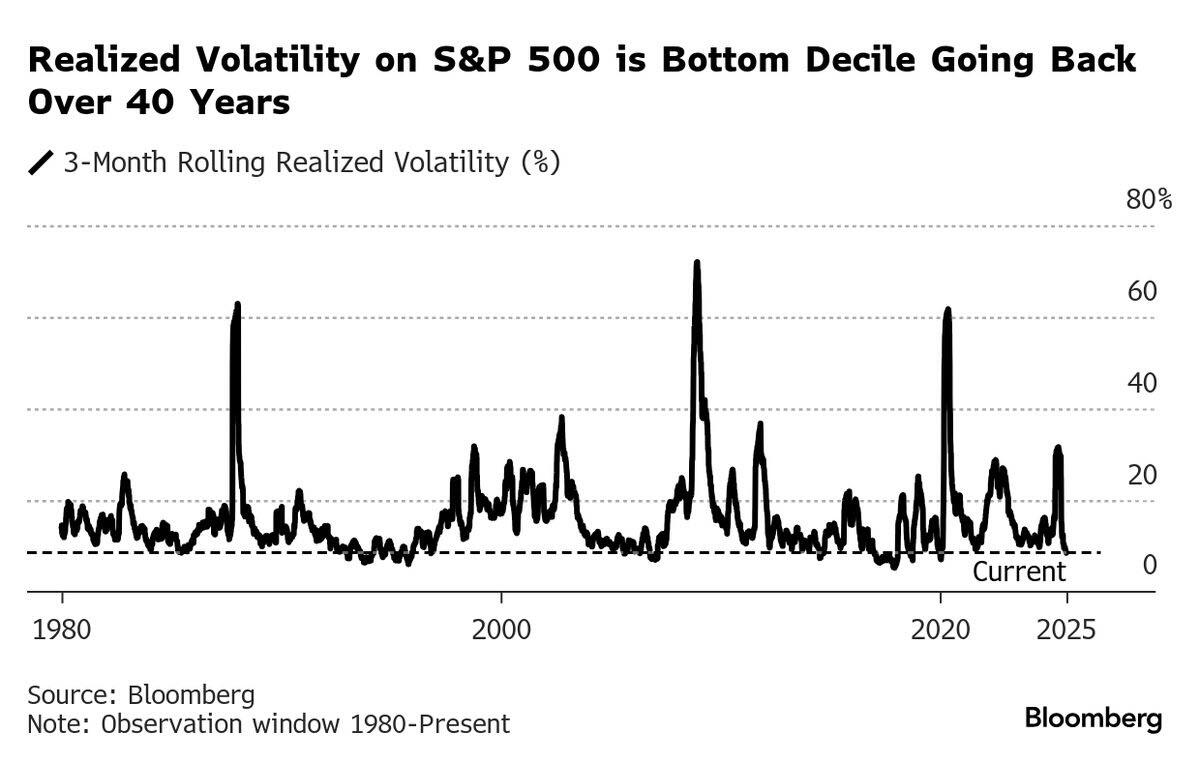
Catching up to our discussion on the massive AI circle jerk, Bloomberg’s Big Take today highlights how a wave of deals involving Nvidia and OpenAI are escalating concerns that an increasingly complex and interconnected web of business transactions is artificially propping up the AI boom. Still, Goldman strategist Peter Oppenheimer said it’s too early to be worried about a bubble. The rally in tech has been accompanied by robust earnings growth, while previous bubbles were driven mainly by speculation. And Jamie Dimon said that JPMorgan’s investments in AI are paying off, with cost savings matching the $2 billion annual spend on developing the technology.
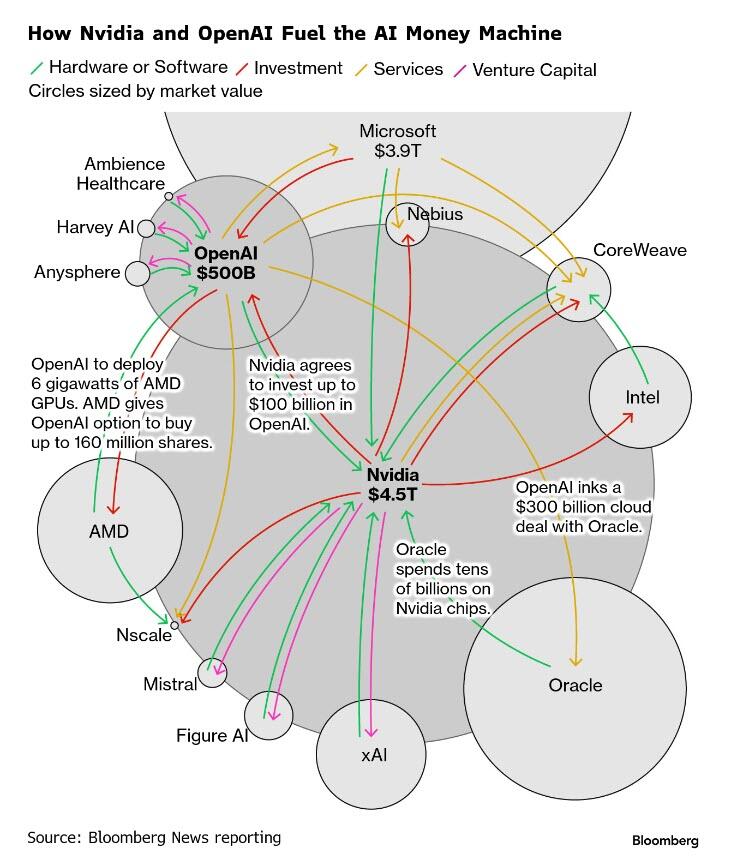
As noted last night, the global currency debasement trade pushed Gold above $4,000 an ounce for the first time ever, with silver rising above $49 for the first time since 2011 and on pace for a new record high.
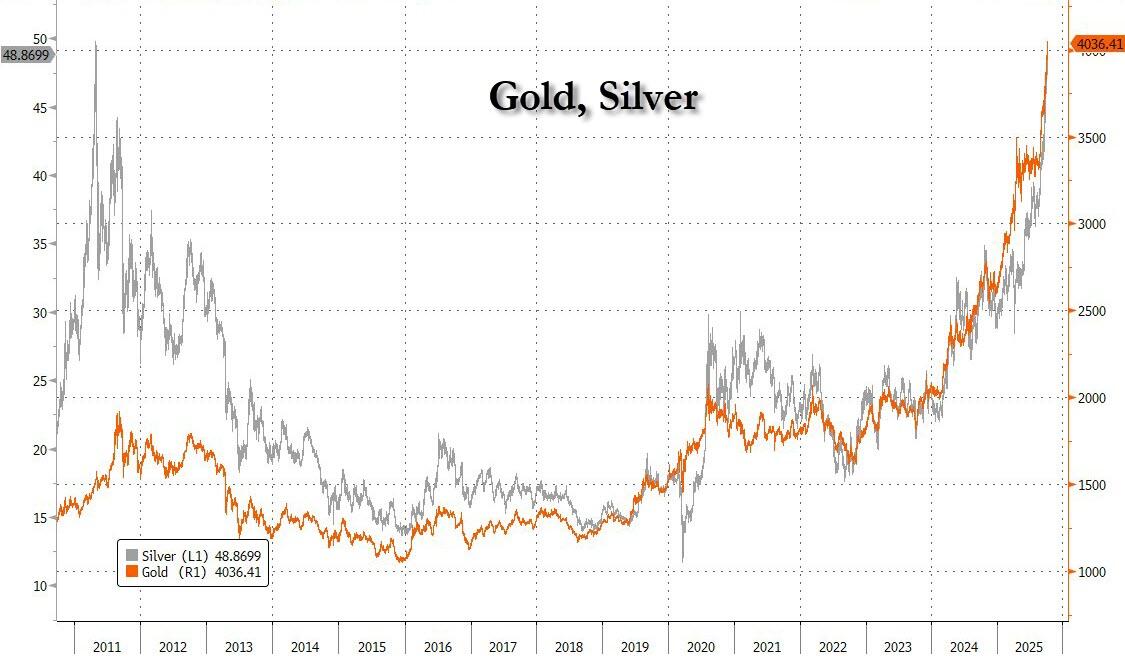
Europe’s Stoxx 600 benchmark climbed 0.6%, on track for another record close, as the basic resources sector jumped more than 1%. The French CAC 40 outperformed most of its regional peers after the outgoing PM expressed optimism that an accord can be reached to allow the formation of a new government. Lloyds Banking Group Plc led banks higher after a favorable ruling on the cost of disputed car loans. European stocks were also buoyed by moves to resolve France’s budget impasse. The country’s CAC 40 equity index rose as much as 0.8% and bond yields fell. The European technology sub-index, however, underperformed. BMW AG slumped, dragging peers lower, after the German luxury-car maker cut its financial guidance on weak sales in China and tariff-related costs. Here are some of the biggest European movers today:
- Umicore shares rise as much as 8%, to their highest since June 2024, after the company announced it will sell permanently tied-up gold inventories, strengthening its balance sheet
- Marston shares advance as much as 11%, the most in a year, following a trading update from the UK pub company which prompts Peel Hunt to increase its pretax profit estimates
- Addnode gains as much as 13% following an upgrade to buy from hold at Pareto Securities, with the Swedish IT group now deemed to be trading back at attractive levels
- BMW shares decline as much as 7.4% after cutting its guidance for the full year due to weak volume growth in China and costs related to the implementation of tariffs
- Aryzta shares fall as much as 7.9%, the most in three years, after the Swiss baker issued a profit warning and said it replaced CEO Michael Schai with immediate effect
- Aurubis shares drop as much as 5.7%, retreating from Tuesday’s record high close, after the copper smelting company released an update ahead of its capital markets day
- Aixtron shares fall as much as 8.9%, the most since April, as analysts at JPMorgan forecast that a slower recovery in the firm’s core markets will add near-term risk to estimates
- Serica Energy shares fall as much as 14% after the company said an issue with the flare system on Dana Petroleum-operated Triton FPSO resulted in a temporary suspension of production from Sept. 30
- Unite Group shares fall as much as 6.1%, to the lowest in more than five years, after Morgan Stanley called the latest trading update of the student accommodation provider disappointing
Meanwhile, the US / EU trade deal is being questioned by the EU as the US makes new demands, calling into question the Trump / Van Der Leyen agreement.
Earlier in the session, Asian stocks declined, driven by losses in technology shares on fresh concerns over the justification for the artificial intelligence boom. The MSCI Asia Pacific Index fell as much 0.8%, the most since Sept. 26, with TSMC, Alibaba and SoftBank among the biggest drags. Hong Kong led losses as the market reopened after a holiday, while Taiwan, Singapore and Malaysia also saw declines. Vietnam’s benchmark briefly surged as much as 3% before paring much of the gain, after FTSE Russell upgraded it to emerging market status from frontier. Elsewhere, New Zealand’s key stock index extended gains after the central bank cut interest rates more aggressively than expected and said it’s open to further reductions. Traders also await a decision in Thailand, where the central bank is expected to deliver its fourth interest rate cut of the year.
In FX, the euro falls 0.3% amid a broad dollar rally. The kiwi is one of the weakest of the G-10 currencies, falling 0.6% after the RBNZ cut interest rates by 50 bps.
In rates, Treasuries bull-flattened in the early US session with long-end yields richer by around 2.5bp on the day, following similar price action in European bonds. With US front-end yields little changed, 2s10s and 5s30s spreads are flatter by 2bp-3bp; 10-year near 4.1% is 2bp lower on the day, with UK’s keeping pace and Germany’s outperforming after auctions in both markets. French bonds advanced during London morning after caretaker prime minister struck a note of optimism on the budget before starting a final day of talks to form a government, narrowing the 10-year French yield spread with Germany by 3 bps to around 83 bps. US session includes 10-year note auction and minutes of September FOMC meeting.
In commodities, gold is up over $50, having crossed $4,000/oz for the first time earlier today. WTI crude futures rise 1% to $62.30 a barrel.
The US economic calendar calendar, still subject to delays from the ongoing government shutdown, includes FOMC meetings minutes release at 2pm. Fed speaker slate includes Musalem (9:20am), Barr (9:30am, 5:45pm), Goolsbee (10am, 7:15pm) and Kashkari (3:15pm, 4:30pm)
Market Snapshot
- S&P 500 mini +0.1%
- Nasdaq 100 mini +0.2%
- Russell 2000 mini +0.4%
- Stoxx Europe 600 +0.6%
- DAX +0.4%, CAC 40 +0.7%
- 10-year Treasury yield -1 basis point at 4.11%
- VIX -0.3 points at 16.97
- Bloomberg Dollar Index +0.2% at 1211.81
- euro -0.4% at $1.1613
- WTI crude +1.4% at $62.6/barrel
Top Overnight News
- Trump’s farm aid plan (which is expected to be $12-13B initially and potentially as large as $50B over time) is delayed by the shutdown. officials were said to have readied nearly USD 13bln from an internal USDA fund, although there is no final decision on how much will be used for farm aid, or when: Politico
- American farmers are in “panic” mode as Chinese soybean buyers stay on the sidelines (“we’ll see the bottom drop out if we don’t get a deal with China soon”). WSJ
- US Senate leaders were reportedly trying to lock in votes on Tuesday evening with a variety of options, including the noms bloc, privileged resolutions (maybe Canada tariff disapproval), and the duelling CRs again: Punchbowl.
- More than 250,000 federal workers missed paychecks as the shutdown entered the second week, with 2 million more at risk. Meanwhile, bond traders are hedging against a wider range of Fed outcomes amid a data blackout. BBG
- Elon Musk’s xAI is raising $20 billion, including $2 billion from Nvidia, to finance AI chips for its Colossus 2 project, people familiar said. The deal will be split between equity and debt, allowing xAI to rent Nvidia processors for five years. BBG
- China saw a spike in travel over the Golden Week holiday, but consumer spending was fairly muted. FT
- Japan’s likely next premier Sanae Takaichi is already facing criticism from her ruling party’s long-time coalition partner, a rift that could delay or, in an extreme scenario, jeopardize her premiership. RTRS
- EU officials see new US trade demands as potentially threatening a recent deal and risking renewed conflict, people familiar said. Washington wants talks on the EU’s legislation, raising concerns over regulatory autonomy. BBG
- Caretaker French Prime Minister Sebastien Lecornu struck a cautiously optimistic tone on Wednesday, saying a deal could potentially be reached on the country’s budget by year-end, making the risk of a snap election more remote. RTRS
- Prolonged funding pressures in US money markets, just as bank reserves held at the Federal Reserve are dwindling, suggest the central bank may be getting closer to ending the unwinding of its massive portfolio of securities. BBG
Trade/Tariffs
- EU sees new US trade demands hollowing out deal struck by US President Trump, according to Bloomberg citing sources. Earlier in the month, Trump admin reportedly sent the EU a fresh proposal for implementing “reciprocal, fair and balanced” trade.
A more detailed look at global markets courtesy of Newsquawk
APAC stocks traded mixed with demand hampered following the negative handover from the US, where stocks snapped a 7-day win streak as small caps underperformed and with sentiment weighed on by AI-profitability concerns. ASX 200 was rangebound as gains in healthcare and the top-weighted financial industry were offset by underperformance in Tech and Consumer sectors. Nikkei 225 lacked conviction and oscillated around the 48,000 level amid a weaker currency and soft wages data. Hang Seng retreated on return from the holiday closure with tech stocks heavily represented in the list of worst performers, while mainland participants were still away but are set to return from the National Day Golden Week celebrations tomorrow.
Top Asian News
- RBNZ cut the OCR by 50bps to 2.50% vs mixed views between a 25bps and 50bps cut, while the committee remains open to further reductions in the OCR as required for inflation to settle sustainably near the 2% target mid-point in the medium term. RBNZ said higher near-term inflation could prove to be more persistent and that with spare capacity in the economy, inflation is expected to return to around the 2% target mid-point over the first half of 2026, but noted upside and downside risks to the inflation outlook. RBNZ Minutes revealed that the committee discussed the options of reducing the OCR by 25bps or by 50bps at the meeting, while it stated that the case for reducing the OCR by 50 basis points emphasised prolonged spare capacity and the associated downside risk to medium-term activity and inflation.
- Oxford Economics has brought forward their timing of the next BoJ 25bps rate hike to December from next year and have added another 25bps hike in mid-2026.
- Japanese Economy Minister Akazawa is expected to depart from his position, according to local reports via Mainichi newspaper.
Top European News
- French PM Lecornu to speak again at 19:00 BST
- French PM Lecornu said will present his findings to President Macron later this evening; said France must get a budget by year-end; talks so far showing a willingness to get this budget through by year-end. Sees possibility of dissolution of parliament as becoming more remote.
- French Socialist Leader Faure says the party cannot back the current budget plan, no guarantee that pension reforms will be suspended.
- UK ONS said there’s an error in public finances data between Jan-Aug, citing HMRC error; VAT data error means public sector net borrowing in current and prior FY is a combined GBP 3bln lower. UK borrowing in the past five months of FY was GBP 2bln lower than previously thought.
- ECB’s Rehn has warned there is a risk that inflation slows below the ECB’s 2% inflation target, according to Bloomberg, citing the Karon Grilli podcast. There are downside inflation risks in sight over the next couple of years; cites EUR strength, stabilisation of wages and services inflation.
- ECB’s Nagel said current monetary policy is appropriate; euro zone inflation close to 2% target, via Greek newspaper.
- ECB’s Escriva said he cannot pre-empt direction of future policy move; inflation expectations are very much anchored ECB needs to be cautious. Outlook remains uncertain going forward. Wouldn’t overemphasise a strong euro as a risk factor, European economy showing great deal of resilience. Trade disruptions from US are potentially inflationary. Inflation risks are very much balanced. Spanish housing supply lagging very much.
- BoE FPC Minutes: FPC decided to maintain the UK countercyclical capital buffer (CCyB) rate at 2% Risks associated with geopolitical tensions, global fragmentation of trade and financial markets, and pressures on sovereign debt markets remain elevated. Despite persistent material uncertainty around the global macroeconomic outlook, risky asset valuations have increased and credit spreads have compressed. There have been some notable credit defaults in the US automotive sector since the last meeting. A sudden or significant change in perceptions of Federal Reserve credibility could result in a sharp re-pricing of US dollar assets, including in US sovereign debt markets, with the potential for increased volatility, risk premia, and global spillovers.
FX
- DXY is up for a third session in a row with WTD gains thus far of 1.1%. It remains the case that the price action is not being driven by outright bullish calls on the USD but more a case of weakness elsewhere, mainly JPY and EUR, with NZD the latest of its major counterparts to take a stumble. If anything, the macro narrative surrounding the US remains a downbeat one as the government shutdown continues to drag on, delaying economic data releases and threatening a hit to domestic growth. DXY has ventured as high as 98.97 with focus on a test of the 99.0 mark; not breached since 5th August.
- EUR remains pressured vs. the USD and is just about holding onto a 1.16 handle after delving as low as 1.1607. French political turmoil remains a key part of the Eurozone macro narrative with PM Lecornu (also due to speak @ 19:00BST) set to meet with socialists, greens and communists in an attempt to form a coalition government. The likely price for Macron will be a left-wing PM, which could make the parliamentary arithmetic easier for passing a budget, given that the Socialist Party holds the most seats in the National Assembly. Aside from France, Germany saw further woeful data earlier in the session with German Industrial Orders falling well short of consensus and subsequently stoking concerns over a contraction in the domestic economy. In terms of price action, if 1.16 gives way in EUR/USD the next target comes via the 27th August low at 1.1573.
- JPY remains very much on the backfoot against the USD with USD/JPY having risen five handles since Takaichi’s victory in the LDP leadership race. The move has been relentless this week given the market’s view that the fallout of Takaichi will leader to a mix of looser monetary and fiscal policy. Subsequently, markets only assign a circa 25% chance of a cut this month vs. roughly 70% last week. Further reason for caution in expecting additional tightening from the BoJ was presented overnight via the August real cash earnings data, which printed a deeper-than-expected contraction. USD/JPY has climbed as high as 152.96 with focus now on a test of 153; not breached since February. If the pair begins to approach 155, given the velocity of the move, expectations of potential intervention will likely increase.
- GBP is a touch weaker vs. the USD but stronger vs. the EUR. At the risk of sounding like a broken record, in the absence of any tier 1 UK data, the macro narrative has failed to evolve beyond ongoing angst ahead of the November 26th Budget. BoE Chief Economist Pill is due to give remarks at 16:00BST. GBP/USD briefly tripped below Tuesday’s low at 1.3391 before returning to a 1.34 handle.
- NZD is the laggard across the majors after the RBNZ’s decision to opt for a deeper 50bps rate cut (views heading into the meeting were split between 25bps and 50bps). Additionally, the committee noted that it remains open to additional reductions. The minutes stated that the case for reducing the OCR by 50 basis points emphasised prolonged spare capacity and the associated downside risk to medium-term activity and inflation. Subsequently, has extended its descent on a 0.57 handle and hit its lowest level since April 11th.
Fixed Income
- USTs are trading firmer by a few ticks, following the positivity seen across global peers. Currently trading at the upper end of a 112-19+ to 112-25+ range. Nothing really driving sentiment today from a US perspective, but upside, which comes after the safe-haven related upside seen in the prior session. Now traders await a 10yr outing; as a reminder, the last sale was strong, receiving strong demand and a 1.3bps stop-through. FOMC Minutes (Sept) and a slew of Fed speakers will also be in focus, in a day which is void of key US data.
- Bunds are firmer today, in-fitting with the upside seen across peers. Upside today began into German data, before taking another leg higher on the release itself – an upward bias which has held throughout the morning thus far. To recap that German data in brief, Industrial Output printed well below expectations at -4.5% (exp. -1%), though the accompanying release highlighted some caveats; “The marked decrease may be explained, at least in part, by the combination of annual plant closures for holidays and production changeovers”. The upswing seen earlier in the year looks increasingly associated with US-tariff related front loading – following the data, ING suggests that there is now an increasing likelihood of another quarter of contraction for the German economy. Thereafter, the German auction was poor, but ultimately had little follow-through to price action.
- OATs are the relative outperformer today, as outgoing PM Lecornu aims to hold last-minute talks with opposition parties. To recap the situation in France, President Macron asked the PM to hold talks with the opposition parties, giving him a deadline until Wednesday evening. In a presser today, Lecornu said he will present his findings to Macron later this evening; overall, his comments leaned more positively, suggesting that the talks so far show a willingness to get this budget through by year-end. Moreover, Lecornu has suggested suspending President Macron’s pension reforms, which would be welcomed by those on the left. The outgoing PM will be speaking again at 19:00 BST. On the presser itself, some very marginal upticks were in OATs; the OAT-Bund 10yr spread has tightened from recent highs, currently trading around 83.6bps vs previous close at 86.15bps.
- Gilts are in the green alongside peers. Currently trading in a 90.69 to 90.83 range. UK press remains heavily focused on the looming Autumn Budget; most recently, the FT reported that Pimco and BlackRock have called Chancellor Reeves to build a larger buffer in the UK public finances in the November Budget to avoid years of uncertainty over tax and spending decisions. However, a factor boosting sentiment is the ONS revising down UK Government borrowing by GBP 2bln after a recent data error – which may alleviate some of the borrowing-related pressure the Chancellor faces. Today a strong 2029 auction, which saw a b/c of 2.92x had little impact on prices.
Commodities
- Crude benchmarks are trading slightly higher, extending on the prior day’s high, despite worries of oversupply in the market with OPEC+ hiked production at its last meeting (albeit by a smaller than expected magnitude) and amid forecasts in the US that point to a record domestic oil output. WTI and Brent continued the late bid from yesterday’s session to form a peak at USD 62.45/bbl and USD 66.15/bbl, respectively, at the time of writing, before a dip towards USD 62.12/bbl and USD 65.88/bbl, respectively, as commentary from the Egypt talks remains positive. Note: EIA is continuing normal publication schedules and data collection.
- Spot gold has broken the USD 4k/oz mark, extending to a peak of USD 4039/oz and thus far remaining near ATHs. The surge in precious metals also comes as investors look to safe havens away from the dollar to protect against rising government debt burdens, geopolitical tensions and expectations of the dollar to continue lower.
- Base metals remain rangebound as China re-enters the market tomorrow. 3M LME Copper dipped to a trough of USD 10.68k/t before reversing to a peak of USD 10.78k/t as copper consolidates after a record weekly gain. Amid copper consolidation, there continues to be a growing consensus that copper still has further to go, with forecasts being revised higher towards USD 11.5-12k/t by the first half of next year due to supply disruptions and a continuing weaker dollar.
- US Private Energy Inventories Data (bbls) Crude +2.8mln (exp. +1.9mln), Distillate -1.8mln (exp. -1.2mln), Gasoline -1.2mln (exp. -0.9mln), Cushing -1.2mln.
Geopolitics: Middle East
- “There are outstanding issues among the negotiators in Egypt”, according to Al Arabiya sources.
- Hamas said group positivity is needed to reach a deal, said list of hostages’ names exchanged on Wednesday according to agreed numbers, according to a statement.
- “An Israeli security source told Sky News Arabia: Israel insists on not accepting any ideas outside the Trump plan”, according to Sky News Arabia
- The atmosphere in the Sharm el-Sheikh negotiations appears to be “very positive”, according to a correspondent at Sky News Arabia.
- Hamas leader tells AFP: “Optimism” dominates Gaza talks, via Sky News Arabia.
- Iran’s Foreign Minister Araghchi denies reports that he’s been in direct contact with US Envoy Witkoff including secret meetings in Doha or Muscat.
Geopolitics: Ukraine
- Russian Foreign Minister says maintaining Russia’s obligations under the plutonium agreement with the US is no longer acceptable, via Tass.
US Event Calendar
- 7:00 am: Oct 3 MBA Mortgage Applications, prior -12.7%
- 2:00 pm: Sep 17 FOMC Meeting Minutes
- 2:00 pm: Sep Federal Budget Balance, est. 50b, prior -344.79b
Central Banks
- 9:20 am: Fed’s Musalem Gives Welcoming Remarks
- 9:30 am: Fed’s Barr Keynote at Community Banking Research Conference
- 10:00 am: Fed’s Goolsbee Gives Opening Remarks
- 3:15 pm: Fed’s Kashkari Speaks at Center for Indian Country Development
- 4:30 pm: Fed’s Kashkari Hosts Fireside Chat with Senator Tina Smith
- 5:45 pm: Fed’s Barr Speaks on Community Development
- 7:15 pm: Fed’s Goolsbee Speaks at Payments Conference
DB’s Jim Reid concludes the overnight wrap
Markets struggled to gain traction yesterday, posting a risk-off move as investors grappled with political uncertainty in France and the US government shutdown. So the S&P 500 (-0.38%) lost ground from its record high on Monday, and 10yr Treasury yields (-2.9bps) also fell back. That concern was clear on several fronts, and investor jitters about France’s debt trajectory pushed the Franco-German 10yr spread to 86bps, the biggest gap since January. Moreover, spot gold prices have just risen above the $4,000/oz mark for the first time overnight, continuing its relentless rally that’s seen it rise more than 50% so far this year.
In terms of the latest from France, there’s been little sign of any progress being made following PM Lecornu’s resignation on Monday. As a reminder, President Macron gave Lecornu a deadline of tonight to reach agreement among the different political groups, but so far at least there’s been no compromise emerging. Indeed, yesterday there was mounting speculation about another legislative election being called. For instance on Polymarket, it’s suggesting there’s a 67% chance of another election being called, rather than a new PM being appointed, which is up from 49% as we went to press yesterday. And at one point yesterday evening, it even rose as high as 85%.
When it comes to the market reaction, French bonds have continued to underperform, pushing the 10yr spread over bunds up to 86bps. So that’s very close to its peak of 88bps last December when it became clear that former PM Michel Barnier was likely to lose the confidence vote. Indeed, that 88bps level hasn’t been exceeded since 2012, back when then-ECB President Mario Draghi pledged to do “whatever it takes” to save the euro, leading to a big confidence boost that helped spreads come down. To be fair, French equities fared relatively better yesterday, and France’s CAC 40 (+0.04%) stabilised after its Monday slump. However, banks continued to lose ground, including Société Générale (-1.88%), BNP Paribas (-1.15%) Crédit Agricole (-0.21%).
Of course, politics are very much in the spotlight elsewhere, as the US government shutdown shows no sign of ending. In terms of the latest, House Democratic leader Hakeem Jeffries said that proposals to extend the Affordable Care Act tax credits for a year were “a non-starter”. Meanwhile, Republican Senator Susan Collins of Maine told reporters on Monday that she was working on a plan to reopen the government, at least partially, in exchange for a deadline for a discussion on ACA subsidies. But the bigger picture is still concern about an extended shutdown that starts to have a more meaningful economic impact, and on Polymarket, there’s only a 25% chance given to the shutdown ending before October 15.
US equities struggled against that backdrop, and the S&P 500 (-0.38%) fell back after a run of 7 consecutive gains. In part, that was driven by a decline for Oracle (-2.52%), after a report from The Information said that their profit margins for cloud computing were lower than analysts’ estimates. So tech stocks struggled, and the Magnificent 7 (-1.25%) and the NASDAQ (-0.67%) also saw a decent decline. Autos (-4.37%) were the biggest laggard in the S&P, as Tesla (-4.45%) fell after their announcement of a less expensive version of their model Y car and Ford fell -6.1% after the WSJ reported that a plant fire in a New York state aluminum plant will increase costs and cause delivery disruptions. Meanwhile, the outperformers were among the more defensive sectors, with consumer staples (+0.86%) and utilities (+0.42%) both advancing.
As that was happening, Treasury yields fell across the curve, with the 10yr yield coming down -2.9bps on the day to 4.12%. That came as investors slightly dialled up the pace of Fed rate cuts over the months ahead, with 111bps priced in by December 2026, up +2.0bps on the day. Meanwhile, Fed speakers continued to strike a divergent tone. For instance, Fed Governor Miran remained dovish, saying that he was “more sanguine on the inflation outlook than a lot of other people are”. But Minneapolis Fed President Kashkari warned that “Some of the data that we’re looking at is sending some stagflationary signals”.
On that theme, the New York Fed’s latest Survey of Consumer Expectations found that near-term inflation expectations ticked higher in September. So 1yr inflation expectations ticked up to 3.4%, which is their highest since April, and 5yr expectations moved up to 3.0%, which is their highest since February. However, it’s still an open question what will happen with the US CPI report itself on October 15, as it’s a release that will also be affected by the ongoing government shutdown, just like payrolls was last Friday.
Back in Europe, there wasn’t too much happening outside of France, with most assets seeing little change. So the STOXX 600 (-0.17%) only posted a modest decline, alongside steady moves for the DAX (+0.03%) and the FTSE 100 (+0.05%). Similarly for bond yields, there wasn’t too much movement in absolute terms, with yields on 10yr bunds (-1.0bps), OATs (+0.3bps) and BTPs (-0.4bps) seeing little change. There also wasn’t much data, although German factory orders underwhelmed with a -0.8% decline in August (vs. +1.2% expected).
Overnight in Asia, things have been a bit more eventful this morning, with continued movements in Japanese markets after Sanae Takaichi’s election as LDP leader. For instance, the 10yr government bond yield (+1.4bps) has reached a post-2008 high of 1.69%, whilst the yen (-0.30%) has weakened overnight to 152.36 per dollar, its weakest level since February. Meanwhile, the Nikkei (-0.11%) has also lost ground after a run of 4 consecutive gains. That comes as data showed wage growth was softer than expected in August, with nominal wages up +1.5% year-on-year in August (vs. +2.7% expected). And in real terms, wage growth remains negative as it has throughout 2025, at -1.4% (vs. -0.5% expected). Otherwise, there’s been a mixed equity performance in Asia, with the Hang Seng (-1.07%) losing ground, alongside gains for the CSI 300 (+0.45%), the Shanghai Comp (+0.52%) and the KOSPI (+2.70%).
Elsewhere, the main surprise has come from New Zealand overnight, where the Reserve Bank of New Zealand delivered a surprise 50bp cut, larger than the 25bp move expected, which takes their Official Cash rate down to 2.5%. So that’s led to a depreciation in the New Zealand dollar, which has weakened by -0.96% against the US dollar overnight, making it the worst-performing G10 currency. The statement said that the committee “remains open to further reductions”, and New Zealand’s 10yr yield (-4.6bps) has fallen to a 12-month low in response.
Finally, the other big headline overnight has been that spot gold prices have risen through the $4,000/oz mark for the first time. The latest moves come with treasury yields moving lower and the ongoing shutdown, but gold prices have been moving higher throughout the year, having risen by more than +50% since the end of 2024. So as it stands, it remains well on track for its strong annual increase since 1979, when the oil shock that year led to a huge surge in inflation. As a reminder, Marion on our team published an update yesterday (link here) on the future of central banks holding both gold and Bitcoin in their balance sheets by 2030.
2b European opening report
USD gains whilst Kiwi slips post-RBNZ, XAU passes USD 4,000 ahead of FOMC Minutes – Newsquawk US Opening News

Wednesday, Oct 08, 2025 – 06:24 AM
- EU sees new US trade demands hollowing out deal struck by US President Trump, according to Bloomberg citing sources.
- European bourses are broadly firmer but with ASML (-1.7%) weighing on the AEX; US equity futures are modestly higher.
- USD continues to rally, boosted by a weak JPY and NZD; the Kiwi is the clear underperformer after the RBNZ delivered a jumbo 50bps cut and left the door open for more rate reductions.
- Global paper moves higher, OATs outperform, awaiting French PM Lecornu later.
- XAU topped the USD 4,000/oz mark, crude is continuing to rebound as China is set to re-enter the market tomorrow.
- Looking ahead, NBP Policy Announcements, FOMC Minutes (Sep), Speakers including BoE’s Pill, ECB’s Elderson & Lagarde, Fed’s Musalem, Barr, Goolsbee & Kashkari, NVIDIA CEO Huang, French PM Lecornu, Supply from US.
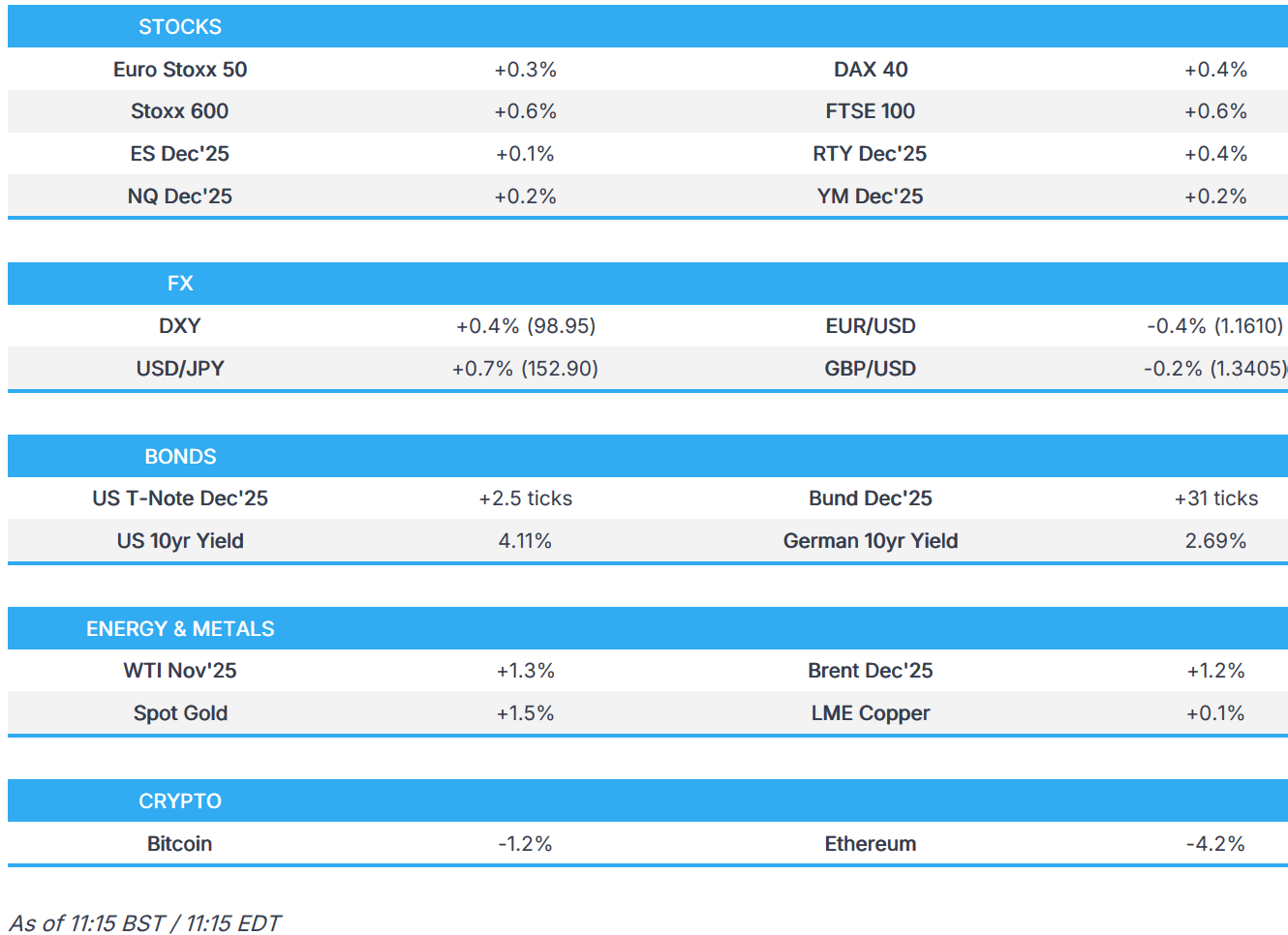
Newsquawk in 3 steps:
1. Subscribe to the free premarket movers reports
2. Listen to this report in the market open podcast (available on Apple and Spotify)
3. Trial Newsquawk’s premium real-time audio news squawk box for 7 days
TARIFFS/TRADE
- EU sees new US trade demands hollowing out deal struck by US President Trump, according to Bloomberg citing sources. Earlier in the month, Trump admin reportedly sent the EU a fresh proposal for implementing “reciprocal, fair and balanced” trade.
EUROPEAN TRADE
EQUITIES
- European bourses (STOXX 600 +0.6%) have opened largely firmer (FTSE 100 +0.3%, CAC 40 +0.6%, DAX 40 +0.2% and Euro Stoxx +0.3%), with the only downside being the AEX (-0.39%), largely due to pressure in ASML (-2.5%). A combination of recent reporting suggesting financial pressure on Oracle in the previous session and after the US House committee called for broader bans on its chips to China.
- European sectors have opened mostly in the green. The biggest winner is Basic Resources (+1.0%), following broker upgrades for some of the biggest companies in the industry like Rio Tinto (+0.9%), Anglo American (+1.7%) and Antofagasta (+2.5%), driving up their share prices and therefore lifting the basic resource sector. Eyes also on gold miners after the yellow metal topped USD 4,000/oz to the upside. Autos is towards the foot of the pile, pressured by losses in BMW (-4.5%) after it cut 2025 guidance.
- US futures are slightly firmer (ES +0.1% NQ +0.2% RTY +0.4%). Futures are in a holding pattern after stocks were sold on Tuesday following reports via The Information that internal data shows the financial challenge of renting out NVIDIA (NVDA) chips and its impact on margins.
- Click for the sessions European pre-market equity newsflow
- Click for the additional news
- Click for a detailed summary
FX
- DXY is up for a third session in a row with WTD gains thus far of 1.1%. It remains the case that the price action is not being driven by outright bullish calls on the USD but more a case of weakness elsewhere, mainly JPY and EUR, with NZD the latest of its major counterparts to take a stumble. If anything, the macro narrative surrounding the US remains a downbeat one as the government shutdown continues to drag on, delaying economic data releases and threatening a hit to domestic growth. DXY has ventured as high as 98.97 with focus on a test of the 99.0 mark; not breached since 5th August.
- EUR remains pressured vs. the USD and is just about holding onto a 1.16 handle after delving as low as 1.1607. French political turmoil remains a key part of the Eurozone macro narrative with PM Lecornu (also due to speak @ 19:00BST) set to meet with socialists, greens and communists in an attempt to form a coalition government. The likely price for Macron will be a left-wing PM, which could make the parliamentary arithmetic easier for passing a budget, given that the Socialist Party holds the most seats in the National Assembly. Aside from France, Germany saw further woeful data earlier in the session with German Industrial Orders falling well short of consensus and subsequently stoking concerns over a contraction in the domestic economy. In terms of price action, if 1.16 gives way in EUR/USD the next target comes via the 27th August low at 1.1573.
- JPY remains very much on the backfoot against the USD with USD/JPY having risen five handles since Takaichi’s victory in the LDP leadership race. The move has been relentless this week given the market’s view that the fallout of Takaichi will leader to a mix of looser monetary and fiscal policy. Subsequently, markets only assign a circa 25% chance of a cut this month vs. roughly 70% last week. Further reason for caution in expecting additional tightening from the BoJ was presented overnight via the August real cash earnings data, which printed a deeper-than-expected contraction. USD/JPY has climbed as high as 152.96 with focus now on a test of 153; not breached since February. If the pair begins to approach 155, given the velocity of the move, expectations of potential intervention will likely increase.
- GBP is a touch weaker vs. the USD but stronger vs. the EUR. At the risk of sounding like a broken record, in the absence of any tier 1 UK data, the macro narrative has failed to evolve beyond ongoing angst ahead of the November 26th Budget. BoE Chief Economist Pill is due to give remarks at 16:00BST. GBP/USD briefly tripped below Tuesday’s low at 1.3391 before returning to a 1.34 handle.
- NZD is the laggard across the majors after the RBNZ’s decision to opt for a deeper 50bps rate cut (views heading into the meeting were split between 25bps and 50bps). Additionally, the committee noted that it remains open to additional reductions. The minutes stated that the case for reducing the OCR by 50 basis points emphasised prolonged spare capacity and the associated downside risk to medium-term activity and inflation. Subsequently, has extended its descent on a 0.57 handle and hit its lowest level since April 11th.
- Click for a detailed summary
- Click for NY OpEx Details
FIXED INCOME
- USTs are trading firmer by a few ticks, following the positivity seen across global peers. Currently trading at the upper end of a 112-19+ to 112-25+ range. Nothing really driving sentiment today from a US perspective, but upside, which comes after the safe-haven related upside seen in the prior session. Now traders await a 10yr outing; as a reminder, the last sale was strong, receiving strong demand and a 1.3bps stop-through. FOMC Minutes (Sept) and a slew of Fed speakers will also be in focus, in a day which is void of key US data.
- Bunds are firmer today, in-fitting with the upside seen across peers. Upside today began into German data, before taking another leg higher on the release itself – an upward bias which has held throughout the morning thus far. To recap that German data in brief, Industrial Output printed well below expectations at -4.5% (exp. -1%), though the accompanying release highlighted some caveats; “The marked decrease may be explained, at least in part, by the combination of annual plant closures for holidays and production changeovers”. The upswing seen earlier in the year looks increasingly associated with US-tariff related front loading – following the data, ING suggests that there is now an increasing likelihood of another quarter of contraction for the German economy. Thereafter, the German auction was poor, but ultimately had little follow-through to price action.
- OATs are the relative outperformer today, as outgoing PM Lecornu aims to hold last-minute talks with opposition parties. To recap the situation in France, President Macron asked the PM to hold talks with the opposition parties, giving him a deadline until Wednesday evening. In a presser today, Lecornu said he will present his findings to Macron later this evening; overall, his comments leaned more positively, suggesting that the talks so far show a willingness to get this budget through by year-end. Moreover, Lecornu has suggested suspending President Macron’s pension reforms, which would be welcomed by those on the left. The outgoing PM will be speaking again at 19:00 BST. On the presser itself, some very marginal upticks were in OATs; the OAT-Bund 10yr spread has tightened from recent highs, currently trading around 83.6bps vs previous close at 86.15bps.
- Gilts are in the green alongside peers. Currently trading in a 90.69 to 90.83 range. UK press remains heavily focused on the looming Autumn Budget; most recently, the FT reported that Pimco and BlackRock have called Chancellor Reeves to build a larger buffer in the UK public finances in the November Budget to avoid years of uncertainty over tax and spending decisions. However, a factor boosting sentiment is the ONS revising down UK Government borrowing by GBP 2bln after a recent data error – which may alleviate some of the borrowing-related pressure the Chancellor faces. Today a strong 2029 auction, which saw a b/c of 2.92x had little impact on prices.
- UK sells GBP 5bln 4.00% 2029 Gilt: b/c 2.92x, avg. yield 4.095%, tail 0.8bps.
- Germany sells EUR 0.733bln vs exp. EUR 1bln 2.60% 2041 Bund and EUR 0.853bln vs exp. EUR 1bln 3.25% 2042 Bund.
- Click for a detailed summary
COMMODITIES
- Crude benchmarks are trading slightly higher, extending on the prior day’s high, despite worries of oversupply in the market with OPEC+ hiked production at its last meeting (albeit by a smaller than expected magnitude) and amid forecasts in the US that point to a record domestic oil output. WTI and Brent continued the late bid from yesterday’s session to form a peak at USD 62.45/bbl and USD 66.15/bbl, respectively, at the time of writing, before a dip towards USD 62.12/bbl and USD 65.88/bbl, respectively, as commentary from the Egypt talks remains positive. Note: EIA is continuing normal publication schedules and data collection.
- Spot gold has broken the USD 4k/oz mark, extending to a peak of USD 4039/oz and thus far remaining near ATHs. The surge in precious metals also comes as investors look to safe havens away from the dollar to protect against rising government debt burdens, geopolitical tensions and expectations of the dollar to continue lower.
- Base metals remain rangebound as China re-enters the market tomorrow. 3M LME Copper dipped to a trough of USD 10.68k/t before reversing to a peak of USD 10.78k/t as copper consolidates after a record weekly gain. Amid copper consolidation, there continues to be a growing consensus that copper still has further to go, with forecasts being revised higher towards USD 11.5-12k/t by the first half of next year due to supply disruptions and a continuing weaker dollar.
- US Private Energy Inventories Data (bbls) Crude +2.8mln (exp. +1.9mln), Distillate -1.8mln (exp. -1.2mln), Gasoline -1.2mln (exp. -0.9mln), Cushing -1.2mln.
- Click for a detailed summary
NOTABLE DATA RECAP
- Swedish CPIF Flash MM (Sep) 0.2% (Prev. -0.2%); CPI YY Flash (Sep) 0.9% (Prev. 1.1%); CPIF Flash YY (Sep) 3.1% (Prev. 3.2%); CPIF Ex Energy Flash MM (Sep) 0.1% (Prev. -0.5%); CPIF Ex Energy Flash YY (Sep) 2.7% (Prev. 2.9%)
NOTABLE EUROPEAN HEADLINES
- French PM Lecornu to speak again at 19:00 BST
- French PM Lecornu said will present his findings to President Macron later this evening; said France must get a budget by year-end; talks so far showing a willingness to get this budget through by year-end. Sees possibility of dissolution of parliament as becoming more remote.
- French Socialist Leader Faure says the party cannot back the current budget plan, no guarantee that pension reforms will be suspended.
- UK ONS said there’s an error in public finances data between Jan-Aug, citing HMRC error; VAT data error means public sector net borrowing in current and prior FY is a combined GBP 3bln lower. UK borrowing in the past five months of FY was GBP 2bln lower than previously thought.
- ECB’s Rehn has warned there is a risk that inflation slows below the ECB’s 2% inflation target, according to Bloomberg, citing the Karon Grilli podcast. There are downside inflation risks in sight over the next couple of years; cites EUR strength, stabilisation of wages and services inflation.
- ECB’s Nagel said current monetary policy is appropriate; euro zone inflation close to 2% target, via Greek newspaper.
- ECB’s Escriva said he cannot pre-empt direction of future policy move; inflation expectations are very much anchored ECB needs to be cautious. Outlook remains uncertain going forward. Wouldn’t overemphasise a strong euro as a risk factor, European economy showing great deal of resilience. Trade disruptions from US are potentially inflationary. Inflation risks are very much balanced. Spanish housing supply lagging very much.
- BoE FPC Minutes: FPC decided to maintain the UK countercyclical capital buffer (CCyB) rate at 2% Risks associated with geopolitical tensions, global fragmentation of trade and financial markets, and pressures on sovereign debt markets remain elevated. Despite persistent material uncertainty around the global macroeconomic outlook, risky asset valuations have increased and credit spreads have compressed. There have been some notable credit defaults in the US automotive sector since the last meeting. A sudden or significant change in perceptions of Federal Reserve credibility could result in a sharp re-pricing of US dollar assets, including in US sovereign debt markets, with the potential for increased volatility, risk premia, and global spillovers.
NOTABLE US HEADLINES
- US President Trump’s administration has pushed back its plans to roll out economic support for farmers this week due to the government shutdown, according to four people familiar with the talks cited by POLITICO. Furthermore, officials were said to have readied nearly USD 13bln from an internal USDA fund, although there is no final decision on how much will be used for farm aid, or when.
- US Senate leaders were reportedly trying to lock in votes on Tuesday evening with a variety of options, including the noms bloc, privileged resolutions (maybe Canada tariff disapproval), and the duelling CRs again, according to Punchbowl.
GEOPOLITICS
MIDDLE EAST
- “There are outstanding issues among the negotiators in Egypt”, according to Al Arabiya sources.
- Hamas said group positivity is needed to reach a deal, said list of hostages’ names exchanged on Wednesday according to agreed numbers, according to a statement.
- “An Israeli security source told Sky News Arabia: Israel insists on not accepting any ideas outside the Trump plan”, according to Sky News Arabia
- The atmosphere in the Sharm el-Sheikh negotiations appears to be “very positive”, according to a correspondent at Sky News Arabia.
- Hamas leader tells AFP: “Optimism” dominates Gaza talks, via Sky News Arabia.
- Iran’s Foreign Minister Araghchi denies reports that he’s been in direct contact with US Envoy Witkoff including secret meetings in Doha or Muscat.
RUSSIA-UKRAINE
- Russian Foreign Minister says maintaining Russia’s obligations under the plutonium agreement with the US is no longer acceptable, via Tass.
CRYPTO
- Bitcoin is on the backfoot and slips back towards USD 122k whilst Ethereum underperforms and edges back below USD 4.5k.
APAC TRADE
- APAC stocks traded mixed with demand hampered following the negative handover from the US, where stocks snapped a 7-day win streak as small caps underperformed and with sentiment weighed on by AI-profitability concerns.
- ASX 200 was rangebound as gains in healthcare and the top-weighted financial industry were offset by underperformance in Tech and Consumer sectors.
- Nikkei 225 lacked conviction and oscillated around the 48,000 level amid a weaker currency and soft wages data.
- Hang Seng retreated on return from the holiday closure with tech stocks heavily represented in the list of worst performers, while mainland participants were still away but are set to return from the National Day Golden Week celebrations tomorrow.
NOTABLE ASIA-PAC HEADLINES
- RBNZ cut the OCR by 50bps to 2.50% vs mixed views between a 25bps and 50bps cut, while the committee remains open to further reductions in the OCR as required for inflation to settle sustainably near the 2% target mid-point in the medium term. RBNZ said higher near-term inflation could prove to be more persistent and that with spare capacity in the economy, inflation is expected to return to around the 2% target mid-point over the first half of 2026, but noted upside and downside risks to the inflation outlook. RBNZ Minutes revealed that the committee discussed the options of reducing the OCR by 25bps or by 50bps at the meeting, while it stated that the case for reducing the OCR by 50 basis points emphasised prolonged spare capacity and the associated downside risk to medium-term activity and inflation.
- Oxford Economics has brought forward their timing of the next BoJ 25bps rate hike to December from next year and have added another 25bps hike in mid-2026.
- Japanese Economy Minister Akazawa is expected to depart from his position, according to local reports via Mainichi newspaper.
DATA RECAP
- Japanese Overall Labour Cash Earnings (Aug) 1.5% vs. Exp. 2.6% (Prev. 4.1%, Rev. 3.4%)
- Japanese Real Cash Earnings YY (Aug) -1.4% vs Exp. -0.5% (Prev. 0.5%, Rev. -0.2%)
2c) Asia opening report
RBNZ opts for 50bps cut, gold breaches USD 4000/oz for the first time – Newsquawk European Opening News
Wednesday, Oct 08, 2025 – 01:34 AM
- APAC stocks trade mixed with demand hampered following the negative handover from the US; European futures flat.
- RBNZ cut rates by 50bps and kept the door open to further rate cuts.
- US President Trump said a lot of things will be eliminated due to the shutdown, and he will tell us about the eliminated jobs in four or five days.
- USD remains on the front foot, NZD lags post-RBNZ, JPY digests soft real cash earnings data.
- Spot gold continued its advances, in which spot prices climbed above the USD 4,000/oz level.
- Looking ahead, highlights include German Industrial Output (Aug), Swedish CPIF Flash (Sep), NBP Policy Announcements, FOMC Minutes (Sep), BoE’s Pill, ECB’s Elderson & Lagarde, Fed’s Musalem, Barr, Goolsbee & Kashkari, Supply from UK, Germany & US.
SNAPSHOT
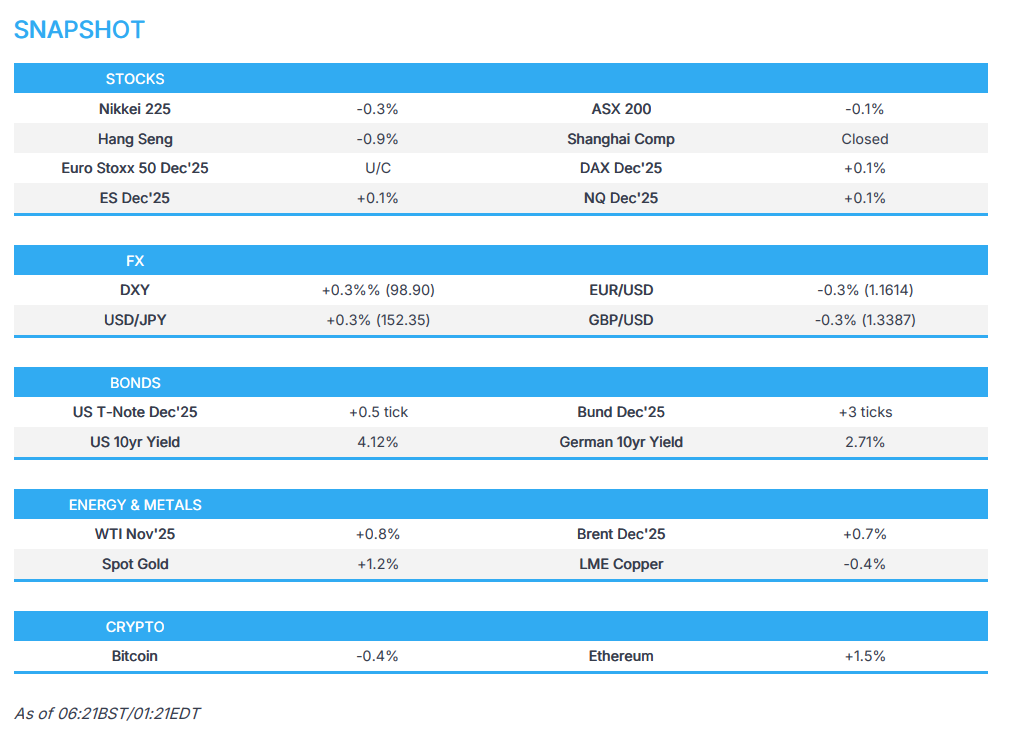
Newsquawk in 3 steps:
1. Subscribe to the free premarket movers reports
2. Listen to this report in the market open podcast (available on Apple and Spotify)
3. Trial Newsquawk’s premium real-time audio news squawk box for 7 days
US TRADE
EQUITIES
- US stocks were sold on Tuesday, with weakness seen in the wake of reports in The Information that internal data shows the financial challenge of renting out NVIDIA (NVDA) chips and its impact on margins. This hit the large-cap tech sectors and weighed on indices before then hovering into the close, while Oracle sold off aggressively but closed off lows as several analysts were out defending the Co. and described it as a buying opportunity. The downside in equities resulted in upside in T-notes, while gold had been pushing higher anyway, with futures hitting USD 4,000/oz and spot prices trailing to just beneath the psychological milestone.
- SPX -0.38% at 6,715, NDX -0.55% at 24,840, DJI -0.20% at 46,603, RUT -1.12% at 2,458.
- Click here for a detailed summary.
TARIFFS/TRADE
- US President Trump said he will meet Chinese President Xi in a few weeks in South Korea.
- Canadian PM Carney said the US and Canada have to come to an agreement that works in areas where they compete.
- US-Canada trade talks were successful, positive and substantial, according to the Canadian government’s minister for US trade, LeBlanc, who stated that principal areas for potential US-Canada trade deals would be in the steel, aluminium and energy sectors, while he hopes to finalise deals in these sectors swiftly before extending agreements to other sectors.
- US House Committee said Applied Materials (AMAT), KLA Corp (KLAC), Lam Research (LRCX), ASML (ASML NA), and Tokyo Electron (8035 JT) fueled China chip production, following a months-long investigation, while it noted several recommendations, including aligning allied, such as Dutch and Japanese, export controls with US restrictions, so the Netherlands and Japan catch up to American controls and enforcement. It also recommended expanding country-wide controls for the PRC to make diversion more difficult, widening the list of restricted entities and prohibiting all allied manufacturers from selling to additional Chinese military entities.
- Norway’s Foreign Minister said Norway is exempt from the European Commission proposal on higher tariffs and lower quotas on steel in the EU.
NOTABLE HEADLINES
- Fed Governor Miran (voter) said the neutral rate has been buffeted by huge, unusual population shocks, and monetary policy needs to ease to get ahead of a shift down in the neutral rate, while he is optimistic on growth and stated the drag from uncertainty is abating. Miran also noted that housing matters more for the economy than the stock market, and that shelter is the key driver of inflation, as well as stated that he doesn’t want to move the goal posts on the inflation target. Furthermore, he said in the longer run, it is hard to micromanage to an exact level of inflation, and that it is important for the Fed to set monetary policy outside of the political cycle.
- Fed’s Kashkari (2026 voter) said it is too soon to know if inflation will be sticky from tariffs and noted that data is sending some stagflation signals, while he is bullish on labour and said workers have a very important role in the economy. Furthermore, he is not convinced that a few rate cuts will translate to lower mortgage rates and said if the Fed drastically lowers rates, they would expect the economy to have a burst of high inflation, as well as noted that the FOMC is committed to making decisions based on data and analysis, not political considerations.
- US President Trump said a lot of things will be eliminated due to the shutdown, and he will tell us about the eliminated jobs in four or five days.
- US President Trump said he doesn’t know who to speak to with Democrats as they have no leader, while he added that AOC is not in a position to negotiate and Schumer is incapable of making a deal to end the shutdown.
- US House Democratic Leader Jeffries stated that a one-year extension of Obamacare is a ‘non-starter’ for reopening the government.
- US Senate leaders were reportedly trying to lock in votes on Tuesday evening with a variety of options, including the noms bloc, privileged resolutions (maybe Canada tariff disapproval), and the duelling CRs again, according to Punchbowl.
- US President Trump’s administration has pushed back its plans to roll out economic support for farmers this week due to the government shutdown, according to four people familiar with the talks cited by POLITICO. Furthermore, officials were said to have readied nearly USD 13bln from an internal USDA fund, although there is no final decision on how much will be used for farm aid, or when.
- US President Trump’s administration is reportedly mulling cancelling an additional USD 12bln in funding for clean energy projects beyond what was announced last week, according to Semafor.
APAC TRADE
EQUITIES
- APAC stocks traded mixed with demand hampered following the negative handover from the US, where stocks snapped a 7-day win streak as small caps underperformed and with sentiment weighed on by AI-profitability concerns.
- ASX 200 was rangebound as gains in healthcare and the top-weighted financial industry were offset by underperformance in Tech and Consumer sectors.
- Nikkei 225 lacked conviction and oscillated around the 48,000 level amid a weaker currency and soft wages data.
- Hang Seng retreated on return from the holiday closure with tech stocks heavily represented in the list of worst performers, while mainland participants were still away but are set to return from the National Day Golden Week celebrations tomorrow.
- US equity futures (ES +0.1%, NQ +0.1%) eked marginal gains in an attempt to nurse the prior day’s tech-related selling pressure.
- European equity futures indicate a contained cash market open with Euro Stoxx 50 future flat after the cash market closed with losses of 0.3% on Tuesday.
FX
- DXY extended on gains against its peers despite the continuation of the US government shutdown and absence of US data. Nonetheless, the NY FED SCE saw an uptick in the one-year-ahead and five-year-ahead inflation expectations, while there were several Fed comments including from Miran, who remained optimistic on growth and stated the drag from uncertainty is abating, as well as reiterated calls for easier monetary policy.
- EUR/USD remained pressured amid the firmer greenback and the backdrop of the political uncertainty in France, where National Rally leaders Bardella and Le Pen declined PM Lecornu’s invitation to take part in talks.
- GBP/USD gave way to the dollar strength and tested 1.3400 to the downside as newsflow and the data calendar for the UK remained light.
- USD/JPY gained a firmer footing at the 152.00 handle to print its highest level in almost eight months, with the Japanese currency not helped by the softer-than-expected labour cash earnings.
- Antipodeans retreated with NZD underperforming after the RBNZ reverted to the 50bps rate cut moves seen earlier in the current easing cycle to lower the OCR to 2.50% and kept the door open to further rate cuts.
FIXED INCOME
- 10yr UST futures took a breather after gaining yesterday as risk sentiment soured, while the overall results of the 3yr auction stateside were strong but had little impact on prices, as a 10yr auction looms and with FOMC Minutes also on the horizon.
- Bund futures lacked firm direction after recent whipsawing, while participants await incoming German Industrial Production data and Bund issuances.
- 10yr JGB futures lingered around post-LDP election lows amid expectations of fiscal loosening and despite softer-than-expected wages data.
COMMODITIES
- Crude futures gained but with further upside capped after mixed private sector inventory data and after the EIA STEO raised its world oil demand forecast for this year but maintained its demand outlook for 2026.
- US Private Energy Inventories Data (bbls) Crude +2.8mln (exp. +1.9mln), Distillate -1.8mln (exp. -1.2mln), Gasoline -1.2mln (exp. -0.9mln), Cushing -1.2mln.
- EIA STEO raised its 2025 world oil demand forecast but maintained the 2026 demand forecast, while the world production forecast was raised for 2025 and 2026.
- UAE’s ADNOC set November Murban crude OSP at USD 70.22/bbl (prev. 70.10 in October).
- Spot gold continued its advances in which spot prices climbed above the USD 4,000/oz level to track futures which had already breached the aforementioned key milestone during US trade.
- Copper futures were lacklustre amid the flimsy risk appetite and as its largest buyer, China, remained absent from the market.
CRYPTO
- Bitcoin lacked conviction with prices ultimately returning to flat territory after trading on both sides of the USD 122k level.
NOTABLE ASIA-PAC HEADLINES
- RBNZ cut the OCR by 50bps to 2.50% vs mixed views between a 25bps and 50bps cut, while the committee remains open to further reductions in the OCR as required for inflation to settle sustainably near the 2% target mid-point in the medium term. RBNZ said higher near-term inflation could prove to be more persistent and that with spare capacity in the economy, inflation is expected to return to around the 2% target mid-point over the first half of 2026, but noted upside and downside risks to the inflation outlook. RBNZ Minutes revealed that the committee discussed the options of reducing the OCR by 25bps or by 50bps at the meeting, while it stated that the case for reducing the OCR by 50 basis points emphasised prolonged spare capacity and the associated downside risk to medium-term activity and inflation.
DATA RECAP
- Japanese Overall Labour Cash Earnings (Aug) 1.5% vs. Exp. 2.6% (Prev. 4.1%, Rev. 3.4%)
- Japanese Real Cash Earnings YY (Aug) -1.4% vs Exp. -0.5% (Prev. 0.5%, Rev. -0.2%)
GEOPOLITICS
MIDDLE EAST
- US President Trump met with his top national security team to discuss the progress of the Gaza deal negotiations prior to the departure of envoys Steve Witkoff and Jared Kushner to Egypt, according to Axios citing sources.
RUSSIA-UKRAINE
- Russian President Putin said Ukraine is attempting to strike deep into Russian territory and is targeting civilian objects, while he added that this will not help Ukraine.
EU/UK
NOTABLE HEADLINES
- UK Industry Minister McDonald said they will always defend the critical steel industry which is why they are pushing the European Commission for urgent clarification of the impact of this move on the UK.
- ECB President Lagarde said all EU institutions are watching France and hopes that a rate path can be found for respecting its international commitments, including on the budget.
- ECB’s Rehn has warned there is a risk that inflation slows below the ECB’s 2% inflation target, according to Bloomberg, citing the Karon Grilli podcast. There are downside inflation risks in sight over the next couple of years; cites EUR strength, stabilisation of wages and services inflation.
A NORTH KOREA/SOUTH KOREA
SOUTH KOREA//NORTH KOREA/
3B JAPAN
3C CHINA/
/CHINA//USA/EUROPE
Chip Equipment Makers Slide After U.S. House Panel’s Explosive Report Reveals Allied Firms Bolstered China’s Chip Industry
Wednesday, Oct 08, 2025 – 07:20 AM
ASML Holding NV shares tumbled in Europe after a months-long bipartisan investigation by the U.S. House Select Committee on the Chinese Communist Party (CCP), led by Chairman John Moolenaar (R-MI) and Ranking Member Raja Krishnamoorthi (D-IL), published new findings on Tuesday afternoon showing that American, Dutch, and Japanese semiconductor equipment firms have bolstered China’s chipmaking capacity, including through sales to Chinese state-owned and military-linked entities.
ASML and other semiconductor equipment makers, including Tokyo Electron Ltd, Applied Materials Inc., KLA Corp., and Lam Research Corp, “made sizeable returns selling equipment to Chinese state-owned and military-linked companies,” according to the Select Committee on China.
Here are the key findings from the report:
- Massive Exposure to China: In 2024, Chinese buyers made up 44% of Tokyo Electron’s revenue, 42% for Lam Research, 41% for KLA, and 36% for both ASML and Applied Materials.
- Sales to High-Risk Customers: The companies sold tools to five entities already flagged by the U.S. government for ties to China’s military and intelligence services, including Huawei affiliates.
- Rapid Revenue Growth From China State-Owned Enterprises: Sales to Chinese state-owned enterprises surged from $9.5 billion in 2022 (11% of total revenue) to $26.2 billion in 2024 (27% of total revenue and 69% of China-based revenue).
- Exploiting Loopholes: As the U.S. tightened export rules, Dutch and Japanese firms ramped up shipments of slightly less advanced lithography systems to China, suggesting CCP stockpiling below restriction thresholds.
Chairman Moolenaar stated that China is “growing its profits at the expense of U.S. national security“, adding, “We must not allow this critical equipment to be handed over to our foremost adversary, or America could lose the technology arms race.”
National Security Concerns:
- Military: Chips are powering the PLA’s AI-driven “intelligentized” warfare systems.
- Trade: China seeks vertical integration to evade future export restrictions.
- Economic Security: Dominance in legacy and advanced chipmaking could give Beijing global leverage.
- Human Rights: AI and high-performance computing bolster China’s domestic surveillance and global digital authoritarianism.
“It makes little sense to sell the CCP the chips they need to modernize their military and violate human rights. But it makes even less sense to sell them the machines and tools they need to produce those chips themselves. This bipartisan investigation reveals that the scale of these sales by Dutch, Japanese, and American firms is even more vast than we realized. Alongside our allies, we need to protect our national security and ensure we remain the world’s leading innovators in SME,” said Ranking Member Krishnamoorthi.
The investigation concludes:
“The ability to design and produce semiconductors lies at the heart of the technology competition with China, and SME represents a crucial chokepoint that the U.S. and our allies currently have over China. As the U.S. government works with our allies and partners and plots the course ahead on export-control policy and related actions, this crucial chokepoint must be preserved, not squandered. The U.S. and allies only have the ability to export-control SME because we collectively are the world’s leading innovators in SME. We must double down on our success.”
Shares of ASML, Tokyo Electron, KLA, Applied Materials, and Lam Research all tumbled on their respective exchanges after the Select Committee on China released its report late Tuesday afternoon.
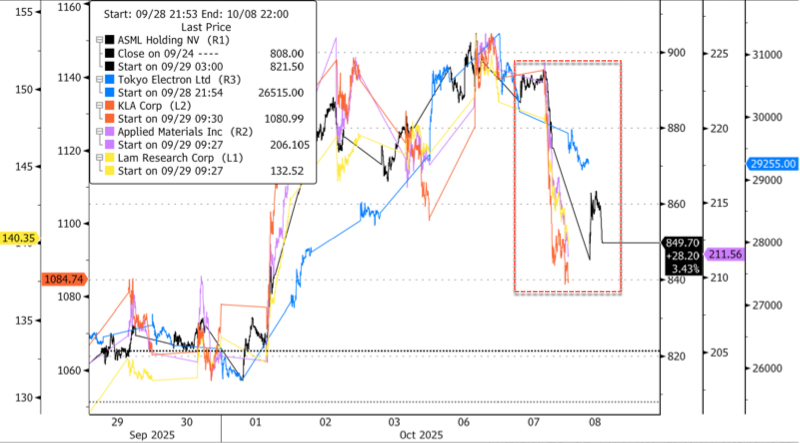
We doubt the Trump administration will launch a major crackdown on these semiconductor equipment makers just yet, given that President Trump and Chinese President Xi Jinping are scheduled to meet later this month in South Korea. The last thing Washington needs is added turmoil in Sino-US relations before the continuation of in-person trade talks, primarily as Trump officials work to secure a deal and move things forward.
* * *
Read the U.S. House Select Committee on the Chinese Communist Party’s (CCP) new report:
4. European affairs and NATO
EUROPE/DEBT TO GDP”
Greece Still Has The Highest Debt-To-GDP In Europe; Bulgaria The Lowest
Wednesday, Oct 08, 2025 – 06:55 AM
As European countries pour billions into defense spending, their debt piles are expanding—raising questions of national fiscal stability.
In France, a rising debt ratio led Fitch to downgrade its credit rating in September. The country has faced ongoing political turmoil as the country’s debt supply recently hit a record $4 trillion.
This graphic, via Visual Capitalist’s Dorothy Neufeld, shows European Union debt-to-GDP by country, based on data from Eurostat.
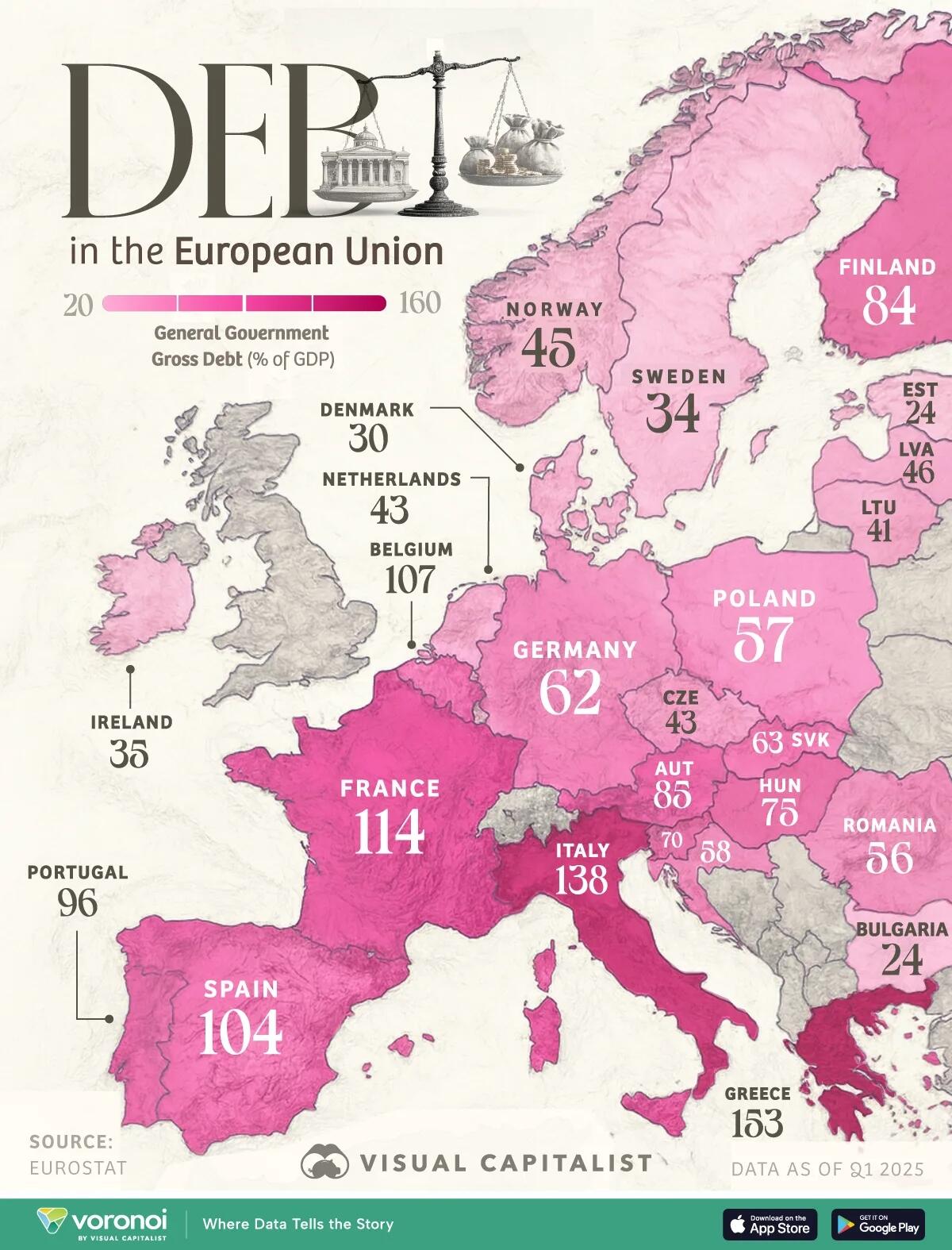
The State of European Union Debt-to-GDP in 2025
Below, we show general government gross debt as a percentage of GDP as of Q1 2025 in the EU:
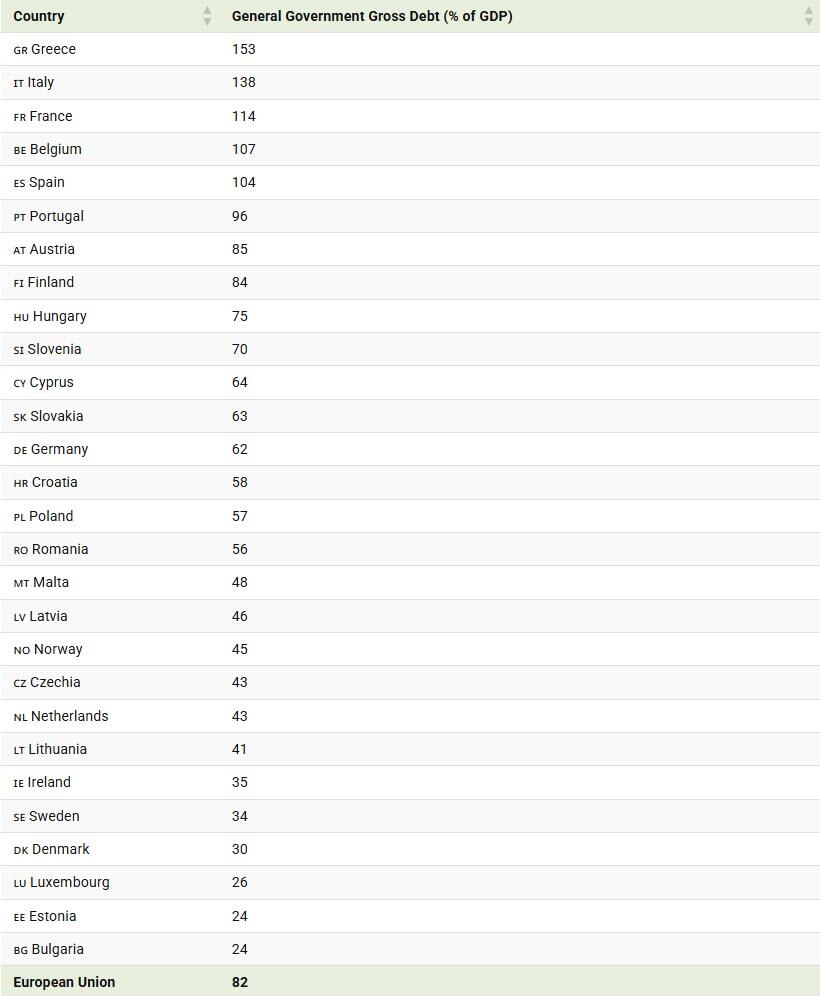
While Greece’s economy is thriving in 2025—supported by tourism, real estate, and shipping sectors—its debt situation continues to rank as the worst in the EU.
However, its debt-to-GDP ratio has steadily fallen in recent years, from 180% in 2022 to 153% today. Given its recent economic momentum, the country launched an innovation and infrastructure fund with BlackRock designed to attract $1.2 billion in foreign investment.
Italy holds the second-highest debt-to-GDP ratio in the EU, at 138%. However, the country has made notable progress in narrowing its deficit, cutting it from 7.2% of GDP in 2023 to 3.4% in 2024 on the back of strong tax revenues. Like Greece, its debt levels have been gradually trending downward.
By contrast, debt is rising in France, where it stands at 114% of GDP. In efforts to combat its deteriorating fiscal situation, the French government has raised the retirement age, and proposed cutting two national holidays—stoking public outrage.
Meanwhile, Germany’s debt ratio of 62% falls significantly below the EU average of 82%. At the same time, the country has eased its fiscal rules with massive defense spending, causing debt levels to rise.
To learn more about this topic, check out this graphic on debt to GDP by country worldwide.
END
GERMANY
5. RUSSIA AND MIDDLE EASTERN AFFAIRS
TBN ISRAEL/LAST 24 HRS:
ISRAEL VS HAMAS/EGYPT USA
Egypt Wants US Troops In Gaza As Part Of Peacekeeping Mission
Wednesday, Oct 08, 2025 – 03:30 AM
US troops will need to deploy to Gaza if the international force of peacekeepers that President Donald Trump’s ceasefire plan envisions is to become a reality, Egypt has told the US, according to two Arab officials who spoke to Middle East Eye.
Senior Egyptian officials told their US counterparts that they want the International Stabilization Force outlined in Trump’s 20-point peace plan to be modelled on the Multinational Force and Observers (MFO) that deployed to Sinai after the peninsula was returned to Egypt from Israel in 1982. The US has led the MFO since its inception, supplying hundreds of troops as a buffer and reassurance force.

Trump’s plan envisions the international force made up of Arab and Muslim states securing Gaza as Israel withdraws. Egypt, the only Arab country that borders Gaza, is set to play a key role in the force, as it is home to the Arab world’s largest army.
Egyptian military intelligence also has ties with Hamas’s armed wing, the Qassam Brigades. MEE reported earlier that Hamas wants Turkish troops to deploy to Gaza to guarantee the ceasefire, but the two Arab officials and a former senior US official said Israel objects to a Turkish presence.
The Egyptian request, which has been communicated publicly and privately, is likely to test Trump’s appetite for a deeper military footprint in Gaza. One former senior US official familiar with the request said it was a nonstarter.
However, there are some signs that the US is preparing for a bigger military footprint in Israel’s neighborhood already. US military personnel at the Al-Udeid airbase in Qatar have shifted to Jordan for the coming months, one Arab official told MEE.
The military personnel belong to risk and security assessment teams, effectively managing security at the US military base. Current and former US and Arab officials told MEE that the move could signal the US is preparing for more troops to arrive in the region. Trump’s plan has listed Jordan and Egypt as key security partners in Gaza.
The deployment of US troops to Gaza is just one of many sensitive points that negotiators meeting in the Egyptian resort town of Sharm El-Sheikh this week have to address to end Israel’s war on Gaza as it approaches the two-year mark.
Arab and Muslim countries were angered when Trump unveiled his plan last week. Although he recognized two of their key demands – a permanent end to the war and no forced displacement from Gaza – he did not commit to a Palestinian state and left room for Israel to stall its withdrawal from Gaza.
Egypt was especially upset that Trump downplayed the role of the Palestinian Authority, MEE reported. But the US’s Arab and Muslim partners are backing the plan. Trump prides himself as a negotiator, and analysts and diplomats say much is still up for discussion this week in Egypt.
‘Skin in the game’
Trump called on Sunday for mediators to “move fast” to reach an agreement after he welcomed Hamas’s response to his proposal as a pathway for a deal. Hamas, Egyptian, Qatari, Turkish, US and Israeli officials are participating in the talks, Arab officials told MEE.
The plan calls for the quick release of all remaining Israeli captives in Gaza – roughly 20 are still alive – in exchange for Palestinian prisoners.
Hamas and Israel have orchestrated prisoner exchanges before, including during a ceasefire in January that collapsed two months later when Israel unilaterally resumed attacking Gaza. If all goes according to plan this time, the first phase of the deal, the captives’ release, would be over in 72 hours, although analysts warn it could take longer for Hamas to locate the living and dead captives.
One central sticking point in the talks is the timeline for Israel’s withdrawal. Trump’s plan provides no specific deadline and leaves Israel space to remain deep inside Gaza.
Egypt, Qatar and Turkey are pressing for a complete withdrawal, Arab officials told MEE. Hamas is expected to insist that Israel withdraw to a narrow buffer zone around Gaza before fully leaving the enclave.
Arab leaders whose armies are expected to partake in the international peacekeeping force don’t want their soldiers rubbing shoulders with Israelis among the ruins of Gaza. Nor do they want to be seen as providing cover for Israel if it unilaterally resumes attacking Gaza.
Egypt, which is likely to contribute the bulk of soldiers, is especially worried, Arab officials told MEE. “For the Egyptians, a US presence would represent an actual commitment to the plan in real terms; troops and funds. It would be viewed as skin in the game, a tangible embodiment of US support, and, potentially, an incentive for Israel to curb violations,” Mirette Mabrouk, who is currently in Cairo and heads the Middle East Institute’s Egypt programme, told MEE.
“Although the attack on Doha proved that US presence is no automatic safeguard against Israeli aggression,” she added, referring to Israel’s attack on the Qatari capital in September.
Egyptian intelligence has been in talks with Hamas’s armed wing about disarmament, which is stipulated under Trump’s plan. It has been a source of growing tension between the Palestinian movement and Cairo. One of the Arab officials familiar with the talks told MEE it was “difficult”.

Several options have been reported, including Hamas turning its arms directly over to Egypt and storing them. The Wall Street Journal reported that Hamas wants to keep its small arms, which it considers defensive.
Riccardo Fabiani, the North Africa project director at the International Crisis Group, told MEE that in addition to “containing Israel”, Egypt wants US troops on the ground to be able to verify the handover of weapons – which Israel could use as a provocation to restart attacks. “They want the US to participate in whatever disarmament process is going to take place,” he said.
“I don’t see this administration particularly interested in having permanent troops involved in peacekeeping. They prefer bombing a place and getting out,” he said.
Trump’s plan rules out Hamas governing Gaza. It calls for a “Board of Peace” led by Trump to govern the enclave alongside Palestinian technocrats.
END
EGYPT ISRAEL
Egyptian FM says more Arab states will make peace with Israel if Gaza war ends
Ben Gvir prays on Temple Mount * Steve Witkoff, Jared Kushner said to arrive in Sharm el-Sheikh for hostage-truce talks * Qatar seeks ‘strong, written international guarantees’ Israel won’t resume war * Hamas said to demand bodies of Yahya, Muhammad Sinwar
Egyptian FM says more Arab states will make peace with Israel if Gaza war ends

Egypt’s Foreign Minister Badr Abdelatty attends an Arab officials’ meeting in Riyadh on January 12, 2025. (Fayez Nureldine / AFP)
Egyptian Foreign Minister Badr Abdelatty tells the Saudi channel Al-Arabiya that “additional Arab countries will sign peace agreements with Israel if the war in Gaza comes to an end.”
He adds that the main guarantor for the success of the talks in Egypt is US President Donald Trump himself.
He also says that the current talks in Sharm el-Sheikh are focused on the first stage of the US plan: ending the war, bringing in aid, returning the hostages, and releasing Palestinian security prisoners.
END
Ben Gvir visits Temple Mount, says he prayed for ‘destruction of Hamas,’ return of hostages

National Security Minister Itamar Ben Gvir visits the Temple Mount this morning in Jerusalem during the Sukkot holiday.
He goes up to the flashpoint site to pray for “victory in the war, the destruction of Hamas and the return of the hostages,” his office states.
Earlier this morning, the far-right minister was seen praying at the Western Wall with fellow Otzma Yehudit lawmakers MKs Amichai Eliyahu and Limor Son Har-Melech.
END
ISRAEL HAMAS
‘Progress’ Reported In Gaza Talks, As Trump Denies Telling Israeli PM To Not Be ‘F*cking Negative’
Wednesday, Oct 08, 2025 – 12:25 PM
Axios last week reported that President Trump recently told Prime Minister Benjamin Netanyahu to stop being so “f*cking negative” and “take the win” after Hamas voiced its initial agreement to free the 48 remaining hostages (both dead and alive) as part of the US 20-point peace plan for Gaza.
However, in more recent remarks Trump has denied ever saying this, or clashing with the Israeli leader on the pending agreement. “No, it’s not true. He’s been very positive on the deal,” Trump said of Netanyahu.

Asked specifically whether he has any red lines for Hamas in new round of negotiations that kicked off Monday in Egypt, Trump told reporters in the Oval Office that he does: “If certain things aren’t met, we’re not going to do it,” he said.
Commenting on the potential for private vs. public friction further, Israeli media concludes the following:
Trump at times has avoided criticizing Netanyahu in public, even as reports have mounted about his private frustration with the Israeli premier, including during a tense phone call last week in which the Axios news site reported the US president responded angrily when Netanyahu said Hamas’s ambivalent response was “nothing to celebrate.”
US envoy Steve Witkoff is in Egypt joining the talks Wednesday, as is Trump’s son-in-law and adviser Jared Kushner, and Erdogan too has sent Turkish officials, which may amount to too many cooks in the kitchen. The Turkish delegation is led by spy chief Ibrahim Kalin.
Top Hamas leader Taher al-Nunu has offered a generally positive assessment of where thing stand so far. “The mediators are making great efforts to remove any obstacles to the implementation of the ceasefire, and a spirit of optimism prevails among all parties,” he said.
The two warring sides have exchanges lists of Israeli captives and Palestinian prisoners to be released in the major swap. But even if this is agreed to, the question of ending the war, and a future Gaza where Hamas is disarmed, remains a big open one.
In Tuesday comments in the Oval Office, Trump said “So the primary guarantee is, once this deal happens, if it does happen — look, they’re in negotiations right now.”
“We are going to do everything possible. We have a lot of power, and we’re going to do everything possible to make sure everybody adheres to the deal,” he added. However, it’s notable that Trump stopped short of explicitly vowing that Israel would be barred from resuming military operations. For now, media reports say “progress” is being made in
END
Mediators aiming to sign deal on Thursday to free living hostages, begin ceasefire
By ToI StaffToday, 2:50 am
- People hold a banner and portraits of the hostages held in the Gaza Strip since October 7, 2023, during a rally in Tel Aviv marking the second anniversary of the assault by the Hamas terror group, on October 7, 2025. (Ahmad Gharabli/AFP)
- A still image, cleared for publication by the family of Bipin Joshi, from a recording of him discovered in Gaza that shows him in the weeks after his abduction from Israel. (Hostages and Missing Families Forum)
- Finance Minister Bezalel Smotrich (c) joins a celebration in the Samaria region of the northern West Bank, marking 50 years since the founding of the Kedumim settlement there, October 8, 2025. (Roei Hadi)
- Egypt’s Foreign Minister Badr Abdelatty reacts during a joint press conference with Germany’s foreign minister at a hotel in Cairo’s eastern outskirts on October 7, 2025. (Khaled DESOUKI / AFP)

US Special Envoy to the Middle East Steve Witkoff, right, and Jared Kushner arrive before President Donald Trump holds a news conference with Prime Minister Benjamin Netanyahu, at which Trump unveiled a plan to end the war in Gaza, in the State Dining Room of the White House, September 29, 2025, in Washington. (AP Photo/Alex Brandon)
Mediators are currently planning for an agreement to be signed tomorrow between Israel and Hamas that will see the immediate release of remaining living hostages in exchange for a Gaza ceasefire, an Arab diplomat and a second source briefed on the ongoing negotiations in Egypt tell The Times of Israel.
Once the ceasefire is in place, Hamas will then be able to gather the bodies of the slain hostages for their subsequent return to Israel, the sources say.
There are currently 48 hostages remaining in Gaza, 20 of whom are believed to be alive.
The agreement the mediators are planning for Thursday will be on what stakeholders are referring to as the “first phase” of US President Donald Trump’s plan for ending the war, the sources say.
ISRAEL/HOUTHIS
As Israelis Mourn Two Years Since Oct.7, Houthis Attack Eliat With At Least 4 Drones
Tuesday, Oct 07, 2025 – 07:40 PM
Tuesday marks the grim two-year anniversary of the Oct.7 terror attack by Hamas which targeted southern Israel, including the Nova music festival and several Kibbutzim, as well as Israeli military border outposts.
Coinciding with the anniversary and memorials being held across the country, Yemen’s Houthis have been launching drones throughout the day on the southernmost Israeli city of Eliat, on the Red Sea.

“Yet another drone launched by the Houthis in Yemen at Israel’s southernmost city of Eilat was shot down by air defenses, the military says,” reports Times of Israel.
The drone was intercepted outside Israeli airspace while it was still inbound, and so there were no public alert sirens activated. “It marks the fourth Houthi drone shot down in the Eilat area within an hour,” the report indicates.
The Houthis have vowed to continue such attacks so long as IDF forces continue their operations in the Gaza Strip, even though urgent peace talks are currently underway in nearby Egypt, based on President Trump’s 20-point peace plan.
Trump envoy Steve Witkoff is expected to join the talks Wednesday, which are happening ‘indirectly’ between the Israeli and Hamas sides. Hamas has said it is ready to release all remaining 48 hostages (dead and alive) – but significant hurdles remain over an array of conditions.
Meanwhile, at a moment of national mourning in Israel, hostage victims’ family members are still looking for answers as to why police and military intervention took so long during the attack of Oct.7
“Where were the rescue forces? Where was the state? How come you were here for hours and no one saved,” the families said in a statement, Kan public broadcaster reported.
“And yet two years later, we still have no answers. All the investigations they have presented to us are rubbing salt in the wounds and sand in the eyes of the families,” they said.
Various political leaders in the West offered their condolences marking the day, including US Vice President JD Vance, who stated on X, “On this second anniversary of the terrible terrorist attacks of October 7, we remember all of the innocent people brutally murdered by Hamas.”
“And we continue to work towards President [Donald] Trump’s plan to bring the remaining hostages home and build a lasting peace for all,” he wrote further.
Hamas and Palestinian Islamic Jihad (PIJ) had killed about 1,200 people and took 251 hostages on that day two years ago. The brazen and well-planned attack even featured paragliders flying into the Nova festival grounds, where a massacre ensued in what some eyewitnesses said felt “apocalyptic”. Later analysis indicated that some Israelis may have been killed by ‘friendly fire’ during the chaotic Israeli military response, which included deployment of helicopters and tanks.
Israel’s military response in Gaza has itself been brutal and overwhelming. Well over 60,000 people have died, including many tens of thousands of civilian men, women, and children. But Israel says a significant bulk of this figure is Hamas militants. Wars on other fronts have since raged – including in Lebanon, Iran, Syria, and Yemen –
RUSSIA VS UKRAINE
6. GLOBAL ISSUES//COVID ISSUES/VACCINE ISSUES/HEALTH ISSUES
GLOBAL ISSUES
WHO Warns Chikungunya Virus Has Potential To Spread To More Countries
Tuesday, Oct 07, 2025 – 10:35 PM
Authored by Jack Phillips via The Epoch Times (emphasis ours),
The World Health Organization (WHO) said in an outbreak notice last week that some countries are reporting a resurgence in the chikungunya virus, which is transmitted via mosquitoes, and warned that the virus could spread further.

In a notice issued on Oct. 3, the U.N.-backed health body said that the chikungunya virus saw “a resurgence” in 2025, including in countries “that had not reported substantial case numbers in recent years.”
The disease typically produces symptoms including fever, muscle pain, nausea, fatigue, and a rash. But in rarer instances, it can cause debilitating joint pain that persists for months or even years, while patients who develop severe forms of the disease usually have to be hospitalized due to organ damage
As of Sept. 30, at least 445,271 suspected chikungunya cases and 155 related deaths were reported worldwide in 40 countries, according to the WHO.
“Some WHO regions are experiencing significant increases in case numbers compared to 2024, although others are currently reporting lower case numbers,” it said. “This uneven distribution of cases across regions makes it challenging to characterize the situation as a global rise.”
The Americas region reported the highest number of viral cases, followed by the European region, which the WHO said comprises “cases reported predominantly from French Overseas Departments in the Indian Ocean.”
Due to what it says is an “uneven distribution of cases across regions,” the WHO said it’s difficult to describe the situation as a global rise, but it warned that “the potential for further spread remains significant.”
The risk caused by the mosquito-borne illness is “heightened by limited population immunity in previously unaffected areas, favorable environmental conditions for vector breeding, gaps in surveillance and diagnostic capacity, and increased human mobility and trade,” the U.N. health agency added.
“Strengthening disease surveillance, enhancing vector surveillance and control, and improving public health preparedness are essential to mitigate the risk of further transmission,” it said.
Late last month, the U.S. Centers for Disease Control and Prevention issued a travel warning for Cuba over concerns of chikungunya’s transmission in the country. The agency said an outbreak of the chikungunya virus is currently active across Cuba. As a result, a Level 2 travel warning was issued by the health agency.
Women who are “infected around the time of delivery can pass the virus to their baby before or during delivery,” the CDC said on Sept. 26. “Newborns infected in this way or by a mosquito bite are at risk for severe illness, including poor long-term outcomes.”
Aside from Cuba, the CDC released a list of other countries with an outbreak of chikungunya, including Bangladesh, Kenya, Madagascar, Somalia, and Guangdong Province, China. Countries with an elevated risk include Brazil, Colombia, India, Mexico, Nigeria, Pakistan, the Philippines, and Thailand, it added.
Earlier this year, cases of chikungunya were spreading rapidly across southern China, as local residents at the time told The Epoch Times that Chinese Communist Party (CCP) officials forced people into quarantine.
On Aug. 1, the CDC issued a Level 2 travel alert for China over the virus, adding that “most cases have been reported in Foshan city” in Guangdong Province.
“Seek medical care immediately if you develop fever, joint pain, headache, muscle pain, joint swelling, or rash during or after travel,” the agency warned.
Chikungunya is transmitted by infected mosquitoes and mostly causes mild symptoms. The majority of people who get chikungunya recover without needing medical attention after one to two weeks, health officials say.
The Associated Press contributed to this report.
MARK CRISPIN MILLER
n memory of those who “died suddenly” in the United States and worldwide, September 28-October 6, 2025
Actress Kimberly Hébert Gregory; Ike Turner Jr.; guitar maker Ken Parker (C); trombonist Cristian Ganicenco; Tiktokers Jacinda Jenkins (28), Paola Caldera (30); footballer Arthur Jones (39); & more
| Mark Crispin MillerOct 8 |
A survey of the likely global toll of COVID “vaccination,” based on the reports collected by our worldwide team of researchers this past week.
To help support our work, consider subscribing or making a donation.
UNITED STATES (108)
‘Vice Principals’ star Kimberly Hébert Gregory dies at 52: ‘One of the best’
October 5, 2025

Kimberly Hébert Gregory, an actress known for her roles on HBO’s “Vice Principals” and the ABC series “Kevin (Probably) Saves the World,” has died. She was 52. Gregory’s ex-husband, Chester Gregory, announced the news on his verified Instagram account and said she died on Friday, Oct. 3. No cause of death was given.
Researcher’s Note – Gregory was featured in at least eight Hollywood projects between 2021-2023: Hollywood’s On-Set Vaccine [sic] Mandates to End on May 12, 2023: Link
No cause of death reported.
Tina Turner’s Son Ike Turner Jr. Dead at 67
October 5, 2025

Tina Turner and Ike Turner’s son, Ike Turner Jr. has died, TMZ has learned. Tina’s niece, Jacqueline Bullock, tells TMZ Ike Jr. died Saturday at a Los Angeles hospital from kidney failure. She says he’d battled severe heart issues for years, and we’re told his health had been declining for some time. He also recently suffered a stroke in early September.
Ken Parker, guitar maker
October 6, 2025

Ken Parker, age 73, passed away peacefully at his home in Gloucester, MA on October 5, 2025, with Susan Kolwicz by his side [cancer]. Ken began a lifelong journey exploring musical instrument design and construction when he built his first guitar from wood and cardboard at age 13 and later an electric bass for his brother Alan. Parker Guitars — co-founded by Ken and Larry Fishman — was launched in 1990. By 1993, the iconic Parker Fly was brought to market. It featured a radical design that improved virtually every aspect of the electric guitar, positioning Ken as one of the most revolutionary, innovative, creative, and influential guitar makers in history.
Cincinnati Symphony Orchestra Principal Trombonist Cristian Ganicenco has Passed Away
October 6, 2025

Ganicenco, who had been a member of the Cincinnati Symphony since 1999, has passed away following a battle with cancer. Cristian Ganicenco [58] studied at the National University of Music Bucharest-Romania before traveling to the U.S. to complete graduate studies at Carnegie Mellon University and Rutgers University. Over his career, he also recorded widely, composed original works, and co-founded ensembles such as FG Brass, which is dedicated to live performances and education on the use of technology in classical music.
Researcher’s Note – Cincinnati Symphony Orchestra and Cincinnati Pops to Require Vaccinations [sic] or Proof of Negative Covid Test Results: Link
Two TikTokers “died suddenly”:
TikTok influencer Jacinda Jenkins dead at age 28 leaving behind two children
October 2, 2025

TikTok star Jacinda Jenkins died on September 29 at the age of 28 leaving behind two daughters, her mother Emily Kocik confirmed in a video. ‘This is absolutely the worst thing I’ve ever had to do,’ Kocik said via TikTok on Wednesday adding the passing was unexpected. Jenkins, who was born in Lewis Town, Pennsylvania, had more than 200,000 followers on TikTok. She was also the owner of Harper’s Haven Boutique. She operated the boutique shop from Kentucky, selling her custom-made T-shirts and scrunchies on online platforms such as Etsy and Shopify. Her content centered on fashion, lifestyle and motherhood. An obituary shared by Cooper Funeral Home stated that Jenkins’ death was ‘sudden.’ Details surrounding Jenkins’ death are unknown.
TikTok star Paola Caldera dead: Influencer mum dies of cancer aged just 30 after amassing 237k fans
September 29, 2025

Tiktok star and mum-of-two Paola Caldera has died aged 30 following a year-long battle with cancer. The beloved Venezuelan influencer had amassed hundreds of thousands of followers across social media advising US immigrants on how to achieve the American Dream. Paola was best known for her well-documented story – fleeing her home country before applying for political asylum in the US. She had 237,000 TikTok followers, mostly Latinos living in the US, when she tragically died. It comes after she bravely opened up about her cancer diagnosis last year. She had been suffering from acute lymphoblastic leukaemia since mid 2024. Despite courageously battling the disease for over a year, she died last week after contracting pneumonia. Meanwhile, Paola worked cleaning hotel rooms at the same time as creating content about her daily routines.
Baltimore Ravens Super Bowl winner Arthur Jones dies suddenly at 39 as former team is left heartbroken
October 3, 2025

The Baltimore Ravens have announced that Super Bowl-winning defensive tackle Arthur Jones has died suddenly at the age of 39. The Rochester-born defender, who is the older brother of ex-UFC Heavyweight champion Jon Jones and former New England Patriots star Chandler Jones, announced his retirement at the end of the 2017 season. Details surrounding Jones’s death have not yet been announced.
No cause of death reported.
Former Grizzlies Guard Passed Away Suddenly Aged 53
September 30, 2025

Former Grizzlies and Wizards swingman Lawrence Moten was found dead Tuesday at his residence in Washington, D.C., according to a statement from his alma mater Syracuse University. The cause of death has not yet been made public. Moten’s daughter, Lawrencia, would later say that her father was found dead at home.
Tony Parker father dies at 70
October 6, 2025

Tony Parker Senior, the beloved father of NBA four-time champion and San Antonio Spurs legend Tony Parker, has died at the age of 70. His passing was described as “sudden and unexpected” in a statement sent by Tony Parker to AFP. Parker Sr. Was a familiar figure in French basketball, always present in the stands or on the sidelines, supporting his son and the sport he himself loved and played.
No cause of death reported.
Lexis King’s Brother Passes Away
October 2, 2025
WWE NXT Superstar Lexis King announced on Thursday that his brother, Jesse Morgan [49], has passed away. King shared the heartbreaking news with fans in a post on his Twitter account, which you can see below: “I lost my brother today. He was a badass, highly intelligent, witty and charismatic dude who grew up in the 90s. He was a veteran who suffered from issues after surviving some traumatic events while serving in Afghanistan.… The battle with your demons is now over brother. Rest in Peace Jesse Morgan.”
Researcher’s Note – VA urging veterans, staff to get latest COVID-19 vaccine [sic] booster: Link
No cause of death reported.
Update to our report earlier this year:
Rolling Ray Cause of Death Revealed a Month After Sudden Passing
October 6, 2025

Rolling Ray’s sudden death shocked his massive social media following back in September, and for good reason: the influencer died from natural causes just a few days before his 29th birthday. Maryland’s Office of the Chief Medical Examiner confirmed Ray’s organic death with People on Monday. The social media star had been suffering from declining health for more than a year, battling both pneumonia and a blood infection. Ray was in a wheelchair for the bulk of his life, after being diagnosed with spinal muscular atrophy as a toddler, but he was able to sell his personality to the world – and Zeus Network.
Reported on September 25:
Heartbroken supermodel Paulina Porizkova cries as she announces the death of her best friend
September 25, 2025

Cover girl Paulina Porizkova has broken down in tears over the death of her close friend of five years Mistie Savage-McGuire [57] to cancer. On Thursday the 60-year-old Vogue supermodel took to Instagram to share her heartbreak over the recent loss. Mistie had been battling stage four colorectal cancer which moved from her colon to her liver then to her lungs. The Ohio resident also suffered from heart failure which required her to get a pacemaker.
Ex-NASCAR team owner and philanthropist dead at 78 as tributes pour in
September 30, 2025
While recent NASCAR attention has been devoted to the ongoing Cup Series playoff battle, tributes have poured in after it was announced that former team owner Mary Louise Miller had sadly passed away. Last weekend, it was announced that the 78-year-old had died peacefully, surrounded by her friends and family. A philanthropist who served her to make her local community in Winona Lake a better place, Miller was also the owner of Xfinity Series team ML Motorsports.
No cause of death reported.
Former Talladega Superspeedway chairman Grant Lynch has died
October 2, 2025
DR PAUL ALEXANDER
NEWS ADDICTS
MICHAEL EVERY/OR OR PICTON/GIFFIN OR RABOBANK EXECUTIVE/COMMENTARY ON WORLDLY AFFAIRS
7. OIL ISSUES/NATURAL GAS/ENERGY ISSUES/GLOBAL
8. EMERGING MARKETS//AUSTRALIA NEW ZEALAND ISSUES
YOUR EARLY CURRENCY/GOLD AND SILVER PRICING/ASIAN CLOSING MARKETS AND EUROPEAN BOURSE OPENING AND CLOSING/ INTEREST RATE SETTINGS WEDNESDAY MORNING 6;30AM//OPENING AND CLOSING
EURO/USA: 1.1631 DOWN 0.0022 PTS OR 22 BASIS POINTS
USA/ YEN 152.36 UP 0.302 NOW TARGETS INTEREST RATE AT 1.00% AS IT WILL BUY UNLIMITED BONDS TO GETS TO THAT LEVEL…//YEN STILL FALLS//END OF YEN CARRY TRADE BEGINS AGAIN OCT 2024/Bank of Japan raises rates by .15% to 1.15..UEDA ENDS HIKING RATES AND NOW CARRY TRADES RE INVENTS ITSELF//JAPAN IN TROUBLE WITH RISING RATES
GBP/USA 1.3416 DOWN .0024 OR 24 BASIS PTS
USA/CAN DOLLAR: 1.3953 UP 0.0002 (CDN DOLLAR DOWN 2 BASIS PTS//CDN DOLLAR GETTING KILLED)
Last night Shanghai COMPOSITE CLOSED HOLIDAY
Hang Seng CLOSED HOLIDAY
AUSTRALIA CLOSED DOWN 0.09%
// EUROPEAN BOURSE: ALL GREEN
Trading from Europe and ASIA
I) EUROPEAN BOURSES: ALL GREEN
2/ CHINESE BOURSES / :Hang SENG CLOSED HOLIDAY
/SHANGHAI CLOSED HOLIDAY
AUSTRALIA BOURSE CLOSED DOWN 0.09 %
(Nikkei (Japan) CLOSED DOWN 215.39PTS OR 0.45%
INDIA’S SENSEX IN THE RED
Gold very early morning trading: 4036.60
silver:$48.85
USA dollar index early TUESDAY morning: 98.12 UP 21 BASIS POINTS FROM TUESDAY’s CLOSE
WEDNESDAY MORNING NUMBERS ENDS
And now your closing WEDNESDAY NUMBERS 1: 30 AM
Portuguese 10 year bond yield: 3.092% DOWN 4 in basis point(s) yield
JAPANESE BOND 10 yr YIELD: +1.700% UP 3 FULL POINTS AND 0/100 BASIS POINTS /JAPAN losing control of its yield curve/
JAPAN 30 YR: 3.169 DOWN 14 BASIS PTS//DEADLY
SPANISH 10 YR BOND YIELD: 3.225 DOWN 5 in basis points yield
ITALIAN 10 YR BOND YIELD 3.509 DOWN 8 points in basis points yield ./ THE ECB IS QE’ ING ITALIAN BONDS (BUYING ITALIAN BONDS/SELLING GERMAN BUNDS)
GERMAN 10 YR BOND YIELD: 2.6814 DOWN 4 BASIS PTS
IMPORTANT CURRENCY CLOSES : MID DAY WEDNESDAY
Closing currency crosses for day /USA DOLLAR INDEX/USA 10 YR BOND YIELD/1:00 PM
Euro/USA 1.1635 DOWN 0.0017 OR 17 basis points
USA/Japan: 152.54 UP 0.483 OR YEN IS DOWN 48 BASIS PTS//
Great Britain 10 YR RATE 4.7170 DOWN 1 BASIS POINTS //
GREAT BRITAIN 30 YR BOND; 5.5511 DOWN 1BASIS POINTS.
Canadian dollar UP 0.0002 OR 2 BASIS pts to 1.3946
xxxxxxxxxxxxxxxxxxxxxxxxxxxxxxxxxxxxxxxxxxxxxxxxxxxxxxxxxxxxxxxxxxxxxxxxxxxxxxxx
The USA/Yuan CNY DOWN ATXXXX CLOSED CNY ON SHORE ..
THE USA/YUAN OFFSHORE DOWN TO 7.1485
TURKISH LIRA: 41.72 EXTREMELY DANGEROUS LEVEL/DEATH WATCH/HYPERINFLATION TO BEGIN.//
the 10 yr Japanese bond yield at +1.700 UP 3 basis pts
THE 30 YR JAPANESE BOND YIELD: 3.169 DOWN 11 basis pts
Your closing 10 yr US bond yield DOWN 2 in basis points from TUESDAY at 4.107% //trading well ABOVE the resistance level of 2.27-2.32%)
USA 30 yr bond yield 4.703 DOWN 3 in basis points /11:00 AM
USA 2 YR BOND YIELD: 3.566 DOWN 1 BASIS PTS.
GOLD AT 10;00 AM 4035.00
SILVER AT 10;00: 49.04
Your 11:00 AM bourses for Europe and the Dow along with the USA dollar index closing and interest rates: WEDNESDAY CLOSING TIME 11:00 AM//
London: CLOSED UP 65.29 PTS OR 0.69%
GERMAN DAX: UP 211.35 pts or 0.87%
FRANCE: CLOSED UP 85.28 pts or 1.07%
Spain IBEX CLOSED UP 151.30pts or 1.97%
Italian MIB: CLOSED UP 413.29 or 0.96%
WTI Oil price 62.38 10.00 EST/
Brent Oil: 66.03 10:00 EST
USA /RUSSIAN ROUBLE /// AT: 81.50 ROUBLE UP 0 AND 50/ 100
CDN 10 YEAR RATE: 3.177 DOWN 4 BASIS PTS.
CDN 5 YEAR RATE: 2.726 DOWN 1 BASIS PTS
CLOSING NUMBERS: 4 PM
Euro vs USA 1.1625 DOWN 0.0028 OR 28 BASIS POINTS//
British Pound: 1.3395 DOWN .0024 OR 24 basis pts/
BRITISH 10 YR GILT BOND YIELD: 4.704 DOWN 2 FULL BASIS PTS//
BRITISH 30 YR BOND YIELD: 5.500 DOWN 2 IN BASIS PTS.
JAPAN 10 YR YIELD: 1.698 UP 3 FULL BASIS PTS (DANGEROUS TO THEIR ECONOMY
JAPANESE 30 YR BOND: 3.154 DOWN 12 PTS AND STILL VERY DANGEROUS TO THEIR ECONOMY
USA dollar vs Japanese Yen: 152.667 UP 0.615 BASIS PTS EXTREMELY DANGEROUS/YEN FALLING IN VALUE
USA dollar vs Canadian dollar: 1.3953 UP 0.0005 PTS// CDN DOLLAR DOWN 5 BASIS PTS CDN DOLLAR FALLING OUT OF BED!
West Texas intermediate oil: 62.41
Brent OIL: 66.10
USA 10 yr bond yield UP 1 BASIS pts to 4.136
USA 30 yr bond yield DOWN 1 PTS to 4.723%
USA 2 YR BOND: UP 2 PTS AT 3.589%
CDN 10 YR RATE 3.190 UP 1/2 BASIS PTS
CDN 5 YEAR RATE: 2.742 DOWN 3 BASIS PTS
USA dollar index: 98.61 UP 32 BASIS POINTS
USA DOLLAR VS TURKISH LIRA: 41.71 GETTING QUITE CLOSE TO BLOWING UP/
USA DOLLAR VS RUSSIA//// ROUBLE: 81.51 UP 0 AND 56/100 roubles //
GOLD $4042.15 (3:30 PM)
SILVER: 49.21 (3:30 PM)
DOW JONES INDUSTRIAL AVERAGE: DOWN 1.02 OR 0.002%
NASDAQ 100 UP 296.40 PTS OR 1.19%
VOLATILITY INDEX 16.37 DOWN 0.87 PTS OR 5.04%
GLD: $ 372.34 UP 6.08 PTS OR 1.66%
SLV/ $44.56 UP 1.17 PTS OR OR 2.76%
TORONTO STOCK INDEX// TSX INDEX: CLOSED UP 125.07 PTS OR 0.41%
end
TRADING today ZEROHEDGE 4 PM: HEADLINE NEWS/TRADING
Everything’s Up Today… Except The Yen; Goldman Sees A Generation Of ‘Momo Junkies’
WRAP UP FOR THE DAY:
Stocks catch bid while gold and silver hit fresh record highs – Newsquawk US Market Wrap
Wednesday, Oct 08, 2025 – 03:58 PM
- SNAPSHOT: Equities up, Treasuries flatten, Crude up, Dollar up, Gold up
- REAR VIEW: FOMC Minutes lean hawkish; Weak US 10yr auction; Parties involved in Israel/Hamas negotiations reportedly optimistic on deal being reached this week; Macron to name new PM in 48 hours; EIA crude stocks build more than expected, but demand is resilient; RBNZ cuts OCR by 50bps; NVDA CEO says Blackwell demand is really high.
- COMING UP: Data: German Trade Balance (Aug), Atlanta Fed GDP, New Zealand Manufacturing PMI. Suspended: US Jobless Claims (4 Oct w/e), Wholesale Sales (Aug). Events: ECB Minutes (Sep), Eurogroup Meeting, Banxico Minutes. Speakers: BoE’s Mann; BoC’s Rogers; Fed Chair Powell, Bowman, Barr, Kashkari; ECB’s Lane. Supply: Japan, US. Earnings: Delta Air, PepsiCo.
More Newsquawk in 2 steps:
- 1. Subscribe to the free premarket movers reports
- 2. Trial Newsquawk’s premium real-time audio news squawk box for 7 days
MARKET WRAP
Stocks were bid on Wednesday with upside led by the Nasdaq as tech stocks, namely NVDA, outperformed while the Dow lagged. Progress on the government shutdown was lacking, but there was some optimism in France regarding political instability and optimism on a Gaza deal, which appears very close to an agreement. Meanwhile, in the US, the Fed minutes were hawkish, and the 10-year T-note auction was weak. T-notes settled flat with the curve flattening slightly – early upside was seen tracking EGBs higher on hopes of progress towards the French budget, albeit T-notes had pared the move in US trade ahead of the minutes and auction. The auction saw T-notes push to lows, but little reaction was seen to the minutes. Within the Fed Minutes, it revealed a few participants saw merit in keeping rates unchanged in September, or that they could have supported such a decision, while Miran was the only member to support a 50bps rate cut. In FX, the Dollar added to recent gains thanks to weakness in the Euro, Yen and Franc, but the Euro was off lows into the APAC session after French Caretaker PM Lecornu. He said there is a majority in parliament that is against the dissolution of parliament, and he said there could be a new PM within 48 hours (later confirmed by Elysee reports, citing Macron). The Kiwi underperformed after the RBNZ cut rates by 50bps overnight vs split market expectations and pricing. Oil prices chopped once again but settled in the green, albeit off peaks, on reports that a Gaza deal is very close and likely to be signed within the next two days. Gold and Silver prices continued to rally, albeit heading into APAC trade off the earlier peaks, with both precious metals earlier printing fresh record highs.
US
FOMC MINUTES: The FOMC Minutes had some hawkish and dovish elements. On the hawkish side, some participants said financial conditions suggest policy may not be particularly restrictive. Those members judged that a cautious approach to future policy was warranted. Moreover, a few participants saw merit in keeping the Fed funds rate unchanged in September, or that they could have supported such a decision. Also, the minutes confirmed Miran was the only member to support a 50bps rate cut – even among the non-voting members. However, offsetting some of the hawkishness was that most participants judged the downside risks to employment had increased, while upside risks to inflation had either diminished or not increased. Although, the majority emphasised upside risks to their outlooks of inflation. When describing the labour market, the minutes acknowledged the low number of monthly job gains, with several expecting it to remain low, citing low net immigration and workers nearing retirement age. However, when looking at other metrics (other than headline payrolls), participants generally assessed that recent readings did not show a sharp deterioration in labour market conditions. Following the minutes, Pantheon Macroeconomics highlights that a 25bps rate cut remains a solid bet, but there will likely be some hawkish dissent.
FIXED INCOME
T-NOTE FUTURES SETTLED 2 TICKS LOWER AT 112-19+
T-notes fade early, EGB led upside ahead of an ultimately weak 10-year auction and hawkish-leaning FOMC minutes. At settlement, 2-year +1.4bps at 3.586%, 3-year +1.5bps at 3.601%, 5-year +1.6bps at 3.722%, 7-year +0.9bps at 3.911%, 10-year +0.2bps at 4.129%, 20-year -0.3bps at 4.686%, 30-year -0.4bps at 4.722%.
INFLATION BREAKEVENS: 1-year BEI +0.6bps at 3.269%, 3-year BEI +1.3bps at 2.703%, 5-year BEI +0.7bps at 2.433%, 10-year BEI +0.7bps at 2.346%, 30-year BEI +0.9bps at 2.267%.
THE DAY: T-notes moved higher overnight and throughout the US morning before then completely paring the gains to settle roughly flat. The government shutdown continues to see quiet treasury trade amid the lack of government data releases, and with no sign of a breakthrough anytime soon, there is a real risk that the CPI and Retail Sales reports will be delayed next week. This leaves the Fed in the dark for the October 29th meeting, with the blackout set to kick in from the end of next week, so even if there is a resumption of data, there will still likely be a lack of communication from the Fed on how they view the data. The upside throughout the morning largely tracked EGBs moving higher on some signs of optimism from the French government on a budget in an attempt at a last-minute deal. There was little data to digest other than a slight drop in the 30-year MBA mortgage rate, with applications dropping 4.7%. The focus was largely on the Fed Minutes and the auction. The Minutes leaned hawkish, revealing some noted financial conditions suggest policy may not be particularly restrictive, and those judged a cautious approach ahead was warranted. Also, a few saw merit in keeping rates unchanged or that they could have supported such a decision. Note, there was little reaction to the minutes. Marginal weakness was observed in the wake of the weak 10-year auction, seeing T-notes settle flat (more below).
SUPPLY
Notes/Bonds
- 10-Year: Overall, the auction was soft. The US sold USD 39bln of 10-year notes at a high yield of 4.117%, a lower yield when compared to the six auction average of 4.308%, but above the prior 4.033%. This tailed the when issued by 0.3bps, a much softer sign of demand when compared to the prior stop through of 1.3bps and the six auction average of a 0.9bps stop through. This was the fourth tail in the 10-year auctions this year vs six stop-throughs. The bid-to-cover was also soft, falling to 2.48x from 2.65x, below the 2.57x average. The breakdown, however, was more mixed, with direct demand jumping to 24.1% from 12.7%, above the 16.3% average, but indirect demand slumped to 66.8% from 83.1%, below the 73.7% average. This left dealers with 9.1% of the auction, above the prior 4.2%, but more aligned with the 10% six-auction average.
- US Treasury to sell USD 22bln in 30yr bonds on Oct 9th; all to settle October 15th; sizes all as expected
Bills
- US sold 6-week bills at a high rate of 4.000%, B/C 2.69x
- US to sell USD 95bln of 8-week bills (prev. 90bln), to sell USD 69bln of 17-week bills (prev. 67bln) on October 8th; to sell USD 110bln of 4-week bills (prev. 105bln); all to settle on October 14th
STIRS/OPERATIONS
- Market Implied Fed Rate Cut Pricing: Oct 23bps (prev. 24bps), Dec 44bps (prev. 45bps), January 55bps (prev. 55bps).
- NY Fed RRP op demand at USD 5.2bln (prev. 4.6bln) across 12 counterparties (prev. 16)
- EFFR at 4.09% (prev. 4.09%), volumes at USD 81bln (prev. 84bln) on October 7th.
- SOFR at 4.14% (prev. 4.15%), volumes at USD 2.946tln (prev. 2.981tln) on October 7th.
CRUDE
WTI SETTLED USD 0.82 HIGHER AT USD 62.55/BBL; BRENT (Z5) SETTLED USD 0.80 HIGHER AT 66.25/BBL
Crude benchmarks extended on weekly gains as oil consumption proved resilient. The EIA weekly report had limited downward pressure on the space, with WTI and Brent resuming their trend higher shortly after. Crude stocks posted a bigger-than-expected build, albeit by a lesser margin when considering the crude build seen in Tuesday’s private inventory report. Bearish views drawn from the crude stock build were offset by the bigger increase in oil consumption. Additionally, distillates and gasoline posted a steeper than expected draw while crude oil US production rose 0.92% W/W. An analyst at Price Futures Group writes, “Demand numbers are pretty strong, and that should keep the market support”. On geopolitics, parties involved in the Israel/Hamas ceasefire talks spoke well of progress thus far, with Jerusalem’s Post sources noting that “It seems the Gaza deal situation is not if a deal is reached, but when it will be announced”. WTI and Brent settled in the upper end of the intraday ranges of USD 62.05-65.92/bbl and USD 65.76-66.54/bbl, respectively.
EQUITIES
- CLOSES: SPX +0.58% at 6,754, NDX +1.19% at 25,137, DJI +0.00% at 46,602, RUT +1.04% at 2,484
- SECTORS: Energy -0.57%, Financials -0.52%, Consumer Staples -0.52%, Real Estate -0.50%, Communication Services +0.02%, Health +0.18%, Materials +0.52%, Consumer Discretionary +0.56%, Utilities +0.69%, Industrials +0.85%, Technology +1.52%.
- EUROPEAN CLOSES: Euro Stoxx 50 +0.63% at 5,649, Dax 40 +0.98% at 24,624, FTSE 100 +0.69% at 9,549, CAC 40 +1.07% at 8,060, FTSE MIB +0.96% at 43,484, IBEX 35 +1.15% at 15,706, PSI +0.40% at 8,149, SMI +0.95% at 12,651, AEX -0.01% at 961
STOCK SPECIFICS
- Confluent (CFLT): Reportedly exploring a sale.
- Penguin Solutions (PENG): Revenue & FY26 guidance disappointed.
- Joby Aviation (JOBY): To sell USD 500mln in common stock.
- Live Nation Entertainment (LYV): To offer USD 1.3bln in convertible senior notes.
- Equifax (EFX): Cut mortgage credit score prices by over 50%.
- Rocket Lab (RKLB): Signed multi-launch deal with with IQPS.
- Cisco (CSCO): Seeks to challenge Broadcom (AVGO) in connecting AI data centres, also unveiled the Silicon One P200 chip, and a 51.2T routing system.
- AST SpaceMobile (ASTS): Announced the signing of a definitive commercial agreement with Verizon (VZ) to provide direct-to-cellular AST SpaceMobile service when needed for Verizon customers starting in 2026.
- FedEx (FDX): Downgraded at JPMorgan to ‘Neutral’ from ‘Overweight’.
- Southern Copper (SCCO): Upgraded at Morgan Stanley to ‘Equal Weight’ from ‘Underweight’.
- Freshpet (FRPT): Downgraded at BofA to ‘Neutral’ from ‘Buy’.
- Paramount Skydance (PSKY): Talking to buyout firms in Warner Bros Discovery (WBD) bid, NYP reports.
- BlackRock (BLK): Seeking cash from Jefferies (JEF) fund hit by First Brands, according to Bloomberg.
FX WRAP
The Dollar was bid across peers despite lacking newsflow. US data was once again absent, but FOMC Minutes offered further details on the September meeting. The minutes confirmed Governor Miran as the sole dissenter amongst voters and non-voters, while a few participants saw merit in keeping the FFR unchanged at the September meeting, or that they could have supported such a decision. Likely explaining the latter perspective was some participants noting that financial conditions suggested policy may not be particularly restrictive; those participants judged that a cautious approach to future policy was warranted. DXY rose to ~98.9 from 98.637 lows.
G10FX was largely sold with AUD & CAD, the exceptions, trading little changed vs USD at the time of writing. CHF & JPY continue to lack a haven appeal despite the ongoing US government shutdown, while gold surged above USD 4,000/oz for the first time. For the Euro, some relief was found to boost EUR/USD further off lows after the outgoing French PM Lecornu said they could have a new PM in 48 hours. EUR/USD came off earlier 1.1599 lows to ~ 1.1620 ahead of overnight trade. In Germany, data disappointed again on the downside, with Industrial Orders falling 4.3% in August (exp. -1.0%). Albeit, the report notes “The marked decrease may be explained, at least in part, by the combination of annual plant closures for holidays and production changeovers.”
NZD came under pressure after the RBNZ cut the OCR by 50bps and kept the door open for further easing. The rate decision was anticipated by some (11/26 economists Reuters surveyed), but saw the central bank remain open to further easing as required for inflation to settle sustainably near the 2% target mid-point in the medium term. NZD/USD currently trades around 0.5780.
PLN: EUR/PLN saw modest upside after the NBP unexpectedly cut rates by 25bps to 4.5%, citing an improved inflation outlook for the coming period. The central bank reiterated a data-dependent approach going forward and that it may intervene in the FX market. At ING, they see a growing likelihood that the key interest rate will be kept at 6.5% for a significant part, or even all of 2026.
DATA RELEASES
Yields Jump After Ugly 10Y Auction Tails, Foreign Demand Tumbles
Wednesday, Oct 08, 2025 – 01:31 PM
After yesterday’s ugly 3Y auction, moments ago the Treasury sold $39 billion in 10Y paper (technically a 9 Year, 10 Month reopening of cusip NT4), and the reception was again rather disappointing.
The note priced at a high yield of 4.117%, up from 4.033% in Sept, but except for that one month, it was the lowest since Oct 2024. The auction also tailed the 4.114% When Issued by 0.3bps, following last month’s stop and was the 2nd tail in the last 8 auctions.
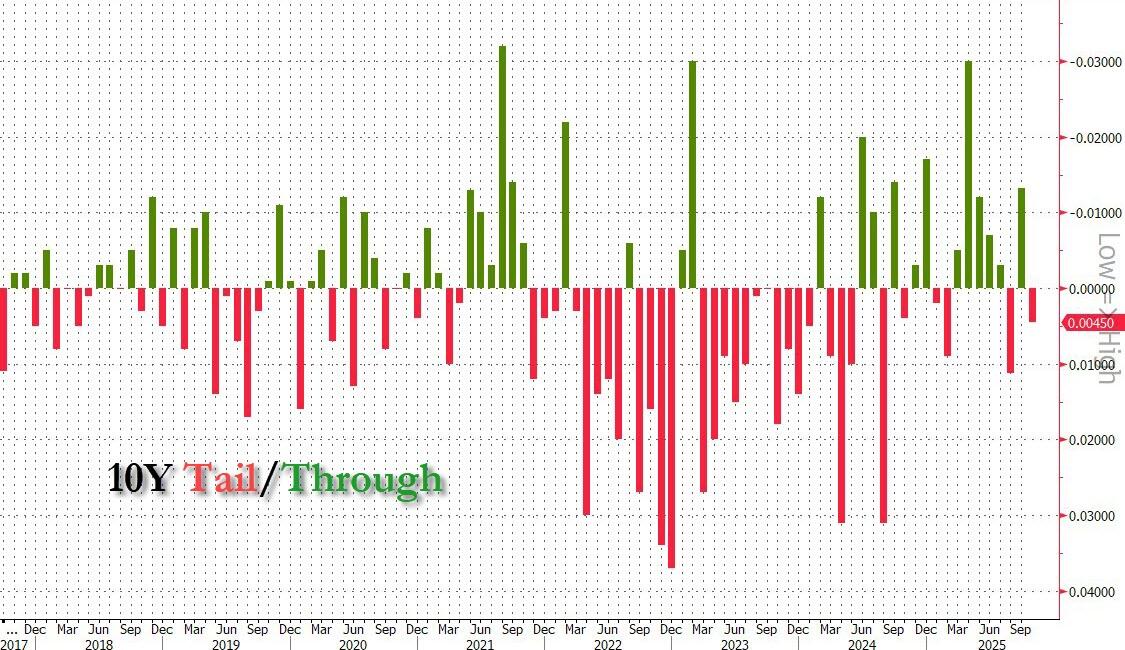
The bid to cover dropped from 2.65% to 2.478%, which while not the worst in the past year wasn’t too far off, and was well below the 2.57 six-auction average.
The internals were also ugly, with Indirects (aka foreign bidders) plunging from 83.1% to 66.8%, which also was below the six-auction average of 73.7%. And with Directs taking down 24.1%, or the highest in 11 years…
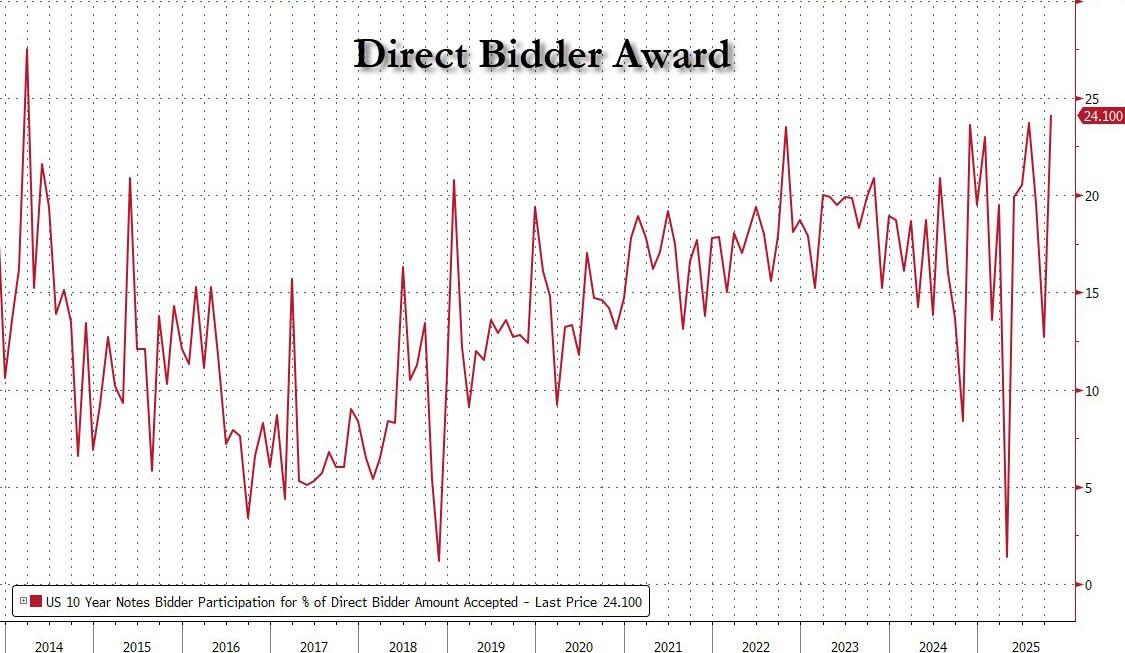
… Dealers were left with a modest 9.1%, below the recent average of 10.0%, but above last month’s record low of 4.2%.
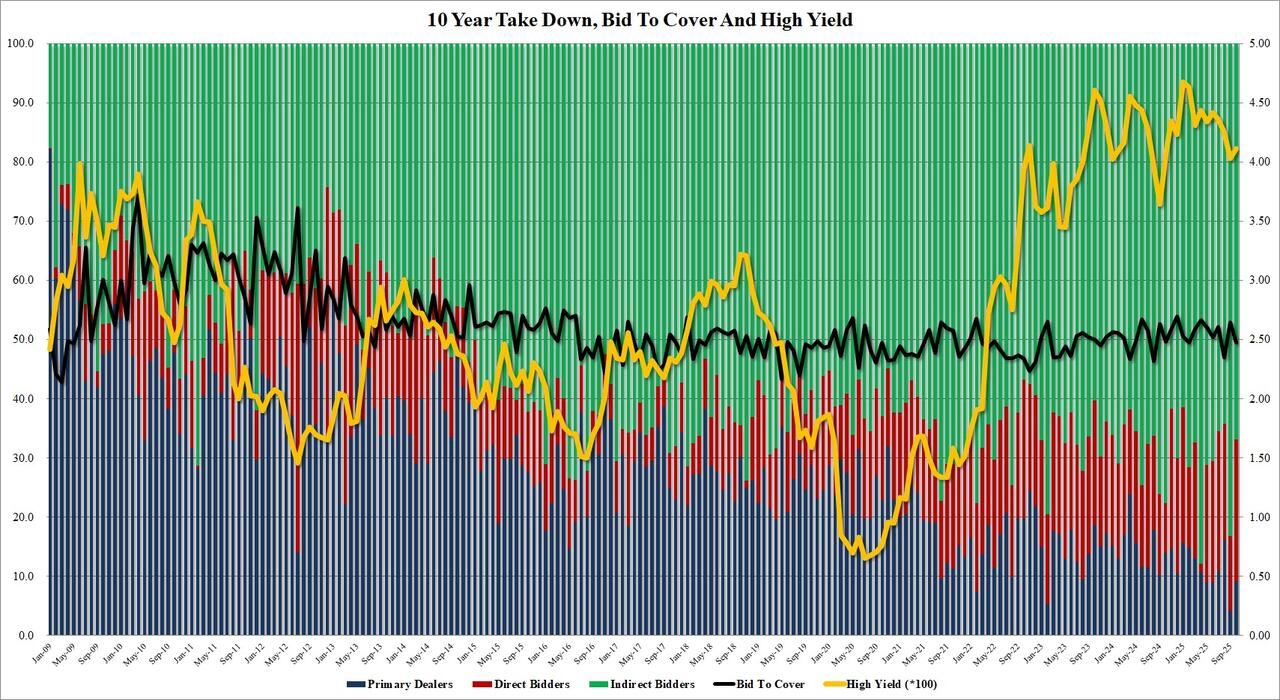
Overall, this was a subpar and disappointing 10Y auction, but it could have been worse, which is why while yields moved by 1-2bps higher across the curve, pushing the 10Y to 4.125%, they are well off yesterday’s session highs.
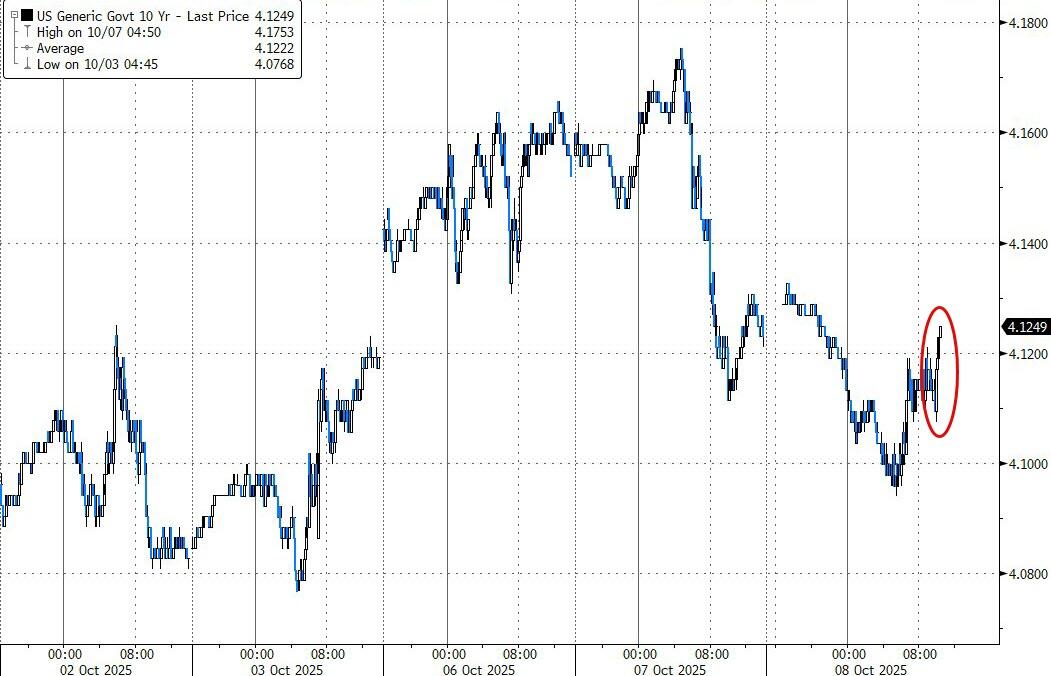
END
FOMC Minutes Signal Dovish Policy Tilt, But ‘Majority’ Fear Inflation Upside Risks
Wednesday, Oct 08, 2025 – 01:46 PM
Since the last FOMC meeting (when The fed cut rates by 25bps with one dissent for 50bps on Sept 17th), gold has gone to the moon, stocks are higher (as is the dollar) while bonds are down modestly…
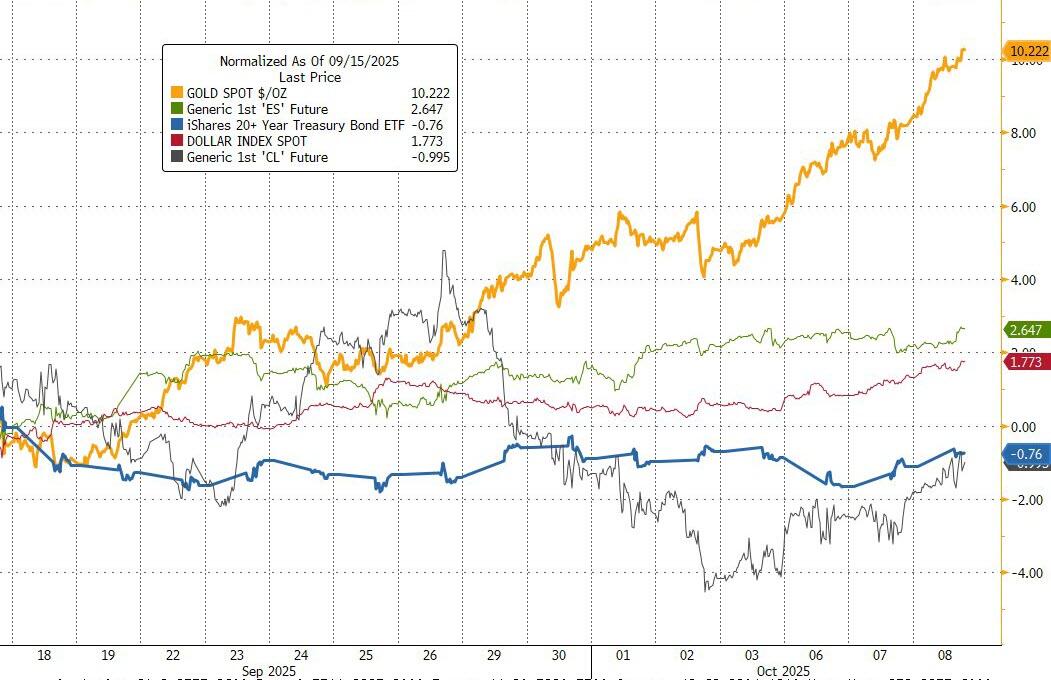
Source: Bloomberg
As a reminder, at his post-meeting press conference, Chair Powell characterized the rate cut as a risk management decision, responding to meaningful downside risks to the labor market, but stressed that he does not feel the need to move quickly on rates.
Despite the lack of data (due to the government shutdown), the labor market is cooling, and now policymakers are turning their attention to that side of the mandate (though we note that housing data saw a huge upside surprise while soft survey data since the FOMC meeting has weakened)…
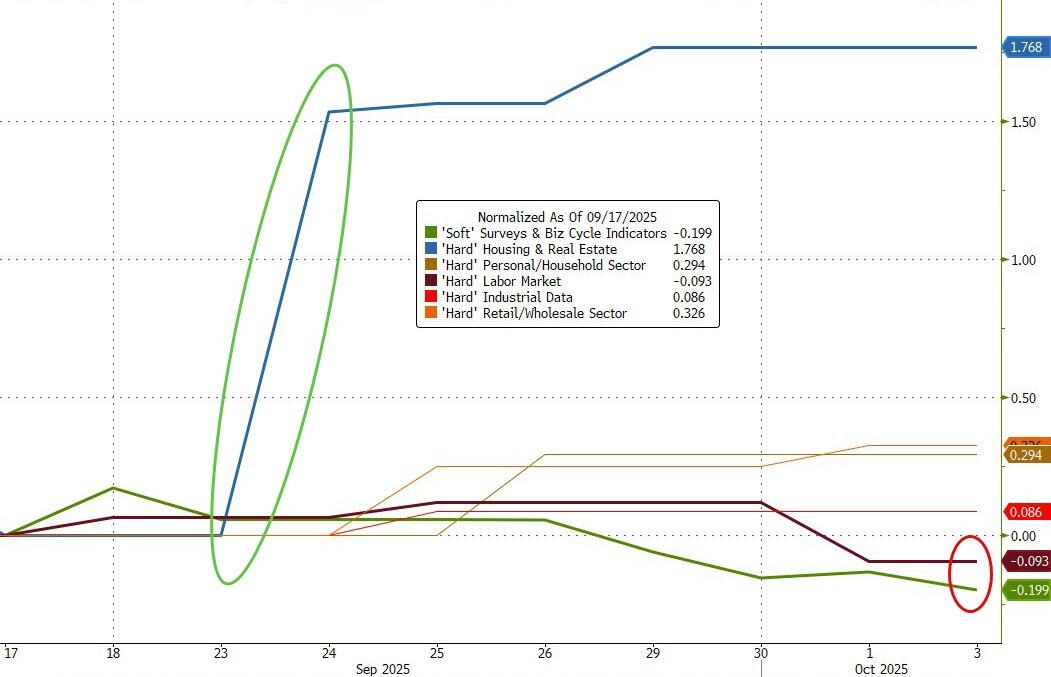
Powell said that moving rates down slightly supports a more neutral policy stance and balances risks to employment and inflation.
The government shutdown is seen as complicating the Fed’s data-dependent policy approach, with key employment and inflation releases (including weekly jobless claims, September payrolls, and CPI reports) delayed; analysts say this could cloud judgment for the October FOMC meeting, increasing uncertainty over further rate cuts amid the Committee’s divided views on inflation, GDP growth, and labor market resilience.
Interestingly, the odds of a 25bps cut in Oct (29th) has risen from 75% to 95% since the last FOMC meeting while the odds of an additional cut in December has slipped to just above 80%…
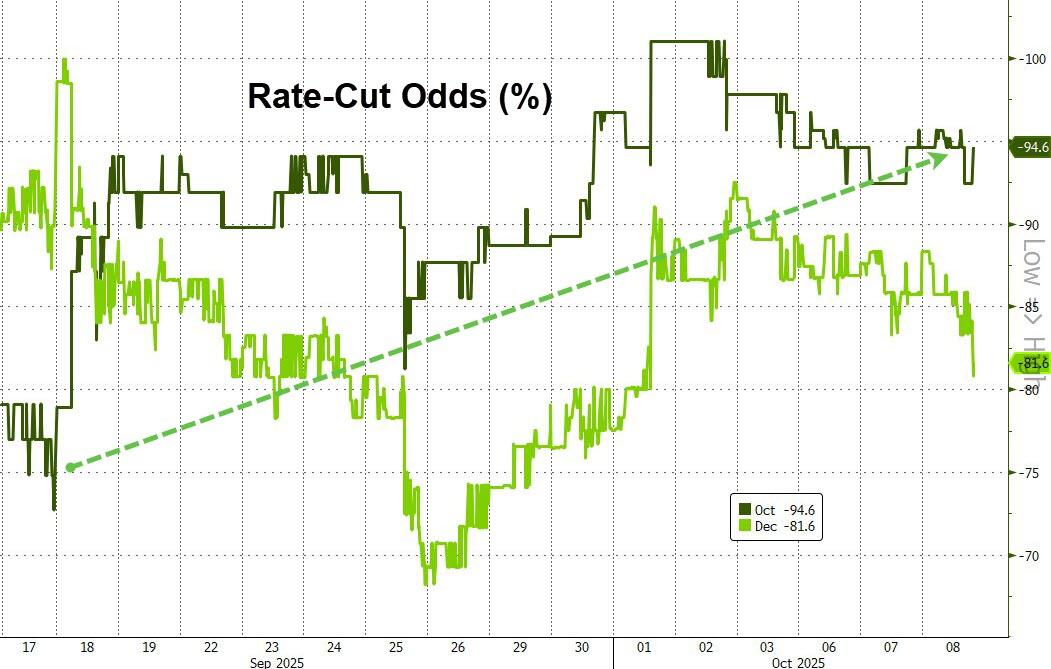
Source: Bloomberg
The Fed Chair emphasized a meeting-by-meeting approach, guided by incoming data, and noted that markets are pricing in a path of cuts, but the Fed is focused on the data rather than market expectations. Current market expectations are for 44bps of cuts in 2025 (unchanged since the meeting) and 63bps of cuts in 2026 (hawkishly lower than the 73bps at the meeting).
Powell has spoken again after the FOMC meeting and said the Committee will continue balancing high inflation risks against a slowing job market in upcoming rate decisions, maintaining flexibility rather than a preset path.
So, what does The Fed want us to know it was thinking during the meeting?
Almost all participants supported 25bps cut to Fed funds rate at the September meeting.
“Most judged that it likely would be appropriate to ease policy further over the remainder of this year,” according to minutes of the Federal Open Market Committee’s Sept. 16-17 meeting.
One participant preferred a 50bps rate cut at last month’s meeting.
Some noted financial conditions suggested policy may not be particularly restrictive, those participants judged a cautious approach to future policy was warranted.
“A few participants stated there was merit in keeping the federal funds rate unchanged at this meeting or that they could have supported such a decision,” the minutes said.
“Around half” of Fed officials saw another two interest rate cuts by the end of 2025 (which we already knew from the Dot Plot).
Most participants judged the downside risks to employment had increased, upside risks to inflation had either diminished or not increased.
The record of the meeting also showed “a majority of participants emphasized upside risks to their outlooks for inflation.”
A few participants noted the standing Repo facility would help keep the Fed funds rate in the target range and ensure money market pressures would not disrupt ongoing quantitative tightening.
Fed staff revised up the GDP growth projection for 2025 through 2028.
Equity prices continued to rise over the intermeeting period and stood very close to record highs despite the recent weaker-than-expected employment reports.
A few participants commented that the agricultural sector continued to face headwinds because of low crop prices and high input costs.
USA ECONOMIC NEWS
VICTOR DAVIS HANSON
KING NEWS
| The King Report October 8, 2025 Issue 7593 | Independent View of the News |
| Japan’s 30-year bond yield jumped to 3.32%, the highest level in history. After a solid/fixed 30-year auction, the yield fell to 3.235%. This ignited a moderate global bond rally. Dec Gold hit 4014.60 at 11:19 ET. Physical gold hit 3991.08. But GDX was -1.8% at 11:07 ET. GDX hit a daily low of -2.4% at 12:14 ET. Dec Gold fell $31.10 from its high by 11:56 ET. Dec gold rebounded to 4010.50 at 13:43 ET. GDX had a modest rebound and was -1.92% at 13:43 ET. As we noted recently, GDX, the gold miners ETF, has been leading gold. GDX is flashing a warning! NY Fed: Short-Term Inflation Expectations Continue to Tick Up; Labor Market Expectations Deteriorate – Median inflation expectations in September increased at the one-year-ahead horizon to 3.4% from 3.2% and at the five-year-ahead horizon to 3.0% from 2.9%… Median one-year-ahead earnings growth expectations decreased by 0.1 percentage point (ppt) to 2.4 percent in September, the lowest reading since April 2021. Mean unemployment expectations—or the mean probability that the U.S. unemployment rate will be higher one year from now—increased 2.0 ppts to 41.1 percent. The mean perceived probability of losing one’s job in the next twelve months increased by 0.4 ppt to 14.9 percent, above the trailing twelve-month average of 14.1 percent… Median year-ahead commodity price change expectations increased by 0.3 percentage point for food (to 5.8%) and for gas (to 4.2%), 0.5 percentage point for the cost of medical care (to 9.3%), and by 1.0 percentage point for rent (to 7.0%). The year-ahead expected change in the cost of a college education declined by 0.8 percentage point to 7.0%. The reading for expected food price growth is the highest since March 2023… https://www.newyorkfed.org/microeconomics/sce#/ ESZs opened modesty high on Monday night and immediately went inert. They broke down at 18:30 ET and fell to 6776.25 at 19:03 ET. ESZs traded in a tight range until they moved modestly higher at 0:04 ET. ESZs quickly went inert again. They eased a tad lower at 2:20 ET and again went inert. After a modest dip to 6774.75 at 4:30 ET, ESZs rallied to the daily high of 6802.75 at 9:06 ET. The dump appeared earlier; ESZs sank to a daily low of 6747.25 at 12:18 ET. ESZs then formed a pennant consolidation. With a modest dip near 14:00 ET, the consolidation turned into a ‘flag.’ After a modest upward breach of the flag consolidation near 15:00 ET, ESZs immediately rolled over into a modest decline. Another rally attempt appeared at 15:38 ET. ESZ plodded to 6766.50 at 16:00 ET. Positive aspects of previous session USZs were +16/32 at the NYSE close. The dollar index rallied smartly. Negative aspects of previous session Dec gold hit 4014.60. US stocks declined moderately in the morning. Gasoline and oil posted modest rallies after sporting modest declines in early US trading. Ambiguous aspects of previous session The dollar and gold rallied sharply. What is this telling us? Precious metals ex-gold and gold miners (GDX -2.09%) declined sharply. First Hour/Last Hour Action [S&P 500 Index]: 1st Hour from NYSE Open: Down; Last Hour: Flat Pivot Point for S&P 500 Index [above/below indicates daily trend to traders]: 6723.01 Previous session S&P 500 Index High/Low: 6754.49; 6699.96 @HedgieMarkets: The AI bubble evidence is now overwhelming. OpenAI needs “trillions” for infrastructure while burning $115 billion through 2029 on $5 billion annual revenue. They’re valued at $500 billion having never made a profit. Even their chairman admits “we’re in a bubble and a lot of people will lose a lot of money.” The Circular Money Game Nvidia invests $100 billion in OpenAI, who uses it to buy Nvidia chips. Meta borrows $26 billion for a data center the size of Manhattan. Companies that previously mined crypto are now AI infrastructure plays. This isn’t investment, it’s musical chairs with trillion-dollar price tags. The Returns Don’t Exist… The Infrastructure Fantasy Bain calculates AI companies need $2 trillion annual revenue by 2030 but will fall $800 billion short… China Just Showed the Risk DeepSeek’s release triggered a trillion-dollar selloff in one day… When Sam Altman admits “we’re missing something quite important” after hyping GPT-5, when 95% of companies see no ROI, when the financing becomes circular, and when insiders acknowledge the bubble while participating, we’re at peak euphoria. This makes dot-com look rational. At least websites could scale infinitely. AI needs physical infrastructure we cannot build, power grids that don’t exist, and customers willing to pay thousands monthly for technology that currently generates “workslop.”… https://x.com/HedgieMarkets/status/1975336265768968632 OpenAI, Nvidia Fuel $1 Trillion AI Market with Circular Deals – BBG Two weeks ago, Nvidia Corp. agreed to invest as much as $100 billion in OpenAI to help the leading AI startup fund a data-center buildout so massive it could power a major city. OpenAI in turn committed to filling those sites with millions of Nvidia chips…. promptly criticized for its ‘circular’ nature. This week, undeterred, OpenAI struck a similar deal. The ChatGPT maker on Monday inked a partnership with Nvidia rival Advanced Micro Devices Inc. to deploy tens of billions of dollars worth of its chips. As part of the tie-up, OpenAI is poised to become one … Fed’s Balance Sheet Runoff in Focus as Bank Reserves Are Ebbing – BBG Overnight funding markets, where banks and asset managers borrow and lend to each other on a day-to-day basis, have been volatile since the beginning of September. Ultra-short-term interest rates, which have been steadily rising as the Treasury is rebuilding its cash pile, remain stubbornly elevated even after a benign quarter end. As a result, the gap between the Secured Overnight Financing Rate and the effective fed funds rate… is near its widest level since the end of 2024… bank reserves just fell below $3 trillion, the lowest level since January… Jerome Powell said last month that bank reserve balances are still ‘abundant’ and have yet to reach the minimum level needed to cushion against market disruptions though…they’re getting closer… Tuesday’s King Report: With stocks peaking near 14:35 ET on the OpenAI event, no AI-related event scheduled, and the Japanese new pro-stimulus PM news digested, the odds favor a Turnaround Tuesday to the downside. Today – The Turnaround Tuesday to the downside that we thought had a high probability occurred. It’s hard to speculate about today’s market action from yesterday’s activity. Gold, bonds, and the dollar rallied; stocks, gold miners, and other precious metals declined. Crypto currencies declined sharply. The S&P 500 Index low for Tuesday is 6699.96. The usual suspects fought to keep the index from falling significantly below 6700 to prevent momentum selling. Ergo, this is an ‘actionable’ level for today. It will be interesting and perhaps revealing if ESZs have periods of inactivity like yesterday. ESZs are -1.00, NQZs are +1.50; Dec AU is +14.40; and USZs are -3/32 at 20:05 ET. ESZs hit +8.75 (6770.25) at 18:50 ET and fell to 6758.50 (-3.00) at 19:41 ET. Expected economic data: Sept Federal Budget $50.0B; FOMC 9/17 Minutes 14:00 ET Fed Speakers: St. Louis Pres Musalem 9:20 ET, Gov Barr 9:30 ET, Min Pres Kashkari 15:15 ET S&P Index 50-day MA: 6510; 100-day MA: 6305; 150-day MA: 6054; 200-day MA: 6038 DJIA 50-day MA: 45,407; 100-day MA: 44,359; 150-day MA: 43,240; 200-day MA: 43,337 (Green is positive slope; Red is negative slope) S&P 500 Index (6714.59 close) – BBG trading model Trender and MACD for key time frames Monthly: Trender and MACD are positive – a close below 5627.36 triggers a sell signal Weekly: Trender and MACD are positive – a close below 6421.22 triggers a sell signal Daily: Trender and MACD are positive – a close below 6662.07 triggers a sell signal Hourly: Trender and MACD are negative – a close above 6739.42 triggers a buy signal Joe Biden’s team blocked CIA from distributing report on son Hunter’s Ukraine business dealings Report raised concern about “double standard” on foreign corruption and VP office’s request to block was “extremely rare and unusual.”… https://justthenews.com/accountability/political-ethics/emb8amvp-bidens-team-intervened-prevent-distribution-cia-report-his @paulsperry_: FBI sources say Christopher Wray had to sign off on the spying on GOP senators, along with Biden’s AG Garland, since any investigation involving elected officials is a SIM case requiring their approval. Also, a 1-page predication is “extremely rare” esp since targets senators. FBI fires agents, dismantles corruption squad after probe unveils monitoring of GOP senators, Patel says – the bureau has fired staff and disbanded its CR-15 squad after revelations that GOP lawmakers’ private calls were tracked… The CR-15 squad was the FBI’s Washington Field Office’s public corruption unit. The squad helped former special counsel Jack Smith investigate President Trump https://www.foxnews.com/politics/fbi-fires-agents-dismantles-corruption-squad-after-probe-unveils-monitoring-gop-senators-patel-says FBI corruption probe picked up evidence Bill Clinton paid through backdoor, GOP senator says Senate Judiciary Chairman Grassley wants to know whether FBI and DOJ fully investigated the findings. https://justthenews.com/government/congress/fbi-corruption-probe-picked-evidence-bill-clinton-paid-through-backdoor-gop @Project_Veritas: BREAKING EXCLUSIVE: Number Linked to Newly Fired U.S. Prosecutor Michael Ben’Ary Dreams President Trump and Eastern District of Virginia Attorney Lindsay Halligan Will Die – “I would like to strangle that b*itch myself. Every night I dream that this nightmare will end … or that she or @RealDonaldTrump would simply die.” In a leaked text from October 6th, a number linked to Ben’Ary, who was terminated last week, urges fellow @EDVAnews prosecutor Russell Carlberg – previously exposed by Veritas for threatening whistleblowers – to “keep monitoring” cases to prevent interference from President Trump’s new appointee, Lindsay Halligan, who oversees the Comey case. (The DoJ and FBI are hopelessly corrupt!) https://x.com/Project_Veritas/status/1975576176622973321 @mrddmia: The FBI opened a criminal investigation last night. The most senior Justice Department officials are working on this. @bennyjohnson: Dem Sen. Dick Durbin (IL) is going to regret asking this question for the rest of his life. It totally backfired on him. AG Pam Bondi eviscerated him: DURBIN: “They are going to transfer Texas National Guard units to the state of Illinois. What’s the rationale for that?” BONDI: “Yeah, Chairman, as you shut down the government, you voted to shut down the government, and you’re sitting here. Our law enforcement officers aren’t being paid.” “They’re out there working to protect you. I wish you loved Chicago as much as you hate President Trump. And currently, the National Guard are on the way to Chicago. If you’re not going to protect your citizens, President Trump will.” https://x.com/bennyjohnson/status/1975566666986606943 @EndWokeness: Biden on urban crime (1993): “It doesn’t matter whether they were deprived as a youth… It doesn’t matter whether or not they are the victims of society… We have to remove from the streets” the folks “born out-of-wedlock… without supervision… without any developed conscience… We have predators on our street that society has created…” https://x.com/EndWokeness/status/1975625420436611099 @libsoftiktok: Speaker Mike Johnson: “Chuck Schumer has been in Congress for 44 years… Just for reference, I was 9 years old. I was in the third grade when Chuck Schumer came here to Congress.” https://x.com/libsoftiktok/status/1975653381831335960 Sports Illustrated: It didn’t take long for last year’s officiating controversy surrounding Patrick Mahomes and the Chiefs to surface again in the 2025 season. Mahomes appeared to plead with the officials that the Chiefs didn’t do anything wrong, and after some deliberation, the refs picked up the flag and ruled it a fair touchdown…ESPN rules analyst Russell Yurk thought the officials got this call wrong, and the Chiefs’ first touchdown of the game should have been wiped off the board. https://www.si.com/nfl/former-nfl-qb-defends-patrick-mahomes-chiefs-on-controversial-td-play-vs-jaguars Early in the 4th quarter, with Jacksonville up by 7, a Chief defender knocked down a Jacksonville receiver before he received a pass, a crystal-clear penalty. https://x.com/SharpFootball/status/1975388504864829574 Even worse, the pass was intercepted and KC scored the tying touchdown a few plays later. Social media lit up with memes showing NFL refs favoring KC. Here’s one that has a ref in a KC-like jersey: https://x.com/PrizePicks/status/1975388685844857051/photo/1 @fieldsk: Didn’t that guest you had on your podcast say these refs have never let the chiefs lose? @SharpFootball: The Chiefs have a perfect 5-0 record in games officiated by ref Brad Rogers prior to tonight’s game. (PS – Jacksonville won the game.) | |
SWAMP STORIES FOR YOU TONIGHT
NEW YORK
If Mamdani Wins, The Gig (Work) Is Up
Tuesday, Oct 07, 2025 – 05:00 PM
Authored by Jonathan Wolfson via RealClearPolitics,
One of Zohran Mamdani’s most harmful proposals is getting the least attention: his plan to restrict “gig” work – the freelancing that’s so popular across the Big Apple. Mamdani wants to wrap freelancing in so much red tape, it’ll be significantly harder for New Yorkers to work for themselves or get side income.

New Jersey, too, is flirting with severely limiting independent work. But whether it comes from Gracie Mansion or Trenton, a crackdown on gig work would hurt not just workers and those who hire them, but every New Yorker or New Jerseyan who relies on freelance workers in their daily lives.
As America’s biggest city, it should be no surprise that New Yorkers have a diversity of work arrangements. Studies before the pandemic found that more than a million New Yorkers freelance. Now at least 20% of working New Yorkers find gigs through apps.
Gig workers do all kinds of jobs. Some drive or deliver, others shoot freelance photography for major brands, and others build websites or repair bicycles. Whatever form it takes, freelancing is popular because it gives workers flexible hours, the chance to be their own boss, and the opportunity to earn extra money.
Millions of Americans perform independent work in addition to full-time work and millions more need the flexibility of independent work to balance work and caregiving responsibilities. And studies find these entrepreneurs are pleased with their choice to freelance.
Despite this growth and freelancer satisfaction, critics like Mamdani want to make it harder for Americans to be independent contractors. While they frame their opposition as a matter of “protecting workers,” they really want to put government in the driver’s seat of employment, while making it harder for workers to freelance at all.
In particular, Mamdani wants to increase scrutiny of the contracts between workers and businesses; impose stricter licensing requirements on delivery companies; and mandate wage, unemployment, and health insurance benefits for workers who utilize the delivery platforms. But since many independent workers have health insurance from another job or a spouse’s job, these “benefits” are less valuable than cash.
Bottom line, politicians like Mamdani believe freelancers are being duped and don’t understand the deal they are making. And they believe that it’s better to shut down the independent economy than to risk that some workers might make a bad deal.
It comes down to worldview. Some policymakers believe the only good job is a traditional full-time role that provides employee benefits and a W-2 tax return. And many labor union leaders fight against freelancing because they want more members, and they know independent workers don’t see the need to join a union. Some big businesses seeking to stifle competition from upstart entrepreneurs are happy to join the cause.
So what will happen if independent work gets limited, in New York City, New Jersey, or anywhere else?
California shows the answer. In 2019, California passed a law attacking independent work. The state’s many photographers, freelance writers, translators, and designers quickly discovered that their once-lucrative work had dried up. Company after company cut jobs. The Mercatus Center found that one out of 10 self-employed jobs disappeared in short order. Even worse job losses were surely on the horizon.
Recognizing the danger, California voters almost immediately passed a ballot measure that gave app-based workers and app-based companies the freedom to once again enter into freelance arrangements. The legislature then passed another law to carve out a dozen more professions. But those carve-outs didn’t apply to many other freelancers, like independent truckers, whose ability to work in California remains much more difficult. To this day, because politicians strangled freelance work, Californians have fewer of the jobs they want and need.
Freelance work has transformed New York City’s economy while opening doors for workers to supplement their incomes or start their own businesses. New Yorkers today have more ways to get around the city, get takeout more easily, and make money thanks to the gig economy. Zohran Mamdani’s ideas could put it all at risk – and every New Yorker should be worried.
Jonathan Wolfson is a visiting fellow at the Institute for the American Worker and led the policy office at the U.S. Department of Labor from 2019-2021.
END
PORTLAND
DHS Highlights Slew Of September Immigration Arrests In Portland
Wednesday, Oct 08, 2025 – 01:25 PM
Authored by Naveen Athrappully via The Epoch Times,
The Immigration and Customs Enforcement (ICE) arrested several “worst of the worst criminal illegal aliens” in Portland, Oregon, last month, the Department of Homeland Security (DHS) said in an Oct. 7 statement.

The announcement comes amid a tussle between the Trump administration and officials in Portland and Oregon over the deployment of National Guard troops to protect federal agents carrying out immigration operations.
“We are not allowing domestic terrorists to slow us down from removing the worst of the worst,” DHS Assistant Secretary for Public Affairs Tricia McLaughlin said.
“President Trump has deployed a SURGE of federal resources to Portland. Enhanced CBP, ICE, FBI, DOJ and DEA resources are arresting rioters and Antifa domestic terrorists.”
Among those arrested was a Honduran national convicted of distributing fentanyl; a Canadian national convicted of two counts of sexual abuse in the first degree; a Mexican national who was previously arrested for possessing dangerous weapons; a Peruvian national convicted of luring a minor; and another Mexican national convicted of possessing heroin with the intent to distribute it, the statement said.
On Sept. 28, War Secretary Pete Hegseth issued a memo at the request of President Donald Trump, informing the leader of the Oregon National Guard that 200 members would be called up for federal service. The same day, Oregon filed a lawsuit seeking to block the move, arguing that Trump exceeded his executive authority.
On Oct. 4, Judge Karin J. Immergut, of the U.S. District Court for the District of Oregon, ruled that Trump violated the 10th Amendment and that Oregon would “suffer an injury to its sovereignty” once the federalized National Guards are deployed in Portland. She issued a temporary restraining order against such deployment, valid until Oct. 18.
On Saturday, ICE’s offices in Portland saw demonstrations, with some protestors using megaphones to chant “ICE out of Portland!”
During protests the previous day, some protesters also threatened federal agents.
National Guard Deployment
On Tuesday, Oregon Governor Tina Kotek’s office said she directed the Northern Command to take swift action to send the National Guard members back home.
“Judge Karin J. Immergut’s orders are a clear and forceful rebuttal to President Trump’s misuse of states’ National Guard. Thus, I am directing Northern Command to send Oregon’s citizen-soldiers home from Camp Rilea immediately,” Kotek said.
“Let’s remember that these Oregonians are our neighbors and friends, who have been unlawfully uprooted from their family and careers—they deserve better than this.”
In an Oct. 7 statement, Portland Mayor Keith Wilson raised concerns about federal agents in the city.
“I continue to maintain that the tactics used by federal agents at the ICE facility are troubling and likely unconstitutional,” he said.
“I intend to explore options to protect our community and our right to free expression.”
Speaking to reporters at the Oval Office on Monday, Trump suggested he may consider invoking the Insurrection Act if required.
The Insurrection Act is an emergency power allowing the president to authorize the deployment of military forces within the country to suppress acts of domestic violence or rebellion.
“So far, it hasn’t been necessary. But we have an Insurrection Act for a reason,” Trump said.
“If I had to enact it, I‘d do that. If people were being killed, and courts were holding us up, or governors and mayors were holding us up, sure, I’d do that. I mean, I want to make sure that people aren’t killed. We have to make sure that our cities are safe.”
The DHS said on Tuesday that fiscal year 2025 closed out with the lowest Border Patrol apprehensions at the southwest border since 1970. The department said there were 237,565 apprehensions for fiscal year 2025, 87 percent below the average of the last four fiscal years, which was 1.86 million.
“We have had the most secure border in American history and our end of year numbers prove it. We have shattered multiple records this year and once again we have broken a new record with the lowest number of Southwest border apprehensions in 55 years,” Secretary of Homeland Security Kristi Noem said.
“Under President Trump, we have empowered and supported our law enforcement to do their job and they have delivered.”
GREG HUNTER..INTERVIWING JOHN RUBINO
Fiat Currency Experiment Ending Globally – John Rubino
By Greg Hunter On October 7, 2025 In Market Analysis, Political Analysis3 Comments

By Greg Hunter’s USAWatchdog.com
Analyst and financial writer John Rubino has been warning of a currency crisis for the last few years, but it’s not just the US dollar, euro or the yen. Almost every country has exploding unpayable debt, and there is not a fiat currency that is going to survive. Rubino explains, “If you watch the financial press, they are noting that the price of gold is going up, but they are treating it like any other asset. Gold is humanity’s oldest form of money. So, when it goes up in price, that means the currencies against we are measuring it are going down in value. What we are seeing all around the world is fiat currencies declining in value dramatically . . . especially against gold. Gold, just in the last couple of weeks, pierced not just its all-time nominal high, but its all-time inflation adjusted high. This is a much bigger deal because we have had so much inflation in the last 30 or 40 years. Basically, gold is saying that the fiat currency experiment is ending. In other words, the monetary system that we set up in 1971 when we went off the gold standard . . . this led countries to create way too much debt, increase their spending dramatically and basically make all the mistakes that a human makes when you give them an unlimited credit card. Now, we are burdened with debt we cannot pay off, and people expect to be taken care of, and France is a good example of this.”
Almost every nation is facing the same crisis and same currency outcome. Rubino contends, “Governments around the world are forced to borrow more and more money to cover the obligations they have taken on and to cover the interest costs on their debts. That requires them to print more money, and that is lowering the value of the currencies even more quickly. This basically will lead to a currency death spiral. That’s where we are right now.”
Rubino likes physical gold, silver and mining stocks. Rubino says, “The silver price will begin to outperform gold on a percentage basis.” Rubino also says, “. . .In order (for gold) to serve as the foundation for the next monetary system . . . as we did it in the classical gold standard that was in place up until WWI, if we went back to that, you would need a gold price at around $20,000 per ounce. You would need this to back all the currencies that are out there now. . . . If we keep doing what we are doing now, the fiat currencies would go to zero, which means gold would go to infinity. My guess on the future gold price is somewhere between $20,000 (per ounce) and infinity.”
Rubino also thinks artificial intelligence (AI) is both inflationary and deflationary. He explains in the interview.
There is more in the 49-minute interview.
Join Greg Hunter as he goes One-on-One with financial writer John Rubino of the popular site called Rubino.Substack.com for 10.7.25.
To get the Mold and Allergy Emergency Kit, click here. Don’t forget you get 15% off and free shipping if you use the promo code USAWATCHDOG .
For Tax Network USA, click here or call 1-800-958-1000.
After the Interview:
To get the Mold and Allergy Emergency Kit, click here. Don’t forget 15% off and free shipping with promo code USAWATCHDOG. You can also talk to a human and order by calling (800) 758-1584.
For Tax Network USA, click here or call 1-800-958-1000.
John Rubino is a prolific financial writer, and you can see some of his work for free at Rubino.Substack.com.
There is even more cutting-edge original information and analysis if you subscribe.
SEE YOU TOMORROW


 harveyorganblog.com