
access market
XXXXXXXXXXXXXXXXXXXXXXXXXXXXXXXXXXXXXXXXXXXXXXXXXX
EXCHANGE: COMEX
EXCHANGE: COMEX
CONTRACT: OCTOBER 2025 COMEX 100 GOLD FUTURES
SETTLEMENT: 4,280.200000000 USD
INTENT DATE: 10/16/2025 DELIVERY DATE: 10/20/2025
FIRM ORG FIRM NAME ISSUED STOPPED
072 C GOLDMAN 95
099 H DEUTSCHE BANK AG 768
118 H MACQUARIE FUTURES US 450
190 H BMO CAPITAL MARKETS 10
299 C TRADESTATION SEC INC 1
323 C HSBC 755
323 H HSBC 472
332 H STANDARD CHARTERED B 1205
363 H WELLS FARGO SECURITI 28
435 H SCOTIA CAPITAL (USA) 823
523 H INTERACTIVE BROKERS 1
555 H BNP PARIBAS SEC CORP 200
624 C BOFA SECURITIES 7
657 C MORGAN STANLEY 1000
657 H MORGAN STANLEY 700
661 C JP MORGAN SECURITIES 1034
686 C STONEX FINANCIAL INC 17
700 C UBS SECURITIES LLC 6
709 C BARCLAYS 20
732 C RBC CAP MARKETS 319
732 H RBC CAP MARKETS 410
737 C ADVANTAGE FUTURES 1
880 H CITIGROUP 232
905 C ADM 8 36
991 H CME 70
TOTAL: 4,334 4,334
MONTH TO DATE: 51,383
GOLD: NUMBER OF NOTICES FILED FOR OCT/2025: 4334 CONTRACTs NOTICES FOR 4334,00 OZ or 13.4806 TONNES
total notices so far: 51,383 contracts for 5,138,300 OR 159.823 tonnes)
SILVER NOTICES: 308 NOTICE(S) FILED FOR 1.5400 MILLION OZ/
total number of notices filed so far this month : 6142 CONTRACTS (NOTICES) for 30.710 million oz
INITIAL STANDING FOR OCT: 30.780 MILLION OZ (WHICH INCLUDES ALL QUEUE JUMPING)
+ 2.110 MILLION OZ EXCHANGE FOR RISK
EQUALS
32.890 MILLION OZ..
JULY: 50.925 MILLION OZ (QUITE SMALL)
AUGUST: 59.455 MILLION OZ (QUITE SMALL)
SEPT. 50.510 MILLION OZ.(QUITE SMALL)
OCT; 62.255 MILLION OZ (WILL BE HUGE THIS MONTH)
AND JULY: 46.720 MILLION OZ//
AUGUST: 4.70 MILLION OZ INITIAL STANDING PLUS TODAY;S 5,000 OZ QUEUE JUMP //NEW STANDING ADVANCES TO 10.960 MILLION OZ
SEPTEMBER: 68.040 MILLION OZ NORMAL DELIVERY(INCLUDES ALL QUEUE JUMPING AND EXCHANGE FOR PHYSICAL TRANSFERS) PLUS 3.0 MILLION OZ EX FOR RISK = 71.040 MILLION OZ. (THIS IS THE FIRST AND ONLY ISSUANCE OF EXCHANGE FOR RISK FOR SILVER SINCE MAY.)
AND NOW OCTOBER: 29.265 MILLION OZ OF NORMAL DELIVERY INCLUDES ALL QUEUE JUMPING
PLUS
2.110 MILLION OZ EXCHANGE FOR RISK//TOTAL OZ STANDING IN OCT ADVANCES TO 32.890 MILLION OZ
AUGUST: 60.547 TONNES OF INITIAL GOLD FIRST DAY NOTICE FOLLOWED BY THE NET MONTH’S QUEUE JUMP OF 47.2312 TONNES TO WHICH WE ADD THE FOLLOWING EXCHANGE FOR RISK ISSUANCE RECEIVED FOR THE MONTH: 5.4432 TONNES EX FOR RISK/AUG 7 , AUG 11: 2.413 TONNES EX FOR RISK AND AUG. 12 OF 2.637 TONNES EX FOR RISK//AUG 25: 9.107 TONNES , AUGUST 26: 9.1010 TONNES AND NOW AUGUST 27: 9.0699 TONNES//NEW STANDING ADVANCES TO 107.5117 TONNES OF GOLD NORMAL STANDING (INCLUDES ALL MONTHLY QUEUE JUMPS/EX FOR PHYSICAL TRANSFERS//) +44.696 TONNES EX.FOR RISK = 152.208 TONNES
SEPT: INITIAL 8.093 TONNES OF GOLD PLUS TODAY’S QUEUE JUMP OF 0.4883 TONNES PLUS 2.2827 TONNES OF EXCHANGE FOR RISK TODAY//NEW TOTAL EX. FOR RISK/MONTH = 22.923//NEW TOTAL STANDING FOR GOLD SEPT ADVANCES TO = 48.801 TONNES!!
AND NOW OCTOBER: 90.012 TONNES OF INITIAL GOLD STANDING WITH TODAY’S HUGE 12.031 TONNES QUEUE JUMP TO WHICH WE ADD: 8.326 TONNES QUEUE JUMP/YESTERDAY// WHICH FOLLOWED TUESDAY’S RECORD SETTING MONSTER 9.564 TONNES QUEUE JUMP AND WHICH WAS PRECEDED BY 42.549 TONNES QUEUE JUMPING FOR OCT. THEN WE MUST ADD OUR 11.353 TONNES OF OUR ISSUANCE OF EXCHANGE FOR RISK/5 OCCASIONS//NEW TOTAL OF GOLD STANDING ADVANCES TO 171.776 TONNES OF GOLD.
JAN. 2025: 257.919 TONNES (ISSUANCE WILL BE PRETTY GOOD THIS MONTH BUT MUCH LOWER THAN LAST MONTH)
FEB: 207.21 TONNES//EX FOR PHYSICAL ISSUANCE (WILL BE A FAIR SIZED ISSUANCE THIS MONTH)
MARCH 130.84 TONNES//QUITE SMALL THIS MONTH.
APRIL; 208.57 TONNES. STILL SMALL TO FAIR
MAY: 113.499 TONNES OF GOLD EFP ISSUANCE//QUITE SMALL THIS MONTH
JUNE: 97.79 TONNES OF GOLD EFP ISSUANCE/EXTREMELY SMALL
JULY : 150.877 TONNES// QUITE SMALL
AUGUST: 175.86 TONNES A LOT LARGER THIS MONTH.
SEPT. 116.13 TONNES VERY SMALL
OCT. 144.09 TONNES
SPREADING OPERATIONS
NOW SWITCHING TO GOLD FOR NEWCOMERS, HERE ARE THE DETAILS
SPREADING LIQUIDATION HAS NOW COMMENCED AS WE HEAD TOWARDS THE NEW ACTIVE FRONT MONTH OF OCT. WE ARE NOW INTO THE SPREADING OPERATION OF GOLD
HERE IS A BRIEF SYNOPSIS OF HOW THE CROOKS FLEECE UNSUSPECTING LONGS IN THE SPREADING ENDEAVOUR ;MODUS OPERANDI OF THE CORRUPT BANKERS AS TO HOW THEY HANDLE THEIR SPREAD OPEN INTERESTS:HERE IS HOW THE CROOKS USED SPREADING AS WE ARE NOW INTO THE NON ACTIVE DELIVERY MONTH OF NOV HEADING TOWARDS THE ACTIVE DELIVERY MONTH OF FEB., FOR GOLD: AND MARCH FOR SILVER
YOU WILL ALSO NOTICE THAT THE COMEX OPEN INTEREST STARTS TO RISE BUT SO IS THE OPEN INTEREST OF SPREADERS. THE OPEN INTEREST IN WILL CONTINUE TO RISE UNTIL ONE WEEK BEFORE FIRST DAY NOTICE OF AN UPCOMING ACTIVE DELIVERY MONTH (OCT), AND THAT IS WHEN THE CROOKS SELL THEIR SPREAD POSITIONS BUT NOT AT THE SAME TIME OF THE DAY. THEY WILL USE THE SELL SIDE OF THE EQUATION TO CREATE THE CASCADE (ALONG WITH THEIR COLLUSIVE FRIENDS) AND THEN COVER ON THE BUY SIDE OF THE SPREAD SITUATION AT THE END OF THE DAY. THEY DO THIS TO AVOID POSITION LIMIT DETECTION. THE LIQUIDATION OF THE SPREADING FORMATION CONTINUES FOR EXACTLY ONE WEEK AND ENDS ON FIRST DAY NOTICE.”
WHAT IS ALARMING TO ME, ACCORDING TO OUR LONDON EXPERT ANDREW MAGUIRE IS THAT THESE EFP’S ARE BEING TRANSFERRED TO WHAT ARE CALLED SERIAL FORWARD CONTRACT OBLIGATIONS AND THESE CONTRACTS ARE LESS THAN 14 DAYS. ANYTHING GREATER THAN 14 DAYS, THESE MUST BE RECORDED AND SENT TO THE COMPTROLLER, GREAT BRITAIN TO MONITOR RISK TO THE BANKING SYSTEM. IF THIS IS INDEED TRUE, THEN THIS IS A MASSIVE CONSPIRACY TO DEFRAUD AS WE NOW WITNESS A MONSTROUS TOTAL EFP’S ISSUANCE AS IT HEADS INTO THE STRATOSPHERE.
The crooks also use the spread in the TAS account (trade at settlement). They buy the spot TAS (e.g. June) and sell the future TAS two months out (e.g. August). Then they unload the front month (i.e. unload the buy side first so the price of gold/silver falls. This occurs in the middle of the front delivery month cycle. They unload the sell side of the equation, two months down the road. The crooks violate position limits as the OCC refuse to hear our complaints.
First, here is an outline of what will be discussed tonight:
1.TODAY WE HAD THE OPEN INTEREST AT THE COMEX IN SILVER ROSE BY A MEGA MEGA HUGE SIZED 2476 CONTRACTS OI TO 175,706 AND CLOSER TO THE COMEX HIGH RECORD //244,710( SET FEB 25/2020). THE LAST RECORDS WERE SET IN AUG.2018 AT 244,196 WITH A SILVER PRICE OF $14.78/(AUGUST 22/2018)..THE PREVIOUS RECORD TO THAT WAS SET ON APRIL 9/2018 AT 243,411 OPEN INTEREST CONTRACTS WITH THE SILVER PRICE AT THAT DAY: $16.53). AND PREVIOUS TO THAT, THE RECORD WAS ESTABLISHED AT: 234,787 CONTRACTS, SET ON APRIL 21.2017 OVER 7 YEARS AGO. HOWEVER WE HAVE NOW SET A NEW RECORD LOW OF 114,102 CONTRACTS JULY 3.2023
EFP ISSUANCE A SMALL 70 CONTRACTS
OUR CUSTOMARY MIGRATION OF COMEX LONGS CONTINUE TO MORPH INTO LONDON FORWARDS AS OUR BANKERS USED THEIR EMERGENCY PROCEDURE TO ISSUE:
DEC 70 CONTRACTS and 0 ALL OTHER MONTHS: ZERO. TOTAL EFP ISSUANCE: 70 CONTRACTS. EFP’S GIVE OUR COMEX LONGS A FIAT BONUS PLUS A DELIVERABLE PRODUCT OVER IN LONDON. IF WE TAKE THE COMEX OI GAIN OF 2476 CONTRACTS AND ADD TO THE SMALL 70 E.FP. ISSUED
WE OBTAIN A MEGA MEGA HUGE SIZED GAIN OF 2546 OF OPEN INTEREST CONTRACTS FROM OUR TWO EXCHANGES WITH OUR GAIN OF $1.63 THE RATS ARE FLEEING THE ARENA.
THUS IN OUNCES, THE GAIN ON THE TWO EXCHANGES TOTALS 12.730 MILLION PAPER OZ
OCCURRED WITH OUR GAIN OF $1.63 IN PRICE.
OUTLINE FOR TODAY’S COMMENTARY
1a/COMEX GOLD AND SILVER REPORT
(report Harvey)
1a/COMEX GOLD AND SILVER REPORT
(report Harvey)
b, ) Gold/silver trading overnight Europe,//GOLD COMMENT
Peter Schiff)
c) Commentaries from: Egon von Greyerz///Matthew Piepenburg via GoldSwitzerland.com, Pam and Russ Martens
ii a) Chris Powell of GATA provides to us very important physical commentaries
b. Other gold/silver commentaries
c. Commodity commentaries//
d)/CRYPTOCURRENCIES/BITCOIN ETC
2.ASIAN AFFAIRS
ASIAN MARKETS THIS THURSDAY MORNING:
SHANGHAI CLOSED DOWN 76.47 POINTS OR 1.95%
//Hang Seng CLOSED CLOSED DOWN 641.41 PTS OR 2.48%
// Nikkei CLOSED : DOWN 695.59 PTS OR 1,44% //Australia’s all ordinaries CLOSED DOWN 0.89%
//Chinese yuan (ONSHORE) CLOSED DOWN TO 7.1248// OFFSHORE CLOSED DOWN AT 7.1291/ Oil DOWN TO 56.82 dollars per barrel for WTI and BRENT DOWN TO 60.40 Stocks in Europe OPENED ALL RED
ONSHORE USA/ YUAN TRADING DOWN TO 7.1248 // OFFSHORE YUAN TRADING DOWN TO 7.1291 :/ONSHORE YUAN TRADING ABOVE OFF SHORE / AND THUS WEAKER/OFF SHORE YUAN TRADING DOWN AGAINST US DOLLAR/ AND THUS WEAKER
XXXXXXXXXXXXXXXXXXXXXXXXXXXX
A)NORTH KOREA/SOUTH KOREA
outline
b) REPORT ON JAPAN/
OUTLINE
3 CHINA
OUTLINE
4/EUROPEAN AFFAIRS
OUTLINE
5. RUSSIAN AND MIDDLE EASTERN AFFAIRS
OUTLINE
6.Global Issues//COVID ISSUES/VACCINE ISSUES
OUTLINE
7. OIL ISSUES
OUTLINE
8 EMERGING MARKET ISSUES
9. USA
XXXXXXXXXXXXXXXXXXXXXXXXXXXXXXXXXXXXXXXXXXXXXXXXXXXXXXXXXXXXXXXXXXXXXXXXXXXXXXXXXXXXXXXXXXXXXXXXXXXXXXXXXX
1. COMEX DATA//AMOUNTS STANDING//VOLUME OF TRADING/INVENTORY MOVEMENTS
GOLD
LET US BEGIN:
THE TOTAL COMEX GOLD OPEN INTEREST FELL BY A FAIR SIZED 1983 CONTRACTS TO 483,770 OI WITH OUR HUGE GAIN IN PRICE OF $104.45 WITH RESPECT TO THURSDAY’S // TRADING/ //COMEX CLOSING TIME:… WE LOST ZERO NET LONGS, WITH THAT PRICE GAIN FOR GOLD. AND AS YOU WILL SEE BELOW, OUR GAIN IN PRICE ALSO HAD A STRONG NUMBER OF EXCHANGE FOR PHYSICAL ISSUED (2873). WE HAD ZERO T.A.S. LIQUIDATION THURSDAY. WE HAD A TOTAL GAIN IN OI ON BOTH OF OUR EXCHANGES, THE COMEX AND LONDON’S EXCHANGE FOR PHYSICAL EQUATING TO 890 CONTRACTS (OR 2.768 TONNES).THEN WE WERE NOTIFIED OF A ZERO CONTRACT EXCHANGE FOR RISK ISSUANCE IN GOLD CONTRACTS ISSUED FOR NIL OZ OR 0 TONNES OF GOLD.
EXCHANGE FOR PHYSICAL//GOLD ISSUANCE//OCTOBER:
THUS THE TOTAL NUMBER OF CONTRACTS EXCHANGE FOR RISK ISSUED FOR THE MONTH OF OCT FOR GOLD REMAINS AT 11.353 TONNES OF GOLD UNDER THE GUIDANCE OF 5 ISSUANCES.
A LITTLE HISTORY ON OUR EXCHANGE FOR RISK ISSUANCES/ GOLD:
HERE IS A CLOSER LOOK AT EXCHANGE FOR RISK ISSUANCES FOR THESE PAST 4 MONTHS;
(TOTAL EXCHANGE FOR RISK LAST 4 MONTHS 70.097 TONNES//BANK OF ENGLAND TOTAL RESERVES LISTED AT 310 TONNES.)
JULY:
SUMMARY: EXCHANGE FOR RISK ISSUANCE IN JULY/2025: 2 ISSUANCES//3.75 TONNES
ON WEDNESDAY MORNING,JULY 23, MUCH TO MY SHOCK, AFTER A TWO MONTH HIATUS,THE CME ANNOUNCED A 500 EXCHANGE FOR RISK CONTRACT ISSUANCE FOR 50,000 OZ OR 1.555 TONNES. THEN JULY 30 THE CME ANNOUNCED (ISSUED) MUCH TO MY HORROR ITS SECOND EXCHANGE FOR RISK FOR 706 CONTRACTS OR 70,600 OZ (2.195 TONNES) AS THE BANK OF ENGLAND WAS NOT SATISFIED AND NEEDS MORE GOLD TO COVER ITS LEASES TO BULLION BANKS. ( IT WAS NOT THE FRBNY WHO ALSO OWES GOLD TO THE BIS AND THEY NEED TO COVER BADLY AS YOU WILL SEE).THE TOTAL EXCHANGE FOR RISK FOR THE MONTH OF JULY WAS RECORDED AT 3.750 TONNES OF GOLD WHICH WAS ADDED TO OUR REGULAR DELIVERY TO GIVE US OUR FINAL TOTALS FOR JULY!
AUGUST:
SUMMARY EXCHANGE FOR RISK ISSUANCE IN AUGUST; 7 ISSUANCES//44.696 TONNES
AUGUST: 7 ISSUANCES FOR A MONTHLY MONSTER 14,370 CONTRACTS OR 1,437,000 OZ ( 44.696) TONNES). EARLY IN THE MONTH THE CME ISSUED THE 2ND HIGHEST EVER MONTHLY RECORDED ISSUANCE OF 2924 CONTRACTS AND THIS IS FOLLOWED BY THURSDAY’S HUGE ISSUANCE OF 2226 CONTRACTS THUS BECOMING THE 4TH HIGHEST EVER RECORDED BY THE CME, SLIGHTLY BELOW AN ISSUANCE OF 2924 CONTRACTS. THE HUGE NUMBERS OF EXCHANGE FOR RISK SUGGEST THAT A MAJOR CENTRAL BANK IS DEMANDING ITS GOLD BACK.
SEPT:
SEPTEMBER: SEVEN ISSUANCES SO FAR TOTALLING 7,370 CONTRACTS OR 737,000 OZ OR 22.923 TONNES.
THESE ISSUANCES WILL OF COURSE BE ADDED TO OUR NORMAL DELIVERIES TO GIVE US OUR TOTAL SEPT STANDING FOR GOLD.
AND NOW OCTOBER: 5 ISSUANCES
WE RECEIVED NOTICE THAT OUR INITIAL EXCHANGE FOR RISK ISSUED ON FIRST DAY NOTICE WAS FOR 500 CONTRACTS OR 50,000 OZ /1.555 TONNES OF GOLD!!THAT WAS FOLLOWED BY A STRONG 650 CONTRACT ISSUED THURSDAY OCT 2 FOR 2.0217 TONNES AND THAT WAS FOLLOWED THE NEXT DAY BY ANOTHER HUGE 1320 CONTRACT ISSUANCE FOR 13,200 OZ OR 4.1057 TONNES AND THIS WAS FOLLOWED BY SATURDAY’S OCT 4: 180 CONTRACT ISSUANCE FOR 18,000 OZ OR .5596 TONNES:THIS BRINGS US TO OCT 8 WITH A HUGE ISSUANCE OF 1000 CONTRACTS FOR 100,000 OZ OR 3.1104 TONNES TOTAL ISSUANCES 5 OCCASIONS FOR 3650 CONTRACTS OR 365,000 OZ OR 11.353 TONNES
HISTORY: LAST 8 MONTH’S EXCHANGE FOR RISK
IN FEBRUARY:
WE HAD A HUGE FIVE EXCHANGE FOR RISKS ISSUANCES FOR GOLD, TOTALLING 18.4527 TONNES!.
IN MARCH:
THE TOTAL NO. OF EXCHANGE FOR RISK ISSUANCE FOR THE MONTH OF MARCH (3 NOTICES) EQUALED: 7.6179 TONNES OF GOLD WHICH WAS ADDED TO OUR MARCH DELIVERY TOTALS.
IN APRIL:
WE CONCLUDED APRIL WITH 7 ISSUANCE OF EXCHANGE FOR RISK FOR A TOTAL TONNAGE OF 8.3571 TONNES.
IN MAY:
MAY: 3 EX. FOR RISK ISSUED SO FAR FOR 3025 CONTRACTS OR 302,500 OZ OR 9.4054 TONNES. THIS WILL BE ADDED TO OUR NORMAL DELIVERY TO GIVE US TOTAL STANDING FOR MAY!THIS IS THE 6TH CONSECUTIVE MONTH FOR ISSUANCE OF EXCHANGE FOR RISK//NEW TOTAL EX FOR RISK IS 9.4054 TONNES FOR THE 3 ISSUANCE!
IN JUNE
JUNE: ZERO ISSUED
jULY: 2 OCCASIONS LATE IN JULY: 1206 CONTRACTS FOR 120,600 OZ OR 3.750 TONNES/ISSUED JULY 23/2025 AND JULY 30/2025
AUGUST: 7 ISSUANCES FOR A MONTHLY MONSTER 14,370 CONTRACTS OR 1,437,000 OZ ( 44.696) TONNES).AT THE BEGINNING OF THE MONTH THE CME ISSUED THE 2ND HIGHEST EVER MONTHLY RECORDED ISSUANCE OF 2924 CONTRACTS AND THIS IS FOLLOWED BY THURSDAY’S HUGE ISSUANCE OF 2226 CONTRACTS THUS BECOMING THE 4TH HIGHEST EVER RECORDED BY THE CME, SLIGHTLY BELOW PREVIOUS DAY’S ISSUANCE OF 2924 CONTRACTS. THE HUGE NUMBERS OF EXCHANGE FOR RISK SUGGEST THAT A MAJOR CENTRAL BANK IS DEMANDING ITS GOLD BACK.
SEPTEMBER: SEVEN ISSUANCES FOR 7370 CONTRACTS SO FAR FOR 737,000 OZ OR 22.923 TONNES OF GOLD!!
OCTOBER: FIRST INITIAL ISSUANCE OF 500 CONTRACTS FOR 50,000 OZ OR 1.555 TONNES OF GOLD. THIS WAS FOLLOWED BY AN ISSUANCE OF 650 CONTRACTS OR 65000 OZ OR 2.0217 TONNES. THEN ON OCT 3 WE RECEIVED OUR 3RD NOTICE FOR A HUGE 1320 CONTRACTS OR 132000 OZ OR 4.1057, AND THEN SATURDAY OCT 4, THE CME ISSUED ITS 4 ISSUANCE FOR 180 CONTRACTS FOR 18,000 OZ OR .5594 TONNES. THEN FINALLY OCT 8 FOR 1000 CONTRACTS, OR 100,000 OZ OR 3.1104 TONNES TOTAL ISSUANCE ON 5 OCCASIONS: 11.353 TONNES
AS I EXPLAINED ABOVE,:THE RECIPIENT OF EXCHANGE FOR RISK FOR GOLD IS THE BANK OF ENGLAND
here are the only possible candidates who must bring back loaned gold
- THE BANK OF ENGLAND WHO CONTINUES TO LEASE OUT MUCH ITS GOLD TO BULLION BANKS AND :(EX FOR RISK 9 MONTH TOTALS 127.5 TONNES)//TOTAL RESERVES OF BOE EQUALS 310 TONNES)
- THE FEDERAL RESERVE BANK OF NEW YORK (NEED TO RETRIEVE THEIR LEASED GOLD FROM THE BIS).THE FED STILL REFUSES TO BRING BACK MUCH OF ITS 30 TONNES SHORTFALL. IT BOUGHT BACK ONLY 4 TONNES LAST MONTH AND THUS THEIR SHORTFALL TO THE BIS IS 30 TONNES.
HOWEVER, IN OUR CASE, EXCHANGE FOR RISK RECIPIENT IS THE BANK OF ENGLAND. THE COUNTERPARTY TO THE BANK OF ENGLAND EXCHANGE FOR RISK ARE BULLION BANKS THAT CANNOT VERIFY THAT THEIR GOLD IS UNENCUMBERED. THE BUYER, REPRESENTING THE CENTRAL BANK OF ENGLAND ASSUMES THE RISK OF THAT DELIVERY. THIS IS THE 9TH MONTH FOR ISSUANCE OF EXCHANGE FOR RISK !!…..(DEC THROUGH OCT//ONLY MISSING JUNE. TOTAL 9 MONTHS ISSUANCE 126.5 TONNES)……… THE FACT THAT A CENTRAL BANK TAKES THE RISK OF A DELIVERY IS TOTALLY INSANE. THE VERY FIRST ISSUE OF EXCHANGE FOR RISK CAME IN MAY 2023. HUGE ISSUANCES BEGAN OCT AND DEC 2024. ROBERT LAMBOURNE, GATA CONSULTANT AND EXPERT ON BIS AND BANK OF ENGLAND ISSUES HAS WRITTEN TO THE BANK OF ENGLAND AUTHORITIES CONCERNING THE REFUSAL OF THE BANK OF ENGLAND’S AUDITORS TO SUPPLY A POSITIVE AUDIT ON THEIR GOLD TONNAGE AND OTHER ASSETS HELD UNDER THE E.E.A. .
DETAILS ON OCTOBER COMEX MONTH//
IN TOTAL WE HAD A SMALL SIZED GAIN ON OUR TWO EXCHANGES OF 890 CONTRACTS DESPITE OUR HUGE GAIN IN PRICE. HOWEVER, OUR FRIENDLY PHYSICAL LONDON BOYS HAD ANOTHER FIELD DAY AGAIN THROUGHOUT OF THE WEEK AS THEY WERE READY FOR THE FRBNY.S CONTINUED ORCHESTRATED ATTACKS VERY EARLY IN THE COMEX SESSIONS AS THEY TRIED TO ABSORB EVERYTHING IN SIGHT FROM THEIR DAILY ATTACKS. LONDONERS EXERCISED THEIR BOUGHT CONTRACTS FOR PHYSICAL GOLD VIA THE EXCHANGE FOR PHYSICAL ROUTE AND THANKED THE FRBNY FOR THE THOUGHTFULNESS. LONDON ANNOUNCED EARLY IN THE YEAR (AND SCARCITY CONTINUES TO THIS DAY) THAT THEY WERE OUT OF GOLD. WRONGLY IT WAS ATTRIBUTED TO THEIR SHIPPING PHYSICAL GOLD TO COMEX FOR STORAGE DUE TO TRUMP’S INITIATION OF TARIFFS. THE TRUTH OF THE MATTER IS THAT THIS GOLD LEFT LONDON TO CENTRAL BANKS, AND COMEX BANKS HAVE BEEN PAPERING THEIR LOSSES (DERIVATIVE) WITH KILOBAR ENTRIES. DELIVERY OF GOLD CONTRACTS ARE NOW TAKING SEVERAL WEEKS. NO DEFAULT HAS BEEN INITIATED AS DEALERS ARE AFRAID OF LOSS OF THEIR JOBS. SO THIS FRAUD CONTINUES. THE LEASE RATES IN LONDON HAVE NOW INCREASED TO 6.0% LATELY AS GOLD IN LONDON IS STILL EXTREMELY SCARCE. THE FORCE MAJEURE AT GRASBERG IS CERTAINLY HAVING AN EFFECT ON LEASE RATES IN LONDON WITH RESPECT TO GOLD/SILVER.
THE LIQUIDATION OF T.A.S. CONTRACTS THROUGHOUT THE MONTHS OF JUNE THROUGH OCT CONTINUES TO DISTORT OPEN INTEREST NUMBERS GREATLY ALTHOUGH THE T.A.S. ISSUANCES IN GOLD HAVE GENERALLY BEEN ON THE LOW SIDE COMPARED TO SILVER WHICH HAVE BEEN HUGE. TODAY’S NUMBER IS HOWEVER A FAIR T.A.S ISSUANCE AS THE CME NOTIFIES US THAT THEY HAVE ISSUED 1978 T.A.S CONTRACTS. THESE T.A.S ISSUANCES ARE USED FOR RAID PURPOSES TO STOP GOLD’S RISE AND TO TEMPER HUGE LOSSES IN OTC DERIVATIVE BETS AND IT WAS IN FULL FORCE AGAIN YESTERDAY DESPERATELY TRYING TO STOP GOLD’S ADVANCE. THIS GENERALLY ENDS IN FAILURE
A LITTLE HISTORY ON TAS ATTEMPTED RAIDS: (LIKE TODAY)
AS FOR THE FIRST TIME EVER, THEY FAILED TO RAID AT MONTH’S END AUGUST COMEX AND OTC/LONDON LBMA EXPIRY!! SO THE CROOKS DECIDED IT WAS NECESSARY TO RAID AROUND THE BIG INTEREST RATE ANNOUNCEMENT SEPT 17-SEPT 18 AND THEY TRIED AGAIN RIGHT BEFORE FIRST DAY NOTICE SEPT 30, WITH MUCH FAILURE AS THE TOTAL OPEN INTEREST REFUSED TO BUCKLE!! THIS LEADS US TO FIRST DAY NOTICE SEPT 30 AND THE LAST POSSIBLE DAY FOR A RAID AND TRUE TO FORM OUR CROOKS DECIDED TO RAID MUCH TO THE DELIGHT OF OUR BOYS IN LONDON WHO PICKED UP EXTRA AMOUNTS OF GOLD AND TENDERED FROM THIS SHORT PAPER ISSUANCE. THEN MUCH TO MY ANGER THEY DECIDED TO RAID AGAIN ON OCT 2 WITH CHINA OFF THIS WEEK FOR THEIR FALL FESTIVAL (BACK TODAY) AND OF COURSE THE IMPORTANT RELIGIOUS HOLIDAY FOR THE JEWISH PEOPLE OCT 1-2, YOM KIPPUR. AGAIN THIS ENDED IN ABSOLUTE FAILURE AS LONDON AGAIN CAME TO THE RESCUE WITH THEIR MASSIVE TENDERING FOR PHYSICAL. YOU CAN JUST VISUALIZE THE MASSIVE HEADACHE THE CROOKS UNDERWENT WITH THIS HUGE PHYSICAL TENDERING FOR GOLD.
THE T.A.S. LIQUIDATION OF THESE T.AS. CONTRACTS CONTINUED THURSDAY AND FRIDAY, OCT 1 AND OCT 2 AND NOW OCT 9 THROUGH 10TH AND THAT IS THE REASON WHY WE ARE HAVING HUGE DISTORTED COMEX OPEN INTEREST NUMBERS IN OI. HOWEVER THIS IS COUPLED WITH MEGA HUGE AMOUNTS OF GOLD STANDING FOR DELIVERY TO CONFUSE THE ISSUE!!!!! AND THIS WAS SURELY ON DISPLAY WITH FIRST DAY NOTICE/OCTOBER COMEX GOLD TOTALS WITH MASSIVE GOLD TONNES STANDING FOR GOLD IN OCTOBER AND THE HUGE QUEUE JUMPING THAT FOLLOWED!
HERE IS A SUMMARY OF GOLD STANDING FOR DELIVERY ON OUR LAST 7 MONTHS:
FOR APRIL AT 209 + TONNES
AND THIS CONTINUED INTO MAY WITH FINAL STANDING AT 90.23 TONNES.
JUNE WHICH IS A HUGE DELIVERY MONTH , FINAL STANDING WAS RECORDED AT A STRONG 93.085 TONNES. (IS THE COMEX RUNNING OUT OF GOLD?)//TOTAL NET QUEUE JUMPING FOR THE JUNE MONTH: 31.027 TONNES.
IN JULY WE HAD HUGE DELIVERY NOTICES ESPECIALLY FOR A NON ACTIVE DELIVERY MONTH WITH INITIAL STANDING AT 17.947 TONNES PLUS MANY QUEUE JUMPS + 3.75 TONNES EX FOR RISK = 41.106 TONNES OF GOLD // FINAL TOTAL TONNES STANDING JULY: 41.106 TONNES
FOR THE MONTH OF AUGUST:
INITIAL AMOUNT OF GOLD STANDING FOR AUGUST: 60.547 TONNES PLUS THE MONTHS HUGE QUEUE JUMPS OF 47.2312 TONNES +44.696 TONNES EX FOR RISK (7 ISSUANCES) //NEW STANDING 152.208 TONNES WHICH IS MONSTROUS!!!
FINAL AMOUNT OF GOLD STANDING FOR SEPT; INITIAL STANDING; 2,602 CONTRACTS OR 260,200 OZ FOR 8.093 TONNES OF GOLD FOLLOWED BY TODAY’S 0.4883 TONNES QUEUE JUMP TO GO ALONG WITH TODAY’S 2.817 TONNES OF EXCHANGE FOR RISK ISSUANCE TODAY AND // TOTAL EXCHANGE FOR RISK ISSUANCE SEPT: 22.923 TONNES//NEW TOTALS STANDING ADVANCES TO 48.801 TONNES OF GOLD!!!
AND THIS NOW BRINGS US TO OCTOBER WHERE INITIAL AMOUNT OF GOLD STANDING IS 28,988 CONTRACTS FOR 90.114 TONNES OF GOLD TO WHICH WE ADD OUR FIRST MASSIVE QUEUE JUMP OF 4.898 TONNES QUEUE JUMP FOLLOWED BY OCT 4 QUEUE JUMP OF 0.9704 TONNES TO BE FOLLOWED BY OCT 7 QUEUE JUMP OF 3.623 TONNES, THEN OCT 8’S HUGE 6.942 TONNES QUEUE JUMP, OCT 9 HUGE 4.979 TONNES OF QUEUE JUMP, OCT 10 MASSIVE QUEUE JUMP OF 7.504 CONTRACTS(250,900 OZ//7.504 TONNES) AND THEN OCT 13: 4.3919 TONNES// AND THEN OCT 14 WITH A RECORD SETTING 9.564 TONNES AND THEN WEDNESDAY’S MASSIVE 6.469 TONNES QUEUE JUMP AND THEN THURSDAY’S QUEUE JUMP AT 8.326 TONNES AND FINALLY TODAY’S HUGE 12.031 TONNES QUEUE JUMP //// AND THIS WAS AUGMENTED BY AN UNUSUAL 50,000 CONTRACT EXCHANGE FOR RISK ISSUED ON FIRST DAY NOTICE AND THEN ON THREE CONSECUTIVE OCCASIONS, OCT 2 THROUGH TO THE OCT 4.THEY TOOK ONE DAY OFF AND THEN ISSUED ITS 5 EXCHANGE FOR RISK ISSUANCE FOR 1000 CONTRACTS OR 100,000 OZ/3.1105 TONNES THE NEW TOTAL ON THESE 5 ISSUANCES IS 3650 CONTRACTS FOR 365,000 OZ OR 11.353 TONNES WHICH WILL BE ADDED TO OUR NORMAL DELIVERIES INCLUDING QUEUE JUMPS. NEW TOTALS FOR GOLD STANDING ADVANCES TO 171,776 TONNES
THE FED IS THE OTHER MAJOR SHORT OF AROUND 30+ TONNES OF GOLD OWING TO THE B.I.S. THE FED NEEDS TO COVER AS THEY ARE VERY WORRIED ABOUT WHAT IS GOING TO HAPPEN TO GOLD PRICES NOW THAT THEY MUST BECOME COMPLIANT TO BASEL III RULES JULY 1/2023 AS OUTLINED IN ANDREW MAGUIRE’S LATEST LIVE FROM THE VAULT 231 TO 243 EPISODES AS HE TACKLES THIS IMPORTANT TOPIC. THE MAJOR FOUR OR FIVE BANKS ARE ALSO WORRIED ABOUT THEIR HUGE PRECIOUS METAL DERIVATIVE SHORT EXPOSURE (NORTH OF ONE TRILLION DOLLARS) AND THIS IS PROBABLY THE MAJOR REASON FOR GOLD/SILVER’S RISE THESE PAST THREE MONTHS. THEY ARE TOTALLY TRAPPED., AND THEIR FAILURE TO STOP CENTRAL BANK PURCHASES OF PHYSICAL GOLD IS THE MAJOR ISSUE OF THE DAY!IT SURE DOES NOT LOOK LIKE THE BIS HAS GIVEN THE FED ITS MARCHING ORDERS TO COVER ITS PHYSICAL GOLD SHORT AS THEIR OUTSTANDING LOAN REMAINS ON THE BOOKS OF THE BIS. TRUMP WILL PROBABLY BE FURIOUS WITH THE FED IF HE FINDS OUT THAT THEY (FRBNY) HAS BEEN MANIPULATING THE GOLD MARKET FOR THE PAST TWO YEARS. THE FRBNY IS NOW NON COMPLIANT WITH RESPECT TO BASEL III BUT IT IS NOT NECESSARY FOR THEM TO BE COMPLIANT ONLY COMMERCIAL BANKERS MUST BE.
OUR PHYSICAL LONDONERS BOUGHT NEW MASSIVE QUANTITIES OF LONGS AT ANY PRICE AND THIS GOLD BOUGHT WILL BE TENDERED FOR PHYSICAL ON A T + ???? BASIS. BECAUSE GOLD IS BASEL III COMPLIANT, GOLD IS SUPPOSED BE DELIVERED IN A VERY TIMELY ONE DAY. CENTRAL BANKS AROUND THE WORLD, BEING REPRESENTED BY OUR LONDONERS, ARE THE REAL PURCHASERS OF THIS GOLD.
EUROPE IS NOW BASEL III COMPLIANT. THE WEST ( COMEX) IS NOW COMPLIANT EFFECTIVE JULY 1//2025.
THE PROBLEM FOR THOSE PROVIDING THE SHORT PAPER IS THE SHOCK TO THEM ON RECEIVING NOTICE THAT THE LONGS WANT THE PHYSICAL GOLD AS THEY TENDER FOR THAT SHINY YELLOW METAL. THE HIGH LIQUIDATION OF OUR TWO SPREADERS: 1) THE MONTH END SPREADERS AND 2. T.A.S DURING THESE PAST SEVERAL WEEKS IS SURELY DISTORTING COMEX OPEN INTEREST BUT THAT DOES NOT STOP LONDON’S ACCUMULATION OF PHYSICAL! YOU CAN ALSO VISUALIZE THAT PERFECTLY WITH THE HUGE AMOUNTS OF QUEUE JUMPING ORCHESTRATED BY CENTRAL BANKERS BOLTING AHEAD OF ORDINARY LONGS AS THEIR NEED FOR PHYSICAL IS GREAT AS THEY SCOUR THE PLANET LOOKING FOR GOLD, AND THE MASSIVE AMOUNT OF GOLD STANDING EACH AND EVERY MONTH INCLUDING FIRST DAY NOTICE OF GOLD TONNAGE STANDING.
SUMMARY OF GOLD QUEUE JUMPING AND EXCHANGE FOR RISK ISSUANCE: AUGUST THROUGH OCTOBER AND SUBSEQUENT STANDING FOR GOLD.
AUGUST:
AUGUST: TOTAL QUEUE JUMPING AND TOTAL EXCHANGE FOR RISKS ISSUANCE FOR THE MONTH OF AUGUST; AND THUS STANDING:
WE HAD A HUGE 60.547 TONNES OF INITIAL GOLD STANDING FOR AUGUST, FIRST DAY NOTICE FOLLOWED BY THE MONTHS HUGE TOTAL OF 47.2312 TONNES OF QUEUE JUMPS TO WHICH WE ADD AUGUST 7TH,S HUGE 5.443 TONNES EXCHANGE FOR RISK ISSUANCE +LAST SATURDAY’S/MONDAY AUG 10 HUGE 776 CONTRACT EXCHANGE FOR RISK FOR 2.413 TONNES THEN AUGUST 12: 2.637 TONNES: AND NOW AUG 25: 9.107 TONNES ISSUANCE MONDAY’S MASSIVE 9.1016 TONNES ISSUANCE/AUGUST 25, AUGUST 26 9.0699 TONNES , YESTERDAYDAY’S (AUGUST 27) 9.0699 TONNES AND FINALLY TODAY’S TODAL OF 6.923 TONNESS/NEW STANDING ADVANCES TO 152.208 TONNES.
SEPT:
SEPTEMBER: TOTAL EXCHANGE FOR RISK AND QUEUE JUMPING; STANDING FOR GOLD
SUMMARY SEPT: 8.093 TONNES INITIALLY STANDING FOR GOLD // 7 ISSUANCES OF 22.923 TONNES OF EXCHANGE FOR RISK ISSUANCE/ SEPT MONTH AND THIS IS ADDED TO OUR NORMAL DELIVERY OF 25.878 TONNES
THAT IS;
A) //TOTAL FOR MONTH EXCHANGE FOR RISK/MONTH: 22.923 TONNES EX FOR RISK!!
B) //NORMAL DELIVERY OF 25.878 TONNES
TOTALS: 48.801 TONNES FINAL STANDING FOR GOLD/SEPT.
AND THIS BRINGS US TO OCTOBER:
OCTOBER: INITIAL STANDING FOR GOLD: 90.164 TONNES TO WHICH WE ADD OUR LATEST OCT 17 RECORD SETTING: 12.031 TONNE QUEUE JUMP WHICH FOLLOWED THURSDAY’S QUEUE JUMP OF 8.326 TONNES WHICH FOLLOWED WEDNESDAY;S 6.469 WHICH FOLLOWED ALL PREVIOUS QUEUE JUMPS OF 42.549 TONNES TO WHICH WE ADD OUR TOTAL 3,650 EXCHANGE FOR RISK CONTRACTS ON 5 OCCASIONS FOR 365,000 OZ OR 11.353 TONNES.! TOTAL STANDING ADVANCES TO 171.776 TONNES OF GOLD
SUMMARY FOR OCTOBER STANDING:
THAT IS;
a) INITIAL STANDING 90.164 TONNES
b) INITIAL EXCHANGE FOR RISK ISSUANCE OF 500 CONTRACTS FOR 50,000 OZ OR 1.555 TONNES
c) ANOTHER 3 CONSECUTIVE EXCHANGE FOR RISK ISSUANCES OF 2150 CONTRACTS FOR 215000 OZ OR 6.687 TONNES
D) AFTER A ONE DAY HIATUS, A 5TH ISSUANCE FOR 1000 CONTRACTS //100,000 OZ OR 3.1104 TONNES
TOTAL EXCHANGE FOR RISK OCT 5 OCCASIONS: 11.353 TONNES
TO WHICH WE ADD ALL OUR QUEUE JUMPING IN OCT:
E) A MASSIVE QUEUE JUMP,OCT 3 OF 4.898 TONNES OF GOLD
F) STRONG QUEUE JUMP OCT 4: 0.9704 TONNES
G) A MASSIVE QUEUE JUMP OCT 7 OF 3.623 TONNES
H) A MASSIVE QUEUE JUMP OCT 8 FOR 6.942 TONNES
I) A MASSIVE QUEUE JUMP OCT 9 FOR 4.979 TONNES
J) A MASSIVE AND 3RD HIGHEST EVER OCT 10 QUEUE JUMP FOR 7.504 TONNES
I) A MASSIVE QUEUE JUMP OF 4.3919 TONNES
J) A RECORD SETTING QUEUE JUMP OF 9.564 TONNES
K) A HUGE 6.469 TONNES QUEUE JUMP
L) A HUGE 8.326 TONNES QUEUE JUMP
M) A RECORD SETTING 12.031 TONNE QUEUE JUMP THE HIGHEST EVER RECORDED IN COMEX HISTORY SURPASSING TUESDAY’S 9.564 TONNES
(ALL OF THESE QUEUE JUMPS ARE REPRESENTED BY CENTRAL BANKS DESPERATELY ADDING TO THEIR OFFICIAL RESERVES)
EQUALS
171.776 TONNES OF GOLD!!
EXCHANGE FOR PHYSICAL ISSUANCE/OCT
THE CME REPORTS THAT THE BANKERS ISSUED A STRONG SIZED EXCHANGE FOR PHYSICAL OF 2873 CONTRACTS.
THAT IS A STRONG SIZED 2873 EFP CONTRACT WAS ISSUED: : /DEC 2873 & ZERO FOR ALL OTHER MONTHS:
TOTAL EFP ISSUANCE: 2873 CONTRACT. THESE EFP;S CIRCLE AROUND LONDON ON A 13 DAY BASIS AND ARE NOW USED BY GLOBAL CENTRAL BANKS TO EXERCISE FOR PHYSICAL GOLD WITH THE OBLIGATION TO DELIVER BEING FORCED ONTO COMEX BANKS. THE GOLD GENERALLY DELIVERED COMES FROM LONDON BUT THEY ARE OUT!! THUS COMEX BECOMES THE MAJOR SOURCE FOR OUR CENTRAL BANKERS. THE REGULATORY BODY THAT IS SUPPOSE TO CONTROL THESE EFP’S IS THE O.C.C. HEADQUARTERED IN BOTH LONDON AND WASHINGTON.
WE HAD :
- ZERO LIQUIDATION OF OUR T.A.S. SPREADERS//THURSDAY + GOVERNMENT LIQUIDATION
- MONTH END SPREADERS HAVE NOW FINISHED AS IT WAS IN FULL FORCE ON FIRST DAY NOTICE SEPT 30 WITH OUR ATTEMPTED FAILED RAID, FOLLOWED BY ANOTHER RAID OCT 2 AND THAT ENDED IN TOTAL FAILURE! , OCT 7 WE WITNESSED A SMALL RAID TRYING TO STOP GOLD’S ADVANCE TO THE 4000 BARRIER!! EARLY Y\OCT 8 MORNING THE BARRIER TO 4,000 DOLLAR GOLD WAS PIERCED!! AND THAT SET IN MOTION OUR CROOKS DESPERATE TO CONTROL THEIR HUGE DERIVATIVE LOSSES. (OCT 9 SAW FINALLY AFTER MANY YEARS SILVER PIERCING THE 50 DOLLAR MARK AND THAT WAS WHEN THE CROOKS THREW ANOTHER TEMPER TANTRUM WHEN GOLD FINALLY BROKE THROUGH 4,000 DOLLAR MARK ON OCTO 10 AND THAT FAILED AND FROM THAT POINT GOLD NEVER LOOKED BACK!!
T.A.S.SPREADER ISSUANCE//OCT
AS PER OUR NEWBIE TRADE AT SETTLEMENT (TAS) MANIPULATION OPERATION (WHICH CRAIG HEMKE HAS POINTED OUT HAPPENS USUALLY DURING MID MONTH IN THE DELIVERY CYCLE), BUT NOW ON A DAILY BASIS, THE CME REPORTS THAT THE TOTAL T.A.S. ISSUANCE FOR THURSDAY NIGHT/FRIDAY MORNING WAS A STRONG SIZED SIZED 2627 CONTRACTS
THE RAIDS WHETHER ON OPTIONS EXPIRY MONTH OR OTHERWISE LIKE LAST MONTH ON OPTIONS EXPIRY WEEK AND THEN OCT 9, ACCOMPLISHES TWO IMPORTANT ASPECTS FOR OUR CROOKS:
- STALLS THE ADVANCE IN PRICE
- LOWERS THEIR ADVANCING DERIVATIVE LOSSES.
MECHANICS OF T.A.S CONTRACTS TRADING; (AND MONTH END SPREADERS)
THROUGHOUT THE FEW YEARS, THE BANKERS CONTINUE TO SELL OFF THE LONG SIDE OF THE SPREAD (T.A.S.) WHICH OF COURSE CONTINUES TO MANIPULATE THE PRICE OF GOLD SOUTHBOUND. (THEY KEEP THE SHORT SIDE OF THE CALENDAR/T.A.S. SPREAD WHICH WILL BE LIQUIDATED IN DAYS HENCE..
THAT SET UP YESTERDAY’S GAIN IN PRICE IN GOLD AND A CORRESPONDING FAIR GAIN OF COMEX OI AND A STRONG EXCHANGE FOR PHYSICAL ISSUANCE.. THE COMEX IS IN TOTAL TURMOIL ESPECIALLY THESE PAST 3 MONTHS ESPECIALLY WITH THE FOLLOWING;
- WITH JULY’S RARE TWO ISSUANCES OF EXCHANGE FOR RISK (LATE IN JULY)
- AND THIS WAS FOLLOWED WITH AUGUST’S 7 ISSUANCES OF EXCHANGE FOR RISK FOR 44.696 TONNES
- TO BE FOLLOWED BY SEPTEMBER’S 7 ISSUANCES FOR EXCHANGE FOR RISK FOR 22.923 TONNES.
- TO BE FOLLOWED BY OCTOBER’S 5 ISSUANCES FOR 11.383 TONNES
- THE LONDON BANKING AUDITORS HAVE SO FAR REFUSED TO GIVE THE GREEN LIGHT ON THE BANK OF ENGLAND’S GOLD AND OTHER ASSETS HELD UNDER THE E.E.A.(SEE ROBERT LAMBOURNE’S LETTER OCT 8/
GOLD STANDING AT THE COMEX FOR GOLD LAST 9 MONTHS OF 2025:
YEAR 2025:
JAN 2025:
113.30 TONNES (WHICH INCLUDES 43.408 TONNES EX FOR RISK)
FEB: 2025:
256.607 TONNES (WHICH INCLUDES 18.4567 TONNES OF EX FOR RISK)
MARCH:
STANDING FOR GOLD : 60.33 TONNES + 7.6179 TONNES EX FOR RISK = 67.9479 TONNES WHICH IS EXTREMELY HIGH FOR A NON DELIVERY MONTH.
APRIL:
FINAL STANDING FOR GOLD: 201.573 TONNES + 8.3571 TONNES EX FOR RISK = 209.953 TONNES
MAY: FINAL STANDING 90.235 TONNES WHICH INCLUDES QUEUE JUMPING AND 9.591 TONNES EX FOR RISK.
JUNE: FINAL STANDING 62.534 TONNES PLUS 0.1493TONNES OF QUEUE JUMP EQUALS 93.085 TONNES
JULY: 17.947 TONNES INITIAL STANDING FIRST DAY NOTICE PLUS TODAY’S 0 TONNES QUEUE JUMP + 1.555 TONNES EX FOR RISK/PRIOR + 2.195 EX FOR RISK TODAY = = 41.106 TONNES
AUGUST:INITIAL AMOUNT OF GOLD STANDING: 60.547 TONNES TO WHICH WE ADD OUR 7 MONTHLY ISSUANCES OF: EXCHANGE FOR RISK TOTALLING 44.696 TONNES//NEW STANDING ADVANCES AS FOLLOWS:
107.5117 TONNES NORMAL DELIVERIES (INCLUDES ALL QUEUE JUMPS /EXCHANGE FOR PHYSICAL TRANSFERS) +
5.4432 TONNES EXCHANGE FOR RISK/PRIOR/AUGUST 7
2.413 TONNES EXCHANGE FOR RISK AUGUST 11
PLUS 2.637 TONNES EX FOR RISK AUGUST 12
PLUS: 9.107 TONNES EX FOR RISK AUGUST 25
PLUS 9.1010 TONNES EX FOR RISK AUGUST 26!!
PLUS 9.0699 TONNES EX FOR RISK AUGUST 27
PLUS 6.923 TONNES EX. FOR RISK/AUGUST 28
MONTHLY TOTAL 44.696 TONNES EXCHANGE FOR RISK!MONTH OF AUGUST.
EQUALS
152.208 TONNES TONNES OF GOLD.
SEPT:
SEPT: 25.878 TONNES OF GOLD INITIAL GOLD STANDING TO WHICH WE ADD OUR 22.923 TONNES OF EXCHANGE FOR RISK ISSUED 7 TIMES DURING THE MONTH:
TOTAL EX FOR RISK// FOR MONTH = 22.923//NEW TOTALS FOR GOLD STANDING SEPT ADVANCES TO 48.801 TONNES
THIS IS HUGE FOR A GENERALLY WEAK SEPTEMBER DELIVERY MONTH.
AND NOW OCTOBER: INITIAL AMOUNT OF GOLD STANDING: 90.164 TONNES OF GOLD FOLLOWED BY TODAY’S MEGA HUGE 12.031 TONNE QUEUE JUMP WHICH FOLLOWED YESTERDAY’S 8.326 TONNES, FOLLOWING WEDNESDAY’S HUGE 6.469 TONNES WHICH FOLLOWED TUESDAY;S RECORD SETTING 9.564 TONNES OF A QUEUE JUMP TO WHICH WE ADD ALL OTHER QUEUE JUMPS IN OCT OF 33.009 TONNES WHICH MUST BE ADDED TO OUR 5 ISSUANCES OF 11.353 TONNES EXCHANGE FOR RISK//TOTAL NEW STANDING FOR GOLD IN THIS ACTIVE OCTOBER DELIVERY MONTH ADVANCES TO 171.776 TONNNES.
HERE ARE THE AMOUNTS THAT STOOD FOR DELIVERY IN THE PRECEDING 48 MONTHS OF 2021-2024:
DEC 2021: 112.217 TONNES
NOV. 8.074 TONNES
OCT. 57.707 TONNES
SEPT: 11.9160 TONNES
AUGUST: 80.489 TONNES
JULY 7.2814 TONNES
JUNE: 72.289 TONNES
MAY 5.77 TONNES
APRIL 95.331 TONNES
MARCH 30.205 TONNES
FEB ’21. 113.424 TONNES
JAN ’21: 6.500 TONNES.
TOTAL YEAR 2021 (JAN- DEC): 601.213 TONNES
YEAR 2022: STANDING FOR GOLD/COMEX
JANUARY 2022 17.79 TONNES
FEB 2022: 59.023 TONNES
MARCH: 36.678 TONNES
APRIL: 85.340 TONNES FINAL.
MAY: 20.11 TONNES FINAL
JUNE: 74.933 TONNES FINAL
JULY 29.987 TONNES FINAL
AUGUST:104.979 TONNES//FINAL
SEPT. 38.1158 TONNES
OCT: 77.390 TONNES/ FINAL
NOV 27.110 TONNES/FINAL
Dec. 64.000 tonnes
(TOTAL YEAR 656.076 TONNES)
JAN/2023: 20.559 tonnes
FEB 2023: 47.744 tonnes
MAR: 19.0637 TONNES
APRIL: 75.676 tonnes
MAY: 19.094 TONNES + 1.244 tonnes of exchange for risk = 20.338
JUNE: 64.354 TONNES
JULY: 10.2861 TONNES
AUGUST: 38.855 TONNES(INCLUDING .6842 EXCHANGE FOR RISK)
SEPT: 15.281 TONNES FINAL
OCT. 35.869 TONNES + 1.665 EXCHANGE FOR RISK =37.0355 tonnes
NOV: 18.7122 TONNES + 16.2505 EX. FOR RISK = 34.9627 TONNES
DEC. 47.073 + 4.634 TONNES OF EXCHANGE FOR RISK = 51.707 TONNES
TOTAL 2023 YEAR : 436.546 TONNES
2024/STANDING FOR GOLD/COMEX
JAN ’24. 22.706 TONNES
FEB. ’24: 66.276 TONNES (INCLUDES 1.723 TONNES EX. FOR RISK)
MARCH: 18.8398 TONNES + 1.1695 EX FOR RISK = 20.093 TONNES
APRIL: 2024: 53.673TONNES FINAL
MAY/ 2024 8.5536 TONNES + 3.3716 TONNES EX FOR RISK/= 11.9325
JUNE; 95.578 TONNES. + 1.045 TONNES EXCHANGE FOR RISK =96.623 THIS IS THE HIGHEST RECORDED GOLD STANDING SINCE AUGUST 2022
JULY: 11.692 TONNES
AUGUST 69.602 TONNES//FINAL STANDING
SEPT. 13.164 TONNES.
OCT 39.474 TONNES + + 20.917 TONNES EXCHANGE FOR RISK =60.391 TONNES
NOV . 11.265 TONNES +4.665 TONNES EXCHANGE FOR RISK/TUESDAY + 3.11 TONNES OF EX. FOR RISK/PRIOR = 19.0425 TONNES
DEC: 80.4230 TONNES PLUS DEC MONTH EXCHANGE FOR RISK TOTAL 14.6836 TONNES EQUALS 95.1066 TONNES
total year 2024: 540.30 tonnes
XXXXXXXXXXXXXXXXXXXXXXXXXXXXXXXXXXXXXXXXX
COMEX GOLD TRADING BEGINNING OCT,. CONTRACT;
THE SPECS/HFT WERE UNSUCCESSFUL IN LOWERING GOLD’S PRICE( IT ROSE BY A HUGE $104.45./ /) AND WERE UNSUCCESSFUL IN KNOCKING OFF ANY NET SPECULATOR LONGS AS WE DID HAVE SMALL SIZED GAIN IN OI FROM TWO EXCHANGES OF 890 CONTRACTS.. BUT AS EXPLAINED ABOVE WE HAD ZERO T.A.S. SPREADER LIQUIDATION THURSDAY .THIS WAS COUPLED WITH GOVERNMENT LIQUIDATING THEIR CONTRACTS OUT OF SEVERE FEAR!!(PRELIMINARY NUMBERS LOWERED TO FINAL SHOWING MASSIVE LIQUIDATION). HOWEVER, ON TUESDAY OCT 7, WE WITNESSED FOR NO REASON A MASSIVE LIQUIDATION IN PRICE OF OUR GOLD EQUITY SHARES LIKE AGNICO EAGLE AND BARRICK GOLD /// THE BANKERS ARE QUITE NERVOUS ABOUT BASEL III WITH ITS IMPLEMENTATION COMMENCING JULY 1. THEY ARE VERY CONCERNED WITH THEIR HIGH AMOUNT OF DERIVATIVES LOSSES ON THEIR BOOKS. THUS THE REASON THEY NEEDED THESE T.A.S. ISSUANCES NOW IN ORDER TO FORMALIZE RAIDS: OUR CROOKS TRIED AGAIN LATE OCT 2 WITH CHINA OUT FOR A WEEK, WITH NOT MUCH LUCK. WITH CHINA COMING BACK THURSDAY OCT 9 THE CROOKS NEEDED TO RAID TRYING DESPERATELY TO HALT GOLD’S ADVANCE. I GUESS THAT THEIR LUCK HAS RUN OUT WITH GOLD INITIALLY PIERCING THE 4,000 DOLLAR BARRIER OCT 7-8 ALONG WITH THE PIERCING OF SILVER’S MAGIC 50 DOLLAR MARK. GOLD AND SILVER FROM OCT 10 ON NEVER LOOKED BACK ONCE THEY PIERCED THEIR RESPECTIVE BARRIERS OF 4,000 DOLLAR GOLD AND 50 DOLLAR SILVER.
FRIDAY MORNING//THURSDAY NIGHT
THE CROOKS HOWEVER COULD NOT STOP CENTRAL BANK LONGS, SEIZING THE MOMENT, THEY EXERCISED AGAIN FOR PHYSICAL IN A BIG WAY TENDERING FOR PHYSICAL THURSDAY EVENING/ FRIDAY MORNING AND THUS OUR HUGE NUMBER OF GOLD CONTRACTS STANDING FOR DELIVERY AT THE COMEX. CENTRAL BANKERS WAIT PATIENTLY FOR THE GOLD TO ARRIVE BY BOAT. IT IS NOW TAKING WEEKS TO DELIVER
ANALYSIS OCT DELIVERY MONTH GOING FROM FIRST DAY NOTICE// OCT COMEX CONTRACT
WE HAVE A SMALL SIZED GAIN OF A TOTAL OF 2.768 PAPER TONNES FROM OUR TWO EXCHANGES, ACCOMPANYING OUR INITIAL GOLD TONNAGE STANDING FOR OCT AT 90.164 TONNES TO BE FOLLOWED BY TODAY’S HUGE 12.031 TONNES OF QUEUE JUMP TO WHICH WE ADD OUR 11.353 TONNES EX FOR RISK/5 OCCASIONS:
/ NEW TOTAL STANDING 171.776 TONNES.
ALL OF THIS HUGE STANDING FOR OCTOBER WAS ACCOMPLISHED WITH OUR GAIN IN PRICE TO THE TUNE OF $104.45
WE HAD A HUGE 9590 CONTRACTS REMOVED TO THE COMEX TRADES TO OPEN INTEREST (CROOKS)//PRELIMINARY TO FINAL. AND THIS IS TOTALLY INSANE AS WELL.
NET GAIN ON THE TWO EXCHANGES 890 CONTRACTS OR 89000 0Z (2.768 TONNES)
speculators have left the gold arena
INITIAL GOLD COMEX
OCT CONTRACT MONTH
OCT 17
OCT CONTRACT MONTH
| Gold | Ounces |
| Withdrawals from Dealers Inventory in oz | nil |
| Withdrawals from Customer Inventory in oz | 3 entries i) Out of Brinks 19,322.751oz (601 kilobars) ii) Out of HSBC 16,075.000oz (500 kilobars) iii) Out of JPMorgan 5594.274 oz(174 kilobars) total withdrawal 40.992.525oz or 1.275 tonnes of gold// . |
| Deposit to the Dealer Inventory in oz | 0 ENTRIES |
| Deposits to the Customer Inventory, in oz | DEPOSITS/CUSTOMER xxxxxxxxxxxxxxxxI |
| No of oz served (contracts) today | 4334 notice(s) 433,400OZ 13.4806 TONNES |
| No of oz to be served (notices) | 193 contracts 19,300 OZ 0.6000 TONNES |
| Total monthly oz gold served (contracts) so far this month | 51,383notices 5,138,300oz 159.823 TONNES |
| Total accumulative withdrawals of gold from the Dealers inventory this month | NIL oz |
| Total accumulative withdrawal of gold from the Customer inventory this month |
dealer deposits: 0
0 ENTRIES
xxxxxxxxxxxxxxxxxxxxx
DEPOSITS/CUSTOMER
0 entries
customer withdrawals:
3 entries
i) Out of Brinks 19,322.751oz (601 kilobars)
ii) Out of HSBC 16,075.000oz (500 kilobars)
iii) Out of JPMorgan 5594.274 oz(174 kilobars)
total withdrawal 40.992.525oz or 1.275 tonnes of gold//
xxxxxxxxxxxxxxxxxxxxxxxxxxxxxxxxxxxxxxxxxx
ADJUSTMENTs 1
a) dealer to customer account
Asahi 28,625.685 oz
volume at the comex: Thursday: 403,735oz (HUGE)
AMOUNT OF GOLD STANDING FOR OCTOBER
THE FRONT MONTH OF OCTOBER STANDS AT 4527 CONTRACTS FOR A GAIN OF 987 CONTRACTS.
WE HAD 2881 CONTRACTS FILED ON THURSDAY SO WE GAINED A MEGA MEGA HUGE 3868 CONTRACT QUEUE JUMP FOR 386,800 OZ OR 12.031 TONNES OF GOLD, THE HIGHEST EVER RECORDED IN COMEX HISTORY WHICH FOLLOWED YESTERDAY’S 6.469 TONNES OF GOLD WHICH FOLLOWED TUESDAY’S HUGE 9.564 TONNES//QUEUE JUMP//(THAT QUEUE JUMP NOW BECOMES THE 2ND HIGHEST EVER QUEUE JUMP IN COMEX HISTORY) . THUS OUR NEW NORMAL DELIVERY RISES TO 160.423 TONNES WHICH INCLUDES ALL PREVIOUS QUEUE JUMPS) PLUS OUR 11.353 TONNES EX FOR RISK//NEW TOTAL STANDING FOR GOLD ADVANCES TO 171.776 TONNES
NOVEMBER LOST 203 CONTRACTS DOWN TO 3870 CONTRACTS.
DECEMBER LOST 3121 CONTRACTS DOWN TO 369,108 CONTRACTS.
We had 4334 contracts filed for today representing 433,400 oz
Today, 0 notice(s) were issued from J.P.Morgan dealer and 1034 notices issued from their client or customer account. The total of all issuance by all participants equate to 4334 contract(s) of which 0 notices were stopped (received) by j.P. Morgan dealer an 0 notice(s) was (were) stopped (received) by J.P.Morgan//customer account
To calculate the INITIAL total number of gold ounces standing for OCT /2025. contract month, we take the total number of notices filed so far for the month (51,383 oz ) to which we add the difference between the open interest for the front month of OCT ( 4627 CONTRACTS) minus the number of notices served upon today (4334x 100 oz per contract) equals 5,157,600 OZ OR 160.423TONNES OF GOLD TO WHICH WE ADD OUR 5 ISSUANCES OF 11.353 TONNES OF EXCHANGE FOR RISK //NEW TOTALS STANDING FOR GOLD OCTOBER ADVANCES TO 171.776 TONNES. NO WONDER THE COMEX IS IN TURMOIL WITH THIS MAMMOTH STANDING FOR GOLD.
thus the INITIAL standings for gold for the OCT contract month: No of notices filed so far (51,383 x 100 oz +we add the difference for front month of OCT. (4527 OI} minus the number of notices served upon today (4334 x 100 oz) which equals 5,157,600 OZ OR 160.423 TONNES + 11.353 TONNES EXCHANGE FOR RISK//NEW TOTAL OF GOLD STANDING IN OCTOBER ADVANCES TO 171.776 TONNES
TOTAL COMEX GOLD STANDING FOR OCT..: 171.776 TONNES TONNES WHICH IS HUGE FOR THIS NORMALLY SMALL ACTIVE ACTIVE DELIVERY MONTH OF OCT.
volume Wednesday confirmed 327,800 contracts huge
XXXXXXXXXXXXXXXXXXXXXXXXXXXXXXXXXX
COMEX GOLD INVENTORIES/CLASSIFICATION
NEW PLEDGED GOLD:
241,794.285 oz NOW PLEDGED /HSBC 5.94 TONNES
204,937.290 OZ PLEDGED MANFRA 3.08 TONNES
83,657.582 PLEDGED JPMorgan no 1 1.690 tonnes
265,999.054, oz JPM No 2
1,152,376.639 oz pledged Brinks/
Manfra: 33,758.550 oz
Delaware: 193.721 oz
International Delaware:: 11,188.542 oz
total pledged gold: 1,927,844.756 oz 59.96 tonnes
TOTAL OF ALL GOLD ELIGIBLE AND REGISTERED GOLD 39,107,098.295oz
TOTAL REGISTERED GOLD 20,972,651.019 or 652.33tonnes
TOTAL OF ALL ELIGIBLE GOLD 18,134,,447.276 OZ
END
REGISTERED GOLD THAT CAN BE SERVED UPON 1,904,480 oz ((REG GOLD- PLEDGED GOLD)= 592,37tonnes // (
total inventories in gold declining rapidly
SILVER/COMEX
SILVER/COMEX
THE OCT. 2025 SILVER CONTRACTS
OCT 17 2025
INITIAL/
| Silver | Ounces |
| Withdrawals from Dealers Inventory | NIL oz |
| Withdrawals from Customer Inventory | 6 entries i) Out of Asahi 294,925.500 oz ii) Out of Brinks 245,834.860 oz iii) Out of CNT: 550.869.780 oz iv) Out of HSBC 605,170.805oz v) Out of JPM 367.118.200oz vi) Out of Manfra 600,113.112 oz total withdrawal 2,704,032.257 oz |
| Deposits to the Dealer Inventory | 0 ENTRY |
| Deposits to the Customer Inventory | 2 entries i) Into Delaware 6051.680 oz ii) Into JPMorgan 2,460,799.051 total deposit 2,466,850.731oz |
| No of oz served today (contracts) | 308 CONTRACT(S) ( 1.5400 MILLION OZ |
| No of oz to be served (notices) | 14 contracts (0.070 MILLION oz) |
| Total monthly oz silver served (contracts) | 6142 Contracts (30.710MILLION oz) |
| Total accumulative withdrawal of silver from the Dealers inventory this month | NIL oz |
| Total accumulative withdrawal of silver from the Customer inventory this month |
DEPOSITS INTO DEALER ACCOUNTS
0 ENTRY
xxxxxxxxxxxxxxxxxxxxxxxxxxxxxxxxxxxxxxxxxxx
DEPOSIT ENTRIES/CUSTOMER ACCOUNT
0 entries
xxxxxxxxxxxxxxxxxxxxxxxxxxxxxxxxxxxxxxxxxxxxxxxxxxxx)
withdrawals: customer side/eligible
6 entries
i) Out of Asahi 294,925.500 oz
ii) Out of Brinks 245,834.860 oz
iii) Out of CNT: 550.869.780 oz
iv) Out of HSBC 605,170.805oz
v) Out of JPM 367.118.200oz
vi) Out of Manfra 600,113.112 oz
total withdrawal 2,704,032.257 oz
adjustments: 4
4 dealer to customer
a) Asahi 629,532,700oz
b) Brinks: 54,945.914oz
c)Loomis 15,207.15oz
d)Manfra: 84,786.590 oz
comex is in turmoil
TOTAL REGISTERED SILVER: 171.570 MILLION OZ//.TOTAL REG + ELIGIBLE. 505.459 Million oz
CALCULATIONS FOR THE NEW STANDING FOR SILVER FOR OCT.
silver open interest data:
FRONT MONTH OF OCT /2025 OI: 322 OPEN INTEREST CONTRACTS FOR A GAIN OF 239 CONTRACTS.
WE HAD 64 CONTRACTS SERVED ON THURSDAY, SO WE GAINED 303 CONTRACTS WHICH UNDERWENT A STRONG QUEUE JUMP FOR 1.515 MILLION 0Z
THUS
NORMAL STANDING FOR SILVER OCT ADVANCES TO 30.780 MILLION OZ WHICH INCLUDES TODAY’S STRONG 1.515 MILLION OZ QUEUE JUMP + 2,110 MILLION OZ EX. FOR RISK = 32.890 MILLION OZ WHICH IS MASSIVE FOR A NON DELIVERY MONTH!!
NOVEMBER LOST 34 CONTRACTS UP TO 2359
DECEMBER GAINED 606 CONTRACTS UP TO 127,469
TOTAL NUMBER OF NOTICES FILED FOR TODAY: 64 or 0.320 MILLION oz
CONFIRMED volume; ON THURSDAY 134,846 immense++++//
AND NOW OCT. DELIVERIES:
To calculate the number of silver ounces that will stand for delivery in OCTOBER. we take the total number of notices filed for the month so far at 6142 X5,000 oz = 30.710 MILLION oz
to which we add the difference between the open interest for the front month of OCT (322) AND the number of notices served upon today (308 )x (5000 oz)
Thus the standings for silver for the OCTOBER 2025 contract month: (6142) Notices served so far) x 5000 oz + OI for the front month of OCTOBER(322) minus number of notices served upon today (308)x 5000 oz equals silver standing for the OCT.contract month equating to 29.265 MILLION OZ to which we must add our initial 2.110 million oz exchange for risk issuance//new standing advances to 32.890 which is mammoth for a non active delivery monthj.
New total standing: 32.890 million oz. THE SILVER COMEX IS NOW UNDER MASSIVE SIEGE!! AND THIS IS HAPPENING WITH THE MASSIVE SIEGE ON GOLD AS WELL.
We must also keep in mind that there is considerable silver standing in London coming from our longs in New York that underwent EFP transfers.
There are 171.570 million oz of registered silver
JPMorgan as a percentage of total silver: 208,118/509.118million. 40.62%
The record level of silver open interest is 234,787 contracts set on April 21./2017 with the price on that day at $18.42. The previous record was 224,540 contracts with the price at that time of $20.44.
Now that we have surpassed $28.40 the next big line in the sand for silver is $34.76. After that the moon
the next big line in the sand for silver is $34.76. After that the moon
END
BOTH GLD AND SLV ARE MASSIVE FRAUDS
OCT 17 WITH GOLD DOWN $90.00 TODAY/HUGE CHANGES IN GOLD AT THE GLD: A DEPOSIT OF 1.15TONNEES OF GOLD INTO THE GLD// . /// ///INVENTORY RESTS AT 1034.62 TONNES
OCT 16 WITH GOLD UP $104,45 TODAY/HUGE CHANGES IN GOLD AT THE GLD: A DEPOSIT OF 1.15TONNEES OF GOLD INTO THE GLD// . /// ///INVENTORY RESTS AT 1022,60 TONNES
OCT 15 WITH GOLD UP $41.25 TODAY/HUGE CHANGES IN GOLD AT THE GLD: A DEPOSIT OF 2 TONNEES OF GOLD INTO THE GLD// . /// ///INVENTORY RESTS AT 1021.45 TONNES
OCT 14 WITH GOLD UP $33.90 TODAY/HUGE CHANGES IN GOLD AT THE GLD: A DEPOSIT OF 1.72 TONNEES OF GOLD INTO THE GLD// . /// ///INVENTORY RESTS AT 1018.88 TONNES
OCT 11 WITH GOLD UP $!29.35 TODAY/HUGE CHANGES IN GOLD AT THE GLD: A DEPOSIT OF 3.72 TONNEES OF GOLD FROM THE GLD// . /// ///INVENTORY RESTS AT 1017.16 TONNES
OCT 10 WITH GOLD UP $26.00 TODAY/HUGE CHANGES IN GOLD AT THE GLD: A WIHTDRAWAL OF 1.14 TONNEES OF GOLD FROM THE GLD// . /// ///INVENTORY RESTS AT 1013.44 TONNES
OCT 9 WITH GOLD DOWN $91.45 TODAY/NO CHANGES IN GOLD AT THE GLD . /// ///INVENTORY RESTS AT 1014.58 TONNES
OCT 8 WITH GOLD UP $68.60 TODAY/NO CHANGES IN GOLD AT THE GLD . /// ///INVENTORY RESTS AT 1013.17 TONNES
OCT 7 WITH GOLD UP $29.20 TODAY/HUGE CHANGES IN GOLD AT THE GLD A WITHDRAWAL OF 1.17 TONNES OF GOLD OUT OF THE GLD. . /// ///INVENTORY RESTS AT 1013.17 TONNES
OCT 6 WITH GOLD UP $68.70 TODAY/HUGE CHANGES IN GOLD AT THE GLD A WITHDRAWAL OF 0.86 TONNES OF GOLD OUT OF THE GLD. . /// ///INVENTORY RESTS AT 1014.88 TONNES
OCT 3 WITH GOLD UP $38.40 TODAY/HUGE CHANGES IN GOLD AT THE GLD A MASSIVE DEPOSIT OF 2.86 TONNES OF GOLD VAPOUR ENTERED INTO THE GLD. . /// ///INVENTORY RESTS AT 1015.74 TONNES
OCT 1 WITH GOLD UP $25.65 TODAY/HUGE CHANGES IN GOLD AT THE GLD A MASSIVE DEPOSIT OF 1.15 TONNES OF GOLD VAPOUR ENTERED INTO THE GLD. . /// ///INVENTORY RESTS AT 1012.88TONNES
SEPT 30 WITH GOLD UP $18.95 TODAY/HUGE CHANGES IN GOLD AT THE GLD A MASSIVE DEPOSIT OF 6.01 TONNES OF GOLD VAPOUR ENTERED INTO THE GLD. . /// ///INVENTORY RESTS AT 1011.73 TONNES
SEPT 29 WITH GOLD UP $48.65 TODAY/HUGE CHANGES IN GOLD AT THE GLD A MASSIVE DEPOSIT OF 8.87 TONNES OF GOLD VAPOUR ENTERED INTO THE GLD. . /// ///INVENTORY RESTS AT 1005.72 TONNES
SEPT 26 WITH GOLD UP $38.40 TODAY/NO CHANGES IN GOLD AT THE GLD . /// ///INVENTORY RESTS AT 996.85 TONNES
SEPT 25 WITH GOLD UP $5.70 TODAY/HUGECHANGES IN GOLD AT THE GLD A WITHDRAWAL OF 3.82 TONNES OF GOLD FROM THE GLD/ . /// ///INVENTORY RESTS AT 996.85 TONNES
SEPT 24 WITH GOLD DOWN $47.70 TODAY/NO CHANGES IN GOLD AT THE GLD . /// ///INVENTORY RESTS AT 1000.67 TONNES
SEPT 23 WITH GOLD UP $42.10 TODAY/HUGE CHANGES IN GOLD AT THE GLD A MAMMOTH DEPOSIT OF 6/11 TONNES OF GOLD VAPOUR ENTERED THE GLD. /// ///INVENTORY RESTS AT 1001.67 TONNES
SEPT 22 WITH GOLD UP $68.40 TODAY/HUGE CHANGES IN GOLD AT THE GLD A MAMMOTH DEPOSIT OF 14.61 TONNES OF GOLD VAPOUR ENTERED THE GLD. /// ///INVENTORY RESTS AT 994.56 TONNES
SEPT 19 WITH GOLD UP $26.70 TODAY/HUGE CHANGES IN GOLD AT THE GLD A WITHDRAWAL OF 4.29 TONNES OF GOLD FROM THE GLD /// ///INVENTORY RESTS AT 979.95 TONNES
SEPT 18 WITH GOLD DOWN $37.50 TODAY/HUGE CHANGES IN GOLD AT THE GLD A WITHDRAWAL OF 4.29 TONNES OF GOLD FROM THE GLD /// ///INVENTORY RESTS AT 975.66 TONNES
SEPT 17 WITH GOLD DOWN $8.30 TODAY/NO CHANGES IN GOLD AT THE GLD /// ///INVENTORY RESTS AT 979.95 TONNES
SEPT 16 WITH GOLD UP $8.30 TODAY/HUGE CHANGES IN GOLD AT THE GLD A DEPOSIT OF 2.01 TONNES OF GOLD FROM THE GLD:/// ///INVENTORY RESTS AT 979.95 TONNES
SEPT 15 WITH GOLD UP $45.30 TODAY/HUGE CHANGES IN GOLD AT THE GLD A WITHDRAWAL OF 3.01 TONNES OF GOLD FROM THE GLD:/// ///INVENTORY RESTS AT 974.80 TONNES/
SEPT 12 WITH GOLD UP $12.40 TODAY/HUGE CHANGES IN GOLD AT THE GLD A WITHDRAWAL OF 2.01 TONNES OF GOLD FROM THE GLD:/// ///INVENTORY RESTS AT 977.95 TONNES/
SEPT 11 WITH GOLD DOWN $7.50 TODAY/SMALL CHANGES IN GOLD AT THE GLD A DEPOSIT OF .28 TONNES OF GOLD INTO THE GLD:/// ///INVENTORY RESTS AT 979.96 TONNES//
SEPT 10 WITH GOLD DOWN $1.10 TODAY/NO CHANGES IN GOLD AT THE GLD:/// ///INVENTORY RESTS AT 979.68 TONNES//
SEPT 9 WITH GOLD UP $47.40 TODAY/HUGE CHANGES IN GOLD AT THE GLD: A WITHDRAWAL OF 2.29 TONNES OF GOLD FROM THE GLD/// ///INVENTORY RESTS AT 979.68 TONNES//
SEPT 8 WITH GOLD UP $41.40 TODAY/NO CHANGES IN GOLD AT THE GLD// ///INVENTORY RESTS AT 981.97 TONNES//
SEPT 5 WITH GOLD UP $47.10 TODAY/HUGE CHANGES IN GOLD AT THE GLD ; A FRAUDULENT WITHDRAWAL OF 2.29 TONNES OF PAPER GOLD OUT OF THE GLD// ///INVENTORY RESTS AT 981.97 TONNES//
GLD INVENTORY: 1034.62 TONNES, TONIGHTS TOTAL
SILVER
OCT 17 WITH SILVER DOWN $2.85 TODAY/NO CHANGES IN SILVER AT THE SLV /// ///INVENTORY RESTS AT 495.848 MILLION OZ
OCT 16 WITH SILVER UP $1.63 TODAY/HUMONGOUS CHANGES IN SILVER AT THE SLV A HUGE WITHDRAWAL OF 9.982MILLION OZ OF SILVER OUT OF THE SLV/: /// ///INVENTORY RESTS AT 495.848 MILLION OZ
OCT 15 WITH SILVER UP $0.55 TODAY/SMALL CHANGES IN SILVER AT THE SLV A SMALL WITHDRAWAL OF 0.681 MILLION OZ OF SILVER OUT OF THE SLV/: /// ///INVENTORY RESTS AT 505.830 MILLION OZ
OCT 14 WITH SILVER DOWN $0.07 TODAY/MAMMOTH CHANGES IN SILVER AT THE SLV A HUGE DEPOSIT OF 9.983 MILLION OZ OF SILVER INTO THE SLV/: /// ///INVENTORY RESTS AT 506.511 MILLION OZ
OCT 11 WITH SILVER UP $1.78 TODAY/SMALL CHANGES IN SILVER AT THE SLV A WITHDRAWAL OF 0.272 MILLION OZ OF SILVER INTO THE SLV/: /// ///INVENTORY RESTS AT 496.528 MILLION OZ
OCT 10 WITH SILVER UP $1.27 TODAY/HUGE CHANGES IN SILVER AT THE SLV A DEPOSIT OF 1.180 MILLION OZ OF SILVER INTO THE SLV/: /// ///INVENTORY RESTS AT 496.800 MILLION OZ
OCT 9 WITH SILVER DOWN $0.54 TODAY/HUGE CHANGES IN SILVER AT THE SLV A DEPOSIT OF 0.635 MILLION OZ OF SILVER INTO THE SLV/: /// ///INVENTORY RESTS AT 495.620 MILLION OZ
OCT 8 WITH SILVER UP $1.75 TODAY/HUGE CHANGES IN SILVER AT THE SLV A HUGE DEPOSIT OF 2.723 MILLION OZ OF SILVER INTO THE SLV/: /// ///INVENTORY RESTS AT 494.985 MILLION OZ
OCT 7 WITH SILVER DOWN $0.89 TODAY/HUGE CHANGES IN SILVER AT THE SLV A HUGE DEPOSIT OF 4.538 MILLION OZ OF SILVER INTO THE SLV/: /// ///INVENTORY RESTS AT 492.262 MILLION OZ
OCT 6 WITH SILVER UP $0.63 TODAY/HUGE CHANGES IN SILVER AT THE SLV A HUGE WITHDRAWAL OF 7.67 MILLION OZ OF SILVER OUT OF THE SLV/: /// ///INVENTORY RESTS AT 487.724 MILLION OZ
OCT 3 WITH SILVER UP $1.43 TODAY/HUGE CHANGES IN SILVER AT THE SLV A HUGE WITHDRAWAL OF 8.893 MILLION OZ OF SILVER OUT OF THE SLV/: /// ///INVENTORY RESTS AT 495.394 MILLION OZ
OCT 1 WITH SILVER UP $1.09 TODAY/HUGE CHANGES IN SILVER AT THE SLV A HUGE DEPOSIT OF 5.264 MILLION OZ OF SILVER DEPOSITED INTO THE SLV/: /// ///INVENTORY RESTS AT 504.287 MILLION OZ
SEPT 30 WITH SILVER DOWN $0.34 TODAY/HUGE CHANGES IN SILVER AT THE SLV A HUGE DEPOSIT OF 5.129 MILLION OZ OF SILVER DEPOSITED INTO THE SLV/: /// ///INVENTORY RESTS AT 499.023 MILLION OZ/
SEPT 29 WITH SILVER UP $0.37 TODAY/SMALL CHANGES IN SILVER AT THE SLV A SMALL WITHDRAWAL OF 0.908 MILLION OZ OF SILVER DEPOSITED OUT OF THE COMEX/: /// ///INVENTORY RESTS AT 493.894 MILLION OZ//
SEPT 26 WITH SILVER UP $1.58 TODAY/SMALL CHANGES IN SILVER AT THE SLV A SMALL DEPOSIT OF 0.681 MILLION OZ OF SILVER DEPOSITED INTOTHE COMEX/: /// ///INVENTORY RESTS AT 494.802 MILLION OZ//
SEPT 25 WITH SILVER UP $1.44 TODAY/HUGE CHANGES IN SILVER AT THE SLV A MASSIVE WITHDRAWAL OF 3.222 MILLION OZ OF SILVER OUT OF THE COMEX THE COMEX/: /// ///INVENTORY RESTS AT 494.121 MILLION OZ//
SEPT 24 WITH SILVER DOWN $0.48 TODAY/HUGE CHANGES IN SILVER AT THE SLV A MASSIVE DEPOSIT OF 3.222 MILLION OZ OF SILVER VAPOUR ENTERED THE COMEX/: /// ///INVENTORY RESTS AT 497.343 MILLION OZ//
SEPT 23 WITH SILVER UP $0.32 TODAY/HUGE CHANGES IN SILVER AT THE SLV A MASSIVE DEPOSIT OF 5.265 MILLION OZ OF SILVER VAPOUR ENTERED THE COMEX/: /// ///INVENTORY RESTS AT 494.121 MILLION OZ//
SEPT 22 WITH SILVER UP $1.16 TODAY/NO CHANGES IN SILVER AT THE SLV: /// ///INVENTORY RESTS AT 488.357 MILLION OZ//
SEPT 19 WITH SILVER UP $0.89 TODAY/HUGE CHANGES IN SILVER A WITHDRAWAL OF 0.908 MILLION OZ OUT OF THE SLV: /// ///INVENTORY RESTS AT 488.357 MILLION OZ//
SEPT 18 WITH SILVER DOWN $0.69 TODAY/HUGE CHANGES IN GOLD AT THE GLD A WITHDRAWAL OF 0.908 MILLION OZ OUT OF THE SLV: /// ///INVENTORY RESTS AT 488.357 MILLION OZ//
SEPT 17 WITH SILVER DOWN $0.03 TODAY/HUGE CHANGES IN GOLD AT THE GLD A DEPOSIT OF 2.088 MILLION OZ INTO THE SLV: /// ///INVENTORY RESTS AT 489.265 MILLION OZ//
SEPT 16 WITH SILVER DOWN $0.05 TODAY/HUGE CHANGES IN GOLD AT THE GLD A DEPOSIT OF 1.500 MILLION OZ INTO THE SLV: /// ///INVENTORY RESTS AT 487.177 MILLION OZ//
SEPT 15 WITH SILVER UP $0.28 TODAY/NO CHANGES IN GOLD AT THE GLD: /// ///INVENTORY RESTS AT 485.677 MILLION OZ//
SEPT 12 WITH SILVER UP $0.46 TODAY/NO CHANGES IN GOLD AT THE GLD: /// ///INVENTORY RESTS AT 485.677 MILLION OZ//
SEPT 11 WITH SILVER UP $0.46 TODAY/NO CHANGES IN GOLD AT THE GLD: /// ///INVENTORY RESTS AT 485.677 MILLION OZ//
SEPT 10 WITH SILVER UP $0.28 TODAY/NO CHANGES IN GOLD AT THE GLD: /// ///INVENTORY RESTS AT 485.677 MILLION OZ //
SEPT 9 WITH SILVER DOWN $0.55/ HUGE CHANGES AT THE SLV AT WITHDRAWAL OF 1.816 MILLION OZ OUT OF THE SLV:// ////INVENTORY RESTS AT 486.677 MILLION OZ./
SEPT 8 WITH SILVER UP $0.35/ HUGE CHANGES AT THE SLV AT WITHDRAWAL OF 1.181 MILLION OZ OUT OF THE SLV:// ////INVENTORY RESTS AT 488.493 MILLION OZ./
SEPT 5 WITH SILVER UP $0.25/ HUGE CHANGES AT THE SLV AT WITHDRAWAL OF 2.735 MILLION OZ OUT OF THE SLV:// ////INVENTORY RESTS AT 489.674 MILLION OZ./
CLOSING INVENTORY 495.848 MILLION OZ OF SILVER
PHYSICAL GOLD/SILVE
1/PETER SCHIFF
JOHN RUBINO
jAMES RICKARDS
2. MATHEW PIEPENBURG/VON GREYERZ
ALASDAIR MACLEOD…
Gold and silver — Now it’s FOMO
The question facing dealers in precious metals is whether gold, silver, and PGMs have become Giffin goods. If so, further rises will create new demand with sellers retreating.
| Alasdair MacleodOct 17∙Paid |

Gold and silver have had a rip-roaring week with their prices rising almost vertically. In European morning trade, gold was $4340, up $320 from last Friday’s close. And silver at $54 was up nearly $4. Adding to the sense of a gathering run on bullion stocks, reports from around the world are of queues of retail buyers no longer worried by high prices but seeking to buy small bars and coin in both metals before prices go even higher.
Investors are also missing out, belatedly buying into ETFs on a scale that’s still very small compared with the amount of investible funds. The chart below from the World Gold Council shows how September’s ETF inflows have jumped:

Backwardations between spot silver and the active Comex contract dipped to just under $1 over the last few days but have increased to $1.25 this morning, indicating that liquidity tensions are not going away. With that sort of arbitrage opportunity, you might expect traders to sell in London and buy on Comex. But the channel which reflects these transactions, Comex’s exchange-for-physical, are not spiking, which confirms there are no sellers in London at any price.
Meanwhile, Comex stand-for-deliveries are exceptionally high, with over 80 tonnes of gold and 560 tonnes of silver converted from paper since the beginning of the month. Furthermore, traders are still buying into the dying October contracts obviously as a means to obtain more gold and silver bullion. In the case of silver, this coincides with talk of aircraft shipments to London for the arbitrage.
Realistically, the likely size of London’s silver squeeze is too great to be satisfied by a few dozen planeloads of 10 tonnes a time. But silver’s disorderly market is not being replicated in gold, where lease rates and contangoes are more normal. So why is gold rising so strongly?
The bear squeeze still exists, as indicated in the relationship between Comex open interest and the price:

Note how there have been periods of falling open interest while the price has continued to rise. Rather than a rising price being driven by increased buying which is the normal relationship, there are times when open interest has contracted on a rising price. These can only be due to the swaps (mostly bullion bank trading desks) on Comex discouraging buyers by raising prices. It is particularly noticeable since mid-September, following which open interest fell significantly while the price has soared.
This unusual condition not leading to backwardations and soaring lease rates must be because the shorts on Comex are broadly hedged by longs in London. Most of this cover will be in forwards and options rather than in bullion. But there is greater underlying liquidity in gold than silver, so that the bullion banks are yet to face a squeeze on deliveries.
However, it should be noted that soaring lease rates and backwardations in silver are at the culmination of a squeeze, not its commencement. That prospect for gold is still ahead of us. And we should bear in mind that investors are only just beginning to buy into ETFs, and a continuance of this trend will eventually lead to a liquidity crisis in gold as well.
In conclusion, for gold the fat lady has yet to sing. But a pause in gold’s headlong rush can never be ruled out, because for short-term traders looking to short gold which they believe to be overbought it looks massively overextended.

Because the rise in the gold price is not being driven by speculators but by genuine hoarders, any dip in the price is likely to be bought, limiting downside. It may be more obvious in silver, though not yet in gold; but both metals appear to be turning into Giffin goods.
A Giffin good is one where rising prices choke off supply and generates more demand, reversing the normal supply and demand relationships. That is what small buyers queuing outside bullion shops are now doing, and less obviously are being followed by demand for ETFs.
It’s now FOMO — fear of missing out.
3. CHRIS POWELL AND HIS DAILY DISPATCHES:
4. ANDREW MAGUIRE/LIVE FROM THE VAULT KINESIS /245
5. COMMODITY REPORT/cattle/beef
Trump “Worked Magic” On Beef Deal – Likely With Argentina – As Cattle Futures Surge Most Since 1978
Friday, Oct 17, 2025 – 07:45 AM
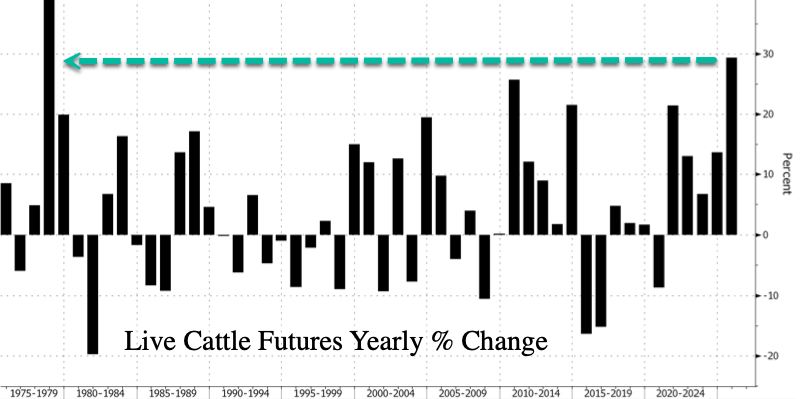
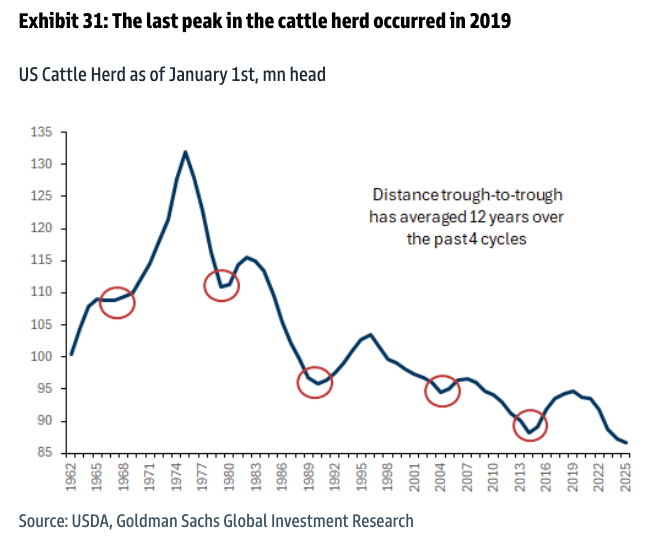
U.S. cattle futures are on track for their largest year-to-date gain since 1978 amid an ongoing beef cow shortage. The shortage has driven prices for feedlot cattle to record highs, with charts resembling those of gold or silver, and pushed USDA ground beef prices at supermarkets to record highs. Although Goldman has noted that the 12-year cattle herd cycle has reached a cyclical low, and Tyson CEO Donnie King recently said herd rebuilding will begin in 2026, prices continue to spiral out of control.
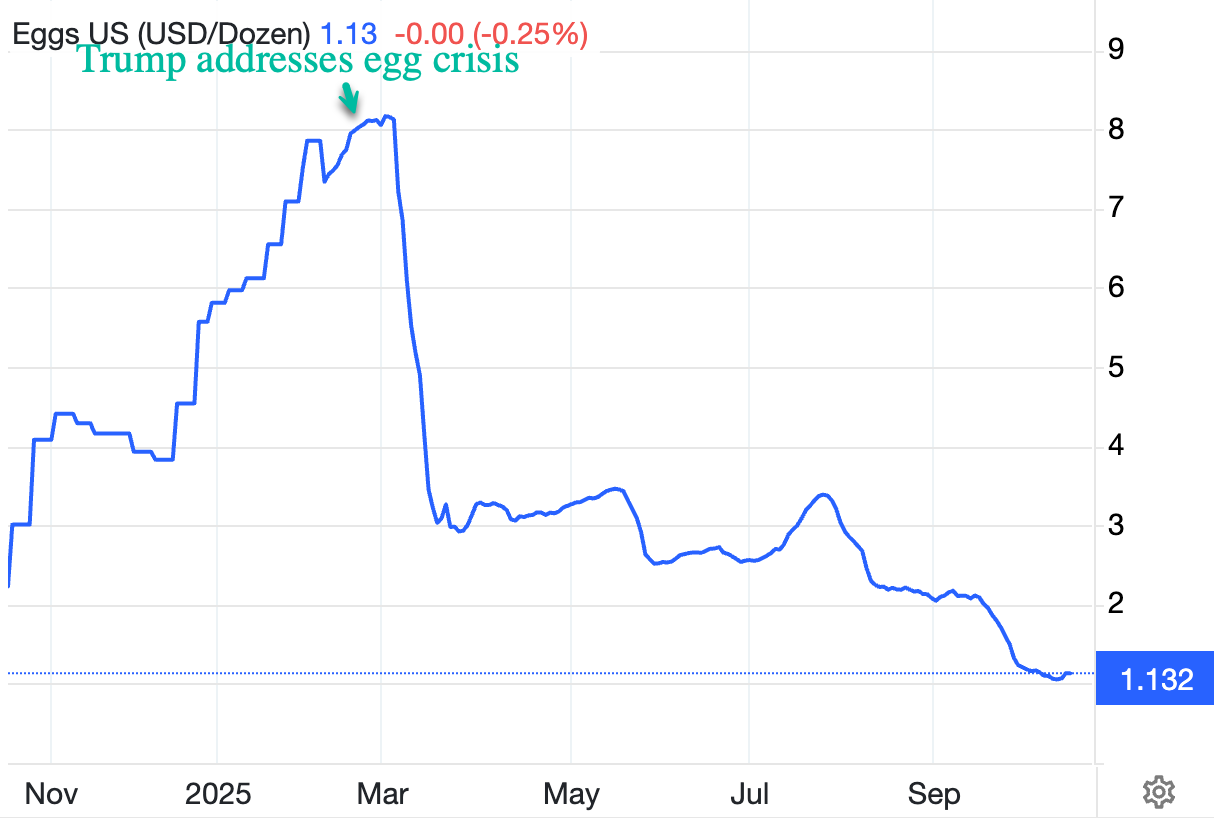
That’s prompted President Trump to take action – just like he did with eggs earlier this year – and told reporters in the Oval Office on Thursday that his administration has reached a deal to lower beef prices.
“We are working on beef, and I think we have a deal on beef that’s going to bring the price” down, Trump said, adding, “That would be the one product that we would say is a little bit higher than we want it, maybe higher than we want it, and that’s going to be coming down pretty soon too. We did something, we worked our magic.”
Trump didn’t provide details on what the federal action will be to lower beef prices, but acknowledged sticky food inflation, especially in the beef category. We must note that food inflation and beef shortage began well before Trump’s second term.
Bloomberg pointed out, “The president’s comments came days after he hosted Argentinian President Javier Milei at the White House to discuss trade and financing to help bolster the country’s economy. The US is a major importer of Argentine beef, though shipments are subject to an annual quota before expanded tariffs kick in.”
It’s likely the “magic” will come from Argentina.
Live Cattle futures in the U.S. have erupted similarly to gold and silver.
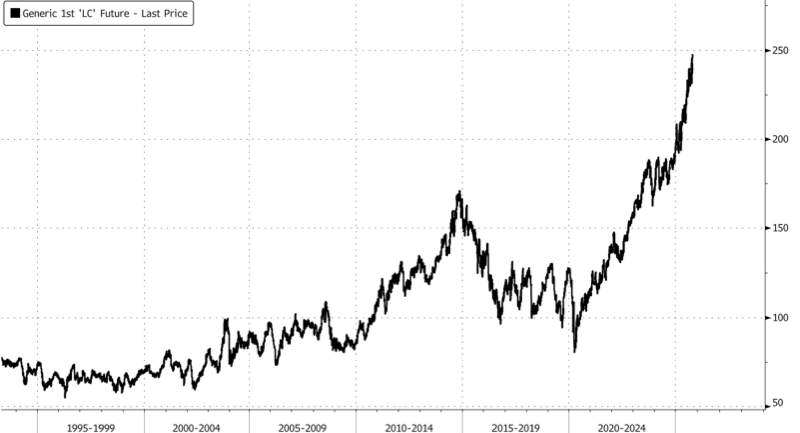
Year-to-date gains for Live Cattle futures are on par with 1978!
The good news about the beef cattle cycle:
- 12-Year Cattle Cycle Bottoms: Tyson CEO Predicts Rebuild Phase Beginning Next Year
- Got Beef? 12-Year Cycle Signals “Cyclical Low”
Here’s a visual breakdown of the beef industry’s turning points, as charted by Goldman analysts Leah Jordan and Eli Thompson…
Assume the administration is applying the same process as it did with arresting out-of-control egg prices sparked by the Biden-Harris regime’s reckless culling of egg-laying hens last year…
Related:
end
ASIAN MARKETS THIS FRIDAY MORNING:
SHANGHAI CLOSED DOWN 76.47 POINTS OR 1.95%
//Hang Seng CLOSED CLOSED DOWN 641.41 PTS OR 2.48%
// Nikkei CLOSED : DOWN 695.59 PTS OR 1,44% //Australia’s all ordinaries CLOSED DOWN 0.89%
//Chinese yuan (ONSHORE) CLOSED DOWN TO 7.1248// OFFSHORE CLOSED DOWN AT 7.1291/ Oil DOWN TO 56.82 dollars per barrel for WTI and BRENT DOWN TO 60.40 Stocks in Europe OPENED ALL RED
ONSHORE USA/ YUAN TRADING DOWN TO 7.1248 // OFFSHORE YUAN TRADING DOWN TO 7.1291 :/ONSHORE YUAN TRADING ABOVE OFF SHORE / AND THUS WEAKER/OFF SHORE YUAN TRADING DOWN AGAINST US DOLLAR/ AND THUS WEAKER
YOUR EARLY CURRENCY VALUES/GOLD AND SILVER PRICING/ASIAN AND EUROPEAN BOURSE MOVEMENTS/AND INTEREST RATE SETTINGS FRIDAY MORNING.7:30 AM
ONSHORE YUAN: CLOSED DOWN AT 7.12644
OFFSHORE YUAN: DOWN TO 7.1291
HANG SENG CLOSED DOWN 641.41 PTS OR 2.48%
2. Nikkei closed UP 605.09 PTS OR 1.27%
3. Europe stocks SO FAR: ALL RED
USA dollar INDEX DOWN TO 98.01 EURO RISES TO 1.1705 UP 6 BASIS PTS
3b Japan 10 YR bond yield: FALLS TO. +1.631//Japan buying 100% of bond issuance)/Japanese YEN vs USA cross now at 149.78…… JAPANESE YEN NOW FALLING AS WE HAVE NOW REACHED THE RE EMERGING OF THE YEN CARRY TRADE AGAIN AFTER DISASTROUS POLICY ISSUED BY UEDA. JAPAN 30 YR BOND YIELD: 3.121 DOWN 1 FULL BASIS PTS.
3c Nikkei now ABOVE 17,000
3d USA/Yen rate now well ABOVE the important 120 barrier this morning
3e Gold UP /JAPANESE Yen UP CHINESE ONSHORE YUAN: DOWN OFFSHORE: DOWN
3f Japan is to buy INFINITE TRILLION YEN worth of BONDS. Japan’s GDP equals 5 trillion USA
Japan to buy 100% of all new Japanese debt and NOW they will have OVER 50% of all Japanese debt.
3g Oil DOWN for WTI and DOWN FOR BRENT this morning
3h European bond buying continues to push yields lower on all fronts in the EMU. German 10yr bund YIELD DOWN TO +2.5508// Italian 10 Yr bond yield DOWN to 3.3610 SPAIN 10 YR BOND YIELD DOWN TO 3.085
3i Greek 10 year bond yield DOWN TO 3.232
3j Gold at $4239.25 Silver at: 53.83 1 am est) SILVER NEXT RESISTANCE LEVEL AT $50.00//AFTER 28.40
3k USA vs Russian rouble;// Russian rouble DOWN 0 AND 91 /100 roubles/dollar; ROUBLE AT 80.91
3m oil (WTI) into the 56 dollar handle for WTI and 60 handle for Brent/
3n Higher foreign deposits moving out of China// huge risk of outflows and a currency depreciation. This can spell financial disaster for the rest of the world/
JAPAN ON JAN 29.2016 CONTINUES NIRP. THIS MORNING RAISES AMOUNT OF BONDS THAT THEY WILL PURCHASE UP TO .5% ON THE 10 YR BOND///YEN TRADES TO 149.78/ 10 YEAR YIELD AFTER FIRST BREAKING .54% LAST YEAR NOW EXCEEDS THAT LEVEL TO 1.631% STILL ON CENTRAL BANK (JAPAN) INTERVENTION//YEN CARRY TRADE IS NOW UNWINDING.//JAPAN 30 YR: 3.121 DOWN 1 BASIS PTS.
30 SNB (Swiss National Bank) still intervening again in the markets driving down the FRANC. It is not working: USA/SF this 0.7837 as the Swiss Franc is still rising against most currencies. Euro vs SF: 0.9233 well above the floor set by the Swiss Finance Minister. Thomas Jordan, chief of the Swiss National Bank continues to purchase euros trying to lower value of the Swiss Franc.
USA 10 YR BOND YIELD: 3.963 DOWN 1 BASIS PTS…
USA 30 YR BOND YIELD: 4.576 DOWN 1 BASIS PTS/
USA 2 YR BOND YIELD: 3.395 DOWN 3 BASIS PTS
USA DOLLAR VS TURKISH LIRA: 41.95 UP 13 BASIS PTS/LIRA GETTING KILLED
10 YR UK BOND YIELD: 4.495 DOWN 1 PTS BUT STILL ESCALATING RAPIDLY
30 YR UK BOND YIELD: 5.302 DOWN 1 BASIS PTS
10 YR CANADA BOND YIELD: 3.086 DOWN 4 BASIS PTS
5 YR CANADA BOND YIELD: 2.645 DOWN 5 BASIS PTS.
2a New York OPENING REPORT
Futures Rebound From Overnight Plunge After Trump Eases Trade Fears
Friday, Oct 17, 2025 – 08:34 AM
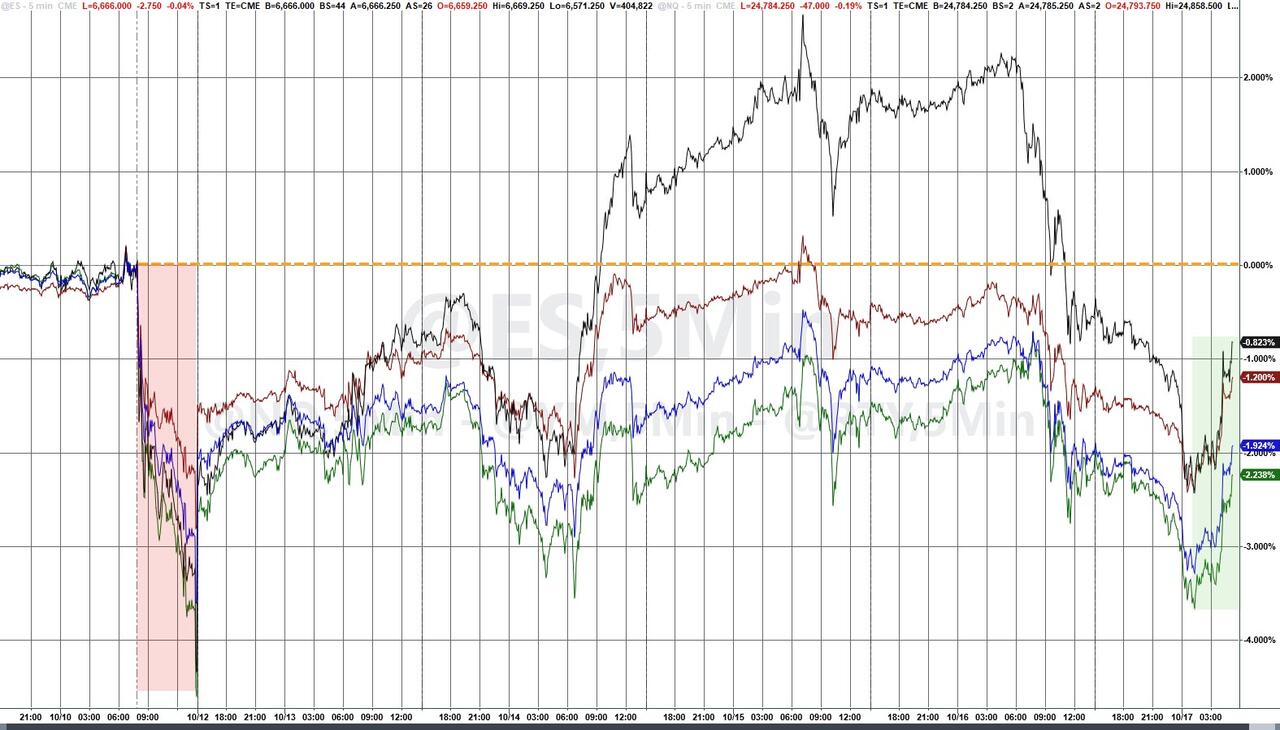
US equity futures initially tumbled for much of the overnight session on mounting market liquidity and regional bank concerns, but erased almost all losses just after 7am ET when US President Trump spoke to Fox and calmed fears of a trade war with China, lifting sentiment following yesterday’s steep declines in banking stocks.S&P 500 futures fell as much as 1.5% before paring the loss to 0.2% as of 8:00am ET. Here is a snapshot of Trump’s comments on Fox News this morning which helped reverse the selloff:
- TRUMP SAYS HE’S MEETING WITH CHINA’S XI IN TWO WEEKS
- TRUMP, ASKED IF HIGH CHINA TARIFFS WILL STAND: NO
- TRUMP ON CHINA TRADE: WE’LL SEE WHAT HAPPENS
- TRUMP: CHINA IS ALWAYS LOOKING FOR AN EDGE
- TRUMP ON CHINA TRADE: I DON’T KNOW WHAT’S GOING TO HAPPEN
- TRUMP ON CHINA TARIFFS: IT’S NOT SUSTAINABLE
- TRUMP: 100 PERCENT TARIFF IS NOT SUSTAINABLE
- TRUMP ON CHINA TARIFFS: WE’RE GOING TO DO FINE WITH CHINA
- TRUMP ON CHINA TARIFFS: WE HAVE TO HAVE A FAIR DEAL -FBN
Friday’s crop of earnings helped bolster regional banks, with Truist Financial Corp., Regions Financial Corp. and Fifth Third Bancorp all rising in early trading after they reported lower provisions for credit losses than expected. Overnight, there were not much incremental positive headlines. ORCL updated its revenue and EPS guidance and beat expectations; however, this positive update has been widely expected with a high bar entering this earnings season. Bond yields are 1-4bp lower; USD is lower. Commodities are mixed: oil lower; base metals mostly higher. The US economic calendar includes August TIC flows at 4pm. Housing starts and import/export price indexes will be delayed due to government shutdown. Fed speaker slate includes Musalem at 12:15pm, and Fed’s external communications blackout ahead of the Oct. 29 Fed policy decision begins Saturday
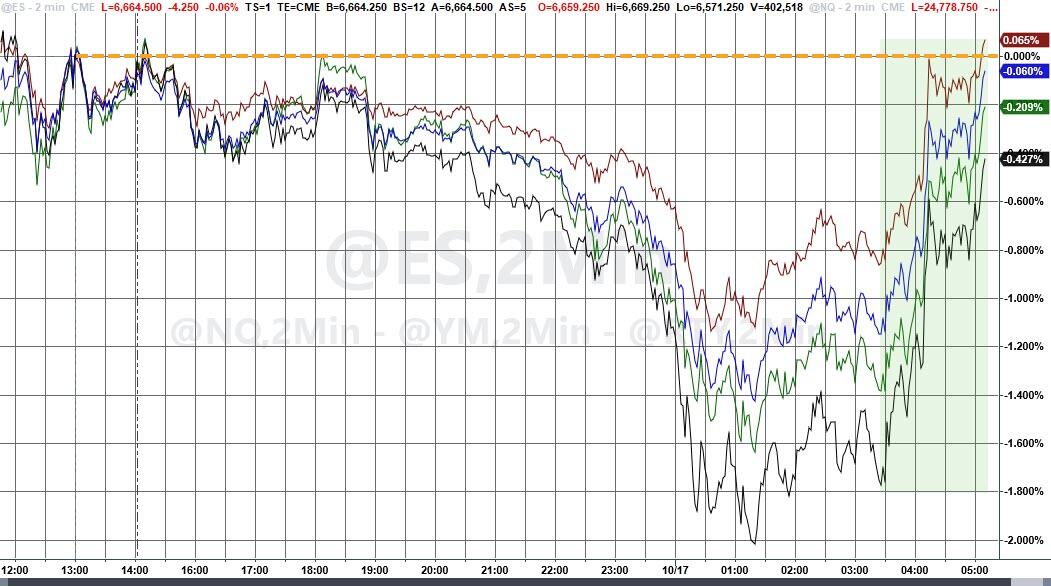
All the majors still remain down from Trump’s initial tweet last Friday
In premarket trading, Magnificent Seven stocks are lower (Microsoft -0.4%, Alphabet -0.4%, Apple -0.1%, Amazon -.1%, Meta -0.6%, Nvidia -1.2%, Tesla -0.8%).
- Cryptocurrency-linked stocks fall as Bitcoin liquidations continue and broader global equities markets selloff amid trade tensions between the US and China and worries over US regional banks.
- AST SpaceMobile (ASTS) falls 4% after Barclays downgrades the wireless telecommunications stock to underweight from overweight, citing expensive valuations.
- CSX (CSX) rises 2.8% after the freight transportation company reported third-quarter revenue above analysts’ estimates.
- Eli Lilly & Co. (LLY) declines 3% after President Donald Trump said the price of the blockbuster diabetes drug Ozempic could come down to just $150 a month.
- Fifth Third (FITB) rises 2.6% after the company reported earnings per share for the third quarter that beat the average analyst estimate. Net interest income FTE also also came in just above expectations.
- Huntington Bancshares (HBAN) rises 1.6% after posting third-quarter results.
- Micron (MU) falls 1.3% as Reuters reports that the chipmaker plans to stop supplying server chips to data centers in China after the business failed to recover from a 2023 government ban on its products in critical Chinese infrastructure.
- Truist Financial (TFC) rises 1.1% after the financial services company reported adjusted earnings per share and non-interest income that came in above the average analyst estimates
After a week when fears about escalating trade tensions between Washington and Beijing fueled sharp swings in stocks, Trump told reporters that current tariffs on China were “not sustainable” and confirmed he would meet with Xi Jinping in South Korea in the coming weeks, helping ease nerves.
The volatility has seen the VIX rise to its highest level since April. Meanwhile, havens such as Treasuries and gold erased gains following Trump’s remark and lender results.
“This very much looks like end-of-cycle symptoms, where we can see hints of complacency in lending standards,” said Raphael Thuin, head of capital markets strategies at Tikehau Capital. “With this year’s rally and costly valuations, the temptation to take profits and secure year-to-date gains is high.”
Still, while some analysts said the situation resembled the 2023 US regional banking crisis that led to the collapse of Silicon Valley Bank and UBS Group AG’s takeover of Credit Suisse, they expect the market reaction to be short-lived. Indeed, a rout in regional banks, sparked Thursday by news that Zions Bancorp and Western Alliance Bancorp were victims of fraud on loans to funds that invest in distressed commercial mortgages, appeared primed to reverse.
“In the end, the crisis was contained, but that was not immediately clear,” said Leonard Cohen, chief executive officer of Ginjer Asset Management in Paris. “The third quarter results of US banks were good so investors are taken by surprise and wondering if they didn’t miss the forest for the trees.”
Concern about credit quality in the US economy is adding to disquiet among investors already uneasy about renewed trade tension between the US and China, the US government shutdown and a potential AI bubble. From the return of headline risk to jitters around a regional banking crisis, the market is getting the reaction in volatility that was broadly expected by derivatives strategists — albeit about a month later than the seasonal window suggested historically. Confidence that stocks can quickly reclaim record highs has been shaken.
Meanwhile, BofA said that stocks saw a fifth week of inflows, at $12.4 billion for the week ended Oct. 15. S&P 500 capital expenditures will likely grow 17% in 2025, boosted by AI hyperscalers’ investments, spending that’s constraining outlays on buybacks, according to Goldman Sachs strategists. Strategist Ryan Hammond cut his 2026 buyback growth forecast to 9% from 12% to “reflect the continued rotation from buybacks to capex among AI-exposed stocks”.
As for earnings season, with the occasional exception, it remains very strong: of the 51 S&P 500 companies that have reported so far this earnings season, more than 82% have beaten analysts’ forecasts, nearly 16% have missed, and 2% were as expected.
In Europe, Deutsche Bank AG and Barclays Plc stayed more than 5% lower, with a gauge of lenders leading regional declines. The Stoxx 600 was off by 1.5%, amid broad declines in banking stocks on both sides of the Atlantic, and for tech stocks in US premarket trading. Here are the biggest movers Friday:
- EssilorLuxottica jump as much as 12% and to a record high after the eyewear group reported third-quarter revenue that soared past estimates, lifted by a new batch of AI glasses with partner Meta Platforms
- Vitrolife rises as much as 8%, one of the few gainers in the European health-care sector after US President Donald Trump advanced his campaign promise of making IVF less expensive and more widely available in the U
- European defense stocks slump after President Donald Trump said he would meet Vladimir Putin for a second time “within two weeks or so” to discuss ending the war in Ukraine
- Novo Nordisk shares fall as much as 7%, the most since July 29, after US President Donald Trump said the White House will negotiate to lower prices for weight-loss drugs such as Novo Nordisk’s Ozempic
- Volvo shares fall as much as 8%, after the Swedish truckmaker said it expects a slowdown to extend into next year as uncertainties linked to President Donald Trump’s tariffs weigh on demand in North America
- Tomra falls as much as 15%, the most since June, after the Norwegian recycling equipment company reported earnings. DNB Carnegie says company is showing weakness in all regions
- Norion Bank falls as much as 12%, the most since March, after the Swedish niche lender reported earnings that fell short of estimates
- QT Group shares fall as much as 22%, the most in two monthst, after the Finnish technology group cut its operating margin forecast for the full year
Earlier in the session, Asian stocks slumped, hurt by lingering worry over US-China frictions and as loan problems at two American regional banks heightened concerns about the credit market. The MSCI Asia Pacific Index fell as much as 1.2%, snapping a two-day gain, with financials and tech hardware the biggest drags. TSMC dropped, with investors seen taking profits after the chipmaker raised its revenue outlook on strong AI demand. Hong Kong and mainland China benchmarks were among the worst performers amid the ongoing trade spat with the US. Investors also are positioning after the strong recent rally, with eyes on next week’s Fourth Plenum policy meetings. Japanese stocks fell as investors eye continued uncertainty over the local political situation. Key gauges also slid in Indonesia, Taiwan and Australia.
In Fx, the dollar reverses an earlier decline. The Bloomberg Dollar Spot Index is up to 1208; the Swiss franc and yen were the biggest gainers but have since reversed much of their gains.
In rates, Treasury yields reversed losses with outperformance at the short-end, and the 10Y rising 2bps to 4.00% after sliding as low as 3.93%.
In commodities, gold reversed its overnight surge, and after touching another record high of $4,380 it has since dropped below $4,300. Oil prices in the red, with WTI futures slipping below $57/barrel and Brent holding above $60/barrel. Crypto tumbling too, with Bitcoin touching the lowest since June.
Looking at the US economic calendar calendar includes August TIC flows at 4pm. Housing starts and import/export price indexes face delays due to government shutdown. Fed speaker slate includes Musalem at 12:15pm, and Fed’s external communications blackout ahead of the Oct. 29 Fed policy decision begins Saturday
Market Snapshot
- S&P 500 mini -0.1%,
- Nasdaq 100 mini -0.4%,
- Stoxx Europe 600 -1.0%,
- DAX -2%,
- CAC 40 -0.6%
- 10-year Treasury yield +2 basis point at 3.99%
- VIX -1.7 points at 24.5
- Bloomberg Dollar Index up to 1208.23
- euro +0.1% at $1.1702
- WTI crude -1% at $56.87/barrel
Top Overnight News
- The White House is poised to ease tariffs on the US auto industry, a move that would deliver a major win for carmakers that have aggressively lobbied to stem the fallout from record-level import duties. The Commerce Department is slated to announce a five-year extension for an arrangement that allows automakers to reduce what they pay in tariffs on imported car parts. BBG
- US Senator Majority Leader Thune said the Senate is expected to vote next week on a bill to pay federal workers who have been forced to work without pay which would include the military, according to Punchbowl.
- Donald Trump will host Volodymyr Zelenskiy at the White House today. The Ukrainian President will also meet representatives from defense companies including Raytheon during his US visit. BBG
- Shares in US regional banks fell on Thursday after two lenders disclosed that they were exposed to alleged fraud by borrowers, raising concerns about the health of bank loan portfolios. The disclosures by Western Alliance Bank and Zions Bank follow the recent failures by car parts maker First Brands and auto lender Tricolor, which have left credit investors nursing losses and are under scrutiny from the US DOJ. FT
- The Trump administration’s slashing of the federal workforce amid the government shutdown is threatening AI work at the Commerce Department: Axios
- Tech companies aggressively shift their supply chains out of China – Microsoft aims to produce the majority of its new products outside of China as early as next year, while AWS is expanding its supply chain shift down to the component level. Nikkei
- Micron plans to stop supplying server chips to data centers in China after the business failed to recover from a 2023 government ban on its products in critical Chinese infrastructure, two people briefed on the decision said. Micron was the first U.S. chipmaker to be targeted by Beijing – a move that was seen as retaliatory for a series of curbs by Washington aimed at impeding tech progress by China’s semiconductor industry. RTRS
- The US asked South Korea to increase soybean imports during trade negotiations, DongA Ilbo reported. American supplies account for half of the country’s purchases. BBG
- ORCL AI World proving to be another sell-the-news event after yesterday’s TSM print as it trades lower in the pre this morning. ORCL closed +3% yesterday after projecting better margins than expected at its Analyst Day, but moved lower after the company announced further long-term revenue and profit forecasts after the close (ORCL -3.6% premkt). H/T GS TMT Trading
- Novo Nordisk shares dropped (NVO -450bps premkt) and Eli Lilly fell premarket (LLY -420bps) after Trump said the price of Ozempic may come down to just $150 a month — compared to about $1,000 currently. BBG
- The Trump administration is sharply increasing U.S. military pressure on the government of Nicolás Maduro, Venezuela’s authoritarian president, with a dramatic show of aerial threats in recent days as the Pentagon mounts a major troop buildup in the region. NYT
- On US Obamacare credit extension, Punchbowl writes “it’s true” that there are House Republicans who want to extend the credits; however, House Republican leadership does not want to, and their view is “hardening as the shutdown drags on”
- Fed Governor Miran said the downside of tariffs has been nowhere near what people predicted and that tariffs have had no material signs of growth drag or inflation spike, while he doesn’t think the cost of tariffs will be passed onto consumers.
- Fed’s Kashkari (2026 voter) said it is too soon to know the effect of tariffs on inflation and the impact of tariffs is taking longer to be felt than had guessed, while he expects services inflation to trend down and it is possible that goods inflation could spill over. Furthermore, he said the job market is slowing down and it is challenging to read signals without core government data because of the shutdown, as well as noted that most folks say they are still concerned about inflation.
Trade/Tariffs
- US State Department said Secretary of State Rubio and USTR Greer met with Brazil’s Foreign Affairs Minister Vieira and had very positive talks regarding trade and ongoing bilateral issues, while they agreed to work together to schedule a meeting between President Trump and President Lula at the earliest possible occasion.
- US State Department said China’s sanctions against Hanwha Ocean’s (042660 KS) US-linked units are attempts to undermine US-South Korea cooperation and coerce South Korea.
- South Korean Finance Minister said it’s ‘uncertain’ whether US President Trump will accept Korea’s position against an ‘upfront’ USD 350bln payment related to their tariff/trade agreement, according to Yonhap.
A more detailed look at global markets courtesy of Newsquawk
APAC stocks were predominantly lower as the region followed suit to the losses on Wall Street, where risk sentiment took a hit as regional bank concerns were reignited following loan fraud disclosures by Western Alliance and Zions Bancorp. ASX 200 was led lower by underperformance in financials, energy and tech, while gold miners were boosted by the record highs in the precious metal. Nikkei 225 retreated amid a firmer currency and as banking stocks suffered in sympathy with US counterparts, while uncertainty lingered ahead of next Tuesday’s PM vote with the Japanese Innovation Party noting a 50-50 chance of a coalition with the LDP. Hang Seng and Shanghai Comp conformed to the downbeat mood amid US-China frictions, with both sides blaming each other for the tensions.
Top Asian News
- Japan’s LDP and CDP agreed to hold a vote to decide Japan’s next PM on October 21st, while it was also reported that Japan Innovation Party co-leader Yoshimura said the chance of a coalition with the LDP is 50-50.
- Japan’s Ishin Party (Innovation Party) Co-head Fujita announces big progress with the LDP following talks; will enter the stage of finalising details, final discussions are very delicate.
- Japan’s Komeito party is reportedly arranging not to vote for the opposition PM candidate, according to Kyodo.
- BoJ’s Uchida says Japan’s economy is recovering moderately, although there are some weak signs. The BoJ will continue to raise interest rate if prices move in line with our forecast.
European equities (STOXX 600 -1.8%) opened entirely in the red and dipped soon after the cash open, before finding a base where indices currently reside. The ongoing US regional banking fears remain at the forefront of traders’ minds. European sectors are all negative. Banks/Financial Services unsurprisingly underperform, given the aforementioned banking fears. Elsewhere, Defence names across Europe have been pressured after the White House suggested that the latest Trump-Putin conversation was good and constructive. US equity futures (ES -1% NQ -1.2% RTY -1.6%) continue to extend the losses seen in the prior session, in-fitting with the risk tone. It is worth highlighting that the Regional Banking ETF (KRE) is lower by roughly 2% in the US pre-market.
Top European News
- BoE’s Mann said the UK labour market is loosening but not falling off a cliff, while she added that the UK yield curve now provides a more appropriate financial condition for the UK economy.
- ECB’s Scicluna said the ECB must not rush further interest rate action, because the effects of higher US tariffs on prices aren’t yet clear, according to Bloomberg.
FX
- DXY is net lower with the USD showing a divergent performance vs. peers on account of the risk-averse moves triggered by the recent selling in regional US banks. As such, the USD is weaker vs. havens (CHF, JPY) and bid vs. risk-sensitive currencies (AUD, NZD). The question for markets is whether the selling pressure in Zions and Western Alliance Bancorp (on account of exposure to fraudulent loans) is a deep systemic issue or something that will have limited contagion, as per the SVB debacle in 2023. DXY hit a new low for the week at 98.02 (coincides with the 50DMA), before bouncing off the lows.
- EUR is up against the USD for a fourth session in a row on account of an aversion by the market to bid up the USD amid regional banking concerns and markets continuing to find solace in the developments in French politics this week. On the latter, with Lecornu having survived two no-confidence motions and odds of legislative elections by year-end receding to just 27% (vs. 50%+ earlier in the week), attention now turns to the subsequent debate and potential passage of the budget, as well as Moody’s rating on France next Friday. Elsewhere, headline EZ HICP Finals were unrevised, and had limited impact on the Single-Currency. EUR/USD has eclipsed its 50DMA at 1.1692.
- JPY outperforms major peers on account of a haven bid alongside the selling in global equity markets. Subsequently, USD/JPY has slipped below the 150 mark for the first time since October 6th. From a domestic viewpoint, focus remains on the political landscape with the JIP co-head announcing “big progress” in discussions with the LDP party and stating that they will be entering the stage of finalising details. On the BoJ, comments from Governor Ueda over the past 24 hours have reiterated the Bank’s view of raising rates if its economic forecasts are realised, whilst Assistant Governor Shimzu has noted that the Bank must tread carefully. USD/JPY has delved as low as 149.39 with the next downside target ahead of the 149 mark coming via the 6th October low at 149.04.
- The recovery in the pound vs. the dollar has faltered today on account of the broader risk tone. From a macro perspective, this week in the UK has been characterised by soft labour market metrics and sluggish growth with the former increasingly acknowledged by several BoE speakers this week. Next week also sees flash PMI and retail sales metrics, which are likely to be hampered by ongoing budget-related angst. Today’s speaker slate includes BoE’s Pill, Greene & Breeden.
- Antipodeans are both lower vs. the USD on account of the risk-averse tone in the market with AUD continuing to lag its antipodean peer following yesterday’s soft jobs metrics from Australia.
- PBoC set USD/CNY mid-point at 7.0949 vs exp. 7.1154 (Prev. 7.0968)
Fixed Income
- USTs are firmer, as the US regional banking backdrop remains at the forefront of market focus for today. USTs peaked at 114-02 early doors, sending the US 10yr yield below the 4% mark for the first time since April; for reference, the April low was 3.86%. Since, the benchmark has pulled back to just below the 114-00 mark but holds onto gains of c. 5 ticks on the session and around 25 on the week, as things stand.
- Bunds are bid, given the general risk tone and FTQ seen after the US regional banking flareup on Thursday. Bunds peaked at 130.59 early doors before seeing a relatively sharp pullback as the European morning got underway, to a 130.22 low; but, still firmer on the session. European specific newsflow of note for fixed income a little light, aside from largely unrevised headline HICP metrics. The docket ahead features ECB’s Nagel and Rehn.
- Gilts gapped higher by 46 ticks, acknowledging the upside seen in peers on Thursday after the Gilt close as the US regional banking situation reverberated to the broader risk tone. Opened at 93.10 and extended to a 93.17 peak, notching a new high for the week and taking the benchmark to its highest since July when Gilts briefly traded above 93.50. Amidst this, the UK 10yr yield found itself under pressure and to a 4.45% low; the lowest since July when 4.41% printed. Ahead, we have a handful of BoE speakers due. On the hawkish side, Pill and Greene feature and are followed by the usually more neutral Breeden.
Commodities
- WTI and Brent are pressured today amidst the ongoing risk-off sentiment, and as traders digest the latest constructive commentary surrounding the latest Trump-Putin call. The White House described that call as “good and productive” and have agreed to convene a meeting of high-level staff next week. WTI and Brent are currently trading towards the lower end of their respective USD 56.73-57.56/bbl and USD 60.30-61.11/bbl range.
- Spot gold continues to advance and remains at top end of the day’s range (USD 4,279.10-4,380.79/oz). Price action this morning fairly rangebound, but ultimately at elevated levels given the risk-off environment.
- Base metals are lower across the board, pressured by the risk tone; 3M LME Copper currently off by around 1.6% in a USD 10,461.6-10,637.5/t range.
Geopolitics
- Hamas said the return of Israeli hostages’ bodies may take time as some were buried in tunnels destroyed by Israel and others remain under rubble, while the retrieval requires equipment to remove rubble, which is currently unavailable due to Israel’s entry ban on such tools. Furthermore, it stated that it remains committed to the Gaza agreement and is keen to hand over all remaining hostages’ bodies.
- “Israeli Foreign Minister: Israel is committed to Trump’s plan, but Hamas is violating the agreement by holding the remains of 19 of our dead hostages”, according to Sky News Arabia
- US President Trump said regarding Russian President Putin and Ukrainian President Zelensky, that they might do separate meetings, while he will probably meet Putin over the next two weeks. Trump commented that Tomahawks are also needed for the US, and he responded that he will speak to Senate Majority Leader Thune after House Speaker Johnson, about the Putin call and make the right determination, when asked about Russian sanctions.
US Event Calendar
- 8:30 am: Sep Housing Starts, est. 1320k, prior 1307k
- 8:30 am: Sep P Building Permits, est. 1343k, prior 1330k
- 8:30 am: Sep Housing Starts MoM, est. 0.99%, prior -8.5%
- 8:30 am: Sep Import Price Index MoM, est. 0.1%, prior 0.3%
- 8:30 am: Sep Import Price Index YoY, est. 0.35%, prior 0%
- 4:00 pm: Aug Net Long-term TIC Flows, prior 49.2b
- 4:00 pm: Aug Total Net TIC Flows, prior 2.1b
DB’s Jim Reid concludes the overnight wrap
Market sentiment saw a sharp deterioration over the past 24 hours as news of bad loans at two US regional lenders triggered broader concerns about credit quality, leading US bank stocks to their worst day since early April while the S&P 500 sank -0.63%. Other risk assets also struggled, with US HY credit spreads +10bps wider. Treasuries rallied with the 2yr yield dropping -7.3bps to a 3-year low of 3.42%, also helped by oil prices falling to a new 5-month low. Earlier yesterday, French Prime Minister Lecornu survived his two no-confidence votes, which led to another sizable advance for the CAC 40 (+1.38%), with the STOXX 600 (+0.69%) outperforming its US counterparts.
An initially positive risk mood turned during the US session yesterday after news that Zions Bancorp (-13.14%) made a $50m charge-off while Western Alliance (-10.81%) alleged it also suffered from fraud on loans to the same borrowers linked to distressed commercial mortgages. While this was an ostensibly isolated story at two banks each less than $10bn market cap, the event drew inevitable comparisons to the regional bank stress that followed the collapse of SVB in March 2023 and raised broader questions over potential credit quality issues after a lengthy period of elevated rates and expansion in private credit, following also the bankruptcy of subprime auto lender Tricolor last month.
US bank stocks struggled in response, as the KBW regional bank index plunged by -6.31% while the S&P 500 banks sector group fell -2.98%, with both posting their worst days since the post-Liberation Day turmoil in early April. The volatility weighed on the broader S&P 500 (-0.63%), with the small cap Russell 2000 (-2.09%) underperforming and the VIX index rising to its highest since April (+4.67pts to 25.31). A cautious mood has continued overnight, with futures on the S&P 500 (-0.44%) and NASDAQ (-0.29%) both lower.
Treasuries rallied amid the risk-off sentiment, with 2yr yields falling -7.3bps to their lowest since September 2022 when the Fed was still midway through its hiking cycle. That came as fed funds futures priced in 54bps of rate cuts by year-end (+5.7bps on the day), the first time that two more 25bps Fed cuts have been fully priced. Meanwhile, 10yr yields fell -5.4bps to a 12-month low of 3.97% and are another -3.0bps lower overnight. The dollar index (-0.46%) lost ground yesterday amid lower rates, while gold saw its biggest daily rise since May (+2.83%) to reach a new high of $4,326/oz and is another +0.79% higher this morning.
That rally in Treasuries came despite measured Fedspeak earlier in yesterday’s session. Notably, Fed Governor Waller reiterated his support for a 25bps cut in October, but said that beyond then, he would be “looking for how the solid GDP data reconcile with the softening labor market”. That suggested Waller may see a December rate cut as not quite a done deal, even as he has been one of the more dovish voices within the FOMC and is one of the five candidates reported to be in the short-list for Fed Chair. By contrast, Governor Miran repeated his call for a larger 50bps rate cut, while Richmond Fed President Barkin said he was still “sanguine” on the employment and inflation outlook. Waller also appeared to echo Powell’s signal earlier in the week that reserves may soon approach ample levels. With the recent shift in tone, our US rates strategists now expect the Fed to announce the end of QT at the December meeting (see here).
A notable exception from the sour risk mood yesterday was the Philadelphia Semiconductor Index (+0.49%), which held onto gains driven by positive results from TSMC and upbeat margin guidance from Oracle (+3.09%).
European markets had closed before most of the US sell-off, with the STOXX 600 up +0.69%. Indices were higher across the continent, led by a +1.38% gain for France’s CAC after French PM Lecornu survived his two votes for no confidence. The government’s chances of survival had improved as the Socialist Party declared they would not vote to topple the government after Lecornu announced that he would suspend the 2023 pension reform until after the 2027 presidential election. The first round vote came fairly close (271 deputies voted no confidence vs the 289 needed), although only 144 deputies voted for no confidence in the second round. The result helped the 10yr Franco-German spread inch -0.6bps lower to 76bps, its lowest since late August. Attention will now turn to passing the 2026 budget, with our economists expecting the government to limit amendments as it seeks to keep the deficit below 5% of GDP. See their note yesterday on the budget process here.
European bond moves were muted overall, with the 2yr bund yield down -1.3bps while the 10yr was unchanged. The front-end rally came as the amount of ECB rate cuts priced by next June rose +3.4bps to 19bps, its highest since August, with investors focusing on the potential for lower oil prices to increase the size of the inflation undershoot expected over the next year. These moves came despite comments by Governing General Council members Nagel, Wunsch and Dolenc playing down the inflation undershoot, while Rehn noted “two sided” risks to the inflation outlook. Meanwhile in the UK, gilts outperformed, with the 10yr yield down -4.2bps after underwhelming August GDP data. While the UK economy grew +0.1% m/m as expected, July was revised down from 0.0% to -0.1% m/m and services activity was flat for a second month running in August (vs +0.1% expected).
Turning to the limited US data amid the shutdown, investors got a surprise when the Philadelphia Fed factory index for October came in much weaker (-12.8 vs +10.0 expected). However, the details of the survey were not quite as weak as the headline and the move ought to be judged together with Wednesday’s Fed Empire reading, which saw a near mirror opposite upside surprise.
Finally on geopolitics, Trump and Russia’s President Putin held a two-hour phone call yesterday. The main outcome was an agreement for the two to meet in Budapest, which Trump suggested could take place “within two weeks or so”, after US and Russia first hold high-level staff talks next week. The US President expressed optimism that the meeting could lead to a breakthrough towards peace in Ukraine, progress on which has stalled since the last Trump-Putin summit in Alaska in August. The Trump-Putin call came just ahead of Ukraine President Zelenskiy visiting Trump in Washington today. Prospects of a new Trump-Putin summit helped ease market fears of new restrictions against Russian oil, with Brent crude falling -1.37% to $61.06/bbl, its lowest since May.
Asian equity markets this morning are mostly following the losses on Wall Street. Across the region, Chinese equities are leading the decline, most of all the Hang Seng (-1.57%), followed by the CSI (-1.27%) and the Shanghai Composite (-1.00%). US-China trade tensions are negatively impacting sentiment with China’s Ministry of Commerce yesterday accusing the US of inciting “panic” over its rare earth controls, saying “the US interpretation seriously distorts and exaggerates China’s measures”. Elsewhere, the Nikkei (-0.98%) is also lower, with financial stocks underperforming after the sharp declines in US regional banks, after having seen substantial gains in the previous two sessions.
Conversely, the KOSPI (+0.23%) is defying the region’s negative trend, though it’s given up most of its initial gains of up to +1.23% driven by battery and chemicals shares amid optimism for a potential trade agreement with the US.
In central bank news, BoJ Governor Ueda has indicated that the central bank will persist with tightening measures if confidence in achieving its economic outlook improves, thereby leaving the possibility open for a near-term interest rate hike. Ueda’s remarks were the first since Sanae Takaichi’s election as the leader of the ruling Liberal Democratic Party (LDP) earlier this month. Still, 10yr JGB yields are -4.5bps lower this morning, following the move in US Treasuries.
To the day ahead now, and we’ll get central bank speakers including Fed’s Musalem speaks, ECB’s Nagel and Rehn speak, BoE’s Pill, Greene and Breeden speak. Notable earnings include American Express and Volvo.
2b) European opening report
2c) Asian opening report
Stocks pressured on US regional banking woes, White House said Trump-Putin call was productive – Newsquawk European Opening News

Friday, Oct 17, 2025 – 01:36 AM
- US stocks were pressured with risk-off trade seen amid a reignition of regional banking woes after Western Alliance (WAL) and Zion Bancorp (ZION) announced exposure to bad loans tied to fraud, adding to the concerns following the collapse of Tricolor and First Brands.
- US KRE (Regional Banking ETF) closed lower by over 6% and the financial sector saw a near 3% hit, while the broad risk sentiment was hit with equities sliding throughout the US session.
- APAC stocks were predominantly lower as the region followed suit to the losses on Wall Street, where risk sentiment took a hit as regional bank concerns were reignited following loan fraud disclosures by Western Alliance and Zion Bancorp.
- European equity futures indicate a lower cash market open with Euro Stoxx 50 futures down 0.9% after the cash market closed with gains of 0.8% on Thursday.
- White House said regarding the Trump-Putin call that it was good and productive, while they have agreed to convene a meeting of high-level staff next week, which may then be followed by another Trump-Putin meeting.
- Looking ahead, highlights include EZ HICP Final (Sep), Atlanta Fed GDP, Suspended Releases: US Building Permits/Housing Starts (Sep), Industrial Production (Sep), Speakers including BoE’s Pill, Greene & Breeden, Fed’s Musalem, ECB’s Nagel, Earnings from Ally Financial, SLB, American Express, State Street & Volvo AB.
SNAPSHOT
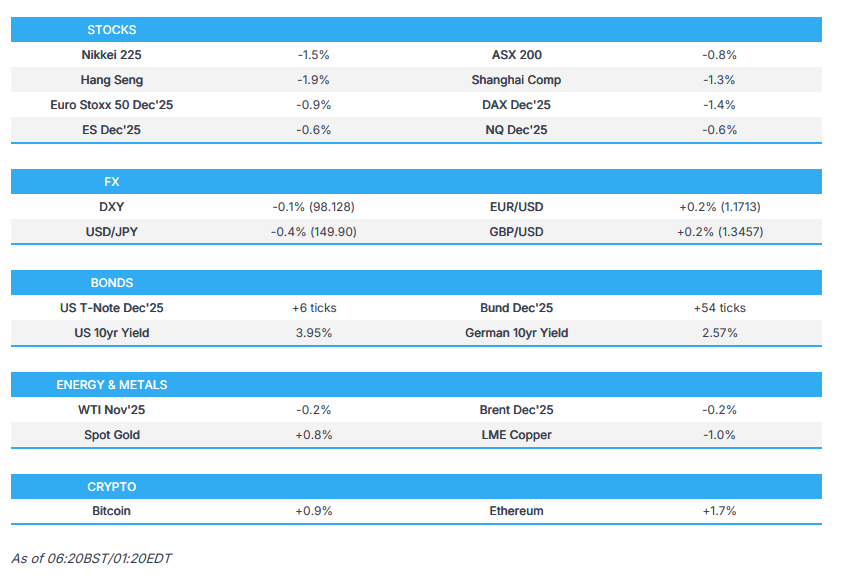
Newsquawk in 3 steps:
1. Subscribe to the free premarket movers reports
2. Listen to this report in the market open podcast (available on Apple and Spotify)
3. Trial Newsquawk’s premium real-time audio news squawk box for 7 days
LOOKING AHEAD
- Highlights include EZ HICP Final (Sep), Atlanta Fed GDP, Suspended Releases: US Building Permits/Housing Starts (Sep), Industrial Production (Sep), Speakers including BoE’s Pill, Greene & Breeden, Fed’s Musalem, ECB’s Nagel, Earnings from Ally Financial, SLB, American Express, State Street & Volvo AB.
- Click for the Newsquawk Week Ahead.
US TRADE
EQUITIES
- US stocks were pressured with risk-off trade seen amid a reignition of regional banking woes after Western Alliance (WAL) and Zion Bancorp (ZION) announced exposure to bad loans tied to fraud, adding to the concerns following the collapse of Tricolor and First Brands.
- The regional banking woes saw KRE (Regional Banking ETF) close lower by over 6% and the financial sector saw a near 3% hit, while the broad risk sentiment was hit with equities sliding throughout the US session, which spurred haven flows.
- SPX -0.63% at 6,629, NDX -0.36% at 24,657, DJI -0.65% at 45,952, RUT -2.09% at 2,467.
- Click here for a detailed summary.
TARIFFS/TRADE
- US State Department said Secretary of State Rubio and USTR Greer met with Brazil’s Foreign Affairs Minister Vieira and had very positive talks regarding trade and ongoing bilateral issues, while they agreed to work together to schedule a meeting between President Trump and President Lula at the earliest possible occasion.
- US State Department said China’s sanctions against Hanwha Ocean’s (042660 KS) US-linked units are attempts to undermine US-South Korea cooperation and coerce South Korea.
- South Korean Finance Minister said it’s ‘uncertain’ whether US President Trump will accept Korea’s position against an ‘upfront’ USD 350bln payment related to their tariff/trade agreement, according to Yonhap.
NOTABLE HEADLINES
- Fed Governor Miran said the downside of tariffs has been nowhere near what people predicted and that tariffs have had no material signs of growth drag or inflation spike, while he doesn’t think the cost of tariffs will be passed onto consumers.
- Fed’s Kashkari (2026 voter) said it is too soon to know the effect of tariffs on inflation and the impact of tariffs is taking longer to be felt than had guessed, while he expects services inflation to trend down and it is possible that goods inflation could spill over. Furthermore, he said the job market is slowing down and it is challenging to read signals without core government data because of the shutdown, as well as noted that most folks say they are still concerned about inflation.
- US President Trump said they will dramatically slash the cost of IVF and that prices of fertility drugs are going way down, while Trump also said he thinks they have a deal on beef to bring down prices.
- The Trump administration’s slashing of the federal workforce amid the government shutdown is threatening AI work at the Commerce Department, according to Axios, citing sources close to the agency.
- US Senator Majority Leader Thune said the Senate is expected to vote next week on a bill to pay federal workers who have been forced to work without pay which would include the military, according to Punchbowl. It was separately reported that Thune is quietly pressing President Trump to reopen key farm loans during the shutdown, according to Politico.
- US nears tariff relief for auto industry after lobbying push and is to make an announcement as soon as Friday, according to Bloomberg.
APAC TRADE
EQUITIES
- APAC stocks were predominantly lower as the region followed suit to the losses on Wall Street, where risk sentiment took a hit as regional bank concerns were reignited following loan fraud disclosures by Western Alliance and Zion Bancorp.
- ASX 200 was led lower by underperformance in financials, energy and tech, while gold miners were boosted by the record highs in the precious metal.
- Nikkei 225 retreated amid a firmer currency and as banking stocks suffered in sympathy with US counterparts, while uncertainty lingered ahead of next Tuesday’s PM vote with the Japanese Innovation Party noting a 50-50 chance of a coalition with the LDP.
- Hang Seng and Shanghai Comp conformed to the downbeat mood amid US-China frictions, with both sides blaming each other for the tensions.
- US equity futures (ES -0.5%) languished near the prior day’s lows after regional bank concerns triggered a broad risk-off mood.
- European equity futures indicate a lower cash market open with Euro Stoxx 50 futures down 0.9% after the cash market closed with gains of 0.8% on Thursday.
FX
- DXY traded rangebound, which provided some respite from this week’s selling pressure that had been triggered by US-China trade frictions and regional bank woes after Western Alliance and Zion Bancorp announced exposure to bad loans tied to fraud.
- EUR/USD extended on advances to reclaim the 1.1700 status after benefitting from recent dollar weakness, while there were recent comments from ECB speakers, including Lagarde, who noted they are well-positioned to face future shocks, and Dolenc stated that the next ECB move could be a hike or a cut.
- GBP/USD remained afloat after mildly gaining in the aftermath of the monthly GDP and output data, although the upside was limited and there was little reaction seen to comments from BoE’s Mann that the UK labour market is loosening
- USD/JPY tested the 150.00 level to the downside amid the risk-off mood and recent unwinding of the Takaichi trade.
- Antipodeans were somewhat mixed in rangebound trade with headwinds in AUD/USD from the downbeat risk tone.
- PBoC set USD/CNY mid-point at 7.0949 vs exp. 7.1154 (Prev. 7.0968)
FIXED INCOME
- 10yr UST futures extended on gains after rallying yesterday as regional bank concerns spurred a flight to quality.
- Bund futures lingered around a four-month high above the 130.00 level following the recent haven flows.
- 10yr JGB futures tracked the upside in global counterparts owing to a haven bid and with firmer demand at the enhanced liquidity auction.
COMMODITIES
- Crude futures were indecisive after declining yesterday amid the global risk-off sentiment on potential regional banking woes, while the latest weekly EIA inventory report also showed a larger-than-expected build in headline crude stockpiles.
- US EIA Weekly Crude Stocks: 3.524M vs. Exp. 0.288M (Prev. 3.715M).
- White House official said the US and India have had productive discussions that have led India to already cut Russian oil imports by 50%.
- Spot gold swung between gains and losses in which the precious metal initially rallied to a fresh all-time high of around USD 4,380/oz but then wiped out its gains and then some, in tandem with a pullback in silver from record levels, before returning to near its peak.
- Copper futures retreated alongside the intraday declines across the commodities complex in risk-off trade.
CRYPTO
- Bitcoin gained overnight, albeit in a choppy fashion with prices back above the USD 109k level.
NOTABLE ASIA-PAC HEADLINES
- BoJ Governor Ueda said the global economy is resilient, but uncertainty is high and faces complex challenges that could weigh on medium- and long-term growth outlook, while his view on the global economy and outlook has not changed much from before he visited the US. Ueda said the impact of tariffs on the global and US economy is being delayed, which is keeping growth resilient, while he stated that they will adjust the degree of monetary support in accordance with the likelihood of their growth and inflation forecasts materialising.
- BoJ Assistant Governor Shimizu said every country is facing a number of uncertainties, particularly from trade policy, which could have an adverse impact on corporate and household sentiment. Shimizu said inflation expectations in Japan are still below 2%, so they have to lift expectations and continue to support economic activity. Furthermore, he said it is not known exactly how Japan’s economy will react to the new environment on interest rates, which is why the BoJ has to be very careful in proceeding with policy normalisation.
- Japan’s LDP and CDP agreed to hold a vote to decide Japan’s next PM on October 21st, while it was also reported that Japan Innovation Party co-leader Yoshimura said the chance of a coalition with the LDP is 50-50.
DATA RECAP
- Singapore Non-Oil Exports MM (Sep) 13.0% vs Exp. 9.0% (Prev. -8.9%)
- Singapore Non-Oil Exports YY (Sep) 6.9% vs Exp. -2.1% (Prev. -11.3%)
GEOPOLITICS
MIDDLE EAST
- US President Trump warned that “If Hamas continues to kill people in Gaza, which was not the Deal, we will have no choice but to go in and kill them”.
- Hamas said the return of Israeli hostages’ bodies may take time as some were buried in tunnels destroyed by Israel and others remain under rubble, while the retrieval requires equipment to remove rubble, which is currently unavailable due to Israel’s entry ban on such tools. Furthermore, it stated that it remains committed to the Gaza agreement and is keen to hand over all remaining hostages’ bodies.
- A meeting is expected in the coming days in Egypt where senior officials from the US, Europe, and Arab countries will participate to address the second phase of President Trump’s peace plan, according to the Jerusalem Post.
RUSSIA-UKRAINE
- US President Trump said regarding Russian President Putin and Ukrainian President Zelensky, that they might do separate meetings, while he will probably meet Putin over the next two weeks. Trump commented that Tomahawks are also needed for the US, and he responded that he will speak to Senate Majority Leader Thune after House Speaker Johnson, about the Putin call and make the right determination, when asked about Russian sanctions.
- US President Trump held a call with Russian President Putin, which he said was very productive, and believes that the success in the Middle East will help in the negotiation to attain an end to the war with Russia/Ukraine. Trump said they “agreed that there will be a meeting of our High Level Advisors, next week”, while he added that “President Putin and I will then meet in an agreed upon location, Budapest, Hungary, to see if we can bring this “inglorious” War, between Russia and Ukraine, to an end”.
- White House said regarding the Trump-Putin call that it was good and productive, while they have agreed to convene a meeting of high-level staff next week, which may then be followed by another Trump-Putin meeting.
- Russian President Putin’s Special Envoy said the Trump-Putin call was positive and productive, and sets out the next steps clearly, while a Kremlin aide said two countries (US & Russia) will quickly prepare for a summit and that the Putin-Trump call took place at Russia’s initiative.
- Ukrainian President Zelensky said they can see that Russia is in a rush to resume dialogue once it hears talk of Tomahawk missiles, while he added that they are counting on the momentum that worked in ending the war in the Middle East, to help end the war with Russia.
EU/UK
NOTABLE HEADLINES
- BoE’s Mann said the UK labour market is loosening but not falling off a cliff, while she added that the UK yield curve now provides a more appropriate financial condition for the UK economy.
- ECB President Lagarde said growth and inflation risks have become more balanced, while she added the ECB is well-positioned to face future shocks.
- ECB’s Kocher said policy uncertainty is high at the moment and no need to be overactive, while he also commented that inflation at 1.7-1.8% is close to the target, and should not overreact. Kocher also said there is no reason to hike at the moment.
- ECB’s Scicluna said the ECB must not rush further interest rate action, because the effects of higher US tariffs on prices aren’t yet clear, according to Bloomberg.
A NORTH KOREA/SOUTH KOREA
SOUTH KOREA//NORTH KOREA/
2B JAPAN
3. CHINA
CHINA/USA
CHINA QUITE ANGRY!!
China Bristles As Rare Earths ‘Retaliatory’ Curbs Foment G7 Backlash: ‘US Stirring Up Panic’
Thursday, Oct 16, 2025 – 07:40 PM
China’s major expansion control measures on its rare earth minerals appear to be backfiring, as on Thursday Japanese Finance Minister Katsunobu Kato called for the Group of Seven nations to “unite and respond” to China’s actions from last week. This after the Trump administration slammed the “global power grab” efforts by China as it seeks to have a “chokehold on the world of rare earth and rare earth materials.”
Germany’s finance minister has as a result signaled that a coordinated response from the bloc is likely coming, and Australia’s Prime Minister is expected to hammer out an agreement on critical mineral supply chains during an upcoming trip to Washington. China’s ‘retaliation’ is fast alienating those Beijing thought it could rally to its corner after Trump first unveiled steep tariffs, marking a sharp reversal from the global mood of six months ago.

Bloomberg has referenced the following to illustrate this reversal as follows: “Whether a miscalculation by Beijing — or an opportunistic bid by a superpower eager to police critical supply chains — the showdown taking shape marks a setback for Chinese efforts to build relationships on the world stage. Only weeks earlier, Xi’s show of bonhomie with India’s Narendra Modi sent a message that China could be an alternative partner for nations roiled by Trump’s upending of US foreign policy.”
According to the latest Chinese response Thursday, Commerce Minister Wang Wentao has blamed a series of “restrictive measures” by the US after the Madrid trade talks. He made the comments while meeting with and trying to woo Apple CEO Tim Cook into deepened cooperation and increased investment with China.
Simultaneously, Commerce Ministry spokesperson He Yongqian told a press conference: “The U.S.’ interpretation seriously distorts and exaggerates China’s (rare earths export control) measures, deliberately stirring up unnecessary misunderstanding and panic.” A further summary of Beijing’s latest response:
- The US approach to this situation is vastly distorting reality.
- The US is holding China to standards that they wouldn’t hold themselves to.
- Decoupling from the US is not a realistic or rational option.
The day prior, US Trade Representative Jamieson Greer issued a firm US stance, saying, “To paraphrase the secretary in one of our recent meetings with the Chinese, this is the last time we want to be talking about rare earths with the Chinese.”
Greer continued to Fox Business, “Unfortunately, that is not the last time they want to be talking about it. The reality is, there are a lot of areas where we can trade with the Chinese. Our trade is wildly imbalanced. So it needs to be more balanced. And there is a lot of, as the secretary said, areas of risk.”
China’s new rare earths rules, set to take effect later this year, were an obvious shock to foreign governments and companies which now may have to acquire licenses from Beijing which can be denied, even if trading products containing Chinese-sourced materials outside of China.
This is seen also as big shot across the bow to the US defense industry in particular, sending the Pentagon on a new buying spree, as we reported, and sending rare earths stocks vertical this week.
And a Chinese state media take on the back-and-forth accusations…
Analyst and critical minerals expert Gracelin Baskaran of the Center for Strategic and International Studies told CNBC earlier in the week that “What this essentially means is that it will deny licenses to foreign militaries and companies that are producing military use end goods.”
“It undermines the development of the defense industrial base at a time when there is rising global tension. It is a very powerful negotiating tactic because it undermines national security,” Baskaran added.
While Beijing is essentially saying “two can play” at Trump’s tariffs game with its export curbs- again, pieces are now in play which could prove this a massive backfiring and miscalculation resulting in the opposite: China’s isolation.
END
CHINA/UK
China Caught In ‘Large Scale Espionage’ Against UK… Yet Case Collapses Over Beijing Appeasement: Officials
Friday, Oct 17, 2025 – 02:45 AM
China’s intelligence service conducted “large scale espionage operations” against the UK – accessing classified government computer systems for over a decade – a senior British government official told prosecutors in a case against two Brits allegedly involved – which collapsed in court.

And why did said case collapse? Because the left-wing Labour government failed to refer to China as a threat to national security, so prosecutors could not produce evidence to bolster that claim, the UK’s director of public prosecutions – as well as opposition conservatives who say Labour has been “too weak to stand up to Beijing on a crucial matter of national security.”
Starmer has been criticized by conservative politicians for pursuing a thaw in relations with Beijing, despite a mountain of evidence that China is behind various cyber-attacks and espionage attacks in the UK. He also faces pressure from members of his own cabinet not to approve China’s new mega-embassy in London.
As Bloomberg reports, Chinese hackers infiltrated UK computer systems for over a decade, routinely accessing “low- and medium-level classification information on UK government servers,” including information marked “official-sensitive” and “secret” – along with some material on the government’s secure IT networks, according to anonymous sources.
The data accessed included confidential documents relating to the formulation of government policy, private communications and some diplomatic cables, the people said. One described Chinese efforts to access British government systems as endless. Information and intelligence deemed top secret was not believed to have been compromised and is held securely, the people said, pushing back against a report Wednesday in The Times newspaper.
One compromise related to a data center in London used to store some sensitive government information, which was sold to an entity aligned to China when the Conservatives were in power, flagging major security concerns, one of the people said, confirming a report in the Spectator. Ministers in the then government briefly proposed a plan to destroy the data center before it was made secure in a different way, they added. -BBG
The UK’s documents classification system has three levels;
- Official – which “includes routine business operations and services, some of which could have damaging consequences if lost, stolen, or published in the media, but which are not subject to a heightened threat profile.”
- Secret – some of which was asked accessed by China, and is “where compromise might seriously damage military capabilities, international relations or the investigation of serious organized crime.”
- Top Secret – the government’s “most sensitive information, requiring the highest levels of protection from the most serious threats, where compromise might cause widespread loss of life or else threaten the security or economic wellbeing of the country.”
According to Matthew Collins, the UK’s deputy national security adviser, the alleged activities of two men accused of spying for China were “prejudicial to the safety or interests of the UK,” and that “information and material” passed along to Beijing would be “directly or indirectly” useful to the Chinese state. Collins also emphasized to prosecutors that Britain was committed to “pursuing a positive relationship with China to strengthen understanding, cooperation and stability.”
Christopher Cash, 30, a former researcher for a Conservative MP, and Christopher Berry, a 33-year-old teacher, both denied allegations that they passed sensitive information to an alleged Chinese intelligence agent between 2021 and 2023. The Crown Prosecution Service unexpectedly dropped the charges against them last month, prompting a political backlash. –Politico
“I cannot understand why the CPS took the nuclear option of collapsing this case rather than leaving it to a jury,” Emily Thornberry, who chairs the House of Commons Foreign Affairs Committee, told the House of Commons on Thursday.
Another MP, Matt Western – who chairs the Joint Committee on National Security – told the chamber that his panel will hold an inquiry into the case “as soon as we possibly can.
On Wednesday evening, the UK government published three witness statements provided by Collins to the Crown Prosecution Service (CPS) between December 2023 and August 2025 – in which Collins says Chinese intelligence services are “highly capable and conduct large scale espionage operations against the UK to advance the Chinese state’s interests and harm the interests and security of the UK. China’s espionage operations threaten the UK’s economic prosperity and resilience, and the integrity of our democratic institutions.”
Yet, like a stockholmed rape victim he also said that the UK is committed to a “positive” relationship with Beijing, and that the official government position was to “co-operate where we can; compete where we need to; and challenge where we must, including on issues of national security.”
Last year, Bloomberg reported that British government officials feared Chinese state actors had made widespread and likely successful efforts to access British critical infrastructure networks.
Earlier on Wednesday, former premier Boris Johnson’s chief of staff in Downing Street, Dominic Cummings, told The Times newspaper that China had hacked secret information from the British government’s classified computer system.
“Vast amounts of data classified as extremely secret and extremely dangerous for any foreign entity to control was compromised,” Cummings said.
China Foreign Ministry spokesman Lin Jian told reporters in Beijing that the accusations are “purely vilification,” adding “we urge relevant personnel in the UK to stop their baseless hypes and stop this kind of political manipulation.”
Yet, Ciaran Martin – former head of the UK’s National Cyber Security Centre, told Bloomberg that “for many years China has been, and continues to be, a significant cybersecurity threat to Britain and British interests,” adding that “Chinese state actors target British government, commercial and other networks for espionage purposes.”
That said, Martin said that China hadn’t managed to access systems containing “highly classified state secrets.”
END
4 EUROPEAN/NATO AFFAIRS
GERMANY
KOLBE
Germany’s Steel Industry Collapse: The March Toward Green Socialism
Friday, Oct 17, 2025 – 05:00 AM
Submitted by Thomas Kolbe
On the eve of an emergency crisis summit with the steel industry, Germany’s ruling Social Democrats (SPD) have unveiled their “crisis roadmap.” If subsidies and protectionism fail, the sector will be nationalized. Just like that.
Germany’s steel sector has become the perfect parable for the pitiful state of the country’s broader industrial base. Its decline over the past eight years is almost without precedent in modern economic history. Output has plunged by more than 30% since 2018, with the first half of this year alone showing a brutal 12% year-on-year drop — a collapse accelerating at high speed.
In absolute numbers: crude steel production fell from its 2018 peak of 42.4 million tons to what will likely be only 29 million tons this year. It’s simple: producing in Germany no longer pays. So capital is fleeing to more profitable locations. China — and now increasingly the U.S. — is where business gets done.
Unprofitable Location
The capital exodus from once-mighty producers like ThyssenKrupp and Salzgitter AG has left deep social scars: roughly 30,000 of what were once 120,000 steel jobs have already vanished.
And the capital flight isn’t confined to steel — it’s happening across the entire industrial landscape. No surprise, then, that the particularly expensive and technically demanding “green steel” production — the CO₂-free moral gold standard — is collapsing just as fast as conventional steelmaking.
Politically, this might cause some “concern,” but intellectually no one is budging. What bureaucrats label “market failure” is answered with yet another round of subsidies. Both Brussels and Berlin have already mobilized fresh billions on the bond market to flood the dry channels of this “green planned economy.”
It’s remarkable how German politics resolves cognitive dissonance by throwing ever more taxpayer money at it. This has nothing to do with real policy-making or setting a viable framework for business. It’s the ritual execution of a green cult.
Talk-shop Mode
This obvious disconnect with economic reality is being papered over with a steady stream of “summits.” Politicians seem stuck in permanent talk-shop mode — gatherings that change nothing but look busy.
A “steel summit” is now supposed to follow the recent auto industry summit.
In these ritualized roundtables, industry demands subsidized electricity, unions call for job guarantees and short-time work schemes, and politicians promise to cut red tape — an empty phrase that has become grotesque in light of the regulatory flood they themselves created.
These “talk shops” serve one purpose: defending the status quo. They simulate reform, projecting “action” and “awareness” to a public that increasingly tunes out.
But the collapse of Germany’s industrial base requires no more fake summits. It demands a new understanding of the state’s role in society: only a minimal state, setting clear rules for a free market and then disappearing from view, can enable real problem-solving.
SPD’s “We Understand” Moment
The date of the steel summit is not yet set, but given the catastrophic figures, it will be on the agenda soon. In North Rhine-Westphalia, once the heartland of coal and steel and an SPD stronghold, the party has already launched a cosmetic PR operation.
Under the slogan “We have understood,” local SPD officials are pretending to reconnect with the people they lost long ago.
They now claim to “focus on the real problems” and “fight for every job.” It’s classic social-romantic rhetoric, straight out of the party’s postwar playbook. One might think they’ve dug up an old speech by Johannes Rau.
Socialism in Small Steps
But the real direction was revealed in a new SPD parliamentary position paper.
The language is clear: in “exceptional cases,” the state should take equity stakes in struggling steel companies. And since crises tend to multiply in this environment, “exceptions” will soon become the rule.
Before outright nationalization, of course, the SPD wants to deploy the full toolbox: subsidies, tariffs, and protectionism — the usual. And if one intervention fails, the answer is always the same: double down.
Without dismantling this eco-socialist nightmare, there is no turnaround for German industry. And, as always, the center-right opposition will comply, offering token criticism while fundamentally agreeing on the green transformation agenda. The course set in Brussels will be defended at any cost — against all economic logic.
We are witnessing the step-by-step construction of a new, real-world socialism. This time, it’s green.
The Causes Are Obvious
The causes of Germany’s industrial collapse are hardly a mystery: a self-inflicted energy crisis, a cult-like CO₂ fixation metastasizing through every layer of EU policy, and the slow suffocation of competitiveness.
More troubling still is how deeply this eco-socialist faith has penetrated the political class. Climate dogma is so deeply embedded in the population’s mindset that a swift return to U.S.-style economic pragmatism is almost unthinkable.
No pressure from the grassroots. No ideological rethink.
The full rollback of the climate complex — the deliberate dismantling of this vast crony economy, the end of CO₂ taxes, the clearing of the regulatory jungle — will fall to a future generation forced to clean up this mess.
It’s not a pleasant prospect. But if a prosperous, free society is the goal, returning to market principles and a minimal state as guarantor of security — without ideological baggage — is the only way to unleash the forces needed for renewal.
* * *
About the author: Thomas Kolbe, born in 1978 in Neuss/ Germany, is a graduate economist. For over 25 years, he has worked as a journalist and media producer for clients from various industries and business associations. As a publicist, he focuses on economic processes and observes geopolitical events from the perspective of the capital markets. His publications follow a philosophy that focuses on the individual and their right to self-determination.
END
POLAND
Poland “At The Limit” On Ukrainian Refugees, Presidential Aide Warns
Friday, Oct 17, 2025 – 02:00 AM
Authored by Thomas Brooke via Remix News,
Poland has reached its capacity when it comes to accepting Ukrainian refugees and must instead concentrate on integrating those already living in the country, Marcin Przydacz, head of Poland’s Presidential Office of International Affairs, has said.
“Poland cannot constantly accept Ukrainian refugees because Warsaw should focus on the integration and adaptation of people already staying in Poland,” Przydacz said in an interview with RMF24.
Currently, about 1.5 million Ukrainian citizens live in Poland, but only 26,000 have received Polish citizenship over the past five years. He warned that Poland’s capacity to integrate newcomers is being stretched and that “separate migrant districts” are already forming.
“When the scale exceeds the capacity of inculturation, problems begin. We don’t want such problems in Poland. I think we’re already at the limit – we can’t accept any more,” Przydacz added.
A new study published this week by Germany’s Ifo Institute drove home the challenge facing European nations that have accepted large numbers of Ukrainians, with polling showing a tiny fraction realistically plan to return home after the conflict.

A new study warns that the vast majority of Ukrainian refugees living in Europe may never return home unless Ukraine regains its territory and secures Western security guarantees.
Just 3 percent of Ukrainian refugees in Europe would return to their home country in the most pessimistic post-war scenario, the study found, with respondents regarding territorial integrity and security guarantees as the most decisive factors when weighing up their decision.
While nearly half of refugees (46.5 percent) would return if Ukraine fully restored its 1991 borders, joined NATO, cut corruption, and boosted incomes, this hypothetical is not politically realistic while NATO members like Hungary oppose its accession.
Just 2.7 percent would do so if Russia retained most occupied territories, no peace deal was signed, security guarantees were absent, and the economy worsened.
Przydacz also urged NATO to strengthen its deterrence posture in response to Russian provocations on the eastern flank. He said the alliance’s reaction so far had been “appropriate,” but called for more troops and advanced equipment, “especially anti-drone equipment.”
Referring to reports of “little green men” on the Russian-Estonian border, Przydacz warned that Moscow “will constantly test our reaction and our internal cohesion” and said similar incidents could occur on the Polish-Belarusian frontier, where a border wall built by the previous government had proven effective.
The presidential adviser also commented on public frustration with the current government, citing a new Opinia24 poll showing that 80 percent of Poles see no improvement since the change of power, with only 12 percent saying their lives are better and 31 percent saying they have worsened.
“This government was supposed to bring hope,” Przydacz said.
Discussing the situation in the Middle East, Przydacz welcomed a newly signed peace agreement with “cautious optimism” and said that “violations of international and humanitarian law have certainly occurred” in Gaza, which should be “assessed in an appropriate manner by experts.”
END
5. RUSSIA AND MIDDLE EASTERN AFFAIRS
TBN ISRAEL/LAST 24 HR
ISRAEL VS HAMAS UPDATES
ISRAEL VS HOUTHIS/YEMEN
Israel Launches Intelligence ‘Recruitment Campaign’ In Yemen
Friday, Oct 17, 2025 – 03:30 AM
The Israeli army’s Intelligence Unit 504 has launched an online campaign targeting Yemenis, urging them to cooperate with Tel Aviv against Yemen’s Ansarallah (Houthi) movement.
According to multiple media reports, the Israeli intelligence unit has launched a series of paid advertisements in a bid to recruit spies in Yemen. “Yemen has long experienced crisis after crisis. But real change begins with those who refuse to give up. Unit 504 gives you the tools and opportunities to build a different tomorrow,” one of the advertisements reads.

“Are you tired of watching Yemen collapse? Are you tired of life without work, security, or a future? If you are willing to do what needs to be done, Unit 504 gives you a chance to put your skills to use, have your actions make a difference, and put your future in your own hands,” another advertisement says. “This opportunity will not come again.”
The ads are geared mainly toward critics or political opponents of Ansarallah. Al-Akhbar newspaper reveals that “observers in Sanaa are warning that this campaign reflects an Israeli intent to expand intelligence operations in the country and prepare for retaliatory attacks in response to Yemen’s support for Gaza.”
A Yemeni military source told the Lebanese newspaper that “Yemen will not stand idly by in the face of any violations of the Gaza ceasefire agreement and will retaliate in the event of any Israeli aggression against the strip.”
Israel is reportedly gearing up to continue attacks against Yemen – despite Ansarallah and the Yemeni Armed Forces (YAF) halting operations during the ceasefire, as it had repeatedly vowed it would.
Hebrew news outlet Channel 12 reported that “intense discussions within the security establishment recently led to separating the Yemen front from that of Gaza, allowing military action against Yemen to continue post-ceasefire.” This week, Yemeni President Mahdi al-Mashat said Sanaa will respect the ceasefire, but vowed that the country will remain “vigilant.”
“Work is underway to develop military capabilities in all fields in order to achieve deterrence amid the fierce aggression against Yemen and its security,” he added.
Ansarallah, which is merged with the YAF, was among the first to open a front against Israel at the start of what it has denounced as genocide following Operation Al-Aqsa Flood in October 2023.
Since then, the YAF and Ansarallah have carried out scores of successful missile and drone strikes against Israeli targets, and opened up a naval front that has decimated global shipping and Israeli maritime interests over the past two years.
As the result of this front, the southern Israeli port of Eilat was forced shut. Late last month, a Yemeni drone attack injured 20 Israelis in Eilat.
Yemen had vowed repeatedly since the start of the war two years ago that its operations would not stop until the killing of Palestinians ended and the siege was lifted.
The Yemeni front was the last of the Gaza support fronts that were opened in support of the Palestinian resistance. These included Lebanon’s Hezbollah – the first group to open a front against Israel after October 7 – as well as a coalition of Iraqi resistance factions. Despite deadly and destructive Israeli and US strikes on Yemen, Ansarallah and the YAF’s military capabilities remained largely unaffected.
END
IRAN/ISRAEL/GLOBE
Iran’s role in October 7 transforms it into a threat not only to Israel, but to the world – opinion
The creation of a popular threat to the Iranian regime should be a supreme goal for the rest of mankind. In its absence, the next Iranian-inspired October 7 is only a matter of time.

A VIEW SHOWS the aftermath of an Israeli strike on a building in Tehran last June.(photo credit: MAJID ASGARIPOUR/WANA/REUTERS)ByAMOTZ ASA-ELOCTOBER 17, 2025 13:58
‘Israel,” Iran’s Supreme Leader Ali Khamenei said four years ago, “is a cancerous tumor” that “will undoubtedly be uprooted and destroyed.”
As subsequent events proved, he meant what he said. The turbaned cleric and his regime were major players in the war that Hamas’s October 7 massacre sparked. Now, as the war draws to a close, three questions arise:
How much was this war Iran’s doing; what is Iran’s cost-benefit balance in its aftermath; and what should the world do about Iran?
JPost Videos
IRAN WAS clearly this war’s inspiration, and possibly also its mastermind.
Iran reportedly helped plan the attack and also green-lighted it at a meeting with Hamas officials in Beirut on October 2 (“Iran helped plot attack on Israel over several weeks,” The Wall Street Journal, October 8, 2023). Whatever its micro-involvement in the massacre, Tehran’s inspirational culpability and logistical assistance are beyond doubt.

Statements like Khamenei’s calls for Israel’s disappearance lent any attack on Israel Islamist legitimacy and diplomatic encouragement. Regular shipments to Gaza of Iranian cash and arms turned bellicose words into military deeds. Hamas became a link in the chain of jihadist proxies that Tehran stretched across the Middle East.
It follows that the war Israel has just endured was an Iranian project, even before one considers its eventual arrival on Iranian soil, and the role played in it by Iran’s Lebanese arm, Hezbollah. Now, considering the blows Iran was dealt in this war, directly and indirectly, it is tempting to lump together Hezbollah’s decisive defeat with Iran’s situation and to define the blows Tehran sustained as a knockout. That would be a grave mistake.
Iran was the main loser of the war
IRAN SURE was a loser in this war. Its Lebanese militia was dismembered and its Syrian outpost collapsed. Worse, its Syrian protégé was elbowed by the Syrian Sunnis, who Iran helped slaughter and displace.
Most embarrassingly, the Afghan, Pakistani, and other non-Arab mercenaries that Tehran had deployed, fled the battle once surprised by the anti-Assad assault. Iran’s imperial project thus lost not only its clout but also its credibility.
This is besides what happened when the war reached Iran itself.
The Israel Air Force’s successful breach of Iran’s air defense, and the consequent attacks on its nuclear installations, missile plants, military bases, senior commanders, and nuclear scientists – were massive blows for the regime.
Worse, as the warring unfolded, Iran learned that its major diplomatic supporters, China and Russia, are not really with it. While fire and brimstone befell the Islamist Republic, Moscow and Beijing issued faint declarations in praise of peace, but failed to criticize Israel’s cause.
The two anti-democratic superpowers seemed impressed by Israel’s guts, underwhelmed by Iran’s military performance, and annoyed by its jihadist zeal. This geopolitical cold shoulder underscored the collapse of Iran’s grand ambition to impose itself on the Middle East by bullying its Sunni Arabs and molesting the Jewish state.
Lastly, the war that Iran kindled cost its people big money. Tehran reportedly invested at least $30 billion in the Syrian civil war, besides an annual $700 million transferred to Hezbollah, in addition to an annual $100 million to Hamas, which this decade rose to $350 million, and an unknown, but clearly higher sum, to Yemen’s Houthis.
Iran’s losses in the war it brought on itself were thus multi-layered and exorbitant. Militarily, it emerged crippled, diplomatically it became isolated, and economically it is now strapped.
Still, the victory Israel and the US achieved in this part of the war is woefully incomplete.
UNLIKE HEZBOLLAH, which at the end of the day represented but one portion of a Lilliputian land, Iran is home to 85 million people and owns the world’s third-largest oil reserves.
Moreover, the regime that presided over Tehran’s debacle in this war emerged from it fully intact. So did Iran’s security forces. No one knows what the Iranian government’s conclusions from the war are today, much less what they will be in the future, but the world cannot afford to assume that Tehran will now abandon its jihadist ideology and schemes.
The working assumption must be that Iran will strive to renew its nuclear program, resume its regional meddling, and repair the military that failed in front of a bewildered world’s eyes.
Postwar-Tehran’s first aim will likely be to build a modern air force. The natural candidates for sponsoring such an effort, Russia and China, will expect cash that Iran may currently lack. However, neither will have any moral inhibitions about supplying the ayatollahs the kind of modern fighter jets they so glaringly lacked when they needed them last June.
The working assumption must also be that the ayatollahs will work hard to replenish and upgrade their missile arsenal. Worse, Tehran emerges from its misadventure only further motivated to attack Israeli and Jewish targets worldwide. And worst of all, as momentum to expand the Abraham Accords once again gathers, Tehran remains equipped and doubly motivated to sabotage peace between the Muslim world and the Jewish state.
It follows that Tehran has not been defeated as long as its regime has not been toppled.
Sadly, the war displayed the non-existence of an underground movement in Iran. The mass arrests and killings that followed the 2009 demonstrations were effective.
That Iranians are fed up with the leadership that robbed Iran’s riches, impoverished its people, and destroyed their freedoms is well known. Clearly, there are in their midst potential leaders and fighters. However, without organization, money, and arms, their potential will never be realized.
The creation of a popular threat to the Iranian regime should therefore be a supreme goal for the rest of mankind. In its absence, the next Iranian-inspired October 7 somewhere around the world is only a matter of time.
Third in a 5-part serieshttp://www.MiddleIsrael.net
The writer, a Hartman Institute fellow, is the author of Ha’Sfar Ha’Yehudi Ha’Aharon (The Last Jewish Frontier, Yediot Sefarim 2025), a sequel to Theodor Herzl’s The Old New Land.
END
RUSSIA VS UKRAINE
Ukraine Imposes Rolling Blackouts Across Almost All Regions Ahead Of Winter
Friday, Oct 17, 2025 – 04:15 AM
Russia in its latest salvo launched another major missile and drone attack on Ukraine, specifically targeting its energy grid, involving over 300 strike drones and 37 ballistic missiles.
Following this, and amid existent rolling blackouts and power woes, Ukraine’s national grid operator NEC Ukrenergo has announced Thursday it must introduce power restrictions across the country.

“Due to the difficult situation in the power system, emergency power cuts have been introduced in all regions of Ukraine. Power restriction schedules for industrial consumers will also remain in effect in all regions until the end of the current day,” the statement said.
The European Union and NATO have been scrambling to come up with ways to both keep the lights on in Ukraine and defend its cities and vital infrastructure from being devastated by Russia.
On Thursday the EU unveiled a ‘five year plan’ for its own airspace defense, in relation to the Ukraine conflict:
The European Union has unveiled its plan to ensure that it can defend itself from a Russian attack by the end of the decade, as Russia continues to test its defenses through airspace violations across Europe.
It will include the European Drone Defense Initiative, which aims to build counter-drone capabilities to detect, track, and disable rogue drones.
The system is expected to be initially operational by December 2026 and fully functional in late 2027.
As she unveiled the European Commission’s plan, EU foreign policy chief Kaja Kallas said danger would not disappear, even if the Ukraine war were to end. “Russia has no capacity to launch an attack on the European Union today, but it could prepare itself in the years to come.”
This as BBC notes the following:
This will be the fourth consecutive winter of blackouts throughout Ukraine since Russia launched its full-scale invasion in February 2022.
The energy ministry said all but two regions were affected. Only the eastern Donetsk region at the forefront of the war is exempt, while the northern Chernihiv region is already facing hourly outages.
All of this is part of Moscow’s attrition strategy, knowing it can outlast, out-gun, and out manpower Ukraine. This is also about inflicting broader pain and suffering among the population, in hopes of destabilizing the Zelensky government enough to replace him.
But Europe is equally scrambling to pull resources to prop up Zelensky as well as Ukraine’s civic sector. But looming is the continued escalation, and the potential for the West to pour more powerful weapons into the conflict, such as the US Tomahawk.
If this happens, Moscow will probably unleash more intensive ‘shock and awe’ style strikes on population and decision-making centers like Kiev. Meanwhile, this was the scene in the UK parliament building on Wednesday…
Despite the hopeful sign that Trump and Putin are at least still talking, things look to worse before they get better, at the rate things are going.
END
ROBERT H
RUSSIA VS WEST
Why the West cannot win
Often I write that the WEST will lose against Russia. Rather than just write about this. Take time to watch this video and you will understand that the WEST is outclassed in Electronic Warfare for which Syria is a testing ground. Syria has long been a testing ground for Russia. Even in Ukraine the SMO is a testing ground for battlefield tactics and equipment. All tanks for example are adapted to drone warfare now. Very few modern tanks have been used. Rather modern ones have already been reworked.
And it does not stop with EW, the missiles and aircraft the Russians have are 2nd to none. I happen to know that China did a war game several years ago about fighting Russia and the conclusion was that they would lose badly. Even if they had Western assistance. The reason is that the Chinese although they have tried are unable to steal the core Russia science. In Russia if you are caught giving anything of substance to China you are shot.
Attachments area


6. GLOBAL ISSUES//COVID ISSUES/VACCINE ISSUES/HEALTH ISSUES
GLOBAL ISSUES
MARK CRISPIN MILLER
DR PAUL ALEXANDER
Geert Vanden Bossche at his best & why most in the Freedom Movement hated him for he is & was smarter than they could ever be: “When the Trojan Horse Becomes the Elephant in the Room: Hidden Dynamics
of Vaccine-Associated Viral Immune Escape in Highly Covid-19-Vaccinated Populations. The mass vaccination program has been the most catastrophic gain-of-function experiment ever conducted in human
| Dr. Paul AlexanderOct 17 |


history-one that will catch highly COVID-19-vaccinated populations by surprise….”
Worth a read and start here (support Geert):
“The mass vaccination program has been the most catastrophic gain-of-function experiment ever conducted in human history-one that will catch highly COVID-19-vaccinated populations by surprise, yet also make Africa great again!
Alexander News Network (ANN): Trump’s War 2.0 for America is a reader-supported publication. To receive new posts and support my work, consider becoming a free or paid subscriber.
In this manuscript, I explain why immune escape, without overly spectacular clinical consequences, stealthily infiltrates highly COVID-19 (C-19) vaccinated populations that do not generate herd immunity[1] and lays itself in a treacherous ambush-one that many are aware of but prefer to ignore because the problem seems too complex, too embarrassing, or even too controversial. Consequently, the existence of immune escape is by no means denied on the one hand but on the other hand, no one dares to predict its possible consequences, let alone take them into account.
Abstract
Mass vaccination against COVID-19 has profoundly altered the evolutionary trajectory of SARS-CoV-2 (SC-2). By deploying non-sterilizing spike (S)-based vaccines during an active pandemic, highly C-19- vaccinated populations failed to establish herd immunity and instead fostered large-scale viral immune escape. This immune escape extends beyond loss of antibody (Ab)-mediated control of transmission and increasingly involves antiviral cytokine-secreting T cells[2], driving chronic infections and sustained immune pressure on viral transmissibility.
As vaccine breakthrough infections (VBTIs) accumulate, C-19 vaccinees increasingly rely on cytokine-secreting T cells with poor cytotoxic capacity, thereby prolonging viral replication and fueling intra-host selection of ‘cryptic’ escape variants. These variants, once sporadically detected, are now converging through mutations in conserved, cytokine-related Tc epitopes, leading to the expansion of co-circulating variants with enhanced infectiousness. Genomic surveillance often misattributes their rapid spread to minor mutations in more routinely analyzed proteins (e.g., S protein), obscuring the role of cytokine-related immune escape.
This convergent evolution is reshaping the viral landscape and narrowing variant diversity while the rising prevalence of long COVID and viral activity in wastewater highlights the scale of chronic infections sustaining this process. These dynamics parallel the rise of OMICRON, but with a critical shift: Ab-dependent enhancement of infection (ADEI) is now paving the way to glycan-dependent enhancement of infection (GDEI), predicted to culminate in the emergence of a highly virulent variant-termed HIVICRON. By incorporating additional glycosylation sites that impair antigen (Ag) presentation, such a lineage could bypass both humoral and cellular adaptive immunity, enabling multisystemic viral dissemination and hyperacute mortality in highly C-19 vaccinated populations.
In conclusion, vaccine-associated immune escape transforms an acute, self-limiting viral pandemic into a chronic immune escape pandemic of escalating infectiousness and potential hypervirulence. These findings underscore that mass vaccination against an acute self-limiting viral infection (ASLVI) like SC-2 not only undermines vaccine efficacy but also poses a highly worrisome safety risk with implications for both individual and global health in the longer term.
1. Vaccine-associated viral immune escape: not just a matter of vaccine efficacy!
Regulatory authorities are primarily concerned with vaccine safety, whereas manufacturers focus on vaccine efficacy. If a vaccine fails to prevent disease, the producer has little incentive to seek market authorization, as no viable market would exist. Conversely, vaccines that demonstrate some protective effect but raise safety concerns cannot obtain approval since regulators must prevent exposing healthy individuals to unacceptable risks. The C-19 vaccines provide a clear example of the latter type. Although their claimed efficacy was overstated due to bias and was undoubtedly limited in both duration and scope-as clearly demonstrated by the mass vaccination program-the C-19 vaccines did show ‘some’ efficacy: initially against acute Covid-19 disease and later against severe Covid-19 disease. However, despite many unresolved safety concerns-some of which quickly revealed genuine safety issues upon deployment-these vaccines were authorized by regulatory authorities (through unjustified Emergency Use Authorization) and even promoted by public health agencies. This represents an unprecedented example of a large-scale public health scandal driven by bribery and corrupt conflicts of interest, for which both regulatory and public health bodies in the US are now being legitimately and heavily criticized by the new HHS Secretary, RFK Jr., and his staff.
For most people, vaccine safety and efficacy are considered two distinct issues that can be dealt with separately.
The safety issues of the mRNA C-19 vaccines are now extensively documented and beyond obvious to all those who do not automatically dismiss all criticism of C-19 vaccination as conspiracy theory. As for the lack of efficacy, critics of the C-19 mass vaccination program often restrict their arguments to the inability of these vaccines to prevent viral transmission, thereby failing to stop the pandemic. This narrow critique makes it relatively easy for the pharmaceutical industry to continue experimenting with mRNA platforms, extending their scope beyond C-19 vaccines to other vaccines protecting against infectious diseases and even cancer. Indeed, industry efforts are currently focused on developing mRNA vaccines of higher quality (improved purity, characterization, and consistency) and on novel formulations and delivery methods that better control transfection with respect to dose, duration, and localization. Such refinements are expected to reduce officially recognized side effects (e.g., myocarditis). In this way, Big Pharma aims to downplay existing concerns and complaints regarding the side effects of mRNA vaccines and to sufficiently convince regulators of the safety of these genetically engineered vaccines. mRNA vaccine manufacturers hope this strategy will open the door to widespread, unrestrained application of mRNA transfection technologies in humans and animals. That is where the critical importance of vaccine-associated viral immune escape comes in. Immune escape poses a challenge not only to vaccine efficacy but also to vaccine safety! This is because viral immune escape extends far beyond loss of immune control over transmission. In populations mass-vaccinated with vaccines that at best reduce symptoms but fail to block infection and transmission, collective adaptive immunity eventually exerts immense pressure on viral infectiousness. In this manuscript, I explain how this immune pressure currently drives the selection of escape mutations in otherwise highly conserved cytokine-dependent T cell (Tc) epitopes in chronically infected individuals suffering from chronic inflammatory disease (so-called long Covid).
How C-19 mass vaccination ultimately drives highly C-19-vaccinated populations to exert immune selection pressure on these cytokine-related viral epitopes and why I am convinced that repeated VBTIs will eventually trigger a massive wave of high viral virulence, and thereby create a major safety concern, is described under section 9.
2. A dangerously naïve myth…
The notion that high viral transmissibility necessarily entails low virulence remains a dangerously naïve myth. The mantra ‘high infectiousness implies low virulence’ is as misguided as suggesting that a virus strategically makes decisions to ensure its replication and survival! This ancestral superstition stems from the fact that a natural pandemic boosts the collective immunity of the population, thereby providing increasing resistance to the virus as it continues to spread, ultimately leading to sterilizing herd immunity. At that stage, the virus can no longer be transmitted, which inevitably brings the pandemic to an end.
3. Lack of herd immunity in highly C-19 vaccinated populations poses a global safety issue of international concern.
Herd immunity develops because, upon reinfection, the majority of individuals previously exposed to the virus mount sterilizing immunity. This process involves synergy between innate and adaptive responses: Natural Killer (NK) cells rapidly reduce the viral load (independently of activation by Ag-presenting cells [APCs]) to levels low enough for subsequently recalled high concentrations of Abs to neutralize the residual virus without exerting suboptimal immune pressure on the virus (hence, preventing viral immune escape!).
However, non-replicating S-based C-19 vaccines only generate antiviral humoral immunity (inflammatory cytokines and virus-neutralizing Abs) but not antiviral effector cells such as NK cells and S-specific CD8+ T cells. Because these non-sterilizing vaccines were deployed for large-scale immunization during an ongoing pandemic, they failed to induce herd immunity-even with booster doses-and thereby allowed neutralization-resistant variants such as Omicron and its descendants to cause symptomatic VBTIs.
Unlike in a natural pandemic, the continuing spread of the virus in the hostile immunological environment of highly C-19-vaccinated populations has led to successive rounds of VBTIs, thereby refocusing the immune response to Tc immunity and fueling the continuous selection of increasingly infectious viral escape variants while failing to effectively stimulate cellular innate immunity in C-19 vaccinees (https://pubmed.ncbi.nlm.nih.gov/38781962/).
4. Vaccine-associated adaptive immune refocusing turns a pandemic of acute, self-limiting disease into an immune escape pandemic of chronic disease and thereby generates a multitude of cryptic viral variants.
C-19 vaccinees who contracted symptomatic VBTI experienced immune refocusing (https://braintrain.mykajabi.com/the-inescapable-immune-escape-pandemic chapter 1), which upon repeated infection has shifted the defensive role from their humoral Abs to the cellular arm of their immune system to provide maximal, albeit insufficient, protection against ever newly emerging variants. In the current ‘chronic’ phase of the pandemic, reinfections in individuals whose innate immune system is naturally compromised, whether left untrained by the non-replicating C-19 vaccines or sidelined by VBTIs, drive sustained stimulation of T cells with suboptimal cytotoxic capacity, thereby fostering prolonged or persistent SC-2 infection. This promotes intra-host selection and shedding of host-specific viral escape variants. Whereas these viral lineages were previously only occasionally detected through wastewater sequencing (hence their designation as ‘cryptic variants’), their appearance in wastewater surveillance has recently become more frequent and widespread (https://doi.org/10.1371/journal.ppat.1012850; https://pmc.ncbi.nlm.nih.gov/articles/PMC12176291/).
Their increase has occurred alongside the detection of ‘classical’ inter-host-selected variants, which are shaped by collective immune pressure transmitted across the chain of infections between different hosts within a given population.
We are currently at a stage of the pandemic where, despite enhanced efforts of the adaptive cellular immune system, viral shedding by an ever-increasing portion of chronically infected individuals cannot be prevented. It is reasonable to assume that rising intra-host immune pressure on the virus enables a growing number of cryptic variants to incorporate escape mutations in dominant cytokine-related Tc epitopes. This convergent evolution of escape mutations in distinct co-circulating variants has led to enhanced infectiousness and to their rapid expansion and dominance (https://www.nature.com/articles/s41579-022-00841-7; https://pubmed.ncbi.nlm.nih.gov/36768588/). Consequently, these dominant variants are now displacing other co-circulating strains and reshaping the viral landscape. As the prevalence of chronic infections (long COVID) continues to rise in highly C-19–vaccinated populations, increasing numbers of cryptic variants are generated. How their growing presence within the viral landscape fueled the successive dominance of co-circulating strains is discussed in more detail under section 6.
5. From enhanced viral infection to increased viral virulence: how non-Ag-specific viral immune escape[3] enables dangerous gain-of-function.
In the current landscape of dysregulated adaptive immune responses, chronic SC-2 infection in C-19 vaccinees drives sustained activation of T cells with suboptimal cytotoxic function and, consequently, prolonged production of antiviral pro-inflammatory cytokines (e.g., interferon-γ[4]; IFN-g). These pro-inflammatory cytokines promote activation and maturation of APCs, thereby facilitating viral particle uptake and enhancing the activation of CD4⁺ T helper cells, which in turn support the proliferation and cytokine secretion of Th-dependent CD8⁺ T cells. (https://pmc.ncbi.nlm.nih.gov/articles/PMC8155612/; https://pmc.ncbi.nlm.nih.gov/articles/PMC6396335/).
Because of the rising prevalence of prolonged C-19 infections, chronic Tc-mediated immune responses have become more widespread, causing highly C-19-vaccinated populations to exert immune pressure on shared cytokine-related Tc epitopes in an ever-growing proportion of C-19 vaccinees. This promotes large-scale viral escape from antiviral cytokine control, thereby fostering transmissibility and paving the way for dangerous glycan-mediated (i.e., non-Ag-specific) immune escape (see under section 9.).
This represents a highly unusual situation: unlike unvaccinated individuals, who benefit from well-trained cellular innate immunity, a large fraction of C-19 vaccinees now increasingly relies on cytokine-secreting T cells to mitigate acute symptoms and prevent severe disease following SC-2 infection (https://www.nature.com/articles/s41467-023-38020-8). Because this scenario did not occur in earlier phases of the pandemic, Tc epitopes-except for a limited set of S-associated epitopes involved in Th-dependent induction of neutralizing anti-S Abs-remained largely conserved during the evolutionary dynamics of SC-2 prior to this ‘chronic’ stage of the pandemic https://www.nature.com/articles/s41423-022-00838-5).
6. When cryptic variants adapt to spread beyond their original host, they can become a reservoir for novel variants with inter-host transmission potential.
Cryptic variants typically arise from intra-host selection[5] during chronic or persistent SC-2 infections within an individual.
Individuals with weakened innate immunity (primarily in naturally immune-suppressed and C-19 vaccinees) exert intra-host immune pressure on productive viral infectiousness, thereby generating a steadily increasing pool of distinct cryptic variants. These variants accumulate many distinct escape mutations due to strong selective pressure in that host. They typically support intra-host replication and immune escape but many of these cryptic variants do not normally become successful inter-host transmitters and hence remain undetected in broader population surveillance. This is partly because their unusual, highly divergent escape mutations may impair their ability to infect or transmit effectively in the wider population where immune and receptor environments differ. This explains why they frequently remain ‘cryptic’ with limited or no spread beyond the original host.
As the pandemic in highly C-19–vaccinated populations has progressively shifted into a stage dominated by chronic infection and disease, viral transmission, and thus viral survival, now increasingly depends on variants shed by chronically infected individuals. Because these variants face the constraint of poor inter-host transmissibility, highly C-19-vaccinated populations are now exerting intensified immune selection pressure on conserved, immunodominant, cytokine-related Tc epitopes (predominantly in the nucleocapsid protein) in order to blunt Tc-mediated control of infection. In other words, newly emerging intra-host variants that reduce or prevent IFN-γ production by inflammatory T cells in chronically infected individuals gain a competitive fitness advantage in these populations (https://www.pnas.org/doi/10.1073/pnas.2203760119; https://pmc.ncbi.nlm.nih.gov/articles/PMC10053418/). Through this adaptation, ‘cryptic’ variants are now likely to evolve greater inter-host transmissibility, leading to the emergence of increasingly transmissible Tc-inhibitory variants.
The more widespread the shedding of these more transmissible variants-and thus, the higher their inter-host transmission and infection rates-the greater the population-level immune pressure on their transmissibility in highly C-19–vaccinated populations. This increasing immune pressure promotes the natural selection of immune escape variants that have acquired mutations capable of reducing or abrogating IFN-γ production by cross-reactive T cells activated through conserved, immunodominant, cytokine-relevant epitopes. In turn, this steadily increases the transmission potential of such variants.
In other words, growing collective immune pressure on cytokine-related Tc epitopes enables intra-host immune selection of new variants to progressively shift toward inter-host immune selection, thereby facilitating the transition of a multitude of previously sporadically detected escape variants (so-called ‘cryptic variants’) into a smaller set of co-circulating viral variants with enhanced infectiousness.
7. Cryptic variants carrying escape mutations in conserved cytokine-related Tc epitopes may remain hidden within existing lineages in genomic surveillance.
Newly emerging, more transmissible intra-host variants that share the same mutation in conserved cytokine-related Tc epitopes will not be detected as distinct co-circulating variants if surveillance analyses focus only on viral proteins or genomic regions that exclude these highly conserved epitopes. This helps explain why the impact of such newly emerging variants may be misinterpreted by surveillance systems as the result of minor mutations in more routinely analyzed proteins (e.g., the S protein), seemingly conferring a higher intrinsic transmission capacity to their parental co-circulating strain and thus apparently accounting for their expansion in prevalence.
In genomic sequencing studies that estimate the relative proportions of co-circulating variants, the contribution of these mutants to the viral landscape will therefore merely present as an apparent ‘booster effect’ on the transmission and propagation of the parental inter-host variant from which they originated. Hence, some pre-existing co-circulating variants may suddenly appear to rapidly expand their relative contribution to the viral landscape until another co-circulating variant–under intensifying immune pressure-acquires a fitness and transmission advantage by incorporating additional Tc-inhibitory mutations in shared, immunodominant cytokine-related Tc epitopes (see figs. 1 and 2).
This dynamic can persist only as long as the growing immune selection pressure on viral transmissibility is partially offset by subdominantly circulating variants that incorporate Tc-inhibitory mutations in other cytokine-related Tc epitopes. However, the greater the contribution of a dominant variant to the overall variant proportion distribution, the lower the likelihood that additional chronic infections will be sustained by subdominant variants, and the less likely it becomes that population-level immune pressure on viral infectiousness and transmissibility will be mitigated.
8. The current viral evolutionary dynamics in highly C-19 vaccinated populations can only be explained by convergent evolution of cytokine-relevant Tc epitopes.
I postulate that as inter-host immune selection pressure on viral transmission progressively increases-driven by the rising prevalence of prolonged or chronic infections in highly C-19–vaccinated populations-escape mutations in shared cytokine-related Tc epitopes of co-circulating SC-2 variants will increasingly undergo convergent evolution at the population level. This convergent adaptation primarily confers a transmission fitness advantage to those variants that cause the majority of infections. As these more transmission-fit variants will rapidly dominate in prevalence, they contribute disproportionately to further immune pressure on inter-host transmissibility (by being responsible for most chronic infections), thereby progressively displacing and outcompeting previously co-circulating inter-host–selected variants.
The convergent evolution reflected in successive increases in dominant prevalence of distinct, co-circulating SC-2 variants-and the accelerated pace at which more transmission-fit lineages achieve dominance across many highly C-19-vaccinated countries-constitutes yet another hallmark of population-level immune pressure on viral transmissibility (see fig. 1).
The pronounced differences, both in the magnitude of infectiousness enhancement between expanding co-circulating variants and in the speed of their prevalence expansion cannot be fully explained by measured differences in their neutralizability, suggesting that convergent evolution of mutations in cytokine-relevant Tc epitopes rather than in virus-neutralizing Bc epitopes are the underlying basis for the differences observed.
It is reasonable to assume that once an immune escape variant derived from the predominantly circulating strain becomes responsible for the vast majority of prolonged or chronic infections, it will rapidly amplify its capacity to evade immune responses directed at cytokine-related Tc epitopes across successive chains of chronic infection. As a result, collective immune pressure on viral transmission will escalate dramatically, ultimately driving the emergence of a decisive mutation that enables full escape from adaptive immunity (see under section 9.).
9. Harbingers of HIVICRON
Beyond the increasing prevalence of chronic C-19 infections (as reflected in rising numbers of long COVID cases) and the heightened viral activity detected in wastewater, a marked rise in both the relative contribution of a co-circulating variant to the overall variant distribution and the speed with which it reaches dominance must be regarded as another critical harbinger of the imminent advent of HIVICRON (see figs. 1 and 2). This is because the enhanced infectiousness of a newly emerging co-circulating variant inevitably further increases population-level immune pressure on its transmissibility by virtue of its higher rate of chronic infection (see section 8. above).
Once its dominance becomes sufficient to account for the majority of newly occurring chronic (re)infections, a steep further increase in Tc-mediated immune pressure on its transmissibility is likely to drive the emergence of a decisive immune escape mutation that enables the virus to bypass Ag presentation altogether and thereby evade all Ag-specific adaptive immune responses. Such a development would allow unrestricted multi-systemic intra-host propagation of the virus.
I anticipate that, as a last resort, intense immune pressure on viral survival will eventually drive the selection of additional glycosylation sites in ways that hinder viral internalization and processing by APCs, thereby silencing Ag presentation and abrogating T helper cell–dependent immune recognition. It is reasonable to assume that escape mutations introducing new glycosylation sites on the SC-2 S protein could block or reduce uptake by APCs and thereby impair immune recognition and effectively silence adaptive immunity by preventing both helper T and effector cell stimulation (https://pmc.ncbi.nlm.nih.gov/articles/PMC7437500/; https://pubmed.ncbi.nlm.nih.gov/34004174/; https://pubmed.ncbi.nlm.nih.gov/38247799/).
It is also reasonable to assume that in individuals lacking trained innate virus-killing immunity, any viral lineage capable of simultaneously breaching both humoral and cellular adaptive immune defenses (i.e., HIVICRON) would trigger a highly virulent infection, resulting in a wave of sudden death.
Although direct experimental evidence for SARS-CoV-2 is lacking, studies in HIV-1 and influenza clearly demonstrate that viral glycosylation shields reduce Ag uptake and processing by APCs and thereby limit T cell priming (https://pubmed.ncbi.nlm.nih.gov/26972002/; https://pubmed.ncbi.nlm.nih.gov/23365085/). Consistent with this, deglycosylated SC-2 S-derived immunogens have been shown to elicit stronger immune responses in animal models, supporting the notion that added glycans on S protein can impair APC-mediated Ag presentation (https://www.science.org/doi/epdf/10.1126/scitranslmed.abm0899).
10. Will unvaccinated individuals be affected by HIVICRON?
While HIVICRON is expected to trigger widespread, hyperacute systemic viremia in highly C-19-vaccinated populations, its high virulence may come at a fitness cost by reducing its intrinsic infectiousness. This is because the introduction of novel glycan chains adjacent to the S-RBD (receptor-binding domain) may sterically or conformationally interfere with binding of the receptor-binding motif (RBM) to the ACE-2 receptor on target host cells, thereby compromising viral cell entrance, or reduce the efficiency of furin cleavage and syncytia formation, particularly in the case of the addition of O-glycans around the furin cleavage site (https://pmc.ncbi.nlm.nih.gov/articles/PMC9220273/; https://www.frontiersin.org/journals/immunology/articles/10.3389/fimmu.2022.1068449/full).
Such reduced intrinsic infectiousness would further improve the protection of unvaccinated individuals against HIVICRON since the level of viral infectivity remains the principal challenge to their trained innate immune system. If HIVICRON’s increased virulence were, indeed, to coincide with diminished intrinsic infectiousness, the probability of even unvaccinated vulnerable individuals developing clinical symptoms would be substantially reduced.
Moreover, the introduction of novel glycosylation sites in combination with previously accumulated escape mutations could justify the recognition of HIVICRON as a distinct coronavirus species.
11. OMICRON versus HIVICRON
HIVICRON’s trajectory in highly C-19-vaccinated countries is strikingly similar to that of OMICRON.
In the pre-Omicron era of the SC-2 pandemic, large-scale immunization drove widespread stimulation of neutralizing Ab titers. This exerted selective pressure that promoted enhanced resistance of Omicron to B cell-derived neutralizing Abs, ultimately resulting in ADEI in many C-19 vaccinees.
In the late Omicron era, widespread VBTIs induced large-scale stimulation of antiviral cytokine-producing T cells (e.g., IFN-γ-producing T cells). This created selective pressure that promoted enhanced inhibition by Omicron descendants of Tc-derived antiviral cytokines, potentially culminating in GDEI.
GDEI is thought to translate into high virulence, characterized by hyperacute, multisystemic viremia.
Mechanistically, ADEI in individuals with high titers of poorly neutralizing Abs (predominantly C-19 vaccinees) drives large-scale VBTIs that largely sideline innate immunity. However, these infections remain mostly localized to the respiratory tract due to increased virus uptake by tissue-resident dendritic cells or APCs and symptomatic protection conferred by cytotoxic Tc responses.
In contrast, GDEI in individuals exhibiting extensive proliferation of poorly functional antiviral T cells (again, predominantly in C-19 vaccinees) would cause large-scale VBTIs that sideline adaptive immunity, thereby enabling multisystemic viral dissemination and high viral virulence.
In summary: whereas Ab-related mutational escape drives enhanced localized VBTIs and results in high infection rates in highly C-19–vaccinated countries, mutational escape from cytokine-producing T cells is postulated to drive enhanced systemic VBTIs and to result in high virulence in these populations.
12. Conclusions
An increase in long COVID cases, together with rising viral loads in wastewater and the accelerated dominance of a narrowing spectrum of co-circulating variants, should be regarded as harbingers of a tsunami of multisystemic viremia in highly C-19–vaccinated populations.
The time required for a highly virulent escape lineage to emerge will depend on how quickly the dominantly circulating immune escape variant reaches a prevalence that is sufficiently high for the population to exert immune pressure on its transmissibility at a level that outweighs the variant’s acquired fitness advantage.
Continuous re-exposure to dominantly circulating variants, compounded by the reckless continuation of C-19 vaccination in parts of the population, drives more widespread stimulation of antiviral cytokine-producing T cell responses and thereby further increases immune pressure on cytokine-relevant Tc epitopes of the virus.
The incorporation of convergent, transmission-promoting escape mutations in shared cytokine-related Tc epitopes likely explains the currently observed rise in infectiousness and expansion of one or more co-circulating variants in highly C-19-vaccinated populations (e.g., XFG variant; see figs. 1 and 2). It is reasonable to assume that, eventually, a single variant will succeed in dominating all other co-circulating variants and thereby rapidly cause the steadily increasing group of chronically infected individuals to exert concentrated immune pressure on these epitopes. Once this pressure can no longer be significantly diluted by subdominantly circulating variants (see fig. 2), I postulate that a decisive escape mutation-enabling the virus to bypass the host’s adaptive immune recognition altogether-will ultimately be selected.
By virtue of a profound change in its glycosylation profile, such a newly emerging coronavirus lineage would likely avoid Ag presentation and thereby breach the remaining Tc-mediated immunity in many C-19 vaccinees, particularly in those vaccinees whose Abs no longer effectively neutralize the virus and whose innate immune system has not been sufficiently trained, since neither C-19 vaccination nor subsequent VBTIs contributed to this training.
In other words, a substantial proportion of C-19 vaccinees in highly vaccinated countries will find themselves without a functional immune defense, thereby enabling this suddenly emerging coronavirus lineage to acquire a high level of viral virulence and unleash a tsunami of hyperacute death. The evolutionary trajectory leading to this anticipated dramatic outcome is depicted in fig. 3.
From the above, it can be unambiguously concluded that mass vaccination-associated efficacy failures-driven by viral immune escape-will, in the long term, inevitably lead to catastrophic safety issue in highly vaccinated populations, compounding the already well-documented adverse events, particularly those associated with the mRNA-based C-19 vaccines.
In other words, large-scale C-19 vaccination should never have been authorized during this pandemic, regardless of the vaccine platform used or any subsequent updates to the vaccinal target Ag.
As emphasized on several occasions, mass vaccination during a pandemic caused by an ASLVI inevitably drives viral immune escape across entire highly vaccinated populations. This process drives immune selection pressure on viral infectiousness and transmissibility rather than enabling the establishment of herd immunity. Hence, even if vaccination were to continue only in smaller cohorts, it would still further increase population-level immune pressure on viral infectiousness by boosting T cell–mediated immunity, thereby accelerating the advent of the HIVICRON tsunami.
The failure to establish herd immunity has already promoted enhanced viral infectiousness through ADEI and will ultimately drive increased viral virulence through GDEI.
13. References that support or are highly relevant to key mechanistic claims made in this manuscript.
NEWSWIZE
NEWS ADDICTS
MICHAEL EVERY/OR OR PICTON/GIFFIN OR RABOBANK EXECUTIVE/COMMENTARY ON WORLDLY AFFAIRS
7. OIL ISSUES/NATURAL GAS/ENERGY ISSUES/GLOBAL
8. EMERGING MARKETS//AUSTRALIA NEW ZEALAND ISSUES
VENEZUELA/USA
Coast Guard Seizes 100,000 Pounds Of Cocaine Since August In Eastern Pacific
Thursday, Oct 16, 2025 – 08:55 PM
Authored by Jill McLaughlin via The Epoch Times,
The U.S. Coast Guard has seized about 100,000 pounds of cocaine since launching Operation Pacific Viper in August, officials reported Oct. 15.

The Coast Guard and its partners are targeting vessels suspected of bringing illegal narcotics such as cocaine into the United States from Central and South America.
The operation aims to stop drug trafficking and human smuggling by cartels and criminal organizations.
The Coast Guard has seized an average of about 1,600 pounds of cocaine every day since starting the operation, prohibiting about 34 vessels from reaching the United States and apprehending 86 suspected drug traffickers.
“The Coast Guard’s seizure of over 100,000 pounds of cocaine, in such a short time frame, is a remarkable achievement,” said Rear Adm. Jeffrey Novak, deputy commander of U.S. Coast Guard Pacific Area, in a statement.
“When we say the Coast Guard is accelerating counter-narcotics operations, we mean it.”
The maritime force is scouring drug smuggling routes in the eastern Pacific and dismantling narco-terrorist networks, Novak added.
“We are complementing the Coast Guard’s unique law enforcement authorities with cutting-edge capabilities to stop the flow of deadly drugs that threaten U.S. communities,” he said.
The operation requires interagency and international coordination, according to the Coast Guard.
U.S. Southern Command’s Joint Interagency Task Force-South, based in Key West, Florida, detects and monitors aerial and maritime movement of illegal drugs. Once a suspected drug trafficking crew zeros in on the U.S. coastline, the law enforcement phase of the operation starts, and the Coast Guard takes control.
Department of Homeland Security (DHS) Secretary Kristi Noem said the operation is a disruptor.
“Operation Pacific Viper has proven to be a crucial weapon in the fight against foreign drug traffickers and cartels in Latin America and has sent a clear message that we will disrupt, dismantle, and destroy their deadly business exploits wherever we find it,” Noem said in a statement.
Noem credits the Coast Guard for “saving countless American lives” with the operation.
In September, the Coast Guard captured seven suspected smugglers transporting about 13,000 pounds of cocaine in the Pacific and sank the boat as part of the operation.
The sinking was part of a live-fire exercise, removing it permanently from cartel use, according to the Coast Guard.
Also on Oct. 15, Coast Guard members received their paychecks despite the government shutdown. Noem announced the day before that Coast Guard members “will not miss a paycheck this week” as they carry out their missions.
The DHS oversees the Coast Guard during times of peace.
END
YOUR EARLY CURRENCY/GOLD AND SILVER PRICING/ASIAN CLOSING MARKETS AND EUROPEAN BOURSE OPENING AND CLOSING/ INTEREST RATE SETTINGS FRIDAY MORNING 6;30AM//OPENING AND CLOSING
EURO/USA: 1.1705 UP 0.0006 PTS OR 6 BASIS POINTS
USA/ YEN 149.78 DOWN 0.368 NOW TARGETS INTEREST RATE AT 1.00% AS IT WILL BUY UNLIMITED BONDS TO GETS TO THAT LEVEL…//YEN STILL FALLS//END OF YEN CARRY TRADE BEGINS AGAIN OCT 2024/Bank of Japan raises rates by .15% to 1.15..UEDA ENDS HIKING RATES AND NOW CARRY TRADES RE INVENTS ITSELF//JAPAN IN TROUBLE WITH RISING RATES
GBP/USA 1.3436 DOWN .0007 OR 7 BASIS PTS
USA/CAN DOLLAR: 1.4046 UP 0.0001 (CDN DOLLAR DOWN 1 BASIS PTS//CDN DOLLAR GETTING KILLED)
Last night Shanghai COMPOSITE CLOSED DOWN 76.47 PTS OR 1.95%
Hang Seng CLOSED DOWN 641.41 PTS OR 2.48%
AUSTRALIA CLOSED DOWN 0.89%
// EUROPEAN BOURSE: ALL RED
Trading from Europe and ASIA
I) EUROPEAN BOURSES: ALL RED
2/ CHINESE BOURSES / :Hang SENG CLOSED DOWN 641.41 PTS OR 2.48%
/SHANGHAI CLOSED DOWN 76.47 POINTS OR 1.95%
AUSTRALIA BOURSE CLOSED DOWN 0.89 %
(Nikkei (Japan) CLOSED DOWN A HUGE 695.59 PTS OR 1.44%
INDIA’S SENSEX IN THE GREEN
Gold very early morning trading: 4235.55
silver:$54.03
USA dollar index early FRIDAY morning: 98.01 DOWN 8 BASIS POINTS FROM THURSDAY’s CLOSE
FRIDAY MORNING NUMBERS ENDS
And now your closing FRIDAY NUMBERS 1: 30 AM
Portuguese 10 year bond yield: 2.958% UP 1 in basis point(s) yield
JAPANESE BOND 10 yr YIELD: +1.642% DOWN 2 FULL POINTS AND 1/100 BASIS POINTS /JAPAN losing control of its yield curve/
JAPAN 30 YR: 3.1232 UP 1 BASIS PTS//DEADLY
SPANISH 10 YR BOND YIELD: 3.097 UP 1 in basis points yield
ITALIAN 10 YR BOND YIELD 3.374 UP 1 points in basis points yield ./ THE ECB IS QE’ ING ITALIAN BONDS (BUYING ITALIAN BONDS/SELLING GERMAN BUNDS)
GERMAN 10 YR BOND YIELD: 2.574 DOWN 0 BASIS PTS
IMPORTANT CURRENCY CLOSES : MID DAY FRIDAY
Closing currency crosses for day /USA DOLLAR INDEX/USA 10 YR BOND YIELD/1:00 PM
Euro/USA 1.1681 DOWN 0.0018 OR 18 basis points
USA/Japan: 150.26 UP 0.122 OR YEN IS DOWN 12 BASIS PTS//
Great Britain 10 YR RATE 4.545 UP 4 BASIS POINTS //
GREAT BRITAIN 30 YR BOND; 5.342 UP 4 BASIS POINTS.
Canadian dollar DOWN 0.0010 OR 10 BASIS pts to 1.4037
xxxxxxxxxxxxxxxxxxxxxxxxxxxxxxxxxxxxxxxxxxxxxxxxxxxxxxxxxxxxxxxxxxxxxxxxxxxxxxxx
The USA/Yuan CNY UP AT 7.1245 ON SHORE ..
THE USA/YUAN OFFSHORE UP TO 7.1259
TURKISH LIRA: 41.95 EXTREMELY DANGEROUS LEVEL/DEATH WATCH/HYPERINFLATION TO BEGIN.//
the 10 yr Japanese bond yield at +1.642 UP 1 basis pts
THE 30 YR JAPANESE BOND YIELD: 3.132 UP 1 basis pts
Your closing 10 yr US bond yield UP 3 in basis points from THURSDAY at 4.001% //trading well ABOVE the resistance level of 2.27-2.32%)
USA 30 yr bond yield 4.598 UP 2 in basis points /11:00 AM
USA 2 YR BOND YIELD: 3.449 UP 2 BASIS PTS.
GOLD AT 11;00 AM 4311.50
SILVER AT 1;00: 53.20
Your 11:00 AM bourses for Europe and the Dow along with the USA dollar index closing and interest rates: FRIDAY CLOSING TIME 11:00 AM//
London: CLOSED DOWN 81.52 PTS OR 0.86%
GERMAN DAX: DOWN 447.20 pts or 1.82%
FRANCE: CLOSED DOWN 14.39pts or 0.18%
Spain IBEX CLOSED DOWN 44.70 pts or 0.20%
Italian MIB: CLOSED DOWN 616.07or 1.45%
WTI Oil price 57.45 10.00 EST/
Brent Oil: 61.13 10:00 EST
USA /RUSSIAN ROUBLE /// AT: 81.48 ROUBLE DOWN 1 AND 50/ 100
CDN 10 YEAR RATE: 3.097 UP 1 BASIS PTS.
CDN 5 YEAR RATE: 2.663 UP 1 BASIS PTS
CLOSING NUMBERS: 4 PM
Euro vs USA 1.1667 DOWN 0.0032 OR 32 BASIS POINTS//
British Pound: 1.3429 DOWN .0013 OR 13 basis pts/
BRITISH 10 YR GILT BOND YIELD: 4.5320 UP 3 FULL BASIS PTS//
BRITISH 30 YR BOND YIELD: 5.339 UP 4 IN BASIS PTS.
JAPAN 10 YR YIELD: 1.629 DOWN 3 FULL BASIS PTS (DANGEROUS TO THEIR ECONOMY
JAPANESE 30 YR BOND: 3.129 DOWN 1 PTS AND STILL VERY DANGEROUS TO THEIR ECONOMY
USA dollar vs Japanese Yen: 150.48 UP 0.339 BASIS PTS EXTREMELY DANGEROUS/YEN FALLING IN VALUE
USA dollar vs Canadian dollar: 1.4013 DOWN 0.0033 PTS// CDN DOLLAR UP 33 BASIS PTS CDN DOLLAR FALLING OUT OF BED!
West Texas intermediate oil: 57.59
Brent OIL: 61.25
USA 10 yr bond yield DOWN 8 BASIS pts to 3.971
USA 30 yr bond yield DOWN 6 PTS to 4.580%
USA 2 YR BOND 3422: DOWN 8 PTS AT 3.504%
CDN 10 YR RATE 3..080 DOWN 5 BASIS PTS
CDN 5 YEAR RATE: 2.652 DOWN 4 BASIS PTS
USA dollar index: 98.10 DOWN 44 BASIS POINTS
USA DOLLAR VS TURKISH LIRA: 41.834GETTING QUITE CLOSE TO BLOWING UP/
USA DOLLAR VS RUSSIA//// ROUBLE: 79.49 DOWN 0 AND 49/100 roubles //
GOLD $4,293,50(3:30 PM)
SILVER: 53.65 (3:30 PM)
DOW JONES INDUSTRIAL AVERAGE: UP 238.37 OR 0.52%
NASDAQ 100 UP 160.71 PTS OR 0.65%
VOLATILITY INDEX 21.36 DOWN 3.92 PTS OR 15.5%
GLD: $ 388.99 DOWN 7.46 PTS OR 1.88%
SLV/ $46.99 DOWN 2.18 PTS OR OR 4.43%
TORONTO STOCK INDEX// TSX INDEX: CLOSED DOWN 312.90 PTS OR 1.03%
end
TRADING today ZEROHEDGE 4 PM: HEADLINE NEWS/TRADING
Precious Metals Pummeled To End Big Week; Stocks Stabilize But Still Down Post-Trump Trade-Tantrum
trading new york stock exchange:
WRAP UP FOR THE DAY
Market fear eases on bank earnings and US/China optimism – Newsquawk US Market Wrap
Friday, Oct 17, 2025 – 03:52 PM
- SNAPSHOT: Equities up, Treasuries down, Crude flat/up, Dollar up, Gold down
- REAR VIEW: Trump reaffirms meeting with Xi in two weeks, says “no” when asked if he thinks high tariffs on China will stand; Jobless Claims reportedly fell in latest week; Zelensky says need Tomahawks; Senior Hamas official declines to say yes or no on whether they will disarm; Fed’s Musalem would support another cut if more downside risks to labour evolve; Regional bank earnings ease credit fears.
- COMING UP: Data: Chinese House Prices (Sep), Retail Sales (Sep) & Industrial Output (Sep), German Producer Prices (Sep), Canadian Producer Prices (Sep), US Leading Index (Sep), New Zealand Trade (Sep). Events: PBoC LPR, CCP 4th Plenum (20th-23rd). Speakers: BoJ’s Takata; ECB’s Schnabel; RBA’s Jones. Supply: EU, Italy. Earnings: Sandvik, Zions Bancorp, Cleveland Cliffs.
- WEEK AHEAD: Highlights include CPI from the US, UK, Japan and Canada, Global Flash PMIs, Japanese PM Vote, and Chinese Activity Data. Click here for the full report.
- CENTRAL BANK WEEKLY: Previewing PBoC LPR, BoK, CBRT; Reviewing RBA Minutes. Click here for the full report.
- WEEKLY US EARNINGS ESTIMATES: Earnings plentiful with highlights including GE, RTX, NFLX, LRCX, IBM, TSLA, INTC, PG. Click here for the full report.
More Newsquawk in 2 steps:
- 1. Subscribe to the free premarket movers reports
- 2. Trial Newsquawk’s premium real-time audio news squawk box for 7 days
MARKET WRAP
Stocks were predominantly bid on Friday with SPX, NDX and DJI all posting gains; however, the RUT saw further pressure. The regional banking ETF had pared some of the prior day’s losses following woes at ZION and WAL, but regional bank earnings today were strong and helped with the reversal in sentiment. Also supportive of the risk-on trade was commentary on China from US President Trump, who said “no” when asked if he thinks the high tariffs on China will stay, noting they get along well with China and he will be meeting Chinese President Xi in two weeks. Elsewhere, T-notes were sold across the curve while gold saw notable pressure, falling from a peak of USD 4,378/oz to a low of USD 4,187/oz, albeit it looks set to end the week back above USD 4,200/oz. Oil prices saw choppy trade but ultimately settled little changed. In FX, the Looney and Antipodes outperformed while the Dollar saw slight upside. T-notes sold off on the dialled down regional bank woes and China optimism, but in funding markets, SOFR remained above the target for the FFR in the latest data (yesterday), albeit the standard repo facility saw no participation today.
US
FED’S MUSALEM (2025 Voter, Hawk): Musalem highlighted that he could support a path with another cut if more risks to the jobs market emerge and inflation is contained. He sees limited space before cuts would make policy accommodative, noting policy is somewhere between restrictive and neutral. He said it is important for the Fed to be cautious right now, and it is premature to say what comes with FOMC meetings after October. He noted how tariff will work their way through the economy into mid-2026. He suggested that by H2 2026 the economy will move back towards 2% inflation, but needs policy to lean against inflation. On services inflation, he said it has been at a high level and needs more work to get it lower. Musalem added that consumption from all income groups has been strong, but purchasing power is still an issue for many. On the labour market, Musalem said there is not an imminent problem for the labour market, but job market risks have increased, and data suggest the risk of high unemployment is increasing. He reiterated his breakeven rate of 30-80k, but warned it could go below zero, and the unemployment rate may not move.
FED’S KASHKARI (2026 voter): Said it is too soon to know the effect of tariffs on inflation, and the impact of tariffs is taking longer to be felt than he had guessed. He expects services inflation to trend down, and it is possible that goods inflation could spill over, with most folks noting they are still concerned about inflation. Added that the job market is slowing down, and they are likely betting the economy is slowing more than it really is. Regarding the balance of the mandate, the Minneapolis President said there is more risk of a labour market negative surprise than an uptick in inflation, but noted the Fed prioritising labour market over inflation control could lead to bad outcomes for workers. On the shutdown, as expected, he quipped that it is challenging to read signals without core government data, and the longer it lasts, the less confident they are when reading the economy correctly.
FIXED INCOME
T-NOTE FUTURES (M5) SETTLED 9 TICKS LOWER AT 113-15
T-Notes were sold on Friday as strong regional bank earnings helped ease some credit fears, while Trump was optimistic on China. At settlement, 2-year +3.5bps at 3.462%, 3-year +3.8bps at 3.467%, 5-year +3.8bps at 3.588%, 7-year +3.5bps at 3.777%, 10-year +2.7bps at 4.003%, 20-year +1.8bps at 4.570%, 30-year +1.6bps at 4.599%.
INFLATION BREAKEVENS: 1-year BEI -0.7bps at 3.187%, 3-year BEI +0.3bps at 2.586%, 5-year BEI +0.2bps at 2.325%, 10-year BEI -0.6bps at 2.253%, 30-year BEI -0.7bps at 2.203%.
THE DAY: T-notes sold off across the curve on Friday as strong regional bank earnings quelled some of the Thursday fears. The earnings saw the regional banking ETF rise on Friday, albeit still much lower than before Thursday’s sell-off. T-notes fell from overnight peaks of 114-02, a level not seen since April 2025, when Trump announced his trade policies. On trade today, he was rather optimistic, reiterating that things will be fine with China and that he doubts the high tariffs on China will come into effect. There was no data today, but Bloomberg, citing state data, noted initial jobless claims fell in the latest week to 215k from an estimated 234k in the prior week. Meanwhile, Fed speak saw remarks from Musalem (2025 voter) during the session, who said he could support another rate cut if more risks to the jobs market emerge and inflation is contained. Kashkari (2026 voter), in after-hours on Thursday, said if the Fed prioritises the labour market over inflation control, it could lead to bad outcomes for workers. Elsewhere, in funding markets, SOFR remained above the Fed target rate on October 16th, ticking up to 4.30% from 4.29% D/D, suggesting ongoing liquidity concerns. Usage of the Reverse Repo facility at the NY Fed (where participants park excess cash) has diminished drastically recently, falling to c. USD 4bln from the roughly USD 200bln figures seen in July. With excess cash seemingly scarce, usage of the standard repo facility (where participants borrow extra cash from the Fed) had accelerated in recent sessions, rising to USD 8.35bln yesterday, from USD 6.75bln on October 15th – both above the Q3 quarter-end spike of USD 6bln, and rising to the highest levels since 2020. However, there was no usage in today’s standard repo operation. Attention next week turns to the US CPI on Friday and the Treasury supply.
SUPPLY
Notes
- US Treasury to sell USD 13bln of 20-year bonds on October 22nd and USD 26bln of 5-year TIPS on October 23rd; all to settle October 31st.
Bills
- US Treasury to sell USD 86bln of 13-week bills and USD 77bln of 26-week bills on October 20th, to sell USD 95bln of 6-week bills on October 21st; all to settle October 23rd.
STIRS/OPERATIONS
- Market Implied Fed Rate Cut Pricing: Oct 25bps (prev. 26bps), Dec 50bps (prev. 53bps), January 65bps (prev. 69bps).
- NY Fed RRP op demand at USD 4bln (prev. 7bln) across 6 counterparties (prev. 11)
- EFFR at 4.11% (prev. 4.10%), volumes at USD 85bln (prev. 81bln) on October 16th.
- SOFR at 4.30% (prev. 4.29%), volumes at USD 3.045tln (prev. 3/059tln) on October 16th.
CRUDE
WTI (X5) SETTLED USD 0.08 HIGHER AT 57.54/BBL; BRENT (Z5) SETTLED USD 0.25 HIGHER AT 61.29/BBL
The crude complex was ultimately little changed in choppy trade, but ended the third straight week with losses as souring US/China tensions and global oversupply dominated the tape. However, benchmarks saw a boost as US players entered for the day as Trump said the US will be fine with China, and when he was asked if high China tariffs will stand, he said no. Energy-specific newsflow on Friday was light, as the broader macro picture was focused on the softening of the regional bank woes we saw on Thursday, which helped support sentiment. Nonetheless, the Kremlin said there are many questions that need to be answered by Lavrov and Rubio before the summit between Putin and Trump, but it could take place within two weeks or more. On Israel/Hamas, Reuters reported that Senior Hamas official Nazzal stated he cannot answer yes or no on whether Hamas will give up arms, and in response, the Israeli PM’s office said Hamas are to be disarmed, ‘no ifs, no buts’. For the record, the weekly Baker Hughes rig count saw oil unchanged at 418, nat gas +1 at 121, leaving the total +1 at 548. WTI traded between USD 56.60-57.72/bbl and Brent between USD 60.14-61.47/bbl.
EQUITIES
CLOSES: SPX +0.53% at 6,664, NDX +0.65% at 24,818, DJI +0.52% at 46,191, RUT -0.60% at 2,452
SECTORS: Utilities -0.38%, Materials -0.35%, Industrials +0.05%, Technology +0.37%, Health +0.63%, Consumer Discretionary +0.64%, Real Estate +0.66%, Communication Services +0.76%, Energy +0.80%, Financials +0.84%, Consumer Staples +1.23%.
EUROPEAN CLOSES: Euro Stoxx 50 -0.77% at 5,608, Dax 40 -1.76% at 23,845, FTSE 100 -0.86% at 9,355, CAC 40 -0.18% at 8,174, FTSE MIB -1.45% at 41,758, IBEX 35 -0.24% at 15,609, PSI -0.90% at 8,266, SMI -0.51% at 12,638, AEX -0.33% at 956
STOCK SPECIFICS:
- Regional Bank ETF (KRE): Paring some of the prior day losses as Regional Banking earnings quelled some of the fears on Thursday.
- Regions Financial (RF): Revenue beat with provision for credit losses lower than expected.
- Truist (TFC): EPS, revenue & NIM beat with provision for credit losses lower than expected.
- Fifth Third Bancorp (FITB): EPS, revenue, & NII topped with provision for credit losses lower than expected.
- Huntington Bancshares (HBAN): EPS topped & raised FY25 NII midpoint.
- Ally Financial (ALLY): All major metrics impressed.
- State Street (STT): NII light of expectations.
- American Express (AXP): EPS & revenue beat, provisions for credit losses were less than expected.
- Micron (MU): Will halt sales of server chips to Chinese data centres.
- Eli Lilly (LLY) / Novo Nordisk (NVO): Trump mentioned drug costs ‘will be much lower’ late yesterday.
- Venture Global (VG:) Reportedly held talks with Ukraine for additional cargoes of LNG from Plaquemines, according to Reuters.
- Intel (INTC): Reportedly has at least one volume foundry customer for their 18a/ap process, via SemiAccurate.
FX
The Dollar Index was modestly firmer as concerns surrounding US regional banks eased on Friday due to the latest earnings reports within the space not signalling any further credit deterioration related to alleged fraud. DXY’s gains were a function of modest EUR downside, while CAD strength was an offsetting factor. Further good news arrived via Trump on China, the US President reaffirmed the meeting with Xi in two weeks, and when asked if high tariffs on China will stand, Trump said no. The remarks added support for the US equity futures rebound from lows in the European morning. Despite credit concerns being trimmed on Friday, the dovish Fed repricing on Thursday largely remained, with money markets still fully pricing 50bps of easing by year-end. Elsewhere, the Atlanta Fed GDPnow model (Q3) was slightly revised up to 3.9% (prev. 3.8%), albeit this was solely due to the Treasury Monthly Statement on Thursday. At the Fed, Musalem (2025 voter) paved the way for another cut if downside labour market risks increase, while Kashkari (2026 voter) continues to sound caution with respect to inflation. DXY rose to ~98.40 from earlier 98.025 lows.
CAD, AUD, NZD, and NOK all saw strength vs USD; meanwhile, SEK & CHF were little changed, and EUR saw modest weakness. Currency-specific drivers were light to end the week, with remarks from ECB members and BoC’s Governor Macklem the main events. The main message from ECB members is that of no imminent change to policy, with Kazaks saying they can take time took look at data. Wunsch argues that the chances that further rate cuts will be needed are receding and is comfortable with market pricing (~4bps of easing seen by year-end). Separately, BoC’s Macklem said growth is not expected to feel strong and will not be enough to close the output gap; No major further decline in exports is expected, but neither is a rapid rebound. EUR/USD trades around 1.1670 from earlier 1.1728 highs, while USD/CAD hovers around 1.4014 lows.
Precious metals took a hit on Friday, giving back some of the strong October gains. Profit taking was likely a factor, giving the move was largely isolated. Gold dropped to ~ 4,220 from earlier 4,381 highs, with palladium seeing the steepest losses (-9%) amongst the big four. An independent metal trader writes, “I think Trump’s more conciliatory tone since the initial 100% tariff announcement has taken a little heat out of the precious trade”. Concerning the debasement trade, which some desks have been associating with the gold rally over the past couple of months, Rabobank writes, “Debasement would imply a move away from the USD and US treasuries into assets such as gold, and there is very little evidence to back up these flows”. The firm argues that diversification of portfolios may prove a better explanation of the move into assets such as gold.
USA DATA RELEASES FOR TODAY
This is good for the USA and probably bad for the rest of the world:
US Reports Biggest Ever Budget Surplus For Month Of September Thanks To Record Tariffs
Those looking for data on the US budget deficit contained in the Monthly Treasury Statement had to wait a few weeks because of the government shutdown, but better late than never, and today at 2pm, the Treasury unveiled the US income statement for the just concluded fiscal year 2025. It was ugly, but not as ugly as it could have been and the month of September was outright impressive.
Starting at the top with the month of September, the numbers were surprisingly sold: total tax revenue of $543 billion were the highest since April (which is tax-collections month), a 3.2% improvement from a year ago, and pushed the 6-month moving average to a record high $496 billion.
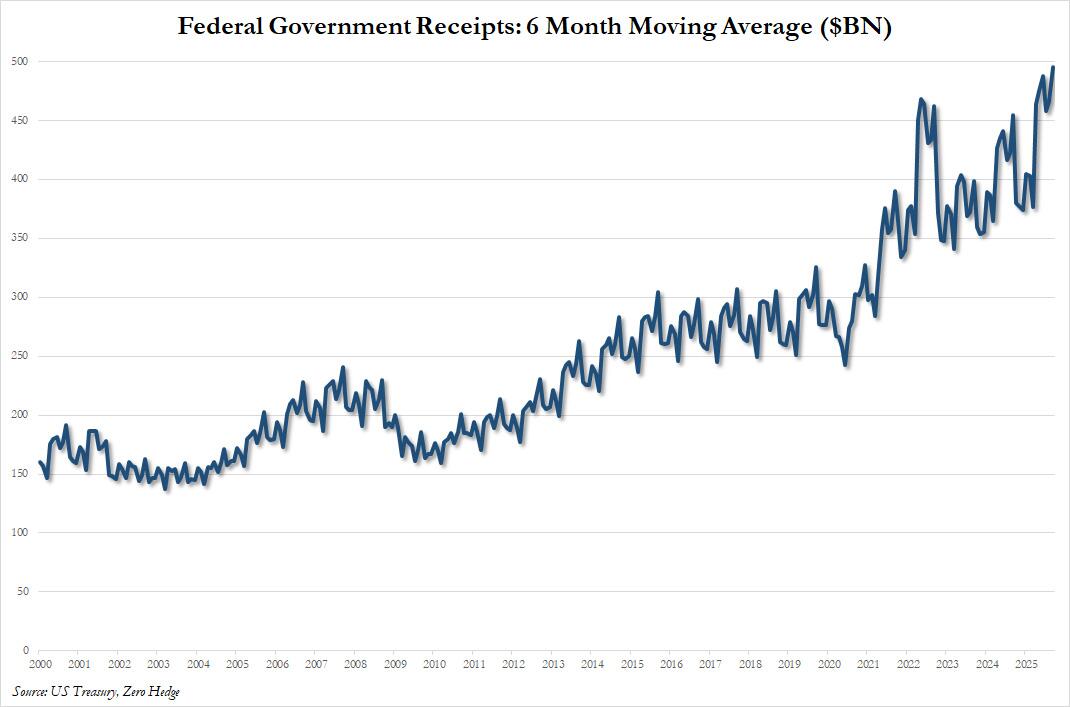
As usual, the vast majority of govt receipts was in the form of individual income taxes ($298BN out of $544BN), with Social Security contributing about a 3rd of the total receipts and Corporate Income Taxes accounting for 11% or $62 billion of the total.
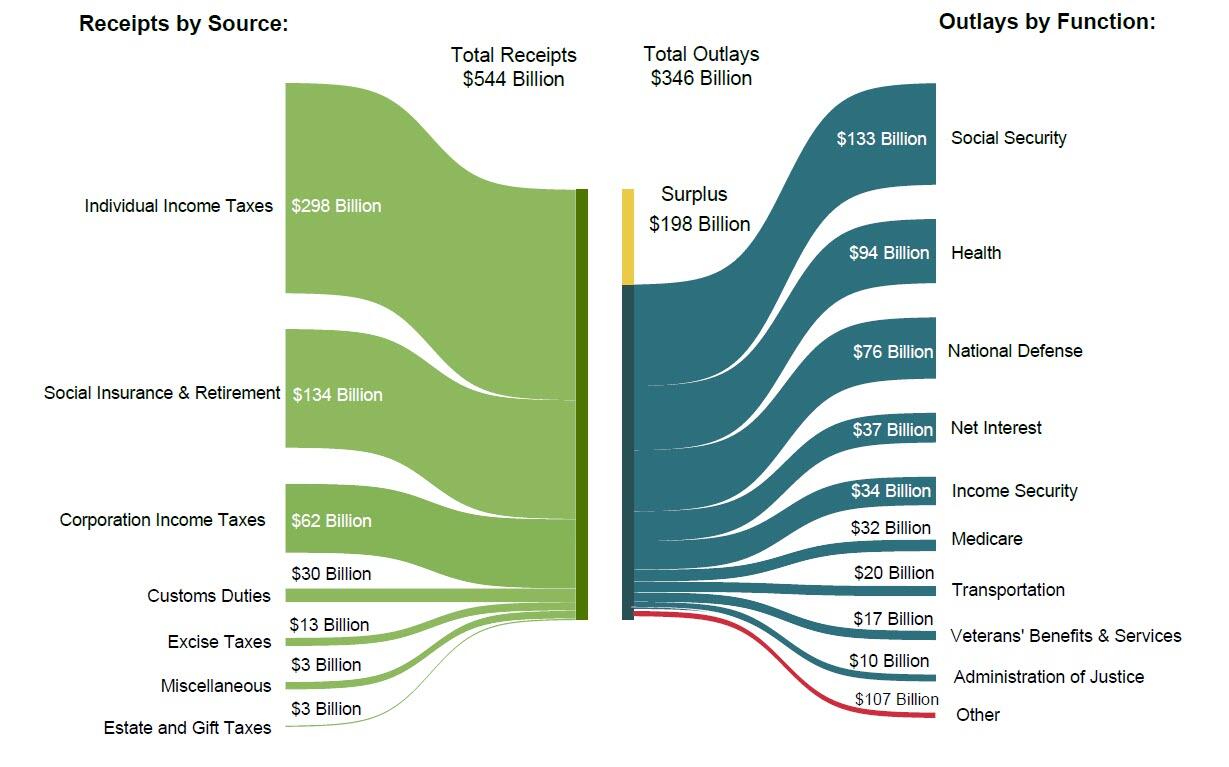
On the outlays side, here too there were notable improvements, with the US government spending only $346 billion, a sharp from from the $689 billion in August, and down a whopping 25% from the $463 billion last September. Even more remarkable is that the six month moving average of govt spending suddenly slumped from $604 billion – the highest since covid – to $573 billion, the lowest since June 2024. Yes, the improvement may be small, but every little bit helps and whatever Trump is doing to shrink govt spending is starting to show.
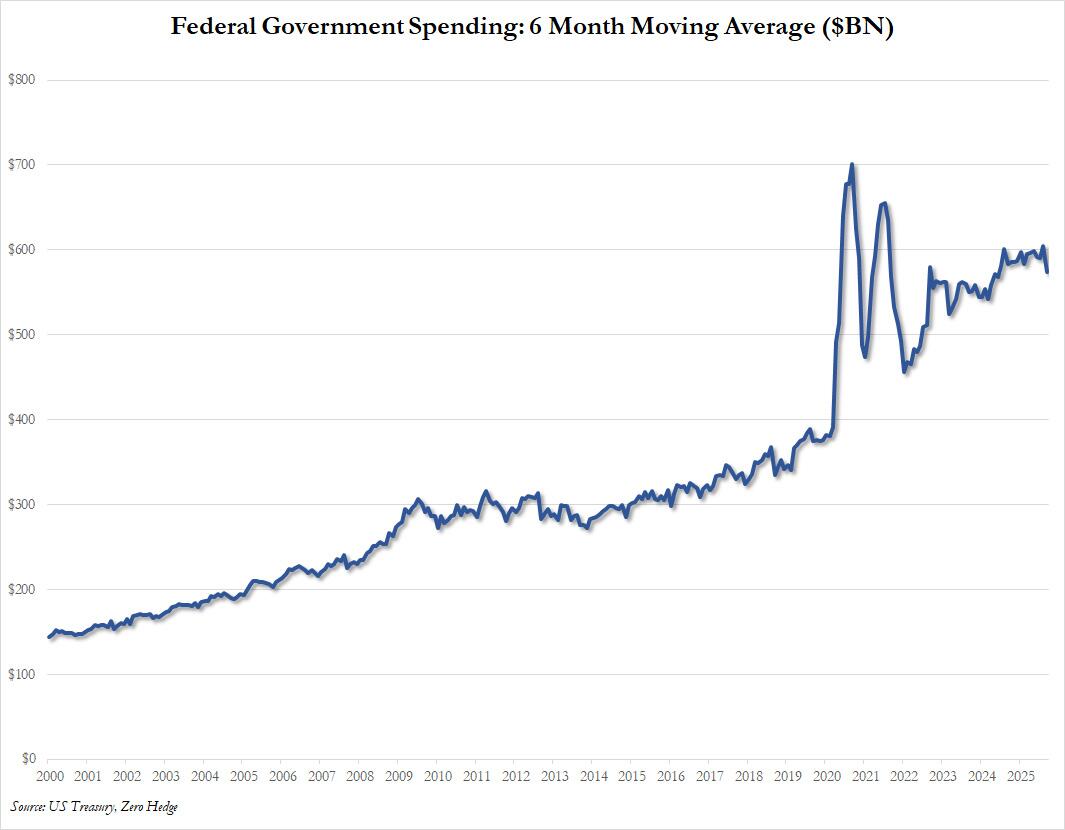
As shown in the chart above, the biggest spending categories for Sept were Social Security, Health and National Defense, accounting for $133BN, $94BN and $76BN respectively. What is odd is that net interest was only $37BN which is likely due to some calendar effect and we expect this surprisingly low spending total to catch up in October. But for now we can enjoy the trend even if it is fake.
On a monthly basis, the September surplus was one of the best months in recent history for US government budget…
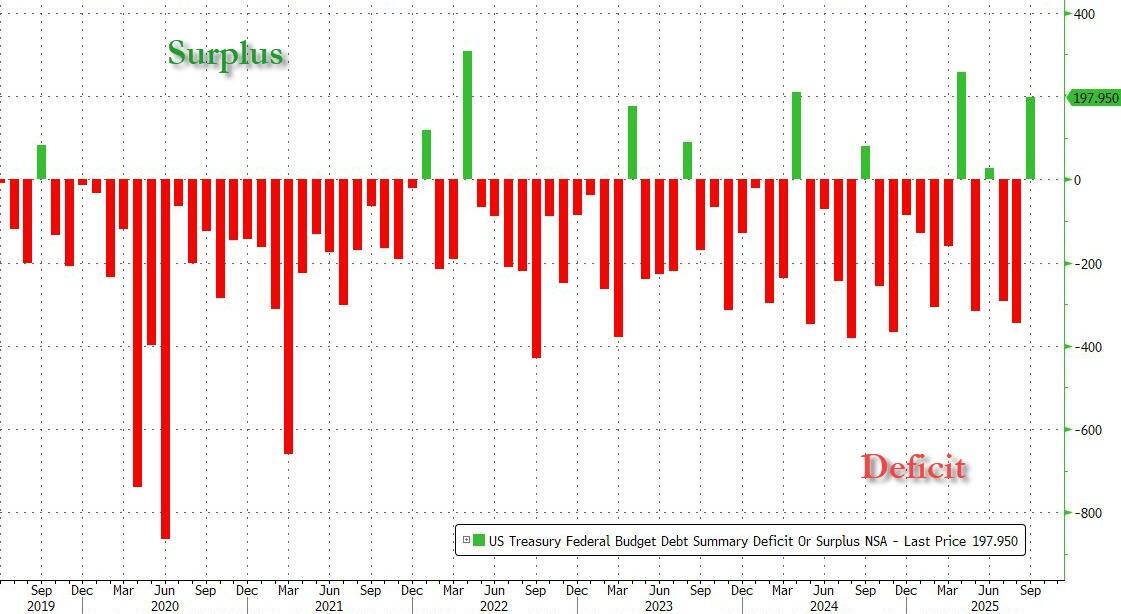
… and the just concluded month was a record for the month of September, which has traditionally been a strong, surplusy month except in the period following covid.
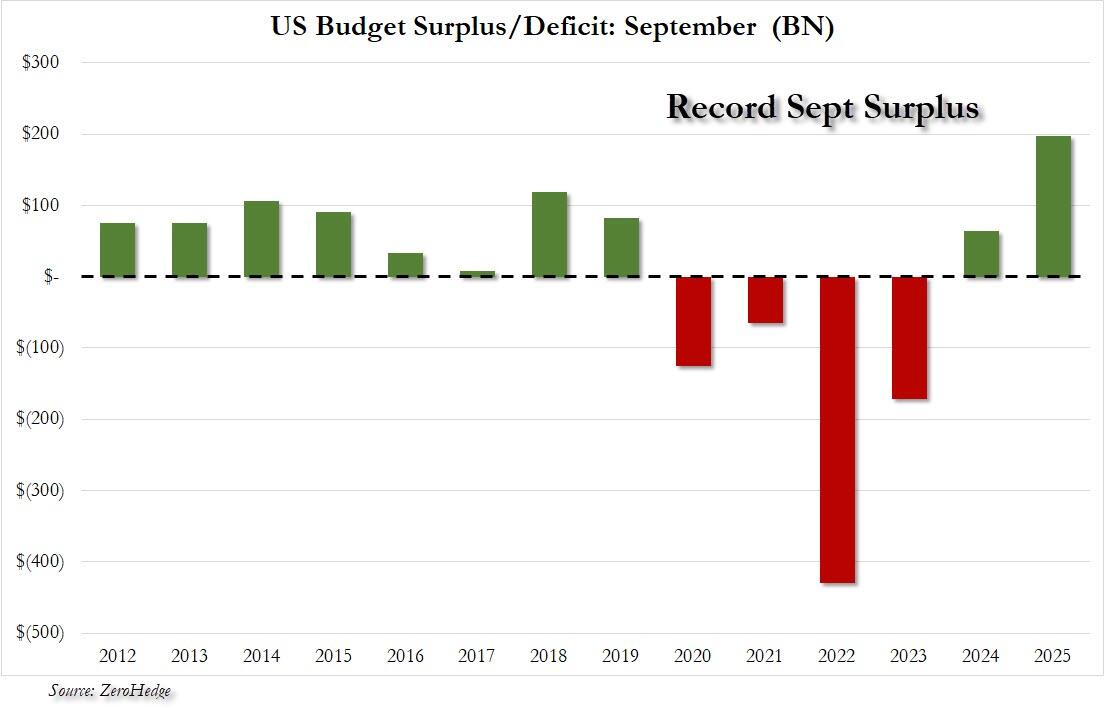
A big reason for the stellar September surplus is that tariff collections continued apace, and in September the US government collected a record $29.7 billion in tariffs, which translated in a record $195 billion for the fiscal year. And since Trump’s tariff regime was only active for 6 of the past 12 month, expect tariffs to deliver about $350 billion in annual revenue every year, unless they are canceled.
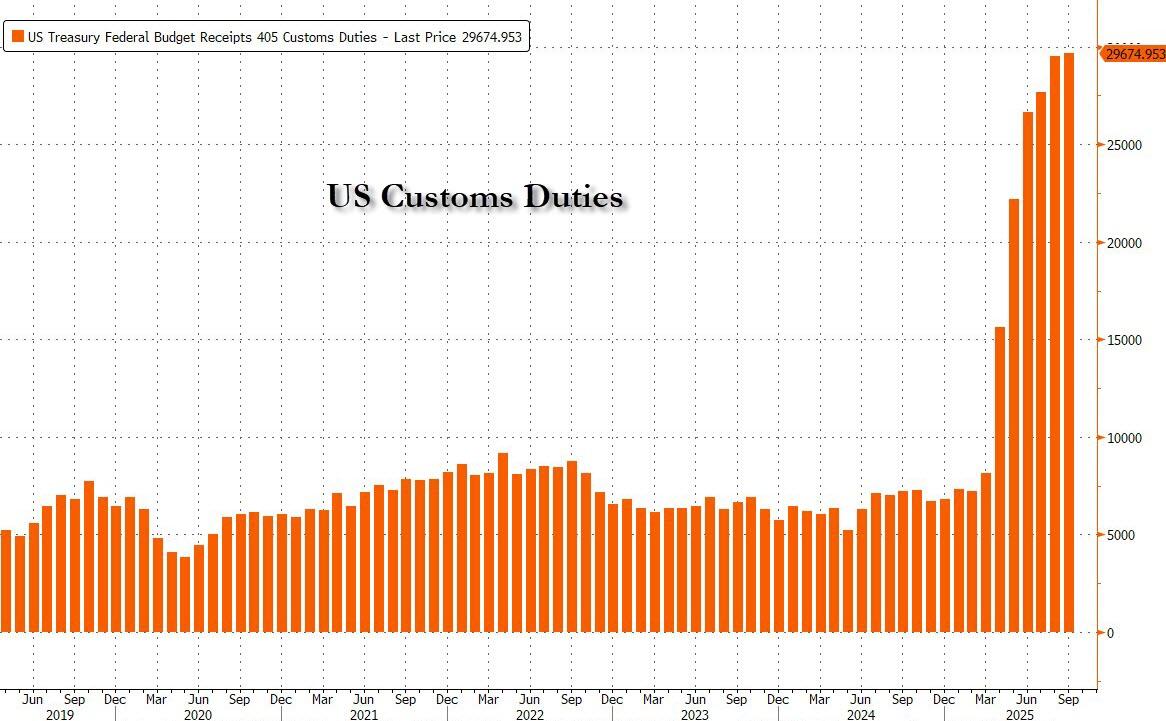
Turning to the full fiscal year which concluded on Sept 30, the picture here was less pleasant, with the US spending just over $7 trillion (broken down below) offset by $5.2 trillion in receipts…
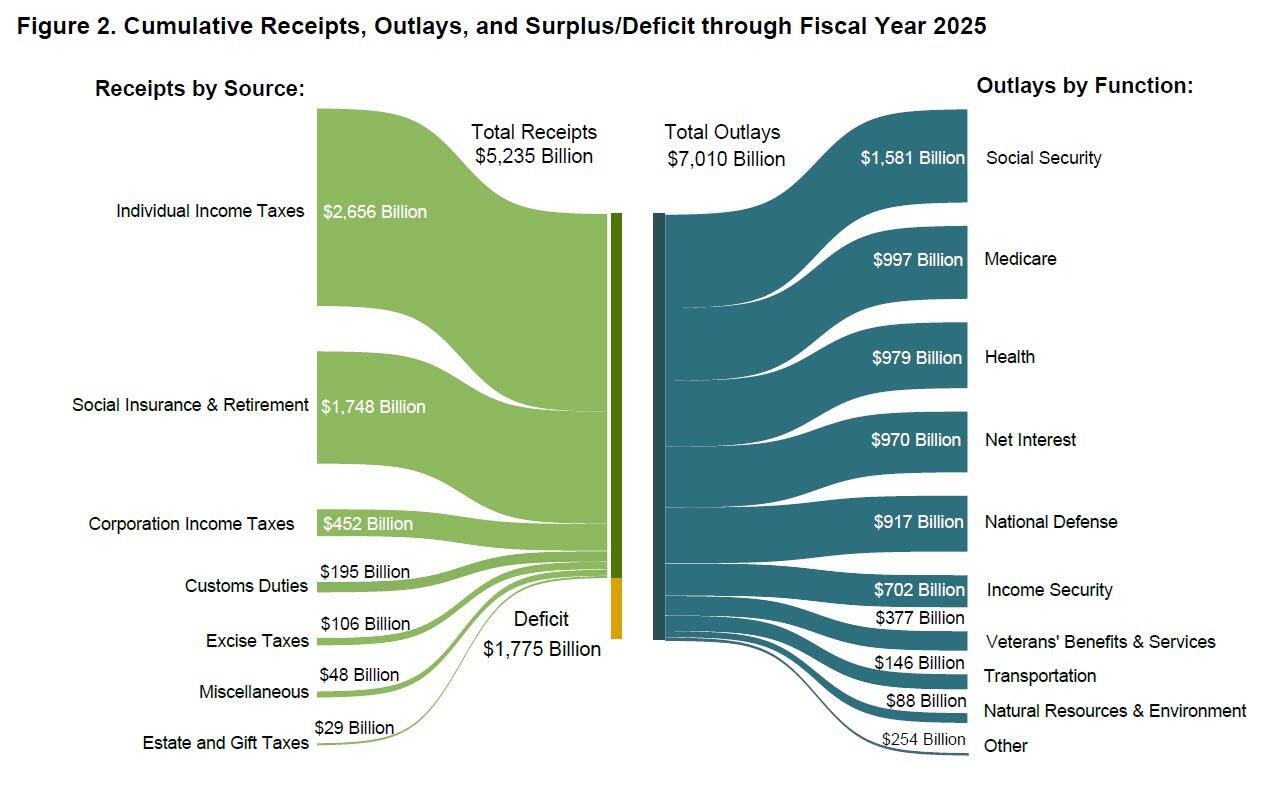
… resulting in a full-year deficit of $1.775 trillion which while still high, managed to stage an impressive reversal in recent months. As shown below, until a few months ago, 2025 was set to surpass both 2023 and 2024 in terms of the total deficit. And yet, in September, the belt-tightening meant that the cumulative full year deficit shrank enough to improve on both 2023 and 2024!
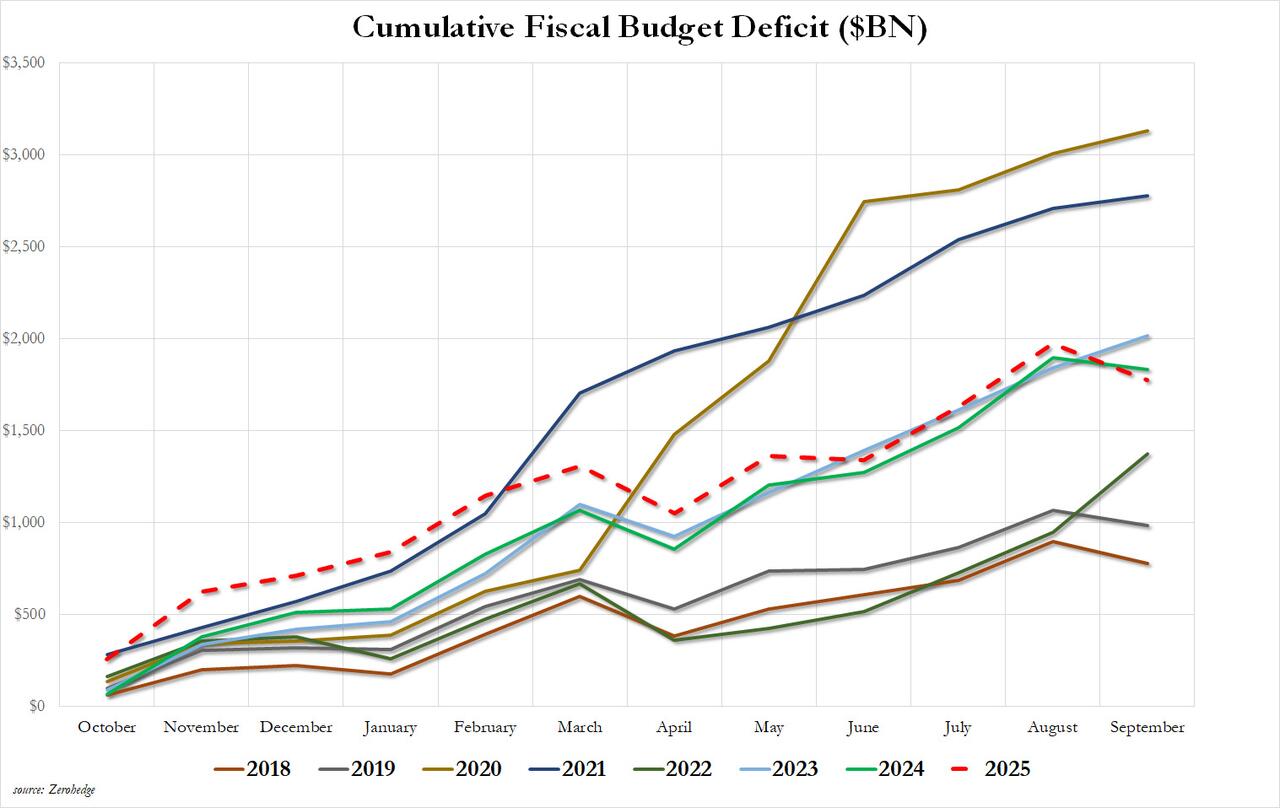
That’s the good news. The bad news is that the impressive September numbers were largely a calendar effect with much of the outlays delayed until next month, which means October’s numbers will be that much uglier. And worse, the exponential increase in total US debt which will surpass $38 trillion in 2 days and $40 trillion in under a year…
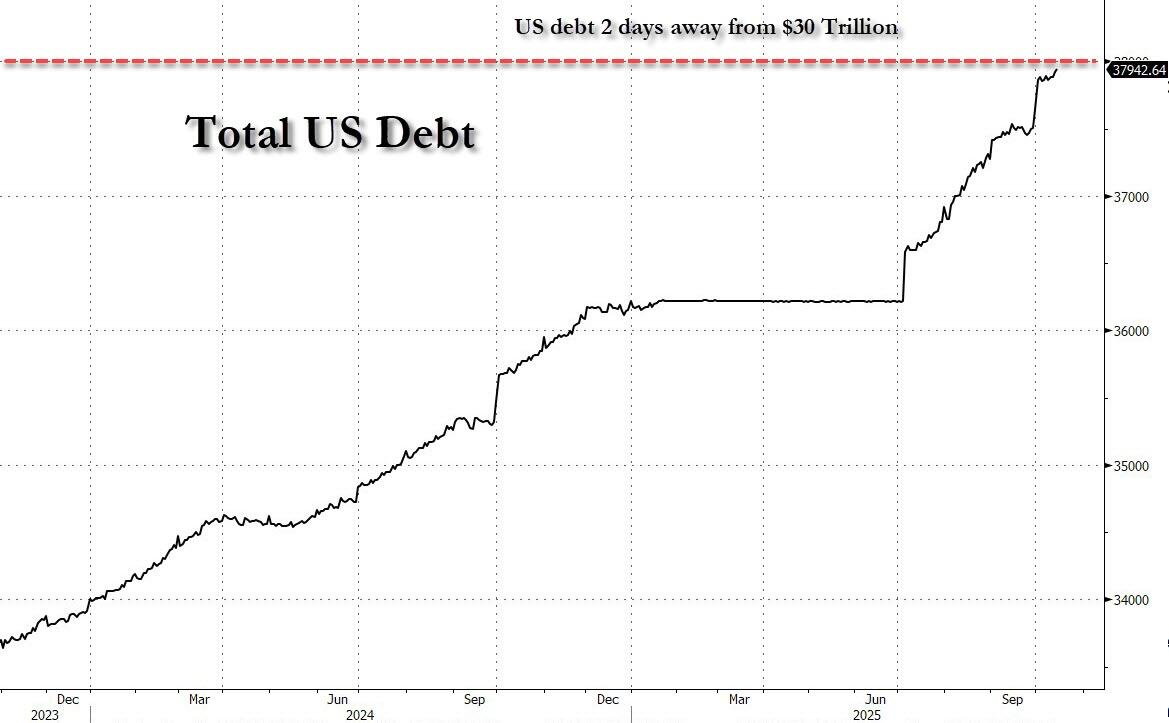
… means that the US interest expense continues to be the most dangerous, and rapidly rising, spending category of all: to wit, at $1.22 trillion in the past 12 months, gross interest expense is less than $400 billion away from catching up to Social Security Spending.
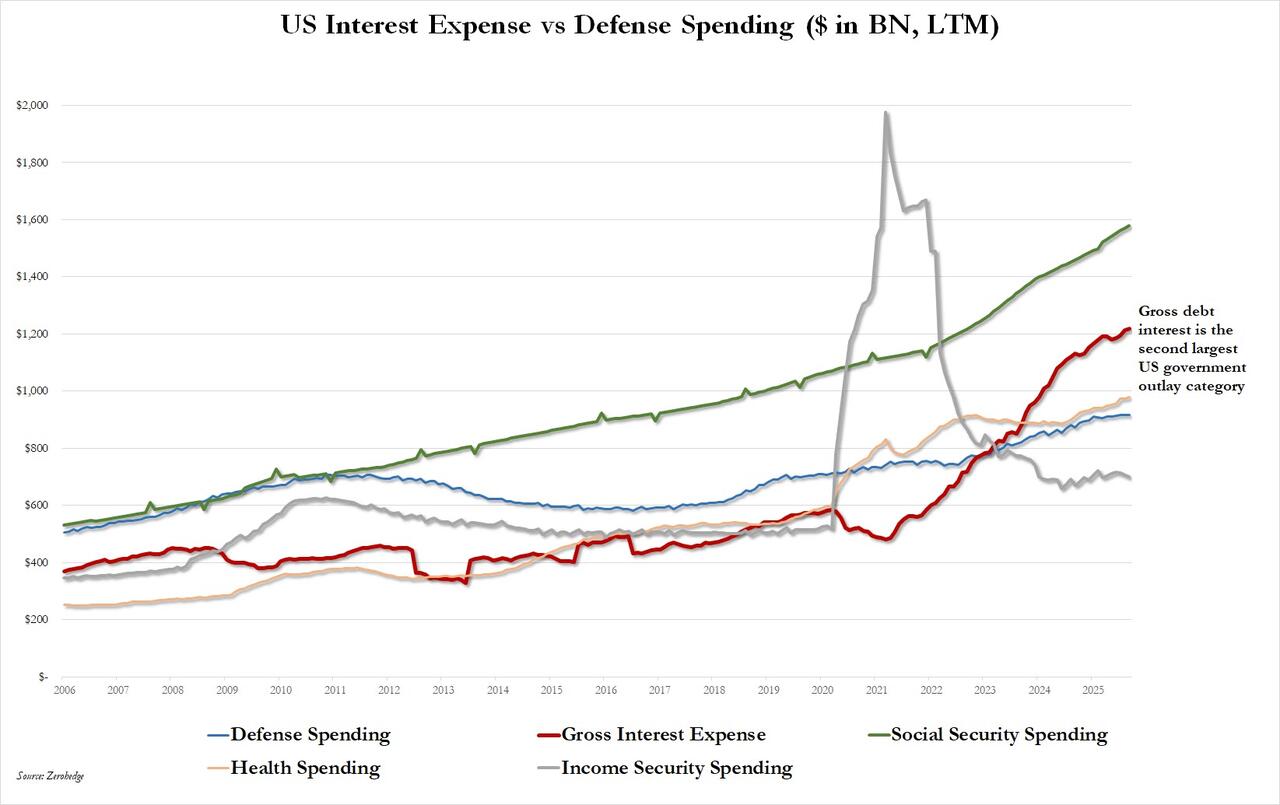
And with annual gross interest unlikely to decline ever again, because while rates may drop, the total amount of debt on which they accrue will only keep rising, it is safe to say that every month and every year we will have a record LTM interest print…
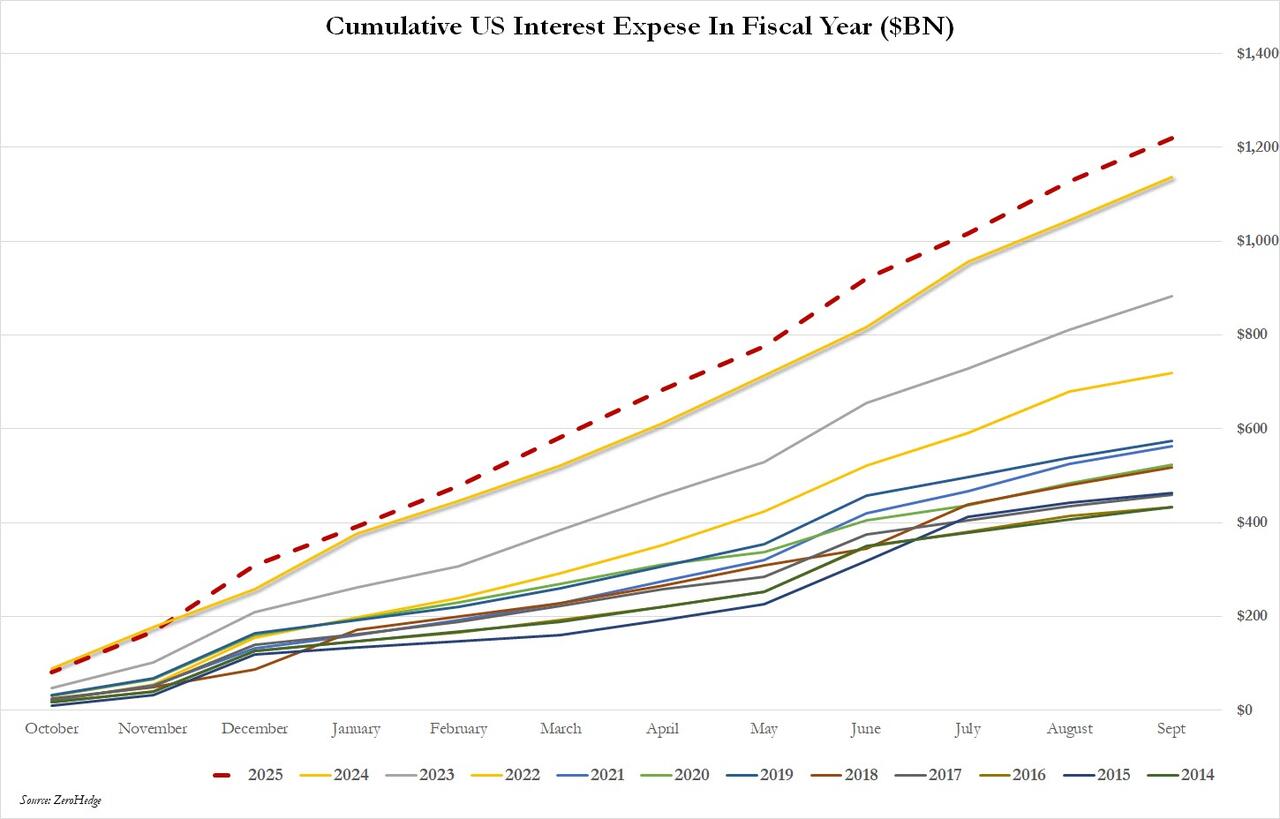
… which is a problem, because tariffs or not, DOGE or not, the US spends 23 cents of every dollar in revenue collected to pay down just the interest on debt…
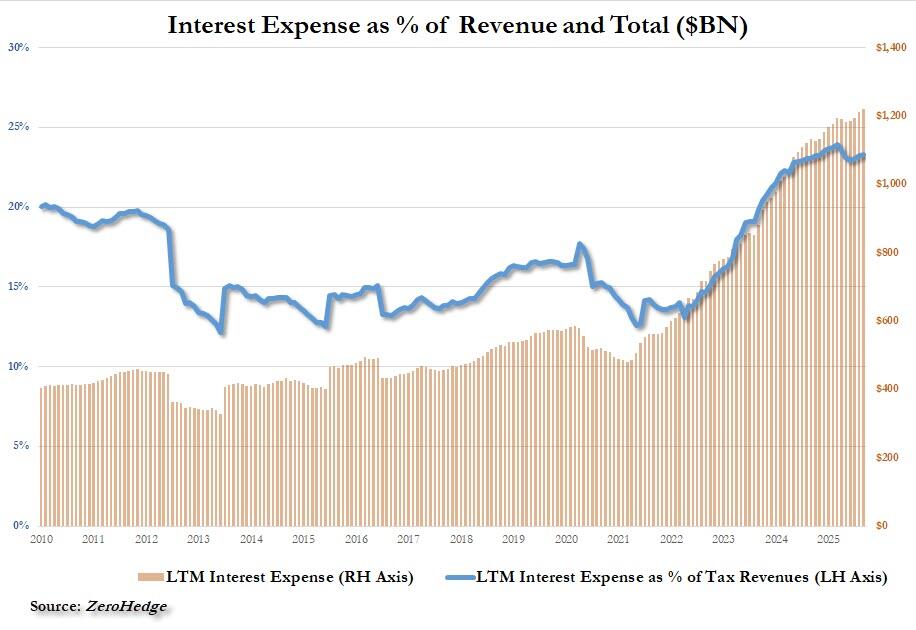
… and that number will keep rising indefinitely, which is also why gold is now pricing in the coming yield curve control as anything else means game over.
USA ECONOMIC COMMENTARIES FOR TODAY
More Than An Accident? Kyle Bass Sounds Alarm On U.S. Military Explosives Supply Chain After Tennessee Plant Blast
Thursday, Oct 16, 2025 – 04:40 PM
The massive blast that rocked a Tennessee explosives plant last week that killed 16 people has caught the attention of Kyle Bass, founder and chief investment officer of Hayman Capital Management, who warned about potential sabotage by foreign adversaries. Investigators are still trying to determine what sparked the explosion.

“The Accurate Energetics Systems explosion in Tennessee demands urgent, independent scrutiny. With China moving aggressively toward Taiwan and historical precedents of sabotaging munitions facilities, we cannot dismiss the possibility this was more than an accident,” Bass wrote on X.
He continued, “AES provides over 60% of the Department of War’s high-explosives systems, losing it for years is a strategic shock. Every indicator and warning in the system is flashing red.”
AES’ explosives are used in a wide range of conventional munitions and related weaponry primarily as the explosive fill, booster/initiator, or engineered charge. It’s publicly known that the U.S. Army and Navy have awarded AES military contracts for bulk explosives, landmines, breaching charges, etc.
A sizeable concentration of America’s energetic-materials production supply chain appears to be linked to AES.
.com/AndyRenfrew/status/1978506525699440811?ref_src=twsrc%5Etfw%7Ctwcamp%5Etweetembed%7Ctwterm%5E1978508070775930881%7Ctwgr%5Eced494a3064067f67d9136b52f195ffd537c98d8%7Ctwcon%5Es2_&ref_url=https%3A%2F%2Fwww.zerohedge.com%2Fmilitary%2Fmore-accident-kyle-bass-sounds-alarm-us-military-explosives-supply-chain-after-tennessee
Even worse, Anduril Industries founder Palmer Luckey warned last Friday, “It’s the broader economy and maybe some other defense companies, if you can believe it, there’s lots of us defense companies that haven’t been sanctioned by China and therefore they haven’t had the foresight to go and build it.”
As Bass just found out…
Let’s remind readers about the book China’s Total War Strategy: Next-Generation Weapons of Mass Destruction – published by the CCP BioThreats Initiative and authored by Dr. Ryan Clarke, LJ Eads, Dr. Robert McCreight, and Dr. Xiaoxu Sean Lin, which outlines how the CCP has been pursuing an aggressive, multifaceted “total war” against the U.S. that leverages next-generation weapons, including synthetic narcotics (e.g., fentanyl and cannabinoids), bioweapons (e.g., Covid-19), psychological manipulation and influence (e.g., TikTok), and a broad arsenal of irregular warfare tools.
And circling back to Bass’ warning about potential sabotage in Tennessee – given China’s ongoing hybrid warfare campaign against the U.S. – nothing can be ruled out. As an old Chinese saying goes, it’s “death by a thousand cuts.” That’s the best way to explain the CCP’s hybrid warfare against the U.S.
END
The Bizarre Bankruptcy At The Heart Of This Week’s Regional Bank Meltdown
Friday, Oct 17, 2025 – 03:40 PM
As we highlighted in our regional bank meltdown summary post, there was a common theme between the two banks that got hammered yesterday, ZION and WAL: a single bankrupt counterparty that led to bad debt impairments at both banks. Now, thanks to Bloomberg, we can identify who that counterparty was.
According to BBG, the bad loans reported by Zions Bancorp and Western Alliance Bancorp can be traced back to the bankruptcy of one commercial real estate investment firm in Southern California earlier this year. In the lawsuit filed on Wednesday – which also spooked investors and sent the stock plunging – Zions listed 16 addresses of properties pledged as collateral to more than $60 million loaned to an investor group. And when the Newport Beach, California-based real estate firm MOM CA Investco LLC filed for bankruptcy in February, six of those properties were listed as investments.
So what happened with the loans?
Well, as Bloomberg reports, back in 2016 and 2017, when bankers at Zions subsidiary California Bank & Trust underwrote the loans they made sure the usual cushion to protect the lender was in the contract: Zions should be first in line for repayment should the borrower default and liquidate its assets, according to this week’s complaint, filed in LA County Superior Court against defendants including Gerald Marcil, Andrew Stupin and Deba Shyam.
But two things went wrong simultaneously. First, MOM CA Investco filed for bankruptcy protection, leading to a planned sale of some its properties. Second, it turned out that, for those buildings that served as collateral for the loans Zions issued, other firms actually were ahead in line of the Salt Lake City-based bank to be paid should the real estate be liquidated.
A similar situation hit Western Alliance. The Phoenix-based bank sued an investor group including Marcil and Stupin, claimed they manipulated loan structures in a way that wrongly stopped the lender from receiving debt repayments before anyone else.
Western Alliance said the investor group still owes it more than $98.6 million. Those loans were meant to be secured by real estate in Stupin and Marcil’s investment funds, but the properties were already in foreclosure, which wasn’t disclosed to the bank, according to a complaint filed in August in Los Angeles.
In response, Marcil and Stupin’s lawyer said in a statement that “my clients vehemently deny all the allegations of wrongdoing… These claims are unfounded and misrepresent the facts. We are confident that once all the evidence is presented, our clients will be fully vindicated.”
Digging deeper we find that behind the bankruptcy of MOM CA Investco is a group of Southern California commercial real estate investors who were friends before they became foes in court. The firm’s portfolio included a hotel in the exclusive enclave of Laguna Beach and an apartment complex worth $65 million in the town of Redlands, according to the February bankruptcy filing.
The MOM CA Chapter 11 was dismissed in August. In the weeks leading up to the dismissal, the federal judge overseeing the case warned the property investors that the inability to get a deal wasn’t in their interest. And throwing the case out of bankruptcy, said US Bankruptcy Judge Brendan Shannon said, wasn’t the best option.
That’s because, once the case was over, creditors would be free to file actions in state court to try seize various properties and sell them at fire-sale prices. After several court hearings in which the two main players in the real estate empire remained at odds, Shannon dismissed the Chapter 11.
Mohammad Honarkar and Mahender Makhijani founded MOM CA Investco in 2021 as a joint venture. At the time, Honarkar also ran a business selling mobile phones, while Makhijani acquired and managed distressed real estate for investors through an entity called Continuum Analytics. Among the largest investors in Continuum were Marcil and Stupin, and its legal owner is Shyam.
But the partnership soon went south, with Honarkar accusing his partners, who controlled the company, of fraud. At one point during their dispute, Makhijani used armed guards to take over some of the properties, and hired mobile billboards to drive around Laguna Beach displaying pictures of Honarkar and accusing him and two city employees of corruption, according to court filings.
It gets even more bizarre: the investors sued by Zions and Western Alliance, Marcil, Stupin and Shyam, have additional ties to a variety of investment vehicles linked to Makhijani, court filings show. The three were among the founding investors of Nano Banc, for which Makhijani is one of the largest referral sources.
Nano Banc had loaned the founders more than $100 million, according to a March arbitration filing. And Zions found that for one property it had a first lien on, a building in Laguna Beach, the deeds were assigned to Nano Banc.
And the piece de resistance: another asset, an apartment complex in Bellflower, had a deed assigned to the other bank suing the investors: Western Alliance.
In short: unprecedented chaos… but it wasn’t just a busted bankruptcy and potential fraud on behalf of a shady investor group. It was also a bizarre absolute priority rule waterfall shitshow, in which nobody knew whose claims were subordinated or priority, and the result was a free-for-call collateral grab which was not quite rehypothecation, but was very close, and the result is that the secured lenders – Zions and Western Alliance – have now ended up chasing the assets pledged to their loans in court as the assets are, as the South Park cartoon puts it so well, gone… all gone.
The good news is that we now know what happened in this particular case. The question now is why did the banks not figure all of this ahead of time, and more importantly, how many more such instances of a manged absolute priority rule are there?
END
VICTOR DAVIS HANSON
KING NEWS
The King Report October 17, 2025 Issue 7600 | Independent View of the News |
| Precious metals are in a parabolic rise. Is something very, very bad is coming? On Thursday, Gold was +$123.23 at its top; Dec Gold soared as much $145.10. Silver peaked at +2.15%. Spot Gold, weekly Fed’s Stephen Miran says he wants half-point interest rate cut this month https://trib.al/EBvw21I Why is the Fed about to cut rates with gold and silver to the moon, an AI Bubble, and stocks near historic overvaluations? Why did Jay Powell exceed the most hopeful dovish expectations with his recent very dovish remarks? The clues materialized yesterday. Big-bank stocks declined sharply despite great results the past two sessions. The KBW Bank Index tumbled 4.45% (as of 15:39 ET). The Regional Bank ETF (KRE) was -7.145% at 15:39 ET. KBX components as of 15:32 ET: Zion Bancorp -12.86%, Western Bank Alliance -12.34%, East West Bankcorp -8.19%, Keycorp -6.71%, Citizens Financial -6.87%, Capital One -6.47%, 5th 3rd -6.27%, Comerica -6.23%, Regions Financial -6.10, Citi -4.30%, BAC -3.90%, WFC -3.63%, JPM -2.68% Regional Banks Crash as More Credit “Cockroaches” Emerge Shares of Zions Bancorp plunged… after it disclosed a $50 million charge-off for a loan underwritten by its wholly-owned subsidiary, California Bank & Trust, in San Diego. And Western Alliance Bancorp tumbled… after it said it’s dealing with a borrower that failed “to provide collateral loans in first position.” i.e., there was fraud, just like in the First Brands case… Western Alliance also said it also has exposure to the collapse of auto-parts supplier First Brands Group… https://www.zerohedge.com/markets/regional-banks-crash-more-credit-cockroaches-emerge How Jefferies Found Itself at Center of First Brands Collapse – BBG 2:10 ET (-11.15% at low) Jefferies initially told prospective lenders that First Brands had roughly $5.9 billion of debt, according to materials viewed by The Wall Street Journal. First Brands’ bankruptcy advisers have since said its debt actually exceeds $11.6 billion… While many creditors feel misled by First Brands, some think that as the company’s investment banker, Jefferies was responsible for doing a more comprehensive vetting of its sprawling financial structure…. Jefferies has been on a hiring spree with the goal of becoming the fifth-biggest investment bank globally… https://www.msn.com/en-us/money/executive-leadership-and-management/how-jefferies-found-itself-at-the-center-of-first-brands-collapse/ar-AA1OxM2K @HedgieMarkets: Regional banks are facing a perfect storm of credit problems, with commercial real estate loans comprising 44% of their portfolios versus just 13% for large banks. Office loan delinquencies have hit 10.4%, approaching 2008 crisis levels, while over $1 trillion in CRE loans must refinance by year-end in a higher-rate environment… Zions Bancorporation disclosed $60 million in provisions and $50 million in write-offs related to alleged loan fraud from its California division, while Western Alliance faced similar issues. These incidents echo Jamie Dimon’s warning about “more cockroaches” in the credit market, suggesting systematic underwriting problems beyond economic cycles… Florida Atlantic University analysis found 59 of the 158 largest banks have CRE exposures exceeding 300% of total equity capital… Studies suggest a 1% increase in non-performing loan ratios can decrease GDP growth by 0.1%, creating vicious cycles where economic weakness worsens credit quality… This analysis confirms that March 2023’s regional banking crisis was papered over rather than resolved. The combination of CRE concentration, interest rate pressure, and emerging fraud cases suggests the underlying problems have worsened. When banks resort to extend-and-pretend strategies while facing refinancing walls on $1 trillion in loans, it creates conditions for a more severe crisis than what we saw in 2023. The moral hazard from implicit government backstops has encouraged more risk-taking rather than better management… https://x.com/HedgieMarkets/status/1978921640596590993 @Hedgeye: At last week’s Fed Community Bank Conference, Blackstone CEO said: “What can go wrong? Not much except fraud.”… https://x.com/Hedgeye/status/1978921003456827902 The S&P 500 Index opened modestly higher on Thursday and traded sideways, with a minor spike to the daily high of 6709.34 at 10:43 ET. The index then stair-stepped lower until it hit a daily low of 6593.99 at 14:34 ET. An elongated A-B-C afternoon rally took the S&P 500 Index to 6633.86 at 15:55 ET. Trump says he will meet with Putin in Budapest after Rubio meets with Russian advisers “President Putin and I will then meet in an agreed upon location, Budapest, Hungary, to see if we can bring this ‘inglorious’ War, between Russia and Ukraine, to an end,” President Trump said https://justthenews.com/government/diplomacy/trump-says-he-will-meet-putin-after-rubio-meets-russian-advisers Positive aspects of previous session The DJTA rallied 1.03% on JB Hunt’s 22.14% surge on Q3 EPS 1.76 (1.46 exp) and broker upgrades. Negative aspects of previous session Gold and silver soared again. USZs rallied as much as 31/32 on flight to safety. Bank stocks got destroyed. Ambiguous aspects of previous session (From yesterday) Did Powell go fecklessly dovish because he fears something? How big is the bank problem? First Hour/Last Hour Action [S&P 500 Index]: 1st Hour from NYSE Open: Up; Last Hour: Up Pivot Point for S&P 500 Index [above/below indicates daily trend to traders]: 6644.13 Previous session S&P 500 Index High/Low: 6724.12; 6612.11 @axios: Top Democrats in Pennsylvania are maneuvering to run against Sen. John Fetterman in a 2028 primary, threatening to tear the party apart in the biggest battleground state in the nation, @hollyotterbein reports. https://www.axios.com/2025/10/16/john-fetterman-senate-primary-pennsylvania Dem Sen. Fetterman confronted over why he’s still a Dem as party plots ouster: ‘You have to pick one side’ https://trib.al/uQIm04C MSM types warn that if the SCOTUS bans racially gerrymandered Congressional Districts, Dems could lose 12 to 19 House Seats. @greg_price11: Principal Deputy Solicitor General Hashim Mooppan just completely silenced Sotomayor’s argument for Louisiana’s second black majority district: “If these were white Democrats, there’s no reason to think they would have a second district. What is happening here is their argument is because these Democrats happen to be black, they get a second district. If they were all white, we all agree they wouldn’t. That is literally the definition of race subordinating traditional principles.” https://x.com/greg_price11/status/1978496467028341066 Fed Balance Sheet: +$5.639B; Reserves: +$20.557B Today – The tea leaves are starting to reveal a disturbing picture: Bank problems. Liquidate down to sleeping levels and wait for developments. It’s time for maximum safety and prudence. It would be very, very troubling if bank problems generate the dreaded ‘Systemic Risk’ event. There is no reason to play unless you have ‘the info.’ At any instance, impact news can appear. The vexing question: If the Fed does an emergency rate cut/QE or a 50bp cut on October 29, after the initial burst on algo and Army Ant buying, do stocks continue to rally or sink on ‘the problem.’ The Fed started cutting rates on September 18, 2007 (50bps to 4.75%). There were six more rate cuts until it hit the fan in October 2008. The S&P peaked on 10/11/07 at 1576.09 and fell to 666.79 on 3/6/09. Team Trump better get out in front of the bank woes and educate the public on how Team Biden and the Fed papered over the problems, and Team Trump must fix the abuse and neglect. ESZs are -20.75; NQZs are -80.00; Dec AU is +77.30 (Look out!); and USZs are +6/32 at 20:00 ET. Expected earnings: AXP 3.99, SLB .66, STT 2.66 Expected Economic data: Sept Housing Starts 1.32m, Permits 1.343m; Sept Import Price Index 0.1% m/m & 0.4% y/y, Ex-Petro Import Prices Index 0.2%, Export Price Index 0.1% m/m & 4.0% y/y Fed Speakers: St. Louis Pres Musalem 12:15 ET S&P Index 50-day MA: 6558; 100-day MA: 6358; 150-day MA: 6101; 200-day MA: 6062 DJIA 50-day MA: 45,681; 100-day MA: 44,631; 150-day MA: 43,434; 200-day MA: 43,451 (Green is positive slope; Red is negative slope) S&P 500 Index (6629.07 close) – BBG trading model Trender and MACD for key time frames Monthly: Trender and MACD are positive – a close below 5643.15 triggers a sell signal Weekly: Trender and MACD are positive – a close below 6445.33 triggers a sell signal Daily: Trender and MACD are negative – a close above 6834.79 triggers a buy signal Hourly: Trender and MACD are negative – a close above 6698.96 triggers a buy signal US prosecutors say Smartmatic executives bribed officials for $1M contract in the Philippines Federal prosecutors have charged voting technology firm Smartmatic with money laundering and other crimes… Smartmatic is pursuing a $2.7 billion lawsuit accusing Fox News of defamation for airing false claims that the company helped rig the 2020 U.S. presidential election. https://apnews.com/article/smartmatic-bribery-charges-philippines-97a1c66eaedf769ad0e64a52166be90b Comey lawyer Patrick Fitzgerald linked to Comey Memo leak saga that prompted Mueller appointment – Comey current defense lawyer Patrick Fitzgerald, along with longtime Comey friend Daniel Richman, both received copies of the so-called Comey Memos in May 2017 as Comey sought to prompt the appointment of a special counsel to go after Trump. https://justthenews.com/government/courts-law/comey-lawyer-patrick-fitzgerald-linked-comey-memo-leak-saga-which-prompted Comey Turns to Blagojevich Prosecutor for Trump Criminal Defense Fitzgerald led prosecutions against Illinois governors Rod Blagojevich and George Ryan. He also steered an investigation that resulted in criminal charges against Scooter Libby, chief of staff to ex-Vice President… https://news.bloomberglaw.com/business-and-practice/comey-turns-to-blagojevich-prosecutor-for-trump-criminal-defense Mueller, Comey, & Fitzgerald – The Band’s Back Together Again https://canadafreepress.com/article/mueller-comey-amp-fitzgerald-the-bands-back-together-again YOU CAN’T MAKE THIS UP: One of Comey’s “Criminal” Leaks Was to His Current Attorney Fitzgerald https://joehoft.com/you-cant-make-this-up-in-2019-we-listed-comeys-criminal-leaks-his-current-attorney-fitzgerald-is-on-the-list/ Patrick Fitzgerald crime fighter or criminal?, Fitzgerald protected Obama, Quid pro quo, Circumstantial evidence convicts Fitzgerald Getting Tony out of the way was necessary to hiding his relationship to Barack. And, keeping him sequestered at an undisclosed location was necessary to remove him from access to the media. But perhaps even more importantly, Rezko was never called as a witness in either Blago trial, yet he was among Dead Meat’s leading extortionists. All part of concealing Barack Obama’s involvement in Illinois Play to Play… https://citizenwells.com/2011/10/16/patrick-fitzgerald-crime-fighter-or-criminal-fitzgerald-protected-obama-quid-pro-quo-circumstantial-evidence-convicts-fitzgerald/ Obama arrest, Blagojevich arrest, Patrick Fitzgerald, Rezko trial, Chicago corruption, Obama Rezko ties, Obama lies, Campaign donations, Fraud, Obama just as corrupt as Blagojevich, USDOJ corrupt? https://citizenwells.com/2009/08/11/obama-arrest-blagojevich-arrest-patrick-fitzgerald-rezko-trial-chicago-corruption-obama-rezko-ties-obama-lies-campaign-donations-fraud-obama-just-as-corrupt-as-blagojevich-usdoj-corrupt/ Fitzgerald Confirms Delay of Obama Team Blagojevich Report https://www.huffpost.com/entry/fitzgerald-confirms-delay_n_151585 Obama’s FBI Interview Can Stay Under Wraps in Blagojevich Case https://news.bloomberglaw.com/us-law-week/obamas-fbi-interview-can-stay-under-wraps-in-blagojevich-case Veteran prosecutors were aghast that the investigation in ex-Illinois Governor Blagojevich was halted BEFORE money changed hands. Additionally, official corruption investigations must be allowed to proceed because you never know where and to whom the investigation leads. Obama was elected POTUS in November 2008. Blago was indicted one month later. The last thing ‘they’ wanted was to indict Obama. So, according to the opinion of veteran prosecutors, ‘they’ stopped the investigation before Obama got ensnared in the senate seat scheme. If ‘all roads lead to Obama’ in the investigations into official misdeeds concerning Trump, and Patrick Fitzgerald protected Obama from the start, and now Patrick Fitzgerald is representing Comey…. Grand jury indicts former national security advisor John Bolton for handling of classified docs (18-count federal indictment under the Espionage Act, OUCH! Who or what are his bargaining chips?) https://justthenews.com/government/courts-law/holdgrand-jury-indicts-former-national-security-advisor-john-bolton-handling More than 3,000 Illinois workers have received layoff notices in last 90 days https://www.nbcchicago.com/news/local/more-than-3000-illinois-workers-have-received-layoff-notices-in-last-90-days/3839118/ @chicagotribune: Gov. JB Pritzker released partial tax records Wednesday showing he and his wife reported more than $10.3 million in taxable income — including more than $1.4 million in income from gambling. https://t.co/KTmvnyL18O @greg_price11: JB Pritzker says he won $1.4 million playing BlackJack on just one trip to Las Vegas last year: “I went on vacation with my wife, with some friends, I was incredibly lucky.” https://x.com/greg_price11/status/1978916292204622025 @stillnotking75: Casinos won’t let you wager that kind of money unless you’re a known whale. Reporter should have asked him the table limit. Winning $1.4M on $100 a hand is not just “incredibly lucky”, it’s a literal miracle. There should be video of JB playing blackjack. Will the DoJ subpoena it? Inquiring minds want to know why he gambled so large; and if is there something else going on there? If Trump and/or Melania posted $1.4m in gambling income, the media and Dems would be insinuating improprieties 24/7. @Geiger_Capital: Chicago Mayor Brandon Johnson is now proposing a new “head tax” to fix the deficit after destroying their budget. All companies employing 100+ people in Chicago will have to pay a tax of $21 per employee per month, simply for having employees. A punishment for hiring people. ICE arrests Chicago police officer allegedly in US illegally – Radule Bojovic, originally from Montenegro, was working as a police officer for the Hanover Park Police Department at the time of his arrest… https://justthenews.com/government/security/ice-arrests-chicago-police-officer-allegedly-us-illegally GOP Sen. @tedcruz: There’s considerable evidence that George Soros and his network are funding the “No Kings” rallies. That’s exactly why I’ve introduced the Stop FUNDERs Act. It lets law enforcement prosecute those funding acts of political violence. https://t.co/ZThbb6lSFW @EndWokeness: Soon-to-be NYC Mayor Zohran: “A key reason we have to make the bus free is it reduces assaults.” (Pray for NYC!) https://x.com/EndWokeness/status/1978619248910962816 Zohran on why Cuomo is not qualified to be mayor: “He can’t name a mosque he visited.” https://x.com/EndWokeness/status/1978971788638884076 @ViralNewsNYC: Shoplifter crews are already celebrating. Zoran plans to tell cops not to arrest anyone for misdemeanors — including theft and assault. In NYC, stealing under $1,000 is a misdemeanor. That means thieves could hit store after store all day, and nothing would happen. NYPD sources say: “Why bother? We’d just get sued for arrests that won’t stick.” Business owners warn this could destroy their stores, while criminals call it a dream come true. Free healthcare, free education, free transportation, free food, no-fault shoplifting, etc. is Zoran’s policy to reduce violent crime. Justice Department files first Antifa-related terrorism charges with Texas ICE attack The two individuals, identified as Cameron Arnold and Zachary Evetts, were charged with providing material support for terrorism, attempting to murder federal and assisting officers and discharging firearms during attempted murders… https://justthenews.com/government/courts-law/justice-department-files-first-antifa-related-terrorism-charges-texas-ice | |
SWAMP STORIES FOR YOU TONIGHT
John Bolton Indicted Over Mishandling Of Classified Documents
by Tyler Durden
Thursday, Oct 16, 2025 – 04:45 PM
The US Justice Department has charged former National Security adviser John Bolton for his handling of classified documents, Bloomberg reports, citing a person familiar with the matter.
Bolton was indicted by a federal grand jury in Maryland, according to the report.
The indictment came hours after several news outlets reported that the indictment was imminent.
Bolton’s lawyer, Abbe Lowell, said his client did nothing inappropriate with classified records – however part of the criminal investigation into Bolton has focused on what resembled diary entries of private notes he made for himself on an AOL email account – which may have contained classified information.
He allegedly shared highly classified information with his wife and daughter, CNN is also reporting.
The FBI executed a search warrant on Bolton’s Maryland home and Washington, DC office over the summer – during which agents seized multiple documents labeled “secret,” “confidential,” and “classified” – including some which mentioned weapons of mass destruction, according to court records.
GREG HUNTER….
HAVE A GREAT WEEKEND
H


 harveyorganblog.com


