
access market
XXXXXXXXXXXXXXXXXXXXXXXXXXXXXXXXXXXXXXXXXXXXXXXXXX
XGE: COMEX
118 C MACQUARIE FUTURES US 4
118 H MACQUARIE FUTURES US 27
167 C MAREX 1
190 H BMO CAPITAL MARKETS 27
323 C HSBC 197
363 H WELLS FARGO SECURITI 108
435 H SCOTIA CAPITAL (USA) 445
661 C JP MORGAN SECURITIES 18
709 C BARCLAYS 4
880 H CITIGROUP 400
905 C ADM 25
GOLD: NUMBER OF NOTICES FILED FOR NOV/2025: 628 CONTRACTs NOTICES FOR 62,800 OZ or 1.953 TONNES
total notices so far: 6037 contracts for 603,700 OR 18.777 tonnes)
SILVER NOTICES: 335 NOTICE(S) FILED FOR 1.675MILLION OZ/
total number of notices filed so far this month : 2913 CONTRACTS (NOTICES) for 14.565million oz
INITIAL STANDING FOR NOV: 11.575 MILLION OZ
PLUS INITIAL 1.245 MILLION OZ QUEUE JUMP
THEN ADD YESTERDAY;S 1,93 MILLION OZ QUEUE JUMP
THENN TODAY;S 0.570 MILLION OZ QUEUE JUMP
EQUALS
14.830 MILLION OZ STANDING FOR SILVER.
JULY: 50.925 MILLION OZ (QUITE SMALL)
AUGUST: 59.455 MILLION OZ (QUITE SMALL)
SEPT. 50.510 MILLION OZ.(QUITE SMALL)
OCT; 82.020 MILLION OZ (WILL BE STRONG THIS MONTH)/ OCC WANTS TO REIN IN THESE ISSUANCES!
NOV:3.355 MILLION OZ
AND JULY: 46.720 MILLION OZ//
AUGUST: 4.70 MILLION OZ INITIAL STANDING PLUS TODAY;S 5,000 OZ QUEUE JUMP //NEW STANDING ADVANCES TO 10.960 MILLION OZ
SEPTEMBER: 68.040 MILLION OZ NORMAL DELIVERY(INCLUDES ALL QUEUE JUMPING AND EXCHANGE FOR PHYSICAL TRANSFERS) PLUS 3.0 MILLION OZ EX FOR RISK = 71.040 MILLION OZ. (THIS IS THE FIRST AND ONLY ISSUANCE OF EXCHANGE FOR RISK FOR SILVER SINCE MAY.)
OCTOBER: 39.565 MILLION OZ OF NORMAL DELIVERY INCLUDES ALL QUEUE JUMPING
PLUS
2.110 MILLION OZ EXCHANGE FOR RISK//TOTAL OZ STANDING IN OCT ADVANCES TO 41.675 MILLION OZ
AND NOW NOVEMBER: INITIAL STANDING AT 11.575 MILLION OZ FOLLOWED BY OUR INITIAL QUEUE JUMP OF 1.245 MILLION OZ/ FOLLOWED BY YESTERDAY’S 1.93 MILLION OZ JUMP AND THEN TODAY;S ,570 MILLION OZ QUEUE JUMP/STANDING ADVANCES TO 14.830 MILLION OZ/
AUGUST: 60.547 TONNES OF INITIAL GOLD FIRST DAY NOTICE FOLLOWED BY THE NET MONTH’S QUEUE JUMP OF 47.2312 TONNES TO WHICH WE ADD THE FOLLOWING EXCHANGE FOR RISK ISSUANCE RECEIVED FOR THE MONTH: 5.4432 TONNES EX FOR RISK/AUG 7 , AUG 11: 2.413 TONNES EX FOR RISK AND AUG. 12 OF 2.637 TONNES EX FOR RISK//AUG 25: 9.107 TONNES , AUGUST 26: 9.1010 TONNES AND NOW AUGUST 27: 9.0699 TONNES//NEW STANDING ADVANCES TO 107.5117 TONNES OF GOLD NORMAL STANDING (INCLUDES ALL MONTHLY QUEUE JUMPS/EX FOR PHYSICAL TRANSFERS//) +44.696 TONNES EX.FOR RISK = 152.208 TONNES
SEPT: INITIAL 8.093 TONNES OF GOLD PLUS TODAY’S QUEUE JUMP OF 0.4883 TONNES PLUS 2.2827 TONNES OF EXCHANGE FOR RISK TODAY//NEW TOTAL EX. FOR RISK/MONTH = 22.923//NEW TOTAL STANDING FOR GOLD SEPT ADVANCES TO = 48.801 TONNES!!
OCTOBER: 90.012 TONNES OF INITIAL GOLD STANDING WITH TODAY’S TINY 0.00311 TONNES QUEUE JUMP WHICH FOLLOWS ALL OTHER QUEUE JUMPS DURING OCT OF 76.1656 TONNES
THEN WE MUST ADD OUR 14.553 TONNES OF OUR ISSUANCE OF EXCHANGE FOR RISK/6 OCCASIONS//NEW TOTAL OF GOLD STANDING ADVANCES TO 197.5141 TONNES OF GOLD.
NOVEMBER BEGINS WITH 15.651 TONNES INITIALLY STANDING FOR DELIVERY FOLLOWED BY ITS FIRST QUEUE JUMP OF 1.245 TONNES/ FOLLOWED BT YESTERDAY;S QUEUE JUMP OF 1,368 TONNES/ AND NW TODAY’S STRONG 1,477 TONNE QUEUE JUMP.//NEW STANDING ADVANCES TO 19.760 TONNES OF GOLD.
JAN. 2025: 257.919 TONNES (ISSUANCE WILL BE PRETTY GOOD THIS MONTH BUT MUCH LOWER THAN LAST MONTH)
FEB: 207.21 TONNES//EX FOR PHYSICAL ISSUANCE (WILL BE A FAIR SIZED ISSUANCE THIS MONTH)
MARCH 130.84 TONNES//QUITE SMALL THIS MONTH.
APRIL; 208.57 TONNES. STRONG THIS MONTH
MAY: 113.499 TONNES OF GOLD EFP ISSUANCE//QUITE SMALL THIS MONTH
JUNE: 97.79 TONNES OF GOLD EFP ISSUANCE/EXTREMELY SMALL
JULY : 150.877 TONNES// QUITE SMALL
AUGUST: 175.86 TONNES A LOT LARGER THIS MONTH.
SEPT. 116.13 TONNES VERY SMALL
OCT. 252.72 TONNES//CERTAINLY MUCH LARGER THIS MONTH/VERY STRONG
NOV: 15.66 TONNES
SPREADING OPERATIONS
NOW SWITCHING TO GOLD FOR NEWCOMERS, HERE ARE THE DETAILS
SPREADING LIQUIDATION HAS NOW COMMENCED AS WE HEAD TOWARDS THE NEW ACTIVE FRONT MONTH OF OCT. WE ARE NOW INTO THE SPREADING OPERATION OF GOLD
HERE IS A BRIEF SYNOPSIS OF HOW THE CROOKS FLEECE UNSUSPECTING LONGS IN THE SPREADING ENDEAVOUR ;MODUS OPERANDI OF THE CORRUPT BANKERS AS TO HOW THEY HANDLE THEIR SPREAD OPEN INTERESTS:HERE IS HOW THE CROOKS USED SPREADING AS WE ARE NOW INTO THE NON ACTIVE DELIVERY MONTH OF NOV HEADING TOWARDS THE ACTIVE DELIVERY MONTH OF FEB., FOR GOLD: AND MARCH FOR SILVER
YOU WILL ALSO NOTICE THAT THE COMEX OPEN INTEREST STARTS TO RISE BUT SO IS THE OPEN INTEREST OF SPREADERS. THE OPEN INTEREST IN WILL CONTINUE TO RISE UNTIL ONE WEEK BEFORE FIRST DAY NOTICE OF AN UPCOMING ACTIVE DELIVERY MONTH (OCT), AND THAT IS WHEN THE CROOKS SELL THEIR SPREAD POSITIONS BUT NOT AT THE SAME TIME OF THE DAY. THEY WILL USE THE SELL SIDE OF THE EQUATION TO CREATE THE CASCADE (ALONG WITH THEIR COLLUSIVE FRIENDS) AND THEN COVER ON THE BUY SIDE OF THE SPREAD SITUATION AT THE END OF THE DAY. THEY DO THIS TO AVOID POSITION LIMIT DETECTION. THE LIQUIDATION OF THE SPREADING FORMATION CONTINUES FOR EXACTLY ONE WEEK AND ENDS ON FIRST DAY NOTICE.”
WHAT IS ALARMING TO ME, ACCORDING TO OUR LONDON EXPERT ANDREW MAGUIRE IS THAT THESE EFP’S ARE BEING TRANSFERRED TO WHAT ARE CALLED SERIAL FORWARD CONTRACT OBLIGATIONS AND THESE CONTRACTS ARE LESS THAN 14 DAYS. ANYTHING GREATER THAN 14 DAYS, THESE MUST BE RECORDED AND SENT TO THE COMPTROLLER, GREAT BRITAIN TO MONITOR RISK TO THE BANKING SYSTEM. IF THIS IS INDEED TRUE, THEN THIS IS A MASSIVE CONSPIRACY TO DEFRAUD AS WE NOW WITNESS A MONSTROUS TOTAL EFP’S ISSUANCE AS IT HEADS INTO THE STRATOSPHERE.
The crooks also use the spread in the TAS account (trade at settlement). They buy the spot TAS (e.g. June) and sell the future TAS two months out (e.g. August). Then they unload the front month (i.e. unload the buy side first so the price of gold/silver falls. This occurs in the middle of the front delivery month cycle. They unload the sell side of the equation, two months down the road. The crooks violate position limits as the OCC refuse to hear our complaints.
First, here is an outline of what will be discussed tonight:
1.TODAY WE HAD THE OPEN INTEREST AT THE COMEX IN SILVER FELL BY A HUGE SIZED 1950 CONTRACTS OI TO 155,212 AND FURTHER FROM THE COMEX HIGH RECORD //244,710( SET FEB 25/2020). THE LAST RECORDS WERE SET IN AUG.2018 AT 244,196 WITH A SILVER PRICE OF $14.78/(AUGUST 22/2018)..THE PREVIOUS RECORD TO THAT WAS SET ON APRIL 9/2018 AT 243,411 OPEN INTEREST CONTRACTS WITH THE SILVER PRICE AT THAT DAY: $16.53). AND PREVIOUS TO THAT, THE RECORD WAS ESTABLISHED AT: 234,787 CONTRACTS, SET ON APRIL 21.2017 OVER 7 YEARS AGO. HOWEVER WE HAVE NOW SET A NEW RECORD LOW OF 114,102 CONTRACTS JULY 3.2023
EFP ISSUANCE 50 CONTRACTS
OUR CUSTOMARY MIGRATION OF COMEX LONGS CONTINUE TO MORPH INTO LONDON FORWARDS AS OUR BANKERS USED THEIR EMERGENCY PROCEDURE TO ISSUE:
DEC 50 CONTRACTS and 0 ALL OTHER MONTHS: ZERO. TOTAL EFP ISSUANCE: 0 CONTRACTS. EFP’S GIVE OUR COMEX LONGS A FIAT BONUS PLUS A DELIVERABLE PRODUCT OVER IN LONDON. IF WE TAKE THE COMEX OI LOSS OF 1950 CONTRACTS AND ADD TO THE 50 E.FP. ISSUED
WE OBTAIN A HUGE SIZED LOSS OF 1905 OF OPEN INTEREST CONTRACTS FROM OUR TWO EXCHANGES DESPITEOUR LOSS OF $0.82 THE RATS ARE FLEEING THE ARENA.
THUS IN OUNCES, THE GAIN ON THE TWO EXCHANGES TOTALS 9.525 MILLION PAPER OZ
OCCURRED WITH OUR LOSS IN PRICE.OF $0.82
OUTLINE FOR TODAY’S COMMENTARY
1a/COMEX GOLD AND SILVER REPORT
(report Harvey)
b, ) Gold/silver trading overnight Europe,//GOLD COMMENT
Peter Schiff)
c) Commentaries from: Egon von Greyerz///Matthew Piepenburg via GoldSwitzerland.com, Pam and Russ Martens
ii a) Chris Powell of GATA provides to us very important physical commentaries
b. Other gold/silver commentaries
c. Commodity commentaries//
d)/CRYPTOCURRENCIES/BITCOIN ETC
2.ASIAN AFFAIRS
ASIAN MARKETS THIS WEDNESDAY MORNING:
SHANGHAI CLOSED UP 9.56 POINTS OR 0.23%
//Hang Seng CLOSED CLOSED DOWN 16.99PTS OR 0.07%
// Nikkei CLOSED : DOWN 1284,93 PTS OR 2.50% //Australia’s all ordinaries CLOSED DOWN 0.30%
//Chinese yuan (ONSHORE) CLOSED DOWN TO 7.12075/ OFFSHORE CLOSED DOWN AT 7.1329/ Oil DOWNTO 60.20 dollars per barrel for WTI and BRENT DOWN TO 64.10 Stocks in Europe OPENED ALL MOSTLY RED
ONSHORE USA/ YUAN TRADING DOWNTO 7.1275/ OFFSHORE YUAN TRADING DOWN TO 7.1329:/ONSHORE YUAN TRADING ABOVE OFF SHORE AND DOWN ON THE DOLLAR// / AND THUS WEAKER//OFF SHORE YUAN TRADING DOWN AGAINST US DOLLAR/ AND THUS WEAKER
XXXXXXXXXXXXXXXXXXXXXXXXXXXX
A)NORTH KOREA/SOUTH KOREA
outline
b) REPORT ON JAPAN/
OUTLINE
3 CHINA
OUTLINE
4/EUROPEAN AFFAIRS
OUTLINE
5. RUSSIAN AND MIDDLE EASTERN AFFAIRS
OUTLINE
6.Global Issues//COVID ISSUES/VACCINE ISSUES
OUTLINE
7. OIL ISSUES
OUTLINE
8 EMERGING MARKET ISSUES
9. USA
XXXXXXXXXXXXXXXXXXXXXXXXXXXXXXXXXXXXXXXXXXXXXXXXXXXXXXXXXXXXXXXXXXXXXXXXXXXXXXXXXXXXXXXXXXXXXXXXXXXXXXXXXX
1. COMEX DATA//AMOUNTS STANDING//VOLUME OF TRADING/INVENTORY MOVEMENTS
GOLD
LET US BEGIN:
THE TOTAL COMEX GOLD OPEN INTEREST FELL BY A FAIR 2374 CONTRACTS TO 450,399 OI WITH THE LOSS IN PRICE OF $50.00 WITH RESPECT TO TUESDAY’S // TRADING/ //COMEX CLOSING TIME:… WE LOST NO NET LONGS, WITH THAT PRICE LOSS FOR GOLD. AND AS YOU WILL SEE BELOW, OUR LOSS IN PRICE ALSO HAD A STRONG NUMBER OF EXCHANGE FOR PHYSICAL ISSUED (3200). WE HAD HUGE T.A.S. LIQUIDATION TUESDAY. HOWEVER AGAIN, IT WAS THE MAJOR SPECULATORS THAT WENT SHORT AGAIN AND THE BANKERS WHO TOOK THE LONG SIDE. THE LONGS ON TUESDAY NIGHT TENDERED THEIR BOUGHT CONTRACTS FOR PHYSICAL.
WE HAD A TOTAL GAIN IN OI ON BOTH OF OUR EXCHANGES, THE COMEX AND LONDON’S EXCHANGE FOR PHYSICAL EQUATING TO 826 CONTRACTS (OR 2.56 TONNES).THEN WE WERE NOTIFIED OF A 0 CONTRACT EXCHANGE FOR RISK ISSUANCE IN GOLD CONTRACTS ISSUED FOR NIL OZ OR 0 TONNES OF GOLD.
EXCHANGE FOR PHYSICAL//GOLD ISSUANCE//OCTOBER:
THUS THE TOTAL NUMBER OF CONTRACTS EXCHANGE FOR RISK ISSUED FOR THE MONTH OF OCT FOR GOLD REMAINS AT 14.553 TONNES OF GOLD UNDER THE GUIDANCE OF 6 ISSUANCES.
A LITTLE HISTORY ON OUR EXCHANGE FOR RISK ISSUANCES/ GOLD:
HERE IS A CLOSER LOOK AT EXCHANGE FOR RISK ISSUANCES FOR THESE PAST 4 MONTHS;
(TOTAL EXCHANGE FOR RISK LAST 4 MONTHS 70.097 TONNES//BANK OF ENGLAND TOTAL RESERVES LISTED AT 310 TONNES.)
JULY:
SUMMARY: EXCHANGE FOR RISK ISSUANCE IN JULY/2025: 2 ISSUANCES//3.75 TONNES
ON WEDNESDAY MORNING,JULY 23, MUCH TO MY SHOCK, AFTER A TWO MONTH HIATUS,THE CME ANNOUNCED A 500 EXCHANGE FOR RISK CONTRACT ISSUANCE FOR 50,000 OZ OR 1.555 TONNES. THEN JULY 30 THE CME ANNOUNCED (ISSUED) MUCH TO MY HORROR ITS SECOND EXCHANGE FOR RISK FOR 706 CONTRACTS OR 70,600 OZ (2.195 TONNES) AS THE BANK OF ENGLAND WAS NOT SATISFIED AND NEEDS MORE GOLD TO COVER ITS LEASES TO BULLION BANKS. ( IT WAS NOT THE FRBNY WHO ALSO OWES GOLD TO THE BIS AND THEY NEED TO COVER BADLY AS YOU WILL SEE).THE TOTAL EXCHANGE FOR RISK FOR THE MONTH OF JULY WAS RECORDED AT 3.750 TONNES OF GOLD WHICH WAS ADDED TO OUR REGULAR DELIVERY TO GIVE US OUR FINAL TOTALS FOR JULY!
AUGUST:
SUMMARY EXCHANGE FOR RISK ISSUANCE IN AUGUST; 7 ISSUANCES//44.696 TONNES
AUGUST: 7 ISSUANCES FOR A MONTHLY MONSTER 14,370 CONTRACTS OR 1,437,000 OZ ( 44.696) TONNES). EARLY IN THE MONTH THE CME ISSUED THE 2ND HIGHEST EVER MONTHLY RECORDED ISSUANCE OF 2924 CONTRACTS AND THIS IS FOLLOWED BY THURSDAY’S HUGE ISSUANCE OF 2226 CONTRACTS THUS BECOMING THE 4TH HIGHEST EVER RECORDED BY THE CME, SLIGHTLY BELOW AN ISSUANCE OF 2924 CONTRACTS. THE HUGE NUMBERS OF EXCHANGE FOR RISK SUGGEST THAT A MAJOR CENTRAL BANK IS DEMANDING ITS GOLD BACK.
SEPT:
SEPTEMBER: SEVEN ISSUANCES SO FAR TOTALLING 7,370 CONTRACTS OR 737,000 OZ OR 22.923 TONNES.
THESE ISSUANCES WILL OF COURSE BE ADDED TO OUR NORMAL DELIVERIES TO GIVE US OUR TOTAL SEPT STANDING FOR GOLD.
AND NOW OCTOBER: 6 ISSUANCES//FINAL
WE RECEIVED NOTICE THAT OUR INITIAL EXCHANGE FOR RISK ISSUED ON FIRST DAY NOTICE WAS FOR 500 CONTRACTS OR 50,000 OZ /1.555 TONNES OF GOLD!!THAT WAS FOLLOWED BY A STRONG 650 CONTRACT ISSUED THURSDAY OCT 2 FOR 2.0217 TONNES AND THAT WAS FOLLOWED THE NEXT DAY BY ANOTHER HUGE 1320 CONTRACT ISSUANCE FOR 13,200 OZ OR 4.1057 TONNES AND THIS WAS FOLLOWED BY SATURDAY’S OCT 4: 180 CONTRACT ISSUANCE FOR 18,000 OZ OR .5596 TONNES:THIS BRINGS US TO OCT 8 WITH A HUGE ISSUANCE OF 1000 CONTRACTS FOR 100,000 OZ OR 3.1104 TONNES. NOW AFTER A TWO WEEK HIATUS, OCT 21: 1029 CONTRACTS FOR 10290 OZ OR 3.200 TONNES TOTAL ISSUANCES 6 OCCASIONS FOR 4679 CONTRACTS OR 467,900 OZ OR 14.553 TONNES
HISTORY: LAST 8 MONTH’S EXCHANGE FOR RISK
IN FEBRUARY:
WE HAD A HUGE FIVE EXCHANGE FOR RISKS ISSUANCES FOR GOLD, TOTALLING 18.4527 TONNES!.
IN MARCH:
THE TOTAL NO. OF EXCHANGE FOR RISK ISSUANCE FOR THE MONTH OF MARCH (3 NOTICES) EQUALED: 7.6179 TONNES OF GOLD WHICH WAS ADDED TO OUR MARCH DELIVERY TOTALS.
IN APRIL:
WE CONCLUDED APRIL WITH 7 ISSUANCE OF EXCHANGE FOR RISK FOR A TOTAL TONNAGE OF 8.3571 TONNES.
IN MAY:
MAY: 3 EX. FOR RISK ISSUED SO FAR FOR 3025 CONTRACTS OR 302,500 OZ OR 9.4054 TONNES. THIS WILL BE ADDED TO OUR NORMAL DELIVERY TO GIVE US TOTAL STANDING FOR MAY!THIS IS THE 6TH CONSECUTIVE MONTH FOR ISSUANCE OF EXCHANGE FOR RISK//NEW TOTAL EX FOR RISK IS 9.4054 TONNES FOR THE 3 ISSUANCE!
IN JUNE
JUNE: ZERO ISSUED
jULY: 2 OCCASIONS LATE IN JULY: 1206 CONTRACTS FOR 120,600 OZ OR 3.750 TONNES/ISSUED JULY 23/2025 AND JULY 30/2025
AUGUST: 7 ISSUANCES FOR A MONTHLY MONSTER 14,370 CONTRACTS OR 1,437,000 OZ ( 44.696) TONNES).AT THE BEGINNING OF THE MONTH THE CME ISSUED THE 2ND HIGHEST EVER MONTHLY RECORDED ISSUANCE OF 2924 CONTRACTS AND THIS IS FOLLOWED BY THURSDAY’S HUGE ISSUANCE OF 2226 CONTRACTS THUS BECOMING THE 4TH HIGHEST EVER RECORDED BY THE CME, SLIGHTLY BELOW PREVIOUS DAY’S ISSUANCE OF 2924 CONTRACTS. THE HUGE NUMBERS OF EXCHANGE FOR RISK SUGGEST THAT A MAJOR CENTRAL BANK IS DEMANDING ITS GOLD BACK.
SEPTEMBER: SEVEN ISSUANCES FOR 7370 CONTRACTS SO FAR FOR 737,000 OZ OR 22.923 TONNES OF GOLD!!
OCTOBER: FIRST INITIAL ISSUANCE OF 500 CONTRACTS FOR 50,000 OZ OR 1.555 TONNES OF GOLD. THIS WAS FOLLOWED BY AN ISSUANCE OF 650 CONTRACTS OR 65000 OZ OR 2.0217 TONNES. THEN ON OCT 3 WE RECEIVED OUR 3RD NOTICE FOR A HUGE 1320 CONTRACTS OR 132000 OZ OR 4.1057, AND THEN SATURDAY OCT 4, THE CME ISSUED ITS 4 ISSUANCE FOR 180 CONTRACTS FOR 18,000 OZ OR .5594 TONNES. THEN OCT 8 FOR 1000 CONTRACTS, OR 100,000 OZ OR 3.1104 TONNES AND FINALLY OCT 21; 3.200 TONNES// THUS ON 6 OCCASIONS TOTAL EXCHANGE FOR RISK ISSUANCE; 14.553 TONNES
AS I EXPLAINED ABOVE,:THE RECIPIENT OF EXCHANGE FOR RISK FOR GOLD IS THE BANK OF ENGLAND
here are the only possible candidates who must bring back loaned gold
- THE BANK OF ENGLAND WHO CONTINUES TO LEASE OUT MUCH ITS GOLD TO BULLION BANKS AND :(EX FOR RISK 9 MONTH TOTALS 130.3TONNES)//TOTAL RESERVES OF BOE EQUALS 310 TONNES)
- THE FEDERAL RESERVE BANK OF NEW YORK (NEED TO RETRIEVE THEIR LEASED/BORROWED GOLD FROM THE BIS).THE FED STILL REFUSES TO BRING BACK MUCH OF ITS 30 TONNES SHORTFALL. IT BOUGHT BACK ONLY 4 TONNES LAST MONTH AND THUS THEIR SHORTFALL TO THE BIS IS 30 TONNES.
HOWEVER, IN OUR CASE, EXCHANGE FOR RISK RECIPIENT IS THE BANK OF ENGLAND. THE COUNTERPARTY TO THE BANK OF ENGLAND EXCHANGE FOR RISK ARE BULLION BANKS THAT CANNOT VERIFY THAT THEIR GOLD IS UNENCUMBERED. THE BUYER, REPRESENTING THE CENTRAL BANK OF ENGLAND ASSUMES THE RISK OF THAT DELIVERY. THIS IS THE 9TH MONTH FOR ISSUANCE OF EXCHANGE FOR RISK !!…..(DEC THROUGH OCT//ONLY MISSING JUNE. TOTAL 9 MONTHS ISSUANCE 130.3 TONNES)……… THE FACT THAT A CENTRAL BANK TAKES THE RISK OF A DELIVERY IS TOTALLY INSANE. THE VERY FIRST ISSUE OF EXCHANGE FOR RISK CAME IN MAY 2023. HUGE ISSUANCES BEGAN OCT AND DEC 2024. ROBERT LAMBOURNE, GATA CONSULTANT AND EXPERT ON BIS AND BANK OF ENGLAND ISSUES HAS WRITTEN TO THE BANK OF ENGLAND AUTHORITIES CONCERNING THE REFUSAL OF THE BANK OF ENGLAND’S E.E.A. AUDITORS TO SUPPLY A POSITIVE AUDIT ON THEIR GOLD TONNAGE AND OTHER ASSETS HELD UNDER THE E.E.A. .AND NOW THE OCC HAS WRITTEN NEW RULES ON BORROWED GOLD AND THE HANDLING OF EXCHANGE FOR PHYSICAL ISSUANCES AS TO NOT BREAK ANY LAWS!!! STRANGE: THEY HAVE BEEN BREAKING LAWS FOR 5 YEARS NOW.
DETAILS ON OUR NEW NOVEMBER COMEX MONTH//
IN TOTAL WE HAD A SMALL SIZED GAIN ON OUR TWO EXCHANGES OF 826 CONTRACTS DESPITE OUR HUGE LOSS IN PRICE. HOWEVER, OUR FRIENDLY PHYSICAL LONDON BOYS HAD ANOTHER FIELD DAY AGAIN THROUGHOUT OF THE WEEK AS THEY WERE READY FOR THE FRBNY.S CONTINUED ORCHESTRATED ATTACKS VERY EARLY IN THE COMEX SESSIONS AS THEY TRIED TO ABSORB EVERYTHING IN SIGHT FROM THEIR DAILY ATTACKS. LONDONERS EXERCISED THEIR BOUGHT CONTRACTS FOR PHYSICAL GOLD VIA THE EXCHANGE FOR PHYSICAL ROUTE AND THANKED THE FRBNY AND OUR SHORT SPECULATORS FOR THE THOUGHTFULNESS. LONDON ANNOUNCED EARLY IN THE YEAR (AND SCARCITY CONTINUES TO THIS DAY) THAT THEY WERE OUT OF GOLD. WRONGLY IT WAS ATTRIBUTED TO THEIR SHIPPING PHYSICAL GOLD TO COMEX FOR STORAGE DUE TO TRUMP’S INITIATION OF TARIFFS. THE TRUTH OF THE MATTER IS THAT THIS GOLD LEFT LONDON TO CENTRAL BANKS, AND COMEX BANKS HAVE BEEN PAPERING THEIR LOSSES (DERIVATIVE) WITH KILOBAR ENTRIES. DELIVERY OF GOLD CONTRACTS ARE NOW TAKING SEVERAL WEEKS. NO DEFAULT HAS BEEN INITIATED AS DEALERS ARE AFRAID OF LOSS OF THEIR JOBS. SO THIS FRAUD CONTINUES. THE LEASE RATES IN LONDON HAVE NOW INCREASED TO 6.0% LATELY AS GOLD IN LONDON IS STILL EXTREMELY SCARCE. THE FORCE MAJEURE AT GRASBERG IS CERTAINLY HAVING AN EFFECT ON LEASE RATES IN LONDON WITH RESPECT TO GOLD/SILVER.
THE LIQUIDATION OF T.A.S. CONTRACTS THROUGHOUT THE MONTHS OF JUNE THROUGH OCT/EARLY NOVEMBER CONTINUES TO DISTORT OPEN INTEREST NUMBERS GREATLY ALTHOUGH THE T.A.S. ISSUANCES IN GOLD HAVE GENERALLY BEEN ON THE LOW SIDE COMPARED TO SILVER WHICH HAVE BEEN HUGE. TODAY’S NUMBER IS HOWEVER A STRONG SIZED T.A.S ISSUANCE AS THE CME NOTIFIES US THAT THEY HAVE ISSUED 2647 T.A.S CONTRACTS. THESE T.A.S ISSUANCES ARE USED FOR RAID PURPOSES TO STOP GOLD’S RISE AND TO TEMPER HUGE LOSSES IN OTC DERIVATIVE BETS AND IT WAS IN FULL FORCE AGAIN ON LAST FRIDAY’S AND LAST TUESDAY’S HUGE RAIDS, DESPERATELY TRYING TO STOP GOLD’S ADVANCE. THIS GENERALLY ENDS IN FAILURE AS WE WE WILL PROBABLY SEE GOLD//SILVER RISE HUGELY ON OUR UPCOMING DAYS.
A LITTLE HISTORY ON TAS ATTEMPTED RAIDS:
AS FOR THE FIRST TIME EVER, THEY FAILED TO RAID AT MONTH’S END AUGUST COMEX AND OTC/LONDON LBMA EXPIRY!! SO THE CROOKS DECIDED IT WAS NECESSARY TO RAID AROUND THE BIG INTEREST RATE ANNOUNCEMENT SEPT 17-SEPT 18 AND THEY TRIED AGAIN RIGHT BEFORE FIRST DAY NOTICE SEPT 30, WITH MUCH FAILURE AS THE TOTAL OPEN INTEREST REFUSED TO BUCKLE!! THIS LEADS US TO FIRST DAY NOTICE SEPT 30 AND THE LAST POSSIBLE DAY FOR A RAID AND TRUE TO FORM OUR CROOKS DECIDED TO RAID MUCH TO THE DELIGHT OF OUR BOYS IN LONDON WHO PICKED UP EXTRA AMOUNTS OF GOLD AND TENDERED FROM THIS SHORT PAPER ISSUANCE. THEN MUCH TO MY ANGER THEY DECIDED TO RAID AGAIN ON OCT 2 WITH CHINA OFF THIS WEEK FOR THEIR FALL FESTIVAL (BACK TODAY) AND OF COURSE THE IMPORTANT RELIGIOUS HOLIDAY FOR THE JEWISH PEOPLE OCT 1-2, YOM KIPPUR. AGAIN THIS ENDED IN ABSOLUTE FAILURE AS LONDON AGAIN CAME TO THE RESCUE WITH THEIR MASSIVE TENDERING FOR PHYSICAL. YOU CAN JUST VISUALIZE THE MASSIVE HEADACHE THE CROOKS UNDERWENT WITH THIS HUGE PHYSICAL TENDERING FOR GOLD.(THE HUGE INCREASE IN QUEUE JUMPING). AND NOW AS WE ARE FINISHING OPTION EXPIRY WEEK, THE CROOKS GOADED OUR SPECULATORS TO CONTINUE ONTO THE SHORT SIDE WITH THE BANKERS ON THE LONG SIDE…THE RAIDS THROUGHT THIS WEEK WERE FREQUENT BUT FAILED TO CAUSE ANY DAMAGE TO THE PRICE WITH OPTIONS EXPIRY FINISHING OCT 31 AS WE NOW ENTER OUR MONTH OF NOVEMBER
HERE IS A SUMMARY OF GOLD STANDING FOR DELIVERY ON OUR LAST 7 MONTHS:
FOR APRIL AT 209 + TONNES
AND THIS CONTINUED INTO MAY WITH FINAL STANDING AT 90.23 TONNES.
JUNE WHICH IS A HUGE DELIVERY MONTH , FINAL STANDING WAS RECORDED AT A STRONG 93.085 TONNES. //(TOTAL NET QUEUE JUMPING FOR THE JUNE MONTH: 31.027 TONNES.)
IN JULY WE HAD HUGE DELIVERY NOTICES ESPECIALLY FOR A NON ACTIVE DELIVERY MONTH WITH INITIAL STANDING AT 17.947 TONNES PLUS MANY QUEUE JUMPS + 3.75 TONNES EX FOR RISK = 41.106 TONNES OF GOLD // FINAL TOTAL TONNES STANDING JULY: 41.106 TONNES
FOR THE MONTH OF AUGUST:
INITIAL AMOUNT OF GOLD STANDING FOR AUGUST: 60.547 TONNES PLUS THE MONTHS HUGE QUEUE JUMPS OF 47.2312 TONNES +44.696 TONNES EX FOR RISK (7 ISSUANCES) //NEW STANDING 152.208 TONNES WHICH IS MONSTROUS!!!
FINAL AMOUNT OF GOLD STANDING FOR SEPT; INITIAL STANDING; 2,602 CONTRACTS OR 260,200 OZ FOR 8.093 TONNES OF GOLD FOLLOWED BY TODAY’S 0.4883 TONNES QUEUE JUMP TO GO ALONG WITH TODAY’S 2.817 TONNES OF EXCHANGE FOR RISK ISSUANCE TODAY AND // TOTAL EXCHANGE FOR RISK ISSUANCE SEPT: 22.923 TONNES//NEW TOTALS STANDING ADVANCES TO 48.801 TONNES OF GOLD!!!
OCTOBER:
OCTOBER: INITIAL STANDING FOR GOLD: 90.164 TONNES TO WHICH WE ADD OUR LATEST OCT 30 QUEUE JUMP OF 0.00311 TONNES WHICH FOLLOWS OCT 29 QUEUE JUMP OF .4096 WHICH FOLLOWS; OCT 28 QUEUE JUMP OF .5069 TONNES WHICH FOLLOWS OCT 27 OF 0.3048 TONNES WHICH FOLLOWS: OCT 24 OF 0.8615 TONNES, FOLLOWING OCT 23 QUEUE JUMP OF 1.695 TONNES OCT 22 JUMP OF 8.622 TONNES WHICH FOLLOWS OCT 21: 3.8600 TONNES TO OCT 20 QUEUE JUMP OF 7.695 TONNES WHICH FOLLOWED OCT 17 RECORD SETTING: 12.031 TONNE QUEUE JUMP WHICH FOLLOWED THURSDAY’S QUEUE JUMP OF 8.326 TONNES WHICH FOLLOWED WEDNESDAY;S 6.469 WHICH FOLLOWED ALL PREVIOUS QUEUE JUMPS OF 42.549 TONNES TO WHICH WE ADD OUR TOTAL 4679 EXCHANGE FOR RISK CONTRACTS ON 6 OCCASIONS FOR 467,900 OZ OR 14.553 TONNES.! TOTAL STANDING ADVANCES TO 197.511 TONNES OF GOLD
SUMMARY FOR OCTOBER STANDING:
THAT IS;
a) INITIAL STANDING 90.164 TONNES
b) INITIAL EXCHANGE FOR RISK ISSUANCE OF 500 CONTRACTS FOR 50,000 OZ OR 1.555 TONNES
c) ANOTHER 3 CONSECUTIVE EXCHANGE FOR RISK ISSUANCES OF 2150 CONTRACTS FOR 215000 OZ OR 6.687 TONNES
D) AFTER A ONE DAY HIATUS, A 5TH ISSUANCE FOR 1000 CONTRACTS //100,000 OZ OR 3.1104 TONNES
E) AFTER A TWO WEEK HIATUS: ITS 6TH ISSUANCE FOR 1029 CONTRACTS/102,900 OZ OR 3.200 TONNES
TOTAL EXCHANGE FOR RISK OCT 6 OCCASIONS: 14.553 TONNES
TO WHICH WE ADD ALL OUR QUEUE JUMPING IN OCT:
F) A MASSIVE QUEUE JUMP,OCT 3 OF 4.898 TONNES OF GOLD
G) STRONG QUEUE JUMP OCT 4: 0.9704 TONNES
H) A MASSIVE QUEUE JUMP OCT 7 OF 3.623 TONNES
I) A MASSIVE QUEUE JUMP OCT 8 FOR 6.942 TONNES
J) A MASSIVE QUEUE JUMP OCT 9 FOR 4.979 TONNES
K) A MASSIVE AND 3RD HIGHEST EVER OCT 10 QUEUE JUMP FOR 7.504 TONNES
L) A MASSIVE QUEUE JUMP OF 4.3919 TONNES
M) A RECORD SETTING QUEUE JUMP OF 9.564 TONNES
N) A HUGE 6.469 TONNES QUEUE JUMP
0) A HUGE 8.326 TONNES QUEUE JUMP
P) A RECORD SETTING 12.031 TONNE QUEUE JUMP THE HIGHEST EVER RECORDED IN COMEX HISTORY SURPASSING TUESDAY’S 9.564 TONNES
Q/ QUEUE JUMP OF 7.695 TONES OF GOLD//
R/ TODAY’S QUEUE JUMP OF 3.8600 TONNE JUMP
S) OCT 22 QUEUE JUMP OF 8.622 TONNES//
T) 1OCT 23 1.695 TONNES
U) OCT 24. 0.8615 TONNES
V) OCT 27 0.3048 TONNE QUEUE JUMP
W) OCT 28 QUEUE JUMP OF .5069
X) OCT 29 QUEUE JUMP OF .4096 TONNES
Y) OCT 30 QUEUE JUMP OF 0.00311 TONNES
(ALL OF THESE QUEUE JUMPS ARE REPRESENTED BY CENTRAL BANKS DESPERATELY ADDING TO THEIR OFFICIAL RESERVES)
EQUALS
197.5141 TONNES OF GOLD!!
END
AND NOW NOVEMBER:
INITIAL GOLD STANDING AT THE COMEX IS 5032 CONTRACTS OR 503200 OZ (15.651 TONNES) FOLLOWED BY ITS FIRST QUEUE JUMP OF 1.2566 TONNES/ FOLLOWED BY TODAY’S QUEUE JUMP OF 1.368 TONNES// AND FINALLY TODAY’S 1,477 TONNE QUEUE JUMP//NEW STANDING ADVANCES TO 19.760TONNES
THE FED IS THE OTHER MAJOR SHORT OF AROUND 54+ TONNES OF GOLD OWING TO THE B.I.S. THE OCC ORDERED THE BANKS TO COVER THEIR GOLD LOSSES FROM OCC BETS. THIS IS SUCH A SMALL FRACTION OF WHAT IS OWED!!! THE FRBNY BORROWED GOLD FROM THE BIS TO COVER THOSE HUGE LOSSES OF AROUND 24 TONNES OF GOLD.. THE FED IS VERY WORRIED ABOUT WHAT IS GOING TO HAPPEN TO GOLD PRICES IF THEY DO NOT BORROW THIS GOLD.
THE MAJOR FOUR OR FIVE BANKS ARE ALSO WORRIED ABOUT THEIR HUGE PRECIOUS METAL DERIVATIVE SHORT EXPOSURE (NORTH OF ONE TRILLION DOLLARS) AND THIS IS PROBABLY THE MAJOR REASON FOR GOLD/SILVER’S RISE THESE PAST THREE MONTHS. THEY ARE TOTALLY TRAPPED., AND THEIR FAILURE TO STOP CENTRAL BANK PURCHASES OF PHYSICAL GOLD IS THE MAJOR ISSUE OF THE DAY!IT SURE DOES NOT LOOK LIKE THE BIS HAS GIVEN THE FED ITS MARCHING ORDERS TO COVER ITS PHYSICAL GOLD SHORT AS THEIR OUTSTANDING LOAN OF 54 TONNES REMAIN ON THE BOOKS OF THE BIS.
THE FRBNY IS NOW NON COMPLIANT WITH RESPECT TO BASEL III BUT IT IS NOT NECESSARY FOR THEM TO BE COMPLIANT ONLY COMMERCIAL BANKERS MUST BE.
OUR PHYSICAL LONDONERS BOUGHT NEW MASSIVE QUANTITIES OF LONGS AT ANY PRICE AND THIS GOLD BOUGHT WILL BE TENDERED FOR PHYSICAL ON A T + ???? BASIS. BECAUSE GOLD IS BASEL III COMPLIANT, GOLD IS SUPPOSED BE DELIVERED IN A VERY TIMELY ONE DAY. CENTRAL BANKS AROUND THE WORLD, BEING REPRESENTED BY OUR LONDONERS, ARE THE REAL PURCHASERS OF THIS GOLD.
EUROPE IS NOW BASEL III COMPLIANT. THE WEST ( COMEX) IS NOW COMPLIANT EFFECTIVE JULY 1//2025.
THE PROBLEM FOR THOSE PROVIDING THE SHORT PAPER IS THE SHOCK TO THEM ON RECEIVING NOTICE THAT THE LONGS WANT THE PHYSICAL GOLD AS THEY TENDER FOR THAT SHINY YELLOW METAL. THE HIGH LIQUIDATION OF OUR TWO SPREADERS: 1) THE MONTH END SPREADERS AND 2. T.A.S DURING THESE PAST SEVERAL WEEKS IS SURELY DISTORTING COMEX OPEN INTEREST BUT THAT DOES NOT STOP LONDON’S ACCUMULATION OF PHYSICAL! YOU CAN ALSO VISUALIZE THAT PERFECTLY WITH THE HUGE AMOUNTS OF QUEUE JUMPING ORCHESTRATED BY CENTRAL BANKERS BOLTING AHEAD OF ORDINARY LONGS AS THEIR NEED FOR PHYSICAL IS GREAT AS THEY SCOUR THE PLANET LOOKING FOR GOLD, AND THE MASSIVE AMOUNT OF GOLD STANDING EACH AND EVERY MONTH INCLUDING FIRST DAY NOTICE OF GOLD TONNAGE STANDING E.G. NOVEMBER: A HUGE 15.651 TONNES STANDING IN AN OFF MONTH!! THIS IS HUGE!!!
EXCHANGE FOR PHYSICAL ISSUANCE/NOV//BORROWINGS FROM THE FRBNY:
THE CME REPORTS THAT THE BANKERS ISSUED A STRONG SIZED EXCHANGE FOR PHYSICAL OF 3200 CONTRACTS.
THAT IS A STRONGSIZED 3200 EFP CONTRACT WAS ISSUED: : /DEC 3200 & ZERO FOR ALL OTHER MONTHS:
TOTAL EFP ISSUANCE: 3200 CONTRACT. THESE EFP;S CIRCLE AROUND LONDON ON A 13 DAY BASIS AND ARE NOW USED BY GLOBAL CENTRAL BANKS TO EXERCISE FOR PHYSICAL GOLD WITH THE OBLIGATION TO DELIVER BEING FORCED ONTO COMEX BANKS. THE GOLD GENERALLY DELIVERED COMES FROM LONDON BUT THEY ARE OUT!! THUS COMEX BECOMES THE MAJOR SOURCE FOR OUR CENTRAL BANKERS. THE REGULATORY BODY THAT IS SUPPOSE TO CONTROL THESE EFP’S IS THE O.C.C. HEADQUARTERED IN BOTH LONDON AND WASHINGTON. SEEMS NOW THAT THE OCC IS CLAMPING DOWN ON THIS EFP’S CIRCLING AROUND IN LONDON AS THEY ORDERED THE BULLION BANKS TO COVER MUCH OF THEIR DERIVATIVE BETS ON THESE CONTRACTS!! THUS THE FRBNY SAVED OUR BULLION BANKS FROM EXTINCTION WITH THIS BORROWED GOLD FROM THE BIS OF 24 TONNES
WE HAD :
- HUGE LIQUIDATION OF OUR T.A.S. SPREADERS//TUESDAY + GOVERNMENT LIQUIDATION
- MONTH END SPREADERS HAVE NOW FINISHED AS IT WAS IN FULL FORCE ON FIRST DAY NOTICE OCT 31 WITH OUR ATTEMPTED FAILED RAID,
T.A.S.SPREADER ISSUANCE//NOV
AS PER OUR NEWBIE TRADE AT SETTLEMENT (TAS) MANIPULATION OPERATION (WHICH CRAIG HEMKE HAS POINTED OUT HAPPENS USUALLY DURING MID MONTH IN THE DELIVERY CYCLE), BUT NOW ON A DAILY BASIS, THE CME REPORTS THAT THE TOTAL T.A.S. ISSUANCE FOR TUESDAY NIGHT/WEDNESDAY MORNING WAS A STRONG SIZED SIZED 2647 CONTRACTS
THE RAIDS WHETHER ON OPTIONS EXPIRY MONTH OR OTHERWISE LIKE THIS MONTH ON OPTIONS EXPIRY WEEK ACCOMPLISHES TWO IMPORTANT ASPECTS FOR OUR CROOKS:
- STALLS THE ADVANCE IN PRICE
- LOWERS THEIR ADVANCING DERIVATIVE LOSSES.
THAT SET UP TUESDAY’S LOSS IN PRICE IN GOLD WITH A CORRESPONDING STRONG GAIN OF COMEX OI AND A FAIR EXCHANGE FOR PHYSICAL ISSUANCE.. THE COMEX IS IN TOTAL TURMOIL ESPECIALLY THESE PAST 3 MONTHS WITH THE FOLLOWING;
- WITH JULY’S RARE TWO ISSUANCES OF EXCHANGE FOR RISK (LATE IN JULY)
- AND THIS WAS FOLLOWED WITH AUGUST’S 7 ISSUANCES OF EXCHANGE FOR RISK FOR 44.696 TONNES
- TO BE FOLLOWED BY SEPTEMBER’S 7 ISSUANCES FOR EXCHANGE FOR RISK FOR 22.923 TONNES.
- TO BE FOLLOWED BY OCTOBER’S 6 ISSUANCES FOR 14.553 TONNES
- THE LONDON BANKING AUDITORS HAVE SO FAR REFUSED TO GIVE CERTIFICATION ON THE BANK OF ENGLAND’S SISTER HOLDING OPERATION, THE E.E.A. ON ITS GOLD AND OTHER ASSETS HELD UNDER THE E.E.A.(SEE ROBERT LAMBOURNE’S LETTER OCT 8/
- FRBNY BORROWS ANOTHER 24 TONNES OF GOLD FROM THE BIS IN OCT TO SAVE THE BULLION BANKS FROM EXTINCTION AFTER THE O.C.. ORDERED THE BULLION BANKS TO BE ONSIDE WITH THEIR DERIVATIVES. THE FRBNY IS NOW SHORT 54+ TONNES OF GOLD.
- MASSIVE REMOVAL OF COMEX CONTRACTS FROM PRELIMINARY OI TO FINAL OI
GOLD STANDING AT THE COMEX FOR GOLD LAST 9 MONTHS OF 2025:
YEAR 2025:
JAN 2025:
113.30 TONNES (WHICH INCLUDES 43.408 TONNES EX FOR RISK)
FEB: 2025:
256.607 TONNES (WHICH INCLUDES 18.4567 TONNES OF EX FOR RISK)
MARCH:
STANDING FOR GOLD : 60.33 TONNES + 7.6179 TONNES EX FOR RISK = 67.9479 TONNES WHICH IS EXTREMELY HIGH FOR A NON DELIVERY MONTH.
APRIL:
FINAL STANDING FOR GOLD: 201.573 TONNES + 8.3571 TONNES EX FOR RISK = 209.953 TONNES
MAY: FINAL STANDING 90.235 TONNES WHICH INCLUDES QUEUE JUMPING AND 9.591 TONNES EX FOR RISK.
JUNE: FINAL STANDING 62.534 TONNES PLUS 0.1493TONNES OF QUEUE JUMP EQUALS 93.085 TONNES
JULY: 17.947 TONNES INITIAL STANDING FIRST DAY NOTICE PLUS TODAY’S 0 TONNES QUEUE JUMP + 1.555 TONNES EX FOR RISK/PRIOR + 2.195 EX FOR RISK TODAY = = 41.106 TONNES
AUGUST:INITIAL AMOUNT OF GOLD STANDING: 60.547 TONNES TO WHICH WE ADD OUR 7 MONTHLY ISSUANCES OF: EXCHANGE FOR RISK TOTALLING 44.696 TONNES//NEW STANDING ADVANCES AS FOLLOWS:
107.5117 TONNES NORMAL DELIVERIES (INCLUDES ALL QUEUE JUMPS /EXCHANGE FOR PHYSICAL TRANSFERS) +
5.4432 TONNES EXCHANGE FOR RISK/PRIOR/AUGUST 7
2.413 TONNES EXCHANGE FOR RISK AUGUST 11
PLUS 2.637 TONNES EX FOR RISK AUGUST 12
PLUS: 9.107 TONNES EX FOR RISK AUGUST 25
PLUS 9.1010 TONNES EX FOR RISK AUGUST 26!!
PLUS 9.0699 TONNES EX FOR RISK AUGUST 27
PLUS 6.923 TONNES EX. FOR RISK/AUGUST 28
MONTHLY TOTAL 44.696 TONNES EXCHANGE FOR RISK!MONTH OF AUGUST.
EQUALS
152.208 TONNES TONNES OF GOLD.
SEPT:
SEPT: 25.878 TONNES OF GOLD INITIAL GOLD STANDING TO WHICH WE ADD OUR 22.923 TONNES OF EXCHANGE FOR RISK ISSUED 7 TIMES DURING THE MONTH:
TOTAL EX FOR RISK// FOR MONTH = 22.923//NEW TOTALS FOR GOLD STANDING SEPT ADVANCES TO 48.801 TONNES
THIS IS HUGE FOR A GENERALLY WEAK SEPTEMBER DELIVERY MONTH.
OCTOBER: INITIAL AMOUNT OF GOLD STANDING: 90.164 TONNES OF GOLD FOLLOWED BY TODAY’S TINY 0.00311 TONNES QUEUE JUMP WHICH FOLLOWS ALL PREVIOUS QUEUE JUMPS OF 76.1656 TONNES WHICH MUST BE ADDED TO OUR 6 ISSUANCES OF 14.553 TONNES EXCHANGE FOR RISK//TOTAL NEW STANDING FOR GOLD IN THIS ACTIVE OCTOBER DELIVERY MONTH ADVANCES TO 197.5141 TONNNES.
AND NOW NOVEMBER WHERE INITIAL AMOUNT OF GOLD STANDING IS REGISTERED AT 15.651 TONNES OF GOLD FOLLOWED BY OUR FIRST QUEUE JUMP OF THE MONTH OF 1.2566 TONNES AND THEN WE HAD A QUEUE JUMP OF 1,368 TONNES/ AND THEN TODAY AT 1,477 TONNES/STANDING ADVANCES TO 19.760TONNES OF GOLD.
HERE ARE THE AMOUNTS THAT STOOD FOR DELIVERY IN THE PRECEDING 48 MONTHS OF 2021-2024:
DEC 2021: 112.217 TONNES
NOV. 8.074 TONNES
OCT. 57.707 TONNES
SEPT: 11.9160 TONNES
AUGUST: 80.489 TONNES
JULY 7.2814 TONNES
JUNE: 72.289 TONNES
MAY 5.77 TONNES
APRIL 95.331 TONNES
MARCH 30.205 TONNES
FEB ’21. 113.424 TONNES
JAN ’21: 6.500 TONNES.
TOTAL YEAR 2021 (JAN- DEC): 601.213 TONNES
YEAR 2022: STANDING FOR GOLD/COMEX
JANUARY 2022 17.79 TONNES
FEB 2022: 59.023 TONNES
MARCH: 36.678 TONNES
APRIL: 85.340 TONNES FINAL.
MAY: 20.11 TONNES FINAL
JUNE: 74.933 TONNES FINAL
JULY 29.987 TONNES FINAL
AUGUST:104.979 TONNES//FINAL
SEPT. 38.1158 TONNES
OCT: 77.390 TONNES/ FINAL
NOV 27.110 TONNES/FINAL
Dec. 64.000 tonnes
(TOTAL YEAR 656.076 TONNES)
AN/2023: 20.559 tonnes
FEB 2023: 47.744 tonnes
MAR: 19.0637 TONNES
APRIL: 75.676 tonnes
MAY: 19.094 TONNES + 1.244 tonnes of exchange for risk = 20.338
JUNE: 64.354 TONNES
JULY: 10.2861 TONNES
AUGUST: 38.855 TONNES(INCLUDING .6842 EXCHANGE FOR RISK)
SEPT: 15.281 TONNES FINAL
OCT. 35.869 TONNES + 1.665 EXCHANGE FOR RISK =37.0355 tonnes
NOV: 18.7122 TONNES + 16.2505 EX. FOR RISK = 34.9627 TONNES
DEC. 47.073 + 4.634 TONNES OF EXCHANGE FOR RISK = 51.707 TONNES
TOTAL 2023 YEAR : 436.546 TONNES
2024/STANDING FOR GOLD/COMEX
JAN ’24. 22.706 TONNES
FEB. ’24: 66.276 TONNES (INCLUDES 1.723 TONNES EX. FOR RISK)
MARCH: 18.8398 TONNES + 1.1695 EX FOR RISK = 20.093 TONNES
APRIL: 2024: 53.673TONNES FINAL
MAY/ 2024 8.5536 TONNES + 3.3716 TONNES EX FOR RISK/= 11.9325
JUNE; 95.578 TONNES. + 1.045 TONNES EXCHANGE FOR RISK =96.623 THIS IS THE HIGHEST RECORDED GOLD STANDING SINCE AUGUST 2022
JULY: 11.692 TONNES
AUGUST 69.602 TONNES//FINAL STANDING
SEPT. 13.164 TONNES.
OCT 39.474 TONNES + + 20.917 TONNES EXCHANGE FOR RISK =60.391 TONNES
NOV . 11.265 TONNES +4.665 TONNES EXCHANGE FOR RISK/TUESDAY + 3.11 TONNES OF EX. FOR RISK/PRIOR = 19.0425 TONNES
DEC: 80.4230 TONNES PLUS DEC MONTH EXCHANGE FOR RISK TOTAL 14.6836 TONNES EQUALS 95.1066 TONNES
total year 2024: 540.30 tonnes
XXXXXXXXXXXXXXXXXXXXXXXXXXXXXXXXXXXXXXXXX
COMEX GOLD TRADING BEGINNING NOVEMBER,. CONTRACT;
THE SPECS/HFT WERE SUCCESSFUL IN LOWERING GOLD’S PRICE( IT FELL BY $50.00/ /) BUT WERE UNUCCESSFUL IN KNOCKING OFF ANY NET SPECULATOR LONGS AS WE DID HAVE A SMALLGAIN IN OI FROM TWO EXCHANGES OF 826 CONTRACTS.. BUT AS EXPLAINED ABOVE WE HAD HUGE T.A.S. SPREADER LIQUIDATION TUESDAY HOWEVER WE DID HAVE AGAIN HUGE SPECULATOR SHORTING AS THEY ARE THE ONES WHO ARE MASSIVELY SHORT AS THE BANKERS WENT LONG THE LAST WEEK OF OCTOBER AND EARLY NOVEMBER INCLUDING YESTERDAY. THE BANKERS TENDERED FOR PHYSICAL LAST NIGHT MUCH TO THE HORROR OF OUR SHORT SPECS WHO MUST NOW FIND THE NECESSARY PHYSICAL GOLD TO SATISFY THEM. THE COMEX IS ONE BIG MESS!!
WEDNESDAY MORNING//TUESDAY NIGHT
THE CROOKS HOWEVER COULD NOT STOP CENTRAL BANK LONGS, SEIZING THE MOMENT, THEY EXERCISED AGAIN FOR PHYSICAL IN A BIG WAY TENDERING FOR PHYSICAL TUESDAY EVENING/ WEDNESDAY MORNING AND THUS OUR HUGE NUMBER OF GOLD CONTRACTS STANDING FOR DELIVERY AT THE COMEX. CENTRAL BANKERS WAIT PATIENTLY FOR THE GOLD TO ARRIVE BY BOAT. IT IS NOW TAKING WEEKS TO DELIVER
ANALYSIS OCT DELIVERY MONTH GOING FROM FIRST DAY NOTICE// OCT COMEX CONTRACT TO FINALIZATION OCT 31:
OCT AT 90.164 TONNES TO BE FOLLOWED BY ALL PREVIOUS QUEUE JUMPS OF 75.696 TONNES WHICH WE ADD OUR 14.553 TONNES EX FOR RISK/6 OCCASIONS:
/ TOTAL STANDING 197.551 TONNE/OCTOBER FINAL
AND NOW NOVEMBER:
NOVEMBER BEGINS WITH A HUGE 15.651 TONNES INITIALLY STANDING FOR DELIVERY FOLLOWED BY OUR FIRST QUEUE JUMP OF 1.2566 NOV 3// AND NOV 4 QUEUE JUMP OF 1.368 TONNES//NOV 5 QUEUE JUMP OF 1,477 TONNES//NEW STANDING ADVANCES TO 19.760TONNES OF GOLD.
ALL OF THIS WAS ACCOMPLISHED WITH OUR LOSS IN PRICE TO THE TUNE OF $50.00
WE HAD A HUGE AND RECORD 15,308 CONTRACTS REMOVED TO THE COMEX TRADES TO OPEN INTEREST (CROOKS)//PRELIMINARY TO FINAL. AND THIS IS TOTALLY INSANE AS WELL.
INITIAL GOLD COMEX
NOV 5
NOV CONTRACT MONTH
| Gold | Ounces |
| Withdrawals from Dealers Inventory in oz | nil |
| Withdrawals from Customer Inventory in oz | 0 ENTRIES |
| Deposit to the Dealer Inventory in oz | 0 ENTRIES |
| Deposits to the Customer Inventory, in oz | DEPOSITS/CUSTOMER 0 entries xxxxxxxxxxxxxxxxI |
| No of oz served (contracts) today | 628 notice(s) 62800 OZ 1.953 TONNES OF GOLD |
| No of oz to be served (notices) | 316 contracts 31600OZ 0.902 TONNES |
| Total monthly oz gold served (contracts) so far this month | 6037notices 603700oz 18.565 TONNES |
| Total accumulative withdrawals of gold from the Dealers inventory this month | NIL oz |
| Total accumulative withdrawal of gold from the Customer inventory this month |
dealer deposits: 0
0 ENTRIES
xxxxxxxxxxxxxxxxxxxxx
DEPOSITS/CUSTOMER
0 entries
customer withdrawals:
0ENTRIES
they are draining the comex of gold
xxxxxxxxxxxxxxxxxxxxxxxxxxxxxxxxxxxxxxxxxx
ADJUSTMENTs 1/0
volume at the comex: TUESDAY: 277,749oz ( fair)//
AMOUNT OF GOLD STANDING FOR NOVEMBER:
THE FRONT MONTH OF NOV STANDS AT 946 CONTRACTS FOR A GAIN OF 56 CONTRACTS.
WE HAD 423 CONTRACTS SERVED ON TUESDAY. SO WE GAINED A STRONG 475CONTRACTS FOR 47500 OZ OF GOLD (1.477 TONNES).
DECEMBER GAINED 6503 CONTRACTS UP TO 335,787 CONTRACTS .
JANUARY GAINED 14 CONTRACTS UP TO 851
We had 628 contracts filed for today representing 62800 oz
Today, 0 notice(s) were issued from J.P.Morgan dealer and 0 notices issued from their client or customer account. The total of all issuance by all participants equate to 628 contract(s) of which 0 notices were stopped (received) by j.P. Morgan dealer an 0 notice(s) was (were) stopped (received) by J.P.Morgan//customer account
To calculate the INITIAL total number of gold ounces standing for NOV /2025. contract month, we take the total number of notices filed so far for the month (6037 oz ) to which we add the difference between the open interest for the front month of NOV ( 946CONTRACTS) minus the number of notices served upon today (628x 100 oz per contract) equals 635,300OZ OR 19.760TONNES OF GOLD
thus the INITIAL standings for gold for the NOV contract month: No of notices filed so far (6037x 100 oz +we add the difference for front month of NOV (946 OI} minus the number of notices served upon today (4628x 100 oz) which equals 635,300 OZ OR 19.760TONNES
TOTAL COMEX GOLD STANDING FOR NOV..: 19.760 TONNES TONNES WHICH IS HUGE FOR THIS NORMALLY SMALL NON ACTIVE ACTIVE DELIVERY MONTH OF NOVEMBER
volume TUESDAY confirmed 247,772 contracts ok
XXXXXXXXXXXXXXXXXXXXXXXXXXXXXXXXXX
COMEX GOLD INVENTORIES/CLASSIFICATION
NEW PLEDGED GOLD:
241,794.285 oz NOW PLEDGED /HSBC 5.94 TONNES
204,937.290 OZ PLEDGED MANFRA 3.08 TONNES
83,657.582 PLEDGED JPMorgan no 1 1.690 tonnes
265,999.054, oz JPM No 2
1,152,376.639 oz pledged Brinks/
Manfra: 33,758.550 oz
Delaware: 193.721 oz
International Delaware:: 11,188.542 oz
total pledged gold: 1,757,713.711oz 54.672 tonnes pledged gold lowers
TOTAL OF ALL GOLD ELIGIBLE AND REGISTERED GOLD 37,881,682.094 oz
TOTAL REGISTERED GOLD 19,868,361.391 or 617.97tonnes
TOTAL OF ALL ELIGIBLE GOLD 18,013,320.703 OZ
REGISTERED GOLD THAT CAN BE SERVED UPON 18,109,524 oz ((REG GOLD- PLEDGED GOLD)= 563.28tonnes // (declining rapidly)
total inventories in gold declining rapidly
SILVER/COMEX
SILVER/COMEX
THE NOV. 2025 SILVER CONTRACTS
NOV 5 2025
INITIAL/
| Silver | Ounces |
| Withdrawals from Dealers Inventory | NIL oz |
| Withdrawals from Customer Inventory | 3 entries i) out of CNT 303,978.959 oz ii) out of hsbc: 601,025,880 OZ iii) out of Delaware 1903,581 0z total withdrawal 906,908.629 oz |
| Deposits to the Dealer Inventory | 0 ENTRY |
| Deposits to the Customer Inventory | DEPOSIT ENTRIES/CUSTOMER ACCOUNT 1 entries i) into Delaware: 1069,687 oz total deposit 1069.687 oz |
| No of oz served today (contracts) | 335 CONTRACT(S) ( 1.675 MILLION OZ |
| No of oz to be served (notices) | 53 contracts (0.265MILLION oz) |
| Total monthly oz silver served (contracts) | 2913 Contracts (14.565 MILLION oz) |
| Total accumulative withdrawal of silver from the Dealers inventory this month | NIL oz |
| Total accumulative withdrawal of silver from the Customer inventory this month |
DEPOSITS INTO DEALER ACCOUNTS
0 ENTRY
xxxxxxxxxxxxxxxxxxxxxxxxxxxxxxxxxxxxxxxxxxx
DEPOSIT ENTRIES/CUSTOMER ACCOUNT
DEPOSIT ENTRIES/CUSTOMER ACCOUNT
1 entries
i) into Delaware: 1069,687 oz
total deposit 1069.687 oz
`
xxxxxxxxxxxxxxxxxxxxxxxxxxxxxxxxxxxxxxxxxxxxxxxxxxxx)
withdrawals: customer side/eligible
3 entries
i) out of CNT 303,978.959 oz
ii) out of hsbc: 601,025,880 OZ
iii) out of Delaware 1903,581 0z
total withdrawal 906,908.629 oz
adjustments: 5 :
first 4:dealer to customer
a) Asahi 279,498.400 oz
c) JPMorgan: 156,970.400 oz
d) Brinks 313,548,700 oz
e) CNT customer to dealer 306,237.319 oz
comex is in turmoil
TOTAL REGISTERED SILVER: 157.503MILLION OZ//.TOTAL REG + ELIGIBLE. 481.457 Million oz
registered silver dropping in numbers
CALCULATIONS FOR THE NEW STANDING FOR SILVER FOR OCT.
silver open interest data:
FRONT MONTH OF NOVEMBER /2025 OI: 388 OPEN INTEREST CONTRACTS FOR A LOSS OF 83 CONTRACTS. WE HAD 197 NOTICES SERVED ON TUESDAY SO WE GAINED A HUGE 114 OR 0.570 MILLION OZ QUEUE JUMP.
DECEMBER LOST 2578CONTRACTS DOW TO 102,671
JANUARY GAINED 0 CONTRACTS UP TO 824 CONTRACTS
TOTAL NUMBER OF NOTICES FILED FOR TODAY: 335 or 1,675MILLION oz
CONFIRMED volume; ON TUESDAY 69,,071good//
AND NOW NOVEMBER. DELIVERIES:
To calculate the number of silver ounces that will stand for delivery in NOV. we take the total number of notices filed for the month so far at 2913 X5,000 oz = 14.565 MILLION oz
to which we add the difference between the open interest for the front month of NOV (388) AND the number of notices served upon today (335 )x (5000 oz)
Thus the standings for silver for the NOVEMBER 2025 contract month: (2913) Notices served so far) x 5000 oz + OI for the front month of NOV(388 minus number of notices served upon today (335)x 5000 oz equals silver standing for the NOV.contract month equating to 14.83 MILLION OZ
New total standing: 14.83 million oz. THE SILVER COMEX IS NOW UNDER MASSIVE SIEGE!! AND THIS IS HAPPENING WITH THE MASSIVE SIEGE ON GOLD AS WELL.
We must also keep in mind that there is considerable silver standing in London coming from our longs in New York that underwent EFP transfers.
There are 157.503 million oz of registered silver
JPMorgan as a percentage of total silver: 205.650/481,457million. 42.75%
The record level of silver open interest is 234,787 contracts set on April 21./2017 with the price on that day at $18.42. The previous record was 224,540 contracts with the price at that time of $20.44.
Now that we have surpassed $28.40 the next big line in the sand for silver is $34.76. After that the moon
the next big line in the sand for silver is $34.76. After that the moon
END
BOTH GLD AND SLV ARE MASSIVE FRAUDS
NOV 4 WITH GOLD UP $32.50TODAY/HUGE CHANGES IN GOLD AT THE GLD: A WITHDRAWAL 0F 3.15 TONNES OF GOLD OUT OF THE GLD . /// ///INVENTORY RESTS AT1038,63TONNES
NOV 4 WITH GOLD DOWN $50.00 TODAY/HUGE CHANGES IN GOLD AT THE GLD: A DEPOSIT 0F 2.58 TONNES OF GOLD OUT OF THE GLD . /// ///INVENTORY RESTS AT 1041.78TONNES
NOV 3 WITH GOLD UP $17.20 TODAY/HUGE CHANGES IN GOLD AT THE GLD: A WITHDRAWAL 0F 1.15 TONNES OF GOLD OUT OF THE GLD . /// ///INVENTORY RESTS AT 1039,20 TONNES
OCT 31 WITH GOLD DOWN $17.40 TODAY/HUGE CHANGES IN GOLD AT THE GLD: A MASSIVE DEPOSIT OF 4.30 TONNES OF GOLD INTO THE GLD . /// ///INVENTORY RESTS AT 1040.35 TONNES
OCT 30 WITH GOLD UP $15.20 TODAY/HUGE CHANGES IN GOLD AT THE GLD: A WITHDRAWAL OF 2.87 TONNES OF GOLD FROM THE GLD . /// ///INVENTORY RESTS AT 1036.05 TONNES
OCT 29 WITH GOLD UP $18.60 TODAY/NO CHANGES IN GOLD AT THE GLD: . /// ///INVENTORY RESTS AT 1038.92 TONNES
OCT 28 WITH GOLD DOWN $38.10 TODAY/HUGE CHANGES IN GOLD AT THE GLD: A HUGE WITHDRAWAL OF 8.01 TONNES OF GOLD FROM THE GLD./// . /// ///INVENTORY RESTS AT 1038.92 TONNES
OCT 27 WITH GOLD DOWN $115.55 TODAY/HUGE CHANGES IN GOLD AT THE GLD: A HUGE WITHDRAWAL OF 5.44 TONNES OF GOLD FROM THE GLD./// . /// ///INVENTORY RESTS AT 1046.93 TONNES
OCT 24 WITH GOLD DOWN $7.65 TODAY/HUGE CHANGES IN GOLD AT THE GLD: A HUGE WITHDRAWAL OF 6.29 TONNES OF GOLD FROM THE GLD./// . /// ///INVENTORY RESTS AT 1052.37TONNES
OCT 23 WITH GOLD UP $78.00 TODAY/HUGE CHANGES IN GOLD AT THE GLD: A HUGE WITHDRAWAL OF 6.29 TONNES OF GOLD FROM THE GLD./// . /// ///INVENTORY RESTS AT 1052.37 TONNES
OCT 22 WITH GOLD DOWN $78.95 TODAY/NO CHANGES IN GOLD AT THE GLD: A DEPOSIT// . /// ///INVENTORY RESTS AT 1058.66 TONNES
OCT 21 WITH GOLD DOWN $240.40 TODAY/HUGE CHANGES IN GOLD AT THE GLD: A DEPOSIT OF 11.45TONNEES OF GOLD INTO THE GLD// . /// ///INVENTORY RESTS AT 1058.66 TONNES
OCT 20 WITH GOLD UP $137.70 TODAY/HUGE CHANGES IN GOLD AT THE GLD: A DEPOSIT OF 12.59TONNEES OF GOLD INTO THE GLD// . /// ///INVENTORY RESTS AT 1047.21 TONNES
OCT 17 WITH GOLD DOWN $90.00 TODAY/HUGE CHANGES IN GOLD AT THE GLD: A DEPOSIT OF 12.04TONNEES OF GOLD INTO THE GLD// . /// ///INVENTORY RESTS AT 1034.62 TONNES
OCT 16 WITH GOLD UP $104,45 TODAY/HUGE CHANGES IN GOLD AT THE GLD: A DEPOSIT OF 1.15TONNES OF GOLD INTO THE GLD// . /// ///INVENTORY RESTS AT 1022,60 TONNES
OCT 15 WITH GOLD UP $41.25 TODAY/HUGE CHANGES IN GOLD AT THE GLD: A DEPOSIT OF 2 TONNEES OF GOLD INTO THE GLD// . /// ///INVENTORY RESTS AT 1021.45 TONNES
OCT 14 WITH GOLD UP $33.90 TODAY/HUGE CHANGES IN GOLD AT THE GLD: A DEPOSIT OF 1.72 TONNEES OF GOLD INTO THE GLD// . /// ///INVENTORY RESTS AT 1018.88 TONNES
OCT 11 WITH GOLD UP $!29.35 TODAY/HUGE CHANGES IN GOLD AT THE GLD: A DEPOSIT OF 3.72 TONNEES OF GOLD FROM THE GLD// . /// ///INVENTORY RESTS AT 1017.16 TONNES
OCT 10 WITH GOLD UP $26.00 TODAY/HUGE CHANGES IN GOLD AT THE GLD: A WIHTDRAWAL OF 1.14 TONNEES OF GOLD FROM THE GLD// . /// ///INVENTORY RESTS AT 1013.44 TONNES
OCT 9 WITH GOLD DOWN $91.45 TODAY/NO CHANGES IN GOLD AT THE GLD . /// ///INVENTORY RESTS AT 1014.58 TONNES
OCT 8 WITH GOLD UP $68.60 TODAY/NO CHANGES IN GOLD AT THE GLD . /// ///INVENTORY RESTS AT 1013.17 TONNES
OCT 7 WITH GOLD UP $29.20 TODAY/HUGE CHANGES IN GOLD AT THE GLD A WITHDRAWAL OF 1.17 TONNES OF GOLD OUT OF THE GLD. . /// ///INVENTORY RESTS AT 1013.17 TONNES
OCT 6 WITH GOLD UP $68.70 TODAY/HUGE CHANGES IN GOLD AT THE GLD A WITHDRAWAL OF 0.86 TONNES OF GOLD OUT OF THE GLD. . /// ///INVENTORY RESTS AT 1014.88 TONNES
OCT 3 WITH GOLD UP $38.40 TODAY/HUGE CHANGES IN GOLD AT THE GLD A MASSIVE DEPOSIT OF 2.86 TONNES OF GOLD VAPOUR ENTERED INTO THE GLD. . /// ///INVENTORY RESTS AT 1015.74 TONNES
OCT 1 WITH GOLD UP $25.65 TODAY/HUGE CHANGES IN GOLD AT THE GLD A MASSIVE DEPOSIT OF 1.15 TONNES OF GOLD VAPOUR ENTERED INTO THE GLD. . /// ///INVENTORY RESTS AT 1012.88TONNES
SEPT 30 WITH GOLD UP $18.95 TODAY/HUGE CHANGES IN GOLD AT THE GLD A MASSIVE DEPOSIT OF 6.01 TONNES OF GOLD VAPOUR ENTERED INTO THE GLD. . /// ///INVENTORY RESTS AT 1011.73 TONNES
SEPT 29 WITH GOLD UP $48.65 TODAY/HUGE CHANGES IN GOLD AT THE GLD A MASSIVE DEPOSIT OF 8.87 TONNES OF GOLD VAPOUR ENTERED INTO THE GLD. . /// ///INVENTORY RESTS AT 1005.72 TONNES
SEPT 26 WITH GOLD UP $38.40 TODAY/NO CHANGES IN GOLD AT THE GLD . /// ///INVENTORY RESTS AT 996.85 TONNES
SEPT 25 WITH GOLD UP $5.70 TODAY/HUGECHANGES IN GOLD AT THE GLD A WITHDRAWAL OF 3.82 TONNES OF GOLD FROM THE GLD/ . /// ///INVENTORY RESTS AT 996.85 TONNES
SEPT 24 WITH GOLD DOWN $47.70 TODAY/NO CHANGES IN GOLD AT THE GLD . /// ///INVENTORY RESTS AT 1000.67 TONNES
SEPT 23 WITH GOLD UP $42.10 TODAY/HUGE CHANGES IN GOLD AT THE GLD A MAMMOTH DEPOSIT OF 6/11 TONNES OF GOLD VAPOUR ENTERED THE GLD. /// ///INVENTORY RESTS AT 1001.67 TONNES
SEPT 22 WITH GOLD UP $68.40 TODAY/HUGE CHANGES IN GOLD AT THE GLD A MAMMOTH DEPOSIT OF 14.61 TONNES OF GOLD VAPOUR ENTERED THE GLD. /// ///INVENTORY RESTS AT 994.56 TONNES
SEPT 19 WITH GOLD UP $26.70 TODAY/HUGE CHANGES IN GOLD AT THE GLD A WITHDRAWAL OF 4.29 TONNES OF GOLD FROM THE GLD /// ///INVENTORY RESTS AT 979.95 TONNES
SEPT 18 WITH GOLD DOWN $37.50 TODAY/HUGE CHANGES IN GOLD AT THE GLD A WITHDRAWAL OF 4.29 TONNES OF GOLD FROM THE GLD /// ///INVENTORY RESTS AT 975.66 TONNES
GLD INVENTORY: 1038.63 TONNES, TONIGHTS TOTAL
SILVER
NOV 5 WITH SILVER UP $0.67TODAY/SMALL CHANGES IN SILVER AT THE SLV: A WITHDRAWAL OF 713,000 OZ FROM THE SLV / ///INVENTORY RESTS AT 487,650 MILLION OZ
NOV 4 WITH SILVER DOWN $0.82 TODAY/NO CHANGES IN SILVER AT THE SLV: / ///INVENTORY RESTS AT 488.363 MILLION OZ
NOV 3 WITH SILVER $0.12 TODAY/NO CHANGES IN SILVER AT THE SLV: / ///INVENTORY RESTS AT 488.363 MILLION OZ
OCT 31 WITH SILVER DOWN $0.35 TODAY/SMALL CHANGES IN SILVER AT THE SLV: ///A WITHDRAWAL OF 636,000 OZ FROM THE SLV// ///INVENTORY RESTS AT 488.363 MILLION OZ
OCT 30 WITH SILVER UP $0.95 TODAY/NO CHANGES IN SILVER AT THE SLV: /// ///INVENTORY RESTS AT 488.999 MILLION OZ
OCT 29 WITH SILVER UP $0.68 TODAY/HUGE CHANGES IN SILVER AT THE SLV: A WITHDRAWAL OF 4.218 MILLION OZ OUT OF THE SLV /// ///INVENTORY RESTS AT 488.999 MILLION OZ
OCT 28 WITH SILVER UP $0.36 TODAY/HUGE CHANGES IN SILVER AT THE SLV: A WITHDRAWAL OF 2.541 MILLION OZ OUT OF THE SLV /// ///INVENTORY RESTS AT 493.217 MILLION OZ
OCT 27 WITH SILVER DOWN $1.84 TODAY/HUGE CHANGES IN SILVER AT THE SLV: A WITHDRAWAL OF 1.588 MILLION OZ OUT OF THE SLV /// ///INVENTORY RESTS AT 495.758 MILLION OZ
OCT 24 WITH SILVER DOWN $0.25 TODAY/HUGE CHANGES IN SILVER AT THE SLV: A WITHDRAWAL OF 2.541 MILLION OZ OUT OF THE SLV /// ///INVENTORY RESTS AT 497.346 MILLION OZ
OCT 23 WITH SILVER UP $0.87 TODAY/HUGE CHANGES IN SILVER AT THE SLV: A WITHDRAWAL OF 2.541 MILLION OZ OUT OF THE SLV /// ///INVENTORY RESTS AT 501.474 MILLION OZ
OCT 22 WITH SILVER DOWN $0.33 TODAY/HUGE CHANGES IN SILVER AT THE SLV: A WITHDRAWAL OF 2.995 MILLION OZ OUT OF THE SLV /// ///INVENTORY RESTS AT 504.015 MILLION OZ
OCT 21 WITH SILVER DOWN $3.73 TODAY/HUGE CHANGES IN SILVER AT THE SLV: A DEPOSIT OF 8.757 MILLION OZ INTO THE SLV /// ///INVENTORY RESTS AT 507.010 MILLION OZ
OCT 20 WITH SILVER UP $0.94 TODAY/HUGE CHANGES IN SILVER AT THE SLV: A DEPOSIT OF 2.405 MILLION OZ INTO THE SLV /// ///INVENTORY RESTS AT 498.253 MILLION OZ
OCT 17 WITH SILVER DOWN $2.85 TODAY/NO CHANGES IN SILVER AT THE SLV /// ///INVENTORY RESTS AT 495.848 MILLION OZ
OCT 16 WITH SILVER UP $1.63 TODAY/HUMONGOUS CHANGES IN SILVER AT THE SLV A HUGE WITHDRAWAL OF 9.982MILLION OZ OF SILVER OUT OF THE SLV/: /// ///INVENTORY RESTS AT 495.848 MILLION OZ
OCT 15 WITH SILVER UP $0.55 TODAY/SMALL CHANGES IN SILVER AT THE SLV A SMALL WITHDRAWAL OF 0.681 MILLION OZ OF SILVER OUT OF THE SLV/: /// ///INVENTORY RESTS AT 505.830 MILLION OZ
OCT 14 WITH SILVER DOWN $0.07 TODAY/MAMMOTH CHANGES IN SILVER AT THE SLV A HUGE DEPOSIT OF 9.983 MILLION OZ OF SILVER INTO THE SLV/: /// ///INVENTORY RESTS AT 506.511 MILLION OZ
OCT 11 WITH SILVER UP $1.78 TODAY/SMALL CHANGES IN SILVER AT THE SLV A WITHDRAWAL OF 0.272 MILLION OZ OF SILVER INTO THE SLV/: /// ///INVENTORY RESTS AT 496.528 MILLION OZ
OCT 10 WITH SILVER UP $1.27 TODAY/HUGE CHANGES IN SILVER AT THE SLV A DEPOSIT OF 1.180 MILLION OZ OF SILVER INTO THE SLV/: /// ///INVENTORY RESTS AT 496.800 MILLION OZ
OCT 9 WITH SILVER DOWN $0.54 TODAY/HUGE CHANGES IN SILVER AT THE SLV A DEPOSIT OF 0.635 MILLION OZ OF SILVER INTO THE SLV/: /// ///INVENTORY RESTS AT 495.620 MILLION OZ
OCT 8 WITH SILVER UP $1.75 TODAY/HUGE CHANGES IN SILVER AT THE SLV A HUGE DEPOSIT OF 2.723 MILLION OZ OF SILVER INTO THE SLV/: /// ///INVENTORY RESTS AT 494.985 MILLION OZ
OCT 7 WITH SILVER DOWN $0.89 TODAY/HUGE CHANGES IN SILVER AT THE SLV A HUGE DEPOSIT OF 4.538 MILLION OZ OF SILVER INTO THE SLV/: /// ///INVENTORY RESTS AT 492.262 MILLION OZ
OCT 6 WITH SILVER UP $0.63 TODAY/HUGE CHANGES IN SILVER AT THE SLV A HUGE WITHDRAWAL OF 7.67 MILLION OZ OF SILVER OUT OF THE SLV/: /// ///INVENTORY RESTS AT 487.724 MILLION OZ
OCT 3 WITH SILVER UP $1.43 TODAY/HUGE CHANGES IN SILVER AT THE SLV A HUGE WITHDRAWAL OF 8.893 MILLION OZ OF SILVER OUT OF THE SLV/: /// ///INVENTORY RESTS AT 495.394 MILLION OZ
OCT 1 WITH SILVER UP $1.09 TODAY/HUGE CHANGES IN SILVER AT THE SLV A HUGE DEPOSIT OF 5.264 MILLION OZ OF SILVER DEPOSITED INTO THE SLV/: /// ///INVENTORY RESTS AT 504.287 MILLION OZ
SEPT 30 WITH SILVER DOWN $0.34 TODAY/HUGE CHANGES IN SILVER AT THE SLV A HUGE DEPOSIT OF 5.129 MILLION OZ OF SILVER DEPOSITED INTO THE SLV/: /// ///INVENTORY RESTS AT 499.023 MILLION OZ/
SEPT 29 WITH SILVER UP $0.37 TODAY/SMALL CHANGES IN SILVER AT THE SLV A SMALL WITHDRAWAL OF 0.908 MILLION OZ OF SILVER DEPOSITED OUT OF THE COMEX/: /// ///INVENTORY RESTS AT 493.894 MILLION OZ//
SEPT 26 WITH SILVER UP $1.58 TODAY/SMALL CHANGES IN SILVER AT THE SLV A SMALL DEPOSIT OF 0.681 MILLION OZ OF SILVER DEPOSITED INTOTHE COMEX/: /// ///INVENTORY RESTS AT 494.802 MILLION OZ//
SEPT 25 WITH SILVER UP $1.44 TODAY/HUGE CHANGES IN SILVER AT THE SLV A MASSIVE WITHDRAWAL OF 3.222 MILLION OZ OF SILVER OUT OF THE COMEX THE COMEX/: /// ///INVENTORY RESTS AT 494.121 MILLION OZ//
SEPT 24 WITH SILVER DOWN $0.48 TODAY/HUGE CHANGES IN SILVER AT THE SLV A MASSIVE DEPOSIT OF 3.222 MILLION OZ OF SILVER VAPOUR ENTERED THE COMEX/: /// ///INVENTORY RESTS AT 497.343 MILLION OZ//
SEPT 23 WITH SILVER UP $0.32 TODAY/HUGE CHANGES IN SILVER AT THE SLV A MASSIVE DEPOSIT OF 5.265 MILLION OZ OF SILVER VAPOUR ENTERED THE COMEX/: /// ///INVENTORY RESTS AT 494.121 MILLION OZ//
SEPT 22 WITH SILVER UP $1.16 TODAY/NO CHANGES IN SILVER AT THE SLV: /// ///INVENTORY RESTS AT 488.357 MILLION OZ//
SEPT 19 WITH SILVER UP $0.89 TODAY/HUGE CHANGES IN SILVER A WITHDRAWAL OF 0.908 MILLION OZ OUT OF THE SLV: /// ///INVENTORY RESTS AT 488.357 MILLION OZ//
SEPT 18 WITH SILVER DOWN $0.69 TODAY/HUGE CHANGES IN GOLD AT THE GLD A WITHDRAWAL OF 0.908 MILLION OZ OUT OF THE SLV: /// ///INVENTORY RESTS AT 488.357 MILLION OZ//
CLOSING INVENTORY 487.650 MILLION OZ OF SILVER
PHYSICAL GOLD/SILVE
1/PETER SCHIFF
JOHN RUBINO
jAMES RICKARDS
2. MATHEW PIEPENBURG/VON GREYERZ
ALASDAIR MACLEOD
US$’s liquidity crisis
The liquidity shortage is why the Fed is resuming QE. It might perpetuate the equity bubble for a few more months until bond yields start rising again. Maybe not.
| Alasdair MacleodNov 5∙Paid |

At the October FOMC meeting, the Fed Funds Rate was cut by ¼% to a new target rate between 3.75%—4.00%, and quantitative tightened was abandoned to be replaced by quantitative easing. Effectively, it was an admission that credit in the markets is too restrictive, which combined with the most recent Beige Book indicating that the economy might be stalling, was sufficient for the Fed to abandon inflation-targeting in favour of its other mandate — protecting employment.
Much has been written about the plumbing in the monetary system and why there is a liquidity crisis. But rationalising it, the credit liquidity problem is being triggered by US Treasury borrowing, which relies heavily on short-term financing. It is sucking liquidity out of markets.
Money market mutual funds (MMMFs) have grown to $6 trillion in the last year, and they can only invest in short-term US Treasury debt, which is overwhelmingly T-bills. Issuance of T-bills dominates the Treasury’s funding activities, illustrated in the graph below:

It should be noted that the high volumes of issuance include turnover, as bills with maturities of as little as two weeks being repeatedly rolled over. But note that the increase in MMMFs of some $900 billion in the last year is funding a significant portion of the Treasury’s new debt.
The origin of MMMFs is the deposit accounts of their investors at the commercial banks. Effectively, these deposits temporarily exit the banking system into the Treasury’s general account at the Fed, pending it being spent back into public circulation. An accumulation in the general account amounts to a net withdrawal of credit liquidity from the system. Since early September, the general account balance has increased by over $350 billion:

Together with the Fed’s quantitative tightening which reduces bank reserves at the Fed, you can see why the system is under a liquidity strain. And it explains why the Fed stopped QT.
The Fed reducing its funds rate in December won’t alleviate the credit crunch, which allowed Jay Powell to back off from definitely doing so. Instead, the Fed needs to inject liquidity into the system by resuming quantitative easing. By buying treasury debt off pension funds and similar institutional investors, cash is credited to their bank accounts at the Fed, and the banks in turn credit the accounts of the investors.
Further considerations
It is no coincidence that the last round of aggressive QE preceded a sudden and generally unexpected inflation spike. A new round, albeit unlikely to be nearly as aggressive is bound to push CPI inflation higher and bond yields with it.
Last time, the yield on the 10-year US Treasury note was already rising from its low of 0.5% by the end of the covid year (2020). And by the time the Fed stopped QE its yield had risen to 3%. The Fed was forced to continue raising its funds rate to 5.25%—5.5% for a further year, bankrupting some regional banks and pushing the S&P 500 down by 25%.
We are embarking on this route again. The question we need to ask ourselves, among others, is what are the consequences for the credit bubble and equity stock valuations? If, as seems certain bond yields and CPI inflation start rising as a consequence of the Fed’s monetary easing, then the bubble is bound to implode.
It is hardly surprising that given the post-covid experience of QE there is increasing nervousness in markets. The most extreme form of equity, which has no assets and no earnings, is already threatening to lose its bullishness. We refer, of course, to bitcoin:

Breaking down through its moving averages, an apparent loss of bullish momentum, and threatening to break under $100,000 is a very good indicator of the febrile sentiment in tech stocks generally, with which bitcoin correlates. But easier credit conditions could, in the short-term, encourage one last bullish fling of equities taking it into earlier next year, before the reality of rising bond yields begins to bite.
However, don’t bank on it. Talking of banking, we can begin to see why it is that senior commercial bankers are now talking gold higher. It’s their business to worry about these things, and they can see the fix that the Fed is in, and how there is no alternative to the destruction of the dollar’s purchasing power.
ASIAN MARKETS THIS WEDNESDAY MORNING:
SHANGHAI CLOSED UP 9.56 POINTS OR 0.23%
//Hang Seng CLOSED CLOSED DOWN 16.99PTS OR 0.07%
// Nikkei CLOSED : DOWN 1284,93 PTS OR 2.50% //Australia’s all ordinaries CLOSED DOWN 0.30%
//Chinese yuan (ONSHORE) CLOSED DOWN TO 7.12075/ OFFSHORE CLOSED DOWN AT 7.1329/ Oil DOWNTO 60.20 dollars per barrel for WTI and BRENT DOWN TO 64.10 Stocks in Europe OPENED ALL MOSTLY RED
ONSHORE USA/ YUAN TRADING DOWNTO 7.1275/ OFFSHORE YUAN TRADING DOWN TO 7.1329:/ONSHORE YUAN TRADING ABOVE OFF SHORE AND DOWN ON THE DOLLAR// / AND THUS WEAKER//OFF SHORE YUAN TRADING DOWN AGAINST US DOLLAR/ AND THUS WEAKER
YOUR EARLY CURRENCY VALUES/GOLD AND SILVER PRICING/ASIAN AND EUROPEAN BOURSE MOVEMENTS/AND INTEREST RATE SETTINGS WEDNESDAY MORNING.7:30 AM
ONSHORE YUAN: CLOSED DOWN AT 7.1275
OFFSHORE YUAN: DOWN TO 7.1329
HANG SENG CLOSED DOWN 16.99 PTS OR 0.07%
2. Nikkei closed DOWN 1284.93 PTS OR 2.50%
3. Europe stocks SO FAR: ALL MOSTLY RED
USA dollar INDEX UP TO 100.05 EURO RISE TO 1.1486 UP 2 BASIS PTS
3b Japan 10 YR bond yield: FALLS TO. +1.657//Japan buying 100% of bond issuance)/Japanese YEN vs USA cross now at 153.84…… JAPANESE YEN NOW FALLING AS WE HAVE NOW REACHED THE RE EMERGING OF THE YEN CARRY TRADE AGAIN AFTER DISASTROUS POLICY ISSUED BY UEDA. JAPAN 30 YR BOND YIELD: 3.075 DOWN 2 FULL BASIS PTS.
3c Nikkei now ABOVE 17,000
3d USA/Yen rate now well ABOVE the important 120 barrier this morning
3e Gold UP/JAPANESE Yen DOWN CHINESE ONSHORE YUAN: DOWN OFFSHORE: DOWN
3f Japan is to buy INFINITE TRILLION YEN worth of BONDS. Japan’s GDP equals 5 trillion USA
Japan to buy 100% of all new Japanese debt and NOW they will have OVER 50% of all Japanese debt.
3g Oil DOWN for WTI and DOWN FOR BRENT this morning
3h European bond buying continues to push yields HIGHER on all fronts in the EMU. German 10yr bund YIELD DOWNTO +2.65395/ Italian 10 Yr bond yield UP to 3.4010SPAIN 10 YR BOND YIELD UP TO 3.164
3i Greek 10 year bond yield UP TO 3.304
3j Gold at $3977.000 Silver at: 47.96 1 am est) SILVER NEXT RESISTANCE LEVEL AT $50.00//AFTER 28.40
3k USA vs Russian rouble;// Russian rouble DOWN 0 AND 39 /100 roubles/dollar; ROUBLE AT 81.39
3m oil (WTI) into the 60 dollar handle for WTI and 64 handle for Brent/
3n Higher foreign deposits moving out of China// huge risk of outflows and a currency depreciation. This can spell financial disaster for the rest of the world/
JAPAN ON JAN 29.2016 CONTINUES NIRP. THIS MORNING RAISES AMOUNT OF BONDS THAT THEY WILL PURCHASE UP TO .5% ON THE 10 YR BOND///YEN TRADES TO 153.84 10 YEAR YIELD AFTER FIRST BREAKING .54% LAST YEAR NOW EXCEEDS THAT LEVEL TO 1.657% STILL ON CENTRAL BANK (JAPAN) INTERVENTION//YEN CARRY TRADE IS NOW UNWINDING.//JAPAN 30 YR: 3.075 DOWN 2 BASIS PTS.
30 SNB (Swiss National Bank) still intervening again in the markets driving down the FRANC. It is not working: USA/SF this 0.8104 as the Swiss Franc is still rising against most currencies. Euro vs SF: 0.9309 well above the floor set by the Swiss Finance Minister. Thomas Jordan, chief of the Swiss National Bank continues to purchase euros trying to lower value of the Swiss Franc.
USA 10 YR BOND YIELD: 4.093 DOWN 0 BASIS PTS…
USA 30 YR BOND YIELD: 4.6760 DOWN 0 BASIS PTS/
USA 2 YR BOND YIELD: 3.582 DOWN 0 BASIS PTS
USA DOLLAR VS TURKISH LIRA: 42.10 UP 4 BASIS PTS/LIRA GETTING KILLED
10 YR UK BOND YIELD: 4.4445 UP 2PTS
30 YR UK BOND YIELD: 5.233 UP 3 BASIS PTS
10 YR CANADA BOND YIELD: 3.1275 DOWN1 BASIS PTS
5 YR CANADA BOND YIELD: 2.703 DOWN 2BASIS PTS.
a New York OPENING REPORT
Futures Rebound From Session Lows As Government Shutdown Becomes Longest Ever
Wednesday, Nov 05, 2025 – 08:18 AM
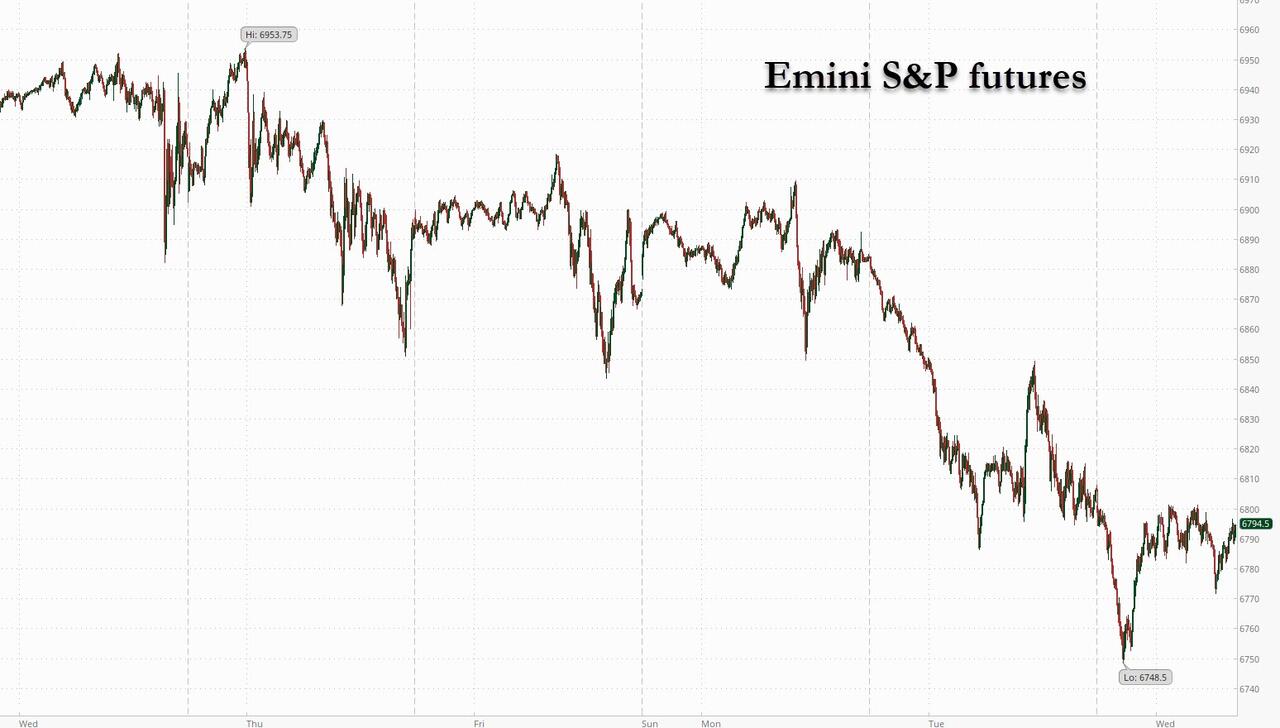
Welcome to day 36 of the government shutdown which officially makes it the longest shut down in history. Futures are trading moderately lower, following weaker Asian and European sessions, but well off session lows as Japan retraced nearly 50% of its losses during the session. As of 8:00am ET, S&P futures are down 0.2% having earlier slid far more following Tuesday’s 1.2% slump as technology shares dragged stocks lower globally; Nasdaq futures are down 0.1%, also recovering most of their losses. In premarket trading, Mag 7 stocks are mixed with Semis weaker. Confirming just how dented upward momentum is, many of the larger Tech companies that reported last night are weaker this morning. Both Cyclicals and Defensives are mixed without reflecting which will outperform today. According to JPM, so far yesterday’s price action has yet to spill over to the US session and the view that a valuation-induced sell-off with Tech underperforming was a narrative that was forming. It may be the case that as the market looks to remove froth that we see Mag7 outperform the higher beta segments of TMT / AI. In overnight news, China banned foreign-made chips in state-funded data centers. Bond yields are unchanged, erasing an earlier and the USD is also flat. Commodities are poised for a rebound with WTI, Precious Metals, and Ags all higher. Today’s macro data focus is on ADP and ISM-Srvcs. With the shutdown in Washington leaving a vacuum in official data, the private ADP employment numbers out today will get more attention than usual.
In premarket trading, Magnificent Seven stocks are mixed (Tesla +1.2%, Meta +0.3%, Apple -0.05%, Microsoft -0.1%, Alphabet -0.1%, Amazon -0.2%, Nvidia -0.7%)
- AMD (AMD) falls 4% after the chipmaker reported its third-quarter results and gave an outlook. While analysts are broadly positive, they note some issues with margins and the outlook. The stock has more than doubled this year.
- Arista Networks (ANET) slides 10% after the company’s forecast for adjusted gross margin in the fourth quarter fell short of the average analyst estimate.
- Axon (AXON) drops 18% after the Taser maker reported disappointing third-quarter adjusted EPS and agreed to buy emergency-tech company Carbyne in a deal valuing the company at $625 million.
- Biohaven (BHVN) tumbles 44% as TD Cowen calls the FDA’s Vyglxia Complete Response Letter as “highly disappointing” amid broader concerns over its impact on the firm’s R&D spending.
- Clover Health (CLOV) sinks 20% after the health insurer cut its adjusted Ebitda guidance for the full year, following third-quarter adjusted Ebitda results that fell short of expectations. The company notes high medical costs in the quarter pressured margins.
- Humana (HUM) falls 5% after the health insurer reaffirmed its forecast for medical costs for the full year, with the outlook below the average analyst estimate. The firm also reported higher medical costs for the third quarter than analysts anticipated.
- Kennedy-Wilson (KW) surges 26% after receiving a buyout proposal letter from CEO William McMorrow and Fairfax Financial Holdings to acquire all outstanding common stock.
- Kratos (KTOS) falls 8% after the defense contractor forecast revenue and adjusted Ebitda for the fourth quarter that missed the average analyst estimate.
- Mosaic (MOS) shares are up 5% after the agricultural chemicals company reported adjusted earnings per share for the third quarter that beat the average analyst estimate.
- Pinterest (PINS) is down 18% after the search platform gave a revenue outlook that is weaker than expected.
- Super Micro Computer Inc. (SMCI) falls 7% after the server maker missed reduced estimates for first-quarter sales and profit and gave a disappointing earnings forecast for the current period, reinforcing concerns about its ability to capitalize on demand for AI equipment.
- Toast (TOST) gains 3% after the restaurant software company reported third-quarter results that beat expectations and raised its full-year forecast for adjusted Ebitda.
- Trex (TREX) sinks 33% after the maker of decking products forecast net sales for the fourth quarter that fell short of the average analyst estimate.
- United Parcel Service Inc. (UPS) slips 1.8% after one of its freighter jets crashed and exploded shortly after takeoff on Tuesday from Louisville, Kentucky, killing three crew members and at least four people on the ground.
- Upstart (UPST) falls 13% after the AI lending marketplace reported third-quarter revenue that missed expectations and lowered its full-year revenue forecast.
In corporate news, Google and Fortnite game maker Epic Games reached a settlement in their long-running antitrust fight over how developers distribute and monetize apps on Android phones. A UPS freighter jet crashed and exploded shortly after takeoff from Louisville, Kentucky, killing at least seven people. Toyota’s annual profit guidance disappointed investors, a sign that the impacts of US tariffs are still weighing on its bottom line. Amazon.com is suing Perplexity AI to try and stop the startup from helping users buy items on the world’s largest online marketplace.
The VIX jumped to 19 on Tuesday but there’s no sign of panic so far in derivatives markets with the gauge holding under 20, with some 25/30 call spread buying, a likely hedge into year-end playing a moderate rise in volatility.
“There has been way more nervousness than usual during the last rally, and that’s not a good sign,” said Alexandre Baradez, chief market analyst at IG in Paris. “The market was priced for perfection so that explains why emerging questions about rate cuts, liquidity, and valuations are having such an impact.”
Crypto markets offered an early warning signal on the recent liquidity rush, with Bitcoin about 20% below a record high reached a month ago — before paring some of those losses in Wednesday trading. Holders of the cryptocurrency have offloaded around 400,000 Bitcoin over the past month, an exodus of about $45 billion that’s left the market unbalanced.
Meanwhile, the US government has reached a major milestone of dysfunction, with the federal shutdown now the longest in history — and economic pain is deepening. The CBO estimates 4Q growth could be cut by as much as 2 percentage points if the impasse continues for eight weeks.
In politics, Democrats landed a series of local election wins. Zohran Mamdani was elected the 111th Mayor of New York, and his proposals and inexperience — he’s sponsored only a handful of bills while serving three terms as a state assemblyman — is said to have unnerved business leaders and real estate groups.
ADP jobs data today comes in the face of recent corporate cutbacks which economists fear may be a warning sign, with companies such as Starbucks, Target, and Amazon making significant job cuts.
Turning to earnings, by Tuesday night, three-quarters of S&P 500 companies had reported results this season with a positive surprise ratio of 82% — similar to 2Q, which was the highest beat percentage since the third quarter of 2021. Price reaction to AI-related earnings remains volatile, with AMD falling despite lifting guidance, perhaps reflecting elevated buyside expectations. Other AI-related names to fall on results include Tempus AI, Super Micro Computer and Arista Networks.
Emerson Electric, FIS, Humana, McDonald’s, Unity Software and Zimmer Biomet are among companies expected to report results before the market opens. Sales growth at McDonald’s is expected to accelerate to 3.6% from a 1.5% drop last year, as its enhanced value offerings resonate with consumers. Earnings from AppLovin, DoorDash, ARM, Duolingo, Figma, Fortinet, Robinhood, Qualcomm and Lyft follow later in the day.
European stocks fall for a second day, though with less severity than seen earlier in Asia. Stoxx 600 down by 0.5% with tech stocks underperforming on a drag from ASML. That followed weakness in chip stocks in the US and drops for the tech-heavy Nikkei 225 in Japan and Kospi in Korea. Here are some of the biggest movers on Wednesday:
- Barry Callebaut climbs as much as 7.8% following results on Wednesday, with analysts noting its “sober” outlook, but Vontobel saying the chocolate product manufacturer is at least setting more realistic goals.
- Vestas gains as much as 15% after the Danish wind-power manufacturer reported a strong set of earnings, with analysts highlighting outperformance for its Power Solutions division, with a new and unexpected buyback program welcome.
- Aixtron shares climb as much as 7.6%. Demand for power from AI infrastructure could drive growth at the semiconductor equipment manufacturer, according to Barclays, which upgraded the stock to overweight from equal-weight.
- Ahold Delhaize shares rise 4.6% as the retailer reported adjusted operating profit for the third quarter that beat the average analyst estimate.
- Demant gains as much as 7.6%, despite the firm saying it now expects full-year organic sales growth to come in toward the lower end of its existing 1%-3% guidance range.
- Novo shares fluctuate in morning trading before rising as much as 2.7%. The Danish drugmaker narrowed its sales guidance for the year, while its commentary around negotiated US Medicare pricing was better than expected, according to analysts.
- Ambu slumps as much as 19%, the most in three years, after the Danish health-care equipment company reported its latest earnings. JPMorgan sees a miss to 4Q estimates, and new 2026 guidance implies large cuts to Ebit consensus expectations.
- Siemens Healthineers falls as much as 13%, the most on record, after the German health-care equipment group reported earnings which analysts describe as a disappointment.
- Pandora shares fall as much as 5.2% after the jewellery manufacturer lowered guidance for 2025 like-for-like growth and its 2026 EBIT margin target, and reported revenue for the third quarter that missed the average analyst estimate.
- Nexi shares fall as much as 9.9% after the third-quarter operating revenue of the payment services provider missed estimates.
- Qiagen drops as much as 4.4% in Frankfurt as Morgan Stanley says the German life science and diagnostics firm’s fourth-quarter growth outlook potentially overshadows decent third-quarter results.
- Evotec shares fall as much as 12% after the German company reported results RBC called “dismal” with revenue and Ebitda significantly below consensus estimates.
Earlier in the session, Asian stocks fell, weighed by a selloff in tech shares amid mounting concerns over excessive valuations. The MSCI Asia Pacific Index dropped as much as 2.3%, before trimming some losses on dip-buying. Tech heavyweights TSMC, SoftBank and Samsung Electronics were among the biggest drags. Most markets were in the red, with Japan and South Korea leading the losses. The selloff follows Wall Street chiefs’ warnings about an overdue correction, while fading expectations for Federal Reserve rate cuts and the prolonged US government shutdown also contribute to the risk-off sentiment. South Korea’s equity benchmark Kospi Index finished 2.9% lower — narrowing earlier losses of as much as 6.2% — marking its steepest daily decline since August. Japan’s blue-chip Nikkei 225 gauge also pared a plunge of 4.7% to close 2.5% lower, while the broader Topix Index fell 1.3%. China’s benchmark CSI 300 Index reversed early losses to end the day in the green, helped by solid gains in solar stocks. Indonesia also posted mild gains. Markets in India were closed for a holiday.
In FX, the Bloomberg Dollar Spot Index is in a narrow range but has reversed an earlier decline. Sterling an outperformer, Swedish krona in the middle of the pack in the G-10 after the Riksbank held rates at a three-year low.
In rates, we are seeing muted moves in bond markets, with US Treasury yields little changed amid similarly muted price action in German bonds, while long-end gilts underperform slightly. US 10-year is lower by less than 1bp near 4.08% with German counterpart similar and UK’s lagging by around 1bp. Treasury 5s30s curve is around 1bp steeper on the day. Focal points of US session focus include October ADP employment change and services PMIs, as well as Treasury quarterly refunding announcement at 8:30am New York time. For the US Treasury’s quarterly refunding announcement, dealers expect two- to 30-year auction sizes will be unchanged during the November-to-January period
IG dollar issuance slate includes at least two offerings so far. Three borrowers raised a combined $2.85b Wednesday. Issuers paid about 12bps of concession on deals that were 2.9 times covered.
In commodities, gold is higher by $34 to around $3,964/oz. Oil prices up, Brent futures heading closer to $65/barrel. Bitcoin briefly fell below $100,000, though is now holding just above that level.
US economic calendar slate includes October ADP employment change (8:15am), October S&P Global US services PMI (9:45am) and October ISM services index (10am). Fed speaker slate empty for the session
Market Snapshot
- S&P 500 mini -0.2%
- Nasdaq 100 mini -0.1%
- Russell 2000 mini little changed
- Stoxx Europe 600 -0.4%
- DAX -0.7%
- CAC 40 -0.2%
- 10-year Treasury yield little changed at 4.09%
- VIX +0.5 points at 19.54
- Bloomberg Dollar Index little changed at 1226.45
- euro little changed at $1.148
- WTI crude +0.7% at $61/barrel
Top overnight News
- The government shutdown dragged into its 36th day becoming the longest in history. Every week that passes with Congress deadlocked costs the US economy between $10 billion to $30 billion, according to analysts’ estimates, with several landing in the $15 billion range. BBG
- A “handful” of moderate Senate Democrats are considering voting to end the government shutdown. The deal would pass three full-year appropriations bills to fund some agencies, along with a short-term bill that would reopen the rest of the government: WaPo
- Democrat Mikie Sherrill won the New Jersey Governor election and Democrat Abigail Spanberger won the Virginia Governor election, while Democrat Zohran Mamdani won the New York mayoral election.
- In addition to Mamdani’s victor in New York, Democrats also scored other victories throughout the country. The party won gubernatorial races in New Jersey and Virginia around a message of economic affordability. California voters approved a new congressional map intended to create five new Democratic-leaning districts. BBG
- New Yorkers squeezed by the city’s housing crunch also voted in favor of proposals to fast-track affordable housing projects, expedite modest developments and create an appeals board, vote tallies recorded by the AP and the NYT showed. BBG
- The Chinese government has issued guidance requiring new data center projects that have received any state funds to only use domestically-made artificial intelligence chips. Order likely to affect U.S. chipmakers Nvidia, AMD, Intel as Beijing tries to cultivate domestic AI chipmakers like Huawei. RTRS
- Japan’s top currency official, Atsushi Mimura, said recent moves by the yen are deviating from what might be expected given interest rate differentials. The yen touched an eight-month low against the dollar after the BOJ left rates unchanged, despite subtle hints of a potential hike from Governor Kazuo Ueda. BBG
- A growing number of policymakers at the Bank of Japan believed that conditions were falling into place for interest rates to rise, with two members advocating an immediate increase, minutes of the central bank’s September meeting showed on Wednesday. RTRS
- The Bank of England is exploring ways of encouraging lenders to use more of their regulatory capital buffers in a bid to boost economic growth. BBG
- German factory orders rose for the first time in five months. Demand increased 1.1% in September, led by automotive and electrical equipment manufacturers and beating estimates. BBG
Trade/Tariffs
- US President Trump posted the “United States Supreme Court case is, literally, LIFE OR DEATH for our Country. With a Victory, we have tremendous, but fair, Financial and National Security. Without it, we are virtually defenceless against other Countries who have, for years, taken advantage of us. Our Stock Market is consistently hitting Record Highs, and our Country has never been more respected than it is right now. A big part of this is the Economic Security created by Tariffs, and the Deals that we have negotiated because of them.”
- US President Trump posts it was his “Great Honor to just meet with high level Representatives of Switzerland. We discussed many subjects including, and most importantly, Trade and Trade Imbalance. The meeting was adjourned with the understanding that our Trade Representative, Jamieson Greer, will discuss the subjects further with Switzerland’s Leaders.”
- White House posted the Executive Order modifying duties addressing the synthetic opioid supply chain in China.
- White House said it is not interested in selling to China at this time regarding NVIDIA (NVDA) Blackwell chips.
- China announced it will suspend 24% US tariffs for a year but will maintain 10% US tariffs, while it will lift some tariffs on US agriculture goods from November 10th.
- Chinese Premier Li said some unilateral and protectionist measures have had severe impacts on the economic world order, while he said they should uphold equality and mutual benefit and consolidate the foundation of legitimate common interest. Li stated that it is all the more important for them to stay committed to mutual cooperation and pursue free trade when economic growth is slowing. Furthermore, he said China is willing to stand with all parties to foster an open and inclusive environment, as well as commented that countries should not seek unilateral wins at the expense of others, and need to balance their interests against the greater good.
- White House said US President Trump feels positively about the relationship with India and trade teams continue to be in serious discussions, while it added that President Trump and Indian PM Modi speak frequently.
- China Commerce Ministry suspends unreliable entity list announced in April; removes entity list announced in March and will adjust the list.
A more detailed look at global markets courtesy of newsquawk
APAC stocks were mixed after an early sell-off following the losses stateside, where tech underperformed amid valuation concerns. ASX 200 was rangebound as resilience in defensives and the top-weighted financial sector provided a cushion. Nikkei 225 suffered heavy losses and briefly fell beneath the 50,000 level with the downturn led by tech-related stocks. KOSPI collapsed alongside the tech bloodbath, which prompted the Korea Exchange to briefly trigger sidecars on the KOSPI and KOSDAQ. Hang Seng and Shanghai Comp are mixed after paring most of their earlier losses following somewhat mixed Chinese RatingDog Services and Composite PMI data in which the former marginally topped estimates, but the composite figure slowed, while both the US and China made adjustments to their tariffs following last week’s Trump-Xi talks.
Top Asian News
- BoJ Minutes from the September 18th-19th Meeting stated that members agreed current real interest rates are very low, and the BoJ is likely to continue raising interest rates if its economic and price projections materialise. Furthermore, members agreed there is high uncertainty on trade policy developments and their impact on the economy, while a few members said it is appropriate to maintain current monetary policy to scrutinise trade policy impact on the domestic and overseas economy, as well as prices.
- Japan’s Top Currency Diplomat Mimura says recent JPY moves deviate from fundamentals, JPY long positions have been shrinking after summer. FX excessive volatility, not levels, is the main concern. There is some speculation in the market about Japan’s macroeconomic policies, especially fiscal policy. A bit worried whether or not the current situation in the stock market might be a little too rapid.
European bourses (STOXX 600 -0.2%) opened entirely in the red, as the downbeat risk tone continues to follow through into today’s session. Lack of pertinent newsflow and a slew of EZ PMIs have had little impact to change price action, which has been fairly rangebound throughout the day. European sectors hold a negative bias. Autos takes the top spot, buoyed by post-earning strength in BMW (+1.5%) after reporting decent Q3 metrics, and reiterating its FY outlook. Tech is found towards the foot of the pile, as AI-bubble fears continue to grow; ASML (-2%). Elsewhere, Novo Nordisk (+1%) has pared initial losses, despite poor headline metrics and trimming FY guidance.
Top European News
- UK Chancellor Reeves is to urge insurance bosses to increase investment in London, according to FT.
- The Times’ Shadow MPC says that BoE should wait to cut rates again until after the November 26th budget. The decision was via a narrow 5-4 vote.
- Politico writes that the mood around French Socialist Party Leader Faure concerning the budget bills was rather optimistic. An associate cited said “What would be the point of a governing party doing all this work if they’re not going to vote in the end?”.
- Riksbank maintains its rate at 1.75% as expected; reiterates that policy rate is expected to remain at this level for some time to come. The labour market is still showing weak development, although there are now some signs that a turnaround is on its way.
- ECB’s Nagel says the ECB should be vigilant but not complacent on inflation.
FX
- The recent rally in the USD that has been driven by improving US-China relations, the hawkish FOMC announcement and yesterday’s global equity selling has paused for breath. As the US shutdown enters its 35th day, matching its prior record, official US data releases remain suspended. However, today we will be presented by the latest ADP employment report and ISM services print. The former is expected to see employment in October rise to 28k from the -32k print in September. For the ISM print, consensus looks for the headline metric to pick-up to 50.8 from the neutral 50 mark. Elsewhere, today will see the commencement of the hearing on the legality of US President Trump’s Reciprocal Tariff Policy. DXY remains below Tuesday’s best at 100.25.
- EUR is attempting to stop the rot vs. the USD following a recent run of losses, which dragged EUR/USD down from a 1.1668 peak last week to a 1.1473 trough yesterday. Incremental macro drivers remain on the light side for the Eurozone with final services & composite PMIs and an unrevised ECB annual wage tracker failing to move the dial for the EUR.
- JPY is now only incrementally firmer vs. the USD following a bout of strength overnight as global equities continued to slip. USD/JPY delved as low as 152.97 before returning to levels above 153.50. Recent strength in JPY has been stemming more from the risk-aversion price action in the market as opposed to anything Japan-specific. Fleeting modest JPY appreciation was seen in early European trade after Japanese Top Currency Diplomat Mimura noted that recent JPY moves are deviating from fundamentals and that excessive FX volatility, not levels, is the main concern.
- GBP is attempting to atone for its recent run of losses, which have largely been driven by increasing odds of a December BoE cut and ongoing angst ahead of the November 26th budget. This angst was brought to the forefront yesterday following Chancellor Reeve’s pre-budget speech in which she stopped shy of naming any specific policies but helped reaffirm the markets view that it will be a growth-negative event. Cable is holding above Tuesday’s 1.3010 trough but some way off the 1.3139 peak.
- Antipodeans are mixed, with the Kiwi marginally outmuscling the Aussie on the cross. Overnight markets had Chinese Services/Composite PMI data, in which the former marginally topped estimates, but the composite figure slowed. Overall, quiet trade for the pair this morning, as the FX space awaits key US data.
- As was widely-expected, the Riksbank opted to keep rates unchanged and reiterated guidance that the “policy rate is expected to remain at this level for some time to come”. Within its economic assessment, it was judged that the outlook for inflation and economic activity remains largely unchanged. SEK was little moved.
Fixed Income
- A firmer start to the day for USTs but only modestly so. Action for USTs overnight occurred in tandem with the broader risk tone, as a move lower in equity futures was seen around the beginning of the APAC session, the fixed benchmark picked up, taking USTs to an overnight 113-02 high. Thereafter, the benchmark drifted as the risk tone picked up off lows and stabilised. Nonetheless, USTs hold onto modest gains but are at the lower-end of a narrow 112-26 to 113-02 band. The docket ahead is packed from a US perspective. On the data front, the monthly ADP (reminder, they also do a weekly update now on non-NFP weeks) series is due and expected to come in at 28k (prev. -32k); ISM Services also due. The Quarterly Refunding Announcement is also due and is expected to maintain the nominal coupon auction sizes for the November-January period. Finally, the Supreme Court tariff hearing begins today with oral arguments to be presented for the first time.
- Bunds are echoing USTs in terms of overnight direction, though the magnitude of action has been slightly more pronounced, Bunds are in a 129.26-47 band but ultimately remain in the green by a tick or two, as is the case with USTs. No move to the morning’s final PMIs, posting upward revisions to the services and composite measures. The latest ECB wage tracker maintained the annual rate and did not spark any price action.
- Gilts are underperforming peers. Opened unchanged 93.66 before lifting a few ticks higher to 93.69, acknowledging the overnight move, and then slipping into the red and currently to a 93.50 trough, posting downside of 16 ticks at most. Pressure that sends Gilts back to the 93.49 low from Tuesday, but still above Monday’s 93.37 close and thus retaining some of the support derived from the late-Monday/early-Tuesday press briefings around potential UK tax moves. Overnight updates include The Times reporting that Reeves is considering removing the 5p cut to fuel duty (introduced in 2022, after Russia invaded Ukraine), as it is not being passed onto individual customers. That cut, alongside the duty freeze that has been in place since 2011, costs c. GBP 3bln/yr.
Commodities
- Crude benchmarks dipped at the start of the APAC session as Asian equities followed the sell-off seen stateside but gradually reversed as the European session got underway as risk sentiment improved a little. WTI and Brent dipped to a trough of USD 60.02/bbl and 63.92/bbl respectively before reversing to a peak of USD 60.90/bbl and 64.78/bbl as European players entered the market. Currently, crude benchmarks remain near session highs as markets wait for a new catalyst to drive the oil market. In the meantime, US ADP/ISM Services will keep markets busy.
- Spot XAU has rebounded from Tuesday’s selloff, which moved counter to the wider risk theme running through markets. XAU fell just shy of Tuesday’s low of USD 3928/oz at the start of the APAC session before trading higher to a peak of USD 3979/oz as the European session got underway. The yellow metal briefly extended higher to USD 3987/oz but has since fallen back into prior ranges. After falling over 12% from ATHs, there is a wider consensus that the pullback is mostly over as underlying drivers remain strong.
- Base metals have traded rangebound as the European session gets underway after 3M LME Copper fell for 4 straight days, its longest losing streak since late July. 3M LME Copper oscillates in a USD 10.58k-10.71k/t band as markets wait for a catalyst.
- US Private Energy Inventory Data (bbls): Crude +6.5mln (exp. +0.6mln), Distillate -2.5mln (exp. -2mln), Gasoline -5.7mln (exp. -1.1mln), Cushing +0.4mln.
Geopolitics
- IAEA’s Grossi said Iran must seriously improve cooperation with UN inspectors to avoid heightening tensions with the West, according to FT.
- North Korea shows signs of preparing to launch additional spy satellites aided by Russia, while it was also reported that North Korean leader Kim could conduct a nuclear test in the near future if he wants, according to South Korea’s spy agency.
- US Secretary of Defense Hegseth said the US military carried out a lethal kinetic strike on a vessel in international waters in the Eastern Pacific.
US Event Calendar
- 7:00 am: Oct 31 MBA Mortgage Applications -1.9%, prior 7.1%
- 8:15 am: Oct ADP Employment Change, est. 30k, prior -32k
- 9:45 am: Oct F S&P Global U.S. Services PMI, est. 55.2, prior 55.2
- 9:45 am: Oct F S&P Global U.S. Composite PMI, est. 54.85, prior 54.8
- 10:00 am: Oct ISM Services Index, est. 50.8, prior 50
DB’s Jim Reid concludes the overnight wrap
The last 24 hours have brought a clear risk-off move, as concerns over lofty tech valuations have hit investor sentiment. Markets compounded these losses in the early hours of Asian trading but have been rallying back in the couple of hours prior to going to print with US futures clawing back towards flat with the KOSPI rallying back a couple of percentage points from early -5% plus losses. In the main session yesterday, the S&P 500 (-1.17%) lost ground thanks to sharp losses among tech stocks, and there was a big slump for Palantir (-7.94%) after its earnings the previous day. Moreover, this pattern was clear across multiple asset classes, as US HY spreads (+10bps) ticked up for a 4th consecutive day, Brent crude oil (-0.69%) fell back again, whilst Bitcoin (-6.18%) fell below $100k for the first time since June, some -20% off its recent all-time highs.
In terms of overnight news, it was a big election day across many states in the US yesterday including NYC mayor and gubernatorial races in New Jersey and Virginia. While the Democrat victories that we’ve seen were expected in these high profile races, the party appears to have mostly outperformed opinion polls. So an early sign of an anti-incumbent party swing ahead of the mid-terms in a year’s time, even if one has to be cautious in the read across from state to federal elections. In NYC, the Democrats’ candidate and self-described democratic socialist Zohran Mamdani won the three-way mayoral race ahead of former Governor Andrew Cuomo. The vote was in part seen as a test of Mamdani’s leftist economic proposals which include higher local corporate and top-end income tax rates, though it is far from clear if these would get the necessary backing of the New York state legislature and Governor.
US political news will remain in the spotlight today as the Supreme Court is due to hear oral arguments in the case against Trump’s use of the International Emergency Economic Powers Act (IEEPA) to impose broad tariffs. Lower courts invalidated the IEEPEA tariffs back in the summer but left them in place pending appeal. While a ruling by the Supreme Court may take some time, today’s hearing could well provide hints of how the justices view the arguments. If the Supreme Court upholds the earlier decisions, it would impact many of the tariffs imposed this year, with implications for government revenue, though the administration may look to replace these using other statutes.
Back to yesterday and whilst the moves were only one day’s selloff, the market narrative saw a discernible shift, with a growing chorus discussing whether we might be on the verge of an equity correction. That speculation has gathered pace over the last month in particular, mainly because the Magnificent 7 has diverged from the rest of the S&P 500, which has revived questions about how concentrated this equity market now is. Indeed, whilst the Mag 7 have been advancing in recent weeks, the equal-weighted S&P 500 actually fell in October for the first time in 6 months.
Yesterday’s decline for Palantir (-7.94%) was seen as emblematic of this shift, particularly given they’d actually raised their revenue outlook the previous day. But given their share price had quadrupled in the last year, that’s set the bar incredibly high for any earnings releases. In fact, the Magnificent 7 (-2.28%) led the declines yesterday, with Nvidia itself down by a larger -3.96% as some of those top-performing stocks came under scrutiny. The S&P 500 ex-Mag-7 was also down a notable -0.75% with the equal-weight index -0.63% and the Russell 2000 -1.78%. For the S&P 500 itself (-1.17%), it was the worst day since October 10, when trade escalation fears between US and China spiked.
Whilst many assets struggled yesterday, US Treasuries benefited from the risk-off tone, with yields falling across the curve. So the 2yr yield (-2.9bps) fell back to 3.58%, whilst the 10yr yield (-2.5bps) fell to 4.09% (4.072% as I type in Asia). That came as investors dialled up the likelihood of a December rate cut again, particularly as fears of a larger equity correction gathered pace. So by the close, a December rate cut was back up to a 74% probability, and that move got further support from the decline in commodity prices, with Brent crude down -0.69% to $64.44/bbl. Despite the fall in yields, the dollar index (+0.35%) gained amid the risk-off mood, while gold (-1.73%) retreated.
Elsewhere, the mood hasn’t been helped by the ongoing US government shutdown, which is now the longest on record at 36 days today, surpassing the most recent 35-day shutdown in 2018-19. Interestingly, we did see mounting speculation yesterday about a potential deal between Republicans and Democrats, with hopes that a compromise will become more likely with yesterday’s elections out of the way. Indeed, the Polymarket odds of the shutdown continuing past November 16 have fallen from around 40% when we went to press yesterday to 27% now. We also heard from President Trump, who said that SNAP benefits (the Supplemental Nutrition Assistance Program) would only be given when the government was open, and he said in another post that the Senate filibuster should be terminated so Republicans could reopen the government themselves.
Overnight in Asia, markets are continuing their decline but are well off their early morning lows. The Nikkei (-2.62%) and Kospi (-2.83%) are leading the way with the latter down over -5% earlier. Elsewhere the sell-off is less severe with the Hang Seng (-0.31%) and ASX (-0.13%) rallying back towards flat and the Shanghai Composite (+0.14%) actually higher. NASDAQ futures are down -0.20% and S&P 500 futures down -0.07%, with the former rallying nearly a percentage point from the lows.
Earlier in Europe, the main news came from the UK, where gilts rallied after Chancellor Reeves delivered a speech that reassured markets about future bond issuance. Notably, she said that the “more we try and sell, the more it will cost us”, and she also affirmed that her “commitment to the fiscal rules is ironclad.” So that helped 10yr gilt yields to fall -1.0bps yesterday, ending the session at 4.42%. The speech comes ahead of the budget on November 26, and another significant feature was that Reeves didn’t rule out the prospect of tax rises either. That’s important, because the governing Labour Party promised at last year’s general election that they wouldn’t raise income tax, VAT or National Insurance (a payroll tax), so a shift in that stance would be a big political moment.
Elsewhere in Europe, the risk-off tone mirrored what we saw in the US, with the STOXX 600 (-0.30%) falling to a two-week low. Several of the major indices lost ground, including the DAX (-0.76%) and the CAC 40 (-0.52%), although the FTSE 100 (+0.14%) posted a modest gain as it was supported by the weakness in the pound sterling (-0.91% vs USD). Meanwhile, sovereign bonds rallied across the continent, with yields on 10yr bunds (-1.3bps), OATs (-0.6bps) and BTPs (-1.0bps) all falling back.
To the day ahead now, and data releases from the US include the ISM services index and the ADP’s report of private payrolls for October. Otherwise, we’ll get the final services and composite PMIs from the US and Europe, German factory orders for September. Otherwise, central bank speakers include the ECB’s Villeroy, Nagel and Kocher, along with the BoE’s Breeden. Earnings releases include McDonald’s and Qualcomm.
b) European opening report
US equity futures mixed, USD pauses as market awaits ADP and ISM data – Newsquawk US Opening News

Wednesday, Nov 05, 2025 – 05:36 AM
- European bourses are entirely in the red; US equity futures mixed, with the NQ continuing to underperform whilst the RTY takes a breather.
- Recent USD rally pauses for breath ahead of ADP and ISM services.
- USTs are contained into a packed agenda, Gilts continue to ease from Tuesday’s best.
- Commodities rebound following Tuesday’s risk-off sell-off.
- Looking ahead, highlights include US Final PMI, US ADP, US ISM Services PMI, NBP & BCB Policy Announcements, US Supreme Court Tariff hearing begins, Speakers including BoE’s Breeden, BoC’s Macklem & Rogers, US QRA. Earnings from AMC, Arm, Snap & McDonald’s.
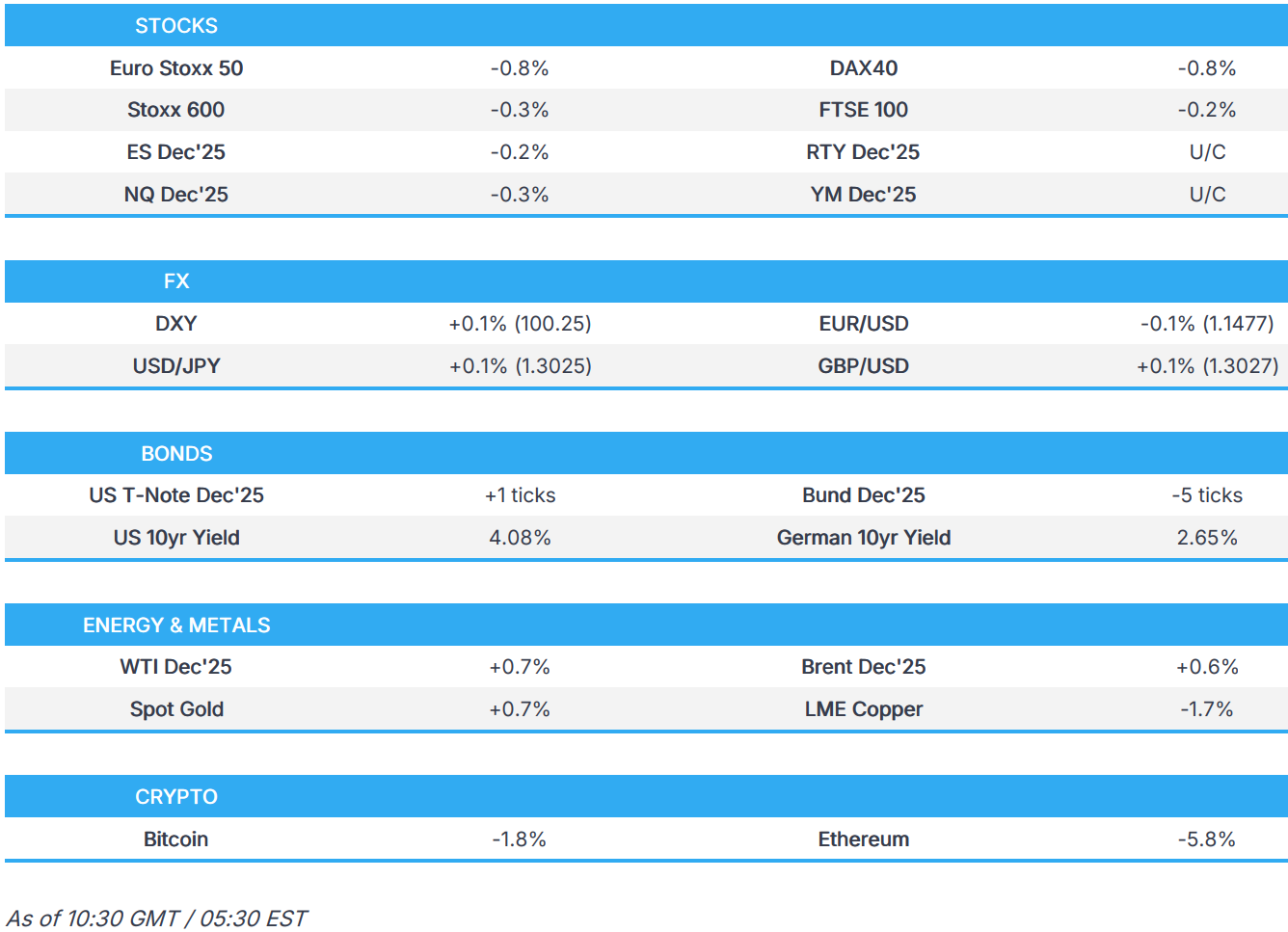
Newsquawk in 3 steps:
1. Subscribe to the free premarket movers reports
2. Listen to this report in the market open podcast (available on Apple and Spotify)
3. Trial Newsquawk’s premium real-time audio news squawk box for 7 days
TARIFFS/TRADE
- US President Trump posted the “United States Supreme Court case is, literally, LIFE OR DEATH for our Country. With a Victory, we have tremendous, but fair, Financial and National Security. Without it, we are virtually defenceless against other Countries who have, for years, taken advantage of us. Our Stock Market is consistently hitting Record Highs, and our Country has never been more respected than it is right now. A big part of this is the Economic Security created by Tariffs, and the Deals that we have negotiated because of them.”
- US President Trump posts it was his “Great Honor to just meet with high level Representatives of Switzerland. We discussed many subjects including, and most importantly, Trade and Trade Imbalance. The meeting was adjourned with the understanding that our Trade Representative, Jamieson Greer, will discuss the subjects further with Switzerland’s Leaders.”
- White House posted the Executive Order modifying duties addressing the synthetic opioid supply chain in China.
- White House said it is not interested in selling to China at this time regarding NVIDIA (NVDA) Blackwell chips.
- China announced it will suspend 24% US tariffs for a year but will maintain 10% US tariffs, while it will lift some tariffs on US agriculture goods from November 10th.
- Chinese Premier Li said some unilateral and protectionist measures have had severe impacts on the economic world order, while he said they should uphold equality and mutual benefit and consolidate the foundation of legitimate common interest. Li stated that it is all the more important for them to stay committed to mutual cooperation and pursue free trade when economic growth is slowing. Furthermore, he said China is willing to stand with all parties to foster an open and inclusive environment, as well as commented that countries should not seek unilateral wins at the expense of others, and need to balance their interests against the greater good.
- White House said US President Trump feels positively about the relationship with India and trade teams continue to be in serious discussions, while it added that President Trump and Indian PM Modi speak frequently.
- China Commerce Ministry suspends unreliable entity list announced in April; removes entity list announced in March and will adjust the list.
EUROPEAN TRADE
EQUITIES
- European bourses (STOXX 600 -0.2%) opened entirely in the red, as the downbeat risk tone continues to follow through into today’s session. Lack of pertinent newsflow and a slew of EZ PMIs have had little impact to change price action, which has been fairly rangebound throughout the day.
- European sectors hold a negative bias. Autos takes the top spot, buoyed by post-earning strength in BMW (+1.5%) after reporting decent Q3 metrics, and reiterating its FY outlook. Tech is found towards the foot of the pile, as AI-bubble fears continue to grow; ASML (-2%). Elsewhere, Novo Nordisk (+1%) has pared initial losses, despite poor headline metrics and trimming FY guidance.
- US equity futures (ES -0.2%, NQ -0.3%, RTY U/C) are mixed, as the ES/NQ continue to extend on recent pressure whilst the RTY pauses for breath. Today’s focus will be on the US ADP figures, which has increased focus given the suspension of the NFP report, amidst the US gov’t shutdown; US ISM Services are also on the docket.
- China bans foreign AI chips from state-funded data centres, via Reuters sources; likely to affect US chipmakers such as NVIDIA (NVDA), AMD (AMD), Intel (INTC); foreign chips banned in Chinese state-funded data centres include NVIDIA H20, B200 and H200.
- Click for the sessions European pre-market equity newsflow
- Click for the additional news
- Click for a detailed summary
FX
- The recent rally in the USD that has been driven by improving US-China relations, the hawkish FOMC announcement and yesterday’s global equity selling has paused for breath. As the US shutdown enters its 35th day, matching its prior record, official US data releases remain suspended. However, today we will be presented by the latest ADP employment report and ISM services print. The former is expected to see employment in October rise to 28k from the -32k print in September. For the ISM print, consensus looks for the headline metric to pick-up to 50.8 from the neutral 50 mark. Elsewhere, today will see the commencement of the hearing on the legality of US President Trump’s Reciprocal Tariff Policy. DXY remains below Tuesday’s best at 100.25.
- EUR is attempting to stop the rot vs. the USD following a recent run of losses, which dragged EUR/USD down from a 1.1668 peak last week to a 1.1473 trough yesterday. Incremental macro drivers remain on the light side for the Eurozone with final services & composite PMIs and an unrevised ECB annual wage tracker failing to move the dial for the EUR.
- JPY is now only incrementally firmer vs. the USD following a bout of strength overnight as global equities continued to slip. USD/JPY delved as low as 152.97 before returning to levels above 153.50. Recent strength in JPY has been stemming more from the risk-aversion price action in the market as opposed to anything Japan-specific. Fleeting modest JPY appreciation was seen in early European trade after Japanese Top Currency Diplomat Mimura noted that recent JPY moves are deviating from fundamentals and that excessive FX volatility, not levels, is the main concern.
- GBP is attempting to atone for its recent run of losses, which have largely been driven by increasing odds of a December BoE cut and ongoing angst ahead of the November 26th budget. This angst was brought to the forefront yesterday following Chancellor Reeve’s pre-budget speech in which she stopped shy of naming any specific policies but helped reaffirm the markets view that it will be a growth-negative event. Cable is holding above Tuesday’s 1.3010 trough but some way off the 1.3139 peak.
- Antipodeans are mixed, with the Kiwi marginally outmuscling the Aussie on the cross. Overnight markets had Chinese Services/Composite PMI data, in which the former marginally topped estimates, but the composite figure slowed. Overall, quiet trade for the pair this morning, as the FX space awaits key US data.
- As was widely-expected, the Riksbank opted to keep rates unchanged and reiterated guidance that the “policy rate is expected to remain at this level for some time to come”. Within its economic assessment, it was judged that the outlook for inflation and economic activity remains largely unchanged. SEK was little moved.
- PBoC set USD/CNY mid-point at 7.0901 vs exp. 7.1336 (Prev. 7.0885)
- Click for a detailed summary
- Click for NY OpEx Details
FIXED INCOME
- A firmer start to the day for USTs but only modestly so. Action for USTs overnight occurred in tandem with the broader risk tone, as a move lower in equity futures was seen around the beginning of the APAC session, the fixed benchmark picked up, taking USTs to an overnight 113-02 high. Thereafter, the benchmark drifted as the risk tone picked up off lows and stabilised. Nonetheless, USTs hold onto modest gains but are at the lower-end of a narrow 112-26 to 113-02 band. The docket ahead is packed from a US perspective. On the data front, the monthly ADP (reminder, they also do a weekly update now on non-NFP weeks) series is due and expected to come in at 28k (prev. -32k); ISM Services also due. The Quarterly Refunding Announcement is also due and is expected to maintain the nominal coupon auction sizes for the November-January period. Finally, the Supreme Court tariff hearing begins today with oral arguments to be presented for the first time.
- Bunds are echoing USTs in terms of overnight direction, though the magnitude of action has been slightly more pronounced, Bunds are in a 129.26-47 band but ultimately remain in the green by a tick or two, as is the case with USTs. No move to the morning’s final PMIs, posting upward revisions to the services and composite measures. The latest ECB wage tracker maintained the annual rate and did not spark any price action.
- Gilts are underperforming peers. Opened unchanged 93.66 before lifting a few ticks higher to 93.69, acknowledging the overnight move, and then slipping into the red and currently to a 93.50 trough, posting downside of 16 ticks at most. Pressure that sends Gilts back to the 93.49 low from Tuesday, but still above Monday’s 93.37 close and thus retaining some of the support derived from the late-Monday/early-Tuesday press briefings around potential UK tax moves. Overnight updates include The Times reporting that Reeves is considering removing the 5p cut to fuel duty (introduced in 2022, after Russia invaded Ukraine), as it is not being passed onto individual customers. That cut, alongside the duty freeze that has been in place since 2011, costs c. GBP 3bln/yr.
- Click for a detailed summary
COMMODITIES
- Crude benchmarks dipped at the start of the APAC session as Asian equities followed the sell-off seen stateside but gradually reversed as the European session got underway as risk sentiment improved a little. WTI and Brent dipped to a trough of USD 60.02/bbl and 63.92/bbl respectively before reversing to a peak of USD 60.90/bbl and 64.78/bbl as European players entered the market. Currently, crude benchmarks remain near session highs as markets wait for a new catalyst to drive the oil market. In the meantime, US ADP/ISM Services will keep markets busy.
- Spot XAU has rebounded from Tuesday’s selloff, which moved counter to the wider risk theme running through markets. XAU fell just shy of Tuesday’s low of USD 3928/oz at the start of the APAC session before trading higher to a peak of USD 3979/oz as the European session got underway. The yellow metal briefly extended higher to USD 3987/oz but has since fallen back into prior ranges. After falling over 12% from ATHs, there is a wider consensus that the pullback is mostly over as underlying drivers remain strong.
- Base metals have traded rangebound as the European session gets underway after 3M LME Copper fell for 4 straight days, its longest losing streak since late July. 3M LME Copper oscillates in a USD 10.58k-10.71k/t band as markets wait for a catalyst.
- US Private Energy Inventory Data (bbls): Crude +6.5mln (exp. +0.6mln), Distillate -2.5mln (exp. -2mln), Gasoline -5.7mln (exp. -1.1mln), Cushing +0.4mln.
- Click for a detailed summary
NOTABLE DATA RECAP
- EU Producer Prices YY (Sep) -0.2% vs. Exp. -0.1% (Prev. -0.6%); MM (Sep) -0.1% (Prev. -0.3%, Rev. -0.4%)
- ECB Wage Tracker: 2025 Annual 3.158% (prev. 3.158%)
- German Industrial Orders MM (Sep) 1.1% vs. Exp. 1.0% (Prev. -0.8%)
- French Industrial Output MM (Sep) 0.8% vs. Exp. 0.1% (Prev. -0.7%, Rev. -0.9%)
- EU HCOB Services Final PMI (Oct) 53.0 vs. Exp. 52.6 (Prev. 52.6); Composite Final PMI (Oct) 52.5 vs. Exp. 52.2 (Prev. 52.2)
- Spanish Services PMI (Oct) 56.6 vs. Exp. 54.8 (Prev. 54.3)
- Italian HCOB Composite PMI (Oct) 53.1 (Prev. 51.7); Services PMI (Oct) 54.0 vs. Exp. 53.0 (Prev. 52.5)
- French HCOB Services PMI (Oct) 48.0 vs. Exp. 47.1 (Prev. 47.1); Composite PMI (Oct) 47.7 vs. Exp. 46.8 (Prev. 46.8)
- German HCOB Services PMI (Oct) 54.6 vs. Exp. 54.5 (Prev. 54.5); Composite Final PMI (Oct) 53.9 vs. Exp. 53.8 (Prev. 53.8)
- Italian Retail Sales SA MM (Sep) -0.5% (Prev. -0.1%); YY (Sep) 0.5% (Prev. 0.5%)
- UK S&P Global Services PMI (Oct) 52.3 vs. Exp. 51.1 (Prev. 51.1); Composite – Output (Oct) 52.2 vs. Exp. 51.1 (Prev. 51.1)
NOTABLE EUROPEAN HEADLINES
- UK Chancellor Reeves is to urge insurance bosses to increase investment in London, according to FT.
- The Times’ Shadow MPC says that BoE should wait to cut rates again until after the November 26th budget. The decision was via a narrow 5-4 vote.
- Politico writes that the mood around French Socialist Party Leader Faure concerning the budget bills was rather optimistic. An associate cited said “What would be the point of a governing party doing all this work if they’re not going to vote in the end?”.
- Riksbank maintains its rate at 1.75% as expected; reiterates that policy rate is expected to remain at this level for some time to come. The labour market is still showing weak development, although there are now some signs that a turnaround is on its way.
- ECB’s Nagel says the ECB should be vigilant but not complacent on inflation.
NOTABLE US HEADLINES
- Democrat Mikie Sherrill won the New Jersey Governor election and Democrat Abigail Spanberger won the Virginia Governor election, while Democrat Zohran Mamdani won the New York mayoral election.
- A “handful” of moderate Senate Democrats are considering voting to end the government shutdown, according to WaPo sources. The deal would pass three full-year appropriations bills to fund some agencies, along with a short-term bill that would reopen the rest of the government.
GEOPOLITICS
MIDDLE EAST
- IAEA’s Grossi said Iran must seriously improve cooperation with UN inspectors to avoid heightening tensions with the West, according to FT.
OTHER
- North Korea shows signs of preparing to launch additional spy satellites aided by Russia, while it was also reported that North Korean leader Kim could conduct a nuclear test in the near future if he wants, according to South Korea’s spy agency.
- US Secretary of Defense Hegseth said the US military carried out a lethal kinetic strike on a vessel in international waters in the Eastern Pacific.
CRYPTO
- Bitcoin is a little lower and trades just above USD 101k, after dipping below USD 100k in the prior session. Ethereum underperforms and is down to a USD 3.3k base.
APAC TRADE
- APAC stocks were mixed after an early sell-off following the losses stateside, where tech underperformed amid valuation concerns.
- ASX 200 was rangebound as resilience in defensives and the top-weighted financial sector provided a cushion.
- Nikkei 225 suffered heavy losses and briefly fell beneath the 50,000 level with the downturn led by tech-related stocks.
- KOSPI collapsed alongside the tech bloodbath, which prompted the Korea Exchange to briefly trigger sidecars on the KOSPI and KOSDAQ.
- Hang Seng and Shanghai Comp are mixed after paring most of their earlier losses following somewhat mixed Chinese RatingDog Services and Composite PMI data in which the former marginally topped estimates, but the composite figure slowed, while both the US and China made adjustments to their tariffs following last week’s Trump-Xi talks.
NOTABLE ASIA-PAC HEADLINES
- BoJ Minutes from the September 18th-19th Meeting stated that members agreed current real interest rates are very low, and the BoJ is likely to continue raising interest rates if its economic and price projections materialise. Furthermore, members agreed there is high uncertainty on trade policy developments and their impact on the economy, while a few members said it is appropriate to maintain current monetary policy to scrutinise trade policy impact on the domestic and overseas economy, as well as prices.
- Japan’s Top Currency Diplomat Mimura says recent JPY moves deviate from fundamentals, JPY long positions have been shrinking after summer. FX excessive volatility, not levels, is the main concern. There is some speculation in the market about Japan’s macroeconomic policies, especially fiscal policy. A bit worried whether or not the current situation in the stock market might be a little too rapid.
DATA RECAP
- Chinese RatingDog Services PMI (Oct) 52.6 vs. Exp. 52.5 (Prev. 52.9); Composite PMI (Oct) 51.8 (Prev. 52.5)
c) Asian opening report
1A NORTH KOREA/SOUTH KOREA
SOUTH KOREA//USA/
2B JAPAN
3. CHINA
CHINA/USA
Britain “Doomed” Under Labour As Wealthy Scramble To “Get The Hell Out Of London”, Ryanair Boss Warns
Wednesday, Nov 05, 2025 – 07:20 AM
Authored by John-Paul Ford Rojas via ThisIsMoney.co.uk,
The UK is doomed under Labour, the boss of Ryanair has warned as he claimed wealthy people were scrambling to ‘get the hell out of London’ before being hit by a Budget tax raid.
Michael O’Leary said he had no faith in the Chancellor’s ability to restore growth and branded her tax policies ‘dumb’.
The comments came amid reports that Rachel Reeves is planning to target the wealthy with a mansion tax in the Budget later this month.
He told the Guardian: ‘The UK economy under the current leadership is doomed.’
‘The UK badly needs growth, but the way to deliver growth is through selective tax cuts… you are not going to grow the UK economy by taxing wealth or taxing air travel.’
Mr O’Leary’s comments add to a chorus of criticism of Labour from UK business leaders – following warnings about tax from the likes of Marks & Spencer boss Stuart Machin and Asda’s Allan Leighton.

Michael O’Leary branded Labour’s policies ‘dumb’
The Ryanair boss said: ‘I hold very little faith in Rachel Reeves or the current economic strategy of the Labour government.’
‘Rich people are fleeing… as they are trying to find low-fare flights to get the hell out of London before Rachel Reeves taxes their mansions, their income and inheritance.’
Mr O’Leary has also taken umbrage at Labour’s decision to hike air passenger duty – a tax on flights – and said further increases in the Budget would prompt the carrier to shift capacity to other countries with lower tax burdens such as Sweden or Italy.
He told Bloomberg: ‘She hasn’t a rashers how to deliver growth. She puts up employment taxes, puts up APD.’
Mr O’Leary said Ryanair had written to the Treasury describing the increase in the air tax as ‘the dumbest idea even you lot have come up with’.
He said that a further increase at the Budget would mean 10 per cent of Ryanair’s capacity, or about five million seats, is moved to lower tax countries.
‘Eventually even a dumb Labour government will work out that for an island on the periphery of Europe, the way to grow – and the way to increase tax revenue – is to get tourists onto the island first and then tax them,’ he added.
‘The way to grow is not by increasing entry taxes, which is what APD is.’
Mr O’Leary made the comments as the airline revealed a surge in half-year profit amid a hike in fares. It was also helped by aircraft deliveries helping it fly more passengers.
The low-cost airline reported a pre-tax profit of £2.6 billion for the six months to the end of September, 40 per cent higher than the same period last year.
It flew 119 million passengers, 3 per cent more than last year
Average airfares rose by 13 per cent year on year to 58 euros (£50.90), Ryanair revealed, having spiked during the Easter period.
END
GERMANY
Germany Dodges Russia’s Offer Of Non-Aggression Guarantee For NATO, EU
Wednesday, Nov 05, 2025 – 02:45 AM
Amid enduring anxiety over the potential for the Ukraine war to escalate into a third world war, Russia last week offered to cement its disinterest in invading Europe by entering into a formal non-aggression pact with European Union and NATO states. However, Germany quickly signaled its disinterest in such a treaty — at least for now.
In making the case for pouring weapons and money into Ukraine and urging it to prolong the war at any cost, Western hawks routinely claim that Russian President Vladimir Putin is bent on reconstituting the Soviet Union and eventually conquering Europe. Speaking at the Third Minsk International Conference in Belarus last Tuesday, Russian Foreign Minister Sergei Lavrov not only rejected those accusations, but said his country was willing to enter into a non-aggression pact:
“We have repeatedly said that we had, and have, no intention to attack any current NATO or EU member. We are ready to enshrine this position in future security guarantees for this part of Eurasia.”

Lavrov also expressed exasperation with Western governments, saying meaningful dialogue with them is futile for now, given their refusal to entertain “genuine collective security guarantees” that address the security interests of all parties — including Russia:
“The heads of state and government of the European Union avoid considering these future guarantees, which are based on a completely collective foundation, and proudly declare that, after the Ukraine crisis, security guarantees should exist not with Russia’s participation, but against Russia. This is an example of their mindset.”
Following up on Russia’s offer at a press conference held by German Foreign Office spokeswoman Kathrin Deschauer, journalist Florian Warweg of NachDenkSeiten asked about the German state’s assessment of the non-aggression-pact overtures. Rather than crediting Russia’s peaceful overture, Deschauer sidestepped the question, saying its Germany’s position that “the Russian side must end its war. In the meantime, “the German government will continue to support Ukraine in its defense against Russian aggression.”

Russia’s offer and Germany’s deflection come several weeks after Lavrov used an address to the United Nations General Assembly to refute the notion that Russia is seeking to attack European Union or NATO states. “Threats of force against Russia, accused of practically planning an attack on the North Atlantic Alliance [NATO] and the European Union, are becoming increasingly common,” Lavrov said. “President Putin has repeatedly debunked such provocations.”
At least temporarily rejecting a potential, major avenue of escalation that’s been making headlines, President Trump on Sunday said he wasn’t about to approve the shipment of Tomahawk cruise missiles to Ukraine. Asked aboard Air Force One if he was thinking of selling the long-range, precision-guided missiles to Ukraine, Trump replied, “No, not really.”
On Oct 22, NATO Secretary General Mark Rutte brought the proposal up at a meeting at the White House, but Trump has expressed concern over depleting America’s supply of the weapons. Last week, the Pentagon told Trump that the DOD had no such reservations, increasing the pressure on Trump to escalate America’s arming of Ukraine. Though dismissing the idea Sunday, he didn’t rule out subsequently changing his mind.
With a 1,550-mile range, Tomahawks could put targets across a huge swath of Russia within Ukrainian range — including Moscow. Russia has warned against introducing Tomahawks to the war — arguing that their use would necessarily involve American service members. “Using Tomahawks without the direct participation of American military personnel is impossible,” said Putin. “This would mark a qualitatively new, completely new stage of escalation between Russia and the US.”
END
EU/POLAND
The EU Has A Rare Earths Problem, Poland May Have The Answer
Wednesday, Nov 05, 2025 – 02:00 AM
The EU has a serious shortage of rare earths, which are vital for industrial and technological production on the continent. Poland may have at least a partial solution, and it has to do with Poland’s expertise in mining and extraction.
In a wide-ranging interview, Tomasz Zdzikot from the SET Foundation talks about how Europe has lagged behind in the mining of rare earth minerals for. years, with China clearly dominating the industry.
“Europe correctly diagnoses that raw materials are crucial, for example, in technological development and energy. (…) While the diagnostics have been good for over a decade, this has not translated into actions that could mitigate the identified risks,” the SET Foundation’s Tomasz Zdzikot told the DoRzeczy news portal.
A recent report from the SET Foundation addressed what the EU has identified as a key pillar of national security: the mining industry, and more broadly, the raw materials industry.
Highlighting that Europe must “join the ongoing raw materials race,” Zdzikot said, “For over a decade, Europe has been correctly recognizing that raw materials are crucial, for example, in technological development and energy.”
How can Poland help?
This is where Poland’s mining industry will play a key role, Zdzikot told DoRzeczy. The country is not just involved in coal mining but copper mining, lithium mining, and titanium mining.
Poland’s KGHM is one of the world’s largest silver producers, as well as a major copper producer. The company has mines and mining projects in Chile, the United States, and Canada, allowing it to play a significant role in ensuring Europe’s resource security.
He also emphasized that Europe must promote careers in mining.
“From 2000 to today, the number of mining graduates in Europe has fallen by 60 percent. The average age of a miner in Europe is now over 50. Fortunately, we in Poland still have miners, experts, and excellent universities that educate miners,” Zdzikot said.
“We also have excellent academic staff capable of leading complex projects,” he continued, adding that what Poland lacks “is a coherent resource policy.”
The EU as a whole must decide what raw materials to pursue to try to gain a competitive advantage. This can start in Poland, as the country can provide the continent with all the copper and coal it needs. However, Poland’s mining sector needs to be expanded to other resources as well.
The SET Foundation report also calls for a European Commodities Fund to support raw material investments worldwide, help identify deposits, and establish financial structures to acquire rights to raw materials.
The challenges are huge
Europe is, however, currently vulnerable to disruptions in the supply of almost all key raw materials.
There are plans, the expert noted, to increase extraction, simplify and shorten procedures, and diversify supply sources, but the EU — along with many other countries — remains highly dependent on outside sources, namely, China.
This is no accident. China, the report emphasizes, has been pursuing its rare earths policy since the 1980s. Today, it supplies 100 percent of global demand for 10 heavy rare earth elements.
Asked about China’s recent decision to limit exports of rare earth metals, Zdzikot confirmed that all companies (including those outside China) that export products containing at least 0.1% Chinese rare earth elements or using Chinese mining, processing, or recycling technologies will be required to obtain a license issued by the Chinese Ministry of Commerce.
It was also announced that, as a rule, approvals will not be granted if it involves building military capabilities or even developing dual-use technologies, such as artificial intelligence with defense potential.
In 2024, NATO published a list of 12 raw materials it designated as crucial to the defense industry. This is where China still enjoys a global monopoly, Zdzikot said.
Electric vehicles and other key climate-friendly developments also require increasingly larger amounts of various resources. All in all, demand will be increasing across all metals and rare earth resources.
For example, global demand for lithium is forecast to increase 40-fold between 2020 and 2040, 25-fold for graphite, and 7-fold for rare earth elements.
Mining countries have an edge
It would take years for countries to just acquire or develop the technology for extracting and processing rare earth resources. Highly advanced mining countries, such as Australia and Canada, estimate that at least six years are needed to achieve the capacity to refine rare earth elements without using Chinese technologies.
The European Union’s Critical Raw Materials Act states that the EU aims to meet at least 10 percent of its demand for strategic raw materials through domestic extraction by 2030. Its goal is a processing capacity of 40 percent of its demand for strategic raw materials and a 25 percent recycling capacity.
The Act also seeks to ensure that no country supplies the European Union with more than 65 percent of a single strategic raw material.
The key to achieving all of this is to shorten the time required to get mining production up and running, according to Zdzikot.
END
FRANCE/ISLAND/MUSLIM MIGRANT
Motorist Yells “Allahu Akbar” After Plowing Into Pedestrians On French Atlantic Island
Wednesday, Nov 05, 2025 – 10:20 AM
Sky News reports a man in his mid-30s carried out multiple deliberate vehicle ramming attacks on pedestrians and cyclists on Wednesday morning on Île d’Oléron, a French island off the Atlantic coast.
The mayor of Dolus-d’Oléron, Thibault Brechkoff, told local media that nine people were hit by the vehicle, including two in critical condition.
“We are extremely shocked,” Brechkoff said on BFM-TV, adding, “All municipal services are fully mobilized. Two helicopters are on site transporting the gravely injured to Poitiers.”
The mayor said the suspect was a local man in his mid-30s, who was arrested shortly after the incident, and who shouted “Allahu Akbar” (Arabic for God is Greatest) when he was detained.
Ile d’Oléron is metropolitan France’s second-largest island and a popular holiday destination.
France’s anti-terror authorities have not been called in to investigate the incident.
The incident in France comes less than a week after the mass stabbing attack on a train from Doncaster to London. UK officials insisted there was no indication of a marauding terrorist attack.
END
5. RUSSIA AND MIDDLE EASTERN AFFAIRS
TBN ISRAEL/LAST 24 HR
ISRAEL VS HAMAS
Hamas disarmament unlikely but Gaza rehabilitation depends on it, security experts tell ‘Post’
The previous director of Shin Bet spoke extensively about the disarmament of Hamas within the framework of Donald Trump’s peace plan.

A Palestinian Hamas terrorist stands next to covered human remains amid rubble, after Hamas said that it found the body of an Israeli hostage soldier on Tuesday and prepares to return it to Israel through the Red Cross, in Gaza City, November 4, 2025.(photo credit: REUTERS/DAWOUD ABU ALKAS)ByMATHILDA HELLERNOVEMBER 5, 2025 15:54Updated: NOVEMBER 5, 2025 17:59
“I don’t think Hamas will volunteer to put aside its weapons; without weapons, there is no Hamas,” MK Avi Dichter told The Jerusalem Post and other media on Wednesday during the Jerusalem Center for Security and Foreign Affairs conference on the future of Israel and Gaza.
Dichter, who previously served as the director of Shin Bet [Israel Security Agency] and Minister of Internal Security, spoke extensively about the disarmament of Hamas. Within the framework of President Donald Trump’s 20 Point Peace Plan, Hamas is expected to give up its weapons, either voluntarily (in which case, fighters may be granted amnesty) or by force.
Dichter, however, said that weapons are the “raison d’être of Hamas,” adding that he “can’t see them disarming of their own accord.”
Therefore, it is more likely that Israel will be forced to disarm the group through military means. “In this region, what doesn’t go with force, it goes with extra force,” he added.
Nevertheless, Dichter predicted that the Gaza Strip is not going to be a threat to the State of Israel for decades. “The Gaza Strip will not be dominated by the Palestinian Authority, and the Gaza Strip will not be dominated by Hamas,” he assured.

According to Dichter, Gazans will not see the inside of the state of Israel for “two generations at least, only in photos.”
The first, and most important thing, to be sorted is the return of the remaining bodies of the hostages still in Gaza, said Dichter. After this, efforts can be turned to other matters, such as diplomatic relations with surrounding countries and the reconstruction of Gaza.
The rebuilding of the Gaza Strip, however, depends on the rehabilitation of the people of Gaza, he argued. He recalled how, on October 7, 2023, the third wave of people to enter southern Israel (after Hamas terrorists and looters) were “so-called uninvolved Gazan civilians, something which in normal culture we can’t even imagine.”
“They applauded when the Israeli hostages were brought to the Gaza Strip,” Dichter said, explaining that the radical ideology and desire for jihad in Gaza remain strong. The focus for rehabilitation must be on Gazans who continue to live in refugee camps (and have done for 77 years.) These Gazans have been kept in a cycle of disempowerment and displacement due to UNRWA.
“If rehabilitation succeeds, Gaza will look different,” he said.
Dichter, however, dismissed popular claims that a rehabilitated Gaza could be the ‘Singapore of the Middle East,’ quipping “I don’t know about singa, but poor it’s going to be.”
He ended by emphasizing Israel’s need to learn lessons from October 7, and the rest of the country’s history since its establishment in 1948: “In the Middle East, you have to learn lessons very fast, and to translate those lessons into action.”
“The main message of our region is if you are weak, you will disappear. If you are small and weak, you will disappear much faster. We are small, but we don’t want to be weak.”
“We don’t have the opportunity to lose.”
Former Mossad head: voluntary Hamas disarmament unlikely
Oded Ailam, former head of the Mossad Counter Terror Division and current JCFA researcher, also addressed the two key issues of Hamas disarmament and Gaza rehabilitation.
“People say that to change Gaza you must change beliefs,” he said, adding that such statements are “useless.”
“Beliefs are like tattoos. You cannot erase them with speeches. You have to change the incentive environment that causes those beliefs to prevail. And if we have some lessons from the real world, it’s that ideas don’t kill, but capacity kills, which means the first and the only thing that we have to do is to somehow dismantle the capacity of the Palestinians in Gaza to kill.”
The first step of this is, as mentioned, getting rid of the armament that Hamas possesses.
However, Ailam pointed out that there have only been two incidents in the modern era of Islamic terrorist groups that were willing to submit their weapons: one was in the Philippines, where the MILF group reached an agreement with the government to submit weapons and to dissolve; the other was with GAM in Indonesia in 2005.
“Those are the only two examples that Islamist terrorist groups were willing to dismantle.”
More common, Ailam continued, is the situation seen with the Houthis in Yemen and Hezbollah in Lebanon, where agreements are reached but the terror groups keep their weapons.
However, such partial disarmament cannot be allowed to happen in Gaza, he stressed, adding that otherwise there’s no chance for any entity in Gaza to replace Hamas.
Ailam questioned who will be in charge of doing the disarmament: “I don’t see any way that external forces from America, from Egypt, from the Emirates will do it. I don’t see any, any Ahmed from the Emirates running down the streets of Shejaia trying to dismantle Hamas.”
“So I’m pretty much sceptical of the next phase of the Trump agreement. It’s not an agreement, it’s a letter of intent.”
Another major barrier to any sort of disarmament is Turkey and Qatar, he added. “If Israel and the United States allow Turkey and Qatar to have a major force within Gaza, you can be sure that Hamas would not be dismantled. We have a major problem right now because this American administration wants [Turkey and Qatar in Gaza] because of their important part in achieving the deal. But the payment will be paid by Israel.”
Despite the major support Israel currently has from the Trump administration, Ailam said Israel is “working on thin ice because this thing is not going to last, we saw what happened yesterday in New York,” alluding to the voting in of far-left anti-Israel mayoral candidate, Zohran Mamdani.
“So we have a few weeks right now which are essential and crucial in order to try to create a new architecture in Gaza and in the Middle East,” he continued.
Muslim Brotherhood
Ailam also spoke about the role of the Muslim Brotherhood in Gaza, given that Hamas is one of its armed factions.
“Gaza is the only place on earth where the Muslim Brotherhood has managed to take governance of a real state. However, Gaza, it’s not their goal, it’s not their aspiration. They want to be everywhere. They want to be in Madrid, they want to be in Dearborn, and they want to be in Paris.”
“This is just a startup in Gaza.”
He said it’s very important for Western society to realise that the Muslim Brotherhood is a threat to the whole world.
“And one thing for sure regarding the Muslim Brotherhood, they say what they think and they write what they say. There’s no double-talk like Arafat. They say exactly what they mean, and it’s very, very clear.”
Given the hostility of the Gazan population to Israel, is it possible to have a non Muslim Brotherhood-type government in Gaza?
“I would say that first of all, it’s a matter of education. Re-educating the Gaza people. Take into consideration that 65% of the Gaza people are under 18, which means all of them were born under Hamas regime. All of them went to UNRWA schools. I don’t think that immediately they will become secular. This is a fantasy. But we need to concentrate on new education, the same that the Emirates had applied very successfully.”
For this, UNRWA must be “completely out of the picture,” and Hamas must not be allowed to interfere in any way, he added.
“Hamas are trying to adopt the Lebanese style, the Hezbollah-style. And the key to success, and I’m not very optimistic, by the way, is not allowing that to happen,” he concluded.
ISRAEL V HAMAS
Does it really matter that New York’s Mayor-elect Mamdani loathes and demonizes Israel?
There’s an argument to be made that Zohran Mamdani’s decisive victory is all about local issues. It’s delusional

By David Horovitz FollowToday, 4:53 pm
Zohran Mamdani speaks after winning the mayoral election, Tuesday, Nov. 4, 2025, in New York. (AP Photo/Yuki Iwamura)
This Editor’s Note was sent out earlier Wednesday in ToI’s weekly update email to members of the Times of Israel Community. To receive these Editor’s Notes as they’re released, join the ToI Community here.
There’s an argument to be made that Zohran Mamdani’s decisive victory in the New York mayoral elections is all about local issues, and that his hostility to Israel is largely irrelevant.
New York is spectacularly expensive, its residents are deeply dissatisfied with city services, and they’ve elected him to tackle housing, transportation, child care — not to march headlong into the Israeli-Palestinian conflict.
It’s an argument that many New York Jewish voters plainly bought, since many voted for him.
Some doubtless chose Mamdani in part because they endorse his strategic delegitimization of an Israel to which they were never connected or from which they are increasingly alienated. But others, who are troubled by his stance on Israel, backed him nonetheless because they are more preoccupied with the day-to-day problems of the city they live in, and believe he will do a better job of alleviating them than Andrew Cuomo would.
Get The Times of Israel’s Daily Editionby email and never miss our top storiesNewsletter email addressGet it
By signing up, you agree to the terms
Yet Mamdani has left no doubt that his support of the Palestinians and refusal to accept Israel’s legitimacy as a Jewish state are central to his identity and purpose.
His first statement after the Hamas massacre in southern Israel, issued on October 8, 2023, mourned “the hundreds of people killed across Israel and Palestine in the last 36 hours,” condemned Israel for going to war, and called for dismantling Israeli “apartheid.” Campaigning for mayor, he repeatedly accused Israel of genocide in Gaza, made clear he supports the boycotting of Israel (an effort ultimately intended to deny Israel the capacity to defend itself against enemies openly committed to its destruction), equivocated on whether Hamas should lay down its arms, and refused to condemn calls to “globalize the intifada” (though he later said he would discourage use of the phrase).
And on Tuesday night, in his victory speech, he indicated that his ambitions extend far beyond local mayoral obligations.
“In this moment of political darkness, New York will be the light,” he vowed in an address that encompassed municipal and national aspirations. “Together, we will usher in a generation of change,” he promised his supporters. “And if we embrace this brave new course, rather than fleeing from it, we can respond to oligarchy and authoritarianism with the strength it fears, not the appeasement it craves. After all, if anyone can show a nation betrayed by Donald Trump how to defeat him, it is the city that gave rise to him.”
Mamdani, in his speech, also vowed to “build a City Hall that stands steadfast alongside Jewish New Yorkers and does not waver in the fight against the scourge of antisemitism.”
But it is antisemites who will be encouraged by his victory.
It is the dark practice of antisemites to depict Jews — and, in the decades since the revival of our ancient homeland was legitimized, to depict the Jewish state — as the source of all problems, global and, crucially, local.
And so we see Mamdani, speaking at the 2023 national convention for the far-left Democratic Socialists of America to which he belongs — two months before Hamas invaded Israel, massacring 1,200 people, abducting 251, triggering the war in Gaza, and sparking a drastic rise in anti-Israel and antisemitic rhetoric and violence that today sees Jews in New York targeted in hate crimes far more than any other group.
Addressing a panel entitled “Socialist Internationalism: The Solution to the Crisis of Capitalism,” Mamdani blamed Israel for police violence in New York, and explained why he was taking pains to do so. “For anyone to care about these issues, we have to make them hyper-local,” he said. “We have to make clear that when the boot of the NYPD is on your neck, it’s been laced by the IDF.”
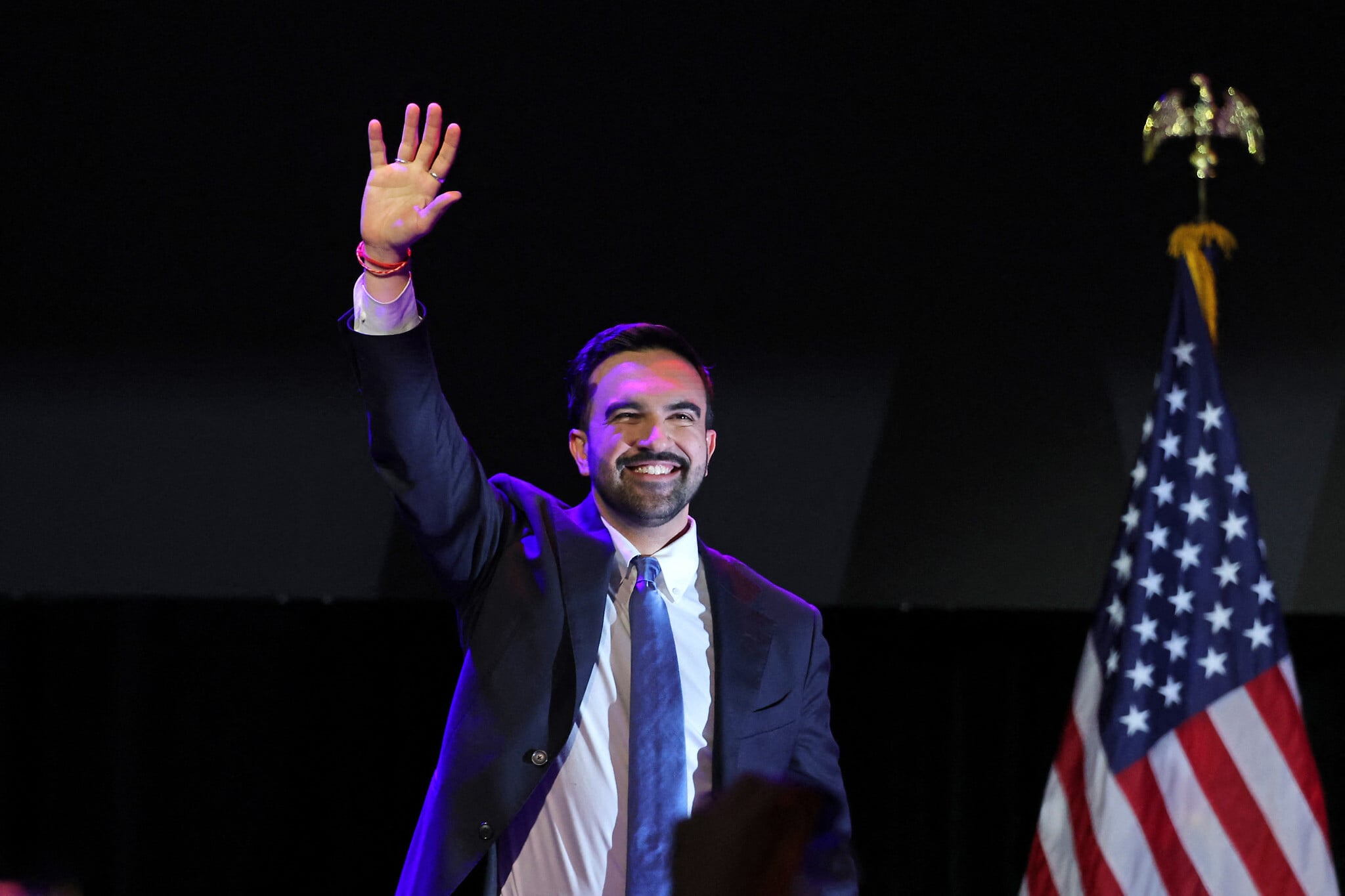
In a statement issued after his victory on Tuesday night, the UJA-Federation of New York, the city with the world’s largest Jewish population, carefully acknowledged the challenge and potential threat to the community posed by the incoming mayor: “We recognize that voters are animated by a range of issues, but we cannot ignore that the mayor-elect holds core beliefs fundamentally at odds with our community’s deepest convictions and most cherished values,” it said. “We will hold all elected officials, including Mayor-elect Mamdani, fully accountable for ensuring that New York remains a place where Jewish life and support for Israel are protected and can thrive.”
But Jews and non-Jews who voted against him told our reporter in the city on Tuesday night why they fear that this will not be the case, predicting a Mamdani effect that will empower and embolden Israel-haters and Jew-haters.
“I’m worried about the indoctrination of kids hating Israel, thinking that Israel is a pariah, thinking that Israel commits genocide, something that Zohran has gone around saying for two years,” said one.
“I am frantic about being here in New York City with him as my mayor,” said another. “I’m frightened about antisemitism on my street corner. I’m frightened there’s going to be some march or something, and they’re going to strike us.”
There’s an argument to be made that Zohran Mamdani’s decisive victory in the New York mayoral elections is all about local issues, and that his hostility to Israel is largely irrelevant. It doesn’t hold water.
END
RUSSIA VS UKRAINE
ROBERT H
Kyiv has issued an ultimatum to the EU: if you don’t give us Russian money, we’ll stop maintaining the front
The real face of Zelensky and crew. Give us money or we blame you for the defeat.
Hilarious and tragic making a fool out of those handing money and weapons to this bunch while ignoring their own citizens.
If this was anyone else than this proxy it would be called blackmail. Except everyone has known that from the start it was a proxy fight.
Perhaps common sense will be found in the not so secret meeting in Spain to dump this.
END
RUSSIA/UKRAINE
“Too Late To Retreat”: Key Ukrainian Logistics Hub Near Fully Captured By Russia, “No Sign Of Counter-Offensive”
Wednesday, Nov 05, 2025 – 02:00 PM
A key logistics hub in Ukraine’s eastern defense network, Pokrovsk, is close to falling, with a number of sources indicating between 85 and 95 percent of the city is controlled by Russian forces. One Hungarian security expert is warning that a counterattack could be disastrous for Ukraine.

With the fall of Pokrovsk in Donetsk, besides the obvious logistical and operational benefits it will provide Russia, it will also mean the loss of raw materials for Ukrainian steel production.
However, one Hungarian security expert, Attila Demkó, tells Mandiner that if Ukraine dares to launch a counterattack, it will “probably regret it very much.”
Ukrainian President Volodymyr Zelensky has already acknowledged that Ukraine’s situation in Pokrovsk is extremely difficult, and that Russians have infiltrated the town, but he has also denied that the city had fallen into Russian hands.
Ukrainian sources are harassing Russian supply lines with drone attacks, and posting the results on X.
Some pro-Russian sources are claiming on X that 95 percent of the city, while prominent German journalist Julian Röpcke, known for his support for Ukraine, says at least 85 percent of the city is captured. He also says there “is no sign of a counter-offensive.”
One video that is being widely spread shows Ukrainian special forces occupying three buildings, but Röpcke is also throwing cold water on this operation.
“Glimpse into the ‘battle for Pokrovsk.’ The entire video, airborne operation and battle of the GRU special unit is about 2-3 occupied buildings that are technically not even inside the city limits. Gives an impression of what ‘would’ be needed to liberate the city. Won’t happen,” he wrote on X.
Many Ukrainian sources have lamented a pending disaster. A report out of Euromaidan reported that three Ukrainian brigades were completely surrounded in the zone around the city and that it is probably too late for an organized retreat.
At the same time, Russians have also caught up with Ukraine in drone technology.
There are worries that if the city falls, Russia will have access to key Ukrainian resources.
Attila Demkó, head of the Strategic Futures Program at the NKE John Lukacs Institute, told Mandiner that the total agglomeration zone, together with the surrounding settlements of Rogynske and Mirnohrad, was home to about 140,000 residents in peacetime. However, its real significance is due to its mines.
Mining has been suspended since January, but previously, some 3.5 million tons of dirty coal were mined there annually, the loss of which could reduce Ukrainian steel production by half, representing a massive economic loss.
With just a fraction of the $4.4 billion in revenue from 2024 possibly collected this year, the impact would be huge on Ukraine’s raw material independence.
“If the Russians capture it, it is unlikely that the Ukrainians will be able to regain it, meaning this loss will be permanent for Ukraine,” the Hungarian expert says.
The area of Pokrovsk is also a strategic logistics hub, even though many buildings were destroyed during the siege, and thousands of residents remained in place – the elderly or Russian sympathizers, Demkó adds.
Serving logistics for the eastern Ukrainian theater of operations, the city and its surroundings are home to a railway distribution hub with huge storage capacities, while the H-32 highway is the most important east-west transport axis, he says. This is used by the Ukrainian army to transport supplies, fuel and combat equipment in Donetsk. Two north-south roads also run through it, on which maneuvering troops move.
In other words, the fall of the region would be a huge blow to Ukrainian logistics, while at the same time facilitating the movement and supply of the Russians.
6. GLOBAL ISSUES//COVID ISSUES/VACCINE ISSUES/HEALTH ISSUES
END
Children Face Higher Risk Of Neurodevelopmental Disorders If Exposed To COVID-19 In Womb: Study
Wednesday, Nov 05, 2025 – 03:30 AM
Authored by Zachary Stieber via The Epoch Times (emphasis ours),
Children whose mothers contracted COVID-19 while pregnant face an elevated risk of developing autism or another neurodevelopmental disorder, according to a new paper.

About one in six children born to mothers who tested positive for COVID-19 during pregnancy was diagnosed with a neurodevelopmental disorder by age 3, researchers with Mass General Brigham said in the study. That was higher than the one in 10 other children who received a diagnosis of one of the disorders and were born to a woman who did not have COVID-19 during pregnancy.
“These findings highlight that COVID-19, like many other infections in pregnancy, may pose risks not only to the mother, but to fetal brain development,” Dr. Andrea Edlow, a specialist at Mass General Brigham and the senior author of the paper, said in an Oct. 30 statement.
In the paper, published by the journal Obstetrics & Gynecology last week following peer review, the researchers detailed how they analyzed records from births that took place within the Mass General Brigham system between March 1, 2020, and May 31, 2021.
The time period was chosen due to there being universal COVID-19 testing in labor and delivery units across the system.
Mothers were defined as having COVID-19 if they tested positive for the illness during pregnancy, and defined as not having COVID-19 if they did not test positive.
The overwhelming majority of each group was unvaccinated, as vaccines only became available in late 2020.
Of the 18,124 women who gave birth and were tested, 861 tested positive for COVID-19 while pregnant.
Other records were reviewed to see if the children received neurodevelopmental diagnoses, using codes for autism and other disorders.
Sixteen percent, or 140 children, born to those women received a neurodevelopmental diagnosis by their third birthday, compared to 1,680, or 9.7 percent, of the 17,263 other children.
After adjustments, the researchers said COVID-19 infection during pregnancy was linked to 29 percent higher odds of neurodevelopmental disorders in children born to the COVID-positive mothers. The risk was higher for infection during the third semester.
Even though there was an elevated risk recorded, Dr. Roy Perlis, another author of the study, said in a statement that the “overall risk of adverse neurodevelopmental outcomes in exposed children likely remains low.”
Funding for the study came from grants from the National Institutes of Health and the Massachusetts General Hospital Executive Committee on Research.
In the conflicts of interest section, Perlis listed being a paid editor at another journal, the Journal of the American Medical Association, while Edlow said she is a consultant for several pharmaceutical companies, including Merck.
The researchers said one limit of the study was not tracking children’s diagnoses outside the Mass General Brigham system, which includes eight hospitals. Another was potentially missing asymptomatic cases of COVID-19 among pregnant women.
END
Why One Doctor Says Depression Treatment Needs A Reset
Tuesday, Nov 04, 2025 – 10:35 PM
Authored by Cara Michelle Miller via The Epoch Times (emphasis ours),
For years, people have been told their sadness was the result of a chemical imbalance—a fixable flaw—like how insulin helps people with Type 1 diabetes.

The “chemical imbalance” theory has shaped mainstream treatment for depression, fueling widespread prescriptions of antidepressants. Yet, psychiatrist and former U.S. Food and Drug Administration (FDA) medical officer Dr. Josef Witt-Doerring said the theory, popularized in the 1950s, has never been proven and lacks scientific backing.
In a recent episode of American Thought Leaders, Witt-Doerring told host Jan Jekielek that relying on the chemical imbalance narrative can lead to overmedication, often with worse—not better—outcomes for patients, and that the way antidepressants are prescribed needs reform.
Origins of the Chemical Imbalance Theory
The chemical imbalance theory first emerged with doctors’ amazement that a tuberculosis drug called iproniazid seemed to energize and lift patients’ moods. Psychiatrists soon tested the drug on people with depression and saw similar improvements.
Iproniazid worked by preventing the breakdown of neurotransmitters—chemical messengers such as serotonin, norepinephrine, and dopamine—thereby increasing their levels. Researchers theorized, based on their observations, that depression must be caused by a shortage of these chemicals in the brain.
The idea revolutionized psychiatry, offering a biological explanation for emotional suffering and paving the way for widespread prescription of antidepressants. For decades, the chemical imbalance theory dominated both medical practice and public perception.
However, once accepted as a medical fact, the theory has begun to crumble.
“A lot of people think that they [antidepressants] work in that they are fixing this imbalance; they are restoring them to a normal state,” Witt-Doerring said. However, growing evidence disputes this.
For instance, a 2022 systematic review published in Molecular Psychiatry found no consistent evidence that low levels of serotonin cause depression. Additional clinical studies have likewise failed to identify reliable differences in neurotransmitter levels between people with and without depression.
“There is no way to differentiate patients who are depressed from those who are not depressed using any objective markers,” he added. “That’s why when you go and see a psychiatrist or a family medicine doctor, they’re not doing blood tests, they’re not scanning your brain—they’re essentially just doing a checklist.”
What Antidepressants Do
Witt-Doerring said that antidepressants don’t correct an underlying defect but instead create a predictable drug effect. For the most common class—selective serotonin reuptake inhibitors (SSRIs)—the effect is often one of emotional blunting or numbing.
SSRIs boost the amount of serotonin in your brain. Serotonin is a chemical that helps manage your mood and emotions. Normally, once serotonin delivers its message, it is taken back into the brain cell that released it. SSRIs slow down that process, so more serotonin stays active between brain cells for a little longer.
Having more serotonin can help even out your mood and ease feelings of anxiety or sadness. However, it can also make emotions feel somewhat flat—you might notice less excitement or joy, as well as less distress—sometimes referred to as emotional numbing or blunting.
For some patients, the dulling of emotional extremes can be therapeutic. For others, it suppresses emotions that need to be processed, leaving underlying issues unresolved.
“If you are in a state where you’re having a lot of anxiety, and you take a drug and it kind of constricts that, it sort of numbs that out, you’re going to feel better,” he said. “And if you’re highly suicidal, you might even say the medication saved your life.”
Hidden Risks of Long-Term Antidepressant Use
Relief derived from antidepressants can come at a cost. Over time, the body adapts to the medication’s effects.
“People become tolerant to them,” Witt-Doerring said, explaining that the drug starts to wear off, doses are increased, and “eventually you’re maxed out—still struggling with the same issues that led you to seek help in the first place.”
To compensate, other medications—mood stabilizers, sleep aids—may be added, a practice known as polypharmacy. However, stacking drugs can also mask, rather than resolve, the underlying problem.
“And this is why you hear that some people are on four, five, six medications,” he said.
When medications lose effectiveness, the body has simply adapted, yet patients are often told they have treatment-resistant depression and are prescribed more drugs—continuing the cycle. The more medications a person takes, the higher the chance of unpleasant or dangerous side effects—and it can become harder to tell which drug is causing which reaction.
* * * Try natural lithium instead…
Higher doses or multiple drugs may also increase the risk of agitation, impulsivity, or, in rare cases—especially among young people—new or worsening suicidal thoughts during the first few weeks of treatment. The risk is greatest for teens and young adults under 25, which is why antidepressants carry an FDA black box warning for suicidal thinking in this age group.
Meanwhile, life’s problems—stressful relationships, work challenges, or unresolved trauma—often remain unaddressed.
The Dangers of Withdrawal
Many people decide to come off antidepressants at some point—sometimes because they’re feeling better, want fewer side effects, or find the medication isn’t helping as much as it used to.
Stopping antidepressants can be challenging. Some people experience withdrawal effects—such as mood changes, dizziness, or “brain zaps”—when they try to come off the medication. Research suggests that nearly a quarter of people who take SSRIs long-term have withdrawal symptoms lasting more than three months.
Witt-Doerring estimates that 5 to 10 percent of people need medical support to safely stop.
He cited the case of Bryson Burks, a promising college athlete prescribed three antidepressants for pain after a football injury—though he’d never had depression—a practice sometimes used for chronic pain.
Burks—known for his leadership, generosity, and aspirations—appeared happier and stronger after recovering from his injury, according to his mother. However, when instructed to taper off the medications, reducing one pill each week, he developed sudden, extreme mood swings and tragically died by suicide during the fourth week, just before his twentieth birthday. His mother has since spoken publicly about the risks of abrupt or poorly monitored discontinuation of psychiatric medications.
Witt-Doerring also noted that, in rare but serious cases, abrupt medication changes have been linked to extreme agitation or manic reactions. Some high-profile tragedies have prompted questions about whether sudden shifts in psychiatric medication could play a role.
After the 2012 Aurora, Colorado, theater shooting, forensic experts observed that the perpetrator, James Holmes, showed marked behavioral changes after his antidepressant dosage was increased shortly before the attack.
Psychiatrist David Healy, who later interviewed Holmes, said that the timeline warranted closer scientific scrutiny, according to Witt-Doerring. While the courts did not find the medication change to be a legal cause of the violence, the case underscored the importance of careful monitoring whenever antidepressant doses are adjusted or discontinued—particularly for young or vulnerable patients.
Many patients can taper off antidepressants with only temporary discomfort. “Within a couple of months, they have really nasty withdrawal,” but their brains adapt and they move on, Witt-Doerring said. “I would say that they have very healthy, elastic brains.”
A smaller group experiences severe symptoms—insomnia, agitation, tinnitus, cognitive fog—that can last months or even years. For them, a standard two-month taper is too abrupt.
Because doctors rarely expect lingering withdrawal, these symptoms are often mistaken for relapse. Patients are placed back on medication, convinced they cannot live without it, Witt-Doerring said.
In rare but devastating cases, people develop what’s known as protracted withdrawal, a long-term hypersensitivity of the nervous system. “It’s like you’ve had a concussion,” Witt-Doerring said. “It takes 18 months to two years, sometimes longer, for the nervous system to recover.”
Stories like Burks’—who was not Witt-Doerring’s patient—have reshaped how he practices psychiatry. He now runs a tapering clinic specifically for people navigating the withdrawal process, providing careful monitoring and guidance.
His advice to anyone considering coming off antidepressants is to do so gradually—over many months, sometimes years. The safest approach is to proceed slowly and with close support.
Rethinking Care
Today, most psychiatric medications are prescribed by family doctors, gynecologists, and other front-line providers working under intense time pressure. The system often prioritizes quick fixes over long-term wellness.
Witt-Doerring envisions a different care model—embedded in primary care—but focused on “dealing with the real problems.” Patients would receive structured education and group guidance on four areas that drive anxiety and depression: healthy relationships, meaningful engagement—through work, faith, or community—physical health, and substance use.
“Imagine a family doctor saying, ‘You’re struggling with relationships and health issues—here’s an assessment, and then you can join a group to learn and talk through these problems with professionals,’” he said.
“That takes the pressure off prescribing medication as the only solution and gives patients real tools to improve their lives.”
END
GLOBAL ISSUES
RFK Jr. Calls For Global Ban On Mercury In Vaccines
Wednesday, Nov 05, 2025 – 06:30 AM
Authored by Naveen Athrappully via The Epoch Times (emphasis ours),
All countries should remove mercury from vaccines following the precedent set by the United States, Health Secretary Robert F. Kennedy Jr. said via a video address during the Nov. 3 meeting of the Minamata Convention on Mercury in Geneva, Switzerland.

“The Minamata Convention was born from a shared moral conviction that no human being should suffer from exposure to mercury,” Kennedy said.
“Article 4 of the Convention calls on parties to cut mercury use by phasing out listed mercury-added products. But in 2010, as the treaty took shape, negotiators made a major exception. Thimerosal-containing vaccines were carved out in the regulation,” Kennedy said, referring to the mercury-based preservative used to prevent microbial growth in vaccines.
The treaty, which began to phase out mercury in cosmetics and lamps, opted to allow the substance to be used in products that are injected into vulnerable people, pregnant women, and babies, the health secretary said.
“We have to ask: why? Why do we hold a double standard for mercury? Why do we call it dangerous in batteries, in over-the-counter medications, and makeup, but acceptable in vaccines and dental fillings?” he asked.
Kennedy said thimerosal has never undergone proper safety testing in human beings. He said that hundreds of peer-reviewed studies have identified the substance as a potent neurotoxin, carcinogen, endocrine disruptor, and mutagen.
“Thimerosal’s own label requires it to be treated as a hazardous material and warns against ingestion. There is not a single study that proves it safe,” he said. “That’s why in July of this year, the United States closed the final chapter on the use of thimerosal as a vaccine preservative, something that should have happened years ago.”
According to a March 2024 safety data sheet on Thimerosal, the substance is “considered hazardous” under the 2012 Hazard Communication Standard from the Occupational Safety and Health Administration.
The substance may cause damage to organs through repeated or prolonged exposure. If a person ingests thimerosal or comes into contact with it via skin, they must immediately get in touch with a poison center or doctor, according to the fact sheet.
Beginning in 1999, thimerosal was removed from many vaccines in the United States after certain studies suggested that exposure to mercury in early stages could negatively affect children.

In July, Kennedy signed a recommendation by the Advisory Committee on Immunization Practices (ACIP) to remove thimerosal from influenza vaccines. Roughly 50 percent of thimerosal, by weight, is mercury.
“I want to be clear, it’s inexcusable that governments around the world still allow mercury-based compounds in health care, and safe alternatives exist. Now that America has removed mercury from all vaccines, I call on every global health authority and every party to this convention to do the same,” Kennedy said in his video address.
The Department of Health and Human Services chief said vaccine manufacturers have already confirmed they can produce single-dose vaccines free from mercury without interrupting supply chains.
In an emailed statement to The Epoch Times in July, a spokesperson for CSL Seqirus, which produces influenza vaccines, said that delivery of thimerosal-free flu vaccines for the fall season was “already underway.”
“We don’t expect the ACIP recommendation to have any impact on our vaccine supply or shipment timings,” the spokesperson said.
In June, Sanofi, another flu vaccine manufacturer, said that the company would have “sufficient supply of Sanofi flu vaccine to support customer preference.”
Safe or Dangerous?
In a July 15 statement, the American Academy of Pediatrics (AAP) said extensive research has shown thimerosal to be safe for use. Banning vaccines without solid scientific facts sets a “dangerous precedent,” it said.
Thimerosal is an ethyl mercury, different from methyl mercury, for which there are toxicity concerns, AAP said.
“There is no evidence that thimerosal has adverse neurological or neurodevelopmental adverse outcomes when used as a preservative in vaccines,” AAP Committee on Infectious Diseases member James Campbell said.
“This fact was definitively determined years ago, and the FDA, the CDC, and many academic institutions have excellent reviews of the safety of thimerosal-containing vaccines in children. Raising this topic now has only one purpose—to sow distrust in vaccines in general and in the process to determine vaccine safety.”
A May 2024 study published in the Journal of Trace Elements in Medicine and Biology exposed rats to thimerosal, mimicking how a human infant would be exposed during vaccination.
Researchers found that the exposure in rats “significantly damaged brain bioenergetic pathways.” The study “supports the ability of TM exposure to preferentially damage the nervous system,” it said.
A 2013 study said thimerosal in childhood vaccines contributed to “accumulating mercury toxicity” in the kidneys.
According to an Oct. 28 report from the Centers for Disease Control and Prevention, side effects of thimerosal in vaccines are minor, such as swelling and redness at the injection site.
“Research does not show any link between thimerosal in vaccines and autism, a neurodevelopmental disorder,” it said.
Zachary Stieber contributed to this report.
END
MARK CRISPIN MILLER
Kim Kardashian has brain aneurysm; Bryant Gumbel’s “medical emergency”; Suzanne Rogers has colorectal cancer; Tracy Strawberry has multiple cancer surgeries; MSNBC’s Rebecca Cutler has breast cancer
WWE star Mike Rotunda has “massive heart attack”; Major League Fishing EVP Kathy Fennel has Stage 4 cancer; Miss Nevada USA Mary Sickler, diagnosed with alopecia last year, ditches wig on stage
| Mark Crispin MillerNov 5 |
Because we’re still short-handed lately (due to injuries and illness), our usual Wednesday compilation will be posted tomorrow. In its place, we’re posting the latest compilation of what we call “celebrity non-fatals” (only those in the US).
Incidentally, if you have the time and inclination, we would appreciate it greatly if you would consider joining our global team of researchers. There are a number of countries (including the US) that need coverage ASAP. If you would help us fill those gaps, you would be doing this cause great good, since our “died suddenly” series has (a) saved lives, as readers have reported that friends and/or loved ones have been dissuaded, by our compilations, from getting any further shots; and (b) our work comprises a vast trove of evidence, to be used if and when the authors of this gravest crime in history are finally brought to justice.
News from Underground by Mark Crispin Miller is a reader-supported publication. To receive new posts and support my work, consider becoming a free or paid subscriber.
If you’re inclined, then, please contact me, so we can arrange to train you for this all-important task.
Thank you.
MCM
A survey of the likely global toll of COVID “vaccination,” based on the reports collected by our worldwide team of researchers this past week.
To help support our work, consider subscribing or making a donation.
Celebs:
UNITED STATES
Bryant Gumbel’s Wife Shares Message of ‘Gratitude’ After Former ‘Today’ Cohost’s Health Scare
October 22, 2025

Bryant Gumbel’s wife, Hilary Gumbel, is seemingly addressing his recent health scare. The former beloved Today show cohost, 77, was reportedly hospitalized after experiencing a “medical emergency.” However, it appears Bryant is on the mend, with Hilary sharing a positive message on Wednesday, October 22, after the news broke. Bryant was transported from his apartment building in Manhattan to a local hospital after 9 p.m. on Monday, October 20, according to TMZ. The outlet also reported that he was still hospitalized as of Tuesday, with one family member revealing Bryant was “OK.” No further details have been released about his health scare.
Kim Kardashian Reveals She Was Diagnosed with a Brain Aneurysm, Blames Stress from Her Divorce from Kanye West
October 23, 2025

Kim Kardashian is sharing a shocking diagnosis. The 45-year-old mother of four got emotional in a preview teaser clip for the upcoming season of her family’s Hulu reality series, The Kardashians, which aired during the show’s premiere. In the clip, Kim is seen going into an MRI scanner and later tells her family, “There was a little aneurysm.” Older sister, Kourtney Kardashian, looks wide-eyed as she says, “Whoa!” As for the doctor’s reasoning behind the detected aneurysm, Kim told her family, “They were like, ‘Just stress.’ ”he SKIMS founder has plenty of stress in her life as other footage shows her crying over seemingly struggling on a part of her bar exam for law school. However, after revealing the aneurysm, the clip then cuts to a tearful Kim discussing her divorce from ex Kanye “Ye” West, the father of her four children. According to the Mayo Clinic, a brain aneurysm is “a bulge or ballooning in a blood vessel in the brain.” There are multiple types of brain aneurysms with various levels of severity and they are described as “common.” “If the brain aneurysm leaks or ruptures, it causes bleeding in the brain, known as a hemorrhagic stroke,” the Mayo Clinic adds. “Brain aneurysms are common. But most brain aneurysms aren’t serious, especially if they’re small. Most brain aneurysms don’t rupture.”
‘Days of Our Lives’ star Suzanne Rogers diagnosed with Stage II colorectal cancer
October 30, 2025

Soap opera actress Suzanne Rogers revealed this week that she has been diagnosed with cancer. The “Days of Our Lives” actress, who has played Maggie Horton on the show for 52 years, told TV Insider that she was diagnosed with Stage II colorectal cancer after she felt something “wasn’t quite right.” The 82-year-old said that she regularly gets colonoscopies, but her doctor ordered another one. “He said, ‘I want you to have an MRI and I want you to have a PET scan and I’m going to do a biopsy,’” she said her doctor told her. “And the minute he said that I knew that it was something more.” She said the producers also told her to take care of herself and that her role would be there for her when she was healthy enough to return. Rogers completed her treatments at the end of July. “I’m feeling really good,” she told TV Insider. She said the biggest thing she’s struggled with in her recovery is tiredness.
Yankees Legend Darryl Strawberry Posts Photos From Wife’s Hospital Bed Amid ‘Very Challenging’ Times
October 23, 2025

Three-time World Series champion Darryl Strawberry told fans that his wife, Tracy, is ready to come home from the hospital after multiple surgeries and “setbacks” in her battle with cancer. “This really has been some very challenging times for us, but we wanted to thank God for his Grace and Mercy!” Strawberry, 63, wrote via Instagram on Wednesday, October 22, alongside a photo of himself by his wife’s side in the hospital. The eight-time All-Star first disclosed in July that Tracy had been diagnosed with “early stage cancer” that would require “major surgeries.” He followed up on October 8, just days after one of her surgeries, which he reported included a “setback.” In the photo, he was smiling alongside Tracy, who was resting in her hospital bed.
No age reported.
WWE legend’s family clarifies health status after heart attack
October 30, 2025

The family of WWE Hall of Famer Mike Rotunda, 67, has stepped in to clarify some online inaccuracies that stated the wrestling legend was in hospice care. “Yes, my uncle Barry did make a comment mentioning that my father is in hospice care while answering a question about our late family member, whom we lost two years ago,” the wrestler’s daughter, Mika Rotunda, said on Facebook Wednesday. “We want to make it clear that he misspoke — not intentionally. My father is not in hospice, but rather in a rehabilitation center.” The health scare began after Rotunda suffered a “massive” heart attack on Sept. 20. According to his daughter, Rotunda was in a coma for a week and was hospitalized for over a month, according to his daughter. He has now transitioned to a rehabilitation center.
Major League Fishing VP, Kathy Fennel, diagnosed with stage 4 cancer
October 31, 2025

BENTON, Ky. — Major League Fishing’s Executive Vice President and General Manager, Kathy Fennel, has been diagnosed with Stage 4 cancer and will take a leave of absence from the organization as she pursues treatment. “This all transpired very quickly, and I’m still processing the diagnosis, but what I know for certain is that I will fight, and that I am loved,” Fennel said. “The outpouring of support I’ve already received is overwhelming. Our team at Major League Fishing is the best in the world, and they will continue to provide the highest level of service to our anglers, sponsors and fans as I work toward defeating this indiscriminate disease.”
No age reported.
Miss USA Contestant with Alopecia Ditches Her Wig in Stand Out Moment from Pageant Preliminary Round
October 23, 2025

Las Vegas, NV – Miss Nevada USA Mary Sickler made a big statement during Miss USA preliminaries on Wednesday, Oct. 22, when she ditched her wig on stage. The pageant contestant was diagnosed with alopecia in December 2024, but she didn’t disclose her condition until after she won the state title this July. Sickler, 22, revealed that she lost all of her hair in a series of Instagram videos.
MSNBC President Rebecca Kutler Shares Breast Cancer Diagnosis
October 15, 2025

Rebecca Kutler, president of the news network MSNBC, announced she had been diagnosed with breast cancer in a call with staff on Oct. 15. Kutler, 46, told staff she will undergo surgery next month and shared that her prognosis was good.
DR PAUL ALEXANDER
Were these crimes against humanity? Must people be hung until dead, after our courts & judges & juries get through with them? Is Clandestine correct? see stack photo; are these criminals? Horsemen?
are these key Horsemen of COVID Apocalypse? joining others listed below to be tried under oath, hung if judges & juries find their role in PCR created fake COVID & Malone Bourla mRNA vaccine KILLED?
| Dr. Paul AlexanderNov 5 |


US Deep State actors are/were engaged in bioweapon development, are guilty of crimes against humanity, and Russia alleges it’s the same exact people who are behind the treasonous Russiagate plot against Trump.’
BOOM, BOOM, BOOM!
‘Covid was the next phase of the Deep Stare regime-change operation to overthrow Trump after Russigate failed, The Deep State shut down the global economy, and killed millions of people, all to stop Trump from winning 2020.’
And they knew what they were doing, all of them in the Task Force, medical doctors, Malone, Perna, Birx, Fauci, Azar, deepstate, academia etc., all of them, were collaborating to topple Trump and they did…was to make Trump look inept and chaotic and a bad response, each day on that podium in 2020….so that the devastating OWS lockdowns hurt him and he lost 2020 not due to votes stolen, yes, it occurs but Trump lost because of the lockdowns and Biden lost because of the Malone Bourla Pfizer et al. mRNA vaccine. It will haunt Trump and Biden forever…Trump must come clean and admit his gross mistake and beg forgiveness so that history will give him the acolades he deserves that are being covered over by his catastrophic OWS lockdowns and Malone mRNA Sahin Moderna et al. mRNA vaccine.
Hang them high I said! All of them!


Crimes Against Humanity – Clandestine’s Newsletter
Preliminary Horsemen list! add to it.
MICHAEL EVERY/OR OR PICTON/GIFFIN OR RABOBANK EXECUTIVE/COMMENTARY ON WORLDLY AFFAIRS
7. OIL ISSUES/NATURAL GAS/ENERGY ISSUES/GLOBAL
WTI Holds Losses After Big Crude Build, Record US Production
Wednesday, Nov 05, 2025 – 10:35 AM
Oil prices weakened for a second session early on Wednesday as a report showed an unexpected surge in U.S. oil inventories, keeping demand and over-supply concerns top of mind for traders.
“API data indicated the largest US crude inventory build in more than three months, with stockpiles rising by 6.5 million barrels last week. If confirmed by the EIA later today, it would mark the biggest gain since late July,” Saxo Bank noted.
The unexpected rise in stocks comes amid persistent warnings the oil market is oversupplied as rising production from OPEC+ and Western Hemisphere producers climbs above demand growth. The concerns were amplified by OPEC+’s weekend decision to hike supply for a third month by 137,000 barrels per day in December, following on the September end to the return of 2.2-million bpd of production cuts.
The question now, is will the official data confirm API’s worrying build.
API
- Crude +6.5mm
- Cushing +400k
- Gasoline -5.7mm
- Distillates -2.5mm
DOE
- Crude +5.2mm – biggest build since July
- Cushing +300k
- Gasoline -4.7mm
- Distillates -643k
The official data confirmed API’s large crude build (biggest weekly addition since July) but we are also seeing product inventory drawdowns for a fifth straight week
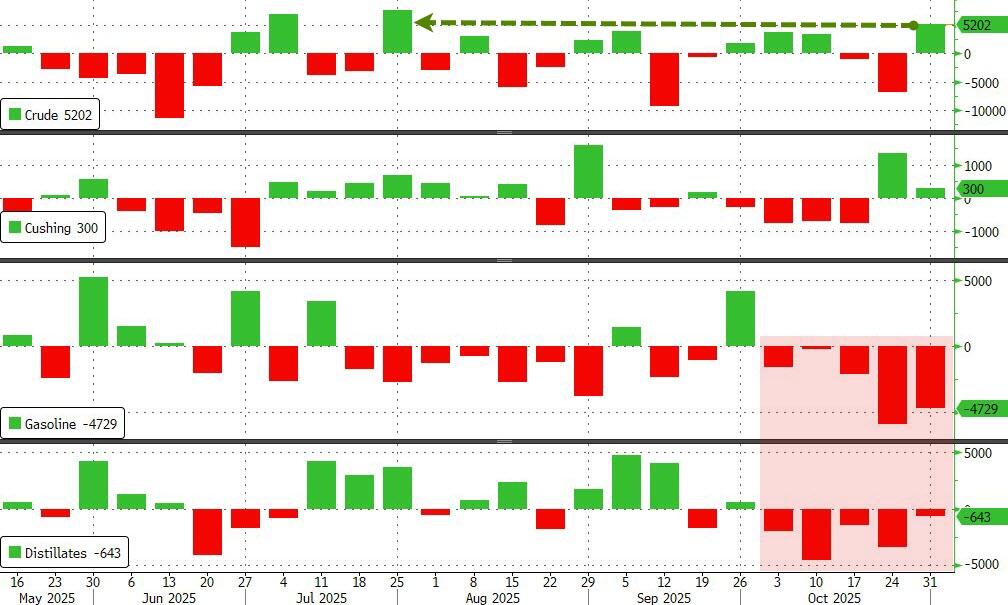
Source: Bloomberg
US Crude production rose once again to a new record high of 13.65mm b/d despite recent rig count stability…
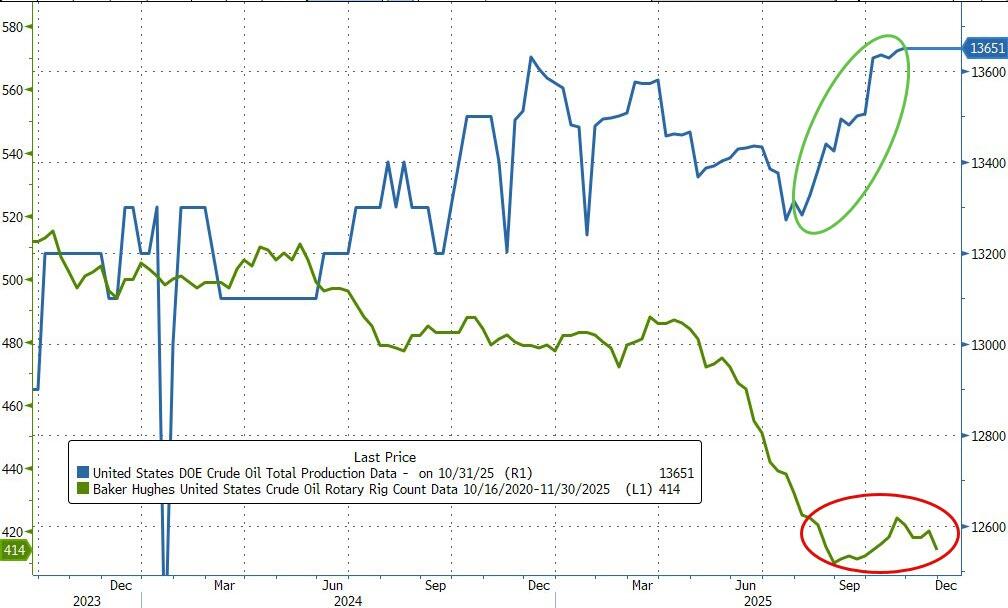
Source: Bloomberg
Oil price are holding at the lows of the day after the official data with WTI finding support at $60 for now…
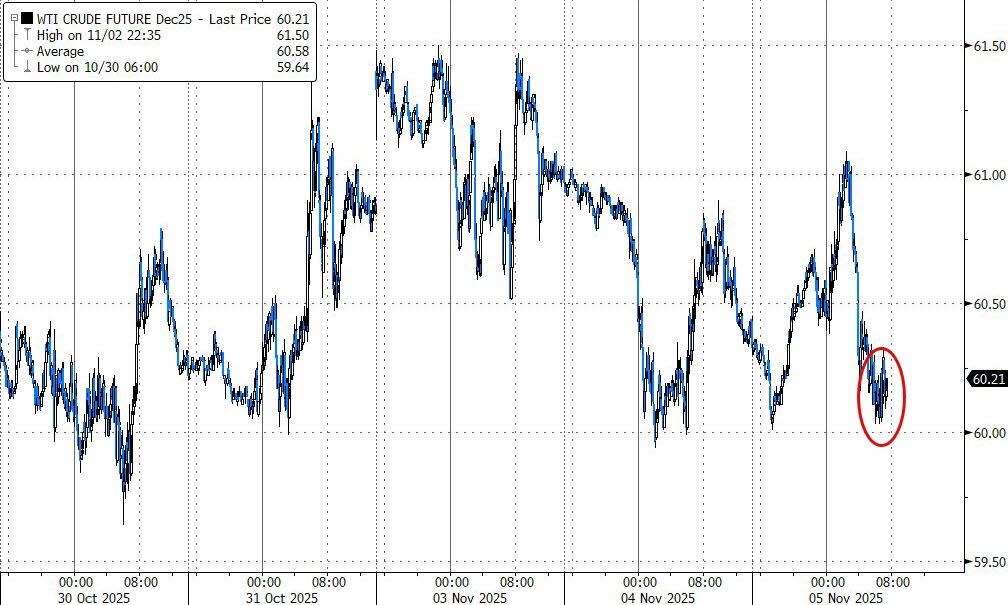
Finally, as MT Newswires reports, rising output comes as the global economy slows with U.S. tariff policies hampering global trade and cutting into demand. Economic data this week showed slowing manufacturing activity in the United States, China and Japan, pushing investors away from over-heated risk assets.
“Japan’s manufacturing sector shrank at its fastest pace in 19 months. Tepid new orders in the US led to the eighth consecutive monthly contraction in factory activity. A private survey reached the same conclusion in China, where expansion slowed last month, while manufacturers across other Asian economies are clearly feeling the impact of US tariffs in the form of declining orders,” PVM Oil Associates noted.
Still, concerns over Russian supply is offering support for the energy complex, as Ukraine continues its strikes on Russian oil infrastructure. Reports said Ukrainian drones on Tuesday struck at a Lukoil oil refinery in Russia, the second attack on Russian refineries this week, while Russia suspended exports from its main Black Sea oil export port following a Ukrainian attack.
8. EMERGING MARKETS//AUSTRALIA NEW ZEALAND ISSUES
YOUR EARLY CURRENCY/GOLD AND SILVER PRICING/ASIAN CLOSING MARKETS AND EUROPEAN BOURSE OPENING AND CLOSING/ INTEREST RATE SETTINGS WEDNESDAY MORNING 6;30AM//OPENING AND CLOSING
EURO/USA: 1.1486 DOWN 0.0002 PTS OR 2 BASIS POINTS/WITH STOCKS HIGHER
USA/ YEN 153.84 UP 0.294 NOW TARGETS INTEREST RATE AT 1.00% AS IT WILL BUY UNLIMITED BONDS TO GETS TO THAT LEVEL…//YEN STILL FALLS//END OF YEN CARRY TRADE BEGINS AGAIN OCT 2024/Bank of Japan raises rates by .15% to 1.15..UEDA ENDS HIKING RATES AND NOW CARRY TRADES RE INVENTS ITSELF//JAPAN IN TROUBLE WITH RISING RATES
GBP/USA 1.3038 UP .0018 OR 18 BASIS PTS
USA/CAN DOLLAR: 1.4131 UP 0.0029(CDN DOLLAR UP 29 BASIS PTS//CDN DOLLAR GETTING KILLED)
Last night Shanghai COMPOSITE CLOSED UP9.56 PTS OR 0.23%
Hang Seng CLOSED DOWN 16.98PTS OR 0.07%
AUSTRALIA CLOSED DOWN 0.30%
// EUROPEAN BOURSE: ALL MOSTLY RED
Trading from Europe and ASIA
I) EUROPEAN BOURSES: ALL MOSTLY RED
2/ CHINESE BOURSES / :Hang SENG CLOSED DOWN 16.99 PTS OR 0.07%
/SHANGHAI CLOSED DOWN 9.56 POINTS OR 0.23%
AUSTRALIA BOURSE CLOSED DOWN 0.30 %
(Nikkei (Japan) CLOSED DOWN 1284.43 PTS OR 2.50%
INDIA’S SENSEX IN THE RED
Gold very early morning trading: 3976.50
silver:$47.85
USA dollar index early WEDNESDAY morning: 100.05 DOWN 3 BASIS POINTS FROM TUESDAY’s CLOSE
WEDNESDAY MORNING NUMBERS ENDS
And now your closing WEDNESDAY NUMBERS 11: 30 AM
Portuguese 10 year bond yield: 3.020% UP 2 in basis point(s) yield
JAPANESE BOND 10 yr YIELD: +1.666% DOWN 1 FULL POINTS AND 0/100 BASIS POINTS /JAPAN losing control of its yield curve/
JAPAN 30 YR: 3.0883 DOWN 1/2 BASIS PTS//DEADLY
SPANISH 10 YR BOND YIELD: 3.171 UP 2 in basis points yield
ITALIAN 10 YR BOND YIELD 3.414 UP 2points in basis points yield ./ THE ECB IS QE’ ING ITALIAN BONDS (BUYING ITALIAN BONDS/SELLING GERMAN BUNDS)
GERMAN 10 YR BOND YIELD: 2.6607 UP 2 BASIS PTS
IMPORTANT CURRENCY CLOSES : MID DAY WEDNESDAY
Closing currency crosses for day /USA DOLLAR INDEX/USA 10 YR BOND YIELD/1:00 PM
Euro/USA 1.1483 DOWN 0.0002 OR 2basis points
USA/Japan: 153.96 UP 0.410 OR YEN IS DOWN 41BASIS PTS//
Great Britain 10 YR RATE 4.4500 UP 5 BASIS POINTS //
GREAT BRITAIN 30 YR BOND; 5.236 UP 5 BASIS POINTS.
Canadian dollar DOWN 0.0029 OR 29 BASIS pts to 1.4129
xxxxxxxxxxxxxxxxxxxxxxxxxxxxxxxxxxxxxxxxxxxxxxxxxxxxxxxxxxxxxxxxxxxxxxxxxxxxxxxx
The USA/Yuan CNY DOWN AT 7.1279ON SHORE ..
THE USA/YUAN OFFSHORE DOWN TO 7.1335
TURKISH LIRA: 42.10 EXTREMELY DANGEROUS LEVEL/DEATH WATCH/HYPERINFLATION TO BEGIN.//
the 10 yr Japanese bond yield at +1.666 UP 1/2 FULL basis pts
THE 30 YR JAPANESE BOND YIELD: 3.083 DOWN 1/2 basis pts
Your closing 10 yr US bond yield UP 3 in basis points from MONDAY at 4.113% //trading well ABOVE the resistance level of 2.27-2.32%)
USA 30 yr bond yield 4.701 UP 4nbasis points /11:00 AM
USA 2 YR BOND YIELD: 3.592 DOWN 0 BASIS PTS.
GOLD AT 10;00 AM 3981.30
SILVER AT 10;00: 47.96
Your 11:00 AM bourses for Europe and the Dow along with the USA dollar index closing and interest rates: TUESDAYDAY CLOSING TIME 11:00 AM//
London: CLOSED UP 62.12 PTS OR 0.64%
GERMAN DAX: UP 100.63 pts or 0.42%
FRANCE: CLOSED UP 6.70pts or 0.39%
Spain IBEX CLOSED UP 62.00 pts or 0.39%
Italian MIB: CLOSED UP 176.15or 0.41%
WTI Oil price 60.1610.00 EST/
Brent Oil: 63.98 10:00 EST
USA /RUSSIAN ROUBLE /// AT: 81.44 ROUBLE DOWN 0 AND 48 100
CDN 10 YEAR RATE: 3.147UP 1BASIS PTS.
CDN 5 YEAR RATE: 2.716 UP 0 BASIS PTS
CLOSING NUMBERS: 4 PM
Euro vs USA 1.1491 UP 0.0006 OR 6 BASIS POINTS//
British Pound: 1.3051 UP .0030 OR 30 basis pts/
BRITISH 10 YR GILT BOND YIELD: 4.4630 UP 2 FULL BASIS PTS//
BRITISH 30 YR BOND YIELD: 5.204 UP 0 IN BASIS PTS.
JAPAN 10 YR YIELD: 1.656 DOWN 2FULL BASIS PTS (DANGEROUS TO THEIR ECONOMY
JAPANESE 30 YR BOND: 3.071 DOWN 2 PTS AND STILL VERY DANGEROUS TO THEIR ECONOMY
USA dollar vs Japanese Yen: 154.19 UP 0.5549BASIS PTS EXTREMELY DANGEROUS/YEN FALLING IN VALUE
USA dollar vs Canadian dollar: 1.4107UP 0.0000PTS// CDN DOLLAR DOWN 00 BASIS PTS CDN DOLLAR
West Texas intermediate oil: 59.62
Brent OIL: 63,52
USA 10 yr bond yield UP 7 BASIS pts to 4.159
USA 30 yr bond yield UP 7 PTS to 4.739%
USA 2 YR BOND 3.630 UP 5 PTS
CDN 10 YR RATE 3.156 UP 2 BASIS PTS
CDN 5 YEAR RATE: 2.728 DOWN 1 BASIS PTS
USA dollar index: 100.02 DOWN 5 BASIS POINTS
USA DOLLAR VS TURKISH LIRA: 42.09GETTING QUITE CLOSE TO BLOWING UP/
USA DOLLAR VS RUSSIA//// ROUBLE: 81,48 DOWN 0 AND 48/100 roubles //
GOLD $3987.30 (3:30 PM)
SILVER: 48.22 (3:30 PM)
DOW JONES INDUSTRIAL AVERAGE: UP 225.76 OR 0.48%
NASDAQ 100 UP 186.43 PTS OR 0.79%
VOLATILITY INDEX 17.54 DOWN 1,44 PTS OR 7,88%
GLD: $ 366.53 UP 4.21PTS OR 1.16%
SLV/ $43.65 UP 0.91PTS OR OR 2.13%
TORONTO STOCK INDEX// TSX INDEX: CLOSED UP 321.40PTS OR 1.08%
end
TRADING today ZEROHEDGE 4 PM: HEADLINE NEWS/TRADING
Stocks & Gold Jump, Bonds Dumped As Bitcoin Bounces Bigly Off Bear-Market Lows
RWAP UP;
Stocks rebound as Dollar rally stalls despite hot US data – Newsquawk US Market Wrap
Wednesday, Nov 05, 2025 – 04:16 PM
- SNAPSHOT: Equities up, Treasuries down, Crude down, Dollar flat, Gold up.
- REAR VIEW: ISM Services comes in hot; ADP tops expectations; Treasury begin preliminary considerations of increases to future auction sizes; China reportedly bans foreign AI chips from state-funded data centres; Larger-than-expected EIA crude stock build; Oral arguments on validity of Trump’s IEEPA tariffs begin; Riksbank holds rates as expected; GOOGL Gemini to help run AAPL’s Siri features.
- COMING UP: Data: Australian Exports/Imports, German Industrial Production, EZ Retail Sales, Canadian Leading Index, US Chicago Fed Labour Market Indicators, US Challenger Layoffs. Events: BoE, Banxico & Norges Bank Policy Announcements. Speakers: Fed’s Williams, Barr, Hammack, Waller, Paulson, Musalem; ECB’s Lane, Nagel, Schnabel & de Guindos; BoE’s Bailey; BoC’s Macklem, Rogers, Kozicki. Supply: Australia, Spain, France. Earnings: Continental, Commerzbank; AstraZeneca, Sainsbury’s; Airbnb, ConocoPhillips, Warner Bros
More Newsquawk in 2 steps:
- 1. Subscribe to the free premarket movers reports
- 2. Trial Newsquawk’s premium real-time audio news squawk box for 7 days
MARKET WRAP
US indices ended the day with notable gains after a downbeat start as initial AMD weakness post-earnings weighed with investors touting lofty valuations, but this soon pared. Sectors were mainly green with Communication Services and Consumer Discretionary sitting atop of the pile, with Consumer Staples, Tech, and Real Estate sitting in the red, albeit marginally. US data came via ADP and ISM Services, both of which came in hotter than anticipated, with both garnering a Dollar bid and pressuring on USTs. ADP, which is receiving more attention due to the US government shutdown and lack of data, rose to 42k from -29k, and above the expected 28k. ISM Services rose to 52.4 (exp. 50.8, prev. 50.0), and above the top end of the analyst forecast range, while prices paid saw an unwelcome rise to a three-year high. Following the hotter-than-expected data, DXY rose to session highs, while both US indices and Treasuries sold off. In FX, after the aforementioned peak, the Dollar sold to be more-or-less flat at pixel time, and paused its recent rally to the benefit of high beta FX amid the broader risk environment. JPY was the clear laggard. Oil swung from gains to losses in a choppy day of trade amid a lack of much oil-specific newsflow. Overall, T-Notes were sold after ADP and Services ISM beat, while the Treasury began preliminary discussions on boosting future auction sizes, which was disclosed at QRA (more details below). Precious metals strengthened, albeit with spot gold not giving a real test to USD 4k/oz, and Bitcoin lifted back above USD 100k.
US
ISM Services PMI: The headline rose to 52.5, above the expected 50.8 and the highest estimate of 52.3, after being 50.0 in September. Business activity moved into expansion, 54.3 from 49.9. Employment contracted at a lesser rate (48.2 from 47.2), New Orders accelerated to 56.2 from 50.4, and Prices Paid hit 70.0 from 69.4, the highest reading in three years. Respondents cited tariffs behind the move higher in Prices Paid, while there was no indication of widespread layoffs or reductions in force, but the government shutdown was mentioned several times as impacting business activity and generating concerns for future layoffs. Eleven industries reported growth in October, one more than in September, while the number reporting contraction decreased from seven to six. On prices paid, Oxford Economics says the move higher doesn’t alter their assumption that the tariff-related hit to activity and inflation is close to peaking for the year, but “is a reminder of the upside risks to inflation and another reason for the Fed to be more cautious lowering interest rates from here”.
ADP: National Employment for October rose to 42k from -29k, above the expected 28k. Median change in job stayers was unchanged at 4.5%, with job changers rising to 6.7% from 6.6%. Given the US Government is on shutdown, which means a halt to the majority of data, the private ADP report garners more attention and comes under greater focus as the FOMC committee looks to gain a clear picture of the economy. In wake of the metrics there was a marginal hawkish shift in pricing, but nothing dramatic. ADP chief economist Nela Richardson noted that private employers added jobs in October for the first time since July, but hiring was modest relative to what was reported earlier this year. Meanwhile, Richardson adds, pay growth has been largely flat for more than a year, indicating that shifts in supply and demand are balanced.
FIXED INCOME
T-NOTE FUTURES (Z5) SETTLED 14+ TICKS LOWER AT 112-10
T-notes sold after ADP and Services ISM beat, while Treasury begins preliminary discussions on boosting auction sizes. At settlement, 2-year +4.5bps at 3.630%, 3-year +5.4bps at 3.645%, 5-year +6.3bps at 3.764%, 7-year +6.6bps at 3.950%, 10-year +6.6bps at 4.157%, 20-year +7.1bps at 4.718%, 30-year +6.9bps at 4.740%.
INFLATION BREAKEVENS: 1-year BEI -5.4bps at 2.827%, 3-year BEI +0.2bps at 2.539%, 5-year BEI +0.5bps at 2.342%, 10-year BEI +1.3bps at 2.297%, 30-year BEI +2.1bps at 2.240%.
THE DAY: T-notes were lower across the curve on Wednesday, with the curve steepening. Downside was seen in the aftermath of the US ADP report, which saw 42k jobs added to the US economy, improving from the prior -29k while also surpassing the +28k analyst consensus. Further pressure was seen in the wake of the Quarterly Refunding announcement, which largely was as expected, and it maintained that it expects to keep auction sizes maintained for at least the next several quarters. However, the Treasury made an additional comment to its guidance that, looking ahead, the Treasury has begun to preliminarily consider future increases to nominal coupon and FRN auction sizes. This remark led to further pressure across the curve but contributed to the steepening. Further pressure was seen into settlement with the ISM Services PMI beat, and a return to expansionary territory. Employment and prices paid also picked up – painting an overall hot picture of the services side of the economy. The Prices Paid index hit a 3-year high, which likely won’t be taken too well by the FOMC, with those concerned about the recent uptick in services inflation, given that it is not directly impacted by tariffs. On trade, the focus was on the Supreme Court hearing regarding the legality of Trump’s tariffs. However, reports have suggested that judges on both sides of the political landscape were sceptical of Trump’s claim that a 1997 emergency economic law grants the President power to impose tariffs.
QUARTERLY REFUNDING: The main development was the addition to its guidance. It maintained that it expects to keep coupon and FRN auction sizes steady for at least the next several quarters; however, it added, “Looking ahead, Treasury has begun to preliminarily consider future increases to nominal coupon and FRN auction size”. Indicative of a boost to auction sizes at some point in the future, but perhaps not until H2 ’26 or 2027, given the current “at least the next several quarters” guidance. Ahead of QRA, Morgan Stanley did not expect a move until February 2027. For a full summary, please click here.
SUPPLY
Bills
- US sells 17-wk bills at high rate 3.770%, B/C 3.36x
- US Treasury to sell USD 110bln in 4-week bills and USD 95bln in 8-week bills on November 6th; to settle November 12th
STIRS/OPERATIONS
- Market Implied Fed Rate Cut Pricing: Dec 16bps (prev. 17bps), January 23bps (prev. 26bps), March 32bps (prev. 35bps).
- NY Fed RRP op demand at USD 12.7bln (prev. 16.98bln) across 12 counterparties (prev. 13)
- NY Fed Repo Op demand at USD 0.102bln across two operations today (prev. 4.8bln across two ops. on November 4th; well down from the USD 50bln peak October 31st (month-end))
- EFFR at 3.87% (prev. 3.87%), volumes at USD 94bln (prev. 98bln) on November 4th.
- SOFR at 4.00% (prev. 4.13%), volumes at USD 3.147tln (prev. 3.237tln) on November 4th. Matches top end of target for Fed funds rate.
CRUDE
WTI (Z5) SETTLED USD 0.96 LOWER AT USD 59.60/BBL; BRENT (Z5) SETTLED USD 0.92 LOWER AT USD 63.52/BBL
Oil swung from gains to losses in a choppy day of trade in a lack of much oil-specific newsflow. WTI and Brent printed highs of USD 61.09/bbl and 64.53/bbl in the European morning, before selling off through the duration of the US session to settle at lows, albeit with no clear headline driver behind the move. On the supply footing, oil output at Kazakhstan’s Tengiz oilfield dropped 25% in October to 725k BPD due to maintenance, while Libya’s NOC Chairman noted the main goal is to raise oil and gas production. In the latest weekly EIA data, crude saw a greater build than anticipated, in fitting with the private metrics last night. Distillates had a shallower draw than forecasted, while Gasoline saw a much greater draw than expected. Overall, crude production rose 7k W/W to 13.651mln from 13.644mln. Note, ADNOC set December Murban crude OSP at USD 65.79/bbl (prev. 70.22/bbl).
EQUITIES
CLOSES: SPX +0.37% at 6,796, NDX +0.72% at 25,620, DJI +0.48% at 47,311, RUT +1.54% at 2,465
SECTORS: Consumer Staples -0.25%, Real Estate -0.06%, Technology -0.08%, Utilities +0.03%, Energy +0.18%, Financials +0.29%, Industrials +0.40%, Health +0.44%, Materials +0.54%, Consumer Discretionary +1.12%, Communication Services +1.63%.
EUROPEAN CLOSES: European Closes: Euro Stoxx 50 -0.15% at 5,697, Dax 40 +0.06% at 24,139, FTSE 100 +0.04% at 9,760, CAC 40 -0.53% at 8,157, FTSE MIB -0.09% at 43,202, IBEX 35 -0.72% at 16,034, PSI +0.73% at 8,446, SMI -0.10% at 12,301, AEX +0.64% at 982.
STOCK SPECIFICS:
- AMD (AMD): Investors took profits following a strong rally amid lofty valuations, despite EPS and revenue topping, with a solid outlook.
- Amgen (AMGN): Stellar report; major metrics beat & raised guidance.
- Arista Networks (ANET): Weaker than expected guidance signalling a sharp sequential slowdown in rev. growth & slightly lower margins.
- Axon Enterprise (AXON): Profit way short of expected.
- Bank of America (BAC) announced new 3-5yrs targets; ROTCE 16-18%, EPS 12%+, CET1 ratio 10.5% NII improvement 5-7% CAGR over 2026-2030.
- Johnson Controls International (JCI): EPS & revenue beat with strong next quarter & FY outlook.
- Lumentum Holdings (LITE): Top & bottom-line surpassed exp. w/ strong outlook.
- Pinterest (PINS): Profit missed alongside a weaker-than-expected top line view.
- Rivian Automotive (RIVN): Rev. beat & shallower loss per. shr than anticipated.
- Super Micro Computer (SMCI): EPS & revenue light with weak next quarter profit view.
- UPS (UPS) cargo plane crashed shortly after take-off near Louisville Muhammad Ali International Airport.
- Upstart Holdings (UPST): Disappointing earnings report.
FX
The Dollar Index chopped on Wednesday amid likely profit-taking after a five-day rally capped upside spikes on the hot US data. ADP in October (42k) printed above the expected +28k, marking the first positive reading since July. Thereafter, ISM Services printed hot, with the headline above expectation and Prices Paid hitting a three-year high as respondents continue to cite tariff impacts. Over the foreseeable future, the Supreme Court ruling on the legality of Trump’s IEEPA tariffs will loom in the background as oral arguments from both sides began today. DXY settled flat around 100.17.
G10 FX performance was split. JPY lagged, trimming its haven bid on Tuesday, while CAD & CHF also saw weakness but to a lesser degree. CAD weakness was mitigated by S&P Global Services PMI moving into expansion for the first time since November 2024 (50.5 from 46.3). NZD, AUD, and GBP saw a bid as risk sentiment generally improved regarding global equities.
Fleeting modest JPY appreciation was seen in early European trade after Japanese Top Currency Diplomat Mimura noted that recent JPY moves are deviating from fundamentals and that excessive FX volatility, not levels, is the main concern. USD/JPY sits around 154.01 from earlier 152.97 lows.
The Riksbank maintained its rate at 1.75% as expected, reiterating that the policy rate is expected to remain at this level for some time to come. On labour, the central bank says it’s showing weak development, although there are now some signs that a turnaround is on its way. EUR/SEK was muted towards the expected decision.
PLN: The NBP cut its Base Rate to 4.25% from 4.5% as expected, citing a better inflation outlook, bringing YTD easing to 150bps. The central bank reiterated that it may intervene in the FX market, with future decisions dependent on data.
USA DATA RELEASES
ADP Employment Report Shows Labor Market Rebound In October
Wednesday, Nov 05, 2025 – 08:22 AM
Following the new weekly update of ADP’s employment report showing a rebound to job additions after two straight month of declines, analysts expected a 30k rise in jobs for October’s monthly report.
And analysts were right with ADP reporting 42k jobs added in October (better than expected)
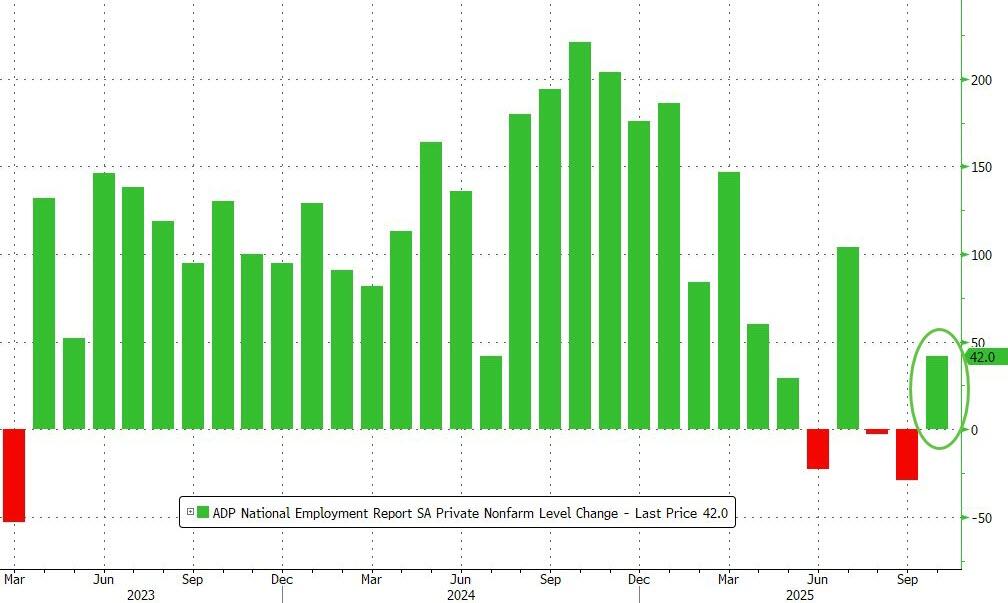
Source: Bloomberg
Services added 32k jobs while Goods Producers added 9k…

Last month delivered a rebound from two months of weak hiring, but the bounce wasn’t broad-based.
Education and health care, and trade, transportation, and utilities led the growth.
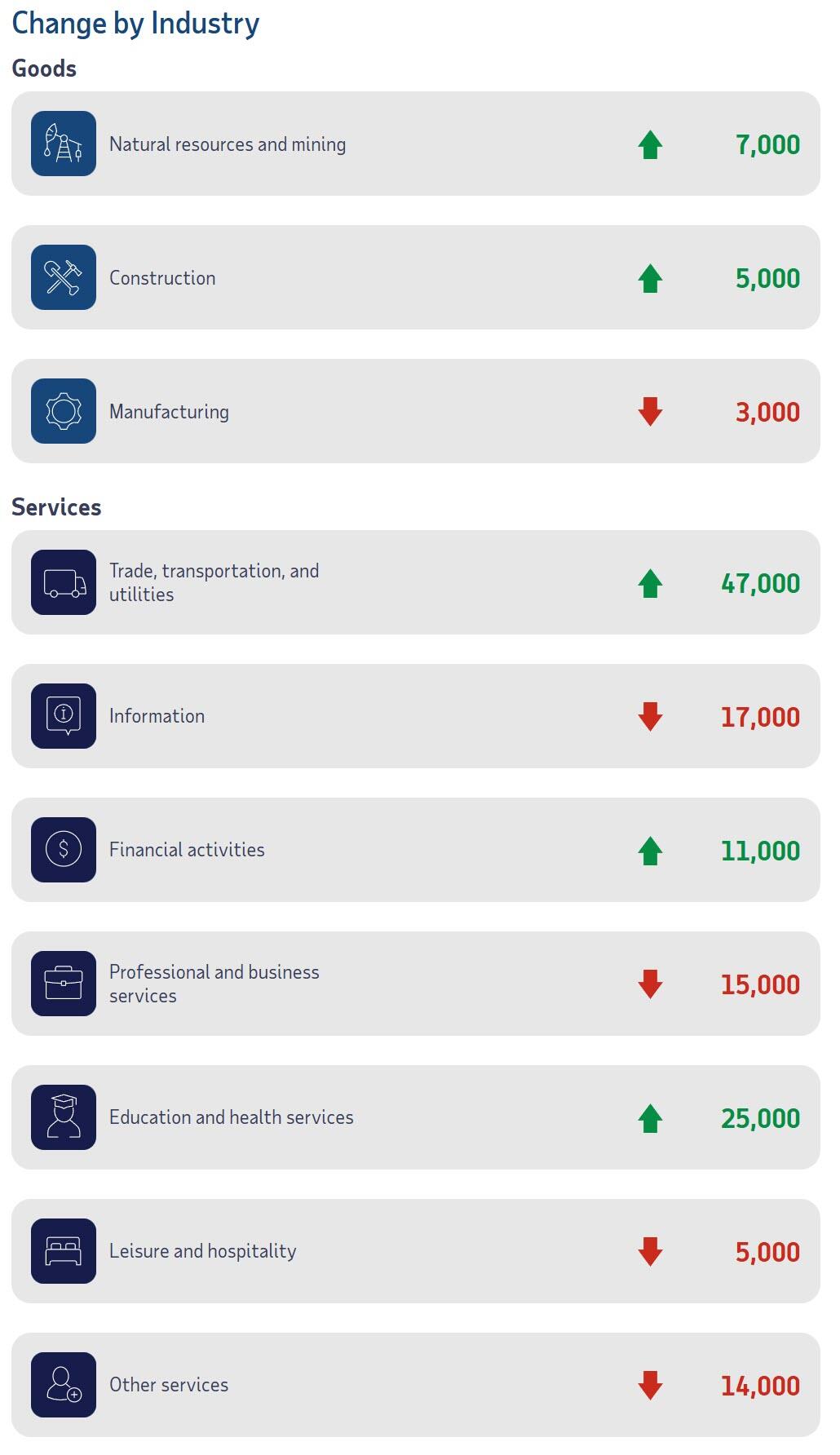
For the third straight month, employers shed jobs in professional business services, information, and leisure and hospitality.
“Private employers added jobs in October for the first time since July, but hiring was modest relative to what we reported earlier this year,” according to Dr. Nela Richardson Chief Economist, ADP.
“Meanwhile, pay growth has been largely flat for more than a year, indicating that shifts in supply and demand are balanced.”
Small Businesses have also lost jobs for three straight months.
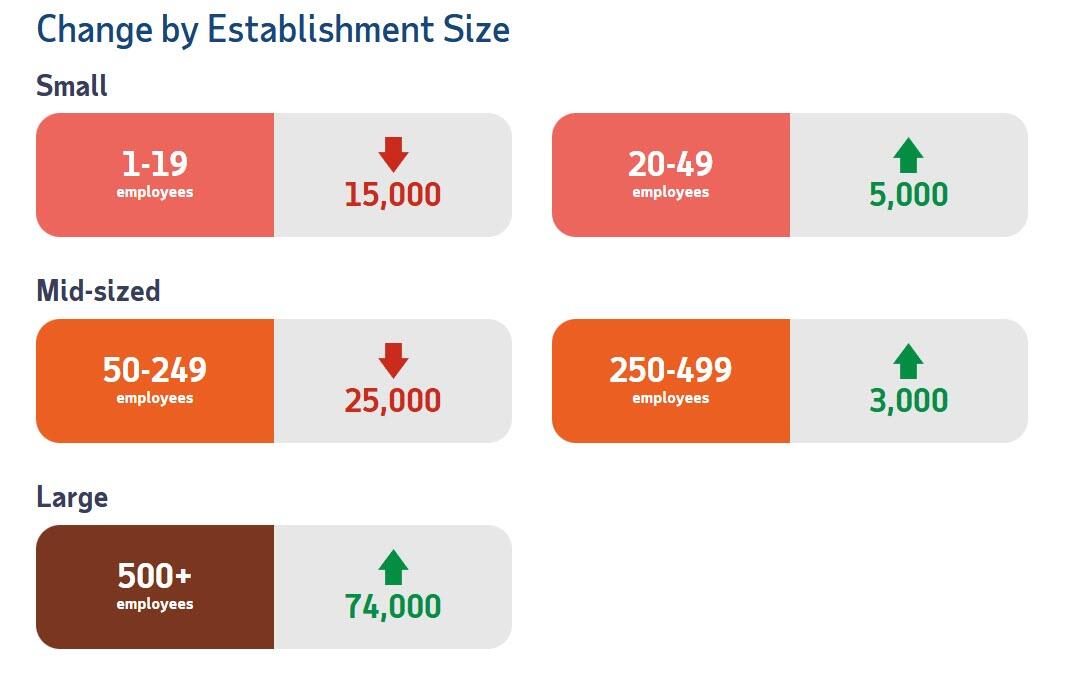
But, this overall rebound fits with the Revelio Labs monthly job growth data…
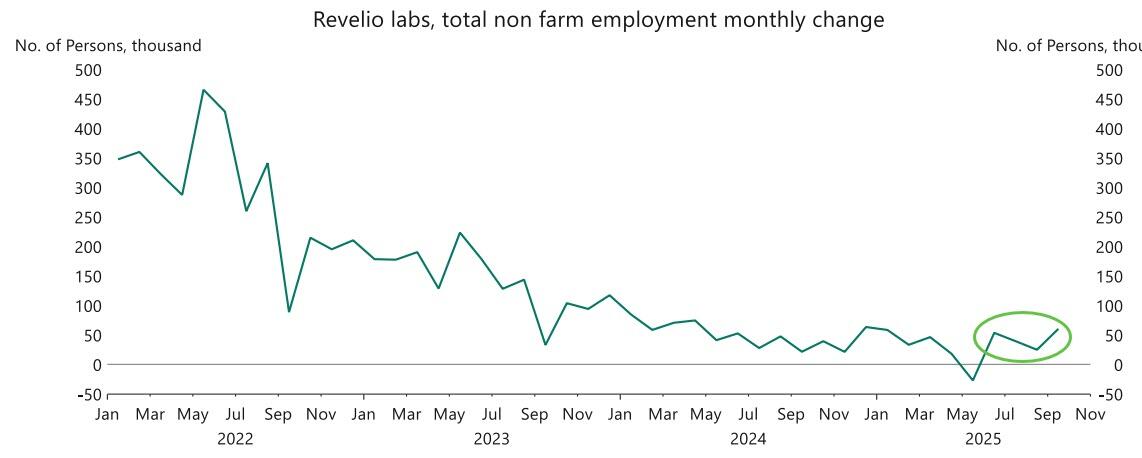
Source: Apollo
And a slight decline in job cut announcements (despite all the headlines)…
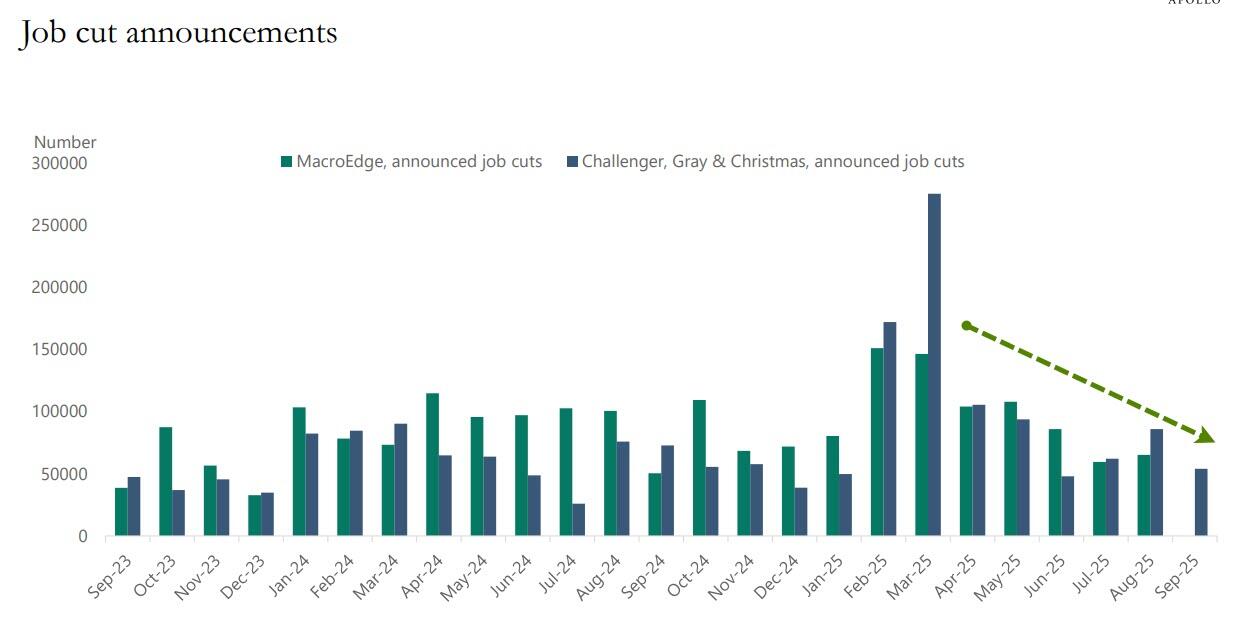
Source: Apollo
Finally, wage growth for job stayers and job changers was flat from September…
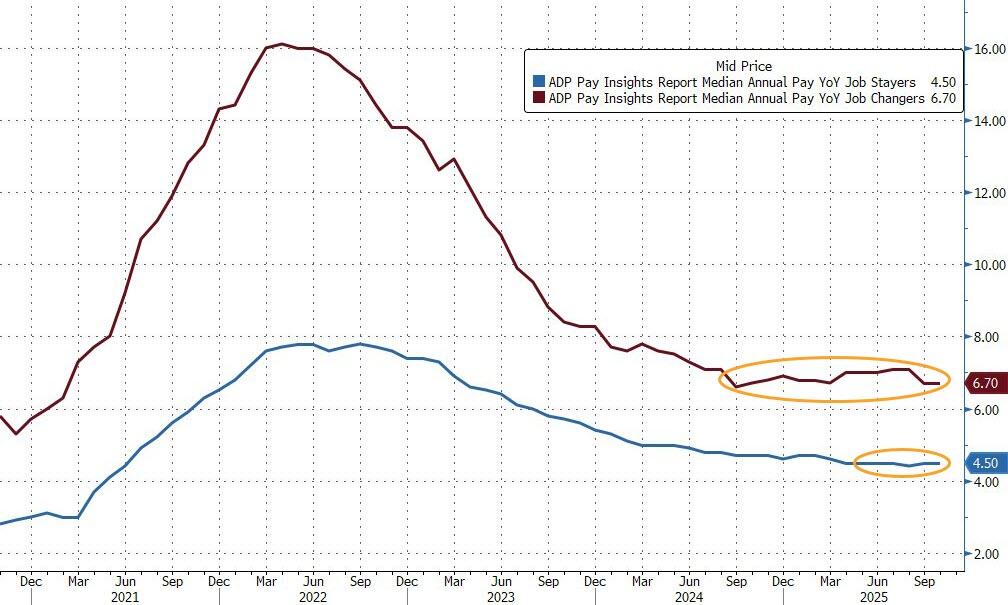
With females seeing higher gains across all age cohorts…
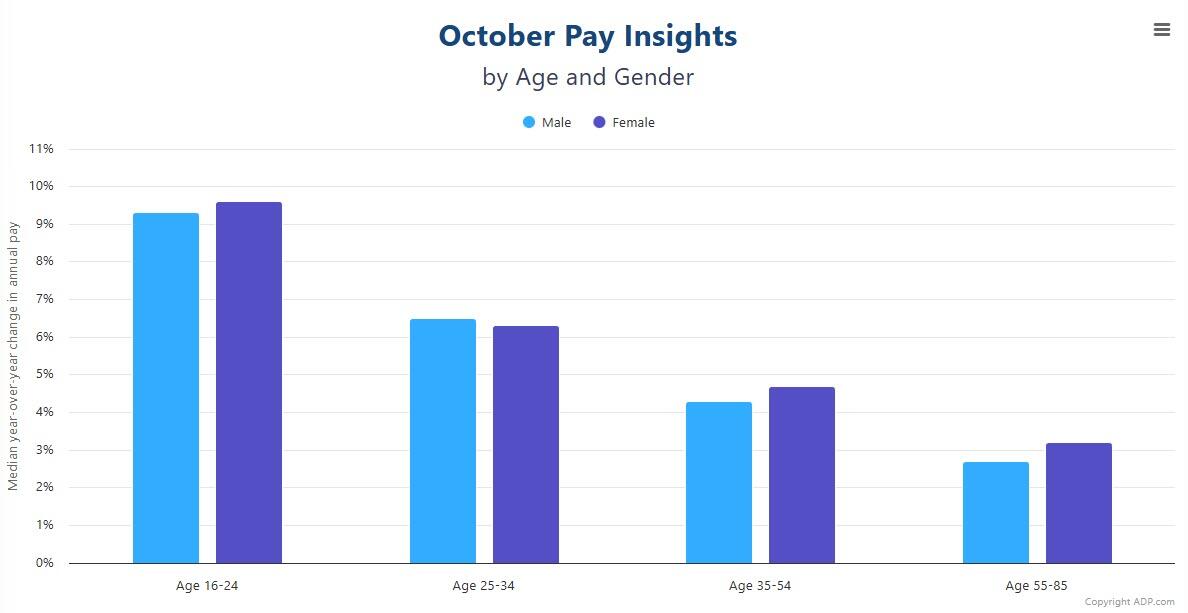
Hardly a major gain in jobs but its not a decline. Having said that, we find it hard to believe that The Fed will see this number and feel like another cut in December is not required.
END
USA ECONOMIC COMMENTARIES
WHAT A SCANDAL!!
The Governor, The CEO, & The FBI: Scandal Threatens New York Hospital
Tuesday, Nov 04, 2025 – 09:45 PM
Authored by Benjamin Weingarten via RealClearInvestigations,
After taking the helm at New York’s financially troubled Nassau University Medical Center late last year, Megan C. Ryan stumbled upon something baffling in the books: a two-decade-long series of transactions engineered by New York State that may have shortchanged the hospital by a staggering $1 billion in matching funds.

As a hospital primarily serving patients on Medicare, Medicaid, or who are uninsured, the medical center qualified for federal matching grants tied to state contributions. Ryan’s discovery indicated that the state was having the medical center itself post its share of the match – for around 20 years at $50 million per year – essentially cheating it out of the state’s matching dollars. “We just couldn’t wrap our heads around how a hospital that serves the poor would be forced to put up tens of millions of dollars” in place of state funds, Ryan told RealClearInvestigations.
Ryan says she called James Dering, previously general counsel of the New York Department of Health, for a legal opinion about the financial arrangement. That opinion indicated it was improper.
What seems like a local tussle over health care has all the trappings of a bigger partisan political fight in the run-up to one of the more important races for governor next year in New York.
Democrat Gov. Kathy Hochul, who is running for reelection, is the central player in the dispute. The hospital – already at loggerheads with Hochul’s administration over claims the state was unduly withholding needed aid – filed suit last December against New York seeking to be made whole for the $1 billion it believed it was owed.
That litigation would help set in motion a series of events culminating in the takeover of the hospital by Hochul, removing control of the public benefit corporation from the hands of Republican Nassau County executive, Bruce Blakeman; the firing of Ryan and the mass exodus of the hospital’s leaders as the new regime took over; and new legal battles between Ryan and the hospital’s Hochul-appointed leaders.
Nassau University Medical Center’s ousted leaders say the takeover smacks of retaliation for their filing of a lawsuit that exposed alleged malfeasance and political corruption.
Despite Dering’s opinion, the state has argued there was nothing wrong with the hospital putting up the matching funds, and that its interventions in the hospital’s operations have been necessary to rescue a debt-riddled facility that has been hobbled by Republican-linked cronyism and mismanagement in one of the few downstate areas where the GOP is competitive. “It has been for years a Republican patronage pit,” Jay Jacobs, chair of both the state’s and Nassau’s Democratic parties, told Politico. “The place is run by Republican Party operatives.”
The hospital saga has already drawn scrutiny from both the FBI and Republican congressional investigators – the latter suggesting that the alleged financial scheme is part of a broader effort to save the state’s balance sheet by shifting the Medicaid burden to counties and low-income hospitals. The state’s Medicaid spending is by far the highest in the country, at $4,942 per person.
Republican Rep. Elise Stefanik, who is expected to run against Hochul, has made healthcare one of her key issues, jousting publicly with the governor over their divergent policies and approaches to Medicaid. Adding to the drama is the partisan battle over federal subsidies for rising Obamacare premiums, which is fueling the ongoing federal government shutdown.
The alleged financial shenanigans at the Long Island medical center focus on the convoluted funding mechanisms used to reimburse hospitals for hundreds of billions of care delivered across the country. The saga playing out in Long Island also illuminates the indelibly political nature of healthcare across the country, where two parties often divvy up and spar over control of facilities that are crucial to the lives of voters.
Nassau University Medical Center is a 530-bed Level I Trauma Center located in East Meadow that serves some 270,000 patients each year. It is the only hospital providing care to all comers regardless of their finances, in the suburbs of Nassau County, east of Manhattan. Until Hochul’s state takeover of the hospital this past May, control of the center was split among state leaders, generally Democrats, and local leaders, sometimes Republicans – with county officials retaining the upper hand.
The medical center’s finances have been shaky for years. A report produced by the turnaround firm Alvarez & Marsal concluded in 2020 that the only “potentially sustainable” option going forward would be to reduce the hospital staff by more than 90% – from 3,400 employees to roughly 300 – while eliminating emergency room and medical/surgical inpatient service altogether.
Under Ryan, the hospital’s performance had improved. Nevertheless, after years of posting losses, the hospital had accumulated a $1.4 billion deficit as of the end of 2024.
While state leaders attributed this shortfall to mismanagement, local and hospital leaders say it is because of the state’s failure to provide necessary financial support – something the state disputes.
According to one of the medical center’s lawsuits, its shortfall can be traced to a scheme that worked this way: “[T]he State would instruct the Nassau County Treasurer to instruct the Hospital to make a transfer of funds to the State with the assurance that the funds would be returned to the Hospital – along with the matching federal funds – within 10 days. And indeed, like clockwork, the money was paid to the Hospital within days.”
The state does not deny this description, but it rejects the hospital’s claim that the arrangement was dubious – a “conscious effort to make it appear that the nonfederal portion was coming from the County – when it was in fact coming from the Hospital” – let alone illegal.
Noting that federal law allows states to cover their non-federal share of Medicaid matching funds through a variety of means, including via intergovernmental transfers from local authorities, New York countered in court filings that counties may put up matching funds and that counties may tap the hospitals themselves for the match.
Although this would seem to be a straightforward legal issue, the law is murky. Healthcare experts with whom RCI spoke indicated that while intergovernmental transfers are common, they could not opine as to the legitimacy of the ones challenged in the Nassau Center’s case.
The New York State Department of Health and several other county hospitals did not respond to RCI inquiries about whether this arrangement was common practice.
The courts would never resolve the Nassau University Medical Center dispute. In early May, Hochul effectively seized control of the facility and quashed the hospital’s suits against New York and the hospital’s financial monitor.
Blakeman, the Republican county executive, called the takeover “illegal” and vowed to file suit.
The takeover had come just weeks after reports had emerged that the FBI was probing the hospital’s underlying allegations of $1 billion in withheld funds, with Blakeman and his handpicked hospital chairman, Matthew Bruderman, cooperating with the investigation.
In July, congressional Republicans running the House Oversight Committee opened a probe into New York’s alleged “abuse of the Medicaid system” through withholding federal Medicaid funds to fill New York budget shortfalls, as well as the alleged years-long $1 billion scheme concerning the Nassau University Medical Center.
A spokesperson for the committee told RCI that there was no update as to its investigation. As for whether other hospitals might be impacted, or analogous efforts were being undertaken in other states, the spokesperson said that the committee believes “this issue is unique to New York State Medicaid.”
In response to inquiries about potential federal probes, the Justice Department and Department of Health and Human Services declined to comment.
An already complicated saga became even more convoluted this summer with contrasting claims about the hospital’s current finances and its future. Before she was fired in June, Ryan had tendered a letter of resignation in May amid the governor’s takeover that was to be effective July 20. In a separate letter to the hospital’s employees obtained by RCI, Ryan stated that in contrast to claims of mismanagement that had filtered out to the press as the dispute between the hospital and state escalated, the facility had improved its operational and financial performance – including significantly increasing cash reserves – while modernizing and expanding.
“[O]ur team has worked tirelessly to restore financial accountability, clinical excellence, and community trust,” according to the letter. “Despite these gains, powerful interests have spent years trying to undermine this institution and distort my record [through leaks to the press alleging mismanagement]. Their intent is not to improve health care but to consolidate political power, dismantle NUMC’s services, and potentially repurpose our hospital for private development.”
In 2024, as the hospital sought additional New York aid amid accumulated losses totaling several hundred million dollars, the state required that the hospital implement changes to support financial stability, while seeming to endorse Alvarez & Marsal’s 2020 recommendation that the facility be significantly downsized.
Hochul, meanwhile, has undertaken an initiative to repurpose state-owned sites as housing – including easing the ability to create higher-density housing.
Richard Kessel, the chairman of the hospital’s financial overseer, the Nassau Interim Finance Authority, had previously led the county’s industrial development agency. It had provided economic incentives to aid in several housing projects, repurposing existing land for housing in the vicinity of the medical center.
Seemingly connecting those dots, Bruderman, the former hospital chair, said amid news of Hochul’s upcoming takeover in April that the governor’s efforts aren’t about “saving the hospital, our employees or our patients, but rather a Democratic Party power play. We have documented evidence that Albany intends to shut down the hospital, fire the employees and utilize this land for other purposes for political benefit.”
A Hochul spokesperson said of claims of a hostile takeover, “The board’s restructuring is unequivocally the best possible news for anyone who relies on NUMC.”
“Due to years of gross mismanagement…the hospital is in financial peril,” the spokesperson added. “This is a desperately needed intervention. The state’s priorities for NUMC have always been ensuring quality patient care and achieving financial stability.”
The medical center was reportedly poised to post an $11 million profit in 2025, after posting losses totaling over $140 million in each of the two years prior.
As for any sort of land deal, a July 2025 opinion piece from a Newsday editorial board member indicated that developers had already begun to reach out to the hospital regarding the nearly 100 acres its facilities cover in a “highly desirable county that has little space to grow.”
“Everything’s on the table except eliminating the safety net hospital,” its Hochul-approved chairman, Stuart Rabinowitz, told the newspaper.
The implication among Hochul’s critics is that high-density housing would most likely benefit Democrats.
Ryan’s attempt to tender her resignation, which was followed by a mass exodus of other hospital leaders, was rejected. Instead, in June, the new board terminated her for cause, denying her severance pay. Ryan notified the hospital that she would seek legal redress.
Before she did so, in August, the hospital filed suit against her seeking $10 million in damages, claiming she had, among other things, engaged in systemic mismanagement, including in authorizing “over $1 million in excessive and improper termination payments” for herself and her exiting colleagues on the way out, and other expenses for reimbursement vastly greater than allowable amounts – including for a lobster dinner on the night one of the executives resigned.
Last month, Ryan countersued, defending her record and claiming the accusations leveled against her were false and defamatory.
Meanwhile, the ousted CEO asserted in her complaint that her successor was hired at a salary roughly 25% higher than her own – which she argues is discriminatory; that the new CEO “has had his hand in prior actual and attempted hospital closures much like the one that now seems imminent” at Nassau University Medical Center; and that the hospital had signed off on $10 million in no-bid contracts in just its first three months under its new board.
While the legal battles intensify, the fate of the safety-net hospital remains unclear.
END
Zohran Mamdani defeats Andrew Cuomo to win New York City mayoral race
Mamdani beat out former New York governor Andrew Cuomo in a record-breaking race for voter turnout.

Supporters of Democratic candidate for New York City mayor Zohran Mamdani reacts to initial projections of his win during an election night rally in the Brooklyn borough of New York City, New York, U.S., November 4, 2025.(photo credit: REUTERS/JEENAH MOON)ByJERUSALEM POST STAFFNOVEMBER 5, 2025 04:33Updated: NOVEMBER 5, 2025 05:25
Zohran Mamdani has won the New York City mayoral election, beating out former New York governor Andrew Cuomo in a record-breaking race for voter turnout, American media reported on Tuesday.
At the time of publication, Mamdani is leading the polls with 50.7% of the vote. Cuomo, who ran as an Independent, has 41.6%, and Republican Curtis Sliwa has 7.2%.
More than 2 million ballots including early voting were cast, according to the board of elections, the most in a mayoral race since 1969.
Mamdani will become the first Muslim mayor of the largest US city. He defeated Cuomo, 67, who ran as an independent after losing the nomination to Mamdani in the primary election. The campaign served as an ideological and generational contest that could have national implications for the Democratic Party.
White House claps back
The White House official X/Twitter account posted a graphic imitating the New York Knicks logo featuring the words “Trump is still your president.”
Earlier on Tuesday, US President Trump slammed Mamdani, stating that “Any Jewish person that votes for Zohran Mamdani, a proven and self professed JEW HATER, is a stupid person!!!”
The president endorsed Cuomo on Monday, stating that Sliwa had no chance at winning.
“We must also remember this – A vote for Curtis Sliwa (who looks much better without the beret!) is a vote for Mamdani,” said Trump.
He also insinuated that if he were on the ballot, more Republican candidates would have won.

Left-wing Americans celebrate
Our Revolution Executive Director Joseph Geevarghese celebrated the election results.
“Here’s the topline takeaway: Mamdani and his message about the crisis of affordability defeated Donald Trump, the Democratic establishments, and the donor classes of both parties,” the leader of the Bernie Sanders-founded organization wrote.
The political establishment will leave out the “hard truths” that “Chuck Schumer and the Democratic establishment are losing relevance,” Geevarghese continued.
“AIPAC and the pro-Israel lobby have become toxic forces in Democratic politics,” he stated.
Michael Starr contributed to this report.
END
Mamdani winning in NY means antisemitism can win elections, would impact Jews globally – editorial
Whichever candidate prevails, the implications will be felt far beyond New York. If Mamdani’s on top, that would be a bad day for Jews worldwide. If not, we must reflect on why he almost did.

Democratic candidate for New York City Mayor, Zohran Mamdani, shakes the hand of a cab driver while campaigning in Manhattan’s Upper East Side neighborhood during early voting, in New York City, U.S., October 27, 2025(photo credit: MIKE SEGAR / REUTERS)ByJPOST EDITORIALNOVEMBER 5, 2025 06:00
Every Jew across the world has been following New York City’s mayoral election, although it may be far away from where they live. By early Wednesday morning Israel time, we will probably know who won this mayoral race held on Tuesday, with results expected soon after polls close in the US.
According to The Jerusalem Post’s election-day brief, “Mamdani, Cuomo, and Sliwa face off as New York City polls open,” and “the city’s Jewish community has been divided in its support of Mamdani.”
Regardless of whether Mamdani wins, this election period in New York has caught the attention not only of the Jewish world but of the world at large. Its effects will be felt far beyond New York City.
Mamdani has been called a “raging antisemite, a terrorist sympathizer, an ardent socialist, and a polarizing figure” – language that reflects why the campaign has become a global story.
Mamdani’s own words have amplified concerns. In a 2021 clip resurfaced in the Post coverage, he said co-founding Bowdoin’s SJP chapter and anti-Israel BDS activism were the “crux of the reason” he joined the Democratic Socialists of America.

In recent months, the Post reported that he had told a closed-door gathering he would curb the use of the slogan “Globalize the intifada,” even as he has not publicly urged protesters to stop using it. And in October, he wrote that Prime Minister Benjamin Netanyahu had “launched a genocidal war,” framing Israel’s actions in the most extreme moral terms.
Mamdani winning would mean antisemites can win elections
If he wins, this is a clear message for the Democratic Party: Antisemites can lead; they are no longer in the margins. This means that being a supporter of a boycott of Israel – not just West Bank goods but also sovereign Israel – is normal.
This means that globalizing the intifada, as he calls it, is a relevant call for destroying the only Jewish state in the world, while dozens of Arab and Muslim states already exist.
Mamdani, though, created a counter-effect and united most of the Jewish community – including Reform Jews and Orthodox Jews, young and old – around this cause. Unfortunately, we needed a Mamdani to make that happen.
The Post’s editor-in-chief Zvika Klein suggested that the New York Jewish community learn from UK Jews about rallying against Jeremy Corbyn when he ran for prime minister. Luckily, they did.
Many teams sat for hours and collected information about Mamdani’s problematic past; others promoted op-eds and social-media campaigns not for a specific candidate but against this one.
The rhetoric has already reshaped communal politics. An analysis of Jewish voting patterns found that “only 56% of the Jews who voted for [progressive] Brad Lander” selected Mamdani as their first choice, a sign of deep reservations among voters who might otherwise align with the Left.
International figures have also spoken out in his defense. As reported by the Post, “Jeremy Corbyn hosts a phone bank in support of Zohran Mamdani,” with his team “calling New Yorkers to convince them to vote for Mamdani,” a trans-Atlantic echo of Britain’s Corbyn era that many American Jews remember warily.
Mamdani’s campaign has simultaneously courted new constituencies. According to a Post staff report on a late push ad, he released an Arabic-language spot in which he jokes about knafeh (a traditional Middle Eastern dessert) and says, “My Arabic needs work,” highlighting identity politics as part of his coalition strategy.
One positive element is that Jews from across denominations and political affiliations united against this antisemite. Reform and Orthodox rabbis, as well as members of both the Democratic and Republican parties, have been working together to combat this problematic candidate. The Post views this as a significant move, indicating that the Jewish community has been able to set aside its differences in the face of a dramatic event.
Whichever candidate prevails, the implications will be felt far beyond New York. One of this publication’s opinion columns warned that “the risks of his win go far beyond New York City.”
If Mamdani wins, this is a very bad situation for Jews, for Israel, and for America. If he loses, it isn’t a happy day for Israel and the Jews, but it should be a day of reflection. We need to think of the day after – how we combat these opinions across the US, because they aren’t going anywhere.
END
Democrats Conveniently Weigh Ending Record Shutdown After Socialist Wins NYC Mayoral Race
Wednesday, Nov 05, 2025 – 08:25 AM
A report overnight suggests that several moderate Senate Democrats are prepared to break ranks and vote to end what has become the longest U.S. government shutdown in history. The push to reopen the government comes conveniently after major victories for Democrats in Tuesday’s elections, including socialist Zohran Mamdani becoming New York City’s next mayor, and Abigail Spanberger and Mikie Sherrill winning their respective gubernatorial races in Virginia and New Jersey.
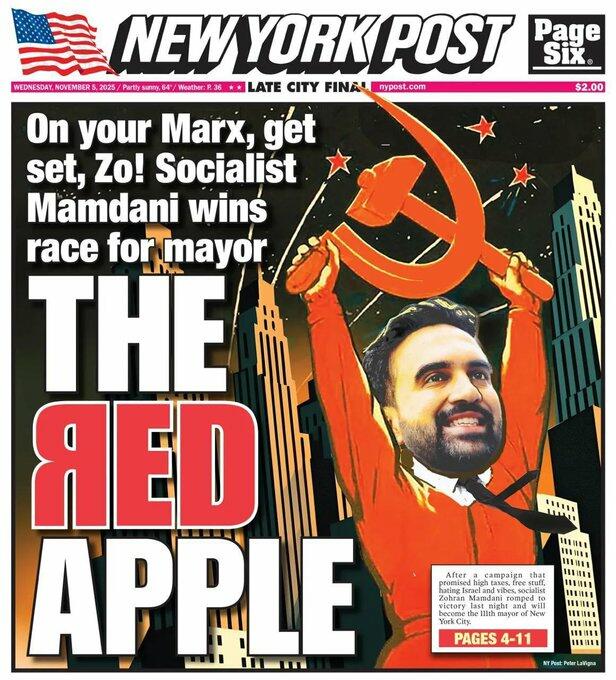
The Soros family is very happy.
Washington Post reporters Riley Beggin and Theodoric Meyer cite multiple people familiar with the talks who say “a handful” of moderate Senate Democrats are ready to end the government shutdown.

Here’s more color on those conversations:
A bipartisan group of senators is working to craft a deal in which Congress would pass three full-year appropriations bills to fund some agencies, along with a short-term bill that would reopen the rest of the government, according to four people familiar with the talks, who spoke on the condition of anonymity to describe private discussions. In exchange, Senate Republicans would agree to hold a vote at a set date on extending Affordable Care Act subsidies that are otherwise slated to expire. Democrats have insisted throughout the shutdown that the subsidies be extended.
About a dozen Senate Democrats are open to backing the proposal, three of the people estimated, which is still being hammered out — more than enough to break the impasse and reopen the government.
Democrats have used the government shutdown to push for the restoration of taxpayer-funded health insurance subsidies for illegal aliens. That funding stream was terminated when Republicans delivered working families tax cuts that include no tax on tips, overtime, and Social Security as well as major health care reforms earlier this year.
The report continued:
Sen. Gary Peters (D-Michigan), who has been a part of the negotiations, said Tuesday that “everything’s on the table,” adding that “the pace of talks have increased.” Senate Democrats met for lunch Tuesday for nearly three hours to discuss the path forward. Those involved in the talks updated their colleagues on where they stand. Afterward, Peters said it was a “thoughtful” discussion: “It was one of the better caucus meetings I’ve been in in a while.”
Republicans hold a 53-47 majority in the Senate. They need at least eight Democratic votes to overcome a filibuster and reopen the government. Sen. Rand Paul (R-Kentucky) remains opposed to the measure. A couple of lawmakers have already crossed the center aisle, including Sen. Angus King (I-Maine), Sen. Catherine Cortez Masto (D-Nevada), and Sen. John Fetterman (D-Pennsylvania, who support the GOP’s clean continuing resolution.
Last week, a Washington Post-ABC News-Ipsos poll found that most respondents blamed President Donald Trump and Republicans more than Democrats for the shutdown than blame Democrats. The informational war to pin the blame on Trump by Democrats, their billionaire funders, their corporate media allies, and their protest industrial complex comes as no surprise, given that this shutdown likely gave Dems a boost during last night’s election.

This is a firm warning to Republicans, serving as an early indicator of which national strategies will work in the 2026 midterms.
END
Abrupt Sentiment Shift Rocks Gen Z: Restaurants Warn Of Spending Drop As Student Loan “Default Cliff” Arrives
Wednesday, Nov 05, 2025 – 03:40 PM
The Trump administration faces a worsening macroeconomic backdrop for younger, lower- and middle-income consumers, burdened by student debt, costly auto loans, high apartment rents, and depleted savings amid a persistently high interest rate environment.
Early signs of financial strain emerged at the tail end of the summer, outlined in our note:
We’ve been tracking this alarming trend, which was reinforced by the latest warning from Goldman Delta One, Rich Privorotsky, who has gone “Defcon 1” on the rapidly deteriorating consumer.
Early signs of strain have emerged across the restaurant and casual dining segment, where management teams are flagging a noticeable pullback in discretionary spending among younger consumers. This cohort is increasingly shifting from dining out to at-home consumption, opting for groceries over restaurants as they can no longer justify $8 Starbucks coffee and $15 Chipotle burritos.
Last week, Goldman’s Consumer specialist Scott Feiler published a red alert on “The Shifting Health of the US Consumer,” warning of acute deterioration among the US middle class.
Feiler followed up the warning with a weekend note that said, “Something has clearly changed with the consumer. Commentary from restaurants and grocers last week made that clear.”
He noted that consumer stocks are massive underperformers year-to-date (Restaurant group -21% YTD, Housing -7% YTD, Retail -3% YTD).
However, he said, “It is worth noting that November is the best month for Consumer Discretionary of the year. The last 5 years, the group is +8.4% during November, on average, with an 80% hit rate. It is the largest outperformance month vs the market, on average, as well.”
Consumer Discretionary (GSXUCOND Index) Average Price Action By Month. November is The Strongest Month of the Year on an Absolute & Relative Basis.
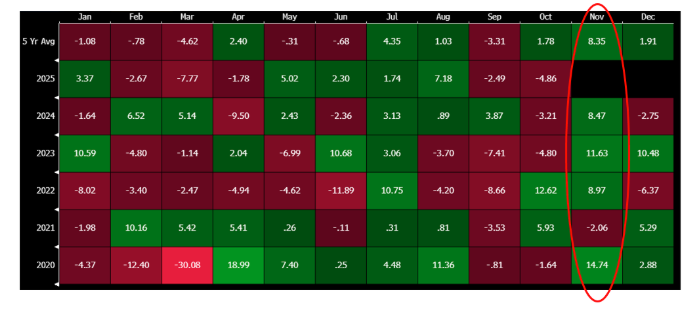
Feiler previously noted that more companies are warning of signs of a slowdown across the consumer space, with weakness mainly across middle-income consumers, particularly those aged 25 to 35. The brunt of this has been observed across the restaurant space:
There’s been increasing chatter about the notable negative shift in sentiment among younger consumers, which happened quite abruptly. We spoke with a senior analyst at one of the world’s largest U.S.-based beverage companies who attributed the slowdown to tariffs. However, we disagree and believe the actual shock was the student loan “default cliff” that hit in late summer.
There are about 5.3 million student loan borrowers in default, and another 4.3 million borrowers are in “late-stage delinquency,” or between 181 and 270 days late on their payments, according to a recent Congressional Research Service report based on Education Department data. Payments 270 days past due are considered in default.
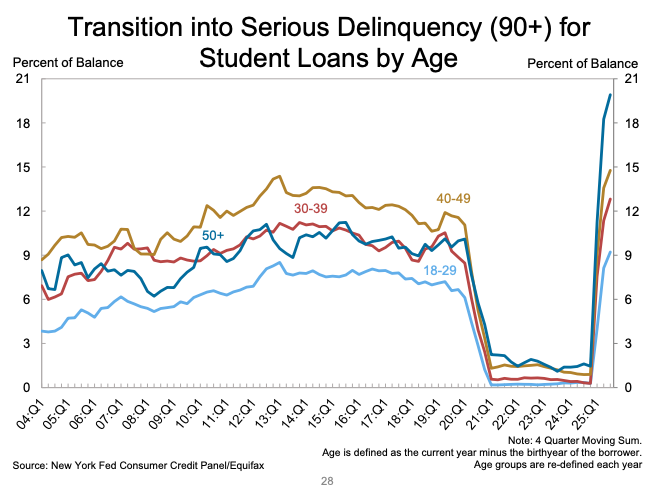
We don’t disagree that a slowing jobs market and tariffs are compounding pressures on consumers, but the unfolding mess tied to the student loan default cliff hitting younger borrowers is clearly a major driver behind the sharp shift in sentiment.
Given that Democrats have shifted so far to the left by fully embracing socialism and a sprinkle of Marxism, promising those who vote for them free bus rides, government-run supermarkets, and other free stuff, the question becomes how the Trump administration will win some of these youngsters struggling to survive. We do note the Trump administration recently offered to bail out farmers with tariff revenues… The admin should start looking at the kids ahead of the 2026 midterms.
VICTOR DAVIS HANSON
KING NEWS
| he King Report November 25, 2025 Issue 7613 | Independent View of the News |
| Wall Street CEOs (GS, MS, and Capital Group) Flag High Market Valuations, Pullback Risk – BBG Investors should brace for an equity market drop of more than 10% in the next 12 to 24 months…. Corporate earnings are strong, but valuations are challenging… said… during a financial summit organized by the Hong Kong Monetary Authority on Tuesday… https://www.msn.com/en-us/money/other/wall-street-ceos-flag-high-market-valuations-pullback-risk/ar-AA1PLbOe The S&P 500 fell as much as 1.2% before paring losses… Palantir tumbled 10.23% (at 9:37 ET) even though the company reported great results (EPS of .21, .17 exp; revenue of $1.18B, 1.09 exp.) on Monday night and raised its annual revenue outlook to $1.33B from $1.19B. During early NYSE trading, the Mag 7/Fangs declined sharply while the DJTA rallied moderately on the valuation rotation that has regularly appeared over the past two months or so. ESZs opened a tad lower on Monday and quickly commenced a steep decline due to Palantir’s after-hour tumble despite great results. ESZs hit a daily low of 6786.25 (-96.50) at 5:05 ET. ESZs then had an A-B-C rally, with an explosive C wave due to buying the opening dip, that took ESZs to 6849.25 at 10:41 ET. The post-European close move was a sharp decline to 6806.00 at 12:19 ET. After a bounce to 6816.00 at 14:04 ET, ESZs fell to 6794.75 at 14:43 ET. After an A-B-C rally to 6815.00 at 15:45 ET, ESZs slid 6796.50 ET at 15:56 ET. ESZ inched up to 6804.50 at 16:00 ET. Precious metals and cryptocurrencies have been getting hammered. The following DXY chart explains why. Remember, “stocks always get it last!” The Dollar Index with 26-week & 52-week MAs – If the debasement trade over, look out below, stocks! @GlobalMktObserv: Market liquidity STRESS is surging: The SOFR-IORB spread SPIKED to 32 basis points, the highest since the 2020 CRISIS. (Secured Overnight Financing Rate; Interest on Reserve Balances) A positive spread means banks are paying above the Fed’s floor rate to borrow cash, signaling aggressive borrowing and tightening liquidity. QE coming? https://x.com/GlobalMktObserv/status/1985701568004477426 @intermarketflow: There’s a liquidity issue. It’s also true that with the government shutdown, the TGA (Treasury General Acct.) keeps rising — and that drains liquidity from the system. Taxes are collected and accumulate there. Still, it’s very hard to quantify which effect is dominating more. Positive aspects of previous session The DJTA rallied on the relative valuation out of Fangs and trading sardines. USZs rallied modestly. Gold declined smarty; Bitcoin got hammered and traded below 100k. Negative aspects of previous session USZs rallied only modestly when they should have rallied sharply on defensive asset allocation. Fangs/Mag 7 and trading sardines were hammered. Ambiguous aspects of previous session Is the debasement trade over? Is the dollar about to explode higher? If so, what does it mean? First Hour/Last Hour Action [S&P 500 Index]: 1st Hour from NYSE Open: Up; Last Hour: Down Pivot Point for S&P 500 Index [above/below indicates daily trend to traders]: 6786.16 Previous session S&P 500 Index High/Low: 6820.21; 6766.71 @DataArbor: The median age of a first-time homebuyer increased to age 40 in 2025. (29 in ‘85) https://x.com/DataArbor/status/1985756047097950256 @Barchart: Coca-Cola had Negative Free Cash Flows this year for the first time this century. (data through Q2 2025) https://t.co/SKfTUSPdTl After the close, AI play AMD issued a disappointing outlook, $9.6B Q4 revenue. Some analysts expected $9.9B. Q3 Revenue $9.2B, $8.7B expected; EPS 1.20, 1.17 consensus. AMD sank as much as 4.7%. Today is a key day for equities. For many moons, when key stocks indices have broken down someone surfaces to save stocks or some Team Trump issues verbal intervention. A significant equity decline today could indicate a tone change among key investors and big traders. ESAs are -34.00; NQZs are -190.50 (on AMD); Dec AU is -12.40; and USZs are +9/32 at 20:02 ET. Expected economic data: Oct ADP Employment Change 40k; Oct S&P Global US Services PMI 55.2, Composite PMI 54.8; Oct ISM Services Index 50.7 S&P Index 50-day MA: 6654; 100-day MA: 6466; 150-day MA: 6198; 200-day MA: 6120 DJIA 50-day MA: 46,300; 100-day MA: 45,231; 150-day MA: 43,877; 200-day MA: 43,741 (Green is positive slope; Red is negative slope) S&P 500 Index (6771.55 close) – BBG trading model Trender and MACD for key time frames Monthly: Trender and MACD are positive – a close below 5687.33 triggers a sell signal Weekly: Trender and MACD are positive – a close below 6420.50 triggers a sell signal Daily: Trender and MACD are positive – a close below 6764.11 triggers a sell signal Hourly: Trender and MACD are negative – a close above 6813.02 triggers a buy signal Stupid headline from BBG: NYC to Decide If a Socialist Will Run the Capital of Capitalism NYC has been the cradle of socialism and communism for at least 100 years! It is also the biggest beneficiary of crony capitalism, as exemplified by the Great Wall Street Bailout of 2008-2009 as well as the symbiotic relationship between the Fed, money center banks, and the US government. Trump foe Boasberg hit with articles of impeachment – Rep. Brandon Gill filed impeachment articles against Judge James Boasberg on Tuesday over his role in ‘Arctic Frost’ https://www.foxnews.com/politics/trump-foe-boasberg-hit-articles-impeachment Jim Jordan launches House Judiciary probe into phone companies tied to Jack Smith’s Arctic Frost Jordan sent the letters to AT&T and Verizon demanding documents and communications related to Smith’s subpoenas… “Recently released internal DOJ documents indicate that former Special Counsel Jack Smith compelled the production of phone records belonging to several Republican Members of Congress and simultaneously sought a gag order to prevent your company from disclosing the DOJ’s subpoenas into these individuals,” Jordan wrote in the letters to both companies. “These findings raise serious concerns about potential statutory and constitutional violations, including violations of the Speech or Debate Clause, and we therefore request documents and information to aid in our oversight… It is concerning that the Biden-Harris DOJ abused its federal law enforcement authority to effectuate a politically motivated prosecution against President Trump, in such a clandestine and partisan manner, by spying on the communications of sitting Members of Congress.”… https://justthenews.com/government/congress/jim-jordan-launches-house-judiciary-probe-phone-companies-tied-jack-smiths @AGPamBondi: During the Arctic Frost Investigation, we found that Special Counsel seized President Trump’s government-issued phone. This means the Biden Administration turned over President Trump’s phone to Special Counsel—an UNPRECEDENTED action. In addition, Special Counsel subpoenaed all of President Trump’s PERSONAL phone records. We can never again allow this kind of government weaponization in America. Trump admin may be forced to close parts of US airspace if shutdown lasts into next week, Duffy says https://trib.al/sMKyHXK How to end the Schumer Shutdown: Ground all private jets in US to alleviate air controller shortages. The Party of Political Violence: Barack Obama Crosses a Rubicon Jay Jones, the Democrat candidate for attorney general in Virginia, made the most bloodcurdling endorsement of political violence I have seen from an elected official—and none other than Barack Obama spent the weekend sidling up to him. Brief recap: Jones has not denied reports that he sent text messages fantasizing about shooting Todd Gilbert, the Republican former speaker of the House of Delegates. He said he would rather shoot Gilbert twice than kill Adolf Hitler or Pol Pot. He later said he wished Gilbert’s young children would die in their mother’s arms. He sent these messages to a Republican and, when she asked him to stop, he sought to justify these violent thoughts with one sentence: “Only when people feel pain personally do they move on policy.”… “If we are opposed to violence against people we disagree with, or who look a certain way, then we have to speak out when those values are violated,” Obama said. He delivered those remarks after Jones stood at that very spot, and did not condemn Jones’ texts… https://www.dailysignal.com/2025/11/03/democrats-now-own-horrific-political-violence-jay-jones/ Presidential fatigue is real in the US. Sitting vice presidents of two-term presidents have won election only twice – and they (Van Buren and Bush I) lost reelection bids. Only the extraordinary popularity of Andrew Jackson and Ronald Reagan produced wins for their sitting VPs (138 years apart). The moral of the story: Trump Fatigue could be an albatross on the GOP in 2028. Many of his supporters could soon view his incessant bloviating and self-aggrandizement as irritating and unbecoming – instead of being amusing and a counter to whacko left lunacy. @boriquagato: roughly half of all non-citizen families with young children in the US get welfare assistance, often through their children. this number rises to about 2/3 when you look only at those without college degrees. no wonder the blue states do not want to participate in the SNAP audits. this is very much the opposite of the narrative they are trying to sell. https://x.com/boriquagato/status/1985782455992029362 @DerrickEvans4WV: A woman from New Mexico admits to being on SNAP benefits for over THIRTY YEARS. She says the delays are “detrimental” to her life if she doesn’t get them. “When I heard zero dollars, my chest went into my throat… I have depended on those benefits since the 1990s.” https://t.co/sxjrrvvVuA @AveryDaye: Denmark tracked 321 Palestinian men granted asylum in 1992. 63% were convicted of a crime; 22% received a prison sentence; 55% were on welfare by 2019; They had ~999 children, 34% convicted, 13% got prison sentences, 37% received benefits in 2019… https://t.co/coKyNLkeVD @libsoftiktok: This is a REAL class (Intro to Fat Studies – Fatness, Blackness and their Intersections) at the University of Maryland… taught by Sydney Lewis, a LGBTQ and “black liberation” activist. This is what your tax dollars are funding. https://x.com/libsoftiktok/status/1985846368913514612 @NotTheirScript: The course description reads like a parody someone would write to mock academia, except it’s real and taxpayer funded. Fat liberation as a social justice movement. This is where we are now. | |
SWAMP STORIES FOR YOU TONIGHT
The Corrupt Anatomy Of The SNAP Panic
Wednesday, Nov 05, 2025 – 04:20 PM
Authored by Jeffrey Tucker via The Epoch Times,
Americans ought to be deeply embarrassed at the national panic over the future of food stamps. The level of dependency on this program (42 million people and 22 million households) runs contrary to our entire civic culture and history.
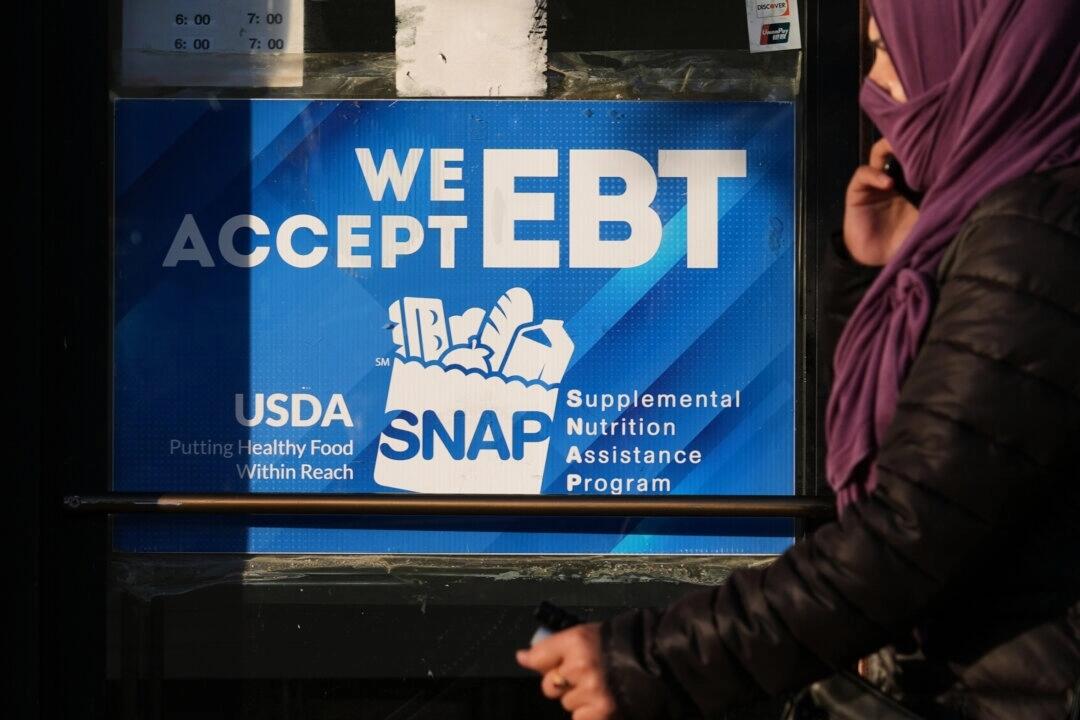
It is a betrayal of the founding vision of commerce, independence, and agronomy. It reveals a fundamentally dangerous rot at the core of the functioning of the food system.
We can hope that the widespread meltdown over even the slightest pause in the program provokes a rethinking of the entire scheme.
The term food stamps is of course deprecated in favor of SNAP (Supplemental Nutrition Assistance Program) delivered via an EBT (Electronic Benefits Transfer). This is all technocratic euphemism. They are food stamps. The name was changed to disguise the disgrace and the mode of delivery turned into a card that looks like any other.
It was much better when people had to deliver their stamps in front of other customers. At least that preserved some of the stigma with which it was associated. As for nutrition, not so much. The SNAP program amounts to a huge subsidy for the snack-food industry, which turns out to be the key lobbying force behind the entire thing.
The origin of the program traces to 1933. Its main point was not to save people from starvation but to save industry from a downturn at the onset of the Great Depression. The price of wheat, milk, and meat were falling dramatically. The problem was not a lack of demand but a huge overproduction brought about by market distortions.
To understand the economic issue, you have to go back to the Great War when wartime disruptions in Europe provoked reliance on U.S. production. U.S. exports of food expanded dramatically and so did the amount of farmed acreage. The industry kept growing throughout the 1920s, based in part on leverage and inflated expectations of urbanization.
The stock market crashed and this was followed by an immediate trade war that harmed U.S. exports. The bubble broke and prices began to drop dramatically. In other words, the market corrected exactly as it should have given the circumstances.
The market is a beautiful thing: it provided cheap food exactly when it was needed most. But in 1933, a new president took power who was not a fan of the market. He hired a slew of new appointees who imagined themselves to be social and economic planners. So instead of allowing the correction, Washington got in the business of propping up industry.
The Agricultural Adjustment Act of 1933 had the government buying up surplus food from farmers and distributors and giving it away to people. This was plainly and purely a program of price support. That was the entire point. That’s why the program was administered by the Department of Agriculture, not some other welfare agency.
Meanwhile, the true American system of helping people did the heavy lifting. It was the soup kitchens and church pantries that truly got to work on solving the hunger problem. All the new food stamps did was keep food prices higher than they otherwise would be, and kept the agricultural industry from adjusting according to prevailing conditions.
From then to now, that has been the essence of the program. It’s an industry subsidy. The grocery chains depend on it. So do Big Ag producers. It also works as a vote-buying program by promoting dependency among the citizenry.
The program is completely unregulated in the way a church soup kitchen would be. Privately run food pantries do more than dish up food; they assist people toward fixing up their lives. When they see the program being abused, they cut people off. The Good Samaritan did not just give money but rather life assistance. So too for private charity today.
Government doesn’t do this. It subsidizes large industrial players while promoting dependency. Imagine tiny birds in a nest with their mouths open waiting for the mother bird to arrive with worms. Or think of dogs waiting beneath the table for scraps from plates. That’s how the architects of this program see the American people.
Think of the whole institution of Thanksgiving. It is our number one holiday even though it is not technically part of any religious calendar. You could say it is a high holy day of our civic religion.
And what does it celebrate? It honors the blessings of God in the form of food that nourishes our bodies. When we thank God for the food, what we mean is to thank God for our lives and hands and capacities to work to get that food. It celebrates the capacity of a free and godly people to manage themselves in independence. It celebrates how a society learned to feed itself.
Food stamps from government turn the whole message of Thanksgiving on its head. Instead of work and merit, it institutionalizes dependency on the Crown to feed, which is exactly the practice against which the Founders rebelled. They rejected the Crown’s tea and emoluments in favor of national independence and productivity.
How pathetic that we’ve spent weeks in wailing and gnashing of teeth over possible cuts in free food via electronic transfer! Industry and welfare recipients are screaming: “Oh no no, please don’t take away our free stuff!”
Friends, this is inconsistent with the habits and values of a free and dignified people! I get that these are very hard times. And people are in need.
On the other hand, this is the most obese and sick country in the world, poisoned by an overabundance of genetically modified calorie-rich junk food and burdened with corporate cartels that are equally dependent on government handouts.

“Freedom From Want,” between 1941–1945, by Norman Rockwell. U.S. National Archives and Records Administration, Public Domain
It’s a national disgrace that an entire nation would be yelling and demanding more free food. It’s utter humiliation. This program runs contrary to everything we ever aspired to be as a nation. I hope this pause in benefits serves as a wakeup call to find our way back to our core values before it is too late.
It is not part of our national DNA to have people and industries that are dependent on government handouts in any form. Get some dignity, folks, and man up. Look at the Norman Rockwell painting of Thanksgiving and the pride on the breadwinner’s face as he serves his huge family. That’s who we are. That’s who we can be again.
END
GREG HUNTER…INTERVIEWING BILL HOLTER
More Risk in System Now than Any Time Ever – Bill Holter
By Greg Hunter On November 4, 2025 In Market Analysis, Political Analysis1 Comment

By Greg Hunter’s USAWatchdog.com
Financial writer and precious metals expert Bill Holt (aka Mr. Gold) said a month ago that rising “gold and silver prices were sniffing out risk.” Looks like the Federal Reserve is also smelling some risk. It recently, quietly flooded the banks with $125 billion injection in just five days. The cash went into the repo market. Mr. Gold says, “This is just a tremor, the cash going into the repo market. Understand that there are more derivatives outstanding, and there is more debt outstanding. Whatever metric you want to use to measure it, there is more risk in the system now than any time ever. Go back to 2008 and 2009, and we were very close to a complete meltdown with markets not opening up on Monday morning. They started handwringing over $700 billion in TARP, while behind the scenes, the Federal Reserve created $16 trillion or $17 trillion and lent it all over the world. It didn’t right the ship, but it did stop it from sinking. I ask you, has anything changed or has anything been fixed? Did they address any of those problems we had back in 2008 and 2009? The answer is no. In fact, they double, triple and quadrupled down on those same policies.”
Mr. Gold goes on to say, “They are trying to fix a debt problem with liquidity. The liquidity is like a Novocaine shot. It makes things feel better temporarily, but it does not fix the problem. The problem is there is too much debt outstanding by any metric. Whether you look at debt to cash flow or debt to equity, a perfect example is the US dollar. The United States is now 130% debt to GDP, and, oh, by the way, the dollar is still the world reserve currency. In 1982 when I graduated from college, if debt got to 100% of GDP, it was considered a banana republic. That being said, you could say the entire world is a banana republic because they use as a reserve currency something that is issued by a bankrupt entity. It is insolvent because look at the Fed’s balance sheet. The Fed has negative equity now. They lost so much on bonds they bought in 2008 and 2009, and interest rates have gone up. That means their portfolio has dropped. . .. two or three years back, they were operating with only $65 billion in equity. They had trillions of dollars, and if you want to count derivatives, they had quadrillions of dollars (of debt) dancing on the head of a $65 billion pin.”
Mr. Gold is not worried about the most recent correction with gold and silver prices. Holter says “Watch out for a possible ‘failure to deliver’ of physical gold and silver at the end of the year. . .. Failure to deliver physical metal will end the fraud, and it will be game over for the metal contracts. More and more people are now standing for delivery.”
With the government shutdown and SNAP food benefits being cut off, where does this end? Mr. Gold says, “You’ve got people on line saying if they cut off the food that they are going to go out and steal to feed their families. . .. Mad Max, this is where this ends. Is it going to be Mad Max for years? It might be two weeks or two months. God forbid it goes on for six months because the skills are gone with hunting and farming. What people know how to do is get in their car and go to the corner store.”
In closing, Holter says, “Get your capital out of the system.” Buying physical gold and silver is getting cash out of the system and putting it under your direct control.
There is much more in the 45-minute interview.
Join Greg Hunter of USAWatchdog as he goes One-on-One with financial writer and precious metals expert Bill Holter/Mr. Gold for 11.4.25.
For The Wellness Company’s new “Ivermectin (18 mg) Compounded Capsules,” click here. Don’t forget you get 15% off and free shipping if you use the promo code USAWATCHDOG.
(To Donate to USAWatchdog Click Here)
After the Interview:
For The Wellness Company’s new “Ivermectin (18 mg) Compounded Capsules,” click here. Don’t forget you get 15% off and free shipping if you use the promo code USAWATCHDOG. You can also call The Wellness Company at (800) 758-1584 and talk to a real human.
Bill Holter’s website BillHolter.com just keeps growing. There are lots of new free articles posted.
If you need to contact Bill Holter, his email is bholter@proton.me
SEE YOU TOMORROW


 harveyorganblog.com