
access market
GOLD $4166.95 (3:30 PM)
SILVER: 52.51 3;30 PM)
XXXXXXXXXXXXXXXXXXXXXXXXXXXXXXXXXXXXXXXXXXXXXXXXXX
XGE: COMEX
099 H DEUTSCHE BANK AG 1
190 H BMO CAPITAL MARKETS 197
363 H WELLS FARGO SECURITI 18 10
435 H SCOTIA CAPITAL (USA) 7
661 C JP MORGAN SECURITIES 7
880 H CITIGROUP 204
GOLD: NUMBER OF NOTICES FILED FOR NOV/2025: 222 CONTRACTs NOTICES FOR 22.200 OZ or 0.6905 TONNES
total notices so far: 8054 contracts for 805,400 OR 25.051 tonnes)
SILVER NOTICES: 0 NOTICE(S) FILED FOR NIL OZ/
total number of notices filed so far this month : 3132 CONTRACTS (NOTICES) for 15.680 million oz
INITIAL STANDING FOR NOV: 11.575 MILLION OZ
PLUS INITIAL 1.245 MILLION OZ QUEUE JUMP
THEN ADD TUESDAY;S 1,93 MILLION OZ QUEUE JUMP
THEN WEDNESDAY;S 0.570 MILLION OZ QUEUE JUMP
THEN 0.080 MILLION OZ
THEN MONDAY’S 425,000 0Z
THEN TUESDAY: 275,000 OZ
THEN WEDNESDAY’S 295,000 OZ
THEN TODAY : 10,000 OZ
EQUALS
15.985 MILLION OZ STANDING FOR SILVER.
JULY: 50.925 MILLION OZ (QUITE SMALL)
AUGUST: 59.455 MILLION OZ (QUITE SMALL)
SEPT. 50.510 MILLION OZ.(QUITE SMALL)
OCT; 82.020 MILLION OZ (WILL BE STRONG THIS MONTH)/ OCC WANTS TO REIN IN THESE ISSUANCES!
NOV: 13.790 MILLION OZ
AND JULY: 46.720 MILLION OZ//
AUGUST: 4.70 MILLION OZ INITIAL STANDING PLUS TODAY;S 5,000 OZ QUEUE JUMP //NEW STANDING ADVANCES TO 10.960 MILLION OZ
SEPTEMBER: 68.040 MILLION OZ NORMAL DELIVERY(INCLUDES ALL QUEUE JUMPING AND EXCHANGE FOR PHYSICAL TRANSFERS) PLUS 3.0 MILLION OZ EX FOR RISK = 71.040 MILLION OZ. (THIS IS THE FIRST AND ONLY ISSUANCE OF EXCHANGE FOR RISK FOR SILVER SINCE MAY.)
OCTOBER: 39.565 MILLION OZ OF NORMAL DELIVERY INCLUDES ALL QUEUE JUMPING
PLUS
2.110 MILLION OZ EXCHANGE FOR RISK//TOTAL OZ STANDING IN OCT ADVANCES TO 41.675 MILLION OZ
AND NOW NOVEMBER: INITIAL STANDING AT 11.575 MILLION OZ FOLLOWED BY TODAY;S QUEUE JUMP OF 10,000 OZ WHICH FOLLOWS ALL OTHER QUEUE JUMPS OF 5.245 MILLION OZ//STANDING ADVANCES TO 15.985 MILLION OZ/
- MAY: SUMMARY FOR MAY TONNES WHICH STOOD FOR DELIVERY:
4. AUGUST: 60.547 TONNES OF INITIAL GOLD FIRST DAY NOTICE FOLLOWED BY THE NET MONTH’S QUEUE JUMP OF 47.2312 TONNES TO WHICH WE ADD THE FOLLOWING EXCHANGE FOR RISK ISSUANCE RECEIVED FOR THE MONTH: 5.4432 TONNES EX FOR RISK/AUG 7 , AUG 11: 2.413 TONNES EX FOR RISK AND AUG. 12 OF 2.637 TONNES EX FOR RISK//AUG 25: 9.107 TONNES , AUGUST 26: 9.1010 TONNES AND NOW AUGUST 27: 9.0699 TONNES//NEW STANDING ADVANCES TO 107.5117 TONNES OF GOLD NORMAL STANDING (INCLUDES ALL MONTHLY QUEUE JUMPS/EX FOR PHYSICAL TRANSFERS//) +44.696 TONNES EX.FOR RISK = 152.208 TONNES
5.SEPT: INITIAL 8.093 TONNES OF GOLD PLUS TODAY’S QUEUE JUMP OF 0.4883 TONNES PLUS 2.2827 TONNES OF EXCHANGE FOR RISK TODAY//NEW TOTAL EX. FOR RISK/MONTH = 22.923//NEW TOTAL STANDING FOR GOLD SEPT ADVANCES TO = 48.801 TONNES!!
6.OCTOBER: 90.012 TONNES OF INITIAL GOLD STANDING WITH TODAY’S TINY 0.00311 TONNES QUEUE JUMP WHICH FOLLOWS ALL OTHER QUEUE JUMPS DURING OCT OF 76.1656 TONNES
THEN WE MUST ADD OUR 14.553 TONNES OF OUR ISSUANCE OF EXCHANGE FOR RISK/6 OCCASIONS//NEW TOTAL OF GOLD STANDING ADVANCES TO 197.5141 TONNES OF GOLD.
7.NOVEMBER BEGINS WITH 15.651 TONNES INITIALLY STANDING FOR DELIVERY FOLLOWED BY TODAY’S QUEUE JUMP OF 1.0326 TONNES FOLLOWED BY ALL PREVIOUS QUEUE JUMPS IN OF OF 9.2581 TONNES TO WHICH WE ADD OUR FIRST EXCHANGE FOR RISK ISSUANCE OF 1.3996 TONNES//NEW STANDING ADVANCES TO 27.2259 TONNES OF GOLD.
JAN. 2025: 257.919 TONNES (ISSUANCE WILL BE PRETTY GOOD THIS MONTH BUT MUCH LOWER THAN LAST MONTH)
FEB: 207.21 TONNES//EX FOR PHYSICAL ISSUANCE (WILL BE A FAIR SIZED ISSUANCE THIS MONTH)
MARCH 130.84 TONNES//QUITE SMALL THIS MONTH.
APRIL; 208.57 TONNES. STRONG THIS MONTH
MAY: 113.499 TONNES OF GOLD EFP ISSUANCE//QUITE SMALL THIS MONTH
JUNE: 97.79 TONNES OF GOLD EFP ISSUANCE/EXTREMELY SMALL
JULY : 150.877 TONNES// QUITE SMALL
AUGUST: 175.86 TONNES A LOT LARGER THIS MONTH.
SEPT. 116.13 TONNES VERY SMALL
OCT. 252.72 TONNES//CERTAINLY MUCH LARGER THIS MONTH/VERY STRONG
NOV: 41.732 TONNES//VERY SMALL THIS MONTH.
SPREADING OPERATIONS
NOW SWITCHING TO GOLD FOR NEWCOMERS, HERE ARE THE DETAILS
SPREADING LIQUIDATION HAS NOW COMMENCED AS WE HEAD TOWARDS THE NEW ACTIVE FRONT MONTH OF OCT. WE ARE NOW INTO THE SPREADING OPERATION OF GOLD
HERE IS A BRIEF SYNOPSIS OF HOW THE CROOKS FLEECE UNSUSPECTING LONGS IN THE SPREADING ENDEAVOUR ;MODUS OPERANDI OF THE CORRUPT BANKERS AS TO HOW THEY HANDLE THEIR SPREAD OPEN INTERESTS:HERE IS HOW THE CROOKS USED SPREADING AS WE ARE NOW INTO THE NON ACTIVE DELIVERY MONTH OF NOV HEADING TOWARDS THE ACTIVE DELIVERY MONTH OF FEB., FOR GOLD: AND MARCH FOR SILVER
YOU WILL ALSO NOTICE THAT THE COMEX OPEN INTEREST STARTS TO RISE BUT SO IS THE OPEN INTEREST OF SPREADERS. THE OPEN INTEREST IN WILL CONTINUE TO RISE UNTIL ONE WEEK BEFORE FIRST DAY NOTICE OF AN UPCOMING ACTIVE DELIVERY MONTH (OCT), AND THAT IS WHEN THE CROOKS SELL THEIR SPREAD POSITIONS BUT NOT AT THE SAME TIME OF THE DAY. THEY WILL USE THE SELL SIDE OF THE EQUATION TO CREATE THE CASCADE (ALONG WITH THEIR COLLUSIVE FRIENDS) AND THEN COVER ON THE BUY SIDE OF THE SPREAD SITUATION AT THE END OF THE DAY. THEY DO THIS TO AVOID POSITION LIMIT DETECTION. THE LIQUIDATION OF THE SPREADING FORMATION CONTINUES FOR EXACTLY ONE WEEK AND ENDS ON FIRST DAY NOTICE.”
WHAT IS ALARMING TO ME, ACCORDING TO OUR LONDON EXPERT ANDREW MAGUIRE IS THAT THESE EFP’S ARE BEING TRANSFERRED TO WHAT ARE CALLED SERIAL FORWARD CONTRACT OBLIGATIONS AND THESE CONTRACTS ARE LESS THAN 14 DAYS. ANYTHING GREATER THAN 14 DAYS, THESE MUST BE RECORDED AND SENT TO THE COMPTROLLER, GREAT BRITAIN TO MONITOR RISK TO THE BANKING SYSTEM. IF THIS IS INDEED TRUE, THEN THIS IS A MASSIVE CONSPIRACY TO DEFRAUD AS WE NOW WITNESS A MONSTROUS TOTAL EFP’S ISSUANCE AS IT HEADS INTO THE STRATOSPHERE.
The crooks also use the spread in the TAS account (trade at settlement). They buy the spot TAS (e.g. June) and sell the future TAS two months out (e.g. August). Then they unload the front month (i.e. unload the buy side first so the price of gold/silver falls. This occurs in the middle of the front delivery month cycle. They unload the sell side of the equation, two months down the road. The crooks violate position limits as the OCC refuse to hear our complaints.
First, here is an outline of what will be discussed tonight:
1.TODAY WE HAD THE OPEN INTEREST AT THE COMEX IN SILVER ROSE BY A MEGA MEGA HUGE SIZED 3130 CONTRACTS OI TO 163,733 AND CLOSER TO THE COMEX HIGH RECORD //244,710( SET FEB 25/2020). THE LAST RECORDS WERE SET IN AUG.2018 AT 244,196 WITH A SILVER PRICE OF $14.78/(AUGUST 22/2018)..THE PREVIOUS RECORD TO THAT WAS SET ON APRIL 9/2018 AT 243,411 OPEN INTEREST CONTRACTS WITH THE SILVER PRICE AT THAT DAY: $16.53). AND PREVIOUS TO THAT, THE RECORD WAS ESTABLISHED AT: 234,787 CONTRACTS, SET ON APRIL 21.2017 OVER 7 YEARS AGO. HOWEVER WE HAVE NOW SET A NEW RECORD LOW OF 114,102 CONTRACTS JULY 3.2023
EFP ISSUANCE 525 CONTRACTS
OUR CUSTOMARY MIGRATION OF COMEX LONGS CONTINUE TO MORPH INTO LONDON FORWARDS AS OUR BANKERS USED THEIR EMERGENCY PROCEDURE TO ISSUE:
DEC 525 CONTRACTS and 0 ALL OTHER MONTHS: ZERO. TOTAL EFP ISSUANCE: 0 CONTRACTS. EFP’S GIVE OUR COMEX LONGS A FIAT BONUS PLUS A DELIVERABLE PRODUCT OVER IN LONDON. IF WE TAKE THE COMEX OI GAIN OF 3130 CONTRACTS AND ADD TO THE 525 E.FP. ISSUED
WE OBTAIN A MEGA MEGA HUGE SIZED GAIN OF 3655 OF OPEN INTEREST CONTRACTS FROM OUR TWO EXCHANGES WITH OUR GAIN OF $2.59 THE RATS ARE FLEEING THE ARENA.
THUS IN OUNCES, THE GAIN ON THE TWO EXCHANGES TOTALS 18.275 MILLION PAPER OZ
OCCURRED WITH OUR GAIN IN PRICE.OF $2.59
OUTLINE FOR TODAY’S COMMENTARY
1a/COMEX GOLD AND SILVER REPORT
(report Harvey)
b, ) Gold/silver trading overnight Europe,//GOLD COMMENT
Peter Schiff)
c) Commentaries from: Egon von Greyerz///Matthew Piepenburg via GoldSwitzerland.com, Pam and Russ Martens
ii a) Chris Powell of GATA provides to us very important physical commentaries
b. Other gold/silver commentaries
c. Commodity commentaries//
d)/CRYPTOCURRENCIES/BITCOIN ETC
2.ASIAN AFFAIRS
ASIAN MARKETS THIS THURSDAY MORNING:
SHANGHAI CLOSED UP 28.36 POINTS OR 0.73%
//Hang Seng CLOSED CLOSED UP 150.30 PTS OR 0.56%
// Nikkei CLOSED : UP 218.52 PTS OR 0.43% //Australia’s all ordinaries CLOSED DOWN 1.62%
//Chinese yuan (ONSHORE) CLOSED UP TO 7.0959/ OFFSHORE CLOSED UP AT 7.0956/ Oil DOWN TO 58.30 dollars per barrel for WTI and BRENT DOWN TO 62.43 Stocks in Europe OPENED ALL MOSTLY GREEN
ONSHORE USA/ YUAN TRADING UP TO 7.0959 OFFSHORE YUAN TRADING UP TO 7.0956:/ONSHORE YUAN TRADING ABOVE OFF SHORE AND UP ON THE DOLLAR// / AND THUS STRONGER//OFF SHORE YUAN TRADING UP AGAINST US DOLLAR/ AND THUS STRONGER
XXXXXXXXXXXXXXXXXXXXXXXXXXXX
A)NORTH KOREA/SOUTH KOREA
outline
b) REPORT ON JAPAN/
OUTLINE
3 CHINA
OUTLINE
4/EUROPEAN AFFAIRS
OUTLINE
5. RUSSIAN AND MIDDLE EASTERN AFFAIRS
OUTLINE
6.Global Issues//COVID ISSUES/VACCINE ISSUES
OUTLINE
7. OIL ISSUES
OUTLINE
8 EMERGING MARKET ISSUES
9. USA
XXXXXXXXXXXXXXXXXXXXXXXXXXXXXXXXXXXXXXXXXXXXXXXXXXXXXXXXXXXXXXXXXXXXXXXXXXXXXXXXXXXXXXXXXXXXXXXXXXXXXXXXXX
1. COMEX DATA//AMOUNTS STANDING//VOLUME OF TRADING/INVENTORY MOVEMENTS
GOLD
LET US BEGIN:
THE TOTAL COMEX GOLD OPEN INTEREST ROSE BY A HUGE SIZED SIZED 14,224 CONTRACTS TO 480,255 OI WITH THE HUGE GAIN IN PRICE OF $97.70 WITH RESPECT TO WEDNESDAY’S // TRADING/ //COMEX CLOSING TIME:… WE LOST NO NET LONGS, WITH THAT PRICE GAIN FOR GOLD. AND AS YOU WILL SEE BELOW, OUR GAIN IN PRICE ALSO HAD A STRONG NUMBER OF EXCHANGE FOR PHYSICAL ISSUED (3117). WE HAD ZERO T.A.S. LIQUIDATION WEDNESDAY. HOWEVER IT WAS THE MAJOR SPECULATORS THAT CONTINUALLY WENT MASSIVELY LONG AGAIN AND THE BANKERS (FRBNY) WHO TOOK THE SHORT SIDE SUPPLYING THE NECESSARY PAPER.
WE HAD A TOTAL GAIN IN OI ON BOTH OF OUR EXCHANGES, THE COMEX AND LONDON’S EXCHANGE FOR PHYSICAL EQUATING TO 17,341 CONTRACTS (OR 53.94 TONNES).THEN MUCH TO MY HORROR, WE WERE NOTIFIED OF A 450 CONTRACT EXCHANGE FOR RISK ISSUANCE IN GOLD CONTRACTS ISSUED FOR 45,000 OZ OR 1.3996 TONNES OF GOLD.
FIRST LETS DO A REVIEW OF EXCHANGE FOR RISK ISSUANCES:
EXCHANGE FOR RISK//GOLD ISSUANCE//OCTOBER: TOTAL 6
THE TOTAL NUMBER OF CONTRACTS EXCHANGE FOR RISK ISSUED FOR THE MONTH OF OCT FOR GOLD STANDS AT 14.553 TONNES OF GOLD UNDER THE GUIDANCE OF 6 ISSUANCES.
A LITTLE HISTORY ON OUR EXCHANGE FOR RISK ISSUANCES/ GOLD PRIOR MONTHS
HERE IS A CLOSER LOOK AT EXCHANGE FOR RISK ISSUANCES FOR THESE PAST 4 MONTHS;TOTAL EXCHANGE FOR RISK LAST 4 MONTHS 70.097 TONNES. THE RECIPIENT OF THESE EXCHANGE FOR RISK IS THE BANK OF ENGLAND. THIS CENTRAL BANK LOANED OUT ITS GOLD AND WANTS IT BACK. THEIR TOTAL RESERVES PRIOR TO THE LOANS IS LISTED AT 310 TONNES.
LET US LOOK AT JULY:
SUMMARY: EXCHANGE FOR RISK ISSUANCE IN JULY/2025: 2 ISSUANCES//3.75 TONNES
ON WEDNESDAY MORNING,JULY 23, MUCH TO MY SHOCK, AFTER A TWO MONTH HIATUS,THE CME ANNOUNCED A 500 EXCHANGE FOR RISK CONTRACT ISSUANCE FOR 50,000 OZ OR 1.555 TONNES. THEN JULY 30 THE CME ANNOUNCED (ISSUED) MUCH TO MY HORROR ITS SECOND EXCHANGE FOR RISK FOR 706 CONTRACTS OR 70,600 OZ (2.195 TONNES) AS THE BANK OF ENGLAND WAS NOT SATISFIED AND NEEDS MORE GOLD TO COVER ITS LEASES TO BULLION BANKS. ( IT WAS NOT THE FRBNY WHO ALSO OWES GOLD TO THE BIS AND THEY NEED TO COVER BADLY AS YOU WILL SEE).THE TOTAL EXCHANGE FOR RISK FOR THE MONTH OF JULY WAS RECORDED AT 3.750 TONNES OF GOLD WHICH WAS ADDED TO OUR REGULAR DELIVERY TO GIVE US OUR FINAL TOTALS FOR JULY!
NOW LET US LOOK AT THE MONTH OF AUGUST:
AUGUST:
SUMMARY EXCHANGE FOR RISK ISSUANCE IN AUGUST; 7 ISSUANCES//44.696 TONNES
AUGUST: 7 ISSUANCES FOR A MONTHLY MONSTER 14,370 CONTRACTS OR 1,437,000 OZ ( 44.696) TONNES). EARLY IN THE MONTH THE CME ISSUED THE 2ND HIGHEST EVER MONTHLY RECORDED ISSUANCE OF 2924 CONTRACTS AND THIS IS FOLLOWED BY THURSDAY’S HUGE ISSUANCE OF 2226 CONTRACTS THUS BECOMING THE 4TH HIGHEST EVER RECORDED BY THE CME, SLIGHTLY BELOW AN ISSUANCE OF 2924 CONTRACTS. THE HUGE NUMBERS OF EXCHANGE FOR RISK SUGGEST THAT A MAJOR CENTRAL BANK IS DEMANDING ITS GOLD BACK.
NOW LET US LOOK AT SEPT.
SEPT:
SEPTEMBER: SEVEN ISSUANCES SO FAR TOTALLING 7,370 CONTRACTS OR 737,000 OZ OR 22.923 TONNES.
THESE ISSUANCES WILL OF COURSE BE ADDED TO OUR NORMAL DELIVERIES TO GIVE US OUR TOTAL SEPT STANDING FOR GOLD.
AND NOW OCTOBER: 6 ISSUANCES//FOR 14.553 TONNES
WE RECEIVED NOTICE THAT OUR INITIAL EXCHANGE FOR RISK ISSUED ON FIRST DAY NOTICE WAS FOR 500 CONTRACTS OR 50,000 OZ /1.555 TONNES OF GOLD!!THAT WAS FOLLOWED BY A STRONG 650 CONTRACT ISSUED THURSDAY OCT 2 FOR 2.0217 TONNES AND THAT WAS FOLLOWED THE NEXT DAY BY ANOTHER HUGE 1320 CONTRACT ISSUANCE FOR 13,200 OZ OR 4.1057 TONNES AND THIS WAS FOLLOWED BY SATURDAY’S OCT 4: 180 CONTRACT ISSUANCE FOR 18,000 OZ OR .5596 TONNES:THIS BRINGS US TO OCT 8 WITH A HUGE ISSUANCE OF 1000 CONTRACTS FOR 100,000 OZ OR 3.1104 TONNES. NOW AFTER A TWO WEEK HIATUS, OCT 21: 1029 CONTRACTS FOR 10290 OZ OR 3.200 TONNES TOTAL ISSUANCES 6 OCCASIONS FOR 4679 CONTRACTS OR 467,900 OZ OR 14.553 TONNES
HISTORY: LAST 8 MONTH’S EXCHANGE FOR RISK//TOTAL CONTRACT ISSUANCES //TONNES OF GOLD
IN FEBRUARY:
WE HAD A HUGE FIVE EXCHANGE FOR RISKS ISSUANCES FOR GOLD, TOTALLING 18.4527 TONNES!.
IN MARCH:
THE TOTAL NO. OF EXCHANGE FOR RISK ISSUANCE FOR THE MONTH OF MARCH (3 NOTICES) EQUALED: 7.6179 TONNES OF GOLD WHICH WAS ADDED TO OUR MARCH DELIVERY TOTALS.
IN APRIL:
WE CONCLUDED APRIL WITH 7 ISSUANCE OF EXCHANGE FOR RISK FOR A TOTAL TONNAGE OF 8.3571 TONNES.
IN MAY:
MAY: 3 EX. FOR RISK ISSUED SO FAR FOR 3025 CONTRACTS OR 302,500 OZ OR 9.4054 TONNES. THIS WILL BE ADDED TO OUR NORMAL DELIVERY TO GIVE US TOTAL STANDING FOR MAY!THIS IS THE 6TH CONSECUTIVE MONTH FOR ISSUANCE OF EXCHANGE FOR RISK//NEW TOTAL EX FOR RISK IS 9.4054 TONNES FOR THE 3 ISSUANCE!
IN JUNE
JUNE: ZERO ISSUED
jULY: 2 OCCASIONS LATE IN JULY: 1206 CONTRACTS FOR 120,600 OZ OR 3.750 TONNES/ISSUED JULY 23/2025 AND JULY 30/2025
AUGUST: 7 ISSUANCES FOR A MONTHLY MONSTER 14,370 CONTRACTS OR 1,437,000 OZ ( 44.696) TONNES).AT THE BEGINNING OF THE MONTH THE CME ISSUED THE 2ND HIGHEST EVER MONTHLY RECORDED ISSUANCE OF 2924 CONTRACTS AND THIS IS FOLLOWED BY THURSDAY’S HUGE ISSUANCE OF 2226 CONTRACTS THUS BECOMING THE 4TH HIGHEST EVER RECORDED BY THE CME, SLIGHTLY BELOW PREVIOUS DAY’S ISSUANCE OF 2924 CONTRACTS. THE HUGE NUMBERS OF EXCHANGE FOR RISK SUGGEST THAT A MAJOR CENTRAL BANK IS DEMANDING ITS GOLD BACK.
SEPTEMBER: SEVEN ISSUANCES FOR 7370 CONTRACTS SO FAR FOR 737,000 OZ OR 22.923 TONNES OF GOLD!!
OCTOBER: FIRST INITIAL ISSUANCE OF 500 CONTRACTS FOR 50,000 OZ OR 1.555 TONNES OF GOLD. THIS WAS FOLLOWED BY AN ISSUANCE OF 650 CONTRACTS OR 65000 OZ OR 2.0217 TONNES. THEN ON OCT 3 WE RECEIVED OUR 3RD NOTICE FOR A HUGE 1320 CONTRACTS OR 132000 OZ OR 4.1057, AND THEN SATURDAY OCT 4, THE CME ISSUED ITS 4 ISSUANCE FOR 180 CONTRACTS FOR 18,000 OZ OR .5594 TONNES. THEN OCT 8 FOR 1000 CONTRACTS, OR 100,000 OZ OR 3.1104 TONNES AND FINALLY OCT 21; 3.200 TONNES// THUS ON 6 OCCASIONS TOTAL EXCHANGE FOR RISK ISSUANCE; 14.553 TONNES
NOVEMBER: SO FAR ONE ISSUANCE:
WHICH NOW BRINGS US TO NOVEMBER WHERE WE RECEIVED NOTICE OF OUR FIRST ISSUANCE OF 450 CONTRACTS FOR 45000 OZ OR 1.3996 TONNES.
AS I EXPLAINED ABOVE,:THE RECIPIENT OF EXCHANGE FOR RISK FOR GOLD IS THE BANK OF ENGLAND
here are the only possible candidates who must bring back loaned gold
- THE BANK OF ENGLAND WHO CONTINUES TO LEASE OUT MUCH ITS GOLD TO BULLION BANKS AND :(EX FOR RISK 10 MONTH TOTALS 131.6996 TONNES)//TOTAL RESERVES OF BOE EQUALS 310 TONNES)
- THE FEDERAL RESERVE BANK OF NEW YORK (NEED TO RETRIEVE THEIR LEASED/BORROWED GOLD FROM THE BIS).THE FED STILL REFUSES TO BRING BACK MUCH OF ITS 54 TONNES SHORTFALL. IT BOUGHT BACK ONLY 4 TONNES IN AUGUST AND THEN ADDED 24 TONNES IN SEPT. AND THUS THEIR SHORTFALL TO THE BIS IS 54 TONNES.
HOWEVER, IN OUR CASE, EXCHANGE FOR RISK RECIPIENT IS THE BANK OF ENGLAND. THE COUNTERPARTY TO THE BANK OF ENGLAND EXCHANGE FOR RISK ARE BULLION BANKS THAT CANNOT VERIFY THAT THEIR GOLD IS UNENCUMBERED. THE BUYER, REPRESENTING THE CENTRAL BANK OF ENGLAND ASSUMES THE RISK OF THAT DELIVERY. THIS IS THE 10TH MONTH FOR ISSUANCE OF EXCHANGE FOR RISK !!…..(DEC THROUGH NOV//ONLY MISSING JUNE. TOTAL 10 MONTHS ISSUANCE 131.6996 TONNES)……… THE FACT THAT A CENTRAL BANK TAKES THE RISK OF A DELIVERY IS TOTALLY INSANE. THE VERY FIRST ISSUE OF EXCHANGE FOR RISK CAME IN MAY 2023. HUGE ISSUANCES BEGAN OCT AND DEC 2024. ROBERT LAMBOURNE, GATA CONSULTANT AND EXPERT ON BIS AND BANK OF ENGLAND ISSUES HAS WRITTEN TO THE BANK OF ENGLAND AUTHORITIES CONCERNING THE REFUSAL OF THE BANK OF ENGLAND’S E.E.A. AUDITORS TO SUPPLY A POSITIVE AUDIT ON THEIR GOLD TONNAGE AND OTHER ASSETS HELD UNDER THE E.E.A. .AND NOW THE OCC HAS WRITTEN NEW RULES ON BORROWED GOLD AND THE HANDLING OF EXCHANGE FOR PHYSICAL ISSUANCES AS TO NOT BREAK ANY LAWS!!! STRANGE: THEY HAVE BEEN BREAKING LAWS FOR 5 YEARS NOW.
DETAILS ON OUR NEW NOVEMBER COMEX CONTRACT MONTH//
IN TOTAL WE HAD A MEGA HUGE SIZED GAIN ON OUR TWO EXCHANGES OF 17,341 CONTRACTS WITH OUR GAIN IN PRICE. HOWEVER, OUR FRIENDLY PHYSICAL LONDON BOYS HAD ANOTHER FIELD DAY AGAIN THROUGHOUT OF THE WEEK AS THEY WERE READY FOR THE FRBNY.S CONTINUED ORCHESTRATED ATTACKS VERY EARLY IN THE COMEX SESSIONS AS THEY TRIED TO ABSORB EVERYTHING IN SIGHT FROM THEIR DAILY ATTACKS. LONDONERS EXERCISED THEIR BOUGHT CONTRACTS FOR PHYSICAL GOLD VIA THE EXCHANGE FOR PHYSICAL ROUTE AND THANKED THE FRBNY AND OUR SHORT SPECULATORS FOR THE THOUGHTFULNESS. LONDON ANNOUNCED EARLY IN THE YEAR (AND SCARCITY CONTINUES TO THIS DAY) THAT THEY WERE OUT OF GOLD. WRONGLY IT WAS ATTRIBUTED TO THEIR SHIPPING PHYSICAL GOLD TO COMEX FOR STORAGE DUE TO TRUMP’S INITIATION OF TARIFFS. THE TRUTH OF THE MATTER IS THAT THIS GOLD LEFT LONDON TO CENTRAL BANKS, AND COMEX BANKS HAVE BEEN PAPERING THEIR LOSSES (DERIVATIVE) WITH KILOBAR ENTRIES. DELIVERY OF GOLD CONTRACTS ARE NOW TAKING SEVERAL WEEKS. NO DEFAULT HAS BEEN INITIATED AS DEALERS ARE AFRAID OF LOSS OF THEIR JOBS. SO THIS FRAUD CONTINUES. THE LEASE RATES IN LONDON HAVE NOW INCREASED TO 2.0% LATELY AS GOLD IN LONDON IS STILL EXTREMELY SCARCE. THE FORCE MAJEURE AT GRASBERG IS CERTAINLY HAVING AN EFFECT ON LEASE RATES IN LONDON WITH RESPECT TO GOLD/SILVER.
THE LIQUIDATION OF T.A.S. CONTRACTS THROUGHOUT THE MONTHS OF JUNE THROUGH OCT/EARLY NOVEMBER CONTINUES TO DISTORT OPEN INTEREST NUMBERS GREATLY ALTHOUGH THE T.A.S. ISSUANCES IN GOLD HAVE GENERALLY BEEN ON THE LOW SIDE COMPARED TO SILVER WHICH HAVE BEEN HUGE. TODAY’S NUMBER IS ANOTHER MEGA HUGE SIZED T.A.S ISSUANCE CONTRACTS AS THE CME NOTIFIES US THAT THEY HAVE ISSUED 26,248 T.A.S CONTRACTS. THESE T.A.S ISSUANCES ARE USED FOR RAID PURPOSES TO STOP GOLD’S RISE AND TO TEMPER HUGE LOSSES IN OTC DERIVATIVE BETS AND IT WAS IN FULL FORCE DURING LAST WEEKS HUGE RAIDS, DESPERATELY TRYING TO STOP GOLD’S ADVANCE. THIS GENERALLY ENDS IN FAILURE AS WE WE WILL PROBABLY SEE GOLD//SILVER RISE HUGELY ON OUR UPCOMING DAYS. THIS IS THE 4TH DAY IN A ROW FOR A HUGE T.A.S. ISSUANCE!!
A LITTLE HISTORY ON TAS ATTEMPTED RAIDS: SEPT THROUGH NOVEMBER;
AS FOR THE FIRST TIME EVER, THEY FAILED TO RAID AT MONTH’S END AUGUST COMEX AND OTC/LONDON LBMA EXPIRY!! SO THE CROOKS DECIDED IT WAS NECESSARY TO RAID AROUND THE BIG INTEREST RATE ANNOUNCEMENT SEPT 17-SEPT 18 AND THEY TRIED AGAIN RIGHT BEFORE FIRST DAY NOTICE SEPT 30, WITH MUCH FAILURE AS THE TOTAL OPEN INTEREST REFUSED TO BUCKLE!! THIS LEADS US TO FIRST DAY NOTICE SEPT 30 AND THE LAST POSSIBLE DAY FOR A RAID AND TRUE TO FORM OUR CROOKS DECIDED TO RAID MUCH TO THE DELIGHT OF OUR BOYS IN LONDON WHO PICKED UP EXTRA AMOUNTS OF GOLD AND TENDERED FROM THIS SHORT PAPER ISSUANCE. THEN MUCH TO MY ANGER THEY DECIDED TO RAID AGAIN ON OCT 2 WITH CHINA OFF THIS WEEK FOR THEIR FALL FESTIVAL (BACK TODAY) AND OF COURSE THE IMPORTANT RELIGIOUS HOLIDAY FOR THE JEWISH PEOPLE OCT 1-2, YOM KIPPUR. AGAIN THIS ENDED IN ABSOLUTE FAILURE AS LONDON AGAIN CAME TO THE RESCUE WITH THEIR MASSIVE TENDERING FOR PHYSICAL. YOU CAN JUST VISUALIZE THE MASSIVE HEADACHE THE CROOKS UNDERWENT WITH THIS HUGE PHYSICAL TENDERING FOR GOLD.(THE HUGE INCREASE IN QUEUE JUMPING). AND NOW AS WE ARE FINISHING OPTION EXPIRY WEEK, THE CROOKS GOADED OUR SPECULATORS TO CONTINUE ONTO THE SHORT SIDE WITH THE BANKERS ON THE LONG SIDE…THE RAIDS THROUGHT THIS WEEK WERE FREQUENT BUT FAILED TO CAUSE ANY DAMAGE TO THE PRICE WITH OPTIONS EXPIRY FINISHING OCT 31 AS WE NOW ENTER OUR MONTH OF NOVEMBER WITH FAILED RAID ATTEMPTS
HERE IS A SUMMARY OF GOLD STANDING FOR DELIVERY ON OUR LAST 8 MONTHS:
- FOR APRIL AT 209 TONNES
2. AND THIS CONTINUED INTO MAY WITH FINAL STANDING AT 90.23 TONNES.
3. JUNE WHICH IS A HUGE DELIVERY MONTH , FINAL STANDING WAS RECORDED AT A STRONG 93.085 TONNES. //(TOTAL NET QUEUE JUMPING FOR THE JUNE MONTH: 31.027 TONNES.)
4. IN JULY WE HAD HUGE DELIVERY NOTICES ESPECIALLY FOR A NON ACTIVE DELIVERY MONTH WITH INITIAL STANDING AT 17.947 TONNES PLUS MANY QUEUE JUMPS + 3.75 TONNES EX FOR RISK = 41.106 TONNES OF GOLD // FINAL TOTAL TONNES STANDING JULY: 41.106 TONNES
5. FOR THE MONTH OF AUGUST:
INITIAL AMOUNT OF GOLD STANDING FOR AUGUST: 60.547 TONNES PLUS THE MONTHS HUGE QUEUE JUMPS OF 47.2312 TONNES +44.696 TONNES EX FOR RISK (7 ISSUANCES) //NEW STANDING 152.208 TONNES WHICH IS MONSTROUS!!!
6. FINAL AMOUNT OF GOLD STANDING FOR SEPT; INITIAL STANDING; 2,602 CONTRACTS OR 260,200 OZ FOR 8.093 TONNES OF GOLD FOLLOWED BY TODAY’S 0.4883 TONNES QUEUE JUMP TO GO ALONG WITH TODAY’S 2.817 TONNES OF EXCHANGE FOR RISK ISSUANCE TODAY AND // TOTAL EXCHANGE FOR RISK ISSUANCE SEPT: 22.923 TONNES//NEW TOTALS STANDING ADVANCES TO 48.801 TONNES OF GOLD!!!
7. OCTOBER:
OCTOBER: INITIAL STANDING FOR GOLD: 90.164 TONNES TO WHICH WE ADD OUR LATEST OCT 30 QUEUE JUMP OF 0.00311 TONNES WHICH FOLLOWS OCT 29 QUEUE JUMP OF .4096 WHICH FOLLOWS; OCT 28 QUEUE JUMP OF .5069 TONNES WHICH FOLLOWS OCT 27 OF 0.3048 TONNES WHICH FOLLOWS: OCT 24 OF 0.8615 TONNES, FOLLOWING OCT 23 QUEUE JUMP OF 1.695 TONNES OCT 22 JUMP OF 8.622 TONNES WHICH FOLLOWS OCT 21: 3.8600 TONNES TO OCT 20 QUEUE JUMP OF 7.695 TONNES WHICH FOLLOWED OCT 17 RECORD SETTING: 12.031 TONNE QUEUE JUMP WHICH FOLLOWED THURSDAY’S QUEUE JUMP OF 8.326 TONNES WHICH FOLLOWED WEDNESDAY;S 6.469 WHICH FOLLOWED ALL PREVIOUS QUEUE JUMPS OF 42.549 TONNES TO WHICH WE ADD OUR TOTAL 4679 EXCHANGE FOR RISK CONTRACTS ON 6 OCCASIONS FOR 467,900 OZ OR 14.553 TONNES.! TOTAL STANDING ADVANCES TO 197.511 TONNES OF GOLD
SUMMARY FOR OCTOBER STANDING:
THAT IS;
a) INITIAL STANDING 90.164 TONNES
b) INITIAL EXCHANGE FOR RISK ISSUANCE OF 500 CONTRACTS FOR 50,000 OZ OR 1.555 TONNES
c) ANOTHER 3 CONSECUTIVE EXCHANGE FOR RISK ISSUANCES OF 2150 CONTRACTS FOR 215000 OZ OR 6.687 TONNES
D) AFTER A ONE DAY HIATUS, A 5TH ISSUANCE FOR 1000 CONTRACTS //100,000 OZ OR 3.1104 TONNES
E) AFTER A TWO WEEK HIATUS: ITS 6TH ISSUANCE FOR 1029 CONTRACTS/102,900 OZ OR 3.200 TONNES
TOTAL EXCHANGE FOR RISK OCT 6 OCCASIONS: 14.553 TONNES
TO WHICH WE ADD ALL OUR QUEUE JUMPING IN OCT: TOTAL MONTH;: 92.7648 TONNES
(ALL OF THESE QUEUE JUMPS ARE REPRESENTED BY CENTRAL BANKS DESPERATELY ADDING TO THEIR OFFICIAL RESERVES)
EQUALS
197.5141 TONNES OF GOLD!!
END
8. AND NOW NOVEMBER:TOTAL TONNES STANDING INCLUDING ALL QUEUE JUMPS AND EXCHANGE FOR RISK ISSUANCE:
INITIAL GOLD STANDING AT THE COMEX IS 5032 CONTRACTS OR 503,200 OZ (15.651 TONNES) FOLLOWED BY ITS TODAY’S QUEUE JUMP OF 1.707TONNES/ FOLLOWED BY ALL NOVEMBER QUEUE JUMPS OF 7.5511 TONNES TO WHICH WE ADD OUR FIRST EXCHANGE FOR RISK ISSUANCE OF 1.3966 TONNES///NEW STANDING ADVANCES TO 27.229 TONNES
THE FED IS THE OTHER MAJOR SHORT OF AROUND 54+ TONNES OF GOLD OWING TO THE B.I.S. THE OCC ORDERED THE BANKS TO COVER THEIR GOLD LOSSES FROM OCC BETS. THIS IS SUCH A SMALL FRACTION OF WHAT IS OWED!!! THE FRBNY BORROWED GOLD FROM THE BIS TO COVER THOSE HUGE LOSSES OF AROUND 54 TONNES OF GOLD.. THE FED IS VERY WORRIED ABOUT WHAT IS GOING TO HAPPEN TO GOLD PRICES IF THEY DO NOT BORROW THIS GOLD.
THE MAJOR FOUR OR FIVE BANKS ARE ALSO WORRIED ABOUT THEIR HUGE PRECIOUS METAL DERIVATIVE SHORT EXPOSURE (NORTH OF ONE TRILLION DOLLARS) AND THIS IS PROBABLY THE MAJOR REASON FOR GOLD/SILVER’S RISE THESE PAST THREE MONTHS. THEY ARE TOTALLY TRAPPED., AND THEIR FAILURE TO STOP OTHER CENTRAL BANK PURCHASES OF PHYSICAL GOLD IS THE MAJOR ISSUE OF THE DAY. IT SURE DOES NOT LOOK LIKE THE BIS HAS GIVEN THE FED ITS MARCHING ORDERS TO COVER ITS PHYSICAL GOLD SHORT AS THEIR OUTSTANDING LOAN OF 54 TONNES REMAIN ON THE BOOKS OF THE BIS.
THE FRBNY IS NOW NON COMPLIANT WITH RESPECT TO BASEL III BUT IT IS NOT NECESSARY FOR THEM TO BE COMPLIANT ONLY COMMERCIAL BANKERS MUST BE.
OUR PHYSICAL LONDONERS BOUGHT NEW MASSIVE QUANTITIES OF LONGS AT ANY PRICE AND THIS GOLD BOUGHT WILL BE TENDERED FOR PHYSICAL ON A T + ???? BASIS. BECAUSE GOLD IS BASEL III COMPLIANT, GOLD IS SUPPOSED BE DELIVERED IN A VERY TIMELY ONE DAY. CENTRAL BANKS AROUND THE WORLD, BEING REPRESENTED BY OUR LONDONERS, ARE THE REAL PURCHASERS OF THIS GOLD.
EUROPE IS NOW BASEL III COMPLIANT. THE WEST ( COMEX) IS NOW COMPLIANT EFFECTIVE JULY 1//2025.
THE PROBLEM FOR THOSE PROVIDING THE SHORT PAPER IS THE SHOCK TO THEM ON RECEIVING NOTICE THAT THE LONGS WANT THE PHYSICAL GOLD AS THEY TENDER FOR THAT SHINY YELLOW METAL. THE HIGH LIQUIDATION OF OUR TWO SPREADERS: 1) THE MONTH END SPREADERS AND 2. T.A.S DURING THESE PAST SEVERAL WEEKS IS SURELY DISTORTING COMEX OPEN INTEREST BUT THAT DOES NOT STOP LONDON’S ACCUMULATION OF PHYSICAL! YOU CAN ALSO VISUALIZE THAT PERFECTLY WITH THE HUGE AMOUNTS OF QUEUE JUMPING ORCHESTRATED BY CENTRAL BANKERS BOLTING AHEAD OF ORDINARY LONGS AS THEIR NEED FOR PHYSICAL IS GREAT AS THEY SCOUR THE PLANET LOOKING FOR GOLD, AND THE MASSIVE AMOUNT OF GOLD STANDING EACH AND EVERY MONTH INCLUDING FIRST DAY NOTICE OF GOLD TONNAGE STANDING E.G. NOVEMBER: A HUGE INITIAL 15.651 TONNES STANDING IN AN OFF MONTH!! THIS IS HUGE!!!//WITH QUEUE JUMPS AND EXCHANGE FOR RISK NEW STANDING FOR GOLD NOW AT 27.229 TONNES
EXCHANGE FOR PHYSICAL ISSUANCE/NOV//BORROWINGS FROM THE FRBNY:
THE CME REPORTS THAT THE BANKERS ISSUED A STRONG SIZED EXCHANGE FOR PHYSICAL OF 3117 CONTRACTS.
THAT IS A STRONG SIZED 3117 EFP CONTRACT WAS ISSUED: : /DEC 3117 & ZERO FOR ALL OTHER MONTHS:
TOTAL EFP ISSUANCE: 3117 CONTRACT. THESE EFP;S CIRCLE AROUND LONDON ON A 13 DAY BASIS AND ARE NOW USED BY GLOBAL CENTRAL BANKS TO EXERCISE FOR PHYSICAL GOLD WITH THE OBLIGATION TO DELIVER BEING FORCED ONTO COMEX BANKS. THE GOLD GENERALLY DELIVERED COMES FROM LONDON BUT THEY ARE OUT!! THUS COMEX BECOMES THE MAJOR SOURCE FOR OUR CENTRAL BANKERS. THE REGULATORY BODY THAT IS SUPPOSE TO CONTROL THESE EFP’S IS THE O.C.C. HEADQUARTERED IN BOTH LONDON AND WASHINGTON. SEEMS NOW THAT THE OCC IS CLAMPING DOWN ON THIS EFP’S CIRCLING AROUND IN LONDON AS THEY ORDERED THE BULLION BANKS TO COVER MUCH OF THEIR DERIVATIVE BETS ON THESE CONTRACTS!! THUS THE FRBNY SAVED OUR BULLION BANKS FROM EXTINCTION WITH THIS BORROWED GOLD FROM THE BIS OF 54 TONNES
WE HAD :
- ZER0 LIQUIDATION OF OUR T.A.S. SPREADERS//WEDNESDAY + GOVERNMENT LIQUIDATION AND ZERO LIQUIDATION THIS EARLY THURSDAY MORNING!!!
- MONTH END SPREADERS HAVE NOW FINISHED AS IT WAS IN FULL FORCE ON FIRST DAY NOTICE OCT 31 WITH OUR ATTEMPTED FAILED RAID,
T.A.S.SPREADER ISSUANCE//NOV
AS PER OUR NEWBIE TRADE AT SETTLEMENT (TAS) MANIPULATION OPERATION (WHICH CRAIG HEMKE HAS POINTED OUT HAPPENS USUALLY DURING MID MONTH IN THE DELIVERY CYCLE), BUT NOW ON A DAILY BASIS, THE CME REPORTS THAT THE TOTAL T.A.S. ISSUANCE FOR WEDNESDAY NIGHT// THURSDAY MORNING WAS A MEGA HUGE SIZED SIZED 26,248 CONTRACTS
THE RAIDS WHETHER ON OPTIONS EXPIRY MONTH OR OTHERWISE LIKE THIS MONTH ON OPTIONS EXPIRY WEEK ACCOMPLISHES TWO IMPORTANT ASPECTS FOR OUR CROOKS:
- STALLS THE ADVANCE IN PRICE
- LOWERS THEIR ADVANCING DERIVATIVE LOSSES.
THAT SET UP WEDNESDAY’S HUGE GAIN IN PRICE IN GOLD WITH A CORRESPONDING HUMONGOUS GAIN OF COMEX OI AND A STRONG EXCHANGE FOR PHYSICAL ISSUANCE.. THE COMEX IS IN TOTAL TURMOIL ESPECIALLY THESE PAST 5 MONTHS WITH THE FOLLOWING;
- WITH JULY’S RARE TWO ISSUANCES OF EXCHANGE FOR RISK (LATE IN JULY)
- AND THIS WAS FOLLOWED WITH AUGUST’S 7 ISSUANCES OF EXCHANGE FOR RISK FOR 44.696 TONNES
- TO BE FOLLOWED BY SEPTEMBER’S 7 ISSUANCES FOR EXCHANGE FOR RISK FOR 22.923 TONNES.
- TO BE FOLLOWED BY OCTOBER’S 6 ISSUANCES FOR 14.553 TONNES
- TO BE FOLLOWED BY NOVEMBER’S FIRST ISSUANCE FOR 1.36996 TONNES
- THE LONDON BANKING AUDITORS HAVE SO FAR REFUSED TO GIVE CERTIFICATION ON THE BANK OF ENGLAND’S SISTER HOLDING OPERATION, THE E.E.A. ON ITS GOLD AND OTHER ASSETS HELD UNDER THE E.E.A.(SEE ROBERT LAMBOURNE’S LETTER OCT 8/
- FRBNY BORROWS ANOTHER 24 TONNES OF GOLD FROM THE BIS IN OCT TO SAVE THE BULLION BANKS FROM EXTINCTION AFTER THE O.C.C ORDERED THE BULLION BANKS TO BE ONSIDE WITH THEIR DERIVATIVES. THE FRBNY IS NOW SHORT 54+ TONNES OF GOLD.
- MASSIVE REMOVAL OF COMEX CONTRACTS FROM PRELIMINARY OI TO FINAL OI
GOLD STANDING AT THE COMEX FOR GOLD LAST 11 MONTHS OF 2025:
YEAR 2025:
JAN 2025:
113.30 TONNES (WHICH INCLUDES 43.408 TONNES EX FOR RISK)
FEB: 2025:
256.607 TONNES (WHICH INCLUDES 18.4567 TONNES OF EX FOR RISK)
MARCH:
STANDING FOR GOLD : 60.33 TONNES + 7.6179 TONNES EX FOR RISK = 67.9479 TONNES WHICH IS EXTREMELY HIGH FOR A NON DELIVERY MONTH.
APRIL:
FINAL STANDING FOR GOLD: 201.573 TONNES + 8.3571 TONNES EX FOR RISK = 209.953 TONNES
MAY: FINAL STANDING 90.235 TONNES WHICH INCLUDES QUEUE JUMPING AND 9.591 TONNES EX FOR RISK.
JUNE: FINAL STANDING 62.534 TONNES PLUS 0.1493TONNES OF QUEUE JUMP EQUALS 93.085 TONNES
JULY: 17.947 TONNES INITIAL STANDING FIRST DAY NOTICE PLUS TODAY’S 0 TONNES QUEUE JUMP + 1.555 TONNES EX FOR RISK/PRIOR + 2.195 EX FOR RISK TODAY = = 41.106 TONNES
AUGUST:INITIAL AMOUNT OF GOLD STANDING: 60.547 TONNES TO WHICH WE ADD OUR 7 MONTHLY ISSUANCES OF: EXCHANGE FOR RISK TOTALLING 44.696 TONNES//NEW STANDING ADVANCES AS FOLLOWS:
107.5117 TONNES NORMAL DELIVERIES (INCLUDES ALL QUEUE JUMPS /EXCHANGE FOR PHYSICAL TRANSFERS) +
5.4432 TONNES EXCHANGE FOR RISK/PRIOR/AUGUST 7
2.413 TONNES EXCHANGE FOR RISK AUGUST 11
PLUS 2.637 TONNES EX FOR RISK AUGUST 12
PLUS: 9.107 TONNES EX FOR RISK AUGUST 25
PLUS 9.1010 TONNES EX FOR RISK AUGUST 26!!
PLUS 9.0699 TONNES EX FOR RISK AUGUST 27
PLUS 6.923 TONNES EX. FOR RISK/AUGUST 28
MONTHLY TOTAL 44.696 TONNES EXCHANGE FOR RISK!MONTH OF AUGUST.
EQUALS
152.208 TONNES TONNES OF GOLD.
SEPT:
SEPT: 25.878 TONNES OF GOLD INITIAL GOLD STANDING TO WHICH WE ADD OUR 22.923 TONNES OF EXCHANGE FOR RISK ISSUED 7 TIMES DURING THE MONTH:
TOTAL EX FOR RISK// FOR MONTH = 22.923//NEW TOTALS FOR GOLD STANDING SEPT ADVANCES TO 48.801 TONNES
THIS IS HUGE FOR A GENERALLY WEAK SEPTEMBER DELIVERY MONTH.
OCTOBER: INITIAL AMOUNT OF GOLD STANDING: 90.164 TONNES OF GOLD FOLLOWED BY TODAY’S TINY 0.00311 TONNES QUEUE JUMP WHICH FOLLOWS ALL PREVIOUS QUEUE JUMPS OF 76.1656 TONNES WHICH MUST BE ADDED TO OUR 6 ISSUANCES OF 14.553 TONNES EXCHANGE FOR RISK//TOTAL NEW STANDING FOR GOLD IN THIS ACTIVE OCTOBER DELIVERY MONTH ADVANCES TO 197.5141 TONNNES.
AND NOW NOVEMBER WHERE INITIAL AMOUNT OF GOLD STANDING IS REGISTERED AT 15.651 TONNES OF GOLD FOLLOWED BY TODAY’S HUGE QUEUE JUMP OF1.707 TONNES AND FOLLOWED BY ALL OTHER NOV QUEUE JUMPS OF 7.5511 TONNES TO WHICH WE ADD OUR FIRST EXCHANGE FOR RISK ISSUANCE FOR 1.3966 TONNES.
/STANDING ADVANCES TO 27.229TONNES OF GOLD.
HERE ARE THE AMOUNTS THAT STOOD FOR DELIVERY IN THE PRECEDING 48 MONTHS OF 2021-2024:
DEC 2021: 112.217 TONNES
NOV. 8.074 TONNES
OCT. 57.707 TONNES
SEPT: 11.9160 TONNES
AUGUST: 80.489 TONNES
JULY 7.2814 TONNES
JUNE: 72.289 TONNES
MAY 5.77 TONNES
APRIL 95.331 TONNES
MARCH 30.205 TONNES
FEB ’21. 113.424 TONNES
JAN ’21: 6.500 TONNES.
TOTAL YEAR 2021 (JAN- DEC): 601.213 TONNES
YEAR 2022: STANDING FOR GOLD/COMEX
JANUARY 2022 17.79 TONNES
FEB 2022: 59.023 TONNES
MARCH: 36.678 TONNES
APRIL: 85.340 TONNES FINAL.
MAY: 20.11 TONNES FINAL
JUNE: 74.933 TONNES FINAL
JULY 29.987 TONNES FINAL
AUGUST:104.979 TONNES//FINAL
SEPT. 38.1158 TONNES
OCT: 77.390 TONNES/ FINAL
NOV 27.110 TONNES/FINAL
Dec. 64.000 tonnes
(TOTAL YEAR 656.076 TONNES)
AN/2023: 20.559 tonnes
FEB 2023: 47.744 tonnes
MAR: 19.0637 TONNES
APRIL: 75.676 tonnes
MAY: 19.094 TONNES + 1.244 tonnes of exchange for risk = 20.338
JUNE: 64.354 TONNES
JULY: 10.2861 TONNES
AUGUST: 38.855 TONNES(INCLUDING .6842 EXCHANGE FOR RISK)
SEPT: 15.281 TONNES FINAL
OCT. 35.869 TONNES + 1.665 EXCHANGE FOR RISK =37.0355 tonnes
NOV: 18.7122 TONNES + 16.2505 EX. FOR RISK = 34.9627 TONNES
DEC. 47.073 + 4.634 TONNES OF EXCHANGE FOR RISK = 51.707 TONNES
TOTAL 2023 YEAR : 436.546 TONNES
2024/STANDING FOR GOLD/COMEX
JAN ’24. 22.706 TONNES
FEB. ’24: 66.276 TONNES (INCLUDES 1.723 TONNES EX. FOR RISK)
MARCH: 18.8398 TONNES + 1.1695 EX FOR RISK = 20.093 TONNES
APRIL: 2024: 53.673TONNES FINAL
MAY/ 2024 8.5536 TONNES + 3.3716 TONNES EX FOR RISK/= 11.9325
JUNE; 95.578 TONNES. + 1.045 TONNES EXCHANGE FOR RISK =96.623 THIS IS THE HIGHEST RECORDED GOLD STANDING SINCE AUGUST 2022
JULY: 11.692 TONNES
AUGUST 69.602 TONNES//FINAL STANDING
SEPT. 13.164 TONNES.
OCT 39.474 TONNES + + 20.917 TONNES EXCHANGE FOR RISK =60.391 TONNES
NOV . 11.265 TONNES +4.665 TONNES EXCHANGE FOR RISK/TUESDAY + 3.11 TONNES OF EX. FOR RISK/PRIOR = 19.0425 TONNES
DEC: 80.4230 TONNES PLUS DEC MONTH EXCHANGE FOR RISK TOTAL 14.6836 TONNES EQUALS 95.1066 TONNES
total year 2024: 540.30 tonnes
XXXXXXXXXXXXXXXXXXXXXXXXXXXXXXXXXXXXXXXXX
COMEX GOLD TRADING BEGINNING NOVEMBER,. CONTRACT;
THE SPECS/HFT WERE UNSUCCESSFUL IN LOWERING GOLD’S PRICE( IT ROSE BY $97.70/ /) AND WERE UNUCCESSFUL IN KNOCKING OFF ANY NET SPECULATOR LONGS AS WE DID HAVE A MEGA MEGA HUGE GAIN IN OI FROM TWO EXCHANGES OF 31,505 CONTRACTS.. BUT AS EXPLAINED ABOVE WE HAD ZERO T.A.S. SPREADER LIQUIDATION THURSDAY COMEX TRADING AND ZERO LIQUIDATION THIS EARLY THURSDAY MORNING. HOWEVER WE DID HAVE AGAIN HUGE SPECULATOR SHORT COVERING WEDNESDAY AS THEY ARE THE ONES WHO WERE MASSIVELY SHORT ALL LAST WEEK AS OTHER CENTRAL BANKERS WENT MASSIVELY LONG . THOSE OTHER CENTRAL BANKERS TENDERED FOR PHYSICAL LAST NIGHT. THE COMEX IS ONE BIG MESS!! THIS WEEK, THE BANKERS (FRBNY) ARE ON THE SHORT SIDE AND SPECS ON THE LONG SIDE AND THEY WERE RINSED OUT QUITE NICELY BY THE FRBNY BANKERS USING THEIR NEWFOUND T.A.S. CONTRACTS LATE WEDNESDAY NIGHT EARLY WEDNESDAY MORNING.
THURSDAY MORNING//WEDNESDAY NIGHT
THE CROOKS HOWEVER COULD NOT STOP OTHER CENTRAL BANK LONGS, SEIZING THE MOMENT, THEY EXERCISED AGAIN FOR PHYSICAL IN A BIG WAY TENDERING FOR PHYSICAL WEDNESDAY EVENING/ THURSDAY MORNING AND THUS OUR HUGE NUMBER OF GOLD CONTRACTS STANDING FOR DELIVERY AT THE COMEX. CENTRAL BANKERS WAIT PATIENTLY FOR THE GOLD TO ARRIVE BY BOAT. IT IS NOW TAKING WEEKS TO DELIVER
STANDING FOR GOLD OCT AND NOVEMBER:
- ANALYSIS// OCT DELIVERY MONTH GOING FROM FIRST DAY NOTICE// OCT COMEX CONTRACT TO FINALIZATION OCT 31:
OCT AT 90.164 TONNES TO BE FOLLOWED BY ALL PREVIOUS QUEUE JUMPS OF 75.696 TONNES WHICH WE ADD OUR 14.553 TONNES EX FOR RISK/6 OCCASIONS:
/ TOTAL STANDING 197.551 TONNE/OCTOBER FINAL
2. AND NOW NOVEMBER:
NOVEMBER BEGINS WITH A HUGE 15.651 TONNES INITIALLY STANDING FOR DELIVERY FOLLOWED BY OUR TODAY’S QUEUE JUMP OF 1.707 TONNES WHICH FOLLOWED ALL OTHER NOVEMBER QUEUE JUMPS OF 7.5511 TONNES TO WHICH WE ADD OUR FIRST ISSUANCE OF EXCHANGE FOR RISK OF 1.3966 TONNES..
NEW STANDING ADVANCES TO 27.229 ONNES OF GOLD.
ALL OF THIS WAS ACCOMPLISHED WITH OUR HUGE GAIN IN PRICE TO THE TUNE OF $97.70
WE HAD A HUGE AND 2ND HIGHEST EVER RECORDED AT 16,763 CONTRACTS REMOVED TO THE COMEX TRADES TO OPEN INTEREST (CROOKS)//PRELIMINARY TO FINAL. AND THIS IS TOTALLY INSANE AS WELL.
INITIAL GOLD COMEX
NOV 13
NOV CONTRACT MONTH
| Gold | Ounces |
| Withdrawals from Dealers Inventory in oz | nil |
| Withdrawals from Customer Inventory in oz | 1 ENTRIES i) Out of Loomis: 2083.815 oz 65 kilobars total withdrawal: 2083.815 oz .065 TONNES |
| Deposit to the Dealer Inventory in oz | 0 ENTRIES |
| Deposits to the Customer Inventory, in oz | DEPOSITS/CUSTOMER 0 entries xxxxxxxxxxxxxxxxI |
| No of oz served (contracts) today | 222 notice(s) 22,200 OZ 0.6905TONNES OF GOLD |
| No of oz to be served (notices) | 259 contracts 25,900 OZ 0.8055 TONNES |
| Total monthly oz gold served (contracts) so far this month | 8054notices 805,400 0z 25.051 ONNES |
| Total accumulative withdrawals of gold from the Dealers inventory this month | NIL oz |
| Total accumulative withdrawal of gold from the Customer inventory this month |
dealer deposits: 0
0 ENTRIES
xxxxxxxxxxxxxxxxxxxxx
DEPOSITS/CUSTOMER
0 entries
customer withdrawals:
1 ENTRIES
i) Out of Loomis: 2083.815 oz
65 kilobars
total withdrawal: 2083.815 oz
.065 TONNES
they are draining the comex of gold
xxxxxxxxxxxxxxxxxxxxxxxxxxxxxxxxxxxxxxxxxx
ADJUSTMENTs 2
Dealer to customer
a) Loomis 172,,843.776 oz
Customer to dealer;
b) HSBC 333,811.657 oz
volume at the comex: WEDNESDAY: 326,838 oz ( strong)//
AMOUNT OF GOLD STANDING FOR NOVEMBER:
THE FRONT MONTH OF NOV STANDS AT 481 CONTRACTS FOR A LOSS OF 216 CONTRACTS.
WE HAD 548 CONTRACTS SERVED ON WEDNESDAY. SO WE GAINED A STRONG 332 CONTRACTS FOR 33,200 OZ OF GOLD (1.0326 TONNES).
DECEMBER LOST 6799 CONTRACTS UP TO 271,266 CONTRACTS .
JANUARY GAINED 222 CONTRACTS UPTO 1147
We had 222 contracts filed for today representing 22,200 oz
Today, 0 notice(s) were issued from J.P.Morgan dealer and 00 notices issued from their client or customer account. The total of all issuance by all participants equate to 222 contract(s) of which 0 notices were stopped (received) by j.P. Morgan dealer an 7 notice(s) was (were) stopped (received) by J.P.Morgan//customer account
To calculate the INITIAL total number of gold ounces standing for NOV /2025. contract month, we take the total number of notices filed so far for the month (8054 oz ) to which we add the difference between the open interest for the front month of NOV ( 481 CONTRACTS) minus the number of notices served upon today (222x 100 oz per contract) equals 831,300 OZ OR 25.856 Tonnes of gold to which we add our first issuance of exchange for risk for 1.3996 tonnes//new standing advances to 27.2259 tonnes.
thus the INITIAL standings for gold for the NOV contract month: No of notices filed so far (8054x 100 oz +we add the difference for front month of NOV (481 OI} minus the number of notices served upon today (222)x 100 oz) which equals 831,300 OZ OR 25.856 TONNES to which we add our 1.3996 tonnes of exchange for risk//new total of gold standing in November is 27.2259 tonnes
TOTAL COMEX GOLD STANDING FOR NOV..: 27.2259 TONNES TONNES WHICH IS HUGE FOR THIS NORMALLY SMALL NON ACTIVE ACTIVE DELIVERY MONTH OF NOVEMBER
volume WEDNESDAY confirmed 381,612 contracts HUGE
XXXXXXXXXXXXXXXXXXXXXXXXXXXXXXXXXX
COMEX GOLD INVENTORIES/CLASSIFICATION
NEW PLEDGED GOLD:
241,794.285 oz NOW PLEDGED /HSBC 5.94 TONNES
204,937.290 OZ PLEDGED MANFRA 3.08 TONNES
83,657.582 PLEDGED JPMorgan no 1 1.690 tonnes
265,999.054, oz JPM No 2
1,152,376.639 oz pledged Brinks/
Manfra: 33,758.550 oz
Delaware: 193.721 oz
International Delaware:: 11,188.542 oz
total pledged gold: 1,753,561.369 oz 54.54tonnes pledged gold lowers
TOTAL OF ALL GOLD ELIGIBLE AND REGISTERED GOLD 37,541,509.638 oz
TOTAL REGISTERED GOLD 19,491,533.348 or 606.268onnes
TOTAL OF ALL ELIGIBLE GOLD 18,049,976.288 OZ
REGISTERED GOLD THAT CAN BE SERVED UPON 17,737,972 oz ((REG GOLD- PLEDGED GOLD)=
551.72 Tonnes // (declining rapidly)
total inventories in gold declining rapidly
SILVER/COMEX
SILVER/COMEX
THE NOV. 2025 SILVER CONTRACTS
NOV 13 2025
INITIAL/
| Silver | Ounces |
| Withdrawals from Dealers Inventory | NIL oz |
| Withdrawals from Customer Inventory | 5 entries i) Out CNT 817,857.191 oz ii) Out of Delaware 20,933.453 oz iii) Out of JPMorgan: 607,345.400 oz iv) Out of Loomis 607,867,910 oz v) Out of HSBC 300,363.200 oz total withdrawal 2,348,567.954 oz |
| Deposits to the Dealer Inventory | 0 ENTRY |
| Deposits to the Customer Inventory | DEPOSIT ENTRIES/CUSTOMER ACCOUNT DEPOSIT ENTRIES/CUSTOMER ACCOUNT 1 entries i) Into Loomis 472,478.460 oz total deposit 472,478.460 oz |
| No of oz served today (contracts) | 00 CONTRACT(S) ( 0.00 MILLION OZ |
| No of oz to be served (notices) | 61 contracts (0.305MILLION oz) |
| Total monthly oz silver served (contracts) | 3136Contracts (15.680 MILLION oz) |
| Total accumulative withdrawal of silver from the Dealers inventory this month | NIL oz |
| Total accumulative withdrawal of silver from the Customer inventory this month |
DEPOSITS INTO DEALER ACCOUNTS
xxxxxxxxxxxxxxxxxxxxxxxxxxxxxxxxxxxxxxxxxxx
DEPOSIT ENTRIES/CUSTOMER ACCOUNT
DEPOSIT ENTRIES/CUSTOMER ACCOUNT
1 entries
i) Into Loomis 472,478.460 oz
total deposit 472,478.460 oz
`
xxxxxxxxxxxxxxxxxxxxxxxxxxxxxxxxxxxxxxxxxxxxxxxxxxxx)
withdrawals: customer side/eligible
5 entries
i) Out CNT 817,857.191 oz
ii) Out of Delaware 20,933.453 oz
iii) Out of JPMorgan: 607,345.400 oz
iv) Out of Loomis 607,867,910 oz
v) Out of HSBC 300,363.200 oz
total withdrawal 2,348,567.954 oz
adjustments: 0
comex is in turmoil
TOTAL REGISTERED SILVER: 156.106 MILLION OZ//.TOTAL REG + ELIGIBLE. 476.515 Million oz
registered silver dropping in numbers
CALCULATIONS FOR THE NEW STANDING FOR SILVER FOR OCT.
silver open interest data:
FRONT MONTH OF NOVEMBER /2025 OI: 61 OPEN INTEREST CONTRACTS FOR A LOSS OF 53 CONTRACTS. WE HAD 55 NOTICES SERVED ON WEDNESDAY SO WE GAINED 2 OR 10,000 OZ QUEUE JUMP.
DECEMBER LOST 4148 CONTRACTS DOWN TO 84,452
JANUARY GAINED 397 CONTRACTS UP TO 1232 CONTRACTS
TOTAL NUMBER OF NOTICES FILED FOR TODAY: 0 or 0.000 MILLION oz
CONFIRMED volume; ON WEDNESDAY 139,315 huge//
AND NOW NOVEMBER. DELIVERIES:
To calculate the number of silver ounces that will stand for delivery in NOV. we take the total number of notices filed for the month so far at 3136 X5,000 oz = 15.680MILLION oz
to which we add the difference between the open interest for the front month of NOV (61) AND the number of notices served upon today (0 )x (5000 oz)
Thus the standings for silver for the NOVEMBER 2025 contract month: (3136) Notices served so far) x 5000 oz + OI for the front month of NOV(61) minus number of notices served upon today (0)x 5000 oz equals silver standing for the NOV.contract month equating to 15.985 MILLION OZ
New total standing: 15.985million oz. THE SILVER COMEX IS NOW UNDER MASSIVE SIEGE!! AND THIS IS HAPPENING WITH THE MASSIVE SIEGE ON GOLD AS WELL.
We must also keep in mind that there is considerable silver standing in London coming from our longs in New York that underwent EFP transfers.
There are 156.106 million oz of registered silver
JPMorgan as a percentage of total silver: 203.454/476.315million. 42.70%
The record level of silver open interest is 234,787 contracts set on April 21./2017 with the price on that day at $18.42. The previous record was 224,540 contracts with the price at that time of $20.44.
Now that we have surpassed $28.40 the next big line in the sand for silver is $34.76. After that the moon
the next big line in the sand for silver is $34.76. After that the moon
END
BOTH GLD AND SLV ARE MASSIVE FRAUDS
NOV 13/WITH GOLD DOWN $17.80.TODAY/SMALL CHANGES IN GOLD AT THE GLD: A DEPOSIT OF 0.28 TONNES OF GOLD INTO THE GLD /// ///INVENTORY RESTS AT 1064.64 TONNES
NOV 12/WITH GOLD UP $97.70.TODAY/HUGE CHANGES IN GOLD AT THE GLD: A DEPOSIT OF 4.30 TONNES OF GOLD INTO THE GLD /// ///INVENTORY RESTS AT XXX TONNES
NOV 11/WITH GOLD DOWN $3.80TODAY/NO CHANGES IN GOLD AT THE GLD: . /// ///INVENTORY RESTS AT 1042.06 TONNES
NOV 10/WITH GOLD UP $114.40TODAY/HUGE CHANGES IN GOLD AT THE GLD: A DEPOSIT 0F 3.43 TONNES OF GOLD INTO THE GLD . /// ///INVENTORY RESTS AT 1042.06 TONNES
NOV 7/WITH GOLD UP $18.55 TODAY/HUGE CHANGES IN GOLD AT THE GLD: A DEPOSIT OF 3.43 TONNES OF GOLD INTO THE GLD . /// ///INVENTORY RESTS AT1042.06TONNES
NOV 6//WITH GOLD UP $0.30TODAY/HUGE CHANGES IN GOLD AT THE GLD: A WITHDRAWAL 0F 3.15 TONNES OF GOLD OUT OF THE GLD . /// ///INVENTORY RESTS AT1038,63TONNES
NOV 5//WITH GOLD UP $32.50TODAY/HUGE CHANGES IN GOLD AT THE GLD: A WITHDRAWAL 0F 3.15 TONNES OF GOLD OUT OF THE GLD . /// ///INVENTORY RESTS AT1038,63TONNES
NOV 4 WITH GOLD DOWN $50.00 TODAY/HUGE CHANGES IN GOLD AT THE GLD: A DEPOSIT 0F 2.58 TONNES OF GOLD OUT OF THE GLD . /// ///INVENTORY RESTS AT 1041.78TONNES
NOV 3 WITH GOLD UP $17.20 TODAY/HUGE CHANGES IN GOLD AT THE GLD: A WITHDRAWAL 0F 1.15 TONNES OF GOLD OUT OF THE GLD . /// ///INVENTORY RESTS AT 1039,20 TONNES
OCT 31 WITH GOLD DOWN $17.40 TODAY/HUGE CHANGES IN GOLD AT THE GLD: A MASSIVE DEPOSIT OF 4.30 TONNES OF GOLD INTO THE GLD . /// ///INVENTORY RESTS AT 1040.35 TONNES
OCT 30 WITH GOLD UP $15.20 TODAY/HUGE CHANGES IN GOLD AT THE GLD: A WITHDRAWAL OF 2.87 TONNES OF GOLD FROM THE GLD . /// ///INVENTORY RESTS AT 1036.05 TONNES
OCT 29 WITH GOLD UP $18.60 TODAY/NO CHANGES IN GOLD AT THE GLD: . /// ///INVENTORY RESTS AT 1038.92 TONNES
OCT 28 WITH GOLD DOWN $38.10 TODAY/HUGE CHANGES IN GOLD AT THE GLD: A HUGE WITHDRAWAL OF 8.01 TONNES OF GOLD FROM THE GLD./// . /// ///INVENTORY RESTS AT 1038.92 TONNES
OCT 27 WITH GOLD DOWN $115.55 TODAY/HUGE CHANGES IN GOLD AT THE GLD: A HUGE WITHDRAWAL OF 5.44 TONNES OF GOLD FROM THE GLD./// . /// ///INVENTORY RESTS AT 1046.93 TONNES
OCT 24 WITH GOLD DOWN $7.65 TODAY/HUGE CHANGES IN GOLD AT THE GLD: A HUGE WITHDRAWAL OF 6.29 TONNES OF GOLD FROM THE GLD./// . /// ///INVENTORY RESTS AT 1052.37TONNES
OCT 23 WITH GOLD UP $78.00 TODAY/HUGE CHANGES IN GOLD AT THE GLD: A HUGE WITHDRAWAL OF 6.29 TONNES OF GOLD FROM THE GLD./// . /// ///INVENTORY RESTS AT 1052.37 TONNES
OCT 22 WITH GOLD DOWN $78.95 TODAY/NO CHANGES IN GOLD AT THE GLD: A DEPOSIT// . /// ///INVENTORY RESTS AT 1058.66 TONNES
OCT 21 WITH GOLD DOWN $240.40 TODAY/HUGE CHANGES IN GOLD AT THE GLD: A DEPOSIT OF 11.45TONNEES OF GOLD INTO THE GLD// . /// ///INVENTORY RESTS AT 1058.66 TONNES
OCT 20 WITH GOLD UP $137.70 TODAY/HUGE CHANGES IN GOLD AT THE GLD: A DEPOSIT OF 12.59TONNEES OF GOLD INTO THE GLD// . /// ///INVENTORY RESTS AT 1047.21 TONNES
OCT 17 WITH GOLD DOWN $90.00 TODAY/HUGE CHANGES IN GOLD AT THE GLD: A DEPOSIT OF 12.04TONNEES OF GOLD INTO THE GLD// . /// ///INVENTORY RESTS AT 1034.62 TONNES
OCT 16 WITH GOLD UP $104,45 TODAY/HUGE CHANGES IN GOLD AT THE GLD: A DEPOSIT OF 1.15TONNES OF GOLD INTO THE GLD// . /// ///INVENTORY RESTS AT 1022,60 TONNES
OCT 15 WITH GOLD UP $41.25 TODAY/HUGE CHANGES IN GOLD AT THE GLD: A DEPOSIT OF 2 TONNEES OF GOLD INTO THE GLD// . /// ///INVENTORY RESTS AT 1021.45 TONNES
OCT 14 WITH GOLD UP $33.90 TODAY/HUGE CHANGES IN GOLD AT THE GLD: A DEPOSIT OF 1.72 TONNEES OF GOLD INTO THE GLD// . /// ///INVENTORY RESTS AT 1018.88 TONNES
OCT 11 WITH GOLD UP $!29.35 TODAY/HUGE CHANGES IN GOLD AT THE GLD: A DEPOSIT OF 3.72 TONNEES OF GOLD FROM THE GLD// . /// ///INVENTORY RESTS AT 1017.16 TONNES
OCT 10 WITH GOLD UP $26.00 TODAY/HUGE CHANGES IN GOLD AT THE GLD: A WIHTDRAWAL OF 1.14 TONNEES OF GOLD FROM THE GLD// . /// ///INVENTORY RESTS AT 1013.44 TONNES
OCT 9 WITH GOLD DOWN $91.45 TODAY/NO CHANGES IN GOLD AT THE GLD . /// ///INVENTORY RESTS AT 1014.58 TONNES
OCT 8 WITH GOLD UP $68.60 TODAY/NO CHANGES IN GOLD AT THE GLD . /// ///INVENTORY RESTS AT 1013.17 TONNES
OCT 7 WITH GOLD UP $29.20 TODAY/HUGE CHANGES IN GOLD AT THE GLD A WITHDRAWAL OF 1.17 TONNES OF GOLD OUT OF THE GLD. . /// ///INVENTORY RESTS AT 1013.17 TONNES
OCT 6 WITH GOLD UP $68.70 TODAY/HUGE CHANGES IN GOLD AT THE GLD A WITHDRAWAL OF 0.86 TONNES OF GOLD OUT OF THE GLD. . /// ///INVENTORY RESTS AT 1014.88 TONNES
OCT 3 WITH GOLD UP $38.40 TODAY/HUGE CHANGES IN GOLD AT THE GLD A MASSIVE DEPOSIT OF 2.86 TONNES OF GOLD VAPOUR ENTERED INTO THE GLD. . /// ///INVENTORY RESTS AT 1015.74 TONNES
OCT 1 WITH GOLD UP $25.65 TODAY/HUGE CHANGES IN GOLD AT THE GLD A MASSIVE DEPOSIT OF 1.15 TONNES OF GOLD VAPOUR ENTERED INTO THE GLD. . /// ///INVENTORY RESTS AT 1012.88TONNES
SEPT 30 WITH GOLD UP $18.95 TODAY/HUGE CHANGES IN GOLD AT THE GLD A MASSIVE DEPOSIT OF 6.01 TONNES OF GOLD VAPOUR ENTERED INTO THE GLD. . /// ///INVENTORY RESTS AT 1011.73 TONNES
SEPT 29 WITH GOLD UP $48.65 TODAY/HUGE CHANGES IN GOLD AT THE GLD A MASSIVE DEPOSIT OF 8.87 TONNES OF GOLD VAPOUR ENTERED INTO THE GLD. . /// ///INVENTORY RESTS AT 1005.72 TONNES
SEPT 26 WITH GOLD UP $38.40 TODAY/NO CHANGES IN GOLD AT THE GLD . /// ///INVENTORY RESTS AT 996.85 TONNES
SEPT 25 WITH GOLD UP $5.70 TODAY/HUGECHANGES IN GOLD AT THE GLD A WITHDRAWAL OF 3.82 TONNES OF GOLD FROM THE GLD/ . /// ///INVENTORY RESTS AT 996.85 TONNES
SEPT 24 WITH GOLD DOWN $47.70 TODAY/NO CHANGES IN GOLD AT THE GLD . /// ///INVENTORY RESTS AT 1000.67 TONNES
SEPT 23 WITH GOLD UP $42.10 TODAY/HUGE CHANGES IN GOLD AT THE GLD A MAMMOTH DEPOSIT OF 6/11 TONNES OF GOLD VAPOUR ENTERED THE GLD. /// ///INVENTORY RESTS AT 1001.67 TONNES
SEPT 22 WITH GOLD UP $68.40 TODAY/HUGE CHANGES IN GOLD AT THE GLD A MAMMOTH DEPOSIT OF 14.61 TONNES OF GOLD VAPOUR ENTERED THE GLD. /// ///INVENTORY RESTS AT 994.56 TONNES
SEPT 19 WITH GOLD UP $26.70 TODAY/HUGE CHANGES IN GOLD AT THE GLD A WITHDRAWAL OF 4.29 TONNES OF GOLD FROM THE GLD /// ///INVENTORY RESTS AT 979.95 TONNES
SEPT 18 WITH GOLD DOWN $37.50 TODAY/HUGE CHANGES IN GOLD AT THE GLD A WITHDRAWAL OF 4.29 TONNES OF GOLD FROM THE GLD /// ///INVENTORY RESTS AT 975.66 TONNES
GLD INVENTORY: 1046.64 TONNES, TONIGHTS TOTAL
SILVER
NOV 13/WITH SILVER DOWN $0.58 TODAY/NO CHANGES IN SILVER AT THE SLV: . /// ///INVENTORY RESTS AT 485.110 MILLION OZ
NOV 12/WITH SILVER UP $2.59 TODAY/NO CHANGES IN SILVER AT THE SLV: . /// ///INVENTORY RESTS AT 485.110 MILLION OZ
NOV 11/WITH SILVER UP $0.63 TODAY/NO CHANGES IN SILVER AT THE SLV: . /// ///INVENTORY RESTS AT 485.110 TONNES
NOV 10/WITH SILVER UP $2.05 TODAY/NO CHANGES IN GOLD AT THE SLV: . /// ///INVENTORY RESTS AT 485.110 TONNES
NOV 7 WITH SILVER UP $0.22 TODAY/HUGE CHANGES IN SILVER AT THE SLV: A WITHDRAWAL OF 2.54 MILLION OZ FROM THE SLV / ///INVENTORY RESTS AT 485.110 MILLION OZ
NOV 6 WITH SILVER DOWN $0.12 TODAY/SMALL CHANGES IN SILVER AT THE SLV: A WITHDRAWAL OF 713,000 OZ FROM THE SLV / ///INVENTORY RESTS AT 487,650 MILLION OZ
NOV 5 WITH SILVER UP $0.67TODAY/SMALL CHANGES IN SILVER AT THE SLV: A WITHDRAWAL OF 713,000 OZ FROM THE SLV / ///INVENTORY RESTS AT 487,650 MILLION OZ
NOV 4 WITH SILVER DOWN $0.82 TODAY/NO CHANGES IN SILVER AT THE SLV: / ///INVENTORY RESTS AT 488.363 MILLION OZ
NOV 3 WITH SILVER $0.12 TODAY/NO CHANGES IN SILVER AT THE SLV: / ///INVENTORY RESTS AT 488.363 MILLION OZ
OCT 31 WITH SILVER DOWN $0.35 TODAY/SMALL CHANGES IN SILVER AT THE SLV: ///A WITHDRAWAL OF 636,000 OZ FROM THE SLV// ///INVENTORY RESTS AT 488.363 MILLION OZ
OCT 30 WITH SILVER UP $0.95 TODAY/NO CHANGES IN SILVER AT THE SLV: /// ///INVENTORY RESTS AT 488.999 MILLION OZ
OCT 29 WITH SILVER UP $0.68 TODAY/HUGE CHANGES IN SILVER AT THE SLV: A WITHDRAWAL OF 4.218 MILLION OZ OUT OF THE SLV /// ///INVENTORY RESTS AT 488.999 MILLION OZ
OCT 28 WITH SILVER UP $0.36 TODAY/HUGE CHANGES IN SILVER AT THE SLV: A WITHDRAWAL OF 2.541 MILLION OZ OUT OF THE SLV /// ///INVENTORY RESTS AT 493.217 MILLION OZ
OCT 27 WITH SILVER DOWN $1.84 TODAY/HUGE CHANGES IN SILVER AT THE SLV: A WITHDRAWAL OF 1.588 MILLION OZ OUT OF THE SLV /// ///INVENTORY RESTS AT 495.758 MILLION OZ
OCT 24 WITH SILVER DOWN $0.25 TODAY/HUGE CHANGES IN SILVER AT THE SLV: A WITHDRAWAL OF 2.541 MILLION OZ OUT OF THE SLV /// ///INVENTORY RESTS AT 497.346 MILLION OZ
OCT 23 WITH SILVER UP $0.87 TODAY/HUGE CHANGES IN SILVER AT THE SLV: A WITHDRAWAL OF 2.541 MILLION OZ OUT OF THE SLV /// ///INVENTORY RESTS AT 501.474 MILLION OZ
OCT 22 WITH SILVER DOWN $0.33 TODAY/HUGE CHANGES IN SILVER AT THE SLV: A WITHDRAWAL OF 2.995 MILLION OZ OUT OF THE SLV /// ///INVENTORY RESTS AT 504.015 MILLION OZ
OCT 21 WITH SILVER DOWN $3.73 TODAY/HUGE CHANGES IN SILVER AT THE SLV: A DEPOSIT OF 8.757 MILLION OZ INTO THE SLV /// ///INVENTORY RESTS AT 507.010 MILLION OZ
OCT 20 WITH SILVER UP $0.94 TODAY/HUGE CHANGES IN SILVER AT THE SLV: A DEPOSIT OF 2.405 MILLION OZ INTO THE SLV /// ///INVENTORY RESTS AT 498.253 MILLION OZ
OCT 17 WITH SILVER DOWN $2.85 TODAY/NO CHANGES IN SILVER AT THE SLV /// ///INVENTORY RESTS AT 495.848 MILLION OZ
OCT 16 WITH SILVER UP $1.63 TODAY/HUMONGOUS CHANGES IN SILVER AT THE SLV A HUGE WITHDRAWAL OF 9.982MILLION OZ OF SILVER OUT OF THE SLV/: /// ///INVENTORY RESTS AT 495.848 MILLION OZ
OCT 15 WITH SILVER UP $0.55 TODAY/SMALL CHANGES IN SILVER AT THE SLV A SMALL WITHDRAWAL OF 0.681 MILLION OZ OF SILVER OUT OF THE SLV/: /// ///INVENTORY RESTS AT 505.830 MILLION OZ
OCT 14 WITH SILVER DOWN $0.07 TODAY/MAMMOTH CHANGES IN SILVER AT THE SLV A HUGE DEPOSIT OF 9.983 MILLION OZ OF SILVER INTO THE SLV/: /// ///INVENTORY RESTS AT 506.511 MILLION OZ
OCT 11 WITH SILVER UP $1.78 TODAY/SMALL CHANGES IN SILVER AT THE SLV A WITHDRAWAL OF 0.272 MILLION OZ OF SILVER INTO THE SLV/: /// ///INVENTORY RESTS AT 496.528 MILLION OZ
OCT 10 WITH SILVER UP $1.27 TODAY/HUGE CHANGES IN SILVER AT THE SLV A DEPOSIT OF 1.180 MILLION OZ OF SILVER INTO THE SLV/: /// ///INVENTORY RESTS AT 496.800 MILLION OZ
OCT 9 WITH SILVER DOWN $0.54 TODAY/HUGE CHANGES IN SILVER AT THE SLV A DEPOSIT OF 0.635 MILLION OZ OF SILVER INTO THE SLV/: /// ///INVENTORY RESTS AT 495.620 MILLION OZ
OCT 8 WITH SILVER UP $1.75 TODAY/HUGE CHANGES IN SILVER AT THE SLV A HUGE DEPOSIT OF 2.723 MILLION OZ OF SILVER INTO THE SLV/: /// ///INVENTORY RESTS AT 494.985 MILLION OZ
OCT 7 WITH SILVER DOWN $0.89 TODAY/HUGE CHANGES IN SILVER AT THE SLV A HUGE DEPOSIT OF 4.538 MILLION OZ OF SILVER INTO THE SLV/: /// ///INVENTORY RESTS AT 492.262 MILLION OZ
OCT 6 WITH SILVER UP $0.63 TODAY/HUGE CHANGES IN SILVER AT THE SLV A HUGE WITHDRAWAL OF 7.67 MILLION OZ OF SILVER OUT OF THE SLV/: /// ///INVENTORY RESTS AT 487.724 MILLION OZ
OCT 3 WITH SILVER UP $1.43 TODAY/HUGE CHANGES IN SILVER AT THE SLV A HUGE WITHDRAWAL OF 8.893 MILLION OZ OF SILVER OUT OF THE SLV/: /// ///INVENTORY RESTS AT 495.394 MILLION OZ
OCT 1 WITH SILVER UP $1.09 TODAY/HUGE CHANGES IN SILVER AT THE SLV A HUGE DEPOSIT OF 5.264 MILLION OZ OF SILVER DEPOSITED INTO THE SLV/: /// ///INVENTORY RESTS AT 504.287 MILLION OZ
SEPT 30 WITH SILVER DOWN $0.34 TODAY/HUGE CHANGES IN SILVER AT THE SLV A HUGE DEPOSIT OF 5.129 MILLION OZ OF SILVER DEPOSITED INTO THE SLV/: /// ///INVENTORY RESTS AT 499.023 MILLION OZ/
SEPT 29 WITH SILVER UP $0.37 TODAY/SMALL CHANGES IN SILVER AT THE SLV A SMALL WITHDRAWAL OF 0.908 MILLION OZ OF SILVER DEPOSITED OUT OF THE COMEX/: /// ///INVENTORY RESTS AT 493.894 MILLION OZ//
SEPT 26 WITH SILVER UP $1.58 TODAY/SMALL CHANGES IN SILVER AT THE SLV A SMALL DEPOSIT OF 0.681 MILLION OZ OF SILVER DEPOSITED INTOTHE COMEX/: /// ///INVENTORY RESTS AT 494.802 MILLION OZ//
SEPT 25 WITH SILVER UP $1.44 TODAY/HUGE CHANGES IN SILVER AT THE SLV A MASSIVE WITHDRAWAL OF 3.222 MILLION OZ OF SILVER OUT OF THE COMEX THE COMEX/: /// ///INVENTORY RESTS AT 494.121 MILLION OZ//
SEPT 24 WITH SILVER DOWN $0.48 TODAY/HUGE CHANGES IN SILVER AT THE SLV A MASSIVE DEPOSIT OF 3.222 MILLION OZ OF SILVER VAPOUR ENTERED THE COMEX/: /// ///INVENTORY RESTS AT 497.343 MILLION OZ//
SEPT 23 WITH SILVER UP $0.32 TODAY/HUGE CHANGES IN SILVER AT THE SLV A MASSIVE DEPOSIT OF 5.265 MILLION OZ OF SILVER VAPOUR ENTERED THE COMEX/: /// ///INVENTORY RESTS AT 494.121 MILLION OZ//
SEPT 22 WITH SILVER UP $1.16 TODAY/NO CHANGES IN SILVER AT THE SLV: /// ///INVENTORY RESTS AT 488.357 MILLION OZ//
SEPT 19 WITH SILVER UP $0.89 TODAY/HUGE CHANGES IN SILVER A WITHDRAWAL OF 0.908 MILLION OZ OUT OF THE SLV: /// ///INVENTORY RESTS AT 488.357 MILLION OZ//
SEPT 18 WITH SILVER DOWN $0.69 TODAY/HUGE CHANGES IN GOLD AT THE GLD A WITHDRAWAL OF 0.908 MILLION OZ OUT OF THE SLV: /// ///INVENTORY RESTS AT 488.357 MILLION OZ//
CLOSING INVENTORY 485.110 MILLION OZ OF SILVER
PHYSICAL GOLD/SILVER
1/PETER SCHIFF
JOHN RUBINO
jAMES RICKARDS
2. MATHEW PIEPENBURG/VON GREYERZ
The Fed & Derivatives: How Complexity Hides Dishonesty
Wednesday, Nov 12, 2025 – 04:20 PM
Authored by Matthew Piepenburg via VonGreyerz.gold,
I often close public interviews with the recommendation that investors facing an increasingly complex, distorted and landmine-rich economic setting need to focus on being informed rather than emotional.

Free Power
In other words, facts, cycles and patterns matter—in everything from the history of debt cycles and the otherwise “boring” patterns of bond marketsto an ignored template of centralizationwhich always follows bankrupt financial systems.
Being informed offers clarity; being emotional creates fear.
And clarity is both powerful and free.
One does not need millions to feel more empowered in a world otherwise usurping your power with each passing day via the invisible tax of misreported inflation—i.e., open theft through the hidden yet deliberate fiat currency debasement sovereigns employ to inflate away their own criminally negligent bar tab at your expense.
The entire premise of our enterprise of preserving wealth through real money—i.e., precious metals—is built upon such informed thinking.
Trust Your Own Judgement
This does not mean, of course, that being informed means blind conformity to other informed viewpoints—ours or anyone else’s.
I, for example, enjoy debating the dollar/DXY with folks like Brent Johnson or Henrik Zeberg precisely because they are informed disagreements.
In the end, however, we all agree on gold’s penultimate role in preserving real wealth against paper wealth. As I’ve said elsewhere: Today, the case for gold is almost too obvious…
We All See the Cracks
Even more importantly, such informed opinion makes for better strategies and conversations within an economic and geopolitical backdrop which most of us (left or right, rich or poor, black or white, BTC or gold-bugging) would agree is becoming increasingly distorted, dangerous and well, just plain corrupted.
Such corruption is the direct and objective result of the deliberate mismanagement, complexity and dishonesty that underpins a global financial system racing toward a fourth turning whose massive yet not entirely known risks and consequences are playing out with each passing headline.
What Complexity? What Dishonesty?
But what do I mean by deliberate complexity and dishonesty?
As we see below, the most obvious signals can be found within the living case studies of: 1) the not-so-federal “Federal Reserve,” and 2) that other equally grotesque monster hiding in plain sight, namely the global derivatives market.
But before we touch upon these two examples, let me also warn that becoming “informed” comes with a price, typically in the form of deep disillusionment, as the informed are typically a minority crowd.
Melting Laws, Melting Ideas
I know as many lawyer jokes as the next guy, but in truth, nothing I’ve studied (from Plato to Dalio) compares to what I learned in the first year of law school.
Lawyers, after all, make it easy to laugh at, well…the law.
But the very structure and mechanics of our society can be found in the beautiful ideals of a 1L (first-year) legal curriculum.
Constitutional law, for example, grants free society an institutional framework. Criminal Law, in theory at least, lauds justice while punishing those who abuse it. To make that system work, you also need the laws of Civil Procedure. No less important to free citizens is a way to govern ideals of domain, i.e., Property Law.
Finally, and of equal importance, we need to believe and know that citizens, from the governed to the governing, from Wall Street to Main Street, will keep their agreements and honor their promises. That’s Contracts Law.
But sadly, and boy do I mean sadly, we see that these bedrock principles of our core structural and societal laws are, like our fiat dollars, melting before our very closed eyes.
How so?
Well, let’s get back to today’s two case studies: The Federal Reserve and the global derivatives markets.
First: The Fed
I’ve written ad nauseum about the Fed (here, here and elsewhere), and won’t repeat all its numerous sins.
Instead, let’s just stick to the simple crazy and see how our government broke its constitutional contract with its citizens yet paid no criminal price for its clever theft/crime.
In 1913, a cabal of private bankers convinced Woodrow Wilson to make legal a Federal Reserve, which now sits on Constitution Avenue, that is objectively neither “federal,” a “reserve” nor even remotely constitutional.
Yet almost no one understands what it does, how it works or what it destroys.
How the Fed Works…
In simple yet objective terms, the Fed is a private bank which includes 12 regional Federal Reserve Banks, from Richmond to Boston.
These reserve banks, managed by a board of governors, are private corporations whose shareholders are those TBTF commercial banks, which you readers helped bail out in 2008.
As Fed shareholders, these private banks and their unelected CIO’s (Morgan Stanley, JP Morgan, Goldman Sachs etc.) effectively own the Fed, and they receive a 6% dividend from the Fed every year.
Again, not very “federal”, is it?
But it gets crazier.
How the Fed Steals…
If you can actually find a dollar bill, you’ll see that it says “Federal Reserve Note” across the top of its fading paper.
By “Note,” this just means that a dollar is a promise to pay—i.e., it’s credit. An IOU, a debt instrument. It’s no longer backed by anything real—it’s just a (broken) promise to be a store of value.
In 1913, President Wilson, the leader and fiduciary for all US citizens, granted this private bank the power to create as many of those dollars as it wanted. That’s what the Fed does.
But how does the Fed earn/create those dollars?
Literally out of thin air. Money is created with a mouse click out of a computer at the Eccles Building. Yes. Really.
The Fed then lends these magical dollars to the US Treasury Department (via “open market operations”) to pay for Uncle Sam’s ever-expanding deficits.
We, the taxpayers, then pay interest (i.e., a forced profit) to the Fed for those created/lent dollars.
But here’s the rub and the question which is never taught in schools—from high school civics to Wharton MBA programs: To whom does the Fed owe money?
The answer is: To no one.
The Fed, which has the power to create unlimited dollars which it then lends out for interest payments (i.e., profit) to itself, is not beholden to anyone. It’s a private cabal which profits for free while debasing your greenback.
This literally makes its immaculate 1913 conception the greatest wealth and power transfer in the history of our now legally neutered nation, for in 1913, the US gave a private bank its once constitutionally-mandated power(Article 1, Section 8) to make and control our money.
Or to misquote Dire Straits, the Fed gets its “money for nothing and its power for free.”
Meanwhile, and since 1971, that same dollar has lost 99% of its purchasing power when measured against the very gold our now insulted Constitution once (1787) promised its dollar to protect its citizens.
That’s a legislative crime for which our criminal laws have done nothing to redress…
Second: The Global Derivative Crime
Speaking of criminal acts and broken contracts, understanding the basics of derivative (i.e. futures, forward and swap) “contracts” will make you both angry and scared.
“Derivatives” literally “derive” from an underlying asset and are little more than uber-levered paper contracts, which institutions say they use to hedge risk in theory.
In actual practice, however, they are nothing more than betting instruments of massive leverage which profit banks when liquidity and markets are smooth, yet crush economies when liquidity and markets misfire.
Again, I’ve written about the absurd math, danger and crimes of these deliberately complex instruments here and here for those seeking more color and cringe.
For now, let’s keep the complex simple.
Remember 2008?
Most of us, for example, recall the Lehman Brothers’ headlines of 2008. At that time, Lehman was telling the markets in had a clean, $600B balance sheet of matched assets and liabilities.
What Lehman did not say, however, is that it also had levered bets (i.e., derivative contracts) on mostly sub-prime mortgages with over $35T in actual (what the fancy lads call “notional”) exposure in underlying bets on pooled mortgages (assets) it never owned—but just levered/gambled on.
But hey, why worry, mortgages never default? Right?
As soon as the bet on the underlying asset went sideways, Lehman was a corpse carried off the Wall Street battlefield.
Sad?
No, tragic.
Why?
Because all the other Wall Street banks and funds were guilty counterparties to the Lehman trade, which means once one domino fell, the others—from AIG to Citi fell too.
The contagion then went global, and when the dust settled, over $25T in bailout funds (from TARP, the Fed and other global central banks) was needed to prevent a global collapse of over $60T in global (and highly complex) notional derivative exposures.
Whewwww.
No Lessons Learned…
The market must have learned a hard lesson in 2008, right?
After all, the Dodd-Frank regulations kicked in to safeguard better transparency and centralized clearing to prevent such levered timebombs from ever risking the financial system again, right?
Wrong.
Fast-forward to 2025, and the notional value of the global derivatives market has skyrocketed from $60T in 2008 to over $600T today.
Read that last line again.
That $600T exposure is 6X global GDP, and if just 5% of this levered market went sideways, the bar tab would be $30T, which is more than the 2008 crisis and far more than any bailout of central banks could afford today.
The Banking Risk No One Sees
What’s even crazier is that the very banks exposed in 2008 to that derivative madness have increased their derivative bets exponentially (by 10X), and in a concentrated manner that defies belief and screams of risk, which almost no one hears or sees.
Today, only four banks (JP Morgan, Citi, BofA & Goldman) hold 90% of the global derivative exposure. JP Morgan has a $54T notional derivative exposure against only $3.7 in total assets and an equity capital of $300B.
Citi is staring at $48T in notional derivative exposure against $2.4T in total assets and $200B in equity capital. Goldman, in turn, has $47T in notional exposure against $1.6 T in total assets and $120B in equity capital, while BofA is risking $37T of derivative bets against $3.1T in total assets and $280B in equity capital.
Folks, this is madness hiding in plain sight.
Risk Has Never Been Higher
The banks, and the economically clueless in the House of Representatives, however, believe that such “sophisticated players” know how to hedge risk with these instruments.
This is what Larry Summers told Congress years before those same players and deregulated derivatives brought the world to its knees in 2008.
What is not said today is that those very same concentrated banks are all “hedged” (i.e., gambling) on the same trades, signals and “good times.”
This means if markets–from Interest rate volatility, the $600B CMBS trade, tanking European banking shares or sovereign credit defaults to geopolitical black swans–ever go from liquid and smooth to illiquid and bumpy, the risk (inevitability) of another derivative-domino nightmare is exponentially higher today than it ever was in 2008.
By the way, each of those foregoing risks/triggers for a derivative implosion are now making ignored but terrifying moves, from post-2022 rate volatility signals and defaulting commercial loans, to Credit-Suisse-like rumblings at Deutsche Bank and sovereign credit risks from Japan and China to even the USA…
Make Your Own Justice
But where’s the justice? Where’s the criminal laws and civil procedures to punish these well-dressed gamblers masquerading as bankers?
Where’s the constitutional guidance to protect the governed from the mafia-like centralization (and usurpation) of our once free markets and free society by a neo-feudalistic minority/monopoly of corporate centralization over our once idealistic and hopeful nation?
Stated more simply: Where are the laws and ideals I knew as a 1L in law school, all lawyer jokes aside?
Gold, of course, can’t protect me or the rest of us from such dishonesty hiding behind intentional complexity. It can’t alas, do everything.
But at least when it comes to protecting us against paper money, which our governments no longer or even constitutionally respect, at least we can do what our now-ignored Constitution originally recommended by backing our fiat toilet paper with real gold.
In short, we can and must consider becoming our own central bankers, and do for ourselves what the Fed has failed to do for the nation—namely, gold-back our own wealth as Article 1, Section 8 warned centuries ago…
END
ALASDAIR MACLEOD
Collateral crisis in a stock slump
Spectacular stock bubbles are always followed by stock collapses. If the USG is to secure banks and debt zombies, it will have to take control of collateral. This is how they will do it.
| Alasdair MacleodNov 13∙Paid |
Some of our subscribers have requested clarification of David Brady’s The Great Taking, and whether there is a hidden motive behind security dematerialisation. This is the process whereby stock certificates are done away with and replaced by a ledger entry on a centralised security depository, such as America’s DTCC, Euroclear, and Clearstream.
The management of a corporation has an obligation to provide an income stream to its shareholder, which is the centralised register, not the underlying investors. That becomes the centralised register’s obligation, opening the way for your stock to be used as collateral without your knowledge or permission.
The purpose of this article is to explain the circumstances whereby this might happen.
A consequence of the debt-cum-credit bubble imploding, which it is set to do perhaps within a few months is a potentially rapid decline in collateral values. As they decline, loans will be foreclosed by lenders, leading to forced sales of stocks into declining markets which according to economist Irving Fisher made a major contribution to the depth of the 1929-1932 Wall Street crash. It is relevant today, given the record level of margin funding illustrated below, financing speculative leveraged positions in US equities totalling three times as much:

One question this raises is that in their long-term planning, have the authorities foreseen a possible collateral crisis of this sort and taken advance action to deal with it in case it becomes reality? The answer appears to be in the affirmative. The question, but perhaps not the true motivation is addressed in a book by David Rogers Webb, The Great Taking.[i]
The redeployment of securities in a systemic crisis
Webb’s analysis initially centred on the dematerialisation of securities from certificate form into book entry on the Depository Trust and Clearing Corporation. It is the forerunner of Europe’s Clearstream and Euroclear. These are central securities depositories, closely allied to central clearing counterparties. Without the investing public being aware of the implications, certificated property ownership of securities has been replaced with a “security entitlement”.
The Depository Trust and Clearing Corporation also has a securities financing transaction clearing facility. From its website, we see that:
“The SFT [Securities Financing Transaction] Clearing service introduces central clearing for equity securities financing transactions, including lending, borrowing and Repo to:
• Support central clearing of institutional clients’ equity SFTs intermediated by sponsoring members.
• Support central clearing of equity SFTs between full service NSCC members.
• Maximize capital efficiency and mitigates systemic risks by introducing more membership and cleared transaction opportunities for market participants.”[ii]
This confirms that pools of collateral are made available to the entire system. We generally assume that this availability requires the agreement of those who have a claim on financial assets. But it is not clear that this is the case. Furthermore, the vast majority of securities are under the management and administration of regulated entities who can be leaned on by the authorities in the event of a crisis. The position is certainly not being made clear to the investing public.
Since the US’s Uniform Commercial Code enacting these changes was introduced, other jurisdictions such as the European Union and UK have followed suit. Besides the erosion of owners’ claims on securities, the objective appears to be to give institutions and hedge funds the widest access to financial assets for collateral purposes. And where losses occur such as in a systemic failure, instead of the central securities depository taking the losses, it could be those who have replaced deliverable certificates with centralised registration: in other words, you and me.
Undoubtedly, the framers of the Uniform Commercial Code would have had the protection of thinly capitalised exchanges in regulated markets in mind. We expect our transaction settlements to be guaranteed by them. But in a financial crisis leading to multiple counterparty failures, regulated markets cannot extend this protection. The solution appears to be to take this risk away from them and transfer it to central securities depositories, giving them the power to use the pools of securities under their control to ensure stock deliveries can continue under all circumstances. Not only does this facilitate securities lending, but it transfers systemic risk from regulated exchanges to pools of securities entitlements.
It appears that the corruption of security holders’ rights doesn’t stop there, as the Safe Harbour clause in US bankruptcy law legislation can also apply. The relationship between central securities depositories, such as the Depository Trust and Clearing Corporation, and central clearing counterparties such as a systemically important bank enables this to happen.
In a test case in New York between Lehman Brothers creditors and JPMorgan Chase, which acted as Lehman’s clearing agent, the creditors sought to reclaim $8.6 billion from JPMorgan Chase.[iii] This was the amount which was seized by the bank despite it not being collateral in the days leading to Lehman’s failure. Prior to the seizure, it was an obligation to Lehman in the form of deposits and securities without a lien. Indeed, in the 92-page ruling, there were many references to the legal status of these obligations. Technically, JPMorgan defaulted on its obligation to Lehman’s creditors.
Clearly, without the safe harbour provisions in US bankruptcy law the seizure of these assets would have been illegal. This is the situation demonstrated under UK law, when JPMorgan’s London office was fined £33.32 million by the Financial Services Authority in June 2010 for failing to ensure that client money, in other words funds which were custodial, was not properly segregated from the bank’s liabilities.
We learn two things from these different rulings. The first is that following the precedent of the US court in New York, JPMorgan has the power to ignore the distinction between assets held as collateral and assets which the bank has an obligation to discharge to a depositor. And secondly, this US bank, which happens to be the largest and the Fed’s primary conduit into commercial banking, has failed to distinguish between that relationship in US law and its legal and regulatory obligations in other jurisdictions, such as the UK.
Nowhere is this more important than when it comes to the custody of real legal money, which is gold. But there are indications that custodial vaulted gold held by the largest physical ETF (GLD) might get caught up in this quagmire as well.
JPMorgan’s relationship with gold
It is worth noting that regulatory bodies tend to give large banks the benefit of the doubt, looking closely at their compliance activities only when they can no longer be ignored. Consequently, large banks have been known to act as if regulations don’t exist. The example above, where it was absolutely plain that JPMorgan Chase was in breach of the regulations with respect to custodial client money in London may or may not have been an exception. But we are entitled to assume that some of the smartest lawyers and compliance officers are employed by JPMorgan Chase and who should have known better.
This lack of respect for the law was demonstrated in an important case in the gold market, when JPMorgan Chase’s global head of precious metals trading and a board member of the London Bullion Market Association was found guilty of attempted price manipulation, commodities fraud, wire fraud, and spoofing prices in gold, silver, platinum, and palladium futures. And it is not as if this was an isolated case: it had been going on for eight years involving thousands of unlawful trading sequences. And another colleague heading up the New York gold desk was also found guilty. That was in July 2019. Finally, in 2020 the bank itself pleaded guilty to unlawful trading in precious metals futures markets and was heavily fined.
Despite this track record JPMorgan Chase Bank was appointed joint custodian of SPDR Gold Shares (GLD) alongside HSBC. This ETF is the largest in existence by far and its sponsor is a subsidiary of the World Gold Council. Why the WGC sanctioned the appointment of a bank whose senior dealers in precious metals have been found guilty of manipulating gold prices and jailed is a mystery. It is not as if having one custodian represents more risk than two. Furthermore, HSBC stores all GLD bullion in its London vaults, so that it is subject to English property law and securities regulation in every respect.
JPMorgan Chase is reported to be considering the transfer of GLD’s bullion to its vaults in New York. Bureau Veritas’s audit for GLD dated 30 September confirmed that 1,823 400-ounce bars were stored in JPMorgan’s New York vault, compared with 69,115 bars at their London vault. Admittedly, the relatively small quantity of bars in New York have not been added to for some time.
It is thought that their New York vault is linked underground to the Fed’s vault, with the Fed on the north side of Liberty Street and the Chase Bank building across the road.[iv] With only a small amount of GLD’s gold vaulted there, this may not be an issue for the ETF. But presumably JPMorgan as custodian is free to transfer some of the London vault bars to New York.
It is in this context that we return to David Webb’s analysis of central counterparties, ownership of securities as property being replaced with a “security entitlement”, and the free use of that security entitlement as collateral without the knowledge or agreement of the entitled. And according to the ruling of the New York court effectively extending this facility to JPMorgan Chase as a central clearing counterparty, we may be assembling a picture which will allow JPMorgan Chase to use GLD’s bullion as collateral, or perhaps to lease or swap it, or alternatively to dispose of it in return for a book entry credit.
Our suspicions will be increased when we think through the implications of the proximity of JPMorgan Chase’s vault to the Fed’s vault across the road and circumstantial evidence of a connecting tunnel between the two. Stored in the Fed’s vault is gold earmarked for foreign central banks. And when we remember the difficulty Germany had getting the New York Fed to return a paltry 300 tonnes, doubtless our suspicions will go into overdrive.
Undoubtedly, GLD’s trustee The Bank of New York Mellon and the World Gold Council have some serious questions to answer as to why JPMorgan Chase was appointed a custodian. Here are just a few suggestions:
• Did the Trustee of the World Gold Council come under pressure from any government organisation or monetary authority to appoint JPMorgan Chase a custodian to the SPDR Trust?
• Were the Trustee and Council not aware that JPMorgan Chase has a history of market manipulation in gold contracts, and that the bank had pleaded guilty.
• That two of JPM’s senior staff were on trial when JPMorgan Chase was appointed custodian, one of which served on the board of the LBMA and ran JPMorgan’s global precious metals desk, and the other an executive director and trader on the New York precious metal desk. And that both men were subsequently jailed and fined for market manipulation in August.[v]
Almost certainly, the Trustee and the World Gold Council’s management won’t be called upon to answer these questions. But the legal position of GLD shareholders’ underlying property assets appears to be potentially compromised by these developments. So far, only 1,823 LBMA 400-ounce bars are held in custody at JPMorgan (15 January). But now that the bar total is beginning to increase materially, it will be interesting to observe the extent to which they are added to JPMorgan’s custody, and the extent to which that accumulation is in its New York vault.
end
3.CHRIS POWELL, Secretary/Treasurer//GATA DISPATCHES
4. ANDREW MAGUIRE/LIVE FROM THE VAULT KINESIS /248 AND 247
SHANGHAI CLOSED UP 28.36 POINTS OR 0.73%
//Hang Seng CLOSED CLOSED UP 150.30 PTS OR 0.56%
// Nikkei CLOSED : UP 218.52 PTS OR 0.43% //Australia’s all ordinaries CLOSED DOWN 1.62%
//Chinese yuan (ONSHORE) CLOSED UP TO 7.0959/ OFFSHORE CLOSED UP AT 7.0956/ Oil DOWN TO 58.30 dollars per barrel for WTI and BRENT DOWN TO 62.43 Stocks in Europe OPENED ALL MOSTLY GREEN
ONSHORE USA/ YUAN TRADING UP TO 7.0959 OFFSHORE YUAN TRADING UP TO 7.0956:/ONSHORE YUAN TRADING ABOVE OFF SHORE AND UP ON THE DOLLAR// / AND THUS STRONGER//OFF SHORE YUAN TRADING UP AGAINST US DOLLAR/ AND THUS STRONGER
YOUR EARLY CURRENCY VALUES/GOLD AND SILVER PRICING/ASIAN AND EUROPEAN BOURSE MOVEMENTS/AND INTEREST RATE SETTINGS THURSDAY MORNING.7:30 AM
ONSHORE YUAN: CLOSED UP AT 7.0959
OFFSHORE YUAN: UP TO 7.0956
HANG SENG CLOSED UP 150.30 PTS OR 0.56%
2. Nikkei closed UP 218.52 PTS OR 0.43%
3. Europe stocks SO FAR: ALL MOSTLY GREEN
USA dollar INDEX DOWN TO 99.04 EURO FALLS TO 1.1569 DOWN .0007 BASIS PTS
3b Japan 10 YR bond yield: RISES TO. +1.692//Japan buying 100% of bond issuance)/Japanese YEN vs USA cross now at 154.46…… JAPANESE YEN NOW FALLING AS WE HAVE NOW REACHED THE RE EMERGING OF THE YEN CARRY TRADE AGAIN AFTER DISASTROUS POLICY ISSUED BY UEDA. JAPAN 30 YR BOND YIELD: 3.197 UP 1 AND 1.4 FULL BASIS PTS.
3c Nikkei now ABOVE 17,000
3d USA/Yen rate now well ABOVE the important 120 barrier this morning
3e Gold UP/JAPANESE Yen UP CHINESE ONSHORE YUAN: UP OFFSHORE: UP
3f Japan is to buy INFINITE TRILLION YEN worth of BONDS. Japan’s GDP equals 5 trillion USA
Japan to buy 100% of all new Japanese debt and NOW they will have OVER 50% of all Japanese debt.
3g Oil DOWN for WTI and DOWN FOR BRENT this morning
3h European bond buying continues to push yields HIGHER on all fronts in the EMU. German 10yr bund YIELD DOWN TO +2.6452/ Italian 10 Yr bond yield DOWN to 3.368 SPAIN 10 YR BOND YIELD DOWN TO 3.139
3i Greek 10 year bond yield DOWN TO 3.279
3j Gold at $4232.30 Silver at: 54.27 1 am est) SILVER NEXT RESISTANCE LEVEL AT $54.00//AFTER 50.00
3k USA vs Russian rouble;// Russian rouble UP 0 AND 16/100 roubles/dollar; ROUBLE AT 80.41
3m oil (WTI) into the 58 dollar handle for WTI and 62 handle for Brent/
3n Higher foreign deposits moving out of China// huge risk of outflows and a currency depreciation. This can spell financial disaster for the rest of the world/
JAPAN ON JAN 29.2016 CONTINUES NIRP. THIS MORNING RAISES AMOUNT OF BONDS THAT THEY WILL PURCHASE UP TO .5% ON THE 10 YR BOND///YEN TRADES TO 154.46 10 YEAR YIELD AFTER FIRST BREAKING .54% LAST YEAR NOW EXCEEDS THAT LEVEL TO 1.692% STILL ON CENTRAL BANK (JAPAN) INTERVENTION//YEN CARRY TRADE IS NOW UNWINDING.//JAPAN 30 YR: 3.197 UP 1 AND 1/4 BASIS PTS.
30 SNB (Swiss National Bank) still intervening again in the markets driving down the FRANC. It is not working: USA/SF this 0.7949 as the Swiss Franc is still rising against most currencies. Euro vs SF: 0.9242 well above the floor set by the Swiss Finance Minister. Thomas Jordan, chief of the Swiss National Bank continues to purchase euros trying to lower value of the Swiss Franc.
USA 10 YR BOND YIELD: 4.062 DOWN 1 BASIS PTS…
USA 30 YR BOND YIELD: 4.658 DOWN 1 BASIS PTS/
USA 2 YR BOND YIELD: 3.570 UP 1 BASIS PTS
USA DOLLAR VS TURKISH LIRA: 42.26 UP 2 BASIS PTS/LIRA GETTING KILLED
10 YR UK BOND YIELD: 4.3960 DOWN 1 PTS
30 YR UK BOND YIELD: 5.187 DOWN 3 BASIS PTS
10 YR CANADA BOND YIELD: 3.154 DOWN 2 BASIS PTS
5 YR CANADA BOND YIELD: 2.745 DOWN 1 BASIS PTS.
a New York OPENING REPORT
Futures Drop As Markets Sell News Of Government Reopening
Thursday, Nov 13, 2025 – 08:45 AM
Futures are slightly lower as the market sells the news that the US government has finally reopened, and as traders now seek to identify a near-term catalyst before NVDA’s Nov 19 earnings release while the data vacuum is likely to persist for at least several days. As of 8:00am ET, S&P futures are down 0.2% as the government reopening rally runs out of fuel; Nasdaq futures slip 0.1% with Mag7 names mixed premarket. Semis are under pressure, cyclicals are mixed, defensives are bid (healthcare and staples), and commodity-related plays are poised to outperform. Bond yields are flat/ up 1bp and USD weakness continues. In commodities, WTI is rebounding as precious metals lead (gold +92bp, silver +1.4%). With the government reopening the question is when we receive data again and we gave an answer yesterday. For today, the key data focus will be state-level jobless data released this afternoon and earnings, with bellwethers AMAT and DIS.
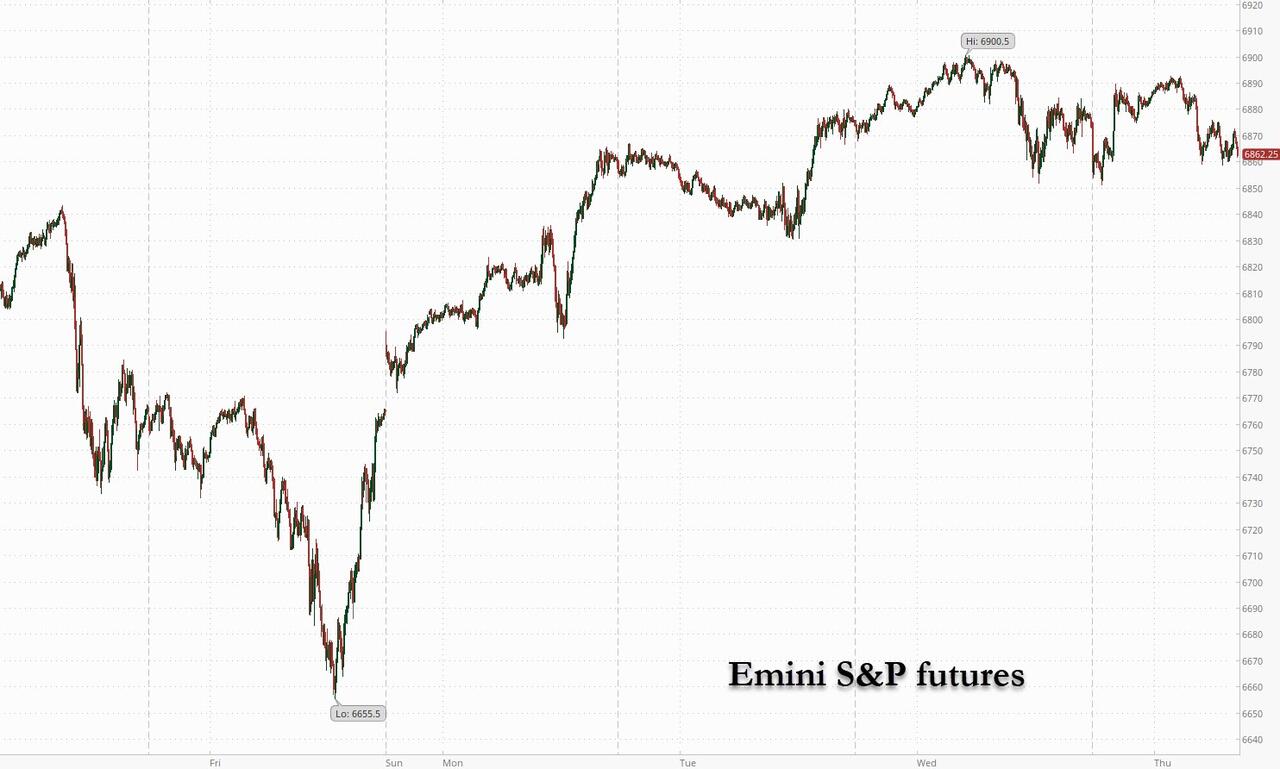
In premarket trading, tech stocks moved largely in line with the broader market amid worries that the the AI-led rally has gone too far, too fast. Investors have shunned tech in recent days in favor of defensive and value shares. Mag 7 stocks are mostly lower mixed (Meta +0.5%, Apple +0.1%, Amazon is flat, Tesla -0.9%, Microsoft -0.2%, Alphabet -0.5%, Nvidia -0.6%).
- Ardent Health (ARDT) shares sink 29% after the health-care services firm cut its adjusted Ebitda guidance for the full year. The reduced outlook trailed the average analyst estimate.
- Canadian Solar (CSIQ) rises 12% after the solar-equipment manufacturer reported third-quarter net revenue that beat the average analyst estimate.
- Cellebrite (CLBT) soars 18% after the digital-forensic firm said third-quarter adjusted Ebitda topped the high end of management’s guidance.
- Cisco (CSCO) rises 7% after the maker of networking equipment boosted its adjusted earnings per share guidance for the full year that beat the average analyst estimate as the firm captures more artificial-intelligence spending.
- Dlocal (DLO) shares are down 10% after the payment-solutions company reported third-quarter earnings. The result, although an earnings beat, pointed to weak underlying trends and softness in certain geographies, according to Citigroup.
- Dollar Tree (DLTR) drops 2% following a double-downgrade to sell by Goldman, which says any further upside for the retailer now “gets harder.”
- Firefly Aerospace (FLY) rises 20% after the spacecraft maker said it plans to resume launches of its Alpha rocket between late 2025 and early next year. The firm also reported revenue for the third quarter that beat the average analyst estimate.
- Flutter (FLUT) is down 2% after the FanDuel owner reported revenue for the third quarter that missed the average analyst estimate
- Ibotta (IBTA) drops 17% after the digital-marketing-software firm gave a weak fourth-quarter revenue forecast.
- KinderCare (KLC) sinks 19% after the daycare operator reduced its full-year outlook.
- Mersana Therapeutics (MRSN) rises 200% after Day One Biopharmaceuticals agreed to acquire the company. Shares of Day One (DAWN) are down 14%.
- Nike (NKE) is up 2% as Wells Fargo upgrades the sportswear giant to overweight from equal-weight, saying it is “lacing up for liftoff.”
- Sealed Air Corp. (SEE) climbs 21% premarket as Clayton Dubilier & Rice is exploring a potential acquisition of the company, according to people with knowledge of the matter.
- Walt Disney Co. (DIS) slips 3% after reporting sales that fell short of Wall Street estimates and said a slate of big-budget films, including a new Avatar picture, will weigh on results for the first quarter of its new fiscal year.
- Webtoon (WBTN) shares tumble 25% after the company — which lets creators and users make and discover digital comics — forecast revenue for the fourth quarter that fell short of expectations. The firm also reported revenue for the third quarter that Evercore called “lackluster.”
In corporate news, Alibaba is preparing an overhaul of its main mobile AI app in coming months to help it more closely resemble OpenAI’s ChatGPT. FanDuel is launching a prediction market product, allowing it to open up in states where traditional sports betting is illegal. Elsewhere, the FTC is said to be investigating whether proxy advisory firms ISS and Glass Lewis breached US antitrust laws by guiding shareholders on how to vote on politically charged topics. Fed’s Raphael Bostic announced he plans to retire at the end of his current term in February.
The shutdown is over, but it could take some time for normal operations to resume, and the October jobs and CPI reports are unlikely to be released at all. The jobs and the consumer price index reports for October are unlikely to be published, the White House said on Wednesday. The Bureau of Labor Statistics is expected to release a calendar in the coming days for other delayed data.
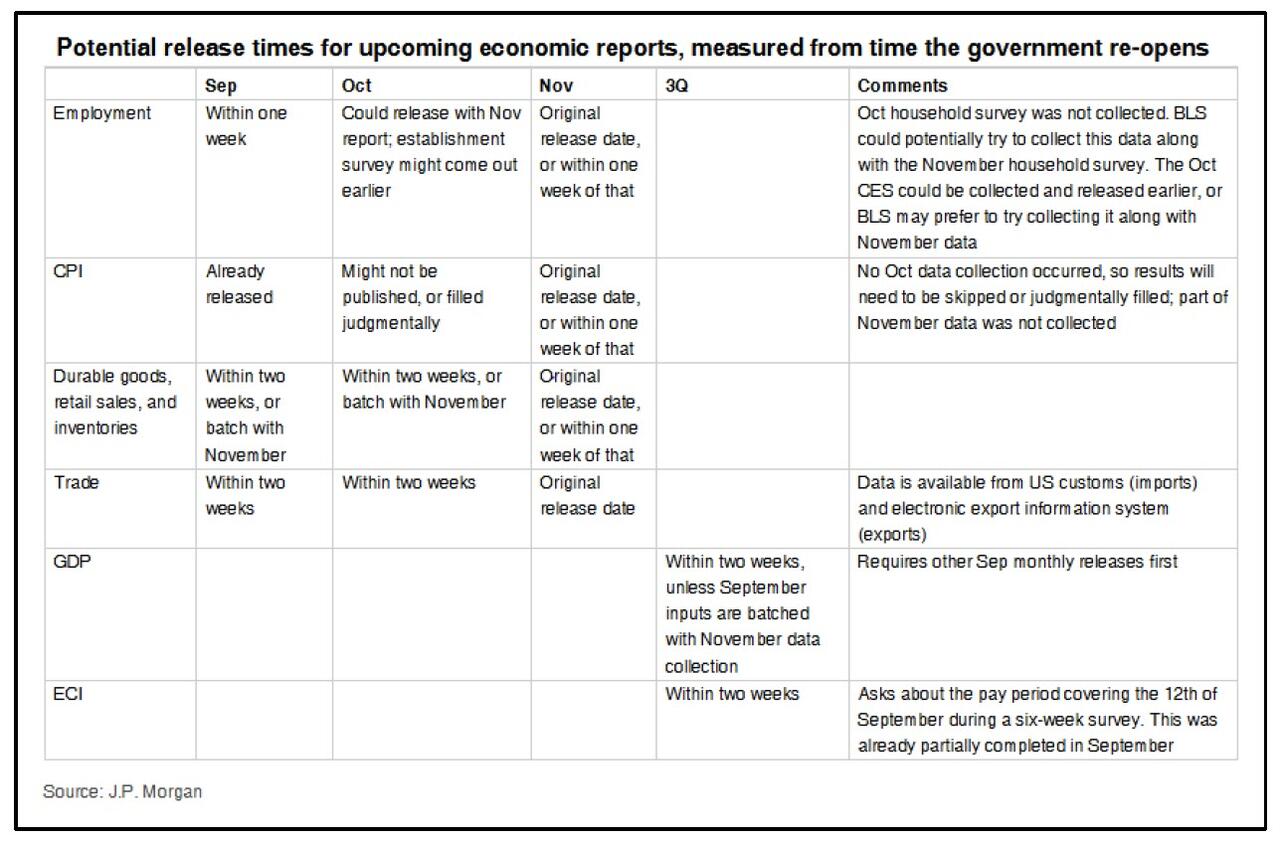
Money markets see about even odds of a Fed cut next month, while Boston Fed’s Collins and Atlanta Fed’s Bostic have both said they favor keeping rates steady to cool inflation. Bostic also announced his plans to retire at the end of his current term in February.
“There will be some caution around upcoming employment and inflation releases, particularly as we approach the Fed meeting that Powell has encouraged markets to treat with care,” said Florian Ielpo, head of macro and multi asset at Lombard Odier Investment Managers.
According to JPM, hedge fund positioning suggests room for a rally into the year end, though sector rotation indicates caution emerging over this year’s AI euphoria.
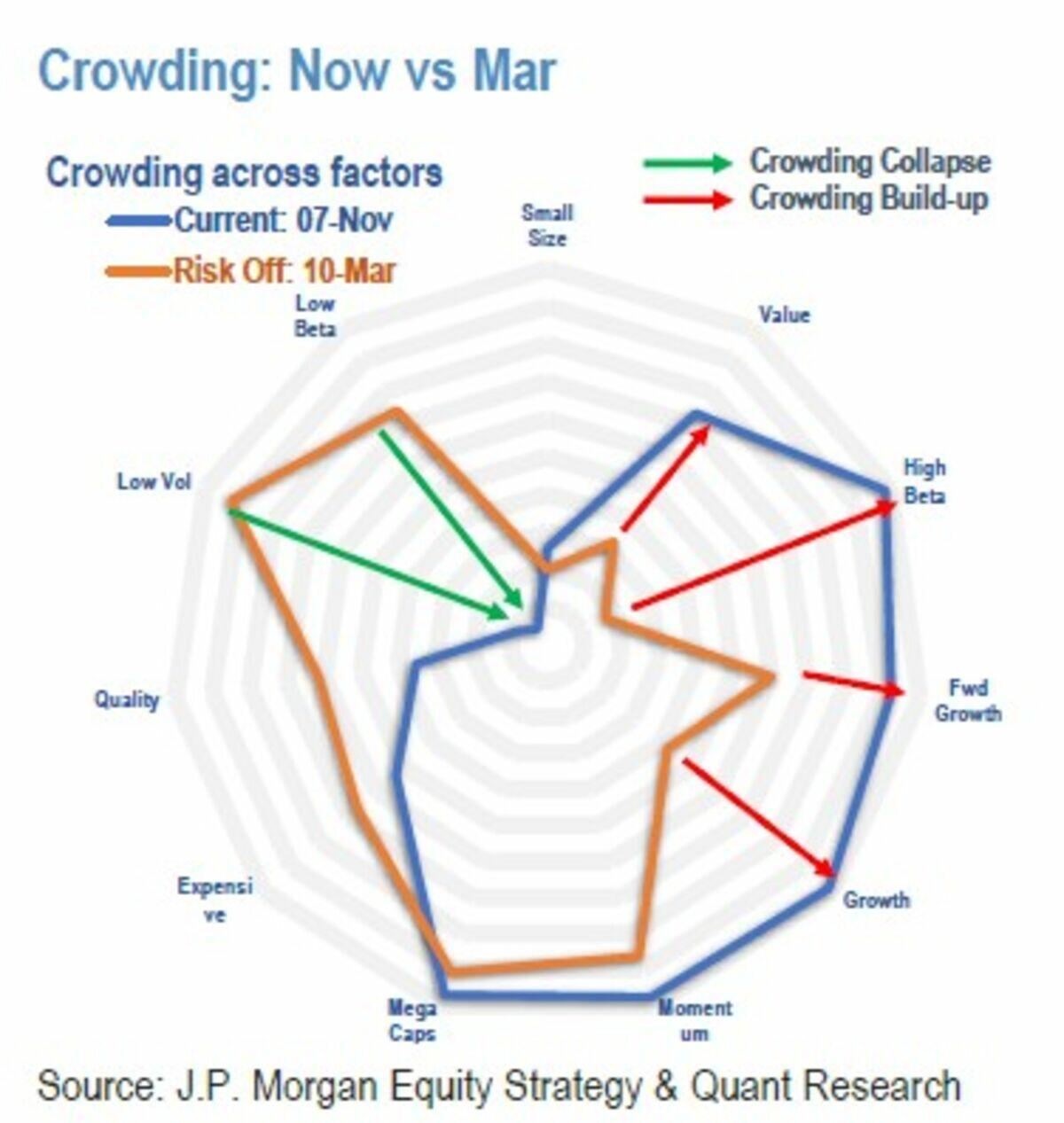
Notes of caution around the AI trade come as Bloomberg Intelligence equity strategists write that tech sector valuations have turned “from just hot to extreme.” Gains have been fueled by a revenue surge, not speculation, “but with premiums this stretched, fundamentals will need to keep sprinting just to stay in place,” they write. How that’s playing out in the market varies from company to company. Debt investors are taking a more cautious view of the latest junk bond deal aimed at funding a CoreWeave-tied data center construction, while Softbank has retreated more than 20% since recent highs on concerns over its AI investment strategy. On the other hand, Cisco shares are jumping premarket after AI demand fueled an upbeat earnings forecast.
“There’s a rotation going at the moment from stocks and indexes which outperformed this year, in favor of laggards,” said David Kruk, head of trading at La Financiere de l’Echiquier. “It’s both healthy for the market and absolutely not negative in terms of the direction of travel.”
In Europe, Stoxx 600 pares earlier gains to trade up 0.1%, with financial services and energy offsetting tech sector gains. ALK-Abello lead gains after the allergy solutions firm beat estimates and boosted its outlook for the year. Tech shares outperform, while the retail sector lags on a busy day for corporate earnings. Here are some of the biggest movers on Thursday:
- ALK-Abello shares jump as much as 14% to a record high after the Danish allergy solutions company boosted its outlook for the year following better-than-expected revenue in the third quarter.
- Bilfinger shares surge almost 11%, the most in more than seven months, as the industrial services company significantly raised its free cash flow outlook.
- Wizz Air shares jump as much as 17%, the most since February, after the budget airline reported earnings ahead of expectations.
- Burberry shares gain as much as 7.4% after the UK trench coat maker reported retail comparable sales for its second quarter that beat analyst estimates, turning positive for the first time in two years.
- Delivery Hero shares rise as much as 9.6% after the food delivery firm said growth of gross merchandise value is set to accelerate in 4Q.
- Convatec gains as much as 7.9% after delivering results in-line with expectations and tightening its organic revenue guidance for the full year.
- Azimut shares drop as much as 16%, the steepest fall since March 2020, after the Bank of Italy said it found significant governance and organizational issues in the firm’s Azimut Capital Management SGR unit.
- 3i Group shares tumble as much as 12%, the most in three-and-a-half-years, after reporting a slowdown in growth during October at discount retailer Action, the largest investment within its portfolio.
- Siemens shares fall as much as 5.2% after the German industrial firm’s results were hurt by currency headwinds.
- Aviva fell as much as 5.3% after the UK insurer reported third-quarter results and new financial targets which analysts said were mixed.
- Banco Sabadell shares dropped as much as 4.8% after the Spanish lender reported net income for the third quarter that missed the average analyst estimate.
Earlier in the session, Asian equities advanced for the fourth consecutive session, supported by gains in China and Japan. Stocks fell in Australia after unemployment figures. The MSCI Asia Pacific Index climbed as much as 0.5%, with Alibaba and Advantest among key gainers. Stocks also rose in Hong Kong and South Korea. Japan’s Topix index advanced for a fourth day, its longest winning streak in more than a month, amid a weakening of the yen. Meanwhile, Australia’s equity benchmark S&P/ASX 200 index fell to its lowest in more than three months, as upbeat jobs data dented expectations for central bank easing next year. The Australian unemployment numbers “effectively wiped out the prospects of rate cuts and sent equities lower,” said Matthew Haupt, a portfolio manager at Wilson Asset Management. The numbers suggest that the economy is “more resilient and maybe policy is not that restrictive.”
In FX, the Bloomberg Dollar Spot Index down by 0.2% and weaker against all G-10 currencies, with the Aussie dollar and Swedish krona outperforming.
In rates, Treasury yields trade near session highs into the early US session, with losses led by the front-end where 2-year yields are cheaper by 2bp on the day, after the longest government shutdown in US history ended. New 10-year yield near 4.10% is about 2bp higher than Wednesday’s auction result amid similar price action in bunds and gilts. Focal points of US session include 30-year bond auction and four scheduled Fed speakers. This week’s Treasury auctions conclude with $25 billion 30-year new issue at 1pm; Wednesday’s 10-year note auction tailed by 0.6bp. WI 30-year yield near 4.675% is ~6bp richer than last month’s, which tailed by 0.4bp
In commodities, gold climbs by $42 to $4,237/oz while silver gains 1.6% to ~$54, nearing its record high. Oil prices steady after the drop seen Wednesday, with the IEA once again raising its surplus estimate. Brent climbs 0.2% to $62.84/barrel.
The US economic calendar that was scheduled to include October CPI and weekly jobless claims is expected to continue to face delays as government reopens. Fed speaker slate includes Daly (8am), Kashkari (10:30am), Musalem (12:15pm) and Hammack (12:20pm)
Market Snapshot
- S&P 500 mini little changed
- Nasdaq 100 mini little changed
- Russell 2000 mini -0.1%
- Stoxx Europe 600 +0.1%
- DAX -0.4%
- CAC 40 +0.7%
- 10-year Treasury yield +1 basis point at 4.08%
- VIX +0.2 points at 17.66
- Bloomberg Dollar Index -0.2% at 1215.78
- euro +0.2% at $1.1618
- WTI crude +0.5% at $58.76/barrel
Top Overnight News
- The government shutdown officially ended and furloughed federal employees were set to return to work. Donald Trump signed a temporary funding bill into law, but it may take days to weeks to backpay workers and reinstate food aid, among other functions. BBG
- US President Trump’s administration froze flight cuts at 6% rather than hiking to 8% on Thursday, according to the US Department of Transportation.
- As the US shutdown ends, that it is now up to Johnson and Thune to determine how/if the Republican’s will address health care costs. Surmising that “the next few months are strewn with political landmines for the GOP”: Punchbowl
- White House Economic Adviser Hassett said the government shutdown will impact this quarter’s GDP and anticipates it to be between 1.5-2%, as well as noted that GDP for the year will be roughly 2% and that supply-side policies will allow growth without inflation. Hassett said he agreed with the last two Fed meetings that it was time to cut rates and noted the Fed is unlikely to cut 50bps, with the Fed more likely to do 25bps, while he added that he will do it if asked to be the Fed Chair.
- US data center developers are flooding utilities with inflated growth plans, muddying efforts to plan for future power needs with projects that may never materialize. Developers are approaching multiple utilities with the same project in a quest to find the lowest-priced power, leading to so-called phantom data centers. FT
- Volodymyr Zelenskiy implored EU allies to overcome their divisions on the use of frozen Russian assets, telling Bloomberg Television that fresh funding is critical for Ukraine to stay in the fight against Moscow. BBG
- Boston Fed President Susan Collins said Wednesday there should be a “high bar” for further easing by the Federal Reserve in the months ahead, projecting that the Fed should likely “keep policy rates at the current level for some time.” Also, NY Fed’s Perli said it won’t be long before the Fed is purchasing assets to grow the balance sheet as reserves are no longer abundant. WSJ, BBG
- China’s credit expansion slowed more than expected in October from a year ago, dragged down by weaker government bond sales and sluggish borrowing demand across the economy. BBG
- UK economic data for the month of Sept falls short across the board (GDP, industrial production, and manufacturing production all came in below the consensus). FT
- Alibaba is overhauling its main AI app to resemble OpenAI’s ChatGPT, adding shopping-focused features as it works to develop a full AI agent and build a user base. BBG
- BoJ Governor Kazuo Ueda said the central bank is aiming for moderate inflation accompanied by wage rises and economic improvement, signaling that its goal aligns with Prime Minister Sanae Takaichi’s focus on reviving growth. Moreover, giving voice to the Takaichi administration’s view that it was premature for the central bank to raise interest rates, Finance Minister Satsuki Katayama said inflation has yet to sustainably hit the BOJ’s 2% target. RTRS
- Australian employment surged in October as firms took on more full-time workers, pulling the jobless rate down from a four-year high and bolstering a growing view that the current easing cycle may have run its course. RTRS
- Investors are turning bullish on small-cap stocks, as earnings growth outpaces their larger counterparts and cheap valuations are seen sparking an M&A wave. BBG
Trade/Tariffs
- US officials flagged they will reduce tariffs on popular groceries, as pressure mounts to address the cost-of-living crisis, according to FT.
- EU is set to propose a plan to the US that would implement the next phase of the trade agreement reached in the summer, according to Bloomberg citing people familiar with the matter.
- EU seeks to accelerate crackdown on cheap Chinese parcels, according to FT.
- India announced anti-dumping duties on some steel products from Vietnam.
- China’s Foreign Ministry said G7 countries should also stop manipulating trade issues with China.
A more detailed look at global markets courtesy of Newsquawk
APAC stocks followed suit to the mixed performance in the US, with little fresh catalysts as the government shutdown ended. ASX 200 was pressured amid underperformance in the tech, real estate and energy sectors, while stronger-than-expected jobs data from Australia did little to inspire a turnaround. Nikkei 225 was choppy as participants reflected on recent earnings releases and firmer-than-expected PPI data.
Hang Seng and Shanghai Comp were mixed with strength in pharmaceuticals offset by weakness in energy and tech, while Chinese press noted that brokerage firms expect China’s A-share market to continue to gain in 2026, with earnings growth anticipated to be around 4.7% next year.
Top Asian News
- BoJ Governor Ueda said they are aiming for stable inflation with a rise in wages and the BoJ is striving to achieve moderate inflation backed by wage growth by helping improve the economy, while he added the BoJ aims to achieve sustained economic growth that benefits the public. Ueda also said if long-term rates rise sharply in a way out of step with usual market moves, the BoJ is ready to respond flexibly, such as by increasing bond buying.
- South Korean Foreign Minister Cho asked US Secretary of State Rubio for a swift release of a joint fact sheet on last month’s South Korea-US summit, while Rubio assured South Korea’s Foreign Minister Cho that he would work with related US agencies for the release of a joint fact sheet on the summit, according to Yonhap.
- Alibaba (9988 HK / BABA) is preparing to overhaul the main mobile AI app in the coming months, in order to more closely resemble ChatGPT, via Bloomberg citing sources.
- China’s Foreign Ministry on Japanese PM Takaichi’s remarks, said despite strong protest from China, the PM has stubbornly refused to take that back. If Japan dares to intervene, that will constitute aggression. Japan must stop interfering in Chinese internals affairs.
European stocks opened mixed and traded choppily since, with pressure led by the DAX and FTSE 100. Softer UK Q3 GDP and weak manufacturing output hit UK sentiment and coupled with political uncertainty around PM Starmer weighs on the FTSE. Macro drivers were otherwise limited, though the morning brought a heavy earnings slate from names such as Deutsche Telekom, Siemens, Flutter, and Rolls-Royce. Sectors are mixed, with outperformance from Technology (+0.8%), Chemicals (+0.7%), and Insurance (+0.7%). Prosus (+3.0%) outperformed after Tencent’s earnings, lifting Tech, while Insurance and Chemicals gained amid light sector-specific news. Laggards include Financial Services (-1.5%), Energy (-0.5%), and Autos & Parts (-0.5%). Energy weakened as crude softened on constructive Russia–Ukraine headlines and mixed private inventories, with BP (-1.6%) and Shell (-1.1%) trading ex-div. Financial Services were dragged lower by a -11.5% slump in 3i post-interims, while Autos eased after strong gains in the prior session.
Top European News
- Officials working for the UK Chancellor have asked the OBR to take into account measures on energy bills, rail fares and other forms of regulated prices in the upcoming budget forecasts, via Bloomberg citing sources; intended to provide extra fiscal space via lower inflation.
- EU’s von der Leyen said the EU is working with Belgium on options to deliver on commitment to cover Ukraine’s financing needs.
- The European Commission will reportedly encourage member nations finance officials to apply pressure on Belgium to back the EUR 140bln reparations loan for Ukraine, via Politico citing officials.
- German Economy Ministry, in its monthly report, said the recent threat of semiconductor supply bottlenecks and Chinese export restrictions on rare earths do not appear to pose an acute threat to the supply situation for German industry in short term.
- ECB’s Buch said the markets are under-pricing geopolitical risk; adds new regulatory frameworks are not needed and needs commitment from legislators to not weaken current frameworks.
FX
- The DXY drifted lower in early Europe after holding steady overnight, with little reaction to the passage and signing of the US funding bill that formally ends the shutdown. Markets remain wary that the deal only delays the issue, with another funding standoff possible at end-January. Data uncertainty persists after the White House signalled that October CPI and jobs reports are unlikely to be released, while the BLS has given no timing confirmation; only September data is assured, with no date set. White House adviser Hassett warned the shutdown will drag Q4 GDP to 1.5–2.0%, with full-year growth near 2%, though he said supply-side policies should support growth without boosting inflation. The DXY trades near fresh weekly lows at the bottom of a 99.15–99.59 range, with support at 99.00 and the 98.91 low from October 30th.
- EUR/USD firmed as the pair followed the dollar’s slide, breaking above 1.1600 after an indecisive overnight session, driven by broad USD weakness rather than fresh Eurozone catalysts. EUR/USD holds within a 1.1579–1.1635 band, just shy of the 1.1637 October 30th high, with the 50DMA (1.1662) and 100DMA (1.1663) closely aligned overhead.
- GBP/USD posted modest gains after an initial dip on slightly softer UK GDP (-0.1% M/M vs Exp. 0.0%), before recovering on broader USD weakness. BoE pricing turned marginally more dovish (≈1bp) post-data, while focus remains on the fiscal challenges facing Chancellor Reeves ahead of the Nov 26 Budget, where she must balance discipline with avoiding growth or inflation risks. Political uncertainty around PM Starmer persists, though tensions eased after the Health Secretary dismissed reports of an attempted ouster. GBP/USD trades in a 1.3101–1.3171 band, with resistance at 1.3184 (Tuesday high) and 1.3191 (Monday peak).
- USD/JPY traded without clear direction overnight, easing after meeting resistance near 155.00. The pair extended lower into Europe as the dollar softened and risk sentiment faded. USD/JPY now sits toward the lower end of a 154.32–155.01 band, holding comfortably within yesterday’s 154.04–155.04 range.
- The Antipodeans diverged, with AUD/USD outperforming after stronger labour data and a drop in unemployment. The upbeat release briefly pushed AUD/NZD to 1.1637 before slipping back below 1.1600 (vs earlier 1.1534 low). As a result, NZD/USD lagged, unable to fully benefit from broader USD softness given AUD-driven cross dynamics.
Fixed Income
- USTs opened softer as risk appetite improved overnight following the House vote to end the shutdown and President Trump signing the legislation. Futures dipped to 112-27, around five ticks lower, matching Wednesday’s base and holding above the 112-20/112-15 lows from earlier in the week. The move later retraced as risk sentiment faded, lifting fixed income, JPY, and gold, while the USD came under pressure. With markets now awaiting delayed US data, the near-term bias appears dovish. Today’s lineup features Daly, Hammock, Kashkari, and Musalem, ahead of a 30yr auction. Data vendors are expected to update release schedules shortly, with some prints potentially arriving next week. Officials have suggested October BLS data may not be published, though confirmation is still awaited. Any forthcoming data will shape expectations for December, with markets pricing a ~55% chance of a 25bps cut, leaving the short end sensitive to the timing and tone of releases.
- Bunds traded directionally in line with USTs, slipping to an early 129.19 low before rebounding as the broader risk tone deteriorated, lifting the benchmark to a fresh 129.40 WTD high. German-specific news was limited, with focus instead on France and ongoing discussions around Ukraine funding.
- OATS welcomed positive developments for PM Lecornu as the National Assembly adjourned with 200+ amendments still pending, but crucially advanced the Social Security Financing Bill to the Lower House. Politico cited PS representative Guedj describing Lecornu as “fair” and “trustworthy,” a welcome endorsement ahead of renewed focus on the separate revenue bill. The vote on the revenue section is slated for November 17th, before lawmakers return to the Social component, with targeted passage by November 24th. While several contentious points remain, the momentum is favourable for both Lecornu and France’s fiscal trajectory. In response, the OAT–Bund 10yr spread has continued to tighten, narrowing to 72bps.
- Gilts opened firmer by five ticks on the dovish read from the morning’s soft growth data and strength in peers, before quickly reversing to a 93.60 trough (down ~10 ticks). The initial dovish impulse (Gilt-positive, yield-negative) was partly offset by the implied fiscal strain ahead of November’s Budget, which proved briefly Gilt-bearish. The move was short-lived, and Gilts later rebounded to a 93.83 peak, posting gains of up to 18 ticks and briefly outperforming as December cut odds ticked up by ~1bp to ~21bps. Focus now turns to upcoming October and November inflation prints, which will be pivotal given the MPC split and Governor Bailey’s likely tie-breaking role ahead of the December decision.
Commodities
- Crude benchmarks are steady after Wednesday’s ~USD 2.60/bbl slide, which followed OPEC’s modest upward revision to its 2025 supply outlook, reinforcing oversupply concerns. WTI trades USD 58.12–58.56/bbl and Brent USD 62.34–62.81/bbl through European hours. The IEA’s monthly report — raising 2025–26 demand and supply forecasts broadly in line with the EIA and OPEC (which kept its demand growth view unchanged) — drew little market reaction. Elsewhere, Reuters reported Russia’s Orsk refinery will remain offline until Sunday after Tuesday’s Ukrainian drone strike.
- Spot gold consolidated overnight within a USD 4180–4219/oz band after Wednesday’s sharp rally, before extending gains into Europe as the softer dollar provided support. XAU now trades near session highs around USD 4235/oz. With the US government reopened, markets await delayed data: the White House confirmed the September BLS report will be released but warned that October CPI and jobs data may never be published. In a quiet catalyst environment, this uncertainty has likely contributed to renewed dollar weakness.
- Base metals extended Wednesday’s gains after President Trump confirmed the end of the US government shutdown. 3M LME Copper briefly dipped to USD 10.87k/t in early APAC trade before reversing higher as the House passed the reopening bill, peaking at USD 10.98k/t before easing to USD 10.95k/t into Europe.
- US Private Inventory Data (bbls): Crude +1.3mln (exp. +2.0mln), Distillate +0.9mln (exp. -2.0mln), Gasoline -1.4mln (exp. -1.9mln), Cushing -0.0mln
- US DoE announced that contracts were awarded for the acquisition of approximately 1mln barrels of crude for the SPR.
Geopolitics
- Israel reportedly conducted artillery raids and shelling on the eastern areas of Gaza and Khan Younis, according to Al Jazeera.
- Israel is reportedly seeking a new 20-year security agreement with the US, doubling the usual term and adding “America First” provisions to win the Trump administration’s support, according to Axios sources.
- White House said when asked about a report on the US mulling a base on the Gaza border, that this is not something the US is interested in.
- US Secretary of State Rubio said there’s some concern of events in the West Bank spilling over and creating an effect that could undermine what they are doing in Gaza, but added they don’t expect it to and will do everything they can to make sure it doesn’t happen.
- US Secretary of State Rubio said as of now, the assessment the US has to make is that Russia does not really want peace.
- Russia’s Kremlin said Ukraine must negotiate with Russia “sooner or later” and that its negotiation position is worsening by the day. Believes that Russia and Europe will resume dialogue sooner or later. Remans open to reaching a settle on Ukraine through political and diplomatic means. Wants peace settlement but will keep fighting in the absence of one to ensure its own security.
- G7 Foreign Ministers said they are raising economic costs to Russia and exploring measures against countries and entities that are helping finance its war efforts.
US Event Calendar
- 8:00 am: Fed’s Daly Speaks on Balance Sheet Management
- 10:30 am: Fed’s Kashkari Delivers Opening Remarks
- 12:15 pm: Fed’s Musalem Speaks at a Fireside Chat on Monetary Policy
- 12:20 pm: Fed’s Hammack in Moderated Discussion
DB’s Jim Reid concludes the overnight wrap
At last! A record-long US government shutdown came to an end overnight after 43 days with President Trump signing the funding legislation that was passed in a 222-209 vote by the House on Wednesday evening. The package passed by Congress includes three bills of full-year funding for specific departments including agriculture and veteran affairs, but with most government agencies being funded through January 30. So, we could be on the verge of another shutdown in just over 10 weeks’ time, not least if tensions over healthcare subsidies that Democrats had pushed for escalate between now and then. But for now, the end of the shutdown has boosted the market mood, with S&P 500 futures +0.19% higher this morning, having already rebounded by more than 3% from their intra-day lows on Friday.
Ahead of the vote, yesterday saw European risk assets outperform their US counterparts for a second consecutive session, as lingering AI and tech worries held back the US on a relative basis. The S&P 500 (+0.06%) managed to turn positive after Europe closed and the Dow Jones (+0.68%) even posted a new all-time high, but the Mag-7 (-1.19%) fell behind. Yields on 10yr treasuries slid by -4.7bps, catching up a bit after Tuesday’s holiday and dragged down by falling oil prices. Across the Atlantic, the Stoxx 600 rose +0.71% to a fresh high, while other indices like the CAC 40 (+1.04%), DAX (+1.22%) and IBEX 35 (+1.39%) also made sizable advances.
The softer US session came despite some positive comments from Treasury Secretary Scott Bessent early in the day. In an interview with Fox News, Bessent said that the US will announce tariff relief for certain commodities like coffee and bananas over the coming days. This is the latest development in a series of trade-positive news this week, after the US said it was close to deals with Switzerland and India to lower their tariff rates. Bessent also talked up the recent rally in Treasuries, noting that the Treasury has “additional time and flexibility” before deciding on any future issuance changes. Those comments added to a supportive backdrop for Treasuries, with the 10yr yield down -4.7bps to 4.07%, while the 2yr fell -2.2bps to 3.57%. Overnight, Treasuries are half, to a basis point higher across the curve.
The front-end rally yesterday was limited by hawkish comments from Boston Fed President Collins, who said that it “will likely be appropriate to keep policy rates at the current level for some time”. With Collins a voter this year, that marks all four of the voting regional Fed presidents that have expressed some skepticism on the need for a rate cut in December. So even as rates rallied along most of the curve, Collins’ comments saw pricing of a December rate cut decline from 67% to 59% on the day, the lowest this has been since the Fed resumed rate cuts in September. Of course, data will play a key part in the FOMC decision in four weeks’ time, but the risk is that the outlook may remain hazy in aftermath of the shutdown. Indeed, yesterday the White House suggested that October CPI and jobs reports were likely to be skipped altogether. The CPI has been published every month since 1919 and the monthly employment report since 1948 in their current format. Given what the world has been through over this period, it’s remarkable that October 2025 might be the only historical blank we’ll ever have!
In other Fed news, Atlanta Fed President Bostic said that he will retire once his term ends on February 28. His announcement was unexpected given his mandatory retirement wasn’t until 2031, and while whoever succeeds him will be appointed by the Atlanta Fed’s own board of governors, the nomination will still need approval from the overall Fed Board. The Atlanta Fed don’t vote next until 2027, so this story isn’t of immediate consequence but it’s interesting in the bigger scheme of things nonetheless.
Turning back to equities, while the S&P 500 (+0.06%) eked out a gain, both the NASDAQ (-0.26%) and the Russell 2000 (-0.30%) lost ground. Airlines (+4.84%) were the biggest winners within the S&P amid the impending shutdown end but it was a defensive session overall, with the healthcare sector (+1.36%) also outperforming. By contrast, the Mag-7 (-1.19%) were weighed down by losses for Meta (-2.88%), Tesla (-2.05%) and Amazon (-1.97%). And energy (-1.42%) was the worst performing sector within the S&P 500, with Brent crude falling -3.76% to $62.71/bbl amid growing supply glut concerns as OPEC acknowledged that the oil market moved into surplus sooner than expected.
Turning to Europe, equities continued to outperform US peers for another day, with the STOXX 600 (+0.71%) advancing to new records. As mentioned at the top, most continental indices saw gains of above 1% but the FTSE 100 (+0.12%) underperformed here in the UK. This came as political speculation swirled around allegations that the UK’s Health Secretary Wes Streeting planned to challenge the leadership of PM Keir Starmer. Despite Streeting later denying the reports yesterday, the political uncertainty still had a small negative impact in other UK assets. For instance, the 10yr gilt yield rose +1.1bps, while sterling fell -0.13% against the dollar. The spotlight on the UK will continue today, when we’ll get the UK’s September GDP just after we go to press.
In terms of yesterday’s data, we received Germany’s final HICP inflation for October, which confirmed the flash reading of +2.3% y/y that had come in a tenth above expectations. The upside was driven by strong services inflation (+3.6% y/y in Oct from +3.5% y/y in Sept), although details suggest this was mostly due to volatile travel items. Lingering inflation risks were brought up by ECB’s Schnabel, who stressed that while inflation is currently “in a good place” at 2%, risks were tilted “a little bit to the upside”. She noted “stickiness” in services inflation and mentioned geopolitical fragmentation and supply chain impact in areas such as rare earths as inflationary drivers. The hawkish messaging, although unsurprising from her, supported yield curve flattening, with 2yr bund yields down a marginal -0.3bps while 10yr yields were -1.5bps amid the global bond rally.
The more notable bond moves came in France, where 10yr OAT yields fell -4.7bps bringing the OAT-bund spread to 73bps, its lowest since August. This came as France’s National Assembly voted to keep the suspension of the country’s unpopular pension reform in its budget. The postponement of the pension age increase until after the 2027 presidential election had been offered by PM Lecornu to keep the Socialists on board in budget talks. While the near-term cost would be modest – at less than €2bn by 2027 – it will inevitably increase the country’s long-term deficit issues if the reform is not re-introduced later on. For now, markets have taken a positive view of the first major budget hurdle being comfortably cleared, but our economists see the real test on the social security budget coming in the Senate (November 19-25) and the joint committee a few days after (see their note on the budget process here).
Asian equity markets are mostly higher this morning with a couple of exceptions. The S&P/ASX 200 (-0.52%) stands out after stronger-than-anticipated employment data diminished expectations for further interest rate reductions by the RBA (details below). The Hang Seng (-0.45%) is declining partly due to tech stocks, but with the KOSPI (+0.62%), Nikkei (+0.30%), Shanghai Comp (+0.55%) and CSI (+1.03%) comfortably higher.
Australian net employment increased by 42,200 in October compared to September, which saw an increase of 12,700, significantly surpassing market predictions of a 20,000 gain, bolstered by a 55,300 rise in full-time positions. The participation rate remained stable at 67%, and most importantly, the unemployment rate decreased to 4.3% from 4.5%, which had been the highest level since November 2021. This robust report propelled the Australian dollar up by as much as +0.3% to a ten-day high of $0.6560, while yields on the policy-sensitive 3-year government bonds rose by +10.4bps, to trade at 3.80%, the highest level in over seven months. This puts some doubts to the house view of a February cut but the key swing factor will likely be Q4 inflation.
Elsewhere, Japanese producer inflation increased by +2.7% year-on-year in October, slightly exceeding expectations for the month, thereby keeping markets alert to hawkish signals from the Bank of Japan.
To the day ahead now, we’ll get the UK’s October RICS house price balance, September monthly GDP, Eurozone September industrial production. We’ll also hear from the Fed’s Musalem, the ECB’s Villeroy and Elderson, and the BOE’s Greene, plus we’ll receive the ECB’s economic bulletin. Earnings today include Walt Disney and Applied Materials. The US is also hosting an auction for 30-yr bonds ($25bn).
b) European opening report
Awaiting data schedule updates as the gov’t reopens, Fed speak ahead – Newsquawk US Opening News

Thursday, Nov 13, 2025 – 06:20 AM
- European stocks opened mixed and traded choppily since, with macro drivers light; FTSE 100 is subdued post-GDP.
- DXY drifted lower in early Europe after holding steady overnight, with little reaction to the passage and signing of the US funding bill that formally ends the shutdown.
- USTs opened softer as risk appetite improved overnight following the House vote to end the shutdown and President Trump signing the legislation.
- Crude benchmarks are steady after Wednesday’s slide, spot gold rises on a softer USD, and base metals extend on Wednesday’s gains.
- Looking ahead, highlights include US Cleveland Fed (Oct), New Zealand Manufacturing PMI (Nov). Speakers include BoE’s Greene, Fed’s Daly, Kashkari, Musalem & Hammack, ECB’s Elderson, SNB’s Tschudin & Moser, Supply from the US. Earnings from Applied Materials, Disney.
SNAPSHOT
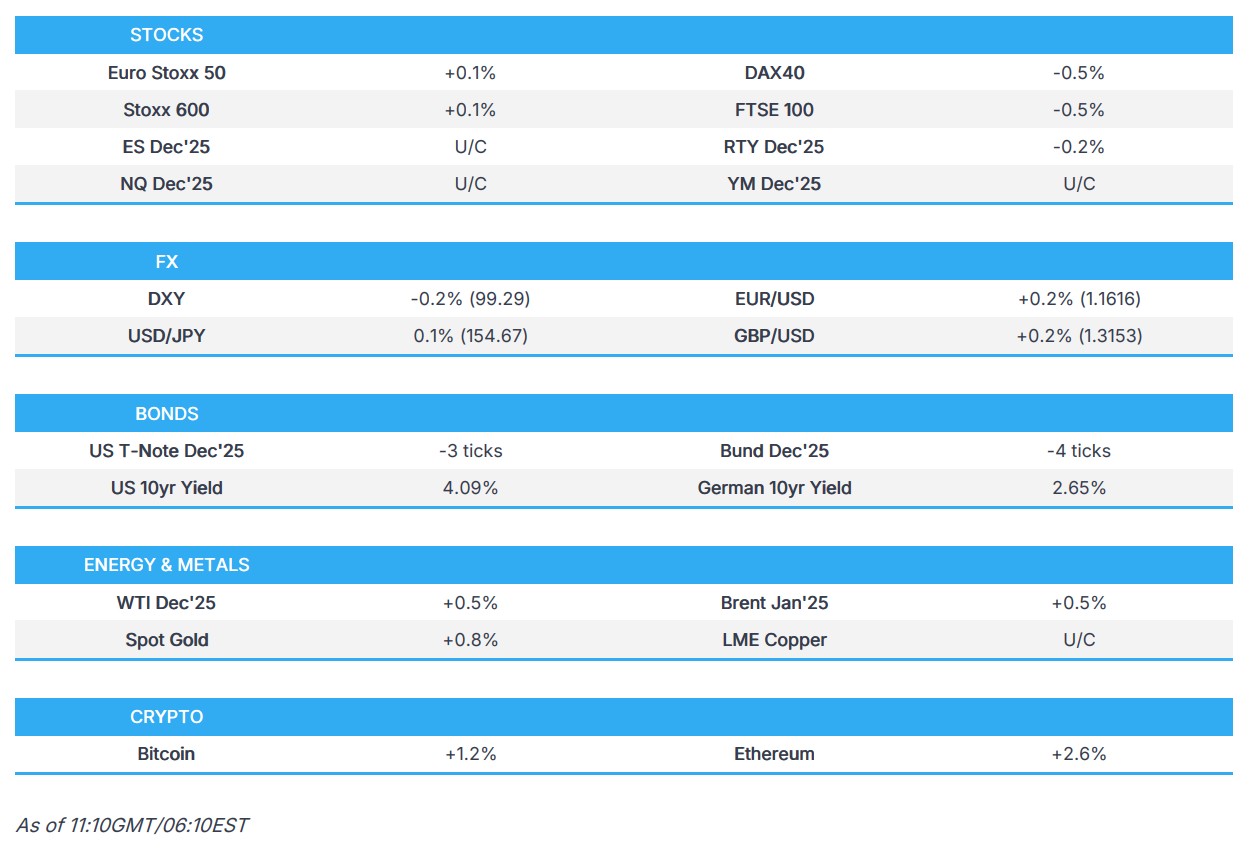
Newsquawk in 3 steps:
1. Subscribe to the free premarket movers reports
2. Listen to this report in the market open podcast (available on Apple and Spotify)
3. Trial Newsquawk’s premium real-time audio news squawk box for 7 days
TARIFFS/TRADE
- US officials flagged they will reduce tariffs on popular groceries, as pressure mounts to address the cost-of-living crisis, according to FT.
- EU is set to propose a plan to the US that would implement the next phase of the trade agreement reached in the summer, according to Bloomberg citing people familiar with the matter.
- EU seeks to accelerate crackdown on cheap Chinese parcels, according to FT.
- India announced anti-dumping duties on some steel products from Vietnam.
- China’s Foreign Ministry said G7 countries should also stop manipulating trade issues with China.
EUROPEAN TRADE
EQUITIES
- European stocks opened mixed and traded choppily since, with pressure led by the DAX and FTSE 100. Softer UK Q3 GDP and weak manufacturing output hit UK sentiment and coupled with political uncertainty around PM Starmer weighs on the FTSE. Macro drivers were otherwise limited, though the morning brought a heavy earnings slate from names such as Deutsche Telekom, Siemens, Flutter, and Rolls-Royce.
- Sectors are mixed, with outperformance from Technology (+0.8%), Chemicals (+0.7%), and Insurance (+0.7%). Prosus (+3.0%) outperformed after Tencent’s earnings, lifting Tech, while Insurance and Chemicals gained amid light sector-specific news. Laggards include Financial Services (-1.5%), Energy (-0.5%), and Autos & Parts (-0.5%). Energy weakened as crude softened on constructive Russia–Ukraine headlines and mixed private inventories, with BP (-1.6%) and Shell (-1.1%) trading ex-div. Financial Services were dragged lower by a -11.5% slump in 3i post-interims, while Autos eased after strong gains in the prior session.
- US equity futures are mixed with a tentative feel. President Trump’s signing of the funding bill ended the shutdown but offered little support as the outcome was widely expected, with attention now shifting to a potential end-January shutdown risk. Broader uncertainty persists amid reports that October jobs and CPI data may not be released due to disruption at the BLS and other agencies. Today’s Fed speaker lineup features Musalem (’25, no text), Kashkari (’26, no text), Hammack (’26, no text), and Daly (’27, text + Q&A).
- Click for the sessions European pre-market equity newsflow
- Click for the additional news
- Click for a detailed summary
FX
- The DXY drifted lower in early Europe after holding steady overnight, with little reaction to the passage and signing of the US funding bill that formally ends the shutdown. Markets remain wary that the deal only delays the issue, with another funding standoff possible at end-January. Data uncertainty persists after the White House signalled that October CPI and jobs reports are unlikely to be released, while the BLS has given no timing confirmation; only September data is assured, with no date set. White House adviser Hassett warned the shutdown will drag Q4 GDP to 1.5–2.0%, with full-year growth near 2%, though he said supply-side policies should support growth without boosting inflation. The DXY trades near fresh weekly lows at the bottom of a 99.15–99.59 range, with support at 99.00 and the 98.91 low from October 30th.
- EUR/USD firmed as the pair followed the dollar’s slide, breaking above 1.1600 after an indecisive overnight session, driven by broad USD weakness rather than fresh Eurozone catalysts. EUR/USD holds within a 1.1579–1.1635 band, just shy of the 1.1637 October 30th high, with the 50DMA (1.1662) and 100DMA (1.1663) closely aligned overhead.
- GBP/USD posted modest gains after an initial dip on slightly softer UK GDP (-0.1% M/M vs Exp. 0.0%), before recovering on broader USD weakness. BoE pricing turned marginally more dovish (≈1bp) post-data, while focus remains on the fiscal challenges facing Chancellor Reeves ahead of the Nov 26 Budget, where she must balance discipline with avoiding growth or inflation risks. Political uncertainty around PM Starmer persists, though tensions eased after the Health Secretary dismissed reports of an attempted ouster. GBP/USD trades in a 1.3101–1.3171 band, with resistance at 1.3184 (Tuesday high) and 1.3191 (Monday peak).
- USD/JPY traded without clear direction overnight, easing after meeting resistance near 155.00. The pair extended lower into Europe as the dollar softened and risk sentiment faded. USD/JPY now sits toward the lower end of a 154.32–155.01 band, holding comfortably within yesterday’s 154.04–155.04 range.
- The Antipodeans diverged, with AUD/USD outperforming after stronger labour data and a drop in unemployment. The upbeat release briefly pushed AUD/NZD to 1.1637 before slipping back below 1.1600 (vs earlier 1.1534 low). As a result, NZD/USD lagged, unable to fully benefit from broader USD softness given AUD-driven cross dynamics.
- PBoC set USD/CNY mid-point at 7.0865 vs exp. 7.1156 (Prev. 7.0833).
- Click for a detailed summary
- Click for NY OpEx Details
FIXED INCOME
- USTs opened softer as risk appetite improved overnight following the House vote to end the shutdown and President Trump signing the legislation. Futures dipped to 112-27, around five ticks lower, matching Wednesday’s base and holding above the 112-20/112-15 lows from earlier in the week. The move later retraced as risk sentiment faded, lifting fixed income, JPY, and gold, while the USD came under pressure. With markets now awaiting delayed US data, the near-term bias appears dovish. Today’s lineup features Daly, Hammock, Kashkari, and Musalem, ahead of a 30yr auction. Data vendors are expected to update release schedules shortly, with some prints potentially arriving next week. Officials have suggested October BLS data may not be published, though confirmation is still awaited. Any forthcoming data will shape expectations for December, with markets pricing a ~55% chance of a 25bps cut, leaving the short end sensitive to the timing and tone of releases.
- Bunds traded directionally in line with USTs, slipping to an early 129.19 low before rebounding as the broader risk tone deteriorated, lifting the benchmark to a fresh 129.40 WTD high. German-specific news was limited, with focus instead on France and ongoing discussions around Ukraine funding.
- OATS welcomed positive developments for PM Lecornu as the National Assembly adjourned with 200+ amendments still pending, but crucially advanced the Social Security Financing Bill to the Lower House. Politico cited PS representative Guedj describing Lecornu as “fair” and “trustworthy,” a welcome endorsement ahead of renewed focus on the separate revenue bill. The vote on the revenue section is slated for November 17th, before lawmakers return to the Social component, with targeted passage by November 24th. While several contentious points remain, the momentum is favourable for both Lecornu and France’s fiscal trajectory. In response, the OAT–Bund 10yr spread has continued to tighten, narrowing to 72bps.
- Gilts opened firmer by five ticks on the dovish read from the morning’s soft growth data and strength in peers, before quickly reversing to a 93.60 trough (down ~10 ticks). The initial dovish impulse (Gilt-positive, yield-negative) was partly offset by the implied fiscal strain ahead of November’s Budget, which proved briefly Gilt-bearish. The move was short-lived, and Gilts later rebounded to a 93.83 peak, posting gains of up to 18 ticks and briefly outperforming as December cut odds ticked up by ~1bp to ~21bps. Focus now turns to upcoming October and November inflation prints, which will be pivotal given the MPC split and Governor Bailey’s likely tie-breaking role ahead of the December decision.
- Italy sold EUR 8bln vs exp. EUR 6.5-9.0bln 2.35% 2029, 3.25% 2032, 3.25% 2032, 4.65% 2055 BTP.
- Click for a detailed summary
COMMODITIES
- Crude benchmarks are steady after Wednesday’s ~USD 2.60/bbl slide, which followed OPEC’s modest upward revision to its 2025 supply outlook, reinforcing oversupply concerns. WTI trades USD 58.12–58.56/bbl and Brent USD 62.34–62.81/bbl through European hours. The IEA’s monthly report — raising 2025–26 demand and supply forecasts broadly in line with the EIA and OPEC (which kept its demand growth view unchanged) — drew little market reaction. Elsewhere, Reuters reported Russia’s Orsk refinery will remain offline until Sunday after Tuesday’s Ukrainian drone strike.
- Spot gold consolidated overnight within a USD 4180–4219/oz band after Wednesday’s sharp rally, before extending gains into Europe as the softer dollar provided support. XAU now trades near session highs around USD 4235/oz. With the US government reopened, markets await delayed data: the White House confirmed the September BLS report will be released but warned that October CPI and jobs data may never be published. In a quiet catalyst environment, this uncertainty has likely contributed to renewed dollar weakness.
- Base metals extended Wednesday’s gains after President Trump confirmed the end of the US government shutdown. 3M LME Copper briefly dipped to USD 10.87k/t in early APAC trade before reversing higher as the House passed the reopening bill, peaking at USD 10.98k/t before easing to USD 10.95k/t into Europe.
- US Private Inventory Data (bbls): Crude +1.3mln (exp. +2.0mln), Distillate +0.9mln (exp. -2.0mln), Gasoline -1.4mln (exp. -1.9mln), Cushing -0.0mln
- US DoE announced that contracts were awarded for the acquisition of approximately 1mln barrels of crude for the SPR.
- Click for a detailed summary
CRYPTO
- Crypto markets are on a modestly firmer footing, with Bitcoin attempting to reclaim the USD 103k level, while Ethereum topped USD 3,500.
NOTABLE DATA RECAP
- EU Industrial Production MM (Sep) 0.2% vs. Exp. 0.7% (Prev. -1.2%, Rev. -1.1%)
- EU Industrial Production YY (Sep) 1.2% vs. Exp. 2.1% (Prev. 1.1%, Rev. 1.2%)
- UK GDP Estimate MM (Sep) -0.1% vs. Exp. 0.0% (Prev. 0.10%); YY (Sep) 1.10% vs. Exp. 1.30% (Prev. 1.30%, Rev. 1.20%); 3M/3M (Sep) 0.10% vs. Exp. 0.20% (Prev. 0.30%, Rev. 0.20%)
- UK GDP Prelim QQ (Q3) 0.1% vs. Exp. 0.2% (Prev. 0.3%); YY (Q3) 1.3% vs. Exp. 1.4% (Prev. 1.4%)
- UK RICS House Price Balance (Oct) -19% vs Exp. -14% (Prev. -15%)
NOTABLE EUROPEAN HEADLINES
- Officials working for the UK Chancellor have asked the OBR to take into account measures on energy bills, rail fares and other forms of regulated prices in the upcoming budget forecasts, via Bloomberg citing sources; intended to provide extra fiscal space via lower inflation.
- EU’s von der Leyen said the EU is working with Belgium on options to deliver on commitment to cover Ukraine’s financing needs.
- The European Commission will reportedly encourage member nations finance officials to apply pressure on Belgium to back the EUR 140bln reparations loan for Ukraine, via Politico citing officials.
- German Economy Ministry, in its monthly report, said the recent threat of semiconductor supply bottlenecks and Chinese export restrictions on rare earths do not appear to pose an acute threat to the supply situation for German industry in short term.
- ECB’s Buch said the markets are under-pricing geopolitical risk; adds new regulatory frameworks are not needed and needs commitment from legislators to not weaken current frameworks.
NOTABLE US HEADLINES
- US President Trump signed the government funding bill and announced an end to the government shutdown after the House voted to approve the bill, while Trump said the government will resume normal operations and reiterated a call for money to be paid to people directly to buy healthcare.
- US President Trump’s administration froze flight cuts at 6% rather than hiking to 8% on Thursday, according to the US Department of Transportation.
- White House Economic Adviser Hassett said the government shutdown will impact this quarter’s GDP and anticipates it to be between 1.5-2%, as well as noted that GDP for the year will be roughly 2% and that supply-side policies will allow growth without inflation. Hassett said he agreed with the last two Fed meetings that it was time to cut rates and noted the Fed is unlikely to cut 50bps, with the Fed more likely to do 25bps, while he added that he will do it if asked to be the Fed Chair.
- Fed’s Collins (2025 voter) said it is likely appropriate to keep the policy rate on hold for some time and there is a relatively high bar for additional easing in the near term, while she is hesitant to ease policy further, absent notable labour-market deterioration and stated it is prudent to ensure inflation is durably on track to 2% before making any further policy rate cuts. Collins said further monetary support to activity runs the risk of slowing or stalling inflation’s return to 2%, as well as noted that Fed policy is ‘mildly restrictive’ and that financial conditions are a tailwind for growth. Furthermore, she said dialling two notches down on rates made sense given risks and that elevated inflation warrants still mildly restrictive policy.
- Punchbowl writes, as the US shutdown ends, that it is now up to Johnson and Thune to determine how/if the Republican’s will address health care costs. Surmising that “the next few months are strewn with political landmines for the GOP”.
- Alphabet’s (GOOGL) Google is subject to an EU antitrust investigation into its spam policy.
- Apple (AAPL) and Tencent (700 HK) agree on a 15% fee for WeChat game purchases, according to Bloomberg citing sources.
GEOPOLITICS
MIDDLE EAST
- Israel reportedly conducted artillery raids and shelling on the eastern areas of Gaza and Khan Younis, according to Al Jazeera.
- Israel is reportedly seeking a new 20-year security agreement with the US, doubling the usual term and adding “America First” provisions to win the Trump administration’s support, according to Axios sources.
- White House said when asked about a report on the US mulling a base on the Gaza border, that this is not something the US is interested in.
- US Secretary of State Rubio said there’s some concern of events in the West Bank spilling over and creating an effect that could undermine what they are doing in Gaza, but added they don’t expect it to and will do everything they can to make sure it doesn’t happen.
RUSSIA-UKRAINE
- US Secretary of State Rubio said as of now, the assessment the US has to make is that Russia does not really want peace.
- Russia’s Kremlin said Ukraine must negotiate with Russia “sooner or later” and that its negotiation position is worsening by the day. Believes that Russia and Europe will resume dialogue sooner or later. Remans open to reaching a settle on Ukraine through political and diplomatic means. Wants peace settlement but will keep fighting in the absence of one to ensure its own security.
- G7 Foreign Ministers said they are raising economic costs to Russia and exploring measures against countries and entities that are helping finance its war efforts.
APAC TRADE
- APAC stocks followed suit to the mixed performance in the US, with little fresh catalysts as the government shutdown ended.
- ASX 200 was pressured amid underperformance in the tech, real estate and energy sectors, while stronger-than-expected jobs data from Australia did little to inspire a turnaround.
- Nikkei 225 was choppy as participants reflected on recent earnings releases and firmer-than-expected PPI data.
- Hang Seng and Shanghai Comp were mixed with strength in pharmaceuticals offset by weakness in energy and tech, while Chinese press noted that brokerage firms expect China’s A-share market to continue to gain in 2026, with earnings growth anticipated to be around 4.7% next year.
NOTABLE ASIA-PAC HEADLINES
- BoJ Governor Ueda said they are aiming for stable inflation with a rise in wages and the BoJ is striving to achieve moderate inflation backed by wage growth by helping improve the economy, while he added the BoJ aims to achieve sustained economic growth that benefits the public. Ueda also said if long-term rates rise sharply in a way out of step with usual market moves, the BoJ is ready to respond flexibly, such as by increasing bond buying.
- South Korean Foreign Minister Cho asked US Secretary of State Rubio for a swift release of a joint fact sheet on last month’s South Korea-US summit, while Rubio assured South Korea’s Foreign Minister Cho that he would work with related US agencies for the release of a joint fact sheet on the summit, according to Yonhap.
- Alibaba (9988 HK / BABA) is preparing to overhaul the main mobile AI app in the coming months, in order to more closely resemble ChatGPT, via Bloomberg citing sources.
- China’s Foreign Ministry on Japanese PM Takaichi’s remarks, said despite strong protest from China, the PM has stubbornly refused to take that back. If Japan dares to intervene, that will constitute aggression. Japan must stop interfering in Chinese internals affairs.
NOTABLE APAC EARNINGS
- BiliBili (9626 HK) Q3 2025 (CNY): Revenue 7.69bln (prev. 7.31bln Y/Y). Average DAUs 117.3mln (prev. 107.3mln Y/Y), Margin 36.7% (prev. 34.9%).
- JD.Com Inc (JD) Q3 2025 (CNY): EPS 3.73 (exp. 2.89), Revenue 299.1bln (exp. 293.95bln). CEO: “In the third quarter, we continued to see strong growth in both user base and shopping frequency, and the number of our annual active customers surpassed a new milestone of 700 million in October.”
- Kioxia (285A JT) 6-month (JPY): Revenue 791bln (prev. 909bln), Operating Profit 132bln (prev. 292bln), PBT 84bln (prev. 248bln). 9-month guidance: Operating Income 229-269bln (exp. 268bln). Net Sales 1.29-1.34tln (exp. 1.31tln). Net Income 118.9-146.9bln (exp. 143bln)
- SMIC (981 HK) Q3 2025 (CNY): Net 191mln (exp. 183mln), Gross Margin 22% (exp. 19.6%).
- Tencent (700 HK) Q3 2025 (CNY): Revenue 192.9bln (exp. 188.8bln), Adj. Net 70.6bln (exp. 66bln). Operating 72.6bln (exp. 61.3bln); Strategic investment in AI is benefiting the company in business areas such as ad targeting and game engagement. Revenue Breakdown (CNY): International Game Revenue 20.8bln (exp. 18.1bln), Domestic Game Revenue 42.8bln (exp. 42.3bln), Social Networks Revenue 32.3bln (exp. 32.8bln)
DATA RECAP
- Japanese Corp Goods Price MM (Oct) 0.4% vs. Exp. 0.3% (Prev. 0.3%, Rev. 0.5%); YY (Oct) 2.7% vs. Exp. 2.5% (Prev. 2.7%, Rev. 2.8%)
- China M2 Y/Y money supply (Oct) 8.2% vs exp. 8.1%.
c) Asian opening report
Trump signs government funding bill to end shutdown; European equity futures are positive – Newsquawk European Opening News
Thursday, Nov 13, 2025 – 01:44 AM
- US President Trump signed the government funding bill and announced an end to the government shutdown after the House voted to approve the bill, while Trump said the government will resume normal operations and reiterated a call for money to be paid to people directly to buy healthcare.
- White House Press Secretary Leavitt said the October CPI and jobs data is likely to never be released, while it was separately reported that there was no official word from BLS on plans for October data.
- US officials flagged they will reduce tariffs on popular groceries, as pressure mounts to address the cost-of-living crisis, according to FT.
- APAC stocks followed suit to the mixed performance in the US, with little fresh catalysts as the government shutdown ended.
- European equity futures indicate a positive cash market open with Euro Stoxx 50 futures up 0.4% after the cash market closed with gains of 1.1% on Wednesday.
- Looking ahead, highlights include UK GDP (Sep/Q3), EZ Industrial Production (Sep), US Cleveland Fed (Oct), New Zealand Manufacturing PMI (Nov), IEA OMR, BoE Minutes of the Market Participants Group Meeting, Speakers including BoE’s Greene, Fed’s Daly, Kashkari, Musalem & Hammack, ECB’s Elderson, SNB’s Tschudin & Moser, Supply from Italy & US, Earnings from Zealand Pharma, B&M European, Burberry, Siemens, Sabadell, Applied Materials, Disney, JD com & Bilibili.
SNAPSHOT
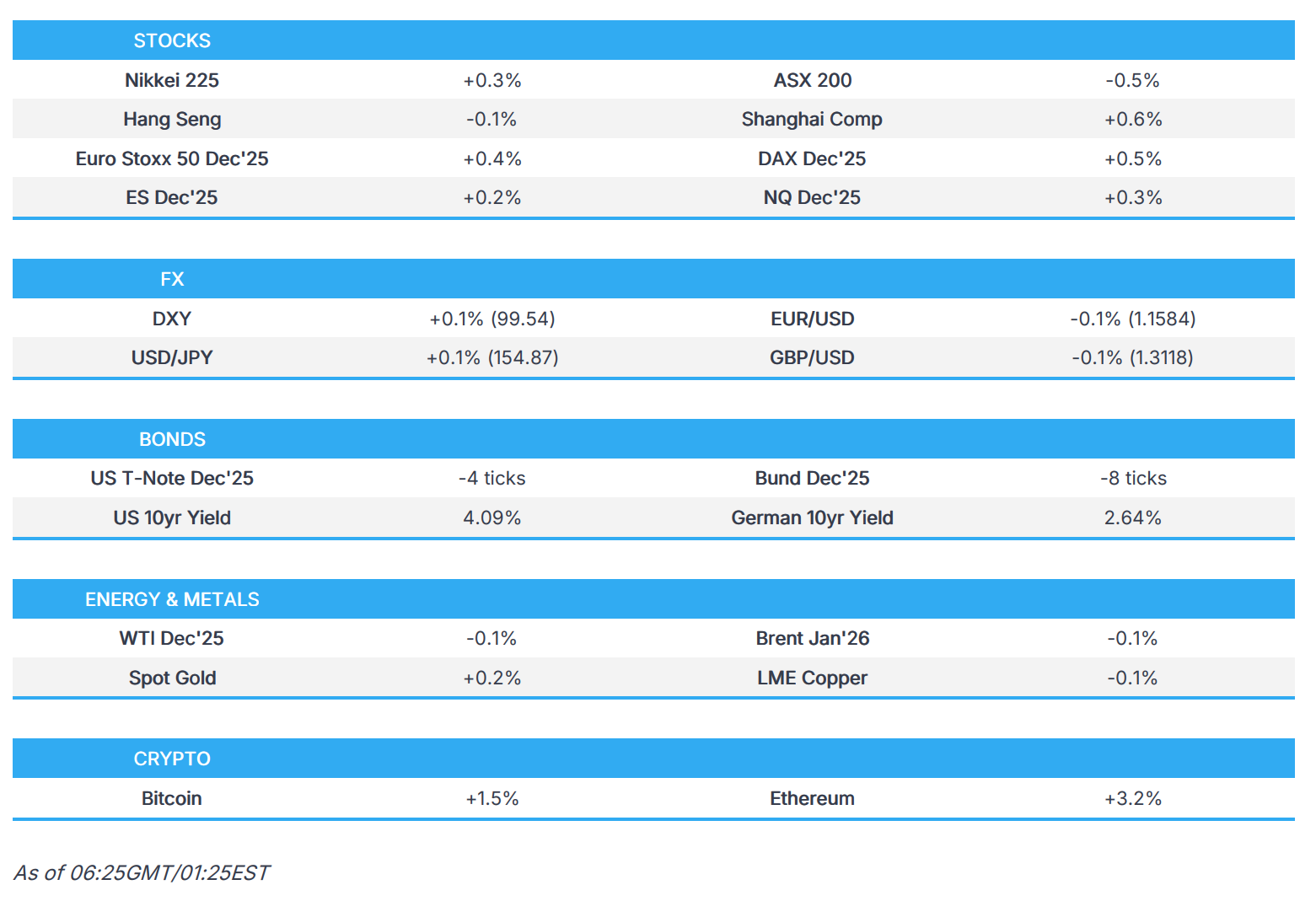
Newsquawk in 3 steps:
1. Subscribe to the free premarket movers reports
2. Listen to this report in the market open podcast (available on Apple and Spotify)
3. Trial Newsquawk’s premium real-time audio news squawk box for 7 days
US TRADE
EQUITIES
- US stocks were mixed with the SPX, NDX, and RUT closing little changed, but the DJI saw strong outperformance thanks to upside in heavyweights UnitedHealth (UNH) and Goldman Sachs (GS). Cisco (CSCO) also saw upside ahead of earnings. Breadth was more positive with the RSP rising while sectors were varied as Health Care, Financials and Materials outperformed, but Energy, Communication and Consumer Discretionary lagged. Tech was flat despite the upside in AMD (AMD) after its analyst day.
- SPX +0.08% at 6,852, NDX -0.06% at 25,517, DJI +0.68% at 48,255, RUT -0.26% at 2,452.
- Click here for a detailed summary.
TARIFFS/TRADE
- US officials flagged they will reduce tariffs on popular groceries, as pressure mounts to address the cost-of-living crisis, according to FT.
- FBI Director said China agreed on a plan to stop fentanyl precursors and agreed to control seven chemical substances, which are now banned.
- EU is set to propose a plan to the US that would implement the next phase of the trade agreement reached in the summer, according to Bloomberg citing people familiar with the matter.
- EU seeks to accelerate crackdown on cheap Chinese parcels, according to FT.
- India announced anti-dumping duties on some steel products from Vietnam.
NOTABLE HEADLINES
- US President Trump signed the government funding bill and announced an end to the government shutdown after the House voted to approve the bill, while Trump said the government will resume normal operations and reiterated a call for money to be paid to people directly to buy healthcare.
- US President Trump’s administration froze flight cuts at 6% rather than hiking to 8% on Thursday, according to the US Department of Transportation.
- White House Press Secretary Leavitt said the October CPI and jobs data is likely to never be released, while it was separately reported that there was no official word from BLS on plans for October data. Furthermore, the White House later announced that the September BLS data will be released after the government reopening, but didn’t mention a specific date.
- White House Economic Adviser Hassett said the government shutdown will impact this quarter’s GDP and anticipates it to be between 1.5-2%, as well as noted that GDP for the year will be roughly 2% and that supply-side policies will allow growth without inflation. Hassett said he agreed with the last two Fed meetings that it was time to cut rates and noted the Fed is unlikely to cut 50bps, with the Fed more likely to do 25bps, while he added that he will do it if asked to be the Fed Chair.
- Fed Governor Miran (voter) said Fed policy is too restrictive and they should not take inflation data at face value, while he is in favour of using the Fed’s balance sheet more judiciously than in the past.
- Fed’s Collins (2025 voter) said it is likely appropriate to keep the policy rate on hold for some time and there is a relatively high bar for additional easing in the near term, while she is hesitant to ease policy further, absent notable labour-market deterioration and stated it is prudent to ensure inflation is durably on track to 2% before making any further policy rate cuts. Collins said further monetary support to activity runs the risk of slowing or stalling inflation’s return to 2%, as well as noted that Fed policy is ‘mildly restrictive’ and that financial conditions are a tailwind for growth. Furthermore, she said dialling two notches down on rates made sense given risks and that elevated inflation warrants still mildly restrictive policy.
- Fed’s Bostic (2027 voter) said that despite the shifts in the labour market, the clearer and urgent risk is still price stability. Bostic said labour market signals are not strong enough to warrant an aggressive monetary policy response vs. the risk of ongoing inflation pressures. Furthermore, he favours keeping the Fed Funds Rate steady until they see clear evidence of inflation moving towards the 2% target, and he views the current policy stance as ‘marginally restrictive’, while he noted that if conditions change, he is willing to alter his stance.
- NY Fed’s Manager of SOMA portfolio Perli said there is ‘no reason why’ there can’t be sizable standing repo facility usage and that the standing repo facility should be used when needed. Perli added that stable repo market conditions are in everyone’s interest and that a standing repo facility works well and is an important market stabiliser, while he also commented that at some point the Fed will need to expand the balance sheet again.
- US Supreme Court to hear arguments on Trump bid to fire Fed Governor Lisa Cook on January 21st.
APAC TRADE
EQUITIES
- APAC stocks followed suit to the mixed performance in the US, with little fresh catalysts as the government shutdown ended.
- ASX 200 was pressured amid underperformance in the tech, real estate and energy sectors, while stronger-than-expected jobs data from Australia did little to inspire a turnaround.
- Nikkei 225 was choppy as participants reflected on recent earnings releases and firmer-than-expected PPI data.
- Hang Seng and Shanghai Comp were mixed with strength in pharmaceuticals offset by weakness in energy and tech, while Chinese press noted that brokerage firms expect China’s A-share market to continue to gain in 2026, with earnings growth anticipated to be around 4.7% next year.
- US equity futures kept afloat with little fresh macro catalysts aside from the widely expected government reopening.
- European equity futures indicate a positive cash market open with Euro Stoxx 50 futures up 0.4% after the cash market closed with gains of 1.1% on Wednesday.
FX
- DXY remained flat amid light fresh catalysts and despite the House passing the funding bill to reopen the government, which President Trump then signed to end the government shutdown. There were several comments from Fed officials, including Bostic, who is set to retire in February 2026, and kept to a hawkish stance as he argued that the labour market signals are not strong enough to warrant an aggressive monetary policy response against the risk of ongoing inflation pressures, while Collins said it is likely appropriate to keep the policy rate on hold for some time and noted a relatively high bar for additional easing in the near term.
- EUR/USD was indecisive after stalling just shy of the 1.1600 handle and failed to benefit from the somewhat recent hawkish-leaning ECB rhetoric.
- GBP/USD lacked demand but is off this week’s worst levels which had coincided with political uncertainty, although some of the concerns were alleviated after the UK Health Secretary pushed back on reports of a plot to oust the PM, while participants now await the incoming UK GDP data.
- USD/JPY traded indecisively overnight and pulled back after hitting resistance around the 155.00 level amid the tentative mood in Japan.
- Antipodeans were mixed with AUD/USD the outperformer following stronger-than-expected jobs data and a drop in the Unemployment Rate.
- PBoC set USD/CNY mid-point at 7.0865 vs exp. 7.1156 (Prev. 7.0833).
- BoC Minutes said the Governing Council Members had a range of views about the timing of the cut, but arguments for a move in October were considered more important. Members felt indicators of underlying inflation would give signals about the trend of total inflation, while they expressed concern that weakness in the labour force could persist and broaden.
FIXED INCOME
- 10yr UST futures mildly pulled back from yesterday’s peak following softer demand at the 10yr auction stateside.
- Bund futures lingered near a weekly high following the prior day’s rebound and with little fresh catalysts.
- 10yr JGB futures traded uneventfully with demand contained after firmer-than-expected Japanese PPI data and following the latest 5yr JGB auction, which resulted in slightly lower than previous bid-to-cover and accepted prices.
COMMODITIES
- Crude futures were lacklustre after tumbling yesterday amid oversupply concerns and positive Ukraine/Russia rhetoric, while the latest private sector inventory data was mixed and provided little to inspire a rebound.
- US Private Inventory Data (bbls): Crude +1.3mln (exp. +2.0mln), Distillate +0.9mln (exp. -2.0mln), Gasoline -1.4mln (exp. -1.9mln), Cushing -0.0mln
- US DoE announced that contracts were awarded for the acquisition of approximately 1mln barrels of crude for the SPR.
- EIA STEO stated world oil supply and demand were revised marginally higher for 2025 and 2026, with world oil demand in 2025 seen at 104.1mln bpd (prev. 104mln bpd) and 2026 seen at 105.2mln bpd (prev. 105.1mln bpd), while world oil production in 2025 was seen at 106mln bpd (prev. 105.9mln bpd) and 2026 production was seen at 107.4mln bpd (prev. 107.2mln bpd).
- Russia’s Lukoil filed for an extension of the US Treasury’s deadline prohibiting transactions with the company after Nov. 21st.
- Spot gold gradually extended on recent gains after returning to above the USD 4,200/oz level.
- Copper futures edged higher but with upside contained amid the mixed risk appetite.
CRYPTO
- Bitcoin marginally gained in choppy trade as prices swung back and forth of the USD 102k level.
NOTABLE ASIA-PAC HEADLINES
- BoJ Governor Ueda said they are aiming for stable inflation with a rise in wages and the BoJ is striving to achieve moderate inflation backed by wage growth by helping improve the economy, while he added the BoJ aims to achieve sustained economic growth that benefits the public. Ueda also said if long-term rates rise sharply in a way out of step with usual market moves, the BoJ is ready to respond flexibly, such as by increasing bond buying.
- South Korean Foreign Minister Cho asked US Secretary of State Rubio for a swift release of a joint fact sheet on last month’s South Korea-US summit, while Rubio assured South Korea’s Foreign Minister Cho that he would work with related US agencies for the release of a joint fact sheet on the summit, according to Yonhap.
DATA RECAP
- Japanese Corp Goods Price MM (Oct) 0.4% vs. Exp. 0.3% (Prev. 0.3%, Rev. 0.5%)
- Japanese Corp Goods Price YY (Oct) 2.7% vs. Exp. 2.5% (Prev. 2.7%, Rev. 2.8%)
GEOPOLITICS
MIDDLE EAST
- Israel reportedly conducted artillery raids and shelling on the eastern areas of Gaza and Khan Younis, according to Al Jazeera.
- White House said when asked about a report on the US mulling a base on the Gaza border, that this is not something the US is interested in.
- US Secretary of State Rubio said there’s some concern of events in the West Bank spilling over and creating an effect that could undermine what they are doing in Gaza, but added they don’t expect it to and will do everything they can to make sure it doesn’t happen.
RUSSIA-UKRAINE
- US Secretary of State Rubio said as of now, the assessment the US has to make is that Russia does not really want peace.
- G7 Foreign Ministers said they are raising economic costs to Russia and exploring measures against countries and entities that are helping finance its war efforts.
EU/UK
NOTABLE HEADLINES
- Officials working for the UK Chancellor have asked the OBR to take into account measures on energy bills, rail fares and other forms of regulated prices in the upcoming budget forecasts, via Bloomberg citing sources; intended to provide extra fiscal space via lower inflation.
DATA RECAP
- UK RICS House Price Balance (Oct) -19% vs Exp. -14% (Prev. -15%)
A NORTH KOREA/SOUTH KOREA
NORTH KOREA//USA/
2B JAPAN
3. CHINA
CHINA/
China’s CO2 Emissions Have Been Flat For 18 Months Straight
Wednesday, Nov 12, 2025 – 08:05 PM
By Tsvetana Paraskova of OilPrice.com
China has seen its carbon dioxide (CO2) emissions keep a flat or falling trend for 18 consecutive months as electric vehicles and renewable energy uptake soars, a new analysis for Carbon Brief showed on Tuesday.
CO2 emissions in China, the world’s biggest polluter, were unchanged from a year earlier in the third quarter of 2025, extending a flat or falling trend that started in March 2024, the analysis found.
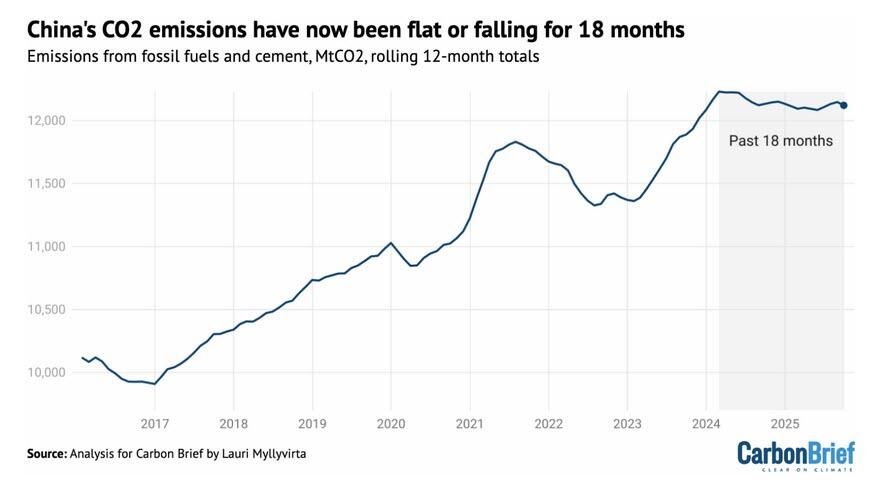
The rapid adoption of electric vehicles (EVs) helped CO2 emissions from transport fuel drop by 5% year-on-year in the third quarter, while there were also declines from cement and steel production, which decelerated amid weaker demand.
China’s CO2 emissions from the power sector remained flat in the third quarter despite stronger electricity demand growth with the consumption increase accelerating to 6.1%, up from 3.7% growth in the first half of the year, according to the analysis for Carbon Brief.
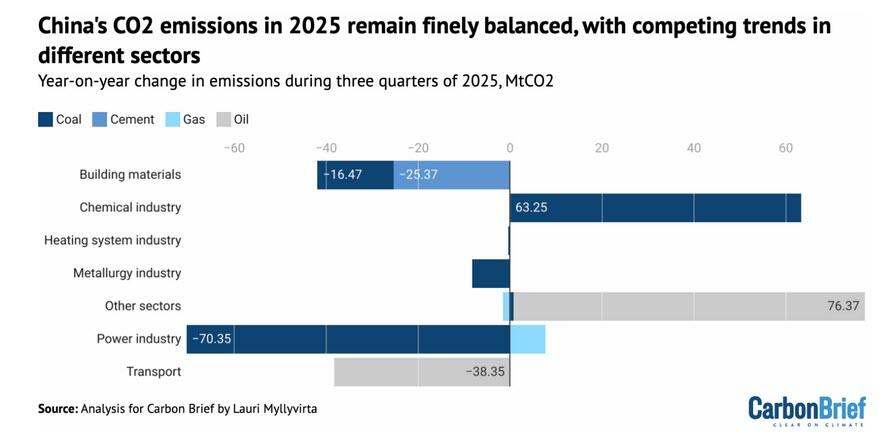
The flat emissions amid rising power demand were the result of solar power generation surging by 46% and wind electricity jumping by 11% from a year earlier in Q3.
China completed 240 gigawatts (GW) of solar and 61 GW of wind capacity in the first nine months of the year. This puts the country on track for a new renewable record in 2025, the analysis found.
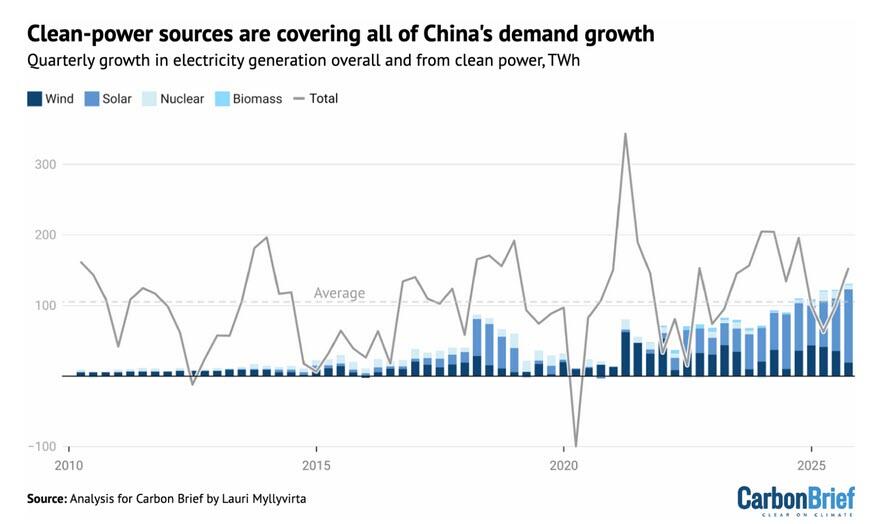
Oil demand and emissions in the transport sector fell by 5% in the third quarter, but grew elsewhere by 10%, as the production of plastics and other chemicals surged.
In September, China pledged to cut greenhouse gas emissions by up to 10% by 2035 compared to peak levels, while “striving to do better”, President Xi Jinping said in a videotaped message to a UN climate summit in New York.
With the Trump Administration abandoning emissions pledges and the fight against climate change, analysts see China as potentially taking over the global leadership in the push to reduce emissions and limit global warming.
CHINA
Big story;: China agrees to curb fentanyl precursors
(zerohedge)
FBI Director Says China Agreed To Curb Fentanyl Precursors
Thursday, Nov 13, 2025 – 01:05 PM
Authored by Catherine Yang via The Epoch Times,
FBI Director Kash Patel said at a press briefing on Nov. 12 that during his recent trip to China, Chinese officials agreed to take significant steps to curb fentanyl precursor exports to the United States.
“That was the sole purpose of my trip to China, to eliminate these precursors, and if successful, we would suffocate the drug trafficking organization’s ability to manufacture fentanyl in places like Mexico,” Patel said.
His one-day trip to China last week was the first such trip by the head of the FBI in a decade.

The trip followed the meeting between President Donald Trump and Chinese Communist Party leader Xi Jinping during which the nations agreed to a trade truce that included Beijing’s commitment to stop illicit fentanyl trafficking to the United States.
Patel said that on the heels of that successful bilateral, “China committed fully” to his engagement on the ground in Beijing “at a level never seen before.”
The meeting took place at the headquarters of China’s Ministry of Public Security, where Patel met with his counterpart.
Beijing agreed to restrict the export of 13 fentanyl precursor chemicals to the United States, Mexico, and Canada. It also agreed to control seven chemical subsidiaries also used in fentanyl production.
“Essentially, President Trump has shut off the pipeline that creates fentanyl, that kills tens of thousands of Americans,” Patel said. “These substances are now banned, and they will no longer be utilized by the Mexican drug trafficking organizations or any other CEOs around the world to make this drug. This achievement will save lives.”
Patel also called his counterpart in China earlier this year, leading Beijing to ban the export of four fentanyl precursors beginning on Sept. 1.
Trump announced 10 percent tariffs on China early in his term as a result of Beijing’s role in the fentanyl crisis, doubling that to 20 percent the next month.
After the recent meeting with Xi, the tariff was halved to 10 percent, tied to Beijing’s commitment to ban the chemicals.
Trump has declared the opioid crisis a national health emergency, enacted visa policies that will prevent associates of drug traffickers from entry to the United States, designated drug cartels as terrorist organizations, and ordered strikes on vessels believed to be carrying narcotics.
China emerged as the primary supplier of illicit fentanyl as deaths rose steeply around 2016. Then deaths skyrocketed from 2021 to 2023 along with a record surge of border crossings, and at its peak, the U.S. Centers for Disease Control and Prevention reported that the fentanyl crisis was linked to 76,226 synthetic opioid deaths in 2022, more than quadruple the figure from 2016. The United States started seeing a reversal in 2024, coinciding with changed border policies, and fentanyl-linked deaths in 2024 were estimated to be 48,422.
CHINA
Hongqi Bridge partially collapses in southwest China, months after opening
November 11, 2025 11:34 am
 Source: Video Screenshot
Part of a recently opened bridge in China’s southwestern Sichuan province collapsed on Tuesday along a national highway connecting the country’s heartland with Tibet, according to local authorities cited by Reuters. No casualties were reported.
Footage from the state-run Global Times showed massive clouds of dust rising from the river beneath the bridge after the collapse.
Police in Maerkang city had already closed the 758-meter-long Hongqi Bridge to traffic on Monday afternoon after cracks were detected on nearby slopes and roads, and ground movement was observed on a nearby mountain, the local government said.
By Tuesday afternoon, conditions on the mountainside deteriorated further, triggering landslides that caused the approach bridge and roadbed to give way.
The bridge had only been completed earlier this year, according to a video posted by the contractor, Sichuan Road & Bridge Group, on social media.
4 EUROPEAN/NATO AFFAIRS
EU
(CARR/EPOCH TIMES)
EU Should Tariff China To Kick Its Rare Earths Dependency
Thursday, Nov 13, 2025 – 03:30 AM
Authored by Anders Corr via The Epoch Times,
The European Union is planning a rare-earth element stockpile, mining, and refinement strategy to be more fully revealed in mid-November.
The plan is to use import substitution to counter China’s rare-earth export controls on seven rare earths imposed in April.

However, it could take 10 to 15 years for Europe to become fully independent of China’s rare-earth supply, by which time Russia’s war may have eaten further into Europe’s eastern boundaries. Until the European Union credibly threatens tough tariffs against China—on the order of 100 percent mooted in October by U.S. President Donald Trump—Beijing is unlikely to relent. EU tariffs would provide plenty of leverage, as the European Union has had a persistent trade deficit with China of approximately 300 billion euros to 400 billion euros annually since 2022.
China’s control of rare-earth elements amounts to a global licensing system that could give Beijing a chokehold on the European Union’s artificial intelligence (AI), defense, automotive, and other high-tech sectors. Unfortunately, it’s mostly too late for the EU to stockpile rare-earth elements, as China is already restricting rare-earth exports. Some of the European Union’s past imports of rare-earth elements were 98 percent sourced from China. It could take a dozen years to fully diversify rare-earth mining and refinement away from China, according to SFA Oxford analysts.
Meanwhile, Europe’s defense and auto industries are at the mercy of Beijing, which is normalizing the notion that the Chinese Communist Party (CCP) has global control over such a critical input to Europe’s defense and industry—and, by extension, the sovereignty and commercial power of Europe’s many free nations.
The CCP’s rare-earth controls have, for example, tripled the cost of some rare-earth elements on global markets and rendered European sanctions on China toothless. These include sanctions for Beijing’s support of Russia’s war machine, whose strikes are already straying from Ukraine over the boundary into Poland, Estonia, and Romania. European sanctions on China’s totalitarian form of government, territorial aggression, support for dictators and terrorists around the world, and human rights abuse are also weakened to nonexistent due to Beijing’s rare-earth move.
Fighter jets, missile guidance, and drones require rare-earth elements to operate. The effect of the CCP’s controls on these European production lines is likely classified. But in June, the European Association of Automotive Suppliers, or CLEPA, warned of risks to the auto supply chain due to Beijing’s export controls on computer chips.
“Chips are essential for vehicle electronics and up to 700 other critical components,” CLEPA said in a press release at the time. “The shortage has an ongoing effect on key electronic systems such as radar sensors, which alone consume around one million chips per week.”
In September, CLEPA noted that European auto factories had stalled due to a shortage of rare-earth elements. BMW and other major automakers faced disruptions to their supply chains. While BMW is scrambling to produce rare-earth-free motors, this only works on larger electric engines. Rare-earth elements remain necessary for small electric motors that power everything from windows to wipers.
European sanctions will remain toothless until Brussels shakes its dependence on China’s rare earths, not to mention other strategic imports. The CCP found Europe’s Achilles’ heel, which will make it vulnerable to the demands of Beijing on opening European markets to China and providing key European exports to Chinese companies.
Beijing seeks semiconductor fabrication machines from the Netherlands, for example, which will surely be part of the ongoing negotiations. Beijing will be pressing Brussels for not only AI-capable chips, but the machines that make the chips.
The European Union is also impeded in its response to the Chinese regime’s growing international aggression in places like Taiwan, Japan’s Senkaku Islands, the Philippines, and India’s Himalayas. The lack of power that the EU has in negotiations with Beijing due to the rare-earth controls will buy China time to build its military and global diplomatic support for an attack on Taiwan, which could give Beijing control over the key Taiwanese semiconductor factories—also known as fabs—necessary to make the CCP even more fearless of the West’s economic sanctions. This was something that the former Soviet Union never achieved, making the CCP a greater threat than the Soviets ever were.
In 2022, the European Union announced an import substitution regime for rare-earth elements called the Critical Raw Materials Act. It seeks to replace much of the rare earths from China through domestic production by 2030, including domestic fulfillment of at least 10 percent of the EU’s extraction needs, 40 percent of its processing, and 25 percent of its recycling. Domestic EU mining and refining could be scaled up in case of an emergency. The European Union would limit dependence on any single foreign supplier to 65 percent of EU needs, which is likely still too much. Another initiative, ReSourceEU, will diversify rare-earth supply chains to Estonia, Australia, Canada, and Kazakhstan.
This is all too little, too late, and insufficient, given that the free world does not have 10 to 15 years to wait for the European Union to become independent of Beijing’s threat to throttle Europe’s rare earth supplies. Tougher measures must be considered.
Tariffing EU trade with China at 100 percent is the kind of penalty that could force Beijing to back down on its rare-earth export controls immediately. That would give Europe the time it needs to develop its own rare-earth supply, and never again to hock its sovereignty at a pawn shop in Beijing.
Views expressed in this article are opinions of the author and do not necessarily reflect the views of The Epoch Times or ZeroHedge.
END
ITALY/BOSNIA
‘Sarajevo Safari’: Italy Probes Claim That Wealthy Tourists Paid To Go To Bosnia To Snipe Civilians
Thursday, Nov 13, 2025 – 02:45 AM
Various reports including in The Guardian and European outlets have detailed one of the most shocking ‘war tourism’ stories in a long time. The reports claim people in the 1990s paid large sums of money to travel to the Balkans, where they didn’t just observe the long-running Yugoslav wars, but picked up rifles and shot people for ‘sport’.
Italian prosecutors are investigating the shocking allegations that wealthy foreigners paid many tens of thousands of dollars to act as “weekend snipers” and shoot civilians during the siege of Sarajevo in the early to mid-1990s.

Travelers from Italy, the United States, Russia, and other countries allegedly went to Bosnia during the war to fire on residents of the besieged city “for entertainment”.
They are said to have paid money to soldiers belonging to the army of Bosnian Serb warlord Radovan Karadžić, who was decades later convicted of crimes against humanity at the Hague.
Serbian authorities have vehemently denied the sensationalist allegations related specifically to the years-running siege of Sarajevo from 1992 to 1996 which took over 11,000 lives.
Prosecutors in Milan are now working to identify the Italian citizens allegedly involved. Statements indicated they will include potential charges of “premeditated murder aggravated by cruelty and vile motives.”
There’s reason for skepticism, however, given some of the specifics seem hard to believe and over-the-top, and given Balkan conflicts have notoriously been clouded in wartime propaganda and enduring historical falsehoods:
The Milan complaint was filed by journalist and novelist Ezio Gavazzeni, who describes a “manhunt” by “very wealthy people” with a passion for weapons who “paid to be able to kill defenseless civilians” from Serb positions in the hills around Sarajevo.
Different rates were charged to kill men, women or children, according to some reports.
While there have long been rumors of such things taking place, the current investigation into this in northern Italy is due largely to a prominent journalist who has has sought to revive a formal probe by submitting his own 17-page report to prosecutors:
Ezio Gavazzeni, who usually writes about terrorism and the mafia, first read about the sniper tours to Sarajevo three decades ago when Italian newspaper Corriere della Sera reported the story, but without firm evidence.
He returned to the topic after seeing “Sarajevo Safari”, a documentary film from 2022 by Slovenian director Miran Zupanic which alleges that those involved in the killings came from several countries, including the US and Russia as well as Italy.

The reality is that for the bulk of the historic siege few people could move in or out of the city’s environs or outskirts, and various layers of snaking checkpoints and barriers were erected and staffed also by foreign troops at times.
For example, the BBC concludes with a lengthy case for skepticism:
However, members of the British forces who served in Sarajevo in the 1990s have told the BBC that they never heard of any so-called “sniper tourism” during the Bosnian conflict.
They indicated that any attempts to bring in people from third countries who had paid to shoot at civilians in Sarajevo would have been “logistically difficult to accomplish”, due to the proliferation of checkpoints.
British forces served both inside Sarajevo and in the areas surrounding the city, where Serb forces were stationed and they saw nothing at the time to suggest that “sniper tourism” was taking place.
One soldier described the allegations that foreigners had paid to shoot at civilians as an “urban myth”.
The war was tragic and brutal enough to need no exaggeration, and this could in the end be an attempt of some prosecutors, journalists, and documentary film-makers to make a name for themselves by re-presenting rumors which makes for loud and curiosity-evoking headlines.
END
GERMANY
(BROOKE/REMIX)
Germany Offers Afghans Taxpayers’ Cash To Abandon Resettlement Pledges
Thursday, Nov 13, 2025 – 02:00 AM
Authored by Thomas Brooke via Remix News,
The German government has sent letters offering Afghan nationals taxpayer-funded cash incentives to withdraw from resettlement programs and either return to Afghanistan or move to a third country, as reported by the German Press Agency (dpa).

The letters, distributed via the German Society for International Cooperation (GIZ), offer several thousand euros in compensation and logistical support, such as transport, medical assistance, and three months of psychosocial care to Afghan nationals awaiting resettlement flights in their home country and neighboring Pakistan.
The federal interior ministry, cited by Welt, said the voluntary offer is meant to “give those who cannot expect to be accepted in Germany a future.”
Recipients were told that all local admission procedures must be completed by the end of 2025 and warned that “there is no guarantee all steps can be completed on time.” The deadline to accept the offer is Nov. 17, after which re-entry into the relocation process will not be possible.
Over 2,000 Afghan nationals are currently awaiting transfer to Germany under various protection and resettlement schemes. The current CDU/CSU-SPD coalition government suspended the previous administration’s admission programs for Afghans in May, but flights have continued to arrive since the Berlin Administrative Court ruled that the government must honor its previous commitments to admit an Afghan woman and her 13 family members in a landmark case.
The court found that previously issued admission approvals were legally binding and could not be revoked, ordering the Foreign Ministry to act immediately. While the government had the opportunity to appeal the decision, it withdrew its application in August, finalizing the ruling.
The interior ministry defended the financial incentive proposal, saying it targets those whose resettlement approvals were never finalized.
The various Afghan resettlement schemes were launched in 2021 after the Taliban retook control of the country. Applicants were required to travel to Pakistan for visa processing and security screening before entering Germany.
The government argues that the suspension of admissions is necessary due to “security and procedural concerns” fuelled by newspaper reports earlier this year that only one in eight Afghans admitted under special protection programs had undergone full security vetting before arrival. The report claimed that more than 31,000 Afghans and family members entered Germany without complete background checks.
The federal police union (DPolG) urged a total suspension of flights, citing identity-verification failures and terrorism concerns. “The current procedure, in which travel documents are issued despite identities not being fully verified, is highly risky and irresponsible,” said DPolG chief Heiko Teggatz in March.
5. RUSSIA AND MIDDLE EASTERN AFFAIRS
TBN ISRAEL/LAST 24 HR
ISRAEL VS HAMAS
Hamas has information about location of four remaining deceased hostages’ remains – KAN
The four hostages whose remains are still being held by Gazan terror groups are Meny Godard, St.-Sgt.-Maj. Ran Gvili, Dror Or, and Thai national Sudthisak Rinthalak.

Hamas terrorists escorting Red Cross during a search for the remains of deceased hostages in Gaza City, November 12, 2025.(photo credit: REUTERS/DAWOUD ABU ALKAS)ByJERUSALEM POST STAFFNOVEMBER 13, 2025 04:28Updated: NOVEMBER 13, 2025 05:06
Hamas has information about each of the four deceased hostages whose remains are still being held in the Gaza Strip, sources familiar with the issue told Israel’s public broadcaster KAN News on Wednesday evening.
This includes information about the remains of hostages being held by Palestinian Islamic Jihad, the sources expanded.
Pressure must be exerted on Hamas terrorists to return the remains, and Israel should not compromise, the sources affirmed to KAN.
The four hostages whose remains are still being held by Gazan terror groups are Meny Godard, St.-Sgt.-Maj. Ran Gvili, Dror Or, and Thai national Sudthisak Rinthalak.
Palestinian sources claim one hostage’s remains currently held by Hamas, another by PIJ
Saudi-linked London-based outlet Asharq al-Awsat cited Palestinian sources claiming that the remains of one hostage is being held by PIJ, while another is being held by Izzadin al-Qassam Brigades, Hamas’s so-called military wing.

The same sources told the outlet that the other two remains are believed to be in Israeli-controlled areas east of Gaza’s Yellow Line buffer zone.
They “could be found if search operations were intensified without Israeli restrictions,” the sources told Asharq al-Awsat.
The sources also claimed that “major difficulties have hampered the search” for the remains, and that the process to find them could take “considerable time.”
END
ISRAEL VS HAMAS
Hamas says it will turn over remains of Gaza hostage on Thursday night
“The Al-Quds Brigades and the Izz ad-Din al-Qassam Brigades will hand over the body of an Israeli prisoner of war, which was found today in the Moraj area north of Khan Younis,” Hamas said.

Children look out of a building as Palestinian Hamas terrorists stand guard on the day of the handover of hostages. Gaza Strip, February 22, 2025.(photo credit: REUTERS/Hatem Khaled)ByJERUSALEM POST STAFFNOVEMBER 13, 2025 13:53Updated: NOVEMBER 13, 2025 14:17
Hamas announced that it would hand over the remains of one of the remaining deceased hostages as part of the prisoner exchange deal at 8:00 p.m. on Thursday.
“The Al-Quds Brigades and the Izz ad-Din al-Qassam Brigades will hand over the body of an Israeli prisoner of war, which was found today in the Moraj area north of Khan Yunis in the southern Gaza Strip, at 8:00 p.m. Gaza time,” Hamas stated.
There are currently four hostages left in Gaza: Meny Godard, Ran Gvili, Dror Or, and Sudthisak Rinthalak.
Hamas knows whereabouts of hostage remains
On Wednesday, sources familiar with the issue told Israel’s public broadcaster KAN News that Hamas had information on the location of each of the four deceased hostages whose remains are still being held in the Gaza Strip.

This includes information about the remains of hostages being held by Palestinian Islamic Jihad, another terror group in Gaza, the sources expanded.
Pressure must be exerted on Hamas terrorists to return the remains, and Israel should not compromise, the sources affirmed to KAN.This is a developing story.
IRAN
Tehran taps run dry as water crisis deepens across Iran
The head of Tehran’s Regional Water Company said that water levels had fallen 43% from last year, leaving the Amir Kabir Dam at just 8% of capacity.

People shop water storage tanks following a drought crisis in Tehran, Iran, November 10, 2025(photo credit: MAJID ASGARIPOUR/WANA (WEST ASIA NEWS AGENCY) VIA REUTERS)ByREUTERSNOVEMBER 12, 2025 17:14Updated: NOVEMBER 13, 2025 00:05
Iran is grappling with its worst water crisis in decades, with officials warning that Tehran, a city of more than 10 million, may soon be uninhabitable if the drought gripping the country continues.
President Masoud Pezeshkian has cautioned that if rainfall does not arrive by December, the government must start rationing water in Tehran.
“Even if we do ration and it still does not rain, then we will have no water at all. They (citizens) have to evacuate Tehran,” Pezeshkian said on November 6.
The stakes are high for Iran’s clerical rulers. In 2021, water shortages sparked violent protests in the southern Khuzestan province. Sporadic protests also broke out in 2018, with farmers in particular accusing the government of water mismanagement.
Water pressure reductions being applied
The water crisis in Iran after a scorching hot summer is not solely the result of low rainfall.

Decades of mismanagement, including overbuilding of dams, illegal well drilling, and inefficient agricultural practices, have depleted reserves, dozens of critics and water experts have told state media in the past days as the crisis dominates the airwaves with panel discussions and debates.
Pezeshkian’s government has blamed the crisis on various factors such as the “policies of past governments, climate change, and over-consumption.”
While there has been no sign of protests yet this time over the water crisis, Iranians are already struggling under the weight of a crippled economy, chiefly because of sanctions linked to the country’s disputed nuclear program.
Coping with persistent water shortages strains families and communities even further, intensifying the potential for unrest when the clerical establishment is already facing international pressure over its nuclear ambitions. Iran denies seeking nuclear weapons.
Across Iran, from the capital’s high-rise apartments to cities and small towns, the water crisis is taking hold.
When the taps went dry in her eastern Tehran apartment last week, Mahnaz had no warning and no backup.
“It was around 10 p.m., and the water didn’t come back until 6 a.m.,” she said. With no pump or storage, she and her two children were forced to wait, brushing teeth and washing hands with bottled water.
Iran’s National Water and Wastewater Company has dismissed reports of formal rationing in Tehran, but confirmed that nightly water pressure reductions were being applied in Tehran and could drop to zero in some districts, state media reported.
Pezeshkian also warned against over-consumption in July. The water authorities said at the time 70% of Tehran residents consumed more than the standard 130 liters a day.
Tehran’s reservoirs at around half capacity
Iranians have endured recurrent electricity, gas, and water shortages during peak demand months in recent years.
“It’s one hardship after another- one day there’s no water, the next there’s no electricity. We don’t even have enough money to live. This is because of poor management,” said schoolteacher and mother of three Shahla, 41, by phone from central Tehran.
Last week, state media quoted Mohammadreza Kavianpour, head of Iran’s Water Research Institute, as saying that last year’s rainfall was 40% below the 57-year average in Iran, and forecasts predict a continuation of dry conditions towards the end of December.
The capital depends entirely on five reservoirs fed from rivers outside the city. But inflow has plummeted. Behzad Parsa, head of Tehran’s Regional Water Company, said last week that water levels had fallen 43% from last year, leaving the Amir Kabir Dam at just 14 million cubic meters- 8% of capacity.
He said Tehran’s reservoirs, which collectively could once store nearly 500 million cubic meters, now hold barely 250 million, a drop of nearly half, which, at current consumption rates, could run dry within two weeks.
The crisis extends far beyond Tehran. Nationwide, 19 major dams, roughly 10% of Iran’s total, have effectively run dry. In the holy Shi’ite city of Mashhad, Iran’s second-largest city, with a population of 4 million, water reserves have plunged below 3%.
“The pressure is so low that literally we do not have water during the day. I have installed water tanks, but how long can we continue like this? It is completely because of the mismanagement,” said Reza, 53, in Mashhad. He said it was also affecting his carpet-cleaning business.
Like the others Reuters spoke to, he declined to give his family name.
Climate change intensified water loss
The crisis follows record-breaking temperatures and rolling power outages. In July and August, the government declared emergency public holidays to reduce water and energy consumption, shutting down some public buildings and banks as temperatures topped 5122 degrees Fahrenheit in some areas.
Climate change has intensified the problem, authorities say, with rising temperatures accelerating evaporation and groundwater loss.
Some newspapers have criticized the government’s environmental policies, citing the appointment of unqualified managers and the politicization of resource management. The government has rejected the claims.
Calls for divine intervention have also resurfaced.
“In the past, people would go out to the desert to pray for rain,” said Mehdi Chamran, head of Tehran’s City Council, state media reported. “Perhaps we should not neglect that tradition.”
Authorities are taking temporary measures to conserve what remains, including decreasing the water pressure in some areas and transferring water to Tehran from other reservoirs.
But these are stopgap measures, and the public has been urged to install storage tanks, pumps, and other devices to avoid major disruption.
“Too little, too late. They only promise, but we see no action,” said a university teacher in the city of Isfahan, who asked not to be named. “Most of these ideas are not doable.”
ISRAEL VS WEST BANK
Israel’s Shin Bet thwarts imminent attacks from West Bank, 40 Bethlehem terrorists arrested
The Shin Bet said it arrested around 40 Palestinian terrorists from Bethlehem in a major bust that thwarted imminent attacks, marking the first large-scale operation under new chief David Zini.
https://player.jpost.com/public/player.html?player=jpost&media=3973958&url=https://www.jpost.com/Israeli security forces operate in Bethlehem, in the West Bank, against Palestinian terror threats on November 13, 2025 (IDF SPOKESPERSON’S UNIT)ByYONAH JEREMY BOBNOVEMBER 13, 2025 12:56Updated: NOVEMBER 13, 2025 14:45
The Shin Bet on Thursday announced an unusually large bust of around 40 Palestinian terrorists from Bethlehem in thwarting a series of imminent major terror attacks.
According to the size of the multiple cells, the bust may be a strategic setback to Hamas and other terror groups, who may have been looking to significantly increase waves of terror from the West Bank, at a time when they are weaker in Gaza.
The announcement also marked the first such publicly announced operation since David Zini took over running the agency on October 5.
There have been two other operations publicized by the Shin Bet, one arresting an Israeli from Tiberias for spying for Iran and one seizing weapons which Iran was trying to smuggle from Jordan into the West Bank, but no imminent terror operations on this scale.
Zini will be looking to make his mark at the head of the agency rapidly, following months of being in limbo due to a variety of political and legal battles between Prime Minister Benjamin Netanyahu and the legal establishment and the opposition over his appointment.

Thwarting the terror plots was a joint operation of the Shin Bet along with the IDF, and the police, with a variety of counter-terror actions taken in recent weeks.
In particular, the IDF’s reservist Etzion Brigade, along with the special forces Duvdevan and Lotar units, undertook 15 different operations, with direction from the Shin Bet, to arrest the approximately 40 terrorists.
Part of the bust included seizing the terrorists’ weapons, including such as M-16s.
Masterminds who systematically recruited and built multiple terror cells
According to the Shin Bet interrogations and probe into the plot, there were masterminds who systematically recruited and built multiple terror cells in order to carry out a series of shooting attacks against Israeli civilians and the IDF.
One of these terror cells was ready to carry out an attack imminently when the agency arrested them, said the Shin Bet’s statement.
Had the Shin Bet not intervened, the shooting attack could have carried a heavy cost in Israeli lives.
The Shin Bet said it would continue to act with other security bodies to prevent terrorists from harming the country.
Further, the agency said that it had transferred its evidence over to the IDF West Bank Prosecution to move forward with indictments against those involved in the various terror cells.
SYRIA
No Regrets: Sharaa Says Trump Didn’t Bring Up His Al-Qaeda Past
Wednesday, Nov 12, 2025 – 05:20 PM
Authored by Dave DeCamp via AntiWar.com,
Syrian President Ahmed al-Sharaa said in an interview with Fox News that President Trump didn’t bring up his past as an al-Qaeda fighter and commander during their meeting at the White House on Monday.
“I think this is a matter of the past now,” Sharaa said through a translator when asked if Trump raised his al-Qaeda history. “We did not discuss this actively. We talked about the present and the future. We talked about the investment opportunities in the future, so that Syria is no longer looked at as a security threat, but it is now looked at as a geopolitical ally and a place where the United States can have great investments, especially extracting gas.”

When asked if he had “regrets” that al-Qaeda carried out the attacks on the World Trade Center and the Pentagon on September 11, 2001, Sharaa said he wasn’t involved with the group at the time.
“I was only 19 years old, I was a very young person, and didn’t have any decision-making power at that time, and I didn’t have anything to do with it. Al-Qaeda wasn’t present then in my area, so you’re speaking to the wrong person about this subject,” he said.
“We mourn for every civilian that got killed, and we know that people suffer from the war, especially civilians who paid a price, a hefty price, for the war,” Sharaa added.
Sharaa first joined al-Qaeda after the US invasion of Iraq in 2003 to fight US troops, and was imprisoned by the US military from 2006 to 2011. After that, he traveled to Syria, where he founded the al-Qaeda affiliate in the country, known as the al-Nusra Front.
At the time, he was allied with Abu Bakr al-Baghdadi, the founder of ISIS. Sharaa rebranded in 2016, claiming he cut ties with al-Qaeda, and merged his jihadist group with other factions to form Hayat Tahrir al-Sham, which took power in Damascus in December 2024.

Now, the US is working to build a military alliance with the HTS-led Syrian government. Syrian Information Minister Hamza al-Mustafa announced that Syria has joined the US-led anti-ISIS coalition, and Reuters reported last week that the US is planning to establish a military base in Damascus.
* * *
Meanwhile, the absurdity of this scene…
RUSSIA VS UKRAINE
Betrayed and left to be Pillaged are the Ukrainians
The plot was to have the Ukraine hold out until late May 2026 so NATO would be ready to join in. Now the panic is upon Macron and Starmer etc. as to what to do. Thus watch for false flags as there are many tried and more to come.
Sometimes the reality of betrayal is haunting. The Ukrainians were never going to win anything led by dysfunctional NATO boy soldiers who are experiencing real war and dying. Nor is NATO anywhere near ready for a conflict. And the Chinese have made very clear to the EU that they will join in if Russia weakens. They realize that if Russia was to fall they are next. Thus, they will not let Russia lose. And they are not alone in this view. Ask India what they honestly think.
Meanwhile RUSSIAN FACTORIES have been running on a war footing working 24/7 getting ready for NATO, not Ukrainians. And it matters not that NATO conducts exercises near the borders of Russia as each plane is actually monitored and missile strikes are calibrated in the event of need. It is bad enough to see literally millions of people tossed into poverty and despair for a proxy fight that was always a loser. But then it is simply a repeat of history.
However, Neocon dreams of forever wars to pillage and profit from war in the aftermath have been with us for centuries. The big problem for the Banks and Neocons is that they have run out of easy money. The ability to lend money to Britain as an example after WWII is gone. As is the ability of most borrowers to repaid such lending. The whole economic system of many decades is broken and cannot be repaired. The chickens of this roost are coming home to roost and it will ugly. It is 2008 on steroids. Add to this a departure from hegemonic ability and control caused by a lack of lawful not partisan control. And today it is the outliers who are winning. In Europe it is why Hungary gains at the expense of Germany in Car plants and like.
According to the publication Telegraf, “the cheapest way to warm up is not firewood or coal, but chicken manure and used oil. Seriously??? Why not suggest the use of horses to get around?
The cost of one kilowatt of heat from such an alternative is estimated at 0.8–1.2 hryvnias. For comparison: firewood provides heat at a price of 2.5 UAH per kWh, and pellets — 1.7. In winter, an increase in briquette prices up to 10,000 UAH per ton is expected, so people are advised to stock up on fuel in advance, before it’s too late.
Manufacturers explain that almost anything can be burned: sunflower husks, straw, grain waste, even bird droppings. This is a “real alternative” to gas and coal, experts say. “Sunflower waste works well. It has a little fat that binds it. Husks without fat are hard to pelletize, something needs to be mixed in,” says Valeriy Vinokurov, executive director of the company Lavrin.
What the heck should Ukrainians think? They have been betrayed by their Leadership and bamboozled by NATO to be a sacrificial lamb to be abandoned. It is simply the way of the game. Naturally during the course of betrayal huge fortunes have been made. When an actor like Zelensky prances around the world buying French Private banks to Vineyards in Tuscany to ranches in America and pads in Miami with looted money. Where is the morality of conflict while such excess is on display. Even the allowance of such purchases signals an acceptance of this nonsense really is.
Russian forces will advance and Ukraine will be reduced to a rump of its formal self losing all access to the Black Sea. As for the NAZI types in Ukraine it remains to be seen where they will run to with the stolen loot.
END
RUSSIA/USA
END
NOTHING LEFT TO SANCTION:!!
US ‘Running Out Of Things To Sanction’ In Russia, Frustrated Rubio Admits
Thursday, Nov 13, 2025 – 03:00 PM
Secretary of State Marco Rubio has made some fresh remarks to the press which reveal a deep irony while demonstrating the limited effectiveness of far-reaching anti-Moscow sanctions on the course of the war in Ukraine. The United States has nearly run out of effective targets for sanctions against Russia, he conceded in a frank moment Wednesday, coming soon on the heels of the Trump admin decision to impose new penalties on two of the country’s biggest oil producers.
“We’ve sanctioned their main oil firms – exactly what everyone’s been asking for,” Rubio told reporters following a meeting of G7 foreign ministers in Canada. “At this point, there’s not much left to target. We’re running out of options.” His attitude in answering the question seemed to be one of quiet exasperation or frustration and conveyed a sense of ‘what more do you want from us?’…
Rubio had previously said President Trump approved sanctions on energy giants Lukoil and Rosneft largely at the urging of Ukraine and its European backers.
According to more from the comments:
The secretary of state also touched upon the issue of the so-called shadow fleet that Russia uses to bypass oil restrictions. He described the fight against it as “an enforcement mechanism” rather than a reason for introducing new sanctions. Rubio expressed the view that European partners should play a more active role in this process, as a significant number of the vessels operate closer to their territories.
When asked whether Russia truly seeks peace, Rubio replied that such things can only be judged by actions. In his opinion, Moscow has “stated clearly what they want is they want the rest of Donetsk, and obviously the Ukrainians aren’t going to agree to that”.
Rubio also interestingly seemed to acknowledge the current futility of sending more equipment to protect Ukraine’s pummeled energy infrastructure:
According to Rubio, discussions are underway on providing both specialised equipment and defensive weapons to protect energy facilities. However, the key problem remains the high risk that the equipment could be destroyed shortly after installation.
“If that equipment is ultimately destroyed a week later after it’s installed, that remains a problem. And that’s been the history of the last two or three years,” Rubio concluded.
All of this illustrates perhaps why Trump has lately signaled he’s ready to wash his hands of involvement in trying to achieve Ukraine peace, and why he’s done with doing ‘direct’ weapons transfers to Kiev.
Meanwhile Moscow insists that it has adapted successfully by redirecting trade toward non-Western markets, particularly major BRICS countries, despite India recently scaling back its purchases of Russian oil. The EU’s years-long strategy has been sanctions package after sanctions package – and we’re up to at least 19 at this point.
According to more from the comments:
The secretary of state also touched upon the issue of the so-called shadow fleet that Russia uses to bypass oil restrictions. He described the fight against it as “an enforcement mechanism” rather than a reason for introducing new sanctions. Rubio expressed the view that European partners should play a more active role in this process, as a significant number of the vessels operate closer to their territories.
When asked whether Russia truly seeks peace, Rubio replied that such things can only be judged by actions. In his opinion, Moscow has “stated clearly what they want is they want the rest of Donetsk, and obviously the Ukrainians aren’t going to agree to that”.
Rubio also interestingly seemed to acknowledge the current futility of sending more equipment to protect Ukraine’s pummeled energy infrastructure:
According to Rubio, discussions are underway on providing both specialised equipment and defensive weapons to protect energy facilities. However, the key problem remains the high risk that the equipment could be destroyed shortly after installation.
“If that equipment is ultimately destroyed a week later after it’s installed, that remains a problem. And that’s been the history of the last two or three years,” Rubio concluded.
All of this illustrates perhaps why Trump has lately signaled he’s ready to wash his hands of involvement in trying to achieve Ukraine peace, and why he’s done with doing ‘direct’ weapons transfers to Kiev.
Meanwhile Moscow insists that it has adapted successfully by redirecting trade toward non-Western markets, particularly major BRICS countries, despite India recently scaling back its purchases of Russian oil. The EU’s years-long strategy has been sanctions package after sanctions package – and we’re up to at least 19 at this point.
6. GLOBAL ISSUES//COVID ISSUES/VACCINE ISSUES/HEALTH ISSUE
GLOBAL ISSUES
MARK CRISPIN MILLER
DR PAUL ALEXANDER
‘The Pentagon Bio-weapons’ By Dilyana Gaytandzhieva -April 29, 2018, The US Army regularly produces deadly viruses, bacteria and toxins in direct violation of the UN Convention on the prohibition of
Biological Weapons. Hundreds of thousands of unwitting people are systematically exposed to dangerous pathogens & other incurable diseases. Bio warfare scientists using diplomatic cover test man-made
| Dr. Paul AlexanderNov 13 |
viruses at Pentagon bio laboratories in 25 countries across the world.’


The Pentagon Bio-weapons – Dilyana.bg
The US Army regularly produces deadly viruses, bacteria and toxins in direct violation of the UN Convention on the prohibition of Biological Weapons. Hundreds of thousands of unwitting people are systematically exposed to dangerous pathogens and other incurable diseases. Bio warfare scientists using diplomatic cover test man-made viruses at Pentagon bio laboratories in 25 countries across the world. These US bio-laboratories are funded by the Defense Threat Reduction Agency (DTRA) under a $ 2.1 billion military program– Cooperative Biological Engagement Program (CBEP), and are located in former Soviet Union countries such as Georgia and Ukraine, the Middle East, South East Asia and Africa.
Alexander News Network (ANN): Trump’s War 2.0 for America is a reader-supported publication. To receive new posts and support my work, consider becoming a free or paid subscriber.

Georgia as a testing ground
The Lugar Center is the Pentagon bio laboratory in Georgia. It is located just 17 km from the US Vaziani military airbase in the capital Tbilisi. Tasked with the military program are biologists from the US Army Medical Research Unit-Georgia (USAMRU-G) along with private contractors. The Bio-safety Level 3 Laboratory is accessible only to US citizens with security clearance. They are accorded diplomatic immunity under the 2002 US-Georgia Agreement on defense cooperation.
The Lugar Center, Republic of Georgia
The US Army has been deployed to Vaziani Military Air Base, 17 km from the Pentagon bio-laboratory at The Lugar Center.

The USA-Georgia agreement accords diplomatic status to the US military and civilian personnel (including diplomatic vehicles), working on the Pentagon program in Georgia.
Information obtained from the US federal contracts registry clarifies some of the military activities at The Lugar Center – among them research on bio-agents (anthrax, tularemia) and viral diseases (e.g. Crimean-Congo Hemorrhagic Fever), and the collection of biological samples for future experiments.
Pentagon contractors produce bio agents under diplomatic cover
The Defense Threat Reduction Agency (DTRA) has outsourced much of the work under the military program to private companies, which are not held accountable to Congress, and which can operate more freely and move around the rule of law. US civilian personnel performing work at The Lugar Center have also been given diplomatic immunity, although they are not diplomats. Hence, private companies can perform work, under diplomatic cover, for the US government without being under the direct control of the host state – in this case the Republic of Georgia. This practice is often used by the CIA to provide cover for its agents. Three private American companies work at the US bio-laboratory in Tbilisi – CH2M Hill, Battelle and Metabiota. In addition to the Pentagon, these private contractors perform research for the CIA and various other government agencies.
NEWSWIZE
NEWS ADDICTS
MICHAEL EVERY/OR OR PICTON/GIFFIN OR RABOBANK EXECUTIVE/COMMENTARY ON WORLDLY AFFAIRS
7. OIL ISSUES/NATURAL GAS/ENERGY ISSUES/GLOBAL
The Trans-Caspian Pipeline Is Resurrected As Washington Plots Return To Central Asia
Wednesday, Nov 12, 2025 – 11:25 PM
Authored by Conor Gallagher via NakedCapitalism.com,
If the inflation of President Trump’s ego was any indication at the C5+1 summit at the White House last week that brought together the US President with the five presidents of Central Asia, big things are coming to the region.
“You are a great leader, a statesman sent from above to restore common sense and the traditions that we all share and value,”Kazakhstan’s President Kassym-Jomart Tokayev said of Trump.
“No other president of the United States of America has ever treated Central Asia the way you do,” Uzbek leader Shavkat Mirziyoyev told Trump, adding that he was “the president of the world” and that “in Uzbekistan, we call you the president of peace.”
For his part, Trump called Central Asia “an extremely wealthy region.” He was referring to its natural resources, specifically rare earths in this case.
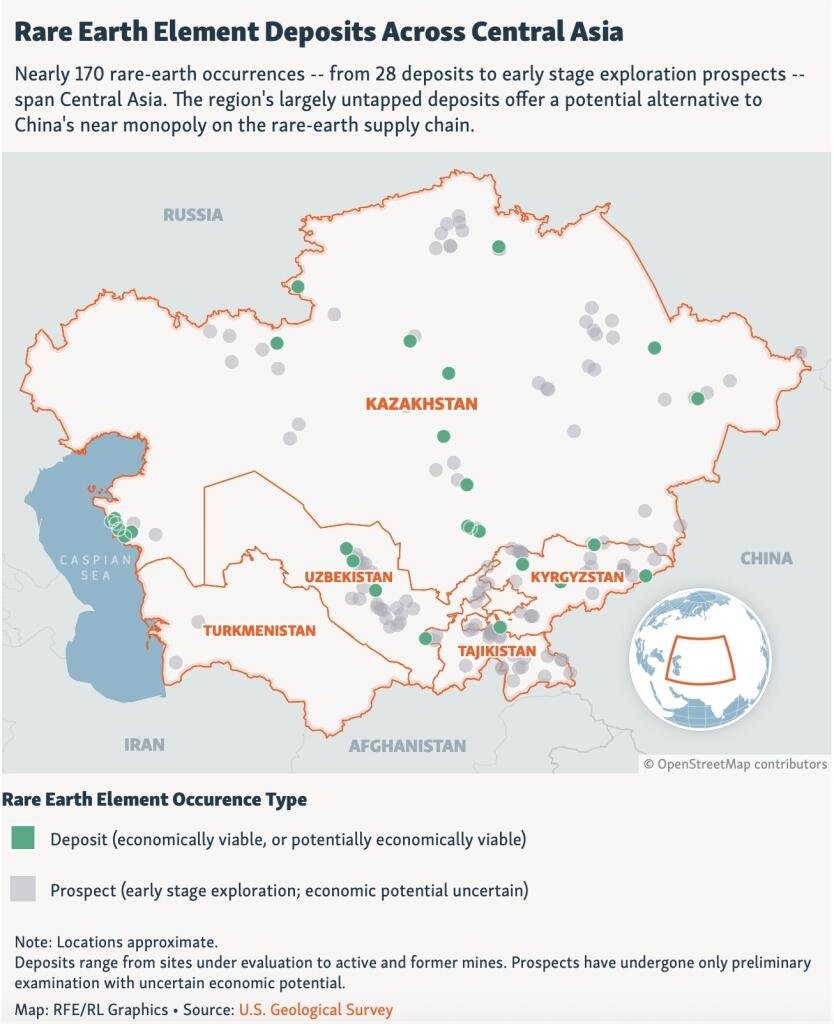
And while rare earths were largely what garnered the coverage—the meeting was more about pumping up a new US and allied push into Central Asia in order to strike a blow against Russia, China, and Iran.
The U.S. signed deals with Kazakhstan (which also joined the Abraham Accords), Uzbekistan, and Tajikistan on natural resources, Boeing planes, Starlink, and AI. The moves come at the same time that the European Union is doubling its efforts to gain more of a foothold in the region.
At the gathering Trump remarked that “Sadly, previous American presidents neglected this region completely.”
That’s not exactly true. The US has made previous attempts to become a larger player in the region.
As Ben Godwin, head of analysis at PRISM, a strategic intelligence firm in London, told RFE/RL:
“In the 2000s, it was the War on Terror and oil and gas. Then there was a decarbonisation era where many new projects in Central Asia were centred around renewable energy. Now it’s the role of critical minerals in national security.”
The problem is always staying power. Russia and China have geography on their side, as well as economic advantages and expertise in areas like rare earths. As we noted on Monday, the idea that the US is going to be competing with China on rare earth processing and refining in a year’s time is magical thinking.
While the US alone cannot compete with Moscow and no one can with Beijing in Central Asia, there are numerous players and factors involved. And as we’ve been reminded in places like Ukraine and the Caucasus, a nation’s economic self-interest is not always a guarantee of the path it will choose.
So as we’ll show below, Russia and China have the upper hand in more ways than one, but also have cause for concern—one of the biggest centers on the great ambiguity on the Bosphorous: Turkiye and its push into the region under the cover of Turkic brotherhood.
The Turkish Trojan Horse and Western Push in Central Asia
We’ve long been pointing out that despite friction between Ankara and Tel Aviv, Turkish-US-NATO cooperation was always present under the surface and picked up steam with the toppling of Assad in Syria.
Erdogan continues to cooperate with the US and Israel in Gaza.

We also just discovered that former NATO chief Jens Stoltenberg and Erdogan had/have a “bromance.” Who knew?
But while so much attention on the resurgent partnership between Ankara and Washington/NATO is focused on Ukraine and the Levant, eastwards into the Caucasus and Central Asia is just as important.
The Cradle recently described Turkiye’s Gaza push as “proxy politics under US watch.” A similar dynamic is at play from Azerbaijan to Kyrgyzstan where the two sides’ interests overlap.
If there is any winner of the Trump Route of International Peace and Prosperity (TRIPP), it is Türkiye. Ankara views the corridor that cuts across southern Armenia, and for all intents and purposes links Azerbaijan and Türkiye, helping to expand its influence to the Central Asian states. And as the US and EU pour money into Central Asia in an attempt to reorient its alignment westwards Türkiye will play an outsize role. There is a problem, however.
The Islamic Republic of Iran’s foreign minister has made it crystal clear today that Iran will not accept any changes to the Armenian southern border and that it will not tolerate any foreign forces there

But will Tehran intervene militarily to stop it? They may be faced with that choice before too long.
Arguably a much more consequential meeting than the C5+1 summit in Washington took place a month ago in Baku, Azerbaijan at the 12th Summit of the Organization of Turkic States.
It was there that Türkiye, Azerbaijan, Kazakhstan, Kyrgyzstan, Uzbekistan and Turkmenistan agreed to deepen cooperation across a range of areas, including trade and logistics—which would sideline Russia and increase cooperation with the EU—and defense cooperation, including joint military exercises.
And last week Baku also hosted a NATO delegation as it transitions to alliance standards and deepens cooperation with the Turkish military.
Around the same time that Türkiye was heading up the OTS meeting, the country’s lawmakers were encouraging NATO to take a heavier hand against Iran with all the usual strategies of sanctions, deterrence, and weakening Iranian “proxies” across the Levant.
A report authored by members of the main opposition party in Türkiye and presented at the NATO Parliamentary Assembly in Ljubljana alleges that Iran’s nuclear program, support for terrorism, military cooperation with Russia, and ties to China hurt Euro-Atlantic security.
While Erdogan was denouncing the genocide in Gaza, Türkiye over the past year has been steadily increasing its involvement in Western, including the launch of launch of a joint venture between Turkish drone maker Baykar (run by Erdogan’s son-in-law) and Italian defense contractor Leonardo, which has very close ties with Israel.
Of particular interest to Türkiye is expanding its access to the EU money dispenser whirring for rearmament. The two sides recently held defense talks after a three-year pause. At the end of October Türkiye and the UK signed a multibillion-dollar deal for the sale of 20 new EF-2000 Eurofighter Typhoon jets, which is a big deal for Türkiye as it looks to get its indigenous fighter jet program off the ground.
Türkiye certainly has agency, and Erdogan’s ruling elite have ambitions to resurrect the country as a world power, but for now both Iran and Russia view Ankara’s eastward moves as a trojan horse for the US, UK, and NATO. For now at least, it is a marriage of convenience. As Ali Nassar writes at The Cradle:
It reveals a layered geopolitical project anchored in Pan-Turanist nationalism, Muslim Brotherhood-aligned political Islam, and strategic deployment of military and development tools – crafted to serve Ankara’s national interests while converging with NATO’s broader regional goals.
…Pan-Turanism, an early 20th-century ideology premised on the unification of Turkic-speaking peoples from Anatolia to western China, has been resurrected in Ankara as a vehicle for geopolitical consolidation. Today, Turkiye deploys this vision to deepen its grip on Central Asia – particularly in Kazakhstan, Uzbekistan, Turkmenistan, Kyrgyzstan, and Azerbaijan.
This ideological push is operationalized through the Organization of Turkic states, which functions as a joint political, economic, and security bloc linking Ankara with these post-Soviet republics.
Türkiye and the West also have visions of using the TRIPP as an energy corridor to send fossil fuels and other resources from Central Asia and the Caspian westwards while cutting out Russia and Iran, all the while increasing their footprint in these countries, effectively carving out a chunk of the Eurasian “heartland.”
Resurrecting the (Idea of the) Trans-Caspian Pipeline—or a Tanker Fleet
Notably, Türkiye and Turkmenistan recently halted gas exports via Iran following the reverberations from the decision by Washington to block Iraq from importing gas from Turkmenistan via a swap deal with Iran. Now the Trans-Caspian Gas Pipeline—or transport via tankers— is back on the radar after years of technical, legal, and political obstacles. From Eurasianet:
The possible ramifications of the US [Iraq] block appear to have been understood by Ashgabat. Speaking at the 5th Tbilisi Silk Road Forum on October 22, Turkmen Foreign Minister Rashid Meredov confirmed that Ashgabat is committed to reviving the “Silk Road” concept of transiting gas from Central Asia to Europe.
“Turkmenistan has always emphasized the great importance of the Western direction, specifically the creation of a stable energy corridor along the Caspian Sea-South Caucasus-European route,” he said.
There are signs too that Azerbaijan, through which any Turkmen gas exports to Türkiye and Europe would have to transit, is open to the idea.
Baku’s strategy has always been to prioritize the development and export of gas from its own reserves. However, efforts to boost gas output from its giant Shah Deniz gas field and Azeri-Chirag-Guneshli oil field have yet to bear fruit. Azerbaijani officials accordingly have confirmed they will be unable to double gas exports to Europe to 20 bcm per year as promised to the European Union.
One reason Azerbaijan isn’t going to be able to fulfill that demand is because Russia is no longer laundering as much gas through Azerbaijan to the EU due to Western-supported friction between Baku and Moscow.
Back to the grand plan to replace it:
Additional volumes of Turkmen gas, then, could help Baku ultimately meet its delivery commitments.
If all sides are on board with a trans-Caspian pipeline, investors would be more likely to consider financing for construction, as well as the necessary expansion of capacity of existing lines through Azerbaijan, Georgia and Türkiye to Europe. Gas could also potentially transit via a pipeline built along the envisioned Armenian-Azerbaijani land corridor, dubbed the Trump Route for International Peace and Prosperity.
And so here we start to see the grand design come together. It would be a strange economic decision, but those seem en vogue these days.
A Trans-Caspian route would also upend Kazakhstan operations by Western majors like Chevron, ExxonMobil, and Shell, which already play major roles in Kazakh oil; the problem apparently is that more than 80 percent of it moves through the Caspian Pipeline Consortium (CPC), which delivers crude via pipeline through Russia to the Black Sea port of Novorossiysk. The pipeline has continued operating through three years of war and it by all accounts a good deal for all involved.
But Nurul Rakhimbekov, the Founder and President of the DC-based think tank Center for Global Civic and Political Strategies, writes that it’s not safe. As evidence, he cites the fact that in February and October of 2025, drone strikes on the pipeline infrastructure threatened supplies.
Who was behind the strikes? NATO-backed Ukraine, of course.
Supporters of the Trans-Caspian route envision it linking up with a new pipeline through TRIPP or the existing Baku–Tbilisi–Ceyhan (BTC) pipeline that runs from Azerbaijan to Türkiye via Georgia and then onto Europe. Rakhimbekov writes:
The BTC route offers a secure, Russia-free pathway from the Caspian to the Mediterranean, connecting Kazakhstan’s oil to markets in Europe and Israel via Türkiye’s port of Ceyhan. It also dovetails neatly with Western efforts to reduce dependence on Russian energy corridors.
Unlike the congested Black Sea route, BTC provides stable access to global markets and reduces insurance and logistics costs that have been driven up by regional instability. Technically, a trans-Caspian connection — whether through a growing tanker fleet or a future subsea pipeline — could handle 50 to 60 million tons per year, matching the CPC’s capacity and giving Kazakhstan more control over its own export future.
The diplomatic groundwork for this shift is already in place. Washington and its allies have expressed broad support for Kazakhstan’s diversification strategy. The next step is execution.
The tanker fleet comment is interesting. There are reasons why the pipeline hasn’t been built, chief among them that the 2018 Convention on the Legal Status of the Caspian Sea signed between Azerbaijan, Iran, Russia, Kazakhstan, and Turkmenistan didn’t solve disputes over submarine cables and pipelines.
Those are governed by the 2003 Tehran Convention, which stipulates environmental standards. Moscow and Tehran repeatedly invoke the Convention to effectively block the construction of pipelines between Azerbaijan and Kazakhstan and Turkmenistan.
A tanker fleet could be a different story (although it could face challenges posed by climate change shrinking the sea, including already 50 kilometers off the coast of Kazakhstan).
Sure, it wouldn’t make economic sense, but then again it would mirror Europe’s energy strategy for the past four years. And it would cut out Russia and Iran and serve as a”Western connection” into Central Asia.
Notably, the heads of state at the C5+1 endorsed the development of the Trans-Caspian Trade Route.
Europe is piggybacking on these designs with its own visions—all green of course. While Brussels supports the Trans-Caspian pipeline—or tankers— it’s also moving forward with plans for the Black Sea Green Energy Corridor, which would see power mostly generated from “renewables” sent from Azerbaijan and Georgia to Romania and then elsewhere in the bloc. That corridor could then link up with a trans-Caspian power line connecting Azerbaijan with Kazakhstan and Uzbekistan.
Concern in Moscow and Tehran (and Potentially Beijing)
A.V. Ananiev, former Senior Counsellor at Russia’s Ministry of Foreign Affairs, writes:
It is clear that the goal of the OTS is to create a Turkish, rather than a Turkic world, and to remove regional leaders from direct power, transferring their duties and responsibilities to supranational officials, following the example of the EU. To achieve this, it is necessary to focus not only on cultural and economic issues, but also on the development of military capabilities…The OTS activities are a cause for concern, considering that the organization has a number of post-Soviet states among its participants, including those that are also members of the EAEU and the CSTO. Türkiye is forming this institution to increase its influence in the region, while the member states are trying to use the OTS to balance their relations with other countries.
Yet economic ties between the OTS remain small while Russia and China still act as primary trading partners. But that doesn’t seem to be the same brake that it used to be. Armenia and Azerbaijan are to varying degrees dependent on Russia economically. The Central Asia states are too. Yet they all seem willing to put the relationship at risk. A partially befuddled Andrew Korybko recently tried to make sense of it:
…partially driven by the aforesaid fear that they have of Russia, they might have conceivably assessed – whether on their own, through consultations with one another, and/or with the assistance of the West – that a window of opportunity has opened to maximally “hedge their positions.” TRIPP is the logistical means for doing so, which would be complemented by the planned PAKAFUZ railway between “Major Non-NATO Ally” Pakistan and Central Asia if Afghan-Pakistani ties ever improve like Trump wants.
The shared development that Putin proposed during the Second Russia-Central Asia Summit in early October shows that his country recognizes these new challenges and is ready to compete with the West. Nevertheless, it might not suffice for preemptively averting the security threats that could materialize as a result of Turkiye spearheading the spread of Western military influence into this region. Russia’s brightest minds like Bordachev should therefore prioritize the formulation of a supplementary policy.
Still, at the same time Russia is facing challenges, Türkiye is trying to capitalize.
Following the OTS meeting, Türkiye simplified its employment rules for citizens of Turkic-speaking countries so that they can now work and conduct business freely in Türkiye without obtaining citizenship or special permits.
That move came as Russia is getting rid of 700,000-plus migrants, mostly Central Asians, a process which was jumpstarted by the terrorist attack on Crocus City Hall in outer Moscow in March 2024. Four Tajik men are on trial for the attack. And Central Asian states are frustrated with the current treatment of migrants in Russia.
The West is attempting to weaponize the issue. Mikhail Borkunov writes:
This is also evidenced by some of the materials recently released by pro-Western media agencies. Take, for instance, the article on “How Moscow’s Xenophobic Migration Policy is Impacting Relations with Central Asia” published on the Carnegie Politika website on October 1.
…The “analysis” reveals that Central Asia has long been discontented with the authorities’ failure to address the anti-migrant campaign allegedly initiated by Russia. The example of Baku has shown that such sentiments should be used to advantage rather than ignored. According to this account, Azerbaijan has stood up for its citizens by engaging in a conflict with the Kremlin.
Inspired by Baku, Central Asian states have allegedly set out to openly condemn the actions of the RF authorities and reconsider their relations with Moscow for the first time in many years.
Borkunov does admit that Russia’s migration policy is becoming more strict—not to be unexpected when it’s facing a full-scale, sustained destabilization campaign that has already seen terrorist attacks that took advantage of its Central Asia borders.
In fact, Moscow’s migration policy is gradually transitioning to a new level, as the Concept of State Migration Policy for 2026-2030, approved on October 15, 2022, focuses not on increasing the population through Central Asian citizens, but on strengthening control, digitalization, and the task of attracting only those migrants who share the “traditional spiritual and moral values” of Russian society.
And so Central Asian states are looking to redirect migrant workers elsewhere, especially to Europe, China, and the Gulf.
Speaking of the latter, big money from the Gulf is also starting to flow into Central Asia with the UAE, Saudi Arabia, and Qatar upping their presence in Central Asia. Over 2020-2024 trade increased 4.2 times in five years to $ 3.3 billion, with investments rising to $ 16.2 billion.
Along with infrastructure and energy projects, Turkish influence and Gulf monarchy money can also lead to other “projects”—namely what Professor Seyed Mohammad Marandi calls “CIA Islam”— which is of concern to Russia, Iran, and China.
China Fills the Vacuum, Not the West
With Russia under siege and preoccupied by Ukraine, it would seem to be an opportune time for the US and friends to move into Central Asia, but it is China that is only increasing its dominance there. Even with money coming in from the Gulf, China dwarfs all other players. Its investment in Central Asia hit $25 billion in the first half of 2025 alone. Even The Telegraph admits this:
Back in 2000, Russian trade with Central Asia outstripped Chinese trade with the region more than five-fold. Since then, Chinese trade with Central Asia has soared, accelerating after the launch of Beijing’s so-called “Belt and Road Initiative” in 2013 before rising even faster over the last three years, since Putin’s invasion of Ukraine in February 2022. Chinese trade with the region is now more than twice that of Russia.
With Moscow distracted and America’s Central Asian military bases closed since the US withdrawal from Afghanistan, Beijing has filled the vacuum – not only securing more resource deals with Central Asian nations but also engaging in a frenzy of infrastructure construction across the region to make sure China, whatever the geopolitical weather, can keep transporting goods to and from Europe and global markets.
Or keep itself supplied in case of any US-led shenanigans.
The Central Asian states, meanwhile, look to play balancing acts with all sides and avoid being dominated by the two Asian powers. In that sense, it’s logical that they would court involvement from the US and look to the OTS for strength in numbers.
The problem for such countries is that while Russia and China look to appeal to economic mutual interests, the other side has all tools on the table. More than competition on an economic playing field, that means weaponizing migrant issues, regime change, terrorism, and getting others to do their fighting.
Even if the West were to be successful at building infrastructure that helps the Central Asian states balance energy and mineral deliveries between China and Europe, it’s unlikely Washington would ever be satisfied with such a win-win arrangement. Instead there would be attempts to export destabilization into Russia and China’s Xinjiang region and beyond.
We’ll see if this go-round the US finds more success in the region. After all, the past decade has only brought failed coup attempts, an Afghanistan retreat, and a lot of talk but no action on the Trans-Caspian pipeline.
END
WTI Holds Gains Despite Big Crude Build, New Record US Crude Production
Thursday, Nov 13, 2025 – 12:10 PM
Oil prices are bouncing modestly off of yesterday’s ugly drop driven by OPEC+’s outlook for a sizable surplus (glut) ahead. The IEA also flagged a deteriorating outlook for a sixth consecutive month, saying in a report on Thursday that supply will exceed demand by just over four million barrels a day next year.
“There’s a lot of oil supply that’s coming back from the OPEC+ countries,” Chevron Corp. Chief Executive Officer Mike Wirth told Bloomberg Television.
“There’s a period of time when it would appear we’re going to see more supply coming into the market than demand will be able to absorb.”
At the same time, Bloomberg reports that the Trump administration has moved to raise the pressure on Russia to end the war in Ukraine, including sanctions on Rosneft PJSC and Lukoil PJSC. An oil trading firm that’s a unit of Russian oil giant Lukoil is starting to terminate jobs with days to go until sanctions fully kick in.
“The latest round of sanctions appear significant and there’s clear risk to supply,” Toril Bosoni, head of the oil markets division at the International Energy Agency, said in a Bloomberg TV interview.
That, coupled with Ukraine attacks against Moscow’s energy infrastructure, has helped to support fuel prices and offer a support to oil markets otherwise weighed down by oversupply fears.
Overnight, API reported a modest crude build.
Quick reminder that this week’s data won’t include the effect of the US government shutdown on aviation and, therefore, jet fuel demand and inventories. That will come in next week’s data after airlines began curtailing flights on Nov. 7.
API
- Crude +1.3mm
- Cushing -43k
- Gasoline -1.4mm
- Distillates +944k
DOE
- Crude +6.413mm – biggest build since July
- Cushing -346k
- Gasoline -945k
- Distillates -637k
Crude inventories surged higher for the second week in a row (biggest build since July), modestly offset by small drawdowns for products (down for six straight weeks)…
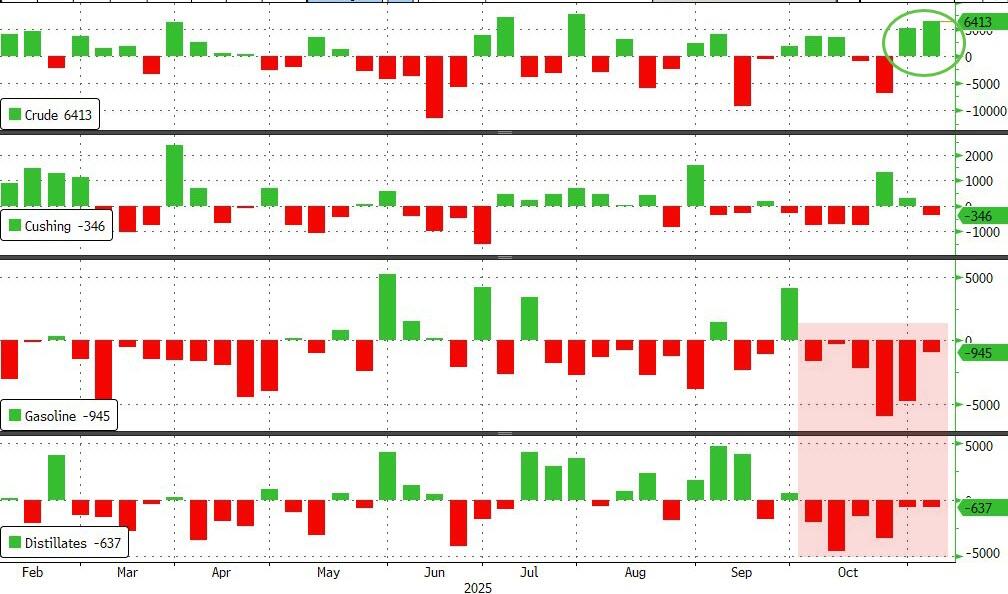
Source: Bloomberg
The last two weeks have lifted US crude stocks to their highest in five months, but we note on a seasonal basis, it continues to lag recent years…
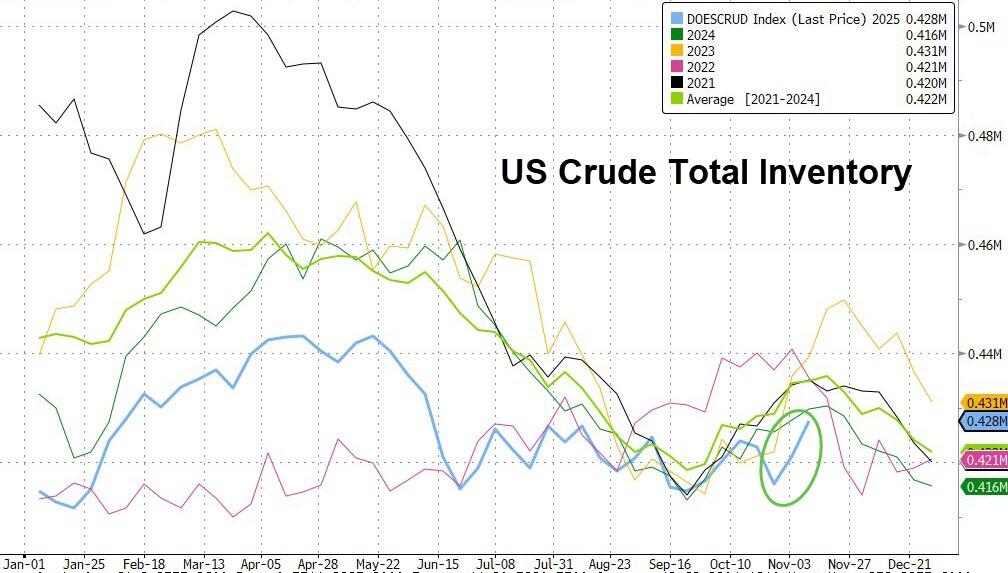
Source: Bloomberg
US Crude production surged by over 200k b/d last week to a new record high despite the ongoing slide in the rig count…
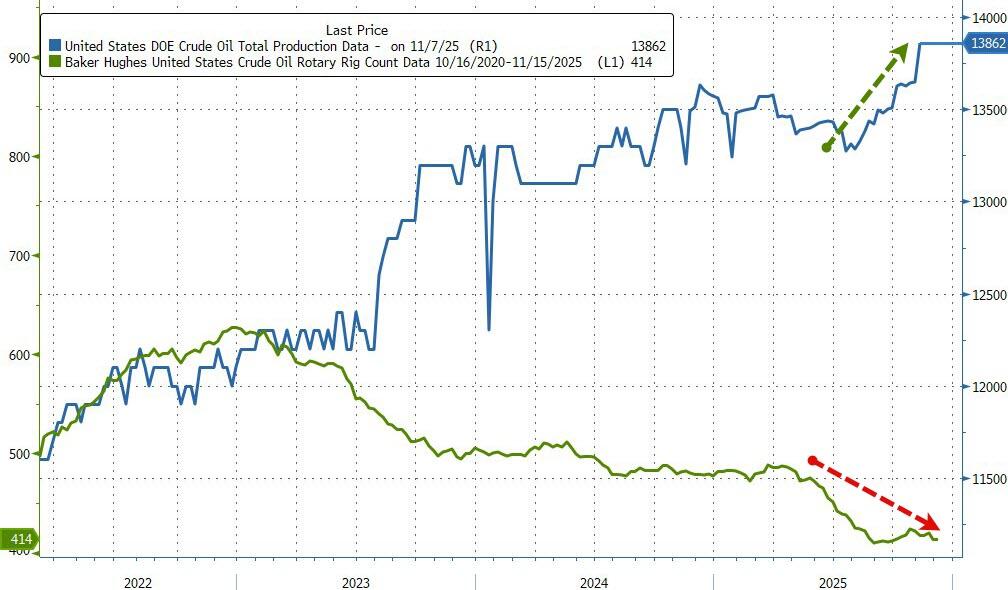
Source: Bloomberg
WTI is holding on top its modest gains off yesterday’s plunge lows for now…
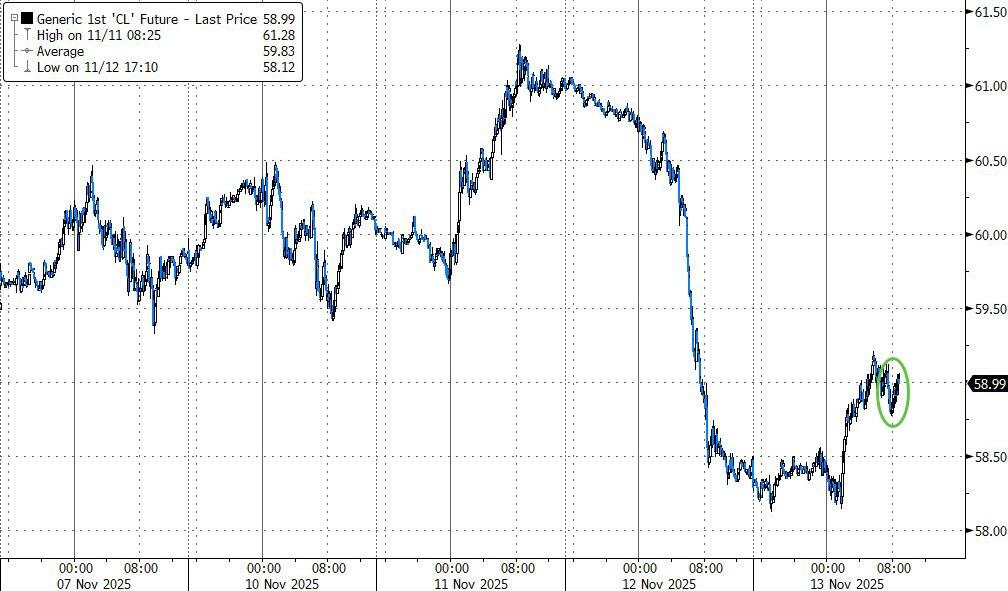
Source: Bloomberg
The bearish outlook for next year has triggered a key indicator – WTI’s prompt spread – to sink into contango…
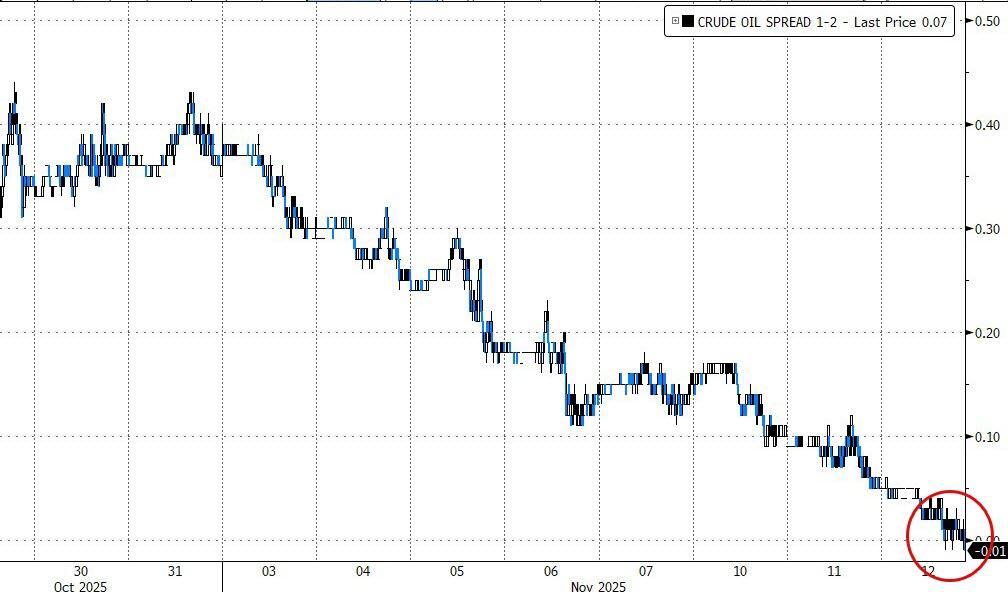
Source: Bloomberg
That pricing pattern, with the nearest contracts trading at discounts to further-out ones, signals ample short-term supplies, though it also recovered Thursday.
END
8. EMERGING MARKETS//AUSTRALIA NEW ZEALAND ISSUES
VENEZUELA/USA
YOUR EARLY CURRENCY/GOLD AND SILVER PRICING/ASIAN CLOSING MARKETS AND EUROPEAN BOURSE OPENING AND CLOSING/ INTEREST RATE SETTINGS THURSDAY MORNING 6;30AM//OPENING AND CLOSING
EURO/USA: 1.1629 UP 0.0038 PTS OR 38 BASIS POINTS/WITH STOCKS HIGHER
USA/ YEN 154.46 UP 0.784 NOW TARGETS INTEREST RATE AT 1.00% AS IT WILL BUY UNLIMITED BONDS TO GETS TO THAT LEVEL…//YEN STILL FALLS//END OF YEN CARRY TRADE BEGINS AGAIN OCT 2024/Bank of Japan raises rates by .15% to 1.15..UEDA ENDS HIKING RATES AND NOW CARRY TRADES RE INVENTS ITSELF//JAPAN IN TROUBLE WITH RISING RATES
GBP/USA 1.3162 UP .0035 OR 35 BASIS PTS
USA/CAN DOLLAR: 1.39988 DOWN 0.0021 CDN DOLLAR UP 21 BASIS PTS//CDN DOLLAR GETTING KILLED)
Last night Shanghai COMPOSITE CLOSED UP 28.63 PTS OR 0.73%
Hang Seng CLOSED UP 150.30PTS OR 0.56%
AUSTRALIA CLOSED DOWN 1.62%
// EUROPEAN BOURSE: ALL MOSTLY GREEN
Trading from Europe and ASIA
I) EUROPEAN BOURSES: ALL MOSTLY GREEN
2/ CHINESE BOURSES / :Hang SENG CLOSED UP 150.30PTS OR 0.56%
/SHANGHAI CLOSED UP 28.36POINTS OR 0.73%
AUSTRALIA BOURSE CLOSED DOWN 1.62 %
(Nikkei (Japan) CLOSED UP 218.52 PTS OR 0.43%
INDIA’S SENSEX IN THE GREEN
Gold very early morning trading: 4237.30
silver:$54.27
USA dollar index early THURSDAY morning: 99.04 DOWN 33 BASIS POINTS FROM WEDNESDAY’s CLOSE
THURSDAY MORNING NUMBERS ENDS
And now your closing THURSDAY NUMBERS 11: 30 AM
Portuguese 10 year bond yield: 3.020 % UP 2 in basis point(s) yield
JAPANESE BOND 10 yr YIELD: +1.689% DOWN 1/2 FULL POINTS AND 10/100 BASIS POINTS /JAPAN losing control of its yield curve/
JAPAN 30 YR: 3.193 UP 1 BASIS PTS//DEADLY
SPANISH 10 YR BOND YIELD: 3.175 UP 2 in basis points yield
ITALIAN 10 YR BOND YIELD 3.410 UP 3 points in basis points yield ./ THE ECB IS QE’ ING ITALIAN BONDS (BUYING ITALIAN BONDS/SELLING GERMAN BUNDS)
GERMAN 10 YR BOND YIELD: 2.6778 UP 2 BASIS PTS
IMPORTANT CURRENCY CLOSES : MID DAY THURSDAY
Closing currency crosses for day /USA DOLLAR INDEX/USA 10 YR BOND YIELD/1:00 PM
Euro/USA 1.1618 UP 0.0026 OR 26 basis points
USA/Japan: 154.66 DOWN 0.048 OR YEN IS UP 5 BASIS PTS// HIGHLY INFLATIONARY TO JAPAN
Great Britain 10 YR RATE 4.4320 UP 3 BASIS POINTS //
GREAT BRITAIN 30 YR BOND; 5.219 UP 3 BASIS POINTS.
Canadian dollar DOWN 0.0003 OR 3 BASIS pts to 1.4006
xxxxxxxxxxxxxxxxxxxxxxxxxxxxxxxxxxxxxxxxxxxxxxxxxxxxxxxxxxxxxxxxxxxxxxxxxxxxxxxx
The USA/Yuan CNY UP AT 7.0977 ON SHORE ..
THE USA/YUAN OFFSHORE UPTO 7.0968
TURKISH LIRA: 42.26 EXTREMELY DANGEROUS LEVEL/DEATH WATCH/HYPERINFLATION TO BEGIN.//
the 10 yr Japanese bond yield at +1.689 DOWN 1/2 FULL basis pts
THE 30 YR JAPANESE BOND YIELD: 3.193 UP 1/2 basis pts
Your closing 10 yr US bond yield UP 3 in basis points from WEDNESDAY at 4.097% //trading well ABOVE the resistance level of 2.27-2.32%)
USA 30 yr bond yield 4.681 UP 2 basis points /11:00 AM
USA 2 YR BOND YIELD: 3.597 UP 3 BASIS PTS.
GOLD AT 10;00 AM 4215.00
SILVER AT 10;00: 53.25
Your 11:00 AM bourses for Europe and the Dow along with the USA dollar index closing and interest rates: THURSDAY CLOSING TIME 11:00 AM//
London: CLOSED DOWN 103.74 PTS OR 1.05%
GERMAN DAX: DOWN 339.84 pts or 1.39%
FRANCE: CLOSED DOWN 8.75 pts or 0.11%
Spain IBEX CLOSED DOWN 38.40 pts or 0.23%
Italian MIB: CLOSED DOWN 37.28 or 0.08%
WTI Oil price 59.03 0.00 EST/
Brent Oil: 63.31 10:00 EST
USA /RUSSIAN ROUBLE /// AT: 80.75 ROUBLE UP 0 AND 52/ 100
CDN 10 YEAR RATE: 3.175 UP 2 BASIS PTS.
CDN 5 YEAR RATE: 2.762 UP 2 BASIS PTS
CLOSING NUMBERS: 4 PM
Euro vs USA 1.1636 UP 0.0045 OR 45 BASIS POINTS//
British Pound: 1.3191 UP .0063 OR 63 basis pts/
BRITISH 10 YR GILT BOND YIELD: 4.440 UP 5 FULL BASIS PTS//
BRITISH 30 YR BOND YIELD: 5.234 UP 2 IN BASIS PTS.
JAPAN 10 YR YIELD: 1.685 DOWN 1/2 FULL BASIS PTS (DANGEROUS TO THEIR ECONOMY
JAPANESE 30 YR BOND: 3.192 UP 0 PTS AND STILL VERY DANGEROUS TO THEIR ECONOMY
USA dollar vs Japanese Yen: 154.51 DOWN 0.201 BASIS PTS EXTREMELY DANGEROUS/YEN FALLING IN VALUE
USA dollar vs Canadian dollar: 1.4033 UP 0.0023 PTS// CDN DOLLAR DOWN 23 BASIS PTS CDN DOLLAR
West Texas intermediate oil: 58.68
Brent OIL: 63.00
USA 10 yr bond yield UP 4 BASIS pts to 4.102
USA 30 yr bond yield UP 4 PTS to 4.706%
USA 2 YR BOND 3.591 UP 3 PTS
CDN 10 YR RATE 3.180 UP 4 BASIS PTS
CDN 5 YEAR RATE: 2.764 UP 2 BASIS PTS
USA dollar index: 99.04 DOWN 33 BASIS POINTS
USA DOLLAR VS TURKISH LIRA: 42.25 GETTING QUITE CLOSE TO BLOWING UP/
USA DOLLAR VS RUSSIA//// ROUBLE: 80.70 UP 0 AND 57/100 roubles //
GOLD $4166.95 (3:30 PM)
SILVER: 52.51 3;30 PM)
DOW JONES INDUSTRIAL AVERAGE: DOWN 797.84 OR 1.65%
NASDAQ 100 DOWN 536.10PTS OR 2.29%
VOLATILITY INDEX 20.66 UP 3.15 PTS OR 17.99%
GLD: $ 382.87 DOWN 3.12 PTS OR 0.81%
SLV/ $47.42 DOWN 0.90 PTS OR OR 1.86%
TORONTO STOCK INDEX// TSX INDEX: CLOSED DOWN 554 PTS OR 1.87%
end
TRADING today ZEROHEDGE 4 PM: HEADLINE NEWS/TRADING
Bloodbath In Bitcoin & Big-Tech After Big Vote; Rate-Cut Odds Tumble
THIS AFTERNOON:
Repo Locking Up Again As Market Tries To Force Fed’s “Reserve Management Purchases”
AI EXPLANATION:
The phrase “repo locking up again as market tries to force Fed’s ‘reserve management purchases'” suggests stress in the short-term funding markets (repo market) is compelling the Federal Reserve to intervene by injecting more liquidity (cash) through asset purchases.
Here is a breakdown of the key terms and their connection:
- Repo Market Locking Up: The repurchase agreement (repo) market is where financial institutions borrow and lend cash for very short periods (often overnight), using high-quality securities like U.S. Treasuries as collateral. A “lock-up” or disruption means that participants are hesitant to lend to each other, potentially due to a lack of available cash (reserves) or a lack of trust/collateral, causing a sharp spike in short-term interest rates. This signals a potential plumbing issue in the financial system’s circulatory system, as money and credit flow gets disrupted.
- Fed’s “Reserve Management Purchases”: The Federal Reserve (Fed) conducts these purchases of Treasury securities to ensure there is an “ample supply of reserves” in the banking system. These are distinct from quantitative easing (QE) aimed at broader economic stimulus; their stated goal is to manage the level of bank reserves to ensure the effective implementation of monetary policy and smooth market functioning.
- The Connection: The market stress (repo rates spiking) is interpreted as a sign that the level of bank reserves is becoming scarce or unevenly distributed, falling below the “ample” level that banks are comfortable holding to meet their regulatory and operational needs. When this happens, market participants anticipate or “force” the Fed to step in with its reserve management purchases to add liquidity and stabilize the system.
In short, the headline indicates that recent stresses in a crucial financial market are pressuring the Fed to inject liquidity as a backstop measure to maintain stability.
WRAPUP;
Strong China tech updates hits US tech, souring sentiment – Newsquawk US Market Wrap
Thursday, Nov 13, 2025 – 04:18 PM
- SNAPSHOT: Equities down, Treasuries down, Crude down, Dollar down, Gold down.
- REAR VIEW: US Government reopens; Hawkish Fed speak, ex-Daly; UK GDP and manufacturing falls short; Hot Australian jobs report; EIA posts larger-than-expected crude build; IEA raises 2025 & ’26 demand and supply outlooks; BABA overhauls AI apps; Tencent tops earnings expectations; Strong CSCO report & guidance; Weak 30yr bond auction.
- COMING UP: Data: Chinese Retail Sales (Oct), German Wholesale Price Index (Oct), French/Spanish CPI Final (Oct), EU Trade Balance (Sep), EU GDP Flash Estimate (Q3). Speakers: ECB’s Cipollone, Elderson, Lane; Fed’s Bostic, Schmid, Logan. Supply: Australia. Earnings: Swiss Re, Allianz, Siemens Energy.
More Newsquawk in 2 steps:
- 1. Subscribe to the free premarket movers reports
- 2. Trial Newsquawk’s premium real-time audio news squawk box for 7 days
MARKET WRAP
It was risk-off on Thursday with Nasdaq and big tech names leading the losses, seemingly driven by concerns over the US position in the AI race against China after a slew of positive commentary from China tech companies overnight (see full summary here). The SPX sold off by over 100 points at the close, with RUT and NDX clearly underperforming. Sectors were predominantly lower, with the homes of the heavy weights, Consumer Discretionary, Tech and Communications lagging. Energy, Consumer Staples and Health Care outperformed. Energy stocks tracked crude prices higher as Russia appeared frustrated with Ukraine’s lack of negotiations but crude did settle well off the highs amid the downbeat risk tone while inventory data saw a chunky build, weighing on prices. Over supply forecasts were also seen in the IEA oil market report for 2026. T-Notes and SOFR futures were lower throughout the session, seemingly on the reopening of the government but also on several hawkish Fed speakers. On the Wednesday close Collins, who typically is more neutral, had a clearly hawkish tone, noting the bar is high for more easing. Kashkari also revealed he did not support the October rate cut. Musalem supported rate cuts so far, but said the Fed needs to proceed with caution. Hammack’s focus remains on inflation, but she did admit she is worried about the labour market. Daly, meanwhile, is more concentrated on labour market weakness. In FX, the Franc continued on its recent run of outperformance with EUR/CHF approaching 0.9200. The Dollar was dold which supported the Pound despite weak growth data. Antipodes and CAD lagged due to the risk tone, with AUD paring overnight gains after a strong labour market report. Gold prices were sold throughout the US session, paring all gains overnight, seeing the yellow metal fall from USD 4,245/oz to USD 4,146/oz peak to trough.
US
DALY (2027 Voter): It is premature to say whether there will or won’t be a rate cut in December, noting that while uncertainty has come down quite a bit, the Fed still has work to do to bring inflation down to 2%. She described inflation as stubborn but on its way down and acknowledged the labour market has slowed quite a bit. She emphasized there is a premium on waiting for more information before deciding on rates, and confirmed she has not made a final decision yet for the December meeting. She also said “unequivocally no”, when asked about raising the 2% inflation target. She also was dovish in noting that she thinks risks are in balance at the moment, but still slightly higher on employment.
HAMMACK (2026 voter): Worried about the labour market, but expects high inflation to stick around. Hammack said she understood why some of her colleagues are concerned about the employment piece of the Fed’s mission, given recent sluggishness in the labour market, however, she’s not taking her focus away from prices. In the Q&A, Hammack noted that Fed policy needs to remain somewhat restrictive to push inflation pressures down. The Cleveland Fed President added monpol is currently barely restrictive, if at all, and it is likely the neutral rate has been trending upward. Echoing colleagues recently, Hammack said it probably won’t be too long before the Fed expands the balance sheet again on technical factors, and expects firms to use the standing repo facility if it makes sense.
KASHKARI (2026 voter): Inflation is still too high at 3%, and there are mixed signals in the economy. Noted some sectors in the labour market look under pressure. He said it seems there are real pockets of weakness in the labour market, but data suggests more of the same since the October meeting. He revealed he did not support the last rate cut, and he is undecided on December.
MUSALEM (2025 voter, hawk): When speaking on data, said it is critical to return to having readily available official data that has integrity, but stressed they are not flying blind and have a reasonable picture of what the economy is doing. He added the economy is pretty resilient, and expects Q4 weakness, rebound in Q1 with next year at or above potential. The St. Louis Fed President expects the labour market to stay around full employment, likely to soften a little, and get to 4.5%. On tariffs, he expects the impact of tariffs to fade by H2 next year, provided they have an appropriate monopoly. On monpol, Musalem supported rate cuts so far to protect the labour market, but need to proceed with caution now. The hawk remarked there is limited room to ease without becoming overly accommodative, and policy is closer to neutral than modestly restrictive.
COLLINS (2025 voter): The Boston Fed President usually toes a neutral tone on the FOMC. However, the latest set of remarks were hawkish. She said it is likely appropriate to keep the policy rate on hold for some time, with a relatively high bar for easing in the near term. She described policy as mildly restrictive and warned that further monetary support risks stalling progress on inflation, which she expects to remain elevated into early 2026 due in part to tariffs. She emphasized that rate cuts should wait until inflation is durably on track to 2%, and said she is hesitant to ease further without notable labour market deterioration. While unemployment is expected to climb modestly, she has not seen an increase in downside employment risks since summer.
FIXED INCOME
T-NOTE FUTURES (Z5) SETTLED 7+ TICKS LOWER AT 112-24+
T-Notes sold on Fed commentary and government reopening. At settlement, 2-year +2.5bps at 3.591%, 3-year +2.9bps at 3.590%, 5-year +3.7bps at 3.705%, 7-year +3.8bps at 3.888%, 10-year +3.2bps at 4.112%, 20-year +4.3bps at 4.677%, 30-year +4.0bps at 4.703%
INFLATION BREAKEVENS: 1-year BEI +2.3bps at 2.781%, 3-year BEI +1.2bps at 2.493%, 5-year BEI +1.6bps at 2.316%, 10-year BEI +1.2bps at 2.276%, 30-year BEI +1.0bps at 2.234%.
THE DAY: T-Notes saw choppy trade on Thursday but ultimately settled lower. There was a move higher in the European Morning, tracking Gilts higher after the weak growth market data in the UK. T-Notes peaked at 113-01+ but failed to hold above 113-00 for long. As the US morning arrived, T-Notes pared the earlier upside and sold off throughout the session to hit a low of 112-22. A rebound was attempted, but cut short after a weak 30-year bond auction.
There was also a notable move in money market pricing for the Fed, with markets now just pricing in a 25bps rate cut at a 50% probability, vs. a 64% probability on Wednesday. The downside in SOFR futures and Treasuries appeared to be led by the reopening of the government after the House passed the Senate bill last night, with Trump swiftly signing the bill. However, this was largely expected following reports in recent sessions. Nonetheless, also weighing may have been commentary from Fed’s Collins on the closing bell on Wednesday. She typically is a more neutral member on the FOMC, but her comments were clearly on the hawkish side. The 2025 voter said it is likely appropriate to keep policy rates on hold for some time, and there is a relatively high bar for additional easing in the near term. Fed’s Daly, however, said she has not made a final decision yet on a December rate move. Hammack expressed concern about the labour market, but caveated that she is not taking away her focus on prices. Kashkari also warned that inflation is still too high. Musalem spoke up on the economy, and said they need to continue leaning against inflation. He said the Fed needs to proceed with caution, and there is limited room to ease without becoming overly accommodative.
SUPPLY:
Notes
- Overall, a weak 30-year bond auction. The Treasury sold USD 25bln of 30-year bonds at a high yield of 4.694%, below the prior 4.734%. This tailed the when issued by 1bps, larger than the prior 0.4bps tail and six-auction average tail of 0.3bps. The bid-to-cover was also soft at 2.29x, below the 2.38x prior and 2.36x average. Direct demand plummeted to just 14.5% from 26.9%, well below the 26% average, but indirect demand rose to 71% from 64.5%, above the 61.6% average. However, this was not enough to offset the weak Direct demand, leaving dealers with an above-average 14.5% of the auction, up from October’s 8.7%. The soft 30-year auction follows the weak 10-year supply on Wednesday, but the 3-year offering was solid. Showing more demand for shorter-dated paper.
- US to sell USD 16bln of 20-year bonds on November 19th, to settle December 1st; to sell USD 19bln of 10-year TIPS on November 20th, to settle November 28th.
Bills
- US to sell USD 86bln of 13-week bills on Nov 17, to settle on Nov 20.
- US to sell USD 77bln of 26-week bills on Nov 17, to settle on Nov 20.
- US to sell USD 95bln of 6-week bills on Nov 18, to settle on Nov 20.
- US sells USD 110bln 4-week bills at a high rate of 3.900%, B/C 2.73x
- US sells USD 95bln 8-week bills at a high rate of 3.835%, B/C 2.87x
STIRS/OPERATIONS
- Market Implied Fed Rate Cut Pricing: Dec 12bps (prev. 16bps), January 23bps (prev. 26bps), March 34bps (prev. 37bps).
- NY Fed RRP op demand at USD 3.9bln (prev. 3.76bln) across 8 counterparties (prev. 18)
- NY Fed Repo Op demand at USD 6.05bln across two operations today (prev. 6.052bn).
- EFFR at 3.87% (prev. 3.87%), volumes at USD 77bln (prev. 77bln) on November 12th.
- SOFR at 3.98% (prev. 3.95%), volumes at USD 3.209tln (prev. 3.135tln) on November 12th.
CRUDE
WTI (Z5) SETTLED USD 0.20 HIGHER AT 58.69/BBL; BRENT (F6) SETTLED USD 0.30 HIGHER AT 63.01/BBL
The crude complex was marginally firmer, albeit settling well off peaks, as oil attempted to pare some of Wednesday’s extensive losses. Through the European morning, WTI and Brent saw upside to hit highs of USD 59.21/bbl and 63.10, respectively, and saw a boost after the Kremlin said Ukraine must negotiate with Russia “sooner or later” and that its negotiation position is worsening by the day. Prior to that, and following the bearish OPEC MOMR yesterday, the IEA OMR raised 2025 and 2026 demand growth forecasts, and also ’25 and ’26 supply forecasts, but no follow-through was seen. For 2026, the IEA raised 2026 demand by 70k barrels, and 2026 supply by 120k – signalling more oversupply. However, downside was seen after the weekly EIA data, which saw a much larger than expected crude build, accompanied by weekly crude production rising 211k BPD W/W to 13.862mln bbls. The energy space continued to push lower on the broader risk-off sentiment in the US as equities, led by tech, saw heavy selling, as did the Dollar and spot gold.
EQUITIES
CLOSES: SPX -1.64% at 6,739, NDX -2.05% at 24,993, DJI -1.65% at 47,457, RUT -2.78% at 2,383.
SECTORS: Consumer Discretionary -2.73%, Technology -2.37%, Communication Services -1.74%, Industrials -1.52%, Utilities -1.40%, Real Estate -1.31%, Financials -1.30%, Materials -0.75%, Health -0.02%, Consumer Staples unchanged, Energy +0.31%.
EUROPEAN CLOSES: Euro Stoxx 50 +1.17% at 5,793, Dax 40 +1.22% at 24,381, FTSE 100 +0.12% at 9,911, CAC 40 +1.04% at 8,241, FTSE MIB +0.80% at 44,793, IBEX 35 +1.39% at 16,616, PSI +1.21% at 8,294, SMI +0.80% at 12,803, AEX -0.21% at 969.
STOCK SPECIFICS:
- Alibaba (BABA) overhauled AI apps.
- Baidu (BIDU) unveiled two new AI chips the M100 and M300, and intended for release in 2026 and 2027, respectively.
- Cisco (CSCO): EPS, rev. beat & strong guidance w/ strong AI-fuelled equipment demand
- Disney (DIS): Revenue short; Profit at the traditional TV unit fell 21% & income from ESPN slipped too.
- Dollar Tree (DLTR) double-downgraded at Goldman Sachs.
- Flutter Entertainment (FLUT): Rev. light & cut guidance
- JD.com (JD): EPS & rev. topped Wall St. consensus w/ upbeat CEO commentary.
- Repsol (REP SM) said to consider a merger of its USD 19bln upstream unit with APA Corp (APA), according to Bloomberg.
- Sealed Air (SEE) reportedly in advanced talks to be taken private by Clayton Dubilier & Rice.
- Tencent (TCEHY) had a stellar earnings report as growth remained broad-based as it continues to avoid large AI-infrastructure spending.
- Tesla (TSLA) developed support for Apple (AAPL) CarPlay in a long-requested move, according to Bloomberg; TSLA mulls CarPlay rollout in coming months following tests.
- Tesla (TSLA) is recalling the Powerwall 2 AC battery system due to burn and fire hazards, via USCPSC; covers c. 10.5k units.
- Verizon (VZ) is reportedly planning to cut roughly 15k jobs, looking to reduce costs as it contends with increased competition for Wireless Service and home Internet, according to WSJ, citing sources.
- Verizon (VZ) is reportedly planning to cut roughly 15k jobs, looking to reduce costs as it contends with increased competition for Wireless Service and home Internet, according to WSJ, citing sources.
- Japanese Co. Kioxia did not provide FY outlook after results; in earnings, rev. for 6mnths -13% Y/Y w/ op. profit -55.2% Y/Y; US memory names all lower Seagate (STX) , Western Digital (WDC), Sandisk (SNDK), and Micron (MU).
- For a US/China AI Newsquawk analysis piece, please click here.
FX
The Dollar was heavily sold on Thursday, as USD-denominated assets were hit hard, as risk-off sentiment was seen through the duration of the US session. Some of the reasoning for that was the bullish China tech updates overnight, which weighed heavily on mega-cap US names, and continues to support the comments NVDA CEO Huang made last week that China “will win the AI race”. Overnight, Trump signed the bill to end the Government shutdown, as expected, and as such we now await the release of the delayed data, albeit no schedule has been announced yet. On that, White House Advisor Hassett said the jobs part will be released for one month, but not the unemployment rate, because of the shutdown. There were plenty of Fed speakers however, Fed pricing moved markedly hawkish today with only 12bps of cuts priced in by year-end vs. 16bps on Wednesday. Seemingly driven by the reopening of the government and hawkish Fed speak.
G10 FX was mixed. Antipodeans and CAD lagged and saw slight losses against the Dollar, as they were likely hit by wider risk-off sentiment as opposed to profiting off the weakening Buck. For the Aussie, it saw mild strength overnight following the better-than-expected jobs report – the economy added 42.2k jobs in October, above the expected 20k and prior 14.9k. AUD/USD traded between 0.6524-80, while NZD/USD drifted to lows of 0.5635 from a high of 0.5682.
CHF, GBP, EUR, and JPY all saw strength, and in that order, with the Swissy the notable outperformer and continuing to extend on its recent strength. USD/CHF hit a low of 0.7909 against its weekly peak of 0.8072. EUR/CHF tested 0.92. The Pound also pared all its losses seen in wake of the disappointing September GDP data, which declined -0.1% M/M against the expected 0.0% and previous 0.1%. Sterling paring its weakness was likely a function of the broad Dollar selling, as Cable topped out at 1.3215 against an earlier low of 1.3101. EURGBP was flat.
Out of Europe there was a bit of ECB rhetoric, but little new was added, while BoJ Governor Ueda remarked if long-term rates rise sharply in a way out of step with usual market moves, the BoJ is ready to respond flexibly, such as by increasing bond buying. USD/JPY traded between 154.14-155.01 and the pair rebounded from its high amid the aforementioned Dollar selling. However, ING earlier noted that as USD/JPY continues to creep higher in the low-volatility, risk-on environment and as Japan’s MoF continues to send warning signs, they definitely believe they are entering FX intervention territory, but even if intervening is the plan, there is an argument for the MoF to wait until US data releases resume.
EMFX was mixed, albeit in thin currency-specific newsflow. In data, Brazilian retail sales in September unexpectedly fell M/M, while the Y/Y gain was a lot less than anticipated. In LatAm FX, desks note Latin America is heading into 2026 with carry still its calling card, but politics will decide who gets paid.
USA ECONOMIC COMMENTARIES
After 43 Days, Congressional Democrats Fold, Vote To End Historic US Govt Shutdown
Wednesday, Nov 12, 2025 – 08:20 PM
Update (0800ET): After a record 43 days (and 14 failed votes)…
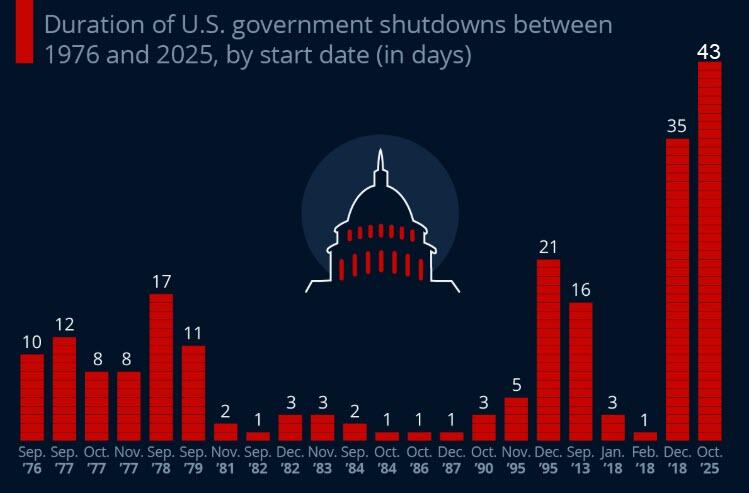
…the shutdown is finally over as Democrats folded (amid the fire and brimstone from their colleagues), voting with Republicans to reopen the government.
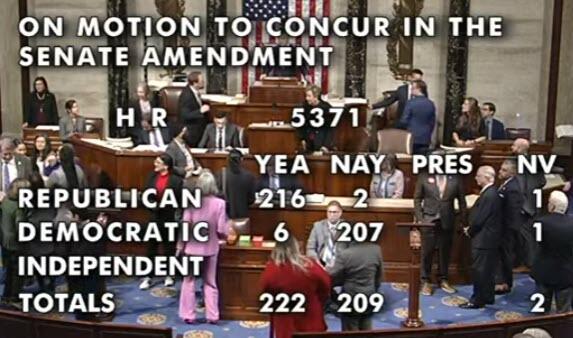
The 222-209 vote saw 6 Democrats vote to reopen the government and 2 Republicans vote against the measure (h/t Jake Sherman)
There was some drama when Rep. Marie Gluesenkamp Perez (D-Wash.) shocked and dismayed colleagues with a rogue effort to condemn retiring Rep. Chuy García (D-Ill.) for effectively ensuring his chief of staff would succeed him in Congress.
But other than that it was the usual moments for House Dems to conjure ‘TikTok’-size monologues about how evil Republicans are.
As we detailed below, the plan combines a continuing resolution to keep the government funded through Jan. 30 with a three-bill “minibus” package – when we get to do this all over again! (joy of all joys) Of note, the Minibus provisions are good until Sept. 30.
- It will also reinstate federal workers fired during the shutdown and guarantee back pay. It will also prevent further layoffs through the end of January.
- It also excludes an extension of advanced Obamacare premium tax credits – which Democrats caved on at the 11th hour.

Equity futures surged on the vote…
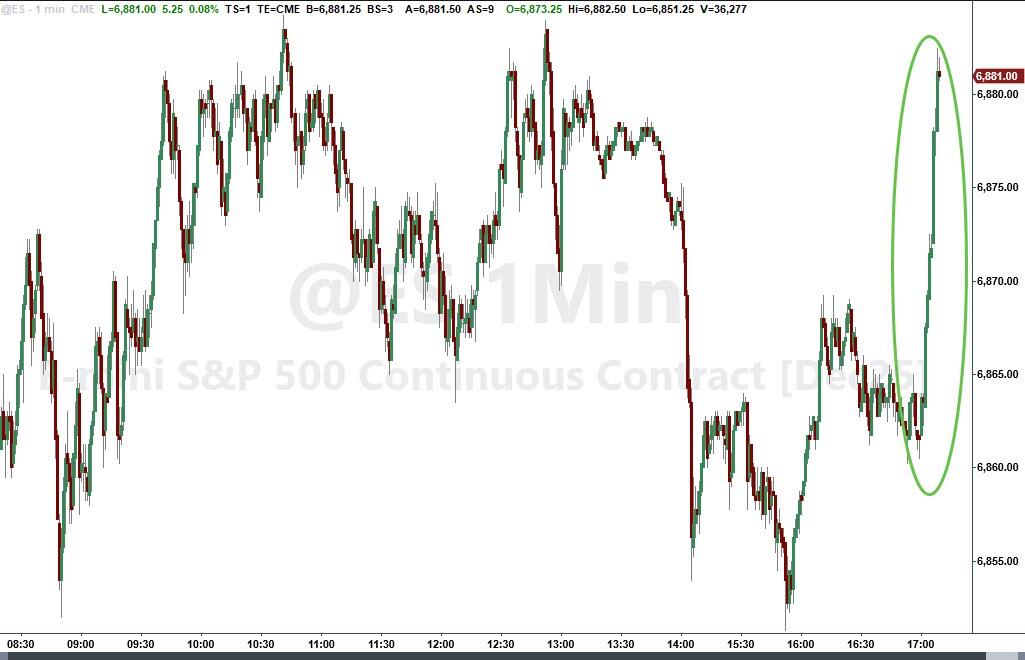
And now the spice (macro data and TGA unwind) can flow.
END
Schumer Who? How Centrists Broke Ranks To End Shutdown As Democratic Rift Widens
Thursday, Nov 13, 2025 – 09:25 AM
The political breakthrough that ended the longest government shutdown in U.S. history did not come from the Oval Office or from the Senate’s top Democrat. Instead, it emerged from a quiet, late-night meeting in a nearly deserted Capitol, where a small band of centrist Democrats forged an agreement with senior Republicans – over the objections of their own leadership.

A Quiet Meeting, a Major Shift
According to the Wall Street Journal, two nights before Halloween, with federal workers missing paychecks and food-assistance programs running dry, Sens. Angus King of Maine, Jeanne Shaheen and Maggie Hassan of New Hampshire – each a former governor, slipped into Senate Majority Leader John Thune’s office after the chamber had adjourned. Joining Thune were Republican Sens. John Hoeven of North Dakota, also a former governor and veteran appropriator, and Susan Collins of Maine, along with Sen. Katie Britt of Alabama.
The group had grown impatient. Nearly a month into the shutdown, they saw little sign that President Trump or Senate Minority Leader Chuck Schumer would break the stalemate. “It was a group of people trying to solve a problem,” Mr. King said.
When asked by MSNBC why he caved, King said that trying to “stand up to Donald Trump” simply didn’t work…
Schumer was informed of the dialogues, lawmakers said, but declined to participate. The Democratic leader believed time was on his side: that Trump would eventually feel compelled to negotiate and Democrats could secure a more favorable outcome – including an extension of expiring Affordable Care Act subsidies that had become the central Democratic demand.
The centrists, however, saw a riskier path. And with little progress from the White House, they proceeded.
A Deal That Divides
The negotiations produced a bipartisan agreement to reopen most of the government through Jan. 30 and fully fund several key programs, including food assistance, for a year. Thune pledged a December vote on extending the ACA subsidies, though he would promise no outcome.
To the centrists, the commitment – combined with the January funding deadline, which gives Democrats an opportunity to force another showdown – was enough. “We sat across from him, we looked him eye to eye,” Ms. Shaheen said, describing her trust in Thune’s assurances.
For many Democrats, it was not. Progressives and party activists erupted in anger, accusing the centrists of caving with little to show for it. Schumer, who voted against the measure, faced criticism from both sides: progressives for failing to keep the caucus unified, and centrists for resisting what many viewed as the only viable off-ramp.
Schumer’s allies counter that he held his caucus together longer than Republicans expected and that Democrats had successfully elevated healthcare costs as the defining issue heading into the midterms.
Internal Pressure Mounts
Centrists briefed Schumer regularly and agreed to his requests to delay any commitments until after Nov. 1, the start of Obamacare open enrollment, and then until after the Nov. 4 election. But as new Democratic electoral victories rolled in, many senators still preferred to hold firm.
That position became harder to justify as the shutdown’s effects escalated. Flight delays worsened. Federal workers missed multiple paychecks. Food-assistance and heating-aid benefits dwindled.
By Sunday, eight Democrats had peeled off, concluding that Trump would not enter negotiations anytime soon. “We were harming a lot of people in the service of a strategy that wasn’t working,” King said.
A Last-Minute Push
Schumer made his final bid on Friday: reopen the government in exchange for a one-year extension of the ACA subsidies. Republicans swiftly rejected it. Over the weekend, centrists renewed their push, bolstered by growing Democratic defections.
On Sunday, Schumer said he could not support a deal “that fails to address the healthcare crisis.” But the votes were slipping away. Republicans needed the support of Sen. Tim Kaine of Virginia to secure the necessary 60 votes. Britt, alongside GOP leadership and White House officials, worked with Kaine to add provisions reversing shutdown-driven federal layoffs and prohibiting new ones through January.
Kaine agreed. Late Sunday, the Senate advanced the measure 60–40, with no votes to spare.
Political Fallout
For Schumer, the episode marks another intraparty challenge. In March, he was criticized for voting with Republicans to avert a shutdown; now he is under fire for failing to maintain one. Still, Democrats credit him with elevating healthcare as a defining issue for the coming midterms.
On Monday, he framed the outcome as a Republican miscalculation. “Republicans now own this healthcare crisis,” he said. “They knew it was coming. We wanted to fix it. Republicans said no.”
Whether voters will see it that way – or whether the schism between Democratic factions widens – remains an open question. What is clear is that, in the end, it was the quiet work of centrists—not high-level brinkmanship—that forced the government back open.
On Tuesday Sen. John Fetterman (D-PA) appeared on Fox News to tell the world that “no one really knows” who’s in charge of Democrats on Capitol Hill – as Schumer “never” discussed the shutdown with him.
Fetterman addressed an Axios report that confirms the above: Schumer privately pressured a group of moderate Democrats in mid-October to keep the government closed until Obamacare open enrollment on Nov. 1.
When asked by co-host Lawrence Jones “Who is running the show now in the Democratic Party, in the Senate, in the House?” Fetterman replied: “No one really knows.“
“It’s always a hard yes to keep our government open,” Fetterman explained. “I mean, that’s my principle, because it’s wrong to shut our government down. And now we knew that we would put [at risk] those 42 million Americans for SNAP and paying our military and, you know, the Capitol Police. I mean, people have went five weeks without being paid. I mean, that’s a violation of my core values. And I think it’s [a violation of] our party’s [values] as well.“
Schumer who? (h/t Capital.news)
SEATTLE
Move Over Mamdani, Seattle Set To Elect Socialist Mega-Karen Mayor

Wednesday, Nov 12, 2025 – 09:20 PM
Self-avowed socialist Katie Wilson is on the brink of winning Seattle’s mayoral race in what is the latest sign that the Democrat Party is shifting even further to the left.

As of Tuesday, Wilson pulled ahead of incumbent Bruce Harrel by a mere 1,300 votes. Wilson overtook Harrel with the help of mail-in ballots, which have favored the socialist by wide margins, according to King County Elections.
“Kate Wilson won 61.23% of the 6,121 ballots counted today,” said local political consultant Crystal Fincher. “I’m comfortable calling this race for Wilson now.”
Politico reports:
Ms. Wilson, who describes herself as a socialist, centered her campaign on housing affordability and economic inequality—themes that echo New York City mayoral candidate Zohran Mamdani’s progressive platform. She proposed a capital gains tax to generate revenue, stronger tenant protections, and expanded public transit.
The message resonated in a city where median home prices have soared beyond the reach of many residents. Ms. Fincher noted a generational divide over economic concerns. “There’s a disconnect between what younger people are going through in day to day life today,” she said.
Despite Wilson’s all-but-certain victory, some Washington state Republicans are licking their chops over a socialist running Seattle.
Washington State Republican Chairman Jim Walsh believes Wilson “would be very bad for Seattle, but very good for the Washington state Republican Party.”
However, Wilson isn’t declaring victory just yet, telling reporters, “We’re going to wait for all of the ballots to be counted, but I think we won this race.”
Some are comparing Wilson to Zohran Mamdani, whose nine-point demolition of Andrew Cuomo in the New York mayoral race has thrust City Hall into the hands of a 34-year-old democratic socialist whose policy agenda threatens to upend the city’s fragile post-pandemic fiscal equilibrium and accelerate the exodus of capital and talent.
Mamdani’s radical platform. such as fare-free transit, city-run grocery stores, rent freezes on all stabilized units, and a 2% “mansion tax” on residences above $5 million, would add at least $18 billion in annual spending, according to preliminary estimates from the Independent Budget Office.
Ahead of taking office, Mamdani is already attempting to repair his relationship with President Donald Trump, telling local media that good relations “will be critical to the success” of the city, and said that he plans to call the president soon.
“I will be proactive in the work that I do, and I think that is because the responsibility I hold to 8.5 million people being their mayor,” Mamdani said. “It is important that you are open to working with anyone, no matter what disagreements you may have. And, I’ve said this when it pertains to President Trump, that President Trump wants to speak about lowering the cost of living or delivering cheaper groceries like he ran on, I’m there to have that conversation.”
In a recent interview with Fox News Channel host Bret Baier, Trump warned that Mamdani was off to a “bad start” by targeting him repeatedly in his victory address.
“It was a very angry speech, certainly angry toward me,” Trump told Baier. “I think he should be very nice to me. You know, I’m the one that sort of has to approve a lot of things coming for him. So, he’s off to a bad start.”
END
CHICAGO
unbelievable: they hate America!!
“Chicagoans Do Not Want Us To Bankroll The Regime”: Chicago Will No Longer Buy Treasury Bonds
Thursday, Nov 13, 2025 – 12:20 PM
“It’s a bold statement, isn’t it?”
Those words of Chicago City Treasurer Melissa Conyears-Ervin hardly capture the moment.

Yesterday, Conyears-Ervin declared that her office would no longer invest in U.S. Treasury bonds to protest what she called the “authoritarian regime” of President Donald Trump. It is more bonkers than bold. It makes about as much sense as President Trump saying that he will not eat deep-dish pizza to protest Chicago.
My hometown of Chicago is facing an economic meltdown due to towering debt and massive spending. Mayor Ben Johnson and the unions have pushed self-destructive tax schemes and borrowing plans that would only accelerate the flight from the city and the collapse of the city’s finances.
Now, the person in charge of investing that money is declaring that politics rather than economics will guide investments.
It is the ultimate virtue signaling at the cost of others. She is given a fiduciary duty to properly maintain and protect the investments of the city, which is currently facing a rising debt crisis. She is saying that the city will not invest in what Ald. Bill Conway (34th), a former investment banker, correctly described as “by far the most liquid and secure debt instrument in the history of the world.”
Chicago has held almost a quarter of a billion dollars in Treasury bonds in the last three years due to its healthy return for citizens. To forego such investments is Kamikaze economics, destroying your own portfolio and investors as a demonstration of true faith.
The position hurts only Chicagoans. However, the loss to the citizens could still provide gains to Conyears-Ervin, who is running to replace radical Chicago congressman, Danny Davis. Her announcement is meant to tap into the rage as she declared: “Chicagoans do not want us to bankroll the regime — the authoritarian regime — of Donald Trump where he has waged a war on our city. It’s a bold statement, isn’t it? And we need it to be.”
So, a city collapsing under debt will forego investing in one of the most secure debt instruments in the world.
Let’s recap. Mayor Johnson wants to float massive bonds to avoid cutting the budget while taxing large businesses for every new person that they employ. At the same time, the city will not invest in bonds that guarantee the most secure investment of money currently in city coffers.
This is coming in a week when many are questioning the logic of the government shutdown. After losing billions and putting many families and travelers into duress, the Democrats agreed to basically the identical clean CR that was offered over a month earlier. Yet, Conyears-Ervin makes that effort seem brilliant in comparison.
It is the same logic as burning money as a way to prevent its theft.
It is not clear where the money will go.
Antifa does not currently offer an investment fund option that guarantees a total political return with no capital gains. On the other hand, over $200 billion is practically hard to stuff in the mattress of Conyears-Ervin.
This could work out in the end, resulting in practically no loss due to the new investment policies. As Johnson virtually chases businesses out of the city, there will be less money to invest. Problem solved.
END
VERIZON
Layoffs keep coming!! Now it is verizon set to axe 15,000 jobsd
(zerohedge)
Verizon Set To Axe 15,000 Jobs Right Before Thanksgiving Holiday
Thursday, Nov 13, 2025 – 12:00 PM
The optics look awful for Verizon Communications if the Wall Street Journal’s report is accurate: the carrier is preparing for its largest job cuts ever just days before millions of Americans hit the road for Thanksgiving.
WSJ says Verizon is planning to cut 15,000 jobs. If that figure is correct, Bloomberg’s latest data suggests this would be about 15% of its roughly 100,000-person workforce. WSJ notes this would be the largest workforce reduction on record for the carrier.
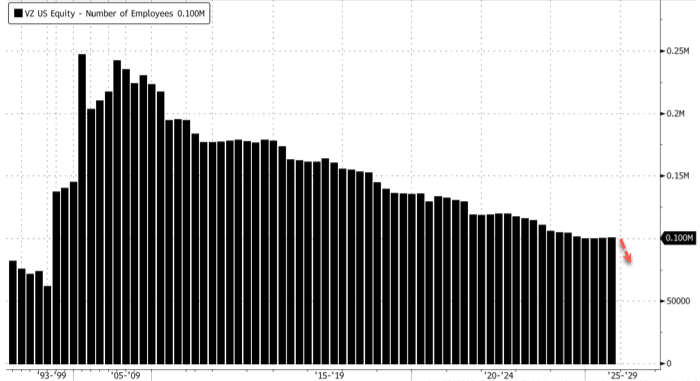
Most of the job reductions will come from direct layoffs, and the carrier will shift 200 corporate stores into franchise operations, removing those employees from Verizon’s payroll.
For three consecutive quarters, Verizon has been losing postpaid phone subscribers, putting pressure on leadership to stop the hemorrhaging.
Earlier, Verizon chairman Mark Bertolini told CNBC’s Becky Quick on “Squawk Box” that the company needs to “do something different” as it undergoes its leadership change.
Bertolini said the carrier’s new CEO, ex-PayPal boss Dan Schulman, is working on a turnaround plan after share losses under former CEO Hans Vestberg.
“Verizon has gone from number one in market cap, bond ratings and market share to number three. And the network isn’t as differentiated as it used to be, in large part because everybody’s been spending money to put these 5G networks in place,” Bertolini said. “So losing 30% share over the last eight years is an issue, and we have to do something different.”
Bertolini added that Schulman will reveal his plan to turn the company around “sooner rather than later.”
Schulman recently pledged to “aggressively transform our culture, our cost structure, and the financial profile of Verizon in order to put our customers first, compete effectively, and deliver sustainable returns for our shareholders.”
Shares of Verizon in New York are up only 4% year to date, after being halved since peaking around $60 a share in late 2021.
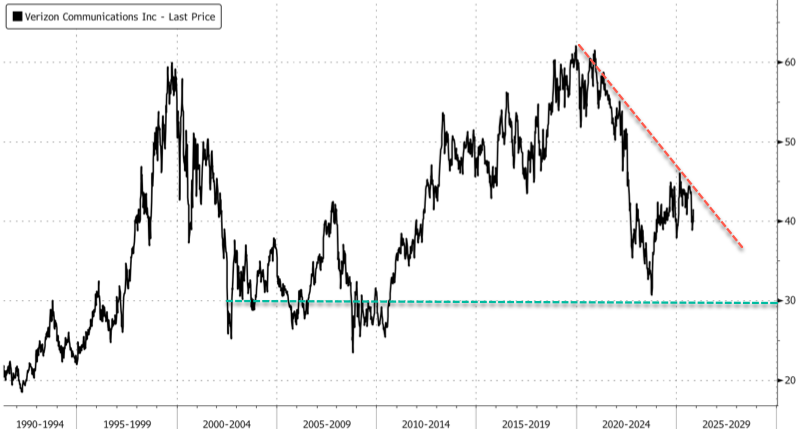
T-Mobile appears to be the winner in the ‘carrier wars’…
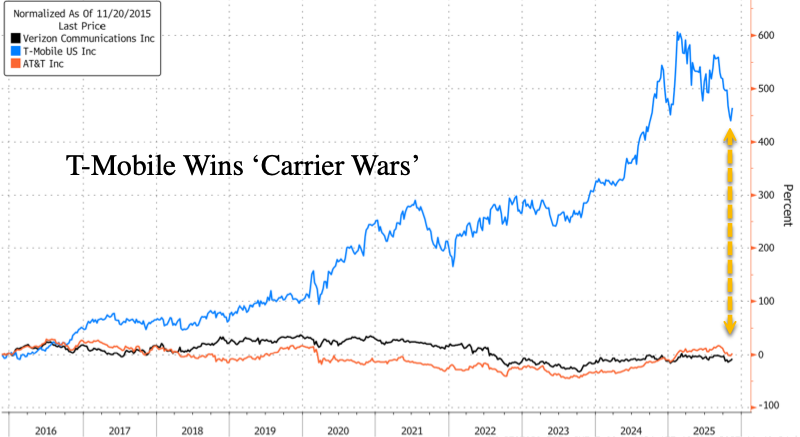
Rest assured, AI will drive deeper workforce cuts in the years ahead. Everyone is starting to figure out what we’ve known for years (read here)
end
PENNSYLVANIA
Finally cooler heads prevail: carbon trading(climate crisis) etc was a hoax!!
First Casualty Of Power Bill Crisis? Pennsylvania Abandons Regional Carbon-Trading Market
Thursday, Nov 13, 2025 – 03:40 PM
The worsening power bill crisis across the Mid-Atlantic region, a combination of nation-killing climate change policies colliding with surging load growth from data centers, has forced Pennsylvania Governor Josh Shapiro to sign legislation allowing the state to abandon the Regional Greenhouse Gas Initiative (RGGI).
The Pennsylvania legislature ended the state’s RGGI participation in the new state budget, which also cut funding tied to the climate initiative, effectively reversing the state’s 2019 entry under former Governor Tom Wolf.
Senate Republicans have opposed RGGI for years, which, through its carbon-pricing structure, effectively penalizes the state’s energy sector, increasing costs for the very plants that anchor the state’s power grid and industrial economy. In return, power plants pay for CO₂ allowances that only send wholesale electricity prices higher, and result in higher power bills for businesses and families.
It’s straightforward: climate taxes = higher power bills.
Independent reports (from grid operator PJM and state regulators) have warned RGGI would:
- pressure to close gas and coal plants early
- loss of grid resilience
- higher risk of capacity shortages
Given surging load growth from data centers, RGGI was a disaster waiting to happen that would’ve stripped the grid of spare capacity, destabilized regional power supply, and effectively paralyzed the state into a power crisis, as its neighbors just south, in Maryland, have done through failed globalist climate crisis policies.
“For years, the Republicans who’ve led the Senate have used RGGI as an excuse to stall substantive conversations about energy production; today that excuse is gone,” Shapiro told reporters during a press conference minutes before signing the budget.
Shapiro noted, “I am looking forward to aggressively pushing for policies that create more jobs in the energy sector, bring more clean energy onto our grid and reduce the cost of energy for all Pennsylvanians.”
The question becomes whether other surrounding states, many of which are experiencing power bill crises, thanks to horrible green policies that strip stable spare capacity from grids and replace it with unreliable solar and wind, which collide with expanding load growth from data centers, quietly exit RGGI.

It’s time to bring common sense back to Mid-Atlantic politics after decades of failed Democratic policies that have sparked a cost-of-living crisis. And for those leftist-controlled states still pushing the climate-crisis narrative, remember this: even Bill Gates has acknowledged that many of the extreme claims around climate policy have been overstated.
By the way, the whole climate crisis hoax delayed America’s ability to add new reliable spare capacity on the grid – now it must play catch up (all detailed in this epic report).
END
Subprime Auto Delinquencies Worst In Over 30 Years
Thursday, Nov 13, 2025 – 01:25 PM
Building on the theme of low-income consumers and young people burdened by debt and affordability woes, signs of stress are continuing to emerge across the subprime tier of the auto loan space.
A new Bloomberg report on Wednesday, citing data from Fitch Ratings, showed that delinquency rates on subprime auto loans surged to their highest level since 1994, with 6.65% of subprime borrowers at least 60 days overdue on payments in October.
Key data from the Bloomberg report:
- Subprime exposure rising: 14.4% of consumers now fall into the riskiest credit category, the highest since 2019 (TransUnion).
- Negative equity spike: Over 28% of trade-ins carried negative equity in Q3, as car prices hover above $50,000 and loan balances exceed vehicle values.
- Soaring rates: Deep-subprime borrowers face average interest rates of 16% (new cars) and 21.6% (used). Some individual loans reach near-predatory levels above 30%.
The stress first appeared with the bankruptcies of subprime auto lender Tricolor and auto-parts supplier First Brands in September. Then came cracks in Zions and Western Alliance banks, which disclosed they were victims of loan fraud tied to funds invested in distressed commercial real estate.

On top of this, low-income consumers and young people have staged a spending revolt. This triggered Goldman’s consumer desk to warn about the worst sentiment in decades and to go “Defcon 1” on the imploding consumer. We’ve cited a UBS note that explained that weakening consumer trends were spreading from low-income to middle-income households. Compounding this further is the “default cliff” that’s rocking Gen Zers and millennials with insurmountable student loan debt.
What’s been reported so far:
- Auto Loan Delinquencies Surge 50% As Cracks Deepen Across U.S. Credit Markets
- As Auto Loan Delinquencies Soar, Repossessions On Track To Break Record
Cracks emerge:
- First Tricolor Subprime Meltdown, Now UBS Warns: Consumer Weakness Spreading From Low-Income To Middle-Class
- Regional Banks Crash As More Credit “Cockroaches” Emerge
- “Worst Consumer Sentiment In Decades”: Goldman Goes Defcon 1 On Imploding US Consumer
- Abrupt Sentiment Shift Rocks Gen Z: Restaurants Warn Of Spending Drop As Student Loan “Default Cliff” Arrives
- Early Warning Indicator Signals Sharp Sentiment Deterioration Among Low-Income Consumers, Gen Z
The Trump administration’s renewed focus on addressing the lingering affordability crisis left by the Biden-Harris regime years is expected to accelerate sharply as the midterm election cycle begins.
* * * Please consider supporting ZeroHedge
END
RFK Jr. Exposes Big Pharma’s Stranglehold On American Media
Wednesday, Nov 12, 2025 – 08:30 PM
RFK Jr. sounds the alarm: the evening news isn’t just a broadcast – it’s a billion-dollar echo chamber for corporate interests.

As ‘Camus’ writes in a post on X, according to insiders, pharmaceutical giants bankroll up to 75% of ad revenue for TV news, flooding broadcasts with a barrage of drug commercials.
On a typical night, 17 out of 22 ads push pharmaceutical products directly to older viewers, the biggest spenders on prescriptions.
But the influence doesn’t stop with advertising.
RFK Jr. reveals that top anchors, like Anderson Cooper, earn staggering salaries – reportedly $20 million annually – with most of that money flowing from pharma-linked sponsorships.
When COVID hit, news content bent to fit the profit-driven narrative: anchors pushed fear, shamed dissent, and plastered daily death counts across screens, solidifying government orthodoxy that ultimately boosted their advertisers’ bottom lines.
Younger generations aren’t tuning in.
RFK Jr.’s own son, age 28, has never watched the evening news – he gets information elsewhere, free from pharma’s marketing grip.
Yet millions still absorb daily broadcasts shaped by drug and food company agendas.
Major cereal brands and processed food giants also dominate ad slots, securing outsized influence over what gets aired and what gets buried.
In a media landscape powered by corporate dollars, dissent is punished and alternative viewpoints get sidelined.
RFK Jr. suggests this is why critics face relentless blowback.
America’s news is brought to you by Big Pharma and Big Food – shaping the national conversation and fortifying profit-driven orthodoxies while independent voices get drowned out.
Watch the full clip below (h/t Camus)
END
A Tale Of Two Consumer Worlds – Captured In A Single Chart
Thursday, Nov 13, 2025 – 05:45 AM
Our extensive reporting across household income tiers reveals a widening divide across the economy, increasingly bifurcated into two separate worlds.
At the top, affluent households are reaping the windfall of wealth generated by soaring AI-linked stocks. Meanwhile, middle- and lower-income consumers remain squeezed by persistent inflation, a softening labor market, and depleted savings.

UBS analysts, led by Jonathan Pingle, describe President Trump’s economy as “a big bet on AI and upper-income households.” So far, expansion is very narrow, with equity market wealth propping up upper-income households, while middle- and lower-income cohorts, who generally don’t own stocks, are facing growing hardships.
Pingle and the analysts warned, “If there is an equity bubble, and it bursts, for the real economy, look out below.”
This tale of two consumer worlds is brilliantly illustrated in Federal Reserve credit card delinquency data, which shows financial stress for lower-income households and even the U.S. average now topping Great Financial Crisis levels. Yet among the wealthiest households, those same signs of strain have yet to materialize.
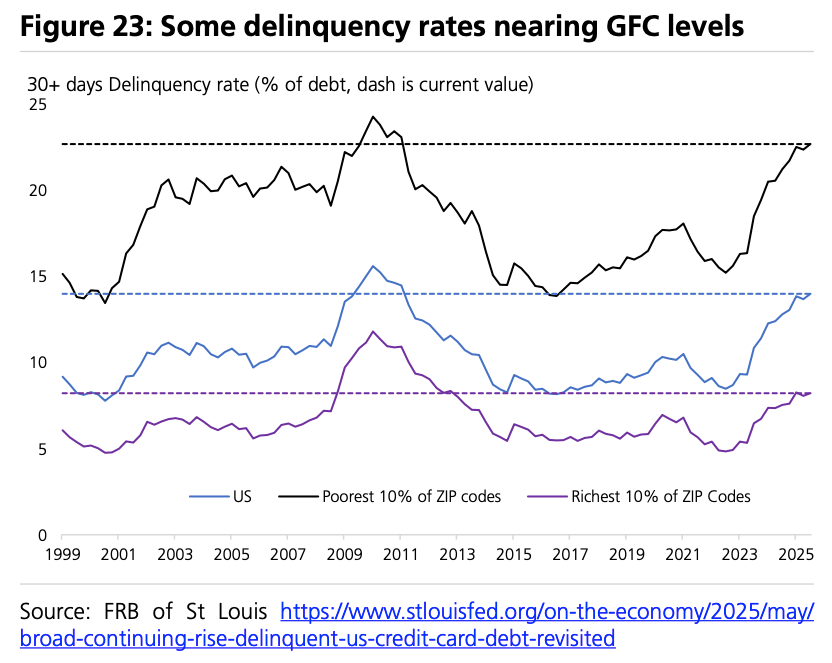
However, there is good news from the analysts: “Our base case is that an equity market drawdown is avoided. Households suffer for the next two quarters.”
Pingle expects a $55 billion boost to disposable income in 2Q 2026 from retroactive tax relief in the One Big Beautiful Bill Act (OBBBA). He said these “bumper refunds” should temporarily revive household spending in mid-2026, which is just in time for the midterm election cycle.
The takeaway is that consumers are living in entirely different economic environments depending on their income tier. Lower-income households will receive temporary relief from the OBBBA tax cuts early in 2026, while the administration has effectively placed a massive bet on AI to sustain broader economic growth, which should ramp up in 2H 2026.
Incoming economic tailwinds:
- UBS Identifies Start Of Trump-Era Construction Boom In AI, Grid; Goldman Sees Upside In Used Machinery Prices
- Leading Construction Indicator Signals Data Center Buildout Tsunami Nears
We suspect the Trump administration will need to take more decisive action to strengthen the financial footing of lower-income households, or risk seeing some of these voters drift toward Marxist-aligned Democrats promising “free stuff” in exchange for votes in 2026.
How Trump and Bessent plan to deliver that relief remains unclear. There’s been speculation about possible “tariff stimulus” checks, Trump’s recent pledge to tackle soaring food prices, and renewed vows to overhaul the disastrous Affordable Care Act, which has become anything but affordable as premiums keep rising.
ZeroHedge Pro subscribers can read the full note in the usual spot. It’s packed with more in-depth consumer data, detailed breakdowns, and charts that add more color about the consumer health.
END
FREIGHT/USA
(freightwaves)
finally we are getting them off the road!!
California Cancels 17,000 CDLs Following Federal Audit
Thursday, Nov 13, 2025 – 10:25 AM
Authored by John Gallagher via FreightWaves.com,
The California Department of Motor Vehicles (DMV) has cancelled 17,000 non-domiciled commercial driver’s licenses following a federal audit of the state’s CDL program, according to the U.S. Department of Transportation.

In a press statement on Wednesday, DOT asserted that state officials admitted to illegally issuing the CDLs “to dangerous foreign drivers,” and that DMV sent notices to the license holders that their license no longer meets federal requirements and will expire in 60 days.
“After weeks of claiming they did nothing wrong, Gavin Newsom and California have been caught red-handed,” said Transportation Secretary Sean Duffy.
“This is just the tip of the iceberg. My team will continue to force California to prove they have removed every illegal immigrant from behind the wheel of semitrucks and school buses.”
FreightWaves has reached out to California’s DMV for comment.
FMCSA Chief Counsel Jesse Elison notified Newsom and his DMV in a September 26 letter that a sampling of the roughly 62,000 drivers in California holding unexpired, non-domiciled CDLs or commercial learner’s permits issued by the state revealed that 26% – which extrapolates to roughly 16,000 – failed to comply with federal requirements.
“Even more concerning is the fact that, for three of the transactions, the DMV was unable to provide documentation showing that it validated the drivers’ lawful presence documents before issuing a non-domiciled CDL,” Elison stated.
“Consequently, based on the documentation provided, it appears that the DMV issued a non-domiciled CDL to three drivers without validating their lawful presence.”
Duffy posted a statement on the day of Elison’s notification letter warning that “California must get its act together immediately or I will not hesitate to pull millions in funding,” starting at nearly $160 million in the first year and doubling in year two.
DOT reiterated on Wednesday that it “will continue to push California’s to revoke all illegal non-domiciled CDLs or pull $160 million in federal funds.”
VICTOR DAVIS HANSON
KING NEWS
| The King Report November 13, 2025 Issue 7619 | Independent View of the News |
| The Fed Is Increasingly Torn Over a December Rate Cut – WSJ The path for interest-rate cuts has been clouded by an emerging split within the central bank with little precedent during Federal Reserve Chair Jerome Powell’s nearly eight-year tenure. Officials are fractured over which poses the greater threat—persistent inflation or a sluggish labor market—and even a resumption of official economic data may not bridge the differences… https://www.wsj.com/economy/central-banking/the-fed-is-increasingly-torn-over-a-december-rate-cut-48a26aad Atanta Fed President Bostic: Why Inflation Tips the Scales Forward looking indicators suggest inflation is unlikely to decline substantially for some time. That raises concern that inflation expectations could drift upward and trigger behaviors which produce higher actual inflation (self-reinforcing loop)… The main contributors to elevated inflation are now services prices other than housing—”supercore” services—and core goods prices. That is a reversal from 2024, when significant price pressures came from the shelter category and core goods prices were actually declining… I’m leaning heavily on information from our Bank’s Economic Survey Research Center. That team conducts three primary surveys of business leaders across the country: the Business Inflation Expectations (BIE) survey, the CFO Survey in partnership with the Richmond Fed and Duke University, and the Survey of Business Uncertainty with economists from Stanford University and the University of Chicago. Evidence from all three surveys points decisively in one direction—continued upward pressure on costs and prices… The upshot is that firms in our survey expect to raise prices well into 2026, and by substantially more than 2 percent… https://www.atlantafed.org/news/speeches/2025/11/12/bostic-weighing-the-risks-why-inflation-tips-the-scales Bostic is free to speak his mind. He announced that he will retire when his term ends on February 28. @GlobalMktObserv: The delinquency rate on US commercial mortgage-backed securities (CMBS) for offices SPIKED to 11.8%, an ALL-TIME HIGH. Office CMBS delinquencies SPIKED 10 points in just 3 YEARS. The commercial real estate CRISIS is FAR from over. https://t.co/uFtGuUQlYb @SecScottBessent: The shutdown was never about healthcare for Democrats—it was about stopping President Trump’s agenda at any cost (That’s why polling shows!). And they were willing to waste tens of billions of taxpayer dollars to do it. Meanwhile, the economy is thriving with 3.8% growth, and we’re on track to accelerate even further into 2026. https://t.co/HFJphGTVkm WH Economic Adviser HASSETT: GDP FOR THE YEAR WILL BE ABOUT 2% – BBG 12:41 ET Hassett: GDP Could Be Between 1.5% to 2% This Quarter – BBG 12:41 ET Hassett: Inflation Isn’t All the Way ‘Where You Want It to Be’ – BBG 12:43 ET Hassett: I Agree with Trump That Rates Can Be a Lot Lower – BBG 12:45 Bessent, at a NY Fed Treasury market soiree, crowed about the 2025 US Treasury rally, saying total returns for Treasuries is around 6%. TLT, 20-year+ US Treasury ETF, closed 2024 at 87.80. For 2025, the high is 94.09 on April 4; and the low is 83.295 on May 22. It closed at 90.12 on Wed. The 2025 bond ‘rally’ is a lame blip higher from the carnage of the past few years. TLT – At best, the bleeding has stopped. The valuation rotation appeared on Wednesday. The DJIA rallied sharply; the DJTA less so; Fangs declined moderately. USZs rallied modestly. Dec Gold soared as much as $102.20. ESZs had an A-B-C rally after 18:10 ET and made a daily high of 6900.50 at 4:42 ET. When no momo buying appeared after the 6900 breach, astute traders dumped; ESZs sank to 6882.00 at 7:00 ET. After a rally to 6898.50 at 7:34 ET, ESZs did a slow roll over. Traders again realized that there was not enough exuberance to push ESZs above 6900. ESZs then tumbled to a daily low of 6852.00 at 11:46 at ET. A Noon Balloon conflated with the afternoon rally and boosted ESZs to 6884.25l at 13:38 ET. ESZs then rolled over and fell to 6863.50 at 15:04 ET. The late manipulation forced ESZs to 6882.50 at 15:33 ET. ESZs then fell to 6869.50 at 15:58 ET. A final manipulation pushed ESZs to 6878.75 at 16:00 ET. WH Press Sec. Leavitt: October CPI and jobs data likely never to be released – BBG 13:32 ET “The Democrats may have permanently damaged the federal statistical system with October CPI and jobs reports likely never being released.” (This is pure BS and obfuscation!) The White House is considering measures to restrict proxy-advisory firms and exploring limits on how index-fund managers are allowed to vote: WSJ Positive aspects of previous session The DJIA rallied 326.86 and hit an all-time high. The DJTA rallied 124.44 on the valuation rotation. Negative aspects of previous session Fangs declined moderately, which dragged Nasdaq and the Naz 100 lower USZs were +11/32 at 12:47 ET but fell to +0/32 at 15:35 ET. Ambiguous aspects of previous session Is the expected December rate cut now uncertain? First Hour/Last Hour Action [S&P 500 Index]: 1st Hour from NYSE Open: Down; Last Hour: Up Pivot Point for S&P 500 Index [above/below indicates daily trend to traders]: 6850.15 Previous session S&P 500 Index High/Low: 6869.91; 6829.62 Western Media Begins Damage Control After $100 Million Corruption Scandal Rocks Ukraine BBG: This episode goes to the heart of why Ukrainians are fighting at all. The war began in 2014, after then President Viktor Yanukovych was toppled by mass protests against the epic scale of his corruption and the captivity to Moscow this created. Graft was the glue with which the Kremlin had held… https://www.zerohedge.com/geopolitical/100-million-corruption-scandal-rocks-ukraine-zelensky-associate-flees-country-police @TheCalvinCooli1: Russia says they are ready to resume talks with Ukraine in Istanbul according to Russian foreign ministry official Alexei Polishchuk https://t.co/HaSZP04OeS Bank of America CEO Brian Moynihan seeks ‘important’ Mamdani meeting to discuss NYC: ‘We’ll give him some ideas’ https://trib.al/vjEMAw1 Bloomberg: Chicago Treasurer Melissa Conyears-Ervin on Wednesday proposed the city stop investing in US Treasuries to protest President Donald Trump’s increased immigration enforcement and deployment of troops, drawing criticism from some colleagues who called the plan “reckless.”… Ervin said her office oversees an investment portfolio of more than $9 billion… The city last directly owned Treasury bonds in 2024 — just about $8 million — and does not own any directly currently. Chicago pols are so stupid and TDS infected they believe that withholding relatively miniscule purchases US Treasuries will punish and unnerve DJT. In 2023 Conyears-Ervin faced an ethics investigation into allegations surrounding abuse of power. Former employees alleged her of requiring staff to perform personal tasks including planning birthday parties, grocery shopping, and forcing BMO Harris Bank to provide a mortgage for her husband, Chicago Alderman Jason Ervin… https://en.wikipedia.org/wiki/Melissa_Conyears_Ervin Boston Fed President Collins advocates holding rates steady, sees ‘high bar’ for further cuts 16 ET https://www.cnbc.com/2025/11/12/boston-fed-president-collins-advocates-holding-rates-steady-sees-high-bar-for-further-cuts.html @AlmanacTrader: 46.3% of NASDAQ’s annual highs have been in December since 1971. Since 2003, DJIA, S&P 500, NASDAQ and Russell 2000 have all set their annual highs in December 11 times. https://jeffhirsch.tumblr.com/post/800048383 Today – The US House passed (222-209) the Senate bill to reopen the government. As many postulated, traders got long this week for an expected Grand Government Reopening rally. As we postulated, pro traders believe that they will be able to unload into patsies that buy after the reopening bill is passed. ESAs are +9.50; NQZs are +80.50; Dec AU is -25.10; and USZs are -5/32 at 20:20 ET. Expected economic data: Oct CPI 0.2% m/m & 3.0% y/y, Core 0.3% m/m & 3.0% y/y; Initial Jobless Claims 225k, Continuing Claims 1.961m; Oct Federal Budget -$228.8B Fed Speakers: SF Pres Daly 8 ET, Min Pres Kashkari 10:30 ET, St. Louis Pres Musalem 12:15 Et, Cleveland Pres Hammack 12:20 Et S&P Index 50-day MA: 6694; 100-day MA: 6514; 150-day MA: 6259; 200-day MA: 6142 DJIA 50-day MA: 46,540; 100-day MA: 45,540; 150-day MA: 44,193; 200-day MA: 43,831 (Green is positive slope; Red is negative slope) S&P 500 Index (6728.80 close) – BBG trading model Trender and MACD for key time frames Monthly: Trender and MACD are positive – a close below 5687.33 triggers a sell signal Weekly: Trender and MACD are positive – a close below 6420.50 triggers a sell signal Daily: Trender is positive; MACD is negative – a close below 679.88 triggers a sell signal Hourly: Trender and MACD are positive – a close below 6835.81 triggers a sell signal DJT’s self-destruction intensified on Tuesday night after a disastrous interview with Fox’s Laura Ingraham. DJT supporters are furious with his comments about H-1B employees and Americans. Ingraham was stunned and in disbelief. Social media teemed with negative remarks about Trump. Trump administration resumes (for H-1B, H-2A & H-2B workers) visa processing despite shutdown https://www.aol.com/news/trump-administration-resumes-visa-processing-211900756.html @EricLDaugh: Laura Ingraham PRESSES President Trump on H-1B visas Ingraham: “H-1B visa thing won’t be a big priority for you? If you wanna raise wages for Americans, you can’t flood the country with THOUSANDS of foreign workers.” Trump: You have to bring in talent. Ingraham: “We have plenty of talented people here.” Trump: “No you don’t…” Ingraham: We don’t have talented people here? TRUMP: You don’t have CERTAIN talents. People have to learn. You can’t take people off the unemployment line and say, “go make missiles.” Ingraham: “How did we do it before?” TRUMP: I’ll give you an example. In Georgia, we raided [Hyundai for] illegal immigrants. They had people from South Korea. Very dangerous job. They had 500-600 people. Early stages to make batteries, to teach people how to do it. Well, they wanted to kick them out of the country. You NEED them… You can’t bring in $10B for a plant, take people off the unemployment line, and start making missiles. It doesn’t work that way.” https://x.com/EricLDaugh/status/1988407965582233816 @MericaCulture: NASA Mission Control celebrating the Moon landing in 1969. Zero H-1Bs present https://x.com/MericaCulture/status/1988419581661376986 @Savsays: Trump needs to get out of his bubble and back on the ground listening to the American people who elected him to work for us. His H-1B comment shows how out of touch with the base he has become. GOP operative @AnthonySabatini: This is insane—we are going to lose the mid-terms so badly. We’ve never seen an administration crash & burn in its first year so badly—for no reason other than to appease donors & special interests. Trump has surrounded himself with the worst people. @WallStreetMav: I really hope that Stephen Miller or someone else can explain to President Trump that is NOT what we voted for. This is a path to giving away the midterms in 2026… The WH on Wednesday tried to clean up Trump’s 50-year mortgage mess. CBS’s @JenniferJJacobs: The proposal for a 50-year mortgage wasn’t fully vetted by top Trump admin officials. One source said President Trump was lukewarm about idea but announced it “to get Pulte to shut up about it.” Another source disputed the characterization that the president was tepid about the proposal and said 40- and 50-year loans had been discussed by Lutnick, Hassett, others. Several other sources said the internal discussions on longer-term mortgages were casual, and no final decisions had been made. Admin has been working on *other* ideas to promote affordability for Americans, including strategies to alleviate housing crunch. DJT’s self-destruction began with his Epstein Files betrayal about releasing the documents – and he compounded the problem and anger by admonishing people that wanted to see the files. His Nobel Peace Prize zeal turned him into George Bush I. He cozied up to Big Pharma and other major donor class entities. Recently his gaslighting about the US economy, particularly jobs and inflation, is enraging people. He shamelessly hawks crypto and the AI bubble. He persistently bragged about adding a ballroom to the WH, when only the glitterati would experience it. He endorsed 600,000 Chinese students in America and outrageously claims that US colleges, even with ginormous endowments, would go broke without them. Now, he insults American workers by stating they lack talent. MAGA fans furious after Trump says US needs to ‘bring in talent’ from abroad https://www.the-independent.com/bulletin/news/donald-trump-h1b-visa-maga-b2863561.html @DefiantLs: (July) JD Vance: “This idea that American citizens don’t have the talent to do great things, that you have to import a foreign class of servants and… professors to do these things… I reject that.” https://t.co/aZgE8pvVgK @RedWave_Press: Fox News’ Will Cain EXPOSES the CORRUPT H-1B visa system with 70% of H-1B visas coming from India and 10% coming from China. “80% of H-1B visa approvals are for entry level or junior level jobs. That’s a little hard to stomach when we hear that we’re not talented enough or that we’re not skilled enough for these jobs.”… https://x.com/RedWave_Press/status/1988727851131285811 The outrage over DJT’s H-1B remarks induced Bessent, appearing on Fox, to try to mitigate the damage. His excuse was risible and insulting. But it was the best he could offer in an unwinnable situation. Scott Bessent explains Trump’s plan for H1B visas, says they are NOT permanent They will be used to bring in the talented people necessary to train our people, then they go back home. https://therightscoop.com/breaking-video-scott-bessent-explains-trumps-plan-for-h1b-visas-says-they-are-not-permanent/ Most Americans do not like Trump personally. But a majority like his policies. As Ann Coulter eloquently stated, “Americans want Trumpism without Trump.”. Before the 2020 Election, Tucker Carlson opined that Trump draws ginormous crowds because Flyover America feels abandoned by both establishments; and they see DJT as someone trying to help them. Now, this hope is ending. @Kalshi: Unemployment of 20 to 24 years-olds hits 9.2%, highest since 2016 Dems are aware the populace is still upset about Trump Epstein File betrayal. Their shutdown was a disaster for Dems; so, they are back to trying to smear DJT with the Epstein Files. White House slams Dems’ ‘bad-faith’ Epstein doc release as demand for files intensifies Republicans call document release ‘cherry-picked’ as discharge petition nears consideration in the House – “The Democrats selectively leaked emails to the liberal media to create a fake narrative to smear President Trump,” White House press secretary Karoline Leavitt said in a statement to Fox News Digital. In a 2011 email to his associate Ghislaine Maxwell, Epstein said Trump had spent a prolonged time at his house with a “victim.” “I want you to realize that that dog that hasn’t barked is Trump. VICTIM spent hours at my house with him, has never once been mentioned,” Epstein wrote… “The more Donald Trump tries to cover up the Epstein files, the more we uncover. These latest emails and correspondence raise glaring questions about what else the White House is hiding and the nature of the relationship between Epstein and the president,” Rep. Robert Garcia, D-Calif., said. “The Department of Justice must fully release the Epstein files to the public immediately. The Oversight Committee will continue pushing for answers and will not stop until we get justice for the victims,” he added… https://www.foxnews.com/politics/white-house-slams-dems-bad-faith-epstein-doc-release-demand-files-intensifies @GOPoversight: Why did Democrats cover up the name when the Estate didn’t redact it in the redacted documents provided to the committee? It’s because this victim, Virginia Giuffre, publicly said that she never witnessed wrongdoing by President Trump. Democrats are trying to create a fake narrative to slander President Trump. Shame on them. @LizCrokin: Jeffrey Epstein & Ghislaine Maxwell Targeted Trump; Virginia Giuffre Continues to Vindicate The President! The Dems released an e-mail Jeffrey Epstein sent to Ghislaine Maxwell aka G-Max saying a victim spent hours with Trump at his house and said Trump is the dog that hasn’t barked in an attempt to smear him. The Daily Mail released the unredacted e-mail and the victim who spent time with him was Virginia Giuffre. This e-mail proves Epstein and Maxwell targeted Trump most likely for blackmail purposes… Giuffre, who passed away earlier this year, has said Trump did not have sex with or flirt with any of Epstein’s girls. Furthermore, Giuffre has repeatedly spoken highly of Trump. In her posthumous book she said Trump could not have been friendlier. Last year, she tweeted that she was Trump’s biggest fan… Receipts below https://x.com/LizCrokin/status/1988676115225817177 It sure feels like Trump reneged on the release of the Epstein Files to protect someone. Dems and their media stooges will continue to press the matter because Trump acts extremely agitated about the file. @ByronYork: House Oversight Committee Democrats say they have received 23,000 Epstein documents. Democrats released 3 of them today. So, committee Republicans released all of them. Democrats not happy… (Say it distracts from their DJT document!) GOP lawmakers release thousands of files related to Jeffrey Epstein (Hours after Dem release) https://wgntv.com/news/gop-lawmakers-release-thousands-of-files-related-to-jeffrey-epstein/ You won’t believe what happened next! House Dems stifled a motion to release all the Epstein Files! CNN: Speaker Mike Johnson says the House will vote next week on whether to release the Epstein files – earlier than expected Trump claims Dems reviving Epstein issue to distract from shutdown ‘failure’ – Just the News Jeffrey Epstein said in emails that he had been advising the Russian government on how to deal with Donald Trump – NYT House Republicans push vote to reverse provision allowing senators to sue over phone records https://www.politico.com/live-updates/2025/11/12/congress/house-republicans-push-vote-to-reverse-provision-allowing-senators-to-sue-over-phone-records-00648323 @DRBoguslaw: BREAKING: Email from then NYT Journalist Landon Thomas tipping Epstein off about follow up investigation by Journalist and former NYPD detective John Connolly https://x.com/DRBoguslaw/status/1988680965213024608 Another email: https://x.com/DRBoguslaw/status/1988688136516600032 California Gov. Gavin Newsom’s ex-chief of staff arrested, accused of stealing $225K: feds Dana Williamson, 53, is now facing a sweeping 23-count federal indictment charging her with conspiracy to commit bank and wire fraud, defrauding the United States, obstructing justice, filing false tax returns, and lying to authorities, according to the US Attorney’s Office for the Eastern District of California… https://trib.al/OD1RLVY Dem Sen (IL) Duckworth staffer accused of posing as lawyer in attempt to free illegal immigrant from ICE custody – Department of Homeland Security demands answers about Edward York’s alleged misrepresentation at St. Louis facility… https://www.foxnews.com/politics/duckworth-staffer-accused-posing-lawyer-attempt-free-illegal-immigrant-from-ice-custody @OliLondonTV: Starbucks workers go on strike and perform bizarre dance and rap to demand higher wages. “My neck, my back, my paycheck is whack!” https://x.com/OliLondonTV/status/1988748654241575172 The Gulf Stream is near collapse, scientists warn — inviting a new ice age and rising sea levels https://trib.al/tJFl1sI The masses don’t believe in global warming; so, it’s back to (in vogue in ‘80s) a new Ice Age is coming! | |
SWAMP STORIES FOR YOU TONIGHT
Justice Department Launches Investigation Into Security Failures At Berkeley TPUSA Event
Wednesday, Nov 12, 2025 – 07:15 PM
The Department of Justice (DOJ) announced this week that it is investigating the University of California, Berkeley, over the security arrangements for the Turning Point USA (TPUSA) event. Antifa and others threatened many entering or leaving the event, including reportedly blocking hundreds from the sold-out event to celebrate free speech and the legacy of murdered Charlie Kirk.

Assistant Attorney General for the Civil Rights Division Harmeet Dhillon shared a letter to UC Berkeley Police Chief Yogananda Pittman, instructing her to “preserve all records” in her possession that are “relevant to the agency’s preparation, execution, and response to the Turning Point event.”
In my book, “The Indispensable Right: Free Speech in an Age of Rage,” I discuss how universities have used security issues to cancel conservative speakers as well as a lack of protection by both universities and cities.
The result is that Antifa and other groups can easily disrupt events. The long-standing concern is that some university and municipal departments have been passive-aggressive in facilitating this “heckler’s veto” of speakers.
In the book, I call for the federal government to prioritize the protection of free speech events in the same manner as it has protected other rights, including civil rights.
There should be a priority in protecting what John Stuart Mill called these “circles” where ideas are shared and debated.
The university fielded a sizable security force for this event and I am not making any assumptions about a lack of efforts by the university.
However, there are allegations that the security allowed violent protesters to be in close proximity to people entering or leaving the event. The result is that many were threatened, spat on, and shoved by protesters. Many could not make it into the event.
The contrast was striking.
These protesters were screaming threats and spitting on people who wanted to attend an event supporting free speech. It was intolerable for these protesters that opposing views could be expressed or heard on campus.
There were signature elements of Antifa at the event with black-clad extremists fueling violence and threatening anyone who wanted to hear the speakers.
Without prejudging the outcome of the investigation, the notice to Berkeley serves a valuable purpose in warning universities that their actions will be scrutinized in such controversies.
Too often, universities allow hecklers to disrupt events, as when Stanford law students stopped Judge Kyle Duncan from speaking at the law school.
The TPUSA event was long planned, as were the protests.
This was not some flash mob but an organized effort to try to cancel the free speech event. The preparations by the university do not appear to have been sufficient, but that does not mean that it was evidence of premeditated or passive-aggressive conduct. However, the review of the preparations is an important warning that, for the first time, universities will face inquiries over such breaches or failures in protecting First Amendment activities.
GREG HUNTER
SEE YOU TOMORROW


 harveyorganblog.com


