
access market
XXXXXXXXXXXXXXXXXXXXXXXXXXXXXXXXXXXXXXXXXXXXXXXXXX
XGE: COMEX
099 H DEUTSCHE BANK AG 1
190 H BMO CAPITAL MARKETS 162
363 H WELLS FARGO SECURITI 10
435 H SCOTIA CAPITAL (USA) 5
624 H BOFA SECURITIES 9
661 C JP MORGAN SECURITIES 33 6
709 C BARCLAYS 100
732 C RBC CAP MARKETS 36
905 C ADM 4
GOLD: NUMBER OF NOTICES FILED FOR NOV/2025: 183 CONTRACTs NOTICES FOR 18,300 OZ or 0.5692 TONNES
total notices so far: 8237 contracts for 823,700 OR 25.630 tonnes)
SILVER NOTICES: 244 NOTICE(S) FILED FOR 1.220 OZ/
total number of notices filed so far this month : 3380 CONTRACTS (NOTICES) for 16.900 million oz
INITIAL STANDING FOR NOV: 11.575 MILLION OZ
PLUS INITIAL 1.245 MILLION OZ QUEUE JUMP
THEN ADD TUESDAY;S 1,93 MILLION OZ QUEUE JUMP
THEN WEDNESDAY;S 0.570 MILLION OZ QUEUE JUMP
THEN 0.080 MILLION OZ
THEN MONDAY’S 425,000 0Z
THEN TUESDAY: 275,000 OZ
THEN WEDNESDAY’S 295,000 OZ
THEN THURSDAY : 10,000 OZ
THEN FRIDAY: 1.245 MILLION OZ
EQUALS
17.220 MILLION OZ STANDING FOR SILVER.
JULY: 50.925 MILLION OZ (QUITE SMALL)
AUGUST: 59.455 MILLION OZ (QUITE SMALL)
SEPT. 50.510 MILLION OZ.(QUITE SMALL)
OCT; 82.020 MILLION OZ (WILL BE STRONG THIS MONTH)/ OCC WANTS TO REIN IN THESE ISSUANCES!
NOV: 16.790 MILLION OZ
AND JULY: 46.720 MILLION OZ//
AUGUST: 4.70 MILLION OZ INITIAL STANDING PLUS TODAY;S 5,000 OZ QUEUE JUMP //NEW STANDING ADVANCES TO 10.960 MILLION OZ
SEPTEMBER: 68.040 MILLION OZ NORMAL DELIVERY(INCLUDES ALL QUEUE JUMPING AND EXCHANGE FOR PHYSICAL TRANSFERS) PLUS 3.0 MILLION OZ EX FOR RISK = 71.040 MILLION OZ. (THIS IS THE FIRST AND ONLY ISSUANCE OF EXCHANGE FOR RISK FOR SILVER SINCE MAY.)
OCTOBER: 39.565 MILLION OZ OF NORMAL DELIVERY INCLUDES ALL QUEUE JUMPING
PLUS
2.110 MILLION OZ EXCHANGE FOR RISK//TOTAL OZ STANDING IN OCT ADVANCES TO 41.675 MILLION OZ
AND NOW NOVEMBER: INITIAL STANDING AT 11.575 MILLION OZ FOLLOWED BY TODAY;S QUEUE JUMP OF 1.256 OZ WHICH FOLLOWS ALL OTHER QUEUE JUMPS OF 5.255 MILLION OZ//STANDING ADVANCES TO 17.220 MILLION OZ/
- MAY: SUMMARY FOR MAY TONNES WHICH STOOD FOR DELIVERY:
4. AUGUST: 60.547 TONNES OF INITIAL GOLD FIRST DAY NOTICE FOLLOWED BY THE NET MONTH’S QUEUE JUMP OF 47.2312 TONNES TO WHICH WE ADD THE FOLLOWING EXCHANGE FOR RISK ISSUANCE RECEIVED FOR THE MONTH: 5.4432 TONNES EX FOR RISK/AUG 7 , AUG 11: 2.413 TONNES EX FOR RISK AND AUG. 12 OF 2.637 TONNES EX FOR RISK//AUG 25: 9.107 TONNES , AUGUST 26: 9.1010 TONNES AND NOW AUGUST 27: 9.0699 TONNES//NEW STANDING ADVANCES TO 107.5117 TONNES OF GOLD NORMAL STANDING (INCLUDES ALL MONTHLY QUEUE JUMPS/EX FOR PHYSICAL TRANSFERS//) +44.696 TONNES EX.FOR RISK = 152.208 TONNES
5.SEPT: INITIAL 8.093 TONNES OF GOLD PLUS TODAY’S QUEUE JUMP OF 0.4883 TONNES PLUS 2.2827 TONNES OF EXCHANGE FOR RISK TODAY//NEW TOTAL EX. FOR RISK/MONTH = 22.923//NEW TOTAL STANDING FOR GOLD SEPT ADVANCES TO = 48.801 TONNES!!
6.OCTOBER: 90.012 TONNES OF INITIAL GOLD STANDING WITH TODAY’S TINY 0.00311 TONNES QUEUE JUMP WHICH FOLLOWS ALL OTHER QUEUE JUMPS DURING OCT OF 76.1656 TONNES
THEN WE MUST ADD OUR 14.553 TONNES OF OUR ISSUANCE OF EXCHANGE FOR RISK/6 OCCASIONS//NEW TOTAL OF GOLD STANDING ADVANCES TO 197.5141 TONNES OF GOLD.
7.NOVEMBER BEGINS WITH 15.651 TONNES INITIALLY STANDING FOR DELIVERY FOLLOWED BY TODAY’S QUEUE JUMP OF 0.00311 TONNES FOLLOWED BY ALL PREVIOUS QUEUE JUMPS IN OF OF 9.2581 TONNES TO WHICH WE ADD OUR FIRST EXCHANGE FOR RISK ISSUANCE OF 1.3996 TONNES//NEW STANDING ADVANCES TO 27.2596 TONNES OF GOLD.
JAN. 2025: 257.919 TONNES (ISSUANCE WILL BE PRETTY GOOD THIS MONTH BUT MUCH LOWER THAN LAST MONTH)
FEB: 207.21 TONNES//EX FOR PHYSICAL ISSUANCE (WILL BE A FAIR SIZED ISSUANCE THIS MONTH)
MARCH 130.84 TONNES//QUITE SMALL THIS MONTH.
APRIL; 208.57 TONNES. STRONG THIS MONTH
MAY: 113.499 TONNES OF GOLD EFP ISSUANCE//QUITE SMALL THIS MONTH
JUNE: 97.79 TONNES OF GOLD EFP ISSUANCE/EXTREMELY SMALL
JULY : 150.877 TONNES// QUITE SMALL
AUGUST: 175.86 TONNES A LOT LARGER THIS MONTH.
SEPT. 116.13 TONNES VERY SMALL
OCT. 252.72 TONNES//CERTAINLY MUCH LARGER THIS MONTH/VERY STRONG
NOV: 49.228 TONNES//VERY SMALL THIS MONTH.
SPREADING OPERATIONS
NOW SWITCHING TO GOLD FOR NEWCOMERS, HERE ARE THE DETAILS
SPREADING LIQUIDATION HAS NOW COMMENCED AS WE HEAD TOWARDS THE NEW ACTIVE FRONT MONTH OF OCT. WE ARE NOW INTO THE SPREADING OPERATION OF GOLD
HERE IS A BRIEF SYNOPSIS OF HOW THE CROOKS FLEECE UNSUSPECTING LONGS IN THE SPREADING ENDEAVOUR ;MODUS OPERANDI OF THE CORRUPT BANKERS AS TO HOW THEY HANDLE THEIR SPREAD OPEN INTERESTS:HERE IS HOW THE CROOKS USED SPREADING AS WE ARE NOW INTO THE NON ACTIVE DELIVERY MONTH OF NOV HEADING TOWARDS THE ACTIVE DELIVERY MONTH OF FEB., FOR GOLD: AND MARCH FOR SILVER
YOU WILL ALSO NOTICE THAT THE COMEX OPEN INTEREST STARTS TO RISE BUT SO IS THE OPEN INTEREST OF SPREADERS. THE OPEN INTEREST IN WILL CONTINUE TO RISE UNTIL ONE WEEK BEFORE FIRST DAY NOTICE OF AN UPCOMING ACTIVE DELIVERY MONTH (OCT), AND THAT IS WHEN THE CROOKS SELL THEIR SPREAD POSITIONS BUT NOT AT THE SAME TIME OF THE DAY. THEY WILL USE THE SELL SIDE OF THE EQUATION TO CREATE THE CASCADE (ALONG WITH THEIR COLLUSIVE FRIENDS) AND THEN COVER ON THE BUY SIDE OF THE SPREAD SITUATION AT THE END OF THE DAY. THEY DO THIS TO AVOID POSITION LIMIT DETECTION. THE LIQUIDATION OF THE SPREADING FORMATION CONTINUES FOR EXACTLY ONE WEEK AND ENDS ON FIRST DAY NOTICE.”
WHAT IS ALARMING TO ME, ACCORDING TO OUR LONDON EXPERT ANDREW MAGUIRE IS THAT THESE EFP’S ARE BEING TRANSFERRED TO WHAT ARE CALLED SERIAL FORWARD CONTRACT OBLIGATIONS AND THESE CONTRACTS ARE LESS THAN 14 DAYS. ANYTHING GREATER THAN 14 DAYS, THESE MUST BE RECORDED AND SENT TO THE COMPTROLLER, GREAT BRITAIN TO MONITOR RISK TO THE BANKING SYSTEM. IF THIS IS INDEED TRUE, THEN THIS IS A MASSIVE CONSPIRACY TO DEFRAUD AS WE NOW WITNESS A MONSTROUS TOTAL EFP’S ISSUANCE AS IT HEADS INTO THE STRATOSPHERE.
The crooks also use the spread in the TAS account (trade at settlement). They buy the spot TAS (e.g. June) and sell the future TAS two months out (e.g. August). Then they unload the front month (i.e. unload the buy side first so the price of gold/silver falls. This occurs in the middle of the front delivery month cycle. They unload the sell side of the equation, two months down the road. The crooks violate position limits as the OCC refuse to hear our complaints.
First, here is an outline of what will be discussed tonight:
1.TODAY WE HAD THE OPEN INTEREST AT THE COMEX IN SILVER ROSE BY A STRONG SIZED 404 CONTRACTS OI TO 164,177 AND CLOSER TO THE COMEX HIGH RECORD //244,710( SET FEB 25/2020). THE LAST RECORDS WERE SET IN AUG.2018 AT 244,196 WITH A SILVER PRICE OF $14.78/(AUGUST 22/2018)..THE PREVIOUS RECORD TO THAT WAS SET ON APRIL 9/2018 AT 243,411 OPEN INTEREST CONTRACTS WITH THE SILVER PRICE AT THAT DAY: $16.53). AND PREVIOUS TO THAT, THE RECORD WAS ESTABLISHED AT: 234,787 CONTRACTS, SET ON APRIL 21.2017 OVER 7 YEARS AGO. HOWEVER WE HAVE NOW SET A NEW RECORD LOW OF 114,102 CONTRACTS JULY 3.2023
EFP ISSUANCE 600 CONTRACTS
OUR CUSTOMARY MIGRATION OF COMEX LONGS CONTINUE TO MORPH INTO LONDON FORWARDS AS OUR BANKERS USED THEIR EMERGENCY PROCEDURE TO ISSUE:
DEC 600 CONTRACTS and 0 ALL OTHER MONTHS: ZERO. TOTAL EFP ISSUANCE: 0 CONTRACTS. EFP’S GIVE OUR COMEX LONGS A FIAT BONUS PLUS A DELIVERABLE PRODUCT OVER IN LONDON. IF WE TAKE THE COMEX OI GAIN OF 404 CONTRACTS AND ADD TO THE 600 E.FP. ISSUED
WE OBTAIN A MEGA MEGA HUGE SIZED GAIN OF 1004 OF OPEN INTEREST CONTRACTS FROM OUR TWO EXCHANGES DESPITE OUR LOSS OF $0.58 THE RATS ARE FLEEING THE ARENA.
THUS IN OUNCES, THE GAIN ON THE TWO EXCHANGES TOTALS 5.020 MILLION PAPER OZ
OCCURRED DESPITE OUR LOSS IN PRICE.OF $0.58
OUTLINE FOR TODAY’S COMMENTARY
1a/COMEX GOLD AND SILVER REPORT
(report Harvey)
b, ) Gold/silver trading overnight Europe,//GOLD COMMENT
Peter Schiff)
c) Commentaries from: Egon von Greyerz///Matthew Piepenburg via GoldSwitzerland.com, Pam and Russ Martens
ii a) Chris Powell of GATA provides to us very important physical commentaries
b. Other gold/silver commentaries
c. Commodity commentaries//
d)/CRYPTOCURRENCIES/BITCOIN ETC
2.ASIAN AFFAIRS
ASIAN MARKETS THIS FRIDAY MORNING:
SHANGHAI CLOSED DOWN 39.01 POINTS OR 0.97%
//Hang Seng CLOSED CLOSED DOWN 500.97 PTS OR 1.85%
// Nikkei CLOSED : DOWN 905.30 PTS OR 1.77% //Australia’s all ordinaries CLOSED DOWN 1.41%
//Chinese yuan (ONSHORE) CLOSED DOWN TO 7.0984/ OFFSHORE CLOSED DOWN AT 7.0988/ Oil UP TO 59.92 dollars per barrel for WTI and BRENT UP TO 64.10 Stocks in Europe OPENED ALL RED
ONSHORE USA/ YUAN TRADING DOWN TO 7.0984 OFFSHORE YUAN TRADING DOWN TO 7.0988:/ONSHORE YUAN TRADING ABOVE OFF SHORE AND UP ON THE DOLLAR// / AND THUS WEAKER//OFF SHORE YUAN TRADING UP AGAINST US DOLLAR/ AND THUS WEAKER
XXXXXXXXXXXXXXXXXXXXXXXXXXXX
A)NORTH KOREA/SOUTH KOREA
outline
b) REPORT ON JAPAN/
OUTLINE
3 CHINA
OUTLINE
4/EUROPEAN AFFAIRS
OUTLINE
5. RUSSIAN AND MIDDLE EASTERN AFFAIRS
OUTLINE
6.Global Issues//COVID ISSUES/VACCINE ISSUES
OUTLINE
7. OIL ISSUES
OUTLINE
8 EMERGING MARKET ISSUES
9. USA
XXXXXXXXXXXXXXXXXXXXXXXXXXXXXXXXXXXXXXXXXXXXXXXXXXXXXXXXXXXXXXXXXXXXXXXXXXXXXXXXXXXXXXXXXXXXXXXXXXXXXXXXXX
1. COMEX DATA//AMOUNTS STANDING//VOLUME OF TRADING/INVENTORY MOVEMENTS
GOLD
LET US BEGIN:
THE TOTAL COMEX GOLD OPEN INTEREST ROSE BY A SMALL SIZED SIZED 622 CONTRACTS TO 480,877 OI DESPITE THE LOSS IN PRICE OF $17.80 WITH RESPECT TO THURSDAY’S // TRADING/RAID //COMEX CLOSING TIME:… WE LOST NO NET LONGS, WITH THAT PRICE LOSS FOR GOLD. AND AS YOU WILL SEE BELOW, OUR LOSS IN PRICE ALSO HAD A STRONG NUMBER OF EXCHANGE FOR PHYSICAL ISSUED (2410). WE HAD HUGE T.A.S. LIQUIDATION THURSDAY DURING LATE MORNING/1 PM EST. HOWEVER IT WAS THE MAJOR SPECULATORS THAT WERE MASSACRED AROUND CLOSING TIME AS THAT WAS WHEN THE RAID WAS CALLED UPON AS THE BANKERS PULLED THEIR BIDS.
WE STILL HAD A TOTAL GAIN IN OI ON BOTH OF OUR EXCHANGES, THE COMEX AND LONDON’S EXCHANGE FOR PHYSICAL EQUATING TO 3032 CONTRACTS (OR 61.225 TONNES).THEN WE WERE NOTIFIED OF A 0 CONTRACT EXCHANGE FOR RISK ISSUANCE IN GOLD CONTRACTS ISSUED FOR NIL OZ OR 0 TONNES OF GOLD.
FIRST LETS DO A REVIEW OF EXCHANGE FOR RISK ISSUANCES:
EXCHANGE FOR RISK//GOLD ISSUANCE//OCTOBER: TOTAL 6
THE TOTAL NUMBER OF CONTRACTS EXCHANGE FOR RISK ISSUED FOR THE MONTH OF OCT FOR GOLD STANDS AT 14.553 TONNES OF GOLD UNDER THE GUIDANCE OF 6 ISSUANCES.
A LITTLE HISTORY ON OUR EXCHANGE FOR RISK ISSUANCES/ GOLD PRIOR MONTHS
HERE IS A CLOSER LOOK AT EXCHANGE FOR RISK ISSUANCES FOR THESE PAST 4 MONTHS;TOTAL EXCHANGE FOR RISK LAST 4 MONTHS 70.097 TONNES. THE RECIPIENT OF THESE EXCHANGE FOR RISK IS THE BANK OF ENGLAND. THIS CENTRAL BANK LOANED OUT ITS GOLD AND WANTS IT BACK. THEIR TOTAL RESERVES PRIOR TO THE LOANS IS LISTED AT 310 TONNES.
LET US LOOK AT JULY:
SUMMARY: EXCHANGE FOR RISK ISSUANCE IN JULY/2025: 2 ISSUANCES//3.75 TONNES
ON WEDNESDAY MORNING,JULY 23, MUCH TO MY SHOCK, AFTER A TWO MONTH HIATUS,THE CME ANNOUNCED A 500 EXCHANGE FOR RISK CONTRACT ISSUANCE FOR 50,000 OZ OR 1.555 TONNES. THEN JULY 30 THE CME ANNOUNCED (ISSUED) MUCH TO MY HORROR ITS SECOND EXCHANGE FOR RISK FOR 706 CONTRACTS OR 70,600 OZ (2.195 TONNES) AS THE BANK OF ENGLAND WAS NOT SATISFIED AND NEEDS MORE GOLD TO COVER ITS LEASES TO BULLION BANKS. ( IT WAS NOT THE FRBNY WHO ALSO OWES GOLD TO THE BIS AND THEY NEED TO COVER BADLY AS YOU WILL SEE).THE TOTAL EXCHANGE FOR RISK FOR THE MONTH OF JULY WAS RECORDED AT 3.750 TONNES OF GOLD WHICH WAS ADDED TO OUR REGULAR DELIVERY TO GIVE US OUR FINAL TOTALS FOR JULY!
NOW LET US LOOK AT THE MONTH OF AUGUST:
AUGUST:
SUMMARY EXCHANGE FOR RISK ISSUANCE IN AUGUST; 7 ISSUANCES//44.696 TONNES
AUGUST: 7 ISSUANCES FOR A MONTHLY MONSTER 14,370 CONTRACTS OR 1,437,000 OZ ( 44.696) TONNES). EARLY IN THE MONTH THE CME ISSUED THE 2ND HIGHEST EVER MONTHLY RECORDED ISSUANCE OF 2924 CONTRACTS AND THIS IS FOLLOWED BY THURSDAY’S HUGE ISSUANCE OF 2226 CONTRACTS THUS BECOMING THE 4TH HIGHEST EVER RECORDED BY THE CME, SLIGHTLY BELOW AN ISSUANCE OF 2924 CONTRACTS. THE HUGE NUMBERS OF EXCHANGE FOR RISK SUGGEST THAT A MAJOR CENTRAL BANK IS DEMANDING ITS GOLD BACK.
NOW LET US LOOK AT SEPT.
SEPT:
SEPTEMBER: SEVEN ISSUANCES SO FAR TOTALLING 7,370 CONTRACTS OR 737,000 OZ OR 22.923 TONNES.
THESE ISSUANCES WILL OF COURSE BE ADDED TO OUR NORMAL DELIVERIES TO GIVE US OUR TOTAL SEPT STANDING FOR GOLD.
AND NOW OCTOBER: 6 ISSUANCES//FOR 14.553 TONNES
WE RECEIVED NOTICE THAT OUR INITIAL EXCHANGE FOR RISK ISSUED ON FIRST DAY NOTICE WAS FOR 500 CONTRACTS OR 50,000 OZ /1.555 TONNES OF GOLD!!THAT WAS FOLLOWED BY A STRONG 650 CONTRACT ISSUED THURSDAY OCT 2 FOR 2.0217 TONNES AND THAT WAS FOLLOWED THE NEXT DAY BY ANOTHER HUGE 1320 CONTRACT ISSUANCE FOR 13,200 OZ OR 4.1057 TONNES AND THIS WAS FOLLOWED BY SATURDAY’S OCT 4: 180 CONTRACT ISSUANCE FOR 18,000 OZ OR .5596 TONNES:THIS BRINGS US TO OCT 8 WITH A HUGE ISSUANCE OF 1000 CONTRACTS FOR 100,000 OZ OR 3.1104 TONNES. NOW AFTER A TWO WEEK HIATUS, OCT 21: 1029 CONTRACTS FOR 10290 OZ OR 3.200 TONNES TOTAL ISSUANCES 6 OCCASIONS FOR 4679 CONTRACTS OR 467,900 OZ OR 14.553 TONNES
HISTORY: LAST 8 MONTH’S EXCHANGE FOR RISK//TOTAL CONTRACT ISSUANCES //TONNES OF GOLD
IN FEBRUARY:
WE HAD A HUGE FIVE EXCHANGE FOR RISKS ISSUANCES FOR GOLD, TOTALLING 18.4527 TONNES!.
IN MARCH:
THE TOTAL NO. OF EXCHANGE FOR RISK ISSUANCE FOR THE MONTH OF MARCH (3 NOTICES) EQUALED: 7.6179 TONNES OF GOLD WHICH WAS ADDED TO OUR MARCH DELIVERY TOTALS.
IN APRIL:
WE CONCLUDED APRIL WITH 7 ISSUANCE OF EXCHANGE FOR RISK FOR A TOTAL TONNAGE OF 8.3571 TONNES.
IN MAY:
MAY: 3 EX. FOR RISK ISSUED SO FAR FOR 3025 CONTRACTS OR 302,500 OZ OR 9.4054 TONNES. THIS WILL BE ADDED TO OUR NORMAL DELIVERY TO GIVE US TOTAL STANDING FOR MAY!THIS IS THE 6TH CONSECUTIVE MONTH FOR ISSUANCE OF EXCHANGE FOR RISK//NEW TOTAL EX FOR RISK IS 9.4054 TONNES FOR THE 3 ISSUANCE!
IN JUNE
JUNE: ZERO ISSUED
jULY: 2 OCCASIONS LATE IN JULY: 1206 CONTRACTS FOR 120,600 OZ OR 3.750 TONNES/ISSUED JULY 23/2025 AND JULY 30/2025
AUGUST: 7 ISSUANCES FOR A MONTHLY MONSTER 14,370 CONTRACTS OR 1,437,000 OZ ( 44.696) TONNES).AT THE BEGINNING OF THE MONTH THE CME ISSUED THE 2ND HIGHEST EVER MONTHLY RECORDED ISSUANCE OF 2924 CONTRACTS AND THIS IS FOLLOWED BY THURSDAY’S HUGE ISSUANCE OF 2226 CONTRACTS THUS BECOMING THE 4TH HIGHEST EVER RECORDED BY THE CME, SLIGHTLY BELOW PREVIOUS DAY’S ISSUANCE OF 2924 CONTRACTS. THE HUGE NUMBERS OF EXCHANGE FOR RISK SUGGEST THAT A MAJOR CENTRAL BANK IS DEMANDING ITS GOLD BACK.
SEPTEMBER: SEVEN ISSUANCES FOR 7370 CONTRACTS SO FAR FOR 737,000 OZ OR 22.923 TONNES OF GOLD!!
OCTOBER: FIRST INITIAL ISSUANCE OF 500 CONTRACTS FOR 50,000 OZ OR 1.555 TONNES OF GOLD. THIS WAS FOLLOWED BY AN ISSUANCE OF 650 CONTRACTS OR 65000 OZ OR 2.0217 TONNES. THEN ON OCT 3 WE RECEIVED OUR 3RD NOTICE FOR A HUGE 1320 CONTRACTS OR 132000 OZ OR 4.1057, AND THEN SATURDAY OCT 4, THE CME ISSUED ITS 4 ISSUANCE FOR 180 CONTRACTS FOR 18,000 OZ OR .5594 TONNES. THEN OCT 8 FOR 1000 CONTRACTS, OR 100,000 OZ OR 3.1104 TONNES AND FINALLY OCT 21; 3.200 TONNES// THUS ON 6 OCCASIONS TOTAL EXCHANGE FOR RISK ISSUANCE; 14.553 TONNES
NOVEMBER: SO FAR ONE ISSUANCE:
WHICH NOW BRINGS US TO NOVEMBER WHERE WE RECEIVED NOTICE OF OUR FIRST ISSUANCE OF 450 CONTRACTS FOR 45000 OZ OR 1.3996 TONNES.
AS I EXPLAINED ABOVE,:THE RECIPIENT OF EXCHANGE FOR RISK FOR GOLD IS THE BANK OF ENGLAND
here are the only possible candidates who must bring back loaned gold
- THE BANK OF ENGLAND WHO CONTINUES TO LEASE OUT MUCH ITS GOLD TO BULLION BANKS AND :(EX FOR RISK 10 MONTH TOTALS 131.6996 TONNES)//TOTAL RESERVES OF BOE EQUALS 310 TONNES)
- THE FEDERAL RESERVE BANK OF NEW YORK (NEED TO RETRIEVE THEIR LEASED/BORROWED GOLD FROM THE BIS).THE FED STILL REFUSES TO BRING BACK MUCH OF ITS 54 TONNES SHORTFALL. IT BOUGHT BACK ONLY 4 TONNES IN AUGUST AND THEN ADDED 24 TONNES IN SEPT. AND THUS THEIR SHORTFALL TO THE BIS IS 54 TONNES.
HOWEVER, IN OUR CASE, EXCHANGE FOR RISK RECIPIENT IS THE BANK OF ENGLAND. THE COUNTERPARTY TO THE BANK OF ENGLAND EXCHANGE FOR RISK ARE BULLION BANKS THAT CANNOT VERIFY THAT THEIR GOLD IS UNENCUMBERED. THE BUYER, REPRESENTING THE CENTRAL BANK OF ENGLAND ASSUMES THE RISK OF THAT DELIVERY. THIS IS THE 10TH MONTH FOR ISSUANCE OF EXCHANGE FOR RISK !!…..(DEC THROUGH NOV//ONLY MISSING JUNE. TOTAL 10 MONTHS ISSUANCE 131.6996 TONNES)……… THE FACT THAT A CENTRAL BANK TAKES THE RISK OF A DELIVERY IS TOTALLY INSANE. THE VERY FIRST ISSUE OF EXCHANGE FOR RISK CAME IN MAY 2023. HUGE ISSUANCES BEGAN OCT AND DEC 2024. ROBERT LAMBOURNE, GATA CONSULTANT AND EXPERT ON BIS AND BANK OF ENGLAND ISSUES HAS WRITTEN TO THE BANK OF ENGLAND AUTHORITIES CONCERNING THE REFUSAL OF THE BANK OF ENGLAND’S E.E.A. AUDITORS TO SUPPLY A POSITIVE AUDIT ON THEIR GOLD TONNAGE AND OTHER ASSETS HELD UNDER THE E.E.A. .AND NOW THE OCC HAS WRITTEN NEW RULES ON BORROWED GOLD AND THE HANDLING OF EXCHANGE FOR PHYSICAL ISSUANCES AS TO NOT BREAK ANY LAWS!!! STRANGE: THEY HAVE BEEN BREAKING LAWS FOR 5 YEARS NOW.
DETAILS ON OUR NEW NOVEMBER COMEX CONTRACT MONTH//
IN TOTAL WE HAD A STRONG SIZED GAIN ON OUR TWO EXCHANGES OF 3032 CONTRACTS WITH OUR GAIN IN PRICE. HOWEVER, OUR FRIENDLY PHYSICAL LONDON BOYS HAD ANOTHER FIELD DAY AGAIN THROUGHOUT OF THE WEEK AS THEY WERE READY FOR THE FRBNY.S CONTINUED ORCHESTRATED ATTACKS VERY EARLY IN THE COMEX SESSIONS AS THEY TRIED TO ABSORB EVERYTHING IN SIGHT FROM THEIR DAILY ATTACKS. LONDONERS EXERCISED THEIR BOUGHT CONTRACTS FOR PHYSICAL GOLD VIA THE EXCHANGE FOR PHYSICAL ROUTE AND THANKED THE FRBNY AND OUR SHORT SPECULATORS FOR THE THOUGHTFULNESS. LONDON ANNOUNCED EARLY IN THE YEAR (AND SCARCITY CONTINUES TO THIS DAY) THAT THEY WERE OUT OF GOLD. WRONGLY IT WAS ATTRIBUTED TO THEIR SHIPPING PHYSICAL GOLD TO COMEX FOR STORAGE DUE TO TRUMP’S INITIATION OF TARIFFS. THE TRUTH OF THE MATTER IS THAT THIS GOLD LEFT LONDON TO CENTRAL BANKS, AND COMEX BANKS HAVE BEEN PAPERING THEIR LOSSES (DERIVATIVE) WITH KILOBAR ENTRIES. DELIVERY OF GOLD CONTRACTS ARE NOW TAKING SEVERAL WEEKS. NO DEFAULT HAS BEEN INITIATED AS DEALERS ARE AFRAID OF LOSS OF THEIR JOBS. SO THIS FRAUD CONTINUES. THE LEASE RATES IN LONDON HAVE NOW INCREASED TO 2.0% LATELY AS GOLD IN LONDON IS STILL EXTREMELY SCARCE. THE FORCE MAJEURE AT GRASBERG IS CERTAINLY HAVING AN EFFECT ON LEASE RATES IN LONDON WITH RESPECT TO GOLD/SILVER.
THE LIQUIDATION OF T.A.S. CONTRACTS THROUGHOUT THE MONTHS OF JUNE THROUGH OCT/EARLY NOVEMBER CONTINUES TO DISTORT OPEN INTEREST NUMBERS GREATLY ALTHOUGH THE T.A.S. ISSUANCES IN GOLD HAVE GENERALLY BEEN ON THE LOW SIDE COMPARED TO SILVER WHICH HAVE BEEN HUGE. TODAY’S NUMBER IS ANOTHER MEGA HUGE SIZED T.A.S ISSUANCE CONTRACTS AS THE CME NOTIFIES US THAT THEY HAVE ISSUED 26,127 T.A.S CONTRACTS. THESE T.A.S ISSUANCES ARE USED FOR RAID PURPOSES TO STOP GOLD’S RISE AND TO TEMPER HUGE LOSSES IN OTC DERIVATIVE BETS AND IT WAS IN FULL FORCE DURING LAST WEEKS HUGE RAIDS, DESPERATELY TRYING TO STOP GOLD’S ADVANCE. THIS GENERALLY ENDS IN FAILURE AS WE WE WILL PROBABLY SEE GOLD//SILVER RISE HUGELY ON OUR UPCOMING DAYS. THIS IS THE 5TH DAY IN A ROW FOR A HUGE T.A.S. ISSUANCE AND PROBABLY THE LAST OF THESE MEGA ISSUANCES OF T.A.S.
A LITTLE HISTORY ON TAS ATTEMPTED RAIDS: SEPT THROUGH NOVEMBER;
AS FOR THE FIRST TIME EVER, THEY FAILED TO RAID AT MONTH’S END AUGUST COMEX AND OTC/LONDON LBMA EXPIRY!! SO THE CROOKS DECIDED IT WAS NECESSARY TO RAID AROUND THE BIG INTEREST RATE ANNOUNCEMENT SEPT 17-SEPT 18 AND THEY TRIED AGAIN RIGHT BEFORE FIRST DAY NOTICE SEPT 30, WITH MUCH FAILURE AS THE TOTAL OPEN INTEREST REFUSED TO BUCKLE!! THIS LEADS US TO FIRST DAY NOTICE SEPT 30 AND THE LAST POSSIBLE DAY FOR A RAID AND TRUE TO FORM OUR CROOKS DECIDED TO RAID MUCH TO THE DELIGHT OF OUR BOYS IN LONDON WHO PICKED UP EXTRA AMOUNTS OF GOLD AND TENDERED FROM THIS SHORT PAPER ISSUANCE. THEN MUCH TO MY ANGER THEY DECIDED TO RAID AGAIN ON OCT 2 WITH CHINA OFF THIS WEEK FOR THEIR FALL FESTIVAL (BACK TODAY) AND OF COURSE THE IMPORTANT RELIGIOUS HOLIDAY FOR THE JEWISH PEOPLE OCT 1-2, YOM KIPPUR. AGAIN THIS ENDED IN ABSOLUTE FAILURE AS LONDON AGAIN CAME TO THE RESCUE WITH THEIR MASSIVE TENDERING FOR PHYSICAL. YOU CAN JUST VISUALIZE THE MASSIVE HEADACHE THE CROOKS UNDERWENT WITH THIS HUGE PHYSICAL TENDERING FOR GOLD.(THE HUGE INCREASE IN QUEUE JUMPING). AND NOW AS WE ARE FINISHING OPTION EXPIRY WEEK, THE CROOKS GOADED OUR SPECULATORS TO CONTINUE ONTO THE SHORT SIDE WITH THE BANKERS ON THE LONG SIDE…THE RAIDS THROUGHT THIS WEEK WERE FREQUENT BUT FAILED TO CAUSE ANY DAMAGE TO THE PRICE WITH OPTIONS EXPIRY FINISHING OCT 31 AS WE NOW ENTER OUR MONTH OF NOVEMBER WITH EARLY MONTH FAILED RAID ATTEMPTS. SO THEY NOW ISSUED THESE MEGA T.A.S. CONTRACTS AND THAT ALWAYS SIGNALS A MAJOR RAID WHICH WE ARE NO UNDERGOING RIGHT NOW!!
HERE IS A SUMMARY OF GOLD STANDING FOR DELIVERY ON OUR LAST 8 MONTHS:
- FOR APRIL AT 209 TONNES
2. AND THIS CONTINUED INTO MAY WITH FINAL STANDING AT 90.23 TONNES.
3. JUNE WHICH IS A HUGE DELIVERY MONTH , FINAL STANDING WAS RECORDED AT A STRONG 93.085 TONNES. //(TOTAL NET QUEUE JUMPING FOR THE JUNE MONTH: 31.027 TONNES.)
4. IN JULY WE HAD HUGE DELIVERY NOTICES ESPECIALLY FOR A NON ACTIVE DELIVERY MONTH WITH INITIAL STANDING AT 17.947 TONNES PLUS MANY QUEUE JUMPS + 3.75 TONNES EX FOR RISK = 41.106 TONNES OF GOLD // FINAL TOTAL TONNES STANDING JULY: 41.106 TONNES
5. FOR THE MONTH OF AUGUST:
INITIAL AMOUNT OF GOLD STANDING FOR AUGUST: 60.547 TONNES PLUS THE MONTHS HUGE QUEUE JUMPS OF 47.2312 TONNES +44.696 TONNES EX FOR RISK (7 ISSUANCES) //NEW STANDING 152.208 TONNES WHICH IS MONSTROUS!!!
6. FINAL AMOUNT OF GOLD STANDING FOR SEPT; INITIAL STANDING; 2,602 CONTRACTS OR 260,200 OZ FOR 8.093 TONNES OF GOLD FOLLOWED BY TODAY’S 0.4883 TONNES QUEUE JUMP TO GO ALONG WITH TODAY’S 2.817 TONNES OF EXCHANGE FOR RISK ISSUANCE TODAY AND // TOTAL EXCHANGE FOR RISK ISSUANCE SEPT: 22.923 TONNES//NEW TOTALS STANDING ADVANCES TO 48.801 TONNES OF GOLD!!!
7. OCTOBER:
OCTOBER: INITIAL STANDING FOR GOLD: 90.164 TONNES TO WHICH WE ADD OUR LATEST OCT 30 QUEUE JUMP OF 0.00311 TONNES WHICH FOLLOWS OCT 29 QUEUE JUMP OF .4096 WHICH FOLLOWS; OCT 28 QUEUE JUMP OF .5069 TONNES WHICH FOLLOWS OCT 27 OF 0.3048 TONNES WHICH FOLLOWS: OCT 24 OF 0.8615 TONNES, FOLLOWING OCT 23 QUEUE JUMP OF 1.695 TONNES OCT 22 JUMP OF 8.622 TONNES WHICH FOLLOWS OCT 21: 3.8600 TONNES TO OCT 20 QUEUE JUMP OF 7.695 TONNES WHICH FOLLOWED OCT 17 RECORD SETTING: 12.031 TONNE QUEUE JUMP WHICH FOLLOWED THURSDAY’S QUEUE JUMP OF 8.326 TONNES WHICH FOLLOWED WEDNESDAY;S 6.469 WHICH FOLLOWED ALL PREVIOUS QUEUE JUMPS OF 42.549 TONNES TO WHICH WE ADD OUR TOTAL 4679 EXCHANGE FOR RISK CONTRACTS ON 6 OCCASIONS FOR 467,900 OZ OR 14.553 TONNES.! TOTAL STANDING ADVANCES TO 197.511 TONNES OF GOLD
SUMMARY FOR OCTOBER STANDING:
THAT IS;
a) INITIAL STANDING 90.164 TONNES
b) INITIAL EXCHANGE FOR RISK ISSUANCE OF 500 CONTRACTS FOR 50,000 OZ OR 1.555 TONNES
c) ANOTHER 3 CONSECUTIVE EXCHANGE FOR RISK ISSUANCES OF 2150 CONTRACTS FOR 215000 OZ OR 6.687 TONNES
D) AFTER A ONE DAY HIATUS, A 5TH ISSUANCE FOR 1000 CONTRACTS //100,000 OZ OR 3.1104 TONNES
E) AFTER A TWO WEEK HIATUS: ITS 6TH ISSUANCE FOR 1029 CONTRACTS/102,900 OZ OR 3.200 TONNES
TOTAL EXCHANGE FOR RISK OCT 6 OCCASIONS: 14.553 TONNES
TO WHICH WE ADD ALL OUR QUEUE JUMPING IN OCT: TOTAL MONTH;: 92.7648 TONNES
(ALL OF THESE QUEUE JUMPS ARE REPRESENTED BY CENTRAL BANKS DESPERATELY ADDING TO THEIR OFFICIAL RESERVES)
EQUALS
197.5141 TONNES OF GOLD!!
END
8. AND NOW NOVEMBER:TOTAL TONNES STANDING INCLUDING ALL QUEUE JUMPS AND EXCHANGE FOR RISK ISSUANCE:
INITIAL GOLD STANDING AT THE COMEX IS 5032 CONTRACTS OR 503,200 OZ (15.651 TONNES) FOLLOWED BY ITS TODAY’S QUEUE JUMP OF 0.00311TONNES/ FOLLOWED BY ALL NOVEMBER QUEUE JUMPS OF 10.2807 TONNES TO WHICH WE ADD OUR FIRST EXCHANGE FOR RISK ISSUANCE OF 1.3966 TONNES///NEW STANDING ADVANCES TO 27.2596 TONNES
THE FED IS THE OTHER MAJOR SHORT OF AROUND 54+ TONNES OF GOLD OWING TO THE B.I.S. THE OCC ORDERED THE BANKS TO COVER THEIR GOLD LOSSES FROM OCC BETS. THIS IS SUCH A SMALL FRACTION OF WHAT IS OWED!!! THE FRBNY BORROWED GOLD FROM THE BIS TO COVER THOSE HUGE LOSSES OF AROUND 54 TONNES OF GOLD.. THE FED IS VERY WORRIED ABOUT WHAT IS GOING TO HAPPEN TO GOLD PRICES IF THEY DO NOT BORROW THIS GOLD.
THE MAJOR FOUR OR FIVE BANKS ARE ALSO WORRIED ABOUT THEIR HUGE PRECIOUS METAL DERIVATIVE SHORT EXPOSURE (NORTH OF ONE TRILLION DOLLARS) AND THIS IS PROBABLY THE MAJOR REASON FOR GOLD/SILVER’S RISE THESE PAST THREE MONTHS. THEY ARE TOTALLY TRAPPED., AND THEIR FAILURE TO STOP OTHER CENTRAL BANK PURCHASES OF PHYSICAL GOLD IS THE MAJOR ISSUE OF THE DAY. IT SURE DOES NOT LOOK LIKE THE BIS HAS GIVEN THE FED ITS MARCHING ORDERS TO COVER ITS PHYSICAL GOLD SHORT AS THEIR OUTSTANDING LOAN OF 54 TONNES REMAIN ON THE BOOKS OF THE BIS.
THE FRBNY IS NOW NON COMPLIANT WITH RESPECT TO BASEL III BUT IT IS NOT NECESSARY FOR THEM TO BE COMPLIANT ONLY COMMERCIAL BANKERS MUST BE.
OUR PHYSICAL LONDONERS BOUGHT NEW MASSIVE QUANTITIES OF LONGS AT ANY PRICE AND THIS GOLD BOUGHT WILL BE TENDERED FOR PHYSICAL ON A T + ???? BASIS. BECAUSE GOLD IS BASEL III COMPLIANT, GOLD IS SUPPOSED BE DELIVERED IN A VERY TIMELY ONE DAY. CENTRAL BANKS AROUND THE WORLD, BEING REPRESENTED BY OUR LONDONERS, ARE THE REAL PURCHASERS OF THIS GOLD.
EUROPE IS NOW BASEL III COMPLIANT. THE WEST ( COMEX) IS NOW COMPLIANT EFFECTIVE JULY 1//2025.
THE PROBLEM FOR THOSE PROVIDING THE SHORT PAPER IS THE SHOCK TO THEM ON RECEIVING NOTICE THAT THE LONGS WANT THE PHYSICAL GOLD AS THEY TENDER FOR THAT SHINY YELLOW METAL. THE HIGH LIQUIDATION OF OUR TWO SPREADERS: 1) THE MONTH END SPREADERS AND 2. T.A.S DURING THESE PAST SEVERAL WEEKS IS SURELY DISTORTING COMEX OPEN INTEREST BUT THAT DOES NOT STOP LONDON’S ACCUMULATION OF PHYSICAL! YOU CAN ALSO VISUALIZE THAT PERFECTLY WITH THE HUGE AMOUNTS OF QUEUE JUMPING ORCHESTRATED BY CENTRAL BANKERS BOLTING AHEAD OF ORDINARY LONGS AS THEIR NEED FOR PHYSICAL IS GREAT AS THEY SCOUR THE PLANET LOOKING FOR GOLD, AND THE MASSIVE AMOUNT OF GOLD STANDING EACH AND EVERY MONTH INCLUDING FIRST DAY NOTICE OF GOLD TONNAGE STANDING E.G. NOVEMBER: A HUGE INITIAL 15.651 TONNES STANDING IN AN OFF MONTH!! THIS IS HUGE!!!//WITH QUEUE JUMPS AND EXCHANGE FOR RISK NEW STANDING FOR GOLD NOW AT 27.229 TONNES
EXCHANGE FOR PHYSICAL ISSUANCE/NOV//BORROWINGS FROM THE FRBNY:
THE CME REPORTS THAT THE BANKERS ISSUED A STRONG SIZED EXCHANGE FOR PHYSICAL OF 2410 CONTRACTS.
THAT IS A STRONG SIZED 2410 EFP CONTRACT WAS ISSUED: : /DEC 2410 & ZERO FOR ALL OTHER MONTHS:
TOTAL EFP ISSUANCE: 2410 CONTRACT. THESE EFP;S CIRCLE AROUND LONDON ON A 13 DAY BASIS AND ARE NOW USED BY GLOBAL CENTRAL BANKS TO EXERCISE FOR PHYSICAL GOLD WITH THE OBLIGATION TO DELIVER BEING FORCED ONTO COMEX BANKS. THE GOLD GENERALLY DELIVERED COMES FROM LONDON BUT THEY ARE OUT!! THUS COMEX BECOMES THE MAJOR SOURCE FOR OUR CENTRAL BANKERS. THE REGULATORY BODY THAT IS SUPPOSE TO CONTROL THESE EFP’S IS THE O.C.C. HEADQUARTERED IN BOTH LONDON AND WASHINGTON. SEEMS NOW THAT THE OCC IS CLAMPING DOWN ON THIS EFP’S CIRCLING AROUND IN LONDON AS THEY ORDERED THE BULLION BANKS TO COVER MUCH OF THEIR DERIVATIVE BETS ON THESE CONTRACTS!! THUS THE FRBNY SAVED OUR BULLION BANKS FROM EXTINCTION WITH THIS BORROWED GOLD FROM THE BIS OF 54 TONNES
WE HAD :
- CONSIDERABLE LIQUIDATION OF OUR T.A.S. SPREADERS//THURSDAY + GOVERNMENT LIQUIDATION AND MASSIVE LIQUIDATION THIS LATE THURSDAY MORNING/VERY EARLY AFTERNOON CLOSE TO CLOSING TIME
- MONTH END SPREADERS HAVE NOW FINISHED AS IT WAS IN FULL FORCE ON FIRST DAY NOTICE OCT 31 WITH OUR ATTEMPTED FAILED RAID, WE WILL SEE THESE MONTHLY MONTH SPREADERS IN ACTION NEXT WEEK.
T.A.S.SPREADER ISSUANCE//NOV
AS PER OUR NEWBIE TRADE AT SETTLEMENT (TAS) MANIPULATION OPERATION (WHICH CRAIG HEMKE HAS POINTED OUT HAPPENS USUALLY DURING MID MONTH IN THE DELIVERY CYCLE), BUT NOW ON A DAILY BASIS, THE CME REPORTS THAT THE TOTAL T.A.S. ISSUANCE FOR THURSDAY NIGHT// FRIDAY MORNING WAS A MEGA HUGE SIZED SIZED 26,127 CONTRACTS
THE RAIDS WHETHER ON OPTIONS EXPIRY MONTH OR OTHERWISE LIKE THIS MONTH ON OPTIONS EXPIRY WEEK ACCOMPLISHES TWO IMPORTANT ASPECTS FOR OUR CROOKS:
- STALLS THE ADVANCE IN PRICE
- LOWERS THEIR ADVANCING DERIVATIVE LOSSES.
THAT SET UP THURSDAY’S LOSS IN PRICE IN GOLD YET A CORRESPONDING HUMONGOUS GAIN OF COMEX OI AND A STRONG EXCHANGE FOR PHYSICAL ISSUANCE.. THE COMEX IS IN TOTAL TURMOIL ESPECIALLY THESE PAST 5 MONTHS WITH THE FOLLOWING;
- WITH JULY’S RARE TWO ISSUANCES OF EXCHANGE FOR RISK (LATE IN JULY)
- AND THIS WAS FOLLOWED WITH AUGUST’S 7 ISSUANCES OF EXCHANGE FOR RISK FOR 44.696 TONNES
- TO BE FOLLOWED BY SEPTEMBER’S 7 ISSUANCES FOR EXCHANGE FOR RISK FOR 22.923 TONNES.
- TO BE FOLLOWED BY OCTOBER’S 6 ISSUANCES FOR 14.553 TONNES
- TO BE FOLLOWED BY NOVEMBER’S FIRST ISSUANCE FOR 1.36996 TONNES
- THE LONDON BANKING AUDITORS HAVE SO FAR REFUSED TO GIVE CERTIFICATION ON THE BANK OF ENGLAND’S SISTER HOLDING OPERATION, THE E.E.A. ON ITS GOLD AND OTHER ASSETS HELD UNDER THE E.E.A.(SEE ROBERT LAMBOURNE’S LETTER OCT 8/
- FRBNY BORROWS ANOTHER 24 TONNES OF GOLD FROM THE BIS IN OCT TO SAVE THE BULLION BANKS FROM EXTINCTION AFTER THE O.C.C ORDERED THE BULLION BANKS TO BE ONSIDE WITH THEIR DERIVATIVES. THE FRBNY IS NOW SHORT 54+ TONNES OF GOLD.
- MASSIVE REMOVAL OF COMEX CONTRACTS FROM PRELIMINARY OI TO FINAL OI
- MASSIVE T.A.S. CONTRACTS ISSUED FOR 5 CONSECUTIVE DAYS/SIGNALLING A MASSIVE RAID TO BE!
GOLD STANDING AT THE COMEX FOR GOLD LAST 11 MONTHS OF 2025:
YEAR 2025:
JAN 2025:
113.30 TONNES (WHICH INCLUDES 43.408 TONNES EX FOR RISK)
FEB: 2025:
256.607 TONNES (WHICH INCLUDES 18.4567 TONNES OF EX FOR RISK)
MARCH:
STANDING FOR GOLD : 60.33 TONNES + 7.6179 TONNES EX FOR RISK = 67.9479 TONNES WHICH IS EXTREMELY HIGH FOR A NON DELIVERY MONTH.
APRIL:
FINAL STANDING FOR GOLD: 201.573 TONNES + 8.3571 TONNES EX FOR RISK = 209.953 TONNES
MAY: FINAL STANDING 90.235 TONNES WHICH INCLUDES QUEUE JUMPING AND 9.591 TONNES EX FOR RISK.
JUNE: FINAL STANDING 62.534 TONNES PLUS 0.1493TONNES OF QUEUE JUMP EQUALS 93.085 TONNES
JULY: 17.947 TONNES INITIAL STANDING FIRST DAY NOTICE PLUS TODAY’S 0 TONNES QUEUE JUMP + 1.555 TONNES EX FOR RISK/PRIOR + 2.195 EX FOR RISK TODAY = = 41.106 TONNES
AUGUST:INITIAL AMOUNT OF GOLD STANDING: 60.547 TONNES TO WHICH WE ADD OUR 7 MONTHLY ISSUANCES OF: EXCHANGE FOR RISK TOTALLING 44.696 TONNES//NEW STANDING ADVANCES AS FOLLOWS:
107.5117 TONNES NORMAL DELIVERIES (INCLUDES ALL QUEUE JUMPS /EXCHANGE FOR PHYSICAL TRANSFERS) +
5.4432 TONNES EXCHANGE FOR RISK/PRIOR/AUGUST 7
2.413 TONNES EXCHANGE FOR RISK AUGUST 11
PLUS 2.637 TONNES EX FOR RISK AUGUST 12
PLUS: 9.107 TONNES EX FOR RISK AUGUST 25
PLUS 9.1010 TONNES EX FOR RISK AUGUST 26!!
PLUS 9.0699 TONNES EX FOR RISK AUGUST 27
PLUS 6.923 TONNES EX. FOR RISK/AUGUST 28
MONTHLY TOTAL 44.696 TONNES EXCHANGE FOR RISK!MONTH OF AUGUST.
EQUALS
152.208 TONNES TONNES OF GOLD.
SEPT:
SEPT: 25.878 TONNES OF GOLD INITIAL GOLD STANDING TO WHICH WE ADD OUR 22.923 TONNES OF EXCHANGE FOR RISK ISSUED 7 TIMES DURING THE MONTH:
TOTAL EX FOR RISK// FOR MONTH = 22.923//NEW TOTALS FOR GOLD STANDING SEPT ADVANCES TO 48.801 TONNES
THIS IS HUGE FOR A GENERALLY WEAK SEPTEMBER DELIVERY MONTH.
OCTOBER: INITIAL AMOUNT OF GOLD STANDING: 90.164 TONNES OF GOLD FOLLOWED BY TODAY’S TINY 0.00311 TONNES QUEUE JUMP WHICH FOLLOWS ALL PREVIOUS QUEUE JUMPS OF 76.1656 TONNES WHICH MUST BE ADDED TO OUR 6 ISSUANCES OF 14.553 TONNES EXCHANGE FOR RISK//TOTAL NEW STANDING FOR GOLD IN THIS ACTIVE OCTOBER DELIVERY MONTH ADVANCES TO 197.5141 TONNNES.
AND NOW NOVEMBER WHERE INITIAL AMOUNT OF GOLD STANDING IS REGISTERED AT 15.651 TONNES OF GOLD FOLLOWED BY TODAY’S HUGE QUEUE JUMP OF 0.00311 TONNES AND FOLLOWED BY ALL OTHER NOV QUEUE JUMPS OF 10.2507 TONNES TO WHICH WE ADD OUR FIRST EXCHANGE FOR RISK ISSUANCE FOR 1.3966 TONNES.
/STANDING ADVANCES TO 27.2596 TONNES OF GOLD.
HERE ARE THE AMOUNTS THAT STOOD FOR DELIVERY IN THE PRECEDING 48 MONTHS OF 2021-2024:
DEC 2021: 112.217 TONNES
NOV. 8.074 TONNES
OCT. 57.707 TONNES
SEPT: 11.9160 TONNES
AUGUST: 80.489 TONNES
JULY 7.2814 TONNES
JUNE: 72.289 TONNES
MAY 5.77 TONNES
APRIL 95.331 TONNES
MARCH 30.205 TONNES
FEB ’21. 113.424 TONNES
JAN ’21: 6.500 TONNES.
TOTAL YEAR 2021 (JAN- DEC): 601.213 TONNES
YEAR 2022: STANDING FOR GOLD/COMEX
JANUARY 2022 17.79 TONNES
FEB 2022: 59.023 TONNES
MARCH: 36.678 TONNES
APRIL: 85.340 TONNES FINAL.
MAY: 20.11 TONNES FINAL
JUNE: 74.933 TONNES FINAL
JULY 29.987 TONNES FINAL
AUGUST:104.979 TONNES//FINAL
SEPT. 38.1158 TONNES
OCT: 77.390 TONNES/ FINAL
NOV 27.110 TONNES/FINAL
Dec. 64.000 tonnes
(TOTAL YEAR 656.076 TONNES)
AN/2023: 20.559 tonnes
FEB 2023: 47.744 tonnes
MAR: 19.0637 TONNES
APRIL: 75.676 tonnes
MAY: 19.094 TONNES + 1.244 tonnes of exchange for risk = 20.338
JUNE: 64.354 TONNES
JULY: 10.2861 TONNES
AUGUST: 38.855 TONNES(INCLUDING .6842 EXCHANGE FOR RISK)
SEPT: 15.281 TONNES FINAL
OCT. 35.869 TONNES + 1.665 EXCHANGE FOR RISK =37.0355 tonnes
NOV: 18.7122 TONNES + 16.2505 EX. FOR RISK = 34.9627 TONNES
DEC. 47.073 + 4.634 TONNES OF EXCHANGE FOR RISK = 51.707 TONNES
TOTAL 2023 YEAR : 436.546 TONNES
2024/STANDING FOR GOLD/COMEX
JAN ’24. 22.706 TONNES
FEB. ’24: 66.276 TONNES (INCLUDES 1.723 TONNES EX. FOR RISK)
MARCH: 18.8398 TONNES + 1.1695 EX FOR RISK = 20.093 TONNES
APRIL: 2024: 53.673TONNES FINAL
MAY/ 2024 8.5536 TONNES + 3.3716 TONNES EX FOR RISK/= 11.9325
JUNE; 95.578 TONNES. + 1.045 TONNES EXCHANGE FOR RISK =96.623 THIS IS THE HIGHEST RECORDED GOLD STANDING SINCE AUGUST 2022
JULY: 11.692 TONNES
AUGUST 69.602 TONNES//FINAL STANDING
SEPT. 13.164 TONNES.
OCT 39.474 TONNES + + 20.917 TONNES EXCHANGE FOR RISK =60.391 TONNES
NOV . 11.265 TONNES +4.665 TONNES EXCHANGE FOR RISK/TUESDAY + 3.11 TONNES OF EX. FOR RISK/PRIOR = 19.0425 TONNES
DEC: 80.4230 TONNES PLUS DEC MONTH EXCHANGE FOR RISK TOTAL 14.6836 TONNES EQUALS 95.1066 TONNES
total year 2024: 540.30 tonnes
XXXXXXXXXXXXXXXXXXXXXXXXXXXXXXXXXXXXXXXXX
COMEX GOLD TRADING BEGINNING NOVEMBER,. CONTRACT;
THE SPECS/HFT WERE SUCCESSFUL IN LOWERING GOLD’S PRICE( IT FELL BY $17.80/ /) BUT WERE UNUCCESSFUL IN KNOCKING OFF ANY NET SPECULATOR LONGS AS WE DID HAVE A STRONG GAIN IN OI FROM TWO EXCHANGES OF 3032 CONTRACTS.. BUT AS EXPLAINED ABOVE WE HAD HUGE T.A.S. SPREADER LIQUIDATION THURSDAY COMEX TRADING AND CONSIDERABLE LIQUIDATION THIS EARLY FRIDAY MORNING. HOWEVER WE DID HAVE AGAIN HUGE SPECULATOR MASSSACRE THURSDAY AS THEY ARE THE ONES WHO WERE MASSIVELY CLIPPED. OTHER CENTRAL BANKERS WENT MASSIVELY ON THE LONG SIDE. THOSE OTHER CENTRAL BANKERS TENDERED FOR PHYSICAL LAST NIGHT. THE COMEX IS ONE BIG MESS!! THIS WEEK, THE BANKERS (FRBNY) ARE ON THE SHORT SIDE AND SPECS ON THE LONG SIDE AND THEY ARE BEING RINSED OUT QUITE NICELY BY THE FRBNY BANKERS USING THEIR NEWFOUND T.A.S. CONTRACTS LATE THURSDAY NIGHT EARLY FRIDAY MORNING.
FRIDAY MORNING//THURSDAY NIGHT
THE CROOKS HOWEVER COULD NOT STOP OTHER CENTRAL BANK LONGS, SEIZING THE MOMENT, THEY EXERCISED AGAIN FOR PHYSICAL IN A BIG WAY TENDERING FOR PHYSICAL THURSDAY EVENING/ FRIDAY MORNING AND THUS OUR HUGE NUMBER OF GOLD CONTRACTS STANDING FOR DELIVERY AT THE COMEX. CENTRAL BANKERS WAIT PATIENTLY FOR THE GOLD TO ARRIVE BY BOAT. IT IS NOW TAKING WEEKS TO DELIVER
STANDING FOR GOLD OCT AND NOVEMBER:
- ANALYSIS// OCT DELIVERY MONTH GOING FROM FIRST DAY NOTICE// OCT COMEX CONTRACT TO FINALIZATION OCT 31:
OCT AT 90.164 TONNES TO BE FOLLOWED BY ALL PREVIOUS QUEUE JUMPS OF 75.696 TONNES WHICH WE ADD OUR 14.553 TONNES EX FOR RISK/6 OCCASIONS:
/ TOTAL STANDING 197.551 TONNE/OCTOBER FINAL
2. AND NOW NOVEMBER:
NOVEMBER BEGINS WITH A HUGE 15.651 TONNES INITIALLY STANDING FOR DELIVERY FOLLOWED BY OUR TODAY’S QUEUE JUMP OF 0.00311 TONNES WHICH FOLLOWED ALL OTHER NOVEMBER QUEUE JUMPS OF 10.2907 TONNES TO WHICH WE ADD OUR FIRST ISSUANCE OF EXCHANGE FOR RISK OF 1.3966 TONNES..
NEW STANDING ADVANCES TO 27.2596 ONNES OF GOLD.
ALL OF THIS WAS ACCOMPLISHED WITH OUR LOSS IN PRICE TO THE TUNE OF $17.80
WE HAD A HUGE AND 2ND HIGHEST EVER RECORDED AT 16,652 CONTRACTS REMOVED TO THE COMEX TRADES TO OPEN INTEREST (CROOKS)//PRELIMINARY TO FINAL. AND THIS IS TOTALLY INSANE AS WELL.
INITIAL GOLD COMEX
NOV 14
NOV CONTRACT MONTH
| Gold | Ounces |
| Withdrawals from Dealers Inventory in oz | nil |
| Withdrawals from Customer Inventory in oz | 2 ENTRIES i) Out of Int. Delaware: 83,528.298 oz or 2598 kilobars b) Out of Malca; 75,426.246 oz total withdrawal: 158,954.594 oz 4.944 tonnes |
| Deposit to the Dealer Inventory in oz | 0 ENTRIES |
| Deposits to the Customer Inventory, in oz | DEPOSITS/CUSTOMER 0 entries xxxxxxxxxxxxxxxxI |
| No of oz served (contracts) today | 183 notice(s) 18,300 OZ 0.5892 TONNES OF GOLD |
| No of oz to be served (notices) | 77 contracts 7700 OZ 0.2395 TONNES |
| Total monthly oz gold served (contracts) so far this month | 8237 notices 823,700 0z 25.620 ONNES |
| Total accumulative withdrawals of gold from the Dealers inventory this month | NIL oz |
| Total accumulative withdrawal of gold from the Customer inventory this month |
dealer deposits: 0
0 ENTRIES
xxxxxxxxxxxxxxxxxxxxx
DEPOSITS/CUSTOMER
0 entries
customer withdrawals:
2 ENTRIES
i) Out of Int. Delaware: 83,528.298 oz
or 2598 kilobars
b) Out of Malca; 75,426.246 oz
total withdrawal: 158,954.594 oz
4.944 tonnes
they are draining the comex of gold
xxxxxxxxxxxxxxxxxxxxxxxxxxxxxxxxxxxxxxxxxx
ADJUSTMENTs 1
Dealer to customer
a) JPMorgan; 16,002.921 oz
volume at the comex: THURSDAY: 408.927 oz ( huge tas assisted)//
AMOUNT OF GOLD STANDING FOR NOVEMBER:
THE FRONT MONTH OF NOV STANDS AT 260 CONTRACTS FOR A LOSS OF 221 CONTRACTS.
WE HAD 222 CONTRACTS SERVED ON THURSDAY. SO WE GAINED A TINY ONE CONTRACTS FOR 100 OZ OF GOLD (0.00311 TONNES).
DECEMBER LOST 15,338 CONTRACTS UP TO 255,928 CONTRACTS .
JANUARY GAINED 213 CONTRACTS UPTO 1360
We had 183 contracts filed for today representing 18,300 oz
Today, 0 notice(s) were issued from J.P.Morgan dealer and 33 notices issued from their client or customer account. The total of all issuance by all participants equate to 183 contract(s) of which 0 notices were stopped (received) by j.P. Morgan dealer an 6 notice(s) was (were) stopped (received) by J.P.Morgan//customer account
To calculate the INITIAL total number of gold ounces standing for NOV /2025. contract month, we take the total number of notices filed so far for the month (8237 oz ) to which we add the difference between the open interest for the front month of NOV ( 260 CONTRACTS) minus the number of notices served upon today (183x 100 oz per contract) equals 831,400 OZ OR 25.860 Tonnes of gold to which we add our first issuance of exchange for risk for 1.3996 tonnes//new standing advances to 27.2596 tonnes.
thus the INITIAL standings for gold for the NOV contract month: No of notices filed so far (8237x 100 oz +we add the difference for front month of NOV (260 OI} minus the number of notices served upon today (183)x 100 oz) which equals 831,400 OZ OR 25.860 TONNES to which we add our 1.3996 tonnes of exchange for risk//new total of gold standing in November is 27.2596 tonnes
TOTAL COMEX GOLD STANDING FOR NOV..: 27.2596 TONNES TONNES WHICH IS HUGE FOR THIS NORMALLY SMALL NON ACTIVE ACTIVE DELIVERY MONTH OF NOVEMBER
volume THURSDAY confirmed 381,612 contracts HUGE
XXXXXXXXXXXXXXXXXXXXXXXXXXXXXXXXXX
COMEX GOLD INVENTORIES/CLASSIFICATION
NEW PLEDGED GOLD:
241,794.285 oz NOW PLEDGED /HSBC 5.94 TONNES
204,937.290 OZ PLEDGED MANFRA 3.08 TONNES
83,657.582 PLEDGED JPMorgan no 1 1.690 tonnes
265,999.054, oz JPM No 2
1,152,376.639 oz pledged Brinks/
Manfra: 33,758.550 oz
Delaware: 193.721 oz
International Delaware:: 11,188.542 oz
total pledged gold: 1,733,980.548 oz 53.93tonnes pledged gold lowers
TOTAL OF ALL GOLD ELIGIBLE AND REGISTERED GOLD 37,382,555.092 oz
TOTAL REGISTERED GOLD 19,475,530.427 or 605.770onnes
TOTAL OF ALL ELIGIBLE GOLD 17,907.024.605 OZ
REGISTERED GOLD THAT CAN BE SERVED UPON 17,741,550 oz ((REG GOLD- PLEDGED GOLD)=
551.83 Tonnes // (declining rapidly)
total inventories in gold declining rapidly
SILVER/COMEX
SILVER/COMEX
THE NOV. 2025 SILVER CONTRACTS
NOV 14 2025
INITIAL/
| Silver | Ounces |
| Withdrawals from Dealers Inventory | NIL oz |
| Withdrawals from Customer Inventory | 3 entries i) Out CNT 501,859.590 oz ii) Out of Loomis 129,596.500 oz iii) Out of Stonex 15,137.720 oz total withdrawal 646,593.820 oz |
| Deposits to the Dealer Inventory | 0 ENTRY |
| Deposits to the Customer Inventory | DEPOSIT ENTRIES/CUSTOMER ACCOUNT DEPOSIT ENTRIES/CUSTOMER ACCOUNT 1 entries i) Into Delaware 1016.221 oz total deposit 1016.221 oz |
| No of oz served today (contracts) | 244 CONTRACT(S) ( 1.220 MILLION OZ |
| No of oz to be served (notices) | 64 contracts (0.320MILLION oz) |
| Total monthly oz silver served (contracts) | 3280Contracts (16.900 MILLION oz) |
| Total accumulative withdrawal of silver from the Dealers inventory this month | NIL oz |
| Total accumulative withdrawal of silver from the Customer inventory this month |
DEPOSITS INTO DEALER ACCOUNTS
xxxxxxxxxxxxxxxxxxxxxxxxxxxxxxxxxxxxxxxxxxx
DEPOSIT ENTRIES/CUSTOMER ACCOUNT
DEPOSIT ENTRIES/CUSTOMER ACCOUNT
1 entries
i) Into Delaware 1016.221 oz
total deposit 1016.221 oz
`
xxxxxxxxxxxxxxxxxxxxxxxxxxxxxxxxxxxxxxxxxxxxxxxxxxxx)
withdrawals: customer side/eligible
3 entries
i) Out CNT 501,859.590 oz
ii) Out of Loomis 129,596.500 oz
iii) Out of Stonex 15,137.720 oz
total withdrawal 646,593.820 oz
adjustments: 0
comex is in turmoil
TOTAL REGISTERED SILVER: 156.106 MILLION OZ//.TOTAL REG + ELIGIBLE. 475/670 Million oz
registered silver dropping in numbers
CALCULATIONS FOR THE NEW STANDING FOR SILVER FOR OCT.
silver open interest data:
FRONT MONTH OF NOVEMBER /2025 OI: 309 OPEN INTEREST CONTRACTS FOR A GAIN OF 247 CONTRACTS. WE HAD 0 NOTICES SERVED ON THURSDAY SO WE GAINED 249 OR 1.245 MILLION OZ QUEUE JUMP.
DECEMBER LOST 5996 CONTRACTS DOWN TO 78,456
JANUARY GAINED 917 CONTRACTS UP TO 2149 CONTRACTS
TOTAL NUMBER OF NOTICES FILED FOR TODAY: 244 or 1.220 MILLION oz
CONFIRMED volume; ON THURSDAY 160,000 huge//
AND NOW NOVEMBER. DELIVERIES:
To calculate the number of silver ounces that will stand for delivery in NOV. we take the total number of notices filed for the month so far at 3380 X5,000 oz = 16.900MILLION oz
to which we add the difference between the open interest for the front month of NOV (309) AND the number of notices served upon today (244 )x (5000 oz)
Thus the standings for silver for the NOVEMBER 2025 contract month: (3380) Notices served so far) x 5000 oz + OI for the front month of NOV(309) minus number of notices served upon today (244)x 5000 oz equals silver standing for the NOV.contract month equating to 17.220 MILLION OZ
New total standing: 17.220million oz. THE SILVER COMEX IS NOW UNDER MASSIVE SIEGE!! AND THIS IS HAPPENING WITH THE MASSIVE SIEGE ON GOLD AS WELL.
We must also keep in mind that there is considerable silver standing in London coming from our longs in New York that underwent EFP transfers.
There are 156.106 million oz of registered silver
JPMorgan as a percentage of total silver: 203.454/475.670million. 42.77%
The record level of silver open interest is 234,787 contracts set on April 21./2017 with the price on that day at $18.42. The previous record was 224,540 contracts with the price at that time of $20.44.
Now that we have surpassed $28.40 the next big line in the sand for silver is $34.76. After that the moon
the next big line in the sand for silver is $34.76. After that the moon
END
BOTH GLD AND SLV ARE MASSIVE FRAUDS
NOV 14/WITH GOLD DOWN $97.55TODAY/HUGE CHANGES IN GOLD AT THE GLD: A DEPOSIT OF 2.29 TONNES OF GOLD INTO THE GLD /// ///INVENTORY RESTS AT 1948.93 TONNES
NOV 13/WITH GOLD DOWN $17.80.TODAY/SMALL CHANGES IN GOLD AT THE GLD: A DEPOSIT OF 0.28 TONNES OF GOLD INTO THE GLD /// ///INVENTORY RESTS AT 1064.64 TONNES
NOV 12/WITH GOLD UP $97.70.TODAY/HUGE CHANGES IN GOLD AT THE GLD: A DEPOSIT OF 4.30 TONNES OF GOLD INTO THE GLD /// ///INVENTORY RESTS AT XXX TONNES
NOV 11/WITH GOLD DOWN $3.80TODAY/NO CHANGES IN GOLD AT THE GLD: . /// ///INVENTORY RESTS AT 1042.06 TONNES
NOV 10/WITH GOLD UP $114.40TODAY/HUGE CHANGES IN GOLD AT THE GLD: A DEPOSIT 0F 3.43 TONNES OF GOLD INTO THE GLD . /// ///INVENTORY RESTS AT 1042.06 TONNES
NOV 7/WITH GOLD UP $18.55 TODAY/HUGE CHANGES IN GOLD AT THE GLD: A DEPOSIT OF 3.43 TONNES OF GOLD INTO THE GLD . /// ///INVENTORY RESTS AT1042.06TONNES
NOV 6//WITH GOLD UP $0.30TODAY/HUGE CHANGES IN GOLD AT THE GLD: A WITHDRAWAL 0F 3.15 TONNES OF GOLD OUT OF THE GLD . /// ///INVENTORY RESTS AT1038,63TONNES
NOV 5//WITH GOLD UP $32.50TODAY/HUGE CHANGES IN GOLD AT THE GLD: A WITHDRAWAL 0F 3.15 TONNES OF GOLD OUT OF THE GLD . /// ///INVENTORY RESTS AT1038,63TONNES
NOV 4 WITH GOLD DOWN $50.00 TODAY/HUGE CHANGES IN GOLD AT THE GLD: A DEPOSIT 0F 2.58 TONNES OF GOLD OUT OF THE GLD . /// ///INVENTORY RESTS AT 1041.78TONNES
NOV 3 WITH GOLD UP $17.20 TODAY/HUGE CHANGES IN GOLD AT THE GLD: A WITHDRAWAL 0F 1.15 TONNES OF GOLD OUT OF THE GLD . /// ///INVENTORY RESTS AT 1039,20 TONNES
OCT 31 WITH GOLD DOWN $17.40 TODAY/HUGE CHANGES IN GOLD AT THE GLD: A MASSIVE DEPOSIT OF 4.30 TONNES OF GOLD INTO THE GLD . /// ///INVENTORY RESTS AT 1040.35 TONNES
OCT 30 WITH GOLD UP $15.20 TODAY/HUGE CHANGES IN GOLD AT THE GLD: A WITHDRAWAL OF 2.87 TONNES OF GOLD FROM THE GLD . /// ///INVENTORY RESTS AT 1036.05 TONNES
OCT 29 WITH GOLD UP $18.60 TODAY/NO CHANGES IN GOLD AT THE GLD: . /// ///INVENTORY RESTS AT 1038.92 TONNES
OCT 28 WITH GOLD DOWN $38.10 TODAY/HUGE CHANGES IN GOLD AT THE GLD: A HUGE WITHDRAWAL OF 8.01 TONNES OF GOLD FROM THE GLD./// . /// ///INVENTORY RESTS AT 1038.92 TONNES
OCT 27 WITH GOLD DOWN $115.55 TODAY/HUGE CHANGES IN GOLD AT THE GLD: A HUGE WITHDRAWAL OF 5.44 TONNES OF GOLD FROM THE GLD./// . /// ///INVENTORY RESTS AT 1046.93 TONNES
OCT 24 WITH GOLD DOWN $7.65 TODAY/HUGE CHANGES IN GOLD AT THE GLD: A HUGE WITHDRAWAL OF 6.29 TONNES OF GOLD FROM THE GLD./// . /// ///INVENTORY RESTS AT 1052.37TONNES
OCT 23 WITH GOLD UP $78.00 TODAY/HUGE CHANGES IN GOLD AT THE GLD: A HUGE WITHDRAWAL OF 6.29 TONNES OF GOLD FROM THE GLD./// . /// ///INVENTORY RESTS AT 1052.37 TONNES
OCT 22 WITH GOLD DOWN $78.95 TODAY/NO CHANGES IN GOLD AT THE GLD: A DEPOSIT// . /// ///INVENTORY RESTS AT 1058.66 TONNES
OCT 21 WITH GOLD DOWN $240.40 TODAY/HUGE CHANGES IN GOLD AT THE GLD: A DEPOSIT OF 11.45TONNEES OF GOLD INTO THE GLD// . /// ///INVENTORY RESTS AT 1058.66 TONNES
OCT 20 WITH GOLD UP $137.70 TODAY/HUGE CHANGES IN GOLD AT THE GLD: A DEPOSIT OF 12.59TONNEES OF GOLD INTO THE GLD// . /// ///INVENTORY RESTS AT 1047.21 TONNES
OCT 17 WITH GOLD DOWN $90.00 TODAY/HUGE CHANGES IN GOLD AT THE GLD: A DEPOSIT OF 12.04TONNEES OF GOLD INTO THE GLD// . /// ///INVENTORY RESTS AT 1034.62 TONNES
OCT 16 WITH GOLD UP $104,45 TODAY/HUGE CHANGES IN GOLD AT THE GLD: A DEPOSIT OF 1.15TONNES OF GOLD INTO THE GLD// . /// ///INVENTORY RESTS AT 1022,60 TONNES
OCT 15 WITH GOLD UP $41.25 TODAY/HUGE CHANGES IN GOLD AT THE GLD: A DEPOSIT OF 2 TONNEES OF GOLD INTO THE GLD// . /// ///INVENTORY RESTS AT 1021.45 TONNES
OCT 14 WITH GOLD UP $33.90 TODAY/HUGE CHANGES IN GOLD AT THE GLD: A DEPOSIT OF 1.72 TONNEES OF GOLD INTO THE GLD// . /// ///INVENTORY RESTS AT 1018.88 TONNES
OCT 11 WITH GOLD UP $!29.35 TODAY/HUGE CHANGES IN GOLD AT THE GLD: A DEPOSIT OF 3.72 TONNEES OF GOLD FROM THE GLD// . /// ///INVENTORY RESTS AT 1017.16 TONNES
OCT 10 WITH GOLD UP $26.00 TODAY/HUGE CHANGES IN GOLD AT THE GLD: A WIHTDRAWAL OF 1.14 TONNEES OF GOLD FROM THE GLD// . /// ///INVENTORY RESTS AT 1013.44 TONNES
OCT 9 WITH GOLD DOWN $91.45 TODAY/NO CHANGES IN GOLD AT THE GLD . /// ///INVENTORY RESTS AT 1014.58 TONNES
OCT 8 WITH GOLD UP $68.60 TODAY/NO CHANGES IN GOLD AT THE GLD . /// ///INVENTORY RESTS AT 1013.17 TONNES
OCT 7 WITH GOLD UP $29.20 TODAY/HUGE CHANGES IN GOLD AT THE GLD A WITHDRAWAL OF 1.17 TONNES OF GOLD OUT OF THE GLD. . /// ///INVENTORY RESTS AT 1013.17 TONNES
OCT 6 WITH GOLD UP $68.70 TODAY/HUGE CHANGES IN GOLD AT THE GLD A WITHDRAWAL OF 0.86 TONNES OF GOLD OUT OF THE GLD. . /// ///INVENTORY RESTS AT 1014.88 TONNES
OCT 3 WITH GOLD UP $38.40 TODAY/HUGE CHANGES IN GOLD AT THE GLD A MASSIVE DEPOSIT OF 2.86 TONNES OF GOLD VAPOUR ENTERED INTO THE GLD. . /// ///INVENTORY RESTS AT 1015.74 TONNES
OCT 1 WITH GOLD UP $25.65 TODAY/HUGE CHANGES IN GOLD AT THE GLD A MASSIVE DEPOSIT OF 1.15 TONNES OF GOLD VAPOUR ENTERED INTO THE GLD. . /// ///INVENTORY RESTS AT 1012.88TONNES
SEPT 30 WITH GOLD UP $18.95 TODAY/HUGE CHANGES IN GOLD AT THE GLD A MASSIVE DEPOSIT OF 6.01 TONNES OF GOLD VAPOUR ENTERED INTO THE GLD. . /// ///INVENTORY RESTS AT 1011.73 TONNES
SEPT 29 WITH GOLD UP $48.65 TODAY/HUGE CHANGES IN GOLD AT THE GLD A MASSIVE DEPOSIT OF 8.87 TONNES OF GOLD VAPOUR ENTERED INTO THE GLD. . /// ///INVENTORY RESTS AT 1005.72 TONNES
SEPT 26 WITH GOLD UP $38.40 TODAY/NO CHANGES IN GOLD AT THE GLD . /// ///INVENTORY RESTS AT 996.85 TONNES
SEPT 25 WITH GOLD UP $5.70 TODAY/HUGECHANGES IN GOLD AT THE GLD A WITHDRAWAL OF 3.82 TONNES OF GOLD FROM THE GLD/ . /// ///INVENTORY RESTS AT 996.85 TONNES
SEPT 24 WITH GOLD DOWN $47.70 TODAY/NO CHANGES IN GOLD AT THE GLD . /// ///INVENTORY RESTS AT 1000.67 TONNES
SEPT 23 WITH GOLD UP $42.10 TODAY/HUGE CHANGES IN GOLD AT THE GLD A MAMMOTH DEPOSIT OF 6/11 TONNES OF GOLD VAPOUR ENTERED THE GLD. /// ///INVENTORY RESTS AT 1001.67 TONNES
SEPT 22 WITH GOLD UP $68.40 TODAY/HUGE CHANGES IN GOLD AT THE GLD A MAMMOTH DEPOSIT OF 14.61 TONNES OF GOLD VAPOUR ENTERED THE GLD. /// ///INVENTORY RESTS AT 994.56 TONNES
SEPT 19 WITH GOLD UP $26.70 TODAY/HUGE CHANGES IN GOLD AT THE GLD A WITHDRAWAL OF 4.29 TONNES OF GOLD FROM THE GLD /// ///INVENTORY RESTS AT 979.95 TONNES
SEPT 18 WITH GOLD DOWN $37.50 TODAY/HUGE CHANGES IN GOLD AT THE GLD A WITHDRAWAL OF 4.29 TONNES OF GOLD FROM THE GLD /// ///INVENTORY RESTS AT 975.66 TONNES
GLD INVENTORY: 1048.93 TONNES, TONIGHTS TOTAL
SILVER
NOV 14/WITH SILVER DOWN $2.08 TODAY/HUGE CHANGES IN SILVER AT THE SLV: A DEPOSIT OF 2.722 MILLION OZ INTO THE SLV
/INVENTORY RESTS AT 487.832 MILLION OZ MILLION OZ
NOV 13/WITH SILVER DOWN $0.58 TODAY/NO CHANGES IN SILVER AT THE SLV: . /// ///INVENTORY RESTS AT 485.110 MILLION OZ
NOV 12/WITH SILVER UP $2.59 TODAY/NO CHANGES IN SILVER AT THE SLV: . /// ///INVENTORY RESTS AT 485.110 MILLION OZ
NOV 11/WITH SILVER UP $0.63 TODAY/NO CHANGES IN SILVER AT THE SLV: . /// ///INVENTORY RESTS AT 485.110 TONNES
NOV 10/WITH SILVER UP $2.05 TODAY/NO CHANGES IN GOLD AT THE SLV: . /// ///INVENTORY RESTS AT 485.110 TONNES
NOV 7 WITH SILVER UP $0.22 TODAY/HUGE CHANGES IN SILVER AT THE SLV: A WITHDRAWAL OF 2.54 MILLION OZ FROM THE SLV / ///INVENTORY RESTS AT 485.110 MILLION OZ
NOV 6 WITH SILVER DOWN $0.12 TODAY/SMALL CHANGES IN SILVER AT THE SLV: A WITHDRAWAL OF 713,000 OZ FROM THE SLV / ///INVENTORY RESTS AT 487,650 MILLION OZ
NOV 5 WITH SILVER UP $0.67TODAY/SMALL CHANGES IN SILVER AT THE SLV: A WITHDRAWAL OF 713,000 OZ FROM THE SLV / ///INVENTORY RESTS AT 487,650 MILLION OZ
NOV 4 WITH SILVER DOWN $0.82 TODAY/NO CHANGES IN SILVER AT THE SLV: / ///INVENTORY RESTS AT 488.363 MILLION OZ
NOV 3 WITH SILVER $0.12 TODAY/NO CHANGES IN SILVER AT THE SLV: / ///INVENTORY RESTS AT 488.363 MILLION OZ
OCT 31 WITH SILVER DOWN $0.35 TODAY/SMALL CHANGES IN SILVER AT THE SLV: ///A WITHDRAWAL OF 636,000 OZ FROM THE SLV// ///INVENTORY RESTS AT 488.363 MILLION OZ
OCT 30 WITH SILVER UP $0.95 TODAY/NO CHANGES IN SILVER AT THE SLV: /// ///INVENTORY RESTS AT 488.999 MILLION OZ
OCT 29 WITH SILVER UP $0.68 TODAY/HUGE CHANGES IN SILVER AT THE SLV: A WITHDRAWAL OF 4.218 MILLION OZ OUT OF THE SLV /// ///INVENTORY RESTS AT 488.999 MILLION OZ
OCT 28 WITH SILVER UP $0.36 TODAY/HUGE CHANGES IN SILVER AT THE SLV: A WITHDRAWAL OF 2.541 MILLION OZ OUT OF THE SLV /// ///INVENTORY RESTS AT 493.217 MILLION OZ
OCT 27 WITH SILVER DOWN $1.84 TODAY/HUGE CHANGES IN SILVER AT THE SLV: A WITHDRAWAL OF 1.588 MILLION OZ OUT OF THE SLV /// ///INVENTORY RESTS AT 495.758 MILLION OZ
OCT 24 WITH SILVER DOWN $0.25 TODAY/HUGE CHANGES IN SILVER AT THE SLV: A WITHDRAWAL OF 2.541 MILLION OZ OUT OF THE SLV /// ///INVENTORY RESTS AT 497.346 MILLION OZ
OCT 23 WITH SILVER UP $0.87 TODAY/HUGE CHANGES IN SILVER AT THE SLV: A WITHDRAWAL OF 2.541 MILLION OZ OUT OF THE SLV /// ///INVENTORY RESTS AT 501.474 MILLION OZ
OCT 22 WITH SILVER DOWN $0.33 TODAY/HUGE CHANGES IN SILVER AT THE SLV: A WITHDRAWAL OF 2.995 MILLION OZ OUT OF THE SLV /// ///INVENTORY RESTS AT 504.015 MILLION OZ
OCT 21 WITH SILVER DOWN $3.73 TODAY/HUGE CHANGES IN SILVER AT THE SLV: A DEPOSIT OF 8.757 MILLION OZ INTO THE SLV /// ///INVENTORY RESTS AT 507.010 MILLION OZ
OCT 20 WITH SILVER UP $0.94 TODAY/HUGE CHANGES IN SILVER AT THE SLV: A DEPOSIT OF 2.405 MILLION OZ INTO THE SLV /// ///INVENTORY RESTS AT 498.253 MILLION OZ
OCT 17 WITH SILVER DOWN $2.85 TODAY/NO CHANGES IN SILVER AT THE SLV /// ///INVENTORY RESTS AT 495.848 MILLION OZ
OCT 16 WITH SILVER UP $1.63 TODAY/HUMONGOUS CHANGES IN SILVER AT THE SLV A HUGE WITHDRAWAL OF 9.982MILLION OZ OF SILVER OUT OF THE SLV/: /// ///INVENTORY RESTS AT 495.848 MILLION OZ
OCT 15 WITH SILVER UP $0.55 TODAY/SMALL CHANGES IN SILVER AT THE SLV A SMALL WITHDRAWAL OF 0.681 MILLION OZ OF SILVER OUT OF THE SLV/: /// ///INVENTORY RESTS AT 505.830 MILLION OZ
OCT 14 WITH SILVER DOWN $0.07 TODAY/MAMMOTH CHANGES IN SILVER AT THE SLV A HUGE DEPOSIT OF 9.983 MILLION OZ OF SILVER INTO THE SLV/: /// ///INVENTORY RESTS AT 506.511 MILLION OZ
OCT 11 WITH SILVER UP $1.78 TODAY/SMALL CHANGES IN SILVER AT THE SLV A WITHDRAWAL OF 0.272 MILLION OZ OF SILVER INTO THE SLV/: /// ///INVENTORY RESTS AT 496.528 MILLION OZ
OCT 10 WITH SILVER UP $1.27 TODAY/HUGE CHANGES IN SILVER AT THE SLV A DEPOSIT OF 1.180 MILLION OZ OF SILVER INTO THE SLV/: /// ///INVENTORY RESTS AT 496.800 MILLION OZ
OCT 9 WITH SILVER DOWN $0.54 TODAY/HUGE CHANGES IN SILVER AT THE SLV A DEPOSIT OF 0.635 MILLION OZ OF SILVER INTO THE SLV/: /// ///INVENTORY RESTS AT 495.620 MILLION OZ
OCT 8 WITH SILVER UP $1.75 TODAY/HUGE CHANGES IN SILVER AT THE SLV A HUGE DEPOSIT OF 2.723 MILLION OZ OF SILVER INTO THE SLV/: /// ///INVENTORY RESTS AT 494.985 MILLION OZ
OCT 7 WITH SILVER DOWN $0.89 TODAY/HUGE CHANGES IN SILVER AT THE SLV A HUGE DEPOSIT OF 4.538 MILLION OZ OF SILVER INTO THE SLV/: /// ///INVENTORY RESTS AT 492.262 MILLION OZ
OCT 6 WITH SILVER UP $0.63 TODAY/HUGE CHANGES IN SILVER AT THE SLV A HUGE WITHDRAWAL OF 7.67 MILLION OZ OF SILVER OUT OF THE SLV/: /// ///INVENTORY RESTS AT 487.724 MILLION OZ
OCT 3 WITH SILVER UP $1.43 TODAY/HUGE CHANGES IN SILVER AT THE SLV A HUGE WITHDRAWAL OF 8.893 MILLION OZ OF SILVER OUT OF THE SLV/: /// ///INVENTORY RESTS AT 495.394 MILLION OZ
OCT 1 WITH SILVER UP $1.09 TODAY/HUGE CHANGES IN SILVER AT THE SLV A HUGE DEPOSIT OF 5.264 MILLION OZ OF SILVER DEPOSITED INTO THE SLV/: /// ///INVENTORY RESTS AT 504.287 MILLION OZ
SEPT 30 WITH SILVER DOWN $0.34 TODAY/HUGE CHANGES IN SILVER AT THE SLV A HUGE DEPOSIT OF 5.129 MILLION OZ OF SILVER DEPOSITED INTO THE SLV/: /// ///INVENTORY RESTS AT 499.023 MILLION OZ/
SEPT 29 WITH SILVER UP $0.37 TODAY/SMALL CHANGES IN SILVER AT THE SLV A SMALL WITHDRAWAL OF 0.908 MILLION OZ OF SILVER DEPOSITED OUT OF THE COMEX/: /// ///INVENTORY RESTS AT 493.894 MILLION OZ//
SEPT 26 WITH SILVER UP $1.58 TODAY/SMALL CHANGES IN SILVER AT THE SLV A SMALL DEPOSIT OF 0.681 MILLION OZ OF SILVER DEPOSITED INTOTHE COMEX/: /// ///INVENTORY RESTS AT 494.802 MILLION OZ//
SEPT 25 WITH SILVER UP $1.44 TODAY/HUGE CHANGES IN SILVER AT THE SLV A MASSIVE WITHDRAWAL OF 3.222 MILLION OZ OF SILVER OUT OF THE COMEX THE COMEX/: /// ///INVENTORY RESTS AT 494.121 MILLION OZ//
SEPT 24 WITH SILVER DOWN $0.48 TODAY/HUGE CHANGES IN SILVER AT THE SLV A MASSIVE DEPOSIT OF 3.222 MILLION OZ OF SILVER VAPOUR ENTERED THE COMEX/: /// ///INVENTORY RESTS AT 497.343 MILLION OZ//
SEPT 23 WITH SILVER UP $0.32 TODAY/HUGE CHANGES IN SILVER AT THE SLV A MASSIVE DEPOSIT OF 5.265 MILLION OZ OF SILVER VAPOUR ENTERED THE COMEX/: /// ///INVENTORY RESTS AT 494.121 MILLION OZ//
SEPT 22 WITH SILVER UP $1.16 TODAY/NO CHANGES IN SILVER AT THE SLV: /// ///INVENTORY RESTS AT 488.357 MILLION OZ//
SEPT 19 WITH SILVER UP $0.89 TODAY/HUGE CHANGES IN SILVER A WITHDRAWAL OF 0.908 MILLION OZ OUT OF THE SLV: /// ///INVENTORY RESTS AT 488.357 MILLION OZ//
SEPT 18 WITH SILVER DOWN $0.69 TODAY/HUGE CHANGES IN GOLD AT THE GLD A WITHDRAWAL OF 0.908 MILLION OZ OUT OF THE SLV: /// ///INVENTORY RESTS AT 488.357 MILLION OZ//
CLOSING INVENTORY 487.832 MILLION OZ OF SILVER
PHYSICAL GOLD/SILVER
1/PETER SCHIFF
JOHN RUBINO
jAMES RICKARDS
2. MATHEW PIEPENBURG/VON GREYERZ
ALASDAIR MCLEOD….
Supply squeeze continues
It’s now China’s vaults running short on gold and silver. But European ETF profit-taking is providing some minor supply, giving the London market temporary relief.
| Alasdair MacleodNov 14∙Paid |

The resilience of precious metal prices was demonstrated this week as both gold and silver rose towards new high ground. In European trading this morning, gold was $4170, up $169 from last Friday’s close. And silver at $52.75 was up $4.45 on the same time frame having touched its mid-October all-time high of $54.35 on Wednesday.
Both markets are facing global liquidity problems.
There are now signs that speculators are beginning to buy gold futures, with open interest on Comex jumping by some 30,000 contracts in the last seven trading sessions. If it continues, physical liquidity will face additional challenges. And as the record of open interest shows, there is considerably more room for speculator purchases before the Comex contract becomes definitively overbought. The solid line in the chart below is the long-term average, which we can take as neutral and which is the current level of open interest:

The important question is whether gold has more correction/consolidation to come or has the opportunity to buy the dip slipped by. Next up is the technical chart:

The price didn’t quite dip back to the 55-day moving average, and conventional charting measures such as relative strength indicators tell us gold is wildly overbought. This is why so many analysts who are principally guided by charts believe that gold has peaked for now and should at least spend a few months consolidating at lower levels. But they ignore both the market position, and that the gold chart is a chart of currency decline, rather than of a gold bull market.
Unlike silver, gold has not gone into backwardation. Instead, bullion banks appear to be hedged and are prepared to raise prices in order to keep level books. For evidence, look no further than the recent LBMA conference, where an opinion poll of attendees came up with an average forecast for 2026 of just under $5000.
Bullion banks have a problem in London, where leases are not being renewed sufficiently by central banks storing their earmarked gold at the Bank of England. It is this bullion which provides physical liquidity for the forward market. Meanwhile, according to the World Gold Council, the squeeze from ETF demand lessened significantly in October, with profit-taking from Europe and the UK. But net demand from North America was enough to increase total ETF holdings by 54.9 tonnes over the month. Weekly totals for October are illustrated in the WGC’s chart below:

The economic background is deteriorating for the dollar, which is good for gold. The Fed has switched its policy away from controlling inflation to providing liquidity by stopping QT and re-embarking on QE. In other words, the printing presses are being fired up. That the Fed has to do this at a time when inflation is running at 3% and likely to go higher on a six-month view shows how impossible it is for the authorities to stop the dollar losing purchasing power. To do otherwise will mean stepping over dead bodies in the private sector. That is what the central banks buying gold understand.
Additionally, there are geopolitical factors. China is making plans in plain sight to link its yuan to gold for trade settlement purposes, which further undermines the dollar’s relative outlook along with those of all G7 currencies. Whatever its speed, the direction of travel is for the gold/dollar exchange rate to increasingly favour gold, which is why prescient actors are stacking it, irrespective of temporary setbacks in the price.
Silver’s outlook is nakedly bullish. Having been suppressed for decades and after significant supply deficits in recent years, liquidity has now dried up. Worse still for industrial users, investors have begun buying ETFs and small bars as the cheap way into the gold story.
The backwardations between silver spot and Comex futures have virtually disappeared, but liquidity has barely improved. Instead, industrial demand is clearing out Chinese vaults, with stocks at the Shanghai Futures and Gold Exchanges falling to dangerously low levels. And in gold, the shorts are said to be rolling over their delivery obligations because they have nothing to deliver, as the tweet below demonstrates:

3.CHRIS POWELL, Secretary/Treasurer//GATA DISPATCHES
4. ANDREW MAGUIRE/LIVE FROM THE VAULT KINESIS /249
SHANGHAI CLOSED DOWN 39.01 POINTS OR 0.97%
//Hang Seng CLOSED CLOSED DOWN 500.97 PTS OR 1.85%
// Nikkei CLOSED : DOWN 905.30 PTS OR 1.77% //Australia’s all ordinaries CLOSED DOWN 1.41%
//Chinese yuan (ONSHORE) CLOSED DOWN TO 7.0984/ OFFSHORE CLOSED DOWN AT 7.0988/ Oil UP TO 59.92 dollars per barrel for WTI and BRENT UP TO 64.10 Stocks in Europe OPENED ALL RED
ONSHORE USA/ YUAN TRADING DOWN TO 7.0984 OFFSHORE YUAN TRADING DOWN TO 7.0988:/ONSHORE YUAN TRADING ABOVE OFF SHORE AND UP ON THE DOLLAR// / AND THUS WEAKER//OFF SHORE YUAN TRADING UP AGAINST US DOLLAR/ AND THUS WEAKER
YOUR EARLY CURRENCY VALUES/GOLD AND SILVER PRICING/ASIAN AND EUROPEAN BOURSE MOVEMENTS/AND INTEREST RATE SETTINGS FRIDAY MORNING.7:30 AM
ONSHORE YUAN: CLOSED DOWN AT 7.0984
OFFSHORE YUAN: DOWN TO 7.0988
HANG SENG CLOSED DOWN 500.57 PTS OR 1.85%
2. Nikkei closed DOWN 905.30 PTS OR 1.77%
3. Europe stocks SO FAR: ALL RED
USA dollar INDEX UP TO 99.20 EURO FALLS TO 1.1622 DOWN .0009 BASIS PTS
3b Japan 10 YR bond yield: RISES TO. +1.692//Japan buying 100% of bond issuance)/Japanese YEN vs USA cross now at 154.69…… JAPANESE YEN NOW FALLING AS WE HAVE NOW REACHED THE RE EMERGING OF THE YEN CARRY TRADE AGAIN AFTER DISASTROUS POLICY ISSUED BY UEDA. JAPAN 30 YR BOND YIELD: 3.209 UP 2 FULL BASIS PTS.
3c Nikkei now ABOVE 17,000
3d USA/Yen rate now well ABOVE the important 120 barrier this morning
3e Gold DOWN/JAPANESE Yen DOWN CHINESE ONSHORE YUAN: DOWN OFFSHORE: DOWN
3f Japan is to buy INFINITE TRILLION YEN worth of BONDS. Japan’s GDP equals 5 trillion USA
Japan to buy 100% of all new Japanese debt and NOW they will have OVER 50% of all Japanese debt.
3g Oil DOWN for WTI and DOWN FOR BRENT this morning
3h European bond buying continues to push yields HIGHER on all fronts in the EMU. German 10yr bund YIELD UP TO +2.7087/ Italian 10 Yr bond yield UP to 3.469 SPAIN 10 YR BOND YIELD UP TO 3.220
3i Greek 10 year bond yield UP TO 3.374
3j Gold at $4166.95 Silver at: 52.66 1 am est) SILVER NEXT RESISTANCE LEVEL AT $54.00//AFTER 50.00
3k USA vs Russian rouble;// Russian rouble UP 0 AND 16/100 roubles/dollar; ROUBLE AT 80.41
3m oil (WTI) into the 59 dollar handle for WTI and 64 handle for Brent/
3n Higher foreign deposits moving out of China// huge risk of outflows and a currency depreciation. This can spell financial disaster for the rest of the world/
JAPAN ON JAN 29.2016 CONTINUES NIRP. THIS MORNING RAISES AMOUNT OF BONDS THAT THEY WILL PURCHASE UP TO .5% ON THE 10 YR BOND///YEN TRADES TO 154.69 10 YEAR YIELD AFTER FIRST BREAKING .54% LAST YEAR NOW EXCEEDS THAT LEVEL TO 1.700% STILL ON CENTRAL BANK (JAPAN) INTERVENTION//YEN CARRY TRADE IS NOW UNWINDING.//JAPAN 30 YR: 3.209 UP 2 BASIS PTS.
30 SNB (Swiss National Bank) still intervening again in the markets driving down the FRANC. It is not working: USA/SF this 0.7923 as the Swiss Franc is still rising against most currencies. Euro vs SF: 0.9203 well above the floor set by the Swiss Finance Minister. Thomas Jordan, chief of the Swiss National Bank continues to purchase euros trying to lower value of the Swiss Franc.
USA 10 YR BOND YIELD: 4.116 UP 2 BASIS PTS…
USA 30 YR BOND YIELD: 4.729 UP 3 BASIS PTS/
USA 2 YR BOND YIELD: 3.595 DOWN 1 BASIS PTS
USA DOLLAR VS TURKISH LIRA: 42.33 UP 11 BASIS PTS/LIRA GETTING KILLED
10 YR UK BOND YIELD: 4.5140 UP 11 PTS
30 YR UK BOND YIELD: 5.3234 UP 12 BASIS PTS
10 YR CANADA BOND YIELD: 3.186 UP 3 BASIS PTS
5 YR CANADA BOND YIELD: 2.766 UP 2 BASIS PTS.
a New York OPENING REPORT
Futures Tumble As AI Euphoria Goes Into Reverse
Friday, Nov 14, 2025 – 08:30 AM
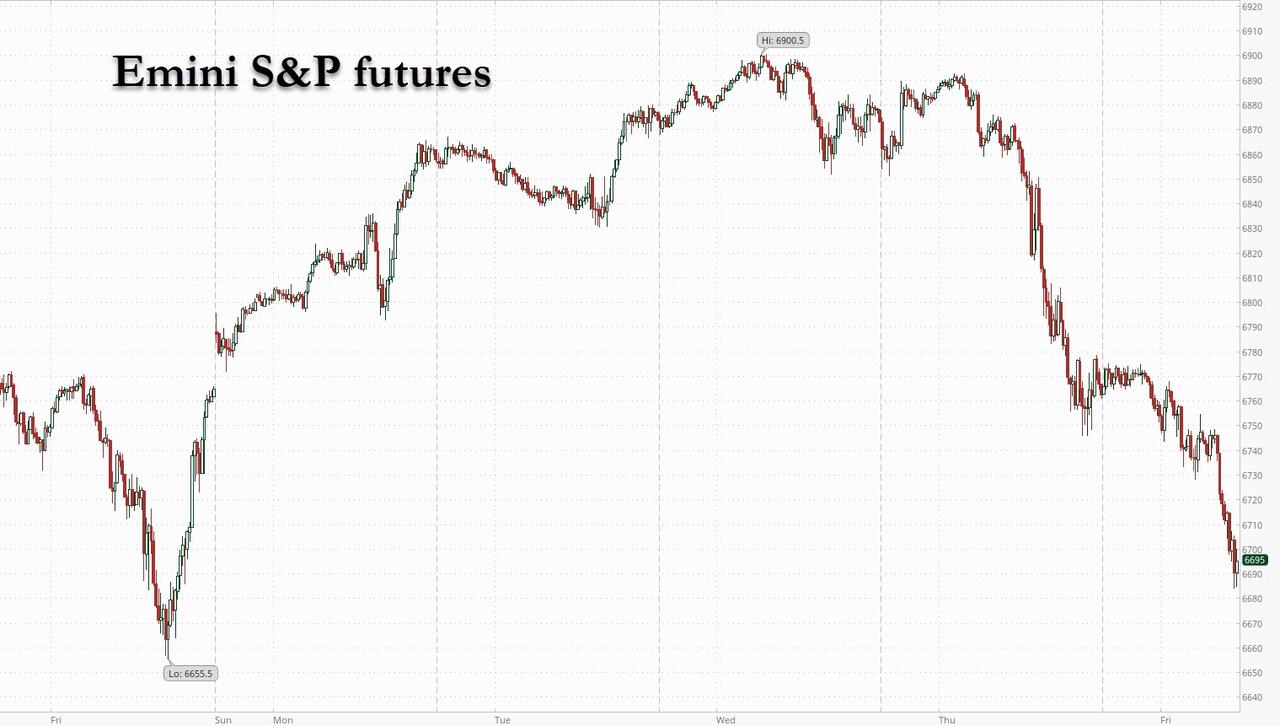
It’s ugly out there. Futs are sharply lower on doubts about whether the Fed will cut interest rates again in December, as fear deepens about stretched AI valuations and the debt used to fund them. S&P 500 futures are down 1% at 8:00 a.m.ET following continued unwind of momentum/AI thematic + hawkish Fed digestion (Kashkari undecided on Dec cut yesterday makes 5 officials now questioning/mkt currently pricing ~50% of Dec cut vs ~66% last Friday; more hawks today Schmid today @ 10:05am, Logan 2:30pm, Bostic 3:20pm); Nasdaq futures plunge 1.6%, pointed to a fourth consecutive day of losses in a week in which aggressively-built long positions in momentum stocks were unwound and value baskets comfortably outperformed. Pre-market, Mag 7 are all underperforming: TSLA -2.6%, NVDA -1.1%, META -0.5%. The VIX rose above 22.55, and is at session highs. Bond yields are sharply lower following a huge block of 135,000 10Y futs sold; USD was higher but then repriced sharply lower to LOD just around 7am ET. Commodities are mostly higher: oil +2.6%, sugar +1.6%. Bitcoin sank to a six-month low below $95K. This morning, we have seen a continuation of momentum unwind in the equities markets given valuation and positioning of the AI story; NVDA fell again into it earnings next week.
In premarket trading, Magnificent Seven all retreated in premarket trading as doubts over an interest-rate cut in December deepened concerns about stretched valuations (Tesla -4.8%, Nvidia -3.1%, Alphabet -2.7%, Amazon -1.6%, Meta -1.5%, Microsoft -0.6%, Apple -0.1%)
- AI-related energy stocks are sliding: Bloom Energy -8%, Oklo -7.7%, NuScale Power -8%, Nano Nuclear Energy -7.3%, Plug Power -7.2%, IREN -9%
- Applied Materials (AMAT) declines 6.5%. The chip-equipment maker suffered a sales decline last quarter and predicted another drop in the current period, though the company sees demand improving in the second half of 2026.
- Avadel Pharma (AVDL) jumps 18% after the pharmaceutical company said it received an unsolicited proposal from H. Lundbeck A/S to acquire it for up to $23.00 per ordinary share.
- Cidara Therapeutics (CDTX) is up 104% after Merck & Co. agreed to acquire the biotech company, which is developing a flu treatment.
- Gap Inc. (GAP) is up 1.6% after Jefferies upgraded the clothing retailer to buy from hold.
- Red Cat Holdings (RCAT) plunges 17% after the drone company’s FY25 revenue forecast missed the average analyst estimate.
- Stubhub (STUB) tumbles 19% as analysts note that it was surprising that the ticketing platform did not provide a forecast for the current quarter. It was the firm’s first quarterly report after going public in September.
- TripAdvisor Inc. (TRIP) is up 0.8% after Mizuho Securities upgraded the online travel agency to neutral from underperform.
- Warner Bros Discovery (WBD) is up 2.8% after the WSJ reported Paramount, Comcast and Netflix are preparing bids for the media company, citing people familiar. Separately, the owner of HBO and CNN in a filing said CEO David Zaslav’s employment agreement was amended amid a strategic review.
In corporate news, Citigroup’s CEO Jane Fraser says her bank is growing “rapidly” in China with reviving interest from investors and companies in the world’s second largest economy. NBA star Stephen Curry is leaving Under Armour, the sportswear firm that partnered with him for more than a decade.
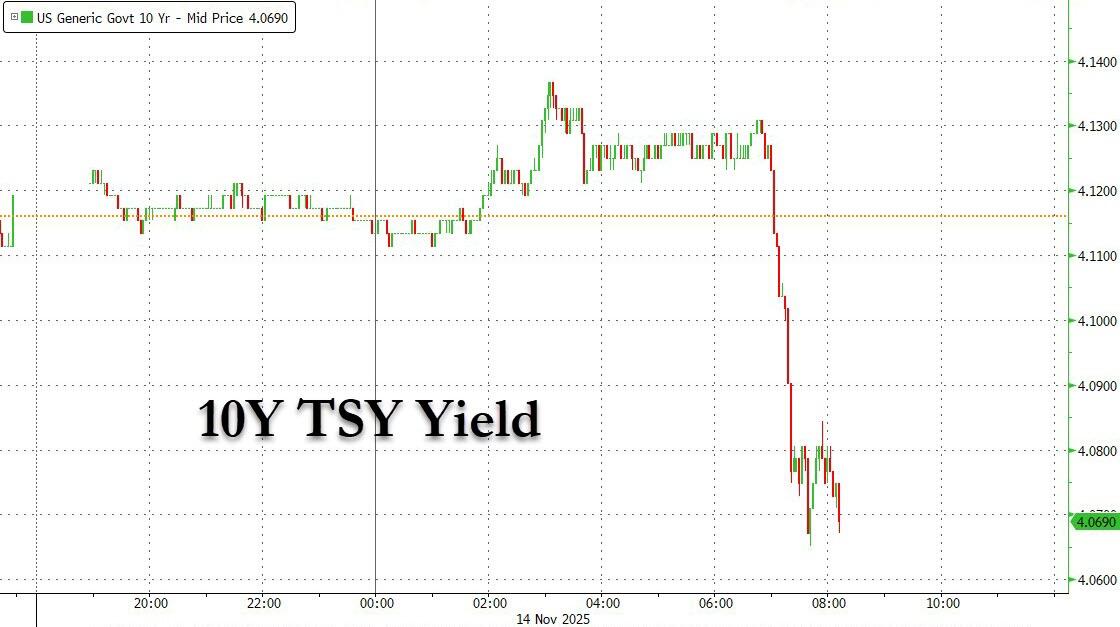
One doesn’t need to look at futures to see the signs of growing nervousness, with volatility in bond markets also on the rise. Minneapolis Fed president Neel Kashkari said Thursday he didn’t support the US central bank’s last interest-rate cut, though he’s still undecided on the best course of action for its December policy meeting. Markets are now pricing in less than a 50% chance of a cut next month, down from about 63% earlier this week and over 95% a month ago. Just after 7am ET, we saw a purchase of 135K 10Y futs which slammed yields 6bps lower in minutes.
It is not just the US which are volatile this morning: UK government bonds are lower, with larger declines at the long end after reports that Chancellor Reeves dropped plans to raise headline income tax rates. Thirty-year gilt yields rise 10 bps to 5.33%. Gilts found some support after Bloomberg reported Reeves’ decision was driven by an improved fiscal forecast from the budget watchdog.
AI euphoria is facing an acute test, as investors look are finally looking at the massive borrowing to fund the technology’s buildout (something we first warned about over a month ago). Support for the three-year bull market increasingly rests with a strong earnings outlook, and especially next week’s NVDA earnings. Still, foreign inflows into US equity funds are tracking at an annualized $134 billion, the second-biggest year ever after $163 billion in 2024, according to Bank of America citing EPFR Global data. US stocks saw their ninth-straight week of inflows through Nov. 12 at $6.4 billion. Meanwhile, a rotation from tech into more defensive stocks has helped the S&P 500 limit losses to just over 2% since its last record high toward the end of October, while the Nasdaq 100 has dropped nearly twice as much.
“The nervousness is palpable on markets and it stems from different corners,” said Arnaud Girod, head of economics and cross-asset strategy at Kepler Cheuvreux in Paris. “Any pushback from the Fed on interest rate cuts is bad news. If the Fed hasn’t enough data, they are likely not to cut.”
That said, while the market-cap weighted S&P has faced volatility and a recent downturn, beneath the surface, US equities remain healthy, lifting the equal-weighted index and underscoring the broader market’s reliance on, and concentration risk around, AI according to Bloomberg.
“We’ve seen tech stocks suffer the biggest repercussions each time there’s been a setback, and that’s because they trade at the frothiest valuations,” said Aneeka Gupta, director of macro research at Wisdom Tree UK. “Whenever there are question marks on whether there is a higher probability of a hawkish Fed stance, the segments that get hit the most are the highest duration ones.”
In trade news, Trump is readying substantial tariff cuts aimed at tackling high food prices and a series of new trade deals. Meanwhile an agreement with Switzerland could be close.
European stocks are broadly lower, including in the UK where the FTSE 100 drops 1.4%. UK equities underperformed on reports of a U-turn by Chancellor of the Exchequer Rachel Reeves on income tax hikes. Siemens Energy led energy stocks higher after raising guidance, while banks and tech shares were among the biggest laggards. Here are some of the biggest movers on Friday:
- Bechtle shares surge as much as 17%, the most in eight months, after the supplier of computers and office supplies reported a significant improvement in earnings in the third quarter compared to the second.
- Siemens Energy shares are up as much as 12%, the most since April, after the German energy company raised Ebitda guidance above consensus, citing strong demand for gas turbines and data center equipment.
- Richemont shares gain as much as 8.7%, the steepest advance since April, after the Swiss luxury-goods maker reported first-half results that beat analyst expectations across divisions and regions, particularly driven by strong demand for its jewelry brands.
- Orkla shares gain as much as 6.7%, the most since May, after the Norwegian consumer goods firm reported what DNB Carnegie said were slightly positive earnings.
- Alstom shares advance as much as 7.2%, the most since June, as analysts laud the company’s latest earnings as a reassuring and strong showing from the French rolling stock company.
- Bavarian Nordic shares drop as much as 7.8% to the lowest since July after the Danish vaccine maker’s revenue guidance for the full year was weaker than expected.
- Sonova shares drop as much as 6.1% to the lowest intraday since September 2020 after the Swiss hearing-aid maker reported weaker-than-expected Ebita for the first half-year.
- Swiss Re shares slip as much as 5.1%, the most since April, after posting a “mixed” quarter in the eyes of analysts.
- Goodwin shares drop as much as 12% after the Goodwin family sold 122,368 ordinary shares in the company to a limited number of institutional investors.
- Land Securities shares fall as much as 5% after the UK real estate firm reported lower-than-expected net asset value and dividends.
Earlier in the session, Asian stocks declined, led by technology-heavy markets, as concerns over lofty valuations and uncertainty around the Federal Reserve’s rate outlook dampened sentiment. The MSCI Asia Pacific Index dropped as much as 1.7% on Friday to head for its biggest decline since April. Technology megacaps including TSMC, SK Hynix and Samsung Electronics were the major drags. South Korea posted the steepest loss in the region, while Japan’s Nikkei 225, Taiwan’s Taiex index and the Hang Seng China Enterprises Index all dropped over 1.5%. In China, economic activity cooled more than expected at the start of the fourth quarter, with an unprecedented slump in investment and slower growth in industrial output adding to a drag from sluggish consumption. The onshore CSI 300 Index closed 1.6% lower, the most in nearly a month.
“The market sell off is mainly driven by disappointing macro economic data and increasing concern on leading e-commerce companies profitability,” said Jason Chan, senior investment strategist at Bank of East Asia in Hong Kong. “Also, many cities in Fujian province announced the trade-in subsidy of auto will be suspended in November, which heightens policy uncertainty on consumption stimulus.”
In FX, the BBG Dollar index saw a sudden airpocket led by yield differentials as 10Y yields tumbled 6bps just after 7am ET. The pound pared losses but remains down 0.4%.
In rates, treasuries erased losses in early US trading amid a curve-steepening rout in gilts, where reports that UK government will drop a proposed income tax increase have sparked jitters about its fiscal credibility. US yields retreated from session highs reached during the gilt selloff as US stock index futures slide, led by European equity markets. Front-end Treasury yields are lower by 2bp-3bp with long-end tenors little changed, steepening 2s10s and 5s30s spreads; 10-year, about 2bp lower on the day near 4.10%, peaked near 4.14% as UK 10-year yield surged as much as 13bp. UK yields remain cheaper by 4bp-10bp across a steeper curve after reports that Chancellor Rachel Reeves will drop a widely-expected income-tax increase in this month’s budget. US session includes three scheduled Fed speakers, while economic data continues to be delayed as the US government recuperates from its record-length shutdown.
In commodities, oil prices jump after a drone strike damaged an oil depot and a vessel at Russia’s Black Sea port of Novorossiysk. WTI crude rises 2.6% to near $60.20 a barrel. Gold slips about $9 to $4,162 an ounce, while Bitcoin falls 1.8% to around $97,000.
US economic calendar expected to continue to face delays as government reopens; October retail sales and PPI were scheduled to be released Friday. Fed speaker slate includes Schmid (10:05am), Logan (2:30pm) and Bostic (3:20pm)
Market Snapshot
- S&P 500 mini -0.3%
- Nasdaq 100 mini -0.6%
- Russell 2000 mini -0.3%
- Stoxx Europe 600 -1.2%
- DAX -0.9%
- CAC 40 -0.9%
- 10-year Treasury yield +1 basis point at 4.13%
- VIX +1.2 points at 21.2
- Bloomberg Dollar Index +0.1% at 1217.34
- euro -0.1% at $1.1616
- WTI crude +2.8% at $60.31/barrel
Top Overnight News
- The White House unveiled trade deals with Argentina, Ecuador, Guatemala, and El Salvador as part of an initiative to reduce food prices/ address affordability challenges for American consumers. FT
- Ukrainian drones attacked Russia’s giant Black Sea port of Novorossiysk overnight, prompting a state of emergency. Moscow launched a massive air strike on Kyiv that killed four and damaged several residential buildings. BBG
- NEC Director Hassett said he expects to see 60k job losses due to the government shutdown, while he responded that the numbers they have are consistent with more rate cuts, when asked about inflation.
- Signs of weakness in China’s economy stretched into October, with one measure of investment notching the sharpest slowdown in years. Retail sales was about inline at +2.9% (vs. the Street +2.8% and down from +3% in Sept) while industrial production fell short at +4.9% (vs. the Street +5.5% and down from +6.5% in Sept) and fixed asset and property investment declined at one of the sharpest rates in years. WSJ
- Sir Keir Starmer and Reachel Reeves have ditched their manifesto-busting plan to increase income tax rates, in a dramatic U-turn ahead of the Budget on Nov 26 that sparked a sell of in the gilt mkt. FT
- China’s unreported gold purchases could be more than 10x its official figures as it quietly tries to diversify away form the USD, highlighting the increasingly opaque sources of demand behind bullion’s record-breaking rally. FT
- Brazil hopes to reach a preliminary agreement with the US as soon as this month. India and Canada will work together to secure supply chains in critical minerals and clean energy, signaling a reset in bilateral ties. BBG
- Canada’s forestry industry plans to divert a significant shares of its wood exports from the US to new intl mkts, claiming that Trump’s latest trade tariffs will lead to lumber shortages and drive up building costs in America. FT
- Palantir is planning a “significant investment” in the UK to win military contracts, even as the software company has complained about slow traction in Europe.
- Paramount, Comcast and Netflix are preparing bids for Warner Bros. Discovery. WSJ
Trade/Tariffs
- US President Trump’s administration is preparing tariff exemptions in a bid to lower food prices, according to NYT
- US Secretary of State Rubio met with Brazil’s Foreign Minister and discussed a reciprocal framework for the US-Brazil trade relationship, according to the State Department
- US senior official said agreements with Argentina, Ecuador, El Salvador and Guatemala open markets to US agricultural and industrial products, expects full agreements with most of these countries to be finalised within the next two weeks, in which the four countries agreed not to impose digital service taxes. Furthermore, the tariff rates will remain for these countries, but framework agreements will provide relief in certain areas, including bananas.
- US senior official said talks with Switzerland on Thursday were very positive, and if the deal is accepted by US President Trump, we would see a reduction of tariffs on Swiss imports. The official also commented that they have made a lot of advances with Taiwan.
- South Korea announced the factsheet with the US was finalised and President Lee said that US President Trump made a rational decision for the factsheet, while Lee added they agreed that investment in the US will be limited to commercially viable projects and that South Korea and the US will build a new partnership for shipbuilding, AI and the nuclear industry. Lee stated that the sides agreed on South Korea building a nuclear-powered submarine, and South Korea will strengthen ties with companies like NVIDIA.
- South Korean Presidential Adviser said the US will give South Korea chip tariff terms that are no less favourable than Taiwan’s, while it was agreed with the US that forex market stability needs to be ensured and that the amount and timing of fund supply to the US can be adjusted if needed for forex stability.
- White House said the US and South Korea deal includes USD 150bln of Korean investment in the shipbuilding sector approved by the US and USD 200bln of additional Korean investment committed pursuant to an MOU on strategic investments, while the US has given approval for South Korea to build nuclear-powered attack submarines. US said it will reduce its Section 232 sectoral tariffs on automobiles, auto parts, timber, lumber and wood derivatives of South Korea to 15%, and for any Section 232 tariffs imposed on pharmaceuticals, the US intends to apply a tariff rate no greater than 15% to originating goods of South Korea. Furthermore, South Korea is committed to spending USD 25bln on US military equipment purchases by 2030 and shared its plan to provide comprehensive support for US Forces Korea amounting to USD 33bln in accordance with South Korean legal requirements, while the US agreed that South Korea will pay USD 20bln annual phased instalments as part of the trade deal.
A more detailed look at global markets courtesy of Newsquawk
APAC stocks were pressured following the sell-off stateside, where tech was hit on valuation and China AI race concerns, while sentiment was also not helped by recent hawkish-leaning Fed rhetoric and mixed Chinese activity data. ASX 200 was dragged lower by weakness in tech and with nearly all sectors in the red aside from energy. Nikkei 225 dipped beneath the 51,000 level and was among the worst performers amid earnings results and tech woes. Hang Seng and Shanghai Comp declined with participants digested the recent data releases, including mixed activity data in which Industrial Production disappointed and Retail Sales marginally topped estimates, but both showed a slowdown from the previous, while Chinese House Prices continued to contract. Nonetheless, the downside in the mainland was somewhat cushioned with China pledging to expand domestic demand and stabilise trade.
Top Asian News
- China stats bureau spokesperson said the economy was generally stable in October, but pressure to adjust the domestic economic structure remains high and stabilisation faces some challenges, while China is to improve the effectiveness of macro policies and to pursue higher-quality economic growth. China will also expand domestic demand on all fronts and will further spur private investment vitality. Furthermore, the spokesperson said China’s investment space and potential remain huge and that China will stabilise trade and help trade firms that have been heavily hit.
- South Korean Finance Minister said they are to prepare measures to stabilise the FX market with the pension fund, while he is concerned about increasing uncertainty in the FX market and noted it is necessary to address imbalances in FX supply and demand.
- Chinese Defence Ministry says the Japanese side “will only suffer a crushing defeat” should it dare to take a risk.
- Hong Kong revises its 2025 GDP forecast to 3.2% (prev. 2-3%).
- Japan’s automobile union (JAW) says there are no plans to scale back the wage demand for next year, despite a hit from US tariffs. Wage hikes are key to attaining a demand driven economy.
European Equities – Opened broadly lower, with all major indices in the red as sentiment soured following weakness in APAC trade, where tech underperformed on valuation and China AI concerns. Recent hawkish Fed rhetoric and mixed Chinese data also weighed. UK headlines dominated the morning, with reports that PM Starmer and Chancellor Reeves will scrap plans to raise income tax, further pressuring the FTSE 100 (-1.2%). EZ GDP and employment data were largely shrugged off, while attention now turns to ECB’s Buch, Elderson, and Lane. European sectors – Opened mostly lower, with only Energy (+1.0%) and Consumer Products & Services (+0.7%) in positive territory. The latter was lifted by Richemont (+8.0%) after stronger-than-expected H1 revenue and profit, while Energy gained on elevated crude prices following a Ukrainian drone strike on Russia’s Novorossiysk oil depot and upbeat results from Siemens Energy (+9.9%), which raised 2026 guidance. Laggards include Technology (-2.7%), Banks (-2.0%), and Basic Resources (-2.0%). Tech mirrored US weakness amid renewed US–China AI race concerns, while softer Chinese industrial output weighed on resources. Banks underperformed on UK political turbulence, with HSBC (-2.8%), Lloyds (-3.4%), and Barclays (-2.8%) all lower.
Top European News
- UK PM Starmer and Chancellor Reeves reportedly ditched budget plans to increase income tax rates, according to FT. Since, improved UK forecasts reportedly led Chancellor Reeves to drop the Income Tax hike, via Bloomberg citing sources.
- ITV’s Peston posts the UK Chancellor “is NOT going to take greater risks with the public finances, which is what investors quite understandably fear is happening”. Peston, citing sources, writes that the Chancellor will increase the headroom from the GBP 9bln at the last budget to GBP 15bln or more; “that will happen”. Expects Reeves and/or PM Starmer to make it clear today that they will not weaken their commitment to the fiscal rules and increasing headroom. Changes are due to the Treasury receiving improved data on current/expected future wage growth, which has increased tax revenue forecasts; reducing the need to increase tax rates re. Income Tax. New “tax masterplan”: extend the Income Tax threshold increase by another two years; look at reducing the threshold where 40p and 45p tax bands kick in.
- German Budget Committee approved the 2026 budget, which clears the path to parliamentary approval, while the budget has total spending of EUR 524.5bln and includes investments of EUR 58.3bln and borrowing of EUR 97.9bln.
- German 2026 net new borrowing to rise to EUR 98bln (vs. 89.8bln in the draft), via Bloomberg citing a document.
- ECB’s Elderson says he favours easier rules and fewer requirements for small banks.
FX
- USD – DXY is little changed after a subdued overnight session, following yesterday’s weakness when USD-denominated assets came under pressure amid a broader risk-off tone. With the government now reopened, focus shifts to the release of delayed economic data, though no official schedule has been confirmed — one could, however, be announced as early as today. In early European trade, DXY continues to hold within a narrow 99.109–99.336 range, well within Thursday’s 98.991-99.591 range.
- EUR – EUR/USD is trading slightly softer in early European hours after holding onto the prior day’s gains during APAC trade, remaining above the 1.1600 handle amid ongoing dollar pressure. Newsflow for the Eurozone is light, with the pair contained within a 1.1618–1.1648 intraday range and well within yesterday’s 1.1579–1.1656 parameters. The 50DMA and 100DMA sit just above at 1.1660 and 1.1662, respectively.
- GBP – GBP/USD is in focus this session following reports that Chancellor Reeves has scrapped plans for an income tax rate hike, a move seen as increasing fiscal risks ahead of the November 26th budget. Gilts slipped at the open, with the pound underperforming into European trade. Price action later reversed modestly after Bloomberg sources suggested that improved UK forecasts had prompted Reeves to drop the planned tax rise (see Fixed Income section for details). GBP/USD spiked from 1.3121 to 1.3200 on the Bloomberg headlines before easing back toward 1.3150, with trade contained within a 1.3109–1.3200 intraday range and inside yesterday’s broader 1.3100–1.3215 parameters.
- JPY – USD/JPY is struggling for clear direction after recent choppy trade and amid a lack of fresh domestic catalysts, while Japanese press highlights growing scepticism among market participants over the government’s ability to support the yen through direct intervention. The JPY is showing limited reaction to the broader risk-averse tone, with sentiment further dampened by sharp remarks from China’s Defence Ministry, which warned that Japan “will only suffer a crushing defeat” should it “dare to take a risk.” The comments followed Japanese PM Takaichi’s statement that a conflict over Taiwan could constitute a “survival-threatening situation” for Tokyo. USD/JPY trades within a 154.32–154.74 intraday range, contained inside yesterday’s 154.13–155.02 parameters.
- Antipodeans – The Antipodeans are mixed with NZD leading gains despite limited fresh catalysts, after the RBNZ confirmed it will proceed with easing mortgage loan-to-value ratio restrictions as previously announced last month. AUD/USD briefly moved above its 100DMA (0.6540) before pulling back, while NZD/USD recovered strongly from yesterday’s losses. The AUD/NZD cross meanwhile slipped from a 1.1558 high to a 1.1487 low.
Fixed Income
- Gilts – A volatile session, with the benchmark plunging from 93.37 to 92.07 at the lows (down 130 ticks) before rebounding to trade around 92.60, still lower by ~77 ticks. Yields briefly spiked to 4.57% (10yr) and 5.37% (30yr). The initial selloff followed FT reports that Chancellor Reeves plans to scrap the manifesto-breaching income tax rate hike, opting instead for threshold cuts and smaller levies — moves seen as undermining fiscal credibility. The reversal prompted renewed concerns over the government’s fiscal stability and added political pressure on PM Starmer. Gilts later pared losses after Bloomberg reported the U-turn was driven by improved UK growth and wage forecasts, lifting the benchmark nearly 50 ticks. ITV’s Peston added that the new plan includes a two-year extension of threshold freezes and lower entry points for the 40p/45p bands, underpinned by stronger wage-driven revenue projections. Despite partial recovery, markets remain uneasy over the handling of communications and credibility risks. The yield swing trimmed the odds of a December BoE cut to under 75% (from ~85% earlier in the week), particularly as higher wage growth reinforces inflation concerns within the MPC’s divided board.
- USTs – Softer in early Europe, with the benchmark slipping to a 112-19 low before stabilising near 112-22, down around 2+ ticks, as US futures found support amid improved chip-sector sentiment. Newsflow was light, with focus on US government bureaus resuming operations and expected to release updated data schedules—potentially as soon as today—setting up a catch-up-heavy week ahead. Attention remains on the December Fed meeting, where markets are split roughly 50/50 on a rate cut, leaving upcoming delayed data pivotal for near-term policy expectations.
- Bunds – Weaker, down around 23 ticks at 128.69, trading between USTs and Gilts in relative terms. The benchmark fell to a 128.63 low (off 29 ticks at worst) after Germany’s defence ministry unveiled its 2026 Bundeswehr funding plan, followed by the Bundestag fiscal committee’s approval of a total package roughly EUR 4bln above the prior figure. Reports indicate net new borrowing for 2026 at EUR 98bln (vs EUR 89.8bln in the draft), explaining Bunds’ mild underperformance versus Treasuries. The full Bundestag vote is scheduled for November 28th.
Commodities
- Crude Oil – Firmer after prices surged in APAC trade on reports of a Ukrainian strike on a Russian oil depot and Kyiv confirming active air defences amid a large-scale attack. WTI and Brent spiked around USD 2/bbl to peaks of USD 60.65 and USD 64.86, before easing to USD 59.26 and USD 63.56 respectively. Later, the UKMTO reported an incident off UAE’s Khor Fakkan, believed linked to state activity, shortly after Reuters cited sources saying an Iranian force redirected a Talara tanker toward its coast near the Strait of Hormuz, prompting a fresh USD 1/bbl uptick. Separately, Sky News Arabia reported the IDF preparing a limited offensive in Lebanon against Hezbollah.
- Precious Metals – Mixed, with XAU unchanged and XAG +1.0%. Spot gold held in a USD 4159–4211/oz range through APAC and early Europe, consolidating after several Fed officials suggested limited scope for further cuts, while Kashkari said he did not support the latest move. The simultaneous drop in equities and gold on Thursday has raised concern that the metal’s safe-haven appeal is fading, with investors noting that gold’s strong correlation with risk aversion — which helped drive it to record highs in recent months — has weakened lately.
- Base Metals – Softer, with 3M LME Copper -0.3%, extending Thursday’s risk-off tone. The red metal held within a USD 10.86k–10.91k/t range through APAC before dipping to a USD 10.83k/t low amid continued caution in broader markets. It has since bounced modestly from session lows as sentiment stabilises.
- US President Trump administration revoked Biden-era limits on Alaska oil drilling.
Geopolitics: Iran
- Talara crude oil tanker taken towards Iranian coast by revolutionary guards based on initial assessment according to Reuters sources.
- Thereafter, UKMTO notes of incident off the coast of UAE’s Khor Fakkan, believed to be state activity; Vessel is transiting towards Iranian territorial waters
- Ukrainian drone attack damages apartment buildings and oil depot in Russian Black Sea port of Novorossiysk.
- Ukrainian air defence units were engaged in Kyiv against what the mayor described as a massive Russian attack.
- US Coast Guard detected and monitored a Russian military vessel operating near US territorial waters approximately 15 nautical miles south of Oahu on October 29th, according to the US Coast Guard.
- US senior military officials on Wednesday presented President Trump with updated options for potential operations in Venezuela, including strikes, according to sources cited by CBS News.
- US Defense Secretary Hegseth announces Operation Southern Spear to remove narco-terrorists from the Western Hemisphere.
- China summoned Japan’s envoy over Japanese PM Takaichi’s remarks on Taiwan and said the remarks were extremely dangerous.
US Event Calendar
- 10:05 am: Fed’s Schmid Speaks at Energy Conference
- 2:30 pm: Fed’s Logan Speaks in Fireside Chat
- 3:20 pm: Fed’s Bostic To Participate in Moderated Conversation
DB’s Jim Reid concludes the overnight wrap
It’s certainly been a volatile week in terms of sentiment with relief over the end of the shutdown vying with concerns over AI valuations and whether the Fed will cut rates again after several speakers have struck a more cautious tone this week. The S&P 500 (-1.66%) posted its worst day in over a month with a December cut probability falling sharply from around 59% at Wednesday’s close to 49% last night. Standby for a likely deluge of data next week to test this pricing in both directions.
On those releases, yesterday we heard NEC Director Kevin Hassett say that the September jobs report might get released next week. That release should have come out on October 3, so just a couple of days after the shutdown began, and the data collection for that had already been completed when the shutdown started. Then for the October jobs report (which would have normally been out on November 7), Hasset said on Fox News that “We’re going to get half the employment report. We’ll get the jobs part, but we won’t get the unemployment rate”.
Ahead of those releases, we heard from a few Fed speakers yesterday, who struck a cautious tone on the policy outlook. For instance, San Francisco President Daly said that she had “an open mind” on the decision in December. Cleveland Fed President Hammack said “we’ve got this persistent high inflation that is sticking around”, and that getting inflation “back to 2% is critical for our credibility, and that’s our objective”. St Louis Fed President Musalem (a voter this year) noted that “We need to proceed and tread with caution, because I think there’s limited room for further easing”. And Minneapolis Fed President Kashkari suggested that he didn’t support the Fed’s last rate cut in October and that he was undecided on December. So regional Fed presidents not sounding like they are rushing into rate cuts, and futures dialled back the likelihood of a December cut to 49% by the close, down from 59% the previous day.
Clearly, it’s this upcoming wave of data that will help determine whether we actually get a December cut, but there was a clear market reaction to that Fedspeak in the meantime. US equities lost ground across the board, with the S&P 500 (-1.66%) slumping after a run of 4 consecutive gains. The decline was driven by the more cyclical sectors, with the NASDAQ (-2.29%) and the Magnificent 7 (-2.69%) posting even larger declines led by Nvidia (-3.58%) and Tesla (-6.64%). Epitomising yesterday’s struggles for momentum stocks, Robinhood Markets (-8.61%) was the worst performer in the S&P 500 after unveiling a cash delivery service. Still, its shares are up +226% year-to-date. Meanwhile, Walt Disney (-7.75%) was the third worst-performer in the S&P after its Q4 revenue missed estimates. While defensive sectors fared less badly, the equal-weighted S&P 500 (-1.18%) also saw its worst day since the US-China trade escalation five weeks ago.
Rising volatility saw the VIX index (+2.49pts) spike back to exactly 20.0 at the close, with many other asset classes also struggling. Bitcoin (-3.08% to $98,756) fell to its lowest level since early May, extending the decline from its early October peak to -21%. Credit spreads widened, with US IG and HY +1bps and +8bps wider respectively. And historical safe havens of gold (-0.57%) and the dollar (-0.34%) weren’t spared either.
This backdrop also weighed on US Treasuries, with yields rising as investors priced in fewer rate cuts. For example, if we look at the December 2026 meeting, investors were pricing in 81bps of cuts by the close, down -1.8bps on the day. So it wasn’t just the next meeting that was being priced in a more hawkish direction. In turn, that pushed yields higher, with the 2yr yield (+2.2bps) moving up to 3.59%, whilst the 10yr yield (+5.0bps) was up to 4.12%. Long-end Treasuries weren’t helped by a softish 30yr auction that saw $25bn of bonds issued +1.0bps above the pre-sale yield, leaving 30yr yields +4.8bps higher on the day. US yields are back down around a basis point across the curve in Asia this morning.
Earlier in Europe, markets followed a very similar direction to the US, with equities and bonds both selling off. In the UK, sentiment wasn’t helped by an underwhelming GDP report, which showed Q3 GDP growth at just +0.1% (vs. +0.2% expected), whilst the major equity indices lost ground across the continent. So the STOXX 600 (-0.61%) fell back after a 3-day run of gains, with the FTSE 100 (-1.05%) and the DAX (-1.39%) leading the declines. And sovereign bond yields moved consistently higher too, with those on 10yr bunds (+4.4bps), OATs (+3.9bps) and BTPs (+4.8bps) all rising.
Here in the UK, sterling is trading -0.39% lower this morning after the FT reported late last night that Prime Minister Keir Starmer and Chancellor Rachel Reeves have ditched plans to increase income tax rates with the budget announcement on November 26. The politics of breaking a manifesto pledge are seemingly forcing their hands if the story is correct. Gilts have outperformed recently on the expectations of significant tax rises in the budget so this could bring some reversal of that.
Asian markets are weak this morning, following on from the US losses with weak monthly China data also a focus. As I check my screens, the KOSPI (-3.51%) is experiencing the most significant losses, followed by the Nikkei (-1.70%), the S&P/ASX 200 (-1.37%), the Hang Seng (-1.36%), the CSI (-0.81%), and the Shanghai Composite (-0.25%). S&P 500 (+0.03%) and NASDAQ 100 (-0.01%) have actually stabilised this morning.
Turning our attention back to China, industrial production increased by +4.3% year-on-year in October, which was below expectations and a decrease from a three-month high of +6.5%, as local manufacturers contend with weak domestic demand and trade tensions with the US. This represents the slowest growth in industrial production since August 2024. Simultaneously, retail sales rose by +2.9% year-on-year in October, surpassing market expectations of +2.7% but down from the 3.0% increase observed in the previous month. In a separate report, new home prices fell by -0.45% month-on-month in October, marking the steepest monthly decline in a year, which underscores the persistently weak demand in the beleaguered property sector which may require additional policy support. This follows a -0.41% decrease in September. September and October are typically peak sales periods.
In the commodities market, Brent crude prices surged above $64 per barrel overnight before retracting some gains to close +1.48% higher, settling at $63.94 per barrel all due to supply concerns following a Ukrainian drone strike on an oil depot in the Russian Black Sea port of Novorossiysk, a key export hub.
To the day ahead now, and data releases include the second estimate of Q3 GDP in the Euro Area, and the final October CPI reading for France. Otherwise, central bank speakers include the ECB’s Escriva, Vujcic, Elderson and Lane, along with the Fed’s Schmid, Logan and Bostic.
b) European opening report
US equity futures are weaker across the board in pre-market trade as Tech continues to lag on valuation concerns – Newsquawk US Market Open

Friday, Nov 14, 2025 – 05:54 AM
- European equities opened broadly lower, with all major indices in the red as sentiment soured following weakness in APAC trade; FTSE 100 lags.
- US equity futures are weaker across the board in pre-market trade as Tech continues to lag on valuation concerns.
- GBP/USD is in focus this session following reports that Chancellor Reeves has scrapped plans for an income tax rate hike, a move seen as increasing fiscal risks ahead of the November 26th budget.
- Gilts experienced a volatile session, with the benchmark plunging from 93.37 to 92.07, but has since rebounded modestly on reports around UK forecasts.
- UKMTO notes of incident off the coast of UAE’s Khor Fakkan [near the Strait of Hormuz], believed to be state activity; Vessel is transiting towards Iranian territorial waters.
- Looking ahead, speakers include ECBʼs Cipollone & Lane, Fedʼs Bostic, Schmid & Logan.
SNAPSHOT
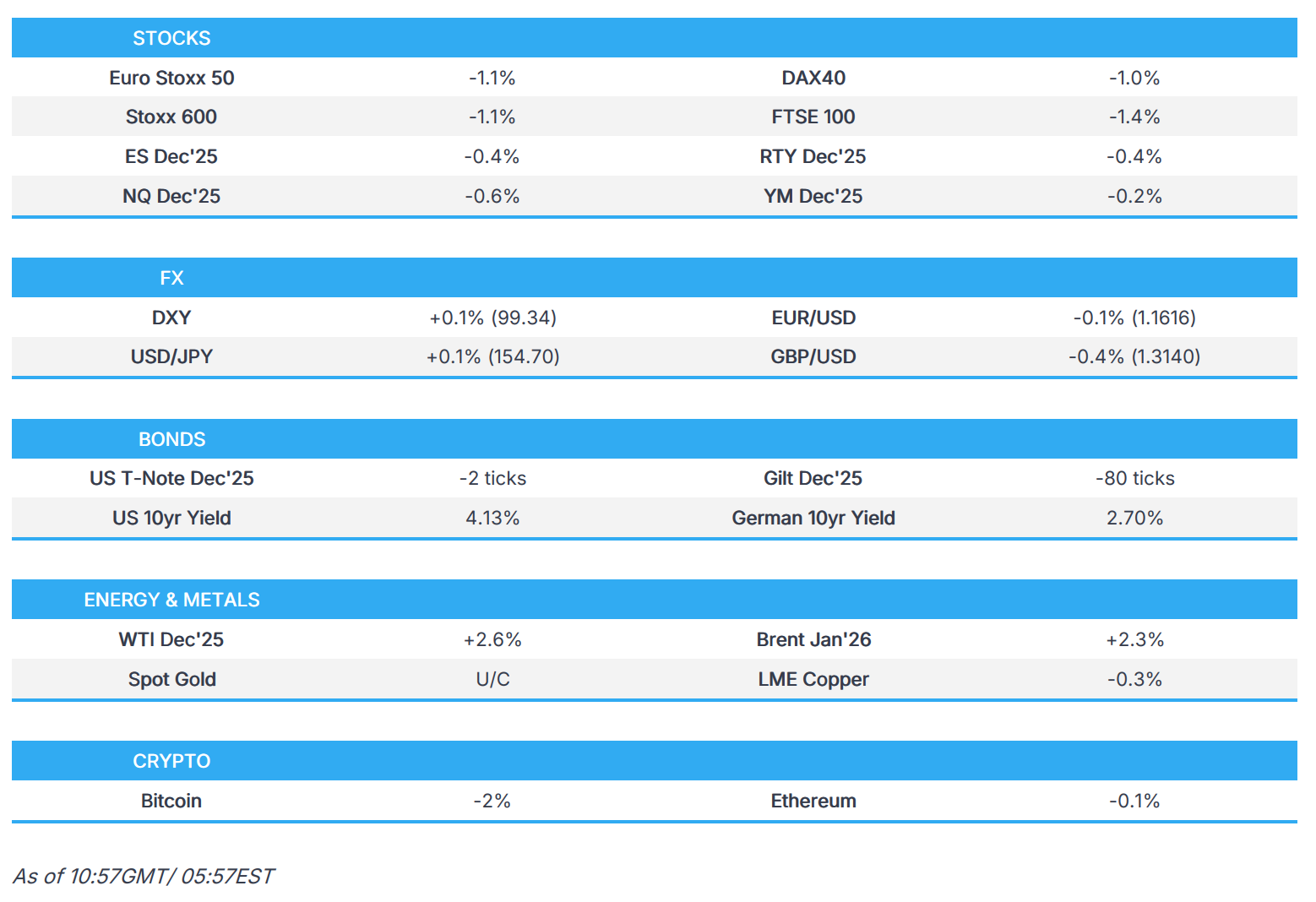
Newsquawk in 3 steps:
1. Subscribe to the free premarket movers reports
2. Listen to this report in the market open podcast (available on Apple and Spotify)
3. Trial Newsquawk’s premium real-time audio news squawk box for 7 days
TARIFFS/TRADE
- US President Trump’s administration is preparing tariff exemptions in a bid to lower food prices, according to NYT
- US Secretary of State Rubio met with Brazil’s Foreign Minister and discussed a reciprocal framework for the US-Brazil trade relationship, according to the State Department
- US senior official said agreements with Argentina, Ecuador, El Salvador and Guatemala open markets to US agricultural and industrial products, expects full agreements with most of these countries to be finalised within the next two weeks, in which the four countries agreed not to impose digital service taxes. Furthermore, the tariff rates will remain for these countries, but framework agreements will provide relief in certain areas, including bananas.
- US senior official said talks with Switzerland on Thursday were very positive, and if the deal is accepted by US President Trump, we would see a reduction of tariffs on Swiss imports. The official also commented that they have made a lot of advances with Taiwan.
- South Korea announced the factsheet with the US was finalised and President Lee said that US President Trump made a rational decision for the factsheet, while Lee added they agreed that investment in the US will be limited to commercially viable projects and that South Korea and the US will build a new partnership for shipbuilding, AI and the nuclear industry. Lee stated that the sides agreed on South Korea building a nuclear-powered submarine, and South Korea will strengthen ties with companies like NVIDIA.
- South Korean Presidential Adviser said the US will give South Korea chip tariff terms that are no less favourable than Taiwan’s, while it was agreed with the US that forex market stability needs to be ensured and that the amount and timing of fund supply to the US can be adjusted if needed for forex stability.
- White House said the US and South Korea deal includes USD 150bln of Korean investment in the shipbuilding sector approved by the US and USD 200bln of additional Korean investment committed pursuant to an MOU on strategic investments, while the US has given approval for South Korea to build nuclear-powered attack submarines. US said it will reduce its Section 232 sectoral tariffs on automobiles, auto parts, timber, lumber and wood derivatives of South Korea to 15%, and for any Section 232 tariffs imposed on pharmaceuticals, the US intends to apply a tariff rate no greater than 15% to originating goods of South Korea. Furthermore, South Korea is committed to spending USD 25bln on US military equipment purchases by 2030 and shared its plan to provide comprehensive support for US Forces Korea amounting to USD 33bln in accordance with South Korean legal requirements, while the US agreed that South Korea will pay USD 20bln annual phased instalments as part of the trade deal.
EUROPEAN TRADE
EQUITIES
- European Equities – Opened broadly lower, with all major indices in the red as sentiment soured following weakness in APAC trade, where tech underperformed on valuation and China AI concerns. Recent hawkish Fed rhetoric and mixed Chinese data also weighed. UK headlines dominated the morning, with reports that PM Starmer and Chancellor Reeves will scrap plans to raise income tax, further pressuring the FTSE 100 (-1.2%). EZ GDP and employment data were largely shrugged off, while attention now turns to ECB’s Buch, Elderson, and Lane.
- European sectors – Opened mostly lower, with only Energy (+1.0%) and Consumer Products & Services (+0.7%) in positive territory. The latter was lifted by Richemont (+8.0%) after stronger-than-expected H1 revenue and profit, while Energy gained on elevated crude prices following a Ukrainian drone strike on Russia’s Novorossiysk oil depot and upbeat results from Siemens Energy (+9.9%), which raised 2026 guidance. Laggards include Technology (-2.7%), Banks (-2.0%), and Basic Resources (-2.0%). Tech mirrored US weakness amid renewed US–China AI race concerns, while softer Chinese industrial output weighed on resources. Banks underperformed on UK political turbulence, with HSBC (-2.8%), Lloyds (-3.4%), and Barclays (-2.8%) all lower.
- US Equity Futures – Weaker across the board in pre-market trade as Tech continues to lag on valuation concerns. Overnight, US officials described talks with Switzerland as “very positive,” noting that if approved by President Trump, the deal would see reduced tariffs on Swiss imports. The White House also announced a South Korea investment deal, including USD 150bln in approved shipbuilding investment and USD 200bln in additional strategic commitments under an MOU. Today’s US calendar is light, with Fed speakers Schmid (’25, hawkish), Logan (’26), and Bostic (’27) on deck.
- Click for the sessions European pre-market equity newsflow
- Click for the additional news
- Click for a detailed summary
FX
- USD – DXY is little changed after a subdued overnight session, following yesterday’s weakness when USD-denominated assets came under pressure amid a broader risk-off tone. With the government now reopened, focus shifts to the release of delayed economic data, though no official schedule has been confirmed — one could, however, be announced as early as today. In early European trade, DXY continues to hold within a narrow 99.109–99.336 range, well within Thursday’s 98.991-99.591 range.
- EUR – EUR/USD is trading slightly softer in early European hours after holding onto the prior day’s gains during APAC trade, remaining above the 1.1600 handle amid ongoing dollar pressure. Newsflow for the Eurozone is light, with the pair contained within a 1.1618–1.1648 intraday range and well within yesterday’s 1.1579–1.1656 parameters. The 50DMA and 100DMA sit just above at 1.1660 and 1.1662, respectively.
- GBP – GBP/USD is in focus this session following reports that Chancellor Reeves has scrapped plans for an income tax rate hike, a move seen as increasing fiscal risks ahead of the November 26th budget. Gilts slipped at the open, with the pound underperforming into European trade. Price action later reversed modestly after Bloomberg sources suggested that improved UK forecasts had prompted Reeves to drop the planned tax rise (see Fixed Income section for details). GBP/USD spiked from 1.3121 to 1.3200 on the Bloomberg headlines before easing back toward 1.3150, with trade contained within a 1.3109–1.3200 intraday range and inside yesterday’s broader 1.3100–1.3215 parameters.
- JPY – USD/JPY is struggling for clear direction after recent choppy trade and amid a lack of fresh domestic catalysts, while Japanese press highlights growing scepticism among market participants over the government’s ability to support the yen through direct intervention. The JPY is showing limited reaction to the broader risk-averse tone, with sentiment further dampened by sharp remarks from China’s Defence Ministry, which warned that Japan “will only suffer a crushing defeat” should it “dare to take a risk.” The comments followed Japanese PM Takaichi’s statement that a conflict over Taiwan could constitute a “survival-threatening situation” for Tokyo. USD/JPY trades within a 154.32–154.74 intraday range, contained inside yesterday’s 154.13–155.02 parameters.
- Antipodeans – The Antipodeans are mixed with NZD leading gains despite limited fresh catalysts, after the RBNZ confirmed it will proceed with easing mortgage loan-to-value ratio restrictions as previously announced last month. AUD/USD briefly moved above its 100DMA (0.6540) before pulling back, while NZD/USD recovered strongly from yesterday’s losses. The AUD/NZD cross meanwhile slipped from a 1.1558 high to a 1.1487 low.
- PBoC set USD/CNY mid-point at 7.0825 vs exp. 7.0964 (Prev. 7.0865).
- Click for a detailed summary
FIXED INCOME
- Gilts – A volatile session, with the benchmark plunging from 93.37 to 92.07 at the lows (down 130 ticks) before rebounding to trade around 92.60, still lower by ~77 ticks. Yields briefly spiked to 4.57% (10yr) and 5.37% (30yr). The initial selloff followed FT reports that Chancellor Reeves plans to scrap the manifesto-breaching income tax rate hike, opting instead for threshold cuts and smaller levies — moves seen as undermining fiscal credibility. The reversal prompted renewed concerns over the government’s fiscal stability and added political pressure on PM Starmer. Gilts later pared losses after Bloomberg reported the U-turn was driven by improved UK growth and wage forecasts, lifting the benchmark nearly 50 ticks. ITV’s Peston added that the new plan includes a two-year extension of threshold freezes and lower entry points for the 40p/45p bands, underpinned by stronger wage-driven revenue projections. Despite partial recovery, markets remain uneasy over the handling of communications and credibility risks. The yield swing trimmed the odds of a December BoE cut to under 75% (from ~85% earlier in the week), particularly as higher wage growth reinforces inflation concerns within the MPC’s divided board.
- USTs – Softer in early Europe, with the benchmark slipping to a 112-19 low before stabilising near 112-22, down around 2+ ticks, as US futures found support amid improved chip-sector sentiment. Newsflow was light, with focus on US government bureaus resuming operations and expected to release updated data schedules—potentially as soon as today—setting up a catch-up-heavy week ahead. Attention remains on the December Fed meeting, where markets are split roughly 50/50 on a rate cut, leaving upcoming delayed data pivotal for near-term policy expectations.
- Bunds – Weaker, down around 23 ticks at 128.69, trading between USTs and Gilts in relative terms. The benchmark fell to a 128.63 low (off 29 ticks at worst) after Germany’s defence ministry unveiled its 2026 Bundeswehr funding plan, followed by the Bundestag fiscal committee’s approval of a total package roughly EUR 4bln above the prior figure. Reports indicate net new borrowing for 2026 at EUR 98bln (vs EUR 89.8bln in the draft), explaining Bunds’ mild underperformance versus Treasuries. The full Bundestag vote is scheduled for November 28th.
- Click for a detailed summary
COMMODITIES
- Crude Oil – Firmer after prices surged in APAC trade on reports of a Ukrainian strike on a Russian oil depot and Kyiv confirming active air defences amid a large-scale attack. WTI and Brent spiked around USD 2/bbl to peaks of USD 60.65 and USD 64.86, before easing to USD 59.26 and USD 63.56 respectively. Later, the UKMTO reported an incident off UAE’s Khor Fakkan, believed linked to state activity, shortly after Reuters cited sources saying an Iranian force redirected a Talara tanker toward its coast near the Strait of Hormuz, prompting a fresh USD 1/bbl uptick. Separately, Sky News Arabia reported the IDF preparing a limited offensive in Lebanon against Hezbollah.
- Precious Metals – Mixed, with XAU unchanged and XAG +1.0%. Spot gold held in a USD 4159–4211/oz range through APAC and early Europe, consolidating after several Fed officials suggested limited scope for further cuts, while Kashkari said he did not support the latest move. The simultaneous drop in equities and gold on Thursday has raised concern that the metal’s safe-haven appeal is fading, with investors noting that gold’s strong correlation with risk aversion — which helped drive it to record highs in recent months — has weakened lately.
- Base Metals – Softer, with 3M LME Copper -0.3%, extending Thursday’s risk-off tone. The red metal held within a USD 10.86k–10.91k/t range through APAC before dipping to a USD 10.83k/t low amid continued caution in broader markets. It has since bounced modestly from session lows as sentiment stabilises.
- US President Trump administration revoked Biden-era limits on Alaska oil drilling.
- Qatar raised the January term premium for Al-Shaheen oil to USD 0.84 per barrel above Dubai quotes.
- Click for a detailed summary
CRYPTO
- Crypto markets remain subdued with Bitcoin firmly under USD 100,000 and trading on either side of USD 97,000.
NOTABLE DATA RECAP
- EU GDP Flash Estimate YY (Q3) 1.4% vs. Exp. 1.3% (Prev. 1.3%, Rev. 1.5%)
- EU GDP Flash Estimate QQ (Q3) 0.2% vs. Exp. 0.2% (Prev. 0.2%, Rev. 0.1%)
- EU Eurostat Trade NSA, EUR (Sep) 19.4B (Prev. 1.0B, Rev. 1.9B)
- EU Employment Flash QQ (Q3) 0.1% vs. Exp. 0.1% (Prev. 0.1%)
- EU Employment Flash YY (Q3) 0.5% vs. Exp. 0.5% (Prev. 0.6%)
- French CPI (EU Norm) Final YY (Oct) 0.8% vs. Exp. 0.9% (Prev. 0.9%); MM 0.1% vs. Exp. 0.1% (Prev. 0.1%)
- Spanish HICP Final YY (Oct) 3.2% vs. Exp. 3.2% (Prev. 3.2%); MM (Oct) 0.5% vs. Exp. 0.5% (Prev. 0.5%)
- Italian Global Trade Balance (Sep) 2.852B EU (Prev. 2.05B EU).
NOTABLE EUROPEAN HEADLINES
- UK PM Starmer and Chancellor Reeves reportedly ditched budget plans to increase income tax rates, according to FT. Since, improved UK forecasts reportedly led Chancellor Reeves to drop the Income Tax hike, via Bloomberg citing sources.
- ITV’s Peston posts the UK Chancellor “is NOT going to take greater risks with the public finances, which is what investors quite understandably fear is happening”. Peston, citing sources, writes that the Chancellor will increase the headroom from the GBP 9bln at the last budget to GBP 15bln or more; “that will happen”. Expects Reeves and/or PM Starmer to make it clear today that they will not weaken their commitment to the fiscal rules and increasing headroom. Changes are due to the Treasury receiving improved data on current/expected future wage growth, which has increased tax revenue forecasts; reducing the need to increase tax rates re. Income Tax. New “tax masterplan”: extend the Income Tax threshold increase by another two years; look at reducing the threshold where 40p and 45p tax bands kick in.
- German Budget Committee approved the 2026 budget, which clears the path to parliamentary approval, while the budget has total spending of EUR 524.5bln and includes investments of EUR 58.3bln and borrowing of EUR 97.9bln.
- German 2026 net new borrowing to rise to EUR 98bln (vs. 89.8bln in the draft), via Bloomberg citing a document.
- ECB’s Elderson says he favours easier rules and fewer requirements for small banks.
NOTABLE US HEADLINES
- NEC Director Hassett said he expects to see 60k job losses due to the government shutdown, while he responded that the numbers they have are consistent with more rate cuts, when asked about inflation.
GEOPOLITICS
IRAN
- Talara crude oil tanker taken towards Iranian coast by revolutionary guards based on initial assessment according to Reuters sources.
- Thereafter, UKMTO notes of incident off the coast of UAE’s Khor Fakkan, believed to be state activity; Vessel is transiting towards Iranian territorial waters
RUSSIA-UKRAINE
- Ukrainian drone attack damages apartment buildings and oil depot in Russian Black Sea port of Novorossiysk.
- Ukrainian air defence units were engaged in Kyiv against what the mayor described as a massive Russian attack.
- US Coast Guard detected and monitored a Russian military vessel operating near US territorial waters approximately 15 nautical miles south of Oahu on October 29th, according to the US Coast Guard.
OTHER
- US senior military officials on Wednesday presented President Trump with updated options for potential operations in Venezuela, including strikes, according to sources cited by CBS News.
- US Defense Secretary Hegseth announces Operation Southern Spear to remove narco-terrorists from the Western Hemisphere.
- China summoned Japan’s envoy over Japanese PM Takaichi’s remarks on Taiwan and said the remarks were extremely dangerous.
APAC TRADE
- APAC stocks were pressured following the sell-off stateside, where tech was hit on valuation and China AI race concerns, while sentiment was also not helped by recent hawkish-leaning Fed rhetoric and mixed Chinese activity data.
- ASX 200 was dragged lower by weakness in tech and with nearly all sectors in the red aside from energy.
- Nikkei 225 dipped beneath the 51,000 level and was among the worst performers amid earnings results and tech woes.
- Hang Seng and Shanghai Comp declined with participants digested the recent data releases, including mixed activity data in which Industrial Production disappointed and Retail Sales marginally topped estimates, but both showed a slowdown from the previous, while Chinese House Prices continued to contract. Nonetheless, the downside in the mainland was somewhat cushioned with China pledging to expand domestic demand and stabilise trade.
NOTABLE ASIA-PAC HEADLINES
- China stats bureau spokesperson said the economy was generally stable in October, but pressure to adjust the domestic economic structure remains high and stabilisation faces some challenges, while China is to improve the effectiveness of macro policies and to pursue higher-quality economic growth. China will also expand domestic demand on all fronts and will further spur private investment vitality. Furthermore, the spokesperson said China’s investment space and potential remain huge and that China will stabilise trade and help trade firms that have been heavily hit.
- South Korean Finance Minister said they are to prepare measures to stabilise the FX market with the pension fund, while he is concerned about increasing uncertainty in the FX market and noted it is necessary to address imbalances in FX supply and demand.
- Chinese Defence Ministry says the Japanese side “will only suffer a crushing defeat” should it dare to take a risk.
- Hong Kong revises its 2025 GDP forecast to 3.2% (prev. 2-3%).
- Japan’s automobile union (JAW) says there are no plans to scale back the wage demand for next year, despite a hit from US tariffs. Wage hikes are key to attaining a demand driven economy.
DATA RECAP
- Chinese Industrial Production YY (Oct) 4.9% vs. Exp. 5.5% (Prev. 6.5%)
- Chinese Retail Sales YY (Oct) 2.9% vs. Exp. 2.8% (Prev. 3.0%)
- Chinese Urban Investment YTD YY (Oct) -1.7% vs. Exp. -0.8% (Prev. -0.5%)
- Chinese Unemployment Rate Urban Area (Oct) 5.1% (Prev. 5.2%)
- Chinese China House Prices MM (Oct) -0.5% (Prev. -0.4%); YY (Oct) -2.2% (Prev. -2.2%
c) Asian opening report
European equity futures mostly lower; UK PM Starmer and Chancellor Reeves to ditch income tax increase plans – Newsquawk Europe Market Open
Friday, Nov 14, 2025 – 01:42 AM
- APAC stocks were pressured following the sell-off stateside, where tech was hit on valuation and China AI race concerns, while sentiment was also not helped by recent hawkish-leaning Fed rhetoric and mixed Chinese activity data.
- Chinese activity data was mixed, in which Industrial Production disappointed and Retail Sales marginally topped estimates, but both showed a slowdown from the previous, while Chinese House Prices continued to contract.
- US BLS said it is working on a plan to release the delayed data and stated, “We appreciate your patience while we work to get this information out ASAP, as it may take time to fully assess the situation and finalise revised release dates”, according to WSJ.
- UK PM Starmer and Chancellor Reeves reportedly ditched budget plans to increase income tax rates, according to FT.
- European equity futures indicate a lower cash market open with Euro Stoxx 50 futures down 0.3% after the cash market closed with losses of 0.8% on Thursday.
- Looking ahead, highlights include German Wholesale Price Index (Oct), French/Spanish CPI Final (Oct), EU Trade Balance (Sep), EU GDP Flash Estimate (Q3), Speakers including ECB’s Cipollone, Elderson & Lane, Fed’s Bostic, Schmid & Logan, Earnings from Swiss Re, Allianz & Siemens Energy.
SNAPSHOT
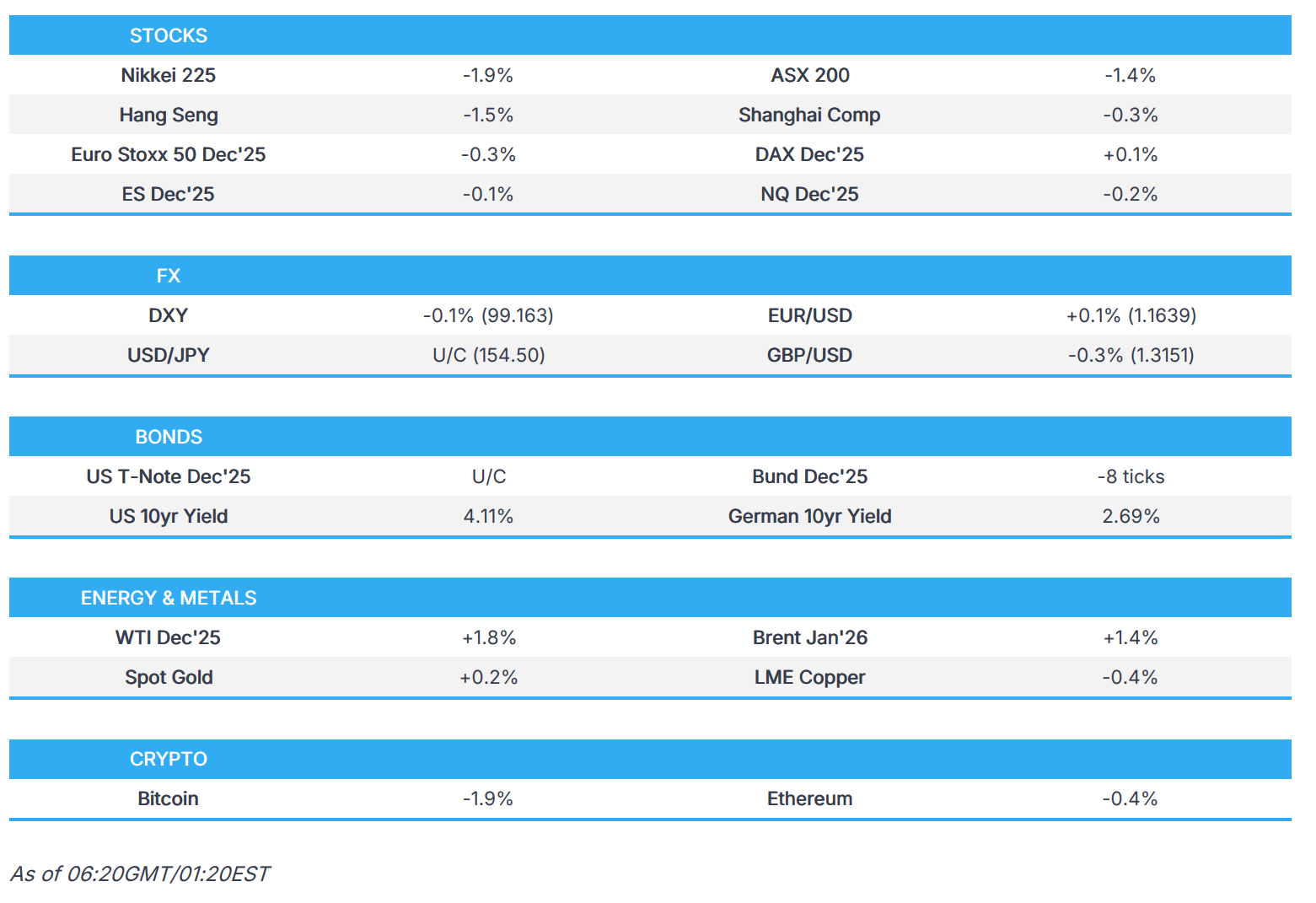
Newsquawk in 3 steps:
1. Subscribe to the free premarket movers reports
2. Listen to this report in the market open podcast (available on Apple and Spotify)
3. Trial Newsquawk’s premium real-time audio news squawk box for 7 days
US TRADE
EQUITIES
- US stocks declined with the Nasdaq and big tech names leading the losses, seemingly driven by concerns over the US position in the AI race against China after a slew of positive updates from Chinese tech companies overnight. The SPX sold off by over 100 points at the close, while RUT and NDX clearly underperformed.
- Sectors were predominantly lower, with the homes of the heavy weights, Consumer Discretionary, Tech and Communications the laggards, while Energy, Consumer Staples and Healthcare outperformed, in which energy stocks tracked crude prices higher as Russia appeared frustrated with Ukraine’s lack of negotiations although crude settled well off today’s highs amid the downbeat risk tone and after inventory data saw a chunky build.
- SPX -1.64% at 6,739, NDX -2.05% at 24,993, DJI -1.65% at 47,457, RUT -2.78% at 2,383.
- Click here for a detailed summary.
TARIFFS/TRADE
- US President Trump’s administration is preparing tariff exemptions in a bid to lower food prices, according to NYT
- US Secretary of State Rubio met with Brazil’s Foreign Minister and discussed a reciprocal framework for the US-Brazil trade relationship, according to the State Department
- US senior official said agreements with Argentina, Ecuador, El Salvador and Guatemala open markets to US agricultural and industrial products, expects full agreements with most of these countries to be finalised within the next two weeks, in which the four countries agreed not to impose digital service taxes. Furthermore, the tariff rates will remain for these countries, but framework agreements will provide relief in certain areas, including bananas.
- US senior official said talks with Switzerland on Thursday were very positive, and if the deal is accepted by US President Trump, we would see a reduction of tariffs on Swiss imports. The official also commented that they have made a lot of advances with Taiwan.
- European Commission President von der Leyen said ministers agreed to hike duties on small parcels.
- South Korea announced the factsheet with the US was finalised and President Lee said that US President Trump made a rational decision for the factsheet, while Lee added they agreed that investment in the US will be limited to commercially viable projects and that South Korea and the US will build a new partnership for shipbuilding, AI and the nuclear industry. Lee stated that the sides agreed on South Korea building a nuclear-powered submarine, and South Korea will strengthen ties with companies like NVIDIA.
- South Korean Presidential Adviser said the US will give South Korea chip tariff terms that are no less favourable than Taiwan’s, while it was agreed with the US that forex market stability needs to be ensured and that the amount and timing of fund supply to the US can be adjusted if needed for forex stability.
- White House said the US and South Korea deal includes USD 150bln of Korean investment in the shipbuilding sector approved by the US and USD 200bln of additional Korean investment committed pursuant to an MOU on strategic investments, while the US has given approval for South Korea to build nuclear-powered attack submarines. US said it will reduce its Section 232 sectoral tariffs on automobiles, auto parts, timber, lumber and wood derivatives of South Korea to 15%, and for any Section 232 tariffs imposed on pharmaceuticals, the US intends to apply a tariff rate no greater than 15% to originating goods of South Korea. Furthermore, South Korea is committed to spending USD 25bln on US military equipment purchases by 2030 and shared its plan to provide comprehensive support for US Forces Korea amounting to USD 33bln in accordance with South Korean legal requirements, while the US agreed that South Korea will pay USD 20bln annual phased instalments as part of the trade deal.
NOTABLE HEADLINES
- Fed’s Musalem (2025 voter) said outside of data centres, business investment has been tepid and that businesses are learning how to run their firms in an uncertain environment. Musalem said he supported rate cuts so far to protect the labour market and they need to proceed with caution now. Furthermore, he sees limited room to ease without becoming overly accommodative and said policy is closer to neutral than modestly restrictive, while he added they need to continue to lean against inflation.
- Fed’s Hammack (2026 voter) said the US economy has been remarkably resilient and that she hears from contacts that inflation is too high and moving in the wrong direction. Hammack stated the employment side of the mandate is challenged amid job market softening, and inflation may be tariff-driven, but service inflation is a real concern, while she added that Fed policy needs to remain somewhat restrictive to push inflation pressures down.
- Fed’s Kashkari (2026 voter) said it seems like there are real pockets of weakness in the labour market and corporations are very optimistic about 2026, while he has no strong inclination yet on a December rate cut, but noted data suggests more of the same since the October meeting and that the resilient economy called for a rate pause in October.
- NEC Director Hassett said he expects to see 60k job losses due to the government shutdown, while he responded that the numbers they have are consistent with more rate cuts, when asked about inflation.
- BLS said it is working on a plan to release the delayed data and stated, “We appreciate your patience while we work to get this information out ASAP, as it may take time to fully assess the situation and finalise revised release dates”, according to WSJ.
APAC TRADE
EQUITIES
- APAC stocks were pressured following the sell-off stateside, where tech was hit on valuation and China AI race concerns, while sentiment was also not helped by recent hawkish-leaning Fed rhetoric and mixed Chinese activity data.
- ASX 200 was dragged lower by weakness in tech and with nearly all sectors in the red aside from energy.
- Nikkei 225 dipped beneath the 51,000 level and was among the worst performers amid earnings results and tech woes.
- Hang Seng and Shanghai Comp declined with participants digested the recent data releases, including mixed activity data in which Industrial Production disappointed and Retail Sales marginally topped estimates, but both showed a slowdown from the previous, while Chinese House Prices continued to contract. Nonetheless, the downside in the mainland was somewhat cushioned with China pledging to expand domestic demand and stabilise trade.
- US equity futures languished near the prior day’s lows following the tech-related selling.
- European equity futures indicate a lower cash market open with Euro Stoxx 50 futures down 0.3% after the cash market closed with losses of 0.8% on Thursday.
FX
- DXY traded little changed overnight after weakening yesterday as USD-denominated assets were hit alongside the risk-off mood. Following the government reopening, markets now await the delayed data, although there has been no schedule announced yet, and White House Economic Adviser Hassett said the jobs part will be released for one month, but not the unemployment rate, due to the shutdown. Furthermore, there were several recent Fed comments, including from Kashkari who said he has no strong inclination yet on a December rate cut, but noted data suggests more of the same since the October meeting and that the resilient economy called for a rate pause in October.
- EUR/USD held on to the prior day’s spoils after reclaiming the 1.1600 handle on the back of the recent dollar pressure, while the latest ECB rhetoric provided very little incrementally and participants now look ahead to GDP and employment data.
- GBP/USD pared some of its recent gains with pressure seen following a report that UK PM Starmer and Chancellor Reeves abandoned budget plans to hike income tax rates.
- USD/JPY struggled for direction after the recent choppy mood and with little fresh pertinent catalysts from Japan, while Japanese press noted increasing scepticism among traders that the government will be able to shore up the yen through direct intervention.
- Antipodeans rebounded from the prior day’s lows with NZD the outperformer despite a lack of notable drivers, while the RBNZ confirmed it will ease mortgage loan-to-value ratio restrictions as announced last month.
- PBoC set USD/CNY mid-point at 7.0825 vs exp. 7.0964 (Prev. 7.0865).
FIXED INCOME
- 10yr UST futures were contained after retreating on hawkish-leaning Fed commentary and the government reopening, while prices were also not helped by an overall weak 30-year bond auction stateside.
- Bund futures lingered near a monthly low after sliding to sub-129.00 yesterday, while EU GDP and German WPI data loom.
- 10yr JGB futures lacked demand with price action rangebound amid the uninspired mood in global counterparts and the absence of tier-1 data from Japan.
COMMODITIES
- Crude futures rallied following geopolitical headlines, including a Ukrainian drone attack which damaged an oil depot in the Russian Black Sea port of Novorossiysk, while advances gained momentum as Brent crude futures and Shanghai commodities trading got underway.
- US EIA Weekly Crude Stocks w/e 6.413M vs. Exp. 1.96M (Prev. 5.202M)
- US President Trump administration revoked Biden-era limits on Alaska oil drilling.
- Qatar raised the January term premium for Al-Shaheen oil to USD 0.84 per barrel above Dubai quotes.
- Spot gold gradually rebounded from the prior day’s trough and briefly returned to above the USD 4,200/oz level.
- Copper futures remained subdued after slipping yesterday alongside the broad risk-off conditions.
CRYPTO
- Bitcoin extended on its recent retreat to beneath the USD 98,000 level amid tech-related woes.
NOTABLE ASIA-PAC HEADLINES
- China stats bureau spokesperson said the economy was generally stable in October, but pressure to adjust the domestic economic structure remains high and stabilisation faces some challenges, while China is to improve the effectiveness of macro policies and to pursue higher-quality economic growth. China will also expand domestic demand on all fronts and will further spur private investment vitality. Furthermore, the spokesperson said China’s investment space and potential remain huge and that China will stabilise trade and help trade firms that have been heavily hit.
- South Korean Finance Minister said they are to prepare measures to stabilise the FX market with the pension fund, while he is concerned about increasing uncertainty in the FX market and noted it is necessary to address imbalances in FX supply and demand.
DATA RECAP
- Chinese Industrial Production YY (Oct) 4.9% vs. Exp. 5.5% (Prev. 6.5%)
- Chinese Retail Sales YY (Oct) 2.9% vs. Exp. 2.8% (Prev. 3.0%)
- Chinese Urban Investment YTD YY (Oct) -1.7% vs. Exp. -0.8% (Prev. -0.5%)
- Chinese Unemployment Rate Urban Area (Oct) 5.1% (Prev. 5.2%)
- Chinese China House Prices MM (Oct) -0.5% (Prev. -0.4%)
- Chinese China House Prices YY (Oct) -2.2% (Prev. -2.2%)
GEOPOLITICS
MIDDLE EAST
- US President Trump told Saudi Crown Prince MBS in a phone call last month that with the Gaza war ending, he expects Saudi Arabia to move toward normalisation with Israel, according to Axios citing officials.
RUSSIA-UKRAINE
- Ukrainian drone attack damages apartment buildings and oil depot in Russian Black Sea port of Novorossiysk.
- Ukrainian air defence units were engaged in Kyiv against what the mayor described as a massive Russian attack.
- US Coast Guard detected and monitored a Russian military vessel operating near US territorial waters approximately 15 nautical miles south of Oahu on October 29th, according to the US Coast Guard.
OTHER
- US senior military officials on Wednesday presented President Trump with updated options for potential operations in Venezuela, including strikes, according to sources cited by CBS News.
- US Defense Secretary Hegseth announces Operation Southern Spear to remove narco-terrorists from the Western Hemisphere.
- China summoned Japan’s envoy over Japanese PM Takaichi’s remarks on Taiwan and said the remarks were extremely dangerous.
EU/UK
NOTABLE HEADLINES
- UK PM Starmer and Chancellor Reeves reportedly ditched budget plans to increase income tax rates, according to FT.
- German Budget Committee approved the 2026 budget, which clears the path to parliamentary approval, while the budget has total spending of EUR 524.5bln and includes investments of EUR 58.3bln and borrowing of EUR 97.9bln.
A NORTH KOREA/SOUTH KOREA
NORTH KOREA//USA/
2B JAPAN
3. CHINA
CHINA/
Escobar: China’s Relentless Innovation Drive Is Reaching Fever Pitch
Thursday, Nov 13, 2025 – 11:25 PM
Authored by Pepe Escobar,
China’s innovation drive is reaching fever pitch in 2025.
Let’s cut to the chase and focus on four crucial domains.
1.The Huawei Factor
Huawei is already testing its first, self-developed EUV lithography machine capable of producing 3nm chips. Trial tests are going full blast at the research center in Dongguan, and mass production should start in 2026.
It’s impossible to overstate how much of a game-changing paradigm this Chinese breatkthrough – specifically in laser-induced discharge plasma (LDP) – is all about. It’s set to turn the seminconductor technology environment totally upside down.
The physics involved in Huawei’s LDP is fundamentally different from the method employed by the Dutch ASML’s de facto monopoly. This being China, it’s simpler, smaller and cheaper.
Huawei’s technology is bound to smash that monopoly while solidifying China’s chip independence. Talk about cost efficiency: Huawei aims to produce EUV machines at a fraction of the cost of ASML’s (around $350 million for each unit), and no less than flood China with homegrown 3 nm chips.
All that is happening after the proverbial Western “experts”, following the 2019 sanctions imposed by Trump 1.0, dictated that China would take up to 15 years to just catch up. After all, EUV technology is too deeply embedded in the Western-controlled supply chain. It was assumed that China would never be able to smash the monopoly.
Well, of course any monopoly is smashable when public-private partnerships – in academia and tech – release untold billions of dollars into R&D, rally the best minds, and focus on building an EUV eco-system from scratch.
This is not only about tech; it’s a geoeconomic and geopolitical earthquake. There was a serious debate going on across China that it would be a matter between 2 and 3 years to cut off any dependence on US/Western tech. Well, Huawei and SMIC will be moving closer to mass production of these 3 nm chips already by next year. Not hard to do the math on where the future of global chipmaking lies.

Invest In R&D And Reach Patent Heaven
Now cut to Fan Zhiyong, Huawei’s Vice-President and Minister of Intellectual Property, talking at the company’s 6th Innovation and Intellectual Property Forum this past Tuesday.
He explained how “from the brand-new HarmonyOS 6 operating system to the powerful Atlas 950 supernode, our R&D team has achieved remarkable successes. Although many leading software and hardware products are massive systems engineering projects, we are making every effort to make them open to everyone.”
Huawei conducts an innovation and intellectual property forum nearly every year, discussing the importance of open/protected intellectual property as well as promoting its Top Ten Inventions: this year they featured, among others, supernodes; the Harmony OS; foldable screens; short-range optical interconnects; and next-generation solid state drives.
There’s no secret: a lot of investment in R&D is behind all these breakthroughs. Over the past five years, Huawei has invested more than 20% of its annual sales revenue in R&D. According to the EU Industrial R&D Scoreboard 2024, Huawei is Number 6 globally in R&D expenditure.
Huawei does not see these accomplishments as leading to a “closed garden”. On the contrary: the strategy is to foment an “open industry”, including the launch of a series of new open source software and hardware.
This opennes is reflected by the fact that Huawei is one of the world’s largest patent holders. By the end of 2024, Huawei held over 150,000 valid authorized patents globally, ranging from over 50,000 Chinese patents to over 29,000 patents in the U.S. and 19,000 in Europe.
And that brings us to…

END
CHINA/ROBERT LAMBOURNE
China’s Banks Are Running Out of Cash — Here’s What’s Really Going On
Chris and Harvey,
I believe this video is worth watching.
Recently, I questioned DeepSeek on China’s total non financial debt to GDP ratio and got an answer that was worse than the situation in France. At the end of Q2 the reported ratio was 336% versus the latest IMF ratio for France of 322%.
To be clear, I am referring to the total non financial debt in the economy, not just government debt. For context this ratio for the USA is reported by the Fed to be 250% with Federal government debt being roughly half of the total non financial debt.
The reported figures from China are probably an understatement of the position and this video, if even remotely reliable, points towards the Chinese government having to refinance the major banks which will push up the total non financial debt to GDP ratio in China even further.
China needs to reduce its real debt burden.
The reason I’m sending this note to you is to re-emphasise the point that a gold price reset has many advantages for China as it would reduce the real debt load. Whether it’s achieved by a formal reset or by the gold price simply rising quite rapidly over time is difficult to predict.
As an aside, this banking crisis which is due mainly to be massive misdirection of resources into property development is clearly due to Xi Jinping demanding that more residential properties be built. It seems to me this is the real reason why he is reported to be on his way out.
Hence, the main argument for gold prices to rise is, in my opinion, that both of the world’s top two economies need to cut substantially their real debt levels.
Regards,
Bob
MEANING OF NON FINANCIAL DEBT:
Non-financial debt refers to all debt excluding the borrowing and lending that happens within the financial sector itself (e.g., between banks, insurance companies, or shadow banks).Breakdown:
- Total debt in an economy usually includes:
- Household debt (mortgages, credit cards, etc.)
- Non-financial corporate debt (companies borrowing for factories, equipment, etc. — this is the “non-financial” part)
- Government debt (central + local government borrowing)
- Financial sector debt (banks borrowing from each other, interbank loans, etc.)
- When economists say “non-financial debt”, they exclude #4 — the financial sector’s own liabilities — because:
- Much of it is double-counting (one bank’s liability is another bank’s asset).
- It can distort the picture of real economic leverage (households and real businesses actually owing money to produce or consume).
So in China’s case:
Non-financial debt-to-GDP = 335%
means:
Households + Non-financial corporations + Government owe 3.35 times China’s annual GDP — but banks’ debts to each other are NOT included.
Why it matters:
- China’s financial sector debt is also huge (especially shadow banking).
- The total debt-to-GDP (including financial) is often estimated >400%.
- Focusing on non-financial gives a cleaner view of real economy leverage.
TL;DR: “Non-financial” = debt owed by households, real companies, and government — not banks lending to banks.
2. Total Tech Sufficiency
And of course that is centered on AI. Cut to three recent key tech moves:
A. Beijing has banned foreign AI chips in every state-funded data center across the nation. Exempted will be only a few private companies which build their own data centers.
B. Local and regional governments were encouraged and are already subsidizing the electricity bills of AI data centers. China has a key infrastructure advantage over the US: cheap and extremely abundant power – as I saw it in my recent travels in Xinjiang. That is essential to offset the cost of switching to domestic chips, a more energy-intensive operation. For example, Huawei’s AI server system – CloudMatrix 384 – consumes more energy than Nvidia’s NVL72 system.
C. Beijing is also rolling out a new, ambitious “AI Plus Manufacturing” plan, included in the broader AI Plus initiative.
Point A is ultra-pertinent because Trump 2.0 is debating whether to allow Nvidia to sell a downgraded version of its Blackwell chips to China. Nvidia’s CEO Jensen Huang is lobbying for it like there’s no tomorrow, desperate of losing the Chinese market to Huawei for good. He bombastically announced that China is only “nanosenconds” behind the US on semiconductors.
Point C is also ultra-pertinent because as we saw with the Hauwei factor, Beijing is going for no holds barred AI chip self-sufficiency.
Beijing is deploying a very clever strategy. No foreign chips in data centers means a de facto protected market to domestic chip innovators which match foreign chip performances. Talk about a massive incentive.

Li Lecheng, Minister of Industry and Information Technology (MIIT), has announced that MIIT will soon issue an “AI Plus Manufacturing” plan, focusing on rolling out AI upgrades in key industries; expanding intelligent assisted design, virtual simulation, and early defect detection; promoting brand new AI-enabled mobile phones and computers; and accelerating R&D for next-generation intel devices such as humanoid robots and brain-computer interfaces.
In a nutshell: that is how Beijing wants to implement AI in every nook and cranny of the Chinese economy. It’s a no holds barred total innovation strategy. Sanctions? What sanctions?
3. Clean Energy
This revolution is already on – with China leaping ahead of the whole collective West, installing, for instance, nearly 900 gigawatt of solar capacity, more than the US-EU combo.
Last year, China generated 1826 terawatt/hour of electricity out of solar and wind power – five times the energy equivalent of all its nuclear warheads.
Yes: that’s a certified energy superpower.
4. An Early-Warning Detection Big Data Platform
The Nanjing Research Institute of Electronics Technology – China’s number one defense-electronics center and a hub of key innovation even under US sanctions – is developing a ground-breaking “distributed early-warning detection big data platform” capable of tracking up to 1,000 missile launches worldwide in real time.
The platform fuses data from an enormous array of space-, air-, sea-, and ground-based sensors, using advanced algorithms to distinguish warheads from decoys and proceed to action across secure networks.
The system integrates literally anything: fragmented, heterogeneous data streams from multiple sources – radars, satellites, optical, electronic reconnaissance systems – no matter where they come from, and when.
Cue to the system’s integration with interceptor missiles. During the Victory Day military parade last September in Beijing, China presented a new generation of air defense and anti-ballistic missiles, including the HQ-29, capable of intercepting hostile missiles beyond the atmosphere. Call it the Chinese Dragon Dome.
These are only 4 vectors amid the concerted Chinese tech drive, one of the key themes of the next Five-Year Plan to be approved next March in the “Two Sessions” in Beijing.
Now cut to Ronnie Chan, the Chair Emeritus of the Asia Society and the chairman of its Hong Kong Centre. He’s one of those affable old-school Hong Kong elite members who’s seen it all – and capable of synthesizing what’s ahead in a sharp and sweet manner. What he said recently at a seminar organized by the Shanghai Development Research Foundation could not be more relevant.
Let’s take just three key takeaways:
1. “The Chinese people are resilient and patient. As long as domestic stability is maintained, external pressure only strengthens their endurance (…) in this China–U.S. rivalry, there will be no true winner, but the side that stands longer in the end will be China.”
2. “China’s economy has not been over-financialised, and it continues to be grounded in the real economy. Only when manufacturing is strong can a nation remain stable and resilient.”
3. “China must stay calm — neither blindly optimistic nor blindly pessimistic. China possess a vast market, a complete industrial chain, and a diligent population. As long as internal stability holds, external pressures cannot defeat it. The real opportunities ahead do not lie in real estate or finance, but in the service sector and innovation-driven real economies.”

There is no Chinese “miracle”: it’s all about planning and hard work. And now to the next stage: no holds barred innovation.
4 EUROPEAN/NATO AFFAIRS
GERMANY/POLAND
KORYBKO
The Next Phase Of Germany’s Nord Stream Investigation Might Further Worsen Ties With Poland
Friday, Nov 14, 2025 – 02:00 AM
Authored by Andrew Korybko via Substack,
Italy’s potential extradition of a Ukrainian suspect to Germany could lead to a highly publicized (and predictably politicized) trial that implicates Poland in this unprecedented attack on a fellow NATO ally.

The Wall Street Journal recently published a detailed piece about “The Nord Stream Investigation That’s Splintering Europe Over Ukraine”.
The gist is that Germany’s investigation into the Ukrainian trace, which is likely a preplanned red herring as argued here in early 2023, has already worsened ties with Poland after one of its judges refused to extradite a Ukrainian suspect.
It could soon worsen ties with Ukraine too if Italy soon extradites another one and a highly publicized (and predictably politicized) trial follows.
Germany’s Nord Stream investigation has placed it in a dilemma since it needs to pin the blame on someone for one of the largest sabotage/terrorist attacks in decades, yet it doesn’t dare look into the American trace that Pulitzer Prize-winning journalist Seymour Hersh drew attention to in early 2023. Accusing it of orchestrating this attack would risk punitive tariffs from Trump and could convince him to authorize the gradual transfer of some EUCOM infrastructure from Germany to neighboring rival Poland.
On that topic, the Ukrainian trace also conveniently implicates Poland, thus inflicting damage to its reputation.
The idea that this NATO ally played even just a passive role facilitating a third country’s attack against a “fellow” member, let alone might be trying to cover the aforesaid up after declining to extradite one of the suspects, could have real-world consequences.
Germany might rally other allies against supporting Poland in a hypothetical crisis with Russia, for example, and could even blame Poland for it.
Not only that, but Poland’s proposal for Germany to subsidize its arms industry as a form of World War II reparations could be opposed on the pretext that the long-term damage that Poland helped Ukraine inflict to Germany equals whatever Germany might have subsidized, therefore negating the request. Worsened bilateral relations could then give a boost to the conservative opposition, which dislikes Germany almost as much as it dislikes Russia, ahead of fall 2027’s next parliamentary elections.
Replacing the ruling liberal-globalist coalition, which could be achieved by allying with the populist-nationalist opposition upon complying with their demand that senior party leaders resign, would strengthen the challenge that Poland poses to German influence in the region. That’s because the Right would control the presidency and parliament, thus breaking the deadlock that’s been in place since the current coalition obtained power in December 2023 and enabling more effective policy implementation.
This outcome could still occur even without a highly publicized German trial implicating Poland in the Nord Stream attack, but it’ll make it much more likely if that happens. In such a scenario, already fractious EU and NATO unity might further weaken, with this possibly hamstringing cooperation against Russia through the “military Schengen” and other emerging multilateral frameworks. A security dilemma could also develop between them amidst their mutual adversarial perceptions and arms buildups.
Observers should remember that this is possible solely due to Germany refusing to investigate the American trace in the Nord Stream attack, instead opting to look into the Ukrainian one that also involves Poland. The public demands that someone be blamed for the spike in costs brought about by Germany being cut off from cheap and reliable Russian gas. The elite therefore decided to pin the blame on them, but it’s unclear whether they thought through the consequences touched upon in this analysis.
END
GERMANY UKRAINE
German Chancellor Tells Zelensky Young Men Should Return & Defend Their Homeland
Friday, Nov 14, 2025 – 02:45 AM
At a moment the Zelensky government is suffering embarrassment and under a global spotlight for a wide-ranging corruption case related to the country’s struggling state energy sector, German Chancellor Friedrich Merz has issued some unusually strong words directed at Ukrainian leadership.
In televised remarks Thursday he revealed that he personally urged Ukrainian President Volodymyr Zelensky to get serious about curbing the flow of young Ukrainian men to Germany as they need to serve in the defense of their own homeland. Merz disclosed some of the contents of his latest call.
“In a lengthy telephone conversation today, I asked the Ukrainian president to ensure that young men in particular from Ukraine do not come to Germany in large numbers – in increasing numbers – but that they serve their country,” Merz said “They are needed there.”
Within Merz’s conservative ranks there’s been growing alarm over the large numbers of fighting-age men fleeing Ukraine and into Western Europe.
Zelensky policies have enabled this, as his administration relaxed exit rules related to martial law, just months ago for the first time of the war letting Ukrainian men aged 18 to 22 leave the country. Ukrainian citizens can’t even be drafted until they are 25, under current law.
American officials have also criticized Ukraine’s policy, given in most militaries in the world, eighteen makes one eligible to be recruited.
Further, according to Politico, “Members of Merz’s ruling coalition fear that the growing presence of young Ukrainian men in Germany will be turned into a political flash point by members of the far-right Alternative for Germany (AfD) party, who criticize the government’s ongoing support for Kyiv.”
Last month The Telegraph reported “Almost 100,000 fighting-age Ukrainian men have left the country in the past two months after Volodymyr Zelensky eased departure rules, new figures show.”
Those figures were primarily based on the Polish border guard, as the neighboring EU country shares a long border with Ukraine, and has been from the start of the war absorbing refugees and trying to maintain strict counts and records. And surely many of these young men made it to Germany and other Western European countries.
While men aged 25 to 60 can be conscripted into the military and sent to the front lines, men 24 and under still cannot. Again, this has been hugely controversial as even US members of Congress have complained that Washington is sinking billions into the war effort against Russia, and Kiev won’t even tap into its most eligible fighting-age demographic. And so the expected drain of young men from the country is happening after border restrictions were loosened by Kiev last summer.
5. RUSSIA AND MIDDLE EASTERN AFFAIRS
TBN ISRAEL/LAST 24 HR
ISRAEL VS HAMAS
Deceased hostage returned to Israel identified as Meny Godard, PMO confirms
Meny Godard, 73, from Kibbutz Be’eri, was murdered alongside his wife Ayelet on October 7, his remains taken into Gaza by Palestinian Islamic Jihad terrorists.

Meny Godard, the Gaza hostage whose remains were returned to Israel on November 13, 2025.(photo credit: Hostage and Missing Families Forum)ByJERUSALEM POST STAFFNOVEMBER 13, 2025 13:53Updated: NOVEMBER 14, 2025 00:06
Meny Godard, 73, from Kibbutz Be’eri, was identified as the hostage whose remains were returned to Israel on Thursday, the Prime Minister’s Office confirmed.
Godard was murdered by Palestinian Islamic Jihad terrorists on Kibbutz Be’eri during the October 7 massacre, with his remains being taken into Gaza. His wife, Ayelet, was also murdered during the massacre. The IDF officially confirmed Godard’s death on December 8, 2023. Meny is survived by his children Gal, Bar, Mor, and Goni, and by his seven grandchildren.
Hamas announced earlier that it would hand over the remains of one of the remaining deceased hostages as part of the prisoner exchange deal at 8:00 p.m. The Red Cross received the remains at around 8:30 p.m. They were then transferred by the IDF to the forensic institute for identification.
“The Hostages and Missing Families Forum bows its head in sorrow and shares in the profound grief of the Godard family. There are no words to express the depth of this pain. The hostages have no time. We must bring them all home, Now!” the forum stated in a post eulogizing Godard.
“Kibbutz Be’eri embraces the Godard family at the complex time with the news of Meny’s return from Hamas captivity. This is the closing of a circle that the family has been waiting for throughout 769 painful days, during which they held onto hope without strength during too long a period,” a Kibbutz Be’eri spokesperson eulogized.

“We hope that now you will find comfort in bringing your father to be buried in Kibbutz Be’eri, which he loved so much, to rest next to your beloved mother, Ayelet,” Kibbutz Be’eri community head Ofer Gitai said in a message addressed to the Godard family.
“We hope that now you will find some peace, and begin to recover from that black Saturday which lasted almost 800 days for you,” he added.
“Kibbutz Be’eri will continue to fight and demand the return of the three hostages still in Gaza, and it waits with bated breath to bring Dror Or, may he rest in peace, to be buried in the land of Be’eri. Only when they all return will the recovery of Be’eri begin,” the statement concluded.
Before Godard’s remains were taken for identification at the National Center of Forensic Medicine, the IDF held a brief military ceremony with the participation of the military’s chief rabbi.
“The Al-Quds Brigades and the Izzadin al-Qassam Brigades will hand over the body of an Israeli prisoner of war, which was found today in the Morag area north of Khan Yunis in the southern Gaza Strip, at 8:00 p.m. Gaza time,” Hamas stated.
The return of Godard’s remains means there are currently three other hostages left in Gaza: Ran Gvili, Dror Or, and Sudthisak Rinthalak.
Hamas knows whereabouts of hostage remains
On Wednesday, sources familiar with the issue told Israel’s public broadcaster KAN News that Hamas had information on the location of each of the four deceased hostages whose remains are still being held in the Gaza Strip.
This includes information about the remains of hostages being held by Palestinian Islamic Jihad, another terror group in Gaza, the sources expanded.
Pressure must be exerted on Hamas terrorists to return the remains, and Israel should not compromise, the sources affirmed to KAN.
ISRAEL/WEST BANK
Can the IDF avert an explosion of terror in the West Bank? – analysis
The West Bank has been largely ignored by the media due to Israel’s other fronts – but that does not mean it was ignored by the IDF and Jerusalem’s security apparatus.

IDF soldiers operate during an Israeli raid in Tammun near Tubas in the West Bank, November 4, 2025(photo credit: REUTERS/RANEEN SAWAFTA)BySETH J. FRANTZMANNOVEMBER 13, 2025 14:31
Terror threats in the West Bank appear to be growing. Over the last year, the IDF has been able to keep most of these threats in check. However, with a ceasefire in Gaza and Israel relaxing its guard slightly, it’s possible that enemies may try to take advantage of the situation.
On Thursday, reports said that the IDF, police and security services were able to thwart a major terror cell in Bethlehem. Reports noted that “the months-long investigation led to the arrest of approximately 40 Hamas operatives during more than 15 operations, carried out by IDF reservists from the Etzion Brigade, the elite Duvdevan unit and counterterror forces. During the raids, weapons including M16 rifles were seized.”
The reports indicate that terrorist infrastructure was found in this operation. The terrorists in Bethlehem planned shooting attacks and were apparently ready to carry out the attacks soon.
The success against the terrorists in and around Bethlehem is important. Israel’s Chief of Staff Lt. Gen. Eyal Zamir praised the head of the IDF’s Central Command Maj.-Gen. Avi Bluth this week after a major drill was concluded in the West Bank. “This is an unprecedented exercise, the first of its kind in the IDF. As part of it, the new Eastern Division, established as one of the lessons learned from the war, is being evaluated in full divisional format. One of our lessons from October 7 is the responsibility for defense in the area and the change in our conception of security , we neutralize threats as they emerge. We are doing that here as well,” Zamir said.
The new Eastern Division, the 96th, is also known as Gilad. It is one of several regional divisions that protect Israel’s border. It was established over the last year because of the growing concerns about the Jordan Valley and the desire to beef up the military presence there.

Zamir said this week that “the scenarios we have been practicing in recent days are situations we must never reach. We must act and neutralize threats before they reach our doorstep, that is our duty. We will reinforce our troops wherever necessary in order to continue countering terrorism and prevent the next threat from arising.”
The drill and the bust of the terror cell in Bethlehem show that the IDF and Israel’s various security services take the threats seriously. This follows a trend that began around four years ago in the northern West Bank in which terror cells in Jenin and Nablus began to acquire more weapons.
IDF’s latest attempts to ‘break wave’ of illegal firearms
A flow of illegal firearms, primarily M-4/M-16 type rifles, began to make their way to the northern West Bank. This fueled a wave of attacks and an IDF response which called Operation Break the Wave. Palestinian Islamic Jihad and other groups were weakened during years of operations. However, the flow in rifles appears to be growing. Daily drone interceptions along the Egyptian border reveal M-16 type rifles being smuggled by large quadcopter type drones.
There are also the threats from Jordan. Reports have indicated that Iran would like to try to stir up trouble in Jordan and the West Bank. There have been several deadly attacks at the border crossing near Jericho. In addition there is weapons smuggling.
However, the bust of the terror cell in Bethlehem points to another problem. It is possible that the center of gravity of the threat is moving from the northern West Bank to the southern West Bank. For years the area around Bethlehem was quiet. It was quiet because the IDF conducted night raids frequently to keep things in check. This involved detaining suspects and making sure that terror infrastructure did not grow.
After October 7, the raids and activity in the West Bank increased. Bethlehem has often been a source of problems because of the refugee camps in and around the city. There are terrorists who have operated from Dheisheh camp and Aida camp. Hamas has had its tentacles in these areas along with other groups such as PFLP. It should be recalled that during the Second Intifada terrorists from Bethlehem went to the Christian town of Beit Jala, a suburb, and fired on Gilo in Jerusalem. Bethlehem has grown so much, and so have Jerusalem, that these cities are basically one large urban area now.
Israeli extremism grows across West Bank
Another challenge in the West Bank is the growing incidents of Israeli extremists attacking Palestinian Arabs. A number of incidents have occurred recently and there appears to be an increase in these clashes.
Zamir, in his statement this week, condemned these attacks. “We are aware of the recent violent incidents in which Israeli civilians attacked Palestinians and Israelis. I strongly condemn them. The IDF will not tolerate criminal behavior by a small minority that tarnishes the law-abiding public. These acts contradict our values, cross a red line, and divert the attention of our troops from their mission, defending the communities and carrying out operations. We are determined to stop this phenomenon and will act decisively until justice is served.”
However, his condemnation doesn’t necessarily mean the trend will stop. The trend appears to mostly affect the Northern West Bank and areas near Tulkarm or Taybeh or other Arab towns and villages. However, it’s plausible the trend will grow. The trend is currently downplayed on the political level.

However, the IDF statement and videos posted online, along with reports, suggest a growing challenge. It’s not clear if these clashes, between Israelis and Palestinian civilians, will lead to some kind of crisis or cycle of violence; or whether other Hamas-backed terrorist cells in the West Bank may be activated.
What is clear is that with the ceasefire in Gaza going into its second month, there are many challenges for Israel. The West Bank has been largely ignored by the media spotlight because of the other fronts. This doesn’t mean it was ignored by the security forces.
In fact, the new Jordan Valley division, the training and the raid in Bethlehem, show that the IDF and Shin Bet and others take very seriously what is happening. The question is whether Israel’s enemies are also laser focused on trying to create a new front.
END
SYRIA/UAE
this will be good for the new Abraham Accords
(zerohedge)
UAE-Based DP World Takes Control Of Syria’s Tartus Port In $800M Deal
Friday, Nov 14, 2025 – 05:00 AM
Syria has formally handed over operations of Tartus port, the second largest port in the country, to the UAE-based logistics company DP World.
DP World officially commenced operations on Wednesday, months after signing a 30-year concession agreement worth $800m with Syria’s General Authority for Land and Sea Ports. The deal has been described as one of the largest global investments in Syria’s logistics sector in years, and aims to turn the port into an efficient trading hub.

“We are committed to applying DP World’s global expertise to build a modern and digitally enabled port that will grow trade, create opportunities and firmly position Tartus as a key trade hub in the Eastern Mediterranean,” said Fahad al-Banna, the newly appointed chief executive of DP World Tartus.
DP World said in a statement that it would upgrade the port’s infrastructure, expand its handling and storage capacity and invest in bulk handling systems.
In June, Syria’s government annulled a 2019 agreement between Bashar al-Assad’s administration and the Russian company Stroytransgaz to manage Tartus.
Damascus said the deal was terminated due to the Russian company breaching its contract, including by failing to invest a promised $500m in modernizing that port’s infrastructure.
The government, led by President Ahmed al-Sharaa, also said in a statement at the time that the previous deal was “unfair to Syrian sovereignty”, with Syria receiving 35 percent of port revenues while Stroytransgaz got 65 percent.
Since the fall of the Assad dynasty’s decades-long rule in December, the new administration has been aiming to re-establish economic ties with western and regional powers.
Along with Tartus, a 30-year deal was also signed with French shipping company CMA CGM to operate Latakia port, the largest port city in the country.
In June, US President Donald Trump issued an executive order lifting sanctions on Syria, to support the country’s reconstruction following over a decade of war. The European Union and the UK also eased sanctions. Earlier this week, Sharaa became the first Syrian president to visit the White House since the country’s independence in 1946.
END
ISRAEL VS HAMAS/SYRIA
El Julani is a sheep in wolf’s clothing
(JerusalemPost)
Israeli Foreign Ministry condemns Syrian Culture Ministry’s musical celebration of October 7
The event was set to be held at 5 p.m. on Friday at the Aleppo Library.

Syrian Culture Ministry hosts event celebrating October 7.(photo credit: SCREENSHOT/X)ByJERUSALEM POST STAFFNOVEMBER 14, 2025 19:05
Israel’s Foreign Ministry condemned on Friday an event hosted by Syria’s new Culture Ministry, which appeared to celebrate Hamas’s October 7 massacre.
“The President of Syria al-Julani [Ahmed al-Shara’a] talks about a ‘new Syria,’ yet his Ministry of Culture invites the public to a national party celebrating the October 7 massacre – the largest massacre of Jews since the Holocaust (celebrated as “The Flood of al-Aqsa”),” the ministry wrote on X. “Anyone who celebrates a massacre seeks more massacres, not change.”
The event was set to be held at 5 p.m. on Friday at the Aleppo Library.
Journalist Ahmed Quarashi reported on X that the event was cancelled.
Hamas’s October 7 massacre
Hamas invaded Israel on October 7, 2023, violating an existing ceasefire, and massacred some 1200 people, including children, civilians, and foreign nationals.
During their rampage through Israel’s South, the terror group also abducted some 250 people, kickstarting a two-year conflict.
ISRAEL VS HEZBOLLAH
Exposing Hezbollah: IDF claims terror group murdered prominent Christian-Lebanese critic
Hezbollah’s Unit 121 abducted the politician, poisoned him, and staged his body to look like he died in a car accident, the IDF claimed.

Supporters of Lebanon’s Hezbollah block the streets with burning tires as they rally in cars and motorbikes to protest the government’s endorsement of a plan to disarm it, in Beirut’s southern suburbs early on August 8, 2025(photo credit: IBRAHIM AMRO/AFP via Getty Images)ByJERUSALEM POST STAFFNOVEMBER 14, 2025 15:46
Christian Lebanese politician, Elias Hasrouni, was assassinated by the Hezbollah terror group he opposed, the IDF confirmed on Friday.
Known for his staunch criticism of the terror group, Hasrouni worked as the Secretary-General of the Lebanese Forces central council in Bint Jbeil when he was killed in an ambush last year.
The 72-year-old was assassinated by Hezbollah’s Unit 121 in August 2023, according to the IDF, despite the terror group’s rumoring that he had perished in a car accident.
Hezbollah’s Unit 121
The terror group was said to have ambushed Hasrouni on a road near his home in Ain Ebel in southern Lebanon, where they abducted him. After kidnapping the elderly politician, the IDF claimed the terrorists broke his ribs and poisoned him.
Another member of the Christian Lebanese Forces party was abducted and murdered last year. Pascal Sleiman was kidnapped and killed in the Byblos District of northern Lebanon in April last year. The Lebanese Army announced that they had arrested most of the members of a Syrian gang that they had found were behind Sleiman’s kidnapping and murder.
After his death, the IDF claimed the terror group staged his body to look like he had passed from a car accident, ramming his car into a tree and leaving him alone in a ditch.
The same Hezbollah unit has been responsible for the assassinations of prominent journalists, officers, politicians, and other influential figures who have used their platform to condemn the group.
Among the group’s more notable victims is former Lebanese prime minister Rafik Hariri. The unit’s commander, Salim Ayyash, was convicted in 2020 by the UN Special Tribunal for Lebanon for leading the team that assassinated Hariri.
Tzvi Joffre contributed to this report.
RUSSIA VS UKRAINE
US Monitoring Russian Ship Operating In International Waters Near Hawaii
Friday, Nov 14, 2025 – 07:20 AM
Authored by Joseph Lord via The Epoch Times,
The United States Coast Guard is tracking a Russian military ship that was detected in international waters near Oahu, Hawaii, at the end of October, the agency announced in a statement on Thursday.

The military branch said that, on Oct. 29, it detected the Russian vessel approximately 15 miles south of Oahu.
The Coast Guard said an HC-130 Hercules aircraft from Air Station Barbers Point and the Coast Guard Cutter William Hart “responded to the Russian Federation Navy Auxiliary General Intelligence ship Kareliya.”
“Acting in accordance with international law, Coast Guard personnel are monitoring the Russian vessel’s activities near U.S. territorial waters to provide maritime security for U.S. vessels operating in the area and to support U.S. homeland defense efforts,” the Coast Guard said.
“The U.S. Coast Guard routinely monitors maritime activity around the Hawaiian Islands and throughout the Pacific to ensure the safety and security of U.S. waters,” Capt. Matthew Chong, chief of response for Coast Guard Oceania District, said in the statement. “Working in concert with partners and allies, our crews monitor and respond to foreign military vessel activity near our territorial waters to protect our maritime borders and defend our sovereign interests.”
In the statement, the Coast Guard noted that international law permits foreign military vessels to “transit and operate outside other nations’ territorial seas, which extend up to 12 nautical miles from shore.”
The disclosure comes as tensions between the United States and Russia have grown in recent weeks as President Donald Trump has soured on Russian President Vladimir Putin.
Trump has sought an end to the ongoing conflict between Russia and Ukraine, though progress on that front has been slow—a situation Trump has attributed to Putin’s intransigence on moving forward with a deal.
It also comes amid signs of an escalating arms race between the United States and its adversaries.
The Coast Guard’s first detection of the vessel on Oct. 29 came just two days after Russia announced that it had tested a nuclear-powered missile, the Burevestnik cruise missile, which Moscow has claimed possesses unlimited range and the ability to evade existing missile defenses.
Russia’s nuclear test was followed the next day by a successful cruise missile test by North Korea, conducted by the hermit communist state just hours before Trump, then on a circuit of east Asia, was due to set out for a summit in South Korea.
Following these two incidents, Trump on Oct. 29 directed the Pentagon to begin nuclear weapons testing again.
Since then, Energy Secretary Chris Wright has clarified that these tests will involve particular components of nuclear weapons, but will not involve nuclear detonations.
END
RUSSIA UKRAINE
Nuclear Plant In Southern Russia Taken Offline After Ukrainian Drone Attack
Friday, Nov 14, 2025 – 02:00 PM
Parts of the Novovoronezh nuclear power plant in southwestern Russia were temporarily taken offline overnight after a cross-border drone attack from Ukraine, in a highly dangerous close-call for the nuclear site and its operators.
By morning, power was restored to all sections of the plant, head of the state nuclear agency Rosatom, Alexei Likhachev, said. He described that about eight drones targeted the facility but all were intercepted; however, debris from a downed drone reportedly damaged the site.

“Approximately eight drones were directed – there is no doubt about this – toward the Novovoronezh nuclear power plant,” Likhachev said. “All of them were neutralized and shot down. However, debris fell and damaged the main switchgear.”
The senior official then said a “preventative measure” was taken to disconnect three power units to the facility, but everything was brought back online by Thursday morning.
Ukraine has not acknowledged the accusation of targeting the Novovoronezh facility. But the timing is interesting given the International Atomic Energy Agency (IAEA) director Rafael Grossi is currently visiting Russia to meet with Likhachev.
The visit is to discuss and monitor the current situation of nuclear power plants on either side of the crisis, as both Russia and Ukraine have at times accused the other of targeting them.
Currently, Russia holds the Zaporizhzhia nuclear power plant in southern Ukraine, which is said to be is cold shutdown mode as a safety measure.
Meanwhile both sides continue to trade drones and missiles, with energy sites being a foremost target of the conflict. From Russia’s point of view, it the attacks on oil refineries and transit sites which remains most alarming:
Oil deliveries to the Russian Black Sea port of Novorossiysk were suspended after Ukrainian strikes damaged key energy infrastructure in one of the most disruptive overnight attacks on the Krasnodar region in recent months, Reuters reported Friday, citing anonymous sources familiar with the matter.
Russia’s state pipeline monopoly Transneft halted crude flows into Novorossiysk, according to two sources cited by the news agency, while the port also stopped receiving and loading oil following the attack.
After many months of similar headlines related to other facilities, it’s being widely reported that some 20% of oil refining is currently offline.
However, this appears to have had limited effect so far, given the “disruption cut output by only 3-6% as Moscow relied on idle units to absorb the damage, Russian industry sources told Reuters.”
6. GLOBAL ISSUES//COVID ISSUES/VACCINE ISSUES/HEALTH ISSUE
GLOBAL ISSUES
MARK CRISPIN MILLER
DR PAUL ALEXANDER
Hat-tip to Berenson for this substack titled “The war on drugs needs to be fought from the demand side; Foreign cartels aren’t driving our drug crisis. This is a cultural and medical war first.” he
is 100% correct, it is our demand in US, in Canada etc., it is the high society we see in places like Palm Beach, yes, near POTUS & he is against this, it is the elites, the rich, the connected, the
| Dr. Paul AlexanderNov 14 |


US congress members, the US Senators, these are the people who FINANCE, Traffic, bring in the illegal drugs in the first place, who work with police and law enforcement ‘on the take, to allow safe passage, who finance and pay to bring in the illicit narcotics, these ‘beautiful’ people as they like to be known, with their face blown up with BOTOX, full lips, fake breasts, all fake, yes women drug lords too, as husbands do it, and the men, sick twisted depraved men in our society rich men, who while financing the demand side, are also pedophiles, involved in human trafficking, selling young children for sex trade, these are the filthy sick banal in our society and their money and connections buy them safety…so Berenson is ON THE MONEY! it is not only the drug producers and cartels, no it is us, yes us, we the people, we who are hooked on this, we living La Vida Loca, we who want it and use it and the big rich Palm Beach type drug financers etc. wink wink nod nod…they know who they are and the congress, some of the worst pedophiles, sodomizers of children sit among the gang of 535, 435 congress and 100 senators…

Paul just did and gone and said that?
The war on drugs has failed! 100 years now. We got soul searching as a people to fix this. We are a sick, twisted, pleasure seeking, addicts, hedonistic peoples, yes, us in the west. Filthy too. But we can fix. If we want to. but we got “gas station heroin”, pink fentanyl, ca-fentanyl, crank, molly et al. we have people in US so hooked they are snorting wasabi and sea salt to get a high. Cannabis and cocaine are ‘baby’ drugs on the streets now. Baby. And we have our governments in Canada etc. legalizing it for votes.
Alexander News Network (ANN): Trump’s War 2.0 for America is a reader-supported publication. To receive new posts and support my work, consider becoming a free or paid subscriber.
Also, remember, the US government has the CIA etc. that is part of this e.g. the CIA has used drug money to fund their operations, an example of which was that dirty war in Nicaragua. So, let’s be real and honest, maybe for the first time.
hat-tip Alex, deserved here! Read In Drug Dealer, MD: How Doctors Were Duped, Patients Got Hooked, and Why It’s So Hard to Stop
Thanks Alex!


Start Alex here, excellent piece:
“Friday, I wrote about the bipartisan morality crisis of America’s leaders.
Along the way, I criticized the Trump administration for attacking speedboats it says are moving drugs. Blowing those ships up without warning is murder, I wrote.1
A lot of you think I’m wrong, we should destroy these boats — and their passengers.
So. Say our intelligence is correct and we haven’t blown up any fishing boats by accident. Maybe, maybe not. Even well-meaning soldiers make mistakes. But for this discussion, let’s agree we are killing cocaine traffickers, not Venezuelan fishermen.
—
(Unreported Truths: less dangerous than cocaine. Cheaper, too!)
—
In that case, here are two questions to consider:
1: How quickly could you legally get amphetamine if you wanted it?
2: Is there any real difference between amphetamine and cocaine?
The answers, in case you don’t know:
1: Ten minutes. Maybe less.
2: No.
—
The United States is enduring the worst drug crisis in its history. Over a half-million Americans have died of overdose since 2020. Although deaths have dropped since their 2023 peak, they remain four times as high as in 2000, when the modern crisis began with the explosion of opioid prescriptions and Oxycontin.
Note I didn’t say the worst “opioid” crisis (though that’s true) or “cocaine” crisis or “meth” crisis — or even “illegal” drug crisis.
Drug decriminalizers and legalizers get almost everything wrong when they talk about drugs. But they’re right on one crucial point: the United States has erased any meaningful distinction between legal, illegal, and prescription drugs of abuse.
Cannabis and THC (the chemical in cannabis responsible for its high) fit in all three of those categories, depending on the state. Ketamine — a risky, addictive anesthetic — is offered at spas. Psychiatrists spend most of their time on “medication management,” a euphemism for writing prescriptions for amphetamines like Adderall and benzodiazepines like Valium. The amphetamines are nominally for attention-deficit disorder. The benzos are for the anxiety that the amphetamines cause.
What about our oldest and deadliest friend, opioids? Despite what legalizers claim about the crackdown on opioids, Americans still are prescribed a vastly disproportionate share of them.
But that fact shouldn’t surprise anyone. Americans are prescribed a vastly disproportionate share of all drugs of abuse.
Meanwhile, alcohol advertising is everywhere, including for “hard” alcohol, distilled spirits like vodka that are 40 percent ethanol.
—
On the illegal side, public health and advocacy groups have spent decades pushing the doctrine of “harm reduction.”
Harm reduction has specific tactics, such as “supervised injection sites.” But it is above all a philosophy that views drug use as a morally neutral activity. To legalizers, drug use is part of life and society and we should not try to control it, much less eliminate it. Instead, we should simply accept it and try to handle its consequences.
Thus American public health authorities spend a good deal of time these days telling people not to “stigmatize” the users of illegal drugs.
New York state now has an entire glossary devoted to euphemisms for drug abuse and addiction. It includes such gems as: Instead of saying “non-compliant [with a drug treatment program]… consider saying “feels ambivalent regarding change.””
NEWSWIZE
NEWS ADDICTS
| LATEST REPORTS FOR NEWS JUNKIESWatch: ESPN host snaps at critics after Trump interview: ‘He’s hilarious’Pat McAfee, a top-rated ESPN presenter, told his critics that they should pound the sand when he interviewed President Donald Trump for Veteran’s day. The “Pat McAfee show” honored veterans with a lively performance from Parris Island, a Marine Corps recruitment depot. Highlight of the program was an unexpected 20-minute telephone interview with Donald Trump. Trump laughed at the beginning …READ THE FULL REPORTEnding Shutdown Deal Allows GOP Senators to Sue Biden’s DOJ for J6The legislation that Congress is considering to end the U.S. government’s longest shutdown contains a provision that would give several Republican Senators large payments tied to an investigation by the Biden Administration into the Capitol hack on Jan. 6. According to Reuters, the provision retroactively makes it illegal for federal investigators to obtain a senator’s phone data without notifying them. …READ THE FULL REPORTBlue State’s first openly trans lawmaker pleads guilty to serious criminal chargesStacie Marie Laughton pleaded guilty in court to charges of child sexual abuse. She was one of America’s first state legislators who identified as transgender. Laughton was 39 when he was arrested in 2023 for four counts of distribution child sexual abuse images. Sgt. John Cinelli is the Nashua Police Department’s public information officer. He said that investigators had been …READ THE FULL REPORTDon Jr Stabbed In Back By Controversial Socialite GirlfriendJust a year after making their relationship official, Donald Trump Jr. and his glamorous Palm Beach girlfriend, Bettina Anderson, are facing turbulence behind the gilded gates of Trump World — and insiders say the family isn’t exactly rolling out the red carpet. According to multiple sources cited by the *Daily Mail*, 38-year-old Anderson — a socialite raised amid the champagne …READ THE FULL REPORTTop Republican Congressman Makes Stunning AnnouncementHouse Budget Committee Chairman Jodey Arrington (R-Texas) announced his retirement from Congress this week, marking the end of nearly a decade of service and capping his career with what he called one of his proudest achievements — helping pass President Donald Trump’s “big, beautiful bill.” Arrington, who has represented his West Texas district since 2017, told *Fox News Digital* that …READ THE FULL REPORTVIEW MORE NEWS |
MICHAEL EVERY/OR OR PICTON/GIFFIN OR RABOBANK EXECUTIVE/COMMENTARY ON WORLDLY AFFAIRS
7. OIL ISSUES/NATURAL GAS/ENERGY ISSUES/GLOBAL
this is a major hit as oil rises
(OilPrice.com)
Oil Prices Soar After Ukraine Strike On Major Russian Export Hub
Friday, Nov 14, 2025 – 06:30 AM
Authored by Charles Kennedy via OilPrice.com,
Oil prices jumped in early Asian trade on Friday morning as markets responded to renewed Ukrainian attacks on Russia’s energy infrastructure. A Ukrainian drone attack on the Russian Black Sea port of Novorossiysk, one of the country’s most significant oil export hubs, triggered renewed fears of supply disruptions.
At the time of writing, WTI had risen 2.71% to $60.30…
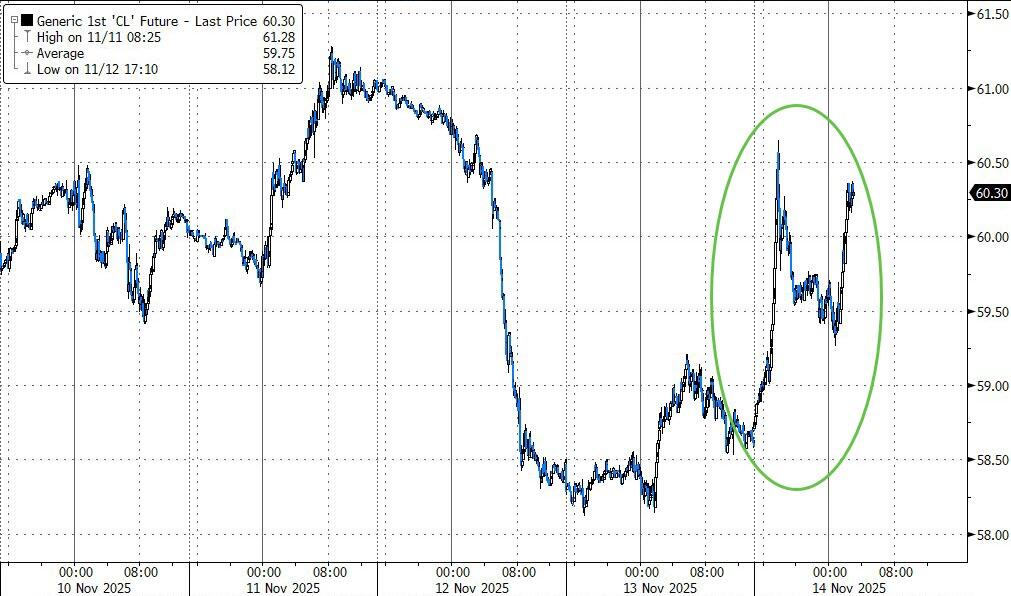
The attacks damaged a ship, nearby apartment buildings, and an oil depot, injuring three crew members aboard the vessel, Russian regional authorities confirmed.
Ukrainian forces have increasingly targeted Russian oil-refining, storage, and export infrastructure using drones and missiles.
The campaign has gained intensity in recent months, with the Center for European Policy Analysis noting a shift in strategy “from smaller-scale strikes on storage tanks to targeting hard-to-replace refinery equipment, like cracking units, much of it western-made and subject to sanctions.”
“The intensity of these attacks has increased, it’s much more often. Eventually they could hit something that causes lasting disruption,” said Giovanni Staunovo, commodity analyst at UBS.
If Ukraine continues to press its deep-strike campaign and Russia faces rolling or compounding infrastructure losses, the supply risk to global oil markets could rise meaningfully.
Russian oil supply is being further suppressed by renewed U.S. sanctions, most notably new restrictions on Russian oil majors Rosneft and Lukoil, effective Nov. 21, prohibiting transactions with the companies as Washington increases pressure on Moscow.
The broader oil market outlook, however, remains bearish, with U.S. crude inventories rising and multiple warnings of a severe glut in 2026.
END
Trump Admin Rolls Back Biden-Era Restrictions On Alaska Oil And Gas Drilling

by Tyler Durden
Friday, Nov 14, 2025 – 03:00 PM
Authored by Aldgra Fredly via The Epoch Times,
The Trump administration said Nov. 13 that it has finalized a rule rescinding Biden-era restrictions on oil and gas drilling in Alaska as part of efforts to strengthen U.S. energy security.

The new rule, to be published in the Federal Register on Nov. 17, will revoke the measures imposed by the Biden administration that restricted drilling in the National Petroleum Reserve on the North Slope, according to the Interior Department (DOI).
The petroleum reserve in Alaska, spanning roughly 23 million acres, was designated in 1923. Last year, the Biden administration restricted oil and gas drilling on over 13 million acres of the area for environmental reasons.
The DOI stated that it aims to restore drilling in the area to strengthen energy supply and reduce U.S. reliance on foreign sources, following President Donald Trump’s Jan. 20 executive order that called for the expansion of natural resource development across federal and state lands in Alaska.
“By rescinding the 2024 rule, we are following the direction set by President Trump to unlock Alaska’s energy potential, create jobs for North Slope communities and strengthen American energy security,” Secretary of the Interior Doug Burgum said in a Nov. 13 statement.
“This action restores common-sense management and ensures responsible development benefits both Alaska and the nation.”
Voice of the Arctic Inupiat, a nonprofit representing North Slope communities in Alaska, said it supports the move, noting that it would help sustain power generation, education, and other services that rely on tax revenue from resource development infrastructure.
North Slope Borough Mayor Josiah Patkotak also voiced support, calling the move a “meaningful step toward restoring a federal process” that respects local leadership in Alaska.
“Good policy comes from good process, which requires hearing directly from the people who live, work, and hunt here,” Patkotak said in a statement issued by the nonprofit.
The Natural Resources Defense Council (NRDC) opposed the move, claiming the DOI’s new rule disregards its obligation to protect the reserve.
“This rollback is nothing more than a giveaway to the oil and gas industry,” Bobby McEnaney, NRDC director of land conservation, said in a statement.
“Weakening protections is reckless, and it threatens to erase the very landscapes Congress sought to safeguard.”
This is not the first such Biden-era restriction that Trump has rolled back. Last month, the DOI announced that it would reopen the coastal plain of Alaska’s Arctic National Wildlife Refuge to oil and gas leasing and reissued permits for the 211-mile Ambler Road Project, which would allow access to cooper and cobalt deposits in the area.
END
IRAN
SHOULD CAUSE OIL TO RISE IN PRICE
Iran’s Elite IRGC Seizes Tanker In Strait Of Hormuz
Friday, Nov 14, 2025 – 01:00 PM
After a long period of relative quiet, the Strait of Hormuz is flaring up again as on Friday Iranian forces are reported to have seized a Marshall Islands-flagged tanker.
This is a first in a long time, but the Iranians are saying it is a somewhat ‘routine’ instance of intercepting a ship for “smuggling fuel”, according to state IRNA. The Iranians are now claiming to be acting within the laws of the Islamic Republic.

But it was clearly an international vessel, with a US official and a private maritime risk group saying it was forcibly diverted into Iranian territorial waters as it made its way through the narrow strait.
International reports have identified the tanker as the Talara, en route from Ajman in the United Arab Emirates to Singapore when it was intercepted.
Further, British maritime risk firm Vanguard has described that the vessel was seized by Iran’s Revolutionary Guard Corps (IRGC) – which typically oversees such aggressive Iranian naval operations related to foreign vessels – and redirected toward Iranian waters.
Reports further say that three boats were observed approaching the Talara. Further AP reports that “A U.S. Navy MQ-4C Triton drone had been circling above the area where the Talara was for hours on Friday observing the seizure,” according to flight-tracking data.
Lloyd’s List has written, “The vessel is owned by the Greece-based Coronis Family Group of Companies. The company has not responded to requests for comment.”
Iran apprehended the Marshall Islands–flagged crude oil tanker “Talara” whilst transiting the Gulf of Oman on a voyage from the UAE to Singapore. The 73,371 dwt has since been redirected to the Iranian coastline. The ship is owned by Cyprus-based Pasha Finance.

The publication says, “Maritime security firm Ambrey issued a warning, saying that a Marshall Islands-flagged crude oil tanker that had previously been approached by three small boats while transiting southbound through the Strait of Hormuz was observed making a sudden course deviation at the same location.”
Tensions have long been on edge in the region as Tehran has vowed retaliation for the prior June 12-day war, which saw Israel mount a surprise attack and the US bomb Iran’s nuclear facilities.
8. EMERGING MARKETS//AUSTRALIA NEW ZEALAND ISSUES
VENEZUELA/USA
Pentagon Briefs Trump On ‘Military Options’ Against Venezuela For ‘Coming Days’
Thursday, Nov 13, 2025 – 06:25 PM
Probably this wasn’t the first time, but there is widespread reporting on Thursday that military options have been formally presented to President Trump by top Pentagon officials for operations against Venezuela, including including strikes on land. Reports say these options are for the “coming days”.
Meetings at the White House are being held now that the USS Gerald Ford carrier strike group arrived in Caribbean waters days ago. The largest-ever ‘peacetime’ American military build-up off Venezuela is currently underway, with some 15,000 US troops total in the region.

“Secretary of War Pete Hegseth, Chairman of the Joint Chiefs of Staff Dan Caine and other senior officials briefed the president on military options for the coming days, the sources said,” CBS reports. But it also stresses, “No final decision has been made, however, two of the sources told CBS News.”
The development comes amid fresh reports of yet another alleged drug boat strike in the Caribbean Sea, bringing the total number of vessels destroyed to at least 22, which has killed some 80 or more suspected drug smugglers.
According to more via CBS:
The U.S. intelligence community assisted in providing information for potential operations, the sources said. Director of National Intelligence Tulsi Gabbard did not attend White House discussions because she was returning from an overseas trip. Secretary of State Marco Rubio was in Canada at a G7 summit of foreign ministers.
Previously, the Washington-based Center for Strategic & International Studies laid out why an entire carrier group in Caribbean waters represents a “use it or lose it” scenario which is ultra-costly, also in terms of removing it from other parts of the world:
Moving such a major element of U.S. combat power is highly significant because of the strategic trade-off it represents. The Navy has only 11 aircraft carriers. In general, only three are at sea at any one time because of the need for maintenance and training. All the regional commanders want them. U.S. Indo-Pacific Command always wants one—as a supplement to the carrier permanently stationed in Japan to counter the Chinese navy and conduct exercises with regional allies and partners.
Central Command wants one for the Indian Ocean for use against Iran and the Houthis or in the Eastern Mediterranean to provide air defense for Israel. European Command wants one for operations around Europe to deter Russia. By contrast, the Caribbean has been a low-visibility region for decades, with carriers rarely visiting.
Of course, all of this represents something likely much more than just a renewed ‘war on drugs’ – after Trump already said that potential land strikes against cartels in Venezuela are on the table.
At various times over the last months, Trump officials have strongly hinted at pursuing regime change against socialist strongman Nicolás Maduro in Venezuela – which is also consistent with the stance of Trump’s first term.
YOUR EARLY CURRENCY/GOLD AND SILVER PRICING/ASIAN CLOSING MARKETS AND EUROPEAN BOURSE OPENING AND CLOSING/ INTEREST RATE SETTINGS FRIDAY MORNING 6;30AM//OPENING AND CLOSING
EURO/USA: 1.1622 DOWN 0.0009 PTS OR 9 BASIS POINTS/WITH STOCKS LOWERER
USA/ YEN 154.29 UP 0.060 NOW TARGETS INTEREST RATE AT 1.00% AS IT WILL BUY UNLIMITED BONDS TO GETS TO THAT LEVEL…//YEN STILL FALLS//END OF YEN CARRY TRADE BEGINS AGAIN OCT 2024/Bank of Japan raises rates by .15% to 1.15..UEDA ENDS HIKING RATES AND NOW CARRY TRADES RE INVENTS ITSELF//JAPAN IN TROUBLE WITH RISING RATES
GBP/USA 1.3158 UP .0006 OR 6 BASIS PTS
USA/CAN DOLLAR: 1.4033 UP 0.0023 CDN DOLLAR DOWN 23 BASIS PTS//CDN DOLLAR GETTING KILLED)
Last night Shanghai COMPOSITE CLOSED DOWN 39.01 PTS OR 0.97%
Hang Seng CLOSED DOWN 500.97 PTS OR 1.85%
AUSTRALIA CLOSED DOWN 1.41%
// EUROPEAN BOURSE: ALL RED
Trading from Europe and ASIA
I) EUROPEAN BOURSES: ALL RED
2/ CHINESE BOURSES / :Hang SENG CLOSED DOWN 500.67PTS OR 1.85%
/SHANGHAI CLOSED DOWN 39.01POINTS OR 0.97%
AUSTRALIA BOURSE CLOSED DOWN 1.41 %
(Nikkei (Japan) CLOSED DOWN 905.30 PTS OR 1.77%
INDIA’S SENSEX IN THE GREEN
Gold very early morning trading: 4169.75
silver:$52.77
USA dollar index early FRIDAY morning: 99.21 UP 1 BASIS POINTS FROM THURSDAY’s CLOSE
FRIDAY MORNING NUMBERS ENDS
And now your closing FRIDAY NUMBERS 11: 30 AM
Portuguese 10 year bond yield: 3.040 % UP 2 in basis point(s) yield
JAPANESE BOND 10 yr YIELD: +1.691% UP 1/2 FULL POINTS AND 10/100 BASIS POINTS /JAPAN losing control of its yield curve/
JAPAN 30 YR: 3.205 UP 1 BASIS PTS//DEADLY
SPANISH 10 YR BOND YIELD: 3.205 UP 2 in basis points yield
ITALIAN 10 YR BOND YIELD 3.454 UP 4 points in basis points yield ./ THE ECB IS QE’ ING ITALIAN BONDS (BUYING ITALIAN BONDS/SELLING GERMAN BUNDS)
GERMAN 10 YR BOND YIELD: 2.6931 UP 1 BASIS PTS
IMPORTANT CURRENCY CLOSES : MID DAY FRIDAY
Closing currency crosses for day /USA DOLLAR INDEX/USA 10 YR BOND YIELD/1:00 PM
Euro/USA 1.1632 UP 0.0003 OR 3 basis points
USA/Japan: 154.13 DOWN 0.503 OR YEN IS UP 50 BASIS PTS// HIGHLY INFLATIONARY TO JAPAN
Great Britain 10 YR RATE 4.5370 UP 10 BASIS POINTS //
GREAT BRITAIN 30 YR BOND; 5.341 UP 12 BASIS POINTS.
Canadian dollar UP 0.0018 OR 18 BASIS pts to 1.4018
xxxxxxxxxxxxxxxxxxxxxxxxxxxxxxxxxxxxxxxxxxxxxxxxxxxxxxxxxxxxxxxxxxxxxxxxxxxxxxxx
The USA/Yuan CNY DOWN AT 7.0986 ON SHORE ..
THE USA/YUAN OFFSHORE DOWNTO 7.0970
TURKISH LIRA: 42.33 EXTREMELY DANGEROUS LEVEL/DEATH WATCH/HYPERINFLATION TO BEGIN.//
the 10 yr Japanese bond yield at +1.691 UP 1/2 FULL basis pts
THE 30 YR JAPANESE BOND YIELD: 3.205 UP 1 basis pts
Your closing 10 yr US bond yield DOWN 2 in basis points from THURSDAY at 4.083% //trading well ABOVE the resistance level of 2.27-2.32%)
USA 30 yr bond yield 4.687 DOWN 2 basis points /11:00 AM
USA 2 YR BOND YIELD: 3.568 DOWN 2 BASIS PTS.
GOLD AT 10;00 AM 4050,00
SILVER AT 10;00: 50.38
Your 11:00 AM bourses for Europe and the Dow along with the USA dollar index closing and interest rates: FRIDAY CLOSING TIME 11:00 AM//
London: CLOSED DOWN 109.31 PTS OR 1.11%
GERMAN DAX: DOWN 165.67 pts or 0.69%
FRANCE: CLOSED DOWN 62.40 pts or 0.76%
Spain IBEX CLOSED DOWN 231.50 pts or 1.40%
Italian MIB: CLOSED DOWN 760.67. or 0.70%
WTI Oil price 59.97 0.00 EST/
Brent Oil: 64.12 10:00 EST
USA /RUSSIAN ROUBLE /// AT: 80.89 ROUBLE DOWN 0 AND 20/ 100
CDN 10 YEAR RATE: 3.190 UP 1 BASIS PTS.
CDN 5 YEAR RATE: 2.770 UP 1 BASIS PTS
CLOSING NUMBERS: 4 PM
Euro vs USA 1.1620 DOWN 0.0010 OR 10 BASIS POINTS//
British Pound: 1.3165 UP .0012 OR 12 basis pts/
BRITISH 10 YR GILT BOND YIELD: 4.5770 UP 15 FULL BASIS PTS//
BRITISH 30 YR BOND YIELD: 5.3990 UP 17 IN BASIS PTS.
JAPAN 10 YR YIELD: 1.704 UP 2 FULL BASIS PTS (DANGEROUS TO THEIR ECONOMY
JAPANESE 30 YR BOND: 3.207 UP 2 PTS AND STILL VERY DANGEROUS TO THEIR ECONOMY
USA dollar vs Japanese Yen: 154.51 DOWN 0.201 BASIS PTS EXTREMELY DANGEROUS/YEN FALLING IN VALUE
USA dollar vs Canadian dollar: 1.4023 DOWN 0.0014 PTS// CDN DOLLAR UP 14 BASIS PTS CDN DOLLAR
West Texas intermediate oil: 59.95
Brent OIL: 64.25
USA 10 yr bond yield UP 5 BASIS pts to 4.149
USA 30 yr bond yield UP 5 PTS to 4.748%
USA 2 YR BOND 3.616 UP 3 PTS
CDN 10 YR RATE 3.228 UP 4 BASIS PTS
CDN 5 YEAR RATE: 2.804 UP 4 BASIS PTS
USA dollar index: 99.19 UP 14 BASIS POINTS
USA DOLLAR VS TURKISH LIRA: 42.29 GETTING QUITE CLOSE TO BLOWING UP/
USA DOLLAR VS RUSSIA//// ROUBLE: 81.36 DOWN 0 AND 67/100 roubles //
GOLD $4083.20 (3:30 PM)
SILVER: 50.62 3;30 PM)
DOW JONES INDUSTRIAL AVERAGE: DOWN 309.24 OR 0.65%
NASDAQ 100 UP 30.23 PTS OR 0.13%
VOLATILITY INDEX 20.13 UP 0.13 PTS OR 0.65%
GLD: $ 375/96 DOWN 6.96 PTS OR 1.81%
SLV/ $45.96 DOWN 1.46 PTS OR OR 3.08%
TORONTO STOCK INDEX// TSX INDEX: CLOSED DOWN 5 PTS OR 1.87%
end
TRADING today ZEROHEDGE 4 PM: HEADLINE NEWS/TRADING
Dip-Buying Frenzy Rescues Stocks From Back-To-Back Weekly Bloodbaths; Crypto Ugly
WRAPUP;
Markets see two-way trade, eyes turn to resumption of US data – Newsquawk US Market Wrap
Friday, Nov 14, 2025 – 04:13 PM
- SNAPSHOT: Equities mixed, Treasuries down, Crude up, Dollar flat/up, Gold down
- REAR VIEW: US & Switzerland announce trade deal, tariffs on Swiss cut to 15% in exchange for $200B in US investments; Improved UK forecasts reportedly led Reeves to drop income tax hike; Iranian navy seizes ship for smuggling fuel; China data underwhelms; WH memo reportedly claims BABA is helping Chinese military target the US, BABA denies report.
- COMING UP: Monday Data: US NY Fed Manufacturing, Canadian CPI. Speakers: Fed’s Williams, Jefferson, Kashkari, Waller; ECB’s Lane, Villeroy, de Guindos, Cipollone; BoE’s Mann; BoC’s Kozicki. Earnings: XPeng
- WEEK AHEAD: Highlights include NVDA earnings, Minutes from FOMC and RBA, CPI from Canada, UK and Japan, and Global PMI data. Click here for the full report.
- CENTRAL BANK WEEKLY: Previewing RBA Minutes, FOMC Minutes, PBoC LPR; Reviewing BoJ SOO, BoC Minutes. Click here for the full report.
- WEEKLY US EARNINGS ESTIMATES: Earnings season abates with retailers & tech-behemoth NVDA the highlights. Click here for the full report.
More Newsquawk in 2 steps:
- 1. Subscribe to the free premarket movers reports
- 2. Trial Newsquawk’s premium real-time audio news squawk box for 7 days
MARKET WRAP
Equity futures started the day in the red with a lot of weakness in the tech sector, once again following a soft handover from Asia into Europe, with European indices closing well in the red. Pressure was attributed to further AI valuation concerns with Baidu (BIDU) tumbling overnight after its latest AI model failed to impress investors. However, a revival was seen in the risk tone after the US open, taking global indices off lows. Europe still closed red, but the US managed to pare the majority of its losses with SPX and NDX closing flat, while RUT outperformed, but DJI and RSP lagged. Sectors were predominantly lower, with outperformance seen in Energy, Tech and Real Estate. Elsewhere, markets broadly tracked the risk tone with T-notes rallying when it was risk off, but paring the upside as sentiment improved. The Dollar was flat with the Yen initially rallying, but now looks to close the week flat around 154.50 after hitting a trough earlier of 153.63. CHF also pared initial gains. NZD was the clear outperformer as AUD/NZD gave back some of its recent run higher. The Pound was the focus after the Chancellor U-turned on income tax hikes thanks to improved forecasts, which saw GBP lower, hitting a low of 1.3109 but now has pared to 1.3165 at pixel time. Gilts remained pressured throughout UK trade. Energy prices were bid amid continued attacks on Russian oil and Hormuz tanker troubles. We have started to get some of the data released, with the BLS scheduling the September NFP for Thursday, 20th November 2025. Please click here for other scheduling
FED
SCHMID (2025 voter): The Fed hawk and dissenter said the rationale for October dissent continues to guide him as he heads towards December, noting policy is modestly restrictive, which is where it should be. On the inflationary footing, he remarked that further rate cuts won’t patch job market cracks, and could do damage to inflation. Kansas City President noted concerns on inflation ‘much broader’ than tariffs alone, and he prefers to focus on the overall inflation rate when setting policy; no room to be complacent on inflation expectations. Schmid, on the balance sheet, supported the decision to stop shrinking it, saying the Fed could lower the rate paid on reserves, ease access to the standing repo facility to support a smaller Fed balance sheet and ease liquidity. Schmid concluded the central bank could also shift its balance sheet portfolio to short-duration securities.
LOGAN (2026 voter): The Dallas Fed President, who argued to hold rates at the October meeting, said it would be hard to support another rate cut at the December meeting. Logan says she would need to see convincing evidence of inflation coming down, or the labour market worsening, to support such a decision. Similar to Schmid (2025 voter), Logan said her inflation concerns are not just about tariffs, but she is rather focused on persistent underlying inflation. Logan noted the labour market is cooling and is roughly balanced, with risks looking more balanced on the dual mandate than in September. She described the labour market as gradually cooling, which is appropriate amid the fight against inflation, and further argued that it is not appropriate to deliver more pre-emptive insurance to the labour market via a rate cut. Logan views a modestly restrictive policy as appropriate and sees PCE inflation at ~2.9% at year-end end.
FIXED INCOME
T-NOTE FUTURES (Z5) SETTLED 7+ TICKS LOWER AT 112-24+
T-Notes see two-way trade, tracking risk sentiment. At settlement, 2-year +2.7bps at 3.616%, 3-year +2.9bps at 3.618%, 5-year +3.3bps at 3.736%, 7-year +3.7bps at 3.922%, 10-year +3.9bps at 4.150%, 20-year +4.4bps at 4.720%, 30-year +4.4bps at 4.746%.
INFLATION BREAKEVENS: 1-year BEI -1.4bps at 2.768%, 3-year BEI +0.2bps at 2.494%, 5-year BEI +0.3bps at 2.324%, 10-year BEI +0.1bps at 2.284%, 30-year BEI +0.3bps at 2.242%.
THE DAY: T-notes saw two-way trade on Friday, with the sharp risk off seen in the pre-market leading to haven demand in Treasuries. Bloomberg highlighted that the move higher was supported by chunky volume with 135k 10-year contracts traded within 10 minutes. The amount of contracts traded was the largest since the chunky sales seen in the wake of the stronger-than-expected ADP report and ISM Services PMI on November 5th, with the latest flow seeing the largest buy volume since the October month-end. T-notes rose back above 113-00 to peak at 113-04+. The upside was swiftly pared. The downside coincided with a revival in US equities, with indices turning green after the US equity open, with T-notes largely trading off risk sentiment on Friday amid the ongoing lack of data. However, some of the dates have been released for US data. The Commerce Dept. announced the 2nd reading of Q3 GDP will be released November 26th at 08:30 EST, ahead of the October PCE at 10:00 EST. November PCE will be released on December 19th, and October trade will be released on December 4th.
SUPPLY:
Notes
US to sell USD 16bln of 20-year bonds on November 19th, to settle December 1st; to sell USD 19bln of 10-year TIPS on November 20th, to settle November 28th.
Bills
- US to sell USD 86bln of 13-week bills on Nov 17, to settle on Nov 20.
- US to sell USD 77bln of 26-week bills on Nov 17, to settle on Nov 20.
- US to sell USD 95bln of 6-week bills on Nov 18, to settle on Nov 20.
STIRS/OPERATIONS
- Market Implied Fed Rate Cut Pricing: Dec 10 (prev. 12bps), January 21 (prev. 23bps), March 30 (prev. 34bps).
- NY Fed RRP op demand at USD 1.56bln (prev. 3.9bln) across 10 counterparties (prev. 8)
- NY Fed Repo Op demand at USD across two operations today (prev. 6.05bln).
- EFFR at 3.88% (prev. 3.87%), volumes at USD 78bln (prev. 77bln) on November 13th.
- SOFR at 4.00% (prev. 3.98%), volumes at USD 3.197tln (prev. 3.209tln) on November 13th.
CRUDE
WTI (H5) SETTLED USD 1.40 HIGHER AT 60.09/BBL; BRENT (F6) SETTLED USD 1.38 HIGHER AT 64.39/BBL
The crude complex saw strength amid continued attacks on Russian oil and Hormuz tanker troubles. WTI and Brent saw significant strength in overnight trade to hit peaks of USD 60.65/bbl and USD 64.87/bbl, respectively, after a Ukrainian drone attack damaged apartment buildings, and also an oil depot in the Russian Black Sea port of Novorossiysk. Thereafter, benchmarks pared through the European morning to European/US troughs of around USD 59.30/bbl and USD 63.55/bbl. However, the energy space saw another fillip higher, albeit not quite testing earlier peaks, amid reports of an incident off the coast of UAE’s Khor Fakkan [near the Strait of Hormuz], and believed to be state activity; Vessel is transiting towards Iranian territorial waters. Once again, benchmarks chopped and pared some of this strength, albeit on no specific headline driver, but perhaps as global risk sentiment initially was sour. Nonetheless, once US players entered for the day, the move higher re-emerged and as risk appetite improved to see WTI and Brent close well in the green, but not quite at the overnight highs. For the record, in the weekly Baker Hughes Rig Count, oil +3 at 417, natgas -3 at 125, with the total +1 at 549.
EQUITIES
CLOSES: SPX -0.05% at 6,734, NDX +0.06% at 25,008, DJI -0.65% at 47,147, RUT +0.22% at 2,388.
SECTORS: Materials -1.18%, Financials -0.97%, Communication Services -0.80%, Health -0.63%, Consumer Discretionary -0.61%, Consumer Staples -0.05%, Industrials -0.02%, Utilities +0.02%, Real Estate +0.28%, Technology +0.74%, Energy +1.37%.
EUROPEAN CLOSES: Euro Stoxx 50 -0.80% at 5,697, Dax 40 -0.64% at 23,887, FTSE 100 -1.11% at 9,698, CAC 40 -0.76% at 8,170, FTSE MIB -1.70% at 43,995, IBEX 35 -1.40% at 16,346, PSI -0.78% at 8,250, SMI -0.92% at 12,624, AEX -1.00% at 952.
STOCK SPECIFICS:
- Ahead of retail earnings next week, Piper has a favourable bias on Walmart (WMT) & a more neutral bias to Home Depot (HD), Lowe’s (LOW), & Target (TGT).
- Anavex Life Sciences (AVXL) said the CHMP delivered a negative trend vote on its MAA for oral blarcamesine for early Alzheimer’s disease after an oral explanation.
- Apple (AAPL) will cut App Store commissions for mini apps from up to 30% to 15%.
- Applied Materials (AMAT): EPS & rev. beating w/ solid next Q guidance.
- Baidu’s (BIDU) new Ernie 5.0 AI model failed to impress investors, weakening hopes of recovering ground lost to competitors.
- Cidara Therapeutics (CDTX) is to be acquired by Merck (MRK) for $9.2bln or $221.50/shr; note, CDTX closed Thurs. at $105.99/shr.
- Google (GOOGL) submitted remedies to the European Commission following its EUR 2.95bln fine for ad tech dominance.
- Samsung Electronics (SSNLF) – Hiked prices of server memory chips by up to 60% in November, according to Reuters, citing sources.
- Paramount (PARA), Comcast (CMCSA), & Netflix (NFLX) prepare bids for Warner Bros Discovery (WBD) as the deadline approaches.
- StubHub (STUB): 1st post-IPO results saw revenue beat, but quarterly guidance lacked & showed a $1.33bln loss from IPO-related charges.
- Under Armour (UAA) ended 13yr partnership with/ Steph Curry.
- Walmart (WMT) CEO Douglas McMillon to retire as of January 31st, 2026; John Furner appointed as CEO, effective February 1st, 2026.
- US President Trump reportedly seeking a probe into Epstein’s relationship with JPMorgan (JPM), according to Bloomberg.
FX
The Dollar Index was slightly firmer on Friday, but still ended lower on the week for the second consecutive time. Upside vs GBP, CHF, and EUR, offset marginal weakness against CAD. Domestic developments had little bearing on USD moves today as global news, particularly in the UK, was behind much of the intraday move. Nonetheless, more Fed speakers arrived, only bolstering the existing view that the FOMC find itself in a tricky position on December’s policy decision. Money market pricing continued its hawkish run since Thursday, now pricing a 40% chance of a 25bps cut from ~ 68% earlier in the week. Schmid (2026 voter) and Logan (2026 voter) again highlighted inflation concerns that are not just about tariffs, with the latter needing to see convincing evidence of inflation coming down, or the labour market worsening, to support a December rate cut. Elsewhere, the US and Switzerland reached a deal on trade which sees the tariffs on Switzerland cut to 15% from 39% and in exchange, the Swiss will invest USD 200bln in the US. It is growing more apparent that the frustration amongst US consumers on higher prices is becoming a top priority in the Trump administration to regain support, as reports continue to suggest they are looking at lower tariffs on beef, tomatoes, coffee and bananas.
Sterling dominated the headlines to end the week, as UK Chancellor Reeves yet again pulled a U-turn on the policies included in her upcoming November budget. Reports now show that the latest forecasts of improved current/expected future wage growth have lent Reeves a hand, which allows her to drop the income tax hike. Additionally, she is expected to extend the income tax threshold increase, allowing for additional headroom. Cable came off 1.3109 lows to around 1.3160, likely more of a dollar move. EUR/GBP was flat, again. Meanwhile, gilts settled over a point lower near lows, ahead of what’s probably to be a volatile few weeks in the UK landscape.
CHF ended its recent rally as the US and Switzerland formalised their trade deal, likely allowing traders to take profits driven by trade optimism and the recent risk off in a typical sell-the-news trade. EUR/CHF sits just above 0.9200. JPY also lagged amid the improved sentiment surrounding global equities, while AUD/NZD extended on its rapid decline from Thursday’s highs, as NZD takes preference. AUD/NZD heads into the weekend at around 1.1501 from Thursday’s highs of 1.1637, with the antipodean cross paring some of the recent rally.
TWD: The US and Taiwan reached an agreement on exchange rate policies that swiftly favoured TWD, resulting in USD/TWD trading lower at ~30.76 from 31.17 pre-announcement. Both sides are committed to avoiding intervention except when combating excess volatility and disorderly movements in exchange rates.
USA ECONOMIC COMMENTARIES
FOOD STAMPS
(MISES)
Food Stamps & The Federal War On Self-Reliance
Thursday, Nov 13, 2025 – 09:45 PM
Authored by James Bovard via The Mises Institute,
During the recent government shutdown, the temporary interruption of benefits to 42 million food stamp recipients was hyped as practically the greatest human rights violation of our time. A Nation magazine headline howled: “The United States Is Letting Its People Starve.” But the delayed payments had scant impact in part because many states offered supplemental benefits, many recipients had leftover benefits on their Electronic Benefit Cards (EBTs), and because vast numbers of food pantries and other private charities provided relief.

Democrats accused Trump of “weaponizing hunger.” But the real problem is that politicians going back more than half a century have weaponized dependency to destroy limits on government power.
Most Americans support giving government assistance to people who are unable to feed themselves. But politicians profited by multiplying the number of people who relied on Washington for their next meal.
In 1969, President Richard Nixon was sharply expanding US bombing of southeast Asia. Nixon sought to bolster his humanitarian image by vastly increasing federal food handouts. He held a White House Summit and received glowing press coverage for proclaiming, “The moment is at hand to put an end to hunger in America itself for all time.” That year, 3 million Americans received food stamps, a burgeoning federal program that cost $228 million. Last year, the program cost $100 billion.
Why did food stamps become so expensive?
Government surveys in the 1960s showed that most of the poor did not need federal aid to have an adequate diet. But it was politically profitable to pretend that low-income Americans were helpless by definition. To further that goal, Washington launched a war on self-reliance.
Even though food stamp enrollment quadrupled between 1968 and 1971, Congress mandated an outreach program for states to recruit more recipients. A USDA magazine reported in 1972 that food stamp workers could often overcome people’s pride by saying, “‘This is for your children’. . .the problem is not with welfare recipients but with low-income workers: It is this group which recoils when anything even remotely resembling welfare is suggested.” The magazine triumphally announced: “With careful explanations. . .coupled with intensive outreach efforts, resistance from the ‘too prouds’ is bending. More and more are coming to the conclusion that taking needed assistance does not mean sacrificing dignity.”
In 1974, the Food Research and Action Center—a federally-funded activist group—successfully sued USDA to require the agency to further increase its food stamp outreach efforts. The USDA suggested sending food stamp workers to unemployment offices to distribute leaflets, and in Pennsylvania food stamp aides went to supermarkets to hustle shoppers. By 1976, twelve states had conducted door-to-door recruiting campaigns, and seventeen had conducted telephone campaigns. Door-to-door food stamp advertising became a favorite project for Comprehensive Employment and Training Act (CETA) workers.
In Wisconsin, 2,000 copies of the Food Stamp Nursery Rhyme Coloring Book were distributed. In Kentucky, a traveling puppet show told folks how and why to sign up for benefits. A typical 1975 USDA brochure announced, “You are in good company. Millions of Americans use food stamps.” A leaflet distributed in Maryland and paid for by the federal government showed a gaunt face on the cover with the question, “Did you know some people would rather STARVE than seek HELP. . .” On the inside, the brochure said,
PRIDE NEVER FILLS EMPTY STOMACHS . . . Are you one of thousands of Maryland residents who. . .have too much pride to consider applying for help? Then you need to know more about the Food Stamp program.
Food Stamps should NOT be confused with CHARITY! In fact, food stamps are designed to help you help yourself.
The Community Services Administration funded scores of local and national food stamp advocacy organizations to increase enrollment in food programs. The federal Office of Economic Opportunity called in 1971 for community action agencies to “prick the public conscience” over the need for more food handouts, declaring, “food stamps are not used as often as they ought to be, particularly by the intermediate income families among the poor.”
During the Clinton administration, AmeriCorps played a leading role in food stamp recruiting. The Mississippi Action for Community Education (MACE) was one of the most prominent food stamp recruiters—at least on paper. Its 1999 grant application promised that its AmeriCorps members would “conduct door-to-door canvassing to identify potential food stamp recipients” and would also provide “assistance in completing necessary applications for food stamps.” The goal of the program was to enroll “75% of surveyed rural Mississippi residents who are eligible for food stamps, but are not receiving them.”
I dropped in on MACE headquarters in Greenville, Mississippi to ask a few questions for a Readers Digest article I was writing. MACE’s Fanny Woods was evasive about their AmeriCorps program and her answers contradicted MACE’s statements in its reports to AmeriCorps headquarters. I mentioned those evasions to the AmeriCorps Inspector General. They launched an investigation that was joined by the FBI and resulted in MACE’s executive director being sent to federal prison. Rather than doing food stamp recruiting, MACE simply had ghost employees on its AmeriCorps payroll.
Ironically, that was a better result for taxpayers than if the food stamp recruiting actually occurred.
At the end of the Clinton era, 17 million Americans received food stamps—a sharp decline from the 28 million recipients in 1994. A 1996 welfare reform act was decisive in curbing dependency. However, President George W. Bush took office in 2001 and sought to vigorously expand food stamp enrollment as part of his “compassionate conservatism” sideshow to his war on terrorism atrocities.
In 2008, food stamps were renamed the Supplemental Nutrition Assistance Program1SNAP—to sound more wholesome and attractive. But the program remained a junk food entitlement and food stamp recipients were twice as likely to be obese as eligible low-income people not receiving food stamps.
Food stamp recruiting went into overdrive with the Obama administration. USDA bankrolled state government propaganda campaigns. A North Carolina social services agency won a USDA “Hunger Champions Award” for its ad campaign attacking “mountain pride” as a reason for not accepting government handouts. In Alabama, people received fliers proclaiming: “Be a patriot. Bring your food stamp money home.” A USDA brochure advised its field offices to, “Throw a Great Party…. Putting SNAP information in a game format like BINGO, crossword puzzles. . .is fun and helps get your message across in a memorable way.” USDA promoted a 10-part Spanish-language radio “novella” to encourage immigrants to go on the dole. The Obama administration also made food stamps more inviting by banishing the requirement for able-bodied recipients to seek to get a job.
The Biden administration ramped up both welfare recruiting and benefits, helping maximize the number of dependents. In 2022, President Biden proclaimed a goal “to end hunger in this country by the year 2030.” Biden did not explain why a hundred-fold increase in federal food aid spending since Nixon’s 1969 proclamation had failed to end hunger.
Political demagogues have long invoked the number of food stamp recipients as proof of the failure of the market economy and the injustice of capitalism or neoliberalism or whatever they are calling the system that week. As long as more than 40 million people depend on food stamps, politicians can exploit push-button hysteria to claim that any interruption in their spending or power will result in vast suffering and (hint, hint) starvation, especially of children and minorities and women.
The Trump administration is taking some steps to curb food stamp abuses, reviving the work requirement, cracking down on fraud, and approving state-level reforms that end junk food purchases. Simply returning to the program standards of the late 1990s would radically decrease enrollment. As Mises Institute’s Ryan McMaken recently noted, “Nearly half of households headed by illegal-immigrants receive food stamps”—a benefit that was banned in the 1996 welfare reform bill.
Unfortunately, since the Reagan era, any high-profile proposal to curb food stamp spending is accepted as sufficient proof of mass hunger and imminent catastrophe. Reducing the number of dependents is a vital first step to curbing Leviathan. But how many politicians will have the savvy or the courage to resist the Hunger Hysteria Industrial Complex?
END
ALINA HABBA/NEW JERSEY
Someone went to acting Attorney General Habba in New Jersey with a baseball bat and destroyed property there. He later was apprehended
(Phillips /EpochTimes)
Bondi Says Acting US Attorney Alina Habba Confronted, Property Destroyed
Thursday, Nov 13, 2025 – 08:55 PM
Authored by Jack Phillips via The Epoch Times (emphasis ours),
U.S. Attorney General Pam Bondi said on Thursday that an individual allegedly tried to confront acting U.S. Attorney for the District of New Jersey Alina Habba and destroyed property.

Bondi vowed to find and prosecute the person.
“Last night, an individual attempted to confront one of our U.S. Attorneys,” she said, before confirming that the U.S. attorney was Habba. The person then allegedly “destroyed property in her office, and then fled the scene,” Bondi added. “Thankfully, Alina is ok.”
“Any violence or threats of violence against any federal officer will not be tolerated. Period. This is unfortunately becoming a trend as radicals continue to attack law enforcement agents around the country,” Bondi wrote in a post on X.
Bondi did not provide details about the incident. A description of the suspect was not provided.
In a separate comment, Bondi vowed to find the perpetrator and said that they would be “brought to justice.”
“Our federal prosecutors, agents, and law-enforcement partners put their lives on the line every day to protect the American people, and this Department will use every legal tool available to ensure their safety and hold violent offenders fully accountable,” Bondi said.
In a post on X, Habba said she “will not be intimidated by radical lunatics” for doing her job, in response to Bondi’s post.
Minutes later, FBI Director Kash Patel confirmed on X that the FBI is involved in the investigation into the individual who confronted her and stressed there will be “zero tolerance” for such acts.
Habba is considered an ally of President Donald Trump, as she served as one of his personal attorneys, namely during his trial in New York City, and as a White House counselor before she was tapped to serve as the acting U.S. attorney for the state.
The Senate has not yet confirmed Habba as the U.S. attorney for the state, and the White House withdrew her nomination in the upper chamber in July as part of a procedural maneuver to allow her to remain in an acting role. The judge’s order said that her actions since July could be declared void, but put his order on hold so that the Department of Justice (DOJ) could appeal.
On Oct. 20, a three-judge panel of the Third U.S. Circuit Court of Appeals questioned the administration’s decision to keep Habba as the top federal prosecutor in New Jersey but didn’t immediately issue a ruling after the arguments.
According to the DOJ, Habba’s office supervises hundreds of federal prosecutors and other officials. That includes offices in Newark, Camden, and Trenton, New Jersey.
The Associated Press contributed to this report.
end
USA/UNDERWATER MORTGAGES
(OZIMEK/EPOCHTIMES)
Underwater Mortgages Rise To 3-Year High Amid Cooling US Housing Market
Thursday, Nov 13, 2025 – 07:15 PM
Authored by Tom Ozimek via The Epoch Times (emphasis ours),
A new report from the Intercontinental Exchange shows that nearly 875,000 homeowners now owe more on their mortgages than their properties are worth—the highest level in three years—as softening home prices and elevated borrowing costs squeeze household finances.

The surge in negative equity represents 1.6 percent of all mortgage holders and highlights a worsening affordability landscape that officials in the Trump administration say is weighing on the broader economy.
While the jump is notable, the Intercontinental Exchange said in the Nov. 10 report, the overall share of underwater loans remains comparable to long-term averages prior to the pandemic housing boom, with the exception of the Great Recession. Still, the company warned that certain markets are seeing concentrated pockets of borrower vulnerability as prices continue to retreat from their post-COVID peaks.
“While overall negative equity rates remain low, certain markets are showing signs of concern, particularly in the Gulf Coast of Florida and Austin, Texas,” the report noted.
In Cape Coral, Florida, for example, where home prices are down 15 percent from their peak, 11 percent of mortgages are underwater, including more than one-third of those that originated between 2023 and 2024, when rates were highest.
The rise in negative equity is concentrated among recent, lower-down-payment borrowers, particularly those with Federal Housing Administration (FHA) and Veterans Affairs (VA) loans issued in 2023 and 2024.
In some VA cohorts, more than 20 percent of borrowers are now underwater, the Intercontinental Exchange said—a reflection of both local price declines and the fact that these newer borrowers never benefited from the pandemic-era equity cushions that protected earlier buyers.
Another 6.9 percent of mortgage holders have less than 10 percent equity remaining, the highest share since mid-2020. While the Intercontinental Exchange noted that the figure remains below long-term averages, low-equity borrowers are typically more vulnerable to credit stress if home prices continue to fall.
At the same time, the report struck a more positive tone on the outlook for refinancing and equity access as borrowing costs begin to ease.
The Intercontinental Exchange said falling mortgage rates have “significantly expanded” the number of homeowners who could lower their monthly payments, while also reducing the cost of tapping home equity.
“The recent easing in mortgage rates has begun to open the refinance window for many borrowers, particularly those who originated loans in the past two years,” Andy Walden, head of Mortgage and Housing Market Research at the Intercontinental Exchange, said in a statement.
The Intercontinental Exchange’s data show the number of highly qualified refinance candidates—those with strong credit, at least 20 percent equity, and potential savings of 75 basis points or more—rose to 1.7 million in late October, the largest since early 2022.
Including broader borrower profiles, approximately 4.1 million mortgage holders are currently “in the money” to refinance, a figure that could approach 5 million if rates drift slightly lower.
Housing in ‘Recession,’ Treasury Secretary Warns
The equity deterioration comes amid growing concern inside the Trump administration that high mortgage rates are dragging the housing sector into a downturn.
Treasury Secretary Scott Bessent said in a recent interview on CNN that parts of the economy “are in recession,” in particular housing, and that high borrowing costs are hitting low-income Americans the hardest.
“We have seen the biggest hindrance for housing here that are mortgage rates,” Bessent said. “So, if the Fed brings down mortgage rates, then they can end this housing recession.”
Bessent echoed warnings from Federal Reserve board member Stephen Miran, who told The New York Times in an earlier interview that keeping monetary policy “this tight for a long period of time” risks inducing a recession. Miran said he sees no reason for the central bank to delay further rate cuts with inflation cooling.
Borrowers Under Strain as Credit Stress Mounts
Beyond housing, other consumer-credit segments are flashing warning signs. Subprime auto-loan delinquencies hit 6.65 percent in October—the highest level on record since the early 1990s—according to Fitch Ratings. Two major auto-finance firms serving low-income borrowers filed for bankruptcy this fall.
Foreclosure activity is also creeping higher. More than 101,000 properties received filings in the third quarter, up 17 percent from a year earlier, according to ATTOM.
Mortgage delinquencies—while still low by historical standards—have also begun to rise from last year’s trough, according to data from VantageScore and the Federal Reserve Bank of New York.
Reuters and Naveen Athrapully contributed to this report.
END
TRUMP/PORTABLE MORTAGES/
(MORAN/EPOCHtIMES)
Trump Admin Considering ‘Portable Mortgages’: Top US Housing Regulator
Thursday, Nov 13, 2025 – 10:35 PM
Authored by Andrew Moran via The Epoch Times,
The country’s top housing regulator said the Trump administration is considering another tool that could address America’s affordability challenges.
“We are actively evaluating portable mortgages,” Bill Pulte, Federal Housing Finance Agency director, said in a Nov. 12 post on X, providing no further details.
This comes days after he suggested that Fannie Mae and Freddie Mac were “evaluating how to do assumable or portable mortgages, in a safe and sound manner.”

Portable mortgages would allow homeowners to transfer their existing mortgages—rates, terms, and amortization schedule—to a new residential property.
The concept, in theory, would help borrowers avoid penalties and possibly save on interest.
It is unavailable in the United States but is an option in Canada, the UK, and parts of the European Union.
Assumable mortgages refer to when a homebuyer takes over the seller’s existing mortgage, including the interest rate, balance, and repayment terms.
Unlocking the Golden Handcuffs
For the past few years, the supply of existing homes has been a challenge for the real estate market.
Despite a year of gradual gains, housing inventory remains historically low, totaling about 1.55 million units—well below the long-term average of 2.2 million units recorded from 1982 to 2025.
With months’ supply at 4.6—the number of months it would take to exhaust current housing stocks—the market still favors sellers, underscoring persistent market supply constraints.
Although the United States has struggled with years of underbuilding, a sizable factor has been the lock-in effect that occurred during the COVID-19 pandemic, when the Federal Reserve slashed interest rates to zero percent to help cushion the economic blows from the country’s shutdown.
Shortly afterward, 30-year mortgage rates cratered, reaching an all-time low of 2.65 percent in January 2021.
First-time homebuyers and homeowners took advantage of this once-in-a-lifetime opportunity when home prices were lower than they are today.
Today, approximately half of all current U.S. mortgages originated during the COVID-19 pandemic, according to research from the Federal Reserve Bank of Philadelphia. Additionally, many homeowners refinanced at the lower mortgage rates.
However, this has made it difficult for public policymakers to unlock the golden handcuffs.
Nearly 53 percent of U.S. households enjoy a mortgage rate lower than 4 percent, so they have been reluctant to list their homes for sale, effectively constraining supply.
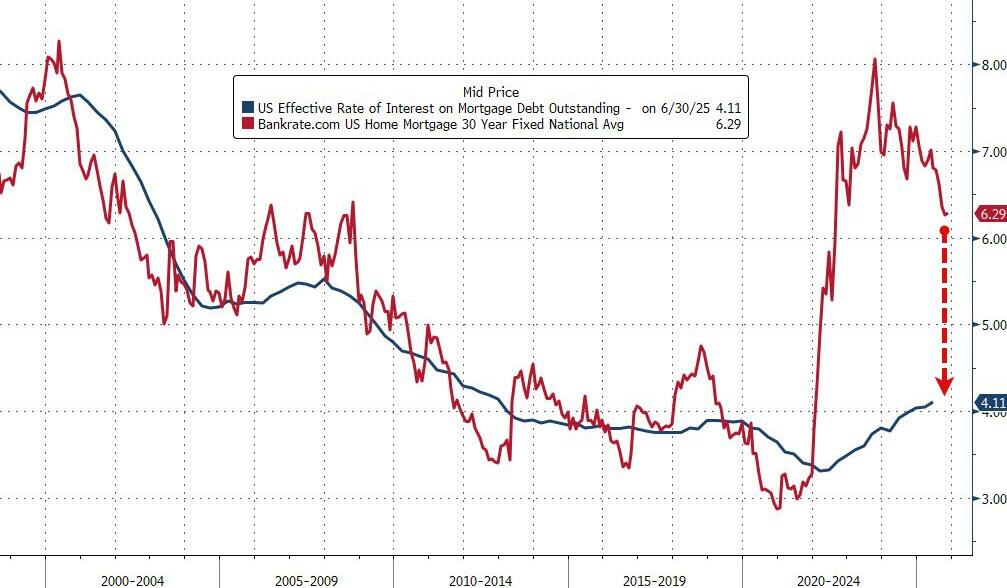
The Federal Housing Finance Agency estimated in a 2024 paper that the lock-in effect prevented about 1.72 million home sales between 2022 and 2024 and increased home prices by 7 percent.

A townhouse for sale in Elkridge, Md., on Sept. 27, 2024. Madalina Vasiliu/The Epoch Times
The average contract interest rate for a 30-year mortgage is 6.34 percent.
In addition to exacerbating housing affordability problems, it also creates broader economic issues, including the restriction of labor mobility, which affects productivity and limits household formation.
“These factors may combine to reduce utility for borrowers and underscore the importance of understanding the extent to which borrowers are locked-in,” the paper states.
Housing affordability became one of the top priorities for the current and previous administrations.
President Donald Trump recently proposed creating 50-year mortgages, a move designed to help more Americans priced out of the market to get their feet in the door of homeownership.
Trump later told Fox News host Laura Ingraham that a 50-year mortgage is “not even a big deal.”
Pulte called it a “game changer.” However, after some pushback on social media, Pulte said a 50-year mortgage option was “simply a potential weapon in a wide arsenal of solutions that [the Federal Housing Finance Agency is] developing right now.”
In an interview with Fox News on Nov. 10, National Economic Council Director Kevin Hassett defended the proposal, saying that it could lower monthly payments for middle-class Americans.
“What it does is, it reduces the monthly payment quite a bit for a typical home for middle America by a few hundred dollars a month,” Hassett said. “We need to help people get back into homes.”
In the four weeks ending on Oct. 26, the median U.S. monthly housing payment was $2,530, according to data gathered by Redfin. This is down by 1.4 percent year-over-year, the sharpest decline since November 2024.
END
TRUMP/LOWER TARIFFS /AFFORDABILITY
Operation Affordability: Trump Prepares Tariff Cuts, Trade Deals To Lower Food Prices Ahead Of Midterms
Friday, Nov 14, 2025 – 10:20 AM
President Trump’s Operation Affordability initiative kicked off this week, with the White House unveiling plans for tariff reductions and expanded trade ties with Latin American countries to boost imports of key food products. The goal: drive down supermarket prices ahead of the 2026 midterm election cycle to reverse darkening sentiment among low- and middle-income consumers.
Bloomberg reports that Trump is set to slash import levies on everyday staples, such as beef, bananas, and coffee, while moving ahead with new trade frameworks with Argentina, Guatemala, El Salvador, and Ecuador.
On Tuesday, President Trump and Treasury Secretary Scott Bessent both revealed on corporate media major moves by the administration to reduce costs for Americans when it comes to food. Trump called the effort “surgical and beautiful,” while Bessent said the effort will bring down prices “very quickly” and predicted that “people would start feeling better about the economy in the first half of 2026.”
UBS analysts, led by Jonathan Pingle, describe President Trump’s economy as “a big bet on AI and upper-income households.”
Pingle noted the bifurcated consumer environment between higher-income and lower-income households in this chart.
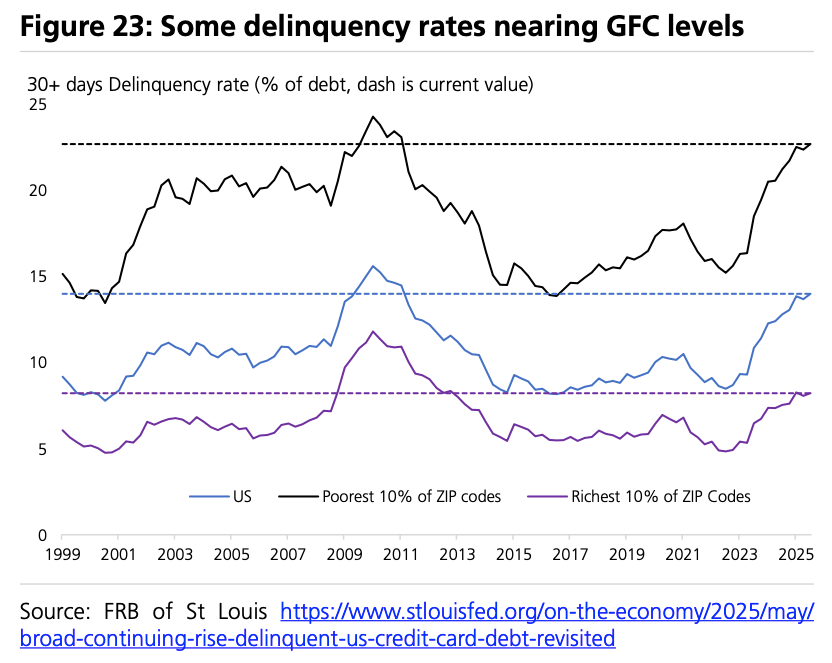
The analyst also pointed out, “Our base case is that an equity market drawdown is avoided. Households suffer for the next two quarters.”
He expects a $55 billion boost to disposable income in 2Q 2026 from retroactive tax relief in the One Big Beautiful Bill Act (OBBBA).
He said these “bumper refunds” should temporarily revive household spending in mid-2026, which is just in time for the midterm election cycle.
So Bessent is likely right that consumer sentiment will begin improving in the coming months, and this reversal is crucial. If these sentiment gauges fail to reverse, some folks may be drawn toward the newly transformed Democratic Party, now heavily influenced by Marxist-aligned DSA agenda, who aim to squander America’s inheritance by dangling “free stuff” to voters.
The way to ensure the Marxist revolution stops dead in its tracks is to tackle the affordability crisis, a lingering disaster left over from the Biden-Harris years.
The New York Times reported that updated “reciprocal tariff” rules will include carve-outs for beef and citrus, expanding on a prior executive order directing agencies to identify products not grown domestically for exemption.
New agreements with Guatemala, El Salvador, and Ecuador are reducing tariffs on products like bananas and coffee beans, which the U.S. imports but doesn’t produce domestically. These frameworks should be finalized by the end of the month.
Operation Affordability will target low- and middle-income households as well as younger voters, including Gen Z and millennials. The administration’s strategy is to improve sentiment and restore affordability, with the hope that these folks will vote “America First”, rather than embrace unhinged left dangling free bus rides and government-run grocery stores, in next year’s midterm elections.
It’s always the ones insisting they’re “not crazy” who end up being the real nutjobs.
END
ANATOMY OF A WOULD BE ASSASSIN;
Tucker Exposes Trump Would-Be Assassin Thomas Crooks’ Social Media History, The FBI Coverup, And More Strangeness
Friday, Nov 14, 2025 – 11:20 AM
Tucker Carlson has just released a deep dive into Donald Trump’s attempted assassin, Thomas Crooks – who both the Biden and the Trump FBI have been very quiet about since the July 13, 2024 shooting in Butler, Pennsylvania.

In late September, Carlson’s team received an anonymous tip from someone who said they had gained access to some of Crooks’ online accounts, which he found using ‘tools commonly used by private investigators’ after obtaining Crooks’ phone number and gmail address from public documents. He then traced that to two encrypted foreign email accounts (bcook[at]mailfence.com and americangamer[at]gmx.com). He also had a snapchat account, a Venmo, Zelle and PayPal account among several others.
“It turns out that Crooks was hardly an online ghost,” Carlson reports. “And yet, federal investigators lied and told us there was no trace of him online.”
The source was able to obtain all materials from Crooks’ deactivated YouTube account – which includes his search history, watch history, and 737 public comments.
When Carlson’s team asked the FBI why they hadn’t shared this information with the public, the agency replied by asking if they could verify the authenticity of the shooter’s account.

What did Crooks say?
The comments by Crooks were posted between 2019 and 2020, when he was between 15 and 17-years-old. “They show two things,” Carlson explains. “First, that Thomas Crooks was not some secretive lone wolf who never warned anyone that he was planning on violence. Just the opposite. Years before he showed up in Butler, Crooks was leaving a detailed digital trail of violent threats – including calls for assassinations and political violence. Second – they show a man who started out as a radical Trump supporter, whose views on the President transformed – changed completely, during Covid. The FBI lied about that fact, and that Crooks was a right-winger.”
Pro-Trump:
On July 19, 2019 Crooks writes: “Ilhan Omar and others are invaders and should honestly be killed and their dead bodies sent back.”
On July 20, 2018, Crooks writes: “If youre saying trump is a bad president you arent a patriot as trump is the literal definition of Patriotism”

Seven hours after that comment, Crooks writes: “I hope a quick painful death to all the deplorable immigrants and anti-trump congresswoman who dont deserve anything this countru [sic] has given them”
Later that evening he wrote: “Everyone of the Trump hat-ing democrats deserve to have their heads chopped of and put on steaks for the world to see what happens when you fuck with America“
These types of comments continued for months, “and became increasingly violent.”
“If any of the democratic candidates win. They wont be in there for long. Because unlike the dems we have guns and lots of them“
He also quoted Mao – writing “The only real political power comes from the barrel of a gun.”
The Change:
In early 2020 as the pandemic shifted into the headlines, crooks “radically” changed – writing of “trumps stupidity.”
He then began to mock the idea of the deep state – writing that “The deep state is simply made up of anybody who dis-agrees with the right wing. Conversation over.”
In Feb. 2020, Crooks called out Trump supporters as “brainwashed,” and a “cult.”

Later that day, Crooks called Trump a racist.
And in April 2020 when the COVID panic was in full swing, Crooks became pro-lockdown, writing “It seems that you people don’t understand that sometimes Public safety comes before your Personnel rights.”

He then wrote: “…going to a chinese new years party in america isn’t putting you at risk for corona virus because believe it or not viruses don’t spread through race like Tucker Carlson probably told you.”

In May of 2020, Crooks called Republican concerns over voter fraud “ignorant.”
He then wrote a comment that sounded like a “digital manifesto,” Carlson reports.
“they only way to fight the gov is with terror-ism style attacks, sneak a bomb into an essential building a set it off before anyone sees you, track down any important people/politicians/military leaders etc and try to asasinate them. Any sort of head fight is suicide and even ambush/surprise attacks likely aren’t going to end well.”
The Agitator
Then – a YouTube user @Willy_Tepes began seemingly encouraging Crooks… writing “If a gun and a badge is all that is needed, then authority obviously comes from the barrel of a gun. We have more guns than they do ;)”
“We have nothing to lose and everything to win,…..and the alternative, a global police state, is unacceptable!” Tepes continues in another comment.
Carlson asks who Tepas could be – noting that the FBI hasn’t made any mention of him, but that someone had screenshotted his YouTube page despite the fact that he had very few followers.
That said, the usernme was used on a foreign Antifa website linked to the Nordic Resistance Movement, which was designated a terrorist organization by the US State Dept.
Crooks’ online comments mysteriously disappear after his interactions with Tepas, and Carlson notes that Crooks was ‘ripe for recruitment‘ by someone. However his search history was still available:
From early 2019 to mid-2020, “Crooks searched for Trump more than 700 times online,” and searched for “Jack Ruby” , “Best places for mass shooting.” , and how to make various explosives and devices for mass killings. He also searched for “Sniper in Dallas shooting” , “American Nazi Party” , “German National Anthem 1933-1945,” and “Hitler’s speeches with subtitles.”
FBI Coverup?
“Why is the FBI keeping Crooks’ views a secret?” asks Carlson, adding “Why are they ignoring Congressional subpoenas to divulge information?”
“So here you have a volatile, troubled, possibly mentally ill young man with a long record of espousing violence in public,” Carlson continues. “The FBI clearly knew he existed. And then you have at the very end of his years commenting in public, espousing violence, an exchange with a mysterious figure affiliated with a group that we know is being monitored by the US State Department.”
Turns out that around the same time as Thomas Crooks was making assertions and posting overt threats of violent against public figures on YouTube, the FBI was issuing contracts to private sector tech surveillance firms to harness the power of mass data collection tools to monitor social media for people just like Thomas Crooks,” Tucker continues. “It’s hard to imagine that Thomas Crooks is making these posts publicly and in his own name, and had not been identified and looked at closely by federal law enforcement. In fact, it’s impossible to imagine.”
“We know that the FBI had access to these YouTube comments.”
Yet, “they used a selective read of those comments to lie about what Thomas Crooks was saying.“
Two and a half weeks after the attack, a ‘source familiar with the investigation’ told CNN that “Federal investigators are looking into a YouTube account possibly connected to Crooks in which the user espoused political violence as well as antisemitic and anti-immigration themes.“
Carlson says that the FBI “knew full well” that it was Crooks’ account. “There was never any question.”
Biden’s FBI Deputy Director lied the same day as the CNN report in Congressional testimony, while the NY Post reported in Feb. 2025 that the “FBI has obstructed efforts to solve the mystery of why Thomas Matthew Crooks, who left no manifesto, did what he did.”
Other notable facts:
- Crooks’ body was cremated on orders from the FBI the same day the House Homeland Security and Oversight Committee began their investigation.
“Can’t do a new tox(icology) screen, because the body doesn’t exist,” Carlson points out.
- Photos from the day after the shooting “show an FBI agent hosing down the site where Crooks died,” which high-level sources told Carlson was ‘very strange,’ as the FBI ‘usually hires out crime scene cleanup to third-party contractors – but in this case they did it themselves.”

- Biden FBI officials accessed Crooks’ phone using software from an Israeli firm, Cellebrite, and accessed his phone, computer and his encrypted messaging apps in Belgium, New Zealand and Germany – “yet none of the online activity the FBI discovered was referred to in any way in the final Congressional report.”
Carlson then notes FBI Director Kash Patel and Assistant Director Dan Bongino’s awkward and evasive answers when asked whether we’ll find out more…
More Weirdness
Carlson also points out that Crooks had an unbelievably ‘lucky day’ the day of the shooting, which the FBI is stonewalling the public over.
For example:
- Within days of the shooting, the FBI had ‘collected all the relevant surveillance footage,’ which includes footage from local businesses, state police, and “critically, the gun range where Thomas Crooks trained.” Did he train alone? We don’t know, because to this day the FBI refuses to release the footage.
- Some of Crooks’ comments were erased from the internet archive after the shooting.
- On the day of the attack, Crooks conducted surveillance at Butler – flying a drone over the rally site for 11 minutes – right as the Secret Service’s anti-drone system was mysteriously down.
- Police at Butler saw Crooks with a rangefinder and a backpack, identified him as a suspicious person, but ‘quickly lost track’ of him.
- Crooks climbed onto the only building in the area that did not have a video surveillance system, and was ‘remarkably’ outside the Secret Service’s security perimeter.
- Two local cops saw crooks but did not report it, while a 3rd police officer who was supposed to be covering the building ‘left early.’
Watch the entire thing below:
VICTOR DAVIS HANSON
KING NEWS
| The King Report November 14, 2025 Issue 7620 | Independent View of the News |
| ESZs opened a tad lower on Wednesday night and proceeded to decline smartly. After hitting 6851.25 at 18:49 ET, ESZs zoomed higher on the House passage of a bill to open the US government. ESZs created a double top of 6892.50 at 1:35 ET and 2:31 ET. Astute traders unloaded. ESZs commenced a stair-step decline that accelerated near the NYSE opening. ESZs hit a low of 6817.00 (-58.75) at 9:45 ET. Conditioned buying for early NYSE drops then appeared. ESZs bounced to 6850.50 at 10:16 ET. A persistent tortuous (for bulls) decline dropped ESZs to a daily low of 6746.00 at 14:55 ET. A last-hour A-B-C rebound took ESZs to 6764.50 at 16:00 ET. AI-related stocks led the equity carnage. Hassett: Oct. Jobs Report to Be Released with No Jobless Rate – BBG 9:31 ET “The household survey wasn’t conducted in October…” Hassett: Could Get September Jobs Report Next Week – BBG 9:32 ET Hassett: September Jobs Report Has ‘Already Been Cooked’ – BBG 9:32 ET @Barchart: % of subprime auto loans that are 60 days or more overdue on their payments hit an all-time high of 6.65%. https://t.co/rTWVCjYDas Disney reported EPS of $1.11, $1.07 expected; Revenue of $22.5B, $22.8B expected Disney+ Total Subscribers 131.6m, 130.08m expected Disney said costs from big-budget films will weigh on Q1 FY 2026 results. DIS was -9.26% at 9:36 ET. Positive aspects of previous session Precious metals declined moderately. Negative aspects of previous session Stocks got hammered, led by AI stocks, Fangs, and trading sardines. Oil, gasoline, and copper rallied sharply but rescinded most of their rallies in the afternoon. USZs were -22/32 at the NYSE close. Ambiguous aspects of previous session Cryptos got hammered. First Hour/Last Hour Action [S&P 500 Index]: 1st Hour from NYSE Open: Down; Last Hour: Up Pivot Point for S&P 500 Index [above/below indicates daily trend to traders]: 6763.42 Previous session S&P 500 Index High/Low: 6828.05; 6724.72 Speaker Johnson: “…The Unaffordable Care Act, the ACA, did exactly the opposite of what they promised…We’re gonna take you through a timeline of who destroyed American healthcare, and I’ll give you a hint, it didn’t have anything to do with the Republican Party; it was the Democrats.” https://x.com/RealAmVoice/status/1988793761862689161 @EndWokeness: Seattle’s new mayor Katie Wilson: “We will not allow grocery chains to close stores at will” https://x.com/EndWokeness/status/1988786486108647862 Fed Balance Sheet: +$7.73B on Repos +5.95B; Reserves: -$7.539B https://www.federalreserve.gov/releases/h41/20251113/ @neilksethi: Russell 2000 technical condition remains tenuous as noted two weeks ago. It more than filled the Monday gap today, falling through the 50-DMA to the lowest close since Sept 10th. It did bounce here last week but seems a lot to hope for. The daily MACD remains in “sell longs” positioning, and the RSI is now the weakest since April. https://x.com/neilksethi/status/1989106679204446380 Today – The usual suspects will play for the Friday Rally. However, the technical damage done to some major equity indices on Thursday is unnerving. Pro traders realize that the odds of a 25bp rate cut in December are now less than 50-50. This is why stocks, bonds, and commodities sank on Thursday. Fangs have led the equity rally for many moons. They are now breaking down. ‘Must always be invested’ bulls are rotating into DJIA and DJTA stocks. However, when the leadership dies, the troops will follow. The NY Fang+ Index closed 12 handles above its 50-day moving average. A decisive break and close below the 50-DMA would be very bad. The NY Fang+ Index with 21-day and 50-day moving averages ESAs are +10.50; NQZs are +34.75; Dec AU is -3.50; and USZs are -4/32 at 20:10 ET. Expected economic data: Oct Retail Sales -0.2% m/m, Ex-Autos 0.3%, Ex-Autos & Gas 0.4%; Oct PPI 0.2% m/m & 2.5% y/y, Core PPI 0.3% m/m & 2.6% y/y; Sept Business Inventories 0.2% Fed Speakers: KC Pres Schmid 10:05 ET, Boston Pres Logan 13:30 ET, Atlanta Pres Bostic 15:20 ET S&P Index 50-day MA: 6699; 100-day MA: 6520; 150-day MA: 6269; 200-day MA: 6145 DJIA 50-day MA: 46,577; 100-day MA: 45,584; 150-day MA: 44,245; 200-day MA: 43,845 (Green is positive slope; Red is negative slope) S&P 500 Index (6737.49 close) – BBG trading model Trender and MACD for key time frames Monthly: Trender and MACD are positive – a close below 5687.33 triggers a sell signal Weekly: Trender and MACD are positive – a close below 6420.50 triggers a sell signal Daily: Trender and MACD are negative – a close above 6887.89 triggers a buy signal Hourly: Trender and MACD are negative – a close above 6774.09 triggers a buy signal Democrat senator, Chuck Schumer isn’t expected to seek reelection in 2028– Puck News (He’s getting killed in the polls and would get crushed by AOC in the Dem Primary) GOP Sen. Grassley: FBI Records Show Partisan Officials Killed Clinton Campaign Investigation https://www.judiciary.senate.gov/press/rep/releases/grassley-fbi-records-show-partisan-officials-killed-clinton-campaign-investigation Biographer urged Epstein to bash Trump for ‘political cover’ in newly released emails Michael Wolff suggested anti-Trump messaging could repair sex trafficker’s public image in 2016 exchanges, according to released emails https://www.foxnews.com/us/biographer-urged-epstein-bash-trump-political-cover-newly-released-emails Trump-obsessed writer Michael Wolff encouraged Jeffrey Epstein to blackmail then-presidential candidate, emails reveal https://trib.al/sl4Adt4 @AFpost: Jeffrey Epstein claimed that Hillary Clinton had a sexual relationship with former attorney and White House counsel Vince Foster. Foster committed suicide in 1993. https://x.com/AFpost/status/1988731216594637078 @nettermike: Politico has broken the story that Newsom put his chief of staff on leave due to a criminal investigation A YEAR AGO! Never disclosed it. She then resigned and Newsom – knowing the accusations and federal investigation instigated under the Biden Administration – issued this statement: “I greatly appreciate Dana’s counsel and her service to the state and the people of California over the last two years. Her insight, tenacity and big heart will be missed.” He knew and he covered it up via glowing statement. Now we are learning that his chief of staff’s alleged co-conspirators have entered plea agreements. One of those co-conspirators was the chief of staff to Xavier Becerra, former California Attorney General and former U.S. Secretary of Health and Human Services. It was apparently Becerra’s campaign account where $225k was stolen. The drip drip drip of information today means there is a lot more coming. (Greasy Gavin has a huge problem!) Newsom’s Former Chief, Described as ‘Mob Boss’ by Fellow Dem, Failed to Report $1.7 Million in Income https://redstate.com/jenvanlaar/2025/11/13/theres-so-much-more-to-the-dana-williamson-indictment-n2196167 NYC Mayor elect Zohran Mamdani wants social workers responding to 911 calls — but test program is already failing https://trib.al/vr0VOdC Katie Wilson — a 43-year-old socialist who still lives off parents’ money — wins Seattle mayoral race https://t.co/PYdJm5ELsS Inside the world of Discord and the far-left-coded games radicalizing young boys “Extremists and predators go to these gaming spaces to find highly-engaged, susceptible young people, many of whom are yearning for connection,” Mariana Olaizola Rosenblat, a policy advisor on tech and law at the New York University Stern School of Business, told Axios following the release of their recent study on exploitation in the gaming sphere… https://t.co/E4TnFeTvFR Record 40% of young women want to flee US: poll Gallup survey shows record number of women interested in leaving US, up from just 10% in 2014 According to the polling firm, 40% of women ages 15 to 44 said they would move abroad permanently if given the opportunity. Gallup noted that in 2014, only one-quarter as many women of that age bracket expressed a desire to leave the country… (Decades of indoctrination at work!) https://www.foxnews.com/politics/record-40-young-women-want-flee-us-poll “Republicans campaign like Libertarians but govern like Democrats.” – Harry Browne | |
SWAMP STORIES FOR YOU TONIGHT
Swalwell Bares Fangs After Pulte Refers To DOJ For Criminal Mortgage Fraud
Thursday, Nov 13, 2025 – 05:20 PM
Rep. Eric Swalwell (D-CA) is super pissed after Federal Housing Finance Agency (FHFA) Director Bill Pulte referred him to the DOJ for criminal prosecution over alleged mortgage fraud.

On Thursday, Swalwell lashed out, saying in a statement “As the most vocal critic of Donald Trump over the last decade and as the only person who still has a surviving lawsuit against him, the only thing I am surprised about is that it took him this long to come after me,” adding “Like James Comey and John Bolton, Adam Schiff and Lisa Cook, Letitia James and the dozens more to come — I refuse to live in fear in what was once the freest country in the world.“
The accusations against Swalwell are connected to a DC property, according to CBS News.
Hilariously, Democrats and their media lapdogs are SHOCKED that Trump, who they went after hammer and tong for a decade, would investigate their actual (alleged!) crimes and go after them.
Pulte, has leveled similar accusations against several other officials, including Democrats New York Attorney General Letitia James and California Sen. Adam Schiff, and Federal Reserve Governor Lisa Cook.
James was indicted on one count of bank fraud and one count of making false statements to a financial institution last month and pleaded not guilty. President Trump moved to fire Cook in August after Pulte accused her of making misrepresentations on mortgage documents. But Cook filed a lawsuit arguing her removal was unlawful, and the Supreme Court will hear arguments in January on whether Mr. Trump can fire her from the Federal Reserve Board of Governors. –CBS News
In September, Swalwell said that he “fully” expects to be prosecuted by the Trump administration – while also confronting FBI Director Kash Patel during a congressional appearance that same month, noting that Patel had referred to him as a “government gangster.”
“You identified 60 individuals in that book. You put me on that list at the top of the list,” Swalwell said, adding “Thank you. My children find it flattering… Twenty of those individuals have been investigated or have had adverse actions.” As part of his statement, Swalwell told President Trump to “do better. Be better.”
And then he got tricked into banging another Chinese spy (kidding!).
END
this world is nuts!! We have a criminal going after the legitimate firing of workers who disrupted the workplace
(zerohedge)
Letitia James Targets Condé Nast Over Firing Of Workers Accused Of Disrupting Workplace
Friday, Nov 14, 2025 – 09:20 AM
New York Attorney General Letitia James has a long history of lawfare, pandering to her political base by targeting Donald Trump, the National Rifle Association, and others. Now, she is thrilling her base by promising to go after Condé Nast after the company fired four employees who had a confrontation with Condé Nast Chief People Officer Stan Duncan outside of his office.
As part of the confrontation, the union members demanded to know what the company was doing to stand up to Donald Trump. However, the main objection concerned layoffs.
Some of the layoffs in question were the result of a restructuring of Vogue’s operations, which included a reduction in staff. Teen Vogue is being moved into Vogue.com as part of the change. There were also layoffs at WIRED.
Union activists have objected that the majority of the editorial staffers laid off were women of color or transgender. According to the union, the move exposes “the trend of layoffs at Condé disproportionately impacting marginalized employees.”
Condé Nast is now under fire from the NewsGuild of New York for firing four of the employees involved in the confrontation with the HR chief outside his C-suite office. The Guild claims that the terminations constitute “grossly illegal tactics” and union busting.
However, the company insists that the four caused a disruption and refused repeated requests to leave the office to allow Duncan and others to work.
They will undoubtedly file grievances, but union contracts and federal laws do not give activists the right to disrupt operations anywhere at any time of their choosing.
However, James gave a speech to activists promising to intervene, declaring “When we fight, we win,” and “People, united, will never be defeated,” before suggesting the economy is “rigged against working people.” She added:
“Since when is it illegal for an individual, or individuals, to express, or recognize, their First Amendment rights? Since when is that illegal? When is it illegal to ask a question? When is it illegal to speak truth to power? When is it illegal to get answers from your employer?
To all of those who are responsible for the termination of these individuals, let me introduce myself. My name is Letitia James, otherwise known as Tish, and I am here to let you know that I stand with workers now, and I will stand with workers forever.”
James has learned that it does not matter that her efforts often collapse in court, such as her ridiculous effort to shut down the NRA.
The company has stood firm, stating, “The employment terminations were lawful and based on clear violations of company policies. We have an obligation to protect our workplace from harassment and intimidation. If the Attorney General has concerns, we are happy to respond to her.”
The video shows Bon Appétit digital producer Alma Avalle, a NewsGuild of New York leader and trans activist, confronting Duncan with Wired senior White House reporter Jake Lahut, The New Yorker senior fact-checker Jasper Lo, and Condé Nast Entertainment videographer Ben Dewey.
Notably, the company not only claims that the widely circulated videotape does not depict the most disruptive conduct, but also that it has filed three previous grievances this year with the union regarding such behavior. The company told the National Labor Relations Board that the NewsGuild of New York has carried out “repeated and egregious disregard of our collective bargaining agreement.”
The merits of these claims will have to be hashed out by the NLRB and the parties within the grievance process. However, James’s effort to insert herself into the dispute is bizarre. She is suggesting that somehow her office may target the company for downsizing staff and firing those who allegedly disrupted the workplace.
It is another ratcheting up of rhetoric against companies in New York, adding to what is viewed as an increasingly hostile environment in the city. With the election of a Democratic Socialist as mayor, many executives and residents are reportedly considering possible moves to more supportive jurisdictions.
GREG HUNTER….
SEE YOU ON MONDAY


 harveyorganblog.com


