
access market
XXXXXXXXXXXXXXXXXXXXXXXXXXXXXXXXXXXXXXXXXXXXXXXXXX
XGE: COMEX
190 H BMO CAPITAL MARKETS 62
323 C HSBC 46
363 H WELLS FARGO SECURITI 9
435 H SCOTIA CAPITAL (USA) 1
624 H BOFA SECURITIES 59
661 C JP MORGAN SECURITIES 231
709 C BARCLAYS 309
880 H CITIGROUP 70
905 C ADM 21 10
GOLD: NUMBER OF NOTICES FILED FOR NOV/2025: 409 CONTRACTs NOTICES FOR 40,900 OZ or 1.272 TONNES
total notices so far: 8646 contracts for 884,600 OR 26.893 tonnes)
SILVER NOTICES: 45 NOTICE(S) FILED FOR 225,000 OZ/
total number of notices filed so far this month : 3425 CONTRACTS (NOTICES) for 17.125 million oz
INITIAL STANDING FOR NOV: 11.575 MILLION OZ
PLUS INITIAL 1.245 MILLION OZ QUEUE JUMP
THEN ADD TUESDAY;S 1,93 MILLION OZ QUEUE JUMP
THEN WEDNESDAY;S 0.570 MILLION OZ QUEUE JUMP
THEN 0.080 MILLION OZ
THEN MONDAY’S 425,000 0Z
THEN TUESDAY: 275,000 OZ
THEN WEDNESDAY’S 295,000 OZ
THEN THURSDAY : 10,000 OZ
THEN FRIDAY: 1.245 MILLION OZ
NOW MONDAY: 0.300 MILLION OZ
EQUALS
17.520 MILLION OZ STANDING FOR SILVER.
JULY: 50.925 MILLION OZ (QUITE SMALL)
AUGUST: 59.455 MILLION OZ (QUITE SMALL)
SEPT. 50.510 MILLION OZ.(QUITE SMALL)
OCT; 82.020 MILLION OZ (WILL BE STRONG THIS MONTH)/ OCC WANTS TO REIN IN THESE ISSUANCES!
NOV: 20.68 MILLION OZ
AND JULY: 46.720 MILLION OZ//
AUGUST: 4.70 MILLION OZ INITIAL STANDING PLUS TODAY;S 5,000 OZ QUEUE JUMP //NEW STANDING ADVANCES TO 10.960 MILLION OZ
SEPTEMBER: 68.040 MILLION OZ NORMAL DELIVERY(INCLUDES ALL QUEUE JUMPING AND EXCHANGE FOR PHYSICAL TRANSFERS) PLUS 3.0 MILLION OZ EX FOR RISK = 71.040 MILLION OZ. (THIS IS THE FIRST AND ONLY ISSUANCE OF EXCHANGE FOR RISK FOR SILVER SINCE MAY.)
OCTOBER: 39.565 MILLION OZ OF NORMAL DELIVERY INCLUDES ALL QUEUE JUMPING
PLUS
2.110 MILLION OZ EXCHANGE FOR RISK//TOTAL OZ STANDING IN OCT ADVANCES TO 41.675 MILLION OZ
AND NOW NOVEMBER: INITIAL STANDING AT 11.575 MILLION OZ FOLLOWED BY TODAY;S QUEUE JUMP OF 1.256 OZ WHICH FOLLOWS ALL OTHER QUEUE JUMPS OF 5.255 MILLION OZ//STANDING ADVANCES TO 17.220 MILLION OZ/
- MAY: SUMMARY FOR MAY TONNES WHICH STOOD FOR DELIVERY:
4. AUGUST: 60.547 TONNES OF INITIAL GOLD FIRST DAY NOTICE FOLLOWED BY THE NET MONTH’S QUEUE JUMP OF 47.2312 TONNES TO WHICH WE ADD THE FOLLOWING EXCHANGE FOR RISK ISSUANCE RECEIVED FOR THE MONTH: 5.4432 TONNES EX FOR RISK/AUG 7 , AUG 11: 2.413 TONNES EX FOR RISK AND AUG. 12 OF 2.637 TONNES EX FOR RISK//AUG 25: 9.107 TONNES , AUGUST 26: 9.1010 TONNES AND NOW AUGUST 27: 9.0699 TONNES//NEW STANDING ADVANCES TO 107.5117 TONNES OF GOLD NORMAL STANDING (INCLUDES ALL MONTHLY QUEUE JUMPS/EX FOR PHYSICAL TRANSFERS//) +44.696 TONNES EX.FOR RISK = 152.208 TONNES
5.SEPT: INITIAL 8.093 TONNES OF GOLD PLUS TODAY’S QUEUE JUMP OF 0.4883 TONNES PLUS 2.2827 TONNES OF EXCHANGE FOR RISK TODAY//NEW TOTAL EX. FOR RISK/MONTH = 22.923//NEW TOTAL STANDING FOR GOLD SEPT ADVANCES TO = 48.801 TONNES!!
6.OCTOBER: 90.012 TONNES OF INITIAL GOLD STANDING WITH TODAY’S TINY 0.00311 TONNES QUEUE JUMP WHICH FOLLOWS ALL OTHER QUEUE JUMPS DURING OCT OF 76.1656 TONNES
THEN WE MUST ADD OUR 14.553 TONNES OF OUR ISSUANCE OF EXCHANGE FOR RISK/6 OCCASIONS//NEW TOTAL OF GOLD STANDING ADVANCES TO 197.5141 TONNES OF GOLD.
7.NOVEMBER BEGINS WITH 15.651 TONNES INITIALLY STANDING FOR DELIVERY FOLLOWED BY TODAY’S QUEUE JUMP OF 1.153 TONNES FOLLOWED BY ALL PREVIOUS QUEUE JUMPS IN OF OF 10.2938 TONNES TO WHICH WE ADD OUR FIRST EXCHANGE FOR RISK ISSUANCE OF 1.3996 TONNES//NEW STANDING ADVANCES TO 28.4126 TONNES OF GOLD.
JAN. 2025: 257.919 TONNES (ISSUANCE WILL BE PRETTY GOOD THIS MONTH BUT MUCH LOWER THAN LAST MONTH)
FEB: 207.21 TONNES//EX FOR PHYSICAL ISSUANCE (WILL BE A FAIR SIZED ISSUANCE THIS MONTH)
MARCH 130.84 TONNES//QUITE SMALL THIS MONTH.
APRIL; 208.57 TONNES. STRONG THIS MONTH
MAY: 113.499 TONNES OF GOLD EFP ISSUANCE//QUITE SMALL THIS MONTH
JUNE: 97.79 TONNES OF GOLD EFP ISSUANCE/EXTREMELY SMALL
JULY : 150.877 TONNES// QUITE SMALL
AUGUST: 175.86 TONNES A LOT LARGER THIS MONTH.
SEPT. 116.13 TONNES VERY SMALL
OCT. 252.72 TONNES//CERTAINLY MUCH LARGER THIS MONTH/VERY STRONG
NOV: 69.99 TONNES//VERY SMALL THIS MONTH.
SPREADING OPERATION
NOW SWITCHING TO GOLD FOR NEWCOMERS, HERE ARE THE DETAILS
SPREADING LIQUIDATION HAS NOW COMMENCED AS WE HEAD TOWARDS THE NEW ACTIVE FRONT MONTH OF OCT. WE ARE NOW INTO THE SPREADING OPERATION OF GOLD
HERE IS A BRIEF SYNOPSIS OF HOW THE CROOKS FLEECE UNSUSPECTING LONGS IN THE SPREADING ENDEAVOUR ;MODUS OPERANDI OF THE CORRUPT BANKERS AS TO HOW THEY HANDLE THEIR SPREAD OPEN INTERESTS:HERE IS HOW THE CROOKS USED SPREADING AS WE ARE NOW INTO THE NON ACTIVE DELIVERY MONTH OF NOV HEADING TOWARDS THE ACTIVE DELIVERY MONTH OF FEB., FOR GOLD: AND MARCH FOR SILVER
YOU WILL ALSO NOTICE THAT THE COMEX OPEN INTEREST STARTS TO RISE BUT SO IS THE OPEN INTEREST OF SPREADERS. THE OPEN INTEREST IN WILL CONTINUE TO RISE UNTIL ONE WEEK BEFORE FIRST DAY NOTICE OF AN UPCOMING ACTIVE DELIVERY MONTH (OCT), AND THAT IS WHEN THE CROOKS SELL THEIR SPREAD POSITIONS BUT NOT AT THE SAME TIME OF THE DAY. THEY WILL USE THE SELL SIDE OF THE EQUATION TO CREATE THE CASCADE (ALONG WITH THEIR COLLUSIVE FRIENDS) AND THEN COVER ON THE BUY SIDE OF THE SPREAD SITUATION AT THE END OF THE DAY. THEY DO THIS TO AVOID POSITION LIMIT DETECTION. THE LIQUIDATION OF THE SPREADING FORMATION CONTINUES FOR EXACTLY ONE WEEK AND ENDS ON FIRST DAY NOTICE.”
WHAT IS ALARMING TO ME, ACCORDING TO OUR LONDON EXPERT ANDREW MAGUIRE IS THAT THESE EFP’S ARE BEING TRANSFERRED TO WHAT ARE CALLED SERIAL FORWARD CONTRACT OBLIGATIONS AND THESE CONTRACTS ARE LESS THAN 14 DAYS. ANYTHING GREATER THAN 14 DAYS, THESE MUST BE RECORDED AND SENT TO THE COMPTROLLER, GREAT BRITAIN TO MONITOR RISK TO THE BANKING SYSTEM. IF THIS IS INDEED TRUE, THEN THIS IS A MASSIVE CONSPIRACY TO DEFRAUD AS WE NOW WITNESS A MONSTROUS TOTAL EFP’S ISSUANCE AS IT HEADS INTO THE STRATOSPHERE.
The crooks also use the spread in the TAS account (trade at settlement). They buy the spot TAS (e.g. June) and sell the future TAS two months out (e.g. August). Then they unload the front month (i.e. unload the buy side first so the price of gold/silver falls. This occurs in the middle of the front delivery month cycle. They unload the sell side of the equation, two months down the road. The crooks violate position limits as the OCC refuse to hear our complaints.
First, here is an outline of what will be discussed tonight:
1.TODAY WE HAD THE OPEN INTEREST AT THE COMEX IN SILVER FELL BY A MEGA HUGE SIZED 7022 CONTRACTS OI TO 157.243 AND CLOSER TO THE COMEX HIGH RECORD //244,710( SET FEB 25/2020). THE LAST RECORDS WERE SET IN AUG.2018 AT 244,196 WITH A SILVER PRICE OF $14.78/(AUGUST 22/2018)..THE PREVIOUS RECORD TO THAT WAS SET ON APRIL 9/2018 AT 243,411 OPEN INTEREST CONTRACTS WITH THE SILVER PRICE AT THAT DAY: $16.53). AND PREVIOUS TO THAT, THE RECORD WAS ESTABLISHED AT: 234,787 CONTRACTS, SET ON APRIL 21.2017 OVER 7 YEARS AGO. HOWEVER WE HAVE NOW SET A NEW RECORD LOW OF 114,102 CONTRACTS JULY 3.2023
EFP ISSUANCE 780 CONTRACTS
OUR CUSTOMARY MIGRATION OF COMEX LONGS CONTINUE TO MORPH INTO LONDON FORWARDS AS OUR BANKERS USED THEIR EMERGENCY PROCEDURE TO ISSUE:
DEC 780 CONTRACTS and 0 ALL OTHER MONTHS: ZERO. TOTAL EFP ISSUANCE: 0 CONTRACTS. EFP’S GIVE OUR COMEX LONGS A FIAT BONUS PLUS A DELIVERABLE PRODUCT OVER IN LONDON. IF WE TAKE THE COMEX OI LOSS OF6894 CONTRACTS AND ADD TO THE 780 E.FP. ISSUED
WE OBTAIN A MEGA HUGE SIZED LOSS OF 6242 OF OPEN INTEREST CONTRACTS FROM OUR TWO EXCHANGES WITH OUR LOSS OF $2.08 THE RATS ARE FLEEING THE ARENA.
THUS IN OUNCES, THE LOSS ON THE TWO EXCHANGES TOTALS 30.53 MILLION PAPER OZ
OCCURRED DESPITE OUR LOSS IN PRICE.OF $2.08
OUTLINE FOR TODAY’S COMMENTARY
1a/COMEX GOLD AND SILVER REPORT
(report Harvey)
b, ) Gold/silver trading overnight Europe,//GOLD COMMENT
Peter Schiff)
c) Commentaries from: Egon von Greyerz///Matthew Piepenburg via GoldSwitzerland.com, Pam and Russ Martens
ii a) Chris Powell of GATA provides to us very important physical commentaries
b. Other gold/silver commentaries
c. Commodity commentaries//
d)/CRYPTOCURRENCIES/BITCOIN ETC
2.ASIAN AFFAIRS
ASIAN MARKETS THIS FRIDAY MORNING:
SHANGHAI CLOSED DOWN 18.46 POINTS OR 0.46%
//Hang Seng CLOSED CLOSED DOWN 188.18 PTS OR 0.71%
// Nikkei CLOSED : DOWN 188.18 PTS OR 0.71% //Australia’s all ordinaries CLOSED DOWN 0.10%
//Chinese yuan (ONSHORE) CLOSED DOWN TO 7.1175/ OFFSHORE CLOSED DOWN AT 7.1155/ Oil UP TO 60.05 dollars per barrel for WTI and BRENT UP TO 64.55 Stocks in Europe OPENED ALL RED
ONSHORE USA/ YUAN TRADING DOWN TO 7.1175 OFFSHORE YUAN TRADING DOWN TO 7.1155:/ONSHORE YUAN TRADING BELOW OFF SHORE AND UP ON THE DOLLAR// / AND THUS WEAKER//OFF SHORE YUAN TRADING UP AGAINST US DOLLAR/ AND THUS WEAKER
XXXXXXXXXXXXXXXXXXXXXXXXXXXX
A)NORTH KOREA/SOUTH KOREA
outline
b) REPORT ON JAPAN/
OUTLINE
3 CHINA
OUTLINE
4/EUROPEAN AFFAIRS
OUTLINE
5. RUSSIAN AND MIDDLE EASTERN AFFAIRS
OUTLINE
6.Global Issues//COVID ISSUES/VACCINE ISSUES
OUTLINE
7. OIL ISSUES
OUTLINE
8 EMERGING MARKET ISSUES
9. USA
XXXXXXXXXXXXXXXXXXXXXXXXXXXXXXXXXXXXXXXXXXXXXXXXXXXXXXXXXXXXXXXXXXXXXXXXXXXXXXXXXXXXXXXXXXXXXXXXXXXXXXXXXX
1. COMEX DATA//AMOUNTS STANDING//VOLUME OF TRADING/INVENTORY MOVEMENTS
GOLD
LET US BEGIN:
THE TOTAL COMEX GOLD OPEN INTEREST FELL BY A STRONG SIZED SIZED 3594 CONTRACTS TO 477,283 OI DESPITE THE HUGE LOSS IN PRICE OF $97.55 WITH RESPECT TO FRIDAY’S // TRADING/RAID //COMEX CLOSING TIME:… WE LOST NO NET LONGS, WITH THAT PRICE LOSS FOR GOLD. AND AS YOU WILL SEE BELOW, OUR LOSS IN PRICE ALSO HAD A HUGE NUMBER OF EXCHANGE FOR PHYSICAL ISSUED (6675). WE HAD HUGE T.A.S. LIQUIDATION FRIDAY. IT SEEMS THAT THE SHORT SPECULATORS AT THE END OF THE DAY WERE HANDED LONG COMEX PAPER BY CENTRAL BANKERS DEMANDING PHYSICAL GOLD DELIVERY AS THEY BOUGHT CHEAPER GOLD.
WE THUS HAD A TOTAL GAIN IN OI ON BOTH OF OUR EXCHANGES, THE COMEX AND LONDON’S EXCHANGE FOR PHYSICAL EQUATING TO 3,081 CONTRACTS (OR 31.21 TONNES).THEN WE WERE NOTIFIED OF A 0 CONTRACT EXCHANGE FOR RISK ISSUANCE IN GOLD CONTRACTS ISSUED FOR NIL OZ OR 0 TONNES OF GOLD.
FIRST LETS DO A REVIEW OF EXCHANGE FOR RISK ISSUANCES:
A LITTLE HISTORY ON OUR EXCHANGE FOR RISK ISSUANCES/ GOLD PRIOR MONTHS
HERE IS A CLOSER LOOK AT EXCHANGE FOR RISK ISSUANCES FOR THESE PAST 4 MONTHS;TOTAL EXCHANGE FOR RISK LAST 4 MONTHS 70.097 TONNES. THE RECIPIENT OF THESE EXCHANGE FOR RISK IS THE BANK OF ENGLAND. THIS CENTRAL BANK LOANED OUT ITS GOLD AND WANTS IT BACK. THEIR TOTAL RESERVES PRIOR TO THE LOANS IS LISTED AT 310 TONNES.
LET US LOOK AT JULY:
SUMMARY: EXCHANGE FOR RISK ISSUANCE IN JULY/2025: 2 ISSUANCES//3.75 TONNES
ON WEDNESDAY MORNING,JULY 23, MUCH TO MY SHOCK, AFTER A TWO MONTH HIATUS,THE CME ANNOUNCED A 500 EXCHANGE FOR RISK CONTRACT ISSUANCE FOR 50,000 OZ OR 1.555 TONNES. THEN JULY 30 THE CME ANNOUNCED (ISSUED) MUCH TO MY HORROR ITS SECOND EXCHANGE FOR RISK FOR 706 CONTRACTS OR 70,600 OZ (2.195 TONNES) AS THE BANK OF ENGLAND WAS NOT SATISFIED AND NEEDS MORE GOLD TO COVER ITS LEASES TO BULLION BANKS. ( IT WAS NOT THE FRBNY WHO ALSO OWES GOLD TO THE BIS AND THEY NEED TO COVER BADLY AS YOU WILL SEE).THE TOTAL EXCHANGE FOR RISK FOR THE MONTH OF JULY WAS RECORDED AT 3.750 TONNES OF GOLD WHICH WAS ADDED TO OUR REGULAR DELIVERY TO GIVE US OUR FINAL TOTALS FOR JULY!
NOW LET US LOOK AT THE MONTH OF AUGUST:
AUGUST:
SUMMARY EXCHANGE FOR RISK ISSUANCE IN AUGUST; 7 ISSUANCES//44.696 TONNES
AUGUST: 7 ISSUANCES FOR A MONTHLY MONSTER 14,370 CONTRACTS OR 1,437,000 OZ ( 44.696) TONNES). EARLY IN THE MONTH THE CME ISSUED THE 2ND HIGHEST EVER MONTHLY RECORDED ISSUANCE OF 2924 CONTRACTS AND THIS IS FOLLOWED BY THURSDAY’S HUGE ISSUANCE OF 2226 CONTRACTS THUS BECOMING THE 4TH HIGHEST EVER RECORDED BY THE CME, SLIGHTLY BELOW AN ISSUANCE OF 2924 CONTRACTS. THE HUGE NUMBERS OF EXCHANGE FOR RISK SUGGEST THAT A MAJOR CENTRAL BANK IS DEMANDING ITS GOLD BACK.
NOW LET US LOOK AT SEPT.
SEPT:
SEPTEMBER: SEVEN ISSUANCES SO FAR TOTALLING 7,370 CONTRACTS OR 737,000 OZ OR 22.923 TONNES.
THESE ISSUANCES WILL OF COURSE BE ADDED TO OUR NORMAL DELIVERIES TO GIVE US OUR TOTAL SEPT STANDING FOR GOLD.
AND NOW OCTOBER: 6 ISSUANCES//FOR 14.553 TONNES
WE RECEIVED NOTICE THAT OUR INITIAL EXCHANGE FOR RISK ISSUED ON FIRST DAY NOTICE WAS FOR 500 CONTRACTS OR 50,000 OZ /1.555 TONNES OF GOLD!!THAT WAS FOLLOWED BY A STRONG 650 CONTRACT ISSUED THURSDAY OCT 2 FOR 2.0217 TONNES AND THAT WAS FOLLOWED THE NEXT DAY BY ANOTHER HUGE 1320 CONTRACT ISSUANCE FOR 13,200 OZ OR 4.1057 TONNES AND THIS WAS FOLLOWED BY SATURDAY’S OCT 4: 180 CONTRACT ISSUANCE FOR 18,000 OZ OR .5596 TONNES:THIS BRINGS US TO OCT 8 WITH A HUGE ISSUANCE OF 1000 CONTRACTS FOR 100,000 OZ OR 3.1104 TONNES. NOW AFTER A TWO WEEK HIATUS, OCT 21: 1029 CONTRACTS FOR 10290 OZ OR 3.200 TONNES TOTAL ISSUANCES 6 OCCASIONS FOR 4679 CONTRACTS OR 467,900 OZ OR 14.553 TONNES
LET’S SUM UP EXCHANGE FOR RISK FOR THE LAST 8 MONTHS
HISTORY: LAST 8 MONTH’S EXCHANGE FOR RISK//TOTAL CONTRACT ISSUANCES //TONNES OF GOLD
IN FEBRUARY:
WE HAD A HUGE FIVE EXCHANGE FOR RISKS ISSUANCES FOR GOLD, TOTALLING 18.4527 TONNES!.
IN MARCH:
THE TOTAL NO. OF EXCHANGE FOR RISK ISSUANCE FOR THE MONTH OF MARCH (3 NOTICES) EQUALED: 7.6179 TONNES OF GOLD WHICH WAS ADDED TO OUR MARCH DELIVERY TOTALS.
IN APRIL:
WE CONCLUDED APRIL WITH 7 ISSUANCE OF EXCHANGE FOR RISK FOR A TOTAL TONNAGE OF 8.3571 TONNES.
IN MAY:
MAY: 3 EX. FOR RISK ISSUED SO FAR FOR 3025 CONTRACTS OR 302,500 OZ OR 9.4054 TONNES. THIS WILL BE ADDED TO OUR NORMAL DELIVERY TO GIVE US TOTAL STANDING FOR MAY!THIS IS THE 6TH CONSECUTIVE MONTH FOR ISSUANCE OF EXCHANGE FOR RISK//NEW TOTAL EX FOR RISK IS 9.4054 TONNES FOR THE 3 ISSUANCE!
IN JUNE
JUNE: ZERO ISSUED
jULY: 2 OCCASIONS LATE IN JULY: 1206 CONTRACTS FOR 120,600 OZ OR 3.750 TONNES/ISSUED JULY 23/2025 AND JULY 30/2025
AUGUST: 7 ISSUANCES FOR A MONTHLY MONSTER 14,370 CONTRACTS OR 1,437,000 OZ ( 44.696) TONNES).AT THE BEGINNING OF THE MONTH THE CME ISSUED THE 2ND HIGHEST EVER MONTHLY RECORDED ISSUANCE OF 2924 CONTRACTS AND THIS IS FOLLOWED BY THURSDAY’S HUGE ISSUANCE OF 2226 CONTRACTS THUS BECOMING THE 4TH HIGHEST EVER RECORDED BY THE CME, SLIGHTLY BELOW PREVIOUS DAY’S ISSUANCE OF 2924 CONTRACTS. THE HUGE NUMBERS OF EXCHANGE FOR RISK SUGGEST THAT A MAJOR CENTRAL BANK IS DEMANDING ITS GOLD BACK.
SEPTEMBER: SEVEN ISSUANCES FOR 7370 CONTRACTS SO FAR FOR 737,000 OZ OR 22.923 TONNES OF GOLD!!
OCTOBER: FIRST INITIAL ISSUANCE OF 500 CONTRACTS FOR 50,000 OZ OR 1.555 TONNES OF GOLD. THIS WAS FOLLOWED BY AN ISSUANCE OF 650 CONTRACTS OR 65000 OZ OR 2.0217 TONNES. THEN ON OCT 3 WE RECEIVED OUR 3RD NOTICE FOR A HUGE 1320 CONTRACTS OR 132000 OZ OR 4.1057, AND THEN SATURDAY OCT 4, THE CME ISSUED ITS 4 ISSUANCE FOR 180 CONTRACTS FOR 18,000 OZ OR .5594 TONNES. THEN OCT 8 FOR 1000 CONTRACTS, OR 100,000 OZ OR 3.1104 TONNES AND FINALLY OCT 21; 3.200 TONNES// THUS ON 6 OCCASIONS TOTAL EXCHANGE FOR RISK ISSUANCE; 14.553 TONNES
AND NOW NOVEMBER:
NOVEMBER: SO FAR ONE ISSUANCE:
WHICH NOW BRINGS US TO NOVEMBER WHERE WE RECEIVED NOTICE OF OUR FIRST ISSUANCE OF 450 CONTRACTS FOR 45000 OZ OR 1.3996 TONNES.
AS I EXPLAINED ABOVE,:THE RECIPIENT OF EXCHANGE FOR RISK FOR GOLD IS THE BANK OF ENGLAND
here are the only possible candidates who must bring back loaned gold
- THE BANK OF ENGLAND WHO CONTINUES TO LEASE OUT MUCH ITS GOLD TO BULLION BANKS AND :(EX FOR RISK 10 MONTH TOTALS 131.6996 TONNES)//TOTAL RESERVES OF BOE EQUALS 310 TONNES)
- THE FEDERAL RESERVE BANK OF NEW YORK (NEED TO RETRIEVE THEIR LEASED/BORROWED GOLD FROM THE BIS).THE FED STILL REFUSES TO BRING BACK MUCH OF ITS 54 TONNES SHORTFALL. IT BOUGHT BACK ONLY 4 TONNES IN AUGUST AND THEN ADDED 24 TONNES IN SEPT. AND THUS THEIR SHORTFALL TO THE BIS IS 54 TONNES.
HOWEVER, IN OUR CASE, EXCHANGE FOR RISK RECIPIENT IS THE BANK OF ENGLAND. THE COUNTERPARTY TO THE BANK OF ENGLAND EXCHANGE FOR RISK ARE BULLION BANKS THAT CANNOT VERIFY THAT THEIR GOLD IS UNENCUMBERED. THE BUYER, REPRESENTING THE CENTRAL BANK OF ENGLAND ASSUMES THE RISK OF THAT DELIVERY. THIS IS THE 10TH MONTH FOR ISSUANCE OF EXCHANGE FOR RISK !!…..(DEC THROUGH NOV//ONLY MISSING JUNE. TOTAL 10 MONTHS ISSUANCE 131.6996 TONNES)……… THE FACT THAT A CENTRAL BANK TAKES THE RISK OF A DELIVERY IS TOTALLY INSANE. THE VERY FIRST ISSUE OF EXCHANGE FOR RISK CAME IN MAY 2023. HUGE ISSUANCES BEGAN OCT AND DEC 2024. ROBERT LAMBOURNE, GATA CONSULTANT AND EXPERT ON BIS AND BANK OF ENGLAND ISSUES HAS WRITTEN TO THE BANK OF ENGLAND AUTHORITIES CONCERNING THE REFUSAL OF THE BANK OF ENGLAND’S E.E.A. AUDITORS TO SUPPLY A POSITIVE AUDIT ON THEIR GOLD TONNAGE AND OTHER ASSETS HELD UNDER THE E.E.A. .AND NOW THE OCC HAS WRITTEN NEW RULES ON BORROWED GOLD AND THE HANDLING OF EXCHANGE FOR PHYSICAL ISSUANCES AS TO NOT BREAK ANY LAWS!!! STRANGE: THEY HAVE BEEN BREAKING LAWS FOR 5 YEARS NOW.
DETAILS ON OUR NEW NOVEMBER COMEX CONTRACT MONTH//
IN TOTAL WE HAD A STRONG SIZED GAIN ON OUR TWO EXCHANGES OF 3,081 CONTRACTS WITH OUR LOSS IN PRICE. HOWEVER, OUR FRIENDLY PHYSICAL LONDON BOYS HAD ANOTHER FIELD DAY AGAIN THROUGHOUT OF THE WEEK AS THEY WERE READY FOR THE FRBNY.S CONTINUED ORCHESTRATED ATTACKS VERY EARLY IN THE COMEX SESSIONS AS THEY TRIED TO ABSORB EVERYTHING IN SIGHT FROM THEIR DAILY ATTACKS. LONDONERS EXERCISED THEIR BOUGHT CONTRACTS FOR PHYSICAL GOLD VIA THE EXCHANGE FOR PHYSICAL ROUTE AND THANKED THE FRBNY AND OUR SHORT SPECULATORS FOR THE THOUGHTFULNESS. LONDON ANNOUNCED EARLY IN THE YEAR (AND SCARCITY CONTINUES TO THIS DAY) THAT THEY WERE OUT OF GOLD. WRONGLY IT WAS ATTRIBUTED TO THEIR SHIPPING PHYSICAL GOLD TO COMEX FOR STORAGE DUE TO TRUMP’S INITIATION OF TARIFFS. THE TRUTH OF THE MATTER IS THAT THIS GOLD LEFT LONDON TO CENTRAL BANKS, AND COMEX BANKS HAVE BEEN PAPERING THEIR LOSSES (DERIVATIVE) WITH KILOBAR ENTRIES. DELIVERY OF GOLD CONTRACTS ARE NOW TAKING SEVERAL WEEKS. NO DEFAULT HAS BEEN INITIATED AS DEALERS ARE AFRAID OF LOSS OF THEIR JOBS. SO THIS FRAUD CONTINUES. THE LEASE RATES IN LONDON HAVE NOW INCREASED TO 2.0% LATELY AS GOLD IN LONDON IS STILL EXTREMELY SCARCE. THE FORCE MAJEURE AT GRASBERG IS CERTAINLY HAVING AN EFFECT ON LEASE RATES IN LONDON WITH RESPECT TO GOLD/SILVER.
THE LIQUIDATION OF T.A.S. CONTRACTS THROUGHOUT THE MONTHS OF JUNE THROUGH OCT/EARLY NOVEMBER CONTINUES TO DISTORT OPEN INTEREST NUMBERS GREATLY ALTHOUGH THE T.A.S. ISSUANCES IN GOLD HAVE GENERALLY BEEN ON THE LOW SIDE COMPARED TO SILVER WHICH HAVE BEEN HUGE. TODAY’S NUMBER IS FINALLY A LOWER T.A.S ISSUANCE CONTRACTS AS THE 5 CONSECUTIVE MEGA HUGE ISSUANCES HAS ENDED. THE CME NOTIFIES US THAT THEY HAVE ISSUED 2549 T.A.S CONTRACTS. THESE LAST 5 MEGA HUGE T.A.S ISSUANCES WERE USED FOR RAID PURPOSES TO STOP GOLD’S RISE AND TO TEMPER HUGE LOSSES IN OTC DERIVATIVE BETS AND IT WAS IN FULL FORCE DURING THE WEEK FINISHING OFF WITH A MASSIVE HUGE RAID ON GOLD AND SILVER THURSDAY AFTERNOON AND FRIDAY, DESPERATELY TRYING TO STOP GOLD’S ADVANCE. THIS GENERALLY ENDS IN FAILURE AS WE WE WILL PROBABLY SEE GOLD//SILVER RISE HUGELY ON OUR UPCOMING DAYS.
A LITTLE HISTORY ON TAS ATTEMPTED RAIDS: SEPT THROUGH NOVEMBER;
AS FOR THE FIRST TIME EVER, THEY FAILED TO RAID AT MONTH’S END AUGUST COMEX AND OTC/LONDON LBMA EXPIRY!! SO THE CROOKS DECIDED IT WAS NECESSARY TO RAID AROUND THE BIG INTEREST RATE ANNOUNCEMENT SEPT 17-SEPT 18 AND THEY TRIED AGAIN RIGHT BEFORE FIRST DAY NOTICE SEPT 30, WITH MUCH FAILURE AS THE TOTAL OPEN INTEREST REFUSED TO BUCKLE!! THIS LEADS US TO FIRST DAY NOTICE SEPT 30 AND THE LAST POSSIBLE DAY FOR A RAID AND TRUE TO FORM OUR CROOKS DECIDED TO RAID MUCH TO THE DELIGHT OF OUR BOYS IN LONDON WHO PICKED UP EXTRA AMOUNTS OF GOLD AND TENDERED FROM THIS SHORT PAPER ISSUANCE. THEN MUCH TO MY ANGER THEY DECIDED TO RAID AGAIN ON OCT 2 WITH CHINA OFF THIS WEEK FOR THEIR FALL FESTIVAL (BACK TODAY) AND OF COURSE THE IMPORTANT RELIGIOUS HOLIDAY FOR THE JEWISH PEOPLE OCT 1-2, YOM KIPPUR. AGAIN THIS ENDED IN ABSOLUTE FAILURE AS LONDON AGAIN CAME TO THE RESCUE WITH THEIR MASSIVE TENDERING FOR PHYSICAL. YOU CAN JUST VISUALIZE THE MASSIVE HEADACHE THE CROOKS UNDERWENT WITH THIS HUGE PHYSICAL TENDERING FOR GOLD.(THE HUGE INCREASE IN QUEUE JUMPING). AND NOW AS WE ARE FINISHING OPTION EXPIRY WEEK, THE CROOKS GOADED OUR SPECULATORS TO CONTINUE ONTO THE SHORT SIDE WITH THE BANKERS ON THE LONG SIDE…THE RAIDS THROUGHT THIS WEEK WERE FREQUENT BUT FAILED TO CAUSE ANY DAMAGE TO THE PRICE WITH OPTIONS EXPIRY FINISHING OCT 31 AS WE NOW ENTER OUR MONTH OF NOVEMBER WITH EARLY MONTH FAILED RAID ATTEMPTS. SO THEY NOW ISSUED THESE MEGA T.A.S. CONTRACTS AND THAT ALWAYS SIGNALS A MAJOR RAID WHICH ARRIVED ON OUR DOORSTEP THURSDAY EARLY AFTERNOON AND CONTINUED RIGHT THROUGH FRIDAY..
HERE IS A SUMMARY OF GOLD STANDING FOR DELIVERY ON OUR LAST 8 MONTHS:
- FOR APRIL AT 209 TONNES
2. AND THIS CONTINUED INTO MAY WITH FINAL STANDING AT 90.23 TONNES.
3. JUNE WHICH IS A HUGE DELIVERY MONTH , FINAL STANDING WAS RECORDED AT A STRONG 93.085 TONNES. //(TOTAL NET QUEUE JUMPING FOR THE JUNE MONTH: 31.027 TONNES.)
4. IN JULY WE HAD HUGE DELIVERY NOTICES ESPECIALLY FOR A NON ACTIVE DELIVERY MONTH WITH INITIAL STANDING AT 17.947 TONNES PLUS MANY QUEUE JUMPS + 3.75 TONNES EX FOR RISK = 41.106 TONNES OF GOLD // FINAL TOTAL TONNES STANDING JULY: 41.106 TONNES
5. FOR THE MONTH OF AUGUST:
INITIAL AMOUNT OF GOLD STANDING FOR AUGUST: 60.547 TONNES PLUS THE MONTHS HUGE QUEUE JUMPS OF 47.2312 TONNES +44.696 TONNES EX FOR RISK (7 ISSUANCES) //NEW STANDING 152.208 TONNES WHICH IS MONSTROUS!!!
6. FINAL AMOUNT OF GOLD STANDING FOR SEPT; INITIAL STANDING; 2,602 CONTRACTS OR 260,200 OZ FOR 8.093 TONNES OF GOLD FOLLOWED BY TODAY’S 0.4883 TONNES QUEUE JUMP TO GO ALONG WITH TODAY’S 2.817 TONNES OF EXCHANGE FOR RISK ISSUANCE TODAY AND // TOTAL EXCHANGE FOR RISK ISSUANCE SEPT: 22.923 TONNES//NEW TOTALS STANDING ADVANCES TO 48.801 TONNES OF GOLD!!!
7. OCTOBER:
OCTOBER: INITIAL STANDING FOR GOLD: 90.164 TONNES TO WHICH WE ADD OUR LATEST OCT 30 QUEUE JUMP OF 0.00311 TONNES WHICH FOLLOWS OCT 29 QUEUE JUMP OF .4096 WHICH FOLLOWS; OCT 28 QUEUE JUMP OF .5069 TONNES WHICH FOLLOWS OCT 27 OF 0.3048 TONNES WHICH FOLLOWS: OCT 24 OF 0.8615 TONNES, FOLLOWING OCT 23 QUEUE JUMP OF 1.695 TONNES OCT 22 JUMP OF 8.622 TONNES WHICH FOLLOWS OCT 21: 3.8600 TONNES TO OCT 20 QUEUE JUMP OF 7.695 TONNES WHICH FOLLOWED OCT 17 RECORD SETTING: 12.031 TONNE QUEUE JUMP WHICH FOLLOWED THURSDAY’S QUEUE JUMP OF 8.326 TONNES WHICH FOLLOWED WEDNESDAY;S 6.469 WHICH FOLLOWED ALL PREVIOUS QUEUE JUMPS OF 42.549 TONNES TO WHICH WE ADD OUR TOTAL 4679 EXCHANGE FOR RISK CONTRACTS ON 6 OCCASIONS FOR 467,900 OZ OR 14.553 TONNES.! TOTAL STANDING ADVANCES TO 197.511 TONNES OF GOLD
SUMMARY FOR OCTOBER STANDING:
THAT IS;
a) INITIAL STANDING 90.164 TONNES
b) INITIAL EXCHANGE FOR RISK ISSUANCE OF 500 CONTRACTS FOR 50,000 OZ OR 1.555 TONNES
c) ANOTHER 3 CONSECUTIVE EXCHANGE FOR RISK ISSUANCES OF 2150 CONTRACTS FOR 215000 OZ OR 6.687 TONNES
D) AFTER A ONE DAY HIATUS, A 5TH ISSUANCE FOR 1000 CONTRACTS //100,000 OZ OR 3.1104 TONNES
E) AFTER A TWO WEEK HIATUS: ITS 6TH ISSUANCE FOR 1029 CONTRACTS/102,900 OZ OR 3.200 TONNES
TOTAL EXCHANGE FOR RISK OCT 6 OCCASIONS: 14.553 TONNES
TO WHICH WE ADD ALL OUR QUEUE JUMPING IN OCT: TOTAL MONTH;: 92.7648 TONNES
(ALL OF THESE QUEUE JUMPS ARE REPRESENTED BY CENTRAL BANKS DESPERATELY ADDING TO THEIR OFFICIAL RESERVES)
EQUALS
197.5141 TONNES OF GOLD!!
END
8. AND NOW NOVEMBER:TOTAL TONNES STANDING INCLUDING ALL QUEUE JUMPS AND EXCHANGE FOR RISK ISSUANCE:
INITIAL GOLD STANDING AT THE COMEX IS 5032 CONTRACTS OR 503,200 OZ (15.651 TONNES) FOLLOWED BY ITS TODAY’S QUEUE JUMP OF 1.153TONNES/ FOLLOWED BY ALL NOVEMBER QUEUE JUMPS OF 10.2938 TONNES TO WHICH WE ADD OUR FIRST EXCHANGE FOR RISK ISSUANCE OF 1.3966 TONNES///NEW STANDING ADVANCES TO 28.4126 TONNES
THE FED IS THE OTHER MAJOR SHORT OF AROUND 54+ TONNES OF GOLD OWING TO THE B.I.S. THE OCC ORDERED THE BANKS TO COVER THEIR GOLD LOSSES FROM OCC BETS. THIS IS SUCH A SMALL FRACTION OF WHAT IS OWED!!! THE FRBNY BORROWED GOLD FROM THE BIS TO COVER THOSE HUGE LOSSES OF AROUND 54 TONNES OF GOLD.. THE FED IS VERY WORRIED ABOUT WHAT IS GOING TO HAPPEN TO GOLD PRICES IF THEY DO NOT BORROW THIS GOLD.
THE MAJOR FOUR OR FIVE BANKS ARE ALSO WORRIED ABOUT THEIR HUGE PRECIOUS METAL DERIVATIVE SHORT EXPOSURE (NORTH OF ONE TRILLION DOLLARS) AND THIS IS PROBABLY THE MAJOR REASON FOR GOLD/SILVER’S RISE THESE PAST THREE MONTHS. THEY ARE TOTALLY TRAPPED., AND THEIR FAILURE TO STOP OTHER CENTRAL BANK PURCHASES OF PHYSICAL GOLD IS THE MAJOR ISSUE OF THE DAY. IT SURE DOES NOT LOOK LIKE THE BIS HAS GIVEN THE FED ITS MARCHING ORDERS TO COVER ITS PHYSICAL GOLD SHORT AS THEIR OUTSTANDING LOAN OF 54 TONNES REMAIN ON THE BOOKS OF THE BIS.
THE FRBNY IS NOW NON COMPLIANT WITH RESPECT TO BASEL III BUT IT IS NOT NECESSARY FOR THEM TO BE COMPLIANT ONLY COMMERCIAL BANKERS MUST BE.
OUR PHYSICAL LONDONERS BOUGHT NEW MASSIVE QUANTITIES OF LONGS AT ANY PRICE AND THIS GOLD BOUGHT WILL BE TENDERED FOR PHYSICAL ON A T + ???? BASIS. BECAUSE GOLD IS BASEL III COMPLIANT, GOLD IS SUPPOSED BE DELIVERED IN A VERY TIMELY ONE DAY. CENTRAL BANKS AROUND THE WORLD, BEING REPRESENTED BY OUR LONDONERS, ARE THE REAL PURCHASERS OF THIS GOLD.
EUROPE IS NOW BASEL III COMPLIANT. THE WEST ( COMEX) IS NOW COMPLIANT EFFECTIVE JULY 1//2025.
THE PROBLEM FOR THOSE PROVIDING THE SHORT PAPER IS THE SHOCK TO THEM ON RECEIVING NOTICE THAT THE LONGS WANT THE PHYSICAL GOLD AS THEY TENDER FOR THAT SHINY YELLOW METAL. THE HIGH LIQUIDATION OF OUR TWO SPREADERS: 1) THE MONTH END SPREADERS AND 2. T.A.S DURING THESE PAST SEVERAL WEEKS IS SURELY DISTORTING COMEX OPEN INTEREST BUT THAT DOES NOT STOP LONDON’S ACCUMULATION OF PHYSICAL! YOU CAN ALSO VISUALIZE THAT PERFECTLY WITH THE HUGE AMOUNTS OF QUEUE JUMPING ORCHESTRATED BY CENTRAL BANKERS BOLTING AHEAD OF ORDINARY LONGS AS THEIR NEED FOR PHYSICAL IS GREAT AS THEY SCOUR THE PLANET LOOKING FOR GOLD, AND THE MASSIVE AMOUNT OF GOLD STANDING EACH AND EVERY MONTH INCLUDING FIRST DAY NOTICE OF GOLD TONNAGE STANDING E.G. NOVEMBER: A HUGE INITIAL 15.651 TONNES STANDING IN AN OFF MONTH!! THIS IS HUGE!!!//WITH QUEUE JUMPS AND EXCHANGE FOR RISK NEW STANDING FOR GOLD NOW AT 27.229 TONNES
EXCHANGE FOR PHYSICAL ISSUANCE/NOV//BORROWINGS FROM THE FRBNY:
THE CME REPORTS THAT THE BANKERS ISSUED A HUGE SIZED EXCHANGE FOR PHYSICAL OF 6675 CONTRACTS.
THAT IS A STRONG SIZED 6675 EFP CONTRACT WAS ISSUED: : /DEC 6675 & ZERO FOR ALL OTHER MONTHS:
TOTAL EFP ISSUANCE: 6675 CONTRACT. THESE EFP;S CIRCLE AROUND LONDON ON A 13 DAY BASIS AND ARE NOW USED BY GLOBAL CENTRAL BANKS TO EXERCISE FOR PHYSICAL GOLD WITH THE OBLIGATION TO DELIVER BEING FORCED ONTO COMEX BANKS. THE GOLD GENERALLY DELIVERED COMES FROM LONDON BUT THEY ARE OUT!! THUS COMEX BECOMES THE MAJOR SOURCE FOR OUR CENTRAL BANKERS. THE REGULATORY BODY THAT IS SUPPOSE TO CONTROL THESE EFP’S IS THE O.C.C. HEADQUARTERED IN BOTH LONDON AND WASHINGTON. SEEMS NOW THAT THE OCC IS CLAMPING DOWN ON THIS EFP’S CIRCLING AROUND IN LONDON AS THEY ORDERED THE BULLION BANKS TO COVER MUCH OF THEIR DERIVATIVE BETS ON THESE CONTRACTS!! THUS THE FRBNY SAVED OUR BULLION BANKS FROM EXTINCTION WITH THIS BORROWED GOLD FROM THE BIS OF 54 TONNES
WE HAD :
- CONSIDERABLE LIQUIDATION OF OUR T.A.S. SPREADERS//FRIDAY + GOVERNMENT LIQUIDATION AND MASSIVE LIQUIDATION LATE THURSDAY AND FRIDAY/VERY EARLY AFTERNOON CLOSE TO CLOSING TIME
- MONTH END SPREADERS HAVE NOW FINISHED AS IT WAS IN FULL FORCE ON FIRST DAY NOTICE OCT 31 WITH OUR ATTEMPTED FAILED RAID, WE WILL SEE THESE MONTHLY MONTH SPREADERS IN ACTION NEXT WEEK.
T.A.S.SPREADER ISSUANCE//NOV
AS PER OUR NEWBIE TRADE AT SETTLEMENT (TAS) MANIPULATION OPERATION (WHICH CRAIG HEMKE HAS POINTED OUT HAPPENS USUALLY DURING MID MONTH IN THE DELIVERY CYCLE), BUT NOW ON A DAILY BASIS, THE CME REPORTS THAT THE TOTAL T.A.S. ISSUANCE FOR FRIDAY NIGHT// SATURDAY MORNING WAS A MUCH SMALLER SIZED 2527 CONTRACTS
THE RAIDS WHETHER ON OPTIONS EXPIRY MONTH OR OTHERWISE LIKE THIS MONTH ON OPTIONS EXPIRY WEEK ACCOMPLISHES TWO IMPORTANT ASPECTS FOR OUR CROOKS:
- STALLS THE ADVANCE IN PRICE
- LOWERS THEIR ADVANCING DERIVATIVE LOSSES.
THAT SET UP FRIDAY’S LOSS IN PRICE IN GOLD YET A CORRESPONDING HUMONGOUS GAIN OF COMEX OI AND A STRONG EXCHANGE FOR PHYSICAL ISSUANCE.. THE COMEX IS IN TOTAL TURMOIL ESPECIALLY THESE PAST 5 MONTHS WITH THE FOLLOWING;
- WITH JULY’S RARE TWO ISSUANCES OF EXCHANGE FOR RISK (LATE IN JULY)
- AND THIS WAS FOLLOWED WITH AUGUST’S 7 ISSUANCES OF EXCHANGE FOR RISK FOR 44.696 TONNES
- TO BE FOLLOWED BY SEPTEMBER’S 7 ISSUANCES FOR EXCHANGE FOR RISK FOR 22.923 TONNES.
- TO BE FOLLOWED BY OCTOBER’S 6 ISSUANCES FOR 14.553 TONNES
- TO BE FOLLOWED BY NOVEMBER’S FIRST ISSUANCE FOR 1.36996 TONNES
- THE LONDON BANKING AUDITORS HAVE SO FAR REFUSED TO GIVE CERTIFICATION ON THE BANK OF ENGLAND’S SISTER HOLDING OPERATION, THE E.E.A. ON ITS GOLD AND OTHER ASSETS HELD UNDER THE E.E.A.(SEE ROBERT LAMBOURNE’S LETTER OCT 8/
- FRBNY BORROWS ANOTHER 24 TONNES OF GOLD FROM THE BIS IN OCT TO SAVE THE BULLION BANKS FROM EXTINCTION AFTER THE O.C.C ORDERED THE BULLION BANKS TO BE ONSIDE WITH THEIR DERIVATIVES. THE FRBNY IS NOW SHORT 54+ TONNES OF GOLD.
- MASSIVE REMOVAL OF COMEX CONTRACTS FROM PRELIMINARY OI TO FINAL OI
- MASSIVE T.A.S. CONTRACTS ISSUED FOR 5 CONSECUTIVE DAYS/SIGNALLING A MASSIVE RAID TO BE!
GOLD STANDING AT THE COMEX FOR GOLD LAST 11 MONTHS OF 2025:
YEAR 2025:
JAN 2025:
113.30 TONNES (WHICH INCLUDES 43.408 TONNES EX FOR RISK)
FEB: 2025:
256.607 TONNES (WHICH INCLUDES 18.4567 TONNES OF EX FOR RISK)
MARCH:
STANDING FOR GOLD : 60.33 TONNES + 7.6179 TONNES EX FOR RISK = 67.9479 TONNES WHICH IS EXTREMELY HIGH FOR A NON DELIVERY MONTH.
APRIL:
FINAL STANDING FOR GOLD: 201.573 TONNES + 8.3571 TONNES EX FOR RISK = 209.953 TONNES
MAY: FINAL STANDING 90.235 TONNES WHICH INCLUDES QUEUE JUMPING AND 9.591 TONNES EX FOR RISK.
JUNE: FINAL STANDING 62.534 TONNES PLUS 0.1493TONNES OF QUEUE JUMP EQUALS 93.085 TONNES
JULY: 17.947 TONNES INITIAL STANDING FIRST DAY NOTICE PLUS TODAY’S 0 TONNES QUEUE JUMP + 1.555 TONNES EX FOR RISK/PRIOR + 2.195 EX FOR RISK TODAY = = 41.106 TONNES
AUGUST:INITIAL AMOUNT OF GOLD STANDING: 60.547 TONNES TO WHICH WE ADD OUR 7 MONTHLY ISSUANCES OF: EXCHANGE FOR RISK TOTALLING 44.696 TONNES//NEW STANDING ADVANCES AS FOLLOWS:
107.5117 TONNES NORMAL DELIVERIES (INCLUDES ALL QUEUE JUMPS /EXCHANGE FOR PHYSICAL TRANSFERS) +
5.4432 TONNES EXCHANGE FOR RISK/PRIOR/AUGUST 7
2.413 TONNES EXCHANGE FOR RISK AUGUST 11
PLUS 2.637 TONNES EX FOR RISK AUGUST 12
PLUS: 9.107 TONNES EX FOR RISK AUGUST 25
PLUS 9.1010 TONNES EX FOR RISK AUGUST 26!!
PLUS 9.0699 TONNES EX FOR RISK AUGUST 27
PLUS 6.923 TONNES EX. FOR RISK/AUGUST 28
MONTHLY TOTAL 44.696 TONNES EXCHANGE FOR RISK!MONTH OF AUGUST.
EQUALS
152.208 TONNES TONNES OF GOLD.
SEPT:
SEPT: 25.878 TONNES OF GOLD INITIAL GOLD STANDING TO WHICH WE ADD OUR 22.923 TONNES OF EXCHANGE FOR RISK ISSUED 7 TIMES DURING THE MONTH:
TOTAL EX FOR RISK// FOR MONTH = 22.923//NEW TOTALS FOR GOLD STANDING SEPT ADVANCES TO 48.801 TONNES
THIS IS HUGE FOR A GENERALLY WEAK SEPTEMBER DELIVERY MONTH.
OCTOBER: INITIAL AMOUNT OF GOLD STANDING: 90.164 TONNES OF GOLD FOLLOWED BY TODAY’S TINY 0.00311 TONNES QUEUE JUMP WHICH FOLLOWS ALL PREVIOUS QUEUE JUMPS OF 76.1656 TONNES WHICH MUST BE ADDED TO OUR 6 ISSUANCES OF 14.553 TONNES EXCHANGE FOR RISK//TOTAL NEW STANDING FOR GOLD IN THIS ACTIVE OCTOBER DELIVERY MONTH ADVANCES TO 197.5141 TONNNES.
AND NOW NOVEMBER WHERE INITIAL AMOUNT OF GOLD STANDING IS REGISTERED AT 15.651 TONNES OF GOLD FOLLOWED BY TODAY’S HUGE QUEUE JUMP OF 1/153 TONNES AND FOLLOWED BY ALL OTHER NOV QUEUE JUMPS OF 10.2938 TONNES TO WHICH WE ADD OUR FIRST EXCHANGE FOR RISK ISSUANCE FOR 1.3966 TONNES.
/STANDING ADVANCES TO 28.4126 TONNES OF GOLD.
HERE ARE THE AMOUNTS THAT STOOD FOR DELIVERY IN THE PRECEDING 48 MONTHS OF 2021-2024:
DEC 2021: 112.217 TONNES
NOV. 8.074 TONNES
OCT. 57.707 TONNES
SEPT: 11.9160 TONNES
AUGUST: 80.489 TONNES
JULY 7.2814 TONNES
JUNE: 72.289 TONNES
MAY 5.77 TONNES
APRIL 95.331 TONNES
MARCH 30.205 TONNES
FEB ’21. 113.424 TONNES
JAN ’21: 6.500 TONNES.
TOTAL YEAR 2021 (JAN- DEC): 601.213 TONNES
YEAR 2022: STANDING FOR GOLD/COMEX
JANUARY 2022 17.79 TONNES
FEB 2022: 59.023 TONNES
MARCH: 36.678 TONNES
APRIL: 85.340 TONNES FINAL.
MAY: 20.11 TONNES FINAL
JUNE: 74.933 TONNES FINAL
JULY 29.987 TONNES FINAL
AUGUST:104.979 TONNES//FINAL
SEPT. 38.1158 TONNES
OCT: 77.390 TONNES/ FINAL
NOV 27.110 TONNES/FINAL
Dec. 64.000 tonnes
(TOTAL YEAR 656.076 TONNES)
AN/2023: 20.559 tonnes
FEB 2023: 47.744 tonnes
MAR: 19.0637 TONNES
APRIL: 75.676 tonnes
MAY: 19.094 TONNES + 1.244 tonnes of exchange for risk = 20.338
JUNE: 64.354 TONNES
JULY: 10.2861 TONNES
AUGUST: 38.855 TONNES(INCLUDING .6842 EXCHANGE FOR RISK)
SEPT: 15.281 TONNES FINAL
OCT. 35.869 TONNES + 1.665 EXCHANGE FOR RISK =37.0355 tonnes
NOV: 18.7122 TONNES + 16.2505 EX. FOR RISK = 34.9627 TONNES
DEC. 47.073 + 4.634 TONNES OF EXCHANGE FOR RISK = 51.707 TONNES
TOTAL 2023 YEAR : 436.546 TONNES
2024/STANDING FOR GOLD/COMEX
JAN ’24. 22.706 TONNES
FEB. ’24: 66.276 TONNES (INCLUDES 1.723 TONNES EX. FOR RISK)
MARCH: 18.8398 TONNES + 1.1695 EX FOR RISK = 20.093 TONNES
APRIL: 2024: 53.673TONNES FINAL
MAY/ 2024 8.5536 TONNES + 3.3716 TONNES EX FOR RISK/= 11.9325
JUNE; 95.578 TONNES. + 1.045 TONNES EXCHANGE FOR RISK =96.623 THIS IS THE HIGHEST RECORDED GOLD STANDING SINCE AUGUST 2022
JULY: 11.692 TONNES
AUGUST 69.602 TONNES//FINAL STANDING
SEPT. 13.164 TONNES.
OCT 39.474 TONNES + + 20.917 TONNES EXCHANGE FOR RISK =60.391 TONNES
NOV . 11.265 TONNES +4.665 TONNES EXCHANGE FOR RISK/TUESDAY + 3.11 TONNES OF EX. FOR RISK/PRIOR = 19.0425 TONNES
DEC: 80.4230 TONNES PLUS DEC MONTH EXCHANGE FOR RISK TOTAL 14.6836 TONNES EQUALS 95.1066 TONNES
total year 2024: 540.30 tonnes
XXXXXXXXXXXXXXXXXXXXXXXXXXXXXXXXXXXXXXXXX
COMEX GOLD TRADING BEGINNING NOVEMBER,. CONTRACT;
THE SPECS/HFT WERE SUCCESSFUL IN LOWERING GOLD’S PRICE( IT FELL BY $97.55/ /) BUT WERE UNUCCESSFUL IN KNOCKING OFF ANY NET SPECULATOR LONGS(OTHER CENTRAL BANKS) AS WE DID HAVE A STRONG GAIN IN OI FROM TWO EXCHANGES OF 15,450 CONTRACTS.. BUT AS EXPLAINED ABOVE WE HAD HUGE T.A.S. SPREADER LIQUIDATION THURSDAY COMEX TRADING AND CONSIDERABLE LIQUIDATION FRIDAY. HOWEVER WE DID HAVE AGAIN HUGE SPECULATOR MASSSACRE THURSDAY AND FRIDAY AS THEY ARE THE ONES WHO WERE MASSIVELY CLIPPED. OTHER CENTRAL BANKERS WENT MASSIVELY ON THE LONG SIDE. THOSE OTHER CENTRAL BANKERS TENDERED FOR PHYSICAL FRIDAY NIGHT. THE COMEX IS ONE BIG MESS!! THIS WEEK, THE BANKERS (FRBNY) ARE ON THE SHORT SIDE AND SPECS AND OTHER CENTRAL BANKERS ON THE LONG SIDE. THE SPECS WERE QUITE NICELY RINSED BY THE FRBNY BANKERS USING THEIR NEWFOUND T.A.S. CONTRACTS
SATURDAY MORNING//FRIDAY NIGHT
THE CROOKS HOWEVER COULD NOT STOP OTHER CENTRAL BANK LONGS, SEIZING THE MOMENT, THEY EXERCISED AGAIN FOR PHYSICAL IN A BIG WAY TENDERING FOR PHYSICAL FRIDAY EVENING/ SATURDAY MORNING AND THUS OUR HUGE NUMBER OF GOLD CONTRACTS STANDING FOR DELIVERY AT THE COMEX. CENTRAL BANKERS WAIT PATIENTLY FOR THE GOLD TO ARRIVE BY BOAT. IT IS NOW TAKING WEEKS TO DELIVER
STANDING FOR GOLD OCT AND NOVEMBER:
- ANALYSIS// OCT DELIVERY MONTH GOING FROM FIRST DAY NOTICE// OCT COMEX CONTRACT TO FINALIZATION OCT 31:
OCT AT 90.164 TONNES TO BE FOLLOWED BY ALL PREVIOUS QUEUE JUMPS OF 75.696 TONNES WHICH WE ADD OUR 14.553 TONNES EX FOR RISK/6 OCCASIONS:
/ TOTAL STANDING 197.551 TONNE/OCTOBER FINAL
2. AND NOW NOVEMBER:
NOVEMBER BEGINS WITH A HUGE 15.651 TONNES INITIALLY STANDING FOR DELIVERY FOLLOWED BY OUR TODAY’S QUEUE JUMP OF 1.153 TONNES WHICH FOLLOWED ALL OTHER NOVEMBER QUEUE JUMPS OF 10.2938 TONNES TO WHICH WE ADD OUR FIRST ISSUANCE OF EXCHANGE FOR RISK OF 1.3966 TONNES..
NEW STANDING ADVANCES TO 28.4126 ONNES OF GOLD.
ALL OF THIS WAS ACCOMPLISHED WITH OUR LOSS IN PRICE TO THE TUNE OF $97.55
WE HAD A HUGE AND 2ND HIGHEST EVER RECORDED AT 12,369 CONTRACTS REMOVED TO THE COMEX TRADES TO OPEN INTEREST (CROOKS)//PRELIMINARY TO FINAL. AND THIS IS TOTALLY INSANE AS WELL.
INITIAL GOLD COMEX
NOV 17
NOV CONTRACT MONTH
| Gold | Ounces |
| Withdrawals from Dealers Inventory in oz | nil |
| Withdrawals from Customer Inventory in oz | 1 ENTRIES i) Out of Brinks; 64,044.797 oz (1992 kilobars) total withdrawal: 64,044.797oz 1.992 tonnes |
| Deposit to the Dealer Inventory in oz | 0 ENTRIES |
| Deposits to the Customer Inventory, in oz | DEPOSITS/CUSTOMER 0 entries xxxxxxxxxxxxxxxxI |
| No of oz served (contracts) today | 409 notice(s) 40,900 OZ 1.272 TONNES OF GOLD |
| No of oz to be served (notices) | 39 contracts 3900 OZ 0.1213 TONNES |
| Total monthly oz gold served (contracts) so far this month | 8646 notices 864,600 0z 26.893 TONNES |
| Total accumulative withdrawals of gold from the Dealers inventory this month | NIL oz |
| Total accumulative withdrawal of gold from the Customer inventory this month |
dealer deposits: 0
0 ENTRIES
xxxxxxxxxxxxxxxxxxxxx
DEPOSITS/CUSTOMER
0 entries
customer withdrawals:
1 ENTRIES
i) Out of Brinks; 64,044.797 oz
(1992 kilobars)
total withdrawal: 64,044.797oz
1.992 tonnes
they are draining the comex of gold
xxxxxxxxxxxxxxxxxxxxxxxxxxxxxxxxxxxxxxxxxx
ADJUSTMENTs 1
Dealer to customer
a) Delaware 821.150 oz
volume at the comex: FRIDAY: 404,043 oz ( huge tas assisted)//
AMOUNT OF GOLD STANDING FOR NOVEMBER:
THE FRONT MONTH OF NOV STANDS AT 448 CONTRACTS FOR A GAIN OF 188 CONTRACTS.
WE HAD 183 CONTRACTS SERVED ON FRIDAY. SO WE GAINED A HUGE 371 CONTRACTS FOR 37,100 OZ OF GOLD (1.153 TONNES).
DECEMBER LOST 12,222 CONTRACTS UP TO 243,706 CONTRACTS .
JANUARY LOST 40 CONTRACTS DOWN TO 1320
We had 409 contracts filed for today representing 40,900 oz
Today, 0 notice(s) were issued from J.P.Morgan dealer and 0 notices issued from their client or customer account. The total of all issuance by all participants equate to 409 contract(s) of which 0 notices were stopped (received) by j.P. Morgan dealer an 231 notice(s) was (were) stopped (received) by J.P.Morgan//customer account
To calculate the INITIAL total number of gold ounces standing for NOV /2025. contract month, we take the total number of notices filed so far for the month (8646 oz ) to which we add the difference between the open interest for the front month of NOV ( 448 CONTRACTS) minus the number of notices served upon today (409x 100 oz per contract) equals 868,500 OZ OR 27.013 Tonnes of gold to which we add our first issuance of exchange for risk for 1.3996 tonnes//new standing advances to 28.4126 tonnes.
thus the INITIAL standings for gold for the NOV contract month: No of notices filed so far (8646x 100 oz +we add the difference for front month of NOV (448 OI} minus the number of notices served upon today (409)x 100 oz) which equals 868,500 OZ OR 27.01 TONNES to which we add our 1.3996 tonnes of exchange for risk//new total of gold standing in November is 28.4126 tonnes
TOTAL COMEX GOLD STANDING FOR NOV..: 28.4126 TONNES TONNES WHICH IS HUGE FOR THIS NORMALLY SMALL NON ACTIVE ACTIVE DELIVERY MONTH OF NOVEMBER
volume FRIDAY confirmed 381,612 contracts HUGE
XXXXXXXXXXXXXXXXXXXXXXXXXXXXXXXXXX
COMEX GOLD INVENTORIES/CLASSIFICATION
NEW PLEDGED GOLD:
241,794.285 oz NOW PLEDGED /HSBC 5.94 TONNES
204,937.290 OZ PLEDGED MANFRA 3.08 TONNES
83,657.582 PLEDGED JPMorgan no 1 1.690 tonnes
265,999.054, oz JPM No 2
1,152,376.639 oz pledged Brinks/
Manfra: 33,758.550 oz
Delaware: 193.721 oz
International Delaware:: 11,188.542 oz
total pledged gold: 1,920,845.341 oz 59.746 tonnes pledged gold lowers
TOTAL OF ALL GOLD ELIGIBLE AND REGISTERED GOLD 37,318,510.380 oz
TOTAL REGISTERED GOLD 19,476,341.607 or 605.790onnes
TOTAL OF ALL ELIGIBLE GOLD 17,842,158.693 OZ
REGISTERED GOLD THAT CAN BE SERVED UPON 17,555,496 oz ((REG GOLD- PLEDGED GOLD)=
546.04 Tonnes // (declining rapidly)
total inventories in gold declining rapidly
SILVER/COMEX
SILVER/COMEX
THE NOV. 2025 SILVER CONTRACTS
NOV 17 2025
INITIAL/
| Silver | Ounces |
| Withdrawals from Dealers Inventory | NIL oz |
| Withdrawals from Customer Inventory | 3 entries i) Out of Asahi: 2,100,237.3050 oz ii) Out of CNT 633,574.220 oz iii) Out of JPMorgan; 1613,968.700 oz total withdrawal 4,347,776.320 oz |
| Deposits to the Dealer Inventory | 0 ENTRY |
| Deposits to the Customer Inventory | DEPOSIT ENTRIES/CUSTOMER ACCOUNT DEPOSIT ENTRIES/CUSTOMER ACCOUNT 0 |
| No of oz served today (contracts) | 45 CONTRACT(S) ( 225,000 OZ 0.225 MILLION OZ |
| No of oz to be served (notices) | 79 contracts (0.395MILLION oz) |
| Total monthly oz silver served (contracts) | 3425Contracts (17.125 MILLION oz) |
| Total accumulative withdrawal of silver from the Dealers inventory this month | NIL oz |
| Total accumulative withdrawal of silver from the Customer inventory this month |
DEPOSITS INTO DEALER ACCOUNTS
xxxxxxxxxxxxxxxxxxxxxxxxxxxxxxxxxxxxxxxxxxx
DEPOSIT ENTRIES/CUSTOMER ACCOUNT
DEPOSIT ENTRIES/CUSTOMER ACCOUNT
0 entries
`
xxxxxxxxxxxxxxxxxxxxxxxxxxxxxxxxxxxxxxxxxxxxxxxxxxxx)
withdrawals: customer side/eligible
3 entries
i) Out of Asahi: 2,100,237.3050 oz
ii) Out of CNT 633,574.220 oz
iii) Out of JPMorgan; 1613,968.700 oz
total withdrawal 4,347,776.320 oz
adjustments: 1
strange entry: 1,786,946.970 oz removed out of Asahi
(withdrawal?) what is it?
total silver removed Monday; 6,1377,732 oz absolutely huge
comex is in turmoil
TOTAL REGISTERED SILVER: 156.106 MILLION OZ//.TOTAL REG + ELIGIBLE. 469.535 Million oz
registered silver dropping in numbers
CALCULATIONS FOR THE NEW STANDING FOR SILVER FOR OCT.
silver open interest data:
FRONT MONTH OF NOVEMBER /2025 OI: 124 OPEN INTEREST CONTRACTS FOR A LOSS OF 184 CONTRACTS. WE HAD 244 NOTICES SERVED ON FRIDAY SO WE GAINED 60 OR 0.3000 MILLION OZ QUEUE JUMP.
DECEMBER LOST 8203 CONTRACTS DOWN TO 70,253
JANUARY GAINED 105 CONTRACTS UP TO 2254 CONTRACTS
TOTAL NUMBER OF NOTICES FILED FOR TODAY: 56 or 0.225 MILLION oz
CONFIRMED volume; ON FRIDAY 155,975 huge//
AND NOW NOVEMBER. DELIVERIES:
To calculate the number of silver ounces that will stand for delivery in NOV. we take the total number of notices filed for the month so far at 3425 X5,000 oz = 17.125MILLION oz
to which we add the difference between the open interest for the front month of NOV (124) AND the number of notices served upon today (45 )x (5000 oz)
Thus the standings for silver for the NOVEMBER 2025 contract month: (3425) Notices served so far) x 5000 oz + OI for the front month of NOV(124) minus number of notices served upon today (45)x 5000 oz equals silver standing for the NOV.contract month equating to 17.520 MILLION OZ
New total standing: 17.520million oz. THE SILVER COMEX IS NOW UNDER MASSIVE SIEGE!! AND THIS IS HAPPENING WITH THE MASSIVE SIEGE ON GOLD AS WELL.
We must also keep in mind that there is considerable silver standing in London coming from our longs in New York that underwent EFP transfers.
There are 156.106 million oz of registered silver
JPMorgan as a percentage of total silver: 201.820/469.535million. 43.02%
The record level of silver open interest is 234,787 contracts set on April 21./2017 with the price on that day at $18.42. The previous record was 224,540 contracts with the price at that time of $20.44.
Now that we have surpassed $28.40 the next big line in the sand for silver is $34.76. After that the moon
the next big line in the sand for silver is $34.76. After that the moon
END
BOTH GLD AND SLV ARE MASSIVE FRAUDS
NOV 17/WITH GOLD DOWN $20.40 TODAY/HUGE CHANGES IN GOLD AT THE GLD: A WITHDRAWAL OF 4.93 TONNES OF GOLD INTO THE GLD /// ///INVENTORY RESTS AT 1044.000 TONNES
NOV 14/WITH GOLD DOWN $97.55TODAY/HUGE CHANGES IN GOLD AT THE GLD: A DEPOSIT OF 2.29 TONNES OF GOLD INTO THE GLD /// ///INVENTORY RESTS AT 1948.93 TONNES
NOV 13/WITH GOLD DOWN $17.80.TODAY/SMALL CHANGES IN GOLD AT THE GLD: A DEPOSIT OF 0.28 TONNES OF GOLD INTO THE GLD /// ///INVENTORY RESTS AT 1064.64 TONNES
NOV 12/WITH GOLD UP $97.70.TODAY/HUGE CHANGES IN GOLD AT THE GLD: A DEPOSIT OF 4.30 TONNES OF GOLD INTO THE GLD /// ///INVENTORY RESTS AT XXX TONNES
NOV 11/WITH GOLD DOWN $3.80TODAY/NO CHANGES IN GOLD AT THE GLD: . /// ///INVENTORY RESTS AT 1042.06 TONNES
NOV 10/WITH GOLD UP $114.40TODAY/HUGE CHANGES IN GOLD AT THE GLD: A DEPOSIT 0F 3.43 TONNES OF GOLD INTO THE GLD . /// ///INVENTORY RESTS AT 1042.06 TONNES
NOV 7/WITH GOLD UP $18.55 TODAY/HUGE CHANGES IN GOLD AT THE GLD: A DEPOSIT OF 3.43 TONNES OF GOLD INTO THE GLD . /// ///INVENTORY RESTS AT1042.06TONNES
NOV 6//WITH GOLD UP $0.30TODAY/HUGE CHANGES IN GOLD AT THE GLD: A WITHDRAWAL 0F 3.15 TONNES OF GOLD OUT OF THE GLD . /// ///INVENTORY RESTS AT1038,63TONNES
NOV 5//WITH GOLD UP $32.50TODAY/HUGE CHANGES IN GOLD AT THE GLD: A WITHDRAWAL 0F 3.15 TONNES OF GOLD OUT OF THE GLD . /// ///INVENTORY RESTS AT1038,63TONNES
NOV 4 WITH GOLD DOWN $50.00 TODAY/HUGE CHANGES IN GOLD AT THE GLD: A DEPOSIT 0F 2.58 TONNES OF GOLD OUT OF THE GLD . /// ///INVENTORY RESTS AT 1041.78TONNES
NOV 3 WITH GOLD UP $17.20 TODAY/HUGE CHANGES IN GOLD AT THE GLD: A WITHDRAWAL 0F 1.15 TONNES OF GOLD OUT OF THE GLD . /// ///INVENTORY RESTS AT 1039,20 TONNES
OCT 31 WITH GOLD DOWN $17.40 TODAY/HUGE CHANGES IN GOLD AT THE GLD: A MASSIVE DEPOSIT OF 4.30 TONNES OF GOLD INTO THE GLD . /// ///INVENTORY RESTS AT 1040.35 TONNES
OCT 30 WITH GOLD UP $15.20 TODAY/HUGE CHANGES IN GOLD AT THE GLD: A WITHDRAWAL OF 2.87 TONNES OF GOLD FROM THE GLD . /// ///INVENTORY RESTS AT 1036.05 TONNES
OCT 29 WITH GOLD UP $18.60 TODAY/NO CHANGES IN GOLD AT THE GLD: . /// ///INVENTORY RESTS AT 1038.92 TONNES
OCT 28 WITH GOLD DOWN $38.10 TODAY/HUGE CHANGES IN GOLD AT THE GLD: A HUGE WITHDRAWAL OF 8.01 TONNES OF GOLD FROM THE GLD./// . /// ///INVENTORY RESTS AT 1038.92 TONNES
OCT 27 WITH GOLD DOWN $115.55 TODAY/HUGE CHANGES IN GOLD AT THE GLD: A HUGE WITHDRAWAL OF 5.44 TONNES OF GOLD FROM THE GLD./// . /// ///INVENTORY RESTS AT 1046.93 TONNES
OCT 24 WITH GOLD DOWN $7.65 TODAY/HUGE CHANGES IN GOLD AT THE GLD: A HUGE WITHDRAWAL OF 6.29 TONNES OF GOLD FROM THE GLD./// . /// ///INVENTORY RESTS AT 1052.37TONNES
OCT 23 WITH GOLD UP $78.00 TODAY/HUGE CHANGES IN GOLD AT THE GLD: A HUGE WITHDRAWAL OF 6.29 TONNES OF GOLD FROM THE GLD./// . /// ///INVENTORY RESTS AT 1052.37 TONNES
OCT 22 WITH GOLD DOWN $78.95 TODAY/NO CHANGES IN GOLD AT THE GLD: A DEPOSIT// . /// ///INVENTORY RESTS AT 1058.66 TONNES
OCT 21 WITH GOLD DOWN $240.40 TODAY/HUGE CHANGES IN GOLD AT THE GLD: A DEPOSIT OF 11.45TONNEES OF GOLD INTO THE GLD// . /// ///INVENTORY RESTS AT 1058.66 TONNES
OCT 20 WITH GOLD UP $137.70 TODAY/HUGE CHANGES IN GOLD AT THE GLD: A DEPOSIT OF 12.59TONNEES OF GOLD INTO THE GLD// . /// ///INVENTORY RESTS AT 1047.21 TONNES
OCT 17 WITH GOLD DOWN $90.00 TODAY/HUGE CHANGES IN GOLD AT THE GLD: A DEPOSIT OF 12.04TONNEES OF GOLD INTO THE GLD// . /// ///INVENTORY RESTS AT 1034.62 TONNES
OCT 16 WITH GOLD UP $104,45 TODAY/HUGE CHANGES IN GOLD AT THE GLD: A DEPOSIT OF 1.15TONNES OF GOLD INTO THE GLD// . /// ///INVENTORY RESTS AT 1022,60 TONNES
OCT 15 WITH GOLD UP $41.25 TODAY/HUGE CHANGES IN GOLD AT THE GLD: A DEPOSIT OF 2 TONNEES OF GOLD INTO THE GLD// . /// ///INVENTORY RESTS AT 1021.45 TONNES
OCT 14 WITH GOLD UP $33.90 TODAY/HUGE CHANGES IN GOLD AT THE GLD: A DEPOSIT OF 1.72 TONNEES OF GOLD INTO THE GLD// . /// ///INVENTORY RESTS AT 1018.88 TONNES
OCT 11 WITH GOLD UP $!29.35 TODAY/HUGE CHANGES IN GOLD AT THE GLD: A DEPOSIT OF 3.72 TONNEES OF GOLD FROM THE GLD// . /// ///INVENTORY RESTS AT 1017.16 TONNES
OCT 10 WITH GOLD UP $26.00 TODAY/HUGE CHANGES IN GOLD AT THE GLD: A WIHTDRAWAL OF 1.14 TONNEES OF GOLD FROM THE GLD// . /// ///INVENTORY RESTS AT 1013.44 TONNES
OCT 9 WITH GOLD DOWN $91.45 TODAY/NO CHANGES IN GOLD AT THE GLD . /// ///INVENTORY RESTS AT 1014.58 TONNES
OCT 8 WITH GOLD UP $68.60 TODAY/NO CHANGES IN GOLD AT THE GLD . /// ///INVENTORY RESTS AT 1013.17 TONNES
OCT 7 WITH GOLD UP $29.20 TODAY/HUGE CHANGES IN GOLD AT THE GLD A WITHDRAWAL OF 1.17 TONNES OF GOLD OUT OF THE GLD. . /// ///INVENTORY RESTS AT 1013.17 TONNES
OCT 6 WITH GOLD UP $68.70 TODAY/HUGE CHANGES IN GOLD AT THE GLD A WITHDRAWAL OF 0.86 TONNES OF GOLD OUT OF THE GLD. . /// ///INVENTORY RESTS AT 1014.88 TONNES
OCT 3 WITH GOLD UP $38.40 TODAY/HUGE CHANGES IN GOLD AT THE GLD A MASSIVE DEPOSIT OF 2.86 TONNES OF GOLD VAPOUR ENTERED INTO THE GLD. . /// ///INVENTORY RESTS AT 1015.74 TONNES
OCT 1 WITH GOLD UP $25.65 TODAY/HUGE CHANGES IN GOLD AT THE GLD A MASSIVE DEPOSIT OF 1.15 TONNES OF GOLD VAPOUR ENTERED INTO THE GLD. . /// ///INVENTORY RESTS AT 1012.88TONNES
SEPT 30 WITH GOLD UP $18.95 TODAY/HUGE CHANGES IN GOLD AT THE GLD A MASSIVE DEPOSIT OF 6.01 TONNES OF GOLD VAPOUR ENTERED INTO THE GLD. . /// ///INVENTORY RESTS AT 1011.73 TONNES
SEPT 29 WITH GOLD UP $48.65 TODAY/HUGE CHANGES IN GOLD AT THE GLD A MASSIVE DEPOSIT OF 8.87 TONNES OF GOLD VAPOUR ENTERED INTO THE GLD. . /// ///INVENTORY RESTS AT 1005.72 TONNES
SEPT 26 WITH GOLD UP $38.40 TODAY/NO CHANGES IN GOLD AT THE GLD . /// ///INVENTORY RESTS AT 996.85 TONNES
SEPT 25 WITH GOLD UP $5.70 TODAY/HUGECHANGES IN GOLD AT THE GLD A WITHDRAWAL OF 3.82 TONNES OF GOLD FROM THE GLD/ . /// ///INVENTORY RESTS AT 996.85 TONNES
SEPT 24 WITH GOLD DOWN $47.70 TODAY/NO CHANGES IN GOLD AT THE GLD . /// ///INVENTORY RESTS AT 1000.67 TONNES
SEPT 23 WITH GOLD UP $42.10 TODAY/HUGE CHANGES IN GOLD AT THE GLD A MAMMOTH DEPOSIT OF 6/11 TONNES OF GOLD VAPOUR ENTERED THE GLD. /// ///INVENTORY RESTS AT 1001.67 TONNES
SEPT 22 WITH GOLD UP $68.40 TODAY/HUGE CHANGES IN GOLD AT THE GLD A MAMMOTH DEPOSIT OF 14.61 TONNES OF GOLD VAPOUR ENTERED THE GLD. /// ///INVENTORY RESTS AT 994.56 TONNES
SEPT 19 WITH GOLD UP $26.70 TODAY/HUGE CHANGES IN GOLD AT THE GLD A WITHDRAWAL OF 4.29 TONNES OF GOLD FROM THE GLD /// ///INVENTORY RESTS AT 979.95 TONNES
SEPT 18 WITH GOLD DOWN $37.50 TODAY/HUGE CHANGES IN GOLD AT THE GLD A WITHDRAWAL OF 4.29 TONNES OF GOLD FROM THE GLD /// ///INVENTORY RESTS AT 975.66 TONNES
GLD INVENTORY: 1044.000 TONNES, TONIGHTS TOTAL
SILVER
NOV 17/WITH SILVER DOWN $0.07 TODAY/HUGE CHANGES IN SILVER AT THE SLV: A DEPOSIT OF 1.451 MILLION OZ INTO THE SLV:INVENTORY RESTS AT 489.283 MILLION OZ MILLION OZ
NOV 14/WITH SILVER DOWN $2.08 TODAY/HUGE CHANGES IN SILVER AT THE SLV: A DEPOSIT OF 2.722 MILLION OZ INTO THE SLV:
INVENTORY RESTS AT 487.832 MILLION OZ MILLION OZ
NOV 13/WITH SILVER DOWN $0.58 TODAY/NO CHANGES IN SILVER AT THE SLV: . /// ///INVENTORY RESTS AT 485.110 MILLION OZ
NOV 12/WITH SILVER UP $2.59 TODAY/NO CHANGES IN SILVER AT THE SLV: . /// ///INVENTORY RESTS AT 485.110 MILLION OZ
NOV 11/WITH SILVER UP $0.63 TODAY/NO CHANGES IN SILVER AT THE SLV: . /// ///INVENTORY RESTS AT 485.110 TONNES
NOV 10/WITH SILVER UP $2.05 TODAY/NO CHANGES IN GOLD AT THE SLV: . /// ///INVENTORY RESTS AT 485.110 TONNES
NOV 7 WITH SILVER UP $0.22 TODAY/HUGE CHANGES IN SILVER AT THE SLV: A WITHDRAWAL OF 2.54 MILLION OZ FROM THE SLV / ///INVENTORY RESTS AT 485.110 MILLION OZ
NOV 6 WITH SILVER DOWN $0.12 TODAY/SMALL CHANGES IN SILVER AT THE SLV: A WITHDRAWAL OF 713,000 OZ FROM THE SLV / ///INVENTORY RESTS AT 487,650 MILLION OZ
NOV 5 WITH SILVER UP $0.67TODAY/SMALL CHANGES IN SILVER AT THE SLV: A WITHDRAWAL OF 713,000 OZ FROM THE SLV / ///INVENTORY RESTS AT 487,650 MILLION OZ
NOV 4 WITH SILVER DOWN $0.82 TODAY/NO CHANGES IN SILVER AT THE SLV: / ///INVENTORY RESTS AT 488.363 MILLION OZ
NOV 3 WITH SILVER $0.12 TODAY/NO CHANGES IN SILVER AT THE SLV: / ///INVENTORY RESTS AT 488.363 MILLION OZ
OCT 31 WITH SILVER DOWN $0.35 TODAY/SMALL CHANGES IN SILVER AT THE SLV: ///A WITHDRAWAL OF 636,000 OZ FROM THE SLV// ///INVENTORY RESTS AT 488.363 MILLION OZ
OCT 30 WITH SILVER UP $0.95 TODAY/NO CHANGES IN SILVER AT THE SLV: /// ///INVENTORY RESTS AT 488.999 MILLION OZ
OCT 29 WITH SILVER UP $0.68 TODAY/HUGE CHANGES IN SILVER AT THE SLV: A WITHDRAWAL OF 4.218 MILLION OZ OUT OF THE SLV /// ///INVENTORY RESTS AT 488.999 MILLION OZ
OCT 28 WITH SILVER UP $0.36 TODAY/HUGE CHANGES IN SILVER AT THE SLV: A WITHDRAWAL OF 2.541 MILLION OZ OUT OF THE SLV /// ///INVENTORY RESTS AT 493.217 MILLION OZ
OCT 27 WITH SILVER DOWN $1.84 TODAY/HUGE CHANGES IN SILVER AT THE SLV: A WITHDRAWAL OF 1.588 MILLION OZ OUT OF THE SLV /// ///INVENTORY RESTS AT 495.758 MILLION OZ
OCT 24 WITH SILVER DOWN $0.25 TODAY/HUGE CHANGES IN SILVER AT THE SLV: A WITHDRAWAL OF 2.541 MILLION OZ OUT OF THE SLV /// ///INVENTORY RESTS AT 497.346 MILLION OZ
OCT 23 WITH SILVER UP $0.87 TODAY/HUGE CHANGES IN SILVER AT THE SLV: A WITHDRAWAL OF 2.541 MILLION OZ OUT OF THE SLV /// ///INVENTORY RESTS AT 501.474 MILLION OZ
OCT 22 WITH SILVER DOWN $0.33 TODAY/HUGE CHANGES IN SILVER AT THE SLV: A WITHDRAWAL OF 2.995 MILLION OZ OUT OF THE SLV /// ///INVENTORY RESTS AT 504.015 MILLION OZ
OCT 21 WITH SILVER DOWN $3.73 TODAY/HUGE CHANGES IN SILVER AT THE SLV: A DEPOSIT OF 8.757 MILLION OZ INTO THE SLV /// ///INVENTORY RESTS AT 507.010 MILLION OZ
OCT 20 WITH SILVER UP $0.94 TODAY/HUGE CHANGES IN SILVER AT THE SLV: A DEPOSIT OF 2.405 MILLION OZ INTO THE SLV /// ///INVENTORY RESTS AT 498.253 MILLION OZ
OCT 17 WITH SILVER DOWN $2.85 TODAY/NO CHANGES IN SILVER AT THE SLV /// ///INVENTORY RESTS AT 495.848 MILLION OZ
OCT 16 WITH SILVER UP $1.63 TODAY/HUMONGOUS CHANGES IN SILVER AT THE SLV A HUGE WITHDRAWAL OF 9.982MILLION OZ OF SILVER OUT OF THE SLV/: /// ///INVENTORY RESTS AT 495.848 MILLION OZ
OCT 15 WITH SILVER UP $0.55 TODAY/SMALL CHANGES IN SILVER AT THE SLV A SMALL WITHDRAWAL OF 0.681 MILLION OZ OF SILVER OUT OF THE SLV/: /// ///INVENTORY RESTS AT 505.830 MILLION OZ
OCT 14 WITH SILVER DOWN $0.07 TODAY/MAMMOTH CHANGES IN SILVER AT THE SLV A HUGE DEPOSIT OF 9.983 MILLION OZ OF SILVER INTO THE SLV/: /// ///INVENTORY RESTS AT 506.511 MILLION OZ
OCT 11 WITH SILVER UP $1.78 TODAY/SMALL CHANGES IN SILVER AT THE SLV A WITHDRAWAL OF 0.272 MILLION OZ OF SILVER INTO THE SLV/: /// ///INVENTORY RESTS AT 496.528 MILLION OZ
OCT 10 WITH SILVER UP $1.27 TODAY/HUGE CHANGES IN SILVER AT THE SLV A DEPOSIT OF 1.180 MILLION OZ OF SILVER INTO THE SLV/: /// ///INVENTORY RESTS AT 496.800 MILLION OZ
OCT 9 WITH SILVER DOWN $0.54 TODAY/HUGE CHANGES IN SILVER AT THE SLV A DEPOSIT OF 0.635 MILLION OZ OF SILVER INTO THE SLV/: /// ///INVENTORY RESTS AT 495.620 MILLION OZ
OCT 8 WITH SILVER UP $1.75 TODAY/HUGE CHANGES IN SILVER AT THE SLV A HUGE DEPOSIT OF 2.723 MILLION OZ OF SILVER INTO THE SLV/: /// ///INVENTORY RESTS AT 494.985 MILLION OZ
OCT 7 WITH SILVER DOWN $0.89 TODAY/HUGE CHANGES IN SILVER AT THE SLV A HUGE DEPOSIT OF 4.538 MILLION OZ OF SILVER INTO THE SLV/: /// ///INVENTORY RESTS AT 492.262 MILLION OZ
OCT 6 WITH SILVER UP $0.63 TODAY/HUGE CHANGES IN SILVER AT THE SLV A HUGE WITHDRAWAL OF 7.67 MILLION OZ OF SILVER OUT OF THE SLV/: /// ///INVENTORY RESTS AT 487.724 MILLION OZ
OCT 3 WITH SILVER UP $1.43 TODAY/HUGE CHANGES IN SILVER AT THE SLV A HUGE WITHDRAWAL OF 8.893 MILLION OZ OF SILVER OUT OF THE SLV/: /// ///INVENTORY RESTS AT 495.394 MILLION OZ
OCT 1 WITH SILVER UP $1.09 TODAY/HUGE CHANGES IN SILVER AT THE SLV A HUGE DEPOSIT OF 5.264 MILLION OZ OF SILVER DEPOSITED INTO THE SLV/: /// ///INVENTORY RESTS AT 504.287 MILLION OZ
SEPT 30 WITH SILVER DOWN $0.34 TODAY/HUGE CHANGES IN SILVER AT THE SLV A HUGE DEPOSIT OF 5.129 MILLION OZ OF SILVER DEPOSITED INTO THE SLV/: /// ///INVENTORY RESTS AT 499.023 MILLION OZ/
SEPT 29 WITH SILVER UP $0.37 TODAY/SMALL CHANGES IN SILVER AT THE SLV A SMALL WITHDRAWAL OF 0.908 MILLION OZ OF SILVER DEPOSITED OUT OF THE COMEX/: /// ///INVENTORY RESTS AT 493.894 MILLION OZ//
SEPT 26 WITH SILVER UP $1.58 TODAY/SMALL CHANGES IN SILVER AT THE SLV A SMALL DEPOSIT OF 0.681 MILLION OZ OF SILVER DEPOSITED INTOTHE COMEX/: /// ///INVENTORY RESTS AT 494.802 MILLION OZ//
SEPT 25 WITH SILVER UP $1.44 TODAY/HUGE CHANGES IN SILVER AT THE SLV A MASSIVE WITHDRAWAL OF 3.222 MILLION OZ OF SILVER OUT OF THE COMEX THE COMEX/: /// ///INVENTORY RESTS AT 494.121 MILLION OZ//
SEPT 24 WITH SILVER DOWN $0.48 TODAY/HUGE CHANGES IN SILVER AT THE SLV A MASSIVE DEPOSIT OF 3.222 MILLION OZ OF SILVER VAPOUR ENTERED THE COMEX/: /// ///INVENTORY RESTS AT 497.343 MILLION OZ//
SEPT 23 WITH SILVER UP $0.32 TODAY/HUGE CHANGES IN SILVER AT THE SLV A MASSIVE DEPOSIT OF 5.265 MILLION OZ OF SILVER VAPOUR ENTERED THE COMEX/: /// ///INVENTORY RESTS AT 494.121 MILLION OZ//
SEPT 22 WITH SILVER UP $1.16 TODAY/NO CHANGES IN SILVER AT THE SLV: /// ///INVENTORY RESTS AT 488.357 MILLION OZ//
SEPT 19 WITH SILVER UP $0.89 TODAY/HUGE CHANGES IN SILVER A WITHDRAWAL OF 0.908 MILLION OZ OUT OF THE SLV: /// ///INVENTORY RESTS AT 488.357 MILLION OZ//
SEPT 18 WITH SILVER DOWN $0.69 TODAY/HUGE CHANGES IN GOLD AT THE GLD A WITHDRAWAL OF 0.908 MILLION OZ OUT OF THE SLV: /// ///INVENTORY RESTS AT 488.357 MILLION OZ//
CLOSING INVENTORY 489.283 MILLION OZ OF SILVER
PHYSICAL GOLD/SILVER
1/PETER SCHIFF
JOHN RUBINO
jAMES RICKARDS
“This Will Be The Best Run Of Your Life”: Frank Giustra on Gold’s Final, Explosive Phase – YouTube
2. MATHEW PIEPENBURG/VON GREYERZ
ALASDAIR MCLEOD….
The bursting of a credit bubble
There is little doubt that the credit bubble is at or close to its peak. There are signs in the Mag7 and cryptocurrencies that bullish momentum is fading in these leading indicators.
| Alasdair MacleodNov 16∙Paid |
All the signs of a market top are showing in US equities today. Value is the least consideration: momentum and investment fashions are what matter overwhelmingly. Relative to bonds, equity valuations have become more stretched than ever. Bank credit has been expanding to finance demand for the easy money made in a bull market. But the psychology of easy money is fading in cryptocurrencies, which before bitcoin declined some 25% in recent weeks were seen as a surefire path to riches.
Ignored by the bulls, higher equity prices are dependent on the continual expansion of credit to inflate prices. FINRA’s estimate of US dollar margin finance has just been posted for October, and it’s a further rise to a record $1.184 trillion. In the context of trillion-dollar stocks, it might sound minor, but it probably finances over $3 trillion of leveraged positions.

The effect of additional credit-fuelled demand for equities has to be considered in the context of overall supply and demand. Examples of supply factors include new issues, management stock sales, and liquidation of deceased estates. In the absence of an increase in credit and no change in the business outlook, theoretically their values should set at the point where their attractiveness persuades investors to adjust their allocation of savings in favour of equities, restoring the balance of supply and demand. Without that adjustment, prices will tend to decline for lack of new buyers.
Clearly, the expansion of credit directed at equity valuations has a significant impact on what otherwise is a fine balance. But bank lending recorded by FINRA is only of the total reported by its members, who are brokers. Brokers are not licenced to create credit, and must supply it either from their own balances, or alternatively from their bankers.
Separately, banks lend directly to investors in order for them to buy equities. These include hedge funds and high net worth individuals managing their own investments who have access to bank credit. In a stock bubble, the amounts of direct bank finance are likely to be far greater than the quantities recorded by brokers. Therefore, the FINRA numbers are the tip of an iceberg, an indicator perhaps of the degree of bubble in stock values rather than its true measure.
So long as credit to back stock purchases is expanded, an index of them will increase. But when it pauses, stock values are bound to decline. Another indication of potential market loss is of the momentum in fashionable investments — in this case the Magnificent Seven of high-value technology stocks. The chart below of a Mag7 ETF illustrates a warning sign in this regard, showing the uptrend is threatened:

Furthermore, bitcoin has correlated with these stocks, and it is now over 25% below its all-time high of 7 October, a rapid decline which has broken its uptrend and some would say is now in a bear market.
There is therefore accumulating evidence that the stock valuation bubble has become tired, to say the least, and its bullish momentum is being lost. It does not necessarily mean that the bubble is over yet. For that to be true we need evidence that the expansion of credit behind it is slowing, stopping, and likely to reverse — all of which can only be spotted in hindsight. The jury is out, but a guilty verdict seems increasingly likely.
A new attempt to keep credit expanding has seen the Fed abandoning attempts to control inflation and instead seeking to prevent a liquidity crisis. It’s stopping QT and reintroducing QE, and reduce its funds rate at the last FOMC meeting, despite CPI inflation still being 50% above target.
It was widely expected that the Fed will cut its funds rate one more time in December. But the market odds on that have dropped from 90% certainty to only 50-50. Consequently, further financial credit expansion is now in doubt.
Will this be enough to burst a bubble waiting to pop?
Either way, we are in the end game for stocks. A further spurt higher in the NASDAQ 100 and S&P 500 indices cannot be ruled out. But if it does happen it will be the final gasp. Equally, we may have already seen the top and momentum is already declining. The damage being done to cryptos could bring this about.
When the bubble implodes, the immediate consequence will undoubtedly be widespread selling, because equities are so overvalued compared with their normal investment alternative, bonds. The next chart shows how the valuation gap has become the largest for the last 40 years, and probably in history if we had the data:

Investment theory states that the valuation of the S&P 500 Index should be the inverse of the yield on the long bond. By inverting the yield in the chart, this negative correlation is clearly demonstrated. The dotcom bubble in 2000 shows what happens when momentum investing takes over from value investing. The gap was closed by the S&P halving by 2002.
Today, the gap is three times as great and for the gap to close would require the S&P to fall to between 500 and 750, assuming that the yield on the long bond doesn’t rise further. But the yield will certainly rise to reflect the capital flight out of the dollar as the current $20 trillion of foreign investment in US equities (disproportionately exposed to Mag7) unwinds, and bond yields increase to reflect greater counterparty risk and also dollar debasement.
Because so much depends on stockmarket values, from economic confidence to the importance of stocks as collateral for the banking system, the Fed, and US Treasury are bound to flood increasing amounts of liquidity into the financial system to rescue it and to stay the economic consequences. Whatever actions they can take to stop a financial and economic crash will be considered. But the cost of rescuing the domestic economy will be at the expense of the dollar, as borrowing costs soar. The long bond is already poised to break out to higher yields:

The reason for soaring bond yields is the anticipation that the purchasing power of the dollar will reflect the consequences of flooding the economy with cheap credit. But what else can be done? Already, the US Treasury is increasingly funding itself by issuing short-term treasury bills, which amounts to the expansion of cash funded by near-cash out of thin air.
The consequences for the gold/dollar exchange rate might initially involve some uncertainty as the crisis hits, but it should not take long before foreign actors and the more prescient of domestic US investors realise the consequences of a credit implosion for the entire dollar-based fiat currency system. Since physical gold is hardly owned by investors, they are bound to accelerate their buying of it to get out of credit, which includes currencies, as the largest financial credit bubble in history implodes.
.CHRIS POWELL, Secretary/Treasurer//GATA DISPATCHES
4. ANDREW MAGUIRE/LIVE FROM THE VAULT KINESIS /249
SHANGHAI CLOSED DOWN 18.46 POINTS OR 0.46%
//Hang Seng CLOSED CLOSED DOWN 188.18 PTS OR 0.71%
// Nikkei CLOSED : DOWN 188.18 PTS OR 0.71% //Australia’s all ordinaries CLOSED DOWN 0.10%
//Chinese yuan (ONSHORE) CLOSED DOWN TO 7.1175/ OFFSHORE CLOSED DOWN AT 7.1155/ Oil UP TO 60.05 dollars per barrel for WTI and BRENT UP TO 64.55 Stocks in Europe OPENED ALL RED
ONSHORE USA/ YUAN TRADING DOWN TO 7.1175 OFFSHORE YUAN TRADING DOWN TO 7.1155:/ONSHORE YUAN TRADING BELOW OFF SHORE AND UP ON THE DOLLAR// / AND THUS WEAKER//OFF SHORE YUAN TRADING UP AGAINST US DOLLAR/ AND THUS WEAKER
YOUR EARLY CURRENCY VALUES/GOLD AND SILVER PRICING/ASIAN AND EUROPEAN BOURSE MOVEMENTS/AND INTEREST RATE SETTINGS MONDAY MORNING.7:30 AM
ONSHORE YUAN: CLOSED DOWN AT 7.1175
OFFSHORE YUAN: DOWN TO 7.1155
HANG SENG CLOSED DOWN 188.18 PTS OR 0.71%
2. Nikkei closed DOWN 52.12 PTS OR 0.10%
3. Europe stocks SO FAR: ALL RED
USA dollar INDEX UP TO 99.8- EURO FALLS TO 1.1600 DOWN .0014 BASIS PTS
3b Japan 10 YR bond yield: RISES TO. +1.735//Japan buying 100% of bond issuance)/Japanese YEN vs USA cross now at 154.79…… JAPANESE YEN NOW FALLING AS WE HAVE NOW REACHED THE RE EMERGING OF THE YEN CARRY TRADE AGAIN AFTER DISASTROUS POLICY ISSUED BY UEDA. JAPAN 30 YR BOND YIELD: 3.258 UP 5 FULL BASIS PTS.
3c Nikkei now ABOVE 17,000
3d USA/Yen rate now well ABOVE the important 120 barrier this morning
3e Gold UP/JAPANESE Yen DOWN CHINESE ONSHORE YUAN: DOWN OFFSHORE: DOWN
3f Japan is to buy INFINITE TRILLION YEN worth of BONDS. Japan’s GDP equals 5 trillion USA
Japan to buy 100% of all new Japanese debt and NOW they will have OVER 50% of all Japanese debt.
3g Oil UP for WTI and UP FOR BRENT this morning
3h European bond buying continues to push yields HIGHER on all fronts in the EMU. German 10yr bund YIELD DOWN TO +2.7051/ Italian 10 Yr bond yield DOWN to 3.440 SPAIN 10 YR BOND YIELD DOWN TO 3.201
3i Greek 10 year bond yield DOWN TO 3.335
3j Gold at $4079.10 Silver at: 51.01 1 am est) SILVER NEXT RESISTANCE LEVEL AT $54.00//AFTER 50.00
3k USA vs Russian rouble;// Russian rouble DOWN 0 AND 31/100 roubles/dollar; ROUBLE AT 81.16
3m oil (WTI) into the 60 dollar handle for WTI and 64 handle for Brent/
3n Higher foreign deposits moving out of China// huge risk of outflows and a currency depreciation. This can spell financial disaster for the rest of the world/
JAPAN ON JAN 29.2016 CONTINUES NIRP. THIS MORNING RAISES AMOUNT OF BONDS THAT THEY WILL PURCHASE UP TO .5% ON THE 10 YR BOND///YEN TRADES TO 154.79 10 YEAR YIELD AFTER FIRST BREAKING .54% LAST YEAR NOW EXCEEDS THAT LEVEL TO 1.735% STILL ON CENTRAL BANK (JAPAN) INTERVENTION//YEN CARRY TRADE IS NOW UNWINDING.//JAPAN 30 YR: 3.255 UP 5 BASIS PTS.
30 SNB (Swiss National Bank) still intervening again in the markets driving down the FRANC. It is not working: USA/SF this 0.7952 as the Swiss Franc is still rising against most currencies. Euro vs SF: 0.9224 well above the floor set by the Swiss Finance Minister. Thomas Jordan, chief of the Swiss National Bank continues to purchase euros trying to lower value of the Swiss Franc.
USA 10 YR BOND YIELD: 4.119 DOWN 3 BASIS PTS…
USA 30 YR BOND YIELD: 4.716 DOWN 3 BASIS PTS/
USA 2 YR BOND YIELD: 3.593 DOWN 2 BASIS PTS
USA DOLLAR VS TURKISH LIRA: 42.33 UP 0 BASIS PTS/LIRA GETTING KILLED
10 YR UK BOND YIELD: 4.5450 DOWN 3 PTS
30 YR UK BOND YIELD: 5.3140 DOWN 3 BASIS PTS
10 YR CANADA BOND YIELD: 3.209 DOWN 3 BASIS PTS
5 YR CANADA BOND YIELD: 2.790 DOWN 1 BASIS PTS.
a New York OPENING REPORT
US Equity Futures Fade Overnight Gains As Global Selloff Deepens
Monday, Nov 17, 2025 – 08:49 AM
US equity futures are slightly higher led by Tech, but well off overnight highs, while stocks around global markets slide. As of 8:00am ET, S&P and Nasdaq futures are up 0.1%, having previously been as much as 0.6% higher, after both gauges closed above their 50-day moving averages on Friday, a key support level. In premarket trading, Mag7 names are mostly lower led by GOOG +4%, NVDA is down 1% with earnings Wednesday after the close. Bond yields are lower as the curve mostly bull steepens; USD trades near session highs. Commodities are mixed with Energy weaker, Ags stronger, and mixed performance across metals. Airlines are back to full capacity as FAA lift restrictions. Government data releases return this week with the focus on Thursday’s NFP release (Sep data). Earnings will been focused on Retailers. Some of the week’s few key events: Nvidia EPS 11/19 post close ($300bn mkt cap implied move), VIX Expiry 11/19, FOMC Minutes 11/19, Sept NFP 11/20 pre-mkt (Goldman +80k vs 50k cons), Nov Opex 11/21, HD/WMT/LOW/TGT/TJX/WSM/GAP consumer EPS, +10 Fed speakers, and a continued slew of sell-side conferences.

In premarket trading, Mag 7 stocks are mostly lower: Alphabet (GOOGL) rises 4% after a regulatory filing showed that Warren Buffett’s Berkshire Hathaway Inc. acquired 17.9 million shares of the Google parent during the third quarter. Amazon (AMZN) +0.8%, Meta Platforms (META) -0.08%, Microsoft (MSFT) -0.07%, Apple (AAPL) -0.7%, Nvidia (NVDA) -1%, Tesla (TSLA) -0.7%.
- Aramark (ARMK) falls 2% after the food and facilities management company reported revenue and adjusted EPS for the fourth quarter that missed consensus estimates.
- EW Scripps (SSP) rises 19% after Sinclair took an 8.2% stake.
- Expeditors International of Washington (EXPD) gains 1.8% after UBS upgraded its view on the company to buy, expecting growth in the customs/other segment to offset pressure from lower ocean rates in 2026.
- Gap (GAP) rises 2% as Barclays upgrades the apparel retailer’s stock to overweight, seeing “durable brand recovery” when looking past tariff pressures.
- PotlatchDeltic (PCH) falls 2% after being cut by two steps at Bank of America.
- Quantum Computing Inc. (QUBT) climbs 16% after the company reported third-quarter net income of $2.4 million, or 1 cent per share, versus a loss of $5.7 million, or 6 cents per share, in the quarter last year.
- Sealed Air (SEE) falls 3% after Clayton Dubilier & Rice agreed to buy the packaging company that invented Bubble Wrap.
- Zymeworks (ZYME) jumps 35% after the drug developer gave topline results from a late-stage trial of its experimental combination therapy for cancer of the stomach and esophagus. Shares of partner Jazz Pharmaceuticals (JAZZ) are up 21%.
In corporate news, Emirates is placing another major order for Boeing’s flagship 777X airliner, valued at $38 billion. Jeff Bezos has created an AI start-up where he will be co-CEO, according to the New York Times. Peter Thiel’s hedge fund Thiel Macro sold off its holdings in Nvidia during the third quarter, according to a 13F filing.
Stock futures have erased an earlier gain, when sentiment got a modest boost from Morgan Stanley’s Michael Wilson (whose timing has been rather atrocious in recent years), who said a new bull market and earnings cycle is powering on. Wilson predicted a 16% rally for the S&P 500 over the next year, driven by strong company earnings, making him among the most bullish strategists on the Street.
“We’re in the midst of a new bull market and earnings cycle, especially for many of the lagging areas of the index,” Wilson wrote in a note.
Others are less optimistic. Bond king Jeffrey Gundlach is worried about “garbage lending” in private credit and unhealthy valuations across asset classes, saying the US stock market is “among the least healthy in my entire career.” Among speculative assets, the steep drop in Bitcoin stabilized on Monday but smaller, riskier tokens are more fragile: A basket of the smallest digital assets fell to lows not seen since the pandemic on Sunday.
For the biggest tech stocks, Bloomberg’s analysis of 13F filings showed that hedge funds pared positions in Mag 7 stocks last quarter. Still, tech stocks accounted for the biggest weighting in portfolios, at 26%. The value of investments in consumer staples fell by the most for any industry.
“Despite being dated, the September US payrolls matter as delayed data has left uncertainty for markets and policymakers,” said Ulrich Urbahn, head of multi-asset strategy and research at Berenberg. “The report will help clarify economic momentum and Fed rate-cut expectations.”
Uncertainty over the possibility of a hawkish pivot by the Fed has heightened fears that this year’s gains have gone too far. Traders have pushed the odds of a quarter-point rate cut in December below 50% after some officials signaled that further easing is far from assured. The Fed will release minutes from its Oct. 28-29 meeting on Wednesday to shed light on an unusual split among policymakers. Fed voting members including Philip Jefferson, Christopher Waller and John Williams are due to speak later on Monday.
“I do believe that the Fed still has the potential to cut in December, but that brings volatility,” Adrian Zuercher, co-head of Global Asset Allocation at UBS Global Wealth Management, told Bloomberg TV. “But overall, I do think markets are quite healthy and could actually go further up from here.”
In strategy, Deutsche Bank said that equity positioning has slipped back to neutral with discretionary investors turning underweight and positioning in mega-cap growth and tech trimmed. Meanwhile, investors are focused on ever-shortening windows of volatility to manage risks, such that the influence of contracts expiring from zero to five days away has surged, according to JPMorgan strategists. And RBC said that data shows some deterioration and slowing flows into passive investment for retail investors.
European stocks dip, tracking modest declines in Asia. Retail, travel and chemical shares are the worst performers on the Stoxx 600 while utilities and energy equities are the biggest underperformers. Here are the biggest movers Monday:
- Saab surges as much as 7.1% after the Swedish defense group rounded a major week for new contracts with a keenly anticipated deal to supply Colombia with new fighter jets in a contract worth €3.1 billion ($3.6 billion)
- SIG Group AG surges as much as 12% after the Swiss food packaging maker appointed Mikko Keto as CEO. Vontobel says the appointment is a first step toward boosting investor confidence
- WPP shares gain as much as 6.7% as advertising agency Havas has expressed interest in the London-listed company, the Times reported over the weekend
- Ninety One declines as much as 4.6% in Johannesburg, the most since June 13 after the asset management firm reported pretax profit for the first half-year that missed the average analyst estimate
- Genuit Group falls as much as 14%, after the provider of water and ventilation products warned it expects the market to remain subdued for the remainder of 2025 and into next year due to the economic and political backdrop
- Pluxee shares fall, after the French employee-benefits firm revised its guidance to incorporate the potential impact of changes to Brazil’s meal voucher system, news of which sent the stock tumbling last week
In rates, treasuries climb, pushing US 10-year yields down 1 bps to 4.14%. Treasury yields are richer by 1bp to 3.5bp across the curve, the 10-year around 4.12%, with 2s10s spread flatter by nearly 2bp, 5s30s by 2bp about. Gilts pare some of Friday’s slump, with UK 10-year borrowing costs falling 2 bps to 4.55%.
In FX, the Bloomberg Dollar Spot Index rises 0.1%. The Aussie dollar is the weakest of the G-10 currencies, falling 0.3% against the greenback.
In commodities, bitcoin rises over 2% and back above $95,000, erasing its weekend fall. Spot gold is steady near $4,088/oz. WTI crude futures are little changed near $60 a barrel.
Today’s US economic calendar includes November Empire Manufacturing (8:30am) and August construction spending (10am); September employment data delayed by US government shutdown is slated for Thursday. Fed speaker slate includes Williams (9am), Jefferson (9:30am), Kashkari (1pm) and Waller (3:35pm).
Key events this week include Nvidia earnings on Wednesday and the release of long-delayed economic data. Another key event this week is the release of FOMC minutes of the Oct. 28-29 meeting, when Fed Chair Powell was unusually hawkish. Markets will be looking for any details on what Powell called a “growing chorus” of officials who think the Fed should pause for at least one meeting.
Market Movers:
- S&P 500 mini unch
- Nasdaq 100 mini +0.1%
- Russell 2000 mini little changed
- Stoxx Europe 600 -0.3%
- DAX -0.4%
- CAC 40 -0.3%
- 10-year Treasury yield -3 basis points at 4.12%
- VIX +0.4 points at 20.18
- Bloomberg Dollar Index little changed at 1217.38
- euro -0.1% at $1.1607
- WTI crude -0.2% at $59.96/barrel
Top Overnight News
- US President Trump posted that House Republicans should vote to release the Epstein files, via Truth Social.
- Trump signaled support for Senate legislation to sanction countries doing business with Russia, potentially targeting major consumers like China and India. BBG
- China slow-walks U.S. soybean purchases as stockpiles hit multi-year highs, undermining Trump’s trade deal claims. CNBC
- China escalated tensions with Japan over PM Sanae Takaichi’s Taiwan remarks. The state broadcaster warned of “substantive retaliation” including sanctions and trade curbs as Beijing cautioned against travel to Japan. BBG
- Japan moved on Monday to tamp down an escalating row with China over Taiwan that has prompted Beijing to urge citizens to halt travel to its East Asian neighbor. The dispute erupted after Prime Minister Sanae Takaichi told Japanese lawmakers this month that a Chinese attack on Taiwan threatening Japan’s survival could trigger a military response. RTRS
- New York Federal Reserve President John Williams met with Wall Street banks this week to discuss a key short-term lending facility: Reuters.
- Trump administration officials, including Health Secretary Robert F. Kennedy Jr., discussed scaling back the role of FDA Commissioner Marty Makary; RFK Jr. also considered installing a new leader to manage the agency day to day: WSJ.
- Japan’s economy shrank at an annualized rate of 1.8% in the latest quarter, as US tariffs hit exports and housing investment plunged ahead of a major stimulus package expected this month to boost the struggling economy. The decline in real GDP for July to September period was less severe than economists’ median forecast of 2.5%. FT
- The euro-area economy will maintain its moderate expansion, with output rising 1.3% in 2025, 1.2% in 2026 and 1.4% in 2027, European Commission forecasts showed. Inflation is seen sticking close to the ECB’s 2% target over the next two years. BBG
- The UK will today unveil proposals to make it easier to remove migrants with no rights to stay in the country. BBG
- The Federal Aviation Administration said it would lift its flight restrictions related to the government shutdown, clearing the way for normal operations to resume at U.S. airports after weeks of delays and cancellations. WSJ
- GOOGL +430bps pre mkt after regulatory filings show Berkshire Hathaway acquired 17.9 shares during 3rd quarter and ahead of release of Gemini 3.0 AI model which may arrive as soon as this week. BBG
Trade/Tariffs
- US Treasury Secretary Bessent said the China rare-earths deal will “hopefully” be done by Thanksgiving, according to Fox News. Treasury Secretary Bessent said he is confident China will honour the agreement after the upcoming meeting between Presidents Trump and Xi, and emphasised that Washington has “many levers” if Beijing does not comply.
- US President Trump said he does not think more tariff rollbacks will be necessary; he said top US officials spoke with their Chinese counterparts on Friday and that he is speaking to China about soybeans, according to Reuters.
- US Treasury Secretary Bessent said US President Trump’s proposal to send USD 2,000 “dividend” payments from tariffs to US citizens would require congressional approval, according to Reuters.
- Tesla (TSLA) is now reportedly requiring its suppliers to exclude China-made components in the manufacturing of its cars in the US, a fresh example of the fallout from Washington–Beijing tensions, according to the WSJ.
- Brazil’s Vice President Alckmin said Brazil will continue working to reduce US tariffs further; he noted that progress has been made but there is still a long way to go, expressed optimism about further progress, and said the US government has taken a step in the right direction to reduce costs for its consumers, according to Reuters.
- USTR Greer has warned the EU that trade remains a “flashpoint” with Washington, according to the FT.
A more detailed look at global markets courtesy of Newsquawk
APAC stocks traded mostly lower after the mixed lead from Wall Street, with sentiment in the region subdued as US President Trump over the weekend said he does not think further tariff rollbacks will be necessary. The Nikkei 225 saw modest losses on either side of 50k, while South Korea’s KOSPI (+1.5%) stood out as a clear outperformer amid strong gains in chip names after reports that Samsung is raising chip prices, whilst China’s tourist warning to Japan was seen as a positive for South Korea. Focus remains on the tech sector this week in the run-up to NVIDIA earnings midweek. ASX 200 was subdued with sectors mixed. Telecoms, Healthcare, and Consumer Discretionary lagged, while IT and Energy outperformed. Nikkei 225 was choppy and briefly slipped under 50k following Japan’s GDP contraction — the first in six quarters, albeit shallower than feared. Rising tensions between Japan and China added pressure, with Japanese travel-related names hit after Beijing warned citizens against travelling to and studying in Japan. KOSPI was the outperformer, driven by gains in Samsung Electronics and SK Hynix after reports that Samsung raised server memory chip contract prices by up to 60% in November due to shortages – the former also plans to add a new chip production line as demand rises. Broader gains were also supported by China’s warning against travel to Japan. Hang Seng and Shanghai Comp both traded with modest losses, broadly in line with regional moves (ex-South Korea). Over the weekend, US Treasury Secretary Bessent said the China rare-earths deal will “hopefully” be completed by Thanksgiving, but stressed that Washington has “many levers” if Beijing does not comply. President Trump added he does not think further tariff rollbacks will be necessary, noting senior US officials spoke with Chinese counterparts on Friday and that discussions on soybeans continue.
Top Asian News
- Samsung Electronics (005930 KS) will build a new chip production line in Pyeongtaek, South Korea, with mass production slated to begin in 2028; the company also said FläktGroup is considering building a factory in South Korea, according to Reuters.
- Alibaba’s (9988 HK) Qwen has entered public beta as a direct challenge to ChatGPT.
- Japan’s government is reportedly considering compiling a stimulus package of around JPY 17tln, with a supplementary budget likely to be sized around JPY 14tln, according to Nikkei.
- Japan’s Key Government Panel member Kataoka says the government must compile a stimulus package of up to JPY 23tln, funded with JPY 10tln in net bond issuance and JPY 13tln with tax and non-tax revenues. Adds: BoJ should move cautiously with policy normalisation. Should wait until March or April 2026 to raise rates. Should not rule out FX intervention in addressing excessive yen weakness.
- India Trade Official says India and US could soon agree to address reciprocal tariffs as part of first part of the agreement. India and USA are likely to address broader trade issues in the second part of the agreement.
- Japanese PM Takaichi to meet with BoJ Governor Ueda on Tuesday at 06:30 GMT.
European bourses (STOXX 600 -0.4%) began the morning around the unchanged mark, with trade tentative, though recently sentiment has soured a touch with most European bourses slipping into the red. Nothing really behind the latest bout of pressure, but does continue the subdued mood seen overnight. European sectors also opened with a positive bias, but now holds a negative bias. Utilities and Real Estate marginally top the pile whilst Retail lags. Dassault Aviation (+6.2%) bucks the broadly lower mood in Europe, after Ukrainian President Zelensky said Ukraine had ordered 100 Rafale fighter jets.
Top European News
- ECB’s Rehn said the risk of inflation slowing shouldn’t be overlooked, according to Helsingin Sanomat. He added that “low energy prices, a stronger euro, and easing wage and services inflation pose a risk that total inflation slows excessively relative to our 2% target.”
- ECB’s de Guindos says expect inflation to converge towards target. Uncertainty has abated but still a defining feature of out times. FSR will focus on 3 big risks, first is about risk of financial market corrections. There’s a risk of abrupt shift in sentiment. Fiscal challenge also a key vulnerability. Banks may face deterioration of credit quality. Banks resilience is underpinned by profits and capital. Adverse economic shocks could lead to rising corporate defaults, valuation corrections and losses for private funds and their investors. Upholding the macroprudential, measures for banks implemented in recent years. Closer monitoring and strengthening the macroprudential framework for the non-bank sector. Slightly more optimistic re. growth. Wage dynamic are going in the right direction.
- UK Chancellor Reeves is reportedly considering a nightly levy for British holidaymakers and foreign tourists on hotel stays and Airbnb-style rentals, via The Times.
- EU Commission President von der Leyen, in a letter to member states, says the scale of Ukraine’s financing gap is significant. They have identified three main options. According to Reuters sources, the three options in the Ukraine financing are not mutually exclusive and can be combined or sequenced.
FX
- DXY is flat/modestly firmer and trades in a busy 99.29 to 99.47 range, given the lack of pertinent newsflow this morning but ahead of a packed weekly docket, which includes; the release of the delayed September NFP report, FOMC Minutes and a number of Fed speakers. Today’s docket is a bit more on the quiet side with only really the NY Fed Manufacturing report and comments via Fed’s Williams, Jefferson, Kashkari and Waller.
- EUR is a little lower today and trades just around the 1.1600 mark, within a 1.1596 to 1.1624 range. Newsflow for the region is relatively quiet ahead of the European Commission Autumn forecasts; there were some comments via ECB’s de Guindos who suggested that he is slightly more optimistic regarding growth, and expects inflation to converge towards target. Back to the Commission it raised its 2025 growth forecast for the bloc but cuts its view for 2026 to 1.2% (prev. 1.4%), while the inflation forecast was maintained for the year but increased in 2026. No significant EUR move seen, as such the single currency remains around the 1.16 mark.
- JPY is modestly lower vs the USD, and as is the case with peers, trade has been contained within a narrow 154.41 to 154.83 range. Overnight, price action was also lacklustre, and was ultimately little moved by a less-than-feared contraction in headline GDP – largely due to weak exports and lower tourism. Analysts at OxEco write that the dip in GDP will likely prove to be temporary, suggesting that consumption should modestly improve. On the fiscal side of things, Japan’s Key Government Panel member Kataoka said that the Government must compile a stimulus package of up to JPY 23tln, funded with JPY 10tln in net bond issuance and JPY 13tln with tax and non-tax revenues.
- GBP is flat/slightly lower and trades towards the midpoint of a 1.3136 to 1.3180 range. Traders remain solely focused on the Budget developments, albeit updates over the weekend have been lacking on that front. This morning, The Times reported that Reeves is considering a nightly levy for British holidaymakers and foreign tourists on hotel stays and Airbnb-style rentals.
- Antipodeans are pressured, with the Aussie the marginal laggard across G10 pairs. Nothing really driving things for the currencies this morning, but follows on from subdued price action overnight, following the APAC risk tone.
Fixed Income
- A contained overnight session for USTs. Meandered within a narrow 112-15 to 19 range early doors with specifics light and participants preparing for a week of delayed data to finally start hitting and a substantial amount of Fed speak; into this, the odds of a cut in December have slipped to c. 40% vs the ~50% seen last week. Thereafter, the early European morning saw a modest deterioration in the region’s risk tone (though, US futures remained strong), which provided some modest support to benchmarks generally. Lifting USTs further into the green and to a 112-22+ peak. If the move continues, we look to 112-23 from Friday before 112-31 and 113-00 from the two sessions prior. Today’s docket is dominated by Fed speak, where Williams (voter), Jefferson (voter), Kashkari (2026) and Waller (voter) are all due. From those, we expect Jefferson and Waller to provide texts, Jefferson and Kashkari to partake in Q&A’s while Williams is not expected to provide either.
- Bund overnight action was contained and similar to that outlined in USTs. Until the arrival of European participants, where a bout of upside occurred as the European risk tone deteriorated. Newsflow is relatively light and the move isn’t a particularly pronounced one, with Bunds firmer by just over 10 ticks at most at a 128.79 peak. If this continues, we look to 128.97 from Friday after which there is a gap until the figure and then levels between 129.19-40 from last week.
- Gilts are firmer, just about outperforming peers but the magnitude of action is also modest thus far. Gapped higher by 20 ticks to above the 92.05 mark before briefly losing the figure and then conformed to peers and lifted to a 92.29 peak, with gains of 14 ticks at most. Newsflow remains firmly focussed on the budget, and while there have been several scoops and reports around what Chancellor Reeves may do, there has not been anything of the magnitude seen last Friday. This week, the main focus point is Wednesday’s CPI, a series that provides early insight into the December deliberations, where Bailey may have to play the tie-breaking role once again.
Commodities
- Crude benchmarks were muted to start the European session amid continued attacks on Russian oil infrastructure. WTI and Brent initially dipped USD 0.40/bbl on the open following the resumption of oil loading at Russia’s Novorossiysk Black Sea port. After dropping to a low of USD 59.32/bbl and 63.66/bbl respectively, benchmarks slightly rebounded, before a heftier bout of buying which sent WTI and Brent to a peak of USD 60.19/bbl and 64.48/bbl. Nothing really for it, but appeared to coincide with reports that Israeli warplanes targeted areas in southern Lebanon. This upside briefly pared, before then catching another bid back towards highs.
- Spot XAU is oscillating in a tight USD 4050-4106/oz band as the European session gets underway and the market steadies itself following Friday’s selloff.
- Base metals have traded rangebound throughout the APAC session and into the European session amid a lack of drivers to start the week. 3M LME Copper continues to trade well-within Friday’s range in a tight USD 10.79k-10.85k/t band as markets await fresh catalysts.
- India’s October gold imports at USD 14.7bln.
- Russia’s Kremlin says they have the capacity to eliminate the consequences of the Ukrainian attack on Novorossiysk in a short period of time and recommenced all export activity.
- Indonesia is finalising a plan to impose export taxes of 7.5-15% on gold product shipments; designed to be effective from some point in 2026.
- All operations on intake and transfer of Kazakh oil has resumed at the Novorossiysk port, via IFX.
Geopolitics: Middle East
- Israeli warplanes have targeted areas in southern Lebanon, via Iran International citing Al-Mayadeen Network.
- Israeli forces raided the city of Dura south of Hebron in the West Bank, according to Reuters.
- Israel’s Defence Minister said the multinational force led by the US will take charge of disarming Hamas in Gaza, according to Reuters.
- US Central Command said Iran’s use of military force to seize a commercial vessel in international waters is a violation of international law, according to Reuters. US Central Command said that on Friday it detected Iranian forces boarding an oil tanker flying the Marshall Islands flag in international waters, and that the tanker Talara was seized after Islamic Revolutionary Guard Corps forces boarded it via helicopter.
- Iran’s foreign minister said the nation is no longer enriching uranium at any site in the country, via AP.
- Israeli PM Netanyahu said there will be no Palestinian state and that Hamas will be disarmed — by force, if necessary, according to Reuters.
- Iran’s Foreign Minister Araqchi said the current US approach in no way indicates readiness for equal and fair negotiations; he added that Iran will always be prepared to engage in diplomacy but not negotiations meant for dictation, according to state media.
- Lebanon will file a complaint to the UN Security Council against Israel for constructing a concrete wall along Lebanon’s southern border that extends beyond the “Blue Line”, according to the Lebanese presidency.
- US President Trump warned that countries doing business with Russia will face sanctions under new legislation and said Iran may be added to that list, according to Reuters.
- US President Trump is reportedly considering a “bilateral security agreement pledging to defend Saudi Arabia in the event of any attack”, via Politico citing sources.
Geopolitics: Ukraine
- Russia’s Novorossiysk Black Sea port resumed oil loadings on November 16, according to Reuters sources and LSEG data.
- Ukraine’s military says it struck an oil refinery in Russia’s Samara region, according to Reuters.
- Russia’s Defence Ministry said Russian forces took control of Yablukove in Ukraine’s Zaporizhzhia region, according to TASS.
Geopolitics: China-Japan
- Japan is to send a senior diplomat to ease tensions with China, according to NHK.
- China’s Coast Guard said a Chinese coastguard ship formation cruised past the Senkaku Islands and that the cruise was to protect rights and in accordance with international law, according to Reuters.
Geopolitics: Other
- US aircraft carrier has arrived in the Caribbean in a major build-up near Venezuela, via AP.
- US President Trump said he could have discussions with Venezuela’s President Maduro, according to Reuters.
- Russian President Putin held a phone call with Israel’s PM Benjamin Netanyahu, according to the Kremlin.
- US President Trump said the US will test nuclear weapons like other countries, according to Reuters.
US Event Calendar
- 8:30 am: Nov Empire Manufacturing, est. 5.75, prior 10.7
- 10:00 am: Aug Construction Spending MoM, est. -0.1%, prior -0.07%
DB’s Jim Reid concludes the overnight wrap
After the resolution of the US government shutdown, markets face a packed calendar of delayed and scheduled releases this week. Although maybe the most important event will be Nvidia’s earnings after the closing bell on Wednesday. One of the most interesting developments last week in the world of tech was the widening out of AI related CDS spreads. For example, Oracle 5yr CDS widened +18bps to 105bps and CoreWeave around +100bps to 630bps last week even as a volatile week for the Mag-7 ended in only a small -1.19% loss. The tights for the year for both were 33bps and 360bp respectively with the CoreWeave contract only starting trading in September. Some of this is concern about AI corporate bond supply over the next few quarters after a surprise surge in recent weeks. However, it seems that they are also being used as a general hedge for all sorts of positive AI positions. There aren’t many credit names to use to hedge AI lending (private and public), or general exposure, so these are bearing the brunt.
The US calendar dominates this week as agencies work through the backlog caused by the 43-day shutdown. The headline event is Thursday’s September employment report. DB’s economists expect payrolls to rebound sharply, with headline and private payrolls both forecast at +75k versus prior readings of +22k and +38k respectively, leaving unemployment steady at 4.3%. Average hourly earnings should rise 0.3%, while hours worked edge up to 34.3. If realised, these figures would lift annual nominal compensation growth to 4.9%, though quarterly growth may slow to 3.7%, its weakest pace since the pandemic.
Beyond jobs, several delayed releases will inform Q3 US GDP estimates: August construction spending (today), factory orders (Tuesday), and the trade balance (Wednesday). Earlier data suggested 2.8% annualised growth for Q3 GDP, but this week’s numbers could tilt forecasts higher. More timely indicators include the Empire State manufacturing index (today), NAHB housing market index (tomorrow), Philadelphia Fed survey and October existing home sales (both Thursday). Consumer sentiment from the University of Michigan rounds out Friday, with inflation expectations within that survey remain a key watchpoint for policymakers.
Fed communication will be another major theme. A broad slate of officials speaks throughout the week, including Vice Chair Jefferson, Governor Waller (both today), and regional presidents Williams, Kashkari (today), Barkin and Collins. Markets will scrutinise these remarks for clues on the pace of rate cuts. Jefferson may be the most interesting to see whether he continues to suggest a slowing of rate cuts as the Fed approaches neutral.
The October FOMC minutes, due Wednesday, should shed light on internal debates and the conditions for a potential December move. Recent commentary suggests a more cautious tone, with some officials signalling that a December cut is far from assured, and on Friday December futures priced in a less than a 50% chance of a cut for the first time. ECB President Lagarde also speaks on Friday, adding a European angle to the policy debate.
Globally, attention will centre on flash November PMIs due Friday. Canadian (today) and UK (Wednesday) CPI figures are released, with UK retail sales and consumer confidence rounding out Friday. In Asia, Japan reports October CPI on Thursday, while China announces lending rates the same day. Corporate earnings will also feature prominently, with Nvidia in the spotlight on Wednesday, joined by Palo Alto Networks and major US retailers such as Walmart, Home Depot and Target. Chinese tech names Baidu and Xiaomi will also report. See the day-by-day week ahead for more at the end as usual.
Asian equity markets are mixed this morning even if US futures are strong. As I check my screens, Chinese risk is soft with the Hang Seng (-0.84%) leading losses followed by the CSI (-0.70%) and the Shanghai Composite (-0.47%) amid a renewed diplomatic row between Beijing and Tokyo as relations between the two countries sour further over Taiwan. Japanese stocks are also slightly weaker with the Nikkei (-0.11%) and the Topix (-0.37%) edging lower with the rising geopolitical tensions. Elsewhere, the KOSPI (+1.80%) is rebounding sharply driven chiefly by outsized gains in chipmakers SK Hynix and Samsung Electronics. S&P 500 (+0.43%) and NASDAQ 100 (+0.67%) futures are fairly strong for this time of the day higher.
Returning to Japan, the economy shrunk at an annualised rate of -1.8% in the July-September period (v/s -2.4% expected), as US tariffs sent the nation’s exports sharply lower. On a q/q basis, GDP slipped -0.4%, the first contraction in six quarters, but smaller than the -0.6% drop the market had expected. A big decline during the quarter came in exports, which were -1.2% down from the previous quarter. Yields on the 10yr JGBs are +2.3bps higher, trading at 1.73% as we go print.
Recapping last week now and markets saw initial optimism about the end of the longest government shutdown in history reverse as hawkish Fed commentary raised doubts that the Fed will cut rates in December. In the end, the S&P 500 was little changed (+0.08% on the week; -0.05% Friday), with a +1.54% gain on Monday offset by a -1.66% fall on Thursday. The small weekly gain was led by defensive sectors such as healthcare (+3.87% on the week) as Congress passed legislation funding most government agencies through January 30, which ended the shutdown after 43 days. By contrast, tech stocks struggled with the NASDAQ down -0.45% (+0.13% Friday) and the Mag 7 -1.19% weaker (+0.17% Friday). Those declines were led by a -5.86% drop for Tesla, though Nvidia managed to bounce back +1.07% (+1.77% Friday) despite Softbank announcing that it had sold its entire stake for $5.83bn to focus on other AI investing.
Struggles in momentum trades were also visible with Bitcoin, which fell -8.53% (-3.83% Friday) and is now -24% down from its early October peak and back to levels last seen in May (it’s bounced back a couple of percent this morning). By contrast, credit had a resilient week with US IG spreads flat and HY spreads -5bps tighter respectively.
In the rates space, hawkish comments from Fed officials pushed Treasury yields higher. On Friday, Dallas Fed President Logan said “I think it would be hard to support another rate cut unless we were to get convincing evidence” from the data. Other officials had earlier also sounded sceptical about a December cut, such as Boston Fed President Collins saying that “it will likely be appropriate to keep policy rates at the current level for some time”. All the comments saw the pricing of a December rate cut decline from 67% on Tuesday to 43% by Friday’s close, with 2yr Treasury yields climbing +4.5bps to 3.61% (+1.6bps Friday) and 10yr yields +5.1bps to 4.15% (+2.9bps Friday).
Over in Europe, the French National Assembly supported the suspension of the pension age increase until after 2027 to keep the budget process on track, leading to a rally in CAC 40 of +2.77% (-0.76% Friday). The Swiss market also outperformed (+2.73%, -0.84% Friday) as the US and Switzerland reached a preliminary trade deal lowering tariffs from 39% to 15%, in exchange of $200bn direct investment in the US by the end of 2028. Both the Stoxx 600 (+1.77%, -1.01% Friday) and the DAX (+1.30%, -0.69% Friday) also saw decent gains. On the bond side, 10yr bunds (+5.4bps) and BTPs (+4.0bps) matched the weekly move in Treasuries, while OATs (-0.4bps) outperformed on the budget news.
Finally, the UK came into the spotlight after the FT reported on Thursday night that PM Keir Starmer and Chancellor Rachel Reeves ditched plans to increase income tax rates at the upcoming budget. Further reporting on Friday suggested this was in part as more optimistic projections reduced the size of the fiscal gap. Still, the news weighed on UK assets, with 10yr gilts (+13.7bps Friday, +11.3bps on the week) seeing their biggest daily sell off in four months, while the FTSE 100 fell -1.11% Friday, underperforming European peers over the week (+0.16%).
b European opening report
US equity futures are mixed and DXY firmer; Geopolitical tension heightens raising crude – Newsquawk US Opening News

Monday, Nov 17, 2025 – 06:05 AM
- European bourses initially opened flat, but have since slipped into the red; US equity futures are mixed.
- DXY is slightly firmer, whilst Antipodeans slip as the risk tone deteriorates a touch.
- Bonds are firmer amid the softer European tone but largely awaiting a packed speakers docket, and data later this week.
- Crude complex started the session in the red, but has since reversed on geopolitical updates; XAU marginally subdued.
- Looking ahead, highlights include US NY Fed Manufacturing, Construction Spending, Canadian CPI. Speakers include Fed’s Williams, Jefferson, Kashkari, Waller; ECB’s Cipollone; BoE’s Mann; BoC’s Kozicki.
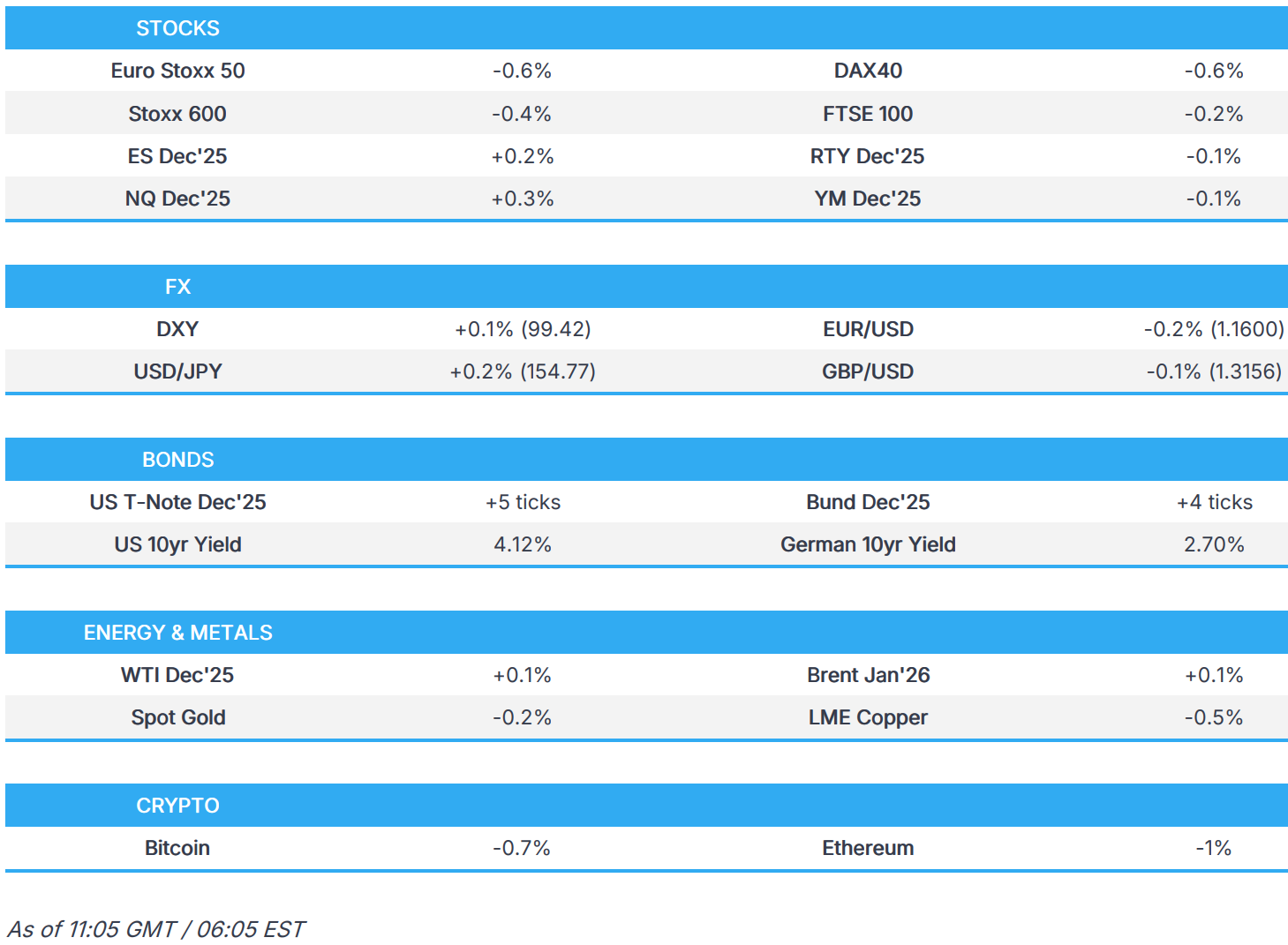
Newsquawk in 3 steps:
1. Subscribe to the free premarket movers reports
2. Listen to this report in the market open podcast (available on Apple and Spotify)
3. Trial Newsquawk’s premium real-time audio news squawk box for 7 days
TRADE / TARIFFS
- US Treasury Secretary Bessent said the China rare-earths deal will “hopefully” be done by Thanksgiving, according to Fox News. Treasury Secretary Bessent said he is confident China will honour the agreement after the upcoming meeting between Presidents Trump and Xi, and emphasised that Washington has “many levers” if Beijing does not comply.
- US President Trump said he does not think more tariff rollbacks will be necessary; he said top US officials spoke with their Chinese counterparts on Friday and that he is speaking to China about soybeans, according to Reuters.
- US Treasury Secretary Bessent said US President Trump’s proposal to send USD 2,000 “dividend” payments from tariffs to US citizens would require congressional approval, according to Reuters.
- Tesla (TSLA) is now reportedly requiring its suppliers to exclude China-made components in the manufacturing of its cars in the US, a fresh example of the fallout from Washington–Beijing tensions, according to the WSJ.
- Brazil’s Vice President Alckmin said Brazil will continue working to reduce US tariffs further; he noted that progress has been made but there is still a long way to go, expressed optimism about further progress, and said the US government has taken a step in the right direction to reduce costs for its consumers, according to Reuters.
- USTR Greer has warned the EU that trade remains a “flashpoint” with Washington, according to the FT.
EUROPEAN TRADE
EQUITIES
- European bourses (STOXX 600 -0.4%) began the morning around the unchanged mark, with trade tentative, though recently sentiment has soured a touch with most European bourses slipping into the red. Nothing really behind the latest bout of pressure, but does continue the subdued mood seen overnight.
- European sectors also opened with a positive bias, but now holds a negative bias. Utilities and Real Estate marginally top the pile whilst Retail lags. Dassault Aviation (+6.2%) bucks the broadly lower mood in Europe, after Ukrainian President Zelensky said Ukraine had ordered 100 Rafale fighter jets.
- US equity futures (ES +0.2% NQ +0.2% RTY -0.1%) are mixed and have been moving lower in recent trade alongside the pressure seen in Europe. Macro newsflow light this morning, so traders will ultimately be mindful of the “delayed” US data releases dotted throughout the week, and NVIDIA earnings on Wednesday.
- Apple (AAPL) has intensified succession planning for CEO Tim Cook and is preparing for him to step down as soon as next year, with John Ternus, Apple’s Senior Vice President of Hardware Engineering, widely seen as his most likely successor, according to the FT.
- In its 2026 outlook, Morgan Stanley (MS) lifts its S&P 500 target to 7,800 for 2026, driven by strong EPS growth, positive operating leverage, AI-enabled efficiencies and an early-cycle “rolling recovery”.
- Click for the sessions European pre-market equity newsflow
- Click for the additional news
- Click for a detailed summary
FX
- DXY is flat/modestly firmer and trades in a busy 99.29 to 99.47 range, given the lack of pertinent newsflow this morning but ahead of a packed weekly docket, which includes; the release of the delayed September NFP report, FOMC Minutes and a number of Fed speakers. Today’s docket is a bit more on the quiet side with only really the NY Fed Manufacturing report and comments via Fed’s Williams, Jefferson, Kashkari and Waller.
- EUR is a little lower today and trades just around the 1.1600 mark, within a 1.1596 to 1.1624 range. Newsflow for the region is relatively quiet ahead of the European Commission Autumn forecasts; there were some comments via ECB’s de Guindos who suggested that he is slightly more optimistic regarding growth, and expects inflation to converge towards target. Back to the Commission it raised its 2025 growth forecast for the bloc but cuts its view for 2026 to 1.2% (prev. 1.4%), while the inflation forecast was maintained for the year but increased in 2026. No significant EUR move seen, as such the single currency remains around the 1.16 mark.
- JPY is modestly lower vs the USD, and as is the case with peers, trade has been contained within a narrow 154.41 to 154.83 range. Overnight, price action was also lacklustre, and was ultimately little moved by a less-than-feared contraction in headline GDP – largely due to weak exports and lower tourism. Analysts at OxEco write that the dip in GDP will likely prove to be temporary, suggesting that consumption should modestly improve. On the fiscal side of things, Japan’s Key Government Panel member Kataoka said that the Government must compile a stimulus package of up to JPY 23tln, funded with JPY 10tln in net bond issuance and JPY 13tln with tax and non-tax revenues.
- GBP is flat/slightly lower and trades towards the midpoint of a 1.3136 to 1.3180 range. Traders remain solely focused on the Budget developments, albeit updates over the weekend have been lacking on that front. This morning, The Times reported that Reeves is considering a nightly levy for British holidaymakers and foreign tourists on hotel stays and Airbnb-style rentals.
- Antipodeans are pressured, with the Aussie the marginal laggard across G10 pairs. Nothing really driving things for the currencies this morning, but follows on from subdued price action overnight, following the APAC risk tone.
- PBoC set USD/CNY mid-point at 7.0816 vs exp. 7.0956 (Prev. 7.082)
- Click for a detailed summary
FIXED INCOME
- A contained overnight session for USTs. Meandered within a narrow 112-15 to 19 range early doors with specifics light and participants preparing for a week of delayed data to finally start hitting and a substantial amount of Fed speak; into this, the odds of a cut in December have slipped to c. 40% vs the ~50% seen last week. Thereafter, the early European morning saw a modest deterioration in the region’s risk tone (though, US futures remained strong), which provided some modest support to benchmarks generally. Lifting USTs further into the green and to a 112-22+ peak. If the move continues, we look to 112-23 from Friday before 112-31 and 113-00 from the two sessions prior. Today’s docket is dominated by Fed speak, where Williams (voter), Jefferson (voter), Kashkari (2026) and Waller (voter) are all due. From those, we expect Jefferson and Waller to provide texts, Jefferson and Kashkari to partake in Q&A’s while Williams is not expected to provide either.
- Bund overnight action was contained and similar to that outlined in USTs. Until the arrival of European participants, where a bout of upside occurred as the European risk tone deteriorated. Newsflow is relatively light and the move isn’t a particularly pronounced one, with Bunds firmer by just over 10 ticks at most at a 128.79 peak. If this continues, we look to 128.97 from Friday after which there is a gap until the figure and then levels between 129.19-40 from last week.
- Gilts are firmer, just about outperforming peers but the magnitude of action is also modest thus far. Gapped higher by 20 ticks to above the 92.05 mark before briefly losing the figure and then conformed to peers and lifted to a 92.29 peak, with gains of 14 ticks at most. Newsflow remains firmly focussed on the budget, and while there have been several scoops and reports around what Chancellor Reeves may do, there has not been anything of the magnitude seen last Friday. This week, the main focus point is Wednesday’s CPI, a series that provides early insight into the December deliberations, where Bailey may have to play the tie-breaking role once again.
- Click for a detailed summary
COMMODITIES
- Crude benchmarks were muted to start the European session amid continued attacks on Russian oil infrastructure. WTI and Brent initially dipped USD 0.40/bbl on the open following the resumption of oil loading at Russia’s Novorossiysk Black Sea port. After dropping to a low of USD 59.32/bbl and 63.66/bbl respectively, benchmarks slightly rebounded, before a heftier bout of buying which sent WTI and Brent to a peak of USD 60.19/bbl and 64.48/bbl. Nothing really for it, but appeared to coincide with reports that Israeli warplanes targeted areas in southern Lebanon. This upside briefly pared, before then catching another bid back towards highs.
- Spot XAU is oscillating in a tight USD 4050-4106/oz band as the European session gets underway and the market steadies itself following Friday’s selloff.
- Base metals have traded rangebound throughout the APAC session and into the European session amid a lack of drivers to start the week. 3M LME Copper continues to trade well-within Friday’s range in a tight USD 10.79k-10.85k/t band as markets await fresh catalysts.
- India’s October gold imports at USD 14.7bln.
- Russia’s Kremlin says they have the capacity to eliminate the consequences of the Ukrainian attack on Novorossiysk in a short period of time and recommenced all export activity.
- Indonesia is finalising a plan to impose export taxes of 7.5-15% on gold product shipments; designed to be effective from some point in 2026.
- All operations on intake and transfer of Kazakh oil has resumed at the Novorossiysk port, via IFX.
- Click for a detailed summary
NOTABLE DATA RECAP
- UK Rightmove House Prices YY (Nov) -0.5% (Prev. -0.1%)
- UK Rightmove House Prices MM (Nov) -1.8% (Prev. +0.3%)
- Swiss GDP QQ (Q3) -0.5% (prev. 0.1%)
- Italian CPI (EU Norm) Final MM (Oct) -0.2% vs. Exp. -0.2% (Prev. -0.2%); YY (Oct) 1.2% vs. Exp. 1.2% (Prev. 1.2%)
NOTABLE EUROPEAN HEADLINES
- ECB’s Rehn said the risk of inflation slowing shouldn’t be overlooked, according to Helsingin Sanomat. He added that “low energy prices, a stronger euro, and easing wage and services inflation pose a risk that total inflation slows excessively relative to our 2% target.”
- ECB’s de Guindos says expect inflation to converge towards target. Uncertainty has abated but still a defining feature of out times. FSR will focus on 3 big risks, first is about risk of financial market corrections. There’s a risk of abrupt shift in sentiment. Fiscal challenge also a key vulnerability. Banks may face deterioration of credit quality. Banks resilience is underpinned by profits and capital. Adverse economic shocks could lead to rising corporate defaults, valuation corrections and losses for private funds and their investors. Upholding the macroprudential, measures for banks implemented in recent years. Closer monitoring and strengthening the macroprudential framework for the non-bank sector. Slightly more optimistic re. growth. Wage dynamic are going in the right direction.
- UK Chancellor Reeves is reportedly considering a nightly levy for British holidaymakers and foreign tourists on hotel stays and Airbnb-style rentals, via The Times.
- EU Commission President von der Leyen, in a letter to member states, says the scale of Ukraine’s financing gap is significant. They have identified three main options. According to Reuters sources, the three options in the Ukraine financing are not mutually exclusive and can be combined or sequenced.
- European Commission Autumn 2025 Economic Forecast: “shows continued growth despite challenging environment”. Click for details.
NOTABLE US HEADLINES
- Fed’s Williams (Voter) convened a meeting with banks over a key lending facility, according to the FT.
- Trump administration officials, including Health Secretary Robert F. Kennedy Jr., discussed scaling back the role of FDA Commissioner Marty Makary; RFK Jr. also considered installing a new leader to manage the agency day to day, according to the WSJ.
- US President Trump posted that House Republicans should vote to release the Epstein files, via Truth Social.
GEOPOLITICS
MIDDLE EAST
- Israeli warplanes have targeted areas in southern Lebanon, via Iran International citing Al-Mayadeen Network.
- Israeli forces raided the city of Dura south of Hebron in the West Bank, according to Reuters.
- Israel’s Defence Minister said the multinational force led by the US will take charge of disarming Hamas in Gaza, according to Reuters.
- US Central Command said Iran’s use of military force to seize a commercial vessel in international waters is a violation of international law, according to Reuters. US Central Command said that on Friday it detected Iranian forces boarding an oil tanker flying the Marshall Islands flag in international waters, and that the tanker Talara was seized after Islamic Revolutionary Guard Corps forces boarded it via helicopter.
- Iran’s foreign minister said the nation is no longer enriching uranium at any site in the country, via AP.
- Israeli PM Netanyahu said there will be no Palestinian state and that Hamas will be disarmed — by force, if necessary, according to Reuters.
- Iran’s Foreign Minister Araqchi said the current US approach in no way indicates readiness for equal and fair negotiations; he added that Iran will always be prepared to engage in diplomacy but not negotiations meant for dictation, according to state media.
- Lebanon will file a complaint to the UN Security Council against Israel for constructing a concrete wall along Lebanon’s southern border that extends beyond the “Blue Line”, according to the Lebanese presidency.
- US President Trump warned that countries doing business with Russia will face sanctions under new legislation and said Iran may be added to that list, according to Reuters.
- US President Trump is reportedly considering a “bilateral security agreement pledging to defend Saudi Arabia in the event of any attack”, via Politico citing sources.
RUSSIA-UKRAINE
- Russia’s Novorossiysk Black Sea port resumed oil loadings on November 16, according to Reuters sources and LSEG data.
- Ukraine’s military says it struck an oil refinery in Russia’s Samara region, according to Reuters.
- Russia’s Defence Ministry said Russian forces took control of Yablukove in Ukraine’s Zaporizhzhia region, according to TASS.
CHINA-JAPAN
- Japan is to send a senior diplomat to ease tensions with China, according to NHK.
- China’s Coast Guard said a Chinese coastguard ship formation cruised past the Senkaku Islands and that the cruise was to protect rights and in accordance with international law, according to Reuters.
OTHERS
- US aircraft carrier has arrived in the Caribbean in a major build-up near Venezuela, via AP.
- US President Trump said he could have discussions with Venezuela’s President Maduro, according to Reuters.
- Russian President Putin held a phone call with Israel’s PM Benjamin Netanyahu, according to the Kremlin.
- US President Trump said the US will test nuclear weapons like other countries, according to Reuters.
CRYPTO
- Bitcoin is a little lower and trades just above USD 95k after the crypto complex took a hit over the weekend.
APAC TRADE
- APAC stocks traded mostly lower after the mixed lead from Wall Street, with sentiment in the region subdued as US President Trump over the weekend said he does not think further tariff rollbacks will be necessary. The Nikkei 225 saw modest losses on either side of 50k, while South Korea’s KOSPI (+1.5%) stood out as a clear outperformer amid strong gains in chip names after reports that Samsung is raising chip prices, whilst China’s tourist warning to Japan was seen as a positive for South Korea. Focus remains on the tech sector this week in the run-up to NVIDIA earnings midweek.
- ASX 200 was subdued with sectors mixed. Telecoms, Healthcare, and Consumer Discretionary lagged, while IT and Energy outperformed.
- Nikkei 225 was choppy and briefly slipped under 50k following Japan’s GDP contraction — the first in six quarters, albeit shallower than feared. Rising tensions between Japan and China added pressure, with Japanese travel-related names hit after Beijing warned citizens against travelling to and studying in Japan.
- KOSPI was the outperformer, driven by gains in Samsung Electronics and SK Hynix after reports that Samsung raised server memory chip contract prices by up to 60% in November due to shortages – the former also plans to add a new chip production line as demand rises. Broader gains were also supported by China’s warning against travel to Japan.
- Hang Seng and Shanghai Comp both traded with modest losses, broadly in line with regional moves (ex-South Korea). Over the weekend, US Treasury Secretary Bessent said the China rare-earths deal will “hopefully” be completed by Thanksgiving, but stressed that Washington has “many levers” if Beijing does not comply. President Trump added he does not think further tariff rollbacks will be necessary, noting senior US officials spoke with Chinese counterparts on Friday and that discussions on soybeans continue.
NOTABLE ASIA-PAC HEADLINES
- Samsung Electronics (005930 KS) will build a new chip production line in Pyeongtaek, South Korea, with mass production slated to begin in 2028; the company also said FläktGroup is considering building a factory in South Korea, according to Reuters.
- Alibaba’s (9988 HK) Qwen has entered public beta as a direct challenge to ChatGPT.
- Japan’s government is reportedly considering compiling a stimulus package of around JPY 17tln, with a supplementary budget likely to be sized around JPY 14tln, according to Nikkei.
- Japan’s Key Government Panel member Kataoka says the government must compile a stimulus package of up to JPY 23tln, funded with JPY 10tln in net bond issuance and JPY 13tln with tax and non-tax revenues. Adds: BoJ should move cautiously with policy normalisation. Should wait until March or April 2026 to raise rates. Should not rule out FX intervention in addressing excessive yen weakness.
- India Trade Official says India and US could soon agree to address reciprocal tariffs as part of first part of the agreement. India and USA are likely to address broader trade issues in the second part of the agreement.
- Japanese PM Takaichi to meet with BoJ Governor Ueda on Tuesday at 06:30 GMT.
DATA RECAP
- Japanese GDP QQ (Q3) -0.4% vs. Exp. -0.6% (Prev. 0.5%, Rev. 0.6%); first contraction in 6 quarters.
- Japanese GDP QQ Annualised (Q3) -1.8% vs. Exp. -2.5% (Prev. 2.2%, Rev. 2.3%).
- Japanese GDP QQ Capital Expend. (Q3) 1.0% vs. Exp. 0.3% (Prev. 0.6%, Rev. 0.8%).
- Japanese GDP QQ External Demand (Q3) -0.2% vs. Exp. -0.3% (Prev. 0.3%, Rev. 0.2%).
- Japanese GDP QQ Private Consumption Prelim (Q3) 0.1% vs. Exp. 0.1% (Prev. 0.4%).
- South Korean Export Growth Revised (Oct) 3.5% (Prev. 3.6%); South Korean Import Growth Revised (Oct) -1.5% (Prev. -1.5%)
- New Zealand Food Price Index (Oct) -0.3% (Prev. -0.4%)
c) Asian opening report
A NORTH KOREA/SOUTH KOREA
NORTH KOREA//USA/
2B JAPAN
JAPAN CHINA
China Warns Citizens Against Travel To Japan Amid Serious Taiwan-Related Dust Up
Friday, Nov 14, 2025 – 07:40 PM
It’s no secret that Japan and China have had a long history of animosity, which at times appears to cool but at others flares up to intensity again. The past week has seen historic tensions explode to the forefront once again, resulting in China summoning the Japanese ambassador in Beijing to vehemently denounce some recent statements by Tokyo leadership.
The spat started when Japanese Prime Minister Sanae Takaichi made comments in a parliamentary meeting which made clear Japan could possibly intervene militarily in the scenario of China invading Taiwan.

This represents a public first, and potential initial move abandoning the US ally’s longstanding ‘strategic ambiguity’ on the Taiwan issue.
China’s foreign ministry had been quick to blast the comments as “egregious” – related in the following:
The current tensions were sparked at a parliamentary meeting in Japan last Friday, when an opposition lawmaker asked Takaichi what circumstances surrounding Taiwan would count as a survival-threatening situation for Japan.
“If there are battleships and the use of force, no matter how you think about it, it could constitute a survival-threatening situation,” Takaichi responded.
A “survival-threatening situation” is a legal term under Japan’s 2015 security law, referring to when an armed attack on its allies poses an existential threat to Japan. In such a situation, Japan’s self-defense forces can be activated to respond to the threat.
Now, a week after the initial provocative remarks, and China has further escalated the spat by formally advising its citizens to avoid traveling to Japan in the near future over ‘safety concerns’.
The foreign ministry specifically invoked PM Takaichi’s incendiary Taiwan-related comments, going so far as to say her words created “major risks” to the safety of Chinese nationals in Japan. The ministry further cited “a surge in crimes against Chinese citizens and numerous attacks against them.”
The NY Times reviews how this could set off deteriorating relations less than a month in to Takaichi taking office:
The abuse abruptly ended a honeymoon between Ms. Takaichi, in office for less than a month, and China. She had met China’s top leader, Xi Jinping, just last month in South Korea, with the two leaders warmly shaking hands and smiling.
It also ended China’s turn away from so-called wolf warrior diplomacy, an aggressive, in-your-face approach to foreign relations that took shape after Mr. Xi rose to power in Beijing in 2012 but had largely faded in recent years.
Relations between China and Japan have for decades been prone to intemperate feuds fueled largely by bitter Chinese memories of World War II, when the Japanese army committed multiple atrocities, including the 1937 Nanjing Massacre, crimes for which Beijing believes Tokyo has never sufficiently apologized.
The drastic move further followed a Thursday social media posting by China’s foreign ministry – issued in Japanese and English – which warned Tokyo must “stop playing with fire” and that it would be “act of aggression” if Japan “dares to meddles in the cross-Strait situation.“
Our message to Japan is clear: Japan must fully repent for its war crimes, immediately stop its wrong and provocative statements and moves that interfere in China’s internal affairs, and stop playing with fire on the Taiwan question. Those who play with fire will perish by it!

As for Japan, it has been most angered at a social media post issued last Saturday by China’s consul general in the Japanese city of Osaka, Xue Jian. He had shared article about Takaichi’s parliamentary remarks on X with his own words, “the dirty head that sticks itself in must be cut off.” Tokyo quickly lodged its own diplomatic protest over the “high inappropriate” commentary.
But China has still maintained all of this ultimately stems from the “extremely wrong and dangerous” words of Japanese Prime Minister Sanae Takaichi related to defending Taiwan.
3. CHINA
CHINA/USA
STILL NO DEAL!!!
Still No Deal: Rare Earth Talks Between China And U.S. Drag On With Little Tangible Progress So Far
Monday, Nov 17, 2025 – 01:40 PM
The US and China are still hashing out the details of how Beijing will loosen rare-earth export restrictions, weeks after a trade truce that Washington said would boost shipments, according to Bloomberg.
In other words, there’s still no rare earth mineral trade deal, despite the “truce” between the two countries.
Negotiators have until the end of November to finalize terms for “general licenses” China promised to issue for US-bound rare earths and other critical minerals, though the reason for the delay is unclear.
The White House framed the pledge as the “de facto removal” of China’s curbs imposed since 2023, calling it a major win for supply chains. Washington has already eased tariffs and paused some national-security measures, but China hasn’t publicly addressed the licensing promise, even as it confirmed other parts of the deal, including a one-year halt to new rare-earth controls.
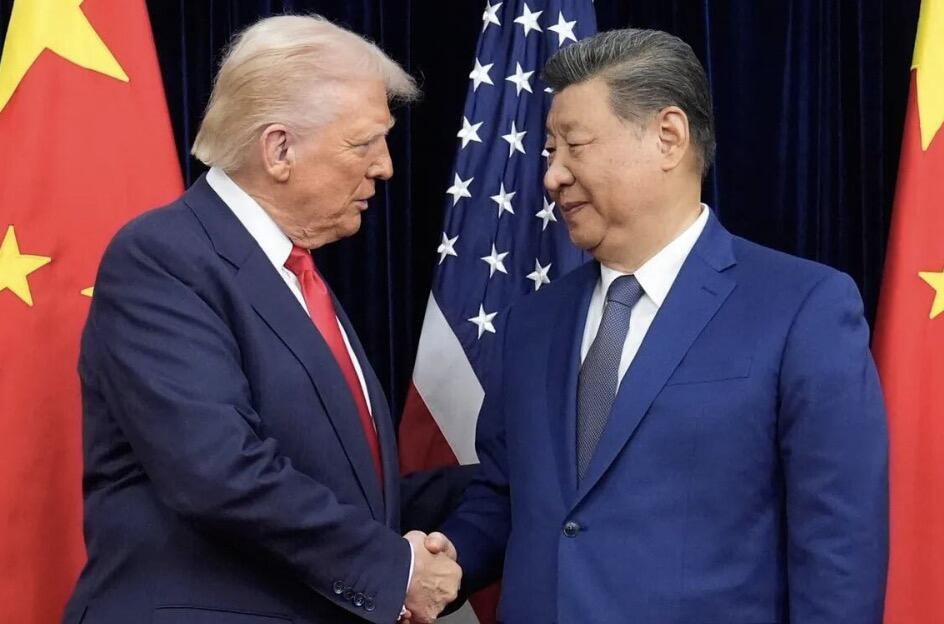
Bloomberg writes that the outcome remains uncertain. Alicia Garcia Herrero said, “The deal is far from done,” noting Beijing can use licenses as leverage. Exporters say they’ve received no new guidance, with Christopher Beddor commenting, “Everyone is still in wait-and-see mode… I would not characterize the general licenses as a de facto removal of controls.”
The general-license system would allow repeated shipments over as long as three years, unlike the current requirement for case-by-case approvals. But buyers would still need to pass government vetting. The White House says these licenses will apply to restricted rare earths and metals such as gallium, germanium, antimony, tungsten, and graphite; China has also agreed to lift its ban on direct shipments to the US for the first three.
Recall days ago we wrote that disagreements were emerging over the deal and we have been skeptical that a deal would take place since the “truce” was first announced. We wrote that the so-called US–China “truce” looked far too fragile to last, and recent developments have only reinforced that view.
Even as both sides publicly celebrated their agreement, Beijing immediately began laying down new “red lines” — and Washington just as quickly took steps guaranteed to test them. Analysts, exporters, and investors all saw the same thing: a deal heavy on spin and light on substance, with China able to wield licensing power as leverage and the US racing to secure alternative supply chains.
In short, we argued that this ceasefire was never more than a temporary pause before the next escalation, and nothing since has suggested otherwise.
4 EUROPEAN/NATO AFFAIRS
GERMANY/
GEIGER/OILPRICE .COM
Germany Caps Power Prices To Save Its Industrial Base
Monday, Nov 17, 2025 – 03:30 AM
By Julianne Geiger of OilPrice.com
Germany has agreed to subsidize electricity for its heavy industries, capping prices at about €0.05 per kilowatt-hour from 2026 through 2028—a major policy move aimed at keeping its industrial base from eroding under the weight of Europe’s soaring energy costs.

Chancellor Friedrich Merz said Thursday that Berlin’s coalition partners reached the deal after months of debate, and that discussions with the European Commission for approval were “largely complete.”
The measure will target energy-intensive industries such as steel, chemicals, and automaking—sectors that have warned repeatedly they cannot compete globally with power costs nearly double those in the U.S.
Germany’s power market is the largest in Europe, consuming roughly 500 terawatt-hours annually, and it’s been under severe pressure. Since the 2022 energy crisis, power prices have remained volatile—spiking again this fall as renewable generation faltered and gas-fired output surged to its highest level since 2021. Low wind speeds, weak hydro output, and grid bottlenecks forced Germany to burn more natural gas and coal to stabilize supply.
Those dynamics have made energy security a central political issue. Forecasts of a cold winter have already driven German power futures near €100 per megawatt-hour, reigniting public anger over industrial competitiveness and household affordability.
Industry groups say the temporary subsidy is essential to prevent production from shifting overseas. But critics warn it only papers over deeper structural problems—aging infrastructure, slow permitting, and unreliable renewable output—that have left Germany dependent on fossil fuels despite its ambitious climate targets.
Berlin hopes the three-year relief period will buy time to expand grid capacity and add flexible generation, but analysts say unless those projects materialize quickly, the country could face another round of industrial contraction by the decade’s end.
For Europe’s industrial heartland, the price of power has become the price of survival.
END
EU
The EU’s New Censorship Machine
Monday, Nov 17, 2025 – 02:00 AM
Authored by Thomas Fazi via UnHerd.com,
The EU loves talking about freedom.
Just look at one of its recent press releases, launching something called the European Democracy Shield, which promises to protect everything from “free people” to “free elections” to — this being Brussels — “a vibrant civil society”.
All admirable stuff, perhaps, at least on paper.
In reality, though, the Democracy Shield is just the latest vision in unfreedom: suppressing dissent and policing speech under the pretext of defending democracy from foreign interference and fake news.

As part of the Democracy Shield, the Commission proposes the creation of a Monitoring Centre that would identify and remove “false content” and “disinformation” from the internet. As Henna Virkkunen, Executive Vice President for Security and Democracy, stated, the Shield will enable Europe to “respond faster and more effectively to information manipulation and hybrid threats”. The EU’s High Representative for Foreign and Security Policy, Kaja Kallas, made no secret of the anti-Russian nature of the initiative: “we are seeing campaigns, including from Russia, specifically designed to polarise our citizens, undermine trust in our institutions and pollute politics in our countries.”
The term “independent” appears repeatedly in the press release. A new “independent European network of fact-checkers” will be set up in all official EU languages, while the European Digital Media Observatory (EDMO), the EU’s flagship “fact-checking” network, financed to the tune of almost €30 million, will gain new “independent” analytical powers to monitor elections and crisis situations. But, remember, independence in Brussels translates to financial dependence on the Commission. Indeed, to guarantee this “independence”, the Commission promises generous funding to “independent” NGOs and media outlets.
The Democracy Shield builds upon the recent Digital Services Act (DSA), the most sweeping internet regulation ever implemented in Europe. In theory, these initiatives are meant to protect democracy; in practice, they do the opposite. Their aim isn’t to “fight disinformation”, as claimed, but rather to control the narrative at a time when Europe’s political elites are facing unprecedented levels of public distrust, by centralising control over the flow of information and imposing a single “truth” defined by Brussels. In short, the European Commission is building a continent-wide censorship machine
As one EU diplomat recently put it, in truly Orwellian fashion: “Freedom of speech remains for everyone. At the same time, however, citizens must be free from interference.” But who decides what constitutes “interference”? Who determines what is “true” and what is “fake”? The same institutions and corporate media outlets that have repeatedly engaged in fearmongering and disinformation themselves. Just a few weeks ago, Ursula von der Leyen claimed that the GPS system on her plane had been jammed by Russia — an allegation quickly debunked by analysts. Meanwhile, the BBC, often held up as a paragon of journalistic integrity, was recently caught editing footage of a Donald Trump speech to make it appear more extreme.
The EU claims to be protecting citizens from “falsehoods” but on what democratic or moral basis does the Commission assume the authority to decide what is true, especially when it is clear that the EU’s political-media establishment itself engages in disinformation and propaganda on a regular basis? Moreover, when so-called independent fact-checkers are hand-picked and financed by the Commission itself, the result is a closed feedback loop: the EU funds institutions that then “verify” and amplify the EU’s own narratives. The Democracy Shield, like its predecessors, thus institutionalises the power to define reality itself.
In a series of reports, I have shown that the European Union already operates a vast propaganda and censorship apparatus that spans every level of civil society — NGOs, think tanks, the media and even academia. The cornerstone of this system is a network of EU-funded programmes — notably CERV (Citizens, Equality, Rights and Values), Creative Europe and the Jean Monnet initiative — that collectively funnel billions of euros into organisations that are, in theory, “independent” but are in fact deeply enmeshed in the Brussels machine.
Through the CERV programme alone — which boasts a budget of almost €2 billion for 2021-2027 — more than 3,000 NGOs have received funding to carry out over 1,000 projects. Officially, these funds promote “European values”. In practice, they finance progressive and pro-EU activism: gender ideology, multiculturalism, anti-nationalism and “countering Euroscepticism”. Many projects are explicitly designed to “increase trust in the EU” or “counter anti-EU narratives”. Meanwhile, NGOs in Central and Eastern Europe are generously funded to “combat autocratic narratives” and “challenge Euroscepticism”, often directly targeting governments in Poland (under the previous executive) or Hungary — external influence strategies not unlike those historically associated with agencies like USAID.
The result is a pseudo-civil society — a network of nominally “grassroots” actors functioning as proxies for the Commission, amplifying its agenda and manufacturing the illusion of popular support for its policies.
The same pattern applies to the media. My research has shown that the EU channels at least €80 million annually directly to newspapers, broadcasters, news agencies and “journalistic partnerships”— amounting to nearly €1 billion over the past decade. Programmes such as IMREG (Information Measures for Cohesion Policy) have paid media outlets to publish articles praising EU cohesion funds, in some cases without even disclosing that the content was EU-financed. The Commission calls it “raising awareness”. In any other context, it would be called covert advertising or propaganda.
The EU’s propaganda machine extends into academia as well. Through the Jean Monnet programme, the Commission allocates about €25 million a year to universities and research institutes worldwide, financing over 1,500 Jean Monnet Chairs in 700 institutions. The goal is not to support independent scholarship but to embed pro-EU ideology into higher education. Official documents state explicitly that recipients are expected to act as “ambassadors of the European Union” and “outreach agents” engaging with media and NGOs. The academy has effectively been transformed into an ideological instrument.
With the Democracy Shield, the Commission now intends to vastly expand this machinery. It proposes to not only establish what amounts to a de facto Ministry of Truth, but also to inject even more money into NGOs, “independent” media and fact-checking networks tasked with promoting “European values”. Von der Leyen is, in effect, buying consensus — and using citizens’ own money to do it — collapsing the boundaries between the European super-state, media, civil society and academia.
And if the EU’s goal, here, were merely to manipulate narratives, that would be alarming enough. But the pattern now points towards direct interference in electoral processes. We have already seen this play out in countries like Romania and Moldova, where local elites — with open or tacit support from Brussels — invoked the spectre of “Russian interference” (without providing much evidence) to justify blatant manipulation of domestic elections. In Romania, authorities cancelled an election and barred the leading populist candidate from running. In Moldova, pro-EU authorities used “security concerns” to prevent Russia-leaning expatriates from voting. Protecting democracy thus becomes the pretext for suspending it, even as the Democracy Shield explicitly foresees strengthening the European Cooperation Network for Elections and, ominously, promoting “systematic exchanges on the integrity of electoral processes”.
The Commission’s appetite for control is not limited to information and elections. Ursula von der Leyen recently also initiated the creation of a new intelligence unit under the direct authority of the European Commission. The goal, according to the Financial Times, is to unify intelligence data from member states and “enhance the EU’s ability to detect and respond to threats”. The plan foresees the eventual creation of a European intelligence cooperation service, effectively a supranational agency that would operate alongside national intelligence services. Officially, it would enhance “strategic autonomy”. In practice, it would likely function as a subsidiary of Nato and, by extension, of the CIA, especially since the same proposal explicitly calls for “strengthening EU-NATO cooperation”.
It points to a broader worrying trend of power centralisation in the hands of the Commission — and of von der Leyen personally. Understandably, many observers find the prospect of giving “Empress Ursula” an army of supranational spies — operating beyond the oversight of national parliaments — profoundly disturbing. Giving an unelected, opaque institution like the Commission its own intelligence apparatus would mark yet another milestone in Europe’s transformation into a techno-authoritarian juggernaut — one that surveils not foreign enemies, but its own citizens.
Seen in this context, the Democracy Shield appears like nothing more than a tool to further institutionalise a regime of managed speech and narrative control. Its goal is to police online speech according to vague, politically charged definitions of “disinformation”; to compel platforms, journalists, academics and citizens alike to conform to a narrow, Commission-approved worldview; and to silence dissent in the name of “fighting foreign interference”. Yet it is becoming increasingly clear that the real war on democracy isn’t being waged by Moscow or Beijing; it is being waged from within, by the very institutions claiming to defend it.
5. RUSSIA AND MIDDLE EASTERN AFFAIRS
TBN ISRAEL/LAST 24 HR
SATURDAY
ISRAEL VS HAMAS
ISRAEL VS HAMAS
Israel’s inability to strategize on Gaza prevents disarming, replacement of Hamas – analysis
“The IDF is preparing a plan to disarm Hamas by resuming fighting.” The overall sense is that Israel will need to have a plan in place in case the US-led one doesn’t work or if Hamas re-arms.

Hamas terrorists look on as they escort members of the Red Cross in Gaza City, November 12, 2025(photo credit: REUTERS/DAWOUD ABU ALKAS)BySETH J. FRANTZMANNOVEMBER 16, 2025 13:49Updated: NOVEMBER 16, 2025 18:21
A US proposal for an international force continues to await approval at the UN Security Council. The longer the wait continues, the more uncertainty there is in Gaza about what may come next.
Some of these concerns are growing among friendly countries in the region that would like to see things move forward. It has been a month since the ceasefire began on October 13 and more than a month since the agreement in Sinai to end the war.
The US has put the proposal to the UN, and the question is now whether a deal can be achieved. It looks like this will need to involve Russian support, as Moscow is also on the UN Security Council.
Moscow also has its own plan. Prime Minister Benjamin Netanyahu spoke with Russian President Vladimir Putin over the weekend.
What are regional players saying about the current US proposal?
“The draft American proposal submitted to the Security Council includes extensive details about the tasks of the International Stabilization Force that Washington wants to form to work in Gaza, with this force working in cooperation with elements of the Palestinian police, within the framework of multi-stage security arrangements,” UAE-based news site Al-Ain News reported.

“The question is not whether the [Hamas] movement will be disarmed, but who will carry out this task,” the report said, adding that “according to diplomatic sources who spoke to Al-Ain News, the latest draft of the resolution underwent three fundamental amendments, which succeeded in rallying the support of a number of Arab and Islamic countries, after intensive consultations led by Washington and its partners.”
Nevertheless, it’s clear that Israel opposes any kind of Palestinian state. Defense Minister Israel Katz said this on Sunday, and other members of the government have slammed the Palestinians.
“The indication is that implementing the Palestinian reform program and making progress in the redevelopment of Gaza could pave the way towards a credible path to Palestinian self-determination and statehood,” Al-Ain reported.Meanwhile, there is speculation that the new transitional phase in Gaza could last up to two years.
The draft resolution at the UN includes 11 complete articles, addressing the structure of the Peace Council, the powers of the international stabilization force, transitional governance arrangements, and the required Palestinian reform program, in addition to a schedule of periodic reports to be submitted by the Peace Council to the Security Council every six months.
First, the American draft praises the role played by Qatar, Egypt, and Turkey in facilitating the ceasefire in Gaza.
The draft resolution, according to Al-Ain, also has other aspects, including a Board of Peace that would be involved in “establishing a transitional governing administration under the supervision of a non-political, technocratic Palestinian committee; launching reconstruction programs and upgrading infrastructure and vital services; coordinating humanitarian aid and preventing its diversion for any military purposes; overseeing the international stabilization force that will lead the disarmament process and prevent the rebuilding of the military infrastructure in Gaza; the resolution also authorizes member states to provide troops, equipment and funding, in addition to establishing an international fund through the World Bank to finance reconstruction.”
MEANWHILE, a report by Saudi-based news channel Al Arabiya portrayed the current division of Gaza into an IDF-controlled Yellow Line area and a second area controlled by the Palestinians as a kind of “Berlin Wall.”
“Leaks” about the next steps “have revived international and Egyptian concerns that this line could be the starting point for dividing the Strip into two separate entities, thus jeopardizing the comprehensive ceasefire agreement signed in Sharm el-Sheikh,” the report said.
What did the Egyptian sources say?
“Egyptian military and diplomatic warnings hinted at a premeditated Israeli intention to solidify this temporary military situation and transform the Yellow line into the “Berlin Wall” of the 21st century,” Al Arabiya reported. “Maj.-Gen.
Osama Mahmoud, a lecturer at the [Egyptian] Command and Staff College, explained that Israel is clearly seeking to obstruct the second phase of the Trump peace agreement that was signed in Sharm el-Sheikh on October 13.”
The Yellow Line is currently not defined, “meaning that no fixed ground markers or clear geographical coordinates were placed,” the report said.
This is not completely accurate, as the IDF has put up some markers in Gaza. Nevertheless, it reflects the position or concerns in Egypt and elsewhere.
A person familiar with the matter said there were “repeated Israeli violations of the agreement, [and] the inability to hand over the remains of the bodies, in addition to the crisis of the stranded Hamas fighters, are merely flimsy pretexts aimed primarily at prolonging the stay of the Israeli forces in the sector and consolidating their military position at this ambiguous line,” the report added.
In essence, there is concern about what is termed “de facto partition” of Gaza.
“For his part, former Egyptian ambassador to Israel Atef Salem warned of the Yellow Line, indicating that there are numerous signs pointing to the de facto division of Gaza into two areas: one under Israeli control and the other controlled by Hamas,” Al Arabiya reported. “In statements to Al-Arabiya.net/Al-Hadath.net, Salem noted that the reconstruction process, according to statements by US Vice President Vance and Jared Kushner, will be limited to the area under Israeli control, even if the second phase of the agreement is not implemented. He added that the reconstruction plan lacks any clear timelines or implementation mechanisms, and that the process is consistently linked to the disarmament of Hamas.”
European officials are also said to be concerned. They would prefer to see the Palestinian Authority play a role.
“They do not expect the Trump plan to progress beyond a ceasefire,” Al Arabiya reported, citing Reuters. “They also warned last week that in the absence of a major effort by the United States to break the deadlock, the Yellow Line appears likely to become the de facto border dividing Gaza indefinitely.”
END
ISRAEL VS HAMAS
Israel’s opposition to Palestinian state remains ‘firm and unchanged,’ Netanyahu tells cabinet
“A Palestinian state, our opposition to a Palestinian state on any territory west of the Jordan River remains firm and unchanged,” Netanyahu told his cabinet on Sunday.

Prime Minister Benjamin convenes a government cabinet meeting in Jerusalem, October 26, 2025.(photo credit: GPO)ByKESHET NEEVNOVEMBER 16, 2025 13:46Updated: NOVEMBER 16, 2025 16:45
Prime Minister Benjamin Netanyahu affirmed Israel’s opposition to a Palestinian state and commitment to demilitarize Hamas, during his opening remarks at the Sunday government meeting.
The meeting included a discussions with ministers on the issue of a Palestinian state. Ron Dermer took part in the meeting, despite his resignation from his role as strategic affairs minister last week.
The statements came after a recent wave of remarks from politicians and far-right lawmakers, calling on Netanyahu to clarify Israel’s stance regarding the establishment of a Palestinian state.
“A Palestinian state, our opposition to a Palestinian state on any territory west of the Jordan River remains firm and unchanged,” Netanyahu said at the meeting.
“I have been pushing back against these attempts for decades, doing so in the face of pressure from abroad and from home. So I do not need reinforcements, tweets, or lectures from anyone,” he added.
Netanyahu also expressed that Gaza will be demilitarized and that Hamas will be eliminated.
https://player.jpost.com/public/player.html?player=jpost&media=3974686&url=www.jpost.comPrime Minister Benjamin Netanyahu at the Knesset, November 16, 2025 (CREDIT: GPO)He said there “will be no such thing” as lack of demilitarization in the part of Gaza still held by Hamas.
“In the 20-point plan and in every other framework, that [Gaza] area will be demilitarized and Hamas will be dismantled, either the easy way or the hard way,” Netanyahu said, adding that US President Donald Trump has expressed the same sentiments.
Various countries recognize Palestnian statehood
Netanyahu’s remarks came after various references regarding a Palestinian state arose last week.
On Friday, the US, Qatar, Egypt, the UAE, Saudi Arabia, Indonesia, Pakistan, Jordan, and Turkey issued a joint statement expressing support for a US-drafted UN Security Council resolution under consideration that would “offer a pathway to Palestinian self-determination and statehood.
Additionally, a Palestinian state was mentioned in a UN Security Council draft from Thursday, discussing the International Security Force that is meant to govern Gaza.
Amichai Stein contributed to this report.
ISRAEL VWS HEZBOLLAH
IRAN
RUSSIA VS UKRAINE
6. GLOBAL ISSUES//COVID ISSUES/VACCINE ISSUES/HEALTH ISSUE
New Heart-Kidney Syndrome Affects 90% Of Americans… And You’ve Probably Never Heard Of It
Friday, Nov 14, 2025 – 08:05 PM
Authored by George Citroner via The Epoch Times (emphasis ours),
Nearly every American adult has a health condition that could lead to heart failure, yet nine out of 10 have never even heard of it. Now, the American Heart Association (AHA) is sounding the alarm on cardiovascular-kidney-metabolic (CKM) syndrome, a newly defined cluster of interconnected diseases that doctors have been treating separately for decades.

The condition encompasses a cluster of interconnected conditions—including heart disease, kidney disease, diabetes, and obesity—that often occur together, significantly increasing the risk of heart attack, stroke, and heart failure. It was first defined in a 2023 AHA Presidential Advisory. Despite affecting roughly 90 percent of U.S. adults, few people have heard of it, according to a recent AHA survey.
In early 2026, the AHA will release its first-ever clinical guidelines on the syndrome to help health care providers better identify and treat this widespread condition.
Study Reveals Widespread Prevalence of CKM Syndrome in U.S. Adults
“It’s really common to have risk factors for heart, kidney, and metabolic disease [like diabetes] at the same time, and they’re interconnected,” Dr. Stacey E. Rosen, national volunteer president of the American Heart Association, told The Epoch Times.
The problem, Rosen noted, is that care for people with multiple conditions is often fractured, with various specialists and primary care clinicians working in silos. Through the AHA’s CKM Health Initiative, the association aims to help doctors work together and treat cardiovascular, kidney, and metabolic risk factors together, because that’s how patients experience them, she said.
The Numbers Behind the Problem
A comprehensive analysis of U.S. adults based on data from the National Health and Nutrition Examination Survey spanning 2011 to 2020 showed that nearly 90 percent of adults had signs indicating early stages of CKM syndrome. They carried risk factors such as high blood pressure, obesity, or problems controlling blood sugar.
About 15 percent of adults were classified as having advanced stages, which include having blood vessel damage or kidney disease. Older adults—particularly those aged 65 and older—were most affected, with more than 55 percent classified as having advanced stages.
The study found that the prevalence of CKM syndrome remained steady over the decade, with no significant improvements in reducing the overall burden of disease. Even younger adults aged 20 to 44 showed notable risk, especially among black adults and men, who were more likely to be in higher stages of CKM syndrome.
The condition stems from overweight and obesity in its initial stage and progresses to multiple risk factors and advanced disease, warranting early recognition, Dr. Eugenia Gianos, director of cardiovascular prevention at Northwell Health and director of women’s heart health at Lenox Hill Hospital, told The Epoch Times.
How Heart, Kidney, and Metabolic Systems Are Connected
CKM health involves three critical systems: the heart, kidneys, and metabolic system.
The heart pumps blood to supply oxygen and nutrients; the kidneys filter waste, regulate fluids, and help control blood pressure; and the metabolic system turns food into energy and manages blood glucose levels.
When one system functions poorly, it can create a domino effect, worsening the others. For example, reduced heart function can lower blood flow to the kidneys, impairing their ability to filter waste and regulate blood pressure. Conversely, kidney dysfunction can lead to high blood pressure and fluid overload, which increases strain on the heart.
Additionally, metabolic issues such as high blood sugar and excess weight contribute to inflammation and damage across these systems.
This interconnected cycle can escalate silently, often without obvious symptoms, until significant damage occurs.
Current guidelines emphasize cardiovascular screening beginning at age 40. “Yet the early drift in blood pressure, glucose, and lipids often begins much earlier, especially among young adults with sedentary lifestyles,” Akshaya Bhagavathula, associate professor of epidemiology at North Dakota State University, told The Epoch Times.
While metabolic syndrome has gained attention as a warning stage, he noted, chronic kidney disease can go unnoticed. “Nearly nine in 10 adults with kidney impairment are unaware of it until significant damage has occurred,” Bhagavathula said. The CKM model encourages integrating prevention, screening, and treatment of the metabolic, renal, and cardiovascular systems together, rather than waiting for the disease to declare itself.
Warning Signs You Shouldn’t Ignore
Many people expect heart disease to appear with dramatic chest pain, but early warning signs are far subtler, Bhagavathula said.
Less obvious symptoms include unusual fatigue or weakness that isn’t proportional to activity level and mood changes—such as depression or brain fog—which might also be early indicators. Other symptoms that may indicate trouble include swelling in uncommon areas such as the abdomen or the back of the ankles, which may be caused by fluid retention related to heart or kidney issues.
Something else to watch for is changes in urination patterns, including foamy urine indicating protein loss, dark urine, or decreased urine output, which can be signs of kidney problems.
Toxin buildup from impaired kidney function may cause a metallic taste or bad breath, and difficulty sleeping can stem from fluid overload or breathing difficulties.
Elevated blood pressure that develops gradually without noticeable symptoms is another warning sign.
“Women may present with jaw pain, nausea, or extreme tiredness rather than classic pressure pain,” he added.
“Even small rises in resting heart rate, post-meal glucose, or inflammatory markers predict future cardiac events years in advance,” Bhagavathula said. “These patterns reflect the systemic nature of CKM syndrome; the heart rarely fails in isolation.”
How to Improve Heart and Kidney Health
Most people with CKM syndrome can reverse or slow down the disease process with lifestyle changes and appropriate medications to reduce their risk for heart attack, stroke, or heart failure, Rosen said.
These lifestyle changes include:
- Adopt a Heart-Healthy Diet: Eat plenty of fruits, vegetables, whole grains, lean proteins, and healthy fats, while limiting salt intake to help control blood pressure.
- Stay Physically Active: Aim for at least 150 minutes of moderate exercise weekly to significantly improve overall health.
- Monitor Health Regularly: Track blood pressure, blood sugar, cholesterol, weight, and kidney function through routine checkups to catch potential issues early.
- Avoid Tobacco and Limit Alcohol: Both habits significantly increase risk across all three systems.
- Manage Stress Effectively: Use mindfulness or relaxation techniques and ensure adequate sleep.
- Follow Medical Advice: Take prescribed medications and attend routine checkups.
People should also be cautious with over-the-counter medications such as nonsteroidal anti-inflammatory drugs, which can harm kidney health if used excessively.
The AHA offers educational resources and tools through its CKM Health Initiative website to help people understand these connections and take early action to prevent serious complications such as heart attacks or strokes.
end
GLOBAL ISSUES
Government ‘withholding data that may link Covid jab to excess deaths’
UKHSA argued that releasing figures would lead to ‘distress or anger’ of bereaved relatives if connection were discoveredCamilla TurnerSunday Political Editor

Related Topics
15 November 2025 6:35pm GMT
1323Gift this article free
The public health watchdog has been accused of a “cover-up” after refusing to publish data that could link the Covid vaccine to excess deaths.
The UK Health Security Agency (UKHSA) argued that releasing the data would lead to the “distress or anger” of bereaved relatives if a link were to be discovered.
Public health officials also argued that publishing the data risked damaging the well-being and mental health of the families and friends of people who died.
Last year, a cross-party group expressed alarm about “growing public and professional concerns” over the UK’s rates of excess deaths since 2020.
In a letter to UKHSA and Department for Health, the MPs and peers said that potentially critical data – which map the date of people’s Covid vaccine doses to the date of their deaths – had been released to pharmaceutical companies but not put into the public domain.
They argued that the data should be released “on the same anonymised basis that it was shared with the pharmaceutical groups, and there seems to be no credible reason why that should not be done immediately”.
UsForThem, a campaign group, requested that UKHSA release the data under freedom of information laws. But the agency refused, making a number of different arguments including that publishing the data “could lead to misinformation” that would “have an adverse impact on vaccine uptake” in the public.
UKHSA also claimed there would be a risk of individuals being identified, despite the request being made for an anonymised dataset. After a two-year battle, the Information Commissioner ruled in the UKHSA’s favour, backing its refusal to publish the data.

Reform UK has committed to a public inquiry into excess deaths and alleged Covid vaccine harms.
Richard Tice, the party’s deputy leader, said: “We knew there was concern about excess deaths, which is why we called for an inquiry. Instead, the unelected quango UKHSA is involved in a scandalous cover-up of how and why people are dying.
“This is totally unacceptable, and the Health Secretary must overrule them. If we are not prepared to learn lessons about why people are dying, what sort of society are we?”
Ben Kingsley, the legal director of UsForThem, said the way the UKHSA had handled the case “reveals a desperation that this data should not, in any form, see the light of day”.
He added: “It is perverse for UKHSA to argue that this data should not be released because the public could feel distressed or angry if patterns or correlations were to be identified.
“You have to ask yourself why it is that the public are considered incapable of handling this data. It reveals a patronising mindset, which also characterised the pandemic response – ‘do what we say, don’t ask any questions, we know what is best for you’.”
Mr Kingsley said the Government’s approach appeared similar to the response to the infected blood scandal, in which thousands of people contracted HIV and hepatitis C from contaminated blood products.
“The infected blood inquiry published its report while this case was under way,” he said. “We learnt that for years and years the government didn’t think the public could handle the truth, so they kept it from us.
“Now we are seeing very similar behaviour from the UKHSA – we don’t know if the data would reveal any evidence of correlation, let alone causation, but we can see they are desperate to avoid having to answer that question in public.”
A UKHSA spokesman said: “Protecting patient confidentiality is of critical importance. Releasing this data presented a real possibility that it could be used to identify individuals, which could result in significant distress.
“UKHSA provided a carefully anonymised version of the dataset that removed the risk of identification. We welcome the decision of the tribunal to dismiss the appeal.”
end
MARK CRISPIN MILLER
DR PAUL ALEXANDER
Wager me, I guarantee you, 100%, mRNA vaccine by Malone Bourla Bancel Sahin Pfizer Moderna et al. deadly mRNA vaccine will STILL be on US market November 2028 at federal elections! 100%; a lie, they
lied to you, the new HHS, CDC, NIH, FDA et al. staff, the heads of these agencies have ONE main job as per Outlaw Josie Susie Wales, that is to BULLSHIT you every day into thinking they will STOP mRNA
| Dr. Paul AlexanderNov 14 |

vaccine, that is the misdirection, it was all a lie, their job is to lie to you and retain mRNA and expand it ‘while you are distracted’…
HHS and FDA folk have one key job, that is to keep mRNA vaccine, does not matter it kills. does not matter. look, they are laughing at you!

those people were nominated, chosen for a reason, they were chosen for they signaled they would sell out and turn and now support mRNA vaccine but ssshhhh, no one is allowed to interview them to ask them…about what I just said, that after 100 months and nothing done….but ssshhhh….them parading and posing in Palm Beach….no no no, you will hear about mercury in vaccines, Tylenol causing autism, weight loss drugs, and all that drivel bullshit, having our great POTUS utter garbage on stage, giving him bogus fraud information to spew…like how they did in COVID…this Trump term 2 quintet worse IMO that the dolts, the inept corrupted COVID Task Force morons like Birx and Fauci and Hahn and Redfield et al. Trump term 1. These are worse and why? because they lied to you, they spent years taking your donor money, you bought the lies that they would help end the deadly Malone Bourla et al. mRNA vaccine…well the joke is on us…see they are laughing all the way to the bank with your tax-payer salary they do not earn and ssshhhh kickbacks…contracts….ssshhhh, did Paul just say that…yes I did, always follow the money!
NEWSWIZE
MICHAEL EVERY/OR OR PICTON/GIFFIN OR RABOBANK EXECUTIVE/COMMENTARY ON WORLDLY AFFAIRS
7. OIL ISSUES/NATURAL GAS/ENERGY ISSUES/GLOBAL
US Utility Giants Discuss Soaring Power Bills, Grid Reforms In The Data-Center Era
Saturday, Nov 15, 2025 – 12:15 PM
Readers were given an epic breakdown on Wednesday detailing the true scale of funding needed for the AI data-center boom, one that would require an estimated $5 trillion in investment, with Washington on the hook for at least $1 trillion of it. In a separate note, we highlighted an inconvenient truth for this cycle: the U.S. is short 44 nuclear power plants.
Power is the obvious bottleneck that could derail the entire AI boom cycle. We now turn to Goldman analysts led by Carly Davenport for deeper insight into what electric companies are saying about the grid’s current structure, data center demand, load growth, the power-bill crisis, and other critical topics discussed at the EEI Financial Conference in Hollywood, Florida, earlier this week.
Davenport told clients that sentiment across the utilities sector was broadly constructive, driven by optimism about accelerating load growth, expanding capital spending plans, and a stronger earnings outlook heading into 2026. She noted investors are increasingly focused on identifying which utilities have downside protection tied to data-center growth and which are proactively addressing labor, supply-chain, and affordability constraints.

Conversations during the meetings highlighted growing bullishness toward NextEra Energy and Sempra, while near-term political and regulatory developments remain key issues for Public Service Enterprise Group, Southern Company, and PG&E Corp.
Here’s a breakdown of the top ten takeaways Davenport had from EEI:
- Focus on inflections in regulatory backdrops. Several utilities are experiencing significant state-level policy shifts and ongoing rate case activities. In New Jersey, the upcoming transition to Governor-elect Sherrill’s administration and anticipated changes within the BPU are topical. PEG is preparing to leverage mechanisms such as utilizing ZECs to help alleviate customer bills, aligning with the new administration’s focus. EXC expects its NJ rate case at ACE to be on track for year-end 2025, and FE noted that clarity on BPU composition will be key ahead of upcoming rate case filings at JCP&L. Elsewhere, ES is focused on securing regulatory approvals for its Aquarion sale and storm cost securitization in CT from a newly composed PURA. Sentiment is growing more constructive on a positive shift in balanced collaboration between utilities and regulators in the state. Finally, SO noted 2026 could be noisy from a state-wide elections standpoint, but with a relatively quiet regulatory calendar, the company plans to actively engage with newly elected commissioners on utility economics and affordability.
- Still room for positive capex revisions into 4Q earnings, with focus on financing options. SRE anticipates significant capital plan upside at Oncor, highlighting opportunities around an incremental ~$12 bn on top of the preliminary 30% increase to the current five-year plan, driven by accelerated Permian transmission projects and substantial data center load growth, with a definitive update pending the ongoing rate case outcome. DUK has previewed a robust $95-105 bn capital plan, with an expected update next quarter, and sees the $10 bn upside range driven by LNG solutions and transmission investments, while exploring numerous options around financing, including private credit for specific projects. XEL targets a 9% EPS CAGR through 2030, and has identified significant upside around both generation and transmission, with resource plans pointing to a potential $16-20 bn (though XEL targets 50% ownership of assets) and over $10 bn for transmission projects. FE benefits from the PJM open window, with three identified projects on the RTEP short list totaling approximately $3 bn in potential capital expenditures, in addition to growth opportunities in West Virginia from data centers, with current generation addition plans estimated at $2.2-2.5 bn of capital. Finally, SO mentioned potential capex upside, driven by significant demand growth particularly from large industrial and data center loads in Georgia, in addition to FERC natural gas pipelines.
- Potential for greater state involvement to reform PJM. Utilities are increasingly advocating for greater state involvement in reforming the PJM market, driven by perceived market inadequacies and the need for enhanced resource adequacy. EXC advocates for states to take more control over generation procurement through processes like Maryland’s dispatchable generation procurement and Illinois’s IRP, while also pushing for expedited interconnection and extended price collars within PJM. PEG emphasizes the necessity for New Jersey to implement a comprehensive IRP to define reliability standards, emissions targets, and affordability metrics, suggesting that state-led solutions, potentially including utility-owned storage, gas or nuclear generation, are crucial, and advocating for competitive processes that allow rate-base solutions. FE highlights West Virginia’s proactive approach, where the governor is focused on generation, transmission, and energy security, allowing for new generation filings outside of standard IRP cycles to meet rapid load growth, and notes a desire for continued capacity pricing caps in PJM with less traction for longer-duration auctions. This collective sentiment points towards a growing trend where states are stepping in to ensure resource adequacy and guide generation development.
- Affordability and bill transparency remain top of mind. As utilities strive to meet rising power demand, affordability remained a key discussion point in our meetings with management. ED’s management highlighted that property taxes, which constitute a sizable portion (~20%) of customer bills, will potentially be displayed separately to consumers as part of its joint proposal for its CECONY rate cases, aiming to promote transparency. During our meeting with PEG, management discussed the possibility of refunding ZECs to customers, which could reduce rates by 2%. However, this was viewed as a short-term solution, given that bill inflation in PEG’s service territories rose 17-20% year-over-year, largely due to supply cost increases rather than distribution costs for which PEG is directly responsible. Collectively, utilities emphasized that affordability is paramount, with customers and regulators seeking greater clarity, hence the focus on bill inflation targets (e.g., DUK aiming to keep bills below inflation).
- EPC relationships matter for capital plan execution. Several utilities are emphasizing the strategic importance of long-term Engineering, Procurement, and Construction (EPC) relationships and partnerships to ensure efficient capital plan execution and manage labor and equipment supply. AEP highlighted that its partnership with Quanta will be key to secure labor and transformers/breakers for grid project execution, while its agreements with Kiewit, allowed for proactively locking in turbine slots. Similarly, DUK underscored its partnerships with EPCs like Zachry and Kiewit to standardize operations and ensure a consistent labor force across multiple sites, while XEL has pivoted from project-by-project RFPs to partnering with key tier-1 EPCs for a multi-year book of business. WEC also highlighted its long-standing relationships with EPCs/developers such as Burns & McDonnell and Invenergy to line up labor and manage project delivery. This positioning is crucial for mitigating supply chain constraints, standardizing equipment, and ensuring a stable, skilled labor force to manage the scale and complexity of current capital plans.
- Phase 2 of wildfire policy reform underway, but investors still in wait and see mode. Phase 2 of the California’s wildfire policy reform is actively progressing, with Investor-Owned Utilities (IOUs) like PCG, EIX, and SRE collaboratively engaging in the process. Over 30 diverse stakeholders have submitted abstracts, with IOUs filing together to present a unified front on problem identification and solution principles, aiming for a whole society approach to reduce wildfire risk and ensure predictable claims recovery. Key next steps include the submission of detailed white papers by December 12, with comprehensive reports anticipated by January 30 and a final recommendation on April 1, outlining necessary legislative changes and reforms in areas touching insurance, liability, and community hardening. According to PCG and EIX, credit rating agencies are closely monitoring phase 2 developments, with some mainly seeking tangible progress in Phase 2, while others are awaiting the final legislative outcomes before fully assessing the benefits.
- Focus on identifying high confidence load from overall pipelines. Investors are increasingly focused on rigorously identifying high-confidence load within utility pipelines, moving beyond speculative inquiries to secure firm commitments. There is a higher degree of focus on signed ESAs, and more concern from investors that LOAs do not have the staying power that they have had previously. Companies are working to cull the speculative inquiries by requiring upfront deposits to conduct load/engineering studies, including FE, WEC, DUK, EXC and AEP. For example, AEP and EXC employ measures such as upfront deposits, take-or-pay contracts, and TSAs or LOAs that can convert to ESAs to identify high confidence load. AEP sees 80% of its LOAs converted to ESAs in PJM, though that share is lower in Texas/SPP. SO also has ESAs for its 2 GW of demand, with customers already funding engineering and site studies.
- Customer and financial protections for data center deals are key: Across meetings, minimum take provisions, 12-18 year contract lengths, and termination fees emerged as key considerations, reflecting the push to ensure predictable cash flows amid unprecedented data center led power demand surge. WEC’s filed tariff for very large customers includes robust protections: hyperscalers must cover all incremental infrastructure costs, agree to 20-year contracts if seeking renewable generation, and pay for all requested capacity even if not fully utilized. Under the terms of WEC’s proposed contract for large load customers, they must pay the net book value if WEC cannot re-purpose assets upon early contract termination, providing downside protection for WEC and its other customers. Overall, managements remained confident that a collapse of the tech driven data center build-out is less of a concern for in flight projects, given the amount of capital tech companies are investing in the facilities. The tone of our meetings remained optimistic, with data centers driving a large portion of power demand in the U.S., but with utilities prioritizing contract discipline and balance sheet protection over headline megawatt wins.
- Investors still highly focused on revisions to EPS growth CAGRs. Investors are seeking proof that increased power demand is translating into earnings growth for utilities. Companies that have successfully raised their EPS CAGRs are viewed more favorably on the back of this theme. For instance, XEL, targeting a 9% EPS CAGR through 2030, received positive feedback from attendees. NEE’s upcoming investor day is anticipated to bring potential earnings revisions, aligning closer to its historical EPS CAGR of approximately 10%, especially since its current CAGR is lower at 6%-8%. AEP’s recent guidance revision to a 7%-9% CAGR, with expectations of achieving 9% actual earnings growth, was also well-received. Some investors have queried if there is upside to DUK’s current 5%-7% earnings CAGR over time, given its projected annual rate base growth of approximately 8.5% (at the lower end of its new capital plan) and management’s expectation to comfortably reach the top end of the current range by 2028. For SO, growth is projected to be in the 5%-7% range, with 2027 and 2028 likely above the top end, after which the company would re-base off 2028, which was viewed as mixed by investors.
- All the above generation technologies needed to meet demand. Renewables remain topical for utilities with investors focused on projects that are safe harbored. NEE also talked about how 8-hour batteries are becoming increasingly cost-competitive, though there are still technology evolutions needed for longer duration options. Nuclear has also been topical where PEG had talked about its opportunity for new nuclear development where it would leverage its existing early site permit but established that it will not direct capex into new nuclear generation to avoid development risk. In meetings, our overall impression was that bridge solutions are not viewed as cannibalization risk due to the amount of demand needing to be met, and that utilities including NEE and AEP are also considering those options to provide better time to power for customers.
ZeroHedge Pro subscribers can read the complete note (here) with additional color from the EEI conference about data centers colliding with the grids.
end
Brent Initially Slides After Russia Restarts Key Novorossiysk Port After Drone Attack
Monday, Nov 17, 2025 – 08:34 AM
Brent crude prices were initially lower, and are now flat, after operations resumed at Russia’s key Black Sea export hub, Novorossiysk. This follows last Friday’s Ukrainian drone strike on the export hub, which had sent prices soaring.
Brent slid to $63 per barrel in Asia and Europe after Reuters and Bloomberg reported that crude-loading operations had resumed at Novorossiysk.
Bloomberg noted that two tankers were moored at the export hub on Sunday, while Reuters reported that loading had restarted.
Much of the overnight losses were cut by the time US traders woke up, as Brent prices inched above $64. Last Friday, the drone attack sent crude oil up more than 2%.
Here’s the chart:
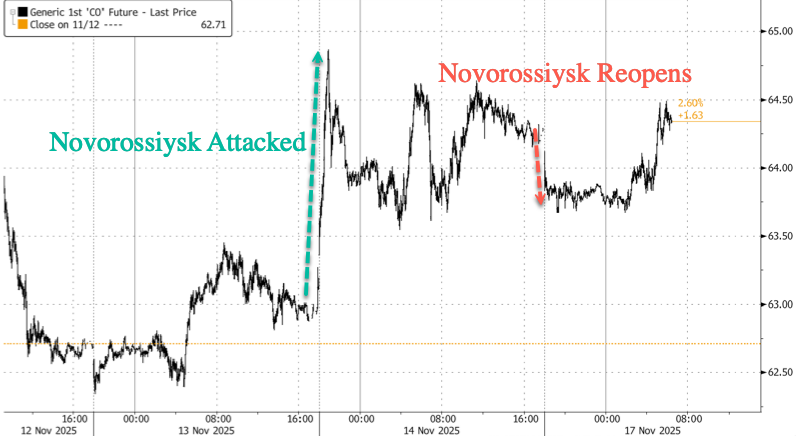
“People were expecting a longer outage” at Novorossiysk following the strike, said Mukesh Sahdev, the founder and chief executive officer of Xanalysts Pty. Indications of a resumption are a “bearish signal,” he added. Sahdev was quoted by Bloomberg.
Ukrainian forces have increasingly targeted Russian oil export chokepoints, including oil-refining, storage, and export infrastructure, using drones and missiles. Novorossiysk was targeted for several key reasons:
- Russia’s Largest Black Sea Oil Export Terminal: Novorossiysk handles a major share of Russia’s seaborne crude exports, including Urals and CPC Blend. When it goes offline, millions of barrels per day are at risk.
- Key Outlet for Sanctions-Crimped Russian Supply: With many European ports closed to Russian oil, Black Sea routes have become even more vital. Novorossiysk is one of Moscow’s few remaining large, reliable export points.
- Gateway to Europe, the Mediterranean, and Global Markets: Tankers from Novorossiysk move oil toward Europe, Turkey, India, and increasingly China. Any disruption affects multiple downstream markets.
- Linked to CPC Pipeline Exports: The Caspian Pipeline Consortium (CPC) routes Kazakh and Russian crude to Novorossiysk.
The broader oil market outlook heading into 2026 remains bearish (read report).
end
THEN THIS MORNING!!
Turkish LPG Tanker Ablaze After Russian Drone Strike On Ukrainian Port
Monday, Nov 17, 2025 – 09:40 AM
Another Russian overnight massive drone and missile attack on Ukraine has had some serious spillover effects, as the Turkish flagged LPG tanker “Orinda” carrying thousands of metric tons of liquefied petroleum gas was reportedly struck at the port of Izmail in Odesa.
The Turkish vessel was reportedly struck directly by a Russian drone, prompting the immediate evacuation of all 16 crew members, with no casualties reported.

Other civilian vessels were also damaged, with firefighting and emergency crews quickly dispatch to try and contain the blaze. At least a dozen commercial vessels have previously been damaged in similar Russian drone attacks on the port.
Romania is alarmed as the impacted port lies just across the border from the NATO country, and it has ordered the nearby village of Plauru along the Ukraine border to be evacuated.
The Orinda carries 4,000 tons of gas, and so the dangerous incident presents the risk of a major explosion, and containing the fire has proven difficult.
Some are calling for Turkey to take definitive action against Russia. For example Turkish member of parliament Ulaş Karasu (CHP) pointed out on X that “The drone attack targeting the liquefied gas carrier named MT Orinda, flying the Turkish flag, in the Black Sea shows that the war is now targeting Turkish seafarers as well.”
The Turkish politician continued:
Turkish seafarers cannot be left alone in the midst of war! The absence of loss of life is certainly a consolation for us, but the government cannot brush off this attack by calling it “isolated.” The safety of our ships and crew must be ensured!
BBC says that it has verified the footage:
The footage appears to have been filmed from the small Romanian village of Plauru, just across the river.The village is now being evacuated due to the ship’s “proximity to Romanian territory and the nature of its cargo”, emergency services say.
Ordina is almost 125m (410ft) long and can hold up to 8292 cubic metres (1.8 million gallons) of fuel, according to ship tracking website Marine Traffic.
The incident demonstrates once again that the longer and more expanded the war on energy sites between Russia and Ukraine grows, the greater the risk of drawing external countries in. Various officials within NATO have long wanted Turkey to take harsher action against Russian shipping to international markets by cutting off access to the Bosphorus and Dardanelles Straits.
8. EMERGING MARKETS//AUSTRALIA NEW ZEALAND ISSUES
MEXICO
https://www.zerohedge.com/geopolitical/beginning-revolution-populist-revolt-shocks-mexico
Beginning Of A Revolution? Populist Revolt Shocks Mexico
SUNDAY, NOV 16, 2025 – 09:55 AM
Chaos erupted in front of Mexico’s National Palace in Mexico City on Saturday after anti-corruption protests turned violent following the recent cartel murder of Uruapan Mayor Carlos Manzo. Protesters are furious with leftist President Claudia Sheinbaum, while the government blames right-wing business interests for stoking the unrest.
Reuters reports that 120 people and 100 police officers were injured outside the National Palace when a large group of anti-government protesters led by Gen Zers clashed with Sheinbaum’s security forces.
Public outrage has grown over the recent assassination of Uruapan Mayor Carlos Manzo, a critic of cartel violence in the crime-ridden third-world country just south of the U.S. southern border.
Footage on X shows demonstrators ripping down parts of a giant steel barrier around the National Palace, prompting police to deploy tear gas and other non-lethal weapons.
The populist revolt against far-left leaders continues, with some folks calling Sheinbaum a “WEF puppet.”
More footage:
Sheinbaum is a member of Morena (Movimiento de Regeneración Nacional), a left-wing political party in Mexico that aligns ideologically with far-left U.S. politicians through Democratic Socialists of America. DSA supports unhinged leftists, including Alexandria Ocasio-Cortez and Zohran Mamdani.
More broadly across Latin America, Argentine President Javier Milei’s recent midterm victory, alongside right-wing populist movements gaining ground across Europe and President Trump’s 2024 win, signal that voters are increasingly rejecting corrupt globalist Marxists who have squandered the inheritance of nations through failed policies (climate crisis hoax) that only enrich the globalist elite.
END
VENEZUELA/USA/IRAN/HEZBOLLAH
Could A Small Venezuelan Island Be The Real Reason Behind the U.S. Military’s Caribbean Buildup
Sunday, Nov 16, 2025 – 02:35 PM
Recent reporting highlights a sustained U.S. military buildup across the Caribbean, coinciding with briefings to President Trump in which senior Pentagon officials outlined potential operational scenarios against Venezuela. This activity has raised questions among observers about regime change operations.
Public justification and the narrative in corporate media have centered on counter-narcotics missions aimed at disrupting transnational criminal networks operating in and around Venezuela. However, the scale and posture of U.S. forces have prompted speculation that this buildout might not just be about dismantling command and control structures of narco terrorist networks.
In this 10-post X thread, Jason Lewris of real-time housing market data website Parcl Labs explored one potential cause for the U.S. military buildup and goes beyond drug smuggling, linking Venezuelan cartels and Iranian-backed groups (like Hezbollah).
“But drug smuggling may not be the full story—or the real motivation,” Lewris began the tread. He said, “A far more concerning pattern is emerging.”
“Here’s how a small Venezuelan island (Isla de Margarita), Iranian-backed terrorist groups, and U.S. housing may all connect within a sophisticated people-transportation network into the United States,” Lewris explained.
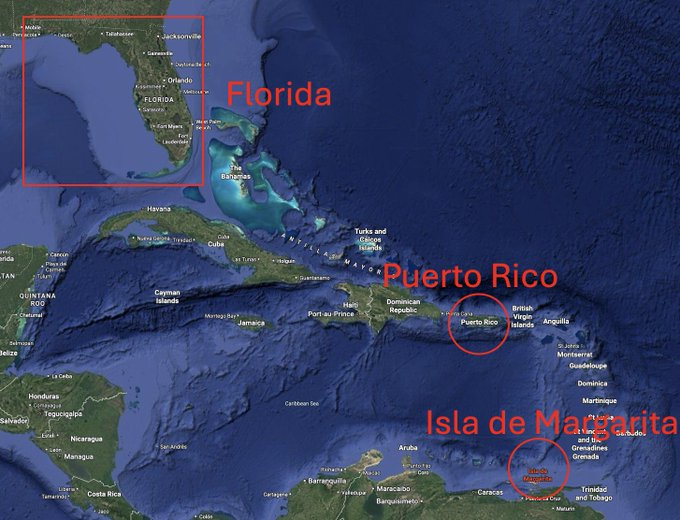
Lewris cited a text from a 2013 House Foreign Affairs Committee on the subject of “Hezbollah’s STRATEGIC SHIFT: A GLOBAL TERRORIST THREAT.”
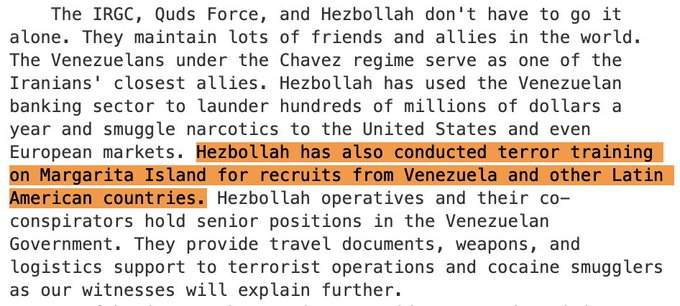
With the text, Lewris pointed out, “Hezbollah has also conducted terror training on Margarita Island for recruits from Venezuela and other Latin American countries. Hezbollah operatives and their co-conspirators hold senior positions in the Venezuelan Government. They provide travel documents, weapons, and logistics support to terrorist operations and cocaine smugglers as our witnesses will explain further.”
Timing of the Caribbean operation is critical to understand, according to Lewris.
Here are the key points from the thread:
- U.S. Military Actions as Cover? The White House has ramped up releases of dramatic videos showing U.S. forces destroying drug-smuggling boats (e.g., recent strikes in the Eastern Pacific killing 6 “narco-terrorists”). This follows U.S. strikes on Iranian nuclear sites in June 2025 and includes quiet military buildups in Puerto Rico, suggesting a broader response to threats.
- Historical Ties on Margarita Island: Since at least 2013 (per a House hearing), Venezuela’s Isla de Margarita has served as a Hezbollah training hub for local cartels, facilitating exchanges of tactics and resources. Iran and Venezuela’s long-standing alliance amplifies this.
- Smuggling Operations: Established cartel routes across the Caribbean could now transport people, potentially terrorist operatives, rather than just drugs. Dense clusters of Venezuelan/Iranian-owned U.S. properties (via shell companies tied to their governments) near the southern border provide safe havens, built up over years.
And if that alone sounded troubling, what comes next points to a national security threat.
Rubio might find this interesting…
Lewris’ thesis: “U.S. officials understand the Iran–Venezuela partnership. They understand these smuggling routes, which historically moved drugs. But the concern now is that people, not drugs, are being moved. And those people may include terrorist operatives. We’re tracking the intersection of these networks with U.S. housing at @ParclLabs.”
YOUR EARLY CURRENCY/GOLD AND SILVER PRICING/ASIAN CLOSING MARKETS AND EUROPEAN BOURSE OPENING AND CLOSING/ INTEREST RATE SETTINGS MONDAY MORNING 6;30AM//OPENING AND CLOSING
EURO/USA: 1.1600 DOWN 0.0014 PTS OR 14 BASIS POINTS/WITH STOCKS LOWERER
USA/ YEN 154.79 UP 0.360 NOW TARGETS INTEREST RATE AT 1.00% AS IT WILL BUY UNLIMITED BONDS TO GETS TO THAT LEVEL…//YEN STILL FALLS//END OF YEN CARRY TRADE BEGINS AGAIN OCT 2024/Bank of Japan raises rates by .15% to 1.15..UEDA ENDS HIKING RATES AND NOW CARRY TRADES RE INVENTS ITSELF//JAPAN IN TROUBLE WITH RISING RATES
GBP/USA 1.3173 UP .0015 OR 15 BASIS PTS
USA/CAN DOLLAR: 1.4026 UP 0.0011 CDN DOLLAR DOWN 11 BASIS PTS//CDN DOLLAR GETTING KILLED)
Last night Shanghai COMPOSITE CLOSED DOWN 18.46 PTS OR 0.46%
Hang Seng CLOSED DOWN 188.18 PTS OR 0.71%
AUSTRALIA CLOSED DOWN 0.10%
// EUROPEAN BOURSE: ALL RED
Trading from Europe and ASIA
I) EUROPEAN BOURSES: ALL RED
2/ CHINESE BOURSES / :Hang SENG CLOSED DOWN 188.18PTS OR 0.71%
/SHANGHAI CLOSED DOWN 18.46POINTS OR 0.46%
AUSTRALIA BOURSE CLOSED DOWN 0.10 %
(Nikkei (Japan) CLOSED DOWN 52.62 PTS OR 0.10%
INDIA’S SENSEX IN THE GREEN
Gold very early morning trading: 4079.00
silver:$51.07
USA dollar index early MONDAY morning: 99.21 UP 1 BASIS POINTS FROM FRIDAY’s CLOSE
MONDAY MORNING NUMBERS ENDS
And now your closing MONDAY NUMBERS 11: 30 AM
Portuguese 10 year bond yield: 3.050 % UP 1 in basis point(s) yield
JAPANESE BOND 10 yr YIELD: +1.738% UP 4 FULL POINTS AND 10/100 BASIS POINTS /JAPAN losing control of its yield curve/
JAPAN 30 YR: 3.255 UP 5 BASIS PTS//DEADLY
SPANISH 10 YR BOND YIELD: 3.209 UP 1/2 in basis points yield
ITALIAN 10 YR BOND YIELD 3.448 down 1/2 points in basis points yield ./ THE ECB IS QE’ ING ITALIAN BONDS (BUYING ITALIAN BONDS/SELLING GERMAN BUNDS)
GERMAN 10 YR BOND YIELD: 2.7120 UP 2 BASIS PTS
IMPORTANT CURRENCY CLOSES : MID DAY MONDAY
Closing currency crosses for day /USA DOLLAR INDEX/USA 10 YR BOND YIELD/1:00 PM
Euro/USA 1.1585 DOWN 0.0029 OR 29 basis points
USA/Japan: 154.96 UP 0.529 OR YEN IS DOWN 53 BASIS PTS// HIGHLY INFLATIONARY TO JAPAN
Great Britain 10 YR RATE 4.550 UP 2 BASIS POINTS //
GREAT BRITAIN 30 YR BOND; 5.367 UP 2 BASIS POINTS.
Canadian dollar DOWN 0.0023 OR 23 BASIS pts to 1.4039
xxxxxxxxxxxxxxxxxxxxxxxxxxxxxxxxxxxxxxxxxxxxxxxxxxxxxxxxxxxxxxxxxxxxxxxxxxxxxxxx
The USA/Yuan CNY DOWN AT 7.1082 ON SHORE ..
THE USA/YUAN OFFSHORE DOWNTO 7.1111
TURKISH LIRA: 42.32 EXTREMELY DANGEROUS LEVEL/DEATH WATCH/HYPERINFLATION TO BEGIN.//
the 10 yr Japanese bond yield at +1.738 UP 4 FULL basis pts
THE 30 YR JAPANESE BOND YIELD: 3.255 UP 5 basis pts
Your closing 10 yr US bond yield DOWN 1 in basis points from FRIDAY at 4.141% //trading well ABOVE the resistance level of 2.27-2.32%)
USA 30 yr bond yield 4.743 DOWN 1 basis points /11:00 AM
USA 2 YR BOND YIELD: 3.612 DOWN 0 BASIS PTS.
GOLD AT 10;00 AM 4077,00
SILVER AT 10;00: 50.84
Your 11:00 AM bourses for Europe and the Dow along with the USA dollar index closing and interest rates: MONDAY CLOSING TIME 11:00 AM//
London: CLOSED DOWN 22.94 PTS OR 0.24%
GERMAN DAX: DOWN 51.07 pts or 0.63%
FRANCE: CLOSED DOWN 286.03 pts or 1.20%
Spain IBEX CLOSED DOWN 143.30 pts or 1.06%
Italian MIB: CLOSED DOWN 227.41. or 0.52%
WTI Oil price 60.03 0.00 EST/
Brent Oil: 64.41 10:00 EST
USA /RUSSIAN ROUBLE /// AT: 81.41 ROUBLE DOWN 0 AND 56/ 100
CDN 10 YEAR RATE: 3.223 DOWN 1 BASIS PTS.
CDN 5 YEAR RATE: 2.801 UP 1 BASIS PTS
CLOSING NUMBERS: 4 PM
Euro vs USA 1.1589 DOWN 0.0025 OR 25 BASIS POINTS//
British Pound: 1.3156 DOWN .0002 OR 02 basis pts/
BRITISH 10 YR GILT BOND YIELD: 4.5340 DOWN 4 FULL BASIS PTS//
BRITISH 30 YR BOND YIELD: 5.350 DOWN 5 IN BASIS PTS.
JAPAN 10 YR YIELD: 1.733 UP 3 FULL BASIS PTS (DANGEROUS TO THEIR ECONOMY
JAPANESE 30 YR BOND: 3.254 UP 5 PTS AND STILL VERY DANGEROUS TO THEIR ECONOMY
USA dollar vs Japanese Yen: 155.200 UP 0.767 BASIS PTS EXTREMELY DANGEROUS/YEN FALLING IN VALUE
USA dollar vs Canadian dollar: 1.4053 UP 0.0073 PTS// CDN DOLLAR DOWN 37 BASIS PTS CDN DOLLAR
West Texas intermediate oil: 59.75
Brent OIL: 64.04
USA 10 yr bond yield DOWN 2 BASIS pts to 4.131
USA 30 yr bond yield DOWN 1 PTS to 4.737%
USA 2 YR BOND 3.606 DOWN 1 PTS
CDN 10 YR RATE 3.233 UP 1 BASIS PTS
CDN 5 YEAR RATE: 2.803 UP 0 BASIS PTS
USA dollar index: 99.44 UP 24 BASIS POINTS
USA DOLLAR VS TURKISH LIRA: 42.30 GETTING QUITE CLOSE TO BLOWING UP/
USA DOLLAR VS RUSSIA//// ROUBLE: 81.41 DOWN 0 AND 57/100 roubles //
GOLD $4033.20 (3:30 PM)
SILVER: 50.05 3;30 PM)
DOW JONES INDUSTRIAL AVERAGE: DOWN 557.64 OR 1.18%
NASDAQ 100 DOWN 208.32 PTS OR 0.33%
VOLATILITY INDEX 22.41 UP 2.58 PTS OR 13.01%
GLD: $ 371.65 DOWN 4.31 PTS OR 1.07%
SLV/ $45.40 DOWN 0.49 PTS OR OR 3.08%
TORONTO STOCK INDEX// TSX INDEX: CLOSED DOWN 262.52 PTS OR 0.87%
end
TRADING today ZEROHEDGE 4 PM: HEADLINE NEWS/TRADING
Stocks Crack Key Support, Crypto Crushed, Credit Bruised On Bezos’ Big Bond Deal
LATE HEADLINE;
Top JPM Trader: “Repo Stress Has Been Main Reason For The Market Reversal… And What Happens Next”
WRAPUP;
SPX closes beneath 50dma on AI valuation concerns – Newsquawk US Market Wrap
Monday, Nov 17, 2025 – 04:08 PM
- SNAPSHOT: Equities down, Treasuries flat/up, Crude down, Dollar up, Gold down.
- REAR VIEW: Fed’s Jefferson reiterates Fed needs to move slowly; Fed’s Waller advocates 25bps Dec cut; Solid NY Fed Manufacturing survey; Saba Capital Mgmt sold credit derivatives to lenders seeking protection from tech exposure; Trump expects to issue tariff dividend mid 2026; Trump not happy with Mexico; EU to warn US against expanding score of US steel tariffs; UK considers options to retaliate against Europe over steel tariffs; Israeli warplanes have targeted areas in southern Lebanon; AMZN to sell USD 15bln USD bond; AAPL accelerating CEO succession plan; Berkshire takes stake in GOOGL.
- COMING UP: Data: US ADP Weekly Estimate, US Factory Orders (Aug), US Durable Goods (Aug), Japanese Trade Balance. Event: RBA Minutes. Speakers: ECB’s Elderson; BoE’s Pill, Dhingra; Fed’s Barr, Barkin. Earnings: Home Depot, Baidu, Medtronic, PDD; Imperial Brands.
More Newsquawk in 2 steps:
- 1. Subscribe to the free premarket movers reports
- 2. Trial Newsquawk’s premium real-time audio news squawk box for 7 days
MARKET WRAP
US indices saw heavy losses on Monday, with all sectors, aside from Communications and Utilities, in the red. There was no one specific catalyst for the risk-off trade to start the week, just further concerns regarding elevated valuations in the AI space, while the SPX slipped below 6,700 and closed beneath its 50-dma of 6,707. Back to sectors, the Communications sector was boosted by Alphabet (GOOGL) being one of the clear gainers and supported after Berkshire Hathaway built a stake in the Co., as its latest 13-F declared. The Dollar was bought in a risk-averse environment, to the detriment of all G10 peers, with Aussie and Kiwi underperforming. On data, NY Fed Manufacturing was solid, while the influential governor Waller toed a usual dovish tone, as he reiterated his support for a December rate cut (25bps) and doesn’t see any factors that would cause acceleration in inflation. Jefferson reiterated the fed needs to proceed slowly as monetary policy approaches the neutral rate. Treasuries were supported and saw slight upside, but gains were capped on Amazon’s bond sale, whereby the behemoth upsized its USD 12bln offering to USD 15bln, in its first US bond sale since 2022. The crude complex traded in very narrow ranges on Monday, but settled marginally lower in light headline risk, although did see strength in the EZ morning in reports that Israeli warplanes targeted areas in southern Lebanon. Gold and Bitcoin were also pressured amid the equity weakness, with Bitcoin hitting its lowest level in six months and gold testing USD 4,000/oz. While the scheduled events on Monday were light, it heats ups later this week with particular focus on FOMC Minutes, NVIDIA earnings (Wed), and Sept. US jobs report (Thurs).
US
NY FED: Overall, a solid report with activity rising, employment remaining in expansionary territory, while the pace of price increases slowed. The November Empire State Manufacturing survey saw current business conditions rise to +18.7 from 10.7 in October, well above the 5.8 forecast. The report noted that new orders and shipments increased significantly. New orders rose to 15.9 from 3.7. Delivery times lengthened modestly, and supply availability worsened somewhat. Inventories expanded. Labour market indicators improved, pointing to a small increase in employment and a longer average workweek. The employment index rose to 6.6 from 6.2. The pace of both input price increases and selling price increases slowed slightly, but remained elevated. Prices paid slowed to 49 from 52.4, while prices received fell to 24 from 27.2. Capital spending plans grew. Firms expect conditions to improve in the months ahead, though firms were not as optimistic as last month. Looking ahead, prices paid and received both slowed, while employment improved.
FED’S JEFFERSON: The Fed Vice Chair largely repeated comments he made in early November. The Vice Chair said the Fed needs to proceed slowly as monetary policy approaches the neutral rate, and it is still not clear how much government data will be available for the next meeting. He echoed that current Fed policy rate is still “somewhat restrictive”, and the balance of risks has shifted in recent months, with increased potential downside to employment. Looking ahead, and to next week, Jefferson looks forward to reviewing the Biege Book.
FED’S WALLER: The Fed Governor made the case for continuing rate cuts and voiced support for a 25bps cut in December, saying it would offer additional labour market insurance amid signs the economy is softening. Warned that restrictive policy may be weighing on activity, with the labour market weak and near stall speed. Argued that underlying inflation is close to 2%, expectations remain well anchored, and tariffs are merely a one-time price level shock. Said he sees no factors likely to accelerate inflation and expects that no upcoming data, including the jobs report, would change his view that another cut is warranted.
FIXED INCOME
T-NOTE FUTURES (Z5) SETTLE 3+ TICKS HIGHER AT 112-20+
T-Notes see slight upside in risk-off trade but capped on Amazon’s bond sale. At settlement,2-year -0.6bps at 3.608%,3-year -0.8bps at 3.607%,5-year -1.3bps at 3.721%,7-year -1.7bps at 3.904%,10-year -1.3bps at 4.135%,20-year -1.1bps at 4.710%,30-year -0.7bps at 4.739%.
INFLATION BREAKEVENS: 1-year BEI -4.8bps at 2.731%,3-year BEI -1.9bps at 2.476%,5-year BEI -2.1bps at 2.304%,10-year BEI -1.1bps at 2.274%,30-year BEI -0.8bps at 2.236%.
THE DAY: T-Notes moved slightly higher on Monday, but with upside capped on the Amazon corporate bond sale. Amazon upsized its USD 12bln offering to USD 15bln, in its first US bond sale since 2022. Yields in the US were lower by 1-3bps, with the belly seeing the greatest losses. The overall tone on Monday was another risk-off trade, with ongoing AI valuation concerns hitting sentiment, paring the pre-market upside in US equity futures. As stocks sold, T-Notes were bid, but the USD 15bln Amazon bond offering limited the gains ahead of 20-year and 10-year TIP supply this week. Elsewhere, this week’s focus lies on the return of data with the September NFP expected on Thursday, while the FOMC Minutes will be released on Wednesday. Data today saw the NY Fed manufacturing survey, which was solid, as activity rose, employment remained in expansionary territory, while the pace of price increases slowed. Meanwhile, Construction Spending saw a surprise gain in August, and led to an upgrade to the Atlanta Fed GDP Now estimate for Q3 to 4.1% from 4.0%. Note, the ADP will release the weekly report on Tuesday, which will show the average weekly employment change over the last four weeks. Note, Fed Vice Chair Jefferson spoke today, largely reiterating recent commentary that the Fed needs to proceed slowly as it approaches the neutral rate, reiterating that policy is still somewhat restrictive. Waller meanwhile reiterated his support for a 25bps rate cut in December.
SUPPLY:
Notes
- US to sell USD 16bln of 20-year bonds on November 19th, to settle December 1st.
- US to sell USD 19bln of 10-year TIPS on November 20th, to settle November 28th.
Bills
- US sold USD 86bln of 3-month bills at a high rate of 3.795%, B/C 2.79x; sold USD 77bln of 6-month bills at a high rate of 3.710%, B/C 2.80x.
- US to sell USD 95bln of 6-week bills on Nov 18th, to settle on Nov 20th.
STIRS/OPERATIONS
- Market Implied Fed Rate Cut Pricing: Dec 10bps (prev. 10bps), January 21bps (prev. 21bps), March 30bps (prev. 30bps).
- NY Fed RRP op demand at USD 3.2bln (prev. 1.6bln) across 7 counterparties (prev. 10)
- NY Fed Repo Op demand at USD 5.57bln across two operations today (prev. 0.02bln).
- EFFR at 3.88% (prev. 3.88%), volumes at USD 72bln (prev. 78bln) on November 14th.
- SOFR at 3.95% (prev. 4.00%), volumes at USD 3.195tln (prev. 3.197tln) on November 14th.
CRUDE
WTI (Z5) SETTLES USD 0.18 LOWER AT 59.91/BBL; BRENT (F6) SETTLES USD 0.19 LOWER AT 64.20/BBL
The crude complex was choppy but ultimately settled marginally lower in thin newsflow. The real market mover for benchmarks was in the European morning, which took the energy space into the green, amid reports Israeli warplanes have targeted areas in southern Lebanon. Elsewhere, there was a bit of geopolitical rhetoric, but nothing to move the space. Recapping, Trump warned countries doing business with Russia will face sanctions under new legislation, and Iran may be added to that list, while CNN reported that the President has yet to make a decision on whether to attack Venezuela on land. On the sell-side, Goldman Sachs forecasts Brent to decline to USD 56/bbl (prev. 63) in 2026 and WTI to USD 52/bbl (prev. 60), and GS sees a large 2.0mln BPD surplus on strong global ex-Russia supply will reduce prices through mid-2026. Ahead, the bank thinks oil prices will pick up in 2027 as low prices take their toll on non-OPEC supply. WTI traded between USD 59.32-60.44/bbl and Brent USD 63.67-64.72/bbl.
EQUITIES
CLOSES: SPX -0.91% at 6,672, NDX -0.83% at 24,800, DJI -1.18% at 46,590, RUT -1.96% at 2,341
SECTORS: Communication Services +1.13%, Utilities +0.84%, Health -0.04%, Real Estate -0.57%, Consumer Staples -0.59%, Consumer Discretionary -0.80%, Industrials -1.03%, Technology -1.43%, Materials -1.53%, Energy -1.87%, Financials -1.93%
EUROPEAN CLOSES: Euro Stoxx 50 -0.85% at 5,645, Dax 40 -1.24% at 23,579, FTSE 100 -0.24% at 9,675, CAC 40 -0.63% at 8,119, FTSE MIB -0.52% at 43,767, IBEX 35 -1.06% at 16,173, PSI -0.04% at 8,247, SMI -0.39% at 12,586, AEX -0.69% at 945.
STOCK SPECIFICS:
- Apple (AAPL): Accelerating CEO succession planning as Tim Cook could step down as early as 2026, via FT.
- Big tech/AI: Saba Capital Management has sold credit derivatives to lenders seeking protection from tech exposure, according to Reuters sources; Saba sold credit default swaps on Oracle (ORCL), Microsoft (MSFT), Meta (META), Amazon (AMZN), and Alphabet (GOOGL).
- Aramark (ARMK): EPS & rev. missed w/ underwhelming guidance.
- Alibaba (BABA): Launched its revamped AI chatbot, Qwen.
- Dell (DELL): Double-downgraded at MS.
- Google (GOOGL): New buy from Berkshire Hathaway in latest 13-F.
- Eli Lilly (LLY): Novo Nordisk is undercutting LLY on obesity drugs for cash-pay patients.
- Sealed Air (SEE): To be acquired by CD&R for $42.15/shr in cash. Note, SEE closed Friday at $43.28/shr.
- EW Scripps (SSP): Sinclair Broadcast Group (SBGI) has built a roughly 8% stake & is vying to acquire the Co, via WSJ.
- WPP (WPP): Attracting takeover interest, albeit later denied by the CEO of Havas.
- Travel names (ABNB, EXPE, BKNG) were pressured after Google (GOOGL) announced new AI travel tools to help with travel planning.
- Live Nation (LYV)/ StubHub (STUB) – UK to ban resale of tickets above face value, according to FT.
FX
The Dollar was firmer, albeit in a day of thin trade as we await delayed US data and NVIDIA earnings later in the week. Back to Monday, NY Fed Manufacturing was largely strong as current business conditions were much better than anticipated, new orders and employment rose, with prices paid declining. However, six-month business conditions declined to 19.1 from 30.3. On the Fed footing, Vice Chair Jefferson largely echoed his remarks from early November, where he noted the current Fed policy rate is still “somewhat restrictive” and the Fed needs to proceed slowly as monetary policy approaches the neutral rate. Of note for next week, the Vice Chair said he looks forward to reviewing the Beige Book. DXY traded between 99.291-579.
G10 FX saw losses, albeit nothing too extensive and broadly fell foul to the climbing Greenback as opposed to much currency-specific newsflow. AUD was the relative laggard, while GBP and CAD “outperformed”. In terms of headline risk, the Yen saw no move to Japanese GDP for Q3 falling below zero, the first time in six quarters, albeit not as deep in negative territory as forecasted. Out of Europe, while again no move, there was plenty of ECB speak, but said little new. In addition, the European Commission Autumn 2025 economic forecast saw GDP revised up for 2025, but down for ’26, with inflation moving up for both 2025 and ’26. In commentary, noted “shows continued growth despite challenging environment.” Swiss Q3 GDP fell -0.5% vs. Q2’s print of +0.1%.
CAD saw slight two-way trade to the latest inflation metrics. Overall, it was mixed – headline inflation Y/Y eased but was slightly above Wall St. consensus. Core inflation picked up in October, partially due to one-off factors like the annual increase in property taxes, which Oxford Economics notes always enters the CPI in October, and a jump in cellular services prices.
EMFX was largely at the whim of the Dollar amid a lack of newsflow. Out of LatAm, BCB sold USD 1.25bln in dollar auction with repurchase deal. Meanwhile, in CEE, NBP’s Janczyk said there is room for a small rate cut in the near future. Looking to NBH on Tuesday, ING notes the rate decision should be a non-event, and expect rates to be held steady at 6.50%, but the market will focus on forward guidance, especially after the increase in the planned public deficit. ING adds while hawkish guidance is widely expected, there is not much possibility of a tougher tone compared to previous meetings, building some dovish risk.
USA DATA RELEASES
US Debt Rose By $620 Billion During The Government Shutdown
Sunday, Nov 16, 2025 – 04:55 PM
By Eric Peters, CIO of One River Asset Management
“This package demonstrates that we can govern without surrendering to big spending or letting Democrats dictate priorities,” wrote the House Freedom Caucus in some talking points released to the media.
“We successfully stiff-armed a massive omnibus spending bill; locked in disciplined, flat spending levels; preserved President Trump’s policy priorities… and kept our leverage for the next round in January.”
People can say whatever they want, but I’m pretty sure our politicians closed the US government for a record 42 days and changed absolutely nothing. That’s quite an accomplishment. Sublime ineptitude. Congressional approval ratings supposedly declined 11pts to 15% during the period. Remarkable.
If a trader knew that 85% of his decisions were losers, he’d become the richest man on earth by simply doing the exact opposite of his instinct. I’m guessing Pelosi made good money trading the chop, but the broad equity market ended the shutdown period roughly a percent higher than where it started.
Extrapolating the recent pace of deficit spending, the Federal government accumulated another $600bln of debt during the shutdown, adding more leverage to the system, sustaining the economy, supporting asset values.
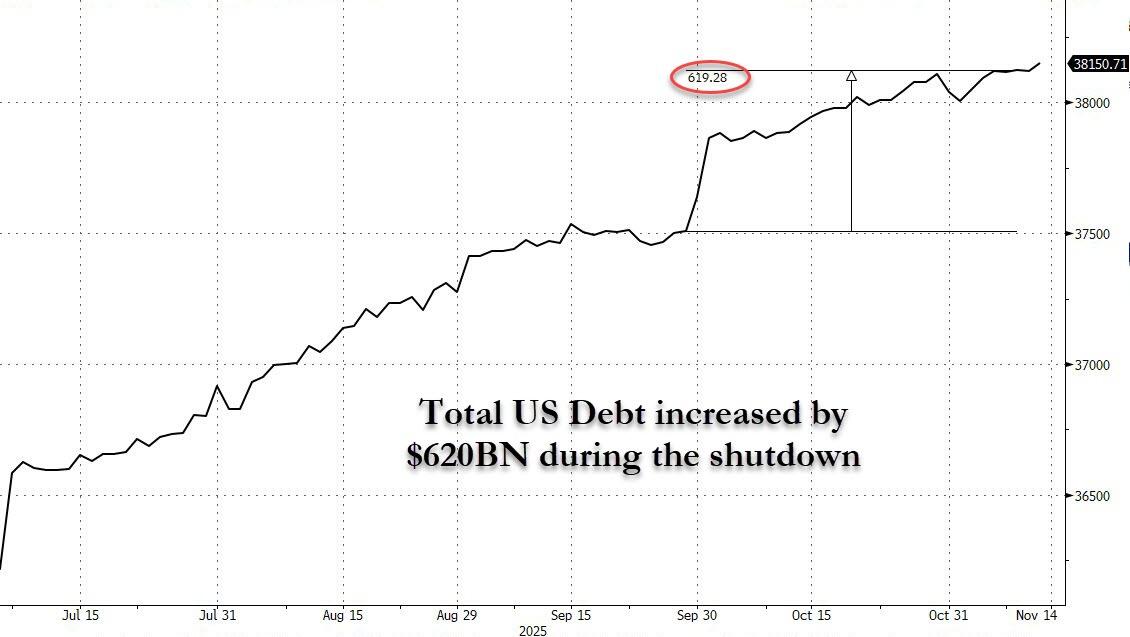
But even so, 10yr treasury yields are unchanged from where they were before the shutdown.
Crypto prices got smoked, with bitcoin down roughly 16% for no particularly good reason, even as gold rose 5%.
Liquidity trades often need momentum to sustain them, and the hot money has been chasing AI and gold.
Beijing added roughly 62 gigawatts of electrical generation capacity to China’s grid while Washington remained closed. That’s roughly the generation capacity of the entire UK, once the world’s greatest power.
80% of China’s new generation capacity is renewables, which means that once its built, it requires no coal, gas, or oil imports to power data centers. That’s quite a competitive advantage in this existential race toward AGI.
But at least we have our democracy, which we’ve been told is the worst system except for all the others.
END
USA ECONOMIC COMMENTARIES
Corporate Bankruptcies On Pace For 15-Year High As More “Isolated Incidents” To Occur
Sunday, Nov 16, 2025 – 06:05 PM
First came the spectacular implosions of subprime auto lender Tricolor and auto-parts supplier First Brands. Then came the regional-bank fiasco, prompting JPMorgan CEO Jamie Dimon to warn that more late-cycle accidents may be ahead. Add in signs that lower-income consumers are tapped out, frothy valuations across the AI equity sphere, and even Bitcoin sliding below $100,000, and it’s no surprise that many are beginning to wonder whether mounting financial stress signals the early stages of a broader downturn.
Another flashing red warning sign is new data from S&P Global this past week, showing that through October, 655 companies have filed for bankruptcy, nearly matching the 687 total for all of 2024.
S&P Global data showed that in October alone, there were 68 new corporate bankruptcies filings. In August, there were 76 filings, the highest monthly tally since at least 2020.
Industrials lead the charge with 98 filings, reflecting the group’s vulnerability to snarled supply chains related to tariffs. Then, consumer discretionary firms followed with 80 bankruptcies so far this year.
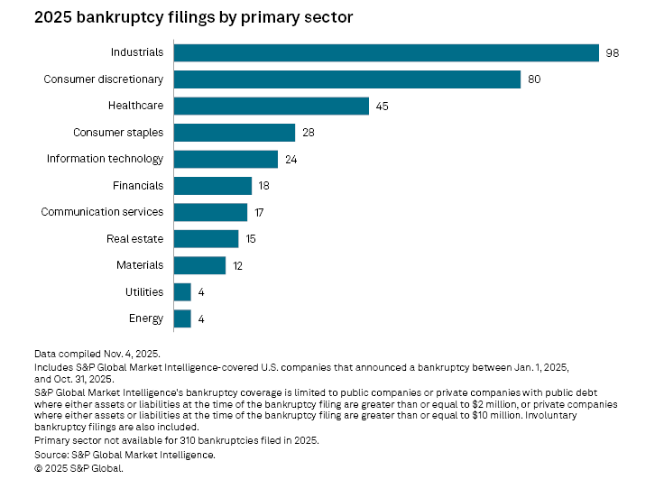
At current pace, corporate bankruptcies could reach a 15-year high by year’s end.

The Tricolor and First Brands implosions earlier this fall were certaintly a wake-up call. Regional bank woes and now lower- and middle-income consumers are exhausted, all combined, suggesting softening of the economy in the late year. The record 43-day government shutdown certainly compounded problems.
“I view those few incidents as idiosyncratic but expect more of these ‘isolated incidents’ to occur, potentially in other sectors like software, which has increased leverage in that market while capital flows to AI capex,” Clayton Triick, head of portfolio management of public strategies at Angel Oak Capital Advisors, told S&P Global Market Intelligence.
Here are the notable bankruptcies this year.
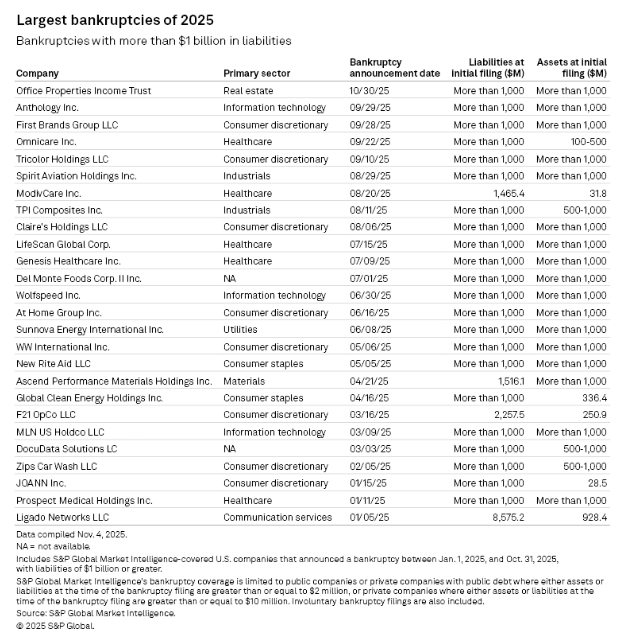
In mid-October, JPM CEO Jamie Dimon sparked some controversy in banking and finance circles with this comment: “My antenna goes up when things like that happen. I probably shouldn’t say this, but when you see one cockroach, there are probably more.”
UBS analysts, led by Jonathan Pingle, told clients days ago, “Our base case is that an equity market drawdown is avoided. Households suffer for the next two quarters.”
However, Pingle noted that a $55 billion boost to disposable income in 2Q 2026 from retroactive tax relief in the One Big Beautiful Bill Act (OBBBA) will lift consumer sentiment in the early spring. Plus, all the infrastructure buildouts, reshoring, data center construction, and the list goes on and on, will likely begin to filter into the real economy early next year – all in time for midterms.
So from now until economic tailwinds emerge, the Trump administration has launched Operation Affordability, focusing on lowering prices to lift low-income consumers and improve sentiment ahead of the midterms.
END
ELECTRICITY
Electricity Prices Extend Rise, Regulators Rein In Data Centers
Monday, Nov 17, 2025 – 05:45 AM
There is very little good news this week for those hoping to see relief in electricity prices next year, and more states took steps to put guardrails on data center development.
At the same time, new renewable generation projects continue to face delays and cancellations.
Here’s the story the data told this week in the electric power sector.
By the Numbers
$51/MWh
The forecast price of wholesale electricity across the country in 2026, according to the U.S. Energy Information Administration. That number, 8.5% higher than this year, is the load-weighted average across 11 regional markets, but the increases will not be felt evenly. Much of the rise in demand and price is centered on Texas and driven largely by data centers, cryptocurrency mining facilities and other energy-intensive commercial customers, EIA said.
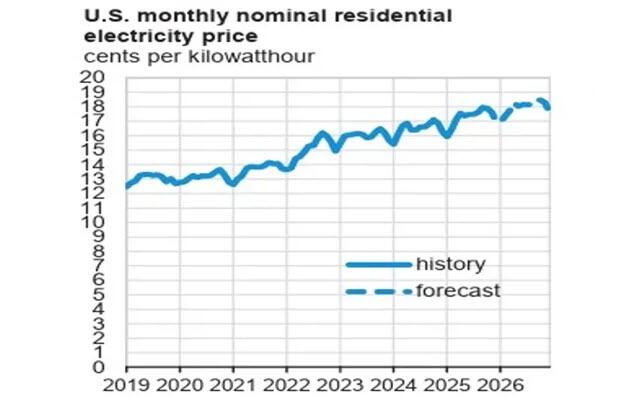
80%
The minimum percentage of contracted monthly demand that data centers and other large load customers will be required to pay Evergy and Consumers Energy, regardless of how much they use, under new rules adopted by regulators in Kansas and Michigan. The rules are intended to shield existing ratepayers from the costs of interconnecting data centers and other large loads, especially if the demand fails to materialize after the investments are made. AEP Ohio has said its data center pipeline shrank considerably after regulators there approved a similar tariff; many states are weighing like-minded proposals.
2.4 GW
The capacity of the planned Leading Light Wind project offshore New Jersey that developer Invenergy has canceled. It cited financial, supply chain and regulatory obstacles as reasons the project is no longer viable. The cancellation of the large generation project comes as rising power prices have begun to exert political pressure on elected officials. Gov.-elect Mikie Sherrill, a Democrat, campaigned on keeping down electricity prices.
$105B
The upper end of Duke Energy’s expanded five-year capital spending plan, which it expects to roll out early next year. Executives attribute the rise in spending to rapid load growth, including many data centers, which they say is likely to continue into the early 2030s. Additional generation added to Duke’s system could exceed 13 GW in the next five years, including 7.5 GW of new gas facilities. Duke is one of many utilities that have bumped their spending in response to projected load growth from artificial intelligence, manufacturing and electrification.
20%
The percentage of planned solar capacity for which developers reported a delay in the third quarter of 2025, a decrease from 25% in the same period of 2024. The decline in delays could be related to a rush to finish solar projects before clean energy tax credits expire following the passage of the One Big Beautiful Bill Act in July. The law provided a safe harbor provision for wind and solar projects that commence construction before July 4, 2026.
END
USA/FORD/BIG TROUBLE
US ‘In Trouble’ – Ford CEO Can’t Find 5,000 Mechanics For $120k Jobs
Sunday, Nov 16, 2025 – 12:15 PM
Ford Motor Company CEO Jim Farley has sounded an alarm about the state of the US job market, saying Ford has been unable to fill 5,000 mechanic jobs paying $120,000 a year. Those $120,000 salaries are nearly double the US average.
“We are in trouble in our country. We are not talking about this enough,” said Farley in an appearance last week on the Office Hours: Business Edition podcast. He said the shortage of qualified manual laborers isn’t confined to Ford, but is something businesses across the nation are struggling with.
“We have over a million openings in critical jobs, emergency services, trucking, factory workers, plumbers, electricians and tradesmen. It’s a very serious thing. We do not have trade schools. We are not investing in educating a next generation of people like my grandfather who had nothing, who built a middle class life and a future for his family.
Those jobs are out there. Mechanics in a Ford dealership — as of this morning, we had 5,000 openings. A bay with a lift and tools and no one working in it. $120,000-a-year job, but it takes you five years to learn it. To take a diesel out of a Super Duty, it takes a lot of skill. You need to know what you’re doing.”

Rich Garrity, a National Association of Manufacturers board member, expanded on Farley’s lament about the country’s deficit in training programs, telling the New York Post:
“We’re not just missing bodies, but we’re really missing … skill sets that can connect to 21st-century manufacturing needs. The community colleges, the career tech programs do a solid job in providing foundational training, but we often see that they’re out of date when it comes to keeping up with how fast things are moving from a technology standpoint.”
Social media is awash in testimonials from young college grads bemoaning their inability to find jobs. Meanwhile, in August, BLS reported that America had over 400,000 available manufacturing jobs. There’s an obvious disconnect, but, on a bright note, the long-running over-emphasis on college education may finally be waning. Trade school enrollment soared 16% in 2024, while college enrollment growth has been negligible in recent years.
“For many years in the US, it was, you go to a four-year college and things are set up for you,” Farley said. “And the reality is, that path is not necessarily what it used to be. A more valuable path, in many cases, is getting a technical college or apprenticeship and starting to learn certain skills very early on.”
END
USA Homebuilders
(zerohedge)
elevated incentives as they face affordability challenges!
US Home Builders Offer ‘Elevated’ Incentives Amid Affordability Challenges
Monday, Nov 17, 2025 – 09:00 AM
Authored by Mary Prenon via The Epoch Times (emphasis ours),
Faced with affordability constraints and cautious demand, and with abundant land in states such as Arizona, Utah, Texas, and Florida, many developers are offering enticing incentives to potential homebuyers.

A recent Redfin report indicates that builders are offering mortgage-rate buydowns, assistance with closing costs, and upgraded home amenities to attract buyers. In areas where supply exceeds demand, the report found builders offering up to $10,000 in closing costs, as well as top-of-the-line appliances or home finishes.
“New homes still make up a significantly higher portion of the single-family supply than before the pandemic,” the report states. As demand escalated during the COVID-19 pandemic, new home construction increased to approximately 35 percent in 2022, up from 20 percent in 2019.
While new construction has slowed to 27 percent in August, some markets are still experiencing a glut of leftover new homes on the market. As a result, the report indicates, builders may be cautious about starting new projects as they attempt to sell off existing inventory.
In its October report, the National Association of Home Builders’ (NAHB) housing market index (HMI) found that 38 percent of builders were reducing prices by as much as 6 percent, while 65 percent indicated they were offering sales incentives to prospective buyers.
Still, the NAHB noted that builder confidence for newly-constructed single-family homes was 37 in October—up by five points from September and the highest reading since April.
D.R. Horton, one of the country’s largest homebuilders, recently reported that its homebuilding revenue for the fiscal year ending Sept. 30 decreased by 7 percent to $31.5 billion, with homes closed dropping by 5 percent to 84,863.
In an Oct. 28 statement, the Arlington, Texas-based company indicated it had 29,600 homes in inventory, of which 19,600 were unsold as of the end of September.
David Auld, D.R. Horton’s executive chairman, said that affordability constraints and cautious consumer sentiment are still impacting new-home demand.

‘Incredible Deals’
Developers in Houston, Texas, are offering “incredible deals,” Houston Association of Realtors Vice Chair Kat Robinson told The Epoch Times.
“Some of them have mortgage interest rates as low as 3.99 percent—that’s unbelievable,” she said.
“So now buyers have the choice of paying around 6 percent for a resale where they may have to make some repairs, or just drive an extra 15 minutes to buy something new for a much lower rate.”
Other concessions include help with closing costs or upgrades to appliances or countertops.
“The incentive plans change about every month based on the number of units sold,” Robinson noted.
Sales of new single-family homes are comparable to last year, she said, and much better than in 2023. Pricing varies by development and location, but on average, a 1,800-square-foot new construction with three bedrooms and two baths is listed for $500,000.
Many developments offer a community center, pool, walking paths, other amenities, along with monthly homeowners association (HOA) fees.
Still, resale homes continue to draw prospective buyers.
“A lot of older neighborhoods have full-grown trees that canopy the streets and create a charming experience,” Robinson said. “A lot of people do prefer resale homes because they want trees.”
According to Robinson, the greater Houston area has more listings than ever, and buyers now have many choices and more negotiation power.
Some Areas See Higher Sales
Christy Walker, president of the Phoenix Realtors, told The Epoch Times that nearly 10 percent of the 19,200 active home listings in the greater Phoenix area are new builds, and she has seen developers offering buyer incentives.
Some of the incentives include lower interest rates of 4.5 percent on conventional loans and 4.25 percent on Federal Housing Administration (FHA) loans, according to Walker. Other incentives include assistance with closing costs or home upgrades, such as appliances or finishes.
Meanwhile, Walker has witnessed higher sales for new construction in the area.
“We have a new build that we’re selling, and appointments to see models on the new construction site were scooped up within the first hour,” she said.
“We now have over 600 on a waiting list to see them.”
Located in North Phoenix, The Ridge at Stone Butte offers single-family homes ranging from 1,600 to 4,000 square feet, featuring gourmet kitchens, spa-like bathrooms, walk-in closets, and panoramic views of the desert.
Walker noted that new construction for a 1,800-square-foot, single-family home with three bedrooms and two bathrooms typically lists in the mid-$600,000s.
“With the median sales price of about $550,000 for a similar resale home, a lot of potential homeowners are opting for a brand new home—one where they can actually save on mortgage interest costs,” she said.
Because Phoenix and its outlying regions have abundant available land, the area has traditionally been a popular place for new home development.
“We have a lot of out-of-state buyers looking for more affordable options, as well as some local move-up and first-time buyers,” Walker noted.
New Construction in 2026
In its Emerging Real Estate Trends for 2026 report, PCW and the Urban Land Institute forecast that builders are looking to the future with cautious optimism. While new homes and resale inventory are increasing, some builders are shifting to single-family rental partnerships and slowing down on major land purchases.
“Affordability remains the greatest challenge and is being addressed by constructing smaller, lower-spec homes, as most buyers are willing to sacrifice size and finishes for price relief,” the report states.
The report suggests one method builders could use to make homes more affordable is to build smaller ones. The average size of a new single-family home fell to 2,386 square feet in the second quarter from a peak of 2,692 square feet in 2016.
Other builders say they plan to lower the ceiling height, provide fewer windows, and add lower-finish countertops to save costs.
Some builders surveyed believe rising costs in labor and materials could be challenging over the next two years. Almost all stressed the need for collaboration with local municipalities to allow for increased density, thereby reducing housing costs and streamlining the permitting process and project approvals.
In an earlier report this year, the National Association of Realtors found that the South is experiencing some of the best deals in new home construction. It named the five markets with the largest declines in new home prices: Little Rock, Arkansas, with a 15.6 percent drop; Austin, Texas, 8.5 percent lower; Wichita, Kansas; Jacksonville and Cape Coral, Florida, all at more than 7 percent declines.
“We expect our sales incentives to remain elevated in fiscal 2026, the extent to which will depend on market conditions throughout the year,” he said.
Auld said that the company has expanded its new home construction into seven new states and 38 markets.
end
BRANDON SMITH…
The Foreign Worker Scam Exposes Trump’s Economic Achilles Heel
Saturday, Nov 15, 2025 – 11:20 PM
Authored by Brandon Smith via Alt-Market.us,
If you really want to counter the chaos grifters of the political left in the US, then you have to be willing to offer a coherent and consistent plan which dissolves the chaos they thrive on. Planning eases instability. Consistency defeats confusion. Clarity squashes disorder. The public needs to see a comprehensive list of standards, actions and goals and they don’t like it when their leaders suddenly derail the train.

When it comes to economics, vision is meaningless. Every idiot out there has an economic “vision”, very few people have any idea how to get from Point A to Point Z.
To be clear, Trump has limited political capacity to change the economy for the better. He has three years left on his second term and the fiscal problems he’s dealing with were created through decades of government and central bank mismanagement (or deliberate sabotage).
Even if Trump had two more terms it would be difficult, and I’m setting aside the fact that the political left DOES NOT WANT the economy to be fixed and will do everything in their power to keep instability in place. Why? Because the worse things get the greater their election chances in 2026 and 2028. And, the more the system breaks the easier it is to convince the public that socialism is the ultimate solution.
To bring our nation back to legitimate self reliance would require a total reformation of our society and the removal of the political left (including globalists) from the equation. Part of this long term reformation demands a reversal of open borders ideology and multiculturalism, which has ravaged the west. Migrants view our economy as a “global commons”, a wealth pool they are all entitled to access. They don’t see it is a privilege, they see it as a “right”.
This is something that Trump does have the capacity to fix in the three years he has left in office, but he has a tendency to get sidetracked by minutia and bad advice.
I have been warning since before Trump was re-elected that the economy was going to be his Achilles Heal. From past examples it seems that Trump delegates a lot of his policy ideas to advisers and among these advisers (he has dozens of them, official and unofficial) there are always people who give him suicidal arguments and terrible talking points.
His lack of concrete planning for economic repair is putting conservatives on edge and handing immense social influence over to Democrats and woke activists. All they have to do is point at the lack of a clear strategy and suggest that they can do better (they can’t, but it won’t matter to voters living paycheck to paycheck).
Trump has done some things right. His tariff policies are absolutely necessary to counter the wealth gap created by corporate globalism. The US has been turned into a consumer nation that continuously takes on debt in order to create ever depreciating wealth. That wealth is then siphoned from the public by international conglomerates, banks and foreign interests. We are being slowly drained of our lifeblood by a nest of vampires.
Tariffs are one of the few measures at Trump’s disposal to unilaterally stop the bleeding and force corporations to bring the wealth and jobs back to the US. This is done through new domestic manufacturing and the end of general outsourcing using third world labor. Globalism is NOT the free market, it is the opposite. It is forced interdependency of nations and economies to the benefit of a tiny handful of ultra-wealthy elites.
The tariff fight is direct and Trump’s reasons are evident. The average Joe wants more American jobs with higher salaries for the middle class instead of wallowing in low-wage retail and service sector hell. But Trump can’t say he’s fighting for this end result through tariffs and then turn around and let an army of migrants take middle class jobs.
The President stumbled into multiple forehead slapping blunders this past week. He called for 600,000 Chinese students to prop up US colleges. He called for 50-year mortgages to offset plunging home ownership, and he argued that America doesn’t have the talent pool to fill jobs taken by H1B foreigners.
I’ll focus on his flip-flop over H1B visas because it’s an obvious example of Trump trusting biased advisers when he should be following his campaign policies (The foreign student issue requires a separate article. The 50 year mortgage idea feels lazy and pro-banker, but no one is forced to take on a long term mortgage).
The H1B issue reveals Trump’s great weakness: He doesn’t have a clear economic plan with rules and goals – Making him easily changeable and vulnerable to outside influence. He’s playing the situation by ear. That might work for some problems, but not for a financial system weakened by stagflation and mass immigration. I am, of course, also operating on the assumption that Trump WANTS to fix the economy and doesn’t want to be blamed for its downfall.
There are approximately 730,000 foreign workers operating in the US today on H1B visas. Most of these workers come from third-world economies, 70% of them come from India. I’ve written about this in the past, but there is a hidden dynamic in play when it comes to third world countries and remittances.
Remittances are cash transfers from illegal migrants and visa holders back to their home countries. These transfers represent a massive dollar-based wealth transfer to certain nations. India is the largest recipient of remittances from the US (Mexico is the second largest). Over $129 billion is transferred from foreign workers into India every year.
To put this in perspective, this is nearly three times the amount that India spends annually on public welfare programs. It’s also almost twice the amount of the dollar value in goods that India exports to US markets. That is to say, remittances are far more important for cash flowing into India’s economy than manufacturing and agricultural exports to US consumers.
It is possible that in order to cut deals with India on tariffs Trump is compelled to back off of his opposition to H1B. That said, I think that more pressure is coming from his associates at home than political leaders in India.
Trump’s recent argument is, essentially, that America isn’t able to function without H1B workers and that Americans are not able to fill the jobs that these migrant do. This is utter nonsense.
There are advisers from the corporate sector that are keen to keep the caravan of cheap labor marching forward (Elon Musk has not hidden his views on this, though I think he wrongly downplays the wage factor). Then, there are also Indian-American conservative politicians and academics like Vivek Ramaswamy and Dinesh D’Souza who make rather impassioned declarations about American workers who are not up to snuff.
Even conservatives with migrant backgrounds often don’t view America as a culture they need to adapt to and support, they view it as an economic zone for their countrymen to freely access and exploit. This is their definition of the “American Dream”, and this is why immigration is a problem. Illegal immigration certainly, but H1B is also a concern. These people are quick to trash on Americans as “too uneducated” or “too lazy” to take on certain jobs.
- First and foremost, H1B holders are not working integral jobs. The vast majority (65%) work in IT and software development, largely for Silicon Valley. Only 9% are architects and engineers and 1% are doctors. These are not key workers keeping America afloat with their skills, though they might be keeping Silicon Valley companies afloat with their cheap labor.
- Second, H1B workers are not hired for their expertise, they are hired because they work for less money on average. Over 80% of visa applicants are hired for entry level positions or “junior/qualified” roles.
Analysis from 2020 to 2025 shows that H1B employees are consistently paid less than their American counterparts (10% to 30% less depending on the sector and job). The H1B program legally allows companies to pay foreign workers less. The White House’s own documentation outlines this problem.
The biggest lie about H1B is that foreign workers are hired because they have the training. Many do not. In fact, companies run training centers in the US, bring workers over on visas, then teach them how to do the jobs they’re being hired for. Even worse, American employees are often forced under contract to train their third world replacements before they are laid off.
One could argue that H1B applicants are usually required to have a degree for the job they want to work. Not surprisingly, there are numerous programs for foreigners to gain admission to US colleges. Around 60% of Indian H1B holders got their degrees in US colleges, not Indian colleges. Over 300,000 Indian students go to college in the US every year. There are over 1,100 different college scholarship programs in the US specifically catering to Indian students.
Again, why aren’t these classroom seats and jobs being filled with American citizens first? Are foreign workers more talented, or are they just being offered more opportunities because they are cheaper to hire?
This is about US companies taking advantage and saving money on labor, it has nothing to do with skill or education.
Trump ran on a campaign platform of America for Americans and America first. The H1B program was originally designed as a way to bring foreign workers with niche skills to the US to fill desperately needed roles. Instead, they are used by conglomerates to supplant American workers for less pay. They are also used by foreigners as the primary stepping stone to quick US citizenship, and by foreign governments as a way to drain wealth from the US economy.
If a foreign worker really has something to offer that’s valuable to our country, then by all means, let’s bring them here. However, no foreign worker should be given a visa until companies at least attempt to hire and train Americans for these roles. If they can’t find enough people, only then should those jobs be outsourced.
When Trump ignores these factors, it makes it seem as though he is abandoning the America First mantra that got him elected. It runs contrary to his efforts to keep jobs in America for Americans. Furthermore, blindly defending H1Bs from the third world undermines his goal of reducing immigration to only the best and brightest. Yes, there are many educated workers coming from countries like India – Because we educated them and trained them to replace us.
The point is, if we can educate and train third worlders, then we can easily educate and train Americans. Therefore, there’s little reason for H1B to exist.
If the economic plan is to make America stronger by retaining our jobs and resources, then stick to the plan, Donald. Stop acting like the US is an open economic zone. Establish education programs that favor American citizens that want to train for these jobs. Close the low wage loophole for foreigners. Remove the incentives that encourage corporations to hire outside the US and watch how many middle class jobs (and dollars) boost the US economy instead of feeding bank accounts in India. This is within your power as president.
If you would like to support the work that Alt-Market does while also receiving content on advanced tactics for defeating the globalist agenda, subscribe to our exclusive newsletter The Wild Bunch Dispatch. Learn more about it HERE.
Views expressed in this article are opinions of the author and do not necessarily reflect the views of ZeroHedge
END.
GREAT BUSINESS MODEL
USPS Reports 5.7% Decline In Parcel Volumes, $9BN Loss
Monday, Nov 17, 2025 – 10:00 AM
Submitted by Eric Kulisch of FreightWaves,
The U.S. Postal Service lost $9 billion in fiscal year 2025, a $500 million improvement from the prior year that officials attributed to greater revenue intake and reduction in transportation and workers compensation costs. But controllable loss, essentially adjusted operating income that excludes expenses such as workers compensation that are out of management’s control, worsened from $1.8 billion to $2.7 billion.

Financial results for the year ended Sept. 30 were released Friday as the Postal Service ups its tempo for the busy holiday period, when package and greeting card volumes surge.
The U.S. Postal Service needs to “execute flawlessly” during the peak shipping season before Christmas, and beyond, to demonstrate it can sustain improved service performance and win more parcel volumes necessary for the organization’s financial recovery, Postmaster General David Steiner said in a video address to employees this week. Service levels are steadily improving this year and the Postal Service is regularly able to achieve on-time service in the high-eighty and mid-ninety percentiles for some of our products, he told the board of governors Friday. And nearly half of the packages and mail are actually delivered earlier than the service standard.
The national post said operating revenue increased $916 million, transportation expenses fell $422 million and worker’s compensation expense declined $1.1 billion, partially offset by increased compensation and benefits expense of $1.7 billion, including a voluntary retirement program, and higher other operating expenses of $221 million. About 10,500 employees accepted early retirement offers leading to a $167 million expense provision.
Total operating revenue was $80.5 billion, an increase of $916 million, or 1.2 percent, compared to the prior year. The increase was due largely to continued growth of USPS Ground Advantage shipping service, which replaced first-class package services in 2023 and offers two-to-five day service standards for packages up to 70 pounds, as well as price increases in both mail and shipping categories.
First-Class Mail revenue increased 1.5% ($370 million) on a 5% volume decline year over year. Marketing Mail revenue increased 2.3% ($350 million), despite a 1.3% decline in volume. Shipping and packages revenue increased 1.0% to $32.6 billion despite a 5.7% volume decline, or 415 million pieces.
The Postal Service is seeking further administrative and legislative reforms to get rid of outdated financial and regulatory burdens that other government agencies don’t face. These reforms include: changes in retiree pension benefit funding rules for the Civil Service Retirement System benefits, diversification of pension assets, raising the statutory debt ceiling, and workers’ compensation administration reform. The Postal Service Reform Act of 2022 repealed the requirement that the USPS annually prepay future retirement health benefits, but more structural changes are needed, postal officials say.
Steiner, who has been on the job for a little more than 100 days, said he planned to build on the Delivering for America transformation plan of his predecessor, Louis DeJoy, saying the Postal Service is “generally on the right track in terms of network modernization strategies.”
He stressed the importance of generating more revenue by attracting parcel business, which postal watchers say is one of the few tools available since most costs are fixed and difficult to lower. In a news release last month, Steiner added that he expects the Postal Service to continue gaining market share in the parcel sector.
The USPS, which delivered an average of 23.9 million packages per day in 2024, controls more than 30% of the parcel market by volume. Despite being the market share leader, it only gets about 17% of the market’s total revenue, compared to UPS’s nearly 32% of revenues and FedEx, with 25% of the available revenue, according to ShipMatrix.
“By any standard our financial situation is precarious. No organization, even the Postal Service, can lose billions every year without consequences. Over the coming 12 months, we are going to act with urgency to get on a financially sustainable path,” Steiner said in the video.
Peak season prep
Postal service officials say they are ready for the busiest mailing period of the year.
Over the past four years, the U.S. Postal Service has invested nearly $20 billion in its facilities, logistics and processing capabilities, to streamline its mail and package network and improve delivery reliability.
The USPS has added 94 high-tech package sorting machines this year. The installation of 614 total automated sorters over the past five years has increased daily processing capacity from 60 million to 88 million packages. The machines have automated scanning capabilities that allow tracking visibility for customers as packages move through the postal system and can handle larger packages than legacy machines, according to the semi-private agency.
The Postal Service is hiring 14,000 temporary employees to help handle the surge in letters and parcels, down from 40,000 a few years ago. There is less need for temporary workers after the USPS in 2020 began converting 232,000 precareer employees to full-time positions.
This year, the national post has opened new facilities in Dallas, Phoenix; Johnson City, Tennessee; and other locations, and will soon open buildings in Memphis, Tennessee; Birmingham, Alabama; Tampa, Florida; and San Antonio, Texas. Within the past four years, USPS has opened nine regional processing and distribution centers; 19 regional transfer hubs (which now handle two thirds of three-to-five day Ground Advantage packages); 17 local processing centers and 133 sorting and delivery centers.
At the same time the USPS is adding more efficient infrastructure, it is closing other facilities in an effort to consolidate operations.
The U.S. Postal Service in 2021 had 427 facilities, many of them operated by contractors or under short-term leases, functioning in an uncoordinated manner. Under the transformation agenda initiated by former Postmaster General Louis DeJoy, the agency is moving to standardize operations by downsizing the network to 250 facilities — 60 regional processing and distribution centers, and 190 local processing centers that sort letters, flats and parcels for final-mile delivery. Critics say the reorganization has negatively affected service in recent years.
Updated service standards this year allow the USPS to turn around mail within a region in two or three days, an improvement from the past, according to the USPS.
“Without a doubt, the Postal Service is in a better place today than it would have been without these initiatives. They dramatically improved our middle mile operations to transform the Postal Service into a logistics powerhouse,” Steiner said during the board meeting. “While we may change specific initiatives as we move forward and our execution needs improvement, I do not see the need for a fundamental reassessment of our processing and logistics modernization strategies at this time.”
The Postal Service said it has received nearly 29,000 new vehicles this year and deployed more than 24,000 of them on postal delivery routes. The Postal Service expects to acquire a total of 106,480 new vehicles, including 66,000 zero-emission electric vehicles, aimed at improving service reliability and reducing emissions.
END
Friday Night Meltdown: Trump Yanks MTG Endorsement, Mocks Massie’s Remarriage After Wife’s Death
Saturday, Nov 15, 2025 – 07:35 AM
Capping a week in which he faced a coordinated blitz by Democrats and allied journalists working to implicate him in the crimes of Jeffrey Epstein, President Trump had a social media meltdown Friday night, lashing out at two GOP representatives who both enjoy deep national support among conservatives. Trump withdrew his endorsement of one and stooped to ridiculing the other for re-marrying 15 months after the death of his wife. It’s likely no coincidence that both reps — Marjorie Taylor Greene and Thomas Massie — were among four Republicans who signed a discharge petition to force a floor vote on a bill that would compel the DOJ to release all its Epstein files. Trump and GOP leaders on Capitol Hill have opposed that effort.

Massie isn’t just a signatory of that petition, but its principal champion, having introduced it this summer along with Democratic California Rep. Ro Khanna. When Speaker Mike Johnson finally brought the House back into session this week after nearly two months of idleness, Massie secured the required 218th signature on the Epstein-file discharge petition, a parliamentary avenue that overrides Johnson’s ability to determine which bills are voted upon. When the vote on Massie’s bill takes place on Tuesday, a far larger number of Republicans are expected to vote for it, rather than face subsequent attacks for voting to keep the Epstein files under wraps.

Posting on his Truth Social account, Trump’s first attack targeted Massie, whom the president has repeatedly denigrated going back to his first administration. The twice-divorced and alleged-repeat-philanderer Trump suggested Massie remarried too quickly after his wife died in June 2024; the libertarian-minded Kentuckian married a former Rand Paul staffer last month. Trump implied the marriage was hurting Massie’s 2026 political prospects, claiming “polls” give Massie “less than an 8% chance” of being re-elected. ZeroHedge was unable to find a published poll that aligns with that characterization. Massie won his last three primaries handily, amassing more than 75% of the vote in each one.
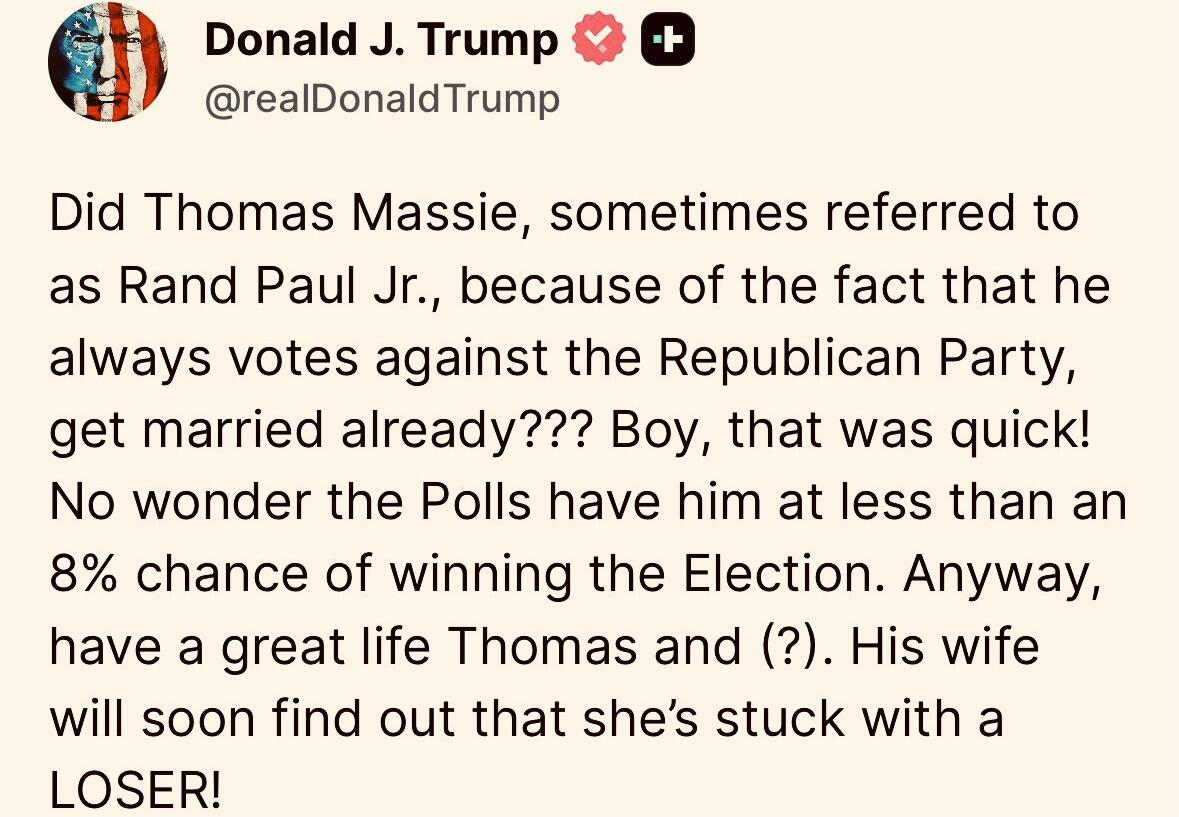
Not long after his Massie post, Trump dropped a nearly-300-word rant assailing “Wacky Marjorie,” and announcing he was withdrawing his “support and endorsement” of Greene. Trump claimed that Greene’s complaints about Trump’s policies spring from when Trump sent her a poll “stating that she should not run” for governor or the Senate, adding that he’s heard Greene is “upset that I don’t return her phone calls anymore.” The president said he stands ready to give the “right” Republican primary challenger of Greene his “Complete and Unyielding Support.”

Greene quickly fired back with a lengthy post of her own, saying, “President Trump just attacked me and lied about me. I haven’t called him at all.” She said that, earlier on Friday, she’d sent Trump text messages urging him to “lean into” the release of the Epstein files, telling him that Bill Clinton appeared on Epstein’s flight logs “like 26 times,” and that “Epstein was the spider that wove the web of the deep state.” Greene included screen shots of her text messages, and added:
“Of course he’s coming after me hard to make an example to scare all the other Republicans before next weeks vote to release the Epstein files. It’s astonishing really how hard he’s fighting to stop the Epstein files from coming out that he actually goes to this level. But really most Americans wish he would fight this hard to help the forgotten men and women of America who are fed up with foreign wars and foreign causes, are going broke trying to feed their families, and are losing hope of ever achieving the American dream. That’s what I voted for.
I have supported President Trump with too much of my precious time, too much of my own money, and fought harder for him even when almost all other Republicans turned their back and denounced him. But I don’t worship or serve Donald Trump. I worship God, Jesus is my savior, and I serve my district GA14 and the American people. I remain the same today as I’ve always been and I will continue to pray this administration will be successful because the American people desperately deserve what they voted for.”
In addition to her pursuit of the Epstein files in the face of Trump’s insistence that it’s all a Democrat
hoax,” Greene has become increasingly critical of the Republican Party’s performance on issues like the cost of living and government spending. Greene has become Congress’s most outspoken Republican critic of US support of Israel, repeatedly opposing additional aid to what she calls the “secular government of Israel,” accusing Israel of genocide in Gaza, and demanding that the American Israel Public Affairs Committee (AIPAC) register as a foreign agent.
With less-heated rhetoric, Massie has taken similar stances, which has made him a target of pro-Israel forces inside the United States. Earlier this year, the Trump team launched a political action committee solely focused on ousting Massie in next year’s GOP primary. As of its first disclosures in August, the PAC is funded exclusively by three non-Kentuckian billionaires who support the State of Israel: Miriam Adelson, Paul Singer and John Paulson. Last month, Trump endorsed a Lindsey Graham donor who’s running against Massie.
As you’d expect, Trump’s attacks on Massie and Greene prompted commentary aplenty on X, much of it coming from conservatives exasperated by Trump’s attacks on Massie, Greene and others who seem to best exemplify what the MAGA movement is supposed to be about…
END
Citizens will love this: democrats and republicans
(ZEROHEDGE)
“People Love It”: Trump Talking To Dems About ‘Direct Payment’ Health Care Plans
Monday, Nov 17, 2025 – 03:20 PM
President Donald Trump on Sunday said that he’s spoken with congressional Democrats about a plan to hand people cash that they can use to purchase their own health insurance.

“I’ve had personal talks with some Democrats,” Trump told reporters in West Palm Beach, FL before returning to DC, adding that he talked to the dems “about paying large amounts of dollars back to the people.“
Trump appears to be talking about a plan floated by Sen. Bill Cassidy (R-LA) – chairman of the Senate Health Education Labor and Pensions Committee, and Sen. Rick Scott (R-FL), who want to overhaul Obamacare by creating individual accounts that would direct money to people rather than insurance companies. Last week Trump told Fox News’ Laura Ingraham that he supports the idea.
“People love it,” Trump said of the idea. “The insurance companies are making a fortune. Their stock is up over a thousand percent over a short period of time. They are taking in hundreds of billions of dollars, and they’re not really putting it back, certainly not like they should.”
When asked about the idea, Trump told Ingraham that he wants “the money to go into an account for people where the people buy their own health insurance.”
“The insurance will be better. It’ll cost less. Everybody’s going to be happy. They’re going to feel like entrepreneurs,” he told the host, adding that the plan could be called “Trumpcare,” while slamming Obamacare over skyrocketing premiums in recent years.
Democrats made extending an enhanced ACA (Obamacare) credit central to their refusal to reopen the government earlier this month – refusing to go along with a short-term spending bill that didn’t include that priority until they ultimately caved after Senate Majority Leader John Thune promised them a December vote on the matter.
A group of eight Democrats then cut a deal with Republicans to reopen the government without winning a concession from the GOP to extend the subsidies.
Retiring Sen. Jeanne Shaheen (D-N.H.), one of the eight, has led negotiations between a group of 10-12 Republicans and Democrats, but many GOP senators say they are opposed to the premium subsidies. A Senate aide familiar with the negotiations told The Hill that roughly 20 Democratic offices have put out feelers on a potential deal to extend the subsidies. -The Hill
Will ‘Trumpcare’ render that moot?
VICTOR DAVIS HANSON
KING NEWS
| The King Report November 17, 2025 Issue 7621 | Independent View of the News |
| The FT: New York Fed convened meeting with Wall Street firms over key lending facility Impromptu talks come amid worries about strains in money markets “President Williams convened the New York Fed’s primary trading counterparties (primary dealers) to continue engagement on the purpose of the standing repo facility as a tool of monetary policy implementation and to solicit feedback that ensures it remains effective for rate control,” the spokesperson said… https://www.ft.com/content/395f92e2-85f2-45f7-b140-5ee9ac689bc3 The problem: Tri-party repo rates keep trading above interest rate on reserve balances (IORB). The tri-party repo rates have reached levels not seen since late 2019 and 2019 per NY Fed’s Perli. The usual suspects vehemently denied that there was stress in the money markets at the end of October. They averred the surge in rates was just month-end balance sheet squaring. (Like Lehman used to do?) Ex-Fed Governor Kugler Faced Ethics Probe Before Resignation In periodic financial disclosures during 2024, Kugler acknowledged that she had run afoul of Fed investment and trading rules when her spouse completed four purchases of shares of Apple Inc. and Cava Group Inc… (Kugler’s resignation allowed Trump to appoint his stooge Miran to the Fed Board.) https://finance.yahoo.com/news/ex-fed-governor-kugler-faced-143943538.html Stocks declined sharply early on Friday, led by Fangs again. However, as we warned, the usual suspects were determined to play for, or affect, The Friday Rally. The NY Fang+ Index hit its daily low of 15989.69 (-2.17%) at 9:33 ET. Manic buying propelled the index into positive territory at 10:45 ET. After a modest A-B-C retrenchment, the NY Fang+ Index rallied to +0.7% near the 11:30 ET European close. The index peaked (16470.68) at 12:13 ET. ESZs traded sideways, in a positive 12-handle range, from the Nikkei opening on Friday until they broke down near 23:18 ET. ESZs plodded lower but the decline accelerated at 6:04 ET. ESZs hit a daily low of 6670.50 (-89.50) at 9:31 ET. ESZs then zoomed to 6788.75 (+118.25 from low) at 11:40 ET. ESZs plodded to 6795.50 (+35.50) at 12:38 ET and rolled over. The ESZ afternoon rollover became an A-B-C decline to 6750.25 at 15:59 ET. An illegal very late manipulation forced ESZs to 6768.25 at 16:22 ET. Gasoline and oil soared due to Ukraine’s strikes on Russia’s Black Sea oil port and a Rosneft refinery. Reportedly, Trump commanded Ukraine to NOT strike Russian oil facilities to keep gasoline inflation in the US at bay. So, either Trump has changed his mind or Ukraine is now ignoring DJT. BBG: President Volodymyr Zelenskiy said Ukraine attacked Russian territory using long-range Neptune cruise missiles, calling it an “entirely just” response to Russia’s “ongoing terror.”… Ukraine’s General Staff said it struck Rosneft’s PJSC’s Saratov refinery in Russia’s Volga region… Russia’s massive attack on Kyiv kills 4, injures 29 – At least 430 drones and 18 missiles were used in the attack across the country, Ukrainian President Volodymyr Zelenskyy said… https://www.nbcnews.com/world/ukraine/russia-attacks-kyiv-fires-injuries-ongoing-strikes-reported-rcna243852 New foreclosures jump 20% in October, a sign of more distress in the housing market – CNBC Completed foreclosures, the final phase, were up 32% year over year. Florida, South Carolina and Illinois led the nation in state foreclosure filings. https://t.co/YIOwHUR7VW US apartment rents see steepest October decline in more than 15 years Elevated supply weighs down rent growth, Apartments.com report finds The national average rent fell to $1,708, a 0.3% decrease from September’s revised figure of $1,713. That marks the fourth consecutive month of no change or a negative change in monthly rent… https://www.costar.com/article/681003579/us-apartment-rents-see-steepest-october-decline-in-more-than-15-years @Barchart: Serious Credit Card Delinquencies (unpaid balances for at least 90 days) are at their highest level in 14 years https://t.co/hl1Fhzz1Af WSJ: He’s Been Right about AI for 40 Years – Now He Thinks Everyone Is Wrong. Yann Lecun invented many of modern fundamental component of AI. Now he’s convinced most in the field have been led astrain by the siren song of large language models. On Tuesday, news broke that he may soon be leaving Meta to pursue a startup focused on so-called world models, technology that LeCun thinks is more likely to advance the state of AI than Meta’s current language models…. LeCun… has been telling anyone who asks that he thinks large language models, or LLMs, are a dead end in the pursuit of computers that can truly outthink humans… “We are not going to get to human-level AI just by scaling LLMs… There’s no way, absolutely no way, and whatever you can hear from some of my more adventurous colleagues, it’s not going to happen within the next two years. There’s absolutely no way in hell.”… https://www.msn.com/en-us/news/technology/he-s-been-right-about-ai-for-40-years-now-he-thinks-everyone-is-wrong/ar-AA1QtEKt @PeterBerezinBCA: I published a report last week on five lessons from past capex booms. As the example of the railways illustrates, one lesson that stands out is that stock prices always peak before actual capex. This suggests that investors should not wait for evidence that AI capex has rolled over. By the time that evidence is apparent, AI stocks will have fallen considerably. https://x.com/PeterBerezinBCA/status/1989742711922991549 Positive aspects of previous session Precious metals declined sharply. Fangs hit bottom 3 minutes after the NYSE opening and rallied sharply. The NY Fang+ Index closed +0.24 points; the Naz 100 closed +14.78 points. Negative aspects of previous session Stocks got hammered on the NYSE opening, led by AI stocks, Fangs, and trading sardines. Oil, gasoline, and copper rallied soared. USZs were -22/32 at the NYSE close. Ambiguous aspects of previous session Cryptos got hammered again. First Hour/Last Hour Action [S&P 500 Index]: 1st Hour from NYSE Open: Up; Last Hour: Down Pivot Point for S&P 500 Index [above/below indicates daily trend to traders]: 6718.43 Previous session S&P 500 Index High/Low: 6774.31; 6646.87 Perceived WSJ Fed conduit @NickTimiraos: SF Fed study examines 150 years of U.S. tariffs and find that they lead to lower inflation and weaker aggregate demand (which raises unemployment) SF Fed: What Is a Tariff Shock? Insights from 150 years of Tariff Policy We find that a tariff hike raises unemployment (lowers economic activity) and lowers CPI inflation. Using only tariff changes driven by long-run considerations—a traditional narrative identification—gives similar results. We also obtain similar results if we restrict the sample to the modern post World War II period or if we use independent variation from other countries (France and the UK)… https://www.frbsf.org/wp-content/uploads/wp2025-26.pdf So, Fed official like Obama BFF Goolsbee, Williams, etc. did NOT take the time to research the effect of tariffs! They just ran their mouths. Their opinions were 180% wrong! It’s well past the time to reform the Fed and jettison most of the academics and replace them with real-world experienced people. Fed Gov. Stephen Miran’s Post-Neoliberal Economics The problem with the Fed isn’t wrong technique or bad data, he suggested, but rather that the very structure of its models is embedded in the economic and political assumptions of a bygone era… The overreliance on the Fed, Miran argues, meant that technocracy and politics became increasingly entangled… following the 2008-2009 financial crisis, writes Miran, the bank’s mandate “expanded to include inherently political activities such as credit allocation, the selection of economic winners and losers, and bank supervision.” The 2023 banking turmoil, for example, was not an isolated failure but the unintended result of reforms meant to fix the last one… For Miran, the de facto merger of the Fed and Treasury revealed the end of the old neoliberal order. The pretense of central bank independence has collapsed. Monetary policy is now politics conducted by other means… Miran’s striking proposal to democratize the Federal Reserve is not entirely out of left field… Demand for dollars is “insatiable,” Miran says, and “too strong for international flows to balance, even over five decades.”… (Miran is looking for an excuse to inflate or die. Gold and bonds are screaming that Miran is dead wrong about ‘insatiable’ dollar demand!) https://www.compactmag.com/article/stephen-mirans-post-neoliberal-economics/?s=02 CFPB Says It Will Run Out of Money Early Next Year: Dow Jones The U.S. Consumer Financial Protection Bureau said it would run out of funds in early 2026. The consumer finance watchdog created in the wake of the 2008 housing crisis has adopted a new interpretation of its funding statute, finding it must draw from profits of the Federal Reserve rather than the central bank’s revenue, according to a court filing Tuesday backed by a memo from the Justice Department’s Office of Legal Counsel. The Fed hasn’t been profitable since 2022, according to the memo… (No Fed profits, no funding; Fed toting hundreds of billions in losses on its holdings!) https://www.dowjones.com/business-intelligence/blog/cfpb-says-it-will-run-out-of-money-early-next-year/ Fox News: VP Vance addresses housing affordability in exclusive interview with @seanhannity: “A lot of young people are saying, ‘Housing is way too expensive.’ Why is that? Because we flooded the country with 30 million illegal immigrants who are taking houses that ought, by right, go to American citizens.” https://x.com/FoxNews/status/1989161737648554317 All SNAP Beneficiaries Will Need to Reapply for Benefits: Agriculture Secretary… as a result of ongoing fraud discoveries… the U.S. Department of Agriculture (USDA) discovered that nearly 200,000 deceased people across 29 states received benefits… More than 500,000 people were registered twice… the program experienced a 40 percent increase under the Biden Administration… 80 percent of people using the program were able to work and described SNAP as one of the “most corrupt, dysfunctional programs” in U.S. history… (No data on illegals immigrants getting SNAP) https://t.co/cAUHjOy6YQ The Schumer Shutdown revealed the SNAP abuses. Big ‘thank you’ to Chuckie! Ford CEO Jim Farley laments he can’t fill 5,000 mechanic jobs paying $120K per year: ‘We are in trouble in our country’ (When Americans get paid to NOT work…) https://nypost.com/2025/11/14/business/ford-ceo-jim-farley-says-he-cant-fill-5000-mechanic-jobs-paying-120k-per-year-we-are-in-trouble-in-our-country/ @GlobalMktObserv: US M2 money supply jumped +4.5% in September 2025 from the prior year to $22.2 TRILLION, an all-time high. This marks the 21st consecutive monthly increase. The long-term average growth in the US money supply has been +6.3%. (Affordability crisis & DJT wants rate cuts?) https://x.com/GlobalMktObserv/status/1990107942536782033 From Friday’s King Report: The NY Fang+ Index closed 12 handles above its 50-day moving average. A decisive break and close below the 50-DMA would be very bad. Today – The Big Game on Friday was to save Fangs by forcing the NY Fang+ Index back above its 50-day moving average after it fell 356 points below it. Late selling closed the NY Fang+ Index 1.02 points below its 50-day moving average (16345.68). Investors and traders will be desperate to keep their ginormous Fang holdings afloat. The game will be to force the NY Fang+ Index far enough above its 50-day moving average to dissuade momentum selling. Bitcoin sank on Saturday and rescinded its entire 35% YTD rally. It fell to 92935.50 at 18:05 ET on Sunday. Then, someone rescued it and drove it up to 94476.16. The Bitcoin intervention reversed a 15-handle ESZ loss and a 72-handle NQZ loss. This sparked more enthusiasm for The Monday Rally. ESAs are +18.75; NQZs are +127.75; Dec AU is -3.00; and USZs are -2/32 at 20:05 ET. Expected economic data: Nov Empire Mfg. 5.8 Fed Speakers: NY Pres Williams 9 ET, Minn Fed Pres Kashkari 13 ET S&P Index 50-day MA: 6704; 100-day MA: 6527; 150-day MA: 6278; 200-day MA: 6148 DJIA 50-day MA: 46,612; 100-day MA: 45,625; 150-day MA: 44,292; 200-day MA: 43,857 (Green is positive slope; Red is negative slope) S&P 500 Index (6734.11 close) – BBG trading model Trender and MACD for key time frames Monthly: Trender and MACD are positive – a close below 5687.33 triggers a sell signal Weekly: Trender and MACD are positive – a close below 6420.50 triggers a sell signal Daily: Trender and MACD are negative – a close above 6881.50 triggers a buy signal Hourly: Trender is positive; MACD is negative – a close below 6714.00 triggers a sell signal Justice Department officials tied to special counsel Jack Smith’s team have been linked to the blocking of an FBI inquiry into the Clinton campaign’s 2016 funding of the Steele Dossier… https://justthenews.com/government/courts-law/jack-smith-team-tied-blocking-clinton-campaign-inquiry-trump-doj-builds-grand Trump: “Now that the Democrats are using the Epstein Hoax, involving Democrats, not Republicans, to try and deflect from their disastrous SHUTDOWN, and all of their other failures, I will be asking A.G. Pam Bondi, and the Department of Justice, together with our great patriots at the FBI, to investigate Jeffrey Epstein’s involvement and relationship with Bill Clinton, Larry Summers, Reid Hoffman, J.P. Morgan, Chase, and many other people and institutions… Records show that these men, and many others, spent large portions of their life with Epstein, and on his “Island.” @libsoftiktok: The official Democrats account just deleted this because it was a totally made-up lie (That Trump spent Thanksgiving with Epstein in 2017) https://x.com/libsoftiktok/status/1989118129642041585 @joma_gc: According to explosive new reporting from The Washington Post, Democrat Rep. Stacey Plaskett of the U.S. Virgin Islands was texting and coordinating her questioning of Michael Cohen with convicted sex offender Jeffrey Epstein during a 2019 congressional hearing… House Democrat exchanged texts with Epstein during 2019 congressional hearing Stacey Plaskett, a Democrat who represents the US Virgin Islands in Congress as a non-voting delegate, exchanged texts with convicted sex offender Jeffrey Epstein during a 2019 congressional hearing… https://www.cnn.com/2025/11/14/politics/epstein-texts-stacey-plaskett How Jeffrey Epstein Helped a Rising Democratic Star Pull Off a Political Upset (6/22/23) Democrat Stacey Plaskett says she didn’t solicit Epstein for donations. Emails tell a different story. https://freebeacon.com/democrats/how-jeffrey-epstein-helped-a-rising-democratic-star-pull-off-a-political-upset/ Convicted predator Ghislaine Maxwell is being waited on “hand and foot” at a cushy minimum-security prison, according to a whistleblower. That’s not sitting well with prison staff or the public who say Trump should draw a hard line: no special treatment, commutation or pardon. https://t.co/fFkUjL622C Trump has declared war on GOP Reps that want to release the Epstein Files; he called MT Greene ‘a lunatic.’ DJT has ignited a civil war among his supporters: “America First” or “Trump uber alles!” GOP Rep. Marjorie Taylor Greene @mtgreenee: I never thought that fighting to release the Epstein files, defending women who were victims of rape, and fighting to expose the web of rich powerful elites would have caused this, but here we are. And it truly speaks for itself… The way forward is America First America Only. And that may be the most dangerous pursuit of all. This and the Epstein files is why I’m being attacked by President Trump. It really makes you wonder what is in those files and who and what country is putting so much pressure on him? I forgive him and I will pray for him to return to his original MAGA promises. @TheCalvinCooli1: Majorie Taylor Green is saying her life is now in danger because of President Trump: “I am now being contacted by private security firms with warnings for my safety as a hot bed of threats against me are being fueled and egged on by the most powerful man in the world. The man I supported and helped get elected. Aggressive rhetoric attacking me has historically led to death threats and multiple convictions of men who were radicalized by the same type rhetoric being directed at me right now. This time by the President of the United States” Gop Rep that DJT despises @RepThomasMassie on Sat: Next week could be big for survivors of Epstein’s sex trafficking scheme. We are forcing a recorded vote in the House on releasing the Epstein files. @realDonaldTrump & @SpeakerJohnson can still be on the right side by encouraging a YEA vote. @LizCrokin: Jeffrey Epstein Sent His Lawyer A “High Importance” E-mail About Pizzagate! Jeffrey Epstein sent his lawyer an e-mail noted as “high importance” in late 2016 stating Hillary and Bill Clinton’s relationship with Epstein had “the greatest bearing on Pizzagate” referencing an article in the Guardian. Epstein considered Pizzagate “high importance” and e-mailed his lawyer about it. Epstein & the Clinton’s ARE Pizzagate and it’s always been real! Even freaking Epstein knew that which is why he nor anyone has even sent me so much as a legal letter over my nonstop reporting on Pizzagate over the past 10 years. https://x.com/LizCrokin/status/1989854250881499250 What the hell is Pizzagate? – It all started in early November 2016, when Clinton campaign manager John Podesta’s email was hacked and the messages were published by Wikileaks. One of the emails, according to The New York Times, was between Podesta and James Alefantis, the owner of D.C. pizzeria Comet Ping Pong. The message discussed Alefantis hosting a possible fundraiser for Clinton. Users of the website 4Chan began speculating about the links between Comet Ping Pong and the Democratic Party, according to the BBC, with one particularly vile connection burbling to the surface: the pizzeria is the headquarters of a child trafficking ring led by Clinton and Podesta… https://www.esquire.com/news-politics/news/a51268/what-is-pizzagate/ Why MAGA is Right about Jeffrey Epstein – Tina Brown, lex-Vanity Fair, and Daily Beast Editor They deserve an answer about why the full folder has not been released. I have never fully believed that Epstein committed suicide and my skepticism grows the more the mysteries accumulate… Sarnoff dug through the Palm Beach police files and was stunned to learn that the department had identified as many as three dozen underage girls who had been trafficked for sex by Jeffrey Epstein, the youngest imported from the Balkans at age fourteen… After we ran Sarnoff’s first piece in July 2010, Epstein called me personally to tell me that “she was a well-known nut case and to cease and desist.”… I had a creepy encounter with Epstein a few weeks later. I returned from lunch and was startled to find him sitting in a chair in my glass-walled office in Manhattan’s IAC building… He was morose and menacing, his snake eyes narrowed. “Just stop,” he said heavily as I stared at him from the doorway. “There will be consequences if you don’t.”… An active FBI agent told Sarnoff, who relayed it to me at the time, “Epstein will never make it to trial. There are towels on the inside.” Five weeks later, he was dead, hanging from a knotted noose of towels inside his cell at the Metropolitan Correctional Center… Conchita Sarnoff reminded me that there have been five fatalities, counting Epstein’s death, all associated with his case and the sad, sordid world that swirled around him… https://tinabrown.substack.com/p/why-maga-is-right-about-jeffrey-epstein NYT: Tina Brown Thinks the Über-Rich Have It Coming One of the stories in that series was headlined “Epstein’s Society Friends Close Ranks.” Someone in the piece said: “A jail sentence doesn’t matter anymore,” and “The only thing that gets you shunned in New York society is poverty.” Just incredibly callous. It is true. I was invited to a dinner after he had been convicted. A publicist called me in the office at The Daily Beast and she said, “Tina, I want you to come to this great dinner at Jeffrey Epstein’s house, and the other guests are Charlie Rose, Woody Allen and Prince Andrew.” Lloyd Grove, who was a journalist at The Beast, reminds me whenever I see him that I yelled into the phone: “What the hell is this — the Predator’s Ball?” I was outraged that she hadn’t seemed to have read our pieces. I said: “I’ve printed pieces about this guy. No, thank you very much. I decline. I don’t want to have dinner at Jeffrey Epstein’s house.”… https://www.nytimes.com/2025/11/15/magazine/tina-brown-interview.html General Mike Flynn (@GenFlynn): The Epstein Affair is not going away. It is about the abuse of children by an “elite” social class of people who have always believed they are untouchable… Just the News: Dem Rep. Eric Swalwell (CA) referred to the Justice Department for investigation over allegations of mortgage and tax fraud https://justthenews.com/government/courts-law/trump-admin-housing-official-refers-swalwell-investigation-over-mortgage Tucker Exposes Trump Would-Be Assassin Thomas Crooks’ Social Media History, the FBI Coverup, and More Strangeness – “It turns out that Crooks was hardly an online ghost,” Carlson reports. “And yet, federal investigators lied and told us there was no trace of him online.”… “Why is the FBI keeping Crooks’ views a secret?” asks Carlson, adding “Why are they ignoring Congressional subpoenas to divulge information?” “So here you have a volatile, troubled, possibly mentally ill young man with a long record of espousing violence in public,” Carlson continues. “The FBI clearly knew he existed. And then you have at the very end of his years commenting in public, espousing violence, an exchange with a mysterious figure affiliated with a group that we know is being monitored by the US State Department.”… Crooks’ body was cremated on orders from the FBI the same day the House Homeland Security and Oversight Committee began their investigation… Photos from the day after the shooting “show an FBI agent hosing down the site where Crooks died,”… https://www.zerohedge.com/political/tucker-reveals-trump-attempted-assassin-thomas-crooks-social-media-history-fbi-coverup Food Stamps and the Federal War on Self-Reliance In 1969, President Richard Nixon was sharply expanding US bombing of southeast Asia. Nixon sought to bolster his humanitarian image by vastly increasing federal food handouts. He held a White House Summit and received glowing press coverage for proclaiming, “The moment is at hand to put an end to hunger in America itself for all time.” That year, 3 million Americans received food stamps, a burgeoning federal program that cost $228 million. Last year, the program cost $100 billion… At the end of the Clinton era, 17 million Americans received food stamps—a sharp decline from the 28 million recipients in 1994. A 1996 welfare reform act was decisive in curbing dependency. However, President George W. Bush took office in 2001 and sought to vigorously expand food stamp enrollment as part of his “compassionate conservatism” sideshow to his war on terrorism atrocities. As long as more than 40 million people depend on food stamps, politicians can exploit push-button hysteria to claim that any interruption in their spending or power will result in vast suffering and (hint, hint) starvation, especially of children and minorities and women… https://mises.org/mises-wire/food-stamps-and-federal-war-self-reliance DOJ orders lawyers to report judicial ‘obstacles’ in immigration, Antifa cases https://t.co/LNr3VmeO5o @CollinRugg: Psychotherapist Jonathan Alpert says that 75% of the patients he sees have a deep hatred for Trump and are “hyper fixated” on him. “They can’t sleep, they feel traumatized by Mr. Trump.” “I had one patient who said she couldn’t enjoy a vacation because anytime she saw Trump in the news or on her device, she felt triggered.” “This is a profound pathology, and I would even go so far as to call it the defining pathology of our time.” https://x.com/CollinRugg/status/1989389448434573525 @libsoftiktok: UNREAL. Massachusetts Governor Maura Healey (D) appointed Giselle Byrd, a man pretending to be a woman, to the ‘Massachusetts Commission on the Status of Women’ which advises on policy to improve opportunities for women. You cannot make this up! https://x.com/libsoftiktok/status/1989858663746445670 Carol M. Swain, PhD @carolmswain: Liberal women have allowed men to erase their biological identity and reverse their historic gains. The joke is on the feminist movement. @thestustustudio: “I Ain’t From F*cking Here”: Chicago Alderman Rejects “American Sh*t,” Says Ignoring Black Women Led to Trump — Calls for Street Confrontation at the National Alliance Against Racist & Political Repression conference, Chicago Alderman Jeanette B. Taylor delivered a fiery speech rejecting her American identity and urging confrontation in the streets. “I don’t know where they get that American sh*t from. I’m from the continent of Africa… I ain’t from f**king here.” She dismissed concerns about “that dimwitted dictator in DC,” and instead focused on “making sure the people in our communities are protected.” Taylor then framed Trump’s political success as a consequence of ignoring Black women. “This is what happens when you don’t listen to black women… We showed up, Black women showed up. So forgive me if I’m motherf*cking tired and I don’t want to hear it.” And she openly encouraged violence in the streets, though she admitted she wouldn’t join in herself due to her bad knees. “If you know anything about Chicago, we’re all for a good ass whooping… I ain’t going to brawl for you… but I will cuss their ass out.” As a member of the Democratic Socialists of America, Taylor’s remarks reflect a familiar pattern: stoking resentment and blaming everyone else, rather than showing the leadership her constituents deserve. https://x.com/thestustustudio/status/1990086013838876896 As we keep harping, leftists’ calls for violence and their violent acts will continue until they experience negative consequences for their heinous behavior. Liberal privilege for decades is the cause. Mamdani taps ‘Defund the Police’ champion to head team steering his transition to NYC mayor https://trib.al/yWc1G9e @barnes_law: The US, for the first time in modern history, said it supports Palestinian statehood. US Mission to UN: Joint Statement on the UN Security Council Resolution on Gaza We are issuing this statement as the Member States that gathered during High-Level Week to begin this process, which offers a pathway to Palestinian self-determination and statehood. We emphasize that this is a sincere effort, and the Plan provides a viable path towards peace and stability, not only between the Israelis and the Palestinians, but for the entire region… https://usun.usmission.gov/joint-statement-on-the-un-security-council-resolution-on-gaza/ Democratic Rep. Brad Sherman denies looking at porn on flight, blames X algorithm for salacious pics on iPad – Sherman spoke out after a fellow passenger snapped pictures of the California congressman, showing him ogling salacious images at full brightness of women wearing nothing but their bras and underwear… https://t.co/eMCqnSUjTC Thousands take to the streets in Mexico City for ‘Gen Z’ protests crime and corruption https://t.co/Z34lZ6LKTR @WallStreetApes: The Mexico City protests are happening because their President Claudia Sheinbaum works for the Cartel. A Senator from Mexico went on Fox News and exposed it all – The President of Mexico works for the Cartels – She was funded by money from the cartels… – It’s not just the Pres… there are an entire group of Mexico politicians labeled the “narco politicians” – Mexico is a “Narco state” – Mexicans are afraid of the alliance between the Mexican government and the cartels – The Morena (political party) is financed by the cartels, that’s how they get elected – Once they get elected the deal is for the Mexican government to then protect the cartels – The President of Mexico Claudia Sheinbaum Pardo doesn’t want this information getting out – Mexicans and the Politicians who are not paid by the cartels want Trump to help with the cartels The Mexico Senator exposing all this says she is now being threatened with prison for speaking out “The President has threatened me to proceed against me with criminal prosecution to get me out of the Senate and get me in jail just because I told you in this space in Fox News” And now the assassination of Uruapan Mayor Carlos Manzo, an own cartel critic… The cartel runs the Mexican government @JackPosobiec: This is the Sex and the City effect. High school girls wanting to get married has plummeted from 83% to 61% in just 30 years. https://x.com/JackPosobiec/status/1990094513486913553 Jets cornerback Kris Boyd in critical condition after NYC shooting The shooting took place on West 38th Street near Seventh Avenue shortly after 2 a.m… Boyd was shot in the abdomen outside Sei Less restaurant after a dispute turned violent, with the gunmen firing two shots, law enforcement sources told The Post… https://nypost.com/2025/11/16/sports/jets-cornerback-kris-boyd-in-critical-condition-after-shooting-outside-nyc-club/ | |
SWAMP STORIES FOR YOU TONIGHT
The Socialist Mayor Clown Show Is Truly Something To Behold
Saturday, Nov 15, 2025 – 09:35 PM
The progressive left never admits they are wrong and they always double down on failure. This is the mindset that continues to lead Democrats down a path of self destruction along with the cities they inhabit. One cannot separate the ongoing decline of US cities from far-left policies; one precipitates the other.
The implosion of Joe Biden’s faux presidency and the defeat of the Kamala Harris campaign left Democrats reeling and searching for answers, but it didn’t take long for them to dismiss the idea of self reflection and come to the predictably insane conclusion they are right and everyone else is the enemy.
The answer, they argue, is not to abandon their radical ideology and find their way back to common sense. Rather, they believe that they lost the elections because their candidates were “not extreme enough.”
But what could possibly be more extreme than Biden’s mass online censorship campaign? His calls for pandemic vaccine passports for Americans to keep their jobs? His implementation of DEI and CRT programs across the federal government and the US military? His consistent denials over the stagflation crisis? When he declared Easter Sunday as “Transgender Day of Visibility?” What about the topless LGBT parties on the White House Lawn?
How much worse can a political leader get? Well, we’re about to find out.

Democrats in cities like Chicago, New York and now Seattle have decided to replace their bumbling leftist mayors with more openly socialist mayors and the trend is likely to grow. This seems to be a calculated reformation of the Democrat base around increasingly more militant Marxist policies, using blue cities as a “proving ground.”
It makes sense when one considers how freely groups like Antifa and anti-ICE are able to operate, with clear coordination between radicals and the local government. These are places where activists feel most safe and comfortable because they are protected by resident politicians and police. Blue cities are becoming experimental playgrounds for color revolution and socialist policies that would never be allowed anywhere else.
They see these cities as toys to be played with. The problem is, their initiatives are falling apart before they get into office and conservatives haven’t had to lift a finger.
For example, Zohran Mamdani’s campaign promises are drying up on the vine like grapes in the desert sun. His supporters are now realizing that his 4-year rent freeze policy faces serious obstacles, with the new mayor relying on full support from the Rent Guidelines Board (RGB) appointed by Mayor Adams (which he is unlikely to get until a new board is appointed). The reality is, a rent freeze would result in an immediate selloff of rental properties and landlord flight from NYC, meaning, there will be an even worse housing shortage.
Mamdani also got word from Governor Kathy Hochul that she will not be backing his fare free bus service concept, nor will she support his universal childcare program. In other words, Mamdani doesn’t have the authority to fulfill his campaign promises.
Furthermore, if the “Democratic socialist” gets approval from all parties involved he still has to deal with Trump’s inevitable cuts to to federal dollars. NYC gets around $10 billion in direct federal aid and over $100 billion in federal funding through a variety of avenues. Even with all that cash, the city is still in the hole and desperate for relief after the Democrats disastrous migrant housing programs which crippled their subsidies for the homeless.
The loss of a mere $10 billion could cause chaos for NYC’s budget concerns and all of Mamdani’s projects require an increasing budget, not a falling budget.
Recently elected mayor of Seattle, Katie Wilson, is causing a stir as well with her socialist rhetoric. Her notions come off as unpracticed or poorly thought-out and one wonders if Democrats will feel any buyers remorse. Seattle was already in steep decline due to wealth taxation, which has driven numerous companies out of the area along with thousands of jobs and revenues.
Wilson’s utopian wish list is facing a hard reality check and she hasn’t clocked in on the job yet. For example, she believes she has the power to prevent grocery chains from leaving the city and creating “food deserts”. It’s a problem that has been accelerating in blue cities across he country largely due to lax law enforcement policies and low criminal prosecution. Property theft continues to explode and businesses in leftist towns cannot survive, so they do the smart thing and leave.
Critics have lambasted Wilson as a child-brained imbecile, citing basic private property rights and her lack of authority to issue an exit tax without considerable state and local support. Again, socialist candidate make promises they cannot keep. This might get them elected, but their time in office immediately becomes a clown show, proving conservatives were right all along.
END
GREG HUNTER INTERVIEWING MARTIN ARMSTRONG
Ukraine Peace Deal or Get the Hell Out of NATO – Martin Armstrong
By Greg Hunter On November 15, 2025 In Market Analysis, Political Analysis6 Comments
By Greg Hunter’s USAWatchdog.com (Saturday Night Post)
A little less than a month ago, legendary financial and geopolitical cycle analyst Martin Armstrong was called in by the Trump White House to come up with a peace plan that Vladimir Putin and Russia would consider. So, Armstrong came up with a nearly 200-page plan called “Peace Proposal to Prevent World War III.” Top Trump officials met with Armstrong Friday, and there is still a possibility the US could get a peace deal. Recently, Trump gave Hungary an exemption to buying sanctioned Russian oil. Armstrong says, “This is a positive sign.” The Russians signaled that they are also still interested in “Trump-backed peace talks with Ukraine.” If Europe, NATO and Ukraine won’t go along, then Armstrong is advising President Trump to “get the hell out of NATO.” Armstrong says, “The fact that they called me back is interesting. I warned them that we should threaten Europe that they either honor the Minsk Agreement or we exit NATO. At least the people I was speaking to said, ‘We agree we should get the hell out of NATO.’ It is a neocon retirement home. Their only purpose in life is war. If there is peace, people are going to cut their budgets and not use the weapons. As long as they can say Putin is going to invade Europe, then they will say we need 5% of your GDP—5%. They are going to be like Zelensky stashing billions of dollars off to the side someplace. It is really quite disgusting.”
Armstrong says if the US sidesteps the NATO, Ukraine, Russian war, there is still going to be war just about everywhere. Armstrong says, “I have never been able to beat my computer (Socrates). The computer is forecasting, basically, World War III. This is not simply like Hitler invading Poland. This is everywhere around the world. You’ve got Iran vs Israel and Pakistan will nuke Israel if Israel attacks Iran. You’ve got Pakistan vs India . . . Taiwan and China, South Korea vs North Korea and Japan (on the side of South Korea). Then, we go to Europe and Ukraine. When the computer is forecasting world war, it’s not just one place. . .. The US just sold jets to Greece, and they say now we can attack Turkey, which both are in NATO. War is coming to everyplace where one country has a grudge against another.”
Armstrong has long predicted Europe will get into a war with Russia and lose badly. Armstrong says, “Europe is going into depression. In the United States, we are going into recession and stagflation into 2028. . .. I have major clients in Europe, and I warned them and they started moving their gold from London and Zurich to the United States. Why? Because Europe is going to do capital controls. They will probably outlaw Bitcoin. They will most likely stop people from buying gold. . .. The capital will basically come here to America. . .. We are in a global sovereign debt crisis, and the US is the best place to be.”
Armstrong contends if Trump sidesteps the Russia/Ukraine/NATO war, America will do much better than Europe and better than most, if not all, of the rest of world. Armstrong is still seeing a huge trend for civil unrest at the same time the rest of the world goes to war. Armstrong is a buyer of gold and silver and NOT a seller of either metal. Armstrong also says, “New York City and California are both done . . .. and the new financial capital of America is already relocating in Florida.”
There is much more in the 66-minute wide-ranging interview.
There is an 8-minute video to explain how easy it is to ride out any terror attack or extreme storm. You can get more information on Starlink at Starlink123.com and Sat Phones at Sat123.com and BeReady123.com. You can also call 855-980-5830 and talk to a real human. Same goes for EscapeZone.com. where you can get Faraday bags big and small. You can also talk to a real human at EscapeZone.com by calling 702-825-0005.
Join Greg Hunter of USAWatchdog as he goes One-on-One with Martin Armstrong to talk about his upcoming World Economic Conference. Armstrong will also update us on a “Peace Proposal to Prevent World War III” for 11.15.25.
(Click here to Donate to USAWatchdog.)
After the Interview:
There is free information, analysis and articles on ArmstrongEconomics.com.
Click here for a free download of “Peace Proposal to Prevent World War III.”
You can also buy tickets to the upcoming 2025 World Economic Conference (WEC) in Orlando, Florida. Armstrong will be releasing brand new data on a wide variety of subjects. The dates for the conference are November 21, 22 and 23. Click here for tickets. There is also streaming for the WEC three-day event.
SEE YOU TOMORROW


 harveyorganblog.com


