
ACCESS MARKET
GOLD $4946.00 3:30 PM)
SILVER: 87.50 3;30 PM)
XXXXXXXXXXXXXXXXXXXXXXXXXXXXXXXXXXXXXXXXXXXXXXXXXX
EXCHANGE: COMEX
EXCHANGE: COMEX
CONTRACT: FEBRUARY 2026 COMEX 100 GOLD FUTURES
SETTLEMENT: 4,903.700000000 USD
INTENT DATE: 02/03/2026 DELIVERY DATE: 02/05/2026
FIRM ORG FIRM NAME ISSUED STOPPED
072 C GOLDMAN 9
099 H DEUTSCHE BANK AG 4
118 C MACQUARIE FUTURES US 20
190 H BMO CAPITAL MARKETS 197
323 C HSBC 2
363 C WELLS FARGO SECURITI 82
363 H WELLS FARGO SECURITI 60
555 H BNP PARIBAS SEC CORP 69
657 C MORGAN STANLEY 32
661 C JP MORGAN SECURITIES 443
690 C ABN AMRO CLR USA LLC 14
709 C BARCLAYS 127 14
730 C PTG DIVISION OF SGAS 870
880 H CITIGROUP 358
905 C ADM 5
TOTAL: 1,153 1,153
MONTH TO DATE: 29,312
JPMORGAN STOPPED 443/1153
GOLD: NUMBER OF NOTICES FILED FOR FEBRUARY/2026: 1153 CONTRACTs NOTICES FOR 115,300 OZ or 3.5863 TONNES
total notices so far: 29,312 contracts for 2,951,200 OR 91.172 tonnes)
SILVER NOTICES: 190 NOTICE(S) FILED FOR 0.950 MILLION OZ OZ/
total number of notices filed so far this month : 2955 CONTRACTS (NOTICES) for 14.775 million oz
SILVER//OUTLINE
INITIAL STANDING FOR JANUARY: 22.915 MILLION OZ FOLLOWED BY TODAY’S 1.185 MILLION OZ QUEUE JUMP//NEW NORMAL STANDING ADVANCES TO 49.445 MILLION OZ// TO WHICH WE ADD OUR FIRST EXCHANGE FOR RISK FOR .100 MILLION OZ//NEW STANDING ADVANCES TO 49.545 MILLION OZ!!
INTIAL STANDING FOR FEBRUARY/SILVER: 13.505 MILLION OZ FOLLOWED BY TODAY’S 2.680 MILLION OZ QUEUE JUMP//NEW STANDING FOR SILVER AT THE COMEXADVANCES TO 19.080 MILLION OZ
JULY: 50.925 MILLION OZ (QUITE SMALL)
AUGUST: 59.455 MILLION OZ (QUITE SMALL)
SEPT. 50.510 MILLION OZ.(QUITE SMALL)
OCT; 82.020 MILLION OZ (WILL BE STRONG THIS MONTH)/ OCC WANTS TO REIN IN THESE ISSUANCES!
NOVEMBER: 36.425 MILLION OZ
DEC: 45.765 MILLION OZ
JANUARY 2026: 134.270 MILLION OZ (WILL BE A VERY STRONG MONTH FOR EXCHANGE FOR PHYSICAL!)
FEB : 16.570 MILLION OZ
AND JULY: 46.720 MILLION OZ//
AUGUST: 4.70 MILLION OZ INITIAL STANDING PLUS TODAY;S 5,000 OZ QUEUE JUMP //NEW STANDING ADVANCES TO 10.960 MILLION OZ
SEPTEMBER: 68.040 MILLION OZ NORMAL DELIVERY(INCLUDES ALL QUEUE JUMPING AND EXCHANGE FOR PHYSICAL TRANSFERS) PLUS 3.0 MILLION OZ EX FOR RISK = 71.040 MILLION OZ. (THIS IS THE FIRST AND ONLY ISSUANCE OF EXCHANGE FOR RISK FOR SILVER SINCE MAY.)
OCTOBER: 39.565 MILLION OZ OF NORMAL DELIVERY INCLUDES ALL QUEUE JUMPING
PLUS
2.110 MILLION OZ EXCHANGE FOR RISK//TOTAL OZ STANDING IN OCT ADVANCES TO 41.675 MILLION OZ
NOVEMBER: INITIAL STANDING AT 11.575 MILLION OZ FOLLOWED BY TODAY’S 195,000 OZ QUEUE JUMP WHICH FOLLOWS ALL OTHER QUEUE JUMPS OF 9.155 MILLION OZ//STANDING ADVANCES TO 19.670 MILLION OZ/
DECEMBER: INITIAL AMOUNT STANDING FOR DELIVERY: 49.33 MILLION OZ// FOLLOWED BY ANOTHER STRONG 835,000OZ QUEUE JUMP+ DEC. FIRST EXCHANGE FOR RISK 0F .850 MILLION OZ + LAST WEEK.S 495,000 OZ EXCHANGE FOR RISK AND THEN A 3RD ISSUANCE IF 1.00MILLION OZ THEN FINALLY DEC 249ISSUANCE OF 1.35 MILLION OZ EXCHANGE FOR RISK//NEW TOTAL EX FOR RIS IS 3.685 MILLION OZ // STANDING ADVANCES TO 68.415 MILLION OZ//
JANUARY: INITIAL STANDING 22.915 MILLION OZ FOLLOWED BY TODAY’S 1.185 MILLION OZ QUEUE JUMP//NORMAL STANDING ADVANCES TO 49.445 MILLION OZ// TO WHICH WE ADD OUR FIRST EXCHANGE FOR RISK OF 0.100 MILLLION OZ//NEW STANDING ADVANCES TO 49.545 MILLION OZ
FEB: 13.399 MILLION OZ IS OUR INITIAL STANDING FOR SILVER! TO WHICH WE ADD OUR NEXT QUEUE JUMP OF 2.680 MILLION OZ//NEW STANDING ADVANCES TO 19.080 MILLION OZ
- MAY: SUMMARY FOR MAY TONNES WHICH STOOD FOR DELIVERY:
4. AUGUST: 60.547 TONNES OF INITIAL GOLD FIRST DAY NOTICE FOLLOWED BY THE NET MONTH’S QUEUE JUMP OF 47.2312 TONNES TO WHICH WE ADD THE FOLLOWING EXCHANGE FOR RISK ISSUANCE RECEIVED FOR THE MONTH: 5.4432 TONNES EX FOR RISK/AUG 7 , AUG 11: 2.413 TONNES EX FOR RISK AND AUG. 12 OF 2.637 TONNES EX FOR RISK//AUG 25: 9.107 TONNES , AUGUST 26: 9.1010 TONNES AND NOW AUGUST 27: 9.0699 TONNES//NEW STANDING ADVANCES TO 107.5117 TONNES OF GOLD NORMAL STANDING (INCLUDES ALL MONTHLY QUEUE JUMPS/EX FOR PHYSICAL TRANSFERS//) +44.696 TONNES EX.FOR RISK = 152.208 TONNES
5.SEPT: INITIAL 8.093 TONNES OF GOLD PLUS TODAY’S QUEUE JUMP OF 0.4883 TONNES PLUS 2.2827 TONNES OF EXCHANGE FOR RISK TODAY//NEW TOTAL EX. FOR RISK/MONTH = 22.923//NEW TOTAL STANDING FOR GOLD SEPT ADVANCES TO = 48.801 TONNES!!
6.OCTOBER: 90.012 TONNES OF INITIAL GOLD STANDING WITH TODAY’S TINY 0.00311 TONNES QUEUE JUMP WHICH FOLLOWS ALL OTHER QUEUE JUMPS DURING OCT OF 76.1656 TONNES
THEN WE MUST ADD OUR 14.553 TONNES OF OUR ISSUANCE OF EXCHANGE FOR RISK/6 OCCASIONS//NEW TOTAL OF GOLD STANDING ADVANCES TO 197.5141 TONNES OF GOLD.
7.NOVEMBER BEGINS WITH 15.651 TONNES INITIALLY STANDING FOR DELIVERY FOLLOWED BY TODAY’S QUEUE JUMP OF 2.323 TONNES FOLLOWED BY ALL PREVIOUS QUEUE JUMPS IN OF OF 21.3775 TONNES TO WHICH WE ADD OUR TWO EXCHANGE FOR RISK ISSUANCE OF 4.5596 TONNES//NEW STANDING ADVANCES TO 43.9716 TONNES OF GOLD.
8. DECEMBER BEGINS WITH INITIAL STANDING OF 83.813 TONNES OF GOLD FOLLOWED BY TODAY’S 0.0TONNE QUEUE JUMP WHICH FOLLOWS ALL OTHER QUEUE JUMPS OF: 37.163 TONNES//NEW STANDING ADVANCES TO 115.390 TONNES TO WHICH WE ADD OUR 4 EXCHANGE FOR RISK FOR DECEMBER OF 6.587 TONNES/NEW STANDING ADVANCES TO 121.977 TONNES
9. JANUARY: INITITAL STANDING: 13.785 TONNES TO WHICH WE ADD OUR QUEUE JUMP OF 0.000 TONNES WHICH FOLLOWS ALL OTHER QUEUE JUMPS OF 30.7117TONNES //NEW TOTAL QUEUE JUMPS 30.7117//NORMAL DELIVERY OF GOLD ADVANCES TO 36.8958 TONNES TO WHICH WE ADD OUR SIX EXCHANGE FOR RISK OF 22.315 TONNES//NEW STANDING ADVANCES TO 59.2108 TONNES.
FEB; INITIAL AMOUNT OF GOLD STANDING FOR DELIVERY: 93.567 TONNES OF GOLD TO WHICH WE ADD OUR NEXT QUEUE JUMP OF 0.7651 TONNES TO OTHER OF 9.805 TONNES/ NEW QUEUE JUMP TOTAL: 10.5701 TONNES//NEW STANDING ADVANCES TO 104.762 TONNES
FINAL STANDING FOR GOLD, JANUARY CONTRACT AT 59.2108 TONNES OF GOLD
AND NOW FEBRUARY: INITIAL STANDING FOR GOLD: 104.162 TONNES!!
JAN. 2025: 257.919 TONNES (ISSUANCE WILL BE PRETTY GOOD THIS MONTH BUT MUCH LOWER THAN LAST MONTH)
FEB: 207.21 TONNES//EX FOR PHYSICAL ISSUANCE (WILL BE A FAIR SIZED ISSUANCE THIS MONTH)
MARCH 130.84 TONNES//QUITE SMALL THIS MONTH.
APRIL; 208.57 TONNES. STRONG THIS MONTH
MAY: 113.499 TONNES OF GOLD EFP ISSUANCE//QUITE SMALL THIS MONTH
JUNE: 97.79 TONNES OF GOLD EFP ISSUANCE/EXTREMELY SMALL
JULY : 150.877 TONNES// QUITE SMALL
AUGUST: 175.86 TONNES A LOT LARGER THIS MONTH.
SEPT. 116.13 TONNES VERY SMALL
OCT. 252.72 TONNES//CERTAINLY MUCH LARGER THIS MONTH/VERY STRONG
NOV: 124.74 TONNES
DEC: 190.04 TONNES//GOOD SIZED THIS MONTH FINAL.
TOTAL EXCHANGE FOR PHYSICAL ISSUED FOR YEAR 2025: 2,026.20 TONNES (LOWER THAN LAST YR 2,569.00 TONNES
JANUARY: 209.08 TONNES (WILL BE A STRONG MONTH FOR EXCHANGE FOR PHYSICAL)
FEB. 46.342 TONNES (WHICH WILL BE ANOTHER STRONG)
SPREADING LIQUIDATION HAS NOW COMMENCED AS WE HEAD TOWARDS THE NEW ACTIVE FRONT MONTH OF OCT. WE ARE NOW INTO THE SPREADING OPERATION OF GOLD
HERE IS A BRIEF SYNOPSIS OF HOW THE CROOKS FLEECE UNSUSPECTING LONGS IN THE SPREADING ENDEAVOUR ;MODUS OPERANDI OF THE CORRUPT BANKERS AS TO HOW THEY HANDLE THEIR SPREAD OPEN INTERESTS:HERE IS HOW THE CROOKS USED SPREADING AS WE ARE NOW INTO THE NON ACTIVE DELIVERY MONTH OF NOV HEADING TOWARDS THE ACTIVE DELIVERY MONTH OF FEB., FOR GOLD: AND MARCH FOR SILVER
YOU WILL ALSO NOTICE THAT THE COMEX OPEN INTEREST STARTS TO RISE BUT SO IS THE OPEN INTEREST OF SPREADERS. THE OPEN INTEREST IN WILL CONTINUE TO RISE UNTIL ONE WEEK BEFORE FIRST DAY NOTICE OF AN UPCOMING ACTIVE DELIVERY MONTH (OCT), AND THAT IS WHEN THE CROOKS SELL THEIR SPREAD POSITIONS BUT NOT AT THE SAME TIME OF THE DAY. THEY WILL USE THE SELL SIDE OF THE EQUATION TO CREATE THE CASCADE (ALONG WITH THEIR COLLUSIVE FRIENDS) AND THEN COVER ON THE BUY SIDE OF THE SPREAD SITUATION AT THE END OF THE DAY. THEY DO THIS TO AVOID POSITION LIMIT DETECTION. THE LIQUIDATION OF THE SPREADING FORMATION CONTINUES FOR EXACTLY ONE WEEK AND ENDS ON FIRST DAY NOTICE.”
WHAT IS ALARMING TO ME, ACCORDING TO OUR LONDON EXPERT ANDREW MAGUIRE IS THAT THESE EFP’S ARE BEING TRANSFERRED TO WHAT ARE CALLED SERIAL FORWARD CONTRACT OBLIGATIONS AND THESE CONTRACTS ARE LESS THAN 14 DAYS. ANYTHING GREATER THAN 14 DAYS, THESE MUST BE RECORDED AND SENT TO THE COMPTROLLER, GREAT BRITAIN TO MONITOR RISK TO THE BANKING SYSTEM. IF THIS IS INDEED TRUE, THEN THIS IS A MASSIVE CONSPIRACY TO DEFRAUD AS WE NOW WITNESS A MONSTROUS TOTAL EFP’S ISSUANCE AS IT HEADS INTO THE STRATOSPHERE.
The crooks also use the spread in the TAS account (trade at settlement). They buy the spot TAS (e.g. June) and sell the future TAS two months out (e.g. August). Then they unload the front month (i.e. unload the buy side first so the price of gold/silver falls. This occurs in the middle of the front delivery month cycle. They unload the sell side of the equation, two months down the road. The crooks violate position limits as the OCC refuse to hear our complaints.
First, here is an outline of what will be discussed tonight:
1.TODAY WE HAD THE OPEN INTEREST AT THE COMEX IN SILVER ROSE BY A HUGE SIZED 812 CONTRACTS OI TO 143,180 AND CLOSER TO TO THE COMEX HIGH RECORD //244,710( SET FEB 25/2020). THE LAST RECORDS WERE SET IN AUG.2018 AT 244,196 WITH A SILVER PRICE OF $14.78/(AUGUST 22/2018)..THE PREVIOUS RECORD TO THAT WAS SET ON APRIL 9/2018 AT 243,411 OPEN INTEREST CONTRACTS WITH THE SILVER PRICE AT THAT DAY: $16.53). AND PREVIOUS TO THAT, THE RECORD WAS ESTABLISHED AT: 234,787 CONTRACTS, SET ON APRIL 21.2017 OVER 7 YEARS AGO. HOWEVER WE HAVE NOW SET A NEW RECORD LOW OF 114,102 CONTRACTS JULY 3.2023
EFP ISSUANCE 585 CONTRACTS
OUR CUSTOMARY MIGRATION OF COMEX LONGS CONTINUE TO MORPH INTO LONDON FORWARDS AS OUR BANKERS USED THEIR EMERGENCY PROCEDURE TO ISSUE:
MAR 585 CONTRACTS and 0 ALL OTHER MONTHS: ZERO. TOTAL EFP ISSUANCE: 0 CONTRACTS. EFP’S GIVE OUR COMEX LONGS A FIAT BONUS PLUS A DELIVERABLE PRODUCT OVER IN LONDON. IF WE TAKE THE COMEX OI GAIN OF 813 CONTRACTS AND ADD TO THE 585 E.FP. ISSUED
WE OBTAIN A HUGE SIZED GAIN OF 1397 OF OPEN INTEREST CONTRACTS FROM OUR TWO EXCHANGES WITH OUR GAIN OF $6.11 THE RATS ARE FLEEING THE ARENA.
THUS IN OUNCES, THE GAIN ON THE TWO EXCHANGES TOTALS 6.985 MILLION PAPER OZ
OCCURRED WITH OUR GAIN IN PRICE.OF $6.11
2.ASIAN AFFAIRS FEB 4/2025
SHANGHAI CLOSED UP 34.46 PTS OR 0.85%
//Hang Seng CLOSED UP 12.55 PTS OR 0.05%
// Nikkei CLOSED DOWN 427.30 PTS OR 0.78%
//Australia’s all ordinaries CLOSED UP 1.67%
//Chinese yuan (ONSHORE) CLOSED DOWN TO 6.9413
/ OFFSHORE CLOSED DOWN AT 6.9401 Oil DOWN TO 6.335 dollars per barrel for WTI and BRENT UP TO 67.43 Stocks in Europe OPENED ALL GREEN
ONSHORE USA/ YUAN TRADING DOWN TO 6.9413 OFFSHORE YUAN TRADING DOWN TO 6.9401 ONSHORE YUAN TRADING BELOW OFF SHORE AND DOWN ON THE DOLLAR// / AND THUS WEAKER//OFF SHORE YUAN TRADING UP AGAINST US DOLLAR/ AND THUS WEAKER
XXXXXXXXXXXXXXXXXXXXXXXXXXXX
1. COMEX DATA//AMOUNTS STANDING//VOLUME OF TRADING/INVENTORY MOVEMENTS
LET US BEGIN:
THE TOTAL COMEX GOLD OPEN INTEREST FELL BY A STRONG SIZED 5,082 CONTRACTS TO 409,694 OI DESPITE OUR HUGE GAIN IN PRICE OF $270.50 WITH RESPECT TO TUESDAY’S // TRADING/ //COMEX CLOSING TIME:… WE LOST NO NET LONGS, WITH THAT PRICE GAIN FOR GOLD. AND AS YOU WILL SEE BELOW, OUR GAIN IN PRICE ALSO HAD A HUGE NUMBER OF EXCHANGE FOR PHYSICAL ISSUED (4980).
WE HAD NO T.A.S. LIQUIDATION TUESDAY. IT SEEMS THAT THE SPECULATORS STARTED AGAIN TO GO LONG WITH OUR FRBNY PROVIDING STILL THE MASSIVE NECESSARY SHORT PAPER. BUT OTHER CENTRAL BANKERS CONTINUING ON THE LONG SIDE PILING ON AND THEN TENDERING FOR PHYSICAL AT THE END OF THE DAY.
YOU WILL NOTICE THAT THE COMEX OI IS NOW BACK TO A LOWER OI FROM ITS LOW OI OF AROUND 411,000 TO NOW 409,694 AND NOW AMPLE ENOUGH TO GROW AND FROM THIS POINT FORTH IT WILL BE DIFFICULT TO FLEECE. FROM CHINA WE LEARN THAT THE GOLD LEASE RATE IS NOW AROUND 3 %
WE THUS HAD A TOTAL LOSS IN OI ON BOTH OF OUR EXCHANGES, THE COMEX AND LONDON’S EXCHANGE FOR PHYSICAL EQUATING TO 102 CONTRACTS (OR 0.317TONNES).
THEN WE WERE NOTIFIED OF A ZERO CONTRACT EXCHANGE FOR RISK ISSUANCE IN GOLD CONTRACTS FOR 0 OZ OR 0 TONNES OF GOLD. IN DECEMBER WE HAVE RECORDED 5 ISSUANCES OF EXCHANGE FOR RISK/4 FOR DEC AND THE LAST ONE ON DEC 31 FOR JANUARY. WE NOW HAVE 3 CHOICES FOR THE RECIPIENT OF THIS ISSUANCE AND IT MUST BE A CENTRAL BANK. YOU WILL RECALL THAT THE BUYER ASSUMES THE RISK OF THAT DELIVERY. (THUS TOTAL EXCHANGE FOR RISK FOR THE MONTH OF DECEMBER IS 6.56 TONNES/4 OCCASIONS AND THEN WE HAVE 6 ISSUED IN JANUARY: 3.446 TONNES EARLY, THEN JAN 9 ISSUANCE OF 9,331 TONNES AND THEN JAN 16: 0.1996 TONNES JAN 26: 1.499 TONNES, jAN 27: 3.160 AND FINALLY JAN 29: 4.659 TONNES TONNES//TOTAL EXCHANGE FOR RISK JANUARY 22.315 TONNES WHICH WAS ADDED TO OUR NORMAL DELVERIES.
FEB EXCHANGE FOR RISK: 0 NOTICES SO FAR!
HERE ARE THE CHOICES FOR THE RECIPIENT OF THOSE ISSUANCES:
1 THE CENTRAL BANK OF ENGLAND. BUT THEY RECEIVED CLEARANCE THAT THEIR GOLD IS BACK SO IT IS NOT LIKELY THAT THEY WOULD LIKE TO ADD TO THEIR RESERVES.
2. THE CENTRAL BANK OF THE USA: THE FED. LOGICAL CHOICE AS THEY CLAMOUR TRYING TO REDUCE THEIR 56+ TONNES OF SHORTAGE.
3. THE CENTRAL BANK OF CHINA AS THEY BATTLE WITS WITH THE USA.
TOTAL EXCHANGE FOR RISK FOR DECEMBER IS 6.56 TONNES AND THIS WAS ADDED TO OUR NORMAL DELIVERY TOTALS.. THE JANUARY ISSUANCE WAS ADDED TO OUR DAILY TOTALS!! (17.656 TONNES)
FEBRUAY ISSUANCE; ZERO SO FAR!!
DETAILS ON OUR NEW FEBRUARY COMEX CONTRACT MONTH//
IN TOTAL WE HAD A SMALL SIZED LOSS ON OUR TWO EXCHANGES OF 102 CONTRACTS WITH OUR HUGE GAIN IN PRICE. HOWEVER, OUR FRIENDLY PHYSICAL LONDON BOYS HAD ANOTHER FIELD DAY AGAIN THROUGHOUT OF THE WEEK AS THEY WERE READY FOR THE FRBNY.S CONTINUED ORCHESTRATED ATTACKS VERY EARLY IN THE COMEX SESSIONS AS THEY TRIED TO ABSORB EVERYTHING IN SIGHT FROM THEIR DAILY ATTACKS. LONDONERS EXERCISED THEIR BOUGHT CONTRACTS FOR PHYSICAL GOLD VIA THE EXCHANGE FOR PHYSICAL ROUTE AND THANKED THE FRBNY AND OUR SHORT SPECULATORS FOR THE THOUGHTFULNESS.
LONDON ANNOUNCED EARLY IN THE YEAR (AND SCARCITY CONTINUES TO THIS DAY) THAT THEY WERE OUT OF GOLD. WRONGLY IT WAS ATTRIBUTED TO THEIR SHIPPING PHYSICAL GOLD TO COMEX FOR STORAGE DUE TO TRUMP’S INITIATION OF TARIFFS. THE TRUTH OF THE MATTER IS THAT THIS GOLD LEFT LONDON TO OTHER CENTRAL BANKS, AND COMEX BANKS HAVE BEEN PAPERING THEIR LOSSES (DERIVATIVE) WITH KILOBAR ENTRIES.
THE LIQUIDATION OF T.A.S. CONTRACTS THROUGHOUT THE MONTHS OF JUNE THROUGH JANUARY/ CONTINUES TO DISTORT OPEN INTEREST NUMBERS GREATLY ALTHOUGH THE T.A.S. ISSUANCES IN GOLD HAVE GENERALLY BEEN ON THE LOW SIDE COMPARED TO SILVER WHICH HAVE BEEN HUGE. TODAY’S NUMBER IS A STRONG SIZED T.A.S ISSUANCE CONTRACTS.THE CME NOTIFIES US THAT THEY HAVE ISSUED 2247 T.A.S CONTRACTS AND WILL BE USED FOR RAID PURPOSES TO STOP GOLD’S RISE AND TO TEMPER HUGE LOSSES IN OTC DERIVATIVE BETS AND IT WAS IN FULL FORCE DURING LAST WEEK AND CONTINUING ON THIS WEEK. IT SURE LOOKS LIKE THE BIS HAS GIVEN THE FRBNY ITS MARCHING ORDERS TO COVER AND THAT MAY EXPLAIN THE STRONG NUMBER OF T.A.S. ISSUANCES IN DECEMBER , JANUARY AND HUGE NUMBER OF EXCHANGE FOR RISK IN JANUARY WITH ITS 6 ISSUANCES ( IN FEB: 0 ISSUANCES!!)
HERE IS A SUMMARY OF GOLD STANDING FOR DELIVERY ON OUR LAST 9 MONTHS:
- FOR APRIL AT 209 TONNES
2. AND THIS CONTINUED INTO MAY WITH FINAL STANDING AT 90.23 TONNES.
3. JUNE WHICH IS A HUGE DELIVERY MONTH , FINAL STANDING WAS RECORDED AT A STRONG 93.085 TONNES. //(TOTAL NET QUEUE JUMPING FOR THE JUNE MONTH: 31.027 TONNES.)
4. IN JULY WE HAD HUGE DELIVERY NOTICES ESPECIALLY FOR A NON ACTIVE DELIVERY MONTH WITH INITIAL STANDING AT 17.947 TONNES PLUS MANY QUEUE JUMPS + 3.75 TONNES EX FOR RISK = 41.106 TONNES OF GOLD // FINAL TOTAL TONNES STANDING JULY: 41.106 TONNES
5. FOR THE MONTH OF AUGUST:
INITIAL AMOUNT OF GOLD STANDING FOR AUGUST: 60.547 TONNES PLUS THE MONTHS HUGE QUEUE JUMPS OF 47.2312 TONNES +44.696 TONNES EX FOR RISK (7 ISSUANCES) //NEW STANDING 152.208 TONNES WHICH IS MONSTROUS!!!
6. FINAL AMOUNT OF GOLD STANDING FOR SEPT; INITIAL STANDING; 2,602 CONTRACTS OR 260,200 OZ FOR 8.093 TONNES OF GOLD FOLLOWED BY TODAY’S 0.4883 TONNES QUEUE JUMP TO GO ALONG WITH TODAY’S 1.244 TONNES OF EXCHANGE FOR RISK ISSUANCE TODAY AND // TOTAL EXCHANGE FOR RISK ISSUANCE SEPT: 22.923 TONNES//NEW TOTALS STANDING ADVANCES TO 48.801 TONNES OF GOLD!!!
7. OCTOBER:
OCTOBER: INITIAL STANDING FOR GOLD: 90.164 TONNES TO WHICH WE ADD OUR LATEST OCT 30 QUEUE JUMP OF 0.00311 TONNES WHICH FOLLOWS OCT 29 QUEUE JUMP OF .4096 WHICH FOLLOWS; OCT 28 QUEUE JUMP OF .5069 TONNES WHICH FOLLOWS OCT 27 OF 0.3048 TONNES WHICH FOLLOWS: OCT 24 OF 0.8615 TONNES, FOLLOWING OCT 23 QUEUE JUMP OF 1.695 TONNES OCT 22 JUMP OF 8.622 TONNES WHICH FOLLOWS OCT 21: 3.8600 TONNES TO OCT 20 QUEUE JUMP OF 7.695 TONNES WHICH FOLLOWED OCT 17 RECORD SETTING: 12.031 TONNE QUEUE JUMP WHICH FOLLOWED THURSDAY’S QUEUE JUMP OF 8.326 TONNES WHICH FOLLOWED WEDNESDAY;S 6.469 WHICH FOLLOWED ALL PREVIOUS QUEUE JUMPS OF 42.549 TONNES TO WHICH WE ADD OUR TOTAL 4679 EXCHANGE FOR RISK CONTRACTS ON 6 OCCASIONS FOR 467,900 OZ OR 14.553 TONNES.! TOTAL STANDING ADVANCES TO 197.511 TONNES OF GOLD
SUMMARY FOR OCTOBER STANDING:
THAT IS;
a) INITIAL STANDING 90.164 TONNES
b) INITIAL EXCHANGE FOR RISK ISSUANCE OF 500 CONTRACTS FOR 50,000 OZ OR 1.555 TONNES
c) ANOTHER 3 CONSECUTIVE EXCHANGE FOR RISK ISSUANCES OF 2150 CONTRACTS FOR 215000 OZ OR 6.687 TONNES
D) AFTER A ONE DAY HIATUS, A 5TH ISSUANCE FOR 1000 CONTRACTS //100,000 OZ OR 3.1104 TONNES
E) AFTER A TWO WEEK HIATUS: ITS 6TH ISSUANCE FOR 1029 CONTRACTS/102,900 OZ OR 3.200 TONNES
TOTAL EXCHANGE FOR RISK OCT 6 OCCASIONS: 14.553 TONNES
TO WHICH WE ADD ALL OUR QUEUE JUMPING IN OCT: TOTAL MONTH;: 92.7648 TONNES
(ALL OF THESE QUEUE JUMPS ARE REPRESENTED BY CENTRAL BANKS DESPERATELY ADDING TO THEIR OFFICIAL RESERVES)
EQUALS
197.5141 TONNES OF GOLD!!
END
8. NOVEMBER:TOTAL TONNES STANDING INCLUDING ALL QUEUE JUMPS AND EXCHANGE FOR RISK ISSUANCE:
INITIAL GOLD STANDING AT THE COMEX IS 5032 CONTRACTS OR 503,200 OZ (15.651 TONNES) FOLLOWED BY ITS TODAY’S QUEUE JUMP OF 2.323 TONNES/ FOLLOWED BY ALL NOVEMBER QUEUE JUMPS OF 21.3775 TONNES TO WHICH WE ADD OUR SECOND EXCHANGE FOR RISK OF 1016 CONTRACTS FOR 101600 OZ OR 3.165 TONNES TO OUR FIRST EXCHANGE FOR RISK ISSUANCE OF 1.3966 TONNES/// NEW EXCHANGE FOR RISK: 4.5595 TONNES//NEW TOTAL GOLD STANDING IN NOVEMBER ADVANCES TO 43.9716 TONNES
9. DECEMBER: INITIAL AMOUNT OF GOLD STANDING FOR DELIVERY: 83.813 TONNES OF GOLD FOLLOWED BY TODAY’S 0.1337 TONNES OF QUEUE JUMP WHICH FOLLOWS ALL OTHER NET QUEUE JUMPING OF 37.163 TONNES//STANDING ADVANCES TO 115.257 TONNES TO WHICH WE ADD OUR FOUR ISSUANCES OF EXCHANGE FOR RISK OF 6.559 TONNES/NEW STANDING IS THUS: 121.977 TONNES.
10. JANUARY: INITITAL STANDING: 13.785 TONNES TO WHICH WE ADD OUR NEXT QUEUE JUMP OF 0,000 TONNES WHICH FOLLOWS ALL OTHER QUEUE JUMPS OF 30.7117TONNES //NEW TOTAL QUEUE JUMPS 30.7117//NORMAL DELIVERY OF GOLD ADVANCES TO 36.8958 TONNES TO WHICH WE ADD OUR SIX EXCHANGE FOR RISK OF 22.315 TONNES//NEW STANDING ADVANCES TO 59.2108 TONNES.
11.FEB; 0. FEBRUARY: INITIAL STANDING: 93.566 TONNES TO WHICH WE HAD OUR NEXT QUEUE JUMP OF 0.7651 TONNES ADDING TO ALL OTHER QUEUE JUMPS OF 9.805 TONNNES//NEW TOTAL QUEUE JUMP: 10.5701// / STANDING ADVANCES TO 104.162 TONNES
THE FED IS THE OTHER MAJOR SHORT OF AROUND 56+ TONNES OF GOLD OWING TO THE B.I.S. THE OCC ORDERED THE BANKS TO COVER THEIR GOLD LOSSES FROM OCC BETS. THIS IS SUCH A SMALL FRACTION OF WHAT IS OWED!!! THE FRBNY BORROWED GOLD FROM THE BIS TO COVER THOSE HUGE LOSSES OF AROUND 56 TONNES OF GOLD.. THE FED IS VERY WORRIED ABOUT WHAT IS GOING TO HAPPEN TO GOLD PRICES IF THEY DO NOT BORROW THIS GOLD. BUT IT IS IMPOSSIBLE/ THAT THE FED IS THE BUYER OF 10.006 TONNES OF EXCHANGE FOR RISK/DECEMBER/EARLY JANUARY!!,(LATEST BIS DATA SHOWS AN INCREASE IN GOLD BORROWING BY THE FRBNY// BUT MAY BE THE BUYER IN JANUARY OF 22.315 TONNES TOTAL IN JANUARY/6 ISSUANCES AS WE NOW HAVE THE BIS DATA FOR GOLD SWAPS FOR DECEMBER 2025 AND HERE WE FIND THAT THE FED ACTUALLY INCREASED THEIR GOLD SWAP LOANS WITH THE BIS TO THE 56 TONNES WHICH I NOW RECORD FOR YOU.!!
THE MAJOR FOUR OR FIVE BANKS ARE ALSO WORRIED ABOUT THEIR HUGE PRECIOUS METAL DERIVATIVE SHORT EXPOSURE (NORTH OF ONE TRILLION DOLLARS) AND THIS IS PROBABLY THE MAJOR REASON FOR GOLD/SILVER’S RISE THESE PAST SEVERAL MONTHS. THEY ARE TOTALLY TRAPPED., AND THEIR FAILURE TO STOP OTHER CENTRAL BANK PURCHASES OF PHYSICAL GOLD IS THE MAJOR ISSUE OF THE DAY. IT SURE DOES LOOK LIKE THE BIS HAS NOT GIVEN THE FED ITS MARCHING ORDERS TO COVER ITS PHYSICAL GOLD SHORT AS THEIR OUTSTANDING LOAN OF 56+ TONNES REMAIN ON THE BOOKS OF THE BIS
THE FRBNY IS STILL NON COMPLIANT WITH RESPECT TO BASEL III BUT IT IS NOT NECESSARY FOR THEM TO BE COMPLIANT ONLY COMMERCIAL BANKERS MUST BE.
OUR PHYSICAL LONDONERS BOUGHT NEW MASSIVE QUANTITIES OF LONGS AT ANY PRICE AND THIS GOLD BOUGHT WILL BE TENDERED FOR PHYSICAL ON A T + ???? BASIS. BECAUSE GOLD IS BASEL III COMPLIANT, GOLD IS SUPPOSED BE DELIVERED IN A VERY TIMELY ONE DAY. CENTRAL BANKS AROUND THE WORLD, BEING REPRESENTED BY OUR LONDONERS, ARE THE REAL PURCHASERS OF THIS GOLD.
EUROPE IS NOW BASEL III COMPLIANT. THE WEST ( COMEX) IS NOW COMPLIANT EFFECTIVE JULY 1//2025.
THE PROBLEM FOR THOSE PROVIDING THE SHORT PAPER IS THE SHOCK TO THEM ON RECEIVING NOTICE THAT THE LONGS WANT THE PHYSICAL GOLD AS THEY TENDER FOR THAT SHINY YELLOW METAL. THE HIGH LIQUIDATION OF OUR TWO SPREADERS: 1) THE MONTH END SPREADERS AND 2. T.A.S DURING THESE PAST SEVERAL WEEKS IS SURELY DISTORTING COMEX OPEN INTEREST BUT THAT DOES NOT STOP LONDON’S ACCUMULATION OF PHYSICAL! YOU CAN ALSO VISUALIZE THAT PERFECTLY WITH THE HUGE AMOUNTS OF QUEUE JUMPING ORCHESTRATED BY CENTRAL BANKERS BOLTING AHEAD OF ORDINARY LONGS AS THEIR NEED FOR PHYSICAL IS GREAT AS THEY SCOUR THE PLANET LOOKING FOR GOLD, AND THE MASSIVE AMOUNT OF GOLD STANDING EACH AND EVERY MONTH
EXCHANGE FOR PHYSICAL ISSUANCE/JAN//BORROWINGS FROM THE FRBNY:
THE CME REPORTS THAT THE BANKERS ISSUED A STRONG SIZED EXCHANGE FOR PHYSICAL OF 4980 CONTRACTS.
THAT IS A STRONG SIZED 4980 EFP CONTRACT WAS ISSUED: : /APRIL 4980 & ZERO FOR ALL OTHER MONTHS:
TOTAL EFP ISSUANCE: 4980 CONTRACTS. THESE EFP;S CIRCLE AROUND LONDON ON A 13 DAY BASIS AND ARE NOW USED BY GLOBAL CENTRAL BANKS TO EXERCISE FOR PHYSICAL GOLD WITH THE OBLIGATION TO DELIVER BEING FORCED ONTO COMEX BANKS. THE GOLD GENERALLY DELIVERED COMES FROM LONDON BUT THEY ARE OUT!! THUS COMEX BECOMES THE MAJOR SOURCE FOR OUR CENTRAL BANKERS. THE REGULATORY BODY THAT IS SUPPOSE TO CONTROL THESE EFP’S IS THE O.C.C. HEADQUARTERED IN BOTH LONDON AND WASHINGTON. SEEMS NOW THAT THE OCC IS CLAMPING DOWN ON THIS EFP’S CIRCLING AROUND IN LONDON AS THEY ORDERED THE BULLION BANKS TO COVER MUCH OF THEIR DERIVATIVE BETS ON THESE CONTRACTS!! THUS THE FRBNY SAVED OUR BULLION BANKS FROM EXTINCTION WITH THIS BORROWED GOLD FROM THE BIS OF 56+ TONNES
WE HAD :
- HUGE LIQUIDATION OF OUR T.A.S. SPREADERS DURING THE COMEX SESSION + AND DID HAVE HUGE GOVERNMENT LIQUIDATION
- HUGE MONTH END SPREADERS LIQUIDATION ENDED FEB 2 AS IT FINALIZED OPERATIONS !!
T.A.S.SPREADER ISSUANCE//FEBRUARY
AS PER OUR NEWBIE TRADE AT SETTLEMENT (TAS) MANIPULATION OPERATION (WHICH CRAIG HEMKE HAS POINTED OUT HAPPENS USUALLY DURING MID MONTH IN THE DELIVERY CYCLE), BUT NOW ON A DAILY BASIS, THE CME REPORTS THAT THE TOTAL T.A.S. ISSUANCE FOR TUESDAY NIGHT/WEDNESDAY MORNING WAS A STRONG SIZED 2247 CONTRACTS
THE RAIDS WHETHER ON OPTIONS EXPIRY MONTH OR T.A.S. DRIVEN, ACCOMPLISHES TWO IMPORTANT ASPECTS FOR OUR CROOKS:
- STALLS THE ADVANCE IN PRICE
- LOWERS THEIR ADVANCING DERIVATIVE LOSSES.
THAT SET UP TUESDAY’S GAIN IN PRICE IN GOLD WITH A CORRESPONDING GOOD SIZED LOSS OF COMEX OI AND A STRONG EXCHANGE FOR PHYSICAL ISSUANCE..
.
THE COMEX IS IN TOTAL TURMOIL ESPECIALLY THESE PAST 6 MONTHS WITH THE FOLLOWING;
- WITH JULY’S RARE TWO ISSUANCES OF EXCHANGE FOR RISK (LATE IN JULY)
- AND THIS WAS FOLLOWED WITH AUGUST’S 7 ISSUANCES OF EXCHANGE FOR RISK FOR 44.696 TONNES
- TO BE FOLLOWED BY SEPTEMBER’S 7 ISSUANCES FOR EXCHANGE FOR RISK FOR 22.923 TONNES.
- TO BE FOLLOWED BY OCTOBER’S 6 ISSUANCES FOR 14.553 TONNES
- TO BE FOLLOWED BY NOVEMBER’S TWO ISSUANCES FOR 4.5575 TONNES
- AND NOW FOLLOWED BY DECEMBER’S 3 ISSANCES FOR 12.997 TONNES
- THE LONDON BANKING AUDITORS DID REFUSE TO GIVE CERTIFICATION ON THE BANK OF ENGLAND’S SISTER HOLDING OPERATION, THE E.E.A. ON ITS GOLD AND OTHER ASSETS HELD UNDER THE E.E.A.(SEE ROBERT LAMBOURNE’S LETTER OCT 8/HOWEVER THEY DID GIVE THEIR OK NOV 30.
- FRBNY BORROWS ANOTHER 24 TONNES OF GOLD FROM THE BIS IN OCT TO SAVE THE BULLION BANKS FROM EXTINCTION AFTER THE O.C.C ORDERED THE BULLION BANKS TO BE ONSIDE WITH THEIR DERIVATIVES. THE FRBNY IS NOW SHORT 54+ TONNES OF GOLD.
- MASSIVE REMOVAL OF COMEX CONTRACTS FROM PRELIMINARY OI TO FINAL OI//RECORD 33,000 CONTRACTS REMOVED FRIDAY NOV 21//
- MASSIVE T.A.S. CONTRACTS ISSUED FOR 5 CONSECUTIVE DAYS/SIGNALLING A MASSIVE RAID TO BE!
- MASSIVE RAIDS AT THE COMEX CALLED UPON EVERY OPTIONS EXPIRY MONTH INCLUDING JANUARY’S OTC/LBMA DRIVE BY SHOOTING!
JAN 2025:
113.30 TONNES (WHICH INCLUDES 43.408 TONNES EX FOR RISK)
FEB: 2025:
256.607 TONNES (WHICH INCLUDES 18.4567 TONNES OF EX FOR RISK)
MARCH:
STANDING FOR GOLD : 60.33 TONNES + 7.6179 TONNES EX FOR RISK = 67.9479 TONNES WHICH IS EXTREMELY HIGH FOR A NON DELIVERY MONTH.
APRIL:
FINAL STANDING FOR GOLD: 201.573 TONNES + 8.3571 TONNES EX FOR RISK = 209.953 TONNES
MAY: FINAL STANDING 90.235 TONNES WHICH INCLUDES QUEUE JUMPING AND 9.591 TONNES EX FOR RISK.
JUNE: FINAL STANDING 62.534 TONNES PLUS 0.1493TONNES OF QUEUE JUMP EQUALS 93.085 TONNES
JULY: 17.947 TONNES INITIAL STANDING FIRST DAY NOTICE PLUS TODAY’S 0 TONNES QUEUE JUMP + 1.555 TONNES EX FOR RISK/PRIOR + 2.195 EX FOR RISK TODAY = = 41.106 TONNES
AUGUST:INITIAL AMOUNT OF GOLD STANDING: 60.547 TONNES TO WHICH WE ADD OUR 7 MONTHLY ISSUANCES OF: EXCHANGE FOR RISK TOTALLING 44.696 TONNES//NEW STANDING ADVANCES AS FOLLOWS:
107.5117 TONNES NORMAL DELIVERIES (INCLUDES ALL QUEUE JUMPS /EXCHANGE FOR PHYSICAL TRANSFERS) +
5.4432 TONNES EXCHANGE FOR RISK/PRIOR/AUGUST 7
2.413 TONNES EXCHANGE FOR RISK AUGUST 11
PLUS 2.637 TONNES EX FOR RISK AUGUST 12
PLUS: 9.107 TONNES EX FOR RISK AUGUST 25
PLUS 9.1010 TONNES EX FOR RISK AUGUST 26!!
PLUS 9.0699 TONNES EX FOR RISK AUGUST 27
PLUS 6.923 TONNES EX. FOR RISK/AUGUST 28
MONTHLY TOTAL 44.696 TONNES EXCHANGE FOR RISK!MONTH OF AUGUST.
EQUALS
152.208 TONNES TONNES OF GOLD.
SEPT:
SEPT: 25.878 TONNES OF GOLD INITIAL GOLD STANDING TO WHICH WE ADD OUR 22.923 TONNES OF EXCHANGE FOR RISK ISSUED 7 TIMES DURING THE MONTH:
TOTAL EX FOR RISK// FOR MONTH = 22.923//NEW TOTALS FOR GOLD STANDING SEPT ADVANCES TO 48.801 TONNES
THIS IS HUGE FOR A GENERALLY WEAK SEPTEMBER DELIVERY MONTH.
OCTOBER: INITIAL AMOUNT OF GOLD STANDING: 90.164 TONNES OF GOLD FOLLOWED BY TODAY’S TINY 0.00311 TONNES QUEUE JUMP WHICH FOLLOWS ALL PREVIOUS QUEUE JUMPS OF 76.1656 TONNES WHICH MUST BE ADDED TO OUR 6 ISSUANCES OF 14.553 TONNES EXCHANGE FOR RISK//TOTAL NEW STANDING FOR GOLD IN THIS ACTIVE OCTOBER DELIVERY MONTH ADVANCES TO 197.5141 TONNNES.
NOVEMBER WHERE INITIAL AMOUNT OF GOLD STANDING IS REGISTERED AT 15.651 TONNES OF GOLD FOLLOWED BY TODAY’S QUEUE JUMP OF 2 TONNES AND FOLLOWED BY ALL OTHER NOV QUEUE JUMPS OF 21.3775 TONNES TO WHICH WE ADD OUR TWO EXCHANGE FOR RISK ISSUANCE FOR 4.5596 TONNES.
/STANDING ADVANCES TO 43.9716 TONNES OF GOLD.
XXXXXXXXXXXXXXXXXXXXXXXXXXXXXXXXXXXXXXXXXXXXXXXXXXXXXXXXXXXXXXXXXXXXXXX
DECEMBER: INITIAL AMOUNT OF GOLD STANDING FOR DELIVERY IN THIS ACTIVE MONTH IS 83.813 TONNES FOLLOWED BY TODAY’S 0.XXXX TONNES QUEUE JUMP. THIS FOLLOWS ALL OTHER QUEUE JUMPING: 37.163 TONNES//NEW STANDING ADVANCES TO 115.390 TONNES TO WHICH WE ADD OUR FOUR EXCHANGE FOR RISK ISSUANCE OF 6.559 TONNES//NEW STANDING THUS INCREASES TO 121.977 TONNES
JANUARY: INITITAL STANDING: 13.785 TONNES TO WHICH WE ADD OUR QUEUE JUMP OF 0.000 TONNES WHICH FOLLOWS ALL OTHER QUEUE JUMPS OF 30.7117TONNES //NEW TOTAL QUEUE JUMPS 30.7117//NORMAL DELIVERY OF GOLD ADVANCES TO 36.8958 TONNES TO WHICH WE ADD OUR SIX EXCHANGE FOR RISK OF 22.315 TONNES//NEW STANDING ADVANCES TO 59.2108 TONNES.
FEBRUARY: . FEBRUARY: INITIAL STANDING: 93.566 TONNES TO WHICH WE HAD OUR NEXT QUEUE JUMP OF 0.7651 WHICH IS ADDED TO ALL OTHER QUEUE JUMPS OF 9.805 TO TONNES QUEUE JUMP//TOTAL QUEUE JUMP FOR FEB:: 10.5711 TONNES///STANDING ADVANCES TO 104.162 TONNES
HERE ARE THE AMOUNTS THAT STOOD FOR DELIVERY IN THE PRECEDING 48 MONTHS 2021-2024
DEC 2021: 112.217 TONNES
NOV. 8.074 TONNES
OCT. 57.707 TONNES
SEPT: 11.9160 TONNES
AUGUST: 80.489 TONNES
JULY 7.2814 TONNES
JUNE: 72.289 TONNES
MAY 5.77 TONNES
APRIL 95.331 TONNES
MARCH 30.205 TONNES
FEB ’21. 113.424 TONNES
JAN ’21: 6.500 TONNES.
TOTAL YEAR 2021 (JAN- DEC): 601.213 TONNES
YEAR 2022: STANDING FOR GOLD/COMEX
JANUARY 2022 17.79 TONNES
FEB 2022: 59.023 TONNES
MARCH: 36.678 TONNES
APRIL: 85.340 TONNES FINAL.
MAY: 20.11 TONNES FINAL
JUNE: 74.933 TONNES FINAL
JULY 29.987 TONNES FINAL
AUGUST:104.979 TONNES//FINAL
SEPT. 38.1158 TONNES
OCT: 77.390 TONNES/ FINAL
NOV 27.110 TONNES/FINAL
Dec. 64.000 tonnes
(TOTAL YEAR 656.076 TONNES)
JAN/2023: 20.559 tonnes
FEB 2023: 47.744 tonnes
MAR: 19.0637 TONNES
APRIL: 75.676 tonnes
MAY: 19.094 TONNES + 1.244 tonnes of exchange for risk = 20.338
JUNE: 64.354 TONNES
JULY: 10.2861 TONNES
AUGUST: 38.855 TONNES(INCLUDING .6842 EXCHANGE FOR RISK)
SEPT: 15.281 TONNES FINAL
OCT. 35.869 TONNES + 1.665 EXCHANGE FOR RISK =37.0355 tonnes
NOV: 18.7122 TONNES + 16.2505 EX. FOR RISK = 34.9627 TONNES
DEC. 47.073 + 4.634 TONNES OF EXCHANGE FOR RISK = 51.707 TONNES
TOTAL 2023 YEAR : 436.546 TONNES
2024/STANDING FOR GOLD/COMEX
JAN ’24. 22.706 TONNES
FEB. ’24: 66.276 TONNES (INCLUDES 1.723 TONNES EX. FOR RISK)
MARCH: 18.8398 TONNES + 1.1695 EX FOR RISK = 20.093 TONNES
APRIL: 2024: 53.673TONNES FINAL
MAY/ 2024 8.5536 TONNES + 3.3716 TONNES EX FOR RISK/= 11.9325
JUNE; 95.578 TONNES. + 1.045 TONNES EXCHANGE FOR RISK =96.623 THIS IS THE HIGHEST RECORDED GOLD STANDING SINCE AUGUST 2022
JULY: 11.692 TONNES
AUGUST 69.602 TONNES//FINAL STANDING
SEPT. 13.164 TONNES.
OCT 39.474 TONNES + + 20.917 TONNES EXCHANGE FOR RISK =60.391 TONNES
NOV . 11.265 TONNES +4.665 TONNES EXCHANGE FOR RISK/TUESDAY + 3.11 TONNES OF EX. FOR RISK/PRIOR = 19.0425 TONNES
DEC: 80.4230 TONNES PLUS DEC MONTH EXCHANGE FOR RISK TOTAL 14.6836 TONNES EQUALS 95.1066 TONNES
total year 2024: 540.30 tonnes
XXXXXXXXXXXXXXXXXXXXXXXXXXXXXXXXXXXXXXXXX
COMEX GOLD TRADING BEGINNING FEBRUARY,. CONTRACT;
THE SPECS/HFT WERE SUCCESSFUL IN LOWERING GOLD’S PRICE( IT ROSE BY $270.50)
WE HAD NO T.A.S. SPREADER LIQUIDATION TUESDAY // COMEX SESSION// WITH OUR GAIN IN PRICE ////.. BUT OUR SPECULATORS REMAIN RELENTLESS POURING INTO THE COMEX STARTING TO BUILD ON ITS OI // BUT WITH OTHER EASTERN CENTRAL BANKS TENDERING FOR PHYSICAL TUESDAY NIGHT WHICH ALSO EXPLAINS THE HUGE NUMBER OF TONNES OF GOLD STANDING FOR FEBRUARY. THE COMEX IS ONE BIG MESS!!
TUESDAY NIGHT//WEDNESDAY MORNING
THE CROOKS HOWEVER COULD NOT STOP OTHER CENTRAL BANK LONGS, SEIZING THE MOMENT, THEY EXERCISED AGAIN FOR PHYSICAL IN A BIG WAY TENDERING FOR PHYSICAL TUESDAY EVENING/WEDNESDAY MORNING AND THUS OUR HUGE NUMBER OF GOLD CONTRACTS STANDING FOR DELIVERY AT THE COMEX. CENTRAL BANKERS WAIT PATIENTLY FOR THE GOLD
A LITTLE REVIEW OF GOLD STANDING THESE PAST 4 MONTHS:
STANDING FOR GOLD OCT THROUGH TO JANUARY:
- ANALYSIS// OCT DELIVERY MONTH GOING FROM FIRST DAY NOTICE// OCT COMEX CONTRACT TO FINALIZATION OCT 31:
OCT AT 90.164 TONNES TO BE FOLLOWED BY ALL PREVIOUS QUEUE JUMPS OF 75.696 TONNES WHICH WE ADD OUR 14.553 TONNES EX FOR RISK/6 OCCASIONS:
/ TOTAL STANDING 197.551 TONNE/OCTOBER FINAL//ABSOLUTELY A MONSTER DELIVERY FOR A NORMALLY QUIET OCT MONTH
2. AND NOW NOVEMBER:
NOVEMBER BEGINS WITH A HUGE 15.651 TONNES INITIALLY STANDING FOR DELIVERY FOLLOWED BY OUR TODAY’S QUEUE JUMP OF 2.323 TONNES WHICH FOLLOWED ALL OTHER NOVEMBER QUEUE JUMPS OF 21.3775 TONNES TO WHICH WE ADD OUR TWO ISSUANCES OF EXCHANGE FOR RISK OF 4.5596 TONNES..
NEW STANDING ADVANCES TO 43.9716 ONNES OF GOLD.
3. AND NOW DECEMBER:
3. DECEMBER: INITIAL AMOUNT OF GOLD STANDING FOR DELIVERY: 83.813 TONNES FOLLOWED BY A 0 CONTRACT QUEUE JUMP FOR NIL OZ OR 0.000 TONNES WHICH FOLLOWS OTHER DEC QUEUE JUMPS OF: 0 TONNES///STANDING ADVANCES TO 115.390 TONNES TO WHICH WE ADD OUR FOUR EXCHANGE FOR RISK ISSUANCE OF 6.559TONNES/NEW STANDING ADVANCES TO 121.977TONNES
4. NOW JANUARY:
9. JANUARY: INITITAL STANDING: 13.785 TONNES TO WHICH WE ADD OUR QUEUE JUMP OF 0.000 TONNES WHICH FOLLOWS ALL OTHER QUEUE JUMPS OF 30.7117TONNES //NEW TOTAL QUEUE JUMPS 30.7117//NORMAL DELIVERY OF GOLD ADVANCES TO 36.8958 TONNES TO WHICH WE ADD OUR SIX EXCHANGE FOR RISK OF 22.315 TONNES//NEW STANDING ADVANCES TO 59.2108 TONNES.
10. FEBRUARY: INITIAL STANDING: 93.566 TONNES TO WHICH WE HAD OUR NEXT QUEUE JUMP OF 0.7651 TO WHICH WE ADD TO ALL OTHER QUEUR JUMPS OF 9.805 / NEW QUEUE JUMP TOTALS: 10.5701//STANDING ADVANCES TO: 104.162 TONNES
ALL OF THIS WAS ACCOMPLISHED WITH OUR GAIN IN PRICE TO THE TUNE OF $270.50
WE HAD A HUGE 1317 CONTRACTS REMOVED TO THE COMEX TRADES TO OPEN INTEREST (CROOKS)//PRELIMINARY TO FINAL. AND THIS IS TOTALLY INSANE .(AND I BELIEVE A RECORD REMOVAL PRELIMINARY TO FINAL
INITIAL GOLD COMEX
FEB 4
FEB 2026 CONTRACT MONTH
| Gold | Ounces |
| Withdrawals from Dealers Inventory in oz | nil |
| Withdrawals from Customer Inventory in oz | 0 ENTRIES customer withdrawals: ONE ENTRY i) Out of JPMorgan: 64,302.000 oz (2000 kilobars) |
| Deposit to the Dealer Inventory in oz | 0 ENTRIES |
| Deposits to the Customer Inventory, in oz | DEPOSITS/CUSTOMER 0 entry xxxxxxxxxxxxxxxxI |
| No of oz served (contracts) today | 1153 notice(s) 115,300 OZ 3.5863 TONNES TONNES OF GOLD |
| No of oz to be served (notices) | 4176 contracts 417,600 OZ 12.989 TONNES |
| Total monthly oz gold served (contracts) so far this month | 29,312 notices 2,93,1200 oz 91.172 TONNES |
| Total accumulative withdrawals of gold from the Dealers inventory this month | NIL oz |
| Total accumulative withdrawal of gold from the Customer inventory this month |
dealer deposits: 0
xxxxxxxxxxxxxxxxxxxxx
DEPOSITS/CUSTOMER
0
customer withdrawals:
ONE ENTRY
i) Out of JPMorgan: 64,302.000 oz
(2000 kilobars)
they are draining the comex of gold
xxxxxxxxxxxxxxxxxxxxxxxxxxxxxxxxxxxxxxxxxx
ADJUSTMENTs 4
DEALER TO CUSTOMER:
a) Brinks: 42,535.657 oz
b) HSBC 11,388.779 oz
c) Loomis: 4919.103 oz
d) Manfra: 6751.917 oz
total adjusted out of dealer (reg) to eligible (customer) = 65,595.456 oz or 2.040 tonnes
chaos inside the comex
AMOUNT OF GOLD STANDING FOR FEBRUARY
THE FRONT MONTH OF FEBRUARY STANDS AT 5328 CONTRACTS FOR A LOSS OF 393 CONTRACTS.
WE HAD 639 CONTRACTS SERVED ON TUESDAY, SO WE GAINED A STRONG 246 CONTRACT–
QUEUE JUMP FOR 24,600 OZ OR 0.7651 TONNES!!
MARCH SAW A LOSS OF ONLY 147 CONTRACTS DOWN TO 4819 CONTRACT OI AS MARCH BECOMES THE NEW FRONT MONTH FOR GOLD.
APRIL IS THE NEXT LARGEST DELIVERY MONTH AND IT LOST 4467 CONTRACTS DOWN TO 288,782 CONTRACTS
We had 1153 contracts filed for today representing 115,300 oz
Today, 0 notice(s) were issued from J.P.Morgan dealer and 0 notices issued from their client or customer account. The total of all issuance by all participants equate to 1153 contract(s) of which 443 notices were stopped (received) by j.P. Morgan dealer and 0 notice(s) was (were) stopped (received) by J.P.Morgan//customer account
To calculate the INITIAL total number of gold ounces standing for FEB /2026. contract month, we take the total number of notices filed so far for the month (29,312) to which we add the difference between the open interest for the front month of FEB ( 5328 CONTRACTS) minus the number of notices served upon today (1153 x 100 oz per contract) equals 3,348,800 OZ OR (104.162 Tonnes of gold)
thus the INITIAL standings for gold for the FEB contract month: No of notices filed so far (29,312 x 100 oz +we add the difference for front month of FEB (5328 OI} minus the number of notices served upon today (1153 x 100 oz) which equals 3,348,800 OR 104.162 TONNES//
new total of gold standing in FEB is 104.162 TONNES//
TOTAL COMEX GOLD STANDING FOR FEB 104.162 TONNES TONNES WHICH IS STRONG FOR THIS NORMALLY VERY NON ACTIVE ACTIVE DELIVERY MONTH OF JANUARY.
volume TUESDAY confirmed 409,694 mega mega mammoth/
COMEX GOLD INVENTORIES/CLASSIFICATION
NEW PLEDGED GOLD:
241,794.285 oz NOW PLEDGED /HSBC 5.94 TONNES
204,937.290 OZ PLEDGED MANFRA 3.08 TONNES
83,657.582 PLEDGED JPMorgan no 1 1.690 tonnes
265,999.054, oz JPM No 2
1,152,376.639 oz pledged Brinks/
Manfra: 33,758.550 oz
Delaware: 193.721 oz
International Delaware:: 11,188.542 oz
total pledged gold: 1,841,387.935 oz 57.27 tonnes pledged gold lowers
TOTAL OF ALL GOLD ELIGIBLE AND REGISTERED GOLD 35,691,231.403 oz
TOTAL REGISTERED GOLD 18,896,756.103 or 587.768 Tonnes
TOTAL OF ALL ELIGIBLE GOLD 16,794,475.300 OZ//eligible gold leaving hand over fist
REGISTERED GOLD THAT CAN BE SERVED UPON 17,055,369 oz ((REG GOLD- PLEDGED GOLD)=
530.49 Tonnes // (declining rapidly)
total inventories in gold declining rapidly
XXXXXXXXXXXXXXXXXXXXXXXXXXXXXXXXXX
SILVER/COMEX
FEB 3 2026
INITIAL/
FEB 4 2026
INITIAL/
| Silver | Ounces |
| Withdrawals from Dealers Inventory | NIL oz |
| Withdrawals from Customer Inventory | 3 entries i) out of Asahi: 1,891,937.860 oz ii) out of HSBC 902,102.976 oz iii) out of JPMorgan 282,596.460 oz total withdrawal: 3,066,617.296 oz the comex is being drained of silver |
| Deposits to the Dealer Inventory | 0 ENTRY |
| Deposits to the Customer Inventory | 0 ENTRIES |
| No of oz served today (contracts) | 190 CONTRACT(S) ( 0.95000 million OZ |
| No of oz to be served (notices) | 861 Contracts (4.305 MILLION oz) |
| Total monthly oz silver served (contracts) | 2955 contracts 14.776 MILLION oz |
| Total accumulative withdrawal of silver from the Dealers inventory this month | NIL oz |
| Total accumulative withdrawal of silver from the Customer inventory this month |
DEPOSITS INTO DEALER ACCOUNTS
0 ENTRY
xxxxxxxxxxxxxxxxxxxxxxxxxxxxxxxxxxxxxxxxxxx
DEPOSIT ENTRIES/CUSTOMER ACCOUNT
0 ENTRIES
withdrawals: customer side/eligible
3 entries
i) out of Asahi: 1,891,937.860 oz
ii) out of HSBC 902,102.976 oz
iii) out of JPMorgan 282,596.460 oz
total withdrawal: 3,066,617.296 oz
the comex is being drained of silver
the comex is being drained of silver
adjustments: / / 4
first 3: dealer to customer:
a) Asahi 610,906.300 oz
b) Brinks: 632,174.500
c) JPMorgan 318,074.700 oz
and the 4th/customer to dealer Loomis
d) 2,548,721.080 oz
net gain to dealer 987.765 million oz
xxxxxxxxxxxxxx
TOTAL REGISTERED SILVER: 104.058MILLION OZ//.TOTAL REG + ELIGIBLE. 400,790 Million oz
registered silver dropping in numbers
CALCULATIONS FOR THE NEW STANDING FOR SILVER FOR JANUARY
silver open interest data:
FRONT MONTH OF FEB /2026 OI: 1051 OPEN INTEREST CONTRACTS FOR A GAIN OF 285 CONTRACTS.
WE HAD 251 NOTICES FILED ON TUESDAY SO WE GAINED A HUGE 536 CONTRACTS OR 2.680 MILLION OZ UNDERWENT A MONSTER QUEUE JUMP WHERE THEY WILL STAND ON THIS SIDE OF THE POND!!
MARCH GAINED 6 CONTRACTS UP TO 86,446. THIS BECOMES THE FRONT MONTH FOR SILVER DELIVERY AND IT LOOKS LIKE WE WILL HAVE A DANDY DELIVERY OF SILVER FOR THIS MONTH.
APRIL LOST 0 CONTRACTS TO AN OI 346 CONTRACTS.
TOTAL NUMBER OF NOTICES FILED FOR TODAY: 251 or 1.255 MILLION oz
CONFIRMED volume; ON TUESDAY 150,234 mammoth//
AND NOW FEB. DELIVERIES:
To calculate the number of silver ounces that will stand for delivery in FEBRUARY. we take the total number of notices filed for the month so far at 2955 X5,000 oz = 14.775 MILLION oz
to which we add the difference between the open interest for the front month of FEBRUARY (1051) AND the number of notices served upon today (190)x (5000 oz)
Thus the standings for silver for the FEBRUARY 2026 contract month: (2955)Notices served so far) x 5000 oz + OI for the front month of FEB(1051) minus number of notices served upon today (190 )x 5000 oz equals silver standing for the JANUARY.contract month equating to 19.080 MILLION OZ
NEW STANDING: 19.080 MILLION OZ WHICH IS HUGE FOR A GENERALLY SMALL DELIVERY MONTH OF FEBRUARY.
New total standing: 19.070 million oz. THE SILVER COMEX IS NOW UNDER MASSIVE SIEGE!! AND THIS IS HAPPENING WITH THE MASSIVE SIEGE ON GOLD AS WELL.
We must also keep in mind that there is considerable silver standing in London coming from our longs in New York that underwent EFP transfers.
There are 104.058 million oz of registered silver
JPMorgan as a percentage of total silver: 168.864/400.790.million: 42.12%
THERE IS NOW A RUN ON THE COMEX SILVER
The record level of silver open interest is 234,787 contracts set on April 21./2017 with the price on that day at $18.42. The previous record was 224,540 contracts with the price at that time of $20.44.
END
BOTH GLD AND SLV ARE MASSIVE FRAUD
FEB 4/2026/WITH GOLD UP $17.20 TODAY/HUGE CHANGES IN GOLD AT THE GLD:A WITHDRAWAL OF 3.72 TONNES OF GOLD FROM THE GLD/ /// ///INVENTORY RESTS AT 1083.38 TONNES
FEB 3/2026/WITH GOLD UP $270.80 TODAY/NO CHANGES IN GOLD AT THE GLD: /// ///INVENTORY RESTS AT 1087.10 TONNES
FEB 2/2026/WITH GOLD DOWN $100.15 TODAY/HUGE CHANGES IN GOLD AT THE GLD: A DEPOSIT OF 0.57 TONNES OF GOLD INTO THE GLD /// ///INVENTORY RESTS AT 1087.10 TONNES
JAN 30/2026/WITH GOLD DOWN $590.55 TODAY/HUGE CHANGES IN GOLD AT THE GLD: A WITHDRAWAL OF 3.43 TONNES OF GOLD OUT OF THE GLD /// ///INVENTORY RESTS AT 1086.63 TONNES
JAN 30/2026/WITH GOLD DOWN $590.55 TODAY/HUGE CHANGES IN GOLD AT THE GLD: A WITHDRAWAL OF 3.43 TONNES OF GOLD OUT OF THE GLD /// ///INVENTORY RESTS AT 1086.63 TONNES
JAN 29/2026/WITH GOLD UP $23.65 TODAY/HUGE CHANGES IN GOLD AT THE GLD: A DEPOSIT OF 2.58 TONNES OF GOLD INTO THE GLD /// ///INVENTORY RESTS AT 1089.96 TONNES
JAN 28/2026/WITH GOLD UP $218.00 TODAY/HUGE CHANGES IN GOLD AT THE GLD: A DEPOSIT OF 0.85 TONNES OF GOLD INTO THE GLD /// ///INVENTORY RESTS AT 1087.38 TONNES
JAN 27/2026/WITH GOLD UP $2.55 TODAY/NO CHANGES IN GOLD AT THE GLD: /// ///INVENTORY RESTS AT 1086.53 TONNES
JAN 26/2026/WITH GOLD UP $106.10 TODAY/HUGE CHANGES IN GOLD AT THE GLD: A DEPOSIT OF 6.89 TONNES OF GOLD INTO THE GLD/// ///INVENTORY RESTS AT 1086.53 TONNES
JAN 23/2026/WITH GOLD UP $69.05 TODAY/HUGE CHANGES IN GOLD AT THE GLD: A DEPOSUT OF 2.000 TONNES OF GOLD FROM THE GLD/// ///INVENTORY RESTS AT 1079.66 TONNES
JAN 22/2026/WITH GOLD UP $75.20 TODAY/HUGE CHANGES IN GOLD AT THE GLD: A FRAUDULENT WITHDRAWAL OF 4.000 TONNES OF GOLD FROM THE GLD/// ///INVENTORY RESTS AT 1077.66 TONNES
JAN 21/2026/WITH GOLD UP $74.30 TODAY/NO CHANGES IN GOLD AT THE GLD:/// ///INVENTORY RESTS AT 1081.66 TONNES
JAN 20/2026/WITH GOLD UP $142.90 TODAY/BIG CHANGES IN GOLD AT THE GLD: A DEPOSIT OF 6.86 TONNES OF GOLD INTO THE GLD/// ///INVENTORY RESTS AT 1081.66 TONNES
JAN 16/2026/WITH GOLD DOWN $27.80 TODAY/BIG CHANGES IN GOLD AT THE GLD: A DEPOSIT OF .57 TONNES OF GOLD INTO THE GLD/// ///INVENTORY RESTS AT 1074.807TONNES
JAN 15/2026/WITH GOLD DOWN $9.85 TODAY/NO CHANGES IN GOLD AT THE GLD/// ///INVENTORY RESTS AT 1074.737TONNES
JAN 14/2026/WITH GOLD UP $34.35 TODAY/NO CHANGES IN GOLD AT THE GLD/// ///INVENTORY RESTS AT 1074.737TONNES
JAN 13/2026/WITH GOLD DOWN$11.00 TODAY/HUGE CHANGES IN GOLD AT THE GLD: A MASSIVE DEPOSIT OF 3.43 TONNES OF GOLD INTO THE GLD/// ///INVENTORY RESTS AT 1074.737TONNES
JAN 12/2026/WITH GOLD UP $104.90 TODAY/HUGE CHANGES IN GOLD AT THE GLD: A MASSIVE DEPOSIT OF 6.25 TONNES OF GOLD INTO THE GLD/// ///INVENTORY RESTS AT 1070,80TONNES
JAN 9/2026/WITH GOLD UP $49.30 TODAY/HUGE CHANGES IN GOLD AT THE GLD: A WITHDRAWAL OF 2.58 TONNES OF GOLD FROM THE GLD/// ///INVENTORY RESTS AT 1064.55 TONNES
JAN 8/2026/WITH GOLD DOWN $0.80 TODAY/HUGE CHANGES IN GOLD AT THE GLD: A DEPOSIT OF 2.00 TONNES OF GOLD FROM THE GLD/// ///INVENTORY RESTS AT 1067.13 TONNES
JAN 7/2026/WITH GOLD DOWN $38.50 TODAY/HUGE CHANGES IN GOLD AT THE GLD: A DEPOSIT OF 2.00 TONNES OF GOLD FROM THE GLD/// ///INVENTORY RESTS AT 1067.13 TONNES
JAN 6/2026/WITH GOLD UP $47.00 TODAY/BIG CHANGES IN GOLD AT THE GLD: A WITHDRAWAL OF 5.43 TONNES OF GOLD OUT OF THE GLD// /// ///INVENTORY RESTS AT 1065.13 TONNES
JAN 5/2026/WITH GOLD UP $122.80 TODAY/BIG CHANGES IN GOLD AT THE GLD: A WITHDRAWAL OF 5.43 TONNES OF GOLD OUT OF THE GLD// /// ///INVENTORY RESTS AT 1065.13 TONNES
JAN 2/2026/WITH GOLD DOWN $10.10 TODAY/BIG CHANGES IN GOLD AT THE GLD: A WITHDRAWAL OF 1.43 TONNES OF GOLD INTO THE GLD// /// ///INVENTORY RESTS AT 1070.56 TONNES
DEC 31/WITH GOLD DOWN $42.50 TODAY/SMALL CHANGES IN GOLD AT THE GLD: A DEPOSIT OF 0.86 TONNES OF GOLD INTO THE GLD// /// ///INVENTORY RESTS AT 1071,99 TONNES
DEC 30/WITH GOLD UP $41.50 TODAY/NO CHANGES IN GOLD AT THE GLD: A DEPOSIT OF 0.86 TONNES OF GOLD INTO THE GLD// /// ///INVENTORY RESTS AT 1071,99 TONNES
DEC 29/WITH GOLD DOWN $190.70 TODAY/HUGE CHANGES IN GOLD AT THE GLD: A DEPOSIT OF 2.86 TONNES OF GOLD INTO THE GLD// /// ///INVENTORY RESTS AT 1071,13 TONNES
DEC 26/WITH GOLD UP $39.15 TODAY/HUGE CHANGES IN GOLD AT THE GLD: A DEPOSIT OF 3.61 TONNES OF GOLD INTO THE GLD// /// ///INVENTORY RESTS AT 1068.27 TONNES
DEC 24/WITH GOLD UP $2.15 TODAY/NO CHANGES IN GOLD AT THE GLD: /// ///INVENTORY RESTS AT 1064.66 TONNES
DEC 23/WITH GOLD UP $52.85 TODAY/HUGE CHANGES IN GOLD AT THE GLD: A FRAUDULENT DEPOSIT OF 12.12 TONNES OF GOLD INTO THE GLD/// /// ///INVENTORY RESTS AT 1064.66 TONNES
DEC 22/WITH GOLD UP $80,25 TODAY/NO CHANGES IN GOLD AT THE GLD: // /// ///INVENTORY RESTS AT 1052.54 TONNES
GLD INVENTORY: 1083.38 TONNES, TONIGHTS TOTAL
SILVER
FEB 4 WITH SILVER UP $2.02 A HUGE WITHDRAWAL OF 3.551 MILLION OZ FROM THE SLV://. ./ :INVENTORY RESTS AT 528.484 MILLION OZ
FEB 3 WITH SILVER UP $6.11 A MASSIVE MASSIVE PAPER AND FRAUUDULENT 32.898 CHANGES IN SILVER AT THE SLV://. ./ :INVENTORY RESTS AT 531.985 MILLION OZ
FEB 2 WITH SILVER DOWN $1.32 NO CHANGES IN SILVER AT THE SLV://. ./ :INVENTORY RESTS AT 499.087 MILLION OZ /
JAN 30 WITH SILVER DOWN $37.04 HUGE CHANGES IN SILVER AT THE SLV:A FRAUDULENT WITHDRAWAL OF 3.625 MILLION OZ FROM THE SLV////. ./ :INVENTORY RESTS AT 499.087 MILLION OZ /
JAN 29 WITH SILVER UP $2.80 HUGE CHANGES IN SILVER AT THE SLV:A FRAUDULENT WITHDRAWAL OF 6,798 MILLION OZ FROM THE SLV////. ./ :INVENTORY RESTS AT 502.712 MILLION OZ /
JAN 28 WITH SILVER UP $5.60 HUGE CHANGES IN SILVER AT THE SLV:A WITHDRAWAL OF 4.078 MILLION OZ FROM THE SLV////. ./ :INVENTORY RESTS AT 509.510 MILLION OZ /
JAN 27 WITH SILVER DOWN $7.00 HUGE CHANGES IN SILVER AT THE SLV:A WITHDRAWAL OF 4.17 MILLION OZ FROM THE SLV////. ./ :INVENTORY RESTS AT 513.598 MILLION OZ /
JAN 26 WITH SILVER UP $12.92 HUGE CHANGES IN SILVER AT THE SLV:A WITHDRAWAL OF 0.454 MILLION OZ FROM THE SLV////. ./ :INVENTORY RESTS AT 517.758 MILLION OZ /
JAN 23 WITH SILVER UP $4.91 HUGE CHANGES IN SILVER AT THE SLV:A WITHDRAWAL OF 1.998 MILLION OZ FROM THE SLV////. ./ :INVENTORY RESTS AT 517.758 MILLION OZ /
JAN 22 WITH SILVER UP $3.20 HUGE CHANGES IN SILVER AT THE SLV:A WITHDRAWAL OF 1.812 MILLION OZ FROM THE SLV////. ./ :INVENTORY RESTS AT 519.752 MILLION OZ /
JAN 21 WITH SILVER DOWN $1.44 NO CHANGES IN SILVER AT THE SLV://. ./ :INVENTORY RESTS AT 521.564MILLION OZ /
JAN 20 WITH SILVER DOWN $4.24 HUGE CHANGES IN SILVER AT THE SLV: A MASSIVE AND CRIMINAL DEPOSIT OF 5.166 MILLION OZ INTO THE SLV///. ./ :INVENTORY RESTS AT 521.564MILLION OZ /
JAN 16 WITH SILVER DOWN $4.24 HUGE CHANGES IN SILVER AT THE SLV: A MASSIVE AND CRIMINAL WITHDRAWAL OF 5.401 MILLION OZ FROM THE SLV///. ./ :INVENTORY RESTS AT 516.298MILLION OZ //
JAN 15 WITH SILVER UP $1.00 HUGE CHANGES IN SILVER AT THE SLV: A WITHDRAWAL OF 2.538 MILLION OZ FROM THE SLV///. ./ :INVENTORY RESTS AT 522.199MILLION OZ //
JAN 14 WITH SILVER UP $4.64 NO CHANGES IN SILVER AT THE SLV: /. ./ :INVENTORY RESTS AT 524,737MILLION OZ //
JAN 13 WITH SILVER UP $1.70 HUGE CHANGES IN SILVER AT THE SLV: A WITHDRAWAL OF 0.816MILLION OZ OUT OF THE SLV OZ INTO THE SLV. /. ./ :INVENTORY RESTS AT 524,737MILLION OZ //
JAN 12 WITH SILVER UP $5.50 HUGE CHANGES IN SILVER AT THE SLV: A DEPOSIT OF 1.229MILLION OZ INTO THE SLV OZ INTO THE SLV. /. ./ :INVENTORY RESTS AT 525,598MILLION OZ //
JAN 9 WITH SILVER UP $4.15 HUGE CHANGES IN SILVER AT THE SLV: A DEPOSIT OF 6.119 MILLION OZ INTO THE SLV OZ FROM THE SLV. /. ./ :INVENTORY RESTS AT 524.329MILLION OZ //
JAN 8/WITH SILVER DOWN $2.40/HUGE CHANGES IN SILVER AT THE SLV: A WITHDRAWAL OF 10.481 MILLION OZ OUT OF THE SLV OZ FROM THE SLV. /. ./ :INVENTORY RESTS AT 518.210MILLION OZ //
JAN 7/WITH SILVER DOWN $2.78/HUGE CHANGES IN SILVER AT THE SLV: A WITHDRAWAL OF 10.481 MILLION OZ OUT OF THE SLV OZ FROM THE SLV. /. ./ :INVENTORY RESTS AT 525.730 MILLION OZ //
JAN 6/WITH SILVER UP $4.93 /SMALL CHANGES IN SILVER AT THE SLV: A WITHDRAWAL OF 363,000 OZ FORM THE SLV. /. ./ :INVENTORY RESTS AT 528.691 MILLION OZ //
JAN 6/WITH SILVER UP $4.93 /SMALL CHANGES IN SILVER AT THE SLV: A WITHDRAWAL OF 363,000 OZ FORM THE SLV. /. ./ :INVENTORY RESTS AT 528.691 MILLION OZ //
JAN 5/WITH SILVER UP $5.90 /SMALL CHANGES IN SILVER AT THE SLV: A WITHDRAWAL OF 363,000 OZ FORM THE SLV. /. ./ :INVENTORY RESTS AT 528.691 MILLION OZ //
JAN 2/WITH SILVER UP $0.22 /HUGE CHANGES IN SILVER AT THE SLV: A SMALL WITHDRAWAL OF 0.363 MILLION OZ OUT THE SLV/. ./ :INVENTORY RESTS AT 529.054 MILLION OZ //
DEC 31/WITH SILVER DOWN $6.41 /HUGE CHANGES IN SILVER AT THE SLV: A MASSIVE DEPOSIT OF 4.806 MILLION OZ INTO THE SLV/. ./ :INVENTORY RESTS AT 529.054 MILLION OZ //
DEC 30/WITH SILVER UP $6.89 /HUGE CHANGES IN SILVER AT THE SLV: A WITHDRAWAL OF 2.72 MILLION OZ FROM THE SLV/. ./ :INVENTORY RESTS AT 524.248 MILLION OZ //
DEC 29/WITH SILVER DOWN $5.88 /HUGE CHANGES IN SILVER AT THE SLV: A WITHDRAWAL OF 1.814 MILLION OZ FROM THE SLV/. ./ :INVENTORY RESTS AT 526,968 MILLION OZ //
DEC 26/WITH SILVER UP $4.88 /HUGE CHANGES IN SILVER AT THE SLV: A WITHDRAWAL OF 1.813 MILLION OZ FROM THE SLV/. ./ :INVENTORY RESTS AT 528.782 MILLION OZ //
DEC 24/WITH SILVER UP $0.95 /HUGE CHANGES IN SILVER AT THE SLV: A WITHDRAWAL OF 3.083 MILLION OZ FROM THE SLV/. ./ :INVENTORY RESTS AT 530.595MILLION OZ //
DEC 23/WITH SILVER UP $2.40 /HUGE CHANGES IN SILVER AT THE SLV: A FRAUDULENT DEPOSIT OF 17.13 MILLION OZ INTO THE SLV/. ./ :INVENTORY RESTS AT 533.678 MILLION OZ //
DEC 22/WITH SILVER UP $1.28 /HUGE CHANGES IN SILVER AT THE SLV: A DEPOSIT OF 1.541 MILLION OZ INTO THE SLV/. ./ :INVENTORY RESTS AT 516.541 MILLION OZ //
DEC 19/WITH SILVER UP $2.06 /NO CHANGES IN SILVER AT THE SLV: . ./ :INVENTORY RESTS AT 515.000 MILLION OZ //
DEC 18/WITH SILVER DOWN $1.13/NO CHANGES IN SILVER AT THE SLV: . ./ :INVENTORY RESTS AT 515.000 MILLION OZ //
CLOSING INVENTORY 528.484 MILLION OZ OF SILVER…
PHYSICAL GOLD/SILVER
1/PETER SCHIFF
JOHN RUBINO
MATHEW PIEPENBERG/EGON VON GREYERZ
ALASDAIR MACLEOD
Watch out for Japan’s election on Sunday
Japan is the world’s exporter of capital, which could be disrupted by its election this weekend with consequences for the dollar. But first we look at gold and silver.
| Alasdair MacleodFeb 4∙Paid |
We can see from open interest on Comex that speculator interest in both contracts is now extremely low. When prices collapsed on Friday, it was because there were no buyers. There was a vacuum under prices. The correction was a washout.

That is now behind us, and buyers are returning. Prices will continue to be driven by China’s and India’s demand for physical gold and silver. In the case of silver, while the price in Shanghai did drop, it has maintained a significant premium over paper values in London and New York. Paper gold is still in touch with Shanghai physical and the demand for it seems more general and Western bullion banks have balanced their books.
Silver’s chart is interesting, particularly in the context of a log scale for price. Intraday on Friday and Monday, it found support between $71.55 and $74.60, which is where the 55-day moving average sits at $73.20:

The same is true of gold, which fell to a low of $4408 on Monday, which compares with the 55-day MA at $4466:

The point about log scales is they properly represent incremental price progress. And in both cases, we see the underlying trends more clearly. In the case of the gold/silver ratio, the effect is dramatic:

Intraday, the bounce hit 62, which is the 55-day MA level.
These three charts show that technical support was found where it would be expected, and the question then arises as to whether the bullish trends in both metals require a pull-back to the longer-term average. For guidance, we look at the dollar itself. And it’s trade weighted index is indeed grim:

While it briefly broke below the 97 level before rallying above it, the plunging moving averages tell us that any further recovery looks extremely limited. As George W. Bush might have put it, this sucker is going down.
The outcome of Japan’s snap election this coming Sunday is likely to have an effect on the dollar/yen exchange rate, which is a significant component of the dollar’s TWI. Polymarket, the betting odds site predicts a resounding win for Sanae Takaichi’s LDP, endorsing her reflationary plans aimed primarily at subsidising prices to synthetically reduce consumer price inflation.
Almost certainly, the consequence will be to drive Japanese government bond yields higher and the Bank of Japan’s interest rates as well. This should strengthen the yen and throw doubt on investments in US treasuries by Japan’s pension funds and insurance companies. This could exacerbate a funding crisis in US treasuries as the world’s provider of capital withdraws from the market.
A look at the chart indicates that US bond yields are likely to break higher, probably much higher which would be the case if Japan stops buying:

The detail tells us that if the yield goes above 4.75% it will have broken out on the upside. And at that time, both moving averages will move upwards towards a golden cross. This can be seen in the next chart which is more detailed:

In conclusion, Japan’s election this weekend could prove to be a defining moment for markets, with dollar down, and bond yields up. Gold and silver are rising on physical demand mostly from China and India. Why? The Asians see the dollar destabilising sooner or later. And now it could be sooner. With the dollar down there is only one way for them to go and that’s up!
3. CHRIS POWELL AND HIS GATA DISPATCHES:
LIVE FROM THE VAULT YOU TUBE: 257
5. COMMODITY REPORT/
GOLD , SILVER OR PLATINUM LEASE RATES
AROUND 3% FOR GOLD
AROUND 4% FOR SILVER
AND A HUGE 9% FOR PLATINUM….
ROBERT LAMBOURNE…
| Robert Lambourne | 3:30 AM (2 hours ago) | ||
to me | |||
Harvey,
I had an update last night from AI on metal lease rates in China. There seems to be contradictory information on silver and gold lease rates because of the price volatility, but c3% in gold and c4% in silver seems like the median. So elevated, but not so high that it’s screaming there’s a problem.
In platinum, however, it seems that c9% is a reliable estimate and warehouse inventories are reported to be low.
Regards,
Bob
2.ASIAN AFFAIRS FEB 4/2025
YOUR EARLY CURRENCY VALUES/GOLD AND SILVER PRICING/ASIAN AND EUROPEAN BOURSE MOVEMENTS/AND INTEREST RATE SETTINGS WEDNESDAY MORNING.7:30 AM
SHANGHAI CLOSED UP 34.46 PTS OR 0.85%
//Hang Seng CLOSED UP 12.55 PTS OR 0.05%
// Nikkei CLOSED DOWN 427.30 PTS OR 0.78%
//Australia’s all ordinaries CLOSED UP 1.67%
//Chinese yuan (ONSHORE) CLOSED DOWN TO 6.9413
/ OFFSHORE CLOSED DOWN AT 6.9401 Oil DOWN TO 6.335 dollars per barrel for WTI and BRENT UP TO 67.43 Stocks in Europe OPENED ALL GREEN
ONSHORE USA/ YUAN TRADING DOWN TO 6.9413 OFFSHORE YUAN TRADING DOWN TO 6.9401 ONSHORE YUAN TRADING BELOW OFF SHORE AND DOWN ON THE DOLLAR// / AND THUS WEAKER//OFF SHORE YUAN TRADING UP AGAINST US DOLLAR/ AND THUS WEAKER
YOUR EARLY CURRENCY VALUES/GOLD AND SILVER PRICING/ASIAN AND EUROPEAN BOURSE MOVEMENTS/AND INTEREST RATE SETTINGS WEDNESDAY MORNING.7:30 AM
ONSHORE YUAN: CLOSED DOWN AT 6.9413
OFFSHORE YUAN: DOWN TO 6.9401
HANG SENG CLOSED UP 12.55 PTS OR 0.05%
2. Nikkei closed DOWN 427,30 PTS OR 0.78%
WEST TEXAS INTERMEDIATE OIL UP 63.35
BRENT; 67.43
3. Europe stocks SO FAR: ALL GREEN
USA dollar INDEX UP TO 97.39 /// EURO FALLS TO 1.1810 DOWN 5 BASIS PTS
3b Japan 10 YR bond yield: RISES TO. +2.250/ DOWN 1 FULL BASIS PTS/ VERY TROUBLESOME//Japan buying 100% of bond issuance)/Japanese YEN vs USA cross now at 156.78… JAPANESE YEN NOW FALLING AS WE HAVE NOW REACHED THE ENDING OF THE YEN CARRY TRADE AGAIN AND THE REPATRIATION OF YEN DENOMINATED BONDS TRADING IN THE USA/EUROPE. JAPAN 30 YR BOND YIELD: 3.636 DOWN 1 FULL BASIS PTS. AND STILL VERY TROUBLESOME
3c Nikkei now ABOVE 17,000
3d USA/Yen rate now well ABOVE the important 120 barrier this morning
3e Gold UP /JAPANESE Yen DOWN CHINESE ONSHORE YUAN: DOWN OFFSHORE: DOWN
3f Japan is to buy INFINITE TRILLION YEN worth of BONDS. Japan’s GDP equals 5 trillion USA
Japan to buy 100% of all new Japanese debt and NOW they will have OVER 50% of all Japanese debt.
3g Oil UP for WTI and BRENT UP this morning
3h European bond buying continues to push yields LOWER on all fronts in the EMU. German 10yr bund YIELD UP TO +2.8699 Italian 10 Yr bond yield DOWN to 3.475 SPAIN 10 YR BOND YIELD DOWN TO 3.238
3i Greek 10 year bond yield UP TO 3.368
3j Gold at $5023.80 Silver at: 89.36 1 am est) SILVER NEXT RESISTANCE LEVEL AT $100.00
3k USA vs Russian rouble;// Russian rouble UP 0 AND 38/100 roubles/dollar; ROUBLE AT 76.61
3m oil (WTI) into the 63 dollar handle for WTI and 67 handle for Brent/
3n Higher foreign deposits moving out of China// huge risk of outflows and a currency depreciation. This can spell financial disaster for the rest of the world/
JAPAN ON JAN 29.2016 CONTINUES NIRP. THIS MORNING RAISES AMOUNT OF BONDS THAT THEY WILL PURCHASE UP TO .5% ON THE 10 YR BOND///YEN TRADES TO 155.65 10 YEAR YIELD AFTER FIRST BREAKING .54% LAST YEAR NOW EXCEEDS THAT LEVEL TO 2.250% DOWN 1 BASIS PTS STILL ON CENTRAL BANK (JAPAN) INTERVENTION//YEN CARRY TRADE IS NOW UNWINDING//YEN BOND TRADING OVERSEAS REPATRIATED.//JAPAN 30 YR: 3.636 DOWN 1 BASIS PTS.
30 SNB (Swiss National Bank) still intervening again in the markets driving down the FRANC. It is not working: USA/SF this 0.7765 as the Swiss Franc is still rising against most currencies. Euro vs SF: 0.9171 well above the floor set by the Swiss Finance Minister. Thomas Jordan, chief of the Swiss National Bank continues to purchase euros trying to lower value of the Swiss Franc.
USA 10 YR BOND YIELD: 4.281 UP 1 BASIS PTS…
USA 30 YR BOND YIELD: 4.912 UP 1 BASIS PTS/
USA 2 YR BOND YIELD: 3.584 UP 1 BASIS PTS
USA DOLLAR VS TURKISH LIRA: 43.51 UP 2 BASIS PTS/LIRA GETTING KILLED
10 YR UK BOND YIELD: 4.5260 UP 1 PTS
30 YR UK BOND YIELD: 5.297 UP 1 BASIS PTS
10 YR CANADA BOND YIELD: 3.446 UP 1 BASIS PTS
5 YR CANADA BOND YIELD: 2.960 UP 1 BASIS PTS.
1a New York Opening report
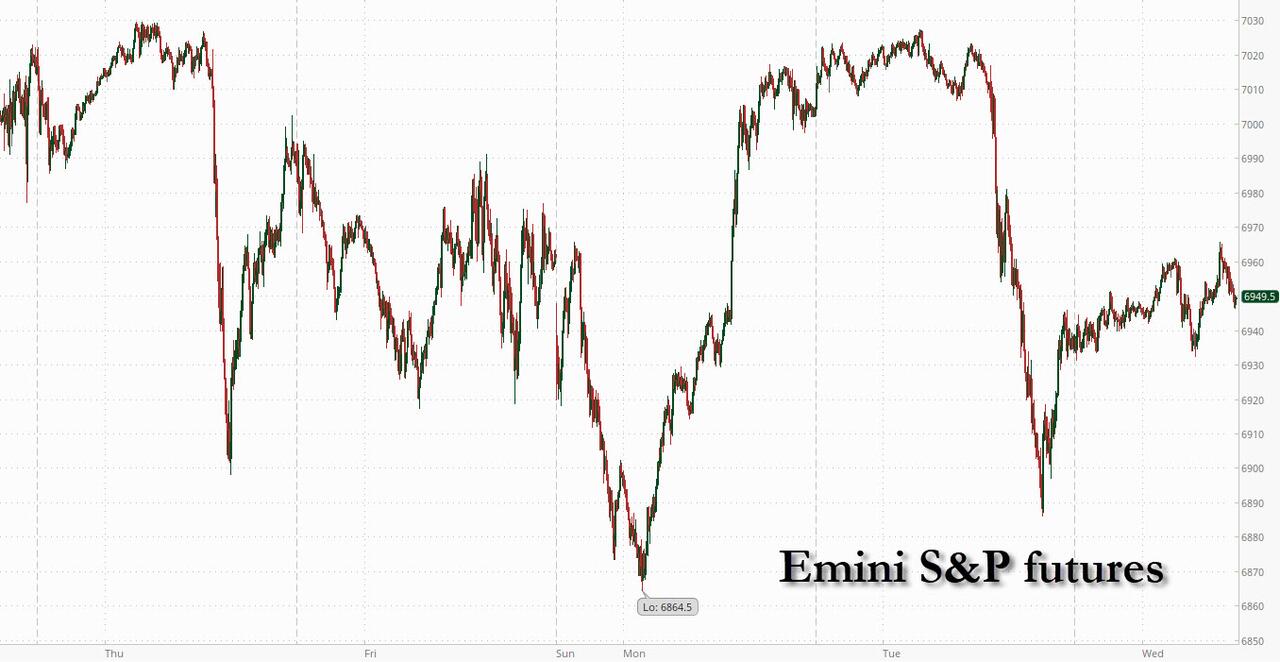
Futures Rise Despite Software, AMD Rout Ahead Of Google Earnings
Wednesday, Feb 04, 2026 – 08:29 AM
US stock futures are up small with Tech lagging on rotation fears, though major indices are off their overnight lows. The AI narrative has been flipped upside down, with traders focused on perceived losers, most of which are in the Software sector, where “there’s no floor” according to one investment manager. As of 8:00am ET, S&P futures are up 0.2%, well off session lows; Nasdaq futures rise 0.2%, pressured by weakness in AMD which tumbled 8% after projections which disappointed Wall Street; Alphabet is set to report after the close. Pre-market, Mag7 are mixed with AAPL, AMZN, and GOOG higher with Semis under pressure (AMD -7%, AVGO -0.8%, NVDA -0.1%). Both Cyclicals and Defensives are mixed without a clear leader. The USD is bid as bond yields are higher by 1-2bps.Commodities are stronger led by Energy and Metals, with gold blasting off back over $5k, and silver rising above $90. Today’s macro data focus is on ISM Services where an in line / stronger print may create a renewed bid for stocks.
In premarket trading, Mag 7 stocks are mostly higher: Alphabet +1% ahead of earnings due after the market close (Microsoft +0.1%, Amazon +0.3%, Apple +0.3%, Nvidia +0.3%, Meta little changed, Tesla -0.06%)
- AMD (AMD) slides 9% after the chipmaker’s sales forecast underwhelmed investors, a sign that it’s not making the AI inroads that some on Wall Street anticipated.
- Boston Scientific (BSX) falls 9% after the maker of medical devices gave a profit and sales growth forecast for 2026 that fell short of Wall Street’s expectations.
- Chipotle (CMG) falls 5% after the restaurant chain operator’s underwhelming annual comparable sales forecast.
- Eli Lilly & Co. (LLY) rises 7% after providing an upbeat sales forecast for the year as strong demand for its weight loss drug cemented its position at the top of the obesity market.
- Emerson Electric (EMR) rises 4% after the automation technology provider reported 9% growth in underlying orders in its first quarter. Citi said orders and other results show a “largely healthy demand environment.”
- Johnson Controls (JCI) rises 8% after the HVAC company boosted its adjusted earnings per share forecast for the full year to a figure above what analysts expected.
- Lumen Technologies (LUMN) falls 4% after the wireline telecommunications company’s results and outlook prompted a downgrade from Raymond James.
- Lumentum (LITE) rises 10% after the maker of optical and photonic products posted stronger-than-expected second-quarter results and gave a robust forecast.
- Match Group (MTCH) jumps 7% after the dating service provider reported revenue for the fourth quarter that beat the average analyst estimate.
- Silicon Laboratories (SLAB) jumps 53% after agreeing to be acquired by Texas Instruments for $231 per share in cash.
- Sonos (SONO) rises 12% after the speaker company’s first-quarter results beat expectations on key metrics.
- Take-Two Interactive (TTWO) rises 5% after the video game publisher raised its fourth-quarter bookings forecast. Analysts are positive about the company reiterating the launch date of its highly anticipated Grand Theft Auto VI.
- Uber Technologies Inc. (UBER) falls 6% after giving a weak profit outlook and promoted an outspoken driverless-vehicle bull to be its new chief financial officer, signaling further investment in a closely watched area of the ride-hailing company’s business.
Economically sensitive shares were Wednesday’s biggest gainers, with futures for the Russell 2000 index of small caps advancing 0.4%, while tech treaded water after a historic rout for SaaS/Software names. The rotation into cyclical stocks persisted as renewed fears over AI-driven disruption weighed on markets. Tuesday’s selloff was sparked by a new automation tool from Anthropic PBC, with losses spilling into financial services and asset managers. Caution lingered on Wednesday, with a European basket of stocks seen at risk from AI disruption falling another 1.1%.
“I don’t think the market has fully resolved whether this move was based on fear or fundamentals. What’s clear is that we’ve had a confidence break, really, at the category level,” said Stephanie Niven, portfolio manager at Ninety One. “Before convictions can be rebuilt at that really important company level, we are seeing this kind of indiscriminate selling.”
Disruption fears have added a new layer of complexity in distinguishing winners from losers in AI. With valuations stretched and earnings season under way, investors have already punished companies that failed to live up to elevated expectations. The mood among investors about software stocks and other sectors deemed at risk of AI advances is grim, according to JPMorgan Chase & Co. analyst Toby Ogg. Ogg met more than 50 investors across Europe and the US over two weeks and said he found that they had significantly reduced software holdings over the past 12 to 18 months. Even after the latest pullback, “the general appetite to step in remains generally low,” he said in a client note.
No one is interested in buying the dip, according to JPMorgan analyst Toby Ogg, and even good earnings won’t be enough, since AI disruption is a long-term issue. “We are now in an environment where the sector isn’t just guilty until proven innocent but is now being sentenced before trial,” he said.
“There’s clearly indiscriminate selling across the entire software cluster,” said Karen Kharmandarian, senior equity investment manager at Mirova in Paris. “There’s no floor, the downward momentum is too strong. It looks a bit like capitulation, which could offer opportunities selectively once things stabilize”.
The pain isn’t just in equities, with banks unable to sell a software loan deal. In options, the implied volatility of software stocks is blowing out versus the S&P 500 ETF.
Another test looms for the AI trade when Alphabet reports after the close. The stock has been the top performer among the Magnificent Seven megacaps since the beginning of 2025. Peers Microsoft Corp. and Meta Platforms Inc. saw divergent reactions to their results last week, reflecting views over whether heavy AI spending is paying off.
“The biggest risk regarding tonight’s publication is the fact that there is a decoupling between Google’s long-term stature as an AI winner, thanks to its vertically integrated approach, and short terms trends in search and monetization, which might prove more erratic,” said Jacques-Aurélien Marcireau, co-head of equities at Edmond de Rothschild Asset Management.
European stocks reverse an earlier decline as an initial extension of the Anthropic-sparked software selloff eases. Stoxx 600 now up by 0.3% as gains in telecoms and chemicals offset mixed results from the financials sector and a large drop for drugmaker Novo Nordisk, which sank 16% after a disappointing sales outlook. Here are some of the biggest movers on Wednesday:
- Handelsbanken gains as much as 4.4% after posting a top-line beat in its full-year report.
- DNB Bank shares rise as much as 3.5% after the Norwegian bank reported net profit ahead of expectations, driven by beats in net interest income and fees.
- Mediobanca shares rise as much as 7.8% after MF daily reported that the board of the Banca Monte Paschi di Siena is begining to tilt toward a delisting of the taken over bank.
- Wendel shares rise as much as 7% after Germany’s Henkel agreed to buy Stahl Parent from Stahl Group, which is majority-owned by the French investment firm. BASF and Clariant also have stakes.
- AMS Osram shares rise as much as 13% after agreeing to offload its sensor business to Infineon for €570m in cash.
- Novo Nordisk shares plunge as much as 20% in Copenhagen after the drugmaker forecast a steep decline in sales this year that was also wider than analyst expectations.
- Software, IT, data services, ad agencies and exchanges are among the equity sectors leading losses in the European session on Wednesday, as they extend a selloff following persistent investor concerns over potential disruption from AI tools.
- UBS shares dropped as much as 5.5% despite a beat on 4Q earnings as it announced a below-expected $3 billion buyback program for 2026 that could increase during the year and maintained its financial targets for 2028.
- Santander shares drop as much as 5% after the Spanish lender announced the acquisition of Webster Financial in a $12 billion deal.
- Watches of Switzerland tumbles as much as 5.1% after the watch retailer cut the midpoint of its margin goal, countering the improved outlook for sales growth.
- DSV falls as much as 4.5% after the Danish shipping and logistics group guidance for 2026 disappointed, overshadowing decent 4Q figures.
- Novartis shares drop as much as 3.1% after the Swiss drugmaker reported net sales for the fourth quarter that missed expectations, while its 2026 Ebit forecast was also below estimates.
- Atalaya Mining Copper shares fall as much as 8.9% to 937 pence, slipping below the offering price after holder Trafigura Group sold 14 million shares at 945 pence per share.
Earlier in the session, Asian stocks slipped in another session dominated by technology concerns, after a broad selloff in the US on fears of disruption from artificial intelligence. The MSCI Asia Pacific Index fell as much as 0.6%, with software makers among the biggest decliners after Anthropic’s launch of a new automation tool. Hong Kong led losses and Japan’s Nikkei 225 also dropped, while stocks rose in South Korea, Australia and Thailand.
Eli Lilly, Uber and Yum! Brands are among companies expected to report before the market open. Lilly investors will be looking for guidance on how the company sees the obesity market expanding following a deal with the Trump administration to widen access for some patients with Medicare. Rival Novo Nordisk’s guidance fell well short.
In FX, the dollar is stronger and the yen extended losses for a 4th session as traders anticipated a victory for Prime Minister Sanae Takaichi’s Liberal Democratic Party in this weekend’s poll.
In rates,treasuries are slightly cheaper across the curve, with yields around 1bp higher vs Tuesday’s close and lagging European bonds, which are higher after euro-area January inflation data and services PMIs. US session includes ISM services gauge, following Treasury quarterly refunding announcement at 8:30am. US 10-year yield near 4.28% is more than 1bp cheaper on the day while German counterpart is richer by about 2bp; UK 10-year is higher by less than 1bp European bonds rising and outperforming gilts and Treasuries. Euro-zone inflation cooled to the lowest level in more than a year.
In commodities, gold moves back above $5,000/oz and silver up to around $89/oz. Oil prices up, Brent above $67/barrel. Bitcoin hovered near $76,000.
The dollar and Treasuries were little changed.
US economic calendar includes January ADP employment change (8:30am), January final S&P Global US services PMI (9:45am) and January ISM services index (10am).Fed speaker slate includes Governor Cook on monetary policy and the economic outlook at the Economic Club of Miami (6:30pm)
Market Snapshot
- S&P 500 mini little changed
- Nasdaq 100 mini little changed
- Russell 2000 mini +0.3%
- Stoxx Europe 600 little changed
- DAX -0.1%, CAC 40 +0.7%
- 10-year Treasury yield +1 basis point at 4.28%
- VIX -0.1 points at 17.94
- Bloomberg Dollar Index +0.2% at 1189.69
- euro little changed at $1.1814
- WTI crude +0.7% at $63.66/barrel
Top Overnight News
- Donald Trump reiterated that the US and Iran are maintaining diplomatic talks, even after an American warplane shot down an Iranian drone in the Arabian Sea. BBG
- Trump’s Federal Reserve chair nominee Kevin Warsh faces a battle in the Senate after lawmakers threatened to hold up his confirmation until the DoJ halts its probes into Jay Powell and Lisa Cook. FT
- Nvidia is nearing a deal to invest $20 billion in OpenAI as part of its latest funding round, people familiar said. BBG
- Prime Minister Sanae Takaichi should not count on the Bank of Japan’s help in taming sharp bond yield rises given the huge cost of intervention, including the significant risk of igniting unwelcome yen falls, sources say. RTRS
- Hedge funds are using leverage to reap 28% returns from the safest of bonds. A key ingredient is their use of borrowed cash to juice returns, in some cases amplifying positions up to 15 times their initial investment. BBG
- Investors are ramping up bets on higher long dated Treasury yields and a steeper yield curve as incoming Federal Reserve Chair Kevin Warsh is expected to press for interest rate cuts while shrinking the U.S. central bank’s balance sheet. Warsh’s preference for a materially smaller Fed balance sheet, currently around $6.59 trillion, implies a withdrawal of meaningful government demand for Treasuries, a move which tightens financial conditions because the central bank is not providing liquidity to the market. RTRS
- Euro-area inflation slowed to 1.7% in January, the weakest reading in more than a year and further below the ECB’s 2% target. BBG
- Novo shares plunged after the drugmaker forecast sales decline of up to 13% in 2026, amid price pressure in obesity drugs. But Eli Lilly LLY is now +8% in the pre on Strong 4Q GLP-1 Momentum + Guidance Ahead of Street Quelling Last Minute Fear from NVO Guide. BBG, GS Trading
- NVDA CEO Jensen Huang dismissed fears that artificial intelligence will replace software and related tools, calling the idea “illogical”, after a significant selloff in global software stocks on Tuesday. RTRS
- Department of Labor said all agencies will fully resume to normal operations from the 4th of February 2026.
Trade/Tariffs
- US Senators push for USD 70bln funding deal to support US President Trump’s critical minerals agenda, FT reported.
- Indian Trade Minister said the US trade deal will offer a competitive advantage to Indian exporters and our priority is to energy security for our citizens. Need to bolster capabilities in many sectors including nuclear energy and data centres. India will raise trade with the US.
A more detailed look at global markets courtesy of Newsquawk
APAC stocks were ultimately mixed as the region partially shrugged off the downbeat handover from Wall Street, where sentiment was mired by renewed tech-selling, while participants in the region also reflected on the latest Chinese PMI data and the end of the partial US government shutdown. ASX 200 climbed higher with the upside led by outperformance in miners as metal prices continued their recovery, but with gains in the index capped by heavy losses in the tech sector. Nikkei 225 slumped at the open but is off worst levels, while risk appetite was pressured following recent earnings, including disappointing results from Nintendo, which saw its shares suffer a double-digit percentage drop. Hang Seng and Shanghai Comp saw two-way price action as participants digested stronger-than-expected Chinese RatingDog Services PMI data, and after the PBoC drained liquidity, while it was also reported that NVIDIA AI chip sales to China are stalled by a US security review and that Chinese customers are meanwhile not placing H200 chip orders with the company.
Top Asian News
- China’s market regulator unconditionally approves CATL (3750 HK), Chery (9973 HK) and others joint venture formation.
- China’s Vice Finance Minister said China is facing persistent headwinds and policy uncertainty.
- New Zealand ANZ Commodity Price Index MM (Jan) +2.0% (Prev. -2.1%).
European bourses (+0.1%) are broadly firmer across the board, though the DAX 40 (-0.1%) has been pressured by post-earnings losses in Infineon (-2.3%). European sectors hold a positive bias. Telecoms and Chemicals leads whilst Healthcare is the clear laggard, hampered by post-earning losses in Novo Nordisk (-17.6%) and Novartis (-1%). The former reported strong headline metrics, though its 2026 guidance disappointed.
Top European News
- Germany sold EUR 3.197bln vs exp. EUR 4.0bln 2.50% 2032 Bund: b/c 1.51x (prev. 1.2x), average yield 2.60% (prev. 2.33%), retention 20.1 (prev. 23.87%).
- Germany’s VDA announces that 2025 EV production comes out at 1.67mln vehicles, +23% Y/Y.
- Europe’s safest corporate bond spreads drop to its lowest level since 2007.
Central Banks
- Fed Governor Miran resigned on Tuesday from his position as Chair of Council of Economic Advisers, Barron’s reported citing a White House official.
- BoJ won’t come to the rescue of a Takaichi-driven bond rout, with sources stating that Japanese PM Takaichi should not count on the BoJ’s help in taming sharp yield rises given the high cost of intervention including risk of igniting unwanted yen declines.
- PBoC announces plan to build a multi-level financial service system to support domestic demand, tech innovation and SMEs. To continue to support debt risk resolutions for financing platforms, back local government in market oriented reforms and guide financial institutions to provide services based on marker and legal principles.
- Riksbank Minutes: President Thedeen said “at present I assess that monetary policy is following a stable and reasonable course, and we can tolerate minor deviations in data outcomes without immediately needing to adjust the course we have set.
FX
- DXY resides within a narrow range within Tuesday’s 97.298-97.692 range after seeing weakness yesterday against most major peers, giving back some of the post-ISM spoils, while JOLTS data was delayed, and there were several comments from Fed speakers, but failed to move the dial. Overnight, US President Trump signed the USD 1.2tln spending bill to end the government shutdown, as expected, and thus NFP will likely be released next week (TBC). Today, however, desks are eyeing the private ADP and ISM Services PMIs.
- JPY is the underperformer vs the USD, EUR, and GBP, as the Japanese currency continued to lag amid the ongoing expectations for a landslide victory by Japanese PM Takaichi’s ruling LDP at the snap election on Sunday. USD/JPY topped yesterday’s 156.08 peak to print a current high of 156.59, but is still some way off the 23rd Jan high of 159.23.
- EUR/USD trades flat with little notable action seen on the Final Services and Composite PMIs. Little move also seen on the EZ HICP metrics, which were broadly in-line / cooler-than-expected. A report which will have little impact on policymakers at the ECB, who are set to meet on Thursday – as a reminder, the Bank is expected to keep its deposit rate steady at 2.00%.
- GBP/USD sees modest gains and narrowly gains despite the revisions lower in Final PMIs, but likely lifted by the GBP/JPY pair testing highs from 23rd Jan as the cross looks to test 215 to the upside, residing at levels last seen in 2008.
- Antipodeans are mixed with the Aussie buoyed by rebound in gold prices, whilst the NZD posts losses following ultimately mixed employment and labour cost data from New Zealand.
Fixed Income
- USTs are essentially flat in quiet trade and currently trading in a narrow 111-17 to 111-21+ range. Focus overnight was on the end of the US shutdown after the House voted (217-214) to pass the USD 1.2tln spending package to fund the government. Following this, the Department of Labor announced that all agencies will fully resume normal operations from the 4th of February 2026; there are currently no further details or guidance on whether the NFP due on Friday will be released.
- Nonetheless, focus turns to US data later; the monthly ADP national employment data will be released, where analysts expect 48k from the prior 41k. The ISM services PMI headline is expected to ease to 53.5 from 54.4, where employment is seen nudging up a little, but prices and new orders are seen easing a touch. From the supply front, the QRA is also due today.
- Bunds initially held a downward bias but then gradually picked up as the morning progressed; currently at the upper end of a 127.72-127.88 range. There have been a number of Final PMI metrics this morning, with the EZ figure revised a touch lower; the accompanying report suggested that the ECB may highlight growing services inflation in its policy decision this week. EZ HICP printed in line with expectations, and cooled from the prior; core metrics were a touch short of expectations. Overall, a report which will not shift much ahead of the ECB confab on Thursday. As a reminder, the Bank is expected to keep its deposit rate steady at 2.00% and largely reiterate that rates are at a good place. Next up, a 2032 Bund auction.
- Gilts are essentially flat and trade within a 90.88-91.06 range. Action has been fairly choppy this morning, but has moved off its best levels in recent trade. Aside from the UK’s PMI (revised a touch lower), catalysts for the benchmark are incredibly light. Focus now on the BoE on Thursday, where rates are expected to be kept unchanged.
- UK DMO plans to hold a programmatic gilt tender for a long conventional gilt on February 11th.
- Australia sold AUD 1.1bln 4.25% 2036 bonds, b/c 3.73, avg. yield 4.9012%.
Commodities
- Crude benchmarks initially held onto the gains seen in the latter end of Tuesday’s session, which came from reports that the US shot down an Iranian surveillance drone approaching the USS Abraham Lincoln. WTI and Brent peaked at USD 64.16/bbl and USD 68.25/bbl, respectively, early in the APAC session, just shy of Tuesday’s high, before steadily paring back and retracing to the key USD 63/bbl and USD 67/bbl handle.
- Spot XAU continues to rebound, with the yellow metal returning above the USD 5k/oz handle after hovering just shy of the level throughout Tuesday’s session. Gold rose throughout the APAC session, peaking at USD 5092/oz, before oscillating in tight c. USD 40 range. Similarly, spot silver has gradually bid higher and briefly held above USD 90/oz before falling back below the level as European trade continues.
- 3M LME Copper has thus far traded on both sides of the unchanged mark, fluctuating in a USD 13.29k-13.52k/t band, as risk tone overnight was mixed. Heightened concerns over AI weighed on the tech-heavy NQ during Tuesday’s trading day, and this followed through into Asia-Pacific equities.
- Morgan Stanley raises near-term Brent forecasts as geopolitical risk premium is likely to persist, but expects prices to fall below USD 60/bbl later this year.
- Ukraine’s Naftogaz said Ukraine has received a delivery of 100MCM batch of US LNG, making it the first delivery expected in 2026.
- Venezuela’s top Economic Advisor Ortega said he wants Venezuela to be known as a country with one of the highest oil production levels.
- China expands subsidies for energy storage industry as it seeks to support the country’s green transition and ensure reliable electricity supplies.
Geopolitics
- Ukrainian peace negotiators have arrived in Abu Dhabi and have started their first meetings, IFX reported.
- Russia’s Kremlin said it will defend its interest in the Arctic, via Sky News Arabia.
- Russia’s Kremlin said it has not seen any new developments when it comes to India and Russian oil.
- Russia’s Kremlin said Russia will continue its Special Military Operation until the relevant decisions are made by Ukraine.
- Ukraine’s Naftogaz said Ukraine has received a delivery of 100MCM batch of US LNG, making it the first delivery expected in 2026.
- China’s President Xi is to hold a video call with Russian President Putin, CCTV reported.
- Iran is to announce major structural and administrative decisions in the defence sector to respond to new threats, Iran’s Noor News reported.
- “Deputy Speaker of Iran’s Parliament: Iran and the United States likely reached preliminary understandings before sitting down at the negotiating table”, Sky News Arabia reported.
- Israeli artillery shelling reported in central Gaza, via Al Jazeera news.
- Israeli army announces airstrikes and tank shelling on militants after an Israeli officer was seriously injured, according to Sky News Arabia. IDF said shooting at our forces is a violation of the ceasefire agreement in Gaza, according to Al Arabiya.
- US President Trump said we are still negotiating with Iran and that there is more than one meeting with Iran.
US Event Calendar
- 7:00 am: United States Jan 30 MBA Mortgage Applications, prior -8.5%
- 8:15 am: United States Jan ADP Employment Change, est. 45k, prior 41k
- 9:45 am: United States Jan F S&P Global US Services PMI, est. 52.5, prior 52.5
- 9:45 am: United States Jan F S&P Global US Composite PMI, est. 52.9, prior 52.8
- 10:00 am: United States Jan ISM Services Index, est. 53.5, prior 54.4, revised 53.8
- 6:30 pm: United States Fed’s Cook Speaks on Monetary Policy and Economy
DB’s Jim Reid concludes the overnight wrap
It was a pretty brutal day in markets yesterday that wouldn’t be obvious with a quick glance of the screens, as a majority of the S&P 500’s constituents rose on the day. The reason was that Anthropic launched a new AI automation tool servicing legal work, which was perceived as a big threat to software firms and related stocks. So in Europe, RELX Plc, Wolters Kluwer, Experian, Thomson Reuters, and the LSE all fell around -10 to -15%, while in the US Gartner (-20.87%), Paypal (-20.31%) and Expedia (-15.26%) led the declines in the S&P 500. In turn, the overall US Software index (-4.60%) saw 104 decliners and only 9 risers, and its 6th successive decline to put the index back to April levels. Even the blue-chip Microsoft was down -2.87% and is now down -24% from its peak on October 28 last year.
So yesterday marked a dramatic acceleration of the trend we’d seen of late, and it means the 9 worst-performing companies in the S&P 500 YTD are all in the software and related services sectors, having now seen declines of 25% or more. While the question over the end-winners from AI is unlikely to be answered in 2026, recent months have seen a clear shift in markets from AI euphoria towards more differentiation between companies, and growing concern about its disruption to existing business models.
Those huge moves helped push the S&P 500 (-0.84%) down, despite being on course for another record high at the US open. The Nasdaq (-1.43%) and Mag-7 (-1.53%) clearly suffered more. And they’re still struggling for momentum this morning, with futures on the S&P 500 (+0.04%) basically flat.
To be fair, it wasn’t all bad news yesterday, with most of the S&P 500 constituents moving higher on the day. The ongoing rotation meant materials (+2.00%) and consumer staples (+1.71%) sectors extended Monday’s post-ISM gains, while energy stocks (+3.29%) were boosted by a renewed rise in oil. Those gains included Walmart (+2.94%), which became the 11th US company to reach a $1trn valuation. And the small cap Russell 2000 rose by +0.31% despite being down -1.30% at the day’s lows. Meanwhile in Europe, the STOXX 600 (+0.10%) just about managed to hit another record high, whilst Italy’s FTSE MIB (+0.90%) closed at its highest level since 2000, despite the broader struggles among tech stocks.
Another beneficiary of yesterday’s session were precious metals, which finally showed signs of stabilising after their recent slump. In fact, gold prices (+6.12%) posted their biggest daily gain since 2008, moving up to $4,947/oz, whilst silver (+7.43 %) was back up to $85.16/oz. Clearly they’re still a long way from the highs, but it was clear that dip buyers were coming back in after the biggest slump in decades. And that trend has continued overnight, with gold (+2.72%) now back up to $5,081/oz. The volatility was also visible in Bitcoin (-2.96%), which fell by as much as -7% to below $73k intra-day, which was its lowest level since Trump’s election victory in November 2024.
By contrast, it was a very steady day for US Treasuries, which saw little movement in either direction. In the end the risk-off backdrop sent yields lower, with the 2yr yield (-0.2bps) down to 3.57%, whilst the 10yr yield (-1.3bps) fell to 4.27%. But there were few concrete drivers behind that. Admittedly, we did hear from Richmond Fed President Barkin, who acknowledged the persistence of above-target inflation, and said “I take this sustained miss seriously”. But market pricing for the Fed was little changed yesterday either.
Those moves came as the latest US government shutdown came to end after four days, with the House passing the funding package that had been approved by the Senate last Friday. The legislation, which was then signed by Trump, will fund most government agencies through September, though Congress still faces a showdown over funding for the Department of Homeland Security which was extended only until next Friday (February 13) amid partisan tensions over immigration enforcement.
The market backdrop wasn’t helped by the continued geopolitical noise, with oil prices spiking after news that the US shot down an Iranian drone that approached a US aircraft carrier. Oil marginally pared its gains as the White House said that US-Iran talks led by Steve Witkoff were still scheduled for Friday, with Trump himself saying that “We are negotiating with them right now”. But Brent crude still closed +1.55% higher at $67.33/bbl, and has risen another +0.76% this morning to $67.84/bbl as we go to print.
Earlier in Europe, it was a bit more eventful as the 30yr German yield (+3.4bps) hit a post-2011 high of 3.55%. That comes as investors are increasingly focused on the fiscal stimulus, with higher debt issuance having pushed up long-end bond yields in recent months. Those moves for long-end German yields were part of a wider selloff across Europe, with yields on 10yr bunds (+2.2bps), OATs (+1.7bps) and BTPs (+1.7bps) all moving higher, not helped by the latest rebound in oil prices. To be fair, we did get a downside surprise in the flash CPI print from France yesterday, which fell to just +0.4% in January, thus raising hopes that today’s Euro Area-wide print would come in on the softer side. But the commodity rebound ultimately offset that, and the RBA’s rate hike earlier in the day further added to the sense that hikes elsewhere could eventually be back on the agenda.
Overnight in Asia, we’ve seen a mixed performance this morning. On the positive side, the KOSPI (+1.39%) is at another record high, and the Shanghai Comp (+0.01%) has eked out a modest gain. However, other indices have moved lower, including the CSI 300 (-0.05%), the Hang Seng (-0.17%) and the Nikkei (-0.83%). We’ve also started to see some of the services and composite PMIs from the region, with China’s RatingDog Services PMI up to a 3-month high of 52.3 (vs. 52.0 expected), whilst Japan’s final services PMI reached to an 11-month high of 53.7. However, the Japanese yen has continued to weaken a bit ahead of this weekend’s election, down -0.33% to 156.27 per dollar.
Looking at the day ahead, US data releases include the ISM services index for January and the ADP’s report of private payrolls for January, whilst in the Euro Area we’ll get the flash CPI print for January. Otherwise, we’ll get the final services and composite PMIs for January for the US and Europe. The US Treasury will also be releasing its quarterly refunding announcement, detailing the breakdown of planned issuance. Elsewhere, central bank speakers include the Fed’s Cook, and today’s earnings releases include Alphabet.
1b European Opening report
NQ continues to underperform, weighed by weak AMD earnings; XAU reclaims USD 5k/oz – Newsquawk US Market Open

Wednesday, Feb 04, 2026 – 06:26 AM
- NVIDIA (NVDA) AI chip sales to China are reportedly stalled by a US security review, and Chinese customers are, meanwhile, not placing H200 chip orders.
- European bourses are broadly firmer, US equity futures are mixed with mild underperformance in the NQ.
- DXY trades flat ahead of US data, JPY underperforms as focus turns to a landslide LDP victory.
- Fixed income benchmarks are mixed; USTs are flat whilst Bunds are firmer.
- Crude-specific newsflow remains light, benchmarks retrace bid following US-Iranian tensions; Precious metals continue to rebound with spot XAU returning above USD 5k/oz.
- Looking ahead, highlights include US Final Composite/Services PMIs (Jan), US ADP (Jan), ISM Services (Jan), Treasury Refunding Announcement, NBP Policy Announcement, Comments from Fed’s Cook, Supply from the US.
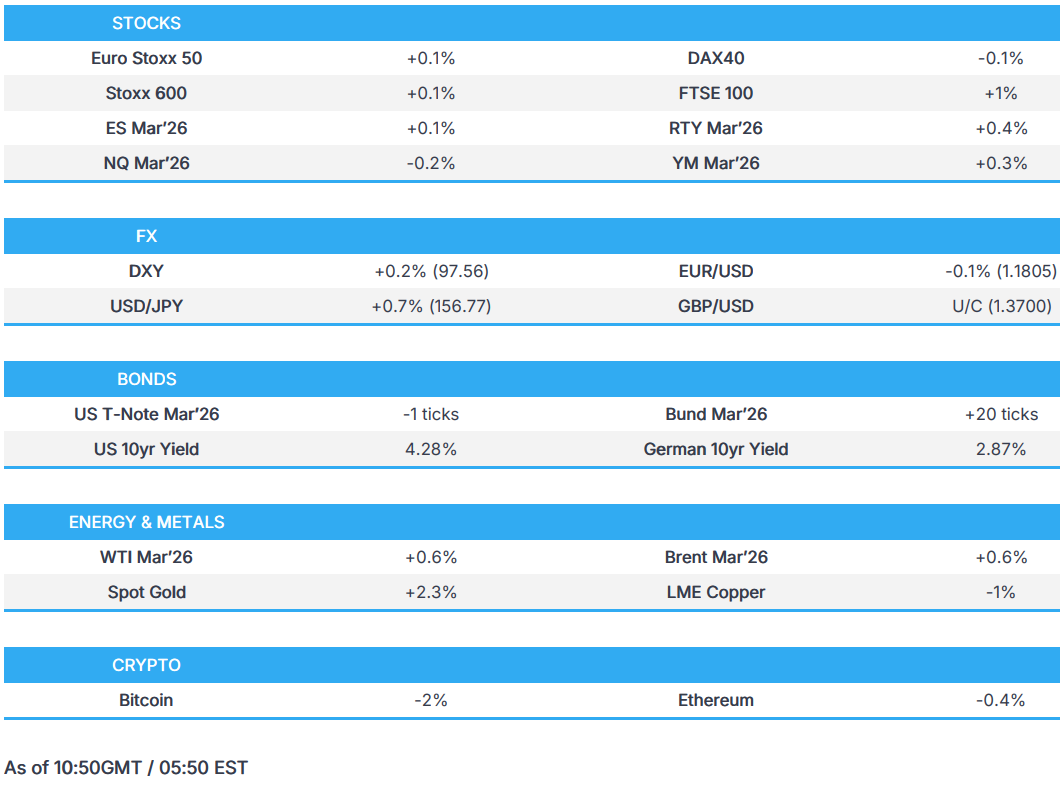
Newsquawk in 3 steps:
1. Subscribe to the free premarket movers reports
2. Listen to this report in the market open podcast (available on Apple and Spotify)
3. Trial Newsquawk’s premium real-time audio news squawk box for 7 days
EUROPEAN TRADE
EQUITIES
- European bourses (+0.1%) are broadly firmer across the board, though the DAX 40 (-0.1%) has been pressured by post-earnings losses in Infineon (-2.3%).
- European sectors hold a positive bias. Telecoms and Chemicals leads whilst Healthcare is the clear laggard, hampered by post-earning losses in Novo Nordisk (-17.6%) and Novartis (-1%). The former reported strong headline metrics, though its 2026 guidance disappointed.
- US equity futures (ES +0.1% NQ -0.2% RTY +0.3%) are trading mixed, ahead of key US data, which includes ADP Employment, ISM Services and Final PMIs.
- Infineon (IFX GY) Q1 2026 (EUR) Revenue 3.66bln (exp. 3.62bln), EPS 0.19 (exp. 0.23); Q2 Revenue Outlook 3.8bln (exp. 3.81bln).
- UBS (UBSG SW) Q4 (USD) Net Income 1.2bln (exp. 967mln), Pre-tax Profit 1.7bln (exp. 1.46bln), Investment Bank Pretax 640mln (exp. 468.7mln), Co. is to buyback USD 3bln of its own shares this year and aims to do more.
- Advanced Micro Devices Inc. (AMD) Q4 2025 (USD): Adj. EPS 1.53 (exp. 1.32), Revenue 10.3bln (exp. 9.67bln). Adj. net income 2.519bln (exp. 2.174bln). Said Q4 benefited from about USD 360mln release of previously reserved AMD instinct mi308 inventory and related charges. OutlookQ1 revenue 9.8bln (exp. 9.42bln).
- NVIDIA (NVDA) AI chip sales to China were reportedly stalled by US security review, according to FT. Chinese customers are meanwhile not placing H200 chip orders with NVIDIA.
- Click for the sessions European pre-market equity newsflow
- Click for the additional news
FX
- DXY resides within a narrow range within Tuesday’s 97.298-97.692 range after seeing weakness yesterday against most major peers, giving back some of the post-ISM spoils, while JOLTS data was delayed, and there were several comments from Fed speakers, but failed to move the dial. Overnight, US President Trump signed the USD 1.2tln spending bill to end the government shutdown, as expected, and thus NFP will likely be released next week (TBC). Today, however, desks are eyeing the private ADP and ISM Services PMIs.
- JPY is the underperformer vs the USD, EUR, and GBP, as the Japanese currency continued to lag amid the ongoing expectations for a landslide victory by Japanese PM Takaichi’s ruling LDP at the snap election on Sunday. USD/JPY topped yesterday’s 156.08 peak to print a current high of 156.59, but is still some way off the 23rd Jan high of 159.23.
- EUR/USD trades flat with little notable action seen on the Final Services and Composite PMIs. Little move also seen on the EZ HICP metrics, which were broadly in-line / cooler-than-expected. A report which will have little impact on policymakers at the ECB, who are set to meet on Thursday – as a reminder, the Bank is expected to keep its deposit rate steady at 2.00%.
- GBP/USD sees modest gains and narrowly gains despite the revisions lower in Final PMIs, but likely lifted by the GBP/JPY pair testing highs from 23rd Jan as the cross looks to test 215 to the upside, residing at levels last seen in 2008.
- Antipodeans are mixed with the Aussie buoyed by rebound in gold prices, whilst the NZD posts losses following ultimately mixed employment and labour cost data from New Zealand.
FIXED INCOME
- USTs are essentially flat in quiet trade and currently trading in a narrow 111-17 to 111-21+ range. Focus overnight was on the end of the US shutdown after the House voted (217-214) to pass the USD 1.2tln spending package to fund the government. Following this, the Department of Labor announced that all agencies will fully resume normal operations from the 4th of February 2026; there are currently no further details or guidance on whether the NFP due on Friday will be released.
- Nonetheless, focus turns to US data later; the monthly ADP national employment data will be released, where analysts expect 48k from the prior 41k. The ISM services PMI headline is expected to ease to 53.5 from 54.4, where employment is seen nudging up a little, but prices and new orders are seen easing a touch. From the supply front, the QRA is also due today.
- Bunds initially held a downward bias but then gradually picked up as the morning progressed; currently at the upper end of a 127.72-127.88 range. There have been a number of Final PMI metrics this morning, with the EZ figure revised a touch lower; the accompanying report suggested that the ECB may highlight growing services inflation in its policy decision this week. EZ HICP printed in line with expectations, and cooled from the prior; core metrics were a touch short of expectations. Overall, a report which will not shift much ahead of the ECB confab on Thursday. As a reminder, the Bank is expected to keep its deposit rate steady at 2.00% and largely reiterate that rates are at a good place. Next up, a 2032 Bund auction.
- Gilts are essentially flat and trade within a 90.88-91.06 range. Action has been fairly choppy this morning, but has moved off its best levels in recent trade. Aside from the UK’s PMI (revised a touch lower), catalysts for the benchmark are incredibly light. Focus now on the BoE on Thursday, where rates are expected to be kept unchanged.
- UK DMO plans to hold a programmatic gilt tender for a long conventional gilt on February 11th.
- Australia sold AUD 1.1bln 4.25% 2036 bonds, b/c 3.73, avg. yield 4.9012%.
COMMODITIES
- Crude benchmarks initially held onto the gains seen in the latter end of Tuesday’s session, which came from reports that the US shot down an Iranian surveillance drone approaching the USS Abraham Lincoln. WTI and Brent peaked at USD 64.16/bbl and USD 68.25/bbl, respectively, early in the APAC session, just shy of Tuesday’s high, before steadily paring back and retracing to the key USD 63/bbl and USD 67/bbl handle.
- Spot XAU continues to rebound, with the yellow metal returning above the USD 5k/oz handle after hovering just shy of the level throughout Tuesday’s session. Gold rose throughout the APAC session, peaking at USD 5092/oz, before oscillating in tight c. USD 40 range. Similarly, spot silver has gradually bid higher and briefly held above USD 90/oz before falling back below the level as European trade continues.
- 3M LME Copper has thus far traded on both sides of the unchanged mark, fluctuating in a USD 13.29k-13.52k/t band, as risk tone overnight was mixed. Heightened concerns over AI weighed on the tech-heavy NQ during Tuesday’s trading day, and this followed through into Asia-Pacific equities.
- Morgan Stanley raises near-term Brent forecasts as geopolitical risk premium is likely to persist, but expects prices to fall below USD 60/bbl later this year.
- Ukraine’s Naftogaz said Ukraine has received a delivery of 100MCM batch of US LNG, making it the first delivery expected in 2026.
- Venezuela’s top Economic Advisor Ortega said he wants Venezuela to be known as a country with one of the highest oil production levels.
- China expands subsidies for energy storage industry as it seeks to support the country’s green transition and ensure reliable electricity supplies.
TRADE/TARIFFS
- US Senators push for USD 70bln funding deal to support US President Trump’s critical minerals agenda, FT reported.
- Indian Trade Minister said the US trade deal will offer a competitive advantage to Indian exporters and our priority is to energy security for our citizens. Need to bolster capabilities in many sectors including nuclear energy and data centres. India will raise trade with the US.
NOTABLE EUROPEAN HEADLINES
- Germany sold EUR 3.197bln vs exp. EUR 4.0bln 2.50% 2032 Bund: b/c 1.51x (prev. 1.2x), average yield 2.60% (prev. 2.33%), retention 20.1 (prev. 23.87%).
- Germany’s VDA announces that 2025 EV production comes out at 1.67mln vehicles, +23% Y/Y.
- Europe’s safest corporate bond spreads drop to its lowest level since 2007.
NOTABLE EUROPEAN DATA RECAP
- Italian Inflation Rate MoM Prel (Jan) M/M 0.4% vs. Exp. 0.4% (Prev. 0.2%).
- Italian Inflation Rate YoY Prel (Jan) Y/Y 1.0% vs. Exp. 1% (Prev. 1.2%).
- Italian HCOB Services PMI (Jan) 52.9 vs. Exp. 51.4 (Prev. 51.5).
- Italian HCOB Composite PMI (Jan) 51.4 (Prev. 50.3).
- EU Inflation Rate MoM Flash (Jan) M/M -0.5% (Prev. 0.2%).
- EU Core Inflation Rate YoY Flash (Jan) Y/Y 2.2% vs. Exp. 2.3% (Prev. 2.3%, Low. 1.9%, High. 2.3%).
- EU Inflation Rate YoY Flash (Jan) Y/Y 1.7% vs. Exp. 1.7% (Prev. 2.0%, Rev. From 1.9%, Low. 1.5%, High. 2.1%).
- EU PPI MoM (Dec) M/M -0.3% vs. Exp. -0.3% (Prev. 0.7%, Rev. From 0.5%).
- EU PPI YoY (Dec) Y/Y -2.1% vs. Exp. -2.3% (Prev. -1.4%, Rev. From -1.7%).
- EU HCOB Services PMI Final (Jan) 51.6 vs. Exp. 51.9 (Prev. 52.4).
- EU HCOB Composite PMI Final (Jan) 51.3 vs. Exp. 51.5 (Prev. 51.5).
- UK S&P Global Services PMI Final (Jan) 54.0 vs. Exp. 54.3 (Prev. 51.4).
- UK S&P Global Composite PMI Final (Jan) 53.7 vs. Exp. 53.9 (Prev. 51.4).
- German VDMA Engineering Association December orders comes at -5% Y/Y.
- German HCOB Composite PMI Final (Jan) 52.1 vs. Exp. 52.5 (Prev. 51.3).
- German HCOB Services PMI Final (Jan) 52.4 vs. Exp. 53.3 (Prev. 52.7).
- French HCOB Services PMI Final (Jan) 48.4 vs. Exp. 47.9 (Prev. 50.1).
- French HCOB Composite PMI Final (Jan) 49.1 vs. Exp. 48.6 (Prev. 50).
- Spanish HCOB Composite PMI (Jan) 52.9 (Prev. 55.6).
- Spanish HCOB Services PMI (Jan) 53.5 vs. Exp. 56.6 (Prev. 57.1).
CENTRAL BANKS
- Fed Governor Miran resigned on Tuesday from his position as Chair of Council of Economic Advisers, Barron’s reported citing a White House official.
- BoJ won’t come to the rescue of a Takaichi-driven bond rout, with sources stating that Japanese PM Takaichi should not count on the BoJ’s help in taming sharp yield rises given the high cost of intervention including risk of igniting unwanted yen declines.
- PBoC announces plan to build a multi-level financial service system to support domestic demand, tech innovation and SMEs. To continue to support debt risk resolutions for financing platforms, back local government in market oriented reforms and guide financial institutions to provide services based on marker and legal principles.
- Riksbank Minutes: President Thedeen said “at present I assess that monetary policy is following a stable and reasonable course, and we can tolerate minor deviations in data outcomes without immediately needing to adjust the course we have set.
NOTABLE US HEADLINES
- US Labour Department said all agencies will fully resume to normal operations from the 4th of February 2026.
- US President Trump signs a bill to end a partial government shutdown, as expected.
GEOPOLITICS
RUSSIA-UKRAINE
- Russia’s Kremlin said it will defend its interest in the Arctic, via Sky News Arabia.
- Russia’s Kremlin said it has not seen any new developments when it comes to India and Russian oil.
- Russia’s Kremlin said Russia will continue its Special Military Operation until the relevant decisions are made by Ukraine.
- Ukraine’s Naftogaz said Ukraine has received a delivery of 100MCM batch of US LNG, making it the first delivery expected in 2026.
- China’s President Xi is to hold a video call with Russian President Putin, CCTV reported.
MIDDLE EAST
- Iran is to announce major structural and administrative decisions in the defence sector to respond to new threats, Iran’s Noor News reported.
- “Deputy Speaker of Iran’s Parliament: Iran and the United States likely reached preliminary understandings before sitting down at the negotiating table”, Sky News Arabia reported.
- Israeli artillery shelling reported in central Gaza, via Al Jazeera news.
- Israeli army announces airstrikes and tank shelling on militants after an Israeli officer was seriously injured, according to Sky News Arabia. IDF said shooting at our forces is a violation of the ceasefire agreement in Gaza, according to Al Arabiya.
- US President Trump said we are still negotiating with Iran and that there is more than one meeting with Iran.
OTHERS
- Ukrainian peace negotiators have arrived in Abu Dhabi and have started their first meetings, IFX reported.
CRYPTO
- Bitcoin is on the backfoot and trades around USD 76k whilst Ethereum is a touch lower.
APAC TRADE
- APAC stocks were ultimately mixed as the region partially shrugged off the downbeat handover from Wall Street, where sentiment was mired by renewed tech-selling, while participants in the region also reflected on the latest Chinese PMI data and the end of the partial US government shutdown.
- ASX 200 climbed higher with the upside led by outperformance in miners as metal prices continued their recovery, but with gains in the index capped by heavy losses in the tech sector.
- Nikkei 225 slumped at the open but is off worst levels, while risk appetite was pressured following recent earnings, including disappointing results from Nintendo, which saw its shares suffer a double-digit percentage drop.
- Hang Seng and Shanghai Comp saw two-way price action as participants digested stronger-than-expected Chinese RatingDog Services PMI data, and after the PBoC drained liquidity, while it was also reported that NVIDIA AI chip sales to China are stalled by a US security review and that Chinese customers are meanwhile not placing H200 chip orders with the company.
NOTABLE ASIA-PAC HEADLINES
- China’s market regulator unconditionally approves CATL (3750 HK), Chery (9973 HK) and others joint venture formation.
- China’s Vice Finance Minister said China is facing persistent headwinds and policy uncertainty.
- New Zealand ANZ Commodity Price Index MM (Jan) +2.0% (Prev. -2.1%).
NOTABLE APAC DATA RECAP
- Indian HSBC Composite PMI Final (Jan) 58.4 (Prev. 57.8).
- Indian HSBC Services PMI Final (Jan) 58.5 vs. Exp. 59.4 (Prev. 58.0).
- Chinese RatingDog Composite PMI (Jan) 51.6 (Prev. 51.3).
- Chinese RatingDog Services PMI (Jan) 52.3 vs. Exp. 51.8 (Prev. 52.0).
- Japanese S&P Global Services PMI Final (Jan) 53.7 (Prelim. 53.4).
- Australian Composite PMI (Jan F) 55.7 (Prelim. 55.5).
- Australian S&P Global Services PMI Final (Jan) 56.3 (Prev. 51.1).
- Australian S&P Global Composite PMI Final (Jan) 55.7 (Prev. 51).
- Australian Ai Group Manufacturing Index (Jan) -19.4 (Prev. -18.0, Rev. From -18).
- Australian Ai Group Construction Index (Jan) 5.2 (Prev. -18.7).
- Australian Services PMI (Jan F) 56.3 (Prelim. 56.0).
- New Zealand Participation Rate (Q4) 70.50% vs. Exp. 70.3% (Prev. 70.30%, Rev. From 70.3%, Low. 70.3%, High. 70.4%).
- New Zealand Labour Costs Index YoY (Q4) Y/Y 2.0% vs. Exp. 2% (Prev. 2.1%, Low. 1.9%, High. 2.1%).
- New Zealand Unemployment Rate (Q4) 5.4% vs. Exp. 5.3% (Prev. 5.3%, Low. 5.2%, High. 5.4%).
- New Zealand Employment Change QoQ (Q4) Q/Q 0.5% vs. Exp. 0.3% (Prev. 0.0%, Rev. From 0%, Low. 0.2%, High. 0.4%).
- New Zealand Labour Costs Index QoQ (Q4) Q/Q 0.4% vs. Exp. 0.5% (Prev. 0.5%, Low. 0.4%, High. 0.6%).
1c) Asian Opening report
Stocks mixed following NQ-led selloff; Crude firmer amid US-Iran tensions – Newsquawk EU Market Open
Wednesday, Feb 04, 2026 – 01:55 AM
- APAC stocks were ultimately mixed as the region partially shrugged off the downbeat handover from Wall Street.
- NVIDIA (NVDA) AI chip sales to China are reportedly stalled by a US security review, and Chinese customers are, meanwhile, not placing H200 chip orders.
- US House voted (217-214) to pass the USD 1.2tln spending package to fund the government, which was sent to US President Trump, who then signed the bill to end a partial government shutdown, as expected.
- US President Trump said they are still negotiating with Iran and that there is more than one meeting with Iran; US military shot down an Iranian surveillance drone that approached a US Navy aircraft carrier in the Arabian Sea.
- European equity futures indicate a softer cash market open with Euro Stoxx 50 futures down 0.1% after the cash market finished with losses of 0.2% on Tuesday.
- Looking ahead, highlights include Global Final Composite/Services PMIs (Jan), EZ Flash HICP (Jan), Italian CPI Prelim. (Jan), US ADP (Jan), ISM Services (Jan), Riksbank Minutes (Jan), Treasury Refunding Announcement, NBP Policy Announcement, Comments from Fed’s Cook, Supply from Germany & US, Earnings from Alphabet, Arm, Qualcomm, ELF, Snap, Uber, Eli Lilly, AbbVie, CME & Bunge.
SNAPSHOT
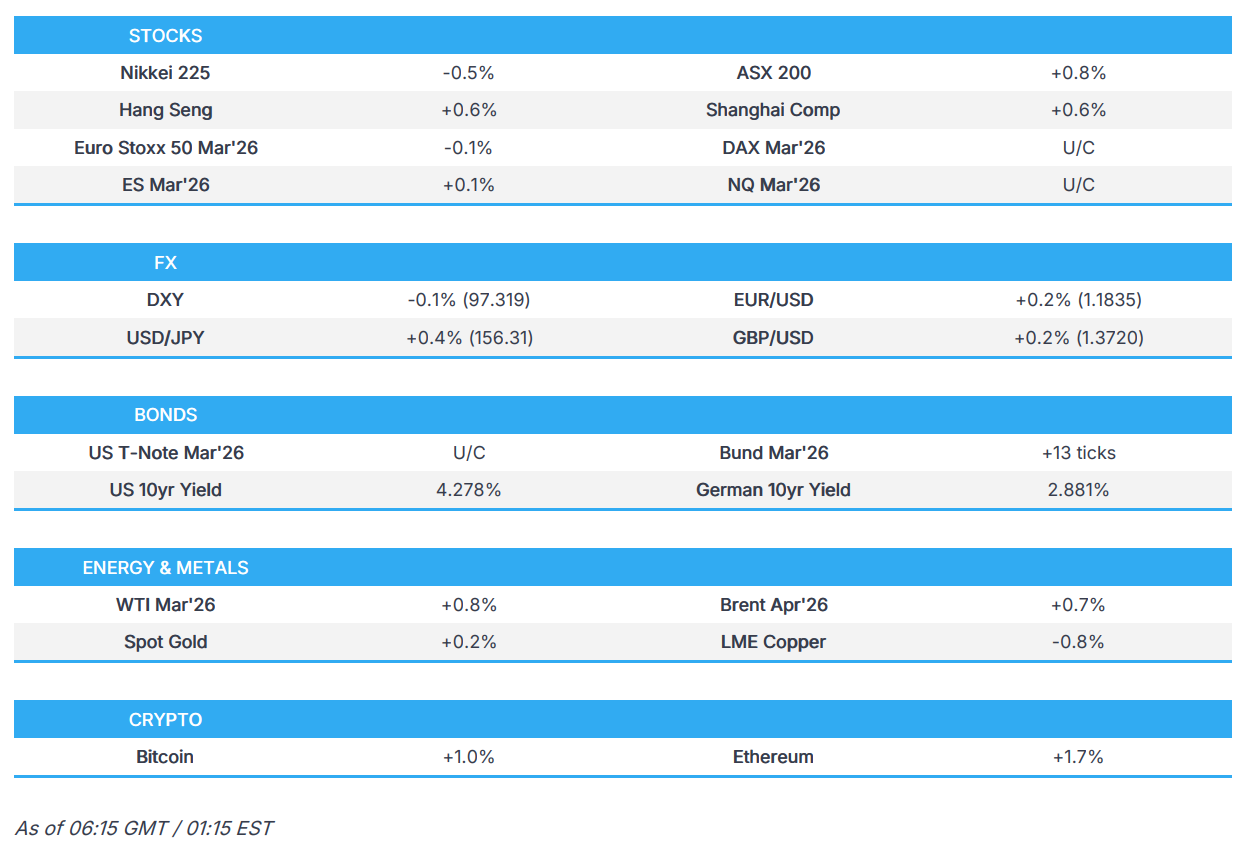
Newsquawk in 3 steps:
1. Subscribe to the free premarket movers reports
2. Listen to this report in the market open podcast (available on Apple and Spotify)
3. Trial Newsquawk’s premium real-time audio news squawk box for 7 days
US TRADE
EQUITIES
- US stocks were pressured as weakness in mega-cap names (NVDA, AVGO, META, MSFT, AMZN) weighed on the tech-heavy Nasdaq 100, which unsurprisingly saw Tech as the clear sectoral laggard. Communications and Discretionary were the next worst hit, while Energy, Materials, Consumer Staples, and Utilities all saw gains in excess of 1%, with Energy underpinned by gains in oil prices due to heightened US/Iran rhetoric after a report that Iranian gunboats approached a US oil tanker in the Strait of Hormuz early Tuesday and ordered it to stop, while the US military shot down an Iranian drone that approached a US Navy aircraft carrier in the Arabian Sea.
- SPX -0.84% at 6,918, NDX -1.55% at 23,339, DJI -0.34% at 49,241, RUT +0.31% at 2,648.
- Click here for a detailed summary.
TARIFFS/TRADE
- NVIDIA (NVDA) AI chip sales to China are reportedly stalled by a US security review, and Chinese customers are, meanwhile, not placing H200 chip orders with NVIDIA until there is clarity on whether they will be able to secure the licences and what conditions will be attached, according to FT.
- US government reached a water treaty agreement with Mexico.
- US Interior Secretary Burgum said the US plans to announce as many as 11 trade agreements on critical minerals this week.
NOTABLE HEADLINES
- US House voted (217-214) to pass the USD 1.2tln spending package to fund the government, which was sent to US President Trump, who then signed the bill to end a partial government shutdown, as expected.
- Fed Governor Miran resigned on Tuesday from his position as Chair of the Council of Economic Advisers, according to a White House official cited by Barron’s.
APAC TRADE
EQUITIES
- APAC stocks were ultimately mixed as the region partially shrugged off the downbeat handover from Wall Street, where sentiment was mired by renewed tech-selling, while participants in the region also reflected on the latest Chinese PMI data and the end of the partial US government shutdown.
- ASX 200 climbed higher with the upside led by outperformance in miners as metal prices continued their recovery, but with gains in the index capped by heavy losses in the tech sector.
- Nikkei 225 slumped at the open but is off worst levels, while risk appetite was pressured following recent earnings, including disappointing results from Nintendo, which saw its shares suffer a double-digit percentage drop.
- Hang Seng and Shanghai Comp saw two-way price action as participants digested stronger-than-expected Chinese RatingDog Services PMI data, and after the PBoC drained liquidity, while it was also reported that NVIDIA AI chip sales to China are stalled by a US security review and that Chinese customers are meanwhile not placing H200 chip orders with the company.
- US equity futures traded little changed and got some respite from the prior day’s tech-related selling.
- European equity futures indicate a softer cash market open with Euro Stoxx 50 futures down 0.1% after the cash market finished with losses of 0.2% on Tuesday.
FX
- DXY lacked direction after it weakened against most major peers yesterday and gave back some of the post-ISM spoils, while JOLTS data was delayed, and there were several comments from Fed speakers, but didn’t provide anything incrementally new. More recently, US President Trump signed the USD 1.2tln spending bill to end the government shutdown.
- EUR/USD eked slight gains but with the upside limited amid a lack of catalysts from the bloc and as inflation data looms.
- GBP/USD gradually reclaimed the 1.3700 handle in uneventful trade with a very quiet calendar for the UK ahead of Thursday’s BoE rate decision, while there was little reaction seen to NIESR raising its UK 2026 GDP growth forecast to 1.4% from 1.2%.
- USD/JPY extended on recent advances as the Japanese currency continued to underperform amid the ongoing expectations for a landslide victory by Japanese PM Takaichi’s ruling LDP at the snap election on Sunday.
- Antipodeans were rangebound amid the mixed risk appetite in Asia, and with NZD/USD not helped by the ultimately mixed employment and labour cost data from New Zealand.
FIXED INCOME
- 10yr UST futures traded flat amid sparse headline-driven newsflow, which was accentuated by the cancellation of JOLTS data due to the partial government shutdown. Nonetheless, the House has since approved the funds to end the shutdown, which President Trump signed into law, while participants await the Treasury Refunding Announcement.
- Bund futures rebounded off the prior day’s trough, but with the upside limited ahead of EZ flash HICP data and Bund supply.
- 10yr JGB futures remained afloat in quiet trade amid a lack of tier-1 data releases from Japan and with risk sentiment mixed.
COMMODITIES
- Crude futures remained firmer with the energy complex supported by US-Iran tensions after reports that the US shot down an Iranian drone and Iranian gunboats approached a US oil tanker in the Strait of Hormuz early Tuesday and ordered it to stop, while the latest private sector weekly inventory data showed a surprise drawdown of over 11mln bbls.
- US Private Inventory Data (bbls): Crude -11.1mln (exp. +0.5mln), Distillates -4.8mln (exp. -2.3mln), Gasoline +4.7mln (+1.4mln), Cushing -1.4mln
- US is working to grant general licenses allowing the production of oil and gas in Venezuela.
- Spot gold continued its firm rebound and returned to above the USD 5,000/oz level.
- Copper futures pulled back overnight after the prior day’s rally and with price action contained amid the mixed risk appetite in Asia.
CRYPTO
- Bitcoin gained overnight with prices returning to above the USD 76,000 level.
NOTABLE ASIA-PAC HEADLINES
- China’s Vice Finance Minister said China is facing persistent headwinds and policy uncertainty.
- PBoC injected CNY 75bln via 7-day reverse repos with the rate at 1.40% for a net drain of CNY 203bln.
DATA RECAP
- Chinese RatingDog Services PMI (Jan) 52.3 vs. Exp. 51.8 (Prev. 52.0)
- Chinese RatingDog Composite PMI (Jan) 51.6 (Prev. 51.3)
- New Zealand Employment Change QQ (Q4) 0.5% vs. Exp. 0.3% (Prev. 0.0%, Rev. From 0%)
- New Zealand Unemployment Rate (Q4) 5.4% vs. Exp. 5.3% (Prev. 5.3%)
- New Zealand Participation Rate (Q4) 70.50% vs. Exp. 70.3% (Prev. 70.30%, Rev. From 70.3%)
- New Zealand Labour Costs Index QQ (Q4) 0.4% vs. Exp. 0.5% (Prev. 0.5%)
- New Zealand Labour Costs Index YY (Q4) 2.0% vs. Exp. 2% (Prev. 2.1%)
GEOPOLITICS
MIDDLE EAST
- US President Trump said they are still negotiating with Iran and that there is more than one meeting with Iran.
- US Central Command confirmed that a US F-35C shot down an Iranian Shahed drone which flew “aggressively” and with “unclear intent” toward the USS Abraham Lincoln aircraft carrier in the Arabian Sea today, according to CBS.
- White House Press Secretary said that CENTCOM acted appropriately to shoot down an Iranian drone, and talks with Iran later this week are still scheduled, according to Fox News.
- Iran’s Far News Agency said an Iranian drone completed a “surveillance mission in international waters” after the US military said it shot down an Iranian drone, while Iran’s Tasnim News Agency said the connection with the drone in international waters was lost and that the reason for the lost connection was unknown.
- Iran reportedly wants to change venue and format of nuclear talks with the US, according to Axios citing sources, who noted that Iran is walking back from understandings that were reached in recent days after several countries were already invited to participate in the talks. Furthermore, Iran is said to want to move the talks from Istanbul to Oman and now want to hold them in a bilateral format, only with the US, rather than with several Arab and Muslim countries attending as observers, while a regional diplomat said Iran is also seeking to change the scope of the Friday talks to only focus on the nuclear file, and does not want the direct participation of regional countries.
- Iran told the mediators it is ready to discuss the nuclear issue and is willing to consider compromises, while it added that they can discuss the issue of ballistic missiles and the proxies afterwards, according to the Jerusalem Post.
- Israeli army announced airstrikes and tank shelling on militants after an Israeli officer was seriously injured in a shooting, while the IDF said the shooting at its forces is a violation of the ceasefire agreement in Gaza.
RUSSIA-UKRAINE
- Ukrainian President Zelensky said Ukraine is expected to make concessions, but Russia must also make concessions, mainly stopping aggression.
EU/UK
NOTABLE HEADLINES
- NIESR raised its forecast for UK GDP growth this year to 1.4% from 1.2%.
2.a NORTH KOREA/SOUTH KOREA/JAPAN
2 b JAPAN
3. CHINA
CHINA/
China’s Rare Earth ‘Monopoly’ – And Why Markets Will Break It
Tuesday, Feb 03, 2026 – 08:55 PM
Authored by Walter Donway via The Epoch Times (emphasis ours),
Commentary
That dependence did not arise because rare earth minerals are scarce. They are not. Nor did it arise because China alone possesses the technical capacity to mine or refine them. It arose from a long chain of economic and political decisions—made largely in free societies—that concentrated production in a country willing to accept costs others would not.
Understanding how that happened is essential to understanding why China’s apparent monopoly is far less “coercive,” and far less durable, than it looks.
Not Rare, Just Hell to Process
Rare earth elements are a group of seventeen metals mostly in the first row below the main periodic table in the lanthanide series (elements 57–71), plus Scandium (Sc, #21) and Yttrium (Y, #39), which share similar properties and are found in the same deposits as the lanthanides. They are “transition metals” with distinctive magnetic and fluorescent characteristics. The first was identified in 1787, and by 1947 all had been identified. (“Earths” is an archaic term for oxides, the form in which these elements are found.)
Think of these elements not as bulk materials but as metallurgical spices, used in tiny quantities to produce dramatic improvements in performance. Add neodymium to iron and boron and get the strongest permanent magnet known. Add yttrium to turbine alloys and jet engines can tolerate extraordinary heat. Europium makes modern display screens possible; terbium enables efficient electric motors; samarium strengthens guidance systems and sensors.
Despite their name, rare earths are widespread. Significant deposits exist in the United States, Australia, Brazil, India, and elsewhere. What makes them challenging is not their scarcity but their processing. The essential problem is that they are chemically almost identical, so how do you devise subtly different processes to separate them? More generally, they are chemically stubborn—for example, often intermingled with radioactive materials, and require dozens—sometimes more than a hundred—separation and purification steps. Each step consumes energy and produces toxic waste, making rare earth refining among the most environmentally punishing metallurgical processes in the modern economy.
The crux of the matter is straightforward. Mining rare earths is manageable. Processing them cleanly and at scale is hard, expensive, and politically fraught.
How China Built Dominance
China’s rise to dominance in rare earths was neither accidental nor inevitable. Beginning in the 1980s and accelerating through the 1990s and 2000s, China’s one-party dictatorship made a deliberate choice to invest heavily in mining and processing capacity. It did so under the conditions of a command economy that differed starkly from those in the West. Environmental controls were lax or poorly enforced. Local opposition carried little weight. State support absorbed losses and encouraged long-term specialization.
The outcome was leadership—at a price paid largely by Chinese communities and ecosystems. In Inner Mongolia, the world’s largest rare-earth mining region, toxic tailings ponds and contaminated water became infamous. Workers there suffered severe health issues from chronic exposure to toxic dust, heavy metals, and radioactive materials. There were—and are—high rates of respiratory, bone, and other diseases, compounded by environmental devastation and working conditions in the heavily polluting industry. Those costs, however, paid by workers and nearby communities for decades, translated into lower global prices. Western manufacturers benefited as consumer electronics became cheaper, and electric motors became smaller and more efficient. Companies like Apple could embed rare earth magnets throughout their products because the marginal cost was low. Magnets made of rare earth alloys like neodymium, the strongest by weight we know, give that satisfyingly decisive “click” when your laptop closes—and have uses in EVs, phones, and defense systems.
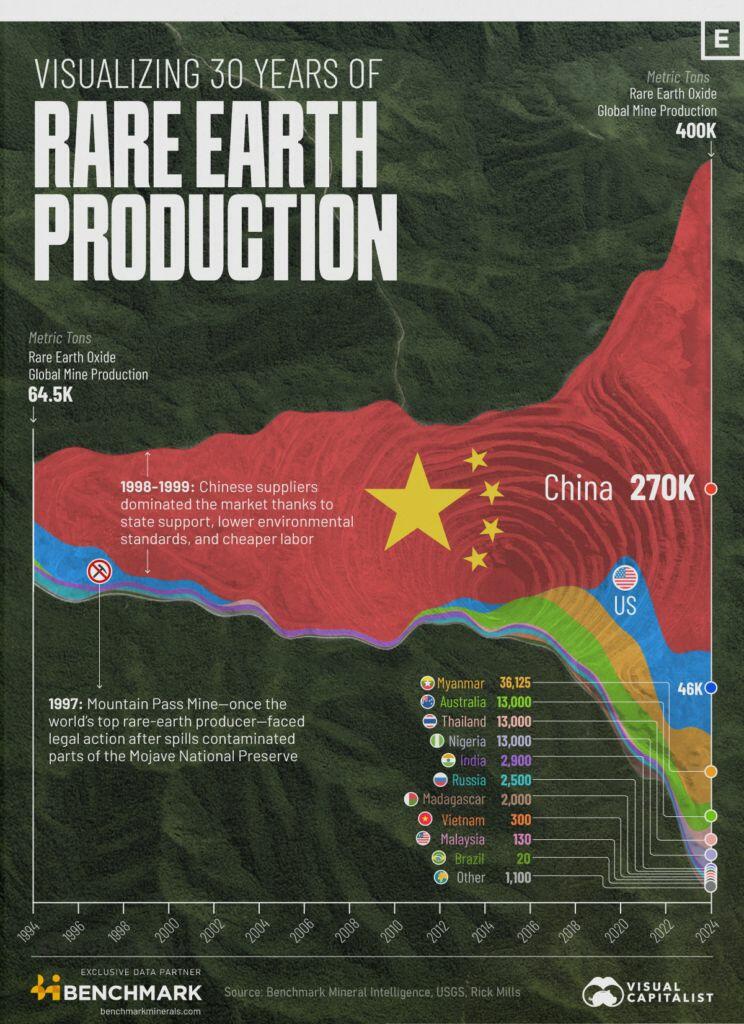
Over time, markets adapted rationally to these price signals. Western processing facilities closed. The United States, once a major producer, allowed its separation capacity to disappear. Even when rare earths were mined in California or Australia, the ore was shipped to China for refining. By the early 2020s, China accounted for roughly 70 percent of global rare-earth mining and more than 90 percent of processing and finished metal production.
Laissez-faire indifference did not produce this concentration. It owed as well to asymmetric regulation. Western governments imposed strict pollution controls and heavy liability that raised domestic costs, while China tolerated environmental and human damage in pursuit of strategic advantage. Markets responded to prices and rules as they existed, and production flowed—over time—to where it was cheapest and easiest to operate, even when that ease was politically manufactured. In this sense, China’s dominance was market-mediated, but politically orchestrated.
(In fact, a few analysts warned for years that China’s tolerance for environmental damage and state-directed investment would translate into strategic leverage. They included Jack Lifton of Technology Metals Research, Dudley Kingsnorth of Industrial Minerals Company of Australia, and researchers at the Congressional Research Service and RAND Corporation—warnings that were widely noted but largely discounted at the time.)
From Specialization to Vulnerability
For years, this arrangement appeared stable. Rare earths are used in surprisingly small quantities, even at scale, and the total global market is modest—comparable in value to the North American avocado market. Shortages were rare. Prices generally trended downward. Supply chains became hyper-specialized, optimized for cost rather than resilience.
The strategic implications were visible, but easy for businessmen and politicians alike to ignore—until China began to test its leverage.
In 2010, during a diplomatic dispute with Japan, Chinese rare-earth exports suddenly slowed. Prices spiked. Panic followed. Although China denied imposing a formal embargo, the message was unmistakable.
A decade later, amid rising trade tensions with the United States, Beijing made its intentions clearer. Export controls were tightened. Licensing requirements expanded. Restrictions on rare-earth processing technologies were imposed.
By 2025, China was openly treating rare earths as a strategic asset, one that could be weaponized in response to tariffs, sanctions, or military pressure. The risks could no longer be ignored. Modern defense systems depend heavily on rare earths. An F-35 fighter jet contains hundreds of pounds of rare-earth materials. Missiles, radar, satellites, and secure communications systems all rely on specialized magnets and alloys for which there are no easy substitutes.
And 2026 continues the uncomfortable dilemma. The United States has the resources, capital, and technical expertise to rebuild domestic capacity—but not quickly. Processing facilities take years to permit and construct. Skilled labor must be trained. Supply chains must be reassembled. In the short run, dependence remained. Trump’s sudden tariff war, framed by Beijing as yet another affront to China’s long-promised redemption from its “century of humiliation,” sharpened the confrontation between what the Chinese Communist Party perceives as a resurgent Middle Kingdom and a declining hegemon.
All of this helps explain the White House’s eagerness to secure Chinese assurances. The deal bought time. It did not solve the problem.
Coercive Monopolies Are Fragile
It is tempting to describe China’s position as a market failure or a natural monopoly. Neither description is quite right. China’s dominance is better understood as a coercive monopoly—one sustained not by insurmountable efficiencies, but by political and regulatory asymmetries. It exists because the command economy of one country accepted environmental and social costs that others rejected, and because governments elsewhere constrained domestic production without fully accounting for strategic consequences.
Coercive monopolies are inherently unstable. They persist only so long as the costs of entry exceed the perceived risks of dependence. Once that balance shifts, the monopoly begins to erode. China’s own actions are now accelerating that shift.
Export restrictions and licensing regimes raise prices and introduce entrepreneurial uncertainty. Those effects are painful in the short term, but they also activate powerful counterforces. Higher prices make alternative supply economically viable. Unreliable supply makes diversification valuable. Strategic risk becomes something investors and manufacturers are willing to pay to avoid. This is the market logic that China cannot escape. By tightening its grip, Beijing invites others to loosen it.
From the American Institute for Economic Research (AIER)
4./EUROPEAN AFFAIRS
UK
The Government Is Obsessed With Making Britain’s Countryside ‘Less White’
Wednesday, Feb 04, 2026 – 05:00 AM
Authored by Steve Watson via Modernity.news,
The British countryside is under siege from diversity mandates that aim to transform it into a “less white environment,” with officials in areas of natural beauty like the Chilterns and Cotswolds pledging to draw in more ethnic minorities under Department for Environment, Food & Rural Affairs (Defra) guidance.

This push stems from reports warning that rural spaces risk becoming “irrelevant” in a multicultural society, dominated by the “white middle class,” prompting commitments to outreach, diverse staffing, and even dog control measures to make the outdoors more appealing.
The Telegraph reports that National Landscapes—formerly Areas of Outstanding Natural Beauty (AONB)—and local councils have adopted diversity targets following Defra-commissioned studies.
In the Chilterns, proposals include community outreach to attract Muslims from nearby Luton, recruiting diverse staff, and producing marketing materials featuring ethnic minorities in “community languages.”
Research cited suggests tighter dog controls, as some groups fear them.
Malvern Hills National Landscape stated: “Many minority peoples have no connection to nature in the UK because their parents and their grandparents did not feel safe enough to take them or had other survival preoccupations.”
It added: “While most white English users value the solitude and contemplative activities which the countryside affords, the tendency for ethnic minority people is to prefer social company (family, friends, schools).”
The area plans to “develop strategies to reach people or communities with protected characteristics such as people without English as a first language”.
Nidderdale in North Yorkshire warns of barriers for ethnic minorities, including “concerns about how they will be received when visiting an unfamiliar place”, and vows to “develop more inclusive information to reflect more diverse cultural interpretation of the countryside”.
Cranborne Chase will also target “people or communities with protected characteristics such as people without English as a first language”.
Surrey Hills notes “some demographics are still under-represented in our countryside”, while Suffolk and Essex Coast Heaths expresses concerns about “some sections of society that are under-represented when looking at the composition of visitors”.
Dedham Vale pledges to “identify and seek to address barriers facing under-represented and/or diverse groups which limit equal access to the Dedham Vale National Landscape”.
These efforts trace back to a 2019 Defra report by Julian Glover, which claimed: “We are all paying for national landscapes through our taxes, and yet sometimes on our visits it has felt as if National Parks are an exclusive, mainly white, mainly middle?class club.”
Oh no, how awful, in a country where over 80% of the population is white.
It warned: “Many communities in modern Britain feel that these landscapes hold no relevance for them. The countryside is seen by both black, Asian and minority ethnic groups and white people as very much a ‘white’ environment.
“If that is true today, then the divide is only going to widen as society changes. Our countryside will end up being irrelevant to the country that actually exists,” the report continued, adding that a key proposal is “New long?term programmes to increase the ethnic diversity of visitors.”
The government responded by committing to “expand community engagement including with reference to increasing the ethnic and socioeconomic diversity of visitors”.
A 2022 Defra report, costing £108,000 found “perceptions of protected landscapes as being for white people and middle-class people could be a powerful barrier for first-generation immigrants”.
It noted ethnic minorities associate visiting with “white culture” and see “the English countryside as a white space, to which they did not belong”.
Concerns included rural facilities catering to “white English culture”, such as “traditional’ pubs, which have limited food options and cater to people who have a drinking culture. Accordingly, Muslims from the Pakistani and Bangladeshi group said this contributed to a feeling of being unwelcome.”
The Cotswolds plan references this, aiming to review provisions for the “widest possible demographic”.
This insane DEI drive echoes earlier claims we covered, where wildlife charities like the RSPCA, WWF, and National Trust labeled the countryside “racist” because it’s dominated by “white British cultural values” and influenced by “racist colonial legacies”.
Wildlife and Countryside Link, a charity umbrella group whose members include the RSPCA, WWF and National Trust, made the claim in evidence provided to Parliament on racism and its influence on the natural world.
The country’s green spaces are “dominated by white people” and are influenced by “racist colonial legacies” that are frightening away ethnic minorities from visiting them, the report claims.
Non-whites cannot ‘enjoy the outdoors’ because of the perception that the countryside is a “white space,” it adds.
“Cultural barriers reflect that in the UK, it is White British cultural values that have been embedded into the design and management of green spaces, and into society’s expectations of how people should be engaging with them,” states the report.
As we highlighted, such groups demanded the government create “legally binding target for access to nature” in order to address “structural racism”.
The Muslim Hikers group has also claimed that rural areas are seen as unwelcoming to minority communities, with the people who live there seemingly wanting to avoid the issues that “minority communities” bring with them.
These DEI initiatives coincide with a surge in rural degradation from fly-tipping, turning protected sites into wastelands.
We previously reported on 20 tonnes of rubbish dumped in Dorset’s Holt Heath nature reserve, blighting a Site of Special Scientific Interest and threatening wildlife.
Similarly, a Welsh mountain in Treorchy became a “stream of rubbish visible for miles,” devastating farmer Katie Davies’ land and endangering her sheep.
Davies called it “devastating” and “horrendous,” stressing the need for a “long-term solution”.
These incidents reveal how imported chaos and lax enforcement are eroding Britain’s rural heritage, now compounded by forced diversity schemes that risk further alienating natives while importing urban issues to green havens.
As mass migration reshapes society, preserving the countryside’s traditional appeal—without mandates that dilute its cultural roots—remains essential to keeping Britain’s landscapes relevant and intact for all who respect them.
Your support is crucial in helping us defeat mass censorship. Please consider donating via Locals or check out our unique merch. Follow us on X @ModernityNews.
END
GERMANY
KOLBE
a must read!!
Gold Giant Bundesbank Signals An Open Vote Of No Confidence in Global Monetary Stability
Wednesday, Feb 04, 2026 – 03:30 AM
Submitted by Thomas Kolbe
The German Bundesbank hoards the second-largest gold reserves among central banks. The precious metal serves as an insurance policy for both states and private individuals. Its massive price surge shows that the dice have already been cast: governments will attempt to inflate their debts.
Anyone acquiring precious metals in these weeks simultaneously casts a verdict on their currency. This may be a conscious portfolio decision or simply an undefined desire to have a monetary insurance policy at hand. One never knows what the future holds.
Gold jewelry or collectible silver coins are aesthetically appealing and trigger our instinct to collect. What private purchases and the massive hoarding of gold by central banks share is their monetary-policy background.
In honest moments, looking at the soaring global sovereign debts and escalating geopolitical conflicts, we know that our monetary system is heading for severe turbulence. In many places, the fiscal Rubicon has long been crossed. With debt-to-GDP ratios well above 100 percent—in the U.S., China, and numerous European countries—only a massive expansion of the money supply can ensure the public sector’s ability to pay.
Bundesbank Holds Massive Gold Reserves
This occurs at the expense of those trusting in cash. In this context, it is noteworthy that the German Bundesbank hoards the second-largest gold reserves among global central banks.
3,350 tons of gold, with a market value of roughly half a trillion euros, are split between the Bundesbank’s vaults in Frankfurt (50 percent), the New York Federal Reserve (37 percent), and a storage facility in the City of London (13 percent). It is an inheritance from the old Bretton Woods system, when gold was stored near major global trade hubs.
The time is drawing closer to bring the reserves stored abroad back home. In a fragile monetary system, precaution is not alarmism—it is pure self-protection.
Italian Prime Minister Giorgia Meloni must have thought the same. She is working under intense pressure to formally transfer the Italian central bank’s gold reserves to the state—a step equivalent to an open vote of no confidence against the European Central Bank.
Italy holds 2,452 tons of gold, ranking third internationally behind the U.S. and Germany, giving it, like Germany, a bargaining chip to restart its own currency should a severe euro crisis ever occur.
From the Frankfurt ECB Tower, these developments are viewed with the utmost concern. Nothing corrodes a monetary system faster and more effectively than a loss of confidence in creditworthiness. The banking system, as well as pension funds and retirement insurance, rely on the stability of government bonds recorded on their balance sheets.
Once it became clear that states could no longer consolidate fiscally, the bond market corrected sharply. Billions in losses are on the books, only not written off due to special valuation rules granted by lawmakers.
From the ECB’s perspective, the hoarding of national gold reveals dangerous secession tendencies. It still holds around 500 tons of gold from the early days of the monetary union, when member states contributed gold reserves proportionally to their GDP to support the euro. This is far from sufficient to provide the euro with a stable, metal-backed anchor after decades of money growth.
The repeated desire of ECB President Christine Lagarde to centralize national gold reserves at the ECB vault is almost universally rejected by eurozone members. So much for the repeatedly touted integration of the euro system.
Gold as a Global Trust Anchor
Elsewhere, gold has also become central to stabilizing trust. The BRICS nations have for years worked on creating a payment system independent of SWIFT but have failed so far because no one trusts the Asian hegemon, China.
The solution—the pegging of mutual transfers to gold—was adopted by China during the global financial crisis more than fifteen years ago, when it became the largest buyer in the precious metals market. With roughly 2,300 tons, China now holds the fourth-largest gold reserves in the world.
Besides China, Russia, Turkey, India, and Poland, as well as countries like Egypt and Thailand, have significantly increased their gold holdings since 2008. The price increase is therefore justified and likely to continue in the long term, albeit with growing volatility.
A positive side effect of this reevaluation is a kind of balance-sheet repair. The deep gaps created by the bond market crisis are closed by the appreciation of gold for those who recognized the approaching sovereign debt danger early.
In Germany’s Bundesbank, gold now represents roughly 80 percent of the entire balance sheet. There is thus motivation in many places to continue boosting the gold price. It is an elegant way to stabilize the monetary system while simultaneously repairing past damages across different institutional levels through a simple repricing.
States Strive for a Gold Monopoly
It is almost a historical irony. When U.S. President Richard Nixon terminated the dollar’s convertibility into gold in 1971 amid soaring debt and massive inflation of liabilities, the so-called fiat credit money system was set in motion. Debts exploded, and states could borrow nearly without limit.
Unbacked credit, combined with ever-lowering reserve requirements, created a perfect Ponzi system, which has now entered its crisis stage.
German policymakers tried to escape this debt spiral by enshrining the so-called debt brake a few years ago. Yet the corrosive erosion of this fiscal constraint began immediately afterward and was ultimately buried last year by Chancellor Friedrich Merz and his high-stakes special fund gamble.
With this policy of unlimited state credit, citizens are driven toward safe havens such as precious metals, accelerating the decline of the fiat credit money system.
The relationship of states to gold remains ambivalent. Aside from committed fiat regimes like Canada, which holds no gold at all, it is becoming increasingly clear that gold can either extend the Ponzi scheme or initiate a new monetary system.
However, citizens fleeing into the safe haven of precious metals become potentially dangerous antagonists, prompting an immediate political counterreaction. Gold purchases are recorded, limited, and legislated in ways clearly designed to capture future portfolio gains.
The Netherlands, for example, is expected to begin taxing unrealized capital gains in 2028—a clear warning.
A general, sharp appreciation of precious metals could create tens of thousands of capital-strong, independent families, particularly in Europe. It is precisely this independence that vexes the etatists in Brussels and EU capitals. The fiscal effect of harvesting book gains in the private sector also plays a role, given runaway sovereign debt.
The ambivalence of gold—and this applies to precious metals as well as other assets without counterparty risk, such as Bitcoin—inevitably provokes massive repression in political regimes focused on citizen control.
Expect other European states soon to follow the Netherlands’ example. The fight for sovereignty has begun.
* * *
5. RUSSIA AND MIDDLE EASTERN AFFAIRS
ISRAEL TBN LAST 24 HR
ISRAEL UPDATES
US & Israel Flex From Afar In Joint Red Sea Naval Drills
Tuesday, Feb 03, 2026 – 07:40 PM
This past several days saw Iran conduct limited ‘live fire’ war drills in the Strait of Hormuz, and prior to that there were some joint Iran-China-Russia naval maneuvers – but with the USS Lincoln carrier group reportedly moving away from the potential flashpoint, into waters off Yemen, there remains an uneasy de-escalation (for now) in anticipating of Turkish-hosted US-Iran nuclear negotiations.
Israel and the United States have still flexed back, as the partner forces kicked off the week Monday with joint naval military drills in the Red Sea. The war games come amid fears of a potential US attack on Iran.

“A joint exercise was conducted yesterday between a U.S. Navy destroyer and Israeli Navy vessels. The drill was held as part of the ongoing cooperation between the Israeli Navy and the US Fifth Fleet in the Red Sea arena,” The IDF posted on X Monday.
“The destroyer docked at the port as part of a pre-planned, routine visit and within the framework of the strategic and close cooperation between the two navies and respective militaries,” it said.
The US meanwhile continues to send cargo planes, fighter jets, and advanced air defense systems into the Gulf region to prepare for a potential coming conflict with Iran.
Maximalist demands are still being made of Tehran. While it is willing to talk about its nuclear program, Iranian leaders have balked at Washington demands to give up or at least reduce the Islamic Republic’s ballistic missile program.
All the while, Israeli defense officials have traveled to the US for meetings with top military officials. The Netanyahu government is reportedly lobbying for robust Pentagon action against Iran.
One astute Middle East observer has noted, “There is a persistent and unresolved gap between Trump and Prime Minister Netanyahu — a gap that was not closed even during the recent 12 day war.”
The same analyst lays out the following:
Moreover, even when Trump gave Israel the green light to carry out strikes bacm in June, he did so with the assumption that military pressure would increase Iran’s willingness to accept a deal, not as part of a strategy aimed at regime change. Until recently, Trump rarely spoke in terms of overthrowing the Iranian regime.
Iran is naturally deeply distrustful and suspicious of US motives – especially given it was the first Trump administration which unilaterally pulled out of the Obama-era JCPOA nuclear deal to begin with.
Now Iran is being asked to scrap everything and start afresh, but including ballistic missiles on the agenda will be a non-starter. If Iran gives up or reduces its missile capability, it will have nothing to defend against in the next Israel conflict. The June war saw the Islamic Republic get attacked without warning.
END
IRAN UPDATES
US fighter jet downs Iranian drone near aircraft carrier, gunboats approach US-flagged tanker
Iranian Shahed-139 drone shot down by F-35 jet over Arabian Sea • In separate incident, six Iranian gunboats approach US-flagged oil tanker in Strait of Hormuz

The Nimitz-class aircraft carrier USS Abraham Lincoln (CVN 72) sails alongside the Arleigh Burke-class guided-missile destroyer USS Spruance (DDG 111) in the U.S. 5th Fleet area of operations.(photo credit: Official US Navy photo)ByREUTERS, JERUSALEM POST STAFFFEBRUARY 3, 2026 18:35Updated: FEBRUARY 3, 2026 21:49
The US military shot down an Iranian drone that approached the USS Abraham Lincoln aircraft carrier in the Arabian Sea, an American official told Reuters on Tuesday.
The Iranian Shahed-139 drone was flying towards the carrier and was shot down by a F-35 US fighter jet.
“An F-35C fighter jet from Abraham Lincoln shot down the Iranian drone in self-defense and to protect the aircraft carrier and personnel on board,” said Navy Captain Tim Hawkins, a spokesperson at the US military’s Central Command.
No American service members were harmed during the incident, and no US equipment was damaged, he added.

The White House later praised CENTCOM’s actions and affirmed that talks scheduled for Friday with Iranian Foreign Minister Abbas Araghchi were still on.
US tanker approached by Iranian gunboats
In a separate incident, six Iranian gunboats approached a US-flagged oil tanker in the Strait of Hormuz, north of Oman, according to maritime sources and a security consultancy.
US officials confirmed that armed Iranian boats attempted to stop the US-flagged ship, which was subsequently escorted to safety.
“Two IRGC boats and an Iranian Mohajer drone approached M/V Stena Imperative at high speeds and threatened to board and seize the tanker,” Hawkins said.
The UK Maritime Trade Operations (UKMTO) stated it is investigating the incident, which occurred in the inbound Traffic Separation Scheme of the Strait of Hormuz.
Iranian gunboats attempted to contact the tanker via VHF radio, but the ship ignored their requests to stop and continued on its planned route.
Maritime security firm Vanguard Tech reported to its clients that six Iranian gunboats, equipped with 50 caliber guns, ordered the tanker to shut down its engines and prepare to be boarded. Instead, the vessel accelerated and was later escorted by a US warship, according to The Wall Street Journal.
Iran’s semi-official Fars news agency quoted unnamed Iranian officials who claimed that a vessel had entered Iranian territorial waters without the necessary legal permits, was warned, and subsequently left the area “without any special security event taking place.”
Fars News also reported that the Iranian drone had ‘completed a surveillance mission in international waters’ after the US military claimed to have shot down an Iranian drone.
However, according to the maritime risk management group Vanguard, the tanker, identified as the Stena Imperative, “did not enter Iranian internal territorial waters” and was escorted by a US warship.
“Given increased military activity and elevated regional tensions, the potential for misjudgment cannot be discounted,” Vanguard told its clients in a statement.
The incidents come after US President Donald Trump said that he had sent an armada of ships to the Middle East. Trump warned that with US warships heading toward Iran, “bad things” would probably happen if a deal could not be reached.
“There’s another beautiful armada floating beautifully towards Iran right now,” Trump added, sharing that he hopes Iran will “make a deal” and “should have made a deal the first time.”
END
IRAN
Second Iranian Diplomat In Europe Defects, Seeks Asylum, Amid US Pressure Campaign
Wednesday, Feb 04, 2026 – 05:45 AM
Trump’s repeated threats to bomb Iran seem to have resulted in some Iranian officials abandoning ship. There have been reports of two such recent instances.
In the latest, Iran’s chargé d’affaires in Vienna, Gholamreza Derikvand, abruptly abandoned his post and is reportedly seeking asylum in Switzerland for himself and his family.

The Iranian government has not confirmed this, however, and Iran’s Foreign Ministry has simply said amid the speculation of the diplomat’s sudden absence that it is “avoiding discussing the case or claiming ignorance due to fear of intelligence agencies.”
Derikvand’s colleagues told Iran International that Derikvand was widely seen as a rising figure within Iran’s diplomatic corps and could have been promoted to ambassador had he stayed on. His résumé includes a previous stint as chargé d’affaires at Iran’s embassy in the Czech Republic from 2011 to 2014.
The story broke Tuesday in Iran International – an online news portal which has long been accused of having links to Israel’s Mossad intelligence agency. This means all initial claims should be taken in context and with a critical eye.
Israeli media itself has reviewed of the London-based outlet falling under suspicion:
Iran’s Intelligence Ministry claimed to have found a broadcast studio belonging to London-based anti-regime outlet Iran International in Tel Aviv, Iranian media reported this week.
The ministry also claimed to have identified “a number of individuals working at, or with,” the outlet, as well as their alleged residences.
…Iran International is designated as a “terrorist broadcaster” by Tehran, which alleges that it works alongside Mossad to “destabilize” the Islamic Republic.
But as for an Iranian top-level diplomat defecting while the Islamic Republic faces massive US political and even military pressure – this makes sense and there is precedent, also on the heels of last month’s deadly protests in Iran where thousands died.
A prior alleged defection surfaced in headlines just last month, as Newsmax recalls:
The report follows another recent case in Switzerland involving an Iranian diplomat assigned to the United Nations’ European headquarters in Geneva.
On Jan. 18, Iran International reported that Alireza Jeyrani Hokmabad, described as a senior official and deputy head of Iran’s mission to U.N. agencies in Geneva, left his workplace and applied for asylum with his family.
If this becomes a trend, it would be highly embarrassing for the Iranian government and its diplomatic corps. This alone gives motive for Tehran wanting to keep it quiet, and so will probably hold off commenting.
END
JERUSALEM POST
Nuclear talks moved from Turkey to Oman after Iran threatens pullout – report
The Jerusalem Post learned that Iran told mediators that it is ready to discuss the nuclear issue and is even willing to consider compromises.

Iranian Foreign Minister Abbas Araghchi speaks in Moscow, December 17, 2025; illustrative.(photo credit: REUTERS/Ramil Sitdikov/Pool)ByCORINNE BAUM, REUTERSFEBRUARY 3, 2026 19:16Updated: FEBRUARY 4, 2026 04:18
Nuclear talks between the US and Iran are expected to take place in Oman on Friday, Axios reporter Barak Ravid said on Tuesday, citing an Arab source.
President Donald Trump’s administration agreed to Iran’s request to move the talks from Turkey, and negotiations are still ongoing on whether Arab and Muslim countries in the region will join the talks in Oman, Ravid added, citing the source.
Iran has requested changes to the venue and format of nuclear talks with the United States, Axios reported on Tuesday, citing two sources knowledgeable of the matter.
Reuters reported that Iran is seeking to move the talks from Istanbul to Oman.
“They want to change the format, they want to change the scope,” said the regional diplomat with knowledge of Iran’s demands.

“They only want to discuss the nuclear file with the Americans, while the US wants to include other topics such as the (ballistic) missiles and the activities of Iran’s proxies in the region.”
The Iranian Foreign Minister claimed that consultations for the venue of talks with the United States were underway, and confirmed that they would happen later this week.
It also claimed that the location and timing of the talks were not “complicated issues” and that the issues should not be used as “a pretext for media games.”
Iran, US to meet later in February
This comes after Trump’s special envoy Steve Witkoff and Iranian Foreign Minister Abbas Araghchi announced that they would meet in Istanbul on Friday.
Senior officials, likely foreign ministers, from Qatar, Egypt, Saudi Arabia, Oman, and Turkey were expected to join the talks, sources confirmed to The Jerusalem Post. Trump’s advisor and son-in-law, Jared Kushner, will also attend.
“It remains to be seen whether the United States intends to engage in serious, results-oriented negotiations,” one source commented.
The Post learned that Iran told mediators that it is ready to discuss the nuclear issue and is even willing to consider compromises.
Additionally, the Islamic Republic seemed amenable to discussing the ballistic missiles issue and its proxies in later talks, according to a source familiar with the details.
Iran reportedly believes that reaching an agreement on the nuclear issue will cause Trump to abandon the idea of war. The source added to the Post that if there is a nuclear deal, it will probably prevent Israel from conducting strikes against Iran’s missile storage facilities.
However, in Israel and the US, the assessment is that the chance of reaching an agreement with the Islamic Republic is slim to none.
US asserts talks still on after Iranian threatens to withdraw
Separately on Tuesday, Iranian officials threatened to withdraw from the upcoming Istanbul talks, the Wall Street Journal reported, citing people familiar with the matter, though it is unclear what triggered the remarks.
White House press secretary Karoline Leavitt told Fox News on Tuesday that talks with Iran were still scheduled to take place later this week.
A source familiar with the situation said on Tuesday that Trump’s son-in-law, Jared Kushner, was due to take part in the talks, along with US Special Envoy Steve Witkoff and Iranian Foreign Minister Abbas Araghchi.
An Iranian diplomatic source told Reuters that Tehran’s view of the talks is neither optimistic nor pessimistic, adding that the Islamic Republic’s defensive capabilities are non-negotiable and that it is ready for any scenario.
“It remains to be seen whether the United States also intends to conduct serious, results-oriented negotiations or not,” the source said.
Amichai Stein contributed to this report.
END
Trump Warns Of ‘Bad Things’ If No Iran Deal Reached As Venue Moves To Oman
Wednesday, Feb 04, 2026 – 09:00 AM
Trump had kicked off the week by warning Iran that “bad things” would probably happen if a deal could not be reached. “We have ships heading to Iran right now, big ones – the biggest and the best – and we have talks going on with Iran and we’ll see how it all works out,” Trump told reporters in the Oval Office. “If we can work something out, that would be great and if we can’t, probably bad things would happen.”
“I’d like to see a deal negotiated. I don’t know that that’s going to happen,” he added. So far, Iran seems a willing participant, though at this point the reality is it has little to lose by risking such direct engagement.

The only thing which has remained up in the air is the venue. Initially widespread reports said the talks would be hosted by Turkey in Istanbul, but now the sides have their sights set on Oman.
Axios writes that these changes threaten to derail the talks before they even begin. “The Iranians want to move the talks from Istanbul to Oman,” the Wednesday report says.
“They also now want to hold them in a bilateral format, only with the U.S., rather than with several Arab and Muslim countries attending as observers,” it adds.
But Axios says that the Trump administration has agreed to the request from Tehran to hold the talks in Oman.
The bigger issue is going to be the scope of the talks. Iran is willing to engage on the nuclear issue, but will not negotiate over its ballistic missiles, seen as essential for national security and in any future war with Israel.
“A source with knowledge said that’s because the Iranians want to limit the talks to nuclear issues and not discuss things like missiles and proxy groups that are priorities for other countries in the region,” states Axios.
On Tuesday Trump had followed with more comments:
“They had a chance to do something a while ago, and it didn’t work out. And we did ‘Midnight Hammer’, I don’t think they want that happening again,” he said.
This time, Tehran is warning that it is ready to strike back hard if attacked, even if this means all-out war. It says its military forces and ballistic missiles are on high alert, and also that Tel Aviv will be again targeted in the event of US aggression.
Israel meanwhile is said to be lobbying Washington for regime change in Tehran, but the White House reportedly isn’t ready for such a drastic option – also amid reports the Pentagon would need more time to put assets in place.
end
White House Nukes Friday’s Planned Iran Talks, Oil Spikes
Wednesday, Feb 04, 2026 – 12:35 PM
Update(1235ET): Oil is spiking on this breaking headline that the White House has nuked the Iran nuclear talks:
THE NUCLEAR TALKS WERE CANCELED ON FRIDAY DUE TO THE IRANIANS’ REFUSAL TO ENGAGE IN NON-NUCLEAR ISSUES- AXIOS REPORTER
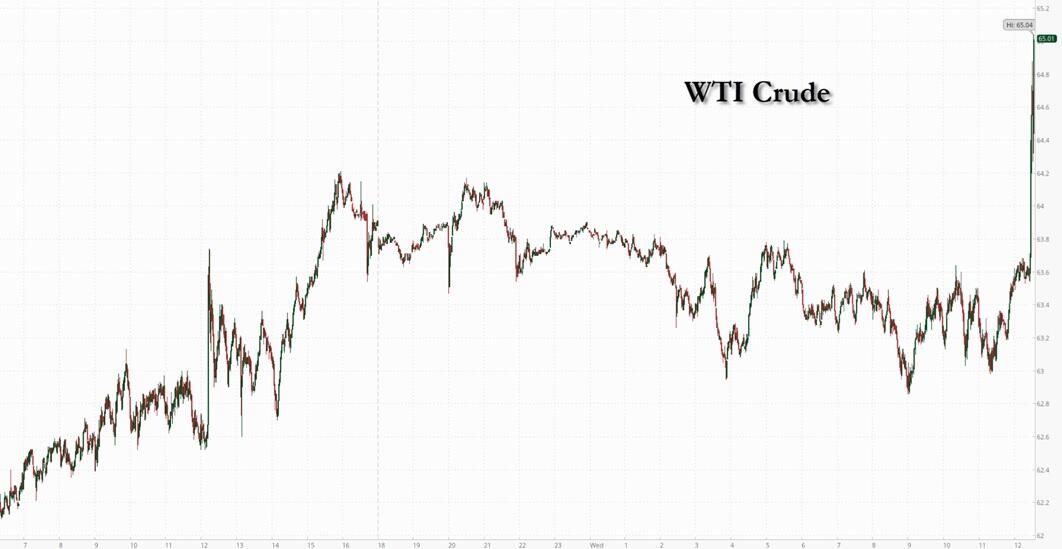
“The U.S. told Iran on Wednesday that it will not agree to Tehran’s demands to change the location and format of talks planned for Friday, two U.S. officials told Axios.”
And more per the breaking Axios report:
- The official said that if the Iranians are willing to go back to the original format, the U.S. is ready to meet this week or next week.
- “We want to reach a real deal quickly or people will look at other options,” the senior official said, alluding to Trump’s repeated threats of military action.
Trump officials are reportedly insisting that Iran be stripped of any missile range capable of striking Israel. Israel, meanwhile, would retain its full missile arsenal – including the undeclared nuclear weapons that everyone in the world knows about – capable of hitting Iran.
Also the US wanted to talk about Iran’s support to proxies in the region, but for Tehran anything outside the nuclear domain has remained a non-starter.
* * *
US struggles to secure Gaza reconstruction funds amid Hamas disarmament standoff
Sources close to Hamas say the group has yet to start talks on disarming, meant to precede the start of rebuilding Gaza’s destroyed cities.

FILE PHOTO: Palestinians walk past the rubble of destroyed buildings, amid a ceasefire between Israel and Hamas, in Gaza City, November 19, 2025.(photo credit: REUTERS/Dawoud Abu Alkas/File Photo)ByREUTERSFEBRUARY 4, 2026 13:45
The US has yet to secure funding commitments for its Gaza reconstruction plan as potential donors voice concerns that disagreements over Hamas disarmament could lead Israel to resume full-scale war in the enclave, sources told Reuters.
Hamas laying down its weapons is a key requirement under Donald Trump’s plan to end the Gaza war. It calls for Israel’s military to withdraw troops as Hamas disarms and for Gaza’s reconstruction to be overseen by a “Board of Peace” chaired by the US President.
Trump’s plan got a boost this week with the reopening of Gaza’s Rafah border crossing with Egypt. But sources close to Hamas say the group has yet to start talks on disarming, meant to precede the start of rebuilding Gaza’s destroyed cities.
Two sources with direct knowledge of the Board’s planning said that countries were hesitant to commit funds to a rebuilding plan unveiled last month by Trump’s son-in-law, Jared Kushner, until Hamas disarms.
“Countries want to see the funding will go for reconstruction within demilitarized places, and not to throw the money into another war zone,” one of the sources said.

Advertisement
“If we pass that obstacle, then funding will not be an issue.”
No date for funding conference, sources say
Seven Western diplomats told Reuters that the funding holdup, which has not been previously reported, was also being driven by a demand by some potential donors for funds to be managed by the United Nations rather than the Board of Peace.
The funding delay leaves Gaza’s devastated population in limbo, unable to begin clearing rubble or rebuilding basic infrastructure, and feeds into worries among US allies that a fragile October truce, shaken by repeated Israeli attacks in Gaza, could break down and lead to a resumption of heavy fighting between Israel and Hamas militants.
Alongside governments, potential donors could also include private sector contributors, the diplomats and the two sources said. They estimated the potential rebuilding cost to be in the range of $100 billion.
That money would fund a “New Gaza” rebuilt from scratch to include seafront residential towers, data centers and industrial parks, Kushner said at the World Economic Forum in Davos on January 22.
The plan does not call for compensation for Palestinians who saw their homes destroyed. Two of the diplomats said that it was not clear how the “New Gaza” plan would address land rights.
Kushner said in Davos that an event would be held in Washington in the coming weeks “where we’ll announce a lot of the contributions that will be made … from the private sector.”
But the two sources familiar with the Board’s planning said a date for that conference had not yet been set.
“In the meantime, we’re not waiting for the event. There is discussion one on one,” one of the sources said, without identifying specific donor targets.
A senior European diplomat said that no European or Western country had yet committed funds for Gaza’s reconstruction.
“We need some serious private money … The Europeans are not capable of funding it,” the senior European diplomat said, citing fiscal constraints and growing domestic opposition within Europe to foreign aid spending.
Wealthy, oil-rich Gulf Arab states have expressed hesitation at financing Gaza’s reconstruction without a broader political solution that includes Hamas disarming.
Representatives for the Board of Peace and for its Palestinian technocratic committee did not immediately respond to requests for comment for this story.
‘Peace area pricing’
After a two-year Israeli assault that left most of Gaza in ruins and Hamas weakened, the group is still believed to possess rockets, which several Western intelligence sources estimate to number in the hundreds. It is also estimated to possess thousands of light weapons including rifles.
Senior officials in Israel, which launched the assault after the October 7, 2023, Hamas attack, say they do not believe Hamas will lay down its weapons without the use of force and that the military is preparing to return to war.
The first phase of Trump’s plan left Hamas in control of a bit under half of Gaza, where the group polices streets and has reestablished its hold. Israel accuses Hamas of planning or attempting to carry out attacks on its troops, prompting strikes that have killed hundreds.
Hamas has agreed to discuss disarmament with other Palestinian factions, but neither Washington nor regional mediators had presented the group with any detailed or concrete disarmament proposal, two Hamas officials told Reuters.
One of the sources with knowledge of the Board’s planning said it would be difficult to secure private sector financing without at least some progress toward disarmament.
“We came to the conclusion that if you really want to (rebuild) with the full spectrum of financing, you need peace area pricing,” the source said, suggesting the cost of financing would be risk-adjusted to the level of security in a given area.
“Now it doesn’t mean that we wait for the full process to be done, but we want to see that it’s really happening with full cooperation.”
One of the first tasks will be clearing an estimated 68 tonnes of rubble and war debris in Gaza. The Board of Peace was in talks with several parties to award potential rubble-clearing contracts, the source and a US official familiar with the matter said.
Several rubble-clearing contracts could be awarded, the source said, adding that the aim is for tenders and the awarding of contracts to eventually be managed by a Palestinian technocratic body overseen by the Board.
END
RUSSIA VS UKRAINE
Putin ‘Kept His Word’ On Ceasefire, Trump Says, As Large Attacks On Kiev Resume
Wednesday, Feb 04, 2026 – 09:50 AM
President Trump has praised his Russian counterpart for keeping his word on the brief winter freeze ceasefire. Last week Trump had picked up the phone and urged President Putin to refrain from attacking Kiev and other major cities.
Trump said of the surprise pause that Putin had agreed to halt strikes for one week. Trump has newly told reporters that the agreement expired on Sunday, and that Russia kept its word.
“It was Sunday to Sunday, and it opened up and he hit them hard last night,” Trump explained at the White House on Tuesday. “He kept his word on that… we’ll take anything, because it’s really, really cold over there.”

But it was only last Thursday Jan.29 that first Trump unveiled the contents of the prior Putin call. It seems the pause lasted a little short of a full week, but maybe Trump is only counting business days? It is possible the phone call in question was held significantly before the announcement, but it remains there has not been a full week that Kiev hasn’t seen bombs or drones in the sky.
What Trump said at the time was: “Because of the extreme cold…I personally asked President Putin not to fire on Kiev and the cities and towns for a week.” He went on to say Putin “agreed to do that,“ adding that “we’re very happy” with the outcome.
On Wednesday, American, Ukrainian and Russian representatives are once again gathered the United Arab Emirates for the next round of trilateral talks in an effort to forge a final peace. The Abu Dhabi talks are expected to run until Thursday.
Ukrainian President Volodymyr Zelensky is complaining about the timeline of Trump’s winter brief truce, saying it only began last Friday, a day after Trump announced he reached the temporary deal.
And then as Reuters reported:
Russia’s air attack on Ukraine’s energy system overnight on Tuesday was the biggest since the start of 2026, Ukraine’s leading private energy company said.
Power generation and distribution facilities came under attack, and thousands of people were left without electricity, DTEK said on the Telegram messaging app.
Over 70 missiles and several hundred drones were sent, some knocking out power and thermal plants, amid ongoing slow and costly repairs.
“We await the reaction of America to the Russian strikes,” Zelensky said in a Tuesday night statement. “It was the U.S. proposal to halt strikes on energy during diplomacy and severe winter weather. The president of the United States made the request personally. Russia responded with a record number of ballistic missiles.”
He is demanding that Russia feel the pain. “The US Congress has long been working on a new sanctions bill, and there must be progress on it. European partners can take decisive steps regarding Russian oil tankers’ earnings for the war. Russia must feel pressure so that it moves in negotiations toward peace,” Zelensky added – though one wonders what there is left to sanction.
Ukrainian officials have condemned what they are calling a “winter genocide” – given that the latest big strike happened when it is -20C (-4F) in the capital. That’s where more than 1,000 tower blocks in the capital were left without heating once again in the wake of the assault which marked the end of the Trump-Putin short truce.
6. GLOBAL ISSUES//COVID ISSUES/VACCINE ISSUES/HEALTH ISSUE
GLOBAL ISSUES
MARK CRISPIN MILLER
DR PAUL ALEXANDER
NEWSWIZE
| LATEST REPORTS FOR NEWS JUNKIES |
| Senate To Bypass ‘Zombie’ Filibuster For Vote On Popular Voter ID BillSenate Majority Leader John Thune has indicated plans to bring the Safeguard American Voter Eligibility (SAVE) Act to the Senate floor for a vote, potentially using a procedural maneuver to avoid the traditional 60-vote threshold required to overcome a filibuster. The announcement comes after a number of House Republicans, including Reps. Anna Paulina Luna (R-FL) and Tim Burchett (R-TN), indicated …READ THE FULL REPORT |
| Noem Announces Massive Update To ICE, CBP PoliciesDepartment of Homeland Security (DHS) Secretary Kristi Noem announced Monday, February 2, that U.S. Immigration and Customs Enforcement (ICE) and U.S. Customs and Border Protection (CBP) agents will now be equipped with body-worm cameras while conducting immigration enforcement operations. In an X post, Noem announced that a decision to deploy body cams in Minneapolis was made after conversations between herself, …READ THE FULL REPORT |
| New Poll Vindicates Trump, Shows Huge Majority Backing Mass DeportationsA new national survey is dealing a major blow to the Democratic Party’s immigration messaging and reinforcing President Donald Trump’s long-held position on border enforcement and deportations. The poll, released by Cygnal, finds overwhelming public support for enforcing immigration law, deporting those in the country illegally, and allowing Immigration and Customs Enforcement to do its job. The results directly contradict …READ THE FULL REPORT |
| CBS News Expected To Fire Contributor After Epstein Email RevelationsCBS News is expected to sever ties with contributor Peter Attia following newly released emails that detail his past communications with convicted sex offender Jeffrey Epstein, according to a report from The Wrap. The outlet reported that Attia’s name appeared more than 1,700 times across roughly three million emails released Friday by the U.S. Department of Justice as part of …READ THE FULL REPORT |
| Minneapolis Anti-ICE Agitators Assault Conservative Journalist At Makeshift ‘Checkpoint’An on-the-ground conservative journalist was assaulted in Minneapolis Monday after far-left extremists set up makeshift “checkpoints” throughout the Twin Cities region. Multiple on-the-ground journalists have reported on “checkpoints” manned by anti-ICE extremists following the beginning of Operation Metro Surge, the Trump Administration’s name for what has been billed as the largest targeted immigration enforcement operation in U.S. history. Unrest has … |
MICHAEL EVERY/OR OR PICTON/GIFFIN OR RABOBANK EXECUTIVE/COMMENTARY ON WORLDLY AFFAIR
7. OIL ISSUES/NATURAL GAS/ENERGY ISSUES/GLOBAL
WTI Holds Losses As Freezing Temps Sparked Massive Drop In US Production
Wednesday, Feb 04, 2026 – 10:50 AM
Crude oil prices (WTI) are trending moderately lower this morning as traders weigh geopolitical tensions in the Middle East and a report of sharply lower US stockpiles reported by API overnight.
Iranian Foreign Minister Abbas Araghchi and US envoy Steve Witkoff will hold indirect negotiations in Oman on Friday, Iran’s semi-official Tasnim reported, adding talks would be “limited to the nuclear issue and the lifting of sanctions.”
“Geopolitical tensions are really driving it,” Equinor Chief Financial Officer Torgrim Reitan said in a Bloomberg TV interview.
“The underlying balance is a lower price than there is today, but with everything going on it’s very hard to say where this will end.”
We can’t help but feel like the API reporting (and very mixed picture) was related to the impact of the freezing weather across most of the country.
API
- Crude -11.1mm (+700k exp)
- Cushing
- Gasoline +4.7mm
- Distillates -4.81mm
DOE
- Crude -3.45mm (+700k exp)
- Cushing -743k
- Gasoline +685k
- Distillates -5.55mm – biggest draw since Feb 2021
The official data showed a sizable crude draw (but considerably less than API reported) as distillates saw their biggest drawdown since Feb 2021. Bloomberg’s Will Zubanskuy notes that the largest portion of that distillates draw came from PADD 1, which includes the East Coast — where homes in the Northeast lean on heating oil to warm their houses in frigid temperatures. Adding to the demand, diesel and oil-fired power plants start running when the grid comes under strain and some utilities begin pulling from heating oil for certain customers instead of natural gas when supply of the latter gets tight.
Stockpiles at Cushing, Oklahoma, declined for the second straight week, bringing inventories at the storage hub to around 24 million barrels. Despite the draw, levels at Cushing remain several million barrels above where they were this time last year. Gasoline stocks rose for the 12th straight week…
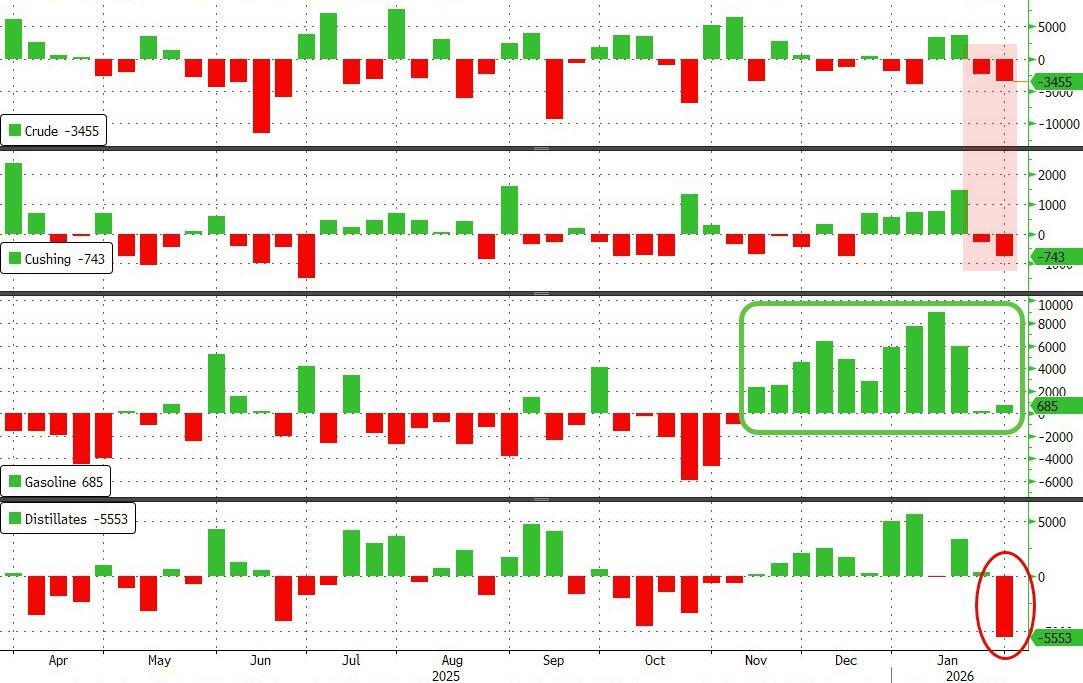
Source: Bloomberg
Crude production in the Lower 48 fell to the lowest since November 2024 as freezing temperatures disrupted drilling in the Permian and Bakken formations.
In the past two months, output is down by 632,000 barrels a day. Overall, production has been shaved off by 4.4 million barrels since early December.
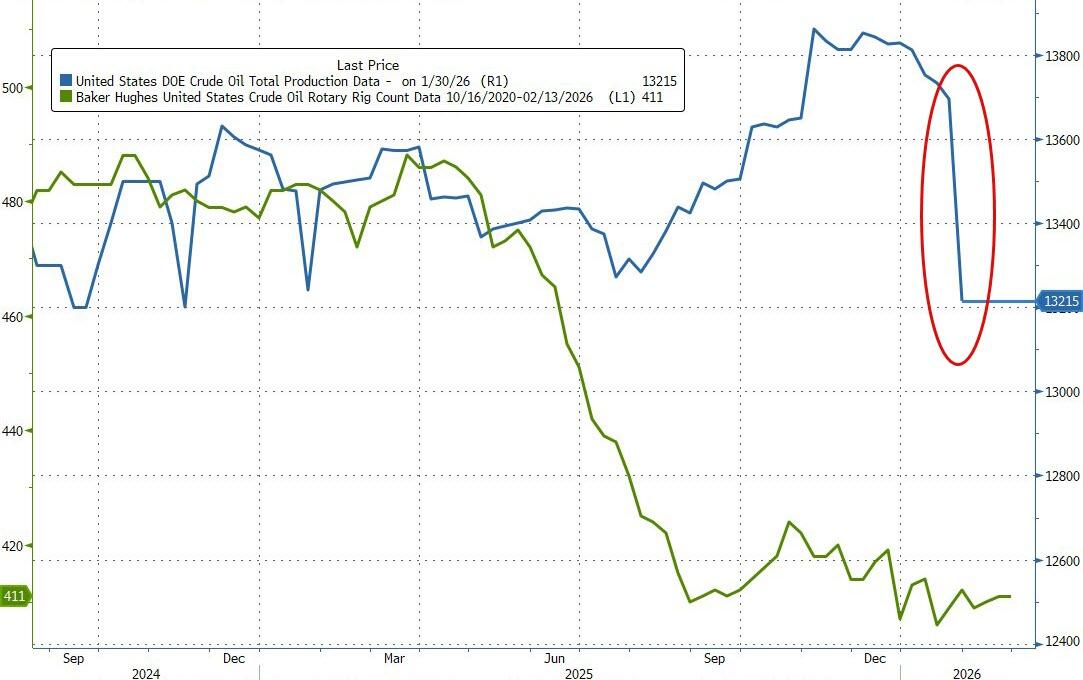
Source: Bloomberg
Bloomberg’s Alex Longley also noted another data point showing how much of this storm impact was centered on the gas side of the market rather than oil. While crude production was down 481k b/d versus a week earlier, NGL output tumbled 1.25m b/d. It’s the lowest since 2024 and the biggest weekly decline on record.
WTI prices edged lower, likely driven by the smaller draw than API reported…
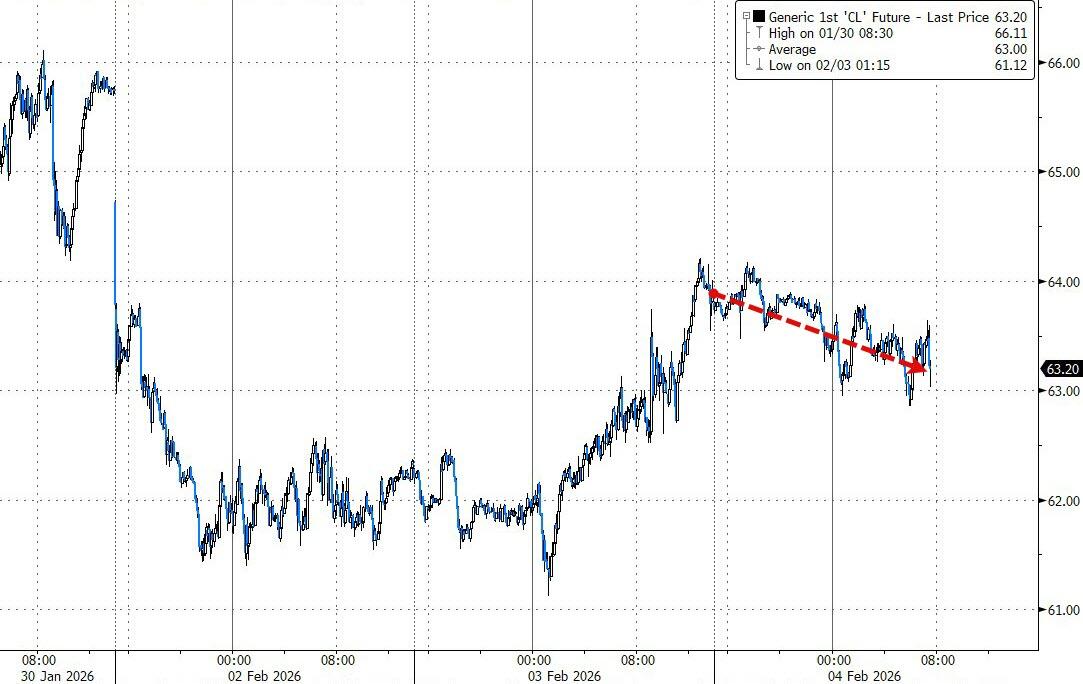
Circling back to where we started, the bullish drop in inventories comes as tensions between the U.S. and Iran continue to run hot. While the U..S. Administration said negotiations over Iran’s nuclear program will start this week, U.S. naval forces sent to the Arabian Sea off Iran shot down an Iranian drone approaching an aircraft carrier 500 miles off Iran’s coast in the Arabian Sea, the BBC reported. As well, a U.S.-flagged merchant ship in the Strait of Hormuz, the choke point for more than 20-million barrels per day of Persian Gulf exports, was harassed by Iranian gun boats.
“Oil would be lower without Middle Eastern sabre-rattling. Post-settlement API figures, faithfully echoing the impact of the cold spell in the US, provide additional support this morning, as crude oil stocks dropped 11 million bbls. These are extraordinary days, weeks and months, in which perceived oversupply has been overwhelmingly overlooked, yet it is still able to set a price ceiling when perceived supply disruptions are in the crosshairs of investors,” PVM Oil Associates noted.
END
Putin Touts Energy Ties With China, While India Still Dodges Issue Of Russian Oil Ban

by Tyler Durden
Wednesday, Feb 04, 2026 – 01:00 PM
Russian President Vladimir Putin and Chinese President Xi Jinping held a video link call on Wednesday, wherein Putin hailed Russia’s energy relationship with China as “strategic” while emphasizing that Beijing has become Moscow’s top buyer of oil and gas since the Ukraine ‘special military operation’ began.
The timing is the most notable aspect, given the call came just two days after Trump announced he would cut tariffs on Indian goods in exchange for New Delhi halting purchases of Russian crude. Trump also said Washington could lift an additional 25% penalty tariff imposed over India’s energy cooperation with Moscow.
The curious thing is the lack of confirmation of the oil purchase cutoff from the Indian side. As yet, there’s no clear indicator that this key element in the Modi-Trump deal has been ratified. On Wednesday FT reports India hails Donald Trump ‘deal’ but ducks discussing Russian oil ban. The reality remains that there are also technical problems with US crude imports replacing Russian…
“WTI is simply too light to be considered as Urals replacement” for refiners in India following this week’s announcement of a US-India deal on tariffs, June Goh, an analyst at Sparta Commodities said in a note.
And this is likely why Putin seized the opportunity to tout his energy ties with China. Kremlin aide Yury Ushakov has also reminded the world in a statement to TASS that Russia tops the list in terms of oil and pipe gas supplies to China.
“China continues to hold the first place among our foreign trade partners. Russia is fifth among the countries – trade counterparties of China. The task was set during the talk to take efforts for further development of trade and economic ties, in particular, for example, in the energy sphere. Russia is the top supplier of oil and pipe gas to China,” Ushakov said.
Kremlin estimates say China has purchased more than $230 billion worth of Russian energy since the invasion.
Putin himself in the call acknowledged that bilateral trade saw a “slight decline” last year, including a “correction in indicators,” but insisted Russia remains “among the leaders in energy supplies to China.” He vowed the two will continue to closely coordinate together on a range of issues.
As for the India trade, Reuters reported earlier that Indian refiners have yet to receive instructions to fully stop buying Russian oil and are awaiting a formal government decision. Any official halt would be followed with a transition period, no doubt. Trump’s earlier statements may have been too far out front compared to what Modi actually agreed or said yes to.
Hours after Xi and Putin spoke, President Trump also held a call with the Russian leader Wednesday. They last spoke by phone in late November, at which time a conciliatory Trump praised America’s “extremely strong” relations with China. Xinhua News Agency first revealed the Trump-Xi call, but no further details have been immediately forthcoming.
END
INDIA/USA
KORYBKO
The Indo-US Trade Deal Might Sharply Shift The Direction Of The Global Systemic Transition
Tuesday, Feb 03, 2026 – 11:25 PM
Trump unexpectedly announced an Indo-US trade deal on Monday whereby US tariffs on Indian imports will drop to 18% while India will reduce its tariffs on US imports to zero. He also said that Modi agreed to stop buying Russian oil, which he’ll replace with US and possibly Venezuelan oil, while also pledging to buy $500 billion of American energy, technology, agricultural goods, coal, and other products. For his part, Modi confirmed that a deal had indeed been reached, but he didn’t confirm the details.

If Trump accurately conveyed them, and he was reportedly wrong in claiming late last year that India had already stopped buying Russian oil, then the Indo-US trade deal would certainly be historic.
For starters, a little less than half of the Indian population (42%) is employed in the agricultural industry, so tariff-free US imports of such products could ruin some of their livelihoods and lead to these rural folk moving to the cities. The potential socio-economic turbulence could lead to political unrest if improperly managed.
That could be offset if more investment from the US and the EU, which reached a trade deal with India last month, provides new employment opportunities. While a gamble, Modi might have calculated that it’s worth taking these risks for macroeconomic, regional security, and geo-economic reasons.
The first aims to turbocharge India’s GDP growth, which was already expected to be 7.4% this year despite the US’ 50% tariffs at the time, thus helping it become the world’s third-largest economy by 2030 or earlier.
As for the regional security dimension, this relates to restoring India’s role as the US’ top South Asian partner via economic diplomacy after rival Pakistan replaced it last year, thus averting the scenario of the US weaponizing Pakistan and their shared junior Bangladeshi partner as proxies for derailing India’s rise. The aforesaid economic diplomacy segues into the tertiary geo-economic reason that can be speculated as accounting for why Modi might have made such significant compromises for a deal with Trump.
The US’ punitive 25% tariffs for continuing to import discounted Russian oil are no longer worth the economic cost now that the US is offering India similarly priced Venezuelan oil. Meanwhile, the US’ threatened 25% tariffs for doing business with Iran and concerns about its stability render the North-South Transport Corridor through its territory en route to Russia unviable for the time being. The effect of this geo-economic pressure might have understandably pushed India to prioritize a deal with the US.
If Trump’s details about his deal with Modi are correct, then India is recalibrating its grand strategy in the Western direction, albeit due to economic coercion.
Potential implications of this policy shift could be a reduced focus on BRICS, decelerated diversification from the dollar, more defense deals with the US, and resultant difficulty in maintaining its incipient rapprochement with China.
Russia would also be thrown into a grand strategic dilemma if India does indeed stop importing its discounted oil.
In order to stabilize its budgetary revenue and the ruble, Russia could either rely on China to replace its lost Indian oil market at the risk of becoming too dependent on it or agree to tough compromises with the US over Ukraine for phased sanctions relief that would gradually return its oil to the global market.
The consequences would sharply shift the global systemic transition in China’s or the US’ favor, and if the Indo-US trade deal prompts Russia to make this epochal choice, then it would truly be historic.
END
YOUR EARLY CURRENCY/GOLD AND SILVER PRICING/ASIAN CLOSING MARKETS AND EUROPEAN BOURSE OPENING AND CLOSING/ INTEREST RATE SETTINGS WEDNESDAY MORNING 6;30AM//OPENING AND CLOSING
USA DOLLAR VS EURO: 1.1810 FOR A LOSS OF .0015 OR 15 BASIS PTS.
USA/ YEN 156.78 UP 0.976 NOW TARGETS INTEREST RATE AT 1.75% AS IT WILL BUY UNLIMITED BONDS TO GETS TO THAT LEVEL…//YEN STILL FALLS//END OF YEN CARRY TRADE BEGINS AGAIN DEC 2024/Bank of Japan raises rates by .25% TO 1.75 ..TAKAICHI NEW PM AS YIELDS RISE//JAPAN DEEPLY IN TROUBLE WITH RISING RATES AND A FALLING YEN!!
GBP/USA 1.3709 UP 0.0013 OR 13 BASIS PTS
USA/CAN DOLLAR: 1.3680 UP 0.0028 CDN DOLLAR DOWN 29 BASIS PTS//
Last night Shanghai COMPOSITE CLOSED UP 34.46 pts or 0.85%
Hang Seng CLOSED UP 12.55 PTS OR 0.05%
AUSTRALIA CLOSED UP 1.67%
// EUROPEAN BOURSE: ALL GREEN
Trading from Europe and ASIA
I) EUROPEAN BOURSES: ALL GREEN
2/ CHINESE BOURSES / :Hang SENG CLOSED UP 12.55 PTS OR 0.06%
/SHANGHAI CLOSED UP 51.99 PTS or 1.29%
AUSTRALIA BOURSE CLOSED UP 1.67 %
(Nikkei (Japan) CLOSED DOWN 427.30 PTS OR 0.78%
INDIA’S SENSEX IN THE GREEN
Gold very early morning trading: 5023.60.
silver:$89.36
USA DOLLAR VS TRY: 43.51
USA DOLLAR VS RUSSIAN ROUBLE: 76.71 ROUBLE// UP 38 BASIS PTS
UK 10 YR BOND YIELD: 4.5260 UP 1 BASIS PTS
UK 30 YR BOND YIELD: 5.297 UP 1 BASIS PTS
CDN 10 YR BOND YIELD: 3.446 UP 1 BASIS PTS
CDN 5 YR BOND YIELD; 2.960 UP 1 BASIS PTS
USA dollar index early TUESDAY morning: 97.39 UP 9 BASIS POINTS FROM MONDAY’s CLOSE
TUESDAY MORNING NUMBERS ENDS
And now your closing TUESDAY NUMBERS 11: 30 AM
Portuguese 10 year bond yield: 3.220% DOWN 3 in basis point(s) yield
JAPANESE BOND 10 yr YIELD: +2.250% DOWN 1/2 FULL POINTS BASIS POINTS /JAPAN losing control of its yield curve/
JAPAN 30 YR: 3.634 DOWN 1 BASIS PTS//DIASTER
SPANISH 10 YR BOND YIELD: 3.237 DOWN 3 in basis points yield
ITALY 10 YR BOND: 3.483 DOWN 3 points in basis points yield ./ THE ECB IS QE’ ING ITALIAN BONDS (
GERMAN 10 YR BOND YIELD: 2.8731 DOWN 2 BASIS PTS
IMPORTANT CURRENCY CLOSES : MID DAY WEDNESDAY
Closing currency crosses for day /USA DOLLAR INDEX/USA 10 YR BOND YIELD/1:00 PM
Euro/USA 1.1809 DOWN 0.0006 OR 6 basis points
USA/Japan: 156.53 UP 0.751 OR YEN IS DOWN 75 BASIS PTS// HIGHLY INFLATIONARY TO JAPAN
Great Britain 10 YR RATE 4.5280 UP 0 BASIS POINTS //
GREAT BRITAIN 30 YR BOND; 5.297 UP 1 BASIS POINTS.
Canadian dollar DOWN 18 BASIS pts to 1.3687
xxxxxxxxxxxxxxxxxxxxxxxxxxxxxxxxxxxxxxxxxxxxxxxxxxxxxxxxxxxxxxxxxxxxxxxxxxxxxxxx
The USA/Yuan CNY DOWN TO 6.9418 ON SHORE ..
THE USA/YUAN OFFSHORE// CNH DOWN TO 6.9388
TURKISH LIRA: 43.51 EXTREMELY DANGEROUS LEVEL/DEATH WATCH/HYPERINFLATION TO BEGIN.//
Your closing 10 yr US bond yield DOWN 1 in basis points from TUESDAY at 4.285% //trading well ABOVE the resistance level of 2.27-2.32%)
USA 30 yr bond yield 4.912 UP 1 basis points /11:00 AM
USA 2 YR BOND YIELD: 3.584 DOWN 1/2 BASIS PTS.
GOLD AT 10;00 AM 4971,50
SILVER AT 10;00: 88.50
Your 11:00 AM bourses for Europe and the Dow along with the USA dollar index closing and interest ratesWEDNESDAY CLOSING TIME 11:00 AM//
London: CLOSED UP 87.75 PTS OR 0.85%
GERMAN DAX: CLOSED DOWN 177.75 OR 0.72%
FRANCE: CLOSED UP 82.66 PTS OR 1.01%
Spain IBEX CLOSED DOWN 16.70 PTS OR 0.09%
Italian MIB: CLOSED UP 215.91 PTS OR 0.47%
WTI Oil price 63.25 10.00 EST/
Brent Oil: 67.48 10:00 EST
USA /RUSSIAN ROUBLE /// AT: 76.12 ROUBLE UP 0 AND 87 / 100
CDN 10 YEAR RATE: 3.458 UP 1 BASIS PTS.
CDN 5 YEAR RATE: 2.970 UP 2 BASIS PTS
CLOSING NUMBERS: 4 PM
Euro vs USA 1.1805 DOWN 0.0010 OR 10 BASIS POINTS//
British Pound: 1.3652 DOWN 0.0044 OR 44 basis pts/
BRITISH 10 YR GILT BOND YIELD: 4.554 UP 3 FULL BASIS PTS//
BRITISH 30 YR BOND YIELD: 5.332 UP 4 IN BASIS PTS.
JAPAN 10 YR YIELD: 2.247 DOWN 1 FULL BASIS PTS (DANGEROUS TO THEIR ECONOMY
JAPANESE 30 YR BOND: 3.627 DOWN 2 PTS AND STILL VERY DANGEROUS TO THEIR ECONOMY
USA dollar vs Japanese Yen: 156.82 UP 1.22 OR YEN DOWN 122 BASIS PTS EXTREMELY DANGEROUS/YEN FALLING DEEPLY IN VALUE
USA dollar vs Canadian dollar: 1.3670 UP 0.0031 PTS// CDN DOLLAR DOWN 31 BASIS PTS
West Texas intermediate oil: 64.52
Brent OIL: 68.57
USA 10 yr bond yield UP 1 BASIS pts to 4.278
USA 30 yr bond yield UP 1 PTS to 4.9150%
USA 2 YR BOND 3.572 DOWN 1 PTS
CDN 10 YR RATE 3.435 DOWN 1 BASIS PTS
CDN 5 YEAR RATE: 2.945 DOWN 1 BASIS PTS
USA dollar index: 97.55 UP 25 BASIS POINTS
USA DOLLAR VS TURKISH LIRA: 43.52 GETTING QUITE CLOSE TO BLOWING UP/
USA DOLLAR VS RUSSIA//// ROUBLE: 76.76 UP 0 AND 28/100 roubles //
GOLD $4946.00 3:30 PM)
SILVER: 87.50 3;30 PM)
DOW JONES INDUSTRIAL AVERAGE: UP 259.91 OR 0.53%
NASDAQ 100 DOWN 447.38 PTS OR 1.77%
VOLATILITY INDEX 18.60 UP 0.60 PTS OR 3.33%
GLD: $ 453.97 DOWN 0.,32 PTS OR 0.07%
SLV/ $79.18 UP 2.22 PTS OR OR 2..88%
TORONTO STOCK INDEX// TSX INDEX: CLOSED UP 152.95 PTS OR 0.47%
end
TRADING today ZEROHEDGE 4 PM: HEADLINE NEWS/TRADING
“Vicious Moves”: Momo Meltdown As SaaSpocalypse Spreads; Crypto Dumps, Dollar Jumps
4th Worst Day For Momentum In History Amid IPP, Nuclear Meltdown: Here’s What’s Going On
WRAP UP’:
Tech leads sell-off as crude sees two-way trade on US-Iran talks – Newsquawk US Market Wrap
Wednesday, Feb 04, 2026 – 03:58 PM
- SNAPSHOT: Equities down, Treasuries steepen, Crude up, Dollar up, Gold up
- REAR VIEW: US-Iran nuclear talks in Oman to proceed on Friday, after initial reports of cancellations over US disagreement; ISM Services tops on headline, but sub-indices disappoint; ADP monthly employment underwhelms; US VP Vance proposes a trading bloc for critical minerals; EIA crude stocks draw more than expected; AMD earnings beat falls short of lofty expectations; LLY earnings impress; US sets quarterly refunding at USD 125bln, as expected
- COMING UP: Data: Australian Balance of Trade (Dec), German Factory Orders (Dec), EZ Retail Sales (Dec), US Challenger (Jan), Weekly/Continuing Jobless Claims, Revelio PLS. Events: ECB Announcement, BoE Announcement & MPR, Banxico Announcement, CNB Announcement. Speakers: BoE’s Bailey; ECB’s Lagarde; Fed’s Bostic; BoC’s Macklem, RBA’s Bullock. Supply: Australia, Japan, Spain, France. Earnings: Amazon, Strategy, Roblox, Reddit, Bloom Energy, ConocoPhillips, Bristol Myers Squibb, Barrick Mining, Cigna, Linde, Shell, Unilever, Siemens Healthineers, BBVA, BNP Paribas, UniCredit.
More Newsquawk in 2 steps:
- 1. Subscribe to the free premarket movers reports
- 2. Trial Newsquawk’s premium real-time audio news squawk box for 7 days
MARKET WRAP
US indices were lower on Wednesday, primarily due to losses in AI-related names, namely semiconductors, software, memory and robotics. That said, breadth was very strong highlighted by the Equal-Weight RSP, +0.9%. Energy, Materials, and Staples, the best three performing sectors YTD, continue to see gains given their little exposure to the AI complex (AAPL outperformed in Tech +2.6%) while Healthcare was boosted by a strong Eli Lilly (LLY) earnings report. Back to tech, AMD earnings contributed to downside in the space, as valuation concerns remain, particularly over expenses, despite beating on quarterly metrics and guidance. Precious metals also saw downside at the US equity open alongside crypto, with gold reversing earlier gains, albeit losses were limited given the increased US-Iran tensions. Macro-moving updates came via US-Iran tensions, with crude prices rallying after Axios reported that the nuclear talks scheduled for Friday had been cancelled as the US disagreed with the location and Iran’s desire to exclude non-nuclear issues from the talks. That said, both Axios and the Iranian Foreign Minister said the talks are back on in Oman, with the former adding it comes amid several Arab and Muslim leaders urgently lobbied the Trump administration on Wednesday afternoon not to follow through on threats to walk away. Crude prices rallied on headlines that the talks were cancelled before trimming gains after the second wave of updates. Other developments came via US data whereby ADP employment change eased in January beneath expectations, whilst the ISM Services PMI reading was encouraging on the headline yet contained poor internals (drop in employment & new orders, rise in prices paid); limited reaction was seen. T-Notes were little changed, trading in a narrow range upon the QRA announcement, which saw quarterly refunding set at USD 125bln, as expected. Given the passing of the funding bill seen on Tuesday, the BLS rescheduled the JOLTS December report and confirmed the claims report will both be released on Thursday. Rate announcements are expected from the BoE and ECB on Thursday.
US
ISM SERVICES: ISM Services was poor, despite the headline topping expectations at 53.8 (exp. 53.5, prev. 53.8) as employment tumbled to 50.3 from 51.7 (exp. 52.3) and new orders dropped to 53.1 from 56.5. Also, the inflationary gauge of prices paid lifted to 66.6 from 65.1. Although business activity rose to 57.4 from 55.2. Supplier deliveries rose, remaining expansionary, inventories fell into contractionary territory, while backlog of orders lifted, but remained beneath 50. New export orders and imports both fell below 50. Overall, Oxford Economics write that robust consumer spending, lower interest rates, and continued AI-related construction will support the sector over 2026. The consultancy further adds that the details of the report reinforce their expectations for the Fed to remain on hold until the middle of the year.
ADP: Private employers added 22k jobs to the economy in January, shy of the expected 48k, easing from the +41k in December. Leading gains was healthcare (+74k) while the downside was led by manufacturing, which has lost jobs every month since March 2024. Annual pay saw job-stayers tick higher to 4.5% from 4.4% while job-changers fell to 6.4% from 6.6%. Companies employing between 50 and 249 workers added 37k jobs, with small firms flat and large employers down 18k. Dr. Nela Richardson, chief economist at ADP, said, “While we’ve seen a continuous and dramatic slowdown in job creation for the past three years, wage growth has remained stable.” Pantheon Macroeconomics still believes that the labour market will remain weak in H1 overall, pressuring the FOMC to begin easing policy again.
FIXED INCOME
Treasuries curve steepened on Wednesday, once again in a narrow range, with eyes on latest Quarterly Refunding. At settlement, 2-year -1.4bps at 3.561%, 3-year -0.8bps at 3.641%, 5-year unch. at 3.835%, 7-year +0.5bps at 4.052%, 10-year +0.8bps at 4.278%, 20-year +1.6bps at 4.864%, 30-year +1.6bps at 4.914%.
THE DAY: Overnight and through the European morning, T-Notes were rangebound and traded within a tight 4 tick range as participants awaited the next catalyst. Tsys saw little move to the monthly ADP, which underwhelmed, before only moving a couple of ticks higher on an overall poor ISM Services report. Recapping, despite the headline topping expectations, employment and new orders tumbled, while the inflationary gauge of prices paid lifted. Prior to the data, the highlight of the day was the QRA (more details below), where yields ticked slightly higher as the quarterly refunding came in line with expectations at USD 125bln. Elsewhere, and while not seemingly impacting T-Notes, US tech was heavily sold amid weakness in mega-cap names, especially NVDA/AMD. Ahead, JOLTS has been rescheduled to Thursday, alongside jobless claims, as well as ECB/BoE rate decisions and earnings from AMZN.
SUPPLY
QRA
- US set quarterly refunding at USD 125bln, as expected; to sell USD 58bln in 3-year notes, USD 42bln in 10-year notes, and USD 25bln in 30-year bonds next week. The Treasury believes its current auction sizes leave it well-positioned to address potential changes to the fiscal outlook and to the size and composition of the SOMA portfolio. As such, Treasury to keep coupon and floating rate note auction sizes unchanged for ‘next several quarters’, and future auction increases will consider trends on structural demand, potential costs/risks to issuance profiles.
BILLS
- US sold 17-wk bills at high rate 3.595%, covered 2.97x
STIRS/OPERATIONS
- Market Implied Fed Rate Cut Pricing: March 1bps (prev. 1bps), April 5.3bps (prev. 5.3bps), June 15.6bps (prev. 17.4bps), December 46.6bps (prev. 48.7bps).
- NY Fed RRP op demand at 2.41bln (prev. 1.8bln) across 18 counterparties (prev. 18).
- EFFR at 3.64% (prev. 3.64%), volumes at USD 107bln (prev. 93bln) on February 3rd.
- SOFR at 3.69% (prev. 3.69%), volumes at USD 3.268tln (prev. 3.307tln) on February 3rd.
CRUDE
WTI (H6) SETTLED USD 1.93 HIGHER AT USD 65.14/BBL; BRENT (H6) SETTLED USD 2.13 HIGHER AT USD 69.46/BBL
NOTE: After settlement, gains trimmed following reports that the US and Iran are now to meet on Friday, Iranian Foreign Minister said nuclear talks to be held in Muscat on about 10am, with Axios noting that the talks are back on after several Arab and Muslim leaders urgently lobbied the Trump admin not to follow through on threats to walk away; one US official said they will do the meeting if they insist, but are very skeptical.
The crude complex was firmer as US/Iran nuclear talks for Friday have been cancelled. WTI and Brent were largely rangebound in overnight trade, before grinding lower through the European session to hit lows of USD 62.86/bbl and 66.98, respectively, as risk sentiment continued to sour due to the heavy selling in US tech. However, and after EU players left for the day, benchmarks soared after Axios reported that US/Iran nuclear talks for Friday have been cancelled due to the Iranians’ refusal to engage in non-nuclear issues. Axios added that the US told Iran it will not agree to Tehran’s demands to change the location and format, but if they are willing to go back to the original format, the US is ready to meet this week or next week. In an immediate reaction, WTI and Brent gained, before extending even higher to peaks of USD 65.53/bbl and 69.76. More recently, US President Trump remarked that Iran’s Supreme Leader should be very worried now. Regarding the EIA data, which garnered little market reaction, crude and distillates saw larger-than-anticipated draws, with gasoline a smaller-than-expected build. Overall, production was down 481k W/W..
EQUITIES
CLOSES: SPX -0.51% at 6,883, NDX -1.77% at 24,891, DJI +0.53% at 49,501, RUT -0.90% at 2,625
SECTORS: Technology -1.90%, Communication Services -1.67%, Consumer Discretionary -1.16%, Utilities -0.44%, Industrials +0.24%, Financials +0.80%, Consumer Staples +1.05%, Health +1.22%, Real Estate +1.53%, Materials +1.80%, Energy +2.25%.
EUROPEAN CLOSES: European Closes: Euro Stoxx 50 -0.39% at 5,972, Dax 40 -0.52% at 24,653, FTSE 100 +0.85% at 10,402, CAC 40 +1.01% at 8,262, FTSE MIB +0.47% at 46,636, IBEX 35 -0.09% at 18,103, PSI +0.61% at 8,882, SMI +1.08% at 13,518, AEX -0.37% at 990
STOCK SPECIFICS:
- AMD (AMD): Strong report; however investors focused on next Q outlook, which topped, but didn’t meet lofty exp. amid accelerating AI-related spending.
- NVIDIA (NVDA): Planned sales of H200 AI chips to China remain stalled pending a US national security review.
- Silicon Laboratories (SLAB) is to be acquired by Texas Instruments (TXN) for USD 231/shr or USD 7.5bln.
- Enphase Energy (ENPH): Top & bottom line surpassed exp. with a strong outlook.
- Super Micro Computer (SMCI): EPS, profit topped & raised annual rev. guidance.
- Eli Lilly (LLY): Top & bottom line beat alongside strong FY view.
- Take-Two Interactive (TTWO): Q bookings topped & issued stronger than exp. guidance.
- GE Healthcare (GEHC): EPS & rev. topped w/ strong FY guidance.
- Corteva (CTVA): Q4 rev. miss on seasonal timing shifts that pushed deliveries into Q1.
- Mondelez (MDLZ): Cautious FY guidance & ongoing cocoa cost headwinds.
- Chipotle Mexican Grill (CMG): FY26 comp. sales view light.
- Cencora (COR): Weak revenue print.
- Uber (UBER): Next Q guidance underwhelmed; however, JPM thinks the pullback was overdone, noting the EPS miss is weighed by equity investments.
- Wolfpack short IonQ (IONQ).
FX
The Dollar was firmer against all G10 peers as DXY looked to retest Monday’s high driven by a strong ISM Manufacturing reading. Today’s ISM Services report wasn’t as glamorous despite the headline topping expectations, as sub-indices sent mixed signals. Employment and New Orders dropped while prices paid rose. Meanwhile, the ADP monthly report saw private employment growth ease beneath expectations. US equities sunk at the cash open as valuation concerns surrounding AI-related companies continue to show, seemingly spreading its risk-off tone to crypto, leaving USD extending on earlier strength. Ahead, the focus will be on JOLTS, which has been rescheduled for Thursday, while US-Iran relations are at the forefront amid a volatile session of updates regarding the Friday meeting between the two. As it stands, the meeting is to take place on Friday in Oman as Iran had requested this week amid several Arab and Muslim leaders lobbying the Trump admin to take part, though one US official issued scepticism, Axios reported.
G10FX, as mentioned, was entirely in the red against the Greenback, led by the SEK, JPY, and NZD. EUR saw relative outperformance, trading marginally weaker whilst showing little reaction to downward revisions in the Final EZ PMI Services report and slightly softer-than-expected HICP Y/Y reading for January. Focus turns to the ECB on Thursday, as well as the BoE. Back to JPY, weakness left the USD/JPY pair back above the 156 handle, peaking at 156.89. The move comes ahead of what’s expected to be a decisive LDP victory in Sunday’s snap election. Click here for the Newsquawk Snap Election Preview.
Click here for the BoE Newsquawk Preview.
Click here for the ECB Newsquawk Preview.
USA DATA RELEASES
POOR PICTURE FOR HIRING
(ADP)
ADP Employment Report Confirms ‘No Hire, No Fire’ Labor Market
Wednesday, Feb 04, 2026 – 08:55 AM
While we will not be getting the payrolls report this week (due to a very brief govt shutdown), ADP’s Employment report paints a poor picture for hiring (even if jobless claims paints a healthy picture for ‘not firing’) adding just 22k jobs (well below the 45k expected).
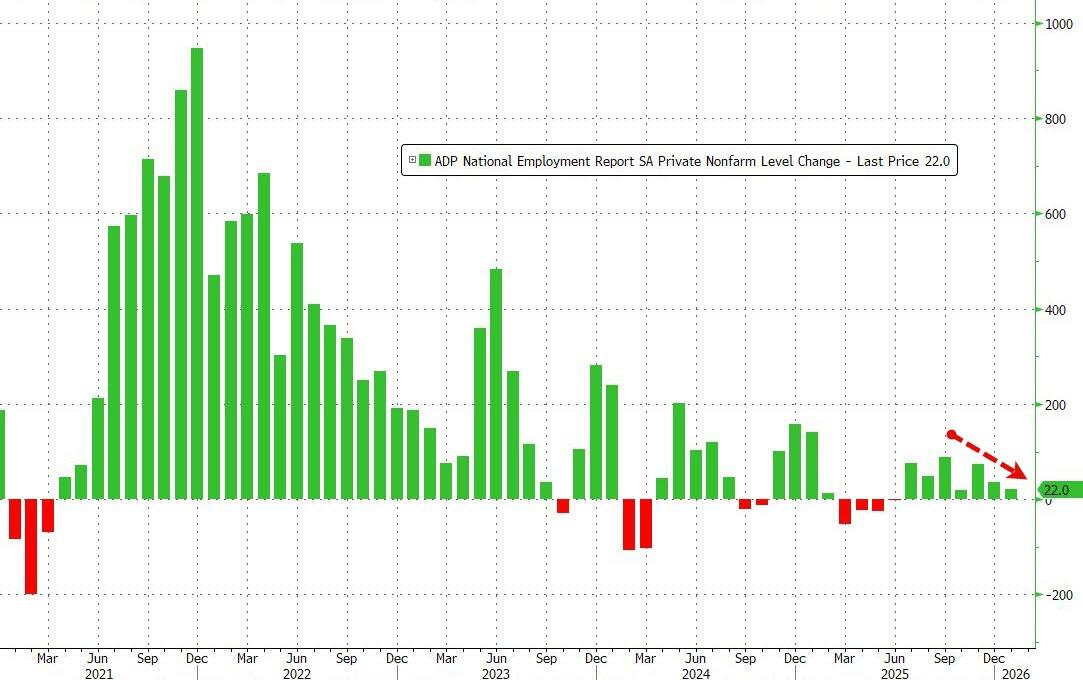
Goods producing firms added just 1k jobs (Construction +9k, Manufacturing -8k – which has lost jobs every month since March 2024) while Services firms saw only 21k jobs added (with health care a standout, adding 74k job, while Profesional Services lost 57k jobs)
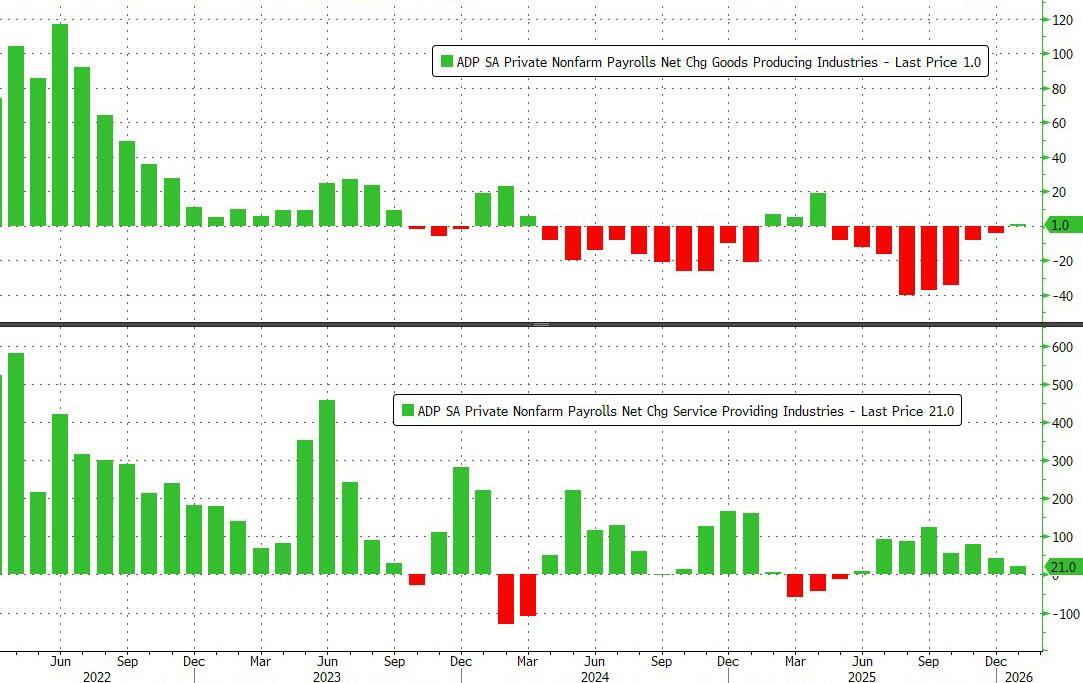
“Job creation took a step back in 2025, with private employers adding 398,000 jobs, down from 771,000 in 2024,” said Dr. Nela Richardson Chief Economist, ADP.
Interestingly, Small firms saw joib additions while large firms saw job losses…
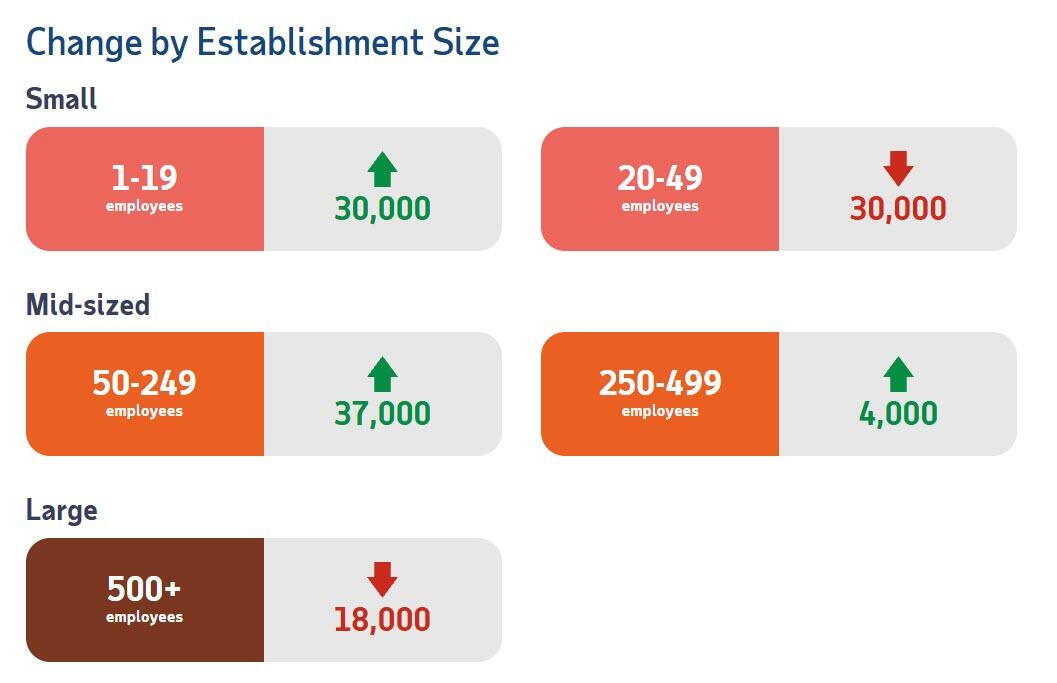
The ADP report, published in collaboration with the Stanford Digital Economy Lab, showed workers who changed jobs saw a 6.4% increase in pay, decelerating from the prior month. Those who stayed put saw a slight pickup in pay gains.
“While we’ve seen a continuous and dramatic slowdown in job creation for the past three years, wage growth has remained stable.”
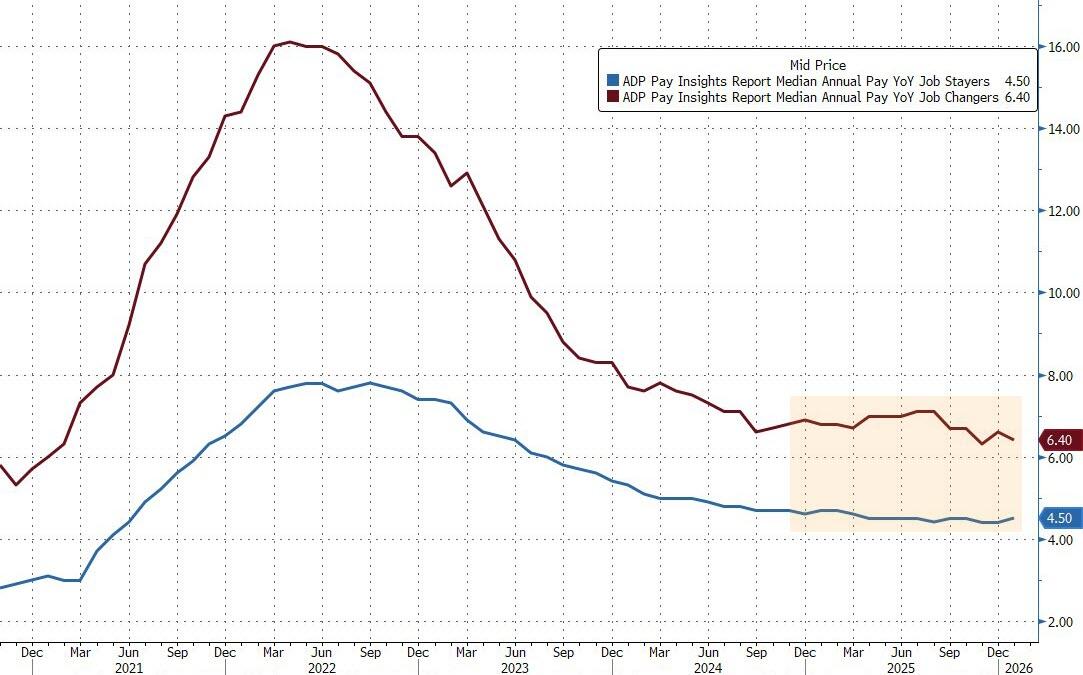
So, in summary, the ‘no hire, no fire’ labor market keeps chugging along, despite considerable optimism over economic growth.
end
soft data doing fine but it its the hard data that is faltering
(zerohedge)
US Services Sector Surveys Signal Solid Growth In January, But…
Wednesday, Feb 04, 2026 – 10:06 AM
Following the dramatic rebound in US Manufacturing survey data – driven by a surge in new orders – ‘Soft’ data has bounced back dramatically from its post-government shutdown lows (which is ironically occurring as the hard data – which was so resilient through the shutdown – has started to roll over)…
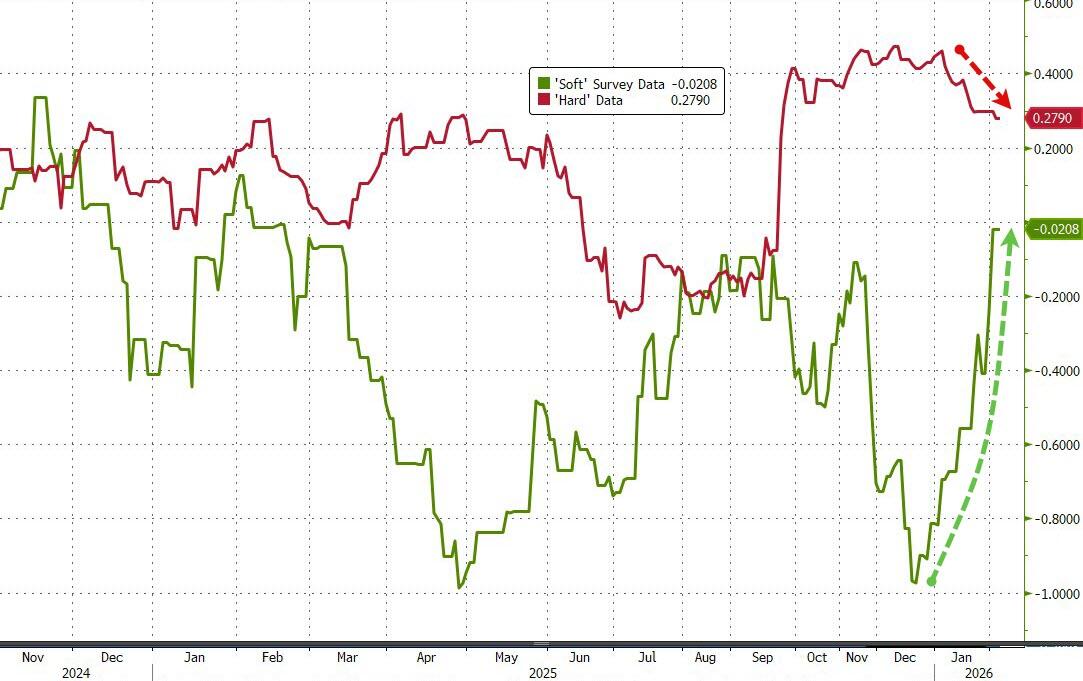
…and this morning’s Services Sector survey data builds on that rebound
- S&P Global’s US Services PMI signaled a better than expected expansion of 52.7 in January (52.5 exp), rebounding from April 2025 lows.
- ISM’s US Services PMI survey also beat expectations in January (53.8 vs 53.5 exp), but was flat from a revised lower 53.8.
But both still solidly in expansion…
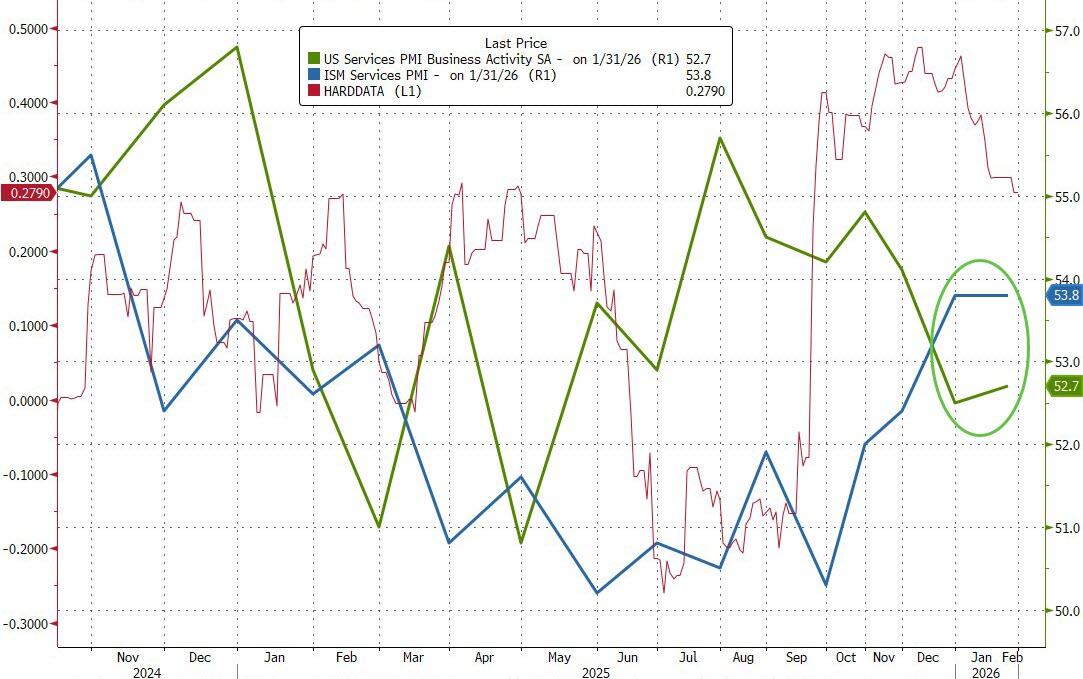
The S&P Global US Composite PMI recorded 53.0 in January. That was up from 52.7 in December and represented a solid rate of growth in private sector activity. Both sectors covered by the survey recorded stronger output expansions, in line with faster gains in new business. Employment meanwhile rose only marginally, while confidence in the outlook softened.
Despite the rebound, US has been overtaken by UK and Japan in terms of global PMIs…
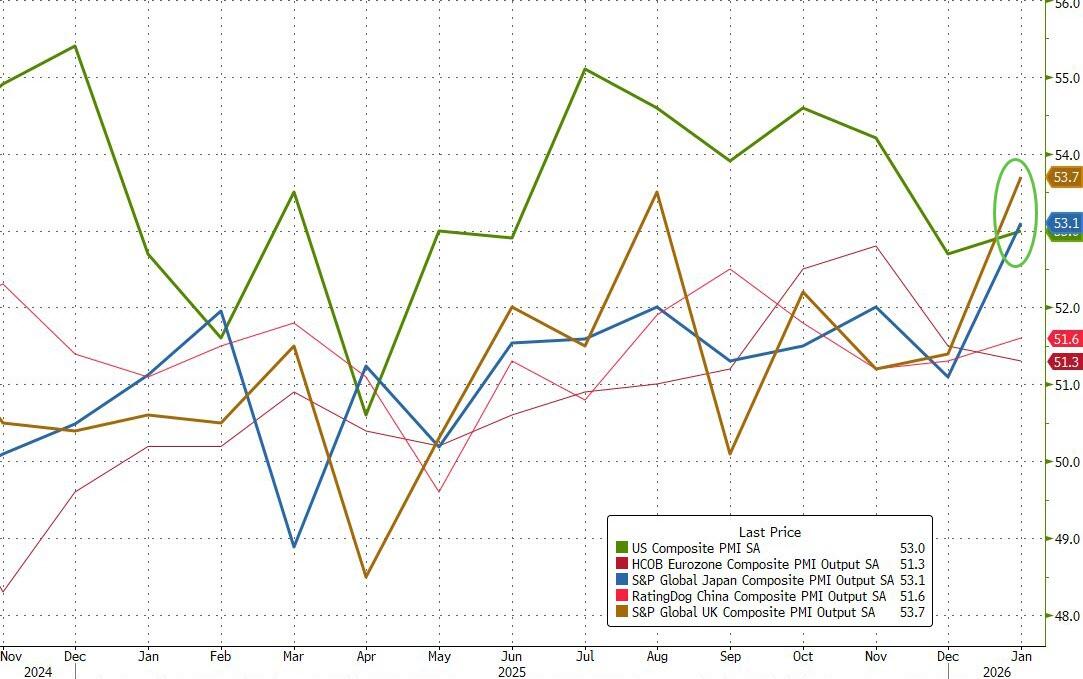
“Sustained service sector growth, supported by a robust rise in manufacturing output in January, indicates the economy is growing at an annualized rate of around 1.7%,” according to Chris Williamson, Chief Business Economist at S&P Global Market Intelligence.
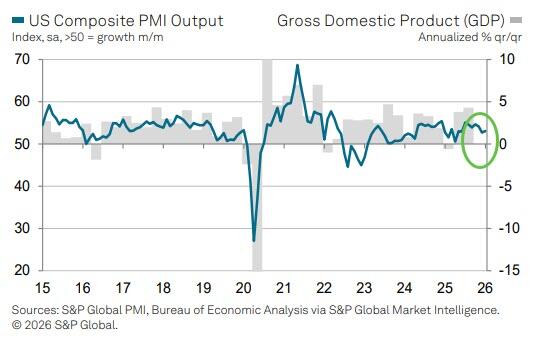
However, that is a lower gear compared to the pace of expansion seen prior to December’s slowdown, and hints at GDP growth cooling in the first quarter.
Consumer-facing companies are increasingly reporting a challenging environment, with demand for services falling in January having nearly stalled in December, “reflecting low levels of consumer sentiment and cost of living pressures,” Williamson noted.
The ISM data showed a triple whammy of higher prices, lower new orders, and lower employment…
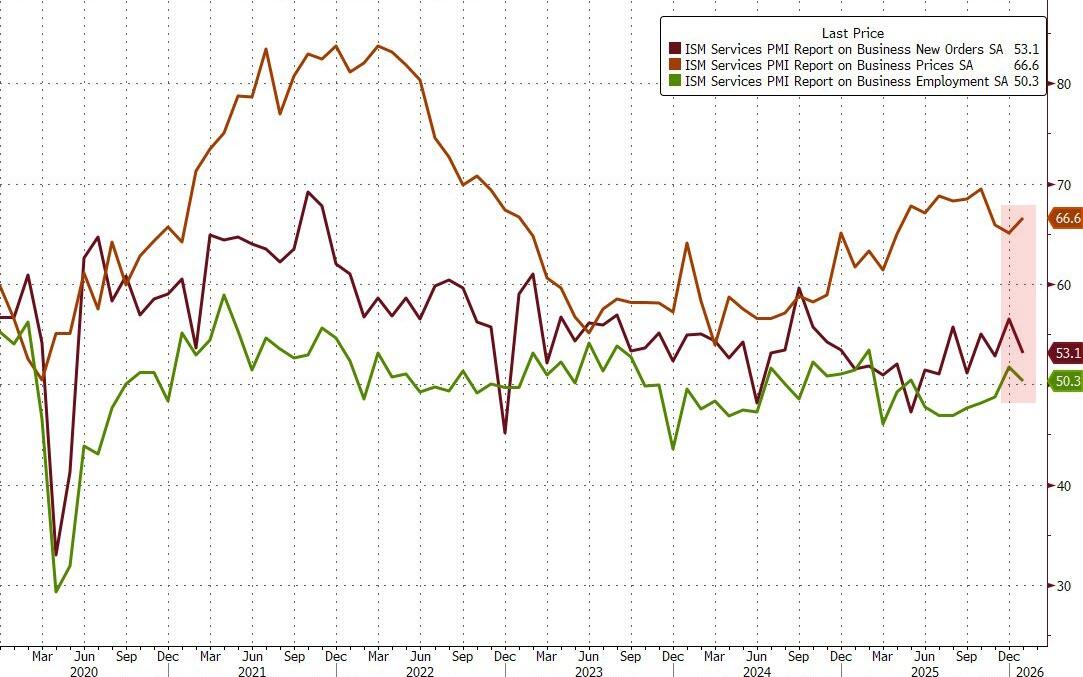
However, as Williamson concludes, “inflationary pressures in the service sector meanwhile remain elevated, blamed on the pass though of tariff related price increases and wage growth, though stiff competition is often reported to have limited the impact on final selling prices.”
“While financial and business service providers are reporting a more resilient picture, demand growth here is also showing signs of fraying amid heightened concerns over the economic outlook, in turn often blamed on political uncertainty.
However, there is a silver lining, as Williamson concludes: “lower interest rates and favorable financial conditions, higher government spending, combined with more active sales and marketing efforts, are propping up business sentiment and spending, and also encouraging modest hiring.”
“Big Miss”: Wall Street Disappointed After Dismal Novo Nordisk GLP-1 Sales Outlook, Shares Plunge
Wednesday, Feb 04, 2026 – 06:52 AM
Update ( Wed):
Novo Nordisk shares in Europe opened sharply lower after the company released a disappointing full-year outlook during the middle of the U.S. cash session on Tuesday.
Shares in Copenhagen plunged 20%, the steepest drop since last July, as hopes for a bottom after a multi-year bear market faded.
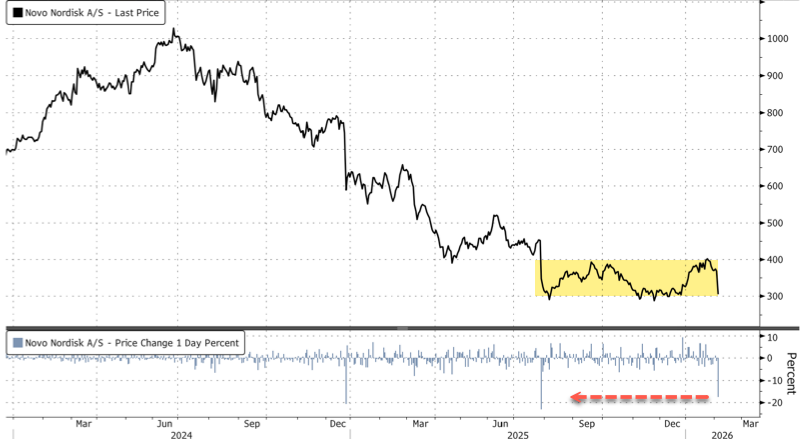
Novo’s warning on 2026 profits suggests it will be a tough year within the GLP-1 market. The company faces a multi-front battle, with Eli Lilly’s Zepbound gaining ever-larger market share in the U.S. and continued pressure from copycat versions of Ozempic.
UBS analyst Matthew Weston had already been anticipating soft initial guidance at the start of the year.
Weston warned of even tougher U.S. injectable volumes than assumed, including cannibalization from oral Wegovy and potentially orforglipron; tougher U.S. injectable pricing, with volume growth likely to come from the lower-priced cash-pay channel. He repeated his ‘neutral’ rating on the stock.
Here’s what other top Wall Street analysts had to say (courtesy of Bloomberg):
BMO Capital Markets (market perform)
- The beats on the top and bottom lines were “overshadowed by a soft 2026 guide,” analyst Evan Seigerman says
- “While early signs of growth exist for the Wegovy pill, concessions for injectable GLP-1s are clearly impacting the topline offsetting gains in the oral market,” Seigerman writes
Intron Health (sell)
- The guidance is a “big miss,” analyst Naresh Chouhan writes
- “Guidance is messy as the company has moved to an adjusted sales and EBIT measure to exclude the 340b provisions that they took over the last few years and now expect a big reversal in 2026,” Chouhan adds
Jefferies (underperform)
- Analyst Michael Leuchten says the disappointing outlook “will weigh heavy”
- Sales aim suggests high single-digit consensus cuts, “albeit perhaps without aggressive oral Wegovy assumptions,” while adjusted profits outlook suggests low double-digit consensus cuts
TD Cowen (buy)
- While sales guidance is below analyst Michael Nedelcovych’s expectations, the profit guidance “brackets” his estimates
Bloomberg Intelligence
- “The headwinds highlighted are no surprise and center on semaglutide’s loss of exclusivity in certain ex-US markets and GLP-1 competition,” analysts Michael Shah and Christos Nikoletopouloswrite
- “Further price pressure, along with slower volume acceleration, are the likely drivers of the worse-than-expected outlook”
Only last week, Goldman analyst Faris Mourad was telling clients that “obesity drugs narrative sentiment is on the rise” and “it’s an opportunity to buy the dip.”
Meanwhile, Goldman’s long-time Novo bull, analyst James Quigley, provided his first take on the updated outlook:
“At the time of writing, the Novo ADR was -14.5%, tomorrow morning we would expect the Novo shares to react broadly in line with the implied FY26 operating cuts of c.9%, as FY26 is a re-set year with respect to the pricing aspect of the GLP-1 market.”
How is Quigley still covering Novo?
* * *
Novo Nordisk ADRs were clubbed like a baby seal around midday after the Danish drugmaker said in an early full-year outlook release that it expects sales to shrink 5% to 13% at constant exchange rates, far worse than the expected 1.3% decline Wall Street analysts had been expecting, according to Bloomberg consensus.
Here’s a snapshot of the full year forecast (courtesy of Bloomberg):
- Sees sales at constant exchange rates -5% to -13%, estimate -1.39% (Bloomberg Consensus)
- Sees operating profit at constant FX -5% to -13%, estimate -3.12%
Novo’s annual sales last declined in 2017 during an insulin price war in the US market. The Danish drugmaker faces a multi-front battle, with Eli Lilly’s Zepbound gaining ever-larger market share in the US and continued pressure from copycat versions of Ozempic.
Trading was halted ahead of the report. When trading resumed, Novo’s U.S.-listed shares plunged 13%, the largest intra-day decline since -21% on July 29, 2025.
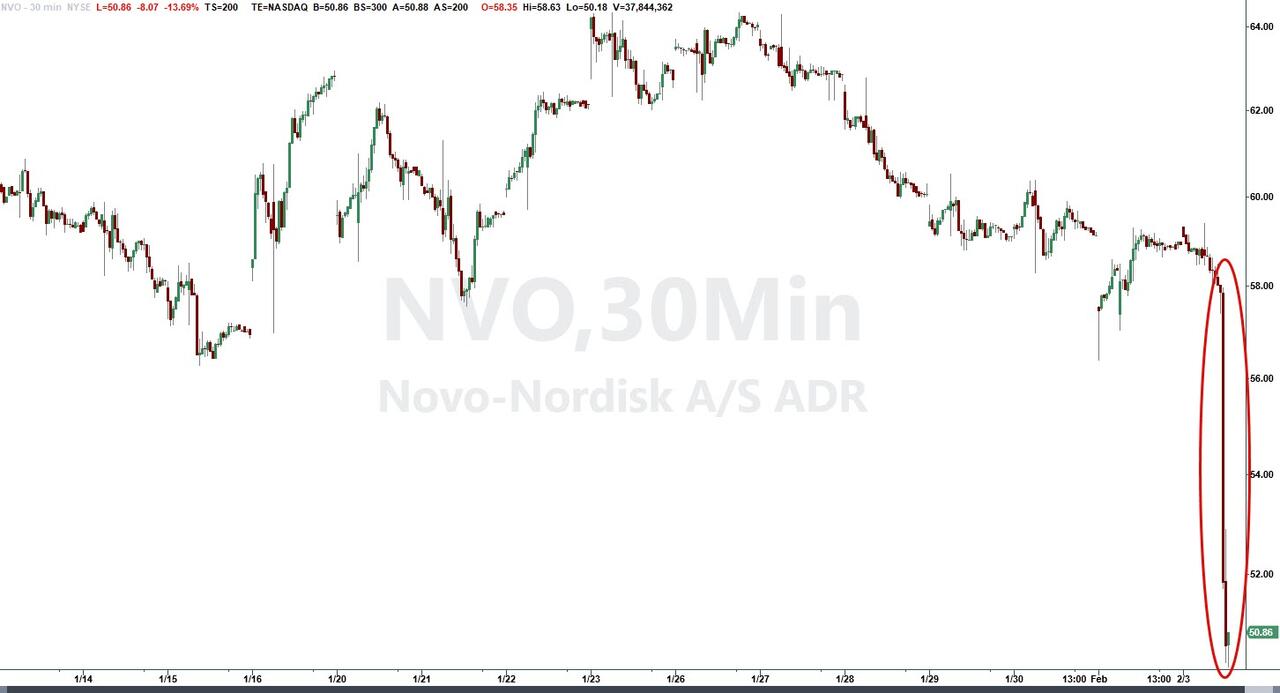
Since Novo ADRs peaked around $145 in mid-2024, shares have been locked in a vicious bear market, down about 64% from the highs.
Hopes for a turnaround emerged late last year (read here), but those expectations have since been erased after today’s dismal outlook.
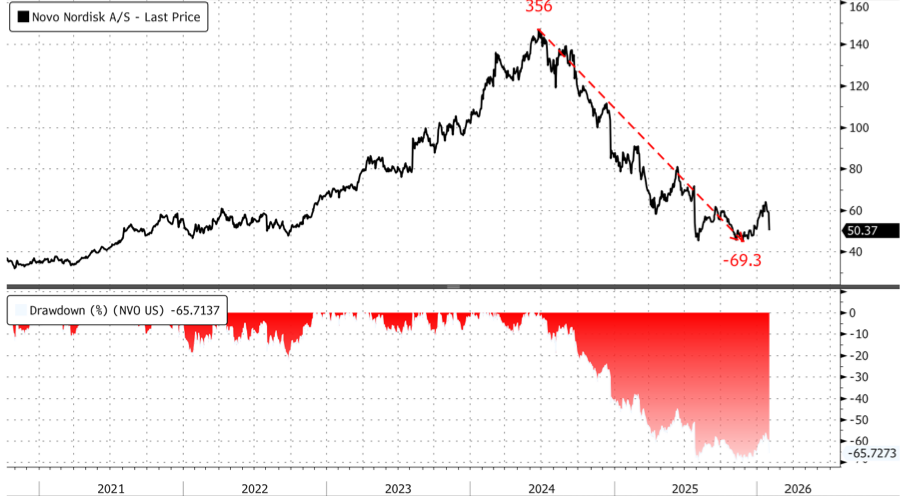
Last week, Goldman analyst Faris Mourad told clients that “obesity drugs narrative sentiment is on the rise” and “it’s an opportunity to buy the dip.”
More here on Mourad’s call urging clients to buy into beaten-down obesity drug stocks.
And Goldman’s long-time Novo bull, analyst James Quigley, is out with his first take on the outlook, writing:
“At the time of writing, the Novo ADR was -14.5%, tomorrow morning we would expect the Novo shares to react broadly in line with the implied FY26 operating cuts of c.9%, as FY26 is a re-set year with respect to the pricing aspect of the GLP-1 market.”
Perhaps it’s time for Quigley to just give up on Novo…
USA ECONOMIC COMMENTARIES
Trump Says Administration Will Seek $1 Billion In Damages From Harvard
Tuesday, Feb 03, 2026 – 05:00 PM
Authored by Aldgra Fredly via The Epoch Times (emphasis ours),
President Donald Trump said on Feb. 2 that his administration would demand Harvard University to pay $1 billion in damages, labeling the university as “strongly antisemitic.”

“We are now seeking One Billion Dollars in damages, and want nothing further to do, into the future, with Harvard University,” the president said in a Truth Social post.
The Trump administration last year attempted to freeze billions of dollars in federal funding from Harvard following an investigation into diversity, equity, and inclusion (DEI) initiatives and claims of anti-Semitism in higher education. The White House said in April that Harvard had failed to protect its students from harassment and violence on campus.
“Harvard has been, for a long time, behaving very badly! They wanted to do a convoluted job training concept, but it was turned down in that it was wholly inadequate and would not have been, in our opinion, successful,” Trump wrote.
“It was merely a way of Harvard getting out of a large cash settlement of more than 500 Million Dollars, a number that should be much higher for the serious and heinous illegalities that they have committed.”
Trump also accused Harvard of “feeding a lot of ‘nonsense’” to The New York Times, but did not provide further details.
The Epoch Times has reached out to Harvard for comment, but did not receive a response by publication time.
Jewish students at Harvard reported incidents of harassment following the Oct. 7, 2023, attacks against Israel by Hamas-led terrorists and the subsequent Israeli military offensive in Gaza. Students sued the school, and its former president, Claudine Gay, resigned after congressional hearings on campus anti-Semitism.

Harvard President Alan Garber, who succeeded Gay, rejected a list of conditions outlined by a federal anti-Semitism task force and filed a lawsuit against the administration in April 2025, seeking to restore $2.2 billion in grants and contracts withheld by the government.
A federal judge later reversed the funding freeze, ruling that the government violated the First Amendment through its efforts to combat anti-Semitism. The Justice Department appealed the decision in December 2025.
Trump also issued a proclamation on June 4, 2025, seeking to end Harvard’s visa program for international students, prompting the university to file another legal challenge.
Several other Ivy League schools, including Columbia University and Brown University, have reached agreements with the administration and accepted certain government demands. Columbia agreed to pay more than $220 million to the government, and Brown said it will pay $50 million to support local workforce development.
Reuters, Aaron Gifford, and Travis Gillmore contributed to this report
end
California.
California’s Hospice Fraud Explosion: Billions Drained From Taxpayers
Tuesday, Feb 03, 2026 – 07:15 PM
Authored by Steve Watson via Modernity.news,
The massive hospice fraud racket thriving under California’s lax oversight is finally getting the spotlight it deserves, as the Trump administration’s CMS chief Dr. Mehmet Oz hits the streets of Los Angeles to call out the billions in stolen taxpayer dollars.

With organized crime rings, including Russian-Armenian mafia elements, infiltrating the system through ghost patients and fake companies, the scam highlights how globalist policies have opened the door to foreign exploitation of U.S. resources. As fraudsters traffic beneficiaries like commodities, real Americans suffer denied care while the deep state looks the other way.
Los Angeles County alone accounts for 18% of the entire country’s home health care billing, a staggering figure that screams foul play.
One California physician billed the government $120 million in a single year, claiming to oversee 1,900 patients—a workload that defies logic and reeks of corruption.
The county boasts almost 2,000 hospice agencies, more than 36 states combined and 30 times the number in Florida or New York.
Dr. Oz, administrator for the Centers for Medicare and Medicaid Services, was forthright during his on-the-ground tour: “Hospice is crazy here… You’ve got hospice that’s grown seven-fold in the last five years. They represent about three and a half billion dollars of fraud, we believe, just in LA County.”
California Attorney General Rob Bonta has admitted the problem’s scale, calling it “an epidemic in California, specifically in the greater Los Angeles area.”
The fraud operates through recruiters who lure seniors with freebies like walkers or cash, harvest their Medicare numbers, and sell them to providers for $1,000 to $3,000 each. Providers then bill the feds $260 per day per patient, often for nonexistent services, while shuffling enrollees between sham outfits to evade detection.
In LA’s San Fernando Valley, particularly Van Nuys, the density is absurd: 210 agencies crammed into one square mile, with one building listing 112 hospices showing no actual operations.
Sheila Clark, president of the California Hospice and Palliative Care Association, exposed the human cost: “A Medicare MIB number is more lucrative than a credit card… They’re human traffickers. They’re trafficking beneficiaries in and out of hospices, home health.” She added, “We need to listen to these people when they say, ‘I’ve been scammed.’”
A notorious example is the Mirzoyan-Terdjanian ring, where 73 members were prosecuted for $100 million in fraud using phantom clinics, netting light sentences for racketeering and money laundering.
This constitutes a direct assault on American seniors and the integrity of the U.S. healthcare system, enabled by years of Democrat-led neglect that prioritized open borders over accountability.
While Governor Gavin Newsom claims credit for a 2021 moratorium on new hospice licenses and revoking over 280, the damage was done under his watch, with fraud ballooning unchecked for years. Critics point out that the Trump administration’s renewed federal push, including DOJ investigations, is what’s truly turning the tide against these scams.
Newsom has responsed by filing a civil rights complaint against Dr. Oz for highlighting Armenian community ties to the fraud, a move that reeks of deflection rather than real reform.
This mess underscores the failures of unchecked immigration and weak enforcement, allowing foreign actors to siphon billions meant for American citizens. It’s time for America First policies to root out these parasites and protect seniors from exploitation.
Your support is crucial in helping us defeat mass censorship. Please consider donating via Locals or check out our unique merch. Follow us on X @ModernityNews.
END
EV VEHICLES/USA AND GLOBAL
EV Bloodbath: Carmakers Suffer Face-Melting Losses As Buyers Flee, Credits End
Wednesday, Feb 04, 2026 – 07:00 AM
The push into electric vehicles was always bullshit, sold by the left as the move that would future-proof America’s and Europe’s legacy automakers and save the planet – and anyone not buying it was subject to a guilt trip from smug, private-jet-owning elitists. Instead, EVs are now looking like one of the costliest strategic blunders in modern automotive history. Major U.S. and European brands – including Ford, General Motors, Stellantis, Mercedes-Benz, and Volkswagen – have collectively burned through nearly a staggering $114 billion on EV ventures between 2022 and late 2025, according to an analysis by Robert Bryce in the The New York Post.

Ford, Lucid, and Rivian report EV losses directly in their SEC filings, while GM, Stellantis, Mercedes, and Volkswagen do not break out EV performance, forcing analysts to rely on conservative estimates drawn from earnings results, write-downs, and public guidance. Among traditional automakers, Ford stands alone in providing clear EV-specific financial reporting, Bryce reports.
Between 2022 and the third quarter of 2025, legacy automakers alone are estimated to have lost roughly $83.6 billion on EV programs, including major write-downs at Ford and GM. EV-only startups Lucid and Rivian account for another $30.2 billion in red ink, with total losses across seven automakers approach $114 billion. The newspaper said it excluded Tesla from their analysis because a significant portion of its profits comes from regulatory credit sales and non-auto businesses.
Legacy automakers poured tens of billions into new factories, battery deals, and all-electric lineups, often under intense regulatory pressure and incentive schemes under the Biden administration that were premised on rapid, mass adoption that never fully materialized.
From 2015 through early 2024, automakers announced more than $188 billion in U.S. EV and battery investments, with spending accelerating after passage of the so-called Inflation Reduction Act in 2022, according to an Environmental Defense Fund report. GM pledged $35 billion through 2025, Ford committed $50 billion through 2026, and Volkswagen launched a $131 billion global electrification and digital push over five years.
But consumers didn’t follow Washington’s timetable.
In the U.S., EV sales briefly spiked in Q3 2025 as buyers rushed to capture the $7,500 federal tax credit before it expired on September 30. That incentive-driven surge pushed quarterly sales above 437,000 units and lifted EV market share to 10.5%, according to Cox Automotive. Once the subsidy disappeared, demand collapsed. Q4 sales fell to roughly 234,000 vehicles—a 46% drop from Q3—cutting market share nearly in half. Full-year EV sales for 2025 slipped to about 1.28 million units, marking the first year-over-year decline since 2019, Kelley Blue Book reported at the time.
Meanwhile, high-priced EVs piled up on dealer lots as average transaction prices hovered around $59,000, far above gas-powered alternatives. Range anxiety, uneven charging infrastructure, and cheaper gasoline pushed buyers back toward hybrids, trucks, and SUVs.
European automakers faced a similar reckoning.
Aggressive emissions mandates rammed through by climate-obsessed eurocrats collided with weakening demand and an onslaught of lower-cost Chinese competitors. In 2025, China’s BYD overtook Tesla as the world’s largest EV seller, underscoring how state-backed Chinese firms now dominate global EV volume, BBC reports. As pressure mounted, Volkswagen canceled or delayed multiple EV projects, Mercedes paused or scrapped several U.S.-bound EQ models, and others quietly extended the life of internal-combustion and hybrid platforms while lobbying for regulatory relief.
KING NEWS
The King Report February 4, 2026 Issue 7673 | Independent View of the News |
| Some Israeli and Western sources say confidence in the negotiations is wavering, and planning for military options is underway: Reuters Despite Palantir’s rosy guidance and soaring NQHs on Monday night, the relative valuation trade appeared on Tuesday. The DJIA soared; Fangs got clobbered; the DJIA rose modestly. In early trading, Gold and silver rebounded sharply; gasoline rallied sharply; oil rallied modestly; USHs fell modestly. Bitcoin fell sharply. OpenAI is unsatisfied with some Nvidia chips and looking for alternatives (NVDA -5.04% at low) The ChatGPT-maker’s shift in strategy… is over an increasing emphasis on chips used to perform specific elements of AI inference, the process when an AI model such as the one that powers the ChatGPT app responds to customer queries and requests. Nvidia remains dominant in chips for training large AI models, while inference has become a new front in the competition… Seven sources said that OpenAI is not satisfied with the speed at which Nvidia’s hardware can spit out answers to ChatGPT users .. It needs new hardware that would eventually provide about 10% of OpenAI’s inference computing needs in the future… https://www.reuters.com/business/openai-is-unsatisfied-with-some-nvidia-chips-looking-alternatives-sources-say-2026-02-02/ BBG: Sam Altman Calls Nvidia Rumors ‘Insanity’ In a post on X, Altman said Nvidia makes “the best AI chips in the world”,,, ‘Get Me Out’: Traders Dump Software Stocks as AI Fears Erupt – BBG ESHs opened flat on Tuesday night but quickly moved higher. The momentum ended just as quickly. ESHs traded sideways, in 25-handle range until they spiked to 7017.00 (+14.50) at 9:31 ET. It was day trader trap; aggressive selling exploited the conditioned buyers; ESHs tumbled to 6954.25 at 10:23 ET. Buying for the 2nd-Hour Reversal took ESHs to 6981.00 at 10:55 ET. Alas, serious sellers were in the market; ESHs tumbled to a daily low of 6886.25 (-116.25) at 14:08 ET. This was a big factor: US military shoots down Iranian drone approaching USS Abraham Lincoln in Arabian Sea – Fox A slow A-B-C rally developed with the ‘C’ leg rally accelerating after 15:30 ET via the late manipulation and a report citing an Iranian officials that the Iran will negotiate with the US in coming days. ESHs hit 6944.00 at 15:59 ET. Positive aspects of previous session The DJTA rallied 383.03 on the relative valuation trade. ESHs and stocks rebounded smartly after 14:05 ET. Negative aspects of previous session Stocks, ex-the DJTA, declined smartly. Fangs got clobbered, which drove the Naz 100 sharply lower. USHs declined as much as 13/32 and were +5/32 at the NYSE close. AI angst felled tech stocks and the Nas 100. Ambiguous aspects of previous session What’s the deal with Iran and DJT? “Did you ever notice…?” First Hour/Last Hour NYSE Action [S&P 500 Index]: 1st Hour: Down; Last Hour: Up Pivot Point for S&P 500 Index [above/below indicates daily trend to traders]: 6924.1 Previous session S&P 500 Index High/Low: 6993.08; 6862.05 Chicago Office Tower Sells at an 87% Discount to Pre-Covid Price (175 W. Jackson, west of CBOT) The seller, Brookfield Asset Management, paid $306 million for the tower in 2018, and its lender filed a foreclosure lawsuit on its $280 million loan on the property in 2022. The building has a vacancy rate of roughly 53%, and the purchase was funded in part by a $58.5 million loan from Northwind Group… https://www.bloomberg.com/news/articles/2026-02-02/chicago-office-tower-sells-at-an-87-discount-to-pre-covid-price @BreannaMorello: An illegal bio lab owned by Chinese nationals was located in Las Vegas. The CDC identified at least 20 potentially infectious agents, including HIV, tuberculosis, and the deadliest form of malaria. A refrigerator labeled “Ebola” was later discovered… https://x.com/BreannaMorello/status/2018668289686188448 @DavidJHarrisJr: CNN reports massive national support for voter ID, undercutting Democrat claims that Americans oppose the policy. White voters: 85% want it. Latino voters: 82% want it. Black voters: 76% want it. Time to pass the SAVE America Act and make photo ID to vote LAW! Dem pols want Americans’ behavior monitored for everything – except for voting! @VrntPerception: Seasonality is a short-term headwind for US stocks. February is typically the second-weakest month of the year for the S&P 500. https://x.com/VrntPerception/status/2018722808897982858 Today – Headlines, stories, and rumors are likely to drive activity again as the US-Iran talks on Friday loom. A key for today will be the presence or absence of tech stock sellers and /or the relative valuation rotation of buying DJTA/DJIA stocks while selling Fangs and techs, especially AI-related issues. Pro traders are focused on the Nasdaq 100. It might be forming a massive top. Nasdaq 100 – A decisive fall below its 100-day Moving Average could be very bad. AMD, NVDA’s chief rival, hit -5.8% after the close on Q4 EPS of 1.5, 1.32 exp; Revenue $10.27B, $9.65B exp; Sees Q1 Rev of $9.5B to $10.1B, $9.3B expected but $10.0B was the Whisper Number. Watch Bitcoin. It hit a low of 72,877.23 on Tuesday, the lowest price since November 6, 2024. ESHs are +2.25, NQAs are -14.50; USHs are -1/32; SI is 86.93; & Spot AU is 5040.46 at 20:47 ET. Expected earnings: GOOGL 2.65, ALL 9.60, MET 2.34, MAA 2.22, AFL 1.69, PSX 2.15, LLY 6.76 Expected economic data: Jan ADP Employment Change 45k; Jan S&P Global US Services PMI 52.5; Jan ISM Services Index 53.5 S&P Index 50-day MA: 6870; 100-day MA: 6792; 150-day MA: 6651; 200-day MA: 6445 DJIA 50-day MA: 48,415; 100-day MA: 47,534; 150-day MA: 46,605; 200-day MA: 45,414 (Green is positive slope; Red is negative slope) S&P 500 Index (6917.81 close) – BBG trading model Trender and MACD for key time frames Monthly: Trender and MACD are positive – a close below 5896.83 triggers a sell signal Weekly: Trender is positive; MACD is negative – a close below 6443.43 triggers a sell signal Daily: Trender is negative; MACD is positive – a close above 6981.45 triggers a buy signal Hourly: Trender and MACD are negative – a close above 6928.90 triggers a buy signal It’s Time to Accept That Civil War 2.0 Has Already Started https://t.co/TIwIgtZjMh The majority of “normies” don’t need to join the revolution, they just have to be convinced to stay out of the way… the Bolsheviks were a tiny minority within the Russian population. At their peak in 1917 they had only 400,000 “official” members. They were supported politically by an estimated 23% of the population, but that is still a small movement compared to the 150 million Russian citizens… Had Russian conservatives (nationalists, Christians and defenders of private property rights) stood up and acted en masse to stop the Bolsheviks early in 1917, their society could have avoided the full-scale murder that would befall them from 1918 onward… As Aleksandr Solzhenitsyn depressingly noted in his book “The Gulag Archipelago”, the majority of Russians stood against Soviet rule but they did not have the courage to take up arms when it mattered most… a minority of militant communists were able to dominate a nation of hundreds of millions… Civil War 2.0 has, in fact, already kicked off in the form of a well funded far-left insurrection much like what happened in 1917 Russia... Activists are funded by a massive shell game of NGOs hidden behind other NGOs… This is not the behavior of a grassroots protest movement, this is the behavior of an army of covert operatives with special protections… If conservatives stay at home and refuse to protect any piece of territory beyond their front gate, they will lose everything. It’s inevitable. The side that wants to win will always have an edge over the side that “just wants to be left alone.”… @ShadowofEzra: The Jeffrey Epstein files reveal a deeply disturbing email in which Epstein requested a “Massacre of the Innocents” painting to be displayed at his ranch. The message says it was to be “rolled out for him to see in the entryway,” describing the scene as one “where they are killing babies.” https://x.com/ShadowofEzra/status/2018476758769557938 @disclosetv: Trump: “I have nothing to do with Jeffrey Epstein… Frankly the DOJ, I think, should just say: ‘We have other things to do.’…” https://x.com/disclosetv/status/2018444717307109443 @ImBreckWorsham: The FBI admitted this week that the “photos and videos” of children being tortured and murdered in ritualistic sacrifice were not released due to their “sensitive nature” and Trump just said we should “forget about it” and “let the Epstein thing go.” We are governed by DEMONS. Latest Epstein Release Catches Goldman’s Top Lawyer in Massive Lie Ruemmler, a former White House attorney for Obama, told Goldman execs when they hired her in April 2020 that the relationship was purely professional – yet it would later become public that she not only met with Epstein dozens of times and exchanged friendly emails for years, she was listed as an executor of Epstein’s will as recently as Jan. 18, 2019 – which had been removed before he died in prison on Aug. 10 of that year. She also denied having ever helped Epstein with PR, telling the outlet “I did not advocate on his behalf to any third party—not to a court, not to the press, not to the government.” On Friday, the DOJ released over 3 million pages of Epstein documents, including one in which Ruemmler was helping draft statements to help Epstein counter claims that he got a “sweetheart deal” when he was allowed to plead guilty to minor charges in a 2007-2008 sex trafficking case involving dozens of underage girls… Epstein showered her with luxury gifts – including a $9,400 Hermes handbag, a Hermes-branded Apple watch, and a spa treatment package at the Four Seasons Hotel in Washington DC… https://www.zerohedge.com/political/latest-epstein-release-catches-goldmans-top-lawyer-massive-lie @TheChiefNerd: Roger Goodell Says Bad Bunny & Green Day Won’t Get Political During the Super Bowl: “This platform is used to unite people and to be able to bring people together with their creativity … I think Bad Bunny understands that and I think he’ll have a great performance.” https://x.com/TheChiefNerd/status/2018515784574931027 @JonnyRoot_: Roger Goodell heard Bad Bunny condemn ICE at the Grammy’s, rumors that he may wear a dress to honor LGBTQ icons, knows he incorporates demonic themes in his music, heard him mock NFL fans for not knowing Spanish on SNL, & he STILL believes the Halftime Show will “unite people”… This guy is a joke. @ginamilan_: Bad Bunny is signed to Rimas Management, which is owned by Rafael Ricardo Jiménez Dan, a former deputy minister under Hugo Chávez…. He is an industry plant who has been strategically positioned and aggressively promoted to push Marxist ideology in the United States. Maybe now it makes sense why Bad Bunny is constantly pushed down our throats, why he is headlining the Super Bowl, and why his platform encourages illegals into our country. https://x.com/ginamilan_/status/2018523920136057087 NYT’s @DMRussini: Goodell said he spoke to many players and discovered how much they enjoy playing international games because they feel like ambassadors. (Fans & players said Goodell was lying.) Outrage as ex-UCLA doctor imprisoned for sexually abusing patients has conviction overturned because juror barely spoke English https://nypost.com/2026/02/03/us- https://nypost.com/2026/02/03/us-news/former-ucla-doctors-sex-abuse-conviction-overturned/ Fox News: WH Press Sec Karoline Leavitt: “I think it’s very ironic and frankly sad to see celebrities who live in gated communities with private security, with millions of dollars to spend protecting themselves, trying to just demonize, again, law enforcement—public servants who work for the United States government to enforce our nation’s laws.” “You didn’t hear this same type of uproar from celebrities in Hollywood when the previous administration allowed an invasion of our nation’s borders and allowed innocent women and girls like Jocelyn Nungaray and Laken Riley to be killed, raped, and murdered at the hands of people who should have never been in our country in the first place.” https://x.com/FoxNews/status/2018798211356610623 @AFpost: Anti-ICE protesters call a Black ICE agent a “f***ing house n***er” as the agents drive away. https://x.com/AFpost/status/2018756355310379010 @MarioNawfal: GOP Sen and Majority Leader JOHN THUNE BACKS OFF SAVE ACT: “VOTER IDs AREN’T WORTH THE HASSLE” Thune says triggering a talking filibuster over voter ID might be going too far… But for a bill that 80% of Americans support? Something’s not adding up. (95% if GOP voters want Voter ID! Do some Republicans benefit from vote fraud, especially in primaries?) | |
SWAMP STORIES FOR YOU TONIGHT
Supreme Court Allows New California Congressional Map That Favors Democrats
Wednesday, Feb 04, 2026 – 03:45 PM
Authored by Matthew Vadum via The Epoch Times,
The U.S. Supreme Court on Feb. 4 allowed California to use its newly redrawn congressional map in the upcoming midterm elections over the objections of Republicans who filed to block it.

The decision in Tangipa v. Newsom came in an unsigned order. No justices dissented. The court did not explain its ruling.
California Republicans had filed an emergency application with the court on Jan. 20, asking the justices to block the map that gives Democrats an electoral advantage.
The new ruling comes after the court on Dec. 4, 2025, upheld a redrawn election map that aimed to increase Republican representation in Texas’s U.S. House delegation.
Republicans had argued that the new California map, which voters authorized in November 2025 by approving Proposition 50, constituted unlawful racial gerrymandering that the federal Voting Rights Act prohibits.
Gerrymandering is the manipulation of electoral district boundaries to favor a particular party or constituency.
The Supreme Court has previously ruled that race-based gerrymandering violates the U.S. Constitution but that redrawing district boundaries to boost partisan fortunes passes constitutional muster.
In a 2–1 ruling delivered on Jan. 14, a three-judge federal panel in California rejected GOP arguments, describing the referendum as a proportional and legal reaction to Republicans undertaking redistricting efforts in Texas.
“We find that Challengers have failed to show that racial gerrymandering occurred, and we conclude that there is no basis for issuing a preliminary injunction,” the court said in its written opinion.
The judges said California’s move was a reaction to similar moves undertaken in Texas that President Donald Trump encouraged.
“The stated goal of [the legislation authorizing the referendum] was to counter the actions of Texas and pick up an additional five Democratic seats,” the court wrote.
“The new map drawn by a private consultant, paid for by the Democratic Congressional Campaign Committee, and incorporated into Proposition 50, met that goal exactly.”
Republicans currently hold a thin, 218–214 majority over Democrats in the U.S. House. There are 435 seats in the House, but three are currently vacant.
GREG HUNTER..INTERVIEWING MARTIN ARMSTRONG
This is When Volatility Kicks In – Martin Armstrong
By Greg Hunter On February 3, 2026 In Market Analysis, Political AnalysisNo Comments
By Greg Hunter’s USAWatchdog.com
Legendary financial and geopolitical cycle analyst Martin Armstrong warned in late December to be ready for the “Perfect Storm for Debt, Economy, War, Gold & Silver.” The rain and thunder started at the beginning of February, and the storm is just beginning. Armstrong says, “This is where the volatility starts kicking in. I think Europe is so desperate for war. My concern with the Trump Administration is I would not step a foot in there. Europe needs war. You already had the finance ministers of France and Germany say that they may need IMF bailouts. This is why they want war. It’s a distraction. Without war, people are going to figure out what the hell is going on. My pension fund is gone. Everything is defaulting. What’s going to happen? They are basically going to be storming the parliament with pitch forks.”
Where are you going to see volatility? Armstrong says, “The volatility is in everything. You just saw the metals come down. They will probably consolidate before they go back up when people realize that Europe is going to go to war. What will happen? The dollar will go up. Metals will go up. It will be like WWI and WWII. The US became the financial capital of the world because Europe blew its brains out twice. Now, they think the third time is going to be the charm. . .. If there is war in Europe, it will be maybe in the summer. It does not look good.”
One bright spot was the Ukraine/Russia peace plan Armstrong put together at the request of President Trump. Armstrong says, “I did get a letter from President Trump . . . thanking me for writing it. So, it was sanctioned by Trump, and that’s pretty much everything he is doing except for NATO . . .. At the meeting, they told me you are correct. We know we are not going to be at war with Russia.” Let’s hope the US stays out of a coming Russia/Europe war. If we do, you can thank Martin Armstrong who put his peace plan together for Trump for free.
Armstrong also says the illegal alien invasion created by Democrats is the way they are trying to stay in power. Don’t be fooled by the close Dem wins in recent special elections. Armstrong’s “Socrates” computer has seen no advantage for either side for the midterms this year–yet. Armstrong sees the dollar staying strong and says, “You can’t park money in Canada, Mexico, Japan, or Europe. . ..Where are you going to put serious money? The United States is the only place—sorry. This is why the United States is what it is. Big money needs a place to park.”
On gold and silver, Armstrong is decidedly bullish on both metals and says, “This is not the major high. We have too much craziness on the horizon, from sovereign debt default to war. You are just getting a pullback and consolidation. . .. I am looking at the $165 to $200 per ounce area for silver. For gold, I am looking at resistance at the $8,500 per ounce level and, after that, $10,000 per ounce . . . in the next few years.”
There is more in the 63-minute interview.”
Join Greg Hunter of USAWatchdog as he goes One-on-One with Martin Armstrong to talk about the volatility that started this month, with a lot more to come in 2026 for 2.3.26.
To get a “Medical Emergency Kit” from The Wellness Company click here. You get $45 off (15%) and free shipping with the promo code USAWATCHDOG
After the Interview:
There is free information, analysis and articles on ArmstrongEconomics.com.
There are also current cutting-edge in-depth reports you can buy on a wide variety of subjects by clicking here.


 harveyorganblog.com


