
ACCESS MARKET
GOLD $5088.10 3:30 PM)
SILVER: 84.50 3;30 PM)
XXXXXXXXXXXXXXXXXXXXXXXXXXXXXXXXXXXXXXXXXXXXXXXXXX
EXCHANGE: COMEX
EXCHANGE: COMEX
CONTRACT: FEBRUARY 2026 COMEX 100 GOLD FUTURES
SETTLEMENT: 5,003.800000000 USD
INTENT DATE: 02/10/2026 DELIVERY DATE: 02/12/2026
FIRM ORG FIRM NAME ISSUED STOPPED
190 H BMO CAPITAL MARKETS 53
323 C HSBC 2
363 H WELLS FARGO SECURITI 170
365 C MAREX CAPITAL MARKET 1
555 C BNP PARIBAS SEC CORP 40
555 H BNP PARIBAS SEC CORP 5
657 C MORGAN STANLEY 1
661 C JP MORGAN SECURITIES 6 28
880 H CITIGROUP 45
905 C ADM 1
TOTAL: 176 176
MONTH TO DATE: 32,502
JPMORGAN STOPPED 28/176
GOLD: NUMBER OF NOTICES FILED FOR FEBRUARY/2026: 176 CONTRACTs NOTICES FOR 17,600 OZ or 0.5474 TONNES
total notices so far: 33,959 contracts for 3,395,900 OR 105.626 tonnes)
SILVER NOTICES: 102 NOTICE(S) FILED FOR 0.510 MILLION OZ /
total number of notices filed so far this month : 4,592 CONTRACTS (NOTICES) for 22.960 million oz
SILVER//OUTLINE
INITIAL STANDING FOR JANUARY: 22.915 MILLION OZ FOLLOWED BY TODAY’S 1.185 MILLION OZ QUEUE JUMP//NEW NORMAL STANDING ADVANCES TO 49.445 MILLION OZ// TO WHICH WE ADD OUR FIRST EXCHANGE FOR RISK FOR .100 MILLION OZ//NEW STANDING ADVANCES TO 49.545 MILLION OZ!!
INTIAL STANDING FOR FEBRUARY/SILVER: 13.505 MILLION OZ FOLLOWED BY TODAY’S 0.530 MILLION OZ QUEUE JUMP//NEW STANDING FOR SILVER AT THE COMEX ADVANCES TO 23.810 MILLION OZ. BUT WE MUST ADD OUR FIRST EXCHANGE FOR RISK OF 25 CONTRACTS FOR .125 MILLION OZ AND THEN OUR SECOND EXCHANGE FOR RISK OF .0600 MILLION OZ//
NEW TOTALS FOR SILVER OZ STANDING IS AS FOLLOWS
NORMAL STANDING 23.810 MILLION OZ
PLUS OUR 2 EXCHANGE FOR RISK: 185,000 OZ
EQUALS
23.995 MILLION OZ!! HUGE FOR A FEBRUARY
JULY: 50.925 MILLION OZ (QUITE SMALL)
AUGUST: 59.455 MILLION OZ (QUITE SMALL)
SEPT. 50.510 MILLION OZ.(QUITE SMALL)
OCT; 82.020 MILLION OZ (WILL BE STRONG THIS MONTH)/ OCC WANTS TO REIN IN THESE ISSUANCES!
NOVEMBER: 36.425 MILLION OZ
DEC: 45.765 MILLION OZ
JANUARY 2026: 134.270 MILLION OZ (WILL BE A VERY STRONG MONTH FOR EXCHANGE FOR PHYSICAL!)
FEB : 36.345 MILLION OZ
AND JULY: 46.720 MILLION OZ//
AUGUST: 4.70 MILLION OZ INITIAL STANDING PLUS TODAY;S 5,000 OZ QUEUE JUMP //NEW STANDING ADVANCES TO 10.960 MILLION OZ
SEPTEMBER: 68.040 MILLION OZ NORMAL DELIVERY(INCLUDES ALL QUEUE JUMPING AND EXCHANGE FOR PHYSICAL TRANSFERS) PLUS 3.0 MILLION OZ EX FOR RISK = 71.040 MILLION OZ. (THIS IS THE FIRST AND ONLY ISSUANCE OF EXCHANGE FOR RISK FOR SILVER SINCE MAY.)
OCTOBER: 39.565 MILLION OZ OF NORMAL DELIVERY INCLUDES ALL QUEUE JUMPING
PLUS
2.110 MILLION OZ EXCHANGE FOR RISK//TOTAL OZ STANDING IN OCT ADVANCES TO 41.675 MILLION OZ
NOVEMBER: INITIAL STANDING AT 11.575 MILLION OZ FOLLOWED BY TODAY’S 195,000 OZ QUEUE JUMP WHICH FOLLOWS ALL OTHER QUEUE JUMPS OF 9.155 MILLION OZ//STANDING ADVANCES TO 19.670 MILLION OZ/
DECEMBER: INITIAL AMOUNT STANDING FOR DELIVERY: 49.33 MILLION OZ// FOLLOWED BY ANOTHER STRONG 835,000OZ QUEUE JUMP+ DEC. FIRST EXCHANGE FOR RISK 0F .850 MILLION OZ + LAST WEEK.S 495,000 OZ EXCHANGE FOR RISK AND THEN A 3RD ISSUANCE IF 1.00MILLION OZ THEN FINALLY DEC 249ISSUANCE OF 1.35 MILLION OZ EXCHANGE FOR RISK//NEW TOTAL EX FOR RIS IS 3.685 MILLION OZ // STANDING ADVANCES TO 68.415 MILLION OZ//
JANUARY: INITIAL STANDING 22.915 MILLION OZ FOLLOWED BY TODAY’S 1.185 MILLION OZ QUEUE JUMP//NORMAL STANDING ADVANCES TO 49.445 MILLION OZ// TO WHICH WE ADD OUR FIRST EXCHANGE FOR RISK OF 0.100 MILLLION OZ//NEW STANDING ADVANCES TO 49.545 MILLION OZ
FEB: 13.399 MILLION OZ IS OUR INITIAL STANDING FOR SILVER! TO WHICH WE ADD OUR NEXT QUEU JUMP OF 0.530 MILLION OZ F AND THEN ADD OUR 2 EXCHANGE FOR RISK FOR .185 MILLION OZ STANDING ADVANCES TO 23.995 MILLION OZ!!
- MAY: SUMMARY FOR MAY TONNES WHICH STOOD FOR DELIVERY:
4. AUGUST: 60.547 TONNES OF INITIAL GOLD FIRST DAY NOTICE FOLLOWED BY THE NET MONTH’S QUEUE JUMP OF 47.2312 TONNES TO WHICH WE ADD THE FOLLOWING EXCHANGE FOR RISK ISSUANCE RECEIVED FOR THE MONTH: 5.4432 TONNES EX FOR RISK/AUG 7 , AUG 11: 2.413 TONNES EX FOR RISK AND AUG. 12 OF 2.637 TONNES EX FOR RISK//AUG 25: 9.107 TONNES , AUGUST 26: 9.1010 TONNES AND NOW AUGUST 27: 9.0699 TONNES//NEW STANDING ADVANCES TO 107.5117 TONNES OF GOLD NORMAL STANDING (INCLUDES ALL MONTHLY QUEUE JUMPS/EX FOR PHYSICAL TRANSFERS//) +44.696 TONNES EX.FOR RISK = 152.208 TONNES
5.SEPT: INITIAL 8.093 TONNES OF GOLD PLUS TODAY’S QUEUE JUMP OF 0.4883 TONNES PLUS 2.2827 TONNES OF EXCHANGE FOR RISK TODAY//NEW TOTAL EX. FOR RISK/MONTH = 22.923//NEW TOTAL STANDING FOR GOLD SEPT ADVANCES TO = 48.801 TONNES!!
6.OCTOBER: 90.012 TONNES OF INITIAL GOLD STANDING WITH TODAY’S TINY 0.00311 TONNES QUEUE JUMP WHICH FOLLOWS ALL OTHER QUEUE JUMPS DURING OCT OF 76.1656 TONNES
THEN WE MUST ADD OUR 14.553 TONNES OF OUR ISSUANCE OF EXCHANGE FOR RISK/6 OCCASIONS//NEW TOTAL OF GOLD STANDING ADVANCES TO 197.5141 TONNES OF GOLD.
7.NOVEMBER BEGINS WITH 15.651 TONNES INITIALLY STANDING FOR DELIVERY FOLLOWED BY TODAY’S QUEUE JUMP OF 2.323 TONNES FOLLOWED BY ALL PREVIOUS QUEUE JUMPS IN OF OF 21.3775 TONNES TO WHICH WE ADD OUR TWO EXCHANGE FOR RISK ISSUANCE OF 4.5596 TONNES//NEW STANDING ADVANCES TO 43.9716 TONNES OF GOLD.
8. DECEMBER BEGINS WITH INITIAL STANDING OF 83.813 TONNES OF GOLD FOLLOWED BY TODAY’S 0.0TONNE QUEUE JUMP WHICH FOLLOWS ALL OTHER QUEUE JUMPS OF: 37.163 TONNES//NEW STANDING ADVANCES TO 115.390 TONNES TO WHICH WE ADD OUR 4 EXCHANGE FOR RISK FOR DECEMBER OF 6.587 TONNES/NEW STANDING ADVANCES TO 121.977 TONNES
9. JANUARY: INITITAL STANDING: 13.785 TONNES TO WHICH WE ADD OUR QUEUE JUMP OF 0.000 TONNES WHICH FOLLOWS ALL OTHER QUEUE JUMPS OF 30.7117TONNES //NEW TOTAL QUEUE JUMPS 30.7117//NORMAL DELIVERY OF GOLD ADVANCES TO 36.8958 TONNES TO WHICH WE ADD OUR SIX EXCHANGE FOR RISK OF 22.315 TONNES//NEW STANDING ADVANCES TO 59.2108 TONNES.
FEB; INITIAL AMOUNT OF GOLD STANDING FOR DELIVERY: 93.567 TONNES OF GOLD TO WHICH WE ADD OUR NEXT QUEUE JUMP OF 0.00933 TONNES TO OTHER OF 23.9442 TONNES/ NEW QUEUE JUMP TOTAL: 23.9535 TONNES// AND THEN WE ADD OUR TWO EXCHANGE FOR RISK: 3276 CONTRACTS OR 10.189 TONNES//NEW STANDING ADVANCES TO 127.352 TONNES
FINAL STANDING FOR GOLD, JANUARY CONTRACT AT 59.2108 TONNES OF GOLD
AND NOW FEBRUARY: INITIAL STANDING FOR GOLD: 127.352 TONNES!! WHICH INCLUDES ALL QUEUE JUMPING AND OUR TWO ISSUANCES EXCHANGE FOR RISK!!
JAN. 2025: 257.919 TONNES (ISSUANCE WILL BE PRETTY GOOD THIS MONTH BUT MUCH LOWER THAN LAST MONTH)
FEB: 207.21 TONNES//EX FOR PHYSICAL ISSUANCE (WILL BE A FAIR SIZED ISSUANCE THIS MONTH)
MARCH 130.84 TONNES//QUITE SMALL THIS MONTH.
APRIL; 208.57 TONNES. STRONG THIS MONTH
MAY: 113.499 TONNES OF GOLD EFP ISSUANCE//QUITE SMALL THIS MONTH
JUNE: 97.79 TONNES OF GOLD EFP ISSUANCE/EXTREMELY SMALL
JULY : 150.877 TONNES// QUITE SMALL
AUGUST: 175.86 TONNES A LOT LARGER THIS MONTH.
SEPT. 116.13 TONNES VERY SMALL
OCT. 252.72 TONNES//CERTAINLY MUCH LARGER THIS MONTH/VERY STRONG
NOV: 124.74 TONNES
DEC: 190.04 TONNES//GOOD SIZED THIS MONTH FINAL.
TOTAL EXCHANGE FOR PHYSICAL ISSUED FOR YEAR 2025: 2,026.20 TONNES (LOWER THAN LAST YR 2,569.00 TONNES
JANUARY: 209.08 TONNES (WILTONNES (WILL BE A STRONG MONTH FOR EXCHANGE FOR PHYSICAL)
FEB. 90.183 TONNES (WHICH WILL BE ANOTHER STRONG)
SPREADING LIQUIDATION HAS NOW COMMENCED AS WE HEAD TOWARDS THE NEW ACTIVE FRONT MONTH OF OCT. WE ARE NOW INTO THE SPREADING OPERATION OF GOLD
HERE IS A BRIEF SYNOPSIS OF HOW THE CROOKS FLEECE UNSUSPECTING LONGS IN THE SPREADING ENDEAVOUR ;MODUS OPERANDI OF THE CORRUPT BANKERS AS TO HOW THEY HANDLE THEIR SPREAD OPEN INTERESTS:HERE IS HOW THE CROOKS USED SPREADING AS WE ARE NOW INTO THE NON ACTIVE DELIVERY MONTH OF NOV HEADING TOWARDS THE ACTIVE DELIVERY MONTH OF FEB., FOR GOLD: AND MARCH FOR SILVER
YOU WILL ALSO NOTICE THAT THE COMEX OPEN INTEREST STARTS TO RISE BUT SO IS THE OPEN INTEREST OF SPREADERS. THE OPEN INTEREST IN WILL CONTINUE TO RISE UNTIL ONE WEEK BEFORE FIRST DAY NOTICE OF AN UPCOMING ACTIVE DELIVERY MONTH (OCT), AND THAT IS WHEN THE CROOKS SELL THEIR SPREAD POSITIONS BUT NOT AT THE SAME TIME OF THE DAY. THEY WILL USE THE SELL SIDE OF THE EQUATION TO CREATE THE CASCADE (ALONG WITH THEIR COLLUSIVE FRIENDS) AND THEN COVER ON THE BUY SIDE OF THE SPREAD SITUATION AT THE END OF THE DAY. THEY DO THIS TO AVOID POSITION LIMIT DETECTION. THE LIQUIDATION OF THE SPREADING FORMATION CONTINUES FOR EXACTLY ONE WEEK AND ENDS ON FIRST DAY NOTICE.”
WHAT IS ALARMING TO ME, ACCORDING TO OUR LONDON EXPERT ANDREW MAGUIRE IS THAT THESE EFP’S ARE BEING TRANSFERRED TO WHAT ARE CALLED SERIAL FORWARD CONTRACT OBLIGATIONS AND THESE CONTRACTS ARE LESS THAN 14 DAYS. ANYTHING GREATER THAN 14 DAYS, THESE MUST BE RECORDED AND SENT TO THE COMPTROLLER, GREAT BRITAIN TO MONITOR RISK TO THE BANKING SYSTEM. IF THIS IS INDEED TRUE, THEN THIS IS A MASSIVE CONSPIRACY TO DEFRAUD AS WE NOW WITNESS A MONSTROUS TOTAL EFP’S ISSUANCE AS IT HEADS INTO THE STRATOSPHERE.
The crooks also use the spread in the TAS account (trade at settlement). They buy the spot TAS (e.g. June) and sell the future TAS two months out (e.g. August). Then they unload the front month (i.e. unload the buy side first so the price of gold/silver falls. This occurs in the middle of the front delivery month cycle. They unload the sell side of the equation, two months down the road. The crooks violate position limits as the OCC refuse to hear our complaints.
First, here is an outline of what will be discussed tonight:
1.TODAY WE HAD THE OPEN INTEREST AT THE COMEX IN SILVER FELL BY A MEGA HUGE SIZED 2479 CONTRACTS OI TO 133,641 AND FURTHER FROM THE COMEX HIGH RECORD //244,710( SET FEB 25/2020). THE LAST RECORDS WERE SET IN AUG.2018 AT 244,196 WITH A SILVER PRICE OF $14.78/(AUGUST 22/2018)..THE PREVIOUS RECORD TO THAT WAS SET ON APRIL 9/2018 AT 243,411 OPEN INTEREST CONTRACTS WITH THE SILVER PRICE AT THAT DAY: $16.53). AND PREVIOUS TO THAT, THE RECORD WAS ESTABLISHED AT: 234,787 CONTRACTS, SET ON APRIL 21.2017 OVER 7 YEARS AGO. HOWEVER WE HAVE NOW SET A NEW RECORD LOW OF 114,102 CONTRACTS JULY 3.2023
EFP ISSUANCE 469 CONTRACTS
OUR CUSTOMARY MIGRATION OF COMEX LONGS CONTINUE TO MORPH INTO LONDON FORWARDS AS OUR BANKERS USED THEIR EMERGENCY PROCEDURE TO ISSUE:
MAR 469 CONTRACTS and 0 ALL OTHER MONTHS: ZERO. TOTAL EFP ISSUANCE: 0 CONTRACTS. EFP’S GIVE OUR COMEX LONGS A FIAT BONUS PLUS A DELIVERABLE PRODUCT OVER IN LONDON. IF WE TAKE THE COMEX OI LOSS OF 2479 CONTRACTS AND ADD TO THE 469 E.FP. ISSUED
WE OBTAIN A HUGE SIZED LOSS OF 2010 OF OPEN INTEREST CONTRACTS FROM OUR TWO EXCHANGES DESPITE OUR LOSS OF $2.21
THUS IN OUNCES, THE LOSS ON THE TWO EXCHANGES TOTALS 10.05 MILLION PAPER OZ
OCCURRED WITH OUR LOSS IN PRICE.OF $2.21
2.ASIAN AFFAIRS FEB 11/2025
SHANGHAI CLOSED UP 3.61 PTS OR 0.09%
//Hang Seng CLOSED UP 83.23 PTS OR 0.31%
// Nikkei CLOSED UP 1286.60 PTS OR 2.28%
//Australia’s all ordinaries CLOSED UP 1.12%
//Chinese yuan (ONSHORE) CLOSED UP TO 6.9088
/ OFFSHORE CLOSED UP AT 6.9077 Oil UP TO 64.78 dollars per barrel for WTI and BRENT UP TO 69.57 Stocks in Europe OPENED MOSTLY ALL RED EXCEPT LONDON
ONSHORE USA/ YUAN TRADING UP TO 6.9083 OFFSHORE YUAN TRADING UP TO 6.9077 ONSHORE YUAN TRADING BELOW OFF SHORE AND UP ON THE DOLLAR// / AND THUS STRONGER//OFF SHORE YUAN TRADING UP AGAINST US DOLLAR/ AND THUS STRONGER
XXXXXXXXXXXXXXXXXXXXXXXXXXXX
1. COMEX DATA//AMOUNTS STANDING//VOLUME OF TRADING/INVENTORY MOVEMENTS
LET US BEGIN:
THE TOTAL COMEX GOLD OPEN INTEREST FELL BY A TINY SIZED 55 CONTRACTS UP TO 404,391 OI DESPITE OUR HUGE LOSS IN PRICE OF $46.80 WITH RESPECT TO TUESDAY’S // TRADING/ //COMEX CLOSING TIME:… WE LOST ZERO NET LONGS, WITH THAT PRICE LOSS FOR GOLD . AND AS YOU WILL SEE BELOW, OUR LOSS IN PRICE ALSO HAD A FAIR NUMBER OF EXCHANGE FOR PHYSICAL ISSUED (1340).
WE HAD SOME T.A.S. LIQUIDATION YESTERDAY. IT SEEMS THAT THE SPECULATORS STARTED AGAIN TO GO LONG TUESDAY AFTER A BRIEF PERIOD OF GOING NET SHORT
CENTRAL BANKS TENDERED THEIR NEW LONG CONTRACTS AT THE END OF THE DAY FOR PHYSICAL GOLD. YOU CAN VISUALIZE THIS WITH THE MASSIVE AMOUNT OF GOLD STANDING AT THE COMEX FOR THIS FEBRUARY CONTRACT MONTH!!
YOU WILL NOTICE THAT THE COMEX OI IS NOW BACK TO AN EXTREMELY LOW OI OF AROUND 404,000 TO NOW 404,391 AND NOW AMPLE ENOUGH TO GROW AND FROM THIS POINT FORTH IT WILL BE DIFFICULT TO FLEECE. THE ALL TIME LOW OF COMEX OI IS 390,000 CONTRACTS WHICH OCCURRED IN 2001 WITH GOLD AROUND $260. FROM CHINA WE LEARN THAT TODAY, THE GOLD LEASE RATE IS NOW AROUND 5 %
WE THUS HAD A TOTAL GAIN IN OI ON BOTH OF OUR EXCHANGES, THE COMEX AND LONDON’S EXCHANGE FOR PHYSICAL EQUATING TO 1285 CONTRACTS (OR 3.996TONNES) DESPITE THE HUGE LOSS IN PRICE.
THEN WE WERE NOTIFIED OF A 0 CONTRACT EXCHANGE FOR RISK ISSUANCE IN GOLD CONTRACTS FOR 0 OZ OR 0 TONNES OF GOLD. YESTERDAY WE HAD ONE OF THE HIGHEST EVER ISSUED AT 3000 CONTRACTS OR 9.33 TONNES OF GOLD AND THUS THE TOTAL ISSUANCE FOR FEB NOW TOTALS TWO.
A LITTLE HISTORY OF EXCHANGE FOR RISK DECEMBER THROUGH TO FEBRUARY:
IN DECEMBER WE HAVE RECORDED 5 ISSUANCES OF EXCHANGE FOR RISK/4 FOR DEC AND THE LAST ONE ON DEC 31 FOR JANUARY. WE NOW HAVE 3 CHOICES FOR THE RECIPIENT OF THIS ISSUANCE AND IT MUST BE A CENTRAL BANK. YOU WILL RECALL THAT THE BUYER ASSUMES THE RISK OF THAT DELIVERY. (THUS TOTAL EXCHANGE FOR RISK FOR THE MONTH OF DECEMBER IS 6.56 TONNES/4 OCCASIONS.
MONTH OF JANUARY/EXCHANGE FOR RISK
IN JANUARY THEY HAVE 6 TOTAL ISSUANCE : 3.446 TONNES EARLY, THEN JAN 9 ISSUANCE OF 9,331 TONNES AND THEN JAN 16: 0.1996 TONNES JAN 26: 1.499 TONNES, JAN 27: 3.160 AND FINALLY JAN 29: 4.659 TONNES TONNES//TOTAL EXCHANGE FOR RISK JANUARY 22.315 TONNES WHICH WAS ADDED TO OUR NORMAL DELVERIES.
AND NOW FEBRUARY:
FEB EXCHANGE FOR RISK: NOW 2 ISSUANCES: 3276 CONTRACTS FOR 327,600 OZ OR 10.189 TONNES!
HERE ARE THE CHOICES FOR THE RECIPIENT OF THOSE ISSUANCES:
1 THE CENTRAL BANK OF ENGLAND. BUT THEY RECEIVED CLEARANCE THAT THEIR GOLD IS BACK SO IT IS NOT LIKELY THAT THEY WOULD LIKE TO ADD TO THEIR RESERVES.
2. THE CENTRAL BANK OF THE USA: THE FED. LOGICAL CHOICE AS THEY CLAMOUR TRYING TO REDUCE THEIR 56+ TONNES OF SHORTAGE. HOWEVER THEY SEEM NOT TO BE IN A HURRY TO COVER THEIR HUGE SHORTFALL
3. THE CENTRAL BANK OF CHINA AS THEY BATTLE WITS WITH THE USA.
TOTAL EXCHANGE FOR RISK FOR DECEMBER IS 6.56 TONNES AND THIS WAS ADDED TO OUR NORMAL DELIVERY TOTALS.. THE JANUARY ISSUANCE WAS ADDED TO OUR DAILY TOTALS!! (17.656 TONNES)
FEBRUAY ISSUANCE 2. FOR; 10.189 TONNES SO FAR!!
DETAILS ON OUR NEW FEBRUARY COMEX CONTRACT MONTH//
IN TOTAL WE HAD A FAIR SIZED GAIN ON OUR TWO EXCHANGES OF 1285 CONTRACTS DESPITE OUR STRONG LOSS IN PRICE. HOWEVER, OUR FRIENDLY PHYSICAL LONDON BOYS HAD ANOTHER FIELD DAY AGAIN THROUGHOUT OF THE WEEK AS THEY WERE READY FOR THE FRBNY.S CONTINUED ORCHESTRATED ATTACKS VERY EARLY IN THE COMEX SESSIONS AS THEY TRIED TO ABSORB EVERYTHING IN SIGHT FROM THEIR DAILY ATTACKS. LONDONERS EXERCISED THEIR BOUGHT CONTRACTS FOR PHYSICAL GOLD VIA THE EXCHANGE FOR PHYSICAL ROUTE AND THANKED THE FRBNY AND OUR SHORT SPECULATORS FOR THE THOUGHTFULNESS.
LONDON ANNOUNCED EARLY IN THE YEAR (AND SCARCITY CONTINUES TO THIS DAY) THAT THEY WERE OUT OF GOLD. WRONGLY IT WAS ATTRIBUTED TO THEIR SHIPPING PHYSICAL GOLD TO COMEX FOR STORAGE DUE TO TRUMP’S INITIATION OF TARIFFS. THE TRUTH OF THE MATTER IS THAT THIS GOLD LEFT LONDON TO OTHER CENTRAL BANKS, AND COMEX BANKS HAVE BEEN PAPERING THEIR LOSSES (DERIVATIVE) WITH KILOBAR ENTRIES.
THE LIQUIDATION OF T.A.S. CONTRACTS THROUGHOUT THE MONTHS OF JUNE THROUGH FEBRUARY/ CONTINUES TO DISTORT OPEN INTEREST NUMBERS GREATLY ALTHOUGH THE T.A.S. ISSUANCES IN GOLD HAVE GENERALLY BEEN ON THE LOW SIDE COMPARED TO SILVER WHICH HAVE BEEN HUGE. TODAY’S NUMBER IS A STRONG SIZED T.A.S ISSUANCE CONTRACTS.THE CME NOTIFIES US THAT THEY HAVE ISSUED 3220 T.A.S CONTRACTS AND WILL BE USED FOR RAID PURPOSES TO STOP GOLD’S RISE AND TO TEMPER HUGE LOSSES IN OTC DERIVATIVE BETS AND IT WAS IN FULL FORCE DURING LAST WEEK AND CONTINUING ON THIS WEEK. IT SURE LOOKS LIKE THE BIS HAS SOMEHOW LOOKED THE OTHER WAY WITH ITS GOLD SWAPS WITH THE FRBNY AS THIS ENTITY FOR THE FED REFUSES THE BIS MARCHING ORDERS TO COVER AND THAT MAY EXPLAIN THE STRONG NUMBER OF T.A.S. ISSUANCES IN DECEMBER , JANUARY THROUGH TO FEBRUARY TO GO ALONG WITH OUR HUGE NUMBER OF EXCHANGE FOR RISK ISSUED DURING THESE MONTHS INCLUDING YESTERDAY’S MONSTER 9..3312 TONNE ISSUANCE (FEB 10). OTHER CENTRAL BANKS ARE PAYING ATTENTION AS THEY TAKE DELIVERY OF HUGE AMOUNTS OF PHYSICAL GOLD.
FOR EXAMPLE:
HERE IS A SUMMARY OF GOLD STANDING FOR DELIVERY ON OUR LAST 11 MONTHS:
- FOR APRIL AT 209 TONNES
2. AND THIS CONTINUED INTO MAY WITH FINAL STANDING AT 90.23 TONNES.
3. JUNE WHICH IS A HUGE DELIVERY MONTH , FINAL STANDING WAS RECORDED AT A STRONG 93.085 TONNES. //(TOTAL NET QUEUE JUMPING FOR THE JUNE MONTH: 31.027 TONNES.)
4. IN JULY WE HAD HUGE DELIVERY NOTICES ESPECIALLY FOR A NON ACTIVE DELIVERY MONTH WITH INITIAL STANDING AT 17.947 TONNES PLUS MANY QUEUE JUMPS + 3.75 TONNES EX FOR RISK = 41.106 TONNES OF GOLD // FINAL TOTAL TONNES STANDING JULY: 41.106 TONNES
5. FOR THE MONTH OF AUGUST:
INITIAL AMOUNT OF GOLD STANDING FOR AUGUST: 60.547 TONNES PLUS THE MONTHS HUGE QUEUE JUMPS OF 47.2312 TONNES +44.696 TONNES EX FOR RISK (7 ISSUANCES) //NEW STANDING 152.208 TONNES WHICH IS MONSTROUS!!!
6. FINAL AMOUNT OF GOLD STANDING FOR SEPT; INITIAL STANDING; 2,602 CONTRACTS OR 260,200 OZ FOR 8.093 TONNES OF GOLD FOLLOWED BY TODAY’S 0.4883 TONNES QUEUE JUMP TO GO ALONG WITH TODAY’S 1.244 TONNES OF EXCHANGE FOR RISK ISSUANCE TODAY AND // TOTAL EXCHANGE FOR RISK ISSUANCE SEPT: 22.923 TONNES//NEW TOTALS STANDING ADVANCES TO 48.801 TONNES OF GOLD!!!
7. OCTOBER:
OCTOBER: INITIAL STANDING FOR GOLD: 90.164 TONNES TO WHICH WE ADD OUR LATEST OCT 30 QUEUE JUMP OF 0.00311 TONNES WHICH FOLLOWS OCT 29 QUEUE JUMP OF .4096 WHICH FOLLOWS; OCT 28 QUEUE JUMP OF .5069 TONNES WHICH FOLLOWS OCT 27 OF 0.3048 TONNES WHICH FOLLOWS: OCT 24 OF 0.8615 TONNES, FOLLOWING OCT 23 QUEUE JUMP OF 1.695 TONNES OCT 22 JUMP OF 8.622 TONNES WHICH FOLLOWS OCT 21: 3.8600 TONNES TO OCT 20 QUEUE JUMP OF 7.695 TONNES WHICH FOLLOWED OCT 17 RECORD SETTING: 12.031 TONNE QUEUE JUMP WHICH FOLLOWED THURSDAY’S QUEUE JUMP OF 8.326 TONNES WHICH FOLLOWED WEDNESDAY;S 6.469 WHICH FOLLOWED ALL PREVIOUS QUEUE JUMPS OF 42.549 TONNES TO WHICH WE ADD OUR TOTAL 4679 EXCHANGE FOR RISK CONTRACTS ON 6 OCCASIONS FOR 467,900 OZ OR 14.553 TONNES.! TOTAL STANDING ADVANCES TO 197.511 TONNES OF GOLD
SUMMARY FOR OCTOBER STANDING:
THAT IS;
a) INITIAL STANDING 90.164 TONNES
b) INITIAL EXCHANGE FOR RISK ISSUANCE OF 500 CONTRACTS FOR 50,000 OZ OR 1.555 TONNES
c) ANOTHER 3 CONSECUTIVE EXCHANGE FOR RISK ISSUANCES OF 2150 CONTRACTS FOR 215000 OZ OR 6.687 TONNES
D) AFTER A ONE DAY HIATUS, A 5TH ISSUANCE FOR 1000 CONTRACTS //100,000 OZ OR 3.1104 TONNES
E) AFTER A TWO WEEK HIATUS: ITS 6TH ISSUANCE FOR 1029 CONTRACTS/102,900 OZ OR 3.200 TONNES
TOTAL EXCHANGE FOR RISK OCT 6 OCCASIONS: 14.553 TONNES
TO WHICH WE ADD ALL OUR QUEUE JUMPING IN OCT: TOTAL MONTH;: 92.7648 TONNES
(ALL OF THESE QUEUE JUMPS ARE REPRESENTED BY CENTRAL BANKS DESPERATELY ADDING TO THEIR OFFICIAL RESERVES)
EQUALS
197.5141 TONNES OF GOLD!!
END
8. NOVEMBER:TOTAL TONNES STANDING INCLUDING ALL QUEUE JUMPS AND EXCHANGE FOR RISK ISSUANCE:
INITIAL GOLD STANDING AT THE COMEX IS 5032 CONTRACTS OR 503,200 OZ (15.651 TONNES) FOLLOWED BY ITS TODAY’S QUEUE JUMP OF 2.323 TONNES/ FOLLOWED BY ALL NOVEMBER QUEUE JUMPS OF 21.3775 TONNES TO WHICH WE ADD OUR SECOND EXCHANGE FOR RISK OF 1016 CONTRACTS FOR 101600 OZ OR 3.165 TONNES TO OUR FIRST EXCHANGE FOR RISK ISSUANCE OF 1.3966 TONNES/// NEW EXCHANGE FOR RISK: 4.5595 TONNES//NEW TOTAL GOLD STANDING IN NOVEMBER ADVANCES TO 43.9716 TONNES
9. DECEMBER: INITIAL AMOUNT OF GOLD STANDING FOR DELIVERY: 83.813 TONNES OF GOLD FOLLOWED BY TODAY’S 0.1337 TONNES OF QUEUE JUMP WHICH FOLLOWS ALL OTHER NET QUEUE JUMPING OF 37.163 TONNES//STANDING ADVANCES TO 115.257 TONNES TO WHICH WE ADD OUR FOUR ISSUANCES OF EXCHANGE FOR RISK OF 6.559 TONNES/NEW STANDING IS THUS: 121.977 TONNES.
10. JANUARY: INITITAL STANDING: 13.785 TONNES TO WHICH WE ADD OUR NEXT QUEUE JUMP OF 0,000 TONNES WHICH FOLLOWS ALL OTHER QUEUE JUMPS OF 30.7117TONNES //NEW TOTAL QUEUE JUMPS 30.7117//NORMAL DELIVERY OF GOLD ADVANCES TO 36.8958 TONNES TO WHICH WE ADD OUR SIX EXCHANGE FOR RISK OF 22.315 TONNES//NEW STANDING ADVANCES TO 59.2108 TONNES.
11.FEB; 0. FEBRUARY: INITIAL STANDING: 93.566 TONNES TO WHICH WE HAD OUR NEXT QUEUE JUMP OF 0.00933 TONNES ADDING TO ALL OTHER QUEUE JUMPS OF 23.9442 TONNNES//NEW TOTAL QUEUE JUMP: 23.9535/ STANDING ADVANCES TO 117.163 TONNES TO WHICH WE ADD OUR TWO EXCHANGE FOR RISK OF 10.189 TONNES/NEW STANDING ADVANCES TO 127.352 TONNES!!
THE FED IS THE OTHER MAJOR SHORT IN GOLD OF AROUND 56+ TONNES OF GOLD OWING TO THE B.I.S. THE OCC ORDERED THE BANKS TO COVER THEIR GOLD LOSSES FROM OCC BETS. THIS IS SUCH A SMALL FRACTION OF WHAT IS OWED!!! THE FRBNY BORROWED GOLD FROM THE BIS TO COVER THOSE HUGE LOSSES OF AROUND 56+ TONNES OF GOLD.. THE FED IS VERY WORRIED ABOUT WHAT IS GOING TO HAPPEN TO GOLD PRICES IF THEY DO NOT BORROW THIS GOLD. BUT IT IS IMPOSSIBLE/ THAT THE FED IS THE BUYER OF 10.006 TONNES OF EXCHANGE FOR RISK/DECEMBER/EARLY JANUARY!!,(LATEST BIS DATA SHOWS AN INCREASE IN GOLD BORROWING BY THE FRBNY// BUT MAY BE THE BUYER IN JANUARY OF 22.315 TONNES TOTAL IN JANUARY/6 ISSUANCES AS WE NOW HAVE THE BIS DATA FOR GOLD SWAPS FOR DECEMBER 2025 AND HERE WE FIND THAT THE FED ACTUALLY INCREASED THEIR GOLD SWAP LOANS WITH THE BIS TO THE 56 TONNES WHICH I NOW RECORD FOR YOU.!!THEN MUCH TO OUR ANGER WE RECEIVED NOTICE YESTERDAY OF OUR SECOND EXCHANGE FOR RISK OF 9.3312 TONNES//TOTAL EXCHANGE FOR RISK FEB WITH 2 ISSUANCES EQUATES TO 10.189 TONNES OF GOLD WHICH WE ADD TO OUR DELIVERY TOTALS.
THE MAJOR FOUR OR FIVE BANKS ARE ALSO WORRIED ABOUT THEIR HUGE PRECIOUS METAL DERIVATIVE SHORT EXPOSURE (NORTH OF ONE TRILLION DOLLARS) AND THIS IS PROBABLY THE MAJOR REASON FOR GOLD/SILVER’S RISE THESE PAST SEVERAL MONTHS. THEY ARE TOTALLY TRAPPED., AND THEIR FAILURE TO STOP OTHER CENTRAL BANK PURCHASES OF PHYSICAL GOLD IS THE MAJOR ISSUE OF THE DAY.
THE FRBNY IS STILL NON COMPLIANT WITH RESPECT TO BASEL III BUT IT IS NOT NECESSARY FOR THEM TO BE COMPLIANT ONLY COMMERCIAL BANKERS MUST BE.
OUR PHYSICAL LONDONERS BOUGHT NEW MASSIVE QUANTITIES OF LONGS AT ANY PRICE AND THIS GOLD BOUGHT WILL BE TENDERED FOR PHYSICAL ON A T + ???? BASIS. BECAUSE GOLD IS BASEL III COMPLIANT, GOLD IS SUPPOSED BE DELIVERED IN A VERY TIMELY ONE DAY. CENTRAL BANKS AROUND THE WORLD, BEING REPRESENTED BY OUR LONDONERS, ARE THE REAL PURCHASERS OF THIS GOLD.
EUROPE IS NOW BASEL III COMPLIANT. THE WEST ( COMEX) IS NOW COMPLIANT EFFECTIVE JULY 1//2025.
THE PROBLEM FOR THOSE PROVIDING THE SHORT PAPER IS THE SHOCK TO THEM ON RECEIVING NOTICE THAT THE LONGS WANT THE PHYSICAL GOLD AS THEY TENDER FOR THAT SHINY YELLOW METAL. THE HIGH LIQUIDATION OF OUR TWO SPREADERS: 1) THE MONTH END SPREADERS AND 2. T.A.S DURING THESE PAST SEVERAL WEEKS IS SURELY DISTORTING COMEX OPEN INTEREST BUT THAT DOES NOT STOP LONDON’S ACCUMULATION OF PHYSICAL! YOU CAN ALSO VISUALIZE THAT PERFECTLY WITH THE HUGE AMOUNTS OF QUEUE JUMPING ORCHESTRATED BY CENTRAL BANKERS BOLTING AHEAD OF ORDINARY LONGS AS THEIR NEED FOR PHYSICAL IS GREAT AS THEY SCOUR THE PLANET LOOKING FOR GOLD, AND THE MASSIVE AMOUNT OF GOLD STANDING EACH AND EVERY MONTH
EXCHANGE FOR PHYSICAL ISSUANCE/FEB.//BORROWINGS FROM THE FRBNY:
THE CME REPORTS THAT THE BANKERS ISSUED A FAIR SIZED EXCHANGE FOR PHYSICAL OF 1340 CONTRACTS.
THAT IS A FAIR SIZED 1340 EFP CONTRACT WAS ISSUED: : /APRIL 1340 & ZERO FOR ALL OTHER MONTHS:
TOTAL EFP ISSUANCE: 1340 CONTRACTS. THESE EFP;S CIRCLE AROUND LONDON ON A 13 DAY BASIS AND ARE NOW USED BY GLOBAL CENTRAL BANKS TO EXERCISE FOR PHYSICAL GOLD WITH THE OBLIGATION TO DELIVER BEING FORCED ONTO COMEX BANKS. THE GOLD GENERALLY DELIVERED COMES FROM LONDON BUT THEY ARE OUT!! THUS COMEX BECOMES THE MAJOR SOURCE FOR OUR CENTRAL BANKERS. THE REGULATORY BODY THAT IS SUPPOSE TO CONTROL THESE EFP’S IS THE O.C.C. HEADQUARTERED IN BOTH LONDON AND WASHINGTON. SEEMS NOW THAT THE OCC IS CLAMPING DOWN ON THIS EFP’S CIRCLING AROUND IN LONDON AS THEY ORDERED THE BULLION BANKS TO COVER MUCH OF THEIR DERIVATIVE BETS ON THESE CONTRACTS!! THUS THE FRBNY SAVED OUR BULLION BANKS FROM EXTINCTION WITH THIS BORROWED GOLD FROM THE BIS OF 56+ TONNES
WE HAD :
- SOME LIQUIDATION OF OUR T.A.S. SPREADERS DURING THE COMEX SESSION + BUT DID HAVE HUGE GOVERNMENT LIQUIDATION
- HUGE MONTH END SPREADERS LIQUIDATION ENDED FEB 2 AS IT FINALIZED OPERATIONS AS THEY AWAIT THEIR TURN AT THE END OF THIS MONTH OF FEBRUARY.
T.A.S.SPREADER ISSUANCE//FEBRUARY
AS PER OUR NEWBIE TRADE AT SETTLEMENT (TAS) MANIPULATION OPERATION (WHICH CRAIG HEMKE HAS POINTED OUT HAPPENS USUALLY DURING MID MONTH IN THE DELIVERY CYCLE), BUT NOW ON A DAILY BASIS, THE CME REPORTS THAT THE TOTAL T.A.S. ISSUANCE FOR TUESDAY NIGHT/WEDNESDAY MORNING WAS A STRONG SIZED 3220 CONTRACTS
THE RAIDS WHETHER ON OPTIONS EXPIRY MONTH OR T.A.S. DRIVEN, ACCOMPLISHES TWO IMPORTANT ASPECTS FOR OUR CROOKS:
- STALLS THE ADVANCE IN PRICE
- LOWERS THEIR ADVANCING DERIVATIVE LOSSES.
THAT SET UP WEDNESDAY’S LOSS IN PRICE IN GOLD YET WITH A CORRESPONDING STRONG SIZED GAIN OF COMEX OI AND A FAIR EXCHANGE FOR PHYSICAL ISSUANCE..
.
THE COMEX IS IN TOTAL TURMOIL ESPECIALLY THESE PAST 6 MONTHS WITH THE FOLLOWING;
- WITH JULY’S RARE TWO ISSUANCES OF EXCHANGE FOR RISK (LATE IN JULY)
- AND THIS WAS FOLLOWED WITH AUGUST’S 7 ISSUANCES OF EXCHANGE FOR RISK FOR 44.696 TONNES
- TO BE FOLLOWED BY SEPTEMBER’S 7 ISSUANCES FOR EXCHANGE FOR RISK FOR 22.923 TONNES.
- TO BE FOLLOWED BY OCTOBER’S 6 ISSUANCES FOR 14.553 TONNES
- TO BE FOLLOWED BY NOVEMBER’S TWO ISSUANCES FOR 4.5575 TONNES
- AND NOW FOLLOWED BY DECEMBER’S 3 ISSANCES FOR 12.997 TONNES
- JANUARY’S 6 ISSUANCE FOR 22.215 TONNES
- AND NOW FEB’S TWO ISSUANCES FOR A MONSTER 10.189 TONNES.
- THE LONDON BANKING AUDITORS DID REFUSE TO GIVE CERTIFICATION ON THE BANK OF ENGLAND’S SISTER HOLDING OPERATION, THE E.E.A. ON ITS GOLD AND OTHER ASSETS HELD UNDER THE E.E.A.(SEE ROBERT LAMBOURNE’S LETTER OCT 8/HOWEVER THEY DID GIVE THEIR OK NOV 30.
- FRBNY BORROWS ANOTHER 24 TONNES OF GOLD FROM THE BIS IN OCT TO SAVE THE BULLION BANKS FROM EXTINCTION AFTER THE O.C.C ORDERED THE BULLION BANKS TO BE ONSIDE WITH THEIR DERIVATIVES. THE FRBNY IS NOW SHORT 56+ TONNES OF GOLD.
- MASSIVE REMOVAL OF COMEX CONTRACTS FROM PRELIMINARY OI TO FINAL OI//RECORD 33,000 CONTRACTS REMOVED FRIDAY NOV 21//
- MASSIVE T.A.S. CONTRACTS ISSUED FOR 5 CONSECUTIVE DAYS/SIGNALLING A MASSIVE RAIDS TO BE!
- MASSIVE RAIDS AT THE COMEX CALLED UPON EVERY OPTIONS EXPIRY MONTH INCLUDING JANUARY’S OTC/LBMA DRIVE BY SHOOTING! ALONG WITH RAIDS IN EARLY FEBRUARY LIKE YESTERDAY, FEB 10.
JAN 2025:
113.30 TONNES (WHICH INCLUDES 43.408 TONNES EX FOR RISK)
FEB: 2025:
256.607 TONNES (WHICH INCLUDES 18.4567 TONNES OF EX FOR RISK)
MARCH:
STANDING FOR GOLD : 60.33 TONNES + 7.6179 TONNES EX FOR RISK = 67.9479 TONNES WHICH IS EXTREMELY HIGH FOR A NON DELIVERY MONTH.
APRIL:
FINAL STANDING FOR GOLD: 201.573 TONNES + 8.3571 TONNES EX FOR RISK = 209.953 TONNES
MAY: FINAL STANDING 90.235 TONNES WHICH INCLUDES QUEUE JUMPING AND 9.591 TONNES EX FOR RISK.
JUNE: FINAL STANDING 62.534 TONNES PLUS 0.1493TONNES OF QUEUE JUMP EQUALS 93.085 TONNES
JULY: 17.947 TONNES INITIAL STANDING FIRST DAY NOTICE PLUS TODAY’S 0 TONNES QUEUE JUMP + 1.555 TONNES EX FOR RISK/PRIOR + 2.195 EX FOR RISK TODAY = = 41.106 TONNES
AUGUST:INITIAL AMOUNT OF GOLD STANDING: 60.547 TONNES TO WHICH WE ADD OUR 7 MONTHLY ISSUANCES OF: EXCHANGE FOR RISK TOTALLING 44.696 TONNES//NEW STANDING ADVANCES AS FOLLOWS:
107.5117 TONNES NORMAL DELIVERIES (INCLUDES ALL QUEUE JUMPS /EXCHANGE FOR PHYSICAL TRANSFERS) +
5.4432 TONNES EXCHANGE FOR RISK/PRIOR/AUGUST 7
2.413 TONNES EXCHANGE FOR RISK AUGUST 11
PLUS 2.637 TONNES EX FOR RISK AUGUST 12
PLUS: 9.107 TONNES EX FOR RISK AUGUST 25
PLUS 9.1010 TONNES EX FOR RISK AUGUST 26!!
PLUS 9.0699 TONNES EX FOR RISK AUGUST 27
PLUS 6.923 TONNES EX. FOR RISK/AUGUST 28
MONTHLY TOTAL 44.696 TONNES EXCHANGE FOR RISK!MONTH OF AUGUST.
EQUALS
152.208 TONNES TONNES OF GOLD.
SEPT:
SEPT: 25.878 TONNES OF GOLD INITIAL GOLD STANDING TO WHICH WE ADD OUR 22.923 TONNES OF EXCHANGE FOR RISK ISSUED 7 TIMES DURING THE MONTH:
TOTAL EX FOR RISK// FOR MONTH = 22.923//NEW TOTALS FOR GOLD STANDING SEPT ADVANCES TO 48.801 TONNES
THIS IS HUGE FOR A GENERALLY WEAK SEPTEMBER DELIVERY MONTH.
OCTOBER: INITIAL AMOUNT OF GOLD STANDING: 90.164 TONNES OF GOLD FOLLOWED BY TODAY’S TINY 0.00311 TONNES QUEUE JUMP WHICH FOLLOWS ALL PREVIOUS QUEUE JUMPS OF 76.1656 TONNES WHICH MUST BE ADDED TO OUR 6 ISSUANCES OF 14.553 TONNES EXCHANGE FOR RISK//TOTAL NEW STANDING FOR GOLD IN THIS ACTIVE OCTOBER DELIVERY MONTH ADVANCES TO 197.5141 TONNNES.
NOVEMBER WHERE INITIAL AMOUNT OF GOLD STANDING IS REGISTERED AT 15.651 TONNES OF GOLD FOLLOWED BY TODAY’S QUEUE JUMP OF 2 TONNES AND FOLLOWED BY ALL OTHER NOV QUEUE JUMPS OF 21.3775 TONNES TO WHICH WE ADD OUR TWO EXCHANGE FOR RISK ISSUANCE FOR 4.5596 TONNES.
/STANDING ADVANCES TO 43.9716 TONNES OF GOLD.
XXXXXXXXXXXXXXXXXXXXXXXXXXXXXXXXXXXXXXXXXXXXXXXXXXXXXXXXXXXXXXXXXXXXXXX
DECEMBER: INITIAL AMOUNT OF GOLD STANDING FOR DELIVERY IN THIS ACTIVE MONTH IS 83.813 TONNES FOLLOWED BY TODAY’S 0.XXXX TONNES QUEUE JUMP. THIS FOLLOWS ALL OTHER QUEUE JUMPING: 37.163 TONNES//NEW STANDING ADVANCES TO 115.390 TONNES TO WHICH WE ADD OUR FOUR EXCHANGE FOR RISK ISSUANCE OF 6.559 TONNES//NEW STANDING THUS INCREASES TO 121.977 TONNES
JANUARY: INITITAL STANDING: 13.785 TONNES TO WHICH WE ADD OUR QUEUE JUMP OF 0.000 TONNES WHICH FOLLOWS ALL OTHER QUEUE JUMPS OF 30.7117TONNES //NEW TOTAL QUEUE JUMPS 30.7117//NORMAL DELIVERY OF GOLD ADVANCES TO 36.8958 TONNES TO WHICH WE ADD OUR SIX EXCHANGE FOR RISK OF 22.315 TONNES//NEW STANDING ADVANCES TO 59.2108 TONNES.
FEBRUARY: . FEBRUARY: INITIAL STANDING: 93.566 TONNES TO WHICH WE HAD OUR NEXT QUEUE JUMP OF 0.00933 TONNES WHICH IS ADDED TO ALL OTHER QUEUE JUMPS OF 23.9442 TO TONNES QUEUE JUMP//TOTAL QUEUE JUMP FOR FEB:: 23.9535 TONNES///STANDING ADVANCES TO 117.163 TONNES TO WHICH WE ADD OUR TWO EXCHANGE FOR RISK OF 10.189 TONNES/NEW STANDING ADVANCES TO TO 127.352 TONNES
HERE ARE THE AMOUNTS THAT STOOD FOR DELIVERY IN THE PRECEDING 48 MONTHS 2021-2024
DEC 2021: 112.217 TONNES
NOV. 8.074 TONNES
OCT. 57.707 TONNES
SEPT: 11.9160 TONNES
AUGUST: 80.489 TONNES
JULY 7.2814 TONNES
JUNE: 72.289 TONNES
MAY 5.77 TONNES
APRIL 95.331 TONNES
MARCH 30.205 TONNES
FEB ’21. 113.424 TONNES
JAN ’21: 6.500 TONNES.
TOTAL YEAR 2021 (JAN- DEC): 601.213 TONNES
YEAR 2022: STANDING FOR GOLD/COMEX
JANUARY 2022 17.79 TONNES
FEB 2022: 59.023 TONNES
MARCH: 36.678 TONNES
APRIL: 85.340 TONNES FINAL.
MAY: 20.11 TONNES FINAL
JUNE: 74.933 TONNES FINAL
JULY 29.987 TONNES FINAL
AUGUST:104.979 TONNES//FINAL
SEPT. 38.1158 TONNES
OCT: 77.390 TONNES/ FINAL
NOV 27.110 TONNES/FINAL
Dec. 64.000 tonnes
(TOTAL YEAR 656.076 TONNES)
JAN/2023: 20.559 tonnes
FEB 2023: 47.744 tonnes
MAR: 19.0637 TONNES
APRIL: 75.676 tonnes
MAY: 19.094 TONNES + 1.244 tonnes of exchange for risk = 20.338
JUNE: 64.354 TONNES
JULY: 10.2861 TONNES
AUGUST: 38.855 TONNES(INCLUDING .6842 EXCHANGE FOR RISK)
SEPT: 15.281 TONNES FINAL
OCT. 35.869 TONNES + 1.665 EXCHANGE FOR RISK =37.0355 tonnes
NOV: 18.7122 TONNES + 16.2505 EX. FOR RISK = 34.9627 TONNES
DEC. 47.073 + 4.634 TONNES OF EXCHANGE FOR RISK = 51.707 TONNES
TOTAL 2023 YEAR : 436.546 TONNES
2024/STANDING FOR GOLD/COMEX
JAN ’24. 22.706 TONNES
FEB. ’24: 66.276 TONNES (INCLUDES 1.723 TONNES EX. FOR RISK)
MARCH: 18.8398 TONNES + 1.1695 EX FOR RISK = 20.093 TONNES
APRIL: 2024: 53.673TONNES FINAL
MAY/ 2024 8.5536 TONNES + 3.3716 TONNES EX FOR RISK/= 11.9325
JUNE; 95.578 TONNES. + 1.045 TONNES EXCHANGE FOR RISK =96.623 THIS IS THE HIGHEST RECORDED GOLD STANDING SINCE AUGUST 2022
JULY: 11.692 TONNES
AUGUST 69.602 TONNES//FINAL STANDING
SEPT. 13.164 TONNES.
OCT 39.474 TONNES + + 20.917 TONNES EXCHANGE FOR RISK =60.391 TONNES
NOV . 11.265 TONNES +4.665 TONNES EXCHANGE FOR RISK/TUESDAY + 3.11 TONNES OF EX. FOR RISK/PRIOR = 19.0425 TONNES
DEC: 80.4230 TONNES PLUS DEC MONTH EXCHANGE FOR RISK TOTAL 14.6836 TONNES EQUALS 95.1066 TONNES
total year 2024: 540.30 tonnes
XXXXXXXXXXXXXXXXXXXXXXXXXXXXXXXXXXXXXXXXX
COMEX GOLD TRADING BEGINNING FEBRUARY,. CONTRACT;
THE SPECS/HFT WERE SUCCESSFUL IN LOWERING GOLD’S PRICE( IT FELL BY $46.80)
WE HAD SOME T.A.S. SPREADER LIQUIDATION TUESDAY // COMEX SESSION// WITH OUR LOSS IN PRICE ////.. BUT OUR SPECULATORS REMAIN RELENTLESS POURING INTO THE COMEX STARTING TO BUILD ON ITS OI // BUT WITH OTHER EASTERN CENTRAL BANKS TENDERING FOR PHYSICAL WEDNESDAY NIGHT WHICH ALSO EXPLAINS THE HUGE NUMBER OF TONNES OF GOLD STANDING FOR FEBRUARY. THE COMEX IS ONE BIG MESS!!
TUESDAY NIGHT//WEDNESDAY MORNING
THE CROOKS HOWEVER COULD NOT STOP OTHER CENTRAL BANK LONGS, SEIZING THE MOMENT, THEY EXERCISED AGAIN FOR PHYSICAL IN A BIG WAY TENDERING FOR PHYSICAL TUESDAY EVENING/WEDNESDAY MORNING AND THUS OUR HUGE NUMBER OF GOLD CONTRACTS STANDING FOR DELIVERY AT THE COMEX. CENTRAL BANKERS WAIT PATIENTLY FOR THE GOLD
A LITTLE REVIEW OF GOLD STANDING THESE PAST 4 MONTHS:
STANDING FOR GOLD OCT THROUGH TO JANUARY:
- ANALYSIS// OCT DELIVERY MONTH GOING FROM FIRST DAY NOTICE// OCT COMEX CONTRACT TO FINALIZATION OCT 31:
OCT AT 90.164 TONNES TO BE FOLLOWED BY ALL PREVIOUS QUEUE JUMPS OF 75.696 TONNES WHICH WE ADD OUR 14.553 TONNES EX FOR RISK/6 OCCASIONS:
/ TOTAL STANDING 197.551 TONNE/OCTOBER FINAL//ABSOLUTELY A MONSTER DELIVERY FOR A NORMALLY QUIET OCT MONTH
2. AND NOW NOVEMBER:
NOVEMBER BEGINS WITH A HUGE 15.651 TONNES INITIALLY STANDING FOR DELIVERY FOLLOWED BY OUR TODAY’S QUEUE JUMP OF 2.323 TONNES WHICH FOLLOWED ALL OTHER NOVEMBER QUEUE JUMPS OF 21.3775 TONNES TO WHICH WE ADD OUR TWO ISSUANCES OF EXCHANGE FOR RISK OF 4.5596 TONNES..
NEW STANDING ADVANCES TO 43.9716 ONNES OF GOLD.
3. AND NOW DECEMBER:
3. DECEMBER: INITIAL AMOUNT OF GOLD STANDING FOR DELIVERY: 83.813 TONNES FOLLOWED BY A 0 CONTRACT QUEUE JUMP FOR NIL OZ OR 0.000 TONNES WHICH FOLLOWS OTHER DEC QUEUE JUMPS OF: 0 TONNES///STANDING ADVANCES TO 115.390 TONNES TO WHICH WE ADD OUR FOUR EXCHANGE FOR RISK ISSUANCE OF 6.559TONNES/NEW STANDING ADVANCES TO 121.977TONNES
4. JANUARY:
9. JANUARY: INITITAL STANDING: 13.785 TONNES TO WHICH WE ADD OUR QUEUE JUMP OF 0.000 TONNES WHICH FOLLOWS ALL OTHER QUEUE JUMPS OF 30.7117TONNES //NEW TOTAL QUEUE JUMPS 30.7117//NORMAL DELIVERY OF GOLD ADVANCES TO 36.8958 TONNES TO WHICH WE ADD OUR SIX EXCHANGE FOR RISK OF 22.315 TONNES//NEW STANDING ADVANCES TO 59.2108 TONNES.
10. FEBRUARY: INITIAL STANDING: 93.566 TONNES TO WHICH WE HAD OUR NEXT QUEUE JUMP OF 0.00933 TONNES TO WHICH WE ADD TO ALL OTHER QUEUE JUMPS OF 23.9442 / NEW QUEUE JUMP TOTALS: 23.9535 TONNES//STANDING ADVANCES TO: 117.163 TONNES TO WHICH WE ADD OUR TWO EXCHANGE FOR RISK OF 3276 CONTRACTS FOR 327,600 OZ OR 10.189 TONNES/NEW STANDING 127.352 TONNES
ALL OF THIS WAS ACCOMPLISHED WITH OUR LOSS IN PRICE TO THE TUNE OF $46.80
WE HAD A HUGE 2790 CONTRACTS REMOVED TO THE COMEX TRADES TO OPEN INTEREST (CROOKS)//PRELIMINARY TO FINAL. AND THIS IS TOTALLY INSANE .(AND I BELIEVE A RECORD REMOVAL PRELIMINARY TO FINAL
INITIAL GOLD COMEX
FEB 11
| Gold | Ounces |
| Withdrawals from Dealers Inventory in oz | nil |
| Withdrawals from Customer Inventory in oz | 3 ENTRIES customer withdrawals: 3 ENTRIES i) Out of Brinks: 146,319.201 oz (4581 kilobars) ii) Out of HSBC 221,841.900 oz (6900 kilobars) iii) Out of JPMorgan: 128,604.000 oz (4000 kilobars total withdrawal: 496,765.101 or 15,451 kilobars or 15.451 tonnes |
| Deposit to the Dealer Inventory in oz | 1 ENTRIES 1 ENTRIES i) Into Brinks dealer acct 1997.95 oz total deposit: 1997.95 oz |
| Deposits to the Customer Inventory, in oz | DEPOSITS/CUSTOMER 0 entry xxxxxxxxxxxxxxxxI |
| No of oz served (contracts) today | 176 notice(s) 17,600 OZ 0.5474 TONNES TONNES OF GOLD |
| No of oz to be served (notices) | 3709 contracts 370,900 OZ 11.536 TONNES |
| Total monthly oz gold served (contracts) so far this month | 33,959 notices 3,395,900 oz 105.626 TONNES |
| Total accumulative withdrawals of gold from the Dealers inventory this month | NIL oz |
| Total accumulative withdrawal of gold from the Customer inventory this month |
dealer deposits: 1
1 ENTRIES
i) Into Brinks dealer acct
1997.95 oz
total deposit: 1997.95 oz
xxxxxxxxxxxxxxxxxxxxx
DEPOSITS/CUSTOMER
0
customer withdrawals:
customer withdrawals:
3 ENTRIES
i) Out of Brinks: 146,319.201 oz (4581 kilobars)
ii) Out of HSBC 221,841.900 oz (6900 kilobars)
iii) Out of JPMorgan: 128,604.000 oz (4000 kilobars
total withdrawal: 496,765.101 or 15,451 kilobars or 15.451 tonnes
they are draining the comex of gold
xxxxxxxxxxxxxxxxxxxxxxxxxxxxxxxxxxxxxxxxxx
ADJUSTMENTs 3
ALL DEALER TO CUSTOMER:
adjustments all dealer to customer account;
i) Brinks: 43,500.300 oz
ii) HSBC;: 77,497.284 oz
iii) JPMorgan 42,711.492.
total adjusted out of the dealer (reg) to customer (elig) acct: 163,709.079 oz
or 5.09 tonnes
chaos inside the comex
AMOUNT OF GOLD STANDING FOR FEBRUARY
THE FRONT MONTH OF FEBRUARY STANDS AT 3885 CONTRACTS FOR A LOSS OF 164 CONTRACTS.
WE HAD 167 CONTRACTS SERVED ON WEDNESDAY, SO WE GAINED A SMALL 3 CONTRACT–
QUEUE JUMP FOR 300 OZ OR 0.00933 TONNES
MARCH SAW A LOSS OF ONLY 118 CONTRACTS DOWN TO 4952 CONTRACT OI AS MARCH BECOMES THE NEW FRONT MONTH FOR GOLD AND EXPECT TO HAVE A STANDING OF AROUND 15 TONNES FO GOLD
APRIL IS THE NEXT LARGEST DELIVERY MONTH AND IT LOST 965 CONTRACTS DOWN TO 282,217 CONTRACTS
We had 176 contracts filed for today representing 17,600 oz
Today, 0 notice(s) were issued from J.P.Morgan dealer and 6 notices issued from their client or customer account. The total of all issuance by all participants equate to 176 contract(s) of which 28 notices were stopped (received) by j.P. Morgan dealer and 0 notice(s) was (were) stopped (received) by J.P.Morgan//customer account
To calculate the INITIAL total number of gold ounces standing for FEB /2026. contract month, we take the total number of notices filed so far for the month (33,959) to which we add the difference between the open interest for the front month of FEB ( 3885 CONTRACTS) minus the number of notices served upon today (176 x 100 oz per contract) equals 3,766,800 OZ OR (117.163 Tonnes of gold) to which we add February’s two exchange for risk of 3276 contracts or 327,600 oz or 10.189 tonnes//new total gold standing in Feb increases to 127.352 tonnes.
thus the INITIAL standings for gold for the FEB contract month: No of notices filed so far (33,959 x 100 oz +we add the difference for front month of FEB (3885 OI} minus the number of notices served upon today (176 x 100 oz) which equals 3,766,800 OR 117.163 TONNES// to which we add our TWO exchange for risk//327,600 oz or 10.189 tonnes//new standing advances to 127.352 tonnes!!!
new total of gold standing in FEB is 127.352 TONNES//
TOTAL COMEX GOLD STANDING FOR FEB 127.352 TONNES TONNES WHICH IS STRONG FOR THIS NORMALLY VERY NON ACTIVE ACTIVE DELIVERY MONTH OF FEBRUARY.
confirmed volume TUESSDAY confirmed 125,161 AWFUL/
COMEX GOLD INVENTORIES/CLASSIFICATION
NEW PLEDGED GOLD:
241,794.285 oz NOW PLEDGED /HSBC 5.94 TONNES
204,937.290 OZ PLEDGED MANFRA 3.08 TONNES
83,657.582 PLEDGED JPMorgan no 1 1.690 tonnes
265,999.054, oz JPM No 2
1,152,376.639 oz pledged Brinks/
Manfra: 33,758.550 oz
Delaware: 193.721 oz
International Delaware:: 11,188.542 oz
total pledged gold: 1,814,231.143 oz 56.43 tonnes pledged gold lowers
TOTAL OF ALL GOLD ELIGIBLE AND REGISTERED GOLD 34,735,045.411 oz (draining huge of gold)
TOTAL REGISTERED GOLD 17,637,450.640. or 548.598 Tonnes
TOTAL OF ALL ELIGIBLE GOLD 17,097,594.851 oz//eligible gold leaving hand over fist
REGISTERED GOLD THAT CAN BE SERVED UPON 15,823,219 oz ((REG GOLD- PLEDGED GOLD)=
492.168 Tonnes // (declining rapidly)
total inventories in gold declining rapidly
XXXXXXXXXXXXXXXXXXXXXXXXXXXXXXXXXX
SILVER/COMEX
FEB 11 2026
INITIAL/
| Silver | Ounces |
| Withdrawals from Dealers Inventory | NIL oz |
| Withdrawals from Customer Inventory | 7 entries i) out of Asahi: 610,906.300 oz ii) out of CNT 368,252.820 oz iii) Out of Delaware 2000.00 oz iv) Out of JPMorgan 2,565,810.500 oz v) Out of Loomis: 1,088.419.180 oz vi) Out of HSBC 110,629.570 OZ vii) Out of Stonex: 30,4895.762 oz total withdrawal: 4,776,508.632 oz the comex is being drained of silver |
| Deposits to the Dealer Inventory | 1 ENTRY 0 entries xxxxxxxxxxxxxxxxxxxxxxxxxxxxxx |
| Deposits to the Customer Inventory | DEPOSIT ENTRIES/CUSTOMER ACCOUNT 1 ENTRIES i) Into Delaware: 72,286,962 oz total deposit 72,286.962 oz |
| No of oz served today (contracts) | 429 CONTRACT(S) ( 2.145 million OZ |
| No of oz to be served (notices) | 170 Contracts (0.850 MILLION oz) |
| Total monthly oz silver served (contracts) | 4490 contracts 22.450 MILLION oz |
| Total accumulative withdrawal of silver from the Dealers inventory this month | NIL oz |
| Total accumulative withdrawal of silver from the Customer inventory this month |
DEPOSITS INTO DEALER ACCOUNTS
2 ENTRIES
2 entries
i) Into CNT 291,987.700 oz
ii) Into Stonex: 19,763.180 oz
total deposit into dealer; 311,750.850 OZ
xxxxxxxxxxxxxxxxxxxxxxxxxxxxxxxxxxxxxxxxxxx
DEPOSIT ENTRIES/CUSTOMER ACCOUNT
1 ENTRIES
i) Into Delaware: 72,286,962 oz
total deposit 72,286.962 oz
withdrawals: customer side/eligible
7 entries
i) out of Asahi: 610,906.300 oz
ii) out of CNT 368,252.820 oz
iii) Out of Delaware 2000.00 oz
iv) Out of JPMorgan 2,565,810.500 oz
v) Out of Loomis: 1,088.419.180 oz
vi) Out of HSBC 110,629.570 OZ
vii) Out of Stonex: 30,4895.762 oz
total withdrawal: 4,776,508.632 oz
the comex is being drained of silver
the comex is being drained of silver
adjustments: / / 8
all dealer to customer:
a) ASAHI: 942,122.060 oz
b) Brinks: 414,146.130 oz
c) CNT 485,175.710 oz
d) HSBC 20,560,250 oz
e) JPMorgan 82,164,500 oz
f)Loomis 166,001.840 oz
g)Manfra: 1,100,405.840 oz
h) Stoinex 46,307.100 oz
total silver leaving the dealer (reg) to customer (elig) acct 3.256 million oz
xxxxxxxxxxxxxx
TOTAL REGISTERED SILVER: 98.138MILLION OZ//.TOTAL REG + ELIGIBLE. 381.568 Million oz
registered silver dropping in numbers
CALCULATIONS FOR THE NEW STANDING FOR SILVER FOR FEBRUARY
silver open interest data:
FRONT MONTH OF FEB /2026 OI: 272 OPEN INTEREST CONTRACTS FOR A LOSS OF 323 CONTRACTS.
WE HAD 429 NOTICES FILED ON TUESDAY SO WE GAINED 106 CONTRACTS OR A HUGE 106 CONTRACT QUEUE JUMP FOR 0.530 MILLION OZ
MARCH LOST 5682 CONTRACTS DOWN TO 67,946. THIS BECOMES THE FRONT MONTH FOR SILVER DELIVERY AND WE SHOULD HAVE A DANDY OF A MARCH DELIVERY MONTH!!!
APRIL GAINED 83 CONTRACTS TO AN OI 549 CONTRACTS.
TOTAL NUMBER OF NOTICES FILED FOR TODAY: 102 or 0.510 MILLION oz
CONFIRMED volume; ON TUESDAY 78,296 huge+++//
AND NOW FEB. DELIVERIES:
To calculate the number of silver ounces that will stand for delivery in FEBRUARY. we take the total number of notices filed for the month so far at 4592 X5,000 oz = 22.960 MILLION oz
to which we add the difference between the open interest for the front month of FEBRUARY (272) AND the number of notices served upon today (102)x (5000 oz)
Thus the standings for silver for the FEBRUARY 2026 contract month: (4592)Notices served so far) x 5000 oz + OI for the front month of FEB(272) minus number of notices served upon today (102 )x 5000 oz equals silver standing for the FEB..contract month equating to 23.810 MILLION OZ. THEN WE MUST ADD OUR FIRST EXCHANGE FOR RISK TOTALS OF 25 CONTRACTS FOR .125 MILLION OZ TO FRIDAY’S 12 CONTRACT ISSUANCE//NEW TOTAL EXCHANGE FOR RISK 37 CONTRACTS FOR .185 MILLION OZ//NEW STANDING ADVANCES TO 23.995 MILLION OZ
NEW STANDING: 23.995 MILLION OZ WHICH IS HUGE FOR A GENERALLY SMALL DELIVERY MONTH OF FEBRUARY.
New total standing: 23.995 million oz. THE SILVER COMEX IS NOW UNDER MASSIVE SIEGE!! AND THIS IS HAPPENING WITH THE MASSIVE SIEGE ON GOLD AS WELL.
We must also keep in mind that there is considerable silver standing in London coming from our longs in New York that underwent EFP transfers.
There are 98.138 million oz of registered silver
JPMorgan as a percentage of total silver: 163.313/381.568.million: 42.80%
THERE IS NOW A RUN ON THE COMEX SILVER
The record level of silver open interest is 234,787 contracts set on April 21./2017 with the price on that day at $18.42. The previous record was 224,540 contracts with the price at that time of $20.44.
END
BOTH GLD AND SLV ARE MASSIVE FRAUD
FEB 11/2026/WITH GOLD UP $63.65 TODAY/SMALL CHANGES IN GOLD AT THE GLD:A WITHDRAWAL OF 0.34 TONNES OF GOLD FROM THE GLD/ /// ///INVENTORY RESTS AT 1079.32 TONNES
FEB 10/2026/WITH GOLD DOWN $46.80 TODAY/HUGE CHANGES IN GOLD AT THE GLD:A DEPOSIT OF 3.43 TONNES OF GOLD FROM THE GLD/ /// ///INVENTORY RESTS AT 1079.66 TONNES
FEB 9/2026/WITH GOLD UP $100,00 TODAY/HUGE CHANGES IN GOLD AT THE GLD:A WITHDRAWAL OF 1.72 TONNES OF GOLD FROM THE GLD/ /// ///INVENTORY RESTS AT 1076.23 TONNES
FEB 6/2026/WITH GOLD UP $86.55 TODAY/HUGE CHANGES IN GOLD AT THE GLD:A WITHDRAWAL OF 4.00 TONNES OF GOLD FROM THE GLD/ /// ///INVENTORY RESTS AT 1077.95 TONNES
FEB 5/2026/WITH GOLD DOWN $57.30 TODAY/HUGE CHANGES IN GOLD AT THE GLD:A WITHDRAWAL OF 1.43 TONNES OF GOLD FROM THE GLD/ /// ///INVENTORY RESTS AT 1081.95 TONNES
FEB 4/2026/WITH GOLD UP $17.20 TODAY/HUGE CHANGES IN GOLD AT THE GLD:A WITHDRAWAL OF 3.72 TONNES OF GOLD FROM THE GLD/ /// ///INVENTORY RESTS AT 1083.38 TONNES
FEB 3/2026/WITH GOLD UP $270.80 TODAY/NO CHANGES IN GOLD AT THE GLD: /// ///INVENTORY RESTS AT 1087.10 TONNES
FEB 2/2026/WITH GOLD DOWN $100.15 TODAY/HUGE CHANGES IN GOLD AT THE GLD: A DEPOSIT OF 0.57 TONNES OF GOLD INTO THE GLD /// ///INVENTORY RESTS AT 1087.10 TONNES
JAN 30/2026/WITH GOLD DOWN $590.55 TODAY/HUGE CHANGES IN GOLD AT THE GLD: A WITHDRAWAL OF 3.43 TONNES OF GOLD OUT OF THE GLD /// ///INVENTORY RESTS AT 1086.63 TONNES
JAN 30/2026/WITH GOLD DOWN $590.55 TODAY/HUGE CHANGES IN GOLD AT THE GLD: A WITHDRAWAL OF 3.43 TONNES OF GOLD OUT OF THE GLD /// ///INVENTORY RESTS AT 1086.63 TONNES
JAN 29/2026/WITH GOLD UP $23.65 TODAY/HUGE CHANGES IN GOLD AT THE GLD: A DEPOSIT OF 2.58 TONNES OF GOLD INTO THE GLD /// ///INVENTORY RESTS AT 1089.96 TONNES
JAN 28/2026/WITH GOLD UP $218.00 TODAY/HUGE CHANGES IN GOLD AT THE GLD: A DEPOSIT OF 0.85 TONNES OF GOLD INTO THE GLD /// ///INVENTORY RESTS AT 1087.38 TONNES
JAN 27/2026/WITH GOLD UP $2.55 TODAY/NO CHANGES IN GOLD AT THE GLD: /// ///INVENTORY RESTS AT 1086.53 TONNES
JAN 26/2026/WITH GOLD UP $106.10 TODAY/HUGE CHANGES IN GOLD AT THE GLD: A DEPOSIT OF 6.89 TONNES OF GOLD INTO THE GLD/// ///INVENTORY RESTS AT 1086.53 TONNES
JAN 23/2026/WITH GOLD UP $69.05 TODAY/HUGE CHANGES IN GOLD AT THE GLD: A DEPOSUT OF 2.000 TONNES OF GOLD FROM THE GLD/// ///INVENTORY RESTS AT 1079.66 TONNES
JAN 22/2026/WITH GOLD UP $75.20 TODAY/HUGE CHANGES IN GOLD AT THE GLD: A FRAUDULENT WITHDRAWAL OF 4.000 TONNES OF GOLD FROM THE GLD/// ///INVENTORY RESTS AT 1077.66 TONNES
JAN 21/2026/WITH GOLD UP $74.30 TODAY/NO CHANGES IN GOLD AT THE GLD:/// ///INVENTORY RESTS AT 1081.66 TONNES
JAN 20/2026/WITH GOLD UP $142.90 TODAY/BIG CHANGES IN GOLD AT THE GLD: A DEPOSIT OF 6.86 TONNES OF GOLD INTO THE GLD/// ///INVENTORY RESTS AT 1081.66 TONNES
JAN 16/2026/WITH GOLD DOWN $27.80 TODAY/BIG CHANGES IN GOLD AT THE GLD: A DEPOSIT OF .57 TONNES OF GOLD INTO THE GLD/// ///INVENTORY RESTS AT 1074.807TONNES
JAN 15/2026/WITH GOLD DOWN $9.85 TODAY/NO CHANGES IN GOLD AT THE GLD/// ///INVENTORY RESTS AT 1074.737TONNES
JAN 14/2026/WITH GOLD UP $34.35 TODAY/NO CHANGES IN GOLD AT THE GLD/// ///INVENTORY RESTS AT 1074.737TONNES
JAN 13/2026/WITH GOLD DOWN$11.00 TODAY/HUGE CHANGES IN GOLD AT THE GLD: A MASSIVE DEPOSIT OF 3.43 TONNES OF GOLD INTO THE GLD/// ///INVENTORY RESTS AT 1074.737TONNES
JAN 12/2026/WITH GOLD UP $104.90 TODAY/HUGE CHANGES IN GOLD AT THE GLD: A MASSIVE DEPOSIT OF 6.25 TONNES OF GOLD INTO THE GLD/// ///INVENTORY RESTS AT 1070,80TONNES
JAN 9/2026/WITH GOLD UP $49.30 TODAY/HUGE CHANGES IN GOLD AT THE GLD: A WITHDRAWAL OF 2.58 TONNES OF GOLD FROM THE GLD/// ///INVENTORY RESTS AT 1064.55 TONNES
JAN 8/2026/WITH GOLD DOWN $0.80 TODAY/HUGE CHANGES IN GOLD AT THE GLD: A DEPOSIT OF 2.00 TONNES OF GOLD FROM THE GLD/// ///INVENTORY RESTS AT 1067.13 TONNES
JAN 7/2026/WITH GOLD DOWN $38.50 TODAY/HUGE CHANGES IN GOLD AT THE GLD: A DEPOSIT OF 2.00 TONNES OF GOLD FROM THE GLD/// ///INVENTORY RESTS AT 1067.13 TONNES
JAN 6/2026/WITH GOLD UP $47.00 TODAY/BIG CHANGES IN GOLD AT THE GLD: A WITHDRAWAL OF 5.43 TONNES OF GOLD OUT OF THE GLD// /// ///INVENTORY RESTS AT 1065.13 TONNES
JAN 5/2026/WITH GOLD UP $122.80 TODAY/BIG CHANGES IN GOLD AT THE GLD: A WITHDRAWAL OF 5.43 TONNES OF GOLD OUT OF THE GLD// /// ///INVENTORY RESTS AT 1065.13 TONNES
JAN 2/2026/WITH GOLD DOWN $10.10 TODAY/BIG CHANGES IN GOLD AT THE GLD: A WITHDRAWAL OF 1.43 TONNES OF GOLD INTO THE GLD// /// ///INVENTORY RESTS AT 1070.56 TONNES
DEC 31/WITH GOLD DOWN $42.50 TODAY/SMALL CHANGES IN GOLD AT THE GLD: A DEPOSIT OF 0.86 TONNES OF GOLD INTO THE GLD// /// ///INVENTORY RESTS AT 1071,99 TONNES
DEC 30/WITH GOLD UP $41.50 TODAY/NO CHANGES IN GOLD AT THE GLD: A DEPOSIT OF 0.86 TONNES OF GOLD INTO THE GLD// /// ///INVENTORY RESTS AT 1071,99 TONNES
DEC 29/WITH GOLD DOWN $190.70 TODAY/HUGE CHANGES IN GOLD AT THE GLD: A DEPOSIT OF 2.86 TONNES OF GOLD INTO THE GLD// /// ///INVENTORY RESTS AT 1071,13 TONNES
DEC 26/WITH GOLD UP $39.15 TODAY/HUGE CHANGES IN GOLD AT THE GLD: A DEPOSIT OF 3.61 TONNES OF GOLD INTO THE GLD// /// ///INVENTORY RESTS AT 1068.27 TONNES
DEC 24/WITH GOLD UP $2.15 TODAY/NO CHANGES IN GOLD AT THE GLD: /// ///INVENTORY RESTS AT 1064.66 TONNES
DEC 23/WITH GOLD UP $52.85 TODAY/HUGE CHANGES IN GOLD AT THE GLD: A FRAUDULENT DEPOSIT OF 12.12 TONNES OF GOLD INTO THE GLD/// /// ///INVENTORY RESTS AT 1064.66 TONNES
DEC 22/WITH GOLD UP $80,25 TODAY/NO CHANGES IN GOLD AT THE GLD: // /// ///INVENTORY RESTS AT 1052.54 TONNES
GLD INVENTORY: 1079.32 TONNES, TONIGHTS TOTAL
SILVER
FEB 11 WITH SILVER UP $3.89 HUGE CHANGES IN SILVER INVENTORY AT THE SLV// A DEPOSIT OF 815,000 OZ INTO THE SLV. ./ :INVENTORY RESTS AT 521.370 MILLION OZ
FEB 10 WITH SILVER DOWN $2.21 NO CHANGES IN SILVER INVENTORY AT THE SLV//. ./ :INVENTORY RESTS AT 520.555 MILLION OZ
FEB 9 WITH SILVER UP $5,24 A HUGE WITHDRAWAL OF 3.942 MILLION OZ FROM THE SLV://. ./ :INVENTORY RESTS AT 520.555 MILLION OZ
FEB 6 WITH SILVER UP 0.08 A HUGE WITHDRAWAL OF 3.942 MILLION OZ FROM THE SLV://. ./ :INVENTORY RESTS AT 522.367 MILLION OZ
FEB 5 WITH SILVER DOWN $7.87 A HUGE WITHDRAWAL OF 2.175 MILLION OZ FROM THE SLV://. ./ :INVENTORY RESTS AT 526.309 MILLION OZ
FEB 4 WITH SILVER UP $2.02 A HUGE WITHDRAWAL OF 3.551 MILLION OZ FROM THE SLV://. ./ :INVENTORY RESTS AT 528.484 MILLION OZ
FEB 3 WITH SILVER UP $6.11 A MASSIVE MASSIVE PAPER AND FRAUUDULENT 32.898 CHANGES IN SILVER AT THE SLV://. ./ :INVENTORY RESTS AT 531.985 MILLION OZ
FEB 2 WITH SILVER DOWN $1.32 NO CHANGES IN SILVER AT THE SLV://. ./ :INVENTORY RESTS AT 499.087 MILLION OZ /
JAN 30 WITH SILVER DOWN $37.04 HUGE CHANGES IN SILVER AT THE SLV:A FRAUDULENT WITHDRAWAL OF 3.625 MILLION OZ FROM THE SLV////. ./ :INVENTORY RESTS AT 499.087 MILLION OZ /
JAN 29 WITH SILVER UP $2.80 HUGE CHANGES IN SILVER AT THE SLV:A FRAUDULENT WITHDRAWAL OF 6,798 MILLION OZ FROM THE SLV////. ./ :INVENTORY RESTS AT 502.712 MILLION OZ /
JAN 28 WITH SILVER UP $5.60 HUGE CHANGES IN SILVER AT THE SLV:A WITHDRAWAL OF 4.078 MILLION OZ FROM THE SLV////. ./ :INVENTORY RESTS AT 509.510 MILLION OZ /
JAN 27 WITH SILVER DOWN $7.00 HUGE CHANGES IN SILVER AT THE SLV:A WITHDRAWAL OF 4.17 MILLION OZ FROM THE SLV////. ./ :INVENTORY RESTS AT 513.598 MILLION OZ /
JAN 26 WITH SILVER UP $12.92 HUGE CHANGES IN SILVER AT THE SLV:A WITHDRAWAL OF 0.454 MILLION OZ FROM THE SLV////. ./ :INVENTORY RESTS AT 517.758 MILLION OZ /
JAN 23 WITH SILVER UP $4.91 HUGE CHANGES IN SILVER AT THE SLV:A WITHDRAWAL OF 1.998 MILLION OZ FROM THE SLV////. ./ :INVENTORY RESTS AT 517.758 MILLION OZ /
JAN 22 WITH SILVER UP $3.20 HUGE CHANGES IN SILVER AT THE SLV:A WITHDRAWAL OF 1.812 MILLION OZ FROM THE SLV////. ./ :INVENTORY RESTS AT 519.752 MILLION OZ /
JAN 21 WITH SILVER DOWN $1.44 NO CHANGES IN SILVER AT THE SLV://. ./ :INVENTORY RESTS AT 521.564MILLION OZ /
JAN 20 WITH SILVER DOWN $4.24 HUGE CHANGES IN SILVER AT THE SLV: A MASSIVE AND CRIMINAL DEPOSIT OF 5.166 MILLION OZ INTO THE SLV///. ./ :INVENTORY RESTS AT 521.564MILLION OZ /
JAN 16 WITH SILVER DOWN $4.24 HUGE CHANGES IN SILVER AT THE SLV: A MASSIVE AND CRIMINAL WITHDRAWAL OF 5.401 MILLION OZ FROM THE SLV///. ./ :INVENTORY RESTS AT 516.298MILLION OZ //
JAN 15 WITH SILVER UP $1.00 HUGE CHANGES IN SILVER AT THE SLV: A WITHDRAWAL OF 2.538 MILLION OZ FROM THE SLV///. ./ :INVENTORY RESTS AT 522.199MILLION OZ //
JAN 14 WITH SILVER UP $4.64 NO CHANGES IN SILVER AT THE SLV: /. ./ :INVENTORY RESTS AT 524,737MILLION OZ //
JAN 13 WITH SILVER UP $1.70 HUGE CHANGES IN SILVER AT THE SLV: A WITHDRAWAL OF 0.816MILLION OZ OUT OF THE SLV OZ INTO THE SLV. /. ./ :INVENTORY RESTS AT 524,737MILLION OZ //
JAN 12 WITH SILVER UP $5.50 HUGE CHANGES IN SILVER AT THE SLV: A DEPOSIT OF 1.229MILLION OZ INTO THE SLV OZ INTO THE SLV. /. ./ :INVENTORY RESTS AT 525,598MILLION OZ //
JAN 9 WITH SILVER UP $4.15 HUGE CHANGES IN SILVER AT THE SLV: A DEPOSIT OF 6.119 MILLION OZ INTO THE SLV OZ FROM THE SLV. /. ./ :INVENTORY RESTS AT 524.329MILLION OZ //
JAN 8/WITH SILVER DOWN $2.40/HUGE CHANGES IN SILVER AT THE SLV: A WITHDRAWAL OF 10.481 MILLION OZ OUT OF THE SLV OZ FROM THE SLV. /. ./ :INVENTORY RESTS AT 518.210MILLION OZ //
JAN 7/WITH SILVER DOWN $2.78/HUGE CHANGES IN SILVER AT THE SLV: A WITHDRAWAL OF 10.481 MILLION OZ OUT OF THE SLV OZ FROM THE SLV. /. ./ :INVENTORY RESTS AT 525.730 MILLION OZ //
JAN 6/WITH SILVER UP $4.93 /SMALL CHANGES IN SILVER AT THE SLV: A WITHDRAWAL OF 363,000 OZ FORM THE SLV. /. ./ :INVENTORY RESTS AT 528.691 MILLION OZ //
JAN 6/WITH SILVER UP $4.93 /SMALL CHANGES IN SILVER AT THE SLV: A WITHDRAWAL OF 363,000 OZ FORM THE SLV. /. ./ :INVENTORY RESTS AT 528.691 MILLION OZ //
JAN 5/WITH SILVER UP $5.90 /SMALL CHANGES IN SILVER AT THE SLV: A WITHDRAWAL OF 363,000 OZ FORM THE SLV. /. ./ :INVENTORY RESTS AT 528.691 MILLION OZ //
JAN 2/WITH SILVER UP $0.22 /HUGE CHANGES IN SILVER AT THE SLV: A SMALL WITHDRAWAL OF 0.363 MILLION OZ OUT THE SLV/. ./ :INVENTORY RESTS AT 529.054 MILLION OZ //
DEC 31/WITH SILVER DOWN $6.41 /HUGE CHANGES IN SILVER AT THE SLV: A MASSIVE DEPOSIT OF 4.806 MILLION OZ INTO THE SLV/. ./ :INVENTORY RESTS AT 529.054 MILLION OZ //
DEC 30/WITH SILVER UP $6.89 /HUGE CHANGES IN SILVER AT THE SLV: A WITHDRAWAL OF 2.72 MILLION OZ FROM THE SLV/. ./ :INVENTORY RESTS AT 524.248 MILLION OZ //
DEC 29/WITH SILVER DOWN $5.88 /HUGE CHANGES IN SILVER AT THE SLV: A WITHDRAWAL OF 1.814 MILLION OZ FROM THE SLV/. ./ :INVENTORY RESTS AT 526,968 MILLION OZ //
DEC 26/WITH SILVER UP $4.88 /HUGE CHANGES IN SILVER AT THE SLV: A WITHDRAWAL OF 1.813 MILLION OZ FROM THE SLV/. ./ :INVENTORY RESTS AT 528.782 MILLION OZ //
DEC 24/WITH SILVER UP $0.95 /HUGE CHANGES IN SILVER AT THE SLV: A WITHDRAWAL OF 3.083 MILLION OZ FROM THE SLV/. ./ :INVENTORY RESTS AT 530.595MILLION OZ //
DEC 23/WITH SILVER UP $2.40 /HUGE CHANGES IN SILVER AT THE SLV: A FRAUDULENT DEPOSIT OF 17.13 MILLION OZ INTO THE SLV/. ./ :INVENTORY RESTS AT 533.678 MILLION OZ //
DEC 22/WITH SILVER UP $1.28 /HUGE CHANGES IN SILVER AT THE SLV: A DEPOSIT OF 1.541 MILLION OZ INTO THE SLV/. ./ :INVENTORY RESTS AT 516.541 MILLION OZ //
DEC 19/WITH SILVER UP $2.06 /NO CHANGES IN SILVER AT THE SLV: . ./ :INVENTORY RESTS AT 515.000 MILLION OZ //
DEC 18/WITH SILVER DOWN $1.13/NO CHANGES IN SILVER AT THE SLV: . ./ :INVENTORY RESTS AT 515.000 MILLION OZ //
CLOSING INVENTORY 521.370 MILLION OZ OF SILVER…
PHYSICAL GOLD/SILVER
1/PETER SCHIFF
JOHN RUBINO
MATHEW PIEPENBERG/EGON VON GREYERZ
ALASDAIR MACLEOD
A MUST READ!!!
Is China preparing for the death of the dollar?
From long-term planning for the end of the dollar, China is moving to secure its currency as the dollar finally fails. This article details China’s strategy.
| Alasdair MacleodFeb 11∙Paid |
Earlier this week, Chinese regulators advised financial institutions to restrict their holdings of US treasuries “due to concentration risk and market volatility”. But USTs have been trading in a tightening range with diminishing volatility since October 2023. And they have already reduced their holdings in recent years.
We can almost certainly dismiss the idea that the regulators read the charts and are forecasting a breakout on the upside for T-bond yields. More likely, it is driven by deliberate policy: a policy that has evolved from securing both China’s place in the world to protecting the value of its currency.
In this article, we trace the reasoning and history of China’s economic and monetary policies over the last 43 years and show that the replacement of US dollars as her trade settlement medium with her own currency, the yuan, has been deliberate and purposeful. Since October, the policy has accelerated into a final phase actively undermining the value of the dollar leading to its destruction as a fiat currency.
The background
After the death of Mao, China underwent a political and economic reform. The thinkers heading the Communist Party understood two things. The communism of Mao had failed economically. They needed to examine why other nations succeeded and to copy them, Japan being the obvious example. And with over 40 ethnic groups in China, it was vital that the party retained firm political control, clamping down on any dissent.
The scene was set for China to become an economic powerhouse. It required the political class to embrace unfettered capitalism. But the Marxist universities had taught students that the capitalist model contained the seeds of its own destruction, an outcome China had to avoid. While there’s no doubt that Deng Xiaoping as Paramount Leader showed great wisdom in steering China’s economic success, what is less certain is that he fully understood how to avoid capitalism’s ultimate fate.
In the absence of Western macroeconomic misconceptions, what was known to the leaders is the long history of money and its relationship with credit. They knew that gold and silver had to be acquired to back the yuan. And they appear to have worked out that the end of capitalism was not capitalism’s death per se but the death of its currency. Thus it was that in the third year of Deng’s leadership on 15 June 1983, the State Council appointed the People’s Bank “to strengthen control over gold and silver, to guarantee the State’s gold and silver requirements for its economic development and to outlaw gold and silver smuggling and speculation and profiteering activities.” (See Article 1. The English translation of the Regulations can be found at Laws of the People’s Republic of China.)
Article 3 goes further:
“The state shall pursue a policy of unified control, monopoly purchase, and distribution of gold and silver.
“The total income and expenditure of gold and silver of state organs, the armed forces, organisations, schools, state enterprises, institutions, and collective urban and rural economic organisations hereinafter referred to as domestic units shall be incorporated into the state plan for the receipt and expenditure of gold and silver.”
In other words, the accumulation of gold and silver would be spread among government entities instead of accumulating as reserves at the People’s bank. This is why it is a mistake to regard the People’s Bank’s reserves as defining China’s gold: it is just the small tip of a far larger iceberg.
The People’s Bank also controlled all foreign currency. Between 1983-2002, after which the Shanghai Gold Exchange was opened by the People’s Bank, just 10% of these currency flows diverted to purchasing gold at contemporary prices would have led to the People’s Bank accumulating approximately 20,000 tonnes. Whatever the total, it was clear that by 2002 it was judged by the CCP that the State had accumulated enough gold to permit hitherto banned ownership by the public to be rescinded. Hence, the opening of the Shanghai Gold Exchange.
This appetite for gold was further confirmed by the CCP’s attitude to mining and refining, even importing doré. Since then, the Chinese public has withdrawn some 28,000 tonnes from SGE vaults, which gross of scrap represents jewellery manufacture, coin and investment bars. In addition, there are unknown public-owned accumulations of gold within the SGE’s vaults representing investment funds of bank customers, institutions and ETFs. And since 2002, it is certain that the State has continued to accumulate further bullion.
The People’s Bank’s duties under the regulations toward silver have also been discharged effectively. China was on a silver standard as late as 1935, which is why it was given the same status as gold.
Investment in silver mining has led to the nation becoming the second largest miner after Mexico. Furthermore, for the last 40 years it has imported silver doré for refining, paid for it and kept it. Importantly, China has also become a major importer of non-ferrous ores where silver is a byproduct. Globally, some 60% of mined silver is obtained in this way.
Consequently, with massive quantities of gold and silver bullion at its disposal, China has the requisite protection from capitalism’s inevitable fiat currency crisis. So far, these plans have been covert and China has been careful not to disrupt international markets and undermine capitalism’s fiat currencies. It is that which is now changing.
Along comes President Trump and his tariffs
With respect to currency matters, China’s tactics visibly changed following President Trump’s “Liberation Day” when on 2 April he revealed proposed tariffs against every nation on earth. Initially, China was to be charged reciprocal tariffs of 34% before Trump backed down. But it prompted an immediate reaction from China. Xi went on a whistlestop tour of SE Asian nations, the backbone of the ASEAN trade group to reassure them of China’s commitment to free trade at a time when the US was penalising them.
We cannot know the details of Xi’s discussions, but shortly after Xi’s ASEAN trip China announced the establishment of Shanghai Gold Exchange vaults in Hong Kong and Saudi Arabia, where approved nations could exchange gold for yuan and vice-versa. Additionally, China’s international payments system (CIPS) was available for trade settlements, and it is now handling significant flows. Furthermore, Hong Kong is being actively promoted as China’s international hub.
China also sees London as its foreign hub in efforts to bypass New York and the dollar. It plans to build a super-embassy on the doorstep to London’s financial centre, and UK’s Kier Starmer visited Beijing last month. This is not coincidence.
Further evidence that China is accelerating her plans to get out of dollars was revealed this week when financial regulators effectively told Chinese institutions to ditch US treasuries, claiming that they are too volatile — cover for what the central committee obviously sees as an impending dollar crisis. At the same time, they announced a total ban on trading and owning cryptocurrencies and stablecoins.
Separately, on 5 February the Shanghai Futures Exchange suspended a major short seller of silver contracts, including six groups of accounts under “actual control relationship”, identifying multiple cases of spoofing and wash trading. While it is the duty of the exchange to ensure fair markets, the timing of a crackdown on short sellers in silver and also in the tin contract is consistent with a government regulator knowing that the danger of contract failure is from short speculators. They appear to know that silver and tin are heading higher
In summary, having long prepared for the end of the fiat dollar, China’s authorities are acting as if they are convinced its end is nigh.
Gold and silver pointing the same way
We don’t know whether the CCP is picking up signals from gold, silver, and other metals as an indication of a gathering flight out of dollars, or if they are provoking it. Whatever the reason, there has been a change in the authorities’ behaviour that appears to be timed from the beginning of October.
The public bit was the clampdown on rare earth exports. Less obvious was a probable change in silver policy, coinciding with the US moving it onto its critical minerals list. Was it pure coincidence that lease rates in London suddenly spiked 39% on 9 October? It would certainly indicate that China was no longer prepared to supply silver, coinciding at a time of growing Asian demand. Additionally, control of silver exports has been tightened from the beginning of this year.
Make no mistake: China now controls gold and especially silver. Not bailing out the LBMA’s physical shortage is not a policy error but deliberate. And even after the price shakeout in the last few weeks, silver’s lease rate in London is spiking up to over 6% for one-month deals signalling a continuing physical shortage.
The consequence of China’s deliberate acceleration away from dollars has wider implications. Dollar commodity prices have been suppressed over four decades by the expansion of derivatives to soak up speculative and investment demand, diverting it from physical metals and energy. That is now a process that is unwinding, observed in silver and some other non-ferrous metals. Investors and other long-term holders of derivatives, including latent industrial demand are cashing in derivative paper for silver. The amount of physical demanded by the encashment of this paper mountain is simply impossible to satisfy. It is a process just starting in silver, but will surely spread to gold, other non-ferrous metals, energy contracts, and even agriproducts.
China appears to have triggered a wider run out of dollar-based credit into underlying physical commodities. The consequences for the dollar’s purchasing power, whether measured in commodities, producer prices, or consumer prices, are to undermine it rapidly in an accelerating credit-to-physical crisis.
It is a process which is still in its early days, but likely to accelerate rapidly. China, followed by much of Asia, is getting out of credit and into real money, which for them and us is gold and silver.
3. CHRIS POWELL AND HIS GATA DISPATCHES:
LIVE FROM THE VAULT YOU TUBE: 258 AND 257
TODAY CRAIG HEMKE
5. COMMODITY REPORT/NICKEL
Nickel Futs Jump As Indonesia Instructs World’s Largest Mine To Slash Output
Wednesday, Feb 11, 2026 – 07:45 AM
Nickel futures in London jumped on Wednesday after the world’s biggest nickel mine in Indonesia was forced to drastically reduce output, in an effort to tighten global supply to lift prices of the critical battery metal.
French miner Eramet, which operates Weda Bay Nickel alongside Tsingshan Holding Group, said Indonesian authorities have capped the mine’s 2026 production at 12 million tons of nickel ore, a massive reduction from the 42 million ton quota set by Jakarta in 2025.
Here is Eramet’s statement from earlier:
Eramet informs the market that its joint-venture PT Weda Bay Nickel (“PT WBN”) has received an initial notification from the Indonesian authorities to proceed with the submission of a Work Plan and Budget (RKAB) reflecting an annual production and sales (internal and external) volume of 12 Mwmt (vs an initial RKAB of 32 Mwmt granted for 2025 and revised upward to 42 Mwmt in July 2025).
The immediate market reaction was a 2.8% jump in nickel futures on the London Metal Exchange. Meanwhile, Eramet shares fell about 5%.
Nickel futs boom and bust cycle
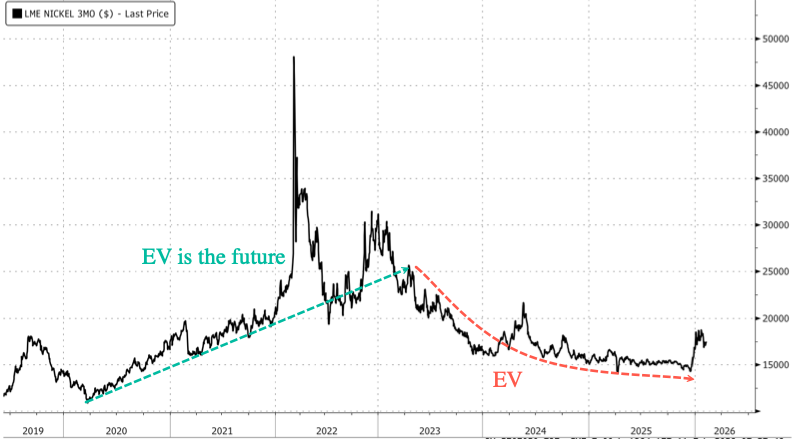
The move by Indonesia comes as it controls 65% of global nickel output and has slashed mining quotas to reverse a two-year price decline that has squeezed higher-cost rivals in places like Australia and New Caledonia.
Miners such as BHP, once one of the world’s largest nickel producers, as well as several others, have closed nickel operations due to oversupply conditions. London-listed Anglo American is in the process of offloading nickel operations to MMG Singapore Resources, part of Chinese-controlled MMG.
Eramet said it was “committed to maintaining a constructive and ongoing dialogue with Indonesian authorities, with the objective of securing production levels that are consistent with the long-term sustainability of operations” and that it planned to apply for “a revision of this production quota to a higher volume.“
The metal is widely used in both stainless steel and electric-vehicle batteries, but demand, especially from EVs, has softened worldwide. This year, battery makers are pivoting to grid-scale batteries to help offset the EV slowdown
(read report).
SILVER/SHANGHAI
VBL
Silversqueeze Comes to China

by VBL
Wednesday, Feb 11, 2026 – 8:46
Silver: China Inventories Squeezed by US Lockout of LATAM (LATINAMERICA)
TL;DR
- China’s silver market remains physically tight despite stabilization in international prices, with record backwardation and decade-low exchange inventories signaling preference for immediate delivery.
- Investment bar demand and solar manufacturing procurement continue draining stockpiles, while short sellers pay deferral fees to avoid delivery, reinforcing evidence of localized scarcity.
- Speculative positioning has cooled ahead of Lunar New Year, yet structural supply constraints persist, leaving Shanghai spreads historically elevated.
- In our view, the tightening in China coincides with a broader hemispheric realignment of silver concentrate flows toward U.S. refining and banking channels, suggesting that geopolitical supply restructuring may be amplifying physical stress in Asian markets.
China’s Silver Tightness Deepens as Global Prices Stabilize
Authored by GoldFix
International silver prices have steadied following a period of extreme volatility, yet physical conditions inside China continue to reflect pronounced strain. Investment demand and industrial consumption are drawing down exchange inventories, tightening prompt supply and distorting futures spreads.
According to a February 10 Bloomberg News report, inventories across Chinese exchanges have fallen to multi-year lows while front-month contracts trade at record premiums to deferred months. The imbalance reflects a preference for immediate delivery and underscores the scarcity of deliverable material within the domestic market.
Backwardation Tells The Story
Domestic producers and traders are working through backlogs of orders as near-term prices rise relative to forward contracts. The front-month silver contract on the Shanghai Futures Exchange has climbed to a record premium over the next active month. The structure signals backwardation, a condition in which prompt metal commands a higher price than future delivery.
“Such a large backwardation is driven by an inventory crisis and the depletion of deliverable material,” said Zhang Ting, senior analyst at Sichuan Tianfu Bank Co.
“Institutions still have incentives to continue squeezing the market for profit.”
The spread between the front-month and next contract has widened to levels rarely seen in Shanghai trading. Positive spreads confirm a market paying up for immediacy.
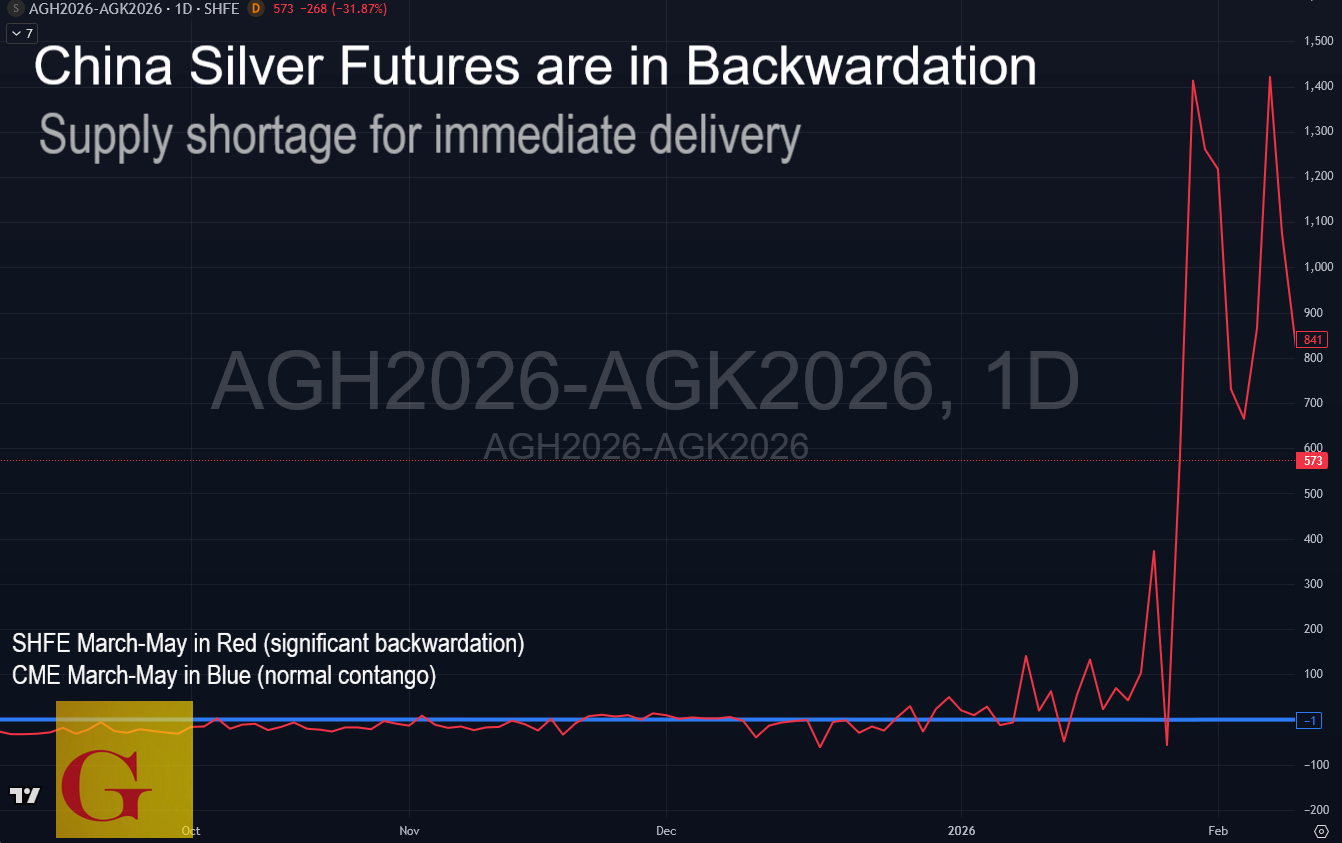
Short sellers on the Shanghai Gold Exchange have also paid deferral fees to avoid physical delivery since late December. The payments indicate limited availability of metal to settle obligations, reinforcing evidence of tightness within exchange-linked warehouses.
From Speculative Surge to Inventory Drain
The silver market experienced a historic selloff beginning at the end of January, erasing most of the 61 percent rally registered in the opening weeks of the year. That earlier advance was fueled by heavy speculative participation in China and overseas, with silver temporarily drawing flows typically directed toward gold during periods of macro uncertainty tied to the dollar, Federal Reserve governance concerns, and geopolitical tensions.
**Silver: Emergency Halt of UBS-China Fund Tied to Global Selloff
Jan 31

Trading in a major China-listed silver fund was halted for a full session on January 30 as regulators moved to contain price distortions, while global silver prices fell sharply from record highs amid elevated volatility and tighter derivatives margin requirements.
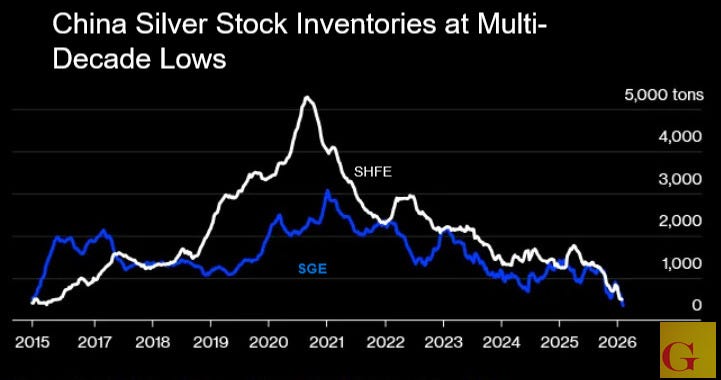
Despite the price correction, physical stockpiles remain depleted. Chinese inventories had already been reduced following an autumn squeeze on global supplies. The December surge in investment demand accelerated the drawdown.
Warehouse stocks linked to the Shanghai Futures Exchange and Shanghai Gold Exchange now sit at levels last observed more than a decade ago.
Retail and Industrial Demand Remain Firm
Investment bar demand has remained elevated. In Shenzhen’s Shuibei district, the country’s primary bullion trading hub, merchants continue to transact at premium prices.
“Whenever there are stocks, they’re sold off quickly,” said Liu Shunmin, head of risk at Shenzhen Guoxing Precious Metals Co.
Industrial consumption adds a second layer of demand. China’s solar panel manufacturers, which use silver paste in photovoltaic cells, are increasing production ahead of the April 1 expiration of export tax rebates. Some firms used the recent price decline to secure material at lower levels, according to market participants.
The convergence of investment accumulation and manufacturing procurement limits the metal available for exchange delivery.
Seasonal Constraints and Cooling Speculation
Market participants note that the only potential relief in the immediate term would come from increased smelter output during the Lunar New Year period. Historically, industrial activity slows during the week-long holiday, making a production surge less likely.
There are indications that speculative positioning is moderating. Aggregate open interest on the Shanghai Futures Exchange has declined to the lowest level in more than four years as traders reduce exposure ahead of the February 16 holiday start.
Broader Commodity Context
Separate commentary from Bloomberg Intelligence highlighted an expected acceleration in fundraising by Chinese miners amid an ongoing metals supercycle. Aluminum’s price behavior has shifted toward closer alignment with copper, reflecting substitution dynamics and shared macro drivers. U.S. officials also continue to monitor China’s crude stockpiling strategy, which may influence oil prices even during periods of global oversupply.
Within that broader commodity landscape, silver in China remains defined by localized scarcity and structural tightness. Futures spreads, warehouse levels, and deferral payments together indicate a market prioritizing physical immediacy over forward exposure.
Continues here
GOLD , SILVER OR PLATINUM LEASE RATES
ROBERT LAMBOURNE….
I have some implied lease rates for you from yesterday evening based on the Comex. Sorry, but I’m having some issues with my computer equipment so this is an image only. They are really high, even for gold historically.
Regards,
Bob
THEN
Higher margins after today
Inbox

| Robert Lambourne | 7:56 AM (26 minutes ago) | ||
to me, Chris | |||
The authorities seem desperate to keep prices suppressed. There also appears to have been an effort to suppress prices yesterday in Shanghai as per my earlier email.
This is the classic playbook from the Hunt brothers time.
CME Group hikes gold, silver margins again as volatility grips markets –
END
2.ASIAN AFFAIRS FEB 11/2026
YOUR EARLY CURRENCY VALUES/GOLD AND SILVER PRICING/ASIAN AND EUROPEAN BOURSE MOVEMENTS/AND INTEREST RATE SETTINGS WEDNESDAY MORNING.7:30 AM
SHANGHAI CLOSED UP 3.61 PTS OR 0.09%
//Hang Seng CLOSED UP 83.23 PTS OR 0.31%
// Nikkei CLOSED UP 1286.60 PTS OR 2.28%
//Australia’s all ordinaries CLOSED UP 1.12%
//Chinese yuan (ONSHORE) CLOSED UP TO 6.9088
/ OFFSHORE CLOSED UP AT 6.9077 Oil UP TO 64.78 dollars per barrel for WTI and BRENT UP TO 69.57 Stocks in Europe OPENED MOSTLY ALL RED EXCEPT LONDON
ONSHORE USA/ YUAN TRADING UP TO 6.9083 OFFSHORE YUAN TRADING UP TO 6.9077 ONSHORE YUAN TRADING BELOW OFF SHORE AND UP ON THE DOLLAR// / AND THUS STRONGER//OFF SHORE YUAN TRADING UP AGAINST US DOLLAR/ AND THUS STRONGER
YOUR EARLY CURRENCY VALUES/GOLD AND SILVER PRICING/ASIAN AND EUROPEAN BOURSE MOVEMENTS/AND INTEREST RATE SETTINGS WEDNESDAY MORNING.7:30 AM
ONSHORE YUAN: CLOSED UP AT 6.9083
OFFSHORE YUAN: UP TO 6.9077
HANG SENG CLOSED UP 83.34 PTS OR 0.31%
2. Nikkei closed UP 1286.60 PTS OR 2.28%
WEST TEXAS INTERMEDIATE OIL UP 64.78
BRENT; 69.57
3. Europe stocks SO FAR: ALL MOSTLY RED
USA dollar INDEX UP TO 96.43 /// EURO RISES TO 1.1918 UP 31 BASIS PTS
3b Japan 10 YR bond yield: RISES TO. +2.237/ UP 1 FULL BASIS PTS/ VERY TROUBLESOME//Japan buying 100% of bond issuance)/Japanese YEN vs USA cross now at 153.21… JAPANESE YEN NOW FALLING AS WE HAVE NOW REACHED THE ENDING OF THE YEN CARRY TRADE AGAIN AND THE REPATRIATION OF YEN DENOMINATED BONDS TRADING IN THE USA/EUROPE. JAPAN 30 YR BOND YIELD: 3.502 UP 1 FULL BASIS PTS. AND STILL VERY TROUBLESOME
3c Nikkei now ABOVE 17,000
3d USA/Yen rate now well ABOVE the important 120 barrier this morning
3e Gold UP /JAPANESE Yen UP CHINESE ONSHORE YUAN: UP OFFSHORE: UP
3f Japan is to buy INFINITE TRILLION YEN worth of BONDS. Japan’s GDP equals 5 trillion USA
Japan to buy 100% of all new Japanese debt and NOW they will have OVER 50% of all Japanese debt.
3g Oil UP for WTI and BRENT UP this morning
3h European bond buying continues to push yields LOWER on all fronts in the EMU. German 10yr bund YIELD DOWN TO +2.8000 Italian 10 Yr bond yield DOWN to 3.413 SPAIN 10 YR BOND YIELD DOWN TO 3.170
3i Greek 10 year bond yield DOWN TO 3.402
3j Gold at $5052.60 Silver at: 83,77 1 am est) SILVER NEXT RESISTANCE LEVEL AT $100.00
3k USA vs Russian rouble;// Russian rouble DOWN 0 AND 11/100 roubles/dollar; ROUBLE AT 77.11
3m oil (WTI) into the 64 dollar handle for WTI and 69 handle for Brent/
3n Higher foreign deposits moving out of China// huge risk of outflows and a currency depreciation. This can spell financial disaster for the rest of the world/
JAPAN ON JAN 29.2016 CONTINUES NIRP. THIS MORNING RAISES AMOUNT OF BONDS THAT THEY WILL PURCHASE UP TO .5% ON THE 10 YR BOND///YEN TRADES TO 153.21 10 YEAR YIELD AFTER FIRST BREAKING .54% LAST YEAR NOW EXCEEDS THAT LEVEL TO 2.237% UP 1 BASIS PTS STILL ON CENTRAL BANK (JAPAN) INTERVENTION//YEN CARRY TRADE IS NOW UNWINDING//YEN BOND TRADING OVERSEAS REPATRIATED.//JAPAN 30 YR: 3.507 UP 1 BASIS PTS.
30 SNB (Swiss National Bank) still intervening again in the markets driving down the FRANC. It is not working: USA/SF this 0.7662 as the Swiss Franc is still rising against most currencies. Euro vs SF: 0.9171 well above the floor set by the Swiss Finance Minister. Thomas Jordan, chief of the Swiss National Bank continues to purchase euros trying to lower value of the Swiss Franc.
USA 10 YR BOND YIELD: 4.136 DOWN 2 BASIS PTS…
USA 30 YR BOND YIELD: 4.778 DOWN 2 BASIS PTS/
USA 2 YR BOND YIELD: 3.450 DOWN 2 BASIS PTS
USA DOLLAR VS TURKISH LIRA: 43.64 UP 1 BASIS PTS/LIRA GETTING KILLED
10 YR UK BOND YIELD: 4.4999 DOWN 1 PTS
30 YR UK BOND YIELD: 5.320 DOWN 1 BASIS PTS
10 YR CANADA BOND YIELD: 3.362 DOWN 4 BASIS PTS
5 YR CANADA BOND YIELD: 2.890 DOWN 2 BASIS PTS.
1a New York Opening report
Futures Rise Ahead Of Today’s Delayed Jobs Report
Wednesday, Feb 11, 2026 – 08:29 AM
US equity futures are flat ahead of today’s delayed January payrolls (full preview here) with the market now expecting a weaker print after the Retail Sales miss and weaker high-frequency data. As of 8:00am ET, S&P and Nasdaq 100 futures are both up 0.1%. Pre-market, Mag7 names are mostly lower; Discretionary, Energy, Industrials and Materials are all higher pointing to a potential broad-based cyclical rally while TMT is muted; AI ex-Mag7 is seeing a bid. JPMorgan’s trading desk expects the delayed January data to give a small boost to stocks — something much-needed amid the indiscriminate selling of those on the wrong side of AI. International markets are mixed with trends similar – Japan closed, KOSPI strong up 100bps, HSI not far behind up 30bps. Europe more flat to down with CAC down 13bps and DAX off 24bps. Australia leads the downside off 172bps. 10 TSY yields are at lows 4.13%, while the USD is weaker for the 4th consecutive session, the DXY down below $97 to $96.58 and Bitcoin trades down to $67k. FT reports Ukraine planning presidential elections and a referendum on any peace deal, potentially by mid-May, under US pressure. Timing uncertain given Donbas, Zaporizhzhia and escalation risks. China CPI soft +0.2% vs. 0.4%. Commodities moving higher this morning led by silver but Comex copper back above $6 to $6.07 up 3%, crude quietly moving up with WTI at $65. Today’s macro data focus is on the NFP release but watch the drop in Mortgage Approvals given the strength of the recent Homebuilders bid. McDonald’s and Cisco are due to report.
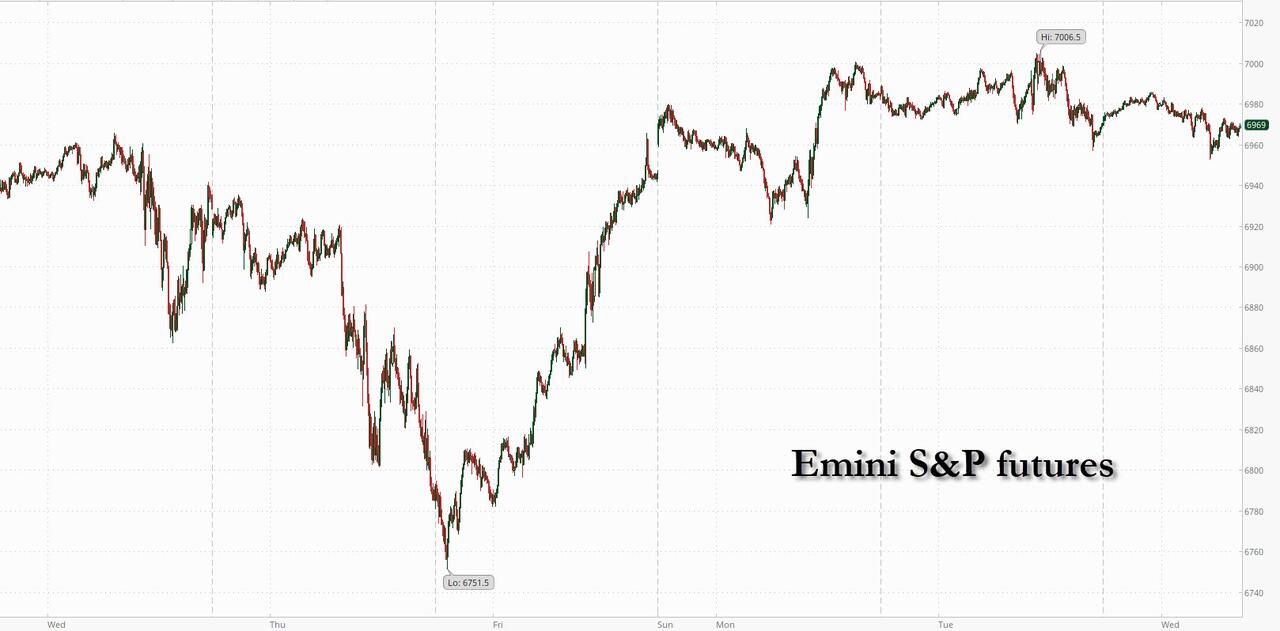
In premarket trading, Mag 7 stocks are mixed (Nvidia +0.6%, Amazon +0.2%, Microsoft +0.2%, Alphabet +0.07%, Apple -0.04%, Meta -0.4%, Tesla -0.2%)
- Astera Labs (ALAB) falls 11% after the semiconductor manufacturing company reported its fourth-quarter results. It also announced that its chief financial officer would retire.
- Beta Technologies (BETA) climbs 18% after Amazon.com Inc. disclosed a stake in the electric-powered aircraft manufacturer.
- Centrus Energy (LEU) falls 8% after the uranium company’s fourth-quarter earnings per share fell short of analyst estimates, with Citi pointing to higher-than-expected capex spending.
- Cloudflare (NET) gains 14% after the software company’s fourth-quarter results beat expectations and it gave a bullish revenue forecast.
- Humana (HUM) falls 6% after forecasting full-year profit that fell short of Wall Street’s expectations, adding to investor concerns about the challenges facing the US health-insurance industry.
- Kraft Heinz (KHC) falls 6% after pausing work on its planned separation as new Chief Executive Officer Steve Cahillane works to improve results.
- Lattice Semiconductor (LSCC) rises 11% after the semiconductor device company gave a first-quarter revenue forecast that was much stronger than expected.
- Lyft (LYFT) falls 17% after issuing a disappointing forecast that missed Wall Street expectations, a sign that its global expansion and new product offerings are not performing as quickly and as well as anticipated.
- Mattel (MAT) slumps 26% after the toymaker’s 2026 adjusted earnings-per-share forecast missed the average analyst estimate, triggering a downgrade at JPMorgan.
- Moderna (MRNA) falls 10% after US regulators refused to review its novel mRNA flu vaccine, dealing a major blow to the company as it seeks to expand beyond its Covid shot.
- Rapid7 (RPD) falls 22% after the software company’s outlook was seen as disappointing. Analysts cited weakness in annual recurring revenue as a concern.
- Robinhood (HOOD) declines 7% after the fintech company reported net revenue for the fourth quarter that missed the average analyst estimate.
- Teradata (TDC) gains 15% after the database management company reported fourth-quarter results that beat expectations and gave an outlook for adjusted earnings that is stronger than expected.
- Vertiv Holdings (VRT) rises 13% after the power equipment company forecast adjusted earnings per share for the first quarter; the guidance beat the average analyst estimate.
January’s payrolls report (full preview here) is due after several Trump admin officials, including National Economic Council Director Kevin Hassett and Peter Navarro, recently warned that investors should expect lower jobs numbers going forward. Analysts are also anticipating an annual revision to the jobs count, which is expected to reveal a huge markdown in the year through March 2025, to the tune of 750-900K jobs. Bloomberg’s consensus is for 65k job additions in January vs 50k in December, with a crowd-sourced whisper number of 35k, while scenarios laid out by JPMorgan Market Intelligence suggest a sweet spot between 60k and 110k to boost stocks. With the job market in the midst of a “low-hire, low-fire” environment, expectations are low, which could act as a potential catalyst for equities.
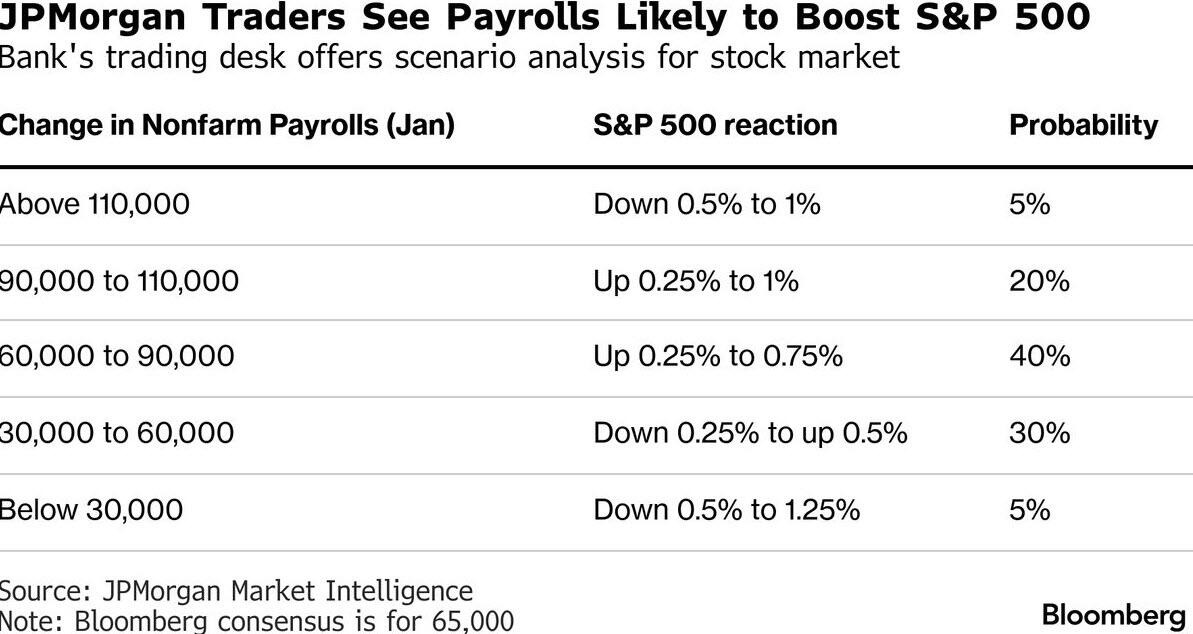
JPMorgan strategists also note that the S&P 500 options market is underpricing payrolls compared to historical swings, with past moves nearly double what is currently being priced. Meanwhile, interest-rate traders are betting on two or three Fed rate cuts this year, becoming slightly more conservative than the dovish bets seen after Warsh’s nomination earlier in the month.
“We’re still in this sort of, not-really-hiring, not-really-firing mode. But we haven’t seen a clear breakout in either direction,” said Graham Secker, head of equity strategy at Pictet Wealth Management. “Everyone’s very aware of the kind of the K-shape dynamic within the US economy, and the US consumer in particular.”
For Nicolas Bickel, group head of investment private banking at Edmond de Rothschild, the jobs report and Friday’s inflation data will offer insight into the impact of January’s extreme weather. A strong jobs report would instill confidence in the consumer outlook and help fuel a broadening of the stock rally.
“I really like that rotation personally, because it’s for me the lifeblood of a bull market,” Bickel said. Investors “are just choosing another horse, and means that they have money to be invested, or are confident in the economy.”
The selloff in software stocks has been overblown, creating buying opportunities for investors, according to Nannette Hechler-Fayd’Herbe, head of investment strategy for EMEA at Lombard Odier.
“There have been a lot of concerns that AI might be disrupting software companies, but we have held the view that actually, it is empowering them, it is shortening the time for coding, it is enabling efficiencies of workflows,” she told Bloomberg TV. “For us it’s actually been an opportunity to take exposure.”
In other assets, Bitcoin fell to its lowest level since last Friday’s selloff, despite support from its largest holders, so-called whale wallets, in their biggest buying spree since November. The dollar also fell for a fourth straight day. In Europe, shares in software firms and wealth managers continued to slide on AI disruption fears.
In politics, House lawmakers are set to vote today on whether to reject some of Trump’s tariff policies, starting with a resolution opposing levies on Canada. Trump is expected to unveil plans to use government funding and Pentagon contracts to sustain coal-fired power plants.
A quick look at earnings: Out of the 326 S&P 500 companies that have reported so far in the earnings season, 78% have managed to beat analyst forecasts, while 17% have missed. T-Mobile, Shopify and Kraft Heinz are among companies expected to report before the market open. T-Mobile’s new CEO is likely to maintain a strategy of promoting aggressively to sustain industry-leading postpaid phone net additions and service growth, according to Bloomberg Intelligence. Earnings from Cisco and McDonald’s follow later.
Stocks in Europe are mixed, the Stoxx 600 is up 0.1%. The FTSE 100 outperforms peers, boosted by energy and materials stocks. European wealth managers tracked their US peers lower amid fears over the disruptive impact of a new AI tool designed to create tax strategies. St James’s Place Plc slumped 12% in London, while investment platforms such as AJ Bell Plc and IntegraFin Holdings Plc were sliding as well. Weak guidance by Dassault Systemes SE played into fears that the French software firm may be vulnerable to AI, sending the stock lower by the most in three decades. Here are some of the biggest movers on Wednesday:
- Ahold Delhaize shares gain as much as 9.9%, the most since 2020, as the Dutch retail store operator reported margin beats across the board.
- Siemens Energy shares rally as much as 6.5% to its highest intraday level on record after first-quarter earnings surpassed the average analyst estimate, driven by strong order growth in gas turbines.
- Heineken shares rise as much as 5.5%, the most in nearly a year, after the Dutch brewer exited 2025 with what analysts consider an uptick in momentum, boosted by a cost-saving program that sees it cut up to 6,000 jobs.
- Renishaw shares rise as much as 6.4%, the most in five months, as the engineering firm’s order book grows.
- B&M shares climb as much as 5.4% after Peel Hunt upgraded its recommendation on the discount retailer, arguing that the shares appear undervalued given the prospects for stronger sales and earnings.
- Gerresheimer shares plunge as much as 35%, hitting their lowest level since 2009, after the German maker of packaging for medicines and cosmetics delayed the publication of its 2025 earnings.
- Dassault Systemes shares sink as much as 22% the most on record, after the software company gave a weaker-than-expected sales growth guidance for 2026, on top of 4Q results that missed estimates.
- St James’s Place shares fall as much as 11%, the most in nearly two years, leading a drop in European wealth managers over worries that artificial intelligence will disrupt their businesses.
- Randstad shares fall as much as 9.3%, touching the lowest level since March 2020, after the staffing and HR services provider reported organic revenue for the fourth quarter that missed the average analyst estimate.
- Barratt Redrow shares fall as much as 8.4%, the most since July, as pressure increases on the UK homebuilder’s margins.
Earlier in the session, Asian equities climbed to a fresh record, led by technology shares, as investors continued to rotate away from US assets amid a weaker dollar. The MSCI Asia Pacific ex-Japan Index rose as much as 1.3%, set for a third straight daily gain. TSMC, Commonwealth Bank of Australia and Samsung Electronics were among the major contributors. Benchmarks in South Korea, Hong Kong and Australia advanced, while those in mainland China slipped. Japanese markets were shut for a holiday. The strength in Asia’s technology shares and weakness in the greenback continue to drive investors into the developing world. The 30-day correlation between the dollar and MSCI Asia is minus 0.5, around the most severe level since April, Bloomberg-compiled data show. Bucking the trend, SK Hynix was among the major drags on the index following a report China’s CXMT plans to allocate a chunk of its DRAM capacity to produce superfast HBM3 chips that are used in AI. Samsung reversed earlier losses after a top executive said that the company is back at the top of the memory industry with its new HBM4 technology. Taiwan’s benchmark Taiex index jumped 1.6% to an all-time high on its last trading day before Lunar New Year holiday. Tech optimism rose after TSMC’s solid January sales data showed a sign of sustained global AI spending. The island’s stock market will resume trading from Feb. 23.
In FX, the yen has continued its climb against the dollar with USD/JPY briefly slipping below the 153 level. Accordingly the Bloomberg Dollar index is down 0.3%, also hampered by gains in NOK and AUD, with the latter bolstered by hawkish RBA remarks.
In rates, treasury yields are slightly lower on the day ahead of the rescheduled January employment report at 8:30am New York time. Overnight trading bands were narrow amid similarly muted price action European bonds, while S&P 500 futures hold small gain. US session also includes new-issue 10-year note auction for $42 billion, following good demand for 3-year notes Tuesday. US intermediate yields are richer by about 1bp with 10-year steady around 4.135% and curve spreads within 1bp of Tuesday’s close. German and UK peers are equally contained. For the 1pm auction, 10-year notes have when-issued yield near 4.142%, about 3bp richer than last month’s sale, a second and final reopening that stopped through by 0.7bp. IG dollar issuance slate empty so far. Eight names priced $11.3b Tuesday, led by Walt Disney Co. and pharmaceutical distributor Cencora’s multi—tranche trades. Issuers paid about 2bps in new issue concessions on deals that were 4.3 times covered
In commodities, metals prices are broadly firmer, with spot gold and silver up 1.4% and 6.2% respectively. Oil futures have continued to rise amid tensions in the Middle East. Bitcoin has extended this week’s declines, down 2.9%. Nickel has also been boosted by Indonesian output curbs. Gold hovered above $5,000 an ounce. Bitcoin slid under $67,000, with last week’s reprieve proving short-lived and highlighting investors’ lack of confidence in a sustained recovery.
Today’s calendar includes the nonfarm payrolls for January are due at 8.30 a.m., followed by Fed budget balance at 2 p.m. Fed’s Bowman (10:15am), Schmid (10:00am) and Hammack (4pm) are scheduled to speak at events.
Market Snapshot
- S&P 500 mini little changed
- Nasdaq 100 mini -0.2%
- Russell 2000 mini little changed
- Stoxx Europe 600 -0.2%
- DAX -0.3%
- CAC 40 -0.5%
- 10-year Treasury yield -1 basis point at 4.13%
- VIX +0.5 points at 18.26
- Bloomberg Dollar Index -0.3% at 1179.03
- euro +0.2% at $1.1917
- WTI crude +1.3% at $64.8/barrel
Top Overnight News
- Top White House officials have started trying to downplay a highly anticipated jobs report set for release on Wednesday, insisting that the US economy remains strong even if the data may ultimately show a fresh slowdown in hiring. WSJ
- Negotiations between US Democrats and the White House are ongoing, but right now, a deal on a stopgap funding measure seems unlikely: Punchbowl
- Iran wants to make a deal with the US, Donald Trump told Fox. On the Fed, the president reiterated his call for lower rates, saying employment numbers are “really good.” BBG
- House lawmakers are set to vote today on whether to reject some of Trump’s tariff policies, starting with a resolution opposing levies on Canada. BBG
- The White House revised its fact sheet on the US-India trade agreement to adjust language around agricultural goods, adding to confusion about the deal already raised by farmer groups. BBG
- Ukraine has begun planning presidential elections alongside a referendum on any peace deal with Russia, after the Trump administration pressed Kyiv to hold both votes by May 15 or risk losing proposed US security guarantees. FT
- China’s consumer inflation eased at the start of 2026 after reaching a near three-year high in December, as food prices declined. China’s PPI for Jan came in at -1.4% (vs. the Street -1.5% and down from -1.9% in Dec) while the CPI was +0.2% (down from +0.8% in Dec and below the Street’s +0.4% forecast). WSJ
- Euro-area wage growth is poised to pick up in the second half, ECB predictions showed, supporting officials’ view that interest rates can remain steady. BBG
- The Reserve Bank of Australia sees the country’s inflation rate as too high and will take all necessary measures to bring it under control, a top central bank official said. WSJ
- China’s latest call to curb Treasuries in its holdings is stoking fear that Trump’s unpredictable policies may encourage traditional lenders like Europe and Japan to follow in its footsteps. BBG
Trade/Tariffs
- China is reportedly considering probing wine from France; could consider launching anti-dumping duty to French wine, and potentially take counter measures against the EU if it adopt duties.
- China plans to extend import VAT breaks on cancer and rare disease drugs until the end of 2027.
- White House revised Fact Sheet on US-India trade deal with reference to pulses dropped and it changed the wording around India’s proposed USD 500bln purchase from a firm “commitment” to an “intent”.
- US House Speaker Johnson fails in an effort to block votes on measures to rescind Trump’s tariff policies, according to CNN’s Manu Raju.
- US Treasury Secretary Bessent said US-China ties are stable but competitive, aiming for fair competition and de-risking, not decoupling, while he adds China must rebalance amid persistent USD 1tln trade imbalance.
1b European Opening report
China considers probing French wine; DXY slightly lower heading into US NFP data – Newsquawk US Opening News

Wednesday, Feb 11, 2026 – 06:21 AM
- China is reportedly considering probing wine from France; could consider launching anti-dumping duty to French wine, and potentially take counter measures against the EU if it adopt duties.
- European bourses are trading on the backfoot; FTSE 100 outperforms on the back of firmer commodity prices; US equity futures mixed.
- DXY slightly lower heading into US NFP, JPY continues to gain, AUD bid after RBA’s Hauser said inflation is “too high”.
- Fixed income rangebound; Bunds little moved following tepid auction.
- Crude edges higher as Trump mulls sending another carrier near Iran; Gold rangebound; Base metals rise, led by nickel prices following an cut in output from the world’s largest mine.
- Looking ahead, highlights include US NFP (Jan), Japanese PPI (Jan), BoC Minutes (Jan), OPEC MOMR. Speakers include ECB’s Schnabel, Fed’s Schmid, Bowman & Hammack. Supply from the US. Earnings from T-Mobile, McDonalds, AppLovin, Equinix, Motorola Solutions, Hilton and Kraft Heinz.
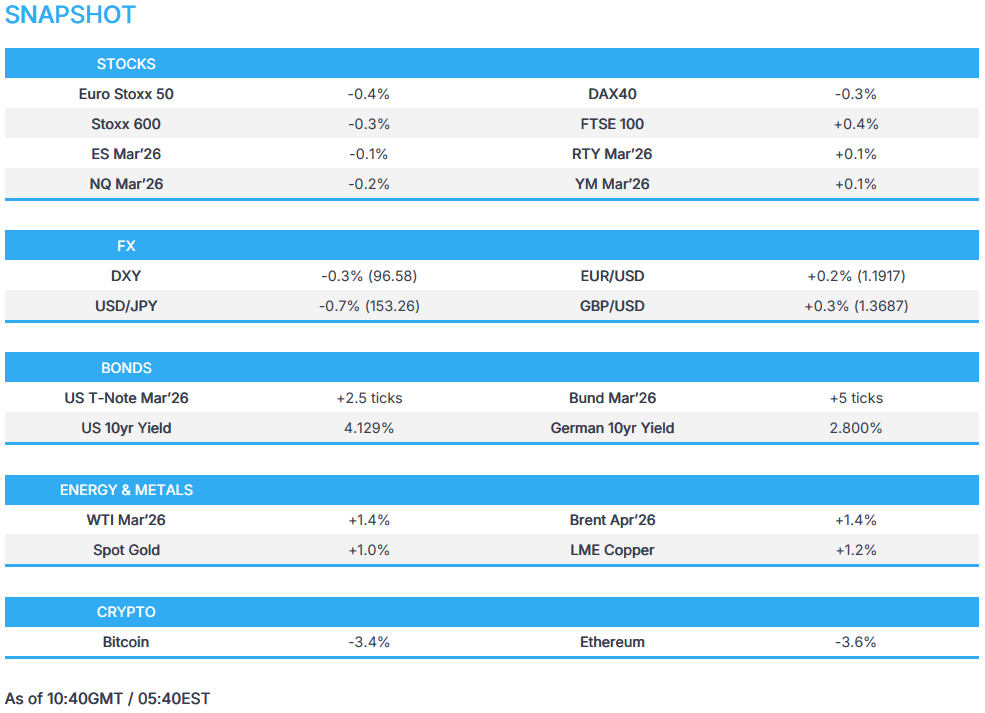
Newsquawk in 3 steps:
1. Subscribe to the free premarket movers reports
2. Listen to this report in the market open podcast (available on Apple and Spotify)
3. Trial Newsquawk’s premium real-time audio news squawk box for 7 days
EUROPEAN TRADE
EQUITIES
- European Bourses (STOXX 600 -0.3%) opened mixed, but now display a mostly negative picture (ex-FTSE 100, buoyed by strength in oil/mining names).
- Sectors hold a negative bias. Energy and Basic Resources are towards the top of the pile, whilst Tech lags.
- Movers today include; Siemens Energy (+5%, strong Q1 results), Dassault Systemes (-17%, poor results and weak outlook), Lufthansa (-4%, pilots threaten to strike). Elsewhere, some modest pressure was seen in Pernod Ricard (+0.5%) following reports that China could consider an anti-dumping duty on French wine.
- US equity futures (ES +0.1%, NQ -0.1%, RTY +0.2%) are trading on either side of the unchanged mark, with trade tentative heading into the US NFP report; recent price action has seen contracts dip off best levels. In the pre-market; Ford (+1%, guided stronger profits for 2026), Robinhood (-7%, Q4 revenue below expectations).
- TotalEnergies (TTE FP) Q4 (USD): Adj. EPS 1.73 (exp. 1.75), Adj. Net Income 3.84bln (exp. 3.81bln), Adj. EBITDA 10.07bln (exp. 9.87bln), plans USD 750mln share buyback in Q1 and confirms FY26 share buyback guidance of around USD 15bln.
- Siemens Energy (ENR GY) Q1 (EUR): Revenue 9.6bln (exp. 9.83bln), Profit Before Special Items 1.16bln (exp. 992.4mln), Orders 17.61bln (exp. 14.17bln); affirms guidance.
- Dassault Systemes (DSY FP) Q4 (EUR): EPS 0.33 (exp. 0.33), Adj. EBIT 622mln (exp. 654.6mln), Non-IFRS Revenue 1.68bln (exp. 1.74bln), Non-IFRS Revenue ex-FX +1% (exp. +3.49%); Sees Q1’26 Revenue ex-FX 1-5%, EPS 0.25-0.31 (exp. 0.33).
- Ford Motor Company (F) Q4 2025 (USD): Adj. EPS 0.13 (exp. 0.18), Revenue 45.9bln (exp. 43.60bln). To continue building on the foundation to achieve the target of 8% adj. EBIT margin by 2029. Tariff relief delay dealt an unexpected blow and Ford discloses additional USD 900mln tariff hit.
- Click for the sessions European pre-market equity newsflow
- Click for the additional news
FX
- DXY is slightly lower this morning and trades towards the lower end of a 96.49-96.91 range. Focus for the day lies solely on the US NFP report in the afternoon. The delayed January jobs data is expected to show 70k nonfarm payrolls added in the month (vs a prev. 50k; with the range of forecasts between -10k to +108k); the unemployment rate is expected to remain steady at 4.4%. Recent labour metrics are painting a subdued picture for the labour market, and commentary via WH Economic Adviser Hassett also dampened expectations ahead of the report today. Following his remarks, Bloomberg’s NFP whisper number dropped to 37k (prev. 50k).
- JPY remains at the top of the pile, continuing to extend on the recent strength seen following PM Takaichi’s landslide victory. As mentioned in the coverage since the election, there are numerous factors helping buoy the JPY; a) BoJ potentially to normalise faster, b) less friction for Japanese officials to conduct intervention, c) hefty flows to Japanese equities, d) FinMin Katayama suggesting that surplus foreign reserves could help to fund the food tax suspension. USD/JPY briefly dipped below the 153.00 mark, and currently holds within a 152.79-154.51 band. The pair is now approaching the touted rate check/intervention lows seen late Jan (152.09).
- G10s are firmer against the USD to varying degrees. JPY outperforms (mentioned above), whilst the Aussie follows closely behind. AUD/USD has now breached above the 0.70 mark, to now trade at levels not seen since Feb’23. The pair currently trades around 0.7113, and further upside could see a test of the high from 2nd Feb 2023 at 0.7157. Recent strength comes amidst the continued strength in underlying metals prices, and after commentary from RBA’s Hauser. He noted that inflation is too high, which they can’t let persist and will do what is needed to bring inflation back to the target band.
- Elsewhere, EUR is slightly firmer and trades around the 1.19 mark, and off recent highs which saw the single currency top 1.2000 in late January. A weak US jobs report could see another bid higher for EUR/USD, which may lead to ECB doves to push for an FX-led rate cut. No move was seen after the ECB Wage Tracker, where the 2026 annual estimate was increased to 2.388% (prev. 2.316%).
- The NOK continues to strengthen against the EUR in the aftermath of Tuesday’s hotter-than-expected Norwegian inflation data; a report which led some banks to push back calls for Spring cuts. EUR/NOK is currently at session lows, in a 11.2638-11.3300 range.
- Click for NY OpEx Details
FIXED INCOME
- In brief, benchmarks are contained into today’s NFP report (delayed due to the brief shutdown), which includes benchmark revisions. US labour data during the window has been on the softer side of things, with claims steady, continuing easing, ADP weak and Revelio posting job losses. Furthermore, Challenger cuts were the highest for January since 2009, and JOLTS were at the lowest since September 2020.
- USTs approach this, and then data and Fed speak afterwards, firmer by a tick or two in a thin 112-15 to 112-18 band; note, trade was quiet overnight with no cash trade due to Japan’s market holiday. For the Fed, markets currently fully price a cut in June (-25.2bps implied), with around a 20% chance of one occurring earlier in March and c. 40% in April.
- EGBs in-fitting with the above, Bunds firmer but only marginally so in a 128.60-74 band. ECB speak this morning once again sticking to the script. Interestingly, the latest ECB wage tracker was hot across the board and factors in favour of those who think the next move will be a hike rather than a cut. Adding to the hawkish narrative from/affecting some global central banks in recent sessions, i.e. the RBA and Norges Bank.
- Gilts are contained in a 90.71-90 band. UK specifics are much quieter thus far vs the last few sessions, with a busy docket of data scheduled for next week. Much of the UK press is focused on Angela Rayner after it was revealed that a “Rayner for leader” site briefly went live in January; a Bloomberg write-up on the subject characterises the discussion/view of insiders neatly as “Buy Rayner and Sell Streeting”.
- Germany sells EUR 750mln vs exp. EUR 1bln 2.90% 2056 and EUR 1.16bln vs exp. EUR 1.5bln 2.50% 2054 Bund.
- UK sells GBP 300mln 4.25% 2049 Gilt via Tender: b/c 4.32x, average yield 5.256%.
- China’s Ministry of Finance issues CNY 14 bln of treasury bonds in Hong Kong.
- Australia sold AUD 700mln 3.75% April 2037 bonds, b/c 4.14, avg. yield 4.8342%.
- JPMorgan launches USD 1.5bln tender offer for EA bonds ahead of USD 20bln buyout financing; buyback includes USD 750mln each of 2031 and 2051 maturities, expiring March 11th.
COMMODITIES
- Crude benchmarks have steadily moved higher as the European session gets underway, with traders digesting a report by Axios quoting President Trump saying that he might send a second carrier to strike Iran if talks fail, pushing aside the larger-than-expected US private inventory build. WTI and Brent rebounded from a trough of USD 63.65/bbl and USD 68.49/bbl respectively in the later hours of Tuesday’s trading session, and oscillated in a tight c. USD 0.50/bbl range during the APAC session, with WTI nearing USD 65/bbl to the upside.
- Spot gold remains contained in a USD 4965-5086/oz band that has been formed so far this week, ahead of a busy week of tier-1 US data.
- Base metals have been steadily bidding higher with 3M LME Copper reaching USD 13.25k/t. The broad-based move seems to have been driven by nickel prices. Weda Bay, the world’s largest nickel mine, has been told by Indonesian authorities to cut its output by 70% in an effort to boost global prices. Indeed, LME nickel futures prices did lift higher following the report, rising from USD 17.75k/t to USD 17.95k/t, but have since pared back slightly.
- Indian state-owned refiners are to consider buying more US and Venezuelan crude after the trade deal with the US, Bloomberg reported.
- SHFE is adjusting the automatic conversion standard for hedging position limits in silver futures. “…starting from the last trading day of February 2026, the hedging transaction position limits for all silver contracts that have not obtained hedging transaction position limits for the near-delivery month will be temporarily adjusted to 0 lots for both buy and sell hedging transactions in the near-delivery month (the month preceding the delivery month and the delivery month itself).”.
- Russia to complete building two ice-class LNG tankers in 2026, according to IFX.
- World’s biggest nickel mine in Indonesia, Weda Bay, has been told to slash output by 70% to 12mln tonnes, Bloomberg reported.
- Syria taps energy majors to explore for trillions of cubic meters of gas with the state oil chief noting that Chevron (CVX) , ConocoPhillips (COP) and TotalEnergies (TTE FP) and Eni (ENI IM) are interested in exploration, according to FT.
- US Private Energy Inventory Data (bbls): Crude +13.4mln (exp. +0.8mln), Distillates -2.0mln (exp. -1.3mln), Gasoline +3.3mln (exp. -0.4mln), Cushing +1.4mln.
- US issues Venezuela related license authorizing certain transactions necessary to ports and airport operations, also authorising certain activities involving Venezuelan-origin oil.
- Wells Fargo raises its 2026 gold target to USD 6,100-6,300/oz citing geopolitical risks, market volatility, and strong central-bank demand.
TRADE/TARIFFS
- China is reportedly considering probing wine from France; could consider launching anti-dumping duty to French wine, and potentially take counter measures against the EU if it adopt duties.
- China plans to extend import VAT breaks on cancer and rare disease drugs until the end of 2027.
- White House revised Fact Sheet on US-India trade deal with reference to pulses dropped and it changed the wording around India’s proposed USD 500bln purchase from a firm “commitment” to an “intent”.
- US House Speaker Johnson fails in an effort to block votes on measures to rescind Trump’s tariff policies, according to CNN’s Manu Raju.
- US Treasury Secretary Bessent said US-China ties are stable but competitive, aiming for fair competition and de-risking, not decoupling, while he adds China must rebalance amid persistent USD 1tln trade imbalance.
NOTABLE EUROPEAN HEADLINES
- EU’s von der Leyen said the EU needs one large, deep and liquid capital market, adding that its currently too fragmented. Completing their own single market also means completing their own energy union, which is crucial when it comes to bringing prices down even further.
NOTABLE EUROPEAN DATA RECAP
- Italian Industrial Production YoY (Dec) Y/Y 3.2% (Prev. 1.4%).
- Italian Industrial Production MoM (Dec) M/M -0.4% vs. Exp. -0.5% (Prev. 1.5%).
CENTRAL BANKS
- ECB Wage Tracker: 2026 Annual 2.388% (prev. 2.316%).
- ECB’s Makhlouf said uncertainty means the ECB should take a meeting-by-meeting approach.
- RBA Deputy Governor Hauser said Australia’s economy is not just ‘dig it and ship it’, many parts of the economy are doing quite well, adds inflation is too high which they can’t let persist and will do what is needed to return it to the band.
- Westpac anticipates RBNZ hiking rates more quickly in 2027.
NOTABLE US HEADLINES
- Negotiations between US Democrats and the White House are ongoing, but right now, a deal on a stopgap funding measure seems unlikely, Punchbowl reports.
- US President Trump said our employment numbers are really good and remain good after government job cuts.
- US President Trump said the US should have the lowest interest rates in the world.
GEOPOLITICS
RUSSIA-UKRAINE
- Russia’s Kremlin said that the US has prohibited Russia and China from dealing with Venezuelan oil and are looking to discuss with the US about the restriction.
- Russia to complete building two ice-class LNG tankers in 2026, according to IFX.
- Ukrainian President Zelensky plans spring elections alongside a referendum on the peace deal after US push, according to FT.
MIDDLE EAST
- Iranian Supreme leader Khamenei’s advisor says that Iranian negotiators have no authority to discuss missiles.
- Iran’s Foreign Minister Araqchi said the date for the next round of US negotiations have not been set.
- Iranian Foreign Ministry said they are ready to negotiate on the percentage of uranium enrichment and the size of its enriched stockpile.
- Iran’s President said that the country is not seeking nuclear weapons and are ready for any kind of verification.
- US President Trump said Iran wants to make a deal and it would be foolish if they didn’t.
OTHERS
- Australia charges two Chinese nationals with foreign interference.
- Taiwan’s President Lai said Indo-Pacific nations are raising defense budgets and Taiwan must do the same, while he thanks US for its support of Taiwan’s defence.
- UK expands settlement visa for Hong Kongers following Jimmy Lai’s sentence.
CRYPTO
- Bitcoin slipped below USD 67k as Ethereum returned below USD 2k.
APAC TRADE
- APAC stocks traded higher but with some of the gains in the region capped after the weak handover from the US and with the NFP report on the horizon, while participants also digested earnings and data in thinned conditions, with Japanese markets shut for a holiday.
- ASX 200 outperformed with the index led higher by the top-weighted financial sector after shares in Australia’s largest lender and company by market cap, CBA, rallied following a 5% increase in H1 profits.
- Hang Seng and Shanghai Comp were kept afloat following the PBoC’s liquidity operations and recent pledge to continue implementing an appropriately loose monetary policy in its quarterly implementation report. However, the upside was limited as participants also reflected on the mixed Chinese inflation data in which CPI printed softer-than-expected, while PPI was slightly better-than-feared but remained in deep deflationary territory.
NOTABLE ASIA-PAC HEADLINES
- Goldman Sachs revised its 2026 China PPI forecast to -0.5% Y/Y.
- ByteDance reportedly plans to produce 100k-300k units of AI chips this year, while it is developing the AI chip and is in talks with Samsung (005930 KS) to manufacture it, according to sources.
- Tencent Cloud (0700 HK) partners with Tesla (TSLA) to upgrade its cockpit experience.
- NetEase (9999 HK / NTES) Q4 (USD): EPS 1.58 (exp. 2.03), Revenue 3.90bln (exp. 4.10bln).
NOTABLE APAC DATA RECAP
- Chinese PPI YoY (Jan) Y/Y -1.4% vs. Exp. -1.5% (Prev. -1.9%, Low. -1.9%, High. -1.0%).
- Chinese CPI MM (Jan) 0.2% vs. Exp. 0.3% (Prev. 0.2%).
- Chinese CPI YY (Jan) 0.2% vs. Exp. 0.4% (Prev. 0.8%).
- Australian Investment Lending for Homes (Q4) 7.9% (Prev. 17.6%).
- Australian Home Loans QQ (Q4) 9.5% vs Exp. 4.8% (Prev. 9.6%).
- Australian Owner Occupied Loan Value QQ (Q4) Q/Q 10.6% (Prev. 4.7%).
- South Korea Unemployment Rate (Jan) 3.0% (Prev. 4.0%, Rev. From 4%).
l c) Asian opening report
Stocks mostly firmer ahead of US NFP; Crude higher amid further Trump threats – Newsquawk EU Market Open
Wednesday, Feb 11, 2026 – 01:50 AM
- APAC stocks traded higher but with some of the gains in the region capped after the weak handover from the US and with the NFP report on the horizon, while participants also digested earnings and data in thinned conditions, with Japanese markets shut for a holiday.
- Ukrainian President Zelensky plans spring elections alongside a referendum on the peace deal after a US push.
- US President Trump said he might send a second carrier to strike Iran if talks fail and stated that “Either we will make a deal or we will have to do something very tough like last time”.
- European equity futures indicate a quiet cash market open with Euro Stoxx 50 futures +0.1% after the cash market finished with losses of 0.2% on Tuesday.
- Looking ahead, highlights include ECB Wage Tracker, US NFP (Jan), Japanese PPI (Jan), BoC Minutes (Jan), OPEC MOMR. Speakers include ECB’s Cipollone & Schnabel, Fed’s Schmid, Bowman & Hammack. Supply from Germany & US. Earnings from T-Mobile, McDonalds, AppLovin, Equinix, Motorola Solutions, Hilton, Kraft Heinz, TotalEnergies, Michelin.
SNAPSHOT
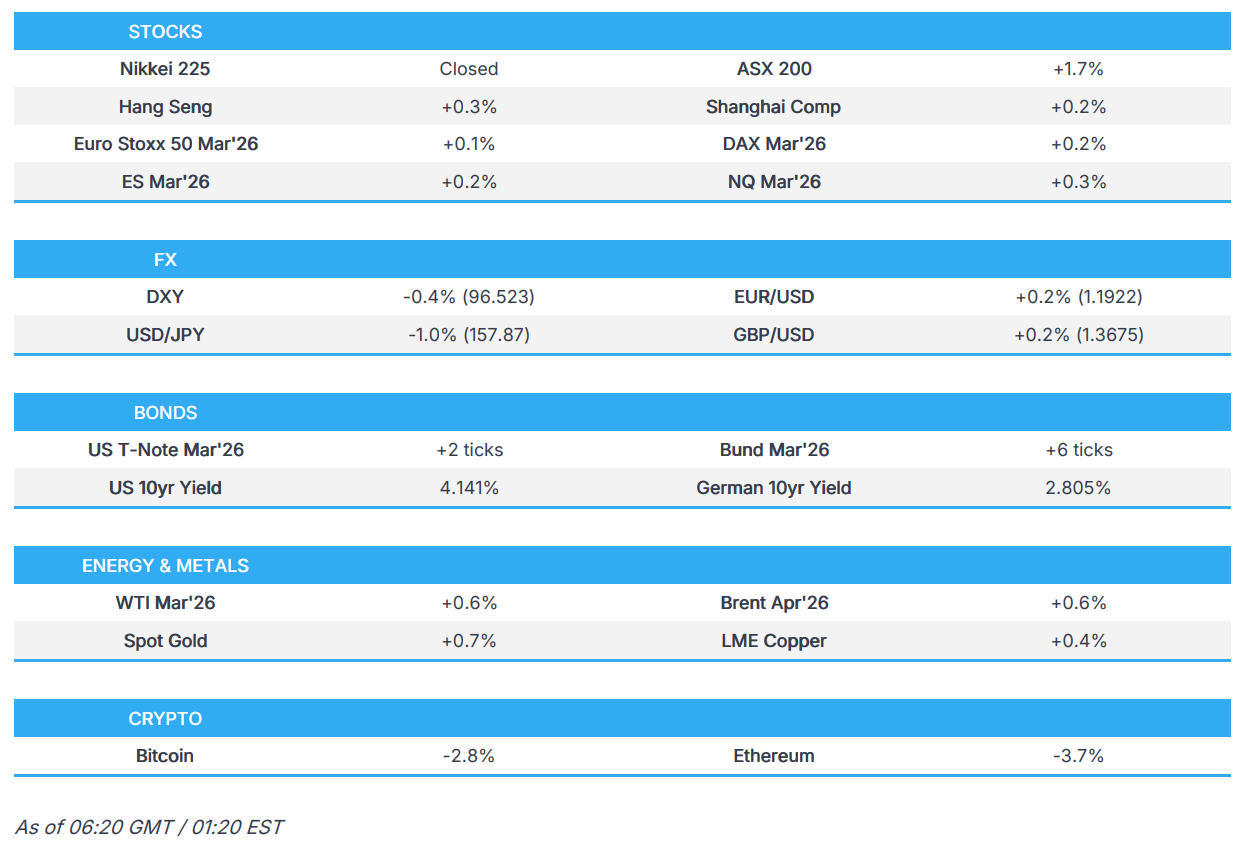
Newsquawk in 3 steps:
1. Subscribe to the free premarket movers reports
2. Listen to this report in the market open podcast (available on Apple and Spotify)
3. Trial Newsquawk’s premium real-time audio news squawk box for 7 days
US TRADE
EQUITIES
- US stocks were broadly lower on Tuesday, albeit in contained ranges, as participants await the US jobs report on Wednesday, followed by CPI on Friday. Data on Tuesday was largely subdued, as retail sales disappointed, and the weekly ADP only saw 6.5k jobs added per week for the last four weeks. Import/export prices saw the former come in as expected, while the latter was slightly lower, in addition to soft employment costs.
- Sectors were mixed, as Utilities, Real Estate, and Materials outperformed, with Financials and Communications lagging as further Alphabet weakness weighed on the latter. For Financials, weakness was led by names such as Charles Schwab and Interactive Brokers Group, which saw a sharp sell-off in the US afternoon, albeit with no clear driver, but some touted Altruist adding AI tax planning to its Hazel platform. One of the other stock-specific highlights included impressive Datadog (+11%) earnings, which helped support software names.
- SPX -0.33% at 6,942, NDX -0.56% at 25,128, DJI +0.10% at 50,188, RUT -0.34% at 2,680.
- Click here for a detailed summary.
TARIFFS/TRADE
- White House revised the Fact Sheet on the US-India trade deal in which the reference to pulses was dropped, and the wording around India’s proposed USD 500bln purchase was changed from a firm “commitment” to an “intent”.
- US Treasury Secretary Bessent said US-China ties are stable, but competitive and they are aiming for fair competition and de-risking, not decoupling, while he added that China must rebalance amid a persistent USD 1tln trade imbalance.
- White House said regarding the US-Canada bridge that President Trump spoke to Canadian PM Carney earlier today and made his position clear; the fact that Canada will own land on both sides is unacceptable, while Trump believes the US should have shared authority and own at least 50%.
- US House Speaker Johnson failed in an effort to block votes on measures to rescind Trump tariffs.
NOTABLE HEADLINES
- US President Trump said the US should have the lowest interest rates in the world, while he also commented that employment numbers are really good and remained good after government job cuts.
- Fed’s Hammack (2026 voter) said the Fed is in a good position with policy ‘to see how things play out’ and the current Fed target rate ‘in vicinity’ of neutral, while she added that interest rates could remain on hold for an extended period while economic data is assessed, and flexibility will be maintained to raise rates if needed.
- Fed’s Logan (2026 voter) said in the coming months, if inflation falls and the labour market stays stable, no further rate cuts will be needed. Logan said the current policy stance may be very close to neutral, providing little restraint, while she is cautiously optimistic that the current policy stance will get inflation down to 2% and sustain a balanced labour market.
- White House Press Secretary said President Trump will focus on energy and deregulation this week, with a “clean beautiful coal” event scheduled for Wednesday afternoon, and President Trump is to sign off on scrapping climate rules on Thursday.
APAC TRADE
EQUITIES
- APAC stocks traded higher but with some of the gains in the region capped after the weak handover from the US and with the NFP report on the horizon, while participants also digested earnings and data in thinned conditions, with Japanese markets shut for a holiday.
- ASX 200 outperformed with the index led higher by the top-weighted financial sector after shares in Australia’s largest lender and company by market cap, CBA, rallied following a 5% increase in H1 profits.
- Hang Seng and Shanghai Comp were kept afloat following the PBoC’s liquidity operations and recent pledge to continue implementing an appropriately loose monetary policy in its quarterly implementation report. However, the upside was limited as participants also reflected on the mixed Chinese inflation data in which CPI printed softer-than-expected, while PPI was slightly better-than-feared but remained in deep deflationary territory.
- US equity futures mildly rebounded overnight amid the brightened mood in Asia and with some repositioning ahead of the looming jobs report.
- European equity futures indicate a quiet cash market open with Euro Stoxx 50 futures +0.1% after the cash market finished with losses of 0.2% on Tuesday.
FX
- DXY weakened in Asia-Pac trade amid gains in the dollar’s major counterparts and following the prior day’s choppy performance, which was not helped by soft US data, including disappointing Retail Sales, while all attention now turns to the delayed January Nonfarm Payrolls report.
- EUR/USD eked slight gains and reclaimed the 1.1900 status, but with price action contained amid very few fresh catalysts from the bloc, while comments from ECB’s de Guindos did little to shift the dial as he reiterated that the current level of rates is appropriate and said recent euro strength is fully consistent with the assumptions included in the ECB’s projections.
- GBP/USD rebounded overnight but with the recovery lacking in strength after retreating yesterday from resistance near 1.3700, and with a very quiet calendar for the UK heading into GDP data on Thursday.
- USD/JPY continued its post-election retreat amid bets for sooner BoJ policy normalisation, while USD/JPY was also constrained amid the absence of Japanese participants due to National Founding Day.
- Antipodeans benefitted from the softer dollar with AUD/USD reclaiming the 0.71 handle for the first time in 3 years, while support was seen following comments from RBA’s Hauser that inflation is too high, which they can’t let persist and will do what is needed to bring inflation back to the target band.
- PBoC set USD/CNY mid-point at 6.9438 vs exp. 6.9109 (Prev. 6.9458).
FIXED INCOME
- 10yr UST futures lingered around the prior day’s best levels after climbing in the aftermath of the recent soft data releases, including disappointing Retail Sales, although price action was contained ahead of the Nonfarm Payrolls report and with overnight cash Treasuries trade shut due to the Tokyo market closure.
- Bund futures held on to recent gains after advancing in tandem with global peers, but with price action tempered ahead of today’s German Bund issuances.
COMMODITIES
- Crude futures rebounded from the prior day’s trough but with further upside limited after the weekly private sector inventory showed a much larger-than-expected build for crude stockpiles, while US/Iran tensions remain in focus after President Trump said he was considering sending a second aircraft carrier strike group to the Middle East to prepare for military action if negotiations with Iran fail. Furthermore, he said that they will either make a deal or will have to do something very tough like last time, and expects the second round of US-Iran talks to take place next week.
- Spot gold gradually edged higher in a somewhat choppy fashion as the key US jobs report looms.
- Copper futures were relatively rangebound heading to the major key risk event and with a lack of conviction seen in its largest buyer, China, following mixed Chinese inflation data.
- Chile Collahuasi Copper Production for December fell 12.1% Y/Y to 36.2k tonnes, while Escondida copper production fell 16.5% to 111.5k tonnes, according to Cochilco.
- US Private Energy Inventory Data (bbls): Crude +13.4mln (exp. +0.8mln), Distillates -2.0mln (exp. -1.3mln), Gasoline +3.3mln (exp. -0.4mln), Cushing +1.4mln.
- EIA STEO (Feb) sees world oil demand for 2026 at 107.8mln BPD (prev. 107.7mln BPD), and world oil demand for 2027 is seen at 106.1mln BPD (prev. 106.1mln BPD).
- US issued Venezuela-related licences which authorise certain transactions necessary to ports and airport operations, as well as certain activities involving Venezuelan-origin oil.
- Venezuela shipped its first crude cargo to Israel as oil exports reopened after Maduro’s removal, according to reports.
- Syria is reportedly tapping energy majors to explore for trillions of cubic meters of gas, with the state oil chief noting that Chevron (CVX), ConocoPhillips (COP), TotalEnergies (TTE FP) and Eni (ENI IM) are interested in exploration, according to FT.
CRYPTO
- Bitcoin gradually trickled lower with prices back beneath the USD 68,000 level.
NOTABLE ASIA-PAC HEADLINES
- RBA Deputy Governor Hauser said Australia’s economy is not just ‘dig it and ship it’, with many parts of the economy doing quite well, while he added inflation is too high, which they can’t let persist, and will do what is needed to return it to the band.
DATA RECAP
- Chinese CPI MM (Jan) 0.2% vs. Exp. 0.3% (Prev. 0.2%)
- Chinese CPI YY (Jan) 0.2% vs. Exp. 0.4% (Prev. 0.8%)
- Chinese PPI YY (Jan) -1.4% vs. Exp. -1.5% (Prev. -1.9%)
GEOPOLITICS
MIDDLE EAST
- US President Trump said Iran wants to make a deal and it would be foolish if they didn’t.
- US President Trump said he might send a second carrier to strike Iran if talks fail and stated that “Either we will make a deal or we will have to do something very tough like last time”, while he expects the second round of US-Iran talks to take place next week. Furthermore, he expressed optimism about the diplomatic path and said Iran “wants to make a deal very badly” and is engaging much more seriously than during previous talks due to the military threat, according to Axios.
- US reportedly weighs seizing tankers carrying Iranian oil to pressure Tehran, according to WSJ. Trump administration officials have discussed whether to seize additional tankers involved in transporting Iranian oil to pressure Tehran, but have held off, amid concerns about the regime’s near-certain retaliation and the impact on global oil markets.
- Iran made it clear to mediators in recent days that it is sticking to its position regarding missiles not being a subject of compromise, even though it might be willing to discuss the issue after the nuclear issue is resolved, according to the Jerusalem Post.
RUSSIA/UKRAINE
- Ukrainian President Zelensky plans spring elections alongside a referendum on the peace deal after a US push.
OTHER
- China Global Times former editor-in-chief Hu Xijin posted that if the US sells USD 20bln worth of weapons to Taiwan, it will trigger a very serious crisis, and it would be hard to believe that China will simply conduct another island-encircling military exercise, while he is more inclined to believe that the mainland will take some real actions.
2.a NORTH KOREA/SOUTH KOREA/JAPAN
SOUTH KOREA/USA
2 b JAPAN
3. CHINA/HONG KONG
4./EUROPEAN AFFAIRS
GERMANY
German Authorities Discover Massive Fraud In Naturalization Language Tests, Iraqi Ringleader Arrested
Wednesday, Feb 11, 2026 – 03:30 AM
Authorities in Germany have uncovered a sophisticated fraud network that allegedly deployed paid operatives to take language and naturalization exams on behalf of migrants, with the fraud taking place on a nationwide scale.

The investigation, centered in Nuremberg, suggests a coordinated effort to bypass residency and citizenship requirements. Notably, potential applicants for citizenship must display a basic understanding of the German language.
Prosecutors say the network functioned by providing substitute test-takers who possessed a high command of the German language. According to investigators, candidates used forged identification documents that displayed the substitute’s photo but contained the personal data of the actual applicant, according to Welt.
Applicants reportedly paid between €2,500 and €6,000 per examination. Since the documents appeared legitimate, “the examiners were thus unable to detect the fraud,” resulting in the issuance of genuine certificates used to obtain residence permits or citizenship.
The Middle Franconia Police Headquarters announced on Monday that two individuals are currently in custody, including a 39-year-old Iraqi man, identified as the primary mediator, who is in pre-trial detention.
Additionally, a 22-year-old German man was arrested in January while actively “trying to take such a language examination.”
Furthermore, the scale of the network was highlighted in December when “10 people were also identified as operatives at a language school in North Rhine-Westphalia while they were taking exams for other schools.”
While the current arrests were made in Bavaria, the “investigations concern the entire federal territory.”
Police noted that while “proceedings for forged language certificates have already been underway in the past,” this specific method of using look-alike deputies represents a significant escalation. Following an initial review of the evidence, Bavarian investigators “assumed that there will be a high double-digit number of further investigations.”
Concerns about the mass naturalization of foreigners have already been raised, with potentially thousands or even theoretically tens of thousands of foreigners using fraud to obtain their citizenship.
In one case, hundreds of forged certificates were found by just one official, who found that these certificates were being sold on a huge scale on TikTok.
Furthermore, many of the fraud cases have likely gone undetected.
The language test required for German citizenship, which must show proficiency in only B1, hardly proves a strong command of the German language either. Nonetheless, there are numerous cases involving migrants paying thousands of euros for a forged certificate or for test takers to take the test for them.
Already, there have been broad concerns about foreign workers in Germany who lack an adequate level of German for their roles as doctors and police officers.
EEND
FRANCE GERMANY
Ambitious France-Germany Next-Gen Fighter Faces Crash Landing Amid EU Infighting
Wednesday, Feb 11, 2026 – 02:45 AM
Europe’s flagship sixth-generation fighter project is unraveling fast. Politico Europe days ago observed that the Franco-German-Spanish Future Combat Air System (FCAS) is now “on the verge of collapse” after Dassault and Airbus failed to meet critical deadlines for agreeing on work-sharing arrangements.
The warnings have been building for months, with loud public signaling coming from German Chancellor Friedrich Merz, who already conceded that the project is stalled, bluntly admitting there is “no progress” – while French officials also sound increasingly pessimistic, with some privately warning that the manned fighter element of FCAS may already be “dead”.
Some of the key quotes in the Politico piece attempt to strike hopeful note, but sound anything but reassuring: “We are doing everything we can to try and save this program. We’ll see how we can land,” the head of the French arms procurement agency, Patrick Pailloux, was cited in the report as telling the press.

Prior understandings have already broken down, with the report explaining: “The manned fighter has been at the core of the bitter industrial disputes between Dassault and Airbus over leadership, technology, and work-sharing, with little sign of a resolution. Dassault is looking for more control over the development of the Next Generation Fighter (NGF), a key component of the FCAS project.”
And a December deadline to resolve the dispute has come and gone with no resolution. “In Berlin, German officials insist Germany still wants to preserve parts of the project – particularly the joint combat cloud and other shared systems – even if the fighter itself splits into two separate jets,” the Politico report added.
So the ultra-ambitious project could all ultimately break down over control and intellectual property questions – and shared workflow issues – given Paris is accusing Berlin of trying to “steal know-how” while German officials have grumbled about the project being little more than a costly bailout for France’s defense industry.
Last year Merz acknowledged, “We are not making any progress with this project. Things cannot continue as they are.” But nothing appears to have changed since then till now.
Most recently, Bloomberg has reported that “FCAS is meant to be operational around 2040, but that deadline may be hard to meet.”
The same report noted another blackeye for EU and inter-NATO unity and cooperation: “The program’s difficulties call into question Europe’s broader ability to form wartime alliances as the region comes under increasing US pressure to spend more on defense and become more self-reliant.”
US Ambassador to NATO Matthew Whitaker referenced this theme of the Trump administration, namely European disunity, in comments in Germany just ahead of the annual Munich Security Conference. Europe must grow up, he explained, and Washington can’t provide the unity and self-reliance it needs. “When your kids are young, they’re dependent on you. But eventually you expect them to get a job. And so to me, that’s where we are. We still love them. You’re still allies,” Amb. Whitaker said.
While praising allies’ willingness boost military spending to 5%, he assessed that they are being too sluggish in turning this extra defense investment and expenditure into actual military capabilities.
“One of the things that I’ve noticed in my time here in Europe is there is a lot of discussion and not a lot of action,” he emphasized. The faltering FCAS sixth-generation fighter project could in the end prove yet another costly example of bickering that doesn’t produce tangible results.
GERMANY
this is interesting.. however Germany’s fixation on green energy is killing them economically
(Kern)
New German Law Could Force Green Energy Developers To Fund Grid Links
Wednesday, Feb 11, 2026 – 02:00 AM
Authored by Michael Kern via OilPrice.com,
Germany is proposing that renewable energy developers pay for connecting to the grid in new regulations that would replace the current system of first-come, first-served, Reuters reported on Monday, citing a new draft law it has seen.

The current congestion in the queue for grid connections and the regulations allowing the first applications to be connected is slowing renewables expansion.
“Connecting generation, storage, and consumption facilities to the electricity grid is facing ever greater challenges,” says the bill proposed by Germany’s economy and energy ministry, as carried by Reuters.
“In particular, the ongoing flood of applications from large-scale battery storage systems is overloading grid operators and blocking other grid connection applicants,” according to the bill.
Apart from having renewable energy developers pay for connecting to the grid, the new regulations would aim to encourage the construction of wind, solar, and battery capacity in areas with easier connections for the grid.
Despite soaring wind and solar installations in recent years, Germany needs to accelerate capacity additions to meet its own renewable energy targets.
Europe’s biggest economy has a target to have renewables account for 80% of its electricity generation in 2030.
In solar, Germany is halfway through reaching its 2030 solar power targets, the German Solar Industry Association (BSW-Solar) said in June last year.
The association, however, warned that solar power expansion has slowed and while Germany is halfway there on its solar goals, the next stage to reaching the 2030 targets cannot be taken for granted.
Germany saw the highest number of onshore wind turbines commissioned in the first half of 2025 for eight years, but the rebound in installations is still off track to reach the official targets, the German wind energy association, Bundesverband WindEnergie (BWE), said in the middle of 2025.
Despite the jump in wind power installations, Germany still has a gap between the rate of capacity expansion and the legally mandated goals in the Renewable Energy Sources Act, the so-called EEG, BWE president Bärbel Heidebroek said in July.
END
SWITZERLAND/MIGRANTS
what took them so long to realize?
(ReMix)
Conservative Swiss MP Urges ‘End To Immigration From Stone Age Cultures’ As Stats Expose Prevalence Of Domestic Violence
Wednesday, Feb 11, 2026 – 07:20 AM
New statistical data has highlighted the prevalence of domestic violence across different population groups in Switzerland, sparking a political debate over its root causes.

SVP National Councillor Pascal Schmid argues that the figures identify this primarily as a migration problem, noting that even foreign women are accused of these offenses more frequently than Swiss men.
Schmid requested data from the Federal Council, which provided an analysis of domestic violence frequency broken down by gender and nationality. The results show that for every 10,000 foreign men in the permanent resident population, 33.3 were accused of domestic violence in 2024, compared to 12.6 for Swiss men. For women, the rate was 13.2 for foreign women and 4.4 for Swiss women.
The data shows that foreign women are accused of domestic violence at slightly higher rates than Swiss men, however, foreign men clearly dominate in this category of crime overall, according to Blick.
In response to the latest Swiss data, Schmit wrote: “Domestic violence is not simply a problem solely affecting men, but primarily a migration problem.”
This data comes after similar findings in Germany showed that women from certain foreign groups in 2024 were more violent than German men. The data showed that for 100,000 German men, 272 were suspected of a violent offense. For Syrian women, this figure per 100,000 was 336. Clearly, Syrian women were more violent than German men. Afghan women are also more violent, with a rate of 359, even more violent than Syrian women. Iraqi women have an incredible rate of 394, which is considerably more than that of German men.
In Switzerland, research indicates that approximately 1 in 10 women will be a victim of physical or sexual violence in a romantic relationship during her adult life.
Between 2011 and 2014, an average of 22 female and four male victims died on an annual basis due to violence in intimate partner relationships. In 2024, Switzerland recorded over 21,000 cases of domestic violence, representing a 6 percent increase from the previous year. This involves a wide variety of violent categories, including sexual assault, rape, stalking, abuse, physical assault, and murder.
However, other politicians see violence as a multifaceted phenomenon, SP National Councillor Tamara Funiciello stated: “Violence is multidimensional” and that “we must combat it at all levels – now and regardless of its origin.”
Funiciello successfully led a campaign for increased funding for women’s protection during the December budget debate, which resulted in an additional million Swiss francs towards prevention efforts.
SVP stated that instead of throwing more money at the problem, the left needs to stop “turning a blind eye to the problem of crime committed by foreigners.”
Schmid notes that “foreign women are thus more frequently violent than Swiss men. This proves that domestic violence is not simply a male problem, but primarily a migration problem.” He argues that “Instead of placing Swiss men under general suspicion, we must” address the issue through migration policy.
“We have to put a stop to immigration from Stone Age cultures that have a completely different relationship with women and don’t know the concept of equality,” he added.
The SVP is now demanding an expansion of offenses that trigger mandatory deportation to include all official domestic violence offenses. Schmid argues, “We have to crack down harder on perpetrators,” adding that “simply distributing flyers in 20 languages and employing even more social workers won’t achieve anything.”
Funiciello maintains that the SVP is avoiding the real issues, stating, “The SVP is once again shifting responsibility onto a group instead of rethinking its own role models and seeking solutions for society as a whole.”
She emphasizes that factors such as witnessing childhood violence and socioeconomic status are critical.
“Financial problems due to low wages or cramped living conditions, which disproportionately affect foreigners, are more likely to lead to conflict situations,” she notes. She concluded that because women often lack the financial safety net to leave abusive partners, “we must combat it at all levels — now and regardless of its origin.”
Of course, it could be argued that cramped living conditions in Switzerland are also a problem derived in large part due to mass immigration. There is currently a housing crisis in the country, with vacancy rates at a record low of less than 1 percent. This pattern of soaring housing prices tied to mass immigration has been seen throughout the Western world, including in Britain, Australia, Canada, and many other nations.
5. RUSSIA AND MIDDLE EASTERN AFFAIRS
ISRAEL TBN LAST 24 HR
ISRAEL UPDATES/VS HAMAS
IDF says it killed Hamas terrorist behind 2004 bus bombings that killed 16 civilians
In separate strike, military says, it killed sniper commander behind several deadly attacks on troops; both strikes come in response to Hamas violations of ceasefire
By Emanuel Fabian FollowToday, 2:54 pm

Israeli police officers and Zaka rescue and recovery volunteers work inside and next to a destroyed bus at the scene of a double bombing in the southern Israeli city of Beersheba, August. 31, 2004. (AP Photo/Brennan Linsley)
A Hamas terrorist behind a deadly 2004 double suicide bombing and a sniper commander in the terror group who committed several fatal attacks on IDF troops in the Gaza Strip during the war were killed in recent airstrikes, the military announced on Wednesday.
The Israel Defense Forces and Shin Bet security agency said that Basel Himouni, a prominent Hamas member from the West Bank city of Hebron, was targeted on February 4 as part of a series of Israeli airstrikes against terror operatives in response to an attack by gunmen on troops in the Strip’s north. One reservist officer was seriously wounded in the attack in northern Gaza.
In August 2004, Himouni dispatched two suicide bombers to carry out simultaneous attacks on two buses in Beersheba.
The attacks killed 16 Israeli civilians and wounded over 100.
Himouni was captured in October 2004 and sentenced to prison, but was released and exiled to Gaza in a 2011 deal in which Israel exchanged 1,027 terror convicts for captive IDF soldier Gilad Shalit.
The military and Shin Bet said that after his release from Israeli custody, Himouni “returned to recruiting attackers and directing terrorist activity.”
“As part of his role in Hamas, during the war, he was involved in manufacturing and planting explosive devices to harm our forces,” the joint statement added.

Hamas terrorist Basel Himouni is targeted in an Israeli airstrike on February 4, 2026, in footage published by the IDF. (Israel Defense Forces)
Separately on Wednesday, the IDF said that a drone strike targeting a residential apartment in Gaza City’s al-Nasr neighborhood earlier in the week killed Ahmad Hassan, the commander of the sniper unit in Hamas’s Beit Hanoun Battalion.
Monday’s strike, which Palestinian media reported had killed two men — both members of Hamas’s military wing — came in response to an attack by gunmen on troops in southern Gaza’s Rafah a day prior.
Hassan was behind numerous attacks on troops in northern Gaza, and had been recently identified as working to advance new attacks, the military said.
The IDF said that Hassan was involved in a roadside bomb attack in Beit Hanoun on July 7, 2025, in which five troops were killed — Sgt. First Class (res.) Benyamin Asulin, Staff Sgt. Noam Aharon Musgadian, Staff Sgt. Meir Shimon Amar, Sgt. Moshe Nissim Frech, and Staff Sgt. Moshe Shmuel Noll — and 14 were wounded.
Hassan was also involved in an ambush on April 19, 2025, in which Warrant Officer G’haleb Sliman Alnasasra was killed, and five troops were wounded, as well as a sniper attack on April 24, 2025, in which Master Sgt. (res.) Asaf Cafri was killed and two troops were wounded, according to the IDF.
The Gaza City strike was one of two airstrikes that took place in response to the incident in Rafah. The second reportedly killed a member of Palestinian Islamic Jihad in the Strip’s center. The IDF did not immediately provide further details on the second strike.
The IDF said the Rafah attack, during which four gunmen emerged from a tunnel and opened fire on troops before being killed, was a “blatant violation of the ceasefire” between Israel and Hamas, and it viewed the incident “gravely.”
The US-brokered ceasefire plan reached in October foresees the demilitarization of Gaza and the disarmament of Hamas, as well as the withdrawal of Israeli troops from the enclave. The terror group, however, has not agreed to give up its weapons.
Even with fighting officially halted, near-daily incidents have occurred along the ceasefire line, with Israel accusing Hamas of violating its terms and the terror group making counterclaims.
IRAN UPDATES
Trump Threatens To Send Second Carrier Near Iran
Tuesday, Feb 10, 2026 – 04:40 PM
For the past week, the Pentagon’s ongoing military build-up in the Middle East has grabbed world headlines amid fears President Trump is ready to do another Venezuela – but this time targeting a much bigger and more formidable country and its army – the Islamic Republic of Iran.
US officials have lately made clear that Trump favors a negotiated solution where the Iranians would give up their nuclear program, dilute enrichment, as well as significantly curb their long and medium-range ballistic missile arsenal.
But already by Tuesday, Trump himself is waving the big stick again, threatening to deploy a second aircraft carrier near Iran if Oman talks don’t bear fruit.
The president told Axios in a newly published interview:
“We have an armada that is heading there and another one might be going,” Trump said, adding that he’s “thinking” about sending another aircraft carrier strike group.
Two carriers would definitely signal ‘game on’ for conflict with Iran.

The USS Abraham Lincoln and its strike group is already poised for action in regional waters just south of Iran, and this involves dozens of fighter jets, Tomahawk missiles, along with several support warships.
Trump took the opportunity to repeat a US ultimatum to Tehran: “Either we will make a deal or we will have to do something very tough like last time,” he told Axios. The Iranians will no doubt have this ringing in their ears headed into a planned second round of talks next week.
But Trump still claimed that Iran “wants to make a deal very badly” and is engaging much more seriously than in the past. There are signs that this is accurate, given the latest offer to dilute its enriched uranium in exchange for the lifting of all sanctions.
The US president articulated his view that the June war taught the Iranians a huge lesson: “Last time they didn’t believe I would do it,” Trump said. “They overplayed their hand.”
But of course, at that very moment just before Israel attacked (followed by the US bombing three nuclear sites by the close of the 12-day conflict), Iran thought it was engaged in good faith talks. Trump is still holding out hope that “We can make a great deal with Iran.”
Meanwhile all the obvious things remain in Washington’s max etc tool kit: the WSJ reports Tuesday the US is weighing seizing tankers (again) carrying Iranian oil in order to pressure Tehran.
END
awful!@!
IRGC kills protesters in hospital beds, targets medical staff, Iranian doctor tells ‘Post’
Countless individuals unconnected to the protests died after Tehran cut landlines and internet access, preventing individuals from contacting emergency services, Dr. Reza told the ‘Post’.

Fires are lit as protesters rally on January 8, 2026 in Tehran, Iran.(photo credit: Anonymous/Getty Images)ByDANIELLE GREYMAN-KENNARDFEBRUARY 11, 2026 11:42Updated: FEBRUARY 11, 2026 12:11
The Islamic regime has carried out extrajudicial killings of injured protesters inside hospitals and arrested countless medical personnel suspected of treating those wounded by Tehran, an Iranian doctor told The Jerusalem Post on Tuesday.
Medical facilities and schools have been used by regime forces to locate, identify, and arrest individuals who joined the protests demonstrating against the country’s worsening economic crisis, said Dr. R, a member of the Aida Health Alliance whose name is being withheld for security reasons.
In the hospitals, many of those who were being treated for injuries were found lying in their treatment beds, still attached to machines, with bullet holes in their heads, Dr. R said, accusing the regime of murdering those wounded and lying about the circumstances surrounding the casualty.
“If the patient already had the shot in the head [when they arrived at the hospital], nobody would put the tube or catheter in because they’re already dead….,” they explained. “So it means they went into the hospital and they killed them on the treatment bed.”
Dr. R shared photographs showing bodies in black bags with bullet wounds to the head, surrounded by fresh blood and still connected to medical tubes and catheters.

The Post has not been able to independently verify the authenticity of the images, though they are consistent with accounts published by multiple Iranian human rights organizations, including Iran Human Rights (IHRNGO), and dissident channels.
Hospitals used as instruments of repression, killing
Mahmood Amiry-Moghaddam, IHRNGO Director, published, “The testimonies of doctors show that the Islamic Republic has trampled even the most basic human and medical principles and has systematically used hospitals as instruments of repression and killing. The deliberate shutdown of ventilators, the prevention of treatment for the injured, and the arrest of patients from hospital beds constitute crimes against humanity and demonstrate the complete collapse of any ethical or legal standards in this government.”
end
ISRAEL IRAN AND THE USA
Bibi Seeks US Muscular Action On Iran In Seventh Meeting With Trump
Wednesday, Feb 11, 2026 – 09:25 AM
“I am now leaving for the United States for my seventh trip to meet with President Trump since he was elected for a second term,” Prime Minister Benjamin Netanyahu said prior to his departure to Washington. “This, of course, does not include his unforgettable visit to Israel and his speech in the Knesset.” (Seven since Trump took office again!)
He and President Trump are expected to begin their meeting at the White House, focused on Iran negotiations and the possibility of military action, by late-morning (11 eastern). Netanyahu’s ‘welcome’ in D.C. last night raised some eyebrows, given an entire major freeway into the beltway area was shut down for security reasons…
Before leaving Israel, Netanyahu told reporters that Iran is the “first and foremost” issue he will raise with Trump. He was originally scheduled to travel to the US for a February 18 meeting, but Israel asked to move it up after the US-Iran talks in Oman.
“I will present the president with our views regarding the essential principles of the negotiations – principles that, in our eyes, are vital not only for Israel but for anyone in the world who desires peace and security in the Middle East,” the Israeli leader previewed.
Israel is pressing the US to require that any agreement with Iran include zero nuclear enrichment and limits on its ballistic missile program. Iranian officials have rejected those terms, signaling they would block any deal. On Tuesday, Trump indicated that Iran’s missiles should be part of the agreement.
But if Tehran were to agree with this it would essentially be self-destructing, as it would have no deterrent and be defenseless against any future Israeli attack – or any other enemy aggression for that matter.
One Israeli source told CNN that Tel Aviv is “worried about Iran’s progress in restoring its ballistic missile stockpiles and capabilities to its status before the 12-Day War.”
Iranian leaders are meanwhile fully aware of what Netanyahu’s D.C. trip represents, and the timing:
Tehran, which resumed talks with Washington last week in Oman, warned Monday of “destructive influences” on diplomacy ahead of the Israeli premier’s visit.
On Wednesday, Iranian president Masoud Pezeshkian said his country would “not yield to excessive demands” on its nuclear program, though he said the country is not seeking an atomic weapon.
Just after Netanyahu’s arrival Tuesday evening, he met with US Middle East envoy Steve Witkoff and White House senior adviser Jared Kushner to discuss “regional issues”. He was also briefed on how Oman-mediated talks are going, ahead of the proposed second round expected next week.

President Trump is still threatening to send a second carrier group to the Central Command (CENTCOM) area, which would be a clear signal he intends major military action. He could still order some kind of limited action, also as Congress is once again missing in action on reigning in war powers.
end
LATE WEDNESDAY AFTERNOON
Hours-Long Netanyahu Meeting Concludes Away From Cameras, Trump Committed To Iran Talks

by Tyler Durden
Wednesday, Feb 11, 2026 – 02:43 PM
Update(1443ET): President Trump met with Netanyahu for a reported 3-hours at the White on Wednesday, away from the cameras and with no press briefings either before or after. Trump later indicated that nothing definitive was reached on the Iran matter other than “I insisted that negotiations with Iran continue.”
“If it can, I let the Prime Minister know that will be a preference. If it cannot, we will just have to see what the outcome will be,” he stated in a Truth Social post. “Last time Iran decided that they were better off not making a Deal, and they were hit with Midnight Hammer — That did not work well for them. Hopefully this time they will be more reasonable and responsible.”
It was expected that Netanyahu would seek a muscular US approach to Tehran, and Israel has essentially been against even holding negotiations, charging that Tehran is using the process to stall and development nuclear weapons, and to expand its missile arsenal. Israeli leadership has time and again complained it’s a waste of time. But it seems Trump is ready to give the negotiations route a serious try. There are also indicators that the Commander-in-Chief is not ready to order another US aircraft carrier group to Middle East waters. All of this will come as good news to those wishing to see climb-down and de-escalation on threats of military strike. However, everything could change on a dime:
The Pentagon has told a second aircraft carrier strike group to prepare to deploy to the Middle East as the U.S. military readies for a potential attack on Iran, according to three U.S. officials.
President Trump said Tuesday that he was weighing sending a second carrier to the Middle East to prepare for military action if negotiations with Iran failed. The order to deploy could be issued in a matter of hours, one of the officials said.
The officials cautioned that Trump hadn’t yet given an official order to deploy the second carrier, and that plans could change. The carrier would join aircraft carrier USS Abraham Lincoln that is already in the region.
XX
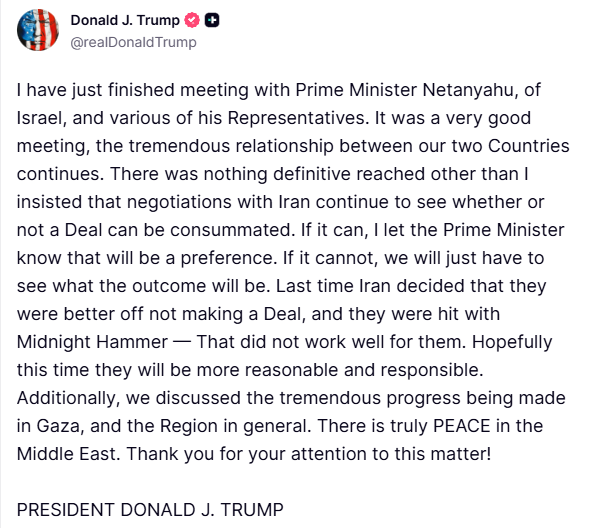
* * *
Trump Holds Off On Option To Seize Iranian Tankers, Fearing Sharp Oil Rise
Wednesday, Feb 11, 2026 – 11:00 AM
Another big piece of leverage that Washington is holding over Tehran is the potential seizure of Iranian oil tankers. The US intercepting and boarding tankers on the high seas has been a trend related to Venezuela of late, as well as Russia’s so-called dark fleet, ratcheting tensions with Moscow.
But President Trump is said to be holding off for now when it comes to the Iranians, as the process of indirect negotiations based in Oman plays out, also as Israel’s Netanyahu is received at the White House on Wednesday.
Fresh reporting in The Wall Street Journal indicates “Trump administration officials have discussed whether to seize additional tankers involved in transporting Iranian oil but have held off, concerned about Tehran’s near-certain retaliation and the impact on global oil markets, U.S. officials said.”

But there have been US naval interdictions involving Iranian energy related to the Venezuela blockade: “The U.S. has seized several ships that have carried Iranian oil as part of its two-month-old blockade of sanctioned tankers serving Venezuela,” continues WSJ. “The tankers, which make up the so-called shadow fleet, help transport illicit oil from numerous sanctioned countries to China and other buyers.”
The report notes that “A move by the U.S. to block other sanctioned ships from loading oil in Iran would squeeze Tehran’s main source of revenue, expanding the aggressive strategy the White House put in place in December in the Caribbean.”
So there remains this big card to play, but Trump is so far hesitant on concerns of rapidly driving up the price of oil.
Sanctions have been slapped on Iranian tankers, but action has yet to follow, as WSJ explains further:
But the option of stopping tankers, one of several the White House has been debating to coerce Tehran to reach a deal restricting its nuclear program, faces many obstacles, some of the officials said.
Iran is likely to respond to a stepped-up U.S. crackdown by seizing tankers carrying oil from U.S. allies in the region or even by mining the Strait of Hormuz, the narrow exit from the Persian Gulf through which as much as 25% of the world’s petroleum supply passes. Either move is likely to drive up oil prices sharply, risking a political firestorm for the White House.
More than 20 ships that transport Iranian oil have been sanctioned by the Treasury Department this year, making them possible seizure targets, officials say.
This would likely be a next big step of escalation Washington has in its pocket, before any potential US military (or Israeli) action targeting Tehran.
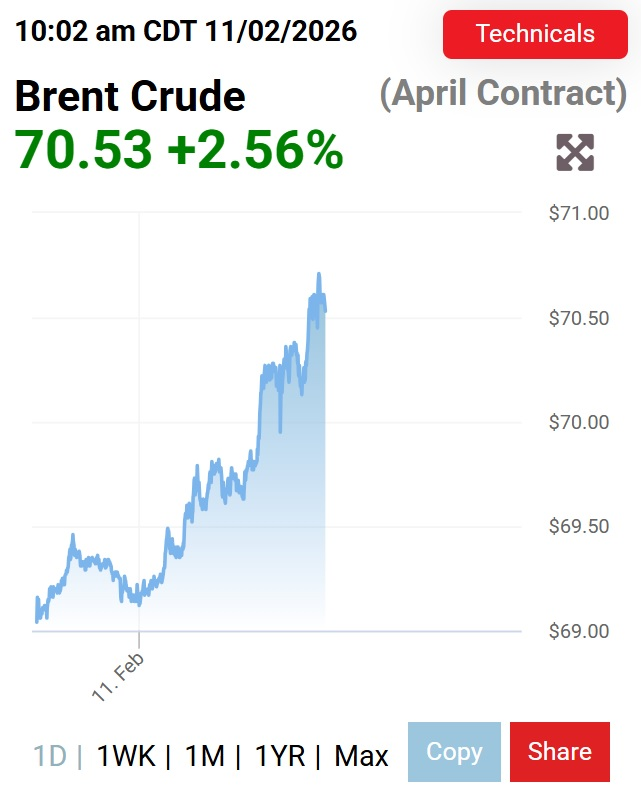
Despite the recent weeks of alarming Iran-related headlines, oil prices have by and large not reacted dramatically, given reports that Trump favors negotiated settlement to Iran’s nuclear program.
Vice President JD Vance has also clarified the ball is in Iran’s court, and that talks are still ongoing:
Iran meanwhile has made clear that its missile program is not up for negotiation, despite Washington’s insistence that this be on the table.
Ali Shamkhani, an adviser to Iran’s supreme leader, reiterated Wednesday that missile capabilities are “non-negotiable” but that Tehran is open to nuclear limits in exchange for sanctions relief.
REALLY GOOD!!
RUSSIA VS UKRAINE UPDATES
6. GLOBAL ISSUES/COVID ISSUES/VACCINE INJURY REPORTS/HEALTH ISSUES
BOMBSHELL ADMISSION: National Institutes of Health Admits That IVERMECTIN Is A Repurposed ANTICANCER AGENT
BOMBSHELL ADMISSION: National Institutes of Health Admits That IVERMECTIN Is A Repurposed ANTICANCER AGENT
⚡️THE 25% OFF IVERMECTIN SALE STARTS NOW!⚡️
Feb 11, 2026
Just like the FDA was recently forced to walk back their criminal lies about the Nobel prize winning miracle compound…
🚨 BREAKING: FDA Finally Admits Ivermectin Works — After Years of Calling It ‘Horse Paste’ 🚨
·
September 11, 2025

Readers of this Substack appreciate just how murderously corrupt the FDA is, and how Ivermectin is a miracle compound…
MARK CRISPIN MILLER
In memory of those who “died suddenly” in the United States and worldwide, February 2-9, 2026
Former child actor Blake Garrett (33); World Series champ Terrance Gore (34); jazz musician Ken Peplowski; Blondie bassist Fred Smith; rapper Mr. Complex; drummer Brad Arnold (47, C); & more
| Mark Crispin MillerFeb 11 |
A survey of the likely global toll of COVID “vaccination,” based on the reports collected by our worldwide team of researchers this past week.
To help support our work, consider subscribing or making a donation.
UNITED STATES (32)
Former Child Star Dead at 33 After Sudden Medical Emergency
February 9, 2026

Former child star Blake Garrett, best known for his role in the 2006 family film How to Eat Fried Worms, has died at the age of 33. According to a report from TMZ, Garrett’s mother, Carol Garrett, confirmed that her son passed away on Sunday, February 8. The family is currently awaiting official autopsy results from the medical examiner to determine the cause of death. Carol Garrett told the outlet that her son had visited an emergency room in Oklahoma last week after experiencing severe pain. He was later diagnosed with shingles, a viral infection that can cause intense nerve pain. She said Garrett may have attempted to self-medicate to manage the discomfort and believes his death may have been a tragic accident. Garrett had been living in Tulsa, Oklahoma, in recent years and, according to his mother, had been doing well personally. She shared that he had been sober for the past three years and had “truly turned things around.”
Terrance Gore, former MLB outfielder and three-time World Series champion, dies at 34
February 7, 2026

Panama City, FL – Terrance Gore, a former outfielder and three-time World Series champion known for his blazing speed on the base paths, has died at 34 years old, according to Major League Baseball officials. A cause of death has not yet been revealed. He won his first World Series with Kansas City in 2015. Gore won back-to-back titles as a member of the 2020 Los Angeles Dodgers and 2021 Atlanta Braves. Gore also appeared for the Chicago Cubs and New York Mets, making his last big league appearance in 2022.
The well-known jazz musician Ken Peplowski has been discovered dead on board a cruise ship
February 5, 2026

Ken Peplowski [66] was on board the Celebrity Summit. On the luxury liner, a multi-day jazz trip through the Gulf of Mexico was just taking place, in which about 100 musicians took part. According to reports, Peplowski was supposed to play in a quartet in the afternoon. But he did not show up for the performance. A passenger told that the musician was finally discovered lifeless in his cabin after a search operation. For years, Peplovsky suffered from a malignant disease of the bone marrow.
No cause of death reported.
Tributes paid as Television and original Blondie bassist Fred Smith dies, age 77: “He was a natural – never flashy, always essential”
February 7, 2026

Fred Smith, bass player for Television and original member of Blondie, has died at the age of 77. His death was confirmed on Thursday by his bandmates. Though a cause of death was not given, a statement said that he had fought an unspecified “illness long and hard these last few years.” Smith got his start as the original bassist for Angel and the Snake, which would later become Blondie, in 1974.
No cause of death reported.
90s Underground Champ, Mr. Complex has Passed Away
February 7, 2026

Queens, NY – Corey S. Roberts, better known as Mr. Complex, a prominent figure in underground hip-hop, has unfortunately passed away. Hailing from Queens, Mr. Complex made waves in the 90s with his string of successful independent 12″ singles. Since then, he released five full-length projects, with the last one being 2017’s “Forever New.”
No age or cause of death reported.
3 Doors Down Frontman Brad Arnold Dies at 47 After Battle with Stage 4 Cancer
February 7, 2026

Escatawpa, Mississippi – Brad Arnold, the founder, lead singer, songwriter, and original drummer of the rock band 3 Doors Down, died on Saturday, February 7, 2026, at age 47. He passed away peacefully in his sleep, surrounded by his wife Jennifer and family, following a battle with stage 4 clear cell renal cell carcinoma that had metastasized to his lungs. The announcement came from a family statement shared publicly, describing the circumstances of his death and reflecting on his life and legacy. Arnold had publicly disclosed his diagnosis in May 2025, leading to the cancellation of the band’s summer tour dates.
Woodie King Jr., Founder of New Federal Theatre, Dies at 88
February 2, 2026

New York, NY – Woodie King Jr., founder of New Federal Theatre and a prolific producer and director for over five decades, died on January 29 at the age of 88, following emergency heart surgery. King founded New Federal Theatre in 1970, aiming to give voice to Black playwrights, actors, directors, designers, and young people. Its mission was “to integrate artists of color and women into the mainstream of American theater by training artists for the profession and by presenting plays by writers of color and women to integrated, multicultural audiences.”
American tenor was still on stage Friday, died suddenly 2 days later
February 9, 2026

The Semperoper Dresden is mourning the loss of its ensemble member Aaron Pegram [52]. The American tenor died completely unexpectedly in Dresden [Germany] on Sunday, the Saxon State Opera announced, citing the artist’s family. His sudden death leaves us speechless. We are losing an outstanding performer and singer as well as a sensitive colleague who will be greatly missed by all of us. Pegram had participated in the program of the Semperoper Ball last Friday, portraying Charlie Chaplin in one of the numbers. Aaron Pegram began his singing career in 2003 at the Orlando Opera. Later, he had engagements at the Houston Grand Opera, the Santa Fe Opera, and the New York City Opera, among others.
No cause of death reported.
Former WRIR leader Melissa Vaughn dies after battle with cancer
January 30, 2026

Richmond, VA – Melissa Vaughn, who led Richmond public radio station WRIR for five years, died Thursday after a battle with breast cancer. She was 46 years old. The station, which broadcasts at 97.3 FM, is known for highlighting diverse voices from across the Richmond area. Vaughn stepped away from her role on Sept. 30 after the cancer spread to other parts of her body.
Researcher’s note – WRIR encouraged COVID “vaccination”: Link
Rep. Steve Womack announces wife’s death
January 20, 2026
Rep. Steve Womack is mourning the death of his 68-year-old wife, Terri, after more than four decades of marriage. The Arkansas Republican said Tuesday that Terri Lynn Williams Womack died Sunday following a brief illness. According to USA Today, a White House official had noted following the commutation that the Womacks had “several recent health issues, including his mother being diagnosed with abdominal cancer.”
Researcher’s note – Rep. Steve Womack had been “vaccinated,” and encouraged his consituents (and presumably his wife) to “vaccinate”: Link
No cause of death reported.
James Spurling, Longtime UNC Athletics Staff Member, Passes Away
February 5, 2026

Chapel Hill, NC – James Spurling, whose selfless nature, honesty, commitment to teamwork and dedication to all things Tar Heels wove him through the tapestry of Carolina for more than five decades, passed away suddenly this morning. The long-time Director of Kenan Stadium and the Kenan Football Center and Massey Award winner was 68.
No cause of death reported.
A teenager “died suddenly”:
Ethan Mark Harland, 17
February 6, 2026

Ethan Mark Allen Harland, age 17, of Palmetto, Georgia, passed away unexpectedly on Thursday, February 5, 2026. A senior at Northgate High School in Newnan, Ethan was actively working toward his goal of serving his country in the United States Navy, a reflection of his bravery, independence, and desire to be part of something bigger than himself. He never liked leaving things unsettled and always owned his mistakes, offering sincere apologies when they were due. That quiet integrity spoke volumes about the young man he was becoming.
No cause of death reported.
A doctor “died suddenly”:
Dr. Andrew Burton DeAtkine, 31
February 5, 2026

Dr. Andrew Burton DeAtkine of Mountain Brook, Alabama, passed away suddenly in Tampa, Florida, on Saturday, January 31, 2026. He was 31 years old. He was in his 4th year of Otolaryngology (ENT) residency at the University of South Florida when he passed away. A man of diverse interests, Andrew loved skateboarding, drawing, all types and genres of music, and played the guitar exceptionally well.
No cause of death reported.
An EMT “died suddenly”:
Fallon Novak, 22
January 30, 2026<table class=”image-wrapper” width=”100%” border=”0″ cellspacing=”0″ cellpadding=”0″ data-component-name=”Image2ToDOMStatic” style=”mso-padding-alt: 1em 0 1.6em;”
DR PAUL ALEXANDER
Robert Kennedy Jr./RFK Jr. I grew to admire for his advocacy against unsafe untested vaccines & drugs; I did not concern myself with his personal issues but his SILENCE & confusing mRNA vaccine harms
positions (and pure silence on deadly OWS lockdowns & Malone Pfizer Bourla et al. mRNA shots) has dismayed me for I know the RFK Jr. we know pre-Outlaw Susie Josey Wales & Trump admin inner circle was
| Dr. Paul AlexanderFeb 10 |

different, he fought against wrongs in health and in his way, using his voice and pedigree, wanted to save lives. I do marvel still at him, I remain inspired by him, I support his success and do not begrudge the man; I just think he has become a total failure as HHS Secretary and should resign and allow someone who has the real stones to fix America’s health systems, to take the reins…IMO he has failed POTUS Trump for Trump knows the Malone mRNA Bourla Bancel vaccine kills and he himself has failed to admit the devastation of lockdowns and the mRNA vaccine yet Trump needed the right person to lead HHS in Term 2, and stand up to him and push back and be prepared to leave if need be, to give him cover he needs to unravel the mRNA danger…not like this, not be a bobble-head YES man…like the sell-outs money whorish hungry inept sycophants presently around him…RFK Jr. is a good man, but has failed catastrophically and IMO with the other failures at NIH and FDA etc. are actually causing harms to the USA population each day mRNA technology in present and mRNA vaccines remain on US market.
In all my admiration, I also must tell the truth. RFK Jr. has failed as HHS Secretary. The MAHA movement has become also all about grift and graft.
I support Bobby Jr. and want his success! I pray daily for the real Bobby Jr. to re-emerge and to put on a metal box so that The Outlaw does not get her hands on his stones anymore, suffocating him. Thus far there is none! No success!

Alexander News Network (ANN): Trump’s War 2.0 for America is a reader-supported publication. To receive new posts and support my work, consider becoming a free or paid subscriber.
You’re currently a free subscriber to Alexander News Network (ANN): Trump’s War 2.0 for America. For the full experience, upgrade your subscription.
NEWSWIZE
| Bombshell Court Doc Shows Trump Called Police About Epstein In 2006Recent releases from the U.S. Department of Justice’s Epstein files have brought renewed attention to a 2006 phone call between then-real estate developer Donald Trump and Palm Beach Police Chief Michael Reiter regarding Jeffrey Epstein’s activities. The information stems from a 2019 FBI interview with Reiter, which was unsealed as part of a broader cache of documents released earlier this …READ THE FULL REPORT |
| Judge Smacks Down California’s Controversial Anti-ICE LawA federal judge in Los Angeles has issued a preliminary injunction against a California law that sought to prohibit federal immigration agents from wearing masks during enforcement operations. U.S. District Judge Christina Snyder, who was appointed by President Bill Clinton, ruled Monday that the “No Secret Police Act” (Senate Bill 627) violates the U.S. Constitution’s Supremacy Clause by discriminating against …READ THE FULL REPORT |
| Republicans Take Voter Registration Lead In Key Swing State For First Time Since 2007In a notable shift in Nevada’s electoral landscape, the Republican Party has achieved a slim lead in active voter registrations over Democrats, marking the first lead for the party since 2007. As of February 2026, Republicans hold 596,356 active registrations, compared to Democrats’ 593,740, giving the GOP a lead of 2,616 voters. Nonpartisan voters, however, remain the largest group, with …READ THE FULL REPORT |
| ‘STILL OUT THERE’: Savannah Guthrie Releases New Video At ‘Hour Of Desperation’Savannah Guthrie, co-host of NBC’s “Today” show, pleaded for the safe return of her 84-year-old mother, Nancy, in a new video statement. The latest statement comes as the search for Nancy Guthrie enters its second week, and just hours ahead of a hard deadline outlined in a ransom note sent by the suspected abductees. “Hi there, everybody. I wanted to …READ THE FULL REPORT |
| GOP Congressman Claims Bad Bunny’s Halftime Performance Was ‘Illegal’Rep. Randy Fine is demanding federal punishment for the NFL and NBC after what he called an explicit and unlawful Super Bowl halftime show. The Florida Republican blasted Sunday night’s performance by Bad Bunny, arguing that Spanish-language lyrics were used to skirt federal broadcast standards that would never be tolerated in English. “You can’t say the f-word on live TV,” …READ THE FULL REPORT |
| VIEW MORE NEWS |
| LATEST REPORTS FOR NEWS JUNKIES |
| Mass Casualties Confirmed After School Shooting In CanadaAt least 10 people are dead and 27 others are wounded after a mass shooting at the Tumbler Ridge Secondary School and a connected residence in northeastern British Columbia, Canada. According to officials with the Royal Canadian Mounted Police (RCMP), officers responded to reports of an active shooter at the school around 1:20 p.m. Mountain Standard Time. Upon arrival, which …READ THE FULL REPORT |
| Person Detained For Questioning In Nancy Guthrie CaseAn individual has been detained for questioning in connection with the abduction of Nancy Guthrie, the 84-year-old mother of “Today” show host Savannah Guthrie. The latest report comes after SWAT vehicles were seen staging for a potential raid amid a massive spike of law enforcement activity near Guthrie’s Catalonia Foothills home. The Pima County Sheriff’s Department, in collaboration with the …READ THE FULL REPORT |
| ‘Activity’ Reported In Bitcoin Account Tied To Ransom Note In Nancy Guthrie CaseTMZ founder Harvey Levin is reporting that “activity” has been observed in the cryptocurrency account tied to the ransom notes that were reportedly sent to the Guthrie family on February 2. The ransom notes, the first of which was sent to TMZ and a number of Arizona-based outlets on February 2, allegedly demanded $6 million in Bitcoin payments and threatened …READ THE FULL REPORT |
| Law Enforcement Uncovers Massive Breakthrough On Suspect In Nancy Guthrie CaseTMZ is reporting that investigators now believe the abductor, or group of abductors, who kidnapped 84-year-old Nancy Guthrie from her Tucson, Arizona home is from the Tucson area. Law enforcement sources cited in the report believe the reported ransom notes were authored by the individual responsible for the abduction, and specific details within them point to a familiarity with the …READ THE FULL REPORT |
| SWAT Vans Seen Gearing Up Near Nancy Guthrie’s HomeFox News reported that SWAT and bomb squad vehicles were seen gearing up and ultimately leaving the Pima County Sheriff’s Office headquarters, the primary local law enforcement agency that has been investigating the disappearance of 84-year-old Nancy Guthrie. Footage obtained by the outlet showed two armored vehicles departing from the Pima County Sheriff’s Department parking lot. The deployment also involved …READ THE FULL REPORT |
MICHAEL EVERY/OR OR PICTON/GIFFIN OR RABOBANK EXECUTIVE/COMMENTARY ON WORLDLY AFFAIR
‘Our Institutional Geo-Economic Architecture’ Won’t Just Ride This Out, Rabobank Warns
Wednesday, Feb 11, 2026 – 09:55 AM
Authored by Michael Every via Rabobank,
24 Hours
US retail sales soft, yields down, stocks up, oil up.
That’s one way to look at the last 24 hours.
Or one can look at it –and the next 24 hours– more deeply.
Let’s start with geopolitics, then look at AI, and try to tie it all together into a better market take than the above.
As @desmondshum underlines:
“Europe isn’t merely “slowing.” It’s being structurally out-scaled and outbid – squeezed between an America that owns the high-tech frontier and a China that has moved from low-end volume into the mid-tech industrial core Europe once dominated…
…Without a hard turn –fast trade defence, real industrial policy, and bloc-level unity– Europe’s “model” doesn’t get reformed; it gets liquidated.”
Macron just declared a European ‘state of emergency’, arguing EU-US tensions are far from over, and the bloc must become a global economic power or risk being swept aside.
He called for Eurobonds to Make Europe Great Again. Within hours, Germany shot that down. Macron called for ‘Made in Europe’ policies.
They were also shot down by Germany and Italy. A new French report argues Europe needs to immediately impose 30% tariffs against China or devalue EUR vs CNY by 20-30% (how?) to retain its industrial core. That will get shot down – what then?
In 24 hours, an informal Leaders’ retreat with Draghi and Letta dedicated to ‘strengthening the single market in a new geoeconomic context’ will, zeitgeistly, be held in Alden Biesen castle to assess how the EU should position itself for increased –and not always fair– economic competition and trade imbalances.
Draghi now favours a multi-speed/tier Europe, not one speed for all. But what will the others say? There’s parallel talk of Ukraine entering the EU as soon as 2027. How literally market moving will it all prove? Don’t sweep those questions aside!
Finland’s President expects the US will use the looming Munich Security Conference to reset strained EU ties. That follows Europe agreeing to join the US critical minerals plan, which limits its options for strategic autonomy, and as: the EU parliament agreed to proceed with the EU-US trade deal; EU capitals say deleting US tech is not realistic; US-backed start-ups won a major German military drone contract; ‘even some of Mercosur’s biggest fans are nervous about moving too fast’, and the European Commission will unveil new security measures on access to public funding in March designed to shut out Chinese companies in particular.
Or Munich could go as badly as last year. The US is likely to be enraged by recent EU actions against its tech firms and claims of election interference, as the conference report released ahead of it warns Trump is a “demolition man” and “most of Europe is watching the US’ descent into ‘competitive authoritarianism’ with rising concern or even horror, wondering how resilient US democracy really is.” That said, the US ambassador to NATO just underlined the US just wants Europe to take primary responsibility for European defence as soon as possible, not as soon as comfortable – and there is a short shortlist of EU geostrategic options if Munich sees a new crisis.
Regardless, Europe needs to do much more and faster.
As Russian casualties in Ukraine surge, Estonian intelligence claims its shell output soared to 7m in 2025, up from 4.5m, and it’s bringing drone training into schools and sucking more of the private sector into its war economy. To match these “preparations for the next war”, as Norway warns Russia could invade it, Europe will need to keep pace. The former head of Britain’s armed forces, with eight days of ammo, says Europe ‘must become a military superpower.’ Add that to Macron’s list?
Meanwhile, Israeli PM heads for the US to meet Trump as we wait to see if an Iran deal is struck, or if Iran is struck; and underlining how fast things are moving, Turkey –next to Europe– says it could join the nuclear arms race if Iran acquires a bomb.
So, what will Greece then want?
Let’s now turn to AI, where developments are as rapid and tectonic as in geopolitics – and the two are linked.
Many talked about AI as a meme to chase, a bubble, or something that won’t really impact them that much. Yet @mattshumer_ argues this is like early reactions to Covid headlines from China.
(There, I guessed what would happen immediately, and recall being told a first estimate of the impact on the global economy was to lower Chinese GDP by 0.1% in 2020, full stop: I couldn’t stop my exasperated reaction.)
Shumer argues we already have commercial AI, with adverts to keep prices down, that’s transformative even for small businesses: and it destroys swathes of white-collar employment. Software now creates its own software, instantly. Wall Street is already shorting sectors seen as prone to being replaced by AI, says Bloomberg. Some may not exist soon: recall High Street travel agents? How long until we say, ‘Recall brokers? Coders? Lawyers?’ Or analysts who tell you what a Bloomberg AI said a few hours previously. I may risk looking like a horse’s backside after mocking early iterations of AI –I reprinted the hilarious first AI script for a John Wick movie also involving horses– but an analyst who can’t see this AI trend upends everything around them risks being a loyal workhorse staring in bemusement at the first car.
Neo-Luddites will arise: but failing a Butlerian jihad, every economy will demand AI that creates AI and AI-driven robots that build more robots, which can work and fight wars.
Human intelligence should be able to project what demand is going to look like. Human cynicism and history will speak to the rewards that will flow to the winners, and the penalties, in terms of relative loss of wealth and power, which will be dumped on the losers.
However, as @ctindale points out, and some humans didn’t get until recently, unlimited AI power still requires limited physical inputs. It will need vast amounts of cheap electricity; metals such as copper, where supplies are limited (and the US and China have built stockpiles); rare earths; oil, for the plastics; and midstream facilities like smelters and refineries – things the liberal world order told Western economies not to build.
This will be zero-sum because of the military component and demand vs supply. It will therefore require control of resources and mines; ports; ocean carriers; and naval chokepoints. It will essentially be the 19th century race for steel, or the 20th century race for oil or nuclear power – but this time with a sci-fi multiplier for those who get there first and can sustain a system which improves itself. If you can’t do any of the above, you either join a power who can, on its terms, or risk suffering the fate of countries who didn’t keep up with tech changes in the 19th and 20th centuries – which didn’t allow them comfortable artisanal lives in bucolic castles.
Obviously, this has major implications beyond markets and high-level summits.
If you think the liberal world order is holding on by its fingernails now, and it is, try adding mass white collar unemployment –the demographic that starts revolutions– to the mix.
Ironically, the one upside may be if one has a shrinking workforce, as Boomers and Gen X can retire, allowing the jobs that remain to be done by AI and robots. How non LWO economies, and those with growing labour forces, fare remains to be seen.
If you think our institutional geoeconomic architecture just rides this out, and an abstract national interest rate from a central bank has any meaning at any level in a world in which everything starts to revolve around free brainpower (AI) and free labour (robots), based on the supply of limited resources that some have and others don’t, but everyone wants,… then I have a nice carrot and some oats for you to munch on.
And you are already wearing your own blinkers.

Then it’s off to the glue factory, perhaps.
7. OIL ISSUES/NATURAL GAS/ENERGY ISSUES/GLOBAL
WTI Slides On Biggest Crude Build In A Year, Production Rebound; But…
Wednesday, Feb 11, 2026 – 10:35 AM
Oil prices continued their recent rally this morning as traders hiked its risk premium as Israeli PM Netanyahu arrived in Washington to pressure President Trump to take a hard line in talks with Iran, even as the API report overnight showed a huge rise in US inventories last week.
“Oil trades firmer, with Brent back above USD 69 as Middle East tensions sustain a modest risk premium. The US signaled it is considering seizing tankers carrying Iranian oil, while President Trump threatened to deploy another aircraft carrier should nuclear talks with Iran fail,” Saxo Bank noted.
The threats of violence in the Persian Gulf – a region that supplies about a fifth of the world’s daily oil consumption – comes even as signs supply remains well ahead of demand.
“While rhetoric remains belligerent at times, there are no signs, at least for now, of escalation, and the U.S. President believes that Iran will ultimately want to strike a deal on its nuclear missile programme,” PVM Oil Associates analyst Tamas Varga said in a note.
If API’s huge build is confirmed by the official data, the battle between geopolitical risk premia and over-supply gets harder (but admittedly this is very much affected by the freezing storms).
Expect another volatile week of EIA data with “significant winter freeze noise,” Macquarie energy strategist Walt Chancellor said referring to last month’s storm.
API
- Crude +13.4mm
- Cushing
- Gasoline +3.3mm
- Distillates -2.0mm
DOE
- Crude +8.53mm (-400k exp) – biggest build since Jan 2025
- Cushing +1.07mm
- Gasoline +1.16mm
- Distillates -2.70mm
The official data confirmed a large crude build (largest since Jan 2025), but smaller than feared from API. Gasoline stocks rose for the 13th straight week while Distillates saw stocks fall for the second week…
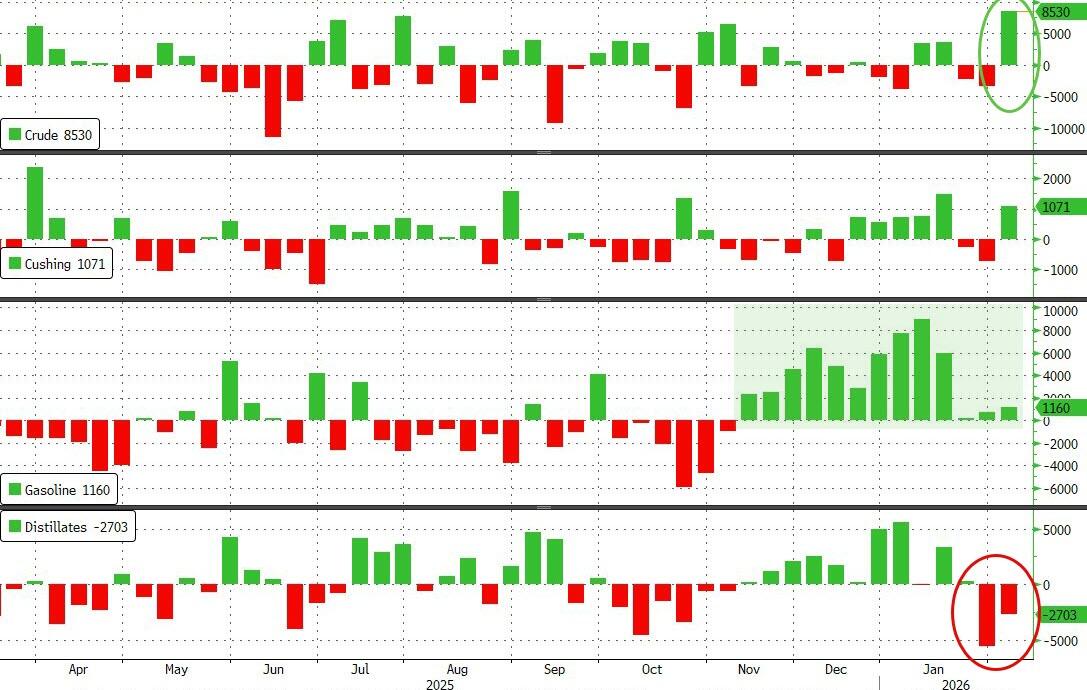
Source: Bloomberg
This build pushed total crude stocks up to their highest since June…
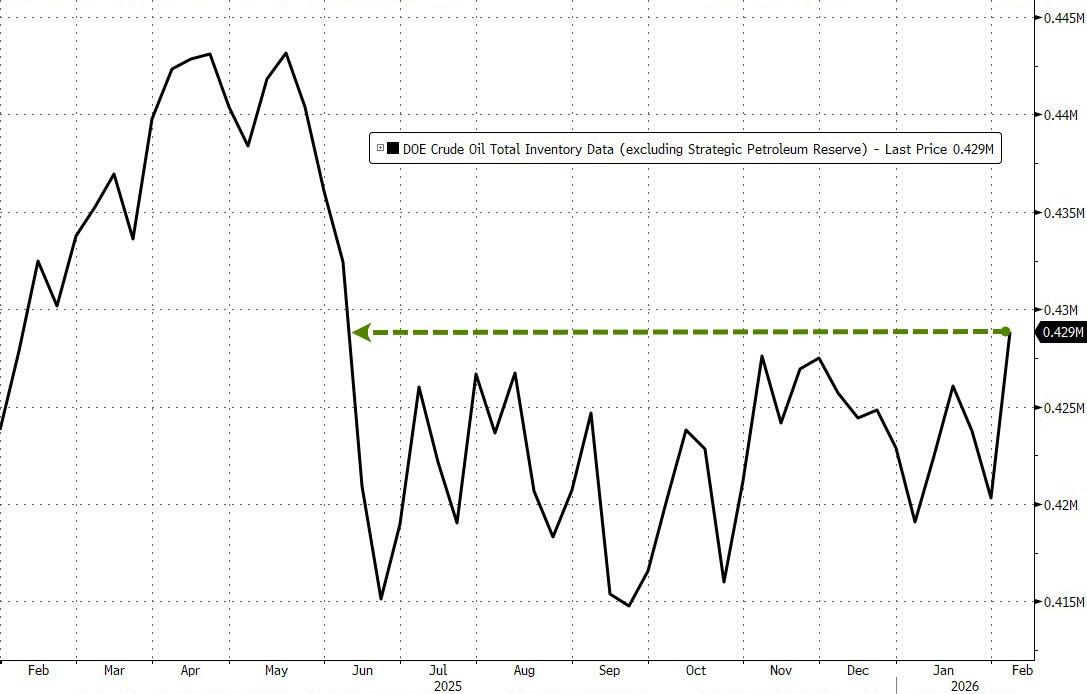
Source: Bloomberg
US Crude production rebounded as expected from its winter storm plunge…
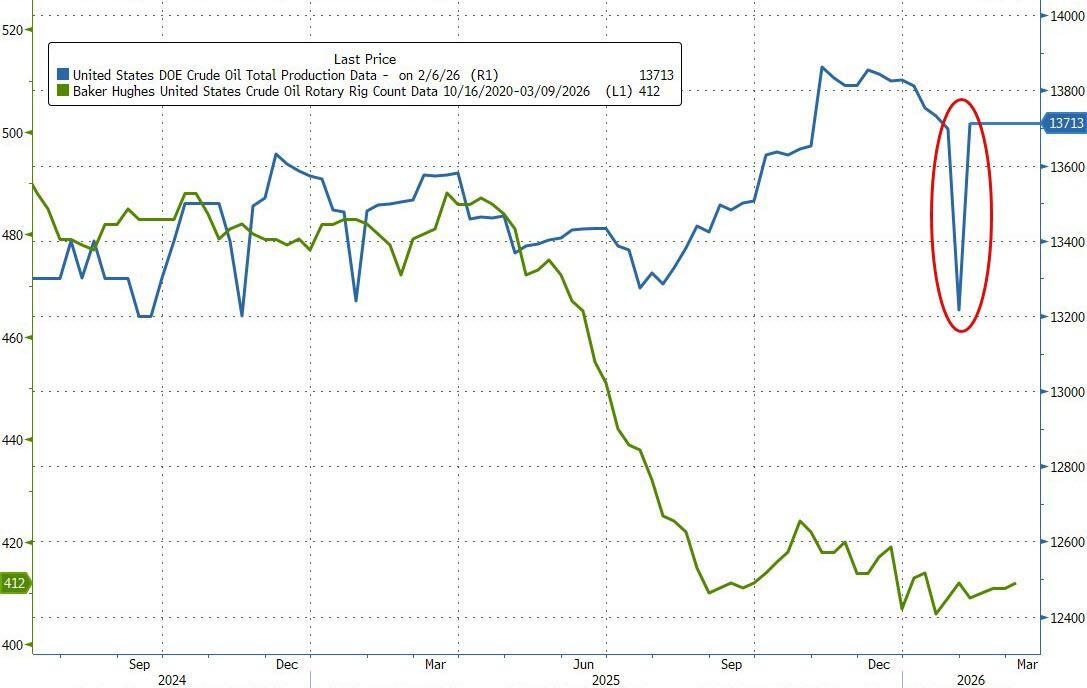
Source: Bloomberg
Crude prices started giving some back before the inventory data as stocks tumbled following the ‘good’ jobs news. However, WTI remains higher on the day (back near its highest since January)…
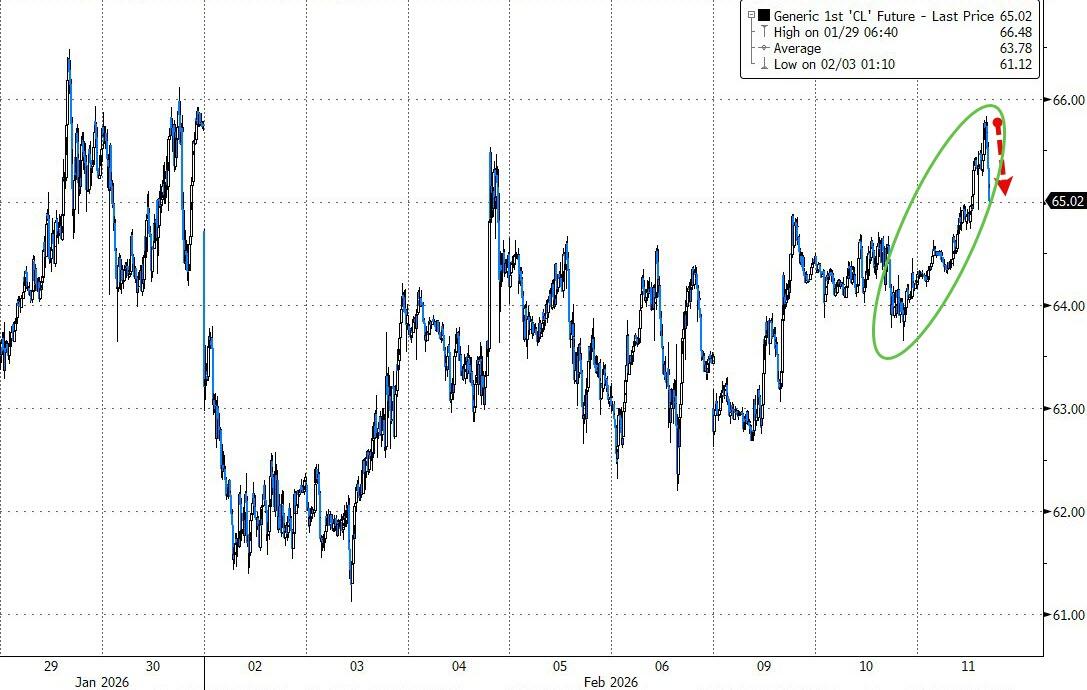
Source: Bloomberg
Finally, in its monthly Short-Term Energy Outlook released Tuesday, The EIA again warned global inventories will rise this year and next on high output from OPEC+ and producers in the Americas.
“Despite near-term tightness from disruptions, we assess that strong global oil production growth will continue to outpace oil consumption over our forecast, driving our assessment that global oil inventories will increase. We expect this trend to continue in both 2026 and 2027. We forecast that global oil inventory builds will average 3.1 million b/d in 2026, compared with an average build of 2.7 million b/d in 2025, before decreasing to average of 2.7 million b/d in 2027,” the agency said.
In the wider market, OPEC left its supply-demand expectations for the oil market largely unchanged in its monthly report, but highlighted that global oil demand for the wider group’s crude will drop by 400,000 bpd in the second quarter compared to the first.
OIL CALIFORNIA
California Refinery Closures Spell Trouble For Fuel Prices, Supply: Experts
Tuesday, Feb 10, 2026 – 09:45 PM
Authored by Rob Sabo via The Epoch Times,
Several energy companies have announced the closure of some of their refineries in California in recent months, citing the regulatory environment and operational losses.
Multiple experts in the state’s oil and gas industry recently spoke with The Epoch Times about the closures and their potential impacts on fuel prices and fuel availability in the Golden State.

Refinery Closures
Valero Energy Corporation announced in April 2025 that it would shutter its refinery operations in Benicia, in the San Francisco Bay area. The company also said that it had evaluated the refinery assets in Benicia and Wilmington, near the Port of Long Beach, and concluded that the carrying values of both assets were not recoverable.
Valero said it would continue serving the Golden State’s oil needs through existing inventories and oil imports.
The Wilmington refinery produced 15 percent of the asphalt supply for the entire Southern California region and had a capacity of 135,000 barrels per day. The Benicia refinery on the Carquinez Straits of San Francisco Bay, meanwhile, produced as much as 170,000 barrels per day and employed more than 400.
While the Benicia refinery was originally slated to cease production in April 2026, it actually ceased production in late January. The closure comes on the heels of Phillips 66 ending operations at its Los Angeles refineries in the fourth quarter of 2025.
Phillips 66 operated refineries in Wilmington and Carson that distributed fuel throughout California, as well as to Nevada and Arizona. The dual sites spanned 650 acres and employed about 600.
Chevron, meanwhile, announced in August 2024 that it was relocating its headquarters from San Ramon to Houston, Texas. The company had operated in the Golden State since 1879 and employed more than 2,000 people in San Ramon. Its refineries in Richmond and El Segundo supply more than 1,800 retail locations in the state.
Key factors
Michael Mische, a professor at the University of Southern California’s Marshall School of Business, told Siyamak Khorrami, host of The Epoch Times’s “California Insider,” that Valero’s and Chevron had incurred heavy asset write-offs before they made those decisions.
Valero said in the April 2025 announcement that it had written off a combined $1.1 billion of assets in Benicia and Wilmington in the first quarter of the year.
Chevron revealed in a January Securities and Exchange Commission filing that it had recorded after-tax charges of $3.5 billion to $4 billion in the fourth quarter of 2023, including asset write-offs and impairment charges, primarily in California.
“Of course, they vacated California. Their corporate headquarters is now in Houston,” Mische said, referring to Chevron.
In responding to the company’s Benicia refinery-closure decision during an April 2025 earnings call, Valero CEO Lane Riggs cited California’s regulatory environment as the primary reason.
“California has been pursuing policies to move away from fossil fuels for the past 20 years,” he said.
“The consequence is that the regulatory and enforcement environment is the most stringent and difficult in North America.”
Phillips 66 also cited “changes in governmental policies or laws that relate to our operations, including regulations that seek to limit or restrict refining” as a reason for its decision to cease operations in its announcement.
California Gov. Gavin Newsom signed Assembly Bill AB X2-1 on Oct. 14, 2024, which became effective on Jan. 13, 2025. The bill allows the California Energy Commission to regulate refiners by enforcing minimum inventory levels to prevent spikes in price, effectively capping their profit margins.
“That piece of legislation (was) one of the primary last factors that went into decisions to close these refineries down,” Mische said.
Additional regulations enacted in the state have led to increased production and operating costs for oil refiners.
In 2020, Newsom issued an executive order requiring all new passenger vehicles to have zero emissions by 2035. In 2022, the California Air Resources Board (CARB) adopted new regulations to pave the way for the state’s zero-emission standards.
The state’s Cap-and-Invest Program, meanwhile, has a goal of carbon neutrality by 2045 and requires increasingly stricter standards for carbon emissions.
Mische said that without a significant change in policy and stance toward the oil industry, the state may lose another one or two refineries by 2032.
Potential Impact
Mike Ariza, former senior refinery technician and control board supervisor at the Benicia refinery, told Khorrami that Valero’s refinery operations in Benicia were the most complex and efficient in the state.
The refinery produced between 4.5 million and 4.7 million gallons of gasoline per day, as well as about 600,000–700,000 gallons of jet fuel and diesel fuel, he said.
A bad storm or major problem at one of California’s ports could have huge ripple effects across the state’s fuel supply, Ariza said.
“If something like that happens, we will very quickly run out of gasoline,” he said.
“We don’t have a lot of inventory—14 days, we will run out of supplies. Not only will prices go through the roof, but you will end up having shortages.”
Mische said that 85 percent of all light-duty vehicles in California use gasoline or diesel fuel, and airplanes require “jet fuel”—gasoline or diesel fuel specially refined for jet engines.
“These refineries, as they’re shutting down, place greater and greater pressure, not only on prices but on the supply chains themselves,” he said. “It’s quite possible that you’ll have supply disruptions.”
Californians pay the second-highest average gas prices in the United States, behind Hawaii. Gasoline averaged $4.38 a gallon on Jan. 4, the American Automobile Association reported. The national average was $2.88 per gallon. Fuel prices in remote Mono County along the Eastern Sierra Nevada mountains averaged $5.56 per gallon.
Meanwhile, California Assembly member Stan Ellis, a Republican representing Kern and Tulare counties, expressed concerns about the impact of Valero’s refinery closure on the U.S. military installations in the state.
“Forty-some bases, counting National Guard and … the Marines, and all the bases, naval stations, in California. Where are they going to get their fuel?” he said.
A November 2025 Institute for Energy Research (IER) report warned that several U.S. military installations in California could face jet fuel supply challenges if the state’s refinery capacity declines due to closures.
The state has the nation’s largest concentration of military personnel and national security activity.
According to a 2022 California Research Bureau report, California had more than 30 military installations, including facilities for the Army, Navy, Air Force, Coast Guard, and National Guard.
Ellis said India is a supplier of California’s imported crude, but there are few options to refine it outside of the state.
“This is serious business, and these are facts,” he said. “We’re simply trying to bring awareness to the fact that we have an issue and we need to address it.”
He calls for existing oil fields to be exempt from the California Environmental Quality Act (CEQA), passed in 1970, which requires environmental review and public disclosure for projects that could significantly impact the environment, including refineries, roads, and large buildings.
Separately, Mische is calling on Congress to repeal or modify California’s restrictive policies through the legislative process to support refiners.
“That probably won’t be very successful, but nonetheless, we’re going to give it a good shot this legislative session,” he said.
CANADA/USA
AND THIS:
end
BRITISH COLUMBIA/CANADA
this rarely happens in Canada
10 Dead, 25 Injured After School Shooting In Canada
Tuesday, Feb 10, 2026 – 10:03 PM
At least 10 people are dead and 25 injured after a mass shooting in northeastern British Columbia, according to police.

Six people were found dead inside Tumbler Ridge Secondary School, one died on the way to the hospital and two more were found dead in a residence.
Police said the suspect was also found dead inside the school from “a self-inflicted injury.”
Police believe they have identified the shooter, but would not be releasing details at this time for privacy reasons, and to protect the integrity of the investigation.
“This was a rapidly evolving and dynamic situation, and the swift co-operation from the school, first responders, and the community played a critical role in our response,” North District Chief Supt. Ken Floyd wrote in a statement.
Tumbler Ridge is one of the most distinct communities in B.C. and is extremely remote: more than 1,100 kilometers (683 miles) northeast of Vancouver by road.

In the late 1970s the population rapidly boomed with the discovery of coal deposits in the area and it became a classic company town throughout the 1980s. A near-collapse followed in the 2000s when those mines shut down.
It was during this time that the community pivoted to tourism, marketing itself as the land of dinosaurs and waterfalls — a place where you can hike to see ancient footprints in the wilderness.

In a statement, the District of Tumbler Ridge said its community experienced a “deeply distressing incident” today and asked residents to rely on official updates from the RCMP and other authorities.
It added that the situation was still unfolding and said additional supports were on their way to assist.
“In the days ahead, we know this will be difficult for many to process,” the statement reads.
“Please check in on one another, lean on available supports, and know that Tumbler Ridge is a strong and caring community. We will get through this together.”
Police said they don’t believe there are any other suspects, or any ongoing risk to the public.
They said they are searching other homes and properties in the community to find anyone else who may be injured or linked to today’s incident, which appears to rank as one of the deadliest mass shootings in Canadian history.
end
Canadian School Shooter Reportedly Identified As Transgender
Wednesday, Feb 11, 2026 – 09:40 AM
Ten people including the shooter are dead after an assailant opened fire at a high school in western Canada in the town of Tumbler Ridge on Tuesday in one of the country’s deadliest mass casualty events in recent history. Initial reports by local police and the Canadian media described the shooter as female.
However, the authorities reluctance to release the identity of the suspect was an immediate red flag. Their reports only indicated that the shooter was a female in a dress.
Independent journalists now say they have the identity of the alleged shooter, corroborated by family members: Jesse Strang, a 17-year-old biological male who started identifying as a “woman” in 2023, is reportedly the culprit behind the school massacre which left 10 dead and 25 wounded.
In an exclusive interview with “Juno News” Jesse Strang’s uncle, Russel G. Strang, confirms that Jesse was the shooter and that he identified as transgender.
Strang’s social media and YouTube accounts contain transgender symbolism as well as the online name “JessJessUwU” (a meme phrase that people may recognize from the bullet casings tied to the gay suspect charged in the assassination of Charlie Kirk, Tyler Robinson).

Locals in Tumbler Ridge also confirmed the shooter’s identity as Jesse Strang, as reported by the Western Standard, though his transgender status is not mentioned.
Before heading to the school, Strang allegedly murdered his mother and younger brother, both of whom were well known in the community.
The fact that Canadian authorities incorrectly asserted that the shooter was “female” led to initial confusion, but this action is essentially required according to Canada’s strict “hate speech” laws protecting trans identity. In other words, Canadian police are often compelled to lie about the gender of suspects when they are trans.

The tragedy represent yet more evidence that transgenderism is a dangerous mental health crisis. Multiple mass shootings (including school shootings) have been perpetrated by transgender suspects in recent years, and suspected Charlie Kirk shooter, Tyler Robinson, was living with his transgender boyfriend at the time of the shooting.
In almost every instance, the transgender status of the shooter has been covered up or dismissed by authorities and the establishment media.
In Canada, trans activists receive substantial legal privileges and protections making any discourse on the dangers of trans ideology impossible.
CANADA/GERMANY
Germany’s Decline Is A Warning Canada Should Heed Now
Wednesday, Feb 11, 2026 – 06:30 AM
Authored by Gwyn Morgan via The Epoch Times,
Germany was postwar Europe’s greatest economic success story.
Today it is a cautionary tale.
Once the continent’s industrial engine, Germany has spent the past decade dismantling the foundations of its prosperity through energy and immigration policies driven more by ideology than evidence or good sense. The results have been rising costs, falling competitiveness, social disorder, and political backlash.

Canada should study this record closely—because we are pursuing many of the same policies.
Energy has played a leading role in Germany’s decline. Reliable, affordable power is the lifeblood of any advanced economy. In 2002, Germany’s 11 nuclear power plants supplied more than one-quarter of its electricity, with coal providing most of the remainder and natural gas filling in when needed. “Renewable” energy played only a minor role. The country had a stable, economically efficient grid that supported one of the world’s most productive industrial bases.
That balance was abandoned. Driven by an ideological campaign against nuclear power, successive governments committed to replacing reliable baseload electricity with intermittent wind and solar. The goal shifted from reducing emissions to shutting down all nuclear plants, at any cost. After Japan’s Fukushima disaster in 2011—caused by a tsunami, not reactor failures—Germany accelerated these closures. Within six months, eight nuclear plants were taken offline. The rest would eventually follow. Not even Vladimir Putin’s invasion of Ukraine would throw Germany’s anti-nuclear zealots off-track.
The consequences were predictable. Electricity demand rose as Germany pushed consumers and industry to electrify, but wind and solar output could not keep pace. Germany turned instead to imported natural gas, much of it from Russia, replacing energy independence with geopolitical vulnerability. Had Germany kept its nuclear plants operating, a PricewaterhouseCoopers study concluded, 94 percent of its power generation would now be emissions-free and electricity prices roughly 23 percent lower.
Instead, Germans now face some of the world’s highest electricity prices plus declining reliability. They even coined a new word, “Dunkelflaute,” to describe calm, dark periods when wind and solar produce no power at all. High energy costs have hollowed out German industry. Its world-leading chemicals sector has shrunk dramatically. Family-owned manufacturers—a pillar of German industry for centuries—are closing by the hundreds.
The damage is most visible in Germany’s auto sector, which once provided livelihoods for millions and anchored its export economy. Today it is in retreat. Production fell by 29 percent between 2017 and 2024. Chinese manufacturers—benefiting from scale, subsidies, and lower energy costs—are flooding European markets with affordable electric vehicles. German firms are losing market share and laying off workers in large numbers for the first time since the World War II.
This should sound uncomfortably familiar to Canadians. Canada is also driving up domestic energy costs while betting heavily on electrification and electric-vehicle manufacturing. We have fewer industrial buffers than Germany and higher transportation costs. If Europe’s industrial powerhouse cannot absorb these shocks, Canada’s position is even more precarious.
Germany’s second self-inflicted wound was mass immigration. During the Syrian civil war, Chancellor Angela Merkel opened her country’s borders, blithely declaring “Wir schaffen das” (“We can do this”). By the end of 2015, Germany had taken in 1.2 million refugees. Integration systems were overwhelmed while schools, housing, social services and policing struggled to cope. Despite these clear warning signs, Germany kept right on going, bringing in hundreds of thousands of migrants year after year from troubled Asian and African countries.
The fiscal cost has been staggering. In 2024 alone, Germany spent nearly 30 billion euros, or about C$48 billion, on refugees and asylum-seekers, not including costs associated with crime and security. Social cohesion frayed further. Public spaces required ever-heavier security. Terrorist attacks and sexual assaults rose. Political backlash followed.
Only now is Germany putting on the brakes, deporting tens of thousands of rejected asylum seekers or criminal migrants and cutting benefits.
The same government that once insisted open borders were a moral imperative now acknowledges limits.
Germany’s energy and immigration failures have a common cause: policymaking driven by moralistic certitude rather than empirical recognition of practical constraints. In both cases, dissent was dismissed, costs were minimized, warnings ignored, and course-corrections refused even after damage became impossible to deny.
Canada should take note. We are raising energy prices while maintaining immigration at near-record levels—including hundreds of thousands of barely-if-at-all vetted refugees—amid a housing shortage, stagnant productivity, and strained public services. Germany shows how quickly good intentions can morph into economic and social decline.
Canada still has time to change course. Whether we choose to learn the lesson is another matter.
* * *
Gwyn Morgan devoted three decades to building North America’s leading oil and gas company. He has served as a director of five global corporations, and was appointed a Member of the Order of Canada in 2011.
The original, full-length version of this article was recently published in C2C Journal.
Views expressed in this article are opinion
END
YOUR EARLY CURRENCY/GOLD AND SILVER PRICING/ASIAN CLOSING MARKETS AND EUROPEAN BOURSE OPENING AND CLOSING/ INTEREST RATE SETTINGS WEDNESDAY MORNING 6;30AM//OPENING AND CLOSING
USA DOLLAR VS EURO: 1.1918 FOR A GAIN OF .0031 OR 31 BASIS PTS.
USA/ YEN 153.21 DOWN 1.291 NOW TARGETS INTEREST RATE AT 1.75% AS IT WILL BUY UNLIMITED BONDS TO GETS TO THAT LEVEL…//YEN STILL FALLS//END OF YEN CARRY TRADE BEGINS AGAIN DEC 2024/Bank of Japan raises rates by .25% TO 1.75 ..TAKAICHI NEW PM AS YIELDS RISE//JAPAN DEEPLY IN TROUBLE WITH RISING RATES AND A FALLING YEN!!
GBP/USA 1.3692 DOWN 0.0069 OR 59 BASIS PTS
USA/CAN DOLLAR: 1.3516 DOWN 0.0037 CDN DOLLAR UP 37 BASIS PTS//(DESPITE TRUMP’S TARIFFS)
Last night Shanghai COMPOSITE CLOSED UP 3.61 pts or 0.09%
Hang Seng CLOSED UP 83.29 PTS OR 0.31%
AUSTRALIA CLOSED DOWN 0.41%
// EUROPEAN BOURSE: MOSTLY ALL RED
Trading from Europe and ASIA
I) EUROPEAN BOURSES: MOSTLY ALL RED
2/ CHINESE BOURSES / :Hang SENG CLOSED UP 83.23 PTS OR 0.31%
/SHANGHAI CLOSED UP 3.61 PTS or 0.09%
AUSTRALIA BOURSE CLOSED DOWN 0.41 %
(Nikkei (Japan) CLOSED UP 1286.60 PTS OR 2.28%
INDIA’S SENSEX IN THE GREEN
Gold very early morning trading: 5053.20.
silver:$83.81
USA DOLLAR VS TRY (TURKISH LIRA): 43.64
USA DOLLAR VS RUSSIAN ROUBLE: 77.35 ROUBLE// DOWN 11 BASIS PTS
UK 10 YR BOND YIELD: 4.499 DOWN 1 BASIS PTS
UK 30 YR BOND YIELD: 5.320 DOWN 1 BASIS PTS
CDN 10 YR BOND YIELD: 3.362 DOWN 4 BASIS PTS
CDN 5 YR BOND YIELD; 2.890 DOWN 2 BASIS PTS
USA dollar index early WEDNESDAY morning: 96.43 DOWN 25 BASIS POINTS FROM TUESDAY’s CLOSE
TUESDAY MORNING NUMBERS ENDS
And now your closing TUESDAY NUMBERS 11: 30 AM
Portuguese 10 year bond yield: 3.168% UP 0 in basis point(s) yield
JAPANESE BOND 10 yr YIELD: +2.237% UP 1 FULL POINTS BASIS POINTS /JAPAN losing control of its yield curve/
JAPAN 30 YR: 3.502 UP 1 BASIS PTS//DIASTER
SPANISH 10 YR BOND YIELD: 3.184 UP 1 in basis points yield
ITALY 10 YR BOND: 3.424 UP 0 points in basis points yield ./ THE ECB IS QE’ ING ITALIAN BONDS (
GERMAN 10 YR BOND YIELD: 2.8117 UP 1 BASIS PTS
IMPORTANT CURRENCY CLOSES : MID DAY WEDNESDAY
Closing currency crosses for day /USA DOLLAR INDEX/USA 10 YR BOND YIELD/1:00 PM
Euro/USA 1.1865 DOWN 0.0023 OR 23 basis points
USA/Japan: 153.85 DOWN 0.680 OR YEN IS UP 68 BASIS PTS// HIGHLY INFLATIONARY TO JAPAN
Great Britain 10 YR RATE 4.5040 UP 1 BASIS POINTS //
GREAT BRITAIN 30 YR BOND; 5.319 UP 1 BASIS POINTS.
Canadian dollar DOWN 16 BASIS pts to 1.3585
xxxxxxxxxxxxxxxxxxxxxxxxxxxxxxxxxxxxxxxxxxxxxxxxxxxxxxxxxxxxxxxxxxxxxxxxxxxxxxxx
The USA/Yuan CNY UP TO 6.9120 ON SHORE ..
THE USA/YUAN OFFSHORE// CNH UP TO 6.9132
TURKISH LIRA: 43.64 EXTREMELY DANGEROUS LEVEL/DEATH WATCH/HYPERINFLATION TO BEGIN.//
Your closing 10 yr US bond yield UP 5 in basis points from TUESDAY at 4.193% //trading well ABOVE the resistance level of 2.27-2.32%)
USA 30 yr bond yield 4.826 UP 3 basis points /11:00 AM
USA 2 YR BOND YIELD: 3.516 UP 6 BASIS PTS.
GOLD AT 10;00 AM 5074.90
SILVER AT 10;00: 84,88
Your 11:00 AM bourses for Europe and the Dow along with the USA dollar index closing and interest ratesWEDNESDAY CLOSING TIME 11:00 AM//
London: CLOSED UP 118.27 PTS OR 1.14%
GERMAN DAX: CLOSED DOWN 131.74 OR 0.53%
FRANCE: CLOSED DOWN 14.64 PTS OR 0.18%
Spain IBEX CLOSED DOWN 77.80 PTS OR 0.42%
Italian MIB: CLOSED DOWN 292.16 PTS OR 0.62%
WTI Oil price 65,72 10.00 EST/
Brent Oil: 70.52 10:00 EST
USA /RUSSIAN ROUBLE /// AT: 77.106 ROUBLE UP 0 AND 15 / 100
CDN 10 YEAR RATE: 3.364 DOWN 1 BASIS PTS.
CDN 5 YEAR RATE: 2.881 UP 4 BASIS PTS
CLOSING NUMBERS: 4 PM
Euro vs USA 1.1873 DOWN 0.0014 OR 14 BASIS POINTS//
British Pound: 1.3626 DOWN 0.0009 OR 9 basis pts/
BRITISH 10 YR GILT BOND YIELD: 4.4760 DOWN 3 FULL BASIS PTS//
BRITISH 30 YR BOND YIELD: 5.291 DOWN 4 IN BASIS PTS.
JAPAN 10 YR YIELD: 2.237 UP 1 FULL BASIS PTS (DANGEROUS TO THEIR ECONOMY
JAPANESE 30 YR BOND: 3.502 UP 1 PTS AND STILL VERY DANGEROUS TO THEIR ECONOMY
USA dollar vs Japanese Yen: 153.222 DOWN 1.276 OR YEN UP 128 BASIS PTS EXTREMELY DANGEROUS/YEN FALLING DEEPLY IN VALUE
USA dollar vs Canadian dollar: 1.3572 UP 0.0019 PTS// CDN DOLLAR DOWN 19 BASIS PTS
West Texas intermediate oil: 64..89
Brent OIL: 69.74
USA 10 yr bond yield UP 3 BASIS pts to 4.179
USA 30 yr bond yield: UP 3 PTS to 4.820%
USA 2 YR BOND 3.514 UP 6 PTS
CDN 10 YR RATE 3.3341 DOWN 2 BASIS PTS
CDN 5 YEAR RATE: 2.873 DOWN 2 BASIS PTS
USA dollar index: 96.81 UP 14 BASIS POINTS
USA DOLLAR VS TURKISH LIRA: 43.64 GETTING QUITE CLOSE TO BLOWING UP/
USA DOLLAR VS RUSSIA//// ROUBLE: 77.10 UP 0 AND 11/100 roubles //
GOLD $5088.10 3:30 PM)
SILVER: 84.50 3;30 PM)
DOW JONES INDUSTRIAL AVERAGE: DOWN 66.74 OR 0.13%
NASDAQ 100 UP 73.62 PTS OR 0.29%
VOLATILITY INDEX 17.59 DOWN 0.20 PTS OR 1.12%
GLD: $ 467.55 UP 5.15 PTS OR 1.11%
SLV/ $76.55 UP 3.14 PTS OR OR 4.28%
TORONTO STOCK INDEX// TSX INDEX: CLOSED UP 2.00 PTS OR 0.00%
end
TRADING today ZEROHEDGE 4 PM: HEADLINE NEWS/TRADING
‘Good’ Jobs News Is Bad News For Bonds, Big-Tech, Banks, & Bitcoin; Gold Gains
WRAP UP’:
USA DATA RELEASES
Prior to the jobs report they were expecting a massive revision:
Brace For Massive, “1 Million Plus” Negative Jobs Revision Tomorrow As Birth-Death Model Is Finally Fixed
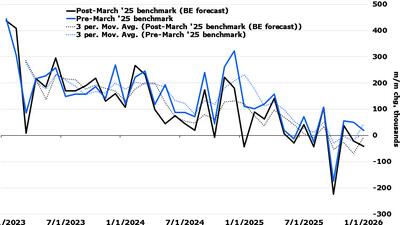
This massive revision will force the Fed to cut 3 or more times in 2026.
TUE FEB 10, AT 8:30 PM
end
as it turns out the jobs report was ok but unadjusted down 2.6 million:
US Unexpectedly Adds 130K Jobs In January, Most Since 2024, Amid Massive Negative Revisions
Wednesday, Feb 11, 2026 – 09:04 AM
Ahead of today’s jobs report, the Trump admin unleashed a full court press to warn markets about what was expected to be a very weak numbers, with Peter Navarro saying “we have to revise our expectations down significantly for what a monthly job number should look like” and Kevin Hassett told CNBC on Monday to “expect slightly smaller job numbers” and that “one shouldn’t panic” if the labor data comes in weak. That’s also why the whisper number ahead of today’s jobs print was well below the consensus, at 35K vs 65K median consensus.
And so with markets and traders fully expecting a ugly print – with Bloomberg’s chief economist looking for a 0 January print – the BLS decided to shock everyone, and reported than in January the US added 130K jobs, double the 65K median estimate and up from a downward revised December print of 48K (vs 50K previously). This was also the highest monthly jobs increase since December 2024.
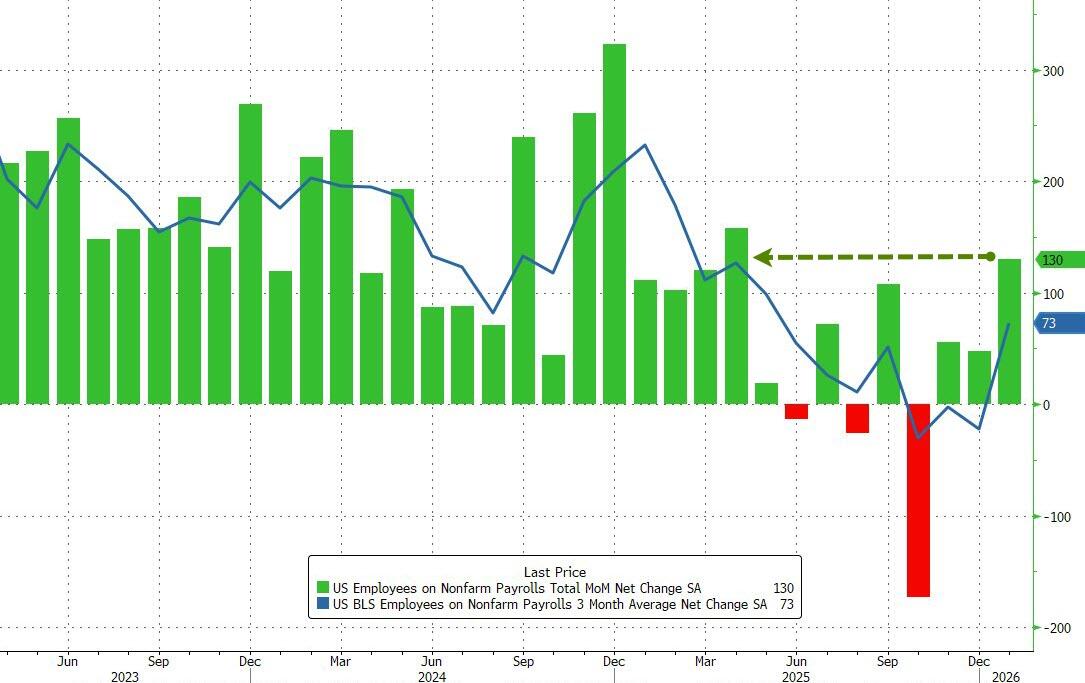
While today’s number was double the median consensus, here is some additional color: at 130K, the forecast was higher than 79 out of 80 forecasts, with just Citigroup’s 135K forecast higher.
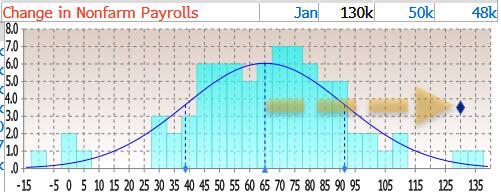
That said, expect today’s number to be revised sharply lower last month: that’s because the November report was revised down by 15,000, from +56,000 to +41,000, and the change for December was revised down by 2,000, from +50,000 to +48,000. With these revisions, employment in November and December combined is 17,000 lower than previously reported. It gets worse though, with 25 of the past 26 jobs reports revised lower.
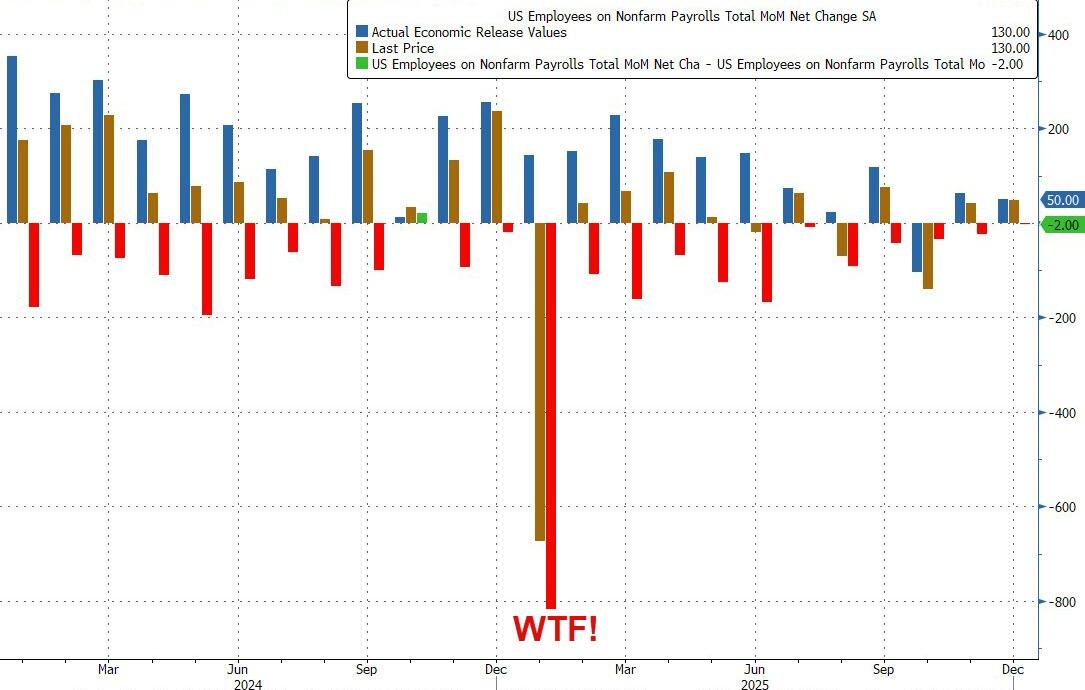
There is another reason why today’s report will be revised away: while the seasonally adjusted change was a stronger than expected 130K, the unadjusted was a negative 2.649 million. That means that the entire delta in today’s “surprise beat” was due to seasonal adjustments.
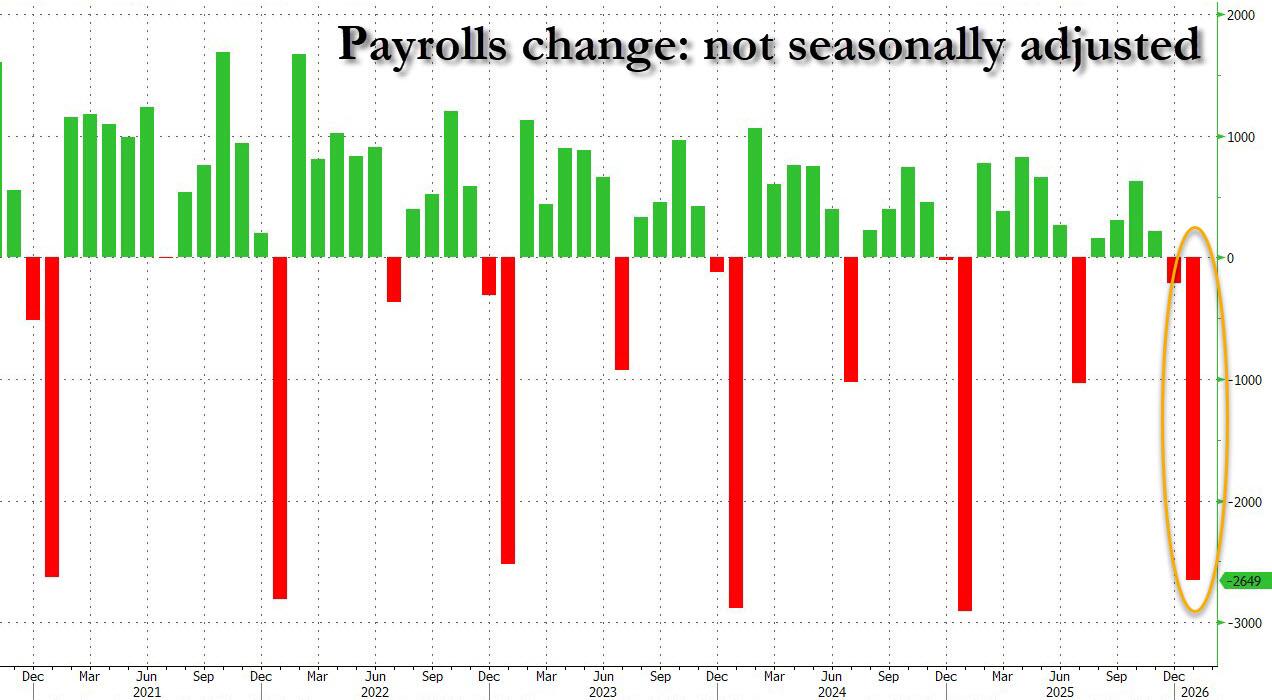
The positive surprise in the payrolls number also translated into improvement in the unemployment rate, which unexpectedly dropped to 4.3%, down from 4.4% in December where it was expected to stay. Among the major worker groups, the unemployment rate for teenagers declined to 13.6 percent in January. The jobless rates for adult men (3.8 percent), adult women (4.0 percent), and people who are White (3.7 percent), Black (7.2 percent), Asian (4.1 percent), or Hispanic (4.7 percent) all posted modest improvements in recent months.
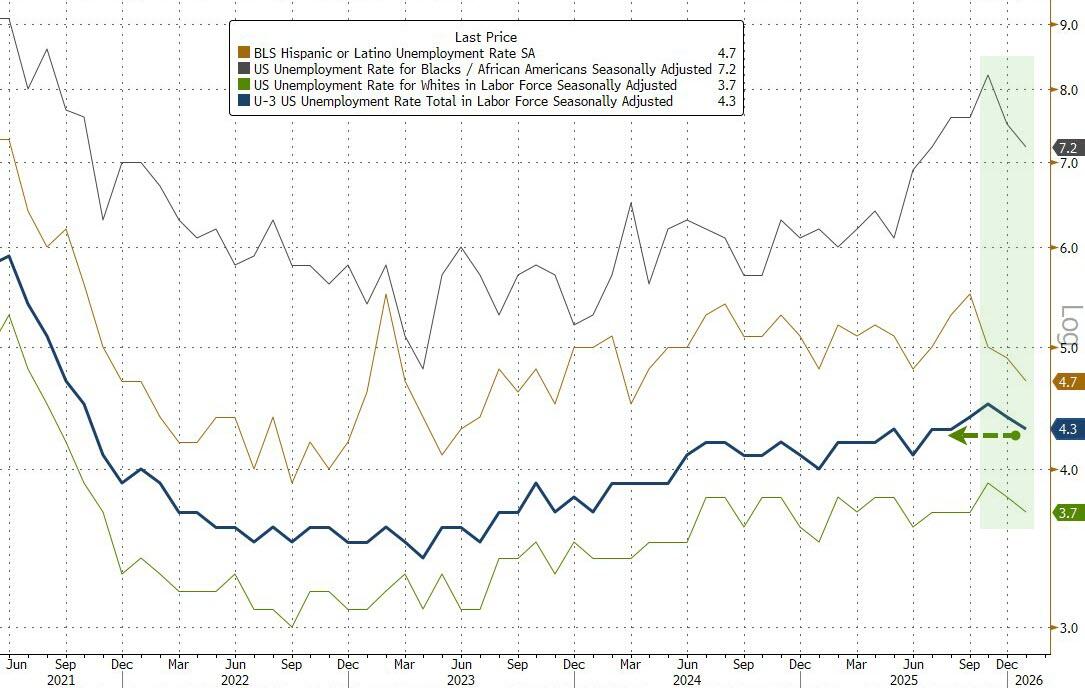
Tied to this, the labor force participation rate rose to 62.5%, up from 62.4% and fractionally better than the expected unchanged print.
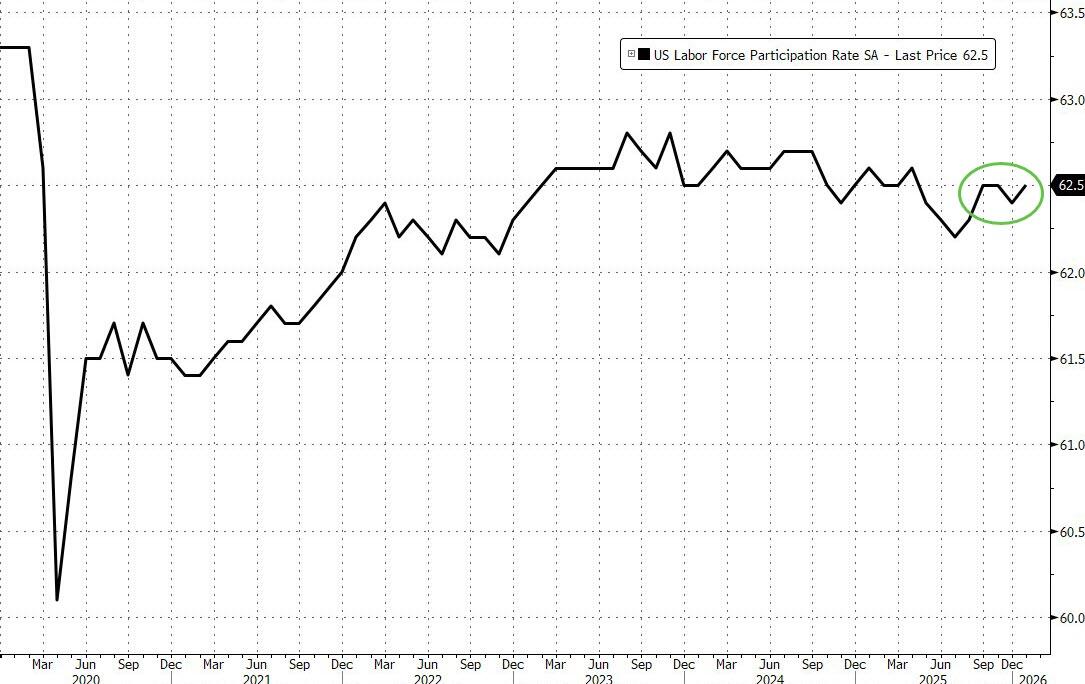
There was more positive surprises: in January, hourly earnings rose 0.4% MoM, up from a downward revised (of course) 0.1% in January and above the 0.3% estimate. On a YoY basis, this translated to a 3.7% increase in average hourly earnings, in line with estimates and unchanged from the previous month.
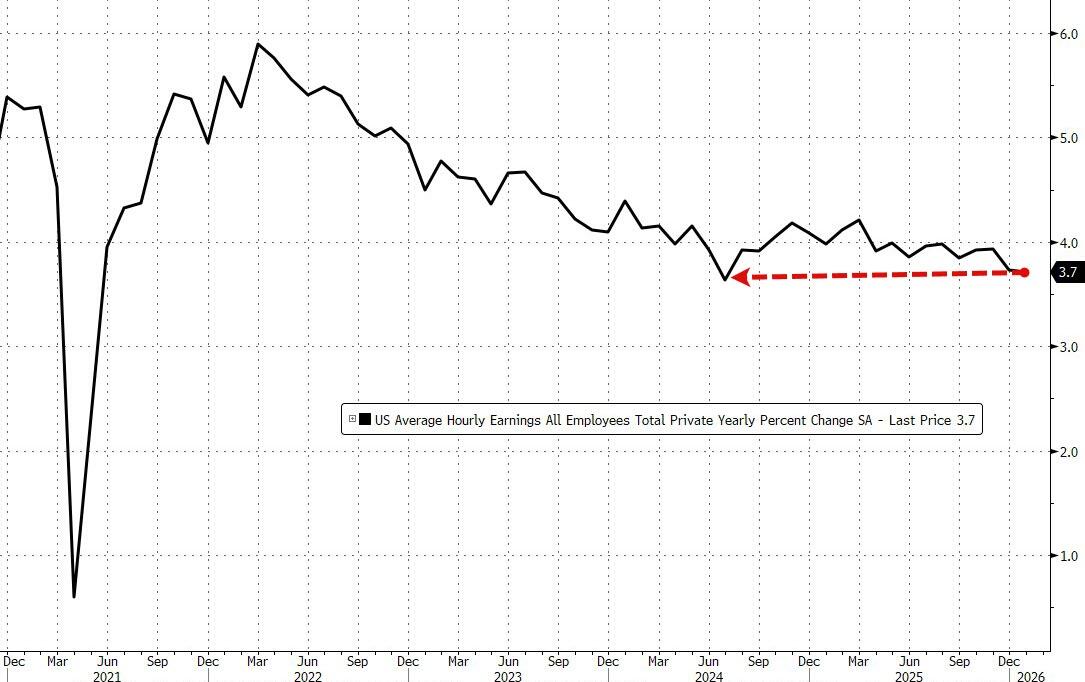
Some more details from the report:
- The number of people employed part time for economic reasons decreased by 453,000 to 4.9 million in January but is up by 410,000 over the year. These individuals would have preferred full-time employment but were working part time because their hours had been reduced or they were unable to find full-time jobs.
- In January, the number of people not in the labor force who currently want a job decreased by 399,000 to 5.8 million. These individuals were not counted as unemployed because they were not actively looking for work during the 4 weeks preceding the survey or were unavailable to take a job.
- Among those not in the labor force who wanted a job, the number of people marginally attached to the labor force changed little at 1.7 million in January. These individuals wanted and were available for work and had looked for a job sometime in the prior 12 months but had not looked for work in the 4 weeks preceding the survey. The number of discouraged workers, a subset of the marginally attached who believed that no jobs were available for them, also changed little at 475,000 in January.
Taking a closer look at the Establishment survey, we find that job gains occurred in health care, social assistance, and construction, while federal government and financial activities lost jobs. Payroll employment changed little in 2025 (+15,000 per month on average).Here is the breakdown:
- Health care added 82,000 jobs in January, with gains in ambulatory health care services (+50,000), hospitals (+18,000), and nursing and residential care facilities (+13,000). Job growth in health care averaged 33,000 per month in 2025.
- Employment in social assistance increased by 42,000 in January, primarily in individual and family services (+38,000).
- Construction added 33,000 jobs in January, reflecting an employment gain in nonresidential specialty trade contractors (+25,000). Employment in construction was essentially flat in 2025.
- In January, federal government employment continued to decline (-34,000) as some federal employees who accepted a deferred resignation offer in 2025 came off federal payrolls. Since reaching a peak in October 2024, federal government employment is down by 327,000, or 10.9
- percent.
- Financial activities employment declined by 22,000 in January and is down by 49,000 since reaching a recent peak in May 2025. Within the industry, insurance carriers and related activities lost 11,000 jobs over the month.
And visually:
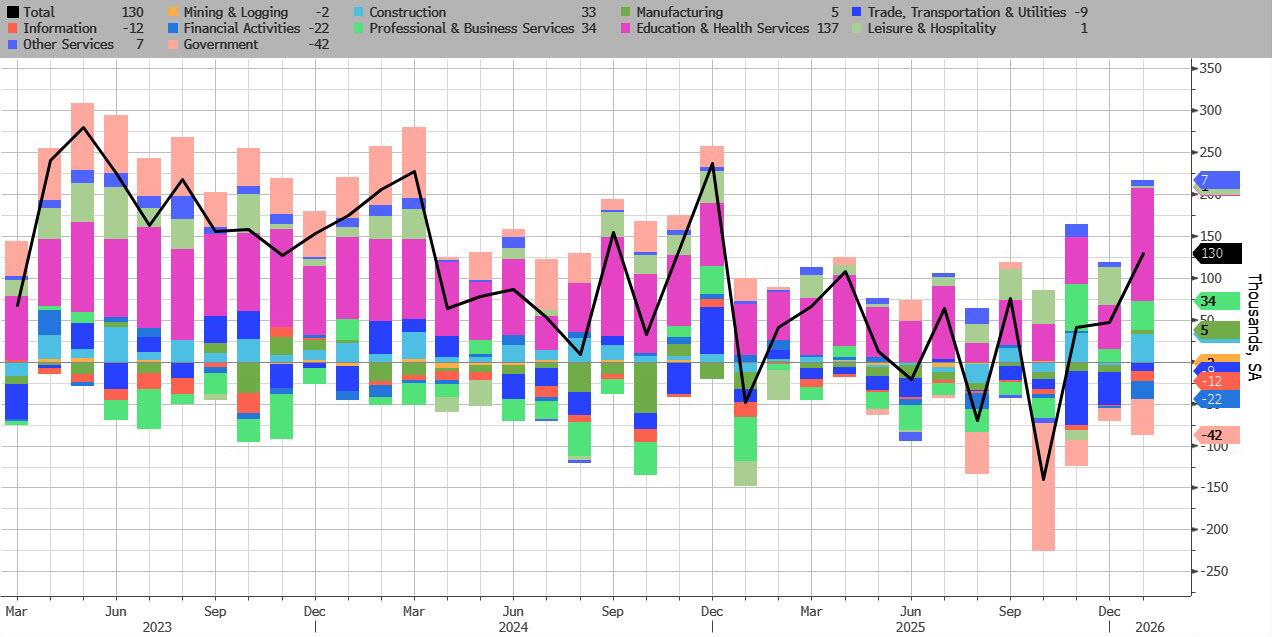
Of these, the most notable is was the ongoing sharp decline in government workers, which tumbled by 42K, and are down 5 of the past 6 months.
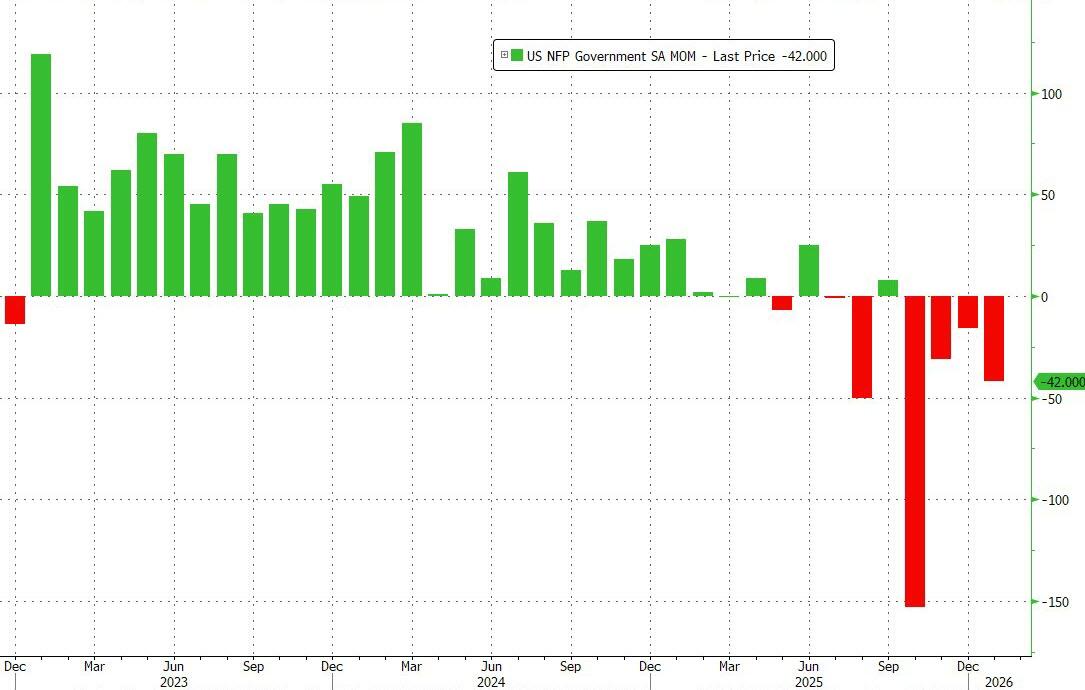
Last but not least, extending last month’s move, in January the bulk of job creation was full time jobs which increased by 582K, while part-time jobs rose by only 31K.
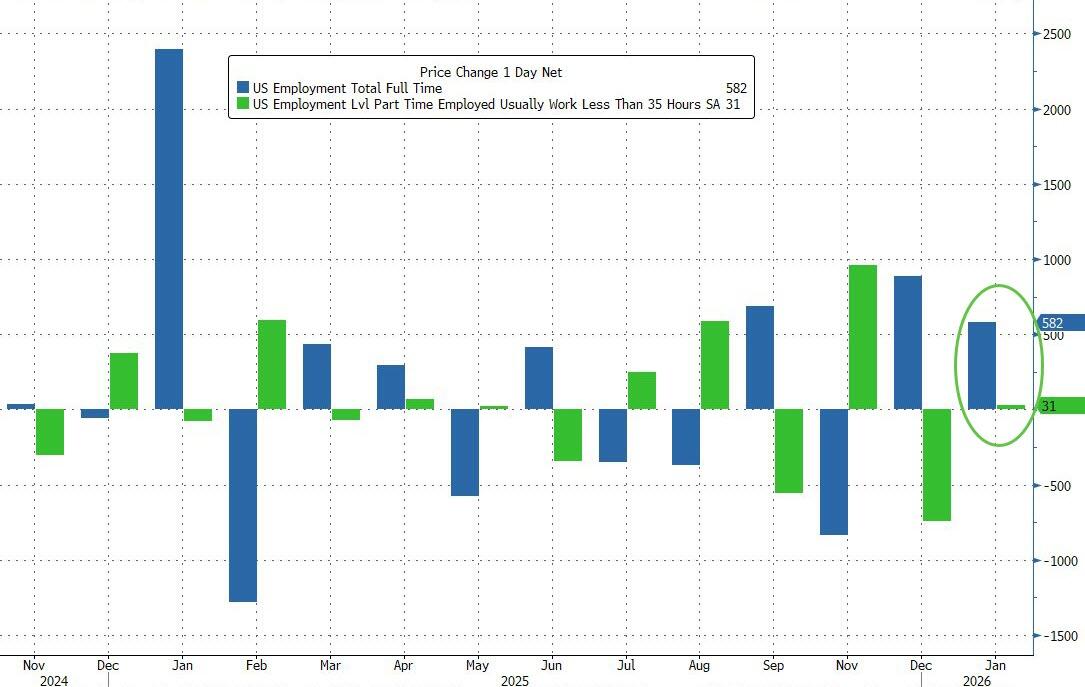
And while the January numbers was stellar (at least until it is revised much lower in coming months), the much uglier part to today’s jobs report was the dramatic negative benchmark revisions which we highlighted yesterday.
As we noted, the establishment survey data released today was re-benchmarked to reflect comprehensive counts of payroll jobs for March 2025. These counts are derived principally from the Quarterly Census of Employment and Wages (QCEW), which counts jobs covered by the Unemployment Insurance (UI) tax system. The benchmark process results in revisions to not seasonally adjusted data from April 2024 forward. Seasonally adjusted data from January 2021 forward are subject to revision. In addition, data for some series prior to 2021, both seasonally adjusted and unadjusted, incorporate other revisions.
The seasonally adjusted total nonfarm employment level for March 2025 was revised downward by 898,000. On a not seasonally adjusted basis, the total nonfarm employment level for March 2025 was revised downward by 862,000, or -0.5 percent.
AS a result, the change in total nonfarm employment for 2025 was revised from +584,000 to +181,000 (seasonally adjusted), which means that the US barely generated any jobs in 2025, and that instead of creating 49K average jobs per month, the US only added 15K jobs.
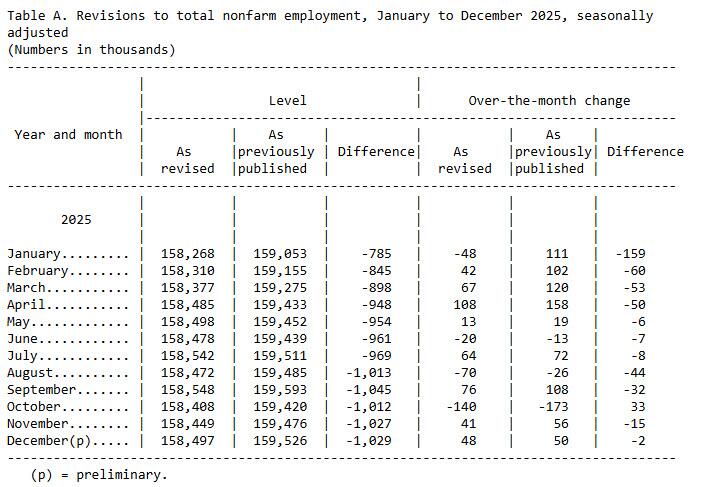
We will have more to say on the historic negative revisions shortly, but for now suffice to say, the picture is one of a much weaker jobs market, and the January bounce notwithstanding – and it won’t stand once it is revised lower – the Fed will have no choice but to slash rates aggressively to prevent the already precarious labor market from rolling over into contraction.
end
Peter Tchir on the job numbers
‘Across-The-Board’ Strong Jobs Report… But Take It “With A Grain Of Salt”
Wednesday, Feb 11, 2026 – 09:12 AM
Via Academy Securities’ Peter Tchir,
There is almost nothing to nitpick about this report (though we do have some caveats).
Big beat on jobs 130k vs 65k expected. Private jobs crushed it, adding 172k (yes, public sector jobs shrank).
Downward revision for prior 2 reports was “only” -17k.
The benchmark revisions were -862k.
A big number but -825k was baked in, so kind of a rounding error at this stage on “old” data.
Unemployment rate dropped to 4.3%.
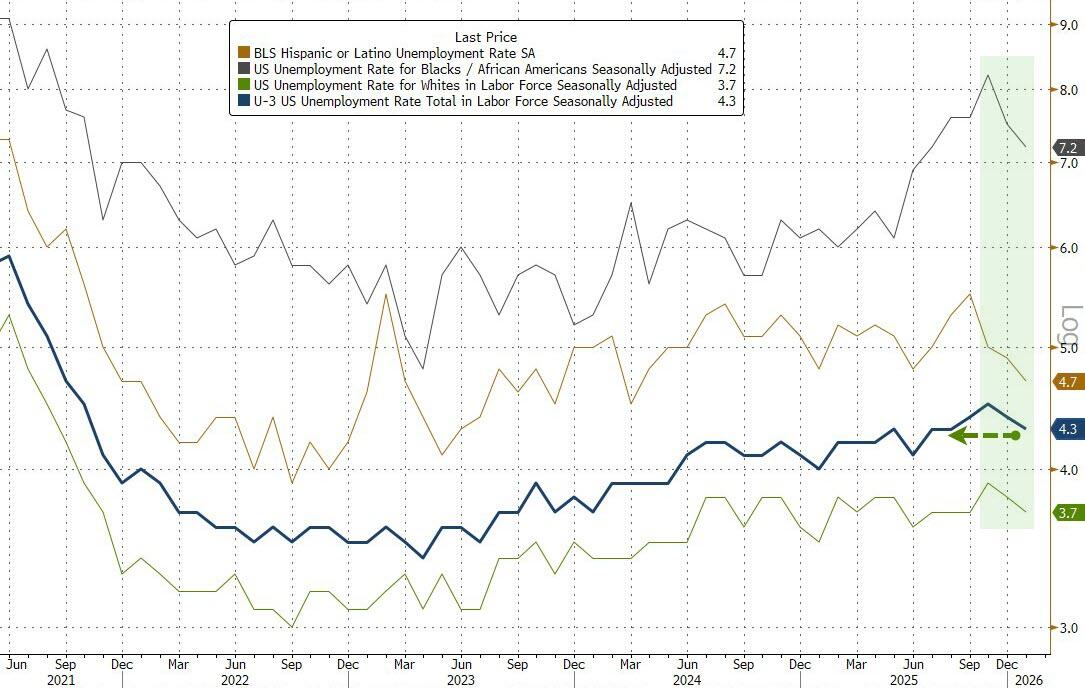
Not only did the household survey add 528k jobs, but we got this drop even while labor participation INCREASED to 62.5% – a very healthy shift in unemployment.
The birth/death model showed job losses of 69k.
Since I do think birth/death had an outsized influence on the revisions it is good to see a negative number here. It gives me more confidence in the print.
What is there to complain about?
- NSA (not seasonally adjusted) had a drop of 2,649,000 jobs.
- We have been complaining (for years) that the seasonal adjustments have a lot of issues and this year’s might be worse than usual in that respect
- We still add a lot of jobs in winter and take them away in summer, because that is how the weather worked (slowing in the Northeast), but we no longer believe that is accurate as so much construction has moved to the South.
- It adds back a lot of jobs that were added for the holidays. It is unclear how many jobs were really added for the holidays. It does not help that the government shutdown(s) has made the data even less reliable than usual.
- In 2025 the largest downward revision was in February where they took away 167k from the prior 2 reports.
These two factors are why I will take this payroll data with a “grain of salt”.
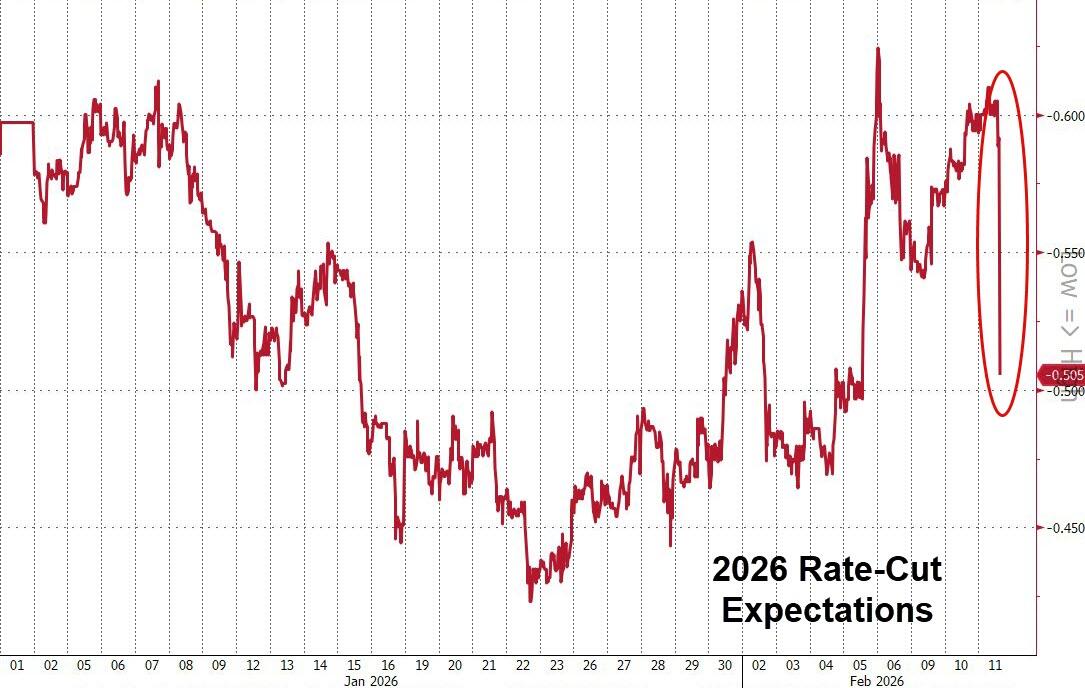
The market has immediately priced in a more hawkish Fed with rate-cut expectations tumbling.
CBO Director Warns US Fiscal Path Is ‘Not Sustainable’ ; Projects Additional $1.4T Deficit Swell Under Trump Agenda
Wednesday, Feb 11, 2026 – 10:45 AM
The Congressional Budget Office raised its 10-year deficit estimate by $1.4 trillion, citing Trump’s 2025 reconciliation act, higher tariffs and lower immigration.
- Annual deficits are projected to remain historically large, totaling $23.1 trillion from 2026 to 2035 and reaching 6.7% of GDP by 2036.
- The 2025 tax law is the single largest driver, adding $4.7 trillion to deficits over the decade, partially offset by roughly $3 trillion in tariff revenue.
- Federal debt held by the public is projected to rise to 120% of GDP by 2036, surpassing the post-World War II record by 2030.
- Interest costs are expected to double over the next decade, climbing from $1 trillion in 2026 to $2.1 trillion in 2036 as debt and rates rise.
- Economic growth is projected to strengthen in 2026 but slow to 1.8% thereafter, falling short of the administration’s 3% growth target despite productivity gains from artificial intelligence.
The federal government is barreling toward a decade of historically large budget deficits, according to a new report from the (arguably partisan) Congressional Budget Office (CBO), which said on Wednesday in a new report that recent tax and immigration policies have sharply worsened the long-term outlook.

The CBO increased its estimate of cumulative deficits for the 2026-35 period by $1.4 trillion, citing President Donald Trump’s 2025 tax law and the cost of stepped-up immigration enforcement. The agency now projects total deficits of $23.1 trillion over the decade, underscoring what it called an “unsustainable fiscal path.”
At the center of the revision is last summer’s tax package, which extended the 2017 tax cuts and added new breaks. The CBO estimates the law will increase deficits by $4.7 trillion over 10 years. Immigration enforcement actions are expected to add another $500 billion. Those costs, the agency said, will more than offset revenue gains from higher tariffs, even as import duties rise to levels not seen since the mid-20th century. The CBO estimates tariff revenue will reduce deficits by about $3 trillion over the period.
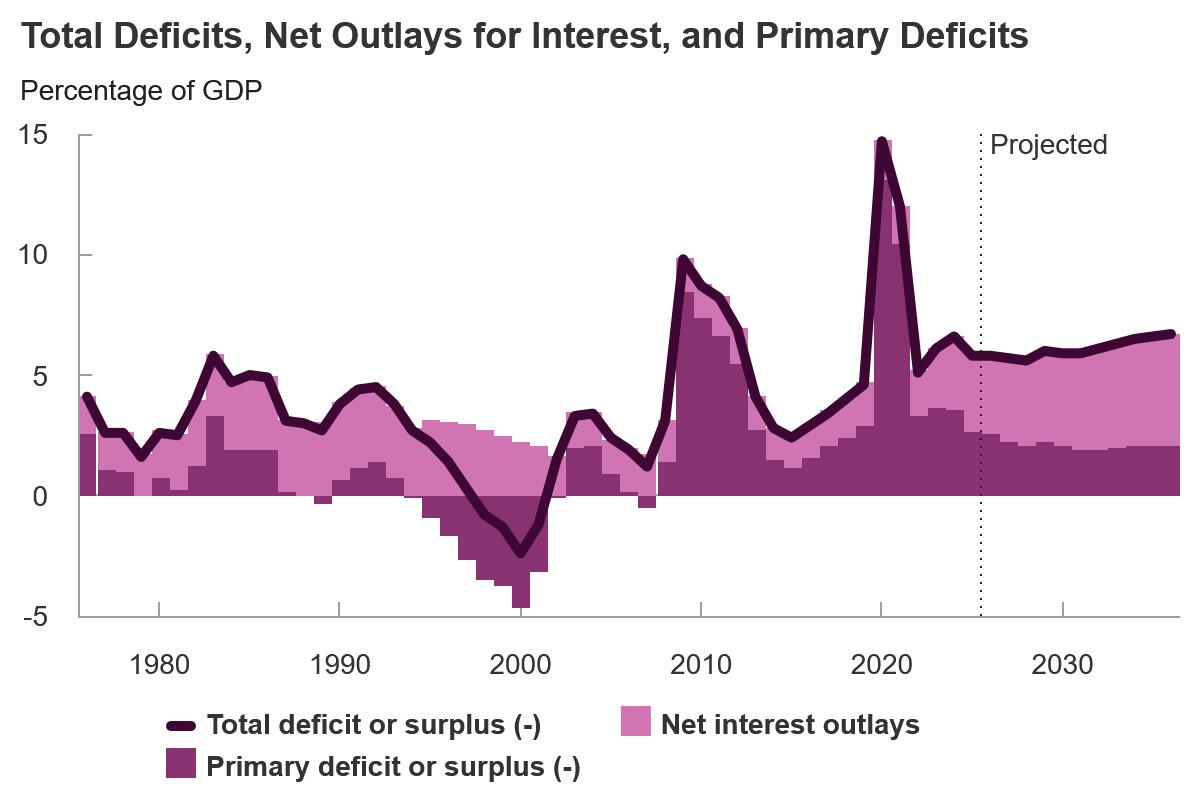
Since its last long-term outlook in January 2025, the agency said three developments have materially altered its baseline projections: enactment of the 2025 reconciliation act, a sharp rise in tariffs, and lower immigration. Together, those changes have pushed projected deficits for the coming decade $1.4 trillion higher, to a cumulative $23.1 trillion from 2026 through 2035.
“The budget projections continue to indicate that the fiscal trajectory is not sustainable,” CBO Director Phillip Swagel said in prepared remarks accompanying the report.
For fiscal 2026, the deficit is projected at $1.9 trillion, or 5.8% of gross domestic product, roughly unchanged as a share of the economy from 2025. By 2036, the annual deficit is expected to widen to $3.1 trillion, or 6.7% of GDP – levels the agency described as “historically unusual,” particularly with unemployment projected to remain below 5%.
The latest outlook reflects the effects of President Donald Trump’s 2025 tax law, which extended the 2017 tax cuts and added new provisions. The CBO estimates the reconciliation act will raise deficits by $4.7 trillion over the 2026–35 period, once higher debt-service costs and macroeconomic effects are included. Higher tariffs are projected to reduce deficits by about $3 trillion, while lower immigration adds roughly $500 billion.
Revenues are projected to remain broadly stable as a share of the economy, rising modestly from 17.5% of GDP in 2026 to 17.8% in 2036. Outlays, however, are expected to climb from 23.3% to 24.4% of GDP as spending on Social Security, Medicare and interest costs grows faster than economic output.
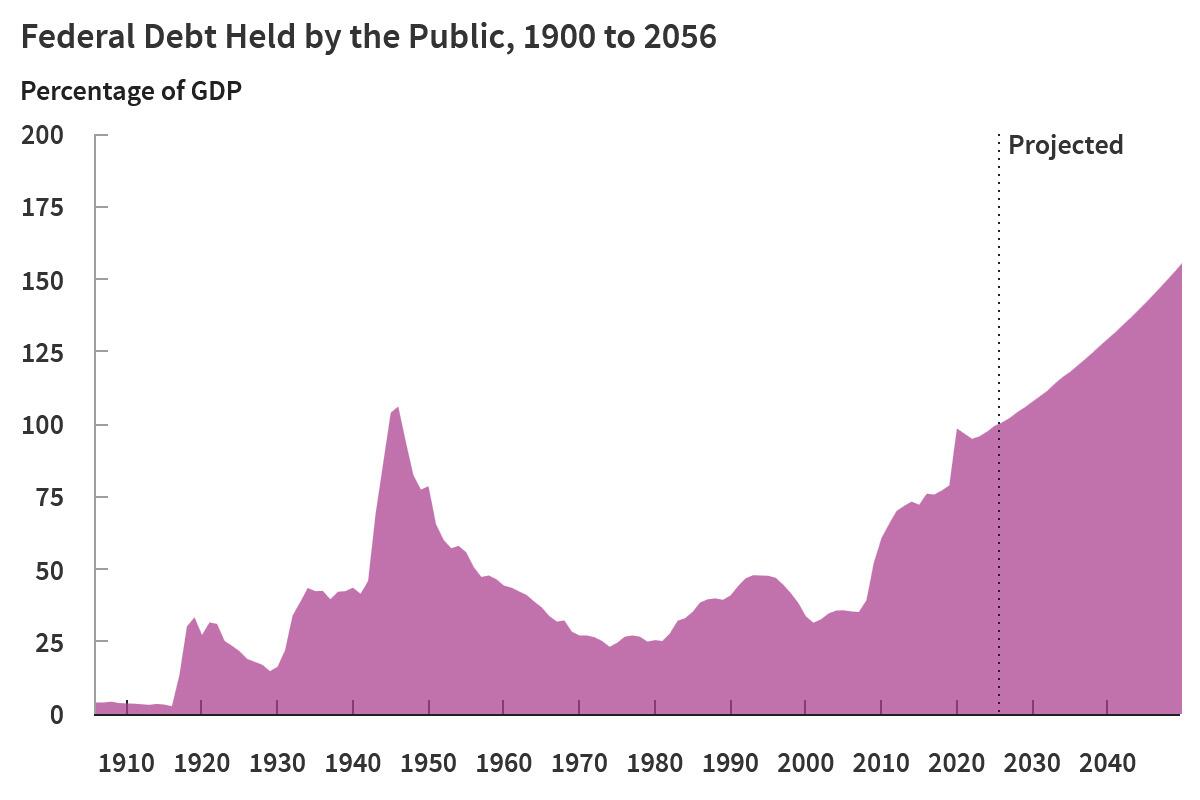
Debt held by the public is projected to rise from 99% of GDP at the end of 2025 to 120% by 2036. Under current law, the CBO expects debt to surpass the previous postwar record of 106% of GDP—set in 1946—by 2030. Over a 30-year horizon, debt climbs to an estimated 175% of GDP. The Social Security Old-Age and Survivors Insurance Trust Fund is now projected to be exhausted in 2032, a year earlier than previously forecast.
Rising debt feeds directly into higher interest costs. Net interest outlays are projected to double over the next decade, increasing from $1 trillion in 2026 to $2.1 trillion in 2036 and rising from 3.3% to 4.6% of GDP.
Those projections undercut the administration’s stated goal of reducing the deficit toward 3% of GDP by the end of Mr. Trump’s term, a target repeatedly cited by Treasury Secretary Scott Bessent. The CBO now expects deficits of 5.8% of GDP in 2026 and about 6% in 2028.
On the economic front, the agency projects stronger real GDP growth in 2026, as the pro-growth elements of the tax law outweigh the drag from tariffs and reduced immigration. Growth is then expected to slow to 1.8% from 2027 onward, reflecting offsetting forces: stronger incentives to work and invest on one hand, and larger deficits and slower labor-force growth on the other.
The outlook also incorporates a modest boost from generative artificial intelligence, which the CBO estimates will add roughly 10 basis points a year to productivity growth, raising nonfarm business output by about 1% by 2036.
Even so, the growth dividend is not enough to materially improve the fiscal picture. While stronger growth lifts revenues, it also pushes up interest rates, and the latter effect dominates. “That result highlights how the nation’s large stock of debt influences the way that changes in the economy stemming from legislation affect the federal budget,” Mr. Swagel said.
The forecast also assumes the Federal Reserve cuts its benchmark rate by 25 basis points in 2026, with the yield on 10-year Treasury bonds rising gradually to about 4.3% by late 2027 and then stabilizing. Upward pressure from growing federal debt is expected to be offset by slower labor-force growth.
Federal Reserve Chair Jerome Powell has echoed the CBO’s warning in recent remarks, saying that while today’s debt level is manageable, the long-term path is not. “We’re running a very large deficit at essentially full employment,” Mr. Powell said last month. “The fiscal picture needs to be addressed – and it’s not really being addressed.”
On the other hand…
Perhaps CBO is just talking shit because they’re #resistance?
According to some economists, CBO might be understating the deficit-reducing potential of tariffs by assuming sharper declines in import volumes than recent experience suggests. Economist Andrew Rechenberg and analyses by the Coalition for a Prosperous America point to tariff revenues collected since 2018 that remained resilient even as trade patterns shifted. In many cases, imports were rerouted through alternative supply chains rather than eliminated, while demand proved more inelastic than expected in categories such as intermediate goods and energy inputs. Under those conditions, sustained tariff enforcement – particularly with limited exemptions – could generate revenues above baseline projections.
Other analysts contend that the CBO’s long-term outlook may be overly cautious in its assessment of how tax certainty and trade policy interact with domestic investment. Permanent tax provisions and trade barriers that favor domestic production, they argue, can reinforce incentives for reshoring and capital formation in ways that are difficult to fully capture in baseline projections. Former CBO Director Douglas Elmendorf has previously acknowledged that long-run investment and productivity responses to permanent policy changes are inherently uncertain and may unfold gradually, suggesting that modest but persistent gains in domestic output could meaningfully improve fiscal outcomes over time.
Meanwhile, some economists question whether higher projected deficits will translate as directly into rising interest costs as the CBO assumes. They point to continued global demand for U.S. Treasurys, demographic forces that suppress real interest rates, and the dollar’s role as the world’s primary reserve currency as factors that weaken the link between debt levels and borrowing costs. From this perspective, fiscal sustainability is less about historical deficit benchmarks and more about market tolerance – specifically whether rising debt triggers inflation expectations or capital flight – conditions that, thus far, have not materialized.
USA ECONOMIC REPORTS
HUGE!!!
$11T Funding Crisis: Fed Trapped as Treasury Ponzi Fails (Your Money at Risk)

by ITM Trading
Tuesday, Feb 10, 2026 – 12:42
Eight weeks. $90 billion in Treasury bill purchases. And that’s just the appetizer. There’s $9 trillion in rollovers coming due at today’s rates, plus another $2 trillion in new issuance. That’s $11 trillion the US needs to find buyers for while China dumps Treasuries and Japanese capital flows home. Taylor Kenney connects the dots: the Fed isn’t providing “technical support.” It’s gearing up for the largest monetization cycle in history, starting from a balance sheet that’s already 7x its pre-2008 level. The last time central banks ran this playbook, it had a name. Several names, actually. Weimar. Venezuela. Argentina. But sure. Low volatility. Nothing to see here.
About ITM Trading: ITM Trading has spent nearly 30 years helping clients prepare for monetary resets, inflation, and systemic risk using physical gold and silver. We focus on education, historical context, and strategies designed to protect wealth when trust in the system breaks down.
END
Man Detained For Questioning In Nancy Guthrie Disappearance
Tuesday, Feb 10, 2026 – 10:30 PM
Update (1030ET): A man was detained for questioning in the apparent abduction of Nancy Guthrie, the mother of “Today” show co-host Savannah Guthrie, from her home outside of Tucson, Arizona over two weeks ago, several major outlets are reporting tonight.

The man was taken into custody after law enforcement circulated photos of a masked individual outside the 84-year-old Guthrie’s front door the morning she disappeared. Several outlets are also reporting that there was a supposed ransom note received last week demanding payment to a Bitcoin wallet. According to outlet KGUN, a local TV station, the wallet had received a payment from someone for less than $300.
*UNCONFIRMED REPORTS CIRCULATING ONLINE (so for entertainment purposes only at this time) are suggesting that it might have been an inside job involving a family member.
*
The FBI on Tuesday released surveillance footage from a Nest camera showing an armed person at the southern Arizona home of Nancy Guthrie, mother of network TV news anchor Savannah Guthrie.
Video shared by FBI Director Kash Patel shows a masked person wearing a jacket, gloves, pants and carrying a backpack. The person can be seen obstructing the camera, before walking into the front yard. They then return to the front door with a small flashlight in their mouth before attempting to cover the camera with what appears to be foliage, AZ Family reports.
Investigators say the person was armed, as images show what appears to be a holstered firearm on the person’s waistband.
“Over the last eight days, the FBI and Pima County Sheriff’s Department have been working closely with our private sector partners to continue to recover any images or video footage from Nancy Guthrie’s home that may have been lost, corrupted or inaccessible due to a variety of factors, including the removal of recording devices. The video was recovered from residual data located in backend systems,” the Pima County Sheriff’s Department posted in a statement.
“Working with our partners – as of this [Tuesday] morning, law enforcement has uncovered these previously inaccessible new images showing an armed individual appearing to have tampered with the camera at Nancy Guthrie’s front door the morning of her disappearance,” they added.

Guthrie was last seen on Jan. 31 after she was dropped off at her home in the Catalina Foothills, and was reported missing the next day after she failed to show up for church.
According to AZ Family, “In the early morning hours of Feb. 1, her doorbell camera disconnected and her software detected a person on the camera. Her pacemaker app also showed it disconnected from her phone.”
Reported ransom notes concerning Guthrie were sent to several Arizona news stations, including Arizona’s Family sister station, KOLD 13 News. The first note reportedly demanded a “large sum of money” with a deadline set for last Thursday. The second note allegedly contained a Monday deadline at 5 p.m.
A new video plea from Savannah was released hours before the 5 p.m. Monday deadline. The video didn’t mention the alleged ransom; instead, Savannah shared her family still believes their mom is out there and is hearing everyone’s prayers.
A $50,000 reward has been offered for information in the case
END
Obamacare Fraud Targeted By New Federal Rule
Tuesday, Feb 10, 2026 – 05:00 PM
Authored by Lawrence Wilson via The Epoch Times,
The Centers for Medicare and Medicaid Services has unveiled new regulations to strengthen the integrity of the Obamacare insurance exchanges and promote innovation.

The new federal rule, released for comment on Feb. 9, will lower the cost of health care, according to Secretary of the Department of Health and Human Services Robert F. Kennedy Jr.
“At President [Donald] Trump’s direction, [this agency] is driving down costs and rooting out fraud across our health insurance programs,” Kennedy said in a statement, predicting that the policy changes overall will reduce premiums and increase consumer choice.
Eligibility Verification
New anti-fraud regulations will require stronger enforcement of eligibility and income verification, correcting a situation that some observers say allowed unscrupulous insurance brokers to sign up millions of people for the program without their knowledge, particularly in plans with no premiums.
America’s Health Insurance Plans, the trade association for health insurance companies, has disputed that claim. However, 24 had more enrollees in Obamacare zero-premium plans in 2024 than they had qualifying residents, according to data from the think tank Paragon Health Institute.
The new regulations, once finalized, will require agents and brokers to use federally-approved forms for verifying enrollee eligibility and to obtain their consent for enrollment.
The regulations also make it clear what action a consumer must take to review and affirm their personal and eligibility information, and to signify their consent.
The rule would clarify which individuals qualify for Obamacare subsidies as “eligible noncitizens,” and would deny subsidies to those who are ineligible for Medicaid due to their immigration status.
Marketing Practices
A second program change prohibits certain marketing practices for agents and brokers who help customers sign up for Obamacare through the federal and state marketplaces.
Providing cash, cash equivalents, or monetary rebates to influence customers to enroll would be prohibited.
Also prohibited are falsely suggesting that customers would qualify for a zero-premium plan and misleading customers about enrollment deadlines.
“This proposal would ensure consumers are provided accurate information about the Exchange prior to enrollment, maintain the integrity of the exchanges, and foster trust between consumers and agents, brokers, and web-brokers,” according to the Centers for Medicare and Medicaid Services.
Payment Tracking
The new rule seeks to create an information security protocol for enrollees of the program as of 2024 to measure improper payments in the state-based exchanges.
Fraud, waste, and abuse costs the program up to $27 billion annually by some estimates, said Chairman of the House Ways and Means Committee Rep. Jason Smith (R-Mo.).
“This fraud can directly impact the legitimate needs of patients, who may face denied claims or delayed care when their providers struggle to verify which insurance is valid due to the chaos created by schemes like people using stolen identities to sign up for multiple plans,” Smith said in November.
Consumer Choice
Other provisions of the rule aim to expand consumer choice and bring down prices.
The draft of the policy permits insurance companies to offer catastrophic plans with terms from one to 10 years. Currently, customers must be either under 30 years old, ineligible for a subsidy for a marketplace plan, or have a hardship or affordability exemption.
The rule would expand hardship exemptions for people aged 30 and above to make catastrophic plans more accessible.
Also, insurers would be allowed to offer Obamacare plans that do not meet the standard plan requirements. Standardized plans have the same deductibles and cost-sharing, which makes it easier to compare various plans based on price and other factors.
The change aims to give issuers more flexibility to tailor plan options to their marketplaces.
“The goal is simple: lower costs, more choice, and exchanges that work as intended,” Dr. Mehmet Oz, administrator of the Centers for Medicare and Medicaid Services, said in a Feb. 9 statement.
The proposed regulations will be published in the Federal Register on Feb. 11 and open for comment for 30 days.
END
is Trump going after the drug cartels?
(zerohedge)
“Special Security Reasons”: FAA Abruptly Halts All Flight Operations Above U.S. Border Town El Paso
Wednesday, Feb 11, 2026 – 06:55 AM
The Federal Aviation Administration issued a Notice to Airmen (NOTAM) late Tuesday, closing the airspace above the U.S. border town of El Paso and a large area of southern New Mexico west of Santa Teresa for 10 days. The notice suspends all commercial, cargo, and general aviation flights in the affected area.
The reason for the NOTAM is listed on the FAA website as “Special Security Reasons.” No further explanation was provided, but given that El Paso sits on the U.S. border with Mexico and the Trump administration is targeting drug cartels across the Western Hemisphere, the closure could be tied to a new perceived threat – or impending US military operation.
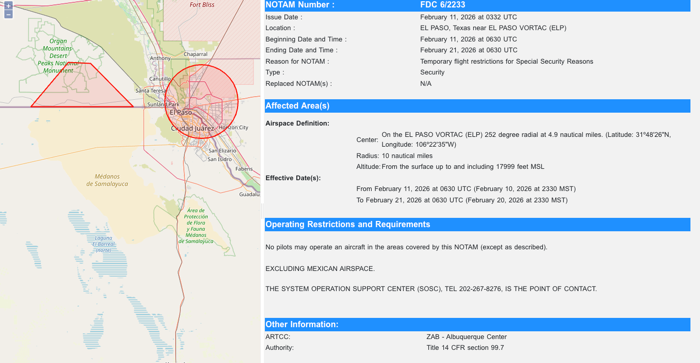
The NOTAM took effect at 11:30 p.m. Mountain Time Tuesday, and expires at 11:30 p.m. Feb. 20, or next Friday.
The El Paso city government issued an advisory earlier that read, “The FAA, on short notice, issued a temporary flight restriction halting all flights to and from El Paso and our neighboring community, Santa Teresa, NM. The restriction prohibits all aircraft operations (including commercial, cargo and general aviation) and is effective from February 10 at 11:30 PM (MST) to February 20 at 11:30 PM (MST).”
Local newspaper El Paso Matters points out:
Closing off airspace over a major U.S. city is a rare action, and officials with the Federal Aviation Administration didn’t immediately respond to questions from El Paso Matters on the reasons for the action.
A person familiar with the notices, who asked not to be identified because they weren’t authorized to speak publicly, said the action to close airspace over a major U.S. city for security reasons over an extended period hasn’t happened since immediately after the terror attacks of Sept. 11, 2001.
Our assessment is that this unusually broad NOTAM over the border town reflects a time-bound, high-issue security concern rather than routine airspace management. It comes as the Trump administration repostures the military to secure the Western Hemisphere, including the early January capture of Nicolas Maduro and ongoing kinetic strikes against suspected narco trafficking vessels.
Related:
One of the consequences of the Trump administration blowing up narco boats and dismantling cartel command-and-control nodes is an increased risk of retaliatory threats against the U.S.
END
UPDATE:\
FAA Lifts El Paso Flight Ban As Reports Claim Military Deployed Counter-Drone Weapon Against Mexican Cartels
Wednesday, Feb 11, 2026 – 09:25 AM
Update (0925ET):
The Federal Aviation Administration announced moments ago that the Notice to Airmen (NOTAM) across the border town of El Paso and a large area of southern New Mexico west of Santa Teresa has been lifted.
The NOTAM that halted all commercial, cargo, and general aviation flights across the region was issued overnight.
END
KING NEWS
| The King Report February 11, 2026 Issue 7678 | Independent View of the News |
| US Economic Data released on TuesdayJanuary NFIB Small Business Optimism 99.3, 99.8 expected, 99.5 priorJanuary 10 ADP Weekly Employment Change 3.75kJanuary 24 ADP Weekly Employment Change 5.0kJanuary 24 ADP Weekly Employment Change 6.5kQ4 Employment Cost Index 0.7%, 0.8% expected and priorDecember Retail Sales 0.0% m/m, 0.4% expected, 0.6% priorDec Retail Sales Ex-Autos 0.0% m/m, 0.4% expected and priorDec Retail Sales Ex-Autos & Gas -0.1% m/m, 0.4% expected, 02% (from 0.4%) prior@MauiBoyMacro: “The Employment Cost Index shows continued deceleration in compensation growth in Q4. All metrics of wage growth are slowing even as inflation has gotten stuck confirming that labor demand < greatly reduced labor supply.” – Julia Coronadohttps://x.com/MauiBoyMacro/status/2021272524105961826Though AI euphoria permeates the market, AI-related capex and soared while money spent on share buybacks has collapsed. Guess what will happen soon! Percent of Operating Cash Flow Spent on Capex vs. Buybacks for S&P 500 StocksBuyback peak of 46% in 2020, now 15% estimated with Capex now 44% https://x.com/MauiBoyMacro/status/2021267198904553643/photo/1Fangs and AI-related stocks were soft after their robust two-day rebound. The DJIA and DJTA rallied moderately. USHs rallied sharply on the soft US economic data and expectations that January NFP, due to released today, will be softer than the expected 65k. The NFP Whisper Number is 36k.Gold and silver were modestly lower in the morning; Bitcoin fell to 67,878.50 at 9:44 ET.Fed’s Hammack Says Rates Could Be on Hold for ‘Some Time’ – BBG 12:00 ETFed’s Hammack: Funds Rate Is Now in the Vicinity of Neutral– BBG 12:00 ETHammack:Inflation Still Too High But Expected to Ease in 2026 – BBG 12:00 ETCleveland Fed’s Hammack:The U.S. Government Is on Unsustainable Fiscal Path – BBGFed’s Hammack: Watching for Build Up of Leverage in Treasury Market – BBG(Note to Hammack: The Treasury market is always massively leveraged!)Dallas Fed’s Logan: Fed’s Rate Target Likely Near Neutral – BBG 13:00 ETDallas Fed’s Logan: Risks of Elevated Inflation Remain – BBG 13:00 ETFed’s Logan: I Have Taken Note of Growth in Treasury Cash-futures Basis Trade – BZG 13:34 ETWith US economic data looking soft and an ugly January NFP looming, Trump resorted to gaslighting.@ElectionWiz: President Trump says the Republicans “should win in a landslide” in the Midterms.“I’m popular and I’ve done well. I think we’ve got the greatest economy ever in history. We’ve got the hottest country anywhere in the world.” https://x.com/ElectionWiz/status/2021274972514115842ESHs opened modestly higher on Monday night but quickly fell and hit a low of 6972.25 (-11.00) at 22:15 ET. A protracted A-B-C rally took ESHs to 6997.50 at 4:16 ET. ESHs then completed a ‘W’ top at 7:28 ET. ESHs sank to a daily low of 6970.50 (-13.25) at 8:10 ET. Aggressive and conditioned buying for the NYSE opening took ESHs to a daily high of 7006.50 (+23.25) at 10:30 ET.The 2nd-Hour Reversal became an A-B-C decline that produced a new minor daily low (6969.00) at 13:52 ET. ESHs rallied to 6982.25 at 14:32 ET and rolled over. ESHs stair stepped lower until they began a tumble at 15:49 ET that created a new daily low of 6957.00 at 15:56 ET.Positive aspects of previous sessionThe DJIA and DJTA rallied moderately in the morning.US stocks peaked at 10:30 ET; and tumbled late in the session.USHs rallied sharply and commodities dropped, but on economic ebbing angst.Negative aspects of previous sessionFangs and AI-related stocks declined modestly.Ambiguous aspects of previous sessionHow bad will January NFP be?First Hour/Last Hour NYSE Action [S&P 500 Index]: 1st Hour: Up; Last Hour: DownPivot Point for S&P 500 Index [above/below indicates daily trend to traders]: 6950.26Previous session S&P 500 Index High/Low: 6986.83; 6937.53@nicksortor: Israeli PM Benjamin Netanyahu has arrived in Washington, DC for his meeting at the White House with President Trump… https://x.com/nicksortor/status/2021372233591988659Today – Even if you knew the January NFP, you would not know the market reaction. Is bad NFP good for stocks or bad for stocks – or vice versa. The fact that stocks and ESHs peaked at the end of the first hour of NYSE trading and sank late in the session is a big negative for today.ESHs are 18.25, NQAs are +87.50; USHs are +4/32; while SI and AU are up moderately at 21:35 ET.Expected Economic Data: January NFP 65k, Mfg -7k, Rate 4.4%, Labor Participation Rate 62.4%, Wages 0.3% m/m & 3.7% y/y; Workweek 34.2; Benchmark NFP Revision -825k; Jan Federal Budget -$94.4BFed Speakers: KC Pres Schmid 10 ET, Gov Bowman 10:15 ETS&P Index 50-day MA: 6892; 100-day MA: 6806; 150-day MA: 6673; 200-day MA: 6485DJIA 50-day MA: 48,732;100-day MA: 47,727; 150-day MA: 46,781; 200-day MA: 45,677(Green is positive slope; Red is negative slope) S&P 500 Index (6941.81 close) – BBG trading model Trender and MACD for key time framesMonthly: Trender and MACD are positive – a close below 5896.83 triggers a sell signalWeekly: Trender is positive; MACD is negative – a close below 6443.43 triggers a sell signalDaily: Trender and MACD are negative – a close above 6981.45 triggers a buy signalHourly: Trender and MACD are negative – a close above 6974.12 triggers a buy signal@samba_tv: 48.6M U.S. households tuned in to #SuperBowl LX, representing a 13% decrease from last year’s game. 26.5M U.S. households watched BadBunny’s halftime performance, down 39% from Kendrick Lamar’s 2025 show…Super Bowl fans ‘sickened’ after translating Bad Bunny’s X-rated Spanish lyrics: ‘This is pure degeneracy’https://www.dailymail.co.uk/tvshowbiz/article-15543261/Bad-Bunny-Spanish-lyrics-Super-Bowl.html@mattvanswol: The Democrat Sheriff of Charlotte NC, Gary McFadden, was just completely unable to answer: a) What the 3 branches of government are. b) Which branch he serves under. This is genuinely painful to watch… completely shocking.https://x.com/mattvanswol/status/2020925475560849802GOP @RepThomasMassie: DOJ 1) unredacted an FBI file that LABELS two individuals as co-conspirators; 2) unredacted a file that lists several men who might be implicated; 3) tacitly admitted that Sultan Ahmed Bin Sulayem was the sender of the torture video 1) This is significant because Kash Patel testified to Congress that FBI had no evidence of other sex traffickers. This is FBI’s own 2019 document listing Wexner as coconspirator in child sex trafficking. It wasn’t unredacted until tonight.@DD_Geopolitics:GOP Rep. Lauren Boebert is PSSED, leaving the DOJ reading room after viewing unredacted Epstein files.. Boebert is saying people DISCUSSING child trafficking are being protected behind those redactions. On Ghislaine Maxwell clemency? “I do not. I think Ghislaine Maxwell should get more time and she should definitely be in a harsher prison. It’s absolutely disgusting.”… Trump personally called Boebert to pressure her off the Epstein files… Trump vetoed a clean water project for 50,000 people in her district as punishment. Three weeks ago she said “I don’t give a rip about Epstein.” Now she’s back and she’s angry. What did she see?https://x.com/DD_Geopolitics/status/2021027380249419825Trump Reportedly Called Police About Epstein in 2006, Said Ghislaine Maxwell Was ‘Evil’Newly unsealed Epstein-related court documents reviewed by the Miami Herald include details from a 2019 FBI interview reportedly of former Palm Beach police chief Michael Reiter, in which he describes a 2006 phone call where President Donald Trump said of Jeffrey Epstein, “Thank goodness you’re stopping him, everyone has known he’s been doing this,” even though the president has repeatedly said he didn’t know about Epstein’s alleged crimes at the time they were happening… https://go.forbes.com/l8mTJrJeffrey Epstein made regular payments to Ohio State head of gynecology, records showAlong with quarterly payments, (Mark) Landon also received at least 10 packages from Epstein or his associates between June 28, 2001, and April 12, 2005… On April 11, 2005, a man named Eric messaged Epstein and said, “Dr. Landon’s $25k quarterly payment is due, please approve.” A few hours later, Eric wrote that Epstein’s company had billed businessman Les Wexner and his wife, Abigail, in advance “as we have in prior years” for the Landon payment…At the time, Les Wexner was Epstein’s only public client…https://wgntv.com/news/jeffrey-epstein-made-regular-payments-to-ohio-state-head-of-gynecology-records-show/Chinese scientists embraced by U.S. colleges worked with Chinese military-linked firmsAmerican colleges have admitted Chinese scientists who worked at blacklisted Chinese tech firms that serve the CCP’s military and intelligence apparatus, often co-funded by U.S. taxpayers.https://justthenews.com/politics-policy/education/chinese-scientists-us-colleges-worked-huawei-and-other-chinese-militaryKurt Cobain’s death was ‘homicide’: Shocking new forensic investigation questions suicide rulinghttps://www.dailymail.co.uk/news/article-15510941/Kurt-Cobains-suicide-homicide.html@liz_churchill10: An entire generation was lied to. Cobain’s death has been reopened as new revelations are questioning Courtney Love’s ties to the CIA and Sex-trafficking and if they played a role.https://x.com/liz_churchill10/status/2021335190241673312/photo/1“No one hates billionaires as much as liberal millionaires.” Noam Blum | |
SWAMP STORIES FOR YOU TONIGHT
FBI Confirms Vote-Counting Irregularities In Georgia 2020 Election
Tuesday, Feb 10, 2026 – 07:40 PM
Last month, FBI agents executed a search warrant in Union City, Georgia, marking a sharp escalation in scrutiny surrounding Fulton County’s handling of the 2020 election. The FBI has now reportedly substantiated major irregularities in vote counting from Fulton County, Georgia, during the 2020 election and is now investigating whether those errors were deliberate violations of federal law.
An affidavit filed by FBI Special Agent Hugh Raymond Evans last month, which was unsealed Tuesday, lays out five categories of confirmed problems in Fulton County’s handling of ballots, raising questions that have simmered for over five years since Trump and his allies raised questions about the election in Georgia and other states where irregularities were alleged.

According to a report from Just the News, Evans filed the affidavit last month to establish probable cause for a raid that seized around 700 boxes of ballots from an Atlanta-area storage warehouse. The investigation stemmed from a referral by Kurt Olsen, President Trump’s election integrity czar. Evans interviewed roughly a dozen unnamed witnesses about allegations tied to the contested Georgia race, where Joe Biden edged out Trump by less than 12,000 votes in the official results.
“Some of those allegations have been disproven while some of those allegations have been substantiated, including through admissions by Fulton County,” Evans wrote.
“This warrant application is part of an FBI criminal investigation into whether any of the improprieties were intentional acts that violated federal criminal laws.”
Fulton County admitted it lacks scanned images of all 528,777 ballots counted during the initial count and of the 527,925 ballots tallied during the state’s first recount.
County officials also confirmed that during the recount, some ballots were scanned multiple times. Ballot images obtained through public records requests show identical markings appearing on duplicated images.
During the Risk Limiting Audit, hand counters reported vote totals for batches that didn’t match the actual votes inside those batches.
According to the affidavit, “The State’s Performance Review Board reported that Secretary of State investigators confirmed inaccurate batch tallies from the Risk Limiting Audit.”
Then there’s the matter of the pristine absentee ballots.
Auditors assisting in the Risk Limiting Audit reported counting supposed absentee ballots that had “never been creased or folded, as would be required for the ballot to be mailed to the voter and for the ballot to be returned in the sealed envelope requiring the voter’s signature for authentication.”
The timeline adds another wrinkle.
On the deadline day to report recount results, Fulton County initially declared a total of 511,343 ballots—17,434 fewer than the original count. By the next day, that number had jumped to 527,925. Thousands of ballots, more than Joe Biden’s margin of victory, had simply appeared overnight.
“If these deficiencies were the result of intentional action, it would be a violation of federal law regardless of whether the failure to retain records or the deprivation of a fair tabulation of a vote was outcome determinative for any particular election or race,” Evans said.
“Many of the claims made in the affidavits were previously vetted by the Georgia State Election Board and through litigation,” reports Fox News Digital. “Trump and his lawyers at the time lost all of their cases after judges found they either did not have standing to bring the lawsuits or that the allegations lacked merit.”
For years, officials insisted the 2020 process was sound, dismissing concerns as conspiracy theories.
What remains unclear is whether the problems resulted from incompetence, chaos, or intent.
That’s the question the FBI is now trying to answer. For those who spent the last five years arguing that Georgia’s election administration deserved scrutiny, the affidavit offers a measure of vindication.
END
Panic Ensues After Trump Orders CIA To Give 2020 Election Intel To ‘Stop The Steal’ Lawyer
Tuesday, Feb 10, 2026 – 11:25 PM
President Donald Trump has instructed the CIA and other spy agencies to hand over intelligence related to the 2020 election, a bunch of (presumably panicked) US intelligence officials told Politico and NBC News.
The records are to be handed over to Kurt Olsen – now a temporary government employee in the White House – who four years ago was involved in the “Stop the Steal” campaign to determine whether Joe Biden won the 2020 election via cheating.

And you know they’re freaking out by the way they tell us this…
“The administration last year hired Kurt Olsen, who more than five years ago took part in the “Stop the Steal” campaign that promoted baseless claims of widespread voter fraud, to investigate the 2020 election.” –NBC News
…
President Donald Trump has directed top U.S. spy agencies to share sensitive intelligence about the 2020 election with his former campaign lawyer, known for pushing debunked theories of electoral fraud, according to four people with knowledge of the effort. –Politico
Indeed:

“The president has asked Mr. Olsen to look at intelligence related to the 2020 election and the agency is ensuring that he has the access necessary to do his work,” a CIA official told NBC in an emailed statement (probably right after hanging up with the reporter).
When asked about Olsen’s role, the White House told the outlet “President Trump has the authority to provide access to classified material to individuals as he deems necessary. The entire Trump administration is working together to ensure the integrity of U.S. elections.”
The admin did not specifically respond to questions about whether Olsen was focusing only on the 2020 election, or possible security threats to future elections.
The freakout comes after the FBI’s recent search of an elections center in Fulton County, Georgia – where they seized ballots from the 2020 election.
Now check out the tone over at Politico:
The decision to provide some of the government’s most sensitive spy material to Olsen is unusual, given that he has no known experience working with the U.S. spy community and only joined the Trump administration as a short-term special government employee in October 2025. Special government employees are supposed to work no more than 130 days during any period of 365 days, suggesting his time at the White House could end soon.
The first person said that Olsen has passed a background check and a polygraph exam. It is not clear how close Olsen is to completing his report on the 2020 elections.
Intelligence analysis is supposed to be nonpartisan, and it appears Olsen’s views on electoral fraud in prior U.S. elections are so deeply held that even some people close to the president question his ability to evaluate the material shared with him.
“This guy has no background” in intelligence, said the second person, a close Trump ally. Olsen “will find some super classified report, say it’s evidence of fraud, but really it’s just completely out of context.”
…
Olsen rose to prominence by working closely with Trump to undermine the results of the 2020 election under the slogan “Stop the Steal.” He urged several DOJ officials that year to file a complaint to the Supreme Court scrutinizing Trump’s loss, and even called the president multiple times during the Jan. 6, 2021, attack on the Capitol
Wow!
About That Raid
As we noted earlier Tuesday, an affidavit filed by FBI Special Agent Hugh Raymond Evans last month, which was unsealed Tuesday, lays out five categories of confirmed problems in Fulton County’s handling of ballots, raising questions that have simmered for over five years since Trump and his allies raised questions about the election in Georgia and other states where irregularities were alleged.
According to a report from Just the News, Evans filed the affidavit last month to establish probable cause for a raid that seized around 700 boxes of ballots from an Atlanta-area storage warehouse. The investigation stemmed from a referral by Kurt Olsen, President Trump’s election integrity czar. Evans interviewed roughly a dozen unnamed witnesses about allegations tied to the contested Georgia race, where Joe Biden edged out Trump by less than 12,000 votes in the official results.
“This warrant application is part of an FBI criminal investigation into whether any of the improprieties were intentional acts that violated federal criminal laws.”
Fulton County admitted it lacks scanned images of all 528,777 ballots counted during the initial count and of the 527,925 ballots tallied during the state’s first recount.
County officials also confirmed that during the recount, some ballots were scanned multiple times. Ballot images obtained through public records requests show identical markings appearing on duplicated images.
During the Risk Limiting Audit, hand counters reported vote totals for batches that didn’t match the actual votes inside those batches.
According to the affidavit, “The State’s Performance Review Board reported that Secretary of State investigators confirmed inaccurate batch tallies from the Risk Limiting Audit.”
More on that here…
GREG HUNTER…INTERVIEWING CHARLES NENNER
Big Losses for Banks Coming in 2026 – Charles Nenner
By Greg Hunter On February 10, 2026 In Market Analysis, Political Analysis2 Comments

By Greg Hunter’s USAWatchdog.com
Last April, renowned geopolitical and financial cycle expert Charles Nenner predicted a depression cycle starting at the end of 2025 into 2026. The economy is clearly slowing down, and the latest “1 million plus” negative jobs revision that comes out Wednesday (2/11/26) certainly points to a tanking economy. Nenner says, “I have to adjust for all the immigrants let into the country, but we will soon see unemployment numbers go up.”
The next big downward surprise for the economy is big losses for the banks. Nenner predicts, “The institutions I work with that are selling real estate in New York are telling me a lot of banks are already negative. If you look in their books in California, they already had these big losses. They did not get out of their bonds because they thought interest rates would never go up. There are a lot of things that are already wrong, but it has not come out yet. I don’t know if there are going to be failures, but it will come out, and they will have big losses when they have to show the books.”
So, what is Nenner predicting will happen with the troubled banks? Nenner says, “I guess the Fed will step in or the government will step in . . . because if you are a banker and you lose a fortune, then you are always bailed out with tax money. This is why they never improve.”
With gold and silver, there is good news and bad news. First comes the bad news. I asked Nenner if he would be a buyer of silver and gold now? Nenner says, “No, not right now because the cycle is down for the moment. . .. It is the same thing for gold. The cycle is down. If we close below $4,700, we will get some downside price targets. Usually, things that go up fast also go down fast. It’s not over for gold and silver; it’s just a correction.”
Nenner put his clients in gold at $1,600 an ounce, and he bought silver at $29 per ounce. Now comes the good news, as Nenner points out, “The bull market for gold and silver will continue to the end of 2027. By then, we can do some fine tuning.”
On the war cycle, good news—for now. In the Middle East, Nenner says, “Right now, the war cycle is not going to heat up.” How about the war cycle for Europe and Russia? Nenner says, “No, they are not going to heat up either. The war cycles are topping right now. It’s not going to heat up for the short term.” Nenner is still worried about China and Taiwan at some point in the future. The really bad news on the war cycle comes in the 2030 to 2032 time frame. Nenner says, “The 2030 to 2032 war cycle is going to be very bad. There are going to be a lot of casualties. They start shooting rockets, and how many people are going to die? I think it will be in the billions of people, and that is what the numbers show.”
Nenner warns of terrorists let into the country by the Biden Administration that could set off bombs in the US “on a big scale.” Nenner contends this will be part of the war cycle that comes at the end of this decade. Nenner also said Trump could help cushion the financial fall of the USA, but he could not stop the down financial cycle. Nenner pointed out, “You cannot stop winter, but you can get a winter coat, and Trump is a winter coat.” Now, Nenner says, “There was so much damage done to America that Trump can’t fix it. . .. The cycle is turning down, and you can’t do anything about it.” Nenner also predicted in January of 2024 that President Trump “would be coming back.”
So, let’s all pray to God the Father and His Son Jesus for divine help.
There is much more in the 49-minute interview.
Join Greg Hunter of USAWatchdog as he goes One-on-One with renowned cycle analyst and financial expert Charles Nenner for 2.10.26.
For The Wellness Company “Parasite Cleanse” with Ivermectin and Mebendazole, click here.
Don’t forget $90 off and free shipping with promo code USAWATCHDOG .
After the Interview:
There is free information and analysis on CharlesNenner.com.
You can also sign up to be a subscriber for Nenner’s cutting edge cycle work with a free trial period by clicking here. (No credit card is required, and the free trial period lasts for 30 days.)
(USAW does not get compensated by Nenner in any way. We post this as a courtesy.)
This segment is sponsored by Discount Gold and Silver Trading. Ask for Melody Cedarstrom, the owner, at 1-800-375-4188.
END
SEE YOU TOMORROW
H


 harveyorganblog.com