
GOLD CLOSED CLOSED DOWN $136.55 TO $4884.90
ACCESS MARKET
GOLD $4876.00 3:30 PM)
SILVER: 73.34 3;30 PM)
XXXXXXXXXXXXXXXXXXXXXXXXXXXXXXXXXXXXXXXXXXXXXXXXXX
EXCHANGE: COMEX
EXCHANGE: COMEX
CONTRACT: FEBRUARY 2026 COMEX 100 GOLD FUTURES
SETTLEMENT: 5,022.000000000 USD
INTENT DATE: 02/13/2026 DELIVERY DATE: 02/18/2026
FIRM ORG FIRM NAME ISSUED STOPPED
118 H MACQUARIE FUTURES US 20
190 H BMO CAPITAL MARKETS 110
323 C HSBC 1
363 H WELLS FARGO SECURITI 17
365 C MAREX CAPITAL MARKET 1
555 C BNP PARIBAS SEC CORP 36
555 H BNP PARIBAS SEC CORP 2
657 C MORGAN STANLEY 1
661 C JP MORGAN SECURITIES 242 19
880 H CITIGROUP 33
905 C ADM 2
TOTAL: 242 242
MONTH TO DATE: 36,092
JPMORGAN STOPPED 35/414
GOLD: NUMBER OF NOTICES FILED FOR FEBRUARY/2026: 242 CONTRACTs NOTICES FOR 24,200 OZ or 0.7527 TONNES
total notices so far: 36,092 contracts for 3,609,200 OR 112 262 tonnes)
SILVER NOTICES: 0 NOTICE(S) FILED FOR NIL OZ /
total number of notices filed so far this month : 4,595 CONTRACTS (NOTICES) for 22.975 million oz
SILVER//OUTLINE
INITIAL STANDING FOR JANUARY: 22.915 MILLION OZ FOLLOWED BY TODAY’S 1.185 MILLION OZ QUEUE JUMP//NEW NORMAL STANDING ADVANCES TO 49.445 MILLION OZ// TO WHICH WE ADD OUR FIRST EXCHANGE FOR RISK FOR .100 MILLION OZ//NEW STANDING ADVANCES TO 49.545 MILLION OZ!!
INTIAL STANDING FOR FEBRUARY/SILVER: 13.505 MILLION OZ FOLLOWED BY TODAY’S 0.115 MILLION OZ QUEUE JUMP//NEW STANDING FOR SILVER AT THE COMEX ADVANCES TO 24.185 MILLION OZ. BUT WE MUST ADD OUR FIRST EXCHANGE FOR RISK OF 25 CONTRACTS FOR .125 MILLION OZ AND THEN OUR SECOND EXCHANGE FOR RISK OF .0600 MILLION OZ//
NEW TOTALS FOR SILVER OZ STANDING IS AS FOLLOWS
NORMAL STANDING 24.185 MILLION OZ
PLUS OUR 2 EXCHANGE FOR RISK: 185,000 OZ
EQUALS
24.365 MILLION OZ!! HUGE FOR A FEBRUARY
JULY: 50.925 MILLION OZ (QUITE SMALL)
AUGUST: 59.455 MILLION OZ (QUITE SMALL)
SEPT. 50.510 MILLION OZ.(QUITE SMALL)
OCT; 82.020 MILLION OZ (WILL BE STRONG THIS MONTH)/ OCC WANTS TO REIN IN THESE ISSUANCES!
NOVEMBER: 36.425 MILLION OZ
DEC: 45.765 MILLION OZ
JANUARY 2026: 134.270 MILLION OZ (WILL BE A VERY STRONG MONTH FOR EXCHANGE FOR PHYSICAL!)
FEB : 41.92 MILLION OZ
AND JULY: 46.720 MILLION OZ//
AUGUST: 4.70 MILLION OZ INITIAL STANDING PLUS TODAY;S 5,000 OZ QUEUE JUMP //NEW STANDING ADVANCES TO 10.960 MILLION OZ
SEPTEMBER: 68.040 MILLION OZ NORMAL DELIVERY(INCLUDES ALL QUEUE JUMPING AND EXCHANGE FOR PHYSICAL TRANSFERS) PLUS 3.0 MILLION OZ EX FOR RISK = 71.040 MILLION OZ. (THIS IS THE FIRST AND ONLY ISSUANCE OF EXCHANGE FOR RISK FOR SILVER SINCE MAY.)
OCTOBER: 39.565 MILLION OZ OF NORMAL DELIVERY INCLUDES ALL QUEUE JUMPING
PLUS
2.110 MILLION OZ EXCHANGE FOR RISK//TOTAL OZ STANDING IN OCT ADVANCES TO 41.675 MILLION OZ
NOVEMBER: INITIAL STANDING AT 11.575 MILLION OZ FOLLOWED BY TODAY’S 195,000 OZ QUEUE JUMP WHICH FOLLOWS ALL OTHER QUEUE JUMPS OF 9.155 MILLION OZ//STANDING ADVANCES TO 19.670 MILLION OZ/
DECEMBER: INITIAL AMOUNT STANDING FOR DELIVERY: 49.33 MILLION OZ// FOLLOWED BY ANOTHER STRONG 835,000OZ QUEUE JUMP+ DEC. FIRST EXCHANGE FOR RISK 0F .850 MILLION OZ + LAST WEEK.S 495,000 OZ EXCHANGE FOR RISK AND THEN A 3RD ISSUANCE IF 1.00MILLION OZ THEN FINALLY DEC 249ISSUANCE OF 1.35 MILLION OZ EXCHANGE FOR RISK//NEW TOTAL EX FOR RIS IS 3.685 MILLION OZ // STANDING ADVANCES TO 68.415 MILLION OZ//
JANUARY: INITIAL STANDING 22.915 MILLION OZ FOLLOWED BY TODAY’S 1.185 MILLION OZ QUEUE JUMP//NORMAL STANDING ADVANCES TO 49.445 MILLION OZ// TO WHICH WE ADD OUR FIRST EXCHANGE FOR RISK OF 0.100 MILLLION OZ//NEW STANDING ADVANCES TO 49.545 MILLION OZ
FEB: 13.399 MILLION OZ IS OUR INITIAL STANDING FOR SILVER! TO WHICH WE ADD OUR NEXT QUEUE JUMP OF 0.155 MILLION OZ AND THEN ADD OUR 2 EXCHANGE FOR RISK FOR .185 MILLION OZ STANDING ADVANCES TO 24.365 MILLION OZ!!
- MAY: SUMMARY FOR MAY TONNES WHICH STOOD FOR DELIVERY:
4. AUGUST: 60.547 TONNES OF INITIAL GOLD FIRST DAY NOTICE FOLLOWED BY THE NET MONTH’S QUEUE JUMP OF 47.2312 TONNES TO WHICH WE ADD THE FOLLOWING EXCHANGE FOR RISK ISSUANCE RECEIVED FOR THE MONTH: 5.4432 TONNES EX FOR RISK/AUG 7 , AUG 11: 2.413 TONNES EX FOR RISK AND AUG. 12 OF 2.637 TONNES EX FOR RISK//AUG 25: 9.107 TONNES , AUGUST 26: 9.1010 TONNES AND NOW AUGUST 27: 9.0699 TONNES//NEW STANDING ADVANCES TO 107.5117 TONNES OF GOLD NORMAL STANDING (INCLUDES ALL MONTHLY QUEUE JUMPS/EX FOR PHYSICAL TRANSFERS//) +44.696 TONNES EX.FOR RISK = 152.208 TONNES
5.SEPT: INITIAL 8.093 TONNES OF GOLD PLUS TODAY’S QUEUE JUMP OF 0.4883 TONNES PLUS 2.2827 TONNES OF EXCHANGE FOR RISK TODAY//NEW TOTAL EX. FOR RISK/MONTH = 22.923//NEW TOTAL STANDING FOR GOLD SEPT ADVANCES TO = 48.801 TONNES!!
6.OCTOBER: 90.012 TONNES OF INITIAL GOLD STANDING WITH TODAY’S TINY 0.00311 TONNES QUEUE JUMP WHICH FOLLOWS ALL OTHER QUEUE JUMPS DURING OCT OF 76.1656 TONNES
THEN WE MUST ADD OUR 14.553 TONNES OF OUR ISSUANCE OF EXCHANGE FOR RISK/6 OCCASIONS//NEW TOTAL OF GOLD STANDING ADVANCES TO 197.5141 TONNES OF GOLD.
7.NOVEMBER BEGINS WITH 15.651 TONNES INITIALLY STANDING FOR DELIVERY FOLLOWED BY TODAY’S QUEUE JUMP OF 2.323 TONNES FOLLOWED BY ALL PREVIOUS QUEUE JUMPS IN OF OF 21.3775 TONNES TO WHICH WE ADD OUR TWO EXCHANGE FOR RISK ISSUANCE OF 4.5596 TONNES//NEW STANDING ADVANCES TO 43.9716 TONNES OF GOLD.
8. DECEMBER BEGINS WITH INITIAL STANDING OF 83.813 TONNES OF GOLD FOLLOWED BY TODAY’S 0.0TONNE QUEUE JUMP WHICH FOLLOWS ALL OTHER QUEUE JUMPS OF: 37.163 TONNES//NEW STANDING ADVANCES TO 115.390 TONNES TO WHICH WE ADD OUR 4 EXCHANGE FOR RISK FOR DECEMBER OF 6.587 TONNES/NEW STANDING ADVANCES TO 121.977 TONNES
9. JANUARY: INITITAL STANDING: 13.785 TONNES TO WHICH WE ADD OUR QUEUE JUMP OF 0.000 TONNES WHICH FOLLOWS ALL OTHER QUEUE JUMPS OF 30.7117TONNES //NEW TOTAL QUEUE JUMPS 30.7117//NORMAL DELIVERY OF GOLD ADVANCES TO 36.8958 TONNES TO WHICH WE ADD OUR SIX EXCHANGE FOR RISK OF 22.315 TONNES//NEW STANDING ADVANCES TO 59.2108 TONNES.
FEB; INITIAL AMOUNT OF GOLD STANDING FOR DELIVERY: 93.567 TONNES OF GOLD TO WHICH WE ADD OUR NEXT QUEUE JUMP OF 0.2624 TONNES TO OTHER OF 40.1866 TONNES/ NEW QUEUE JUMP TOTAL:40.449 TONNES// AND THEN WE ADD OUR FOUR EXCHANGE FOR RISK: 8486 CONTRACTS OR 26.395 TONNES//NEW STANDING ADVANCES TO 152.345 TONNES
FINAL STANDING FOR GOLD, JANUARY CONTRACT AT 59.2108 TONNES OF GOLD
AND NOW FEBRUARY: INITIAL STANDING FOR GOLD: 152.345 TONNES!! WHICH INCLUDES ALL QUEUE JUMPING AND OUR FOUR ISSUANCES EXCHANGE FOR RISK!!
JAN. 2025: 257.919 TONNES (ISSUANCE WILL BE PRETTY GOOD THIS MONTH BUT MUCH LOWER THAN LAST MONTH)
FEB: 207.21 TONNES//EX FOR PHYSICAL ISSUANCE (WILL BE A FAIR SIZED ISSUANCE THIS MONTH)
MARCH 130.84 TONNES//QUITE SMALL THIS MONTH.
APRIL; 208.57 TONNES. STRONG THIS MONTH
MAY: 113.499 TONNES OF GOLD EFP ISSUANCE//QUITE SMALL THIS MONTH
JUNE: 97.79 TONNES OF GOLD EFP ISSUANCE/EXTREMELY SMALL
JULY : 150.877 TONNES// QUITE SMALL
AUGUST: 175.86 TONNES A LOT LARGER THIS MONTH.
SEPT. 116.13 TONNES VERY SMALL
OCT. 252.72 TONNES//CERTAINLY MUCH LARGER THIS MONTH/VERY STRONG
NOV: 124.74 TONNES
DEC: 190.04 TONNES//GOOD SIZED THIS MONTH FINAL.
TOTAL EXCHANGE FOR PHYSICAL ISSUED FOR YEAR 2025: 2,026.20 TONNES (LOWER THAN LAST YR 2,569.00 TONNES
JANUARY: 209.08 TONNES (WILTONNES (WILL BE A STRONG MONTH FOR EXCHANGE FOR PHYSICAL)
FEB. 105.594 TONNES (WHICH WILL BE ANOTHER STRONG)
SPREADING LIQUIDATION HAS NOW COMMENCED AS WE HEAD TOWARDS THE NEW ACTIVE FRONT MONTH OF OCT. WE ARE NOW INTO THE SPREADING OPERATION OF GOLD
HERE IS A BRIEF SYNOPSIS OF HOW THE CROOKS FLEECE UNSUSPECTING LONGS IN THE SPREADING ENDEAVOUR ;MODUS OPERANDI OF THE CORRUPT BANKERS AS TO HOW THEY HANDLE THEIR SPREAD OPEN INTERESTS:HERE IS HOW THE CROOKS USED SPREADING AS WE ARE NOW INTO THE NON ACTIVE DELIVERY MONTH OF NOV HEADING TOWARDS THE ACTIVE DELIVERY MONTH OF FEB., FOR GOLD: AND MARCH FOR SILVER
YOU WILL ALSO NOTICE THAT THE COMEX OPEN INTEREST STARTS TO RISE BUT SO IS THE OPEN INTEREST OF SPREADERS. THE OPEN INTEREST IN WILL CONTINUE TO RISE UNTIL ONE WEEK BEFORE FIRST DAY NOTICE OF AN UPCOMING ACTIVE DELIVERY MONTH (OCT), AND THAT IS WHEN THE CROOKS SELL THEIR SPREAD POSITIONS BUT NOT AT THE SAME TIME OF THE DAY. THEY WILL USE THE SELL SIDE OF THE EQUATION TO CREATE THE CASCADE (ALONG WITH THEIR COLLUSIVE FRIENDS) AND THEN COVER ON THE BUY SIDE OF THE SPREAD SITUATION AT THE END OF THE DAY. THEY DO THIS TO AVOID POSITION LIMIT DETECTION. THE LIQUIDATION OF THE SPREADING FORMATION CONTINUES FOR EXACTLY ONE WEEK AND ENDS ON FIRST DAY NOTICE.”
WHAT IS ALARMING TO ME, ACCORDING TO OUR LONDON EXPERT ANDREW MAGUIRE IS THAT THESE EFP’S ARE BEING TRANSFERRED TO WHAT ARE CALLED SERIAL FORWARD CONTRACT OBLIGATIONS AND THESE CONTRACTS ARE LESS THAN 14 DAYS. ANYTHING GREATER THAN 14 DAYS, THESE MUST BE RECORDED AND SENT TO THE COMPTROLLER, GREAT BRITAIN TO MONITOR RISK TO THE BANKING SYSTEM. IF THIS IS INDEED TRUE, THEN THIS IS A MASSIVE CONSPIRACY TO DEFRAUD AS WE NOW WITNESS A MONSTROUS TOTAL EFP’S ISSUANCE AS IT HEADS INTO THE STRATOSPHERE.
The crooks also use the spread in the TAS account (trade at settlement). They buy the spot TAS (e.g. June) and sell the future TAS two months out (e.g. August). Then they unload the front month (i.e. unload the buy side first so the price of gold/silver falls. This occurs in the middle of the front delivery month cycle. They unload the sell side of the equation, two months down the road. The crooks violate position limits as the OCC refuse to hear our complaints.
First, here is an outline of what will be discussed tonight:
1.TODAY WE HAD THE OPEN INTEREST AT THE COMEX IN SILVER ROSE BY A HUGE SIZED 726 CONTRACTS OI TO 133,180 AND CLOSER TO THE COMEX HIGH RECORD //244,710( SET FEB 25/2020). THE LAST RECORDS WERE SET IN AUG.2018 AT 244,196 WITH A SILVER PRICE OF $14.78/(AUGUST 22/2018)..THE PREVIOUS RECORD TO THAT WAS SET ON APRIL 9/2018 AT 243,411 OPEN INTEREST CONTRACTS WITH THE SILVER PRICE AT THAT DAY: $16.53). AND PREVIOUS TO THAT, THE RECORD WAS ESTABLISHED AT: 234,787 CONTRACTS, SET ON APRIL 21.2017 OVER 7 YEARS AGO. HOWEVER WE HAVE NOW SET A NEW RECORD LOW OF 114,102 CONTRACTS JULY 3.2023
EFP ISSUANCE 615 CONTRACTS
OUR CUSTOMARY MIGRATION OF COMEX LONGS CONTINUE TO MORPH INTO LONDON FORWARDS AS OUR BANKERS USED THEIR EMERGENCY PROCEDURE TO ISSUE:
MAR 615 CONTRACTS and 0 ALL OTHER MONTHS: ZERO. TOTAL EFP ISSUANCE: 0 CONTRACTS. EFP’S GIVE OUR COMEX LONGS A FIAT BONUS PLUS A DELIVERABLE PRODUCT OVER IN LONDON. IF WE TAKE THE COMEX OI GAIN OF 913 CONTRACTS AND ADD TO THE 615 E.FP. ISSUED
WE OBTAIN A MEGA HUGE SIZED GAIN OF 1341 OF OPEN INTEREST CONTRACTS FROM OUR TWO EXCHANGES WITH OUR GAIN OF $2.35
THUS IN OUNCES, THE GAIN ON THE TWO EXCHANGES TOTALS 6.705 MILLION PAPER OZ
OCCURRED WITH OUR GAIN IN PRICE.OF $2.35
2.ASIAN AFFAIRS FEB 17/2025
SHANGHAI CLOSED
/
Hang Seng CLOSED
// Nikkei CLOSED DOWN 239.42 PTS OR 0.42%
//Australia’s all ordinaries CLOSED UP 0.31%
//Chinese yuan (ONSHORE) CLOSED UP TO 6.9087
/ OFFSHORE CLOSED DOWN AT 6.8876 Oil UP TO 64.05 dollars per barrel for WTI and BRENT UP TO 68.95 Stocks in Europe OPENED ALL GREEN
ONSHORE USA/ YUAN TRADING UP TO 6.9087 OFFSHORE YUAN TRADING UP TO 6.8876 ONSHORE YUAN TRADING BELOW OFF SHORE AND UP ON THE DOLLAR// / AND THUS STRONGER//OFF SHORE YUAN TRADING UP AGAINST US DOLLAR/ AND THUS STRONGER
XXXXXXXXXXXXXXXXXXXXXXXX
1. COMEX DATA//AMOUNTS STANDING//VOLUME OF TRADING/INVENTORY MOVEMENTS
LET US BEGIN:
THE TOTAL COMEX GOLD OPEN INTEREST ROSE BY A FAIR SIZED 2275 CONTRACTS UP TO 408,683 OI WITH OUR HUGE GAIN IN PRICE OF $94.30 WITH RESPECT TO FRIDAY’S // TRADING/ //COMEX CLOSING TIME:… WE LOST ZERO NET LONGS, WITH THAT PRICE GAIN FOR GOLD . AND AS YOU WILL SEE BELOW, OUR GAIN IN PRICE ALSO HAD A FAIR NUMBER OF EXCHANGE FOR PHYSICAL ISSUED (1990).
WE HAD ZERO T.A.S. LIQUIDATION FRIDAY. IT SEEMS THAT THE SPECULATORS STARTED AGAIN TO GO LONG THIS WEEK AFTER A BRIEF PERIOD OF GOING NET SHORT. HOWEVER THE LONG SPECULATORS WERE REWARDED WITH OUR HUGE GAIN IN PRICE.
CENTRAL BANKS TENDERED THEIR NEW LONG CONTRACTS AT THE END OF THE DAY FOR PHYSICAL GOLD. YOU CAN VISUALIZE THIS WITH THE MASSIVE AMOUNT OF GOLD STANDING AT THE COMEX FOR THIS FEBRUARY CONTRACT MONTH!!
YOU WILL NOTICE THAT THE COMEX OI IS NOW BACK TO AN EXTREMELY LOW OI OF AROUND 412,000 TO NOW 408,683 AND NOW AMPLE ENOUGH TO GROW AND FROM THIS POINT FORTH IT WILL BE DIFFICULT TO FLEECE. THE ALL TIME LOW OF COMEX OI IS 390,000 CONTRACTS WHICH OCCURRED IN 2001 WITH GOLD AROUND $260. FROM CHINA WE LEARN THAT TODAY, THE GOLD LEASE RATE IS NOW AROUND 5 %
WE THUS HAD A TOTAL GAIN IN OI ON BOTH OF OUR EXCHANGES, THE COMEX AND LONDON’S EXCHANGE FOR PHYSICAL EQUATING TO 4265 CONTRACTS (OR 21.325TONNES) WITH THE HUGE GAIN IN PRICE, FRIDAY.
THEN WE WERE NOTIFIED OF A MONSTER 2210 CONTRACT EXCHANGE FOR RISK ISSUANCE IN GOLD CONTRACTS FOR 221,000 OZ OR 6.874 TONNES OF GOLD. THIS PAST WE WE HAVE HAD TWO IDENTICAL MONSTER 3000 CONTRACT ISSUED FOR THE SAME 9.33 TONNES OF GOLD, AND THESE ARE THE HIGHEST EVER IN TONNAGE ISSUED. ALTOGETHER THE TOTAL ISSUANCE THUS FAR FOR FEB NOW TOTALS FOUR.
A LITTLE HISTORY OF EXCHANGE FOR RISK DECEMBER THROUGH TO FEBRUARY:
IN DECEMBER WE HAVE RECORDED 5 ISSUANCES OF EXCHANGE FOR RISK/4 FOR DEC AND THE LAST ONE ON DEC 31 FOR JANUARY. WE NOW HAVE 3 CHOICES FOR THE RECIPIENT OF THIS ISSUANCE AND IT MUST BE A CENTRAL BANK. YOU WILL RECALL THAT THE BUYER ASSUMES THE RISK OF THAT DELIVERY. (THUS TOTAL EXCHANGE FOR RISK FOR THE MONTH OF DECEMBER IS 6.56 TONNES/4 OCCASIONS.
MONTH OF JANUARY/EXCHANGE FOR RISK
IN JANUARY THEY HAVE 6 TOTAL ISSUANCE : 3.446 TONNES EARLY, THEN JAN 9 ISSUANCE OF 9,331 TONNES AND THEN JAN 16: 0.1996 TONNES JAN 26: 1.499 TONNES, JAN 27: 3.160 AND FINALLY JAN 29: 4.659 TONNES TONNES//TOTAL EXCHANGE FOR RISK JANUARY 22.315 TONNES WHICH WAS ADDED TO OUR NORMAL DELVERIES.
AND NOW FEBRUARY:
FEB EXCHANGE FOR RISK: NOW 3 ISSUANCES: 8486 CONTRACTS FOR 848,600 OZ OR 26.395 TONNES!
HERE ARE THE CHOICES FOR THE RECIPIENT OF THOSE ISSUANCES:
1 THE CENTRAL BANK OF ENGLAND. BUT THEY RECEIVED CLEARANCE THAT THEIR GOLD IS BACK SO IT IS NOT LIKELY THAT THEY WOULD LIKE TO ADD TO THEIR RESERVES.
2. THE CENTRAL BANK OF THE USA: THE FED. LOGICAL CHOICE AS THEY CLAMOUR TRYING TO REDUCE THEIR 56+ TONNES OF SHORTAGE. HOWEVER THEY SEEM NOT TO BE IN A HURRY TO COVER THEIR HUGE SHORTFALL
3. THE CENTRAL BANK OF CHINA AS THEY BATTLE WITS WITH THE USA.
TOTAL EXCHANGE FOR RISK FOR DECEMBER IS 6.56 TONNES AND THIS WAS ADDED TO OUR NORMAL DELIVERY TOTALS..
THE JANUARY ISSUANCE OF 17.656 TONNES WAS ADDED TO OUR DAILY TOTALS!!
FEBRUAY ISSUANCES 4 FOR; 26.395 TONNES SO FAR!!
DETAILS ON OUR NEW FEBRUARY COMEX CONTRACT MONTH//
IN TOTAL WE HAD A STRONG SIZED GAIN ON OUR TWO EXCHANGES OF 4265 CONTRACTS WITH OUR HUGE GAIN IN PRICE. HOWEVER, OUR FRIENDLY PHYSICAL LONDON BOYS HAD ANOTHER FIELD DAY AGAIN THROUGHOUT OF THE WEEK AS THEY WERE READY FOR THE FRBNY.S CONTINUED ORCHESTRATED ATTACKS VERY EARLY IN THE COMEX SESSIONS AS THEY TRIED TO ABSORB EVERYTHING IN SIGHT FROM THEIR DAILY ATTACKS. LONDONERS EXERCISED THEIR BOUGHT CONTRACTS FOR PHYSICAL GOLD VIA THE EXCHANGE FOR PHYSICAL ROUTE AND THANKED THE FRBNY AND OUR SHORT SPECULATORS FOR THE THOUGHTFULNESS.
LONDON ANNOUNCED EARLY IN THE YEAR (AND SCARCITY CONTINUES TO THIS DAY) THAT THEY WERE OUT OF GOLD. WRONGLY IT WAS ATTRIBUTED TO THEIR SHIPPING PHYSICAL GOLD TO COMEX FOR STORAGE DUE TO TRUMP’S INITIATION OF TARIFFS. THE TRUTH OF THE MATTER IS THAT THIS GOLD LEFT LONDON TO OTHER CENTRAL BANKS, AND COMEX BANKS HAVE BEEN PAPERING THEIR LOSSES (DERIVATIVE) WITH KILOBAR ENTRIES. BOTH COMEX AND LBMA ARE WITNESSING MASSIVE AMOUNTS OF GOLD LEAVING THEIR VAULTS.
THE LIQUIDATION OF T.A.S. CONTRACTS THROUGHOUT THE MONTHS OF JUNE THROUGH FEBRUARY/ CONTINUES TO DISTORT OPEN INTEREST NUMBERS GREATLY ALTHOUGH THE T.A.S. ISSUANCES IN GOLD HAVE GENERALLY BEEN ON THE LOW SIDE COMPARED TO SILVER WHICH HAVE BEEN HUGE. TODAY’S NUMBER IS A HUGE SIZED T.A.S ISSUANCE CONTRACTS.THE CME NOTIFIES US THAT THEY HAVE ISSUED 1090 T.A.S CONTRACTS AND WILL BE USED FOR RAID PURPOSES TO STOP GOLD’S RISE AND TO TEMPER HUGE LOSSES IN OTC DERIVATIVE BETS AND IT WAS IN FULL FORCE DURING LAST WEEK AND CONTINUING ON THIS WEEK. IT SURE LOOKS LIKE THE BIS HAS SOMEHOW LOOKED THE OTHER WAY WITH ITS GOLD SWAPS WITH THE FRBNY AS THIS ENTITY FOR THE FED REFUSES THE BIS MARCHING ORDERS TO COVER AND THAT MAY EXPLAIN THE STRONG NUMBER OF T.A.S. ISSUANCES IN DECEMBER , JANUARY AND THROUGHOUT FEBRUARY TO GO ALONG WITH OUR HUGE NUMBER OF EXCHANGE FOR RISK ISSUED DURING THESE MONTHS INCLUDING FEBRUARY’S 4 EXCHANGE FOR RISK INCLUDING TWO MONSTER 9.3312 TONNE ISSUANCE (FEB 10 AND FEB 12). TOTAL EXCHANGE FOR RISK/FEB EQUALS 26.416 TONNES!! OTHER CENTRAL BANKS ARE PAYING ATTENTION AS THEY TAKE DELIVERY OF HUGE AMOUNTS OF PHYSICAL GOLD.
FOR EXAMPLE:
HERE IS A SUMMARY OF GOLD STANDING FOR DELIVERY ON OUR LAST 11 MONTHS:
- FOR APRIL AT 209 TONNES
2. AND THIS CONTINUED INTO MAY WITH FINAL STANDING AT 90.23 TONNES.
3. JUNE WHICH IS A HUGE DELIVERY MONTH , FINAL STANDING WAS RECORDED AT A STRONG 93.085 TONNES. //(TOTAL NET QUEUE JUMPING FOR THE JUNE MONTH: 31.027 TONNES.)
4. IN JULY WE HAD HUGE DELIVERY NOTICES ESPECIALLY FOR A NON ACTIVE DELIVERY MONTH WITH INITIAL STANDING AT 17.947 TONNES PLUS MANY QUEUE JUMPS + 3.75 TONNES EX FOR RISK = 41.106 TONNES OF GOLD // FINAL TOTAL TONNES STANDING JULY: 41.106 TONNES
5. FOR THE MONTH OF AUGUST:
INITIAL AMOUNT OF GOLD STANDING FOR AUGUST: 60.547 TONNES PLUS THE MONTHS HUGE QUEUE JUMPS OF 47.2312 TONNES +44.696 TONNES EX FOR RISK (7 ISSUANCES) //NEW STANDING 152.208 TONNES WHICH IS MONSTROUS!!!
6. FINAL AMOUNT OF GOLD STANDING FOR SEPT; INITIAL STANDING; 2,602 CONTRACTS OR 260,200 OZ FOR 8.093 TONNES OF GOLD FOLLOWED BY TODAY’S 0.4883 TONNES QUEUE JUMP TO GO ALONG WITH TODAY’S 1.244 TONNES OF EXCHANGE FOR RISK ISSUANCE TODAY AND // TOTAL EXCHANGE FOR RISK ISSUANCE SEPT: 22.923 TONNES//NEW TOTALS STANDING ADVANCES TO 48.801 TONNES OF GOLD!!!
7. OCTOBER:
OCTOBER: INITIAL STANDING FOR GOLD: 90.164 TONNES TO WHICH WE ADD OUR LATEST OCT 30 QUEUE JUMP OF 0.00311 TONNES WHICH FOLLOWS OCT 29 QUEUE JUMP OF .4096 WHICH FOLLOWS; OCT 28 QUEUE JUMP OF .5069 TONNES WHICH FOLLOWS OCT 27 OF 0.3048 TONNES WHICH FOLLOWS: OCT 24 OF 0.8615 TONNES, FOLLOWING OCT 23 QUEUE JUMP OF 1.695 TONNES OCT 22 JUMP OF 8.622 TONNES WHICH FOLLOWS OCT 21: 3.8600 TONNES TO OCT 20 QUEUE JUMP OF 7.695 TONNES WHICH FOLLOWED OCT 17 RECORD SETTING: 12.031 TONNE QUEUE JUMP WHICH FOLLOWED THURSDAY’S QUEUE JUMP OF 8.326 TONNES WHICH FOLLOWED WEDNESDAY;S 6.469 WHICH FOLLOWED ALL PREVIOUS QUEUE JUMPS OF 42.549 TONNES TO WHICH WE ADD OUR TOTAL 4679 EXCHANGE FOR RISK CONTRACTS ON 6 OCCASIONS FOR 467,900 OZ OR 14.553 TONNES.! TOTAL STANDING ADVANCES TO 197.511 TONNES OF GOLD
SUMMARY FOR OCTOBER STANDING:
THAT IS;
a) INITIAL STANDING 90.164 TONNES
b) INITIAL EXCHANGE FOR RISK ISSUANCE OF 500 CONTRACTS FOR 50,000 OZ OR 1.555 TONNES
c) ANOTHER 3 CONSECUTIVE EXCHANGE FOR RISK ISSUANCES OF 2150 CONTRACTS FOR 215000 OZ OR 6.687 TONNES
D) AFTER A ONE DAY HIATUS, A 5TH ISSUANCE FOR 1000 CONTRACTS //100,000 OZ OR 3.1104 TONNES
E) AFTER A TWO WEEK HIATUS: ITS 6TH ISSUANCE FOR 1029 CONTRACTS/102,900 OZ OR 3.200 TONNES
TOTAL EXCHANGE FOR RISK OCT 6 OCCASIONS: 14.553 TONNES
TO WHICH WE ADD ALL OUR QUEUE JUMPING IN OCT: TOTAL MONTH;: 92.7648 TONNES
(ALL OF THESE QUEUE JUMPS ARE REPRESENTED BY CENTRAL BANKS DESPERATELY ADDING TO THEIR OFFICIAL RESERVES)
EQUALS
197.5141 TONNES OF GOLD!!
END
8. NOVEMBER:TOTAL TONNES STANDING INCLUDING ALL QUEUE JUMPS AND EXCHANGE FOR RISK ISSUANCE:
INITIAL GOLD STANDING AT THE COMEX IS 5032 CONTRACTS OR 503,200 OZ (15.651 TONNES) FOLLOWED BY ITS TODAY’S QUEUE JUMP OF 2.323 TONNES/ FOLLOWED BY ALL NOVEMBER QUEUE JUMPS OF 21.3775 TONNES TO WHICH WE ADD OUR SECOND EXCHANGE FOR RISK OF 1016 CONTRACTS FOR 101600 OZ OR 3.165 TONNES TO OUR FIRST EXCHANGE FOR RISK ISSUANCE OF 1.3966 TONNES/// NEW EXCHANGE FOR RISK: 4.5595 TONNES//NEW TOTAL GOLD STANDING IN NOVEMBER ADVANCES TO 43.9716 TONNES
9. DECEMBER: INITIAL AMOUNT OF GOLD STANDING FOR DELIVERY: 83.813 TONNES OF GOLD FOLLOWED BY TODAY’S 0.1337 TONNES OF QUEUE JUMP WHICH FOLLOWS ALL OTHER NET QUEUE JUMPING OF 37.163 TONNES//STANDING ADVANCES TO 115.257 TONNES TO WHICH WE ADD OUR FOUR ISSUANCES OF EXCHANGE FOR RISK OF 6.559 TONNES/NEW STANDING IS THUS: 121.977 TONNES.
10. JANUARY: INITITAL STANDING: 13.785 TONNES TO WHICH WE ADD OUR NEXT QUEUE JUMP OF 0,000 TONNES WHICH FOLLOWS ALL OTHER QUEUE JUMPS OF 30.7117TONNES //NEW TOTAL QUEUE JUMPS 30.7117//NORMAL DELIVERY OF GOLD ADVANCES TO 36.8958 TONNES TO WHICH WE ADD OUR SIX EXCHANGE FOR RISK OF 22.315 TONNES//NEW STANDING ADVANCES TO 59.2108 TONNES.
11.FEB; 0. FEBRUARY: INITIAL STANDING: 93.566 TONNES TO WHICH WE HAD OUR NEXT QUEUE JUMP OF 0.2645 TONNES ADDING TO ALL OTHER QUEUE JUMPS OF 40.1866 TONNNES//NEW TOTAL QUEUE JUMP: 40.449/ STANDING ADVANCES TO 125.950 TONNES TO WHICH WE ADD OUR FOUR EXCHANGE FOR RISK OF 26.395 TONNES/NEW STANDING ROCKETS TO 152.345 TONNES!!
THE FED IS THE OTHER MAJOR SHORT IN GOLD OF AROUND 106+ TONNES OF GOLD OWING TO THE B.I.S. THE OCC ORDERED ALL BANKS TO COVER THEIR GOLD LOSSES FROM OCC BETS. THE 106 TONNES IS SUCH A SMALL FRACTION OF WHAT IS OWED!!! THE FRBNY BORROWED GOLD TO KEEP THE GOLD SUPPRESSION GAME ALIVE!! .. THE FED IS VERY WORRIED ABOUT WHAT IS GOING TO HAPPEN TO GOLD PRICES IF THEY DO NOT BORROW THIS GOLD. A MUCH HIGHER GOLD PRICE BLOWS UP THE DERIVATIVE APPARATUS OF THE BULLION BANKS.
BUT IT WAS IMPOSSIBLE/ THAT THE FED WAS THE BUYER OF 10.006 TONNES OF EXCHANGE FOR RISK/DECEMBER/EARLY JANUARY!!,(LATEST BIS DATA SHOWS AN INCREASE IN GOLD BORROWING BY THE FRBNY// AND IT WAS NOT THE BUYER IN JANUARY OF 22.315 TONNES TOTAL IN JANUARY/6 ISSUANCES AS WE NOW HAVE THE BIS DATA FOR GOLD SWAPS FOR JANUARY 2025 AND HERE WE FIND THAT THE FED ACTUALLY INCREASED THEIR GOLD SWAP LOANS WITH THE BIS TO THE 106 TONNES WHICH I NOW RECORD FOR YOU.!!THEN MUCH TO OUR ANGER WE RECEIVED NOTICE TODAY OF OUR 4TH EXCHANGE FOR RISK OF 6.871 TONNES//TOTAL EXCHANGE FOR RISK FEB OF 4 ISSUANCES EQUATES TO 26.395 TONNES OF GOLD WHICH WE ADD TO OUR NORMAL DELIVERY TOTALS.
THE MAJOR FOUR OR FIVE BANKS ARE ALSO WORRIED ABOUT THEIR HUGE PRECIOUS METAL DERIVATIVE SHORT EXPOSURE (NORTH OF ONE TRILLION DOLLARS) AND THIS IS PROBABLY THE MAJOR REASON FOR GOLD/SILVER’S RISE THESE PAST SEVERAL MONTHS. THEY ARE TOTALLY TRAPPED., AND THEIR FAILURE TO STOP OTHER CENTRAL BANK PURCHASES OF PHYSICAL GOLD IS THE MAJOR ISSUE OF THE DAY.
THE FRBNY IS STILL NON COMPLIANT WITH RESPECT TO BASEL III BUT IT IS NOT NECESSARY FOR THEM TO BE COMPLIANT ONLY COMMERCIAL BANKERS MUST BE.
OUR PHYSICAL LONDONERS BOUGHT NEW MASSIVE QUANTITIES OF LONGS AT ANY PRICE AND THIS GOLD BOUGHT WILL BE TENDERED FOR PHYSICAL ON A T + ???? BASIS. BECAUSE GOLD IS BASEL III COMPLIANT, GOLD IS SUPPOSED BE DELIVERED IN A VERY TIMELY ONE DAY. CENTRAL BANKS AROUND THE WORLD, BEING REPRESENTED BY OUR LONDONERS, ARE THE REAL PURCHASERS OF THIS GOLD.
EUROPE IS NOW BASEL III COMPLIANT. THE WEST ( COMEX) IS NOW COMPLIANT EFFECTIVE JULY 1//2025.
THE PROBLEM FOR THOSE PROVIDING THE SHORT PAPER IS THE SHOCK TO THEM ON RECEIVING NOTICE THAT THE LONGS WANT THE PHYSICAL GOLD AS THEY TENDER FOR THAT SHINY YELLOW METAL. THE HIGH LIQUIDATION OF OUR TWO SPREADERS: 1) THE MONTH END SPREADERS AND 2. T.A.S DURING THESE PAST SEVERAL WEEKS IS SURELY DISTORTING COMEX OPEN INTEREST BUT THAT DOES NOT STOP LONDON’S ACCUMULATION OF PHYSICAL! YOU CAN ALSO VISUALIZE THAT PERFECTLY WITH THE HUGE AMOUNTS OF QUEUE JUMPING ORCHESTRATED BY CENTRAL BANKERS BOLTING AHEAD OF ORDINARY LONGS AS THEIR NEED FOR PHYSICAL IS GREAT AS THEY SCOUR THE PLANET LOOKING FOR GOLD, AND THE MASSIVE AMOUNT OF GOLD STANDING EACH AND EVERY MONTH
EXCHANGE FOR PHYSICAL ISSUANCE/FEB.//BORROWINGS FROM THE FRBNY:
THE CME REPORTS THAT THE BANKERS ISSUED A FAIR SIZED EXCHANGE FOR PHYSICAL OF 1990 CONTRACTS.
THAT IS A FAIR SIZED 1990 EFP CONTRACT WAS ISSUED: : /APRIL 1990 & ZERO FOR ALL OTHER MONTHS:
TOTAL EFP ISSUANCE: 1990 CONTRACTS. THESE EFP;S CIRCLE AROUND LONDON ON A 13 DAY BASIS AND ARE NOW USED BY GLOBAL CENTRAL BANKS TO EXERCISE FOR PHYSICAL GOLD WITH THE OBLIGATION TO DELIVER BEING FORCED ONTO COMEX BANKS. THE GOLD GENERALLY DELIVERED COMES FROM LONDON BUT THEY ARE OUT!! THUS COMEX BECOMES THE MAJOR SOURCE FOR OUR CENTRAL BANKERS. THE REGULATORY BODY THAT IS SUPPOSE TO CONTROL THESE EFP’S IS THE O.C.C. HEADQUARTERED IN BOTH LONDON AND WASHINGTON. SEEMS NOW THAT THE OCC IS CLAMPING DOWN ON THIS EFP’S CIRCLING AROUND IN LONDON AS THEY ORDERED THE BULLION BANKS TO COVER MUCH OF THEIR DERIVATIVE BETS ON THESE CONTRACTS!! THUS THE FRBNY SAVED OUR BULLION BANKS FROM EXTINCTION WITH THIS BORROWED GOLD FROM THE BIS OF 56+ TONNES
WE HAD :
- NO LIQUIDATION OF OUR T.A.S. SPREADERS DURING THE COMEX SESSION + BUT DID HAVE SOME GOVERNMENT LIQUIDATION
- HUGE MONTH END SPREADERS LIQUIDATION ENDED FEB 2 AS IT FINALIZED OPERATIONS AS THEY AWAIT THEIR TURN AT THE END OF THIS MONTH OF FEBRUARY WHICH DID BEGIN TODAY FEB 17
T.A.S.SPREADER ISSUANCE//FEBRUARY
AS PER OUR NEWBIE TRADE AT SETTLEMENT (TAS) MANIPULATION OPERATION (WHICH CRAIG HEMKE HAS POINTED OUT HAPPENS USUALLY DURING MID MONTH IN THE DELIVERY CYCLE), BUT NOW ON A DAILY BASIS, THE CME REPORTS THAT THE TOTAL T.A.S. ISSUANCE FOR FRIDAY NIGHT/SATURDAY MORNING WAS A FAIR SIZED 1090 CONTRACTS
THE RAIDS WHETHER ON OPTIONS EXPIRY MONTH OR T.A.S. DRIVEN, ACCOMPLISHES TWO IMPORTANT ASPECTS FOR OUR CROOKS:
- STALLS THE ADVANCE IN PRICE
- LOWERS THEIR ADVANCING DERIVATIVE LOSSES.
THAT SET UP FRIDAY’S HUGE GAIN IN PRICE IN GOLD YET WITH A CORRESPONDING STRONG SIZED GAIN OF COMEX OI AND A FAIR EXCHANGE FOR PHYSICAL ISSUANCE..
.
THE COMEX IS IN TOTAL TURMOIL ESPECIALLY THESE PAST 6 MONTHS WITH THE FOLLOWING;
- WITH JULY’S RARE TWO ISSUANCES OF EXCHANGE FOR RISK (LATE IN JULY)
- AND THIS WAS FOLLOWED WITH AUGUST’S 7 ISSUANCES OF EXCHANGE FOR RISK FOR 44.696 TONNES
- TO BE FOLLOWED BY SEPTEMBER’S 7 ISSUANCES FOR EXCHANGE FOR RISK FOR 22.923 TONNES.
- TO BE FOLLOWED BY OCTOBER’S 6 ISSUANCES FOR 14.553 TONNES
- TO BE FOLLOWED BY NOVEMBER’S TWO ISSUANCES FOR 4.5575 TONNES
- AND NOW FOLLOWED BY DECEMBER’S 3 ISSANCES FOR 12.997 TONNES
- JANUARY’S 6 ISSUANCE FOR 22.215 TONNES
- AND NOW FEB’S FOUR ISSUANCES FOR A MONSTER 26.395 TONNES.
- THE LONDON BANKING AUDITORS DID REFUSE TO GIVE CERTIFICATION ON THE BANK OF ENGLAND’S SISTER HOLDING OPERATION, THE E.E.A. ON ITS GOLD AND OTHER ASSETS HELD UNDER THE E.E.A.(SEE ROBERT LAMBOURNE’S LETTER OCT 8/HOWEVER THEY DID GIVE THEIR OK NOV 30.
- FRBNY BORROWS ANOTHER 24 TONNES OF GOLD FROM THE BIS IN OCT TO SAVE THE BULLION BANKS FROM EXTINCTION AFTER THE O.C.C ORDERED THE BULLION BANKS TO BE ONSIDE WITH THEIR DERIVATIVES. THE FRBNY IS NOW SHORT 56+ TONNES OF GOLD.
- MASSIVE REMOVAL OF COMEX CONTRACTS FROM PRELIMINARY OI TO FINAL OI//RECORD 33,000 CONTRACTS REMOVED FRIDAY NOV 21//
- MASSIVE T.A.S. CONTRACTS ISSUED FOR 5 CONSECUTIVE DAYS/SIGNALLING A MASSIVE RAIDS TO BE!GENERALLY HAPPENS ONCE EVERY TWO MONTHS
- MASSIVE RAIDS AT THE COMEX CALLED UPON EVERY OPTIONS EXPIRY MONTH INCLUDING JANUARY’S OTC/LBMA DRIVE BY SHOOTING! ALONG WITH RAIDS IN EARLY FEBRUARY LIKE WE EXPERIENCED FEB 10 ANDNOW TODAY
JAN 2025:
113.30 TONNES (WHICH INCLUDES 43.408 TONNES EX FOR RISK)
FEB: 2025:
256.607 TONNES (WHICH INCLUDES 18.4567 TONNES OF EX FOR RISK)
MARCH:
STANDING FOR GOLD : 60.33 TONNES + 7.6179 TONNES EX FOR RISK = 67.9479 TONNES WHICH IS EXTREMELY HIGH FOR A NON DELIVERY MONTH.
APRIL:
FINAL STANDING FOR GOLD: 201.573 TONNES + 8.3571 TONNES EX FOR RISK = 209.953 TONNES
MAY: FINAL STANDING 90.235 TONNES WHICH INCLUDES QUEUE JUMPING AND 9.591 TONNES EX FOR RISK.
JUNE: FINAL STANDING 62.534 TONNES PLUS 0.1493TONNES OF QUEUE JUMP EQUALS 93.085 TONNES
JULY: 17.947 TONNES INITIAL STANDING FIRST DAY NOTICE PLUS TODAY’S 0 TONNES QUEUE JUMP + 1.555 TONNES EX FOR RISK/PRIOR + 2.195 EX FOR RISK TODAY = = 41.106 TONNES
AUGUST:INITIAL AMOUNT OF GOLD STANDING: 60.547 TONNES TO WHICH WE ADD OUR 7 MONTHLY ISSUANCES OF: EXCHANGE FOR RISK TOTALLING 44.696 TONNES//NEW STANDING ADVANCES AS FOLLOWS:
107.5117 TONNES NORMAL DELIVERIES (INCLUDES ALL QUEUE JUMPS /EXCHANGE FOR PHYSICAL TRANSFERS) +
5.4432 TONNES EXCHANGE FOR RISK/PRIOR/AUGUST 7
2.413 TONNES EXCHANGE FOR RISK AUGUST 11
PLUS 2.637 TONNES EX FOR RISK AUGUST 12
PLUS: 9.107 TONNES EX FOR RISK AUGUST 25
PLUS 9.1010 TONNES EX FOR RISK AUGUST 26!!
PLUS 9.0699 TONNES EX FOR RISK AUGUST 27
PLUS 6.923 TONNES EX. FOR RISK/AUGUST 28
MONTHLY TOTAL 44.696 TONNES EXCHANGE FOR RISK!MONTH OF AUGUST.
EQUALS
152.208 TONNES TONNES OF GOLD.
SEPT:
SEPT: 25.878 TONNES OF GOLD INITIAL GOLD STANDING TO WHICH WE ADD OUR 22.923 TONNES OF EXCHANGE FOR RISK ISSUED 7 TIMES DURING THE MONTH:
TOTAL EX FOR RISK// FOR MONTH = 22.923//NEW TOTALS FOR GOLD STANDING SEPT ADVANCES TO 48.801 TONNES
THIS IS HUGE FOR A GENERALLY WEAK SEPTEMBER DELIVERY MONTH.
OCTOBER: INITIAL AMOUNT OF GOLD STANDING: 90.164 TONNES OF GOLD FOLLOWED BY TODAY’S TINY 0.00311 TONNES QUEUE JUMP WHICH FOLLOWS ALL PREVIOUS QUEUE JUMPS OF 76.1656 TONNES WHICH MUST BE ADDED TO OUR 6 ISSUANCES OF 14.553 TONNES EXCHANGE FOR RISK//TOTAL NEW STANDING FOR GOLD IN THIS ACTIVE OCTOBER DELIVERY MONTH ADVANCES TO 197.5141 TONNNES.
NOVEMBER WHERE INITIAL AMOUNT OF GOLD STANDING IS REGISTERED AT 15.651 TONNES OF GOLD FOLLOWED BY TODAY’S QUEUE JUMP OF 2 TONNES AND FOLLOWED BY ALL OTHER NOV QUEUE JUMPS OF 21.3775 TONNES TO WHICH WE ADD OUR TWO EXCHANGE FOR RISK ISSUANCE FOR 4.5596 TONNES.
/STANDING ADVANCES TO 43.9716 TONNES OF GOLD.
XXXXXXXXXXXXXXXXXXXXXXXXXXXXXXXXXXXXXXXXXXXXXXXXXXXXXXXXXXXXXXXXXXXXXXX
DECEMBER: INITIAL AMOUNT OF GOLD STANDING FOR DELIVERY IN THIS ACTIVE MONTH IS 83.813 TONNES FOLLOWED BY TODAY’S 0.XXXX TONNES QUEUE JUMP. THIS FOLLOWS ALL OTHER QUEUE JUMPING: 37.163 TONNES//NEW STANDING ADVANCES TO 115.390 TONNES TO WHICH WE ADD OUR FOUR EXCHANGE FOR RISK ISSUANCE OF 6.559 TONNES//NEW STANDING THUS INCREASES TO 121.977 TONNES
JANUARY: INITITAL STANDING: 13.785 TONNES TO WHICH WE ADD OUR QUEUE JUMP OF 0.000 TONNES WHICH FOLLOWS ALL OTHER QUEUE JUMPS OF 30.7117TONNES //NEW TOTAL QUEUE JUMPS 30.7117//NORMAL DELIVERY OF GOLD ADVANCES TO 36.8958 TONNES TO WHICH WE ADD OUR SIX EXCHANGE FOR RISK OF 22.315 TONNES//NEW STANDING ADVANCES TO 59.2108 TONNES.
FEBRUARY: . FEBRUARY: INITIAL STANDING: 93.566 TONNES TO WHICH WE HAD OUR NEXT QUEUE JUMP OF 0.2624 TONNES WHICH IS ADDED TO ALL OTHER QUEUE JUMPS OF 40.1866 TO TONNES QUEUE JUMP//TOTAL QUEUE JUMP FOR FEB:: 40.449 TONNES///STANDING ADVANCES TO 125.950 TONNES TO WHICH WE ADD OUR FOUR EXCHANGE FOR RISK OF 26.395 TONNES/NEW STANDING ROCKETS TO TO 152.345 TONNES
HERE ARE THE AMOUNTS THAT STOOD FOR DELIVERY IN THE PRECEDING 48 MONTHS 2021-2024
DEC 2021: 112.217 TONNES
NOV. 8.074 TONNES
OCT. 57.707 TONNES
SEPT: 11.9160 TONNES
AUGUST: 80.489 TONNES
JULY 7.2814 TONNES
JUNE: 72.289 TONNES
MAY 5.77 TONNES
APRIL 95.331 TONNES
MARCH 30.205 TONNES
FEB ’21. 113.424 TONNES
JAN ’21: 6.500 TONNES.
TOTAL YEAR 2021 (JAN- DEC): 601.213 TONNES
YEAR 2022: STANDING FOR GOLD/COMEX
JANUARY 2022 17.79 TONNES
FEB 2022: 59.023 TONNES
MARCH: 36.678 TONNES
APRIL: 85.340 TONNES FINAL.
MAY: 20.11 TONNES FINAL
JUNE: 74.933 TONNES FINAL
JULY 29.987 TONNES FINAL
AUGUST:104.979 TONNES//FINAL
SEPT. 38.1158 TONNES
OCT: 77.390 TONNES/ FINAL
NOV 27.110 TONNES/FINAL
Dec. 64.000 tonnes
(TOTAL YEAR 656.076 TONNES)
JAN/2023: 20.559 tonnes
FEB 2023: 47.744 tonnes
MAR: 19.0637 TONNES
APRIL: 75.676 tonnes
MAY: 19.094 TONNES + 1.244 tonnes of exchange for risk = 20.338
JUNE: 64.354 TONNES
JULY: 10.2861 TONNES
AUGUST: 38.855 TONNES(INCLUDING .6842 EXCHANGE FOR RISK)
SEPT: 15.281 TONNES FINAL
OCT. 35.869 TONNES + 1.665 EXCHANGE FOR RISK =37.0355 tonnes
NOV: 18.7122 TONNES + 16.2505 EX. FOR RISK = 34.9627 TONNES
DEC. 47.073 + 4.634 TONNES OF EXCHANGE FOR RISK = 51.707 TONNES
TOTAL 2023 YEAR : 436.546 TONNES
2024/STANDING FOR GOLD/COMEX
JAN ’24. 22.706 TONNES
FEB. ’24: 66.276 TONNES (INCLUDES 1.723 TONNES EX. FOR RISK)
MARCH: 18.8398 TONNES + 1.1695 EX FOR RISK = 20.093 TONNES
APRIL: 2024: 53.673TONNES FINAL
MAY/ 2024 8.5536 TONNES + 3.3716 TONNES EX FOR RISK/= 11.9325
JUNE; 95.578 TONNES. + 1.045 TONNES EXCHANGE FOR RISK =96.623 THIS IS THE HIGHEST RECORDED GOLD STANDING SINCE AUGUST 2022
JULY: 11.692 TONNES
AUGUST 69.602 TONNES//FINAL STANDING
SEPT. 13.164 TONNES.
OCT 39.474 TONNES + + 20.917 TONNES EXCHANGE FOR RISK =60.391 TONNES
NOV . 11.265 TONNES +4.665 TONNES EXCHANGE FOR RISK/TUESDAY + 3.11 TONNES OF EX. FOR RISK/PRIOR = 19.0425 TONNES
DEC: 80.4230 TONNES PLUS DEC MONTH EXCHANGE FOR RISK TOTAL 14.6836 TONNES EQUALS 95.1066 TONNES
total year 2024: 540.30 tonnes
XXXXXXXXXXXXXXXXXXXXXXXXXXXXXXXXXXXXXXXXX
COMEX GOLD TRADING BEGINNING FEBRUARY,. CONTRACT;
THE SPECS/HFT WERE UNSUCCESSFUL IN LOWERING GOLD’S PRICE( IT ROSE BY A HUGE $94.30 )
WE HAD ZERO T.A.S. SPREADER LIQUIDATION FRIDAY // COMEX SESSION// WITH OUR GAIN IN PRICE ////.. BUT OUR SPECULATORS REMAIN RELENTLESS POURING INTO THE COMEX STARTING TO BUILD ON ITS OI // BUT WITH OTHER EASTERN CENTRAL BANKS TENDERING FOR PHYSICAL FRIDAY NIGHT WHICH ALSO EXPLAINS THE HUGE NUMBER OF TONNES OF GOLD STANDING FOR FEBRUARY. THE COMEX IS ONE BIG MESS!!
FRIDAY NIGHT//SATURDAY MORNING
THE CROOKS HOWEVER COULD NOT STOP OTHER CENTRAL BANK LONGS, SEIZING THE MOMENT, THEY EXERCISED AGAIN FOR PHYSICAL IN A BIG WAY TENDERING FOR PHYSICAL FRIDAY EVENING/SATURDAY MORNING AND THUS OUR HUGE NUMBER OF GOLD CONTRACTS STANDING FOR DELIVERY AT THE COMEX. CENTRAL BANKERS WAIT PATIENTLY FOR THE GOLD
A LITTLE REVIEW OF GOLD STANDING THESE PAST 4 MONTHS:
STANDING FOR GOLD OCT THROUGH TO JANUARY:
- ANALYSIS// OCT DELIVERY MONTH GOING FROM FIRST DAY NOTICE// OCT COMEX CONTRACT TO FINALIZATION OCT 31:
OCT AT 90.164 TONNES TO BE FOLLOWED BY ALL PREVIOUS QUEUE JUMPS OF 75.696 TONNES WHICH WE ADD OUR 14.553 TONNES EX FOR RISK/6 OCCASIONS:
/ TOTAL STANDING 197.551 TONNE/OCTOBER FINAL//ABSOLUTELY A MONSTER DELIVERY FOR A NORMALLY QUIET OCT MONTH
2. AND NOW NOVEMBER:
NOVEMBER BEGINS WITH A HUGE 15.651 TONNES INITIALLY STANDING FOR DELIVERY FOLLOWED BY OUR TODAY’S QUEUE JUMP OF 2.323 TONNES WHICH FOLLOWED ALL OTHER NOVEMBER QUEUE JUMPS OF 21.3775 TONNES TO WHICH WE ADD OUR TWO ISSUANCES OF EXCHANGE FOR RISK OF 4.5596 TONNES..
NEW STANDING ADVANCES TO 43.9716 ONNES OF GOLD.
3. AND NOW DECEMBER:
3. DECEMBER: INITIAL AMOUNT OF GOLD STANDING FOR DELIVERY: 83.813 TONNES FOLLOWED BY A 0 CONTRACT QUEUE JUMP FOR NIL OZ OR 0.000 TONNES WHICH FOLLOWS OTHER DEC QUEUE JUMPS OF: 0 TONNES///STANDING ADVANCES TO 115.390 TONNES TO WHICH WE ADD OUR FOUR EXCHANGE FOR RISK ISSUANCE OF 6.559TONNES/NEW STANDING ADVANCES TO 121.977TONNES
4. JANUARY:
9. JANUARY: INITITAL STANDING: 13.785 TONNES TO WHICH WE ADD OUR QUEUE JUMP OF 0.000 TONNES WHICH FOLLOWS ALL OTHER QUEUE JUMPS OF 30.7117TONNES //NEW TOTAL QUEUE JUMPS 30.7117//NORMAL DELIVERY OF GOLD ADVANCES TO 36.8958 TONNES TO WHICH WE ADD OUR SIX EXCHANGE FOR RISK OF 22.315 TONNES//NEW STANDING ADVANCES TO 59.2108 TONNES.
10. FEBRUARY: INITIAL STANDING: 93.566 TONNES TO WHICH WE HAD OUR NEXT QUEUE JUMP OF 0.2625 TONNES TO WHICH WE ADD TO ALL OTHER QUEUE JUMPS OF 40.1866 / NEW QUEUE JUMP TOTALS: 40.449 TONNES//STANDING ADVANCES TO: 125.954 TONNES TO WHICH WE ADD OUR FOUR EXCHANGE FOR RISK OF 8486 CONTRACTS FOR 848,600 OZ OR 26.395 TONNES/NEW STANDING 152.345 TONNES
ALL OF THIS WAS ACCOMPLISHED WITH OUR GAIN IN PRICE TO THE TUNE OF $94.30
WE HAD A HUGE 4228 CONTRACTS REMOVED TO THE COMEX TRADES TO OPEN INTEREST (CROOKS)//PRELIMINARY TO FINAL. AND THIS IS TOTALLY INSANE .(AND I BELIEVE A RECORD REMOVAL PRELIMINARY TO FINAL
INITIAL GOLD COMEX
FEB 17
| Gold | Ounces |
| Withdrawals from Dealers Inventory in oz | nil |
| Withdrawals from Customer Inventory in oz | i) Out of Asahi: 93,059.117 oz (2.89 tonnes) |
| Deposit to the Dealer Inventory in oz | 0 |
| Deposits to the Customer Inventory, in oz | DEPOSITS/CUSTOMER 0 entry xxxxxxxxxxxxxxxxI |
| No of oz served (contracts) today | 242 notice(s) 24,200 OZ 0.7527 TONNES TONNES OF GOLD |
| No of oz to be served (notices) | 4401 contracts 440,100 OZ 13.688 TONNES |
| Total monthly oz gold served (contracts) so far this month | 36,092 notices 3,609,200 oz 112.262 TONNES |
| Total accumulative withdrawals of gold from the Dealers inventory this month | NIL oz |
| Total accumulative withdrawal of gold from the Customer inventory this month |
dealer deposits: 0
0 ENTRIES
xxxxxxxxxxxxxxxxxxxxx
DEPOSITS/CUSTOMER
0
customer withdrawals:
customer withdrawals:
1 ENTRIES
i) Out of Asahi: 93,059.117 oz
(2.89 tonnes)
they are draining the comex of gold
xxxxxxxxxxxxxxxxxxxxxxxxxxxxxxxxxxxxxxxxxx
ADJUSTMENTs 6
ALL DEALER TO CUSTOMER:
adjustments all dealer to customer account;
i) Asahi: 9815.737 oz
ii) Brinks 114,369.835 oz
iii) HSBC 62,909.398 oz
iv) JPMorgan: 56,353.505 oz
v) Loomis; 12,950.817 oz
vi) Manfra: 40,651.126 oz
total adjustments 298,250.420 oz (leaving registered accts to eligible)
total adjusted out of the dealer (reg) to customer (elig) acct: 298,250.420 oz
they are draining the comex of gold
xxxxxxxxxxxxxxxxxxxxxxxxxxxxxxxxxxxxxxxxxx
ADJUSTMENTs 6
ALL DEALER TO CUSTOMER:
adjustments all dealer to customer account;
i) Asahi: 9815.737 oz
ii) Brinks 114,369.835 oz
iii) HSBC 62,909.398 oz
iv) JPMorgan: 56,353.505 oz
v) Loomis; 12,950.817 oz
vi) Manfra: 40,651.126 oz
total adjustments 298,250.420 oz (leaving registered accts to eligible)
total adjusted out of the dealer (reg) to customer (elig) acct: 298,250.420 oz
chaos inside the comex
AMOUNT OF GOLD STANDING FOR FEBRUARY
THE FRONT MONTH OF FEBRUARY STANDS AT 4643 CONTRACTS FOR A LOSS OF 328 CONTRACTS.
WE HAD 414 CONTRACTS SERVED ON FRIDAY, SO WE GAINED A STRONG 86 CONTRACT–
QUEUE JUMP FOR 8600 OZ OR 0.2674 TONNES
MARCH SAW A GAIN OF 10 CONTRACTS UP TO 5010 CONTRACT OI AS MARCH BECOMES THE NEW FRONT MONTH FOR GOLD AND EXPECT TO HAVE A HUGE STANDING OF AROUND 15 TONNES FO GOLD. MARCH IS AN OFF MONTH FOR GOLD. FIFTEEN TONNES IS ABNORMALLY HIGH FOR MARCH!!
APRIL IS THE NEXT LARGEST DELIVERY MONTH AND IT GAINED 1524 CONTRACTS UP TO 281,302 CONTRACTS
We had 242 contracts filed for today representing 24,200 oz
Today, 0 notice(s) were issued from J.P.Morgan dealer and 242 notices issued from their client or customer account. The total of all issuance by all participants equate to 242 contract(s) of which 19 notices were stopped (received) by j.P. Morgan dealer and 0 notice(s) was (were) stopped (received) by J.P.Morgan//customer account
To calculate the INITIAL total number of gold ounces standing for FEB /2026. contract month, we take the total number of notices filed so far for the month (36,092) to which we add the difference between the open interest for the front month of FEB (4643 CONTRACTS) minus the number of notices served upon today (242 x 100 oz per contract) equals 4,049,300 OZ OR (125.950 Tonnes of gold) to which we add February’s 4 exchange for risk of 8486 contracts or 848600 oz or 26.395 tonnes//new total gold standing in Feb skyrockets to 152.345 tonnes.
thus the INITIAL standings for gold for the FEB contract month: No of notices filed so far (36,092 x 100 oz +we add the difference for front month of FEB (4643 OI} minus the number of notices served upon today (242 x 100 oz) which equals 4,049,300 OR 125.950 TONNES// to which we add our FOUR exchange for risk//848,600 oz or 26.395 tonnes//new standing rockets to 152.345 tonnes!!!
new total of gold standing in FEB is 152.345 TONNES//
TOTAL COMEX GOLD STANDING FOR FEB 152.345 TONNES TONNES WHICH IS HUGE FOR THIS NORMALLY VERY NON ACTIVE ACTIVE DELIVERY MONTH OF FEBRUARY.
confirmed volume FRIDAY confirmed 145,433 poor/
COMEX GOLD INVENTORIES/CLASSIFICATION
NEW PLEDGED GOLD:
241,794.285 oz NOW PLEDGED /HSBC 5.94 TONNES
204,937.290 OZ PLEDGED MANFRA 3.08 TONNES
83,657.582 PLEDGED JPMorgan no 1 1.690 tonnes
265,999.054, oz JPM No 2
1,152,376.639 oz pledged Brinks/
Manfra: 33,758.550 oz
Delaware: 193.721 oz
International Delaware:: 11,188.542 oz
total pledged gold: 1,752,068.226 oz 54.49 tonnes pledged gold lowers
TOTAL OF ALL GOLD ELIGIBLE AND REGISTERED GOLD 34,322,802.301 oz (draining huge of gold)
TOTAL REGISTERED GOLD 17,275,274.645. or 537.333 Tonnes
TOTAL OF ALL ELIGIBLE GOLD 17,044,527,656 oz//eligible gold leaving hand over fist
REGISTERED GOLD THAT CAN BE SERVED UPON 15,523,206 oz ((REG GOLD- PLEDGED GOLD)=
482.83 Tonnes // (declining rapidly)
total inventories in gold declining rapidly
XXXXXXXXXXXXXXXXXXXXXXXXXXXXXXXXXX
SILVER/COMEX
FEB 17 2026
INITIAL/
| Silver | Ounces |
| Withdrawals from Dealers Inventory | NIL oz |
| Withdrawals from Customer Inventory | 6 entries i) Out of Asahi 458,859.401 oz ii) Out of Brinks 1052,287.650 oz iii) Out of CNT 673,725.540 oz iv) Out of JPMorgan: 1,947,445.700 oz v) Out of Loomis 324,212.080 oz vi) Out of Stonex: 4967.800 oz total withdrawal: 4,461,498.280 oz the comex is being drained of silver |
| Deposits to the Dealer Inventory | 0 ENTRY 0 entries xxxxxxxxxxxxxxxxxxxxxxxxxxxxxx |
| Deposits to the Customer Inventory | DEPOSIT ENTRIES/CUSTOMER ACCOUNT 0 ENTRIES |
| No of oz served today (contracts) | 0 CONTRACT(S) ( NIL OZ |
| No of oz to be served (notices) | 241 Contracts (1.205 MILLION oz) |
| Total monthly oz silver served (contracts) | 4595 contracts 22.975 MILLION oz |
| Total accumulative withdrawal of silver from the Dealers inventory this month | NIL oz |
| Total accumulative withdrawal of silver from the Customer inventory this month |
DEPOSITS INTO DEALER ACCOUNTS
0 ENTRIES
xxxxxxxxxxxxxxxxxxxxxxxxxxxxxxxxxxxxxxxxxxx
DEPOSIT ENTRIES/CUSTOMER ACCOUNT
0 ENTRIES
withdrawals: customer side/eligible
6 entries
i) Out of Asahi 458,859.401 oz
ii) Out of Brinks 1052,287.650 oz
iii) Out of CNT 673,725.540 oz
iv) Out of JPMorgan: 1,947,445.700 oz
v) Out of Loomis 324,212.080 oz
vi) Out of Stonex: 4967.800 oz
total withdrawal: 4,461,498.280 oz
the comex is being drained of silver
the comex is being drained of silver
adjustments: / / 6
first 5 dealer to customer:
a) CNT 739,341.701 oz
b) Delaware: 5006.700 oz
c) JPMorgan 10,008.78 oz
d) Manfra: 4827.529 oz
e) Stonex: 4967.648 oz
customer to dealer acct::
f) Loomis: customer to dealer 19,054.65 oz
total net adjusted out of dealer (reg) and into customer (elig) 745,097.1 oz
xxxxxxxxxxxxxx
TOTAL REGISTERED SILVER: 92.104MILLION OZ//.TOTAL REG + ELIGIBLE. 371.973 Million oz
registered silver dropping in numbers
CALCULATIONS FOR THE NEW STANDING FOR SILVER FOR FEBRUARY
silver open interest data:
FRONT MONTH OF FEB /2026 OI: 241 OPEN INTEREST CONTRACTS FOR A GAIN OF 23 CONTRACTS.
WE HAD 0 NOTICES FILED ON FRIDAY SO WE GAINED 23 CONTRACTS OR WE HAD A STRONG QUEUE JUMP
OF 115,000 OZ.
MARCH LOST ONLY 815 CONTRACTS DOWN TO 58,584. THIS BECOMES THE FRONT MONTH FOR SILVER DELIVERY AND WE SHOULD HAVE A DANDY OF A MARCH DELIVERY MONTH!!! WE HAVE 8 MORE READING DAYS BEFORE FIRST DAY NOTICE FEB 27. THE ROLLOVERS TO FUTURE MONTHS HAVE BEEN ON THE LOW SIDE AS IT SEEMS MANY WILL STAND FOR DELIVERY
APRIL LOST 6 CONTRACTS TO AN OI 602 CONTRACTS.
TOTAL NUMBER OF NOTICES FILED FOR TODAY: 0 or NIL oz
CONFIRMED volume; ON FRIDAY 129,292 huge+++//
AND NOW FEB. DELIVERIES:
To calculate the number of silver ounces that will stand for delivery in FEBRUARY. we take the total number of notices filed for the month so far at 4595 X5,000 oz = 22.975 MILLION oz
to which we add the difference between the open interest for the front month of FEBRUARY (241) AND the number of notices served upon today (0)x (5000 oz)
Thus the standings for silver for the FEBRUARY 2026 contract month: (4595)Notices served so far) x 5000 oz + OI for the front month of FEB(241) minus number of notices served upon today (0 )x 5000 oz equals silver standing for the FEB..contract month equating to 24.180 MILLION OZ. THEN WE MUST ADD OUR FIRST EXCHANGE FOR RISK TOTALS OF 25 CONTRACTS FOR .125 MILLION OZ TO FRIDAY’S 12 CONTRACT ISSUANCE//NEW TOTAL EXCHANGE FOR RISK 37 CONTRACTS FOR .185 MILLION OZ//NEW STANDING ADVANCES TO 24.365 MILLION OZ
NEW STANDING: 24.365 MILLION OZ WHICH IS HUGE FOR A GENERALLY SMALL DELIVERY MONTH OF FEBRUARY.
New total standing: 24.365 million oz. THE SILVER COMEX IS NOW UNDER MASSIVE SIEGE!! AND THIS IS HAPPENING WITH THE MASSIVE SIEGE ON GOLD AS WELL.
We must also keep in mind that there is considerable silver standing in London coming from our longs in New York that underwent EFP transfers.
There are 92.104 million oz of registered silver
JPMorgan as a percentage of total silver: 157.795/371.873.million: 42.44%
THERE IS NOW A RUN ON THE COMEX SILVER
The record level of silver open interest is 234,787 contracts set on April 21./2017 with the price on that day at $18.42. The previous record was 224,540 contracts with the price at that time of $20.44.
END
BOTH GLD AND SLV ARE MASSIVE FRAUD
FEB 17/2026/WITH GOLD DOWN $136.55 TODAY/HUGE CHANGES IN GOLD AT THE GLD:A DEPOSIT OF 0.86 TONNES OF GOLD INTO THE GLD/ /// ///INVENTORY RESTS AT 1077..04 TONNES
FEB 13/2026/WITH GOLD UP $94.30 TODAY/HUGE CHANGES IN GOLD AT THE GLD:A WITHDRAWAL OF 5.140 TONNES OF GOLD FROM THE GLD/ /// ///INVENTORY RESTS AT 1076.18 TONNES
FEB 12/2026/WITH GOLD DOWN $143.65 TODAY/HUGE CHANGES IN GOLD AT THE GLD:A DEPOSIT OF 2.000 TONNES OF GOLD FROM THE GLD/ /// ///INVENTORY RESTS AT 1081.32 TONNES
FEB 11/2026/WITH GOLD UP $63.65 TODAY/SMALL CHANGES IN GOLD AT THE GLD:A WITHDRAWAL OF 0.34 TONNES OF GOLD FROM THE GLD/ /// ///INVENTORY RESTS AT 1079.32 TONNES
FEB 10/2026/WITH GOLD DOWN $46.80 TODAY/HUGE CHANGES IN GOLD AT THE GLD:A DEPOSIT OF 3.43 TONNES OF GOLD FROM THE GLD/ /// ///INVENTORY RESTS AT 1079.66 TONNES
FEB 9/2026/WITH GOLD UP $100,00 TODAY/HUGE CHANGES IN GOLD AT THE GLD:A WITHDRAWAL OF 1.72 TONNES OF GOLD FROM THE GLD/ /// ///INVENTORY RESTS AT 1076.23 TONNES
FEB 6/2026/WITH GOLD UP $86.55 TODAY/HUGE CHANGES IN GOLD AT THE GLD:A WITHDRAWAL OF 4.00 TONNES OF GOLD FROM THE GLD/ /// ///INVENTORY RESTS AT 1077.95 TONNES
FEB 5/2026/WITH GOLD DOWN $57.30 TODAY/HUGE CHANGES IN GOLD AT THE GLD:A WITHDRAWAL OF 1.43 TONNES OF GOLD FROM THE GLD/ /// ///INVENTORY RESTS AT 1081.95 TONNES
FEB 4/2026/WITH GOLD UP $17.20 TODAY/HUGE CHANGES IN GOLD AT THE GLD:A WITHDRAWAL OF 3.72 TONNES OF GOLD FROM THE GLD/ /// ///INVENTORY RESTS AT 1083.38 TONNES
FEB 3/2026/WITH GOLD UP $270.80 TODAY/NO CHANGES IN GOLD AT THE GLD: /// ///INVENTORY RESTS AT 1087.10 TONNES
FEB 2/2026/WITH GOLD DOWN $100.15 TODAY/HUGE CHANGES IN GOLD AT THE GLD: A DEPOSIT OF 0.57 TONNES OF GOLD INTO THE GLD /// ///INVENTORY RESTS AT 1087.10 TONNES
JAN 30/2026/WITH GOLD DOWN $590.55 TODAY/HUGE CHANGES IN GOLD AT THE GLD: A WITHDRAWAL OF 3.43 TONNES OF GOLD OUT OF THE GLD /// ///INVENTORY RESTS AT 1086.63 TONNES
JAN 30/2026/WITH GOLD DOWN $590.55 TODAY/HUGE CHANGES IN GOLD AT THE GLD: A WITHDRAWAL OF 3.43 TONNES OF GOLD OUT OF THE GLD /// ///INVENTORY RESTS AT 1086.63 TONNES
JAN 29/2026/WITH GOLD UP $23.65 TODAY/HUGE CHANGES IN GOLD AT THE GLD: A DEPOSIT OF 2.58 TONNES OF GOLD INTO THE GLD /// ///INVENTORY RESTS AT 1089.96 TONNES
JAN 28/2026/WITH GOLD UP $218.00 TODAY/HUGE CHANGES IN GOLD AT THE GLD: A DEPOSIT OF 0.85 TONNES OF GOLD INTO THE GLD /// ///INVENTORY RESTS AT 1087.38 TONNES
JAN 27/2026/WITH GOLD UP $2.55 TODAY/NO CHANGES IN GOLD AT THE GLD: /// ///INVENTORY RESTS AT 1086.53 TONNES
JAN 26/2026/WITH GOLD UP $106.10 TODAY/HUGE CHANGES IN GOLD AT THE GLD: A DEPOSIT OF 6.89 TONNES OF GOLD INTO THE GLD/// ///INVENTORY RESTS AT 1086.53 TONNES
JAN 23/2026/WITH GOLD UP $69.05 TODAY/HUGE CHANGES IN GOLD AT THE GLD: A DEPOSUT OF 2.000 TONNES OF GOLD FROM THE GLD/// ///INVENTORY RESTS AT 1079.66 TONNES
JAN 22/2026/WITH GOLD UP $75.20 TODAY/HUGE CHANGES IN GOLD AT THE GLD: A FRAUDULENT WITHDRAWAL OF 4.000 TONNES OF GOLD FROM THE GLD/// ///INVENTORY RESTS AT 1077.66 TONNES
JAN 21/2026/WITH GOLD UP $74.30 TODAY/NO CHANGES IN GOLD AT THE GLD:/// ///INVENTORY RESTS AT 1081.66 TONNES
JAN 20/2026/WITH GOLD UP $142.90 TODAY/BIG CHANGES IN GOLD AT THE GLD: A DEPOSIT OF 6.86 TONNES OF GOLD INTO THE GLD/// ///INVENTORY RESTS AT 1081.66 TONNES
JAN 16/2026/WITH GOLD DOWN $27.80 TODAY/BIG CHANGES IN GOLD AT THE GLD: A DEPOSIT OF .57 TONNES OF GOLD INTO THE GLD/// ///INVENTORY RESTS AT 1074.807TONNES
JAN 15/2026/WITH GOLD DOWN $9.85 TODAY/NO CHANGES IN GOLD AT THE GLD/// ///INVENTORY RESTS AT 1074.737TONNES
JAN 14/2026/WITH GOLD UP $34.35 TODAY/NO CHANGES IN GOLD AT THE GLD/// ///INVENTORY RESTS AT 1074.737TONNES
JAN 13/2026/WITH GOLD DOWN$11.00 TODAY/HUGE CHANGES IN GOLD AT THE GLD: A MASSIVE DEPOSIT OF 3.43 TONNES OF GOLD INTO THE GLD/// ///INVENTORY RESTS AT 1074.737TONNES
JAN 12/2026/WITH GOLD UP $104.90 TODAY/HUGE CHANGES IN GOLD AT THE GLD: A MASSIVE DEPOSIT OF 6.25 TONNES OF GOLD INTO THE GLD/// ///INVENTORY RESTS AT 1070,80TONNES
JAN 9/2026/WITH GOLD UP $49.30 TODAY/HUGE CHANGES IN GOLD AT THE GLD: A WITHDRAWAL OF 2.58 TONNES OF GOLD FROM THE GLD/// ///INVENTORY RESTS AT 1064.55 TONNES
JAN 8/2026/WITH GOLD DOWN $0.80 TODAY/HUGE CHANGES IN GOLD AT THE GLD: A DEPOSIT OF 2.00 TONNES OF GOLD FROM THE GLD/// ///INVENTORY RESTS AT 1067.13 TONNES
JAN 7/2026/WITH GOLD DOWN $38.50 TODAY/HUGE CHANGES IN GOLD AT THE GLD: A DEPOSIT OF 2.00 TONNES OF GOLD FROM THE GLD/// ///INVENTORY RESTS AT 1067.13 TONNES
JAN 6/2026/WITH GOLD UP $47.00 TODAY/BIG CHANGES IN GOLD AT THE GLD: A WITHDRAWAL OF 5.43 TONNES OF GOLD OUT OF THE GLD// /// ///INVENTORY RESTS AT 1065.13 TONNES
JAN 5/2026/WITH GOLD UP $122.80 TODAY/BIG CHANGES IN GOLD AT THE GLD: A WITHDRAWAL OF 5.43 TONNES OF GOLD OUT OF THE GLD// /// ///INVENTORY RESTS AT 1065.13 TONNES
JAN 2/2026/WITH GOLD DOWN $10.10 TODAY/BIG CHANGES IN GOLD AT THE GLD: A WITHDRAWAL OF 1.43 TONNES OF GOLD INTO THE GLD// /// ///INVENTORY RESTS AT 1070.56 TONNES
DEC 31/WITH GOLD DOWN $42.50 TODAY/SMALL CHANGES IN GOLD AT THE GLD: A DEPOSIT OF 0.86 TONNES OF GOLD INTO THE GLD// /// ///INVENTORY RESTS AT 1071,99 TONNES
DEC 30/WITH GOLD UP $41.50 TODAY/NO CHANGES IN GOLD AT THE GLD: A DEPOSIT OF 0.86 TONNES OF GOLD INTO THE GLD// /// ///INVENTORY RESTS AT 1071,99 TONNES
DEC 29/WITH GOLD DOWN $190.70 TODAY/HUGE CHANGES IN GOLD AT THE GLD: A DEPOSIT OF 2.86 TONNES OF GOLD INTO THE GLD// /// ///INVENTORY RESTS AT 1071,13 TONNES
DEC 26/WITH GOLD UP $39.15 TODAY/HUGE CHANGES IN GOLD AT THE GLD: A DEPOSIT OF 3.61 TONNES OF GOLD INTO THE GLD// /// ///INVENTORY RESTS AT 1068.27 TONNES
DEC 24/WITH GOLD UP $2.15 TODAY/NO CHANGES IN GOLD AT THE GLD: /// ///INVENTORY RESTS AT 1064.66 TONNES
DEC 23/WITH GOLD UP $52.85 TODAY/HUGE CHANGES IN GOLD AT THE GLD: A FRAUDULENT DEPOSIT OF 12.12 TONNES OF GOLD INTO THE GLD/// /// ///INVENTORY RESTS AT 1064.66 TONNES
DEC 22/WITH GOLD UP $80,25 TODAY/NO CHANGES IN GOLD AT THE GLD: // /// ///INVENTORY RESTS AT 1052.54 TONNES
GLD INVENTORY: 1077.04 TONNES, TONIGHTS TOTAL
SILVER
FEB 17 WITH SILVER DOWN $4.39 HUGE CHANGES IN SILVER INVENTORY AT THE SLV// A WITHDRAWAL OF 4.253 MILLION OZ OUT OF THE SLV. ./ :INVENTORY RESTS AT 515.753 MILLION OZ
FEB 13 WITH SILVER UP $2.35 HUGE CHANGES IN SILVER INVENTORY AT THE SLV// A WITHDRAWAL OF 1.994 MILLION OZ OUT OF THE SLV. ./ :INVENTORY RESTS AT 520.011 MILLION OZ
FEB 12 WITH SILVER DOWN $8.78 SMALL CHANGES IN SILVER INVENTORY AT THE SLV// A DEPOSIT OF 635,000 OZ INTO THE SLV. ./ :INVENTORY RESTS AT 522.005 MILLION OZ
FEB 11 WITH SILVER UP $3.89 HUGE CHANGES IN SILVER INVENTORY AT THE SLV// A DEPOSIT OF 815,000 OZ INTO THE SLV. ./ :INVENTORY RESTS AT 521.370 MILLION OZ
FEB 10 WITH SILVER DOWN $2.21 NO CHANGES IN SILVER INVENTORY AT THE SLV//. ./ :INVENTORY RESTS AT 520.555 MILLION OZ
FEB 9 WITH SILVER UP $5,24 A HUGE WITHDRAWAL OF 3.942 MILLION OZ FROM THE SLV://. ./ :INVENTORY RESTS AT 520.555 MILLION OZ
FEB 6 WITH SILVER UP 0.08 A HUGE WITHDRAWAL OF 3.942 MILLION OZ FROM THE SLV://. ./ :INVENTORY RESTS AT 522.367 MILLION OZ
FEB 5 WITH SILVER DOWN $7.87 A HUGE WITHDRAWAL OF 2.175 MILLION OZ FROM THE SLV://. ./ :INVENTORY RESTS AT 526.309 MILLION OZ
FEB 4 WITH SILVER UP $2.02 A HUGE WITHDRAWAL OF 3.551 MILLION OZ FROM THE SLV://. ./ :INVENTORY RESTS AT 528.484 MILLION OZ
FEB 3 WITH SILVER UP $6.11 A MASSIVE MASSIVE PAPER AND FRAUUDULENT 32.898 CHANGES IN SILVER AT THE SLV://. ./ :INVENTORY RESTS AT 531.985 MILLION OZ
FEB 2 WITH SILVER DOWN $1.32 NO CHANGES IN SILVER AT THE SLV://. ./ :INVENTORY RESTS AT 499.087 MILLION OZ /
JAN 30 WITH SILVER DOWN $37.04 HUGE CHANGES IN SILVER AT THE SLV:A FRAUDULENT WITHDRAWAL OF 3.625 MILLION OZ FROM THE SLV////. ./ :INVENTORY RESTS AT 499.087 MILLION OZ /
JAN 29 WITH SILVER UP $2.80 HUGE CHANGES IN SILVER AT THE SLV:A FRAUDULENT WITHDRAWAL OF 6,798 MILLION OZ FROM THE SLV////. ./ :INVENTORY RESTS AT 502.712 MILLION OZ /
JAN 28 WITH SILVER UP $5.60 HUGE CHANGES IN SILVER AT THE SLV:A WITHDRAWAL OF 4.078 MILLION OZ FROM THE SLV////. ./ :INVENTORY RESTS AT 509.510 MILLION OZ /
JAN 27 WITH SILVER DOWN $7.00 HUGE CHANGES IN SILVER AT THE SLV:A WITHDRAWAL OF 4.17 MILLION OZ FROM THE SLV////. ./ :INVENTORY RESTS AT 513.598 MILLION OZ /
JAN 26 WITH SILVER UP $12.92 HUGE CHANGES IN SILVER AT THE SLV:A WITHDRAWAL OF 0.454 MILLION OZ FROM THE SLV////. ./ :INVENTORY RESTS AT 517.758 MILLION OZ /
JAN 23 WITH SILVER UP $4.91 HUGE CHANGES IN SILVER AT THE SLV:A WITHDRAWAL OF 1.998 MILLION OZ FROM THE SLV////. ./ :INVENTORY RESTS AT 517.758 MILLION OZ /
JAN 22 WITH SILVER UP $3.20 HUGE CHANGES IN SILVER AT THE SLV:A WITHDRAWAL OF 1.812 MILLION OZ FROM THE SLV////. ./ :INVENTORY RESTS AT 519.752 MILLION OZ /
JAN 21 WITH SILVER DOWN $1.44 NO CHANGES IN SILVER AT THE SLV://. ./ :INVENTORY RESTS AT 521.564MILLION OZ /
JAN 20 WITH SILVER DOWN $4.24 HUGE CHANGES IN SILVER AT THE SLV: A MASSIVE AND CRIMINAL DEPOSIT OF 5.166 MILLION OZ INTO THE SLV///. ./ :INVENTORY RESTS AT 521.564MILLION OZ /
JAN 16 WITH SILVER DOWN $4.24 HUGE CHANGES IN SILVER AT THE SLV: A MASSIVE AND CRIMINAL WITHDRAWAL OF 5.401 MILLION OZ FROM THE SLV///. ./ :INVENTORY RESTS AT 516.298MILLION OZ //
JAN 15 WITH SILVER UP $1.00 HUGE CHANGES IN SILVER AT THE SLV: A WITHDRAWAL OF 2.538 MILLION OZ FROM THE SLV///. ./ :INVENTORY RESTS AT 522.199MILLION OZ //
JAN 14 WITH SILVER UP $4.64 NO CHANGES IN SILVER AT THE SLV: /. ./ :INVENTORY RESTS AT 524,737MILLION OZ //
JAN 13 WITH SILVER UP $1.70 HUGE CHANGES IN SILVER AT THE SLV: A WITHDRAWAL OF 0.816MILLION OZ OUT OF THE SLV OZ INTO THE SLV. /. ./ :INVENTORY RESTS AT 524,737MILLION OZ //
JAN 12 WITH SILVER UP $5.50 HUGE CHANGES IN SILVER AT THE SLV: A DEPOSIT OF 1.229MILLION OZ INTO THE SLV OZ INTO THE SLV. /. ./ :INVENTORY RESTS AT 525,598MILLION OZ //
JAN 9 WITH SILVER UP $4.15 HUGE CHANGES IN SILVER AT THE SLV: A DEPOSIT OF 6.119 MILLION OZ INTO THE SLV OZ FROM THE SLV. /. ./ :INVENTORY RESTS AT 524.329MILLION OZ //
JAN 8/WITH SILVER DOWN $2.40/HUGE CHANGES IN SILVER AT THE SLV: A WITHDRAWAL OF 10.481 MILLION OZ OUT OF THE SLV OZ FROM THE SLV. /. ./ :INVENTORY RESTS AT 518.210MILLION OZ //
JAN 7/WITH SILVER DOWN $2.78/HUGE CHANGES IN SILVER AT THE SLV: A WITHDRAWAL OF 10.481 MILLION OZ OUT OF THE SLV OZ FROM THE SLV. /. ./ :INVENTORY RESTS AT 525.730 MILLION OZ //
JAN 6/WITH SILVER UP $4.93 /SMALL CHANGES IN SILVER AT THE SLV: A WITHDRAWAL OF 363,000 OZ FORM THE SLV. /. ./ :INVENTORY RESTS AT 528.691 MILLION OZ //
JAN 6/WITH SILVER UP $4.93 /SMALL CHANGES IN SILVER AT THE SLV: A WITHDRAWAL OF 363,000 OZ FORM THE SLV. /. ./ :INVENTORY RESTS AT 528.691 MILLION OZ //
JAN 5/WITH SILVER UP $5.90 /SMALL CHANGES IN SILVER AT THE SLV: A WITHDRAWAL OF 363,000 OZ FORM THE SLV. /. ./ :INVENTORY RESTS AT 528.691 MILLION OZ //
JAN 2/WITH SILVER UP $0.22 /HUGE CHANGES IN SILVER AT THE SLV: A SMALL WITHDRAWAL OF 0.363 MILLION OZ OUT THE SLV/. ./ :INVENTORY RESTS AT 529.054 MILLION OZ //
DEC 31/WITH SILVER DOWN $6.41 /HUGE CHANGES IN SILVER AT THE SLV: A MASSIVE DEPOSIT OF 4.806 MILLION OZ INTO THE SLV/. ./ :INVENTORY RESTS AT 529.054 MILLION OZ //
DEC 30/WITH SILVER UP $6.89 /HUGE CHANGES IN SILVER AT THE SLV: A WITHDRAWAL OF 2.72 MILLION OZ FROM THE SLV/. ./ :INVENTORY RESTS AT 524.248 MILLION OZ //
DEC 29/WITH SILVER DOWN $5.88 /HUGE CHANGES IN SILVER AT THE SLV: A WITHDRAWAL OF 1.814 MILLION OZ FROM THE SLV/. ./ :INVENTORY RESTS AT 526,968 MILLION OZ //
DEC 26/WITH SILVER UP $4.88 /HUGE CHANGES IN SILVER AT THE SLV: A WITHDRAWAL OF 1.813 MILLION OZ FROM THE SLV/. ./ :INVENTORY RESTS AT 528.782 MILLION OZ //
DEC 24/WITH SILVER UP $0.95 /HUGE CHANGES IN SILVER AT THE SLV: A WITHDRAWAL OF 3.083 MILLION OZ FROM THE SLV/. ./ :INVENTORY RESTS AT 530.595MILLION OZ //
DEC 23/WITH SILVER UP $2.40 /HUGE CHANGES IN SILVER AT THE SLV: A FRAUDULENT DEPOSIT OF 17.13 MILLION OZ INTO THE SLV/. ./ :INVENTORY RESTS AT 533.678 MILLION OZ //
DEC 22/WITH SILVER UP $1.28 /HUGE CHANGES IN SILVER AT THE SLV: A DEPOSIT OF 1.541 MILLION OZ INTO THE SLV/. ./ :INVENTORY RESTS AT 516.541 MILLION OZ //
DEC 19/WITH SILVER UP $2.06 /NO CHANGES IN SILVER AT THE SLV: . ./ :INVENTORY RESTS AT 515.000 MILLION OZ //
DEC 18/WITH SILVER DOWN $1.13/NO CHANGES IN SILVER AT THE SLV: . ./ :INVENTORY RESTS AT 515.000 MILLION OZ //
CLOSING INVENTORY 515.753 MILLION OZ OF SILVER…
PHYSICAL GOLD/SILVER
Biggest Correction Ever? Silver’s Violent Smashdown, and Why the Bull Survives

by ITM Trading
Friday, Feb 13, 2026 – 12:16
Panic hit the metals pit as silver suffered what David Morgan calls the most violent correction in its history—a 30% waterfall collapse after ripping past $120. The leveraged crowd was obliterated. Paper traders briefly seized control, slamming futures while physical demand overwhelmed bullion dealers scrambling for supply.
Morgan, a veteran of multiple cycles, says his subscribers sold into strength at $107 as spot unraveled. But he argues the rout is temporary. With silver now labeled a critical mineral and Washington potentially forced to backstop supply, he draws parallels to 1980’s Silver Thursday. The physical market, he insists, will reclaim dominance.
Follow Daniela on X: Daniela Cambone
About ITM Trading: ITM Trading has been a trusted leader in precious metals for over 28 years, helping clients protect and grow their wealth with custom gold and silver strategies designed for economic downturns and currency resets.
1/PETER SCHIFF
JOHN RUBINO
MATHEW PIEPENBERG/EGON VON GREYERZ
ALASDAIR MACLEOD
Silver paper’s problem
Paper derivatives are fine when there is liquidity. But when liquidity dries up, derivative liquidity does as well. Silver is pointing the way, with no one wanting to take the short side.
| Alasdair MacleodFeb 15∙Paid |
This is illustrated in silver’s chart, with open interest on Comex falling to the lowest level for some time. Speculators are being deterred by wide spreads and high volatility. Furthermore, banks and other traders can only hold less physical and paper silver because of its higher value, further impacting contract liquidity.

There is no silver
Other than raiding ETFs and leasing it at whatever the rate, there’s no liquidity in physical silver. And since derivatives are encashable at maturity for silver, it also means there’s no liquidity in silver paper either. These are the simple facts behind a price which exploded from under $50 to $120 virtually in a straight line in only two months. And it was the lack of liquidity which led to exceptional volatility, seeing silver virtually halving from $120 in only six trading sessions.
This is not an orderly market. It is a market failure, inevitable because of “the system”.
The Western derivative system cannot manage its own failure. In silver’s case, its price is rising relative to the fiat dollars we price it in because the world’s private sector and some governments don’t want dollars. This is a story usually debated in the context of gold, but it also extends to all commodities because gold’s value represents them. And over decades, centuries, and millennia gold’s value measured in commodity baskets is relatively stable.
Take copper, regarded as the base metal bellweather. The chart below shows that while its price in dollars rose 11.5 times since 1972, in gold it has fallen 84%. This distortion is due to everyone accounting in fiat dollars. A return to long-term normality suggests that even priced in gold it will rise over 500%. The outcome in depreciating fiat dollars doesn’t bear thinking about.

From the covid-related dollar debt explosion to today, silver and other metals have embarked on a renewed bull market, which properly explained is an accelerating decline in the purchasing power of the dollar in respect of base metals. Nowhere is this more acute than in critical metals and minerals, especially silver.
Silver has been controlled for decades by China. She is the second largest nation by mine output, and she has been importing silver doré and processing other non-ferrous ores containing silver: Some 60% of mined silver is a byproduct of other ores. Until the end of last September when a spat over US tariffs led to China restricting rare earths exports, she also pulled the plug on silver suppression. The result was immediate, with a delivery crisis in London leading to lease rates spiking to 40% in early October, and backwardations between London and New York.
China letting the price of physical silver float has exposed the contradictions in paper silver. These contradictions are the long-term consequence of US and UK government intervention in markets for gold by letting the banking system dominate trading. Banks deal only in paper, making them unsuited for commodity trading. In gold’s case, the expansion of forward and futures contracts absorbed demand that would otherwise have driven physical prices higher. It was the intention to suppress the value of real legal money while the dollar was established substituting for gold.
So successful was this 1980s scheme that it extended to silver and platinum group metals on the LBMA, while Chicago also extended it to other metals and energy. The flaw in the case of silver was the lack of liquidity, not too much of a problem so long as China put a lid on prices.
We are now seeing the consequences of government-endorsed gold and commodity price suppression through the expansion of paper equivalents that unravel dramatically. As the relative pricing of copper in the chart above demonstrates, significant upward price momentum is likely to develop in the majority of physical commodity prices measured in gold, and even more so in declining purchasing powers for fiat dollars.
Silver is leading the charge, warning of a widespread commodity derivative crisis in paper markets dominated by banks that are dealers in credit, not physical commodities. Pricing has now moved to Shanghai, where there is genuine demand, leaving London and New York in the lurch. And so long as Western derivatives are priced at a discount to Shanghai, liquidity in physical silver will continue to be drained from them. And this is against a background where physical liquidity is even being drained from Shanghai’s markets to critical levels at prices exceeding those in the West by over 10%.
Silver forwards and futures are contracts in which market makers are finding impossible to deal. Their struggle to extricate themselves will reverse the original state-sponsored intention to absorb demand by expanding paper equivalents. True price discovery now has a long way to go in a short time.
end
GDP — the real story
Judging the state of the economy using government statistics is impossible, because they are designed to deceive. Amazingly, people just accept them, which will be their undoing.
| Alasdair MacleodFeb 17∙Paid |
The statistical inexactitude among many others, is GDP which is central to everything. Here is the Bank of England’s definition:
“Gross domestic product is a measure of the size and health of a country’s economy over a period (usually one quarter or one year). We also use it to compare the size of different economies at different points in time.”
In other words, it is being confused with economic progress, which is actually unmeasurable. Here is our accurate definition:
“Gross domestic product is total credit deployed in the economy for qualifying activities over a stated period of time”
For the Bank’s definition to be correct assumes that all credit deployment is productive, financing the production of goods and services or their consumption. It can only be true in an economy when there is no government intervention. But governments do intervene heavily in many ways to distort the relationship between production and consumption.
The distortions introduced by socialising governments are bad enough. We should know this from the collapse of state-directed economies such as the USSR and China under Mao Zedung, particularly compared with the extraordinary success of post-war Hong Kong under its free market regime with minimal government intervention.
It is even worse when governments debase the currency. It allows a government to claim GDP growth just by increasing its budget deficit, because almost all government spending directly or indirectly adds to the GDP statistic.
The point about government deficits is that they create additional spending which is not earned out of consumers’ production nor covered by their taxes. And despite Keynesian claims that deficits stimulate, we should exclude them from the GDP calculation to get a truer view of credit deployment in the private sector. The table below shows the consequences of this adjustment for G7 nations over the last two years:

A statist would admit that if it wasn’t for government spending the entire G7 would be in recession, with the exception of Canada for two years in a row. To ensure GDP growth by this statistical trick is politically desirable but adds to government debt and debases the currency. It is only because economists and investment strategists ignore this subterfuge that governments get away with it.
There is a more subtle point. GDP’s only justification as a statistic is to give a government information about potential tax revenues. If GDP increases, tax income can be assumed to grow with it, irrespective of its productive quality. But a government without the tax revenues to support increasing levels of its debt is in a debt trap, whereby debt grows at a faster rate than its ability to cover the additional debt and interest charged on it. In the case of the US whose debt mountain is about 125% of GDP, the interest burden alone is dramatically revealed in the chart below:

However, it is vital to continue the illusion that GDP is growing so that the debt mountain appears to be financed.
The GDP figures in the table above are described as real, in other words adjusted for inflation. But governments inflation adjustments are suppressed numbers, because it is in their interest to do so. John Williams of Shadowstats.com calculates CPI inflation on the official 1980 based basis, before all the statistical skullduggery of the last forty years suppressed the rate.
His estimates point to an average inflation rate of about 10% annually since 2010, with a post-covid spike taking it to about 17%. The Chapwood index tells an even more dramatic story. Therefore, the Bureau of Labor Statistics which produces the inflation-adjusted GDP estimate is overstating “real” GDP by 6% of even more. The US is and has been contracting in real terms for some time, an outcome shared with the entire G7.
This is the starting point for all G7 nations’ additional problems when the rapid evolution of AI and robotics impacts national accounts. Not only will there be a significant increase in unemployment in virtually all trades, but robots and computers don’t pay income or employment taxes. And no one appears to worry that productive capacity will become completely detached from consumption. If the consumers are not earning wages, who is going to pay them in order to buy surplus goods?
We can easily guess the answer for socialising governments whose primary mission is welfare. Doubtless, to Keynesians the consequence will be a collapse in prices as supply exceeds demand, something they have been warning about for the 90 years since Keynes’s General Theory was published. But they ignore the most important point. G7 Government debt burdens are already matching or exceeding GDP and they are being driven even further into debt traps. The consequence will not be falling consumer prices, but a rapid acceleration in currency debasement.
The solution for individuals is to get out of currencies and dependent credit where governments are the principal counterparties. Instead, wealth can only be stored in monetary metals in possession where there is no counterparty. Principally this is gold, but silver also qualifies.
JESSIE COLUMBO…A PRECIOUS METALS REPORT ON GOLD/SILVER ,PLATINUM AND PALLADIUM..
This is a post from Jesse Colombo’s The Bubble Bubble Report—a bestselling newsletter focusing on precious metals investing and global economic risks. We specialize in detailed reports and analyses.
A Precious Metals & Miners Update
Despite the choppy, confusing, and frustrating week for precious metals and miners, their uptrends remain firmly intact, and they are still in a solid position.
| Jesse ColomboFeb 14∙Paid |
After a volatile and confusing week in the financial markets, I’m glad the weekend is here, and I’m sure I’m not the only one. Precious metals and miners fared relatively well considering the selloff that centered on tech stocks and cryptocurrencies and spilled over into the broader markets, wiping out trillions of dollars on Thursday alone.
Thankfully, a benign U.S. CPI inflation report on Friday morning helped the precious metals complex quickly recover much of its losses from Thursday. In this update, I’ll show you where precious metals and miners stand right now and where I see them headed next.
As usual, we’ll start with gold, which leads the overall precious metals complex. As the chart below shows, gold remains in a strong uptrend, as indicated by its upward-sloping 200-day moving average.
Though it has been moving higher in a stair-step fashion, gold continues to rebound nicely from the oversold levels it reached at the beginning of February following the sharp selloff, as I expected. For those unfamiliar, I use the Williams %R indicator below the chart to determine whether an asset is overbought or oversold.
To learn more about this type of analysis, I recommend reviewing my two tutorials. The first explains how to identify and trade with the trend, and the second covers when to buy dips and sell rips.
In addition, gold remains above its $4,300 to $4,600 support zone, which is another encouraging sign.

Silver also remains in a strong uptrend, as indicated by its upward-sloping 200-day moving average.
It has rebounded from the oversold levels it reached one week ago, though it was pulled lower during Thursday’s broad financial market rout. This is not surprising, as silver is far more volatile than gold, which has always been the case. Due to its heavy industrial demand, it is also more sensitive to conditions in the broader economy and financial markets.
Silver’s 10.79% decline on Thursday, followed by a 3% rebound on Friday, means it remains close to oversold levels. This kind of action is not so shocking considering the explosive surge it experienced in December and January. It will likely need a bit more time to settle and consolidate before resuming its upward trajectory, which, like gold’s, is only a couple of years old and still in its early stages, as I will demonstrate in upcoming reports.
Silver’s $70 to $80 support zone is important to watch. Although it moved back into that zone after Thursday’s setback, it continues to respect and hold it overall, with $70 being the most important level, which is a positive sign. Ideally, I would like to see silver rebound fully from its near-oversold levels and move decisively back above that zone, which may occur next week.
To learn more about support and resistance zones, I recommend reading my two-part tutorial (Part 1, Part 2), which explains how they work and how to identify them.

Platinum remains in a strong uptrend, as indicated by its upward-sloping 200-day moving average, and it is still near oversold levels, which is a typical setup ahead of a rebound.
In addition, it continues to hold and respect its $1,800 to $2,100 support zone, which is an encouraging sign.

Like its sibling platinum, palladium is still in a healthy uptrend while sitting at oversold levels, which is likely to result in a rebound soon, especially considering how young the bull market in the platinum group metals is, having begun only last summer.
In addition, palladium continues to hold and respect its $1,520 to $1,680 support zone, which is what you want to see.

Next, let’s look at gold miners, using the VanEck Gold Miners ETF (GDX) as a proxy.
As with gold itself, gold miners are still in a healthy uptrend and have rebounded from the oversold levels seen earlier this month. GDX also continues to hold above the $85 to $90 support zone, which is a positive sign.
I have to say that I’m impressed with how the mining sector overall has acted in the face of the precious metals volatility of the past couple of weeks. I see that as a testament to its underlying strength and undervaluation, and I believe it is setting the sector up for continued strong performance ahead.

Junior gold miners, as represented by the GDXJ ETF, are in the same favorable position as the larger miner-focused GDX:

Silver miners, as represented by the Global X Silver Miners ETF (SIL), are also in a solid position, similar to the gold mining ETFs I just showed:

And finally, junior silver miners, as represented by SILJ, are showing the same encouraging setup as the other three precious metals mining ETFs:

I’m continuing to watch the U.S. Dollar Index, as it is one of the major factors that affects the precious metals complex, with bearish moves in the dollar being bullish for precious metals, and vice versa.
As I explained in a report on Monday, the U.S. Dollar Index is currently sitting just above the 96 support level, the key line in the sand, and there is a growing chance that it will finally break below it after nearly eight months. If it does, it would signal the start of a secular bear market in the dollar, which would be like rocket fuel for precious metals, miners, and commodities overall.
This is a very important setup to keep an eye on, and you can follow the U.S. Dollar Index on Finviz.com.

To summarize, though it was a choppy, confusing, and frustrating week for precious metals and miners (but far worse for popular tech stocks and crypto!), everything I’m seeing shows that the uptrends and the overall secular bull market are firmly intact, and I’m completely unshaken in my belief in it.
That said, I wouldn’t be surprised to see some further consolidation as the precious metals complex continues to catch its breath and find its bearings after the extreme volatility seen in January, and that would be a healthy development that should be welcomed by those interested in seeing this bull market progress in an orderly, sustainable manner.
In further support of a period of quieter precious metals trading ahead, China and other Asian countries will be celebrating Lunar New Year next week. The Shanghai Futures Exchange will be closed from February 15 through February 23, and many Chinese traders are unlikely to want to hold large positions ahead of the holiday and market closure.
In closing, this was a relatively simple update showing where precious metals and miners stand right now and what I’m watching, but I have more in-depth reports planned for the near future that will examine their valuations, where they stand within the overall secular bull market, and why I believe it has many more years left. I believe you will find them eye-opening and encouraging.
I’m very happy to have just hired a competent assistant who will help me handle the increasing volume of emails and messages I receive, along with other administrative tasks. That will free me up to focus more on what I do best, which is writing in-depth reports and other content.
END
2 Attachments • Scanned by Gmail
GOLD AND SILVER INVENTORIES/SHANGHAI AND COMEX
3. CHRIS POWELL AND HIS GATA DISPATCHES:
big story: the FRBNY cannot cover any of its gold swamps and actually increased by 50 tonnes in order to keep the suppression game alive: new FRBNY gold liability: 106 tonnes
(Robert Lambourne)
BIS gold swaps nearly doubled in January amid growing turmoil in market
Submitted by admin on Sun, 2026-02-15 11:40 Section: Daily Dispatches
11:49a ET Sunday, February 15, 2026
Dear Friend of GATA and Gold:
After a year of remaining steady at a low level, the gold swaps undertaken by the Bank for International Settlements nearly doubled in January amid growing turmoil in the gold market, from 56 tonnes in December to 106 tonnes, according to GATA’s consultant on the BIS, Robert Lambourne.
Lambourne calculated the swaps total from the BIS’ monthly statement of account for January, which was published last week:
While the BIS long has refused to explain the purposes of the swaps and identify the parties to them, the bank is an association of the major central banks and long has provided cover for their interventions in the gold market. Lambourne has written that it’s likely that the gold involved in the BIS swaps is held by a commercial bullion bank (probably as a custodian of a gold exchange-traded fund) and is swapped for dollars via the BIS on behalf of the Federal Reserve.
Indeed, in 2009 the head of the bank’s monetary and economic department, William R. White, said at a BIS conference at the bank’s headquarters in Basel, Switzerland, that influencing asset prices, especially gold and foreign exchange, is a primary purpose of international central bank cooperation:
A year earlier the BIS actually advertised to potential new central bank members that its services include interventions in the gold and currency markets:
Of course these interventions are conducted surreptitiously in order to deceive the markets and investors and accrue more secret power for central banks.
The sharp increase in BIS-arranged gold swaps in January likely indicates greater recent difficulty encountered in gold price control by anti-gold factions among governments and central banks and particularly by the U.S. Treasury Department and Federal Reserve.
Two weeks ago an unusually courageous journalist, Gabriel Friedman of Canada’s National Post, asked the Federal Reserve about gold market manipulation and was refused any comment:
But in 2009 Federal Reserve Board Governor Kevin M. Warsh, now President Trump’s nominee for Fed chairman, confirmed to GATA that among the gold-related documents the Fed was refusing to disclose to the organization were records of its gold swap arrangements:
For years Lambourne has been using the BIS’s monthly account statements to calculate the bank’s tonnage volume of gold swaps. The bank has never disputed Lambourne’s calculations and its annual reports have always confirmed their accuracy.
Here are the BIS gold swap tonnage volumes as calculated by Lambourne for the last 14 months:
Jan 2026: 106
Dec 2025: 56
Nov 2025: 39
Oct 2025: 54
Sep 2025: 54
Aug 2025: 30
Jul 2025: 34
Jun 2025: 34
May 2025: 32
Apr 2025: 5
Mar 2025: 10
Feb 2025: 22
Jan 2025: 16
Dec 2024: 78
While the accelerating increase in gold price over the last year shows that price suppression policy is failing, the BIS gold swap volumes, and particularly the volume for January, show that official intervention against gold is not yet vanquished.
CHRIS POWELL, Secretary/Treasurer
Gold Anti-Trust Action Committee Inc.
CPowell@GATA.org
* * *
Support GATA by purchasing
Stuart Englert’s “Rigged”
“Rigged” is a concise explanation of government’s currency market rigging policy and extensively credits GATA’s work exposing it. Ten percent of sales proceeds are contributed to GATA. Buy a copy for $14.99 through Amazon:
* * *
Help keep GATA going:
GATA is a civil rights and educational organization based in the United States and tax-exempt under the U.S. Internal Revenue Code. Its e-mail dispatches are free, and you can subscribe at:
To contribute to GATA, please visit:
Donations of $500 or more will entitle the donor to a 1-ounce silver round commemorating GATA’s work:
end
seems everybody is buying gold!
Why Chinese families are doubling down on precious metals
Submitted by admin on Sat, 2026-02-14 20:51 Section: Daily Dispatches
By He Huifeng
South China Morning Post, Hong Kong
Saturday, February 14, 2026
People across China are buying up gold in large volumes ahead of the Lunar New Year holiday, as surging prices for the precious metal fuel its popularity as both a festive gift and an investment.
From migrant workers splashing out on gold-coated jewelry, to white-collar workers pouring their savings into gold-linked investment funds, the metal is widely seen not only as a marker of social respectability, but also as a safety net amid an uncertain world.
The rising demand comes amid an unprecedented rally in gold prices. Spot gold briefly touched a record high of nearly US$5,600 per ounce in late January, before retreating to about US$5,000. Despite volatility in global markets, it continues to hover near historic highs amid sustained demand ahead of the Lunar New Year. In China, gold jewelry is now selling at major retailers for more than 1,529 yuan (US$221) per gram, up from 890 yuan around Valentine’s Day last year.
The price spike has sparked a surge in sales of gold-plated silver jewelry in Chinese factory hubs such as Dongguan. Gift-giving is a huge part of the Lunar New Year, as millions of migrant workers return to their hometowns laden with boxes of food, cash-filled red envelopes, and other presents for their relatives and prospective partners.
And with prices for both gold and silver soaring, gold-plated jewelry is becoming a popular gift: it is more affordable than pure gold items, but is still likely to hold its value, explained Chen Li, a sales assistant at a jewelry shop in Dongguan.
“Inquiries and sales of gold-plated silver items have noticeably increased ahead of the Lunar New Year, mainly from migrant workers at nearby factories,” Chen said, adding that the recent spike in silver prices was likely to fuel the trend even more this year.
Silver soared in value by nearly 148% over the course of 2025, and prices have also remained elevated, trading at US$77 to US$79 per ounce in recent days.
Middle-class families in China’s major cities are investing more heavily in gold, with the metal increasingly seen as a promising asset class amid economic challenges at home and rising geopolitical tensions overseas.
Yang Ling, a Beijing-based translator, said she and her friends had treated recent international crises as signals to strengthen their gold portfolios.
“When we heard about the Venezuela and Middle East situations worsening in early January, we invested more in gold that same day,” she said, adding that she planned to invest her year-end bonus in gold exchange-traded funds.
Demand for such investment products has been so high in China that banks tightened their risk management policies in January, requiring investors to pass higher-level risk assessments before purchasing gold-related financial products and issuing repeated reminders about potential volatility in precious metal prices.
The surge has also drawn regulatory attention. Authorities in Shenzhen, home to China’s largest gold trading hub, have tightened oversight after two platforms failed amid heightened market volatility.
But the gold spending spree shows little sign of slowing down. At branded gold retailers, consumers are snapping up 1-gram gold pieces shaped like small beans or bouquets to give as holiday gifts.
“It feels more thoughtful than a red envelope with 1,000 yuan in cash,” said Liu Huilan, a clerk working in Guangzhou, who bought three gold beans to give to her nephews.
Getty He, a recruitment manager also living in Guangzhou, said she expected Chinese families to continue investing in gold this year. Though the metal would not necessarily offer high returns, it offered a sense of security amid the continued uncertainty in China’s stock market and real estate sector, she added.
“Gold’s gains this year may not match last year’s, but it remains the safest bet,” she said.
However, the continuous rise in gold prices is creating challenges for some families, especially in rural China. The Lunar New Year is a peak season for engagements and weddings in rural areas, as millions of young people return to their hometowns. For their families, that means preparing the “three golds” – the traditional wedding gifts of gold rings, necklaces and bracelets.
Many households feel intense pressure to buy the three golds for a child’s wedding — it is practically non-negotiable. But as prices soar, parents now often find they have to save for years to afford them.
Zhan Weiwei, a native of China’s northern Shanxi province who works as a taxi driver in southern Guangzhou, is already preparing for her 15-year-old son’s potential future marriage. At current prices, the three golds cost at least 50,000 yuan — a huge burden for a typical working-class family, she said.
“I plan to save money to buy about 5 grams of gold each year,” Zhan said. “By the time my son gets married, I should have enough.”
end
why you should buy good mining companies
(Badiali)
Matt Badiali: A generational opportunity in miners
Submitted by admin on Fri, 2026-02-13 19:10 Section: Daily Dispatches
By Matt Badiali
Daily Reckoning, Baltimore
Friday, February 13, 2026
The selloff in gold miners this week has shaken out the hedge funds and momentum traders.
That’s fine, because over the next few years they’re going to miss something special.
Precious metals prices have risen sharply over the past year, and it’s just now beginning to show up in miners’ earnings results.
We’re about to see a tsunami of cash flow hit the mining sector. …
… For the remainder of the analysis:
end
a must view…
Silver smashes are just derivatives and metal is still scarce, Maguire tells LFTV
Submitted by admin on Fri, 2026-02-13 12:22 Section: Daily Dispatches
12:20p ET Friday, February 13, 2026
Dear Friend of GATA and Gold:
The recent smashes of the silver price have been entirely matters of derivatives trading to facilitate short-covering and the metal remains in great scarcity, London metals trader Andrew Maguire tells this week’s episode of Kinesis Money’s “Live from the Vault” program. Additionally, Maguire says, the People’s Bank of China is preparing what will be essentially a monetization of silver.
The program is 45 minutes long and can be seen at the Kinesis Money channel at YouTube here:
CHRIS POWELL, Secretary/Treasurer
Gold Anti-Trust Action Committee Inc.
CPowell@GATA.org
end
‘Genius’ girl, 10, in China began buying gold 3 years ago to keep parents from spending her lucky money
Submitted by admin on Fri, 2026-02-13 10:39 Section: Daily Dispatches
By Fran Lu
South China Morning Post, Hong Kong
Friday, February 13, 2026
A 10-year-old girl from northern China began buying gold with her Lunar New Year lucky money three years ago, fearing her parents would spend it. She has since been hailed as a “genius” due to the skyrocketing prices of gold.
The girl, hailing from Langfang in Hebei province, has been using the red packets — known as lai see in Cantonese or hong bao in Mandarin — that she receives during Lunar New Year to buy gold for three consecutive years.
It is traditional in China for adults to gift children or unmarried individuals, regardless of age, lucky money wrapped in red envelopes during the Spring Festival, wishing them luck and health for the year ahead.
The girl’s mother, Bai, revealed that her daughter began investing her lucky money in gold starting in 2023, driven by the concern that her parents might spend it instead. She believes that gold is easier to preserve than cash.
Bai noted that her daughter typically receives around 4,000 yuan (US$580) each year.
When she first bought gold, the price was about 460 yuan (US$66) per gram. As of February this year, the price has surged to 1,100 yuan per gram.
Over the past year, gold prices in China have skyrocketed, reportedly increasing by around 60%, with an additional surge of nearly 30 per cent in the first month of this year. …
… For the remainder of the report:
end
China lets yuan rise to strongest level in years as trend away from dollar grows
Submitted by admin on Wed, 2026-02-11 20:06 Section: Daily Dispatches
By Sylvia Ma
South China Morning Post, Hong Kong
Wednesday, February 11, 2026
China’s central bank today set the yuan’s daily fixing rate at its strongest level since mid-2023 as the Chinese currency extended gains with investors increasingly rotating out of U.S. dollar assets amid concerns over the Federal Reserve’s independence and US debt sustainability.
The People’s Bank of China set the yuan’s midpoint rate — also known as the daily fixing rate — at 6.9438 to the U.S. dollar, which marked the strongest level in 33 months.
The move followed months of steady appreciation in the yuan, with its offshore rate trading at 6.909 per U.S. dollar as of early afternoon today.
By contrast, the U.S. dollar has remained under sustained pressure in recent months, with investor confidence sapped by persistent concerns over the Trump administration’s policy volatility and interventions in the Federal Reserve, as well as the United States’ long-term fiscal sustainability. …
… For the remainder of the report:
4.LIVE FROM THE VAULT YOU TUBE: 259 AND 258
5. COMMODITY REPORT/
SILVER
Biggest Correction Ever? Silver’s Violent Smashdown, and Why the Bull Survives
by ITM Trading
Friday, Feb 13, 2026 – 12:16
Panic hit the metals pit as silver suffered what David Morgan calls the most violent correction in its history—a 30% waterfall collapse after ripping past $120. The leveraged crowd was obliterated. Paper traders briefly seized control, slamming futures while physical demand overwhelmed bullion dealers scrambling for supply.
Morgan, a veteran of multiple cycles, says his subscribers sold into strength at $107 as spot unraveled. But he argues the rout is temporary. With silver now labeled a critical mineral and Washington potentially forced to backstop supply, he draws parallels to 1980’s Silver Thursday. The physical market, he insists, will reclaim dominance.
Follow Daniela on X: Daniela Cambone
About ITM Trading: ITM Trading has been a trusted leader in precious metals for over 28 years, helping clients protect and grow their wealth with custom gold and silver strategies designed for economic downturns and currency resets.
END
SILVER:
Kevin W.
India’s Silver imports jump 129%, outpaces gold as higher prices reshape trade math
$7.7B – ave. $50/oz equals 150,000,000 ounces in 9 months
harvey:
This is a huge amount of silver; my calculations is that a total of 200 million oz of silver was imported…or roughly 25% of global production.
2.ASIAN AFFAIRS FEB 17/2026
YOUR EARLY CURRENCY VALUES/GOLD AND SILVER PRICING/ASIAN AND EUROPEAN BOURSE MOVEMENTS/AND INTEREST RATE SETTINGS MONDAY MORNING.7:30 AM
SHANGHAI CLOSED
//Hang Seng CLOSED
// Nikkei CLOSED DOWN 239.42 PTS OR 0.42%
//Australia’s all ordinaries CLOSED UP 0.31%
//Chinese yuan (ONSHORE) CLOSED UP TO 6.9087
/ OFFSHORE CLOSED DOWN AT 6.8876 Oil UP TO 64.05 dollars per barrel for WTI and BRENT UP TO 68.95 Stocks in Europe OPENED ALL GREEN
ONSHORE USA/ YUAN TRADING UP TO 6.9087 OFFSHORE YUAN TRADING UP TO 6.8876 ONSHORE YUAN TRADING BELOW OFF SHORE AND UP ON THE DOLLAR// / AND THUS STRONGER//OFF SHORE YUAN TRADING UP AGAINST US DOLLAR/ AND THUS STRONGER
YOUR EARLY CURRENCY VALUES/GOLD AND SILVER PRICING/ASIAN AND EUROPEAN BOURSE MOVEMENTS/AND INTEREST RATE SETTINGS MONDAY MORNING.7:30 AM
ONSHORE YUAN: CLOSED UP 6.9087
OFFSHORE YUAN: UP TO 6.8876
HANG SENG CLOSED
2. Nikkei closed DOWN 239.92 PTS OR 0.42%
WEST TEXAS INTERMEDIATE OIL UP 64.05
BRENT; 69.98
3. Europe stocks SO FAR: ALL GREEN
USA dollar INDEX UP TO 97.13 /// EURO FALLS TO 1.1836 DOWN 15 BASIS PTS
3b Japan 10 YR bond yield: FALLS TO. +2.130/ DOWN 1 FULL BASIS PTS/ VERY TROUBLESOME//Japan buying 100% of bond issuance)/Japanese YEN vs USA cross now at 153.16… JAPANESE YEN NOW FALLING AS WE HAVE NOW REACHED THE ENDING OF THE YEN CARRY TRADE AGAIN AND THE REPATRIATION OF YEN DENOMINATED BONDS TRADING IN THE USA/EUROPE. JAPAN 30 YR BOND YIELD: 3.388 DOWN 9 FULL BASIS PTS. AND STILL VERY TROUBLESOME
3c Nikkei now ABOVE 17,000
3d USA/Yen rate now well ABOVE the important 120 barrier this morning
3e Gold DOWN /JAPANESE Yen UP CHINESE ONSHORE YUAN: XXX OFFSHORE: UP
3f Japan is to buy INFINITE TRILLION YEN worth of BONDS. Japan’s GDP equals 5 trillion USA
Japan to buy 100% of all new Japanese debt and NOW they will have OVER 50% of all Japanese debt.
3g Oil UP for WTI and BRENT UP this morning
3h European bond buying continues to push yields LOWER on all fronts in the EMU. German 10yr bund YIELD DOWN TO +2.7350 Italian 10 Yr bond yield DOWN to 3.357 SPAIN 10 YR BOND YIELD DOWN TO 3.170
3i Greek 10 year bond yield DOWN TO 3.350
3j Gold at $4939.20 Silver at: 75.02 1 am est) SILVER NEXT RESISTANCE LEVEL AT $100.00
3k USA vs Russian rouble;// Russian rouble DOWN 0 AND 1/100 roubles/dollar; ROUBLE AT 76.76
3m oil (WTI) into the 64 dollar handle for WTI and 68 handle for Brent/
3n Higher foreign deposits moving out of China// huge risk of outflows and a currency depreciation. This can spell financial disaster for the rest of the world/
JAPAN ON JAN 29.2016 CONTINUES NIRP. THIS MORNING RAISES AMOUNT OF BONDS THAT THEY WILL PURCHASE UP TO .5% ON THE 10 YR BOND///YEN TRADES TO 153.16 10 YEAR YIELD AFTER FIRST BREAKING .54% LAST YEAR NOW EXCEEDS THAT LEVEL TO 2.130% DOWN 6 BASIS PTS STILL ON CENTRAL BANK (JAPAN) INTERVENTION//YEN CARRY TRADE IS NOW UNWINDING//YEN BOND TRADING OVERSEAS REPATRIATED.//JAPAN 30 YR: 3.388 DOWN 6 BASIS PTS.
30 SNB (Swiss National Bank) still intervening again in the markets driving down the FRANC. It is not working: USA/SF this 0.7699 as the Swiss Franc is still rising against most currencies. Euro vs SF: 0.9113 well above the floor set by the Swiss Finance Minister. Thomas Jordan, chief of the Swiss National Bank continues to purchase euros trying to lower value of the Swiss Franc.
USA 10 YR BOND YIELD: 4.031 DOWN 2 BASIS PTS…
USA 30 YR BOND YIELD: 4.670 DOWN 3 BASIS PTS/
USA 2 YR BOND YIELD: 3.405 DOWN 2 BASIS PTS
USA DOLLAR VS TURKISH LIRA: 43.73 UP 1 BASIS PTS/LIRA GETTING KILLED
10 YR UK BOND YIELD: 4.3710 DOWN 3 PTS
30 YR UK BOND YIELD: 5.174 DOWN 4 BASIS PTS
10 YR CANADA BOND YIELD: 3.254 DOWN 2 BASIS PTS
5 YR CANADA BOND YIELD: 2.781 DOWN 3 BASIS PTS.
1a New York Opening report
Futures Fall As AI Selloff Resumes
Tuesday, Feb 17, 2026 – 08:39 AM
US equity futures woke up after President’s Day and chose to resume their selloff (after a modest bounce on Monday’s holiday failed to hold) dragged by Tech, as the risk-off moves on AI disruption fears continue. As of 8:15am ET, S&P 500 futures were down 0.5% with Nasdaq 100 contracts falling 1.0%. In premarket trading, all Mag 7 stocks are lower and Semis are being pressured with AVGO / NVDA lower by more than 1%. Pockets of outperformance (and higher absolute returns) can be found in Energy, Fins, Indu, and Defensives. Overseas markets mixed with UK up 70bps, Hong Kong, mainland China, Taiwan, Korea all closed. Lunar New Year Kicks off. Bond yields are low by 1-3bp as the yield curve bull flattens; the USD is bid higher. Commodities are weaker with WTI rising modestly on geopolitics and Ags / Metals for sale. Spot gold dropped toward $4,900 an ounce. Bitcoin, as usual, dumps. This morning we will receive the weekly ADP, Empire State manufacturing survey and NAHB housing market index for February. We will also hear from Fed Governor Barr and San Francisco Fed President Daly; key macro prints come on Friday with PCE and Flash PMIs.
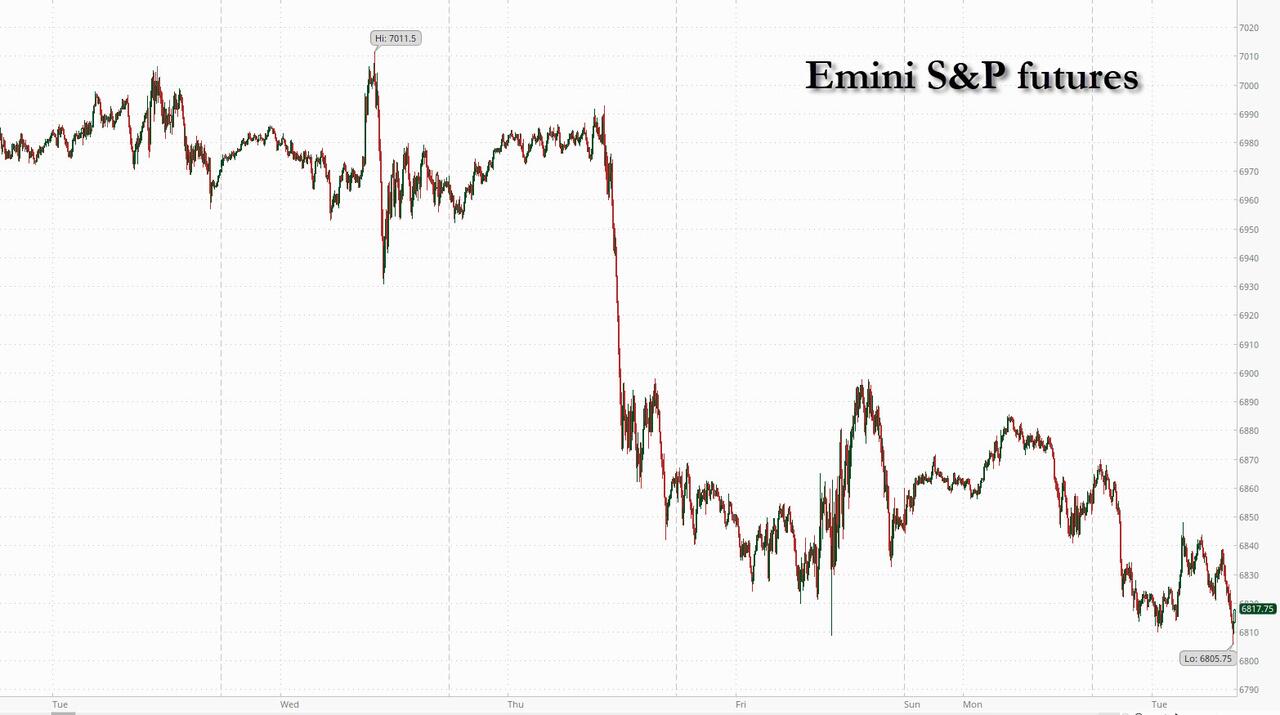
In premarket trading, MAg 7 stocks are all lower (Amazon -0.3%, Apple -0.2%, Microsoft -0.5%, Nvidia -0.9%, Meta -0.6%, Alphabet -1.5%, Tesla -1%)
- AeroVironment (AVAV) gains 3% as JPMorgan initiates coverage with a recommendation of overweight following a selloff in the the drone maker’s stock.
- Fiserv (FISV) rises 4% after the Wall Street Journal reported that activist investor Jana Partners has built a stake in the fintech company, citing people familiar with the matter.
- General Mills (GIS) falls 3% after the packaged foods company cut some forecasts for the full year.
- ImmunityBio shares (IBRX) gains 6% after the drugmaker said the Saudi Food and Drug Authority encouraged the company to submit a regulatory package for its bladder cancer therapy to expand access in Saudi Arabia.
- Masimo (MASI) jumps 34% after the Financial Times said Danaher is closing in on a nearly $10 billion deal to buy medical technology company, citing unidentified people familiar with the matter. Shares of Danaher (DHR) fall 6%.
- Norwegian Cruise (NCLH) rises over 7% after the Wall Street Journal reported that activist investor Elliott Investment Management has built a more than 10% stake in the cruise-ship company.
- TripAdvisor (TRIP) inches less than 1% higher after Starboard Value LP announced plans to nominate a majority slate of director candidates for the 2026 annual meeting.
- Veeva Systems (VEEV) rises over 1% as Morgan Stanley upgrades the the application software company to equal-weight, saying competitive risks are “better understood.”
- Warner Bros Discovery Inc. (WBD) rises over 2% after agreeing to temporarily reopen sale negotiations with rival Hollywood studio Paramount Skydance Corp., setting the stage for a potential second bidding war with Netflix Inc. Shares of Paramount Skydance (PSKY) gain 3%.
- Zim Integrated Shipping (ZIM) surges 35% after Hapag-Lloyd AG said it’s buying the Israeli shipping company.
In other corporate news, WSJ reports that activist Elliott is said to have built a large stake in Norwegian Cruise Line. Apple will hold a product launch on March 4. Anthropic’s talks to extend a contract with the Pentagon are said to have stalled on surveillance concerns. The Pentagon is also said to be seeking voice-controlled, autonomous drone swarming technology, with SpaceX among companies competing.
US traders are returning to their desks eying firms’ swelling AI budgets, while also wary of the technology’s potential to hurt industries outside the tech sector. Meanwhile, Brent crude erased losses as Iran talked up military drills near the Strait of Hormuz — at the same time that the country is undertaking a fresh round of indirect nuclear negotiations with the US.
There’s “lingering anxiety about whether AI spending will be profitable enough, concerns about competition, and a broader de-risking from the most crowded trades after a very strong run,” said Aneeka Gupta, macroeconomic research director at WisdomTree.
The search for stocks on the right side of the artificial intelligence trade is front and center for investors at the start of a shortened week — with a backdrop that may benefit selective buyers. The “perception of AI seems to have changed completely from the angel of mercy to the kiss of death,” said Stephan Kemper, chief investment strategist at BNP Paribas Wealth Management. Concerns as to whether hyperscalers can monetize ever-growing investments in AI are back while “the fact that AI can often be a tool to enhance profitability is completely ignored,” Kemper added. Two opposing fears are evident – one that AI is poised to disrupt entire industries, the other that investors are skeptical of whether the huge capex outlays will deliver Alibaba unveiled a major update of its flagship AI model, ahead of a much anticipated release from DeepSeek. AI even gets into the Fed’s narrative with Barr due to speak on AI and the labor market, and Daly on AI and the economy later today. returns. And AI is dominating conference calls.
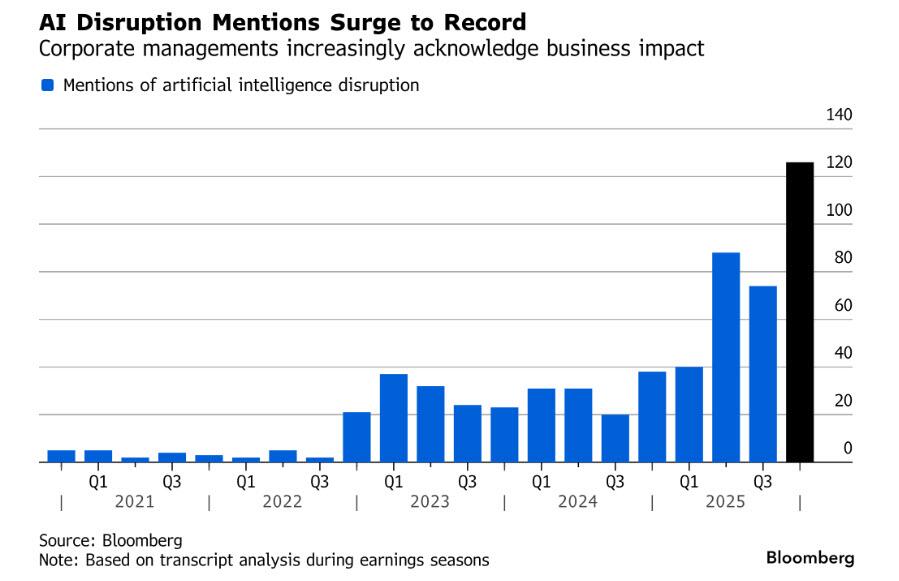
A record number of investors say companies are spending far too much, according to Bank of America Corp.’s latest fund manager survey. A quarter of participants saw an “AI bubble” as the top tail risk to markets, while 30% said capital expenditure on AI by the big tech companies was the most likely source of a credit crisis.
Meanwhile, two-year forward earnings estimates for software stocks have risen over the last three months, undeterred by the selloff over AI disruption worries, according to Goldman analysts, while RBC strategists say equity market is witnessing a type of “sentiment unwind” on AI jitters that likely has more to go.
Over the weekend, Rubio spoke at the Munich Security Conference and emphasized the important of the deep ties between the US and EU, but also echoed the Trump administration’s talking points about the threat of Western decline (WSJ). RTRS reported the Pentagon preparing for the potential for a weeks-long campaign against Iran should Trump decide to launch another round of strikes which comes as the IRGC was conducting “smart drills” near the Strait of Hormuz. Also over the weekend, Trump said Rubio is in talks with Cuba as the island nation faces worsening economic conditions. Trump also said he’s speaking to China’s XI Jinping about weapons sales to Taiwan. Iran’s foreign minister met the UN nuclear chief before the next round of negotiations with the US.
Brent traded 0.1% higher to $68.75 a barrel in London after Iranian state TV in the Islamic Republic reported that parts of the Strait of Hormuz, one of the world’s most important oil-shipping lanes, will be closed for “several hours” on Tuesday as part of Iran’s military exercises. The drills, announced previously, come as Iran and the US start a second round of negotiations in Geneva. Trump has threatened to strike Iran unless it agrees to a deal curbing Tehran’s nuclear program in exchange for sanctions relief. He’s mobilized warships and fighter jets near Iran in response to a recent deadly crackdown by the regime there following mass protests.
Looking at earnings, out of the 371 S&P 500 companies that have reported so far in the earnings season, 76% have managed to beat analyst forecasts, while 20% have missed. Medtronic, Genuine Parts and Vulcan Materials are among companies expected to report results before the market opens. Medtronic’s organic revenue growth for fiscal 3Q is likely to exceed the consensus estimate of 5.5%, driven by strong sales of pulsed field ablation products used to treat atrial fibrillation, reflecting robust demand seen at peers like Boston Scientific and Abbott, Bloomberg Intelligence said. Earnings from Palo Alto Networks and Toll Brothers follow later in the day.
European stocks holding firm with Stoxx 600 up by 0.1%. The utilities sector outperforms as artificial intelligence worries linger and tensions in the Middle East drive a risk-off mood among investors. Miners lag as precious and industrial metals prices drop. On the data front, UK employment data surprised to the downside where the unemployment rate rose to 5.2%, above consensus and the BOE’s forecast of 5.1%. Following the print, odds for a BOE cut in March cut rose to ~80% (vs ~70% Friday). Here are some of the biggest movers on Tuesday:
- Avolta shares rise as much as 5.7% to the highest level since 2021 after UBS upgraded the travel retailer to buy, citing an improving business model focus and favorable industry trends.
- Genmab shares climb as much as 2.7% after Jefferies resumed coverage on the stock with a buy rating, highlighting the Danish biotech company’s attractive valuation and “catalyst rich” 2026.
- SSP shares surge as much as 11%, touching the highest level since December. UBS raised its recommendation to buy from neutral as analysts expect the catering firm’s focus on cash flow generation to ease concerns.
- Mol shares drop as much as 4.1%, down for the third day. The company said it is seeking a release of Hungarian strategic oil reserves to keep refineries operating.
- BFF Bank shares fall as much as 12% to a record low after confirming a report that Italian prosecutors opened an investigation into the specialist lender.
- Qiagen shares slide as much as 4.8% following a Financial Times report that Danaher could announce a roughly $10 billion deal to acquire US medical technology firm Masimo.
- Antofagasta shares sink as much as 5.2% in London. The copper miner’s earnings and dividend payout underwhelmed some analysts, while it kept its guidance unchanged.
- Hensoldt shares slip as much as 4.7%. Mediobanca initiated the stock with an underperform rating on valuation concerns. It leads a drop in European defense stocks ahead of new rounds of Russia-Ukraine peace talks and US-Iran nuclear talks in Geneva on Tuesday.
- Truecaller shares plunge as much as 26% to a record low after the Swedish developer of a caller ID and spam-blocking app gave what JPMorgan analysts called “disappointing” commentary on advertising and the firm’s Truecaller for Business segment.
Earlier in the session, stocks fell in Japan, offsetting gains in India and Thailand, on a day when most of the region’s markets were closed for Lunar New Year. The MSCI Asia Pacific Index was steady, while Japan’s Topix slid 0.7%. SoftBank Group and Hitachi were among the biggest drags, while BHP Group gained. Stocks also retreated in New Zealand, while shares edged higher in Australia, Thailand and India. Volumes were thin, with bourses closed in markets including China, Hong Kong and South Korea. Japanese stock investors extended profit-taking after last week’s post-election gains, as concerns about disruption from artificial intelligence linger.
In FX, the pound weaker but off the low. The Bloomberg Dollar Spot Index little changed with DXY $97, yen and the kiwi outperforming. The yen, historically seen as a haven, strengthened 0.2% against the dollar.
In rates, the risk-off mood and last week’s slower inflation print buoyed Treasuries, lowering the yield on the 10-year note two basis points to 4.03% and sharply lower than beginning of the month and basically at one-year lows; gilts outperformed in Europe after weak jobs data firmed up bets on BOE interest-rate cuts in 2026. In the US, treasuries hold small curve-flattening gains as US trading resumes after Monday’s holiday, with yields having reached new lows for this year, at 4.016% for the 10-year. Most sovereign bond markets also have gains, led by Japan’s, following strong demand for an auction of five-year notes. Yields remain lower by 0.5bp to 2.6bp following the market’s biggest weekly gain since August, driven by softer-than-estimated January CPI data released Friday and volatility in risk assets including US stocks. For IG corporate new-issue calendar, underwriters anticipate weekly supply totaling about $24 billion; about $40 billion was priced last week, with roughly half in the form of Alphabet’s jumbo offering. Treasury coupon auctions this week include $16 billion 20-year new issue Wednesday and $9 billion 30-year TIPS new issue Thursday
In commodities, crude moving higher with WTI $64 up 150bps after Iran said military drills will close part of the Strait of Hormuz for several hours; the rest of the commodities complex lower led by front month gas off 3% to $3.15. Gold weaker, down about $69 to $4,922/oz, and silver sinking to about $74/oz.
The US economic data calendar ADP weekly employment change (8:15am), February Empire manufacturing (8:30am) and February NAHB housing market index (10am). Fed speakers scheduled include Governor Barr (12:45pm) and San Francisco Fed President Daly (2:30pm)
Market Snapshot
- S&P 500 mini -0.2%
- Nasdaq 100 mini -0.6%
- Russell 2000 mini -0.2%
- Stoxx Europe 600 +0.2%
- DAX +0.3%, CAC 40 +0.2%
- 10-year Treasury yield -2 basis points at 4.02%
- VIX +0.7 points at 21.85
- Bloomberg Dollar Index little changed at 1183.25
- euro little changed at $1.1844
- WTI crude +0.9% at $63.44/barrel
Top Overnight News
- German investor optimism fell in February, with the ZEW institute’s expectations index decreasing to 58.3 from 59.6 in January, in blow to recovery: BBG
- Traders cemented bets on two BOE rate cuts in 2026 after UK unemployment approached the highest level in five years and wage growth cooled: BBG
- Iran and the US met for a second round of nuclear talks in Switzerland as they seek to avoid renewed conflict in the Middle East. Iranian officials have expressed willingness to discuss their nuclear-enrichment activities, but have tied any concessions to the potential easing of American sanctions: BBG
- A growing number of Wall Street pros say now might be the time to get greedy as AI fear runs amok in the US equity market. Investors are selling entire industry groups when a new AI tool threatens to upset an industry, presenting a chance to buy, according to money managers and analysts: BBG
- Spanish PM Sanchez said the Council of Ministers will invoke Article 8 to ask the Public Prosecutor to investigate Meta (META), X and TikTok.
- EU privacy watchdog opens probe into X over sexualised AI images: FT.
A more detailed look at global markets courtesy of Newsquawk
APAC stocks traded mixed amid the extremely thinned conditions due to the Lunar New Year holiday and in the absence of a lead from the US, where markets were closed for Washington’s Birthday/Presidents’ Day. ASX 200 was led higher by outperformance in miners as BHP shares surged after the mining giant reported a 28% jump in H1 net, although gains in the broader market were capped by weakness in tech and real estate. Nikkei 225 retreated shortly after the open with SoftBank and heavy industry stocks leading the declines, as the post-election euphoria petered out following the recent underwhelming GDP data.
Top Asian News
- Japanese PM Takaichi to unveil a sweeping budgeting reform, placing strategic investments under a ringfenced multi-year framework to enhance predictability and attract private capital, Nikkei reports citing a draft
- Japan PM Takaichi considers multi-year budget for growth and crisis management, according to Nikkei citing her draft policy speech for Friday.
- Japanese Finance Ministry estimate indicates annual bond issuance could rise 28% three years from now amid increasing debt financing costs, according to Reuters.
- Indian Government Minister said we are discussing age-based social media ban with firms.
European bourses (STOXX 600 +0.2%) initially started on the backfoot but have reversed earlier losses and are now trading mostly in the green. The SMI (+0.7%) leads, while the AEX (+0.2%) lags, weighted on by losses in ASML (-1.3%). FTSE 100 (+0.5%) sits near the top of the pile, aided by softer-than-expected jobs and wages data, increasing the likelihood of BoE rate cuts. European sectors are mostly firmer. Utilities (+1.3%) and Insurance (+1.2%) reside near the top, with insurance names helped by a broker upgrade for AXA (+1.8%, initiated with outperform at RBC) and a sector perform rating for Allianz. Basic Resources (-1.4%) is the clear underperformer, weighed on by metal prices (XAU -1.3%, XAG -2.4%).
Top European News
- The German Chamber of Industry and Commerce raises its 2026 GDP growth forecast from 0.7% to 1.0%.
- Swedish Finance Minister said they are not expecting to join the Euro in the coming years.
- UK government quietly shelved a programme to build a frictionless post-Brexit trade border, after spending GBP 110mln on a contract with Deloitte and IBM for the project, according to FT.
- EU officials held a constructive meeting to strengthen the international role of the euro on Monday, according to EU’s Dombrovskis.
FX
- DXY trades flat intraday but at the lower end of a tight 97.072-97.247 range as US participants gear up to return from the long weekend. Focus has been on geopolitics as US-Iran talks look to continue through to the afternoon, whilst US-Ukraine-Russia trilateral talks have now been moved to tomorrow. On the data front for the day ahead, weekly ADP jobs data are due (prev. showed an average of +6.5k/week over the four-week period). Elsewhere, the Empire State Manufacturing Index for February, and the NAHB housing market index for February are scheduled.
- JPY gained as risk sentiment in Japan deteriorated shortly after the open, while there were some recent comments from former BoJ board member Adachi, who sees a likelihood that the BoJ will hike rates by 25bps in April. During European hours, the JPY remains the outperformer as US yields fall, but overall, the pair remains within the ranges of the last four trading sessions, with today’s current parameters between 152.70 and 153.75. Note, JPY could also be seeing some haven flows against the backdrop of the US-Iran talks today.
- GBP fell in the aftermath of a dovish jobs report: unemployment unexpectedly rose to 5.2%, just below the BoE’s 5.3% peak forecast (raised in February), while wage growth slowed across both measures, especially including bonuses. GBP/USD have recovered off its worst levels with the pair currently around the middle of a 1.3552-1.3633 intraday range at the time of writing.
- EUR marginally trickled lower, but with price action kept within tight parameters near the 1.1850 level amid light newsflow from the bloc and the recent mixed EU Industrial Production data. Some risk was taken out for the EUR (for today) as the US-Ukraine-Russia trilateral meeting has been pushed back to tomorrow. A modest four-pip immediate dip was seen as German ZEW disappointed, with EUR/USD currently in a 1.1828-1.1852 range.
Central Banks
- RBA Minutes from February meeting stated that members agreed that prevailing uncertainties meant it was not possible to have a high degree of confidence in any particular path for the cash rate. Board concluded inflation would stay stubbornly high if it had not hiked interest rates as it did this month. Members agreed that the data received since the previous meeting had strengthened their concern that without a policy response, inflation would remain persistently above target for too long.
- NBP Member Dabrowski says April would be safer to cut rates than in March, a policy rate of 3.5% in 2026 is achievable.
FX
- USTs move higher this morning by around 7 ticks, currently trading within a 113-03 to 113-14 range. From a yield perspective, the 10yr is now eyeing the 4% mark (currently 4.025%), and trading at lows not seen since late Nov’25. Much of the upside can seemingly be attributed to the muted risk tone, in an environment clouded by geopolitical uncertainty, with US-Iran and US-Ukraine-Russia talks taking place. The former arguably holds added risk, given there is some chance that the US could strike Iran if talks break down – though analysts believe that the most likely outcome is not a full deal today but a decision to keep talks alive. (Full analysis piece can be found on the Newsquawk feed)
- Bunds follow the global fixed income complex higher. In reaction to the UK’s jobs/wages data, Bunds spiked higher from 129.30 to 129.41. Currently trading higher by around 15 ticks and at the upper end of a 129.13 to 129.36 range – the 10yr yield is trading well outside recent ranges, around 2.733%. Further pressure could see the 10yr test 2.70%, which happens to be the trough from the 1st of December 2025. Following the softer-than-expected ZEW series, Bunds rose from 129.37 to 129.41 – the peak for the day. Demand for German debt remains tepid, with the 2yr Schatz demand sub-2x b/c.
- Gilts gapped higher by 38 ticks before climbing another two to a 92.32 peak, in reaction to the latest unemployment and wage data. If the move continues, resistance comes into view at 92.51, 92.56 and 92.95. Upside spurred in a dovish reaction to a report that showed a further deterioration in the labour market, as the unemployment rate ticked up to 5.2% and is just a tenth shy of the BoE’s 5.3% peak forecast (a view that was increased in the February MPR). Furthermore, wage data showed a moderation from the prior for both metrics and markedly so for the measure incl. bonuses. Sparking a dovish reaction in BoE pricing, however, the next cut remains priced for April, but March is now up to -21bps (-20.3bps pre-release) while the timing for a second 2026 cut has been brought forward to November from December.
- JGBs firmer, with upside of just over 50 ticks at best, hitting a 132.60 peak. Upside was a function of the negative risk tone in Japan overnight, where conditions were very limited due to numerous APAC closures. Furthermore, participants continue to digest the policy implications of recent weak GDP data. Note, there was fleeting JGB pressure to a broadly in-line 5yr auction.
- Germany sells EUR 4.59bln vs exp. EUR 6bln 2.10% 2028 Schatz: b/c 1.77x (prev. 2.1x), average yield 2.02% (prev. 2.14%), retention 23.5% (prev. 22.8%).
- UK sells GBP 500mln 0.125% 2028 Gilt via Tender: b/c 4.05x (prev. 3.77x), average yield 3.336% (prev. 3.443%), tail 0.7bps (prev. 0.6bps).
- Japan sold JPY 1.9tln 5yr JGBs; b/c 3.10x (prev. 3.08x), average yield 1.640% (prev. 1.639%).
Commodities
- WTI Mar’26 and Brent Apr’26 are trading around the lower range of USD 62.84-63.87/bbl and USD 67.85-68.62/bbl, respectively. Focus for oil traders is on meetings between the US and Iran and the trilateral talks between Russia, US and Ukraine. At the time of writing, the trilateral talks have concluded, with talks set to resume tomorrow. Much of the action this morning has been spurred by Iran-related commentary; some pressure in the complex on reports that Iran approved IAEA visit to nuclear facilities, but soon reversed after hawkish commentary from Iranian Supreme Leader Khamenei, who suggested that the US army needs to be “slapped” so hard it cannot get up. Most recently, reports suggest that Iran announced its readiness to reduce uranium enrichment, and are now at the stage of discussing technical issues. Ultimately, very choppy action given the mixed newsflow.
- Precious metals have stalled following prior day gains, with the yellow metal slipping below the USD 5,000/oz mark and silver falling by 4.5%, though off worst levels seen during the APAC session. Analysts note that liquidity remains thin, particularly across metals. Focus now turns to US ADP employment figures, which could trigger volatility. Weaker jobs data could trigger a weaker USD, spurring the yellow metal and vice versa.
- Copper prices remain subdued, largely amid the mixed global risk tone and the closure of the Chinese market due to the Chinese holiday. 3M LME Copper currently trades in a narrow range of USD 12,695.08-12,849k/t.
Geopolitics: Ukraine
- Russia’s Kremlin said the three-way talk with US and Ukraine in Geneva will continue tomorrow with no news expected today.
- Russian Defence Ministry said Russia carried out a massive strike on military targets in Ukraine, IFX reported.
- Russian President Putin advisor Patrushev said Russia is preparing measures to respond to seizures of its trading vessels, IFX reported.
- Ukrainian long-range drones hit the Ilsky Oil Refinery in the Krasnodar Krai region of Russia and the refinery is on fire, according to Visegrad 24.
Geopolitics: Middle East
- Iran is ready to stay for days and weeks in Geneva in order to reach an agreement, Al Jazeera reports citing the Iranian Foreign Ministry spokesman.
- US-Iran nuclear negotiations in Geneva have entered the stage of discussing technical issues, Al Jazeera reports citing Iranian TV.
- Iran announced its readiness to reduce uranium enrichment, Al Hadath reports citing Iran’s ambassador in Cairo; adds “The contradiction of the US statements is proof of its lack of seriousness in the negotiations.”
- Iran’s IRGC are holding military exercises in the Strait of Hormuz and the Sea of Oman at the same time as US-Iran nuclear talks, Iran International reports.
- Iranian Supreme Leader Khamenei says, in relation to the US, “The strongest army in the world may sometimes be slapped so hard that it cannot get up.”
- Indirect talks between the US and Iran have begun with a message exchange process, according to reported.
- Senior Iranian Official said Iran’s approach to US talks are positive and serious, but holds no preconception about the outcome.
- “Iran approves IAEA visit to nuclear facilities”, Al Arabiya reported.
- Russian President’s Aide said Russia, Iran and China sent ships to the Strait of Hormuz to participate in the “Security Belt 2026” exercise, Al Jazeera reported (as expected).
- US officials say they expect Iran to come to Geneva talks today with concrete concessions regarding its nuclear program, according to Axios.
- US President Trump said he will be involved in the Iran talks indirectly and that Iran wants to make a deal. Iran are bad negotiators and he hopes they will be more reasonable in talks.
- US delegation led by Special Envoy Witkoff leaves for Geneva for talks with Iran.
- Palestinian media reported Israeli army conducts bombing operations in deployment areas within Beit Lahiyah and the Northern Gaza Strip, according to Al Qahera.
Geopolitics: Others
- US President Trump said Secretary of State Rubio is talking to Cuba right now and that they want to make a deal, adds will see how it all turns out with Cuba and the US talking.
US Event Calendar
- 8:30 am: Feb Empire Manufacturing, est. 6.2, prior 7.7
- 10:00 am: Feb NAHB Housing Market Index, est. 38, prior 37
- 12:45 pm: Fed’s Barr Speaks on AI and the Labor Market
- 2:30 pm: Fed’s Daly Speaks on AI and the Economy
DB’s Jim Reid concludes the overnight wrap
Without wanting to put you off reading any further, this may be the most boring EMR of the year so far, as yesterday was unusually calm compared with the pace of events so far in 2026. However there were a couple of new big AI disruption stories in the European session to report of below. But it was quiet due to the combination of the US holiday and the Lunar New Year in China, offering markets a chance to pause, and the subdued volumes suggested many participants took the opportunity to have a lie down… or watch the Curling or Ski Jumping. Chinese markets remain closed until next Tuesday, with Hong Kong set to reopen on Friday and Korea on Thursday. US markets reopen today, and S&P (-0.58%) and Nasdaq (-0.96%) futures are both trading lower after having edged higher for most of yesterday’s session. 10yr Treasury yields (-2.5bps) are also creeping lower again, trading at 4.025% this morning. After last week’s sizeable rally in US yields, attention is firmly on the bond market as investors look ahead to Friday’s core PCE and Q4 GDP releases. Today starts the US data week quietly, with the February NY Fed Empire State Survey (+0.5 expected) and the NAHB Housing Market Index (37 expected) due.
The rates rally is spreading across Asia with 10-30yr JGBs -6 to -10bps lower as I type after a slightly better than expected 5 year auction. The Nikkei is down -0.92%, continuing its decline from the previous session helped by disappointing GDP figures for the fourth quarter.
Meanwhile, the S&P/ASX 200 is experiencing a slight increase of +0.26%, primarily supported by gains from the mining giant BHP Group (+4.75%), which reported robust earnings for the first half of the fiscal year. That’s one company AI will struggle to disrupt, although as an aside I just asked our AI tool if it could be disrupted and the one way is if AI allows exploration and discovery to get faster and cheaper for challengers! Is nothing safe! However this is probably also a case where the company could also use such analysis.
Regarding central bank developments, the minutes from the Reserve Bank of Australia’s most recent monetary policy meeting indicated that the rate increase was prompted by stronger-than-anticipated data, ongoing widespread inflation, and relaxed financial conditions. Nevertheless, the central bank expressed uncertainty about the future trajectory of inflation and the economy, resulting in a lack of a “high degree of confidence in any particular path for the cash rate.”
With the US out yesterday, European markets were similarly subdued. Equities saw only modest moves, with the STOXX 600 (+0.13%) and FTSE 100 (+0.26%) finishing slightly higher even with a dip into the close. But beneath the surface, AI related concerns continued to simmer. In Germany, Siemens fell sharply (-6.41%) amid growing worries that industrial software could be another area exposed to AI disruption. That decline weighed on the DAX, which closed -0.46%. Likewise, France’s Dassault Systèmes slumped (-10.44%) on similar concerns, although the CAC 40 (+0.06%) still managed a marginal gain. It’s clear that the market hasn’t yet shaken off this theme.
Across Europe, the news flow remained light as EU leaders returned from the Munich Security Conference. Reports from the FT and Bloomberg suggested the UK is considering increasing defence spending to 3% of GDP by 2029—something that was largely expected, given the concessions needed to secure improved access to SAFE (Security Action for Europe) and more favourable EU trade terms. With no formal announcements likely before the Autumn Budget, investors appeared unbothered by any perceived fiscal implications. Gilt yields edged lower, with the 2yr down -0.7bps and the 10yr down -1.6bps. Elsewhere in fixed income, front-end European yields drifted slightly higher as renewed concerns over oil-driven inflation returned. The 2yr bund was up +0.2bps, while moves along the curve were more uneven, leaving the 10yr bund marginally lower at -0.1bps.
Oil prices rose as geopolitical tensions in the Middle East resurfaced, including reports that Iran’s Revolutionary Guard had begun military exercises in the Strait of Hormuz. Brent crude moved higher on the headlines, adding +1.33% yesterday. However it’s down around -0.6% this morning. Markets will keep a close eye on developments as US–Iran talks are scheduled to resume today. Despite the renewed tensions, gold prices slipped yesterday, falling -0.74%. It is another -2% lower this morning with silver over -3% down, now trading $7 below its real adjusted price in 1790!
Looking to the day ahead, data releases include the US February Empire Manufacturing Index, the NAHB Housing Market Index, UK December average weekly earnings and unemployment, Germany’s February ZEW survey, the Eurozone ZEW survey, and Canada’s January CPI. Fed speakers include Barr and Daly, while today’s notable earnings releases feature Medtronic and Cadence Design Systems.
1 b European opening report
US equity futures lower; US-Iran talks underway, Iran reportedly announced its readiness to reduce uranium enrichment – Newsquawk US Opening News

Tuesday, Feb 17, 2026 – 06:11 AM
- US-Iran talks have gotten underway; the latest is that the nuclear negotiations have entered the stage of discussing technical issues, Al Jazeera reports citing Iranian TV.
- Iran announced its readiness to reduce uranium enrichment, Al Hadath reports citing Iran’s ambassador in Cairo; added “The contradiction of the US statements is proof of its lack of seriousness in the negotiations”
- European stocks are broadly in the green; Basic Resources weighed on by metals prices; US equity futures lower as US traders return from holiday.
- JPY gains ground on yield differentials and some haven flows while GBP lags after the UK jobs report; DXY flat.
- Gilts and JGBs lead; pricing remains in favour of a BoE cut in April, but March has inched higher into Wednesday’s CPI post-unemployment/wages; USTs bid alongside global benchmarks.
- WTI and Brent rangebound with geopols in focus.
- Looking ahead, highlights include US ADP Weekly, NY Fed (Feb), Canadian CPI (Jan), Japanese Balance of Trade (Jan), US-Iran talks. Speakers include Fed’s Barr & Daly. Earnings from Medtronic, Leidos, Palo Alto, Cadence Design Systems, Republic Services, Vulcan Materials, Kenvue.
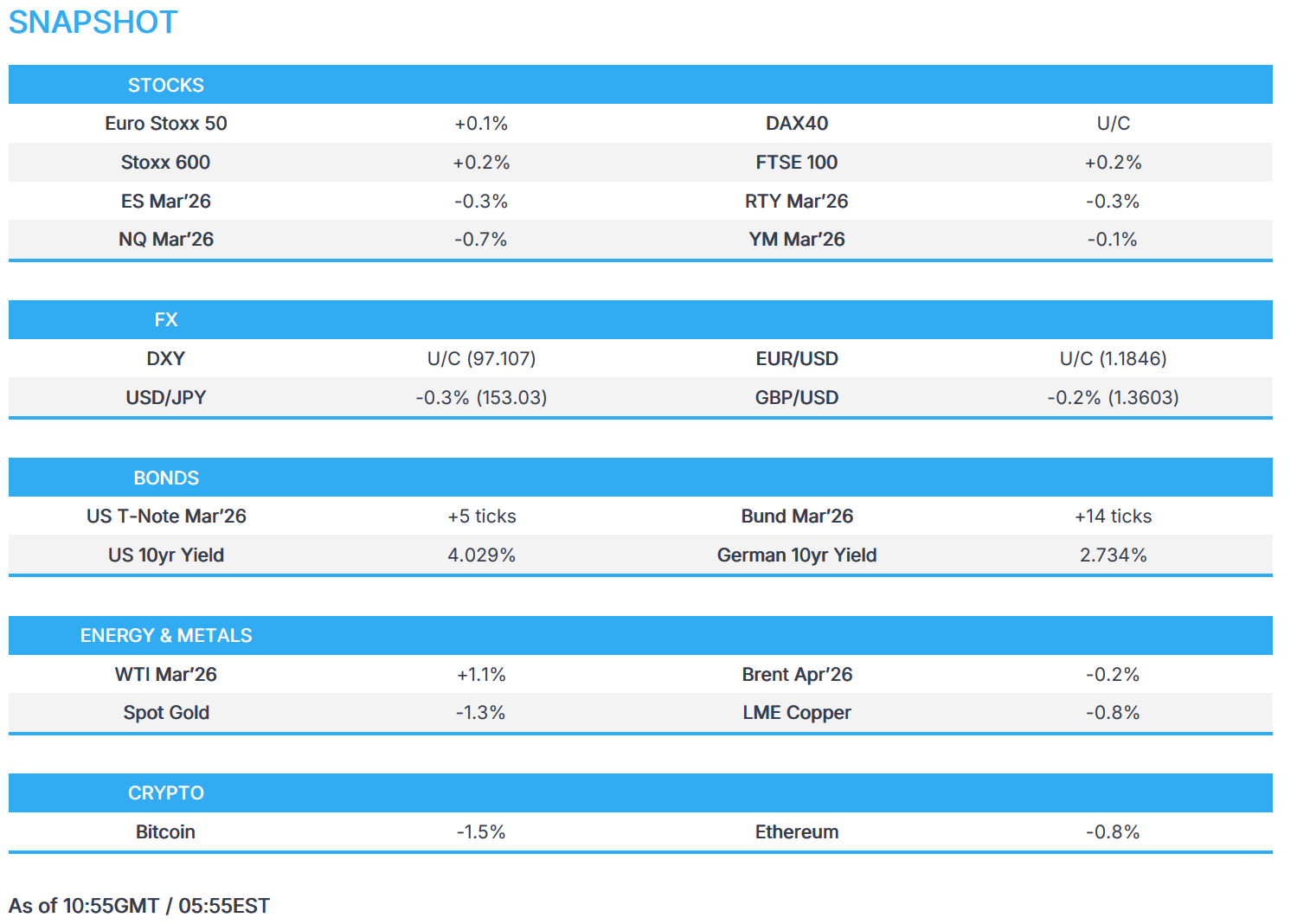
Newsquawk in 3 steps:
1. Subscribe to the free premarket movers reports
2. Listen to this report in the market open podcast (available on Apple and Spotify)
3. Trial Newsquawk’s premium real-time audio news squawk box for 7 days
EUROPEAN TRADE
EQUITIES
- European bourses (STOXX 600 +0.2%) initially started on the backfoot but have reversed earlier losses and are now trading mostly in the green. The SMI (+0.7%) leads, while the AEX (+0.2%) lags, weighted on by losses in ASML (-1.3%). FTSE 100 (+0.5%) sits near the top of the pile, aided by softer-than-expected jobs and wages data, increasing the likelihood of BoE rate cuts.
- European sectors are mostly firmer. Utilities (+1.3%) and Insurance (+1.2%) reside near the top, with insurance names helped by a broker upgrade for AXA (+1.8%, initiated with outperform at RBC) and a sector perform rating for Allianz. Basic Resources (-1.4%) is the clear underperformer, weighed on by metal prices (XAU -1.3%, XAG -2.4%).
- US equity futures (ES/RTY -0.3%, NQ -0.7%) are entirely in the red as US traders get set to re-enter from their holiday break.
- Antofagasta (ANTO LN) FY25 (USD): Revenue 8.62bln (exp. 8.50bln), EBITDA 5.20bln (exp. 5.15bln), Pretax profit 3.16bln (exp. 3.19bln), EBITDA margin 60.3% (exp. 61.2%), Dividend/shr 64.6c (prev. 31.4c Y/Y), Recommended final dividend of 48.0c.
- BHP (BHP AT) H1 (USD) net rose 28% Y/Y to 5.64bln, underlying profit rose 22% Y/Y to 6.2bln (exp. 6.03bln), rev. rose 11% Y/Y to 27.9bln, Co. will pay interim dividend of USD 0.73/shr, inks silver streaming agreement with Wheaton Precious Metals.
- Click for the sessions European pre-market equity newsflow
- Click for the additional news
FX
- DXY trades flat intraday but at the lower end of a tight 97.072-97.247 range as US participants gear up to return from the long weekend. Focus has been on geopolitics as US-Iran talks look to continue through to the afternoon, whilst US-Ukraine-Russia trilateral talks have now been moved to tomorrow. On the data front for the day ahead, weekly ADP jobs data are due (prev. showed an average of +6.5k/week over the four-week period). Elsewhere, the Empire State Manufacturing Index for February, and the NAHB housing market index for February are scheduled.
- JPY gained as risk sentiment in Japan deteriorated shortly after the open, while there were some recent comments from former BoJ board member Adachi, who sees a likelihood that the BoJ will hike rates by 25bps in April. During European hours, the JPY remains the outperformer as US yields fall, but overall, the pair remains within the ranges of the last four trading sessions, with today’s current parameters between 152.70 and 153.75. Note, JPY could also be seeing some haven flows against the backdrop of the US-Iran talks today.
- GBP fell in the aftermath of a dovish jobs report: unemployment unexpectedly rose to 5.2%, just below the BoE’s 5.3% peak forecast (raised in February), while wage growth slowed across both measures, especially including bonuses. GBP/USD have recovered off its worst levels with the pair currently around the middle of a 1.3552-1.3633 intraday range at the time of writing.
- EUR marginally trickled lower, but with price action kept within tight parameters near the 1.1850 level amid light newsflow from the bloc and the recent mixed EU Industrial Production data. Some risk was taken out for the EUR (for today) as the US-Ukraine-Russia trilateral meeting has been pushed back to tomorrow. A modest four-pip immediate dip was seen as German ZEW disappointed, with EUR/USD currently in a 1.1828-1.1852 range.
FIXED INCOME
- USTs move higher this morning by around 7 ticks, currently trading within a 113-03 to 113-14 range. From a yield perspective, the 10yr is now eyeing the 4% mark (currently 4.025%), and trading at lows not seen since late Nov’25. Much of the upside can seemingly be attributed to the muted risk tone, in an environment clouded by geopolitical uncertainty, with US-Iran and US-Ukraine-Russia talks taking place. The former arguably holds added risk, given there is some chance that the US could strike Iran if talks break down – though analysts believe that the most likely outcome is not a full deal today but a decision to keep talks alive. (Full analysis piece can be found on the Newsquawk feed)
- Bunds follow the global fixed income complex higher. In reaction to the UK’s jobs/wages data, Bunds spiked higher from 129.30 to 129.41. Currently trading higher by around 15 ticks and at the upper end of a 129.13 to 129.36 range – the 10yr yield is trading well outside recent ranges, around 2.733%. Further pressure could see the 10yr test 2.70%, which happens to be the trough from the 1st of December 2025. Following the softer-than-expected ZEW series, Bunds rose from 129.37 to 129.41 – the peak for the day. Demand for German debt remains tepid, with the 2yr Schatz demand sub-2x b/c.
- Gilts gapped higher by 38 ticks before climbing another two to a 92.32 peak, in reaction to the latest unemployment and wage data. If the move continues, resistance comes into view at 92.51, 92.56 and 92.95. Upside spurred in a dovish reaction to a report that showed a further deterioration in the labour market, as the unemployment rate ticked up to 5.2% and is just a tenth shy of the BoE’s 5.3% peak forecast (a view that was increased in the February MPR). Furthermore, wage data showed a moderation from the prior for both metrics and markedly so for the measure incl. bonuses. Sparking a dovish reaction in BoE pricing, however, the next cut remains priced for April, but March is now up to -21bps (-20.3bps pre-release) while the timing for a second 2026 cut has been brought forward to November from December.
- JGBs firmer, with upside of just over 50 ticks at best, hitting a 132.60 peak. Upside was a function of the negative risk tone in Japan overnight, where conditions were very limited due to numerous APAC closures. Furthermore, participants continue to digest the policy implications of recent weak GDP data. Note, there was fleeting JGB pressure to a broadly in-line 5yr auction.
- Germany sells EUR 4.59bln vs exp. EUR 6bln 2.10% 2028 Schatz: b/c 1.77x (prev. 2.1x), average yield 2.02% (prev. 2.14%), retention 23.5% (prev. 22.8%).
- UK sells GBP 500mln 0.125% 2028 Gilt via Tender: b/c 4.05x (prev. 3.77x), average yield 3.336% (prev. 3.443%), tail 0.7bps (prev. 0.6bps).
- Japan sold JPY 1.9tln 5yr JGBs; b/c 3.10x (prev. 3.08x), average yield 1.640% (prev. 1.639%).
COMMODITIES
- WTI Mar’26 and Brent Apr’26 are trading around the lower range of USD 62.84-63.87/bbl and USD 67.85-68.62/bbl, respectively. Focus for oil traders is on meetings between the US and Iran and the trilateral talks between Russia, US and Ukraine. At the time of writing, the trilateral talks have concluded, with talks set to resume tomorrow. Much of the action this morning has been spurred by Iran-related commentary; some pressure in the complex on reports that Iran approved IAEA visit to nuclear facilities, but soon reversed after hawkish commentary from Iranian Supreme Leader Khamenei, who suggested that the US army needs to be “slapped” so hard it cannot get up. Most recently, reports suggest that Iran announced its readiness to reduce uranium enrichment, and are now at the stage of discussing technical issues. Ultimately, very choppy action given the mixed newsflow.
- Precious metals have stalled following prior day gains, with the yellow metal slipping below the USD 5,000/oz mark and silver falling by 4.5%, though off worst levels seen during the APAC session. Analysts note that liquidity remains thin, particularly across metals. Focus now turns to US ADP employment figures, which could trigger volatility. Weaker jobs data could trigger a weaker USD, spurring the yellow metal and vice versa.
- Copper prices remain subdued, largely amid the mixed global risk tone and the closure of the Chinese market due to the Chinese holiday. 3M LME Copper currently trades in a narrow range of USD 12,695.08-12,849k/t.
NOTABLE EUROPEAN HEADLINES
- The German Chamber of Industry and Commerce raises its 2026 GDP growth forecast from 0.7% to 1.0%.
- Swedish Finance Minister said they are not expecting to join the Euro in the coming years.
- UK government quietly shelved a programme to build a frictionless post-Brexit trade border, after spending GBP 110mln on a contract with Deloitte and IBM for the project, according to FT.
- EU officials held a constructive meeting to strengthen the international role of the euro on Monday, according to EU’s Dombrovskis.
NOTABLE EUROPEAN DATA RECAP
- German ZEW Economic Sentiment Index (Feb) 58.3 vs. Exp. 65 (Prev. 59.6, Low. 59, High. 74.3).
- German ZEW Current Conditions (Feb) -65.9 vs. Exp. -65.7 (Prev. -72.7, Low. -71.1, High. -65).
- EU ZEW Economic Sentiment Index (Feb) 39.4 vs. Exp. 45.2 (Prev. 40.8).
- UK Labour Productivity QoQ (Q4) Q/Q -0.6% vs. Exp. -0.6% (Prev. 0.6%, Rev. From 0.7%).
- UK Employment Change (Dec) 52K (Prev. 82K).
- UK Unemployment Rate (Dec) 5.2% vs. Exp. 5.1% (Prev. 5.1%, Low. 5.1%, High. 5.2%).
- UK Claimant Count Change (Jan) 28.6K vs. Exp. 22.8K (Prev. 2.7K, Rev. From 17.9K).
- UK HMRC Payrolls Change (Jan) -11K (Prev. -6K, Rev. From -43K).
- UK Average Earnings excl. Bonus (3Mo/Yr) (Dec) 4.2% vs. Exp. 4.2% (Prev. 4.4%, Rev. From 4.5%, Low. 4.2%, High. 4.6%).
- UK Average Earnings incl. Bonus (3Mo/Yr) (Dec) 4.2% vs. Exp. 4.6% (Prev. 4.6%, Rev. From 4.7%, Low. 4.4%, High. 4.8%).
- German Inflation Rate MoM Final (Jan) M/M 0.1% vs. Exp. 0.1% (Prev. 0.0%, Low. 0.1%, High. 0.1%).
- German Inflation Rate YoY Final (Jan) Y/Y 2.1% vs. Exp. 2.1% (Prev. 1.8%, Low. 2.1%, High. 2.1%).
CENTRAL BANKS
- RBA Minutes from February meeting stated that members agreed that prevailing uncertainties meant it was not possible to have a high degree of confidence in any particular path for the cash rate. Board concluded inflation would stay stubbornly high if it had not hiked interest rates as it did this month. Members agreed that the data received since the previous meeting had strengthened their concern that without a policy response, inflation would remain persistently above target for too long.
- NBP Member Dabrowski says April would be safer to cut rates than in March, a policy rate of 3.5% in 2026 is achievable.
NOTABLE US HEADLINES
- Spanish PM Sanchez said the Council of Ministers will invoke Article 8 to ask the Public Prosecutor to investigate Meta (META), X and TikTok.
- EU privacy watchdog opens probe into X over sexualised AI images, according to FT.
GEOPOLITICS
RUSSIA-UKRAINE
- Russia’s Kremlin said the three-way talk with US and Ukraine in Geneva will continue tomorrow with no news expected today.
- Russian Defence Ministry said Russia carried out a massive strike on military targets in Ukraine, IFX reported.
- Russian President Putin advisor Patrushev said Russia is preparing measures to respond to seizures of its trading vessels, IFX reported.
- Ukrainian long-range drones hit the Ilsky Oil Refinery in the Krasnodar Krai region of Russia and the refinery is on fire, according to Visegrad 24.
MIDDLE EAST
- Iran is ready to stay for days and weeks in Geneva in order to reach an agreement, Al Jazeera reports citing the Iranian Foreign Ministry spokesman.
- US-Iran nuclear negotiations in Geneva have entered the stage of discussing technical issues, Al Jazeera reports citing Iranian TV.
- Iran announced its readiness to reduce uranium enrichment, Al Hadath reports citing Iran’s ambassador in Cairo; adds “The contradiction of the US statements is proof of its lack of seriousness in the negotiations.”
- Iran’s IRGC are holding military exercises in the Strait of Hormuz and the Sea of Oman at the same time as US-Iran nuclear talks, Iran International reports.
- Iranian Supreme Leader Khamenei says, in relation to the US, “The strongest army in the world may sometimes be slapped so hard that it cannot get up.”
- Indirect talks between the US and Iran have begun with a message exchange process, according to reported.
- Senior Iranian Official said Iran’s approach to US talks are positive and serious, but holds no preconception about the outcome.
- “Iran approves IAEA visit to nuclear facilities”, Al Arabiya reported.
- Russian President’s Aide said Russia, Iran and China sent ships to the Strait of Hormuz to participate in the “Security Belt 2026” exercise, Al Jazeera reported (as expected).
- US officials say they expect Iran to come to Geneva talks today with concrete concessions regarding its nuclear program, according to Axios.
- US President Trump said he will be involved in the Iran talks indirectly and that Iran wants to make a deal. Iran are bad negotiators and he hopes they will be more reasonable in talks.
- US delegation led by Special Envoy Witkoff leaves for Geneva for talks with Iran.
- Palestinian media reported Israeli army conducts bombing operations in deployment areas within Beit Lahiyah and the Northern Gaza Strip, according to Al Qahera.
OTHERS
- US President Trump said Secretary of State Rubio is talking to Cuba right now and that they want to make a deal, adds will see how it all turns out with Cuba and the US talking.
CRYPTO
- Bitcoin hovers around USD 68,000, while Ethereum struggles to hold above USD 2,000.
APAC TRADE
- APAC stocks traded mixed amid the extremely thinned conditions due to the Lunar New Year holiday and in the absence of a lead from the US, where markets were closed for Washington’s Birthday/Presidents’ Day.
- ASX 200 was led higher by outperformance in miners as BHP shares surged after the mining giant reported a 28% jump in H1 net, although gains in the broader market were capped by weakness in tech and real estate.
- Nikkei 225 retreated shortly after the open with SoftBank and heavy industry stocks leading the declines, as the post-election euphoria petered out following the recent underwhelming GDP data.
NOTABLE ASIA-PAC HEADLINES
- Japanese PM Takaichi to unveil a sweeping budgeting reform, placing strategic investments under a ringfenced multi-year framework to enhance predictability and attract private capital, Nikkei reports citing a draft
- Japan PM Takaichi considers multi-year budget for growth and crisis management, according to Nikkei citing her draft policy speech for Friday.
- Japanese Finance Ministry estimate indicates annual bond issuance could rise 28% three years from now amid increasing debt financing costs, according to Reuters.
- Indian Government Minister said we are discussing age-based social media ban with firms.
NOTABLE APAC DATA RECAP
- Japanese Tertiary Industry Index MoM (Dec) M/M -0.5% vs. Exp. -0.2% (Prev. -0.2%).
1 c) Asian opening report
Stocks sold as Tech valuations are questioned, yields fall on weak jobs data – Newsquawk US Market Wrap
Thursday, Feb 05, 2026 – 03:56 PM
- SNAPSHOT: Equities down, Treasuries up, Crude down, Dollar up, Gold down
- REAR VIEW: JOLTS sink beneath expectations, claims jump above forecasts while challenger layoffs accelerate in January; Trump says Iran is negotiating; US and Russia agree to re-establish military-to-military talks; BoE holds rates as expected but with a more dovish vote split; ECB holds rates as expected; GOOGL beats on earnings, CapEx 2026 outlook raises concerns; Anthropic launches Claude Opus 4.6 AI model that it calls ‘industry-leading’ in finance; QCOM guidance underwhelms; HIMS to sell a copy of NVO’s Wegovy pill at $49/month, NVO to take legal action; RIO and Glencore reportedly decide against merger.
- COMING UP: Data: Japanese Coincident/Leading Index (Dec), German Trade Balance (Dec), Swedish CPIF prelim. (Jan), Swiss Unemployment (Jan), Canadian Jobs Report (Jan), US Prelim. Michigan (Feb). Events: RBI Policy Announcement, ECB Survey of Professional Forecasters. Speakers: US President Trump; BoJ’s Masu; ECB’s Cipollone; BoE’s Pill; Fed’s Jefferson. Supply: Australia. Earnings: Biogen, Under Armour, Carlyle Group, Phillip Morris International, Societe Generale, Sabadell
More Newsquawk in 2 steps:
- 1. Subscribe to the free premarket movers reports
- 2. Trial Newsquawk’s premium real-time audio news squawk box for 7 days
MARKET WRAP
Stocks were sold on Thursday with the majority of sectors red, primarily led by consumer discretionary, materials and technology. Big tech valuations remain a key concern this earnings season, with Amazon (AMZN) sold ahead of earnings tonight, while Google (GOOGL) was sold after boosting its CapEx view, albeit the stock did close well off its earlier lows. Meanwhile, Microsoft (MSFT) slumped after a downgrade at Stifel. Software names continued its sell-off after the open after Anthropic announced the Claude Opus 4.6 AI model, adding more pressure to the recently beaten-up sector. Aside from tech woes, the risk-off tone was also supported by weak labour market data in the US. T-notes were firmer across the curve after several employment metrics disappointed, including notable increases in Challenger Layoffs and Initial Jobless claims, and a slump in the December JOLTS report, leaving participants wary ahead of the delayed January NFP report next Wednesday. The risk-off tone saw the Dollar, Franc and Yen outperform, while cyclical currencies, GBP, AUD and NZD lagged, albeit GBP was also pressured by a more dovish than expected BoE. The central bank held rates as expected, but in a 5-4 vote split vs expectations for a 7-2 split. Elsewhere, central bank activity saw the ECB hold rates as expected, which was largely a non-event. In Geopolitics, focus remained on Iran ahead of talks scheduled for tomorrow with the US, with optimism seeing crude prices settle lower, but the US is sceptical of any progress. Meanwhile, regarding Russia/Ukraine, the two agreed to a PoW swap while the next round of talks will take place in the near future. Silver and gold remained volatile, with both seeing notable pressure. Crypto prices were also slammed, with Bitcoin falling beneath USD 65k.
US
JOLTS: JOLTS (Dec) fell to its lowest level since September 2020, as the headline tumbled to 6.542mln from a revised lower 6.928mln, and way beneath the forecasted 7.2mln. Within the report, quits rate was unchanged at 2.0%, while the vacancy rate fell to 3.9% (prev. 4.2%, revised from 4.3%). As Oxford Economics quips, total job openings registered a third consecutive decline, while the job openings-to-unemployed ratio sits at its lowest level since March 2021, as the currently unemployed are struggling to find work. On a more positive footing, the hiring rate has stabilised despite the continued declines in job openings. OxEco adds that the supply-side shock from restrictive immigration policies means hiring rates won’t need to push much higher to keep the unemployment rate stable in 2026.
CHALLENGER: Layoffs in January rose to 108k in January, a notable increase from the c. 36k announced in December, and also notably above the January 2025 level of c. 50k. This is the largest amount of January layoffs since 2009, and the highest monthly total since October 2025. The report highlights that job cuts in Q1 are generally high, but this is still a high print for January. Challenger said that “It means most of these plans were set at the end of 2025, signalling employers are less-than-optimistic about the outlook for 2026”. Regarding the breakdown, transportation saw the largest amount of cuts at 31k, primarily due to UPS (UPS) cutting 30k jobs after cutting ties with Amazon (AMZN). Technology saw 22k jobs, primarily from Amazon (AMZN), after it announced 16k job cuts as it restructured its layers of management. Healthcare saw 17 job cuts, the largest since April 2020. Chemical manufacturers shed 4.7k jobs, primarily due to Dow Inc. (DOW), which cited a shift to implementing AI and automation. The report also notes that contract loss led all reasons for job cuts (30.8k), followed by market and economic conditions (28.4k), restructuring (20k) and closings (12.7k). AI was cited for 7.6k of job cuts in January. Tariffs were cited for just 294 job cuts after the 7.9k reported throughout 2025.
CLAIMS: Initial Jobless Claims rose to 231k in the week ending 31st January 2026, a chunky increase from the prior 209k and well above the 212k forecast; it also was above the highest analyst estimate of 219k. This lifted the four-week average to 212.25k from 206.25k. The unadjusted data totalled 252k, rising 20k from the prior week, whilst seasonal factors expected a decrease of 3.8k from the prior week. The continued jobless claims for the preceding week rose to 1.844mln from 1.819mln, but below the 1.850mln forecast. Pantheon Macroeconomics note that initial claims have returned to their trend after a few weeks of unusually low numbers due to low seasonal hiring in Q4, and therefore unusually low layoffs in January. Pantheon also acknowledges there was little impact from the Winter Storm Fern, and suggests disruption lies ahead. The desk thinks that the unemployment rate will continue to rise gradually over the first half of this year.
FIXED INCOME
T-NOTE FUTURES (H6) SETTLED 16+ TICKS HIGHER AT 112-04
T-notes rise across curve after soft labour metrics. At settlement, 2-year −7.6bps at 3.483%, 3-year −8.1bps at 3.557%, 5-year −8.1bps at 3.752%, 7-year −7.6bps at 3.974%, 10-year −6.8bps at 4.210%, 20-year −6.0bps at 4.804%, 30-year −5.2bps at 4.863%.
THE DAY: T-notes were firmer across the curve with the yield curve bull steepening. T-notes were range-bound overnight, with upside beginning from the release of the Challenger layoffs report, starting the ascension. Challenger Layoffs surged in January to 108k from 36k, printing the highest January figure since 2009. Attention then turned to the weekly claims report, which saw a notable jump to 231k from 209k, and above the 212k consensus, and the highest analyst estimate of 219k. The data added support to T-notes, but the peaks were seen after the JOLTS report, which tumbled to 6.5mln from 6.9mln, well below the 7.2mln forecast. The trifecta of weak labour market data added concerns in the market and saw money markets start to price in slightly more rate cuts, with 49bps of easing priced by December vs the 46bps on Wednesday. Attention largely turns to the delayed NFP report due next Wednesday, ahead of CPI next Friday. Elsewhere, the risk tone was negative on Thursday which gave a helping hand to havens with haven FX outperforming while T-notes were bid. Meanwhile, in the UK, Gilts rose on a more dovish vote split at the BoE but were sold on reports surrounding a Labour MP mutiny against PM Starmer. In Europe, the ECB was a non-event.
SUPPLY
Bills
- US sold 4-week bills at a high rate of 3.630%, B/C 2.85x; sold 8-week bills at a high rate of 3.630%, B/C 2.64x
- US to sell USD 90bln of 6-week bills on February 10th; to sell USD 89bln 3-month bills and USD 77bln of 6-month bills on February 9th; all to settle on February 12th
STIRS/OPERATIONS
- Market Implied Fed Rate Cut Pricing: March 1bps (prev. 1bps), April 5.3bps (prev. 5.3bps), June 16.8bps (prev. 15.6bps), December 49.2bps (prev. 46.6bps).
- NY Fed RRP op demand at USD 1.75bln (prev. 2.41) across 6 counterparties (prev. 18)
- EFFR at 3.64% (prev. 3.64%), volumes at USD 109bln (prev. 107bln) on February 4th
- SOFR at 3.65% (prev. 3.69%), volumes at USD 3.310tln (prev. 3.268tln) on February 4th.
- Treasury Buyback (20-30 year nominal coupons, liquidity support, max. purchase USD 2bln): Accepts USD 2bln of USD 25.5bln offered, accepts 6 of 35 eligible securities. Offer to cover 12.75x
CRUDE
WTI (H6) SETTLED USD 1.85 LOWER AT USD 63.29/BBL; SETTLED USD 1.91 LOWER AT USD 67.55/BBL
The crude complex was lower amid improved US/Iran tensions as the meeting between the two is confirmed on Friday in Oman. More on that, Iranian Foreign Minister confirmed the meeting is set to take place at 10am local time in Muscat, Oman, on Friday. The reports on Wednesday suggested the only reasons the talks are taking place are after Arab countries pleaded with the US to not withdraw from talks, and hear what the Iranians have to say, although one official reportedly said they are “very sceptical”. Nonetheless, participants will eagerly be awaiting are updates from the meeting – Trump today said that Iran is negotiating. Elsewhere from geopolitics, the risk tone continued to slip as US tech led the decline amid continued valuation concerns, it weighed on crude prices to see WTI and Brent hit troughs of USD 62.65/bbl and 66.89, respectively. Finally, Saudi Arabia sets the March Arab light crude oil OSP to the US at plus USD 2.10/bbl vs. ASCI; to NW Europe at minus USD 0.65/bbl to Ice Brent settlement; and at parity to Oman/Dubai for Asia.
EQUITIES
CLOSES: SPX -1.23% at 6,798, NDX -1.38% at 24,549, DJI -1.20% at 48,909, RUT -1.79% at 2,578
SECTORS: Materials -2.75%, Consumer Discretionary -2.59%, Technology -1.72%, Financials -1.22%, Energy -1.09%, Health -0.70%, Industrials -0.61%, Real Estate -0.36%, Communication Services -0.30%, Utilities +0.11%, Consumer Staples +0.25%.
EUROPEAN CLOSES: European Closes: Euro Stoxx 50 -0.66% at 5,931, Dax 40 -0.63% at 24,449, FTSE 100 -0.98% at 10,300, CAC 40 -0.29% at 8,238, FTSE MIB -1.77% at 45,813, IBEX 35 -1.97% at 17,746, PSI -1.16% at 8,779, SMI -0.39% at 13,464, AEX -0.52% at 985
STOCK SPECIFICS:
- Alphabet (GOOGL): Hiked 2026 capex plans, reviving investor concerns re. scale & payback of AI investment plans; note, EPS, rev., Cloud rev. topped.
- Microsoft (MSFT): Downgraded at Stifel as it sees 2027 estimates as too optimistic.
- Qualcomm (QCOM): Weak next Q outlook as mgmt. warned that a global memory shortage would weigh on near-term guidance.
- Arm (ARM): Licensing revenue light; guidance only slightly topped & weak outlook from key customer QCOM heightened concerns around smartphone exposure amid memory shortages.
- Align Tech (ALGN): Top & bottom-line surpassed expectations.
- Snap (SNAP): Surprise profit per shr., revenue beat & announced $500mln share buyback.
- Tapestry (TPR): Quarterly metrics impressed.
- Hershey (HSY): Strong Q4 metrics with an impressive 2026 EPS guide.
- Cigna (CI): EPS, rev. topped & lifted dividend 3.3%
- Hims and Hers (HIMS): Said it will sell a copy of Novo’s Nordisk’s (NVO) Wegovy pill at USD 49/mnth; both NVO and Eli Lilly (LLY) were weighed by the news.
- Shell (SHEL): Missed profit exp. as lower crude prices, weak oil trading & a struggling chemicals business offset slightly higher output.
- FMC (FMC): Revenue missed, – 12% Y/Y w/ weak next Q & FY outlook.
- Estee Lauder (EL): Top line fell marginally short.
- Blue Owl (OWL) executives says total software loan exposure is 8% of AUM.
- Anthopic launched Claude Opus 4.6 AI model that it calls ‘industry-leading’ in finance, which weighed on software names, including Factset (FDS) and Thomson Reuters (TRI).
FX
USD was broadly firmer against peers, looking to trim YTD weakness as the rebound post the Warsh Fed Chair nomination continues. Strength continued despite data coming in softer-than-expected. JOLTS dropped to their lowest level since September 2025, initial claims jumped above expectations (continued fell short but still rose), Challenger layoffs accelerated in January, and Revelio Labs views reported Jan NFP at -13.3k M/M. DXY trades around session highs of 97.915 heading into APAC trade.
GBP underperformed vs USD today following a dovish vote split by the BoE. Rates were kept unchanged at 3.75% as expected, with 5 voting for hold and the remaining 4 voting for a 25bps cut (exp. 2 or 3 to cut). The announcement and statements saw the first 25bps rate cut pricing in by April (prev. December) with the BoE guiding rates to ‘likely be reduced further’; Governor Bailey expects ‘quite sharp’ inflation drop in the coming months. Cable hit lows of 1.3518 from earlier peaks of 1.3654.
The ECB held rates as expected, in line with expectations, and largely stuck to its messaging, offering little clues for traders looking for a near-term policy signal; EUR/USD was little moved on the announcement, now trading around 1.1790. Policymakers concluded that risks remain broadly balanced and the baseline outlook stands. Rabobank maintain the view that policy will be less agile than the ECB suggests, and sees the ECB on hold through end-2026. Elsewhere, havens were only marginally lower as the broad risk-off sentiment limited losses.
Banxico kept rates at 7.00% as expected in a unanimous decision ending the rate-cutting cycle consistent with the assessment of the current inflationary outlook. Ahead, the Governing Board is to evaluate additional reference rate adjustments (prev. the Board will evaluate the timing for additional reference rate adjustments); USD/MXN remained in the green post decision.1,5256
2.a NORTH KOREA/SOUTH KOREA/JAPAN
SOUTH KOREA/USA
2 b JAPAN
3. CHINA
CHINA/USA
4. EUROPEAN AFFAIRS/SCANDANVAIA
SPAIN/EU
Spain finally learns their lesson on migrnts!!
(Brooke)
A Month After Mass Amnesty For Illegals, Spain Urges Brussels To Take Migrants Off Its Hands
Sunday, Feb 15, 2026 – 07:00 AM
Authored by Thomas Brooke via Remix News,
The Spanish government has asked the European Commission to help facilitate the redistribution of migrants arriving in the Canary Islands to other parts of Europe as part of a broader package of measures aimed at easing the demands placed on the archipelago.

Economy, Trade and Business Minister Carlos Cuerpo outlined the proposals in Spain’s Congress of Deputies on Wednesday during a question session with Canary Coalition deputy Cristina Valido, who raised concerns about pressures facing the islands.
Cuerpo said Madrid had submitted a package of initiatives to Brussels designed to reinforce economic and social stability in the region, adding the government was willing to examine “all proposals” aimed at guaranteeing the archipelago’s “territorial cohesion.”
Cuerpo said the government is seeking mechanisms to allow redistribution of unaccompanied migrant minors and transfer migrants arriving in outermost regions to other European territories to prevent what he described as an “overconcentration” of migrants in areas such as the Canary Islands.
The Spanish government is effectively asking Brussels to take immigrants off its hands and move them to other countries that have strengthened their borders, despite only last month announcing a mass amnesty for over half a million illegal immigrants, which Spanish conservatives have said is creating a pull factor for new arrivals, predominantly from the African mainland.
Spain’s population has meanwhile reached record levels. Data from the National Institute of Statistics, published on Thursday and cited by La Gaceta, shows the immigrant population surpassed 10 million for the first time, rising by roughly 540,000 in the past year and by about 2.5 million over four years.
The country’s total population reached 49,570,725 inhabitants as of Jan. 1, 2026, after growing by 81,520 people during the final quarter of 2025. Colombians, Venezuelans, and Moroccans were the largest nationality groups arriving in Spain during the last quarter of 2025, according to official data.
Soon, member states will be obligated under the controversial EU Migration and Asylum Pact, due to fully enter into force in June 2026, to accept relocated migrants or contribute financially if they refuse participation in relocation schemes.
Several governments in Central and Eastern Europe have signaled opposition to mandatory redistribution policies, including Hungary, Poland, Czechia, Slovakia, Austria, and even in the Balkans, where Latvian Foreign Minister Baiba Braže recently told parliament that her country’s position remained firm against illegal migration, stating border protection had been strengthened and rejecting forced migration policies from Brussels.
Migration pressures continue in Spanish territories beyond the Canary Islands, including the North African enclaves of Ceuta and Melilla.
While migrants arriving now are not eligible under the current regularization program, critics argue that such measures create expectations of future leniency.
Spain’s right-wing Vox party has strongly condemned the government’s policy. Party leader Santiago Abascal said, “500,000 illegals! The tyrant Sánchez hates the Spanish people. He wants to replace them. That’s why he’s promoting the pull factor to accelerate the invasion. We must stop him. Repatriations, deportations, and remigration.”
In Aragón’s regional elections earlier this month, the first public test since the amnesty announcement, Vox significantly increased its vote share to double its seats, while support for Prime Minister Pedro Sánchez’s Socialist Party plummeted.
end
GERMANY
Korybko
Germany trying to make Europe stronger. However not with woke policies
Germany’s “Two-Speed Europe” Proposal Is The EU’s Adaptation To Great Power Geopolitics
Sunday, Feb 15, 2026 – 08:10 AM
Authored by Andrew Korybko via Substack,
German Finance Minister Lars Klingbeil recently declared that “Now is the time for a two-speed Europe. Germany, together with France and other partners, will therefore now take the lead in making Europe stronger and more independent. As the six biggest economies in Europe, we can now be the driving force.” Apart from those two, this exclusive tier will also include Italy, Spain, the Netherlands, and Poland. The goal is to optimize decision-making by going around the EU’s consensus requirement.
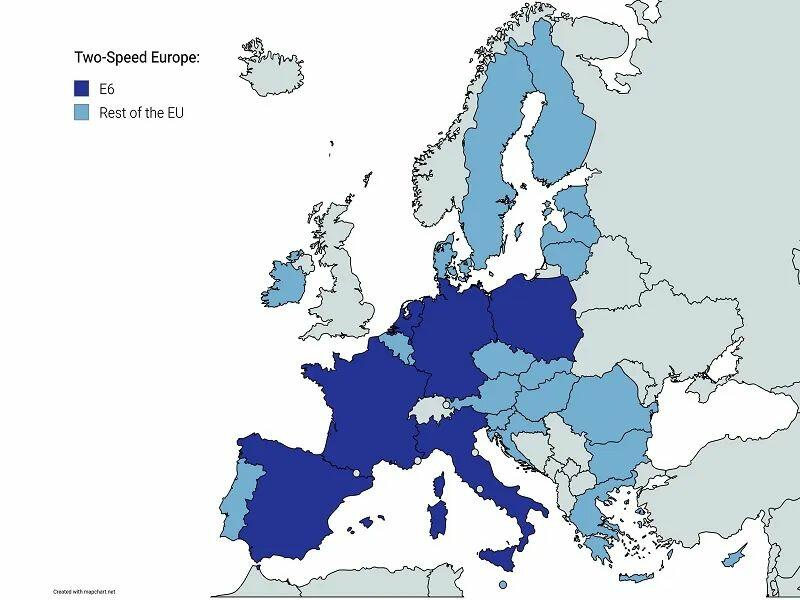
According to the Washington Post, Klingbeil also sent a letter to his counterparts from the aforesaid countries announcing his intent for them to prioritize “a savings and investment union to improve financing conditions for businesses; strengthening the euro’s role as an international currency; better cooperation on defense spending; and securing resilient supply chains for critical raw materials.” His “two-speed Europe” proposal essentially functions as the EU’s adaptation to Great Power geopolitics.
Trump returned this approach to the fore of International Relations after authorizing the capture Venezuelan President Nicolas Maduro and the seizure of a Russian-flagged tanker in the Atlantic. The resumption of Great Powers prioritizing their national interests without being concerned anymore about accusations of violating international law bodes ill for the EU’s interests. After all, the US now wants EU member Denmark’s territory of Greenland, and the EU can’t stop the US even if it really wanted to.
This newfound self-consciousness of EU powerlessness has been brewing for a while, especially since the bloc was coerced by Trump’s tariff threats into agreeing to a lopsided trade deal with the US last summer, apparently inspired its de facto German leader to finally take action to rectify it to a degree. To be sure, the EU will probably never be able to restore its “strategic autonomy” vis-à-vis the US, but it could still possibly function more cohesively for making itself more competitive on the world stage.
For that to happen, member states will have to surrender more of their sovereignty to Brussels, thus furthering Germany’s long-running goal of federalizing the EU under its de facto leadership. This goal is being pursued through multiple means, including the EU’s planned transformation into a military union and creating a bigger pool of common debt through more funding for Ukraine. The challenge is that the EU’s consensus requirement for such major decisions allows smaller states like Hungary to stop this.
Therein lies the importance of Germany assembling an exclusive tier of EU members for making such decisions amongst themselves and then coercing their smaller peers into following suit through the momentum unleashed by them creating tangible facts on the ground. The clock is ticking since Poland’s ruling liberal-globalist coalition might be replaced by a conservative-populist one after fall 2027’s next parliamentary elections, however, ergo why Germany wants to get as much done as soon as possible.
These plans could be foiled even before then if Poland’s conservative president vetoes legislation associated with it since the ruling liberal-globalist coalition lacks the two-thirds majority to overrule him. Any moves by this exclusive tier that don’t require legislative approval to advance the EU’s de facto federalization could also be challenged by Poland’s Constitutional Tribunal and Supreme Court, which are at the center of a highly partisan dispute, thus possibly delaying implementation till the next elections.
Poland’s role in this German-proposed process is pivotal. Participation and tangible progress could create facts on the ground that are difficult to reverse even if the government changes after fall 2027. Likewise, resistance through the means described above could impede the aforesaid progress and possibly avert the associated consequences. If a conservative-populist coalition comes to power in Poland, it might then assemble regional allies to collectively and thus more effectively oppose these plans.
In that scenario, the EU could bifurcate into German- and Polish-led tiers, the first representing its legacy members and the second its new ones. Just like the German-led tier plans to make decisions amongst themselves and then coerce their smaller peers into following suit, so too could the Polish-led one do the same vis-à-vis their larger peers. These dynamics could result in the EU’s de facto dissolution into two distinct blocs that only remain united through their inherited policies like freedom of movement.
It’s therefore ironic that Germany considers its “two-speed Europe” proposal to be an adaptation to Great Power geopolitics that’ll enable the EU to function more cohesively for making itself more competitive on the world stage when this proposal actually risks dealing a deathblow to the EU as it now exists. The odds are still in Germany’s favor, but they could decisively shift after fall 2027’s next parliamentary elections in Poland, which are shaping up to be consequential for the entire continent.
END
ITALY
KOLBE
this attracts many rich!!
Italy Beckons The Rich: How Flat Taxes And Lifestyle Are Luring Global Millionaires
Tuesday, Feb 17, 2026 – 07:20 AM
Submitted by Thomas Kolbe
Think of Italy, and wanderlust awakens immediately. Last year, over 140 million visitors experienced the beauty of the Amalfi Coast, enjoyed time at Lake Garda, in South Tyrol, Tuscany, or on the beaches of Sicily. Italy is a land of dreams with a rich cultural history, attracting those who want to experience the dolce vita in its finest form.

Italy is also a country that has drawn wealthy individuals from around the world for years. Last year alone, more than 3,600 high-net-worth individuals chose Italy as their new residence. They brought an estimated €21 billion in wealth with them – at least for tax purposes, as their investments or company holdings are usually spread across multiple countries.
What drives these wealthy newcomers may be Italian cuisine and the excellent weather, but above all, hard facts matter. Italy offers a special tax regime for the wealthy in the form of a flat tax. Incoming expats can either opt for standard domestic taxation or the so-called CR7 rule, under which wealthy newcomers previously paid a flat annual tax of €200,000 on all foreign income.
The CR7 rule, named after footballer Cristiano Ronaldo, whose now-iconic jersey bears the number seven, targets a specific class of taxpayers whose main sources of income lie abroad. It generally applies for up to 15 years and covers earnings from capital investments, image rights, licenses, foreign real estate, capital gains, or foreign inheritances.
Income from Italian domestic sources – in Ronaldo’s case, the salary from Juventus or revenues from Italian property – remains subject to standard Italian taxation. Ronaldo used this model after moving to Juve, allowing his billion-dollar wealth, largely invested abroad, to work tax-efficiently.
Italy has thus created a selective tax system designed to open doors for the global wealthy to settle in Italy, potentially establish business roots, and, later – even in the next generation – return to the regular tax system as integrated Italian citizens.
For the Italian treasury, this is a profitable arrangement. Adding ordinary consumption taxes and other routine levies, the state is estimated to have gained around €1 billion in extra revenue last year from the influx alone – without further effort. New businesses and investments from these wealthy newcomers also potentially create jobs and contribute to their local communities.
The broader tax framework is also appealing. Corporate and capital gains taxes in Italy are on average about two percent lower than in Germany. Inheritance taxation, for example, is significantly lower than in the UK, which now levies 40 percent on inheritances above £325,000, triggering an exodus of wealthy citizens.
Unsurprisingly, this preferential taxation has sparked criticism among Italians. The government of Giorgia Meloni responded by raising the flat rate from €100,000 to €200,000, and as of the start of this year, to €300,000. A flat fee of €50,000 per family member is also due. The goal seems to be defusing opposition without undermining the incentives.
Italy’s fiscal situation practically forces this approach. With public debt at roughly 135 percent of GDP, the country is cornered. Tough budget cuts accompany the government’s tax initiatives – and early results are visible.
This year, the budget deficit is expected to shrink to 2.5–2.8 percent of GDP – a notable achievement, considering other EU heavyweights like Germany and France report deficits of five to six percent.
The bond market has also responded positively. Yields on ten-year Italian government bonds have dropped from about 5 percent three years ago to roughly 3.5 percent today. The gap to German bonds – the so-called spread – is narrowing, signaling that markets view Italy’s fiscal climate as far more stable than just a few years ago, while conditions in Germany are increasingly perceived as critical.
In Rome, officials are watching Germany’s tax debates closely, where signs are emerging that Berlin might follow Norway’s 2022 example and levy a special wealth tax on the rich.
The Social Democrats, together with the united Left, are pushing for higher inheritance taxes on corporate wealth and the debated reintroduction of a wealth tax, driving their coalition partners forward. The political climate is favorable, and the Union parties appear resigned to the left’s dominance, likely to support these measures despite the precarious state of social security.
The mechanism is simple: spark a resentment-driven debate, activate the already abundant public envy, and target the wealthy. This alleviates political pressure – both on migration and on overdue welfare reforms – from the shoulders of those in charge.
Economists at the German Institute for Economic Research recently added fuel to the debate. With progressive rates of up to 12 percent for billionaires, Germany could generate roughly €150 billion in extra annual revenue.
Yet envy debates increasingly replace rational policy. This capital is not idle; it funds productive investments, company holdings, job creation, and technological advancement.
In its struggle for survival, Germany – and apparently a majority of its citizens – seems willing to consume its own productive base rather than endure a period of tough reforms and sacrifice, emerging stronger with a healthier economic foundation.
It is a fatal path, historically a civilizational rupture: for a limited time, the strong state stands at the end of a rapidly bleeding middle class, whose economic assets melt like ice in the sun. A societal climate of envy and impoverishment is the inevitable result.
South of the Alps, one can already anticipate a surge in German millionaires relocating. Germany’s political climate is increasingly hostile to enterprise and performance.
And as noted, life in Tuscany or the picturesque coastal towns of Italy offers compelling reasons to leave Germany behind. Put simply: nowhere in Italy is it as bad as in Berlin.
* * *
END
GERMANY
climate change is killing Europe
(Kolbe)
Germany’s Climate Policy Has Moved From Politics To The Courts… And The Economy Is Paying The Price
Tuesday, Feb 17, 2026 – 05:00 AM
Submitted by Thomas Kolbe
Germany is the political engine of the Green Deal, yet it continues to fall short of its own CO₂ reduction targets. Now Germany’s Federal Administrative Court in Leipzig has ordered the federal government to tighten its climate targets by the end of March. The ruling follows a lawsuit filed by the German Environmental Aid (Deutsche Umwelthilfe), aimed explicitly at increasing political pressure. Germany is tightening the screws on its own catastrophe.
Germany in 2026: the economy has entered its eighth consecutive year of industrial decline. Companies are shutting down, and hundreds of thousands of jobs have already been lost in the core sectors of the country’s former prosperity—chemicals, mechanical engineering, and above all the automotive industry.
Climate change has struck—or rather, the ideologically skewed and socially unprecedented self-destructive frenzy of German politics has begun to shred any remaining hope of a return to normal economic conditions.
The attempt to free the country from conventional energy sources such as oil, gas, and coal through a rapid transition to CO₂-free energy—politically and psychologically inflated into a moral crusade to “save the planet”—has failed.
Given the devastating competitive position of the German economy, which now pays energy prices roughly three times higher than competitors in reference locations such as France or the United States, any rational observer would urgently recommend consigning the entire transformation agenda to the dustbin of failed political hubris and collective delusion.
What remains is damage control: a rapid return to a market-based energy system, an end to destructive environmental and social experiments, and an unavoidable restructuring of the welfare state to reflect new economic realities. Germany is getting poorer, productivity is falling, and GDP per capita is declining—realities that even the federal government’s massive debt-financed spending programs can no longer conceal.
Yet Germany in 2026 is no ordinary country. Its political elite, supported by an affirming media ecosystem, has entrenched itself in a self-referential system of emissions-centered economic control—a system now reinforced by judicial authority.
In its ruling, the court mandated that the government sharpen its environmental targets. Under current conditions, a gap of at least 200 million tons of CO₂ would remain by 2045, which must now be eliminated across Germany’s entire economic structure.
Judges who effectively substitute political objectives for democratic deliberation are now setting the framework for Germany’s continued decline.
The lawsuit was brought by the German Environmental Aid—an organization already known for launching the first serious legal assault on Germany’s automotive industry during earlier battles over particulate emissions in city centers. The pressure on Germany is now coming from within: from a taxpayer-funded NGO complex that appears determined to politically delegitimize key industries, with the state apparatus firmly on its side.
According to Deutschlandfunk, a leaked draft from the SPD-led Environment Ministry outlines a new climate program aimed at achieving climate neutrality by 2045. Spanning more than 330 pages, it appears the government anticipated judicial escalation and preemptively prepared the groundwork for a revised climate law. Political conflict has been outsourced to the courts, to the relief of Berlin’s climate hardliners amid worsening economic conditions.
Among the core measures is the intensified “heat transition” in the building sector. The ministry proposes increasing subsidies for low-income households—up to 40 percent of costs—for heating replacements and heat pump installations. A generous solution for the climate-policy establishment, conveniently rolled out during an election season.
The leaked strategy signals a general increase in transformation pressure. No fundamentally new instruments are introduced; instead, property owners are placed under tighter time constraints to replace heating systems.
Climate policy and financial affordability are colliding ever more sharply. Amid a prolonged recession, the government is deliberately provoking social conflict while attempting to pacify it through ever-expanding subsidies.
Germany’s public debt, at roughly 65 percent of GDP, still appears moderate by European standards. In Berlin, this is interpreted as ample room to finance the transformation through rising debt while simultaneously increasing pressure on the private sector.
Environment Minister Carsten Schneider speaks optimistically of new “climate jobs.” The overall picture, however, increasingly resembles political farce. A state that secures public consent for its transformation agenda through debt, subsidies, and higher taxes acts obscenely and invites long-term economic damage.
Plans even include methane measurement programs for livestock, modeled after New Zealand—yet another blow to farmers. German emissions policy is entering a manic phase, blurring the line between real policy and political satire.
The subsidy machine continues to spin. The government plans to support 800,000 electric vehicles in the coming years. Credit resources remain abundant after Chancellor Friedrich Merz effectively neutralized the constitutional debt brake with the previous parliament. By 2040, electric vehicles are supposed to account for 70 percent of Germany’s car fleet—despite the absence of any credible plan for supplying the required electricity.
Artificial, technocratic necessity has replaced political debate. From the outset, it was clear that the supposed softening of the combustion-engine ban was mere political theater—a sedative for citizens gradually awakening to the scale of the green ideological disaster.
The energy sector faces further tightening. Dozens of reserve gas power plants are to be added, while existing plants are to be converted to hydrogen capability. Offshore wind projects abroad are being accelerated. These measures amount to desperate rescue attempts for a failed energy transition—an assessment implicitly acknowledged even by the Environment Ministry itself. Model-driven hope has replaced rational judgment.
Germany’s climate policy, entangled in a feedback loop with Brussels, has ossified into an auto-referential system marked by a narrow temporal vision and growing argumentative poverty. Looming over it all is the threat of further litigation by the German Environmental Aid should the final legislation fail to meet its standards.
Germany now finds itself in the grip of green ideologues who have subordinated all parties behind an ideological firewall. The environmental lobby’s greatest success came when it elevated the Net Zero target to constitutional status.
How much greater must the economic pressure become before a majority forms—even in front of this firewall—to dismantle this manifest political folly?
END
SPAIN
DR LACALLE..
why Spain is faltering..
Impoverishment Of Spaniards Is The Result Of Years Of Interventionist Policies
Tuesday, Feb 17, 2026 – 03:30 AM
Inflation, bloating GDP with public spending and immigration and hidden unemployment are the ingredients of the so-called “economic miracle” of the Sánchez administration.
Spain closes 2025 with the consumer price index (CPI) rate above the euro area average and higher than all the large economies in Europe.
Cumulative inflation, measured by CPI, during Sánchez’s term reached 24.8%. Housing and food have risen by almost twice as much as the headline CPI.
The reality of Spain is that the loss of purchasing power and the impoverishment of Spaniards are the result of years of interventionist policies.
Home purchase prices have soared by more than 38%, housing-related expenses (rent, utilities, maintenance) have risen by more than 30%, and food prices are up around 38%.
The “real shopping basket” studies find increases of between 40% and 60% in basic products between 2019 and 2025, showing that inflation in essential goods has been far higher than the official average.
Between 2019 and 2025, real wages in Spain have fallen by 0.3%, according to CaixaBank, but the picture is much worse if we look at net real wages, which have fallen by more than double because the government refused to index taxes to inflation and has sharply increased the fiscal burden of families and businesses.
GDP growth, productivity, and the statistical mirage
Government propaganda claims that productivity and GDP per capita “grow” by using the pandemic collapse as the starting point of the series. In other words, because Spain fell more than anyone else, now it “grows.” The reality is very different.
Labour productivity per occupied person, compared with the EU average, has fallen from 99.8% in 2018 to 97%. Bouncing back is not growing, and even less so when the government is bloating GDP with government spending and immigration.
A quarter of Spain’s net real GDP gain over 2019‑2025 is directly explained by higher public consumption, and more if you include EU‑funded public investment and subsidies classified under other items, according to CaixaBank Research.
Furthermore, real GDP per capita is expected to grow by a mere 1.1% between 2017 and 2026, according to the IMF. The large increase in immigration disguises a weak productivity model inflated by debt and public spending.
Spain’s socialist “growth” model, doped by immigration and public spending, leaves weaker productivity growth and stagnant GDP per capita
This is where the statistical mirage of Spain’s alleged “superior” growth becomes evident: headline GDP is inflated by a strong increase in immigrant population, a ballooning public sector, and the injection of one-off EU funds, while GDP per capita and productivity stagnate or worsen.
Spain’s socialist “growth” model, doped by immigration and public spending, leaves weaker productivity growth and stagnant GDP per capita, dependent on an annual net debt issuance of more than 50 billion euros. It is a recipe for ruin.
In purchasing power standards, Spain’s GDP per capita was 91% of the EU‑27 average in 2019 and is now around 90%, thus still below its pre‑Covid relative position despite the “strong growth” propaganda.
That implies an average annual real GDP per capita growth of only about 1.1–1.4% over 2019–2025. In other words, by 2025 Spain had finally surpassed its 2019 real GDP per capita, but the net gain per person after six years is modest, disguised by a large increase in government spending and one-off EU funds, and much smaller than the headline cumulative GDP growth figures suggest.
Hidden unemployment – another hallmark of the Sanchez government
In 2021, with the labour market “reform,” it became mandatory to convert short-term and seasonal contracts into “discontinuous permanent” contracts.
With this statistical regulatory change, people on this type of contract are not counted as unemployed even when they are not working, and also if they are receiving unemployment benefits.
Thus, it is no surprise that in nine provinces there are more people receiving unemployment benefits than officially registered unemployed.
Official labour office (SEPE) statistics show that in Almería, Huelva, Jaén, the Balearic Islands, Huesca, Teruel, Soria, Castellón, and Cáceres, the unemployment coverage rate exceeds 100%, meaning there are more unemployment benefit recipients than officially unemployed.
In January 2019, the number of jobseekers “with an employment relationship” was 280,389. In December 2025, the figure was 892,933, more than three times higher.
This means that effective unemployment has hardly improved at all since 2019, and the real effective unemployment rate is around 13.6% compared with the 9.9% official figure.
The activity rate has been stagnant at 59% since 2019, which is another example of a weak labour market.
At the end of December 2025, the total number of people registered with SEPE seeking work stood at 3,854,911, which means there are 1,446,241 more people not working than the official “registered unemployment” figure.
Thus, registered unemployment has fallen by 152,048, while real unemployment (the number of people registered with SEPE who are not working) would have increased by 50,609.
The number of people not counted as unemployed in SEPE data in December reached 1,893,134 and represents 44% of the total number of registered job seekers. The number of inactive people receiving unemployment benefits increased in 2025 compared with 2024 by 64,175.
A model based on propaganda, not reality
Spain’s economic miracle is just a statistical mirage. Spain’s “superior” GDP growth is not due to each person producing more (down, -1.7% 4Q2019-4Q2025, as the working population grew by 12.5%, but GDP by only 10.6%), and the unemployment reduction is distorted by the record number of inactive workers not considered unemployed even if they get an unemployment subsidy. The number has tripled since 2019.
Sánchez has implemented a model based on propaganda, not reality, sweeping real unemployment under the rug, doping GDP with debt, immigration, and European funds, and leaving a reality of worse net real wages and atrocious productivity.
Spain may seem like an economic growth miracle in headlines, but details show a time bomb that will explode once the placebo effect of debt fades and immigration’s net negative impact on public accounts soars.
END
UK
why the UK is faltering….
In Defense Of Sir Jim Ratcliffe
Tuesday, Feb 17, 2026 – 06:30 AM
Authored by Charles Johnson via TheCritic.co.uk,
Far more energy has gone into condemning his phrasing than confronting the questions he raised…

Sir Jim Ratcliffe’s statement that Britain has been “colonised by immigrants” has sparked a fierce reaction.
From Starmer to Bluesky, to the Athletic and all the football social media pundits in between, the co-owner of Manchester United has been bombarded with the same attack lines repeatedly.
He has been called a tax dodging, racist immigrant hypocrite.
Such an uproar has flared up in such a short space of time because Ratcliffe is radically different from those who have issued similar statements before. Ratcliffe is not a political figure: you do not see billionaires nor football club owners voicing discontent like this. The pushback has been fierce because Ratcliffe has no political incentive to say any of this. He isn’t running for office, seeking favour, or chasing votes — which makes his intervention harder to dismiss. Part of the backlash, too, reflects an unease that his diagnosis may be accurate.
The remarks came from an initial conversation regarding the economic challenges Britain faces in general, not solely on immigration. The snippet that has been so widely shared is merely part of a wider statement of the economic problems Britain faces; Ratcliffe refers to the issues of “immigration” and “nine million people” on benefits simultaneously.
Colonised is a strong opening salvo for a figure such as Ratcliffe, who is not known for any previous anti-migration stance. This generated responses of tone policing from his critics – cries that his choice of words were “disgraceful and deeply divisive” and that “this language and leadership has no place in English football” from Kick It Out, a notable “Anti Racism” football pressure group. There was no attempt to argue or debate: this was no more than tone policing, of “mate mate mate, you can’t say that mate”. It did not engage with the substantive point. It was not an argument.
The Prime Minister has pushed for Ratcliffe to apologise. Less than a year ago, Starmer was referring to Britain as an ”Island of Strangers”; he has little argument here. Sir Ed Davey has stated that Ratcliffe is “totally wrong” and is “out of step with British Values”. Once again this is weak tone policing, not an argument. Regardless, which British values are being violated in particular? What are British values precisely meant to mean here?
The fact is that Ratcliffe’s vocabulary choice is nowhere near as divisive as the impacts of mass migration in the last quarter century.
Mass migration is the most important issue in British political debate. It has bought sectarianism, Bengali and Palestinian politics swinging both local council and Parliamentary elections, a deepening of housing crisis, the rape and murder of British women from taxpayer funded hotels and programs which bloat the welfare state even further. It is undeniable mass migration has defined British politics of the 2010s onwards. It has been much more harmful and divisive than any comment made by Sir Jim Ratcliffe. His words are nothing compared to the actions of Deng Chol Majek, or Hedash Kebatu, to name a couple of examples.
Critics have also cried that Ratcliffe is “an immigrant himself, dodging tax in Monaco”. The difference between Ratcliffe and migration into Britain is so different they are almost incomparable. In the 2017/18 tax year Ratcliffe was the fifth highest taxpayer in the country, footing a bill of £110.5 million. With such an extraordinarily high bill, it is no wonder that he has since moved to Monaco. Meanwhile, the average salary of of a migrant entering Britain in 2023 (which has fallen by £10,000 since 2021) was £32,946, according to a report by the Centre for Migration Control. From this we can estimate a migrant would pay about £5,000 in income tax. That means it would take over 22,000 (statistically average) migrants to foot the tax bill that Ratcliffe paid in one year alone. Ratcliffe has been an exceptional cash cow to the British state. He has been taxed incredible amounts and contributed more to this country than almost anyone currently living; to call him hypocritical since he dared to criticise migration and its impact on the welfare state is simply not fair.
Census data from the ONS in 2021 shows that migrants from four nations – Somalia, Nigeria, Jamaica and Bangladesh – head over 104,000 social homes in London alone. With such incredible numbers of subsidised housing going to foreign born nationals, it is absolutely correct to state that mass migration is costing the British economy a fortune. The same census states that over 70% of Somali born households are in social housing in England and Wales, whilst also being of lowest contributors to income tax in the nation – paying well under the £5,000 stated per head previously. The increase and sheer scale of benefit reliance for many immigrants in Britain is not sustainable, and it is a problem that is right to be addressed.
Perhaps the most nonsensical argument presented by some is that as co-owner of Manchester United he employs a significant number of immigrant players. Bruno Fernandes is not living in social housing in Wythenshawe. Benjamin Sesko is not in a single bed council flat in Hulme. When he arrived in Manchester last year, the first thing Senne Lammens did was not register for Universal Credit. Not a single foreign player is a drain on the state. They are, as elite athletes in the most lucrative league in the world, very clearly exceptions to the norm of British migration. The difference between Bruno Fernandes, who earns a reported £300,000 a week, and the over 40% of Bangladeshi immigrants who are economically inactive should really not need spelling out. We are referring to just 17 foreign senior team players who all earn more in a week than the average migrant – or Brit – will earn in a year. It is ludicrous to even attempt to compare the two. Regardless, employing or working with immigrants does not mean you waive your right to criticise the state of affairs in Britain. As an Englishman, Sir Jim Ratcliffe has a given and inalienable right to comment on the affairs of his country.
Ratcliffe’s critics have entirely focused on his choice of the word “colonised”, and how they consider it inflammatory. This choice of phrase was not entirely accurate or intentional by Ratcliffe – proved by the fact he issued an apology over his “choice of language”, rather than the substance and argument behind his critique of the broader economic challenge of Britain.
The bottom line is, Ratcliffe was right to raise a perfectly reasonable concern. He is directionally correct, and close enough to the truth that the obsessive focus around his phrasing is both absurd and clearly no more than a tactic to dodge the substance of his argument entirely.
His critics have been intentionally evasive around the underlying subject: it is a harsh, necessary truth they have no reply too.
They avoid the debate because, despite his wording being wrong, Ratcliffe is right.
END
EU
KOLBE
a 4 trillion euro bond? How nuts!!
(Kolbe)
EU Prepares €4 Trillion Eurobond Push As Russia Eyes Dollar Comeback
Tuesday, Feb 17, 2026 – 02:00 AM
Submitted by Thomas Kolbe
The European Union is steering purposefully toward the introduction of Eurobonds. At the preparatory EU summit at Alden Biesen Castle in Belgium, numerous signs suggest that the multi-billion-euro Draghi plan could soon be set in motion. At the same time, geopolitically, a possible Russian comeback is emerging as fresh trouble for Brussels.
The ability to analyze mistakes and rationally weigh realistic courses of action belongs, in evolutionary terms, to our conditio humana. Experience teaches us: those who repeatedly slam their heads against the same wall may not qualify as evolution’s preferred leadership model. Headaches should be understood as a warning sign — not as motivation for the next assault. This preliminary remark serves to highlight a fundamental problem in present-day Europe.
Our political elites are conducting a socialist field experiment: they repeatedly hurl themselves against the same wall — that of the European economy, its businesses, and some 450 million citizens — without allowing persistent failure or pounding headaches to deter them.
One might assume this is a highly complex structure. From the perspective of European policymakers, however, it appears primarily as a challenge to be met with the fatal toolkit of central planning and stubborn ignorance.
We were able to assess the condition of this collective “head” on Thursday in Belgium at the EU summit. Brussels’ inner leadership circle around Commission President Ursula von der Leyen, along with its two political standard-bearers Emmanuel Macron and Friedrich Merz, had correctly diagnosed the issue in advance: the EU economy lacks competitiveness. China and the United States have surged ahead technologically — and they have the audacity to position themselves diametrically opposed to Europe’s ideology of centralized control and transformation logic. The two superpowers flatly refuse to smash their heads against the wall of European delusions — CO₂ elsewhere helps plants grow and herds graze, while here “flutter power” is generated alongside deliberate landscape devastation.
Instead, they have moved to radically deregulate their markets. The Chinese did so earlier; the Americans are now following at full speed, embracing what appears evolutionarily sound: entrusting the social fabric of their societies once again to markets, individuals, and the principle of personal responsibility.
Meritocratic values, a revival of bourgeois culture, perhaps even religion — Europe wants none of it. Everything here remains woke, carefully curated by the supreme censor in Brussels. On the very day of the summit, the European Parliament declared that a trans woman is a woman — full stop.
So much for the “rules-based order” and European values. An order that could be grounded in many things — but apparently not in reason and biological reality. Europe postures as post-Enlightenment, beyond the bounds of common sense.
Back to the summit and the question of how to solve the Eurozone’s economic dilemma. An old acquaintance, former Italian prime minister and ex-ECB chief Mario Draghi, delivered the blueprint for a supposed European comeback two years ago — and may now define the EU’s framework for action.
To deflate the suspense: Europe’s debt club will likely choose the same old wall for its next act, once again demonstrating its skeptical stance toward cognitive progress. If Brussels resorts to the Draghi plan in its economic distress, a trillion-euro debt package would be activated — public credit designed to catapult the continent in green tech, artificial intelligence, digital infrastructure, and even military technology to the level of its geopolitical rivals by 2030. Hubris executed on the bond market.
The financial framework outlined by Draghi is enormous: over five years, €800 billion annually would flow into Eurobonds — unless a few reasonable politicians manage to halt this risky undertaking. €800 billion corresponds to roughly five percent of the EU’s GDP. This additional borrowing alone would, under current conditions, raise member states’ total debt by around 25 percent.
A fiscal gamble whose test phase already occurred during the issuance of NextGenerationEU bonds in the Covid era — at nearly identical volume. €750 billion was raised, and in the end the European Central Bank had to absorb much of it. Demand for European debt appears lukewarm; the money has since flowed into Southern European welfare budgets and selected green prestige projects.
Brussels must literally plant its political beacons across the landscape so that even the last EU citizen remembers who transformed cultural scenery into a kind of Hollywood dystopia filled with wind parks.
You will recall Mario Draghi: once Italy’s technocratic — that is, unelected — prime minister, and earlier the architect of the OMT program (Outright Monetary Transactions), the instrument that empowered the ECB during the 2012 debt crisis to purchase unlimited sovereign bonds of distressed euro states to regulate yields. “Whatever it takes,” declared Mr. Bombastic Draghi at the time — and now his heavy fiscal artillery may once again fire at problems whose causes lie less in the monetary sphere than in the microeconomic fabric and cultural climate of our societies.
These difficulties will not be solved through debt-financed state macro-management. What is missing is entrepreneurial spirit. The continent is overregulated, capital markets are impaired, and Europe’s ever-growing state apparatus consumes vast sums. The private sector struggles to develop viable business models while administrative burdens and fiscal appetites continue to expand.
The self-inflicted energy crisis born of the green transformation frenzy is only one of several nooses tightening around EU citizens’ necks. An even more bloated state apparatus would not loosen these nooses — it would tighten them. Of that there can be no doubt.
For Germany, the simultaneous introduction of Eurobonds alongside the Draghi maneuver would mark the end of any remaining hope for fiscal stability. The current government’s chosen path would drive public debt up by at least five percent annually. Adding Germany’s proportional share of newly issued euro debt, one can already foresee that by 2030 Germany could easily breach 110 percent debt-to-GDP.
In other words: the welfare state would henceforth be financed directly from the printing press.
Chancellor Friedrich Merz demonstratively enjoyed summit unity with French President Emmanuel Macron. As so often, they agreed on the decisive questions, Merz explained, sharing a sense of urgency: Europe must act now and become competitive again — especially in industry.
Precisely the sector most heavily damaged by the very policies now overseen by the chancellor: higher CO₂ levies, supply-chain legislation, and an energy policy that levels industrial ambition.
In the end, it was the usual summit folklore — nothing more.
A “Buy European” rule is meant to guide the way, with supply chains to be more firmly centered in Europe. One may wonder how this resource-poor continent intends to achieve such ambitions. Especially in international trade and in Russia policy — precisely where abundant and affordable resources would be available — Europe has largely abandoned sober assessment. Toward its declared arch-enemy Russia, one of the most resource-rich nations on earth, Europe remains locked in maximal defiance.
The pre-summit ahead of the March gathering offers initial hints that joint debt financing may indeed become serious. Italy’s Prime Minister Giorgia Meloni — facing debt around 130 percent of GDP in the homeland of joint borrowing — may find the idea of shared liability, particularly by the German taxpayer, not entirely unappealing.
While Brussels dances around the golden calf of the transformation agenda and attempts to buy time with massive debt programs and well-sounding pseudo-reforms, decisive developments may unfold behind the scenes.
According to an internal Kremlin memo seen by Bloomberg, Russia is reportedly considering a return to the US dollar payment system. After years of European sanctions, American embargoes, and exclusion from SWIFT, such a move would be a geopolitical shock of the first order — further isolating the European Union while potentially fueling secessionist tendencies, particularly in Eastern Europe.
The memo outlines several areas of overlapping Russian-American interests: energy and raw materials cooperation, as well as possible integration of dollar-based financial instruments into Russia’s banking system. Reuters has confirmed a corresponding contact channel between Washington and Moscow.
Against the backdrop of increasingly coordinated activity among the three major actors — the United States, China, and Russia — Brussels’ strategy appears in a different light. Perhaps this explains its efforts to seek strategic partnerships with classic geopolitical swing states such as India or the MERCOSUR bloc.
For one thing unites the three great powers: all stand in increasingly strained relations with Brussels and the leading capitals of the European Union.
5. RUSSIAN AND MIDDLE EASTER AFFAIRS
ISRAEL TBN LAST 48 HRS
END
IRAN/IRAN GAS COMPANY
huge gas explosion from Iran’s biggest gas company
RUSSIA/EU
(Korbyko)
Lavrov Soberly Acknowledged The Challenges Posed By Trump 2.0
Saturday, Feb 14, 2026 – 11:20 PM
He calmly acknowledged that it’s now more difficult for Russia to advance its foreign policy goals due to the US’ renewed attempt to dominate the global economy through coercion and force, but he still believes that BRICS will play a pivotal role in furthering the global systemic transition to multipolarity.

Russian Foreign Minister Sergey Lavrov recently gave an interview to TV BRICS about their namesake organization and its role in the global systemic transition.
He began by contextualizing the present moment in history as the interim period between the decline of US-led Western hegemony and the rise of multiple centers of power and influence.
These inverse trends have led to friction because “the West is losing its hegemony but keeps on clinging to the institutions set up to secure that hegemony”.
The US can no longer fairly compete within the ‘rules-based order’ shaped by none other than itself several generations ago so it’s resorting to “blatantly unfair methods” against its rivals, especially Russia.
This includes sanctioning its energy companies, weaponizing sanctions threats against its “major strategic partners” like India (whom Lavrov specified) “to restrict Russia’s trade, investment cooperation, and military-technical ties” with them, and opposing the creation of alternative platforms of any kind.
On that last point, Lavrov clarified that “We are not advocating for the IMF, the World Bank and the WTO to cease their existence” and that “President Putin has said on many occasions that we are not the ones refusing to use the dollar.
The United States under President Joe Biden did everything to make the dollar a weapon against those who are deemed objectionable.”
BRICS, its proposed economic-financial tools, and other alternative platforms are only meant to complement existing ones and induce reform therein.
Russia’s top diplomat soberly acknowledged that “given the global war unleashed against us and the feverish attempts of the West to ‘punish’ all our partners by demanding that they stop trading with us and cooperating in the military-technical sphere, it is significantly harder to do our job and to provide maximally favourable conditions for internal development than it was, say, 10 or 15 years ago.”
He also mildly criticized Trump 2.0 for essentially continuing “Bidenism” despite its rhetoric to the contrary.
Far from respecting the ‘spirit of Anchorage’, which refers to the verbal agreements reached during that summit for resolving the Ukrainian Conflict and normalizing ties, “new sanctions are imposed, a ‘war’ against tankers in the open sea is being waged”, and more pressure placed on Russian partners like India. Lavrov then accused the US of trying to control the global energy industry in order “to dominate the global economy”, but if it relents, then Russia would be eager to explore mutually beneficial cooperation.
On that note, he concluded the interview by circling back to Russia’s vision of BRICS’ role in the global systemic transition, which he foresees “creating an architecture that will not be subject to the illegal actions of one or another player from the Western flank.”
BRICS will also play a role in Russia’s “Greater Eurasian Partnership”, which Lavrov suggested could lay the basis for a “common ‘canopy’” over the continent, with the innuendo being that Eurasia might one day have its own version of the AU or CELAC.
He didn’t say so, but the context implies that BRICS would then function as an alternative center of global governance for reforming the world order in order to make it more equitable, the goal of which would be advanced by assembling representatives from each continental organization to discuss viable pathways thereto within this ‘mini-UN’.
Through these means, Russia and the rest of the World Majority could continue furthering multipolar trends despite the newfound challenges posed by Trump 2.0.
END
RUSSIA/UKRAINE
Kremlin’s Surprise Overture: Ready To Halt Airstrikes On Election Day If Zelensky Allows Vote
Monday, Feb 16, 2026 – 09:50 PM
Moscow just potentially created a big opening for Ukrainian elections to actually happen, with an unexpected overture:
Russia is ready to ensure that there will be no airstrikes on election day in Ukraine if Kiev decides to hold elections, Russian Deputy Foreign Minister Mikhail Galuzin said an interview with TASS.
However, the big question remains of if President Zelensky decides to actually proceed with an election. Given that months ago he didn’t even cave to Trump pressuring him to do so, it’s very up in the air whether he wants to actually see this through, or if martial law will continue to be used as an excuse to block a vote.

Russian President Vladimir Putin himself has floated willingness to halt airstrikes deep into Ukraine on election day if elections are held there – but he’s also also recently said that the millions of Ukrainians currently living in Russia should have the right to vote.
These are mostly Russian-speaking Ukrainians who lived in the Donbass – as well as Crimea – before war broke out, or who are still there amid the conflict.
“Of course, Russian President Vladimir Putin’s statements remain relevant. But, as I earlier noted, there is no talk yet of the practical organization of voting in Ukraine,” Galuzin said.
“I would like to draw attention to our experience. In March 2024, presidential elections were held in Russia, and polling stations – even taking into account the ongoing military operations -were opened in close proximity to the combat zone. Kiev tried every way possible to disrupt the electoral process in the frontline regions, not shying away from resorting to terrorist means and sabotage. However, it proved unable to achieve its goal,” Galuzin added.
He then emphasized that Russia “will not stoop to Kiev’s practices and will allow the people of Ukraine to fully exercise their constitutionally enshrined electoral rights and independently determine the future development of their country.”
“Of course, if the Kiev regime finally decides to take this democratic step,” the Russian Deputy Foreign Minister added.
Ukraine has said a parliamentary committee is still studying the issue, and that the total safety of all citizens would have to be guaranteed – also by international powers – while the vote proceeds.
END
RUSSIA/UKRAINE
Russia Pounded By Biggest Ukrainian Drone Swarm Since January Ahead Of Geneva Talks
by Tyler Durden
Tuesday, Feb 17, 2026 – 09:40 AM
Russia’s Defense Ministry on Tuesday is reporting an overnight and early morning attack which marked the largest drone assault from Ukraine since early January.
Russian air defenses shot down more than 150 Ukrainian drones in the attack which included hundreds of UAVs sent in total, as officials from both sides are imminently expected meet in Switzerland for another round of peace talks.

According to the ministry, 79 drones were intercepted over the Black Sea and the Sea of Azov, 38 over annexed Crimea, and 18 over the Krasnodar region.
It is clearly among the biggest single wave of cross-border assaults since January 1st – when Moscow said it downed 168 unmanned aircraft in a similar attack.
Russian governor of Sevastopol Mikhail Razvozhayev announced that in Crimea a nine-year-old boy was hospitalized with minor injuries, and that there was significant damage to vehicles, apartment buildings, private homes, and gas pipelines due to the strikes.
Neighboring Krasnodar saw a fire erupt at the Ilsky Oil Refinery due to drone strikes. Ukraine’s military boated of hitting the refinery, as it is owned by the Kuban Oil and Gas Company, which Kiev has highlighted supports Russian military logistics.
Authorities in other regions reported no casualties or significant damage from the overnight attacks – though airports across over a dozen cities imposed temporary flight restrictions as the drone wave unfolded.
Russia’s Defense Ministry later into Tuesday morning said it shot down nearly 30 additional inbound Ukrainian drones.
As for the ongoing peace talks in Geneva, Kremlin Spokesman Dmitry Peskov has told a press briefing not to expect much in terms of anything concrete today.
“I don’t think we should expect any news today because, as you know, work is scheduled to continue tomorrow. We have no plans to make any statements or remarks,” he underscored.
Peskov explained on Monday, “This time, the idea is to discuss a broader range of issues, including, in fact, the main ones. The main issues concern both the territories and everything else related to the demands we have put forward.”
Russia’s delegation is led by Presidential Aide Vladimir Medinsky. US envoys Steve Witkoff and Jared Kushner will represent the US at the talks, and they are coming off the indirect talks with Iran from earlier the same day, also happening in Geneva.
As for President Trump’s latest assessment, he told reporters aboard Air Force One, “Well, we have big talks.” He stated that “It’s going to be very easy. I mean, look, so far, Ukraine better come to the table fast. That’s all I’m telling you.”
He tends to go back and forth from month to month chastising either side, and apparently now the public pressure is back on the Zelensky government. Trump has been quieter of late when it comes to demanding that Ukraine quickly hold national elections, despite an apparent offer from the Kremlin to cease airstrikes deep inside Ukraine when the vote happens.
6. GLOBAL ISSUES, COVID ISSUES, VACCINE INJURIES/HEALTH ISSUES
ROBERT H TO US:
FDA Approves Unique Device to Treat Pancreatic Cancer With Electrical Fields … seems more people are seeing electrical energy working
FDA Approves Unique Device to Treat Pancreatic Cancer With Electrical Fields:
END
SPECIAL THANKS TO CHRIS POWELL FOR THIS REPORT!!
Ivermectin vs. cancer

https://oncodaily.com/oncolibrary/antiparasitic-drugs
END
New Coalition Aims To Ban Vaccine Mandates Across US
Monday, Feb 16, 2026 – 04:35 PM
Authored by Zachary Stieber via The Epoch Times,
A new coalition composed of 15 groups, including an organization founded by Health Secretary Robert F. Kennedy Jr., is taking aim at vaccine and mask mandates across the United States.
Children’s Health Defense, the Kennedy-founded group, and other members of the Medical Freedom Act Coalition say they want every state to introduce and pass medical freedom bills.
“I think it’s the first time we’ve seen this kind of effort in the kind of freedom and health movement,” Leslie Manookian, who founded the Health Freedom Defense Fund, told The Epoch Times.
The model state is Idaho, which in 2025 enacted a law that prohibits businesses and schools from requiring customers, employees, and students receive vaccines or other medical procedures. Manookian helped write the legislation, called the Idaho Medical Freedom Act.
“Because that passed, it really showed what was possible,” Leah Wilson, executive director and co-founder of Stand for Health Freedom, and one of the leaders of the coalition, told The Epoch Times. “Our goal is to take the Medical Freedom Act to as many states as possible across the U.S.”
“Children’s Health Defense finds vaccine mandates and medical mandates reprehensible, and we are honored to be part of a coalition fighting to end forced medical procedures, to end medical mandates and vaccine mandates for all Americans,” Michael Kane, director of advocacy for Children’s Health Defense, told The Epoch Times.
The coalition also includes others linked to Kennedy or his Make America Health Again (MAHA) movement, including the Independent Medical Alliance, several of whose advisers Kennedy has appointed to a vaccine advisory committee; the MAHA Institute, whose president co-founded a political action committee that funded Kennedy’s presidential bid; and MAHA Action, whose leader has published books written by Kennedy and which has held events attended by the health secretary.
People involved in the effort say they are in communication with Kennedy on other matters, but have not discussed the coalition. The U.S. Department of Health and Human Services did not respond to a request for comment by time of publication.
“This state, more than any state in the country, stands for not only medical freedom but a healthy population,” Kennedy said in a briefing with Idaho Gov. Brad Little, a Republican who signed the Idaho Medical Freedom Act a few months prior, on July 23, 2025.
Kennedy recently told reporters in Tennessee that he was not part of efforts to end school vaccine mandates in states. “I believe in freedom of choice,” he also said, describing vaccination as “a personal choice that people should make with their physicians.”
The American Academy of Pediatrics, which partners with vaccine manufacturers, and American Families for Vaccines, among other organizations, oppose rolling back vaccine mandates. The groups did not respond to requests for comment.
Idaho Requirements Still in Place
The Idaho Medical Freedom Act says in part that a school “shall not mandate a medical intervention for any person to attend, enter campus or buildings, or be employed.” It also says that a business “shall not refuse to provide any service, product, admission to a venue, or transportation to a person because that person has or has not received or used a medical intervention.”
But according to the Idaho Department of Health and Welfare (DHW), parents are required to have their children vaccinated against certain diseases for school and daycare attendance in Idaho.
The department points to another law that outlines vaccine requirements for children.
“DHW encourages school districts to consider the Medical Freedom Act … when implementing vaccine requirements at schools,” a spokesperson told The Epoch Times in an email.
Supporters of the act say the Idaho legislation was imperfect. A new Medical Freedom Expansion bill introduced by state Rep. Rob Beiswenger, a Republican who co-sponsored the legislation, seeks to make clear that mandates are unacceptable.
“The Expansion bill will make it abundantly clear to students and parents that vaccination is a voluntary, personal and private choice and not mandatory,” Beiswenger told The Epoch Times in an email.
State Actions So Far
Legislators in about a dozen states this year have released bills that would alter or ban mandates for vaccines or other medical procedures.
Arizona legislators introduced a bill that would ban businesses and schools from requiring “a medical intervention” such as a vaccine for employment or attendance.
“This bill ensures that Arizonans are not forced to choose between their bodily autonomy and their ability to work, learn, travel, or to participate in public life,” Arizona Rep. Lisa Fink, a Republican who sponsored the bill, told a hearing in January.
Lawmakers in two state House committees have cleared the legislation.
Hawaii lawmakers introduced the Hawaii Medical Freedom Act, which outlines a similar ban. It has been referred to state House panels.
Indiana senators introduced a bill that would, among other aspects, bar requiring people “to accept, undergo, or engage in a medical intervention in or on the individual’s body as a condition of employment, entrance, admission, compensation, benefits, or participation.” The bill has been referred to the state Senate Health Committee.
New Hampshire representatives outlined legislation that would repeal immunization requirements for children. A public hearing on the bill took place on Feb. 4, and a legislative session on Feb. 11.
On the other hand, some lawmakers have been floating bills that would tighten vaccine mandates. South Carolina state Sen. Margie Bright Matthews, for example, recently introduced a bill that would end religious exemptions for measles vaccination amid an outbreak in the state.

“This legislation is about protecting children, protecting classrooms, and protecting communities with clear, medically grounded standards,” Bright Matthews, a Democrat, said in a statement.
Every state in the country requires vaccines for school attendance. Some allow exemptions for religious or philosophical reasons, while all permit medical exemptions.
Florida officials said in 2025 they would be removing all vaccine mandates, but the goal has met resistance in the state legislature, where action is required to remove mandates for some shots. The Medical Freedom Act, introduced in January, would expand exemptions to the mandates but not prohibit the mandates themselves.
The Health Freedom Defense Fund, part of the new coalition, has released model legislation that perfects the Idaho Medical Freedom Act, Manookian said. Lawmakers in other states can use the model legislation to introduce medical freedom bills in their states.
“I don’t think this is a partisan issue,” she said. “I think that Americans in general don’t want to be forced to do something to their children.”
END
GLOBAL ISSUES
A world in turmoil and change
Many dots are converging into a pattern that will shape tomorrow and no nation is on an independent path of its own timing. Everything is connected and NO nation is an island isolated from change.
This has great implications for not just nations but for everyone. Simply because the changes are structural in how trade settlement works and how money as a result flows.
The Rumors are that the Unit ( BRICS settlement means) is coming in August and is currently being tested. It bypasses both Federal Reserve Dollar and the Euro. It is made up 60% of BRICS currencies ( i wrote about this before) and 40% gold. Ponder this!
In effective if timing holds this means that the entire US control mechanism loses over a short time its relevance in global trade! Why? Because currently the Global South is larger in trade value than Western trade. It does not take long to topple the value of both the Euro and the USD. And what if China tells the US to pay for its’ trade in Units? Can you imagine the impact? It is not just that the value of the USD plummets but the US would be reduced as a power base. China can stomach the loss of America in trade. However can America stomach the loss of goods from China? Think balance.
Thus what does America do?
The EU is without good options at all. They may seek on an individual basis to collect their gold from the Fed. Good luck with that for Italy and Germany the Fed likely does not have it. Not an American problem since it is not part of the government. Europe will likely choose to impair itself further in a fight with Russia. Oreshnik and Granite will do their task in response. Europe has a most uncertain future and is not on the big board.
Understand what America is doing with its’ moves on oil ( Venezuela and Iran) in relation to China since Trump goes there in April to meet XI and Putin. America is looking to displace 25-40% of oil going to India and China to be priced in in Dollars and not necessarily Federal Reserve Dollars combined with trade tariffs and consumer demand to orchestrate trade perhaps in real US currency just like Kennedy tried to do and died for. WHY?
The US debt is $38-40 trillion and not sustainable. In Federal Reserve Dollars the debt is can become quickly a fraction of its value today as trade settlement shifts in value settlement. To be retired on a conversion into new Real money backed by trade and consumption and metals. The question what metals will America use? Kennedy was going to use silver. Florida has passed laws making silver and gold legal tender. Is this an indication of where things are going? The world is full of Federal Reserve Dollars ( private money ) used for decades to settle trade. And clearly if the UNIT is indeed coming a RESET will occur and quickly whether anyone is ready or not. America cannot let this happen without a meaningful currency that has comparative value.
For America to maintain substance it will not be just controlling oil and its’ payment in a desired currency but an upset to the whole global order. Because to do nothing means to surrender hegemony to China completely and be third world. America will not do this! It will fight to stay in the game as a player at the big table. No one else is invited nor will be allowed to stand in the way of American hegemony. Countries and individuals are not counted as relevant but as pawns and all are expendable. Even the Alberta separatist movement who will complete in May their petition to call for a referendum in the fall is a movement with legs. Saskatchewan thrown in will not just be 14% of global wheat supply but a commodity to be priced in US currency and part of desired US hegemony, Canada has an uncertain future that will be different than it is now. The world will buy food and energy before all else and pay as it must.
What ever is coming in whatever form it is coming and we all are bystanders to what is happening.
Just know that yesterday will not be returning.
MARK CRISPIN MILLER
PAUL ALEXANDER
NEWSWIZE
| LATEST REPORTS FOR NEWS JUNKIES |
| Three People Detained In Connection With Nancy Guthrie AbductionLaw enforcement personnel with the Pima County Sheriff’s Department (PCSO) and the FBI have detained multiple people for questioning after carrying out a raid the Catalina Foothills neighborhood in Tucson, Arizona, not far from the home of 84-year-old Nancy Guthrie, who has been missing since February 1. According to a report from Fox News, at least three people were detained …READ THE FULL REPORT |
| Investigators Find DNA That Does Not Belong To Nancy Guthrie In Her HomePima County Sheriff Chris Nanos said investigators have recovered DNA from the scene that does not belong to missing 84-year-old Nancy Guthrie, describing the discovery as a central focus of the case. “What I believe is what I know is we found DNA,” Nanos told Fox News correspondent Jonathan Hunt during a sit-down interview. When pressed on whether the genetic …READ THE FULL REPORT |
| Stephen A. Smith Floats 2028 Run, Reveals ‘Platform’ESPN host Stephen A. Smith is no longer brushing off questions about a potential presidential campaign. In recent interviews, the outspoken sports commentator confirmed he is seriously considering a 2028 run for the White House, saying he is “giving strong consideration” to stepping onto the national debate stage. Smith made the remarks during an interview with CBS News correspondent Robert …READ THE FULL REPORT |
| ‘OUTRAGED’: Trump Makes Mamdani Melt Down By Enforcing Federal Code In NYCA clash between Democratic officials in New York City and the Trump administration is intensifying over a Pride flag flown at a federal monument outside the Stonewall Inn. Earlier this week, the administration removed a Pride flag from the Stonewall National Monument. Officials said the action followed longstanding federal rules governing which flags may be displayed at national monuments. The …READ THE FULL REPORT |
| Ex-Obama Aide Resigns In Disgrace Over Epstein BombshellKathryn Ruemmler, a former White House counsel under President Barack Obama and most recently the chief legal officer at Goldman Sachs, has resigned following explosive revelations about her extensive email exchanges with convicted sex offender Jeffrey Epstein. The resignation comes after reports detailed thousands of messages between Ruemmler and Epstein, including correspondence sent years after his 2008 conviction on sex …READ THE FULL REPORT |
Key GOP Senator Vows To Support SAVE Act, Draws Line On Filibuster U.S. Senator Susan Collins (R-ME) has indicated that she will support the Safeguard American Voter Eligibility Act, commonly known as the SAVE Act, after weeks of speculation. While the long-serving GOP moderate indicated that she will vote in favor of the bill, Collins emphasized that she is not in favor of tweaking the legislative filibuster process, which could provide a … READ THE FULL REPORT Prominent Yale Professor Suspended Over Epstein Emails Yale University has suspended computer science professor David Gelernter from teaching duties following the release of documents detailing his communications with notorious sex-trafficker Jeffrey Epstein. Gelernter, a prominent figure in artificial intelligence and parallel computing, will remain on administrative leave pending the investigation. The suspension comes amid a broader review of faculty conduct linked to Epstein’s social network. Gelernter’s connection … READ THE FULL REPORT No Arrests Made After Latest SWAT Raid In Nancy Guthrie Case Law enforcement officials confirmed Saturday morning that no individuals remain in custody and that no arrests have been made after a targeted SWAT operation related to the disappearance of 84-year-old Nancy Guthrie on Friday night. The Pima County Sheriff’s Department (PCSD), assisted by the Federal Bureau of Investigation (FBI) and other local law enforcement agencies, confirmed that a massive law … READ THE FULL REPORT Fetterman Torches Fellow Dems For Shutting Down DHS Over Senator John Fetterman (D-PA) had harsh words for his fellow Democrats after they once again voted to shut down the government earlier this week. The partial government shutdown began at midnight Friday after all Democrats with the exception of Fetterman refused to back. funding bill for the Department of Homeland Security (DHS). Under a deal brokered in part by the … READ THE FULL REPORT Rubio Receives Standing Ovation At Munich Security Conference U.S. Secretary of State Marco Rubio received a standing ovation at the Munich Security Conference following a forceful speech that focused on the dangers of illegal immigration, Christian revival and maintaining strong ties between the United States and Europe. “We gather here today as members of a historic alliance, an alliance that saved and changed the world,” Rubio began, recalling … READ THE FULL REPORT |
MICHAEL EVERY/OR OR PICTON/GIFFIN OR RABOBANK EXECUTIVE/COMMENTARY ON WORLDLY AFFAIR
7. OIL ISSUES/NATURAL GAS/ENERGY ISSUES/GLOBAL
They are wasting their time with the Iranian regime!
Oil Declines As Iran Says ‘Understanding’ Reached In US Nuclear Negotiation
Tuesday, Feb 17, 2026 – 08:55 AM
The second round of indirect negotiations between the United States and Iran concluded in Geneva, Iran’s semi-official Students’ News Agency (ISNA) reported Tuesady. Delegations from both sides left the venue following the talks, however, the Iranian side says it’s ready to stay in Switzerland for days or even weeks if needed, in order to reach a deal and stave off military attack by Washington. Oil is dumping on the following headline issued an hour after conclusion:
IRAN FOREIGN MINISTER SAYS WE HAVE REACHED UNDERSTANDING ON MAIN PRINCIPLES WITH THE US
OIL FUTURES FALL, BRENT DOWN OVER 1%, AFTER IRAN FOREIGN MINISTER COMMENTS ON US-IRAN TALKS
IRAN OFFERS NUCLEAR CONCESSIONS, BUT STOPS SHORT OF ENRICHMENT BAN
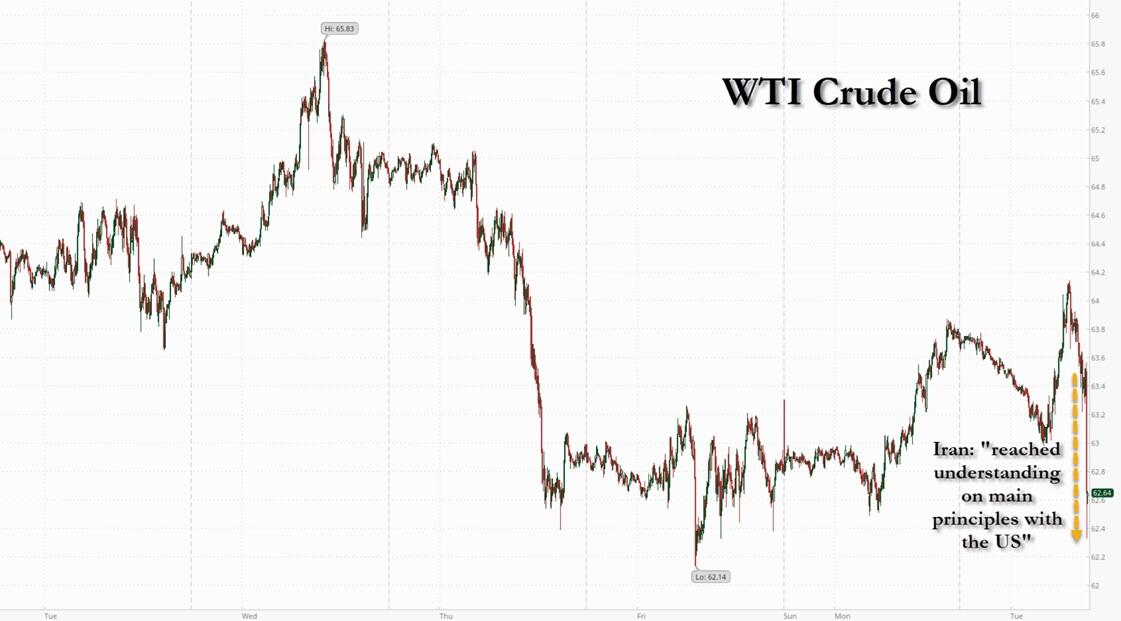
US envoy Steve Witkoff and Trump’s son-in-law Jared Kushner represented the US side in the talks, with Trump having told reporters aboard Air Force One that he would “indirectly” participate. Iran’s Foreign Minister Abbas Araghchi is leading the Iranian side.

Iran has insisted on its nuclear program being the sole focus of discussions, and not limitations on its ballistic missile arsenal (as the US and Israel are demanding) – and this holds of the possibility of derailing talks before they get further underway.
In the meantime the temperature is rising in the Gulf region, after Iran’s military announced Tuesday that sections of the Strait of Hormuz would be closed for several hours for what it called “security measures”.
This comes on the second day of IRGC naval drills, which semi-official Fars news agency described as designed to ensure the safety of maritime traffic during a military exercise. Iranian authorities stated the move formed part of the broader drill launched the day earlier.
Oil Prices Rose as Iran Closed Parts of the Strait of Hormuz for Naval Drills… Then Later Dumped After ‘Understanding’ Reached:
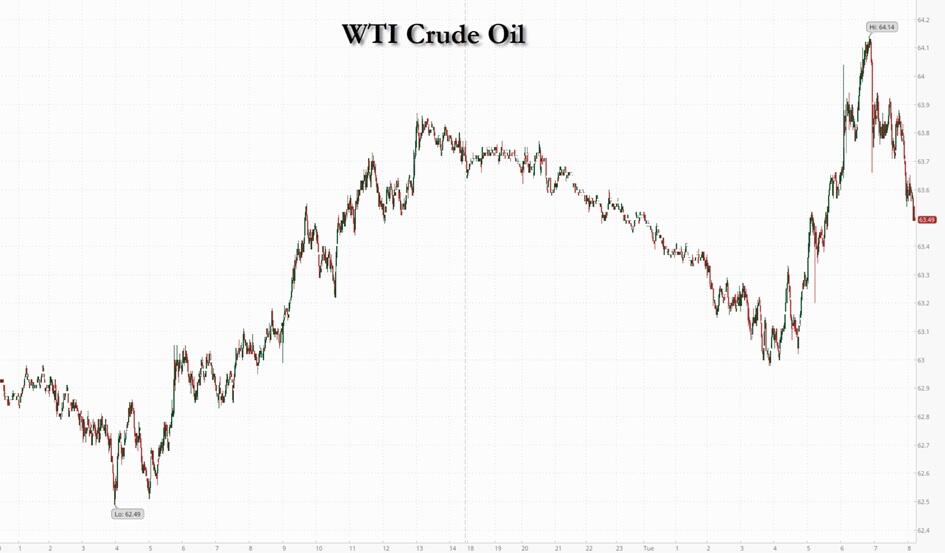
Iran’s state broadcaster reported that the “main phase’ of a naval exercise conducted by the Islamic Revolutionary Guard Corps began Tuesday.
Iran tested large missiles in the Persian Gulf on Tuesday, footage shows:
Supreme Leader Ayatollah Ali Khamenei has warned in a speech before an event Tuesday (and afterward his office posted it to X), the following:
The Americans constantly say that they’ve sent a warship toward Iran. Of course, a warship is a dangerous piece of military hardware. However, more dangerous than that warship is the weapon that can send that warship to the bottom of the sea.
This ‘counter-threat’ and warning was in response to remarks by Trump in which the president said the United States had not been able to destroy the Islamic Republic.
“In one of his recent speeches, the US president said that for 47 years America has not succeeded in destroying the Islamic Republic… I tell you: you will not succeed either,” Khamenei said.
USS Gerald R. Ford now just days away from Mideast waters and entering the eastern Mediterranean…
nsequences and has raised the possibility of imposing regime change amid his ratcheting rhetoric, and the deployment of no less than two aircraft carrier groups to regional waters.
“What is not on the table: submission before threats,” Iran FM Araghchi said in a post on Monday, stating that he was in Switzerland “with real ideas to achieve a fair and equitable deal.”
8. EMERGING MARKETS//AUSTRALIA NEW ZEALAND ISSUES
INDIA
YOUR EARLY CURRENCY/GOLD AND SILVER PRICING/ASIAN CLOSING MARKETS AND EUROPEAN BOURSE OPENING AND CLOSING/ INTEREST RATE SETTINGS TUESDAY MORNING 6;30AM//OPENING AND CLOSING
USA DOLLAR VS EURO: 1.1836 FOR A LOSS OF .0015 OR 15 BASIS PTS.
USA/ YEN 153.16 DOWN 0.414 NOW TARGETS INTEREST RATE AT 1.75% AS IT WILL BUY UNLIMITED BONDS TO GETS TO THAT LEVEL…//YEN STILL FALLS//END OF YEN CARRY TRADE BEGINS AGAIN DEC 2024/Bank of Japan raises rates by .25% TO 1.75 ..TAKAICHI NEW PM AS YIELDS RISE//JAPAN DEEPLY IN TROUBLE WITH RISING RATES AND A FALLING YEN!!
GBP/USA 1.3569 DOWN 0.0057 OR 57 BASIS PTS
USA/CAN DOLLAR: 1.3641 UP 0.0005 CDN DOLLAR DOWN 5 BASIS PTS//(DESPITE TRUMP’S TARIFFS)
Last night Shanghai COMPOSITE CLOSED
Hang Seng CLOSED
AUSTRALIA CLOSED UP 0.31%
// EUROPEAN BOURSE: ALL GREEN
Trading from Europe and ASIA
I) EUROPEAN BOURSES: ALL GREEN
2/ CHINESE BOURSES / :Hang SENG CLOSED
/SHANGHAI CLOSED
AUSTRALIA BOURSE CLOSED UP 0.31 %
(Nikkei (Japan) CLOSED DOWN 239.92 PTS OR 0.42%
INDIA’S SENSEX IN THE GREEN
Gold very early morning trading: 4925.70.
silver:$74.40
USA DOLLAR VS TRY (TURKISH LIRA): 43.73
USA DOLLAR VS RUSSIAN ROUBLE: 76.76 ROUBLE// UP 1 BASIS PTS
UK 10 YR BOND YIELD: 4.371 DOWN 3 BASIS PTS
UK 30 YR BOND YIELD: 5.174 DOWN 4 BASIS PTS
CDN 10 YR BOND YIELD: 3.254 DOWN 3 BASIS PTS
CDN 5 YR BOND YIELD; 2.781 DOWN 3 BASIS PTS
USA dollar index early TUESDAY MORNING: 97.13 UP 31 BASIS POINTS FROM FRIDAY’s CLOSE
TUESDAY MORNING NUMBERS ENDS
And now your closing TUESDAY NUMBERS 10.00 AM
Portuguese 10 year bond yield: 3.105% DOWN 2 in basis point(s) yield
JAPANESE BOND 10 yr YIELD: +2.130% DOWN 7 FULL POINTS BASIS POINTS /JAPAN losing control of its yield curve/
JAPAN 30 YR: 3.390 DOWN 8 BASIS PTS//DIASTER
SPANISH 10 YR BOND YIELD: 3.174 DOWN 2 in basis points yield
ITALY 10 YR BOND: 3.360 DOWN 2 points in basis points yield ./ THE ECB IS QE’ ING ITALIAN BONDS (
GERMAN 10 YR BOND YIELD: 2.7378 DOWN 2 BASIS PTS
IMPORTANT CURRENCY CLOSES : MID DAY TUESDAY
Closing currency crosses for day /USA DOLLAR INDEX/USA 10 YR BOND YIELD/10:00 AM
Euro/USA 1.1824 DOWN 0.0026 OR 26 basis points
USA/Japan: 153.21 DOWN 0.282 OR YEN IS UP 29 BASIS PTS// HIGHLY INFLATIONARY TO JAPAN
Great Britain 10 YR RATE 4.374 DOWN 5 BASIS POINTS //
GREAT BRITAIN 30 YR BOND; 5.174 DOWN 4 BASIS POINTS.
Canadian dollar DOWN 32 BASIS pts to 1.3667
xxxxxxxxxxxxxxxxxxxxxxxxxxxxxxxxxxxxxxxxxxxxxxxxxxxxxxxxxxxxxxxxxxxxxxxxxxxxxxxx
The USA/Yuan CNY XXXX TO 6.9087 ON SHORE ..
THE USA/YUAN OFFSHORE// CNH UP TO 6.8884
TURKISH LIRA: 43.73 EXTREMELY DANGEROUS LEVEL/DEATH WATCH/HYPERINFLATION TO BEGIN.//
Your closing 10 yr US bond yield DOWN 1 in basis points from FRIDAY at 4.040% //trading well ABOVE the resistance level of 2.27-2.32%)
USA 30 yr bond yield 4.674 DOWN 3 basis points /10:00 AM
USA 2 YR BOND YIELD: 3.418 DOWN 2 BASIS PTS.
GOLD AT 10;00 AM 4874.00
SILVER AT 10;00: 73.21
Your 11:00 AM bourses for Europe and the Dow along with the USA dollar index closing and interest ratesTUESDAY CLOSING TIME 10:00 AM//
London: CLOSED UP 82.88 PTS OR 0.79%
GERMAN DAX: CLOSED UP 192.49 OR 0.80%
FRANCE: CLOSED UP 44.96 PTS OR 0.54%
Spain IBEX CLOSED UP 10.50 PTS OR 0.60%
Italian MIB: CLOSED UP 344.87 PTS OR 0.75%
WTI Oil price 63.51 10.00 EST/
Brent Oil: 67.40 10:00 EST
USA /RUSSIAN ROUBLE /// AT: 76.,62 ROUBLE UP 0 AND 5 / 100
CDN 10 YEAR RATE: 3.222 DOWN 5 BASIS PTS.
CDN 5 YEAR RATE: 2.761 DOWN 5 BASIS PTS
CLOSING NUMBERS: 4 PM
Euro vs USA 1.1849 DOWN 0.0003 OR 3 BASIS POINTS//
British Pound: 1.3559 DOWN 0.0068 OR 68 basis pts/
BRITISH 10 YR GILT BOND YIELD: 4.3870 DOWN 4 FULL BASIS PTS//
BRITISH 30 YR BOND YIELD: 5.187 DOWN 4 IN BASIS PTS.
JAPAN 10 YR YIELD: 2.138 DOWN 6 FULL BASIS PTS (DANGEROUS TO THEIR ECONOMY
JAPANESE 30 YR BOND: 3.393 DOWN 8 PTS AND STILL VERY DANGEROUS TO THEIR ECONOMY
USA dollar vs Japanese Yen: 153.24 DOWN 0.317 OR YEN UP 32 BASIS PTS EXTREMELY DANGEROUS/YEN FALLING DEEPLY IN VALUE
USA dollar vs Canadian dollar: 1.3640 UP 0.0002 PTS// CDN DOLLAR DOWN 2 BASIS PTS
West Texas intermediate oil: 62.35
Brent OIL: 67.35
USA 10 yr bond yield DOWN 0 BASIS pts to 4.052
USA 30 yr bond yield: DOWN 1 PTS to 4.684%
USA 2 YR BOND 3.437 UP 3 PTS
CDN 10 YR RATE 3.226 DOWN 3 BASIS PTS
CDN 5 YEAR RATE: 2.764 DOWN 3 BASIS PTS
USA dollar index: 97.07 UP 25 BASIS POINTS
USA DOLLAR VS TURKISH LIRA: 43.72 GETTING QUITE CLOSE TO BLOWING UP/
USA DOLLAR VS RUSSIA//// ROUBLE: 76.35 UP 0 AND 40/100 roubles //
GOLD $4876.00 3:30 PM)
SILVER: 73.34 3;30 PM)
DOW JONES INDUSTRIAL AVERAGE: UP 32.87 OR 0.066%
NASDAQ 100 DOWN 31.14 PTS OR 0.13%
VOLATILITY INDEX 20.24 DOWN 0.96 PTS OR 4.53%
GLD: $ 448.20 DOWN 14.47PTS OR 3.12%
SLV/ $66.37 DOWN 3.35 PTS OR OR4.80 %
TORONTO STOCK INDEX// TSX INDEX: CLOSED DOWN 198.66 PTS OR 0.60%
end
TRADING today ZEROHEDGE 4 PM: HEADLINE NEWS/TRADING
”Crude & Crypto Crack, Mega-Cap Tech Bid Back As AI Continues To Crush Coders
WRAP UP
Stocks reverse Mag-7 led selloff as geopols dominate the tape – Newsquawk US Market Wrap
Tuesday, Feb 17, 2026 – 03:58 PM
- SNAPSHOT: Equities, Treasuries mixed, Crude down, Dollar up, Gold down.
- REAR VIEW: Iran’s Foreign Minister said it has reached an understanding on main principles with the US, but does not mean agreement will be reached soon; Russia-Ukraine talks reportedly tense; Ukraine to reject deal that involves unilaterally withdrawal from eastern Donbas region; Fed’s Barr said outlook suggests steady rates for some time; Fed’s Daly said 75bps to go to get to neutral; UK u/e rate ticks higher; US NAHB falls short; NY Fed Mfg. Index slightly beats; Canada CPI leans soft.
- COMING UP: Holiday: Chinese Spring Festival Golden Week (17-24 Feb). Data: Australian Wage Price Index (Q4), UK CPI (Jan), US Durable Goods, Industrial Production (Jan), Housing Starts (Nov/Dec), Atlanta Fed GDP. Events: RBNZ Policy Announcement; FOMC Minutes (Jan); US-Ukraine-Russia talks to take place (17-18 Feb). Speakers: RBNZ’s Bremen; ECB’s Cipollone, Schnabel; Fed’s Bowman. Supply: Australia, Germany, US. Earnings: Analog, Carvana, DoorDash, Booking Holdings, Moody’s, Garmin, Glencore.
- WEEK AHEAD: Highlights include US PCE and GDP, FOMC Minutes, RBNZ, Flash PMIs, UK, Canadian and Japanese Inflation. Click here for the full report.
- CENTRAL BANK WEEKLY: Previewing RBNZ, FOMC Minutes, and RBA Minutes; Reviewing BoC Minutes. Click here for the full report.
- WEEKLY US EARNINGS ESTIMATES: Earnings season continues with retailer WMT the highlight. Click here for the full report.
More Newsquawk in 2 steps:
1. Subscribe to the free premarket movers reports
2. Trial Newsquawk’s premium real-time audio news squawk box for 7 days
MARKET WRAP
US indices were choppy on Tuesday, as US players returned from the US holiday, but ultimately settled with mild gains. After the US cash equity open, indices saw a notable sell-off with the Mag-7 leading the decline, ex-Apple, although swiftly pared through the afternoon. For Apple, Wedbush wrote that the recent selloff in the tech behemoth is unwarranted, and that 2026 will be the year Apple gets into the AI game. Data came via weaker-than-expected NAHB and NY Fed, which marginally topped on the headline, with internals steady; the latter sparked some gradual pressure in T-Notes. The highlight of the day, and dominating the tape, was geopolitical updates with both the US/Iran meeting, and also the trilateral confab between the US/Russia/Ukraine. On the former, the crude complex saw notable weakness after the Iranian Foreign Minister said they have reached an understanding on the main principles with the US, but it does not mean an agreement will be reached soon; the path has started. In more recent trade, US VP Vance remarked that in some ways, Iran talks went well, and Iranians are not yet willing to acknowledge some of Trump’s red lines. On the trilateral meeting, where little new was learnt, Zelensky told Axios that the Ukrainian people would reject a peace deal that involves Ukraine unilaterally withdrawing from the eastern Donbas region and turning it over to Russia. The main sticking point is control of the Donbas, and talks in Geneva are expected to continue on Wednesday. The Dollar Index was marginally stronger, with Antipodeans and Yen the gainers, and the Pound the G10 loser on a weak UK jobs report. Treasuries were mixed across the curve, with the short-end weaker and the long-end seeing losses. Spot gold was lower and trades back beneath USD 4.9k/oz. Ahead, FOMC Minutes on Wednesday is arguably the highlight, as well as 20yr bond auction.
US
NY FED: The Empire State Manufacturing Survey fell to 7.1 from 7.7, above the 7.00 expected. Business activity increased modestly; new orders, inventories, unfilled orders and employment increased, while shipments and supply availability held steady. Additionally, the pace of input prices rose and selling price increases picked up with capital spending plans strengthening. Richard Deitz, Economic Research Advisor at the NY Fed, said firms remained optimistic that conditions would continue to improve, with employment expected to grow.
NAHB: NAHB housing market index for February unexpectedly fell to 36 from 37, shy of the expected 38. Within the release, current sales conditions held steady at 41, sales expectations in the next six months fell to 46 from 49, and traffic of prospective buyers dipped to 22 from 24. Overall, Oxford Economics notes that the report lends some downside risk to its forecast for housing starts to gradually improve over H1 ‘26. However, OxEco do think that lower mortgage rates and stabilising labour market conditions will eventually support an improvement in new home sales and housing construction, although builders will need to work off some of their existing inventory first.
FED’s BARR (voter): Said it is prudent for the Fed to take time and look at data, before changing policy again; outlook suggests the Fed will hold rates steady for some time, and they can afford to take its time on monetary policy. On inflation, wants to see more evidence that inflation is ebbing to 2% target, and still sees ‘significant risk’ inflation will stay over 2% and believes it’s reasonable to think price pressures will further cool. On labour, he noted that the market is in balance but vulnerable to shock, with recent data pointing to a stabilising job market. Elsewhere, Barr said the AI boom is unlikely to lead to lower Fed interest rates and added that there is little evidence so far that AI is driving up unemployment. Further, Barr said R-star has risen slightly but not dramatically and that AI investment is ‘wildly indifferent’ to what the Fed rate target is.
FED’s DALY (2027 voter): Remarked that inflation is above target, and people are feeling stretched. Daly added that current policy is slightly restrictive, and has 75bps to get to neutral, and that they need to get inflation down.
FIXED INCOME
T-NOTE FUTURES (H6) SETTLED 1+ TICK LOWER AT 113-04
T-notes flatted on return from long weekend, with longer end yields lower while the front-end rose. At settlement, 2-year +2.9bps at 3.439%, 3-year +2.3bps at 3.472%, 5-year +1.4bps at 3.623%, 7-year +0.9bps at 3.823%, 10-year −0.2bps at 4.054%, 20-year −1.3bps at 4.631%, 30-year −1.6bps at 4.683%.
THE DAY: T-notes saw minor gains overnight before paring gradually in the European morning with a lot of focus on geopolitical developments with US/Iran talks seemingly off to a good start. Meanwhile, the Russia/Ukraine talks had also begun. The data highlight of the day was the NY Fed Manufacturing and the Weekly ADP report. The NY Fed report was largely in line with expectations, falling slightly to 7.1 from 7.7, vs the 7.0 forecast. This represents a modest increase in business activity, while new orders rose, shipments were steady. Inventories rose, and supply availability held steady. Employment and average work week increased slightly after falling last month. Both input prices and selling price increases picked up. In the wake of the data, T-notes came under gradual pressure on the overall solid report – particularly with employment and inflation picking up, which bolsters the Fed’s case for a pause. On which, Fed Governor Barr spoke, noting it is prudent for the Fed to take time and look at data before adjusting policy, and noting the outlook suggests the Fed will hold rates steady for some time. From Fed’s Daly (2027 voter), she said they have 75bps to get to neutral. Attention this week turns to PCE and GDP data while 20-year and 30-year TIPS supply will also be in focus.
SUPPLY
Bills
- US sold 3-month bills at high-rate 3.600%, B/C 2.71x; sold 6-month at high-rate 3.500%, B/C 3.08x
- US sold 6-week bills at a high rate of 3.640%, B/C 2.75x; sold 52-week bills at a high rate of 3.345%, B/C 2.96x
- US to sell USD 69bln of 17-week bills on February 18th, and USD 95bln of 8-week bills and USD 105bln of 4-week bills on February 19th; all to settle on February 24th
Notes
- US Treasury to sell USD 16bln of 20-year bonds on Wednesday February 18th, and USD 9bln of 30-year TIPS on Thursday February 19th
STIRS/OPERATIONS
- Market Implied Fed Rate Cut Pricing: March 1.3bps (prev. 1.3bps), April 5.3bps (prev. 6.2bps), June 19.1bps (prev. 21.2bps), December 59.2bps (prev. 62.2bps).
- NY Fed RRP op demand at USD 0.4bln (prev. 0.4bln) across 5 counterparties (prev. 3)
- EFFR at 3.64% (prev. 3.64%), volumes at USD 90bln (prev. 97bln) on February 13th
- SOFR at 3.66% (prev. 3.65%), volumes at USD 3.169tln (prev. 3.205tln) on February 13th
CRUDE
WTI (J6) SETTLED USD 0.49 LOWER AT 62.26/BBL; BRENT (J6) SETTLED USD 1.23 LOWER AT 67.42/BBL
The crude complex is set to finish the day lower as geopolitics dominated the tape, with both US/Iran and US/Russia/Ukraine. Before delving into the necessary updates, the main move in the energy space came as the Iranian Foreign Minister said that they have reached a general agreement on a set of principles with the US, which sparked immediate downside. The Foreign Minister added that the two parties will welcome potential agreement documents and exchange them, but this does not mean an agreement will be reached soon, although the path has started; a date for the next round of talks with the US has not yet been decided. Note, prior to the talks, the strait of Hormuz was closed for hours due to drills. On the Russia/Ukraine/US trilateral talks, which added little new and were recently concluded, Zelensky told Axios that the Ukrainian people would reject a peace deal that involves Ukraine unilaterally withdrawing from the eastern Donbas region and turning it over to Russia. The main sticking point is control of the Donbas, around 10% of which is still in Ukrainian hands. Axios added that trilateral talks in Geneva are expected to continue on Wednesday. From the Russian side of things, Ria, citing sources, said the talks on Ukraine settlement in Geneva were tense, and we await a US readout. Note, weekly private inventory data is delayed a day on account of the US holiday on Monday. WTI traded between USD 61.87-64.14/bbl and Brent USD 66.82-69.04/bbl.
EQUITIES
CLOSES: SPX +0.10% at 6,843, NDX -0.13% at 24,702, DJI +0.07% at 49,533, RUT +0.00% at 2,647
SECTORS: Consumer Staples -1.51%, Energy -1.37%, Materials -1.16%, Communication Services -0.60%, Utilities -0.37%, Health -0.19%, Consumer Discretionary -0.02%, Industrials +0.45%, Technology +0.49%, Financials +0.99%, Real Estate +1.03%.
EUROPEAN CLOSES: Euro Stoxx 50 +0.78% at 6,025, Dax 40 +0.82% at 25,005, FTSE 100 +0.79% at 10,556, CAC 40 +0.54% at 8,361, FTSE MIB +0.76% at 45,764, IBEX 35 +0.60% at 17,955, PSI +0.17% at 9,074, SMI +0.78% at 13,763, AEX +0.27% at 996
STOCK SPECIFICS:
- Apple (AAPL): Will hold a product launch on March 4th & preparing to announce several new devices in the coming weeks
- CNH Industrial (CNH): Profit light w/ disappointing FY EPS guidance.
- Fiserv (FISV): Jana Partners builds stake in the Co.
- General Mills (GIS): Cut annual sales & profit forecast.
- Genuine Parts (GPC): Top, bottom line light & confirmed plans to separate automotive and industrial businesses into two Cos.
- Infosys (INFY): Partnered with Anthropic.
- Masimo (MASI) to be acquired by Danaher (DHR) for $180/shr; note, closed Fri. at $130.15/shr.
- Micron (MU): WSJ article says MU is investing $200bln to expand memory-chip production.
- Norwegian Cruise Line Holdings (NCLH): Elliott Investment has built a stake >10% & plans to push for changes to improve performance.
- Warner Bros Discovery (WBD) sets shareholder vote date for Netflix (NFLX) bid on March 20th & unanimously recommends shareholders reject latest Paramount Skydance (PSKY) offer, but gives PSKY a week to negotiate a better deal.
- Apple (AAPL) reportedly ramps up work on AI glasses, pendant and camera airpods, according to Bloomberg.
- Anthropic is introducing Claude Sonnet 4.6.
FX
The Dollar was mixed vs. G10 peers on Tuesday, with DXY modestly firmer, extending on Monday’s gains. In the background, US yields on the short-to-mid end were firmer as bets over Fed rate cuts by year-end were slightly trimmed. Fed Governor Barr signalled no urgency to resume easing, believing the outlook suggests the central bank will hold rates steady for some time. Both him and Goolsbee (2027 voter) said today they want to see more evidence on inflation ebbing to the 2% target before entertaining further easing. DXY came well off the earlier highs, with downside in precious metals on reduced geopolitical risks between the US and Iran likely giving the dollar a floor. Now, DXY trades around 97.16, down from the earlier 97.546 highs.
G10 FX was mixed. GBP lagged following a soft labour market report, which saw the unemployment rate unexpectedly rise to 5.2% from 5.1%, a smidge beneath the peak BoE forecast of 5.3%. Moreover, wage growth slowed across both key measures. Cable dropped as low as 1.3496 before recovering to ~1.3560.
JPY and Antipodes outperformed against the USD with the turnaround in risk sentiment supporting the latter, while there was little newsflow out of Japan. Ahead, the NZD/USD (trades ~0.6050) is in focus given the upcoming RBNZ policy announcement. Expectations are for the OCR to be unchanged at 2.25%, with money markets in agreement. Click here for the full Newsquawk RBNZ Preview.
CAD reversed earlier weakness seen on a CPI report than leaned soft, finishing flat against USD. Headline Y/Y printed 2.3% (exp. 2.4%), Trimmed Mean Y/Y 2.4% (exp. 2.6%), while Median Y/Y matched expectations of 2.5%. Following the report, Oxford Economics expects the BoC will hold the policy rate at 2.25% until early 2027.
USA DATA RELEASES
USA ECONOMIC REPORTS
NEW YORK
A KILLER!!
It Begins: Mamdani Plans First NYC Property Tax Hike In Decades To Plug $5 Billion Hole
Tuesday, Feb 17, 2026 – 01:20 PM
New York City property owners are set to ‘enjoy’ the first property tax hike in more than two decades as part of a proposed solution by Mayor Zohran Mamdani to fill a roughly $5 billion budget gap, Bloomberg reports.

“He’s put a pretty extreme option on the table, which is a combination of raising property taxes and taking money from reserves and relying on some pretty aggressive revenue projections to boot,” said NYC Comptroller Mark Levine.
The pitch, set to be unveiled Tuesday afternoon during Mamdani’s preliminary budget proposal, comes one day after Governor Kathy Hochul vowed to kick in another $1.5 billion in additional aid to the city for the current fiscal year and next. Hochul has also committed $510 million for future years to help plug holes in the budget.
Mamdani says that the state should step up even more. Last week, he called on state lawmakers Wednesday to approve a 2 percent personal income tax increase on the city’s wealthiest residents as well as a hike in the corporate tax rate in a bid to close a multibillion-dollar budget gap. Of note, Hochul and the legislature must approve any tax changes.
While Mamdani is handcuffed in many ways when it comes to raising revenue, raising property taxes is something he can do as part of the annual budget process. Homeowners, meanwhile, just had their assessed values jump 5.6%, which will bring the city an additional $325.8 billion – which is separate of Mamdani’s plan.
Mamdani’s own rhetoric about the size and scope of the city’s budget situation has shifted. Earlier this month, just two weeks after describing the city’s $12.6 billion budget deficit as the city’s largest since the Great Recession, Mamdani revealed the hole had actually shrunk by $5 billion, because of higher tax revenue, propelled by personal income tax growth and Wall Street bonuses.
Even threatening to raise property taxes could prove a political lightning rod for Mamdani, after campaigning to reform that system, which has been criticized for overburdening lower- and middle-income residents. The last time the city increased property tax rates was under former Mayor Michael Bloomberg in the early 2000s. –Bloomberg
Meanwhile last month Mamdani said NYC is facing a $12.6 billion deficit over the next two years, which he blamed on his predecessor, Mayor Eric Adams, whose administration he says underbudgeted for various expenses such as cash assistance, rental assistance for homeless residents, special education and overtime costs. In FY 2025, NYC took in over $33 billion in property tax revenue.
Mamdani during his campaign promoted progressive reforms to fund proposals such as free public transit, rent stabilization and housing programs, universal child care, and a $30 minimum wage, leading to his upset win over more moderate Democrats.
He called for a 2 percent surcharge on high earners on the campaign trail.
Estimates suggested it could create approximately $4 billion annually to support increased public services and affordability programs, as well as offset costs for broad social investments while not saddling middle- and low-income residents.
CALIFORNIA/WEALTH TAX
a killer!!
Eat The Rich: California Democrats Trigger Reverse Gold Rush With Wealth Tax
Saturday, Feb 14, 2026 – 08:15 PM
This month, the anniversary of the California Gold Rush came and passed with little mention … for good reason. When James W. Marshall found gold at Sutter’s Mill, millions traveled great distances to seek their fortune in the “Golden State.”

Now, 178 years later, California has engineered an inverse Gold Rush, virtually chasing wealth from the state. Rather than covered wagons going West, there is a line of U-Hauls going anywhere other than California.
From boondoggle projects to reparations, California politicians continue to rack up new spending projects despite a soaring deficit and shrinking tax base.
Rather than exercise a modicum of fiscal restraint, Democrats are pushing through a tax that takes five percent of the wealth of any billionaires left in the state.
I have long criticized the tax as perfectly moronic for a state with the highest tax burden and one of the highest flight rates of top taxpayers.
In my new book, “Rage and the Republic: The Unfinished Story of the American Revolution,” I discuss the reversal of fortunes in California and other blue states as politicians unleash new “eat the rich” campaigns before the midterm elections.
The problem, of course, is that billionaires are mobile, as is their wealth. Liberals expect billionaires to stay put in a type of voluntary canned hunt. They are not. Billionaires are joining the growing exodus from the state, taking their companies, investments, and jobs with them.
The latest billionaire to be chased off may be Meta CEO Mark Zuckerberg, who is reportedly heading for Florida.
The growing departures have triggered outrage among many on the left, who are in disbelief that billionaires will just not stand still to be fleeced.
Former New York Magazine editor Kara Swisher captured that rage in a recent posting, declaring “you made…all your money in California, you ungrateful piece of s***, you could figure out a way to pay more taxes, and we deserve the taxes from you, given you made your wealth here . . . so why don’t we just do shock and awe at this point, because you don’t seem to be availing yourself to thinking that you owe your state something more.”
By some estimates, California has already cost over a trillion dollars in lost investments and business. That is no small achievement.
Here’s a mind teaser: How can you burn a trillion dollars (which would create a stack some 67,866 miles high) without taking years and destroying the environment?
California politicians have a solution: Have people take it out of the state in a reverse gold rush.
In addition to saying that they want to grab 5 percent of the wealth of these billionaires, California Democrats are planning to base wealth calculations on the voting shares of corporate executives. Often, particularly with start-ups, entrepreneurs have greater voting shares than actual ownership. However, they will be taxed as if voting shares amounted to actual wealth.
In other words, California is moving to nuke the entrepreneurs who created the Silicon Valley boom.
Emmanuel Saez, the U.C. Berkeley economist who helped design the tax, insists that they may not want to stay, but they will still be tapped. They are planning to trap the wealthy fleeing the state retroactively: “The tax is based on residence as of Jan. 1, 2026, sharply limiting their ability to flee the state to avoid paying. Despite billionaires’ threats to leave, I think extremely few will have been able to change residence by Jan. 1, given the complexity of doing so.”
The effort to retroactively impose such a tax is legally controversial and will face years of challenges. In my view, this is unconstitutional, but admittedly it is a murky area.
Regardless of the outcome, a wealth tax will affect a wide range of other wealthy taxpayers. If Democrats can get a retroactive wealth tax to be upheld, it is doubtful that they will stop with billionaires. Why should other top taxpayers stick around to find out where the next cull will fall in the tax brackets?
Recently, Gavin Newsom boasted, “California isn’t just keeping pace with the world — we’re setting the pace.” That is undeniably true if the measure is the record number of U-Hauls fleeing the state — more than any other state. Indeed, the only thing harder to find than a wealthy taxpayer in California appears to be a U-Haul.
According to U-Haul’s data, the state is again leading blue states in the exodus. The Washington Post noted recently that “California came in last. Massachusetts, New York, Illinois, and New Jersey rounded out the bottom five. Of the bottom 10, seven voted blue in the last election.” Conversely, “nine of the top 10 growth states voted red in the last presidential election,” with Texas again leading the growth states.
The Post put it succinctly, “People want to live in pro-growth, low-tax states, while the biggest losers tend to be places with big governments and high taxes.”
The problem is that, while the economics are horrific, the politics remain irresistible.
Democratic Rep. Ro Khanna, who represents part of Silicon Valley, recently mocked billionaires rushing to escape the state. Laughing at his own constituents, Khanna quipped, “I will miss them very much.”
You will not be alone as California becomes known as the La Brea Tar Pit of taxation.
They are on the verge of converting the state motto from “Eureka” to “Welcome to Hotel California, you can check out any time you like, but you can never leave.”
Jonathan Turley is a law professor and the best-selling author of “Rage and the Republic: The Unfinished Story of the American Revolution.”
END
CALIFORNIA/VOTER FRAUD
NICK SHIRLEY…
Citizen Journalist Nick Shirley Pulls Back Curtain On California Voter Fra
Tuesday, Feb 17, 2026 – 02:40 PM
The independent journalist who exposed massive amounts of social service fraud in Minnesota is now calling out alleged voter fraud in California with the release of a new video of his investigation there.

Nick Shirley has released his latest video which chronicles voting irregularities in the Golden State where he says he uncovered inaccurate voter rolls, dead people casting votes, lax voter ID requirements and month-long election processes that cast doubt on election integrity.
Shirley, a 23-year-old Utah native, has had to hire round the clock security after he exposed extensive welfare fraud among the Somali community in Minnesota.
During his visits to addresses obtained through public voter rolls from the California Secretary of State, Shirley found numerous examples of lack of negligence regarding verification of voters in California elections.
Examples of suspected voter fraud included no voter ID and signature-only “verification” in order to vote, 125-year-old voters still active on voter rolls, dozens of voters registered at a single UPS Store/mail drop and a voter who successfully registered her dog to vote in 2021 and 2022.
In a post on X where he shared his latest video, Shirley stated:
Without any voter ID and negligence from the state government to update their voter rolls, California’s one-party state has created a complex system where fraud is inevitable in their voting process.
In June 2025, the U.S. Department of Justice (DOJ) filed suit against the Orange County, California Registrar of Voters for refusing to provide records of the removal of non-citizen voters from voter registration lists.
In response to Shirley’s latest video, California governor Gavin Newsom has sought to deflect criticism over allegations of social service and voter fraud by calling upon Shirley and other non-legacy media investigators to go after what Newsom calls “Trump’s massive fraud.”
VICTOR DAVIS HANSON
KING NEWS
| The King Report Febryary 17, 2026 Issue 7681 | Independent View of the News |
| @GlobalMktObserv on Fri, Feb 13, 2026: Retail investors bought a record $48 BILLION in US equities in the 21-day period ending last week. This exceeds the previous record set during the April 2025 CRASH by $5 billion. By comparison, they bought ~$33 billion at the beginning of 2022, before the bear hit. Subsequently, they sold nearly $10 billion near the end of the 2022 bear market. Never in history have mom-and-pop investors rushed to buy so intensively. How does this end? https://t.co/jah8mfmFc1 Jan CPI 0.2% m/m and 2.4% y/y, 0.1 better than expected; Core CPI 0.3% m/m & 2.5% y/y as expected. A 0.1 better than expected CPI can generate unbridled bullishness on Wall Street, but it means Jack Schiff to consumers, especially when the metric does NOT reflect their checkbooks or reality! @charliebilello: Consumer Prices in the US rose 4.5% per year over the last 5 years and over 24% in total. 2% inflation is a myth. The Fed should not be cutting rates at all this year. https://x.com/charliebilello/status/2022341761171931403 Price changes over last year (January CPI report): Gas Utilities: +9.8%; Electricity: +6.3% Food away from home: +4.0% Medical Care: +3.9% Shelter: +3.0% Overall CPI: +2.4% Food at home: +2.1% Transportation: +1.3% New Cars: +0.4% Used Cars: -2.0% Fuel Oil: -4.2% Gasoline: -7.5% https://twitter.com/charliebilello/status/2022303590702866901?s=02 BBG: CEOs Aren’t Even Willing to Guess Anymore on US Consumer Recovery Manufacturers say consumers are trading down, showing that the consequences of the K-shaped split in the economy are mounting… ESHs vacillated between modest gains and small losses from their opening on Thursday night until they broke lower after 0:14 ET. After falling to 6824.25 (-42.25) at 1:35 ET, ESHs did a jagged rally to 6854.50 at 4:26 ET. After several attempts to move higher failed, ESHs broke lower at 5:29 ET. ESHs hit 6820.00 at 6:29 ET and then turned higher on buying for the CPI Report release at 8:30 ET. ESHs hit 6865.00 at 8:28 ET and then sank to a daily low of 6908.75 (-42.25) at 9:41 ET. Conditioned NYSE opening dip buyers and Friday Rally players eagerly bought; ESHs rallied to a daily high of 6897.75 (+46.75) at 12:42 ET. After a retreat to 6875.50 at 13:05 ET, ESHs double topped at 13:23 ET. After a slow rollover, ESHs broke down after 15:00 ET. The decline accelerated into a tumble. ESHs sank to 6835.75 at 15:35 ET. The illegal late manipulation pushed ESHs to 6856.50 at 16:00 ET. Positive aspects of previous session The DJTA rallied smartly on the return of the valuation rotation. USHs were +17/32 at the NYSE close. Negative aspects of previous session Fangs declined modestly. AMZN declined for 9th straight session, longest streak since 2006 ESHs and stocks declined sharply in latter afternoon trading. The S&P 500 Index is close to breaking down and indicting a massive top has formed. Precious metals rallied sharply. Ambiguous aspects of previous session Has the S&P 500 Index formed a massive top? First Hour/Last Hour NYSE Action [S&P 500 Index]: 1st Hour: Up; Last Hour: Down Pivot Point for S&P 500 Index [above/below indicates daily trend to traders]: 6837.56 Previous session S&P 500 Index High/Low: 6881.96; 6794.55 @GlobalMktObserv: This usually happens during RECESSIONS: The median duration of unemployment is now 11.1 weeks, the longest since December 2021. This is in line with levels seen in the middle of the Great Financial Crisis. It also exceeds the 2001 and 1990 recession levels. On average, Americans are now unemployed 23.9 weeks, longer than any previous recession, excluding the 2008 Financial Crisis and post-2020 Crisis period. The labor market is showing extreme stress beneath the surface. https://x.com/GlobalMktObserv/status/2023116352374927390 US household debt surged +$191 BILLION in Q4 2025, to a new all-time high of $18.78 TRILLION. Among age groups, the 40-49 cohort is the most indebted at $4.88 TRILLION. This is followed by Americans aged 30-39 and 50-59 with $4.15 trillion and $4.06 trillion, respectively. US household debt now exceeds the Great Financial Crisis peak by $6 trillion. To stay afloat amid surging prices, Americans are taking on unprecedented debt. https://x.com/GlobalMktObserv/status/2023095012112646214 Breaking: OpenAI is probably toast – Gary Marcus Google and Anthropic have each largely caught up; various Chinese companies are closing in. More and more questions are being raised about their financing. (And more and more people are agreeing that AGI won’t arrive this decade). More than that, last week Nvidia pulled back on a pledge of $100 billion, a terrible signal to other potential investors… Up until now, one of the biggest investors in OpenAI has been Masayoshi (Masa) Son — who was also the biggest investor in WeWork just before it fell – and this just dropped. @ns123abc: SoftBank CFO just dropped this during today’s Q3 earnings call: “Nothing has been decided about additional funding round in OpenAI”… what do Nvidia and SoftBank know that led them to these choices?… Small wonder OpenAI started probing about bailouts last fall… https://garymarcus.substack.com/p/breaking-openai-is-probably-toast Witkoff and Kushner reportedly tell Trump nuclear deal with Iran ‘difficult to impossible’ https://nypost.com/2026/02/14/world-news/witkoff-and-kushner-reportedly-tell-trump-nuclear-deal-with-iran-difficult-to-impossible/ Market on Monday: Nikkei -0.24%, Chinese bourses closed this entire week for Lunar New Year Euro Stoxx 50 -0.1%, FTSE +0.26%, CAC +0.06%, DAX -0.46%, IBEX +0.99%, MIB -0.03% Today – Traders will play for the Monday Rally even though it’s Tuesday. It’s still the start of the week. The onus is now bulls because the S&P 500 Index is threatening to decisively break below the critical 6800 support that has marked the lower boundary of the 6800-7k trading band of the past three months. Unless the S&P 500 Index can blast through 7000 decisively and stay there for several sessions, it looks like a massive top has formed. This is the Big Picture now. ESHs are +9.75, NQAs are +13.75; USHs are +6/32; while SI and AU are down smartly at 20:11 ET. Expected Economic Data: Feb Empire Mfg. 8.7; Fed Gov Barr 12:45 ET, SF Pres Daly 14:30 ET S&P Index 50-day MA: 6895; 100-day MA: 6813; 150-day MA: 6685; 200-day MA: 6505 DJIA 50-day MA: 48,864;100-day MA: 47,829; 150-day MA: 46,885; 200-day MA: 45,818 (Green is positive slope; Red is negative slope) S&P 500 Index (6836.17 close) – BBG trading model Trender and MACD for key time frames Monthly: Trender and MACD are positive – a close below 5896.83 triggers a sell signal Weekly: Trender is positive; MACD is negative – a close below 6443.43 triggers a sell signal Daily: Trender and MACD are negative – a close above 6981.45 triggers a buy signal Hourly: Trender and MACD are negative – a close above 6880.83 triggers a buy signal @realDonaldTrump: The Democrats refuse to vote for Voter I.D., or Citizenship. The reason is very simple — They want to continue to cheat in Elections. This was not what our Founders desired. I have searched the depths of Legal Arguments not yet articulated or vetted on this subject and will be presenting an irrefutable one in the very near future. There will be Voter I.D. for the Midterm Elections, whether approved by Congress or not! Also, the People of our Country are insisting on Citizenship, and No Mail-In Ballots, with exceptions for Military, Disability, Illness, or Travel.. We cannot let the Democrats get away with NO VOTER I.D. any longer. These are horrible, disingenuous CHEATERS. They have all sorts of reasons why it shouldn’t be passed, and then boldly laugh in the backrooms after their ridiculous presentations… Even Democrat Voters agree, 85%, that there should be Voter I.D. It’s only the Political “Leaders,” Crooked Losers like Schumer and Jeffries, that have no shame, and explain why it’s “racist,” and every other thing that they can think of… @TheSCIF: Woman finds a MASSIVE box of mail-in ballots just sitting on the sidewalk while walking her dog in East Hollywood, California. How does this even happen? She said that it was extremely difficult to find someone to come pick up and secure the box of ballots which she said was very odd. California states that their elections are “extremely secure.” What a joke. Mail-in ballots must be banned or be extremely hard to acquire unless you’re military or sick. https://x.com/TheSCIF/status/2022817379982401929 Hillary Clinton criticized illegal immigration at the Munich Security Conference. @america: Hillary Clinton admits mass migration has been “destabilizing” to society: “It went too far, it’s been disruptive and destabilizing.” https://x.com/america/status/2022814357692748080 @LeadingReport: Former Pres Obama says, “We are a nation of laws,” in reference to immigration. “We have borders, and we’ve got to figure out an immigration policy that is orderly and that is fair.” @alx: Hillary Clinton: “More people were deported under my husband and Barack Obama… than were in the first Trump term or this first year of Trump’s second term.” https://x.com/alx/status/2022813735316791553 @Cernovich: Virginia is the Democrat’s model for 2028. Run on a “moderate” message. Get elected. Then go to town by enacting every far-left wing wish list item. @AndrewKolvet: Hillary Clinton all of a sudden telling Europeans that mass migration has gone too far. Barack Obama all of a sudden roasting Gavin Newsom and homeless tent cities. Dem leaders are sending a signal to moderate the message so they can go full Virginia if they win in 28. @Furbeti: A newly unsealed FBI interview shows an entire Deutsche Bank staff team internally tried to cut ties with Jeffrey Epstein in 2015, after seeing wires to young women. One compliance officer says she was later pushed out and fired after raising the issue. Management kept the accounts open, saying he had ‘served his time.’ https://x.com/Furbeti/status/2022665534278341027 Outrage over Epstein list as Pam Bondi is slammed for including celebrities who died when pedophile was a child… while furious Republicans and Democrats demand ‘full’ release of files Songwriter Janis Joplin was one of the 300 or so named in Bondi’s letter – despite the fact she died when Epstein was just 17, long before his depravity took place… https://www.dailymail.co.uk/news/article-15562651/pam-bondi-epstein-files-list-slammed.html Jeffrey Epstein Files Asked About ‘Zombie Drug’ Plants He Kept at Nursery – TMZ Jeffrey Epstein may have had a collection of highly poisonous plants known to produce a drug that blocks free will in its victims … according to newly discovered emails in the last document dump of the Epstein Files… https://www.tmz.com/2026/02/16/jeffrey-epstein-discussed-paralysis-plant/ @DLoesch: Watch the “conservatives” who rail against Epstein but refuse to question his top PR guy, Bannon (Top Trump advisor). They value clout more than truth or justice for the victims. Newly released messages seem to show Steve Bannon and Jeffrey Epstein debated removing DOJ protections for Trump https://www.msn.com/en-us/news/politics/newly-released-messages-seem-to-show-steve-bannon-and-jeffrey-epstein-debated-removing-doj-protections-for-trump/ar-AA1Waq2R Steve Bannon breaks silence as bombshell Epstein texts expose stunning Trump betrayal Steve Bannon, a longtime loyalist and confidante of Donald Trump, has finally broken his silence over his relationship with pedophile billionaire Jeffrey Epstein… Now Bannon is claiming his interview with Epstein was intended to expose the deceased pedophile and ‘destroy the very myths he created’ for an upcoming documentary… In December 2018 Bannon told Epstein that Trump was ‘beyond borderline – 25 amendment’ suggesting the idea of using the Constitution to remove the President… https://www.dailymail.co.uk/news/article-15565225/Steve-Bannon-breaks-silence-bombshell-Epstein-texts-expose-stunning-Trump-betrayal.html @DC_Draino: On the plus side, this is the first time in human history that a wide swathe of the masses have learned that elements of elite society are filled with satanic pedophiles. We have mountains of hard evidence and the ability to instantly disseminate this information worldwide on the internet. The sickos lost their ability to hide their evil in the shadows or spin their way out any leaks. It’s fully out there. There may not be immediate action, but it’s only a matter of time until people put their foot down and take decisive action. A conspiracy theory that the Epstein Files has verified is: There is an international cabal that operates above elected officials, and relentlessly strives to corrupt global elites to control them. @zerohedge: Epstein + Obama “advance-team member” Jon Dach caught with a prostitute in Cartagena hotel room + Obama’s then top lawyer Ruemmler cover up which cost her the AG job (Ruemmler quit her $25MM/year job at Goldman last week) Someone at DOJ should probably make a phone call or two. https://x.com/zerohedge/status/2023253650764640680 Rummler/Obama covered up the prostitution scandal, and instead blamed the Secret Service: ten members lost their jobs over the scandal. https://x.com/zerohedge/status/2023257115687633052 So, who did order the Colombian hooker? Turns out it was a 25-year-old “presidential advance team-member” Jonathan Dach who was staying at room 513 at the Cartagena Hilton. Dach was a nobody… but Dach’s father Leslie – a huge financial backer of Obama – wasn’t. https://x.com/zerohedge/status/2023258902024859815 Next, there was the coverup orchestrated by Ruemmler and Jay Carney to avoid implicating Dach and his dad… while throwing the Secret Service under the bus. https://x.com/zerohedge/status/2023260361126748587 At that point, the cover up of Dach’s prostitution scandal only got bigger, and included Charles Edwards, the acting Inspector General, and then Homeland Security Secretary Janet Napolitano https://x.com/zerohedge/status/2023261803732435030 OK fine, some kid bangs a hot Colombian hooker, and Obama throws 10 secret service agents under the bus to protect one of his top financial backers. Happens all the time. Only there was a twist: in her cover up, Kathy Ruemmler brought on none other than Jeffrey Epstein. As an aside, Dach’s hooker had seemingly impeccable Instagram taste: “The woman had posted photos of herself in undergarments in front of “Summit of the Americas” signs in Cartagena at the time of the trip.” https://x.com/zerohedge/status/2023260872202686665 Now may be a good time to review if Epstein’s tentacles went all the way to the White House, courtesy of Ruemmler. https://x.com/zerohedge/status/2022129174623006841 Goldman Sacks Ruemmler as Epstein Scandal Claims Obama’s Former Lawyer Ruemmler rose to the top ranks of Wall Street, becoming a key advisor to Goldman CEO David Solomon after serving as White House counsel to former President Barack Obama… Ruemmler once arranged an advantageous settlement for the Rothschild family with the Obama DOJ, for which she was reportedly paid $10 million and Epstein was paid $25 million… https://www.zerohedge.com/political/goldman-sacks-ruemmler-epstein-scandal-claims-obamas-former-lawyer @RealSLokhova: After Obama offered Ruemmler the Attorney General position, she asked Epstein for his advice. Epstein recommended that she speaks to “the boss”, Obama, to which she replied that she first needs to decide if the answer is yes or no. Epstein said that he understands, and that it’s a risk/reward decision, “professional, emotional, financial”. Ruemmler said that Obama is going to be in NY, and she will meet with him then. Afterwards, she would meet with Epstein. Ruemmler didn’t want to give up her NYC apartment where the rent was USD 10,000 a month, and her law firm Latham and Watkins was covering USD 8,000. (Her top-paying law clients such as the Rothschilds were provided by Epstein). Epstein said that there was no need to leave the apartment, and to ask Eric (Holder, previous AG and Obama’s wingman) for a “Baseline”. Epstein was trying to find someone to pay for Ruemmler’s apartment… https://x.com/RealSLokhova/status/2021876815296397640 Billionaire Hyatt Hotels Chair Tom Pritzker Retires Over Epstein Association – Forbes https://www.forbes.com/sites/maryroeloffs/2026/02/16/billionaire-hyatt-hotels-chair-tom-pritzker-retires-over-epstein-association/ @conmomma: Yes, the story of Nancy Guthrie is newsworthy, but I also think the discovery of cannibalism in the Epstein emails deserves a mention from our media. @wakeupusa: Seattle’s socialist mayor Katie Wilson claims she will unilaterally BAN grocery stores from closing down in her city. The government will FORCE them to stay open. “We cannot allow big grocery chains to close stores at will!” @RapidReport2025: Woman sets FIRE to warehouse rumored to be ‘ICE detention center’ in Kansas City, Missouri https://x.com/RapidReport2025/status/2022166697395068939 @JackPosobiec: They’re turning suburban women into ISIS radicals @wisconsin_now: Wisconsin Democrat Rep. Lee Snodgrass went on a strange rant during an Assembly floor speech today, accusing Republican legislators of “having fake tans” and “hair extensions.” She also accused Republican legislators being on “GLP1s.” She was on a tirade because she opposes a bill that would help minor victims of gender mutilation surgeries sue for the harm caused to them. This was such a non-sequitur that one has to wonder whether she’s doing okay. https://x.com/wisconsin_now/status/2022107495607545862 We Have Now Reached “Gunperson” Level Absurdity Another day, another NOBODY-WANTS-TO-SAY-IT tragedy It’s the deadliest mass shooting Canada has seen in more than thirty years… The press spent more time agonizing over culturally sanitized euphemisms than reporting the actual details of the crime… every major outlet was doing verbal Pilates to avoid saying the one thing the adults in the room had already figured out: the “female in a dress” was a biological male transvestite. Reporters tiptoed around the truth like it was a sleeping dragon… “If we get the pronouns wrong, we’ll be accused of hate; if we get the biology right, we’ll be called bigots. So let’s say nothing and hope nobody screenshots this.”… I shouldn’t have to say it, but I will: facts matter. Trends matter. Truth matters. Because institutions can’t solve a problem they refuse to see, and you can’t have a public reckoning when half the country is duct-taping their mouths shut to protect an ideological narrative… https://jennasside.rocks/p/we-have-now-reached-gunperson-level @CollinRugg: California Teacher of the Year finalist Ruben Guzman arrested for allegedly offering money in exchange for sexual acts with a 13-year-old boy. Guzman was the assistant principal at Sunrise Middle School and was previously recognized by the San Francisco 49ers… https://x.com/CollinRugg/status/2022438071640441230 Department of State @StateDept: SECRETARY RUBIO: We in America have no interest in being polite and orderly caretakers of the West’s managed decline. https://x.com/StateDept/status/2022673684024943101 Dem Rep. AOC accuses Israel of ‘genocide’ while in Germany — the home of the Holocaust: ‘Shocking ignorance’ https://nypost.com/2026/02/14/world-news/aoc-accuses-israel-of-genocide-while-in-germany-the-home-of-the-holocaust-shocking-ignorance/ @WesternLensman: AOC: The US shouldn’t engage in actions like the one against Maduro just because Venezuela is “below the equator.” Venezuela is not below the equator. Got a round of applause anyway. https://t.co/CMn9m154zZ @EndWokeness: AOC mocks Rubio: “My favorite part is he said cowboys are rooted in Spain. Uhhh, speak to Mexicans & African slaves (Africa had cowboys?!)!” Spain introduced horses (and cattle?) to Mexico. https://x.com/EndWokeness/status/2023128301313696130 @seanmdav: She is named Cortez and yet is totally clueless about how Mexico came to have horses. Imagine being named after the man who brought horses to the Americas and not knowing that. By any objective measure or standard, AOC is insanely idiotic and frivolous. But she is a Marxist, and her backers/masters are determined to make her US President. What foreign commies are behind her? Why not play it again? ‘They’ got an irrelevant and dubious community organizer elected POTUS! @EYakoby: Reporter: “An illegal alien from Nicaragua grabbed a woman on the north side last week, bashed her head into the sidewalk, knocked her unconscious and raped her…” Chicago Mayor Brandon Johnson: “Let’s move on.” @libsoftiktok: Students at Eagle Ridge Middle School (@ISD191) in MN staged an anti-ICE protest shouting, “We hate ICE.” Staff can be seen outside supervising the protest. This school has a 27% math proficiency and a 38% reading proficiency. Your kids are being turned into far-left activists. https://x.com/libsoftiktok/status/2023514625120104710 @HowleyReporter: Samuel Prescott Bush (grandfather of George H.W.) got hired by John Rockefeller’s brother Frank in 1901 to run Buckeye Steel Castings Company, which built railroad parts to help the Rockefellers move their oil. Bush took over the company from Frank in 1908. George H.W. Bush’s father Prescott Bush (seen here with Hitler) was a director of the Union Banking Corporation (UBC) that held Nazi financier Fritz Thyssen’s assets, which led to Bush’s bank getting its assets seized in 1942 for violating the Trading with the Enemy Act. https://x.com/HowleyReporter/status/2022817244938432816 In recent decades, George Washington has been ignored despite his astounding biography and titanic contributions to the creation of the USA, including refusing to be anointed ‘king.’ His battlefield leadership and exploits are so extraordinary that they seem incredible. Why is he now ignored? @RedLineNewsUSA: Democrats Push for Death Certificates to Be Accepted as Voter ID | |
SWAMP STORIES FOR YOU TONIGHT
Somali Fallout: US Treasury Will Pay Snitches Up To 30% On Fraud, Money Laundering Prosecutions
Friday, Feb 13, 2026 – 03:40 PM
On the heels of all that Somali fraud in Minnesota, the US Treasury Department on Friday launched a new portal where people can report suspected fraud, money laundering and sanctions violations.

According to officials, tips should be submitted with supporting documents. “FinCEN’s Office of the Whistleblower is accepting tips involving violations and conspiracies related to the Bank Secrecy Act, U.S. sanctions programs, and several other laws critical to safeguarding the U.S. financial system and national security. “
Individuals who voluntarily provide information about such violations or conspiracies to commit violations may be eligible for awards if the information they provide leads to a successful enforcement action by the Department of the Treasury (Treasury) or the Department of Justice (DOJ) that results in monetary penalties exceeding $1,000,000, and the requirements in 31 U.S.C. § 5323 and its implementing regulation are otherwise met. A copy of the statute is available here. -FINCEN
How much are we talking about? Between 10-30% “of what has been collected of the monetary sanctions imposed in the action or related actions,” and it’s got to be north of $1 million.

“President Trump has been clear that Americans have a right to know that their tax dollars are not being diverted to fund acts of global terror or to fund luxury cars for fraudsters,” Treasury Secretary Scott Bessent said, adding that whistleblowers may receive financial rewards.
“At Treasury, we follow the money. We did it with the mafia, we have done it with the cartels, and we’re doing it with the Somali fraudsters,” he added. “We are going to offer whistleblower payments to anyone who wants to tell us the who, what, when, where, and how this fraud and money laundering has occurred.”
Bessent told CNBC‘s “Squawk Box” “It’s going to be a great way to ferret out waste, fraud and abuse,” adding “We’re setting up a website and we will be giving rewards up to 10% to 30% of the fines that we levy.”
Minnesota has seen a series of large-scale fraud schemes targeting state-administered federal programs, including child nutrition (Feeding Our Future), housing stabilization services, autism/early intervention (EIDBI), and other Medicaid-funded services. The largest single case, Feeding Our Future, involved a $250 million COVID-era scam where largely Somalian defendants submitted fake meal claims and invoices for nonexistent food distribution, with proceeds funding luxury purchases, real estate, and overseas transfers.
Wider probes into 14 high-risk Medicaid programs (totaling ~$18 billion spent since 2018) estimate that half or more may be fraudulent, pushing overall losses potentially into the billions; additional schemes in personal care assistance, home/community-based services, and substance-use programs have added hundreds of millions more. Many operations involved Somali-run nonprofits, providers, or shell companies that billed for undelivered or fabricated services, though the Feeding Our Future “mastermind” (Aimee Bock) was not Somali. Suspected fraud has extended to child-care/daycare centers (sparked by a late-2025 viral video alleging $30–100 million in overbilling) and other providers, prompting active FBI/DOJ investigations into dozens of centers.
Meanwhile, the Trump administration has focused on Minnesota Governor Tim Walz and his state, including its Somali community of up to 80,000 – alleging fraud dating to 2020 by some nonprofit groups which were backed by federal programs administering the state’s childcare and other social services programs.
The IRS is also launching a dedicated fraud task force focused on targeting the misuse of funding by 501(c)(3) tax-exempt entities, Reuters reports.
end
Hillary Clinton Breaks With Party Line, Admits Mass Migration Is “Disruptive & Destabilizing”
Sunday, Feb 15, 2026 – 04:55 PM
After U.S. Secretary of State Marco Rubio spoke earlier on Saturday at the Munich Security Conference, where he said the U.S. and Europe “belong together” and argued for a stronger West, former Secretary of State Hillary Clinton, who served under former President Barack Obama, appeared on a panel later that afternoon and made surprising remarks about mass migration.
Clinton participated in a panel titled, “The West-West Divide: What Remains of Common Values,” and said that mass migration invasion involving millions of illegal aliens has been “destabilizing” to society.
Clinton continued:
So this debate that’s going on is driven by an effort to control people, to control who we are, how we look, who we love. And I think we need to call it for what it is.
There is a legitimate reason to have a debate about things like migration. It went too far. It’s been disruptive and destabilizing, and it needs to be fixed in a humane way, with secure borders that don’t torture and kill people, and with a strong family structure, because it is at the base.
Clinton’s comments about how mass migration has been an utter failure probably made White House border czar Tom Homan blush. In fact, unhinged Democrats, such as the Democratic Socialists of America, are probably furious with Clinton, given her very blunt public stance on immigration policy.
In fact, if we circle back to Rubio’s comments earlier in the day, he slammed “mass migration”.
Let’s not forget that Rubio’s State Department last fall recognized that mass migration was an “existential threat” to the West and risks “undermining the stability of key American allies.”
“America First” politicians are coming to their senses about the illegal alien invasion, as it was a move by globalists, NGOs, and their Democratic Party allies to install a new voting bloc and transform America into a one-party rule of left-wing kings and queens (think California).
That’s why “America First” politicians and Elon Musk are pushing hard for the Safeguarding American Voter Eligibility (SAVE) Act to secure the integrity of elections.
END
these people need to put into an asylum..not let out!
Watch Latest Trans Horror: Dad In Dress Kills Ex-Wife, Child, Self At School Hockey Game
Tuesday, Feb 17, 2026 – 09:00 AM
For the second time in a week, a transgender person has exploded in a display of spectacular, bloody violence. The latest incident unfolded on Monday in Pawtucket, Rhode Island, where a 56-year-old man reportedly wearing a dress shot four of his family members and a family friend at a high school hockey game. Police say Robert Robert Dorgan (aka Roberta Esposito) killed the mother of his children and one of their kids before taking his own life.
Dorgan’s son was reportedly playing in the game that was underway his murderous rage unfolded. Video captured Pawtucket’s Dennis M. Lynch Arena as it transitioned from spectator event to deadly madness. As some 15 shots ring out in progressively more rapid sequence, players and fans gradually grasp the reality of what is happening — first ducking for safety and then fleeing the arena any way they can. After a several-second delay, one final shot can be heard: apparently fired by Dorgan into his own head:
Police say a bystander intervened to stop Dorgan’s attack. That hero was able to disarm Dorgan, but the trans shooter had a second firearm in reserve, which he retrieved and used to kill himself. “[The bystander] interjected in this scene, and that’s probably what led to a swift end of this tragic event,” said Pawtucket Police Chief Tina Goncalves. In this alternate video, Dorgan can be seen descending the arena steps before opening fire and then being engaged by the bystander:
Citing court documents, WPRI reported that Dorgan’s gender confusion figured in a series of domestic discord spanning years:
In early 2020, Dorgan went to the North Providence Police Department and reported he had recently undergone gender-reassignment surgery and that his father-in-law wanted him out of their North Providence home because of it.
Dorgan told police that his father-in-law, who shares the same surname, threatened to “have him murdered by an Asian street gang if he did not move out of the residence,” according to court documents. Dorgan, who said he had lived at the home for seven years, told police that the father-in-law told him, “there’s no goddam [sic] way a tranny is going to stay in my house.” …
Around the same time, Dorgan’s then-wife Rhonda Dorgan filed for divorce. Under grounds for divorce, Rhonda initially wrote, “gender reassignment surgery, narcissistic + personality disorder traits.” Those reasons were then crossed out and replaced with “irreconcilable differences which have caused the immediate breakdown of the marriage.”
In the aftermath of Monday’s shooting, a visibly shaken adult woman leaving the Pawtucket Police Deparment told reporters, “My father was the shooter. He shot my family, and he’s dead now…He has mental health issues…He’s sick. He’s very sick.”

A high-volume X account named “Roberta Dorgano” has been widely speculated as belonging to Robert Dorgan, and features a profile photo that seemingly matches other images of the shooter.
The same account shows right-wing and potentially antisemitic leanings. Many posts seemingly support the effort to declassify the Epstein files, and others showing appreciation for libertarian-minded Rep. Thomas Massie, who has led that campaign. In a post responding to a video of Rep Jamie Raskin struggling to answer a question about Democrats’ relative prior disinterest in the Epstein files, the account replied “(((raskin))),” using a triple-parentheses punctuation that’s often used on social media to highlight the fact that a given individual is Jewish. Other posts and reposts imply an interest in decreasing illegal immigration, but one has the account replying “fu loser” to a post by border czar Tom Homan. Others show interest in possible voting-machine abuse that disadvantaged President Trump. The account once replied “handcuffs anyone?” to a post about the intelligence community’s promotion of the Russiagate hoax.
On Monday, Pawtucket’s Dennis M. Lynch Arena was hosting a Senior Night event featuring five hockey teams: a Coventry-Johnston co-op squad, St. Raphael Academy, Providence Country Day School, North Providence and North Smithfield. Dorgan’s son was reportedly a senior on the North Providence team. Another player, Silas Core of the Coventry High Knotty Oakers, told WCVB that he and his teammates sought refuge in a locker room: “We barricaded the locker room with our bodies. We were all pressing up against it, and everybody was worried about our parents and everybody.”
On Saturday, the account ominously warned against the consequences of ridiculing transgender people: “keep bashing us. but do not wonder why we Go BERSERK.”
The reason they go berserk is because transgenderism is a clear and undeniable mental illness often coupled with narcissism and elements of sociopathy. Studies show that up to 50% of all transgenders have been prescribed psychotropic medications at least once while 75% receive some form of psychotherapy. Around 80% of trans patients have been diagnosed with secondary disorders and a high rate of narcissism.
There have been no significant studies beyond the 2011 Swedish cohort study on transgender criminality and no significant studies on their likelihood of violence. This is largely due to the political stigma attached to any objective analysis that might paint transgenderism in a negative light.
Just as the progressive media often tries to hide the trans identity of criminal suspects, the psychological community is also politically motivated to hide the unhinged nature of gender dysphoria. This lack of serious investigation needs to change before trans perpetrated killings become an epidemic.
Despite Dorgan’s frothing social media frenzy to defend transgenders as mentally sound and peaceful, he only ended up proving the critics correct.
The latest trans-inflicted bloodshed quickly followed a mass shooting in remote Tumbler Ridge, Canada. There, an 18-year-old biological man in a dress killed his mother and half-brother at home before slaughtering five students and an education assistant at a secondary school where he was formerly a student. Media outlets and Wikipedia have described the shooter as female. Speaking to reporters, officials called him a “gunperson.”
The violent episodes come as a sea change is underway where gender-transitions are concerned — and specifically, those administered on children. In a recent legal landmark, a New York jury found a psychologist and a surgeon liable for malpractice after they convinced a 16-year-old girl to lop off her breasts. It was the first medical malpractice case involving a de-transitioner to reach a verdict. Soon after, the American Society of Plastic Surgeons broke ranks with other medical organizations, recommending that member physicians refrain from performing gender transition surgeries on anyone under age 19.
While it’s only right that this turning away from insanity starts with children, Monday’s carnage seemingly shows a need for a broader rethinking of transgenderism across all ages.
GREG HUNTER interviewing Mark Taylor
Trump is Losing His Base – Mark Taylor
By Greg Hunter On February 14, 2026 In Market Analysis, Political Analysis10 Comments

By Greg Hunter’s USAWatchdog.com
Retired firefighter, Lieutenant Mark Taylor, author of the popular book “The Trump Prophecies,” predicted Donald Trump would become President five years before the 2016 Election. Many thought that was an outrageous prediction, but he was proven right. Taylor also looked like he got it wrong when he predicted Trump would be a two-term President. He was, once again, proven correct despite the four-year gap in his Administration. Now, Taylor is sounding the alarm that President Trump is losing the votes of people who gave him the biggest political comeback of all time. Taylor explains, “Here’s the prophetic warning: If you wait too late to act, the patriots are going to take matters into their own hands. . .. There is video after video from patriots fed up as to how long it is taking to get some of this stuff done. I get emails and comments on social media, and people are feeling how hurt they are from the President. How they even feel betrayed and angry with this President because it is taking so long. Nobody has been held accountable in their eyes. I am telling you the perception of the patriots. . .. Trump is losing his base. I don’t want to see that happen. I want to see him succeed because if he succeeds, the country succeeds. There are certain things this President is doing that is hampering this process. He is waiting too long, and the patriots are getting ready to take matters into their own hands. No amount of military is going to stop this if it starts because right now, they are feeling hopeless.”
Yes, Donald Trump has done some very good things such as getting America out of the World Health Organization. Trump brought in trillions of dollars in investments and has begun removing millions of illegal aliens the Biden Administration let in with open borders. The Southern border is now closed, but the enemy is not just external, and it’s not only flesh and blood. Taylor says there is an enemy within and explains, “God is calling for a place of repentance, and that includes the people’s house, The White House. This includes who is in charge of the people’s house. . .. Susie Wiles (White House Chief of Staff) needs to be fired. Taylor contends, “Paula White is a spiritual gatekeeper. The President has clairvoyants, psychics and remote viewers around him. He has intelligence people around him. His spiritual advisory board is completely combat ineffective in the spiritual realm. I believe Susie Wiles and her people are responsible for not only killing this presidency . . . but she has him going off track and going in a different direction, and she is responsible for killing the America First agenda. This is what a lot of patriots that I am hearing from are angry about. . .. If there is not a giant turnaround, I think we are going to hand it over to the Democrats (midterms in 2026) because the Republicans are not going to show up to vote because they lost all hope in the President.”
Taylor says, “Who has his ear is steering the President in the wrong direction. He has got to correct this at some point. He’s got to get rid of some of these people. You cannot empower the spirit of Jezebel the way Trump has and not be demonically influenced. He has to throw Jezebel off the roof and feed her to the dogs.”
Taylor says he would advise President Trump to fire FBI Director Kash Patel, AG Pam Bondi, spiritual advisor Paula White and political advisor Susie Wiles just for starters. Please keep in mind, Wiles had a disastrous interview late last year with Vanity Fair where she said President Trump had an “alcoholic personality.” President Trump never drinks alcohol because he had an alcoholic brother.
In closing, Taylor warns, “You cannot have this stuff going on and expect God (The Father) to be in it. . .. God is showing me if Trump does not repent and turn back to God and start listening to God instead of his intelligence, the intelligence that is purposely trying to steer him off track, then God is showing me there is something coming for him. There is going to be a David moment, so to speak . . .. God took a child from David. I am not saying he’s going to do that. The assassination attempt was allowed. The bullet grazed his right ear. What is the right ear prophetic for? It is for what you are hearing now. He’s listening to the wrong people now. . .. God drove him to his knees, and it was supposed to humble him, but in some cases, it made him worse.”
There is much more in the 48-minute interview.
There is an 8-minute video to explain how easy it is to ride out any terror attack or extreme storm. You can get more information on Sat phones and backup battery power at Sat123.com. You can get all the information on Starlink at Starlink.com. You can get all the new Faraday bags and clothing at DarkBags.com. You can also call 855-980-5830 and talk to a real human. Same goes for EscapeZone.com where you can get Faraday bags big and small, and the newest Faraday clothing. You can also talk to a real human at EscapeZone.com by calling 702-825-0005.
Join Greg Hunter of USAWatchdog as he goes One-on-One with retired firefighter Lt. Mark Taylor, author of the popular book “The Trump Prophecies,” for 2.14.26.
After the Interview:

All of Mark Taylor’s prophetic words are free at SORDRescue.com.
SEE YOU TOMORROW


 harveyorganblog.com


