
GOLD CLOSED CLOSED UP $79.85 TO $5058.25
ACCESS MARKET
GOLD $5086.00 3:30 PM)
SILVER: 84.41 3;30 PM)
HUMOUR OF THE DAY:
Oakland Mayor, Who Supported ‘Defund The Police’ Has Her Car Stolen
Friday, Feb 20, 2026 – 01:20 PM
Authored by Luis Cornelio via Headline USA,
An alleged thief stole Oakland Mayor Barbara Lee’s city-owned vehicle after breaking into her office just two days earlier, according to the California edition of the New York Post.
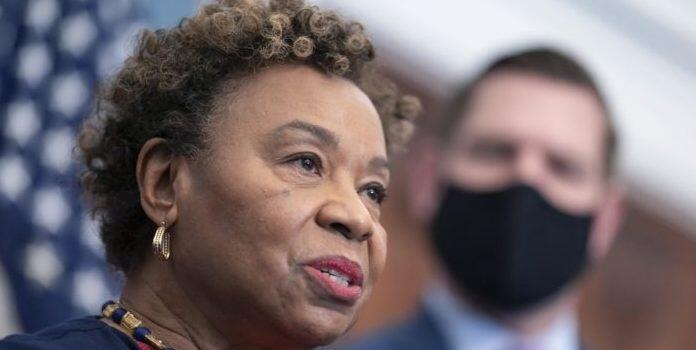
The Oakland Police Department recovered the vehicle within hours, two days after somebody tampered with her office’s door.
“The Oakland Police Department is investigating the theft of a city-owned vehicle. On February 17, 2026, OPD was notified that the vehicle was stolen from Oakland City Hall,” the OPD said through a spokesperson.
“The vehicle was recovered within hours. OPD is following up on potential leads.”
Lee took office in May 2025 after serving more than two decades in Congress.
She previously expressed support for efforts to “restructure” and “overhaul” policing during the 2020 protests, language widely associated with the “defund the police” movement.
In 2020, she told Politico she was “really proud” of the Minneapolis City Council’s pledge to defund the local police.
In December 2020, she also said, “We have to restructure our funding priorities in terms of how we make our communities safe.”
“We have seen video after video over the last few weeks of peaceful protestors being met with extreme violence from police,” Lee said during the 2020 protest in favor of George Floyd.
“We can’t wait. It’s time to overhaul our policing system.”
According to the New York Post, police already had an arrest warrant for the alleged suspect.
In a statement, Lee claimed her administration takes crimes seriously:
“As with criminal cases such as this, the Oakland Police Department is actively investigating, and we cannot comment further at this time. No one in Oakland should have to worry about their car being stolen, whether they’re a resident, a city worker, or the Mayor. Public safety is a priority across our entire city.”
The theft comes amid a broader problem for Oakland as the city reported 9,914 motor vehicle thefts in 2024, one of the highest rates in the country.
END
XXXXXXXXXXXXXXXXXXXXXXXXXXXXXXXXXXXXXXXXXXXXXXXXXX
EXCHANGE: COMEX
EXCHANGE: COMEX
CONTRACT: FEBRUARY 2026 COMEX 100 GOLD FUTURES
SETTLEMENT: 4,975.900000000 USD
INTENT DATE: 02/19/2026 DELIVERY DATE: 02/23/2026
FIRM ORG FIRM NAME ISSUED STOPPED
099 H DEUTSCHE BANK AG 8
190 H BMO CAPITAL MARKETS 5
555 C BNP PARIBAS SEC CORP 2
661 C JP MORGAN SECURITIES 1
880 H CITIGROUP 2
TOTAL: 9 9
MONTH TO DATE: 36,578
JPMORGAN STOPPED 0/9
GOLD: NUMBER OF NOTICES FILED FOR FEBRUARY/2026: 9 CONTRACTs NOTICES FOR 900 OZ or 0.0279 TONNES
total notices so far: 36,578 contracts for 3,657,800 OR 113.773 tonnes)
SILVER NOTICES: 50 NOTICE(S) FILED FOR 250,000 OZ /
total number of notices filed so far this month : 4,689 CONTRACTS (NOTICES) for 23.425 million oz
SILVER//OUTLINE
INITIAL STANDING FOR JANUARY: 22.915 MILLION OZ FOLLOWED BY TODAY’S 1.185 MILLION OZ QUEUE JUMP//NEW NORMAL STANDING ADVANCES TO 49.445 MILLION OZ// TO WHICH WE ADD OUR FIRST EXCHANGE FOR RISK FOR .100 MILLION OZ//NEW STANDING ADVANCES TO 49.545 MILLION OZ!!
INTIAL STANDING FOR FEBRUARY/SILVER: 13.505 MILLION OZ FOLLOWED BY TODAY’S 0.235 MILLION OZ QEFP TRANSFER TO LONDON/ : NEW STANDING FOR SILVER AT THE COMEX REDUCES TO 24.145 MILLION OZ. BUT WE MUST ADD OUR FIRST EXCHANGE FOR RISK OF 25 CONTRACTS FOR .125 MILLION OZ AND THEN OUR SECOND EXCHANGE FOR RISK OF .0600 MILLION OZ//
NEW TOTALS FOR SILVER OZ STANDING IS AS FOLLOWS
NORMAL STANDING 24.145 MILLION OZ
PLUS OUR 2 EXCHANGE FOR RISK: 185,000 OZ
EQUALS
24.330 MILLION OZ!! HUGE FOR A FEBRUARY
JULY: 50.925 MILLION OZ (QUITE SMALL)
AUGUST: 59.455 MILLION OZ (QUITE SMALL)
SEPT. 50.510 MILLION OZ.(QUITE SMALL)
OCT; 82.020 MILLION OZ (WILL BE STRONG THIS MONTH)/ OCC WANTS TO REIN IN THESE ISSUANCES!
NOVEMBER: 36.425 MILLION OZ
DEC: 45.765 MILLION OZ
JANUARY 2026: 134.270 MILLION OZ (WILL BE A VERY STRONG MONTH FOR EXCHANGE FOR PHYSICAL!)
FEB : 50.930 MILLION OZ
AND JULY: 46.720 MILLION OZ//
AUGUST: 4.70 MILLION OZ INITIAL STANDING PLUS TODAY;S 5,000 OZ QUEUE JUMP //NEW STANDING ADVANCES TO 10.960 MILLION OZ
SEPTEMBER: 68.040 MILLION OZ NORMAL DELIVERY(INCLUDES ALL QUEUE JUMPING AND EXCHANGE FOR PHYSICAL TRANSFERS) PLUS 3.0 MILLION OZ EX FOR RISK = 71.040 MILLION OZ. (THIS IS THE FIRST AND ONLY ISSUANCE OF EXCHANGE FOR RISK FOR SILVER SINCE MAY.)
OCTOBER: 39.565 MILLION OZ OF NORMAL DELIVERY INCLUDES ALL QUEUE JUMPING
PLUS
2.110 MILLION OZ EXCHANGE FOR RISK//TOTAL OZ STANDING IN OCT ADVANCES TO 41.675 MILLION OZ
NOVEMBER: INITIAL STANDING AT 11.575 MILLION OZ FOLLOWED BY TODAY’S 195,000 OZ QUEUE JUMP WHICH FOLLOWS ALL OTHER QUEUE JUMPS OF 9.155 MILLION OZ//STANDING ADVANCES TO 19.670 MILLION OZ/
DECEMBER: INITIAL AMOUNT STANDING FOR DELIVERY: 49.33 MILLION OZ// FOLLOWED BY ANOTHER STRONG 835,000OZ QUEUE JUMP+ DEC. FIRST EXCHANGE FOR RISK 0F .850 MILLION OZ + LAST WEEK.S 495,000 OZ EXCHANGE FOR RISK AND THEN A 3RD ISSUANCE IF 1.00MILLION OZ THEN FINALLY DEC 249ISSUANCE OF 1.35 MILLION OZ EXCHANGE FOR RISK//NEW TOTAL EX FOR RIS IS 3.685 MILLION OZ // STANDING ADVANCES TO 68.415 MILLION OZ//
JANUARY: INITIAL STANDING 22.915 MILLION OZ FOLLOWED BY TODAY’S 1.185 MILLION OZ QUEUE JUMP//NORMAL STANDING ADVANCES TO 49.445 MILLION OZ// TO WHICH WE ADD OUR FIRST EXCHANGE FOR RISK OF 0.100 MILLLION OZ//NEW STANDING ADVANCES TO 49.545 MILLION OZ
FEB: 13.399 MILLION OZ IS OUR INITIAL STANDING FOR SILVER! TO WHICH WE SUBTRACT OUR EXCHANGE FOR PHYSICAL JUMP TO LONDONOF 0.235 MILLION OZ AND THEN ADD OUR 2 EXCHANGE FOR RISK FOR .185 MILLION OZ STANDING REDUCES TO 24.330 MILLION OZ!!
- MAY: SUMMARY FOR MAY TONNES WHICH STOOD FOR DELIVERY:
4. AUGUST: 60.547 TONNES OF INITIAL GOLD FIRST DAY NOTICE FOLLOWED BY THE NET MONTH’S QUEUE JUMP OF 47.2312 TONNES TO WHICH WE ADD THE FOLLOWING EXCHANGE FOR RISK ISSUANCE RECEIVED FOR THE MONTH: 5.4432 TONNES EX FOR RISK/AUG 7 , AUG 11: 2.413 TONNES EX FOR RISK AND AUG. 12 OF 2.637 TONNES EX FOR RISK//AUG 25: 9.107 TONNES , AUGUST 26: 9.1010 TONNES AND NOW AUGUST 27: 9.0699 TONNES//NEW STANDING ADVANCES TO 107.5117 TONNES OF GOLD NORMAL STANDING (INCLUDES ALL MONTHLY QUEUE JUMPS/EX FOR PHYSICAL TRANSFERS//) +44.696 TONNES EX.FOR RISK = 152.208 TONNES
5.SEPT: INITIAL 8.093 TONNES OF GOLD PLUS TODAY’S QUEUE JUMP OF 0.4883 TONNES PLUS 2.2827 TONNES OF EXCHANGE FOR RISK TODAY//NEW TOTAL EX. FOR RISK/MONTH = 22.923//NEW TOTAL STANDING FOR GOLD SEPT ADVANCES TO = 48.801 TONNES!!
6.OCTOBER: 90.012 TONNES OF INITIAL GOLD STANDING WITH TODAY’S TINY 0.00311 TONNES QUEUE JUMP WHICH FOLLOWS ALL OTHER QUEUE JUMPS DURING OCT OF 76.1656 TONNES
THEN WE MUST ADD OUR 14.553 TONNES OF OUR ISSUANCE OF EXCHANGE FOR RISK/6 OCCASIONS//NEW TOTAL OF GOLD STANDING ADVANCES TO 197.5141 TONNES OF GOLD.
7.NOVEMBER BEGINS WITH 15.651 TONNES INITIALLY STANDING FOR DELIVERY FOLLOWED BY TODAY’S QUEUE JUMP OF 2.323 TONNES FOLLOWED BY ALL PREVIOUS QUEUE JUMPS IN OF OF 21.3775 TONNES TO WHICH WE ADD OUR TWO EXCHANGE FOR RISK ISSUANCE OF 4.5596 TONNES//NEW STANDING ADVANCES TO 43.9716 TONNES OF GOLD.
8. DECEMBER BEGINS WITH INITIAL STANDING OF 83.813 TONNES OF GOLD FOLLOWED BY TODAY’S 0.0TONNE QUEUE JUMP WHICH FOLLOWS ALL OTHER QUEUE JUMPS OF: 37.163 TONNES//NEW STANDING ADVANCES TO 115.390 TONNES TO WHICH WE ADD OUR 4 EXCHANGE FOR RISK FOR DECEMBER OF 6.587 TONNES/NEW STANDING ADVANCES TO 121.977 TONNES
9. JANUARY: INITITAL STANDING: 13.785 TONNES TO WHICH WE ADD OUR QUEUE JUMP OF 0.000 TONNES WHICH FOLLOWS ALL OTHER QUEUE JUMPS OF 30.7117TONNES //NEW TOTAL QUEUE JUMPS 30.7117//NORMAL DELIVERY OF GOLD ADVANCES TO 36.8958 TONNES TO WHICH WE ADD OUR SIX EXCHANGE FOR RISK OF 22.315 TONNES//NEW STANDING ADVANCES TO 59.2108 TONNES.
FEB; INITIAL AMOUNT OF GOLD STANDING FOR DELIVERY: 93.567 TONNES OF GOLD TO WHICH WE ADD OUR NEXT QUEUE JUMP OF 0.0186 TONNES TO OTHER OF 41.92 TONNES/ NEW QUEUE JUMP TOTAL:41.9386 TONNES// AND THEN WE ADD OUR FIVE EXCHANGE FOR RISK: 9596 CONTRACTS OR 29.746 TONNES//NEW STANDING ADVANCES TO 157.186 TONNES
FINAL STANDING FOR GOLD, JANUARY CONTRACT AT 59.2108 TONNES OF GOLD
AND NOW FEBRUARY: INITIAL STANDING FOR GOLD: 157.186 TONNES!! WHICH INCLUDES ALL QUEUE JUMPING AND OUR FIVE ISSUANCES EXCHANGE FOR RISK!!
JAN. 2025: 257.919 TONNES (ISSUANCE WILL BE PRETTY GOOD THIS MONTH BUT MUCH LOWER THAN LAST MONTH)
FEB: 207.21 TONNES//EX FOR PHYSICAL ISSUANCE (WILL BE A FAIR SIZED ISSUANCE THIS MONTH)
MARCH 130.84 TONNES//QUITE SMALL THIS MONTH.
APRIL; 208.57 TONNES. STRONG THIS MONTH
MAY: 113.499 TONNES OF GOLD EFP ISSUANCE//QUITE SMALL THIS MONTH
JUNE: 97.79 TONNES OF GOLD EFP ISSUANCE/EXTREMELY SMALL
JULY : 150.877 TONNES// QUITE SMALL
AUGUST: 175.86 TONNES A LOT LARGER THIS MONTH.
SEPT. 116.13 TONNES VERY SMALL
OCT. 252.72 TONNES//CERTAINLY MUCH LARGER THIS MONTH/VERY STRONG
NOV: 124.74 TONNES
DEC: 190.04 TONNES//GOOD SIZED THIS MONTH FINAL.
TOTAL EXCHANGE FOR PHYSICAL ISSUED FOR YEAR 2025: 2,026.20 TONNES (LOWER THAN LAST YR 2,569.00 TONNES
JANUARY: 209.08 TONNES ( (WILL BE A STRONG MONTH FOR EXCHANGE FOR PHYSICAL)
FEB. 124.292 TONNES (WHICH WILL BE SMALLER THAN OTHER MONTHS)
XXXXXXXXXXXXXXXXXXXXXXXXXXXXXXXXXXXXXXXXXX
SPREADERS:
HERE IS A BRIEF SYNOPSIS OF HOW THE CROOKS FLEECE UNSUSPECTING LONGS IN THE SPREADING ENDEAVOUR ;MODUS OPERANDI OF THE CORRUPT BANKERS AS TO HOW THEY HANDLE THEIR SPREAD OPEN INTERESTS:HERE IS HOW THE CROOKS USED SPREADING AS WE ARE NOW INTO THE NON ACTIVE DELIVERY MONTH OF NOV HEADING TOWARDS THE ACTIVE DELIVERY MONTH OF FEB., FOR GOLD: AND MARCH FOR SILVER
YOU WILL ALSO NOTICE THAT THE COMEX OPEN INTEREST STARTS TO RISE BUT SO IS THE OPEN INTEREST OF SPREADERS. THE OPEN INTEREST IN WILL CONTINUE TO RISE UNTIL ONE WEEK BEFORE FIRST DAY NOTICE OF AN UPCOMING ACTIVE DELIVERY MONTH (OCT), AND THAT IS WHEN THE CROOKS SELL THEIR SPREAD POSITIONS BUT NOT AT THE SAME TIME OF THE DAY. THEY WILL USE THE SELL SIDE OF THE EQUATION TO CREATE THE CASCADE (ALONG WITH THEIR COLLUSIVE FRIENDS) AND THEN COVER ON THE BUY SIDE OF THE SPREAD SITUATION AT THE END OF THE DAY. THEY DO THIS TO AVOID POSITION LIMIT DETECTION. THE LIQUIDATION OF THE SPREADING FORMATION CONTINUES FOR EXACTLY ONE WEEK AND ENDS ON FIRST DAY NOTICE.”
WHAT IS ALARMING TO ME, ACCORDING TO OUR LONDON EXPERT ANDREW MAGUIRE IS THAT THESE EFP’S ARE BEING TRANSFERRED TO WHAT ARE CALLED SERIAL FORWARD CONTRACT OBLIGATIONS AND THESE CONTRACTS ARE LESS THAN 14 DAYS. ANYTHING GREATER THAN 14 DAYS, THESE MUST BE RECORDED AND SENT TO THE COMPTROLLER, GREAT BRITAIN TO MONITOR RISK TO THE BANKING SYSTEM. IF THIS IS INDEED TRUE, THEN THIS IS A MASSIVE CONSPIRACY TO DEFRAUD AS WE NOW WITNESS A MONSTROUS TOTAL EFP’S ISSUANCE AS IT HEADS INTO THE STRATOSPHERE.
The crooks also use the spread in the TAS account (trade at settlement). They buy the spot TAS (e.g. June) and sell the future TAS two months out (e.g. August). Then they unload the front month (i.e. unload the buy side first so the price of gold/silver falls. This occurs in the middle of the front delivery month cycle. They unload the sell side of the equation, two months down the road. The crooks violate position limits as the OCC refuse to hear our complaints.
First, here is an outline of what will be discussed tonight:
SILVER:
1.TODAY WE HAD THE OPEN INTEREST AT THE COMEX IN SILVER FELL BY A STRONG SIZED 518 CONTRACTS OI TO 130,490 AND FURTHER FROM THE COMEX HIGH RECORD //244,710( SET FEB 25/2020). THE LAST RECORDS WERE SET IN AUG.2018 AT 244,196 WITH A SILVER PRICE OF $14.78/(AUGUST 22/2018)..THE PREVIOUS RECORD TO THAT WAS SET ON APRIL 9/2018 AT 243,411 OPEN INTEREST CONTRACTS WITH THE SILVER PRICE AT THAT DAY: $16.53). AND PREVIOUS TO THAT, THE RECORD WAS ESTABLISHED AT: 234,787 CONTRACTS, SET ON APRIL 21.2017 OVER 7 YEARS AGO. HOWEVER WE HAVE NOW SET A NEW RECORD LOW OF 114,102 CONTRACTS JULY 3.2023
EFP ISSUANCE 610 CONTRACTS
OUR CUSTOMARY MIGRATION OF COMEX LONGS CONTINUE TO MORPH INTO LONDON FORWARDS AS OUR BANKERS USED THEIR EMERGENCY PROCEDURE TO ISSUE:
MAR 666 CONTRACTS and 0 ALL OTHER MONTHS: ZERO. TOTAL EFP ISSUANCE: 0 CONTRACTS. EFP’S GIVE OUR COMEX LONGS A FIAT BONUS PLUS A DELIVERABLE PRODUCT OVER IN LONDON. IF WE TAKE THE COMEX OI LOSS OF 592 CONTRACTS AND ADD TO THE 610 E.FP. ISSUED
WE OBTAIN A SMALL SIZED GAIN OF 92 OF OPEN INTEREST CONTRACTS FROM OUR TWO EXCHANGES DESPITE OUR LOSS OF $0.23
THUS IN OUNCES, THE GAIN ON THE TWO EXCHANGES TOTALS 0.460 MILLION PAPER OZ
OCCURRED WITH OUR LOSS IN PRICE.OF $0.23
2.ASIAN AFFAIRS FEB 20/2025
SHANGHAI CLOSED
HANG SENG CLOSED
Nikkei CLOSED DOWN 292.59 PTS OR 1.10%
//Australia’s all ordinaries CLOSED UP 0.28%
//Chinese yuan (ONSHORE) CLOSED XXXX
/ OFFSHORE CLOSED DOWN AT 6.9023 Oil UP TO 66.62 dollars per barrel for WTI and BRENT UP TO 71.28 Stocks in Europe OPENED ALL RED
ONSHORE USA/ YUAN TRADING XXXX OFFSHORE YUAN TRADING DOWN TO 6.9023 ONSHORE YUAN TRADING BELOW OFF SHORE AND XXX ON THE DOLLAR// / AND THUS XXXXX//OFF SHORE YUAN TRADING DOWN AGAINST US DOLLAR/ AND THUS WEAKER
XXXXXXXXXXXXXXXXXXXXXXXX
1. COMEX DATA//AMOUNTS STANDING//VOLUME OF TRADING/INVENTORY MOVEMENTS
LET US BEGIN:
THE TOTAL COMEX GOLD OPEN INTEREST FELL BY A SMALL SIZED 592 CONTRACTS UP TO 409.585 OI WITH OUR LOSS IN PRICE OF $9.00 WITH RESPECT TO THURSDAY’S // TRADING/ //COMEX CLOSING TIME:… WE LOST LITTLE NET LONGS, WITH THAT PRICE LOSS FOR GOLD . AND AS YOU WILL SEE BELOW, OUR GAIN IN PRICE ALSO HAD A STRONG NUMBER OF EXCHANGE FOR PHYSICAL ISSUED (2495).
WE HAD LITTLE T.A.S. LIQUIDATION DURING THURSDAY’S TRADING. IT SEEMS THAT THE SPECULATORS STARTED AGAIN TO GO LONG THIS WEEK AFTER A BRIEF PERIOD OF GOING NET SHORT. HOWEVER SOME OF THOSE LONG SPECULATORS WERE ANNHILATED DURING THE TUESDAY RAID AND OTHERS WAITED UNTIL THE CONCLUSION OF TRADING AND TENDERED FOR BADLY NEEDED PHYSICAL TUESDAY AND WEDNESDAY
CENTRAL BANKS ALSO TENDERED THEIR NEW LONG CONTRACTS AT THE END OF THE DAY FOR PHYSICAL GOLD. YOU CAN VISUALIZE THIS WITH THE MASSIVE AMOUNT OF GOLD STANDING AT THE COMEX FOR THIS FEBRUARY CONTRACT MONTH!!
YOU WILL NOTICE THAT THE COMEX OI IS NOW BACK TO AN EXTREMELY LOW OI OF AROUND 409000 TO NOW 409,585 AND NOW AMPLE ENOUGH TO GROW AND FROM THIS POINT FORTH IT WILL BE DIFFICULT TO FLEECE. THE ALL TIME LOW OF COMEX OI IS 390,000 CONTRACTS WHICH OCCURRED IN 2001 WITH GOLD AROUND $260. FROM CHINA WE LEARN THAT TODAY, THE GOLD LEASE RATE IS NOW AROUND 5 %
WE THUS HAD A TOTAL GAIN IN OI ON BOTH OF OUR EXCHANGES, THE COMEX AND LONDON’S EXCHANGE FOR PHYSICAL EQUATING TO 1903 CONTRACTS (OR 5.919TONNES) DESPITE THE LOSS IN PRICE, WEDNESDAY.
THEN WE WERE NOTIFIED OF A ZERO CONTRACT EXCHANGE FOR RISK ISSUANCE IN GOLD CONTRACTS FOR 0 OZ OR 0 TONNES OF GOLD. THIS PAST WEEK WE HAVE HAD TWO IDENTICAL MONSTER 3,000 CONTRACT ISSUED FOR THE SAME 9.33 TONNES OF GOLD, AND THESE ARE THE HIGHEST EVER IN TONNAGE EVER ISSUED BY THE COMEX. ALTOGETHER THE TOTAL ISSUANCE THUS FAR FOR FEB NOW REMAINS AT FIVE.(29.746 TONNES)
A LITTLE HISTORY OF EXCHANGE FOR RISK DECEMBER THROUGH TO FEBRUARY:
IN DECEMBER WE HAVE RECORDED 5 ISSUANCES OF EXCHANGE FOR RISK/4 FOR DEC AND THE LAST ONE ON DEC 31 FOR JANUARY. WE NOW HAVE 3 CHOICES FOR THE RECIPIENT OF THIS ISSUANCE AND IT MUST BE A CENTRAL BANK. YOU WILL RECALL THAT THE BUYER ASSUMES THE RISK OF THAT DELIVERY. (THUS TOTAL EXCHANGE FOR RISK FOR THE MONTH OF DECEMBER IS 6.56 TONNES/4 OCCASIONS.
MONTH OF JANUARY/EXCHANGE FOR RISK
IN JANUARY THEY HAVE 6 TOTAL ISSUANCE : 3.446 TONNES EARLY, THEN JAN 9 ISSUANCE OF 9,331 TONNES AND THEN JAN 16: 0.1996 TONNES JAN 26: 1.499 TONNES, JAN 27: 3.160 AND FINALLY JAN 29: 4.659 TONNES TONNES//TOTAL EXCHANGE FOR RISK JANUARY 22.315 TONNES WHICH WAS ADDED TO OUR NORMAL DELVERIES.
AND NOW FEBRUARY:
FEB EXCHANGE FOR RISK: NOW 5 ISSUANCES: 9596 CONTRACTS FOR 959,600 OZ OR 29.746 TONNES!
HERE ARE THE CHOICES FOR THE RECIPIENT OF THOSE ISSUANCES:
1 THE CENTRAL BANK OF ENGLAND. BUT THEY RECEIVED CLEARANCE THAT THEIR GOLD IS BACK SO IT IS NOT LIKELY THAT THEY WOULD LIKE TO ADD TO THEIR RESERVES.
2. THE CENTRAL BANK OF THE USA: THE FED. LOGICAL CHOICE AS THEY CLAMOUR TRYING TO REDUCE THEIR 106+ TONNES OF SHORTAGE. HOWEVER THEY SEEM NOT TO BE IN A HURRY TO COVER THEIR HUGE SHORTFALL
3. THE CENTRAL BANK OF CHINA AS THEY BATTLE WITS WITH THE USA.
TOTAL EXCHANGE FOR RISK FOR DECEMBER IS 6.56 TONNES AND THIS WAS ADDED TO OUR NORMAL DELIVERY TOTALS..
THE JANUARY ISSUANCE OF 17.656 TONNES WAS ADDED TO OUR DAILY TOTALS!!
FEBRUAY ISSUANCES 5 FOR; 29.746 TONNES SO FAR!!
DETAILS ON OUR NEW FEBRUARY COMEX CONTRACT MONTH//
IN TOTAL WE HAD A FAIR SIZED GAIN ON OUR TWO EXCHANGES OF 1903 CONTRACTS DESPITE OUR LOSS IN PRICE. HOWEVER, OUR FRIENDLY PHYSICAL LONDON BOYS HAD ANOTHER FIELD DAY AGAIN THROUGHOUT OF THE WEEK AS THEY WERE READY FOR THE FRBNY.S CONTINUED ORCHESTRATED ATTACKS VERY EARLY IN THE COMEX SESSIONS AS THEY TRIED TO ABSORB EVERYTHING IN SIGHT FROM THEIR DAILY ATTACKS. LONDONERS EXERCISED THEIR BOUGHT CONTRACTS FOR PHYSICAL GOLD VIA THE EXCHANGE FOR PHYSICAL ROUTE AND THANKED THE FRBNY AND OUR SHORT SPECULATORS FOR THE THOUGHTFULNESS.
LONDON ANNOUNCED EARLY IN THE YEAR (AND SCARCITY CONTINUES TO THIS DAY) THAT THEY WERE OUT OF GOLD. WRONGLY IT WAS ATTRIBUTED TO THEIR SHIPPING PHYSICAL GOLD TO COMEX FOR STORAGE DUE TO TRUMP’S INITIATION OF TARIFFS. THE TRUTH OF THE MATTER IS THAT THIS GOLD LEFT LONDON TO OTHER CENTRAL BANKS, AND COMEX BANKS HAVE BEEN PAPERING THEIR LOSSES (DERIVATIVE) WITH KILOBAR ENTRIES. BOTH COMEX AND LBMA ARE WITNESSING MASSIVE AMOUNTS OF GOLD LEAVING THEIR VAULTS.
THE LIQUIDATION OF T.A.S. CONTRACTS THROUGHOUT THE MONTHS OF JUNE THROUGH FEBRUARY/ CONTINUES TO DISTORT OPEN INTEREST NUMBERS GREATLY ALTHOUGH THE T.A.S. ISSUANCES IN GOLD HAVE GENERALLY BEEN ON THE LOW SIDE COMPARED TO SILVER WHICH HAVE BEEN HUGE. TODAY’S NUMBER IS A SMALL SIZED T.A.S ISSUANCE CONTRACTS (1439 CONTRACTS).THE CME NOTIFIES US THAT THEY HAVE ISSUED 773 T.A.S CONTRACTS AND WILL BE USED FOR RAID PURPOSES TO STOP GOLD’S RISE AND TO TEMPER HUGE LOSSES IN OTC DERIVATIVE BETS AND IT WAS IN FULL FORCE DURING LAST WEEK AND CONTINUING ON THIS WEEK. IT SURE LOOKS LIKE THE BIS HAS SOMEHOW LOOKED THE OTHER WAY WITH ITS GOLD SWAPS WITH THE FRBNY AS THIS ENTITY FOR THE FED REFUSES THE BIS MARCHING ORDERS TO COVER AND THAT MAY EXPLAIN THE STRONG NUMBER OF T.A.S. ISSUANCES IN DECEMBER , JANUARY AND THROUGHOUT FEBRUARY TO GO ALONG WITH OUR HUGE NUMBER OF EXCHANGE FOR RISK ISSUED DURING THESE MONTHS INCLUDING FEBRUARY’S 5 EXCHANGE FOR RISK INCLUDING TWO MONSTER 9.3312 TONNE ISSUANCE (FEB 10 AND FEB 12). TOTAL EXCHANGE FOR RISK/FEB EQUALS 29.746 TONNES!! OTHER CENTRAL BANKS ARE PAYING ATTENTION AS THEY TAKE DELIVERY OF HUGE AMOUNTS OF PHYSICAL GOLD.
FOR EXAMPLE:
HERE IS A SUMMARY OF GOLD STANDING FOR DELIVERY ON OUR LAST 11 MONTHS:
- FOR APRIL AT 209 TONNES
2. AND THIS CONTINUED INTO MAY WITH FINAL STANDING AT 90.23 TONNES.
3. JUNE WHICH IS A HUGE DELIVERY MONTH , FINAL STANDING WAS RECORDED AT A STRONG 93.085 TONNES. //(TOTAL NET QUEUE JUMPING FOR THE JUNE MONTH: 31.027 TONNES.)
4. IN JULY WE HAD HUGE DELIVERY NOTICES ESPECIALLY FOR A NON ACTIVE DELIVERY MONTH WITH INITIAL STANDING AT 17.947 TONNES PLUS MANY QUEUE JUMPS + 3.75 TONNES EX FOR RISK = 41.106 TONNES OF GOLD // FINAL TOTAL TONNES STANDING JULY: 41.106 TONNES
5. FOR THE MONTH OF AUGUST:
INITIAL AMOUNT OF GOLD STANDING FOR AUGUST: 60.547 TONNES PLUS THE MONTHS HUGE QUEUE JUMPS OF 47.2312 TONNES +44.696 TONNES EX FOR RISK (7 ISSUANCES) //NEW STANDING 152.208 TONNES WHICH IS MONSTROUS!!!
6. FINAL AMOUNT OF GOLD STANDING FOR SEPT; INITIAL STANDING; 2,602 CONTRACTS OR 260,200 OZ FOR 8.093 TONNES OF GOLD FOLLOWED BY TODAY’S 0.4883 TONNES QUEUE JUMP TO GO ALONG WITH TODAY’S 1.244 TONNES OF EXCHANGE FOR RISK ISSUANCE TODAY AND // TOTAL EXCHANGE FOR RISK ISSUANCE SEPT: 22.923 TONNES//NEW TOTALS STANDING ADVANCES TO 48.801 TONNES OF GOLD!!!
7. OCTOBER:
OCTOBER: INITIAL STANDING FOR GOLD: 90.164 TONNES TO WHICH WE ADD OUR LATEST OCT 30 QUEUE JUMP OF 0.00311 TONNES WHICH FOLLOWS OCT 29 QUEUE JUMP OF .4096 WHICH FOLLOWS; OCT 28 QUEUE JUMP OF .5069 TONNES WHICH FOLLOWS OCT 27 OF 0.3048 TONNES WHICH FOLLOWS: OCT 24 OF 0.8615 TONNES, FOLLOWING OCT 23 QUEUE JUMP OF 1.695 TONNES OCT 22 JUMP OF 8.622 TONNES WHICH FOLLOWS OCT 21: 3.8600 TONNES TO OCT 20 QUEUE JUMP OF 7.695 TONNES WHICH FOLLOWED OCT 17 RECORD SETTING: 12.031 TONNE QUEUE JUMP WHICH FOLLOWED THURSDAY’S QUEUE JUMP OF 8.326 TONNES WHICH FOLLOWED WEDNESDAY;S 6.469 WHICH FOLLOWED ALL PREVIOUS QUEUE JUMPS OF 42.549 TONNES TO WHICH WE ADD OUR TOTAL 4679 EXCHANGE FOR RISK CONTRACTS ON 6 OCCASIONS FOR 467,900 OZ OR 14.553 TONNES.! TOTAL STANDING ADVANCES TO 197.511 TONNES OF GOLD
SUMMARY FOR OCTOBER STANDING:
THAT IS;
a) INITIAL STANDING 90.164 TONNES
b) INITIAL EXCHANGE FOR RISK ISSUANCE OF 500 CONTRACTS FOR 50,000 OZ OR 1.555 TONNES
c) ANOTHER 3 CONSECUTIVE EXCHANGE FOR RISK ISSUANCES OF 2150 CONTRACTS FOR 215000 OZ OR 6.687 TONNES
D) AFTER A ONE DAY HIATUS, A 5TH ISSUANCE FOR 1000 CONTRACTS //100,000 OZ OR 3.1104 TONNES
E) AFTER A TWO WEEK HIATUS: ITS 6TH ISSUANCE FOR 1029 CONTRACTS/102,900 OZ OR 3.200 TONNES
TOTAL EXCHANGE FOR RISK OCT 6 OCCASIONS: 14.553 TONNES
TO WHICH WE ADD ALL OUR QUEUE JUMPING IN OCT: TOTAL MONTH;: 92.7648 TONNES
(ALL OF THESE QUEUE JUMPS ARE REPRESENTED BY CENTRAL BANKS DESPERATELY ADDING TO THEIR OFFICIAL RESERVES)
EQUALS
197.5141 TONNES OF GOLD!!
END
8. NOVEMBER:TOTAL TONNES STANDING INCLUDING ALL QUEUE JUMPS AND EXCHANGE FOR RISK ISSUANCE:
INITIAL GOLD STANDING AT THE COMEX IS 5032 CONTRACTS OR 503,200 OZ (15.651 TONNES) FOLLOWED BY ITS TODAY’S QUEUE JUMP OF 2.323 TONNES/ FOLLOWED BY ALL NOVEMBER QUEUE JUMPS OF 21.3775 TONNES TO WHICH WE ADD OUR SECOND EXCHANGE FOR RISK OF 1016 CONTRACTS FOR 101600 OZ OR 3.165 TONNES TO OUR FIRST EXCHANGE FOR RISK ISSUANCE OF 1.3966 TONNES/// NEW EXCHANGE FOR RISK: 4.5595 TONNES//NEW TOTAL GOLD STANDING IN NOVEMBER ADVANCES TO 43.9716 TONNES
9. DECEMBER: INITIAL AMOUNT OF GOLD STANDING FOR DELIVERY: 83.813 TONNES OF GOLD FOLLOWED BY TODAY’S 0.1337 TONNES OF QUEUE JUMP WHICH FOLLOWS ALL OTHER NET QUEUE JUMPING OF 37.163 TONNES//STANDING ADVANCES TO 115.257 TONNES TO WHICH WE ADD OUR FOUR ISSUANCES OF EXCHANGE FOR RISK OF 6.559 TONNES/NEW STANDING IS THUS: 121.977 TONNES.
10. JANUARY: INITITAL STANDING: 13.785 TONNES TO WHICH WE ADD OUR NEXT QUEUE JUMP OF 0,000 TONNES WHICH FOLLOWS ALL OTHER QUEUE JUMPS OF 30.7117TONNES //NEW TOTAL QUEUE JUMPS 30.7117//NORMAL DELIVERY OF GOLD ADVANCES TO 36.8958 TONNES TO WHICH WE ADD OUR SIX EXCHANGE FOR RISK OF 22.315 TONNES//NEW STANDING ADVANCES TO 59.2108 TONNES.
11.FEB; 0. FEBRUARY: INITIAL STANDING: 93.566 TONNES TO WHICH WE HAD OUR NEXT QUEUE JUMP OF 0.0186 TONNES ADDING TO ALL OTHER QUEUE JUMPS OF 41.920 TONNNES//NEW TOTAL QUEUE JUMP: 41.9386/ STANDING ADVANCES TO 127.234 TONNES TO WHICH WE ADD OUR FIVE EXCHANGE FOR RISK OF 29.746 TONNES/NEW STANDING ROCKETS TO 157.186 TONNES!!
THE FED IS THE OTHER MAJOR SHORT IN GOLD OF AROUND 106+ TONNES OF GOLD OWING TO THE B.I.S. THE OCC ORDERED ALL BANKS TO COVER THEIR GOLD LOSSES FROM OCC BETS. THE 106 TONNES IS SUCH A SMALL FRACTION OF WHAT IS OWED!!! THE FRBNY BORROWED GOLD TO KEEP THE GOLD SUPPRESSION GAME ALIVE!! .. THE FED IS VERY WORRIED ABOUT WHAT IS GOING TO HAPPEN TO GOLD PRICES IF THEY DO NOT BORROW THIS GOLD. A MUCH HIGHER GOLD PRICE BLOWS UP THE DERIVATIVE APPARATUS OF THE BULLION BANKS.
BUT IT WAS IMPOSSIBLE/ THAT THE FED WAS THE BUYER OF 10.006 TONNES OF EXCHANGE FOR RISK/DECEMBER,(LATEST BIS DATA SHOWS AN INCREASE IN GOLD BORROWING BY THE FRBNY// AND IT WAS NOT THE BUYER IN JANUARY OF 22.315 TONNES TOTAL IN JANUARY/6 EXCHANGE FOR RISK ISSUANCES AS WE NOW HAVE THE BIS DATA FOR GOLD SWAPS FOR JANUARY 2025 AND HERE WE FIND THAT THE FED ACTUALLY INCREASED THEIR GOLD SWAP LOANS WITH THE BIS TO THE 106 TONNES WHICH I NOW RECORD FOR YOU.!!THEN MUCH TO OUR ANGER WE RECEIVED NOTICE ON FRIDAY OF OUR 5TH EXCHANGE FOR RISK OF 6.871 TONNES//TOTAL EXCHANGE FOR RISK FEB OF 5 ISSUANCES EQUATES TO 29.746 TONNES OF GOLD WHICH WE ADD TO OUR NORMAL DELIVERY TOTALS.
THE MAJOR FOUR OR FIVE BANKS ARE ALSO WORRIED ABOUT THEIR HUGE PRECIOUS METAL DERIVATIVE SHORT EXPOSURE (NORTH OF ONE TRILLION DOLLARS) AND THIS IS PROBABLY THE MAJOR REASON FOR GOLD/SILVER’S RISE THESE PAST SEVERAL MONTHS. THEY ARE TOTALLY TRAPPED., AND THEIR FAILURE TO STOP OTHER CENTRAL BANK PURCHASES OF PHYSICAL GOLD IS THE MAJOR ISSUE OF THE DAY.
THE FRBNY IS STILL NON COMPLIANT WITH RESPECT TO BASEL III BUT IT IS NOT NECESSARY FOR THEM TO BE COMPLIANT ONLY COMMERCIAL BANKERS MUST BE.
OUR PHYSICAL LONDONERS BOUGHT NEW MASSIVE QUANTITIES OF LONGS AT ANY PRICE AND THIS GOLD BOUGHT WILL BE TENDERED FOR PHYSICAL ON A T + ???? BASIS. BECAUSE GOLD IS BASEL III COMPLIANT, GOLD IS SUPPOSED BE DELIVERED IN A VERY TIMELY ONE DAY. CENTRAL BANKS AROUND THE WORLD, BEING REPRESENTED BY OUR LONDONERS, ARE THE REAL PURCHASERS OF THIS GOLD.
EUROPE IS NOW BASEL III COMPLIANT. THE WEST ( COMEX) IS NOW COMPLIANT EFFECTIVE JULY 1//2025.
THE PROBLEM FOR THOSE PROVIDING THE SHORT PAPER IS THE SHOCK TO THEM ON RECEIVING NOTICE THAT THE LONGS WANT THE PHYSICAL GOLD AS THEY TENDER FOR THAT SHINY YELLOW METAL. THE HIGH LIQUIDATION OF OUR TWO SPREADERS: 1) THE MONTH END SPREADERS AND 2. T.A.S DURING THESE PAST SEVERAL WEEKS IS SURELY DISTORTING COMEX OPEN INTEREST BUT THAT DOES NOT STOP LONDON’S ACCUMULATION OF PHYSICAL! YOU CAN ALSO VISUALIZE THAT PERFECTLY WITH THE HUGE AMOUNTS OF QUEUE JUMPING ORCHESTRATED BY CENTRAL BANKERS BOLTING AHEAD OF ORDINARY LONGS AS THEIR NEED FOR PHYSICAL IS GREAT AS THEY SCOUR THE PLANET LOOKING FOR GOLD, AND THE MASSIVE AMOUNT OF GOLD STANDING EACH AND EVERY MONTH
EXCHANGE FOR PHYSICAL ISSUANCE/FEB.//BORROWINGS FROM THE FRBNY:
THE CME REPORTS THAT THE BANKERS ISSUED A STRONG SIZED EXCHANGE FOR PHYSICAL OF 2495 CONTRACTS.
THAT IS A STRONG SIZED 2495 EFP CONTRACT WAS ISSUED: : /APRIL 2495 & ZERO FOR ALL OTHER MONTHS:
TOTAL EFP ISSUANCE: 2495 CONTRACTS. THESE EFP;S CIRCLE AROUND LONDON ON A 13 DAY BASIS AND ARE NOW USED BY GLOBAL CENTRAL BANKS TO EXERCISE FOR PHYSICAL GOLD WITH THE OBLIGATION TO DELIVER BEING FORCED ONTO COMEX BANKS. THE GOLD GENERALLY DELIVERED COMES FROM LONDON BUT THEY ARE OUT!! THUS COMEX BECOMES THE MAJOR SOURCE FOR OUR CENTRAL BANKERS. THE REGULATORY BODY THAT IS SUPPOSE TO CONTROL THESE EFP’S IS THE O.C.C. HEADQUARTERED IN BOTH LONDON AND WASHINGTON. SEEMS NOW THAT THE OCC IS CLAMPING DOWN ON THIS EFP’S CIRCLING AROUND IN LONDON AS THEY ORDERED THE BULLION BANKS TO COVER MUCH OF THEIR DERIVATIVE BETS ON THESE CONTRACTS!! THUS THE FRBNY SAVED OUR BULLION BANKS FROM EXTINCTION WITH THIS BORROWED GOLD FROM THE BIS OF 106+ TONNES
WE HAD :
- LITTLE LIQUIDATION OF OUR T.A.S. SPREADERS DURING THE COMEX SESSION + BUT DID HAVE SOME GOVERNMENT LIQUIDATION
- SOME MONTH END SPREADERS LIQUIDATION AS THEY HAVE COMMENCED THEIR OPERATION
T.A.S.SPREADER ISSUANCE//FEBRUARY
AS PER OUR NEWBIE TRADE AT SETTLEMENT (TAS) MANIPULATION OPERATION (WHICH CRAIG HEMKE HAS POINTED OUT HAPPENS USUALLY DURING MID MONTH IN THE DELIVERY CYCLE), BUT NOW ON A DAILY BASIS, THE CME REPORTS THAT THE TOTAL T.A.S. ISSUANCE FOR WEDNESDAY NIGHT/THURSDAY MORNING WAS A SMALL SIZED 773 CONTRACTS
THE RAIDS WHETHER ON OPTIONS EXPIRY MONTH OR T.A.S. DRIVEN, ACCOMPLISHES TWO IMPORTANT ASPECTS FOR OUR CROOKS:
- STALLS THE ADVANCE IN PRICE
- LOWERS THEIR ADVANCING DERIVATIVE LOSSES.
THAT SET UP THURSDAY’S LOSS IN PRICE IN GOLD YET WITH A CORRESPONDING STRONG SIZED GAIN OF OI ON OUR TWO EXCHANGES..
.
THE COMEX IS IN TOTAL TURMOIL ESPECIALLY THESE PAST 6 MONTHS WITH THE FOLLOWING;
- WITH JULY’S RARE TWO ISSUANCES OF EXCHANGE FOR RISK (LATE IN JULY)
- AND THIS WAS FOLLOWED WITH AUGUST’S 7 ISSUANCES OF EXCHANGE FOR RISK FOR 44.696 TONNES
- TO BE FOLLOWED BY SEPTEMBER’S 7 ISSUANCES FOR EXCHANGE FOR RISK FOR 22.923 TONNES.
- TO BE FOLLOWED BY OCTOBER’S 6 ISSUANCES FOR 14.553 TONNES
- TO BE FOLLOWED BY NOVEMBER’S TWO ISSUANCES FOR 4.5575 TONNES
- AND NOW FOLLOWED BY DECEMBER’S 3 ISSANCES FOR 12.997 TONNES
- JANUARY’S 6 ISSUANCE FOR 22.215 TONNES
- AND NOW FEB’S FIVE ISSUANCES FOR A MONSTER 29.746 TONNES.
- THE LONDON BANKING AUDITORS DID REFUSE TO GIVE CERTIFICATION ON THE BANK OF ENGLAND’S SISTER HOLDING OPERATION, THE E.E.A. ON ITS GOLD AND OTHER ASSETS HELD UNDER THE E.E.A.(SEE ROBERT LAMBOURNE’S LETTER OCT 8/HOWEVER THEY DID GIVE THEIR OK NOV 30.
- FRBNY BORROWS ANOTHER 30 TONNES OF GOLD FROM THE BIS IN OCT TO SAVE THE BULLION BANKS FROM EXTINCTION AFTER THE O.C.C ORDERED THE BULLION BANKS TO BE ONSIDE WITH THEIR DERIVATIVES. THE FRBNY IS NOW SHORT 106+ TONNES OF GOLD.
- MASSIVE REMOVAL OF COMEX CONTRACTS FROM PRELIMINARY OI TO FINAL OI//RECORD 33,000 CONTRACTS REMOVED FRIDAY NOV 21//
- MASSIVE T.A.S. CONTRACTS ISSUED FOR 5 CONSECUTIVE DAYS/SIGNALLING A MASSIVE RAIDS TO BE!GENERALLY HAPPENS ONCE EVERY TWO MONTHS
- MASSIVE RAIDS AT THE COMEX CALLED UPON EVERY OPTIONS EXPIRY MONTH INCLUDING JANUARY’S OTC/LBMA DRIVE BY SHOOTING! ALONG WITH RAIDS IN EARLY FEBRUARY LIKE WE EXPERIENCED FEB 10 ANDNOW TODAY
JAN 2025:
113.30 TONNES (WHICH INCLUDES 43.408 TONNES EX FOR RISK)
FEB: 2025:
256.607 TONNES (WHICH INCLUDES 18.4567 TONNES OF EX FOR RISK)
MARCH:
STANDING FOR GOLD : 60.33 TONNES + 7.6179 TONNES EX FOR RISK = 67.9479 TONNES WHICH IS EXTREMELY HIGH FOR A NON DELIVERY MONTH.
APRIL:
FINAL STANDING FOR GOLD: 201.573 TONNES + 8.3571 TONNES EX FOR RISK = 209.953 TONNES
MAY: FINAL STANDING 90.235 TONNES WHICH INCLUDES QUEUE JUMPING AND 9.591 TONNES EX FOR RISK.
JUNE: FINAL STANDING 62.534 TONNES PLUS 0.1493TONNES OF QUEUE JUMP EQUALS 93.085 TONNES
JULY: 17.947 TONNES INITIAL STANDING FIRST DAY NOTICE PLUS TODAY’S 0 TONNES QUEUE JUMP + 1.555 TONNES EX FOR RISK/PRIOR + 2.195 EX FOR RISK TODAY = = 41.106 TONNES
AUGUST:INITIAL AMOUNT OF GOLD STANDING: 60.547 TONNES TO WHICH WE ADD OUR 7 MONTHLY ISSUANCES OF: EXCHANGE FOR RISK TOTALLING 44.696 TONNES//NEW STANDING ADVANCES AS FOLLOWS:
107.5117 TONNES NORMAL DELIVERIES (INCLUDES ALL QUEUE JUMPS /EXCHANGE FOR PHYSICAL TRANSFERS) +
5.4432 TONNES EXCHANGE FOR RISK/PRIOR/AUGUST 7
2.413 TONNES EXCHANGE FOR RISK AUGUST 11
PLUS 2.637 TONNES EX FOR RISK AUGUST 12
PLUS: 9.107 TONNES EX FOR RISK AUGUST 25
PLUS 9.1010 TONNES EX FOR RISK AUGUST 26!!
PLUS 9.0699 TONNES EX FOR RISK AUGUST 27
PLUS 6.923 TONNES EX. FOR RISK/AUGUST 28
MONTHLY TOTAL 44.696 TONNES EXCHANGE FOR RISK!MONTH OF AUGUST.
EQUALS
152.208 TONNES TONNES OF GOLD.
SEPT:
SEPT: 25.878 TONNES OF GOLD INITIAL GOLD STANDING TO WHICH WE ADD OUR 22.923 TONNES OF EXCHANGE FOR RISK ISSUED 7 TIMES DURING THE MONTH:
TOTAL EX FOR RISK// FOR MONTH = 22.923//NEW TOTALS FOR GOLD STANDING SEPT ADVANCES TO 48.801 TONNES
THIS IS HUGE FOR A GENERALLY WEAK SEPTEMBER DELIVERY MONTH.
OCTOBER: INITIAL AMOUNT OF GOLD STANDING: 90.164 TONNES OF GOLD FOLLOWED BY TODAY’S TINY 0.00311 TONNES QUEUE JUMP WHICH FOLLOWS ALL PREVIOUS QUEUE JUMPS OF 76.1656 TONNES WHICH MUST BE ADDED TO OUR 6 ISSUANCES OF 14.553 TONNES EXCHANGE FOR RISK//TOTAL NEW STANDING FOR GOLD IN THIS ACTIVE OCTOBER DELIVERY MONTH ADVANCES TO 197.5141 TONNNES.
NOVEMBER WHERE INITIAL AMOUNT OF GOLD STANDING IS REGISTERED AT 15.651 TONNES OF GOLD FOLLOWED BY TODAY’S QUEUE JUMP OF 2 TONNES AND FOLLOWED BY ALL OTHER NOV QUEUE JUMPS OF 21.3775 TONNES TO WHICH WE ADD OUR TWO EXCHANGE FOR RISK ISSUANCE FOR 4.5596 TONNES.
/STANDING ADVANCES TO 43.9716 TONNES OF GOLD.
XXXXXXXXXXXXXXXXXXXXXXXXXXXXXXXXXXXXXXXXXXXXXXXXXXXXXXXXXXXXXXXXXXXXXXX
DECEMBER: INITIAL AMOUNT OF GOLD STANDING FOR DELIVERY IN THIS ACTIVE MONTH IS 83.813 TONNES FOLLOWED BY TODAY’S 0.XXXX TONNES QUEUE JUMP. THIS FOLLOWS ALL OTHER QUEUE JUMPING: 37.163 TONNES//NEW STANDING ADVANCES TO 115.390 TONNES TO WHICH WE ADD OUR FOUR EXCHANGE FOR RISK ISSUANCE OF 6.559 TONNES//NEW STANDING THUS INCREASES TO 121.977 TONNES
JANUARY: INITITAL STANDING: 13.785 TONNES TO WHICH WE ADD OUR QUEUE JUMP OF 0.000 TONNES WHICH FOLLOWS ALL OTHER QUEUE JUMPS OF 30.7117TONNES //NEW TOTAL QUEUE JUMPS 30.7117//NORMAL DELIVERY OF GOLD ADVANCES TO 36.8958 TONNES TO WHICH WE ADD OUR SIX EXCHANGE FOR RISK OF 22.315 TONNES//NEW STANDING ADVANCES TO 59.2108 TONNES.
FEBRUARY: . FEBRUARY: INITIAL STANDING: 93.566 TONNES TO WHICH WE HAD OUR NEXT QUEUE JUMP OF 0.0186 TONNES WHICH IS ADDED TO ALL OTHER QUEUE JUMPS OF 41.920 TO TONNES QUEUE JUMP//TOTAL QUEUE JUMP FOR FEB:: 41.9386 TONNES///STANDING ADVANCES TO 127.440 TONNES TO WHICH WE ADD OUR FIVE EXCHANGE FOR RISK OF 29.746 TONNES/NEW STANDING ROCKETS TO TO 157.186 TONNES
HERE ARE THE AMOUNTS THAT STOOD FOR DELIVERY IN THE PRECEDING 48 MONTHS 2021-2024
DEC 2021: 112.217 TONNES
NOV. 8.074 TONNES
OCT. 57.707 TONNES
SEPT: 11.9160 TONNES
AUGUST: 80.489 TONNES
JULY 7.2814 TONNES
JUNE: 72.289 TONNES
MAY 5.77 TONNES
APRIL 95.331 TONNES
MARCH 30.205 TONNES
FEB ’21. 113.424 TONNES
JAN ’21: 6.500 TONNES.
TOTAL YEAR 2021 (JAN- DEC): 601.213 TONNES
YEAR 2022: STANDING FOR GOLD/COMEX
JANUARY 2022 17.79 TONNES
FEB 2022: 59.023 TONNES
MARCH: 36.678 TONNES
APRIL: 85.340 TONNES FINAL.
MAY: 20.11 TONNES FINAL
JUNE: 74.933 TONNES FINAL
JULY 29.987 TONNES FINAL
AUGUST:104.979 TONNES//FINAL
SEPT. 38.1158 TONNES
OCT: 77.390 TONNES/ FINAL
NOV 27.110 TONNES/FINAL
Dec. 64.000 tonnes
(TOTAL YEAR 656.076 TONNES)
JAN/2023: 20.559 tonnes
FEB 2023: 47.744 tonnes
MAR: 19.0637 TONNES
APRIL: 75.676 tonnes
MAY: 19.094 TONNES + 1.244 tonnes of exchange for risk = 20.338
JUNE: 64.354 TONNES
JULY: 10.2861 TONNES
AUGUST: 38.855 TONNES(INCLUDING .6842 EXCHANGE FOR RISK)
SEPT: 15.281 TONNES FINAL
OCT. 35.869 TONNES + 1.665 EXCHANGE FOR RISK =37.0355 tonnes
NOV: 18.7122 TONNES + 16.2505 EX. FOR RISK = 34.9627 TONNES
DEC. 47.073 + 4.634 TONNES OF EXCHANGE FOR RISK = 51.707 TONNES
TOTAL 2023 YEAR : 436.546 TONNES
2024/STANDING FOR GOLD/COMEX
JAN ’24. 22.706 TONNES
FEB. ’24: 66.276 TONNES (INCLUDES 1.723 TONNES EX. FOR RISK)
MARCH: 18.8398 TONNES + 1.1695 EX FOR RISK = 20.093 TONNES
APRIL: 2024: 53.673TONNES FINAL
MAY/ 2024 8.5536 TONNES + 3.3716 TONNES EX FOR RISK/= 11.9325
JUNE; 95.578 TONNES. + 1.045 TONNES EXCHANGE FOR RISK =96.623 THIS IS THE HIGHEST RECORDED GOLD STANDING SINCE AUGUST 2022
JULY: 11.692 TONNES
AUGUST 69.602 TONNES//FINAL STANDING
SEPT. 13.164 TONNES.
OCT 39.474 TONNES + + 20.917 TONNES EXCHANGE FOR RISK =60.391 TONNES
NOV . 11.265 TONNES +4.665 TONNES EXCHANGE FOR RISK/TUESDAY + 3.11 TONNES OF EX. FOR RISK/PRIOR = 19.0425 TONNES
DEC: 80.4230 TONNES PLUS DEC MONTH EXCHANGE FOR RISK TOTAL 14.6836 TONNES EQUALS 95.1066 TONNES
total year 2024: 540.30 tonnes
XXXXXXXXXXXXXXXXXXXXXXXXXXXXXXXXXXXXXXXXX
COMEX GOLD TRADING BEGINNING FEBRUARY,. CONTRACT;
THE SPECS/HFT WERE SUCCESSFUL IN LOWERING GOLD’S PRICE( IT FELL BY A HUGE $9.00 )
WE HAD LITTLE T.A.S. SPREADER LIQUIDATION THURSDAY // COMEX SESSION// DESPITE OUR LOSS IN PRICE ////.. BUT OUR SPECULATORS REMAIN RELENTLESS POURING INTO THE COMEX STARTING TO BUILD ON ITS OI // BUT WITH OTHER EASTERN CENTRAL BANKS TENDERING FOR PHYSICAL WEDNESDAY NIGHT WHICH ALSO EXPLAINS THE HUGE NUMBER OF TONNES OF GOLD STANDING FOR FEBRUARY. THE COMEX IS ONE BIG MESS!!
THURSDAY NIGHT//FRIDAY MORNING
THE CROOKS HOWEVER COULD NOT STOP OTHER CENTRAL BANK LONGS, SEIZING THE MOMENT, THEY EXERCISED AGAIN FOR PHYSICAL IN A BIG WAY TENDERING FOR PHYSICAL THURSDAY EVENING/FRIDAY MORNING AND THUS OUR HUGE NUMBER OF GOLD CONTRACTS STANDING FOR DELIVERY AT THE COMEX. CENTRAL BANKERS WAIT PATIENTLY FOR THE GOLD
A LITTLE REVIEW OF GOLD STANDING THESE PAST 4 MONTHS:
STANDING FOR GOLD OCT THROUGH TO JANUARY:
- ANALYSIS// OCT DELIVERY MONTH GOING FROM FIRST DAY NOTICE// OCT COMEX CONTRACT TO FINALIZATION OCT 31:
OCT AT 90.164 TONNES TO BE FOLLOWED BY ALL PREVIOUS QUEUE JUMPS OF 75.696 TONNES WHICH WE ADD OUR 14.553 TONNES EX FOR RISK/6 OCCASIONS:
/ TOTAL STANDING 197.551 TONNE/OCTOBER FINAL//ABSOLUTELY A MONSTER DELIVERY FOR A NORMALLY QUIET OCT MONTH
2. AND NOW NOVEMBER:
NOVEMBER BEGINS WITH A HUGE 15.651 TONNES INITIALLY STANDING FOR DELIVERY FOLLOWED BY OUR TODAY’S QUEUE JUMP OF 2.323 TONNES WHICH FOLLOWED ALL OTHER NOVEMBER QUEUE JUMPS OF 21.3775 TONNES TO WHICH WE ADD OUR TWO ISSUANCES OF EXCHANGE FOR RISK OF 4.5596 TONNES..
NEW STANDING ADVANCES TO 43.9716 ONNES OF GOLD.
3. AND NOW DECEMBER:
3. DECEMBER: INITIAL AMOUNT OF GOLD STANDING FOR DELIVERY: 83.813 TONNES FOLLOWED BY A 0 CONTRACT QUEUE JUMP FOR NIL OZ OR 0.000 TONNES WHICH FOLLOWS OTHER DEC QUEUE JUMPS OF: 0 TONNES///STANDING ADVANCES TO 115.390 TONNES TO WHICH WE ADD OUR FOUR EXCHANGE FOR RISK ISSUANCE OF 6.559TONNES/NEW STANDING ADVANCES TO 121.977TONNES
4. JANUARY:
9. JANUARY: INITITAL STANDING: 13.785 TONNES TO WHICH WE ADD OUR QUEUE JUMP OF 0.000 TONNES WHICH FOLLOWS ALL OTHER QUEUE JUMPS OF 30.7117TONNES //NEW TOTAL QUEUE JUMPS 30.7117//NORMAL DELIVERY OF GOLD ADVANCES TO 36.8958 TONNES TO WHICH WE ADD OUR SIX EXCHANGE FOR RISK OF 22.315 TONNES//NEW STANDING ADVANCES TO 59.2108 TONNES.
10. FEBRUARY: INITIAL STANDING: 93.566 TONNES TO WHICH WE HAD OUR NEXT QUEUE JUMP OF 0.0186 TONNES TO WHICH WE ADD TO ALL OTHER QUEUE JUMPS OF 41.920 / NEW QUEUE JUMP TOTALS: 41.9386 TONNES//STANDING ADVANCES TO: 127.234 TONNES TO WHICH WE ADD OUR FIVE EXCHANGE FOR RISK OF 9596 CONTRACTS FOR 959,600 OZ OR 29.746 TONNES/NEW STANDING 157.186 TONNES
ALL OF THIS WAS ACCOMPLISHED WITH OUR LOSS IN PRICE TO THE TUNE OF $9.00
WE HAD A HUGE 5215 CONTRACTS REMOVED TO THE COMEX TRADES TO OPEN INTEREST (CROOKS)//PRELIMINARY TO FINAL. AND THIS IS TOTALLY INSANE .(AND I BELIEVE A RECORD REMOVAL PRELIMINARY TO FINAL
INITIAL GOLD COMEX
FEB 20
| Gold | Ounces |
| Withdrawals from Dealers Inventory in oz | nil |
| Withdrawals from Customer Inventory in oz | 1 ENTRY i) Out of HSBC: 174,706.217 oz total withdrawal: 174,706.217 oz or 5.73 tonnes |
| Deposit to the Dealer Inventory in oz | 0 |
| Deposits to the Customer Inventory, in oz | DEPOSITS/CUSTOMER 0 entry xxxxxxxxxxxxxxxxI |
| No of oz served (contracts) today | 9 notice(s) 900 OZ 0.0279 TONNES TONNES OF GOLD |
| No of oz to be served (notices) | 4394 contracts 439,400 OZ 13.672 TONNES |
| Total monthly oz gold served (contracts) so far this month | 36,578 notices 3,657,800 oz 113.773 TONNES |
| Total accumulative withdrawals of gold from the Dealers inventory this month | NIL oz |
| Total accumulative withdrawal of gold from the Customer inventory this month |
dealer deposits: 0
0 ENTRY
xxxxxxxxxxxxxxxxxxxxx
DEPOSITS/CUSTOMER
0 entry
customer withdrawals:
customer withdrawals:
1 ENTRY
i) Out of HSBC: 174,706.217 oz
total withdrawal: 174,706.217 oz or 5.73 tonnes
they are draining the comex of gold
xxxxxxxxxxxxxxxxxxxxxxxxxxxxxxxxxxxxxxxxxx
ADJUSTMENTs 2
ALL DEALER TO CUSTOMER:
adjustments all dealer to customer account;
i) HSBC: 23,438.079 oz
ii) Loomis 289.359 oz
total adjusted out of dealer (reg) to customer (elig) = 23,727.438 oz
or 0.73 tonnes tonnes
leaving registered acct and landing in eligible accts.
they are draining the comex of gold
xxxxxxxxxxxxxxxxxxxxxxxxxxxxxxxxxxxxxxxxxx
chaos inside the comex
AMOUNT OF GOLD STANDING FOR FEBRUARY
THE FRONT MONTH OF FEBRUARY STANDS AT 4403 CONTRACTS FOR A LOSS OF 375 CONTRACTS.
WE HAD 381 CONTRACTS SERVED ON THURSDAY, SO WE GAINED A TINY 6 CONTRACT–
QUEUE JUMP FOR 600 OZ OR 0.016 TONNES
MARCH SAW A LOSS OF 192 CONTRACTS DOWN TO 5048 CONTRACT OI AS MARCH BECOMES THE NEW FRONT MONTH FOR GOLD AND EXPECT TO HAVE A HUGE STANDING OF AROUND 15+ TONNES FO GOLD. MARCH IS AN OFF MONTH FOR GOLD. SIXTEEN TONNES IS ABNORMALLY HIGH FOR MARCH!!
APRIL IS THE NEXT LARGEST DELIVERY MONTH AND IT LOST 228 CONTRACTS UP TO 280,856 CONTRACTS
We had 9 contracts filed for today representing 900 oz
Today, 0 notice(s) were issued from J.P.Morgan dealer and 11 notices issued from their client or customer account. The total of all issuance by all participants equate to 9 contract(s) of which 0 notices were stopped (received) by j.P. Morgan dealer and 0 notice(s) was (were) stopped (received) by J.P.Morgan//customer account
To calculate the INITIAL total number of gold ounces standing for FEB /2026. contract month, we take the total number of notices filed so far for the month (36,578) to which we add the difference between the open interest for the front month of FEB (4403 CONTRACTS) minus the number of notices served upon today (9 x 100 oz per contract) equals 4,097,200 OZ OR (127.440 Tonnes of gold) to which we add February’s 5 exchange for risk of 9596 contracts or 95,9600 oz or 29.746 tonnes//new total gold standing in Feb skyrockets to 157.186 tonnes.
thus the INITIAL standings for gold for the FEB contract month: No of notices filed so far (36,578 x 100 oz +we add the difference for front month of FEB (4403 OI} minus the number of notices served upon today (9 x 100 oz) which equals 4,097,200 OR 127.440 TONNES// to which we add our FIVE exchange for risk//959600 oz or 29.746 tonnes//new standing rockets to 157.186 tonnes!!!
new total of gold standing in FEB is 157.186 TONNES//
TOTAL COMEX GOLD STANDING FOR FEB 157.186 TONNES TONNES WHICH IS HUGE FOR THIS NORMALLY VERY NON ACTIVE ACTIVE DELIVERY MONTH OF FEBRUARY.
confirmed volume THURSDAY confirmed 113,624 poor/
COMEX GOLD INVENTORIES/CLASSIFICATION
NEW PLEDGED GOLD:
241,794.285 oz NOW PLEDGED /HSBC 5.94 TONNES
204,937.290 OZ PLEDGED MANFRA 3.08 TONNES
83,657.582 PLEDGED JPMorgan no 1 1.690 tonnes
265,999.054, oz JPM No 2
1,152,376.639 oz pledged Brinks/
Manfra: 33,758.550 oz
Delaware: 193.721 oz
International Delaware:: 11,188.542 oz
total pledged gold: 1,746,165.988 oz 54.31 tonnes pledged gold lowers
TOTAL OF ALL GOLD ELIGIBLE AND REGISTERED GOLD 33,920,234.713 oz (draining huge of gold)
TOTAL REGISTERED GOLD 17,176,865.725. or 534.27 Tonnes
TOTAL OF ALL ELIGIBLE GOLD 16,743,,368..988 oz//eligible gold leaving hand over fist
REGISTERED GOLD THAT CAN BE SERVED UPON 15,430,700 oz ((REG GOLD- PLEDGED GOLD)=
479.95 Tonnes // (declining rapidly)
total inventories in gold declining rapidly
XXXXXXXXXXXXXXXXXXXXXXXXXXXXXXXXXX
SILVER/COMEX
FEB 20 2026
INITIAL/
| Silver | Ounces |
| Withdrawals from Dealers Inventory | NIL oz |
| Withdrawals from Customer Inventory | 4 entries i) Out of Delaware 4000.800 oz ii) Out of HSBC 625,953.500 oz iii0 Out in Int.Delaware 346,959.600 oz iv) Out of Manfra: 192,635.400 oz total withdrawal: 1,169,549.300 oz the comex is being drained of silver |
| Deposits to the Dealer Inventory | 0 ENTRY 0 entries xxxxxxxxxxxxxxxxxxxxxxxxxxxxxx |
| Deposits to the Customer Inventory | DEPOSIT ENTRIES/CUSTOMER ACCOUNT ENTRIES: 1 i) Into Delaware: tiny 7,183.275 oz total deposit; 7183.275 oz |
| No of oz served today (contracts) | 50 CONTRACT(S) ( 250,000 OZ |
| No of oz to be served (notices) | 140 Contracts (0.700 MILLION oz) |
| Total monthly oz silver served (contracts) | 4689 contracts 23.425 MILLION oz |
| Total accumulative withdrawal of silver from the Dealers inventory this month | NIL oz |
| Total accumulative withdrawal of silver from the Customer inventory this month |
DEPOSITS INTO DEALER ACCOUNTS
0 ENTRIES
xxxxxxxxxxxxxxxxxxxxxxxxxxxxxxxxxxxxxxxxxxx
DEPOSIT ENTRIES/CUSTOMER ACCOUNT
withdrawals: customer side/eligible
i) Out of Delaware 4000.800 oz
ii) Out of HSBC 625,953.500 oz
iii0 Out in Int.Delaware 346,959.600 oz
iv) Out of Manfra: 192,635.400 oz
total withdrawal: 1,169,549.300 oz
the comex is being drained of silver
the comex is being drained of silver
adjustments: / / 0
xxxxxxxxxxxxxx
TOTAL REGISTERED SILVER: 88.191MILLION OZ//.TOTAL REG + ELIGIBLE. 366.287 Million oz
registered silver dropping in numbers
CALCULATIONS FOR THE NEW STANDING FOR SILVER FOR FEBRUARY
silver open interest data:
FRONT MONTH OF FEB /2026 OI: 190 OPEN INTEREST CONTRACTS FOR A LOSS OF 62 CONTRACTS.
WE HAD 15 NOTICES FILED ON THURSDAY SO WE LOST 47 CONTRACTS OR WE HAD A STRONG
EXCHANGE FOR PHYSICAL TRANSFER TO LONDON OF 235,000 OZ WHERE THESE BOYS WILL TAKE DELIVERY OVER IN LONDON. SILVER IS VERY SCARCE ON THIS SIDE OF THE POND.
MARCH LOST ONLY 5844 CONTRACTS DOWN TO 47,847. THIS BECOMES THE FRONT MONTH FOR SILVER DELIVERY AND WE SHOULD HAVE A DANDY OF A MARCH DELIVERY MONTH!!! WE HAVE 5 MORE READING DAYS BEFORE FIRST DAY NOTICE FEB 27. THE ROLLOVERS TO FUTURE MONTHS HAVE BEEN ON THE LOW SIDE AS IT SEEMS MANY WILL STAND FOR DELIVERY AND MAY EVEN BREAK THE BANK!!
APRIL GAINED 89 CONTRACTS TO AN OI 861 CONTRACTS.
TOTAL NUMBER OF NOTICES FILED FOR TODAY: 50 or 250,000 oz
CONFIRMED volume; ON WEDNESDAY 60,572 strong+++//
AND NOW FEB. DELIVERIES:
To calculate the number of silver ounces that will stand for delivery in FEBRUARY. we take the total number of notices filed for the month so far at 4689 X5,000 oz = 23.425 MILLION oz
to which we add the difference between the open interest for the front month of FEBRUARY (190) AND the number of notices served upon today (50)x (5000 oz)
Thus the standings for silver for the FEBRUARY 2026 contract month: (4689)Notices served so far) x 5000 oz + OI for the front month of FEB(190) minus number of notices served upon today (50 )x 5000 oz equals silver standing for the FEB..contract month equating to 24.145 MILLION OZ. THEN WE MUST ADD OUR FIRST EXCHANGE FOR RISK TOTALS OF 25 CONTRACTS FOR .125 MILLION OZ TO FRIDAY’S 12 CONTRACT ISSUANCE//NEW TOTAL EXCHANGE FOR RISK 37 CONTRACTS FOR .185 MILLION OZ//NEW STANDING REDUCES TO 24.330 MILLION OZ
NEW STANDING: 24.330 MILLION OZ WHICH IS HUGE FOR A GENERALLY SMALL DELIVERY MONTH OF FEBRUARY.
New total standing: 24.330 million oz. THE SILVER COMEX IS NOW UNDER MASSIVE SIEGE!! AND THIS IS HAPPENING WITH THE MASSIVE SIEGE ON GOLD AS WELL.
We must also keep in mind that there is considerable silver standing in London coming from our longs in New York that underwent EFP transfers.
There are 88.191 million oz of registered silver
JPMorgan as a percentage of total silver: 155.854/366.257.million: 42.53%
THERE IS NOW A RUN ON THE COMEX SILVER
The record level of silver open interest is 234,787 contracts set on April 21./2017 with the price on that day at $18.42. The previous record was 224,540 contracts with the price at that time of $20.44.
END
BOTH GLD AND SLV ARE MASSIVE FRAUD
FEB 20/2026/WITH GOLD UP $79.75 TODAY/HUGE CHANGES IN GOLD AT THE GLD:A DEPOSIT OF 3.14 TONNES OF GOLD INTO THE GLD /// ///INVENTORY RESTS AT 1078.75 TONNES
FEB 19/2026/WITH GOLD DOWN $9.00 TODAY/NO CHANGES IN GOLD AT THE GLD: /// ///INVENTORY RESTS AT 1075.61 TONNES
FEB 18/2026/WITH GOLD UP $102.60 TODAY/HUGE CHANGES IN GOLD AT THE GLD:A WITHDRAWAL OF 1.43 TONNES OF GOLD OUT OF THE GLD/ /// ///INVENTORY RESTS AT 1075.61 TONNES
FEB 17/2026/WITH GOLD DOWN $136.55 TODAY/HUGE CHANGES IN GOLD AT THE GLD:A DEPOSIT OF 0.86 TONNES OF GOLD INTO THE GLD/ /// ///INVENTORY RESTS AT 1077..04 TONNES
FEB 13/2026/WITH GOLD UP $94.30 TODAY/HUGE CHANGES IN GOLD AT THE GLD:A WITHDRAWAL OF 5.140 TONNES OF GOLD FROM THE GLD/ /// ///INVENTORY RESTS AT 1076.18 TONNES
FEB 12/2026/WITH GOLD DOWN $143.65 TODAY/HUGE CHANGES IN GOLD AT THE GLD:A DEPOSIT OF 2.000 TONNES OF GOLD FROM THE GLD/ /// ///INVENTORY RESTS AT 1081.32 TONNES
FEB 11/2026/WITH GOLD UP $63.65 TODAY/SMALL CHANGES IN GOLD AT THE GLD:A WITHDRAWAL OF 0.34 TONNES OF GOLD FROM THE GLD/ /// ///INVENTORY RESTS AT 1079.32 TONNES
FEB 10/2026/WITH GOLD DOWN $46.80 TODAY/HUGE CHANGES IN GOLD AT THE GLD:A DEPOSIT OF 3.43 TONNES OF GOLD FROM THE GLD/ /// ///INVENTORY RESTS AT 1079.66 TONNES
FEB 9/2026/WITH GOLD UP $100,00 TODAY/HUGE CHANGES IN GOLD AT THE GLD:A WITHDRAWAL OF 1.72 TONNES OF GOLD FROM THE GLD/ /// ///INVENTORY RESTS AT 1076.23 TONNES
FEB 6/2026/WITH GOLD UP $86.55 TODAY/HUGE CHANGES IN GOLD AT THE GLD:A WITHDRAWAL OF 4.00 TONNES OF GOLD FROM THE GLD/ /// ///INVENTORY RESTS AT 1077.95 TONNES
FEB 5/2026/WITH GOLD DOWN $57.30 TODAY/HUGE CHANGES IN GOLD AT THE GLD:A WITHDRAWAL OF 1.43 TONNES OF GOLD FROM THE GLD/ /// ///INVENTORY RESTS AT 1081.95 TONNES
FEB 4/2026/WITH GOLD UP $17.20 TODAY/HUGE CHANGES IN GOLD AT THE GLD:A WITHDRAWAL OF 3.72 TONNES OF GOLD FROM THE GLD/ /// ///INVENTORY RESTS AT 1083.38 TONNES
FEB 3/2026/WITH GOLD UP $270.80 TODAY/NO CHANGES IN GOLD AT THE GLD: /// ///INVENTORY RESTS AT 1087.10 TONNES
FEB 2/2026/WITH GOLD DOWN $100.15 TODAY/HUGE CHANGES IN GOLD AT THE GLD: A DEPOSIT OF 0.57 TONNES OF GOLD INTO THE GLD /// ///INVENTORY RESTS AT 1087.10 TONNES
JAN 30/2026/WITH GOLD DOWN $590.55 TODAY/HUGE CHANGES IN GOLD AT THE GLD: A WITHDRAWAL OF 3.43 TONNES OF GOLD OUT OF THE GLD /// ///INVENTORY RESTS AT 1086.63 TONNES
JAN 30/2026/WITH GOLD DOWN $590.55 TODAY/HUGE CHANGES IN GOLD AT THE GLD: A WITHDRAWAL OF 3.43 TONNES OF GOLD OUT OF THE GLD /// ///INVENTORY RESTS AT 1086.63 TONNES
JAN 29/2026/WITH GOLD UP $23.65 TODAY/HUGE CHANGES IN GOLD AT THE GLD: A DEPOSIT OF 2.58 TONNES OF GOLD INTO THE GLD /// ///INVENTORY RESTS AT 1089.96 TONNES
JAN 28/2026/WITH GOLD UP $218.00 TODAY/HUGE CHANGES IN GOLD AT THE GLD: A DEPOSIT OF 0.85 TONNES OF GOLD INTO THE GLD /// ///INVENTORY RESTS AT 1087.38 TONNES
JAN 27/2026/WITH GOLD UP $2.55 TODAY/NO CHANGES IN GOLD AT THE GLD: /// ///INVENTORY RESTS AT 1086.53 TONNES
JAN 26/2026/WITH GOLD UP $106.10 TODAY/HUGE CHANGES IN GOLD AT THE GLD: A DEPOSIT OF 6.89 TONNES OF GOLD INTO THE GLD/// ///INVENTORY RESTS AT 1086.53 TONNES
JAN 23/2026/WITH GOLD UP $69.05 TODAY/HUGE CHANGES IN GOLD AT THE GLD: A DEPOSUT OF 2.000 TONNES OF GOLD FROM THE GLD/// ///INVENTORY RESTS AT 1079.66 TONNES
JAN 22/2026/WITH GOLD UP $75.20 TODAY/HUGE CHANGES IN GOLD AT THE GLD: A FRAUDULENT WITHDRAWAL OF 4.000 TONNES OF GOLD FROM THE GLD/// ///INVENTORY RESTS AT 1077.66 TONNES
JAN 21/2026/WITH GOLD UP $74.30 TODAY/NO CHANGES IN GOLD AT THE GLD:/// ///INVENTORY RESTS AT 1081.66 TONNES
JAN 20/2026/WITH GOLD UP $142.90 TODAY/BIG CHANGES IN GOLD AT THE GLD: A DEPOSIT OF 6.86 TONNES OF GOLD INTO THE GLD/// ///INVENTORY RESTS AT 1081.66 TONNES
JAN 16/2026/WITH GOLD DOWN $27.80 TODAY/BIG CHANGES IN GOLD AT THE GLD: A DEPOSIT OF .57 TONNES OF GOLD INTO THE GLD/// ///INVENTORY RESTS AT 1074.807TONNES
JAN 15/2026/WITH GOLD DOWN $9.85 TODAY/NO CHANGES IN GOLD AT THE GLD/// ///INVENTORY RESTS AT 1074.737TONNES
JAN 14/2026/WITH GOLD UP $34.35 TODAY/NO CHANGES IN GOLD AT THE GLD/// ///INVENTORY RESTS AT 1074.737TONNES
JAN 13/2026/WITH GOLD DOWN$11.00 TODAY/HUGE CHANGES IN GOLD AT THE GLD: A MASSIVE DEPOSIT OF 3.43 TONNES OF GOLD INTO THE GLD/// ///INVENTORY RESTS AT 1074.737TONNES
JAN 12/2026/WITH GOLD UP $104.90 TODAY/HUGE CHANGES IN GOLD AT THE GLD: A MASSIVE DEPOSIT OF 6.25 TONNES OF GOLD INTO THE GLD/// ///INVENTORY RESTS AT 1070,80TONNES
JAN 9/2026/WITH GOLD UP $49.30 TODAY/HUGE CHANGES IN GOLD AT THE GLD: A WITHDRAWAL OF 2.58 TONNES OF GOLD FROM THE GLD/// ///INVENTORY RESTS AT 1064.55 TONNES
JAN 8/2026/WITH GOLD DOWN $0.80 TODAY/HUGE CHANGES IN GOLD AT THE GLD: A DEPOSIT OF 2.00 TONNES OF GOLD FROM THE GLD/// ///INVENTORY RESTS AT 1067.13 TONNES
JAN 7/2026/WITH GOLD DOWN $38.50 TODAY/HUGE CHANGES IN GOLD AT THE GLD: A DEPOSIT OF 2.00 TONNES OF GOLD FROM THE GLD/// ///INVENTORY RESTS AT 1067.13 TONNES
JAN 6/2026/WITH GOLD UP $47.00 TODAY/BIG CHANGES IN GOLD AT THE GLD: A WITHDRAWAL OF 5.43 TONNES OF GOLD OUT OF THE GLD// /// ///INVENTORY RESTS AT 1065.13 TONNES
JAN 5/2026/WITH GOLD UP $122.80 TODAY/BIG CHANGES IN GOLD AT THE GLD: A WITHDRAWAL OF 5.43 TONNES OF GOLD OUT OF THE GLD// /// ///INVENTORY RESTS AT 1065.13 TONNES
JAN 2/2026/WITH GOLD DOWN $10.10 TODAY/BIG CHANGES IN GOLD AT THE GLD: A WITHDRAWAL OF 1.43 TONNES OF GOLD INTO THE GLD// /// ///INVENTORY RESTS AT 1070.56 TONNES
DEC 31/WITH GOLD DOWN $42.50 TODAY/SMALL CHANGES IN GOLD AT THE GLD: A DEPOSIT OF 0.86 TONNES OF GOLD INTO THE GLD// /// ///INVENTORY RESTS AT 1071,99 TONNES
DEC 30/WITH GOLD UP $41.50 TODAY/NO CHANGES IN GOLD AT THE GLD: A DEPOSIT OF 0.86 TONNES OF GOLD INTO THE GLD// /// ///INVENTORY RESTS AT 1071,99 TONNES
DEC 29/WITH GOLD DOWN $190.70 TODAY/HUGE CHANGES IN GOLD AT THE GLD: A DEPOSIT OF 2.86 TONNES OF GOLD INTO THE GLD// /// ///INVENTORY RESTS AT 1071,13 TONNES
DEC 26/WITH GOLD UP $39.15 TODAY/HUGE CHANGES IN GOLD AT THE GLD: A DEPOSIT OF 3.61 TONNES OF GOLD INTO THE GLD// /// ///INVENTORY RESTS AT 1068.27 TONNES
DEC 24/WITH GOLD UP $2.15 TODAY/NO CHANGES IN GOLD AT THE GLD: /// ///INVENTORY RESTS AT 1064.66 TONNES
DEC 23/WITH GOLD UP $52.85 TODAY/HUGE CHANGES IN GOLD AT THE GLD: A FRAUDULENT DEPOSIT OF 12.12 TONNES OF GOLD INTO THE GLD/// /// ///INVENTORY RESTS AT 1064.66 TONNES
DEC 22/WITH GOLD UP $80,25 TODAY/NO CHANGES IN GOLD AT THE GLD: // /// ///INVENTORY RESTS AT 1052.54 TONNES
GLD INVENTORY: 1075.61 TONNES, TONIGHTS TOTAL
SILVER
FEB 20 WITH SILVER UP $4.85 HUGE CHANGES IN SILVER INVENTORY AT THE SLV// A MASSIVE AND FRAUDULENT WITHDRAWAL OF 3.035 MILLION OZ OUT OF THE SLV. ./ :INVENTORY RESTS AT 499.853 MILLION OZ
FEB 19 WITH SILVER DOWN $0.23 HUGE CHANGES IN SILVER INVENTORY AT THE SLV// A MASSIVE AND FRAUDULENT WITHDRAWAL OF 5.798 MILLION OZ OUT OF THE SLV. ./ :INVENTORY RESTS AT 502.888 MILLION OZ
FEB 18 WITH SILVER UP $4.02 HUGE CHANGES IN SILVER INVENTORY AT THE SLV// A MASSIVE AND FRAUDULENT WITHDRAWAL OF 11.325 MILLION OZ OUT OF THE SLV. ./ :INVENTORY RESTS AT 508.686 MILLION OZ
FEB 17 WITH SILVER DOWN $4.39 HUGE CHANGES IN SILVER INVENTORY AT THE SLV// A WITHDRAWAL OF 4.253 MILLION OZ OUT OF THE SLV. ./ :INVENTORY RESTS AT 515.753 MILLION OZ
FEB 13 WITH SILVER UP $2.35 HUGE CHANGES IN SILVER INVENTORY AT THE SLV// A WITHDRAWAL OF 1.994 MILLION OZ OUT OF THE SLV. ./ :INVENTORY RESTS AT 520.011 MILLION OZ
FEB 12 WITH SILVER DOWN $8.78 SMALL CHANGES IN SILVER INVENTORY AT THE SLV// A DEPOSIT OF 635,000 OZ INTO THE SLV. ./ :INVENTORY RESTS AT 522.005 MILLION OZ
FEB 11 WITH SILVER UP $3.89 HUGE CHANGES IN SILVER INVENTORY AT THE SLV// A DEPOSIT OF 815,000 OZ INTO THE SLV. ./ :INVENTORY RESTS AT 521.370 MILLION OZ
FEB 10 WITH SILVER DOWN $2.21 NO CHANGES IN SILVER INVENTORY AT THE SLV//. ./ :INVENTORY RESTS AT 520.555 MILLION OZ
FEB 9 WITH SILVER UP $5,24 A HUGE WITHDRAWAL OF 3.942 MILLION OZ FROM THE SLV://. ./ :INVENTORY RESTS AT 520.555 MILLION OZ
FEB 6 WITH SILVER UP 0.08 A HUGE WITHDRAWAL OF 3.942 MILLION OZ FROM THE SLV://. ./ :INVENTORY RESTS AT 522.367 MILLION OZ
FEB 5 WITH SILVER DOWN $7.87 A HUGE WITHDRAWAL OF 2.175 MILLION OZ FROM THE SLV://. ./ :INVENTORY RESTS AT 526.309 MILLION OZ
FEB 4 WITH SILVER UP $2.02 A HUGE WITHDRAWAL OF 3.551 MILLION OZ FROM THE SLV://. ./ :INVENTORY RESTS AT 528.484 MILLION OZ
FEB 3 WITH SILVER UP $6.11 A MASSIVE MASSIVE PAPER AND FRAUUDULENT 32.898 CHANGES IN SILVER AT THE SLV://. ./ :INVENTORY RESTS AT 531.985 MILLION OZ
FEB 2 WITH SILVER DOWN $1.32 NO CHANGES IN SILVER AT THE SLV://. ./ :INVENTORY RESTS AT 499.087 MILLION OZ /
JAN 30 WITH SILVER DOWN $37.04 HUGE CHANGES IN SILVER AT THE SLV:A FRAUDULENT WITHDRAWAL OF 3.625 MILLION OZ FROM THE SLV////. ./ :INVENTORY RESTS AT 499.087 MILLION OZ /
JAN 29 WITH SILVER UP $2.80 HUGE CHANGES IN SILVER AT THE SLV:A FRAUDULENT WITHDRAWAL OF 6,798 MILLION OZ FROM THE SLV////. ./ :INVENTORY RESTS AT 502.712 MILLION OZ /
JAN 28 WITH SILVER UP $5.60 HUGE CHANGES IN SILVER AT THE SLV:A WITHDRAWAL OF 4.078 MILLION OZ FROM THE SLV////. ./ :INVENTORY RESTS AT 509.510 MILLION OZ /
JAN 27 WITH SILVER DOWN $7.00 HUGE CHANGES IN SILVER AT THE SLV:A WITHDRAWAL OF 4.17 MILLION OZ FROM THE SLV////. ./ :INVENTORY RESTS AT 513.598 MILLION OZ /
JAN 26 WITH SILVER UP $12.92 HUGE CHANGES IN SILVER AT THE SLV:A WITHDRAWAL OF 0.454 MILLION OZ FROM THE SLV////. ./ :INVENTORY RESTS AT 517.758 MILLION OZ /
JAN 23 WITH SILVER UP $4.91 HUGE CHANGES IN SILVER AT THE SLV:A WITHDRAWAL OF 1.998 MILLION OZ FROM THE SLV////. ./ :INVENTORY RESTS AT 517.758 MILLION OZ /
JAN 22 WITH SILVER UP $3.20 HUGE CHANGES IN SILVER AT THE SLV:A WITHDRAWAL OF 1.812 MILLION OZ FROM THE SLV////. ./ :INVENTORY RESTS AT 519.752 MILLION OZ /
JAN 21 WITH SILVER DOWN $1.44 NO CHANGES IN SILVER AT THE SLV://. ./ :INVENTORY RESTS AT 521.564MILLION OZ /
JAN 20 WITH SILVER DOWN $4.24 HUGE CHANGES IN SILVER AT THE SLV: A MASSIVE AND CRIMINAL DEPOSIT OF 5.166 MILLION OZ INTO THE SLV///. ./ :INVENTORY RESTS AT 521.564MILLION OZ /
JAN 16 WITH SILVER DOWN $4.24 HUGE CHANGES IN SILVER AT THE SLV: A MASSIVE AND CRIMINAL WITHDRAWAL OF 5.401 MILLION OZ FROM THE SLV///. ./ :INVENTORY RESTS AT 516.298MILLION OZ //
JAN 15 WITH SILVER UP $1.00 HUGE CHANGES IN SILVER AT THE SLV: A WITHDRAWAL OF 2.538 MILLION OZ FROM THE SLV///. ./ :INVENTORY RESTS AT 522.199MILLION OZ //
JAN 14 WITH SILVER UP $4.64 NO CHANGES IN SILVER AT THE SLV: /. ./ :INVENTORY RESTS AT 524,737MILLION OZ //
JAN 13 WITH SILVER UP $1.70 HUGE CHANGES IN SILVER AT THE SLV: A WITHDRAWAL OF 0.816MILLION OZ OUT OF THE SLV OZ INTO THE SLV. /. ./ :INVENTORY RESTS AT 524,737MILLION OZ //
JAN 12 WITH SILVER UP $5.50 HUGE CHANGES IN SILVER AT THE SLV: A DEPOSIT OF 1.229MILLION OZ INTO THE SLV OZ INTO THE SLV. /. ./ :INVENTORY RESTS AT 525,598MILLION OZ //
JAN 9 WITH SILVER UP $4.15 HUGE CHANGES IN SILVER AT THE SLV: A DEPOSIT OF 6.119 MILLION OZ INTO THE SLV OZ FROM THE SLV. /. ./ :INVENTORY RESTS AT 524.329MILLION OZ //
JAN 8/WITH SILVER DOWN $2.40/HUGE CHANGES IN SILVER AT THE SLV: A WITHDRAWAL OF 10.481 MILLION OZ OUT OF THE SLV OZ FROM THE SLV. /. ./ :INVENTORY RESTS AT 518.210MILLION OZ //
JAN 7/WITH SILVER DOWN $2.78/HUGE CHANGES IN SILVER AT THE SLV: A WITHDRAWAL OF 10.481 MILLION OZ OUT OF THE SLV OZ FROM THE SLV. /. ./ :INVENTORY RESTS AT 525.730 MILLION OZ //
JAN 6/WITH SILVER UP $4.93 /SMALL CHANGES IN SILVER AT THE SLV: A WITHDRAWAL OF 363,000 OZ FORM THE SLV. /. ./ :INVENTORY RESTS AT 528.691 MILLION OZ //
JAN 6/WITH SILVER UP $4.93 /SMALL CHANGES IN SILVER AT THE SLV: A WITHDRAWAL OF 363,000 OZ FORM THE SLV. /. ./ :INVENTORY RESTS AT 528.691 MILLION OZ //
JAN 5/WITH SILVER UP $5.90 /SMALL CHANGES IN SILVER AT THE SLV: A WITHDRAWAL OF 363,000 OZ FORM THE SLV. /. ./ :INVENTORY RESTS AT 528.691 MILLION OZ //
JAN 2/WITH SILVER UP $0.22 /HUGE CHANGES IN SILVER AT THE SLV: A SMALL WITHDRAWAL OF 0.363 MILLION OZ OUT THE SLV/. ./ :INVENTORY RESTS AT 529.054 MILLION OZ //
DEC 31/WITH SILVER DOWN $6.41 /HUGE CHANGES IN SILVER AT THE SLV: A MASSIVE DEPOSIT OF 4.806 MILLION OZ INTO THE SLV/. ./ :INVENTORY RESTS AT 529.054 MILLION OZ //
DEC 30/WITH SILVER UP $6.89 /HUGE CHANGES IN SILVER AT THE SLV: A WITHDRAWAL OF 2.72 MILLION OZ FROM THE SLV/. ./ :INVENTORY RESTS AT 524.248 MILLION OZ //
DEC 29/WITH SILVER DOWN $5.88 /HUGE CHANGES IN SILVER AT THE SLV: A WITHDRAWAL OF 1.814 MILLION OZ FROM THE SLV/. ./ :INVENTORY RESTS AT 526,968 MILLION OZ //
DEC 26/WITH SILVER UP $4.88 /HUGE CHANGES IN SILVER AT THE SLV: A WITHDRAWAL OF 1.813 MILLION OZ FROM THE SLV/. ./ :INVENTORY RESTS AT 528.782 MILLION OZ //
DEC 24/WITH SILVER UP $0.95 /HUGE CHANGES IN SILVER AT THE SLV: A WITHDRAWAL OF 3.083 MILLION OZ FROM THE SLV/. ./ :INVENTORY RESTS AT 530.595MILLION OZ //
DEC 23/WITH SILVER UP $2.40 /HUGE CHANGES IN SILVER AT THE SLV: A FRAUDULENT DEPOSIT OF 17.13 MILLION OZ INTO THE SLV/. ./ :INVENTORY RESTS AT 533.678 MILLION OZ //
DEC 22/WITH SILVER UP $1.28 /HUGE CHANGES IN SILVER AT THE SLV: A DEPOSIT OF 1.541 MILLION OZ INTO THE SLV/. ./ :INVENTORY RESTS AT 516.541 MILLION OZ //
DEC 19/WITH SILVER UP $2.06 /NO CHANGES IN SILVER AT THE SLV: . ./ :INVENTORY RESTS AT 515.000 MILLION OZ //
DEC 18/WITH SILVER DOWN $1.13/NO CHANGES IN SILVER AT THE SLV: . ./ :INVENTORY RESTS AT 515.000 MILLION OZ //
CLOSING INVENTORY 499.853 MILLION OZ OF SILVER…
PHYSICAL GOLD/SILVER
1/PETER SCHIFF
JOHN RUBINO
MATHEW PIEPENBERG/EGON VON GREYERZ
ALASDAIR MACLEOD
Gold and silver recovering
In very low turnover on Comex, gold and silver begin to recover as geopolitical tensions rise. Evidence is increasing of a possible attack by the US on Iran in the coming days.
| Alasdair MacleodFeb 20∙Paid |

Gold and silver rallied this week in a firmer tone suggesting a gradual climb higher is in prospect. In Europe this morning, gold traded at $5025, up $105 from last Friday’s close, while silver at $80.50 was up $5.30 over the same timeframe. US markets were closed on Monday for Washington’s birthday, which may have contributed to pitifully low volumes on Comex, arrowed on the charts below:

These turnover numbers are exceptionally low, even for holiday periods and reflect a futures market dying on its feet. Open interest in both contracts is also very low, but gold’s is showing some signs of recovery, illustrated next:

Clearly, speculative interest is virtually absent in both contracts, which is likely to be reflected in London’s forward market. If the point behind the recent shakeout was to rinse out flaky longs, then that process is completed.
There has been some uncertainty over price trends during China’s new year holiday, with Shanghai markets being closed for the entire week, reopening on Monday. The evidence is that this is where prices are being determined, particularly for silver with London and New York playing a secondary role. Therefore, the few speculators on the short side would be sensible to close their bears ahead of the weekend, which explains the feel of a firmer underlying tone for both metals from mid-week onwards.
Additionally, there is mounting speculation by informed sources that the US is preparing to mount an attack on Iran in the next few days. If so, then it could take place this weekend. It follows Bibi’s visit to Washington with his list of demands to be satisfied in current US-Iran negotiations, which are clearly unacceptable to the Iranians.
The UK is reported to have refused to allow the US to use the RAF’s Fairford airbase in Gloucestershire in an attack on Iran. If the report in Wednesday’s The Times is true, US plans to attack Iran are well advanced and are being frustrated by the UK’s interpretation of international law over the use of its airbases.
We can guess that the UK government will give way. But Iran has made it clear that if she is attacked, she will respond aggressively against US bases in the region and use her recently obtained Russian hypersonic missiles against Tel Aviv. Additionally, she will close the Straits of Hormuz, which Goldman Sachs believes could spike oil to $300. Furthermore, the 2026 comprehensive strategic pact between Iran, China, and Russia comes into the picture, potentially escalating a US-Iran conflict into a wider conflict which would almost certainly backfire badly on the US.
All this points to a US attack in the coming days being unlikely, with US tactics primarily intended to maximise pressure on Iran’s negotiators. They surely suspect this, expecting to force the US to back down, though tensions are likely to continue to exist.
In other news which might be distantly related to ongoing Middle East tensions, early this month China advised domestic investment institutions and banks holding US treasuries to reduce their exposure. This is the most public attack on US finances so far, a message sure to be noticed by other holders of US debt when as much as $10 trillion of it is due to be refinanced in 2026 in addition to funding the current budget deficit.
We shall see how it plays out. But for now, it should be noted that the dollar’s purchasing power is declining at an alarming rate, which is the message from the gold price rising sharply in recent months. And where gold goes, so do commodities in general, indicated by the chart of the CRB Index which is clearly heading higher:

This index comprises 19 commodities, including base metals, agriproducts and energy. It has tripled since 2020 and indicates commodity-driven inflation will continue to be a problem in 2026—2027.
This gives the Fed a headache when the US economy appears to be stalling and therefore requiring lower interest rates to lessen a recession. Domestic issues are bound to take precedence over preserving the purchasing power of the dollar, driving the dollar lower still, and therefore gold and commodity prices higher.
end
GOLD
COURTESY ROBERT H
| Robert |  10:18 AM (0 minutes ago) 10:18 AM (0 minutes ago) | ||
| to | |||
Trust is high in Gold
Cheers
Robert
One attachment • Scanned by Gmail
end
4.LIVE FROM THE VAULT YOU TUBE: 260 and 259
7
5. COMMODITY REPORT/URANIUM
2.ASIAN AFFAIRS FEB 20/2026
YOUR EARLY CURRENCY VALUES/GOLD AND SILVER PRICING/ASIAN AND EUROPEAN BOURSE MOVEMENTS/AND INTEREST RATE SETTINGS FRIDAY MORNING.7:30 AM
SHANGHAI CLOSED
HANG SENG CLOSED
Nikkei CLOSED DOWN 292.59 PTS OR 1.10%
//Australia’s all ordinaries CLOSED UP 0.28%
//Chinese yuan (ONSHORE) CLOSED XXXX
/ OFFSHORE CLOSED DOWN AT 6.9023 Oil UP TO 66.62 dollars per barrel for WTI and BRENT UP TO 71.28 Stocks in Europe OPENED ALL RED
ONSHORE USA/ YUAN TRADING XXXX OFFSHORE YUAN TRADING DOWN TO 6.9023 ONSHORE YUAN TRADING BELOW OFF SHORE AND XXX ON THE DOLLAR// / AND THUS XXXXX//OFF SHORE YUAN TRADING DOWN AGAINST US DOLLAR/ AND THUS WEAKER
YOUR EARLY CURRENCY VALUES/GOLD AND SILVER PRICING/ASIAN AND EUROPEAN BOURSE MOVEMENTS/AND INTEREST RATE SETTINGS FRIDAY MORNING.7:30 AM
ONSHORE YUAN: CLOSED XXXX
OFFSHORE YUAN: DOWN TO 6.9023
HANG SENG CLOSED
2. Nikkei closed DOWN 292.59 PTS OR 1.10%
WEST TEXAS INTERMEDIATE OIL UP 66.42
BRENT; 71.28
3. Europe stocks SO FAR: ALL GREEN
USA dollar INDEX DOWN TO 97.84 /// EURO FALLS TO 1.1765 DOWN 6 BASIS PTS
3b Japan 10 YR bond yield: FALLS TO. +2.112/ DOWN 2 FULL BASIS PTS/ VERY TROUBLESOME//Japan buying 100% of bond issuance)/Japanese YEN vs USA cross now at 155.40… JAPANESE YEN NOW FALLING AS WE HAVE NOW REACHED THE ENDING OF THE YEN CARRY TRADE AGAIN AND THE REPATRIATION OF YEN DENOMINATED BONDS TRADING IN THE USA/EUROPE. JAPAN 30 YR BOND YIELD: 3.338 DOWN 1 FULL BASIS PTS. AND STILL VERY TROUBLESOME
3c Nikkei now ABOVE 17,000
3d USA/Yen rate now well ABOVE the important 120 barrier this morning
3e Gold UP /JAPANESE Yen DOWN CHINESE ONSHORE YUAN: XXX OFFSHORE: DOWN
3f Japan is to buy INFINITE TRILLION YEN worth of BONDS. Japan’s GDP equals 5 trillion USA
Japan to buy 100% of all new Japanese debt and NOW they will have OVER 50% of all Japanese debt.
3g Oil UP for WTI and BRENT UP this morning
3h European bond buying continues to push yields LOWER on all fronts in the EMU. German 10yr bund YIELD DOWN TO +2.7368 Italian 10 Yr bond yield DOWN to 3.348 SPAIN 10 YR BOND YIELD DOWN TO 3.153
3i Greek 10 year bond yield DOWN TO 3.353
3j Gold at $5028.60 Silver at: 80.37 1 am est) SILVER NEXT RESISTANCE LEVEL AT $100.00
3k USA vs Russian rouble;// Russian rouble DOWN 0 AND 46/100 roubles/dollar; ROUBLE AT 77.20
3m oil (WTI) into the 66 dollar handle for WTI and 71 handle for Brent/
3n Higher foreign deposits moving out of China// huge risk of outflows and a currency depreciation. This can spell financial disaster for the rest of the world/
JAPAN ON JAN 29.2016 CONTINUES NIRP. THIS MORNING RAISES AMOUNT OF BONDS THAT THEY WILL PURCHASE UP TO .5% ON THE 10 YR BOND///YEN TRADES TO 155.40 10 YEAR YIELD AFTER FIRST BREAKING .54% LAST YEAR NOW EXCEEDS THAT LEVEL TO 2.112% DOWN 2 BASIS PTS STILL ON CENTRAL BANK (JAPAN) INTERVENTION//YEN CARRY TRADE IS NOW UNWINDING//YEN BOND TRADING OVERSEAS REPATRIATED.//JAPAN 30 YR: 3.308 DOWN 2 BASIS PTS.
30 SNB (Swiss National Bank) still intervening again in the markets driving down the FRANC. It is not working: USA/SF this 0.7762 as the Swiss Franc is still rising against most currencies. Euro vs SF: 0.9129 well above the floor set by the Swiss Finance Minister. Thomas Jordan, chief of the Swiss National Bank continues to purchase euros trying to lower value of the Swiss Franc.
USA 10 YR BOND YIELD: 4.073 DOWN 1 BASIS PTS…
USA 30 YR BOND YIELD: 4.700 DOWN 1 BASIS PTS/
USA 2 YR BOND YIELD: 3.472 UP 0 BASIS PTS
USA DOLLAR VS TURKISH LIRA: 43.84 UP 6 BASIS PTS/LIRA GETTING KILLED
10 YR UK BOND YIELD: 4.351 DOWN 2 PTS
30 YR UK BOND YIELD: 5.151 DOWN 2 BASIS PTS
10 YR CANADA BOND YIELD: 3.239 UP 1 BASIS PTS
5 YR CANADA BOND YIELD: 2.752 DOWN 1 BASIS PTS.
1a New York Opening report
Futures Drop As Iran Tensions Rise, Data Deluge Looms
Friday, Feb 20, 2026 – 08:29 AM
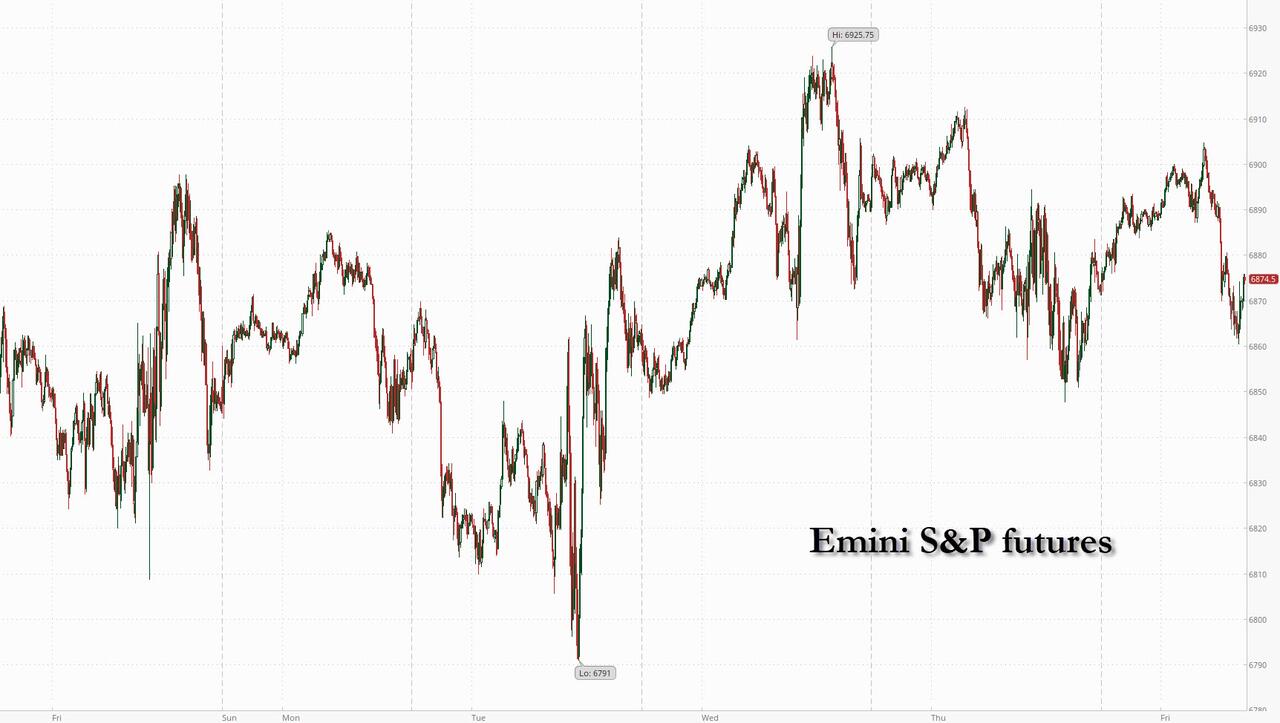
US equity futures are lower, sliding from session highs around the European open to session low just before 8am E as traders assessed the potential market impact of war with Iran, and awaited a firehose of US economic data including GDP and core PCE. As of 8:15am ET, S&P and Nasdaq futures are down 0.1% having traded in the green for much of the overnight session. Pre-market, Mag 7 are mostly red with GOOGL bucking the trend and rising +1.2%. Blue Owl Capital’s shares were set to fall a further 3.5% after its decision to limit withdrawals from a private credit fund. Bond yields have also reversed and are now lower on the session while the USD is flat. Commodities are mixed: base metals are lower while precious metals are rallying, sending gold above $5000 again; Brent crude fell toward $71 a barrel, paring gains since Monday to about 5%. Overnight, a WSJ article rehashed the now familiar story that Trump considers an initial limited strike to force negotiation. Today, key macro focus will be PCE, Flash PMIs and SCOTUS opinion day (markets are waiting for possible decision on IEEPA tariffs).
In premarket trading, magnificent Seven stocks are mixed early Friday (Alphabet (GOOGL) +1.2%, Nvidia (NVDA) -0.3%, Tesla (TSLA) -0.1%, Amazon (AMZN) +0.02%, Meta (META) -0.3%, Microsoft (MSFT) -0.1%, Apple (AAPL) -0.3%)
- Akamai Technologies (AKAM) falls 11% after the software company gave an outlook for adjusted earnings that is weaker than expected for both the first quarter and the full year.
- Ardelyx (ARDX) drops 6% after the drugmaker gave sales forecast for its Ibsrela drug in the first quarter that Jefferies views as softer than expected
- Copart (CPRT) falls 8% after the online vehicle salvage auction company reported operating income for the second quarter that missed the average analyst estimate.
- Floor & Decor (FND) climbs 4% after the flooring and tile retailer reported adjusted earnings per share for the fourth quarter that exceeded the average analyst estimate.
- Grail (GRAL) tumbles 47% after the early cancer detection test maker said Galleri, its multi-cancer screener, failed to meet its primary endpoint of statistically significant reduction in combined Stage III and IV cancer.
- Harmonic (HLIT) rises 9% after the communications equipment’s book-to-bill is seen as strong and reinforcing its growth potential.
- Hudbay Minerals (HBM) declines almost 5% after the miner reported fourth-quarter adjusted earnings per share that missed the average analyst estimate as production fell year-over-year.
- Newmont (NEM) drops 4% after the world’s biggest gold miner said it expects to produce less bullion this year, due to planned upgrades at some of its managed mines and lower output at two joint ventures with Barrick Mining.
- Opendoor Technologies (OPEN) climbs 19% as the online marketplace for residential real estate reported revenue for the fourth quarter that beat the average analyst estimate.
- RingCentral (RNG) rises 10% after the software company’s fourth-quarter results beat expectations on key metrics and it gave a positive forecast for both the first quarter and the full year.
- Texas Roadhouse (TXRH) rises 4% after the restaurant chain said it expects positive comparable restaurant sales growth for the year as it plans to implement a menu price increase in early April.
- Workiva Inc. (WK) gains 12% after the software company reported fourth-quarter results that beat expectations and gave revenue forecasts for both the first quarter and the full year that are seen as positive.
Friday morning brings long-delayed readings of core personal consumption expenditure — a measure of price changes in consumer goods and services that excludes volatile food and energy costs. The data may prove important not only in deciphering the next move in interest rates, but also the outlook for the great rotation trade out of tech names into materials, energy and other cyclicals linked to a stronger economy. Bloomberg Economics expects core inflation to have accelerated into the year end. Prices of services including recreation, accommodation and video streaming are likely to have contributed to a month-on-month increase of 0.32% in the core PCE deflator for December and a tick-up in the annual rate to 2.9% from 2.8%.
Wider inflation is set to be stoked by oil near a six-month high as Trump oversees the biggest US military buildup in the Middle East since 2003 and warns Iran that it has 10 to 15 days at most to strike a deal over its nuclear program — or else.
Speaking of “or else”, the US military is deploying a vast array of forces in the Middle East as President Donald Trump ramps up pressure on Tehran to strike a deal over its nuclear program. While the move in oil seeped into risk assets, traders note that recent geopolitical flare-ups have had only a limited impact on markets.
“Geopolitical stories are really notoriously difficult to price,” Marija Veitmane, head of equity research at State Street Global Markets, told Bloomberg TV. “Right now it’s almost impossible to assign probabilities to any outcome, given how quickly those narratives change.”
Elsewhere, as Trump looks to soothe concerns among rich and poor alike ahead of the midterms, he declared victory in the fight over cost-of-living concerns. It signals a new approach from the president that denies problems with his economic agenda while touting stock market gains to insist that his tariff plans have been a success. The White House is ratcheting up pressure on Congress to enact Trump’s proposed ban on investors buying homes, laying out for the first time what sort of investment firms he plans to target, The Wall Street Journal reports.
Turning to earnings, Of the 425 S&P 500 companies to have reported so far this earnings season, more than 74% have beaten analysts’ estimates, while nearly 21% have missed. No major companies are due to report today, but the earnings season picks up pace again next week, with companies representing a further 13% of the S&P’s market value on deck.
European stocks rebound after a halt to their rally in the prior session. Stoxx 600 up by 0.5%, with consumer, construction and chemicals outperforming. Moncler leads luxury stocks to outperform, while the energy and utilities sectors lag. Here are some of the biggest movers on Friday:
- Moncler shares gain as much as 13%, the most since September 2024, after the maker of high-end puffer jackets reported results that Barclays said were significantly ahead of estimates.
- Air Liquide shares rise as much as 3.9%, trading at a three-month high, after the French industrial-gas producer posted second-half earnings that beat expectations and raised its dividend more than anticipated, according to a Jefferies analyst.
- Kingspan shares climb as much as 9.4%, touching their highest level since 2024, after the construction firm generated record revenue and said the part of its business that builds infrastructure for data centers has an “extraordinary pipeline.”
- Unipol shares rise as much as 6.6%, their biggest gain in over 10 months, after the Italian insurer topped expectations in the latest quarter, with Barclays noting a higher dividend, stronger capital returns and better margins.
- Dis-Chem shares rally as much as 4.6% in Johannesburg, touching its highest intraday level in over a year, after the pharmacy stores chain reported a loyalty program-driven increase in revenue.
- ALK-Abello shares rise as much as 4.7%, hitting their highest level in over a month, after the pharmaceutical company with a focus on allergies said it will pay its first dividend since 2017 and topped expectations in the final quarter, according to analysts at Jefferies.
- Siegfried shares fall as much as 6.7%, the most since August, after weaker-than-expected 2026 guidance from the the Swiss pharma firm.
- Umicore shares decline as much as 7.1% in Brussels, hitting its lowest intraday level since December after the specialty chemicals company reported net income for 2H 2026 that missed the average analyst estimate.
- Danone shares drop 2.1% after a like-for-like sales beat was offset by a miss in volumes and misses in certain units in China and the US, according to Jefferies.
- Aston Martin shares slip as much as 4.4% after the British carmaker posted another profit warning.
- Chemring shares slide as much as 5.5% after the defense firm said it has made a slower start to the year than anticipated.
Earlier, Asian stocks fell in the last session of a holiday-thinned trading week, as renewed fears of conflict between the US and Iran weighed on risk sentiment. The MSCI Asia Pacific Index dipped as much as 0.4%. Alibaba and Tencent were the biggest drags, with investors rotating into smaller tech names in Hong Kong as the market reopened following the Lunar New Year break. Benchmarks fell more than 1% in Japan and New Zealand. Stocks gained in South Korea and India. Investors turned cautious after US President Donald Trump warned that Iran had 10 to 15 days to come up with a deal over its nuclear program. While equities broadly fell, sectors related to energy and defense gained on the escalating tensions. Mainland China and Taiwan markets will reopen next week. Traders will also be focused on monetary policy decisions from South Korea and Thailand, as well as gross domestic product data from Hong Kong and India. Companies due to report results from the region include HSBC and Baidu, while Nvidia headlines overseas earnings.
In FX, the Bloomberg Dollar Spot Index up 0.1% and in a narrow range for the day. Sterling outperforming, yen and the kiwi falling.
In rates, treasuries are little changed.Gilt curve flattening after slew of data, including strong retail sales, a record budget surplus and solid PMIs. Euro-area business activity improved thanks to a boost from German factories. Bund yields edging lower,
In commodities, oil fluctuates with concerns about US-Iran tensions at the forefront. Brent now down for the session and getting closer to $71/barrel, having jumped the day before. Gold prices higher and holding above $5,000/oz.
Today’s econ calendar consists of readings of personal income and spending in December are due at 8:30 a.m. ET, alongside core PCE indexes for the same month and 4Q GDP data. They are followed at 9:45 a.m. by S&P Global’s provisional manufacturing, services and composite purchasing managers’ indexes for February. At 10 a.m., readings of new homes sales in December and the University of Michigan’s final index of consumer sentiment in February are due. Fed speaker slate includes Bostic (9:45am), Logan (12:45pm) and Musalem (3:30pm)
Market Snapshot
- S&P 500 mini +0.2%
- Nasdaq 100 mini +0.3%
- Russell 2000 mini +0.1%
- Stoxx Europe 600 +0.5%
- DAX +0.3%, CAC 40 +0.9%
- 10-year Treasury yield little changed at 4.07%
- VIX -0.1 points at 20.09
- Bloomberg Dollar Index little changed at 1191.49
- euro -0.1% at $1.1759
- WTI crude -0.6% at $66.06/barrel
Top Overnight News
- US President Trump is weighing an initial limited military strike on Iran to force it to meet his demands for a nuclear deal, a first step that would be designed to pressure Tehran into an agreement but fall short of a full-scale attack that could inspire a major retaliation. WSJ
- Trump said regarding affordability “we’ve solved it” and will talk about inflation in the State of the Union next week.
- The White House is ratcheting up pressure on Congress to enact President Trump’s proposed ban on investors buying homes, laying out for the first time what sort of investment firms he plans to target. In a memo sent Thursday to House and Senate committee leaders, the White House proposed banning investors with more than 100 single-family homes from purchasing additional homes. WSJ
- The US is planning a Peace Corps initiative that would send thousands of science and math graduates abroad to boost foreign nations’ reliance on American tech over Chinese alternatives. BBG
- Oil traded near a six-month high as tensions with Iran intensified, with the US amassing forces in the Middle East in its biggest deployment since 2003. Donald Trump said Iran has no more than two weeks to reach a deal over its nuclear program. BBG
- Blue Owl sold $1.4 billion of private loans to three of North America’s biggest pension funds and its own insurer to help pay out investors, people familiar said. The move underscores the risks facing retail investors as they move into the fast-expanding private credit market. BBG
- Nvidia is close to finalizing a $30 billion investment in OpenAI that will replace the long-term $100 billion commitment agreed last year. FT
- Japanese PM Takaichi told fellow lawmakers on Friday that a severe lack of domestic investment is holding back the country’s potential growth rate compared to other major advanced economies as she pledged to take “thorough and decisive measures” in the form of government backed, large scale and long term strategic investments. Nikkei
- Japan’s consumer prices rose at a slower pace in the first month of 2026, giving the central bank more breathing room to consider its next step. Consumer inflation, excluding volatile fresh food prices, climbed 2.0% in January from a year earlier, compared with December’s 2.4% rise, government data showed Friday. WSJ
- Britain recorded its biggest budget surplus on record in January, augmented by a surge in inflows of capital gains tax and lower debt payments. Separate data showed retail sales surged 1.8%, the fastest growth in 20 months. The pound erased losses. BBG
Trade/Tariffs
- India’s Trade Minister said they expect the US to issue a notice on lowering the import tariff to 18% during February.
- India’s Trade Minister said they expect the trade deal with the UK to come into effect by April.
- Indonesian Government said they will get 19% tariffs on most goods, with 0% on coffee, chocolate and rubber in the US trade deal. Deal also will not involve any third country when asked about China trans-shipment concerns.
- Japan’s Trade Minister Akazawa said not set the timing on the second set of US investment projects, adds want to make sure PM Takaichi’s US trip in March is fruitful.
- White House releases fact sheet on Trump administration finalising the trade deal with Indonesia that will provide Americans with unprecedented market access and unlock major breakthroughs for America’s manufacturing, agriculture, and digital sectors.
- US President Trump accused China of flooding US market with subsidised goods.
- US President Trump said steel tariffs have been a game-changer.
A more detailed look at global markets courtesy of Newsquawk
APAC stocks followed suit to the predominantly negative mood on Wall Street, where risk appetite was subdued amid private credit fund concerns and geopolitical risks related to the US and Iran following Trump’s latest threat and 10-15 day ultimatum. ASX 200 was lacklustre amid underperformance in the tech, telecoms and consumer sectors, while participants continued to digest a slew of earnings, although downside was stemmed by resilience in utilities and the top-weighted financial industry. Nikkei 225 stumbled back beneath the 57,000 level with the index pressured despite recent currency weakness and the softer inflation data, which essentially provides the BoJ with more policy space, while tech and autos were among the industries notably represented in the list of worst-performing stocks. Hang Seng retreated upon returning from the Lunar New Year holidays with the big tech names leading the declines in the index, while mainland markets and the Stock Connect remained shut and won’t open until next Tuesday.
Top Asian News
- Japanese PM Takaichi said there is a dearth of domestic investment in Japan and will stop trend of austerity and lack of investment. She pledges to drive a significant investment via multi-year budgets and long-term funding strategies and affirms that essential expenditures will be maximised through the initial budget allocation. Affirms commitment to prudent fiscal policies to maintain market confidence. Aims for swift approval of crucial legislation, including tax reform, by the end of FY26/27. Government will unveil an investment roadmap for 17 strategic sectors beginning next month. Announced acceleration of nuclear reactor restarts.
- Japan PM Takaichi to promote measures to spur private spending and outline plans for increased strategic investment, active but responsible fiscal policy, and more assertive diplomacy in parliamentary address, according to Bloomberg.
European bourses (STOXX 600 +0.5%) have rebounded from Thursday’s selloff, with the FTSE MIB (+1.0%) and CAC 40 (+0.7%) leading gains. The FTSE 100 (+0.7%) is also in the green, supported by strong January retail sales and a PSNB surplus figure, beating estimates by a large margin. European sectors hold a positive bias; Consumer Products and Services (+1.7%) lead the standings, closely followed by Chemicals (+1.4%). On the other hand, the pullback in oil prices is weighing on the Energy sector (-0.6%). Moncler (+11.9%) announced a positive set of FY earnings, comfortably beating revenue and net income estimates. This is lifting other luxury companies such as LVMH (+3.0%) and Kering (+1.2%).
Top European News
- UK S&P Global Services PMI Flash (Feb) 53.9 vs. Exp. 53.5 (Prev. 54.0, Low. 52.8, High. 54.2).
- UK S&P Global Manufacturing PMI Flash (Feb) 52.0 vs. Exp. 51.5 (Prev. 51.8, Low. 51, High. 52.5).
- UK S&P Global Composite PMI Flash (Feb) 53.9 vs. Exp. 53.3 (Prev. 53.7, Low. 52.8, High. 53.9).
- UK Retail Sales MoM (Jan) M/M 1.8% vs. Exp. 0.2% (Prev. 0.4%, Low. -0.6%, High. 1.0%).
- UK Retail Sales ex Fuel MoM (Jan) M/M 2.0% vs. Exp. 0.2% (Prev. 0.3%, Low. -0.1%, High. 0.9%).
- UK Retail Sales YoY (Jan) Y/Y 4.5% vs. Exp. 2.8% (Prev. 1.9%, Rev. From 2.5%, Low. 2.4%, High. 3.6%).
FX
- DXY is incrementally firmer this morning and trades at the mid-point of a 97.84 to 98.07 range, with the peak of the day matching the WTD’s best; currently holding around its 50 DMA at 97.96. Focus remains firmly on the geopolitical situation between US and Iran. To recap, President Trump said 15 days is the maximum deadline to reach an agreement with Iran, other it will be “unfortunate” for them. Recent reports in the WSJ suggest that Trump is weighing a “limited” strike, to force Iran into a deal. Attention for the time being will be on US data, which includes US GDP and PCE.
- GBP is incrementally firmer/flat. Retail Sales was an exceptionally strong report, with the upside attributed to strong “artwork and antiques sales, alongside continued strong sales from online jewellers”. But other components suggest that the pick-up was also seen in more conventional figures such as household goods store sales, with clothing sales also rising. Elsewhere, the PSNB was in a surplus in January and topped expectations – though the figure is subject to the usual caveats for the period (tax filings). GBP moved higher in an initial reaction, but then pared that move; thereafter, a strong set of PMI metrics took Cable to a session high of 1.3478. Despite the strong metrics, the inner report suggested that “ongoing worrying labour market weakness will likely result in a growing call for further rate cuts”. Market pricing for the BoE meeting was little moved, with the chance of a March cut priced in at 88% whilst April is fully priced.
- JPY slightly weaker this morning, succumbing to the broader USD strength and following the region’s inflation report, which held a dovish skew. In brief, National CPI printed at 1.5% (exp. 1.6%), core was in-line whilst the supercore metric was a touch below the consensus. Elsewhere, PMIs printed better-than-expectations – benefiting from increased optimism following Takaichi’s landslide victory. Following the inflation data, Pantheon Macro wrote that the inflation report “justifies” the BoJ taking time on a rate hike. USD/JPY in a 154.87-155.64 range.
- Other G10s are broadly lower against the USD. Aussie manages to stay afloat, whilst the EUR moves a touch lower. More ECB-related newsflow, this time via the WSJ, which suggested that ECB’s Lagarde said her baseline is finishing the ECB term, while she added that she has accomplished a lot but needs to make sure it is solid. On the data front, EZ PMIs continue to confirm the modest recovery picture in the EZ. The strong German report spurred fleeting EUR strength.
Central Banks
- Fed’s Daly (2027 voter) said policy is in a good place and labour market is in a better position after 75bps of cuts, adds inflation continues to decline outside goods sector. said:We have more work to do to get inflation down, but don’t want to get behind, or over our skis.
- ECB’s Lagarde said her baseline is finishing the ECB term, according to WSJ.
- ECB President Lagarde called for cooperation to ‘save global order’ in award acceptance speech in New York.
- RBNZ Governor Breman noted that although central bank remains forward focus, monetary policy will adapt based on new information instead of following a predetermined path. The path back to 2% inflation has been bumpy, but expects inflation to be within the target range in Q1. Central bank is confident inflation will return to 2% midpoint over the next 12 months. NZD is not too far from fair value right now.
Fixed Income
- USTs are near enough flat in thin 112-29+ to 113-02 parameters. Specifics for the space are somewhat light thus far as we count down to a packed 13:30GMT data docket and await any further insight on US-Iran tensions before potential SCOTUS opinion(s) at 15:00GMT.
- Gilts had two leads to digest at the open. Stronger-than-expected retail sales, though with caveats, were a bearish driver as the data doesn’t push BoE’s Bailey (or any of the hawks, particularly focused on Mann) towards voting for a cut in March vs April; however, ultimately, the data will have little impact on that discussion. Separately, a larger-than-expected government PSNB surplus in January served as a bullish driver. Gilts came off best levels alongside EGBs into the morning’s UK PMIs, a series that printed above consensus across the board. Within the series, S&P’s Williamson wrote that “relatively modest price pressures being signalled and ongoing worrying labour market weakness will likely result in a growing call for further rate cuts”.
- Bunds spent the morning firmer, with gains of 20 ticks at best, notching a 129.45 peak, strength that seemed to just be a continuation of recent gains. Thereafter, the benchmark fell from best and moved to near-enough unchanged on the session at a 129.28 trough following the morning’s PMIs, which were generally strong and particularly so for manufacturing, which unexpectedly returned to expansionary territory for Germany for the first time in over 3.5 years.
- Australia sold AUD 800mln 3.25% April 2029 bonds, b/c 3.89, avg. yield 4.3014%.
Commodities
- Crude benchmarks are taking a breather, with both WTI and Brent trading subdued, though still near highs for the week, due to the heightening geopolitical tension between the US and Iran. US President Trump yesterday reiterated that Iran has 10-15 days to strike a deal, or else something bad will happen. However, during a report by the WSJ, which stated that Trump is reportedly weighing a limited strike to force Iran into a nuclear deal. WTI and Brent are trading at the lower end of USD 65.86-67.03/bbl and 71.10-72.34/bbl, respectively.
- In the precious metal space, spot gold was aided by the ongoing geopolitical tension, with the yellow metal crossing the USD 5,000/oz mark to the upside overnight. The dollar has waned from its best levels throughout the European session after finding resistance at Thursday’s high, thus underpinning gold prices. XAU and XAG are trading at the upper range of USD 4,981.58-5,042.37/oz and USD 77.47-81.20/oz, respectively.
- Copper prices are also firmer, tracking broader risk sentiment in the European session. Otherwise, a fresh macro catalyst has been lacking for the red metal, especially with the Chinese market on holiday. 3M LME copper trades at the upper range of USD 12.781-12.895k/t.
- Iranian Oil Minister said cooperation with the US on oil is possible.
- Hungarian government to release 250k tonnes of crude oil from its strategic reserves after Druzhba oil flow stopped.
- US ambassador to India said active negotiations are underway with India’s Energy Ministry on the import of Venezuelan oil.
- Goldman Sachs sees significant upside to gold price forecasts on further private sector diversification when expressed through call option structures.
- US President Trump said 50mln bbls of Venezuelan oil are on the way to Houston and US-Venezuela energy cooperation is going well.
Geopolitics: Ukraine
- Russia’s Kremlin reiterates that there’s no confirmed date set for a new round of talks with Ukraine.
- Ukraine’s President Zelensky said he’s ready to discuss with the US about compromises.
- Next round of Russia-Ukraine talks is reportedly possible next week, via TASS.
Geopolitics: Middle East
- US President Trump reportedly weighs limited strike to force Iran into nuclear deal, according to WSJ; President considers a range of military options but said he still prefers diplomacy. Trump is considering an initial limited military strike on Iran to force it to meet his demands for a nuclear deal, in an attempt to pressure Tehran into an agreement but fall short of a full-scale attack that could see a major retaliation. Sources add, the opening fire, which if authorized, could come within days, would target a few military or government sites. If Iran still refused to comply with Trump’s directive to end its nuclear enrichment, the US would respond with a broad campaign against regime facilities.
- Semafor, on US President Trump reviewing his options regarding Iran, writes “He hasn’t made a decision yet, though people close to the president see an attack as growing more likely by the day.”
- Iran said in letter to UN Secretary General and members of the Security Council that if they are attacked, all bases, facilities and assets of hostile force in the region will constitute legitimate targets within the framework of Iran’s defensive response.
- Palestinian media reported Israeli warplanes launched a raid on the Al Tufar neighbourhood in Gaza City, according to Sky News Arabia.
Geopolitics: Others
- Russia’s Foreign Minister Lavrov discusses Iranian nuclear program with Iranian counterpart, TASS reported.
- China is monitoring US military aircraft movements over Yellow Sea, according to Global Times.
- NORAD said it detected and tracked two Tu-95s and two Su-35s and one A-50 operating Alaskan ADIZ on February 19th, while it launched several aircraft to intercept and positively identify, and escort the aircraft until they departed the Alaskan ADIZ.
- New Zealand provides a Russia sanctions update which includes a designation of 23 individuals, 13 entities, and 100 vessels, while it lowered the oil price cap on Russian oil from USD 47.60/bbl to USD 44.10/bbl.
US Event Calendar
- 8:30 am: United States Dec Personal Income, est. 0.3%, prior 0.3%
- 8:30 am: United States Dec Personal Spending, est. 0.3%, prior 0.5%
- 8:30 am: United States Dec PCE Price Index YoY, est. 2.8%, prior 2.77%
- 8:30 am: United States Dec Core PCE Price Index MoM, est. 0.3%, prior 0.2%
- 8:30 am: United States Dec Core PCE Price Index YoY, est. 2.9%, prior 2.79%
- 8:30 am: United States 4Q A GDP Annualized QoQ, est. 2.8%, prior 4.4%
- 8:30 am: United States 4Q A Personal Consumption, est. 2.42%, prior 3.5%
- 8:30 am: United States 4Q A GDP Price Index, est. 2.8%, prior 3.8%
- 8:30 am: United States 4Q A Core PCE Price Index QoQ, est. 2.6%, prior 2.9%
- 9:45 am: United States Feb P S&P Global US Manufacturing PMI, est. 52.35, prior 52.4
- 9:45 am: United States Feb P S&P Global US Services PMI, est. 53, prior 52.7
- 9:45 am: United States Feb P S&P Global US Composite PMI, est. 53.1, prior 53
- 9:45 am: United States Fed’s Bostic in Moderated Conversation
- 10:00 am: United States Dec New Home Sales, est. 730k
- 10:00 am: United States Feb F U. of Mich. Sentiment, est. 57.25, prior 57.3
- 12:45 pm: United States Fed’s Logan Speaks at Bank Regulation Conference
- 3:30 pm: United States Fed’s Musalem Appears on Fox Business
DB’s Jim Reid concludes the overnight wrap
I’m supposed to be on hols today playing golf off the junior tees, for the first time since early October, with three-quarter power swings accompanying my twins on the last day of half-term. However, as it’s a holiday week I’m heroically holding the fort until this has been sent out. It’s now just over 4 months since back fusion surgery and I’m starting to return to light golf. Sadly the nerve symptoms in the leg are no different but I’m told it could take a year to tell if the surgery has made a difference and the nerve repairs itself. I’ve done my rehab every day for well over 2 months now so this reflects my obsession with golf more than anything else. My wife shakes her head as I twist myself into all sorts of shapes most evenings in front of the TV.
As I leave to do my two hour warm-up to limber up muscles I haven’t used for 4 months, markets on both sides of the Atlantic reversed their gains yesterday as geopolitical tensions between Iran and the US took center stage. The S&P 500 (-0.28%) and STOXX 600 (-0.53%) both fell, while the price of Brent crude registered its largest two-day jump since October 2025, back when the US announced sanctions against Russia’s two largest oil companies. It was up +2.20% yesterday to its highest level since July and this morning is +0.49% at $72.01/bbl, having traded as low as $66.85 just before Europe closed on Tuesday.
The latest developments saw President Trump seemingly issue an ultimatum to Iran, suggesting that 10 to 15 days was the maximum he would allow for talks to continue and that Iran must make a “meaningful deal” or else “bad things would happen”. Those comments came as the US has deployed aircraft and naval ships to the Middle East ahead of a possible strike on Iran. Later in the day, the Wall Street Journal reported that while President Trump had not yet decided on military action, he could authorise a limited strike within days, and this would then be followed by a broader US campaign against the regime if Iran failed to comply.
So that led to a sell-off in markets, with 60% of the S&P 500 down on the day, as investors pulled back over fears of geopolitical conflict. The Nasdaq (-0.31%) and Magnificent 7 (-0.21%) also declined. Bonds were caught between the inflationary consequences and the risk-off mood, with 2yr (-0.3bps) and 10yr (-1.6bps) Treasury yields moving slightly lower. Against this risk-off backdrop, gold (+0.37%) poked back up above $5k before closing at $4,999/oz while silver (+1.69%) also outperformed. The VIX volatility index (+0.61pts) crept back above 20 to close at 20.23. This morning, US and European equity futures are back up a couple of tenths and Gold and 10yr USTs are largely unchanged.
Adding to the cautious mood in markets were a couple of stories that rekindled lingering concerns over the US economy. One was a resurfacing of private credit worries that we saw last autumn, after Blue Owl Capital announced it wouldn’t re-open withdrawals from one of its retail-focused private credit funds. The company’s shares tumbled -5.93% after the news, also weighing on other listed private equity companies, such as Blackstone (-5.37%), Apollo (-5.21%) and KKR (-1.89%). Another was a cautious outlook from Walmart (-1.38%) as its full-year earnings forecast missed expectations, with the company’s CFO saying “it’s prudent to be somewhat measured with the outlook right now” amid the uneven US economy.
The ongoing worries over Iran meant that less attention was given to a handful of notable US data releases that trickled in. Initial jobless claims were better than expected in the week ending February 14, declining from 227k to only 206k (vs 225k expected). That meant claims more than reversed their spike two weeks earlier, which may have been affected by the extreme winter weather across the US. The release also corresponds to the survey week for payrolls so an encouraging sign for that print in a couple of weeks’ time. There was less comforting data released later in the day that showed January pending home sales at -0.8% vs +2.0% m/m expected (-1.2% vs +2.3% expected y/y).
Meanwhile, US goods trade data showed a larger-than-expected deficit for December (-$98.5bn vs -$86.0bn expected), as imports rose +3.6% m/m, while exports fell -1.7% m/m. This puts the latest monthly deficit largely in line with levels of around $100bn seen in the final few months before President Trump’s election in late 2024, after what had been a very volatile 2025 as initial import front-running was followed by a sharp fall after Liberation Day. However, while the aggregate trade position of the US has not changed much, we’ve seen some big redirection of trade. Notably, the latest data highlights the extent that US-China decoupling, with China now accounting for only 7% of US imports, down from 13% in 2024 and above 20% prior to President Trump’s first China tariffs in 2018.
Looking ahead to today, attention will focus on December core PCE and Q4 US GDP. For the former, DB is at +0.4% vs. +0.2% in November, with consensus a tenth lower. Although core CPI was better than expected last week, the read-through for January core PCE wasn’t quite so benign. Our economists expect Q4 real GDP growth to slow to +2.5% annualized (+2.8% consensus), a step down after Q3’s +4.4% pace. A sizable portion of that deceleration—roughly 70bps—reflects the drag from the record long shutdown.
Back in Europe, equities reversed course amidst fears of a US attack on Iran, with a few countries potentially taking a stance or action. For instance, the Times reported yesterday that the UK has blocked the Trump administration from using its joint bases for strikes on Iran, whilst Poland’s Prime Minister urged its citizens in the country to leave Iran, saying that the possibility of a conflict is “very real”, according to Politico. Against this backdrop, the STOXX 600 (-0.53%), CAC 40 (-0.36%), DAX (-0.93%), and FTSE 100 (-0.55%) all fell. Industrials were amongst the worst hit, largely due to a steep fall in Airbus (-6.75%) shares after the company missed expectations in its forecast for commercial aircraft deliveries in 2026. In fixed income, yields on 10yr bunds (+0.4bps), OAT (+0.4bps), and BTP (+0.4bps) all moved marginally higher.
In Asia, Mainland China is still closed for the holidays but the Hang Seng (-0.60%) has reopened for the first time this week. The Nikkei (-1.17%) is following the global risk off move from yesterday but the Kospi is continuing its tag as one of the best markets in 2026 with a +2.21% increase. It’s now up over +37% in the 7 weeks of 2026 so far.
Overnight we have also received Japan’s CPI for January, which came in a touch below consensus for the headline (+1.5% vs +1.6% est) and core-core (+2.6% vs +2.7%) measures, although the latter still comfortably sits above 2%. Core CPI came in as expected (+2.0% y/y). The easing in core measures over the last few months will validate the BoJ and PM Takaichi’s views from last year that a good portion of the early 2025 price pressures was temporary, with the question now being where those underlying price pressures will settle, especially with a stimulus package from the incoming new administration high on the agenda. Separately, Japan Feb PMIs rose, most notably in manufacturing (52.8 vs 51.5 prior). So that was an encouraging sign, given capital investment is a big priority of Takaichi’s.
To the day ahead now, we’ll get the US, UK, Germany, France and the Eurozone February PMIs, US December PCE, personal income, personal spending, Q4 GDP, December new home sales, UK January public finances, retail sales, Germany January PPI, Eurozone Q4 negotiated wages, Canada December retail sales, January industrial product price index, raw materials price index, Denmark Q4 GDP. Central bank events include Fed’s Logan and Bostic speak.
1b European opening report
i c Asian opening report
JPY softer following cooler inflation; Crude edges higher as Trump threatens Iran for a deal – Newsquawk EU Market Open

Friday, Feb 20, 2026 – 01:55 AM
- APAC stocks followed suit to the predominantly negative mood on Wall Street, where risk appetite was subdued amid private credit fund concerns and geopolitical risks.
- Hang Seng retreated on return from the Lunar New Year holidays, with the big tech names leading the declines in the index, while mainland markets and the Stock Connect remained shut and won’t open until next Tuesday.
- USD/JPY lingered near the prior day’s best levels north of 155.00, with some mild support seen as the cooling of Japanese inflation essentially provides the BoJ additional policy space.
- US President Trump said 15 days is the maximum deadline to reach an agreement with Iran; otherwise, it will be very unfortunate for them, according to Al Jazeera; US President Trump reportedly weighs a limited strike to force Iran into a nuclear deal, WSJ reported.
- European equity futures indicate a positive cash market open with Euro Stoxx 50 futures up 0.5% after the cash market closed with losses of 0.7% on Thursday.
- Looking ahead, highlights include ECB EZ Indicator of Negotiated Wages; UK Retail Sales (Jan), PSNB (Jan), German PPI (Jan), Global Flash PMIs (Feb), Canadian Retail Sales (Jan), US PCE/GDP (Dec/Q4). Speakers include Fed’s Logan & Bostic, Earnings from Anglo American.
SNAPSHOT
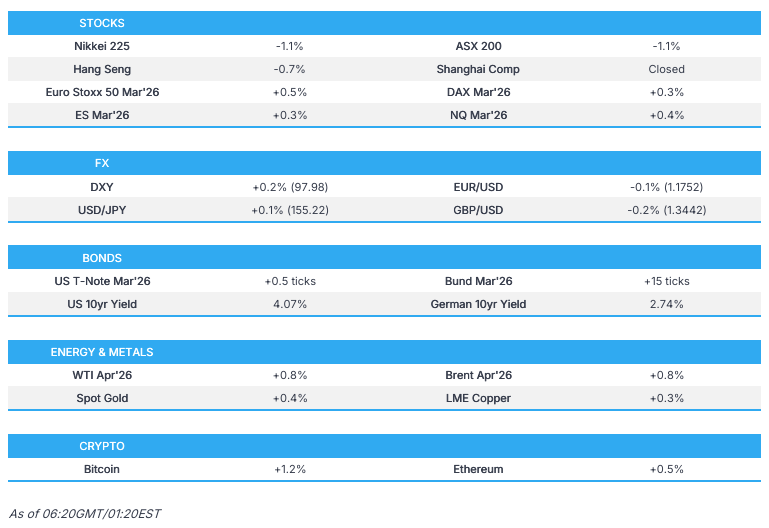
Newsquawk in 3 steps:
1. Subscribe to the free premarket movers reports
2. Listen to this report in the market open podcast (available on Apple and Spotify)
3. Trial Newsquawk’s premium real-time audio news squawk box for 7 days
US TRADE
EQUITIES
- US stocks were lower, as were most sectors, with Financials the laggard and not helped after it was reported that Blue Owl halted redemptions at its private credit fund, which sparked fresh selling in other private equity names like Blackstone, Apollo, and KKR. There was a slew of data releases from the US, including initial jobless claims, which were below expectations but continued claims printed above, while Philly Fed was strong on the headline but was accompanied by mixed internals, a deeper trade deficit than expected, and pending home sales surprisingly fell M/M. Energy sat at the top of the sectorial breakdown and was once again buoyed by gains in the crude complex amid heightened US/Iran tensions and fears of a US strike, as President Trump stated “We had good talks with Iran”, but added, “bad things will happen to Iran if no deal is made”.
- SPX -0.28% at 6,862, NDX -0.41% at 24,797, DJI -0.54% at 49,395, RUT +0.24% at 2,665.
- Click here for a detailed summary.
TARIFFS/TRADE
- US President Trump said steel tariffs have been a game-changer, while he accused China of flooding the US market with subsidised goods and said that Canada has ripped the US off for many years, but not anymore.
- US President Trump posted “..Companies are thriving because of TARIFFS. The United States of America has taken in Hundreds of Billions of Dollars, and quadrupled (at least) National Security, all as a result of the Economy Saving TARIFFS!”
- White House announced that a trade agreement with Indonesia was signed on Thursday, while it released the Fact Sheet on finalising the trade deal with Indonesia, which it stated will provide Americans unprecedented market access and unlock major breakthroughs for US manufacturing, agriculture, and digital sectors.
- Japanese Trade Minister Akazawa said they have not set the timing on the second set of US investment projects, while he added that they want to make sure PM Takaichi’s US trip in March is fruitful.
NOTABLE HEADLINES
- Fed’s Miran (voter) now sees a less accommodative rate path and would reverse his December shift toward easier policy if he is still at the Fed by the March meeting, citing firmer labour data and renewed goods inflation. Furthermore, Miran suggested that if he had to submit a rate projection for 2026 on current data, he would pencil in 100bps of cuts this year, instead of the 150bps he submitted at the December forecast round, according to an interview in The Peg.
- Fed’s Daly (2027 voter) said policy is in a good place and the labour market is in a better position after 75bps of cuts, while she added that inflation continues to decline outside the goods sector. Furthermore, she said they have more work to do to get inflation down, but don’t want to get behind or get over our skis.
- US Senate Banking Committee is to hold a hearing with the Fed’s Vice Chair of Supervision and FDIC’s Hill on February 26th.
- US President Trump said he ‘solved it’ regarding affordability and will talk about inflation in the State of the Union.
- US President Trump wants to ban investors that own more than 100 homes from buying more, which could potentially ban hundreds of investment firms, according to WSJ
APAC TRADE
EQUITIES
- APAC stocks followed suit to the predominantly negative mood on Wall Street, where risk appetite was subdued amid private credit fund concerns and geopolitical risks related to the US and Iran following Trump’s latest threat and 10-15 day ultimatum.
- ASX 200 was lacklustre amid underperformance in the tech, telecoms and consumer sectors, while participants continued to digest a slew of earnings, although downside was stemmed by resilience in utilities and the top-weighted financial industry.
- Nikkei 225 stumbled back beneath the 57,000 level with the index pressured despite recent currency weakness and the softer inflation data, which essentially provides the BoJ with more policy space, while tech and autos were among the industries notably represented in the list of worst-performing stocks.
- Hang Seng retreated upon returning from the Lunar New Year holidays with the big tech names leading the declines in the index, while mainland markets and the Stock Connect remained shut and won’t open until next Tuesday.
- US equity futures eked mild gains but with price action contained after the prior day’s choppy performance and with key US data on the horizon, including US GDP for Q4 and the Fed’s preferred PCE inflation metric.
- European equity futures indicate a positive cash market open with Euro Stoxx 50 futures up 0.5% after the cash market closed with losses of 0.7% on Thursday.
FX
- DXY was marginally firmer in rangebound trade amid ongoing geopolitical tensions in the Middle East and after the recent slew of data. There were also relatively hawkish remarks from Fed Governor Miran, who now sees a less accommodative rate path and said he would pencil in 100bps of cuts this year, instead of the 150bps he submitted at the December forecast round, while the attention turns to upcoming key data, including Q4 GDP and the December PCE Price Index.
- EUR/USD remained lacklustre after trickling beneath the 1.1800 handle, with the single currency not helped by recent weaker-than-expected Consumer Confidence data and with Eurozone PMIs scheduled later.
- GBP/USD languished at its lowest levels in almost a month at sub-1.3500 territory, with UK Retail Sales and PMI data on the horizon. There were also some recent mixed comments from BoE’s Mann who provided very little to inspire the pound as she stated they are getting close to some sense of where monetary policy is balanced between the inflation objective and full employment, but added that the unemployment rate has gone up which is very much of a concern, and that January inflation data are good numbers from a headline perspective, although core inflation was not quite as good as hoped.
- USD/JPY lingered near the prior day’s best levels north of 155.00, with some mild support seen as the cooling of Japanese inflation essentially provides the BoJ additional policy space.
- Antipodeans underperformed and breached through the prior day’s trough amid headwinds from the mostly downbeat risk appetite, while it was also reported that Westpac cut its fixed home loan rates in New Zealand across three-, four- and five-year terms following the RBNZ’s dovish pause earlier this week.
FIXED INCOME
- 10yr UST futures lacked conviction following the recent two-way trade alongside mixed data releases, geopolitical risks, and with private credit concerns reignited after Blue Owl was reported to have halted redemptions from its retail credit fund. However, it later stated that it is not halting investor liquidity in OBDC II, while the attention now turns to upcoming US data.
- Bund futures extended on their recent rebound with little to derail momentum heading into today’s German PPI data.
- 10yr JGB futures gained following the mostly softer-than-expected Japanese CPI data, which showed a deceleration across the headline, core and core-core inflation readings, with the headline slipping beneath the central bank’s price target for the first time in almost four years, while the core (Ex. Fresh Food CPI) matched estimates to print a 2-year low at the 2% goal.
COMMODITIES
- Crude futures took a breather and held on to the prior day’s gains after advancing again as US/Iran tensions continued to dominate price action amid fears of a US strike due to US President Trump’s ultimatum for a meaningful deal with Iran, otherwise something bad will happen, and suggested that they have 10-15 days.
- US EIA Crude Oil Stocks Change (Feb 13th) -9.0mln vs. Exp. 2.1mln (Prev. 8.5mln)
- US President Trump said 50mln bbls of Venezuelan oil are on the way to Houston and US-Venezuela energy cooperation is going well. It was also reported that Venezuela’s refineries were at ~35% of capacity or 450k bpd of crude processing.
- Spot gold traded indecisively with prices oscillating around the USD 5,000/oz level ahead of key US data, including GDP and the Fed’s preferred inflation gauge.
- Copper futures kept afloat following the prior session’s intraday rebound, but with upside capped amid the subdued risk tone.
CRYPTO
- Bitcoin was higher after returning to above USD 67,000, where it then proceeded sideways for most of the session.
NOTABLE ASIA-PAC HEADLINES
- Japanese PM Takaichi said there is a dearth of domestic investment in Japan and that they will stop the trend of austerity and lack of investment, while she pledged to drive significant investment via multi-year budgets and long-term funding strategies, but also affirmed commitment to prudent fiscal policies to maintain market confidence. Furthermore, she aims for swift approval of crucial legislation, including tax reform, by the end of FY26/27, and said the government will unveil an investment roadmap for 17 strategic sectors beginning next month.RBNZ Governor Breman suggested that although the central bank remains forward-focused, monetary policy will adapt based on new information instead of following a predetermined path, while she added that the path back to 2% inflation has been bumpy, but expects inflation to be within the target range in Q1. Furthermore, she said the central bank is confident inflation will return to the 2% midpoint over the next 12 months and stated that NZD is not too far from fair value right now.
DATA RECAP
- Japanese National CPI YY (Jan) 1.5% vs Exp. 1.6% (Prev. 2.1%)
- Japanese National CPI Ex. Fresh Food YY (Jan) 2.0% vs Exp. 2.0% (Prev. 2.4%)
- Japanese National CPI Ex. Fresh Food & Energy YY (Jan) 2.6% vs Exp. 2.7% (Prev. 2.9%)
GEOPOLITICS
MIDDLE EAST
- US President Trump said 15 days is the maximum deadline to reach an agreement with Iran, otherwise it will be very unfortunate for them, according to Al Jazeera.
- US President Trump said they will get a deal on Iran one way or the other and really bad things will happen if there is no Iran deal, while Trump also said that he would love to have China and Russia involved in diplomacy.
- US President Trump reportedly weighs a limited strike to force Iran into a nuclear deal and considers a range of military options but says he still prefers diplomacy, according to WSJ. Trump is considering an initial limited military strike on Iran to force it to meet his demands for a nuclear deal, in an attempt to pressure Tehran into an agreement, but fall short of a full-scale attack that could see a major retaliation. Sources stated that the opening fire, which if authorised, could come within days, and would target a few military or government sites. Furthermore, if Iran still refused to comply with Trump’s directive to end its nuclear enrichment, the US would respond with a broad campaign against regime facilities.
- US President Trump appears ready to attack Iran as the US strike force takes shape, although it remains unclear whether Trump has approved military action, according to sources cited by the Washington Post. One consideration, some said, is the ongoing Winter Olympics, which concludes this Sunday, while diplomats now believe that Iran is not prepared to budge from its “core positions,” including its right to enrich uranium, following the talks on Tuesday.
- Iran told the UN Secretary-General and Security Council members that if they are attacked, all bases, facilities and assets of a hostile force in the region will constitute legitimate targets within the framework of Iran’s defensive response.
- Iran is alleged to have covertly repositioned strike drones during joint drills with Russia in the Strait of Hormuz and is said to be a ‘calculated escalation’ against the US, according to a defence expert cited by Fox News.
- Israeli warplanes launched a raid on the Al Tufar neighbourhood in Gaza City, according to Palestinian media.
RUSSIA-UKRAINE
- Ukrainian President Zelensky said he scheduled a special meeting with the negotiating team for Friday regarding their next steps and decisions, while they will also define the further framework of their dialogue with the US, Europeans, and Russia.
- New Zealand provided a Russia sanctions update which included a designation of 23 individuals, 13 entities, and 100 vessels, while it lowered the oil price cap on Russian oil from USD 47.60/bbl to USD 44.10/bbl.
- NORAD detected and tracked two Tu-95s, two Su-35s and one A-50 operating in the Alaskan Air Defence Identification Zone on February 19th, while it launched several aircraft to intercept and positively identify, and escort the aircraft until they departed the Alaskan ADIZ.
OTHER
- China is monitoring US military aircraft movements over the Yellow Sea, according to Global Times.
- Mexico’s navy intercepted a submarine with four tonnes of cocaine in the Pacific Ocean.
EU/UK
NOTABLE HEADLINES
- ECB’s Lagarde said her baseline is finishing the ECB term, while she added that she has accomplished a lot but needs to make sure it is solid, according to WSJ.
2.a NORTH KOREA/SOUTH KOREA/JAPAN
SOUTH KOREA/USA
2b JAPAN
3. CHINA
IMF Urges Beijing To Curb Industrial Subsidies As Flood Of Chinese Goods Crushes Global Industrial Bases
Thursday, Feb 19, 2026 – 11:00 PM
China’s factory overcapacity is the result of Beijing’s long-running industrial policies. Years of state support have built more factory capacity than domestic demand can absorb in the world’s second-largest economy, flooding global markets with low-priced goods, from EVs to TVs. The end result is a growing risk of hollowing out industrial bases worldwide, and our latest example this week has washed up on Europe’s shores in the form of EVs.
January registrations of Chinese EVs across Europe were certainly eye-opening, signaling the decline of Europe’s industrial base (read the note here). As Anduril Industries founder Palmer Luckey recently warned, “China would love to wipe out the American automotive industry, partly for economic reasons, because it also means we will never be able to fight a war against them…”
It appears the rest of the world is finally getting the memo after more than a decade of Chinese overcapacity flooding global markets and pressuring industrial bases worldwide into collapse.
The International Monetary Fund warned this week that Beijing should significantly scale back state support for industry, citing spillover risks that could undermine manufacturing bases abroad.
China’s industrial policies “are giving rise to international spillovers and pressures” and, compounded with soft domestic demand, are making the world’s second-largest economy “more reliant on manufacturing exports as a source of growth,” the IMF said.
“Industrial policy has enabled tech innovation in some sectors, but overall the impact on the economy has been negative,” said Sonali Jain-Chandra, mission chief at the IMF for China and Asia Pacific, who was quoted by the Financial Times. She pointed to “resource misallocation” and “overspending.”
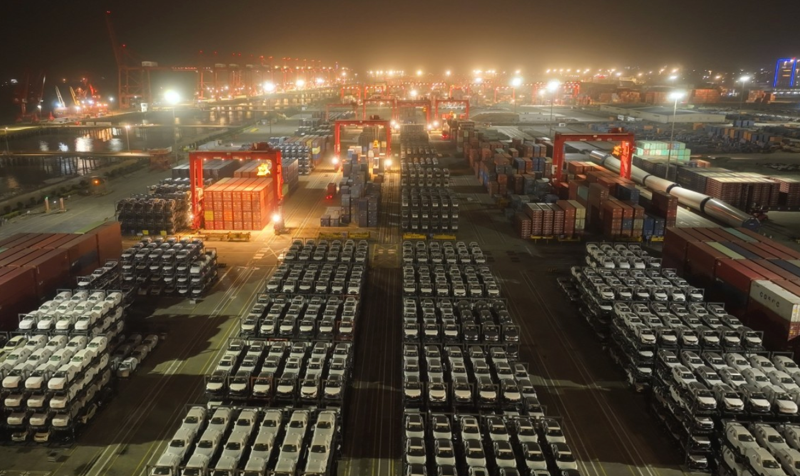
IMF data show that China spends roughly 4% of GDP subsidizing companies in critical industries that, in turn, export goods worldwide. It stated that the figure should be reduced to about 2%.
At this point, China should be retooling its economy to boost domestic demand, yet Beijing is leaning heavily on supply-side measures to sustain its industrial dominance.
France’s Emmanuel Macron has bemoaned “unbearable imbalances” in trade, while other European leaders and industrial insiders warned last week that carbon costs are squeezing EU industrial competitiveness and need to be fixed urgently.
Meanwhile, the IMF has urged Beijing to move toward a “consumption-led growth” model for its economy, which would involve demand-side reforms to support household consumption.
If countries such as those in Europe fail to respond effectively to the flood of cheap Chinese goods, their industrial bases could suffer lasting damage, potentially proving disastrous in wartime. Under President Trump, the US began to reverse course and repair its industrial base as unipolarity gives way to a dangerous bipolar world.
4. EUROPEAN AFFAIRS/SCANDINVAIA
DENMARK/IRAN
Danish Navy Intercepts, Detains Iran-Flagged Cargo Ship
Friday, Feb 20, 2026 – 02:45 AM
Denmark detained a container vessel previously blacklisted by Washington under last year’s sweeping Iran sanctions on Thursday, amid suspicions it was operating under a false flag.
The Nora was seized after authorities determined it was allegedly sailing under the flag of Comoros without authorization. The ship is now anchored in Danish waters pending further investigation, according to reports. It actually appears to be a box ship transporting containers at the time it was intercepted. It raised the Iranian flag under deeply suspicious circumstances, as a patrol boat eyed the vessel, Danish officials say.

The Danish Maritime Authority believes it to be part of Iran’s so-called shadow fleet of tankers. “The Danish Maritime Authority reports that the vessel has been detained due to incorrect registration,” the agency said.
Several months ago the vessel went through a name change, which Washington officials believe was in order to keep shipping sanctioned Iranian and Russian exports, and to evade European suspicions while traversing regional waters.
The vessel is said to currently anchored east of Albaek in the northernmost part of Jutland.
It’s possible the vessel will eventually be released, as the Danish government explained the ship will be detained until Iran confirms to the agency that the container ship is legitimately registered and certified.
According to more details via a maritime monitoring publication:
Denmark’s TV 2 reports the vessel had gone dark while it was in St. Petersburg, Russia, in mid-January and then sailed west into the Baltic and reached Skagen, where it stopped on January 22. The following day, it anchored less than 20 miles east of Aalbaek, Denmark, where it has remained for the past 28 days.
A Danish patrol ship was spotted near the vessel along with a Danish Armed Forces sea drone. The Danish Maritime Authority reports it questioned the vessel’s registry in Comoros and was informed by the authorities that the ship was “not correctly registered.” Apparently, when they questioned the vessel further, it suddenly raised an Iranian flag, prompting the detention.
Danish outlet TV 2 further reports that the Cerus/Nora had transited Danish waters at least 10 times over the past year during repeated voyages to Saint Petersburg – and each time the vessel allegedly went dark, ceasing transmission of its position data as it neared Russian waters.
The Trump administration is meanwhile contemplating whether to escalate its military pressure on Iran by beginning to directly seize Iranian oil exports. This would be seen by Tehran as an immediate act of war.
END
UK
Just When You Thought The BBC Couldn’t Get Any More Repugnant…
Friday, Feb 20, 2026 – 03:30 AM
Authored by Steve Watson via Modernity.news,
The BBC is under fire for a headline that branded 23-year-old conservative student Quentin Deranque as a “far-right student” after he was fatally beaten by a mob of far-left militants in Lyon, France. Critics are calling it blatant bias, turning the victim into the villain while downplaying the attackers’ extremism.

This isn’t just sloppy journalism—it’s narrative warfare, shielding violent leftists and ignoring the real threat of Antifa-style thugs running rampant in Europe.
Authorities charged nine far-left militants with the fatal beating during a protest. The suspects are linked to the militant group La Jeune Garde (Young Guard), including a parliamentary assistant from the far-left France Unbowed (LFI) party.
The attack stemmed from Deranque providing security for the anti-mass migration feminist group Collectif Némésis, who were protesting a conference featuring MEP Rima Hassan. Tensions escalated when far-left groups confronted the demonstrators, leading to chaotic clashes.
Videos shared online captured the violence, including attempts to seize banners and at least one woman being knocked to the ground. Deranque was isolated, viciously set upon by masked attackers, and left for dead after repeated blows to the head.
According to Collectif Némésis leader Alice Cordier, “A member of our security…was lynched by the Jeune Garde Antifa.” The group added, “His attackers were masked, armed with reinforced gloves and tear gas, leaving little doubt about the premeditated nature of their attack.”
Deranque, a pious Catholic mathematics student, suffered severe brain injuries consistent with a cerebral hemorrhage. He was rushed to Édouard-Herriot Hospital but was later declared brain-dead.
The BBC’s disgusting headline, “Nine arrested in France over death of far-right student,” ignited backlash from conservatives. It framed Deranque as “far-right” and didn’t even mention that he was brutally murdered, just that he died, nor that the mob that set upon him and ended his life were far left militants.
His death came about because he was brutally MURDERED by FAR-LEFT thugs. Perhaps that should also be mentioned @BBCWorld? https://t.co/DWq2dfffj6— m o d e r n i t y (@ModernityNews) February 18, 2026
The article is as bad as the headline pic.twitter.com/avovwMPEnu— blank (@MarconiBalls) February 17, 2026
FAR LEFT murder a young man!
Fixed it for you.
Defund the BBC!— Tommy Robinson ?? (@TRobinsonNewEra) February 17, 2026
The far left kill a student and you still
1.Refuse to call them what they are, and
2.Take one last swipe at their dead victim.
This isn’t reporting. It’s narrative management.
Defund the BBC.— Avi Yemini (@OzraeliAvi) February 17, 2026
In ten words @BBCNews manages five examples of disinformation.
Let me give it a go:
Nine far-left thugs beat student to death for protecting women.— Josh Howie (@joshxhowie) February 18, 2026
???After a mob of Antifa thugs beat 23-year-old Quentin Deranque to death in Lyon, there have been marches and memorials for the young man, who was a nationalist, Catholic, and mathematics student.
French politician Eric Zemmour says murder is not just an isolated incident, but… pic.twitter.com/XFI9Tf11FJ— Remix News & Views (@RMXnews) February 16, 2026
In Paris, far-left activists tore down posters tributing Deranque, while President Emmanuel Macron condemned the killing but urged calm.
Anthropologist Florence Bergaud-Blackler warned, “The circumstances of Quentin’s death as he came to protect the women of Collectif Némésis are a foreshadowing of the civil war that is looming. The petty servile foot soldiers of anti-fascism are the cannon fodder of Islamism which seeks to overthrow our liberal and egalitarian social order and lock women away. Young Quentin is a hero.”
The media’s spin, like the BBC’s “Student death puts French far-left under pressure,” minimizes the murder as “just a death,” ignoring the blatant political lynching.
The British state funded broadcaster is already under intense scrutiny owing to President Trump’s $10 billion defamation lawsuit concerning deceptive editing of his January 6, 2021, speech. The suit accuses the BBC of splicing footage to falsely imply Trump incited violence at the Capitol, omitting his calls for peaceful protest.
District Judge Roy Altman rejected the BBC’s bid to delay discovery, paving the way for a two-week trial in Miami. Trump’s team blasts the edit as “false, defamatory, disparaging, and inflammatory,” while a BBC spokesman said, “As we have made clear previously, we will be defending this case. We are not going to make further comment on ongoing legal proceedings.”
This follows internal turmoil at the BBC, with top executives resigning amid the fallout, and an FCC probe into potential “news distortion.” Leaked memos condemned the edit as “completely misleading.”
As Europe grapples with unchecked far-left extremism, shielded by biased media and complicit politicians, incidents like this expose the real dangers to freedom and safety.
Quentin Deranque stood for protecting women against threats—his sacrifice demands accountability, not smears. Meanwhile, the BBC’s globalist propaganda faces its own reckoning in court.
Your support is crucial in helping us defeat mass censorship. Please consider donating via Locals or check out our unique merch. Follow us on X @ModernityNews.
“>”>”>”>”>”>”>”>”>
END
EUROPE
KOLBE…
ECB Quietly Prepares Global Liquidity Backstop As Euro Debt Wave Builds
Friday, Feb 20, 2026 – 08:30 AM
Submitted by Thomas Kolbe
Starting in the third quarter of 2026, new rules will apply to the so-called euro repo facility. Central banks worldwide will be able to post up to €50 billion in euro-denominated collateral, such as government bonds, with the ECB in order to obtain euro liquidity from the central bank in cases of acute need. The goal is to guarantee the permanent availability of euro liquidity, replacing the previously time-limited repo lines.
Central banks typically resort to this monetary policy instrument during phases of acute liquidity stress — most recently during the COVID lockdowns. The repo facility counts among the central banks’ immediate crisis tools. The so-called EUREP (Eurosystem Repo Facility for Central Banks) was launched on June 25, 2020, as a short-term liquidity solution for associated central banks: the Central Bank of Kosovo drew €100 million, Montenegro €250 million in short-term liquidity assistance.
Repo auctions generally involve the exchange and short-term pledging of European government bonds for maturities of one to five days, which commercial banks deposit at the central bank in return for liquidity. The collateral is returned after a short period, and the so-called bank reserves are withdrawn again once the liquidity problem has been resolved and the interbank market is functioning properly.
The ECB’s announcement that it will now offer this instrument globally — and over periods of several weeks or even months — raises eyebrows. It suggests that the monetary guardians of the Eurosystem may be anticipating a liquidity crisis in the not-too-distant future.
Euro as a Reserve Currency
The drastic expansion of sovereign debt within the eurozone system may explain why concerns are deepening at the ECB tower. If the two pillars, Germany and France, are each calculating net new borrowing of five percent this year alone — thereby placing a steadily growing volume of bonds on the markets — this generates palpable upward pressure on interest rates. At the same time, investors are asking how strongly the creditworthiness of individual euro states ultimately depends on Germany’s ability to service the mounting debt — a pressure that is manifesting itself in markets.
Interest rates have already been rising for more than three years, particularly at the long end of the bond market. This suggests that confidence among large investors, who traditionally provide the bulk of liquidity in this market, is gradually eroding. Meanwhile, the euro is under pressure internationally: euro-denominated reserves currently account for less than 20 percent of global bank reserves and show a slight downward trend. Similar developments can be observed in the settlement of international transactions, where the euro holds roughly a 24 percent share.
The dominant global actor remains the U.S. dollar, both as a reserve currency with a 59 percent share and in the settlement of international transactions at 47 percent. Against this backdrop, it becomes clear that Europe’s monetary authorities are facing an increasingly challenging combination of rising debt, growing interest rates, and a global environment that does not accord the euro the status of the U.S. dollar — factors that pose serious questions for the Eurosystem’s stability and liquidity.
A severe blow to the euro’s international role was the European Union decision to permanently implement the Russia embargo and halt trade in Russian oil and gas. Russia had been among the few major energy market players willing to allow euro denomination and thus held substantial reserves. That era is over.
However, rumors are circulating that the United States, in the event of a peace settlement in Ukraine, could restore Russia’s access to the SWIFT system. Would the EU then follow suit? A return to the status quo ante might require a different political regime in Brussels and Berlin.
Growing Debt Volume
A fiscal policy U-turn within the EU is also under discussion. Should member states agree on a “two-speed Europe” and implement joint financing of new debt via so-called Eurobonds, this would place the European bond market on an entirely new footing in terms of both volume and structure.
European taxpayers — above all the still relatively less indebted Germans at the federal level — would then stand behind the credit guarantees. In Frankfurt, such a revolutionary step is expected to deliver a massive boost in global demand for euro-denominated bonds.
One unknown in the geopolitical power struggle remains the Federal Reserve. On several occasions last year, the ECB warned of a possible shortage of U.S. dollars within the European banking system. The United States holds a powerful lever here: it can drive up the political price of bridging potential illiquidity through rapid swap lines — short-term loans within the dollar system to European banks and the ECB.
Oversupply of Euro Bonds
The Eurosystem thus faces immense absorption problems. If global demand for EU debt — that is, euro bonds — cannot be generated, interest rates will continue to rise. In light of the massive issuance wave of new euro sovereign bonds, the ECB would be forced to take this debt onto its own balance sheet to keep debt servicing in member states under control.
The expansion of the repo facility into a permanent liquidity backstop therefore appears plausible. Global central banks would have an incentive to accumulate a growing share of euro bonds. Moreover, the volume would be available to gain direct access to the Eurosystem without assembling a portfolio of bonds from individual states. Germany’s relatively low debt level had in fact recently been a problem, as insufficient tranches of German federal bonds were available for larger capital allocations. Chancellor Friedrich Merz and his finance minister are currently eliminating this issue with their present debt policy.
The ECB’s measures thus fit into a broader fiscal policy development that could culminate in a structural expansion of joint debt. By institutionally safeguarding international demand for euro bonds, the central bank is creating the infrastructural preconditions for a potential new debt regime within the European Union — while simultaneously shifting the boundary between monetary stabilization and fiscal support of state budgets.
The European repo facility, once conceived as a rescue umbrella for liquidity problems, is gradually evolving into a classic, expanding debt pool. With eurozone government debt likely to rise from the current 92 percent of GDP to around 100 percent over the next two years, pressure on the ECB to devise mechanisms for distributing this flood of debt across global bond markets will intensify.
Whether this succeeds appears highly doubtful given the euro economy’s chronic economic weakness.
*END
GERMANY
KOLBE.VOLKSWAGEN
VW’s 20% Cost-Cutting Plan Exposes Germany’s Industrial Crisis
by Tyler Durden
Friday, Feb 20, 2026 – 07:20 AM
Submitted by Thomas Kolbe
For too long, Germany’s economy has watched political developments from the sidelines – perhaps far too long. The cost pressures triggered by the energy transition and Brussels’ extensive regulatory policies are now reflected in business results.
Following Stellantis and Opel, Volkswagen on Monday announced sweeping measures to confront the existential economic crisis. CEO Oliver Blume presented a cost-saving program that, according to Manager Magazin, is expected to reduce global company costs by one-fifth by the end of 2028.
The internal overhaul was presented in mid-January by Blume and CFO Arno Antlitz. A concrete statement from the company on its strategy has not yet been issued. Plant closures in Germany are reportedly also under discussion.
Collapse in Earnings
Pressure to act is immense. The final results for last year are not yet available, but after three quarters, an operating profit (EBIT) drop of roughly 48 percent year-on-year to around €9.9 billion is emerging. The EBIT margin, a key measure of profitability, fell to 3.05 percent from 5.87 percent.
Revenue stagnated at around €324 billion, with vehicle sales of roughly nine million units, down 0.5 percent. The fourth quarter in particular saw a 4.9 percent decline, with China and North America suffering the largest losses. European sales remained relatively stable with modest gains, though the negative trend accelerated toward year-end. This may have been the trigger prompting management to implement drastic cost-saving measures.
Free cash flow also collapsed by 90 percent to €514 million, further limiting the company’s ability to invest in R&D and plant development. Fundamentally, cost consolidation remains the only lever to create breathing room amid fierce global competition – particularly with China and increasingly with the United States.
Germany’s Industrial Base Bleeds
By 2030, 35,000 jobs are set to be cut in Germany alone. VW’s core brand currently employs around 130,000 workers. The reduction will be carried out without layoffs, using severance packages and partial retirement plans. Fewer young specialists, less dynamism, fewer jobs – the visible consequence of Germany’s energy-policy isolation and the EU’s climate-policy path.
The plants in Wolfsburg and Zwickau are under particular efficiency pressure. Structural production relocations to cheaper locations such as Hungary, as well as further consolidation in China and possibly the U.S., are underway. Germany’s aggressive climate regulations are forcing companies like Volkswagen to recalibrate their global strategy.
Most investments now flow to China, followed by Mexico, Brazil, and the U.S. In Chattanooga, Tennessee, the plant currently produces SUVs like the Atlas and Passat, as well as the electric ID.4. Significant production expansion in Germany is no longer on the agenda.
Volkswagen is also pushing suppliers to cut costs, heavily affecting Germany’s SME sector. The VW crisis is thus also a crisis for the German Mittelstand, where a large portion of pre-production value is generated for the country’s industrial core.
Structural Weakness
Volkswagen’s efficiency program is not a routine cost-cutting measure but a visible expression of structural weakness. Years of the diesel scandal, a largely failed transition to e-mobility, and intense pressure from Chinese competitors are culminating in a large-scale company overhaul.
Volkswagen, partly owned by the state of Niedersachsen, has become a global symbol of the decline of the “Made in Germany” label. It is astonishing that Germany allowed its technological edge and energy security to be sacrificed to a destructive political ideology – only to hastily relocate value creation to cheaper sites like China.
Thousands of suppliers and municipal treasurers must watch the decline unfold, as the traditional automotive regions around Stuttgart and Wolfsburg face fiscal challenges that can only be temporarily mitigated with special funds. Entire industrial ecosystems risk disappearing, with knowledge and capital following the companies abroad.
The government’s idea of replacing lost industrial capacity with military production is both reckless and unworkable. Civilian automotive output cannot be simply converted into tank manufacturing, regardless of subsidies or state intervention. The loss of high-value civilian production cannot be offset in this way.
Volkswagen’s decline should make clear the full extent of the political missteps in Germany and Europe. Within the current ideological framework, reforms are insufficient. A thorough reassessment of Agenda 2030 and the Green Deal is required to mitigate the economic and social fallout facing Germany.
* * *
About the author: Thomas Kolbe, a German graduate economist, has worked for over 25 years as a journalist and media producer for clients from various industries and business associations. As a publicist, he focuses on economic processes and observes geopolitical events from the perspective of the capital markets. His publications follow a philosophy that focuses on the individual and their right to self-determination.
END
GERMANY HUNGARY
REMIX
seems they are mighty scared of Hungary’s rising popularity!
German Court Orders X To Hand Over Data To NGOs Searching For Election ‘Disinformation Or Foreign Interference’
Friday, Feb 20, 2026 – 06:30 AM
A Berlin appeals court has legally compelled Elon Musk’s social network X, formerly Twitter, to provide two German-based NGOs with access to public data regarding Hungary’s upcoming parliamentary elections, slated for April 12, 2026.
The judicial order was issued on Feb. 17 and came about due to a lawsuit launched by Democracy Reporting International (DRI) and supported by the Society for Civil Rights (GFF).
The legal action was initiated after X declined to provide the requested data in November 2025. As Remix News noted about this case in early this month:
“With campaigning intensifying ahead of Hungary’s April vote, the legal battle over platform data now adds another layer to an already charged political environment, one in which the question of who defines and defends democratic legitimacy remains deeply contested across Europe.”
DRI maintained that this data is essential for identifying “possible risks of disinformation or foreign interference” within the Hungarian electoral landscape.
Following X’s initial refusal, the Berlin high court intervened, ruling that the company must comply under the European Union’s Digital Services Act (DSA). The DSA grants verified researchers the legal right to extract data from major digital platforms to monitor systemic risks. Opponents of the DSA contend that these researchers aren organizations are adamantly opposed to
Notably, during the presidential elections in Romania, the government moved to invalidate the entire vote, claiming Russia interfered on TikTok in favor of Călin Georgescu, who was the favorite to win the presidency in all major polling.
Files published by the U.S. House Judiciary Committee found that the EU interfered in eight European elections, including Romania’s 2024 presidential election, when the courts annulled Călin Georgescu’s victory in the first round of voting.
The House Judiciary Committe further wrote that “new, nonpublic documents cast doubt on the allegations of Russian interference that led a Romanian court to undo the country’s 2024 presidential election results. TikTok told the European Commission that it found ‘no evidence’ of a coordinated a Russian campaign to boost winning candidate Calin Georgescu—the key allegation made by Romanian authorities—and informed authorities of this finding. Since then, public reporting has shown that the alleged Russian TikTok campaign was actually funded by another Romanian political party.”
Nevertheless, the annulment of a national election in Romania in complete violation of democratic norms has never been challenged by the EU. Even if it were proven that Russia ran a campaign on TikTok in favor of Georgescu, the question arises if this is grounds to annul an entire democratic election?
Notably, the U.S. government contends that the EU is actively participating in election interference in numerous EU member states.
The latest court decision from Berlin has drawn sharp rebukes from conservative European circles. The think tank MCC Brussels has raised alarms, suggesting that allowing EU-funded groups to scrutinize sensitive information regarding a national election creates “serious questions about democratic sovereignty.”
In a formal statement, the organization pointed out that DRI receives significant financial backing from both the European Commission and the German Government — both entities tightly tied to groups strictly opposed to Orbán winning reelection. The MCC Brussels warned that such data demands could be seen as “external pressure rather than as an exercise in transparency.”
This legal battle in Berlin unfolds amid an ongoing battle between EU institutions and the Hungarian government over national policies and rule of law. By applying the DSA in this manner, the German court has effectively broadened the reach of EU regulations, empowering Brussels-linked entities to monitor member states’ internal electoral processes.
On Feb. 4, MCC Brussels launched the Democracy Interference Observatory (DIO), an initiative dedicated to tracking and exposing what it describes as “interference by the European Union and actors linked to it in national elections within the bloc.”
“MCC Brussels today announces the launch of the Democracy Interference Observatory (DIO), a new initiative designed to expose, document, and analyse how the European Union and EU-linked actors shape national elections across Europe. MCC Brussels will be cooperating with other organisations dedicated to defence of free speech on the DIO project.”
The MCC Brussels indicates that it already sought documents from the European Commission regarding interference in the Romanian elections. Even as Berlin courts order X to provide information, the EU commission is refusing to provide “crucial documents” related to its use of DSA to interfere in national elections.
Already last year, MCC Brussels has sought access to EU Commission documents containing information on the Digital Services Act (DSA) proceedings related to the Romanian presidential elections. The Commission has denied access to these crucial documents though, with the explanation that the DSA overrides the EU’s own Transparency Regulation – a decision upheld by the EU Ombudsman on 19 December 2025.
Yet recent releases by the U.S. House Judiciary Committee, based on internal documents from major digital platforms, reveal extensive coordination between government authorities, technology companies, and external organizations to police and steer political speech online. These disclosures demonstrate that large-scale, institutionalized content governance affecting democratic debate is not speculative, but already operational.
As we see, political developments in Central and Eastern Europe point to the emergence of a recognizable operational pattern.
Following the Romanian elections, allegations of large-scale foreign interference were rapidly invoked to justify extraordinary regulatory measures, intensified platform enforcement, and expanded fact-checking operations. That same playbook is now beginning to appear in Hungary.
Hungarian opposition leader Péter Magyar has publicly adopted the Romanian framing, warning of foreign (specifically Russian) interference and calling for stronger EU-level responses. In parallel, his head of Cabinet, Márton Hajdu, has publicly argued for the application of the EU’s Digital Services Act (DSA) and AI Act in Hungary to counter online “disinformation.”
There are valid concerns of election interference in nearly every national election in Europe and beyond. However, before Romania, no election was annulled in such a dramatic fashion in the EU due to alleged interference, raising concerns that a future template could be applied to other EU member states that do not vote the desired EU-approved candidate into office.
5 RUSSIAN AND MIDDLE EASTERN AFFAIRS
TBN ISRAEL: LAST 24 HOURS
ISRAEL /GAZA/INTERNATION PEACE KEEPING FORCES
WE WISH THEM ALL OF THE LUCK IN THE WORLD ON THIS:
(ZEROHEDGE)
US Plans Sprawling Base For 5,000 International Troops In Southern Gaza
6 – 04:15 AM
“The Board of Peace is going to almost be looking over the United Nations and making sure it runs properly,” Trump claimed in Thursday remarks during the inaugural meeting of the panel in Washington.
He said this in response to some allies – which are not participating – recently complaining that post-Gaza war reconstruction should be directly under UN auspices, and not a US-overseen board based on paying membership (the one billion dollar buy-in fee).
Apart from that controversy, the biggest Board of Peace development is being reported in The Guardian, which says Trump is advancing plans for a major US military installation inside the Gaza Strip, envisioned as the “military operating base” for future international forces.

While unconfirmed, the report outlines “the phased construction of a military outpost that will eventually have a footprint of 1,400 meters by 1,100 meters, ringed by 26 trailer-mounted armored watch towers, a small arms range, bunkers, and a warehouse for military equipment for operations” – with the entire compound enclosed by barbed wire. It would reportedly house 5,000 personnel.
The proposed site is to be located in southern Gaza, according to more: “A small group of bidders – international construction companies with experience in war zones – have already been shown the area in a site visit.”
The report indicates the contracting document was issued by the Trump-led board, but hasn’t been made public:
“The Contractor shall conduct a geophysical survey of the site to identify any subterranean voids, tunnels, or large cavities per phase,” the ‘Board of Peace’ document states. “If suspected human remains or cultural artifacts are discovered, all work in the immediate area must cease immediately, the area must be secured, and the Contracting Officer must be notified immediately for direction.”
Likely, thousands of bodies are still buried underneath the rubble, given also the Israeli officials recently admitted at least 70,000 Palestinians were killed in the two year long war – though Israel maintains that some one-third of these deaths were armed Hamas militants.
The question of a US-backed military base in the Gaza Strip is sure to unleash immense controversy among Palestinians and Arab leaders more broadly.
Some interesting scenes on Thursday…
The White House has frequently vowed there would be no US boots on the ground in Gaza, but such a military base would certainly open that up as a likely possibility.
While Washington has long argued that the Board of Peace will ensure other countries are (and not the US) shouldering the burden of Gaza’s future, there would be a very high chance of at least American military advisers being present at such a future ‘international base’.
IRAN
The decision has been made to strike IRAN
Israel has opened its’ bomb shelters.
The game is now becoming deadly serious in a big way with wide reaching consequences for many countries and not just those who will be combatants.
Last week or so I wrote that Iran had tested a ICBM striking a target deep within Russia. Today Seymour Hersh wrote about how Iran has “dirty bomb material” for several warheads. Can you imagine such a missile headed for America or Israel or some other location in the Middle East?
China is doing to America exactly what NATO and America have been doing to Russia providing strike locations for Ukraine, by giving Iran strike information on American bases. This will no doubt increase American losses. And China may be using this as a means to weaken America. Will America forget this?
Not only is the satellite imagery very clear, the overlaid identification tags show planes such as “F-35” or “E-18 Growler” as seen below:
China has done this TODAY for several key US military sites in the Middle East:
Note that the Images contain the precise GPS Coordinates, which can be used by Iran to target missile strikes. We should think that these latest coordinates are already laid into missile launch codes. The latest Chinese radar is already in Iran manned by Chinese. No time to train Iranians. Meanwhile Russia has apparently provided their S400 defense system to Iran. However, not enough quantity to stop what likely comes forth. That is why Iran sent out a mass causality tuning to all its’ medical personnel for preparation today.
This is becoming a habit ( wrote about this in the morning) … the United States has in essence been betrayed by the British for the 2nd time. The UK has blocked U.S. use of RAF Fairford and Diego Garcia for Iran strikes, citing international law, leading Trump to withdraw support for Starmer’s £35B Chagos Islands handover deal with Mauritius. Senior UK officials privately called the situation ‘bleak.’ – The Times. “Bleak” is a understatement.
Did Starmer just not return from China? One does wonder what he was offered to back stab America or what deal was made, since he knew that supplies were well underway to Diego Garcia. And that base was going to be used to strike Iran.
UK did the same exact thing June 18th 2025 4 days before the strikes on Iran and then said on June 22nd the day of the strikes they had not received any or request from the United States. Balderdash!
In Baseball 3 strikes and you are out. Since Britain was directly involved in the fake Russia-gate dossier alleging that Trump was a tool of Russia does this imply strike 3 for Britain? Time will tell.
This is a dangerous game now because not only is China directly involved giving info to their proxy to defend their cheap oil supply, they are directly being assisted by Britain denying access to Diego Garcia. One doubts that America will forget. If for no other reason than American personnel have been put in harms way as a result and NO doubt injuries and deaths will occur as a result.
Whatever comes once the first shots and missiles are fired matters will take on a life of their own. And we can be certain that relationships with China have changed now as America will understand that the fight for hegemony is no longer a distant game. As China returns from their celebrations expect a lot more to go on not currencies but with metals as competition for hegemony comes to the forefront. And America painfully understands who is friend and who is foe.
END
IRAN CHINA/RUSSIA
this is now extremely dangerous!!
Watch: Iran, Russia, China Joint Drills Kick Off In Crowded Waters As NOTAM Issued
Thursday, Feb 19, 2026 – 07:40 PM
The previously reported Iran-Russia-China joint naval drills have kicked off Thursday in Iran’s increasingly crowded southern waters, as the United States continues expanding its military presence in the Arabian Sea.
Iranian Navy Rear Admiral Hassan Maqsudlu has made it clear that part of the purpose of the exercise is to “prevent any unilateral action in the region” – a clear challenge to Washington and the Trump-ordered ongoing Pentagon build-up of aerial and naval assets in the region. Iranian state TV has made it a point to widely publicize the drills, given it has Russia in its corner. Watch:
The drills are primarily taking place in the the key oil transit chokepoint Strait of Hormuz, as well as the Gulf of Oman, and the northern Indian Ocean.
The joint exercise been long planned, held annually since 2019, and usually also include China – but by appearances Beijing is taking a far backseat in this one, with little reported presence.
More footage of elite Islamic Revolutionary Guard Corps commandos deploying as part of the games:
There have also been reports of missile preparedness drills in some parts of Iran, a continuation of similar activity from earlier this month, amid the standoff with the US.
Reuters detailed the notice to airmen went to effect starting Wednesday: “Iran issued a notice to airmen (NOTAM) that it plans rocket launches in areas across its south on Thursday from 330 GMT to 1330 GMT, the U.S. Federal Aviation Administration website showed on Wednesday.”
“The Islamic Republic of Iran has faced threats, noise, propaganda and the presence of extra-regional fleets in West Asia for 47 years,” Iran’s Navy Commander Rear Adm. Shahram Irani warned. “The presence of extra-regional fleets in West Asia is unjustified.”
“If the extra-regional fleet feels it has come with power, it should know that the Iranian people will confront them with greater power,” he added. “The faith of the people and missiles are the Islamic Republic of Iran’s deterrent weapons against the enemy.”
The War Zone publication gives some further details:
As Iranian and Russian officials gathered Wednesday aboard the Russian corvette Stoiky, a top Iranian official issued a new threat against the growing U.S. Navy presence in the region, which includes the Abraham Lincoln CSG and at least eight other surface combatants. The Ford could arrive in the region in the next four or five days given its location posted by the MarineTraffic ship tracking website. The Navy said only that the ship is now in the Atlantic Ocean.
If the US were to launch a ‘surprise’ attack on Iran, it remains unlikely that either Russia or China would come to Tehran’s direct aid and engage militarily with Washington. However, it’s possible more Chinese and Russian ships would be sent to patrol flashpoint waters, making things more delicate and difficult in terms of US Navy maneuvering and firing.

At the very least, Moscow and Beijing would team up to issue a UN Security Council condemnation, and would seek to rally the globe against another Iraq-style war in the Middle East, with likely disastrous consequences for the whole region.
END
(TOUSI/TV IRAN)
IRAN
END
IRAN/USA/ISRAEL
With Shaky Reasoning, Trump Weighs Limited Initial Strike On Iran To Force A Deal
Friday, Feb 20, 2026 – 07:45 AM
Having amassed the heaviest US air power in the Middle East since the disastrous 2003 Iraq invasion, President Trump is now considering an initial, limited strike on Iran to force it to bow to the maximalist demands of Israel and the United States. The idea is based on two deeply questionable premises:
- that air strikes alone will compel Iran to give up its defensive ballistic missile capabilities, and halt all nuclear enrichment
- that Iran won’t retaliate for an American “limited strike” in a way that sends the United States, Israel, Iran and perhaps even Russia and China racing up an escalation ladder
Reported by the Wall Street Journal, the single-strike scenario is an alternative to the idea of a sustained, weeks-long military campaign that would not only target nuclear sites, but also state and security facilities. The Pentagon has been actively planning for such an onslaught, and one official told Reuters that the administration fully expects such a campaign would trigger Iranian retaliation and a series of strikes and reprisals that last far longer than last summer’s 12-day war that was initiated by Israel.
While Israel-catering warmongers like to portray Iranian leaders as unstable religious zealots, the Iranian government has demonstrated enormous restraint in the face of decades of economic and military warfare. In addition to last year’s war started by Israel, other extreme provocations have included the 2020 US killing of Iranian general and Quds Force commander Qasem Soleimani, an April 2024 Israeli attack on Iran’s consulate in Syria, and a long-running series of Israeli assassinations of Iranian nuclear scientists.
However, the era of Iranian strategic restraint may be over. “Unlike the restraint Iran showed in June 2025, our powerful armed forces have no qualms about firing back with everything we have if we come under renewed attack,” Iranian Foreign Minister Abbas Araghchi wrote in January.
Elsewhere, Iran has said that, “in the event that it is subjected to military aggression, all bases, facilities, and assets of the hostile force in the region would constitute legitimate targets.” More pointedly, Ayatollah Khamenei has conjured imagery of US sailors being condemned to a watery grave by Trump’s initiation of war:
The risk of spiraling escalation is compounded by another variable: Iran’s increasingly close ties to Russia and China. Underscoring the dangerous potential of US conflict with major powers, the three countries recently kicked off joint naval drills in the key oil transit chokepoint Strait of Hormuz, as well as the Gulf of Oman, and the northern Indian Ocean. President Putin aide Nikolay Patrushev framed the exercises as part of Russia’s drive to advance a “multipolar world order on the oceans...We will tap into the potential of BRICS, which should now be given a full-fledged strategic maritime dimension.”
As we noted on Tuesday, it’s unlikely that Chinese or Russian militaries would engage with US forces, but their presence raises the risk of accidental engagements, and complicates the US Navy’s maneuvering of ships and firing of weapons in the crowded waters.
Attacking Iran would certainly put an end to the latest US-Iranian negotiations, which have thus far comprised two rounds of talks in February, the first in Oman and the second in Geneva. Though Iran initially struck some positive notes about the Geneva talks, both sides ultimately voiced dissatisfaction with the discussions.
Vice President JD Vance said Iran failed to take seriously Trump’s demands that Iran end all enrichment of uranium, and limit the range of its conventional ballistic missiles, including the hypersonic missiles that proved to be a potent counterforce after Israel launched a surprise attack on Iran last summer just days before another round of nuclear negotiations were to take place:
The demand for Israel to surrender this component of its defenses is widely viewed as something Iran will never agree to. Here’s how the Quincy Institute’s Trita Parsi framed it in a Thursday post on X:
[Conventional ballistic missiles are] Iran’s last remaining deterrent against Israel. Without this deterrent, Israel would be more inclined to attack Iran to cement its subjugation of Iran… Capitulating to Trump’s “deal” would not end the confrontation, but only make Tehran more vulnerable to further attacks by Israel or the US.
While Vance said Iran was unwilling to validate Trump’s “red lines,” Iran criticized US negotiators for being quick to leave Geneva — after just a few hours, and despite Iran’s interest in continuing the dialogue. Iranian officials and allied media have also expressed dismay at the incongruity of Iran sending Foreign Minister Abbas Araghchi to the talks, while the US delegation has been led by Trump real-estate crony and “special envoy” Steve Witkoff and Trump son-in-law Jared Kushner.
As the Journal notes, discussion of a single “bloody nose” strike on Iran has parallels in Trump’s first administration. In 2018, he considered an attack on North Korea to convey his seriousness about halting the country’s nuclear weapons program. That chapter ended without warfare, with Trump opting for a series of diplomatic talks that ended without North Korean concessions — but did end up with peace.
On Thursday, Trump vaguely suggested a timeframe for potential military action, saying, “We may have to take it a step further, or we may not…You’re going to be finding out over the next, probably, 10 days.” What we’ll specifically find out is whether Trump will cave to pressure from Iran hawks like Israeli Prime Minister Benjamin Netanyahu and Israeli South Carolina Senator Lindsey Graham, risking another long-running, enormously expensive, and bloody intervention like the Iraq war he boldly condemned during his 2016 campaign.
ISRAEL VS IRAN
Why Israel is choosing calm over panic as Trump amasses forces for war with Iran
NATIONAL AFFAIRS: In Israel, flights regularly depart and arrive. Supermarkets remain stocked. The risks of escalation are real, but so is the memory of having faced Iran before – and endured.

THE WORLD’S largest aircraft carrier, the ‘USS Gerald R. Ford’, arrives in St. Thomas, US Virgin Islands last December.(photo credit: Seaman Abigail Reyes/US Navy/Handout via REUTERS)ByHERB KEINONFEBRUARY 20, 2026 08:33
The departure hall at Ben-Gurion Airport on Thursday morning looked unremarkable.
No frantic lines. No families dragging suitcases toward self-imposed exile. Flights were arriving from Bucharest, New Delhi, and Naples, and departing for Athens, Krasnodar (Russia), and Berlin. Coffee stands were busy. Security lines moved at their usual pace.
Likewise, at supermarkets. No run on canned goods, bottled water, or toilet paper. No noticeable hoarding of batteries or baby formula.
What there was, instead, were conversations – the same conversations that have been held for weeks.
“When will [US President Donald] Trump attack?” – “Is it going to be this weekend?” – “Should we postpone our trip?”

On President Isaac Herzog’s recent visit to Australia, the two questions journalists most frequently asked him were whether he would pardon Prime Minister Benjamin Netanyahu, and whether the delegation would be able to fly back to Israel or might it be stuck abroad because of an American strike on Iran.
Regarding the former, Herzog said the pardon process was following accepted procedure. As to the latter, he said he had no inside information about Trump’s war plans.
The Israeli reaction to the potential escalation
Israel is watching closely, assessing carefully, questioning – as the journalists did of Herzog – whether to adjust schedules and change plans.
But it is not panicking, and that distinction matters.
On paper, this moment is highly combustible. The latest round of US-Iran talks in Geneva this week ended inconclusively, with Tehran promising to return in two weeks with more detailed proposals.
At the same time, Trump has assembled what he once described as a “massive armada” – two aircraft carrier strike groups, dozens of destroyers and cruisers, submarines, refueling tankers, more than 50 additional fighter jets in recent days alone, and layered missile-defense systems deployed across allied bases in the region.
The USS Gerald R. Ford, fresh from operations in the Caribbean, is making its way toward the Mediterranean to join the USS Abraham Lincoln. American B-2 bombers and other long-range aircraft are on heightened alert. Patriot and THAAD batteries have been repositioned. The IDF is on high readiness.
If one were sketching a prelude to war, this outline would fit the bill: overwhelming force put into position, making numerous options available.
And yet, in Israel – which the ayatollahs have promised would come under attack in such a war – there was no run on the banks, no hoarding of canned corn, no scramble for the exit doors.
Concern, yes; hysteria, no – though concern did edge upward somewhat this week.
Former Military Intelligence chief Amos Yadlin contributed to that uptick, saying in a television interview that people “should think twice” about traveling abroad this weekend. He outlined the variables he is watching: whether Washington extends negotiations; the position of the USS Gerald R. Ford; whether street protests resume inside Iran; and even the weather, to see if conditions are conducive to sustained air operations.
For a day or so, Yadlin’s comment nudged the anxiety level upward. His remark made online headlines and set WhatsApp groups buzzing.
The comment did not trigger panic. But it did frame the week’s developments as more immediate – and that framing was reinforced by the defense establishment.
Israeli officials stress calm, say country is prepared
Defense assessments reported on KAN underscored the seriousness of the moment: if Washington decides to strike, Israel would likely receive advance warning – though the public would not be informed, in order to prevent leaks that could jeopardize operational success. Quiet preparations would follow, similar to those conducted ahead of last June’s campaign against Iran’s nuclear infrastructure.
This is the language of preparedness. At the same time, the IDF moved to steady the atmosphere.
IDF Spokesman Brig.-Gen. Effie Defrin said on Thursday the military is at “maximum defensive readiness.” If attacked, he said, Israel will respond with force. But there has been no change in the overall situational assessment.
“There is no reason for unnecessary panic,” he stressed.
That combination – serious preparation and controlled messaging – is shaping the mood. Israelis believe two things at once: escalation is possible, and the system is prepared.
There is another reason the public reaction remains measured, and it has less to do with US aircraft carriers and IDF preparedness, and more to do with memory.
This is no longer theoretical.
Last June’s 12-day campaign against Iran’s nuclear and military infrastructure was unprecedented. It was not shadow or proxy warfare; it was overt. Iran retaliated directly with large-scale missile and drone fire. Israel’s airspace closed temporarily. Iran’s missiles sent millions scurrying to safe rooms.
And then daily life resumed.
The aftermath of the 12-day-war
Iran’s nuclear program was significantly damaged during that war, though current negotiations over that same program in Geneva belie Trump’s claim afterward that the program was “obliterated.”
Israel’s air force and air defense systems performed exceptionally well. Iran was exposed, after years of bombastic threats, as largely a paper tiger – capable of inflicting harm through ballistic missiles, but nowhere near as powerful as it had long boasted.
Lived experience tempers abstract fear. The experience Israelis have had with Iranian attacks over the last two years is rendering this current period one of unease, but not of panic.
Israelis have heard Iranian threats before, seen them acted upon – and lived to tell the tale. They appear to trust that if escalation comes, the army is ready, warning systems will function, and disruption – while serious – will be temporary.
Much has been said about how, in the eight months since the 12-day war in June, the Iranians have continued to manufacture and rebuild ballistic missile capabilities. Yet at the same time, as Brig.-Gen. (res) Ran Kochav, a former IDF spokesman and head of the Air Defense Command, said in a television interview this week, Israel has not been sitting on its hands.
Rather, he said, Israel Aerospace Industries is working 24/7 producing Arrow 3 and Arrow 2 systems. “We also learned, investigated, improved, deployed, and have received assistance,” he stressed.
Israel has learned many lessons from that war, Kochav said. The lack of public panic now suggests the public believes that as well.
The current potential for escalation with Iran
The burning question now is not “Can this happen?” – because it has happened before – but whether it will happen, and when.
To answer that, it is worth looking at the buildup of American forces, and recalling that a few months ago a similar – though smaller – buildup took place in the Caribbean. This is not the first time Trump has assembled overwhelming force offshore.
Last month’s Operation Absolute Resolve in Venezuela began with the deployment of the USS Gerald R. Ford carrier strike group, guided-missile destroyers, thousands of troops and advanced aircraft. The buildup escalated over months – maritime interdictions, strikes on regime-linked targets, financial pressure – before culminating in a swift raid that captured Nicolás Maduro.
That deployment was significant. The current one is larger.
Venezuela was a short-range regime-capture mission. The weaponry arrayed now in the Mediterranean is sufficient for a prolonged operation.
What stands out is the pattern: when force of this magnitude is assembled, it is meant to be usable. Or, as Sen. Lindsey Graham, who visited Israel this week, told Sky News Arabic: “All these ships aren’t coming here just because the weather is nice this time of year.”
It is this awareness that fuels attentiveness among Israelis, though not hysteria.
The slow progress of US-Iran talks
Diplomacy, meanwhile, limps forward. Iranian officials speak of progress and “guiding principles.” American officials emphasize that Tehran has not acknowledged key redlines, particularly the demand for a halt to all uranium enrichment. Iran signals willingness to move stockpiles or pause enrichment temporarily, but resists abandoning the capability altogether. Washington signals skepticism.
Between those positions lies a chasm.
Some Israeli analysts ask whether Trump is waiting for a political catalyst – renewed unrest inside Iran, perhaps – to provide added justification for a strike. In January, he publicly linked potential military action to Tehran’s crackdown on protesters.
For now, however, the streets of Tehran are not ablaze. So the armada waits, functioning as leverage – visible, credible, deliberate. It also creates expectations. Once force of this magnitude is assembled, backing down without substantial concessions becomes harder.
For Israel, one significant element of this moment is not the hardware in the Mediterranean but the capital of trust in the IDF at home. After the colossal failure of October 7, that is no given.
When the IDF says there is no change in public instructions, the public listens. When it says preparations are under way quietly, Israelis assume that is so and carry on with life as usual.
Israelis are not dismissing Iran’s threats. Officials have repeatedly emphasized that even if Israel is not directly involved in a US strike, Tehran would likely respond by firing toward Israel.
Yet the public hears those assessments and continues with its routine. And that may be the most revealing signal of all.
The Mediterranean bristles with destroyers and carriers. Geneva hums with diplomacy. Tehran issues threats. Washington issues warnings.
In Israel, flights regularly depart and arrive. Supermarkets remain stocked. The country prepares for escalation and proceeds as usual. The risks are real. But so is the memory of having faced Iran before – and endured.
END
USA/IRAN
Ford Carrier Group Enters Mediterranean To Join Biggest US Build-Up Since 2003 Iraq War
Friday, Feb 20, 2026 – 11:38 AM
Open source monitors as well as US and Middle East media have confirmed that the USS Gerald R. Ford, the world’s largest aircraft carrier, has entered the Mediterranean Sea, having sailed passed the Strait of Gibraltar on Friday.
This is the second carrier strike group expected to soon operate directly in the CENTCOM area of responsibility, amid the massive military build-up and pressure campaign against Iran. It was sent from the Caribbean earlier this month, extending its planned deployment.

The USS Mahan Arleigh Burke-class destroyer, which is accompanying the USS Gerald R. Ford, is also now crossing the Strait of Gibraltar, maritime tracking analysis shows.
The aircraft carrier will likely take several more days to reach the Middle East and be poised to operate against Iran – so it looks to be in place by start of next week.
According to Bloomberg and other outlets, the US has now amassed the biggest force in the Middle East since the 2003 invasion of Iraq. There is administration talk of “limited strikes” – but clearly Washington is getting ready for all escalation scenarios.
The Ford’s entry into Mediterranean waters took longer than expected because it was reportedly conducting replenishment-at-sea, again suggesting the nuclear-powered vessel is readying for a long, or sustained campaign.
Diplomacy seems to be continuing, but also with Trump himself on Friday confirming that he’s considering ‘limited’ strikes on Iran in order to force an Iran deal on Washington’s terms:
The reports come after Trump publicly told Iran that it has “10 to 15 days” to cut a deal over its nuclear program, as the US continues its vast military build up in the region.
“We’re either going to get a deal, or it’s going to be unfortunate for them,” Trump told reporters on board Air Force One yesterday. He added that negotiations could be allowed to continue for another 10 to 15 days, a deadline the president described as “pretty much” the “maximum”.
“I would think that would be enough time,” Trump said.
So there is perhaps time to breathe, while Iranian officials continue to scramble, hoping to stave off attack. According to fresh Reuters reporting:
Iran to present its draft in 2–3 days, with further talks expected within a week, its foreign minister says -adding a diplomatic deal with the U.S. is “within reach” and could be achieved in a very short time.
But once a potential attack starts, Iran’s response is entirely unpredictable, especially after this firm warning communicated formally to the United Nations:
Iranian leaders may consider that they have no choice but to inflict as much pain as possible on American bases and forces in the region, seeing this as a matter of existential survival.
“It will be very hard for the Trump administration to do a one-and-done kind of attack in Iran this time around,” said Ali Vaez, an Iran expert at the International Crisis Group. “Because the Iranians would respond in a way that would make all-out conflict inevitable.”
But the Pentagon seems to be readying for just such a scenario, also while Congress is still days away from belatedly debating a resurrected War Powers push – driven by Reps Khanna and Massie.
END
RUSSIA VS UKRAINE UPDATES
GLOBAL ISSUES, COVID ISSUES, VACCINE INJURIES/HEALTH ISSUES
GLOBAL ISSUES
Frontiers | Disturbed regulation of immunothrombosis in cerebral ischemia associated with SARS-CoV-2 infection
Explains a lot.
MARK CRISPIN MILLER
DR PAUL ALEXANDER
Do I have this Jeffrey Epstein satanic EUGENICS backbone filth pedophilic set of monsters thing right? 1)a foreign government & it’s secret intel agency using 2)Epstein & other rich high-level
persons of same persuasion to 3) recruit young under-aged girls (typically white, blond, pre-pubescent, braces even) so as to 4)catch high-level US & overseas rich powerful men in sex with
| Dr. Paul AlexanderFeb 20 |

the underaged girls and so 5) be in a position to BLACKMAIL said Johns and perps and filthy rich powerful elite connect males (many from US and overseas) so that 6) the filthy rich hedonistic sadistic pedophilic powerful elite connected males would do deeds and the bidding of the INITIAL foreign government & it’s secret intel agency to achieve its aims, including the control of USA government? The pre-pubescent children, girls were the trap so to speak and Epstein et al. being Eugenists etc. and purifying the race and super race and satan worshippers et al. really is a sidebar…could be integral but a sidebar…maybe used to help lure the filthy rich hedonistic sadistic pedophilic powerful elite connected males?
NEWSWIZE
| Trump Torches Sheriff In Nancy Guthrie Investigation For Disclosing FBI TechPresident Donald Trump criticized Pima County Sheriff Chris Nanos, who has played a lead role in the investigation in the disappearance of Nancy Guthrie, for sharing information on the FBI’s investigation and use of technology. The case, which began on February 1, 2026, when Nancy Guthrie went missing from her home in the Catalina Foothills area near Tucson, Arizona, has …READ THE FULL REPORT |
| Idaho DHS Building Targeted In Leftist Terrorist AttackAuthorities in Meridian, Idaho have shared details on a disturbing terrorist incident involving a suspect who stole an ambulance and drove it into a building leased by the Department of Homeland Security (DHS). The sequence of events began around 11:10 p.m. local time on Wednesday, February 18, when an ambulance belonging to Canyon County Paramedics was stolen from an ambulance …READ THE FULL REPORT |
| How To Watch Team USA In Friday’s Men’s Olympic Hockey FinalsThe stage is set for another high-stakes moment at the 2026 Winter Olympics, and fans across the country are preparing to tune in as the United States men’s national ice hockey team takes the ice. Here is everything you need to know to watch tomorrow’s game live: Game Time Team USA is scheduled to play tomorrow afternoon, with puck drop …READ THE FULL REPORT |
| Team USA Women’s Hockey Beats Canada, Brings Home Gold In Overtime ThrillerIn a heart-pounding conclusion to the women’s hockey tournament at the 2026 Milano Cortina Winter Olympics on Thursday, Team USA clinched their third Olympic gold medal by defeating arch-rival Canada in a 2-1 overtime thriller. The game was largely a defensive battle, with both teams trading physical play and limited scoring opportunities. Canada struck first in the second period when …READ THE FULL REPORT |
| ‘BIG MISTAKE’: Trump Says Obama Could Be In Major Legal TroubleWhile speaking with reporters aboard Air Force One on Thursday, President Donald Trump suggested that his predecessor, former President Barack Obama, could be held accountable for sharing “classified information” in a recent interview. Trump’s comments stem from Obama’s recent sit-down with left-wing political operative Brian Tyler Cohen, in which he discussed a wide range of topics from the Trump Administration …READ THE FULL REPORT |
MICHAEL EVERY/OR OR PICTON/GIFFIN OR RABOBANK EXECUTIVE/COMMENTARY ON WORLDLY AFFAIR
7. OIL ISSUES/NATURAL GAS/ENERGY ISSUES/GLOBAL
Guyana Fast-Tracks Gas Expansion As Oil Cash Piles Up
Friday, Feb 20, 2026 – 05:00 AM
Authored by Julianne Geiger via OilPrice.com,
Guyana’s sights are set much higher than just being the new oil darling of the Western hemisphere. It wants to be the gas darling too.

That’s the frame coming out of Georgetown as Guyana lines up a second gas pipeline project, even before the first one is fully online.
President Irfaan Ali said a new gas development at Berbice will be finalized very soon, aimed at bringing more associated gas from ExxonMobil’s offshore fields to shore. The first gas-to-shore pipeline is expected to start up later this year, supplying roughly 300 megawatts to a new power plant near the capital.
For a country long plagued by high power costs and periodic blackouts, this goes well beyond being a side project.
Guyana’s oil boom has been nothing short of staggering.
Since Exxon’s 2015 discovery, output has surged and the country has become one of the fastest-growing producers in the world. But crude exports don’t automatically create factories, processing plants or tech hubs.
They create revenue. What you do with it is another matter.
Ali’s argument is that gas is the bridge.
Instead of exporting everything offshore, Guyana wants to use its associated gas to anchor manufacturing, agri-processing and potentially petrochemicals. He’s also floated partnering with neighboring Suriname on the second project to scale it beyond a purely domestic build.
Exxon says it is committed to moving quickly on gas development, but it has also been blunt that gas is more complicated than oil. Upstream chief Dan Ammann said the offshore pipeline infrastructure is ready, but onshore power plants, permitting and market frameworks need to advance in parallel. In short, the company will invest as the regulatory and commercial pieces fall into place.
This is where ambition meets execution. Guyana is trying to convert an oil windfall into a broader industrial base while capital and political momentum are still strong. That window does not stay open forever.
The molecules are there. The revenue is there. The question now is whether the build-out on land can keep pace with what’s already happening offshore.
END
Supertanker Rates Soar As War Fears Put Strait Of Hormuz Chokepoint At Risk
Friday, Feb 20, 2026 – 06:55 AM
Brent crude futures rose to a six-month high by the end of the week, with prices trading above $71 a barrel (charts here). President Trump said Tehran has 10 to 15 days to reach a deal with Washington over its nuclear program, as US forces assembled across the Middle East. With war risks rising, the cost of chartering a supertanker is soaring.
Bloomberg cites VLCC earnings data from the Baltic Exchange showing that rates on the Middle East-to-China shipping route have tripled this year to about $151,208 per day, the highest rate since 2020.
Traders are hyper-focused on the potential for disruption at the critical maritime chokepoint of the Strait of Hormuz, which could further spike risk premia for charters. Tightness is also being amplified by ownership concentration.
“Military action in the Middle East will likely take VLCC rates to levels not seen since 2019,” Oil Brokerage Ltd. analyst Anoop Singh said.
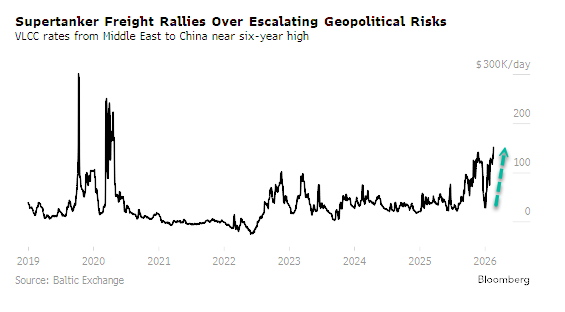
Anxieties are building in crude markets, especially ahead of the weekend, after President Trump said Tehran had about 10 to 15 days to strike a deal over its nuclear program.
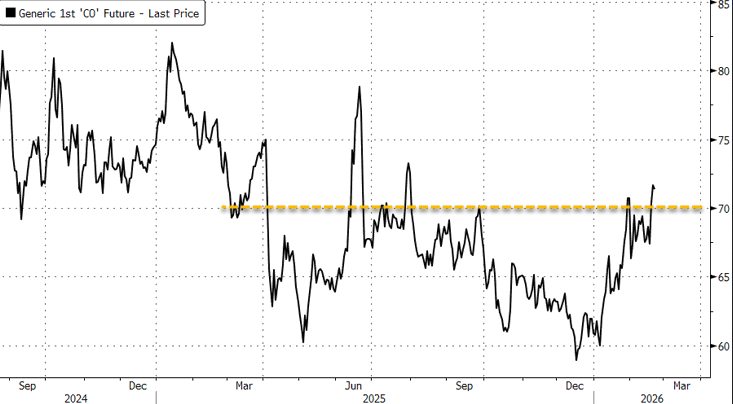
“We’re either going to get a deal, or it’s going to be unfortunate for them,” Trump told reporters Thursday aboard Air Force One.
On a deadline, Trump said he thought 10 to 15 days was “pretty much” the “maximum” he would allow for the negotiations period. “I would think that would be enough time,” he said.
Bloomberg noted that the military force the US is building in the region is the largest the US has deployed since 2003, adding, “It dwarfs the military buildup that Trump ordered off the coast of Venezuela in the weeks before he ousted President Nicolas Maduro.”
Bryan Clark, a defense analyst for the Hudson Institute and a former Navy strategy officer, told the outlet, “With Iran’s air defenses largely neutralized by previous US and Israeli strikes, the US strike fighters would operate largely with impunity over Iranian airspace.”
“There is always the risk of downed pilots, but I think the bigger risk is to ships. The same cruise and ballistic missiles the Iranians gave to the Houthis could be turned against US ships in the Persian Gulf, Arabian Sea, and Red Sea,” Clark said.
Kenneth Hvid, CEO at Teekay Tankers, recently told investors that the combination of consolidation in the VLCC segment and potential war risks in the Middle East means the move in tanker rates is “more in anticipation of something happening,” adding, “It’s just a situation we need to watch.”
END
8. EMERGING MARKETS//AUSTRALIA NEW ZEALAND ISSUES
YOUR EARLY CURRENCY/GOLD AND SILVER PRICING/ASIAN CLOSING MARKETS AND EUROPEAN BOURSE OPENING AND CLOSING/ INTEREST RATE SETTINGS FRIDAY MORNING 6;30AM//OPENING AND CLOSING
USA DOLLAR VS EURO: 1.1765 FOR A LOSS OF .0006 OR 6 BASIS PTS.
USA/ YEN 155.40 UP 0.213 NOW TARGETS INTEREST RATE AT 1.75% AS IT WILL BUY UNLIMITED BONDS TO GETS TO THAT LEVEL…//YEN STILL FALLS//END OF YEN CARRY TRADE BEGINS AGAIN DEC 2024/Bank of Japan raises rates by .25% TO 1.75 ..TAKAICHI NEW PM AS YIELDS RISE//JAPAN DEEPLY IN TROUBLE WITH RISING RATES AND A FALLING YEN!!
GBP/USA 1.3469 DOWN 0.0009 OR 9 BASIS PTS
USA/CAN DOLLAR: 1.3689 UP 0.0012 CDN DOLLAR UP 12 BASIS PTS//(DESPITE TRUMP’S TARIFFS)
Last night Shanghai COMPOSITE CLOSED
Hang Seng CLOSED
AUSTRALIA CLOSED UP 0.28%
// EUROPEAN BOURSE: ALL GREEN
Trading from Europe and ASIA
I) EUROPEAN BOURSES: ALL GREEN
2/ CHINESE BOURSES / :Hang SENG CLOSED
/SHANGHAI CLOSED
AUSTRALIA BOURSE CLOSED UP 0.28 %
(Nikkei (Japan) CLOSED DOWN 292.59 PTS OR 1.10%
INDIA’S SENSEX IN THE GREEN
Gold very early morning trading: 5025.60
silver:$80.37
USA DOLLAR VS TRY (TURKISH LIRA): 43.84
USA DOLLAR VS RUSSIAN ROUBLE: 77.20 ROUBLE// DOWN 46 BASIS PTS
UK 10 YR BOND YIELD: 4.351 DOWN 2 BASIS PTS
UK 30 YR BOND YIELD: 5.148 DOWN 3 BASIS PTS
CDN 10 YR BOND YIELD: 3.234 UP 0 BASIS PTS
CDN 5 YR BOND YIELD; 2.752 DOWN 1 BASIS PTS
USA dollar index early FRIDAY MORNING: 97.84 DOWN 2 BASIS POINTS FROM THURSDAY’s CLOSE
FRIDAY MORNING NUMBERS ENDS
And now your closing FRIDAY NUMBERS 10.00 AM
Portuguese 10 year bond yield: 3.090% DOWN 2 in basis point(s) yield
JAPANESE BOND 10 yr YIELD: +2.110% DOWN 2 FULL POINTS BASIS POINTS /JAPAN losing control of its yield curve/
JAPAN 30 YR: 3.309 DOWN 2 BASIS PTS//DIASTER
SPANISH 10 YR BOND YIELD: 3.155 DOWN 2 in basis points yield
ITALY 10 YR BOND: 3.352 DOWN 2 points in basis points yield ./ THE ECB IS QE’ ING ITALIAN BONDS (
GERMAN 10 YR BOND YIELD: 2.7406 DOWN 2 BASIS PTS
IMPORTANT CURRENCY CLOSES : MID DAY FRIDAY
Closing currency crosses for day /USA DOLLAR INDEX/USA 10 YR BOND YIELD/10:00 AM
Euro/USA 1.1763 DOWN 0.0005 OR 5 basis points
USA/Japan: 155.37 UP 0.204 OR YEN IS DOWN 20 BASIS PTS// HIGHLY INFLATIONARY TO JAPAN
Great Britain 10 YR RATE 4.3880 DOWN 0 BASIS POINTS //
GREAT BRITAIN 30 YR BOND; 5.161 DOWN 2 BASIS POINTS.
Canadian dollar DOWN 3 BASIS pts to 1.3690
xxxxxxxxxxxxxxxxxxxxxxxxxxxxxxxxxxxxxxxxxxxxxxxxxxxxxxxxxxxxxxxxxxxxxxxxxxxxxxxx
The USA/Yuan CNY XXXX TO XX ON SHORE ..
THE USA/YUAN OFFSHORE// CNH DOWN TO 6.9044
TURKISH LIRA: 43.84 EXTREMELY DANGEROUS LEVEL/DEATH WATCH/HYPERINFLATION TO BEGIN.//
Your closing 10 yr US bond yield DOWN 1 in basis points from THURSDAY at 4.087% //trading well ABOVE the resistance level of 2.27-2.32%)
USA 30 yr bond yield 4.707 DOWN 1 basis points /10:00 AM
USA 2 YR BOND YIELD: 3.480 UP 1 BASIS PTS.
GOLD AT 10;00 AM 5025.00
SILVER AT 10;00: 80.55
Your 11:00 AM bourses for Europe and the Dow along with the USA dollar index closing and interest ratesFRIDAY CLOSING TIME 10:00 AM//
London: CLOSED UP 59.85 PTS OR 0.54%
GERMAN DAX: CLOSED UP 217.62 OR 0.87%
FRANCE: CLOSED UP 116/71 PTS OR 1.39%
Spain IBEX CLOSED UP 180.50 PTS OR 0.94%
Italian MIB: CLOSED UP 478.76 PTS OR 1.48%
WTI Oil price 66.36 10.00 EST/
Brent Oil: 71.69 10:00 EST
USA /RUSSIAN ROUBLE /// AT: 76.83 ROUBLE DOWN 0 AND 5 / 100
CDN 10 YEAR RATE: 3.225 DOWN 1 BASIS PTS.
CDN 5 YEAR RATE: 2.753 DOWN 1 BASIS PTS
CLOSING NUMBERS: 4 PM
Euro vs USA 1.1785 UP 0.0016 OR 16 BASIS POINTS//
British Pound: 1.3486 UP 0.0027 OR 27 basis pts/
BRITISH 10 YR GILT BOND YIELD: 4.3520 DOWN 1 FULL BASIS PTS//
BRITISH 30 YR BOND YIELD: 5.152 DOWN 2 IN BASIS PTS.
JAPAN 10 YR YIELD: 2.119 DOWN 2 FULL BASIS PTS (DANGEROUS TO THEIR ECONOMY
JAPANESE 30 YR BOND: 3.323 DOWN 0 PTS AND STILL VERY DANGEROUS TO THEIR ECONOMY
USA dollar vs Japanese Yen: 155.10 UP 0.435 OR YEN DOWN 44 BASIS PTS EXTREMELY DANGEROUS/YEN FALLING DEEPLY IN VALUE
USA dollar vs Canadian dollar: 1.3683 DOWN 0.0004 PTS// CDN DOLLAR UP 4 BASIS PTS
West Texas intermediate oil: 66.49
Brent OIL: 71.61
USA 10 yr bond yield UP 1 BASIS pts to 4.084
USA 30 yr bond yield: UP 2 PTS to 4.723%
USA 2 YR BOND 3.468 UP 1 PTS
CDN 10 YR RATE 3.218 DOWN 2 BASIS PTS
CDN 5 YEAR RATE: 2.748 DOWN 1 BASIS PTS
USA dollar index: 97.68 DOWN 18 BASIS POINTS
USA DOLLAR VS TURKISH LIRA: 43.84 GETTING QUITE CLOSE TO BLOWING UP/
USA DOLLAR VS RUSSIA//// ROUBLE: 76.72 DOWN 0 AND 0/100 roubles //
GOLD $5086.00 3:30 PM)
SILVER: 84.41 3;30 PM)
DOW JONES INDUSTRIAL AVERAGE: UP 2300.81 OR 0.47%
NASDAQ 100 UP 215.28 PTS OR 0.87%
VOLATILITY INDEX 19.06 DOWN 1.17 PTS OR 5.78%
GLD: $ 468.62 UP 9.06PTS OR 1.97%
SLV/ $76.62 UP 5.61 PTS OR OR 7.91 %
TORONTO STOCK INDEX// TSX INDEX: CLOSED UP 187.28 PTS OR 0.58%
end
TRADING today ZEROHEDGE 4 PM: HEADLINE NEWS/TRADING
”Stocks, Oil, & Gold Gain Amid Week Of Trump-Tehran Musings, Tariff Mayhem, & Tons Of Macro
WRAP UP
Stocks bid as SCOTUS strikes down Trump IEEPA tariffs – Newsquawk US Market Wrap
Friday, Feb 20, 2026 – 04:05 PM
- SNAPSHOT: Equities up, Treasuries flat, Crude flat, Dollar down, Gold up.
- REAR VIEW: SCOTUS strikes down Trump IEEPA tariffs; In response, Trump announces new 10% global tariff & will go “even stronger”; Trump considers limited strike on Iran; Hotter-than-expected Dec. PCE report, Q4 PCE figures also hot; GDP Adv Q4 misses expectations, weighed by govt spending amid shutdown; US S&P Global Flash PMIs unexpectedly falls; UoM underwhelms, although inflation expectation also dip; Fed’s Bostic thinks neutral is 25-50bps below current rate; Fed’s Logan thinks policy is well positioned; Fed’s Musalem says real FFR is at or below neutral rate; CRWV credit concerns arise after OWL fails to secure data centre financing.
- WEEK AHEAD: Highlights include NVDA earnings, Australian CPI, Tokyo CPI, PBoC LPR, and BoK. Click here for the full report.
- CENTRAL BANK WEEKLY: Previewing PBoC LPR, BoK; Reviewing RBNZ, FOMC Minutes, RBA Minutes, reports on the ECB President Job. Click here for the full report.
- WEEKLY US EARNINGS ESTIMATES: Tech behemoth NVDA the headliner. Click here for the full report.
More Newsquawk in 2 steps:
- 1. Subscribe to the free premarket movers reports
- 2. Trial Newsquawk’s premium real-time audio news squawk box for 7 days
MARKET WRAP
Stocks ultimately closed primarily in the green, with upside ensuing after the SCOTUS struck down Trump’s IEEPA tariffs. Trump responded by implementing a global 10% tariff rate under Section 122 (which can legally be in place for a maximum of 150 days). Section 232 and 301 tariffs will remain as they are, while the US will also conduct Section 301 probes on nations over the span of five months (150 days). Once the probes are complete, the US will enforce a “fair” 301 tariff rate. Overall, it seems the measures taken by Trump will offset the lost revenue from IEEPA tariffs. The Treasury expects tariff revenue in 2026 to be unchanged from prior estimates. In response to the ruling, T-notes were sold on the prospects of lack of income and potential tariff refunds, but swiftly pared on the expectation that Trump will enforce tariffs through other means – which was later confirmed. In FX, the reaction was to sell the Dollar, but ultimately it pared from worst levels and ended the session only slightly lower. AUD outperformed while havens lagged. Crude prices settled flat but in choppy trade, with any gains overnight offset by reports that Trump is considering a limited strike on Iran. Silver and Gold prices added to recent gains while Bitcoin also caught a bid. Aside from tariffs, there was plenty of US data. Q4 GDP was soft, but weighed on by the government shutdown, while the December PCE report was hot. The S&P Global Flash PMI data in the US was soft while UoM also missed expectations but new Home Sales beat. However, price action was largely dictated by the trade updates.
US
TARIFFS: After the Supreme Court ruled against Trump’s IEEPA tariffs, the US President responded by immediately implementing a 10% global tariff (under Section 122) while confirming that all Section 232 and 301 tariffs remain in place. The President has stressed that they will still impose tariffs through other means, and he touted five options: the Trade Expansion Act of 1962 (Section 232); the Trade Act of 1974 (Sections 122, 201, and 301); and the Tariff Act of 1930 (Section 338). Trump did highlight that Section 338 takes longer to implement, however. He is also taking the angle that after today’s ruling, it is now clear what the US can and can’t do. Trump also noted they will be implementing Section 301 probes to protect the US, with the probing period lasting for five months, which will then help the US determine a fair tariff rate once the probes have been completed. On refunds, Trump said that if they have to refund the tariff revenue, they will be in court for the next five years, suggesting a decision will “have to be litigated!”. He also noted that some trade deals negotiated under IEEPA do not stand, but he stressed that nothing has changed with India. Trade deals that no longer stand, will be replaced by other means of tariffs. The President also noted how he will go in an even stronger direction now, and he can charge much more than what he was charging. He also stressed that tariff income will now increase. A US official later announced that the US expects countries to honour trade frameworks. Meanwhile, Treasury Secretary Bessent said that estimates show that the use of section 122, 232 and 301 tariffs will result in virtually unchanged tariff revenue in 2026 – implying the measures made by the administration will offset any lost revenue from no IEEPA tariffs.
PCE (DEC): The headline PCE rose 0.4% in December, accelerating from 0.2% previously and above the 0.3% forecast. This lifted PCE prices to 2.9% Y/Y, above both the 2.8% expectation and the prior reading. Core prices, the Fed’s preferred inflation gauge, were also strong, rising 0.4% M/M, above the 0.3% forecast and up from November’s 0.2%. Core Y/Y increased to 3.0% from 2.8%, exceeding the 2.9% forecast. Within the report, Personal Income rose 0.3%, in line with forecasts but easing from 0.4% previously, while spending increased 0.4%, matching both forecasts and the prior. The firm inflation reading is a concern; however, January CPI data, which came in slightly softer, has helped offset some worries around the December PCE report. Core PCE remains the Fed’s preferred gauge, and Fed Chair Powell had indicated December Core PCE would rise 3.0%, with headline at 2.9%, leaving the data broadly in line with Fed expectations and unlikely to materially alter its stance. Recent data show stabilisation in the labour market, and the Fed minutes noted that the vast majority saw signs of stabilisation and diminished downside labour risks. This shifts greater focus to inflation, which remains above target, and supports the case for holding rates for now. Pantheon Macroeconomics said it expects inflation data to cool decisively in May, prompting the FOMC, most likely under new Chair Kevin Warsh, to ease policy at its June, July and September meetings.
GDP (Q4): The Q4 2025 data were weak. Headline GDP grew just 1.4% in the quarter, well below the 3.0% forecast and sharply slower than the prior 4.4%. Much of the downside was attributed to the government shutdown, with the BEA estimating it subtracted about 1% from real GDP growth in Q4. Even excluding this effect, growth would have been soft. Growth was driven by increases in consumer spending and investment, partly offset by declines in government spending and exports. On prices, the GDP price index rose 3.7%, well above the 2.8% forecast and matching the prior. Headline PCE rose 2.9% from 2.8%, above the 2.8% forecast, while core PCE increased 2.7%, down from 2.9% previously but above the 2.6% forecast. Despite the weak headline figure, ING said GDP is set to rebound, noting that underlying consumer and investment data remain firm.
S&P GLOBAL FLASH PMIs (FEB): S&P Global Flash PMIs disappointed, as Manufacturing fell to 51.2 from 52.4, beneath the expected 52.6, Services dipped to 52.3 (exp, 53, prev. 52.7), leaving the composite at 52.3 (prev. 53.0). Overall, the Flash PMI metrics indicate slowest business growth for ten months amid weak demand, high prices and bad weather. Within the report, S&P Global chief economist Chris Williamson, noted customer demand growth has softened, and the PMI data so far this year are indicative of GDP rising at an annualized rate of just 1.5%, signalling a marked cooling of the economy in Q1 vs. the robust growth rates seen in H2 ’25. Williamson added, “Cos. are suggesting that at least some of this slowdown may prove temporary, partly as extreme weather passes, with business growth expectations rising sharply to the highest for just over a year in February.” However, he adds, confidence remains subdued on the whole, as companies worry about the political environment and impact of policies such as tariffs.
MICHIGAN (FEB): Consumer Sentiment in February rose to 56.6 from 56.4 in January, shy of the expected and prelim 57.3. Current Conditions rose to 56.6 from 55.4, beneath the expected 57.7 and down from the 58.3 prelim. Consumer Expectations rose to 56.6 from 57.0 as expected, in line with the preliminary report. Inflation expectations were mixed; the 1yr saw a notable decline to 3.4% from 4.0%, below the 3.5% forecast and prelim. The 5yr inflation projection was unchanged at 3.3%, below the 3.4% consensus and preliminary print. Surveys of Consumers Director Joanne Hsu wrote that overall, consumers do not perceive any material differences in the economy from last month. Oxford Economics believes that despite sentiment remaining near historically low levels, consumption will continue to grow at a solid pace of 2.5% in 2026.
NEW HOME SALES: Note, November and December reports were both released today due to lagged effects from the government shutdown. Sales of new single-family homes fell to 745k from 758k in December, but were still above the expected 730k. This represents a supply of 7.6 months at the current sales rate, -1.3% M/M, -7.3% Y/Y. The median sales price of new houses sold in December 2025 was USD 414.4k, +4.2% M/M, +2% Y/Y. Oxford Economics, on the release, said that lower mortgage rates and plentiful supply are driving a recovery in new home sales that it expects will continue this year. However, the firm adds that the overhang of inventory will remain a drag on new construction for a while longer.
FIXED INCOME
T-NOTE FUTURES (H6) SETTLED 1 TICK LOWER AT 112-30
T-notes hit as SCOTUS strikes down Trump tariffs but pare on expectation Trump is to offset lost tariff revenue by other tariff means, which was later confirmed. At settlement, 2-year +1.2bps at 3.482%, 3-year +0.5bps at 3.503%, 5-year +0.1bps at 3.648%, 7-year +0.3bps at 3.846%, 10-year +0.8bps at 4.083%, 20-year +1.6bps at 4.670%, 30-year +1.8bps at 4.722%.
THE DAY: T-notes were ultimately little changed to slightly lower by settlement. The main focus of the day was the Supreme Court striking down US President Trump’s IEEPA tariffs, immediately raising concerns on tariffs refund and a lack of income to the Treasury. This took T-notes to lows, but the move ultimately pared. The decision was expected, and Trump has since confirmed that he will be looking to implement tariffs through other means. The US will maintain Section 232 and 301 tariffs as they are, but impose a flat 10% tariff globally under Section 122. The Section 122 tariff lasts for 150 days, unless extension is approved by Congress, but the US has also imposed Section 301 probes, which last five months (or c. 150 days). Once the 301 probes are completed, the US will announce fresh tariff rates on nations. The US Treasury expects tariff revenue to remain unchanged through 2026 due to these measures- hence the reversal in T-notes into settlement. Elsewhere, US data saw Q4 GDP heavily miss expectations, but it was distorted by government shutdown effects, albeit even with the 1.0% hit from the shutdown, the report was still soft with Q4 GDP growth at just 1.4%. Meanwhile, the December PCE report was released at the same time, which was hotter than expected. The data led to two-way trade in T-notes, but the main driver of price action was the tariff announcements from SCOTUS and US President Trump. Attention next week turns to Treasury supply, while dealers expect USD 50bln in high-grade corporate debt to be announced too.
SUPPLY
Bills
- US to sell USD 89ln of 13-week bills and USD 77bln of 26-week bills on February 23rd and USD 90bln of 6-week bills on February 24th; all to settle February 26th.
Notes
- US to sell USD 69bln of 2-year notes on February 24th, USD 70bln of 5-year notes on February 25th and USD 44bln of 7-year notes on February 26th; all to settle March 2nd
- US to sell USD 28bln of 2-year FRN’s on February 25th; to settle February 27th
STIRS/OPERATIONS
- Market Implied Fed Rate Cut Pricing: March 0bps (prev. 0bps), April 3.2bps (prev. 4.2bps), June 12.5bps (prev. 15.8bps), December 53.9bps (prev. 56.2bps).
- SOFR at 3.67% (prev. 3.73%), volumes at USD 3.238tln (prev. USD 3.258tln) on February 19th
- EFFR at 3.64% (prev. 3.64%), volumes at USD 100bln (prev. USD 104bln) on February 19th
- NY Fed RRP Op demand at USD 0.5bln (prev. 0.6bln) across 4 counterparties (prev 4)
CRUDE
WTI (J6) SETTLED USD 0.08 HIGHER AT 66.48/BBL; BRENT (J6) SETTLED USD 0.10 HIGHER AT 71.76/BBL
The crude complex was choppy to end the week, but ultimately settled flat, as geopols, SCOTUS tariff ruling, and data all dominated the macro slate. On the day, WTI and Brent ground higher overnight to hit highs of USD 67.05/bbl and USD 72.34/bbl, respectively, before selling off through the European session to hit lows of USD 65.94/bbl and 71.06. Thereafter, benchmarks have chopped between the range, as participants digest all the necessary updates. On US/Iran, which prompted fleeting downside, US President Trump confirmed some WSJ reports from Thursday evening that he is considering a limited strike on Iran, but nothing is seemingly confirmed as of yet, and in Trump’ IEEPA press conference, he reiterated, “Iran better negotiate a fair deal”. Prior to this, other reports suggested that the US military planning on Iran is reportedly highly advanced, with options ranging from targeting individuals to pursuing regime change, and as such participants will be keeping a watchful eye over the weekend for any updates. On Ukraine/Russia, Zelensky said that they are counting on another round of negotiations being as early as February, and that this can be truly productive, but there is no progress on territory discussions; he added all sides agreed on next meeting within 10 days and military talks are constructive. For the record, the weekly Baker Hughes Rig Count saw Oil unchanged at 409, Natgas unchanged at 133, and Total unchanged at 551.
EQUITIES
CLOSES: SPX +0.71% at 6,911, NDX +0.87% at 25,013, DJI +0.44% at 49,613, RUT -0.01% at 2,665.
SECTORS: Communication Services +2.63%, Consumer Discretionary +1.25%, Real Estate +0.77%, Financials +0.62%, Technology +0.51%, Utilities +0.41%, Industrials +0.40%, Materials +0.24%, Consumer Staples +0.07%, Health -0.33%, Energy -0.75%.
EUROPEAN CLOSES: Euro Stoxx 50 +1.21% at 6,133, Dax 40 +0.96% at 25,259, FTSE 100 +0.59% at 10,690, CAC 40 +1.39% at 8,515, FTSE MIB +1.47% at 46,470, IBEX 35 +0.90% at 18,180, PSI -0.05% at 9,091, SMI +0.45% at 13,862, AEX +0.99% at 1,018
STOCK SPECIFICS:
- Nvidia (NVDA): Reportedly close to a $30B investment in OpenAI, down from prev. $100B that failed to progress a memorandum.
- Blue Owl (OWL) reportedly failing to secure financing for a USD 4bln data centre project in Pennsylvania, with one lender saying the lack of interest was due to CoreWeave’s (CRWV) creditworthiness.
- Comfort Systems (FIX): Rev. beat.
- Opendoor (OPEN): Q metrics beat.
- Consolidated Edison (ED): Revenue beat, but adj. net income missed.
- LyondellBasell (LYB): Cut Q div. by ~50% amid challenged markets.
- Akamai (AKAM): Issued weak guidance.
- Grail (GRAL): NHS-Galleri trial missed the primary endpoint of reducing late-stage cancers.
- Select Water Solutions (WTTR): Announced $175M class A common stock offering.
- Lucid Motors (LCID) cuts 12% of its US workforce.
- Claude Code Security, a new capability built into Claude Code on the web, is now available in a limited research preview. Of note for CrowdStrike (CRWD), Palo Alto (PANW), Zscaler (ZS).
FX
The Dollar Index was flat on Friday, with performance against G10 peers mixed as AUD and GBP saw the greatest gains, while havens, CHF and JPY, lagged. It was a busy day stateside, with a deluge of data, geopolitical updates, and the SCOTUS ruling on Trump’s tariffs. On the latter, they struck down the Trump admin’s IEEPA tariffs, as expected, which the President was clearly unhappy about it. In a press conference after the decision, he remarked that effectively immediately, all national security tariffs under 232 and 301 remain in place, and 10% global tariff to be imposed on top of other tariffs. Note, Section 122 has a 15% tariff limit for 150 days. On the ruling, Wells Fargo wrote “We expect relief from the SCOTUS ruling to be temporarily risk positive mostly via lower uncertainty…The market will likely refocus on incoming data that continues to point to an economy and labour market that is recovering. This keeps the Fed firmly on the sidelines and limits further USD weakness in our view”. On today’s data, Dec. PCE surpassed expectations across the board, Q4 rose 1.4%, well below the consensus 2.8%, S&P Global Flash for Feb underwhelmed, as did final UoM for Feb, but inflation expectations for both time horizons also came down.
As mentioned, AUD and GBP sat atop of the G10 breakdown, with both benefitting from the Dollar weakness in wake of the SCOTUS ruling. Prior to that, the Pound was marginally firmer in wake of a strong batch of UK data, as retail sales surged, as well as strong PMIs. Cable reached a high of 1.3515 against an earlier low of 1.3435.
EUR and NZD were ultimately flat, with broadly better than expected European Flash PMIs, whereby the solid German metrics provided fleeting Euro strength. For the Kiwi, overnight RBNZ Governor Breman said that although the central bank remains forward-focused, monetary policy will adapt based on new information instead of following a predetermined path.
For the Yen, overnight and through the first part of the session, it was weighed on by the broader Dollar strength and also Japanese CPI, which held a dovish skew. In summary, national CPI printed at 1.5% (exp. 1.6%), core was in-line whilst the supercore metric was a touch below the consensus. Elsewhere, PMIs printed better-than-expectations, benefiting from increased optimism following Takaichi’s landslide victory.
USA DATA RELEASE
Q4 GDP Unexpectedly Grows At 1.4%, Half Expected Pace, As Government Shutdown Hits Q4 Growth
Friday, Feb 20, 2026 – 09:17 AM
There was a big surprise at 8:30am ET when the BEA reported the (delayed) GDP print for the last quarter of 2025: With consensus expecting a 2.8% print (and the Atlanta Fed GDPNow model even higher) which would already be a big drop from the 4.4% in Q3, the BEA instead reported that the US economy grew at just 1.4% in the fourth quarter, the slowest growth since the tariff shock of Q1 2025.
According to the BEA, the contributors to the increase in real GDP in the fourth quarter were increases in consumer spending and investment. These movements were partly offset by decreases in government spending and exports. Imports, which are a subtraction in the calculation of GDP, decreased.
Overall, the economy expanded 2.2% last year, data from the Bureau of Economic Analysis showed.
Specifically, the Q4 breakdown was as follows:
- Personal consumption slowed notably, from 2.34% of the bottom line GDP to just 1.58% or more than 100% of the final 1.42% GDP print
- Fixed Investment contributed to 0.45% of bottom line GDP, up from 0.15% in Q3
- Change in private inventories added 0.21%, up from a decline of -0.12% in Q3
- Net exports (exports less imports) continued to normalize and in Q4 added just 0.08% to the GDP number, down dramatically from 1.62% in Q3
- Last and definitely worse, government was actually a major drawdown, reducing the Q4 GDP by 0.9%, a sharp reversal from the 0.38% addition in Q3.
And visually:
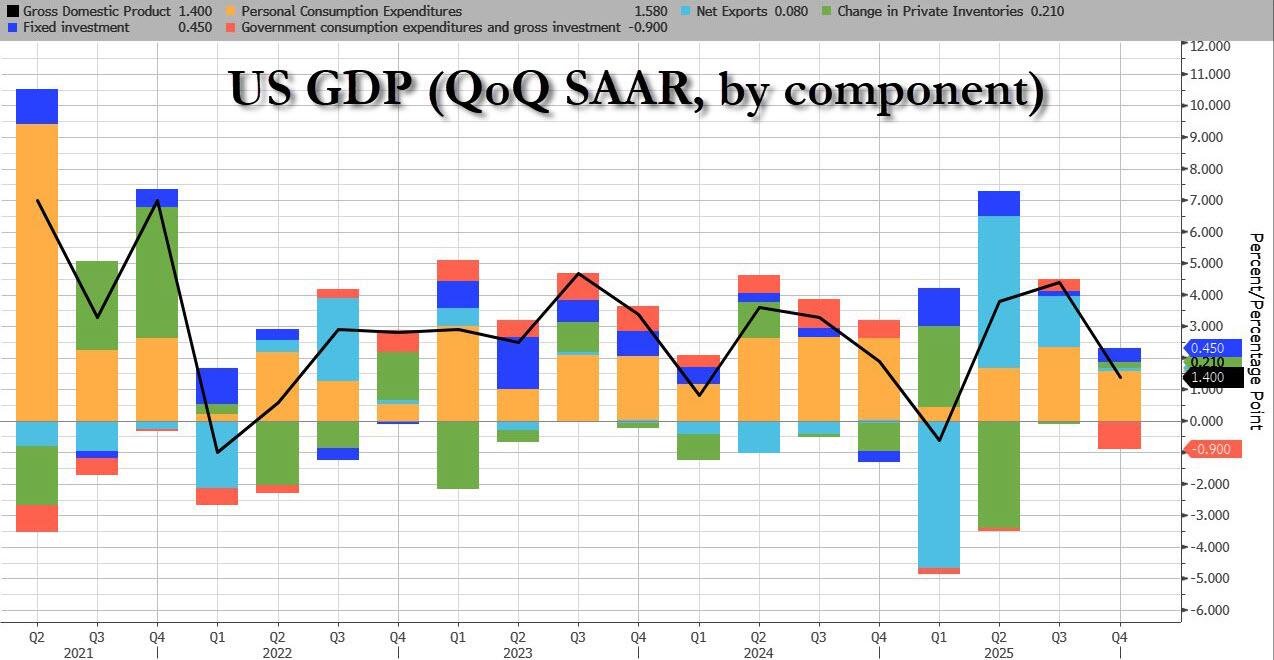
Of the above, the most notable variable was government spending, which due to the government shutdown in Q4 tumbled by 5.1% – the biggest drop since covid – and subtracted 0.9% from the final GDP number.
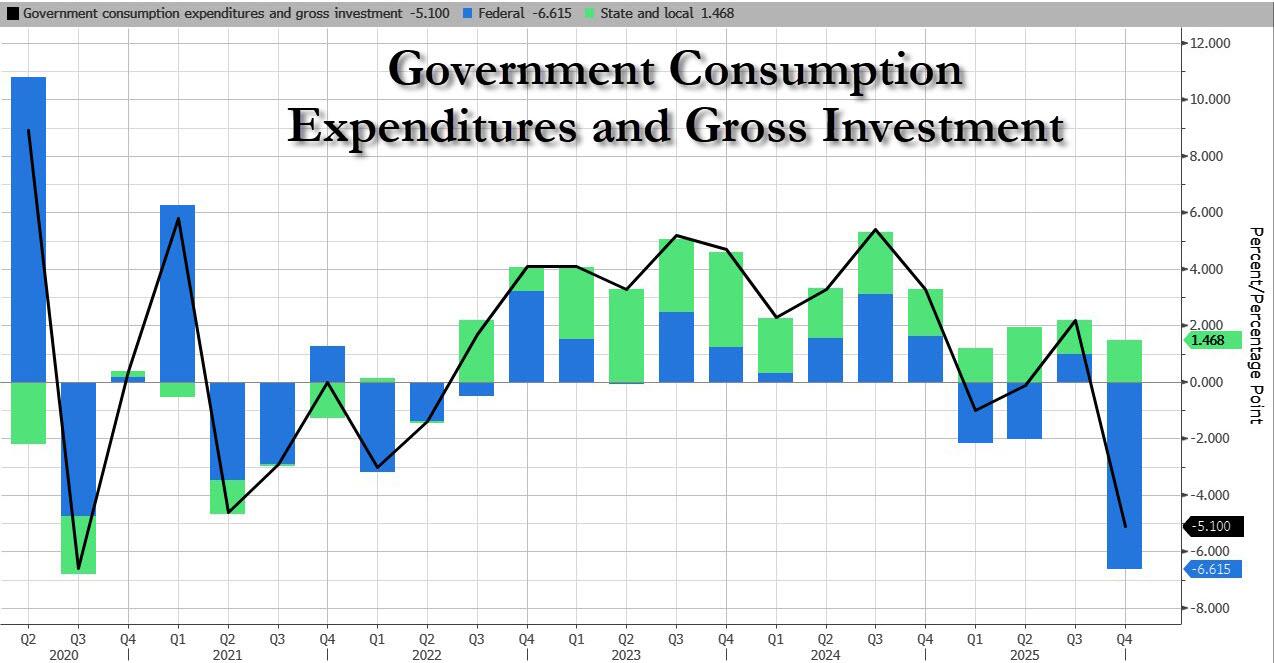
Knowing in advance how bad the number would be due to the shutdown, less than an hour before the data were released, Trump posted on social media that the shutdown would cost the US “at least two points in GDP.”
That may be an exageration, but it is modest: if one takes the average growth in recent quarters due to government which is about 0.5-0.6% and subtracts the 0.9% hit in Q4, the actual swing is about 1.5%.
Of course, this is just a delayed reversal, and expect to see Q1 GDP offset by this much if not more, meaning Q1 GDP will likely print around 4%.
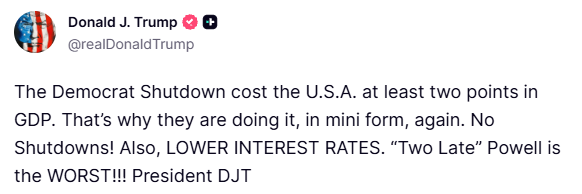
Government slowdown aside, perhaps an even more notable print is the continued explosion in spending on computers/peripheral equipment courtesy of AI, which has surged 70% in the past year and has more than doubled to $300BN at the end of 2025, more than double since the launch of chatGPT in 2022.
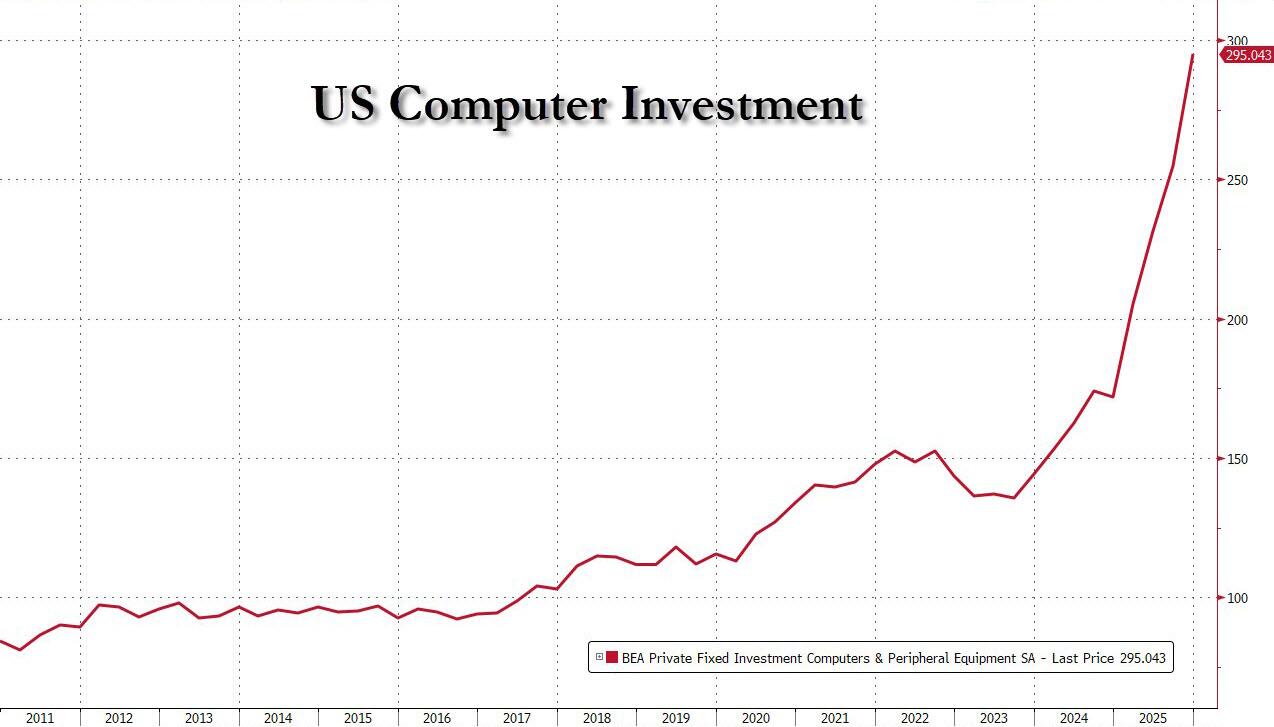
Despite the year-end slowdown, the data capped a solid year for the US economy, which shrank in the first quarter amid a monumental pre-tariff surge in imports, only to round out 2025 with one of the strongest growth rates in years. The turnaround came after Trump backed off of his most punitive levies and the Federal Reserve lowered interest rates, helping drive the stock market to record highs and enabling wealthier Americans to keep spending.
Separate monthly data out Friday showed the Fed’s preferred measure of underlying inflation — the core PCE index — rose 0.4% in December, the most in nearly a year. On an annual basis, the core PCE, which excludes food and energy, climbed 3%, compared to 2.8% at the start of 2025. All of these prints were hot…
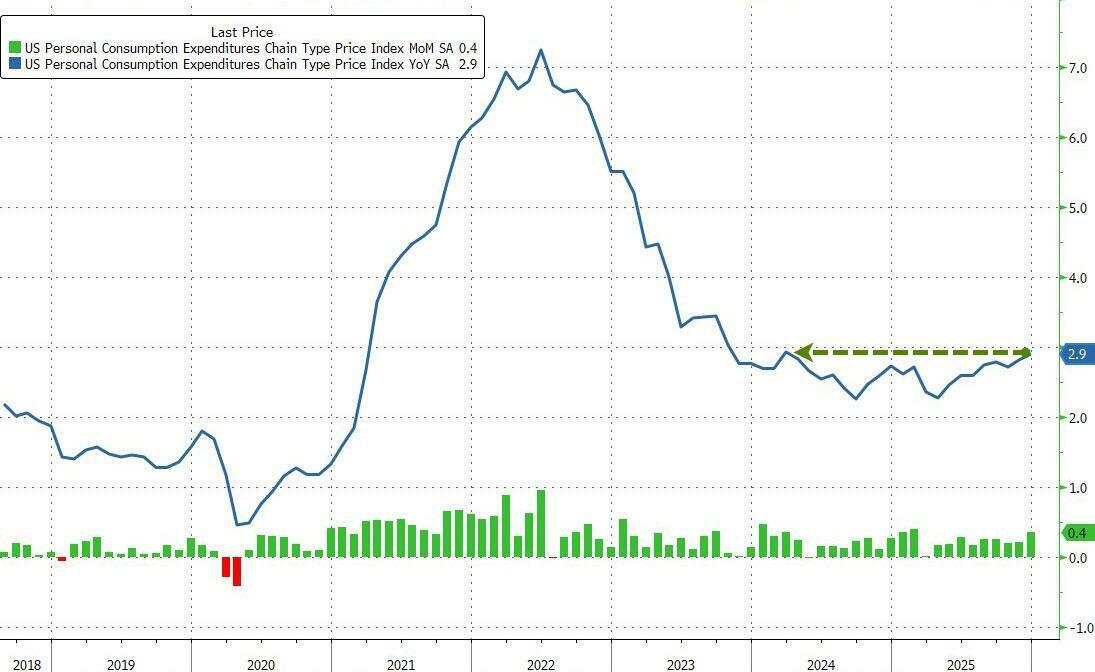
… suggesting that all else equal, the US is once again flirting with stagflation, although as has so often been the case, the Q4 GDP print is an outlier, as is the December PCE, the first impacted by the government shutdown the second heated up by higher commodity prices which will reverse as soon as the geopolitical circus involving Iran quiets down.
END
Savings Rate Tumbles To 4 Year Lows As Fed’s Favorite Inflation Indicator Comes In Hot
Friday, Feb 20, 2026 – 08:47 AM
The Fed’s favorite inflation indicator – Core PCE (a measure of price changes in consumer goods and services that excludes volatile food and energy costs) – rose 0.4% in December (the latest data released today), slightly hotter than expected (+0.3% MoM). That lifted YoY inflation up 3.0% (above the prior month and hotter than expected) – the highest since April 2025…
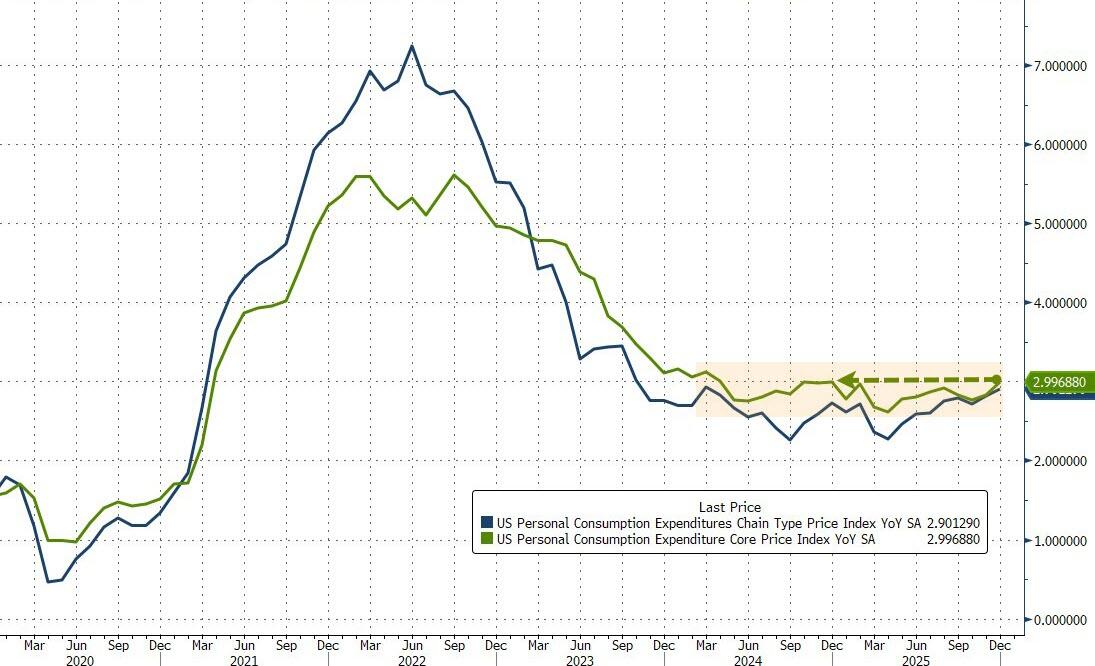
Source: Bloomberg
The headline PCE rose 0.4% MoM (more than expected too) driving prices up 2.9% YoY (the highest since March 2024)
Source: Bloomberg
The much watched SuperCore PCE rose 0.3% MoM (the last MoM decline was April 2020). But the SuperCore PCE YoY printed +3.3% – very much unmoved in the last year…
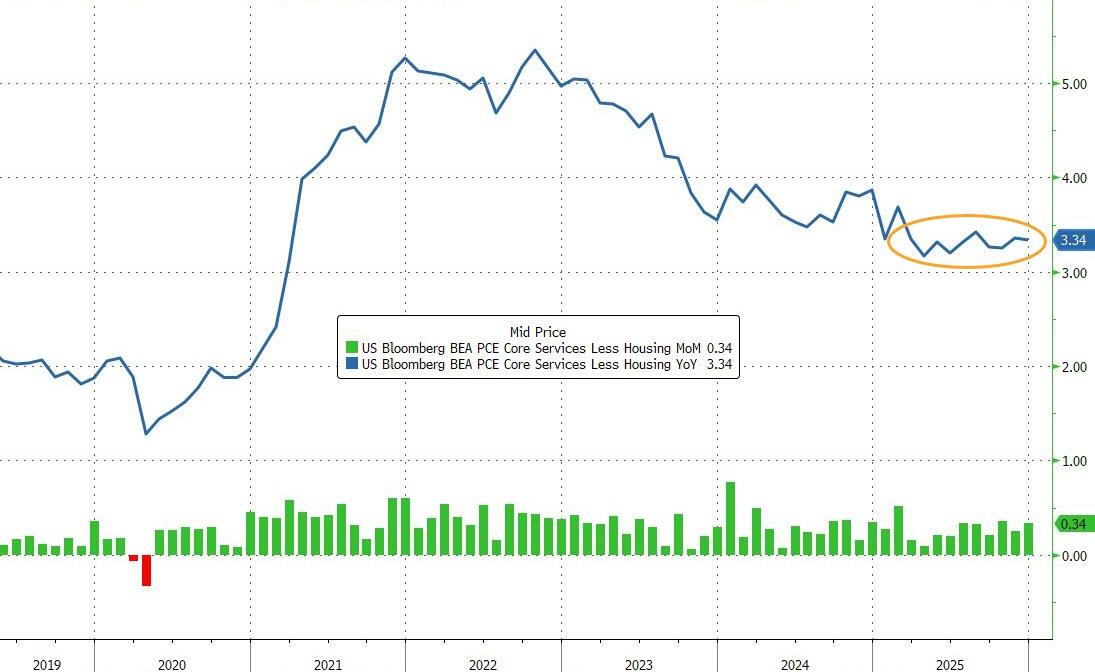
Services prices continue to dominate the price gains but Goods costs also accelerated in December…
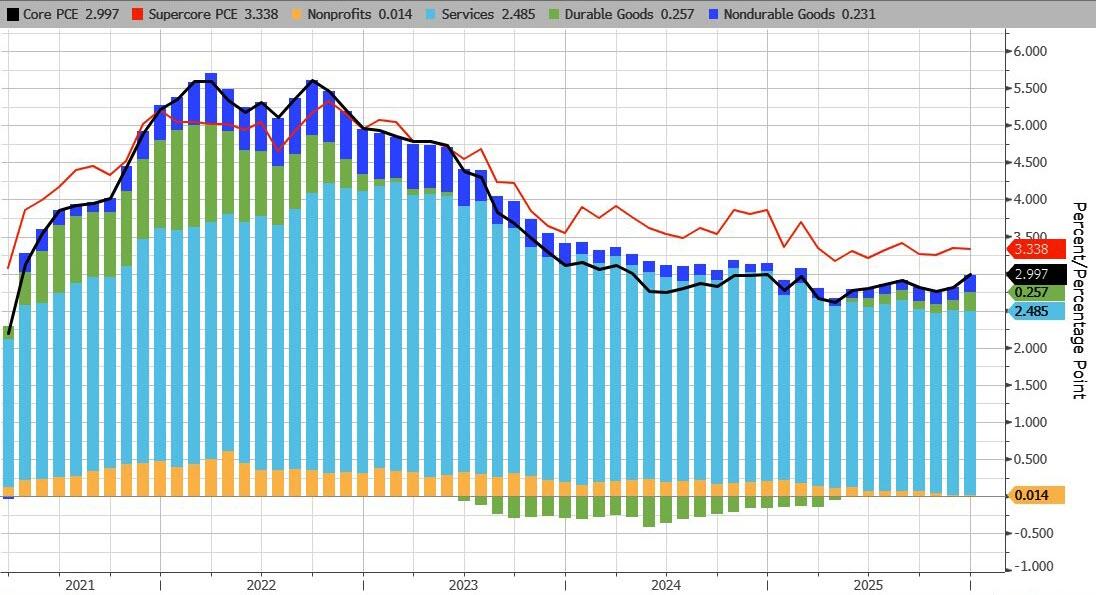
Many were fearful of the recent surge in oil prices impacting inflation, but as the chart below shows, the government’s measure of energy costs has recently (oddly) decoupled from actual energy costs…
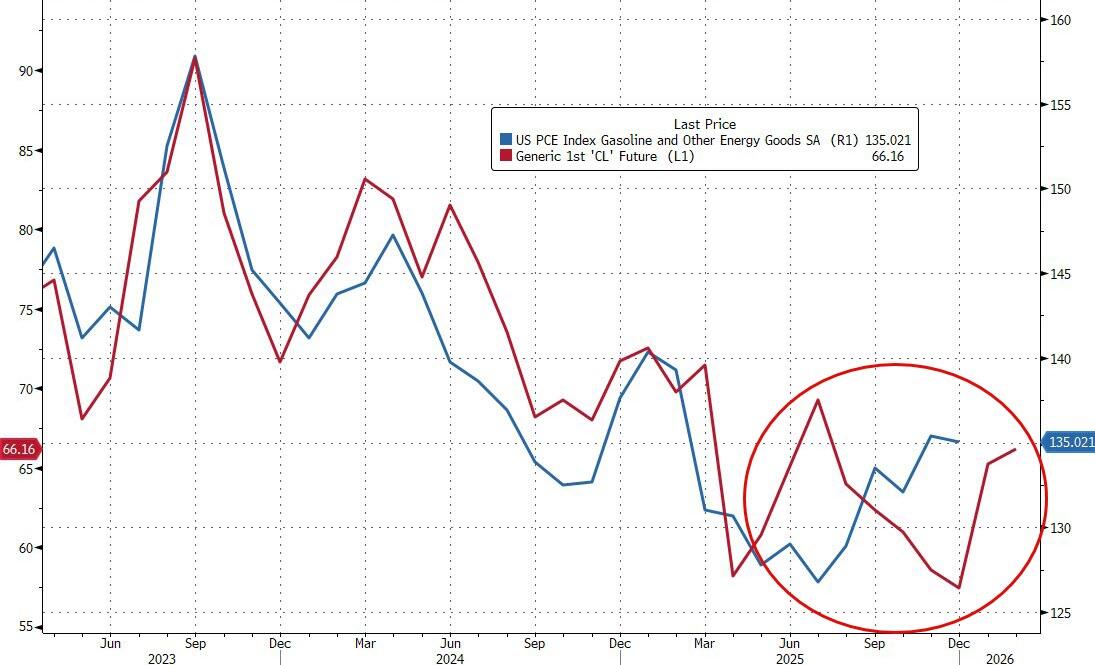
Higher prices were accompanied by higher incomes and higher spending…
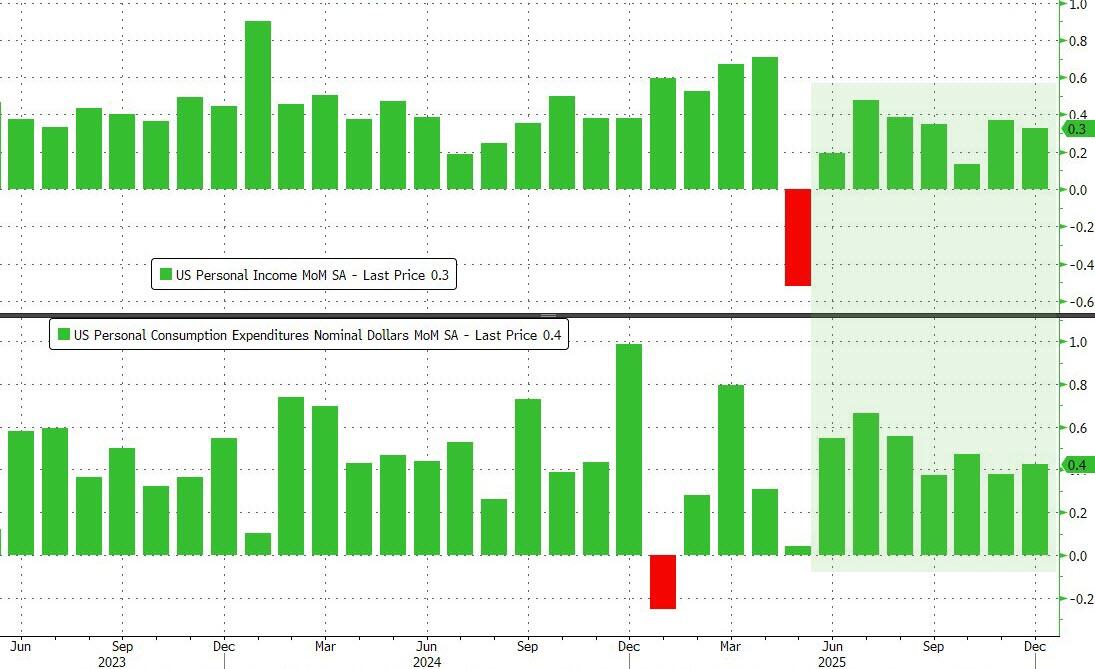
But Spending continues to outpace incomes (even though the former is decelerating)…
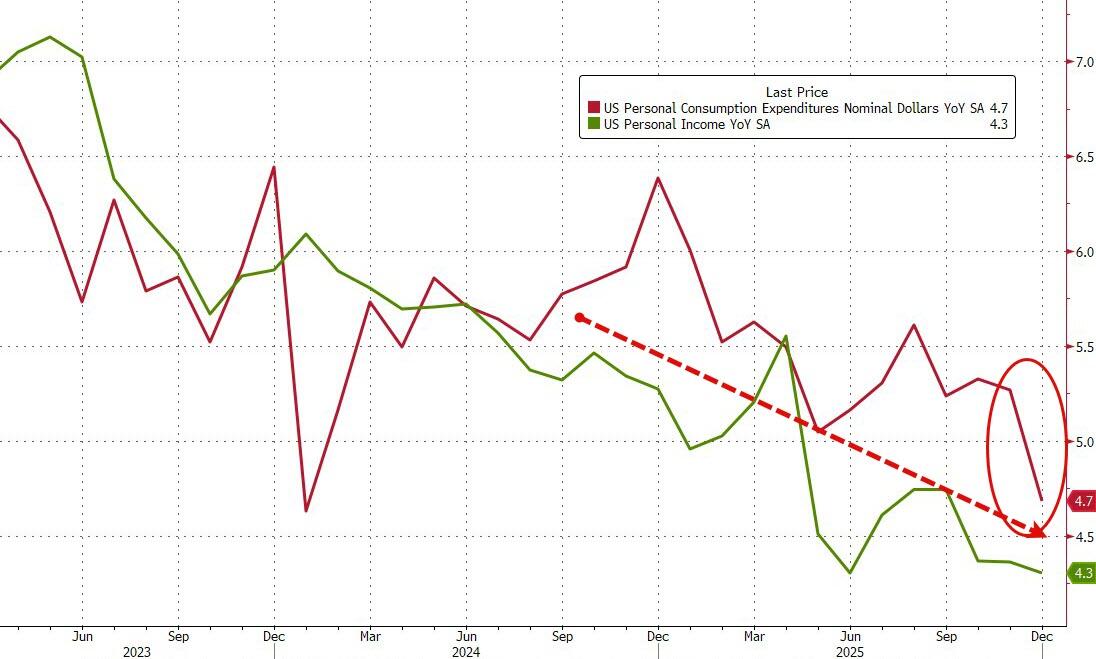
Wage growth is slowing, especially for government workers…
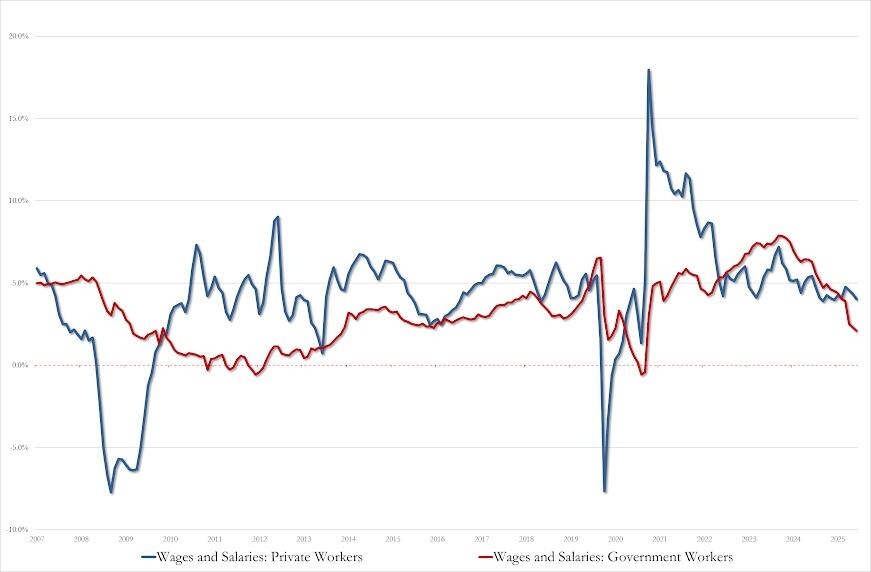
But, putting it altogether, the savings rate is tumbling to afford all this…
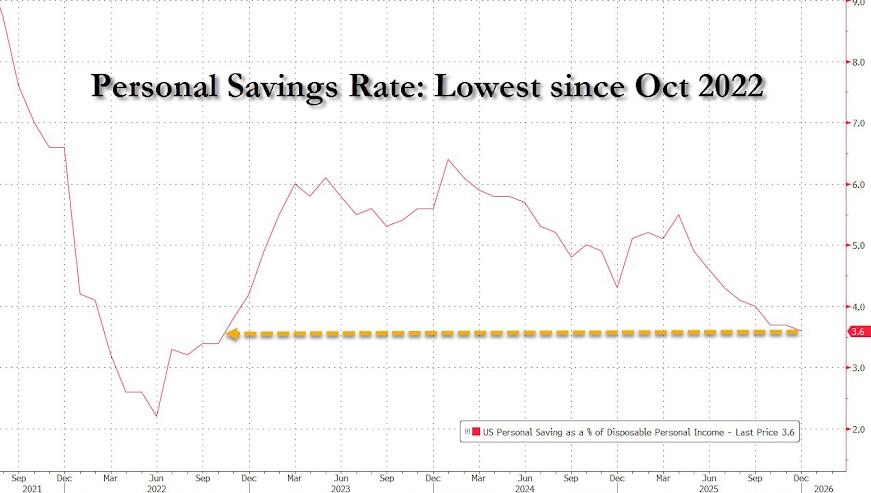
We look forward to President Trump explaining how affordability is ‘fixed’ next week at the SOTU.
END
USA ECONOMIC COMMENTARIES
huge!1
The Supreme Court on Feb. 20 ruled 6–3 that some of President Donald Trump’s global tariffs exceeded an emergency powers law passed by Congress.
Chief Justice John Roberts wrote the majority opinion, stating that Trump’s tariffs didn’t fit with the language of the International Emergency Economic Powers Act. Trump had invoked that law to impose a series of tariffs, including reciprocal rates on dozens of countries and drug trafficking levies on Mexico, Canada, and China.
The administration argued that the law’s wording allowed tariffs by permitting the president to “regulate … importation.”
“The President asserts the independent power to impose tariffs on imports from any country, of any product, at any rate, for any amount of time,” Roberts said. “Those words cannot bear such weight.”
Justices Clarence Thomas, Brett Kavanaugh, and Samuel Alito dissented.
With trillions of dollars at stake, the decision could have major implications for the nation’s economy. Trump’s tariffs have targeted a broad range of activities, but the ones in this case focused on combating drug trafficking and correcting trade imbalances with other countries.
Related Stories
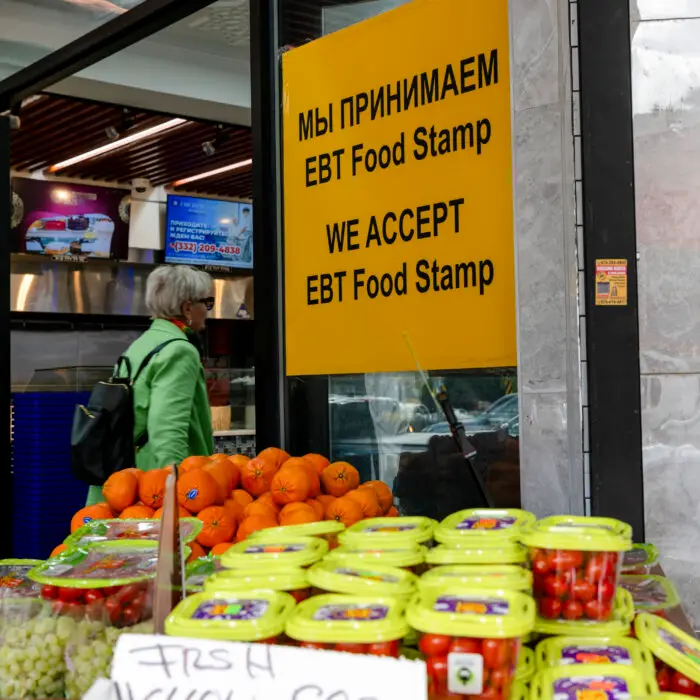
Trump Admin Urges Supreme Court to Block Order on Food Stamps
6 Takeaways From Supreme Court Hearing on Trump’s Tariffs
In the weeks leading up to the decision, Trump repeatedly portrayed his tariffs as important for the nation’s economic and financial health.
“Pray that the United States Supreme Court allows our country to continue its unprecedented march toward unparalleled greatness!” he wrote in all caps in a Jan. 6 post on Truth Social.
Treasury Secretary Scott Bessent has said that the government could invoke other authorities to implement tariffs, although they are “not as efficient, not as powerful.”
U.S. Trade Representative Jamieson Greer similarly indicated in December that the administration had a backup plan.
Tariffs have helped the United States collect nearly $99 billion so far this fiscal year, which started on Oct. 1, 2025, according to the Daily Treasury Statement published on Jan. 7.
During oral argument on Nov. 5, 2025, the justices seemed skeptical of Trump’s bid to use the International Emergency Economic Powers Act to implement those tariffs.
The law allows presidents to regulate imports during times of emergency, but it was questionable whether that regulation included tariffs, and, in particular, Trump’s large-scale tariffs.
Multiple federal courts had ruled that Trump’s tariffs exceeded what was allowed under the law.
Days after oral argument, Trump indicated in a Nov. 11 post on Truth Social that a negative decision by the Supreme Court could implicate trillions of dollars.
“The ‘unwind’ in the event of a negative decision on Tariffs, would be, including investments made, to be made, and return of funds, in excess of 3 Trillion Dollars,” he said.
He added that the situation “would truly become an insurmountable National Security Event, and devastating to the future of our Country – Possibly non-sustainable!”
Andrew Moran contributed to this report.
END
AI
Here’s How Trump Can Immediately Ignore Supreme Court Tariff Decision, Including The “Nuclear Option” EXPLAIN
Context of the Supreme Court DecisionIn a recent 6-3 ruling, the U.S. Supreme Court struck down President Donald Trump’s use of the International Emergency Economic Powers Act (IEEPA) to impose broad tariffs on imports. The Court determined that tariffs constitute a form of taxation, which falls under Congress’s constitutional authority, and that IEEPA does not grant the president the power to unilaterally impose them without congressional approval.
subscriber.politicopro.com This decision invalidated many of the tariffs Trump implemented, representing a significant setback for his trade policy aimed at protecting U.S. industries and addressing trade imbalances.
thehill.com The ruling came amid ongoing trade tensions and was hailed by critics like Senate Minority Leader Chuck Schumer as a “win for the wallets” of Americans, arguing it prevents unchecked executive overreach.
thehill.comWays Trump Can Circumvent or Ignore the RulingWhile the Supreme Court decision blocks tariffs under IEEPA, it does not eliminate all presidential authority over trade. Several alternative legal pathways exist for imposing similar tariffs, often through lesser-known or rarely used statutes. These “backup plans” allow the administration to pursue comparable policies without directly violating the ruling. Here’s a breakdown:
- Section 338 of the Tariff Act of 1930: This Depression-era provision authorizes the president to impose tariffs of up to 50% on imports from countries that “discriminate” against U.S. commerce (e.g., by favoring other nations’ goods over American ones). No formal investigation is required, and there’s no time limit on the tariffs. Although it has never been invoked, it could serve as a broad tool for retaliatory or reciprocal tariffs. Treasury Secretary Scott Bessent indicated in September 2025 that the administration was considering this as a “Plan B” if the Court ruled against IEEPA. houstonchronicle.com This section remains on the books as 19 U.S.C. §1338 and could be proclaimed by the president without congressional input. keia.org
- Section 122 of the Trade Act of 1974: Another underutilized authority, this allows the president to impose temporary tariffs (up to 15% for 150 days, with possible extensions) to address balance-of-payments issues or trade surpluses. Like Section 338, it has no prior judicial precedent, giving the administration flexibility to interpret and apply it broadly. cato.org
- Section 301 of the Trade Act of 1974: This more commonly used tool permits tariffs in response to unfair trade practices, such as intellectual property theft or subsidies. It requires an investigation by the U.S. Trade Representative but has been employed in past trade disputes (e.g., against China). It could be leveraged to reimpose tariffs on specific countries or products. facebook.com
These methods enable Trump to achieve similar economic effects by shifting to different legal justifications, effectively circumventing the IEEPA restriction without needing new legislation. cato.org +1The “Nuclear Option”: Outright Ignoring the RulingThe most extreme approach—referred to as the “nuclear option”—would involve Trump simply defying the Supreme Court by continuing to enforce the tariffs despite the ruling. This could mean instructing federal agencies (like Customs and Border Protection) to collect the duties anyway, potentially triggering a constitutional crisis. Such defiance would challenge the separation of powers, as the president cannot nullify a Supreme Court decision through executive action alone. washingtonpost.com +1 Critics warn this could lead to impeachment proceedings, legal challenges from affected businesses, or broader institutional breakdowns, reminiscent of historical standoffs like Andrew Jackson’s reported quip about a court ruling: “John Marshall has made his decision; now let him enforce it.” However, this option is highly risky and unprecedented in modern times, as the Constitution does not allow the executive to overturn judicial decisions.
timesofindia.indiatimes.comIn summary, while the ruling limits one avenue for tariffs, alternative statutes provide viable workarounds, and the nuclear option represents a direct confrontation with the judiciary. Any path forward could invite further litigation, but the administration has signaled readiness to pivot to these tools to maintain its trade agenda.
END
Watch Live: Trump Speaks After Supremes Gut Tariffs
Friday, Feb 20, 2026 – 01:21 PM
Update (1245ET): Trump is now speaking on the tariffs:
* * *
The Supreme Court on Friday struck down Trump’s tariffs. In a 6-3 decision (170-pages), the court ruled that Trump’s use of the 1977 International Emergency Economic Powers Act (IEEPA) – which constitute about half of the tariffs we’ve seen under Trump – was not lawful. Kavanaugh, Thomas and Alito dissented.
“IEEPA does not authorize the President to impose tariffs,” wrote the court.

The ruling stems from a consolidated challenge brought by small businesses and multiple states, including Costco, who argued that the statute – originally intended to authorize sanctions and asset freezes during national emergencies – does not grant the executive branch the power to levy taxes on imports. The Court reasoned that the Constitution vests the authority to impose duties and tariffs with Congress alone, and found that IEEPA’s authorization to “regulate … importation” cannot be interpreted to include the distinct taxing power required to enact broad-based tariffs. The ruling affirms lower-court decisions blocking the challenged measures, concluding that the administration’s emergency-based tariff framework exceeded the limits of the statute.
Trump invoked IEEPA to impose his ‘reciprocal’ tariffs on nearly every foreign trade partner to address what he called a national emergency over US trade deficits. He invoked it again to impose tariffs on China, Canada and Mexico over fentanyl trafficking into the United States.
Friday’s decision rests on the notion that tariffs are not merely a tool for regulating trade, but also a a form of taxation that the Constitution reserves to Congress. Citing Article I, Section 8, the majority stressed that the power to impose tariffs is “very clear[ly] … a branch of the taxing power,” and that the Framers gave Congress “alone … access to the pockets of the people.” The administration had argued that IEEPA’s grant of authority to “regulate … importation” permitted the President to impose tariffs in response to declared national emergencies. The Court rejected that interpretation, noting that while “taxes may accomplish regulatory ends, it does not follow that the power to regulate includes the power to tax as a means of regulation.”
The majority also pointed to the statute’s text, emphasizing that IEEPA authorizes the President to “investigate, block … regulate, direct and compel, nullify, void, prevent or prohibit” certain transactions – yet makes no mention of tariffs or duties.
“Had Congress intended to convey the distinct and extraordinary power to impose tariffs,” the opinion states, “it would have done so expressly, as it consistently has in other tariff statutes.”
The Court further highlighted a lack of historical precedent – noting that that in the nearly 50 years since IEEPA’s enactment, “no President has invoked the statute to impose any tariffs,” and that combined with the sweeping economic impact of the measures at issue – it was a “telling indication” that the asserted authority falls outside the President’s legitimate reach.
Applying what it characterized as the “major questions” framework, the Court reasoned that Congress would not delegate such sweeping control over trade policy through vague language. The President’s claim that two words – “regulate” and “importation” – authorize tariffs “of unlimited amount and duration, on any product from any country,” the majority wrote, would represent a “transformative expansion” of executive authority over tariff policy and the broader economy.
Tariff Refunds?
Notably, the Court’s ruling does not address what happens to the billions of dollars in tariff revenue already collected under the now-invalidated IEEPA framework, leaving open the possibility of a wave of refund litigation in the months ahead. There are currently hundreds of tariff refund lawsuits pending in US trade court.
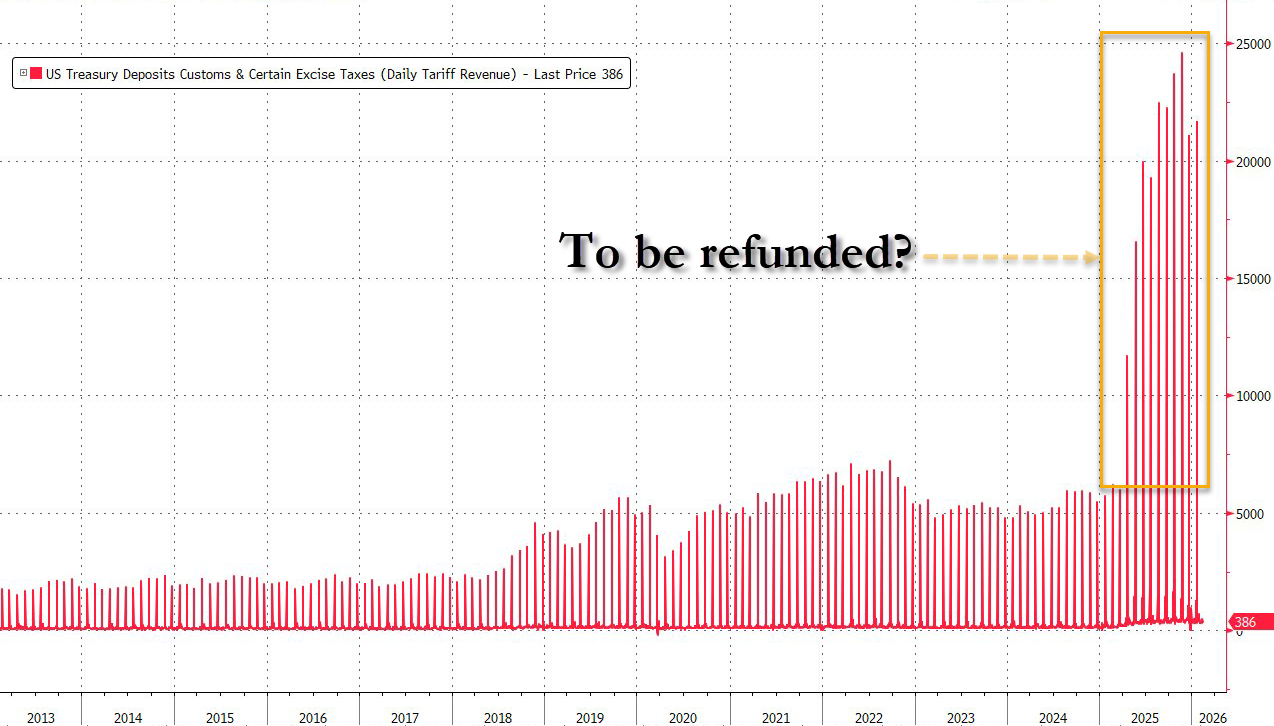
While the majority opinion strikes down Trump’s use of IEEPA, it offers no guidance on restitution, repayment, or whether importers may be entitled to recover duties paid pursuant to tariffs the Court has now deemed unlawful. That omission is likely to shift the next phase of the dispute into the U.S. Court of International Trade, where importers may seek retroactive relief through administrative protests or refund actions.
Justice Kavanaugh’s dissent notes that the process is likely to be a “mess,” warning that “the Court’s decision is likely to generate other serious practical consequences in the near term,” adding “One issue will be refunds.”
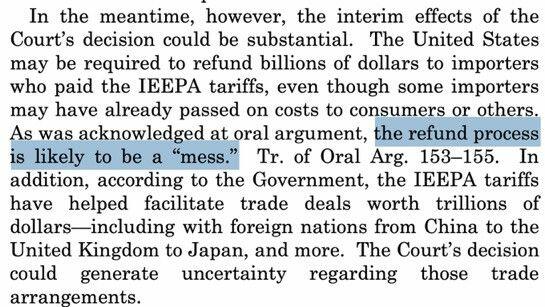
Trump’s administration has not provided tariffs collection data since December 14. But Penn-Wharton Budget Model economists estimated on Friday that the amount collected in Trump’s tariffs based on IEEPA stood at more than $175 billion. And that amount likely would need to be refunded with a Supreme Court ruling against the IEEPA-based tariffs. –Reuters
Any such claims could involve complex questions of sovereign immunity, administrative exhaustion, and the availability of equitable relief – particularly where duties were paid without timely protest. Whether courts ultimately require repayment of unlawfully imposed tariffs may depend not just on the validity of the underlying statute, but on the procedural posture of individual importers and the statutory refund mechanisms available under U.S. customs law.
During arguments on Nov. 5, the court seemed skeptical over Trump’s authority to use IEEPA, leading most observers observers, including betting markets, to conclude a high probability they’re struck down at least in part. The Trump administration is appealing lower court rulings that he overstepped his authority, while Trump himself said a Supreme Court ruling against the tariffs would be a “terrible blow” to the United States.
Other Options
That said, even if that happens, the Trump administration has several other legal avenues they can pursue. As Deutsche Bank noted last month;
For instance, the sectoral tariffs (e.g. on steel and aluminum) aren’t covered by the court ruling, whilst another option would be to use Section 122 of the 1974 Trade Act, which permits temporary 15% tariffs for 150 days.
And Goldman:
This won’t be the end of tariffs… the administration will almost certainly roll out alternative legal frameworks. Net result is probably slightly fewer tariffs, materially more trade uncertainty, and some incremental deficit concerns. Net-net, that’s mildly supportive for equities and mildly negative for bonds… but largely priced for both.
Trump called the ruling a ‘disgrace,’ and told governors at a White House breakfast that he has a ‘backup plan’ in mind, though no details on that.
ZH Premium Members – stay tuned for an in-depth look at these options…
Meanwhile, prediction markets got this one right.
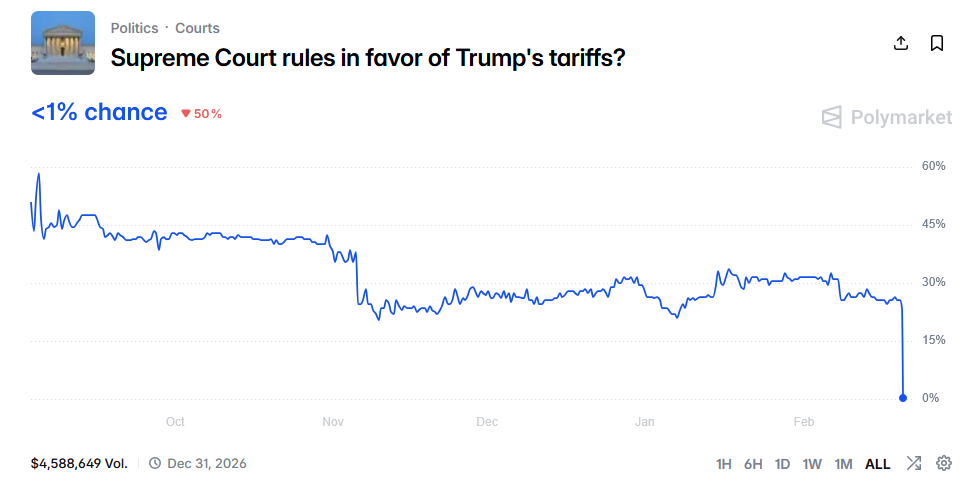
END
MINNESOTA
the legitimate ones get destroyed
(zerohedge)
Amid Minnesota Fraud Scandal, Legitimate Autism Centers Face Closure
Thursday, Feb 19, 2026 – 08:55 PM
Authored by Troy Myers via The Epoch Times (emphasis ours),
A Minnesota autism center for adults and children, which has been operating for more than 20 years, is facing closure in the wake of the massive fraud scandal in the state that dates back more than a decade and involves more than $9 billion of U.S. taxpayer money.

The Holland Center is one of many legitimate centers in the state, which collectively serve thousands of disabled people. Founder, owner, and CEO Jennifer Larson built the Holland Center for her autistic, non-speaking son, who is now 25 years old.
She said she has recently been forced to put hundreds of thousands of her own dollars into keeping the center afloat because the state didn’t pay a single claim for nearly two months.
Because of the payment delays, Larson said autism centers like hers are being forced to reduce hours, cut staff, and close in some instances. Families are scrambling for help, disabled children and adults are regressing, and parents are leaving jobs to care for their disabled loved ones.
Larson told The Epoch Times her facility can’t continue much longer.
“The feds say it’s the state. The state says it’s the feds,” Larson said.
“The kids are going to be the collateral damage.”
The U.S. Department of Health and Human Services paused child care and family assistance funds to Minnesota in early January due to the alleged rampant fraud. The state is appealing.
The Minnesota Department of Human Services told The Epoch Times via email that the federal government’s threat of withholding funds is “not impacting the current payment situation.”
However, Larson’s center accumulated nearly two months of unpaid claims from Dec. 5 to Jan. 29, totaling more than $600,000.

‘Everything Was Flagged’
Beginning in late December 2025, the state began using a new pre-payment review vendor called Optum, which uses artificial intelligence (AI) “at every step” of its claims and reimbursement processes. Minnesota Gov. Tim Walz had announced the contract with the new system in late October 2025.
“They implemented it because of the fraud. Obviously, the state wasn’t catching the fraud in the 300 or 400 centers that popped up in the last three years,” Larson said. She blames the Minnesota government for turning a blind eye to the “crime ring” involving fraud at Somali-run autism centers to an immense scale.
Neither Walz nor his office could be reached for comment during multiple attempts via emails and phone calls.
Now, she said, Optum is causing the delay of claims with few or unclear explanations in the review process.
“The state has failed and lost millions and millions of dollars in the system, so, clearly, the state wasn’t going to be able to tell Optum what to look for because they didn’t know what they were doing,” Larson told The Epoch Times after she recently testified in Congress.
“All of us, for the first round, nobody got anything. Everything was flagged.”
Larson told a House subcommittee hearing on Jan. 21 that her center and numerous others in Minnesota are facing collapse after becoming collateral damage from the massive fraud scandal.
Rep. Tom Tiffany (R-Wis.) asked Larson: “Ms. Larson, none of this would have happened if the fraud did not occur, is that accurate?”
“Yes,” she responded. “What happened in Minnesota had nothing to do with the ethical, longstanding autism providers.”
Larson said in her testimony that the state government’s “clumsy response” to fraud failed to distinguish between criminals and caregivers.
She said abrupt disruption or loss of service can destroy weeks or years of progress for disabled children and adults, causing lifelong consequences.
Payment Process
The Minnesota Department of Human Services told The Epoch Times that it sent the first batch of more than 100,000 claims to Optum for review in late December 2025.
The department said every two weeks, Optum receives batches of claims from the state. The system analyzes and flags any that need further review. Unflagged claims are paid after the initial analysis, the Minnesota Department of Human Services said.
The agency will continue sending payments for unflagged claims on regular two-week cycles. A provider will receive an update every two weeks on a flagged or suspended claim, accompanied by reason codes, the department said.
“If a claim is flagged, we may need additional information and documents from the provider before payments are made, which may cause further delay,” the Minnesota Department of Human Services said. Claims in Optum are listed as suspended until the state reaches a payment decision.
The department did not provide detailed answers on why the Holland Center or other similar, longstanding facilities might have their claims flagged.

The agency said it did not wish to disclose what kind of identifiers cause it to suspect someone is billing for services they did not provide, but officials generally look for “patterns of concern—claims that fall outside expected norms,” some of which could be blamed on administrative errors or poor documentation rather than intentional fraud.
“Optum helps the state of Minnesota identify potential fraud, waste, and abuse by conducting pre‑payment reviews,” the company said in an emailed statement to The Epoch Times. “Optum has no authority to approve, deny, delay, or suspend claims, and payment decisions are made exclusively by [the Minnesota Department of Human Services] and the Office of Inspector General.”
Most claims should be paid within 30 days, and legitimate claims that may have been flagged within 90 days, as required by the federal government, according to the agency.
Financial Hit
Meanwhile, with a payroll of $250,000 every two weeks, Larson has been forced to ask many of her employees to take unpaid leave.
After nearly two months of unpaid claims, her center was partially paid on Jan. 29, bringing the owed amount down to about $300,000, Larson said. She said there’s been little to no word from state or health officials on why her claims were flagged in the first place.
Larson doesn’t expect to get another payment for two weeks, putting her in a several-hundred-thousand-dollar deficit she doesn’t think will ever rebalance.
She’s spent so much of her own money to keep the center’s lights on, Larson said, that she’s been forced to cut back on other bills to make ends meet. Fortunately, Larson said her landlords have been understanding of the situation.
New Centers
Years ago, when Larson witnessed new autism treatment centers popping up around her area and the state, she was initially relieved because, to her, it meant more help was coming for disabled children and adults.
“There’s a need, and there’s a high prevalence of autism in the Somali community in Minnesota,” Larson said. “And I know that and I service a lot of the kids, but we can’t take them all. We’ve always had a waiting list.”
A 2023 study by the University of Minnesota showed autism rates in 4-year-olds to be much higher among Somali children compared to other races and ethnicities. The report found 1 in 18 Somali children had autism, compared to 1 in 64 for white children, 1 in 31 for Hispanic children, and 1 in 30 for non-Somali black children.
But when hundreds of autism centers popped up, it was a red flag for Larson.
“No one wants to talk about it because everyone’s scared of saying anything wrong,” Larson said. “That’s why we’re here. It’s because everyone’s too afraid to say something.”
Independent journalist Nick Shirley, who brought national attention to the alleged Minnesota fraud at day care centers with his viral video posted Dec. 26, 2025, attended the congressional hearing with Larson.
“What we saw in Minnesota is how complicit the government has been in enabling this fraud to happen. Quality ‘Learing’ Center had over 90 violations, yet they continued to give that daycare $1.9 million,” Shirley said in his testimony.
Meanwhile, the closure of Holland Center would dismantle a lifetime of work for Larson that all started with the birth of her son.
Read the rest here…
end
this ought to be fun:
Trump Orders Release Of All Files Related To UFOs & Aliens
Thursday, Feb 19, 2026 – 08:20 PM
Update (2020ET): President Trump has just issued a statement via his social media feed that he will order the release of any and all files related to UFOs and aliens…
“Based on the tremendous interest shown, I will be directing the Secretary of War, and other relevant Departments and Agencies, to begin the process of identifying and releasing Government files related to alien and extraterrestrial life, unidentified aerial phenomena (UAP), and unidentified flying objects (UFOs), and any and all other information connected to these highly complex, but extremely interesting and important, matters.
GOD BLESS AMERICA!
And cue the crazy…
* * *
Documentary filmmaker Dan Farah appeared on Joe Rogan’s podcast in November to promote his new documentary, The Age of Disclosure, and predicted that his film might force Trump to become the first world leader to confirm the existence of extraterrestrial life publicly.
“I wouldn’t be surprised if it happens soon after the film comes out — the sitting president has to step to the microphone and say: humanity is not alone in the universe,” Farah told Rogan. “We have recovered technology of non-human origin. So have other nations. There is a high-stakes, secret cold war race to reverse engineer this technology. We need to win this race.”
“I think Trump might be the only guy that’s willing to do something that crazy,” Rogan replied.
Well, now Lara Trump, the president’s daughter-in-law, let it slip during an appearance on the New York Post’s Pod Force One podcast that Trump has a speech prepared confirming extraterrestrial life exists.
“Do you think that he’s about to make an announcement about UFOs?” host Miranda Devine asked.
“Because President Obama was just on a podcast talking about how he believes in UFOs and hinting that he saw something when he was president.”
“Well, I said this in my podcast, too,” Lara Trump began.
“What’s funny is we’ve kind of asked my father-in-law about this, ’cause we’re like, ‘Well, what do you know?’ ‘Cause, Miranda, we all wanna know about the UFOs, or we all wanna know what’s going on and he played a little coy with us. And so that, of course, led us to believe, Eric and I, were like, ‘Oh, my gosh, if he won’t even, like, fully tell us, maybe there’s more to it.’ And then I have just heard kind of around that… I think he’s actually said it, I think my father-in-law has actually said it, that there is some speech that he has that, I guess, at, at the right time, and I don’t know when the right time is, he’s gonna break out and, and talk about, and it has to do with maybe some sort of extraterrestrial life, so to speak.”
The White House offered exactly the kind of answer you’d expect.
“I’ll have to check in with our speech writing team,” White House Press Secretary Karoline said.
”That would be of great interest to me personally, and I’m sure all of you in this room and apparently former President Obama, too.”
A clip from Obama’s recent appearance on Brian Tyler Cohen’s podcast went viral over the weekend after he was asked point-blank whether aliens exist.
“They’re real, but I haven’t seen them, and they’re not being kept in … Area 51 … There’s no underground facility, unless there’s this enormous conspiracy and they hid it from the president of the United States,” Obama said.
By Sunday, Obama was on Instagram trying to walk it back.
“Statistically, the universe is so vast that the odds are good there’s life out there. But the distances between solar systems are so great that the chances aliens have visited us is low, and I saw no evidence during my presidency that extraterrestrials have made contact with us. Really!” Obama wrote.https://www.instagram.com/reel/DUy9E_UD9RR/embed/?cr=1&v=14&wp=820&rd=https%3A%2F%2Fwww.zerohedge.com&rp=%2Fpolitical%2Ftrump-has-ufo-speech-ready-deliver#%7B%22ci%22%3A0%2C%22os%22%3A860.4000000953674%2C%22ls%22%3A677.8000001907349%2C%22le%22%3A850%7D
Washington’s relationship with UFOs — or, in the preferred bureaucratic phrasing, Unidentified Anomalous Phenomena (UAPs) — has shifted considerably in recent years. A House hearing in July 2023 featured testimony from former military intelligence officer David Grusch, who told lawmakers under oath that he “was informed in the course of my official duties of a multi-decade UAP crash retrieval and reverse-engineering program to which I was denied access.” Grusch further alleged the government had retrieved what he called “non-human biologics” from recovered craft, citing accounts from dozens of witnesses he interviewed over four years.
The Pentagon, of course, pushed back. A March 2024 report rejected the core claims — no reverse-engineered alien spacecraft, no hidden extraterrestrial biological material, no off-world technology stashed in some classified warehouse. The agency stood by its denials even as lawmakers held classified briefings.
Lara Trump’s comment adds new intrigue to the discussion. Whether Trump eventually delivers that address — or whether this is one more piece of carefully managed intrigue from a president who has never met a story he didn’t know how to control — is a question that, for now, has no answer. But Trump sure does seem like the president who would do so.
end
The Government Just Erased 69% of 2025’s Jobs

by Phoenix Capital Research
Thursday, Feb 19, 2026 – 8:53
It’s increasingly difficult to piece together the true state of the economy.
I’ve raged about the quality of economic data in this country for years. At this point things have become farcical: the official jobs data is so inaccurate that every year the Bureau of Labor Statistics (BLS) has to revise the prior year’s jobs numbers.
Bear in mind, this is after every month is already revised two times.
Yes, despite two monthly revisions for every month, the jobs numbers for the entire year still have to be revised a final time to bring things closer to reality. But by that point, no one is paying attention anymore.
To be clear, we are not talking about small revisions, either. The latest BLS revision just erased 69% of the total numbers for 2025.
No, that is not a typo. 69%.
Initially, the BLS estimated that 584,000 jobs were added in 2025, but after reconciling survey data with more accurate administrative records from the Quarterly Census of Employment and Wages (QCEW), that figure was revised down to just 181,000 jobs—a reduction of 69%.
What’s insane about all of this is that trillions of dollars in capital were allocated based on the original, completely inaccurate, jobs numbers! Throughout 2025, the stock market caught a major bid every month when the BLS released the jobs data based on the assumption that the economy and jobs market were growing rapidly.
We now know that was NOT the case. More than two thirds of those jobs weren’t even real jobs. They were gimmicks created in a government bean counter’s spreadsheet.
Which raises the question…
Has the stock market finally figured out that the economy is NOT nearly as strong as the official (completely inaccurate) jobs data claimed?
The S&P 500 has gone nowhere for three months now.

Even more concerning is the fact that Big Tech, which has led the market since the April lows 2025, is collapsing.

What does Big Tech know that the rest of the market hasn’t figured out yet?
My proprietary crash indicator knows.
This signal went off before the 1987 crash, the Tech Crash, the Great Financial Crisis and more.
We detail this trigger, how it works, and what it’s saying about the markets today in How to Predict a Crash.
Normally we’d sell this report for $499, but in light of its recent warning (the first since the tariff tantrum), we’re making 99 copies available to the investing public.
To pick up one of the last copies…
VICTOR DAVIS HANSON
KING NEWS
| The King Report February 20, 2026 Issue 7684 | Independent View of the News |
| Just 1 day after Trump bragged that the US trade deficit had fallen 78%, The US Commerce Department reported that the US Trade Deficit for December jumped to $70.3B from $53.0B; $55.5B was consensus. December Imports increased 3.6%; 0.1% was consensus. Exports fell 1.7%; +0.1% was expected. U.S. trade deficit totaled $901 billion in 2025 despite Trump’s tariffs For the full year, the U.S. ran a $901.5 billion trade deficit, actually down slightly from 2024 but only by 0.2%, or $2.1 billion… The U.S. had its largest goods deficit with the European Union, at $218.8 billion, followed by China ($202.1 billion) and Mexico ($196.9 billion). Exports for 2025 totaled $3.43 trillion for all of 2025, up $199.8 billion from 2024. Imports also rose, totaling $4.33 trillion, an increase of $197.8 billion… https://www.cnbc.com/2026/02/19/us-trade-deficit-totaled-901-billion-in-2025-despite-trumps-tariffs.html Trump on Wednesday: “The United States trade deficit has been reduced by 78% because of the tariffs being charged to other companies and countries. It will go into positive territory during this year, for the first time in many decades. Thank you for your attention to this matter!” Walmart Cites Worrying Economic Indicators in Cautious Forecast – BBG Walmart cited a “hiring recession” and pressures on shoppers as it forecast less growth in earnings next year… (Q4 EPS .74, .73 exp; sees Q1 EPS .63 to .65 and net sales increase of 3.5% to 4.5%) WMT initially rallied to 130.10 (+3.48) but sank to 124.48 (-2.14) at 15:35 ET. ESHs vacillated between small gains and losses from the Nikkei opening until they broke higher after the 1:00 ET Nikkei close. After marching to a daily high of 6912.50 (+18.25) at 3:20 ET, ESHs sank to 6866.25 (-28.00) at 5:36 ET. After a rebound to 6886.25 at 7:25 ET, ESHs did an A-B-C decline to a daily low of 6857.00 (-37.25) at 9:34 ET. Conditioned pro and guppy trader buying shot ESHs to 6894.50 at 10:02 ET. After a retreat to 6869.75 at 10:27 ET, ESHs traded in a 12-handle range until they broke lower at 11:46 ET. ESHs fell to a new daily low of 6847.75 at 13:20 ET and then did an A-B-C rally, with a late manipulation, to 689.75 at 16:00 ET. @TheChiefNerd: NYC Mayor Zohran Mamdani: “We will spend every day looking towards working with Albany to increase taxes on the wealthiest, and the most profitable corporations.” https://x.com/TheChiefNerd/status/2024253859921588560 (NY) City-run board cancels lease of Israel drone supplier, sparking backlash toward Mamdani: ‘Ludicrous’ https://t.co/mzJINyemmB 15-Minute Deep Dive into the Data Center Cooling Revolution: From Chillers to Liquid Cooling The rapid rise of AI servers and high-performance computing (HPC) has pushed data center cooling requirements to an unprecedented level. The latest generation of AI chips—such as NVIDIA’s H100 and Grace Hopper—now carry thermal design power (TDP) ratings that often reach several kilowatts, far beyond what traditional air-cooling systems can effectively handle… As heat density continues to increase at an exponential pace, server cooling methods based primarily on fan-driven air convection are steadily approaching their physical limits. In short, high-power AI chips are triggering a new wave of cooling transformation in data centers, making conventional air-cooling architectures unsustainable and positioning liquid cooling as an inevitable solution for high-power servers… https://tspasemiconductor.substack.com/p/15-minute-deep-dive-into-the-data Positive aspects of previous session Precious metals and Fangs declined modestly (while equities fell smartly). Negative aspects of previous session US stocks declined smartly. ESHs peaked just after the 3 ET European opening. Ambiguous aspects of previous session Has the S&P 500 Index formed a massive top? First Hour/Last Hour NYSE Action [S&P 500 Index]: 1st Hour: Up; Last Hour: Up Pivot Point for S&P 500 Index [above/below indicates daily trend to traders]: 6858.03 Previous session S&P 500 Index High/Low: 6879.12; 6833.06 The White House: PROMOTING THE NATIONAL DEFENSE BY ENSURING AN ADEQUATE SUPPLY OF ELEMENTAL PHOSPHORUS AND GLYPHOSATE-BASED HERBICIDES https://www.whitehouse.gov/presidential-actions/2026/02/promoting-the-national-defense-by-ensuring-an-adequate-supply-of-elemental-phosphorus-and-glyphosate-based-herbicides/ @RobertKennedyJr: The herbicide Glyphosate is one of the likely culprits in America’s chronic disease epidemic. Much more widely used here than in Europe. Shockingly, much of our exposure comes from its use as a desiccant on wheat, not as an herbicide. From there it goes straight into our bodies. My USDA will ban that practice. Jun 14, 2024 @RenzTom: Donald Trump bypasses Congress by attempting to provide immunity to cancer-causing glyphosate manufacturers!!! Glyphosate causes cancer according to several court rulings. In a gift to the big pharma/big ag industry, Trump has just tried to unilaterally block state laws and court rulings that allow liability for cancer from glyphosate manufacturers. Glyphosate is found in Roundup, which is produced by a subsidiary of Bayer Pharma. MAHA has been fighting with Congress for months to prevent them from inserting chemical immunity into various bills. When the GOP failed to deliver, Trump stepped in and did it for them. @HealthRanger: Trump just declared, “glyphosate-based herbicides are a cornerstone of this Nation’s agricultural productivity and rural economy.” And he’s declaring glyphosate weedkiller to be a federally-protected critical resources… Trump’s new Operation Warp Speed. But this time, you won’t be able to opt out because everybody buys food. @GlyphosateGirl: Just as the large MAHA base begins to consider what to do at midterms, the President issues an EO to expand domestic glyphosate production. The very same carcinogenic pesticide that MAHA (Make America Healthy Again, |RFK Jr’s faction) cares about most. WSJ: Private-Credit Warning Signs Flash After Blue Owl Sells $1.4 Billion in Assets The sale raises fears that the industry’s efforts to court individual investors will suffer. Blue Owl Limits Investor Withdrawals, Stirring Private Credit Concerns … raised fresh concern over the risks bubbling under the surface of the $1.8 trillion market. Shares of the alternative asset manager fell about 10% on Thursday to their lowest level in two and a half years. https://finance.yahoo.com/news/blue-owl-drops-redemption-halt-161437668.html Fed Balance Sheet: -$8.987B on T-Bills +$8.011B; Reserves +$10.247B Today – The SCOTUS is expected to issue its tariff ruling. Stocks declined in trading on trepidation over the reaction to the SCOTUS ruling against Trump’s tariffs and reports that the US is about to initiate a multiple-week assault on Iran. Some traders will play for the Friday Rally, no matter what. ESHs are +12.75, NQAs are +56.00; USHs are +7/32; while SI and AU are up modestly at 20:30 ET. Expected Econ Data: Dec Personal Income 0.3% m/m, Spending 0.3%, PCE Price Index 0.3% m/m & 2.8% y/y, Core PCE Price Index 0.3% m/m & 2.9% y/y; Q4 GDP 3.0%, Consumption 2.4%, GDP Price Index 2.8%, Core PCE Price Index 2.6% q/q; Feb S&P Global US Mfg. PMI 52.3, Services 53, Comp 53; Dec New Home Sales 730k; Feb UM Sentiment 57.2, Current Conditions 57, Expectations 56.5, 1-yr Inflation 3.5%, 5-10-yr Inflation 3.4% Fed Speakers: Atlanta Pres Bostic 9:45 ET, Dallas Pres Logan 12:45 ET S&P Index 50-day MA: 6895; 100-day MA: 6820; 150-day MA: 6697; 200-day MA: 6523 DJIA 50-day MA: 48,962;100-day MA: 47,931; 150-day MA: 46,991; 200-day MA: 45,947 (Green is positive slope; Red is negative slope) S&P 500 Index (6861.89 close) – BBG trading model Trender and MACD for key time frames Monthly: Trender and MACD are positive – a close below 5896.83 triggers a sell signal Weekly: Trender is positive; MACD is negative – a close below 6443.43 triggers a sell signal Daily: Trender and MACD are negative – a close above 6966.44 triggers a buy signal Hourly: Trender is negative; MACD is positive – a close above 6873.74 triggers a buy signal King Charles III’s younger brother Andrew arrested by British police in Epstein-related probe The arrest came after files released by the U.S. Justice Department suggested Andrew shared confidential British government information with Epstein and others when he worked as a British trade envoy. https://justthenews.com/accountability/political-ethics/king-charles-iiis-younger-brother-andrew-arrested-british-police Le Monde: Epstein files hand French prosecutors trove of new leads – The Paris prosecutor’s office opened two investigations on Wednesday: one into ‘human trafficking’ and the other regarding ‘financial offenses such as money laundering, breaches of probity, or tax fraud.’ https://www.lemonde.fr/en/france/article/2026/02/19/epstein-files-hand-french-prosecutors-trove-of-new-leads_6750639_7.html Epstein Ally Was Talking to Feds About Flip, Wanted $3 Million to Keep Quiet, Then Backed Off Deal – French modeling agent Jean-Luc Brunel – whose network delivered new girls from around the world to Jeffrey Epstein on a regular basis, was prepared in 2016 to tell U.S. prosecutors what he knew about Epstein’s sex-trafficking operation… https://www.zerohedge.com/political/epstein-ally-was-talking-feds-about-flip-wanted-3-million-keep-quiet-then-backed-deal @JustTheNews: “One out of every five commercial driver’s licenses that Illinois gave…were illegally issued…They did not meet the standards, the training, the English proficiency.” @jsolomonreports discusses Secretary Duffy’s bombshell announcing approximately 20% of all commercial driver’s licenses were illegally issued by Illinois. https://x.com/JustTheNews/status/2024284738089816290 @FCNightingale: Chicago Office Vacancy 26.9% Vacancy Rate +320 bps YOY Direct Vacant 35,815,387 SF Sublet Vacant 2,435,752 SF – Net absorption remained negative for the ninth consecutive quarter, totaling negative 5.2M SF for the year. Central Loop 29.4% East Loop 32.9% Fulton Market 14.8% North Michigan Ave 23.9% River North 32% West Loop 23.3% -Cushman and Wakefield @ACTBrigitte: Detroit Police Chief Todd Bettison announced plans to fire a police officer and a sergeant who contacted federal immigration agents during separate traffic stops. Firing police officers for doing a good job?! https://x.com/ACTBrigitte/status/2024294861487116535 Chicken might not be healthier than beef, new study suggests https://trib.al/FQovY37 @SamaHoole Compared to chicken, beef has… 78% less Omega 6 (causes inflammation) 125% more Creatine 233% more Carnitine 2275% more Carnosine 160% more Iron 500% more Zinc 285% more Taurine 500% more CLA 1400% more K2 733% more B12 The Importance of Maintaining a Low Omega-6/Omega-3 Ratio for Reducing the Risk of Autoimmune Diseases, Asthma, and Allergies – the typical Western diet now provides an omega-6/3 ratio of approximately 20:1 in favor of omega-6. This predisposes to supraphysiologic inflammatory responses and perpetuates chronic low-grade inflammation. The overconsumption of linoleic acid, mainly from industrial omega-6 seed oils, and the lack of long-chain omega-3s in the diet creates a pro-inflammatory, pro-allergic, pro-thrombotic state… https://pmc.ncbi.nlm.nih.gov/articles/PMC8504498/ Trump mocks AOC for ‘career-ending’ Munich performance https://t.co/9el2nWNVoD Hollywood legend Steven Spielberg becomes latest billionaire to ditch California ahead of proposed wealth tax – The director recently purchased a home in the iconic San Remo co-op in New York City overlooking Central Park… (What will Steve do when Mamdani taxes the rich?) https://www.dailymail.co.uk/news/article-15574969/steven-spielberg-mark-zuckerberg-calfornia-billionaire-tax.html @realDonaldTrump on Thursday night: Based on the tremendous interest shown, I will be directing the Secretary of War, and other relevant Departments and Agencies, to begin the process of identifying and releasing Government files related to alien and extraterrestrial life, unidentified aerial phenomena (UAP), and unidentified flying objects (UFOs), and any and all other information connected to these highly complex, but extremely interesting and important, matters… (The acute interest in the Epstein Files is not going away, even with ET fanfare, DJT!) | |
SWAMP STORIES FOR YOU TONIGHT
wow!! they are breaking the law by hiding transparency. And the government paid Twitter pre Musk (Biden era)
(zerohedge0
Boasberg Rubber-Stamps DOJ Request To Keep FBI-Twitter Payments Secret
Thursday, Feb 19, 2026 – 06:50 PM
When the Twitter files hit in December of 2022, they revealed that the Biden administration had paid Twitter at least $3.4 million between October 2019 and February 2021 to reimburse the pre-Musk, left-leaning social media giant for a flood of requests.
During this period, the Biden DOJ was going after vaccine skeptics, lab-leak proponents, 2020 election ‘deniers,’ Catholic parents, Hunter Biden laptop / Burisma content, and conservative news outlets. We also learned that the FBI’s Elvis Chan and crew were holding weekly meeting with Twitter on “misinformation,” and flagged thousands of accounts for the above.
Days after the Twitter files were released, watchdog group Judicial Watch sued the Biden DOJ, which oversees the FBI, over a FOIA request demanding to know how much the FBI paid Twitter from 2016 onward. The FBI initially refused, but eventually released 44-pages of documents with the key payment details redacted – claiming the data was protected under FOIA’s “Exemption 7(E),” which lets agencies hide info about law enforcement methods if releasing it could help criminals or enemies dodge detection.
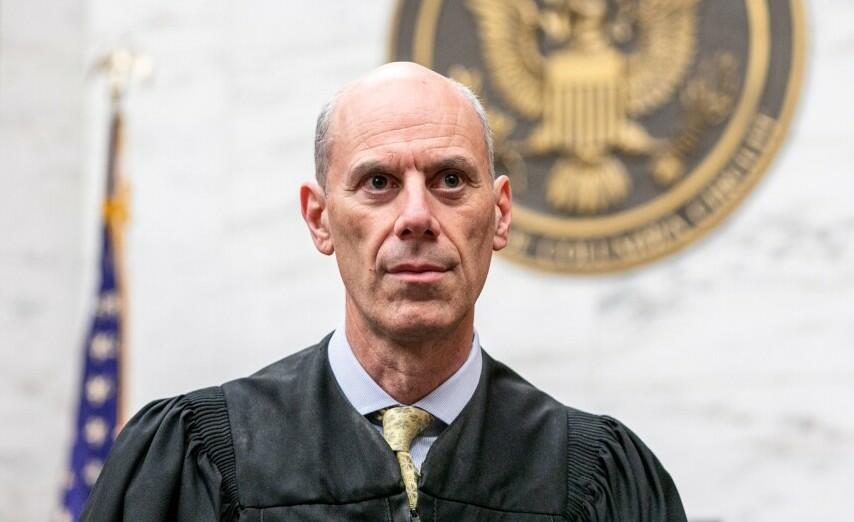
Judicial Watch then narrowed their claims to just those redacted payment amounts (JW dropped other issues such as vendor names), however in December of 2025, the Trump DOJ asked Judge James Boasberg for a Motion for Summary Judgement to deny Judicial Watch’s request – effectively concealing the extent to which the FBI, under Trump and Biden, was going after Americans.
In its request for summary judgement, US Attorney Jeanine Pirro’s office (say it ain’t so!) argued that revealing payments that are tied to real investigations could reveal super secret investigative methods – such as how much the FBI is “engaging” with Twitter vs. other platforms, which could lead to ‘bad guys’ (criminals, hackers, foreign spies) to switch to platforms with less FBI activity, and that it might reveal shifts in FBI priorities over time.
Revealing the quarterly totals could also betray “mosaic theory,” where seemingly harmless info (like one quarter’s payment) can be pieced together with public data (e.g., Twitter’s transparency reports) to form a big picture of FBI strategies.
Earlier this month, Boasberg agreed – ruling that revealing the payments could expose FBI “techniques and procedures” (how they monitor online threats) and help bad actors figure out what the FBI is focused on, allowing them to adapt and change strategies.
Boasberg wrote in his opinion that the 7(E) exemption is valid because it could “risk circumvention of the law.”
What the actual…
Maybe Elon can just give Tom Fitton the deets?
The filings for your reading pleasure…
GREG HUNTER…
SEE YOU ON MONDAY..


 harveyorganblog.com


