
GOLD CLOSED CLOSED UP $77.25 TO $5149.50
ACCESS MARKET
GOLD $5157.50 3:30 PM)
SILVER: 83.95 3;30 PM)

EXCHANGE: COMEX
EXCHANGE: COMEX
CONTRACT: MARCH 2026 COMEX 100 GOLD FUTURES
SETTLEMENT: 5,065.300000000 USD
INTENT DATE: 03/05/2026 DELIVERY DATE: 03/09/2026
FIRM ORG FIRM NAME ISSUED STOPPED
323 H HSBC 5
363 H WELLS FARGO SECURITI 516
555 C BNP PARIBAS SEC CORP 24
624 H BOFA SECURITIES 543
661 C JP MORGAN SECURITIES 94
709 C BARCLAYS 150
TOTAL: 666 666
MONTH TO DATE: 4,791
JPMORGAN STOPPED 94/666
GOLD: NUMBER OF NOTICES FILED FOR MARCH/2026: 666 CONTRACTs NOTICES FOR 66,600 OZ or 2.0715 TONNES
total notices so far: 4791 contracts for 479,100 OR 14.902 tonnes)
SILVER NOTICES: 511 NOTICE(S) FILED FOR 2.555 MILLION OZ /
total number of notices filed so far this month : 6466 CONTRACTS (NOTICES) for 32.330 million oz
SILVER//OUTLINE
INITIAL STANDING FOR JANUARY: 22.915 MILLION OZ FOLLOWED BY TODAY’S 1.185 MILLION OZ QUEUE JUMP//NEW NORMAL STANDING ADVANCES TO 49.445 MILLION OZ// TO WHICH WE ADD OUR FIRST EXCHANGE FOR RISK FOR .100 MILLION OZ//NEW STANDING ADVANCES TO 49.545 MILLION OZ!!
INTIAL STANDING FOR FEBRUARY/SILVER: 13.505 MILLION OZ FOLLOWED BY TODAY’S HUGE 0.005 MILLION OZ QUEUE JUMP / : NEW STANDING FOR SILVER AT THE COMEX ADVANCES TO 25.180 MILLION OZ. BUT WE MUST ADD OUR FIRST EXCHANGE FOR RISK OF 25 CONTRACTS FOR .125 MILLION OZ AND THEN OUR SECOND EXCHANGE FOR RISK OF .0600 MILLION OZ TO OUR THIRD HUGE 2.825 MILLION OZ EXCHANGE FOR RISK!!
INITIAL STANDING FOR MARCH: A SURPRISINGLY LOW 31.076 MILLION OZ/ FOLLOWED BY A HUGE QUEUE JUMP OF 423 CONTRACTS OR A HUGE 2.115 MILLION OZ/NEW STANDING ADVANCES TO 38.010 MILLION OZ
JULY: 50.925 MILLION OZ (QUITE SMALL)
AUGUST: 59.455 MILLION OZ (QUITE SMALL)
SEPT. 50.510 MILLION OZ.(QUITE SMALL)
OCT; 82.020 MILLION OZ (WILL BE STRONG THIS MONTH)/ OCC WANTS TO REIN IN THESE ISSUANCES!
NOVEMBER: 36.425 MILLION OZ
DEC: 45.765 MILLION OZ
JANUARY 2026: 134.270 MILLION OZ (WILL BE A VERY STRONG MONTH FOR EXCHANGE FOR PHYSICAL!)
FEB : 82.130 MILLION OZ
MARCH: 20.535 MILLION OZ
AND JULY: 46.720 MILLION OZ//
AUGUST: 4.70 MILLION OZ INITIAL STANDING PLUS TODAY;S 5,000 OZ QUEUE JUMP //NEW STANDING ADVANCES TO 10.960 MILLION OZ
SEPTEMBER: 68.040 MILLION OZ NORMAL DELIVERY(INCLUDES ALL QUEUE JUMPING AND EXCHANGE FOR PHYSICAL TRANSFERS) PLUS 3.0 MILLION OZ EX FOR RISK = 71.040 MILLION OZ. (THIS IS THE FIRST AND ONLY ISSUANCE OF EXCHANGE FOR RISK FOR SILVER SINCE MAY.)
OCTOBER: 39.565 MILLION OZ OF NORMAL DELIVERY INCLUDES ALL QUEUE JUMPING
PLUS
2.110 MILLION OZ EXCHANGE FOR RISK//TOTAL OZ STANDING IN OCT ADVAN
NOVEMBER: INITIAL STANDING AT 11.575 MILLION OZ FOLLOWED BY TODAY’S 195,000 OZ QUEUE JUMP WHICH FOLLOWS ALL OTHER QUEUE JUMPS OF 9.155 MILLION OZ//STANDING ADVANCES TO 19.670 MILLION OZ/
DECEMBER: INITIAL AMOUNT STANDING FOR DELIVERY: 49.33 MILLION OZ// FOLLOWED BY ANOTHER STRONG 835,000OZ QUEUE JUMP+ DEC. FIRST EXCHANGE FOR RISK 0F .850 MILLION OZ + LAST WEEK.S 495,000 OZ EXCHANGE FOR RISK AND THEN A 3RD ISSUANCE IF 1.00MILLION OZ THEN FINALLY DEC 249ISSUANCE OF 1.35 MILLION OZ EXCHANGE FOR RISK//NEW TOTAL EX FOR RIS IS 3.685 MILLION OZ // STANDING ADVANCES TO 68.415 MILLION OZ//
JANUARY: INITIAL STANDING 22.915 MILLION OZ FOLLOWED BY TODAY’S 1.185 MILLION OZ QUEUE JUMP//NORMAL STANDING ADVANCES TO 49.445 MILLION OZ// TO WHICH WE ADD OUR FIRST EXCHANGE FOR RISK OF 0.100 MILLLION OZ//NEW STANDING ADVANCES TO 49.545 MILLION OZ
FEB: 13.399 MILLION OZ IS OUR INITIAL STANDING FOR SILVER! TO WHICH WE ADD OUR NEXT QUEUE JUMP FOR 5,000 OZ AND THEN ADD OUR 3 EXCHANGE FOR RISK FOR 3.010 MILLION OZ STANDING ADVANCES TO 28.190 MILLION OZ!!
MARCH: INITIAL AMOUNT OF ISLVER STANDING IS 31.076 MILLION OZ FOLLOWED BY TODAY’S 2/115 MILLION OZ QUEUE JUMP//NEW TOTAL STANDING ADVANCES TO 38.010 MILLION OZ
- MAY: SUMMARY FOR MAY TONNES WHICH STOOD FOR DELIVERY:
4. AUGUST: 60.547 TONNES OF INITIAL GOLD FIRST DAY NOTICE FOLLOWED BY THE NET MONTH’S QUEUE JUMP OF 47.2312 TONNES TO WHICH WE ADD THE FOLLOWING EXCHANGE FOR RISK ISSUANCE RECEIVED FOR THE MONTH: 5.4432 TONNES EX FOR RISK/AUG 7 , AUG 11: 2.413 TONNES EX FOR RISK AND AUG. 12 OF 2.637 TONNES EX FOR RISK//AUG 25: 9.107 TONNES , AUGUST 26: 9.1010 TONNES AND NOW AUGUST 27: 9.0699 TONNES//NEW STANDING ADVANCES TO 107.5117 TONNES OF GOLD NORMAL STANDING (INCLUDES ALL MONTHLY QUEUE JUMPS/EX FOR PHYSICAL TRANSFERS//) +44.696 TONNES EX.FOR RISK = 152.208 TONNES
5.SEPT: INITIAL 8.093 TONNES OF GOLD PLUS TODAY’S QUEUE JUMP OF 0.4883 TONNES PLUS 2.2827 TONNES OF EXCHANGE FOR RISK TODAY//NEW TOTAL EX. FOR RISK/MONTH = 22.923//NEW TOTAL STANDING FOR GOLD SEPT ADVANCES TO = 48.801 TONNES!!
6.OCTOBER: 90.012 TONNES OF INITIAL GOLD STANDING WITH TODAY’S TINY 0.00311 TONNES QUEUE JUMP WHICH FOLLOWS ALL OTHER QUEUE JUMPS DURING OCT OF 76.1656 TONNES
THEN WE MUST ADD OUR 14.553 TONNES OF OUR ISSUANCE OF EXCHANGE FOR RISK/6 OCCASIONS//NEW TOTAL OF GOLD STANDING ADVANCES TO 197.5141 TONNES OF GOLD.
7.NOVEMBER BEGINS WITH 15.651 TONNES INITIALLY STANDING FOR DELIVERY FOLLOWED BY TODAY’S QUEUE JUMP OF 2.323 TONNES FOLLOWED BY ALL PREVIOUS QUEUE JUMPS IN OF OF 21.3775 TONNES TO WHICH WE ADD OUR TWO EXCHANGE FOR RISK ISSUANCE OF 4.5596 TONNES//NEW STANDING ADVANCES TO 43.9716 TONNES OF GOLD.
8. DECEMBER BEGINS WITH INITIAL STANDING OF 83.813 TONNES OF GOLD FOLLOWED BY TODAY’S 0.0TONNE QUEUE JUMP WHICH FOLLOWS ALL OTHER QUEUE JUMPS OF: 37.163 TONNES//NEW STANDING ADVANCES TO 115.390 TONNES TO WHICH WE ADD OUR 4 EXCHANGE FOR RISK FOR DECEMBER OF 6.587 TONNES/NEW STANDING ADVANCES TO 121.977 TONNES
9. JANUARY: INITITAL STANDING: 13.785 TONNES TO WHICH WE ADD OUR FIRST EXCHANGE FOR PHYSICAL TRANSFER OF 0.08709 TONNES WHICH FOLLOWS ALL OTHER QUEUE JUMPS OF 30.7117TONNES //NEW TOTAL QUEUE JUMPS 30.7117//NORMAL DELIVERY OF GOLD ADVANCES TO 36.8958 TONNES TO WHICH WE ADD OUR SIX EXCHANGE FOR RISK OF 22.315 TONNES//NEW STANDING ADVANCES TO 59.2108 TONNES.
FEB; INITIAL AMOUNT OF GOLD STANDING FOR DELIVERY: 93.567 TONNES OF GOLD TO WHICH WE ADD OUR NEXT 0.0248 TONNES 0.1555 TONNES QUEUE JUMP TO 41.2082 TONNES/ NEW NET QUEUE JUMP INCREASES TO 41.233 TONNES// AND THEN WE ADD OUR SIX EXCHANGE FOR RISK: 10,080 CONTRACTS OR 31.251 TONNES//NEW STANDING REDUCES TO 157.878 TONNES
MARCH:: INITIAL AMOUNT OF GOLD STANDING FOR DELIVERY: 8.099 TONNES FOLLOWED BY TODAY’S 3.017 TONNES QUEUE JUMP//NEW STANDING ADVANCES TO 16.5007 TONNES/
MARCH:: SMALL INITIAL STANDING FOR GOLD FOR MARCH AT 8.099 TONNES FOLLOWED BY TODAY’S 3.017 TONNES QUEUE JUMP//NEW STANDING ADVANCES TO 16.5007 TONNES OF GOLD./
FINAL STANDING FOR GOLD, JANUARY CONTRACT AT 59.2108 TONNES OF GOLD
FEBRUARY: INITIAL STANDING FOR GOLD: 157.878 TONNES!! WHICH INCLUDES ALL QUEUE JUMPING, THREE EXCHANGE FOR PHYSICAL TRANSFERS TO LONDON AND OUR SIX ISSUANCES EXCHANGE FOR RISK!!
MARCH: INITIAL STANDING AT 8.099 TONNES FOLLOWED BY TODAY’S 3.017 TONNES QUEUE JUMP //NEW STANDING ADVANCES TO 16.5007 TONNES/
JAN. 2025: 257.919 TONNES (ISSUANCE WILL BE PRETTY GOOD THIS MONTH BUT MUCH LOWER THAN LAST MONTH)
FEB: 207.21 TONNES//EX FOR PHYSICAL ISSUANCE (WILL BE A FAIR SIZED ISSUANCE THIS MONTH)
MARCH 130.84 TONNES//QUITE SMALL THIS MONTH.
APRIL; 208.57 TONNES. STRONG THIS MONTH
MAY: 113.499 TONNES OF GOLD EFP ISSUANCE//QUITE SMALL THIS MONTH
JUNE: 97.79 TONNES OF GOLD EFP ISSUANCE/EXTREMELY SMALL
JULY : 150.877 TONNES// QUITE SMALL
AUGUST: 175.86 TONNES A LOT LARGER THIS MONTH.
SEPT. 116.13 TONNES VERY SMALL
OCT. 252.72 TONNES//CERTAINLY MUCH LARGER THIS MONTH/VERY STRONG
NOV: 124.74 TONNES
DEC: 190.04 TONNES//GOOD SIZED THIS MONTH FINAL.
TOTAL EXCHANGE FOR PHYSICAL ISSUED FOR YEAR 2025: 2,026.20 TONNES (LOWER THAN LAST YR 2,569.00 TONNES
JANUARY: 209.08 TONNES ( (WILL BE A STRONG MONTH FOR EXCHANGE FOR PHYSICAL)
FEB. 176.35 TONNES (WHICH IS A FAIR ISSUANCE)
MARCH: 80.93 TONNES//WILL BE VERY STRONG ISSUANCE THIS MONTH
XXXXXXXXXXXXXXXXXXXXXXXXXXXXXXXXXXXXXXXXXX
SPREADERS:
HERE IS A BRIEF SYNOPSIS OF HOW THE CROOKS FLEECE UNSUSPECTING LONGS IN THE SPREADING ENDEAVOUR ;MODUS OPERANDI OF THE CORRUPT BANKERS AS TO HOW THEY HANDLE THEIR SPREAD
YOU WILL ALSO NOTICE THAT THE COMEX OPEN INTEREST STARTS TO RISE BUT SO IS THE OPEN INTEREST OF SPREADERS. THE OPEN INTEREST IN WILL CONTINUE TO RISE UNTIL ONE WEEK BEFORE FIRST DAY NOTICE OF AN UPCOMING ACTIVE DELIVERY MONTH (OCT), AND THAT IS WHEN THE CROOKS SELL THEIR SPREAD POSITIONS BUT NOT AT THE SAME TIME OF THE DAY. THEY WILL USE THE SELL SIDE OF THE EQUATION TO CREATE THE CASCADE (ALONG WITH THEIR COLLUSIVE FRIENDS) AND THEN COVER ON THE BUY SIDE OF THE SPREAD SITUATION AT THE END OF THE DAY. THEY DO THIS TO AVOID POSITION LIMIT DETECTION. THE LIQUIDATION OF THE SPREADING FORMATION CONTINUES FOR EXACTLY ONE WEEK AND ENDS ON FIRST DAY NOTICE.”
WHAT IS ALARMING TO ME, ACCORDING TO OUR LONDON EXPERT ANDREW MAGUIRE IS THAT THESE EFP’S ARE BEING TRANSFERRED TO WHAT ARE CALLED SERIAL FORWARD CONTRACT OBLIGATIONS AND THESE CONTRACTS ARE LESS THAN 14 DAYS. ANYTHING GREATER THAN 14 DAYS, THESE MUST BE RECORDED AND SENT TO THE COMPTROLLER, GREAT BRITAIN TO MONITOR RISK TO THE BANKING SYSTEM. IF THIS IS INDEED TRUE, THEN THIS IS A MASSIVE CONSPIRACY TO DEFRAUD AS WE NOW WITNESS A MONSTROUS TOTAL EFP’S ISSUANCE AS IT HEADS INTO THE STRATOSPHERE.
The crooks also use the spread in the TAS account (trade at settlement). They buy the spot TAS (e.g. June) and sell the future TAS two months out (e.g. August). Then they unload the front month (i.e. unload the buy side first so the price of gold/silver falls. This occurs in the middle of the front delivery month cycle. They unload the sell side of the equation, two months down the road. The crooks violate position limits as the OCC refuse to hear our complaints.
First, here is an outline of what will be discussed tonight:
SILVER:
1.TODAY WE HAD THE OPEN INTEREST AT THE COMEX IN SILVER FELL BY A STRONG SIZED 532 CONTRACTS OI TO 112,794 AND FURTHER FROM THE COMEX HIGH RECORD //244,710( SET FEB 25/2020). THE LAST RECORDS WERE SET IN AUG.2018 AT 244,196 WITH A SILVER PRICE OF $14.78/(AUGUST 22/2018)..THE PREVIOUS RECORD TO THAT WAS SET ON APRIL 9/2018 AT 243,411 OPEN INTEREST CONTRACTS WITH THE SILVER PRICE AT THAT DAY: $16.53). AND PREVIOUS TO THAT, THE RECORD WAS ESTABLISHED AT: 234,787 CONTRACTS, SET ON APRIL 21.2017 OVER 7 YEARS AGO. HOWEVER WE HAVE NOW SET A NEW RECORD LOW OF 112,794 CONTRACTS MARCH 4/2026
EFP ISSUANCE 320 CONTRACTS
OUR CUSTOMARY MIGRATION OF COMEX LONGS CONTINUE TO MORPH INTO LONDON FORWARDS AS OUR BANKERS USED THEIR EMERGENCY PROCEDURE TO ISSUE:
MAY 320 CONTRACTS and 0 ALL OTHER MONTHS: ZERO. TOTAL EFP ISSUANCE: 0 CONTRACTS. EFP’S GIVE OUR COMEX LONGS A FIAT BONUS PLUS A DELIVERABLE PRODUCT OVER IN LONDON. IF WE TAKE THE COMEX OI LOSS OF 452 CONTRACTS AND ADD TO THE 320 E.FP. ISSUED
WE OBTAIN ASMALL SIZED LOSS OF 212 OF OPEN INTEREST CONTRACTS FROM OUR TWO EXCHANGES DESPITE OUR LOSS OF $0.98
THUS IN OUNCES, THE LOSS ON THE TWO EXCHANGES TOTALS 1.06 MILLION PAPER OZ
OCCURRED WITH OUR LOSS IN PRICE.OF $0.98
2.ASIAN AFFAIRS MARCH 6/2025
SHANGHAI CLOSED UP 15.63 PTS OR 0.38%
HANG SENG CLOSED UP 435.95 PTS OR 0.72%
Nikkei CLOSED UP 346.94 PTS OR 0.63%
//Australia’s all ordinaries CLOSED UP 0.06%
//Chinese yuan (ONSHORE) CLOSED DOWN 6.9047
/ OFFSHORE CLOSED DOWN AT 6.9153 Oil UP TO 82.73 dollars per barrel for WTI and BRENT UP TO 86.93 Stocks in Europe OPENED ALL RED
ONSHORE USA/ YUAN TRADING 6.9047 OFFSHORE YUAN TRADING UP TO 6.9133 ONSHORE YUAN TRADING ABOVE OFF SHORE AND UP ON THE DOLLAR// / AND THUS WEAKER//OFF SHORE YUAN TRADING UP AGAINST US DOLLAR/ AND THUS WEAKER
1. COMEX DATA//AMOUNTS STANDING//VOLUME OF TRADING/INVENTORY MOVEMENTS
THE TOTAL COMEX GOLD OPEN INTEREST ROSE BY A TINY SIZED 203 CONTRACTS UP TO 413,937 OI DESPITE OUR HUGE LOSS IN PRICE OF $49.00 WITH RESPECT TO THURSDAY’S // TRADING/ //COMEX CLOSING TIME:… WE LOST ZERO NET LONGS, WITH THAT HUGE PRICE LOSS FOR GOLD . AND AS YOU WILL SEE BELOW, OUR GAIN IN PRICE ALSO HAD A STRONG NUMBER OF EXCHANGE FOR PHYSICAL ISSUED (2813).
WE HAD NO T.A.S. LIQUIDATION DURING THURSDAY’S RAID. IT SEEMS THAT THE SPECULATORS STARTED AGAIN TO GO MASSIVELY LONG THIS MONTH AFTER A BRIEF PERIOD OF GOING NET SHORT AT THE BEGINNING OF FEBRUARY.
CENTRAL BANKS ALSO TENDERED THEIR NEW LONG CONTRACTS AT THE END OF THE DAY FOR PHYSICAL GOLD. YOU CAN VISUALIZE THIS WITH THE MASSIVE AMOUNT OF GOLD STANDING AT THE COMEX FOR THIS MARCH CONTRACT MONTH!!
YOU WILL NOTICE THAT THE COMEX OI IS NOW MOVING SLIGHTLY AWAY FROM ITS LOW POINT IN OI TO NOW 413,937 AND NOW ENOUGH TO GROW AND FROM THIS POINT FORTH IT WILL BE EXTREMELY DIFFICULT FOR THE CROOKS TO FLEECE OUR NEWBIE SPEC LONGS. THE ALL TIME LOW OF COMEX OI IS 390,000 CONTRACTS WHICH OCCURRED IN 2001 WITH GOLD AROUND $260. FROM CHINA WE LEARN THAT TODAY, THE GOLD LEASE RATE IS NOW AROUND 1 TO 2 %.(SILVER IS AT 7%) RECENT ALL TIME LOWS FOR COMEX OI IS AROUND 409,000
WE THUS HAD A TOTAL GAIN IN OI ON BOTH OF OUR EXCHANGES, THE COMEX AND LONDON’S EXCHANGE FOR PHYSICAL EQUATING TO 3,016 CONTRACTS (OR 9.3810 TONNES) DESPITE THE LOSS IN PRICE, TUESDAY.
THEN WE WERE NOTIFIED OF A ZERO CONTRACT EXCHANGE FOR RISK ISSUANCE IN GOLD CONTRACTS FOR 0 OZ OR 0 TONNES OF GOLD. DURING THE MIDDLE OF THE MONTH. WE HAVE HAD TWO IDENTICAL MONSTER 3,000 CONTRACT ISSUED FOR THE SAME 9.33 TONNES OF GOLD, AND THESE ARE THE HIGHEST EVER IN TONNAGE EVER ISSUED BY THE COMEX. ALTOGETHER THE TOTAL ISSUANCE THUS FAR FOR FEB NOW REMAINS AT SIX.(31.251 TONNES)
A LITTLE HISTORY OF EXCHANGE FOR RISK DECEMBER THROUGH TO MARCH:
IN DECEMBER WE HAVE RECORDED 5 ISSUANCES OF EXCHANGE FOR RISK/4 FOR DEC AND THE LAST ONE ON DEC 31 FOR JANUARY. WE NOW HAVE 3 CHOICES FOR THE RECIPIENT OF THIS ISSUANCE AND IT MUST BE A CENTRAL BANK. YOU WILL RECALL THAT THE BUYER ASSUMES THE RISK OF THAT DELIVERY. (THUS TOTAL EXCHANGE FOR RISK FOR THE MONTH OF DECEMBER IS 6.56 TONNES/4 OCCASIONS.
MONTH OF JANUARY/EXCHANGE FOR RISK
IN JANUARY THEY HAVE 6 TOTAL ISSUANCE : 3.446 TONNES EARLY, THEN JAN 9 ISSUANCE OF 9,331 TONNES AND THEN JAN 16: 0.1996 TONNES JAN 26: 1.499 TONNES, JAN 27: 3.160 AND FINALLY JAN 29: 4.659 TONNES TONNES//TOTAL EXCHANGE FOR RISK JANUARY 22.315 TONNES WHICH WAS ADDED TO OUR NORMAL DELVERIES.
AND FEBRUARY:
FEB EXCHANGE FOR RISK: NOW 6 ISSUANCES: 10,080 CONTRACTS FOR 1,008,000 OZ OR 31.251 TONNES!
HERE ARE THE CHOICES FOR THE RECIPIENT OF THOSE ISSUANCES:
1 THE CENTRAL BANK OF ENGLAND. BUT THEY RECEIVED CLEARANCE THAT THEIR GOLD IS BACK SO IT IS NOT LIKELY THAT THEY WOULD LIKE TO ADD TO THEIR RESERVES.
2. THE CENTRAL BANK OF THE USA: THE FED. LOGICAL CHOICE AS THEY CLAMOUR TRYING TO REDUCE THEIR 106+ TONNES OF SHORTAGE. HOWEVER THEY SEEM NOT TO BE IN A HURRY TO COVER THEIR HUGE SHORTFALL
3. THE CENTRAL BANK OF CHINA AS THEY BATTLE WITS WITH THE USA.
TOTAL EXCHANGE FOR RISK FOR DECEMBER IS 6.56 TONNES AND THIS WAS ADDED TO OUR NORMAL DELIVERY TOTALS..
THE JANUARY ISSUANCE OF 17.656 TONNES WAS ADDED TO OUR DAILY DELIVERY TOTALS!!
FEBRUAY ISSUANCES 6 FOR; 31.251 TONNES !! AND THIS WAS ADDED TO OUR DELIVERY TOTALS FOR THIS MONTH.
MARCH: ZERO ISSUED SO FAR!
DETAILS ON OUR NEW MARCH COMEX CONTRACT MONTH//
IN TOTAL WE HAD A FAIR SIZED GAIN ON OUR TWO EXCHANGES OF 3016 CONTRACTS DESPITE OUR HUGE LOSS IN PRICE. HOWEVER, OUR FRIENDLY PHYSICAL LONDON BOYS HAD ANOTHER FIELD DAY AGAIN THROUGHOUT THIS WEEK AS THEY WERE READY FOR THE FRBNY.S CONTINUED ORCHESTRATED ATTACKS VERY EARLY IN THE COMEX SESSIONS AS THEY TRIED TO ABSORB EVERYTHING IN SIGHT FROM THEIR DAILY ATTACKS. LONDONERS EXERCISED THEIR BOUGHT CONTRACTS FOR PHYSICAL GOLD VIA THE EXCHANGE FOR PHYSICAL ROUTE AND THANKED THE FRBNY AND OUR SHORT SPECULATORS FOR THE THOUGHTFULNESS.
LONDON ANNOUNCED EARLY IN THE YEAR (AND SCARCITY CONTINUES TO THIS DAY) THAT THEY WERE OUT OF GOLD. WRONGLY IT WAS ATTRIBUTED TO THEIR SHIPPING PHYSICAL GOLD TO COMEX FOR STORAGE DUE TO TRUMP’S INITIATION OF TARIFFS. THE TRUTH OF THE MATTER IS THAT THIS GOLD LEFT LONDON TO OTHER CENTRAL BANKS, AND COMEX BANKS HAVE BEEN PAPERING THEIR LOSSES (DERIVATIVE) WITH KILOBAR ENTRIES. BOTH COMEX AND LBMA ARE WITNESSING MASSIVE AMOUNTS OF GOLD LEAVING THEIR VAULTS.
THE LIQUIDATION OF T.A.S. CONTRACTS THROUGHOUT THE MONTHS OF JUNE THROUGH MARCH/ CONTINUES TO DISTORT OPEN INTEREST NUMBERS GREATLY ALTHOUGH THE T.A.S. ISSUANCES IN GOLD HAVE GENERALLY BEEN ON THE LOW SIDE COMPARED TO SILVER WHICH HAVE BEEN HUGE. TODAY’S NUMBER IS A STRONG SIZED T.A.S ISSUANCE CONTRACTS .THE CME NOTIFIES US THAT THEY HAVE ISSUED 4962 T.A.S CONTRACTS AND WILL BE USED FOR RAID PURPOSES TO STOP GOLD’S RISE AND TO TEMPER HUGE LOSSES IN OTC DERIVATIVE BETS AND IT WAS IN FULL FORCE DURING LAST WEEK
IT SURE LOOKS LIKE THE BIS HAS SOMEHOW LOOKED THE OTHER WAY WITH ITS GOLD SWAPS WITH THE FRBNY AS THIS ENTITY FOR THE FED REFUSES THE BIS MARCHING ORDERS TO COVER AND THAT MAY EXPLAIN THE STRONG NUMBER OF T.A.S. ISSUANCES IN DECEMBER , JANUARY AND THROUGHOUT FEBRUARY TO GO ALONG WITH OUR HUGE NUMBER OF EXCHANGE FOR RISK ISSUED DURING THESE MONTHS INCLUDING FEBRUARY’S 6 EXCHANGE FOR RISK WHICH ALSO INCLUDED TWO MONSTER 9.3312 TONNE ISSUANCE (FEB 10 AND FEB 12). TOTAL EXCHANGE FOR RISK/FEB EQUALS 31.251 TONNES!! OTHER CENTRAL BANKS ARE PAYING ATTENTION AS THEY TAKE DELIVERY OF HUGE AMOUNTS OF PHYSICAL GOLD.
FOR MARCH NO EXCHANGE FOR RISK ISSUANCE SO FAR.. BUT DELIVERIES OF GOLD THESE PAST SEVERAL MONTHS HAVE BEEN HUGE:
FOR EXAMPLE:
HERE IS A SUMMARY OF GOLD STANDING FOR DELIVERY ON OUR LAST 11 MONTHS:
- FOR APRIL AT 209 TONNES
2. AND THIS CONTINUED INTO MAY WITH FINAL STANDING AT 90.23 TONNES.
3. JUNE WHICH IS A HUGE DELIVERY MONTH , FINAL STANDING WAS RECORDED AT A STRONG 93.085 TONNES. //(TOTAL NET QUEUE JUMPING FOR THE JUNE MONTH: 31.027 TONNES.)
4. IN JULY WE HAD HUGE DELIVERY NOTICES ESPECIALLY FOR A NON ACTIVE DELIVERY MONTH WITH INITIAL STANDING AT 17.947 TONNES PLUS MANY QUEUE JUMPS + 3.75 TONNES EX FOR RISK = 41.106 TONNES OF GOLD // FINAL TOTAL TONNES STANDING JULY: 41.106 TONNES
5. FOR THE MONTH OF AUGUST:
INITIAL AMOUNT OF GOLD STANDING FOR AUGUST: 60.547 TONNES PLUS THE MONTHS HUGE QUEUE JUMPS OF 47.2312 TONNES +44.696 TONNES EX FOR RISK (7 ISSUANCES) //NEW STANDING 152.208 TONNES WHICH IS MONSTROUS!!!
6. FINAL AMOUNT OF GOLD STANDING FOR SEPT; INITIAL STANDING; 2,602 CONTRACTS OR 260,200 OZ FOR 8.093 TONNES OF GOLD FOLLOWED BY TODAY’S 0.4883 TONNES QUEUE JUMP TO GO ALONG WITH TODAY’S 1.244 TONNES OF EXCHANGE FOR RISK ISSUANCE TODAY AND // TOTAL EXCHANGE FOR RISK ISSUANCE SEPT: 22.923 TONNES//NEW TOTALS STANDING ADVANCES TO 48.801 TONNES OF GOLD!!!
7. OCTOBER:
OCTOBER: INITIAL STANDING FOR GOLD: 90.164 TONNES TO WHICH WE ADD OUR LATEST OCT 30 QUEUE JUMP OF 0.00311 TONNES WHICH FOLLOWS OCT 29 QUEUE JUMP OF .4096 WHICH FOLLOWS; OCT 28 QUEUE JUMP OF .5069 TONNES WHICH FOLLOWS OCT 27 OF 0.3048 TONNES WHICH FOLLOWS: OCT 24 OF 0.8615 TONNES, FOLLOWING OCT 23 QUEUE JUMP OF 1.695 TONNES OCT 22 JUMP OF 8.622 TONNES WHICH FOLLOWS OCT 21: 3.8600 TONNES TO OCT 20 QUEUE JUMP OF 7.695 TONNES WHICH FOLLOWED OCT 17 RECORD SETTING: 12.031 TONNE QUEUE JUMP WHICH FOLLOWED THURSDAY’S QUEUE JUMP OF 8.326 TONNES WHICH FOLLOWED WEDNESDAY;S 6.469 WHICH FOLLOWED ALL PREVIOUS QUEUE JUMPS OF 42.549 TONNES TO WHICH WE ADD OUR TOTAL 4679 EXCHANGE FOR RISK CONTRACTS ON 6 OCCASIONS FOR 467,900 OZ OR 14.553 TONNES.! TOTAL STANDING ADVANCES TO 197.511 TONNES OF GOLD
SUMMARY FOR OCTOBER STANDING:
NOVEMBER WHERE INITIAL AMOUNT OF GOLD STANDING IS REGISTERED AT 15.651 TONNES OF GOLD FOLLOWED BY TODAY’S QUEUE JUMP OF 2 TONNES AND FOLLOWED BY ALL OTHER NOV QUEUE JUMPS OF 21.3775 TONNES TO WHICH WE ADD OUR TWO EXCHANGE FOR RISK ISSUANCE FOR 4.5596 TONNES.
/STANDING ADVANCES TO 43.9716 TONNES OF GOLD.
XXXXXXXXXXXXXXXXXXXXXXXXXXXXXXXXXXXXXXXXXXXXXXXXXXXXXXXXXXXXXXXXXXXXXXX
DECEMBER: INITIAL AMOUNT OF GOLD STANDING FOR DELIVERY IN THIS ACTIVE MONTH IS 83.813 TONNES FOLLOWED BY TODAY’S 0.XXXX TONNES QUEUE JUMP. THIS FOLLOWS ALL OTHER QUEUE JUMPING: 37.163 TONNES//NEW STANDING ADVANCES TO 115.390 TONNES TO WHICH WE ADD OUR FOUR EXCHANGE FOR RISK ISSUANCE OF 6.559 TONNES//NEW STANDING THUS INCREASES TO 121.977 TONNES
JANUARY: INITITAL STANDING: 13.785 TONNES TO WHICH WE ADD OUR QUEUE JUMP OF 0.000 TONNES WHICH FOLLOWS ALL OTHER QUEUE JUMPS OF 30.7117TONNES //NEW TOTAL QUEUE JUMPS 30.7117//NORMAL DELIVERY OF GOLD ADVANCES TO 36.8958 TONNES TO WHICH WE ADD OUR SIX EXCHANGE FOR RISK OF 22.315 TONNES//NEW STANDING ADVANCES TO 59.2108 TONNES.
FEBRUARY: . FEBRUARY: INITIAL STANDING: 93.566 TONNES TO WHICH WE ADD OUR NEXT QUEUE JUMP OF 0.0248 TONNES WHICH MUST BE ADDED ALL OTHER QUEUE JUMPS OF 41.2087 TONNES QUEUE JUMP//TOTAL QUEUE JUMP FOR FEB::ADVANCES TO 41.233 TONNES///STANDING ADVANCES TO 126.628 TONNES TO WHICH WE ADD OUR SIX EXCHANGE FOR RISK OF 31.251 TONNES/NEW STANDING RISES TO 157.879 TONNES
MARCH: INITIAL STANDING FOR GOLD: 8.099 TONNES TO WHICH WE ADD OUR NEXT HUGE QUEUE JUMP OF 3.017//NEW STANDING FOR GOLD ADVANCES TO: 16.5007 TONNES
HERE ARE THE AMOUNTS THAT STOOD FOR DELIVERY IN THE PRECEDING 48 MONTHS 2021-2024
DEC 2021: 112.217 TONNES
NOV. 8.074 TONNES
OCT. 57.707 TONNES
SEPT: 11.9160 TONNES
AUGUST: 80.489 TONNES
JULY 7.2814 TONNES
JUNE: 72.289 TONNES
MAY 5.77 TONNES
APRIL 95.331 TONNES
MARCH 30.205 TONNES
FEB ’21. 113.424 TONNES
JAN ’21: 6.500 TONNES.
TOTAL YEAR 2021 (JAN- DEC): 601.213 TONNES
YEAR 2022: STANDING FOR GOLD/COMEX
JANUARY 2022 17.79 TONNES
FEB 2022: 59.023 TONNES
MARCH: 36.678 TONNES
APRIL: 85.340 TONNES FINAL.
MAY: 20.11 TONNES FINAL
JUNE: 74.933 TONNES FINAL
JULY 29.987 TONNES FINAL
AUGUST:104.979 TONNES//FINAL
SEPT. 38.1158 TONNES
OCT: 77.390 TONNES/ FINAL
NOV 27.110 TONNES/FINAL
Dec. 64.000 tonnes
(TOTAL YEAR 656.076 TONNES)
JAN/2023: 20.559 tonnes
FEB 2023: 47.744 tonnes
MAR: 19.0637 TONNES
APRIL: 75.676 tonnes
MAY: 19.094 TONNES + 1.244 tonnes of exchange for risk = 20.338
JUNE: 64.354 TONNES
JULY: 10.2861 TONNES
AUGUST: 38.855 TONNES(INCLUDING .6842 EXCHANGE FOR RISK)
SEPT: 15.281 TONNES FINAL
OCT. 35.869 TONNES + 1.665 EXCHANGE FOR RISK =37.0355 tonnes
NOV: 18.7122 TONNES + 16.2505 EX. FOR RISK = 34.9627 TONNES
DEC. 47.073 + 4.634 TONNES OF EXCHANGE FOR RISK = 51.707 TONNES
TOTAL 2023 YEAR : 436.546 TONNES
2024/STANDING FOR GOLD/COMEX
JAN ’24. 22.706 TONNES
FEB. ’24: 66.276 TONNES (INCLUDES 1.723 TONNES EX. FOR RISK)
MARCH: 18.8398 TONNES + 1.1695 EX FOR RISK = 20.093 TONNES
APRIL: 2024: 53.673TONNES FINAL
MAY/ 2024 8.5536 TONNES + 3.3716 TONNES EX FOR RISK/= 11.9325
JUNE; 95.578 TONNES. + 1.045 TONNES EXCHANGE FOR RISK =96.623 THIS IS THE HIGHEST RECORDED GOLD STANDING SINCE AUGUST 2022
JULY: 11.692 TONNES
AUGUST 69.602 TONNES//FINAL STANDING
SEPT. 13.164 TONNES.
OCT 39.474 TONNES + + 20.917 TONNES EXCHANGE FOR RISK =60.391 TONNES
NOV . 11.265 TONNES +4.665 TONNES EXCHANGE FOR RISK/TUESDAY + 3.11 TONNES OF EX. FOR RISK/PRIOR = 19.0425 TONNES
DEC: 80.4230 TONNES PLUS DEC MONTH EXCHANGE FOR RISK TOTAL 14.6836 TONNES EQUALS 95.1066 TONNES
total year 2024: 540.30 tonnes
XXXXXXXXXXXXXXXXXXXXXXXXXXXXXXXXXXXXXXXXX
COMEX GOLD TRADING BEGINNING MARCH,. CONTRACT;
THE SPECS/HFT WERE SUCCESSFUL IN LOWERING GOLD’S PRICE( IT FELL BY A HUGE $49.00 )
WE HAD ZERO T.A.S. SPREADER LIQUIDATION THURSDAY // COMEX SESSION// DESPITE OUR LOSS IN PRICE .. BUT OUR SPECULATORS REMAIN RELENTLESS POURING INTO THE COMEX STARTING TO BUILD ON ITS OI // BUT WITH OTHER EASTERN CENTRAL BANKS TENDERING FOR PHYSICAL EVERY NIGHT WHICH ALSO EXPLAINS THE HUGE NUMBER OF TONNES OF GOLD THAT STOOD FOR GOLD FOR FEBRUARY’S ACTIVE DELIVERY MONTH (157 TONNES) AND ALSO MARCH’S STANDING OF 13+ TONNES.
THURSDAY NIGHT//FRIDAY MORNING
THE CROOKS COULD NOT STOP OTHER CENTRAL BANK LONGS, SEIZING THE MOMENT, THEY EXERCISED AGAIN FOR PHYSICAL IN A BIG WAY TENDERING FOR PHYSICAL THURSDAY EVENING/FRIDAY MORNING AND THUS OUR HUGE NUMBER OF GOLD CONTRACTS STANDING FOR DELIVERY AT THE COMEX. CENTRAL BANKERS WAIT PATIENTLY FOR THE GOLD
A LITTLE REVIEW OF GOLD STANDING THESE PAST 7 MONTHS:
STANDING FOR GOLD OCT THROUGH TO MARCH:
- ANALYSIS// OCT DELIVERY MONTH GOING FROM FIRST DAY NOTICE// OCT COMEX CONTRACT TO FINALIZATION OCT 31:
OCT AT 90.164 TONNES TO BE FOLLOWED BY ALL PREVIOUS QUEUE JUMPS OF 75.696 TONNES WHICH WE ADD OUR 14.553 TONNES EX FOR RISK/6 OCCASIONS:
/ TOTAL STANDING 197.551 TONNE/OCTOBER FINAL//ABSOLUTELY A MONSTER DELIVERY FOR A NORMALLY QUIET OCT MONTH
2. AND NOW NOVEMBER:
NOVEMBER BEGINS WITH A HUGE 15.651 TONNES INITIALLY STANDING FOR DELIVERY FOLLOWED BY OUR TODAY’S QUEUE JUMP OF 2.323 TONNES WHICH FOLLOWED ALL OTHER NOVEMBER QUEUE JUMPS OF 21.3775 TONNES TO WHICH WE ADD OUR TWO ISSUANCES OF EXCHANGE FOR RISK OF 4.5596 TONNES..
NEW STANDING ADVANCES TO 43.9716 ONNES OF GOLD.
3. AND NOW DECEMBER:
3. DECEMBER: INITIAL AMOUNT OF GOLD STANDING FOR DELIVERY: 83.813 TONNES FOLLOWED BY A 0 CONTRACT QUEUE JUMP FOR NIL OZ OR 0.000 TONNES WHICH FOLLOWS OTHER DEC QUEUE JUMPS OF: 0 TONNES///STANDING ADVANCES TO 115.390 TONNES TO WHICH WE ADD OUR FOUR EXCHANGE FOR RISK ISSUANCE OF 6.559TONNES/NEW STANDING ADVANCES TO 121.977TONNES
4. JANUARY:
9. JANUARY: INITITAL STANDING: 13.785 TONNES TO WHICH WE ADD OUR QUEUE JUMP OF 0.000 TONNES WHICH FOLLOWS ALL OTHER QUEUE JUMPS OF 30.7117TONNES //NEW TOTAL QUEUE JUMPS 30.7117//NORMAL DELIVERY OF GOLD ADVANCES TO 36.8958 TONNES TO WHICH WE ADD OUR SIX EXCHANGE FOR RISK OF 22.315 TONNES//NEW STANDING ADVANCES TO 59.2108 TONNES.
10. FEBRUARY: INITIAL STANDING: 93.566 TONNES TO WHICH WE ADD OUR LATEST QUEUE JUMP OF 0.0298 TONNES TO WHICH THIS IS ADDED TO ALL OTHER QUEUE JUMPS OF 41.2082 / NEW QUEUE JUMP ADVANCES TO: 41.233 TONNES//STANDING ADVANCES TO: 126.628 TONNES TO WHICH WE ADD OUR SIX EXCHANGE FOR RISK OF 10,080 CONTRACTS FOR 1,008,000 OZ OR 31.251 TONNES/NEW STANDING ADVANCES TO 157.879 TONNES
MARCH: INITIAL STANDING: 8.099 TONNES TO WHICH WE ADD OUR NEXT HUGE QUEUE JUMP 3.017 TONNES//N GOLD STANDING ADVANCES TO: 16.5007 TONNES/
ALL OF THIS WAS ACCOMPLISHED WITH OUR GAIN IN PRICE TO THE TUNE OF $9.55
WE HAD A HUGE zero CONTRACTS REMOVED TO THE COMEX TRADES TO OPEN INTEREST (CROOKS)//PRELIMINARY TO FINAL. AND THIS IS TOTALLY INSANE .first time ever!!
NET GAIN ON THE TWO EXCHANGES : 3,016 CONTRACTS OR 301,600 OZ OR 9.3810 TONNES
INITIAL GOLD COMEX
MARCH 6
MARCH DELIVERY MONTH
| Gold | Ounces |
| Withdrawals from Dealers Inventory in oz | nil |
| Withdrawals from Customer Inventory in oz | 1 ENTRIES i) Brinks 20,415.249 oz 0.635 tonnes comex is draining of gold/. |
| Deposit to the Dealer Inventory in oz | 0 ENTRY |
| Deposits to the Customer Inventory, in oz | DEPOSITS/CUSTOMER 1 ENTRY one entry BRINKS 2000.01 oz xxxxxxxxxxxxxxxxI |
| No of oz served (contracts) today | 666 CONTRACTS OR 66,600 OZ 2.0715 TONNES OF GOLD |
| No of oz to be served (notices) | 514 contracts 51400 OZ 1.598 TONNES |
| Total monthly oz gold served (contracts) so far this month | 4791 notices 479,100 oz 14.902 TONNES |
| Total accumulative withdrawals of gold from the Dealers inventory this month | NIL oz |
| Total accumulative withdrawal of gold from the Customer inventory this month |
dealer deposits: 0
DEPOSITS/CUSTOMER
1 ENTRY
one entry BRINKS
2000.01 oz
0 entry
customer withdrawals:
i) Brinks
20,415.249 oz
0.635 tonnes
comex is draining of gold/.
they are draining the comex of gold
xxxxxxxxxxxxxxxxxxxxxxxxxxxxxxxxxxxxxxxxxx
ADJUSTMENTs 1
dealer to customer account: Brinks
i) 103,590.522 oz or 3.22 tonnes leaves registered comex gold acct
COMEX IS DRAINING GOLD
xxxxxxxxxxxxxxxxxxxxxxxxxxxxxxxxxxxxxxxxxx
chaos inside the comex
AMOUNT OF GOLD STANDING FOR MARCH
THE FRONT MONTH OF MARCH STANDS AT 1180 CONTRACTS FOR A GAIN OF 473 CONTRACTS. WE HAD
497 CONTRACTS SERVED ON THURSDAY, SO WE GAINED A HUGE 970 CONTRACTS OR AN ADDITIONAL 97,000 OZ WILL STAND FOR DELIVERY AT THE COMEX. THE TONNAGE EQUATES TO 3,017 TONNES, A RATHER HUGE QUEUE JUMP.
APRIL IS THE NEXT LARGEST DELIVERY MONTH AND IT LOST 8747 CONTRACTS DOWN TO 262,481 CONTRACTS. APRIL IS NOW THE NEW FRONT MONTH FOR DELIVERY OF GOLD. APRIL IS GENERALLY A VERY LARGE MONTH AND AN ACTIVE MONTH FOR GOLD.
MAY GAINED 68 CONTRACTS DOWN TO AN OI OF 678.
JUNE IS A HUGE DELIVERY MONTH AND HERE THE OI ROSE BY A STRONG 7662 CONTRACTS UP TO AN OI OF 82,443
We had 666 contracts filed for today representing 66,600 oz
Today, 0 notice(s) were issued from J.P.Morgan dealer and 0 notices issued from their client or customer account. The total of all issuance by all participants equate to 666 contract(s) of which 0 notices were stopped (received) by j.P. Morgan dealer and 94 notice(s) was (were) stopped (received) by J.P.Morgan//customer account
To calculate the INITIAL total number of gold ounces standing for MAR. /2026. contract month, we take the total number of notices filed so far for the month (4791) to which we add the difference between the open interest for the front month of MAR (1180 CONTRACTS) minus the number of notices served upon today (666 x 100 oz per contract) equals 530,500 OZ OR (16..5007 Tonnes of gold)
thus the INITIAL standings for gold for the MAR contract month: No of notices filed so far (4791 x 100 oz +we add the difference for front month of MAR (1180 OI} minus the number of notices served upon today (666 x 100 oz) which equals 530,500 OZ OR 16.5007 TONNES//
new total of gold standing in MAR is 16.5007 TONNES//
TOTAL COMEX GOLD STANDING FOR MARCH 16.5007 TONNES TONNES WHICH IS NOW HUGE FOR THIS NORMALLY VERY NON ACTIVE ACTIVE DELIVERY MONTH OF MARCH.
confirmed volume WEDNESDAY confirmed 182,546 weak
COMEX GOLD INVENTORIES/CLASSIFICATION
NEW PLEDGED GOLD:
241,794.285 oz NOW PLEDGED /HSBC 5.94 TONNES
204,937.290 OZ PLEDGED MANFRA 3.08 TONNES
83,657.582 PLEDGED JPMorgan no 1 1.690 tonnes
265,999.054, oz JPM No 2
1,152,376.639 oz pledged Brinks/
Manfra: 33,758.550 oz
Delaware: 193.721 oz
International Delaware:: 11,188.542 oz
total pledged gold: 1,690,628.288 oz 52.58 tonnes pledged gold lowers
total inventories in gold declining rapidly
total pledged gold: 1,690,628.288 tonnes oz 52.58 tonnes
TOTAL OF ALL GOLD ELIGIBLE AND REGISTERED GOLD 33,081,878.480 oz
TOTAL REGISTERED GOLD 16,899,869.562 or 525.656 Tonnes
TOTAL OF ALL ELIGIBLE GOLD 16,182,008.868 oz//eligible gold leaving hand over fist
REGISTERED GOLD THAT CAN BE SERVED UPON 15,209,241 oz ((REG GOLD- PLEDGED GOLD)=
473.07 Tonnes // (declining rapidly)
total inventories in gold declining rapidly
SILVER COMEX
MARCH DELIVERY MONTH
MARCH 6 2026
INITIAL/
| Silver | Ounces |
| Withdrawals from Dealers Inventory | NIL oz |
| Withdrawals from Customer Inventory | 4 entries i) out of Brinks 305,127.770 oz ii) Out of CNT 611,508.09oz iii) Out of Delaware 1000.0000 oz iv) Out of Manfra 1,278,394.461 oz total withdrawals 2,196,030,321 oz the comex is being drained of silver |
| Deposits to the Dealer Inventory | 0 ENTRY xxxxxxxxxxxxxxxxxxxxxxxxxxxxxx |
| Deposits to the Customer Inventory | DEPOSIT ENTRIES/CUSTOMER ACCOUNT ENTRIES: 0 |
| No of oz served today (contracts) | 511 CONTRACT(S) ( 2.555 MILLION OZ |
| No of oz to be served (notices) | 1136 Contracts (5.680 MILLION oz) |
| Total monthly oz silver served (contracts) | 6466 contracts 32.330 MILLION oz |
| Total accumulative withdrawal of silver from the Dealers inventory this month | NIL oz |
| Total accumulative withdrawal of silver from the Customer inventory this month |
DEPOSITS INTO DEALER ACCOUNTS
0 ENTRIES
xxxxxxxxxxxxxxxxxxxxxxxxxxxxxxxxxxxxxxxxxxx
DEPOSIT ENTRIES/CUSTOMER ACCOUNT
ENTRIES: 0
total deposit: nil oz
xxxxxxxxxxxxxxxxxxxxxxxxx
deposits into dealer account: 0
0 ENTRY
withdrawals: customer side/eligible
4 entries
i) out of Brinks 305,127.770 oz
ii) Out of CNT 611,508.09oz
iii) Out of Delaware 1000.0000 oz
iv) Out of Manfra 1,278,394.461 oz
total withdrawals 2,196,030,321 oz
the comex is being drained of silver
the comex is being drained of silver
adjustments: / / 1
customer acct to dealer; (eligible to registered)
Loomis
i) 498,427.321 oz
total removal from the registered silver to eligible silver
xxxxxxxxxxxxxx
TOTAL REGISTERED SILVER: 81.733 MILLION OZ//.TOTAL REG + ELIGIBLE. 349.145 Million oz
registered silver dropping in numbers
CALCULATIONS FOR THE NEW STANDING FOR SILVER FOR MARCH
silver open interest data:
FRONT MONTH OF MARCH /2026 OI: 1687 OPEN INTEREST CONTRACTS FOR A GAIN OF 162 CONTRACTS.
WE HAD 261 NOTICES FILED ON THURSDAY SO WE GAINED A HUGE STRONG 423 CONTRACTS OR AN ADDITIONAL 2.115 MILLION OZ OF SILVER WILL TRY THEIR LUCK AND STAND FOR DELIVERY AT THE COMEX. THIS IS A HUGE QUEUE JUMP
APRIL, THE NEW FRONT MONTH SAW A GAIN OF 105 CONTRACTS UP TO 1271 CONTRACTS
MAY SAW A 301 CONTRACT GAIN UP TO 77,302 CONTRACTS.
JUNE SAY A GAIN OF 2 CONTRACTS DOWN TO 258 OI CONTRACTS.
TOTAL NUMBER OF NOTICES FILED FOR TODAY: 511 or 2.555 MILLION oz
CONFIRMED volume; ON THURSDAY 59,140 strong+++//
AND NOW MARCH. DELIVERIES:
To calculate the number of silver ounces that will stand for delivery in MARCH. we take the total number of notices filed for the month so far at 6466 X5,000 oz = 32.330 MILLION oz
to which we add the difference between the open interest for the front month of MARCH (1647) AND the number of notices served upon today (511)x (5000 oz)
Thus the standings for silver for the MARCH 2026 contract month: (6466)Notices served so far) x 5000 oz + OI for the front month of MARCH(1647) minus number of notices served upon today (511 )x 5000 oz equals silver standing for the FEB..contract month equating to 38.010 MILLION OZ.
NEW STANDING: 38.010 MILLION OZ WHICH IS STILL LOWISH FOR A GENERALLY HUGE DELIVERY MONTH OF MARCH.
New total standing: 38.010 million oz.
We must also keep in mind that there is considerable silver standing in London coming from our longs in New York that underwent EFP transfers.
There are ONLY 81.733 million oz of registered silver
JPMorgan as a percentage of total silver: 152.794/349.145.million: 43.74%
The record level of silver open interest is 234,787 contracts set on April 21./2017 with the price on that day at $18.42. The previous record was 224,540 contracts with the price at that time of $20.44.
END
BOTH GLD AND SLV ARE MASSIVE FRAUD
MAR 6/2026/WITH GOLD UP $77.25 TODAY/HUGE CHANGES IN GOLD AT THE GLD:ANOTHER MONSTER WITHDRAWAL OF 5.144 TONNES OF GOLD OUT OF THE GLD// /// ///INVENTORY RESTS AT 1075.894 TONNES
MAR 5/2026/WITH GOLD DOWN $49.00 TODAY/HUGE CHANGES IN GOLD AT THE GLD:A WITHDRAWAL OF 18.032 TONNES OF GOLD INTO THE GLD// /// ///INVENTORY RESTS AT 1081.038 TONNES
MAR 4/2026/WITH GOLD UP $9.55 TODAY/HUGE CHANGES IN GOLD AT THE GLD:A WITHDRAWAL OF 2.545 TONNES OF GOLD INTO THE GLD// /// ///INVENTORY RESTS AT 1099.07 TONNES
MAR 3/2026/WITH GOLD DOWN $188.75 TODAY/SMALL CHANGES IN GOLD AT THE GLD:A SMALL DEPOSIT OF 0.35 TONNES OF GOLD INTO THE GLD// /// ///INVENTORY RESTS AT 1101.36 TONNES
MAR 2/2026/WITH GOLD UP $71.00 TODAY/HUGE CHANGES IN GOLD AT THE GLD:A HUGE DEPOSIT OF 3.23 TONNES OF GOLD INTO THE GLD// /// ///INVENTORY RESTS AT 1101,13 TONNES
FEB 27/2026/WITH GOLD UP $52.50 TODAY/SMALL CHANGES IN GOLD AT THE GLD:A SMALL DEPOSIT OF 0.28 TONNES OF GOLD INTO THE GLD// /// ///INVENTORY RESTS AT 1097.90 TONNES
FEB 26/2026/WITH GOLD DOWN $30.25 TODAY/HUGE CHANGES IN GOLD AT THE GLD:A MASSIVE DEPOSIT OF 11.45 TONNES OF GOLD INTO THE GLD// /// ///INVENTORY RESTS AT 1097.62 TONNES
FEB 25/2026/WITH GOLD UP $48.40 TODAY/SMALL CHANGES IN GOLD AT THE GLD:A SMALL WITHDRAWAL OF 0.300 TONNES OF GOLD OUT OF THE GLD// /// ///INVENTORY RESTS AT 1086.17 TONNES
FEB 24/2026/WITH GOLD DOWN $47.40 TODAY/HUGE CHANGES IN GOLD AT THE GLD:A MASSIVE PAPER DEPOSIT OF 7.72 TONNES OF GOLD INTO THE GLD// /// ///INVENTORY RESTS AT 1086.47 TONNES
FEB 23/2026/WITH GOLD UP $148.25 TODAY/NO CHANGES IN GOLD AT THE GLD: /// ///INVENTORY RESTS AT 1078.75 TONNES
FEB 20/2026/WITH GOLD UP $79.75 TODAY/HUGE CHANGES IN GOLD AT THE GLD:A DEPOSIT OF 3.14 TONNES OF GOLD INTO THE GLD /// ///INVENTORY RESTS AT 1078.75 TONNES
FEB 19/2026/WITH GOLD DOWN $9.00 TODAY/NO CHANGES IN GOLD AT THE GLD: /// ///INVENTORY RESTS AT 1075.61 TONNES
FEB 18/2026/WITH GOLD UP $102.60 TODAY/HUGE CHANGES IN GOLD AT THE GLD:A WITHDRAWAL OF 1.43 TONNES OF GOLD OUT OF THE GLD/ /// ///INVENTORY RESTS AT 1075.61 TONNES
FEB 17/2026/WITH GOLD DOWN $136.55 TODAY/HUGE CHANGES IN GOLD AT THE GLD:A DEPOSIT OF 0.86 TONNES OF GOLD INTO THE GLD/ /// ///INVENTORY RESTS AT 1077..04 TONNES
FEB 13/2026/WITH GOLD UP $94.30 TODAY/HUGE CHANGES IN GOLD AT THE GLD:A WITHDRAWAL OF 5.140 TONNES OF GOLD FROM THE GLD/ /// ///INVENTORY RESTS AT 1076.18 TONNES
FEB 12/2026/WITH GOLD DOWN $143.65 TODAY/HUGE CHANGES IN GOLD AT THE GLD:A DEPOSIT OF 2.000 TONNES OF GOLD FROM THE GLD/ /// ///INVENTORY RESTS AT 1081.32 TONNES
FEB 11/2026/WITH GOLD UP $63.65 TODAY/SMALL CHANGES IN GOLD AT THE GLD:A WITHDRAWAL OF 0.34 TONNES OF GOLD FROM THE GLD/ /// ///INVENTORY RESTS AT 1079.32 TONNES
FEB 10/2026/WITH GOLD DOWN $46.80 TODAY/HUGE CHANGES IN GOLD AT THE GLD:A DEPOSIT OF 3.43 TONNES OF GOLD FROM THE GLD/ /// ///INVENTORY RESTS AT 1079.66 TONNES
GLD INVENTORY: 1075.894 TONNES, TONIGHTS TOTAL
SILVER
MAR 6 WITH SILVER UP $2.02 HUGE CHANGES IN SILVER INVENTORY AT THE SLV// A MONSTER WITHDRAWAL OF 5.526 MILLION OZ OUT OF THE SLV. ./ :INVENTORY RESTS AT 508,287 MILLION OZ
MAR 5 WITH SILVER DOWN $0.98 HUGE CHANGES IN SILVER INVENTORY AT THE SLV// A WITHDRAWAL OF 1.097 MILLION OZ INTO THE SLV. ./ :INVENTORY RESTS AT 512.726 MILLION OZ
MAR 4 WITH SILVER DOWN $0.21 HUGE CHANGES IN SILVER INVENTORY AT THE SLV// A DEPOSIT OF 2.545 MILLION OZ INTO THE SLV. ./ :INVENTORY RESTS AT 513.813 MILLION OZ
MAR 3 WITH SILVER DOWN $5.27 HUGE CHANGES IN SILVER INVENTORY AT THE SLV// A WITHDRAWAL OF 2/899 MILLION OZ OUT OF THE SLV. ./ :INVENTORY RESTS AT 511.268 MILLION OZ
MAR 2 WITH SILVER DOWN $3.87 HUGE CHANGES IN SILVER INVENTORY AT THE SLV// A WITHDRAWAL OF 3.352 MILLION OZ OUT OF THE SLV. ./ :INVENTORY RESTS AT 514.167 MILLION OZ
FEB 27 WITH SILVER UP $5.54 SMALL CHANGES IN SILVER INVENTORY AT THE SLV// A DEPOSIT OF 0.544 MILLION OZ OUT OF THE SLV. ./ :INVENTORY RESTS AT 517.519 MILLION OZ
FEB 26 WITH SILVER DOWN $4.05 HUGE CHANGES IN SILVER INVENTORY AT THE SLV// A WITHDRAWAL OF 0.906 MILLION OZ OUT OF THE SLV. ./ :INVENTORY RESTS AT 516.975 MILLION OZ
FEB 25 WITH SILVER UP $3.43 HUGE CHANGES IN SILVER INVENTORY AT THE SLV// A FRAUDULENT PAPER DEPOSIT OF 8.923 MILLION OZ INTO THE SLV. ./ :INVENTORY RESTS AT 517.881 MILLION OZ
FEB 24 WITH SILVER UP $0.55 HUGE CHANGES IN SILVER INVENTORY AT THE SLV// A FRAUDULENT PAPER DEPOSIT OF 10.056 MILLION OZ INTO THE SLV. ./ :INVENTORY RESTS AT 508.958 MILLION OZ
FEB 23 WITH SILVER UP $4.89 HUGE CHANGES IN SILVER INVENTORY AT THE SLV// A FRAUDULENT WITHDRAWAL OF 0.951 MILLION OZ OUT OF THE SLV. ./ :INVENTORY RESTS AT 498.902 MILLION OZ
FEB 20 WITH SILVER UP $4.85 HUGE CHANGES IN SILVER INVENTORY AT THE SLV// A MASSIVE AND FRAUDULENT WITHDRAWAL OF 3.035 MILLION OZ OUT OF THE SLV. ./ :INVENTORY RESTS AT 499.853 MILLION OZ
FEB 19 WITH SILVER DOWN $0.23 HUGE CHANGES IN SILVER INVENTORY AT THE SLV// A MASSIVE AND FRAUDULENT WITHDRAWAL OF 5.798 MILLION OZ OUT OF THE SLV. ./ :INVENTORY RESTS AT 502.888 MILLION OZ
FEB 18 WITH SILVER UP $4.02 HUGE CHANGES IN SILVER INVENTORY AT THE SLV// A MASSIVE AND FRAUDULENT WITHDRAWAL OF 11.325 MILLION OZ OUT OF THE SLV. ./ :INVENTORY RESTS AT 508.686 MILLION OZ
FEB 17 WITH SILVER DOWN $4.39 HUGE CHANGES IN SILVER INVENTORY AT THE SLV// A WITHDRAWAL OF 4.253 MILLION OZ OUT OF THE SLV. ./ :INVENTORY RESTS AT 515.753 MILLION OZ
FEB 13 WITH SILVER UP $2.35 HUGE CHANGES IN SILVER INVENTORY AT THE SLV// A WITHDRAWAL OF 1.994 MILLION OZ OUT OF THE SLV. ./ :INVENTORY RESTS AT 520.011 MILLION OZ
FEB 12 WITH SILVER DOWN $8.78 SMALL CHANGES IN SILVER INVENTORY AT THE SLV// A DEPOSIT OF 635,000 OZ INTO THE SLV. ./ :INVENTORY RESTS AT 522.005 MILLION OZ
FEB 11 WITH SILVER UP $3.89 HUGE CHANGES IN SILVER INVENTORY AT THE SLV// A DEPOSIT OF 815,000 OZ INTO THE SLV. ./ :INVENTORY RESTS AT 521.370 MILLION OZ
FEB 10 WITH SILVER DOWN $2.21 NO CHANGES IN SILVER INVENTORY AT THE SLV//. ./ :INVENTORY RESTS AT 520.555 MILLION OZ
CLOSING INVENTORY 508.287 MILLION OZ OF SILVER..
.2. MATHEW PIEPENBERG/EGON VON GREYERZ
ALASDAIR MACLEOD
Gold shortages in China
ICBC and Agricultural Bank of China have run out of investment gold bars. And silver premiums over London spot are 13%. Comex silver contract is sinking into irrelevance.
| Alasdair MacleodMar 6∙Paid |

Last weekend, the US and Israel attacked Iran and the week’s news was dominated by another Middle East war. Markets’ gut reaction was to mark down investment assets and mark up dollars. Consequently, in the confusion gold and silver declined on the week as the dollar rallied. In European trade this morning gold was $5,090, down $230 from last Friday’s close, and silver at $82.70 was down $11 over the same timescale. Turnover on Comex in both contracts remained very low.
Meanwhile, premiums for silver in Shanghai held in the 12%-14% band. Given that silver imported into China bears 13% VAT and the cost of delivering from London or New York adds an extra 2%, this price difference is not enough to trigger an arbitrage. Nonetheless, silver is still being drained from all vaults, China’s included.
The delivery situation on Comex is dire, with the equivalent of only 16,250 silver contracts registered for delivery. Compare this with the 6,466 contracts delivered in the March contract to date. The March contract is still being bought with the obvious intention of standing for delivery, as is the April contract, which can be delivered from the last week in March onwards.
Comex silver is the most oversold it has been in over 20 years, with open interest on Wednesday at 112,794 contracts. This means that speculative activity is the lowest it’s ever been, discouraged by shorts not willing to sell any more contracts by widening their spreads. This is reflected in the next chart:

With over nine times paper liabilities compared with deliverable silver, which is also rapidly declining, this Comex contract is heading for trouble. Registered for delivery silver is being withdrawn along with eligible. Since the silver crisis in London on 9th October last, 175 million ounces have gone from Comex vaults, presumably to London where lease rates have remained elevated.
To summarise the position, paper silver in all markets is being encashed for physical, despite the fall in prices since 29th January when silver peaked at over $120. And with China being more of a physical delivery market, Comex and London paper contracts are declining into irrelevance.
Meanwhile, gold marches on with demand ranging from central banks to retail buyers and remaining strong despite the volatility. Yesterday, it transpired that two of China’s largest banks, ICBC and the Agricultural Bank, have run out of investment bars. Additionally, we can assume that there is strong demand for gold accumulation accounts at all Chinese retail banks with household savings running at an additional annual $5-$6 trillion equivalent and mirroring public demand for investment bars.
As with silver, there is minimal speculative interest in gold, with Comex’s open interest at the lowest levels since the covid pandemic:

It is remarkable that despite gold being in a strong bull market, speculative interest is so low, particularly when most of the major banks expect higher prices by the year-end. For now, hedge funds’ pair trading would sell paper gold short to buy dollars, which will lead to a short squeeze later.
The logarithmic chart demonstrates the underlying strength of gold’s uptrend despite short-term dollar demand:

As noted above, the market’s gut reaction to a new war on Iran is to presume that safety is to be found in cash dollars. Accordingly, the US$ trade weighted index has been marked higher against other currencies, shown next:

Most important of all, the blockade of Hormuz is driving energy prices skywards, as the oil chart shows:

Far from Iran rapidly admitting defeat, it is becoming obvious that this conflict will last some time. That being the case, we can expect yet higher oil and LNG prices and investor attention turning to the unexpected consequences for inflation later this year. Hopes of lower interest rates are vanishing and beginning to destabilise bond and equity markets, leading to a dash for cash.
It is worth recalling the move to higher interest rates and bond yields that followed Russia’s invasion of Ukraine and sanctions against Russian oil and gas. This is almost certain to happen again with even greater consequences, in which case bond yields will soar again and financial bubbles will be bursting everywhere.
In that event, any attempt to mark down gold and silver will be manna from heaven for stackers. Both metals are already in high demand, particularly in China, which cannot be satisfied.
A word to the wise: If gold and silver are marked down, stack, stack, and stack again!
END
3.CHRIS POWELL AND HIS GATA DISPATCHES:
4. ANDREW MAGUIRE AND LIVE FROM THE VAULT PODCASTS
KINESIS: PODCAST NO 262/ANDREW WITH BILL HOLTER
5. COMMODITY REPORT//GOLD //SILVER//CRAIG HEMKE
Gold to $6,100: Resistance Risk Is Real — Silver Short-Term Warning

by Sprott Money
Thursday, Mar 05, 2026 – 15:36
In this March 2026 episode, Craig Hemke for Sprott Money is joined by technical analyst Chris Vermeulen of The Technical Traders to analyze the latest volatility in gold, silver, and global markets. As geopolitical tensions shake commodities and equities, investors are watching whether the stock market could face a deeper correction while capital rotates into precious metals. Chris breaks down the recent spike in crude oil, key technical levels in the S&P 500 and Nasdaq, and why markets may be approaching a critical turning point. The discussion also explores the outlook for the gold price and silver price, including whether gold could be preparing for another breakout while silver remains volatile in the short term.
Contributor posts published on Zero Hedge do not necessarily represent the views and opinions of Zero Hedge, and are not selected, edited or screened by Zero Hedge editors.3,8655
END
ROBERT LAMBOURNE: FRBNY GOLD SWAP LOANS FROM THE BIS:
BIS – February gold swaps estimate
Chris, Harvey
It is essentially unchanged at 104 tonnes. This is down 2 tonnes versus the January estimate.
We now enter the quiet period where no monthly statement of accounts are published until late May or even June. This is the time when the BIS accounting personnel will be finalising the preparation of the published accounts for the year to 31 March 2026. This will include an external audit and so the delay is perfectly normal.
There is no new information on the status of Colin so it is reasonable to assume that he is stable.
I’ll leave it to you to decide what to write. I am happy to comment if you wish. Personally I would definitely leave in a reference to the drop in the swap volumes calculated at the time JP Morgan became a joint custodian. As we’ve discussed I’m reasonably sure that further double claims exist on ETF gold over and above the 104 tonne
end
this is terrific:
From G>G> to us:
Gold should have exploded when the Iran war started. It did not. Understanding why it did not is more important than the price itself.
Inbox

| gijsbert groenewegen | 3:35 PM (3 minutes ago) | ||
to gijsbert | |||
Read. Gijs
Gold should have exploded when the Iran war started. It did not. Understanding why it did not is more important than the price itself. On February 28, when US-Israeli strikes killed Khamenei, closed Hormuz, and destroyed twenty Iranian warships in forty-eight hours, gold spiked to an intraday high of $5,390.
By March 4, six days into the largest Middle East military campaign since the Gulf War, gold had dropped approximately 4 percent in a single session. It sits at $5,093 today. Net gain since escalation began: 2.3 percent. Brent crude surged 13 percent. Jet fuel gained 140 percent. Gold gained 2.3 percent.
The question every institutional investor is asking is why. The answer is the dollar.
When oil spikes 13 percent, the mechanism it activates first is not the safe-haven gold bid. It is the inflation expectation channel, which strengthens the dollar, which tightens real yields, which is the one macro environment where gold historically underperforms. The Fed faces its impossible trinity: oil-driven inflation demands rate hikes, growth shock demands rate cuts, war financing demands monetization. Markets read the inflation signal first and bought dollars. The dollar roared. Gold waited. This is not gold failing. This is gold being temporarily outbid by the dollar in the first phase of an inflation shock.
These two phases have played out in sequence in every major energy-driven geopolitical crisis: phase one, dollar strengthens on inflation expectations; phase two, when the sustained economic damage becomes visible and recession probability rises, the dollar weakens and gold surges because the market shifts from pricing inflation to pricing monetary debasement. In 1973 the second phase took roughly six months and produced gold gains of 73 percent.
In 2022 Russia-Ukraine it was compressed because the war was geographically contained and the Fed moved fast. In 2026 the relevant question is whether the war duration extends into the second phase window. Goldman Sachs has already moved. Their end-2026 gold target is $6,300, conditioned on prolonged Hormuz disruption. The probability architecture built from eight days of evidence suggests a 50 percent probability of a one-to-three month conflict. If Goldman’s scenario is correct, the current $5,093 level represents a $1,207 gap between today’s price and year-end target that the market has not yet priced. That gap exists because the market is still betting on a short war. The evidence is betting on a long one. The $5,000 support level is the number every technical trader is watching. The market is currently defending it. If it holds through the Fed’s March 18 meeting and the UN Security Council session on March 10, the base for the second phase move is intact. Gold reached $5,062 on February 20, before this war. Thesis Seven predicted $5,000 by Q2. It arrived four months early.
The war that arrived February 28 did not create this gold move. It inherited a gold price already priced for civilizational insurance and added a geopolitical premium that is still settling into its correct value. At $5,093 with Goldman at $6,300, with the Fed paralyzed, with Hormuz closed, with the Israeli Finance Ministry absorbing 9.4 billion shekels per week, and with the dollar’s inflation-driven strength carrying a self-limiting fuse, the gap between what gold is priced at today and what the evidence says it should be priced at is the temporal arbitrage that resolves when the market finishes pricing a short war and starts pricing the one actually being fought.
END
2.ASIAN AFFAIRS MARCH 6/2026
YOUR EARLY CURRENCY VALUES/GOLD AND SILVER PRICING/ASIAN AND EUROPEAN BOURSE MOVEMENTS/AND INTEREST RATE SETTINGS THURSDAY MORNING.7:30 AM
SHANGHAI CLOSED UP 15.63 PTS OR 0.38%
HANG SENG CLOSED UP 435.95 PTS OR 0.72%
Nikkei CLOSED UP 346.94 PTS OR 0.63%
//Australia’s all ordinaries CLOSED UP 0.06%
//Chinese yuan (ONSHORE) CLOSED DOWN 6.9047
/ OFFSHORE CLOSED DOWN AT 6.9153 Oil UP TO 82.73 dollars per barrel for WTI and BRENT UP TO 86.93 Stocks in Europe OPENED ALL RED
ONSHORE USA/ YUAN TRADING 6.9047 OFFSHORE YUAN TRADING UP TO 6.9133 ONSHORE YUAN TRADING ABOVE OFF SHORE AND UP ON THE DOLLAR// / AND THUS WEAKER//OFF SHORE YUAN TRADING UP AGAINST US DOLLAR/ AND THUS WEAKER
XXXXXXXXXXXXXXXXXXXXXXXXXXXXXXXXXXXXX
YOUR EARLY CURRENCY VALUES/GOLD AND SILVER PRICING/ASIAN AND EUROPEAN BOURSE MOVEMENTS/AND INTEREST RATE SETTINGS FRIDAY MORNING.7:30 AM
ONSHORE YUAN: CLOSED DOWN AT 6.9047
OFFSHORE YUAN: DOWN TO 6.9133
HANG SENG CLOSED UP 435.95 PTS OR 1.72%
2. Nikkei closed UP 346.94 PTS OR 0.63%
WEST TEXAS INTERMEDIATE OIL UP 82.73
BRENT; =86.88
3. Europe stocks SO FAR: ALL RED
USA dollar INDEX DOWN TO 99.20 /// EURO FALLS TO 1.1579 DOWN 28 BASIS PTS
3b Japan 10 YR bond yield: RISES TO. +2.166/ UP 2 FULL BASIS PTS/ VERY TROUBLESOME//Japan buying 100% of bond issuance)/Japanese YEN vs USA cross now at 157.82… JAPANESE YEN NOW FALLING AS WE HAVE NOW REACHED THE ENDING OF THE YEN CARRY TRADE AGAIN AND THE REPATRIATION OF YEN DENOMINATED BONDS TRADING IN THE USA/EUROPE. JAPAN 30 YR BOND YIELD: 3.394 UP 1 FULL BASIS PTS. AND STILL VERY TROUBLESOME
3c Nikkei now ABOVE 17,000
3d USA/Yen rate now well ABOVE the important 120 barrier this morning
3e Gold UP /JAPANESE Yen DOWN CHINESE ONSHORE YUAN: 6.9047 (DOWN) AND OFFSHORE: DOWN AT 6.9133
3f Japan is to buy INFINITE TRILLION YEN worth of BONDS. Japan’s GDP equals 5 trillion USA
Japan to buy 100% of all new Japanese debt and NOW they will have OVER 50% of all Japanese debt.
3g Oil UP for WTI and BRENT UP this morning
3h European bond buying continues to push yields HIGHER on all fronts in the EMU. German 10yr bund YIELD UP TO +2.8578 Italian 10 Yr bond yield UP to 3.582 SPAIN 10 YR BOND YIELD UP TO 3.323
3i Greek 10 year bond yield UP TO 3.552
3j Gold at $5080.95 Silver at: 82.73 1 am est) SILVER NEXT RESISTANCE LEVEL AT $100.00
3k USA vs Russian rouble;// Russian rouble DOWN 0 AND 55/100 roubles/79.22
3m oil (WTI) into the 82 dollar handle for WTI and 86 handle for Brent/
3n Higher foreign deposits moving out of China// huge risk of outflows and a currency depreciation. This can spell financial disaster for the rest of the world/
JAPAN ON JAN 29.2016 CONTINUES NIRP. THIS MORNING RAISES AMOUNT OF BONDS THAT THEY WILL PURCHASE UP TO .5% ON THE 10 YR BOND///YEN TRADES TO 157.82 10 YEAR YIELD AFTER FIRST BREAKING .54% LAST YEAR NOW EXCEEDS THAT LEVEL TO 2.166% UP 2 BASIS PTS STILL ON CENTRAL BANK (JAPAN) INTERVENTION//YEN CARRY TRADE IS NOW UNWINDING//YEN BOND TRADING OVERSEAS REPATRIATED.//JAPAN 30 YR: 3.394 UP 1 BASIS PTS.
30 SNB (Swiss National Bank) still intervening again in the markets driving down the FRANC. It is not working: USA/SF this 0.7865 as the Swiss Franc is still rising against most currencies. Euro vs SF: 0.9048 well above the floor set by the Swiss Finance Minister. Thomas Jordan, chief of the Swiss National Bank continues to purchase euros trying to lower value of the Swiss Franc.
USA 10 YR BOND YIELD: 4.168 UP 2 BASIS PTS…
USA 30 YR BOND YIELD: 4.776 UP 2 BASIS PTS/
USA 2 YR BOND YIELD: 3.616 UP 2 BASIS PTS
USA DOLLAR VS TURKISH LIRA: 44.08 UP 8 BASIS PTS/LIRA GETTING KILLED
10 YR UK BOND YIELD: 4.6190 UP 8 PTS
30 YR UK BOND YIELD: 5.296 UP 6 BASIS PTS
10 YR CANADA BOND YIELD: 3.359 UP 2 BASIS PTS
5 YR CANADA BOND YIELD: 2.902 UP 8 BASIS PTS.
1a New York Opening report
Futures, Global Markets Tumble As Oil Soars Amid Fears Of Lenghty Energy Crisis
Friday, Mar 06, 2026 – 08:28 AM
Seven days into the war on Iran and markets are getting increasingly shaky. US equity futures tumbled ahead of the February jobs report, and are on pace to close the worst week for global markets since 2020 deep in the red as the selloff in global bonds deepened after another jump in oil prices fanned fears that the war in the Middle East is fueling inflation. As of 8:00am ET, S&P 500 futures were 0.7% lower while contracts on the Nasdaq 100 fell 0.9% with all Mag7 names lower in premarket trading (NVDA -0.9%, GOOGL -0.6%). The yield on 10-year Treasuries climbed four basis points to 4.18%, on course for its biggest weekly advance since April as global government bonds tumble amid upside risks to inflation from higher energy prices. The dollar gained 0.2% while gold approached $5,100 an ounce. Commodities are mostly higher: Oil added another 6% with WTI now at $86.25; Oil prices are set for their strongest week since 2022, with the war in the Middle East effectively closing the Strait of Hormuz to shipping. Precious metals are mixed (gold down, silver +0.8%); base metals are lower. Overnight, the biggest catalysts was another escalation in Middle East with some articles pointing to potential shutdown in energy exports from Gulf states. Today’s US economic data slate includes February jobs report, January retail sales (8:30am), December business inventories (10am) and January consumer credit (3pm). Fed speaker slate includes Waller (7:30am), Daly (8:30am, 10:15am), Goolsbee (9:50am), Paulson (10:15am), Miran (11:30am), Collins (1:20pm) and Hammack (1:30pm, 3:10pm).
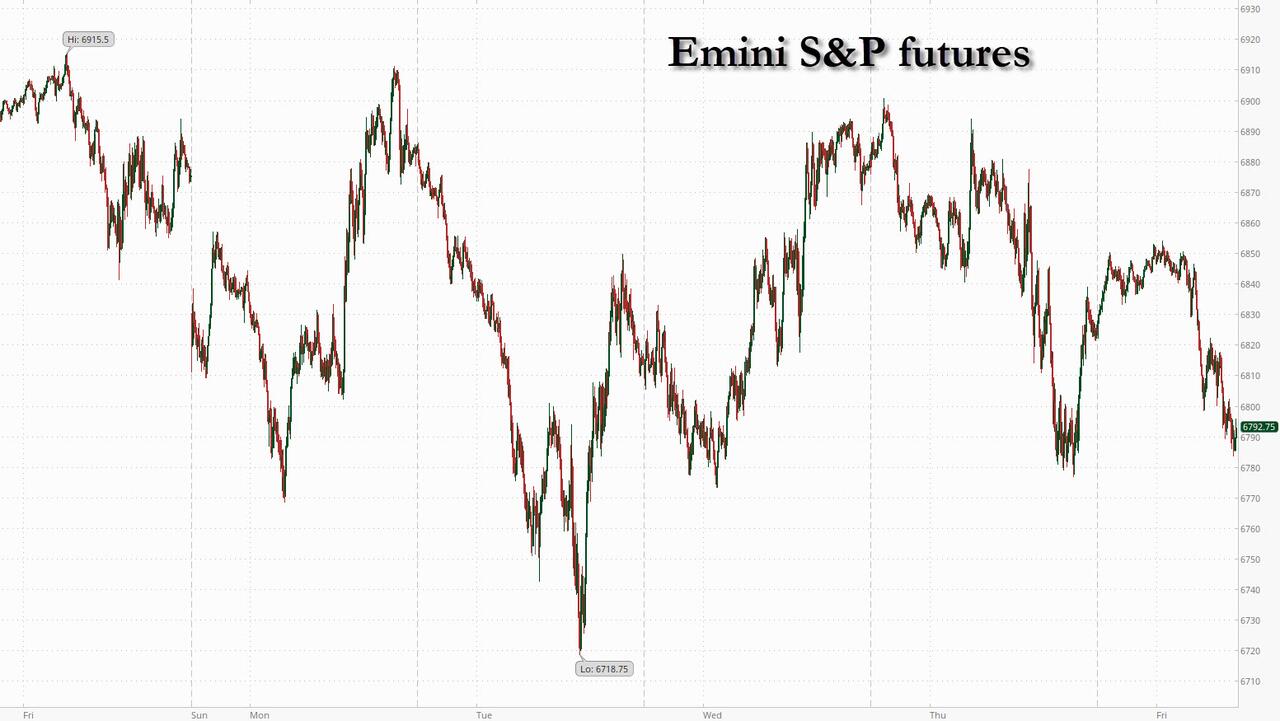
In premarket trading, Magnificent Seven are lowe (Microsoft -0.3%, Meta -0.5%, Tesla -0.6%, Alphabet -0.9%, Apple -0.7%, Amazon -1%, Nvidia -1.3%)
- Energy stocks are rising and airline stocks are declining as oil prices hit their highest level since 2024 and gas prices gained as the Iran conflict disrupted shipping through the Strait of Hormuz, limiting oil supply.
- Gap Inc. (GAP) falls 8% after reporting fourth-quarter sales and profit that came in slightly below expectations, as two of its apparel chains underperformed. Old Navy, the company’s biggest brand, and Athleta, its smallest, missed comparable-sales estimates.
- Guidewire Software (GWRE) rises 3% after the company reported second-quarter results that were much stronger than expected. It also raised its full-year forecast.
- Marvell Technology (MRVL) rallies 11% after the chipmaker said its year-over-year revenue growth rate will accelerate each quarter throughout fiscal 2027, a bullish target that shows soaring demand from data center-related applications.
- Nutex Health Inc. (NUTX) plunges 28% after the health-focused application software firm reported revenue for the fourth quarter that missed the average analyst estimate.
- Samsara (IOT) climbs 11% after the technology firm reported fourth-quarter adjusted earnings per share that topped the average analyst estimate.
- Trade Desk (TTD) slips 1% after Wedbush downgraded the advertising technology company to underperform — a sell equivalent — from neutral, saying the impact of an OpenAI partnership is “overestimated.”
In corporate news, Anthropic vowed to legally contest a Pentagon decision to declare it a threat to the US supply chain under an authority normally reserved for foreign adversaries, escalating a showdown with the Trump administration over AI safeguards.
The Iran war has entered its seventh day, with Iran firing a barrage of missiles and drones across the Persian Gulf and Israel renewing its airstrikes. Qatar’s energy minister sparked a powerful spike in energy price after he warned that war in the region could “bring down the economies of the world” and predicted that all Gulf energy exporters would shutter production within weeks, in an interview with the Financial Times. This is precisely what we warned about yesterday in “JPMorgan’s New Hormuz Closure Math: Just 3 Days Until Commodity Chaos.”
In the latest developments in the Middle East, Iran fired a barrage of missiles and drones targeting countries across the Persian Gulf overnight, while Israel renewed airstrikes on the Islamic Republic in a war that’s entered a seventh day with no end in sight. Saudi Arabia, Kuwait and Bahrain were among those came under renewed attack from the Islamic Republic, while Israeli airstrikes hit Tehran and Beirut.
Trump told NBC News that he wants Iran’s leadership structure fully removed, and that he has some names in mind for a “good leader.” The financial and logistical troubles the Iran war is causing for the global aviation industry are compounding by the day, with the number of canceled flights to Middle East hubs surpassing 27,000 since fighting began even as carriers look to resume some operations.
Still, US stocks are set to outperform global peers in a week that saw Middle East conflict drive fears of energy-driven price pressures, as traders awaited US jobs and retail sales data for insight into the Federal Reserve’s appetite for rate cuts.
That’s the good news for Trump, the bad news is that retail gasoline hit $3.32 a gallon on Thursday as the Iran conflict disrupts energy supplies from the Middle East. At the same time, the selloff in global bonds deepened on concern the shock to energy markets could broaden and drive inflation higher.
Friday’s market moves are capping a week of sharp swings in which investors repeatedly recalibrated their outlook on the impact of the US-Israeli war against Iran. Fears that a near-complete halt in traffic through the Strait of Hormuz could trigger a new inflation spike have led investors to scale back bets on Federal Reserve interest-rate cuts.
“This is an anxiety not only about how long the conflict goes on, but what kind of effect it’s going to have on the mix between growth and inflation,” Peter Oppenheimer, chief global equity strategist at Goldman Sachs Group Inc., told Bloomberg TV. “The issue really is 20% of world supplies are going through that channel, it’s obviously very, very significant.”
Today’s jobs report may offer more insight on the Fed’s rate path. Headline NFP print estimate is currently 55k, down from 130k last month with unemployment rate expected unchanged at 4.3%. Bloomberg whisper number for headline print is currently 55k (our full preview is here).
“The market would likely interpret robust job creation as evidence that the US economy remains on solid footing,” said Florian Ielpo, head of macro research at Lombard Odier Investment Managers. “This would accelerate the current rapid return to US equities and further fuel the reverse rotation we’ve observed over the past two weeks.”
Anna Wong, Chief US Economist at Bloomberg Economics, expects a tepid job report, largely reflecting temporary disruptions.
She forecasts the US economy to have added just 13,000 jobs in February, down from 130,000 in January. The consensus among analysts is for 55,000, and the “whisper” is for 65,000.
“For this print, the stronger the better given the increase in inflation expectations due to energy prices,” the JPMorgan Market Intelligence desk led by Andrew Tyler says. “A weaker number will increase rate cut expectations, but the risk is stagflation in the near-term given the expected increase in inflation.”
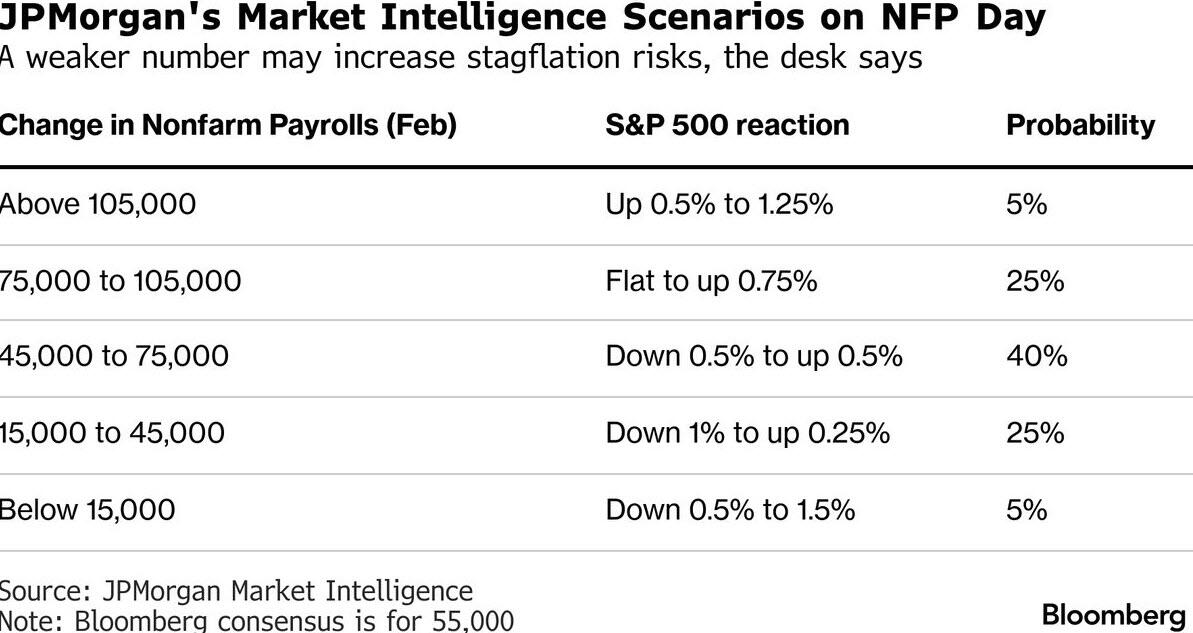
Bond yields are ticking higher heading into the print, and the dollar is muted, with markets pricing in less than 40 basis points of rate cuts for the rest of this year. In another sign of risk aversion, gold remains on track for its first weekly decline in over a month, pressured by a stronger dollar and inflationary risks tied to the Middle East conflict.
Traders slashed bets on Bank of England rate cuts for 2026, pricing just about a 50% chance of a quarter-point move. The yield on two-year gilts surged 13 basis points to 3.93%. Money markets are also fully pricing in that the European Central Bank will raise borrowing costs this year, a turnaround from a week ago when a cut was viewed more likely.
European stocks are now in the red after opening higher. Energy is up, while media, construction and technology sectors fall. Here are some of the biggest movers on Friday:
- Lufthansa shares climb as much as 4% after Europe’s largest carrier reported strong results and said it sees “significant” improvement in earnings in 2026.
- SFS rises as much as 6.1%, recovering some of this week’s losses, after the maker of components for the construction and automotive industries delivered better-than-expected results, according to analysts.
- ITV shares climb as much as 8.1% after Kepler Cheuvreux analyst Conor O’Shea raised his recommendation on the stock to buy from hold as he sees the weakness in advertising demand dissipating.
- Engineer IMI shares rise as much as 4.6% after the company delivered results ahead of expectations and announced a new £500 million buyback, supported by solid cash conversion.
- Zealand Pharma shares sink as much as 33%, the most on record, after mid-stage trial results for its experimental obesity shot being developed with Roche fell short of expectations.
- BE Semiconductor Industries shares fall as much as 12% as traders point to an article in Korean media on high-bandwidth memory.
- Infineon shares fall as much as 4% after UBS cut the recommendation on the chipmaker to neutral from buy, seeing limited upside to the firm’s margins and 2027 AI outlook, and growing inventory risk from a slowdown in China.
- Comet shares drop as much as 13% after the supplier of radio-frequency tools reported Ebitda for the full year that missed the average analyst estimate.
- Spie shares slide as much as 5.5% after the technical services provider delivered softer fourth-quarter organic growth across the majority of divisions, while consensus had already anticipated the improved mid-term margin goal, according to analysts at Jefferies.
- UCB drops as much as 2.9% after Morgan Stanley downgrades the stock to equal-weight from overweight, citing increasing concerns around the Belgian biopharmaceutical company’s growth story
In FX, the greenback advances with the Bloomberg Dollar Spot Index rising 0.2%.
In rates, treasury futures continue to be pressured, sitting on session lows into the early US session as WTI futures extend their climb through $86 barrel, higher by another 6% on the day. US yields cheaper by 2bp to 5bp across the curve in a bear flattening move with 5s30s spread down around 2bp on the day. US 10-year yields trade close to highs of the day around 4.17%, with gilts leading the selloff in bonds with UK two-year yields up 11 bps as traders pare bets on easing by the BOE this year. In Europe, bonds underperform further with front-end gilts cheaper by 12bp on the day. US session focus includes February nonfarm payrolls at 8:30am New York. Fed cut premium continues to fade out of front-end swaps, which now price in around 32bp of rate cuts for the year and the first full 25bp move priced out to the October meeting. In Europe, a full rate hike is now priced by the end of the year. Treasury auctions resume next week with 3-, 10- and 30-year sales for a combined $119 billion.
This week’s spike in Treasury yields is a sharp reversal from last month when they notched their sharpest drop in a year. Swaps now price between one and two Fed cuts for 2026 compared to as many as three a week ago. The dollar, meanwhile, has reclaimed its status as the ultimate haven as it headed for its best week in more than three years.
“Unless there can be some real political breakthrough that leads to a ceasefire, the dollar won’t be ready to resume a decline anytime soon,” ING Bank strategist Chris Turner wrote in a note. “The story will remain one of governments trying to handle the fallout of high energy prices, a negative for bond markets around the world.”
In commodities, Brent crude futures climb to a fresh high this week above $88 a barrel while European natural gas futures also rise after Qatar’s energy minister told the Financial Times the Middle East conflict will likely force Persian Gulf countries to halt energy exports.
Today’s US economic data slate includes February jobs report, January retail sales (8:30am), December business inventories (10am) and January consumer credit (3pm). Fed speaker slate includes Waller (7:30am), Daly (8:30am, 10:15am), Goolsbee (9:50am), Paulson (10:15am), Miran (11:30am), Collins (1:20pm) and Hammack (1:30pm, 3:10pm).
Market Snapshot
- S&P 500 mini -0.6%
- Nasdaq 100 mini -0.8%
- Russell 2000 mini -0.5%
- Stoxx Europe 600 -0.4%
- DAX -0.2%
- CAC 40 -0.3%
- 10-year Treasury yield +3 basis points at 4.17%
- VIX +0.4 points at 24.19
- Bloomberg Dollar Index +0.1% at 1205.77
- euro -0.2% at $1.158
- WTI crude +3.9% at $84.13/barrel
Top Overnight News
- U.A.E. Explores Freezing Iranian Assets to Punish Tehran for Attacks: WSJ
- Oil Soars as Iran War Threatens Long Energy Outage; WTI Crude Tops $85 a Barrel as War Paralyzes Hormuz Traffic: BBG
- Israeli Military Moving to ‘Next Phase’ of Iran Campaign: WSJ
- Iran barrage sweeps Mideast as Trump weighs in on succession: BBG
- Iran says countries have begun mediation efforts: WSJ
- Iran’s Attacks on the UAE Are Costing It Access to Vital Imports: BBG
- Tehran Is Fighting With Jets That Date Back to the Vietnam War: WSJ
- Trump on rising gas prices during Iran operation – ‘If they rise, they rise’: RTRS
- SoftBank Seeks Record Loan of Up to $40 Billion for OpenAI Stake: BBG
- Drone strike drives calls to end British military presence on Cyprus: RTRS
- Trump Faces Criticism From UAE Business Community Over Iran War: BBG
- Israel targets bunker beneath Khamenei’s compound in new wave of attacks: RTRS
- Israel’s Hezbollah attacks are likely to continue beyond Iran war: RTRS
- Turkey asks Britain’s MI6 to step up protection of Syria’s Sharaa: RTRS
- Wealthy Moscow cuts investment, revealing Russia’s deeper budget problems: RTRS
- Axel Springer Strikes $770 Million Deal for U.K.’s Daily Telegraph: WSJ
- Texas Republican Ends Re-Election Bid After Affair: AP
A more detailed look at global markets courtesy of Newsquawk
APAC stocks traded somewhat mixed following the risk-averse mood in the US as geopolitics continued to dominate headlines, and with participants also cautious heading into key US jobs data. ASX 200 was dragged lower as the heavy losses in miners, materials and resources sectors offset the gains in tech and telecoms, while recent higher energy prices stoke inflationary concerns and narrow the policy space for the RBA. Nikkei 225 traded indecisively and swung between gains and losses with very little fresh macro catalysts for Japan. Hang Seng and Shanghai Comp trade higher, albeit to varying degrees, with the mainland rangebound, while Hong Kong outperforms amid tech strength and as participants reflected on recent earnings from the likes of JD.com and Bilibili.
Top Asian News
- Japan’s Finance Minister Katayama said Japan is ready to take timely steps against the economic impact from the Iran conflict, adds Japan is not fully out of deflation. Japan is ready to act on market volatility while consulting international authorities. Bank of Japan’s monetary policy is focused on inflation and not on currency intervention. Wage gains are not BoJ’s direct target but is key to price stability.
- PBoC adviser Huang Yiping said China’s push to shift its economy towards consumer spending will take a long time, according to Bloomberg. Investors should dampen expectations for “aggressive” stimulus as the government doesn’t view it as a “crisis time”.
European bourses (STOXX 600 -0.1%) initially traded mixed, but now hold a strong negative bias as the risk tone soured. Little driving the latest downturn, but with focus remaining on the geopolitical situation. European sectors were initially mixed, but now hold a negative bias. Energy takes the top spot, buoyed by strength in underlying energy prices, whilst Industrials is lifted by Defence names. To the downside, Media lags, hampered by post-earning losses in UMG (-5.5%).
Top European News
- EU GDP Growth Rate YoY 3rd Est (Q4) Y/Y 1.2% vs. Exp. 1.3% (Prev. 1.4%, Low. 1.3%, High. 1.3%)
- EU Employment Change QoQ Final (Q4) Q/Q 0.2% vs. Exp. 0.2% (Prev. 0.2%)
- UK Halifax House Price Index YoY (Feb) Y/Y 1.3% vs. Exp. 0.9% (Prev. 1.1%, Rev. From 1%, Low. 0.5%, High. 0.9%).
- UK Halifax House Price Index MoM (Feb) M/M 0.3% vs. Exp. 0.3% (Prev. 0.8%, Rev. From 0.7%).
- Norwegian Manufacturing Production MoM (Jan) M/M -0.3% (Prev. -0.1%).
FX
- DXY is relatively flat with a mild upward bias after a session of gains on Thursday. Thursday’s action was spurred by a haven bid, and as yields climbed on firmer oil prices, in addition to well-received data ahead of NFP.
- EUR/USD returned below the 1.1600 handle after initially reclaiming the level in APAC trade, with downside exacerbated by the ongoing geopolitical and energy-related concerns, alongside the firming USD as traders flock to the haven. Little reaction to the rhetoric from ECB officials. Meanwhile, traders fully price in a 25bps ECB hike this year, Bloomberg reported. EUR/USD trades in a 1.1583-1.1621 range, within Thursday’s 1.1559-1.1647.
- GBP/USD is subdued amid the recent USD strength but remains tucked within yesterday’s 1.3297-1.3387 range. News flow for the UK remains light, but recent headlines centre around UK PM Starmer’s shift from initially refusing to assist US military operations against Iran to later granting access to British military bases for “limited” and “defensive” purposes.
- USD/JPY is firmer with the JPY the underperforming G10 amid a rise in US yields and given Japan’s exposure to energy imports. The pair traded sideways for most of the APAC session, given the indecisive mood in Japan; although, it gradually edged higher as domestic sentiment stabilised.
- Antipodeans are mixed, the AUD mildly outperforms amid gains in copper and gold prices and as recent inflationary concerns spurred some outside bets for a rate hike by the RBA this month. AUD/USD trimmed gains after hitting an intraday peak of 0.7047 (vs low 0.7015). NZD/USD hit a current low of 0.5881 (vs high 0.5916), with the 200 DMA (0.5876).
Central Banks
- BoJ Deputy Governor Himino said Japan is seeing inflation in terms of rising consumer prices, adds BoJ is keeping monetary conditions accommodative and gradually adjusting degree of monetary accommodation. Will continue to scrutinise market moves and their impact on the economy and prices. Rising import costs from a weak yen may affect inflation trends. BoJ policy is not aimed at FX rates, yet FX shifts impact inflation and the economy.
- ECB’s Escriva said it is highly unlikely the ECB touches rates at its next meeting.
- ECB’s Sleijpen said the ECB policy is still in a good place and data dependent.
- PBoC Governor said the central bank will flexibly use various monetary policy tools including interest rates and RRR cuts; PBoC said China has no intention to, not necessary to use FX rate to gain trade competitiveness.
Fixed Income
- USTs are lower. US paper spent much of the overnight session trading sideways, alongside weakness across the crude complex. However, as energy prices turned positive – the benchmark also dipped off best levels in the European morning. The geopolitical situation remains unchanged, with missiles being launched from both sides – but updates related to the Strait of Hormuz helped to improve sentiment, including; a) China is in talks with Iran to allow safe oil and gas passage through Hormuz, b) US allowed India to purchase Russian oil for 30-days. USTs now trade at the lower end of a 112-03 to 112-14+ range.
- Bunds follow peers, for the same reasons as above, and currently towards the bottom end of a 126.96 to 127.32 range. European newsflow has seen a few ECB speakers take to the wires, to generally touch on the Iran situation, whilst Escriva said it is “highly unlikely” that the ECB touches rates at it next meeting. From a yield perspective, the 10yr yield now trades at 2.868% (vs YTD high at 2.909%). Thereafter, 2.938%, a peak spurred by the mini-banking crisis surrounding the collapse of First Brands.
- Gilts underperform, lower by around 75 ticks and trades at the bottom end of a 90.43 to 91.25 range. Underperformance which can be explained by, a) net-importer of energy, b) BoE rate cut expectations entirely priced out for the year; pre-war pricing indicated a cut in either March or April. A lot of focus has been on the front-end Gilt situation, with the 2yr yield now surging beyond 3.90%, to now approach the 4% mark from mid-October 2025 – back where traders were increasingly sceptical of Chancellor Reeves and her Autumn Budget.
Commodities
- Crude benchmarks remain firmer, though are off their best levels seen yesterday, which saw Brent firmer by 4.9%, marking the highest close since the conflict between the US, Israel, and Iran began. As the conflict reaches its seventh day, there’s been little sign of a reprieve following comments by the Iranian Foreign Minister via NBC News that Iran is ready for a US ground invasion of the country, with further comments this morning via Al Arabiya where the FM said that Iran has no choice but to continue fighting. WTI and Brent are trading in the upper end of USD 78.24-82.93/bbl and 83.16-86.35/bbl, ranges respectively.
- In the precious metals space, spot gold briefly reclaimed the USD 5,100/oz level after facing pressure yesterday, when reports indicated the NBP is considering gold sales for defence funding, which saw the yellow metal fall below the USD 5000/oz mark. A slightly softer dollar and the Iranian conflict boosted haven appeal for gold during the APAC session. However, as the European session gets underway, the yellow metal has slipped below USD 5100/oz due to recent USD strength as the USD continues to be the preferred haven amid ongoing geopolitical tensions. XAU and XAG are trading within the upper end of USD 5066.93-5143.84/oz and 81.80-84.76/oz, ranges respectively.
- Base metals have rebounded from the prior day’s trough, largely underpinned by firmer APAC stocks. However, copper prices have seen slight pressure since the European session began, tracking headwind in European equities, thus weighing down the red metal. 3M LME copper trades within the lower end of a USD 12.87-12.91k/t range.
- US-sanctioned gas tanker reportedly transited the Strait of Hormuz this morning, according to Bloomberg; The Danuta I, sailed under the flag of Palau.
- US has issued a temporary 30-day waiver to allow sale of Russian oil currently stranded at sea to India, according to a report citing two officials. Officials say general licence only authorises transactions involving Russian oil already stranded at sea, unlikely to provide significant financial benefit to Russia.
- Trump admin reportedly rules out deploying Treasury Department to trade oil futures for now amid belief that it will have a limited meaningful effect, Bloomberg sources report.
- Japan is reportedly considering a release from its national oil stockpile, even without coordinated international action, Kyodo reported.
- Gold is being sold at a discount of as much as USD 30/oz in Dubai, Bloomberg reported citing sources; due to elevated shipping and insurance costs.
- Qatar Energy Minister al-Kaabi cautions that the Middle East conflict could cause all Gulf energy producers to have to shut production within weeks, increasing oil to USD 150/bbl, FT reported.
- India has asked all its refiners to maximise production of liquefied petroleum gas and make the fuel available only to three state-run companies – Indian Oil (IOCL IS), HPCL (HPCL IS) and BPCL (BPCL IS), a government cited by ET order showed.
- Reliance (REL IS) is looking to buy Russian oil after the US granted India a licence to temporarily buy cargoes, Bloomberg reported citing sources.
Geopolitics
- US President Trump said oil appears to have pretty much stabilised, and further action to reduce pressure on oil is coming, also said Iran wants to ‘make a deal’ to end the conflict.
- Iran reportedly targeted US bases in Kuwait with drones, according to Iranian State Media; Iran’s army says drone attacks against US bases in Kuwait to continue in the coming hours.
- Iran to use newer missiles in the coming days, Fars News reported.
- US Secretary of War Hegseth said US has just begun to fight in Iran and that Iran is wrong in its calculations if it thinks we can’t continue the war. Firepower used in Iran is to increase significantly.
- Maersk (MAERSKB DC) said it has decided to temporarily suspend services connecting the Middle East to the far East and Europe; decision has been taken as a precautionary measure.
- Iranian Foreign Minister said Iran has no choice but to continue fighting, Al Arabiya reported.
- US and Israel have increased airstrikes on Iran’s border with Iraq as US President Trump called on the Kurdish minority there to rise up against Iran’s government, according to Washington Post.
- Satellite imagery taken Tuesday shows extensive damage to Iran’s Khojir missile production site, according to Washington Post.
- US Central Command Commander said our operation against Iran is going well and we are moving at a fast pace. said:. Ballistic missile attacks by Iran have decreased by 90% since day one. As we transition to the next phase of the operation, we will dismantle Iran’s missile production capability.
- US House votes 219-212 to reject the war powers resolution on Iran.
- Foreign ministers of Arab League member states will hold an emergency meeting on Sunday to discuss Iran’s attacks on several countries in the region, WSJ reported. The meeting will be held via video conference, was requested by Saudi Arabia, according to Arab sources.
- Israeli PM’s aide said “so far the operation is proceeding as planned; we are seeing the first cracks in the regime, but patience is needed”; adds that US President Trump and Israeli President Netanyahu speak daily.
- Republicans are preparing to confront a huge price tag for the Middle East war following closed-door briefings which detailed the fast consumption of munitions and lack of any firm deadline for the campaign, Politico reported citing sources. Senior Republicans expect the administration to request tens of billions of dollars, with some lawmakers hearing estimates that the Pentagon is spending as much as USD 2bln/day.
US Event Calendar
- 8:30 am: United States Jan Retail Sales Advance MoM, est. -0.3%, prior 0%
- 8:30 am: United States Jan Retail Sales Ex Auto MoM, est. 0%, prior 0%
- 8:30 am: United States Feb Change in Nonfarm Payrolls, est. 55k, prior 130k
- 8:30 am: United States Feb Change in Manufact. Payrolls, est. -1.5k, prior 5k
- 8:30 am: United States Feb Unemployment Rate, est. 4.3%, prior 4.3%
- 7:30 am: United States Fed’s Waller on Bloomberg TV
- 8:30 am: United States Fed’s Daly on CNBC
- 9:50 am: United States Fed’s Goolsbee on Bloomberg TV
- 10:15 am: United States Fed’s Daly & Paulson Participate in Panel Discussion
- 11:30 am: United States Fed’s Schmid Speaks on Policy and Outlook
- 11:30 am: United States Fed’s Miran on CNBC
- 1:20 pm: United States Fed’s Collins Delivers Keynote Address
- 1:30 pm: United States Fed’s Hammack Speaks at Monetary Policy Forum
- 3:10 pm: United States Fed’s Hammack Appears on Bloomberg TV
Main Rating Changes:
DB’s Jim Reid concldues the overnight wrap
There’s not much synchronisation in markets at the moment as we welcome in another payrolls Friday today. This one will be obviously overshadowed by events in the Middle East. Indeed, the market selloff resumed over the last 24 hours, with equities and bonds posting fresh declines as the war in the Middle East showed no sign of ending. That’s raising fears about a more protracted conflict, with investors increasingly alarmed that the oil price spike will become entrenched, pushing up inflation around the world. Indeed, Brent crude was up another +4.93% yesterday to $85.41/bbl, closing at its highest level since mid-2024. And in turn, that’s meant investors have kept pricing out the chance of further rate cuts, leading to another spike in bond yields on both sides of the Atlantic. Indeed, 10yr bund yields (+9.0bps) posted their biggest daily jump in exactly a year, back when the debt brake reforms were announced. There has been some respite in the Asia session as there are some hopes that the US is looking at options to address the energy price spike.
The reality is though that we continue to trade competing headlines, with risk appetite swinging back and forth over the past 24 hours. At the outset yesterday, there was actually some optimism after Iran’s IRNA reported that the deputy foreign minister said they were ready to get rid of their uranium stockpile in the US talks, “provided we get something good in return”. However, any optimism that some kind of negotiated settlement could be enroute faded as the session went on, with signs that, if anything, the conflict was spreading. In fact, Azerbaijan was the latest country to be hit by Iranian drones, and their Defense Ministry said that “These acts of aggression will not go unanswered”. And elsewhere across the region, a refinery was struck in Bahrain and the US evacuated its embassy in Kuwait, while the UAE told Abu Dhabi residents to seek immediate shelter. Around the same time Trump suggested he wanted a say in the Iran leadership succession which potentially complicates prospects of a diplomatic resolution. And Iran’s Foreign Minister said that it currently saw no reason to engage in talks with the US.
We did see some improvement in market sentiment late in the US session, as Interior Secretary Doug Burgum said that the administration is looking at options to address the spike in oil and gasoline prices, with Reuters reporting that this could include potential action involving the oil futures market. Later in the evening the US issued a 30-day waiver for Indian purchases of Russian oil. According to Treasury Secretary Bessent, the measure is aimed at Russian oil that is already stranded at sea, so should be viewed as more of a short-term relief for Asian refiners. Coupled with Burgum’s comments, this has supported some reversal in oil price gains overnight, with Brent down -0.94% to $84.61/bbl as I type. S&P 500 futures (+0.22%) are a touch higher, while the dollar index is down -0.37% after yesterday’s +0.55% gain.
But net net, it’s been only a partial offset from yesterday’s news flow that saw Brent crude (+4.93%) rise to $85.41/bbl, whilst WTI (+8.51%) rose to $81.01/bbl, its biggest increase since May 2020. What’s been notable is that investors are increasingly pricing in an extended conflict, and we can see that from energy futures further out the curve. For instance, the Brent crude oil future for 12 months’ time was up another +1.58% yesterday to $69.90/bbl, which is their biggest increase so far this week. So in other words, there’s growing doubt that this is going to be over quickly.
With oil prices continuing to rise, investors grew more doubtful about central bank rate cuts this year, with the prospect of hikes even coming into view. That was particularly clear for the ECB, where a hike by December moved up to a 63% chance by the close, which is the first time in 2026 that it’s been above 50%. A 55% probability of a cut was priced in as recently as last Friday. So that contributed to a sharp selloff for European sovereign bonds, with yields on 10yr bunds (+9.0bps), OATs (+11.7bps) and BTPs (+13.2bps) all moving higher. Meanwhile, ECB officials struck a watchful tone over the situation, with Banque de France Governor Villeroy saying he didn’t see any reason today to raise rates, while ECB Vice President de Guindos said an extended war could raise inflation expectations and prompt a change in the policy stance.
It was a similar story in the US, where markets are now pricing in just 40bps of Fed cuts by December, the fewest so far this year. That came as Fed officials acknowledged the potential for inflation to rise, with Richmond Fed President Barkin saying “Gas prices, obviously, if they’re up, that is inflationary”. And remember that core PCE was already 3.0% before this latest shock, so investors have become increasingly sceptical that the Fed will be able to deliver rapid rate cuts under a new Chair. In addition, the latest weekly initial jobless claims were slightly beneath expectations, at 213k in the week ending Feb 28 (vs. 215k expected), so that added to the optimism ahead of today’s jobs report. And we saw more positive comments on the labour market from Fed Vice Chair Bowman, who said it showed more “signs of stabilizing”. So collectively, that data and the latest rise in oil prices pushed Treasury yields higher, with the 2yr yield (+3.1bps) up to 3.58%, whilst the 10yr yield (+3.9bps) moved up to 4.14%.
The US labour market will remain in the spotlight today, as we’ll also be getting the latest jobs report for February. In terms of what to expect, our US economists think that payrolls will be up +30k, coming down from the 13-month high of +130k in January. Then for unemployment, they see that remaining at 4.3%, but they note that carries elevated risks in both directions given that the BLS will implement their annual population controls. For more details, click here for their preview.
For equities, it was another rough day as fears mounted about a sustained oil shock. So the S&P 500 (-0.56%) moved back into negative territory for 2026, though it did recover from an intra-day low of -1.44% after the news that the US could intervene in energy markets. Interestingly, software and services stocks were the standout outperformer (+1.84%), with that component of the index hitting a one-month high. This included a +1.59% gain for Oracle as Bloomberg reported that it is planning a round of job cuts. By contrast the Philadelphia semiconductor index fell -1.17% as Bloomberg reported that US officials were mulling regulations that would require approval for exports of AI chips to anywhere in the world. And it was a rough session more broadly, with consumer staples (-2.27%) and materials (-2.43%) stocks leading on the downside in the S&P amid the concern over energy costs. There were even bigger declines in Europe given their greater exposure to any energy shock. So the STOXX 600 (-1.29%) fell back, alongside declines for the DAX (-1.61%), the CAC 40 (-1.49%) and the FTSE 100 (-1.45%).
In Asia, the Nikkei (+0.51%) is recovering from initial losses but is still on course for a weekly decline exceeding -5.5%. Meanwhile, Chinese related stocks are making gains, with the Hang Seng (+1.85%) leading the way as it benefits from a rally in recently weakened technology shares, while the CSI (+0.20%) and the Shanghai Composite (+0.25%) are also experiencing modest increases. The KOSPI has recovered from earlier larger losses and is -0.15%, but still heading towards a weekly drop of more than -10%, and the S&P/ASX 200 (-1.03%) is trading notably lower, on track for a weekly loss of approximately -4.0%.
Finally, this weekend, there’s a German state election taking place in Baden-Württemberg, which will be the first of five regional elections this year. Our economists in Germany have a preview of the votes (link here), where they outline why the election outcomes matter for the stability of the Merz government. They point out that victories for the governing parties might positively impact reform momentum at the federal level over the spring/early summer. But they also point out that heavy losses have been a catalyst in the past for early federal elections, as seen in 2005 (after the SPD lost the key state of North-Rhine Westphalia) and in 2024 (after a series of electoral losses for the FDP).
Looking at the day ahead, the main data highlight will be the US jobs report for February, but we’ll also get US retail sales for January and German factory orders for January. From central banks, we’ll hear from the Fed’s Daly, Paulson, Collins and Hammack, long with the ECB’s Cipollone and Schnabel.
1b European opening report
1 c) Asian opening report
Crude eases as China negotiates safe passage through Hormuz; US jobs awaits – Newsquawk EU Market Open

Friday, Mar 06, 2026 – 01:54 AM
- APAC stocks traded somewhat mixed following the risk-averse mood in the US as geopolitics continued to dominate headlines, and with participants also cautious heading into key US jobs data.
- US and Israel have increased airstrikes on Iran’s border with Iraq as US President Trump calls on the Kurdish minority there to rise up against Iran’s government, according to the Washington Post.
- US Secretary of War Hegseth said the US has just begun to fight in Iran and that Iran is wrong in its calculations if it thinks the US can’t continue the war, while he added that the firepower used in Iran is to increase significantly.
- European equity futures indicate a higher cash market open with Euro Stoxx 50 futures up 1.0% after the cash market closed with losses of 1.5% on Thursday.
- Looking ahead, highlights include EZ GDP 3rd Est (Q4), US NFP (Feb), Retail Sales (Jan), Speakers including ECB President Lagarde, Cipollone & Schnabel, Fed’s Daly, Collins & Hammack, RBA’s Hauser, Credit Review including Fitch on France, DBRS on Greece.
SNAPSHOT
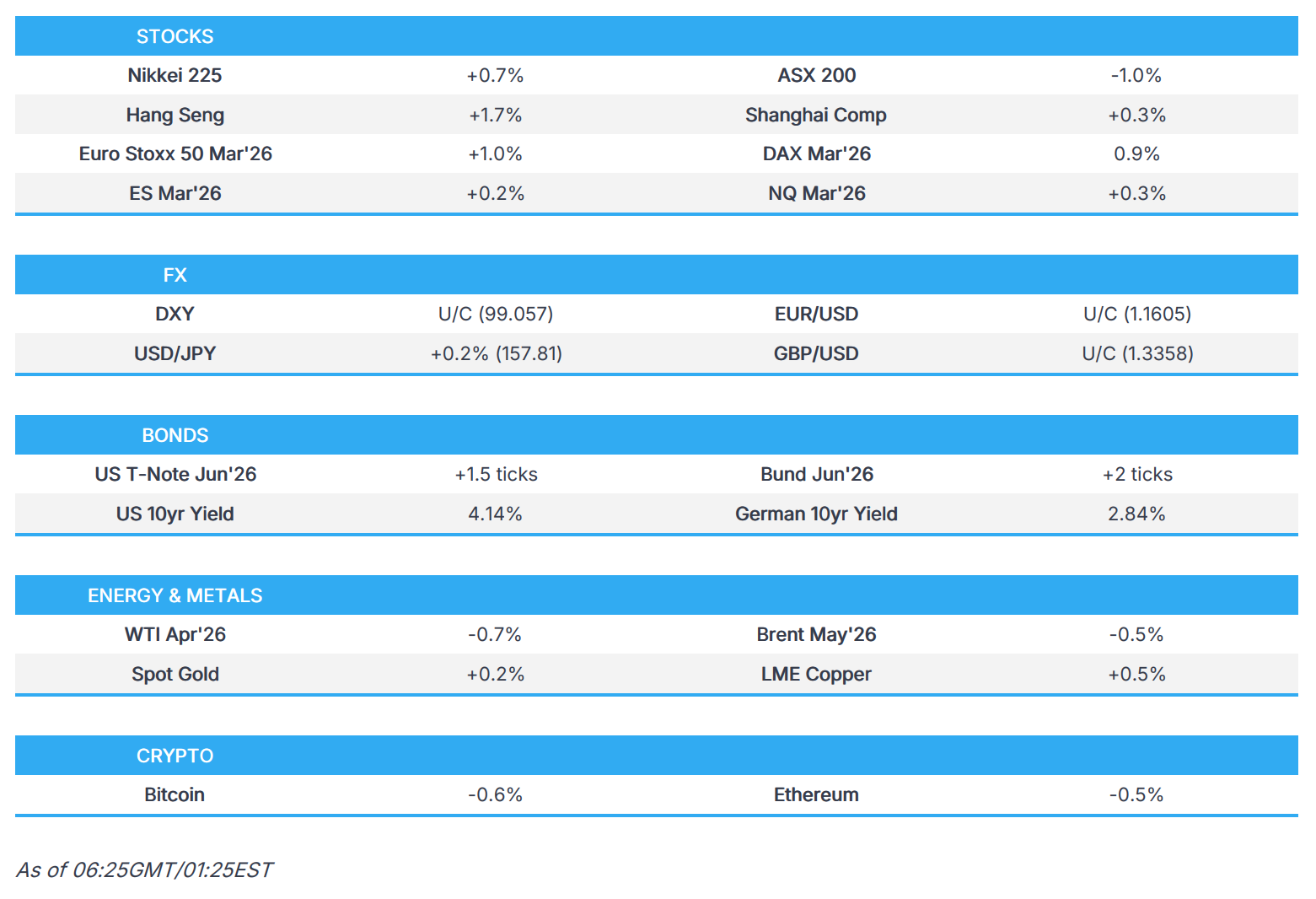
Newsquawk in 3 steps:
1. Subscribe to the free premarket movers reports
2. Listen to this report in the market open podcast (available on Apple and Spotify)
3. Trial Newsquawk’s premium real-time audio news squawk box for 7 days
IRAN CONFLICT
- US President Trump said he supports Kurds launching an offensive into Iran and thinks it would be wonderful if they did. He commented that he is going to have a role in choosing Iran’s next leader, much like Venezuela, but added it is very early in the process of picking a new leader and Khamenei’s son is unlikely. Trump stated the Strait of Hormuz will be kept open and that the Iran operation is moving along ahead of schedule, but won’t give a timeline. Furthermore, he is not currently mulling US troops in Iran and commented that Iran has been calling and wants to ‘make a deal’ to end the conflict.
- US Secretary of War Hegseth said the US has just begun to fight in Iran and that Iran is wrong in its calculations if it thinks the US can’t continue the war, while he added that the firepower used in Iran is to increase significantly.
- US Central Command Commander said their operation against Iran is going well, and they are moving at a fast pace, while he added that ballistic missile attacks by Iran have decreased by 90% since day one, and they will dismantle Iran’s missile production capability as they transition to the next phase of the operation.
- US House voted 219-212 to reject the war powers resolution on Iran.
- US and Israel have increased airstrikes on Iran’s border with Iraq as US President Trump calls on the Kurdish minority there to rise up against Iran’s government, according to the Washington Post.
- Israeli military said it has begun a broad-scale wave of strikes against Iranian infrastructure in Tehran, while Iran’s Mehr News Agency reported explosions and planes flying in some areas of Tehran. New Israeli raids were also reported in Beirut.
- Israel’s representative to the UN said they will sink Iranian ships in the Strait of Hormuz, according to Al Jazeera. The official added that it will be much harder for Iran to disrupt vessels coming through the Strait of Hormuz in a few days and that they need to continue to dismantle Iran’s capabilities before diplomacy.
- Iranian Foreign Minister Araghchi told NBC News that Iran is ready for a US ground invasion of the country, while he refuses any negotiations with the US and said that Iran had not asked for a ceasefire and that Iran sees no reason for more talks.
- Iran targeted Microsoft (MSFT) data centres in drone strikes, according to FT.
- Iran said it currently has no intention to close the Strait of Hormuz, according to AFP.
- Joint Maritime Information Centre said shipping and traffic in the Strait of Hormuz is at a near-total halt.
- Air raid sirens sounded across Kuwait amid reports of powerful explosions, according to Al Jazeera.
- Explosions were reported in the sky of Bahrain’s capital of Manama. Furthermore, Bahrain’s Interior Minister said the Iranian attack targeted two hotels and a residential building in Manama, causing material damage but with no injuries.
- Emergency alerts were sent to mobile phones in Qatar about a security threat, with Qatar’s Interior Ministry advising all residents to stay inside and keep clear of windows and open areas
- Saudi Arabia’s Defence Ministry reported the interception of three ballistic missiles launched towards Prince Sultan Air Base.
- Foreign ministers of Arab League member states will hold an emergency meeting on Sunday to discuss Iran’s attacks on several countries in the region, according to WSJ.
- UAE is mulling freezing Iranian assets to punish Tehran for attacks, according to WSJ.
- NATO increased alliance-wide ballistic missile defence posture, while allies support the recommendation to keep posture at a heightened level until threat from Iran subsides.
- French President Emmanuel Macron said his country was working to end fighting between Hezbollah and Israel, according to The Washington Post.
US TRADE
EQUITIES
- US stocks were once again sold amid the ever-escalating Middle Eastern tensions, albeit they came off lows into settlement amid reports that China is in talks with Iran to allow safe oil and gas passage through Hormuz. Following this, the crude complex pared some of its extensive gains, as did the Dollar, while spot gold and Treasuries both edged off lows. WTI and Brent still saw notable gains on the session amid the aforementioned geopolitical worries and the continued concerns regarding the sharp drawdown in traffic within the Strait of Hormuz. As such, broad trade today was risk-off as participants continue to deal with the impacts of the Middle Eastern war, and no signs of it abating any time soon.
- SPX -0.56% at 6,831, NDX -0.29% at 25,020, DJI -1.61% at 47,955, RUT -1.91% at 2,586.
- Click here for a detailed summary.
TARIFFS/TRADE
- US President Trump’s new tariffs face a legal challenge by a group of states, with twelve US states to sue him to stop the latest worldwide tariffs, according to the Oregon Attorney General.
- US Treasury Secretary Bessent considers asking China to cut oil purchases from US adversaries ahead of President Trump’s visit to China, while Bessent, along with former officials, business executives and policy analysts, are planning to firm up a framework for the April Trump-Xi summit. Furthermore, Bessent indicated that Washington is seeking expanded Chinese purchases of American soybeans and Boeing jets, as well as a relaxation of Beijing’s export controls on rare-earth elements.
- US drafts a rule requiring licenses for AI chip exports worldwide, in which NVIDIA (NVDA) and AMD (AMD) shipments to all countries would need US approval.
- US and Mexico will start talks on March 16th on reviewing their free trade agreement.
- Canada’s US Trade Minister Leblanc will be visiting Washington on Friday.
- Canada and the EU signed a deal to modernise their economic and trade agreement.
NOTABLE HEADLINES
- US President Trump announced he was replacing Kristi Noem as the Homeland Security Secretary.
- Fed’s Bowman (voter) said it is too early to tell the impacts of the war on the US economy.
APAC TRADE
EQUITIES
- APAC stocks traded somewhat mixed following the risk-averse mood in the US as geopolitics continued to dominate headlines, and with participants also cautious heading into key US jobs data.
- ASX 200 was dragged lower as the heavy losses in miners, materials and resources sectors offset the gains in tech and telecoms, while recent higher energy prices stoke inflationary concerns and narrow the policy space for the RBA.
- Nikkei 225 traded indecisively and swung between gains and losses with very little fresh macro catalysts for Japan.
- Hang Seng and Shanghai Comp trade higher, albeit to varying degrees, with the mainland rangebound, while Hong Kong outperforms amid tech strength and as participants reflected on recent earnings from the likes of JD.com and Bilibili.
- US equity futures are well off the prior day’s trough but with price action contained as the NFP report looms.
- European equity futures indicate a higher cash market open with Euro Stoxx 50 futures up 1.0% after the cash market closed with losses of 1.5% on Thursday.
FX
- DXY took a breather after gaining yesterday on a haven bid and as yields climbed on firmer oil prices, while there was a recent slew of data which mostly printed better-than-expected, while participants now look ahead to the looming jobs data.
- EUR/USD returned to the 1.1600 handle, but with upside limited amid ongoing geopolitical and energy-related concerns, while there was little reaction to the recent rhetoric from ECB officials, or the ECB Minutes, which noted that several argued rates could remain at current levels for an extended period if the baseline outlook held.
- GBP/USD lacked direction after rebounding from support at the 1.3300 level, with price action kept tame by quiet newsflow.
- USD/JPY proceeded sideways for most of the session amid the indecisive mood in Japan, and a quiet data calendar, with no tier-1 releases, although it gradually edged higher as risk sentiment in Japan stabilised.
- Antipodeans strengthened with AUD mildly outperforming amid a rebound in metal prices and as recent inflationary concerns spurred some outside bets for a rate hike by the RBA this month.
- PBoC set USD/CNY mid-point at 6.9025 vs exp. 6.8998 (Prev. 6.9007)
FIXED INCOME
- 10yr UST futures languished near the prior day’s lows after declining on recent upside in energy prices and inflationary concerns, with price action contained overnight as the attention turns to the incoming NFP report.
- Bund futures attempted to nurse some losses following its recent slide, but with the recovery contained heading into the key US jobs data, while German Factory Orders and EU GDP revisions are also scheduled later.
- 10yr JGB futures were choppy amid the tentative mood in Japan and with a lack of tier-1 data releases for the region.
COMMODITIES
- Crude futures pulled back overnight after rallying again yesterday, with a mild reversal seen after it was reported that China is in talks with Iran to allow safe oil and gas passage through Hormuz, while it was also reported that the US issued a temporary 30-day waiver to allow the sale of Russian oil currently stranded at sea to India.
- China is reportedly in talks with Iran to allow safe oil and gas passage through Hormuz.
- US issued a temporary 30-day waiver to allow the sale of Russian oil currently stranded at sea to India.
- US President Trump is not looking to tap into the SPR. In relevant news, Trump’s chief of staff Wiles told advisers to bring ideas to the Oval Office to lower gasoline prices in the wake of the US attack on Iran, according to POLITICO, citing sources.
- White House senior official said the Treasury is expected to announce measures as soon as Thursday to combat rising energy prices that include using the oil futures market, with all options on the table.
- QatarEnergy informed Edison that it would not be able to fulfil its contractual obligations regarding five LNG cargo deliveries scheduled to arrive in early April.
- Saudi Arabia set the April Arab Light crude oil OSP to Asia at + USD 2.5/bbl vs Oman/Dubai average (prev. 0.00), while it set April Arab Light crude oil OSP to NW Europe at plus USD 2.85/bbl (prev. -0.65) to ICE Brent settlement.
- Venezuela’s President said they signed framework agreements with oil companies.
- Spot gold reclaimed the USD 5,100/oz level amid a slightly softer dollar and as the Iran conflict boosts haven appeal.
- CME cut COMEX 100 gold futures margins to 7% from 9.0% and COMEX 5,000 silver futures margins to 14% from 18%.
- Copper futures rebounded from the prior day’s trough, with prices helped as Asia-Pac stocks clawed back opening losses.
CRYPTO
- Bitcoin was choppy and traded on both sides of the USD 71,000 level.
NOTABLE ASIA-PAC HEADLINES
- PBoC adviser Huang said China’s push to shift its economy towards consumer spending will take a long time, while he added that investors should dampen expectations for “aggressive” stimulus as the government doesn’t view it as a “crisis time”.
DATA RECAP
- South Korean CPI MM (Feb) 0.3% vs. Exp. 0.4% (Prev. 0.4%)
- South Korean CPI YY (Feb) 2.0% vs. Exp. 2.1% (Prev. 2.0%, Rev. From 2%)
GEOPOLITICS
- US President Trump said “Cuba’s going to fall”, while he reportedly revealed a growing frustration with Ukraine and the uncertain search for a new leader of Iran, according to POLITICO.
EU/UK
NOTABLE HEADLINES
- ECB President Lagarde said they will decide their monetary policy meeting-by-meeting, based on data and have no pre-set stance. Lagarde also stated that her term will expire in October 2027.
2.a NORTH KOREA/SOUTH KOREA
NORTH KOREA/SOUTH KOREA
2b JAPAN
3. CHINA
GREAT ARTICLE AND A MUST READ!!
The Day After Iran – China

by GeoVest
Friday, Mar 06, 2026 – 11:58
The tipping point is the magic moment when an idea, trend, or social behavior crosses a threshold, tips, and spread like wildfire – Malcolm Gladwell
Prior to 1979, Iran had a strong secular society with deep roots and traditions dating back to the Persian Empire. Based on what I’ve read about expats and people still living under the current theocracy, most would gladly return to the past governmental structure. If the behavior of citizens over the past six months is to be believed, the people are ready to return to a secular society.
I expect that the current bombing campaign focused on erasing the current Iranian power structure – both cleric and IRGC – will succeed and will be replaced by a new secular head of state. Lastly, I expect the Iranian people to thrive under the new arrangement, unleashing tremendous untapped economic power.
So far, it sounds like a winning situation for the world and it is, for the most part but not for China and certainly not Xi Jinping.
Power is not a means; it is an end. One does not establish a dictatorship in order to safeguard a revolution; one makes the revolution in order to establish the dictatorship – George Orwell
Once again, I’m picking on Xi because like Khamenei, he’s made a terrible mess of things such that his people hate him. Xi is the architect of the Belt & Road Initiative (BRI) where China spent $1.3 trillion to stitch together a bunch of poorly governed, largely inhospitable regions with rail, air, and shipping investments. It was ostensibly designed to limit the reach of the ubiquitous US Navy and Air Force.
The BRI started in 2013 and I’ve always contended that it was a function of the tidal wave of money that hit China following the monetary expansion of Western banking systems in 2009. China had no idea how to invest this money so they built empty cities, redundant industrial capacity, and redundant infrastructure. Think of it like the behavior of blue-collar lad who wins a lottery and is bankrupt ten years later.
Iran was a critical cog in the BRI along with Pakistan giving China significant influence in Southwestern Asia and a presence in the Persian Gulf. Furthermore, when Iran was removed from the SWIFT system, or global interbank financial system, in 2018 China has been able to purchase 20% of its oil at a discount and in yuan.
To spend those yuan, Iran purchased manufactured Chinese consumer goods, hired Chinese firms to build infrastructure projects, and purchased Chinese military equipment. Iran has been the perfect captive customer for China. For all intents and purposes, Iran has been a Chinese colony since 2018.
It’s been reported that Chinese strategists didn’t think the US would ever hit Iran, believing the US to be both soft and hesitant in an election year. Furthermore, Chinese leadership had misguided confidence in Chinese made radar and missile defense equipment, billed as being able to detect and counter the vaunted F-22, F-35, and B-2 stealth fighters and bombers. Boy they were wrong.
It has been further reported that Xi needed medical attention when he learned the fate of Khamenei. It should be noted that Xi is under extreme pressure following his removal/assassination of his two highest ranking generals Zhang Youxia and Liu Zhengli – see this previous piece for more on this https://geovestadvisors.com/gone-too-far/
Xi Jinping owns the BRI – it’s his signature geopolitical strategy. Furthermore, Xi positioned the Chinese military as a counter-weight to the US military a couple of decades before being ready. Jiang Zemin and Hu Jintao were smart enough to maintain the façade of friendship with the West while quietly building China’s strength. Xi alerted the world to the CCP’s intentions and destroyed the careful image of partnership painstakingly constructed since Deng.
China is shaken by US and Israeli military success which is why their condemnation of US actions has been exceedingly mild. Due to his ineptitude, I don’t expect Xi to maintain power through the summer. Furthermore, I expect the reformists among the CCP such as Hu Jintao and Wen Jiabao to win the current power struggle in the CCP.
Military Prowess
The hasty stroke goes oft astray – JRR Tolkien
China boasted that its JY27A radar system could detect US stealth aircraft yet it failed in Venezuela and Iran. Early reports suggest that US electronic warfare planes used artificial intelligence to rapidly read the radar frequencies and immediately jam those frequencies, giving US and Israeli planes and missiles the opening to take out Iranian surface-to-air missile systems. China’s vaunted HQ-9B missile defense system failed to shoot down a single plane or missile even as they were destroyed on the ground.
As an aside, the US and Israel have massive competitive advantages versus similar Russian and Chinese electronic warfare systems due to advantages in jet engine technology. AI and advanced radar require extreme amounts of electricity to function and Russian/Chinese jet engines are more than a decade back in terms of energy produced by these engines. Russian and Chinese attack aircraft are unable to maintain speed while concurrently directing electricity to AI and radar. The advantage allows US planes to attack Russian/Chinese planes long before being spotted by the enemy in addition to the aforementioned electronic warfare capabilities.
These are just a few of the advantages on display and it’s why the US military is an order of magnitude beyond the capabilities of China and its proxies. The US cracked Venezuelan and Iranian air defense systems with relative ease. The Chinese military has been watching and now know they would be punching well-above their weight class in a confrontation with US forces. Taiwan may as well be 1,000 miles off the Chinese mainland instead of 100 miles.
Iran’s one area of military competence is in its missile arsenal. While lacking Western targeting capabilities, Iran’s missiles are both plentiful and lethal. But without control of the skies, they have a classic counter-battery problem where the moment they light-off a missile, US and Israeli radar can pinpoint the location of mobile launch platforms – or stationary launch tubes. This allows allied forces to immediately target launch platforms. The result is that Iran is rapidly running out of these assets.
The Iranian Air Force and Navy are virtually destroyed. The navy lost its drone aircraft carrier in the first 15 minutes of the conflict as well as most of their fleet of frigates. The only impactful ships left are two Soleimani-class catamaran corvettes that are both fast and lethal with two of the class already sunk.
Once the Iranian missile inventory has been depleted or rendered unusable, the US and Israeli air assets will be able to isolate surface combatants by destroying communication and transportation assets. This should be enough to allow secular forces to push for new management.
Impact
A friend to all is a friend to none – Aristotle
China has already lost its influence in the Persian Gulf because they are powerless to impact current military operations. Furthermore, they have lost significant influence with Pakistan which has been cooperating with the US more than in past years. It seems that China’s allies are always open to a higher bidder.
Nobody is going to want China’s military equipment after the results in Pakistan, Venezuela, and Iran. Furthermore, China can no longer purchase Iran’s illicit oil in yuan. This means that China is going to have to pay full market price for its oil and will need to pay for the oil in dollars.
I expect the last part of the last sentence to be significant. For the past eight years, China hasn’t needed to part with its declining stash of US dollars. This is going to put upward pressure on the US dollar because it represents a roughly $90 billion shift in annual trade in yuan to dollars even as exports to the US continue to decline.
Chinese claims to have $3.3 trillion in foreign currency reserves but it won’t divulge the mix of reserve currencies it holds. On October 1, 2016, the IMF named the yuan a reserve currency, joining the dollar, euro, yen, and British pound. This means that China can hold yuan in its reserve account. This is significant because US imports of Chinese goods has fallen to levels from 2006. This tells us that China is no longer generating the same number of dollars in trade as 10 years ago.
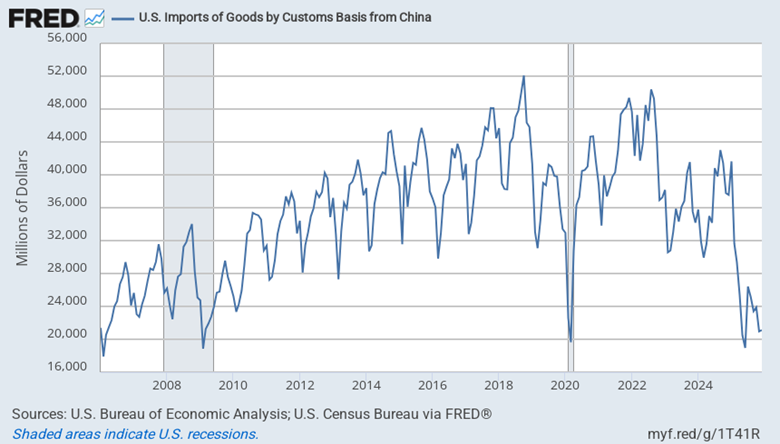
It’s common practice to look at China’s trade surplus and surmise that it includes large inflows of US dollars but I don’t believe it to be the case. Consider their huge increase in trade with Russia where they send parts that can be turned into military goods along with cars, trucks, and other things formerly supplied by the West in return for commodities such as oil and gas. In this case, they are not receiving dollars despite the sharp increase in trade.
China has replaced US exports with exports to 3rd world nations along the Belt and Road where China supplies significant amounts of trade financing to these nations. It’s little more than circular financing.
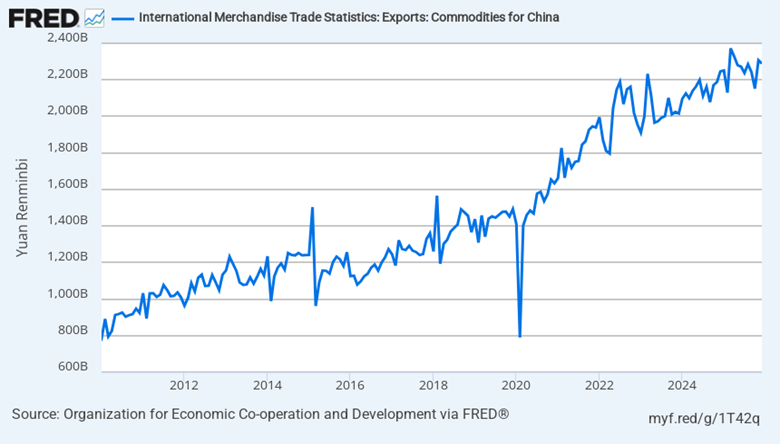
China has reportedly spent $1.3 trillion on its Belt & Road initiative. At first, much of the money was considered grants but switched to loans after China’s finances tightened. Most of that money will never be paid back and should be considered worthless. When this becomes obvious, the world will realize that China has an enormous hole in its national balance sheet.
Conclusion
All treaties between great states cease to be binding when they come in conflict with the struggle for existence – Otto von Bismark
I believe the loss of Iran will prove to be a fatal blow to Chinese confidence and its global aspirations. Furthermore, I believe this loss will accelerate the downfall of Xi Jinping, to be replaced by reformists in the CCP.
It should be clear by now that China’s military industrial complex produces crap. If you have followed closely over the years, you would know that their navy is crap, their air force is crap, and their army is both divided and lacks the logistics to project power.
They have no chance of taking Taiwan by force – that was the main issue between Xi Jinping and Zhang Youxia. Zhang and Liu were battle-tested and competent; both knew successful invasion of Taiwan is impossible. Now the CCP knows that their air defenses are effectively Swiss cheese which means they themselves are the more vulnerable party.
After being embarrassed in the Philippines, Pakistan, Venezuela, and now Iran, China is the emperor with no clothes. Be patient but watch the currency markets because that’s where I believe they will ultimately run out of dollars and produce a tidal wave of losses through the Eurodollar markets.
If you’re interested in learning more, visit us at https://geovestadvisors.com/ and contact Paul Hurley.
Philip M. Byrne, CFA
4. European and Scandinavian affairs
EUROPE/NATO
KORYBKO…
The Planned “NATO Bank” Is Expected To Finance Europe’s Impending Arms Race With Russia
Friday, Mar 06, 2026 – 03:30 AM
The Russian-Polish security dilemma will likely serve as the impetus for fully unleashing and properly managing the capabilities of European NATO as a whole per the US’ National Defense Strategy.
RT drew attention in late January to a report by Izvestia about the West’s alleged plans to launch a “Defense, Security, and Resilience Bank” (DSRB) by 2027. Their article relies on in-depth research by the Atlantic Council, which came up with the idea of what was at first called the “NATO Bank”. The purpose is to provide “low-interest loans for defense modernization”, thus facilitating the goal of NATO members spending 5% of GDP on defense without significantly curtailing social and infrastructure spending.
Instead of slashing such programs to redirect funds to defense at the risk of helping populist-nationalists during the next elections and/or provoking unrest, they’d only spend a fraction of the principal each year servicing their DSRB loan instead of paying the cost upfront as if it was part of their annual expenditures. The Executive Summary of the Atlantic Council’s in-depth research hyperlinked to above also notes that “An additional critical function of the DSR bank would be to underwrite the risk for commercial banks”.
This would then “enabl[e] them to extend financing to defense companies across the supply chain.” The supplementary purpose is to finance large-scale orders that these companies themselves are unable to afford on their own and most member states can’t finance either without potential populist pushback. Defense companies can then expand production, pump out the requested military-technical equipment at scale, and then sell it at a much more affordable price for accelerating NATO’s planned militarization.
The bloc’s Eastern Flank, which largely overlaps with the Polish-led “Three Seas Initiative”, is expected to benefit the most. Poland is already poised to receive €44 billion in loans from the EU’s €150 billion “Security Action For Europe” program (SAFE, which is part of the €800 billion “ReArm Europe Plan”). This should help modernize its embarrassingly underdeveloped military-industrial complex and thus enable Poland to serve as the regional core of associated processes across the rest of the Eastern Flank.
The aforesaid role would become much more likely if it and Lithuania succeed in creating a defense-centric cross-border economic zone across the Suwalki Corridor/Gap like the latter just proposed. The US National Defense Strategy assessed that “European NATO dwarfs Russia in economic scale, population, and, thus, latent military power.” This potential just needs to be fully unleashed and properly managed. Poland could pioneer the way if it allows the US to advise it on the optimal use of SAFE and DSRB loans.
It was already assessed that “Poland Will Play A Central Role In Advancing The US’ National Security Strategy In Europe” so it therefore naturally follows that it’ll play a central role in the National Defense Strategy too. Poland already spends more of its GDP on defense than any other NATO member at 4.8%, however, so anything much more might result in curtailing social and infrastructure spending, but therein lies the importance of the DSRB for enabling Poland to avert that trade-off as was explained.
Poland’s debt-to-GDP is 55.1%, which is far below the EU’s 80.7%, so it could take on more debt through these means without too much socio-political discomfort. This is feasible after Poland just became a $1 trillion economy. Any additional military spending fueled by the DSRB would further accelerate Poland’s unprecedented militarization, which has led to it having the EU’s largest army at over 215,000 troops, with plans to reach 300,000 by 2030 and half a million by 2039 (200,000 of which would be reservists).
From Russia’s perspective, this poses a serious threat to Kaliningrad and allied Belarus, ergo why it’s expected to correspondingly bolster its forces there in response. That could also include the deployment of more strategic arms to Belarus like tactical nukes, hypersonic Oreshniks, and/or whatever else it might develop by then. Such responses are in turn expected to be portrayed by Poland as the reason for its unprecedented militarization that policymakers might then demand to be sped up even further.
The Russian-Polish security dilemma, which is due to their millennium-old rivalry and the US’ empowering of Poland as an anti-Russian proxy, will likely serve as the impetus for fully unleashing and properly managing the capabilities of European NATO as a whole per the US’ National Defense Strategy. Any progress in this direction would compel Russia to keep pace with this hostile bloc’s Polish-led militarization, therefore resulting in its own continued militarization and consequently an arms race.
Unlike European NATO members which will have to take out loans to finance this, hence the purpose of the DSRB, Russia can finance everything on its own. This places Russia in a much better financial position than its adversaries, some of whom are expected to struggle with balancing their perceived military priorities with their objective socio-economic ones.
Accordingly, Russia has the edge in this impending arms race with Europe, but the EU’s potential federalization could narrow the gap if it ever happens.
END
EU/IRAN USA/ISRAEL
Tehran Warns EU “Legitimate Target” If Joins War After Trump Says “No Deal” With Iran Except Under “Unconditional Surrender”
Friday, Mar 06, 2026 – 08:35 AM
Summary:
- War enters day seven as Iranian President Masoud Pezeshkian says several countries have begun mediation efforts to end the conflict with the US and Israel, while stressing negotiations must confront those who “ignited this conflict.”
- Adm. Brad Cooper, CENTCOM Commander: “The Iranian terrorist regime has attacked 12 different countries and continues to deliberately target civilians throughout the Middle East. Last night, Iranian forces fired seven attack drones at civilians, residential neighborhoods in Bahrain. This… will not go unanswered…
- Wapo highlights Ft. Bragg (Ft Liberty) canceled exercises, troops on standby: The U.S. Army abruptly canceled a major training exercise for the 82nd Airborne Division’s headquarters, fueling speculation that the rapid-response unit could deploy to the Middle East as the U.S. conflict with Iran expands.
- Iran says EU ‘legitimate’ target if it joins war: France24
- Heavy fighting continues, with Tehran experiencing its most intense bombardment yet, including strikes near key government districts; Israel says the attacks mark a “new phase” of the war.
- Trump rejects negotiations amid Tehran reports that outside countries offered mediation, declaring there will be “no deal except unconditional surrender,” and suggesting Iran could later select a new leader with US approval.
- Global fallout intensifies: Brent oil futures surges to around $90, Gulf energy flows face disruption, Russia says demand for its energy is rising, and reports indicate Moscow may be providing Iran intelligence on US military assets in the region.
- Qatar News Agency, Citing Minister of State for Energy Affairs, says The ongoing war will force Gulf states to halt energy production and exports within days.
- Israeli official admits Hezbollah joined conflict with unexpected intensity. Israeli military: Five IDF soldiers seriously wounded by Hezbollah rocket as Air Force pounds Beirut
- President Trump said sending ground troops into Iran would be a “waste of time.“
- China assistance in question via CNN: The US also has intelligence suggesting that China may be preparing to provide Iran with financial assistance, spare parts and missile components, three people familiar with the matter said, though Beijing has stayed out of the war up until now – though relies heavily on Iranian oil and has reportedly been pressuring Tehran to allow safe passage for vessels through the Strait of Hormuz.
- Iranian ballistic missiles on Israel show signs of slowing, but severe damage in Tel Aviv and elsewhere has been documented, and Israeli civilian/military casualties. Last days have seen no Pentagon updates on US casualties which stands at 6 troops killed and many ‘seriously’ wounded.
* * *
The war has entered its seventh day, but there could be a glimmer of hope for some kind of diplomatic-led offramp as Iranian President Masoud Pezeshkian indicated Friday that several countries have begun mediation efforts to end the war with the United States and Israel, but insists negotiations must confront those who started the conflict. “Some countries have begun mediation efforts. Let’s be clear: we are committed to lasting peace in the region, yet we have no hesitation in defending our nation’s dignity and sovereignty,” Pezeshkian wrote on X.
“Mediation should address those who underestimated the Iranian people and ignited this conflict,” he added. The mood over at the White House seems one of trying to get the unanticipated after-effects and especially the ongoing fierce Iranian retaliation on Gulf targets under control. Tehran overnight and into Friday saw the heaviest bombardment yet of the Iranian capital. Meanwhile, Brent oil futures have surged to $90 a barrel on the Iran war.
Israel expands Lebanon front with heavy attacks on Beirut:
Importantly, President Trump Friday morning has made clear in a Truth Social post that there will be “no deal” except under “unconditional surrender”. He also asserted that after this, Iran can “select a great, acceptable leader” with his help and approval. “There will be no deal with Iran except UNCONDITIONAL SURRENDER! After that, and the selection of a GREAT & ACCEPTABLE Leader(s), we, and many of our wonderful and very brave allies and partners,” he stated. And following this CNN cited both Trump and Hegseth to say they rate the war at “12 or 15 out of 10.” The president also sees gasoline prices going down “very quickly” – per CNN.
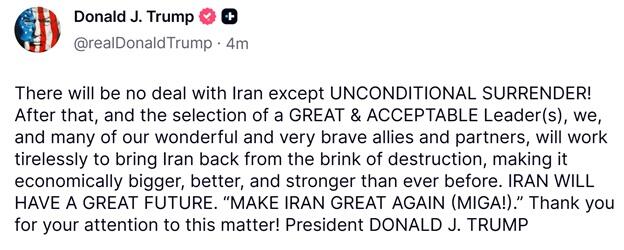
This smashed WTI up to $88 – the highest since Oct 2023…
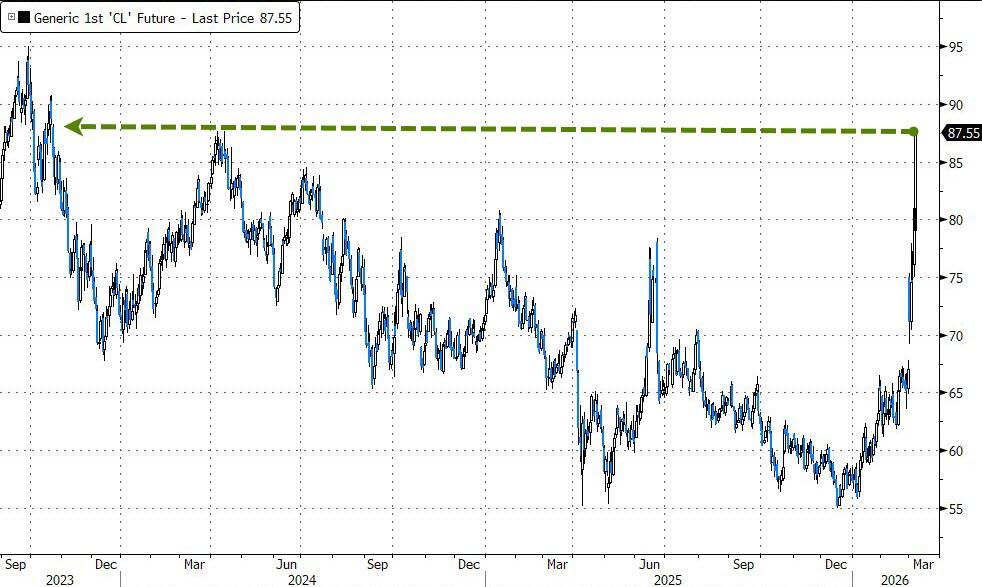
Massive explosions rocked residential neighborhoods and areas near Tehran University, as US and Israeli strikes targeted sites linked to Iran’s military and political leadership, with Al Jazeera’s correspondent reporting that the intensity of the bombardment exceeded anything seen earlier in the war. “I can say that compared to previous days, we saw heavier bombardment overnight, at least in the capital,” the report said. CNN also now belatedly has a war correspondent on the ground in Iran.
Notably, some of the latest strikes hit areas near Pasteur Street, a heavily secured district that houses key government institutions and where Iran’s supreme leader and several family members were killed in the opening hours of the conflict. Israel is vowing attacks marked a “new phase” of the war.
According to the Israeli military, about 50 fighter jets struck an “underground bunker” in Tehran that had been constructed for the late supreme leader, which allegedly extended beneath entire streets in central Tehran and contained meeting facilities used by senior officials even after the leader’s death.
Iranian FM and IRGC defiant…
Israeli officials further claim the campaign is beginning to expose fractures inside Iran’s military chain of command; however, some reports have said various units could be acting autonomously under emergency orders to unleash full retaliation.
The United States has also made clear it is escalating its operations, with B-2 bombers having dropped dozens of bunker-busting “penetrator” bombs on deeply buried ballistic-missile launch sites across Iran. War Secretary Pete Hegseth has warned that the air campaign is “about to surge dramatically” – with President Trump also not showing signs of backing down, describing that the military operation is advancing faster than expected.
Iran is being demolished “ahead of schedule and at levels people have never seen before,” Trump asserted, claiming the country now has “no air force, no air defense” and that its air power is “gone.”
Israel is touting annihilation of all of “Iran’s top leadership” but at this point in the war leadership is likely more dispersed than what Israeli and Western officials are saying:
Since last Saturday at least 1,332 Iranians have been killed, but the death toll could be much higher amid ongoing rescue efforts of people under the rubble in heavily hit areas. Iranian media has reported that missiles struck two schools in the town of Parand southwest of Tehran, in the latest.
But Iran does continue to retaliate across the region. In Israel, by all appearances the number of inbound ballistic missiles has slowed significantly compared with the opening days of the war. Israeli officials say roughly 90 missiles were fired on the first day, about 60 the following day, and around 20 per day since Monday. In total, Iranian media claim roughly 500 ballistic missiles have been launched during the conflict – possibly most of them intercepted, but a significant amount making impact and causing severe damage.
Late Thursday night Tel Aviv came under combined missile and drone attacks, though medics reported no injuries following the latest barrage in southern Israel. Still, the Islamic Revolutionary Guard Corps (IRGC) says its “new-generation missiles struck American bases in Gulf countries” and Israeli targets including “Ben Gurion Airport, Haifa and Tel Aviv.”
Iranian forces also claim to have attacked a “US-owned” oil tanker off the coast of Kuwait, leaving the vessel on fire, according to Iranian state radio. Iranian state television reported that large numbers of drones launched by the army targeted American military bases in Kuwait.
“These attacks will continue in the coming hours,” the military said. Iranian drones have targeted countries across the Gulf from the United Arab Emirates to Qatar and Bahrain. Azerbaijani officials said Iranian drones crossed their border and injured four people in the Nakhchivan exclave, prompting Baku to withdraw diplomatic staff from Iran for safety.
In Lebanon, Israeli airstrikes pounded towns in the south and east of the country as well as Beirut’s southern suburbs after the Israeli military issued mass evacuation orders for large sections of the capital. The United Nations says nearly 100,000 people have been displaced in Lebanon and thousands of Syrian refugees have fled back across the border.
The conflict is further drawing in outside powers, with the most significant development being The Washington Post reporting that Russia has been providing Iran with intelligence on the locations of US military assets in the Middle East, including warships and aircraft. US officials described the effort as “a pretty comprehensive effort” by Moscow, though the accuracy of the intelligence remains unclear.
This is also when the ‘fog of war’ and propaganda is very heavy – and so such allegations especially from an ultra-heart-of-the-establishment D.C. beltway publication should be treated with caution and skepticism. However, it would make perfect sense that Russia is helping its Mideast ally, given that Russia and Iran signed a strategic partnership agreement earlier this year expanding military and defense cooperation. Despite that, Hegseth said earlier in the week that Russia is “not really a factor” in the conflict.
Meanwhile in the ultimate irony of ironies, Financial Times is reporting US officials are discussing the purchase of Ukrainian-made drone interceptors to counter Iranian drones, which some analysts say have proven harder to stop than expected. Patriot missile interceptors used by US allies cost more than $4 million each, while the Ukrainian systems are significantly cheaper and designed to defeat the same Shahed-type drones used by Russia.
Back in Iran, ‘Pro-regime’ sentiment making itself known, with across the country large crowds gathering for the first Friday prayers since the war began. Tens of thousands of worshippers carrying portraits of the slain supreme leader chanted anti-US and anti-Israel slogans despite the ongoing bombardment. There have also been “death to the Shah” type chants heard, amid reports that Trump wants to have a hand in directly choosing a puppet leader for Iranians.
END
5. RUSSIAN AND MIDDLE EASTERN AFFAIR
IRAN vs ISRAEL VS USA VS JUST ABOUT EVERYBODY
TBN ISRAEL LAST 24 HRS
ISRAEL VS IRAN UPDATES
Netanyahu deserves credit for Israel’s success against Iran, but accountability remains – editorial
Netanyahu’s consistent focus on Iran led to a historic victory, but Israel must demand leadership that transforms military success into a lasting strategy and accountability.

Israeli Prime Minister Benjamin Netanyahu visits an air force base in southern Israel on March 5, 2026.(photo credit: MAAYAN TOAF/GPO)ByJPOST EDITORIALMARCH 6, 2026 06:00
Israel’s extraordinary achievements against the Iranian regime over the past week should be recorded with a simple truth: Prime Minister Benjamin Netanyahu deserves the central share of the credit.
Yes, US President Donald Trump made the call in Washington. Yes, the IDF executed with skill and courage. Yes, the Mossad and the CIA, alongside an entire Western intelligence and defense ecosystem, delivered capabilities that most countries only watch in movies, enabling Israel to effectively counter threats and maintain its security posture in a volatile region.
For three decades, Netanyahu has been the Israeli leader who has kept Iran at the center of Israel’s threat map – despite its unpopularity, the disinterest of world capitals, and Israel’s shifting attention.
This newspaper has criticized Netanyahu many times, for many years, and that will not change. Accountability does not disappear because a week went well. At the same time, a newspaper that demands responsibility during failure has a duty to acknowledge leadership during success.
Netanyahu’s Iran argument has been consistent since the early 1990s. Long before centrifuges and underground facilities became household terms, he warned that Tehran’s regime was not a local problem. He framed it as a threat that would eventually target the West, use proxies to destabilize the region, and chase strategic weapons that would change the rules for everyone.

He repeated the warning in Israeli politics, in Washington, and at the UN. He made it a signature issue across different administrations, different coalitions, and different eras of Israeli public mood.
This week, that long-running message collided with historic action.
Even Ben Caspit, one of Netanyahu’s sharpest and most consistent critics, wrote what many Israelis have been thinking: “No force in the world will be able to take the credit for what is happening away from Prime Minister Benjamin Netanyahu.”
Advertisement
Caspit’s point was not that Netanyahu is above criticism. His point was that history assigns credit the same way it assigns blame: to the person at the top when the decisive choice is made.
That is why this moment matters. It is not only about a successful operation. It is about the rare moment when Israelis across the spectrum can say the same thing in the same sentence.
Netanyahu deserves credit for keeping Iran on the agenda
Netanyahu deserves it. He deserves it because he kept Iran on the agenda when others wanted it off. He deserves it because he pursued the threat through diplomacy, intelligence, and military preparation over many years. He deserves it because he took heat for being repetitive, for being alarmist, for being obsessed, and because repetition is exactly what national strategy often requires.
Leaders get mocked for warning too early, and they get blamed for warning too late. Netanyahu warned early, loudly, and relentlessly.
Credit, though, is only useful if it is attached to responsibility. Netanyahu’s supporters want a clean hero narrative. His opponents want a clean villain narrative. Israel deserves something more practical: clear-eyed recognition that a leader can deliver a strategic achievement and still carry responsibility for grave failures on his watch, including the October 7 massacre and its aftermath.
Israelis can applaud what deserves applause and still insist on accountability for what demands accountability. So, what should Israelis demand now, after praising what deserves praise?
Let’s start with political leadership that has to translate battlefield gains into a durable strategic outcome. A dramatic opening week is not the same as an end state. Iran’s capabilities, its proxies, and its ideology do not evaporate because of one operation.
The goal has to be a safer Middle East with real deterrence, real regional cooperation, and a clearer sense that attacking Israel and the West carries costs that regimes cannot absorb.
In addition, Israel’s leadership has to use this moment to rebuild public trust at home. Military unity in a crisis is not a substitute for civic cohesion, functioning institutions, and leadership that speaks honestly about what Israel got right, what it got wrong, and what it must fix.
Finally, Netanyahu should treat this as a moment for seriousness, not triumphalism. A leader who has spent decades warning the world about Tehran should also understand the next phase. The “day after” is where victories are preserved or wasted. Israel needs discipline, restraint, and political maturity, starting at the top.
For today, though, a straightforward sentence belongs on the record.
Well done, Prime Minister Netanyahu
END
IRAN ET AL: BRANDON SMITH…
do not agree with everything Brandon says but he is spot on with respect to the Srait of Hormuz and oil!
(Brandon Smith)
What Happens Next In Iran? Decapitation, Quagmire Or WWIII?
Thursday, Mar 05, 2026 – 11:30 PM
Authored by Brandon Smith via Alt-Market.us
Before I begin this analysis of the situation in the Middle East and its consequences, I want to warn people that this examination is going to be largely secular and nuanced; which means people on both sides of the divide are going to piss and moan about it. Frankly, I don’t care.
To be clear, I’m not interested in the “plight” of the Palestinians, the Islamic regime in Iran or the conspiracy theories of “groypers.” I find appeals of empathy and compassion for Islamic societies to be naive – They are perfectly indifferent and hostile to the west, they always have been. They have also formed political alliances with far-left organizations in the US and Europe with the intent to burn the west to the ground. I do not waste my time worrying about them.
In fairness, I also don’t care about the Israeli government and I have no vested interest in whether or not they survive. In the past, Israeli supported organizations have helped in the formation of militant leftist groups and anti-conservative sentiments in the US. The fact that leftist activists have turned on Israel in recent years is rather poetic.
I recognize many Christians would disagree with this position in the belief that Israel is the only western ally keeping watch over the Holy Land. I argue that it should be western Christians (not Israelis) in charge of the region, given it was ours (through the Holy Roman Empire) for centuries, until the Muslim hordes invaded.
I’m also aware that there are numerous disinformation agents online who are paid by both sides. Israel as well as Islamic governments run these digital operations constantly. They expend vast amounts of money to employ armies of social media shills. Their singular job is to disrupt sincere discussion and sway American opinion to support one side or the other.
This tells me a lot about how important the US population is to the geopolitical future of the world. Everyone wants us to pick their team or hate their opponent.
What I care about first and foremost is how geopolitical events and our involvement will affect America and American interests. What I have learned in recent years, though, is that it’s easy enough to predict events but not necessarily outcomes. There are people out there that think every international conflict or crisis is going to end in global doom.
None of them have so far. Of course, all it takes is the right crisis to trigger a Black Swan. This is where I think many of us in the alternative media build lighthouses, warding ships away from the rocky shores of any incident that might become a world-ending singularity.
It’s important to understand that dramatic geopolitical shifts have the potential to act as “linchpins”, impacting our lives through a chain of dominoes that is not immediately apparent until years later. Potential does not mean certainty. As I’ve been pointing out for many years now – collapse is a process, not an event.
In spring of 2024 in my article “Iran vs Israel: What Happens Next Now That Shots Have Been Fired?” I predicted the development of an unavoidable war footing between Iran and the US (with Israel as instigator or convenient rationale) and I argued that this would escalate in the spring of 2025. I was one year off.
In that article I predicted initial air strikes of primary targets. I predicted Iran’s closure of the Strait of Hormuz (which has now happened). I predicted a ground invasion into Lebanon by Israel (which has not happened yet), followed by the eventual ground invasion by US and Israeli forces into Iran.
Immediate consequences could include a spike in oil and gas prices (over 20% of the world’s oil supply passes through the Strait of Hormuz). Then there’s elevated possibility of planned and autonomous terror attacks (the recent mass shooting in Austin, TX appears to be the first). There’s the danger of a potential military draft should the war carry on for more than a couple years or if it turns into an occupation dealing with a large insurgency.
Finally, there is the growing chance of increasing hostility with Russia and China leading to an eventual catalyst that causes world war. This is a worst-case scenario viewpoint of the conflict, and not necessarily the most likely outcome.
For example, in Venezuela, black pillers wailed and raged over Donald Trump’s black-bag operation that resulted in the capture of illegitimate dictator Nicolas Maduro. They claimed with certainty that this action would initiate Vietnam Part II. They were entirely wrong.
Millions of Venezuelans around the world rejoiced and the Venezuelan population has done nothing in the name of bringing Maduro back. Trump’s critics ignored the applause from Venezuelan nationals and argued that their opinions don’t matter.
Why? Because their support of Trump’s invasion is inconvenient to the narrative that he’s a “mindless warmonger” and that he is “betraying his voter base.” This is a childish response to complex geopolitical dynamics.
Many dictatorships deserve to die. The libertarian methodology of sitting around and doing nothing while bitching about the people who take action is growing stale. The American public is not inspired by passivity. This does not mean we should go to war with Iran, per se, but I think US patriots are done with ego-stroking debates on constitutional and ideological theory. They want to see results.
If moral justification is the issue, then there is a fair case to be made for the decapitation of the Islamic regime in Iran. The Iranian government engages in the same brutal theocratic oppression we have seen with the Taliban in Afghanistan, but on an industrial scale. If you are a woman, a political dissident or a religious minority in Iran, you have no rights and can be arrested or murdered for any reason at any given moment.
Just because Muslims happen to agree with conservatives that transgender activists are predatory lunatics does not mean we have anything else in common.
Most critics will argue that regime change in Iran is only meant to benefit Israel and not the Iranian people. It actually benefits MANY countries, not just Israel. I would also argue that Trump’s REAL goal is probably to further isolate China from its international oil sources, while Israel is a secondary concern (or a useful excuse).
Trump’s decapitation strategy against Venezuela, his policies on the Panama Canal and his Iran strikes conveniently cut China off from around 20% of its oil resources. This is significant and could change China’s military development efforts dramatically. That said, just because Trump was right on Venezuela does not mean he will be right on Iran.
The US is very good at taking out enemy leadership and blowing stuff up. We are completely inept when it comes to occupation and this is where we always lose. Occupation requires majority support of the foreign population. Without it, there is no point.
In Iran, Trump MIGHT have it. We have to wait and see what the Iranian population does in reaction to the decapitation strikes. If too large a percentage of the populace throws support behind the Islamists, then the limited strikes will have to evolve into a ground war, and a ground war without domestic alliances would turn into a quagmire.
Then there’s the question of the Strait of Hormuz. Clearing the strait and keeping it operational will be difficult. Iran can run interference on oil shipping for months merely by targeting tankers with thousand of drones. I don’t have to explain what one Shahed drone can do to a ship loaded with combustible oil.
If it was my operation, I would target the strait with long range artillery or ballistic missiles supported by drone spotters. All it takes is one large sunken ship to close the Hormuz for weeks. This is a problem IF Trump’s strikes on top officials do not inspire a popular revolution.
The Hormuz closure will mean higher gas prices (though, I suspect part of Trump’s strategy is to use Venezuelan oil exports to offset the Hormuz bottleneck). If Trump can’t keep prices relatively low, then the American public will be very unhappy. We already spent four years suffering under Biden’s inflation. We can’t absorb any more.
Russian and Chinese involvement in the region appears to be limited to weapon sales and logistics. Russia does have a Strategic Partnership Treaty with Iran, but it does not contain a mutual defense clause. I worry far more that elitists in Europe are doing everything in their power to start a world war with Russia by interfering in Ukraine.
Speaking of the OTHER conflict in the east, it’s interesting to me that, under the Biden Administration, Democrats avidly and rabidly demanded direct confrontation with Russia over Ukraine. Like Iran, it’s just another country that has little to do with us, yet they were happy to risk nuclear conflagration over that foreign entanglement. This is why I don’t take leftists seriously at all when it comes to their anti-war rhetoric.
As far as Israel is concerned, yeah, they make off like bandits in this situation. They know they do. I’m sure they are secretly proud of that fact. They would never be able to fight this war alone. But I’m not going to cry over the destruction of a Muslim theocracy just because Israel gains something from it.
The issue is America, and whether or not this war will escalate out of control and turn into a global crisis that harms us. I will admit that Trump has displayed a knack for executing limited military operations with far-reaching effects at limited cost. He has proven the blackpillers wrong on several occasions.
Secretary of Defense Pete Hegseth asserts that there will be no quagmire. If this is possible to pull off, then it will be the Trump Administration’s greatest magic trick yet.
If it’s not possible, then the outcome will be chaos and civil breakdown in Iran followed by balkanization, tribal warfare and widespread insurgency far outside the boundaries of the country. Trying to clean up the mess would likely result in the same kind of failed occupation the US experienced in Iraq and Afghanistan.
It’s a gamble that risks a sharp division within the conservative base. It also risks the extremist left coming back into power. Any major disaster on Trump’s watch could serve the interests of globalists seeking to exploit a crisis to further demonize the concepts of nationalism and conservatism.
At that point, the only solution would have to be a total and unrelenting crusade, with or without the Trump Admin.
If we want to protect our children and the future in general, the leftist cult can never be allowed to take power again. Third world migrants cannot be allowed to stay in the US. And, globalists can’t be allowed to remain as social engineers influencing world events.
There are many people who oppose the elites who also see a substantial failure by Trump as an opportunity to “kick off the boogaloo.” They see chaos as a chance to finally put the greater underlying war against the globalists and multiculturalists to rest. I’m not sure I disagree. What I do know is that this would cost a considerable number of innocent lives, but maybe it can’t be avoided.
The success or failure of the Trump Presidency changes little in terms of our ultimate responsibility to ensure that the globalists face justice.
For now, I am erring on the side of an Iranian government collapse and a win for Trump after a couple months of limited strikes and covert ops. In the meantime I expect a wave of attempted terror attacks, even more NGO paid riots by leftists activists and probably an emergency effort by DHS to deport most Muslim immigrants from the country. The cynics say “nothing ever happens”, except when something happens. Keep your head on a swivel.
END
ISRAEL VS IRAN UPDATES
MASSIVE EXPLOSIONS ROCK TEHRAN
Massive explosions rocked residential neighborhoods and areas near Tehran University, as US and Israeli strikes targeted sites linked to Iran’s military and political leadership, with Al Jazeera’s correspondent reporting that the intensity of the bombardment exceeded anything seen earlier in the war. “I can say that compared to previous days, we saw heavier bombardment overnight, at least in the capital,” the report said. CNN also now belatedly has a war correspondent on the ground in Iran.
Notably, some of the latest strikes hit areas near Pasteur Street, a heavily secured district that houses key government institutions and where Iran’s supreme leader and several family members were killed in the opening hours of the conflict. Israel is vowing attacks marked a “new phase” of the war.
According to the Israeli military, about 50 fighter jets struck an “underground bunker” in Tehran that had been constructed for the late supreme leader, which allegedly extended beneath entire streets in central Tehran and contained meeting facilities used by senior officials even after the leader’s death.
Iranian FM and IRGC defiant…
Israeli officials further claim the campaign is beginning to expose fractures inside Iran’s military chain of command; however, some reports have said various units could be acting autonomously under emergency orders to unleash full retaliation.
The United States has also made clear it is escalating its operations, with B-2 bombers having dropped dozens of bunker-busting “penetrator” bombs on deeply buried ballistic-missile launch sites across Iran. War Secretary Pete Hegseth has warned that the air campaign is “about to surge dramatically” – with President Trump also not showing signs of backing down, describing that the military operation is advancing faster than expected.
Iran is being demolished “ahead of schedule and at levels people have never seen before,” Trump asserted, claiming the country now has “no air force, no air defense” and that its air power is “gone.”
Israel is touting annihilation of all of “Iran’s top leadership” but at this point in the war leadership is likely more dispersed than what Israeli and Western officials are saying:
Since last Saturday at least 1,332 Iranians have been killed, but the death toll could be much higher amid ongoing rescue efforts of people under the rubble in heavily hit areas. Iranian media has reported that missiles struck two schools in the town of Parand southwest of Tehran, in the latest.
But Iran does continue to retaliate across the region. In Israel, by all appearances the number of inbound ballistic missiles has slowed significantly compared with the opening days of the war. Israeli officials say roughly 90 missiles were fired on the first day, about 60 the following day, and around 20 per day since Monday. In total, Iranian media claim roughly 500 ballistic missiles have been launched during the conflict – possibly most of them intercepted, but a significant amount making impact and causing severe damage.
Late Thursday night Tel Aviv came under combined missile and drone attacks, though medics reported no injuries following the latest barrage in southern Israel. Still, the Islamic Revolutionary Guard Corps (IRGC) says its “new-generation missiles struck American bases in Gulf countries” and Israeli targets including “Ben Gurion Airport, Haifa and Tel Aviv.”
Iranian forces also claim to have attacked a “US-owned” oil tanker off the coast of Kuwait, leaving the vessel on fire, according to Iranian state radio. Iranian state television reported that large numbers of drones launched by the army targeted American military bases in Kuwait.
“These attacks will continue in the coming hours,” the military said. Iranian drones have targeted countries across the Gulf from the United Arab Emirates to Qatar and Bahrain. Azerbaijani officials said Iranian drones crossed their border and injured four people in the Nakhchivan exclave, prompting Baku to withdraw diplomatic staff from Iran for safety.
In Lebanon, Israeli airstrikes pounded towns in the south and east of the country as well as Beirut’s southern suburbs after the Israeli military issued mass evacuation orders for large sections of the capital. The United Nations says nearly 100,000 people have been displaced in Lebanon and thousands of Syrian refugees have fled back across the border.
The conflict is further drawing in outside powers, with the most significant development being The Washington Post reporting that Russia has been providing Iran with intelligence on the locations of US military assets in the Middle East, including warships and aircraft. US officials described the effort as “a pretty comprehensive effort” by Moscow, though the accuracy of the intelligence remains unclear.
This is also when the ‘fog of war’ and propaganda is very heavy – and so such allegations especially from an ultra-heart-of-the-establishment D.C. beltway publication should be treated with caution and skepticism. However, it would make perfect sense that Russia is helping its Mideast ally, given that Russia and Iran signed a strategic partnership agreement earlier this year expanding military and defense cooperation. Despite that, Hegseth said earlier in the week that Russia is “not really a factor” in the conflict.
Meanwhile in the ultimate irony of ironies, Financial Times is reporting US officials are discussing the purchase of Ukrainian-made drone interceptors to counter Iranian drones, which some analysts say have proven harder to stop than expected. Patriot missile interceptors used by US allies cost more than $4 million each, while the Ukrainian systems are significantly cheaper and designed to defeat the same Shahed-type drones used by Russia.
Back in Iran, ‘Pro-regime’ sentiment making itself known, with across the country large crowds gathering for the first Friday prayers since the war began. Tens of thousands of worshippers carrying portraits of the slain supreme leader chanted anti-US and anti-Israel slogans despite the ongoing bombardment. There have also been “death to the Shah” type chants heard, amid reports that Trump wants to have a hand in directly choosing a puppet leader for Iranians.
First Friday prayers since massive attacks started:
Meanwhile the conflict continues disrupting global energy flows. But as we’ve been highlighting, that means: “We are seeing a significant increase in demand for Russian energy resources in connection with the war in Iran,” Kremlin spokesman Dmitry Peskov said. Russia remains “a reliable supplier of oil and gas,” he added.
Western MSM has tended not to show the large pro-government demonstrations which had been on and off since January, in tandem with the anti-Tehran protests and clashes:
International Energy Agency director Fatih Birol says global markets still have ample supply. “We have no oil shortage … there is a huge surplus,” he said. But Qatar’s energy minister Saad al-Kaabi offered a far more pessimistic outlook, warning it could take “weeks to months” for energy exports to normalize even if the war stopped immediately.
“Everybody’s energy price is going to go higher,” he said. “There will be shortages of some products and there will be a chain reaction of factories that cannot supply.”
On the airspace closure and travel front, the widening war is also triggering evacuations and security concerns far beyond the battlefield, with thousands of travelers still stranded across the region as airlines cancel flights, though Emirates says it transported roughly 30,000 passengers out of Dubai in a single day and expects to restore its full flight network soon. Limited commercial flights have resumed from Israel.
In Britain, counterterrorism police arrested four men on allegedly suspicion of spying on the Jewish community for Iran. The Metropolitan Police said the suspects – one Iranian national and three dual British-Iranian citizens – were detained early Friday morning in Barnet and Watford. Meanwhile, international pressure continues mounting over civilian casualties – while at the Pentagon there has not been any new casualty update since six American troops were confirmed killed in the opening days of Operation Epic Fury.
END
Satellite Images Reveal Iran’s Precision Strike on US Base: Six Strategic SATCOM Radomes Destroyed at Camp Arifjan, Crippling American Command Network in the Gulf
Satellite imagery allegedly shows Iranian missile strikes destroying six satellite communications radomes at Camp Arifjan in Kuwait, exposing vulnerabilities in US CENTCOM command-and-control infrastructure and raising strategic questions about the resilience of American military networks across the Middle East.
By admin On Mar 6, 2026
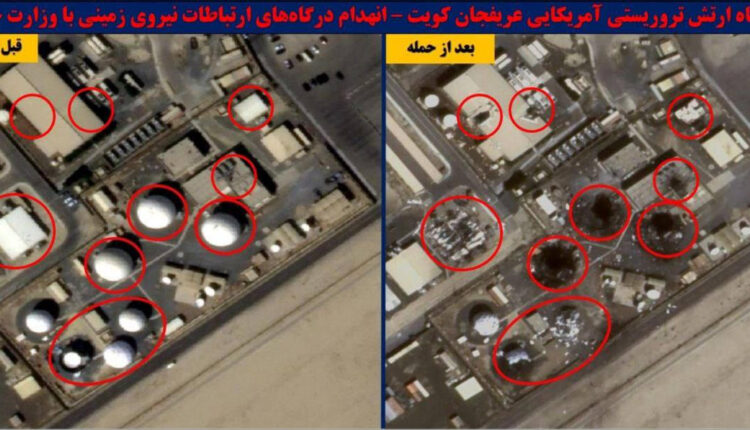

(DEFENCE SECURITY ASIA) — The emergence of satellite imagery allegedly documenting the destruction of six United States military communication radomes at Camp Arifjan in Kuwait signals a potentially consequential escalation in the strategic contest between Iran and the United States, because disabling satellite communications infrastructure directly threatens the command-and-control networks sustaining American force posture across the Middle East.
Images circulated by Iranian channels show clustered missile impact points precisely aligned with radome locations inside Camp Arifjan, suggesting that the strikes were designed to dismantle critical satellite communication nodes that enable United States Central Command to maintain operational connectivity across a geographically dispersed theatre stretching from the Persian Gulf to Central Asia.
If verified, the destruction of six communication radomes at the base would represent a targeted assault on the digital backbone of American expeditionary warfare, because satellite communication antennas housed within such structures facilitate encrypted voice links, intelligence data transfer, drone operations, and logistics coordination across multinational military coalitions.
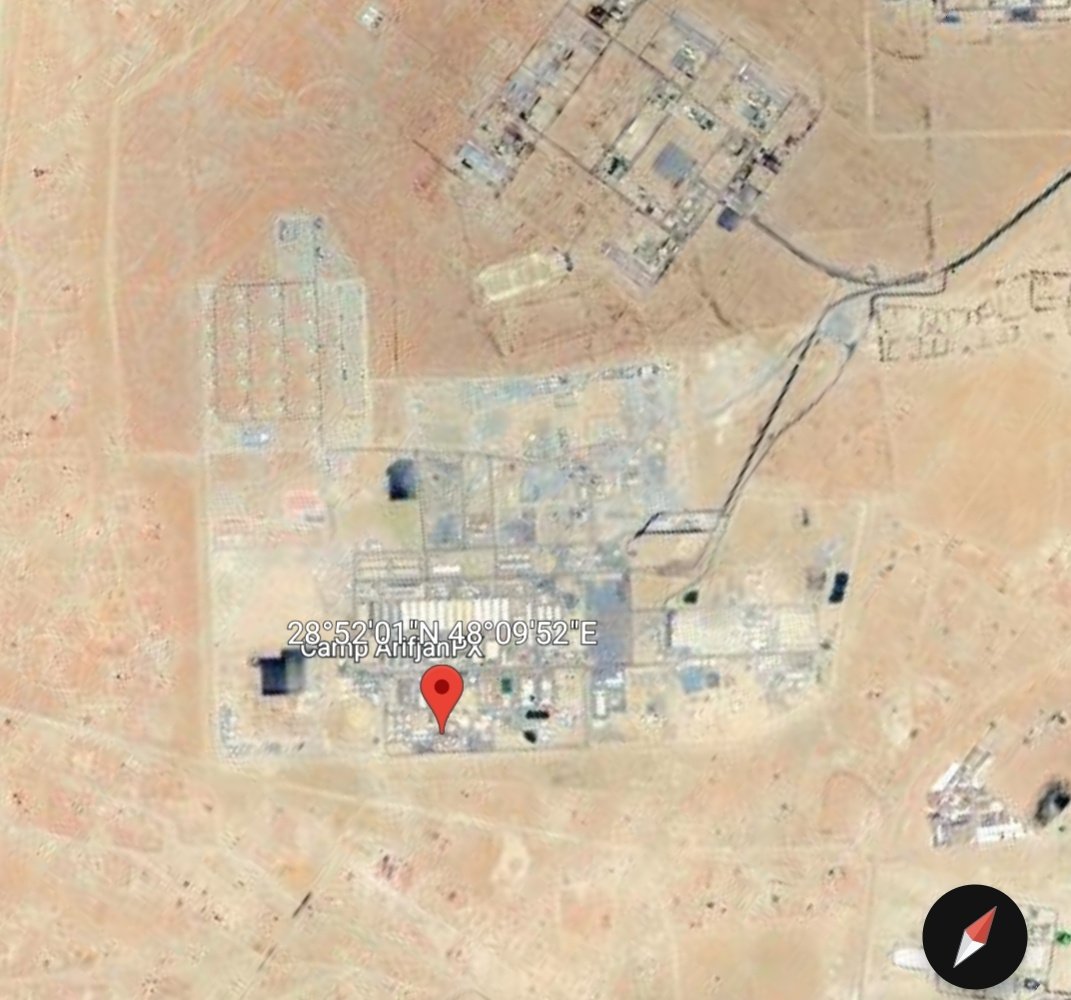
The imagery also depicts significant structural damage to surrounding buildings and warehouses at the installation, indicating that the strikes may have extended beyond communication domes themselves to include infrastructure supporting equipment storage, maintenance, and logistical sustainment for satellite communications networks.
The imagery further suggests that the attacks form part of a broader campaign targeting critical elements of US regional surveillance architecture including THAAD missile defence radars, satellite communications nodes, and long-range early-warning systems positioned across allied states.
Such targeting patterns indicate a deliberate effort to weaken the integrated sensor network that enables American forces to detect missile launches, coordinate air defence responses, and maintain operational awareness across a geographically dispersed theatre of operations.
Precision Strike on Camp Arifjan Signals Targeting of US Logistics and Command Networks
Satellite imagery allegedly documenting the Iranian strike sequence shows clustered missile impacts across Camp Arifjan, Kuwait’s primary US military logistics hub, with the pattern of craters suggesting deliberate targeting of satellite communication radomes that serve as critical nodes within the command-and-control architecture linking deployed forces to global military networks.
RUSSIA VS UKRAINE UPDATES
GLOBAL ISSUES, COVID ISSUES, VACCINE INJURIES/HEALTH ISSUES
ROBERT H…..
The Middle East and beyond is headed for a darker time
The United Arab Emirates (UAE) imports 80-90% of its food. Saudi Arabia, 80%. Kuwait, 98%.. with the Strait of Hormuz shut they start rationing food within a month. ALL ships are rerouting and the overland routes will not carry the day. Short term perishables will drop The reality of Middle East may well be changed by the conflict. And this will spill over well beyond the region. There are already stories of storage facilities filling up in the Gulf. Shutting down wells is not so simple as you really cannot do that. Any longer term curtailment of shipping will lead to oil well problems that will last.
As it is about 20% of daily oil shipments are stopped and Qatar has shut down LNG production. It takes about 2-3 weeks to start back up to full production and Qatar has been the major source of supply after Europe reduced buying from Russia. And Russia more recently has stopped shipping what little it was to Europe, earlier than expected. Predictably this mess will serve to benefit Russia because their prices for both gas and oil that is available will rise beyond that which is not locked in by contract. There is a reason why Hungary was in Moscow to ensure both price and availability as Russians do honor contracts. And like always the Ukrainians have their hand out.
As of today, Thursday, Iran is targeting other Oil infrastructure in the Middle East.
Drones attacked the Baku-Tbilisi-Ceyhan pipeline in Georgian territory. This pipeline network provides 30% of Israel’s oil sources. No doubt as to what this does if they succeed. Especially as China has curtailed ALL gasoline and diesel exports putting further strain on availed global supply.
Even though it appears that oil is abundant in North America, the continent is not immune to rising prices. Items like fertilizer are rising ( Urea is a big Middle East export ) and no doubt so will wheat prices.
Assuming that the conflict goes on for more than a month there will be severe dislocations affecting food availability. Producers will all take advantage and all goods will rise in price with the blame on the conflict. Whether real or not those surcharges seem to stick around much longer than actually needed. This will be the story shortly at the grocery store. People living paycheck to paycheck will be most affected and hard goods are already seeing an increase in price. Lawn furniture will be more expensive this year. However that may well pale to food shortages and energy constraints. After all food deliveries across North America are by truck unless flown in.
By early April indicators will be clear where prices are going this summer.
end
GLOBAL ISSUES
MARK CRISPIN MILLER
DR PAUL ALEXANDER
BREAKING: POTUS Trump DUMPS Tucker Carlson (& Megyn Kelly), saying he is & never was MAGA! ‘‘He’s Not MAGA!’ Trump Officially Cuts Tucker Carlson Loose from His Political Movement in Stunning Comments
Carlson called the bombing of Iran by USA & Israel “absolutely disgusting and evil.” Trump also hit out at Megyn Kelly, another vocal critic of the Iran strikes. Trump: “Tucker has lost his way,” “I
| Dr. Paul AlexanderMar 6 |
knew that a long time ago, and he’s not MAGA. MAGA is saving our country. MAGA is making our country great again. MAGA is America first, and Tucker is none of those things. And Tucker is really not smart enough to understand that.”
The comments follow Carlson blasting Trump’s administration over their recent strikes on Iran. Carlson called it “absolutely disgusting and evil.” He’s also been vocal in criticizing Trump’s administration on other issues like the Epstein files, Ukraine, and more.’
Carlson said in an interview with Karl that Trump’s decision to strike Iran will “shuffle the deck in a profound way” in terms of his political movement.
The president previously responded to Carlson’s Iran criticism, saying it has no effect on him. Carlson reportedly visited the White House multiple times last month to lobby against the attack.
“I think that MAGA is Trump — MAGA’s not the other two,” Trump said about Carlson and Megyn Kelly, another vocal critic of the Iran strikes. “MAGA wants to see our country thrive and be safe. And MAGA loves what I’m doing — every aspect of it… This is a detour that we have to take in order to keep our country safe and keep other countries safe, frankly.”

‘He’s Not MAGA!’ Trump Officially Cuts Tucker Carlson Loose from His Political Movement in Stunning Comments
I pray that Trump stays well, safe, healthy, that the Lord covers him with mercy and grace and favor and helps him in decision making that it may be optimal for all involved and saves lives on all sides and that he breaks from the strangle hold of the deepstate and stands above and apart…
God bless POTUS Trump!
NEWSWIZE
| Senate Blocks Measure Aimed at Restricting Trump’s Iran War PowersThe Senate voted down a War Powers Resolution that would have limited President Trump’s military authority against Iran, leaving the president with substantial freedom to act while the House may still consider a companion measure.READ THE FULL REPORT |
| Steve Daines to Leave Senate Race and Endorses Kurt AlmeSen. Steve Daines is leaving the 2026 Senate race, creating an open Montana seat just before the filing deadline and signaling support for Kurt Alme while praising Sen. Tim Sheehy and President Trump.READ THE FULL REPORT |
| Sen. Tim Sheehy Intervenes as Protester Disrupts Armed Services HearingA viral clip shows Senator Tim Sheehy joining Capitol Police to remove a protester who interrupted a Senate Armed Services hearing to protest U.S. military action in Iran. Sheehy later said he acted to help deescalate the situation and urged the man to get help.READ THE FULL REPORT |
| Kurdish Forces Reportedly Open Ground Offensive in Northwestern IranReports say Kurdish fighters have initiated a ground offensive in Iran’s northwest while Iraqi Kurdistan officials deny cross-border action and disputes persist over possible U.S. involvement amid wider U.S. and Israeli operations against Iran.READ THE FULL REPORT |
| Leavitt Rebukes Kaitlan Collins for Misframing Pentagon Comments on CasualtiesKaroline Leavitt forcefully corrected Kaitlan Collins after Collins mischaracterized Pentagon remarks about U.S. casualties during Operation Epic Fury, defending Secretary Pete Hegseth and blasting CNN’s persistent negative coverage of President Trump.READ THE FULL REPORT |
| LATEST REPORTS FOR NEWS JUNKIES |
| Washington and Caracas Reopen Embassies After Maduro CaptureFollowing the capture of Nicolás Maduro, the U.S. and Venezuela agreed to resume diplomatic and consular relations under a phased plan focused on security, energy and mining cooperation, and potential easing of sanctions tied to democratic progress.READ THE FULL REPORT |
| Seth Moulton Criticized After State of the Union Guest Linked to Police ReportsRep. Seth Moulton is under fire after reports say his State of the Union guest is an undocumented immigrant tied to 2021 police reports involving sexual assault and juveniles, prompting questions about his vetting and judgment.READ THE FULL REPORT |
| Trump Says Iran’s Remaining Leaders Are Begging for a Deal After Devastating StrikesTrump declared Iran’s surviving leaders are pleading for a deal after U.S. strikes removed much of their senior command and crippled missile capabilities. He warned they must surrender or face ‘guaranteed death’ while offering defectors asylum.READ THE FULL REPORT |
| Inside the Strike: Israel’s Space-Arc Missile that Removed Iran’s LeaderThe February operation that killed Ayatollah Ali Khamenei was a coordinated U.S.-Israeli action relying on months of intelligence, deliberate deception, and a jet-launched ballistic missile that briefly left the atmosphere before striking Tehran.READ THE FULL REPORT |
| House GOP Presses Rep. Tony Gonzales to Withdraw From 2026 Race Amid Ethics ProbeSenior House Republicans have urged Rep. Tony Gonzales to suspend his re-election campaign as the House Ethics Committee investigates an admitted affair tied to a former staffer’s suicide, while Gonzales denies responsibility and says he has reconciled with his wife.READ THE FULL REPORT |
MICHAEL EVERY/OR OR PICTON/GIFFIN OR RABOBANK EXECUTIVE/COMMENTARY ON WORLDLY AFFAIR
7. OIL ISSUES/NATURAL GAS/ENERGY ISSUES/GLOBAL
a must read!!
“This Will Bring Down Global Economy”: Qatar’s Energy Minister Offers Dire Warning About Hormuz Chokepoint Chaos
Friday, Mar 06, 2026 – 07:15 AM
Brent crude futures are on track for their biggest weekly gain since the early days of Covid, with the move now exceeding the 20% weekly spike at the start of the Russia-Ukraine war, as the U.S.-Israeli air campaign against Iran, Operation Epic Fury, has tipped the Gulf into an energy crisis, freezing commercial traffic through the Strait of Hormuz and pushing some regional oil and gas production offline.
On Friday, Qatar’s energy minister, Saad al-Kaabi, told the Financial Times that the Gulf conflict could trigger a global economic shock, warning that continued fighting would force all Gulf energy exporters to halt output and could send Brent crude prices north of $150 a barrel.
“Everybody who has not called for force majeure we expect will do so in the next few days if this continues. All exporters in the Gulf region will have to call force majeure,” Kaabi explained. “If they don’t, they are at some point going to pay the liability for that legally, and that’s their choice.”
Qatar is the world’s second-largest producer of LNG and was forced to declare force majeure earlier this week after IRGC drone strikes on its Ras Laffan plant.
“This will bring down the economies of the world,” he warned. “If this war continues for a few weeks, GDP growth around the world will be impacted. Everybody’s energy price is going to go higher. There will be shortages of some products and there will be a chain reaction of factories that cannot supply.”
Kaabi continued, “We don’t yet know the extent of the damage, as it is currently still being assessed. It is not yet clear how long repairs will take.”
On Tuesday, we provided readers with the number of days of disruption needed in the Gulf area (the Strait of Hormuz chokepoint) to trigger actual panic, that is 25. Read the full report here.
And for Zerohedge Premium and Pro subs. JPMorgan crunched the math on Hormuz and revealed just how many days until chaos (report here).
Then, on Thursday, energy economist Anas Alhajji spoke with top UBS analysts on a webinar that also provided a timeline for energy market chaos and the risks of an impending economic shock.
“Our main scenario is that if this lasts four weeks, things will be completely out of control. And when I say out of control, I mean that even if China starts releasing oil from its inventories, the problem is that my guess is China would also restrict exports, which means that oil would remain in China. We were counting on that oil being in the market, and now it is not going to be in the market,” Alhajji said.
Alhajji outlined critical questions:
- Is the war about Iran’s nuclear program, or is something much larger at play, with Iran serving more as a trigger or for broader strategic objectives?
- The distinction matters significantly because the medium- and long-term outcomes would look very different.
- Should attention be focused narrowly on Iran’s nuclear program and regime change, or should the situation be analyzed within the much wider context of China, trade wars & tariffs, AI competition, Panama Canal, Red Sea, Venezuela, Syria, & Greenland?
- Are we observing “conflicts” within a larger “CONFLICT,” where some groups are opportunistically exploiting the situation to pursue their own “local” objectives?
As well as the problem:
- The problem now is attacks that spark panic buying while Saudi Arabia cannot react. Thus, U.S. SPR release is limited, and China might ban exports. Prices would go above $100 easily, but fear would contain demand growth, limiting the increase in oil prices. The impact on LNG and NGLs is higher than on oil.
- We cannot go back quickly to normal. It will take at least 2 months if the war stops tomorrow. (logistics and technical issues)
- Lack of international cooperation (Every country for itself)
In energy markets, Brent crude futures are up 21%, exceeding the 20% spike at the start of the Ukraine-Russia war, and are on track for their largest weekly gain since the first week of May 2020.
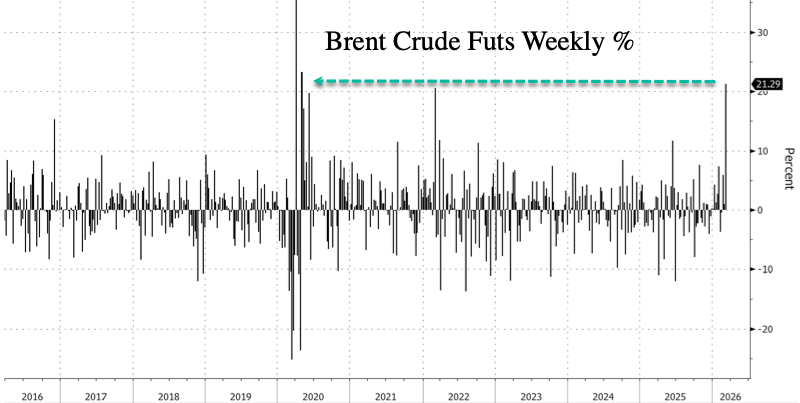
Back to 2024 highs.
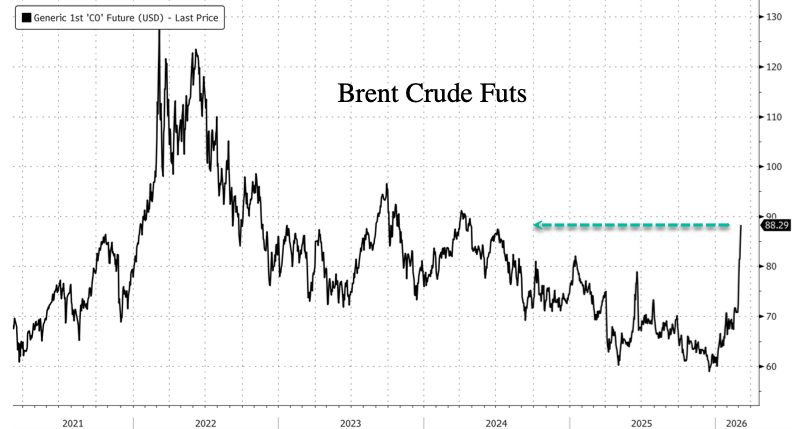
There are no signs, at the moment, that the conflict is nearing an end. In fact, there are reports that IRGC forces just hit a US-owned oil tanker near Kuwait.
Goldman analysts earlier this week warned about $100/bbl crude oil prices. Disruptions across the Gulf have already sent diesel futures up 40% this week, while central banks are warning of a possible inflation spike.
Asia’s exposure to Gulf oil is concerning, but China’s exposure is even more alarming. This suggests that if the conflict persists, Beijing could be facing an incoming shock that risks morphing into a financial crisis
end
THE USA SPR OIL RESERVES
Strategic Petroleum Reserve (SPR) OverviewThe U.S. Strategic Petroleum Reserve (SPR) is an emergency stockpile of crude oil maintained by the Department of Energy (DOE) to mitigate supply disruptions. It has a maximum authorized capacity of 714 million barrels, stored in underground salt caverns in Texas and Louisiana.
The SPR’s fill level is often expressed as a percentage of this capacity. Below, I’ll break down the historical fill levels and changes under Presidents Trump (2017–2021) and Biden (2021–2025), based on available data. Note that “fill” here refers to the net inventory level or percentage full during their administrations, including any drawdowns (releases) or refills. Congress has mandated some sales over the years, but major changes were driven by executive decisions.SPR Levels Under President Trump (January 2017 – January 2021)
- Starting Level (January 2017): Approximately 695 million barrels, or about 97% full (695 / 714 ≈ 97%). investinglive.com
- Key Changes: The SPR remained relatively stable at high levels during Trump’s first term. There were some congressionally mandated sales (e.g., for budget reasons), but no major emergency drawdowns. Trump emphasized energy independence and occasionally mentioned readiness to use the SPR if needed (e.g., during global supply concerns), but he did not authorize large releases. reuters.com Minor fluctuations occurred due to maintenance and small exchanges.
- Ending Level (January 2021): Around 635–695 million barrels, still approximately 89–97% full. Pre-2020 levels were reported at roughly 635 million barrels in some analyses. pfluger.house.gov +1
- Net Impact: Minimal net depletion; the SPR was kept near capacity, reflecting a policy of maintaining reserves for emergencies rather than using them to influence prices.
SPR Levels Under President Biden (January 2021 – January 2025)
- Starting Level (January 2021): Inherited around 635–695 million barrels (89–97% full), similar to the end of Trump’s term.
- Key Changes: Biden authorized the largest drawdowns in SPR history to address high gas prices following Russia’s 2022 invasion of Ukraine and global supply disruptions. This included:
- A 180 million barrel release over six months in 2022. en.wikipedia.org +1
- Additional releases in 2023, totaling over 290 million barrels depleted by the end of 2022 alone. pfluger.house.gov By September 2023, about 45% of the SPR had been sold off. en.wikipedia.org
- Some small refills began late in his term (e.g., contracts for a few million barrels), but replenishment was slow due to high oil prices and limited congressional funding. reuters.com +1
- Ending Level (December 2025): Approximately 400–411 million barrels, or about 56–58% full (e.g., 411 / 714 ≈ 58%). pfluger.house.gov +2 This was the lowest level in 40 years. en.wikipedia.org
- Net Impact: Significant depletion (over 40% of capacity drawn down), criticized by some as politically motivated to lower fuel prices temporarily. energy.gov +1
Current SPR Status (as of March 2026, Under President Trump)
- Current Inventory: Approximately 415 million barrels, or about 58% full (415 / 714 ≈ 58%). reuters.com +2 This is a modest increase from the end of Biden’s term (400–402 million barrels), as the Trump administration has prioritized refilling and repairing the SPR using funds from tax legislation. energy.gov However, full replenishment could take years without additional funding.
- How Much Can Trump Use?: As president, Trump can authorize drawdowns for emergencies (e.g., supply disruptions like the ongoing Iran conflict). oilprice.com +1 The entire current inventory of 415 million barrels is theoretically available, but practical limits apply:
- Maximum Drawdown Rate: 4.4 million barrels per day. energy.gov It would take about 94 days to deplete fully at this rate.
- Days of Supply: Equals about 20 days of U.S. consumption (at ~20 million barrels/day) or 49 days of imports (at ~8.4 million barrels/day). en.wikipedia.org
- Policy Context: Trump has stated no immediate plans to tap the SPR despite recent global tensions, focusing instead on increasing domestic production. oilprice.com +1 Releases require presidential approval and are typically for national emergencies, not routine price control
RUSSIA/USA/INDIA
In Major Win For Putin, US Grants Russia License To Sell Oil To India While Strait Of Hormuz Is Blocked
Thursday, Mar 05, 2026 – 10:00 PM
The world desperately needs oil, but can’t get it as 20% of it is literally stuck behind the blockaded Straits of Hormuz. Putin has tons of oil because sales are metaphorically stuck by US sanctions. If the world does not get access to oil soon enough, there will be a global recession or worse, and every day the price of oil rises by 5%.
What to do?
Lightbulb moment: why, remove Russia’s sanctions to one of the countries most in need – India – and bring the excess oil to those who have the most urgent need for it, allowing the price to fall and removing much of the leverage Iran has by keeping prices sky high.
That’s what happened late on Thursday, when the US issued a general license to allow for some Russian oil sales to India, giving the nation more options to purchase fuel as an escalating conflict in the Persian Gulf cuts off a major producing region.
The license lasts a month (which hints at how long the operation against Iran will likely last according to the Admin) and covers transactions related to the sale of Russian crude oil and petroleum products loaded onto vessels before March 5, so long as it’s delivered to India and purchased by an Indian firm. The measure expires April 4 at 12:01 a.m. Washington time.
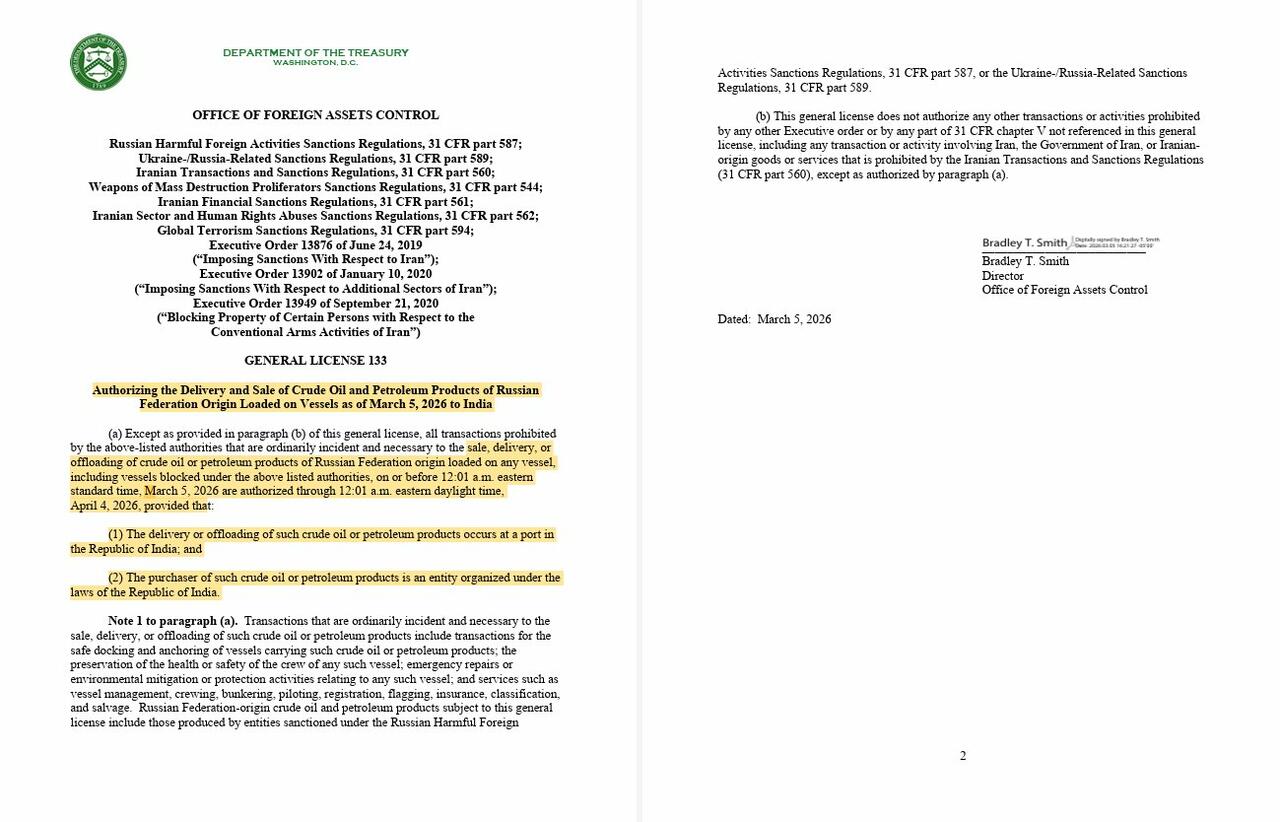
The move is another U-turn, and comes months after President Donald Trump slapped tariffs on Indian goods in a bid to pressure Prime Minister Narendra Modi’s government to abandon energy purchases from Russia, which India never did.
“To enable oil to keep flowing into the global market, the Treasury Department is issuing a temporary 30-day waiver to allow Indian refiners to purchase Russian oil,” US Treasury Secretary Scott Bessent said in a post on X. “This deliberately short-term measure will not provide significant financial benefit to the Russian government as it only authorizes transactions involving oil already stranded at sea.”
President Trump’s energy agenda has resulted in oil and gas production reaching the highest levels ever recorded.
To enable oil to keep flowing into the global market, the Treasury Department is issuing a temporary 30-day waiver to allow Indian refiners to purchase Russian oil. This deliberately short-term measure will not provide significant financial benefit to the Russian government as it only authorizes transactions involving oil already stranded at sea.
India is an essential partner of the United States, and we fully anticipate that New Delhi will ramp up purchases of U.S. oil. This stop-gap measure will alleviate pressure caused by Iran’s attempt to take global energy hostage.
Which reminds us: just a few days ago we pointed out that there are hundreds of millions of barrels of oil stuck at sea on various embargoed tankers, and that whoever managed to deliver those to a final destination would make an absolute killing…
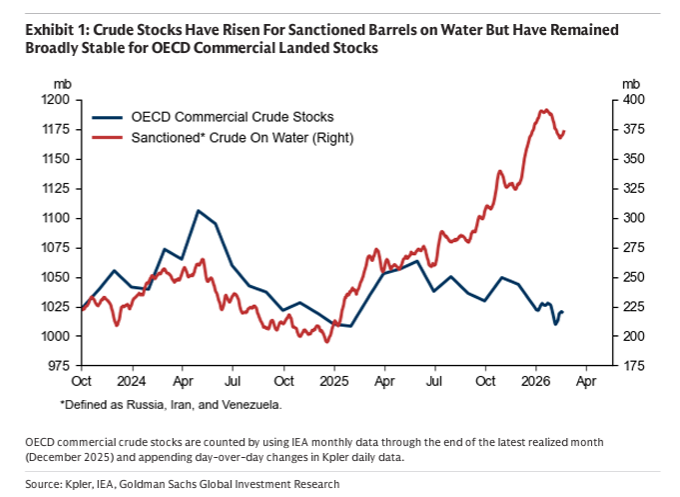
We now wait to see if Vitol indeed becomes the merchant bank of choice for the next month’s (with unlimited extensions) Russia-to-India transfers.
According to Bloomberg, Indian state refiners and government officials met earlier this week to consider contingency measures including turning to Russian cargoes loitering near its waters. The oil ministry had pushed for diplomats to seek some room for maneuver from Washington.As we pointed out recently, after China, India is the second country most reliant on gulf oil.
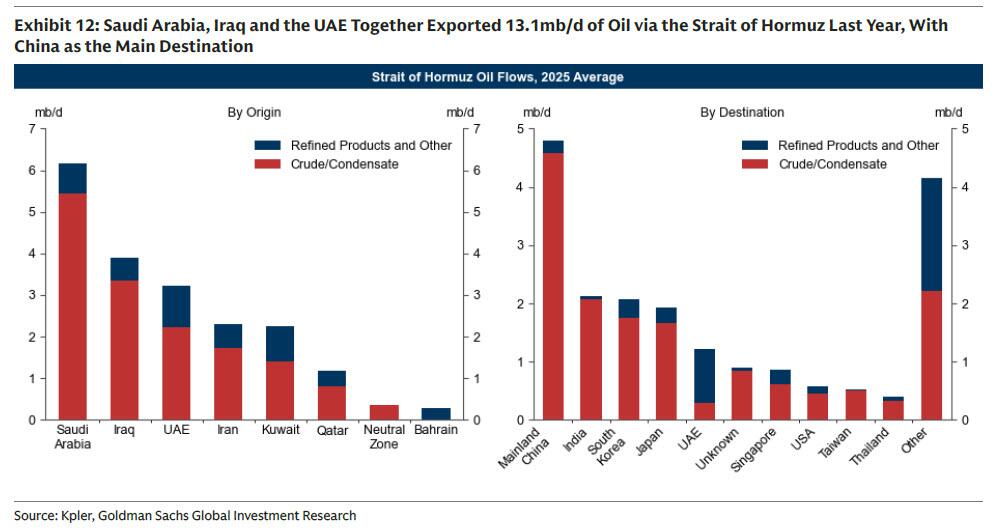
India became the single most important buyer of Moscow’s seaborne crude after the invasion of Ukraine, but the country has pretended to cut back in response to US pressure, particularly after a US trade deal struck last month that rolled back punitive tariffs. The reality is that India still continues to buy copious amounts of Russian oil and today’s decree will only make it official.
Meanwhile, in other market moving news, Reuters reported that China – both Iran and the Gulf’s biggest energy client – is in talks with Iran to allow crude oil and Qatari liquefied natural gas vessels safe passage through the Strait of Hormuz. As we discussed yesterday, China, which has friendly relations with Iran, has funded and armed the regime, and relies heavily on Middle Eastern supplies, is unhappy about the Islamic Republic’s move to paralyze shipping through the Strait and is pressing Tehran to allow safe passage for the vessels.
Since China gets about 45% of its oil from the Strait, should Iran agree to allowing Chinese ships through, and should Russia be able to fully supply India’s needs, and if Saudi Arabia can reroute as much as 7 million bbl/d from the gulf to Yangbu via the East-West pipeline, as we touched upon earlier…
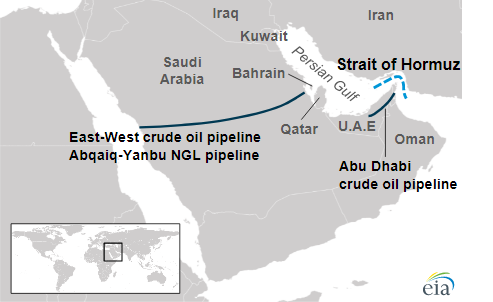
… and suddenly the Hormuz blockade will seem far less ominous, as most of the oil blocked finds alternative ways to continue on its way to its final destination.
END
With Europe Vulnerable To An Energy Crisis, Putin Says Russia May Pull The Plug On Gas Supplies To Europe
Friday, Mar 06, 2026 – 02:00 AM
The Russian government, along with domestic energy companies, is examining whether or not to immediately withdraw from the European market, Russian President Vladimir Putin said in a statement to Rossiya 1 television on Wednesday evening.

Putin appears to be reacting to the indication from Brussels that Russian energy may, after all, be needed in the short term, due to the war in Iran and closure of the Strait of Hormuz.
However, Putin may just decide to pull the plug now and start transitioning to other countries and regions that are not threatening a ban, reports Hirado.
“They (…) plan to introduce restrictions on the purchase of Russian gas, including liquefied gas, starting in a month, (March) 25. A year later, in (20)27, further restrictions will come into effect, up to a complete ban.
Now other markets are opening up. And perhaps it would be more beneficial for us to stop deliveries to the European market now.
To move to those markets that are opening up and gain a foothold there,” he said.
The move comes at time when gas prices are surging across Europe, leaving the EU vulnerable to a further supply shock.
Putin made clear that no decision has been made in the case.
“We will see what will happen in this area,” he said, “but this is a very dangerous game, especially today.”
“According to the data available to our services, just as they once blew up the Nord Streams, now in Kyiv, with the support of some Western services, they are preparing to blow up the Blue Stream and the Turkish Stream. We have informed our Turkish friends about this matter,” he said.
The Russian president also called the attack on a Russian gas tanker in the Mediterranean Sea an act of terrorism.
Putin additionally called Russia a reliable supplier, explaining that the increase in European gas prices is not directly related to supplies, because they have not decreased overall, but rather the result of the general situation on the world market.
END
ROBERT H TO US:
JET FUEL
Today, Jet Kerosene hit $225.44 per barrel; up 140% over last month. Airlines have no choice but to pass this price increase along to the traveling public. Air Travel, and Air CARGO, is going to get a whole lot more expensive. Airlines with pre booked tickets will take losses. This will have an impact on business as well because travel is a part of daily life for the hospitality industry globally. In time this will spread to even sea traffic.
Singapore bunker hubs have cut supply, China halted diesel & gasoline exports, S. Korea Petro chem declared naphtha force majeure, while Japan Middle East crude supply ( 90%) may tap their Strategic Petroleum Reserve (SPR). No doubt this will have impact.
There is no question that the Middle East countries will run out of oil storage capacity. And this will have an impact far beyond the Middle East simply because if oil wells are shut in they cannot easily be restarted. This will create a longer term overhang of turmoil and potential output issues.
In a broader sense the unspoken impact will be a banking one. It is one thing for Middle East countries to lose their daily revenue and contend with serious potential food scarcity. The deconstruction of banking occurs when a major source of liquidity is removed as basis for profitability. Do understand that the entire Middle East is cut off from liquidity by being denied revenue. The secondary impact is on banking because new capital is not be created daily while at the same time the Middle East countries have to use capital reserves as Singapore and South Korea, Japan and others lose oil they lose capital liquidity draining liquidity . When a nation loses not thought about liquidity the ramifications are serious within economies. Iran maybe the conflict point but this is far bigger now with a motion that will move under its’ own inertia.
Meanwhile it is equally clear that nations are facing realities and where they stand in relation to the changes of what and how countries and relationships exist. Look at Spain and the dispute with the US which goes well beyond what is public. Think Spain and historical relationships with Mexico and where the real money comes from in, the strings that pull.
Expect many changes to come forth. As this is not a short term blip on the screen.
END
LATE THIS MORNING
deadly: already Kuwait is cutting oil output
Qatar warns that Hormuz chokepoint chaos risk is upon us and will bring a global shock
Kuwait Cuts Oil Output As Qatar Warns Hormuz Chokepoint Chaos Risks Global Shock
Friday, Mar 06, 2026 – 11:26 AM
Update (1126ET):
Kuwait began cutting crude oil output after storage tank farms began filling up, as crude could no longer be loaded onto very large crude carriers and transported through the Strait of Hormuz, according to The Wall Street Journal.
Sources say the OPEC founding member is now weighing broader reductions in crude production and refining, potentially limiting operations to only domestic demand, with a decision expected within days.
UBS analyst Nana Antiedu noted that Brent crude futures climbed to $91/bbl after WSJ released the report.
WSJ noted:
Data provider Kpler said it has seen indications that Kuwait has started to cut production, adding that the country would have to cut more output in the coming days, as storage would otherwise fill up in around 12 days.
Shutting in an oil well risks long-term damage to reservoir pressure and incurs high restart costs, usually making it a measure of last resort. Restarting production can take days or even weeks depending on the reservoir.
“Storage is limited in the Middle East, and the only fix to avoid tanks running over is to curb production,” UBS commodity analyst Giovanni Staunovo said. “The longer the strait stays closed, the more barrels of crude and refined products will be missing, leading to higher prices.”
Earlier in the day, Qatar’s energy minister, Saad al-Kaabi, told the FT that “Everybody who has not called for force majeure we expect will do so in the next few days if this continues. All exporters in the Gulf region will have to call a force majeure.”

Also, Iraq had already slashed oil production by half earlier this week, while Qatar shut gas liquefaction plants.
Brent crude futures surged above $91/bbl on Friday morning in New York.
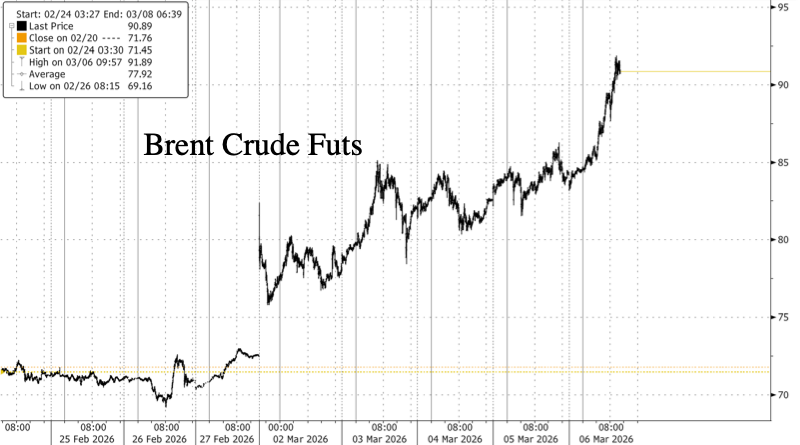
Even if a resolution emerges in the near term, restarting crude fields, refineries, and export hubs would likely take at least a month, and possibly longer. This suggests that the risk of an energy shock is fast approaching.
END
8. EMERGING MARKETS//AUSTRALIA NEW ZEALAND ISSUES
ECUADOR/USA
YOUR EARLY CURRENCY/GOLD AND SILVER PRICING/ASIAN CLOSING MARKETS AND EUROPEAN BOURSE OPENING AND CLOSING/ INTEREST RATE SETTINGS FRIDAY MORNING 6;30AM//OPENING AND CLOSING
OPENING LEVELS OF CURRENCIES// AND CLOSING ASIAN STOCK MARKET AND OPENING EUROPEAN STOCKS:6 AM EST
EURO VS USA DOLLAR: 1.1579 DOWN 0.0028
USA/ YEN 157.82 UP 0.255 NOW TARGETS INTEREST RATE AT 1.75% AS IT WILL BUY UNLIMITED BONDS TO GETS TO THAT LEVEL…//YEN STILL FALLS//END OF YEN CARRY TRADE BEGINS AGAIN DEC 2024/Bank of Japan raises rates by .25% TO 1.75 ..TAKAICHI NEW PM AS YIELDS RISE//JAPAN DEEPLY IN TROUBLE WITH RISING RATES AND A FALLING YEN!!
GBP/USA 1.3334 DOWN 0.0021 OR 21 BASIS PTS
USA/CAN DOLLAR: 1.3669 DOWN 0.0002 CDN DOLLAR UP 2 BASIS PTS//(DESPITE TRUMP’S TARIFFS)
Last night Shanghai COMPOSITE CLOSED UP 15.63 PTS OR 0.38%
Hang Seng CLOSED UP 435.95 PTS OR OR 1.72%
AUSTRALIA CLOSED UP 0.06%
// EUROPEAN BOURSE: ALL RED
Trading from Europe and ASIA
I) EUROPEAN BOURSES: ALL RED
2/ CHINESE BOURSES / :Hang SENG CLOSED UP 71.86 PTS OR 0.28%
/SHANGHAI CLOSED UP 26.99 PTS OR 0.64%
AUSTRALIA BOURSE CLOSED DOWN 0.35 %
(Nikkei (Japan) CLOSED UP 931.46 PTS OR 1.92%
INDIA’S SENSEX IN THE GREEN
Gold very early morning trading: 5080.95
silver:$82.73
USA DOLLAR VS TRY (TURKISH LIRA): 44.08
USA DOLLAR VS RUSSIAN ROUBLE: 79.22 ROUBLE// DOWN 55 BASIS PTS
UK 10 YR BOND YIELD: 4.6190 UP 8 BASIS PTS
UK 30 YR BOND YIELD: 5.296 UP 6 BASIS PTS
CDN 10 YR BOND YIELD: 3.359 UP 7 BASIS PTS
CDN 5 YR BOND YIELD; 2.902 UP 8 BASIS PTS
USA dollar index early FRIDAY MORNING: 99.20 DOWN 11 BASIS POINTS FROM THURSDAY’s CLOSE
FRIDAY MORNING NUMBERS ENDS
And now your closing FRIDAY NUMBERS 10.00 AM
Portuguese 10 year bond yield: 3.314% UP 12 in basis point(s) yield
JAPANESE BOND 10 yr YIELD: +2.165% UP 2 FULL POINTS BASIS POINTS /JAPAN losing control of its yield curve/
JAPAN 30 YR: 3.397 UP 1 BASIS PTS//DIASTER
SPANISH 10 YR BOND YIELD: 3.384 UP 10 in basis points yield
ITALY 10 YR BOND: 3.671 UP 12 points in basis points yield ./ THE ECB IS QE’ ING ITALIAN BONDS (
GERMAN 10 YR BOND YIELD: 2.8677 UP 4 BASIS PTS
IMPORTANT CURRENCY CLOSES : MID DAY FRIDAY
Closing currency crosses for day /USA DOLLAR INDEX/USA 10 YR BOND YIELD/10:00 AM
Euro/USA 1.1562 DOWN 0.0044 OR 44 basis points
USA/Japan: 157.89 UP 0.327 OR YEN IS DOWN 33 BASIS PTS// HIGHLY INFLATIONARY TO JAPAN
Great Britain 10 YR RATE 4.7190 UP 18 BASIS POINTS //
GREAT BRITAIN 30 YR BOND; 5.329 UP 14 BASIS POINTS.
Canadian dollar DOWN 20 BASIS pts to 1.3687
xxxxxxxxxxxxxxxxxxxxxxxxxxxxxxxxxxxxxxxxxxxxxxxxxxxxxxxxxxxxxxxxxxxxxxxxxxxxxxxx
The USA/Yuan CNY DOWN 6.9074 ON SHORE ..
THE USA/YUAN OFFSHORE// CNH DOWN TO 6.9077
TURKISH LIRA: 44.07 EXTREMELY DANGEROUS LEVEL/DEATH WATCH/HYPERINFLATION TO BEGIN.//
Your closing 10 yr US bond yield UP 4 in basis points from THURSDAY at 4.180.% //trading well ABOVE the resistance level of 2.27-2.32%)
USA 30 yr bond yield 4.796 UP 4 basis points /10:00 AM
USA 2 YR BOND YIELD: 3.595 UP 0 BASIS PTS.
GOLD AT 10;00 AM 5091.00
SILVER AT 10;00: 82.53
Your 11:00 AM bourses for Europe and the Dow along with the USA dollar index closing and interest rates FRIDAY CLOSING TIME 10:00 AM//
London: CLOSED DOWN 129.19 PTS OR 1.24%
GERMAN DAX: CLOSED DOWN 224.72 OR 0.44%
FRANCE: CLOSED DOWN 52.36 PTS OR 0.65%
Spain IBEX CLOSED DOWN 170.80 PTS OR 0.99%
Italian MIB: CLOSED DOWN 456.29 PTS OR 1.02%
WTI Oil price 88.11 10.00 EST/
Brent Oil: 91.17 10:00 EST
USA /RUSSIAN ROUBLE /// AT: 79.01 ROUBLE DOWN 0 AND 34 / 100
CDN 10 YEAR RATE: 3.404 UP 5 BASIS PTS.
CDN 5 YEAR RATE: 2.954 UP 5 BASIS PTS
CLOSING NUMBERS: 4 PM
Euro vs USA 1.1604 DOWN 0.0003 OR 3 BASIS POINTS//
British Pound: 1.3386 up 0.0031 OR 31 basis pts/
BRITISH 10 YR GILT BOND YIELD: 4.6410 UP 10 FULL BASIS PTS//
BRITISH 30 YR BOND YIELD: 5.336UP 11 IN BASIS PTS.
JAPAN 10 YR YIELD: 2.179 UP 3 FULL BASIS PTS (DANGEROUS TO THEIR ECONOMY
JAPANESE 30 YR BOND: 3.426 UP 4 PTS AND STILL VERY DANGEROUS TO THEIR ECONOMY
USA dollar vs Japanese Yen: 157.88 UP 0.317 OR YEN DOWN 32 BASIS PTS EXTREMELY DANGEROUS/YEN FALLING DEEPLY IN VALUE
USA dollar vs Canadian dollar: 1.3582 DOWN 0.0090 PTS// CDN DOLLAR UP 90 BASIS PTS
West Texas intermediate oil: 90.72
Brent OIL: 92.19
USA 10 yr bond yield DOWN 1 BASIS pts to 4.140
USA 30 yr bond yield: UP 0 PTS to 4.746%
USA 2 YR BOND 3.561 DOWN 2 PTS
CDN 10 YR RATE 3.404 UP 5 BASIS PTS
CDN 5 YEAR RATE: 2.952 UP 5 BASIS PTS
USA dollar index: 98.95 DOWN 35 BASIS POINTS
USA DOLLAR VS TURKISH LIRA: 44.07 GETTING QUITE CLOSE TO BLOWING UP/
USA DOLLAR VS RUSSIA//// ROUBLE: 79.00 UP AND 33/100 roubles //
GOLD $5157.50 3:30 PM)
SILVER: 83.95 3;30 PM)
DOW JONES INDUSTRIAL AVERAGE: DOWN 453.19 OR 0.95%
NASDAQ 100 DOWN 377.40 PTS OR 1.51%
VOLATILITY INDEX 29.09 UP 5.34 PTS OR 22.48%
GLD: $ 473.49 UP 7.36 PTS OR 1.58%
SLV/ $75.06 UP 1.69 PTS OR OR 2.28 %
TORONTO STOCK INDEX// TSX INDEX: CLOSED DOWN 553.49 PTS OR 1.66%
end
TRADING today ZEROHEDGE 4 PM: HEADLINE NEWS/TRADING
Naked ‘Private Credit’ Swimmers Exposed, Payrolls Plunge As Trump Sparks Week Of “Total, Global F**king Chaos”
WRAP UP
Equities & Dollar hit on NFP miss, while oil ends a record-breaking week – Newsquawk US Market Wrap
Friday, Mar 06, 2026 – 04:09 PM
- SNAPSHOT: Equities down, Treasuries steepen, Crude up, Dollar down, Gold up
- REAR VIEW: NFP unexpectedly declines, u/e rate rises with wages hotter-than-expected; US Retail Sales fall less than expected, Control beats; Trump said there will be no deal with Iran except unconditional surrender; Fed speak continues to show split committee; Iran attacks a US-owned oil tanker near Kuwait; Kuwait starts cutting production at some oil fields; US reportedly issued a temporary 30-day waiver to allow sale of Russian oil currently stranded at sea to India; BLK limits withdrawals at private credit fund as redemptions mount; WAL informed by JEF of failed agreed upon payments; Conflicting reports over the future of a ORCL-OpenAI data centre project.
- COMING UP: Data: Chinese CPI (Feb), PPI (Feb), German Industrial Production (Jan), US NY Fed SCE, Australian Westpac Consumer Confidence (Mar), Japanese GDP Final (Q4). Speakers: ECB’s Elderson, Cipollone.
- WEEK AHEAD: Highlights include US and China inflation, UK GDP, China Trade and CBRT. Click here for the full report.
- WEEKLY US EARNINGS ESTIMATES: Earnings ease but highlights include ORCL & ADBE. Click here for the full report.
More Newsquawk in 2 steps:
- 1. Subscribe to the free premarket movers reports
- 2. Trial Newsquawk’s premium real-time audio news squawk box for 7 days
MARKET WRAP
US indices were heavily sold on Friday, concluding what has been a grim week for risk assets amid the start of the Middle East conflict. In addition to that, markets got a further hit on a quite dismal US jobs report, which saw the headline plunge 92k (exp. 59k, prev. 126k), unemployment rate tick higher to 4.4% (prev. & exp. 4.3%), and wages unwelcomingly accelerate/sticky. Further adding to the woes, and hitting the tech/semi sector, including Nvidia, were Bloomberg reports that Oracle and OpenAI end plans to expand data centre site. However, US indices pared some of this weakness as CNBC, citing a source, refuted this, saying existing plans remain on track. Adding more pressure, there were further private credit worries amid reports that BlackRock (BLK) limits withdrawals at a private credit fund as redemptions mount. All sectors, aside from Consumer Staples, were in the red given the aforementioned news. As has, of course, been the theme this week, the crude complex extended their record-breaking week of gains, with WTI and Brent higher by c. USD 25/bbl to last week’s Friday settlement. Attention firmly resides on the Middle East, and also the Strait of Hormuz, with participants looking out for any weekend breakthroughs, despite how unlikely it currently seems. The Dollar pared some of its extensive strength seen this week, as the US jobs report weighed, with CAD outperforming on surging oil prices. Treasuries chopped to surging energy prices and a weak NFP report, while private credit concerns linger, and precious metals finished in the green. There was plenty of Fed speak ahead of the blackout this evening (more details below).
US
NFP: Overall, the report was soft and raises questions about whether the labour market has truly stabilised. After a strong jobs report in January (+126k, revised from 130k), the economy lost 92k jobs in February, far below the +59k forecast. Two-month net revisions totalled -69k, largely concentrated in December (-65k), leaving December payrolls at -17k. January job growth remained solid at 126k (initially 130k), but the revisions place the start of the year at a lower employment base, with much of Januaryʼs strength fading in the initial February reading. The March jobs report, due on 3rd April, will include further revisions to both the strong January figure and the weak February data. Regarding job losses this month, healthcare employment fell by 28k, reflecting strike activity following a 77k increase in January. Employment in information and the federal government continued to trend down, with information employment -11k and federal government employment -10k. Social assistance rose by +9k, while transportation fell by -11k. Little change was reported across other major industries, including mining, quarrying, and oil and gas extraction; construction; manufacturing; wholesale trade; retail trade; financial activities; professional and business services; leisure and hospitality; and other services. Ahead of the data, ING highlighted: “A few are warning of a softer, possibly negative number based on the very cold weather in late January and early February. If so, the dollar could get hit briefly, but losses might not endure given the Middle East risk.” The unemployment rate rose to 4.4% from 4.3%, against expectations for another 4.3% reading, bringing it in line with the Federal Reserveʼs 2026 median projection, which is set to be updated on 18th March. Meanwhile, wages came in 0.1% higher than expected at 0.4% M/M and 3.8% Y/Y. For the Fed, the report may prompt Waller to vote for another 25bps cut in March – he said before the data that if Januaryʼs strength unwound in February, he might support another cut. Markets are still not pricing rate cuts until September amid uncertainty around the situation in the Middle East and its economic impact, and the Fed typically takes a wait-and-see approach during periods of uncertainty. Markets now price in about 44bps of easing in 2026 versus 38bps before the data. This fully prices in one rate cut, with a 76% probability of a second.
RETAIL SALES: Retail sales fell 0.2% in January (prev. 0.0%), albeit not as deep as the expected decline of 0.3%, while ex-gas/autos rose 0.3% (exp. 0.0%, prev. 0.1%, rev. from 0%) and ex-autos was unchanged at 0.0%, in line with expectations. Retail control group rose 0.3%, slightly above Wall St. consensus of 0.2%, with the prior revised to 0.0% from -0.1%. Spending fell, as consumer confidence was hit, highlighted within the report as foods services & drinking places, declined for the second consecutive month, while clothing & clothing accessories store spend also pulled back further. Potentially further weighing on the consumer were harsh cold weather conditions affecting some of the country in late Jan.
FED
WALLER (voter, dove) said we are going to see a spike in gasoline prices, but from the Fed’s point of view, it is unlikely to cause sustained inflation and added that these energy costs are likely to be passed along like everything else. On the labour market, which is Waller’s main concern and speaking before the US jobs report, said it looked like in January might be turning a corner, but will find out today whether it was a signal or not. Of course, as seen from the dataset, it wasn’t a turning corner and Feb’s. release was truly dismal. Waller reiterated if there is strength in the labour market, he would be willing to pare back his rate cut bets, but after the data today that is exceedingly unlikely given how weak it was. Prior to the NFP release, remarked that if we get a bad jobs number today, and Jan revised down, why would they just sit on their hands?. Regarding the private credit market, the influential Governor doesn’t see big or widespread problems and headlines they’ve seen do not seem to be systemic.
MIRAN (voter, dove) is hesitant to read too much into one month’s job report and noted how policy is pretty miscalibrated from here. The forever dove reiterated that monpol is too tight and that the neutral rate is like 2.5-2.75%; hopes the Fed votes to cut next FOMC meeting, and he will be a dissenter if not. Miran echoed the fact that the Fed should cut rates to neutral, then re-estimate. He also added the Fed typically does not respond to oil prices, and if anything it biases him towards even more dovish policy, and that oil shock can weigh on core inflation by hurting demand.
HAMMACK (2026 voter) sees no imminent need to change the stance of monetary policy in an economy where inflation is still “too high”. The Cleveland Fed President added that given the Fed’s need to balance “elevated” inflation and a “softening” job market, these factors, joined with rate cuts done last year, leave monetary policy “in a good position”. Under her base case, she thinks policy should be on hold for quite some time as they see evidence that inflation is coming down and the labour market stabilises further. Hammack noted that it’s easy to envision other scenarios, as well, so she sees two-sided risks to rates.
DALY (2027 Voter, Dove) said the latest jobs report has her attention, noting she hoped last year’s rate cuts would put a floor under the job market, but warned no single month of data should be decisive. She stressed both sides of the mandate carry risks, with the labour market appearing vulnerable. She suggested that if the breakeven rate is 30k, they are currently below that, but it is only a couple of months of data. She said she is concerned about the labour market, but cites issues around strikes and poor weather. Regarding energy prices in wake of the Middle East conflict, she said the outlook depends on how long oil prices remain elevated, and the Fed does not want to act aggressively unless it knows that part. On the path ahead for rates, she said an alternative is to hold rates steady, but they are not in a position to think they should hike. “We have to be steady in the boat” whilst they collect more inflation.
GOOLSBEE (2027 voter) remarked that the January jobs report was a tough miss, but one report is not a trend, although if you got several months like that, it would be a concern. On the inflationary footing, the Chicago Fed President said non-tariff inflation has been disturbingly high, and there is disturbing persistence of services inflation. Ahead, he is hopeful they can commence rate cuts by the end of this year, and wants to get as much information as possible, especially given recent conflicting data.
SCHMID (2028 voter, hawk) noted that businesses are pausing on hiring, and while he did not speak much on policy, he said he will miss J-Powell and he has been blessed to have him at the head. The Kansas City Fed President said it is probably a good thing that the board of governors have more votes than the Fed presidents.
COLLINS (2028 voter) expects Fed rate target to hold steady ‘for some time’ and now is a time for the Fed to be patient and deliberative with rate policy. Boston Fed President said to cut rates again, needs to see clear evidence that inflation is ebbing. Highlighting the view that it is good to hold rates, Collins sees no urgent need to change monpol stance and Fed policy is currently well positioned. On the inflationary angle, the outlook is uncertain with upside risks, and the latest on tariffs could bring more inflation pressure.
FIXED INCOME
T-NOTE FUTURES (M6) SETTLED 4 TICKS HIGHER AT 112-14
T-notes chop to surging energy prices and a weak NFP report while private credit concerns linger. At settlement, 2-year -3.8bps at 3.561%, 3-year -2.7bps at 3.588%, 5-year -1.8bps at 3.724%, 7-year -1.3bps at 3.923%, 10-year -0.6bps at 4.140%, 20-year +1.5bps at 4.736%, 30-year +1.3bps at 4.766%.
THE DAY: T-notes were choppy on Friday with downside observed throughout the morning as energy prices continued to rocket, with Qatar warning the conflict could cause all Gulf energy producers to have shut production within weeks. However, T-notes rallied in wake of the weak US NFP report, which saw 92k jobs lost, unwinding some of the strength seen in January and raising questions over the recent labour market stabilisation. T-note futures rose from lows of 112-01+ pre-data, to a peak of 112-21 on the release. However, this move quickly faded with T-notes heading lower to match the aforementioned low an hour later. However, with participants weighing the state of the US labour market, or potential price impacts from the Middle East war, treasuries rose back to highs into settlement. Elsewhere, Retail Sales were slightly better than expected, but the focus was on the jobs data. There was plenty of Fed speak before the blackout period commences, Daly said the jobs market is vulnerable and this report has caught her attention, but also noting one month of data is not decisional. Goolsbee said the report was a tough miss, but said one report is not a trend – if this went on for several months, it would be a concern. Miran said the Fed should cut to neutral, then re-estimate. Waller, speaking pre-data, said there will be a spike in gasoline prices, but it is unlikely to cause sustained inflation. He also somewhat ironically said that if we get a bad jobs number today, and January is revised down, “Why would we just sit on our hands?”. January only saw a minor revision lower, but December saw a 65k revision lower – perhaps signalling he may vote for another 25bps cut in March. Concerns on private credit continue to linger, too, Western Alliance (WAL) filed a lawsuit & charged off USD 126.4mln in loan balances after Jefferies (JEF) failed to make agreed-upon payments. Meanwhile, Blackrock (BLK) limited withdrawals at a private credit fund as redemptions start to mount.
SUPPLY
Notes
- US to sell USD 58bln of 3-year notes, USD 29bln of 10-year notes and USD 22bln of 30-year bonds on March 12th; all to settle on March 16th
Bills
- US to sell USD 89bln of 13-week bills and USD 77bln of 26-week bills on March 9th; to sell USD 90bln of 6-week bills on March 10th; All to settle March 12th.
STIRS/OPERATIONS
- NY Fed RRP op demand at USD 1.51bln (prev. 2.79bln) across 5 counterparties (prev. 5).
- SOFR at 3.66% (prev. 3.67%), volumes at USD 3.294tln (prev. USD 3.292tln) on March 5th.
- EFFR at 3.64% (prev. 3.64%), volumes at USD 106bln (prev. USD 106bln) on March 5th.
CRUDE
WTI SETTLED USD 9.89 HIGHER AT 90.90/BBL; BRENT (K6) SETTLED USD 7.28 HIGHER AT 92.69/BBL
The crude complex, once again, saw heavy gains on Friday, to end a record-breaking week. Due to the breakout of the Middle Eastern war, and the accompanying Strait of Hormuz worries, WTI has surged from last Friday’s close of USD 67.02/bbl to a weekly high of USD 92.61/bbl, while Brent has moved from USD 70.84/bbl to peaks of USD 94.64/bbl. Obviously, the ever heightening geopols is underpinning the energy space, as attacks continue to expand across the region, with some of the main drivers behind the upside being 1) Qatari Energy Minister cautioning that the conflict could cause all Gulf energy producers to have to shut production within weeks, increasing oil to USD 150/bbl; 2) Iran attacking a US-owned oil tanker near Kuwait; 3) Trump saying “There will be no deal with Iran except UNCONDITIONAL SURRENDER!”. On the supply footing, several oilfields have seemingly curtailed production. Meanwhile, WaPo, citing sources, reported that Russia is giving Iran information to attack US forces, while CNN, citing sources, said that the US has intelligence suggesting China may be preparing to provide Iran with financial assistance, spare parts and missile components, though Beijing has stayed out of the war up until now. While there haven’t been many things easing oil prices this week, WTI and Brent came off highs into settlement amid FT reports that the US agency is to create a USD 20bln reinsurance facility for Gulf shipping, and the facility to restart maritime cargo. Albeit not garnering much attention, the latest Baker Hughes rig count saw oil rise 4 to 411, natgas fall 2 to 132, leaving the total up 1 at 551.
EQUITIES
CLOSES: SPX -1.33% at 6,740, NDX -1.51% at 24,643, DJI -0.95% at 47,502, RUT -2.33% at 2,525
SECTORS: Consumer Discretionary -1.96%, Materials -1.89%, Technology -1.84%, Financials -1.37%, Industrials -1.26%, Real Estate -1.08%, Communication Services -1.06%, Health -0.78%, Utilities -0.38%, Energy +0.13%, Consumer Staples +0.29%.
EUROPEAN CLOSES: Euro Stoxx 50 -0.87% at 5,732, Dax 40 -1.13% at 23,548, FTSE 100 -1.24% at 10,285, CAC 40 -0.65% at 7,993, FTSE MIB -1.02% at 44,152, IBEX 35 -0.99% at 17,074, PSI +0.15% at 8,946, SMI -1.56% at 13,091, AEX -1.52% at 980
STOCK SPECIFICS:
- Western Alliance (WAL) filed a lawsuit & charged off USD 126.4mln in loan balances after Jefferies (JEF) failed to make agreed-upon payments. WAL CEO said until last week, the loan had performed as expected, adds that they can absorb the loss with minimal disruption.
- BlackRock (BLK) limits withdrawals at private credit fund as redemptions mount.
- Marvell (MRVL): EPS, rev. topped w/ stellar guidance
- Costco (COST): Top & bottom line surpassed exp.
- Gap (GAP): Q metrics light & disappointing FY26 guidance w/ investors concerned about tariff headwinds weighing on margins
- Petrobras (PBR): Profit beat as strong oil production & record exports offset weaker crude prices
- Nike (NKE) will implement organisational changes aimed at improving efficiency & profitability W/ estimated pre-tax charges of C. $300mln
- Diana Shipping (DSX) increased its all-cash offer to acquire Genco (GNK) to USD 23.50/shr. Note, the previous offer was USD 20.60/shr.
- China reportedly in talks with Boeing (BA) to order 500 737 MAX jets and also in talks for 100 787, 777x widebodies; deal could be unveiled at planned Trump-Xi summit.
- Oracle (ORCL)-OpenAI talks to lease stargate expansion site broke down, Bloomberg reports; Oracle and OpenAI end plans to expand data centre site. That said a later CNBC headline, via a source, conflicted the above, noting existing plans for Oracle’s data centre project with OpenAI remain on track.
FX
The Dollar was generally weaker against major peers on Friday as recent support from geopolitical risks were offset by a surprise downturn in US jobs growth. NFP unveiled a decline of 92k jobs in the economy (exp. +59k), with an unemployment rate ticking up to 4.4% from 4.3%, with wages coming above expectations. Some desks have since downplayed the readings, citing the impacts from Storm Fern, yet losses in health pose concerns given consistent gains over the last 12 months. Much Fed speak followed the jobs report, with divergence remaining amongst a committee filled with inflation worries (Hammack (voter), Collins (non-voter), Goolsbee (nv) vs labour doves (Waller & Miran). Elsewhere, US oil prices hit USD 90/bbl, a level not seen since October 2023, as a largely vacant Strait of Hormuz has participants shifting to a stance that large impacts will be felt in a matter of days or a couple of weeks, not months. DXY hit highs of 99.435 before paring to ~98.99, but remains +1.35 from last week.
CAD led G10 strength as surging oil prices and a weaker USD left the currency in prime position for gains. On data, the Canadian Ivey PMI SA rose above expectations to 56.6 in February (exp. 51.1). USD/CAD sits around lows of 1.3580. Meanwhile, EUR and JPY lagged as in their case, higher oil & gas prices are more of a negative, given their heavy reliance on exports. EUR/USD was little changed at 1.1600 while USD/JPY climbed about 0.380 to USD 157.94.
USA DATA RELEASES
jobd report: they lost jobs
Jobs Shock: US Lost 92K Payrolls In February, Far Below Lowest Estimate, As Unemployment Rate Rises
Friday, Mar 06, 2026 – 08:57 AM
In our nonfarm payrolls preview, we quoted JPMorgan’s Market Intel desk which said that “for this print, the stronger the better”, which by implication means that a poor number would be bad. By that logic, the actual number couldn’t be any worse, because moments ago the BLS reported that in February, the US lost 92,000 jobs, a huge drop from the downward revised (of course) 126K in January, and the second worst print since 2020 (only October’s shock -140K was worse). The number of private payrolls dropped by 86K, also a huge miss to estimates of a 60K increase.
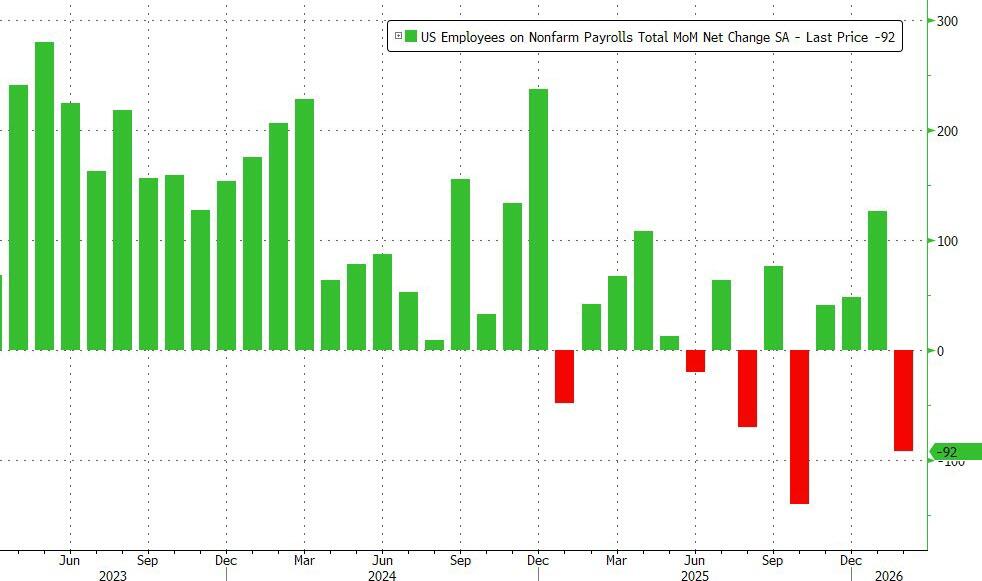
The February payrolls print was a six-sigma miss to the 55K median estimate, and came in 83K below the lowest estimate!
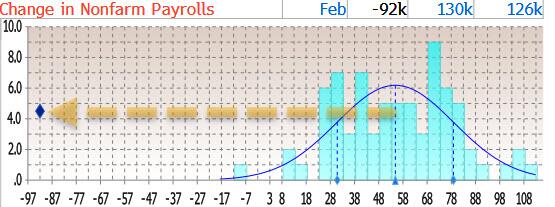
The change in total nonfarm payroll employment for December was revised down by 65,000, from +48,000 to -17,000, and the change for January was revised down by 4,000, from +130,000 to +126,000. With these revisions, employment in December and January combined is 69,000 lower than previously reported.
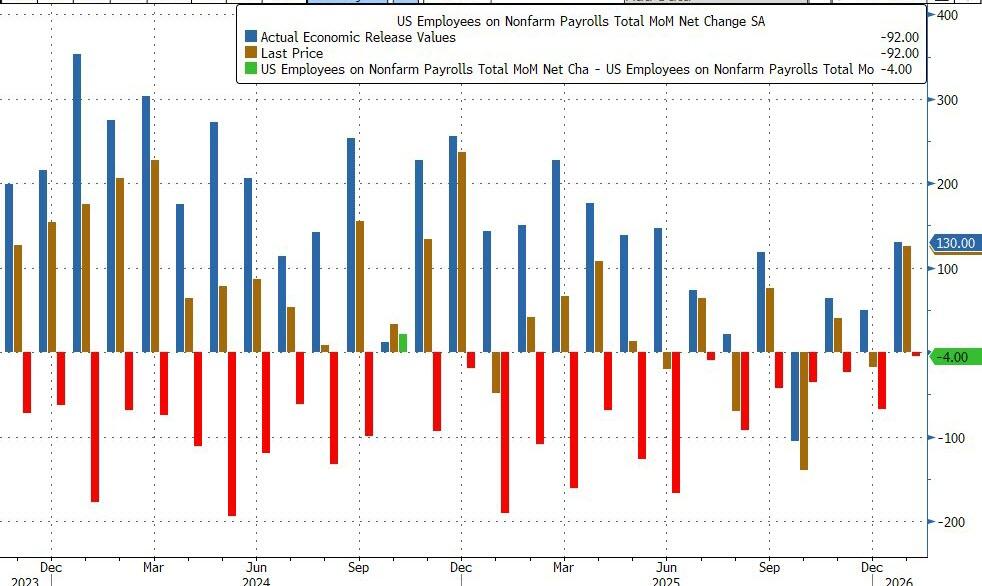
One potential mitigating factor: the number of people who were unable to work due to weather surged to 228K in February, well above last year’s level 167K, due to the powerful winter storms hitting the US.
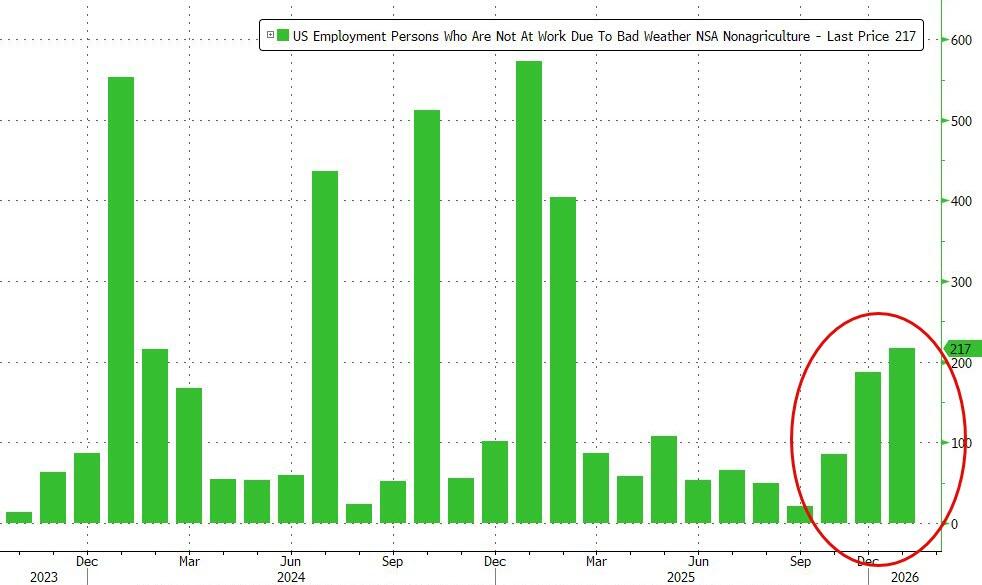
Looking under the surface does not reveal as silver lining: part-time workers dropped by 249K while full-time workers slid by 100K.
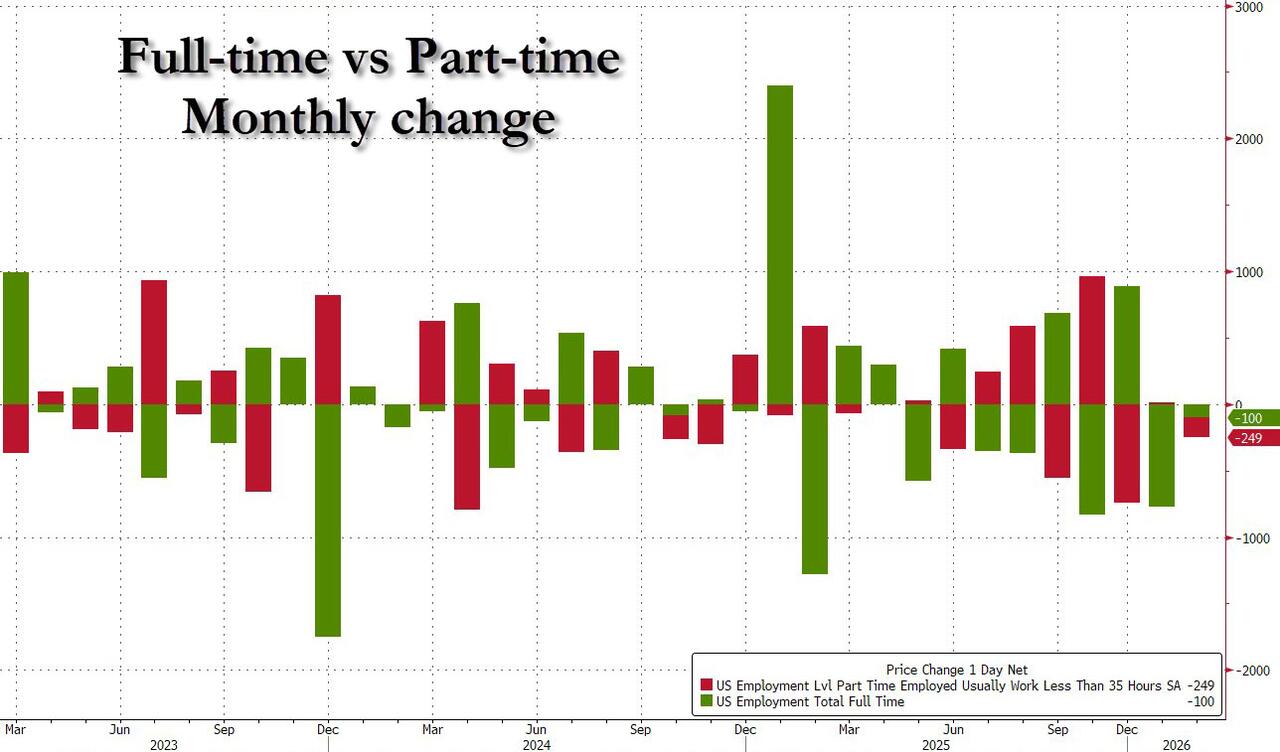
Perhaps the only silver lining was that native-born workers jumped by 877K (which was only a modest reversal of the 2.5 million drop last month), while foreign born workers dropped by 394K.
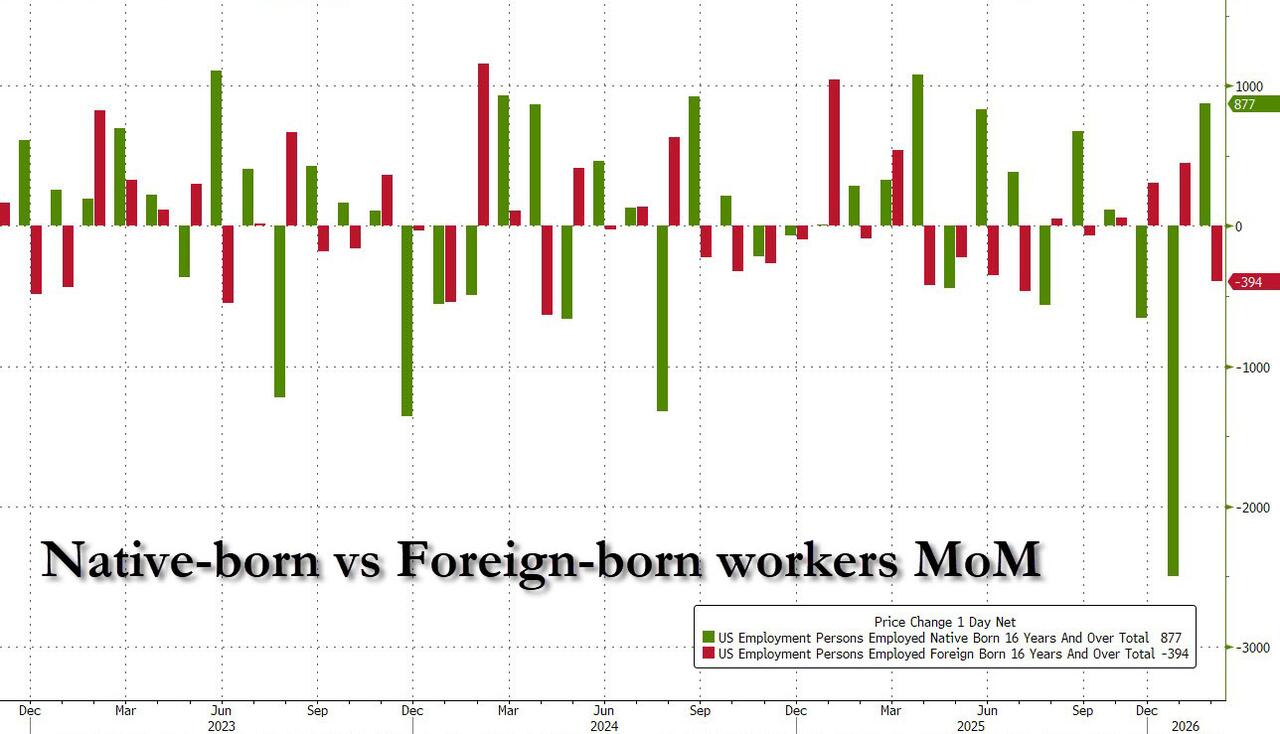
The unemployment rate rose from 4.3% to 4.4% vs estimates of an unchanged print, as the number of unemployed workers rose by 203K from 7.368MM to 7.571MM, while the civilian labor force was virtually unchanged (from 170.564K to 170.483K). Among the major worker groups, the unemployment rates for adult men (4.0 percent), adult women (4.1 percent), teenagers (14.9 percent), and people who are White (3.7 percent), Black (7.7 percent), Asian (4.8 percent), or Hispanic (5.2 percent) all rose modestly in February.
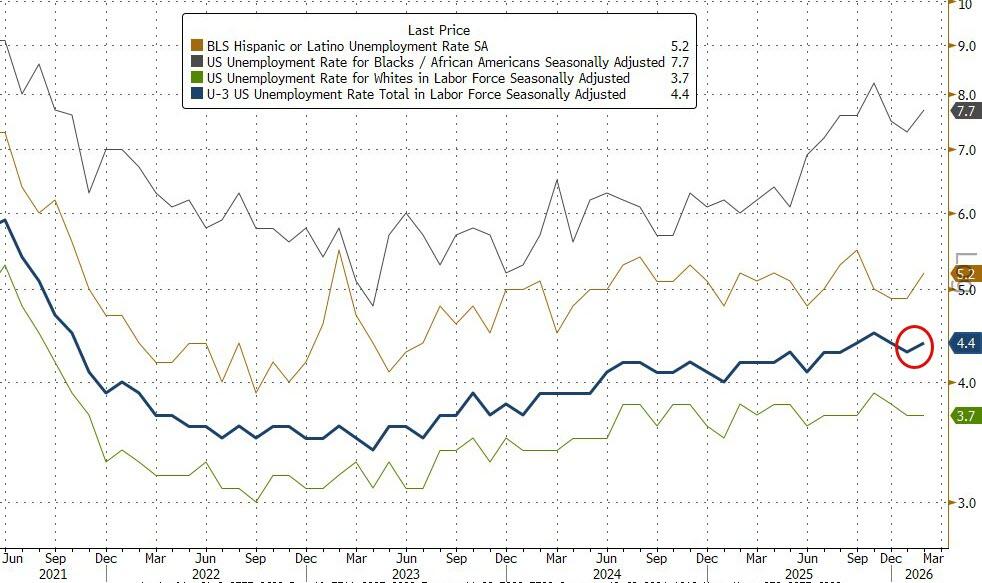
Both the labor force participation rate, at 62.0% (below the estimate of 62.5%), and the employment-population ratio, at 59.3%, changed little in February. These measures showed little change over the year, after accounting for the annual adjustments to the population controls.
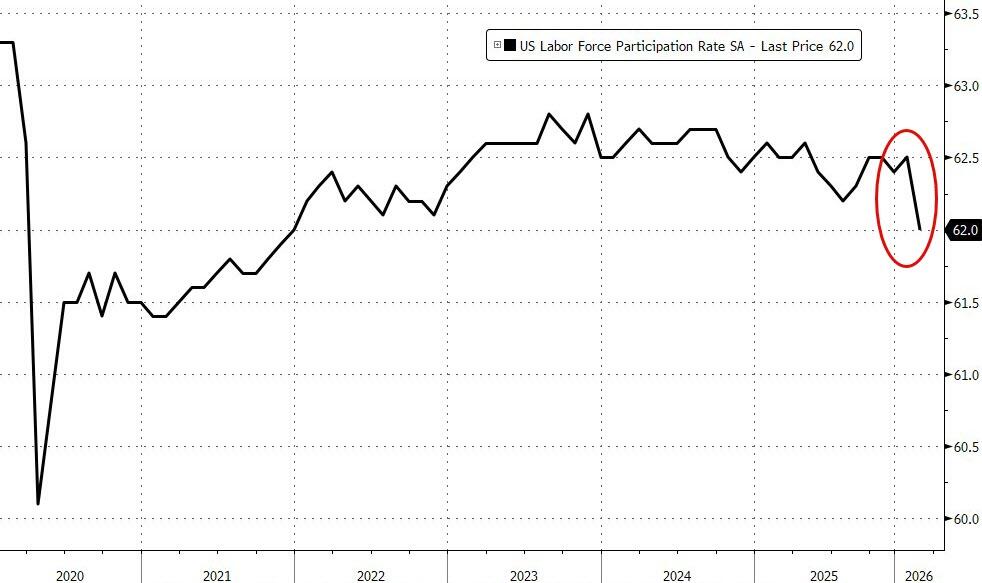
Turning to wages, average hourly earnings rose 0.4% MoM, same as January and above estimates of a 0.3% imcrease. This translated into a 3.8% YoY increase, up from 3.7% and the consensus of an unchanged print.
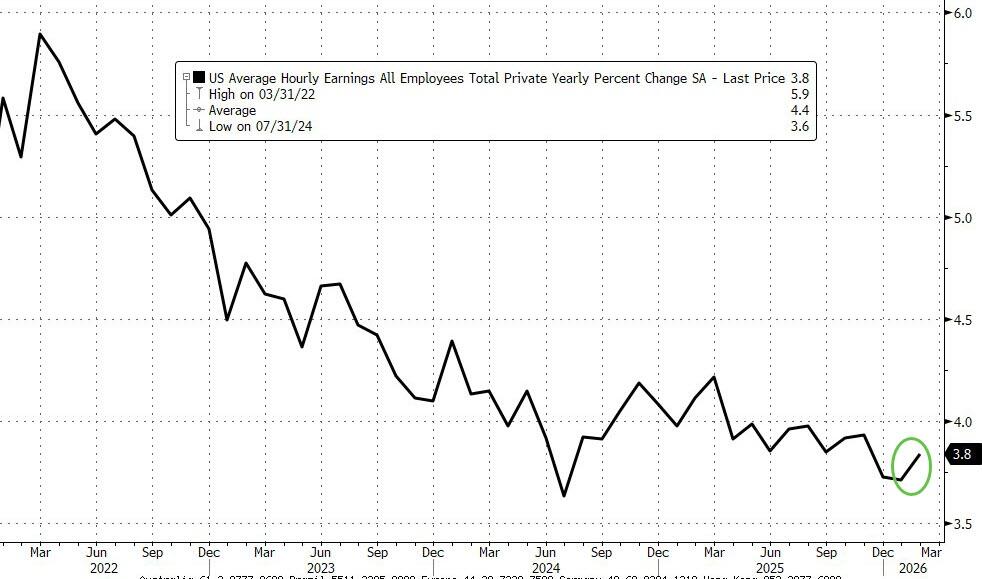
Some more details from the report
- The number of long-term unemployed (those jobless for 27 weeks or more) changed little at 1.9 million in February but is up from 1.5 million a year earlier. The long-term unemployed accounted for 25.3 percent of all unemployed people in February.
- The number of people employed part time for economic reasons decreased by 477,000 to 4.4 million in February. These individuals would have preferred full-time employment but were working part time because their hours had been reduced or they were unable to find full-time jobs.
- The number of people not in the labor force who currently want a job changed little in February at 6.0 million. These individuals were not counted as unemployed because they were not actively looking for work during the 4 weeks preceding the survey or were unavailable to take a job.
- Among those not in the labor force who wanted a job, the number of people marginally attached to the labor force changed little at 1.6 million in February. These individuals wanted and were available for work and had looked for a job sometime in the prior 12 months but had not looked for work in the 4 weeks preceding the survey. The number of discouraged workers, a subset of the marginally attached who believed that no jobs were available for them, decreased by 109,000 in February to 366,000.
Turning to the establishment survey, which unveiled the shocking
- Employment in health care decreased in February, reflecting strike activity. Employment in information and federal government continued to trend down. Payroll employment changed little on net in 2025.
- Health care employment declined by 28,000 in February, following a large increase in January (+77,000). Offices of physicians lost 37,000 jobs in February, primarily due to strike activity. Hospitals added 12,000 jobs. Over the prior 12 months, health care had added an average of 36,000 jobs per month.
- Employment in information continued to trend down in February (-11,000). The industry had lost an average of 5,000 jobs per month over the prior 12 months.
- In February, federal government employment continued to decline (-10,000). Since reaching a peak in October 2024, federal government employment is down by 330,000, or 11.0 percent.
- Employment in social assistance continued its upward trend in February (+9,000), driven by individual and family services (+12,000).
- Transportation and warehousing employment changed little in February (-11,000). A job loss in couriers and messengers (-17,000) was partially offset by a gain in air transportation (+5,000). Employment in transportation and warehousing has declined by 157,000, or 2.4 percent, since reaching a peak in February 2025.
- Employment showed little change over the month in other major industries, including mining, quarrying, and oil and gas extraction; construction; manufacturing; wholesale trade; retail trade; financial activities; professional and business services; leisure and hospitality; and other services.
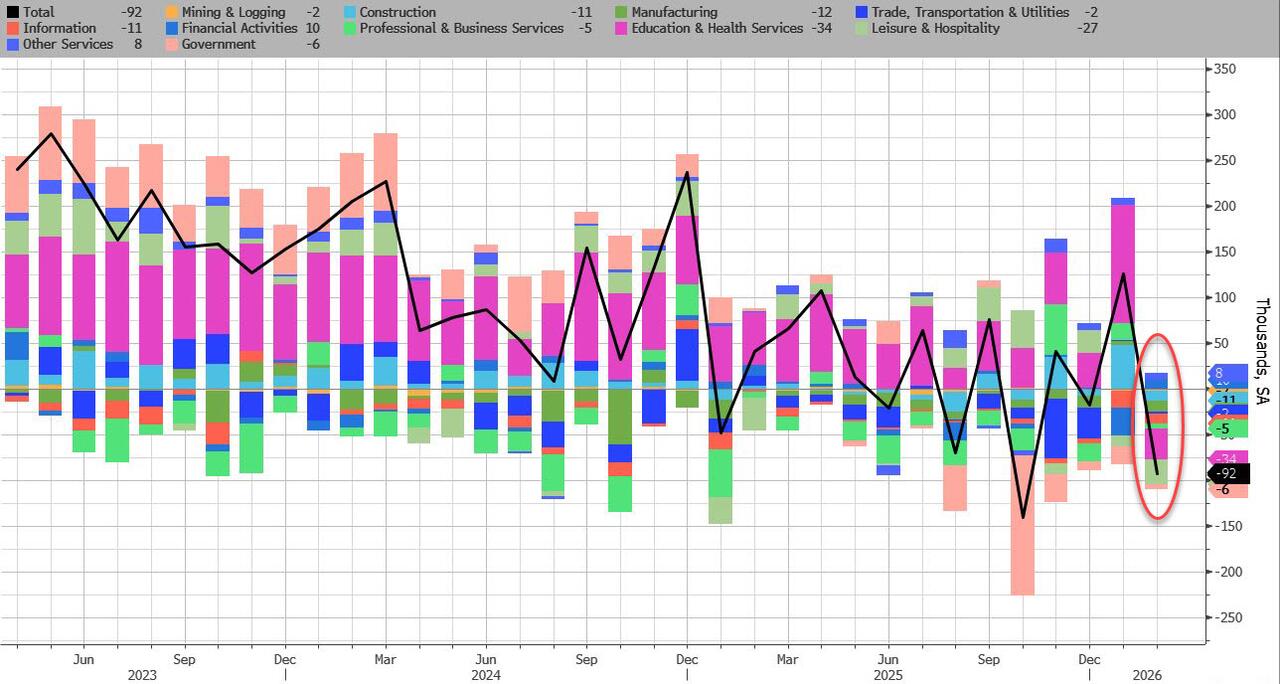
While we will have more to say about this report, the kneejerk reaction is, well, bad: this was about as ugly as it could be, and coming in a time when input costs are soaring due to the Iran war, it screams AI-driven stagflation.
end
It Was All A Mirage: 2.5 Million Native-Born US Workers Were Just Revised Away
26 – 01:40 PM
One of Donald Trump’s core pre-election promises (along with cracking down on immigration and no more foreign wars) was to boost employment for local-born Americans at the expense of the record employment for foreign-born, mostly illegal, workers. And for a while it worked: four months ago, when discussing the September jobs report, we said that while the broader report was generally mixed, it was “indisputably strong when it comes to one thing: the rotation from foreign born workers to domestic ones. To wit: in September, the number of native-born workers surged by 676K (after the August drop of 561K), while foreign-born workers dropped by 70K.”
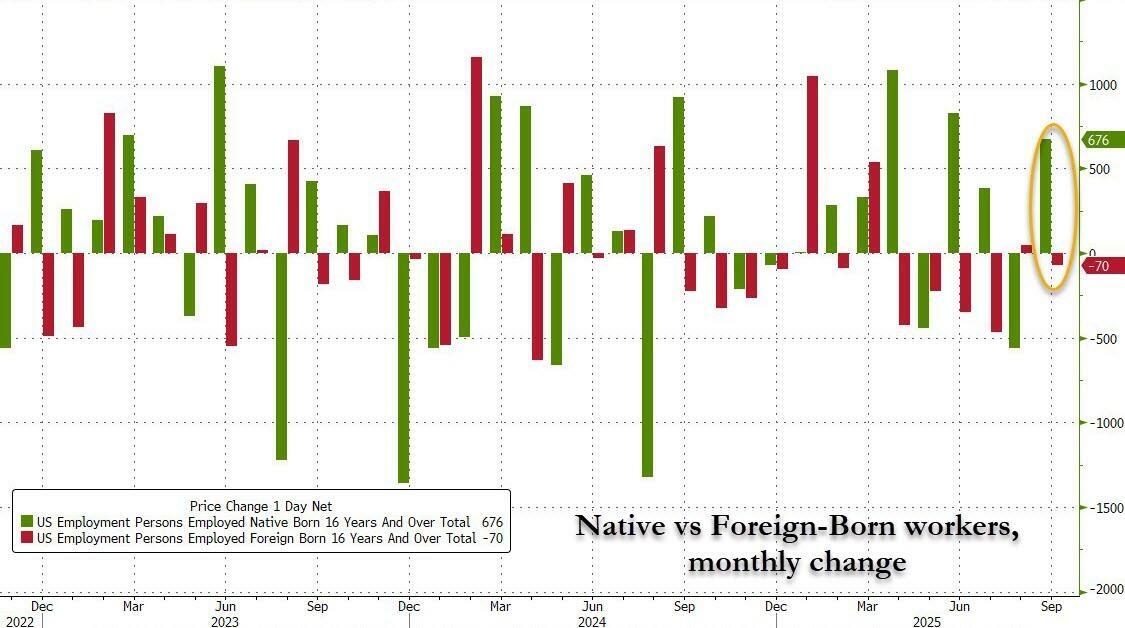
The data showed that since Trump entered the White House “the number of foreign born workers has slumped from a record 33.7 million in March 2025 to 32.1 million, a drop of $1.6 million. This has been offset by a slow but consistent increase in native-born workers which had been unchanged for six years since 2019 until the start of 2025, at which point it started to rise again, and has increased from 131.2 million in March 2025 to a new record high of 133.2 million in September.”
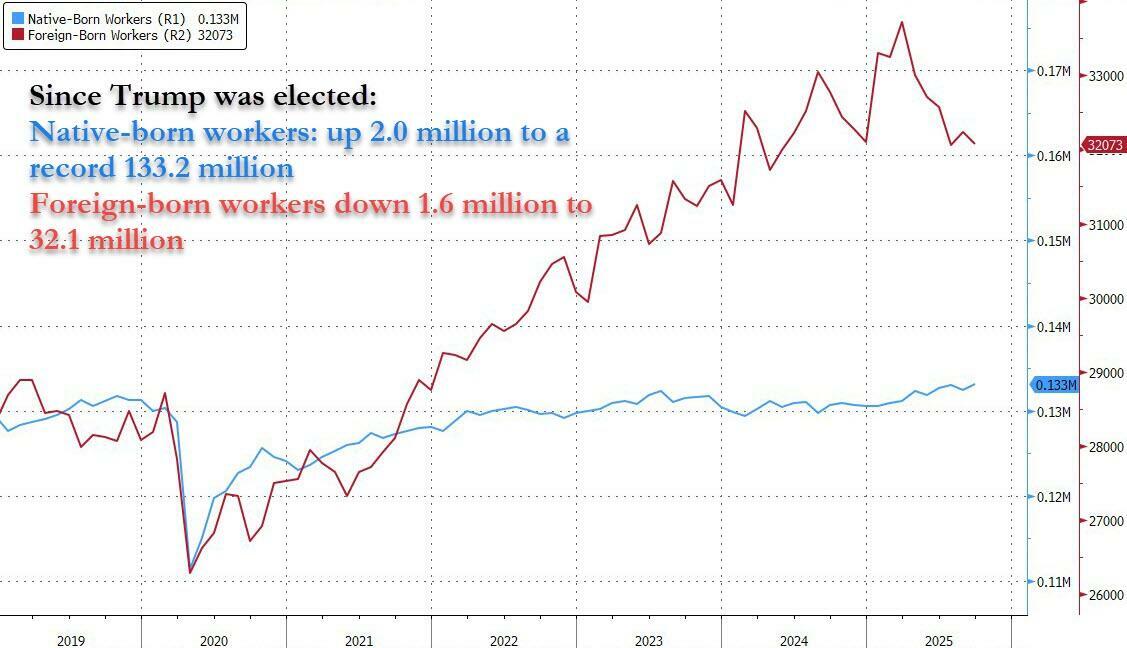
Why does this matter? Because today’s job report, which was undeniably dismal and sparked added to the sharp selloff across the market, also updated the working age population calculations to reflect the latest US Census population count for 2025. The new controls led to a big change in the January estimate of various employment metrics. They
- Lowered the working-age population by 231k;
- Reduced the labor force by 1,417k;
- Cut the employment level by around 1,432k;
- Lowered the labor-force participation rate by 0.46 percentage point and the employment-to-population ratio by 0.47 ppt.
But perhaps the most important revision is that the entire boom in native-born employment was fake news: a statistical mirage spawned by some overzealous BLS staffer’s excel model.
Presenting exhibit A: the monthly change in native and foreign-born workers. It shows that while the number of native-born workers in February did post a solid rise of 877K – using the revised data – this was only after the January data was revised comprehensively to wipe out a record 2.5 million (exactly) native born workers.
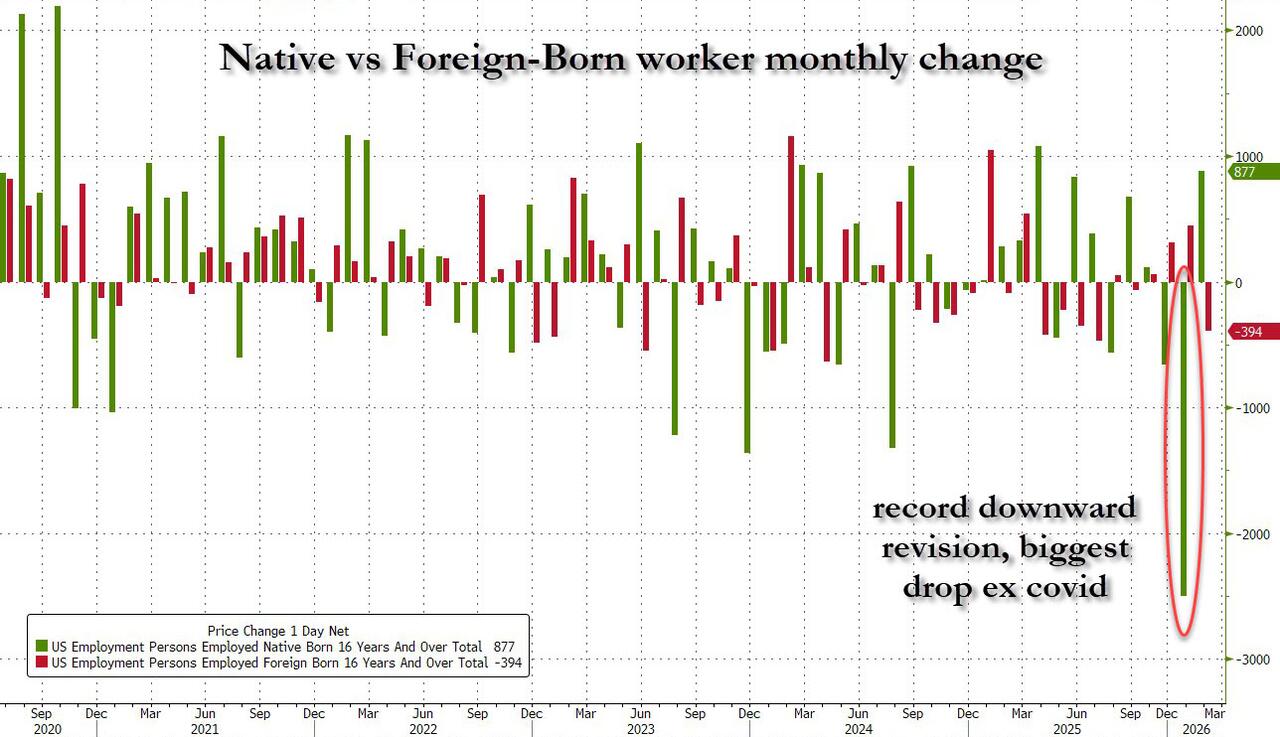
And here is what it looks like over the longer-term: at just under 131 million, the number of native born workers is back to where it was in 2019.
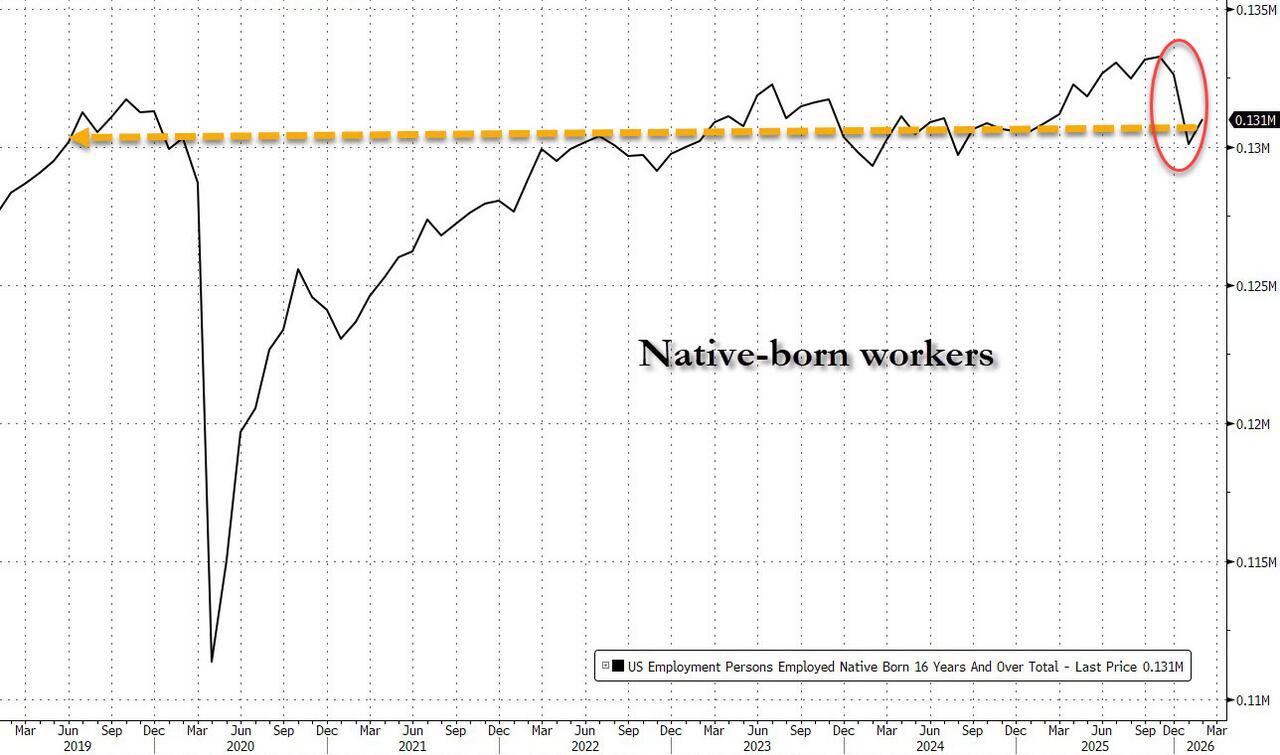
Which means that what some consider the greatest accomplishment of the Trump admin was nothing more than statistical fake news. The silver lining: at least there is the Iran war to keep everyone distracted.
END
USA economy faltering badly
(zerohedge)
US Retail Sales Dropped In January As Weather, Weak Gas Prices Weigh
Friday, Mar 06, 2026 – 08:46 AM
This morning’s retail sales data is for January (still lagging due to the govt shutdown) and is expected to be a decline (BofA’s omniscient analysts see a worse than consensus drop MoM, due in large part to weather disruptions).
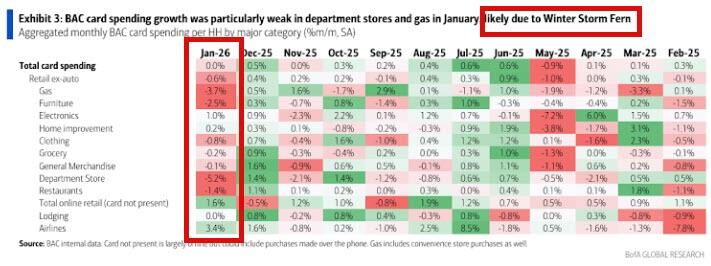
The actual print was a decline but slightly better than expected at -0.2% MoM. Despite two months of no increase, sales rose 3.2% YoY in January (increased from December)
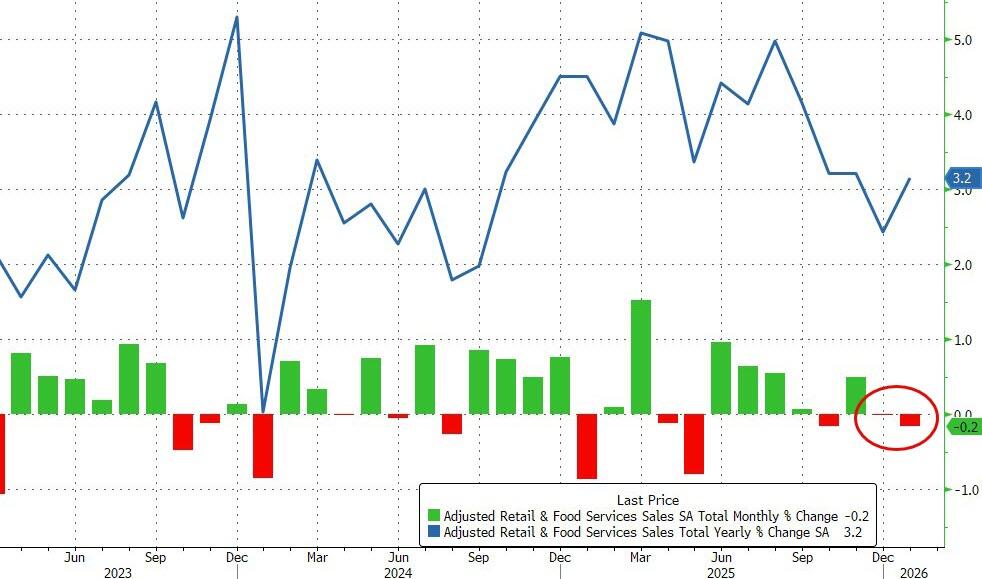
Source: Bloomberg
The decline was driven by a decline in sales at gas stations (lower gas prices) and Health Personal Care Stores. Motor Vehicles sales also dropped MoM. Non-store (online) retailers saw sales surge MoM…
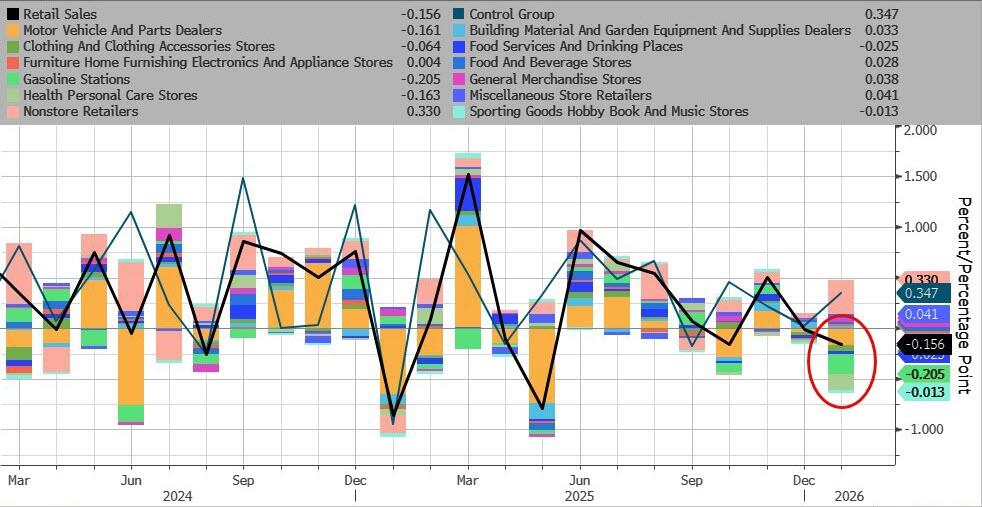
Even though December’s seasonally-adjusted move was disappointing, it was a record high on a non-seasonally adjusted basis and January saw the usual big post-Xmas hangover plunge…
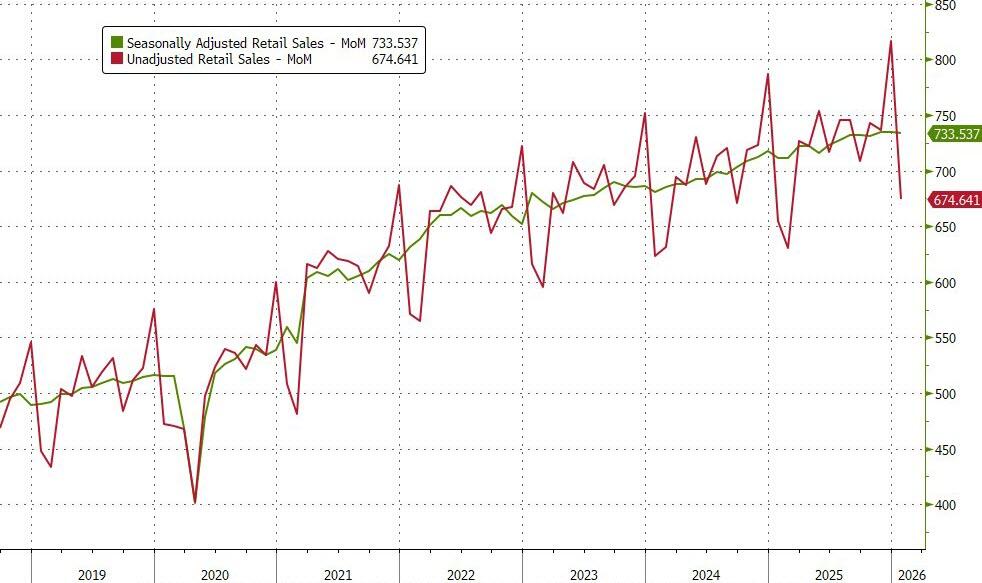
Source: Bloomberg
A lengthy winter storm that included significant snowfall and ice across the central and eastern US likely impeded shoppers during the weather event. The Arctic blast triggered the most flight cancellations since the pandemic and left more than 1 million homes and businesses without power.
Receipts at restaurants and bars, the only service-sector category in the retail report, declined 0.2% in January. Restaurants including Sweetgreen and Chipotle said that sub-freezing temperatures and winter storms hindered sales.
‘Real’ retail sales (very roughly adjusted by CPI) showed an acceleration in January…
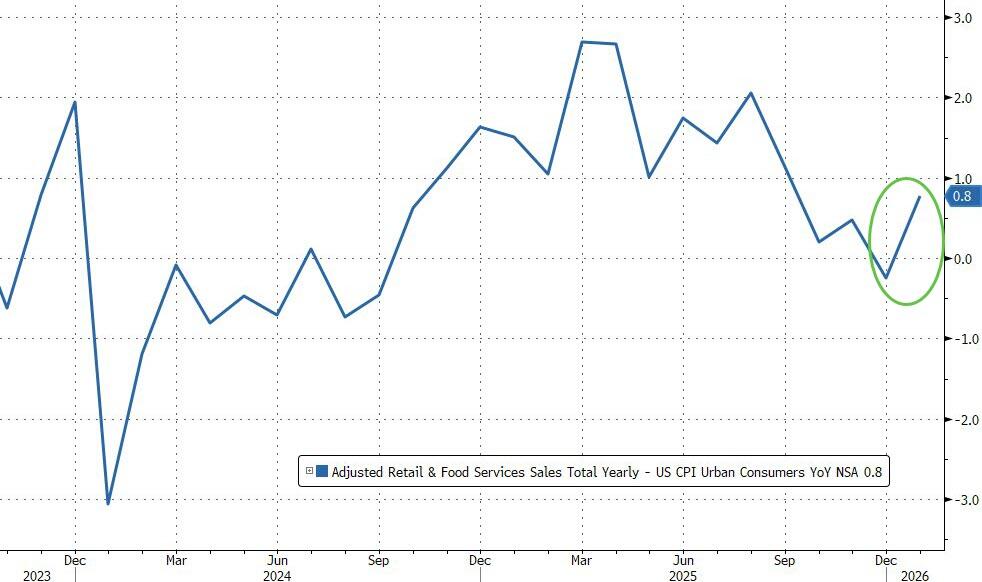
The report showed a 0.3% increase in so-called control-group sales – which feed into the government’s calculation of goods spending for gross domestic product. The measure excludes food services, auto dealers, building materials stores and gasoline stations.
end
USA ECONOMIC COMMENTARIES
MASSACHUSETTS
From Big Gulp To Big Gasp: Massachusetts Governor Fights For High-Sugar Beverages
Thursday, Mar 05, 2026 – 10:30 PM
Much of politics today seems to be driven by the source of policies.
If President Donald Trump or his administration is for it, Democrats are against it. Democrats have pulled 180-degree turns from past support for unilateral military operations by Democratic Presidents to opposing government shutdowns. However, one of the most intriguing has been the opposition to Health and Human Services (HHS) Secretary Robert F. Kennedy Jr., who has launched moves against unhealthy food additives and products.
That was evident yesterday when Massachusetts Gov. Maura Healey (D) virtually declared war over his effort to press Dunkin’ Donuts and Starbucks over high-sugar drinks.

Dunkin’ Donuts is clearly an iconic brand, but the lack of support for Kennedy’s food policies is striking in light of the general support of Democrats for Big Gulp laws like the one in New York put forward by former mayor Michael Bloomberg (R).
For the record, I have long opposed efforts to ban unhealthy foods. While I strongly support educational campaigns by the government about such unhealthy choices, I believe that it remains an individual choice on whether to engage in unhealthy habits, from smoking to high-fat foods. I also previously wrote how I believe the Big Gulp law was unlawful. It was later struck down.
In this country and other countries, such as Great Britain, similar measures targeting unhealthy foods have been rallying points for the left.
Yet, Kennedy received pushback after announcing that “We’re going to ask Dunkin’ Donuts and Starbucks, ‘Show us the safety data that show that it’s OK for a teenage girl to drink an iced coffee with 115 grams of sugar in it.’ I don’t think they’re going to be able to do it.”
Healey responded with a taunt, “Come and take it,” sharing an image of a flag resembling the 1835 “Come and Take It” flag first used at the start of the Texas Revolution.

Kennedy is not necessarily calling for a ban. He has been pushing to improve the food-ingredient approval system by implementing reforms long called for by nutrition advocates. Much of this effort focuses on improving the Generally Recognized as Safe policy. He has been attacking an exemption allowing food companies to independently verify the safety of food additives without the Food and Drug Administration’s oversight.
Kennedy has stated that this “loophole was hijacked by the industry, and it was used to add thousands upon thousands of new ingredients into our food supply. In Europe there’s only 400 legal ingredients. This agency does not know how many ingredients there are in American food.”
That would seem precisely what many liberals once heralded.
Yet, no democratic administration was ever willing to go head-to-head with these companies.
Kennedy is doing what administrations like the Obama and Biden administrations failed to do.
However, he remains persona non grata on the left, viewed as a traitor as a member of a famous Democratic family who supported Trump. They would rather defend unhealthy food than a party turncoat.
Once again, I generally oppose limits on consumer choices, preferring educational campaigns and healthy guidelines. However, the latest controversy only highlights the flipping of the magnetic poles in American politics.
END
Private Credit Firesale Begins: World’s Largest Asset Manager Gates Investors In $26 Billion Fund
BlackRock, the world’s largest asset manager, has restricted investor withdrawals from its $26 billion HPS Corporate Lending Fund (also known as HLEND) following a sharp increase in redemption requests. This “gating” limits how much money investors can pull out, allowing only a portion of the requested redemptions to proceed while locking in the rest to prevent a rushed liquidation of assets. marketscreener.com +1 The move comes amid broader turmoil in the $2 trillion private credit industry, where similar actions have been taken by firms like Blue Owl (which gated a $1.6 billion fund and sold $1.4 billion in loans to boost liquidity) and Blackstone (which permitted a record 7.9% redemption from its $82 billion BCRED fund, partially funded by its own capital). bloomberg.com +1This is considered “bad” for several reasons, signaling potential cracks in the private credit boom that exploded during low-interest-rate years:
- Liquidity Mismatch Exposed: Private credit funds lend to companies via illiquid loans that can tie up capital for 5-7 years, but they often promise investors semi-liquid access (e.g., quarterly redemptions). When too many investors rush to exit—triggered by fears of rising defaults, high interest rates squeezing borrowers, or economic slowdowns—the fund can’t sell assets fast enough without accepting steep discounts (a “firesale”). Gating protects remaining investors from those losses but traps others who need cash, breaking the illusion of easy liquidity. littlelaw.co.uk +2
- Investor Harm and Unfairness: Those gated can’t access their money during market stress, potentially missing better opportunities elsewhere or facing personal liquidity crunches. If gating fails and sales occur, the fund might offload its best assets first at a loss, leaving behind a portfolio of riskier, lower-quality loans that hurt long-term returns for everyone. investmentexecutive.com +1 Retail investors (non-professionals) are hit hardest, as these funds were marketed to them with promises of steady high yields (often 8-12%), but without fully disclosing gating risks—raising regulatory concerns. littlelaw.co.uk +1
- Signals Broader Market Distress: Gating is a red flag for underlying issues like bad loans piling up (e.g., in software firms vulnerable to AI disruption) or overinflated asset values that haven’t been marked down realistically. ft.com It can spark contagion: As confidence erodes, more redemptions hit other funds, new inflows dry up, and forced sales depress loan prices across the industry, amplifying a credit crunch. leithwheeler.com +1 Publicly traded private credit vehicles (BDCs) are already trading at 20-35% discounts to net asset value, hinting at deeper skepticism. shanakaanslemperera.substack.com +1
- Reputation and Systemic Risks: It damages trust in alternative assets, especially for giants like BlackRock. If this escalates, it could ripple to insurers, pensions, or annuities heavily exposed to private credit, potentially leading to a “lost decade” of underperformance as zombie loans linger without resolution. shanakaanslemperera.substack.com +1 Market reactions on platforms like X highlight fears of a messy unwind, with liquidity becoming a buzzword again reminiscent of past crises.
While gating might be necessary to avoid worse outcomes, it’s a stark reminder that private credit’s high returns come with hidden risks, especially in a higher-rate environment where borrower defaults are climbing.
VICTOR DAVIS HANSON
KING NEWS
| The King Report March 6, 2026 Issue 7694 | Independent View of the News |
| BBG: Beijing told major refiners to suspend exports of diesel and gasoline… An Iran missile hit a large refinery in Bahrain. Iran is targeting energy infrastructure in the Middle East. Kuwait Cuts Oil Processing at Its Refineries with Hormuz Blocked – BBG 12:55 ET Gasoline and oil soared on Thursday. Bonds and stocks declined smartly. The NY Fang+ Index was up moderately early on Broadcom (+4.95% near 11:00 ET) and CrowdStrike (+4.84% near 11:00 ET). Gold fell moderately on a report that Poland might sell gold to finance military spending. https://www.msn.com/en-us/money/other/poland-s-central-bank-chief-weighs-gold-sales-to-finance-defense/ar-AA1XAHhP ESHs opened modestly higher on Wednesday night and rallied to a daily high of 6900.75 (+2.25) at 119:17 ET. Then then did a 5-wave decline to 6840.50 at 3:30 ET. After frenzied trader buying propelled ESHs to 6894.00 at 4:09 ET, ESHs commenced a decline that took them to 6835.75 at 9:17 ET. The rally for the NYSE opening spiked ESHs to 687.50 at 9:59 ET. The Pro Dump appeared; ESHs tumbled to a new daily low of 6814.25 (-61.75) at 10:30 ET. The 2nd-Hour Reversal took ESHs to 6847.25 at 10:53 ET. Selling resumed; ESHs sank to a new daily low of 6811.00 at 11:18 ET. The manipulation for the European close pushed ESHs to 6845.25 at 12:04 ET. Selling reappeared; ESHs sank to a daily low of 6781.00 at 12:55 ET. After a 21-handle rebound, ESHs retreated into a trading range until a minor new low of 6777.00 appeared at 14:32 ET. ESHs went inert until the last-hour attempt to close the S&P 500 Index above 6800 commenced. The illegal late manipulation zoomed ESHs to 6826.25 at 15:25 ET and went inert. At 15:50 ET, ESHs mover higher; they hit 6839.00 at 15:57 ET. We warned last week (and before that) that the decline in oil and gasoline prices was keeping inflation metrics from large increases. We also noted that gasoline prices had increased sharply from their January 5 low to the end of February. July Gasoline is up 19% over the past 5 days. It is up over 73 cents, or 40% since the January 5 low. The front month gasoline contract is at its higher level since May 2024. Positive aspects of previous session The NY Fang+ Index rallied 66.86. An illegal late manipulation greatly truncated equity losses and closed the S&P 500 above 6800. Negative aspects of previous session The DJTA declined 578.08 even with the late manipulation USMs fell as much as 31/32. June (M) is now the front month. Gasoline +16.71 cents or 6.5% at its high; April WTI Oil settled +8.5%. Heating oil +10.2% at peak. Ambiguous aspects of previous session Do you think Team Trump will allow stocks to crater while it is at war with Iran? First Hour/Last Hour NYSE Action [S&P 500 Index]: 1st Hour: Down; Last Hour: Up Pivot Point for S&P 500 Index [above/below indicates daily trend to traders]: 6823.97 Previous session S&P 500 Index High/Low: 6870.4; 6770.78 Trump fired DHS Sec Noem and nominated GOP Sen. Mullin (OK) to replace her. She was a disaster! https://x.com/Osint613/status/2029629075975983114 Fed Balance Sheet: $15.097B on T-Bills +$14.760B; Reserves +$49.776B US weighs oil futures market action to combat rising energy prices, WH official says: Reuters The approach also reflects the background of Treasury Secretary Scott Bessent, a former hedge fund manager… https://www.reuters.com/business/energy/us-weighs-oil-futures-market-action-combat-rising-energy-prices-wh-official-2026-03-05/ Team Trump will now directly manipulate future contracts instead of the indirect manipulation done by others at government request that has occurred for decades. @SecScottBessent: To enable oil to keep flowing into the global market, the Treasury Department is issuing a temporary 30-day waiver to allow Indian refiners to purchase Russian oil. This deliberately short-term measure will not provide significant financial benefit to the Russian government as it only authorizes transactions involving oil already stranded at sea. India is an essential partner of the United States, and we fully anticipate that New Delhi will ramp up purchases of U.S. oil. This stop-gap measure will alleviate pressure caused by Iran’s attempt to take global energy hostage. (Another TACO!) Today – Now that Team Trump warned the world that it is open to direct manipulation of futures markets and is intervening in the oil market, it will be hard for traders and operators to short stuff. Oil and gasoline are down sharply as we write. If Team Trump will manipulate oil markets via futures, why not manipulate ESHs or other futures markets? The February Employment Report is expected to be soft, just 55k NFP. If stocks sink on a bad report, will direct or indirect manipulation appear? It’s best to be cautious for the next few sessions. Expected Economic Data: Feb NFP 55k (Whisper # 65k), Mfg. -2k, Rate 4.3%, Wages 0.3% m/m & 4.3% y/y, Workweek 34.3; Labor Force Participation Rate 62.5%; Jan Retail Sales -0.3% m/m, Ex-Autos 0.0%, Ex-Autos & Gas 0.2%; Jan Consumer Credit $12.65B Fed Speakers: SF Pres Daly & Phil Fed Paulson 10:15 ET, Boston Pres Collins 13:20 ET, Cleveland Pres Hammack 13:30 ET ESHs are +8.00; NQHs are +31.75; USHs are -1/32; oil, and gasoline are down sharply at 20:20 ET. S&P Index 50-day MA: 6905; 100-day MA: 6836; 150-day MA: 6733; 200-day MA: 6579 DJIA 50-day MA: 49,135;100-day MA: 48,179; 150-day MA: 47,281; 200-day MA: 46,309 (Green is positive slope; Red is negative slope) S&P 500 Index (6830.71 close) – BBG trading model Trender and MACD for key time frames Monthly: Trender and MACD are positive – a close below 6035.78 triggers a sell signal Weekly: Trender is positive; MACD is negative – a close below 6449.44 triggers a sell signal Daily: Trender and MACD are negative – a close above 6939.21 triggers a buy signal Hourly: Trender and MACD are negative – a close above 6831.19 triggers a buy signal @libsoftiktok: This “Man” who planted 20 explosives near a memorial in Kansas City has an ICE DETAINER HOLD. NONE of these outlets reported this. Biden let these kinds of t*rrorists invade our country. Americans… pay the price. https://x.com/libsoftiktok/status/2029657166496293209 | |
SWAMP STORIES FOR YOU TONIGHT
100% Of Audited Medicaid Claims For Autism Care In Colorado Were Improper Or Flawed: Report
Thursday, Mar 05, 2026 – 05:00 PM
Authored by Sylvia Xu via The Epoch Times (emphasis ours),
Colorado’s Medicaid program made an estimated $77.8 million in improper payments and another $207.4 million in potentially improper payments for autism therapy, according to a February report from the Inspector General for the Department of Health and Human Services.

Auditors investigated $289.5 million in Medicaid payments from 2022 to 2023 that paid for more than 1 million claims for Applied Behavior Analysis—a therapy used to treat autism and developmental disabilities.
Each of the 100 claims reviewed contained at least one improper or potentially improper payment, suggesting a 100 percent failure rate.
Improper payments are not necessarily fraudulent. Payments are considered improper when the claim does not meet federal or state requirements. Payments are potentially improper when the submitted claim is so poor or unreliable that auditors cannot verify that the services were provided correctly.
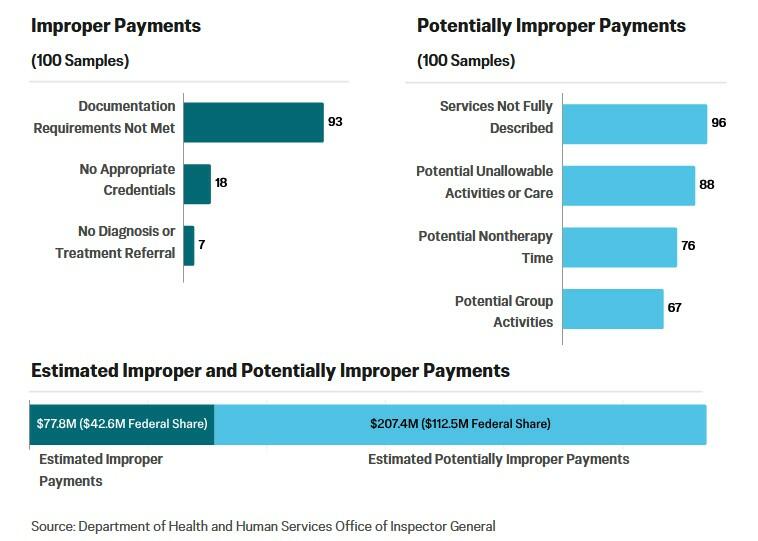
Claim Errors
In 93 of 100 claims examined, the billing providers either did not provide notes verifying that the therapy took place, didn’t provide the required signatures, or billed for more time than the notes indicated.
In 18 cases, the therapy that was supposed to be performed by a specialist—such as a Board Certified Behavior Analyst—was performed by staff without those qualifications.
In seven cases, the children receiving therapy lacked a current doctor’s diagnosis or referral on file.
In 88 cases, facilities billed for recreational activities that are not considered medical therapy, such as academic tutoring, day care, or custodial care. In one case, a facility billed for children swimming and playing on water slides.
In 76 cases, facilities billed for a full eight-hour day without subtracting time for naps, meals, or breaks.
Oversight and Safety Concerns
The report concludes that Colorado made these improper payments because it did not provide effective oversight. The state did not regularly review Medicaid payments to catch errors and failed to give clear guidance to therapy centers on how to bill or what counts as therapy.
Additionally, the state didn’t properly check if its prior authorization contractors were following the rules when approving therapy for children.
While the audit focused on money, it also uncovered problems that could affect the safety and quality of care.
Some staff members had criminal convictions for weapons offenses, assault, or driving under the influence. In one case, three staff members at a facility providing care to an 11-year-old child with autism had criminal histories.
A non-credentialed technician had a felony weapons offense conviction three months prior to treating children. A registered behavior technician had been convicted of misdemeanor assault and physical harassment, such as a strike, shove, or kick. Another behavior technician had an aggravated misdemeanor weapons conviction.
The state did not require background checks for these workers.
Previous Audits
The report comes as part of a series of seven Inspector General audits examining state Medicaid payments for autism therapy. Four are are complete and three remain in progress.
In previous audits, the agency estimated more than $120 million in improper payments and nearly $200 million in potential improper payments for Indiana, Wisconsin, and Maine.
The potential fraud, waste, and abuse in Medicaid autism therapy payments in Colorado was the highest among these audits.
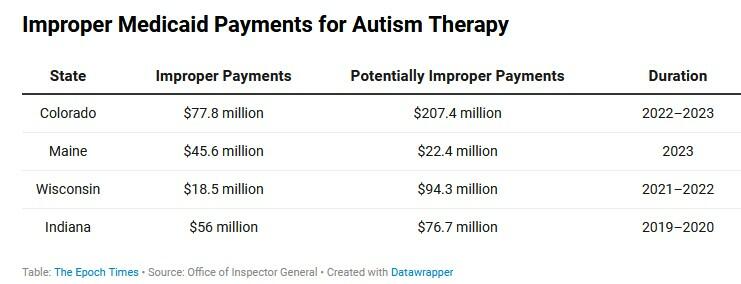
The Office of Inspector General recommended that Colorado refund $42.6 million—the federal portion of the improper payments—to the federal government.
Also, the agency suggested that the state begin regular reviews of autism facilities to ensure they follow the rules and provide better training and guidance to facilities on documenting and billing for therapy.
The state of Colorado agreed to improve its guidance and conduct more regular reviews in the future, according to a statement. But it disagreed with the recommendation to refund the money, arguing that the audit derived its findings from a limited sample and didn’t have enough detail on the errors.
Further, Colorado argued that its Medicaid program does not require certification of behavior technicians before making payments, so the refund calculation based on this statute should be rescinded.
GREG HUNTER….INTERVIEWING BILL HOLTER
‘Mr. Gold’ Warns Of ‘System Reset’ As Silver Lights Fuse Of Derivatives Time-Bomb
Friday, Mar 06, 2026 – 05:00 AM
Authored by Greg Hunter via usawatchdog.com,
Financial writer and precious metals expert Bill Holter (aka Mr. Gold) predicted that by March, silver would likely suffer a failure to deliver physical metal at COMEX. In other words, demand for physical silver will swamp the existing supply. The math is scary and simple, and Holter breaks it down, “The registered inventory at COMEX in silver is 86 million ounces. On the second day of March, there are already 52 million ounces of silver standing for delivery. That leaves 30 million to 35 million ounces unspoken for. . .. This looks dicey. If they have 52 million ounces standing for delivery now, where is it going to be at the end of the month? If silver fails to deliver, then what you are going to have in the gold market is buyers stepping up that normally would not even buy and ask for delivery. . .. The bottom line is if silver fails to deliver, gold will fail to deliver in 24 hours. Once that happens, then confidence breaks. . .. You are looking at two quadrillion dollars in derivatives in a global economy with $350 trillion in debt with an underlying $100 trillion annual GDP. The math does not work. I think silver, and I have said this for many years, silver will be the spark or the fuse that lights off gold, which then lights off the derivatives time bomb. Warren Buffett calls derivatives weapons of mass financial destruction.”
Mr. Gold thinks, “When the system resets, governments will start a money print fest that will touch off global hyperinflation. . .. The pure math of debt outstanding is that it cannot be repaid in current terms. It will be hyperinflation of the things we need and hyper-deflation of the things we already have. . .. How is somebody going to buy your house if the capital is not there? If the capital is not there, then the price is going to have to come down. . .. It is highly likely that silver will kick off the demise of the financial system.”
Mr. Gold thinks this kind of global debt will go bad fast. Holter warns, “When this thing cascades and collapses, you are either in place, or you are out of place. If you are out of place, you will not be able to repair your mistake. It will be a lifetime mistake to have not gotten ready. Let me just say there is a difference in being early and being wrong. In 2000 to 2005, if you were buying gold or you were buying silver, you were an idiot, a complete idiot, and people thought you walked around with a tin foil hat on. . .. Now, we are at the point where the best place to have invested your money since January 2000 would be in gold or silver. When Noah was running around building his ark, he looked wrong. He was not wrong–he was just early.”
Watch:


 harveyorganblog.com


