
GOLD CLOSED CLOSED DOWN $70.55 TO $5162.90
ACCESS MARKET
XXX
GOLD $5176.95 3:30 PM)
SILVER: 85.05 3;30 PM)


EXCHANGE: COMEX
EXCHANGE: COMEX
CONTRACT: MARCH 2026 COMEX 100 GOLD FUTURES
SETTLEMENT: 5,229.700000000 USD
INTENT DATE: 03/10/2026 DELIVERY DATE: 03/12/2026
FIRM ORG FIRM NAME ISSUED STOPPED
190 H BMO CAPITAL MARKETS 37
363 H WELLS FARGO SECURITI 200
555 C BNP PARIBAS SEC CORP 211
624 C BOFA SECURITIES 2
624 H BOFA SECURITIES 135 602
657 C MORGAN STANLEY 1738
661 C JP MORGAN SECURITIES 298
709 C BARCLAYS 502
737 C ADVANTAGE FUTURES 6
905 C ADM 19
TOTAL: 1,875 1,875
MONTH TO DATE: 7,500
JPMORGAN STOPPED 294/1875
GOLD: NUMBER OF NOTICES FILED FOR MARCH/2026: 1875 CONTRACTs NOTICES FOR 187,500 OZ or 5.832 TONNES
total notices so far: 7500 contracts for 750,000 OR 23.328 tonnes)
SILVER NOTICES: 20 NOTICE(S) FILED FOR 0.100 MILLION OZ /
total number of notices filed so far this month : 6700 CONTRACTS (NOTICES) for 33.500 million oz
SILVER//OUTLINE
INITIAL STANDING FOR JANUARY: 22.915 MILLION OZ FOLLOWED BY TODAY’S 1.185 MILLION OZ QUEUE JUMP//NEW NORMAL STANDING ADVANCES TO 49.445 MILLION OZ// TO WHICH WE ADD OUR FIRST EXCHANGE FOR RISK FOR .100 MILLION OZ//NEW STANDING ADVANCES TO 49.545 MILLION OZ!!
INTIAL STANDING FOR FEBRUARY/SILVER: 13.505 MILLION OZ FOLLOWED BY TODAY’S HUGE 0.005 MILLION OZ QUEUE JUMP / : NEW STANDING FOR SILVER AT THE COMEX ADVANCES TO 25.180 MILLION OZ. BUT WE MUST ADD OUR FIRST EXCHANGE FOR RISK OF 25 CONTRACTS FOR .125 MILLION OZ AND THEN OUR SECOND EXCHANGE FOR RISK OF .0600 MILLION OZ TO OUR THIRD HUGE 2.825 MILLION OZ EXCHANGE FOR RISK!!
INITIAL STANDING FOR MARCH: A SURPRISINGLY LOW 31.076 MILLION OZ/ FOLLOWED BY A SMALL EXCHANGE FOR PHYSICAL TRANSFER TO LONDON JUMP OF 5 CONTRACTS OR 25,000 OZ/NEW STANDING REDUCES TO 38.945 MILLION OZ
JULY: 50.925 MILLION OZ (QUITE SMALL)
AUGUST: 59.455 MILLION OZ (QUITE SMALL)
SEPT. 50.510 MILLION OZ.(QUITE SMALL)
OCT; 82.020 MILLION OZ (WILL BE STRONG THIS MONTH)/ OCC WANTS TO REIN IN THESE ISSUANCES!
NOVEMBER: 36.425 MILLION OZ
DEC: 45.765 MILLION OZ
JANUARY 2026: 134.270 MILLION OZ (WILL BE A VERY STRONG MONTH FOR EXCHANGE FOR PHYSICAL!)
FEB : 82.130 MILLION OZ
MARCH: 27.095 MILLION OZ
AND JULY: 46.720 MILLION OZ//
AUGUST: 4.70 MILLION OZ INITIAL STANDING PLUS TODAY;S 5,000 OZ QUEUE JUMP //NEW STANDING ADVANCES TO 10.960 MILLION OZ
SEPTEMBER: 68.040 MILLION OZ NORMAL DELIVERY(INCLUDES ALL QUEUE JUMPING AND EXCHANGE FOR PHYSICAL TRANSFERS) PLUS 3.0 MILLION OZ EX FOR RISK = 71.040 MILLION OZ. (THIS IS THE FIRST AND ONLY ISSUANCE OF EXCHANGE FOR RISK FOR SILVER SINCE MAY.)
OCTOBER: 39.565 MILLION OZ OF NORMAL DELIVERY INCLUDES ALL QUEUE JUMPING
PLUS
2.110 MILLION OZ EXCHANGE FOR RISK//TOTAL OZ STANDING IN OCT ADVAN
NOVEMBER: INITIAL STANDING AT 11.575 MILLION OZ FOLLOWED BY TODAY’S 195,000 OZ QUEUE JUMP WHICH FOLLOWS ALL OTHER QUEUE JUMPS OF 9.155 MILLION OZ//STANDING ADVANCES TO 19.670 MILLION OZ/
DECEMBER: INITIAL AMOUNT STANDING FOR DELIVERY: 49.33 MILLION OZ// FOLLOWED BY ANOTHER STRONG 835,000OZ QUEUE JUMP+ DEC. FIRST EXCHANGE FOR RISK 0F .850 MILLION OZ + LAST WEEK.S 495,000 OZ EXCHANGE FOR RISK AND THEN A 3RD ISSUANCE IF 1.00MILLION OZ THEN FINALLY DEC 249ISSUANCE OF 1.35 MILLION OZ EXCHANGE FOR RISK//NEW TOTAL EX FOR RIS IS 3.685 MILLION OZ // STANDING ADVANCES TO 68.415 MILLION OZ//
JANUARY: INITIAL STANDING 22.915 MILLION OZ FOLLOWED BY TODAY’S 1.185 MILLION OZ QUEUE JUMP//NORMAL STANDING ADVANCES TO 49.445 MILLION OZ// TO WHICH WE ADD OUR FIRST EXCHANGE FOR RISK OF 0.100 MILLLION OZ//NEW STANDING ADVANCES TO 49.545 MILLION OZ
FEB: 13.399 MILLION OZ IS OUR INITIAL STANDING FOR SILVER! TO WHICH WE ADD OUR NEXT QUEUE JUMP FOR 5,000 OZ AND THEN ADD OUR 3 EXCHANGE FOR RISK FOR 3.010 MILLION OZ STANDING ADVANCES TO 28.190 MILLION OZ!!
MARCH: INITIAL AMOUNT OF SILVER STANDING IS 31.076 MILLION OZ FOLLOWED BY TODAY’S 25,000 OZ EXCHANGE FOR PHYSICAL TRANSFER TO LONDON //NEW TOTAL STANDING REDUCES TO 38.945 MILLION OZ
- MAY: SUMMARY FOR MAY TONNES WHICH STOOD FOR DELIVERY:
4. AUGUST: 60.547 TONNES OF INITIAL GOLD FIRST DAY NOTICE FOLLOWED BY THE NET MONTH’S QUEUE JUMP OF 47.2312 TONNES TO WHICH WE ADD THE FOLLOWING EXCHANGE FOR RISK ISSUANCE RECEIVED FOR THE MONTH: 5.4432 TONNES EX FOR RISK/AUG 7 , AUG 11: 2.413 TONNES EX FOR RISK AND AUG. 12 OF 2.637 TONNES EX FOR RISK//AUG 25: 9.107 TONNES , AUGUST 26: 9.1010 TONNES AND NOW AUGUST 27: 9.0699 TONNES//NEW STANDING ADVANCES TO 107.5117 TONNES OF GOLD NORMAL STANDING (INCLUDES ALL MONTHLY QUEUE JUMPS/EX FOR PHYSICAL TRANSFERS//) +44.696 TONNES EX.FOR RISK = 152.208 TONNES
5.SEPT: INITIAL 8.093 TONNES OF GOLD PLUS TODAY’S QUEUE JUMP OF 0.4883 TONNES PLUS 2.2827 TONNES OF EXCHANGE FOR RISK TODAY//NEW TOTAL EX. FOR RISK/MONTH = 22.923//NEW TOTAL STANDING FOR GOLD SEPT ADVANCES TO = 48.801 TONNES!!
6.OCTOBER: 90.012 TONNES OF INITIAL GOLD STANDING WITH TODAY’S TINY 0.00311 TONNES QUEUE JUMP WHICH FOLLOWS ALL OTHER QUEUE JUMPS DURING OCT OF 76.1656 TONNES
THEN WE MUST ADD OUR 14.553 TONNES OF OUR ISSUANCE OF EXCHANGE FOR RISK/6 OCCASIONS//NEW TOTAL OF GOLD STANDING ADVANCES TO 197.5141 TONNES OF GOLD.
7.NOVEMBER BEGINS WITH 15.651 TONNES INITIALLY STANDING FOR DELIVERY FOLLOWED BY TODAY’S QUEUE JUMP OF 2.323 TONNES FOLLOWED BY ALL PREVIOUS QUEUE JUMPS IN OF OF 21.3775 TONNES TO WHICH WE ADD OUR TWO EXCHANGE FOR RISK ISSUANCE OF 4.5596 TONNES//NEW STANDING ADVANCES TO 43.9716 TONNES OF GOLD.
8. DECEMBER BEGINS WITH INITIAL STANDING OF 83.813 TONNES OF GOLD FOLLOWED BY TODAY’S 0.0TONNE QUEUE JUMP WHICH FOLLOWS ALL OTHER QUEUE JUMPS OF: 37.163 TONNES//NEW STANDING ADVANCES TO 115.390 TONNES TO WHICH WE ADD OUR 4 EXCHANGE FOR RISK FOR DECEMBER OF 6.587 TONNES/NEW STANDING ADVANCES TO 121.977 TONNES
9. JANUARY: INITITAL STANDING: 13.785 TONNES TO WHICH WE ADD OUR FIRST EXCHANGE FOR PHYSICAL TRANSFER OF 0.08709 TONNES WHICH FOLLOWS ALL OTHER QUEUE JUMPS OF 30.7117TONNES //NEW TOTAL QUEUE JUMPS 30.7117//NORMAL DELIVERY OF GOLD ADVANCES TO 36.8958 TONNES TO WHICH WE ADD OUR SIX EXCHANGE FOR RISK OF 22.315 TONNES//NEW STANDING ADVANCES TO 59.2108 TONNES.
FEB; INITIAL AMOUNT OF GOLD STANDING FOR DELIVERY: 93.567 TONNES OF GOLD TO WHICH WE ADD OUR NEXT 0.0248 TONNES 0.1555 TONNES QUEUE JUMP TO 41.2082 TONNES/ NEW NET QUEUE JUMP INCREASES TO 41.233 TONNES// AND THEN WE ADD OUR SIX EXCHANGE FOR RISK: 10,080 CONTRACTS OR 31.251 TONNES//NEW STANDING REDUCES TO 157.878 TONNES
MARCH:: INITIAL AMOUNT OF GOLD STANDING FOR DELIVERY: 8.099 TONNES FOLLOWED BY TODAY’S RECORD SETTING 11.026 TONNES QUEUE JUMP//NEW STANDING ADVANCES TO 29.129 TONNES/
MARCH:: SMALL INITIAL STANDING FOR GOLD FOR MARCH AT 8.099 TONNES FOLLOWED BY TODAY’S RECORD SETTING 11.026 TONNES QUEUE JUMP//NEW STANDING ADVANCES TO 29.129 TONNES OF GOLD./
FINAL STANDING FOR GOLD, JANUARY CONTRACT AT 59.2108 TONNES OF GOLD
FEBRUARY: INITIAL STANDING FOR GOLD: 157.878 TONNES!! WHICH INCLUDES ALL QUEUE JUMPING, THREE EXCHANGE FOR PHYSICAL TRANSFERS TO LONDON AND OUR SIX ISSUANCES EXCHANGE FOR RISK!!
MARCH: INITIAL STANDING AT 8.099 TONNES FOLLOWED BY TODAY’S 11/076 TONNES QUEUE JUMP //NEW STANDING ADVANCES TO 29.129 TONNES/
JAN. 2025: 257.919 TONNES (ISSUANCE WILL BE PRETTY GOOD THIS MONTH BUT MUCH LOWER THAN LAST MONTH)
FEB: 207.21 TONNES//EX FOR PHYSICAL ISSUANCE (WILL BE A FAIR SIZED ISSUANCE THIS MONTH)
MARCH 130.84 TONNES//QUITE SMALL THIS MONTH.
APRIL; 208.57 TONNES. STRONG THIS MONTH
MAY: 113.499 TONNES OF GOLD EFP ISSUANCE//QUITE SMALL THIS MONTH
JUNE: 97.79 TONNES OF GOLD EFP ISSUANCE/EXTREMELY SMALL
JULY : 150.877 TONNES// QUITE SMALL
AUGUST: 175.86 TONNES A LOT LARGER THIS MONTH.
SEPT. 116.13 TONNES VERY SMALL
OCT. 252.72 TONNES//CERTAINLY MUCH LARGER THIS MONTH/VERY STRONG
NOV: 124.74 TONNES
DEC: 190.04 TONNES//GOOD SIZED THIS MONTH FINAL.
TOTAL EXCHANGE FOR PHYSICAL ISSUED FOR YEAR 2025: 2,026.20 TONNES (LOWER THAN LAST YR 2,569.00 TONNES
JANUARY: 209.08 TONNES ( (WILL BE A STRONG MONTH FOR EXCHANGE FOR PHYSICAL)
FEB. 176.35 TONNES (WHICH IS A FAIR ISSUANCE)
MARCH: 98.79 TONNES//WILL BE VERY STRONG ISSUANCE THIS MONTH
XXXXXXXXXXXXXXXXXXXXXXXXXXXXXXXXXXXXXXXXXX
SPREADERS:
HERE IS A BRIEF SYNOPSIS OF HOW THE CROOKS FLEECE UNSUSPECTING LONGS IN THE SPREADING ENDEAVOUR ;MODUS OPERANDI OF THE CORRUPT BANKERS AS TO HOW THEY HANDLE THEIR SPREAD
YOU WILL ALSO NOTICE THAT THE COMEX OPEN INTEREST STARTS TO RISE BUT SO IS THE OPEN INTEREST OF SPREADERS. THE OPEN INTEREST IN WILL CONTINUE TO RISE UNTIL ONE WEEK BEFORE FIRST DAY NOTICE OF AN UPCOMING ACTIVE DELIVERY MONTH (OCT), AND THAT IS WHEN THE CROOKS SELL THEIR SPREAD POSITIONS BUT NOT AT THE SAME TIME OF THE DAY. THEY WILL USE THE SELL SIDE OF THE EQUATION TO CREATE THE CASCADE (ALONG WITH THEIR COLLUSIVE FRIENDS) AND THEN COVER ON THE BUY SIDE OF THE SPREAD SITUATION AT THE END OF THE DAY. THEY DO THIS TO AVOID POSITION LIMIT DETECTION. THE LIQUIDATION OF THE SPREADING FORMATION CONTINUES FOR EXACTLY ONE WEEK AND ENDS ON FIRST DAY NOTICE.”
WHAT IS ALARMING TO ME, ACCORDING TO OUR LONDON EXPERT ANDREW MAGUIRE IS THAT THESE EFP’S ARE BEING TRANSFERRED TO WHAT ARE CALLED SERIAL FORWARD CONTRACT OBLIGATIONS AND THESE CONTRACTS ARE LESS THAN 14 DAYS. ANYTHING GREATER THAN 14 DAYS, THESE MUST BE RECORDED AND SENT TO THE COMPTROLLER, GREAT BRITAIN TO MONITOR RISK TO THE BANKING SYSTEM. IF THIS IS INDEED TRUE, THEN THIS IS A MASSIVE CONSPIRACY TO DEFRAUD AS WE NOW WITNESS A MONSTROUS TOTAL EFP’S ISSUANCE AS IT HEADS INTO THE STRATOSPHERE.
The crooks also use the spread in the TAS account (trade at settlement). They buy the spot TAS (e.g. June) and sell the future TAS two months out (e.g. August). Then they unload the front month (i.e. unload the buy side first so the price of gold/silver falls. This occurs in the middle of the front delivery month cycle. They unload the sell side of the equation, two months down the road. The crooks violate position limits as the OCC refuse to hear our complaints.
First, here is an outline of what will be discussed tonight:
SILVER:
1.TODAY WE HAD THE OPEN INTEREST AT THE COMEX IN SILVER ROSE BY A MEGA HUGE SIZED 1358 CONTRACTS OI TO 115,458 AND CLOSER TO THE COMEX HIGH RECORD //244,710( SET FEB 25/2020). THE LAST RECORDS WERE SET IN AUG.2018 AT 244,196 WITH A SILVER PRICE OF $14.78/(AUGUST 22/2018)..THE PREVIOUS RECORD TO THAT WAS SET ON APRIL 9/2018 AT 243,411 OPEN INTEREST CONTRACTS WITH THE SILVER PRICE AT THAT DAY: $16.53). AND PREVIOUS TO THAT, THE RECORD WAS ESTABLISHED AT: 234,787 CONTRACTS, SET ON APRIL 21.2017 OVER 7 YEARS AGO. HOWEVER WE HAVE NOW SET A NEW RECORD LOW OF 112,794 CONTRACTS THIS MONTH( MARCH 4/2026)
EFP ISSUANCE 562 CONTRACTS
OUR CUSTOMARY MIGRATION OF COMEX LONGS CONTINUE TO MORPH INTO LONDON FORWARDS AS OUR BANKERS USED THEIR EMERGENCY PROCEDURE TO ISSUE:
MAY 562 CONTRACTS and 0 ALL OTHER MONTHS: ZERO. TOTAL EFP ISSUANCE: 0 CONTRACTS. EFP’S GIVE OUR COMEX LONGS A FIAT BONUS PLUS A DELIVERABLE PRODUCT OVER IN LONDON. IF WE TAKE THE COMEX OI GAIN OF 1358 CONTRACTS AND ADD TO THE 562 E.FP. ISSUED
WE OBTAIN A HUGE SIZED GAIN OF 1920 OF OPEN INTEREST CONTRACTS FROM OUR TWO EXCHANGES WITH OUR GAIN OF $5,36
THUS IN OUNCES, THE GAIN ON THE TWO EXCHANGES TOTALS 9.60 MILLION PAPER OZ
OCCURRED WITH OUR GAIN IN PRICE.OF $5.36
2.ASIAN AFFAIRS MARCH 10/2025
SHANGHAI CLOSED UP 10.30 PTS OR 0.25%
HANG SENG CLOSED DOWN 61.14 PTS OR 0.24%
Nikkei CLOSED UP 817.61 PTS OR 1.51%
//Australia’s all ordinaries CLOSED DOWN 0.65%
//Chinese yuan (ONSHORE) CLOSED UP 6.8701
/ OFFSHORE CLOSED UP AT 6.8711 Oil UP TO 86.69 dollars per barrel for WTI and BRENT UP TO 89.96 Stocks in Europe OPENED ALL DEEPLY IN THE RED
ONSHORE USA/ YUAN TRADING 6.8701 OFFSHORE YUAN TRADING UP TO 6.8711 ONSHORE YUAN TRADING ABOVE OFF SHORE AND UP ON THE DOLLAR// / AND THUS STRONGER//OFF SHORE YUAN TRADING UP AGAINST US DOLLAR/ AND THUS STRONGER
1. COMEX DATA//AMOUNTS STANDING//VOLUME OF TRADING/INVENTORY MOVEMENTS
THE TOTAL COMEX GOLD OPEN INTEREST ROSE BY A STRONG SIZED 9127 CONTRACTS UP TO 413,956 OI , RISING FROM DECADES ALL TIME LOW OF 404,829, WITH OUR HUGE GAIN IN PRICE OF $137..75 WITH RESPECT TO WEDNESDAY’S // TRADING/ //COMEX CLOSING TIME:… WE LOST ZERO NET LONGS, WITH THAT HUGE PRICE GAIN FOR GOLD . AND AS YOU WILL SEE BELOW, OUR GAIN IN PRICE ALSO HAD A STRONG NUMBER OF EXCHANGE FOR PHYSICAL ISSUED (2879).
WE HAD NO T.A.S. LIQUIDATION DURING TUESDAY’S TRADING. IT SEEMS THAT THE SPECULATORS STARTED AGAIN TO GO MASSIVELY LONG THIS MONTH AFTER A BRIEF PERIOD OF GOING NET SHORT AT THE BEGINNING OF FEBRUARY.
CENTRAL BANKS ALSO TENDERED THEIR NEW LONG CONTRACTS AT THE END OF THE DAY FOR PHYSICAL GOLD. YOU CAN VISUALIZE THIS WITH THE MASSIVE AMOUNT OF GOLD STANDING AT THE COMEX FOR THIS MARCH CONTRACT MONTH!!
YOU WILL NOTICE THAT THE COMEX OI IS NOW MOVING AWAY FROM ITS ALL TIME LOW POINT IN OI OF 404,829 AND FROM THIS POINT, OI WILL RISE BUT IT WILL BE EXTREMELY DIFFICULT FOR THE CROOKS TO FLEECE OUR NEWBIE SPEC LONGS. THE ALL TIME LOW OF COMEX OI IS 390,000 CONTRACTS WHICH OCCURRED IN 2001 WITH GOLD AROUND $260. FROM CHINA WE LEARN THAT TODAY, THE GOLD LEASE RATE IS NOW AROUND 1 TO 2 %.(SILVER IS AT 7%). WITH AN OI OF 413,956 THERE IS SOME ROOM FOR THE CROOKS TO RAID OUR NEWBIE SPECULATORS!
WE THUS HAD A TOTAL GAIN IN OI ON BOTH OF OUR EXCHANGES, THE COMEX AND LONDON’S EXCHANGE FOR PHYSICAL EQUATING TO 12,006 CONTRACTS (OR 37.34 TONNES) WITH THE HUGE GAIN IN PRICE, WEDNESDAY.
THEN WE WERE NOTIFIED OF A ZERO CONTRACT EXCHANGE FOR RISK ISSUANCE IN GOLD CONTRACTS FOR 0 OZ OR 0 TONNES OF GOLD. DURING THE MIDDLE OF THE MONTH. WE HAVE HAD TWO IDENTICAL MONSTER 3,000 CONTRACT ISSUED FOR THE SAME 9.33 TONNES OF GOLD, AND THESE ARE THE HIGHEST EVER IN TONNAGE EVER ISSUED BY THE COMEX. ALTOGETHER THE TOTAL ISSUANCE THUS FAR FOR FEB NOW REMAINS AT SIX.(31.251 TONNES)
A LITTLE HISTORY OF EXCHANGE FOR RISK DECEMBER THROUGH TO MARCH:
IN DECEMBER WE HAVE RECORDED 5 ISSUANCES OF EXCHANGE FOR RISK/4 FOR DEC AND THE LAST ONE ON DEC 31 FOR JANUARY. WE NOW HAVE 3 CHOICES FOR THE RECIPIENT OF THIS ISSUANCE AND IT MUST BE A CENTRAL BANK. YOU WILL RECALL THAT THE BUYER ASSUMES THE RISK OF THAT DELIVERY. (THUS TOTAL EXCHANGE FOR RISK FOR THE MONTH OF DECEMBER IS 6.56 TONNES/4 OCCASIONS.
MONTH OF JANUARY/EXCHANGE FOR RISK
IN JANUARY THEY HAVE 6 TOTAL ISSUANCE : 3.446 TONNES EARLY, THEN JAN 9 ISSUANCE OF 9,331 TONNES AND THEN JAN 16: 0.1996 TONNES JAN 26: 1.499 TONNES, JAN 27: 3.160 AND FINALLY JAN 29: 4.659 TONNES TONNES//TOTAL EXCHANGE FOR RISK JANUARY 22.315 TONNES WHICH WAS ADDED TO OUR NORMAL DELVERIES.
AND FEBRUARY:
FEB EXCHANGE FOR RISK: NOW 6 ISSUANCES: 10,080 CONTRACTS FOR 1,008,000 OZ OR 31.251 TONNES!
HERE ARE THE CHOICES FOR THE RECIPIENT OF THOSE ISSUANCES:
1 THE CENTRAL BANK OF ENGLAND. BUT THEY RECEIVED CLEARANCE THAT THEIR GOLD IS BACK SO IT IS NOT LIKELY THAT THEY WOULD LIKE TO ADD TO THEIR RESERVES.
2. THE CENTRAL BANK OF THE USA: THE FED. LOGICAL CHOICE AS THEY CLAMOUR TRYING TO REDUCE THEIR 106+ TONNES OF SHORTAGE. HOWEVER THEY SEEM NOT TO BE IN A HURRY TO COVER THEIR HUGE SHORTFALL
3. THE CENTRAL BANK OF CHINA AS THEY BATTLE WITS WITH THE USA.
TOTAL EXCHANGE FOR RISK FOR DECEMBER IS 6.56 TONNES AND THIS WAS ADDED TO OUR NORMAL DELIVERY TOTALS..
THE JANUARY ISSUANCE OF 17.656 TONNES WAS ADDED TO OUR DAILY DELIVERY TOTALS!!
FEBRUAY ISSUANCES 6 FOR; 31.251 TONNES !! AND THIS WAS ADDED TO OUR DELIVERY TOTALS FOR THIS MONTH.
MARCH: ZERO ISSUED SO FAR!
DETAILS ON OUR NEW MARCH COMEX CONTRACT MONTH//
IN TOTAL WE HAD A HUGE SIZED GAIN ON OUR TWO EXCHANGES OF 17,768 CONTRACTS WITH OUR HUGE GAIN IN PRICE. HOWEVER, OUR FRIENDLY PHYSICAL LONDON BOYS HAD ANOTHER FIELD DAY AGAIN THROUGHOUT THIS WEEK AS THEY WERE READY FOR THE FRBNY.S CONTINUED ORCHESTRATED ATTACKS VERY EARLY IN THE COMEX SESSIONS AS THEY TRIED TO ABSORB EVERYTHING IN SIGHT FROM THEIR DAILY ATTACKS. LONDONERS EXERCISED THEIR BOUGHT CONTRACTS FOR PHYSICAL GOLD VIA THE EXCHANGE FOR PHYSICAL ROUTE AND THANKED THE FRBNY AND OUR SHORT SPECULATORS FOR THE THOUGHTFULNESS.
LONDON ANNOUNCED EARLY IN THE YEAR (AND SCARCITY CONTINUES TO THIS DAY) THAT THEY WERE OUT OF GOLD. WRONGLY IT WAS ATTRIBUTED TO THEIR SHIPPING PHYSICAL GOLD TO COMEX FOR STORAGE DUE TO TRUMP’S INITIATION OF TARIFFS. THE TRUTH OF THE MATTER IS THAT THIS GOLD LEFT LONDON TO OTHER CENTRAL BANKS, AND COMEX BANKS HAVE BEEN PAPERING THEIR LOSSES (DERIVATIVE) WITH KILOBAR ENTRIES. BOTH COMEX AND LBMA ARE WITNESSING MASSIVE AMOUNTS OF GOLD LEAVING THEIR VAULTS.
THE LIQUIDATION OF T.A.S. CONTRACTS THROUGHOUT THE MONTHS OF JUNE THROUGH MARCH/ CONTINUES TO DISTORT OPEN INTEREST NUMBERS GREATLY ALTHOUGH THE T.A.S. ISSUANCES IN GOLD HAVE GENERALLY BEEN ON THE LOW SIDE COMPARED TO SILVER WHICH HAVE BEEN HUGE. TODAY’S NUMBER IS ANOTHER HUMONGOUS SIZED T.A.S ISSUANCE CONTRACTS .THE CME NOTIFIES US THAT THEY HAVE ISSUED 16,212 T.A.S CONTRACTS AND WILL BE USED FOR RAID PURPOSES TO STOP GOLD’S RISE AND TO TEMPER HUGE LOSSES IN OTC DERIVATIVE BETS AND IT WAS IN FULL FORCE DURING LAST WEEK AND IT IS IN FULL FORCE WITH TODAY’S RAID!
IT SURE LOOKS LIKE THE BIS HAS SOMEHOW LOOKED THE OTHER WAY WITH ITS GOLD SWAPS WITH THE FRBNY AS THIS ENTITY FOR THE FED REFUSES THE BIS MARCHING ORDERS TO COVER AND THAT MAY EXPLAIN THE STRONG NUMBER OF T.A.S. ISSUANCES IN DECEMBER , JANUARY AND THROUGHOUT FEBRUARY TO GO ALONG WITH OUR HUGE NUMBER OF EXCHANGE FOR RISK ISSUED DURING THESE MONTHS INCLUDING FEBRUARY’S 6 EXCHANGE FOR RISK WHICH ALSO INCLUDED TWO MONSTER 9.3312 TONNE ISSUANCE (FEB 10 AND FEB 12). TOTAL EXCHANGE FOR RISK/FEB EQUALS 31.251 TONNES!! OTHER CENTRAL BANKS ARE PAYING ATTENTION AS THEY TAKE DELIVERY OF HUGE AMOUNTS OF PHYSICAL GOLD.
FOR MARCH NO EXCHANGE FOR RISK ISSUANCE SO FAR.. BUT DELIVERIES OF GOLD THESE PAST SEVERAL MONTHS HAVE BEEN HUGE:
FOR EXAMPLE:
HERE IS A SUMMARY OF GOLD STANDING FOR DELIVERY ON OUR LAST 11 MONTHS:
- FOR APRIL AT 209 TONNES
2. AND THIS CONTINUED INTO MAY WITH FINAL STANDING AT 90.23 TONNES.
3. JUNE WHICH IS A HUGE DELIVERY MONTH , FINAL STANDING WAS RECORDED AT A STRONG 93.085 TONNES. //(TOTAL NET QUEUE JUMPING FOR THE JUNE MONTH: 31.027 TONNES.)
4. IN JULY WE HAD HUGE DELIVERY NOTICES ESPECIALLY FOR A NON ACTIVE DELIVERY MONTH WITH INITIAL STANDING AT 17.947 TONNES PLUS MANY QUEUE JUMPS + 3.75 TONNES EX FOR RISK = 41.106 TONNES OF GOLD // FINAL TOTAL TONNES STANDING JULY: 41.106 TONNES
5. FOR THE MONTH OF AUGUST:
INITIAL AMOUNT OF GOLD STANDING FOR AUGUST: 60.547 TONNES PLUS THE MONTHS HUGE QUEUE JUMPS OF 47.2312 TONNES +44.696 TONNES EX FOR RISK (7 ISSUANCES) //NEW STANDING 152.208 TONNES WHICH IS MONSTROUS!!!
6. FINAL AMOUNT OF GOLD STANDING FOR SEPT; INITIAL STANDING; 2,602 CONTRACTS OR 260,200 OZ FOR 8.093 TONNES OF GOLD FOLLOWED BY TODAY’S 0.4883 TONNES QUEUE JUMP TO GO ALONG WITH TODAY’S 1.244 TONNES OF EXCHANGE FOR RISK ISSUANCE TODAY AND // TOTAL EXCHANGE FOR RISK ISSUANCE SEPT: 22.923 TONNES//NEW TOTALS STANDING ADVANCES TO 48.801 TONNES OF GOLD!!!
7. OCTOBER:
OCTOBER: INITIAL STANDING FOR GOLD: 90.164 TONNES TO WHICH WE ADD OUR LATEST OCT 30 QUEUE JUMP OF 0.00311 TONNES WHICH FOLLOWS OCT 29 QUEUE JUMP OF .4096 WHICH FOLLOWS; OCT 28 QUEUE JUMP OF .5069 TONNES WHICH FOLLOWS OCT 27 OF 0.3048 TONNES WHICH FOLLOWS: OCT 24 OF 0.8615 TONNES, FOLLOWING OCT 23 QUEUE JUMP OF 1.695 TONNES OCT 22 JUMP OF 8.622 TONNES WHICH FOLLOWS OCT 21: 3.8600 TONNES TO OCT 20 QUEUE JUMP OF 7.695 TONNES WHICH FOLLOWED OCT 17 RECORD SETTING: 12.031 TONNE QUEUE JUMP WHICH FOLLOWED THURSDAY’S QUEUE JUMP OF 8.326 TONNES WHICH FOLLOWED WEDNESDAY;S 6.469 WHICH FOLLOWED ALL PREVIOUS QUEUE JUMPS OF 42.549 TONNES TO WHICH WE ADD OUR TOTAL 4679 EXCHANGE FOR RISK CONTRACTS ON 6 OCCASIONS FOR 467,900 OZ OR 14.553 TONNES.! TOTAL STANDING ADVANCES TO 197.511 TONNES OF GOLD
SUMMARY FOR OCTOBER STANDING:
NOVEMBER WHERE INITIAL AMOUNT OF GOLD STANDING IS REGISTERED AT 15.651 TONNES OF GOLD FOLLOWED BY TODAY’S QUEUE JUMP OF 2 TONNES AND FOLLOWED BY ALL OTHER NOV QUEUE JUMPS OF 21.3775 TONNES TO WHICH WE ADD OUR TWO EXCHANGE FOR RISK ISSUANCE FOR 4.5596 TONNES.
/STANDING ADVANCES TO 43.9716 TONNES OF GOLD.
XXXXXXXXXXXXXXXXXXXXXXXXXXXXXXXXXXXXXXXXXXXXXXXXXXXXXXXXXXXXXXXXXXXXXXX
DECEMBER: INITIAL AMOUNT OF GOLD STANDING FOR DELIVERY IN THIS ACTIVE MONTH IS 83.813 TONNES FOLLOWED BY TODAY’S 0.XXXX TONNES QUEUE JUMP. THIS FOLLOWS ALL OTHER QUEUE JUMPING: 37.163 TONNES//NEW STANDING ADVANCES TO 115.390 TONNES TO WHICH WE ADD OUR FOUR EXCHANGE FOR RISK ISSUANCE OF 6.559 TONNES//NEW STANDING THUS INCREASES TO 121.977 TONNES
JANUARY: INITITAL STANDING: 13.785 TONNES TO WHICH WE ADD OUR QUEUE JUMP OF 0.000 TONNES WHICH FOLLOWS ALL OTHER QUEUE JUMPS OF 30.7117TONNES //NEW TOTAL QUEUE JUMPS 30.7117//NORMAL DELIVERY OF GOLD ADVANCES TO 36.8958 TONNES TO WHICH WE ADD OUR SIX EXCHANGE FOR RISK OF 22.315 TONNES//NEW STANDING ADVANCES TO 59.2108 TONNES.
FEBRUARY: . FEBRUARY: INITIAL STANDING: 93.566 TONNES TO WHICH WE ADD OUR NEXT QUEUE JUMP OF 0.0248 TONNES WHICH MUST BE ADDED ALL OTHER QUEUE JUMPS OF 41.2087 TONNES QUEUE JUMP//TOTAL QUEUE JUMP FOR FEB::ADVANCES TO 41.233 TONNES///STANDING ADVANCES TO 126.628 TONNES TO WHICH WE ADD OUR SIX EXCHANGE FOR RISK OF 31.251 TONNES/NEW STANDING RISES TO 157.879 TONNES
MARCH: INITIAL STANDING FOR GOLD: 8.099 TONNES TO WHICH WE ADD OUR NEXT MEGA MEGA HUGE RECORD SETTING QUEUE JUMP OF 11.076 TONNES//NEW STANDING FOR GOLD ADVANCES TO: 29.129 TONNES
HERE ARE THE AMOUNTS THAT STOOD FOR DELIVERY IN THE PRECEDING 48 MONTHS 2021-2024
DEC 2021: 112.217 TONNES
NOV. 8.074 TONNES
OCT. 57.707 TONNES
SEPT: 11.9160 TONNES
AUGUST: 80.489 TONNES
JULY 7.2814 TONNES
JUNE: 72.289 TONNES
MAY 5.77 TONNES
APRIL 95.331 TONNES
MARCH 30.205 TONNES
FEB ’21. 113.424 TONNES
JAN ’21: 6.500 TONNES.
TOTAL YEAR 2021 (JAN- DEC): 601.213 TONNES
YEAR 2022: STANDING FOR GOLD/COMEX
JANUARY 2022 17.79 TONNES
FEB 2022: 59.023 TONNES
MARCH: 36.678 TONNES
APRIL: 85.340 TONNES FINAL.
MAY: 20.11 TONNES FINAL
JUNE: 74.933 TONNES FINAL
JULY 29.987 TONNES FINAL
AUGUST:104.979 TONNES//FINAL
SEPT. 38.1158 TONNES
OCT: 77.390 TONNES/ FINAL
NOV 27.110 TONNES/FINAL
Dec. 64.000 tonnes
(TOTAL YEAR 656.076 TONNES)
JAN/2023: 20.559 tonnes
FEB 2023: 47.744 tonnes
MAR: 19.0637 TONNES
APRIL: 75.676 tonnes
MAY: 19.094 TONNES + 1.244 tonnes of exchange for risk = 20.338
JUNE: 64.354 TONNES
JULY: 10.2861 TONNES
AUGUST: 38.855 TONNES(INCLUDING .6842 EXCHANGE FOR RISK)
SEPT: 15.281 TONNES FINAL
OCT. 35.869 TONNES + 1.665 EXCHANGE FOR RISK =37.0355 tonnes
NOV: 18.7122 TONNES + 16.2505 EX. FOR RISK = 34.9627 TONNES
DEC. 47.073 + 4.634 TONNES OF EXCHANGE FOR RISK = 51.707 TONNES
TOTAL 2023 YEAR : 436.546 TONNES
2024/STANDING FOR GOLD/COMEX
JAN ’24. 22.706 TONNES
FEB. ’24: 66.276 TONNES (INCLUDES 1.723 TONNES EX. FOR RISK)
MARCH: 18.8398 TONNES + 1.1695 EX FOR RISK = 20.093 TONNES
APRIL: 2024: 53.673TONNES FINAL
MAY/ 2024 8.5536 TONNES + 3.3716 TONNES EX FOR RISK/= 11.9325
JUNE; 95.578 TONNES. + 1.045 TONNES EXCHANGE FOR RISK =96.623 THIS IS THE HIGHEST RECORDED GOLD STANDING SINCE AUGUST 2022
JULY: 11.692 TONNES
AUGUST 69.602 TONNES//FINAL STANDING
SEPT. 13.164 TONNES.
OCT 39.474 TONNES + + 20.917 TONNES EXCHANGE FOR RISK =60.391 TONNES
NOV . 11.265 TONNES +4.665 TONNES EXCHANGE FOR RISK/TUESDAY + 3.11 TONNES OF EX. FOR RISK/PRIOR = 19.0425 TONNES
DEC: 80.4230 TONNES PLUS DEC MONTH EXCHANGE FOR RISK TOTAL 14.6836 TONNES EQUALS 95.1066 TONNES
total year 2024: 540.30 tonnes
XXXXXXXXXXXXXXXXXXXXXXXXXXXXXXXXXXXXXXXXX
COMEX GOLD TRADING BEGINNING MARCH,. CONTRACT;
THE SPECS/HFT WERE UNSUCCESSFUL IN LOWERING GOLD’S PRICE( IT ROSE BY A HUGE $137.75 )
WE HAD NO T.A.S. SPREADER LIQUIDATION TUESDAY // COMEX SESSION// WITH OUR GAIN IN PRICE .. BUT OUR SPECULATORS REMAIN RELENTLESS POURING INTO THE COMEX STARTING TO BUILD ON ITS OI // BUT WITH OTHER EASTERN CENTRAL BANKS TENDERING FOR PHYSICAL EVERY NIGHT WHICH ALSO EXPLAINS THE HUGE NUMBER OF TONNES OF GOLD THAT STOOD FOR GOLD FOR FEBRUARY’S ACTIVE DELIVERY MONTH (157 TONNES) AND ALSO MARCH’S STANDING OF 18+ TONNES.
TUESDAY NIGHT//WEDNESDAY MORNING
THE CROOKS COULD NOT STOP OTHER CENTRAL BANK LONGS, SEIZING THE MOMENT, THEY EXERCISED AGAIN FOR PHYSICAL IN A BIG WAY TENDERING FOR PHYSICAL TUESDAY EVENING/WEDNESDAY MORNING AND THUS OUR HUGE NUMBER OF GOLD CONTRACTS STANDING FOR DELIVERY AT THE COMEX. CENTRAL BANKERS WAIT PATIENTLY FOR THE GOLD
A LITTLE REVIEW OF GOLD STANDING THESE PAST 7 MONTHS:
STANDING FOR GOLD OCT THROUGH TO MARCH:
- ANALYSIS// OCT DELIVERY MONTH GOING FROM FIRST DAY NOTICE// OCT COMEX CONTRACT TO FINALIZATION OCT 31:
OCT AT 90.164 TONNES TO BE FOLLOWED BY ALL PREVIOUS QUEUE JUMPS OF 75.696 TONNES WHICH WE ADD OUR 14.553 TONNES EX FOR RISK/6 OCCASIONS:
/ TOTAL STANDING 197.551 TONNE/OCTOBER FINAL//ABSOLUTELY A MONSTER DELIVERY FOR A NORMALLY QUIET OCT MONTH
2. AND NOW NOVEMBER:
NOVEMBER BEGINS WITH A HUGE 15.651 TONNES INITIALLY STANDING FOR DELIVERY FOLLOWED BY OUR TODAY’S QUEUE JUMP OF 2.323 TONNES WHICH FOLLOWED ALL OTHER NOVEMBER QUEUE JUMPS OF 21.3775 TONNES TO WHICH WE ADD OUR TWO ISSUANCES OF EXCHANGE FOR RISK OF 4.5596 TONNES..
NEW STANDING ADVANCES TO 43.9716 ONNES OF GOLD.
3. AND NOW DECEMBER:
3. DECEMBER: INITIAL AMOUNT OF GOLD STANDING FOR DELIVERY: 83.813 TONNES FOLLOWED BY A 0 CONTRACT QUEUE JUMP FOR NIL OZ OR 0.000 TONNES WHICH FOLLOWS OTHER DEC QUEUE JUMPS OF: 0 TONNES///STANDING ADVANCES TO 115.390 TONNES TO WHICH WE ADD OUR FOUR EXCHANGE FOR RISK ISSUANCE OF 6.559TONNES/NEW STANDING ADVANCES TO 121.977TONNES
4. JANUARY:
9. JANUARY: INITITAL STANDING: 13.785 TONNES TO WHICH WE ADD OUR QUEUE JUMP OF 0.000 TONNES WHICH FOLLOWS ALL OTHER QUEUE JUMPS OF 30.7117TONNES //NEW TOTAL QUEUE JUMPS 30.7117//NORMAL DELIVERY OF GOLD ADVANCES TO 36.8958 TONNES TO WHICH WE ADD OUR SIX EXCHANGE FOR RISK OF 22.315 TONNES//NEW STANDING ADVANCES TO 59.2108 TONNES.
10. FEBRUARY: INITIAL STANDING: 93.566 TONNES TO WHICH WE ADD OUR LATEST QUEUE JUMP OF 0.0298 TONNES TO WHICH THIS IS ADDED TO ALL OTHER QUEUE JUMPS OF 41.2082 / NEW QUEUE JUMP ADVANCES TO: 41.233 TONNES//STANDING ADVANCES TO: 126.628 TONNES TO WHICH WE ADD OUR SIX EXCHANGE FOR RISK OF 10,080 CONTRACTS FOR 1,008,000 OZ OR 31.251 TONNES/NEW STANDING ADVANCES TO 157.879 TONNES
MARCH: INITIAL STANDING: 8.099 TONNES TO WHICH WE ADD OUR NEXT MEGA MEGA HUGE QUEUE JUMP 11.026 TONNES// GOLD STANDING ADVANCES TO: 29.129 TONNES/
ALL OF THIS WAS ACCOMPLISHED WITH OUR GAIN IN PRICE TO THE TUNE OF $137.75
WE HAD A HUGE XXXX CONTRACTS REMOVED TO THE COMEX TRADES TO OPEN INTEREST (CROOKS)//PRELIMINARY TO FINAL. AND THIS IS TOTALLY INSANE
NET GAIN ON THE TWO EXCHANGES : 12,006 CONTRACTS OR 1,200,600 OZ OR 33.34 TONNES
INITIAL GOLD COMEX
MARCH 11
MARCH DELIVERY MONTH
| Gold | Ounces |
| Withdrawals from Dealers Inventory in oz | nil |
| Withdrawals from Customer Inventory in oz | 0 ENTRIES |
| Deposit to the Dealer Inventory in oz | 0 ENTRY |
| Deposits to the Customer Inventory, in oz | DEPOSITS/CUSTOMER 0 ENTRY xxxxxxxxxxxxxxxxI |
| No of oz served (contracts) today | 1875 CONTRACTS OR 187,500 OZ 5.832 TONNES OF GOLD |
| No of oz to be served (notices) | 1865 contracts 186,500 OZ 5.800 TONNES |
| Total monthly oz gold served (contracts) so far this month | 7500 notices 750,000 oz 23.328 TONNES |
| Total accumulative withdrawals of gold from the Dealers inventory this month | NIL oz |
| Total accumulative withdrawal of gold from the Customer inventory this month |
dealer deposits: 0
DEPOSITS/CUSTOMER
0 ENTRY
0 entry
customer withdrawals:
0 ENTRIES
comex is draining of gold/.
they are draining the comex of gold
xxxxxxxxxxxxxxxxxxxxxxxxxxxxxxxxxxxxxxxxxx
ADJUSTMENTs 1
dealer to customer account: BRINKS
i) 113,139.369 OZ
3.519 TONNES REMOVED FROM DEALER TO CUSTOMER ACCT.
COMEX IS DRAINING GOLD
xxxxxxxxxxxxxxxxxxxxxxxxxxxxxxxxxxxxxxxxxx
chaos inside the comex
AMOUNT OF GOLD STANDING FOR MARCH
THE FRONT MONTH OF MARCH STANDS AT 3740 CONTRACTS FOR A GAIN OF 3098 CONTRACTS. WE HAD
447 CONTRACTS SERVED ON TUESDAY, SO WE GAINED A MEGA HUGE 3545 CONTRACTS OR AN ADDITIONAL 354,500 OZ WILL STAND FOR DELIVERY AT THE COMEX. THE TONNAGE EQUATES TO 11.026 TONNES AND THIS BECOMES THE NEW ALL TIME RECORD QUEUE JUMP. THIS IS A MASSIVE AMOUNT OF GOLD WILLING TO STAND AS CENTRAL BANKERS CLAMOUR FOR OUR ANCIENT METAL OF KINGS ON THIS SIDE OF THE PLANET
APRIL IS THE NEXT LARGEST DELIVERY MONTH AND IT LOST 10,240 CONTRACTS DOWN TO 225,392 CONTRACTS. APRIL IS NOW THE NEW FRONT MONTH FOR DELIVERY OF GOLD. APRIL IS GENERALLY A VERY STRONG DELIVERY MONTH
MAY GAINED 82 CONTRACTS UP TO AN OI OF 851.
JUNE IS A HUGE DELIVERY MONTH AND HERE THE OI ROSE BY A STRONG 15,3111 CONTRACTS UP TO AN OI OF 114,938
We had 1875 contracts filed for today representing 187,500 oz
Today, 0 notice(s) were issued from J.P.Morgan dealer and 0 notices issued from their client or customer account. The total of all issuance by all participants equate to 1875 contract(s) of which 0 notices were stopped (received) by j.P. Morgan dealer and 298 notice(s) was (were) stopped (received) by J.P.Morgan//customer account
To calculate the INITIAL total number of gold ounces standing for MAR. /2026. contract month, we take the total number of notices filed so far for the month (7500) to which we add the difference between the open interest for the front month of MAR (3740 CONTRACTS) minus the number of notices served upon today 1875 x 100 oz per contract) equals 936,500 OZ OR (29.129 Tonnes of gold)
thus the INITIAL standings for gold for the MAR contract month: No of notices filed so far (7500 x 100 oz +we add the difference for front month of MAR (3740 OI} minus the number of notices served upon today (1875 x 100 oz) which equals 936,500 OZ OR 29.129 TONNES//
new total of gold standing in MAR is 29.129 TONNES//
TOTAL COMEX GOLD STANDING FOR MARCH 29.129 TONNES TONNES WHICH IS NOW MEGA HUGE FOR THIS NORMALLY VERY NON ACTIVE ACTIVE DELIVERY MONTH OF MARCH.
confirmed volume TUESDAY confirmed 237,025 fair
COMEX GOLD INVENTORIES/CLASSIFICATION
NEW PLEDGED GOLD:
241,794.285 oz NOW PLEDGED /HSBC 5.94 TONNES
204,937.290 OZ PLEDGED MANFRA 3.08 TONNES
83,657.582 PLEDGED JPMorgan no 1 1.690 tonnes
265,999.054, oz JPM No 2
1,152,376.639 oz pledged Brinks/
Manfra: 33,758.550 oz
Delaware: 193.721 oz
International Delaware:: 11,188.542 oz
total pledged gold: 1,717,146.01 oz 53.410 tonnes pledged gold lowers
total inventories in gold declining rapidly
total pledged gold: 1,717,146.010 tonnes oz 52.58 tonnes
TOTAL OF ALL GOLD ELIGIBLE AND REGISTERED GOLD 32,720,708.541 oz
TOTAL REGISTERED GOLD 16,725,380.804 or 520.229 Tonnes
TOTAL OF ALL ELIGIBLE GOLD 15,995,327.787 oz//eligible gold leaving hand over fist
REGISTERED GOLD THAT CAN BE SERVED UPON 15,008,234 oz ((REG GOLD- PLEDGED GOLD)=
466.819 Tonnes // (declining rapidly)
total inventories in gold declining rapidly
SILVER COMEX
MARCH DELIVERY MONTH
MARCH 11 2026
INITIAL/
| Silver | Ounces |
| Withdrawals from Dealers Inventory | NIL oz |
| Withdrawals from Customer Inventory | 3 entries i) out of cnt 603,147.620 OZ ii) Out of Delaware 5999.850 oz iii) Out of JPMorgan: 159,483.220 oz total withdrawal: 768,640.670 oz the comex is being drained of silver |
| Deposits to the Dealer Inventory | 1 ENTRY i) Into Stonex: 20,186.220 oz total dealer deposit; 02,186.220 oz xxxxxxxxxxxxxxxxxxxxxxxxxxxxxx |
| Deposits to the Customer Inventory | DEPOSIT ENTRIES/CUSTOMER ACCOUNT ENTRIES: 0 oz |
| No of oz served today (contracts) | 20 CONTRACT(S) ( 0.100 MILLION OZ |
| No of oz to be served (notices) | 1089 Contracts (5.445 MILLION oz) |
| Total monthly oz silver served (contracts) | 6690 contracts 33.500 MILLION oz |
| Total accumulative withdrawal of silver from the Dealers inventory this month | NIL oz |
| Total accumulative withdrawal of silver from the Customer inventory this month |
DEPOSITS INTO DEALER ACCOUNTS
DEPOSIT ENTRIES/CUSTOMER ACCOUNT
ENTRIES: 0
xxxxxxxxxxxxxxxxxxxxxxxxx
deposits into dealer account: 1
1 ENTRY
i) Into Stonex: 20,186.220 oz
total dealer deposit; 20,186.220 oz
withdrawals: customer side/eligible
3 entries
i) out of cnt 603,147.620 OZ
ii) Out of Delaware 5999.850 oz
iii) Out of JPMorgan: 159,483.220 oz
total withdrawal: 768,640.670 oz
the comex is being drained of silver
the comex is being drained of silver
adjustments: / / 1//all dealer to customer acct
a) Brinks: 136,505.132 oz
total removal from the registered silver to eligible silver: 1,524,812.662 oz
xxxxxxxxxxxxxx
TOTAL REGISTERED SILVER: 78.347 MILLION OZ//.TOTAL REG + ELIGIBLE. 344.541 Million oz
registered silver dropping in numbers
CALCULATIONS FOR THE NEW STANDING FOR SILVER FOR MARCH
silver open interest data:
FRONT MONTH OF MARCH /2026 OI: 1109 OPEN INTEREST CONTRACTS FOR A LOSS OF 70 CONTRACTS.
WE HAD 65 NOTICES FILED ON TUESDAY SO WE LOST A TINY 5 CONTRACTS THROUGH AN EXCHANGE FOR PHYSICAL TRANSFER TO LONDON OR AN ADDITIONAL 25,000 OZ OF SILVER WILL NOT TRY FOR DELIVERY OVER HERE AS THEY TRY THEIR LUCK ON THE OTHER SIDE OF THE POND. THIS REDUCES THE AMOUNT OF SILVER WILLING TO STAND AT THE COMEX (NEW YORK)
APRIL, THE NEW FRONT MONTH SAW A GAIN OF 29 CONTRACTS UP TO 1456 CONTRACTS
MAY SAW A 1004 CONTRACT GAIN UP TO 78,474 CONTRACTS.
JUNE SAY A GAIN OF 23 CONTRACTS UP TO 273 OI CONTRACTS.
TOTAL NUMBER OF NOTICES FILED FOR TODAY: 20 or 0.110 MILLION oz
CONFIRMED volume; ON TUESDAY 52,299 fair+++//
AND NOW MARCH. DELIVERIES:
To calculate the number of silver ounces that will stand for delivery in MARCH. we take the total number of notices filed for the month so far at 6700 X5,000 oz = 33.500 MILLION oz
to which we add the difference between the open interest for the front month of MARCH (1109) AND the number of notices served upon today (20)x (5000 oz)
Thus the standings for silver for the MARCH 2026 contract month: (6700)Notices served so far) x 5000 oz + OI for the front month of MARCH(1109) minus number of notices served upon today (20 )x 5000 oz equals silver standing for the FEB..contract month equating to 38.945 MILLION OZ.
NEW STANDING: 38.945 MILLION OZ WHICH IS STILL LOWISH FOR A GENERALLY HUGE DELIVERY MONTH OF MARCH.
New total standing: 38.945 million oz.
We must also keep in mind that there is considerable silver standing in London coming from our longs in New York that underwent EFP transfers.
There are ONLY 78.347 million oz of registered silver
JPMorgan as a percentage of total silver: 152.021/344.541.million: 44.12%
The record level of silver open interest is 234,787 contracts set on April 21./2017 with the price on that day at $18.42. The previous record was 224,540 contracts with the price at that time of $20.44.
BOTH GLD AND SLV ARE MASSIVE FRAUD
MAR 11/2026/WITH GOLD DOWN $70.55 TODAY/HUGE CHANGES IN GOLD AT THE GLD:A HUGE DEPOSIT OF 2.858 TONNES OF GOLD INTO THE GLD// /// ///INVENTORY RESTS AT 1073.565 TONNES
MAR 10/2026/WITH GOLD UP $137.75 TODAY/HUGE CHANGES IN GOLD AT THE GLD:ANOTHER MONSTER WITHDRAWAL OF 2.614 TONNES OF GOLD OUT OF THE GLD// /// ///INVENTORY RESTS AT 1070.707 TONNES
MAR 9/2026/WITH GOLD DOWN $53.80 TODAY/HUGE CHANGES IN GOLD AT THE GLD:ANOTHER MONSTER WITHDRAWAL OF 2.573 TONNES OF GOLD OUT OF THE GLD// /// ///INVENTORY RESTS AT 1073.321 TONNES
MAR 6/2026/WITH GOLD UP $77.25 TODAY/HUGE CHANGES IN GOLD AT THE GLD:ANOTHER MONSTER WITHDRAWAL OF 5.144 TONNES OF GOLD OUT OF THE GLD// /// ///INVENTORY RESTS AT 1075.894 TONNES
MAR 5/2026/WITH GOLD DOWN $49.00 TODAY/HUGE CHANGES IN GOLD AT THE GLD:A WITHDRAWAL OF 18.032 TONNES OF GOLD INTO THE GLD// /// ///INVENTORY RESTS AT 1081.038 TONNES
MAR 4/2026/WITH GOLD UP $9.55 TODAY/HUGE CHANGES IN GOLD AT THE GLD:A WITHDRAWAL OF 2.545 TONNES OF GOLD INTO THE GLD// /// ///INVENTORY RESTS AT 1099.07 TONNES
MAR 3/2026/WITH GOLD DOWN $188.75 TODAY/SMALL CHANGES IN GOLD AT THE GLD:A SMALL DEPOSIT OF 0.35 TONNES OF GOLD INTO THE GLD// /// ///INVENTORY RESTS AT 1101.36 TONNES
MAR 2/2026/WITH GOLD UP $71.00 TODAY/HUGE CHANGES IN GOLD AT THE GLD:A HUGE DEPOSIT OF 3.23 TONNES OF GOLD INTO THE GLD// /// ///INVENTORY RESTS AT 1101,13 TONNES
FEB 27/2026/WITH GOLD UP $52.50 TODAY/SMALL CHANGES IN GOLD AT THE GLD:A SMALL DEPOSIT OF 0.28 TONNES OF GOLD INTO THE GLD// /// ///INVENTORY RESTS AT 1097.90 TONNES
FEB 26/2026/WITH GOLD DOWN $30.25 TODAY/HUGE CHANGES IN GOLD AT THE GLD:A MASSIVE DEPOSIT OF 11.45 TONNES OF GOLD INTO THE GLD// /// ///INVENTORY RESTS AT 1097.62 TONNES
FEB 25/2026/WITH GOLD UP $48.40 TODAY/SMALL CHANGES IN GOLD AT THE GLD:A SMALL WITHDRAWAL OF 0.300 TONNES OF GOLD OUT OF THE GLD// /// ///INVENTORY RESTS AT 1086.17 TONNES
FEB 24/2026/WITH GOLD DOWN $47.40 TODAY/HUGE CHANGES IN GOLD AT THE GLD:A MASSIVE PAPER DEPOSIT OF 7.72 TONNES OF GOLD INTO THE GLD// /// ///INVENTORY RESTS AT 1086.47 TONNES
FEB 23/2026/WITH GOLD UP $148.25 TODAY/NO CHANGES IN GOLD AT THE GLD: /// ///INVENTORY RESTS AT 1078.75 TONNES
FEB 20/2026/WITH GOLD UP $79.75 TODAY/HUGE CHANGES IN GOLD AT THE GLD:A DEPOSIT OF 3.14 TONNES OF GOLD INTO THE GLD /// ///INVENTORY RESTS AT 1078.75 TONNES
FEB 19/2026/WITH GOLD DOWN $9.00 TODAY/NO CHANGES IN GOLD AT THE GLD: /// ///INVENTORY RESTS AT 1075.61 TONNES
FEB 18/2026/WITH GOLD UP $102.60 TODAY/HUGE CHANGES IN GOLD AT THE GLD:A WITHDRAWAL OF 1.43 TONNES OF GOLD OUT OF THE GLD/ /// ///INVENTORY RESTS AT 1075.61 TONNES
FEB 17/2026/WITH GOLD DOWN $136.55 TODAY/HUGE CHANGES IN GOLD AT THE GLD:A DEPOSIT OF 0.86 TONNES OF GOLD INTO THE GLD/ /// ///INVENTORY RESTS AT 1077..04 TONNES
FEB 13/2026/WITH GOLD UP $94.30 TODAY/HUGE CHANGES IN GOLD AT THE GLD:A WITHDRAWAL OF 5.140 TONNES OF GOLD FROM THE GLD/ /// ///INVENTORY RESTS AT 1076.18 TONNES
FEB 12/2026/WITH GOLD DOWN $143.65 TODAY/HUGE CHANGES IN GOLD AT THE GLD:A DEPOSIT OF 2.000 TONNES OF GOLD FROM THE GLD/ /// ///INVENTORY RESTS AT 1081.32 TONNES
FEB 11/2026/WITH GOLD UP $63.65 TODAY/SMALL CHANGES IN GOLD AT THE GLD:A WITHDRAWAL OF 0.34 TONNES OF GOLD FROM THE GLD/ /// ///INVENTORY RESTS AT 1079.32 TONNES
FEB 10/2026/WITH GOLD DOWN $46.80 TODAY/HUGE CHANGES IN GOLD AT THE GLD:A DEPOSIT OF 3.43 TONNES OF GOLD FROM THE GLD/ /// ///INVENTORY RESTS AT 1079.66 TONNES
GLD INVENTORY: 1073/565 TONNES, TONIGHTS TOTAL
SILVER
MAR 11 WITH SILVER DOWN $3.96 HUGE CHANGES IN SILVER INVENTORY AT THE SLV// ANOTHER MONSTER WITHDRAWAL OF 1.812 MILLION OZ OUT OF THE SLV. ./ :INVENTORY RESTS AT 503.305 MILLION OZ
MAR 10 WITH SILVER UP $5. HUGE CHANGES IN SILVER INVENTORY AT THE SLV// A MONSTER WITHDRAWAL OF 1.63 MILLION OZ OUT OF THE SLV. ./ :INVENTORY RESTS AT 505.117 MILLION OZ
MAR 9 WITH SILVER DOWN $0.30 HUGE CHANGES IN SILVER INVENTORY AT THE SLV// A MONSTER WITHDRAWAL OF 1.54 MILLION OZ OUT OF THE SLV. ./ :INVENTORY RESTS AT 506.747 MILLION OZ
MAR 6 WITH SILVER UP $2.02 HUGE CHANGES IN SILVER INVENTORY AT THE SLV// A MONSTER WITHDRAWAL OF 5.526 MILLION OZ OUT OF THE SLV. ./ :INVENTORY RESTS AT 508,287 MILLION OZ
MAR 5 WITH SILVER DOWN $0.98 HUGE CHANGES IN SILVER INVENTORY AT THE SLV// A WITHDRAWAL OF 1.097 MILLION OZ INTO THE SLV. ./ :INVENTORY RESTS AT 512.726 MILLION OZ
MAR 4 WITH SILVER DOWN $0.21 HUGE CHANGES IN SILVER INVENTORY AT THE SLV// A DEPOSIT OF 2.545 MILLION OZ INTO THE SLV. ./ :INVENTORY RESTS AT 513.813 MILLION OZ
MAR 3 WITH SILVER DOWN $5.27 HUGE CHANGES IN SILVER INVENTORY AT THE SLV// A WITHDRAWAL OF 2/899 MILLION OZ OUT OF THE SLV. ./ :INVENTORY RESTS AT 511.268 MILLION OZ
MAR 2 WITH SILVER DOWN $3.87 HUGE CHANGES IN SILVER INVENTORY AT THE SLV// A WITHDRAWAL OF 3.352 MILLION OZ OUT OF THE SLV. ./ :INVENTORY RESTS AT 514.167 MILLION OZ
FEB 27 WITH SILVER UP $5.54 SMALL CHANGES IN SILVER INVENTORY AT THE SLV// A DEPOSIT OF 0.544 MILLION OZ OUT OF THE SLV. ./ :INVENTORY RESTS AT 517.519 MILLION OZ
FEB 26 WITH SILVER DOWN $4.05 HUGE CHANGES IN SILVER INVENTORY AT THE SLV// A WITHDRAWAL OF 0.906 MILLION OZ OUT OF THE SLV. ./ :INVENTORY RESTS AT 516.975 MILLION OZ
FEB 25 WITH SILVER UP $3.43 HUGE CHANGES IN SILVER INVENTORY AT THE SLV// A FRAUDULENT PAPER DEPOSIT OF 8.923 MILLION OZ INTO THE SLV. ./ :INVENTORY RESTS AT 517.881 MILLION OZ
FEB 24 WITH SILVER UP $0.55 HUGE CHANGES IN SILVER INVENTORY AT THE SLV// A FRAUDULENT PAPER DEPOSIT OF 10.056 MILLION OZ INTO THE SLV. ./ :INVENTORY RESTS AT 508.958 MILLION OZ
FEB 23 WITH SILVER UP $4.89 HUGE CHANGES IN SILVER INVENTORY AT THE SLV// A FRAUDULENT WITHDRAWAL OF 0.951 MILLION OZ OUT OF THE SLV. ./ :INVENTORY RESTS AT 498.902 MILLION OZ
FEB 20 WITH SILVER UP $4.85 HUGE CHANGES IN SILVER INVENTORY AT THE SLV// A MASSIVE AND FRAUDULENT WITHDRAWAL OF 3.035 MILLION OZ OUT OF THE SLV. ./ :INVENTORY RESTS AT 499.853 MILLION OZ
FEB 19 WITH SILVER DOWN $0.23 HUGE CHANGES IN SILVER INVENTORY AT THE SLV// A MASSIVE AND FRAUDULENT WITHDRAWAL OF 5.798 MILLION OZ OUT OF THE SLV. ./ :INVENTORY RESTS AT 502.888 MILLION OZ
FEB 18 WITH SILVER UP $4.02 HUGE CHANGES IN SILVER INVENTORY AT THE SLV// A MASSIVE AND FRAUDULENT WITHDRAWAL OF 11.325 MILLION OZ OUT OF THE SLV. ./ :INVENTORY RESTS AT 508.686 MILLION OZ
FEB 17 WITH SILVER DOWN $4.39 HUGE CHANGES IN SILVER INVENTORY AT THE SLV// A WITHDRAWAL OF 4.253 MILLION OZ OUT OF THE SLV. ./ :INVENTORY RESTS AT 515.753 MILLION OZ
FEB 13 WITH SILVER UP $2.35 HUGE CHANGES IN SILVER INVENTORY AT THE SLV// A WITHDRAWAL OF 1.994 MILLION OZ OUT OF THE SLV. ./ :INVENTORY RESTS AT 520.011 MILLION OZ
FEB 12 WITH SILVER DOWN $8.78 SMALL CHANGES IN SILVER INVENTORY AT THE SLV// A DEPOSIT OF 635,000 OZ INTO THE SLV. ./ :INVENTORY RESTS AT 522.005 MILLION OZ
FEB 11 WITH SILVER UP $3.89 HUGE CHANGES IN SILVER INVENTORY AT THE SLV// A DEPOSIT OF 815,000 OZ INTO THE SLV. ./ :INVENTORY RESTS AT 521.370 MILLION OZ
FEB 10 WITH SILVER DOWN $2.21 NO CHANGES IN SILVER INVENTORY AT THE SLV//. ./ :INVENTORY RESTS AT 520.555 MILLION OZ
CLOSING INVENTORY 503.305 MILLION OZ OF SILVER..
.2. MATHEW PIEPENBERG/EGON VON GREYERZ
ALASDAIR MACLEOD
JESSE COLUMBO
This is a post from Jesse Colombo’s The Bubble Bubble Report—a bestselling newsletter focusing on precious metals investing and global economic risks. We specialize in detailed reports and analyses.
Why It’s Still Early for Silver
Despite silver’s powerful gains over the past couple of years, it is still only about 20% of the way through its bull market based on historical cycles, and I believe this one will be the biggest yet.
| Jesse ColomboMar 10∙Paid |
A major focus of this newsletter is identifying where the bull market in precious metals and mining stocks currently stands in the cycle. Based on extensive data, my view is that this bull market remains in its early stages and still has considerable room to run in both time and price.
A few days ago I published a report applying this framework to gold, which was well received. In today’s report, I apply the same methodology to silver, though I recommend reading the original gold report as well for additional context.
Practically everyone is aware that silver has been on a major run over the past year, surging as much as 320% at its most recent peak in late January and still up 206% despite the sharp pullback. This bull market in silver is exactly what I anticipated two years ago, when the metal was still unpopular and trading at just $28 an ounce.
Now that silver has had a powerful run, many analysts and investors, most of whom never foresaw the bull market in the first place, are quick to stick a fork in it, claiming it was a bubble that has now burst and that it is all downhill from here.
My response, however, is simple: they have it all wrong. A powerful secular bull market began only two years ago, and based on history it should last at least a decade. That is what I intend to demonstrate in this report.

My thesis is based on the principle that it is more meaningful to compare gains in precious metals to other assets rather than viewing them solely in nominal price terms, since nominal prices fail to account for the substantial inflation that erodes the dollar’s value over long periods of time.
For example, by comparing the price of silver to benchmarks such as the Consumer Price Index (CPI), the money supply, the national debt, or the stock market, you can gain a much clearer sense of whether it is truly overvalued or undervalued. Looking at the nominal price alone cannot provide that insight. Silver at $30 could be overvalued, while $100 silver could be extremely cheap, depending on how it stands relative to other assets.
One of the most important benchmarks is the U.S. stock market because stocks and precious metals have a long-established relationship in which capital rotates between the two over extended periods, typically lasting at least a decade. This relationship is the focus of today’s report.
To illustrate this phenomenon, I created the logarithmic chart below of the silver-to-Dow ratio going back to the late 1920s. I use the Dow because it has the longest history of any major U.S. stock index.
When the ratio is increasing (periods when there are silver-colored trendlines), silver is gaining in price relative to stocks. When the ratio is decreasing (periods when there are green-colored trendlines), stocks are gaining relative to silver. A new cycle begins when a major generational trendline, either silver or green, is broken, triggering a reversal of the conditions that defined the previous cycle.
When stocks are gaining relative to silver, also known as a secular bull market in stocks, capital flows en masse into equities and out of silver. In this environment, stocks are the place to be while silver becomes a laggard investment with a high opportunity cost because it keeps investors out of higher-performing stocks. During such secular bull markets, pullbacks and corrections prove to be temporary and present good buying opportunities, at least until a generational trendline is eventually broken.
Once a green trendline is eventually broken to the upside, however, that signifies the start of a new secular bull market in silver and a secular bear market in stocks as capital flows out of stocks and into both silver and gold. During such precious metals bull markets, pullbacks and corrections prove temporary and present good buying opportunities, at least until a generational trendline is eventually broken, starting the cycle all over again.
As the chart below shows, secular bull markets in silver occurred from the early 1970s to the early 1980s and again from the early 2000s to the early 2010s. The most recent cycle began in April 2024, when the silver-to-Dow ratio broke above the green trendline that began in 2011.
That breakout signals that capital is now flowing out of stocks and into both silver and gold. This secular bull market is barely two years old and it should continue at least as long as the prior ones did, which means a decade or longer.

The chart below compares the performance of silver and the Dow over the past four years. It shows that the two tracked each other closely until early 2024, when silver began to significantly outperform the U.S. stock market as its latest secular bull market emerged following eleven years of stagnation:

I previously mentioned the past two secular bull markets in silver, which occurred from the early 1970s to the early 1980s and again from the early 2000s to the early 2010s, and I noted that a third one began only two years ago in April 2024.
I now want to explore that topic in greater detail, specifically by measuring the prior two bull markets in terms of their length and magnitude of gains and then comparing the current secular bull market to see where it stands relative to those earlier cycles and what that tells us about how mature it is.
Based on the silver-to-Dow ratio breakout methodology I previously explained, the first modern secular bull market in silver began in May 1973 and ended in June 1981, lasting a total of 97 months, or a little over 8 years. During that time, the silver-to-Dow ratio surged 2,043% from its trendline breakout to its peak. While that period delivered stellar performance for precious metals, the stock market experienced one of its worst stretches of stagnation in decades.
The second modern secular bull market in silver began in September 2001 and ended in April 2013, lasting a total of 139 months, or roughly 11.5 years. During that time, the silver-to-Dow ratio surged 775% from its trendline breakout to its peak. In an echo of the 1970s, precious metals boomed during that period while stocks languished as capital flowed out of equities and into precious metals following the dot-com bust.
Finally, we arrive at the third modern secular bull market in silver, which began in April 2024 and is therefore only 23 months old, a mere baby compared to the first secular bull market that lasted 97 months and the second that lasted 139 months. If you average the last two secular bull markets in silver, they lasted 118 months, or just under 10 years. In contrast, the current bull market has lasted only about 19% of that average, which means it is still in its infancy.
For further confirmation that the current bull market is still quite young, the silver-to-Dow ratio has gained only 255% so far, which pales in comparison to the 2,043% surge of the first secular bull market and the 775% increase of the second. If you average the silver-to-Dow ratio’s performance during the last two secular bull markets, it increased 1,409%. By that measure, the current secular silver bull market is only 18% of the way there!
Knowing just how young the current silver bull market is, even without considering other important factors such as the runaway global debt situation and the unsustainability of fiat/paper money, is one of the reasons why I have so confidently brushed off fears surrounding every pullback in precious metals over the past two years. I know they have much further to go, and I believe that will remain true even several years from now. I fully expect this bull market to last more than a decade, ultimately taking silver to $500+ an ounce and gold to $20,000+ an ounce.

Although I compared silver’s current secular bull market with previous ones and showed that it has much further to run if it merely matches their average length and magnitude, I believe this bull market will actual exceed the prior two.
There are several reasons for this, including the fact that the U.S. stock market is in the largest bubble in its history, which represents a massive pool of additional capital that will eventually rotate into precious metals and drive them far higher than in previous cycles. For a fuller explanation of this argument, I recommend reading my gold report from a few days ago.
One reliable indication that the U.S. stock market is in a bubble is the total U.S. stock market capitalization-to-GDP ratio shown in the chart below, which billionaire investor Warren Buffett once called his “favorite indicator.” He warned that when this ratio rises above 200, investors are “playing with fire.”
Alarmingly, in recent months the ratio has exceeded 200 and is indicating that the current stock market bubble is even larger than the late-1990s dot-com bubble. I expect this bubble to end in a severe bear market, which will prove highly beneficial for precious metals.

Another reason I have been so bullish on silver is the enormous five-decade-old cup and handle pattern that finally broke out in November. The breakout indicates that this bull market is only getting started and that silver should rise to hundreds of dollars per ounce based on the sheer magnitude of the pattern.
This recent breakout, and its extremely bullish implications, is one of the many reasons I am not concerned about the recent volatility in silver.
Once you are aware of how young silver’s secular bull market is, as I showed earlier in this report, and how large the U.S. stock market bubble is, it is not far-fetched to believe that silver will soar to hundreds of dollars an ounce now that it has broken out of its cup and handle pattern. All of the stars have aligned for that outcome.

To summarize, although many conventionally minded analysts have been quick to declare silver’s bull market over after only two years, a look at past cycles shows that it is only about one fifth complete if it merely follows its historical pattern. That means the bull market is still extremely young.
On top of that, I believe this cycle will prove far more powerful and extensive than any seen in the past, which is why I have no interest in selling my silver anytime soon. In addition, short-term volatility does not faze me because I know where silver is ultimately headed, and that is much higher from here.
To learn more about why the precious metals bull market is only getting started, I recommend reading my other recent reports:
- Here’s When I’ll Sell My Gold & Silver
- The Next Fuel for Gold’s Bull Market
- Proof That Precious Metals Are Just Getting Started
Disclaimer: the information provided in The Bubble Bubble Report and related content is for informational and educational purposes only and should not be construed as investment, financial, or trading advice. Nothing in this publication constitutes a recommendation, solicitation, or offer to buy or sell any securities, commodities, or financial instruments.
All investments carry risk, and past performance is not indicative of future results. Readers should conduct their own research and consult with a qualified financial advisor before making any investment decisions. The author and publisher disclaim any liability for financial losses or damages incurred as a result of reliance on the information provided.
3.CHRIS POWELL AND HIS GATA DISPATCHES:
4. ANDREW MAGUIRE AND LIVE FROM THE VAULT PODCASTS
KINESIS: PODCAST NO 262/ANDREW WITH BILL HOLTER
5. COMMODITY REPORT//COAL
ASIAN AFFAIRS MARCH 11/2026
YOUR EARLY CURRENCY VALUES/GOLD AND SILVER PRICING/ASIAN AND EUROPEAN BOURSE MOVEMENTS/AND INTEREST RATE SETTINGS TUESDAY MORNING.7:30 AM
SHANGHAI CLOSED UP 10.30 PTS OR 0.25%
HANG SENG CLOSED DOWN 61.14 PTS OR 0.24%
Nikkei CLOSED UP 817.61 PTS OR 1.51%
//Australia’s all ordinaries CLOSED DOWN 0.65%
//Chinese yuan (ONSHORE) CLOSED UP 6.8701
/ OFFSHORE CLOSED UP AT 6.8711 Oil UP TO 86.69 dollars per barrel for WTI and BRENT UP TO 89.96 Stocks in Europe OPENED ALL DEEPLY IN THE RED
ONSHORE USA/ YUAN TRADING 6.8701 OFFSHORE YUAN TRADING UP TO 6.8711 ONSHORE YUAN TRADING ABOVE OFF SHORE AND UP ON THE DOLLAR// / AND THUS STRONGER//OFF SHORE YUAN TRADING UP AGAINST US DOLLAR/ AND THUS STRONGER
XXXXXXXXXXXXXXXXXXXXXXXXXXXXXXXXXXXXX
YOUR EARLY CURRENCY VALUES/GOLD AND SILVER PRICING/ASIAN AND EUROPEAN BOURSE MOVEMENTS/AND INTEREST RATE SETTINGS WEDNESDAY MORNING.7:30 AM
ONSHORE YUAN: CLOSED UP AT 6.8701
OFFSHORE YUAN: UP TO 6.8711
1.HANG SANG DOWN 61.14 POINTS OR 0.24%
2. Nikkei closed UP 817.61 PTS OR 1.51%
WEST TEXAS INTERMEDIATE OIL UP 86.69
BRENT; 89.96
3. Europe stocks SO FAR: ALL RED
USA dollar INDEX UP TO 98.91 /// EURO RISES TO 1.1612 UP 6 BASIS PTS
3b Japan 10 YR bond yield: FALLS TO. +2.164/ DOWN 1 FULL BASIS PTS/ VERY TROUBLESOME//Japan buying 100% of bond issuance)/Japanese YEN vs USA cross now at 158.35… JAPANESE YEN NOW FALLING AS WE HAVE NOW REACHED THE ENDING OF THE YEN CARRY TRADE AGAIN AND THE REPATRIATION OF YEN DENOMINATED BONDS TRADING IN THE USA/EUROPE. JAPAN 30 YR BOND YIELD: 3.445 UP 2 FULL BASIS PTS. AND STILL VERY TROUBLESOME
3c Nikkei now ABOVE 17,000
3d USA/Yen rate now well ABOVE the important 120 barrier this morning
3e Gold DOWN /JAPANESE Yen UP CHINESE ONSHORE YUAN: 6.8701 (UP) AND OFFSHORE: UP AT 6.8711
3f Japan is to buy INFINITE TRILLION YEN worth of BONDS. Japan’s GDP equals 5 trillion USA
Japan to buy 100% of all new Japanese debt and NOW they will have OVER 50% of all Japanese debt.
3g Oil UP for WTI and BRENT UP this morning
3h European bond buying continues to push yields HIGHER on all fronts in the EMU. German 10yr bund YIELD DOWN TO +2.8709 Italian 10 Yr bond yield UP to 3.600 SPAIN 10 YR BOND YIELD UP TO 3.333
3i Greek 10 year bond yield UP TO 3.547
3j Gold at $5183.50 Silver at: 86.69 1 am est) SILVER NEXT RESISTANCE LEVEL AT $100.00
3k USA vs Russian rouble;// Russian rouble DOWN 0 AND 4/100 roubles/79.01
3m oil (WTI) into the 86 dollar handle for WTI and 89 handle for Brent/
3n Higher foreign deposits moving out of China// huge risk of outflows and a currency depreciation. This can spell financial disaster for the rest of the world/
JAPAN ON JAN 29.2016 CONTINUES NIRP. THIS MORNING RAISES AMOUNT OF BONDS THAT THEY WILL PURCHASE UP TO .5% ON THE 10 YR BOND///YEN TRADES TO 157.82 10 YEAR YIELD AFTER FIRST BREAKING .54% LAST YEAR NOW EXCEEDS THAT LEVEL TO 2.165% DOWN 1 BASIS PTS STILL ON CENTRAL BANK (JAPAN) INTERVENTION//YEN CARRY TRADE IS NOW UNWINDING//YEN BOND TRADING OVERSEAS REPATRIATED.//JAPAN 30 YR: 3.445 UP 2 BASIS PTS.
30 SNB (Swiss National Bank) still intervening again in the markets driving down the FRANC. It is not working: USA/SF this 0.7785 as the Swiss Franc is still rising against most currencies. Euro vs SF: 0.9041 well above the floor set by the Swiss Finance Minister. Thomas Jordan, chief of the Swiss National Bank continues to purchase euros trying to lower value of the Swiss Franc.
USA 10 YR BOND YIELD: 4.164 UP 3 BASIS PTS…
USA 30 YR BOND YIELD: 4.801 UP 3 BASIS PTS/
USA 2 YR BOND YIELD: 3.592 UP 2 BASIS PTS
USA DOLLAR VS TURKISH LIRA: 44.08 UP 3 BASIS PTS/LIRA GETTING KILLED
10 YR UK BOND YIELD: 4.6190 UP 6 PTS
30 YR UK BOND YIELD: 5.293 UP 6 BASIS PTS
10 YR CANADA BOND YIELD: 3.410 DOWN 3 BASIS PTS
5 YR CANADA BOND YIELD: 2.953 UP 3 BASIS PTS.
1a New York Opening report
l b European opening report
IEA set to announce oil reserve recommendation; DXY flat heading into CPI – Newsquawk US Market Open

Wednesday, Mar 11, 2026 – 06:45 AM
- The IEA has proposed the largest ever release of oil from its strategic reserves, with Bloomberg reporting around 300-400mln barrels to be released.
- Separate reporting stated that the volume in the first month of the release of oil reserves would exceed 100mln barrels.
- Crude rises as geopolitics show no real signs of abating; copper falls as sentiment deteriorates.
- European equities entirely in the red, Rheinmetall disappoints despite increased need for defence; US equity futures continue to consolidate.
- DXY flat heading into CPI, AUD outperforms as more banks forecast a hike next week.
- Hawkish ECB speak drives EGBs lower; packed UK agenda ahead.
- Looking ahead, highlights include US CPI (Feb), OPEC MOMR, IEA recommendation, G7 call. Speakers include ECB’s Schnabel & Fed’s Bowman, Supply from the US.
Newsquawk in 3 steps:
1. Subscribe to the free premarket movers reports
2. Listen to this report in the market open podcast (available on Apple and Spotify)
3. Trial Newsquawk’s premium real-time audio news squawk box for 7 days
EUROPEAN TRADE
EQUITIES
- European bourses (STOXX 600 -1.0%) are entirely in the red, as the Iran conflict intensifies. Losses in the IBEX 35 (-0.4%) have been limited after positive Inditex (+0.8%) earnings, which beat Q4 EBIT estimates and boosted capex following a strong start to 2026. The DAX 40 (-1.2%) underperforms after Rheinmetall (-6.2%) missed FY net income and guided softer 2026 revenue than analysts expected.
- European sectors are broadly weaker across the board, as Energy (+0.3%) continues to gain. Real Estate (-1.3%) and Financial Services (-1.3%), alongside Industrial Goods and Services (-1.8%), sit at the bottom of the pile, with higher yields and risk tone weighing on the sectors.
- US equity futures (ES U/C, NQ -0.1%, RTY -0.3%) are posting modest losses. In pre-market trade, Oracle (+10.5%) gains after-hours. The Co. reported earnings and revenue above expectations, and raised its FY revenue guidance as cloud revenue surged.
- Rheinmetall (RHM GY) – FY 2025 (EUR): Net Income 696mln (exp. 1.15bln), Revenue 9.9bln (prev. 9.75bln Y/Y), Backlog 63.8bln (prev. 49.9bln Y/Y). Raises dividend to EUR 11.50/shr (prev. EUR 8.10/shr).Guides initial FY26 Revenue 14-14.5bln (exp. 15bln), Op. Margin 19% (exp. 19.1%).
- Oracle (ORCL) – Q3 2026 (USD): Adj. EPS 1.79 (exp. 1.70), Revenue 17.2bln (exp. 16.92bln). Raises FY27 revenue view to USD 90bln (exp. 86.37bln) and said it expects to comfortably meet and likely exceed its FY27 revenue growth forecast.
- Click for the sessions European pre-market equity newsflow
- Click for the additional news
FX
- DXY is choppy this morning; currently trading around the unchanged mark, within a narrow 96.69-99.07 range. Little fresh from a European perspective, as focus remains on newsflow out of Iran. As it stands, the current conflict is showing few signs of ending, with reports now suggesting that Iran is taking steps to lay mines in the Strait of Hormuz. On the energy front, the IEA Governing Board is meeting today, whilst a separate G7 discussion on energy coordination is also scheduled for 14:00 GMT today. It was recently reported that the IEA proposed a 300-400mln barrel release of stockpiles – sources suggest that, should there be no objections, it could be announced as soon as today. Focus later will also be on US CPI, though it may lack signalling capacity given the current geopolitical situation.
- The Aussie extends on recent outperformance, as more banks now expect the RBA to hike rates at next week’s meeting. NAB and Westpac are the latest banks seen supporting a hike, joining the likes of Goldman Sachs and Bank of America. Delving into Westpac briefly, the bank previously forecast a hike in May, but the analysts now believe that the RBA will be “compelled to react” to the recent strength in oil prices. AUD/USD currently trades towards the upper end of a 0.71154 to 0.7185 range.
- Other G10s are trading modestly on either side of the unchanged mark vs the USD. The Loonie posts mild gains, given today’s strength in oil prices, whilst the JPY is the slight laggard, joined by the EUR. USD/JPY is venturing back into the touted “intervention zone”, beyond the 158.00 mark – though desks question the efficacy of intervening as the Iran war continues. GBP is essentially flat, awaiting cues from the Treasury Committee, which will question the Chancellor Reeves on the Spring Statement. BoE’s Breeden is also set to speak.
- For the EUR, currently trades just above the 1.1600 mark, within a 1.15904-1.1645 range. Today, there was a slew of ECB speakers, with particular focus on Kazimir who suggested that a rate hike on Iran may be closer than thought. This spurred some very modest upside in the EUR at the time, but was ultimately short-lived, given that he stated there is no reason to move rates at the next meeting.
FIXED INCOME
- APAC trade for fixed income was for the most part rangebound, with USTs and Bunds holding a handful of ticks in the red. JGBs also opened under pressure, with downside of 20 ticks at most. However, the move proved short lived as strong demand at the 5yr JGB tap underpinned the benchmark and lifted it to a 131.98 high, just shy of yesterday’s 132.01 best.
- While relatively contained at first, EGBs came under renewed pressure early doors following ECB speak and a further uptick in energy benchmarks. Sending Bunds to a 126.55 trough over the course of the morning. On the former, Kazimir said an Iran-related rate hike could be closer than thought, though clarified that there is no reason to act in March. Near term market pricing has seen a very slight hawkish move this morning, but more pertinently end-2026 pricing implies around 25bps of tightening.
- In geopols, the UKMTO update seemingly spurred another leg higher in the crude space, with additional impetus potentially coming from the ongoing reporting around but lack of action on a reserve release.
- Moving to Gilts, the benchmark opened lower by over 50 ticks and has since slipped another 30 or so to a 90.27 base. Currently lagging, posting downside of 78 ticks vs 63 for Bunds. Action is very much occurring in tandem with the EGB move. Additionally, the UK has a packed agenda with Chancellor Reeves discussing her Spring Statement with the TSC, the release of Mandelson-related files by the government (around 12:30GMT) and then an appearance from BoE’s Breeden, however this is scheduled to be on stablecoins.
- Vnet (VNET) , China’s largest data centre operator, is considering a dollar bond sale to fund expansion, Bloomberg reported citing sources.
- Amazon (AMZN) opens books on eight-part EUR denominated bond offering.
- Japan sold JPY 1.9tln 5yr JGBs; b/c 3.69x (prev. 3.10x), average yield 1.633% (prev. 1.640%).
- Australia sold AUD 1bln 4.25% October 2036 bonds, b/c 3.87, avg. yield 4.9002%.
COMMODITIES
- WTI and Brent front-month futures have been grinding higher since early European hours following a choppy APAC session and the declines seen during the prior session. Yesterday, there was a bout of selling pressure after US Energy Secretary Wright mistakenly posted that the US Navy escorted an oil tanker through the Strait of Hormuz, although oil then pared some of the losses as the post was deleted shortly after, and the White House confirmed that this was false.
- Note, the IEA Governing Board is meeting today, whilst a separate G7 discussion on energy coordination is also scheduled for 14:00 GMT today. It was recently reported that the IEA proposed a 300-400mln barrel release of stockpiles – sources suggest that, should there be no objections, it could be announced as soon as later today.
- Spot gold holds an upward bias on either side of the USD 5,200/oz level, with the precious metal kept afloat alongside the recent easing in oil price pressures, although DXY has clambered off worst levels as eyes remain on flows in the Strait of Hormuz. A deterioration in sentiment in early European hours cushions downside for the yellow metal for now, which resides in a narrow USD 5,175.35-5,223.38/oz at the time of writing.
- Copper futures traded rangebound overnight but then slipped in early European hours amid a broader deterioration of sentiment as the Iranian war shows no signs of ending despite recent commentary from US President Trump. 3M LME copper is back under USD 13,000/t and resides towards the bottom end of a USD 12,993.00-13,151.53/t at the time of writing.
- G7 statement said the group is vigilantly monitoring the energy market, and G7 supports in principle the use of strategic oil reserve.
- IEA to recommend the release of strategic reserves, according to sources; volume in the first month would reportedly exceed 100mln barrels.
- IEA reportedly proposed oil stockpile release of around 300-400mln barrels, according to Bloomberg; decision is possible later on Wednesday, said a source.
- IEA has proposed the largest ever release of oil from strategic reserves to bring down the price of crude, according to WSJ. “Countries would decide Wednesday whether to release oil stocks in an attempt to tame crude prices”. “The release would exceed the 182 million barrels of oil that IEA member countries put onto the market in two releases in 2022 when Russia launched its full-scale invasion of Ukraine”.
- As part of a potential 400mln barrel IEA crude release, Germany would release around 19.5mln barrels, Handelsblatt reports citing sources; equating to around 20% of Germany’s reserves
- Black Sea CPC blend oil exports were reportedly revised down to around 1.4-1.5mln BPD for March (prev. 1.7mln BPD)
- White House reportedly believes it can “withstand a brief spike in oil prices — for as many as four weeks… before the political hit does lasting damage”, according to Politico citing sources.
- Iraq’s oil ministry has sent a letter to the Kurdistan regional government for the export of at least 100k BPD via the Kurdistan pipeline to Turkey’s Ceyhan, according to oil officials.
- EU Commission President von der Leyen said Europe’s dependency on fossil fuels have cost it EUR 3bln in extra costs in the first 10 days of the Iran war, returning to Russian fossil fuels in the current crisis would be a strategic blunder. EU is preparing options to lower energy prices, which include better use of purchase power agreements and CFDs, state aid measures, gas price subsidies or caps.
- Maersk (MAERSKB DC) CEO tells the WSJ that 10 ships are trapped in the Persian Gulf and would need at least 10 days to resume normal operations if a ceasefire was to occur.
- Glencore (GLEN LN) workers reportedly set to conduct a strike at Australian copper refinery, according to Bloomberg.
TRADE/TARIFFS
- Ireland Prime Minister is planning to talk about EUR 6.1bln in investment into the US during the visit on March 17th, WSJ reported.
NOTABLE EUROPEAN HEADLINES
- European Commission draft Citizens’ Energy Package recommends concrete measures to lower household energy prices, Handelsblatt reported; aim is to lower electricity taxes to a minimum.
NOTABLE EUROPEAN DATA RECAP
- German Inflation Rate YoY Final (Feb) Y/Y 1.9% vs. Exp. 1.9% (Prev. 2.1%, Low. 1.9%, High. 1.9%).
- German Inflation Rate MoM Final (Feb) M/M 0.2% vs. Exp. 0.2% (Prev. 0.1%).
- Spanish Retail Sales MoM (Jan) M/M 0.1% (Prev. -0.8%).
- Spanish Retail Sales YoY (Jan) Y/Y 4.0% (Prev. 2.9%).
CENTRAL BANKS
- ECB’s de Guindos said risks are tilted to the downside, macroeconomic projections will be much more complicated now.
- ECB’s Kazaks said the ECB could act if war raises inflation expectations.
- ECB’s Kazimir said a rate hike on Iran may be closer than thought; no reason to act at next week’s meeting.
- ECB’s Villeroy said he does not expect a rate hike at next week’s ECB meeting, said energy costs are a minor part of consumer spending, said banks should stay calm amid the Iran crisis.
- ECB’s Nagel said the ECB will act decisively if an energy spike feeds into durably higher inflation; the risk of higher inflation has risen, economic outlook has deteriorated; the latest US statements on Iran war offer cause for hope.
- Westpac and National Australia Bank now expect the RBA to hike rates in March and May.
NOTABLE US HEADLINES
- Senators Warner (D) and Rounds (R) are to introduce new legislation focused on AI and the workforce, Axios reported citing an announcement.
GEOPOLITICS
MIDDLE EAST
- Iran’s Joint Command Spox said US and Israeli banks will be hit after an attack on an Iranian bank, via IRNA.
- Iran’s IRGC said it carried out its heaviest and most intense attacks since the start of the war, targeting US and Israeli assets across the region, according to WSJ.
- IRGC said it launched missiles carrying 2-ton warheads in a new wave of heavy, multi-warhead strikes targeting US bases in Iraq and Bahrain as well as Israel.
- Iran’s police chief said anyone taking to the streets at the enemy’s request will be confronted as an enemy and not a protester, adds security forces are prepared to respond and have their fingers on the trigger.
- Iran launches new wave of missiles on occupied territories.
- Iranian armed forces spokesperson vows retaliation for Israeli and US strikes on residential areas.
- US officials said Iran has laid less than 10 mines in the Strait of Hormuz and it is unclear if it intends to lay more in the near term, according to WSJ.
- Drone reportedly hits a US diplomatic facility in Iraq, according to Washington Post.
- US Central Command said US forces eliminated multiple Iranian naval vessels on March 10th, including 16 mine layers near the Strait of Hormuz.
- Air defenses shoot down a drone targeting a US military base near Erbil Airport in Iraqi Kurdistan.
- Israeli army announces massive wave of raids on Tehran, targeting Iranian regime infrastructure.
- UAE Defence Ministry reported air defences are currently intercepting missiles and drones from Iran.
- Israel rejects Lebanon’s request for a halt in fighting to allow for talks, according to FT.
- UKMTO said it has received a report of an incident 50NM north-west of Dubai, with a bulk carrier hit by an unknown projectile.
RUSSIA-UKRAINE
- Russia’s Kremlin said Istanbul is an possible location for talks next week but there is no specific clarity yet.
OTHERS
- North Korea conducted strategic cruise missile tests on Tuesday for a naval destroyer, while Leader Kim said destroyers must be equipped with supersonic weapons, according to KCNA.
CRYPTO
- Bitcoin returns below USD 70k while Ethereum continues to trade above USD 2k.
APAC TRADE
- APAC stocks traded higher as the recent easing of oil prices helped the region shrug off the lacklustre lead from Wall Street and reports of Iran beginning to lay mines in the Strait of Hormuz.
- ASX 200 gained with strength in mining, resources, materials and financials, front-running the advances, but with upside capped amid increased bets for the RBA to hike rates at next week’s meeting following recent central bank rhetoric and calls by some of Australia’s largest banks for consecutive rate increases in March and May.
- Nikkei 225 rallied following the recent easing of oil price pressures and as softer-than-expected PPI data, which showed a surprise monthly deflation, supports the case for a delay in BoJ policy normalisation.
- Hang Seng and Shanghai Comp lagged amid quiet catalysts and with Chinese officials said to be frustrated by what they see as insufficient US preparation for the Trump-Xi summit later this month, while China also moved to curb the use of OpenClaw AI by banks and state agencies.
NOTABLE ASIA-PAC HEADLINES
- Japan’s government is considering measures amid Middle East tensions and will announce gas and utility price measures at an appropriate time, according to Nikkei.
NOTABLE APAC DATA RECAP
- Japanese PPI MoM (Feb) M/M -0.1% vs. Exp. 0.1% (Prev. 0.2%, Low. -0.2%, High. 0.4%).
- Japanese PPI YoY (Feb) Y/Y 2.0% vs. Exp. 2.1% (Prev. 2.3%, Low. 1.9%, High. 2.5%).
1 c) Asian opening report
Crude choppy on Hormuz updates; Potential IEA decision and US CPI awaits – Newsquawk EU Market Open
Wednesday, Mar 11, 2026 – 02:50 AM
- APAC stocks traded higher as the recent easing of oil prices helped the region shrug off the lacklustre lead from Wall Street and reports of Iran beginning to lay mines in the Strait of Hormuz.
- US intelligence began to see indications that Iran is taking steps to deploy mines in the Strait of Hormuz shipping lane, according to CBS.
- US Energy Secretary Wright posted that the US Navy had escorted an oil tanker through the Strait of Hormuz, although this post was later deleted, and a White House official clarified that this wasn’t true.
- UKMTO received a report that a cargo vessel was hit by an unknown projectile in the Strait of Hormuz, which has resulted in a fire on board, while the crew are evacuating the vessel.
- The IEA meeting on Tuesday ended with no decision on a crude stockpile release; WSJ reported that the IEA proposed the largest ever release of oil from strategic reserves (no figures mentioned), with countries to decide today on whether to release oil stocks.
- Looking ahead, highlights include German HICP Final (Feb), US CPI (Feb), OPEC MOMR. Speakers include ECB’s de Guindos & Schnabel, BoE’s Breeden & Fed’s Bowman, Supply from Germany & the US.
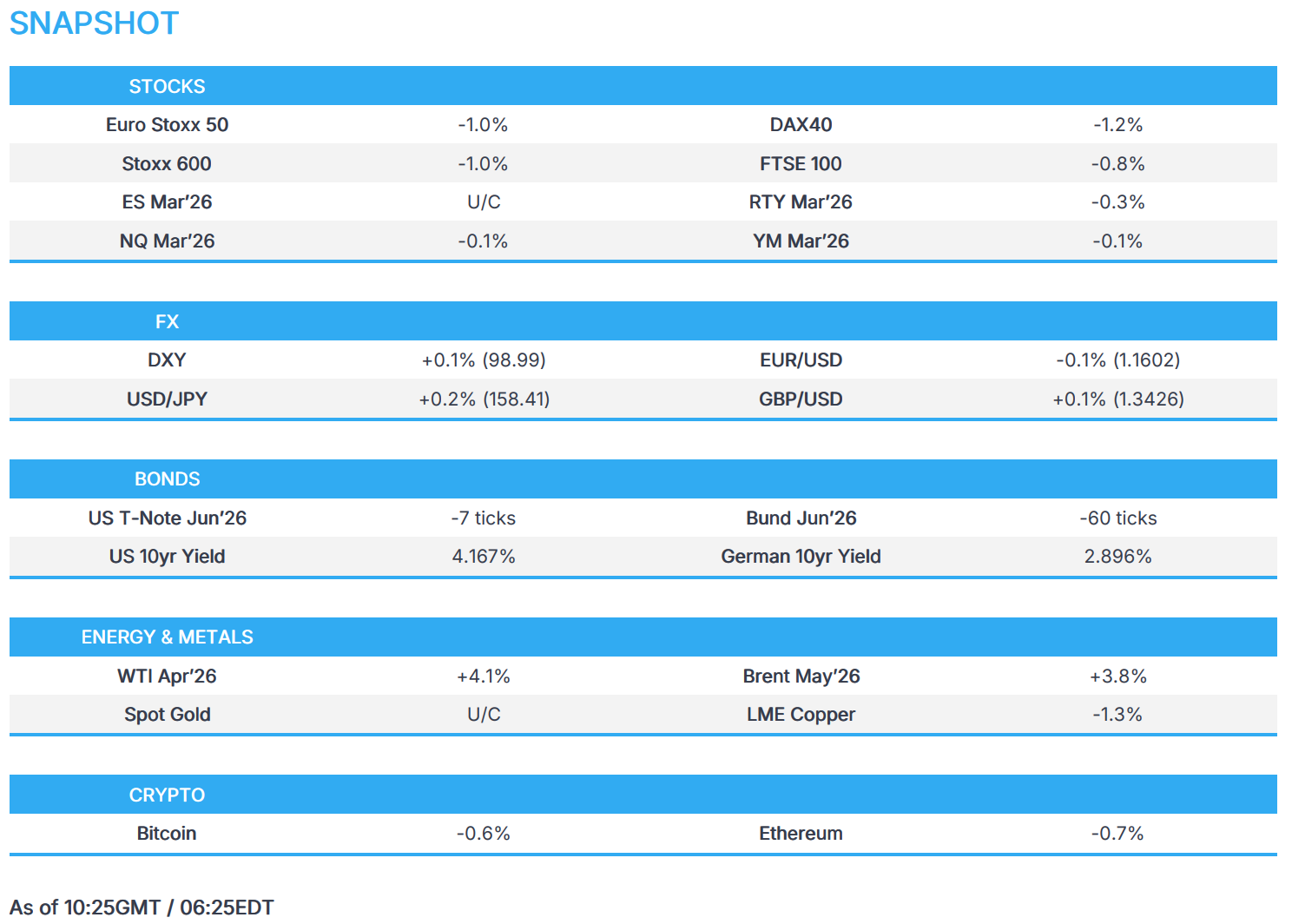
SNAPSHOT

Newsquawk in 3 steps:
1. Subscribe to the free premarket movers reports
2. Listen to this report in the market open podcast (available on Apple and Spotify)
3. Trial Newsquawk’s premium real-time audio news squawk box for 7 days
IRAN CONFLICT
- US intelligence began to see indications that Iran is taking steps to deploy mines in the Strait of Hormuz shipping lane, according to CBS reports. Furthermore, CNN reported that Iran had begun laying mines in the Strait of Hormuz.
- US President Trump posted “If Iran has put out any mines in the Hormuz Strait, and we have no reports of them doing so, we want them removed, IMMEDIATELY! If for any reason mines were placed, and they are not removed forthwith, the Military consequences to Iran will be at a level never seen before. If, on the other hand, they remove what may have been placed, it will be a giant step in the right direction.” Trump posted shortly after that the US “has hit, and completely destroyed, 10 inactive mine-laying boats and/or ships, with more to follow”.
- US officials said Iran has laid fewer than 10 mines in the Strait of Hormuz and that it is unclear if it intends to lay more in the near term, according to WSJ.
- US Central Command said US forces eliminated multiple Iranian naval vessels on March 10th, including 16 mine-layers near the Strait of Hormuz. CENTCOM also stated that the Air Force continued to deliver devastating strikes against the Iranian regime during Operation Epic Fury.
- US Energy Secretary Wright commented that the US Navy has escorted an oil tanker through the Strait of Hormuz, but later removed his post on X about the US Navy escorting an oil tanker through the Strait of Hormuz and a White House source said the post was premature, while the IRGC said the allegation that an oil tanker escorted by the US passed through the Strait of Hormuz is false.
- White House Press Secretary said President Trump remains confident goals will be achieved swiftly and that Trump is not afraid to use options on oil, while she added Trump and the energy team are closely watching the markets, and the US Navy is ready to escort tankers when necessary.
- US asked Israel to halt strikes on Iran’s energy infrastructure, according to Axios citing sources.
- Explosions were reported in multiple areas of Tehran, while there were also very heavy Israeli-US airstrikes on Meribah Airport in Tehran. It was separately reported that the Russian consulate in Iran’s Isfahan was damaged amid the conflict.
- IRGC said it launched missiles carrying 2-ton warheads in a new wave of heavy, multi-warhead strikes targeting US bases in Iraq and Bahrain, as well as Israel, while the IRGC said it carried out its heaviest and most intense attacks since the start of the war, targeting US and Israeli assets across the region, according to WSJ.
- Israeli army announced a massive wave of raids on Tehran, targeting Iranian regime infrastructure, while it also conducted a wave of strikes against Hezbollah in Beirut.
- Israel rejected Lebanon’s request for a halt in fighting to allow for talks, according to FT.
- Saudi Arabia said it intercepted a missile aimed at its eastern province and intercepted two drones heading towards the Sheybah oil field.
- Kuwait said it intercepted eight drones early on Wednesday.
- UAE Ministry of Defence said air defences dealt with a barrage of ballistic missiles from Iran.
- Iraqi media reported an airstrike targeting armed factions in Al Qaim in Iraq, while it was also reported that a drone hit a US diplomatic facility in Iraq.
- UKMTO received a report that a cargo vessel was hit by an unknown projectile in the Strait of Hormuz, which has resulted in a fire on board, while the crew are evacuating the vessel.
US TRADE
EQUITIES
- US stocks ended the day with modest losses, in what was, once again, a day dominated by Middle East headlines with conflicting rhetoric. Trade was initially driven by Trump’s comments on Monday night that the “war would be over soon”, which sparked pronounced risk-on trade. Despite these comments, there was no suggestion of it coming to fruition on Tuesday, highlighted by Secretary of War Hegseth saying that today will be the most intense strikes on Iran yet, while markets also reacted to a post from US Energy Secretary Wright that the US Navy had escorted an oil tanker through the Strait of Hormuz, although this was later deleted and a White House official clarified that this wasn’t true, which saw moves reversed.
- Furthermore, there were reports that US intelligence began to see indications that Iran is taking steps to deploy mines in the Strait of Hormuz shipping lane, which would be a significant escalation and also further threaten the supply of oil. This triggered some risk-aversion and prompted a warning from US President Trump that “if Iran has put out any mines in the Hormuz Strait, they want them removed, IMMEDIATELY, and if they do not, military consequences to Iran will be at a level never seen before.”
- SPX -0.21% at 6,781, NDX -0.04% at 24,956, DJI -0.07% at 47,707, RUT -0.22% at 2,548.
- Click here for a detailed summary.
NOTABLE HEADLINES
- US Senator Tillis said he is ok with the Warsh nomination starting, but also reiterated that he won’t vote for any Fed nominees until a criminal investigation into Fed Chair Jerome Powell is resolved.
APAC TRADE
EQUITIES
- APAC stocks traded higher as the recent easing of oil prices helped the region shrug off the lacklustre lead from Wall Street and reports of Iran beginning to lay mines in the Strait of Hormuz.
- ASX 200 gained with strength in mining, resources, materials and financials, front-running the advances, but with upside capped amid increased bets for the RBA to hike rates at next week’s meeting following recent central bank rhetoric and calls by some of Australia’s largest banks for consecutive rate increases in March and May.
- Nikkei 225 rallied following the recent easing of oil price pressures and as softer-than-expected PPI data, which showed a surprise monthly deflation, supports the case for a delay in BoJ policy normalisation.
- Hang Seng and Shanghai Comp lagged amid quiet catalysts and with Chinese officials said to be frustrated by what they see as insufficient US preparation for the Trump-Xi summit later this month, while China also moved to curb the use of OpenClaw AI by banks and state agencies.
- US equity futures edged higher but with upside capped following the recent oil and geopolitically-driven fluctuations.
- European equity futures indicate a marginally lower cash market open with Euro Stoxx 50 futures down 0.1% after the cash market closed with gains of 2.7% on Tuesday.
FX
- DXY slightly eased back after ultimately strengthening yesterday on what was a choppy day for the buck as oil whipsawed, and with support seen as disruptions to flows through the Strait of Hormuz look set to stay after a CBS report that US intelligence has begun to see indications Iran is taking steps to deploy mines in the Strait of Hormuz shipping lane. Elsewhere, there was little to be said as main events pertained to geopolitics and energy, while recent data releases had little impact and CPI is due later, but is largely seen as stale given recent developments.
- EUR/USD remained afloat after support held near 1.1600, but with price action contained and with little reaction seen following comments from ECB officials, who noted increased uncertainty regarding the Iran war and energy prices.
- GBP/USD edged higher but remained confined within the prior day’s range at the 1.3400 handle amid quiet currency-specific news.
- USD/JPY extended above the 158.00 level with the Japanese currency underperforming alongside a rally in Tokyo stocks and after Japanese PPI data showed a surprise M/M deflation.
- Antipodeans gained with outperformance in AUD/USD as several banks joined in on forecasting for a hike at next week’s RBA meeting, with the likes of NAB and Westpac anticipating hikes in both March and May, while money markets now imply a 76% likelihood of a 25bps increase at the meeting next week.
- PBoC set USD/CNY mid-point 6.8917 vs exp. 6.8824 (Prev. 6.8982).
FIXED INCOME
- 10yr UST futures were rangebound following the recent choppy performance as trade continued to be driven by geopolitics and the fluctuations in oil, while demand was also not helped by a very weak 3yr auction stateside and with several large corporate issuances, including from Amazon (AMZN), Salesforce (CRM) and Honeywell (HON), totalling at least USD 66bln.
- Bund futures traded subdued, but were off the prior day’s lows after finding support near the 127.00 level, while participants look ahead to German supply.
- 10yr JGB futures were initially pressured amid the positive risk appetite in Asia, but then gradually recovered with upside also facilitated by a stronger 5yr JGB auction.
COMMODITIES
- Crude futures were indecisive following the declines seen during the prior session, where there was some whipsawing on reports regarding the Strait of Hormuz, with a bout of selling pressure after US Energy Secretary Wright posted that the US Navy escorted an oil tanker through the Strait of Hormuz, although oil then pared some of the losses as the post was deleted shortly after, and the White House confirmed that this was false. There was a further paring of losses after CBS reported that US intelligence had begun to see indications that Iran is taking steps to deploy mines in the Strait of Hormuz, while the IEA meeting also ended with no decision on a crude stockpile release. This provided oil futures with a higher platform to begin the Asia-Pac session, although the gains were then wiped out after a WSJ article that the IEA proposed the largest ever release of oil from strategic reserves to bring down the price of crude and that countries will decide today whether to release oil stocks.
- IEA proposed the largest ever release of oil from strategic reserves to bring down the price of crude, with countries to decide today on whether to release oil stocks in an effort to subdue crude prices, while the release would exceed the 182mln bbls of oil that IEA member countries put onto the market in 2022 when Russia invaded Ukraine, according to WSJ. Note, the piece does not mention any figures.
- IEA meeting on Tuesday ended with no decision on a crude stockpile release.
- Japanese Chief Cabinet Secretary Kihara said PM Takaichi will participate in the G7 call today, while Trade Minister Akazawa commented that Japan can release oil reserves on its own and won’t rule out anything on energy stability.
- US President Trump posted “America is returning to REAL ENERGY DOMINANCE! Today I am proud to announce that America First Refining is opening the FIRST new U.S. Oil Refinery in 50 YEARS in Brownsville, Texas. THIS IS A HISTORIC $300 BILLION DOLLAR DEAL”.
- US Private Inventory Data (bbls): Crude -1.7mln (exp. +1.4mln), Distillate -2.3mln (exp. -0.9mln), Gasoline -1.8mln (exp. -4.5mln), Cushing -0.4mln
- Spot gold mildly gained and returned to above the USD 5,200/oz level, with the precious metal kept afloat alongside the recent easing in oil price pressures.
- Copper futures traded rangebound with demand subdued amid the ongoing geopolitical climate and as its largest buyer, China, lagged behind regional peers.
CRYPTO
- Bitcoin lacked conviction and traded on both sides of the USD 70,000 level.
NOTABLE ASIA-PAC HEADLINES
- China moved to curb the use of OpenClaw AI by banks and state agencies.
DATA RECAP
- Japanese PPI MM (Feb) M/M -0.1% vs. Exp. 0.1% (Prev. 0.2%)
- Japanese PPI YY (Feb) Y/Y 2.0% vs. Exp. 2.1% (Prev. 2.3%)
GEOPOLITICS
OTHER
- North Korea conducted strategic cruise missile tests on Tuesday for a naval destroyer, while Leader Kim said that destroyers must be equipped with supersonic weapons, according to KCNA.
EU/UK
NOTABLE HEADLINES
- ECB President Lagarde said they are in a very different situation from 2022, and there is currently such uncertainty that she cannot precisely say what they will do on interest rates. Lagarde also commented that Europe has a greater capacity to absorb shocks and the ECB will do everything to keep inflation in check.
2.a NORTH KOREA/SOUTH KOREA
/SOUTH KOREA
South Korea Angry Over US Plan To Redeploy Critical Air Defense System To Mideast
Tuesday, Mar 10, 2026 – 09:40 PM
We previously highlighted that Zelensky’s biggest current worry is that the Iran war and ongoing major US operations there will starve Ukraine of critical arms, and especially long sought-after and expensive anti-air systems and munitions.
It’s not just Ukraine expressing alarm, but now South Korea too, with President Lee Jae Myung on Tuesday loudly complaining about Washington’s plans to redeploy Patriot air defense batteries from the Korean Peninsula to the Middle East in order to bolster regional defenses against Iran.

Lee voiced his clear opposition, but his political intervention didn’t work. “The USFK may dispatch some air defense systems abroad in accordance with its own military needs. While we have expressed opposition, the reality is that we cannot fully push through our position,” the Korean leader told reporters.
He did temper his remarks by saying that withdrawal of some systems “does not hinder deterrence strategy towards North Korea” – given superiority of these systems over what Pyongyang has in its arsenal.
Nearly 30,000 American troops are maintained and rotated across bases in South Korea, along with missile defense systems, for decades seeking to provide a ‘check’ on the nuclear-armed north.
At times the US has even docked advanced nuclear submarines at peninsula ports, which has raised the temperature higher – often with surprise North Korean missile tests.
Meanwhile, some local media indicate several Patriot missile batteries have already been moved out of Osan Air Base, potentially heading to American outposts in Saudi Arabia or the UAE, though officials in Seoul have not confirmed this.
Korean media precisely lays blame on the new US operation launched against Iran:
The United States, engaged in a war with Iran, has begun relocating part of its Terminal High Altitude Area Defense (THAAD) system deployed in South Korea to the Middle East, the Washington Post (WP) reported on the 9th (local time), citing two U.S. Department of Defense officials.
According to the WP, the U.S. military expended $5.6 billion (approximately 8.26 trillion Korean won) worth of ammunition in the first two days of airstrikes against Iran, rapidly depleting advanced weaponry. As advanced weapon stockpiles neared exhaustion, the U.S. military has been redeploying air defense assets from the Indo-Pacific region. Additionally, Patriot interceptor missiles are being diverted from other regions to counter Iran’s drone and ballistic missile attacks.
However, the same report highlighted that the Pentagon seeks to control the narrative: “These measures are not due to a shortage of weapons in the Middle East but are preventive steps in anticipation of the Iran crisis potentially prolonging,” one US official was cited in WaPo as saying.
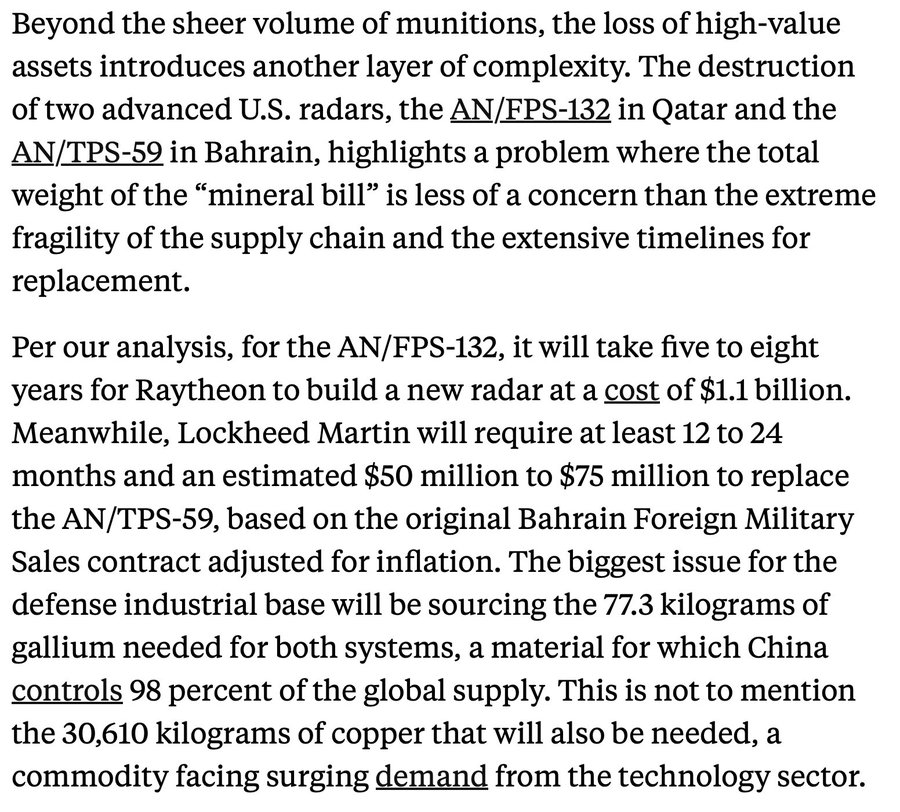
This after the past week has seen several reports that Iranian ballistic missiles took out a number of extremely expensive anti-air systems in the Gulf region, and even all the way over to Jordan. But the extent of damage and potential destruction of these systems, after ten days of Operation Epic Fury, remains in question and the Pentagon is likely going to keep much information classified.
3. CHINA/TAIWAN
4. EUROPEAN AND SCANDINAVIAN AFFAIRS
EUROPE/BROOKE
European Parliament Committee Backs Tougher Asylum Return Rules In Right-Wing Migration Win
Wednesday, Mar 11, 2026 – 03:30 AM
Authored by Thomas Brooke via Remix News,
The European Parliament’s Committee on Civil Liberties, Justice and Home Affairs voted on Monday to adopt a harder line on asylum returns.

The committee voted 41 to 32, with one abstention, in favor of implementing a single framework for handling third-country nationals staying illegally in European Union member states.
The majority was formed by the European People’s Party (EPP) together with right-wing groups, including the European Conservatives and Reformists (ECR), Patriots for Europe (PfE), and the Europe of Sovereign Nations (ESN) group.
Lawmakers from the Socialists and Democrats, Renew Europe, the Greens, and the Left opposed the measure.
The proposed regulation would introduce EU-wide recognition of return decisions, meaning migrants ordered to leave one member state could be deported by another. It would also expand the use of detention while deportations are organized, allowing detention periods of up to 24 months.
Furthermore, the text opens the possibility for deportation centers in third countries under agreements with EU states and introduces stricter entry bans and enforcement measures.
French MEP Marion Maréchal welcomed the vote, saying, “The EU is finally taking back control of its migration policy. Today, the European Parliament has just voted in the Committee on Civil Liberties on its position on the return regulation, which will considerably facilitate the detention and expulsion of illegal immigrants or rejected asylum seekers.”
Maréchal added that the vote showed a new right-wing coalition was decisive in shaping EU migration policy.
“Once again, the right-wing coalition, including our ECR group, is the pivotal force, which also includes the EPP, the Patriots, and the Sovereignists, and has prevailed over the left.”
Swedish MEP Charlie Weimers said the vote could lead to stronger enforcement of deportation decisions.
“Soon, more deportations of those who do not belong in Europe will become a reality,” he said.
In an ECR press release following the vote, Weimers cited figures from the European Commission that revealed only 20 percent of failed asylum seekers, “who receive a return decision, are actually returned.”
“For too long, the European debate has focused on ineffective procedures rather than achieving results. A return system that works in practice is essential for maintaining public trust in Europe’s asylum system,” he added.
Polish MEP Ewa Zajączkowska-Hernik also celebrated the result. “Such joy after the European Parliament committee voted in favor of regulations allowing for more effective return of illegal immigrants from the EU,” she said.
“The ‘Regulation establishing a common system for the return of third-country nationals staying illegally in the EU’ is another victory for the right wing in the European Parliament. Citizen safety is paramount,” she added.
The measure will now move toward a vote in the full European Parliament before negotiations can begin with the European Council.
END
EUROPE
KOLBE…
European Taxpayers Warn Against Eurobonds: A Looming Fiscal Trap
Wednesday, Mar 11, 2026 – 02:00 AM
Submitted by Thomas Kolbe
In public debate, the introduction of joint European bonds, Eurobonds, has so far often been dismissed as a fantasy. That the European Taxpayers’ Association has now issued a clear warning against joint debt issuance should give critics of the Commission pause. Are the plans for standardized EU bond issuances possibly more advanced than we have realized?
The TAE is the umbrella organization of national European taxpayers’ associations, a private law foundation, independent, market-liberal, and a critical observer of the fiscal power plays of the Brussels central authority. When it speaks out decisively on fiscal issues, it does so for a reason.
The seemingly advanced plans of the EU Commission have apparently convinced the TAE to dedicate a campaign to the issue of European financing. Under the program title Stop EU Taxes. Stop EU Debt, it presents a fiscal policy agenda that would be welcome in party politics among economically liberal parties.
The TAE fundamentally warns against the European Commission’s lack of democratic mandate and sees the danger of Brussels’ powerful central body arrogating ever more tax powers to itself, thus, one could paraphrase, growing into a kind of state above the states. From this, the advocates of European taxpayers derive their demand: There must be no joint debt issuance within the EU.
No matter how the budgetary situation in the European member states develops: That the EU’s two main pillars, Germany and France, will record budget deficits of at least five percent this year is a national problem. And it must be resolved there, in the national capitals. It is unacceptable to distribute money to the public with one hand while taking it from European taxpayers with the other through higher taxes or future debt indirectly via inflation.
With these demands, the TAE firmly stands on the subsidiarity principle consistently advocated by its largest member organization, the German Taxpayers’ Association. Budgetary policy is a national matter. Excessive centralization of political power leads to inefficiencies, opacity, corruption, and systematic mismanagement by an increasingly powerful central apparatus that ultimately cannot even control the flow of its own funds.
The warning of the taxpayers’ association may, however, come too late. The European Commission operates under the motto: “Never let a crisis go to waste.” Following this spirit, the first true joint European bond was issued during the lockdown five years ago. Under the program name NextGenerationEU, the European Commission raised approximately €800 billion on the capital markets, backed by Germany as the main rating anchor, which with a national debt of 65 percent continues to stabilize European capital markets.
On an EU level, a whole arsenal of crisis financing instruments has been established. The European Stability Mechanism (ESM) intervenes in acute crises, issuing bonds itself, and would be applied in a looming sovereign debt crisis just like the so-called SURE bonds set up to mitigate regional unemployment.
We are facing a slow, erosive process in which the EU is increasingly penetrating the capital markets, always with the guarantee of major economies and European taxpayers behind it. EU Green Bonds are a particularly vivid example: Here, the ideology of the green transformation merges with the practical implementation of joint debt issuance. Capital is directed into channels of a green crony economy that has already heavily damaged the overall economic structure.
And it came to pass as expected: The warning from taxpayer representatives was more than justified. Large parts of the borrowed debt were immediately funneled into the public budgets of Italy and Spain to mitigate precarious national fiscal conditions. Spain provides the clearest example: President Pedro Sánchez’s socialist government finances large portions of its state budget through these programs, enabling massive public sector employment growth. Much like in Germany, Spain’s labor market is shifting from the struggling private sector to the public sector, which acts as a final safety net for a gradually eroding middle class.
As if European statism were not already the costliest and economically most disastrous project of our time: productive forces are further stifled by this debt program, and the capital market is virtually drained by the public sector. Moreover, access to credit for small and medium-sized businesses becomes increasingly difficult when fewer funds are available.
This phenomenon can be observed across nearly all levels of European economic policy. What has unfolded under the program name Green Deal as a green transformation within a massive redistribution mechanism unfortunately establishes incentives that also attract productive private capital. Who would not prefer a government- or institution-guaranteed minimum return that exceeds market rates and is risk-free, as in the case of renewable energy investments?
The TAE does not state it explicitly, but if the EU Commission under Ursula von der Leyen continues to expand its fiscal powers, this path could accelerate Europe into economic third-class status.
Every major past crisis offered Brussels the opportunity to expand and consolidate its fiscal power. Whether the Dotcom bubble 25 years ago or the sovereign debt crisis fifteen years ago, which was quasi drowned by former ECB President Mario Draghi in fiat credit – all these events eventually culminated in the first European joint bond, the so-called NextGenerationEU.
It was the great original sin. A political bastard of the lockdown era. What else could this period have produced but further problems? We must assume, with Europeans’ response patterns in mind, that the looming EU sovereign debt crisis will inevitably feed into the Eurobond project.
It will spawn additional political bastards, such as the digital euro, designed as a capital flow control to prevent flight. A digital identity for monitoring public discourse is likely to be implemented. A minimum tax regime is also planned to finally eliminate tax competition in the EU. Welcome to Brussels, welcome to the hyperstate that will produce nothing but debt, behavioral control, and inflation.
* * *
About the author: Thomas Kolbe, a German graduate economist, has worked for over 25 years as a journalist and media producer for clients from various industries and business associations. As a publicist, he focuses on economic processes and observes geopolitical events from the perspective of the capital markets. His publications follow a philosophy that focuses on the individual and their right to self-determination.
5. RUSSIAN AND MIDDLE EASTERN AFFAIRS
ISRAEL, IRAN, ETC/RUSSIA
TBN ISRAEL LAST 24 HRS
IRANIAN CONFLICT UPDATES
the new Ayatollah was in the same place as his father, wife and child. He is probably in a coma which is why he does not come out. He probably does not know he is the new Ayatollah
(zerohedge)
Trump Willing To Kill New Ayatollah If He Doesn’t Cede To US Demands
Tuesday, Mar 10, 2026 – 10:30 PM
It remains increasingly difficult to interpret President Trump, or to take his words at face value, especially when it comes to back-and-forth with reporters on the Iran war and future aims and plans.
For example, on Monday, the president was asked at a news briefing in Florida whether Iran’s new leader was a target, to which Trump replied: “The new leader, you mean the son?… I was disappointed to see their choice,” before adding, “I don’t want to say whether he has (a target on his back).”
When later pressed in a follow-up question, he reiterated his broader frustration and then conceded that the Iranian people are “an amazing people but the system they have only leads to failure.” This slightly softened or tempered rhetoric in terms of war aims is a far cry from the “UNCONDITIONAL SURRENDER!” demand of merely a few days ago.
Already, the White House seems to have completely backed off listing “regime change” as an official objective of Operation Epic Fury, perhaps belatedly realizing the severe limitations of a purely aerial campaign. On Tuesday, Trump’s special envoy Steve Witkoff is in front of cameras saying Trump is always willing to talk, even to the Iranians, however “the question is whether or not it is worth it.“

As for the potential for another regime ‘decapitation strike’ – it’s ironic (and a tad confusing) that on the very day Trump refrained from saying he would take out the new Ayatollah, The Wall Street Journal issued a headline and quotes suggesting the opposite: Trump Open to Khamenei Being Killed if He Doesn’t Cede to U.S. Demands. It said:
President Trump has told aides he would back the killing of new Iranian Supreme Leader Mojtaba Khamenei if he proves unwilling to cede to U.S. demands, such as ending Iran’s nuclear development, current and former U.S. officials said.
The White House declined to comment, but Trump on Monday told the New York Post he was “not happy” that Khamenei was selected to lead Iran after previously calling him “unacceptable.” Trump last week on social media said he wanted a say in picking a “great and acceptable” ruler for Iran following its “unconditional surrender.”
“I’m not going through this to end up with another Khamenei,” Trump told Time magazine last week.
But the same report reveals a consensus among Israeli officials that Israel would like precisely to go ahead and take out the younger Khamenei too – and perhaps even any replacement after that.
“The younger Khamenei is viewed in Washington as a hard-line successor to his father who was hand-picked by Iran’s powerful Islamic Revolutionary Guard Corps, the current and former U.S. officials said,” WSJ said. “The officials said they don’t expect Khamenei is likely to give up Iran’s quest for nuclear weapons or negotiate an end to the conflict on terms favorable to the U.S.”
This obviously sets up for an escalation trap dilemma: pursue full regime change which would likely require boots on the ground to dismantle and secure Iran’s nuclear program (while risking ‘endless’ quagmire)?
Or keep the regime/system in place, which avoids a ground quagmire, but then risks a future nuclear-armed Islamic Republic. The more days and weeks which pass in the conflict, the more acute this dilemma will become.
end
this is probably false! the truth is probably he is in a coma injured in the same blast as his father, wife and child
(JerusalemPost)
Mojtaba Khamenei injured but still functioning as Iran’s leader, source says
Critics of the regime say the lack of public appearances raises questions about who is actually directing Iran’s government.

A picture of Iran’s new supreme leader, Mojtaba Khamenei, is displayed on a screen in Tehran, Iran, March 9, 2026(photo credit: MAJID ASGARIPOUR/WANA (WEST ASIA NEWS AGENCY) VIA REUTERS)ByAMICHAI STEINMARCH 10, 2026 21:37
A source familiar with the matter told The Jerusalem Post that the assessments are that although Mojtaba Khamenei was injured during the war he remains capable of carrying out his duties and managing state affairs as Iran’s new supreme leader.
Iranian state television reported on Monday that Mojtaba had been wounded, though the broadcast did not provide details about the circumstances of the injury or its severity. The report also did not indicate when the injury occurred or whether it affected his day-to-day responsibilities.
Despite earlier assurances from Iranian officials and state media, no photograph or video of the newly installed supreme leader has yet been released, fueling speculation among observers and opposition groups.

Mojtaba’s lack of appearances raises questions
Critics of the regime say the lack of public appearances raises questions about who is actually directing Iran’s government. Figures within the Iranian opposition claim that another senior figure within the regime may be exercising real authority, while Mojtaba serves primarily as a symbolic or representative leader.
Mojtaba is the son of Iran’s longtime supreme leader, Ali Khamenei, and has long been considered one of the most influential figures behind the scenes in Iranian politics. Although he held no formal government position for years, analysts have widely believed that he wielded significant influence within Iran’s political and security establishment.
end
ISRAEL UPDATES
Israel targets Hezbollah, Iran, but technical failures slow progress in ongoing conflict -analysis
The IDF’s operations against Iran and Hezbollah continue, but missile threats and technical failures continue to complicate the situation. Progress is slow, and the threat remains high.

Smoke rises after an Israeli strike on Beirut’s southern suburbs, following an escalation between Hezbollah and Israel amid the US-Israeli conflict with Iran, Lebanon, March 3, 2026.(photo credit: KHALIL ASHAWI / REUTERS)ByYONAH JEREMY BOBMARCH 10, 2026 22:23
The conflicts pitting Israel against Iran and Hezbollah in Lebanon continued on Tuesday, though with no clear substantial progress for any side.
The IDF and the US continued to bomb Iran in several parts of the country, with the hope of gradually reducing the ballistic missile threat and weakening the Islamic regime sufficiently for regime change. However, none of the specific targets that were hit appeared to be of great significance.
For example, the military noted on Tuesday that it had destroyed “most of the central assets” of the regime’s internal security forces and of the Basij militia in the Ilam Province of western Iran.
According to the IDF, Iran’s internal security forces and Basij carried out numerous terror plans and perpetrated the brutal repression of Iranian protesters during the December-January period.
When pressed by The Jerusalem Post about why Ilam Province is significant compared to the larger and more well-known provinces, the IDF did not respond.

No major hits
Although the IDF announced on Thursday that over 400 regime locations have been bombed, on Monday, it had said that only 1,900 fighters have been killed, which is out of an estimated 400,000 Iranian soldiers, around 125,000 Islamic Revolutionary Guard Corps forces, and one to two million Basij militia, of which 200,000 are hardcore members.
Likewise, Iran continued to fire ballistic missiles at Israel throughout the day, but achieved no major hits, though shrapnel fell in several areas.
On Tuesday evening, Magen David Adom confirmed that it was searching for damage, following reports of shrapnel falling in the Beit Shemesh area.
The police said no injuries were reported, though minor structural damage was reported in the Menashe region.
Additionally, Coast Guard and bomb squad officers responded to several sites where shrapnel from missile interceptions fell, causing minor property damage.
Technical failure?
Also on Tuesday, the IDF said that an atypical technical failure led to two Hezbollah missiles impacting central Israel on Monday, with interceptors missing their marks, and without even a warning siren.
One of the missiles hit Ramle, and the second struck an open area in the Mateh Yehuda Regional Council; both missile strikes lightly wounded many civilians.
Despite the failure, most of the missiles fired on Monday were intercepted by Israel’s multilayer air defenses.
Also, the IDF said that the technical failure did not occur because of some new kind of Iranian technology, but rather the missiles fired were weapons that the IDF is acquainted with.
Following a probe into the incident, the IDF said that “adjustments were implemented to strengthen interception capabilities against similar threats in the northern area.”
A second man who was wounded by an Iranian cluster bomb attack in central Israel on Monday died of his injuries on Tuesday, medical officials announced.
Cluster munitions
Separately, the IDF Home Front Command said on Tuesday that 50% of the ballistic missiles that Iran has fired on Israel during the current war have been cluster munitions.
This is a shift from the June 2025 war with Iran, when occasionally the missiles were built of cluster munitions, but most were not.
Typically, Iranian ballistic missiles have 500 to 1,000 kilograms of explosives in them and strike one target, causing significant damage to the target and its immediate surroundings.
However, cluster munitions might contain dozens of eight-kilogram size bombs, which spread out over a 10-kilometer square radius.
On the one hand, each hit from a cluster munition causes less damage than a single ballistic missile hit.
On the other hand, each hit can still be deadly. Each hit can penetrate multiple floors in a single building, and, if such a missile breaks apart before it’s shot down, can cause a wider number of dangerous impacts.
When discussing the issue, the IDF was pressed about criticism that, in recent days, it has repeatedly sent millions of Israelis into bomb shelters and safe rooms when Iran has only fired a single missile, which was unlikely to have endangered so many people in different locations at once.
The IDF explained that its “polygon” – its algorithm for evaluating which cities to warn based on the estimated trajectory of a ballistic missile – errs on the side of saving lives, even if it inconveniences people in their daily routines.
That said, the IDF said that, whenever it can, it does exclude certain parts of the country from receiving warnings where the chances of them being targeted are very low.
Each launch also includes an assessment of the specific warhead and how large the explosives it carries are.
On the Lebanese front, the IDF renewed its strikes against Hezbollah and the group’s infrastructure in Beirut, including 80 additional strikes, the military confirmed on Tuesday.
The IDF also confirmed it had identified a cell of Hezbollah terrorists getting ready to fire rockets on Israel, but that it had struck them first.
According to the IDF, it has destroyed at least 70 Hezbollah missile launchers during the current conflict with Hezbollah.
Moreover, IDF Divisions 36 and 91 encountered and killed some Hezbollah fighters as they moved deeper into southern Lebanon as part of Israel’s forward-leaning defense of the northern border.
Jerusalem Post Staff contributed to this report.
end
Iran has fired some 300 missiles at Israel, about half with cluster bomb warheads — IDF
Bombs indiscriminately spread dozens of submunitions over radius of 10 kilometers, making interception challenging, military officials say, day after cluster bomb killed two
By Emanuel Fabian Follow10 March 2026, 9:56 pm
About half of the roughly 300 ballistic missiles Iran has launched at Israel in the current war carried cluster bomb warheads, according to Israel Defense Forces assessments published Tuesday, a day after the munitions killed two people and seriously wounded another in central Israel.
The data comes as Iran continues to fire missiles at Israel. On Tuesday, most of the missiles were intercepted, but one — carrying a large warhead — exploded in an open area outside Beit Shemesh, near Jerusalem, according to footage and first responders. No injuries were reported.
Cluster bomb warheads indiscriminately spread dozens of submunitions, each with several kilograms of explosives, over a radius of around 10 kilometers (6 miles).Promoted: ChaiFlicks – Streaming Jewish stories from around the WorldKeep Watching

The interception of such missiles has been effective but challenging, military officials said, stressing that Israel’s air defenses are not hermetic.
Iran also fired cluster munitions at Israel at least three times during the two countries’ 12-day war in June, Amnesty International has said, based on analysis of photos and videos, as well as media reports.
Use of the munitions is banned under the 2008 Convention on Cluster Munitions, whose over 100 signatories include much of Europe and Africa as well as the UK, Australia and Canada, but not Israel, Iran or the US.
The current war began on February 28 when the US and Israel launched a bombing campaign on Iran in a bid to topple its clerical leadership and destroy its nuclear and ballistic missile programs.
Iran has responded by launching hundreds of missiles and drones across the region, including at Israel. Iran’s strikes in Israel have killed 12 people and wounded over 2,000, according to health authorities.
The IDF Home Front Command says Iran’s missile fire at Israel has been aimed at population centers, along with military facilities and key infrastructure.
In recent days, the attacks have comprised just a small number of missiles at a time. The IDF believes Iran is struggling to carry out coordinated, larger barrages toward Israel.
On the first day of the war, some 90 ballistic missiles were fired toward Israel. The following day, the number dropped to around 60.
Over the following six days, roughly 20 missiles were fired each day in multiple salvos, each consisting of a small number of projectiles.
On Sunday and Monday, fewer than 20 missiles were launched on each day, also in small volleys or single missiles.
The IDF, meanwhile, reported that it has so far destroyed or disabled more than 300 Iranian ballistic missile launchers during strikes — about 60% of Iran’s total stockpile.
On Tuesday, the Israeli Air Force said it struck an armed ballistic missile launcher in western Iran overnight and killed several Iranian soldiers minutes before they could attack Israel.
After the soldiers were identified, preparing to launch the missiles, an IAF drone was dispatched to the area and “destroyed the missile launcher, and then eliminated the launch team, minutes before they were set to fire at the State of Israel,” the military said, publishing footage of the strikes.
END
LATE WEDNESDAY AFTERNOON:
President Of Iran Demands “Reparations” As Trump Says War To End ‘Soon’ As ‘Practically Nothing Left’ To Target
Wednesday, Mar 11, 2026 – 10:12 AM
Top headlines of conflict
- President of Iran demands reparations and guarantees against future aggression.
- Trump says the war with Iran will end soon, as there is ‘practically nothing left to target.”
- Yet U.S. and Israeli officials plan at least two more weeks of strikes
- U.S. forces destroyed 16 Iranian mine-laying vessels in the Strait of Hormuz
- Iran’s drone production has been significantly degraded.
- The IEA is preparing its largest-ever emergency crude oil release to counter surging Brent and WTI prices.
- Casualty estimates: over 1,200 killed in Iran from U.S./Israeli strikes (plus civilian reports), 13 deaths in Israel from Iranian retaliation, and 140 U.S. service members wounded (mostly minor).
* * *
Update (1012ET): The President of Iran, Masoud Pezeshkian, says he has spoken with the leaders of Russia and Pakistan, to whom he “reaffirmed Iran’s commitment to peace in the region.”
According to Pezeshkian, the only way to end the war is “recognizing Iran’s legitimate rights, payment of reparations, and firm int’l guarantees against future aggression.”
Other notable headlines of the day:
*Overnight: Hegseth proclaiming the day saw “most fighters, the most bombers, the most strikes” of the war yet – sending prices higher
IEA MEMBERS AGREE OIL STOCKPILE RELEASE OF 400M BARRELS – quick dip and then rip higher in oil prices
*TRUMP: US TOOK OUT JUST ABOUT ALL OF IRAN’S MINE SHIPS – oil reversed lower
*TRUMP: OIL COMPANIES SHOULD USE STRAIT OF HORMUZ – extended drop
*TRUMP PROMISES ‘GREAT SAFETY’ FOR OIL TANKERS IN STRAIT OF HORMUZ – further drop
END
RUSSIA VS UKRAINE UPDATES
6.GLOBAL ISSUES, COVID ISSUES, VACCINE INJURIES/HEALTH ISSUES
A GOOD READ
ROBERT H…
All for money and likely why drugs like Ivermectin as shunned
CIA faces furious backlash after hidden document with potential cure for cancer is declassified after 60 years
By STACY LIBERATORE, US SCIENCE & TECHNOLOGY EDITOR
Published: 13:31 EDT, 9 March 2026 | Updated: 05:29 EDT, 10 March 2026
A newly surfaced CIA document suggests US intelligence once reviewed research that hinted at a possible cancer treatment more than 60 years ago.
The document, produced in February 1951 and declassified in 2014, summarizes a Soviet scientific paper that examined striking similarities between parasitic worms and cancerous tumors.
The report describes how researchers believed both organisms thrived under nearly identical metabolic conditions and accumulated large reserves of glycogen, a form of stored energy.
The research also highlighted experiments showing that certain chemical compounds were capable of targeting both parasitic infections and malignant tumors.
One drug, Myracyl D, was reportedly effective against bilharzia parasites as well as cancerous growths, hinting that treatments developed for parasites might also attack tumors.
Other compounds were found to interfere with nucleic acid production, a process essential for the uncontrolled growth of cancer cells.
Experiments on mice even showed that tumor tissues reacted differently to certain chemicals than normal tissues, further reinforcing the perceived biochemical overlap between parasites and cancers.
Although the document was declassified more than a decade ago, it has recently resurfaced online, fueling outrage among some Americans who say it raises troubling questions about why Cold War research hinting at possible cancer treatments sat in intelligence archives for decades.

+3
View gallery
The document, produced in February 1951 and declassified in 2014, summarizes a Soviet scientific paper that examined striking similarities between parasitic worms and cancerous tumors
The Americans knew. They read it, classified it CONFIDENTIAL, and locked it in a vault for 60 years,’ one person shared on X, including the CIA documents in the post.
Another X user said: ‘The CIA knew from 1951 that cancer was parasites.’
However, the document itself does not say cancer is caused by parasites, only that a Soviet study noted biochemical similarities between tumors and parasitic worms and observed that some compounds affected both in experiments.
Daily Mail has contacted the CIA for comment.
The CIA document was based on a 1950 article published in the Soviet scientific journal Priroda by Professor V V Alpatov, a researcher studying the biochemical behavior of endoparasites, organisms that live inside the body of a host.
American intelligence analysts translated and circulated the paper because it was considered potentially relevant to biomedical and national defense research during the early years of the Cold War.
According to the Soviet research summarized in the report, one of the most striking similarities between parasitic worms and cancer cells was their metabolism.
Parasitic worms that inhabit the human intestine rely heavily on anaerobic metabolism, meaning they generate energy without requiring large amounts of oxygen.
he research also highlighted experiments showing that certain chemical compounds were capable of targeting both parasitic infections and malignant tumors. One drug, Myracyl D, was reportedly effective against bilharzia parasites as well as cancerous growths
Tumor cells appear to behave in a comparable way, often relying on altered metabolic pathways that allow them to survive in oxygen-poor environments inside the body.
Both parasites and tumors were also observed to accumulate large stores of glycogen, a molecule used by cells as an energy reserve.
This buildup suggested that both types of tissue might operate under unusual metabolic conditions compared with healthy cells.
Researchers classified these tissues as an ‘aerofermentor’ metabolic type, a term used by German scientist Th. Brand, meaning they can produce energy even when oxygen is low, and can also survive in an oxygen-free environment
This dual metabolic ability may help tumors survive in densely packed tissue where the blood supply is limited.
The Soviet scientists also pointed to experimental drugs that appeared to affect parasites and tumors in similar ways.
One example cited in the CIA document was Myracyl D, a compound synthesized in 1938 by German chemist H Mauss.
The drug had already shown effectiveness against bilharzia, a parasitic disease caused by blood flukes. According to the Soviet research, it also demonstrated activity against malignant tumors.
Another compound discussed in the report was Guanozolo, a guanine-like molecule that interferes with the production of nucleic acids, the chemical building blocks of DNA and RNA.

+3
View gallery
Although the document was declassified more than a decade ago, it has recently resurfaced online, fueling outrage among some Americans who say it raises troubling questions about why Cold War research hinting at possible cancer treatments sat in intelligence archives for decades
In laboratory tests, the substance suppressed nucleic acid synthesis in certain microorganisms as well as in cancer tumors grown in mice.
Because cancer cells require rapid DNA replication to divide uncontrollably, blocking this process can slow tumor growth.
The research also examined how tumors and parasites reacted to a chemical known as atebrin, which exists in two mirror-image forms known as enantiomers.
In most animals studied, the left-rotating version of the compound proved more toxic. But tumor tissues from mice, certain mollusks with left-spiraling shells, and parasitic worms inside frogs were more sensitive to the right-rotating form.
This unusual response suggested that tumor cells and parasites may possess chemically inverted receptors, meaning their molecular structures interact with drugs differently than normal tissues do.
Based on these findings, the Soviet researchers proposed several biological features that tumors and parasites might share.
These included the presence of unique antigens, unusual purine metabolism involved in nucleic acid production, and altered enzyme systems within the cell’s protoplasm.
The scientists theorized that malignancy might arise from chemical changes within the cell’s internal environment, particularly changes affecting enzymes and the proteins that carry them.
The CIA document concluded by noting that ongoing Soviet research into tumor proteins and cancer cell chemistry was considered especially important at the time.
During the early Cold War, American intelligence agencies closely monitored Soviet advances in medicine and biology, fearing that breakthroughs could have implications for both public health and potential biological warfare research.
Although modern cancer science does not treat tumors as parasites in the literal sense, many aspects of tumor biology, including altered metabolism and immune evasion, remain active areas of research today.
The declassified report offers a rare glimpse into the scientific ideas being explored behind the Iron Curtain during the mid-20th century, when researchers were still grappling with the fundamental nature of cancer and searching for clues that might one day lead to effective treatments.
GLOBAL ISSUES
MARK CRISPIN MILLER
In memory of those who “died suddenly” in the United States and worldwide, March 2-9, 2026
Actors Jennifer Corman (C), Corey Parker (C, Will & Grace), Stephen Hibbert, Annabel Schofield (C), Maria O’Brien; TV producers Bob Rosenfarb; blues singer John Hammond; rocker Tommy DeCarlo; & more
| Mark Crispin MillerMar 11 |
A survey of the likely global toll of COVID “vaccination,” based on the reports collected by our worldwide team of researchers this past week.
To help support our work, consider subscribing or making a donation.
UNITED STATES (155)
Ghostbusters actress Jennifer Runyon Corman battled cancer for 6 months before death
March 9, 2026

Jennifer Runyon Corman had been diagnosed with cancer prior to her death at age 65 on March 6. The Ghostbusters and Charles in Charge actress “passed away after a six-month battle with cancer” on Friday, her representative told Us Weekly. In the wake of her death, Runyon Corman’s friends, family, and former costars have taken to social media to honor the actress. Her friend Erin Murphy similarly noted that Runyon Corman died following “a brief battle with cancer” in a Sunday Facebook post.
Corey Parker, Will & Grace Actor and Acting Coach, Dies at 60 Following Cancer Diagnosis
March 7, 2026

Corey Parker, the Will & Grace alum and a beloved acting coach, has died following a terminal cancer diagnosis. He was 60. Emily Parker, the actor’s aunt, confirmed to TMZ that Corey died from cancer on Thursday, March 5, in Memphis, Tenn. Corey had previously been diagnosed with advanced Stage 4 metastatic cancer, according to a GoFundMe set up to raise funds to support his family. According to the fundraising page, the actor discovered the cancer after he underwent hip replacement surgery. In a November 2025 update, Corey wrote that the “90%” of his bones were covered with adenocarcinoma, which is a type of cancer that starts in the glands that line a person’s organs, according to Cleveland Clinic. In a final update shared on Feb. 17, Corey described the cancer as “terminal” and shared that he underwent radiation that had been intended to “reduce the pain from the cancer in my arm and in my hips,” but it ended up impacting his “esophagus, my ability to speak and my overall orientation.” He also wrote at this time that his family had been preparing the house for hospice.
Stephen Hibbert, TV Comedy Writer and Actor Who Played the Gimp in ‘Pulp Fiction,’ Dies at 68
March 7, 2026

Stephen Hibbert, a writer and actor who went from the Groundlings to writing for “Late Night With David Letterman” and “Mad TV” to a cult role as the Gimp in “Pulp Fiction,” died March 2 in Denver, Colorado. He was 68. Family members confirmed the death to Rolling Stone and Fox News Digital and said the death occurred after a heart attack.
Inside Dallas star Annabel Schofield’s public health battle before death at 62
March 4, 2026

On March 4, it was revealed that actress and model Annabel Schofield had passed away at the age of 62 following a lengthy battle with cancer. In November of 2023, Annabel started a GoFundMe page to raise funds for her cancer treatment, first going public with her diagnosis. “I’m having surgery tomorrow and will be in the hospital for 5 days,” she’d penned on social media at the time. While she never specified what kind of cancer she had been diagnosed with, she continued with radiation therapy for two more months, updating fans on the process on social media. Annabel continued sharing updates while undergoing chemotherapy, updating her GoFundMe page to reflect the same. However, in June of 2025, the page was updated once more, with Annabel later adding that “the cancer had spread to my brain,” requiring immediate chemotherapy. She also added that they had discovered a tumor–like mass behind her eyes that was not responding to chemo. In January of 2026, she confirmed that her surgery was complete and she was home. Her final update was on January 20 on Instagram, in which she wrote: “It was very exciting to finally get this done but I’m not out of the woods yet.”
Maria O’Brien, Protocol and Matlock Actress, Dies at 75
March 4, 2026

Maria O’Brien, an actress on Matlock and Protocol, has died. She was 75. The actress and acting coach died on Feb. 24, Deadline and The Hollywood Reporter reported. Her cause of death has not been revealed at this time. O’Brien’s first acting credit was in an episode of the 1963 TV show Sam Benedict. She had a successful acting career over the next three decades, appearing on several TV shows, including Viva Valdez (1976), The Life and Times of Eddie Roberts (1980), Quincy, M.E. (1980-82) and Matlock (1988).
Bob Rosenfarb Dies: ‘Who’s The Boss?’, ‘Step By Step’ Writer-Producer Was 74
March 5, 2026

Bob Rosenfarb, the writer-producer behind 1990s hit sitcoms Who’s the Boss? and Step by Step, died Tuesday, March 3, his family has announced. He was 74. A cause and place of death were not immediately available. “In his twenties, Bob followed his dream west to Los Angeles, determined to make his mark as a television writer,” the family writes. Rosenfarb’s family requests donations in his memory be made to the Michael J. Fox Foundation for Parkinson’s Research.
Blues legend who played with Hendrix, Clapton dies at 83: ‘An inspiration’
March 3, 2026

Grammy-winning blues singer and guitarist John Hammond, whose career spanned six decades, has died. He was 83. Billboard Canada reported that Hammond died on Sunday due to cardiac arrest. His friend and musical collaborator Paul James, also confirmed the sad news. The son of legendary music producer and talent scout John Henry Hammond Jr. (who discovered Billie Holiday, Count Basie, and Bob Dylan), John Hammond dropped out of college to pursue a musical career. He released over 30 albums during his career and got the chance to perform on stage with Jimi Hendrix (who briefly played in Hammond’s band before becoming famous) and Eric Clapton in 1968. He was nominated for a Grammy Award multiiple times, but won in 1985 for his album “Blues Explosion.” He was inducted into the Blues Foundation’s Blues Hall of Fame in 2011.
Boston lead singer Tommy DeCarlo dies at 60 after brain cancer battle
March 9, 2026

Tommy DeCarlo, a singer who made the leap from fan to touring lead vocalist for the rock band Boston, has died. He was 60. “It is with heavy hearts that we share the passing of our dad, Tommy DeCarlo, on Monday, March 9th, 2026. After being diagnosed with brain cancer last September, he fought with incredible strength and courage right up until the very end,” a message shared on his social media accounts read. According to the family’s GoFundMe fundraiser created in December, DeCarlo “suffered a sudden brain bleed” in September and underwent emergency surgery. Doctors discovered cancerous masses during the procedure, and DeCarlo underwent treatment until he was hospitalized from November through December after another brain bleed. He was later “back on track with treatments from his oncology team” after completing acute inpatient therapy.
SWFL rock guitarist dies after cancer battle
March 6, 2026

Fort Myers, FL – Sad news: SWFL rock guitarist James Wilder died Thursday after a long battle with cancer. He had played in many local bands since the ‘90s, including Cinder, Soapy Tuna and Sideshow Bob’s Electric Circus. James was 52 and leaves behind four children. The North Fort Myers resident was diagnosed in 2023 with stage-4 colon cancer that had spread to his liver.
Go Ventures Founder DJ Reza Has Passed Away
March 8, 2026
Go Ventures founder and legendary Southern California artist DJ Reza, real name Reza Gerami, has reportedly died of unspecified causes. He was 51. DJ Reza had a storied legacy in the rave scene. A self-taught DJ with a limitless musical style, he became known as a trendsetter and true “Party Rocker” when behind the decks, regularly playing everything from funky house to electro. Last year saw DJ Reza spark life back into The Love Festival, with a one-night edition at Hollywood Palladium. He was also busy defining the next era of Go Ventures with Saturday Night Sessions at the forefront.
No cause of death reported.
Daughter of NI blues star dies suddenly in New York
March 8, 2026

The daughter of the late blues musician Rab McCullough has died suddenly in New York. Louise McCullough, who was in her 40s, was originally from Belfast. Her father, who played with acts such as Van Morrison, Rory Gallagher and AC/DC in a long musical career, died five years ago. Louise’s sudden passing was announced by her friend, the Belfast musician Joby Fox. In a social media post, he said: “Yesterday, I received the heartbreaking news that my good friend, Louise McCullough, the daughter of the famous Belfast blues player Rob McCullough, passed away suddenly while she was out shopping in Lower Manhattan. She was determined to leave Belfast and make the best of herself, and she achieved just that.”
No cause of death reported.
Former NASCAR driver Chase Pistone dead at 42
March 3, 2026

Former NASCAR driver Chase Pistone died at the age of 42, his family announced earlier this week. Legends Nation said it confirmed with Nick and Pistone’s other brother, Tom, that Pistone had died, adding that the brothers requested the outlet post the Suicide & Crisis Lifeline. He competed in 10 NASCAR races – six in the Truck Series and four in the O’Reilly Series. His best finish was ninth at the 2014 Toyota 200 at World Wide Technology Raceway at Gateway in Madison, Illinois.
No cause of death reported.
Key Biscayne sailing champion Chris Purcell dies at 24
March 6, 2026

Christopher Purcell, a youth sailing competitor in Key Biscayne [FL], died unexpectedly February 5, family members said. Purcell, the son of Independent Treasurer Jan Dillow, grew up on the island, where he was remembered as a quiet and kind individual who found his lifelong hobbies on the island. Authorities have not yet determined a cause of death. He was 24. Additionally, he served as a YouTube commentator for Gulliver High School’s basketball and football teams, which he graduated from in 2020. According to the family, Chris had attended Virginia Tech, majoring in physics, but had taken some time off and was mulling a return to South Florida.
Researcher’s note – COVID-19 update: Virginia Tech no longer requires vaccines [sic] and testing: <a href=”https://substack.com/redirect/df500739-64d9-4e7e-b56e-bb73d1c0e92d?j=eyJ1IjoiMjF1c29nI
DR PAUL ALEXANDER
NEWSWIZE
| LATEST REPORTS FOR NEWS JUNKIES |
| Clayton Fuller Secures Position for Runoff in Former MTG DistrictClayton Fuller, endorsed by Trump, has advanced to a runoff for Georgia’s 14th Congressional District after a decisive primary victory. As he focuses on military and economic policies, he faces Democrat Shawn Harris in the upcoming election.READ THE FULL REPORT |
| Exxon Mobil Plans Relocation of Legal Headquarters to TexasExxon Mobil Corporation has made the significant decision to move its state of incorporation from New Jersey to Texas. This shift reflects the company’s commitment to a business-friendly environment that supports its growth and success.READ THE FULL REPORT |
| Uncovering Massive Hospice Fraud in Liberal StrongholdA recent CBS News investigation reveals alarming hospice care fraud in Los Angeles, where a surge in facilities raises serious concerns. Key findings show a significant financial drain and suggest systemic issues within the industry.READ THE FULL REPORT |
| U.S. Military Unleashes Devastating Strikes on Iranian Naval Forces |
MICHAEL EVERY/OR OR PICTON/GIFFIN OR RABOBANK EXECUTIVE/COMMENTARY ON WORLDLY AFFAIR
It’s Now A Dual Attrition Race
Wednesday, Mar 11, 2026 – 12:00 PM
By Michael Every of Rabobank
Oil vey Hormuz mir!
(in Yiddish: oy veyz mir equals oh my gosh!!)
Oil swung (far less than Monday) yesterday on a tweet from the US Energy Secretary saying the US Navy had escorted an oil tanker through Hormuz: that was deleted, and the Navy then stated it can’t do that because of the risks involved – vessels there are still sitting ducks.
Iran continued to attack the Gulf states’ energy infrastructure and claimed “not a single litre” of oil will exit until the US and Israel retreat. It’s reportedly activating minelayers and speedboats in the Strait, as the US claimed it’s destroyed 16 of the former. However, that critical waterway is still absent US, GCC, or European minesweepers or corvettes, without which getting oil out is unlikely absent a peace deal or a US/Israel defeat. In short, there may have to be force escalation to deescalate, and it’s now a dual attrition race of Iranian missiles/drones vs others’ interceptors and minelayers/speedboats vs. whatever the US, Israel, and others can offer.
Indeed, despite ‘peace now’ market oil pricing, yesterday saw the heaviest US attacks so far. The Israeli defence press speak of the US stepping things up for the next 1-2 weeks, already an additional week to what analysts had hoped for after the Trump statement on Monday. Other press add that some in the Israeli government think it could take up to a year for the Iranian regime to finally fall – that’s a military timetable which is impossible for the US and Israel to stick to both politically and logistically. Their rush now is therefore to smash every element of regime power and defence and nuclear industries such that an anti-regime domestic political dynamic can emerge, with some ‘help’, and to ensure that Iran offers no regional threat in the meantime. However, that necessarily distracts focus away from a military focus on Hormuz.
The media also aren’t optimistic about the war ending “very soon,” as promised. The FT op-ed today is that ‘There is no easy exit to Trump’s war’; the Telegraph warns of ‘How Iran’s ‘horizontal warfare’ could trap Trump in another Vietnam’; and even the Jerusalem Post notes that ‘Israel targets Hezbollah, Iran, but technical failures slow progress in ongoing conflict.’ There are also unsubstantiated but notable whispers of missing Iranian enriched uranium, and the risks of a ‘dirty bomb’, and of Tehran’s attempts to purchase a nuclear weapon from North Korea. (Which would arrive how, exactly? Via Hormuz?!)
The Arab press reports Qatar wants to bolster its security partnership with the US after Iran’s strikes, and the GCC may bring a complaint about Iran to the UN Security Council. Only the former has teeth, which speaks to the regional realignment already underway as war bites. Yet that realignment will also depend on how the war ends. As continuously stressed here, when the market assumes Hormuz is reopened, is this with the US having won or lost? A vast stack of asset pricing away from oil depends on which one of the two scenarios we are talking about.
On that front, a South China Morning Post report asks, ‘Could China’s rare earth supplies dictate how long US strikes on Iran go on?’ It claims that after depletion in this war, the US has only around two months of rare earths inventory, and “supplies would dominate talks when Trump sat down with Chinese President Xi Jinping.” This is obviously of critical importance. To extend an analogy used yesterday, is China of 2026 the US of 1956 and the US of 2026 the UK and France of the Suez Crisis? (This is as Germany may emulate Japan in shoring up critical minerals supply via joint purchasing from its key firms aimed at reducing reliance on China.)
If so, the US response *might* again be threatened escalation to deescalate: in short, to make clear to China, one way or another, that the recent chaos in energy markets can get worse again if there were to be any problems with its rare earths supply. That may sound illogical to a ‘rational’, economics or markets-focused mindset: but what other strategy could the US use from its current position? An FTA? Lower tariffs? A geopolitical defeat? Failing the Iranian regime starting to fall, it’s a very short shortlist of not very good options, save the high risk one just mentioned. Moreover, there are already suggestions Beijing, despite geopolitical alignment with Tehran, sees stability and the flow of oil as the more important metric. That might end up in a good place, both on energy and on US-China relations, but it could also make for some wild headlines and price action on the way there. It’s certainly a tail risk worth considering.
Meanwhile, even as markets price an (ambiguous) positive endgame to this Middle East war via stable oil prices around current (higher) levels, that doesn’t account for the dichotomy between the financial (i.e., prices on screens) and the material (i.e., actual availability of energy and key derivatives such as sulphur, fertilisers, and helium).
Europe and Asia are battling for LNG cargoes, says the FT, with Asia winning so far as ships re-route enroute. Reuters notes that diesel markets threaten a global economic slowdown. Fertilizer prices (or a shortfall) may hit planting season for farmers, with an impact on food prices later.
In response, as the West carries on as normal day-to-day, much of emerging Asia is seeing the kind of policy shifts only undertaken in past crises. Vietnam is making the biggest move to remote work since COVID to save energy. Pakistan has ordered a four-day workweek for government employees and a two-week closure of schools. Bangladesh has shut its universities and limited fuel sales. For hundreds of millions, this crisis is already tangible in the physical economy.
Positively, the Wall Street Journal claims the IEA will today propose its largest ever oil release from strategic reserves, moving beyond just promised action from the G7. Again, that will help buy some time. Yet in doing so, that takes the immediate market pressure off the US and Israel to wrap up the war quickly… and does it also give China more leverage over rare earths vs any implied US oil threat (then implying that things would need to escalate more)? There is a vastly complex geopolitical and geoeconomic dynamic at play here beyond the intricacies of the Middle East, and the obvious simplicity of the Hormuz bottleneck.
As part of that picture, yesterday saw Europe’s von der Leyen flag that nuclear power is back on the menu, as former German Chancellor Merkel, who pushed through the closure of that country’s nuclear power plants, was awarded the European Order of Merit. There was a public pushback from senior European Commission figures like Kallas, Ribera, and Costa to VDL’s previous day’s comments that perhaps a rigid adherence to the ‘rules-based order’ might be a hindrance as well as a help to the EU’s credibility as a geopolitical actor: specifically, “Freedom and human rights cannot be achieved through bombs,” said Costa. Sometimes, yes; but WW2 and Ukraine have something to say about that to Europe, no?
Meanwhile, there was an explosion in Chinese exports to Europe in the first two months of 2026, up 27.8% y-o-y to the EU, 31.3% to Germany, and 36.4% to France. Is there a ‘rules-based order’ response to that kind of trend? If not, prepare for something else.
Oil vey Hormuz mir!
7. OIL ISSUES/NATURAL GAS/ENERGY ISSUES/GLOBAL
Dozens Of Oil Tankers Divert To Red Sea As Saudis Reroute Crude Flows From Hormuz Chokepoint
Wednesday, Mar 11, 2026 – 02:45 AM
Despite continued disruption at the Strait of Hormuz chokepoint, maritime traffic has not fully collapsed.
On Tuesday afternoon, reports that a U.S. warship had escorted an oil tanker through the critical chokepoint helped push Brent crude futures down toward $81/bbl, reinforcing the view that paralysis on the waterway has, for now, begun to ease.
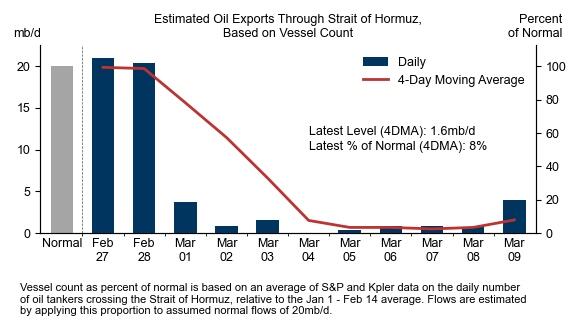
But even with signs that the critical maritime chokepoint is seeing a modest pickup in activity, this does not imply that normalcy will return this week. In fact, Bloomberg cites ship-tracking data showing uncertainty remains high, with at least 25 tankers diverted toward Saudi Arabia’s Red Sea export hub at Yanbu.
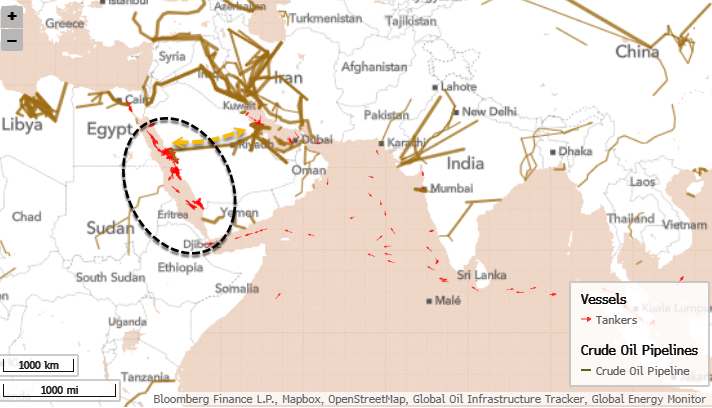
Saudi Aramco is maxing out its east-west pipeline to Yanbu, which can carry 7 million barrels per day. CEO Amin Nasser said flows should reach capacity within days as tankers divert to the energy export hub in the Red Sea. The UAE is implementing a similar workaround in Fujairah, where exports have jumped to about 1.6 million bpd this month from a recent average of about 1.1 million bpd.
“We should reach capacity in a couple of days,” Nasser said. “It’s all building on the repositioning of tankers from the east to the west.”
Bloomberg notes the conflict has already knocked about 6% off global oil output as traditional Hormuz transits remain disrupted.
Earlier, Ali Larijani, the secretary of Iran’s Supreme National Security Council, warned that the Hormuz chokepoint will “either be a strait of peace and prosperity for all” or a “strait of defeat and suffering for warmongers” as President Trump threatens retaliation against Tehran for disrupting the flow of oil.
end
VLCC rates above COVID highs. Jet fuels hit record highs
VLCC (Very Large Crude Carrier) rates have surged dramatically in early 2026, surpassing levels seen during the COVID-era peaks in many key routes.During the early COVID period (around 2020), VLCC spot rates spiked due to floating storage demand and market disruptions, with benchmarks like Middle East Gulf (MEG) to China reaching highs around $200,000–$264,000 per day in some cases.Recent developments, driven by escalating geopolitical tensions in the Middle East (including U.S.-Iran conflict and disruptions in the Strait of Hormuz), have pushed rates far beyond those levels:
- MEG-China VLCC rates hit record highs of over $423,000 per day (some reports cite up to $445,000+), with jumps of 94%+ in single days.
- Global average VLCC indices reached unprecedented levels, exceeding prior records from 2008 onward.
- U.S. Gulf to China lump-sum rates approached or exceeded $20 million (multi-year highs, above 2019–2020 peaks in some assessments).
- Other routes (e.g., West Africa, Americas) also saw rates soar to 6+ year highs or more.
This surge stems from supply disruptions (e.g., halted traffic through Hormuz, affecting ~20% of global crude shipments), earlier tightness from high OPEC output/sanctions/shifts, and factors like concentrated vessel control by players such as Sinokor.Jet fuel prices have also hit record or multi-year highs in 2026, fueled by the same Middle East crisis disrupting refinery feedstocks and supply chains.
- Singapore jet fuel reached all-time highs around $230–$231 per barrel.
- Northwest Europe jet fuel surged to over $1,500 per tonne (or ~$1,000+ per tonne in some assessments), the highest since 2022 (post-Ukraine invasion peaks).
- U.S. Gulf Coast benchmarks climbed sharply (e.g., to 348+ cents/gallon, record territory).
- Jet cracks (premium over crude) exploded, with European levels doubling crude prices in some cases and hitting 350%+ year-over-year gains.
These spikes (80%+ in some regions) are pressuring airlines with potential fare hikes, reduced schedules, and stock declines, as jet fuel can account for up to 30% of operating costs. The last comparable highs were in 2022 amid the Russia-Ukraine war.Overall, both markets reflect acute energy supply risks from the ongoing regional conflict, far outpacing earlier volatility.
end
Most Ships Transit Strait Of Hormuz Since War Started Led By Iranian, China-Linked Tankers
Yesterday we pointed out that contrary to conventional wisdom of a full Gulf blockade, more ships are now transiting the Strait of Hormuz…
Wednesday, Mar 11, 2026 – 10:20 AM
…
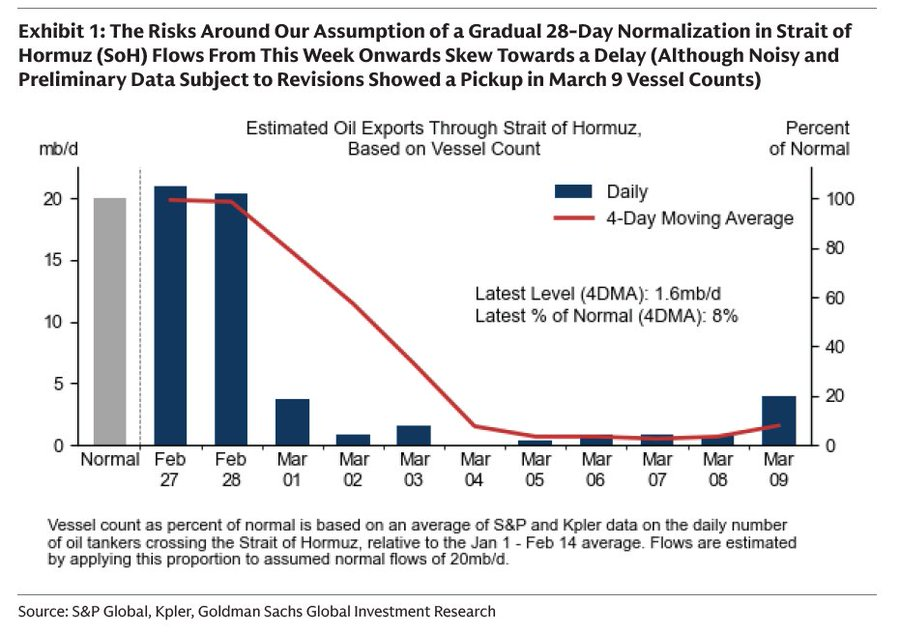
… with the caveat that most are turning off their transponders not to attract undue attention, whether by Iran or the US.
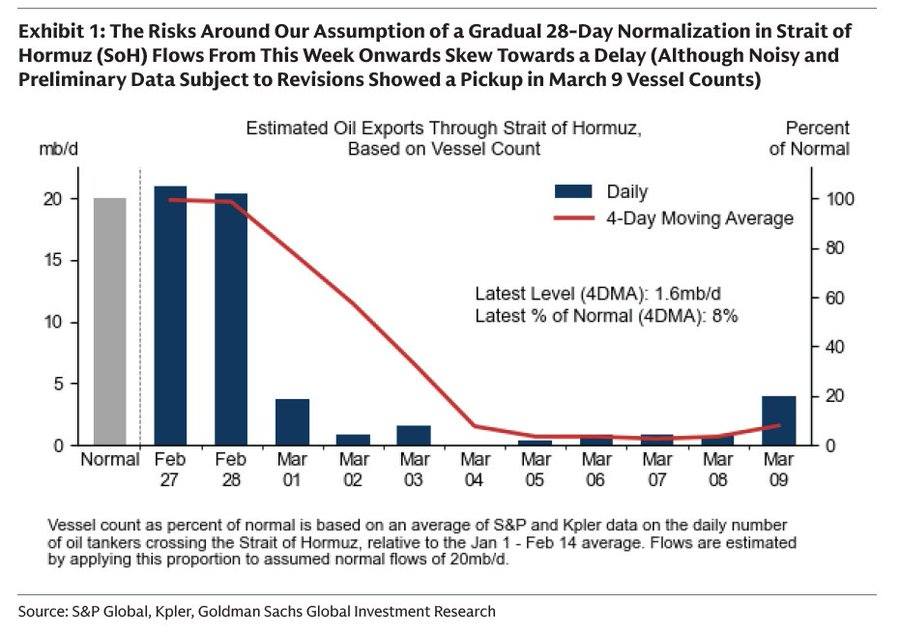
This morning, Bloomberg confirms that while mainstream Western shipping remains largely suspended through the Strait of Hormuz, recent 24-hour observations reveal a jump in Iran-linked traffic, specifically involving two sanctioned (read China-focused) VLCCs.
There were eight commercial transits on Tuesday and four more were identified early Wednesday, most of which have ties to Iran or have Chinese commercial links, according to vessel-tracking data compiled by Bloomberg.
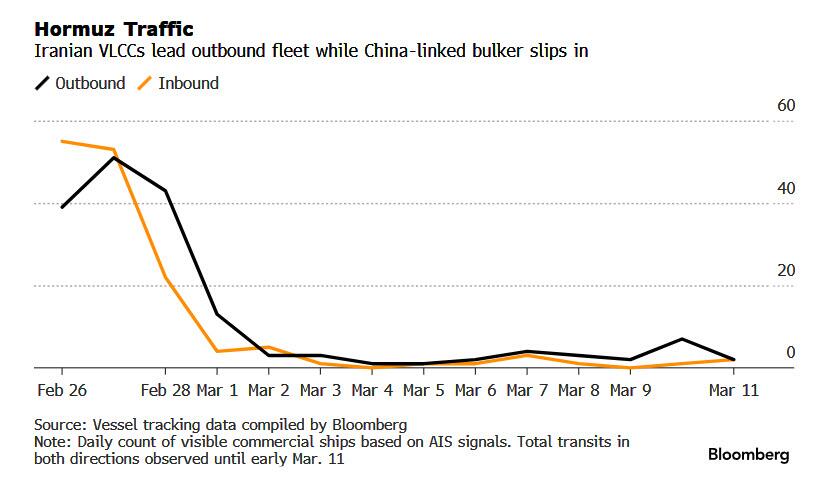
Two sanctioned Iranian VLCCs, were seen exiting the Persian Gulf for Asia early Wednesday. Their drafts suggest both supertankers are fully laden, and since they saw no pushback from Iran, are headed toward China. As much as 13.7 million barrels of Iranian crude has been shipped through the strait since the war began on Feb. 28, according to Tankertrackers.com, a company that specializes in the use of satellite imagery to track vessels.
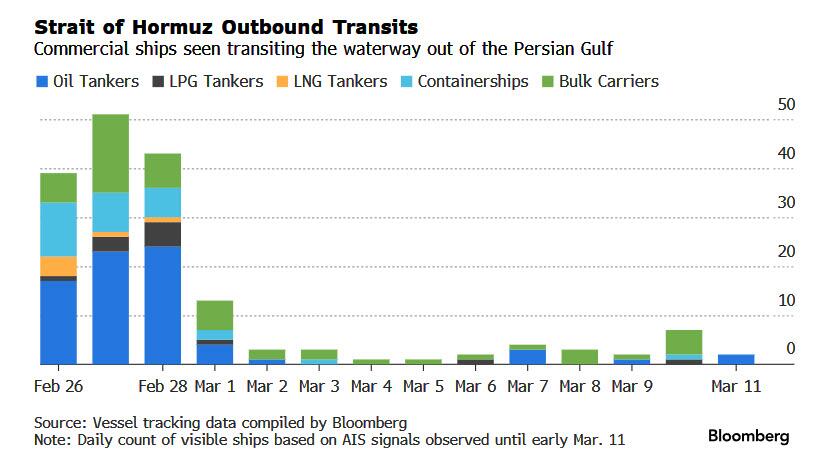
According to Bloomberg, one Iran-affiliated container-ships entered the Persian Gulf on Tuesday and another on Wednesday. In addition, a bulk carrier also entered the Gulf Wednesday signaling ‘China Owner All Chinese.’
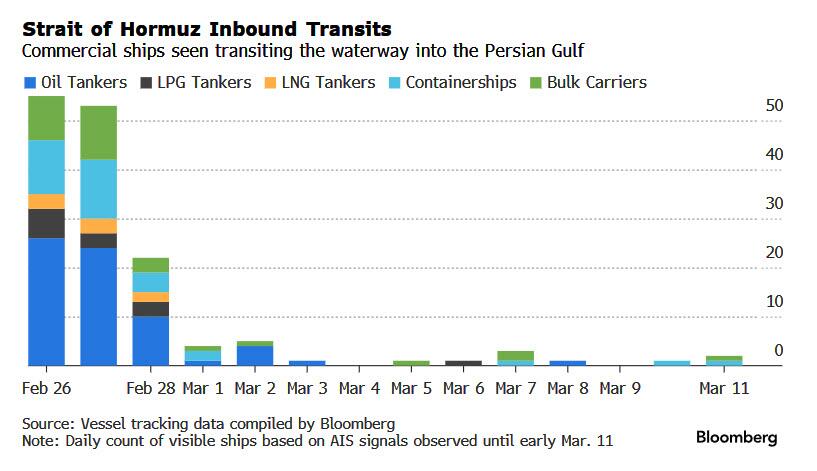
This increase in activity comes amid an escalation in hostilities in the region. The cargo ship Mayuree Naree was hit by an unknown projectile, while transiting the Strait of Hormuz.
Another bulk carrier signaling ‘China Owner&Crew’ u-turned away from the strait following the incident, underscoring the heightened security risks.
As we reported previously, widespread electronic warfare tactics, including spoofing and signal jamming, have made real-time monitoring of traffic increasingly difficult. With several vessels opting to deactivate AIS transponders in high-risk areas, data accuracy is expected to lag, leading to an eventual upward revision of historical transit numbers.
Still, despite the occasional successful crossing, the bulk of the industry’s tonnage remains stuck on either side of the strait until maritime security is restored. Traffic through the channel was effectively halted following several attacks on merchant ships as Iran retaliated against US and Israeli strikes. Missile and drone activity continues to pose a critical risk to all vessels in the vicinity.
end
MORONIC!!
Iran Formulated Plan To Attack California With Drones In Case Of War: FBI
Wednesday, Mar 11, 2026 – 02:10 PM
U.S. law enforcement agencies in California were recently warned that Iran may have explored the possibility of launching drone attacks against targets on the West Coast in retaliation for Operation Epic Fury, according to a federal alert reviewed by ABC News.

The bulletin, circulated by the FBI to police departments in late February, said authorities obtained information indicating that, as of early February 2026, Iran had allegedly aspired to conduct a surprise attack using kamikaze drones launched from an unidentified vessel off the U.S. coast. The potential targets were described only as unspecified locations in California.
“We recently acquired information that as of early February 2026, Iran allegedly aspired to conduct a surprise attack using unmanned aerial vehicles from an unidentified vessel off the coast of the United States homeland, specifically against unspecified targets in California, in the event that the US conducted strikes against Iran,” the alert said, adding that investigators have “no additional information on the timing, method, target, or perpetrators of this alleged attack.”
The warning was issued amid the ongoing US-Israeli military assault against Iran. Tehran has responded with drone strikes against targets across the Middle East, raising concerns among U.S. officials about possible retaliation beyond the region.
A spokesperson for the FBI’s Los Angeles field office declined to comment on the alert. The White House did not immediately respond to requests for comment.
The question is what exactly was the information obtained in early February that prompted the FBI to release a bulletin by late in the month.
We should note that on Feb. 3, we highlighted a threat assessment published by the Russian military-focused Telegram channel Rybar, which warned that potential Russian drones in Cuba could put critical oil and gas infrastructure in the Gulf of America, as well as data centers and military installations across the homeland, within range of these cheap, low-cost kamikaze drones.
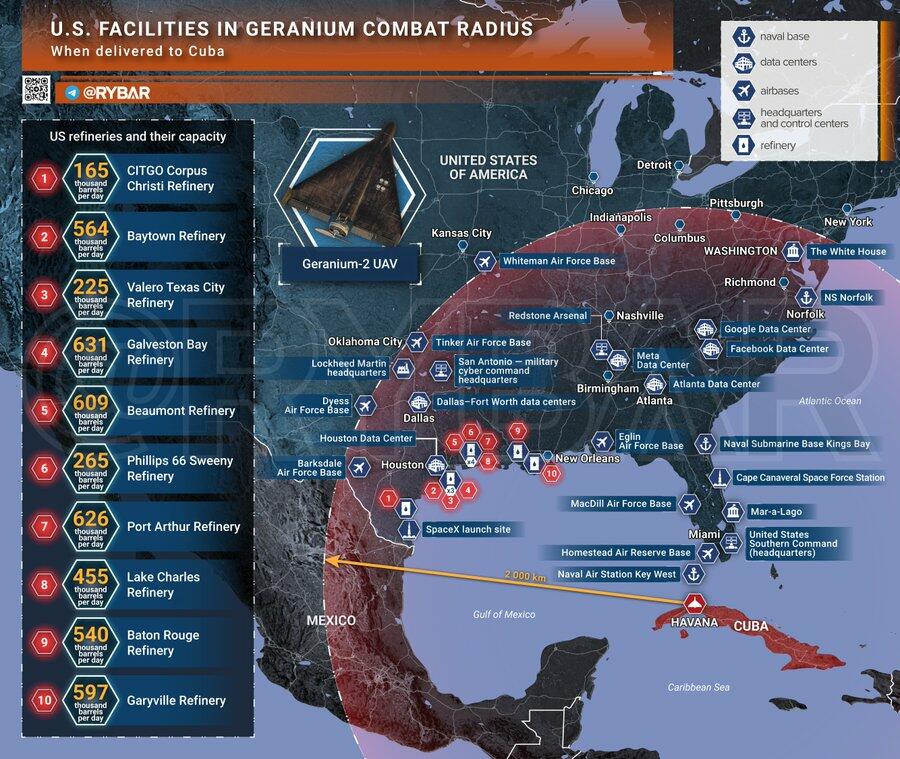
Around that same time, we also warned that the explosion in AI data center buildouts would require next-generation counter-drone security, including kinetic interceptors. The Gulf states quickly learned during Iran’s retaliatory strikes that data centers and other civilian infrastructure were very much in play.

Separately, U.S. intelligence officials have also been monitoring the growing use of drones by Mexican drug cartels and the potential for such technology to be used against U.S. personnel along the southern border. A September 2025 intelligence bulletin reviewed by ABC News said an uncorroborated report suggested unidentified cartel leaders had authorized attacks using drones carrying explosives against U.S. law enforcement and military personnel near the border.
The document noted that such an attack inside the United States would be unprecedented, though it described the scenario as plausible. It also cautioned that cartels generally avoid actions that could trigger significant retaliation from U.S. authorities.
John Cohen, an ABC News contributor and former acting undersecretary for intelligence at the Department of Homeland Security, said the possibility of drone-based threats emerging from both the Pacific and Mexico is a growing concern for security officials.
“We know Iran has an extensive presence in Mexico and South America, they have relationships, they have the drones and now they have the incentive to conduct attacks,” Cohen said. “The FBI is smart for putting this warning out so that state and locals can be better able to prepare and respond to these types of threats. Information like this is critically important for law enforcement.”
The FBI alert did not specify how a vessel carrying attack drones could approach the U.S. mainland without detection. However, intelligence officials have long worried that equipment could be pre-positioned either on land or aboard ships at sea for use in the event of military strikes by the U.S. or Israel against Iran.
UBS Lays Out Three Energy Market Scenarios As Fog Of War Thickens
“UBS Lays Out Three Energy Market Scenarios As Fog Of War Thickens”
refers to a recent analysis from UBS (likely from their Chief Investment Office or commodities team, as highlighted in ZeroHedge coverage today) amid the ongoing US-Israel-Iran conflict in the Middle East. This escalation has severely disrupted shipping through the Strait of Hormuz — a critical chokepoint for roughly 20% of global seaborne oil and significant LNG flows (especially from Qatar) — with tanker traffic dropping dramatically to just a few per day from the normal 30-35.The “fog of war” reflects high uncertainty: conflicting signals from leaders (e.g., President Trump on quick resolution vs. prolonged action), ongoing strikes, retaliatory attacks on infrastructure, potential mining of the strait, and production shut-ins in the Gulf region. This has driven oil prices volatile (Brent recently surging toward or above $90-100+ in spikes) and raised fears of broader energy shocks.From UBS analysts (including references to Henri Patricot and related notes), the three scenarios center on the duration and severity of disruptions to the Strait/infrastructure, with implications for oil (Brent crude) and gas prices (e.g., European TTF benchmark):
- Quick de-escalation/base case (most preferred/outlook tilt): Conflict winds down by mid-March with no major lasting damage to oil infrastructure. Hormuz flows resume relatively soon.
- Brent averages around $80/bbl in March, then drops to mid-$70s.
- Gas (TTF) holds near €50/MWh short-term before falling to high-€30s in Q2 2026.
- Market absorbs the shock; geopolitical risk premium fades, with focus returning to fundamentals.
- Prolonged/moderate disruption (stress case, e.g., Hormuz issues persist for ~1 month): Tighter markets accelerate inventory draws and force more GCC shut-ins.
- Oil surges above $100/bbl in late March, averaging ~$100/bbl for March and $78/bbl in Q1 2026, then eases to ~$90/bbl in Q2 as things gradually improve.
- Gas prices tighten further (higher volatility upside).
- Broader economic drag via higher energy costs acting like a “tax” on consumers/businesses, pressuring inflation and growth (though global impact seen as modest/transmitted mainly through energy).
- Severe/worst-case escalation (lower probability but high impact, e.g., sustained blockade, mining, or direct hits on key facilities): Major supply losses persist longer, potentially exhausting storage and causing widespread shut-ins.
- Oil could spike materially higher (references in related commentary point to $120+ or more extreme ranges from peers like Goldman Sachs/JPMorgan in similar prolonged scenarios).
- Gas benchmarks (TTF/JKM) could surge dramatically (e.g., >€100/MWh or equivalent if Qatar LNG heavily hit).
- “Nightmare” territory with sustained high prices, stronger inflation risks, and larger growth hits — though UBS notes practical incentives (e.g., US desire to avoid prolonged high energy costs, Iran’s leverage limits) argue against fully open-ended conflict.
UBS’s overall lean appears toward no sustained Hormuz disruption (due to degraded Iranian capabilities, heavy US presence, and self-interest in exports), expecting eventual de-escalation and price reversal once visibility improves. However, near-term volatility remains high, with upside risks to energy prices while tensions persist.This ties into broader market defensiveness: UBS has urged reduced equity exposure amid colliding risks (geopolitics, energy spikes, softer demand), and it’s contributing to choppy sentiment in stocks, bonds, and currencies. For context, other analysts (e.g., Daniel Yergin) have warned of “nightmare scenarios” if the war drags on, echoing 1970s-style shocks but potentially worse given the scale.
8. EMERGING MARKETS//AUSTRALIA NEW ZEALAND ISSUES
CANADA
YOUR EARLY CURRENCY/GOLD AND SILVER PRICING/ASIAN CLOSING MARKETS AND EUROPEAN BOURSE OPENING AND CLOSING/ INTEREST RATE SETTINGS WEDNESDAY MORNING 6;30AM//OPENING AND CLOSING
OPENING LEVELS OF CURRENCIES// AND CLOSING ASIAN STOCK MARKET AND OPENING EUROPEAN STOCKS:6 AM EST
EURO VS USA DOLLAR: 1.1612 UP 0.0006
USA/ YEN 158.35 UP 0.241 NOW TARGETS INTEREST RATE AT 1.75% AS IT WILL BUY UNLIMITED BONDS TO GETS TO THAT LEVEL…//YEN STILL FALLS//END OF YEN CARRY TRADE BEGINS AGAIN DEC 2024/Bank of Japan raises rates by .25% TO 1.75 ..TAKAICHI NEW PM AS YIELDS RISE//JAPAN DEEPLY IN TROUBLE WITH RISING RATES AND A FALLING YEN!!
GBP/USA 1.3425 UP 0.0007 OR 7 BASIS PTS
USA/CAN DOLLAR: 1.3567 DOWN 0.0015 CDN DOLLAR UP 15 BASIS PTS//(DESPITE TRUMP’S TARIFFS)
Last night Shanghai COMPOSITE CLOSED UP 10.20 PTS OR 0.25%
Hang Seng CLOSED DOWN 61.14 PTS OR OR 0.24%
AUSTRALIA CLOSED DOWN 0.65%
// EUROPEAN BOURSE: ALL RED
Trading from Europe and ASIA
I) EUROPEAN BOURSES: ALL RED
2/ CHINESE BOURSES / :Hang SENG CLOSED DOWN 61.14 PTS OR 0.24%
/SHANGHAI CLOSED UP 10.03 PTS OR 0.25%
AUSTRALIA BOURSE CLOSED DOWN 0.65 %
(Nikkei (Japan) CLOSED UP 817.61 PTS OR 1.51%
INDIA’S SENSEX IN THE RED
Gold very early morning trading: 5183.50
silver:$86.69
USA DOLLAR VS TRY (TURKISH LIRA): 44.08
USA DOLLAR VS RUSSIAN ROUBLE: 79.01 ROUBLE// DOWN 4 BASIS PTS
UK 10 YR BOND YIELD: 4.6190 UP 6 BASIS PTS
UK 30 YR BOND YIELD: 5.293 UP 6 BASIS PTS
CDN 10 YR BOND YIELD: 3.410 DOWN 2 BASIS PTS
CDN 5 YR BOND YIELD; 2.953 UP 3 BASIS PTS
USA dollar index early WEDNESDAY MORNING: 98.58 DOWN 58 BASIS POINTS FROM TUESDAY’s CLOSE
WEDNESDAY MORNING NUMBERS ENDS
And now your closing WEDNESDAY NUMBERS 10.00 AM
Portuguese 10 year bond yield: 3.370% UP 3 in basis point(s) yield
JAPANESE BOND 10 yr YIELD: +2.171% DOWN 2 FULL POINTS BASIS POINTS /JAPAN losing control of its yield curve/
JAPAN 30 YR: 3.443 UP 2 BASIS PTS//DIASTER
SPANISH 10 YR BOND YIELD: 3.388 DOWN 4 in basis points yield
ITALY 10 YR BOND: 3.646 UP 12 points in basis points yield ./ THE ECB IS QE’ ING ITALIAN BONDS (
GERMAN 10 YR BOND YIELD: 2.9433 UP 11 BASIS PTS
IMPORTANT CURRENCY CLOSES : MID DAY WEDNESDAY
Closing currency crosses for day /USA DOLLAR INDEX/USA 10 YR BOND YIELD/10:00 AM
Euro/USA 1.1565 DOWN 0.0046 OR 46 basis points
USA/Japan: 158.96 UP 0.856 OR YEN IS DOWN86 BASIS PTS// HIGHLY INFLATIONARY TO JAPAN
Great Britain 10 YR RATE 4.6480 UP 13 BASIS POINTS //
GREAT BRITAIN 30 YR BOND; 5.346 UP 11 BASIS POINTS.
Canadian dollar DOWN 16 BASIS pts to 1.3592
xxxxxxxxxxxxxxxxxxxxxxxxxxxxxxxxxxxxxxxxxxxxxxxxxxxxxxxxxxxxxxxxxxxxxxxxxxxxxxxx
The USA/Yuan CNY UP 6.8663 ON SHORE ..
THE USA/YUAN OFFSHORE// CNH UP TO 6.8766
TURKISH LIRA: 44.09 EXTREMELY DANGEROUS LEVEL/DEATH WATCH/HYPERINFLATION TO BEGIN.//
Your closing 10 yr US bond yield UP 10 in basis points from TUESDAY at 4.233.% //trading well ABOVE the resistance level of 2.27-2.32%)
USA 30 yr bond yield 4.882 UP 11 basis points /10:00 AM
USA 2 YR BOND YIELD: 3.655 UP 9 BASIS PTS.
GOLD AT 10;00 AM 5176.25
SILVER AT 10;00: 85.68
Your 11:00 AM bourses for Europe and the Dow along with the USA dollar index closing and interest rates WEDNESDAY CLOSING TIME 10:00 AM//
London: CLOSED DOWN 58.47 PTS OR 0.56%
GERMAN DAX: CLOSED DOWN 328.60 OR 1.37%
FRANCE: CLOSED DOWN 15.55 PTS OR 0.19%
Spain IBEX CLOSED DOWN 93.10 PTS OR 0.53%
Italian MIB: CLOSED DOWN 428.73 PTS OR 0.95%
WTI Oil price 88.11 10.00 EST/
Brent Oil: 92.98 10:00 EST
USA /RUSSIAN ROUBLE /// AT: 79.16 ROUBLE DOWN 0 AND 2 / 100
CDN 10 YEAR RATE: 3.486 UP 8 BASIS PTS.
CDN 5 YEAR RATE: 3.034 UP 8 BASIS PTS
CLOSING NUMBERS: 4 PM
Euro vs USA 1.1571 DOWN 0.0039 OR 39 BASIS POINTS//
British Pound: 1.3415 DOWN 0.0003 OR 3 basis pts/
BRITISH 10 YR GILT BOND YIELD: 4.6840 UP 13 FULL BASIS PTS//
BRITISH 30 YR BOND YIELD: 5.346 UP 11 IN BASIS PTS.
JAPAN 10 YR YIELD: 2.171 DOWN 1 FULL BASIS PTS (DANGEROUS TO THEIR ECONOMY
JAPANESE 30 YR BOND: 3.443 UP 2 PTS AND STILL VERY DANGEROUS TO THEIR ECONOMY
USA dollar vs Japanese Yen: 158.95 UP 0.847 OR YEN DOWN 85 BASIS PTS EXTREMELY DANGEROUS/YEN FALLING DEEPLY IN VALUE
USA dollar vs Canadian dollar: 1.3591 UP 0.0008 PTS// CDN DOLLAR DOWN 8 BASIS PTS
West Texas intermediate oil: 87.37
Brent OIL: 92.12
USA 10 yr bond yield UP 8 BASIS pts to 4.210
USA 30 yr bond yield: UP 7 PTS to 4.853%
USA 2 YR BOND 3.634 UP 7 PTS
CDN 10 YR RATE 3.479 UP 7 BASIS PTS
CDN 5 YEAR RATE: 3.028 UP 8 BASIS PTS
USA dollar index: 99.22 UP 41 BASIS POINTS
USA DOLLAR VS TURKISH LIRA: 44.09 GETTING QUITE CLOSE TO BLOWING UP/
USA DOLLAR VS RUSSIA//// ROUBLE: 79.16 DOWN AND 1/100 roubles //
GOLD $5176.95 3:30 PM)
SILVER: 85.05 3;30 PM)
DOW JONES INDUSTRIAL AVERAGE: DOWN 283.24 OR 0.61%
NASDAQ 100 UP 8.54 PTS OR 0.034%
VOLATILITY INDEX 24.48 DOWN .45 PTS OR 1.72%
GLD: $ 476.26 DOWN 1,62 PTS OR 0.034%
SLV/ $77.90 DOWN 2.19 PTS OR OR 2.73 %
TORONTO STOCK INDEX// TSX INDEX: CLOSED DOWN 133.30 PTS OR 0.40%
end
TRADING today ZEROHEDGE 4 PM: HEADLINE NEWS/TRADING
Credit & Crude Crack Bonds & Stocks, But Right-Tail ‘Squeeze Risk’ Remains
WRAP UP
Stocks flat despite crude upside while yields rise – Newsquawk US Market Wrap
Wednesday, Mar 11, 2026 – 03:59 PM
- SNAPSHOT: Equities flat/down, Treasuries down, Crude up, Dollar up, Gold down
- REAR VIEW: IEA members agree to 400mln barrel release; US CPI meets expectations in February, PCE components come in hot;
FBI reportedly warned police departments in California that Iran wants to retaliate for American attacks; US Interior Secretary Burgum said we will see US oil companies announce that they have increased production in response to price signals; US 10yr auction shows improvement from recent auctions but still weak vs averages; ECB’s Kazimir says a rate hike on Iran may be closer than thought; US is to announce new section 301 trade probes on Wednesday; ORCL earnings beat - COMING UP: Data: Swedish CPIF Final (Feb), Canadian Trade Balance (Jan), US Trade Balance (Jan), Initial Jobless Claims, Housing Starts, Atlanta Fed GDP. Events: IEA OMR, CBRT Policy Announcement. Speakers: BoE’s Bailey; Fed’s Bowman. Supply: Italy, UK, US. Earnings: Adobe.
More Newsquawk in 2 steps:
- 1. Subscribe to the free premarket movers reports
- 2. Trial Newsquawk’s premium real-time audio news squawk box for 7 days
MARKET WRAP
Stocks were flat/down on Wednesday as rising oil prices limited any rebound from Tuesday’s late-staged selloff. The IEA confirmed it is to release 400mln bbls of oil into the market, but the timing depends on each country, while there is still plenty of uncertainty about the Strait of Hormuz, with Trump attempting to get shippers to sail the Strait again, but he is being met with resistance due to safety concerns, particularly amid reports of mines being placed there. There had also been reports suggesting Iran aspired to attack California with drones in response to the war, which also briefly hit sentiment and lifted oil prices. The move higher in crude saw yields move higher across the curve while there was likely dealer concession taking place ahead of the 10-year auction this afternoon, following the weak 3-year supply on Tuesday. Meanwhile, the US CPI data, although in line with expectations, saw the PCE components lean hot – also adding to downward pressure in Treasuries. In FX, the Dollar was bid as yields moved higher while the Euro was in focus after ECB’s Kazimir touted a sooner than expected rate hike, but not at the next meeting. AUD outperformed on more hawkish RBA bets with Westpac now expecting an RBA hike in March. Gold prices were marginally lower, while silver lagged, with bitcoin rising back above USD 70k.
US
US CPI (FEB): Headline inflation rose 0.267% M/M, in line with the 0.3% consensus and up from the prior 0.171%. The annual rate remained at 2.4% Y/Y, in line with expectations. Core inflation rose 0.216% M/M, in line with the 0.2% forecast, and cooler than the prior 0.295%. The annual rate rose at a rate of 2.5% Y/Y, in line with expectations and matching the prior reading. Core goods prices were little changed (0.08% vs 0.04%), while core services cooled to 0.27% M/M from 0.39% – a welcome sign for those at the Fed concerned about this area of pricing. Super core rose to 2.74% Y/Y from 2.67%. The data continues to show inflation is sticky around these levels, though ahead, analysts see potential upside risks amid the Middle East conflict, the rising oil prices and the risks of severe supply chain disruptions at the Strait of Hormuz. Meanwhile, WSJ’s Fedwatcher Timiraos highlighted that the very favourable data imputation in the October report, due to the government shutdown, unwinds after March. Pantheon Macroeconomics noted that CPI components feeding through to the core PCE deflator were hot and it expects the core PCE inflation at 0.4% M/M in February, after rising 0.4% in January (January PCE is due Friday). Overall, the report is unlikely to change the Fed’s stance for now, as policymakers prefer to wait and see the impact of the war in the Middle East and tend to look through one-off energy price rises. Nonetheless, Pantheon wrote that “the Fed’s rules of thumb imply that the 30% increase in oil prices since February will lift the core CPI by just 0.15ppts”.
FIXED INCOME
T-NOTE FUTURES (M6) SETTLED 15 TICKS LOWER AT 111-31+
Yields rise across the curve amid rising oil prices, likely dealer concession and hot leaning PCE components of the CPI report. At settlement, 2-year +4.4bps at 3.636% 3-year +4.1bps at 3.654%, 5-year +4.2bps at 3.782%, 7-year +4.6bps at 3.982%, 10-year +5.4bps at 4.210%, 20-year +7.1bps at 4.824%, 30-year +6.7bps at 4.854%.
THE DAY: T-notes were lower across the curve with the curve bear steepening with yields higher by 6-9bps. Oil prices were rising once again, keeping inflation fears at the front of mind. Oil prices moved higher despite the confirmation of the IEA releasing 400mln bbls of oil into the market. However, given the large weakness on Tuesday was due to building expectations of this outcome, this was seemingly a “sell the rumour, buy the news” play. Aside from oil action, there was perhaps some dealer concession taking place ahead of the 10-year auction following the dismal 3-year offering on Tuesday. The 10-year auction saw better demand than the 3-year, but it was not as strong as recent averages (more below). US data also was a driver of UST price action, although the CPI report largely came in line with expectations, analysts had been pointing to the hot-leaning PCE components. Corporate issuance also continued to filter through with Salesforce (CRM) confirming its 8-part Dollar issuance (USD 25bln), with seven companies looking to sell debt today. Attention on Thursday turns to the 30-year bond auction and US Jobless Claims data, while geopolitics and crude price action remain in focus.
SUPPLY
Notes
The US sold USD 39bln of 10-year notes at a high yield of 4.217%, a higher yield than the prior 4.177%, tailing the when issued by 0.7bps – an improvement from the prior 1.4bps tail but not as strong as the six auction average of 0.3bps. The bid-to-cover ratio rose to 2.45x from 2.39x, but not as strongly as the 2.48x average. The breakdown saw a notable increase in indirect demand to 74.5% from 64.5%, above the 69.3% average, but direct demand, similar to the 3-year on Tuesday, saw a notable drop to 12.8% from 22.1%, sitting below the 20.3% six-auction average. This left dealers with an above-average take-down of 12.7%, but lower than the prior 13.4%. Overall, an improvement from the prior 10-year and stronger than the 3-year seen on Tuesday, but not as strong as the average 10-year auction.
US to sell USD 22bln of 30-year bonds on March 12th; all to settle on March 16th
Bills
- US sold 17-week bills at a high rate of 3.600%, B/C 3.19x
STIRS/OPERATIONS
- Fed Rate Cut Pricing: March 0bps (prev. 0bps), April 1.7bps (prev. 1.7bps), June 7.5bps (prev. 9.8bps), December 30.6bps (prev. 39bps).
- NY Fed RRP op demand at 0.55bln (prev. 0.28bln) across 4 counterparties (prev. 4) on March 11th
- SOFR at 3.64% (prev. 3.65%), volumes at USD 3.2tln (prev. USD 3.173tln) on March 10th
- EFFR at 3.64% (prev. 3.64%), volumes at USD 104bln (prev. USD 99bln) on March 10th
CRUDE
WTI (J6) SETTLED USD 3.80 HIGHER AT 87.25/BBL; BRENT (K6) SETTLED USD 4.18 HIGHER AT USD 91.98/BBL
The crude complex saw gains, as Strait of Hormuz mines and IEA recommendation dominated Wednesday’s tape. In the European morning, price action was dictated by updates from the UKMTO, who declared three incidents, which gradually sent WTI and Brent to intraday highs. Thereafter, benchmarks pared off highs as participants awaited details from the IEA recommendation, which was largely in line with expectations; members agreed to a 400mln barrel release, although details around the release are light, with Birol stating more information in “due course” and the timeframe will be appropriate to each member country. As the IEA concluded its press conference, and alongside an Axios piece, oil once again moved higher and provided support to the close to see oil settle just below the session peaks. Regarding the Axios article, citing a Trump phone call, he gave the familiar line that the war will end “soon” because there is “practically nothing left to target”, although the bullishness for oil potentially came at Axios added officials preparing for at least two more weeks of strikes. Mines in the Strait of Hormuz remain in focus, and Trump doesn’t think Iran has laid any, but separate reports suggest Iran has a laid or dozen (or a few dozen) so far, while the JMIC said they cannot confirm whether there are mines there or not. Crude also saw a leg higher on reports in ABC that the FBI had intel that Iran aspired to attack California with drones in response to the war. For the record, WTI traded between USD 81.79-88.99/bbl and Brent USD 86.24-93.15/bbl.
EQUITIES
CLOSES: SPX -0.08% at 6,776, NDX +0.03% at 49,965, DJI -0.61% at 47,417, RUT -0.20% at 2,543
SECTORS: Consumer Staples -1.29%, Real Estate -1.12%, Financials -0.83%, Utilities -0.81%, Materials -0.33%, Industrials -0.27%, Consumer Discretionary -0.27%, Health -0.20%, Communication Services +0.01%, Technology +0.35%, Energy +2.48%.
EUROPEAN CLOSES: Euro Stoxx 50 -0.70% at 5,796, Dax 40 -1.59% at 23,588, FTSE 100 -0.56% at 10,354, CAC 40 -0.19% at 8,042, FTSE MIB -0.95% at 44,773, IBEX 35 -0.53% at 17,352, PSI +0.58% at 9,076, SMI -0.61% at 12,976, AEX +0.05% at 1,003
EARNINGS:
STOCK SPECIFICS:
- Oracle (ORCL): EPS, rev. & cloud rev. beat w/ stellar next Q profit guidance & raised FY top line outlook.
- UniFirst (UNF) to be acquired by Cintas (CTAS) for $310/shr in cash & stock; UNF closed Tues. at 257.91.
- AeroVironment (AVAV): Profit & rev. light.
- Nvidia (NVDA) narrowed its CoWoP PCB partners to three amid tightening advanced packaging capacity.
- Texas Instruments (TXN) is reportedly preparing to raise prices on a range of semiconductor products from April 2026
- JPMorgan (JPM) has marked down certain loans held by private credit groups & is tightening lending to the sector.
- Wolfe Research raised Micron (MU) PT to $500 & reiterated ‘Outperform’ rating.
- Campbell’s (CPB): Top, bottom line missed & cut FY outlook.
- Uber (UBER) partners with Amazon’s (AMZN) Zoox to offer Robotaxi rides.
- Nvidia (NVDA) to invest USD 2bln in Nebius (NBIS), partnering to scale full-stack AI cloud.
SLB (SLB) cuts Q1 outlook due to the Middle East conflict. - Stryker (SYK) the subject of a cyber attack, WSJ reports, the incident may be linked to Iran.
- Papa John’s (PZZA) reportedly draws a takeover bid from Irth Capital and reportedly offers USD 47/shr, WSJ reports.
- Intel’s (INTC) 10% stake sale to the US must be voided, according to a lawsuit.
FX
The dollar was firmer against most major peers as the constrained Strait of Hormuz continues to drag on with no end in sight. The IEA announced members agreed to a 400mln barrel emergency release of oil stockpiles, matching the high end of the 300-400mln range provided in recent reports; however, with views growing that the conflict will be longer than originally thought, the IEA’s move is being seen as having a short-lived effect. US yields tracked the move higher in oil prices, which have stayed firm despite the IEA announcement and more remarks from Trump aimed at easing concerns, resulting in the dollar being supported. Money markets pushed back pricing for Fed rate cuts, with the first cut not fully priced until December. Separately, US data did little to change market views, as both headline and core matched expectations, leaving all attention now on the Middle East’s conflict impact on consumer prices.
EUR was in focus after ECB’s Kazimir, who suggested that a rate hike in response to Iran may be closer than thought. Initial modest upside was seen after the remark, but dissipated after he added that there is no reason to move rates at the next meeting. ECB’s Villeroy also said he does not expect a rate hike at next week’s meeting.
AUD was the only G10 FX to strengthen against the dollar as more banks upped hawkish RBA bets. The latest was Westpac and the National Australia Bank, who now expected the RBA to hike rates in March and May, respectively. BofA also sees a hike at next week’s meeting. AUD/USD set a peak at 0.7188 before retreating to ~0.7146.
USA DATA RELEASES
USA ECONOMIC COMMENTARIES
Loans To Non-Banks Threaten Banking Crisis
Tuesday, Mar 10, 2026 – 05:05 PM
Authored by Christopher Whalen via DailyReckoning.com,
Last week, the Federal Deposit Insurance Corp released the industry data for US banks for 2025.

On the surface, the numbers look reassuring, even strong. But beneath the calm headline figures lies a growing risk that investors should not ignore.
Domestic deposits increased for the sixth consecutive quarter in Q4 2025 by $318.3 billion or 1.8%, the FDIC reports. Loans grew by 2% in Q4 and almost 6% YOY. Foreign deposits grew 11%, but subordinated debt and FHLB advances each fell ~ 14% as banks shed excess capital and funding.
U.S. bank loan growth in 2025 was robust, with total loans and leases reaching $13.4 trillion by year-end, a sequential increase in Q4 and a 5.9% annual growth rate, driven by larger institutions. Personal loan balances hit $2.2 trillion, while credit card debt rose 5.5% annually but the utilization rate for credit cards is still less than 20% of the total credit available. Yet behind this placid picture is a growing threat to banks and financial markets. At first glance, this looks like a healthy banking system. But that placid picture masks a fast-growing vulnerability that could become the next major pressure point for banks and financial markets.
The fastest growing bank asset category is loans to non-depository financial institutions (NDFIs), a corner of the financial system that regulators have struggled to monitor and control, up 7% in Q4 vs Q3 and up 35% YOY to $1.4 trillion at year-end 2025. With growing signs of credit stress among nonbank companies, banks will eventually pull back from lending to NDFIs. The problem is timing. By the time banks tighten lending standards, many private companies dependent on this funding may already be heading toward collapse, and those failures will not stay confined to the shadow banking system.
They will hit bank balance sheets directly.
The latest default involving UK mortgage issuer Market Financial Solutions threatens a £930 million shortfall in collateral backing loans to Apollo, TPG, other Wall Street private credit sponsors that are heavily involved with lending to private credit and equity, and various speculative ventures involving the current “AI investment boom.”
“The collapse of MFS, which attracted backing from firms including Barclays Plc, Apollo Global Management Inc.’s Atlas SP Partners unit, Jefferies Financial Group and TPG, is the latest crisis to hit both banks and direct lenders, and puts a spotlight on asset-based financing,” Bloomberg reveals.
“Accusations of double pledging also emerged in the collapses last year of US auto parts supplier First Brands Group and sub-prime auto lender Tricolor Holdings.”
Accusations of double pledging collateral have also surfaced in recent failures such as First Brands Group and Tricolor Holdings, further highlighting the fragility of the system.
The fact that Apollo’s Atlas SP unit was caught unawares by the apparent collateral fraud at MFS is especially notable given the firm’s past experience. One of the leading providers of secured financing to nonbank mortgage companies in the US, Atlas SP was formerly owned by Credit Suisse and has been the advisor on numerous financing transactions for NBFIs. Yet two supposedly “secured” warehouse facilities backed by Atlas SP are now reported to be in default. If the lenders structuring these deals are surprised by collateral problems, investors should be asking deeper questions about how widespread these risks really are.
The collapse of American Car Centers in 2023, another Atlas SP client, provided advanced warning of a wave of corporate insolvencies that now threaten the US banking sector with contagion. U.S. corporate bankruptcies in 2025 surged to their highest level in 15 years, with over 700 companies filing for protection through November, marking a 14% increase over 2024. A large share of those failures involved private equity-backed firms.
Why is the rapid growth in bank lending to NDFIs a problem?
Federal Reserve Chair Jerome Powell previously expressed that while non-depository financial institutions play a productive role in the economy, their growth outside the traditional regulatory perimeter poses risks to financial stability. We’re not talking here about mortgage companies with fully secured loans, but instead speculative credit and private equity schemes that are running out of cash.
The growth of private equity and credit is particularly problematic for banks. Many institutions are quietly masking early defaults through loan forbearance. When busted private equity firms cannot pay their debts, many seek to buy time by paying “in kind” with additional equity effectively issuing more of what the market already considers worthless. Paying “principal on original principal” or “POOP” (h/t Victor Hong) is one the thin canards used by private equity sponsors to conceal their financial malfeasance. In short: investors are being paid with more of the same failing capital structure.
In 2024, Federal Reserve Chair Jerome Powell expressed concerns regarding the rapid growth of non-bank financial institutions and the shifting of financial intermediation outside the regulated banking perimeter. He emphasized the need for regulators to be “smart” about where risks are emerging in this sector, noting that non-bank lending could lead to an overall lack of economic stability. But federal bank regulators have done little to address the explosion of lending to NDFIs. History shows that when a bank asset class grows significantly faster than the broader economy, it is usually a signal that systemic risk is building.
When you see a bank asset class growing far more quickly than the broad economy, this is a red flag that suggests potential systemic risk. But even more troubling that the high rate of growth in bank lending to NDFIs is the huge amount of undrawn loans available to these lightly capitalized companies involved in private equity and credit.
The FDIC does not yet disclose full loan category data on NDFI series, but we can infer from Other Loans line that banks currently have an estimated $2.8 trillion in unused loan commitments to NDFIs or exposure at default of 200% of current advances as defined by Basel III. A non-bank firm can draw on these contracted credit lines and immediately default, causing a massive loss to the bank lender. For every dollar of the $1.4 trillion in bank loans outstanding today to NDFIs, there are two dollars in undrawn loans or a total of $2.8 trillion, as shown in the chart below.
In practical terms:
- Banks have $1.4 trillion in outstanding loans to NDFIs
- They have another $2.8 trillion in undrawn commitments
That means for every dollar already lent, two more dollars are waiting to be drawn.
And a nonbank borrower can draw on those lines and default immediately, leaving banks with the loss.
Total potential exposure: roughly $4.2 trillion.
If stress spreads across private credit markets, that number becomes very important, very quickly.
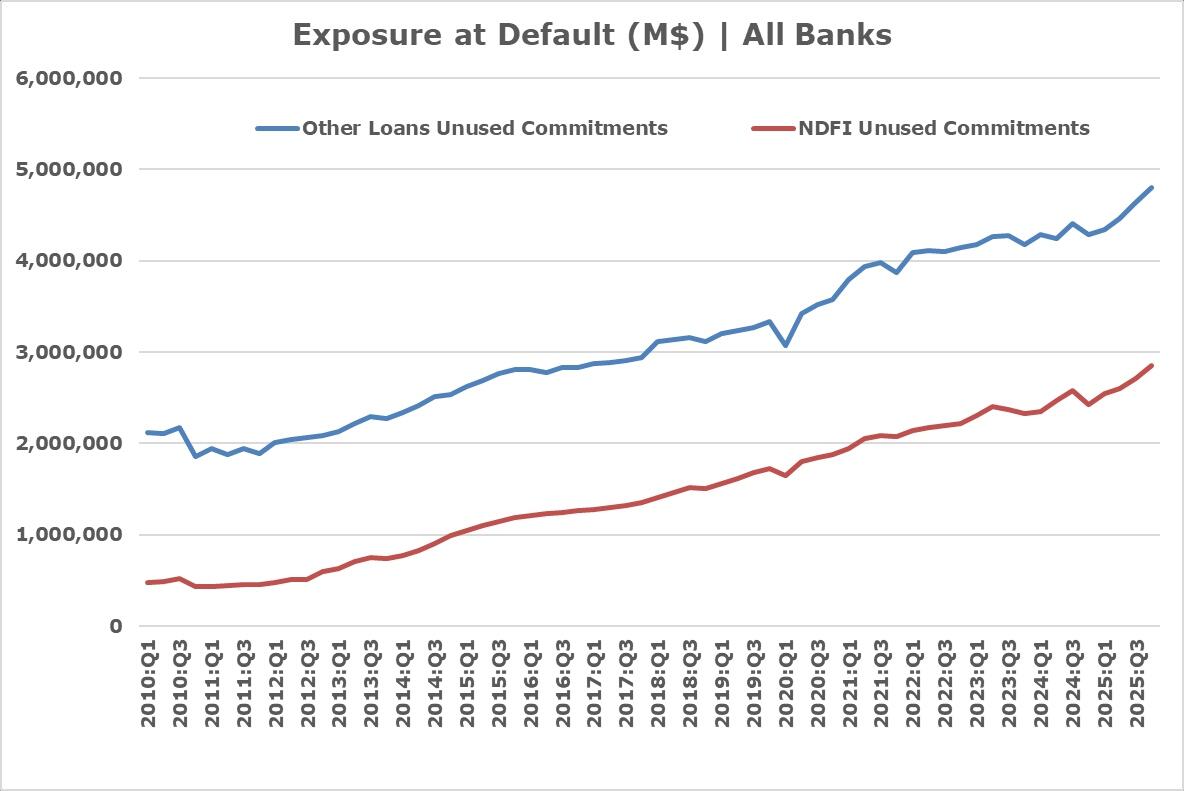
Source: FDIC
The massive amount of bank lending to NDFIs is an approaching storm that has been largely ignored by federal regulators but is gaining growing attention from credit analysts. One public benchmark for the growing credit stress facing nonbanks is business development companies, which have seen an 18% decline in stock valuations over the past year vs an equal positive gain for the S&P 500. That divergence is not random. BDC investors are effectively voting with their capital that private credit risk is rising and rising quickly.
“UBS strategists say private credit could see default rates surge as high as 15% if artificial intelligence triggers an “aggressive” disruption among corporate borrowers,” the Swiss bank reports.
“Direct lenders that financed software companies are exposed to AI’s impact, with some estimates suggesting 40% of all sponsor-backed loans are tied up in the software industry.”
A 15% default rate is 2x the highest level of bank loan delinquency seen in 2008.
Put that number in perspective. A 15% default rate would be roughly twice the highest level of bank loan delinquencies seen during the 2008 financial crisis.
If even a portion of that scenario materializes, private credit markets, and the banks financing them, will feel the impact immediately.
The year 2025 was an extraordinary period for many reasons, including low credit loss rates and soaring asset values. QE teaches us that high asset prices suppress the cost of default, until asset values fall. But Wall Street is still trying to spin the growing delinquency among private companies as being only a problem “on the margins.”
“A review of the 3,649 middle market (MM) corporate credit assessments completed in 2025 shows mixed signals,” notes Kroll Bond Rating Agency.
“Slowing growth is negatively impacting some companies’ credit quality, but overall, our portfolio remains stable. The growing divergence in performance is driven by challenged subsectors that we believe will contribute to the rising, yet contained, default rate in 2026.”
In other words: the cracks are visible, but the market is still hoping the damage remains contained.
In the 1920s, many observers believed that asset values had reached a “permanently high plateau,” That confidence did not age well. This despite warnings from some observers of an impending collapse. Sectors like private equity and credit, and AI, all promise higher credit costs ahead. But for lenders, the immediate implication may be something very different: higher credit costs. When credit costs rise, earnings decline and stocks follow. The sharp declines in bank stocks in January and February illustrate this tendency.
We expect bank stocks to underperform their strong 2025 performance and face several challenges in the coming year:
- Rising credit costs
- Elevated market volatility
- Higher operating expenses
Banks will benefit from falling funding costs, which should provide some support for margins.
But the outsized credit exposure to nonbank financial institutions may become one of the dominant financial narratives of 2026.
If stress spreads through private credit markets, investors may quickly discover that the shadow banking system is not nearly as “separate” from the traditional banking sector as many assume.
* * *
end
Seniors Hit With Billions In Extra Premiums From Medicare Overpayments: Report
Wednesday, Mar 11, 2026 – 06:55 AM
Private insurers are padding their pockets with billions in alleged overpayments from Medicare Advantage, and hardworking American seniors are footing the bill through higher Part B premiums, according to a congressional report obtained by the Wall Street Journal.

The report, issued by the bipartisan Joint Economic Committee, shows that controversial practices, such as adding extra diagnoses to trigger larger government reimbursements, drove up Medicare Part B premiums by $13.4 billion in 2025 alone.
That amounts to roughly 10% higher costs, or more than $200 extra annually, for the average senior on a fixed Social Security income. The impact extends beyond enrollees in Medicare Advantage plans. Traditional Medicare beneficiaries are also paying higher premiums to help subsidize the private plans’ gains.
Rep. David Schweikert (R-AZ), who chairs the committee, said in a statement to the Journal, “Extra spending on Medicare Advantage is not just coming out of the federal government’s budget, a portion of this comes out of you.”
The Journal reports:
Medicare Advantage, which has long enjoyed support from Republicans, has faced growing bipartisan scrutiny. Among the biggest players in the business are UnitedHealth Group, Humana and Elevance Health.
Lawmakers and government investigators have been probing how insurers’ billing practices have contributed to Medicare Advantage costs. A congressional watchdog found Medicare Advantage costs the federal government more than traditional Medicare, partly because of insurers’ billing practices. The insurers are paid more to cover enrollees who have more health conditions, and they can boost their reimbursement by recording more diagnoses.
Medicare Part B, which covers doctor visits, lab tests, and outpatient services, had standard premiums around $185 per month in 2025, deducted directly from Social Security checks. Due to these alleged overpayments, however, everyone pays more for the same benefits.
Speaking to the Journal on Friday, Medicare agency administrator Mehmet Oz said that while he doesn’t believe Medicare Advantage insurers are as overpaid as has been reported, he did concede that, “we should change the rules.”
end
Fund Seen As “First Domino In Private Credit Bank Run” Hit With Over 7% In Redemptions
The headline you’re referencing appears to come from a recent ZeroHedge article (published around March 10, 2026), which highlights stress in the private credit sector. The fund in question is Cliffwater’s private credit fund (likely their approximately $33 billion alternatives or private markets allocation vehicle, often focused on private credit and other illiquid assets).According to reports, including coverage from The New York Times and CNBC, hedge fund Rubric Capital circulated a letter to investors describing Cliffwater as potentially the “canary in the coal mine” and the “first domino in the ‘bank run’ we foresee” in private credit. This warning stems from concerns over liquidity mismatches in these funds—where investors seek quarterly redemptions from inherently illiquid assets (like private loans to companies).Key details on the redemptions:
- Cliffwater’s fund is reportedly facing redemption requests exceeding 7% of assets (some sources specify “7%-plus”), which is notable because many private credit vehicles cap quarterly redemptions at around 5% to prevent forced asset sales at discounts.
- This comes amid broader turmoil in the ~$1.8–3 trillion private credit market, where funds promise higher yields but face growing investor anxiety over:
- Over-optimistic valuations of loans to risky borrowers.
- Disruptions from AI advancements impacting certain industries/borrowers.
- Recent bankruptcies (e.g., Tricolor, First Brands) exposing weaknesses.
- A wave of redemption pressures at major players.
Similar issues have hit other big names recently:
- Blue Owl Capital (e.g., its Blue Owl Capital Corp. II fund) halted or restricted redemptions after heavy requests, selling off $1.4 billion in loans for liquidity.
- Blackstone’s flagship BCRED fund saw ~7.9% redemption requests in a recent quarter (exceeding its usual cap), requiring the firm to lift limits temporarily and inject its own capital.
- BlackRock capped withdrawals from its ~$26 billion private credit fund (HLEND) after requests hit 9.3%, allowing only 5% to proceed.
These events fuel fears of a slow-motion “bank run” dynamic in private credit: semi-liquid structures (offering periodic redemptions) meet illiquid underlying assets, leading to gating, discounts, or forced sales if confidence erodes. While not identical to traditional bank runs (due to built-in limits), skeptics like Saba Capital’s Boaz Weinstein have called out the “financial alchemy” of promising liquidity that may not exist when needed.The sector isn’t collapsing yet—many funds are managing flows—but it’s a major stress test, with ripple effects on investor sentiment toward alternatives. Traditional banks have pulled back from risky lending post-2008, shifting it to private credit, so any widespread issues could have broader economic implications.If this ties into something specific you’re tracking (e.g., impacts on markets, gold/silver as hedges, or pension allocations—given your interest in precious metals and finance), let me know for more targeted details!
VICTOR DAVIS HANSON
KING NEWS
SWAMP STORIES FOR YOU TONIGHT
Judicial Sabotage? Obama Judge Blocks Trump Efficiency Reforms For Deportation Appeals
Tuesday, Mar 10, 2026 – 08:00 PM
A federal judge slammed the brakes on one of the Trump administration’s most aggressive moves yet to make the immigration appeals process more efficient, and he did it the night before the rule was set to go live.

U.S. District Judge Randolph Moss, an Obama appointee in Washington, D.C., issued his ruling late Sunday, March 8, 2026, vacating the core provisions of an interim final rule from the Justice Department’s Executive Office for Immigration Review (EOIR). The rule, scheduled to take effect the following morning, would have fundamentally restructured how the Board of Immigration Appeals (BIA) handles cases.
EOIR slashed the time to file a notice of appeal of an immigration judge’s decision from 30 days to 10. Any issue not raised in that notice was automatically treated as waived. And unless the BIA voted within 10 days to refer a case to the full board, the appeal faced summary dismissal — end of the road, no hearing. For most appellants, that’s exactly what would have happened.
And it was a critical reform. The BIA’s backlog has ballooned from 37,285 pending appeals at the end of fiscal year 2015 to 202,946 by the end of fiscal year 2025. EOIR said the rule would streamline appellate review and cut through the bureaucratic paralysis that’s made the immigration court system a joke. The Trump administration framed the changes as essential to its deportation mandate.
But Judge Moss couldn’t stomach efficiency when it threatened the open-borders crowd’s playbook. He vacated the heart of the rule, claiming EOIR violated the Administrative Procedure Act by skipping public comment. Moss lectured that “Issues that are so fundamental to the rights of tens of thousands of individuals (and that will guide how organizations and lawyers present their claims to the BIA) ought to be considered and addressed before – rather than after – a rule takes effect.”
Of course, that argument doesn’t exactly hold up, as agencies issue interim final rules all the time in urgent situations – like when a backlog this massive mocks the rule of law.
Moss painted the rule as a death sentence for appeals: an appellant “will almost certainly lose his case before the BIA before it even begins; in the vast majority of cases, the case will be disposed of by summary dismissal.”
Five left-wing nonprofits – Amica Center for Immigrant Rights, American Immigration Council, National Immigrant Justice Center, and two others – were responsible for the lawsuit to protect the right of illegals to back up the system.
Emilie Raber from the Amica Center for Immigrant Rights crowed, “At a time when the due process rights of immigrants are under attack, this ruling prevents the BIA from reaching the point of near self-destruction.”
This reeks of judicial activism from a lifetime appointee who answers to no one except the far left. Moss brushed aside the very crisis his ideological allies helped create. The backlog did not appear overnight. Joe Biden’s open-borders agenda fueled it for years. Voters made it clear when they elected Donald Trump that enough was enough. They wanted a course correction. They voted for border security and enforcement. They rejected bureaucratic paralysis and endless delay. Decisions like this ignore that mandate and push the country further from the accountability voters demanded.
end
Fani Spanked Again: Judge Allows Trump And Co-Defendants To Pursue $17 Million In Legal Fees
Tuesday, Mar 10, 2026 – 07:10 PM
Fani Willis, the disgraced Fulton County, Georgia DA who couldn’t keep her clam in her pants while prosecuting Donald Trump, was just dealt a serious blow this week after a judge denied her attempt to intervene in litigation over the reimbursement of legal fees stemming from her now-dismissed Georgia election case against Trump and several co-defendants.

The ruling by Scott McAfee allows efforts to recover nearly $17 million in attorney fees and costs to proceed after the high-profile prosecution collapsed late last year.
In August 2023, Trump and 18 others were indicted in Fulton County for allegedly conspiring to overturn then-President Joe Biden’s narrow election victory in Georgia. The case was dismissed in November, prompting Trump and several co-defendants to seek reimbursement for legal expenses incurred during the prosecution.
Willis’ office attempted to intervene in the fee litigation in an effort to block the claims. But McAfee ruled this week that the district attorney’s office had no legal basis to participate in the case after Willis had already been disqualified from it.
The judge noted that the state was already represented by a temporary district attorney appointed after Willis’ removal, meaning the office’s interests were already represented in the proceedings.
However, McAfee granted Fulton County itself permission to intervene in the case. The county funds most of the district attorney’s office and could ultimately be responsible for paying any reimbursement ordered by the court.
The dispute centers on a 2025 Georgia law that defendants say allows them to recover attorney fees if a prosecutor is disqualified and the case is later dismissed. The decision to allow the reimbursement claims to move forward could have significant financial implications, potentially exposing taxpayers to substantial costs if the requests are approved.
Trump alone is seeking more than $6.2 million in attorney fees from the Fulton County District Attorney’s Office under the statute.
Willis had argued that the law permitting the reimbursements was unconstitutional and maintained that her disqualification was not the cause of the case’s dismissal. McAfee declined to halt the reimbursement process at this stage.
Willis was removed from the case in December 2024 after Trump and his co-defendants argued that her romantic relationship with special prosecutor Nathan Wade created a conflict of interest and that she had made improper public statements about the prosecution.
The Supreme Court of Georgia declined in September 2025 to review her removal, leaving the Prosecuting Attorneys’ Council of Georgia to identify a replacement prosecutor. The case was later dropped.
Trump attorney Steve Sadow praised McAfee’s ruling in a statement posted to X, writing that the judge had “properly denied DA Willis’ motion to intervene in POTUS’ action for reimbursement of attorney fees because her disqualification for improper conduct bars Willis and her office from any further participation in this dismissed, lawfare case.”
Trump also criticized Willis following the Georgia Supreme Court’s decision not to hear her appeal, telling reporters last September: “What Fani Willis did to innocent people, patriots that love our country, what she did to them by indicting them and destroying them, she should be put in jail.”
Willis, speaking after she was disqualified from the case, said she hoped whoever took over the prosecution would “have the courage to do what the evidence and the law demand.”
The next phase of the litigation will focus on determining whether the requested reimbursements are reasonable under the statute. A judge will evaluate the fee claims – including Trump’s request exceeding $6.2 million – in a process that could take weeks or months and may lead to appeals.

END
Lame Duck RINO Thom Tillis Blocking Warsh’s Fed Confirmation Hearings
Wednesday, Mar 11, 2026 – 03:45 PM
Amid escalating U.S.-Israel military strikes against Iran, a separate battle is brewing on Capitol Hill over President Donald Trump’s nomination of Kevin Warsh to chair the Federal Reserve, according to CNBC.
The key obstacle is Sen. Thom Tillis (R-NC), who announced last year that he would not seek re-election one day after voting against advancing the president’s signature legislation, the “Big Beautiful Bill.”
Tillis has pledged to withhold support for any Federal Reserve nominees, including Warsh, until a criminal investigation into Fed Chair Jerome Powell’s handling of the Federal Reserve’s $2.5 billion renovation is resolved. Powell has denied any wrongdoing.
“No, no,” Tillis reportedly said when asked if Warsh could say anything during their scheduled meeting later that day to shift the senator’s stance on blocking his nomination.
“This is not about people, it’s about process,” the North Carolina Republican added. “I think this is a foul.”
Following the meeting, Tillis told reporters he would vote against advancing Warsh’s nomination out of the Senate Banking Committee if the Powell investigation remains unresolved by then.
“This is about [the] bedrock principle of Fed independence,”Tillis said. “The reason why I came out so strong so early is I believe that we, I, have no earthly idea what the market reaction would have been if suddenly the perception is that the Fed chair serves at the pleasure of the President, right?”
Of course, Tillis is simply shielding Powell – the architect of the everything-bubble and dollar debasement – from a long over due probe into waste and potential perjury. In other words ‘you can’t fire this guy until you’ve fully investigated him’ – effectively delaying or preventing accountability for Powell in a practical sense while preserving the status quo at the fed.
Despite Tillis’s opposition to advancing Warsh’s nomination, the senator said he was “impressed” with Warsh, signalling that he would support Trump’s Fed pick if the Powell probe went away.
“I’ve known of his work for quite some time, and that’s why I’m so frustrated that I’m not going to be able to cast a vote until we dispose of the other issues,” Tillis said.
Tillis also took aim at the firing of Federal Reserve Governor Lisa Cook, calling it “sophomoric.”
“We had seven members of the Banking Committee who were witnesses at the alleged scene of the crime who said no crime was committed,” the retiring lawmaker said. “Why are we even still having this discussion and holding up a great nominee?” Tillis asked.
“I think it goes back to a young U.S. attorney with a dream, with a bogus basis for an investigation,” he added. “They need to acknowledge that and step away from it so we can get him confirmed.”
“Whoever came up with that idea should be fired, too,” the senator said.
GREG HUNTER….INTERVIEWING MARTIN ARMSTRONG
Attacking Water in Iran Can Bring Out Nukes – Martin Armstrong
By Greg Hunter On March 11, 2026 In Market Analysis, Political AnalysisNo Comments
Greg Hunter’s USAWatchdog.com
Legendary financial and geopolitical cycle analyst Martin Armstrong warned in February, “This is where the volatility starts kicking in.” What do we have? Oil, gold and silver spiking in price, and violent exchanges between Iran, the United States and many other countries in the Middle East. Now, water assets like desalination plants in Bahrain and Iran are being blown up. Add the worst water shortage in decades in Iran as a backdrop to constant bombing, and you have a situation that could turn very ugly, very fast. The water shortage is so bad that there has been water rationing in Tehran for months. This water rationing was part of the reason there were huge protests in Iran a few months ago. Armstrong explains, “Part of the protests (in Iran) were about water rationing. The Islamic Republic Guard were called the ‘water mafia.’ They control the water. It’s kind of like North Korea. If you want to be fed, you join the army. All food goes to the army first, and water will also go to the military first.”
Remember, they are water rationing in Iran now, and they don’t have a lot left. So, what happens if the US, Israel and other Persian Gulf nations knock out what’s left of Iran’s water? What happens if Iran is completely out of water? Armstrong says, “Personally, I would ask Pakistan for a nuke. Look, you are talking about the death of a country. When you get to that point, if you’ve got a nuke, you are going to use it.”
So, what happens if the dams and reservoirs are bombed and Iran is completely cut off from water? Armstrong says, “If you do that, is that a war crime because you are wiping out the average population and civilians? Would you do that? This is a mess. It’s a complete mess.”
On the other side, what happens if Iran knocks out all the Persian Gulf oil refineries? Armstrong says, “If I were Iran, I would attack all the oil refineries of the neighboring states. You do that, and you will bring the entire West to its knees. The US only gets about 3% of our oil from the Middle East. You would wipe out Europe for sure.”
Armstrong sees gold going as high as “$8,800 an ounce . . . and silver $150 per ounce. . .. Oil could test $200 a barrel. . .. It’s going to get worse this summer, and it’s a 250-year drought cycle in Iran. I wrote about this on my site.”
In closing, Armstrong says, “Winston Churchill said, ‘In time of war, truth is very precious, and it needs a bodyguard of lies to protect it.’”
You can get more information at Sat123.com, Darkbags.com and Starlink123.com. You can also call 855-980-5830 and talk to a human for information on anything they sell, including Faraday bags, Faraday clothing and Starlink with talk-to-human customer service.
There is much more in the 54-minute interview.”
Join Greg Hunter of USAWatchdog as he goes One-on-One with Martin Armstrong to talk about the volatility that got kicked into high gear with the bombing of Iran for 3.10.26.
After the Interview:
There is free information, analysis and articles on ArmstrongEconomics.com.
There are also current cutting-edge in-depth reports you can buy on a wide variety of subjects by clicking here.
END
SEE YOU ON THURSDAY
H


 harveyorganblog.com


