
GOLD CLOSED CLOSED UP $33.25 TO $4525.95
TOMORROW OPTIONS ON GOLD/SILVER CONTRACTS EXPIRE IN LONDON/OTC MARCH 31
ACCESS MARKET
GOLD $4500.00 3:30 PM)
SILVER: 69.88 3;30 PM
xxxxxxxx
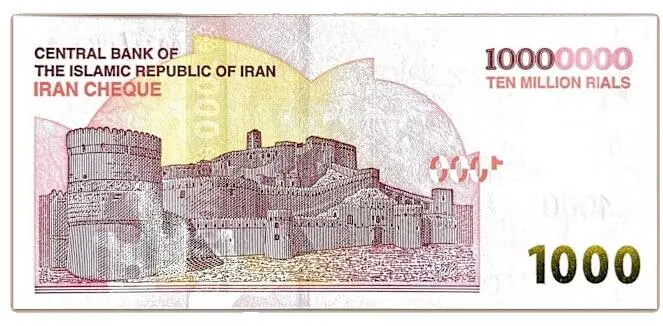
THEIR NEW NOTE//WORTH 7 DOLLARS
XXXXXXXXXXXXXXXXXXXXXXXXXXXXX

EXCHANGE: COMEX
EXCHANGE: COMEX
CONTRACT: MARCH 2026 COMEX 100 GOLD FUTURES
SETTLEMENT: 4,492.000000000 USD
INTENT DATE: 03/27/2026 DELIVERY DATE: 03/31/2026
FIRM ORG FIRM NAME ISSUED STOPPED
624 H BOFA SECURITIES 16
905 C ADM 16
TOTAL: 16 16
MONTH TO DATE: 14,559
JPMORGAN STOPPED 0/16
GOLD: NUMBER OF NOTICES FILED FOR MARCH/2026: 16 CONTRACTs NOTICES FOR 1,600 OZ or 0.0497TONNES
total notices so far: 14,559 contracts for 1,456,900 OR 45.289 tonnes)
SILVER NOTICES: 54 NOTICE(S) FILED FOR 270,000 OZ /
total number of notices filed so far this month : 9212 CONTRACTS (NOTICES) for 46.060 million oz
SILVER//OUTLINE
INITIAL STANDING FOR JANUARY: 22.915 MILLION OZ FOLLOWED BY TODAY’S 1.185 MILLION OZ QUEUE JUMP//NEW NORMAL STANDING ADVANCES TO 49.445 MILLION OZ// TO WHICH WE ADD OUR FIRST EXCHANGE FOR RISK FOR .100 MILLION OZ//NEW STANDING ADVANCES TO 49.545 MILLION OZ!!
INTIAL STANDING FOR FEBRUARY/SILVER: 13.505 MILLION OZ FOLLOWED BY TODAY’S HUGE 0.005 MILLION OZ QUEUE JUMP / : NEW STANDING FOR SILVER AT THE COMEX ADVANCES TO 25.180 MILLION OZ. BUT WE MUST ADD OUR FIRST EXCHANGE FOR RISK OF 25 CONTRACTS FOR .125 MILLION OZ AND THEN OUR SECOND EXCHANGE FOR RISK OF .0600 MILLION OZ TO OUR THIRD HUGE 2.825 MILLION OZ EXCHANGE FOR RISK!!
INITIAL STANDING FOR MARCH: A SURPRISINGLY LOW 31.076 MILLION OZ/ FOLLOWED BY A STRONG QUEUE JUMP OF 42 CONTRACTS OR 0.210 MILLION OZ/NEW STANDING REDUCES TO 46.060 MILLION OZ
JULY: 50.925 MILLION OZ (QUITE SMALL)
AUGUST: 59.455 MILLION OZ (QUITE SMALL)
SEPT. 50.510 MILLION OZ.(QUITE SMALL)
OCT; 82.020 MILLION OZ (WILL BE STRONG THIS MONTH)/ OCC WANTS TO REIN IN THESE ISSUANCES!
NOVEMBER: 36.425 MILLION OZ
DEC: 45.765 MILLION OZ
JANUARY 2026: 134.270 MILLION OZ (WILL BE A VERY STRONG MONTH FOR EXCHANGE FOR PHYSICAL!)
FEB : 82.130 MILLION OZ
MARCH: 54.025 MILLION OZ
AND JULY: 46.720 MILLION OZ//
AUGUST: 4.70 MILLION OZ INITIAL STANDING PLUS TODAY;S 5,000 OZ QUEUE JUMP //NEW STANDING ADVANCES TO 10.960 MILLION OZ
SEPTEMBER: 68.040 MILLION OZ NORMAL DELIVERY(INCLUDES ALL QUEUE JUMPING AND EXCHANGE FOR PHYSICAL TRANSFERS) PLUS 3.0 MILLION OZ EX FOR RISK = 71.040 MILLION OZ. (THIS IS THE FIRST AND ONLY ISSUANCE OF EXCHANGE FOR RISK FOR SILVER SINCE MAY.)
OCTOBER: 39.565 MILLION OZ OF NORMAL DELIVERY INCLUDES ALL QUEUE JUMPING
PLUS
2.110 MILLION OZ EXCHANGE FOR RISK//TOTAL OZ STANDING IN OCT ADVAN
NOVEMBER: INITIAL STANDING AT 11.575 MILLION OZ FOLLOWED BY TODAY’S 195,000 OZ QUEUE JUMP WHICH FOLLOWS ALL OTHER QUEUE JUMPS OF 9.155 MILLION OZ//STANDING ADVANCES TO 19.670 MILLION OZ/
DECEMBER: INITIAL AMOUNT STANDING FOR DELIVERY: 49.33 MILLION OZ// FOLLOWED BY ANOTHER STRONG 835,000OZ QUEUE JUMP+ DEC. FIRST EXCHANGE FOR RISK 0F .850 MILLION OZ + LAST WEEK.S 495,000 OZ EXCHANGE FOR RISK AND THEN A 3RD ISSUANCE IF 1.00MILLION OZ THEN FINALLY DEC 249ISSUANCE OF 1.35 MILLION OZ EXCHANGE FOR RISK//NEW TOTAL EX FOR RIS IS 3.685 MILLION OZ // STANDING ADVANCES TO 68.415 MILLION OZ//
JANUARY: INITIAL STANDING 22.915 MILLION OZ FOLLOWED BY TODAY’S 1.185 MILLION OZ QUEUE JUMP//NORMAL STANDING ADVANCES TO 49.445 MILLION OZ// TO WHICH WE ADD OUR FIRST EXCHANGE FOR RISK OF 0.100 MILLLION OZ//NEW STANDING ADVANCES TO 49.545 MILLION OZ
FEB: 13.399 MILLION OZ IS OUR INITIAL STANDING FOR SILVER! TO WHICH WE ADD OUR NEXT QUEUE JUMP FOR 5,000 OZ AND THEN ADD OUR 3 EXCHANGE FOR RISK FOR 3.010 MILLION OZ STANDING ADVANCES TO 28.190 MILLION OZ!!
MARCH: INITIAL AMOUNT OF SILVER STANDING IS 31.076 MILLION OZ FOLLOWED BY TODAY’S 0.210 MILLION OZ QUEUE JUMP //NEW TOTAL STANDING ADVANCES TO 46.060 MILLION OZ
- MAY: SUMMARY FOR MAY TONNES WHICH STOOD FOR DELIVERY:
4. AUGUST: 60.547 TONNES OF INITIAL GOLD FIRST DAY NOTICE FOLLOWED BY THE NET MONTH’S QUEUE JUMP OF 47.2312 TONNES TO WHICH WE ADD THE FOLLOWING EXCHANGE FOR RISK ISSUANCE RECEIVED FOR THE MONTH: 5.4432 TONNES EX FOR RISK/AUG 7 , AUG 11: 2.413 TONNES EX FOR RISK AND AUG. 12 OF 2.637 TONNES EX FOR RISK//AUG 25: 9.107 TONNES , AUGUST 26: 9.1010 TONNES AND NOW AUGUST 27: 9.0699 TONNES//NEW STANDING ADVANCES TO 107.5117 TONNES OF GOLD NORMAL STANDING (INCLUDES ALL MONTHLY QUEUE JUMPS/EX FOR PHYSICAL TRANSFERS//) +44.696 TONNES EX.FOR RISK = 152.208 TONNES
5.SEPT: INITIAL 8.093 TONNES OF GOLD PLUS TODAY’S QUEUE JUMP OF 0.4883 TONNES PLUS 2.2827 TONNES OF EXCHANGE FOR RISK TODAY//NEW TOTAL EX. FOR RISK/MONTH = 22.923//NEW TOTAL STANDING FOR GOLD SEPT ADVANCES TO = 48.801 TONNES!!
6.OCTOBER: 90.012 TONNES OF INITIAL GOLD STANDING WITH TODAY’S TINY 0.00311 TONNES QUEUE JUMP WHICH FOLLOWS ALL OTHER QUEUE JUMPS DURING OCT OF 76.1656 TONNES
THEN WE MUST ADD OUR 14.553 TONNES OF OUR ISSUANCE OF EXCHANGE FOR RISK/6 OCCASIONS//NEW TOTAL OF GOLD STANDING ADVANCES TO 197.5141 TONNES OF GOLD.
7.NOVEMBER BEGINS WITH 15.651 TONNES INITIALLY STANDING FOR DELIVERY FOLLOWED BY TODAY’S QUEUE JUMP OF 2.323 TONNES FOLLOWED BY ALL PREVIOUS QUEUE JUMPS IN OF OF 21.3775 TONNES TO WHICH WE ADD OUR TWO EXCHANGE FOR RISK ISSUANCE OF 4.5596 TONNES//NEW STANDING ADVANCES TO 43.9716 TONNES OF GOLD.
8. DECEMBER BEGINS WITH INITIAL STANDING OF 83.813 TONNES OF GOLD FOLLOWED BY TODAY’S 0.0TONNE QUEUE JUMP WHICH FOLLOWS ALL OTHER QUEUE JUMPS OF: 37.163 TONNES//NEW STANDING ADVANCES TO 115.390 TONNES TO WHICH WE ADD OUR 4 EXCHANGE FOR RISK FOR DECEMBER OF 6.587 TONNES/NEW STANDING ADVANCES TO 121.977 TONNES
9. JANUARY: INITITAL STANDING: 13.785 TONNES TO WHICH WE ADD OUR FIRST EXCHANGE FOR PHYSICAL TRANSFER OF 0.08709 TONNES WHICH FOLLOWS ALL OTHER QUEUE JUMPS OF 30.7117TONNES //NEW TOTAL QUEUE JUMPS 30.7117//NORMAL DELIVERY OF GOLD ADVANCES TO 36.8958 TONNES TO WHICH WE ADD OUR SIX EXCHANGE FOR RISK OF 22.315 TONNES//NEW STANDING ADVANCES TO 59.2108 TONNES.
FEB; INITIAL AMOUNT OF GOLD STANDING FOR DELIVERY: 93.567 TONNES OF GOLD TO WHICH WE ADD OUR NEXT 0.0248 TONNES 0.1555 TONNES QUEUE JUMP TO 41.2082 TONNES/ NEW NET QUEUE JUMP INCREASES TO 41.233 TONNES// AND THEN WE ADD OUR SIX EXCHANGE FOR RISK: 10,080 CONTRACTS OR 31.251 TONNES//NEW STANDING REDUCES TO 157.878 TONNES
MARCH:: INITIAL AMOUNT OF GOLD STANDING FOR DELIVERY: 8.099 TONNES TO WHICH WE ADD TODAY’S FAIR 4600 OZ QUEUE JUMP (0.2320 TONNES) AND THEN WE ADD OUR THREE EXCHANGE FOR RISK OF 22.3818 TONNES //NEW STANDING ADVANCES TO 67.6648 TONNES/
MARCH:: SMALL INITIAL STANDING FOR GOLD FOR MARCH AT 8.099 TONNES TO WHICH WE ADD TODAY’S FAIR 46 CONTRACT QUEUE JUMP OF 4400 OZ OR 0.2320 TONNESAND THEN WE ADD BY OUR THREE EXCHANGE FOR RISK: 22.3818///NEW STANDING ADVANCES TO 67.6648 TONNES OF GOLD./
FINAL STANDING FOR GOLD, JANUARY CONTRACT AT 59.2108 TONNES OF GOLD
FEBRUARY: INITIAL STANDING FOR GOLD: 157.878 TONNES!! WHICH INCLUDES ALL QUEUE JUMPING, THREE EXCHANGE FOR PHYSICAL TRANSFERS TO LONDON AND OUR SIX ISSUANCES EXCHANGE FOR RISK!!
MARCH: INITIAL STANDING AT 8.099 TONNES TO WHICH WE ADD TODAY’S 0.2320 TONNES QUEUE JUMP AND THEN ADD +22.3818 TONNES EXCHANGE FOR RISK//NEW STANDING ADVANCES TO 67.6648 TONNES/
JAN. 2025: 257.919 TONNES (ISSUANCE WILL BE PRETTY GOOD THIS MONTH BUT MUCH LOWER THAN LAST MONTH)
FEB: 207.21 TONNES//EX FOR PHYSICAL ISSUANCE (WILL BE A FAIR SIZED ISSUANCE THIS MONTH)
MARCH 130.84 TONNES//QUITE SMALL THIS MONTH.
APRIL; 208.57 TONNES. STRONG THIS MONTH
MAY: 113.499 TONNES OF GOLD EFP ISSUANCE//QUITE SMALL THIS MONTH
JUNE: 97.79 TONNES OF GOLD EFP ISSUANCE/EXTREMELY SMALL
JULY : 150.877 TONNES// QUITE SMALL
AUGUST: 175.86 TONNES A LOT LARGER THIS MONTH.
SEPT. 116.13 TONNES VERY SMALL
OCT. 252.72 TONNES//CERTAINLY MUCH LARGER THIS MONTH/VERY STRONG
NOV: 124.74 TONNES
DEC: 190.04 TONNES//GOOD SIZED THIS MONTH FINAL.
TOTAL EXCHANGE FOR PHYSICAL ISSUED FOR YEAR 2025: 2,026.20 TONNES (LOWER THAN LAST YR 2,569.00 TONNES
JANUARY: 209.08 TONNES ( (WILL BE A STRONG MONTH FOR EXCHANGE FOR PHYSICAL)
FEB. 176.35 TONNES (WHICH IS A FAIR ISSUANCE)
MARCH: 223.34 TONNES//WILL BE STRONG ISSUANCE THIS MONTH
HERE IS A BRIEF SYNOPSIS OF HOW THE CROOKS FLEECE UNSUSPECTING LONG
YOU WILL ALSO NOTICE THAT THE COMEX OPEN INTEREST STARTS TO RISE BUT SO IS THE OPEN INTEREST OF SPREADERS. THE OPEN INTEREST IN WILL CONTINUE TO RISE UNTIL ONE WEEK BEFORE FIRST DAY NOTICE OF AN UPCOMING ACTIVE DELIVERY MONTH (OCT), AND THAT IS WHEN THE CROOKS SELL THEIR SPREAD POSITIONS BUT NOT AT THE SAME TIME OF THE DAY. THEY WILL USE THE SELL SIDE OF THE EQUATION TO CREATE THE CASCADE (ALONG WITH THEIR COLLUSIVE FRIENDS) AND THEN COVER ON THE BUY SIDE OF THE SPREAD SITUATION AT THE END OF THE DAY. THEY DO THIS TO AVOID POSITION LIMIT DETECTION. THE LIQUIDATION OF THE SPREADING FORMATION CONTINUES FOR EXACTLY ONE WEEK AND ENDS ON FIRST DAY NOTICE.”
WHAT IS ALARMING TO ME, ACCORDING TO OUR LONDON EXPERT ANDREW MAGUIRE IS THAT THESE EFP’S ARE BEING TRANSFERRED TO WHAT ARE CALLED SERIAL FORWARD CONTRACT OBLIGATIONS AND THESE CONTRACTS ARE LESS THAN 14 DAYS. ANYTHING GREATER THAN 14 DAYS, THESE MUST BE RECORDED AND SENT TO THE COMPTROLLER, GREAT BRITAIN TO MONITOR RISK TO THE BANKING SYSTEM. IF THIS IS INDEED TRUE, THEN THIS IS A MASSIVE CONSPIRACY TO DEFRAUD AS WE NOW WITNESS A MONSTROUS TOTAL EFP’S ISSUANCE AS IT HEADS INTO THE STRATOSPHERE.
The crooks also use the spread in the TAS account (trade at settlement). They buy the spot TAS (e.g. June) and sell the future TAS two months out (e.g. August). Then they unload the front month (i.e. unload the buy side first so the price of gold/silver falls. This occurs in the middle of the front delivery month cycle. They unload the sell side of the equation, two months down the road. The crooks violate position limits as the OCC refuse to hear our complaints.
First, here is an outline of what will be discussed tonight:
SILVER:
1.TODAY WE HAD THE OPEN INTEREST AT THE COMEX IN SILVER ROSE BY A HUGE SIZED 1212 CONTRACTS OI TO 113,818 AND CLOSER THE COMEX HIGH RECORD //244,710( SET FEB 25/2020). THE LAST RECORDS WERE SET IN AUG.2018 AT 244,196 WITH A SILVER PRICE OF $14.78/(AUGUST 22/2018)..THE PREVIOUS RECORD TO THAT WAS SET ON APRIL 9/2018 AT 243,411 OPEN INTEREST CONTRACTS WITH THE SILVER PRICE AT THAT DAY: $16.53). AND PREVIOUS TO THAT, THE RECORD WAS ESTABLISHED AT: 234,787 CONTRACTS, SET ON APRIL 21.2017 OVER 7 YEARS AGO. HOWEVER WE HAVE NOW SET A NEW RECORD LOW OF 111,576 CONTRACTS MARCH 20.2026
EFP ISSUANCE 390 CONTRACTS
OUR CUSTOMARY MIGRATION OF COMEX LONGS CONTINUE TO MORPH INTO LONDON FORWARDS AS OUR BANKERS USED THEIR EMERGENCY PROCEDURE TO ISSUE:
MAY 390 CONTRACTS and 0 ALL OTHER MONTHS: ZERO. TOTAL EFP ISSUANCE: 0 CONTRACTS. EFP’S GIVE OUR COMEX LONGS A FIAT BONUS PLUS A DELIVERABLE PRODUCT OVER IN LONDON. IF WE TAKE THE COMEX OI GAIN OF 1212 CONTRACTS AND ADD TO THE 390 E.FP. ISSUED
WE OBTAIN A MEGA HUGE SIZED GAIN OF 1602 OI OPEN INTEREST CONTRACTS FROM OUR TWO EXCHANGES WITH OUR HUGE GAIN OF $1.91
THUS IN OUNCES, THE GAIN ON THE TWO EXCHANGES TOTALS 8.010 MILLION PAPER OZ
OCCURRED WITH OUR GAIN IN PRICE.OF $1.91
2.ASIAN AFFAIRS MARCH 30 /2025
SHANGHAI CLOSED UP 5/82 PTS OR 0.15%
HANG SENG CLOSED DOWN 225.94 PTS OR 0.90%
Nikkei CLOSED DOWN 1533.37 PTS OR 2.87%
//Australia’s all ordinaries CLOSED UP 0.41%
//Chinese yuan (ONSHORE) CLOSED DOWN 6.9195
/ OFFSHORE CLOSED DOWN AT 6.9165 Oil UP TO 101.46 ollars per barrel for WTI and BRENT UP TO 115.24 Stocks in Europe OPENED ALL MIXED
ONSHORE USA/ YUAN TRADING 6.9105 (DOWN) OFFSHORE YUAN TRADING DOWN TO 6.9165 ONSHORE YUAN TRADING ABOVE OFF SHORE AND DOWN ON THE DOLLAR// / AND THUS WEAKER/OFF SHORE YUAN TRADING DOWNAGAINST US DOLLAR/ AND THUS WEAKER
XXXXXXXXXXXXXXXXXXXXXXXXXXXXXXXXXXXXX
XXXXXXXXXXXXXXXXXXXXXXX
1. COMEX DATA//AMOUNTS STANDING//VOLUME OF TRADING/INVENTORY MOVEMENTS
THE TOTAL COMEX GOLD OPEN INTEREST FELL BY A STRONG 9417 CONTRACTS DOWN TO 368,300 OI , HAVING NOW REACHED OUR NEW RECORD LOW OI SURPASSING THE PREVIOUS ALL TIME LOW IN OI OF 377,717 SET MARCH 27/2026. PREVIOUS TO THAT THE ALL TIME LOW IN OI WAS 390,000 SET IN THE YEAR 2001 WHEN GOLD WAS TRADING $260.00. THE CME SHOULD BE PROUD OF THEMSELVES AS MANY HAVE ABANDONED THIS CROOKED ARENA!!
WE HAD HUGE T.A.S. LIQUIDATION DURING FRIDAY’S TRADING ALONG WITH MONTHLY SPREADER LIQUIDATION. IT SEEMS THAT THE SPECULATORS CONTINUED AGAIN TO GO MASSIVELY SHORT WITH THE BANKERS TAKING THE LONG SIDE,
CENTRAL BANKS ALSO TENDERED THEIR NEW LONG CONTRACTS AT THE END OF THE DAY FOR PHYSICAL GOLD. YOU CAN VISUALIZE THIS WITH THE MASSIVE AMOUNT OF GOLD STANDING AT THE COMEX FOR THIS MARCH CONTRACT MONTH!!
THE STRONG SIZED LOSS ON OUR TWO EXCHANGES OCCURRED DESPITE OUR HUGE GAIN IN PRICE IN GOLD. THE SPECS HAVE NOW GONE MASSIVELY ON THE SHORT SIDE WITH THE BANKERS BUYING UP ALL THEY COULD AND COVERING THEIR SHORTFALL IN GOLD. THE SHORT SPECS WERE MURDERLIZED YESTERDAY.
WE THUS HAD A STRONG LOSS IN OI ON BOTH OF OUR EXCHANGES, THE COMEX AND LONDON’S EXCHANGE FOR PHYSICAL EQUATING TO 5802 CONTRACTS (OR 18.046 TONNES) DESPITE OUR HUGE GAIN IN PRICE, FRIDAY.
THEN WE WERE NOTIFIED TODAY OF A ZERO CONTRACT EXCHANGE FOR RISK ISSUANCE IN GOLD CONTRACTS FOR 0 OZ OR 0.0 TONNES OF GOLD.
DURING THE MIDDLE OF THE FEBRUARY CONTRACT MONTH, WE HAD TWO IDENTICAL MONSTER 3,000 CONTRACT ISSUED FOR THE SAME 9.33 TONNES OF GOLD, AND THESE WERE THE HIGHEST EVER IN TONNAGE EVER ISSUED BY THE COMEX. ALTOGETHER THE TOTAL ISSUANCE FOR FEB TOTALLED SIX.(31.251 TONNES).
AND NOW MARCH:
THURSDAY MARCH 17 WE RECEIVED ITS INITIAL 2000 CONTRACT EXCHANGE FOR RISK ISSUANCE FOR 6.22 TONNES. LAST FRIDAY: 0 ISSUANCE OF EXCHANGE FOR RISK. BUT ON MONDAY MARCH 23 WE RECEIVED NOTICE OF OUR SECOND EXCHANGE FOR RISK ISSUANCE FOR 2,200 CONTRACTS (220,000 OZ OR 6.843 TONNES) AND NOW FRIDAY WITH A MONSTER 2996 CONTRACTS FOR 9.3138 TONNES. THESE THREE ISSUANCES WILL NOW BE ADDED TO THE REGULAR AMOUNT OF GOLD STANDING, I.E. 22.3818 TONNES TO OUR NORMAL GOLD STANDING TO GIVE US WHAT WILL STAND FOR PHYSICAL GOLD FOR MARCH!
A LITTLE HISTORY OF EXCHANGE FOR RISK DECEMBER THROUGH TO MARCH:
IN DECEMBER WE HAVE RECORDED 5 ISSUANCES OF EXCHANGE FOR RISK/4 FOR DEC AND THE LAST ONE ON DEC 31 FOR JANUARY. WE NOW HAVE 3 CHOICES FOR THE RECIPIENT OF THIS ISSUANCE AND IT MUST BE A CENTRAL BANK. YOU WILL RECALL THAT THE BUYER ASSUMES THE RISK OF THAT DELIVERY. (THUS TOTAL EXCHANGE FOR RISK FOR THE MONTH OF DECEMBER IS 6.56 TONNES/4 OCCASIONS.
MONTH OF JANUARY/EXCHANGE FOR RISK
IN JANUARY THEY HAVE 6 TOTAL ISSUANCE : 3.446 TONNES EARLY, THEN JAN 9 ISSUANCE OF 9,331 TONNES AND THEN JAN 16: 0.1996 TONNES JAN 26: 1.499 TONNES, JAN 27: 3.160 AND FINALLY JAN 29: 4.659 TONNES TONNES//TOTAL EXCHANGE FOR RISK JANUARY 22.315 TONNES WHICH WAS ADDED TO OUR NORMAL DELVERIES.
AND FEBRUARY:
FEB EXCHANGE FOR RISK: NOW 6 ISSUANCES: 10,080 CONTRACTS FOR 1,008,000 OZ OR 31.251 TONNES!
HERE ARE THE CHOICES FOR THE RECIPIENT OF THOSE ISSUANCES:
1 THE CENTRAL BANK OF ENGLAND. BUT THEY RECEIVED CLEARANCE THAT THEIR GOLD IS BACK SO IT IS NOT LIKELY THAT THEY WOULD LIKE TO ADD TO THEIR RESERVES.
2. THE CENTRAL BANK OF THE USA: THE FED. LOGICAL CHOICE AS THEY CLAMOUR TRYING TO REDUCE THEIR 106+ TONNES OF SHORTAGE. HOWEVER THEY SEEM NOT TO BE IN A HURRY TO COVER THEIR HUGE SHORTFALL
3. THE CENTRAL BANK OF CHINA AS THEY BATTLE WITS WITH THE USA.
TOTAL EXCHANGE FOR RISK FOR DECEMBER IS 6.56 TONNES AND THIS WAS ADDED TO OUR NORMAL DELIVERY TOTALS..
THE JANUARY ISSUANCE OF 17.656 TONNES WAS ADDED TO OUR DAILY DELIVERY TOTALS!!
FEBRUAY ISSUANCES 6 FOR; 31.251 TONNES !! AND THIS WAS ADDED TO OUR DELIVERY TOTALS FOR THIS MONTH.
MARCH: CME ANNOUNCES ITS FIRST EXCHANGE FOR RISK FOR 2000 CONTRACTS FOR 200,000 OZ OR 6.22 TONNES OF GOLD DURING THE FIRST WEEK OF MARCH, AND THEN MONDAY, MARCH 22, WE RECEIVED ITS SECOND NOTICE ISSUANCE OF 2200 CONTRACTS OR 220000 OZ (6.843 TONNES). THEN FINALLY WE RECEIVED NOTICE OF OUR THIRD EXCHANGE FOR RISK OF 2996 CONTRACTS OR 9.3188 TONNES. TOGETHER ALL 3 ISSUANCES TOTAL 22.3818 TONNES WHICH WILL BE ADDED TO OUR NORMAL DELIVERY SCHEDULE.
DETAILS ON OUR NEW MARCH COMEX CONTRACT MONTH//
IN TOTAL WE HAD A STRONG SIZED LOSS ON OUR TWO EXCHANGES OF 5,802 CONTRACTS DESPITE OUR HUGE GAIN IN PRICE ($103.55). HOWEVER, OUR FRIENDLY PHYSICAL LONDON BOYS HAD ANOTHER FIELD DAY AGAIN THROUGHOUT THIS WEEK AS THEY WERE READY FOR THE FRBNY.S CONTINUED ORCHESTRATED ATTACKS VERY EARLY IN THE COMEX SESSIONS AS THEY TRIED TO ABSORB EVERYTHING IN SIGHT FROM THEIR DAILY ATTACKS. LONDONERS EXERCISED THEIR BOUGHT CONTRACTS FOR PHYSICAL GOLD VIA THE EXCHANGE FOR PHYSICAL ROUTE AND THANKED THE FRBNY AND OUR SHORT SPECULATORS FOR THE THOUGHTFULNESS.
LONDON ANNOUNCED EARLY IN THE YEAR (AND SCARCITY CONTINUES TO THIS DAY) THAT THEY WERE OUT OF GOLD. WRONGLY IT WAS ATTRIBUTED TO THEIR SHIPPING PHYSICAL GOLD TO COMEX FOR STORAGE DUE TO TRUMP’S INITIATION OF TARIFFS. THE TRUTH OF THE MATTER IS THAT THIS GOLD LEFT LONDON TO OTHER CENTRAL BANKS, AND COMEX BANKS HAVE BEEN PAPERING THEIR LOSSES (DERIVATIVE) WITH KILOBAR ENTRIES. BOTH COMEX AND LBMA ARE WITNESSING MASSIVE AMOUNTS OF GOLD LEAVING THEIR VAULTS.
THE LIQUIDATION OF T.A.S. CONTRACTS THROUGHOUT THE MONTHS OF JUNE THROUGH MARCH/ CONTINUES TO DISTORT OPEN INTEREST NUMBERS GREATLY ALTHOUGH THE T.A.S. ISSUANCES IN GOLD HAVE GENERALLY BEEN ON THE LOW SIDE COMPARED TO SILVER WHICH HAVE BEEN HUGE. TODAY’S NUMBER IS A STRONG SIZED T.A.S ISSUANCE CONTRACTS .THE CME NOTIFIES US THAT THEY HAVE ISSUED 3260 T.A.S CONTRACTS. THESE AND NOW ARE USUAL MONTHLY SPREADER INITIATION WILL BE USED FOR RAID PURPOSES TO STOP GOLD’S RISE AND TO TEMPER HUGE LOSSES IN OTC DERIVATIVE BETS AND IT WAS IN FULL FORCE DURING THIS WEEK WITH OUR CONTINUOUS 6 DAY RAID!
IT SURE LOOKS LIKE THE BIS HAS SOMEHOW LOOKED THE OTHER WAY WITH ITS GOLD SWAPS WITH THE FRBNY AS THIS ENTITY FOR THE FED REFUSES THE BIS MARCHING ORDERS TO COVER AND THAT MAY EXPLAIN THE STRONG NUMBER OF T.A.S. ISSUANCES IN DECEMBER , JANUARY AND THROUGHOUT FEBRUARY TO GO ALONG WITH OUR HUGE NUMBER OF EXCHANGE FOR RISK ISSUED DURING THESE MONTHS INCLUDING FEBRUARY’S 6 EXCHANGE FOR RISK WHICH ALSO INCLUDED TWO MONSTER 9.3312 TONNE ISSUANCE (FEB 10 AND FEB 12). TOTAL EXCHANGE FOR RISK/FEB EQUALS 31.251 TONNES!! AND MARCH’S THREE ISSUANCES FOR 22.3818 TONNES! OTHER CENTRAL BANKS ARE PAYING ATTENTION AS THEY TAKE DELIVERY OF HUGE AMOUNTS OF PHYSICAL GOLD.
FOR MARCH WE HAVE 3 EXCHANGE FOR RISK ISSUANCES SO FAR FOR 7196 CONTRACTS OR 719,600 OZ/22.3818 TONNES.. AS DELIVERIES OF GOLD THESE PAST SEVERAL MONTHS HAVE BEEN HUGE!!
FOR EXAMPLE:
HERE IS A SUMMARY OF GOLD STANDING FOR DELIVERY ON OUR LAST 11 MONTHS:
- FOR APRIL AT 209 TONNES
2. AND THIS CONTINUED INTO MAY WITH FINAL STANDING AT 90.23 TONNES.
3. JUNE WHICH IS A HUGE DELIVERY MONTH , FINAL STANDING WAS RECORDED AT A STRONG 93.085 TONNES. //(TOTAL NET QUEUE JUMPING FOR THE JUNE MONTH: 31.027 TONNES.)
4. IN JULY WE HAD HUGE DELIVERY NOTICES ESPECIALLY FOR A NON ACTIVE DELIVERY MONTH WITH INITIAL STANDING AT 17.947 TONNES PLUS MANY QUEUE JUMPS + 3.75 TONNES EX FOR RISK = 41.106 TONNES OF GOLD // FINAL TOTAL TONNES STANDING JULY: 41.106 TONNES
5. FOR THE MONTH OF AUGUST:
INITIAL AMOUNT OF GOLD STANDING FOR AUGUST: 60.547 TONNES PLUS THE MONTHS HUGE QUEUE JUMPS OF 47.2312 TONNES +44.696 TONNES EX FOR RISK (7 ISSUANCES) //NEW STANDING 152.208 TONNES WHICH IS MONSTROUS!!!
6. FINAL AMOUNT OF GOLD STANDING FOR SEPT; INITIAL STANDING; 2,602 CONTRACTS OR 260,200 OZ FOR 8.093 TONNES OF GOLD FOLLOWED BY TODAY’S 0.4883 TONNES QUEUE JUMP TO GO ALONG WITH TODAY’S 1.244 TONNES OF EXCHANGE FOR RISK ISSUANCE TODAY AND // TOTAL EXCHANGE FOR RISK ISSUANCE SEPT: 22.923 TONNES//NEW TOTALS STANDING ADVANCES TO 48.801 TONNES OF GOLD!!!
7. OCTOBER:
OCTOBER: INITIAL STANDING FOR GOLD: 90.164 TONNES TO WHICH WE ADD OUR LATEST OCT 30 QUEUE JUMP OF 0.00311 TONNES WHICH FOLLOWS OCT 29 QUEUE JUMP OF .4096 WHICH FOLLOWS; OCT 28 QUEUE JUMP OF .5069 TONNES WHICH FOLLOWS OCT 27 OF 0.3048 TONNES WHICH FOLLOWS: OCT 24 OF 0.8615 TONNES, FOLLOWING OCT 23 QUEUE JUMP OF 1.695 TONNES OCT 22 JUMP OF 8.622 TONNES WHICH FOLLOWS OCT 21: 3.8600 TONNES TO OCT 20 QUEUE JUMP OF 7.695 TONNES WHICH FOLLOWED OCT 17 RECORD SETTING: 12.031 TONNE QUEUE JUMP WHICH FOLLOWED THURSDAY’S QUEUE JUMP OF 8.326 TONNES WHICH FOLLOWED WEDNESDAY;S 6.469 WHICH FOLLOWED ALL PREVIOUS QUEUE JUMPS OF 42.549 TONNES TO WHICH WE ADD OUR TOTAL 4679 EXCHANGE FOR RISK CONTRACTS ON 6 OCCASIONS FOR 467,900 OZ OR 14.553 TONNES.! TOTAL STANDING ADVANCES TO 197.511 TONNES OF GOLD
SUMMARY FOR OCTOBER STANDING:
NOVEMBER WHERE INITIAL AMOUNT OF GOLD STANDING IS REGISTERED AT 15.651 TONNES OF GOLD FOLLOWED BY TODAY’S QUEUE JUMP OF 2 TONNES AND FOLLOWED BY ALL OTHER NOV QUEUE JUMPS OF 21.3775 TONNES TO WHICH WE ADD OUR TWO EXCHANGE FOR RISK ISSUANCE FOR 4.5596 TONNES.
/STANDING ADVANCES TO 43.9716 TONNES OF GOLD.
XXXXXXXXXXXXXXXXXXXXXXXXXXXXXXXXXXXXXXXXXXXXXXXXXXXXXXXXXXXXXXXXXXXXXXX
DECEMBER: INITIAL AMOUNT OF GOLD STANDING FOR DELIVERY IN THIS ACTIVE MONTH IS 83.813 TONNES FOLLOWED BY TODAY’S 0.XXXX TONNES QUEUE JUMP. THIS FOLLOWS ALL OTHER QUEUE JUMPING: 37.163 TONNES//NEW STANDING ADVANCES TO 115.390 TONNES TO WHICH WE ADD OUR FOUR EXCHANGE FOR RISK ISSUANCE OF 6.559 TONNES//NEW STANDING THUS INCREASES TO 121.977 TONNES
JANUARY: INITITAL STANDING: 13.785 TONNES TO WHICH WE ADD OUR QUEUE JUMP OF 0.000 TONNES WHICH FOLLOWS ALL OTHER QUEUE JUMPS OF 30.7117TONNES //NEW TOTAL QUEUE JUMPS 30.7117//NORMAL DELIVERY OF GOLD ADVANCES TO 36.8958 TONNES TO WHICH WE ADD OUR SIX EXCHANGE FOR RISK OF 22.315 TONNES//NEW STANDING ADVANCES TO 59.2108 TONNES.
FEBRUARY: . FEBRUARY: INITIAL STANDING: 93.566 TONNES TO WHICH WE ADD OUR NEXT QUEUE JUMP OF 0.0248 TONNES WHICH MUST BE ADDED ALL OTHER QUEUE JUMPS OF 41.2087 TONNES QUEUE JUMP//TOTAL QUEUE JUMP FOR FEB::ADVANCES TO 41.233 TONNES///STANDING ADVANCES TO 126.628 TONNES TO WHICH WE ADD OUR SIX EXCHANGE FOR RISK OF 31.251 TONNES/NEW STANDING RISES TO 157.879 TONNES
MARCH: INITIAL STANDING FOR GOLD: 8.099 TONNES TO WHICH WE ADD OUR NEXT QUEUE JUMP OF 0.2320 TONNES AND THEN WE ADD OUR THREE EXCHANGE FOR RISK OF 22.3818 TONNES////NEW STANDING FOR GOLD ADVANCES TO: 67.6648TONNES WHICH IS ABSOLUTELY HUGE FOR A NON ACTIVE DELIVERY MONTH!!
HERE ARE THE AMOUNTS THAT STOOD FOR DELIVERY IN THE PRECEDING 48 MONTHS 2021-2024
DEC 2021: 112.217 TONNES
NOV. 8.074 TONNES
OCT. 57.707 TONNES
SEPT: 11.9160 TONNES
AUGUST: 80.489 TONNES
JULY 7.2814 TONNES
JUNE: 72.289 TONNES
MAY 5.77 TONNES
APRIL 95.331 TONNES
MARCH 30.205 TONNES
FEB ’21. 113.424 TONNES
JAN ’21: 6.500 TONNES.
TOTAL YEAR 2021 (JAN- DEC): 601.213 TONNES
YEAR 2022: STANDING FOR GOLD/COMEX
JANUARY 2022 17.79 TONNES
FEB 2022: 59.023 TONNES
MARCH: 36.678 TONNES
APRIL: 85.340 TONNES FINAL.
MAY: 20.11 TONNES FINAL
JUNE: 74.933 TONNES FINAL
JULY 29.987 TONNES FINAL
AUGUST:104.979 TONNES//FINAL
SEPT. 38.1158 TONNES
OCT: 77.390 TONNES/ FINAL
NOV 27.110 TONNES/FINAL
Dec. 64.000 tonnes
(TOTAL YEAR 656.076 TONNES)
JAN/2023: 20.559 tonnes
FEB 2023: 47.744 tonnes
MAR: 19.0637 TONNES
APRIL: 75.676 tonnes
MAY: 19.094 TONNES + 1.244 tonnes of exchange for risk = 20.338
JUNE: 64.354 TONNES
JULY: 10.2861 TONNES
AUGUST: 38.855 TONNES(INCLUDING .6842 EXCHANGE FOR RISK)
SEPT: 15.281 TONNES FINAL
OCT. 35.869 TONNES + 1.665 EXCHANGE FOR RISK =37.0355 tonnes
NOV: 18.7122 TONNES + 16.2505 EX. FOR RISK = 34.9627 TONNES
DEC. 47.073 + 4.634 TONNES OF EXCHANGE FOR RISK = 51.707 TONNES
TOTAL 2023 YEAR : 436.546 TONNES
2024/STANDING FOR GOLD/COMEX
JAN ’24. 22.706 TONNES
FEB. ’24: 66.276 TONNES (INCLUDES 1.723 TONNES EX. FOR RISK)
MARCH: 18.8398 TONNES + 1.1695 EX FOR RISK = 20.093 TONNES
APRIL: 2024: 53.673TONNES FINAL
MAY/ 2024 8.5536 TONNES + 3.3716 TONNES EX FOR RISK/= 11.9325
JUNE; 95.578 TONNES. + 1.045 TONNES EXCHANGE FOR RISK =96.623 THIS IS THE HIGHEST RECORDED GOLD STANDING SINCE AUGUST 2022
JULY: 11.692 TONNES
AUGUST 69.602 TONNES//FINAL STANDING
SEPT. 13.164 TONNES.
OCT 39.474 TONNES + + 20.917 TONNES EXCHANGE FOR RISK =60.391 TONNES
NOV . 11.265 TONNES +4.665 TONNES EXCHANGE FOR RISK/TUESDAY + 3.11 TONNES OF EX. FOR RISK/PRIOR = 19.0425 TONNES
DEC: 80.4230 TONNES PLUS DEC MONTH EXCHANGE FOR RISK TOTAL 14.6836 TONNES EQUALS 95.1066 TONNES
total year 2024: 540.30 tonnes
XXXXXXXXXXXXXXXXXXXXXXXXXXXXXXXXXXXXXXXXX
COMEX GOLD TRADING BEGINNING MARCH,. CONTRACT;
THE SPECS/HFT WERE UNSUCCESSFUL IN LOWERING GOLD’S PRICE( IT ROSE BY A HUGE $103.55
WE HAD MEGA HUGE T.A.S. SPREADER LIQUIDATION FRIDAY ALONG WITH INITIATION OF CONTINUATION OF MONTHLY SPREADER LIQUIDATION // COMEX SESSION// DESPITE OUR HUGE GAIN IN PRICE BUT OUR SPECULATORS REMAIN RELENTLESS POURING INTO THE COMEX STARTING TO BUILD ON ITS OI // BUT WITH OTHER EASTERN CENTRAL BANKS TENDERING FOR PHYSICAL EVERY NIGHT WHICH ALSO EXPLAINS THE HUGE NUMBER OF TONNES OF GOLD THAT STOOD FOR GOLD FOR FEBRUARY’S ACTIVE DELIVERY MONTH (157 TONNES) AND ALSO MARCH’S STANDING OF 67+ TONNES+ TODAY’S HUGE GAIN!!
FRIDAY NIGHT//SATURDAY MORNING
THE CROOKS COULD NOT STOP OTHER CENTRAL BANK LONGS, SEIZING THE MOMENT, THEY EXERCISED AGAIN FOR PHYSICAL IN A BIG WAY TENDERING FOR PHYSICAL FRIDAY EVENING/SATURDAY MORNING AND THUS OUR HUGE NUMBER OF GOLD CONTRACTS STANDING FOR DELIVERY AT THE COMEX. CENTRAL BANKERS WAIT PATIENTLY FOR THE GOLD
A LITTLE REVIEW OF GOLD STANDING THESE PAST 7 MONTHS:
STANDING FOR GOLD OCT THROUGH TO MARCH:
- ANALYSIS// OCT DELIVERY MONTH GOING FROM FIRST DAY NOTICE// OCT COMEX CONTRACT TO FINALIZATION OCT 31:
OCT AT 90.164 TONNES TO BE FOLLOWED BY ALL PREVIOUS QUEUE JUMPS OF 75.696 TONNES WHICH WE ADD OUR 14.553 TONNES EX FOR RISK/6 OCCASIONS:
/ TOTAL STANDING 197.551 TONNE/OCTOBER FINAL//ABSOLUTELY A MONSTER DELIVERY FOR A NORMALLY QUIET OCT MONTH
2. AND NOW NOVEMBER:
NOVEMBER BEGINS WITH A HUGE 15.651 TONNES INITIALLY STANDING FOR DELIVERY FOLLOWED BY OUR TODAY’S QUEUE JUMP OF 2.323 TONNES WHICH FOLLOWED ALL OTHER NOVEMBER QUEUE JUMPS OF 21.3775 TONNES TO WHICH WE ADD OUR TWO ISSUANCES OF EXCHANGE FOR RISK OF 4.5596 TONNES..
NEW STANDING ADVANCES TO 43.9716 ONNES OF GOLD.
3. AND NOW DECEMBER:
3. DECEMBER: INITIAL AMOUNT OF GOLD STANDING FOR DELIVERY: 83.813 TONNES FOLLOWED BY A 0 CONTRACT QUEUE JUMP FOR NIL OZ OR 0.000 TONNES WHICH FOLLOWS OTHER DEC QUEUE JUMPS OF: 0 TONNES///STANDING ADVANCES TO 115.390 TONNES TO WHICH WE ADD OUR FOUR EXCHANGE FOR RISK ISSUANCE OF 6.559TONNES/NEW STANDING ADVANCES TO 121.977TONNES
4. JANUARY:
9. JANUARY: INITITAL STANDING: 13.785 TONNES TO WHICH WE ADD OUR QUEUE JUMP OF 0.000 TONNES WHICH FOLLOWS ALL OTHER QUEUE JUMPS OF 30.7117TONNES //NEW TOTAL QUEUE JUMPS 30.7117//NORMAL DELIVERY OF GOLD ADVANCES TO 36.8958 TONNES TO WHICH WE ADD OUR SIX EXCHANGE FOR RISK OF 22.315 TONNES//NEW STANDING ADVANCES TO 59.2108 TONNES.
10. FEBRUARY: INITIAL STANDING: 93.566 TONNES TO WHICH WE ADD OUR LATEST QUEUE JUMP OF 0.0298 TONNES TO WHICH THIS IS ADDED TO ALL OTHER QUEUE JUMPS OF 41.2082 / NEW QUEUE JUMP ADVANCES TO: 41.233 TONNES//STANDING ADVANCES TO: 126.628 TONNES TO WHICH WE ADD OUR SIX EXCHANGE FOR RISK OF 10,080 CONTRACTS FOR 1,008,000 OZ OR 31.251 TONNES/NEW STANDING ADVANCES TO 157.879 TONNES
MARCH: INITIAL STANDING: 8.099 TONNES TO WHICH WE ADD OUR NEXT QUEUE JUMP OF 0.2320 TO WHICH WE THEN ADD OUR THREE EXCHANGE FOR RISK FOR 22.3818 TONNES// GOLD STANDING ADVANCES TO: 67.6648 TONNES/
ALL OF THIS WAS ACCOMPLISHED WITH OUR GAIN IN PRICE TO THE TUNE OF $103.55
WE HAD A HUGE XXXX CONTRACTS REMOVED FROM THE COMEX TRADES TO OPEN INTEREST (CROOKS)//PRELIMINARY TO FINAL. AND THIS IS TOTALLY INSANE
NET LOSS ON THE TWO EXCHANGES : 6947 CONTRACTS OR 694,700OZ OR 21.60TONNES
INITIAL GOLD COMEX
MARCH 30
MARCH DELIVERY MONTH
| Gold | Ounces |
| Withdrawals from Dealers Inventory in oz | nil |
| Withdrawals from Customer Inventory in oz | 2 ENTRIES i) Brinks 64,494.906 OZ (2006 kilobars) ii) JPMorgan: 112,828.500 oz total withdrawal 177,023.406 oz in tonnes; 5.506 tonnes |
| Deposit to the Dealer Inventory in oz | 0 ENTRY |
| Deposits to the Customer Inventory, in oz | DEPOSITS/CUSTOMER 0 ENTRY xxxxxxxxxxxxxxxxI |
| No of oz served (contracts) today | 16 CONTRACTS OR 1600 OZ 0.0497TONNES OF GOLD |
| No of oz to be served (notices) | 0 Contracts 0 OZ 0.00 TONNES |
| Total monthly oz gold served (contracts) so far this month | 14,559 notices 1,455,900 oz 45.284 ONNES |
| Total accumulative withdrawals of gold from the Dealers inventory this month | NIL oz |
| Total accumulative withdrawal of gold from the Customer inventory this month |
dealer deposits: 0
DEPOSITS/CUSTOMER
0 ENTRY
0 entry
customer withdrawals:
2 ENTRIES
i) Brinks 64,494.906 OZ (2006 kilobars)
ii) JPMorgan: 112,828.500 oz
total withdrawal 177,023.406 oz
in tonnes; 5.506 tonnes
comex is draining of gold/.
they are draining the comex of gold
xxxxxxxxxxxxxxxxxxxxxxxxxxxxxxxxxxxxxxxxxx
ADJUSTMENTs
ADJUSTMENTS customer to dealer
small: brinks 298.50 oz customer to dealer Brinks
COMEX IS DRAINING GOLD
chaos inside the comex
THE FRONT MONTH OF MARCH OI STANDS AT 16 CONTRACTS FOR A LOSS OF 1047 CONTRACTS. WE HAD 1093 CONTRACTS SERVED ON FRIDAY, SO WE GAINED A FAIR 46 CONTRACTS OR 4600 OZ WILL STAND FOR DELIVERY AT THE COMEX.. IN TONNAGE THIS REPRESENTS A QUEUE JUMP OF 0.2320 TONNES. CENTRAL BANKERS WHETHER IN LONDON OR NEW YORK ARE POUNDING THE TABLE DEMANDING THEIR PHYSICAL GOLD!!
APRIL IS THE NEXT LARGEST DELIVERY MONTH AND IT LOST 29,426 CONTRACTS DOWN TO 22,146 CONTRACTS. APRIL IS NOW THE NEW FRONT MONTH FOR DELIVERY OF GOLD. APRIL IS GENERALLY A VERY STRONG DELIVERY MONTH. WE HAVE 1 MORE READING DAYS BEFORE FIRST DAY NOTICE, EXPECT AROUND 31 TONNES TO STAND FOR DELIVERY.
MAY GAINED 1261 CONTRACTS TO AN OI OF 5187
JUNE IS A HUGE DELIVERY MONTH AND HERE THE OI ROSE BY A HUGE 18,796 CONTRACTS UP TO AN OI OF 262,287
We had 16 contracts filed for today representing 1600oz
Today, 0 notice(s) were issued from J.P.Morgan dealer and 0 notices issued from their client or customer account. The total of all issuance by all participants equate to 16 contract(s) of which 0 notices were stopped (received) by j.P. Morgan dealer and 0 notice(s) was (were) stopped (received) by J.P.Morgan//customer account
To calculate the INITIAL total number of gold ounces standing for MAR. /2026. contract month, we take the total number of notices filed so far for the month (14,559) to which we add the difference between the open interest for the front month of MAR (16 CONTRACTS) minus the number of notices served upon today 16 x 100 oz per contract) equals 1,455,900 OZ OR (45.284Tonnes of gold) to which we add our 3 exchange for physical of 22.3818 tonnes//standing advances to 67.6658 tonnes
thus the INITIAL standings for gold for the MAR contract month: No of notices filed so far (14,559 x 100 oz +we add the difference for front month of MAR (16 OI} minus the number of notices served upon today (16 )x 100 oz) which equals 1,455,900 OZ OR 45.284 TONNES// to which we add our 3 exchange for risk of 22.3818 tonnes//new standing advances to 67.6648 TONNES.
new total of gold standing in MAR is 67.6648 TONNES//
TOTAL COMEX GOLD STANDING FOR MARCH 67.6648 TONNES TONNES WHICH IS NOW MEGA HUGE FOR THIS NORMALLY VERY NON ACTIVE ACTIVE DELIVERY MONTH OF MARCH.
confirmed volume MONDAY confirmed 306,700 good
COMEX GOLD INVENTORIES/CLASSIFICATION
NEW PLEDGED GOLD:
241,794.285 oz NOW PLEDGED /HSBC 5.94 TONNES
204,937.290 OZ PLEDGED MANFRA 3.08 TONNES
83,657.582 PLEDGED JPMorgan no 1 1.690 tonnes
265,999.054, oz JPM No 2
1,152,376.639 oz pledged Brinks/
Manfra: 33,758.550 oz
Delaware: 193.721 oz
International Delaware:: 11,188.542 oz
total pledged gold: 1,812,463.853 oz 56.37 tonnes pledged gold lowers
total inventories in gold declining rapidly
total pledged gold: 1,812,463.853 tonnes oz 56.37 tonnes
TOTAL OF ALL GOLD ELIGIBLE AND REGISTERED GOLD 31,536,504.745 oz
TOTAL REGISTERED GOLD 16,618,524,855 or 516.905 Tonnes
TOTAL OF ALL ELIGIBLE GOLD 14,917,969.890 oz//eligible gold leaving hand over fist
REGISTERED GOLD THAT CAN BE SERVED UPON 14,805,771 oz ((REG GOLD- PLEDGED GOLD)=
460.52 Tonnes //
total inventories in gold declining rapidly
SILVER COMEX
MARCH DELIVERY MONTH
MARCH 30 2026
FINAL/
| Silver | Ounces |
| Withdrawals from Dealers Inventory | NIL oz |
| Withdrawals from Customer Inventory | 2 entries i) CNT 102,873.761 oz ii) Out of HSBC; 605,069.036 oz total withdrawal: 707,942.877 oz the comex is being drained of silver |
| Deposits to the Dealer Inventory | 0 entries xxxxxxxxxxxxxxxxxxxxxxxxxxxxxx |
| Deposits to the Customer Inventory | DEPOSIT ENTRIES/CUSTOMER ACCOUNT 0 ENTRIES |
| No of oz served today (contracts) | 54 CONTRACT(S) ( 0.270 MILLION OZ |
| No of oz to be served (notices) | 0 Contracts (0.000 MILLION oz) |
| Total monthly oz silver served (contracts) | 9212 contracts 46.060 MILLION oz |
| Total accumulative withdrawal of silver from the Dealers inventory this month | NIL oz |
| Total accumulative withdrawal of silver from the Customer inventory this month |
DEPOSITS INTO DEALER ACCOUNTS
0 entries
DEPOSIT ENTRIES/CUSTOMER ACCOUNT
0 ENTRIES
xxxxxxxxxxxxxxxxxxxxxxxxx
withdrawals: customer side/eligible
2 entries
i) CNT 102,873.761 oz
ii) Out of HSBC; 605,069.036 oz
total withdrawal: 707,942.877 oz
the comex is being drained of silver
the comex is being drained of silver
adjustments: / / 1
ADJUSTMENTS
0
xxxxxxxxxxxxxx
TOTAL REGISTERED SILVER: 76.024 MILLION OZ//.TOTAL REG + ELIGIBLE. 327.589 Million oz
registered silver dropping in numbers
CALCULATIONS FOR THE NEW STANDING FOR SILVER FOR MARCH
silver open interest data:
FRONT MONTH OF MARCH /2026 OI: 54 OPEN INTEREST CONTRACTS FOR A GAIN OF 36 CONTRACTS.
WE HAD 6 NOTICES FILED ON FRIDAY SO WE GAINED 42 CONTRACTS OR AN ADDITIONAL 0.210 MILLION OZ OF SILVER WILL TAKE DELIVERY ON THIS SIDE OF THE POND.
APRIL, THE NEW FRONT MONTH SAW A LOSS OF 224 CONTRACTS DOWN TO 1726 CONTRACTS.
EXPECT AROUND 8.5 MILLION OZ TO STAND FOR APRIL.
MAY SAW A GAIN OF 322 CONTRACTS UP TO 72,069 CONTRACTS.
JUNE SAW A LOSS OF 4 CONTRACTS UP TO 427 OI CONTRACTS.
TOTAL NUMBER OF NOTICES FILED FOR TODAY: 54 or 0.270 MILLION oz
CONFIRMED volume; ON FRIDAY 52,373 fair
AND NOW MARCH. DELIVERIES:
To calculate the number of silver ounces that will stand for delivery in MARCH. we take the total number of notices filed for the month so far at 9212 X5,000 oz = 46.060 MILLION oz
to which we add the difference between the open interest for the front month of MARCH (54) AND the number of notices served upon today (54)x (5000 oz)
Thus the standings for silver for the MARCH 2026 contract month: (9212 )Notices served so far) x 5000 oz + OI for the front month of MARCH (54) minus number of notices served upon today (54 )x 5000 oz equals silver standing for the MAR..contract month equating to 46.060 MILLION OZ.
NEW STANDING: 46.060 MILLION OZ WHICH IS STILL LOWISH FOR A GENERALLY HUGE DELIVERY MONTH OF MARCH.
New total standing: 46.060 million oz.
We must also keep in mind that there is considerable silver standing in London coming from our longs
There are ONLY 76.024 million oz of registered silver
JPMorgan as a percentage of total silver: 145.702/327.589million: 44.44%
The record level of silver open interest is 234,787 contracts set on April 21./2017 with the price on that day at $18.42. The previous record was 224,540 contracts with the price at that time of $20.44.
BOTH GLD AND SLV ARE MASSIVE FRAUD
MAR 30/2026/WITH GOLD UP $33.45 TODAY/HUGE CHANGES IN GOLD AT THE GLD:A WITHDRAWAL OF 3.143 TONNES OF GOLD OUT OF THE GLD/INVENTORY RESTS AT 1049.562
MAR 27/2026/WITH GOLD UP $103.55 TODAY/SMALL CHANGES IN GOLD AT THE GLD:A DEPOSIT OF 0.285 TONNES OF GOLD INTO THE GLD/INVENTORY RESTS AT 1052.705
MAR 26/2026/WITH GOLD DOWN $213.05 TODAY/SMALL CHANGES IN GOLD AT THE GLD:A WITHDRAWAL OF 0.580 TONNES OF GOLD INTO THE GLD/INVENTORY RESTS AT 1052.42
MAR 25/2026/WITH GOLD UP $155.30 TODAY/SMALL CHANGES IN GOLD AT THE GLD:A DEPOSIT OF 0.300 TONNES OF GOLD INTO THE GLD/INVENTORY RESTS AT 1053.000
MAR 24/2026/WITH GOLD DOWN $7.25 TODAY/HUGE CHANGES IN GOLD AT THE GLD:A HUGE WITHDRAWAL OF 4.286 TONNES OF GOLD OUT OF THE GLD/INVENTORY RESTS AT 1052.705
MAR 23/2026/WITH GOLD DOWN $165.65 TODAY/HUGE CHANGES IN GOLD AT THE GLD:A HUGE WITHDRAWAL OF 5.149 TONNES OF GOLD OUT OF THE GLD/INVENTORY RESTS AT 1056.991
MAR 20/2026/WITH GOLD DOWN $39,55 TODAY/HUGE CHANGES IN GOLD AT THE GLD:A HUGE WITHDRAWAL OF 4.855 TONNES OF GOLD OUT OF THE GLD/INVENTORY RESTS AT 1062.135
MAR 19/2026/WITH GOLD DOWN $XXX TODAY/HUGE CHANGES IN GOLD AT THE GLD:A HUGE WITHDRAWAL OF 2.57 TONNES OF GOLD OUT OF THE GLD/INVENTORY RESTS AT 1066.99
MAR 18/2026/WITH GOLD DOWN $111.80 TODAY/HUGE CHANGES IN GOLD AT THE GLD:A HUGE WITHDRAWAL OF 1.144 TONNES OF GOLD OUT OF THE GLD// /// ///INVENTORY RESTS AT 1069.564 TONNES
MAR 17/2026/WITH GOLD UP $6.80 TODAY/HUGE CHANGES IN GOLD AT THE GLD:A HUGE WITHDRAWAL OF 0.857 TONNES OF GOLD OUT OF THE GLD// /// ///INVENTORY RESTS AT 1070.708 TONNES
MAR 16/2026/WITH GOLD DOWN $60.45 TODAY/HUGE CHANGES IN GOLD AT THE GLD:A HUGE WITHDRAWAL OF 4/327 TONNES OF GOLD OUT OF THE GLD// /// ///INVENTORY RESTS AT 1071/.565 TONNES
MAR 13/2026/WITH GOLD DOWN $61.40 TODAY/HUGE CHANGES IN GOLD AT THE GLD:A HUGE WITHDRAWAL OF 1.428 TONNES OF GOLD INTO THE GLD// /// ///INVENTORY RESTS AT 1075.852 TONNES
MAR 12/2026/WITH GOLD DOWN $49.25 TODAY/HUGE CHANGES IN GOLD AT THE GLD:A HUGE DEPOSIT OF 3.715 TONNES OF GOLD INTO THE GLD// /// ///INVENTORY RESTS AT 1077.28 TONNES
MAR 11/2026/WITH GOLD DOWN $70.55 TODAY/HUGE CHANGES IN GOLD AT THE GLD:A HUGE DEPOSIT OF 2.858 TONNES OF GOLD INTO THE GLD// /// ///INVENTORY RESTS AT 1073.565 TONNES
MAR 10/2026/WITH GOLD UP $137.75 TODAY/HUGE CHANGES IN GOLD AT THE GLD:ANOTHER MONSTER WITHDRAWAL OF 2.614 TONNES OF GOLD OUT OF THE GLD// /// ///INVENTORY RESTS AT 1070.707 TONNES
MAR 9/2026/WITH GOLD DOWN $53.80 TODAY/HUGE CHANGES IN GOLD AT THE GLD:ANOTHER MONSTER WITHDRAWAL OF 2.573 TONNES OF GOLD OUT OF THE GLD// /// ///INVENTORY RESTS AT 1073.321 TONNES
MAR 6/2026/WITH GOLD UP $77.25 TODAY/HUGE CHANGES IN GOLD AT THE GLD:ANOTHER MONSTER WITHDRAWAL OF 5.144 TONNES OF GOLD OUT OF THE GLD// /// ///INVENTORY RESTS AT 1075.894 TONNES
MAR 5/2026/WITH GOLD DOWN $49.00 TODAY/HUGE CHANGES IN GOLD AT THE GLD:A WITHDRAWAL OF 18.032 TONNES OF GOLD INTO THE GLD// /// ///INVENTORY RESTS AT 1081.038 TONNES
MAR 4/2026/WITH GOLD UP $9.55 TODAY/HUGE CHANGES IN GOLD AT THE GLD:A WITHDRAWAL OF 2.545 TONNES OF GOLD INTO THE GLD// /// ///INVENTORY RESTS AT 1099.07 TONNES
MAR 3/2026/WITH GOLD DOWN $188.75 TODAY/SMALL CHANGES IN GOLD AT THE GLD:A SMALL DEPOSIT OF 0.35 TONNES OF GOLD INTO THE GLD// /// ///INVENTORY RESTS AT 1101.36 TONNES
MAR 2/2026/WITH GOLD UP $71.00 TODAY/HUGE CHANGES IN GOLD AT THE GLD:A HUGE DEPOSIT OF 3.23 TONNES OF GOLD INTO THE GLD// /// ///INVENTORY RESTS AT 1101,13 TONNES
FEB 27/2026/WITH GOLD UP $52.50 TODAY/SMALL CHANGES IN GOLD AT THE GLD:A SMALL DEPOSIT OF 0.28 TONNES OF GOLD INTO THE GLD// /// ///INVENTORY RESTS AT 1097.90 TONNES
FEB 26/2026/WITH GOLD DOWN $30.25 TODAY/HUGE CHANGES IN GOLD AT THE GLD:A MASSIVE DEPOSIT OF 11.45 TONNES OF GOLD INTO THE GLD// /// ///INVENTORY RESTS AT 1097.62 TONNES
FEB 25/2026/WITH GOLD UP $48.40 TODAY/SMALL CHANGES IN GOLD AT THE GLD:A SMALL WITHDRAWAL OF 0.300 TONNES OF GOLD OUT OF THE GLD// /// ///INVENTORY RESTS AT 1086.17 TONNES
FEB 24/2026/WITH GOLD DOWN $47.40 TODAY/HUGE CHANGES IN GOLD AT THE GLD:A MASSIVE PAPER DEPOSIT OF 7.72 TONNES OF GOLD INTO THE GLD// /// ///INVENTORY RESTS AT 1086.47 TONNES
GLD INVENTORY: 1049.562 TONNES, TONIGHTS TOTAL GOLD INVENTORY
SILVER
MAR 30 WITH SILVER UP $0.74: NO CHANGES IN SILVER INVENTORY AT THE SLV: // :INVENTORY RESTS AT 495.425 MILLION OZ
MAR 27 WITH SILVER UP $1.91: HUGE CHANGES IN SILVER INVENTORY AT THE SLV: A HUGE WITHDRAWAL OF 3.351 MILLION OZ FROM THE SLV// :INVENTORY RESTS AT 495.425 MILLION OZ
MAR 26 WITH SILVER DOWN $4.75: NO CHANGES IN SILVER INVENTORY AT THE SLV// :INVENTORY RESTS AT 498.776 MILLION OZ
MAR 25 WITH SILVER UP $3.25: NO CHANGES IN SILVER INVENTORY AT THE SLV// :INVENTORY RESTS AT 498.776 MILLION OZ
MAR 24 WITH SILVER DOWN $0.15: HUGE CHANGES IN SILVER INVENTORY AT THE SLV// A MASSIVE AND FRAUDULENT DEPOSIT OF 10.505 MILLION OZ INTO THE SLV :INVENTORY RESTS AT 498.776 MILLION OZ
MAR 23 WITH SILVER UP $0.06: HUGE CHANGES IN SILVER INVENTORY AT THE SLV// NO CHANGE IN INVENTORY/.. ./ :INVENTORY RESTS AT 488.271 MILLION OZ
MAR 20 WITH SILVER DOWN $1.92: HUGE CHANGES IN SILVER INVENTORY AT THE SLV// A WITHDRAWAL OF 2.490 MILLION OZ FROM THE SLV/.. ./ :INVENTORY RESTS AT 488.271 MILLION OZ
MAR 19 WITH SILVER DOWN $6.22: HUGE CHANGES IN SILVER INVENTORY AT THE SLV// A WITHDRAWAL OF 2.9444 MILLION OZ FROM THE SLV/.. ./ :INVENTORY RESTS AT 490.761 MILLION OZ
MAR 18 WITH SILVER DOWN $2.36: HUGE CHANGES IN SILVER INVENTORY AT THE SLV// A DEPOSIT OF 1.087 MILLION OZ FROM THE SLV/.. ./ :INVENTORY RESTS AT 494.792 MILLION OZ.
MAR 17 WITH SILVER DOWN $0.89: HUGE CHANGES IN SILVER INVENTORY AT THE SLV// A WITHDRAWAL OF 3.351 MILLION OZ FROM THE SLV/.. ./ :INVENTORY RESTS AT 493.705 MILLION OZ.
MAR 16 WITH SILVER DOWN $0.57: HUGE CHANGES IN SILVER INVENTORY AT THE SLV// A WITHDRAWAL OF 2.536 MILLION OZ FROM THE SLV/.. ./ :INVENTORY RESTS AT 497.056 MILLION OZ.
MAR 13 WITH SILVER DOWN $3.83: NO CHANGES IN SILVER INVENTORY AT THE SLV// . ./ :INVENTORY RESTS AT 499.592
MAR 12 WITH SILVER DOWN $0.51 HUGE CHANGES IN SILVER INVENTORY AT THE SLV// ANOTHER MONSTER WITHDRAWAL OF 3.713 MILLION OZ OUT OF THE SLV. ./ :INVENTORY RESTS AT 499.592 MILLION OZ
MAR 11 WITH SILVER DOWN $3.96 HUGE CHANGES IN SILVER INVENTORY AT THE SLV// ANOTHER MONSTER WITHDRAWAL OF 1.812 MILLION OZ OUT OF THE SLV. ./ :INVENTORY RESTS AT 503.305 MILLION OZ
MAR 10 WITH SILVER UP $5. HUGE CHANGES IN SILVER INVENTORY AT THE SLV// A MONSTER WITHDRAWAL OF 1.63 MILLION OZ OUT OF THE SLV. ./ :INVENTORY RESTS AT 505.117 MILLION OZ
MAR 9 WITH SILVER DOWN $0.30 HUGE CHANGES IN SILVER INVENTORY AT THE SLV// A MONSTER WITHDRAWAL OF 1.54 MILLION OZ OUT OF THE SLV. ./ :INVENTORY RESTS AT 506.747 MILLION OZ
MAR 6 WITH SILVER UP $2.02 HUGE CHANGES IN SILVER INVENTORY AT THE SLV// A MONSTER WITHDRAWAL OF 5.526 MILLION OZ OUT OF THE SLV. ./ :INVENTORY RESTS AT 508,287 MILLION OZ
MAR 5 WITH SILVER DOWN $0.98 HUGE CHANGES IN SILVER INVENTORY AT THE SLV// A WITHDRAWAL OF 1.097 MILLION OZ INTO THE SLV. ./ :INVENTORY RESTS AT 512.726 MILLION OZ
MAR 4 WITH SILVER DOWN $0.21 HUGE CHANGES IN SILVER INVENTORY AT THE SLV// A DEPOSIT OF 2.545 MILLION OZ INTO THE SLV. ./ :INVENTORY RESTS AT 513.813 MILLION OZ
MAR 3 WITH SILVER DOWN $5.27 HUGE CHANGES IN SILVER INVENTORY AT THE SLV// A WITHDRAWAL OF 2/899 MILLION OZ OUT OF THE SLV. ./ :INVENTORY RESTS AT 511.268 MILLION OZ
MAR 2 WITH SILVER DOWN $3.87 HUGE CHANGES IN SILVER INVENTORY AT THE SLV// A WITHDRAWAL OF 3.352 MILLION OZ OUT OF THE SLV. ./ :INVENTORY RESTS AT 514.167 MILLION OZ
FEB 27 WITH SILVER UP $5.54 SMALL CHANGES IN SILVER INVENTORY AT THE SLV// A DEPOSIT OF 0.544 MILLION OZ OUT OF THE SLV. ./ :INVENTORY RESTS AT 517.519 MILLION OZ
FEB 26 WITH SILVER DOWN $4.05 HUGE CHANGES IN SILVER INVENTORY AT THE SLV// A WITHDRAWAL OF 0.906 MILLION OZ OUT OF THE SLV. ./ :INVENTORY RESTS AT 516.975 MILLION OZ
FEB 25 WITH SILVER UP $3.43 HUGE CHANGES IN SILVER INVENTORY AT THE SLV// A FRAUDULENT PAPER DEPOSIT OF 8.923 MILLION OZ INTO THE SLV. ./ :INVENTORY RESTS AT 517.881 MILLION OZ
FEB 24 WITH SILVER UP $0.55 HUGE CHANGES IN SILVER INVENTORY AT THE SLV// A FRAUDULENT PAPER DEPOSIT OF 10.056 MILLION OZ INTO THE SLV. ./ :INVENTORY RESTS AT 508.958 MILLION OZ
FEB 23 WITH SILVER UP $4.89 HUGE CHANGES IN SILVER INVENTORY AT THE SLV// A FRAUDULENT WITHDRAWAL OF 0.951 MILLION OZ OUT OF THE SLV. ./ :INVENTORY RESTS AT 498.902 MILLION OZ
CLOSING INVENTORY 498.776 MILLION OZ OF SILVER..
1.PETER SCHIFF
2. MATHEW PIEPENBERG/EGON VON GREYERZ
MATHEW PIEPENBURG…
JOHN RUBINO
Big Questions: Is There Enough Gold For a Gold Standard?
| John RubinoMar 29 |
Money is a complicated subject, and subscribers have lots of questions. I usually answer via email or in a post’s comments section, but some questions recur often enough to warrant a monthly Q&A post. This is the first in that series:
Question:USgold reserves are only worth a fraction of GDP. Does that mean there’s not enough gold to back the dollar in a future gold standard?
The Answer: No. There’s a gold price that makes it work.
Background: What Is A Gold Standard?
A “gold standard” is a monetary system in which a nation’s currency is backed by (or defined as) gold held by the central bank. If the amount of currency in circulation is “40% backed by gold,” that means the value of national gold reserves, at the official gold price, equals 40% of the currency in circulation.
To maintain this balance, the government promises to exchange gold and currency upon request from citizens. If the central bank is creating too much currency (which causes inflation), holders of the currency will convert it to gold, and the central bank will take the cash it receives out of circulation, thus lowering the money supply and slowing the economy. If growth is too sluggish, people will convert their gold to currency and spend it, which raises the money supply and spurs growth.
The result: sustainable growth and low or non-existent inflation.
Also note that a gold standard turns the omnipotent Federal Reserve into a bank teller window that swaps gold and currency, and otherwise stays out of our way — another reason to love the concept.
[Yes, the Great Depression happened under a gold standard. That’s a separate, very interesting subject for a future Q&A]
How Would A Gold Standard Work Today?
To back the US money supply with, let’s say, 40% gold, we simply have to calculate a gold price that balances the equation.
For example:
- M1, a narrow measure of the money supply, is about $19 trillion.
- US official gold reserves are 8,133 tonnes (or 261 million ounces), which, at today’s price, are worth $1.18 trillion.
The Math: A 40% backing of M1’s $19 trillion requires gold reserves worth $7 trillion. Dividing this requirement by the 261 million ounces of reserves yields an official price of approximately $29,000 per ounce.
Math and Politics
There are obviously some variables here. For instance, America’s Fort Knox gold vaults haven’t been audited for decades, so we don’t know how many ounces the US actually has. And the variety of money supply measures guarantees a heated debate, as interested parties pursue divergent goals. But the math itself is straightforward.
So let’s say the monetary authorities conclude that returning to a gold standard is the least bad option on a horrifying list (including but not limited to hyperinflation, bond market collapse, and energy and food supply chain disruptions), and they work out the details of a monetary reset in secrecy.
On the following Sunday night, while US markets are closed, the government announces that henceforth the dollar is just a word for, say, 1/20,000th of an ounce of gold. The official gold price, in other words, is now $20,000. And the Fed stands ready to exchange gold for dollars and vice versa on demand.
The result is a massive devaluation of the dollar and a sudden wealth realignment, as holders of government bonds and dollar bank accounts see their capital diminished while gold bugs and other commodities investors get richer.
This will cause civil unrest in many places. But remember that the other alternatives are worse. So we muddle through the turmoil and emerge at the other end with sound money and, therefore, a healthy financial system going forward.
To sum up, there’s plenty of gold for a gold standard. The government just has to price the metal correctly.
Why We’re Gold Bugs
Two things make this a compelling investment thesis.
- A monetary reset is now inevitable. US government debt has risen to levels that make normal interest rates impossible because the resulting interest payments are debilitating (see below). But a return to zero or negative interest rates will, as we discovered earlier in this decade, cause inflation to spike to catastrophic levels.
So the world’s central banks are out of palatable options, and a crisis is coming that will reshape or replace parts of the financial system.

- The most obvious reset — a return to a gold standard — requires a much higher gold price. That makes gold (and silver, and the gold/silver miners) seem like bargains, which is why so many smart people are loading up on commodities.
JESSE COLUMBO
ALASDAIR MACLEOD..
Fiat will not survive the consequences of Iran
The combined US-Israeli attacks on Iran are a failure by any measure, leading to a geopolitical and economic crisis for the US, her allies, and their fiat currencies.
| Alasdair MacleodMar 29∙Paid |
Fiat will not survive the consequences of Iran
The combined US-Israeli attacks on Iran are a failure by any measure, leading to a geopolitical and economic crisis for the US, her allies, and their fiat currencies.

“Who rules East Europe commands the Heartland; Who rules the Heartland commands the World-island; Who rules the World-island commands the World.” Halford Mackinder, 1905
Halford Mackinder with his Heartland Theory is credited with inventing geopolitics. 126 years later, we are finding out whether his heartland theory was right. His pivot area in the map above is dominated by Russia, China, and Iran. And it can be already said that apart from Western Europe and the two “Outers” of Britain and Japan, they control the Inner or Marginal Crescent. The Middle East is the exception.
Control of the Middle East with its energy resources is obviously key in a geopolitical context, and in attacking Iran the US appears to be losing it. Iran insists that the Gulf states close down US military bases on pain of their destruction. Israel will then become isolated, and she will have no alternative but to parlay with the proximate hegemons of Russia and China, and arguably Iran as well. This is clear from Mackinder’s theory.
If the US is to challenge the Asian hegemons, she will need to defeat Iran. As a minimum that requires a full-scale invasion, deploying not just the 450,000 active-duty soldiers but probably elements of the National Guard and Army Reserve to counter the million or so Iranian army and to conquer a mountainous country the size of Western Europe. There’s no guarantee of success, and anything less is bound to fail.
Vietnam, where the US won every battle but lost the war, refers.
We shall see how this plays out, but our working assumption must be that the US will lose control over the entire region. It is unlikely that the conflict will end soon. Consequently, energy and downstream product shortages, notably fertilisers, will drive all prices significantly higher and lead to rationing and food shortages later this year. To the losses of energy and products from the Middle East we can add hoarding of exports by China and others to preserve their own stocks.
The implications for inflation in the G7 nations are being wildly underestimated, leading to yet higher bond yields and interest rates as the truth dawns, driving indebted industries into an economic slump.
The end of the petrodollar
The Saudis were already delivering oil to China against payments in Chinese yuan. Anticipating further payments for oil in yuan, China announced the establishment of a gold-for-yuan exchange facility in Saudi Arabia, presumably with an eye to wider regional participation. Iran is now insisting on yuan payments as a condition of safe passage through Hormuz, killing off the petrodollar arrangement originally negotiated with the Saudis by Henry Kissinger in 1974.
Since then, regional players, principally Saudi Arabia, Kuwait, and the UAE, have accumulated significant dollar deposits and investments. Following President Trump’s May 2025 visit, the Saudis promised to invest nearly $1 trillion in US infrastructure. In addition, there are financial investments listed by the US Treasury in January shown in the table below.

As the truth of Mackinder’s prophecy is revealed, the majority of these investments will be sold. Already, there is selling pressure from the region due to war-related costs. The total in the table for Asia includes Japan, a staunch ally of the US but under pressure to liquidate dollar investments for different reasons. It raises a question as to how the US is to finance itself and absorb this selling.
Sharply rising G7 bond yields due to the inflationary implications of this unnecessary war are now adding to funding difficulties, throwing the US and other G7s into inescapable debt traps. The war is just the start of it. The relative stability of China’s yuan will contrast with the instability of the dollar as the world ditches dollars for the yuan, purely on trade considerations.
Economic consequences
So far, markets are underestimating the inflationary consequences of the battle of the global hegemons for the dollar and other G7 currencies. Their purchasing power will be on the slide, increasingly driven by markets’ assessments of the consequences.
Initially, we might expect central banks to not only postpone previously promised rate cuts but increase rates to stabilise their currencies. If they don’t, then clearly their currencies will weaken. In any event, bond yields along the yield curve will increase reflecting funding difficulties against a background of accelerating inflation — the emergence of debt traps. All asset values without exception will decline, some such as overblown equities potentially rapidly. The destruction of these credit values will be further reflected in the purchasing power of the dollar and its G7 imitations as financial carnage leads to a slump in business and tax revenues while welfare commitments soar.
In other words, the US and its fellow G7s are irretrievably bust.
Once under way, this slide into crisis is likely to be rapid, accelerating as foreigners liquidate financial asset positions in both US markets and those of the Europeans. It is an outcome that will be unstoppable. It is time-out for 52 years of the petrodollar and 55 years of the dollar-based fiat currency system.
Both Russia and China are prepared for this outcome while America is not. China and Russia have hidden reserves of real money — that is, gold with which to secure the value of their currencies. It contrasts with America whose true gold reserves are in considerable doubt. China in particular has laid the groundwork for a Bretton Woods Mark 2, using gold to back the international yuan at a fixed rate.
Despite its war footing, Russia can credibly back her rouble as well. Both nations can carry their electorates Overton-wise through the transition. With her finances in a mess and their private sectors in a slump, the US and other G7s cannot. The ultimate strength of the world’s pivot area will be sound money, just as fiat credit is America’s Achillies’ heel
Unless this changes, which is currently impossible to envisage, the end of the fiat currency system will drive the dollar into valuelessness, reflected in a dollar gold price of infinity for practical purposes proving once more that with the seeds of their own destruction fiat currencies never survive for long.
END
The most important charts for the next few weeks
With the US—Israeli joint attacks on Iran going horribly wrong, there are two conclusions. First, that inflation is going to be a major problem. Second, foreigners will sell US treasuries.
| Alasdair MacleodMar 29∙Paid |
Our first chart looks at US Treasury yields in the light of the inflation shock from the closure of Hormuz.

Already the majority of G7 bond yields have broken out on the upside and given the emerging inflation outlook the US 10-year note is bound to as well. The destruction to government finances is such that foreigner investors as well as growing numbers of investment professionals in America will diagnose a debt trap. The yield closed on Friday at 4.44%. A move towards 5% and through it will fully confirm this outlook.
According to the US Treasury’s TIC figures, the table below shows investments of the principal Gulf states in US financial securities:

With the financial distress being caused in Kuwait, the United Arab Emirates, and Saudi Arabia their investments totalling $1,167 billion should be regarded as a source of funds. The total for all Asia, which includes Japan facing its own market distress is over $10 trillion.
The bond market is the value foundation of all financial assets, so rising yields will undermine all the other categories. Already, equities on a comparative basis are more overvalued relative to bonds since the financialisation of markets in 1984. In our second chart, the close negative correlation between the 10-year note and the S&P over time is clearly indicated by presenting both indexed on log scales, with the bond yield inverted.

Conclusion
Further increases in T-bond yields, a slam-dunk, will crash equity markets.
END
3.CHRIS POWELL AND HIS GATA DISPATCHES:
India’s boldest currency move in years fails to hold rupee’s gains
Submitted by admin on Mon, 2026-03-30 10:21 Section: Daily Dispatches
By Bhaskar Dutta and Ashutosh Joshi
Bloomberg News
Monday, March 30, 2026
India’s most dramatic step in more than a decade to curb speculation in the foreign-exchange market delivered only fleeting gains, with the rupee’s initial jump reversing.
After surging as much as 1.4% at the open today, the rupee gave up gains and hit a fresh low in the final stretches of trading.
The Reserve Bank of India said Friday it will limit to just $100 million the daily currency positions that lenders can have in the country, restricting their ability to take big bets.
The reversal shows how entrenched the currency weakness is, given the broader outlook of elevated oil prices that strain inflation and the trade deficit in the import-dependent country. …
… For the remainder of the report:
END
Russia sells from gold reserves for first time in 25 years to cover budget deficit
Submitted by admin on Sun, 2026-03-29 08:54 Section: Daily Dispatches
But to whom was the gold sold? To investors generally or, say, to Russia’s recent patron, China? If the latter, little has changed geopolitically.
* * *
By Ben Aris
BNE IntelliNews, Berlin
Wednesday, March 25, 2026
Russia began selling physical gold from its central bank reserves for the first time in 25 years, as the government seeks to plug a widening budget deficit driven by sustained military spending.
From 2022 to 2025 sales of gold and foreign currency exceeded RUB15 trillion ($150 billion), with a further RUB3.5 trillion ($35 billion) sold in the first two months of 2026, according to regulatory data. In January alone the Central Bank of Russia sold 300,000 ounces of gold, followed by 200,000 ounces in February.
The move marks a significant shift in how Moscow manages its reserves. Previously transactions involving gold were largely conducted on paper, with bullion transferred between the Ministry of Finance and the central bank without leaving vaults. In recent months, however, the central bank has begun selling physical gold bars into the market.
As a result, Russia’s gold holdings have declined to 74.3 million ounces, their lowest level in four years. The sale of 14 tonnes over January and February represents the largest two-month disposal since the second quarter of 2002, when 58 tonnes were sold in a single tranche. …
The decision to sell gold is also prompted by the dramatic rise in gold’s price to over $5,000 per ounce. That has boosted Russia’s international reserves to over $809 billion (including the $300 billion of frozen reserves) as of February 28, according to the Central Bank of Russia, purely in terms of revaluation of the physical stock of gold. The gold reserves are now worth $384 billion. Since sanctions were first applied against Russia in 2022, the value of Russia’s gross international reserves had risen by around $200 billion, making back two thirds of the money frozen in the West. …
… For the remainder of the report:
END
Monetary metals are ready to resume their climb, Maguire tells LFTV
Submitted by admin on Sat, 2026-03-28 08:23 Section: Daily Dispatches
8:23a ET Saturday, March 28, 2026
Dear Friend of GATA and Gold (and Silver):
On this week’s episode of Kinesis Money’s “Live from the Vault” program, London metals trader Andrew Maguire says the U.S. government has been using derivatives to hold U.S. oil prices down while Asian governments have begun to sell dollars to buy the recent dips in gold and silver, which are ready to resume their climb
Silver’s extreme physical shortage will be leading gold higher again, Maguire says, while the U.S. Federal Reserve is trapped in an impossible situation: The Fed can’t lower interest rates without triggering an inflationary explosion and can’t raise rates without exploding U.S. government debt payments.
Whatever happens in the war with Iran, Maguire says, physical demand for the monetary metals will remain strong.
The “Live from the Vault” episode is 41 minutes long and can be viewed at the Kinesis Money channel at YouTube here:
CHRIS POWELL, Secretary/Treasurer
Gold Anti-Trust Action Committee Inc.
CPowell@GATA.org
END
Iran war threatens to reverse central banks’ role as major gold buyers
Submitted by admin on Fri, 2026-03-27 10:41 Section: Daily Dispatches
By Jack Ryan
Bloomberg News
Friday, March 27, 2026
The Iran war is threatening to put a key driver of gold’s record-breaking rally into reverse.
Turkey has offloaded $8 billion of gold reserves this month in a bid to protect its currency from soaring energy costs and higher demand for dollars. The country’s central bank sold and swapped about 60 tons of bullion over two weeks in March.
That’s bigger than the outflow triggered by investors’ flight from gold-backed exchange traded funds over the same period,, which was fueled by a dash for cash amid a broader meltdown in financial markets, rising bond yields and a resurgent dollar.
If more monetary institutions follow Turkey’s example, it would slow the overall pace of purchases and call into question long-term assumptions that central banks are loath to sell gold.
“The narrative of central banks as perpetual one-directional buyers is being challenged,” said Nicky Shiels, head of metals strategy at MKS PAMP SA, a trader and refiner. …
… For the remainder of the report:
Barrick delays huge copper and gold mine in Pakistan amid Iran war
Submitted by admin on Thu, 2026-03-26 10:22 Section: Daily Dispatches
By Humza Jilani and Camilla Hodgson
Financial Times, London
Thursday, March 26, 2026
Barrick Mining is postponing its huge copper and gold project in Pakistan in response to the war in the Middle East and deteriorating security situation in the south Asian country.
The decision comes after the Toronto-based group last month launched a review of the Reko Diq development following a rise in separatist violence in the province of Balochistan, where the mine is located.
… Dispatch continues below …
“Following the preliminary findings of the review and in light of the subsequent escalation in security issues in Pakistan and the Middle East, the company considers it necessary to further assess the potential impacts and delivery strategy,” the miner told its Pakistani equity partners and the project’s local operator this week in correspondence seen by the FT.
“As a result, development activity will be slowed, with a corresponding reduced project spend, for a 12-month period commencing in July,” it added, while the review period and slower pace of development “will impact previously stated budgets and timelines.” …
… For the remainder of the report:
END
Przemyslaw Radomski: Silver’s most volatile week exposed widening gap between paper and physical
Submitted by admin on Thu, 2026-03-26 10:12 Section: Daily Dispatches
By Przemyslaw Radomski
Kitco News, Montreal
Wednesday, March 25, 2026
Silver flash-crashed 44% from its January high in a single week. What the price chart didn’t show was happening inside the delivery system.
Silver hit $121.67 on January 29. By the intraday low on March 19, it was trading at $66–68 — a 44–46% decline from the all-time high, compressed into less than eight weeks. If you positioned in silver throughout 2025 and watched that number, I understand the discomfort.
But there is a version of this week’s events that the price chart simply cannot show.
The price chart shows paper contracts repricing in response to a hawkish Federal Reserve hold, a Strait of Hormuz disruption, and a dollar surge. What it does not show is what was happening simultaneously inside the Comex physical delivery system, in Turkish vaults, and in Micron’s Q2 earnings call.
Those three data points — each confirmed, each independent of the others — describe a physical market that got tighter during the same week the paper price collapsed. …
On March 19 — the same session that silver flash-crashed to its intraday low — the CME’s own publicly available Metals Issues and Stops MTD Report recorded a striking concentration inside the Comex delivery system. According to analysis derived from that primary document and independently confirmed by two separate Substack researchers, the CME’s house account (the clearinghouse itself) absorbed 114 of 138 delivery notices on March 19. That is 82% of a single day’s entire delivery flow going through one account: the exchange itself, rather than independent counterparties.
To put that number in context: Through March 20, approximately 43.4 million ounces had already been delivered in the March 2026 Comex contract — one of the largest delivery months on record — against a registered pool of 79.20 million ounces. The delivery cycle was historic in scale. The 82% house account concentration occurred at its most stressed point.
There are two legitimate ways to read this.
The more routine reading: The clearing house acted as a temporary counterparty in the normal management of an unusually compressed cycle, absorbing notices that would subsequently be rematched.
The more significant reading: The shorts could not deliver, and the exchange stepped in to prevent visible settlement failure.
The CME has not commented publicly, and the data alone cannot distinguish between the two. What is not in dispute is that an 82% concentration on the most volatile session of the year is rare — and directionally consistent with the delivery stress that prior issues have been documenting for months.
The paper price and the physical delivery system moved in opposite directions on March 19. Paper sold off sharply. Physical delivery demand did not ease. A paper price crash and a record delivery cycle running simultaneously, on the same day, is the kind of divergence that the delivery data makes visible even when the price chart does not. …
… For the remainder of the analysis:
* * *
4. ANDREW MAGUIRE AND LIVE FROM THE VAULT PODCASTS NO 265
end.
5. COMMODITY REPORT//ALUMINUM
, Iran struck aluminium plants in the UAE and Bahrain over the weekend (March 28–29, 2026).
bbc.co.ukIran’s Islamic Revolutionary Guard Corps (IRGC) claimed responsibility for missile and drone attacks on two major facilities:
- Emirates Global Aluminium (EGA) in Abu Dhabi, UAE (specifically the Al Taweelah site at Khalifa Economic Zone). The company reported “significant damage,” with six people injured (none life-threatening). Fires were reported at the site. bloomberg.com
- Aluminium Bahrain (Alba), which operates one of the world’s largest single-site aluminium smelters. The company confirmed two employees sustained minor injuries and said it is assessing the extent of the damage. arabnews.com
Iran described the targets as “industries affiliated with and connected to the US military and aerospace sectors,” framing the strikes as retaliation for alleged US/Israeli attacks on Iranian infrastructure.
END
ASIAN AFFAIRS MARCH 30/2026
YOUR EARLY CURRENCY VALUES/GOLD AND SILVER PRICING/ASIAN AND EUROPEAN BOURSE MOVEMENTS/AND INTEREST RATE SETTINGS MONDAY MORNING.7:30 AM
SHANGHAI CLOSED UP 5/82 PTS OR 0.15%
HANG SENG CLOSED DOWN 225.94 PTS OR 0.90%
Nikkei CLOSED DOWN 1533.37 PTS OR 2.87%
//Australia’s all ordinaries CLOSED UP 0.41%
//Chinese yuan (ONSHORE) CLOSED DOWN 6.9195
/ OFFSHORE CLOSED DOWN AT 6.9165 Oil UP TO 101.46 ollars per barrel for WTI and BRENT UP TO 115.24 Stocks in Europe OPENED ALL MIXED
ONSHORE USA/ YUAN TRADING 6.9105 (DOWN) OFFSHORE YUAN TRADING DOWN TO 6.9165 ONSHORE YUAN TRADING ABOVE OFF SHORE AND DOWN ON THE DOLLAR// / AND THUS WEAKER/OFF SHORE YUAN TRADING DOWNAGAINST US DOLLAR/ AND THUS WEAKER
XXXXXXXXXXXXXXXXXXXXXXXXXXXXXXXXXXXXX
YOUR EARLY CURRENCY VALUES/GOLD AND SILVER PRICING/ASIAN AND EUROPEAN BOURSE MOVEMENTS/AND INTEREST RATE SETTINGS MONDAY MORNING.7:30 AM
ONSHORE YUAN: CLOSED DOWN AT 6.9105
OFFSHORE YUAN: DOWN TO 6.9165
1.HANG SANG DOWN 225.38 POINTS OR 0.90%
2. Nikkei closed DOWN 1533.37 PTS OR 2.87%
WEST TEXAS INTERMEDIATE OIL UP TO 101.66
BRENT; 115.24
3. Europe stocks SO FAR: ALL MIXED
USA dollar INDEX UP TO 100.06/// EURO FALLS TO 1.1492 DOWN 4 BASIS PTS
3b Japan 10 YR bond yield:FALLS TO. +2.360 DOWN 2 FULL BASIS PTS/ VERY TROUBLESOME//Japan buying 100% of bond issuance)/Japanese YEN vs USA cross now at 159.85… JAPANESE YEN NOW FALLING AS WE HAVE NOW REACHED THE ENDING OF THE YEN CARRY TRADE AGAIN AND THE REPATRIATION OF YEN DENOMINATED BONDS TRADING IN THE USA/EUROPE. JAPAN 30 YR BOND YIELD: 3.791 UP 8 FULL BASIS PTS. AND VERY TROUBLESOME
3c Nikkei now ABOVE 17,000
3d USA/Yen rate now well ABOVE the important 120 barrier this morning
3e Gold UP /JAPANESE Yen DOWN CHINESE ONSHORE YUAN: 6.9105( DOWN AND OFFSHORE: DOWN AT 6.9165
3f Japan is to buy INFINITE TRILLION YEN worth of BONDS. Japan’s GDP equals 5 trillion USA
Japan to buy 100% of all new Japanese debt and NOW they will have OVER 50% of all Japanese debt.
3g Oil UP for WTI and BRENT UP this morning
3h European bond buying continues to push yields LOWER on all fronts in the EMU. German 10yr bund YIELD DOWN TO +3.10980 Italian 10 Yr bond yield DOWN to 4.069// SPAIN 10 YR BOND YIELD DOWN TO 3.637%
3i Greek 10 year bond yield DOWN TO 4.012%
3j Gold at $4529.70 //Silver at: 70.85 1 am est) SILVER NEXT RESISTANCE LEVEL AT $100.00
3k USA vs Russian rouble;// Russian rouble DOWN 0 AND 4 100 roubles/81.26
3m oil (WTI) into the 101 dollar handle for WTI and 115 handle for Brent/
3n Higher foreign deposits moving out of China// huge risk of outflows and a currency depreciation. This can spell financial disaster for the rest of the world/
JAPAN ON JAN 29.2016 CONTINUES NIRP. THIS MORNING RAISES AMOUNT OF BONDS THAT THEY WILL PURCHASE UP TO .5% ON THE 10 YR BOND///YEN TRADES TO 159.58 10 YEAR YIELD AFTER FIRST BREAKING .54% LAST YEAR NOW EXCEEDS THAT LEVEL TO 2.3623% DOWN 2 BASIS PTS STILL ON CENTRAL BANK (JAPAN) INTERVENTION//YEN CARRY TRADE NOW UNWINDING//YEN BOND TRADING OVERSEAS REPATRIATED.//JAPAN 30 YR: 3.798 UP 8 PTS..: USA/SF this 0.7996 as the Swiss Franc . Euro vs SF: 0.9191
USA 10 YR BOND YIELD: 4.400 DOWN 4 BASIS PTS…
USA 30 YR BOND YIELD: 4.942 DOWN 4 BASIS PTS/
USA 2 YR BOND YIELD: 3.894 DOWN 2 BASIS PTS
USA DOLLAR VS TURKISH LIRA: 44.47UP 1 BASIS PTS/LIRA GETTING KILLED//IDIOTS FOR SELLING GOLD
10 YR UK BOND YIELD: 4.984 UP 1 PTS
30 YR UK BOND YIELD: 5.591 UP 2 BASIS PTS
10 YR CANADA BOND YIELD: 3.554 DOWN 3 BASIS PTS
5 YR CANADA BOND YIELD: 3.184 DOWN 3 BASIS PTS.
1a New York Opening report
Futures, Gold Jump As Yields Fall Despite Surging Oil As Recession Fears Surpass Inflation Concerns
by Tyler Durden
Monday, Mar 30, 2026 – 08:37 AM
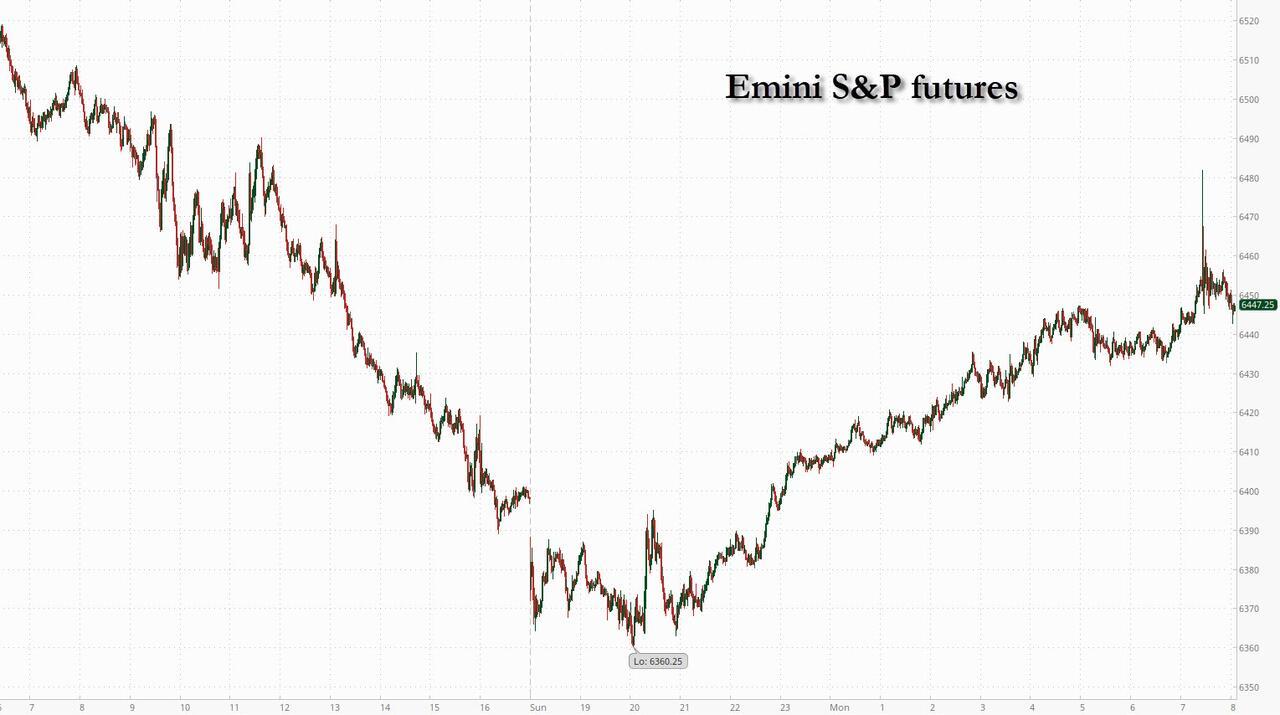
Futures are higher despite continued Iran war escalation which pushed Brent higher by around 2% after Iran-backed Houthi militants in Yemen joining the war on Iran’s said, bouncing from overnight lows which may be driven by positioning, but also by a major shift in the regime with oil now rising instead of falling on higher oil prices as the market pivots to price in not inflation but recession (and look at the spike in gold/bitcoin this morning as the next stimmy starts getting priced in). As of 8:00am ET, S&P futures are at session highs, rising 0.6% after the benchmark slumped to an August low at the end of last week, and reversing an early overnight loss; Nasdaq futures rise 0.7% with all Mag7 names higher premarket, boosting Semis, as Cyclicals (incl Energy) are leading Defensives ex-healthcare. The moves in Energy and healthcare are also breaking recent trends suggesting investors may be shifting portfolios to cash flow heavy names as they consider oil prices remaining elevated for longer. The most notable move overnight is that after weeks of rising, US yields fell across the curve after money markets cut the odds of a Federal Reserve rate hike in 2026 to about 20%, from around 35% on Friday. The rate on two-year Treasuries dropped five basis points to 3.87% while 10Y yields are down 7bps to 4.36% The dollar was little changed. Commodities are stronger as WTI moves above $100/bbl. Gold/precious and bitcoin are all higher despite USD strength, breaking the recent trend, as they start pricing in the looming stimulus to offset the next recession. Today’s US economic data calendar includes the March Dallas Fed manufacturing activity at 10:30am. Ahead this week are consumer confidence, JOLTS job openings, retail sales, ISM manufacturing and – in an abbreviated session on Friday – March jobs report
In premarket trading, Mag 7 stocks are all higher: Meta +1%, Nvidia +0.6%, Microsoft +0.9%, Amazon +0.6%, Tesla +0.8%, Alphabet +0.4%, Apple +0.2%
- Aluminum stocks, including Alcoa (AA), rise after a rally in the metal price following Iran’s attacks on Middle Eastern aluminum facilities. Alcoa (AA) gains 9%.
- Expedia (EXPE) gains 2% and Instacart (CART) rises 1% after Jefferies upgraded both to buy, saying a pullback in internet stocks on concerns about artificial intelligence disruptions has created buying opportunities.
- IQiyi ADRs (IQ) gain 12% after the Chinese streaming platform said it’s planning a listing in Hong Kong and announced a $100 million buyback program.
- Spire Inc. (SR) gains 4% after agreeing to sell its gas marketing business to Boardwalk Pipelines for $215 million in cash.
- Sysco (SYY) falls 4% after the US food distributor agreed to buy privately held Jetro Restaurant Depot LLC for $29.1 billion including debt.
- Viridian Therapeutics (VRDN) tumbles 40% after announcing topline results from a clinical trial in active thyroid eye disease.
WTI crude surged above $100 after the arrival of a US amphibious assault group and the entry of Iran-backed Houthi forces into the conflict heightened fears of escalation as the war entered its second month. Trump told the Financial Times that he wants to “take the oil in Iran” and could seize the export hub of Kharg Island, a move that could trigger significant retaliation from Tehran.
While traders have so far largely focused on the inflationary shock from rising oil prices, sending the Treasury market toward its deepest monthly loss since October 2024, some of Wall Street’s biggest bond-fund managers said yields will slide as the war’s impact on growth becomes more apparent.
“The slight recovery in the bond markets is only temporary,” said Guillermo Hernandez Sampere, head of trading at asset manager MPPM. “The impact on inflation is not yet fully priced in, and potential interest rate hikes would negatively affect the already gloomy economic outlook.”
“While inflation remains a concern, the potential drag on growth and confidence should start to act as an offset, limiting further upside in yields,” said Francisco Simón, European head of strategy at Santander Asset Management. “Together with oil, we think the bond market is currently one of the clearest expressions of how markets are pricing the impact of the conflict on the macro outlook.”
Over the weekend, the Houthis entered the conflict putting additional pressure on supply via a chokepoint in the Red Sea (although they have not yet indicated they will halt the key chokepoint). JPM estimates the impact is ~5mm bpd which could add another $20/bbl to oil prices. Trump states that Iran has agreed to most of the 15-point plan while Iran’s Foreign Minister says that there have been no direction talks, called US demands excessive / illogical, and that Iran did not participate in diplomatic meetings in Pakistan over the weekend. This morning Trump said on TS that there had been “great progress” in talks with Iran, and warned that if a deal with Iran is not “shortly reached,” and the Hormuz Strait is not immediately open, “we will conclude our lovely ‘stay’ in Iran by blowing up and completely obliterating all of their Electric Generating Plants, Oil Wells and Kharg Island.”
With two sessions left, the S&P 500 has tumbled 7.0% this quarter – its worst performance since the rate-hike selloff four years ago. Still, that 2Q 2022 slump was more than twice as severe.
“Some signs of capitulation are starting to emerge,” Goldman Sachs’ Prime Trading desk said in a note on hedge funds’ US exposure. On a trailing six-week basis, US net selling ranked third-largest over the past decade. In a separate note, GS traders noted that heavy short sales by hedge funds and disposals by systematic investors have increased the potential for a sharp swing higher for stocks in the event of a de-escalation in the conflict.
Elsewhere, Morgan Stanley’s Michael Wilson noted that the S&P 500 correction is nearing its final stage even as the Iran war continues — although the risk of Federal Reserve interest-rate hikes still poses a threat. “We think the equity market is less complacent on growth risks than consensus believes,” he said.
Oil may hit a record $200 a barrel if the Iran war drags on until June, with the Strait of Hormuz remaining shut, Macquarie Group Ltd. warned. A conflict that stretches through the second quarter would result in historically high real prices, analysts including Vikas Dwivedi said in a note, outlining a scenario with odds of 40%.
Later on Monday, Fed Chair Jerome Powell will participate later Monday in a moderated discussion at Harvard University, where he may offer clues on how he sees the war affecting the balance of risks to inflation and employment.
European stocks trimmed their advance with the Stoxx 600 now up only 0.2%; utilities and mining shares are leading gains, while travel, leisure and automobile stocks are the biggest laggards. Here are the biggest movers:
- European mining shares are the best-performers on the Stoxx 600 benchmark after weekend strikes by Iran on aluminum plants in the UAE and Bahrain
- Warsaw’s WIG-Energy index rises as much as 6.9% after power utility Tauron proposed its first dividend since 2015, signaling that the industry is prepared to share its 2025 profits with shareholders after a multi-year pause
- Nokia climbs as much as 3% on a Goldman Sachs upgrade to neutral from sell. The broker sees 17% upside thanks to growth opportunities in Optical and IP Networks divisions
- Sodexo rises as much as 4.4% following an upgrade to buy at Jefferies, which says the contract caterer’s upcoming results and CMD provide an opportunity to reset investor expectations, before building momentum
- Mildef gains as much as 13%, the most since February, after a Dagens Industri column identifies upside factors for the Swedish military equipment maker following share declines
- Boohoo Group shares gain as much as 6.7% after the online fashion retailer said it comfortably beat its earnings guidance in FY26 and said it aims to grow them by a double-digit percentage in FY27
- Alleima shares decline as much as 6.1%, the most since January, as Danske Bank reiterated its sell rating on the Swedish specialty metals firm
- Electrolux shares fall as much as 7.3%, the most since mid-February, after Bank of America cut its recommendation on the Swedish home appliances firm to underperform from buy
- Kinnevik falls as much as 5.4%, the most since March 9, after SEB cut its recommendation on the Swedish investment group to hold from buy and nearly halved its price target
- Hexatronic slumps as much as 11%, the most since July 2025, after SEB Equities cut its rating on the Swedish fiber optic cable manufacturer to hold from buy
- SUSS MicroTec shares pare losses after dropping as much as 19%, the most in five months, following disappointing margin guidance from the German chip equipment company, according to analysts
Earlier, Asian stocks tumbled as investors turned skittish after weekend missile strikes and an expanded US military presence stoked fears of a wider Middle East conflict. The MSCI Asia Pacific Index dropped as much as 2.9%, heading for a third day of declines, as Japan and South Korea led regional losses. Chipmakers TSMC, Samsung Electronics and SK Hynix weighed among the most on the benchmark. Investor mood was dampened after Iran-backed Houthi militants fired missiles at Israel over the weekend. Iran has rejected the US 15-point proposal and disputed Trump’s claims about negotiations, insisting on war reparations in its own five-point plan. China remained a relative haven with the CSI 300 Index closing down 0.2%, while the Shanghai Composite Index ended the day in positive territory.
“I think China A-shares could get more strategic preference compared to rest markets given its increasing stability and resilience in economic policy,” Anna Wu, a cross-asset strategist at VanEck Associates Corp. in Sydney said. “China has successfully built itself as the world’s largest renewable energy factory.”
In FX, the Bloomberg Dollar Spot Index edges higher. The yen is the clear G-10 outperformer, rising 0.4% against the greenback after more jawboning from Japanese authorities. The kiwi is the weakest. Precious metals rise with spot silver up 1.5%. Bitcoin adds 1%.
In rates, treasury futures are near session highs in early US session, tracking stocks closely, with yields lower by as much as 7bp in belly of the curve, as investors weigh the inflationary effects of the war in the Middle East against a their potential to cause an economic slowdown. Yields fall even as oil prices continue to rise as US and Israeli forces press ahead with attacks on Iran. US yields are 3bp to 6bp richer across the curve with belly-led gains steepening 5s30s spread by around 3bp on the day. 10-year near 4.37% outperforms German and UK counterparts. Focal points of US session include comments by Fed Chair Powell at Harvard University. European government bonds surrendered earlier upside with UK and German two-year yields now slightly higher on the day. The turnaround came as traders went from reducing bets on interest-rate hikes by the Bank of England and European Central Bank this year to adding to them. Traders may have been reacting to data that showed euro-area inflation expectations surged in March.
In commodities, brent crude futures are up around 2.7% near $115.60 a barrel while European natural gas futures also rise 2%.
Today’s US economic data calendar includes March Dallas Fed manufacturing activity at 10:30am. Ahead this week are consumer confidence, JOLTS job openings, retail sales, ISM manufacturing and — in an abbreviated session on Friday — March jobs report. Fed speaker slate includes Powell in a moderated discussion at Harvard (no text release, Q&A expected) at 10:30am and New York Fed President Williams (4pm)
Market Snapshot
- S&P 500 mini +0.6%,
- Nasdaq 100 mini +0.6%,
- Russell 2000 mini +0.6%
- Stoxx Europe 600 +0.3%,
- DAX little changed,
- CAC 40 +0.2%
- 10-year Treasury yield -7 basis points at 4.37%
- VIX -0.2 points at 30.84
- Bloomberg Dollar Index +0.1% at 1220.43, euro -0.1% at $1.1492
- WTI crude +1.9% at $101.56/barrel
Top Overnight News
- The Pentagon is preparing for weeks of ground operations in Iran, though potential raids would stop short of an invasion. Trump is weighing an operation to extract about 1,000 pounds of uranium from Iran. WaPo, BBG
- President Donald Trump said that Iran “gave” the US most of the 15 demands it issued to Tehran to end the war, even as it remains unclear whether either side is negotiating. Publicly, Iran has rejected the US’s 15-point list of ceasefire terms delivered by the Trump administration via intermediaries in Pakistan, and has countered with five conditions of its own — including maintaining sovereignty over the Strait of Hormuz. BBG
- Oil climbed, with Brent heading for a record monthly gain, as renewed Middle East strikes and a buildup of US troops heightened concerns. The Iran-backed Houthis launched ballistic missiles at Israel over the weekend. Donald Trump said he’s ready to make a deal with Tehran, but he also told the FT he wants to “take the oil” in Iran. Iran’s control of Hormuz is increasing — 80% of tankers exiting the strait have Tehran’s nod. BBG
- Aluminum jumped as Iran’s weekend strikes on smelters in Abu Dhabi and Bahrain threatened a supply crisis. And the energy industry is warning that the biggest supply shock in history is only just beginning. BBG
- US Treasury is to meet with domestic and international insurance regulators in coming weeks to discuss recent developments in private credit markets.
- The yen and the rupee rose on Monday as Japan stepped up its verbal intervention and India forced banks to unwind positions in the foreign exchange markets. The yen strengthened by 0.4 per cent against the US dollar to trade close to ¥159.7. The rupee jumped at the open, climbing more than 1.4 per cent, but gave up almost all of its gains to trade around 94.6 to the dollar. FT
- One BOJ member hinted at the possibility of having to respond to the Mideast war with a bigger rate hike than those recently undertaken, according to a summary of the March 18-19 meeting. BBG
- India’s curbs on FX speculation gave the rupee a brief boost before gains faded. BBG
- Investors who specialize in scooping up distressed assets at bargain prices have identified a downturn in private credit as their best opportunity since the 2008 financial crisis. These funds, which typically invest in companies with bad balance sheets but viable underlying businesses, have been largely sidelined for a decade as markets surged but are now betting on making money from strains in private credit. FT
- The Senate Banking Committee is planning to hold its hearing on the nomination of Kevin Warsh as chair of the Federal Reserve as soon as the week of April 13. Political resistance has held up Warsh’s nomination in the Senate, with Fed Chair Jerome Powell remaining in place even as President Donald Trump presses for a successor willing to cut interest rates faster. RTRS
- Some signs of capitulation re starting to emerge in Goldman’s PB data. Last week HFs net sold US equities for a 6th straight week and at the fastest pace since Apr ‘25 (-1.6 SDs 1-year), driven by short-and-long sales in Single Stocks and to a lesser extent short sales in Macro Products. On a trailing 6-week basis, the recent US net selling by hedge funds is the 3rd largest over the past decade and starting to approach the levels seen in Apr-May ’20 during Covid and (to a lesser extent) into Liberation Day. GSPB
A more detailed look at global markets courtesy of Newsquawk
APAC stocks were pressured following the geopolitical escalation over the weekend, in which Yemeni Houthis launched missiles towards Israel to enter the conflict for the first time, while the US and Israel also conducted strikes on Iran’s largest steel plants and some energy-related facilities. Furthermore, there were some mixed comments from US President Trump, who said the US could take oil in Iran and could take Kharg Island ‘very easily’, but also stated that they had good negotiations with Iran and claimed Iran responded to the 15-point plan and gave them most points, without providing further details. ASX 200 declined with the downside led by underperformance in tech and financials, although losses were somewhat cushioned by resilience in the energy, defensives and commodity-related sectors. Nikkei 225 suffered with intraday losses of more than 2000 points amid pressure from higher oil prices and jawboning by Japanese officials, while the Summary of Opinions continued to show a hawkish bias, and money markets are currently pricing in a near coin flip between a hike and a hold at the next BoJ meeting in April. Hang Seng and Shanghai Comp were mixed as participants digested a deluge of earnings, including from ICBC, China Construction Bank, BoCom, PetroChina and BYD, while it was also reported late last week that China began probes on US trade practices in retaliation for the US Section 301 investigations.a
Top Asian News
- Japan’s top FX diplomat Mimura said bold action may be needed if the situation in the Middle East continues, adds hearing that speculative activity is increasing and targeting all fronts in market for action.
- Japanese Government spokesperson says closely watching market moves with a extremely high sense of urgency. Currently seeing large volatility in financial markets.
- S&P affirms Japan at “A+/A-1”; outlook stable.
European bourses (STOXX 600 +0.3%) are mixed, rebounding from losses seen pre-cash open. The FTSE 100 outperforms, helped by gains in miners as aluminium surged following attacks on producing plants in the Middle East. On the other hand, the DAX 40 remains the laggard. Complex is off best levels after the Iranian Foreign Ministry denied direct negotiations with the US, which slightly hit sentiment. European sectors are mixed. Basic Resources and Utilities top the sector pile, while Travel and Leisure and Banks underperform.
Top European News
- German North Rhine Westphalia CPI MoM (Mar) M/M 1.2% (Prev. 0.2%).
- German North Rhine Westphalia CPI YoY (Mar) Y/Y 2.7% (Prev. 1.8%).
- EU Consumer Inflation Expectations (Mar) 43.4 (Prev. 25.8)
- EU Consumer Confidence Final (Mar) -16.3 vs. Exp. -16.3 (Prev. -12.2)
FX
- DXY is currently trading within a 100.05-100.34 range, with very mild gains, as the geopolitical situation continues to keep the Dollar stronger. Near-term upside could see the index retest the Monday 16 high at 100.48. The geopolitical situation remains tense, with the weekend events seemingly showing no signs of near-term peace. The Iran-backed Houthis entered the war for the first time, whilst President Trump suggested that the US could take Kharg Island “very easily”. Most recently, an Iranian Foreign Ministry spokesperson says Iran has not had any direct negotiations with America, adding that they did not partake in Pakistan-led meetings. Now attention turns to Fed Chair Powell later.
- Given the USD strength, G10s are weaker across the board (ex-JPY). The Antipodeans lag, given the risk-tone and after the PBoC set a weaker yuan fix. The EUR slipped below the 1.1500 soon after the European cash open, and was ultimately little moved to the release of several German State CPI metrics, whereby key areas such as Bavaria and North Rhine Westphalia rose more than what is expected for the Nationwide figure, due at 13:00 BST. As it stands, EUR/USD holds towards the lower end of a 1.1487-1.1521 range.
- JPY remains the only currency firmer against the USD this morning. Initially USD/JPY broke above the 160.00 mark (peak 160.46), before reversing back below the mark following hawkish BoJ SOO and continued verbal intervention from Japanese officials. One suggested that they are watching market moves with an “extremely high sense of urgency”.
Central Banks
- BoJ Governor Ueda said BoJ will guide policy appropriately by scrutinising how FX moves could affect the likelihood of achieving growth and price forecasts as well as risks. FX is a factor that makes big impacts on the economy and prices, adds will be closely monitoring the FX market.
- BoJ Summary of Opinions from March meeting stated that a member said it is appropriate to continue raising interest rates if the economic and price forecasts materialise. Conditions remain accommodative even after rate hikes. Member said the BoJ can keep rates steady for now due to Middle East uncertainty. Need to monitor Middle East developments and wages for rate decisions. Member said future rate hike timing depends on Middle East impact, as well as wages, inflation and financial conditions.
- BoJ said that if recent price rises in food prices were to persist, they could exert a sustained upward impact on overall consumer prices. Increases in energy can affect underlying inflation in both directions. Need to pay attention to the possibility that upward price pressures from rising crude may have strengthened as firms become more proactive in hiking prices and wages. Given changes in firms’ price-setting behaviour, prices may now be more susceptible to JPY depreciation.
- ECB’s Stournaras said a longer conflict could mean that the baseline no longer holds.
- ECB’s Lane said there will be no paralysis on potential rate moves, nor any kind of pre-emption; said this is not a like-for-like situation to 2022.
- ECB’s Villeroy said ECB is ready to act, but too early to discuss dates for possible rate hikes. Some over-interpretation on markets recently. Sees no risk of banking crisis in Europe.
Fixed Income
- Despite crude still being firmer, fixed income has managed to benefit from crude easing off best levels, with both energy and debt benchmarks in the green, departing from the recent inverse correlation. Worth noting that a recent denial of US-Iran talks via the Iranian Foreign Ministry, has led to some mild pressure in the fixed income complex.
- USTs gains. Hit a 110-04 trough, lower by two ticks at worst. Since, USTs have rebounded to a 110-17+ peak. Ahead, the docket is headlined by Fed Chair Powell, who is scheduled to speak at Harvard University. Commentary that will be scrutinised for which side of the dual-mandate the Fed is currently most concerned about, and any hints as to whether action should be expected in the near-term.
- Bunds hit a 124.48 low early doors, matching Friday’s close. Since, the benchmark has been gradually but notably making its way higher, to a 124.88 peak with gains of 40 ticks at best. Though, a short-lived bout of pressure was seen as German State CPIs lifted from the prior, as indicated by mainland consensus; figures due at 13:00BST. More recently, no move to a jump in consumer and selling price expectations.
- As is typically the case, Gilts are directionally following peers, but magnitudes are slightly larger. To an 87.60 peak with gains of nearly 50 ticks at best. Specifics for the UK light, awaiting to see what action the government and/or BoE may take to deal with the energy shock.
Commodities
- WTI and Brent are stronger this morning. Over the weekend, the Houthis launched their first attacks on Israel since the war began, marking an expansion in the war, while strikes were reported across the region over the weekend. Trump said talks with Iran were progressing, though he also floated seizing Kharg Island, according to the FT.
- Most recently, an Iranian Foreign Ministry spokesperson says Iran has not had any direct negotiations with America, adding that they did not partake in Pakistan-led meetings. This spurred some modest strength in crude benchmarks at the time. Brent Jun’26 currently towards the upper end of a USD 106.33-109.46/bbl range.
- Spot gold prices are firmer despite a resilient dollar, possibly with some haven appeal returning to the yellow metal and as no signs of an imminent wind down can be seen. Spot gold trades in a USD 4,420-4,550/oz range at the time of writing vs Friday’s USD 4,555/oz peak.
- Elsewhere in metals, aluminium rose after Iran struck two production sites in the Middle East, with LME aluminium outpacing peers. Peers, however, are lifted in tandem despite the resilient USD and cautious sentiment across markets. 3M LME copper resides in a USD 12,019.00- 12,259.88/t range at the time of writing.
- EU Energy Ministers are to discuss on Tuesday, the coordination of the EU response on energy to the Middle East situation; said energy supply remains relatively protected at this stage. EU needs to take measures to address high energy prices, whilst maintaining functioning of EU electricity market. EU faces no immediate supply shortages, but tightening in diesel and jet fuel market.
- A Russian tanker carrying a humanitarian shipment of 100k tonnes of crude oil has arrived in Cuba, IFX reported.
- Two China-linked ships, owned by Cosco Shipping (601919 CN), appear to attempt to cross the Strait of Hormuz.
- SocGen sees a growing likelihood of Brent topping USD 150/bbl amid the Iran war; said Brent may average USD 125/bbl in April amid the Middle East situation.
Geopolitics
- Iranian Foreign Ministry spokesperson says Iran has not had any direct negotiations with America. “What has been discussed are the messages we received through intermediaries that the US wants to negotiate.”, Tasnim reports. The materials that were conveyed to us were excessive and unreasonable requests. The meetings held by Pakistan are a framework that they established and we did not participate.
- US President Trump said the US could take oil in Iran and could take Kharg Island ‘very easily’, according to FT. Trump also stated that indirect talks with emissaries are progressing well and a deal could be made fairly quickly.
- US President Trump said there were good negotiations with Iran on Sunday, and the US destroyed many targets that day, while they are negotiating directly and indirectly with Iran. Trump said regarding Hormuz that Iran gave them 20 boats of oil to pass through, and he thinks they will make a deal pretty soon, but also said it’s possible that they won’t. Trump said Iran responded to the 15-point plan and agreed to most points but provided no further details when asked if Iran had responded. He also claimed that Middle East countries are fighting back against Iran.
- US President Trump reportedly weighs a military operation to extract Iran’s uranium, although the President hasn’t made a decision on the operation, according to US officials cited by WSJ.
- US President Trump claimed Middle East countries are fighting back against Iran.
- Yemen’s Houthis fired missiles at Israel on Saturday morning, marking the first time it has been involved in the war. Houthis said they will continue operations until strikes on Iran and its proxy military groups, such as Hezbollah, stop.
- Iranian Parliament’s National Security member Borujerdi said the time has come for Iran to withdraw from the Nuclear Non-Proliferation Treaty and the permanent monitoring of the Strait of Hormuz, IRNA reported. According to the plan prepared by the Islamic Council and will be approved as soon as possible, a new system will rule the Strait of Hormuz and traffic will not be possible without the permission of the Islamic Republic of Iran.
- Iran’s acting Defence Minister told the Turkish counterpart that Tehran will continue to punish aggressors, create deterrence and ensure war will not repeat itself, via IRNA.
- In meetings between the commander of the US Central Command in Israel, with the Chief of Staff and senior IDF officials, “the path forward was planned and outlined – for the continuation of the operation.”, i24News sources say. “According to the source, the visit was “successful, and the successes so far in the war were also summarized.”.
- Tehran has agreed to UN’s request for safe passage of ships carrying humanitarian aid through Strait of Hormuz, according to IRNA.
- The start of firing a new wave of Iranian missiles towards Israel; reported of missiles from Lebanon to Israel also reported.
- Local accounts report at least 20 explosions near the oil refinery and petrochemical complex in Abadan, Iran.
- Iranian petrochemical facility was targeted in northwestern Tabriz, Iran according to state media. The fire in Iran’s Tabris Petrochem was extinguished.
- Iraq’s Defence Ministry said the Mohamad Alaa air base was attacked by a rocket. An aircraft was destroyed but no injuries reported; Iraq said “We will not hesitate to pursue anyone who dares to harm Iraq’s security and sovereignty”.
- Iranian attack on one service building in a power and water desalination plant in Kuwait caused serious damage.
- Media sources report simultaneous explosions and attacks on American positions in several countries, including Bahrain, Saudi Arabia, UAE, Kuwait, and Iraq, according to ISNA.
- Successive explosions in American facilities in Kuwait, SNN reported. “According to some sources, the explosions in Kuwait were so formidable and powerful that their sound was clearly heard in the border areas of Iraq.”.
- Explosions and plumes of smoke rising at the American Victory Base in Iraq’s capital of Baghdad.
- Ukrainian President Zelensky says Ukraine is ready for a potential Easter ceasefire with Russia, believes there is no deadlock in talks and that Ukraine has received signals from allies on scaling back strikes on Russia’s oil sector.
- US President Trump said Cuba is going to be next and within a short period of time, Cuba is going to fail.
- Chinese President Xi invites Taiwan opposition leader for first visit to the mainland in a decade.
US Event Calendar
- 10:30 am: United States Mar Dallas Fed Manf. Activity, est. 1.5, prior 0.2
- 10:30 am: United States Fed’s Powell in Moderated Discussion
- 4:00 pm: United States Fed’s Williams Speaks on the Economy
DB’s Jim Reid concludes the overnight wrap
Oil prices have continued to climb as we start a new week, with Brent crude up another +2.47% this morning to $115.35/bbl. Several factors have contributed, but the Iran-backed Houthi militants joined the conflict over the weekend, launching strikes at Israel and raising fears about a new front in the war. Moreover, the Wall Street Journal have also reported this morning that Trump is weighing a military operation to extract Iran’s uranium. And in an FT interview that’s also been released, Trump openly suggested the US could take the Kharg Island export hub. So there’s still no sign of a clear end to the conflict, and given the various headlines, investors remain fearful about a fresh escalation.
With everything that’s happened, the market impact is becoming increasingly serious. Indeed, the S&P 500 is now down for 5 consecutive weeks for the first time since 2022, back when the global economy was facing a similar stagflationary shock. Moreover, the NASDAQ fell over -3% last week, marking its worst weekly performance since the Liberation Day announcements last year. And this morning, Asian equity markets are also seeing sharp declines for the most part, with the Nikkei (-3.31%), the KOSPI (-2.88%), the Hang Seng (-0.90%) and the CSI 300 (-0.15%) all losing ground as investors price in a more protracted conflict.
Those fears about a longer conflict are evident from the energy futures curve. For instance, 3-month Brent crude futures are up another +1.79% this morning to $100.50/bbl, which would be their highest closing level since the conflict began. So it’s becoming clear that markets are expecting an extended period of high oil prices, with stagflationary implications for the global economy. Interestingly though, the primary concern this morning has shifted back to the growth side rather than inflation. So markets are pricing out the likelihood of imminent hikes and sovereign bond yields have fallen. In fact, overnight index swaps for the next ECB meeting in April currently see a 47% chance of a hike, which is the first time in over a week that’s been below 50%, whilst US 10yr Treasury yields (-4.0bps) are back at 4.39% overnight, coming down from their 8-month high on Friday. Meanwhile for equities, US futures are stable this morning, with those on the S&P 500 unchanged, but they’re more negative in Europe, with DAX futures down -0.65%.
The latest moves come as there’s no obvious sign of a peace deal being reached. Admittedly, there have been ongoing efforts at mediation from other countries, with Iran’s President Pezeshkian speaking with Pakistan’s PM Sharif on Saturday morning. That was then followed by comments from Pakistan’s foreign minister yesterday, who said “Pakistan is very happy that both Iran and the US have expressed their confidence in Pakistan to facilitate the talks.” According to Trump yesterday, he said they were “doing extremely well in that negotiation”. But Trump also said in the FT interview that his “preference would be to take the oil”, so that pointed towards an escalation. And in a separate Washington Post report over the weekend, it said the Pentagon was preparing for weeks of ground operations in Iran. That article suggested it wouldn’t be a full-scale invasion, but could involve raids by a mixture of Special Operations forces and conventional infantry. So for markets, there’s still a huge amount of uncertainty as to what happens next.
Away from the Middle East, we’ve also seen the Japanese yen strengthen overnight, moving up +0.34% against the US Dollar to 159.76. That comes after Japan’s top currency official, Atsushi Mimura, said that they were hearing about speculative activity picking up in FX markets, and that if it continued, “we believe decisive action may soon be necessary.” In addition, the Bank of Japan’s Summary of Opinions from their recent meeting had hawkish elements. For example, there was even a comment they should “pay attention to whether it is necessary to accelerate the pace of policy interest rate hikes beyond previous projections and shift toward neutral or restrictive financial conditions, if tension over the situation in the Middle East were to become prolonged.”
Looking at the week ahead, we should start to learn about the economic consequences of the conflict, as several data releases for March are out which cover the period since the strikes began on February 28. In the US, that includes the monthly jobs report on Friday, where our US economists expect nonfarm payrolls to have risen by +50k in March. As a reminder, US payrolls have been pretty choppy in recent months, and on the current series of revisions they’ve been oscillating between positive and negative readings for every month since May. Last month they were down -92k, but as our economists point out, some of that weakness was a function of a strike at a major healthcare company that’s since ended, along with severe weather that may have temporarily depressed February’s payrolls. So they’re expecting a positive payrolls print for March, although they think the unemployment rate will round up to 4.5% given how close it was last month (4.44%).
Otherwise in the US, the focus will be on whether higher oil prices have started to impact business sentiment and inflation in a meaningful way. So the ISM manufacturing will be in the spotlight, including the prices paid component for whether the inflationary impact has started to filter through. Before that, we’ll also get the Conference Board’s consumer confidence reading tomorrow.
Speaking of inflation, the main highlight in Europe will be tomorrow’s flash CPI print for the Euro Area, which is an important one as the ECB work out what to do. To be fair, the flash print from Spain last Friday was weaker than expected, at +3.3% (vs. +3.8% expected), so that’s slightly eased fears about a very strong print tomorrow. Nevertheless, even with the Spanish number, our European economists are still tracking the Euro Area CPI print at +2.53% year-on-year, up from +1.89% in February. See their weekly preview for more here.
Elsewhere this week, there isn’t too much on the calendar of events as we move towards Easter. Indeed, markets will be closed in several countries at the end of the week for Good Friday. However, we will hear from a few central bankers, including Fed Chair Powell later today, who’s speaking in a discussion at Harvard University.
Finally, to recap last week in more depth, markets fluctuated back and forth amidst varying headlines on the Middle East. Initially there was huge optimism, driven by Trump’s statement last Monday that he’d be postponing military strikes against Iran’s power plants and energy infrastructure for 5 days. So that caused Brent crude oil to fall -10.92% on Monday, closing back at $99.94/bbl. But as the week went on, fears mounted again about a protracted conflict, leaving Brent crude back up at $112.57/bbl, its highest close since July 2022 and narrowly up +0.34% on the week.
With no sign of oil prices falling back, equities took another hit last week for the most part, with the S&P 500 down -2.12% to a 7-month low. That marked its 5th consecutive weekly decline, as well as its biggest weekly loss since October. And the VIX index closed at 31.05pts, its highest since the Liberation Day turmoil last April. Matters weren’t helped by some weaker-than-expected data around the world, with the March flash PMIs generally coming in softer than expected. So the Euro Area composite PMI was down to a 10-month low of 50.5, and the US composite PMI hit an 11-month low of 51.4. Moreover, they also pointed to growing price pressures, which helped push yields on 10yr Treasuries up +4.8bps last week to 4.43%, whilst 10yr bund yields rose +5.1bps to a post-2011 high of 3.09%. That said, central bank pricing did turn marginally more dovish over the week as a whole. So for the Fed, a rate hike by the December meeting was down to a 24% probability, having been at 29% the week before. And for the ECB, a rate hike at the next meeting in April came down from an 80% probability to 52%.
For equities, tech stocks struggled in particular, with the NASDAQ down -3.23% last week, marking its worst week since Liberation Day last year. Indeed, software stocks were a big driver, with that component of the S&P 500 down -7.00% last week as concerns about AI disruption resurfaced. Private credit fears also returned, particularly after Ares Management and Apollo both announced they were limiting withdrawals, which hit the shares of some of the companies in the space. To be fair, the European equity performance wasn’t so bad last week, with the STOXX 600 up +0.35%. But in credit the performance was more negative again, with US HY (+19bps) and Euro HY (+9bps) spreads both widening, whilst US IG (+2bps) and Euro IG (+4bps) spreads also rose.
1b European opening report
1 c) Asian opening report
Houthis attack, Trump threatens Kharg, markets react on lack of de-escalation – Newsquawk EU Market Open

Monday, Mar 30, 2026 – 02:12 AM
- Yemen’s Houthis fired missiles at Israel on Saturday morning, marking the first time it has been involved in the war; Israeli PM Netanyahu ordered the military to expand its invasion of southern Lebanon.
- US President Trump said the US could take oil in Iran and could take Kharg Island ‘very easily’, according to the FT. Trump also stated that indirect talks with emissaries are progressing well and a deal could be made fairly quickly.
- US President Trump said there were good negotiations with Iran on Sunday, and the US destroyed many targets that day, while they are negotiating directly and indirectly with Iran.
- Trump responded that Iran came back to them on the 15-point plan and gave them most points, but didn’t give any further details. Trump also claimed that Middle East countries are fighting back against Iran.
- APAC stocks were pressured following the geopolitical escalation over the weekend; Euro Stoxx 50 futures are down 0.6% after the cash market closed with losses of 1.1% on Friday.
- Looking ahead, highlights include Spanish Retail Sales (Feb), EU Consumer Inflation Expectations (Mar), German Inflation Prelim. (Mar), US Dallas Fed Manufacturing Index (Mar), Comments from Fed’s Williams.
- UK clocks switched from GMT to BST on Sunday, and the NY-London differential returned to its usual 5 hours.
SNAPSHOT
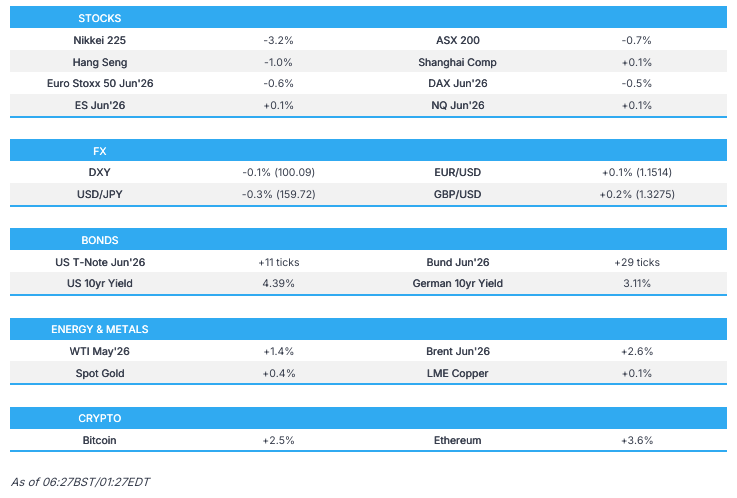
Newsquawk in 3 steps:
1. Subscribe to the free premarket movers reports
2. Listen to this report in the market open podcast (available on Apple and Spotify)
3. Trial Newsquawk’s premium real-time audio news squawk box for 7 days
IRAN CONFLICT
- Yemen’s Houthis fired missiles at Israel on Saturday morning, marking the first time it has been involved in the war. Houthis said they will continue operations until strikes on Iran and its proxy military groups, such as Hezbollah, stop.
- US President Trump said the US could take oil in Iran and could take Kharg Island ‘very easily’, according to FT. Trump also stated that indirect talks with emissaries are progressing well and a deal could be made fairly quickly.
- US President Trump said there were good negotiations with Iran on Sunday, and the US destroyed many targets that day, while they are negotiating directly and indirectly with Iran. Trump said regarding Hormuz that Iran gave them 20 boats of oil to pass through, and he thinks they will make a deal pretty soon, but also said it’s possible that they won’t. Trump said Iran responded to the 15-point plan and agreed to most points but provided no further details when asked if Iran had responded. He also claimed that Middle East countries are fighting back against Iran.
- US President Trump said the Iranians desperately want to reach an agreement and are begging for it.
- US President Trump weighs a military operation to extract Iran’s uranium, although he hasn’t made a decision, according to US officials cited by WSJ.
- US President Trump posts “Big day in Iran. Many long sought after targets have been taken out and destroyed by our GREAT MILITARY, the finest and most lethal in the World. God bless you all!”
- White House was reported on Friday to be privately informing allies that it will take time for the US to reach a diplomatic deal with Iran, according to CBS citing sources.
- US Secretary of State Rubio said on Friday that they had a really good meeting at G7 and expect the Iran operation to conclude at the appropriate time, while he added they are talking weeks, not months, and that Iran may decide to set up a tolling system on the Strait of Hormuz.
- Israeli PM Netanyahu ordered the military to expand its invasion of southern Lebanon.
- Local accounts reported at least 20 explosions near the oil refinery and petrochemical complex in Abadan, Iran.
- Israel conducted strikes on Iran’s largest steel plants simultaneously on Saturday, while Iran issued evacuation orders for six of the largest steel plants in neighbouring Gulf countries as well as Israel as it prepared to retaliate. It was separately reported that Aluminium Bahrain said its facilities were targeted by Iran on Sunday.
- Israeli military announced on Monday it was attacking the infrastructure of Iran’s regime throughout Tehran.
- Iran’s Revolutionary Guards warned that they will target two Israeli or US universities in the region in retaliation for an attack on Iran University of Science and Technology in Tehran.
- Iranian Foreign Minister Araghchi said on Friday that Israel hit two steel factories, a power plant and a civilian nuclear site in coordination with the US, while he added that this contradicts US President Trump’s extended deadline for diplomacy and Iran will exact a heavy price for Israeli crimes.
- Iranian Parliamentary Speaker Ghalibaf said Iranian armed forces are waiting for US soldiers, as a further 3,500 US troops arrived in the Middle East, while he said they are to punish the US’s regional partners.
- Iran’s Parliament Speaker Ghalibaf was reported on Friday to have emerged as a key figure in President Trump’s push for peace talks with Tehran and has shown a willingness to engage, according to Axios. Furthermore, a senior Iranian official and an Israeli official told Axios that Steve Witkoff and Jared Kushner had been communicating with Ghalibaf, although a senior regime figure denied this.
- Power outages were reported on Sunday in several parts of Iran, including in Tehran and the northern city of Alborz, following US-Israeli attacks on electricity infrastructure. However, it was later reported that blackouts in Tehran were resolved.
- Iranian petrochemical facility was targeted by a US-Israeli strike in northwestern Tabriz, Iran, causing a fire that was later extinguished.
- Heavy explosions were reported in Jordan and in a US base in Syria, while explosions were reported at the American Victory Base in Iraq’s capital of Baghdad. Media sources also reported simultaneous explosions and attacks on American positions in several countries, including Bahrain, Saudi Arabia, the UAE, and Kuwait, according to ISNA.
- Iranian attack on a service building in a power and water desalination plant in Kuwait caused serious damage.
- Iranian missile strike damaged several US refuelling aircraft at the Prince Sultan Airbase in Saudi Arabia on Friday, which injured 12 US soldiers, with two seriously injured.
- IAEA confirmed Iran’s Khondab heavy water production plant “sustained severe damage and is no longer operational”, which is part of the Arak nuclear complex, but noted that the installation contains no declared nuclear material, while Israel confirmed it bombed the Khondab reactor on Friday.
- Maersk said on Saturday that it expects its operations at the Port of Salalah in Oman to be halted temporarily for 48 hours after drone attacks resulted in terminal crane damage and minor injuries to a port worker.
- Pakistan’s Foreign Minister said Iran agreed to permit an additional 20 Pakistani-flagged ships to travel through the Strait of Hormuz. It was also reported that foreign ministers from Pakistan, Saudi Arabia, Egypt and Turkey expressed support for US-Iran peace talks.
- Polish PM Tusk warned that a new escalation in the Middle East is possible in the coming days.
- Iran war is reportedly choking off helium supplies in a threat to chipmakers and healthcare, according to FT.
- Tehran reportedly agreed to the UN’s request for safe passage of ships carrying humanitarian aid through the Strait of Hormuz, according to IRNA.
US TRADE
EQUITIES
- US stocks declined on Friday as oil prices surged heading into a weekend of risk. WTI reclaimed USD 100/bbl post-settlement while E-mini futures briefly fell to sub 6,400. The moves came despite Trump’s olive branch on Thursday evening, where he postponed the attacks on Iran’s energy infrastructure and power plants by another 10 days, taking the new deadline to April 6th. However, the initial optimism faded as the market became increasingly aware that the Iranians do not share the same level of optimism as the US President, and the real issue for markets is the Strait of Hormuz, which has had very little progress regarding a reopening. Meanwhile, Israel attacked a steel, nuclear and power facility, which Iran has said was in coalition with the US and therefore violates Trump’s recent promise. This prompted Iran to suggest it will be delaying the response to Trump’s 15-point peace plan, keeping uncertainty high. Regarding a ground invasion, reports also suggested that Trump is leaning against this decision, but could change his mind.
- SPX -1.7% at 6,369, NDX -1.9% at 23,133, DJIA -1.7% at 45,167, RUT -1.8% at 2,450.
- Click here for a detailed summary.
TARIFFS/TRADE
- South Korea’s Finance Minister said they are considering the energy sector as a possible first project under the planned USD 350bln US-bound investment framework.
NOTABLE HEADLINES
- US Treasury is to meet with domestic and international insurance regulators in the coming weeks to discuss recent developments in private credit markets.
APAC TRADE
EQUITIES
- APAC stocks were pressured following the geopolitical escalation over the weekend, in which Yemeni Houthis launched missiles towards Israel to enter the conflict for the first time, while the US and Israel also conducted strikes on Iran’s largest steel plants and some energy-related facilities. Furthermore, there were some mixed comments from US President Trump, who said the US could take oil in Iran and could take Kharg Island ‘very easily’, but also stated that they had good negotiations with Iran and claimed Iran responded to the 15-point plan and gave them most points, without providing further details.
- ASX 200 declined with the downside led by underperformance in tech and financials, although losses were somewhat cushioned by resilience in the energy, defensives and commodity-related sectors.
- Nikkei 225 suffered with intraday losses of more than 2000 points amid pressure from higher oil prices and jawboning by Japanese officials, while the Summary of Opinions continued to show a hawkish bias, and money markets are currently pricing in a near coin flip between a hike and a hold at the next BoJ meeting in April.
- Hang Seng and Shanghai Comp were mixed as participants digested a deluge of earnings, including from ICBC, China Construction Bank, BoCom, PetroChina and BYD, while it was also reported late last week that China began probes on US trade practices in retaliation for the US Section 301 investigations.
- US equity futures were pressured at the open amid the geopolitical escalation, but have since nursed the initial losses and returned to flat territory amid ongoing uncertainty and following Trump’s mixed rhetoric.
- European equity futures indicate a lower cash market open with Euro Stoxx 50 futures down 0.6% after the cash market closed with losses of 1.1% on Friday.
FX
- DXY lacked firm direction amid rangebound trade across most of the FX space, and with the greenback’s major counterparts ultimately mixed, while weekend newsflow was dominated by geopolitical-related headlines.
- EUR/USD traded indecisively but had recovered from an early dip beneath the 1.1500 handle to return to relatively flat territory, with very little in the way of pertinent FX-related drivers from the bloc, while ECB’s Villeroy said the ECB is ready to act, but it is too early to discuss dates for possible rate hikes.
- GBP/USD marginally rebounded from last week’s trough at sub-1.3300 territory amid quiet UK-specific newsflow and with the improvement in UK Lloyds business barometer failing to spur any reaction.
- USD/JPY trickled lower following comments from officials including Japan’s top FX diplomat Mimura who said bold action may be needed if the situation in the Middle East continues and that they are targeting all fronts in the market for action, while BoJ Governor Ueda said they will guide policy appropriately by scrutinising how FX moves could affect the likelihood of achieving growth and price forecasts as well as risks. Furthermore, the Summary of Opinions from the March meeting revealed the central bank debated the need for more rate hikes at the March meeting, and some members signalled the need to accelerate rate increases.
- Antipodeans were subdued amid the downbeat risk appetite and after the PBoC set a weaker yuan fix.
- PBoC set USD/CNY mid-point at 6.9223 vs exp. 6.9205 (Prev. 6.9141)
FIXED INCOME
- 10yr UST futures edged higher despite the upside in oil prices, with participants digesting the recent geopolitical escalation and mixed messages from US President Trump.
- Bund futures found some reprieve after recent selling, but with a further rebound capped by higher oil prices.
- 10yr JGB futures bounced back from contract lows and returned to the 130.00 level, while prices were unfazed by the hawkish tones in the BoJ Summary of Opinions, which noted the BoJ debated the need for more rate hikes at the March meeting and that some members signalled the need to accelerate rate hikes.
COMMODITIES
- Crude futures were boosted at the open in which WTI and Brent crude futures briefly climbed above USD 103/bbl and USD 116/bbl, respectively, following the escalation in the Middle East conflict over the weekend, as Yemeni Houthis joined the conflict for the first time by launching missiles towards Israel, igniting concerns the current oil and shipping-related disruption could widen to the Bab al-Mandab Strait. Furthermore, there were mixed comments from US President Trump, who said in an interview that the US could take oil in Iran and could take Kharg Island ‘very easily’, but separately commented that they had good negotiations with Iran and claimed Iran came back to them on the 15-point plan and gave them most points, but didn’t give any further details.
- Saudi Arabia’s East-West pipeline, which bypasses the Strait of Hormuz, is pumping oil at full capacity of 7mln bpd, according to Bloomberg, citing a person familiar with the matter.
- Egypt is set to import at least 1mln bbls a month of oil from Libya to compensate for a cut in supply from Kuwait, due to the Strait of Hormuz blockage.
- Philippine refiner Petron bought 2.48mln bbls of crude oil from Russia and eyes further purchases if the conflict in Iran persists.
- Australia is to introduce new powers to bolster fuel security, including underwriting purchases of fuel from the international market by private firms.
- Spot gold traded indecisively amid higher oil prices, a flat dollar and softer yields.
- Copper futures initially fell amid the downbeat risk appetite following the escalation in the Middle East conflict, but then gradually rebounded for most of the session.
CRYPTO
- Bitcoin gained throughout the session and returned to above the USD 67,000 level.
NOTABLE ASIA-PAC HEADLINES
- BoJ Summary of Opinions from the March meeting stated that a member said it is appropriate to continue raising interest rates if the economic and price forecasts materialise, while a member said conditions remain accommodative even after rate hikes, and it was also stated that the BoJ can keep rates steady for now due to Middle East uncertainty. A member also stated that the future rate hike timing depends on Middle East impact, as well as wages, inflation and financial conditions, while a member said the BoJ is expected to adjust the degree of monetary support without long intervals. Furthermore, a member said the BoJ should raise rates without hesitation if there is no significant economic deterioration, citing the pricing behaviour of small and mid-sized firms.
- BoJ Governor Ueda said the BoJ will guide policy appropriately by scrutinising how FX moves could affect the likelihood of achieving growth and price forecasts, as well as risks. Ueda also stated that FX is a factor that makes a big impact on the economy and prices, while he said he will be closely monitoring the FX market.
- Japanese top FX diplomat Mimura said bold action may be needed if the Middle East situation continues, while he is hearing that speculative activity is increasing and they are targeting all fronts in the market for action.
- Thailand’s PM said expect to have a new government next week and will submit a new Cabinet list for royal endorsement.
GEOPOLITICS
RUSSIA-UKRAINE
- Ukraine said it attacked Russia’s Yaroslavl oil refinery, which caused damage, while Russia’s Ust-Luga port sustained fresh damage following a Ukrainian drone attack.
OTHER
- US President Trump said Cuba is going to be next and that within a short period of time, Cuba is going to fail, while he added that they will be there to help out.
- Mexico’s Navy located two small vessels that had gone missing whilst transporting aid to Cuba, while the vessels docked safely in Havana.
- US President Trump said he looks forward to being with Belarusian President Lukashenko at the next Board of Peace meeting and noted that Lukashenko agreed last week to have 250 more political prisoners freed and has released over 500 political prisoners since May.
- China summoned the US Consul General to Hong Kong after the consulate posted an alert regarding new rules that gave authorities the power to demand passwords for smartphones or other devices in national security investigations, while China urged the US to cease all interference in Hong Kong.
- Chinese President Xi invited the Taiwan opposition leader for the first visit to the mainland in a decade.
- China announced sanctions against Japanese LDP ruling party member Furuya, according to CCTV.
- China urged the Philippines to stabilise ties and improve bilateral relations as officials concluded two days of talks in Quanzhou, where they were said to have a candid and in-depth exchange of views regarding relations, as well as international and regional issues.
EU/UK
NOTABLE HEADLINES
- ECB’s Villeroy said the ECB is ready to act, but it is too early to discuss dates for possible rate hikes, while he noted there was some over-interpretation on markets recently, and he sees no risk of a banking crisis in Europe.
- ECB’s Schnabel said on Friday there is no need to rush into action and they have time to analyse the data, while she added the ECB should not be in a rush to raise rates and the better starting position vs 2022 gives them time.
- French factory closures increased by almost 30% Y/Y to around 160 plants in 2025 amid increasing pressure from Asian competitors and hit from US tariffs.
- Fitch affirmed Switzerland at AAA; Outlook Stable, affirmed Denmark at AAA S&P; Outlook Stable, and affirmed Bulgaria at BBB+ Outlook Stable, while S&P affirmed Slovenia at AA; Outlook Stable.
DATA RECAP
- UK Lloyds Business Barometer (Mar) 55 (Prev. 44)
2.a NORTH KOREA/SOUTH KOREA/JAPAN
/JAPAN
3. CHINA/
CHINA//IRAN
4. European and Scandinavian affairs + NATO
FRANCE
You let them in and this is what you get!!
(zerohedge)
French Police Foil Overnight Terror Plot: Suspect Caught Trying To Ignite Bomb Outside BofA Headquarters In Paris
Saturday, Mar 28, 2026 – 11:30 AM
French anti-terrorism authorities thwarted an attempted attack early Saturday morning when police arrested a suspect as he tried to ignite an explosive device directly in front of the Bank of America headquarters in Paris.
The incident unfolded around 3:25-3:30 a.m. when officers from the Paris police’s BAC (Brigade Anti-Criminalité) unit, already on heightened patrol near the building due to prior threats, spotted the individual attempting to set fire to the device with a lighter. The device consisted of a 5-liter transparent jerrycan filled with an unidentified flammable liquid (reportedly a hydrocarbon such as gasoline) attached to a mortar-style tube or large firecracker containing approximately 650 grams of explosive powder. No detonation occurred, and there were no injuries or damage.

A second individual, believed to have been acting as a lookout, fled the scene on foot. The arrested suspect, a 17-year-old minor born in Senegal and residing in a Paris suburb, was taken into custody. During initial questioning, he reportedly claimed he had been dropped off at the location by a driver and was recruited via the social media app Snapchat for a payment of €600 to carry out the act.

According to Le Monde, France’s Parquet National Antiterroriste (PNAT), the national anti-terrorism prosecutor’s office, immediately opened a formal investigation. The probe is being conducted in flagrante delicto on charges including:
- Attempted degradation by fire or dangerous means in connection with a terrorist undertaking
- Manufacturing, possession, and transport of an incendiary or explosive device in a terrorist context
- Participation in a terrorist criminal association
The Paris judicial police’s anti-terrorism section and France’s domestic intelligence agency, the DGSI, are leading the inquiry alongside judicial police units. The device was secured and sent for analysis by the Paris police prefecture’s central laboratory.
Interior Minister Laurent Nuñez praised the officers’ swift action on social media, stating: “Bravo to the rapid intervention of a Paris prefecture crew that allowed thwarting a violent action of a terrorist nature this night in Paris. Vigilance remains more than ever at a high level.”
A spokeswoman for Bank of America confirmed the company was “aware of the situation” and is cooperating with French authorities. The building had reportedly been under increased surveillance due to previous threats, including a recent video from a pro-Iran group that singled out the bank as a target linked to “Zionist and Israeli interests.”
This foiled plot occurs against a backdrop of heightened terrorist threat levels in France and Europe, with authorities maintaining elevated vigilance amid ongoing international tensions. The investigation continues, with efforts focused on identifying any broader network or accomplices. No further arrests have been reported as of Saturday afternoon.
The suspect remains in police custody, and authorities have not yet released additional details about his background or possible motives. Updates are expected as the probe advances.
END
EUROPE
what took them so long to figure this thing out:
‘The Era Of Deportations Has Begun!’ – European Parliament Backs Remigration Efforts In Major Victory For The European Right
Monday, Mar 30, 2026 – 02:00 AM
Authored by Thomas Brooke via Remix News,
The European Parliament has taken a major step toward a far tougher migration regime, approving a new negotiating mandate for legislation designed to speed up the deportation of illegal migrants and tighten enforcement across the bloc.
In a vote on Thursday, MEPs backed the so-called Returns Regulation by 389 votes to 206, with 32 abstentions, clearing the way for talks with the European Council on a new legal framework governing the removal of illegal migrants who have no right to remain in the European Union.
The result was driven by support from a broad right-wing and center-right coalition, including the European People’s Party (EPP), the European Conservatives and Reformists (ECR), Europe of Sovereign Nations (ESN), and Patriots for Europe (PfE), illustrating how the balance of power on migration has shifted in Brussels.
The proposal is intended to overhaul the EU’s weak returns system, long criticized for allowing rejected asylum seekers and other illegal migrants to remain in Europe for years. When the regulation was initiated by the European Commission last year, Migration Commissioner Magnus Brunner summed up the scale of the failure when he said, “One out of five people who are told to leave the EU, actually leave the EU, and that is not acceptable.”
The new framework would introduce stricter return procedures, longer detention in some cases, wider entry bans, and penalties for those who refuse to cooperate with their own deportation. It would also open the door to so-called return hubs outside the EU, an idea that was fiercely attacked by Brussels only a few years ago when Britain pursued a Rwanda plan, and Italy signed its Albania agreement.
Conservatives hailed the vote as a breakthrough. Charlie Weimers, vice chair of the ECR, called it a landmark moment for his party and for tougher border enforcement in Europe. “New, stricter return rules are the Sweden Democrats’ biggest negotiating success ever in the EU. It will soon be possible to send home those who are not supposed to be in Europe, and return hubs outside the EU will be made possible. The era of deportations has begun!”
EPP chairman Manfred Weber also stated, “Today we are clearly demonstrating that European solutions to take on illegal migration are possible. European citizens expect decisive action, and we are delivering. Anyone who does not have a right to remain in the EU must leave.”
French nationalist MEP Marion Maréchal presented the vote as a turning point for the right. “It was a historic step for the coalition of the right in committee, and it is now a victory in the plenary session of the European Parliament: the ‘return regulation’ for greater firmness toward undocumented migrants has been voted through by the MEPs. After adoption in trilogue, it will be up to the French government to take action!”
In a press release, Patriots for Europe declared that “European voters have long demanded a fundamental shift in migration policy” and that “a first decisive step has been taken.” The group argued that the old Brussels approach had failed completely and said the new agreement would help restore control to national governments. “Crucially, this new agreement shifts the paradigm towards minimum harmonization,” it said. “Instead of imposing a rigid, one-size-fits-all dictate from Brussels, this framework returns control to the national capitals.”
Patriots for Europe also highlighted several measures it says will make the system far more effective, including “severe consequences for non-cooperation,” stricter detention rules, and an end to what it described as abuse of the appeals process to delay removals indefinitely. The group said the maximum detention period had been extended to 24 months and that migrants deemed security risks could now be placed in enhanced-security facilities or prisons.
Left-wing organizations reacted with alarm, accusing the EPP of joining forces with nationalist parties and abandoning the old parliamentary cordon sanitaire. The European Council on Refugees and Exiles (ECRE) said the decision would “normalize measures that stigmatize migrants” and weaken rights protections, while Amnesty International condemned what it called an “increasingly harmful and draconian direction” in EU migration policy.
This backlash, however, confirms how dramatically the debate has changed. Policies, such as remigration, once denounced as extreme, are now moving into the mainstream of EU law, and the focus in Brussels is no longer on managing migration flows, but on removing those who are not entitled to stay.
END
EUROPE
Watch: EU Parliament Told Continent Is “On Track For Civil War”
Monday, Mar 30, 2026 – 05:00 AM
Authored by Steve Watson via Modernity.news,
Europe’s ruling class has spent decades importing chaos under the banner of “diversity,” and now the bill is coming due in the most explosive way possible.

A major conference held inside the European Parliament has heard stark warnings that the continent is barreling toward civil war as mass migration erodes trust, creates no-go zones, and fractures societies along ethnic lines.
Professor David Betz of King’s College London cut straight to the point, telling the assembled lawmakers and experts: “Europe is on track for civil war”.
The event, titled Civil War: Europe at Risk?, was hosted by French populist-right leader Marion Maréchal and Sweden Democrats MEP Charlie Weimers.
It also launched a new report documenting up to a thousand no-go zones across Europe based on public data including crime rates, sexual violence, youth gangs, unemployment, school performance, antisemitism, homophobia, mosque density, attacks on firefighters, and NGO presence.
Maréchal opened the conference by reflecting that formerly peaceful and stable societies are “rapidly transforming before our eyes into societies of violence and mistrust”, stating that “the main basis of trust between citizens is cultural homogeneity”, which is now fast eroding.
She warned Europe is already under a great strain of “diffuse guerrilla activity”, which takes various forms, including “riots, looting, random attacks, anti-white racism, and terrorist attacks”.
Weimers echoed the assessment, noting the impact of mass migration on cultural cohesion. The Swedish MEP reflected: “Western democracies that were once relatively homogenous societies have become deeply fragmented. Newcomers often share little in common with the indigenous population. More alarmingly, many have no intention of assimilating.”
Both hosts said they were driven to hold the conference to find political answers and prevent “the horror of civil war”.
Betz, who has gained prominence for highlighting the collapse of social cohesion, described the trajectory in chilling detail. He warned of “a peasant revolt. A conservative uprising in which the ruled seek to punish their rulers for violating their obligations under the social contract, and for changing the rules of the game against their wishes. It will look something like Italy’s Years of Lead, the ‘dirty wars’ of Latin America, or maybe The Troubles of Northern Ireland, but on a larger scale.”
He continued: “What is already a guarded society will become a radically more heavily fortified society as elites seek more protection with more walls, guards, and surveillance. It will be bloody… the Balkanisation of British life along ethnic lines [is underway].”
Betz further urged, “What I call assortative movement is already occurring, quite obviously in some places like Tower Hamlets in London, Sparkhill in Birmingham which are already ethnic enclaves, zones of negotiated policing with parallel legal systems, alternative economies, and… zones of endemic and large-scale out-group sexual predation… this ought to be more generally frightening.”
“In government there are plenty of people who understand fully the gravity of the situation, although it is, career-wise, terminal to speak of it openly,” he added.
Betz also warned of the ultimate stakes for native populations. “Where does Balkanisation lead us? … it leads to the extinguishment of Britain in the sense of a coherent cultural entity dominated by people genuinely sharing the titular identity of ‘British’… it leads to large scale and widespread civil war…”
“It is very possible that the Britons end up like the Canaanites or the Arcadians, a people of historic interest, their monuments visible here and there in some sort of ruination, of interest to archaeologists and historians,” Betz explained, adding “This would be a tragedy, but that is a very viable option in front of us, and in fact it is a possibility that is quite close.”
Weimers asked bluntly: “Where will Europe be in 50 years? Will there be a Europe in 50 years?”
Betz further outlined how any future conflict might unfold, describing “the siege of urban areas but with a few 21st century twists. In many ways it will be reminiscent of the siege of Sarajevo, but much more dominated by paramilitary actors using system disruption tactics. Most importantly, infrastructure attack to degrade and destroy the life support systems of urban, non-native enclaves.”
He continued, “The political object is very simple, it is to compel non-natives to leave. The strategy is to create conditions of life in the cities so intolerable that leaving is preferable to staying… it’s not an implausible theory of victory because its central premise, the instability of the modern urban condition, at the best of times is something scholars of urban studies have been warning against for 50 years already.”
Betz warned that “fuel systems are easy to attack, they are flammable if not explosive by definition, they are difficult to repair, and expensive to replace. In fact they are impossible to replace in civil war conditions where no insurance is available.”
He continued, “Moreover, disruption of fuel has very rapid knock-on effects of everything else logistically, most importantly the food distribution system which is the traditional weapon of siegecraft.”
The full conference is below:https://www.youtube.com/embed/lm7UGul5j2U
Betz has continually warned of the deep social erosion he’s believes is cascading toward civil war in Britain and Europe.https://modernity.news/2025/06/15/professor-of-war-warns-many-european-countries-are-in-an-pre-civil-war-state/embed/#?secret=mIGff1zeLP
Retired British Army Colonel Richard Kemp has also warned that integration breakdowns have worsened over the past two decades, paving the way for inevitable conflict.https://modernity.news/2026/02/14/no-prospect-of-european-governments-preventing-civil-war-warns-british-army-colonel/embed/#?secret=3pxwvrcBrc
Kemp outlined that there is “No government, the government now or any prospective government of the UK, has the guts to stop it” when it comes to the Islamification of Britain.https://modernity.news/2025/08/16/british-army-colonel-civil-war-is-coming/embed/#?secret=cYDYGOugIn
The pattern is unmistakable. Globalist policies of open borders and elite denial have created parallel societies, eroded national identity, and left ordinary Europeans with no peaceful political outlet.
As Betz has noted, many in government already grasp the gravity but stay silent to protect their careers.https://modernity.news/2025/09/03/britains-descent-towards-civil-war-is-no-accident/embed/#?secret=98XJt2uM1C
As educational as this all is, Europe doesn’t need more conferences or reports. It needs leaders with the courage to end mass migration, restore cultural cohesion, and put their own people first — before the warnings stop being theoretical and the conflict becomes reality.
Your support is crucial in helping us defeat mass censorship. Please consider donating via Locals or check out our unique merch. Follow us on X @ModernityNews.
5. Russian + Middle Eastern Affairs
Iran vs Israel/USA et al
ROBERT H
SUMMARY SATURDAY MORNING
As predicted Iran and Israel are at it again
Iran is now targeting critical infrastructure throughout the region, following earlier evacuation advisories issued today.
Verified reporting indicates that Iranian missile and drone strikes have indeed hit critical infrastructure across Bahrain, the UAE, Qatar, Kuwait, and Saudi Arabia, with fires, injuries, and emergency responses underway.
Meanwhile, Massive Israeli airstrikes are underway across Tehran since around 00:55–02:05 AM on Saturday, March 28, 2026, in multiple coordinated waves.
The first wave began around 00:55–01:05, with heavy strikes across north, northeast, and west Tehran. Major impacts reported in Velenjak, Saadat Abad (Blvd Darya), Zafaraniyeh, Niavaran, Pasdaran–Nobonyad axis, Lavizan/Shian, Tehranpars, Narmak, Heravi, and Chitgar. Up to 7–10 explosions were reported in several locations, with some areas like northeast Tehran and Ajudaniyeh experiencing 10–15 detonations.
Who knows where this ends? Looks like a fight to finish with one with the most missiles standing wins.
end
SATURDAY MORNING//HIGHLIGHTS/ZEROHEDGE//:
SAUDI ARABIA/YEMEN HOUTHIS
US Suffers Heavy Casualties In Iranian Strike On Saudi Base As Houthis Enter War With Missile Launches On Israel
Saturday, Mar 28, 2026 – 09:20 AM
Summary
- Houthis enter the war: Houthis launch their first missile barrage on Israel since Operation Epic Fury. Red Sea shipping could once again be under direct threat.
- Serious US casualties in Saudi base assault: Iran fired six ballistic missiles and 29 drones at Saudi Arabia’s Prince Sultan air base in a Friday attack that wounded at least 15 troops: AP. Late-night strike targeted Bushehr Nuclear Power Plant (for third time of war).
- Gulf states under sustained fire, casualties mount: Six wounded in missile strike on Abu Dhabi; Bahrain intercepts waves of missiles and drones near the United States Fifth Fleet base; Kuwait reports damage to Mubarak Al-Kabeer Port and Shuwaikh Port.
- US expending billions on Operation Epic Fury: “Battle damage and replacement of losses over the first three weeks of the war likely costs roughly $1.4 billion to $2.9 billion”: WSJ.
* * *
Houthis Enter the War
The Houthis have finally entered the war, greatly raising the stakes on what’s becoming a multi-front engagement, given Israel and Hezbollah have already been locked in a ground war in Lebanon. Overnight saw the Houthis send a barrage of missiles on Israel, which is the first such strike since the US began its Operation Epic Fury.
Military spokesman for the Houthis, Brigadier-General Yahya Saree, announced the attack on Saturday on the group’s Al Masirah satellite television, Al Jazeera has confirmed. Strikes “will continue until the declared objectives are achieved… and until the aggression against all fronts of the resistance ceases,” Saree said, confirming the Iran-aligned Yemeni group’s entry into the war on Tehran’s side.

The Israeli side confirmed the assault out of Yemen, saying that it intercepted one missile. This spells more bad news for global shipping through the other important regional energy and goods transit waterway, the Bab al-Mandab Strait in the Red Sea. It will also make it even harder for Washington to try and wind down the conflict amid efforts to find an acceptable offramp. Interestingly, the Houthis are justifying their actions not just based on the US-Israel attack on Iran, but on assaults on populations in the broader region:
The group said the attack with a barrage of missiles came after continued targeting of infrastructure in Iran, Lebanon, Iraq and the Palestinian territories, adding that their operations would continue until the “aggression” on all fronts ends.
Now Israelis will face aerial threats from Iranians, Hezbollah, Houthis, and Iraqi Shia paramilitaries…
At Least 15 Americans Wounded in Major Strikes on Saudi Base
The most significant overnight development saw major Iranian cross-Gulf attacks emerge. This is a serious escalation despite the White House having approached Tehran with a 15-point peace plan, delivered via Pakistan. The Iranians have clearly rejected it for now, and have instead launched a serious assault on Prince Sultan air base in Saudi Arabia Friday.
The Wall Street Journal details that “Twelve American troops–up from 10 previously reported–were wounded in an Iranian attack on the Prince Sultan air base in Saudi Arabia Friday, according to multiple U.S. and Arab officials.”
The AP in follow up issued higher figures: “Iran fired six ballistic missiles and 29 drones at Saudi Arabia’s Prince Sultan air base in a Friday attack that wounded at least 15 troops, including five seriously, according to the sources who were not authorized to comment publicly and spoke on the condition of anonymity. U.S. officials initially reported that at least 10 U.S. troops were injured, including two seriously wounded.”
“The injured troops were inside a building on the base that was struck in the attack, the officials said,” the report continues. “The attack also damaged multiple U.S. refueling aircraft. At least one missile struck the base, as well as several unmanned aerial vehicles, according to two of the officials.” This marks the second significant strike on the same base. The aircraft hit was a KC-135 air refueling aircraft, which reportedly caught fire.
The mass casualty incident has raised ongoing questions of troop exposure and Pentagon preparedness for Iran’s response:
Fresh Attacks on Abu Dhabi, Bahrain, Kuwait
Iran’s missile war has continued expanding deeper into the Gulf, with the casualty count climbing in Abu Dhabi after an early Saturday strike. The Abu Dhabi Media Office confirms casualties (injuries, but no fatalities reported) have risen to six after a Saturday morning ballistic missile attack.
Elsewhere, in Bahrain, home to the United States Fifth Fleet, authorities reported air defenses have engaged almost nonstop over the past 24 hours, responding to 20 missiles and 23 drones.
Post raises question over future of Iran’s nuclear program, with one Iranian proclaiming “The war will boost Iranian science and technology.”
Kuwait has also taken fresh hits, with the ports of Mubarak Al-Kabeer Port and Shuwaikh Port sustaining damage amid combined drone and missile attacks, according to the Defense Ministry. Kuwaiti forces say they have also engaged four ballistic missiles, one cruise missile, and seven drones in the same window – in yet another sign the tempo is only accelerating.
Bushehr Nuclear Plant Hit for Third Time
Late-night strike targets Bushehr Nuclear Power Plant, marking the third hit in 10 days as pressure mounts on Iran’s nuclear infrastructure – and as especially Israel seeks to obliterate it as fast as possible. Iran’s Atomic Energy Organization of Iran claims the attack caused no material damage, no casualties, as well as zero technical disruption at the facility.
And the International Atomic Energy Agency says it was notified by Tehran following the strike, underscoring continued monitoring even as attacks edge closer to sensitive nuclear sites. President Trump has meanwhile said that thousands of targets inside remain on the Pentagon’s list.
END
TBN ISRAEL
END
ISRAEL VS HOUTHIS (YEMEN)/SATURDAY MORNING
First Houthi launch toward Israel since war began triggers alerts across the Negev
Tehran could use the Houthis to take action in the Bab al-Mandab Strait, which connects the Red Sea to the Gulf of Aden and the Indian Ocean.
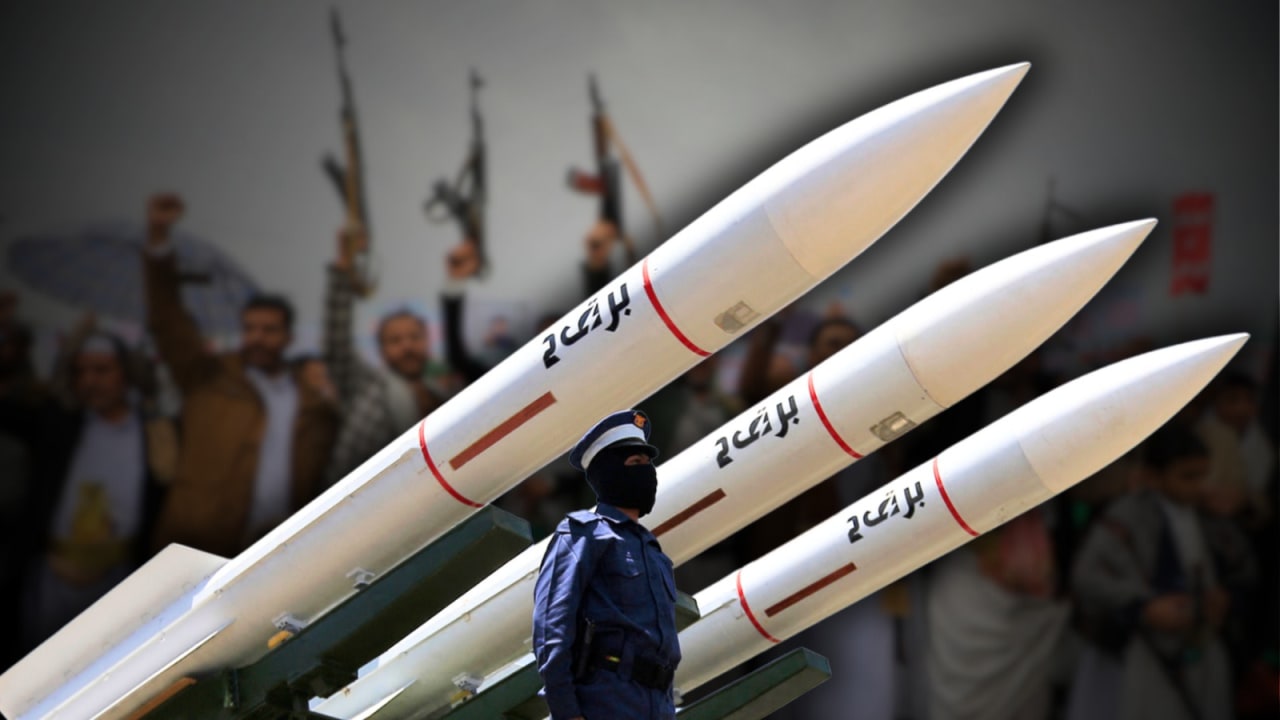
Houthi soldiers stand guard on a missile carrier during an official military parade marking the ninth anniversary of the Houthi takeover of the capital, Sanaa, on September 21, 2023.(photo credit: Getty Images/MOHAMMED HUWAIS/AFP)BySETH J. FRANTZMAN, TOBIAS SIEGALMARCH 28, 2026 07:11Updated: MARCH 28, 2026 14:32
A ballistic missile was launched from Yemen toward Israeli territory on Saturday morning, marking the first such attack by the Iran-backed Houthis since Operation Roaring Lion began a month ago, the IDF has confirmed, with the group vowing to continue its offensive until its “objectives are met.”
Air defense systems were activated to intercept the threat, the military said, as sirens sounded across Beersheba and surrounding communities in the Negev. Residents were instructed to follow Home Front Command guidelines amid the unfolding situation.
There were no immediate reports of casualties or direct impacts at the time of writing.
The Houthis, an Iran-backed proxy based in Yemen, have previously threatened to target Israel in coordination with other Iranian proxies in the region. However, this marks the first confirmed missile launch toward Israeli territory from Yemen since the war began on February 28.

Despite repeated strikes, the group has shown little sign of being deterred
Arab News reported that “the group has shown an ability to strike targets far beyond Yemen and disrupt shipping lanes around the Arabian Peninsula and the Red Sea, as they did in support of Hamas in Gaza after October 7, 2023.” The Houthis have previously demonstrated their capacity to halt maritime traffic in the Red Sea, an outcome that would further strain the global economy. With the Strait of Hormuz already largely restricted, additional disruption along the Red Sea corridor, which feeds into the Suez Canal, would compound pressure on global trade.
Tensions across the region remain high. In 2015, Saudi Arabia led a coalition alongside the UAE and Egypt to prevent the Houthis from advancing toward Aden. In response, the group escalated by launching ballistic missiles and drones toward Riyadh. These earlier attacks are now widely viewed as a precursor to Iran’s current regional strategy. The Houthis have steadily expanded their capabilities, acquiring long-range Shahed-136 drones as early as 2021 and maintaining stockpiles of ballistic missiles, many of which are believed to be concealed in fortified underground sites. Despite repeated US and Israeli strikes, the group has shown little sign of being deterred.
In an interview with Al-Masirah TV following Houthi Brigadier General Yahya Saree’s announcement of Yemen’s first ballistic missile strike on Israeli targets, a Houthi-affiliated analyst outlined the group’s strategic aims.
What are the Houthis’ objectives?
Houthi Brigadier General Omar Ma’rabouni said Yemen’s entry into the war was a response to what he described as US and Israeli actions. According to him, the move is intended to “complicate the scene for the Americans and Israelis, which is already complex,” citing Yemen’s geographic position as a key factor.
He pointed to what he described as Yemen’s leverage over critical maritime routes, including “the Red Sea, the Arabian Sea, the Gulf of Aden, and the Bab al-Mandab Strait,” according to Al-Masirah. Such positioning, he argued, directly impacts “military navigation movement” and constrains the operational flexibility of US and Israeli forces in the region.
Separately, Al-Masirah reported that Saba’een Square in the Houthi-controlled capital hosted a mass rally on Friday, described as a “million-strong march” under the slogan “steadfast with Palestine, Lebanon, and Iran… ready for all options,” marking what organizers called the “National Day of Resilience.”
Participants at the rally also condemned the UK, though the report did not specify the exact basis for the criticism. The UK has served as a base for US aerial operations in the region.
On Friday, Israel carried out extensive strikes against Iranian infrastructure across three areas of the country. The sites struck included the Khandab heavy water reactor in Arak and a uranium enrichment facility in Ardakan.
Houthis say they have a plan to prevent passage of Israeli ships through Bab al-Mandab
Following Saturday’s strike from Yemen, a senior Houthi advisor cited by Al-Araby TV said, “We have developed a plan to prevent the passage of Israeli ships through the Bab al-Mandab Strait.” The threat came days after Iran said it would “take action” in the vital waterway.
In an interview on the Houthi-run television channel in Yemen, a supporter argued that Saturday’s strike will complete a “ring of fire” against “US-Israeli operations.” According to Arab News in Saudi Arabia, the “Houthis can strike targets far from Yemen.” The report noted similar language to that appearing in Houthi statements.

Houthis issue final warning before joining the war
While the Houthis had so far avoided joining the war, a Houthi leader told Reuters on Friday that the group was ready to get involved and potentially support Tehran’s war efforts in the Red Sea. During the war in Gaza, the Houthis repeatedly attacked shipping vessels in the Red Sea, triggering an international shipping and trade crisis.
Saturday morning’s attack could signal the opening of another front in the current conflict, which would likely deepen the global oil and economic crisis brought on by the ongoing war.
“We stand fully militarily ready with all options. As for other details having to do with determining zero hour, they are left to leadership, and we are monitoring and following up with the developments and will know when the suitable time is to move,” the anonymous Houthi leader said this week.
“Until now, Iran has been doing well and is defeating the enemy every day, and the battle is going in its direction. If anything contrary to this happens, then we can assess,” he added.
On Wednesday, Iran said it would “take action” in the Bab al-Mandab Strait, which connects the Red Sea to the Gulf of Aden and the Indian Ocean, “if provoked,” raising fears that Tehran could use its Yemen-based proxy to carry out such actions.
The Bab al-Mandeb Strait lies between Yemen, Djibouti, and Eritrea, with the Houthis on the Yemeni side.

Man in his 60s dies in latest Iranian missile barrage
The Houthi attack on Saturday followed an Iranian barrage toward southern and central Israel overnight that killed one person in his 60s, paramedics say.
Earlier in the night, explosions were heard over the Syrian capital of Damascus, with Syrian media and authorities clarifying that it was due to the Iranian ballistic missile interception by the Israeli air force.
END
HOUTHIS
Why the Houthis waited until now to strike – analysis
The Houthis successfully hid missiles in caves for years, and the US, Israel, Saudi Arabia, and others were not able to stop the missile and drone attacks or dislodge the group.

Yemen’s Houthi loyalists brandish weapons, flags of Yemen and Iran and a poster depicting the Houthi leader Abdul Malik Al-Houthi, and a picture of U.S. President Trump during a protest staged to show support to Iran against the U.S.-Israel war on March 27, 2026 in Sana’a, Yemen.(photo credit: Mohammed Hamoud/Getty Images)
MARCH 28, 2026 14:07
When the US and Israel began attacks on Iran on February 28, the Iranians had many choices on how to respond. They began to target Israel and the Gulf states with missiles and drones. Three days after the attack, they also encouraged Hezbollah to strike Israel. In addition, they operationalized Iranian-backed militias in Iraq to carry out attacks.
The Iranian response has been complex. Thousands of drones and missiles have targeted the Gulf countries. In total, Iran has targeted a dozen countries and closed the Straits of Hormuz. The majority of Iranian attacks have struck the Gulf, primarily the UAE.
In addition, the Iranian-backed militias in Iraq have carried out around 500 attacks on targets in Iraq. These include the US Embassy in Baghdad, the US consulate in Erbil, Kurdish forces and groups in the Kurdistan Region, and the UAE consulate in Erbil.
With the war spreading to Iraq and Lebanon, and Iran feeling it holds the cards in Hormuz, Tehran waited to encourage the Houthis to move to the offensive. Iran has been seeing signs that the US wants the war to end. It also knows the US is moving forces to the region to potentially invade Iranian islands.
While the US says it has passed notes to Iran via Pakistan to secure a possible ceasefire, Iran does not trust the US. It believes that the US misled Iran about previous rounds of talks, using them to gather US air power in the region to carry out attacks. Iran believes the US purposely tricked Tehran and lied to it during negotiations, and that the US always had plans to carry out a surprise attack.

In Iran’s view, it is the victim, but it also seeks to demonstrate its power in the region. Having kept the Straits of Hormuz closed, it knows pressure is building to reopen the waterway. The Houthis’s joining the conflict a month after it began will show that Iran can spread the conflict to the Red Sea, potentially. This will create more complexity for the US and US air power in the region.
The US and Israel have not been able to stop the Houthis in the past. In fact, the US conducted airstrikes in March 2025 but eventually concluded they offered diminishing returns. As such, Iran believes the US and Israel will have trouble dealing with the Houthis.
Iran’s ‘ring of fire’ strategy
Iran and the Houthis believe that creating a “ring of fire” in the region that stretches from Lebanon via Iraq and the Gulf to Yemen, several thousand miles of frontline, will enflame the region and show the US that this war was a mistake.
They want to show that the attack on Iran, carried out as talks were underway, will not end easily for the US. Iran wants to show that it will not only absorb blows but also strategically expand the conflict.
The Houthis represent a broader strategy for Iran, potentially affecting a new global shipping lane via the Red Sea. With the world already on edge about the Hormuz closure, this new front could spook the global economy.
Iran knows, and the Houthis know, that they don’t have to do much to threaten the Red Sea; all they have to do is make it seem that there is a threat. While Israel has also had a Red Sea strategy, supporting Somaliland, the Iranian answer via the Houthis is a new card that has been put into play.
Saudi Arabia fought the Houthis for more than five years from 2015 to 2020, but saw that this was a difficult war in the mountainous terrain of Yemen. Riyadh and the UAE had a falling out over the Yemen strategy. As such, the Houthis have already outplayed countries in the region.
Iran knows this and believes that, like the Houthis, Iran can succeed despite setbacks. The Houthis successfully hid missiles in caves for years, and the US, Israel, Saudi Arabia, and others were not able to stop the missile and drone attacks or dislodge the group.
END
ISRAEL VS IRAN/ (SUMMARY FROM FRIDAY)
More Iran Nuclear Sites Targeted; UAE Presses for Hormuz Security Force
The United Arab Emirates, which has been among the hardest-impacted Gulf states in Iran’s ongoing retaliation, is pressing for a multinational maritime taskforce to reopen vital oil transit waterway, the Financial Times reports Friday.
The UAE, with a navy that’s not really going to strike fear into any enemy (much less the Iranians), says it is willing to participate in a “Hormuz Security Force” to defend the strait and escort shipping. Dozens of countries are being asked to join, sources cited in FT say. So far there have been no takers. Meanwhile, more alarming escalation with fresh US-Israeli attacks on nuclear sites, as Tehran threatens to launch revenge attacks in kind (on Gulf and Israel):
- IRAN SIGNALS POSSIBLE ATTACKS ON STEEL FACTORIES IN GULF AND ISRAEL, ACCORDING TO TASNIM.
- Aardakan yellow cake factory (nuclear) in Yazd province attacked by US and Israeli Friday evening (local)
- No radiation leak detected, local authorities say
Tasnim says that Iran’s response will “not be limited to the region’s steel industries” and that a “broader more severe response” is on the agenda. And…
The IDF announces the following [machine translation]:
After identifying rehabilitation attempts: The Air Force struck the heavy water plant in Arak – a key infrastructure for producing plutonium for nuclear weapons With precise guidance from Military Intelligence, the Air Force struck a short while ago the heavy water plant in Arak, located in central Iran. Heavy water is a unique material used to operate nuclear reactors such as the currently inactive reactor in Arak, which was originally designed to have the capability to produce weapons-grade plutonium. These materials are also used as a source for extracting neutrons for nuclear weapons.
Vital Iranian Steel Plants, Industry Attacked
Israeli media citing military officials on Friday: “The IDF attacked Iran’s two largest steel plants, in Isfahan and Ahvaz. Both plants are vital to Iran’s military industry and are partially owned by the Revolutionary Guards. The strikes on the plants are expected to cause billions in damage to the Iranian economy.”
This could mark a new, expanded phase of the war as Israel goes after key defense industrial targets, which also serve central civilian infrastructure development. The US has still held off on pursuing more attacks on energy sites, but it seems Israel is maintaining a more gloves off approach – opting for total societal destruction, and going after industry. This seems to also be part of efforts to ensure ballistic missile production is degraded.
Also, Khondab Heavy Water Research Reactor, part of the Arak Nuclear Complex, targeted.
Reuters: US is certain about having destroyed third of Iran’s missiles, say sources. Another third is believed to be damaged, destroyed or buried.
END
Over 3,500 US Troops Arrive In Middle East As Houthis Enter War
Saturday, Mar 28, 2026 – 09:20 AM
Summary
- US troops arrive: More than 3,500 U.S. troops, including the USS Tripoli with about 2,500 Marines, arrived in the Middle East, officials announced Saturday, as strikes in the Iran war intensified
- Houthis enter the war: Houthis launch their first missile barrage on Israel since Operation Epic Fury. Red Sea shipping could once again be under direct threat.
- UAE Aluminum plant damaged in Iranian drone strike: Emirates Global Aluminium – the Middle East’s largest aluminum producer and the biggest industrial company in the United Arab Emirates outside oil and gas – said its production plant at Al Taweelah sustained significant damage in an Iranian drone and missile attack on Abu Dhabi.
- Serious US casualties in Saudi base assault: Iran fired six ballistic missiles and 29 drones at Saudi Arabia’s Prince Sultan air base in a Friday attack that wounded at least 15 troops: AP. Late-night strike targeted Bushehr Nuclear Power Plant (for third time of war).
- Gulf states under sustained fire, casualties mount: Six wounded in missile strike on Abu Dhabi; Bahrain intercepts waves of missiles and drones near the United States Fifth Fleet base; Kuwait reports damage to Mubarak Al-Kabeer Port and Shuwaikh Port.
- US expending billions on Operation Epic Fury: “Battle damage and replacement of losses over the first three weeks of the war likely costs roughly $1.4 billion to $2.9 billion”: WSJ.
* * *
Thousands Of US Troops Arrive In Gulf Region
More than 3,500 U.S. troops, including the USS Tripoli with about 2,500 Marines, arrived in the Middle East, officials announced Saturday, as strikes in the Iran war intensified. The U.S. Central Command said in a social media post that the USS Tripoli, which serves as the flagship for the Tripoli Amphibious Ready Group / 31st Marine Expeditionary Unit, arrived in its area of responsibility. Central Command said that in addition to the Marines, the Tripoli also brings transport and strike fighter aircraft, as well as amphibious assault assets to the region. The USS Boxer and two other ships, along with another Marine Expeditionary Unit, have also been ordered to the region from San Diego.
The Tripoli is the most updated of the amphibious warships, known as a “big deck,” which allows more room for F-35 Stealth Fighter Jets, Ospreys and other aircraft. The ship had previously been based in Japan when the order to deploy to the Middle East came almost two weeks ago.
The arrival of the U.S. troops in the region comes after at least 10 U.S. troops, including two who were seriously wounded, were injured when Iran fired six ballistic missiles and 29 drones at Saudi Arabia’s Prince Sultan air base.
Trump said that he has not decided whether to deploy troops in Iran but he has not ruled out the possibility and is stationing some 7,000 troops, including members of the 82nd Airborne Division.
Meanwhile, the US military said in a social media post on Saturday that it had struck more than 11,000 targets and destroyed more than 150 Iranian vessels since the conflict began.
And while Trump says Iran should negotiate peace, he is also saying the US can continue with strikes on the Islamic Republic. On Friday, he said more than 3,500 targets remained in Iran and “that’ll be done pretty quickly.”
Secretary of State Marco Rubio said Friday the United States can meet its objectives “without any ground troops.” But he also said President Trump “has to be prepared for multiple contingencies” and that American forces are available “to give the president maximum optionality and maximum, opportunity to adjust to contingencies should they emerge.”
Major U.A.E. Aluminum Plant Damaged in Iranian Strike
Emirates Global Aluminium said its production plant at Al Taweelah sustained significant damage in an Iranian drone and missile attack on Abu Dhabi. Several employees were injured but no one died, the company said. The plant includes a smelter that produced 1.6 million metric tons of cast aluminum in 2025 and a refinery that supplies the smelter with alumina, the metal’s main ingredient. The company had substantial metal stock offshore when the war on Iran began last month as well as in some overseas locations, according to the statement. Emirates Global Aluminium is owned by Mubadala, an Abu Dhabi sovereign wealth fund, and the government of Dubai.
EGA is the Middle East’s largest aluminum producer and the biggest industrial company in the United Arab Emirates outside oil and gas, according to the company’s website. Kezad facilities make up the company’s biggest plant. An aluminum producer in Bahrain, known as Alba, cut production earlier this month because it couldn’t ship metal through the Strait of Hormuz. Norwegian company Norsk Hydro slowed output at its Qatalum smelter in Qatar.
The United Arab Emirates is the fifth-biggest producer of aluminum in the world though it is dwarfed by China, the largest, according to consulting firm Harbor Aluminum. Excluding Iran, the Gulf as a whole smelted about 8% of the world’s aluminum in 2025, commodities brokerage StoneX reported.
Aluminum prices in London, the benchmark, are 4% higher than on the eve of the war. Other metal prices have fallen on concern that high oil and gas prices will hurt energy-intensive industries that consume metals.
Houthis Enter the War
The Houthis have finally entered the war, greatly raising the stakes on what’s becoming a multi-front engagement, given Israel and Hezbollah have already been locked in a ground war in Lebanon. Overnight saw the Houthis send a barrage of missiles on Israel, which is the first such strike since the US began its Operation Epic Fury.
Military spokesman for the Houthis, Brigadier-General Yahya Saree, announced the attack on Saturday on the group’s Al Masirah satellite television, Al Jazeera has confirmed. Strikes “will continue until the declared objectives are achieved… and until the aggression against all fronts of the resistance ceases,” Saree said, confirming the Iran-aligned Yemeni group’s entry into the war on Tehran’s side.
ISRAEL VS IRAN
Crown Prince Reza Pahlavi to CPAC: A free Iran is within reach right now
In his CPAC address, Reza Pahlavi urges for a free Iran, rejects any partial settlements with the regime, and presents Iran as a future democratic partner of the US and Israel.
Reza Pahlavi, the exiled son of Iran’s last shah and Iranian opposition figure flashes the victory sign during the Conservative Political Action Conference (CPAC) USA 2026 at the Gaylord Texan Resort and Convention Center, in Grapevine, Texas, U.S., March 28, 2026.(photo credit: REUTERS/Daniel Cole)ByALEX WINSTONMARCH 28, 2026 21:25Updated: MARCH 28, 2026 22:38
Crown Prince Reza Pahlavi addressed the Conservative Political Action Conference on Saturday at the Gaylord Texan Resort and Convention Center in Grapevine, Texas, calling for the complete dismantling of the Islamic Republic and presenting himself as the leader to guide Iran through a democratic transition.
Pahlavi took the stage to a standing ovation and chants of “Javid Shah” (long live the king) and drew repeated applause throughout a speech that combined a sharp indictment of the Tehran regime with a detailed vision of Iran as a future strategic partner of both the United States and Israel.
“A free Iran is within reach right now,” he told the crowd. “But as we all know, freedom never comes free.”
Included in his address was a call for a new regional architecture in the Middle East, one in which a post-Islamic Republic Iran normalizes relations with Israel.
Pahlavi invoked the Abraham Accords, proposing their extension into what he called the “Cyrus Accords,” named for Cyrus the Great, the Persian king he credited with issuing history’s first charter of human rights and whose legacy, he argued, stands in direct contrast to the current regime.

“Imagine a new Middle East where Iran is a friend of Israel,” he said. “Where the Abraham Accords are extended into the Cyrus Accords.”
A vision for the future VS the present reality
The prince drew a sharp line between that vision and the present reality, stating that the Islamic Republic persecutes religious minorities, storms underground Christian churches, and executes converts, conduct he described as a betrayal of Iran’s millennia-old tradition of tolerance.
On the economic case for a free Iran, Pahlavi pitched the room directly. A strategic US-Iran partnership, he argued, could generate more than one trillion dollars for the American economy over the next decade, drawing on a nation of 93 million people he described as highly educated, entrepreneurial, and pro-democracy.
“A free Iran represents the single largest untapped economic opportunity of the 21st century,” he said. “Finally unleashed.”
He framed the current moment as a historic opportunity created by the Trump administration’s military strikes – referring to Operations Midnight Hammer (June 2025) and Epic Fury – which he said had destroyed more than 80% of Iran’s ballistic missile arsenal, obliterated its nuclear sites, and killed former supreme leader Ayatollah Ali Khamenei.
“For decades, every American president since Jimmy Carter chose to try to manage this looming threat rather than resolve it,” Pahlavi said. “Each of them has failed.”
He was, however, unsparing on the question of any partial settlement with remnants of the regime, after rumors that US President Donald Trump is willing to sit down with members of the current regime to end the conflict.
“The Islamic Republic cannot reform itself. You cannot reform a snake. Venom is in its DNA,” the prince said. Any arrangement leaving elements of the regime in place, he argued, would produce only a temporary calm before a return to terrorism and nuclear blackmail.
“Those who have spent 47 years sowing chaos cannot be trusted to bring about stability,” he said. “If we do not finish the job, the threat posed by this Islamic Republic will not be solved. It will only be made worse.”
Pahlavi also gave a clear-cut account of the January uprising, in which he said he called on Iranians to take to the streets.
The response, he said, was the largest wave of protests in Iran’s modern history, sweeping all 31 provinces, met by a regime response he described as leaving more than 40,000 dead and 300,000 wounded, with internet access cut off for what was, as of Saturday, 29 consecutive days.
“The final blow will be delivered by the Iranian people themselves,” he said. “When the right moment arrives, as in January, I will call on them to rise up again.”
Pahlavi confirmed he has accepted calls to lead Iran’s democratic transition, describing a coalition spanning monarchists and republicans, and a digital defection platform through which he said thousands of military officials, including some senior officials, have registered their readiness to join him.
He closed with a direct parallel to the American moment.
“As 2026 marks the 250th birthday of the United States, it is my hope and my belief that history will also remember 2026 as the year of Iran’s rebirth,” the prince told the crowd. “President Trump is making America great again. I intend to make Iran great again.”
end
IRAN
IRAN’S ECONOMY NOW:
Iran risks renewed protests as citizens reach ‘breaking point’ amid war-stricken economy
Over 40% of Iran’s population lives below the absolute poverty line, with that figure exceeding 50% in the capital. Economists warn, however, that the real poverty rate may have climbed above 60%.
Iranian Rial banknotes over a backdrop of the Iranian flag; illustration.(photo credit: Shutterstock/Mehaniq)ByOMID HABIBINIA/THE MEDIA LINEMARCH 28, 2026 14:51
Iran’s already dying economy is now being pushed toward full collapse after several weeks of war. Food prices are rising not only day by day but hour by hour, with some staples increasing by at least 50 percent compared to pre-war levels.
For more stories from The Media Line go to themedialine.org
At the same time, the disruption of internet access has halted many services. Factories and production facilities are facing acute shortages of raw materials, and the country’s administrative system has been severely impaired. “It has become impossible to endure this situation any longer,” a Tehran resident told The Media Line.
According to figures cited by state-affiliated institutions and some economists, more than 40% of the population now lives below the absolute poverty line, with that figure exceeding 50% in the capital. Economists warn, however, that the real poverty rate may have climbed above 60% nationwide.
As the middle class erodes, the gap between those earning less than 50 million tomans per month (about $320) and those earning more than 200 million tomans per month (about $1,280) has widened sharply.
However, across most occupations, the average monthly income of employees and skilled workers in Tehran does not exceed 25 million tomans (about $160), meaning that the majority fall below the poverty line, which economists say would require at least twice that amount to sustain a basic standard of living.

This comes as the Persian New Year period – when Iranian households traditionally increase spending on food, clothing, and social gatherings – typically drives seasonal price spikes. This year, however, those pressures have intensified dramatically under wartime conditions.
Last year, 180 Iranian economists issued a statement warning of a looming economic breakdown driven by runaway inflation and monetary policies, particularly exchange-rate mechanisms that grant preferential access and rents to state-linked institutions, including the Islamic Revolutionary Guard Corps (IRGC).
Government intervention in the currency market has failed to stabilize the exchange rate; instead, the US dollar nearly doubled in less than 7 months, triggering a sharp collapse of the national currency.
The first shock of the war last summer destabilized Iran’s oil-dependent economy, and mounting pressures culminated in nationwide protests in January, which quickly took on a political character. Millions took to the streets across cities and even rural areas, in unprecedented demonstrations that the regime ultimately suppressed through violent crackdowns.
Operation Roaring Lion’s effect on Iran’s economy
Now, weeks into the current war, despite the Central Bank’s efforts to stabilize the currency, the issuance of one-million-toman banknotes has emerged as another sign of economic breakdown in a system largely controlled by the IRGC and other institutions tied to the leadership.
The International Monetary Fund has projected that Iran will experience a severe economic decline in 2025, with the real value of household incomes estimated to fall by 31% from the previous year amid very high inflation.
Arezoo Karimi, an economic journalist, told The Media Line: “One month before the war began, official statistics showed inflation in Iran had reached its highest level since World War II.” She added that internet shutdowns have directly damaged online businesses and indirectly affected the broader economy.
According to Karimi, the continuation of these conditions will further destabilize the war-stricken economy and drive up unemployment. She described Iran’s economy as a fragile mix of high inflation, stagnation in financial markets and economic activity, and growing instability – conditions now exacerbated by war.
She noted that rising food prices have forced lower and middle-income households to remove certain items from their diets, with the economic crisis placing the greatest burden on these groups.
Even if an agreement were reached between Iran’s ruling regime and the United States, she said, the short-term economic impact would likely be limited, as structural problems – such as low growth, excess liquidity, and persistent inflation – would remain unless sanctions are lifted and new fiscal and economic policies are implemented.
Shortly before the January protests, the Iranian website Rouydad 24 reported that food inflation had exceeded 66%, and presented a bleak outlook. “What we see today in economic charts and data is the erosion of the middle class, widespread despair, depression, rising suicide rates, and the collapse of a nation’s hopes,” it wrote, adding that, according to most economists, “this is only the beginning, and a harsh winter lies ahead for Iran.”
That forecast materialized weeks later, as the collapse of the national currency against the US dollar effectively crippled private businesses operating in a market dominated by state-linked entities, including networks tied to the IRGC. Scattered protests soon escalated into nationwide demonstrations. The situation has persisted, and the onset of war – now several weeks old – has effectively extended that “harsh winter” into a chaotic spring for the economy.
Mahtab, a senior office worker in central Tehran, told The Media Line: “Prices are rising every day, and some food items have increased by 70 to 80% since the war began.” Earning around 40 million tomans per month, she said she struggles to cover even basic food and household expenses.
During the Nowruz holidays, which typically involve visits with extended family, gatherings were limited to immediate relatives due to soaring costs. Living in constant fear of missiles, bombs, or drones striking her home, she said the worsening economic situation has pushed people to their limit and could reignite protests.
The government has pledged to raise workers’ wages by up to 60%. While officials say oil production and exports continue, a further escalation of the war could deepen the budget deficit under wartime conditions at a time when the government is already under pressure to expand subsidies to prevent renewed unrest, which could pose a serious threat to its survival in the coming weeks.
Mahtab described that during the war, prices have surged ahead of Nowruz, with food costs rising by about 70% to 80% compared to before the conflict. “Some items like cooking oil have actually doubled in price,” she said, adding, “Every time we go to the store, we’re shocked.” Many families had relied on stockpiled supplies such as pasta and canned tuna, but those reserves have now been depleted and are no longer sustainable for daily use.
“Yesterday, I bought three loaves of bread, a few oranges, a tray of eggs, and one bottle of milk – it cost 700,000 tomans ($4.60). If I want to buy meat, chicken, rice, and oil tomorrow, I’d have to spend half my monthly salary.” Mahtab added, as the sound of air defenses could be heard in the background.
She said visits for the Persian New Year were scaled back due to the war and warned that prices may not fall even if the fighting ends. “Even if the war ends tomorrow, there’s no guarantee prices will go back down.” The government’s efforts to inject dollars to keep the rate below 150,000 tomans have not lowered food costs.
Daily life has been severely disrupted, with the internet down, markets and industries largely inactive, and widespread fear. “Every night we lie awake in fear, wondering when it will be our turn to be hit by a missile. People have reached their breaking point.”
END
IRAN //FIGHTING BETWEEN FACTIONS//SUNDAY
Iran’s Pezeshkian clashes with IRGC’s chief over control of Iran, marking rifts in regime – report
Iran International reported that Iran’s President Pezeshkian criticized the IRGC’s approach of increasing tensions in the region and attacking neighbouring countries.

Iranian President Masoud Pezeshkian speaks with Fox News Channel’s Martha MacCallum during an interview on September 25, 2025 in New York City.(photo credit: John Lamparski/Getty Images)ByTOBIAS HOLCMANMARCH 29, 2026 02:57
Iran’s President Masoud Pezeshkian is reportedly clashing with the Islamic Revolutionary Guard Corps (IRGC) chief Ahmad Vahidi over the economic and social impact of the war with the United States and Israel, Iran International reported on Saturday, citing Iranian sources.
According to the London-based Iranian opposition outlet, Pezeshkian criticized the IRGC’s approach of increasing tensions in the region and attacking neighbouring countries, warning of the long-term effects that these movements could cause on the Iranian economy.
The report also mentioned that Pezeshkian has been demanding that executive decisions regarding the war be made by the Iranian government rather than the IRGC, a demand Vahidi did not accept.
Iran’s leadership hollowed out, Arab world reaches breaking point
In response, the IRGC criticized Pezeshkian’s inability to implement structural reforms in the Islamic Republic to address several problems within the system before the current war began.

Iran risks renewed protests as citizens reach ‘breaking point’
The report comes as Iran’s already dying economy keeps being pushed toward full collapse after several weeks of war.
Food prices are rising not only day by day, but hour by hour, with some staples increasing by at least 50 percent compared to pre-war levels.
At the same time, the disruption of internet access has halted many services. Factories and production facilities are facing acute shortages of raw materials, and the country’s administrative system has been severely impaired.
According to figures cited by state-affiliated institutions and some economists, more than 40% of the population now lives below the absolute poverty line, with that figure exceeding 50% in the capital.
Iran International reported, citing messages from several government employees, that the salaries and benefits of a large segment of employees have not been paid regularly over the past three months.
Omid Habibinia/The Media Line contributed to this report.
ISRAEL VS HEZBOLLAH/sunday
IDF hits dozens of Hezbollah sites as troops wounded in southern Lebanon
Three officers and six soldiers were injured in two separate incidents in Lebanon over the past 24 hours, the IDF said.
IDF soldiers and a tank operate in southern Lebanon on March 21, 2026.(photo credit: IDF SPOKESPERSON’S UNIT)
MARCH 28, 2026 09:19
Updated: MARCH 28, 2026 12:39
The IDF carried out overnight strikes in Lebanon that killed two senior Hezbollah commanders and damaged dozens of Hezbollah sites across the country, the military said Saturday.
In a targeted strike in Beirut on Friday, the IDF said it eliminated Ayyoub Hussein Yaacoub, a senior figure in Hezbollah’s communications unit who previously held a key role in the organization’s rocket unit and was involved in directing launches toward Israel.
Yasser Mohammad Mubarak, another senior operative in the group’s communications unit, who also held a position in the rocket unit, was also killed, according to the IDF.

Separately, Israeli forces struck dozens of Hezbollah sites across southern Lebanon throughout the weekend, the military said, targeting weapons depots, launchers, and military infrastructure as part of ongoing efforts to degrade the group’s operational capabilities. The attacks were conducted from both air and sea in support of ground troops operating in the area.
On Saturday afternoon, the IDF issued an evacuation warning to several villages in southern Lebanon and urged residents to relocate north of the Zahrani River. The directive, announced by the IDF’s Arabic-language spokesperson, Col. Avichay Adraee, seems to apply to multiple areas, including Rashidieh, al-Bas, and Wadi Jilo.

Three officers, six soldiers wounded since yesterday
Earlier Saturday, the IDF said that an officer was severely injured, and six soldiers sustained moderate wounds in the early hours of Saturday morning as a result of rocket fire targeting Israeli forces in southern Lebanon.
All of the injured were evacuated to hospitals for medical treatment, and their families have been notified.
In a separate incident on Friday, an IDF officer was severely wounded, and another officer moderately injured after an anti-tank missile fire struck troops operating in southern Lebanon, according to the IDF.

The incidents come amid continued Israeli military operations in southern Lebanon against Hezbollah, where troops have faced repeated attacks, including anti-tank fire and rocket barrages.
On Thursday, the IDF announced that two soldiers had been killed in Lebanon in recent days, identifying them as Sgt. Aviad Elchanan Volansky, 21, and St.-Sgt. Ori Greenberg, 21.
IDF intensifies operations in southern Lebanon
IDF spokesperson Brig.-Gen. Effie Defrin said in a video statement released on Friday that Israel will take the necessary steps to disarm Hezbollah. Defrin criticized the Lebanese government for failing to take sufficient action, noting that “contrary to the declaration by the Lebanese government earlier this year, Hezbollah is still operating and conducting attacks from southern Lebanon.”
Earlier this week, Defense Minister Israel Katz said the IDF will occupy southern Lebanon up to the Litani River to create a “defensive buffer,” spelling out for the first time Israel’s intent to seize territory amounting to nearly a tenth of Lebanon.
At a meeting with the military chief of staff, Katz said Israeli forces would “control the remaining bridges and the security zone up to the Litani,” a river that meets the Mediterranean about 30 km (20 miles) north of Israel’s border.
Hezbollah, in turn, has vowed to resist Israeli actions in southern Lebanon, saying it would fight to prevent Israeli troops from occupying the region and calling such a move an “existential threat” to the Lebanese state.
Reuters contributed to this report.
END
HEZBOLLAH/SATURDAY
IDF kills Hezbollah terrorist who worked as journalist in targeted southern Lebanon strike
Lebanese President Joseph Aoun condemned the incident, claiming that the strike “violates the most basic principles of international law, international humanitarian law, and the laws of war.”
https://player.jpost.com/public/player.html?player=jpost&media=4032136&url=https://www.jpost.com/IDF eliminates Hezbollah terrorist Ali Hassan Shaib in targeted strike. March 28, 2026.
MARCH 28, 2026 09:19Updated: MARCH 28, 2026 19:56
The IDF killed a Hezbollah terrorist who also worked for Lebanese news outlet Al Manar in an airstrike on Saturday morning.
Ali Hassan Shaib, a terrorist in the intelligence unit of Hezbollah’s Radwan Force, also worked for Al Manar, where he used his position as a journalist to expose IDF positions in southern Lebanon and along the border.
The IDF asserted that he maintained contact with terrorists within the Radwan Force and across the broader Hezbollah terrorist organization

Al Manar stated that Shaib and another reporter, Fatima Ftouni from broadcaster Al Mayadeen, were killed when their vehicle was hit. Lebanon’s information minister later said Ftouni’s brother, cameraman Mohammed Ftouni, had also been killed in the strike.
Al Manar is controlled by the Iran-backed Lebanese group Hezbollah, and Al Mayadeen is widely seen as editorially aligned with Iran’s allies and supporters in the region.

Lebanese President Joseph Aoun condemned the incident, claiming that the strike “violates the most basic principles of international law, international humanitarian law, and the laws of war.”
“This is a blatant crime that violates all norms and conventions under which journalists are protected. We call on all international bodies to take action to stop what is happening on our soil,” Aoun added.
IDF kills senior Hezbollah commanders in overnight strikes
Additionally, the IDF carried out overnight strikes in Lebanon that killed two senior Hezbollah commanders and damaged dozens of terror sites across the country.
In a targeted strike in Beirut on Friday, the IDF said it eliminated Ayyoub Hussein Yaacoub, a senior figure in Hezbollah’s communications unit who previously held a key role in the organization’s rocket unit and was involved in directing launches toward Israel.
Yasser Mohammad Mubarak, another senior operative in the group’s communications unit, who also held a position in the rocket unit, was also killed, according to the IDF.
Separately, Israeli forces struck dozens of Hezbollah sites across southern Lebanon throughout the weekend, the military said, targeting weapons depots, launchers, and military infrastructure as part of ongoing efforts to degrade the group’s operational capabilities. The attacks were conducted from both air and sea in support of ground troops operating in the area.
On Saturday afternoon, the IDF issued an evacuation warning to several villages in southern Lebanon and urged residents to relocate north of the Zahrani River. The directive, announced by the IDF’s Arabic-language spokesperson, Col. Avichay Adraee, seems to apply to multiple areas, including Rashidieh, al-Bas, and Wadi Jilo.
Three officers, six soldiers wounded since yesterday
Earlier Saturday, the IDF said that an officer was severely injured, and six soldiers sustained moderate wounds in the early hours of Saturday morning as a result of rocket fire targeting Israeli forces in southern Lebanon.
All of the injured were evacuated to hospitals for medical treatment, and their families have been notified.
In a separate incident on Friday, an IDF officer was severely wounded, and another officer moderately injured after an anti-tank missile fire struck troops operating in southern Lebanon, according to the IDF.
The incidents come amid continued Israeli military operations in southern Lebanon against Hezbollah, where troops have faced repeated attacks, including anti-tank fire and rocket barrages.
On Thursday, the IDF announced that two soldiers had been killed in Lebanon in recent days, identifying them as Sgt. Aviad Elchanan Volansky, 21, and St.-Sgt. Ori Greenberg, 21.
IDF intensifies operations in southern Lebanon
IDF spokesperson Brig.-Gen. Effie Defrin said in a video statement released on Friday that Israel will take the necessary steps to disarm Hezbollah. Defrin criticized the Lebanese government for failing to take sufficient action, noting that “contrary to the declaration by the Lebanese government earlier this year, Hezbollah is still operating and conducting attacks from southern Lebanon.”
Earlier this week, Defense Minister Israel Katz said the IDF will occupy southern Lebanon up to the Litani River to create a “defensive buffer,” spelling out for the first time Israel’s intent to seize territory amounting to nearly a tenth of Lebanon.
At a meeting with the military chief of staff, Katz said Israeli forces would “control the remaining bridges and the security zone up to the Litani,” a river that meets the Mediterranean about 30 km (20 miles) north of Israel’s border.
Hezbollah, in turn, has vowed to resist Israeli actions in southern Lebanon, saying it would fight to prevent Israeli troops from occupying the region and calling such a move an “existential threat” to the Lebanese state.
Reuters contributed to this report.
END
HEZBOLLAH/sunday
Voices from the Arab press: Hezbollah in state of crisis, Strait of Hormuz paralyzed
A selection of opinions and analyses from the Arab media around the world.

DECLARING A post-Islamist era is premature: Attendees at the funeral of Iranian intelligence minister Esmail Khatib at Tehran’s Grand Mosque, March 20.(photo credit: ALAA AL-MARJANI/REUTERS)ByTHE MEDIA LINEMARCH 28, 2026 10:24
Hezbollah is in a state of total hysteria
Nida Al Watan, Lebanon, March 20
In this war, Hezbollah’s conduct appears increasingly erratic, driven by impulse rather than calculation.

Its decision to open a front in support of Iran, framed as retaliation for the killing of supreme leader Ali Khamenei, came suddenly and without regard for the consequences, exposing civilians to immense risk and imposing heavy costs on Lebanon’s Shi’ite community across human, economic, and social dimensions.
The move was particularly striking given Hezbollah’s awareness of its own weakened position.
Its military capabilities have significantly deteriorated, its supply lines through Syria have been disrupted, and its operational effectiveness has declined.
For more than a year, it largely absorbed Israeli strikes without meaningful response, only to escalate when Iran’s interests demanded it – an act that appears closer to self-destruction than strategy.
This sense of disorder extends beyond the battlefield to Hezbollah’s internal discourse.
The organization no longer maintains a coherent narrative capable of persuading its own constituency, as contradictions in its messaging and the consequences of its decisions become increasingly visible.
At the same time, its security vulnerabilities have been exposed, with deep Israeli intelligence penetration undermining its image of strength.
The gap between rhetoric and reality has widened: a movement that once insisted that “actions speak louder than words” now faces expanding Israeli control over Lebanese territory and growing displacement of civilians.
Unable to provide convincing answers to its supporters about the devastation it has caused – destruction, casualties, displacement, and the possibility that many may never return home – Hezbollah has resorted to deflection.
Rather than acknowledging responsibility, it channels public anger toward critics, political opponents, media outlets, and dissenting voices within its own community.
This behavior reflects more than a temporary crisis; it signals a deeper collapse in its narrative and purpose.
The attempt to obscure reality and shift blame is not merely a sign of political or military weakness, but of a broader moral decline that leaves the organization increasingly exposed. – Marwan El Amine
END
IRAN USA ISRAEL
SUNDAY NIGHT UPDATES
Pentagon Eyes ‘Weeks’ Of Ground Operations In Iran As IRGC Threatens Tit-For-Tat Strikes On Universities
Sunday, Mar 29, 2026 – 11:05 AM
Summary
- Report says Pentagon has been weeks in preparing ground operations as initial Marines arrive in region (WaPo).
- Foreign ministers of regional countries seeking peace & offramp in Pakistan meeting on Sunday.
- After two Iranian university campuses struck by attacks, IRGC issues warning for American university campuses in Middle East.
- Not just ‘damaged’ but obliterated: images show destroyed US AWACS jet at Saudi Airbase.
* * *
‘Weeks’ of Ground Ops Under Preparation: WaPo
Iran’s parliament speaker Mohammad Bagher Ghalibaf, the man who many believe is de facto running the country during wartime, has said United States is busy plotting a ground attack despite publicly engaging in diplomatic efforts aimed at finding a ceasefire.
Fresh reporting in The Washington Post suggests he could be right: “The Pentagon is preparing for weeks of ground operations in Iran, U.S. officials said, as thousands of American soldiers and Marines arrive in the Middle East for what could become a dangerous new phase of the war should President Donald Trump choose to escalate,” the Saturday night report indicated. WaPo further says the plans have been at least weeks in development, writing “Any potential ground operation would fall short of a full-scale invasion and could instead involve raids by a mixture of Special Operations forces and conventional infantry troops, said the officials. All spoke on the condition of anonymity to discuss highly sensitive military plans that have been in development for weeks.”

It should be obvious to all what an ultra high-risk gambit this would be, and geography certainly isn’t in US forces’ favor. The report continues, “Such a mission could expose U.S. personnel to an array of threats, including Iranian drones and missiles, ground fire and improvised explosives. It was unclear Saturday whether Trump would approve all, some or none of the Pentagon’s plans.”
Scramble to Find Offramp: Summit in Islamabad
Several regional countries are meeting in Islamabad to try and forge a path toward ceasefire and peace. The four foreign ministers representing Pakistan, Turkey, Egypt, and Saudi Arabia began consultations Sunday.
The Pakistani government said over the weekend that its prime minister Muhammad Shehbaz Sharif is working to “create a conducive environment” for peace negotiations and direct talks between Tehran and Washington as the war reaches one month. Iranian President Masoud Pezeshkian is being kept abreast of developments in communications with Pakistan. Some progress emerging?…
Iran has agreed to allow 20 Pakistani-flagged ships to pass through the Strait of Hormuz unharmed, Foreign Minister Ishaq Dar announced Saturday.
Pezeshkian told PM Sharif in a Saturday call that “Attacks on infrastructure and assassinations by aggressors show they cannot be trusted.”
As for the Sunday summit in Pakistan, one question that must be asked is where are the US negotiators? Days ago there was chatter that VP J.D. Vance or perhaps Witkoff or Kushner might be in Pakistan, working on the sidelines, but it’s unclear what Washington’s posture on diplomacy is at this point.
Attacks on Universities, Infrastructure
The last 48 hours saw new US-Israeli attacks on Iran’s university of science and technology in the northeast of the capital. Buildings were severely damaged – but reports of casualties have not emerged.
Israel has made it clear it is going after an array of targets, including civilian infrastructure in Iran. Iran has over the weekend retaliated in kind, sending more missiles on Israel. Iran’s Islamic Revolutionary Guard Corps (IRGC) is now warning that American university campuses in the Middle East are now fair game. The statement said this is because two Iranian universities have been struck. The IRGC says American universities are now “legitimate targets” unless the US officially condemns the attacks on Iranian schools by noon on Monday, according to Fars.
Tit-for-tat attacks on infrastructure escalating:
The IRGC has gone so far as to release a statement urging staff, faculty, and students to vacate and stay away from theses campuses. Some notable American university branches in the Gulf (among dozens) include Texas A&M University in Qatar and New York University in the United Arab Emirates.
Not Just ‘Damaged’ but Obliterated: Images of US AWACS Jet At Saudi Airbase
Images have emerged revealing that the Wall Street Journal’s initial report that the half-billion-dollar aircraft was merely “damaged” was an enormous understatement. Rather, a large portion of the fuselage has been obliterated, along with the distinctive 30-foot-diameter, 6-foot-thick rotating radar dome that’s mounted atop AWACS aircraft. We took a closer look at the photo set here.
The images of the destroyed E-3 Sentry were first posted on the Air Force amn/nco/snco Facebook page:
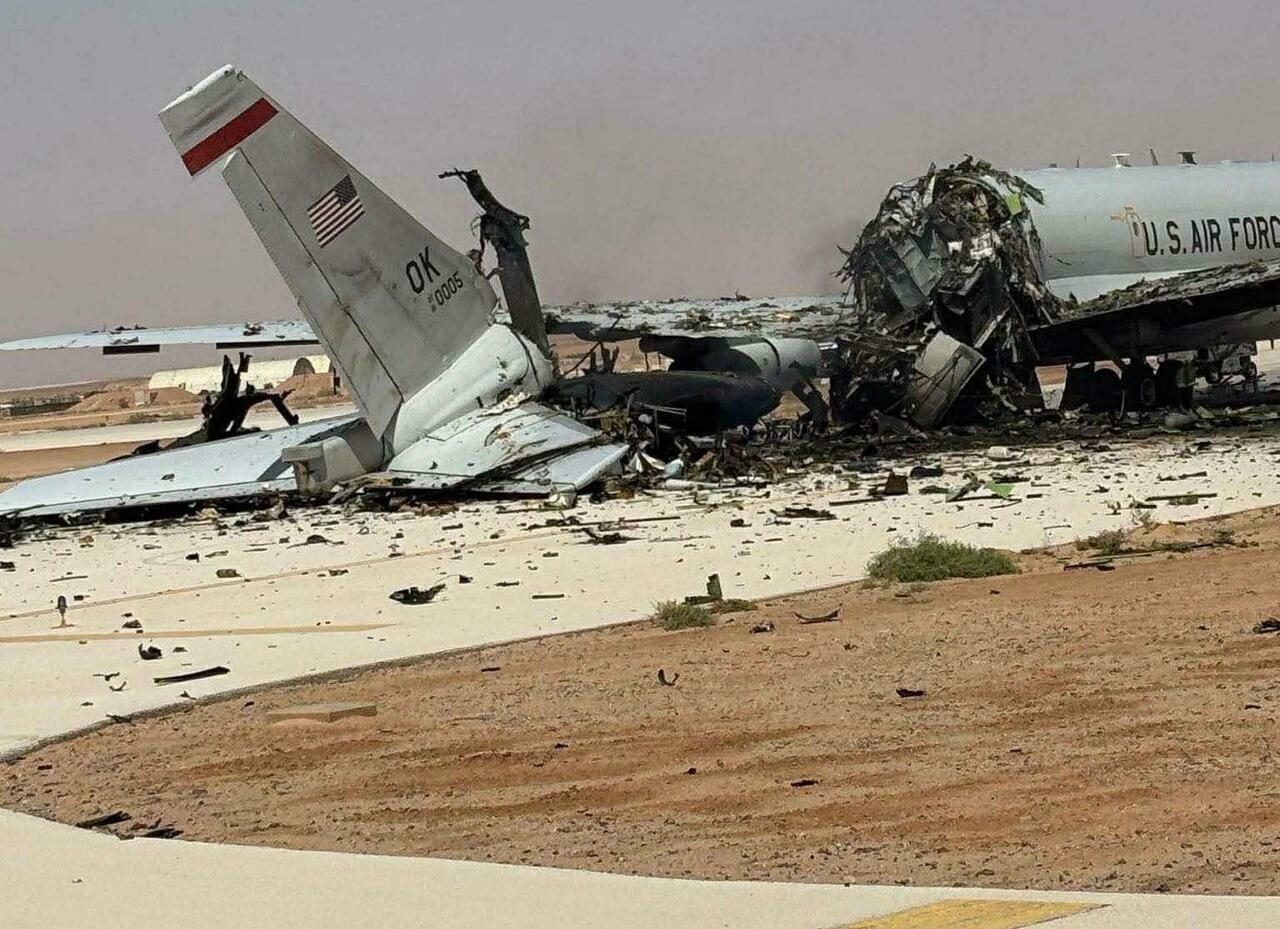
“The loss of this E-3 is incredibly problematic, given how crucial these battle managers are to everything from airspace deconfliction, aircraft deconfliction, targeting, and providing other lethal effects that the entire force needs for the battle space,” Heather Penney, a former F-16 pilot and director of studies and research at AFA’s Mitchell Institute for Aerospace Studies, told Air & Space Forces Magazine. If this has been carefully kept under wraps until now, what else is the White House and Pentagon not telling the public?
END
IRAN/ISRAEL UPDATES/MONDAY MORNING
Trump Cites Progress In Dealing With ‘More Reasonable Regime’ – While Mulling Ground Operation To Seize Uranium
Monday, Mar 30, 2026 – 08:15 AM
Summary
- Iran rejects ‘excessive, illogical’ US demands while Trump mentions ‘progress’ with a ‘more reasonable regime’. Trump again threatens to destroy Iran energy sites and Kharg Island.
- White House seriously considering ground operation to seize Iran’s enriched uranium stockpile but also wants Tehran to negotiate handing it over willingly.
- Bazan oil refinery in Israel’s northern city of Haifa is on fire after a second apparent Iranian missile strike of the war.
- Iran accuses Israel of more ‘false flags’ – after Kuwait water desalination plant hit.
Iran Again Rejects ‘Excessive’ Demands
Iran has once again stated that it has rejected the latest “US demands” as “excessive and illogical” according to state Tasnim, also confirming that it did not participate in the weekend Pakistan-hosted summit attended by the foreign ministers of Turkey, Pakistan, Saudi Arabia and Egypt.
“We have never had any direct negotiations with the United States. What has been raised are messages received through intermediaries indicating the US desire to negotiate,” Foreign Ministry Spokesman Esmail Baghaei said in a press conference Monday. Meanwhile Pakistan’s Foreign Minister Ishaq Dar is expected in China on Tuesday for talks with his Chinese counterpart, after Beijing made clear it is ready to back a Pakistan-mediated peace effort.
Egypt’s President Abdel Fattah el-Sisi has urged President Trump to end the war, saying Washington holds the key here to stopping a worse spiral. “I tell President Trump: Nobody can stop the war in our region in the Gulf but you,” Sisi stated at the opening of the country’s Egypes energy conference. Still, despite Tehran’s latest statement of rejection, Trump put out of a fresh Monday Truth Social Post displaying some optimism toward dealing with a “more reasonable regime” and mentioned “great progress” – but coupled with the usual ‘or else’ type threats. For example, Trump again has threatened to destroy Iran energy sites and Kharg Island.
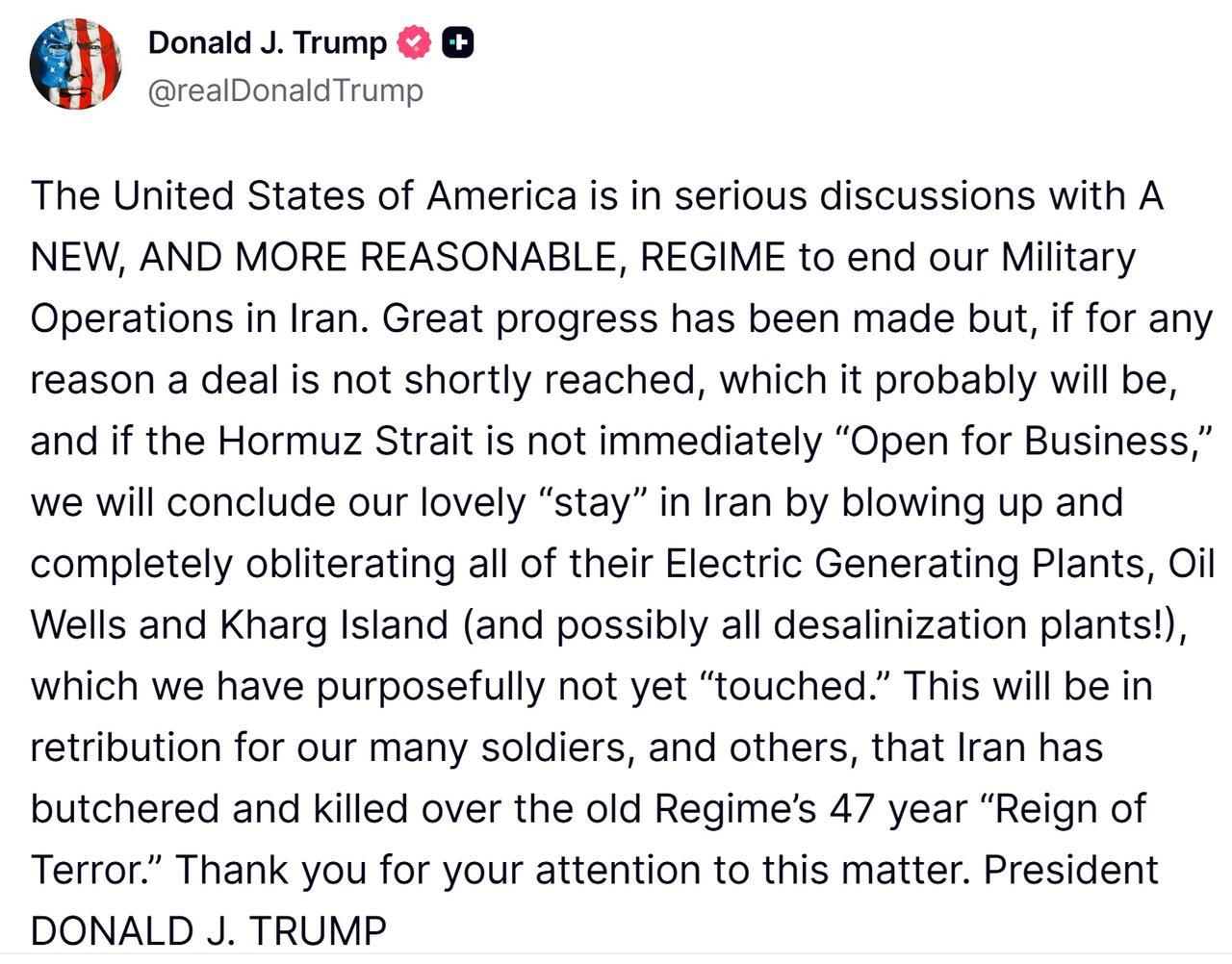
Plan For Uranium Seizure
With more Marines and reportedly Airborne troops en route to the region, among Trump’s ‘options’ is the seizure of Iran’s enriched uranium. A fresh Wall Street Journal report says Monday, “President Trump is weighing a military operation to extract nearly 1,000 pounds of uranium from Iran, according to U.S. officials, a complex and risky mission that would likely put American forces inside the country for days or longer.”
No decision has been made, the report makes clear, and the White House is said to be considering the danger to US troops. On this question, the likelihood for something to ‘go wrong’ – or some kind of mass casualty event for American forces, would be high. This would also open the possibility of forces getting bogged down for at least weeks, months, or longer – and not just ‘days’ of an operation.
“It’s the job of the Pentagon to make preparations in order to give the commander-in-chief maximum optionality. It does not mean the president has made a decision,” White House press secretary Karoline Leavitt has sought to clarify of plans.
One key part of the WSJ report gives a window into where future negotiations would focus: “The president has also encouraged his advisers to press Iran to agree to surrender the material as a condition for ending the war, according to a person familiar with Trump’s thinking,” the report says. “Trump has been clear in conversations with political allies that the Iranians can’t keep the material, and he has discussed seizing it by force if Iran won’t give it up at the negotiating table.” But already Tehran sees itself in an existential war for survival, and so isn’t going to be very open to just giving up its enriched stockpiles.
Israeli Oil Refinery on Fire
Huge fires have been observed at the Bazan oil refinery in Israel’s northern city of Haifa, after another apparent Iranian attack, which marks the second such hit on the site since the war started.
Israeli television channels have reported the attack and emergency response at the scene. “Search and rescue forces, both reserve and regular forces, are on their way to a site in northern Israel where reports of impact have been received,” the IDF said in a statement.

Area residents are being asked to stay inside and shelter in place, with Jerusalem Post reporting “The Environmental Protection Ministry told Ma’ariv that a gasoline tank is burning in the refinery complex, producing thick smoke, but with no risk to the population in the area from a hazardous materials incident.”
Smoke rising from Haifa’s Petrochemical complex following reported Iranian missile strike.
Iran Claims Some Attacks as Israeli False Flags
There’s been another interesting accusation that Israel is conducing false flags to make any potential ceasefire deal much harder. It’s remained an open question whether things will escalate toward an all-out exchange of fire on infrastructure, such as energy sites and water plants.
Iran’s military has newly accused Israel of attacking Kuwait’s desalination plant, according to Al Jazeera. The Iranian statement, featured in semi-official Tasnim agency, said the “Zionist regime’s brutal attack on Kuwait’s desalination plant, under the pretext of accusing the Islamic Republic of Iran, which took place in the past few hours, is a sign of the vileness and baseness of the Zionist occupiers.”
Indian worker killed in attack on Kuwait plant…
“We declare that American bases and military personnel, their interests in the region, and the military, security, and economic infrastructure and facilities of the Zionist regime will continue to be our powerful targets,” it said. There’s also a lingering threat against American university branch campuses in the region, after over the weekend two Iranian campuses in Tehran came under attack. Iran had earlier said the long-range attacks (which failed) against the UK’s remote Diego Garcia base was also a false flag.
saudi arabia
Hormuz Bypasses Maxed Out: Saudi East-West Pipeline Hits Record 7 MMb/d, As UAE Fujairah Crude Loadings Reach Capacity
Saturday, Mar 28, 2026 – 12:15 PM
The ramp up in Saudi Arabia’s Hormuz-bypassing East-West pipeline has been nothing short of remarkable.
Two days after we reported that flow through the pipeline which crosses Saudi Arabia east to west for oil flows (hence the name) and is also known as the Abqaiq-Yanbu pipeline for nat gas flows had doubled from roughly 1.5 million before the war, today Bloomberg updates on the latest flow numbers and it now appears that the crucial East-West pipeline is pumping oil at its full capacity of 7 million barrels a day.
Crude exports via Yanbu have now reached about 5 million barrels a day and the kingdom is also exporting 700,000 to 900,000 barrels a day of refined products, according to the Bloomberg source familiar with the Saudi oil industry. Of the 7 million barrels a day that go through the pipeline, 2 million are destined for Saudi refineries.
This remarkable achievement, which many experts predicted would take weeks longer to achieve, is the culmination of the kingdom’s longstanding contingency plan for keeping its oil flowing after the effective closure of their main export route. Meanwhile, the Red Sea next to the Saudi port terminal of Yanbu is becoming a bit of a tanker parking lot as flotillas of tankers patiently await to collect the oil, providing an important lifeline for global supply.
As reported previously, Saudi Arabia has been preparing for decades for the worst-case scenario of Hormuz closing. It put its contingency plan to work within hours of the first US and Israeli strikes on Iran, and has been ramping up east-west shipments ever since. Running the breadth of the Arabian Peninsula from the massive oil fields in the east of the country to the industrial port city of Yanbu, the pipeline is more than 1,000 kilometers (620 miles) long. It’s a by-product of a previous conflict – the 1980s Iran-Iraq war – which saw attacks on ships in the Strait, but nothing like the unprecedented near-closure the current conflict has caused.
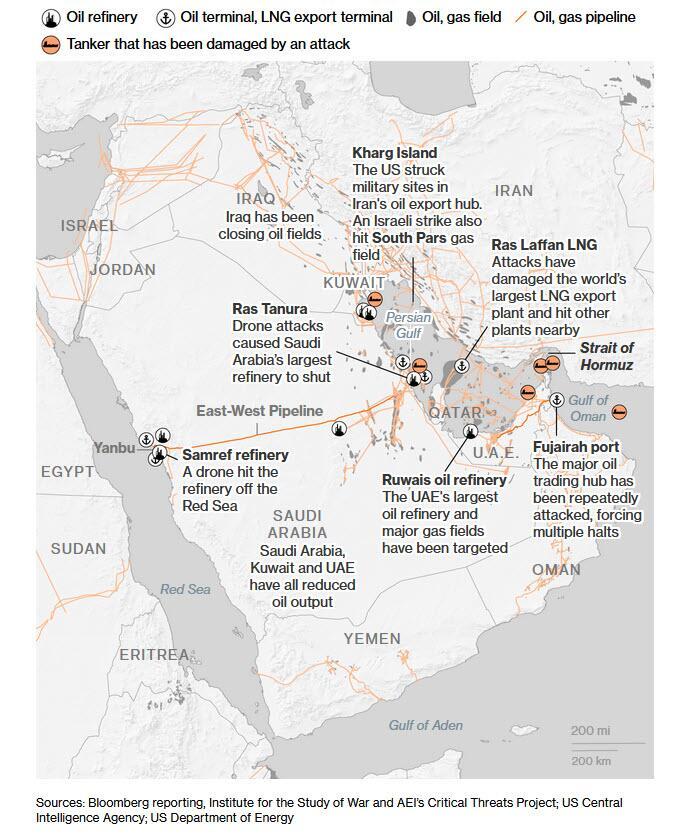
Despite the record flow, the Yanbu route still only partly offsets the hit to supply from shutting Hormuz, through which about 15 million barrels a day of crude shipments passed before the war. But the bypass is one reason oil prices haven’t reached the crisis-level highs of previous supply shocks.
However, with Yemen’s Houthis now saying they are entering the war, the concern for oil markets will be that the Red Sea becomes a new front in the conflict. While the Houthis have not given any indication they would attack tankers going through the Red Sea and Bab El-Mandeb strait, they have previously threatened shipping in the area with drones and missiles.
UAE’s Fujairah Nears Capacity
It’s not just Saudi Arabia that has been ramping up its options to bypass the Strait: the United Arab Emirates has also maxed out oil exports from a vital port that lies outside the Strait of Hormuz, after some of the biggest crude loading infrastructure resumed operations following Iranian drone strikes earlier this month.
The largest crude operations by Abu Dhabi National Oil Co (ADNOC) in Fujairah are picking up after they had halted March 14. The port in the UAE’s east coast has a critical role as an outlet for oil bypassing the all-but shut Hormuz waterway, making it among the energy sites most frequently targeted by Tehran. After Saudi Arabia’s Red Sea port of Yanbu, it’s the biggest exit point for Persian Gulf crude circumventing the maritime chokepoint.
As Bloomberg reports, the return of much of Adnoc’s operations helped push up crude loading to about 1.9 million barrels a day over the March 20-24 period. That’s up 57% from the average flows of about 1.21 million barrels a day over the past year, as the UAE pushes to get more cargoes out through the route with Hormuz still mostly blocked.

The latest crude oil export figures suggest a 252-mile (406-kilometer) Adnoc-owned pipeline – linking Habshan, the collection point for Abu Dhabi’s onshore fields, to the port – is operating close to its capacity.

The uptick compares with an average of 1.48 million barrels a day for the month through March 24. More recent exports still need to be verified as electronic jamming is widely blocking the transmission of satellite signals that allow tracking in the region.
Fujairah’s proximity to Iran – it’s about 80 miles (130 kilometers) south of Hormuz, nestled in the shadow of the Al Hajar mountains – makes it more vulnerable than Yanbu. Over the past four weeks, Tehran has attacked Fujairah at least seven times, destroying storage tanks and causing fires in a petrochemicals complex.
Besides crude oil, Fujairah also has large fuel-loading operations. Part of that system is still out of commission, after a key manifold was damaged in a strike more than three weeks ago. Most fuel is currently being loaded via an older section of the port, which connects directly to the ship berths without going via the manifold, according to people with knowledge of the situation. Refineries, including one run by a unit of Vitol Group, are still halted.
Fujairah — which became a refueling port for tankers during the Iran-Iraq war of the 1980s, before the construction of storage tanks at the turn of the century — exported its first crude in 2012.
“It took foresight to build a pipeline that bypasses the strait and was an effort to reduce dependence on a single chokepoint,” said Ben Cahill, director for energy markets and policy at the University of Texas at Austin’s center for energy. “At this point, every barrel matters.”
Still, Iranian attacks have deterred some shippers from calling at Fujairah, while loading systems and storage tanks — especially at the port’s product terminals — have been damaged. More importantly, those initial strikes damaged systems in the port, known as the Matrix Manifolds, which manage the flow of oil from each of the tank farms. Refined products are pumped through a complex web of piping arriving at a single point where the flows are then directed to any of more than a dozen ship berths.
A tank farm run by companies including Royal Vopak of the Netherlands and Dubai’s Emirates National Oil Co. halted loadings when the initial strikes crippled the manifolds, according to the people who asked not to be identified discussing operational issues. Loading from the Vopak Horizon terminal restarted late this week, according to a March 26 report from Inchchape Shipping Services.
Now Fujairah is working to restore full export capacity for refined products from a vast network of storage tanks that can store up to 70 million barrels. Fujairah has also developed into one of the top three ports for bunker fuel — the propellant used by ships — although the effective closure of Hormuz has curbed demand.
According to Bloomberg, traders took a net 404,000 barrels of fuel out of Fujairah’s tanks in the week through March 23, representing a 2.8% decline in stocks, according to data from the Fujairah Oil Industry Zone and compiled by Platts, a unit of S&P Global Inc. While some terminal operators are trying to empty their tanks to reduce fire risks, others have been reluctant to load for fear that would make them a target, according to people familiar with the operations.
Finally, taking a look at the Hormuz closure, which remains Iran’s only remaining Trump card and which Tehran has now played, increasingly more ships are now crossing: in addition to China and India, traditionally the biggest export clients of gulf oil, Japan has also reportedly reached a deal with Iran to be allowed passage. This morning, Thailand Prime Minister Anutin Charnvirakul said his country had negotiated an agreement with Iran to allow the safe passage of Thai oil tankers through the Strait of Hormuz.
Anutin said the agreement would ease some concerns about Thailand’s oil supply. The Thai Ministry of Foreign Affairs said this week it had successfully secured the passage through the strait of a tanker owned by the Bangchak Corporation, a Thai energy conglomerate. Earlier this month Iran said its forces fired on a Thai-flagged cargo ship, Mayuree Naree, which caught fire north of Oman after being hit by an unknown projectile. Three crew members went missing and another 20 were rescued.
Also on Saturday morning, ship tracking services reported that two LPG tankers and two bulk carriers exited the Gulf, with all four ships following a northern route that passes through the narrow gap between the two Iranian islands of Larak and Qeshm which many speculate the US will seek to take over with a marine invasion due to their critical importance in halting strait traffic.
end
UAE
TAKE A LOOK AT THIS: 5 TIMES THE SPEED OF THE SHAHED 136
(ZEROHEDGE)
UAE Unveils Jet-Powered Kamikaze Drone As War Gets A Lot Scarier
Monday, Mar 30, 2026 – 04:15 AM
UAE state-backed defense company EDGE Group has released footage on X, unveiling a new low-cost, jet-powered kamikaze drone, the latest signal that the hyperdevelopment of drone warfare is accelerating.
EDGE Group unveiled the Shadow 25, a jet-powered loitering munition described as a rapid-strike system designed to deliver precision attacks against fixed targets.
Shadow 25 can reach speeds in excess of 650 mph, about 5.42 times faster than the Iranian Shahed-136 drone. It has a range of 155 miles, which EDGE says offers “new opportunities to swiftly neutralize stationary enemy targets.”
EDGE is one of the UAE’s top national defense companies, developing, manufacturing, and supporting military and security products and services, including autonomous systems, missiles, naval platforms, electronic warfare, and radar systems.
Company Structure (data via Sayari):
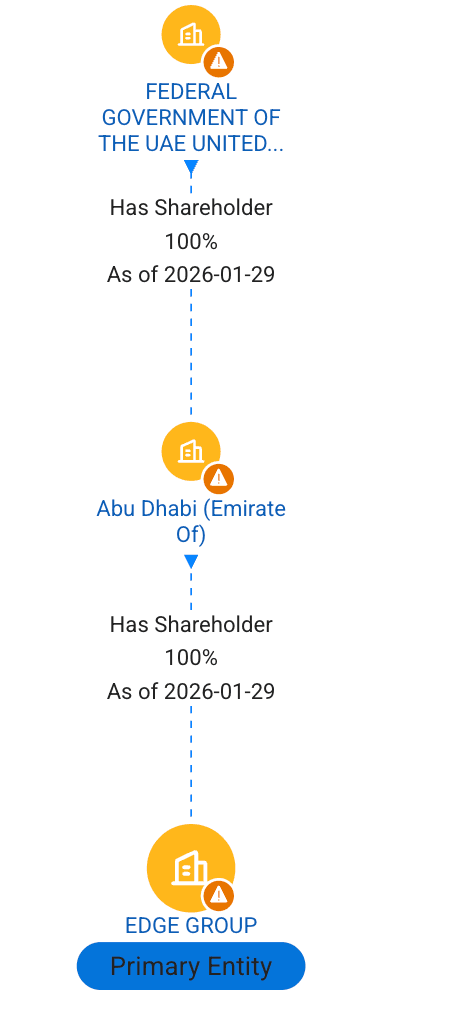
Corporate Network (data via Sayari):
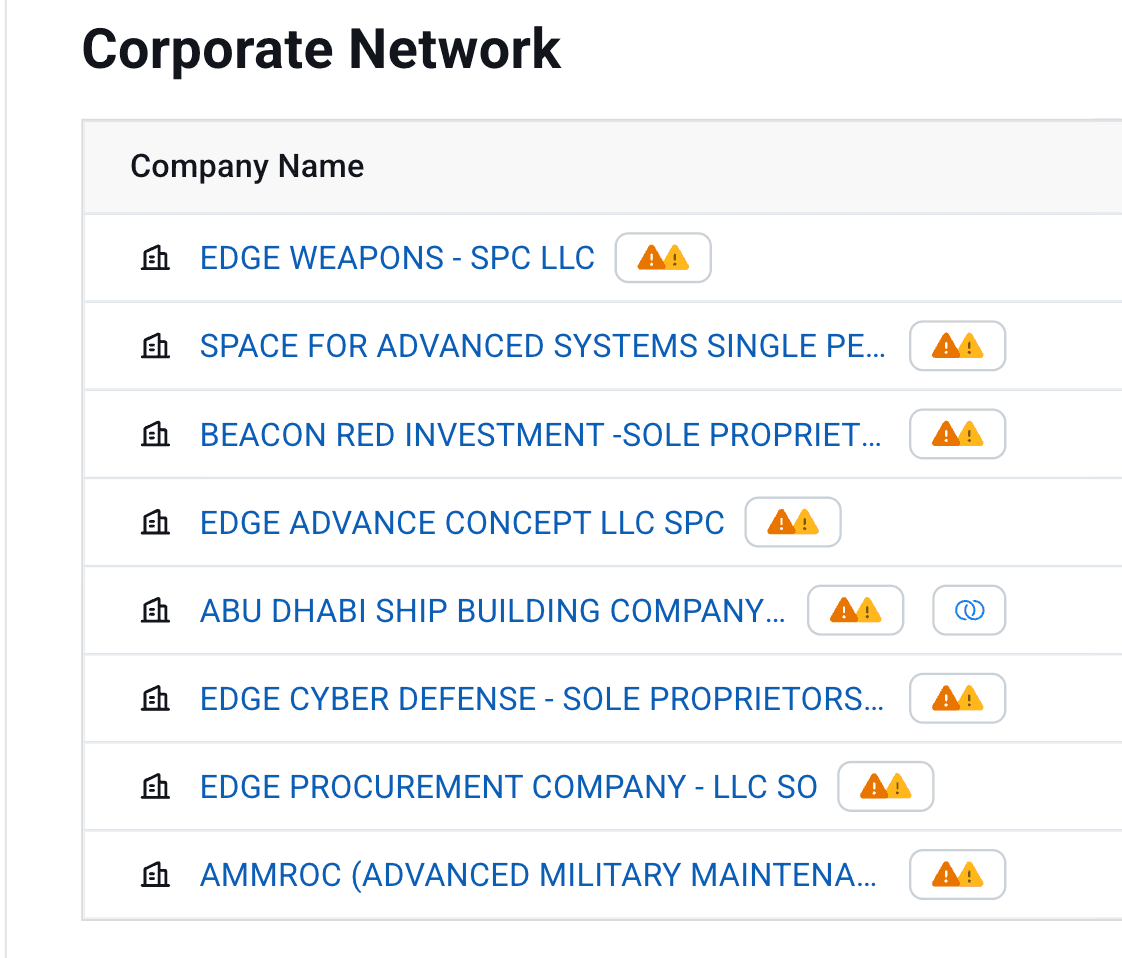
EDGE has also been expanding its industrial footprint and international partnerships. In 2025, it said it operated more than 170 manufacturing and assembly facilities across the UAE.
Our takeaway is that after four years of hyperdevelopment in drone warfare across Ukraine, the US-Iran conflict now appears poised to unleash an evolutionary leap in drone warfare. The next phase is likely to be defined by fast strike drones and more advanced AI-enabled targeting, further compressing the kill chain and deepening battlefield automation. Across Eurasia, war is spreading, from Ukraine to the Gulf.
END
UAE/IRAN/USA
NOT GOOD!!
UAE Will Be Pounded If US Invades, Iranian Officials Warn
Monday, Mar 30, 2026 – 01:05 PM
Tehran believes the United Arab Emirates is playing an active role in the US-Israeli war on Iran and any ground invasion could lead to widespread attacks on Emirati state assets, two senior Iranian sources told Middle East Eye. A month into the conflict, which has battered global markets, Donald Trump is weighing whether to use ground troops to seize strategic islands in the Strait of Hormuz in an attempt to stop Iran from disrupting energy supplies.
Attention has particularly focused on Kharg Island, the hub through which roughly 90 percent of Iran’s oil exports flow, and Qashm Island which overlooks the strait. Such an operation would probably be launched from US bases in Gulf Arab states, which have come under Iranian attack in retaliation for US-Israeli strikes on Iran, which have killed at least 1,900 people so far.

Anti-Iranian sentiment has grown in Arab Gulf states, where retaliatory strikes have hit various targets, including key energy infrastructure. Combative rhetoric has particularly come from the close Israeli ally the UAE, whose ambassador to the US wrote a column in the Wall Street Journal this week saying a ceasefire would not be “enough” and the belligerents should push for a “conclusive outcome” that “addresses Iran’s full range of threats”.
The WSJ even reported that some Gulf Arab states were considering joining the US-Israeli attacks on Iran. However, according to a senior Iranian security official, leaders in Tehran now believe the UAE has played an active role in the war from the very beginning.
According to the official, the Iranian leadership has “decided to end a weeks-long period of tolerance towards Abu Dhabi, after concluding that the Emirati role went beyond simply hosting US military facilities already hit in Iranian retaliatory attacks”.
The official said: “Iranian intelligence believes the UAE also made some of its own air facilities available for operations against Iran.”
Abu Dhabi has served as an advanced platform for Israeli interests in the region, the official said. He suggested this included “deception operations” – false-flag Israeli attacks on Oman and at least one other country intended to look like Iranian ones.
He said Tehran assesses that “part of that cooperation has also involved the use of advanced AI infrastructure inside the UAE to support data collection and analysis for US and Israeli targeting, including information on Iranian figures and sites”.
The official added that attacks on Iranian vessels, small boats and coastal areas launched from UAE territory would now be considered by Tehran as a major escalation requiring a “strong response”.
Imminent attack
A separate senior Iranian diplomatic official told MEE that Tehran believes a US ground offensive may now be imminent. He said intelligence assessments – supported by information from Iran’s allied states, including Russia – increasingly point to a scenario in which an assault could be launched from the UAE.
Last week, Trump threatened to destroy Iran’s power plants if it did not reopen the Strait of Hormuz, through which 30 percent of the world’s oil passed before the war. However, he has since twice delayed the promised attack, citing negotiations with Iran on a settlement that would end the bombing and allow oil to flow freely again.
The diplomat said Iran sees the current delay not as a genuine diplomatic pause, but as cover for the deployment of additional troops and preparations for a new phase of the war.
Reuters reported this week that the US is expected to send thousands more personnel to the Middle East, adding to the large American military presence already in the region. When the US and Israel on March 18 bombed South Pars gas field, one of the most important parts of Iranian infrastructure, Tehran responded by targeting energy facilities across the Gulf states.
Missiles and drones have also hit hotels, airports, data centers, ports and embassies in the region as the war has escalated. Yet the diplomat said Iran has so far deliberately avoided treating countries from which attacks were launched as fully enemy states.
For that reason, the diplomat said, Tehran confined itself to striking what it viewed as direct US military targets, or intelligence sites linked to the US and Israel, including some located inside civilian areas in countries such as the UAE and Bahrain.
That restraint, the diplomat warned, “would end immediately if any ground invasion takes place or if any part of Iranian territory or any of its islands becomes a target of a ground invasion”. Any country from which such an attack is launched would immediately be treated by Iran as an enemy, he said.
“Iranian strikes would no longer be limited to military or intelligence facilities but all state institutions and state-linked interests would become potential targets, including commercial and property assets in which the Emirati state holds investment stakes,” he said. “The previous rules will not hold if there is an invasion,” the diplomat added. “If any state participates in the occupation of even a single piece of Iranian land, that state will be dealt with as an aggressor.” This message, he said, has already been conveyed to the Emiratis.
* * *
KUWAIT/ISRAEL
WILL NORMALIZE//A MUST READ!!!
Kuwait is softening stance on Israel, dissident tells ‘Post’ after viral UN speech – interview
Kuwait, like many other countries in the region, has not been spared by the Islamic regime despite having no relations with Israel.

Jasem Aljuraid(photo credit: NAJLAA TAWFIQ)ByDANIELLE GREYMAN-KENNARDMARCH 30, 2026 15:30Updated: MARCH 30, 2026 16:36
A shift in the Kuwaiti public’s perceptions of Israel began as the war with Iran broke out, Kuwaiti dissident Jasem Aljuraid told The Jerusalem Post late on Sunday night.
Kuwait, like many other countries in the region, has not been spared by the Islamic regime, despite having no relations with Israel. On Monday, a worker was killed after the regime struck a desalination plant and a key power station.
“They see that Israel is throwing and shooting missiles that pass Kuwait’s airspace going toward Iran,” Aljuraid said. “This is an unprecedented time for Kuwaitis to change their perspective and their opinion about Israel.”
Aljuraid spoke with the Post just days after delivering an impassioned address at the 61st session of the UN Human Rights Council, where he denounced atrocities committed by the Islamic regime, condemned what he described as entrenched anti-Israel double standards among member states, and criticized the historical revisionist efforts to paint the Jewish state as a colonialist force.
“We need to join ventures and point out our strategic enemy and try to topple the IRGC and their militias,” he said.https://www.youtube.com/embed/qqwOp3363Kk?si=OjGNgyPmMgX9M67o
“I wasn’t wrong. Israel went after Hamas. Israel went after Hezbollah. They freed Lebanon. They freed the Palestinians from Hamas in Gaza. They went after the Houthis. They weakened the Houthis. Now, Yemenis have a new government, whether we agree with the new government or not.
“Israel’s impact is unbelievable. I don’t think that there are more important countries than Israel and the UAE in the region today. And I wasn’t wrong about this, and that’s why I went to the UN, and I gave that speech.”
Wearing traditional Arab clothing, Aljuraid said he wanted to make it clear that he was calling out the antisemitism as an Arab.
“They’re calling Israel the colonizer, the Zionist entity that is trying to expand and go back to the greater Israel, which is a huge propaganda and an enshrinement of a lie that they want to convince the world about,” he insisted.
“And then I went there and said, ‘No, I’m Kuwaiti. I’m an Arab; we are the colonizers. There are 57 Islamic countries and one Jewish state. Why would we go after that Jewish state? Why, when they’re fighting our fight?’” Aljuraid noted.
He highlighted: “I just want to make sure that we perceive Israel as a friend, not as an enemy,” joking that he heard the sound of mics dropping when he identified Arabs as colonizers.
Aljuraid’s willingness to call out corruption and stand in support of Israel has come at a cost.
He described how his criticism of the Muslim Brotherhood and corruption in Kuwait, coupled with inviting an Israeli journalist to his home, upended his life.
Aljuraid, who wrote extensively for the Kuwaiti daily newspaper Al-Qabas for nearly a decade, has been living in Canada for the past several years after receiving death threats and a prison sentence for referring to Israeli journalist Edy Cohen as his “friend” and “brother” in 2022. In a series of tweets, he expressed hope that Cohen might one day visit his home, remarks that sparked a boycott campaign and ultimately pressured Al-Qabas to dismiss him and remove his work. In the aftermath, Aljuraid said, prominent activists and community figures escalated their rhetoric, openly calling for his killing and urging citizens to “do their job” if they encountered him in public.
Digital normalization of Israel
Amendments in 2021 to Kuwait’s 1964 Israel Boycott Law criminalize what authorities define as digital normalization with Israel, effectively barring citizens from interacting with Israelis online. Violations can carry severe penalties, including prison sentences of up to 15 years with hard labor, as well as asset seizures.
At first, Aljuraid was taken to court and made to pay fines equivalent to $7,000 for his articles on the Muslim Brotherhood (MB) and his investigative journalist efforts to expose corruption in his country, but after the death of emir Sabah Al-Ahmad Al-Jaber Al-Sabah, the punishments became more severe. He was accused of being a member of Israel’s Mossad intelligence service and strongly advised to flee the country. Soon after leaving, he was sentenced to 12 years imprisonment in absentia and made a “political refugee,” he recalled.
“I never thought that this was gonna be my destiny, even Edy Cohen did not even imagine that I would be in this severe trouble,” he said, explaining that MB’s rise in power had meant that his ability to speak, write, and report freely had been restricted.
“We used to talk about Israel and the democracy in Israel and the development of the Israeli people in the education system and so forth… We were talking about it, and I was writing about it for a very long time… So it didn’t resonate with me that the next government bodies were influenced by the Brotherhood.”
Sabah was a “liberal,” Aljuraid claimed, stating that the only reason normalization hadn’t come under his rule was because of the country’s geographic vulnerability, surrounded by countries hostile to the Jewish state.
The powers that took over the country, including the interior minister and the prime minister, were sympathetic to the Muslim Brotherhood and reacted strongly to Aljuraid’s campaign to “confront the radical Islamists in Kuwait where their power was arising in a very, very scary way,” he said.
Making his situation more difficult to bear, Aljuraid said while visibly distressed, he missed his home and would likely not get the opportunity to say goodbye to his dying mother.
“She doesn’t know why I’m a political refugee today. I didn’t harm my country’s sovereignty, nor did I say anything wrong… I miss my mom. I’m lying to her every day, every day I tell her that I’m coming back. I lie. I say I’m coming next week, my paperwork is almost done,” he said.
Asked if, knowing the cost now, he would do anything differently to spare himself the heartache, Aljuraid shared that he would take a “harsher” stance than he had.
“I would travel to Israel, and I’d say, ‘This is Israel. I’m safe.’
“I would double down,” he claimed, recounting how he had the opportunity to go back on his statements when he was hosted by Arab media but refused.

While many in Kuwait have been indoctrinated by the media and prevented from deradicalizing through online or in-person interactions with the country’s strict anti-normalization laws, Aljuraid said he had been protected from the rhetoric by his parents.
His Muslim mother has Jewish ancestry, and his father “didn’t trust Palestinians” after Yasser Arafat and the PLO forces supported Saddam Hussein’s 1990 invasion of Kuwait.
Forgotten by many in Kuwait, though not his father, was Israel’s restraint in responding to Hussein’s forces during the 1991 attacks, he explained. “So this is, this is also a very noble stance that we will never forget for Israel,” he said.
END
TURKEY/ISRAEL/IRAN
believe it or not but Turkey wants to join the Iranian side despite the missiles being fired at them. go figure!!
Turkey Reports Another Iranian Missile Near-Miss Over NATO Skies
Monday, Mar 30, 2026 – 02:20 PM
Another near-miss has unfolded over NATO skies, with Turkey on Monday announcing that air defenses intercepted a ballistic missile fired from Iran. It’s another dangerous indication that the Iran war could easily expand into a broader conflict at any moment.
The intercept was carried out by air and missile defense assets positioned in the Eastern Mediterranean, according to the Turkish defense ministry, which offered no further initial details concerning trajectory, type, or what the intended target ultimately was.

This marks the fourth fourth such interception since March of the war and Operation Epic Fury, which has surpassed the one-month mark.
The timing is notable given Ankara is simultaneously trying to play middleman between Washington and Tehran, alongside Pakistan where regional diplomats have been trying to jump-start direct Tehran-Washington talks, which has proven elusive.
Turkish and NATO officials have struck a familiar tone, describing that “all necessary measures” are being taken to counter threats to Turkish territory and airspace, and further saying that ongoing developments will be “closely monitored”.
There’s been speculation that these ballistic missiles from Iran could be intended for US-British military assets in Cyprus. Earlier in the conflict drones were sent – likely from Iranian allies in Lebanon – onto a British airbase in EU-member Cypriot territory.
NATO command has previously stated that “Our deterrence and defense posture remains strong across all domains, including when it comes to air and missile defense.”
This developing pattern of large Iranian missiles flying over Turkey has raised the potential for invoking NATO Article 5, despite US officials having downplayed this option.
During the first incident, Pentagon chief Pete Hegseth had described, “On the matter with Turkey, I’ll have to get back to you on exactly what the intercept looked like.”
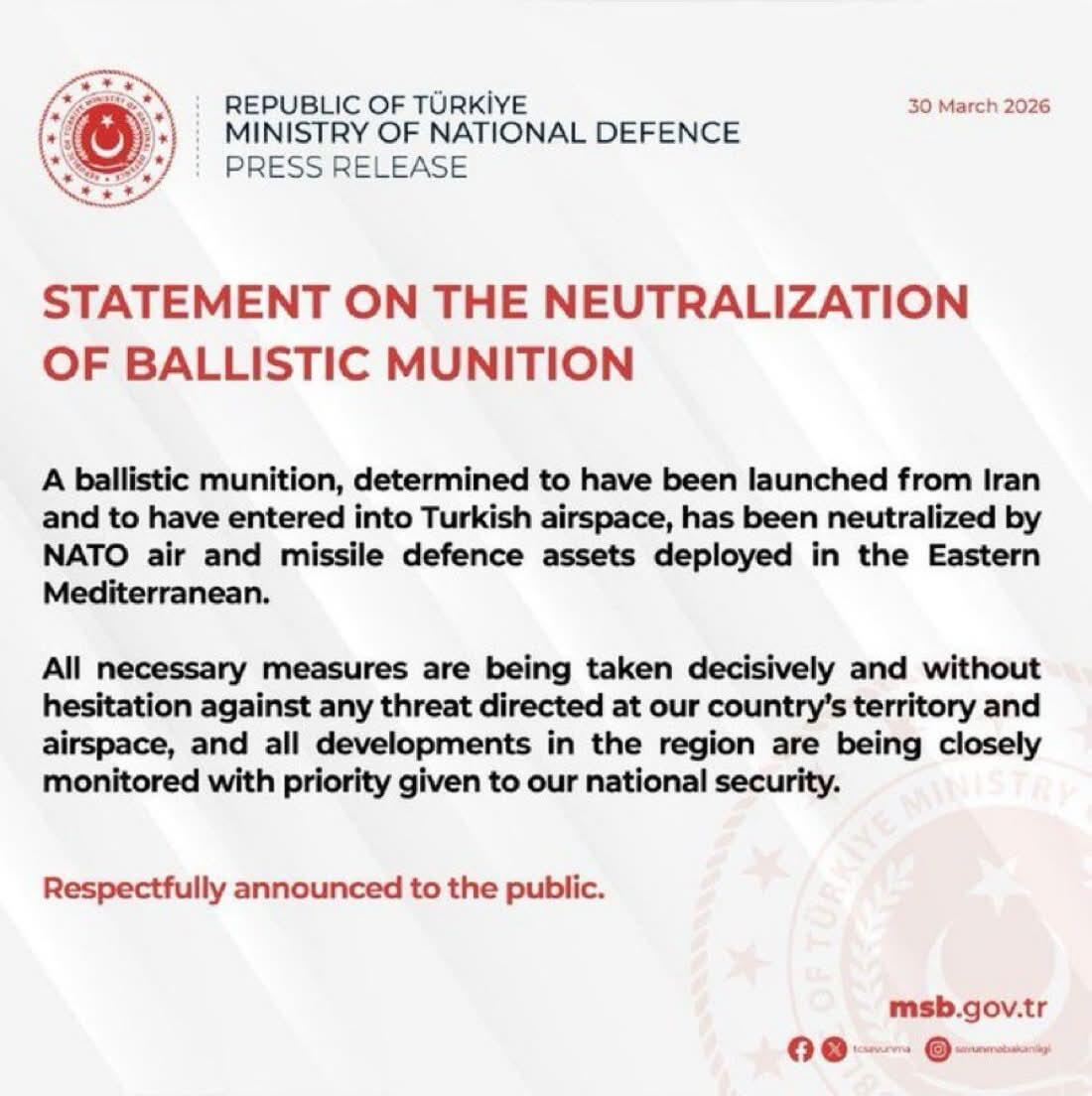
He laid out at the time that “We’re aware of that particular engagement, although no sense that it would trigger anything like Article 5.”
IRAN/RUSSIA
dangerous indeed!!
Russia Warns Situation At Bushehr Nuclear Plant Deteriorating After 3rd Airstrike In Ten Days
Saturday, Mar 28, 2026 – 11:05 AM
On Friday Iran informed the International Atomic Energy Agency that Bushehr nuclear power plant was struck by US-Israeli attacks for the third time since the start of the war.
At the same time, the head of Russia’s state nuclear corporation Rosatom has confirmed that the situation continues to deteriorate; however, there’s as yet been no damage to the operating reactor and no release of radiation reported. It was the third strike in just ten days.
The Kremlin has newly accused Washington and Israel of putting the whole region in danger, and further of harming the cause of nuclear non-proliferation globally.

Russian Foreign Ministry spokeswoman Maria Zakharova has issued a fresh statement: “The drama of the situation is aggravated by the fact that countries attacking peaceful nuclear facilities in Iran are effectively undermining the NPT, the IAEA’s verification mechanisms, nuclear and physical security conventions, as well as the agency’s relevant regulations,” according to the ministry’s website.
“Carefully crafted and internationally agreed solutions are not taken seriously by these states and can be discarded at any moment in favor of their selfish interests and geopolitical considerations,” the spokeswoman added.
Zakharova further communicated that atrocities in Iran must cease, and nuclear sites must be safeguarded, referencing the latest attacks in the past days on the complex in Khondab, the factory in Ardakan, and the strikes near the Bushehr nuclear power plant.
“The aggressors continue to raise the stakes in their war in the Middle East, ignoring all associated risks, including the danger of widespread radioactive contamination,” Zakharova said.
She further chastised UN and international bodies for not stepping up to loudly condemn the US-Israeli operation.
Russia has a direct interest in Iran’s nuclear sites, given hundreds of Russian experts and technicians have long helped operate them, and support the Islamic Republic’s domestic nuclear power generation for its electricity needs. Reuters reported this week:
Russia’s state nuclear corporation Rosatom evacuated a further 163 of its staff from Iran’s Bushehr nuclear power plant on Wednesday, the state-run RIA news agency reported.
It cited Rosatom chief Alexei Likhachev as saying about 300 of the company’s staff remained at Bushehr, but more would be leaving.
Some 500 to 1,000 Russian staff are there during normal operations, and presumably many more are at other sites throughout the country. Russia helped construct many of these very complexes many years ago.
end
LNG Crisis From Bad To Worse As Storm Damage Adds Weeks To Restart Of Chevron Wheatstone Plant
Sunday, Mar 29, 2026 – 10:45 PM
The perfect storm surrounding the global LNG supply chain, which hit a brick wall two weeks ago when Iranian attacks shuttered 17% of Qatar’s LNG output following devastating strikes on the Ras Laffan plant, the largest in the world, just went from metaphorical to literal after storm damage to Chevron’s Wheatstone gas plant in Western Australia is hampering efforts to restart operations and the facility won’t be back online fully for weeks, adding even more turmoil to the global LNG market.

As Reuters reports, tropical Cyclone Narelle was estimated to have disrupted Australian LNG facilities along the northern and western coasts, and disrupted supply equating to more than 30 million metric tons per year. Combined with the shock from conflict in the Middle East, more than a quarter of global LNG supply has been disrupted, MST Marquee analyst Saul Kavonic said on Friday.
“The Wheatstone gas facility near Onslow has had equipment damage from the severe weather, which has impacted restart activities,” Chevron said in a statement, adding that “while damage assessments continue at both the onshore Wheatstone plant and offshore Wheatstone Platform, it is likely to be a number of weeks before production returns to full rates to allow time for repairs to be safely completed.”
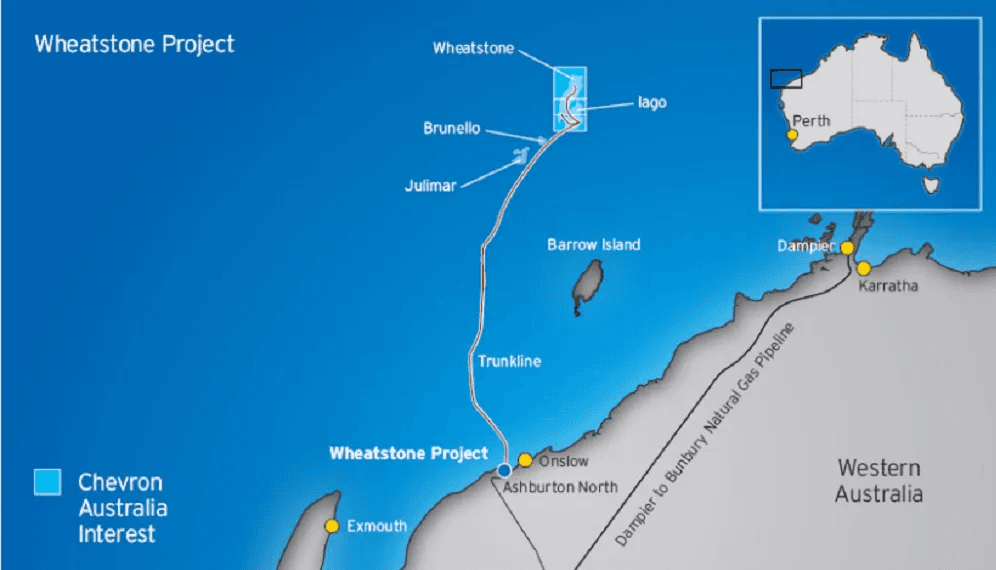
As we reported last week, Chevron said earlier in the week that one of three LNG production units at its Gorgon plant was halted, as well as a platform that feeds Wheatstone, which is a two-train LNG project which produces 8.9 million tons a year, about 15% of which is meant to be reserved for the domestic market. On Sunday it said the 15.9 million ton Gorgon LNG export facility and domestic plant continued to operate at full rates, adding that all of its three trains returned to full production on Sunday.
The storm also hit infrastructure feeding Woodside Energy Group’s North West Shelf export plant. The company said it’s working to resume normal operations, and output continues at its Macedon and Pluto gas facilities.
Woodside also said ship loading at Pluto LNG is restarting following the reopening on Saturday of Dampier port.
Gorgon, Wheatstone and North West Shelf accounted for almost half of Australia’s exports last month, or about 8.4% of the global trade, according to researcher EnergyQuest.
Australia became the world’s second-largest LNG exporter when Qatar shut down production this month after Iranian airstrikes damaged its facilities. The country most impacted from the Australian outage will likely be China, which following the Qatar force majeure production halt has been forced to rely on Australian product to a far greater degree.
RUSSIA VS UKRAINE
6.GLOBAL ISSUES, COVID ISSUES, VACCINE INJURIES/HEALTH ISSUES
GLOBAL ISSUES
Global Demand Destruction: Subsidies, Empty Gas Stations, Rationing, Flight Cancelations, Export Limits, Price Controls
Monday, Mar 30, 2026 – 08:11 AM
In the past two weeks we have discussed demand destruction as a result of soaring oil prices (here and here), and we are increasingly seeing anecdotal evidence of just that (here is a table from Goldman we showed previously, laying out where demand destruction is most acute).
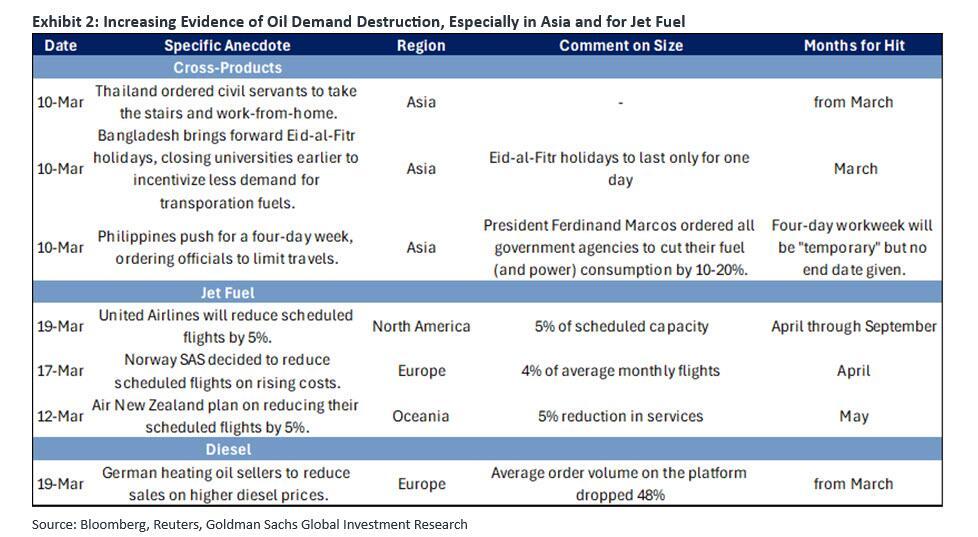
We start, as always, with Asia which has emerged as ground zero of the global energy crisis – as a reminder last week we first presented a map by JPMorgan’s resident commodity expert who how the shockwave from the Iran war spreads across the world, hitting Asia first, then Africa and Europe, before settling on the US, but mostly California.

According to UBS, a shortage of jet fuel in Asia and very high prices for what is available are now leading to greater flight cancellations. European jet fuel trades around $1713/tonne, up 114% since the war began. Singapore fuel is up around 140%. Both Vietnam Airlines and Air New Zealand have had to cancel flights due to limited fuel supply.
Let’s go down the list.
1. Panic buying prompts PM to reassure Australians over fuel supply (bbc)
Australia will halve its fuel excise for three months from Wednesday after prices soared to a record last week as the impact of the Iran war spreads. Meanwhile, the average price of a liter of diesel jumped above A$2.82 last week, while petrol was almost A$2.40, both the highest in at least 20 years. The average price in rural regions like the Northern Territory was even higher, a blow to farmers and long-distance transport firms.
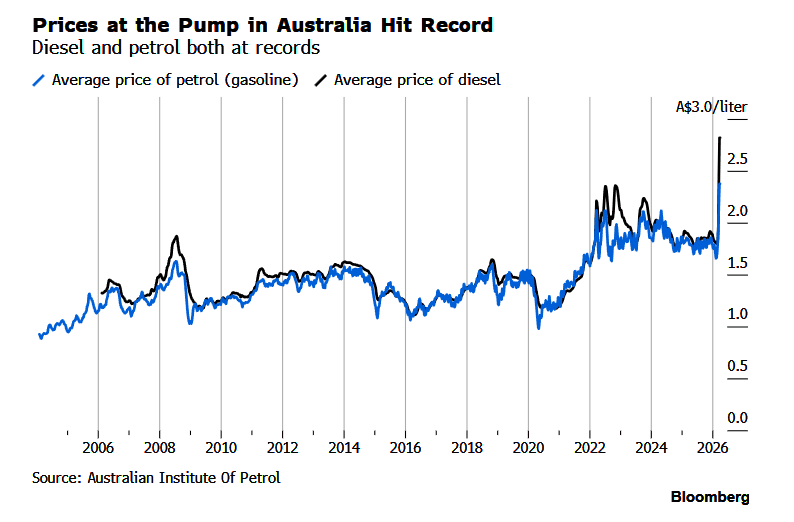
The temporary cut would reduce the price of petrol and diesel by about 26 Australian cents ($0.18) per liter, Prime Minister Anthony Albanese said at a press conference Monday in Canberra. “The longer this war goes on, the worse the impacts will be,” he said. The government will also reduce the heavy road user charge for the next three months, and delay the next planned increased in that charge by six months. The measures are expected to cost about A$2.55 billion and to lower CPI by 0.5 ppt, Treasurer Jim Chalmers said.
Albanese has sought to reassure Australians that the country’s fuel supply remains “secure” as prices soar and following reports of panic buying and petrol stations running dry since the start of the Iran war. There have been reports of truck drivers and other motorists stranded, while businesses say rising costs are affecting their viability. The government says demand and distribution issues have caused shortages rather than supply, which it says remains at the same level as before the war began.
In Cairns, Queensland, the BBC found a small independent garage that tells a pretty typical story in Australia. It has run out of unleaded petrol and the price of diesel is 85% higher than it was before the war in Iran started. In New South Wales, Australia’s most populous state, one in seven retailers say they are out of at least one type of fuel.
The price of diesel in Sydney has meanwhile risen to the 314.5 cents a litre as of Thursday, according to the National Roads and Motorists’ Association (NRMA), its highest ever price. Hundreds of petrol stations across the country have reported running out of at least one type of fuel this week. But shortages are due to people changing their buying habits, NRMA spokesperson Peter Khoury told the BBC. “People are filling up jerry cans of fuel and storing it in their garages,” he said.
“We’re hearing increasingly of transport companies telling their drivers that if you’re half full and you see diesel, buy it.”
2. Japan Says Oil Reserves for Domestic Use Amid Asia Pleas for Aid (bbg)
Japan’s trade minister said the country will sell oil from its reserves to domestic refiners as a general rule, signaling that the government isn’t currently planning to channel national supplies directly to other Asian nations seeking assistance.
“Regarding the sale of strategic petroleum reserves, we are certainly targeting domestic oil and refining companies,” Trade Minister Ryosei Akazawa said Friday, pointing out that they were legally established to secure Japan’s own energy supplies. “However, the situation may differ somewhat for joint reserves with oil-producing countries. We intend to closely monitor developments and make appropriate decisions on a case-by-case basis.”
Other Asian countries are facing similar oil supply challenges. The Philippines and Vietnam have reportedly sought support from Japan, which holds some of the world’s largest oil reserves. In addition to its own reserves, Japan also has reserves held with oil producing nations like Saudi Arabia, the United Arab Emirates and Kuwait.
Akazawa said he is well aware of the Philippines’ dire situation, noting that its reserves are far smaller than Japan’s while it relies heavily on the strait to secure oil, as Japan does.
3. Japan to relax rules from April to boost coal-fired power amid LNG import risks (reuters)
Japan’s industry ministry will relax rules for one year to increase the use of coal-fired power plants in the fiscal year starting April, as the U.S.-Israel war with Iran adds uncertainty to liquefied natural gas imports, it said on Friday. Japan takes delivery of some 4 million metric tons of LNG annually – or around 6% of its total imports – via the Strait of Hormuz, which has been effectively closed due to the war.
“There is increasing uncertainty about future LNG procurement. We believe that it is necessary to increase the operation of coal-fired power plants and save LNG fuel,” an industry ministry official told a special government panel. The Ministry of Economy, Trade and Industry proposed suspending for one year its 50% cap on the capacity utilisation rate of coal-fired power plants with generation efficiency below 42%.
LNG consumption could then fall by about 0.5 million tons a year, or slightly more than 10% of the LNG it imports via the Strait of Hormuz, according to a METI’s estimate. The ministry will implement the change from April 1 as an emergency measure and there were no objections from the panel members, the official told Reuters.
Japan has an LNG stockpile of around 4 million tons, METI data showed. Its thermal power generation largely depends on LNG and coal, with a small portion covered by oil, with electricity also being generated from nuclear power and renewable energy. So far, Japan has restarted 15 nuclear power reactors of 33 which remain operable after the Fukushima Daiichi disaster in 2011.
4. India Slaps Taxes on Fuel Exports as Iran War Jolts Supply (bbg)
India has announced a series of tax changes including a levy on fuel exports, as the country tries to shield consumers from the impact of a deepening conflict in the Middle East that has upended energy supply. The South Asian nation imposed a 21.5 rupee (23 cents) per liter duty on exports of diesel and 29.5 rupees on jet fuel, Finance Minister Nirmala Sitharaman said in a post on X. “This will ensure adequate availability of these products for domestic consumption,” she said.
India has also slashed taxes on locally sold gasoline and diesel by 10 rupees per liter each, a reduction intended to help keep prices stable at the pump.
As the third-largest oil consumer, India is among the countries most impacted by the war in the Persian Gulf and the closure of the Strait of Hormuz, which connects the region with the wider world. It has seen acute shortages of liquefied petroleum gas, used for cooking, and of liquefied natural gas. The country raised LPG prices earlier this month and subsequent speculation around a likely increase in pump prices of diesel and gasoline has led to panic buying, with people lining up outside forecourts.
The energy crunch comes at a delicate time for a price-sensitive country, with elections in key states where Prime Minister Narendra Modi’s Bharatiya Janata Party is looking to expand its foothold. Opposition parties have been pressing for more forceful measures to address the fuel crunch. Madhavi Arora, an economist at Emkay Global Financial Services, estimates the government’s annualized revenue loss from tax cuts at about 1.55 trillion rupees ($16.4 billion).
Diesel and jet fuel together form a significant portion of India’s refined product exports. Last month, India supplied around 500,000 barrels a day of the two products combined, out of the roughly 1.2 million barrels a day of fuels exported, tanker trading data from intelligence firms Vortexa and Kpler showed.
The government will lose 70 billion rupees every fortnight due to the excise duty cut, Vivek Chaturvedi, chairman of the Central Board of Indirect Taxes and Customs, told reporters at the daily government briefing on the situation. However, it expects to collect about 15 billion rupees over the same period from export taxes levied on jet fuel and diesel, he said.
5. Thailand Tightens Fuel Pricing, Supply Disclosure Amid Shortages (bbg)
Thailand is tightening oversight of fuel pricing and supply as authorities ramp up efforts to address shortages across parts of the country. Refineries must display selling prices at their sites along with current inventory levels, under new directives outlined by the Energy Ministry late Thursday. Traders are required to adhere to declared prices and cannot charge above government-set levels, it said.
The Southeast Asian country has faced fuel shortages in several provinces as the Middle East conflict drives up global oil prices, widening the gap between subsidized domestic rates and international markets. Fears of tighter supplies have sparked panic buying, particularly of diesel, despite government assurances that stocks can last about 100 days. While authorities have taken steps to shore up supplies to retail outlets, many pumps have had to ration fuel as agriculture and industrial users queued up with jerry cans along with commuters to buy diesel.
Diesel demand has jumped to about 87 million liters per day from an average 67 million liters before the start of the conflict, according to the ministry. The government has already raised retail prices to ease pressure on subsidies. However, even after Thursday’s increase, it is still subsidizing diesel at 19 baht (58 US cents) per liter, pushing the oil subsidy fund’s deficit to about 38 billion baht, acting Energy Minister Auttapol Rerkpiboon said.
6. Vietnamese Airlines Slash Flights From April on Jet Fuel Crunch (bbg)
Vietnamese airlines will significantly reduce flights and scale back operations from April as soaring jet fuel prices and supply constraints squeeze the industry, prompting carriers to focus on core routes as the Middle East conflict drags on. Vietnam Airlines, the national carrier, will suspend seven domestic routes from April 1, according to a document from the Civil Aviation Authority of Vietnam. The airline plans to cut 10-20% of its flights per month in the next quarter if jet fuel reaches $160-$200 per barrel, the document said. That could mean up to 18% of its international flights being canceled and up to 26% on domestic routes.
Low-cost carrier Vietjet Air is targeting an 18% reduction in total capacity in April, including a 22% cut in domestic flights and an 11% reduction in international routes, the document said. Bamboo Airways passengers are expected to see the biggest disruption in April, with flights halved to 15–17 per day.
Vietnam has moved to shore up energy security after severe disruptions to oil and gas flows through the Strait of Hormuz, prompting the government to tap its emergency fuel fund to stabilize prices. The country’s two domestic refineries meet around 70% of its domestic demand, but more than 80% of its crude imports come from Middle East.
The government announced on Friday it will temporarily freeze some taxes on gasoline, oil and jet fuel until April 15 as an ‘urgent’ move to stabilize the domestic market and ensure national security due to the ongoing conflict
7. Asia employs energy price control and subsidies (WoodMac)
Asian governments have rapidly deployed an unprecedented array of cushions to protect the hardest-hit sectors and consumers. But such interventions come at a staggering cost and, if oil prices remain high, some Asian governments will soon hit fiscal breaking point.
Asian countries are trying to prevent a repeat of the 2022 cost-of-living crisis. Beyond demand-side management, Asian governments have shifted from market pricing for oil products to aggressive intervention. A plethora of policy responses are being rolled out across the region. Most, though, amount to pretty much the same thing – subsidies for consumers.
Price caps at the pump are the go-to lever, with governments compensating losses through a variety of mechanisms. In Indonesia, losses by national oil company (NOC) Pertamina will be recovered by government compensation later; Japan and Malysia have a similar scheme for their refiners and fuel suppliers. In Thailand and Vietnam, oil company losses are currently made good from dedicated funds – though the longevity of these funds is already being tested. China, meanwhile, has a US$130/bbl crude price ‘cap’ on refined product prices that refiners can pass through to customers. Perhaps in anticipation of higher prices, China introduced subsidies on diesel and gasoline this week despite the cap not being breached.
India has a twist on the theme. The government moved fast to freeze retail prices but the state-owned oil marketing companies initially have to absorb the losses. Once these become unsustainable, the central government intervenes by cutting taxes, essentially sacrificing tax revenue to keep the pump price stable.
The affordability of current subsidy schemes varies greatly by country. Thailand and Vietnam have tapped into budget rainy-day funds to make subsidy payments. But Thailand’s fund is already in deficit, while Vietnam’s will be fully drawn by early April under the current subsidy scale. Expanded fiscal deficits look near-certain through 2026 across much of Asia. If Brent averages US$100/bbl for four months, India is hit hardest among Asia’s major economies: we estimate a cost equivalent to 0.7% of GDP and 7.2% of government revenue in fiscal year 2025-26. Indonesia is in danger of breaching its legal limit of 3% on its fiscal deficit if subsidy payments persist
On to Africa…
8. Kenya Plans to Stabilize Fuel Price as Outages Hit Some Stations (bbg)
Kenya plans to stabilize fuel prices as some stations run out of supply in the East African nation that typically depends on Middle East imports to meet demand. Vitol Group’s Vivo Energy, the biggest retailer in the country, said Thursday in a post on X that increased fuel demand resulted in temporary outages at some of its outlets. Kenya’s Treasury Secretary John Mbadi the same day outlined initial measures to be taken by the government to keep petrol and diesel prices from surging.
Kenya will utilize its petroleum development levy to cap pump prices, though a lengthy war could become an emergency, Mbadi told lawmakers in the capital, Nairobi. “It is my hope that we will not see this war prolonged for another month or so.”
Many African economies, particularly in East and Southern Africa where the Middle East is a major exporter, are running on weeks of stored refined products as the Iran war chokes shipments through the Strait of Hormuz. Governments have this week sought to reassure residents that there are sufficient stocks and asked them not to hoard fuel.
Kenya’s outlying gas stations have been the first to dry up as major oil companies are holding back from wholesaling product that would normally be distributed, according to a lobby group of independent operators.
“Rural stations are the worst hit — we can’t get product at competitive prices,” said Martin Chomba, chairman of the Petroleum Outlets Association of Kenya. About 68% of Kenya’s 6,200 gas stations are non-franchised and a “substantial number are not able to access products,” he said.
… and Europe
9. Czechs May Cap Fuel Margins as Premier Slams Retail Prices (bbg)
The Czech government said it’s considering regulating retail margins at gas stations after Prime Minister Andrej Babis criticized the two largest fuel distributors in the country for what he called “outrageous” prices at the pumps. Local media have reported that cost of petrol and diesel in the Czech Republic has shown one of the biggest jumps in the European Union since the outbreak of the war in Iran. While several nations in central and eastern Europe have adopted measures to ease the impact of surging oil on households and businesses, the Czech government rejected opposition proposals to lower excise taxes because of the impact on budget deficit.
“Instead, we are prepared to do something actually effective, and that is for instance regulating margins at the pumps,” Finance Minister Alena Schillerova said in a post on X Friday. “This option and other steps will be the main topic at the government meeting on Monday.”
The premier, a chemicals and agriculture billionaire who returned to power last year, urged Poland’s Orlen SA and Hungary’s Mol Nyrt to lower their prices immediately. “I’m asking you not to abuse the current situation in supply of fuels caused by the Iran crisis,” Babis said in a video on his Facebook account.
Officials in Prague previously stated they wouldn’t cut fuel taxes to ease the hit from energy shock, saying such a move wouldn’t guarantee lower retail prices. Orlen Unipetrol, the Czech unit of the Polish group, is operating in line with the law and its prices are set by the market, the CTK newswire reported, citing spokesman Pavel Kaidl. A spokesman for Mol’s Czech unit told the Seznamzpravy news website that fuel prices are determined mainly by oil prices on international markets, while taxes also have a significant influence.
10. Poland Plans Fuel Tax Cuts to Shield Consumers From High Prices (bbg)
Poland is joining a group of countries that shield consumers from surging fuel prices with a plan to cut taxes and cap prices at the pump, according to Prime Minister Donald Tusk. The government will reduce the value-added tax and excise levies on fuels as well as impose a cap on retail prices that will be set daily in line with wholesale levels, Tusk told a news conference on Thursday.
The moves, which need parliamentary approval, are expected to slash fuel costs by 1.2 zloty ($0.32) per liter and could take effect by Easter, Tusk said. The cabinet is also preparing windfall tax on fuel refiners — a measure that’s set to impact Polish energy champion Orlen SA, the largest company in Warsaw’s benchmark WIG20 stock index. Its shares have lost as much as 6.7% in the wake of the announcement.
The oil-importing nation has seen one of the sharpest increases in fuel prices among European Union members since the start of the Iran war. Unleaded gasoline costs have jumped 22%, while diesel by 40%, according to European Commission data. This compares with average increases of around 15% for gasoline and 26% for diesel across the 27-nation bloc.
* * *
And as the global shockwave from the Iran war gets more acute, expect the response from officials and authorities to become increasingly more panicked.
MARK CRISPIN MILLER
DR PAUL ALEXANDER
NEWSWIZE
| Tiger Woods Faces DUI Charges Following Rollover IncidentTiger Woods was arrested on DUI charges after a rollover accident near his home in Florida. The incident has raised concerns about his potential return to competitive golf, following previous legal and health challenges.READ THE FULL REPORT |
| Investigation Into Alleged Immigration Fraud by Ilhan Omar Launched by JD VanceJD Vance, the Vice President, has confirmed that the Trump administration is exploring legal avenues regarding Rep. Ilhan Omar’s alleged immigration fraud. This inquiry could escalate into a formal investigation.READ THE FULL REPORT |
| Shifts in Gulf Alliances: Moving Away from IranRecent developments indicate that Gulf nations, particularly Saudi Arabia, are reevaluating their long-standing positions with Iran due to escalating aggression. This shift reflects a growing urgency to bolster their defenses.READ THE FULL REPORT |
| Tiger Woods Faces Rollover Accident in JupiterTiger Woods was involved in a rollover accident in Jupiter this past Friday. While details are still emerging, authorities report that no serious injuries were sustained, but this could complicate his return to golf.READ THE FULL REPORT |
| Calls for Thune to Step Down Gain Momentum in GOPA significant rift has emerged within the Republican Party as Rep. John Rose (R-TN) urges Senate Majority Leader John Thune (R-SD) to resign. This comes amid dissatisfaction over recent compromises related to the Department of Homeland Security shutdown.READ THE FULL REPORT |
MICHAEL EVERY/OR OR PICTON/GIFFIN OR RABOBANK EXECUTIVE/COMMENTARY ON WORLDLY AFFAIRS
7. OIL ISSUES/NATURAL GAS/ENERGY ISSUES/GLOBAL
Macquarie: Two More Months Of War Could Send Oil To $200
Friday, Mar 27, 2026 – 10:15 PM
Submitted by Tsvetana Paraskova of OilPrice.com
Oil prices could hit a record $200 per barrel if the war in the Middle East drags on through the entire second quarter, analysts at Macquarie Group have warned.

The odds of the Iran war dragging on until June were put at 40% by the analysts in a note carried by Bloomberg. But the scenario of the war ending by the end of March currently appears more plausible, with odds at 60%, according to Macquarie.
“If the strait were to stay closed for an extended period, prices would need to move high enough to destroy an historically large amount of global oil demand,” Macquarie’s analysts wrote in the report.
“The timing of the re-opening of the straits, and physical damage to energy infrastructure, is the main determinant of the longer-term impact on commodities,” they added.
Many other analysts warn that if the Strait of Hormuz, which is already closed to most tanker traffic for nearly a month, remains blocked for another month or two, oil prices could jump to as high as $150 and even $200 per barrel, forcing a global economic shock.
Analysts started expressing views that $200 oil is not a fantasy anymore—with 20% of global oil supply choked at the Strait of Hormuz buyers are racing to procure physical cargoes, refiners in Asia consider cutting processing rates, and Asian countries restrict fuel exports.
Andrew Harbourne, Wood Mackenzie’s senior analyst for oil markets, notes that the record 400-million-barrel release coordinated by the International Energy Agency (IEA) will cover only about four weeks of disruption in the Gulf.
“Strategic stocks remain an effective emergency buffer, but they are a one-off intervention that must eventually be rebuilt and cannot cover a sustained supply gap,” Harbourne added.
Supply shocks in the past suggest that if the war and the disruption in the Strait of Hormuz persist, Brent crude prices could surge to $150 to $200 per barrel. For some petroleum products, such as diesel and jet fuel, the effective prices could be $200 to $250 a barrel or more, according to WoodMac.
END
Maersk Slaps Emergency Fuel Surcharge As War Upends Marine Supply Chains
Saturday, Mar 28, 2026 – 10:30 AM
Submitted by Michael Kern of OilPrice.com,
The war in the Middle East has upended shipping fuel markets with prices of marine fuels skyrocketing and regions running low on supply, pushing some traders to forgo cargo and ship additional fuel volumes to key bunkering ports outside the Middle East.
The price of fuel oil has surged this month as the stalled tanker traffic at the Strait of Hormuz is tightening supplies of the fuel in Asia, the key bunkering hub for fuel oil used in ships.
The Middle East is a major global supplier of fuel oil, especially of high-sulfur fuel oil (HSFO). But the Iran war has all but halted traffic via the Strait of Hormuz, stranding supplies for Asia and its key bunkering hub of Singapore.
Yet, stocks in Singapore have increased this month as shipping owners and operators have refrained from buying the too expensive fuel. These, however, could soon start to deplete, fast, because vessels are becoming desperate to refuel, according to a Financial Times analysis.
One trader told the publication that their firm had to forgo cargo in order to deliver additional fuel volumes between major ports, mostly between the United States and Singapore.
With the Middle East’s key bunkering port of Fujairah mostly offline by the end of March due to Iranian attacks earlier this month, the marine fuel market is in chaos.
Shipping giant Maersk warned in its latest Middle East advisory this week that “To preserve network stability, we have undertaken significant redistribution of fuels to offset shortages in the Middle East, and are securing alternative sources from different locations, suppliers, and at increased premiums.”
Maersk also introduced as of March 25 an Emergency Bunker Surcharge (EBS), “in response to notable fluctuations in fuel supply and the additional costs of distribution.”
Maersk’s chief commercial officer Karsten Kildahl said earlier this month that “There is currently sufficient fuel globally, but it is unevenly distributed. As a result, we are making changes to our fuel supply chain and begin moving fuel to ensure our vessels can continue to bunker where needed – and protect the flow of trade.”
END
Bahrain Refinery
When a 400,000 barrel refinery is destroyed you do not rebuilt in several years. It will take at least 5-7 years to rebuild this. Meanwhile the capacity is gone for this period. If you add the numbers publicly available then close to 2 million barrels a day or more is off line. This has impact.
The IRGC has finished off the largest oil refinery in the Middle East, located in Bahrain

There’s no place left to even assess the damage. The Bahrain Petroleum Company (BAPCO) has acknowledged that the plant has been completely burned out.
BAPCO is essentially the foundation of the national economy and one of the oldest refineries in the Persian Gulf region. The Bahrain Petroleum Company (BAPCO) is Bahrain’s state-owned oil and gas company. The Bapco Refinery has a capacity of 400,000 barrels per day.
END
HAIFA REFINERY ON FIRE
Live Updates: Haifa refinery said hit in latest Iranian barrage, IDF suspends Netzah Yehuda after CNN debacle
Iran views US demands for talks as ‘excessive’ • Police reach agreement with Latin Patriarchate • US allows Russian tanker to reach Cuba • IRGC commander killed in Tehran
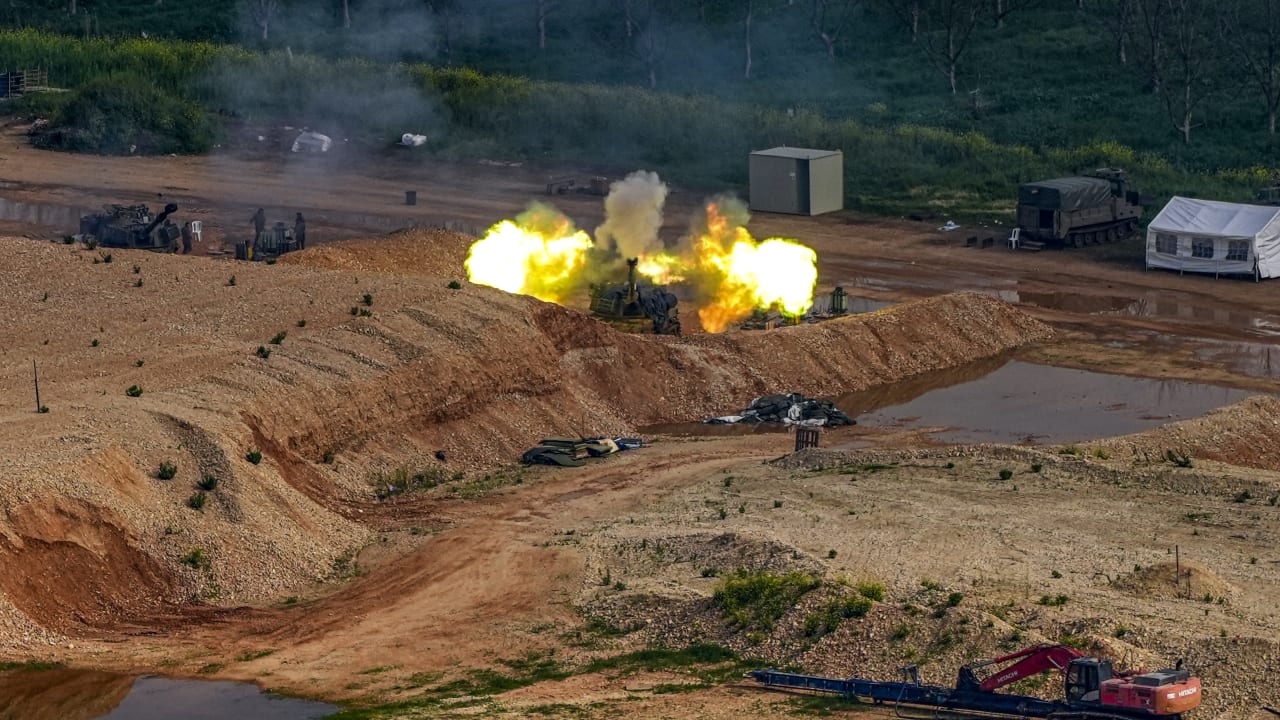
AN ISRAELI artillery unit fires near the Israeli-Lebanese border amid the ongoing war with Iran and Hezbollah, March 28, 2026.(photo credit: AYAL MARGOLIN/FLASH90)
ByJERUSALEM POST STAFFMARCH 30, 2026 11:54Updated: MARCH 30, 2026 13:19
An impact was reported in Haifa during the latest Iranian missile barrage on Israel on Monday, with initial indications pointing to a strike or falling debris in the city’s industrial zone.
According to emerging reports, the impact area included or was near sensitive infrastructure at the Bazan oil refinery, which has been targeted in previous attacks.
In earlier barrages, missile shrapnel struck the facility, causing localized damage and temporary power disruptions, though no casualties were reported.
“Search and rescue forces, both reserve and regular forces, are on their way to a site in northern Israel where reports of impact have been received,” the IDF said in a statement.

Advertisement
The Environmental Protection Ministry told Ma’ariv that a gasoline tank is burning in the refinery complex, producing thick smoke, but with no risk to the population in the area from a hazardous materials incident.
The Haifa municipality later confirmed that there was no suspicion of hazardous materials in the area, and no danger to the public.
Residents near the complex were asked to close windows in their homes and not stay outside.
Tehran targets Ne’ot Hovav industrial zone
On Sunday, an Iranian missile impacted in the industrial zone of Ne’ot Hovav, starting a fire and potentially causing a leak of hazardous chemicals.
The Environmental Protection Ministry stated that the possibility of hazardous chemicals leaking was being investigated, but that at this stage, there was no expected risk to nearby towns in the Ramat Negev Regional Council.
Israeli media reported that one person was lightly wounded by the shockwave.
END
8. EMERGING MARKETS//AUSTRALIA NEW ZEALAND ISSUES
EGYPT/SUEZ
VERY IMPORTANT!!
ROBERT H TO US:
Egypt is the Canary
Anyone reading the news will understand that sea borne traffic is lower through the Suez Canal depriving Egypt of vital revenue at a time when the energy costs are skyrocketing.
The result is not unexpected. Egypt’s monthly energy bill was $560 million. Today, for the same quantity, Egypt is paying $1.650 billion.
It is why now stores and ALL shops are subject to curfew to close early in an attempt to control costs. Whether tourists know this is questionable.
This will impact widely because people work less and make less and the charm of late evening shopping and dining is temporary restricted.
This type of behavior will spread. And just as predictable we will see wider shortages of food stuffs simply because fuel costs will be passed on to consumers. Such costs will drive food availability. This is already clear by.grocery stores attempting to control costs by redirecting purchases to more local producers. Why ? Price increases lower purchasing. Thus lowering sales.
Many producers will find it impossible to maintain prices. This is a classical marketing problem that lowers sales. Where prices increases meet resistance in buying.
Do not be surprised that other countries do the same. And as consumption drops we will see a global recession or worse. Because the wallets of everyone are not elastic enough to absorb the costs will come.
If this was ended tomorrow it would take at least 6 months for stabilization at a consumer level. Whereas large Capital Goods are no longer being able to quote fixed price deliveries. One simply cannot control supply where costs are driving increases. Otherwise the supply chain suffers loss.
As for capital availability look for Capital flight within 2 months if this does not end or worsens.
END
CUBA/RUSSIA
US To Let Russian Oil Tanker Deliver Fuel To Cuba: Report
Sunday, Mar 29, 2026 – 10:10 PM
A week after Russian tankers loaded with fuel for Cuba were diverted due to a months-long US oil blockade, the US Coast Guard is permitting a Russian vessel carrying an estimated 730,000 barrels of crude oil to reach Cuba, the NY Times reports, citing an official briefed on the matter.
The tanker – Anatoly Kolodkin – owned by the Russian state-controlled shipping company Sovcomflot under U.S. sanctions since 2024 – left Primorsk, Russia on march 9, and is now expected to dock at the port of Matanzas as early as Monday night or Tuesday.
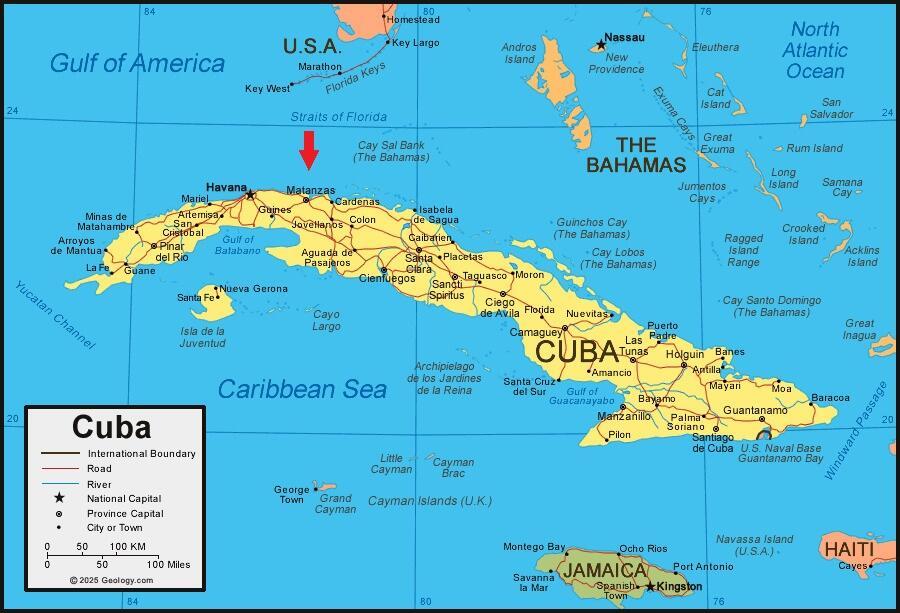
This development marks a notable pause in the administration’s “maximum pressure” campaign, which has included threats to third-party nations, the escorting of at least one earlier tanker away from Cuba, and recent Treasury Department measures explicitly barring Cuba from any waivers on Russian-origin oil. Despite two U.S. Coast Guard cutters positioned in the region capable of interception, no orders were issued to stop the vessel. The Coast Guard referred questions to the White House, which did not respond.
The decision avoids an immediate and potentially thorny naval confrontation with Russia in the Caribbean, even as President Trump has publicly suggested military options toward Cuba. At a recent investment conference, Trump stated he believed he would have “the honor of taking Cuba” and added, “Cuba is next, by the way,” in reference to possible use of force after the Iran conflict. Secretary of State Marco Rubio has similarly called for new leadership in Havana, stating that “Cuba’s economy can’t change unless their system of government changes.”
Temporary Relief for a Collapsing Energy Grid
The arrival could buy Cuba at least a few weeks of breathing room before its fuel reserves are exhausted again. The island has suffered repeated nationwide blackouts – including one lasting 29 hours in March – severe gasoline and diesel shortages, paralyzed agriculture and transportation, and deteriorating medical services. Diesel, the most critical product from this crude once refined, powers trucks, tractors, and many smaller power plants; shortages have even left humanitarian aid stranded in warehouses. Meanwhile, waste has been piling up.
Energy analyst Jorge Piñón of the University of Texas told the Times that the cargo will take roughly three weeks to refine and another week to distribute nationwide. While not a permanent fix, it should help stabilize the grid, reduce blackouts, and support essential government functions, including security forces. Cuba already generates about 40% of its electricity from domestic crude and has accelerated solar installations, but the remaining capacity relies heavily on imported diesel and fuel oil. Piñón estimates the Russian oil could be consumed in under a month, with some reserved for strategic needs. “It buys them time,” he said, “but this is not a magic wand.”
Earlier attempts at relief have faltered: another Russia-origin vessel (the Sea Horse, carrying diesel) diverted and remains in Venezuelan waters without discharging its cargo. Cuba has received only minimal fuel imports in 2026 amid the tightened blockade, which intensified after the U.S.-backed change in Venezuela’s leadership.
Cuban officials, including Deputy Foreign Minister Carlos Fernández de Cossío, have signaled resolve, stating the military is preparing for possible aggression while hoping it does not occur. Former Cuban diplomat Carlos Alzugaray observed that the Trump administration appears to expect the Cuban government to collapse under pressure, but Havana believes it can endure – and has been negotiating, apparently.
END
PAKISTAN/AFGHANISTAN
Pakistan & Afghanistan Exchange Heavy Fire After Short-Lived Truce
Monday, Mar 30, 2026 – 10:05 AM
The prior truce between warring neighbors Pakistan and Afghanistan has been breaking down since last week. Some analysts are calling it a ceasefire in name only.
The globe’s attention has been on the Iran conflict, but heavy AfPak fighting has been on for almost the exact same length of time as Trump’s Operation Epic Fury against Iran. But it hasn’t received much attention in international headlines.

Earlier this month a short-lived truce had been announced by the two sides just ahead of the Muslim holiday of Eid al-Fitr, which was on March 20.
But clashes erupted Sunday between Kunar Province and Bajaur District, with both sides reportedly deploying heavy weapons and artillery, amid international reports of at least one dead and 16 wounded – mostly women and children – per Afghan Taliban officials.
Islamabad is downplaying the flare-up in fighting, however. “Some minor violations took place from the Afghan side and we responded to it in the same sector,” a Pakistan government official has said. These statements have suggested a mere exchange of border shelling.
In late February Pakistan declared “open war” against Afghanistan, launching drone and missile strikes not just on Taliban border positions, but on Kabul itself, amid accusations that the Taliban has been sponsoring terror attacks against Pakistan cities and even mosques.
The single deadliest incident came from an alleged Pakistani airstrike on a drug treatment center and civilian hub:
Kabul said more than 400 people were killed in a Pakistani air strike on a drug rehabilitation center in the Afghan capital this month before the neighbors suspended fighting.
Pakistan rejected the Taliban’s statements about the strike, saying it had “precisely targeted military installations and terrorist support infrastructure”.
Somewhat ironically, Islamabad is currently playing host to peace talks among regional powers which are trying to get Washington and Tehran to the same negotiating table.
Any further destabilization inside Afghanistan could have further negative repercussions in the country’s neighbor to the West, Iran. The Islamic Republic already plays host to an estimated more than 3 million Afghan refugees. This crisis could soon grow worse, as now Tehran struggles under US-Israeli bombs.
END
CUBA
Trump Signals Potential Military Action Coming Against Cuba
Monday, Mar 30, 2026 – 12:25 PM
Authored by Jack Phillips via The Epoch Times (emphasis ours),
President Donald Trump again suggested that U.S. military action could be coming against Cuba as his administration has placed economic pressure on the communist-ruled island nation.

“I built this great military. I said, ‘You’ll never have to use it.’ But sometimes you have to use it. And Cuba is next by the way,” Trump said at the Future Investment Initiative summit in Miami Beach, Florida, on March 27. He then added: “But pretend I didn’t say that. Pretend I didn’t.”
After that, Trump said, “Cuba’s next.”
The Trump administration has opened up negotiations with elements of Cuba’s leadership in recent weeks, and the president has previously hinted that military action could be possible.
Cuban leader Miguel Díaz-Canel has acknowledged that the country is in talks with the U.S. military in a bid to avert potential military confrontation. Cuba’s economy has been battered by disruptions in oil imports, which it relies on to run power plants and transportation.
Díaz-Canel said in an address that the purpose of the talks was “to determine the willingness of both parties to take concrete actions for the benefit of the people of both countries,” coming after Cuba said it would release 51 people from prison.
Prior to the U.S. operation to capture then-Venezuelan regime leader Nicolás Maduro in January, Venezuela had provided much of Cuba’s oil needs, but Caracas’s new government has ended those shipments. Earlier in March, Trump had said Cuba may be subject to a “friendly takeover,” before saying, “It may not be a friendly takeover.”
“They have no money. They have no anything right now,” Trump also said outside the White House in February, referring to Cuba. “Maybe we’ll have a friendly takeover of Cuba.”
Trump has said that he would turn his attention to Cuba once the U.S. military operation in Iran is concluded.
“We could do them all at the same time,” Trump said in remarks on March 6. “But bad things happen. If you watch countries over the years, you do them all too fast, bad things happen.”
Cuba has been an adversary of the United States for decades, although there have been intermittent periods of engagement between the two countries. The United States has kept in place a trade embargo on the island for decades, prohibiting American businesses from engaging with Cuban interests, in part because the country held Soviet-made nuclear missiles during the 1962 Cuban Missile Crisis.
Díaz-Canel, 65, took over as Cuba’s leader in 2021 after the resignation of 89-year-old Raul Castro, whose brother Fidel Castro had led the regime from 1959 until 2008. Fidel Castro died in 2016.
In January, Maduro was taken to the United States during the military operation, and he currently faces federal drug-related charges. During an initial court hearing in January, Maduro and his wife, Cilia Flores, pleaded not guilty to the charges.
Since then, the U.S. government has moved to open up trade with Venezuela, including the easing of sanctions against the country’s state-run petroleum company earlier this month. The U.S. Treasury Department in February issued a license for the exploration, development, and production of oil and gas reserves in Venezuela.
Reuters contributed to this report.
YOUR EARLY CURRENCY/GOLD AND SILVER PRICING/ASIAN CLOSING MARKETS AND EUROPEAN BOURSE OPENING AND CLOSING/ INTEREST RATE SETTINGS MONDAY MORNING 6;30AM//OPENING AND CLOSING
OPENING LEVELS OF CURRENCIES// AND CLOSING ASIAN STOCK MARKET AND OPENING EUROPEAN STOCKS:6 AM EST
EURO VS USA DOLLAR: 1.1492 DOWN 0.0004
USA/ YEN 159.58 DOWN 0.544 NOW TARGETS INTEREST RATE AT 1.75% AS IT WILL BUY UNLIMITED BONDS TO GETS TO THAT LEVEL…//YEN STILL FALLS//END OF YEN CARRY TRADE BEGINS AGAIN DEC 2024/Bank of Japan raises rates by .25% TO 1.75 ..TAKAICHI NEW PM AS YIELDS RISE//JAPAN DEEPLY IN TROUBLE WITH RISING RATES AND A FALLING YEN!!
GBP/USA 1.3234 DOWN 0.0010 OR 10 BASIS PTS
USA/CAN DOLLAR: 1.3912 UP 0.0032 CDN DOLLAR DOWN 32 BASIS PTS//
Last night Shanghai COMPOSITE CLOSED UP 5.82 PTS OR 0.65%
Hang Seng CLOSED DOWN 225.95 PTS OR OR 0.90%
AUSTRALIA CLOSED UP 0.41%
// EUROPEAN BOURSE: ALL MIXED
Trading from Europe and ASIA
I) EUROPEAN BOURSES: ALL MIXED
2/ CHINESE BOURSES / :Hang SENG CLOSED DOWN 225.38 PTS OR 0.90%
/SHANGHAI CLOSED UP 5.82 PTS OR 0.15%
AUSTRALIA BOURSE CLOSED UP 0.41%
(Nikkei (Japan) CLOSED DOWN 1533.57 PTS OR 2.87%
INDIA’S SENSEX IN THE RED
Gold very early morning trading: $4533.60
silver:$71,02
USA DOLLAR VS TRY (TURKISH LIRA): 44.47 PLUS 1 BASIS PTS AND NOW WE SEE THEIR STUPIDITY OF SELLING SOME OF THEIR GOLD.
USA DOLLAR VS RUSSIAN ROUBLE: 81.21 ROUBLE// UP 0 ROUBLE AND 4 BASIS PTS
UK 10 YR BOND YIELD: 4.984 DOWN 1 BASIS PTS
UK 30 YR BOND YIELD: 5.591 UP 2 BASIS PTS
CDN 10 YR BOND YIELD: 3.554 DOWN 3 BASIS PTS
CDN 5 YR BOND YIELD; 3.184 DOWN 3 BASIS PTS
USA dollar index early MONDAY MORNING: 100.06 UP 8 BASIS POINTS FROM FRIDAY’s CLOSE
MONDAY MORNING NUMBERS ENDS
And now your closingMONDAY NUMBERS 10.00 AM
Portuguese 10 year bond yield: 3.510% DOWN 8 in basis point(s) yield
JAPANESE BOND 10 yr YIELD: +2.399% DOWN 2 FULL POINTS BASIS POINTS /JAPAN losing control of its yield curve/
JAPAN 30 YR: 3.799 UP 8 BASIS PTS//
SPANISH 10 YR BOND YIELD: 3.568 DOWN 9 in basis points yield
ITALY 10 YR BOND: 3.989 DOWN 11 points in basis points yield ./ THE ECB IS QE’ ING ITALIAN BONDS (
GERMAN 10 YR BOND YIELD: 3.0384 DOWN 8 BASIS PTS
IMPORTANT CURRENCY CLOSES : MID DAY MONDAY
Closing currency crosses for day /USA DOLLAR INDEX/USA 10 YR BOND YIELD/10:00 AM
Euro/USA 1.1480 DOWN 0.0017 OR 17 basis points
USA/Japan: 159.36 DOWN 0.37 OR YEN IS UP 37 BASIS PTS// HIGHLY INFLATIONARY TO JAPAN
Great Britain 10 YR RATE 4.9170 DOWN 6 BASIS POINTS //
GREAT BRITAIN 30 YR BOND; 5.515 UP 7 BASIS POINTS.
Canadian dollar DOWN 50 BASIS pts to 1.3930
xxxxxxxxxxxxxxxxxxxxxxxxxxxxxxxxxxxxxxxxxxxxxxxxxxxxxxxxxxxxxxxxxxxxxxxxxxxxxxxx
The USA/Yuan CNY DOWN 6.9106 ON SHORE ..
THE USA/YUAN OFFSHORE// CNH DOWN TO 6.9166
TURKISH LIRA: 44.47 EXTREMELY DANGEROUS LEVEL/DEATH WATCH/HYPERINFLATION TO BEGIN.//
Your closing 10 yr US bond yield DOWN 9 in basis points from FRIDAY at 4.349.% //trading well ABOVE the resistance level of 2.27-2.32%)
USA 30 yr bond yield 4.9100 DOWN 5 basis points /10:00 AM
USA 2 YR BOND YIELD: 3.846 DOWN 15 BASIS PTS.
GOLD AT 10;00 AM 4567.00
SILVER AT 10;00: 71.15
Your 11:00 AM bourses for Europe and the Dow along with the USA dollar index closing and interest rates FRIDAY CLOSING TIME 10:00 AM//
London: CLOSED UP 160.61 PTS OR 1.61%
GERMAN DAX: CLOSED UP 262.13 OR 1.18%
FRANCE: CLOSED UP 70.52 PTS OR 0.92%
Spain IBEX CLOSED UP $166.70 PTS OR 1.02%
Italian MIB: CLOSED UP 444.14 PTS OR .102%
WTI Oil price 101.60 10.00 EST/
Brent Oil: 114.95 10:00 EST
USA /RUSSIAN ROUBLE /// AT: 80.98 ROUBLE UP 0 AND 39 / 100
CDN 10 YEAR RATE: 3.503 DOWN 8 BASIS PTS.
CDN 5 YEAR RATE: 3.130 DOWN 8 BASIS PTS
CLOSING NUMBERS: 4 PM
Euro vs USA 1.1456 DOWN 0.0041 OR 41 BASIS POINTS//
British Pound: 1.3176 DOWN 0.0067 OR 67 basis pts/
BRITISH 10 YR GILT BOND YIELD: 4.9280 DOWN 1 FULL BASIS PTS//
BRITISH 30 YR BOND YIELD: 5.536 DOWN 1 IN BASIS PTS.
JAPAN 10 YR YIELD: 2.360 DOWN 2 FULL BASIS PTS (DANGEROUS TO THEIR ECONOMY
JAPANESE 30 YR BOND: 3.782 UP 7 PTS AND STILL VERY DANGEROUS TO THEIR ECONOMY
USA dollar vs Japanese Yen: 159.67 DOWN 0.452 OR YEN UP 45 BASIS PTS EXTREMELY DANGEROUS/YEN FALLING DEEPLY IN VALUE
USA dollar vs Canadian dollar: 1.3927 UP 0.00547 PTS// CDN DOLLAR DOWN 47 BASIS PTS
West Texas intermediate oil: 104.06
Brent OIL: 113.86
USA 10 yr bond yield DOWN 10 BASIS pts to 4.340
USA 30 yr bond yield: DOWN 7 PTS to 4.910%
USA 2 YR BOND 3.760 DOWN 8 PTS
CDN 10 YR RATE 3.511 DOWN 7 BASIS PTS
CDN 5 YEAR RATE: 3.142 DOWN 7 BASIS PTS
USA dollar index: 100.40 UP 41 BASIS POINTS
USA DOLLAR VS TURKISH LIRA: 44.46 GETTING QUITE CLOSE TO BLOWING UP/IDIOTS SOLD GOLD
USA DOLLAR VS RUSSIA//// ROUBLE: 81.50 DOWN 0 AND 13/100 roubles //
GOLD $4500.00 3:30 PM)
SILVER: 69.88 3;30 PM)
DOW JONES INDUSTRIAL AVERAGE: UP 50.02 OR 0.11%
NASDAQ 100 DOWN 170.35 PTS OR 0.72%
VOLATILITY INDEX 30.44 DOWN 0.61 PTS OR 1.96%
GLD: $ 414.58 DOWN 0.12 PTS OR 0.09%
SLV/ $63.64 UP 0.10 PTS OR OR 0.16%
TORONTO STOCK INDEX// TSX INDEX: CLOSED DOWN 45.64 PTS OR 0.14%
end
TRADING today ZEROHEDGE 4 PM: HEADLINE NEWS/TRADING
Just Another Manic Monday As Narrative Shifts From Stone-Age Fears To Stimmy-Watch Cheers
WRAP UP
USA DATA RELEASES
Dallas Fed Mfg Activity Holds Near One Year High Despite Plunge In Respondent Sentiment On Iran War
Monday, Mar 30, 2026 – 11:15 AM
The Dallas Fed Manufacturing Index continues to straddle the unchanged line, and despite a tiny dip from 0.2 in February, the highest print since July, to -0.2 in March, just below the 1.5 median estimate, the index remained near the highest level in a year and absent a modest and brief, post-Trump election spike, this remains one of the highest prints since mid-2022.
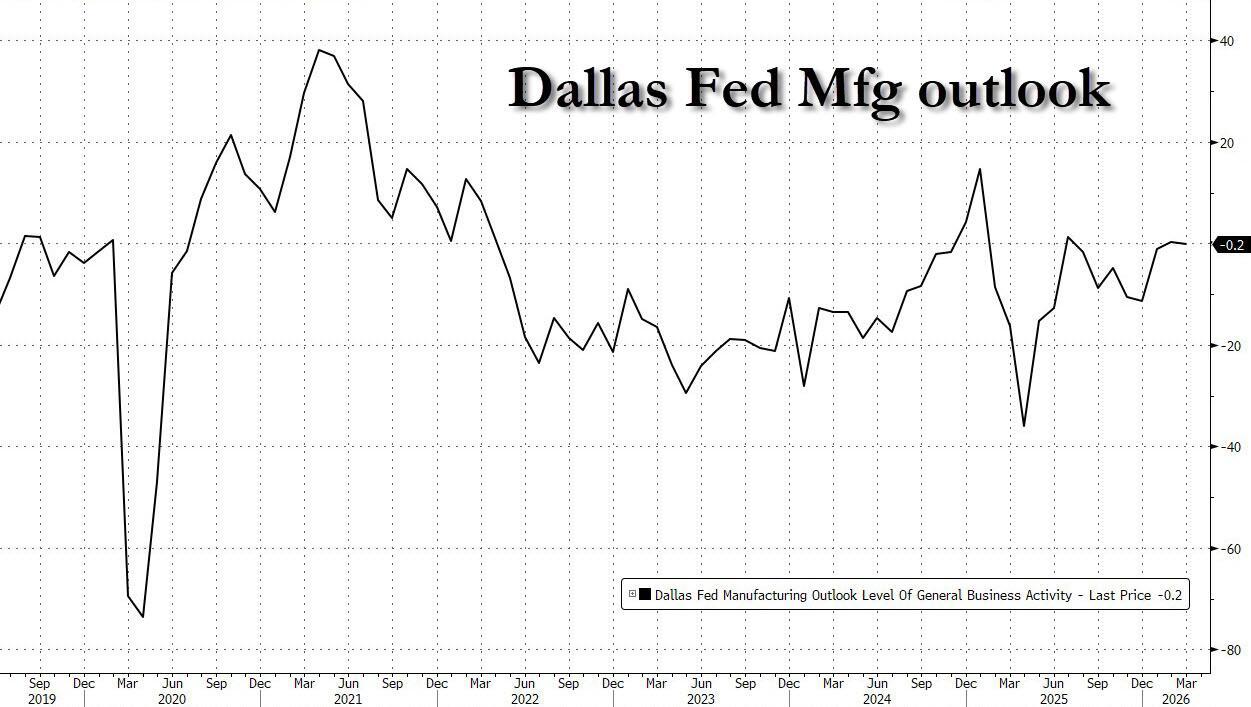
Curiously, the headline index barely dropped even though most index components (9 out of 12) showed a sharp decline, with just a handful rising fractionally.
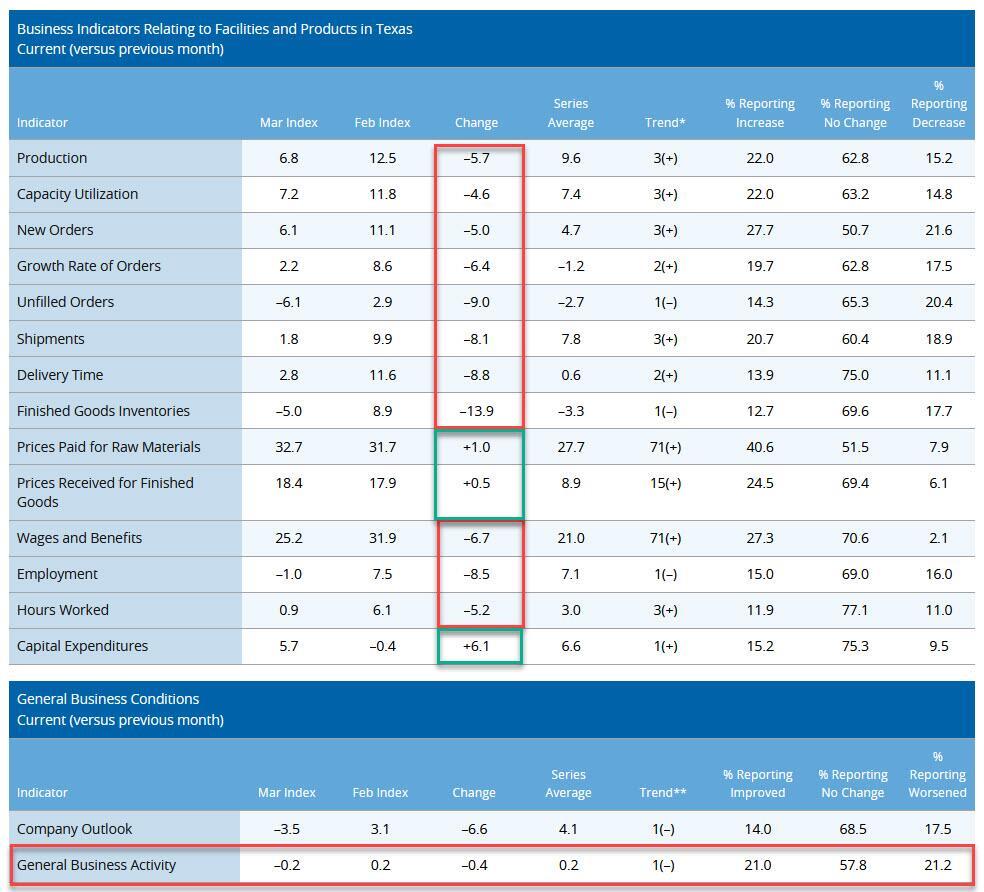
But it was the survey responses that showed a decidedly negative view on the economy, except for respondents in Machinery Manufacturing. Below is a snapshot from the latest survey:
Beverage and tobacco product manufacturing
- We have seen decreases in some of our costs, in particular agricultural raw materials. We have seen increases in the costs of our packaging materials, some of this related to increase in energy costs. We expect the Iran war to cause increases in energy costs for a period extending at least six months and potentially longer. This has increased our uncertainty for the rest of the year.
Chemical manufacturing
- The Iran war and bottleneck in the Strait of Hormuz has caused significant supply chain disruption from China, allowing the U.S. chemicals sector to benefit from the supply bottleneck. We believe this to be short-lived and the situation to return to the lower demand levels in the latter half of 2026.
Computer and electronic product manufacturing
- I am thinking about recommending to our board to close the company.
- We have seen no impact yet from higher fuel prices. However, we expect to see this very soon, as our vendors will increase raw materials prices to include the increased cost for transportation.
- We would like to see lower interest rates throughout this year.
Food manufacturing
- Continuing confusion at the federal level, illiquid consumer base and falling federal government spending are not helping the food industry.
- High density Hispanic channels are down. Costs are up, and freight is increasing fast. Tariff chaos has wreaked havoc with all of our export customers and seasoning suppliers.
- We are worried about costs increasing due to fuel price increases. We are worried about a slowdown in the economy due to geopolitics.
Furniture and related product manufacturing
- The Iran war and impact on energy prices are concerns as consumers have to deal with the rapid increase in energy cost. Hopefully it will moderate as the conflict curtails. That said, the more demoralizing impact of the constant circus out of Washington and inability to fund critical infrastructure like TSA is killing the animal spirits of our economy.
Machinery manufacturing
- We are beating our competition due to the continued vertical integration plans that we are focused on implementing and improving. This requires a great deal of planning and money, but the payout is very sound.
- Spring has sprung. It’s truly like the balm of Gilead. After an extended period of ailment and woe, the healing has occurred and we are on our way to greater things. Our business growth thus far in 2026 is like a sweet fragrance that is healing our loss and hardship from prior years.
- We are still seeing strong business activity with our backlog increasing.
- Our company is seeing an increase in activity totally unrelated to the current geopolitical conditions. The effect of uncertainty delayed the start of a new manufacturing project in the U.S. (tariffs, capital expenditures) in 2025. Project 2025 is underway with a six-month delay and scaled back to accommodate a less ambitious picture for 2026. We are still recovering from 2025 plus a more conservative outlook for 2026. Things are trending upward in our field but at a much slower pace.
Miscellaneous manufacturing
- Many external factors contributing to an unstable market.
- If we could get our tariff reimbursement back, that would put us in a position to invest in growth. Without it, though, we don’t have the capital to invest in growth.
Nonmetallic mineral product manufacturing
- We are waiting for home building activity to pick up, which is dependent upon interest rates.
Paper manufacturing
- Overall business still slow. Have achieved limited price reductions in some raw materials that are in an oversupply condition but not enough to keep up with the decline in selling prices of our products. We still see upward pressure on labor and benefits cost. Margins are reduced from 12 months ago.
Plastics and rubber products manufacturing
- Importing from China is precarious. The costs of product and freight are higher and slower. Suppliers are apprehensive. Their costs are increasing, especially a certain raw material plastic impacted by petrochemicals affected by cost of oil.
Printing and related support activities
- We have been stupid slow recently, slower than we can recall in many years. We continue to believe it’s from the chaos and confusion coming out of Washington. In addition, now with the Iran war, prices are going to shoot up due to shipping costs, and tariffs are still in effect. So, there is no telling when business will start to improve. We have some nice work coming in soon, but it’s work we knew was coming. We are seeing some improvement in our estimating backlog, which is a good sign of better days to come. The war is causing a disruption of raw materials prices as we are producing plastic-based products, virtually all of our raw materials are hydrocarbon based. Fifteen percent increases are normal.
END
USA ECONOMIC REPORTS
JOHN RUBINO…
The Food Supply Chain Is Breaking… Again
Monday, Mar 30, 2026 – 03:30 AM
Authored by John Rubino,
Spring has sprung, which means seeds that were planted in late winter are starting to germinate.
They’re hungry and will only grow to their full nutritional potential if they’re well fed.
But that, apparently, isn’t happening, as fertilizer supplies are interrupted by yet another pointless Middle East war.
The result?
Global food shortages that might dwarf the COVID-era Costco-hoarding mess of recent memory.
Here’s an overview:
Shanaka Anslem Perera @shanaka86
BREAKING: The nitrogen trap just closed. Three locks snapped shut simultaneously. The planting window is closing behind them. And the food the world eats next year is now being decided by molecules that cannot reach the soil in time.
- Lock one: the Strait of Hormuz. The IRGC permissioned corridor allows oil tankers from friendly nations to pay $2 million in yuan and pass. It does not allow fertiliser vessels to pass at any price. Zero approved fertiliser transits in 24 days. The Gulf supplies 49 percent of the world’s exported urea and roughly 30 percent of traded ammonia. That supply is not delayed. It is denied. The gate opens for molecules that fund the gatekeeper. It stays closed for molecules that feed the planet.
- Lock two: Russia. The world’s largest exporter of ammonium nitrate just halted all AN exports until after April 21. Three to four million tonnes per year, gone from global markets at the exact moment the Northern Hemisphere needs it most. The official reason is “domestic priority.” The strategic effect is leverage. Russia earns windfall revenue from the oil price spike its ally’s war created, then removes the fertiliser that farmers need to plant through the crisis. The disease and the cure, again, from the same address.
- Lock three: China. Beijing has banned exports of nitrogen-potassium blends and phosphate fertilisers through August 2026. China is the world’s largest phosphate producer and a major nitrogen supplier. The ban removes the last alternative source that could have compensated for Hormuz and Russia. Three locks. Three countries. Three deliberate decisions timed to the same biological calendar.
The biological calendar does not negotiate. Corn requires nitrogen at the V6 to VT growth stage or kernel set is permanently reduced. Wheat requires it at tillering and jointing or grain fill collapses. Rice requires it at transplanting or yield drops 20 to 40 percent in low-input systems. These are not economic models. They are cellular processes. The plant either receives nitrogen during the window or it does not. If it does not, no subsequent application, no price increase, no policy reversal can recover what was lost. The damage is written into the biology of the seed.
The US Corn Belt window closes mid-April. European top-dressing is happening now. Indian Kharif preparation begins in May. Bangladeshi Boro rice transplanting is underway this week. Every one of these windows is closing while the three largest sources of nitrogen on Earth are simultaneously locked: Hormuz by military blockade, Russia by export decree, China by trade ban.
The USDA Prospective Plantings report arrives March 31. The FAO Food Price Index publishes April 3. These will quantify what the molecules already know: the nitrogen did not arrive. The yield loss is locked in. The 5 to 10 percent global drag will concentrate where the buffers are thinnest: subsistence farms in Bangladesh, Sub-Saharan Africa, South Asia, where a 20 percent shortfall does not mean lower profits. It means hunger.
Sri Lanka banned synthetic fertiliser in 2021. Rice yields collapsed 40 percent. The government fell. In 2008, fertiliser and oil spiked simultaneously and food riots erupted across 30 countries. In 2026, the strait blocks fertiliser while Russia and China withdraw the alternatives, and the planting windows close on a planet with nowhere else to turn.
The war is fought with missiles. The famine is fought with molecules. The molecules are trapped behind three locks on three continents, timed to the one calendar that cannot be paused, extended, or negotiated: the calendar written into the DNA of every seed in the soil.
Read a deeper dive here…
This is Why We Should Have Gardens…and Gold, Goats, and Guns
Even after the pandemic, many (most?) people in the developed world continue to view “food supply chain disruption” as a tin-foil-hat concern. They’re apparently wrong. Again.
And note that higher food prices are just the first-order effect of a fertilizer shortage. The second and third-order impacts are geopolitical and possibly military.
So let this latest “peak complexity” signal encourage you to keep prepping. Anticipate shortages, higher prices, even more chaotic politics, and take some of the steps we’ve been discussing here.
END
USA (DEMOCRAT SENATORS)/HUNGARY/RUSSIA
US Senators Seek To Sanction Hungary Over Obstructing Ukraine Aid
Monday, Mar 30, 2026 – 02:45 AM
Because US Congress is perfectly functional, and all domestic issues have been resolved (one would very ironically think), the FT reports that a bipartisan pair of US senators are set to introduce legislation calling for sanctions to be imposed on senior Hungarian officials involved in obstructing aid to Ukraine.
If passed, the Block Putin act would require President Trump to impose financial sanctions and visa bans on Hungarian government officials involved in the country’s purchases of Russian oil and gas, and who have sought to block support for Ukraine.
The introduction of the bill comes as Hungary’s Prime Minister Viktor Orbán has held up a €90bn EU loan to Ukraine as he faces a tough re-election campaign ahead of parliamentary elections next month. Opinion polls indicated Orbán, who has served as prime minister since 2010, could lose power. The opposition Tisza party’s lead stood at 23% points on Wednesday, according to pollster Median. Pro-government polls show a slight lead for Orbán’s ruling Fidesz.
Orbán, historically aligned with Vladimir Putin, has accused Kyiv of disrupting the flow of Moscow’s oil to Hungary by stalling repairs to the Druzhba pipeline, which transits Ukraine.
Democrat Jeanne Shaheen and Republican Thom Tillis, co-chairs of the Senate Nato observer group, are set to introduce the legislation this week. The pair have been outspoken about Europe’s continued dependence on Russian energy.
Tillis said: “The United States and our allies must remain united in supporting Ukraine and in cutting off the revenue streams that fuel Putin’s war.”
“This bill holds senior Hungarian officials accountable while giving Hungary a clear path to get back in line with its allies by ending its reliance on Russian energy and stopping its obstruction of support for Ukraine,” he added.
Shaheen, the top Democrat on the Senate foreign relations committee, said: “It is beyond belief that vice-president Vance is reportedly planning on visiting Hungary to provide an electoral boost to a corrupt government that continues to help fund Russia’s war machine.”
“If we want this war in Ukraine to end, the Trump administration needs to be consistent in holding our allies to the same standards; no one, especially Viktor Orbán, should get a free pass,” she said.
While much of the continent has sought to wean itself off Russian oil and gas supplies since Moscow’s full-scale invasion of Ukraine in 2022, Hungary and Slovakia have increased their dependence on Russian energy… and lucky for them, as now the “rest of the continent” is about to go dry as a result of the Iran war.
Complicating matters, Trump is very close to Orbán and has endorsed his re-election bid. Politico on Wednesday reported preparations were being made for US vice-president JD Vance to visit Hungary days ahead of the elections.
Trump has criticized Europe for continuing to buy Russian energy and has urged the continent to take the lead in supporting Ukraine.
“They’re buying oil and gas from Russia while they’re fighting Russia,” Trump said in his address to the UN General Assembly in September.
The draft text of the bill, which has been seen by the FT, does not mention Orbán explicitly as a target of the sanctions. Therefore, it would fall to the Trump administration to determine which Hungarian officials have been involved in holding up aid to Ukraine and continuing the country’s dependency on Russian energy, a congressional aide said.
Orbán and his foreign minister Péter Szijjártó have long sought close ties with Russia, with Szijjártó meeting his Russian counterpart Sergei Lavrov more than 20 times since the start of the war in 2022. The ruling Fidesz party has made anti-Ukraine messages the central element of its election campaign and insisted on maintaining Russian oil imports.
“If President [Volodymyr] Zelenskyy wants to get his money from Brussels, he must open the Druzhba crude pipeline,” Orbán said in a video message to the Ukrainian president last week. “They tell us openly that they don’t want to allow cheap Russian oil through to Hungary, so the situation is very simple. No oil — no money.”
VICTOR DAVIS HANSON
KING NEWS
| The King Report March 30, 2026 Issue 7710 | Independent View of the News |
| Trump’s latest TACO – extending the deadline on Iran until April 6 – provided a short-lived rally for ESMs and NQMs. Though DJT claimed Iran asked for the extension, the WSJ reported that mediators denied Trump’s assertion, as did Iran officials. @StrickerNonpro: Israel confirms striking Ardakan to block production of precursor material for uranium enrichment Iran FM @araghchi: Israel has hit 2 of Iran’s largest steel factories, a power plant and civilian nuclear sites among other infrastructure. Israel claims it acted in coordination with the U.S. Attack contradicts POTUS extended deadline for diplomacy. Iran will exact HEAVY price for Israeli crimes (To diminish Iran’s military weapons manufacturers and industry) ESMs hit a high of 6568.50 (+ 43.50) at 1:14 ET and created an effective double top (6667.00) at 2:24 ET. It was all downhill from there. ESMs sank to 6466.25 at 9:34 ET. Conditioned buying for down NYSE openings and the Friday Rally appeared. ESMs jumped to 6493.50 at 9:48 ET and then resumed falling. ESMs hit a daily low of 6451.75 (-116.75 from high, -74.25 for day) at 10:46 ET. USMs were -14/32 at 10:35 ET; gold was +78.0; Gasoline was +4.63 cents; WTI Oil was +$3.49. The DJIA was -419.78; the DJTA was -137.51; the Naz 100 was -312.50; the NY Fang+ Index was -186.22. Is Mr. Market tired of TACOs? Is DJT losing credibility with Mr. Market? Is this why DJT refrained from posting any remarks on Friday morning? Trump’s 1st post on Friday: Going to make a big speech on economics in Miami. Our Military Operation in Iran is going GREAT! President DJT Mar 27, 2026, 1:16 PM An A-B-C rebound, with the manipulation for the 11:330 ET European close in the ‘C’ wave, took ESMs to 6490.25 at 11:37 ET. Selling resumed; ESMs sank to a new daily low of 6398.25 (-136.75) at 15:52 ET. The late manipulation pushed ESMs to 6419.25 at 15:59 ET. ESMs then fell to 6401.75 at 16:00 ET. March UM Sentiment 53.3, 54 exp; Current Conditions 55.8, 56.9 exp; Expectations 51.7, 50.9 expected; 1-yr Inflation 3.8%, 3.6% expected; 5-10-yr Inflation 3.2%, 3.5% consensus. Once again, someone is profiting from apparent leaks from Team Trump! Fifteen minutes before Trump’s Iran bombshell, billions flooded into a mystery oil bet – now the hunt is on for who knew – Contracts for at least 6 million barrels of Brent and West Texas Intermediate oil were sold within minutes, according to exchange data compiled by Bloomberg – roughly ten times the daily average of around 700,000 barrels in the five days leading up to the Monday trades… Now there are questions in financial circles about whether someone with access to the President’s thinking cashed out on the market-moving news… ‘We had trades around the Maduro being taken out in Venezuela. Then we had trades around the conflict in Israel and Palestine. And then we had additional trades around the action in Iran, and now this trade on oil, and it just starts to feel like a pattern.’… https://www.dailymail.co.uk/news/article-15679493/Fifteen-minutes-Trumps-Iran-bombshell-billions-flooded-mystery-oil-bet-hunt-knew.html Trump White House launches own app after cryptic social media teases The Trump administration announced the launch of the White House app on Friday, promising news “straight from the source, no filter.”… (Redundant with Trump Truth Social) https://trib.al/t4gfroJ BBG on Friday: US Signals to Allies No Immediate Plans for Iran Ground Invasion CPAC Shocker: Dallas Crowd Cheers for Trump Impeachment Hearings … it signaled deeper fractures in the MAGA base over foreign policy. Those cracks are widening on Capitol Hill. Republican lawmakers, once solidly behind Trump, are now openly breaking ranks over the escalating conflict in Iran, warning that any deployment of U.S. troops could trigger a political backlash severe enough to cost the party in the midterms. Leading the charge is South Carolina Rep. Nancy Mace, who has repeatedly drawn a hard line against “boots on the ground.”… GOP Rep. Lauren Boebert echoed the “America First” frustration, saying she is “tired of the Industrial War Complex” while families back home struggle to afford basic living costs… https://www.zerohedge.com/political/cpac-shocker-dallas-crowd-cheers-trump-impeachment-hearings Positive aspects of previous session DJT was quiet for a change. Negative aspects of previous session Stocks sank; bonds fell moderately; Fangs and related tech stocks got hammered. Gas & oil soared; Brent Crude futures settled at $112.57 +$4.56, +4.22% Precious metals rallied sharply. Trump’s TACOs and verbal interventions are losing potency. Ambiguous aspects of previous session Who can one believe concerning US-Iran negotiations? Where was Bessent? He is usually ubiquitous after DJT TACOs and verbal intervention! First Hour/Last Hour NYSE Action [S&P 500 Index]: 1st Hour: Down; Last Hour:Down Pivot Point for S&P 500 Index [above/below indicates daily trend to day traders]: 6392.94 Previous session (S&P 500 Index) High/Low: 6453.89; 6356.08 Iran-linked group hacks Kash Patel’s personal email: report – Handala Hack Team said on its website that FBI Director Kash Patel “will now find his name among the list of successfully hacked victims.” https://justthenews.com/government/federal-agencies/patels-personal-email-hacked-iran-linked-group-report Putin begs oligarchs for money to help boost Russia’s crippled economy during Ukraine war https://trib.al/h07Eq1l @Reuters: Gulf Arab states are telling the US that any deal with Tehran should do more than end the war and must permanently curb Iran’s missile and drone capabilities and ensure global energy supplies are never again ‘weaponized,’ four Gulf sources said. Trump’s 2nd post on Friday appeared in the afternoon: @realDonaldTrump: The Republicans should TERMINATE THE FILIBUSTER, and VOTE! Haven’t they had enough of this nonsense from the Radical Left Lunatics that are looking to destroy our Country?… Mar 27, 2026, 2:21 PM Trump speaking in Miami on Friday night: “Cuba’s next, by the way, but pretend I didn’t say that.” “Stopping wars is, I think is my, most, it’s the best—I think I do it the best!… MAGA likes us protecting certain allies. Whether it is Israel, or Saudi Arabia, or Qatar, or UAE—any of them. They want that.” (Imagine being able to lie to yourself and others at this magnitude!) Trump says ‘we don’t have to be there for NATO’ – Reuters On Friday night, the WH officially launched OnlyFarms — a government policy platform for farmers. Housing analyst Amy Nixon @texasrunnerDFW: We are not a serious country. Iran war will continue at least two to four more weeks, no ground troops necessary, Rubio says “We are ahead of schedule on most of them, and we can achieve them without any ground troops, without any,” Rubio said of the objectives of the war… https://justthenews.com/world/middle-east/iran-war-will-continue-least-two-four-more-weeks-no-ground-troops-necessary-rubio @siaxares The IRGC deliberately built its military around warfare that needs the fewest personnel possible: missiles and drones where regime elites just push buttons from safe bunkers. No boots and no risks for them. But this leaves them catastrophically vulnerable to a ground invasion… almost no one in Iran wants to die fighting for this regime. Shooting unarmed protesters is easy. Facing a United States military unit is something else entirely. Ground invasion will unravel the IRGC from the very core. @Jkylebass After U.S. forces turned China’s most advanced anti-stealth radar—the JY-27A—into little more than lawn art, Xi reportedly ordered the execution of its chief designer, Yang Wei… https://x.com/TaiwanMilitary/status/2037890969476231444 @Rainmaker1973: Researchers at the University of Pennsylvania have developed an antiviral chewing gum that neutralizes over 95% of certain viruses in saliva… (Including Covid, herpes, & influenza) This protein binds to complex-type N-glycans on the envelopes of various viruses, entrapping them and preventing infection or spread. Building on earlier work with a different gum containing plant-produced ACE2 (which reduced SARS-CoV-2 in saliva samples by >95% and is now in clinical trials), the latest formulation targets a broader range of pathogens… https://x.com/Rainmaker1973/status/2037917630162711028 Wolf Street: Bond Market Gets Edgy as US Treasury Debt Hits $39 Trillion, Spiking by $2 Trillion in 7.5 Months and Not Slowing Down The US Treasury debt – all Treasury securities outstanding – jumped by another $1 trillion in five months, and by $2 trillion in 7.5 months to $39 trillion now, just a few months away from the glorious $40 trillion milestone, as tax cuts, spending increases, and now the war in Iran are speeding up the process. Since the debt ceiling in early July, the debt has exploded by $2.8 trillion, with those trillions flying out the window at huge auctions every week so fast they’re hard to see. The illusory flat spots occur during the debt ceiling… The 10-year Treasury yield at 4.29% currently is only 1.5 percentage points above the PCE inflation rate… of 2.8% that is going to soar in coming months on the energy price spike, and 0.5 percentage points above the domestic Q4 GDP inflation rate of 3.8% (overall inflation generated domestically in the economy, excluding imports) that is also going to soar on the energy price spike… https://wolfstreet.com/2026/03/19/bond-market-gets-edgy-as-us-treasury-debt-hits-39-trillion-spiking-by-2-trillion-in-7-5-months-and-not-slowing-down/ Pentagon prepares for weeks of ground operations in Iran – WaPo Another former senior defense official familiar with the U.S. military’s plans for a ground campaign in Iran said they are extensive. “We’ve looked at this. It’s been war-gamed,” the official said. “This is not last-minute planning.”… (At this point, you must remove the radical regime – or they will become more violent, virulent, and vengeful!) @NanLee1124 Sec Rubio: “EVERY PROBLEM in the MIDDLE EAST is IRAN. Hezbollah? Iran. Hamas? Iran. Houthis? Iran. Assad in Syria? Iran. Everywhere you turn they’re behind all of it.” https://x.com/NanLee1124/status/2038086024702881886 Pakistan said Iran will allow 20 oil tankers under the Pakistan flag to pass through the Strait of Hormuz. Pakistan set to host talks between U.S. and Iran, foreign minister says Officials from the United States and Iran have not yet publicly confirmed participation. https://justthenews.com/world/middle-east/pakistan-set-host-talks-between-us-and-iran-foreign-minister-says Today – This is Passover and Easter Week. Absenteeism will be high and will increase as the week progresses. Tuesday is the end of Q1; and there is a desperate need to manipulate stuff higher to boost abysmal performance to start the year. Given any chance, Q1 performance gaming will appear. Bloomberg’s Trender model triggered a weekly sell signal for the S&P 500 Index, the DJIA, the Nas 100, and Nasdaq. The US 2-year yield has triggered a BBG buy (going up) on a weekly basis for the first time since April 9, 2021. It remained on the buy signal until March 17, 2023. The Houthis in North Yemen announced they will enter the war on behave of their master, Iran. At 20:40 ET, ESMs are -173.25; NQMs are -148.00; USMs are +20/32; oil & gas are up robustly. ESMs hit 6360.25 (-52.00) at 20:02 ET; NQMs were -235.50. Fed Chair Powell participates in discussion at Harvard 10:30 ET S&P Index 50-day MA: 6814; 100-day MA: 6819; 150-day MA: 6760; 200-day MA: 6635 DJIA 50-day MA: 48,407;100-day MA: 48,148; 150-day MA: 47,508; 200-day MA: 46,647 (Green is positive slope; Red is negative slope S&P 500 Index (6368.85 close) – BBG trading model Trender and MACD for key time frames Monthly: Trender and MACD are positive – a close below 6035.78 triggers a sell signal Weekly: Trender and MACD are negative – a close above 6458.06 triggers a buy signal Daily: Trender and MACD are negative – a close above 7153.19 triggers a buy signal Hourly: Trender and MACD are negative – a close above 6415.27 triggers a buy signal Secret Service agents shoots himself (in leg) while escorting Jill Biden at Philadelphia airport https://trib.al/Z8T7jyG (The US Secret Service is an unmitigated Schiff Show!) House Ethics Committee finds indicted Dem Rep. Sheila Cherfilus-McCormick ‘guilty’ on 25 counts https://trib.al/87Yhtzj @FoxNews: ‘WHY IS IT CONTROVERSIAL?’: Senator John Fetterman is torching his own party’s immigration stance after a retired Air Force pilot died following a push onto NYC subway tracks, allegedly by an illegal immigrant. The Pennsylvania Senator is demanding to know why it is “controversial” for Democrats to support deporting criminal migrants after the death of 83-year-old Richard Williams, allegedly at the hands of a Honduran national with a long criminal history. “An alleged repeat criminal offender was allowed back on our streets and killed an Air Force veteran.” @RNCResearch: @TMZ making sure you saw Democrat socialist Bernie Sanders living large on his first-class flight out of DC while he forces Americans to go without pay. https://x.com/RNCResearch/status/2037625998431117411 @EricLDaugh: Senate Leader John Thune ripped for leaving DC “with his private escort” through the airport for recess without the SAVE America Act being passed. REP. RANDY FINE: “Looks like Leader John Thune is on his way out of town with his private escort, as the SAVE America Act gets left behind. This is very disappointing. I am willing to stay in Washington as long as it takes to get the job done.” https://x.com/EricLDaugh/status/2037553219467985099 Meet Jessica Fehrenbach: The Leftist Judge Who Released Water Street Murderer Four Days Before Triple Shooting – https://heartlandpost.com/meet-jessica-fehrenbach-the-leftist-judge-who-refused-to-punish-water-street-shooter-in-previous-offense/ @EricLDaugh: Mass amounts of Americans are calling for the courts to be PURGED as San Francisco leftist Judge Linda Colfax released a criminal who FATALLY assaulted an 84YO — because she was worried prison would have a “poor impact” on him. https://x.com/EricLDaugh/status/2037875062666154369 500 groups with $3B in revenues are behind the #NoKings protests and communist call for ‘revolution’ – including communist and socialist organizations calling for “revolution.”… https://www.foxnews.com/us/500-groups-3b-revenues-behind-nokings-protests-communist-call-revolution @RedWavePress CNNs Scott Jennings: “These ‘No Kings’ rallies look pretty representative to me of the Democratic coalition. I saw people flying the Hammer and Sickle in New York City. I saw Hezbollah flags. I saw Hamas flags. I saw Palestinian flags. I saw tr*ns signs. I saw weirdo liberal boomers out there.” “This is pretty representative of the Democratic coalition, and that’s who funds it, by the way.” https://x.com/RedWavePress/status/2038298181671219580 Palm Beach Elections Volunteer Arrested for Stealing Computer Equipment and Encrypted Access Key Ahead of Special Election Won by Democrat https://thegatewaypundit.com/2026/03/palm-b THOMAS SOWELL: “If you’re going to have reparations for slavery, it’s going to be the greatest transfer of wealth back and forth, because the number of Whites who were enslaved in North Africa by the Barbary Pirates exceeded the number of Africans enslaved in the United States.” https://x.com/Rothmus/status/2037651667030552912 No one is mentioning it, but free slaves in the US owned black slaves. Ergo, before anyone get reparations, their family trees should be thoroughly examined. | |
SWAMP STORIES
Paul Weston on X: “”We will chop off their heads.” “We will lead the army of Allah.” “We will subject them to eternal torture.” These are Muslim children in an AMERICAN school in Philadelphia! The Western world needs to understand Islam before it is too late. https://t.co/s1Ye5r9izS”
Talk about getting brain washed.
END
This Is What You Get When Commies Are Running NYC…
Sunday, Mar 29, 2026 – 06:40 PM
Authored by Steve Watson via Modernity.news,
New York City, already reeling from crime under years of radical leftist rule, now faces a proposal that sounds ripped straight from a communist energy-rationing handbook: mandatory blackouts every night.

Manhattan Assemblywoman Deborah Glick is sponsoring the “Dark Skies Protection Act,” which would require businesses and residents to turn off non-essential lighting between 11 p.m. and 5 a.m.
Critics are blasting it as a criminal’s dream come true in a city that already struggles with safety after dark.
The bill itself spells out its goals in the legislation: “preserve and enhance the state’s dark sky while promoting safety for people, birds and other wildlife, conserving energy and reducing our carbon footprint, and preserving the aesthetic qualities of the night sky.”
It adds: “Our ancestors were able to experience a night sky full of stars, but now 80% of Americans can no longer see the Milky Way and experience its profound beauty.”
The full pitch on light pollution reads: “Light pollution has many negative impacts, including the disruption of the natural patterns of wildlife, wasted energy and increased output of carbon dioxide and greenhouse gases, interruption of human sleep and other adverse health impacts, and the loss of the aesthetic qualities and cultural significance of the night sky.”
On birds, it states: “70% of bird species migrate each year. And of those birds, 80% migrate at night, using the night sky to help them navigate to and from their breeding grounds. However, as they pass over big cities on their way, they can become disoriented by bright artificial lights, often causing them to collide with buildings or windows.”
That’s all well and good, but there is an ongoing rampant crime epidemic in New York City. Is the safety of birds more important in than the safety of people?
Lights used for travel would be exempt, but the bill is already drawing fire.
One observer on X put it bluntly: “Criminal gangs approve this message.”
Another wrote sarcastically: “Good then criminals can maraud the populace under cover of darkness as intended!”
“What could go wrong?” a third asked.
A fourth added: “I’m all for seeing the stars but New York is not exactly a safe place.”
NYS Conservative Party chairman Gerard Kassar summed it up: “I guess Glick wants to push one last ridiculous idea before she retires.”
The idiotic cherry on top of this maniac idea comes with Times Square getting spared while the rest of the city is plunged into darkness.
This isn’t environmentalism. It’s control dressed up as virtue. In a city where crime already spikes at night and leftist policies have made streets less secure, mandating a nightly blackout is an open invitation for chaos.
This is the exact kind of thing you’d expect to see in a communist hellhole, the inevitable result of that ideology—failing grids, forced darkness, and everyday people paying the price while the system pretends it’s for the greater good.
The same pattern played out in Cuba, where communist mismanagement triggered repeated total grid collapses, leaving millions without power for days and exposing the rot at the core of that system.
New Yorkers wouldn’t be getting safer skies or saved birds—they’d be experiencing rationed freedom while the real problems go unaddressed.
This bill may not pass, but the mindset behind it reveals everything about who’s steering the ship in blue-city America.
Your support is crucial in helping us defeat mass censorship. Please consider donating via Locals or check out our unique merch. Follow us on X @ModernityNews.
GREG HUNTER…..INTERVIEWING DR BETSY EADS
CV19 Vax Causes Explosion in Cancer – Dr. Betsy Eads
By Greg Hunter On March 29, 2026 In Market Analysis, Political AnalysisNo Comments

By Greg Hunter’s USAWatchdog.com (Saturday Night Post)
From the very beginning of the CV19 bioweapon vax rollout in 2021, Dr. Betsy Eads (aka Dr. Betsy) sounded the alarm on all the severe medical problems, disabilities and deaths the injections would cause. Dr. Betsy has been promoting constant detoxing from the shots. In July, she, once again, pushed the idea that “Everyone Needs Treatment for CV19 Bioweapon Vax.” For the CV19 vaxed who are untreated, it is a total disaster. Just look at the out-of-control cancer numbers that Dr. Betsy said were coming back in 2021. Dr. Betsy says, “I gave you some predictions. I told you that there was going to be an explosion of cancer. This is all cause cancer, hematological and solid tumors in five years. Well, it’s 2026. It’s been five years, and the latest graph shows for 2026 an explosion for hematological cancers and solid tumor cancers, and that is just through February of 2026. This is about 300,000 cases just through February, and it is an absolute explosion of cases. I hate to say I told you so, but it was not just me who said this. There were many smart doctors in 2021 such as Ryan Cole, Pierre Kory, Dr. Sherri Tenpenny, and they have all been on your show, and we all said there would be an explosion in cancer.”
Dr. Betsy contends the CDC is covering up the true disaster the CV19 shots have become. Dr. Betsy says, “The CDC is actually deleting codes and data out of VARES purposely. In a stunning revelation today by Dr. Peter McCullough, 74% of all Covid 19 vaccinated autopsies were causally related to the CV19 vaccine. That is a huge number. . .. It’s not just cancers. It’s all of the deaths that went to autopsy. 74% were directly related to the Covid 19 shot.
Dr. Betsy sees what is happening firsthand and points out, “These cancers, I am seeing every day. I am doing a telehealth consult almost every day with my team. The cancers are across the board: lymphoma, Hodgkins, breast cancer, stage four pancreatic cancer, lung cancer, liver cancer, colon cancer and melanoma cancer. It’s just exploding across the board. They are very, very difficult to treat cancers.”
So, why don’t the CV19 vax injured sue? Dr. Betsy says, “All the cases get kicked out for standing. . .. The judges are being told not to let the cases go forward. . .. The system is captured. The minute the CV19 shots are completely pulled off the market, you are going to have a riot. The minute the Prep Act is reversed, you are going to have a riot. Because what is going to happen is then you must give informed consent . . .. Big Pharma . . . are going to be sued into oblivion and into bankruptcy. That’s what all these judges are colluding about. They are all taking money from the government and Big Pharma. . .. If you look at the FDA and CDC committee members, there is a Big Pharma person on those committees. Follow the money, it’s all about the money. . .. 90% of Americans say they know a relative or close personal friend that the CV19 vax has hurt or killed–90%.”
In closing, Dr. Betsy says, “I think we are on the precipice of something big happening. . .. There is going to be civil war or a civil uprising because people are not going to take this anymore. . .. There are at least 17 million in America killed by the CV19 vax, and that number is underreported.”
You can get more information at Sat123.com, Darkbags.com and Starlink123.com. You can also call 855-980-5830 and talk to a human for information on anything they sell, including Faraday bags and Faraday clothing.
There is much more in the 64-minute interview.
Join Greg Hunter of USAWatchdog as he talks to 27-year veteran Dr. Betsy Eads, DO, exposing the explosion of cancer from the CV19 injections. Dr. Eads still advises that everyone both vaxed and unvaxed needs treatment for the deadly effects of the CV19 bioweapon vax for 3.28.26.
After the Interview:
You can follow Dr. Elizabeth (Betsy) Eads on Twitter/X and Telegram.
Dr. Eads has a website called HealingHumanityWorldwide.com. (Scroll down and see Dr. Eads’ CV19 vax injury protocol.)
Dr. Eads also recommends FLCCC.net and the “I-RECOVER: post vaccine treatment.”
You can help Dr. Eads continue her mission to get the truth out about the huge problems with the CV19 vax by donating here: Pay $Docbetsy55 on Cash App, or you can use Dr. Betsy’s Venmo account to donate.


 harveyorganblog.com


