
GOLD $4706.00. 3:30 PM)
EXCHANGE: COMEX
CONTRACT: APRIL 2026 COMEX 100 GOLD FUTURES
SETTLEMENT: 4,656.800000000 USD
INTENT DATE: 04/06/2026 DELIVERY DATE: 04/08/2026
FIRM ORG FIRM NAME ISSUED STOPPED
072 C GOLDMAN 4
092 C DEUTSCHE BANK 48
118 C MACQUARIE FUTURES US 15
118 H MACQUARIE FUTURES US 34
323 H HSBC 49
332 H STANDARD CHARTERED B 97
357 C WEDBUSH SECURITIES 1
363 H WELLS FARGO SECURITI 5
365 C MAREX CAPITAL MARKET 3
435 H SCOTIA CAPITAL (USA) 1
555 C BNP PARIBAS SEC CORP 357
624 C BOFA SECURITIES 5
624 H BOFA SECURITIES 20
657 C MORGAN STANLEY 348 18
661 C JP MORGAN SECURITIES 70
686 C STONEX FINANCIAL INC 10 14
709 C BARCLAYS 154
730 C PTG DIVISION OF SGAS 538
732 C RBC CAP MARKETS 25 38
905 C ADM 6
TOTAL: 930 930
MONTH TO DATE: 16,263
GOLD: NUMBER OF NOTICES FILED FOR APRIL/2026: 930 CONTRACTs NOTICES FOR 93,000 OZ or 2.8926TONNES
total notices so far: 16,263 contracts for 1,626,300 OR 50.584 tonnes)
SILVER NOTICES: 133 NOTICE(S) FILED FOR 690,000 OZ /
total number of notices filed so far this month : 1435 CONTRACTS (NOTICES) for 7.175 million oz
SILVER//OUTLINE
INITIAL STANDING FOR JANUARY: 22.915 MILLION OZ FOLLOWED BY TODAY’S 1.185 MILLION OZ QUEUE JUMP//NEW NORMAL STANDING ADVANCES TO 49.445 MILLION OZ// TO WHICH WE ADD OUR FIRST EXCHANGE FOR RISK FOR .100 MILLION OZ//NEW STANDING ADVANCES TO 49.545 MILLION OZ!!
INTIAL STANDING FOR FEBRUARY/SILVER: 13.505 MILLION OZ FOLLOWED BY TODAY’S HUGE 0.005 MILLION OZ QUEUE JUMP / : NEW STANDING FOR SILVER AT THE COMEX ADVANCES TO 25.180 MILLION OZ. BUT WE MUST ADD OUR FIRST EXCHANGE FOR RISK OF 25 CONTRACTS FOR .125 MILLION OZ AND THEN OUR SECOND EXCHANGE FOR RISK OF .0600 MILLION OZ TO OUR THIRD HUGE 2.825 MILLION OZ EXCHANGE FOR RISK!!
INITIAL STANDING FOR MARCH: A SURPRISINGLY LOW 31.076 MILLION OZ/ FOLLOWED BY A STRONG QUEUE JUMP OF 42 CONTRACTS OR 0.210 MILLION OZ/NEW STANDING REDUCES TO 46.060 MILLION OZ
INITIAL STANDING FOR APRIL: 7.120 MILLION OZ FOLLOWED BY TODAY’S 0 CONTRACT QUEUE JUMP WHERE 0 ADDITIONAL OZ WILL TAKE DELIVERY OVER ON THIS SIDE OF THE POND. NEW STANDING FOR SILVER AT THE COMEX THUS IS REMAINS AT 7.315 MILLION OZ
NOW OUR APRIL 2026 CONTRACT MONTH:
JULY: 50.925 MILLION OZ (QUITE SMALL)
AUGUST: 59.455 MILLION OZ (QUITE SMALL)
SEPT. 50.510 MILLION OZ.(QUITE SMALL)
OCT; 82.020 MILLION OZ (WILL BE STRONG THIS MONTH)/ OCC WANTS TO REIN IN THESE ISSUANCES!
NOVEMBER: 36.425 MILLION OZ
DEC: 45.765 MILLION OZ
JANUARY 2026: 134.270 MILLION OZ (WILL BE A VERY STRONG MONTH FOR EXCHANGE FOR PHYSICAL!)
FEB : 82.130 MILLION OZ
MARCH: 56.075 MILLION OZ
APRIL; 8.4100 MILLION OZ
AND JULY: 46.720 MILLION OZ//
AUGUST: 4.70 MILLION OZ INITIAL STANDING PLUS TODAY;S 5,000 OZ QUEUE JUMP //NEW STANDING ADVANCES TO 10.960 MILLION OZ
SEPTEMBER: 68.040 MILLION OZ NORMAL DELIVERY(INCLUDES ALL QUEUE JUMPING AND EXCHANGE FOR PHYSICAL TRANSFERS) PLUS 3.0 MILLION OZ EX FOR RISK = 71.040 MILLION OZ. (THIS IS THE FIRST AND ONLY ISSUANCE OF EXCHANGE FOR RISK FOR SILVER SINCE MAY.)
OCTOBER: 39.565 MILLION OZ OF NORMAL DELIVERY INCLUDES ALL QUEUE JUMPING
PLUS
2.110 MILLION OZ EXCHANGE FOR RISK//TOTAL OZ STANDING IN OCT ADVAN
NOVEMBER: INITIAL STANDING AT 11.575 MILLION OZ FOLLOWED BY TODAY’S 195,000 OZ QUEUE JUMP WHICH FOLLOWS ALL OTHER QUEUE JUMPS OF 9.155 MILLION OZ//STANDING ADVANCES TO 19.670 MILLION OZ/
DECEMBER: INITIAL AMOUNT STANDING FOR DELIVERY: 49.33 MILLION OZ// FOLLOWED BY ANOTHER STRONG 835,000OZ QUEUE JUMP+ DEC. FIRST EXCHANGE FOR RISK 0F .850 MILLION OZ + LAST WEEK.S 495,000 OZ EXCHANGE FOR RISK AND THEN A 3RD ISSUANCE IF 1.00MILLION OZ THEN FINALLY DEC 249ISSUANCE OF 1.35 MILLION OZ EXCHANGE FOR RISK//NEW TOTAL EX FOR RIS IS 3.685 MILLION OZ // STANDING ADVANCES TO 68.415 MILLION OZ//
JANUARY: INITIAL STANDING 22.915 MILLION OZ FOLLOWED BY TODAY’S 1.185 MILLION OZ QUEUE JUMP//NORMAL STANDING ADVANCES TO 49.445 MILLION OZ// TO WHICH WE ADD OUR FIRST EXCHANGE FOR RISK OF 0.100 MILLLION OZ//NEW STANDING ADVANCES TO 49.545 MILLION OZ
FEB: 13.399 MILLION OZ IS OUR INITIAL STANDING FOR SILVER! TO WHICH WE ADD OUR NEXT QUEUE JUMP FOR 5,000 OZ AND THEN ADD OUR 3 EXCHANGE FOR RISK FOR 3.010 MILLION OZ STANDING ADVANCES TO 28.190 MILLION OZ!!
MARCH: INITIAL AMOUNT OF SILVER STANDING IS 31.076 MILLION OZ FOLLOWED BY A FINAL 0.210 MILLION OZ QUEUE JUMP //NEW TOTAL STANDING ADVANCES TO 46.060 MILLION OZ
APRIL 2026: INITITAL AMOUNT OF SILVER STANDING 7.120 MILLION OZ FOLLOWED BY TODAY’S 0 OZ QUEUE JUMP//NEW STANDING REMAINS AT 7.370 MILLION OZ
- MAY: SUMMARY FOR MAY TONNES WHICH STOOD FOR DELIVERY:
4. AUGUST: 60.547 TONNES OF INITIAL GOLD FIRST DAY NOTICE FOLLOWED BY THE NET MONTH’S QUEUE JUMP OF 47.2312 TONNES TO WHICH WE ADD THE FOLLOWING EXCHANGE FOR RISK ISSUANCE RECEIVED FOR THE MONTH: 5.4432 TONNES EX FOR RISK/AUG 7 , AUG 11: 2.413 TONNES EX FOR RISK AND AUG. 12 OF 2.
5.SEPT: INITIAL 8.093 TONNES OF GOLD PLUS TODAY’S QUEUE JUMP OF 0.4883 TONNES PLUS 2.2827 TONNES OF EXCHANGE FOR RISK TODAY//NEW TOTAL EX. FOR RISK/MONTH = 22.923//NEW TOTAL STANDING FOR GOLD SEPT ADVANCES TO = 48.801 TONNES!!
6.OCTOBER: 90.012 TONNES OF INITIAL GOLD STANDING WITH TODAY’S TINY 0.00311 TONNES QUEUE JUMP WHICH FOLLOWS ALL OTHER QUEUE JUMPS DURING OCT OF 76.1656 TONNES
THEN WE MUST ADD OUR 14.553 TONNES OF OUR ISSUANCE OF EXCHANGE FOR RISK/6 OCCASIONS//NEW TOTAL OF GOLD STANDING ADVANCES TO 197.5141 TONNES OF GOLD.
7.NOVEMBER BEGINS WITH 15.651 TONNES INITIALLY STANDING FOR DELIVERY FOLLOWED BY TODAY’S QUEUE JUMP OF 2.323 TONNES FOLLOWED BY ALL PREVIOUS QUEUE JUMPS IN OF OF 21.3775 TONNES TO WHICH WE ADD OUR TWO EXCHANGE FOR RISK ISSUANCE OF 4.5596 TONNES//NEW STANDING ADVANCES TO 43.9716 TONNES OF GOLD.
8. DECEMBER BEGINS WITH INITIAL STANDING OF 83.813 TONNES OF GOLD FOLLOWED BY TODAY’S 0.0TONNE QUEUE JUMP WHICH FOLLOWS ALL OTHER QUEUE JUMPS OF: 37.163 TONNES//NEW STANDING ADVANCES TO 115.390 TONNES TO WHICH WE ADD OUR 4 EXCHANGE FOR RISK FOR DECEMBER OF 6.587 TONNES/NEW STANDING ADVANCES TO 121.977 TONNES
9. JANUARY: INITITAL STANDING: 13.785 TONNES TO WHICH WE ADD OUR FIRST EXCHANGE FOR PHYSICAL TRANSFER OF 0.08709 TONNES WHICH FOLLOWS ALL OTHER QUEUE JUMPS OF 30.7117TONNES //NEW TOTAL QUEUE JUMPS 30.7117//NORMAL DELIVERY OF GOLD ADVANCES TO 36.8958 TONNES TO WHICH WE ADD OUR SIX EXCHANGE FOR RISK OF 22.315 TONNES//NEW STANDING ADVANCES TO 59.2108 TONNES.
FEB; INITIAL AMOUNT OF GOLD STANDING FOR DELIVERY: 93.567 TONNES OF GOLD TO WHICH WE ADD OUR NEXT 0.0248 TONNES 0.1555 TONNES QUEUE JUMP TO 41.2082 TONNES/ NEW NET QUEUE JUMP INCREASES TO 41.233 TONNES// AND THEN WE ADD OUR SIX EXCHANGE FOR RISK: 10,080 CONTRACTS OR 31.251 TONNES//NEW STANDING REDUCES TO 157.878 TONNES
MARCH:: INITIAL AMOUNT OF GOLD STANDING FOR DELIVERY: 8.099 TONNES TO WHICH WE ADD TODAY’S FAIR 4600 OZ QUEUE JUMP (0.2320 TONNES) AND THEN WE ADD OUR THREE EXCHANGE FOR RISK OF 22.3818 TONNES //NEW STANDING ADVANCES TO 67.6648 TONNES/
APRIL: INITIAL AMOUNT OF GOLD STANDING FOR DELIVERY: 52.600 TONNES FOLLOWED BY OUR STRONG 345 CONTRACT QUEUE JUMP FOR 345,000 OZ//NEW STANDING ADVANCES TO 53.710 TONNES
MARCH:: SMALL INITIAL STANDING FOR GOLD FOR MARCH AT 8.099 TONNES TO WHICH WE ADD TODAY’S FAIR 46 CONTRACT QUEUE JUMP OF 4400 OZ OR 0.2320 TONNESAND THEN WE ADD BY OUR THREE EXCHANGE FOR RISK: 22.3818///NEW STANDING ADVANCES TO 67.6648 TONNES OF GOLD./
APRIL: INITIAL STANDING FOR GOLD; 52.600 TONNES FOLLOWED BY TODAY’S 500 OZ EXCHANGE FOR PHYSICAL TRANSFER TO LONDON //NEW STANDING REDUCES TO 53.600 TONNES.
STANDING FOR THE LAST 4 MONTHS JANUARY TO APRIL:
FINAL STANDING FOR GOLD, JANUARY CONTRACT AT 59.2108 TONNES OF GOLD
FEBRUARY: INITIAL STANDING FOR GOLD: 157.878 TONNES!! WHICH INCLUDES ALL QUEUE JUMPING, THREE EXCHANGE FOR PHYSICAL TRANSFERS TO LONDON AND OUR SIX ISSUANCES EXCHANGE FOR RISK!!
MARCH: INITIAL STANDING AT 8.099 TONNES TO WHICH WE ADD OUR FINAL DAY: 0.2320 TONNES QUEUE JUMP AND THEN ADD +22.3818 TONNES EXCHANGE FOR RISK//NEW STANDING ADVANCES TO 67.6648 TONNES
APRIL: INITIAL STANDING 52.600 TONNES MINUS 500 OZ QUEUE JUMP (0.015 TONNES): NEW STANDING REDUCESS TO 53.600 TONNES
JAN. 2025: 257.919 TONNES (ISSUANCE WILL BE PRETTY GOOD THIS MONTH BUT MUCH LOWER THAN LAST MONTH)
FEB: 207.21 TONNES//EX FOR PHYSICAL ISSUANCE (WILL BE A FAIR SIZED ISSUANCE THIS MONTH)
MARCH 130.84 TONNES//QUITE SMALL THIS MONTH.
APRIL; 208.57 TONNES. STRONG THIS MONTH
MAY: 113.499 TONNES OF GOLD EFP ISSUANCE//QUITE SMALL THIS MONTH
JUNE: 97.79 TONNES OF GOLD EFP ISSUANCE/EXTREMELY SMALL
JULY : 150.877 TONNES// QUITE SMALL
AUGUST: 175.86 TONNES A LOT LARGER THIS MONTH.
SEPT. 116.13 TONNES VERY SMALL
OCT. 252.72 TONNES//CERTAINLY MUCH LARGER THIS MONTH/VERY STRONG
NOV: 124.74 TONNES
DEC: 190.04 TONNES//GOOD SIZED THIS MONTH FINAL.
TOTAL EXCHANGE FOR PHYSICAL ISSUED FOR YEAR 2025: 2,026.20 TONNES (LOWER THAN LAST YR 2,569.00 TONNES
JANUARY: 209.08 TONNES ( (WILL BE A STRONG MONTH FOR EXCHANGE FOR PHYSICAL)
FEB. 176.35 TONNES (WHICH IS A FAIR ISSUANCE)
MARCH: 214.67 TONNES//WILL BE STRONG ISSUANCE THIS MONTH
APRIL; 16.668 TONNES
HERE IS A BRIEF SYNOPSIS OF HOW THE CROOKS FLEECE UNSUSPECTING LONG
YOU WILL ALSO NOTICE THAT THE COMEX OPEN INTEREST STARTS TO RISE BUT SO IS THE OPEN INTEREST OF SPREADERS. THE OPEN INTEREST IN WILL CONTINUE TO RISE UNTIL ONE WEEK BEFORE FIRST DAY NOTICE OF AN UPCOMING ACTIVE DELIVERY MONTH (OCT), AND THAT IS WHEN THE CROOKS SELL THEIR SPREAD POSITIONS BUT NOT AT THE SAME TIME OF THE DAY. THEY WILL USE THE SELL SIDE OF THE EQUATION TO CREATE THE CASCADE (ALONG WITH THEIR COLLUSIVE FRIENDS) AND THEN COVER ON THE BUY SIDE OF THE SPREAD SITUATION AT THE END OF THE DAY. THEY DO THIS TO AVOID POSITION LIMIT DETECTION. THE LIQUIDATION OF THE SPREADING FORMATION CONTINUES FOR EXACTLY ONE WEEK AND ENDS ON FIRST DAY NOTICE.”
WHAT IS ALARMING TO ME, ACCORDING TO OUR LONDON EXPERT ANDREW MAGUIRE IS THAT THESE EFP’S ARE BEING TRANSFERRED TO WHAT ARE CALLED SERIAL FORWARD CONTRACT OBLIGATIONS AND THESE CONTRACTS ARE LESS THAN 14 DAYS. ANYTHING GREATER THAN 14 DAYS, THESE MUST BE RECORDED AND SENT TO THE COMPTROLLER, GREAT BRITAIN TO MONITOR RISK TO THE BANKING SYSTEM. IF THIS IS INDEED TRUE, THEN THIS IS A MASSIVE CONSPIRACY TO DEFRAUD AS WE NOW WITNESS A MONSTROUS TOTAL EFP’S ISSUANCE AS IT HEADS INTO THE STRATOSPHERE.
The crooks also use the spread in the TAS account (trade at settlement). They buy the spot TAS (e.g. June) and sell the future TAS two months out (e.g. August). Then they unload the front month (i.e. unload the buy side first so the price of gold/silver falls. This occurs in the middle of the front delivery month cycle. They unload the sell side of the equation, two months down the road. The crooks violate position limits as the OCC refuse to hear our complaints.
First, here is an outline of what will be discussed tonight:
SILVER:
1.TODAY WE HAD THE OPEN INTEREST AT THE COMEX IN SILVER FELL BY A SMALL SIZED 117 CONTRACTS OI TO 114,379 AND FURTHER FROMTHE COMEX HIGH RECORD //244,710( SET FEB 25/2020). THE LAST RECORDS WERE SET IN AUG.2018 AT 244,196 WITH A SILVER PRICE OF $14.78/(AUGUST 22/2018)..THE PREVIOUS RECORD TO THAT WAS SET ON APRIL 9/2018 AT 243,411 OPEN INTEREST CONTRACTS WITH THE SILVER PRICE AT THAT DAY: $16.53). AND PREVIOUS TO THAT, THE RECORD WAS ESTABLISHED AT: 234,787 CONTRACTS, SET ON APRIL 21.2017 OVER 7 YEARS AGO. HOWEVER WE HAVE NOW SET A NEW RECORD LOW OF 111,576 CONTRACTS MARCH 20.2026
EFP ISSUANCE 2 CONTRACTS
OUR CUSTOMARY MIGRATION OF COMEX LONGS CONTINUE TO MORPH INTO LONDON FORWARDS AS OUR BANKERS USED THEIR EMERGENCY PROCEDURE TO ISSUE:
MAY 2 CONTRACTS and 0 ALL OTHER MONTHS: ZERO. TOTAL EFP ISSUANCE: 0 CONTRACTS. EFP’S GIVE OUR COMEX LONGS A FIAT BONUS PLUS A DELIVERABLE PRODUCT OVER IN LONDON. IF WE TAKE THE COMEX OI LOSS OF 117 CONTRACTS AND ADD TO THE 2 E.FP. ISSUED
WE OBTAIN A SMALL SIZED LOSS OF 115 OI OPEN INTEREST CONTRACTS FROM OUR TWO EXCHANGES DESPITE OUR GAIN OF $0.41
THUS IN OUNCES, THE LOSS ON THE TWO EXCHANGES TOTALS 0.575 MILLION PAPER OZ
OCCURRED WITH OUR GAIN IN PRICE.OF $0.41
2.ASIAN AFFAIRS APRIL 7 /2025
SHANGHAI CLOSED UP 10.07 PTS OR 0.26%
HANG SENG CLOSED DOWN 177.50 PTS OR 0.70%
Nikkei CLOSED UP 112.82 PTS OR 0.21%
//Australia’s all ordinaries CLOSED UP 2.16%
//Chinese yuan (ONSHORE) CLOSED UP 6.8563
/ OFFSHORE CLOSED UP AT 6.8579 Oil UP TO 112.77 ollars per barrel for WTI and BRENT UP TO 109.30 Stocks in Europe OPENED ALL GREEN
ONSHORE USA/ YUAN TRADING 6.8563 (UP) OFFSHORE YUAN TRADING UP TO 6.8579 ONSHORE YUAN TRADING ABOVE OFF SHORE AND UP ON THE DOLLAR// / AND THUS STRONGER/OFF SHORE YUAN TRADING UP AGAINST US DOLLAR/ AND THUS STRONGER
1. COMEX DATA//AMOUNTS STANDING//VOLUME OF TRADING/INVENTORY MOVEMENTS
THE TOTAL COMEX GOLD OPEN INTEREST ROSE BY A FAIR 929 CONTRACTS UP TO AN OI OF 355,510 CONTRACT OI , HAVING SURPASSSED OUR NEW RECORD LOW OI SURPASSING THE PREVIOUS ALL TIME LOW IN OI OF 354,581 SET APRIL6/2026. PREVIOUS TO THAT THE ALL TIME LOW IN OI WAS 390,000 SET IN THE YEAR 2001 WHEN GOLD WAS TRADING $260.00. THE CME SHOULD BE PROUD OF THEMSELVES AS MANY HAVE ABANDONED THIS CROOKED ARENA!!THUS OUR NEW ALL TIME LOW OF COMEX OI HAS NOW BEEN SET AT 354,581 WITH GOLD AT AN EXTREMELY HIGH $4,676.00 WHICH MAKES ABSOLUTELY NO SENSE!!!
WE HAD STRONG T.A.S. LIQUIDATION DURING MONDAY’S TRADING. IT SEEMS THAT THE SPECULATORS CONTINUED AGAIN TO GO MASSIVELY ON THE SHORT SIDE WITH THE BANKERS TAKING THE LONG SIDE, AS WELL AS COVERING THEIR SHORTFALL, WITH OUR TAS SPREADER LIQUIDATIONS ACCOUNTING FOR THE LOSS IN OI!!!
CENTRAL BANKS ALSO TENDERED THEIR NEW LONG CONTRACTS AT THE END OF THE DAY FOR PHYSICAL GOLD. YOU CAN VISUALIZE THIS WITH THE MASSIVE AMOUNT OF GOLD STANDING AT THE COMEX FOR THIS MARCH CONTRACT MONTH!!
THE FAIR SIZED GAIN ON OUR TWO EXCHANGES OCCURRED WITH OUR SMALL GAIN IN PRICE IN GOLD. THE SPECS HAVE NOW GONE MASSIVELY ON THE SHORT SIDE WITH THE BANKERS BUYING UP ALL THEY COULD AND COVERING THEIR SHORTFALL IN GOLD. THE SHORT SPECS WILL BE MURDERLIZED AFTER THURSDAY’S MASSIVE RAID.
WE THUS HAD A FAIR GAIN IN OI ON BOTH OF OUR EXCHANGES, THE COMEX AND LONDON’S EXCHANGE FOR PHYSICAL EQUATING TO 1081 CONTRACTS (OR 5.822 TONNES) WITH OUR SMALL GAIN IN PRICE, AS WE WERE INFORMED OF A SMALL 152 CONTRACT EXCHANGE FOR PHYSICAL ISSUANCE..
THEN WE WERE NOTIFIED TODAY OF A ZERO CONTRACT EXCHANGE FOR RISK ISSUANCE IN GOLD CONTRACTS FOR 0 OZ OR 0.0 TONNES OF GOLD.
DURING THE MIDDLE OF THE FEBRUARY CONTRACT MONTH, WE HAD TWO IDENTICAL MONSTER 3,000 CONTRACT ISSUED FOR THE SAME 9.33 TONNES OF GOLD, AND THESE WERE THE HIGHEST EVER IN TONNAGE EVER ISSUED BY THE COMEX. ALTOGETHER THE TOTAL ISSUANCE FOR FEB TOTALLED SIX.(31.251 TONNES).
MARCH:
THURSDAY MARCH 17 WE RECEIVED ITS INITIAL 2000 CONTRACT EXCHANGE FOR RISK ISSUANCE FOR 6.22 TONNES. LAST FRIDAY: 0 ISSUANCE OF EXCHANGE FOR RISK. BUT ON MONDAY MARCH 23 WE RECEIVED NOTICE OF OUR SECOND EXCHANGE FOR RISK ISSUANCE FOR 2,200 CONTRACTS (220,000 OZ OR 6.843 TONNES) AND NOW FRIDAY WITH A MONSTER 2996 CONTRACTS FOR 9.3138 TONNES. THESE THREE ISSUANCES WILL NOW BE ADDED TO THE REGULAR AMOUNT OF GOLD STANDING, I.E. 22.3818 TONNES TO OUR NORMAL GOLD STANDING TO GIVE US WHAT WILL STAND FOR PHYSICAL GOLD FOR MARCH!
APRIL;: 0 EXCHANGE FOR RISK FOR FAR.
A LITTLE HISTORY OF EXCHANGE FOR RISK DECEMBER THROUGH TO APRIL:
IN DECEMBER WE HAVE RECORDED 5 ISSUANCES OF EXCHANGE FOR RISK/4 FOR DEC AND THE LAST ONE ON DEC 31 FOR JANUARY. WE NOW HAVE 3 CHOICES FOR THE RECIPIENT OF THIS ISSUANCE AND IT MUST BE A CENTRAL BANK. YOU WILL RECALL THAT THE BUYER ASSUMES THE RISK OF THAT DELIVERY. (THUS TOTAL EXCHANGE FOR RISK FOR THE MONTH OF DECEMBER IS 6.56 TONNES/4 OCCASIONS.
MONTH OF JANUARY/EXCHANGE FOR RISK
IN JANUARY THEY HAVE 6 TOTAL ISSUANCE : 3.446 TONNES EARLY, THEN JAN 9 ISSUANCE OF 9,331 TONNES AND THEN JAN 16: 0.1996 TONNES JAN 26: 1.499 TONNES, JAN 27: 3.160 AND FINALLY JAN 29: 4.659 TONNES TONNES//TOTAL EXCHANGE FOR RISK JANUARY 22.315 TONNES WHICH WAS ADDED TO OUR NORMAL DELVERIES.
AND FEBRUARY:
FEB EXCHANGE FOR RISK: NOW 6 ISSUANCES: 10,080 CONTRACTS FOR 1,008,000 OZ OR 31.251 TONNES!
HERE ARE THE CHOICES FOR THE RECIPIENT OF THOSE ISSUANCES:
1 THE CENTRAL BANK OF ENGLAND. BUT THEY RECEIVED CLEARANCE THAT THEIR GOLD IS BACK SO IT IS NOT LIKELY THAT THEY WOULD LIKE TO ADD TO THEIR RESERVES.
2. THE CENTRAL BANK OF THE USA: THE FED. LOGICAL CHOICE AS THEY CLAMOUR TRYING TO REDUCE THEIR 106+ TONNES OF SHORTAGE. HOWEVER THEY SEEM NOT TO BE IN A HURRY TO COVER THEIR HUGE SHORTFALL
3. THE CENTRAL BANK OF CHINA AS THEY BATTLE WITS WITH THE USA.
TOTAL EXCHANGE FOR RISK FOR DECEMBER IS 6.56 TONNES AND THIS WAS ADDED TO OUR NORMAL DELIVERY TOTALS..
THE JANUARY ISSUANCE OF 17.656 TONNES WAS ADDED TO OUR DAILY DELIVERY TOTALS!!
FEBRUARY ISSUANCES 6 FOR; 31.251 TONNES !! AND THIS WAS ADDED TO OUR DELIVERY TOTALS FOR THIS MONTH.
MARCH: CME ANNOUNCES ITS FIRST EXCHANGE FOR RISK FOR 2000 CONTRACTS FOR 200,000 OZ OR 6.22 TONNES OF GOLD DURING THE FIRST WEEK OF MARCH, AND THEN MONDAY, MARCH 22, WE RECEIVED ITS SECOND NOTICE ISSUANCE OF 2200 CONTRACTS OR 220000 OZ (6.843 TONNES). THEN FINALLY WE RECEIVED NOTICE OF OUR THIRD EXCHANGE FOR RISK OF 2996 CONTRACTS OR 9.3188 TONNES. TOGETHER ALL 3 ISSUANCES TOTAL 22.3818 TONNES WHICH WILL BE ADDED TO OUR NORMAL DELIVERY SCHEDULE.
APRIL: 0 EXCHANGE FOR RISK SO FAR.
DETAILS ON OUR NEW APRIL COMEX CONTRACT MONTH//
IN TOTAL WE HAD A FAIR SIZED GAIN ON OUR TWO EXCHANGES OF 1081 CONTRACTS WITH OUR GAIN IN PRICE ($5.30). HOWEVER, OUR FRIENDLY PHYSICAL LONDON BOYS HAD ANOTHER FIELD DAY AGAIN THROUGHOUT THIS WEEK AS THEY WERE READY FOR THE FRBNY.S CONTINUED ORCHESTRATED ATTACKS VERY EARLY IN THE COMEX SESSIONS AS THEY TRIED TO ABSORB EVERYTHING IN SIGHT FROM THEIR DAILY ATTACKS. LONDONERS EXERCISED THEIR BOUGHT CONTRACTS FOR PHYSICAL GOLD VIA THE EXCHANGE FOR PHYSICAL ROUTE AND THANKED THE FRBNY AND OUR SHORT SPECULATORS FOR THE THOUGHTFULNESS.
LONDON ANNOUNCED EARLY IN THE YEAR (AND SCARCITY CONTINUES TO THIS DAY) THAT THEY WERE OUT OF GOLD. WRONGLY IT WAS ATTRIBUTED TO THEIR SHIPPING PHYSICAL GOLD TO COMEX FOR STORAGE DUE TO TRUMP’S INITIATION OF TARIFFS. THE TRUTH OF THE MATTER IS THAT THIS GOLD LEFT LONDON TO OTHER CENTRAL BANKS, AND COMEX BANKS HAVE BEEN PAPERING THEIR LOSSES (DERIVATIVE) WITH KILOBAR ENTRIES. BOTH COMEX AND LBMA ARE WITNESSING MASSIVE AMOUNTS OF GOLD LEAVING THEIR VAULTS.
THE LIQUIDATION OF T.A.S. CONTRACTS THROUGHOUT THE MONTHS OF JUNE THROUGH APRIL/ CONTINUES TO DISTORT OPEN INTEREST NUMBERS GREATLY ALTHOUGH THE T.A.S. ISSUANCES IN GOLD HAVE GENERALLY BEEN ON THE LOW SIDE COMPARED TO SILVER WHICH HAVE BEEN HUGE. TODAY’S NUMBER IS A SMALL SIZED T.A.S ISSUANCE CONTRACTS .THE CME NOTIFIES US THAT THEY HAVE ISSUED 535 T.A.S CONTRACTS. THESE ARE GENERALLY USED FOR RAID PURPOSES TO STOP GOLD’S RISE AND TO TEMPER HUGE LOSSES IN OTC DERIVATIVE BETS AND IT WAS IN FULL FORCE DURING THIS WEEK WITH MUCH FAILURE DURING LONDON LBMA/OTC OPTION EXPIRY WEEK!! (APRIL FIRST DAY NOTICE)
IT SURE LOOKS LIKE THE BIS HAS SOMEHOW LOOKED THE OTHER WAY WITH ITS GOLD SWAPS WITH THE FRBNY AS THIS ENTITY FOR THE FED REFUSES THE BIS MARCHING ORDERS TO COVER AND THAT MAY EXPLAIN THE STRONG NUMBER OF T.A.S. ISSUANCES IN DECEMBER , JANUARY AND THROUGHOUT FEBRUARY TO GO ALONG WITH OUR HUGE NUMBER OF EXCHANGE FOR RISK ISSUED DURING THESE MONTHS INCLUDING FEBRUARY’S 6 EXCHANGE FOR RISK WHICH ALSO INCLUDED TWO MONSTER 9.3312 TONNE ISSUANCE (FEB 10 AND FEB 12). TOTAL EXCHANGE FOR RISK/FEB EQUALS 31.251 TONNES!! AND MARCH’S THREE ISSUANCES FOR 22.3818 TONNES! OTHER CENTRAL BANKS ARE PAYING ATTENTION AS THEY TAKE DELIVERY OF HUGE AMOUNTS OF PHYSICAL GOLD.
FOR MARCH WE HAVE 3 EXCHANGE FOR RISK ISSUANCES SO FAR FOR 7196 CONTRACTS OR 719,600 OZ/22.3818 TONNES.. AS DELIVERIES OF GOLD THESE PAST SEVERAL MONTHS HAVE BEEN HUGE!!
APRIL: 0 SO FAR HAVE BEEN ISSUED
HERE IS A SUMMARY OF GOLD STANDING FOR DELIVERY ON OUR LAST 12 MONTHS:
- FOR APRIL AT 209 TONNES
2. AND THIS CONTINUED INTO MAY WITH FINAL STANDING AT 90.23 TONNES.
3. JUNE WHICH IS A HUGE DELIVERY MONTH , FINAL STANDING WAS RECORDED AT A STRONG 93.085 TONNES. //(TOTAL NET QUEUE JUMPING FOR THE JUNE MONTH: 31.027 TONNES.)
4. IN JULY WE HAD HUGE DELIVERY NOTICES ESPECIALLY FOR A NON ACTIVE DELIVERY MONTH WITH INITIAL STANDING AT 17.947 TONNES PLUS MANY QUEUE JUMPS + 3.75 TONNES EX FOR RISK = 41.106 TONNES OF GOLD // FINAL TOTAL TONNES STANDING JULY: 41.106 TONNES
5. FOR THE MONTH OF AUGUST:
INITIAL AMOUNT OF GOLD STANDING FOR AUGUST: 60.547 TONNES PLUS THE MONTHS HUGE QUEUE JUMPS OF 47.2312 TONNES +44.696 TONNES EX FOR RISK (7 ISSUANCES) //NEW STANDING 152.208 TONNES WHICH IS MONSTROUS!!!
6. FINAL AMOUNT OF GOLD STANDING FOR SEPT; INITIAL STANDING; 2,602 CONTRACTS OR 260,200 OZ FOR 8.093 TONNES OF GOLD FOLLOWED BY TODAY’S 0.4883 TONNES QUEUE JUMP TO GO ALONG WITH TODAY’S 1.244 TONNES OF EXCHANGE FOR RISK ISSUANCE TODAY AND // TOTAL EXCHANGE FOR RISK ISSUANCE SEPT: 22.923 TONNES//NEW TOTALS STANDING ADVANCES TO 48.801 TONNES OF GOLD!!!
7. OCTOBER:
OCTOBER: INITIAL STANDING FOR GOLD: 90.164 TONNES TO WHICH WE ADD OUR LATEST OCT 30 QUEUE JUMP OF 0.00311 TONNES WHICH FOLLOWS OCT 29 QUEUE JUMP OF .4096 WHICH FOLLOWS; OCT 28 QUEUE JUMP OF .5069 TONNES WHICH FOLLOWS OCT 27 OF 0.3048 TONNES WHICH FOLLOWS: OCT 24 OF 0.8615 TONNES, FOLLOWING OCT 23 QUEUE JUMP OF 1.695 TONNES OCT 22 JUMP OF 8.622 TONNES WHICH FOLLOWS OCT 21: 3.8600 TONNES TO OCT 20 QUEUE JUMP OF 7.695 TONNES WHICH FOLLOWED OCT 17 RECORD SETTING: 12.031 TONNE QUEUE JUMP WHICH FOLLOWED THURSDAY’S QUEUE JUMP OF 8.326 TONNES WHICH FOLLOWED WEDNESDAY;S 6.469 WHICH FOLLOWED ALL PREVIOUS QUEUE JUMPS OF 42.549 TONNES TO WHICH WE ADD OUR TOTAL 4679 EXCHANGE FOR RISK CONTRACTS ON 6 OCCASIONS FOR 467,900 OZ OR 14.553 TONNES.! TOTAL STANDING ADVANCES TO 197.511 TONNES OF GOLD
SUMMARY FOR OCTOBER STANDING:
NOVEMBER WHERE INITIAL AMOUNT OF GOLD STANDING IS REGISTERED AT 15.651 TONNES OF GOLD FOLLOWED BY TODAY’S QUEUE JUMP OF 2 TONNES AND FOLLOWED BY ALL OTHER NOV QUEUE JUMPS OF 21.3775 TONNES TO WHICH WE ADD OUR TWO EXCHANGE FOR RISK ISSUANCE FOR 4.5596 TONNES.
/STANDING ADVANCES TO 43.9716 TONNES OF GOLD.
XXXXXXXXXXXXXXXXXXXXXXXXXXXXXXXXXXXXXXXXXXXXXXXXXXXXXXXXXXXXXXXXXXXXXXX
DECEMBER: INITIAL AMOUNT OF GOLD STANDING FOR DELIVERY IN THIS ACTIVE MONTH IS 83.813 TONNES FOLLOWED BY TODAY’S 0.XXXX TONNES QUEUE JUMP. THIS FOLLOWS ALL OTHER QUEUE JUMPING: 37.163 TONNES//NEW STANDING ADVANCES TO 115.390 TONNES TO WHICH WE ADD OUR FOUR EXCHANGE FOR RISK ISSUANCE OF 6.559 TONNES//NEW STANDING THUS INCREASES TO 121.977 TONNES
JANUARY: INITITAL STANDING: 13.785 TONNES TO WHICH WE ADD OUR QUEUE JUMP OF 0.000 TONNES WHICH FOLLOWS ALL OTHER QUEUE JUMPS OF 30.7117TONNES //NEW TOTAL QUEUE JUMPS 30.7117//NORMAL DELIVERY OF GOLD ADVANCES TO 36.8958 TONNES TO WHICH WE ADD OUR SIX EXCHANGE FOR RISK OF 22.315 TONNES//NEW STANDING ADVANCES TO 59.2108 TONNES.
FEBRUARY: . FEBRUARY: INITIAL STANDING: 93.566 TONNES TO WHICH WE ADD OUR NEXT QUEUE JUMP OF 0.0248 TONNES WHICH MUST BE ADDED ALL OTHER QUEUE JUMPS OF 41.2087 TONNES QUEUE JUMP//TOTAL QUEUE JUMP FOR FEB::ADVANCES TO 41.233 TONNES///STANDING ADVANCES TO 126.628 TONNES TO WHICH WE ADD OUR SIX EXCHANGE FOR RISK OF 31.251 TONNES/NEW STANDING RISES TO 157.879 TONNES
MARCH: INITIAL STANDING FOR GOLD: 8.099 TONNES TO WHICH WE ADD OUR NEXT QUEUE JUMP OF 0.2320 TONNES AND THEN WE ADD OUR THREE EXCHANGE FOR RISK OF 22.3818 TONNES////NEW STANDING FOR GOLD ADVANCES TO: 67.6648TONNES WHICH IS ABSOLUTELY HUGE FOR A NON ACTIVE DELIVERY MONTH!!
AND NOW APRIL 2026: INITIAL STANDING FOR GOLD: 52.600 TONNES FOLLOWED BY TODAY’S SMALL 500 OZ (0.0155 TONNES) EXCHANGE FOR PHYSICAL TRANSFER TO LONDON. THUS STANDING FOR GOLD AT THE COMEX REDUCES TO 53.6000 TONNES.
HERE ARE THE AMOUNTS THAT STOOD FOR DELIVERY IN THE PRECEDING 48 MONTHS 2021-2024
DEC 2021: 112.217 TONNES
NOV. 8.074 TONNES
OCT. 57.707 TONNES
SEPT: 11.9160 TONNES
AUGUST: 80.489 TONNES
JULY 7.2814 TONNES
JUNE: 72.289 TONNES
MAY 5.77 TONNES
APRIL 95.331 TONNES
MARCH 30.205 TONNES
FEB ’21. 113.424 TONNES
JAN ’21: 6.500 TONNES.
TOTAL YEAR 2021 (JAN- DEC): 601.213 TONNES
YEAR 2022: STANDING FOR GOLD/COMEX
JANUARY 2022 17.79 TONNES
FEB 2022: 59.023 TONNES
MARCH: 36.678 TONNES
APRIL: 85.340 TONNES FINAL.
MAY: 20.11 TONNES FINAL
JUNE: 74.933 TONNES FINAL
JULY 29.987 TONNES FINAL
AUGUST:104.979 TONNES//FINAL
SEPT. 38.1158 TONNES
OCT: 77.390 TONNES/ FINAL
NOV 27.110 TONNES/FINAL
Dec. 64.000 tonnes
(TOTAL YEAR 656.076 TONNES)
JAN/2023: 20.559 tonnes
FEB 2023: 47.744 tonnes
MAR: 19.0637 TONNES
APRIL: 75.676 tonnes
MAY: 19.094 TONNES + 1.244 tonnes of exchange for risk = 20.338
JUNE: 64.354 TONNES
JULY: 10.2861 TONNES
AUGUST: 38.855 TONNES(INCLUDING .6842 EXCHANGE FOR RISK)
SEPT: 15.281 TONNES FINAL
OCT. 35.869 TONNES + 1.665 EXCHANGE FOR RISK =37.0355 tonnes
NOV: 18.7122 TONNES + 16.2505 EX. FOR RISK = 34.9627 TONNES
DEC. 47.073 + 4.634 TONNES OF EXCHANGE FOR RISK = 51.707 TONNES
TOTAL 2023 YEAR : 436.546 TONNES
2024/STANDING FOR GOLD/COMEX
JAN ’24. 22.706 TONNES
FEB. ’24: 66.276 TONNES (INCLUDES 1.723 TONNES EX. FOR RISK)
MARCH: 18.8398 TONNES + 1.1695 EX FOR RISK = 20.093 TONNES
APRIL: 2024: 53.673TONNES FINAL
MAY/ 2024 8.5536 TONNES + 3.3716 TONNES EX FOR RISK/= 11.9325
JUNE; 95.578 TONNES. + 1.045 TONNES EXCHANGE FOR RISK =96.623 THIS IS THE HIGHEST RECORDED GOLD STANDING SINCE AUGUST 2022
JULY: 11.692 TONNES
AUGUST 69.602 TONNES//FINAL STANDING
SEPT. 13.164 TONNES.
OCT 39.474 TONNES + + 20.917 TONNES EXCHANGE FOR RISK =60.391 TONNES
NOV . 11.265 TONNES +4.665 TONNES EXCHANGE FOR RISK/TUESDAY + 3.11 TONNES OF EX. FOR RISK/PRIOR = 19.0425 TONNES
DEC: 80.4230 TONNES PLUS DEC MONTH EXCHANGE FOR RISK TOTAL 14.6836 TONNES EQUALS 95.1066 TONNES
total year 2024: 540.30 tonnes
COMEX GOLD TRADING BEGINNING APRIL,. CONTRACT;
THE SPECS/HFT WERE UNSUCCESSFUL IN LOWERING GOLD’S PRICE( IT ROSE BY A HUGE $5.30
WE HAD CONSIDERABLE T.A.S. SPREADER LIQUIDATION // COMEX SESSION// DESPITE OUR SMALL GAIN IN PRICE , OUR LONG SPECULATORS REMAIN RELENTLESS POURING INTO THE COMEX STARTING TO BUILD ON ITS OI //(OTHER SPECULATORS WENT CONTINUALLY ON THE SHORT SIDE AND THEY WILL BE TORCHERED). OTHER EASTERN CENTRAL BANKS TENDERED FOR PHYSICAL EVERY NIGHT WHICH ALSO EXPLAINS THE HUGE NUMBER OF TONNES OF GOLD THAT STOOD FOR GOLD FOR FEBRUARY’S ACTIVE DELIVERY MONTH (157 TONNES) , MARCH’S STANDING OF 53+ TONNES+ TODAY’S HUGE APRIL’S DELIVERY TOTALS A VERY STRONG 53 + TONNES. HOWEVER HIGH FREQUENCY TRADERS LED OUR SHORT SPECULATORS BY THE NOSE ACCOUNTING FOR THE LOSS IN OI. THIS WAS SET UP FOR THURSDAY’S MASSIVE RAID STARTING RIGHT AFTER TRUMP’S SPEECH TO THE NATION.,(WEDNESDAY NIGHT)
MONDAY NIGHT//TUESDAY MORNING
THE CROOKS COULD NOT STOP OTHER CENTRAL BANK LONGS, SEIZING THE MOMENT, THEY EXERCISED AGAIN FOR PHYSICAL IN A BIG WAY TENDERING FOR PHYSICAL MONDAY EVENING/TUESDAY MORNING AND THUS OUR HUGE NUMBER OF GOLD CONTRACTS STANDING FOR DELIVERY AT THE COMEX. CENTRAL BANKERS WAIT PATIENTLY FOR THE GOLD
A LITTLE REVIEW OF GOLD STANDING THESE PAST 7 MONTHS:
STANDING FOR GOLD OCT THROUGH TO APRIL:
- ANALYSIS// OCT DELIVERY MONTH GOING FROM FIRST DAY NOTICE// OCT COMEX CONTRACT TO FINALIZATION OCT 31:
OCT AT 90.164 TONNES TO BE FOLLOWED BY ALL PREVIOUS QUEUE JUMPS OF 75.696 TONNES WHICH WE ADD OUR 14.553 TONNES EX FOR RISK/6 OCCASIONS:
/ TOTAL STANDING 197.551 TONNE/OCTOBER FINAL//ABSOLUTELY A MONSTER DELIVERY FOR A NORMALLY QUIET OCT MONTH
2. AND NOW NOVEMBER:
NOVEMBER BEGINS WITH A HUGE 15.651 TONNES INITIALLY STANDING FOR DELIVERY FOLLOWED BY OUR TODAY’S QUEUE JUMP OF 2.323 TONNES WHICH FOLLOWED ALL OTHER NOVEMBER QUEUE JUMPS OF 21.3775 TONNES TO WHICH WE ADD OUR TWO ISSUANCES OF EXCHANGE FOR RISK OF 4.5596 TONNES..
NEW STANDING ADVANCES TO 43.9716 ONNES OF GOLD.
3. AND NOW DECEMBER:
3. DECEMBER: INITIAL AMOUNT OF GOLD STANDING FOR DELIVERY: 83.813 TONNES FOLLOWED BY A 0 CONTRACT QUEUE JUMP FOR NIL OZ OR 0.000 TONNES WHICH FOLLOWS OTHER DEC QUEUE JUMPS OF: 0 TONNES///STANDING ADVANCES TO 115.390 TONNES TO WHICH WE ADD OUR FOUR EXCHANGE FOR RISK ISSUANCE OF 6.559TONNES/NEW STANDING ADVANCES TO 121.977TONNES
4. JANUARY:
9. JANUARY: INITITAL STANDING: 13.785 TONNES TO WHICH WE ADD OUR QUEUE JUMP OF 0.000 TONNES WHICH FOLLOWS ALL OTHER QUEUE JUMPS OF 30.7117TONNES //NEW TOTAL QUEUE JUMPS 30.7117//NORMAL DELIVERY OF GOLD ADVANCES TO 36.8958 TONNES TO WHICH WE ADD OUR SIX EXCHANGE FOR RISK OF 22.315 TONNES//NEW STANDING ADVANCES TO 59.2108 TONNES.
10. FEBRUARY: INITIAL STANDING: 93.566 TONNES TO WHICH WE ADD OUR LATEST QUEUE JUMP OF 0.0298 TONNES TO WHICH THIS IS ADDED TO ALL OTHER QUEUE JUMPS OF 41.2082 / NEW QUEUE JUMP ADVANCES TO: 41.233 TONNES//STANDING ADVANCES TO: 126.628 TONNES TO WHICH WE ADD OUR SIX EXCHANGE FOR RISK OF 10,080 CONTRACTS FOR 1,008,000 OZ OR 31.251 TONNES/NEW STANDING ADVANCES TO 157.879 TONNES
MARCH: INITIAL STANDING: 8.099 TONNES TO WHICH WE ADD OUR NEXT QUEUE JUMP OF 0.2320 TO WHICH WE THEN ADD OUR THREE EXCHANGE FOR RISK FOR 22.3818 TONNES// GOLD STANDING ADVANCES TO: 67.6648 TONNES/
APRIL: INITIAL STANDING: A VERY STRONG 52.600 TONNES FOLLOWED BY TODAY’S SMALL 500 OZ EXCHANGE FOR PHYSICAL TRANSFER TO LONDON (0.0155 TONNES). THUS STANDING FOR GOLD AT THE COMEX REDUCES TO 53.600 TONNES
ALL OF THIS WAS ACCOMPLISHED WITH OUR GAIN IN PRICE TO THE TUNE OF $5.30
WE HAD A FAIR 791 CONTRACTS REMOVED FROM THE COMEX TRADES TO OPEN INTEREST (CROOKS)//PRELIMINARY TO FINAL.
NET GAIN ON THE TWO EXCHANGES : 1081 CONTRACTS OR 183,200 OZ OR 3.362 TONNES
INITIAL GOLD COMEX
APRIL DELIVERY MONTH
APRIL 7 2026
| Gold | Ounces |
| Withdrawals from Dealers Inventory in oz | nil |
| Withdrawals from Customer Inventory in oz | 1 ENTRIES i) Out of Brinks 147,330.054 oz total withdrawal 147,330.054 oz or 4.525 tonnes |
| Deposit to the Dealer Inventory in oz | 0 ENTRY |
| Deposits to the Customer Inventory, in oz | DEPOSITS/CUSTOMER 1 ENTRY I) into Manfra: 11,119.699 oz total deposit 11,119.699 oz xxxxxxxxxxxxxxxxI |
| No of oz served (contracts) today | 930 CONTRACTS OR 93,000 OZ 2.8926 TONNES OF GOLD |
| No of oz to be served (notices) | 970 Contracts 97000 OZ 3.017 TONNES |
| Total monthly oz gold served (contracts) so far this month | 16,263 notices 1,626,300 oz 50.584 TONNES |
| Total accumulative withdrawals of gold from the Dealers inventory this month | NIL oz |
| Total accumulative withdrawal of gold from the Customer inventory this month |
dealer deposits: 0
DEPOSITS/CUSTOMER
0 ENTRY
1 entry
customer withdrawals:
comex is draining of gold/.
they are draining the comex of gold
xxxxxxxxxxxxxxxxxxxxxxxxxxxxxxxxxxxxxxxxxx
ADJUSTMENTs
ADJUSTMENTS dealer to customer
adjustments: / / 1
ADJUSTMENTS 1//DEALER TO CUSTOMER
a) Loomis
total loss of gold from dealer: 8198.805 oz (0.25 TONNES)
COMEX IS DRAINING GOLD
chaos inside the comex
THE FRONT MONTH OF APRIL OI STANDS AT 1900 CONTRACTS HAVING A LOSS OF 831 CONTRACTS.
WE HAD 826 CONTRACTS SERVED UPON MONDAY SO WE LOST 5 CONTRACTS THROUGH AN EXCHANGE FOR PHYSICAL TRANSFER TO LONDON (0.0155 TONNES) THUS STANDING FOR GOLD AT THE COMEX DECREASES TO 53.600 TONNES OF GOLD.
MAY LOST 546 CONTRACTS TO AN OI OF 4567
JUNE IS A HUGE DELIVERY MONTH AND HERE THE OI ROSE BY A HUGE 2121 CONTRACTS DOWN TO AN OI OF 265,946
We had 930 contracts filed for today representing 93,000oz
Today, 0 notice(s) were issued from J.P.Morgan dealer and 0 notices issued from their client or customer account. The total of all issuance by all participants equate to 930 contract(s) of which 70 notices were stopped (received) by j.P. Morgan dealer and 0 notice(s) was (were) stopped (received) by J.P.Morgan//customer account
To calculate the INITIAL total number of gold ounces standing for APRIL. /2026. contract month, we take the total number of notices filed so far for the month (16,263) to which we add the difference between the open interest for the front month of APRIL (XXX CONTRACTS) minus the number of notices served upon today 930 x 100 oz per contract) equals 1,723,300. OZ OR (53.6000Tonnes of gold)
thus the INITIAL standings for gold for the APRIL contract month: No of notices filed so far (16,263 x 100 oz +we add the difference for front month of APRIL (1900 OI} minus the number of notices served upon today (930 )x 100 oz) which equals 1,723,300 OZ OR 53.600 TONNES//
new total of gold standing in APRIL is 53.600 TONNES//
TOTAL COMEX GOLD STANDING FOR APRIL 53.600 TONNES TONNES WHICH IS NOW HUGE FOR THIS NORMALLY VERY ACTIVE ACTIVE DELIVERY MONTH OF APRIL.
confirmed volume MODAY confirmed 97,092 poor
COMEX GOLD INVENTORIES/CLASSIFICATION
NEW PLEDGED GOLD:
241,794.285 oz NOW PLEDGED /HSBC 5.94 TONNES
204,937.290 OZ PLEDGED MANFRA 3.08 TONNES
83,657.582 PLEDGED JPMorgan no 1 1.690 tonnes
265,999.054, oz JPM No 2
1,152,376.639 oz pledged Brinks/
Manfra: 33,758.550 oz
Delaware: 193.721 oz
International Delaware:: 11,188.542 oz
total pledged gold: 1,878,352.072 oz 58.42 tonnes pledged gold lowers
total inventories in gold declining rapidly
total pledged gold: 1,878,352.072 tonnes oz 58.42 tonnes
TOTAL OF ALL GOLD ELIGIBLE AND REGISTERED GOLD 30,825,897.376 oz
TOTAL REGISTERED GOLD 16,248,709.281 or 505.658 Tonnes
TOTAL OF ALL ELIGIBLE GOLD 14,577,168.095 oz//eligible gold leaving hand over fist
REGISTERED GOLD THAT CAN BE SERVED UPON 14,370,357 oz ((REG GOLD- PLEDGED GOLD)=
446.978 Tonnes //
total inventories in gold declining rapidly
SILVER COMEX
APRIL DELIVERY MONTH
APRIL7
| Silver | Ounces |
| Withdrawals from Dealers Inventory | NIL oz |
| Withdrawals from Customer Inventory | 2 entries i) Out of CNT 1200,050.098 oz ii) Out of Loomis: 632,268.390 oz total withdrawal 1,8323,183.30 oz |
| Deposits to the Dealer Inventory | 0 entries xxxxxxxxxxxxxxxxxxxxxxxxxxxxxx |
| Deposits to the Customer Inventory | DEPOSIT ENTRIES/CUSTOMER ACCOUNT 1 ENTRIES i) Into Manfra: 881,514.939 oz total deposit 881,514.939 oz |
| No of oz served today (contracts) | 138 CONTRACT(S) ( 690,000 OZ |
| No of oz to be served (notices) | 177 Contracts (0.885 MILLION oz) |
| Total monthly oz silver served (contracts) | 1435 contracts 7.175 MILLION oz |
| Total accumulative withdrawal of silver from the Dealers inventory this month | NIL oz |
| Total accumulative withdrawal of silver from the Customer inventory this month |
DEPOSITS INTO DEALER ACCOUNTS
0 entries
DEPOSIT ENTRIES/CUSTOMER ACCOUNT
DEPOSITS one entry
1 ENTRIES
i) Into Manfra: 881,514.939 oz
total deposit 881,514.939 oz
xxxxxxxxxxxxxxxxxxxxxxxxx
withdrawals: customer side/eligible
2 entries
i) Out of CNT 1200,050.098 oz
ii) Out of Loomis: 632,268.390 oz
total withdrawal 1,8323,183.30 oz
the comex is being drained of silver
the comex is being drained of silver
xxxxxxxxxxxxxx
TOTAL REGISTERED SILVER: 77. MILLION OZ//.TOTAL REG + ELIGIBLE. 326.239 Million oz
registered silver dropping in numbers
CALCULATIONS FOR THE NEW STANDING FOR SILVER FOR APRIL
silver open interest data:
FRONT MONTH OF APRIL /2026 OI: 177 OPEN INTEREST CONTRACTS FOR A LOSS OF 42 CONTRACTS. WE HAD 42 CONTRACTS SERVED ON MONDAY, SO WE GAINED 0 CONTRACTS OR 0 OZ UNDERWENT A QUEUE JUMP. STANDING THUS REMAINS AT 7.370 MILLION OZ WHICH IS PRETTY GOOD FOR THIS NORMALLY SMALL NON ACTIVE DELIVERY MONTH OF APRIL
MAY SAW A LOSS OF 663 CONTRACTS DOWN TO 70,391 CONTRACTS.
JUNE SAW A GAIN OF 38 CONTRACTS UP TO 449 OI CONTRACTS
ZZ.
TOTAL NUMBER OF NOTICES FILED FOR TODAY: 138 or 690,000 oz
CONFIRMED volume; ON MONDAY; 24,611 poor
AND NOW APRIL. DELIVERIES:
To calculate the number of silver ounces that will stand for delivery in APRIL. we take the total number of notices filed for the month so far at 1438 X5,000 oz = 7.175 MILLION oz
to which we add the difference between the open interest for the front month of APRIL (177) AND the number of notices served upon today (138)x (5000 oz)
Thus the standings for silver for the APRIL 2026 contract month: (1435 )Notices served so far) x 5000 oz + OI for the front month of APRIL (177) minus number of notices served upon today (138 )x 5000 oz equals silver standing for the APRIL..contract month equating to 7.370 MILLION OZ.
NEW STANDING: 7.370 MILLION OZ WHICH IS STRONG FOR A GENERALLY LOUSY DELIVERY MONTH OF APRIL.
We must also keep in mind that there is considerable silver standing in London coming from our longs
There are ONLY 77.129 million oz of registered silver
JPMorgan as a percentage of total silver: 145.541/326.239million: 44.44%
The record level of silver open interest is 234,787 contracts set on April 21./2017 with the price on that day at $18.42. The previous record was 224,540 contracts with the price at that time of $20.44.
BOTH GLD AND SLV ARE MASSIVE FRAUD
APRIL 7/2026/WITH GOLD UP $5.25 TODAY/HUGE CHANGES IN GOLD AT THE GLD A DEPOSIT OF 3.429 TONNES OF GOLD INTO THE GLD//:/INVENTORY RESTS AT 1054/419 TONNES
APRIL 6/2026/WITH GOLD UP $5.30 TODAY/NO CHANGES IN GOLD AT THE GLD:/INVENTORY RESTS AT 1050.99 TONNES
APRIL 2/2026/WITH GOLD DOWN $132.75 TODAY/HUGE CHANGES IN GOLD AT THE GLD:A DEPOSIT OF 3.714 TONNES OF GOLD INTO THE GLD/INVENTORY RESTS AT 1050.99 TONNES
APRIL 1/2026/WITH GOLD UP $134.70 TODAY/HUGE CHANGES IN GOLD AT THE GLD:A DEPOSIT OF 1.143 TONNES OF GOLD INTO THE GLD/INVENTORY RESTS AT 1047.276 TONNES
MAR 31/2026/WITH GOLD UP $119.65 TODAY/HUGE CHANGES IN GOLD AT THE GLD:A MASSIVE WITHDRAWAL OF 3.429 TONNES OF GOLD OUT OF THE GLD/INVENTORY RESTS AT 1046.133 TONNES
MAR 30/2026/WITH GOLD UP $33.45 TODAY/HUGE CHANGES IN GOLD AT THE GLD:A WITHDRAWAL OF 3.143 TONNES OF GOLD OUT OF THE GLD/INVENTORY RESTS AT 1049.562
MAR 27/2026/WITH GOLD UP $103.55 TODAY/SMALL CHANGES IN GOLD AT THE GLD:A DEPOSIT OF 0.285 TONNES OF GOLD INTO THE GLD/INVENTORY RESTS AT 1052.705
MAR 26/2026/WITH GOLD DOWN $213.05 TODAY/SMALL CHANGES IN GOLD AT THE GLD:A WITHDRAWAL OF 0.580 TONNES OF GOLD INTO THE GLD/INVENTORY RESTS AT 1052.42
MAR 25/2026/WITH GOLD UP $155.30 TODAY/SMALL CHANGES IN GOLD AT THE GLD:A DEPOSIT OF 0.300 TONNES OF GOLD INTO THE GLD/INVENTORY RESTS AT 1053.000
MAR 24/2026/WITH GOLD DOWN $7.25 TODAY/HUGE CHANGES IN GOLD AT THE GLD:A HUGE WITHDRAWAL OF 4.286 TONNES OF GOLD OUT OF THE GLD/INVENTORY RESTS AT 1052.705
MAR 23/2026/WITH GOLD DOWN $165.65 TODAY/HUGE CHANGES IN GOLD AT THE GLD:A HUGE WITHDRAWAL OF 5.149 TONNES OF GOLD OUT OF THE GLD/INVENTORY RESTS AT 1056.991
MAR 20/2026/WITH GOLD DOWN $39,55 TODAY/HUGE CHANGES IN GOLD AT THE GLD:A HUGE WITHDRAWAL OF 4.855 TONNES OF GOLD OUT OF THE GLD/INVENTORY RESTS AT 1062.135
MAR 19/2026/WITH GOLD DOWN $XXX TODAY/HUGE CHANGES IN GOLD AT THE GLD:A HUGE WITHDRAWAL OF 2.57 TONNES OF GOLD OUT OF THE GLD/INVENTORY RESTS AT 1066.99
MAR 18/2026/WITH GOLD DOWN $111.80 TODAY/HUGE CHANGES IN GOLD AT THE GLD:A HUGE WITHDRAWAL OF 1.144 TONNES OF GOLD OUT OF THE GLD// /// ///INVENTORY RESTS AT 1069.564 TONNES
MAR 17/2026/WITH GOLD UP $6.80 TODAY/HUGE CHANGES IN GOLD AT THE GLD:A HUGE WITHDRAWAL OF 0.857 TONNES OF GOLD OUT OF THE GLD// /// ///INVENTORY RESTS AT 1070.708 TONNES
MAR 16/2026/WITH GOLD DOWN $60.45 TODAY/HUGE CHANGES IN GOLD AT THE GLD:A HUGE WITHDRAWAL OF 4/327 TONNES OF GOLD OUT OF THE GLD// /// ///INVENTORY RESTS AT 1071/.565 TONNES
MAR 13/2026/WITH GOLD DOWN $61.40 TODAY/HUGE CHANGES IN GOLD AT THE GLD:A HUGE WITHDRAWAL OF 1.428 TONNES OF GOLD INTO THE GLD// /// ///INVENTORY RESTS AT 1075.852 TONNES
MAR 12/2026/WITH GOLD DOWN $49.25 TODAY/HUGE CHANGES IN GOLD AT THE GLD:A HUGE DEPOSIT OF 3.715 TONNES OF GOLD INTO THE GLD// /// ///INVENTORY RESTS AT 1077.28 TONNES
MAR 11/2026/WITH GOLD DOWN $70.55 TODAY/HUGE CHANGES IN GOLD AT THE GLD:A HUGE DEPOSIT OF 2.858 TONNES OF GOLD INTO THE GLD// /// ///INVENTORY RESTS AT 1073.565 TONNES
MAR 10/2026/WITH GOLD UP $137.75 TODAY/HUGE CHANGES IN GOLD AT THE GLD:ANOTHER MONSTER WITHDRAWAL OF 2.614 TONNES OF GOLD OUT OF THE GLD// /// ///INVENTORY RESTS AT 1070.707 TONNES
MAR 9/2026/WITH GOLD DOWN $53.80 TODAY/HUGE CHANGES IN GOLD AT THE GLD:ANOTHER MONSTER WITHDRAWAL OF 2.573 TONNES OF GOLD OUT OF THE GLD// /// ///INVENTORY RESTS AT 1073.321 TONNES
MAR 6/2026/WITH GOLD UP $77.25 TODAY/HUGE CHANGES IN GOLD AT THE GLD:ANOTHER MONSTER WITHDRAWAL OF 5.144 TONNES OF GOLD OUT OF THE GLD// /// ///INVENTORY RESTS AT 1075.894 TONNES
MAR 5/2026/WITH GOLD DOWN $49.00 TODAY/HUGE CHANGES IN GOLD AT THE GLD:A WITHDRAWAL OF 18.032 TONNES OF GOLD INTO THE GLD// /// ///INVENTORY RESTS AT 1081.038 TONNES
MAR 4/2026/WITH GOLD UP $9.55 TODAY/HUGE CHANGES IN GOLD AT THE GLD:A WITHDRAWAL OF 2.545 TONNES OF GOLD INTO THE GLD// /// ///INVENTORY RESTS AT 1099.07 TONNES
MAR 3/2026/WITH GOLD DOWN $188.75 TODAY/SMALL CHANGES IN GOLD AT THE GLD:A SMALL DEPOSIT OF 0.35 TONNES OF GOLD INTO THE GLD// /// ///INVENTORY RESTS AT 1101.36 TONNES
MAR 2/2026/WITH GOLD UP $71.00 TODAY/HUGE CHANGES IN GOLD AT THE GLD:A HUGE DEPOSIT OF 3.23 TONNES OF GOLD INTO THE GLD// /// ///INVENTORY RESTS AT 1101,13 TONNES
FEB 27/2026/WITH GOLD UP $52.50 TODAY/SMALL CHANGES IN GOLD AT THE GLD:A SMALL DEPOSIT OF 0.28 TONNES OF GOLD INTO THE GLD// /// ///INVENTORY RESTS AT 1097.90 TONNES
FEB 26/2026/WITH GOLD DOWN $30.25 TODAY/HUGE CHANGES IN GOLD AT THE GLD:A MASSIVE DEPOSIT OF 11.45 TONNES OF GOLD INTO THE GLD// /// ///INVENTORY RESTS AT 1097.62 TONNES
FEB 25/2026/WITH GOLD UP $48.40 TODAY/SMALL CHANGES IN GOLD AT THE GLD:A SMALL WITHDRAWAL OF 0.300 TONNES OF GOLD OUT OF THE GLD// /// ///INVENTORY RESTS AT 1086.17 TONNES
FEB 24/2026/WITH GOLD DOWN $47.40 TODAY/HUGE CHANGES IN GOLD AT THE GLD:A MASSIVE PAPER DEPOSIT OF 7.72 TONNES OF GOLD INTO THE GLD// /// ///INVENTORY RESTS AT 1086.47 TONNES
GLD INVENTORY: 1054.419 TONNES, TONIGHTS TOTAL GOLD INVENTORY
SILVER
APRIL 7 WITH SILVER DOWN $0.89: NO CHANGES IN SILVER INVENTORY AT THE SLV // :INVENTORY RESTS AT 490.764 MILLION OZ
APRIL 6 WITH SILVER UP $0.41: TINY CHANGES IN SILVER INVENTORY AT THE SLV:A SMALL WITHDRAWAL OF 0.224 MILLION OZ OUT OF THE SLV // :INVENTORY RESTS AT 490.764 MILLION OZ
APRIL 2 WITH SILVER DOWN $3.57: TINY CHANGES IN SILVER INVENTORY AT THE SLV:A WITHDRAWAL OF 0.091 MILLION OZ OUT OF THE SLV // :INVENTORY RESTS AT 490.988 MILLION OZ
APRIL 1 WITH SILVER UP $1.38: HUGE CHANGES IN SILVER INVENTORY AT THE SLV:A MASSIVE AND WITHDRAWAL OF 0.453 MILLION OZ OUT OF THE SLV // :INVENTORY RESTS AT 491.079 MILLION OZ
MAR 31 WITH SILVER UP $4.22: HUGE CHANGES IN SILVER INVENTORY AT THE SLV:A MASSIVE AND FRAUDULENT WITHDRAWAL OF 3.893 MILLION OZ FROM THE SLV // :INVENTORY RESTS AT 491.532 MILLION OZ
MAR 30 WITH SILVER UP $0.74: NO CHANGES IN SILVER INVENTORY AT THE SLV: // :INVENTORY RESTS AT 495.425 MILLION OZ
MAR 27 WITH SILVER UP $1.91: HUGE CHANGES IN SILVER INVENTORY AT THE SLV: A HUGE WITHDRAWAL OF 3.351 MILLION OZ FROM THE SLV// :INVENTORY RESTS AT 495.425 MILLION OZ
MAR 26 WITH SILVER DOWN $4.75: NO CHANGES IN SILVER INVENTORY AT THE SLV// :INVENTORY RESTS AT 498.776 MILLION OZ
MAR 25 WITH SILVER UP $3.25: NO CHANGES IN SILVER INVENTORY AT THE SLV// :INVENTORY RESTS AT 498.776 MILLION OZ
MAR 24 WITH SILVER DOWN $0.15: HUGE CHANGES IN SILVER INVENTORY AT THE SLV// A MASSIVE AND FRAUDULENT DEPOSIT OF 10.505 MILLION OZ INTO THE SLV :INVENTORY RESTS AT 498.776 MILLION OZ
MAR 23 WITH SILVER UP $0.06: HUGE CHANGES IN SILVER INVENTORY AT THE SLV// NO CHANGE IN INVENTORY/.. ./ :INVENTORY RESTS AT 488.271 MILLION OZ
MAR 20 WITH SILVER DOWN $1.92: HUGE CHANGES IN SILVER INVENTORY AT THE SLV// A WITHDRAWAL OF 2.490 MILLION OZ FROM THE SLV/.. ./ :INVENTORY RESTS AT 488.271 MILLION OZ
MAR 19 WITH SILVER DOWN $6.22: HUGE CHANGES IN SILVER INVENTORY AT THE SLV// A WITHDRAWAL OF 2.9444 MILLION OZ FROM THE SLV/.. ./ :INVENTORY RESTS AT 490.761 MILLION OZ
MAR 18 WITH SILVER DOWN $2.36: HUGE CHANGES IN SILVER INVENTORY AT THE SLV// A DEPOSIT OF 1.087 MILLION OZ FROM THE SLV/.. ./ :INVENTORY RESTS AT 494.792 MILLION OZ.
MAR 17 WITH SILVER DOWN $0.89: HUGE CHANGES IN SILVER INVENTORY AT THE SLV// A WITHDRAWAL OF 3.351 MILLION OZ FROM THE SLV/.. ./ :INVENTORY RESTS AT 493.705 MILLION OZ.
MAR 16 WITH SILVER DOWN $0.57: HUGE CHANGES IN SILVER INVENTORY AT THE SLV// A WITHDRAWAL OF 2.536 MILLION OZ FROM THE SLV/.. ./ :INVENTORY RESTS AT 497.056 MILLION OZ.
MAR 13 WITH SILVER DOWN $3.83: NO CHANGES IN SILVER INVENTORY AT THE SLV// . ./ :INVENTORY RESTS AT 499.592
MAR 12 WITH SILVER DOWN $0.51 HUGE CHANGES IN SILVER INVENTORY AT THE SLV// ANOTHER MONSTER WITHDRAWAL OF 3.713 MILLION OZ OUT OF THE SLV. ./ :INVENTORY RESTS AT 499.592 MILLION OZ
MAR 11 WITH SILVER DOWN $3.96 HUGE CHANGES IN SILVER INVENTORY AT THE SLV// ANOTHER MONSTER WITHDRAWAL OF 1.812 MILLION OZ OUT OF THE SLV. ./ :INVENTORY RESTS AT 503.305 MILLION OZ
MAR 10 WITH SILVER UP $5. HUGE CHANGES IN SILVER INVENTORY AT THE SLV// A MONSTER WITHDRAWAL OF 1.63 MILLION OZ OUT OF THE SLV. ./ :INVENTORY RESTS AT 505.117 MILLION OZ
MAR 9 WITH SILVER DOWN $0.30 HUGE CHANGES IN SILVER INVENTORY AT THE SLV// A MONSTER WITHDRAWAL OF 1.54 MILLION OZ OUT OF THE SLV. ./ :INVENTORY RESTS AT 506.747 MILLION OZ
MAR 6 WITH SILVER UP $2.02 HUGE CHANGES IN SILVER INVENTORY AT THE SLV// A MONSTER WITHDRAWAL OF 5.526 MILLION OZ OUT OF THE SLV. ./ :INVENTORY RESTS AT 508,287 MILLION OZ
MAR 5 WITH SILVER DOWN $0.98 HUGE CHANGES IN SILVER INVENTORY AT THE SLV// A WITHDRAWAL OF 1.097 MILLION OZ INTO THE SLV. ./ :INVENTORY RESTS AT 512.726 MILLION OZ
MAR 4 WITH SILVER DOWN $0.21 HUGE CHANGES IN SILVER INVENTORY AT THE SLV// A DEPOSIT OF 2.545 MILLION OZ INTO THE SLV. ./ :INVENTORY RESTS AT 513.813 MILLION OZ
MAR 3 WITH SILVER DOWN $5.27 HUGE CHANGES IN SILVER INVENTORY AT THE SLV// A WITHDRAWAL OF 2/899 MILLION OZ OUT OF THE SLV. ./ :INVENTORY RESTS AT 511.268 MILLION OZ
MAR 2 WITH SILVER DOWN $3.87 HUGE CHANGES IN SILVER INVENTORY AT THE SLV// A WITHDRAWAL OF 3.352 MILLION OZ OUT OF THE SLV. ./ :INVENTORY RESTS AT 514.167 MILLION OZ
FEB 27 WITH SILVER UP $5.54 SMALL CHANGES IN SILVER INVENTORY AT THE SLV// A DEPOSIT OF 0.544 MILLION OZ OUT OF THE SLV. ./ :INVENTORY RESTS AT 517.519 MILLION OZ
FEB 26 WITH SILVER DOWN $4.05 HUGE CHANGES IN SILVER INVENTORY AT THE SLV// A WITHDRAWAL OF 0.906 MILLION OZ OUT OF THE SLV. ./ :INVENTORY RESTS AT 516.975 MILLION OZ
FEB 25 WITH SILVER UP $3.43 HUGE CHANGES IN SILVER INVENTORY AT THE SLV// A FRAUDULENT PAPER DEPOSIT OF 8.923 MILLION OZ INTO THE SLV. ./ :INVENTORY RESTS AT 517.881 MILLION OZ
FEB 24 WITH SILVER UP $0.55 HUGE CHANGES IN SILVER INVENTORY AT THE SLV// A FRAUDULENT PAPER DEPOSIT OF 10.056 MILLION OZ INTO THE SLV. ./ :INVENTORY RESTS AT 508.958 MILLION OZ
FEB 23 WITH SILVER UP $4.89 HUGE CHANGES IN SILVER INVENTORY AT THE SLV// A FRAUDULENT WITHDRAWAL OF 0.951 MILLION OZ OUT OF THE SLV. ./ :INVENTORY RESTS AT 498.902 MILLION OZ
CLOSING INVENTORY 490.764 MILLION OZ OF SILVER..
1.PETER SCHIFF
2. MATHEW PIEPENBERG/EGON VON GREYERZ
MATHEW PIEPENBURG…
XXX
JOHN RUBINO
Recession Watch: Everything All At Once
| John RubinoApr 7 |
Tech layoffs have become front-page news…

And the picture for this year’s class of graduating coders is apocalyptic. From Tech Layoff Tracker:
Computer science professor at a major state university just finished the worst faculty meeting in 32 years of academia
Department head dropped the placement statistics like a bomb at 2:47 PM on a Wednesday
2023: 89% placement rate within 6 months of graduation
2024: 67% placement rate
2025: 34% placement rate
2026 projections: 12% placement rate
312 CS majors graduating this spring. Industry contacts saying maybe 40 will find work.
The dean wants to know why enrollment is still climbing while job prospects crater
Faculty sitting there like deer in headlights because what the fuck do you tell 19-year-olds taking out $40k per year in loans
Half the curriculum is already obsolete. Teaching data structures while companies replace entire engineering teams with Claude and Cursor.
One professor suggested pivoting to “AI collaboration skills” and got laughed out of the room
Another said we should warn students. Department head said that would “damage program reputation and university revenue”
So they keep taking tuition money from kids who will graduate into a wasteland
Career services still posts those bullshit salary averages from 2022 when new grads were getting $140k offers
Now the same companies are hiring 2 senior engineers with AI tools instead of 12 junior developers
Every CS professor knows their students are walking into a meat grinder
But the university needs those enrollment numbers to hit budget targetsThey’re literally selling degrees that lead to DoorDash drivingTech Layoffs,
Private credit is looking like this decade’s subprime mortgage bubble, except a lot bigger and more widespread:

Oil has gone parabolic, with multiple countries running out of crude, gasoline, and/or diesel:

And — no surprise — the bond markets are rebelling, with US 10-year Treasuries back to levels that imply 7% mortgages and 10% car loans:

It’s all coming to a head as this is written:
Trump warns Iran’s ‘whole civilization will die tonight’ unless deal struck
President Donald Trump on Tuesday sharply ramped up his threats against Iran, warning “a whole civilization will die tonight” unless the country’s leadership strikes a deal that involves reopening the Strait of Hormuz.
The threat came after U.S. forces overnight struck military targets on Kharg Island, Iran’s main oil export terminal, a White House official confirmed to CNBC.
“A whole civilization will die tonight, never to be brought back again. I don’t want that to happen, but it probably will,” Trump wrote Tuesday morning on Truth Social.
“However, now that we have Complete and Total Regime Change, where different, smarter, and less radicalized minds prevail, maybe something revolutionarily wonderful can happen, WHO KNOWS?” he wrote.
“We will find out tonight, one of the most important moments in the long and complex history of the World.”
Lots of Reasons Not to Spend Money
Pretty much everyone who’s paying attention will find a reason in the above to limit their discretionary spending. The result? A world where government deficits are soaring and private sector growth is minimal.
You’re currently a free subscriber to John Rubino’s Substack. For the full experience, upgrade your subscription.
JESSE COLUMBO
ALASDAIR MACLEOD
3.CHRIS POWELL AND HIS GATA DISPATCHES:
4. ANDREW MAGUIRE AND LIVE FROM THE VAULT PODCASTS NO 266/265
ANDREW SCHECTMAN//THIS WEEK
end.
5. COMMODITY REPORT//HELIUM..
Wyoming’s Helium Empire Ascends As Qatar Gas Goes Flat
Monday, Apr 06, 2026 – 04:40 PM
Readers have already been well briefed, see here and here, that roughly one-third of global helium supply has been disrupted, setting the perfect storm of chaos to spread across high-tech industries, particularly semiconductors. The shock is being driven by shipping restrictions through the Gulf and the shutdown of output from top producer Qatar, where damage to the Ras Laffan complex could keep supplies constrained for years.
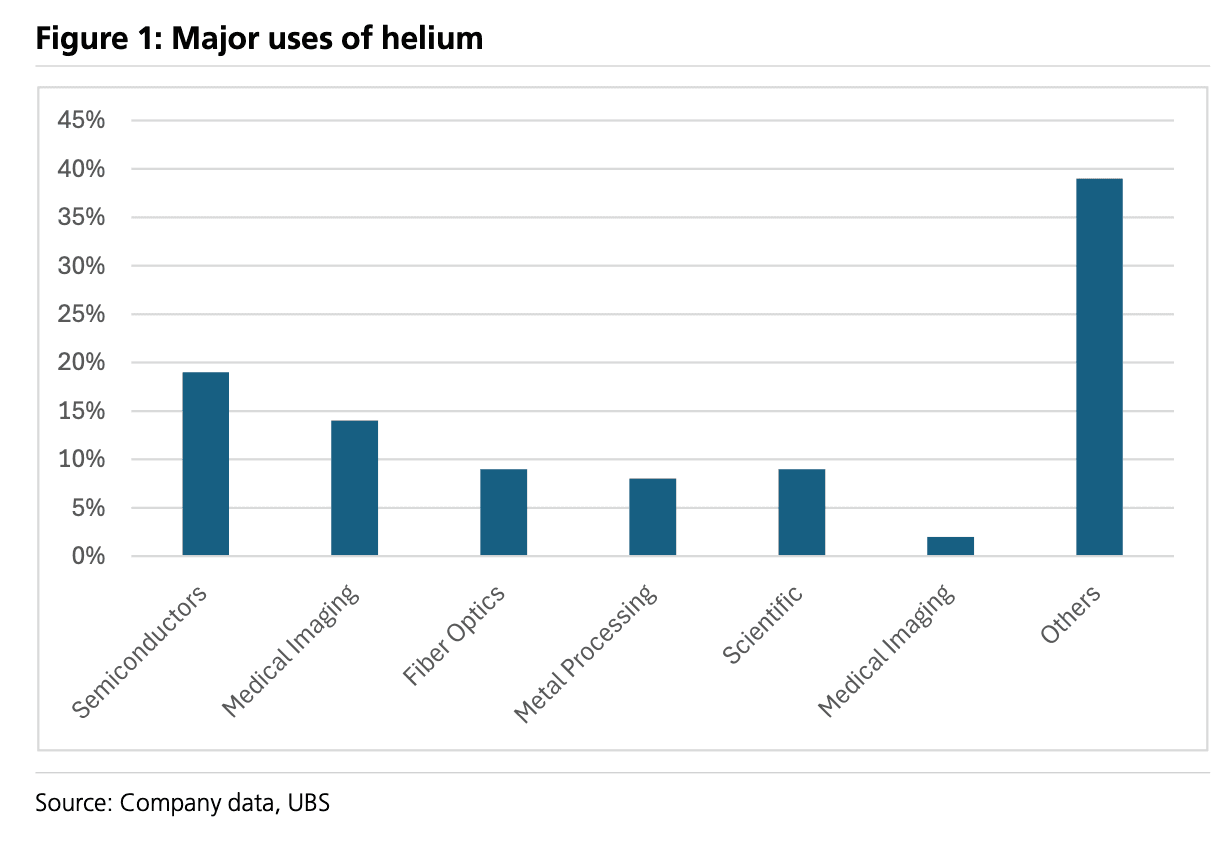
As the U.S.-Iran conflict enters its second month, one of the clearest second-order effects of the widening Gulf energy shock is the rewiring of global energy flows.
Buyers are already being forced to reassess the risks of concentrated energy exposure to the Gulf region, whether in crude and refined products or in LNG and helium, as war damage to major LNG export facilities in Qatar and Hormuz-related shipping constraints suggest energy flows could remain impaired for a prolonged period. Some of the countries most exposed to Gulf disruptions are in Asia, Africa, and Europe, as well as California in the U.S.
The good news for global buyers seeking more reliable alternatives to Gulf energy products is a theme we pointed out last month: American LNG exporters in the Gulf of America stand to be major beneficiaries of the disruption.
Adding to that theme, UBS analysts led by Manav Gupta said ExxonMobil stands out as a major beneficiary of the helium shock.
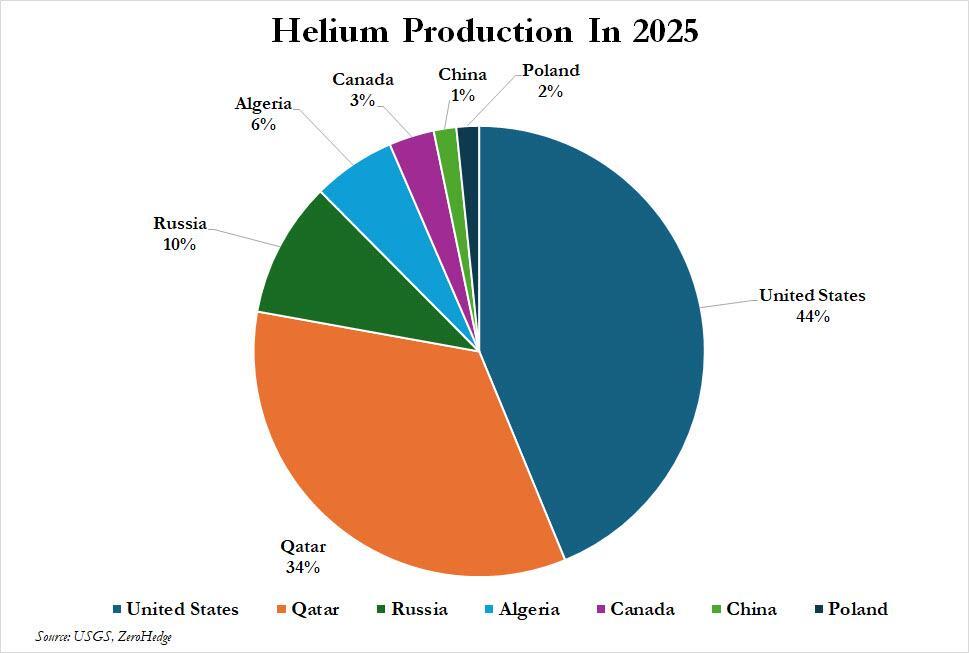
“Qatar was expected to increase its share of global capacity to 34% over the next five years; however, damage to the Ras Laffan facility could delay this expansion,” Gupta noted. But as it has turned out, the head-to-head race with the U.S. in LNG export capacity has paused for now, as the U.S. pulls ahead.
2025 Helium production by country
Gupta continued, noting that XOM is set to dominate the global helium market through its facilities in Wyoming:
XOM’s LaBarge facility in Wyoming, provides 20% of the world’s supply, which has not been impacted by recent events in the Middle East. With an estimated eight decades worth of helium left to produce there, LaBarge is poised to play a significant role through the end of this century.
This facility, is capable of producing ~1.4 billion cubic feet per year of Grade A helium. With over 30% of global capacity disrupted, this location will play a key role in meeting global needs for Helium which is a critical element for many advanced technologies, like MRIs for healthcare, rockets for space exploration, and microchips for advanced computing.
Extracting helium was not part of LaBarge’s original design when the facility began producing natural gas in the mid-1980s. After large quantities of helium were discovered underground, it soon became central to the facility’s operation.
The two wars now stretching across Eurasia – the Russia-Ukraine conflict and, now, the U.S.-Iran conflict – are accelerating a rewiring of global energy flows toward suppliers seen as more stable and secure, above all the U.S.
Professional subscribers can read the full note on why UBS says XOM is a “net beneficiary of the current helium market tightness” at our new Marketdesk.ai portal.
END
PETROCHEMICALS//ASIA
Petrochemical Supply Shock Begins Idling Asian Factories
Tuesday, Apr 07, 2026 – 02:20 PM
For weeks, we mapped out for readers how the Gulf energy shock dominoes would fall, spreading outward from the Middle East and striking Asia first through tightened energy-product flows that risk destabilizing the global economy. That transmission of tightening energy flows is now becoming alarmingly visible on factory floors across Asia.
Goldman analysts, led by Georgina Fraser, warned clients on Monday that the petrochemical shock is worsening across Asia, with textile and packaging plants emerging as the first major downstream casualties.
“The supply shock is transmitting faster and at a greater magnitude than we had anticipated,” Fraser emphasized in the note.
She said the supply shock is moving beyond higher energy prices into production cuts, margin compression, and early demand destruction, adding that “signals are materializing fastest, with textiles and packaging among the first downstream sectors affected.”
Impact chain on the Chemicals sector from the Middle East conflict
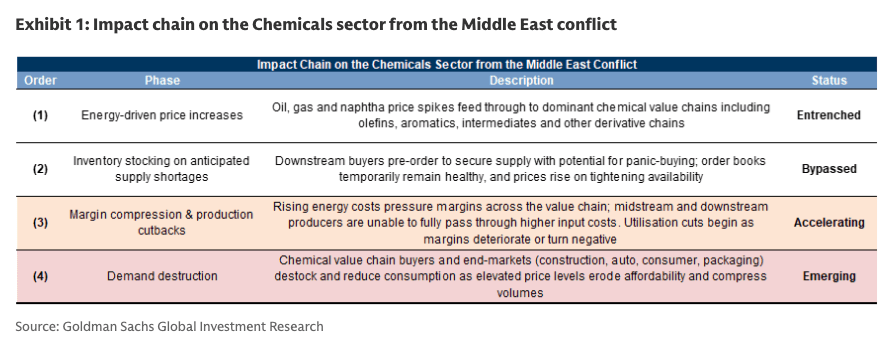
Last week, supply chain disruptions in critical plastic feedstocks began to emerge, with several producers of monoethylene glycol (MEG) and purified terephthalic acid (PTA) declaring force majeure, while tanker flows through the Strait of Hormuz remained heavily disrupted. These feedstocks are essential in the production of plastics, the very material that is core to the modern economy.
Fraser noted that China’s PTA supply chain accounts for roughly three-quarters of global PTA capacity. She said spot PTA prices have jumped by more than 30% since the U.S.-Iran conflict began.
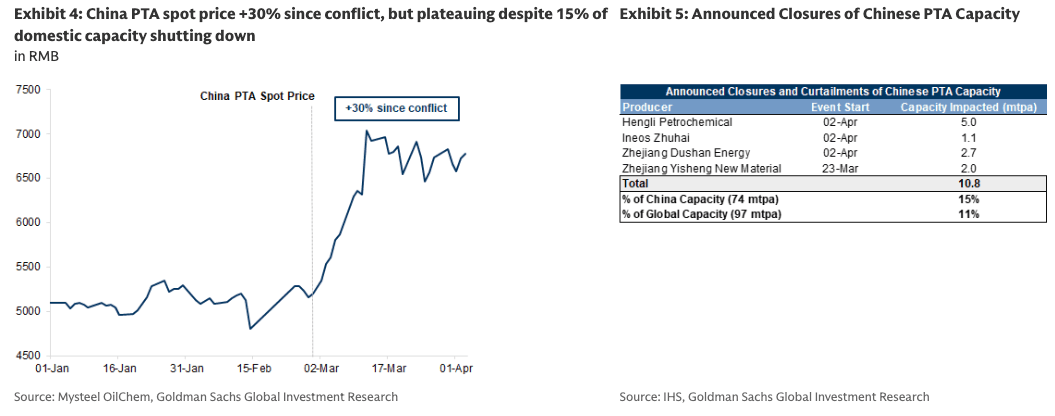
At the same time, about 15% of China’s PTA capacity and 11% of global capacity have been taken offline due to shutdowns and curtailments.
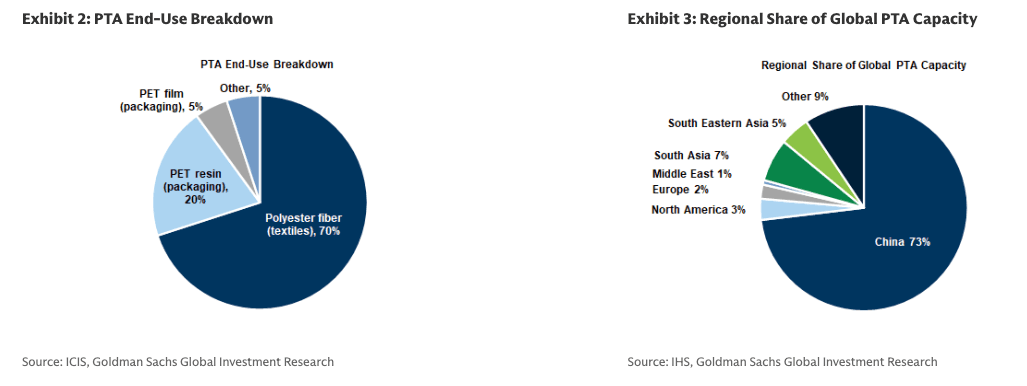
For context, MEG and PTA are the two primary feedstocks used to produce polyethylene terephthalate (PET) and polyester fibers. These petrochemicals are essential to the production of everyday consumer goods that make life in the developed world convenient, including plastic bottles, food packaging, clothing, home furnishings, and a wide range of consumer and industrial goods.
The analyst then shifted focus to India, where she said the first signs of a petrochemical supply shock are already emerging: In Surat, the country’s main synthetic textile hub, producers have reduced operations to a single 12-hour shift, halving output as soaring plastics costs collide with weak demand.
She noted that for apparel and textiles, where petrochemical-linked inputs account for 50% to 65% of the cost of goods sold, the latest moves in raw material spot prices imply a 17% COGS shock, enough to idle less efficient plants.
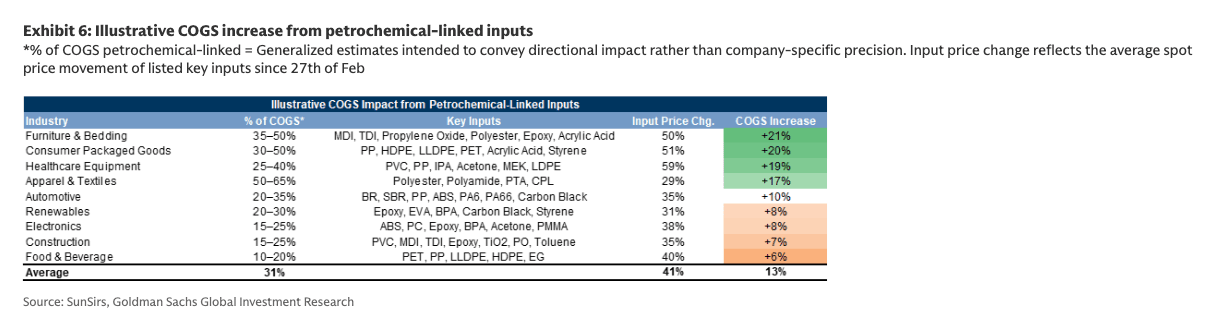
Packaging is also at risk. While demand is lower for discretionary goods than for clothing, elevated price pressures in PTA and related petrochemicals threaten to spill over into food, beverage, and consumer goods packaging, increasing the odds of inflationary pass-through.
Circling back to JPMorgan’s commodity expert on how the energy shock dominoes fall: Asia first (happening now), then Africa and Europe, before settling on the US – primarily California.

“Even an imminent end to the conflict would not fully unwind the supply chain disruption already in motion,” the analyst warned.
Professional subscribers can read the full “Petrochemical supply shock hits textiles and packaging faster and harder than anticipated” note here at our new Marketdesk.ai portal. Fraser
ASIAN AFFAIRS APRIL 7/2026
YOUR EARLY CURRENCY VALUES/GOLD AND SILVER PRICING/ASIAN AND EUROPEAN BOURSE MOVEMENTS/AND INTEREST RATE SETTINGS TUESDAY MORNING.7:30 AM
SHANGHAI CLOSED UP 10.07 PTS OR 0.26%
HANG SENG CLOSED DOWN 177.50 PTS OR 0.70%
Nikkei CLOSED UP 112.82 PTS OR 0.21%
//Australia’s all ordinaries CLOSED UP 2.16%
//Chinese yuan (ONSHORE) CLOSED UP 6.8563
/ OFFSHORE CLOSED UP AT 6.8579 Oil UP TO 112.77 ollars per barrel for WTI and BRENT UP TO 109.30 Stocks in Europe OPENED ALL GREEN
ONSHORE USA/ YUAN TRADING 6.8563 (UP) OFFSHORE YUAN TRADING UP TO 6.8579 ONSHORE YUAN TRADING ABOVE OFF SHORE AND UP ON THE DOLLAR// / AND THUS STRONGER/OFF SHORE YUAN TRADING UP AGAINST US DOLLAR/ AND THUS STRONGER
XXXXXXXXXXXXXXXXXXXXXXXXXXXXXXXXXXXXX
YOUR EARLY CURRENCY VALUES/GOLD AND SILVER PRICING/ASIAN AND EUROPEAN BOURSE MOVEMENTS/AND INTEREST RATE SETTINGS TUESDAY MORNING.7:30 AM
ONSHORE YUAN: CLOSED UP AT 6.8563
OFFSHORE YUAN: UP TO 6.8579
1.HANG SANG CLOSED DOWN 177.50 PTS OR 0.70%
2. Nikkei closed UP 112.82 PTS OR 0.21%
WEST TEXAS INTERMEDIATE OIL UP TO 112.77
BRENT; 109.30
3. Europe stocks SO FAR: ALL GREEN
USA dollar INDEX DOWN TO 99.61/// EURO RISES TO 1.1574 UP 33 BASIS PTS
3b Japan 10 YR bond yield:FALLS TO. +2.390 DOWN 3 FULL BASIS PTS/ VERY TROUBLESOME//Japan buying 100% of bond issuance)/Japanese YEN vs USA cross now at 159.48… JAPANESE YEN NOW FALLING AS WE HAVE NOW REACHED THE ENDING OF THE YEN CARRY TRADE AGAIN AND THE REPATRIATION OF YEN DENOMINATED BONDS TRADING IN THE USA/EUROPE. JAPAN 30 YR BOND YIELD: 3.7570 UP 8 FULL BASIS PTS
3c Nikkei now ABOVE 17,000
3d USA/Yen rate now well ABOVE the important 120 barrier this morning
3e Gold UP /JAPANESE Yen UP CHINESE ONSHORE YUAN: 6.8563( UP AND OFFSHORE: UP AT 6.8579
3f Japan is to buy INFINITE TRILLION YEN worth of BONDS. Japan’s GDP equals 5 trillion USA
Japan to buy 100% of all new Japanese debt and NOW they will have OVER 50% of all Japanese debt.
3g Oil UP for WTI and BRENT UP this morning
3h European bond buying continues to push yields HIGHER on all fronts in the EMU. German 10yr bund YIELD UP TO +3.0054 Italian 10 Yr bond yield UP to 3.865// SPAIN 10 YR BOND YIELD UP TO 3.484%
3i Greek 10 year bond yield UP TO 3.818%
3j Gold at $4688.20 //Silver at: 72.93 1 am est) SILVER NEXT RESISTANCE LEVEL AT $100.00
3k USA vs Russian rouble;// Russian rouble UP 0 AND 36 100 roubles/78.66
3m oil (WTI) into the 112 dollar handle for WTI and 108 handle for Brent/
3n Higher foreign deposits moving out of China// huge risk of outflows and a currency depreciation. This can spell financial disaster for the rest of the world/
JAPAN ON JAN 29.2016 CONTINUES NIRP. THIS MORNING RAISES AMOUNT OF BONDS THAT THEY WILL PURCHASE UP TO .5% ON THE 10 YR BOND///YEN TRADES TO 159.56 10 YEAR YIELD AFTER FIRST BREAKING .54% LAST YEAR NOW EXCEEDS THAT LEVEL TO 2.390% DOWN 3 BASIS PTS STILL ON CENTRAL BANK (JAPAN) INTERVENTION//YEN CARRY TRADE NOW UNWINDING//YEN BOND TRADING OVERSEAS REPATRIATED.//JAPAN 30 YR: 3.737 DOWN 2 PTS..: USA/SF this 0.7979 as the Swiss Franc . Euro vs SF: 0.9277
USA 10 YR BOND YIELD: 4.327 DOWN 2 BASIS PTS…
USA 30 YR BOND YIELD: 4.892 DOWN 2 BASIS PTS/
USA 2 YR BOND YIELD: 3.848 DOWN 2 BASIS PTS
USA DOLLAR VS TURKISH LIRA: 44.61 UP 2 BASIS PTS/LIRA GETTING KILLED//IDIOTS FOR SELLING GOLD
10 YR UK BOND YIELD: 4.8460 UP 0 PTS
30 YR UK BOND YIELD: 5.4530 DOWN 1 BASIS PTS
10 YR CANADA BOND YIELD: 3.469 DOWN 1 BASIS PTS
5 YR CANADA BOND YIELD: 3.097 UP 1 BASIS PTS.
1a New York Opening report
Futures Slide, Oil Jumps After US Attacks Kharg Island Ahead Of Trump’s 8pm Iran Deadline
Tuesday, Apr 07, 2026 – 08:30 AM
US futures reversed earlier gains and oil advanced following reports that Iran’s Kharg island was targeted earlier on Tuesday, while the market was largely paralyzed ahead of Trump’s 8pm ET deadline for Iran to agree to a ceasefire or face escalation. As of 8:00am ET, S&P futures are down 0.4%, and Nasdaq futures slide 0.6%. In premarket trading, all Mag7 names are lower even as AVGO (+3% pre-mkt) is bid after a TPU supply pact with GOOGL (+55bps) while ASML (-80bps) is weaker following a proposed US law that would further curb semiconductor exports to China (targeting ASML’s deep ultraviolet lithography machine ). Managed care is well bid after the final Medicare Advantage rate of +2.48% (vs ~1% bogey) was released last night (HUM +9%, CVS +7%, UNH +6%, ALHC +11%). Bond yields rise 1bp, 10Y TSY yield at 4.34%, the USD is also higher while commodities are mixed with oil reversing earlier losses and rising over 2%. Today’s macro data focus is weekly ADP, Durable / Cap Goods, and NY Fed 1-year Inflation Expectations. Ultimately, expect weaker volumes today with some market swings on unconfirmed ceasefire / deal chatter.
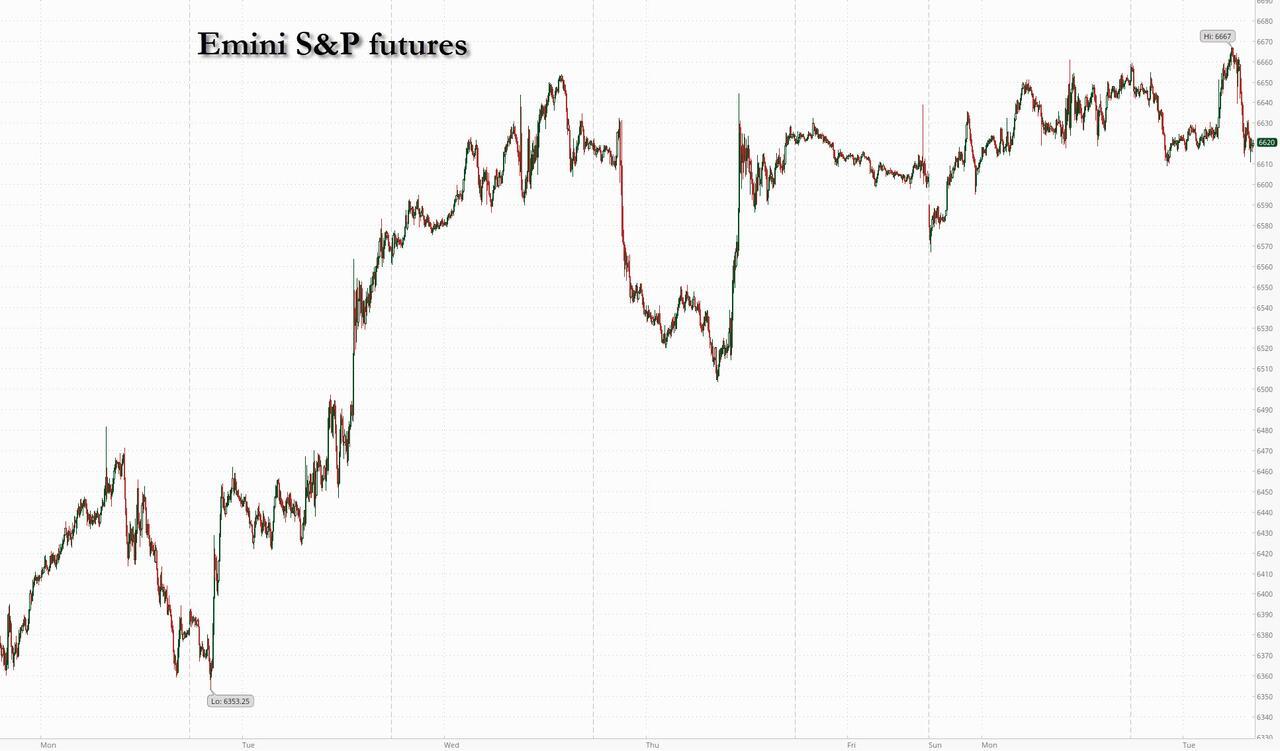
In premarket trading, Mag 7 stocks are all lower (Alphabet -0.06%, Amazon -0.4%, Meta -0.6%, Microsoft -0.4%, Tesla -1.3%, Nvidia -1.2%, Apple -1%)
- Managed care companies including Humana gain after the Centers for Medicare & Medicaid Services finalized a 2.48% rate hike for health insurers in 2027. Investors see the pay boost as a meaningful improvement over the initial rates the agency proposed in January. Humana (HUM) rises 9% and CVS Health gains 6%.
- Broadcom (AVGO) rises 3% after the chipmaker announced a long-term agreement with Google to develop and supply Tensor Processing Units. The companies also confirmed plans to work with Anthropic to power the AI startup’s burgeoning operations.
- Estée Lauder (EL) slips 1% after Spanish newspaper Expansion reported that the the company and Puig owning families are set to hold talks this week in New York over their potential merger.
- Organogenesis Holdings Inc. (ORGO) rises 19% after the company said a randomized controlled trial of 170 patients in a diabetic foot ulcer trial achieved its primary endpoint.
- Wingstop (WING) rises 1.9% as Citi upgrades the fried chicken restaurant operator to buy, saying the valuation offers an attractive entry point.
- Pershing Square proposed a combination with Universal Music Group that would move the listing into a US-based acquisition vehicle. It’s a deal that Bill Ackman’s fund said values the world’s biggest music label at a 78% premium to its last closing price.
In other news, Samsung reported preliminary operating profit that soared 755% to a record, with memory’s contribution estimated to be close to 90% of total operating profit. Rivals OpenAI, Anthropic, and Alphabet’s Google have begun working together to try to clamp down on Chinese competitors extracting results from cutting-edge US AI models. And Anthropic said its revenue run rate has now topped $30 billion, with more than 1,000 businesses spending over $1 million annually, a rate that has doubled since February. BlackRock is setting its sights on a corner of the $13.7 trillion US ETF industry long controlled by Invesco — tracking the Nasdaq 100 Index. Some Tiger Cub funds incurred losses in March. Maverick Capital’s Long Enhanced Fund and its main hedge fund tumbled 8.1% and 5%, respectively, while Viking Global Investors’ flagship fund lost 4.1%, according to people familiar with the matter.
Trump has threatened “all Hell” will rain down on Iran if it doesn’t agree to a ceasefire that reopens the Strait of Hormuz by 8 p.m. Eastern time. The Pentagon canceled the morning press briefing due to be led by Pete Hegseth, giving no reason. WSJ reported last night that hope is fading for a final deal by the deadline and RTRS reported this morning that a Senior Iranian Source said Tehran has rejected any temporary ceasefire with the U.S. and the IRGC warned neighboring countries “restraint is over” and threatened to disrupt regional oil and gas supplies for years to come. Strikes continued overnight.
“It seems clear that it is extraordinarily difficult to invest on expectations for binary outcomes,” notes Jeffrey Palma at Cohen & Steers. On the other hand, David Kruk at La Financiere de l’Echiquier, set out the dilemma confronting traders, observing that the “market is now set up in such a way that the real pain trade is upwards.”
Investors are watching for any sign of a breakthrough amid a flurry of diplomacy before the 8 p.m. Eastern Time deadline. Trump insists any deal must ensure uninterrupted transit through the Strait of Hormuz — a key artery for Middle East oil flows. He’s threatened to destroy Iran’s bridges and power plants if no accord is reached. “The market remains volatile,” said Wolf von Rotberg, equity strategist at Bank J Safra Sarasin. “It continues to swing between de-escalation hopes and Trump following through on his threats.”
Oil remains in focus, with WTI crude rising to the highest since June 2022. Meanwhile, Bloomberg Intelligence analysts expressed caution over the wide gap between the Brent spot price, which reflects expectations of a resolution, and Dated Brent, which represents actual cargoes assigned specific loading dates. At above $140, the latter signals acute spot scarcity.
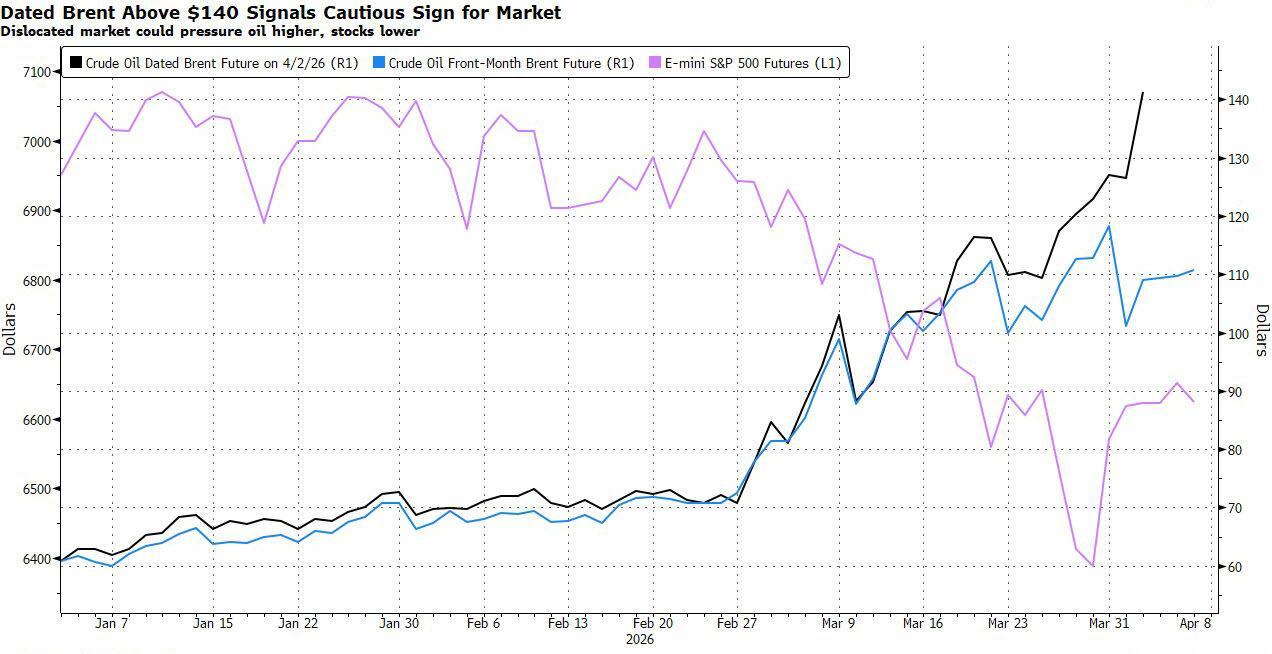
Trump’s deadline marks the latest pivotal moment in the war, which has killed thousands of people and triggered the largest-ever disruption to the global oil market. Israel told Iranians to refrain from using their country’s railway network until 9 p.m. local time, the first warning about such infrastructure that usually precedes an attack. Iran launched seven ballistic missiles and several more drones at Saudi Arabia overnight into Tuesday, while the Israel Defense Forces reported two missile volleys from Iran since midnight.
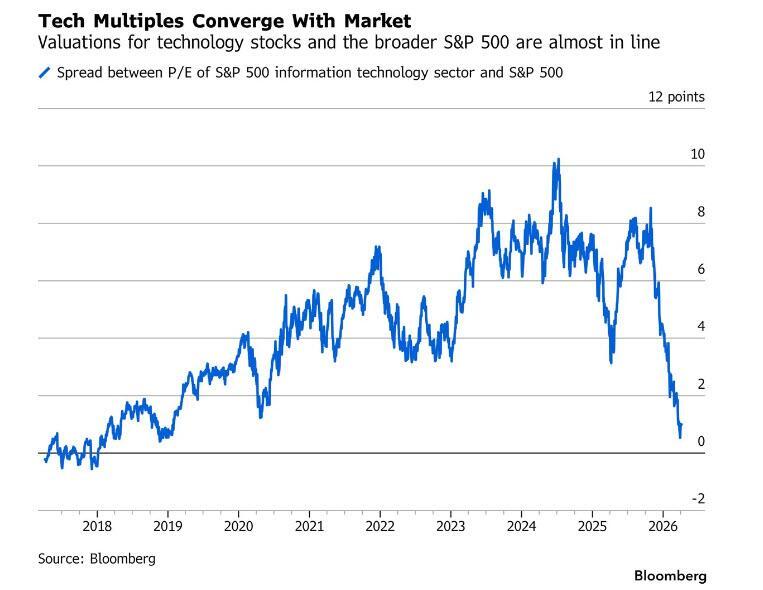
Meanwhile, the technology sector is looking increasingly attractive for investors as valuations fall below those of the wider stock market, according to Goldman strategists. Any lasting shock to the global economy from the war in Iran is also likely to benefit the sector as tech cash flows are less sensitive to economic growth, the strategists said.
The recent economic numbers aren’t boosting the case for the Federal Reserve to resume cutting rates anytime soon. March CPI on Friday is predicted to show the largest month-over-month increase in headline inflation since June 2022, largely driven by a spike in gasoline prices tied to the Iran conflict.
Europe’s Stoxx 600 is up by 0.6%, with the media subindex leading the way on a jump for Universal Music on a €56 billion takeover proposal. UMG is the biggest gainer after Pershing Square offered to buy the entertainment company, while tech underperforms, weighed down by ASML as US lawmakers propose tighter curbs on chip equipment exports to China. Here are the biggest movers:
- Universal Music Group shares rise as much as 24% in Amsterdam, but trade well below the value of an offer from Pershing Square Capital Management amid doubt over whether the deal will happen
- JCDecaux rises as much as 5.8% as TD Cowen upgrades the outdoor advertising company to buy from hold, seeing a clear inflection point as China returns to growth
- Volati gains as much as 7.2%, the most since November, as Nordea reiterates its buy rating and raises its price target on the Swedish industrial group, saying the company is well-positioned to benefit from a cyclical rebound
- ASML shares fall as much as 4.7% on Tuesday after US lawmakers unveiled legislation aimed at tightening restrictions on chip tool exports to China. The goal is to subject Dutch and Japanese firms to the same curbs that American companies face
- Leonardo shares fall as much as 5.5% on the possibility of a management change at the Italian defense group; Bloomberg News reported that CEO Roberto Cingolani could be replaced as soon as this week
- AddTech falls as much as 5.9% after DNB Carnegie downgraded the stock to hold from buy, saying the Swedish industrial equipment maker could face weakening earnings growth momentum in 4Q
- Ninety One tumbles as much as 14% as BofA Global Research downgrades its rating on the investment management firm to neutral from buy and cuts its target price to 260p from 280p because of lower expected market returns
- Colruyt drops as much as 4.3%, biggest decliner in Belgium’s BEL Mid Index, after UBS downgraded the stock to neutral from buy, saying it looks “fairly valued for modest growth”
Asian stocks advanced for a third-straight session even as the approach of President Donald Trump’s deadline for a peace deal with Iran kept traders on edge. The MSCI Asia Pacific Index rose 1%, with technology shares including TSMC and SK Hynix among the biggest boosts. Stocks climbed in Taiwan and Australia. Hong Kong’s market remained shut for holidays. Stocks also gained in India, while equities traded mixed in Japan, China and much of Southeast Asia. South Korea’s Kospi climbed after better-than-expected results from Samsung Electronics.
“While oil prices remain elevated for now, there is a strong view that the conflict will come to an end within the next one to two weeks, with crude prices returning to prior levels,” said Hideyuki Ishiguro, chief strategist at Nomura Asset Management. “Geopolitical risks themselves have not been resolved, but VIX in Japan, US, and Europe have peaked, suggesting that markets may have largely priced in these risks,” he added.
In FX, the Bloomberg Dollar Spot Index rises by 0.1%, with Aussie dollar and sterling the outperformers and Swedish krona lagging after a surprise cooling in inflation.
In rates, treasury futures hold small losses after erasing gains amid rising oil prices, with yields across tenors slightly higher on the day. US 10-year yield is less than 1bp higher near 4.34%, and curve spreads are within a basis point of Monday’s closing levels. With European bond markets open for first time since Thursday, German and UK yields are 2bp-5bp cheaper across flatter curves. The US session includes the first of this week’s three Treasury coupon auctions, a 3-year note sale at 1pm. Treasury’s $58 billion 3-year new-issue auction, to be followed by $39 billion 10-year and $22 billion 30-year reopenings Wednesday and Thursday, has WI yield near 3.895%, about 32bp cheaper than last month’s, which tailed by 1.1bp, a notably poor result.
In commodities, WTI crude oil futures are up about 2% from Monday’s multiyear high close, which followed Trump’s threat to obliterate key Iranian infrastructure if an agreement to end the war isn’t reached by 8pm Tuesday. Gold prices up, though paring back from highs near $4,700/oz.
US event calendar, includes ADP weekly employment change (8:15am), February durable goods orders (8:30am), March New York Fed 1-year inflation expectations (11am) and February consumer credit (3pm). Fed speaker slate includes Williams (8:30am), Goolsbee (12:35pm, 1:45pm) and Jefferson (5:50pm)
Market Snapshot
- S&P 500 mini -0.6%,
- Nasdaq 100 mini -0.7%,
- Russell 2000 mini -0.2%
- Stoxx Europe 600 +0.3%
- DAX +0.5%
- CAC 40 +1.0%
- 10-year Treasury yield +1 basis point at 4.34%
- VIX +0.3 points at 24.48
- Bloomberg Dollar Index -0.2% at 1211.85
- euro +0.3% at $1.1571
- WTI crude -0.4% at $111.97/barrel
Top Overnight News
- Negotiators are pessimistic Iran will bend to meet President Trump’s demand to reopen the Strait of Hormuz before his Tuesday-night deadline, paving the way for the U.S. to target Iranian bridges and power plants in a fresh escalation of the war. Twice in his second term, Trump set a deadline for a deal with Iran, said he would bomb the country if its leaders didn’t comply, then followed through with military operations. WSJ
- Airstrikes pounded Tehran on Tuesday, and Iranian officials urged young people to form human chains to protect power plants, hours before the expiration of U.S. President Donald Trump’s latest deadline for the Islamic Republic to reopen the crucial Strait of Hormuz or face punishing strikes on its infrastructure. AP
- Iran on Monday delivered a 10 point proposal to end the war with the US and Israel. The plan was conveyed by Pakistan, which has been acting as a primary intermediary, but appeared unlikely to resolve major questions ahead of Trump’s Tuesday evening deadline for new attacks on Iran. NYT
- A cross-party group of U.S. politicians have proposed a law to impose further restrictions on exports of computer chipmaking equipment to China, affecting companies such as ASML and China’s top chipmakers. RTRS
- Japan’s households reduced spending for a third straight month even after real wages turned positive. Outlays by households adjusted for inflation fell 1.8% in February from a year earlier, a faster decline compared with January’s 1% retreat. Real consumption remains weak, with economists citing growing consumer fatigue and inflation pressure as key challenges to domestic demand. BBG
- Taiwan’s opposition leader is set to arrive in China on Tuesday on what she has called a “historic journey for peace” as she hopes for a face-to-face meeting with Chinese leader Xi Jinping, the first such contact in a decade. FT
- Anthropic’s revenue run rate has topped $30 billion and the company confirmed partnerships with Broadcom and Google. BBG
- Cleveland Federal Reserve President Beth Hammack and Chicago Fed President Austan Goolsbee both see inflation as a far bigger problem than employment, underscoring their support for tighter rather than looser monetary policy as the Iran war puts upward pressure on energy prices and the job market remains stuck in low gear. RTRS
- Bill Ackman’s Pershing Square offered to buy Universal Music Group in a cash-and-stock deal at a 78% premium to Thursday’s closing price. Ackman cited UMG’s stock underperformance as a trigger for the bid. BBG
- Republicans are reportedly weighing how broadly to structure a party-line bill to fund President Trump’s immigration enforcement, with some senators seeking multi-year DHS funding and others favoring a narrower ICE and CBP measure: Semafor
A more detailed look at global markets courtesy of Newsquawk
APAC stocks traded cautiously following the positive lead from the US and with all focus remaining on geopolitics heading into US President Trump’s Tuesday evening deadline for Iran to open up the Strait of Hormuz or face the US destroying its power plants and bridges, although President Trump had also previously stated that he thinks talks are going well with Iran and they would like to be able to make a deal. ASX 200 rallied with tech and miners leading the upside and with almost all sectors in the green aside from industrials and consumer staples. Nikkei 225 failed to sustain its initial advances with the index pressured amid headwinds from higher oil prices and following disappointing Household Spending data. KOSPI surged at the open with strong gains in Samsung Electronics after its preliminary results topped forecasts and showed around an eight-fold jump in Q1 operating profit, although most of the advances were then pared as shares in the index heavyweight also pulled back. Shanghai Comp lacked conviction on return from the long weekend, with upside limited after another meek PBoC liquidity operation and with the Stock Connect still closed as Hong Kong markets remained shut.
Top Asian News
- Japanese Finance Minister Katayama said won’t comment on JGB yield levels and will refrain from commenting on levels in the markets, adds impact of Middle East and oil prices on the market is high.
- Chinese President Xi called for new energy system as war on Iran rocks global economy and said China needs to accelerate planning and construction of a new energy system to ensure the country’s energy security.
- South Korean FX Chief said are to deploy bold measures in the FX market, if needed.
- South Korea policy chief Kim said the chip industry secures four month’s worth of helium and it is premature to discuss a second extra budget.
- Morgan Stanley cuts its China 2026 GDP growth forecast to 4.7% due to oil shock.
European bourses (STOXX 600 +0.7%) re-open from the 4-day Easter closure with mild gains, as traders countdown to Trump’s Iran deadline at 20:00EDT/01:00BST. France’s CAC 40 outperforms its peers, while the FTSE 100 underperforms. Worth noting that European indices opened mixed, but then moved higher, without a clear driver. Some may point to reports via a Pakistani journalist which suggested that a “framework of understanding for ceasefire” between US and Iran is “closer than ever”. European sectors are broadly in the green. Media is the clear outperformer, driven by gains in UMG (+12.2%) after Pershing Square announced a EUR 9.4bln bid to take over the media company. Technology sits at the bottom of the pile. Despite the majority of the sector components in the green, ASML (-2.3%) is weighing on the sector. This comes following a group of US politicians proposing a law to impose further export restrictions on computer chipmaking equipment to China.
Top European News
- UK S&P Global Services PMI Final (Mar) 50.5 vs. Exp. 51.2 (Prev. 53.9). “Stagflation risks appear to have increased, with the final Services PMI data signalling slower growth and higher cost pressures than the earlier ‘flash’ estimates based on data compiled up to 20th March.”
- UK S&P Global Composite PMI Final (Mar) 50.3 vs. Exp. 51 (Prev. 53.7).
- EU S&P Global Composite PMI Final (Mar) 50.7 vs. Exp. 50.5 (Prev. 51.9). “The near-stalling of growth in March drags the PMI’s signal for first quarter GDP growth down to 0.2%. More worrying is that there are clear risks of the economy contracting in the second quarter unless there is a swift resolution to the conflict.”
- EU S&P Global Services PMI Final (Mar) 50.2 vs. Exp. 50.1 (Prev. 51.9).
- German S&P Global Services PMI Final (Mar) 50.9 vs. Exp. 51.2 (Prev. 53.5).
- German S&P Global Composite PMI Final (Mar) 51.9 vs. Exp. 51.9 (Prev. 53.2).
- French S&P Global Services PMI Final (Mar) 48.8 vs. Exp. 48.3 (Prev. 49.6).
- French S&P Global Composite PMI Final (Mar) 48.8 vs. Exp. 48.3 (Prev. 49.9).
FX
- FX markets saw a sharp risk-on move in the European morning, with no specific headline, but several outlets reporting optimism in US/Iran negotiations ahead of Tuesday’s deadline. DXY fell as much as 0.2% from 100.04 to a trough of 99.77, and high-beta FX was helped against the weaker buck, with Aussie the outperformer and Sterling also performing notably well.
- Some participants flagged an Axios article six hours before the move, which quoted a US official, “If the president sees a deal is coming together, he’ll probably hold off…” it is unclear whether this led to the reaction, though other reports following this initial move have added to the constructive risk environment, “mediators are close to reaching an agreement” on a “framework of understanding for ceasefire”, according to Pakistani reporter Anas Mallick.
- Elsewhere, EUR and GBP were unreactive to mixed European Final PMIs. To recap, the EZ wide composite and services were revised a touch higher while the UK’s were revised lower.
- The session ahead sees US ADP Employment Change Weekly, US Durable Goods RCM/TIPP Economic Optimism Index (Apr), Atlanta Fed GDP and President Trump’s Iran deadline. Fed speak is expected from Fed’s Williams (13:30 BST), Goolsbee (17:35 BST) and Jefferson (22:50 BST). Full primer on the Newsquawk headline feed.
Central Banks
- ECB’s Wunsch said he is open to an interest rate rise at the April meeting; a lasting crisis would warrant a series of rate rises.
- ECB’s Radev said the ECB must be ready to act if inflation persists, sees a rising likelihood of adverse scenario but too early to say if April rate hike is needed. Inflation expectations at risk of rising too quickly.
Fixed Income
- Initial bearish bias across the fixed income was facilitated by stronger energy prices, as the geopolitical environment remains exceptionally turbulent and as traders count down their clocks to President Trump’s 20:00EDT Iran deadline. However, in recent trade the crude complex took a tumble – but lacked a clear driver. Some market participants pointed towards an Axios piece from overnight, which reported that Trump may hold off from strikes on Iran if he sees a “deal coming together”. Markets also appear to be digesting some relatively positive mood from the Pakistani side, with a couple analysts suggesting a breakthrough could be close; whilst another suggested that a “framework of understanding” for a ceasefire is close. The pressure in energy prices therefore helped to boost fixed benchmarks to session highs.
- USTs were initially lower and were holding near troughs throughout the early portion of the morning, before then surging alongside the pressure in the crude complex. Currently holding at the upper end of a 110-21+ to 110-29+ range. On the data front, weekly ADP jobs figures, durable goods orders for February. On today’s speakers’ slate, Fed’s Williams (voter) will speak on Bloomberg TV; Fed’s Goolsbee (2027 voter, dovish) will speak on the outlook for policy and the economy; Fed’s Vice Chair Jefferson (voter, dovish) will speak on the economic outlook and the labour market.
- Bunds followed the above, and currently holding at the upper end of a 125.31-125.73 range – though still remains incrementally in the red. Geopols aside, German benchmarks have had a number of European PMI Final metrics to digest; Spain topped expectations, Italy missed whilst the EZ-wide figure was revised incrementally higher. Interesting commentary from within the German release suggested that, “the lack of pricing power in the service sector is important from a monetary policy perspective, as it limits the amount of upward pressure on core inflation, a measure that the ECB will be closely watching when considering interest rate increases.”
- Gilts are currently flat. As above, initially weighed by stronger energy prices, but UK paper then soared to highs as energy prices dipped. Currently towards the upper end of a 88.23-88.72 range. UK PMI Finals were revised lower, with analysts citing slower output growth as a result of the war in the Middle East. It also highlighted increasing risks to “stagflation”, and increasing costs pressures.
Commodities
- Crude futures gained at the start of the APAC session and held onto gains as European traders stepped in as US President Trump’s 20:00EDT deadline approaches. If Iran does not agree to a ceasefire and reopen the Strait of Hormuz, he said the US will decimate Iran’s bridges and didn’t rule out striking power plants. However, Trump did also state that he thinks talks are going well and that Iran has “an active and willing participant on the other side.” Further reporting throughout the European morning indicates that an agreement could be near, with Pakistani reporter Mallick suggesting that the interlocutors are ‘closer than ever for an agreement’ to get a “framework of understanding for ceasefire” between the US and Iran.
- WTI and Brent topped at USD 116.56/bbl and USD 111.80/bbl, respectively, before sinking – a move which lacked a clear driver. However, the move appeared to follow the aforementioned reports from the Pakistani reporter. At the time of writing, WTI May’26 has returned below USD 113/bbl while Brent Jun’26 oscillates on either side of USD 110/bbl.
- Spot gold trades relatively contained within a USD 4617-4691/oz range. Upticks have picked up pace in recent trade as the USD softens amid downside in energy prices. However, the 20-SMA at USD 4,732/oz and last week’s high of USD 4,800/oz remain as near-term resistance levels. To add, China added gold to its reserves for a 17th consecutive month, highlighting that demand for the yellow metal is still high. However, UBS lowered its end-June forecast to USD 5,200/oz due to softer investor demand.
- 3M LME copper is rangebound, oscillating in a USD 12.37k-12.46k/t range. This comes as participants remain cautious as the Trump deadline looms.
- Hungary to agree to buy oil from US at Orban-Vance meeting, Bloomberg reported. Hungary’s Mol will agree to purchase 500,000 tons for approximately USD 500mln.
- Kazakhstan’s Energy Ministry said the oil shipments via CPC pipeline is stable, IFX reported.
- IRGC’s public relations channel reported of “explosion and extensive damage to the Al-Jubeil industrial area”.
- Attacks reportedly hit Saudi Aramco’s petrochemical plant in Saudi Arabia, AFP reported citing sources.
- China has provided Iran with a financial lifeline during the past half decade by purchasing most of its oil, according to WSJ.
- Tanker explosion near the Bridge of Americas in Panama City caused a massive fire.
- Japan’s Industry Minister Akazawa said crude oil procurement is progressing.
- China gold reserves at end-March (USD) 342.76bln (prev. 387.59bln).
- UBS lowers end-June gold forecast to USD 5,200/oz, amid softer investor demand amid elevated volatility.
- Goldman Sachs analyst raises 2026 copper price forecast to USD 12,650/ton from USD 11,400/ton and expects copper prices to remain volatile as the market continues to assess impacts of the events in the Middle East on economic growth.
Geopolitics
- Pakistani reporter Anas Mallick suggests that, “to my understanding, the interlocutors (Pakistan, Turkiye and Egypt) are ‘closer than ever for an agreement’ to get a “framework of understanding for ceasefire” between US and Iran”.
- Some geopolitical analysts say signals from Pakistan suggest a possible breakthrough in the coming hours, with Egypt, Turkey, Saudi Arabia and reportedly Beijing involved. said that a ceasefire could be near, but the situation remains early and fragile, so caution is warranted.
- Pakistan in last-minute efforts, along with Turkey and Egypt, to convince Iran to agree to the outline proposed by Pakistan, according to I24’s Stein.
- Five friendly countries leaders’ and eight intelligence agencies have reached out to Iran seeking to open a path for a ceasefire, Fars News reported.
- Israeli Source tells N12 news “The next 24 hours are the most decisive in the war, if it were up to political leadership in Iran, there would have been a ceasefire long ago, there is doubt about their control”, N12’s Segal reported.
- Iran’s Spokesperson of the National Security Commission of the Parliament said “we are making special arrangements for the Strait of Hormuz”, via Tasnim.
- Spokesman of Iran’s National Security and Foreign Policy Committee of Parliament said oil exports are going on as usual, and with even more capacity than before, IRIB reported.
- Iran atomic agency said heavy bombs won’t halt nuclear tech progress.
- China has provided Iran with a financial lifeline during the past half decade by purchasing most of its oil, according to WSJ.
- Saudi Arabia, UAE and Israel report Iranian drone and missile attacks, according to CBS.
- Israel announces a new wave of strikes on Iran and issues incoming missile alert.
- Iran launches new batch of missiles towards southern Israel.
- Israeli military said it completed airstrike wave aiming to damage Iranian terror regime infrastructure in Tehran and additional areas across Iran.
- US House Democrat Ansari intends to introduce articles of impeachment against Secretary of War Hegseth, cites Iran war and war crimes as grounds for Hegseth impeachment, according to NBC.
- Japanese PM Takaichi said in parliament said in Parliament, want to take next step in talks with Iran and is strongly urging Iran to allow Hormuz safe passage, while she is seeking phone talks with the presidents of US and Iran.
- Iranian Parliament Speaker Ghalibaf’s adviser Mohammadi said it is Trump who has about 20 hours to either surrender to Iran or his allies will return to the Stone Age, while he added that they will not back down.
- Iran said non-hostile countries can coordinate access to the Strait of Hormuz, according to Press TV.
- US Vice President J.D. Vance is on standby for Iran negotiations, according to POLITICO. “The negotiations are led by Steve Witkoff and Jared Kushner but Vance could be tagged in if there is a direct meeting with Iranian officials.”.
- Iran’s top joint military command said Trump’s threats are ‘delusional’ and his threat have no effect on operations against US and Israel.
- US data centres of Amazon (AMZN), Microsoft (MSFT), Oracle (ORCL), and Equinix (EQIX) in the UAE are now identified as potential targets for Iran’s counter response in the region.
- Iranian securities exchange chief outlines conditions needed to reopen the Iranian capital markets: said outcomes could include a ceasefire with a formal agreement and full reopening, or a ceasefire without agreement and a gradual reopening.
- Explosions reported in eastern regions of Saudi Arabia and alarms sounding in Bahrain, Tasnim reported.
- Israeli reporter Stein said “Unexpectedly: the press conference planned for today with Defence Minister Hegseth and US Chief of Staff was cancelled”.
- Fars news citing an informed source said “Trump is clearly looking for a meeting and an agreement. The American proposal includes the removal of “Witkoff” due to his closeness to Netanyahu’s circle and negotiations with “Vance” to build a serious path. In the end, this source noted: Americans believe that fuel prices will increase explosively from next week and are not willing to accept this risk.
- The Iranian Ambassador to Pakistan said Pakistan’s positive and productive attempt to step the war is approaching a critical and sensitive stage.
- Iranian outlets report that Yazd and Shiraz were shaken by blasts.
- Large barrage of missiles were reportedly headed for Bahrain, with air raid sirens and alerts in multiple areas.
- Drone strike reportedly hit US Victoria base in Baghdad, according to Iraqi sources cited by Fars.
- Missiles hit Saudi Arabia’s Jubail which is largest industrial hub in the Middle East where large petrochemical and energy facilities are located.
- IRGC Aerospace Force Commander said they targeted the oil refinery, power plants, ports, and railway lines in Haifa Bay, and no interception of our missiles was recorded, Al Jazeera reported.
- Russia’s Yamal LNG ships first cargo to China since November, LSEG data shows.
- Russia’s Ministry of Defence reported that air defence forces have downed 45 Ukrainian drones over Russian regions overnight.
US Event Calendar
DB’s Jim Reid concludes the overnight wrap
US and Asia markets had a decent start to the week yesterday while Europe was off for Easter Monday. However, sentiment has turned more cautious this morning as investors grapple with President Trump’s new deadline of 8pm Eastern Time tonight (1am London) for Iran to agree a deal as he threated to destroy Iran’s bridges and power plants. The renewed escalation threat has seen Brent crude move back above $111/bbl this morning after trading as low $107/bbl yesterday. In turn, S&P 500 futures are down -0.44% overnight after posting a fourth consecutive advance (+0.44%) yesterday that saw the index erase half of its decline since the Iran strikes began.
In terms of Trump’s latest ultimatum to Iran, the US President shared the 8pm ET Tuesday deadline on social media on Sunday and then referred to it several times yesterday as he demanded that Iran strikes a deal that “that’s acceptable to me”, while threatening intensified attacks against Iran that would destroy “every bridge” and take “every power plant” out of business. Notably, Trump said that a deal should include “free traffic of oil”, calling reopening the Strait of Hormuz “a very big priority”. So a seeming shift from previous suggestions that reopening the straits was not a core objective for the US. The President repeatedly suggested that this evening’s deadline was final, saying that he was “highly unlikely” to postpone it. Recall that Trump had issued an initial 48-hour ultimatum for striking Iran’s power plants back on March 21, first extending this by 5 days and then followed by another 10-day pause that had been due to expire yesterday.
Earlier yesterday, we had heard various reports on talks as other countries in the region have pushed for a ceasefire deal. Iran’s state-run IRNA then reported that Tehran rejected a ceasefire via Pakistani mediators, instead demanding a permanent end to the war as well as lifting of sanctions, reconstruction efforts and a protocol for safe passage through Hormuz. Meanwhile, Trump called Iran’s proposals a “very significant step” but “not good enough” as he threatened the escalatory strikes.
So that left oil markets facing crosswinds from Trump’s escalation threat to possible ceasefire talks as well as news that shipping via the Strait of Hormuz has been edging higher in recent days. Iran said on Saturday that “brotherly” Iraq would be exempt from shipping restrictions in the Strait, and AIS data showed five tankers crossing the Strait that day (possible that more did so with transponders turned off). That was the most since March 1 but still a small fraction of the roughly 60 tankers a day before the war.
Brent crude whipsawed in a relatively tight range yesterday, falling from above $111/bbl at yesterday’s open to as low as $107/bbl early in European hours before closing +0.68% on the day at $109.77/bbl. It is another +1.67% higher at $111.60/bbl as I type.
With oil markets relatively stable, risk assets had a decent start to the week, with the S&P 500 (+0.44%) advancing for a fourth session in a row yesterday, its longest run since January. That left the S&P 500 up +4.22% from last Monday’s closing low, erasing around half of the -7.78% decline it had seen since February 27. The NASDAQ (+0.54%) and the Mag-7 (+0.28%) saw similar gains, while nearly two thirds of the S&P 500 constituents moved higher on Monday with cyclical sectors outperforming. Private investment companies including Apollo (-0.87%) and Blackstone (-0.72%) underperformed amid lingering concerns about private credit. By contrast, US HY credit spreads tightened by -8bps to 291bps, their lowest level since March 5.
In Asia this morning, the Nikkei (-0.38%) is down following a +0.55% increase yesterday after softer Japan household spending data (-1.8% YoY vs -0.8% expected) which posted a third consecutive year-over-year decline in February. Meanwhile, the KOSPI (+0.30%) is continuing its upward trend after a +1.36% rise on Monday. Samsung Electronics was up as much as +4.9% at the open as it projected record quarterly profits due to strong AI chip demand, but its stock is now down -1.98% as I type. Elsewhere, the S&P/ASX 200 (+1.43%) is significantly higher this morning, while the CSI (-0.29%) and the Shanghai Composite (+0.03%) are more subdued. In the US, S&P 500 futures (-0.44%) have lost ground overnight, whereas Euro STOXX 50 (+0.13%) futures are edging higher after yesterday’s US advance.
In terms of yesterday’s other news, the March ISM services release in the US highlighted the inflationary risks stemming from the Iran war. While the headline reading retreated from a post-2022 high of 56.1 to 54.0 (vs. 54.9 expected), the prices paid component saw a stronger-than-expected rise to 70.7, its highest since October 2022. And there were contrasting signals within the details, as new orders rose to a 3-year high of 60.6, but employment fell to a 2-year low of 45.2. Amid this mixed data, the Treasury curve saw a modest flattening yesterday, with the 2yr yield up +0.8bps to 3.85% but 10yr down -1.3bps to 4.33%.
Treasury yields had seen a sizeable rise in Friday’s shortened session, with 2yr up +4.4bps and 10yr up +3.9bps following the strong March employment report. The release saw both headline (+178k vs +65k expected) and private (+186k vs. 78k expected) payrolls come in far above consensus expectations, with the unemployment rate also dropping from 4.44% to 4.29% (vs. 4.4% expected). To be sure, the rebound from strike- and weather-related weakness in February payrolls played a role, with the earlier timing of Easter also possibly bringing forward some payroll gains at the expense of April. Still, averaging through the Q1 employment reports, headline (+68k) and private (+79k) payrolls have been running above estimates of breakeven job gains and well above their subdued pace in late 2025, easing concerns on the employment side of the Fed’s dual mandate.
Turning to the week ahead, the data highlight will be the March CPI print in the US on Friday where the impact of the energy price shock will be on full display. Our economists expect a roughly 25% increase in gasoline prices to yield a 0.95% monthly gain in headline CPI, raising the annual rate from +2.4% to +3.4%, while core inflation sees a more moderate +0.33% monthly rise. The March CPI reading will also be preceded by the February core PCE inflation print on Thursday, which we expect at +0.39% MoM. That would mark the highest monthly print since last February and bring the 3- and 6-month annualised rates of the Fed’s preferred inflation metric up to 4.5% and 3.5% respectively.
Other notable US data releases this week include the March NY Fed inflation expectations survey and February durable goods orders today as well as the University of Michigan consumer sentiment on Friday. Elsewhere, we have the Euro Area final March services PMIs (today), Germany’s February factory orders (Wednesday) and industrial production (Thursday), and the March inflation reports in China (Friday). From central banks, Wednesday will see the March FOMC minutes and a rates decision in New Zealand (our economists expect a hold). See the full day-by-day rundown below.
And while Iran headlines will dominate the geopolitical news, we also have NATO Secretary General Rutte scheduled to meet with Trump in Washington tomorrow in a visit that comes amid Trump’s vocal criticism of NATO allies over their stance on the Iran war.
1b European opening report
Reports point to a US-Iran agreement on the horizon ahead of Trump deadline – Newsquawk US Market Open

Tuesday, Apr 07, 2026 – 06:11 AM
- Pakistani reporter Anas Mallick suggested that the interlocutors are closer than ever for an agreement to get a “framework of understanding for ceasefire” between US and Iran.
- Crude futures reverse earlier gains amid some positive noise ahead of Iran deadline.
- European bourses gain, UMG NA surges on PSH LN bid; US equity futures flat.
- USD returns below the 100.00 handle on US/Iran optimism.
- Fixed benchmarks higher as energy continues to dictate price action.
- Looking ahead, highlights include US ADP Employment Change Weekly, Durable Goods (Feb), RCM/TIPP Economic Optimism Index (Apr), Atlanta Fed GDP, President Trump’s Iran deadline, EIA STEO, Speakers including Fed’s Williams, Goolsbee & Jefferson, Supply from the US.
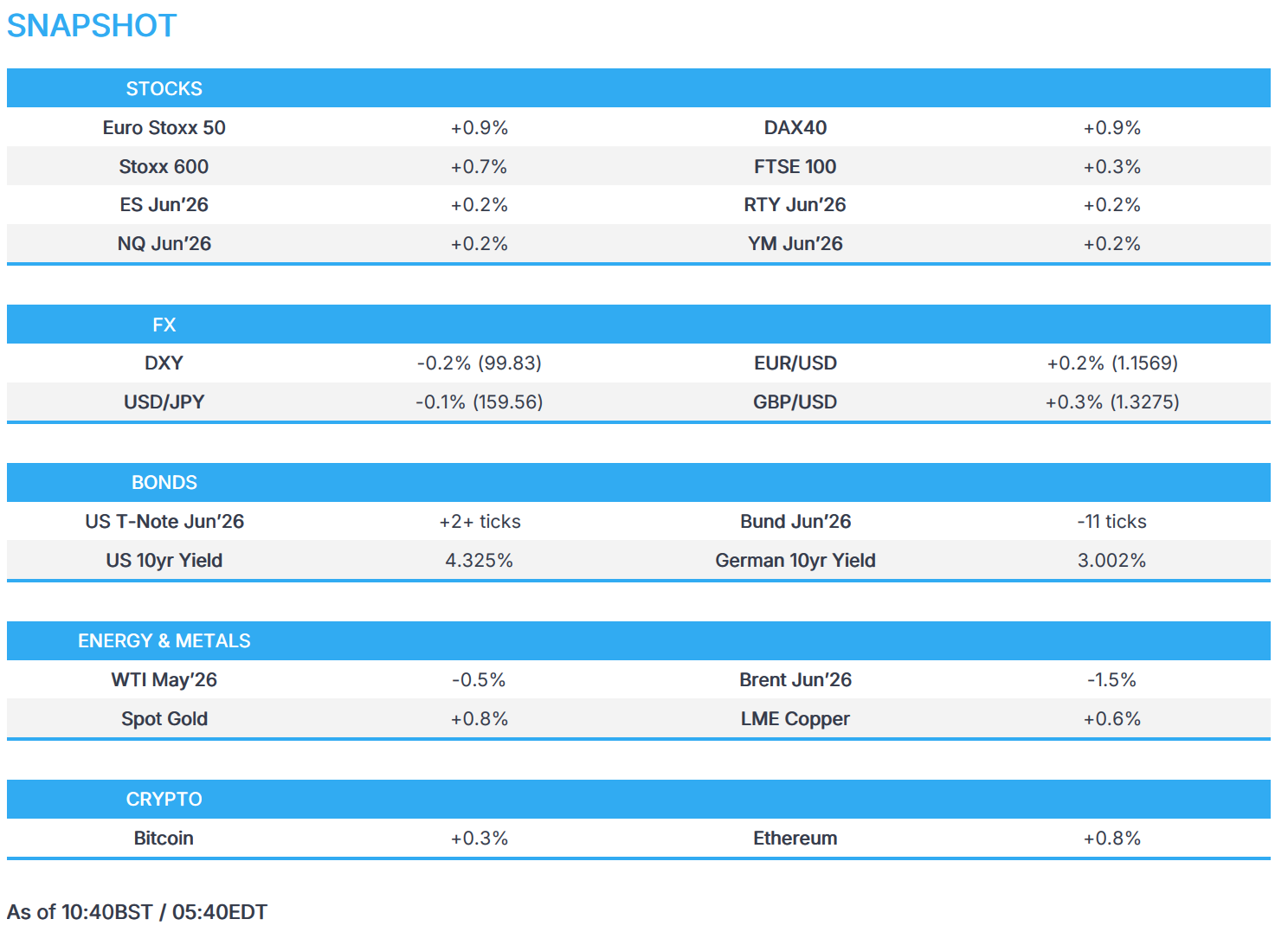
Newsquawk in 3 steps:
1. Subscribe to the free premarket movers reports
2. Listen to this report in the market open podcast (available on Apple and Spotify)
3. Trial Newsquawk’s premium real-time audio news squawk box for 7 days
EUROPEAN TRADE
EQUITIES
- European bourses (STOXX 600 +0.7%) re-open from the 4-day Easter closure with mild gains, as traders countdown to Trump’s Iran deadline at 20:00EDT/01:00BST. France’s CAC 40 outperforms its peers, while the FTSE 100 underperforms. Worth noting that European indices opened mixed, but then moved higher, without a clear driver. Some may point to reports via a Pakistani journalist which suggested that a “framework of understanding for ceasefire” between US and Iran is “closer than ever”.
- European sectors are broadly in the green. Media is the clear outperformer, driven by gains in UMG (+12.2%) after Pershing Square announced a EUR 9.4bln bid to take over the media company. Technology sits at the bottom of the pile. Despite the majority of the sector components in the green, ASML (-2.3%) is weighing on the sector. This comes following a group of US politicians proposing a law to impose further export restrictions on computer chipmaking equipment to China.
- US equity futures trades either side of the unchanged mark, ahead of the Iran deadline. ES futures closed Monday’s session beyond the downward trendline and has found support at the 20-SMA. Further upside could be supported if bond volatility continues to pullback and the VIX remains stable around the 25 mark. However, any significant upside will less likely be seen before the deadline passes.
- Samsung announced prelim. Q1 operating profit of KRW 57.2tln (exp. 40.6tln), and Q1 revenue of KRW 133tln (exp. 119.2tln). Prelim Q1 operating profit was up more than eightfold Y/Y, while revenue rose 68% Y/Y, driven by strong AI infrastructure demand, tight memory chip supply and higher chip prices.
- Click for the sessions European pre-market equity newsflow
- Click for the additional news
FX
- FX markets saw a sharp risk-on move in the European morning, with no specific headline, but several outlets reporting optimism in US/Iran negotiations ahead of Tuesday’s deadline. DXY fell as much as 0.2% from 100.04 to a trough of 99.77, and high-beta FX was helped against the weaker buck, with Aussie the outperformer and Sterling also performing notably well.
- Some participants flagged an Axios article six hours before the move, which quoted a US official, “If the president sees a deal is coming together, he’ll probably hold off…” it is unclear whether this led to the reaction, though other reports following this initial move have added to the constructive risk environment, “mediators are close to reaching an agreement” on a “framework of understanding for ceasefire”, according to Pakistani reporter Anas Mallick.
- Elsewhere, EUR and GBP were unreactive to mixed European Final PMIs. To recap, the EZ wide composite and services were revised a touch higher while the UK’s were revised lower.
- The session ahead sees US ADP Employment Change Weekly, US Durable Goods RCM/TIPP Economic Optimism Index (Apr), Atlanta Fed GDP and President Trump’s Iran deadline. Fed speak is expected from Fed’s Williams (13:30 BST), Goolsbee (17:35 BST) and Jefferson (22:50 BST). Full primer on the Newsquawk headline feed.
FIXED INCOME
- Initial bearish bias across the fixed income was facilitated by stronger energy prices, as the geopolitical environment remains exceptionally turbulent and as traders count down their clocks to President Trump’s 20:00EDT Iran deadline. However, in recent trade the crude complex took a tumble – but lacked a clear driver. Some market participants pointed towards an Axios piece from overnight, which reported that Trump may hold off from strikes on Iran if he sees a “deal coming together”. Markets also appear to be digesting some relatively positive mood from the Pakistani side, with a couple analysts suggesting a breakthrough could be close; whilst another suggested that a “framework of understanding” for a ceasefire is close. The pressure in energy prices therefore helped to boost fixed benchmarks to session highs.
- USTs were initially lower and were holding near troughs throughout the early portion of the morning, before then surging alongside the pressure in the crude complex. Currently holding at the upper end of a 110-21+ to 110-29+ range. On the data front, weekly ADP jobs figures, durable goods orders for February. On today’s speakers’ slate, Fed’s Williams (voter) will speak on Bloomberg TV; Fed’s Goolsbee (2027 voter, dovish) will speak on the outlook for policy and the economy; Fed’s Vice Chair Jefferson (voter, dovish) will speak on the economic outlook and the labour market.
- Bunds followed the above, and currently holding at the upper end of a 125.31-125.73 range – though still remains incrementally in the red. Geopols aside, German benchmarks have had a number of European PMI Final metrics to digest; Spain topped expectations, Italy missed whilst the EZ-wide figure was revised incrementally higher. Interesting commentary from within the German release suggested that, “the lack of pricing power in the service sector is important from a monetary policy perspective, as it limits the amount of upward pressure on core inflation, a measure that the ECB will be closely watching when considering interest rate increases.”
- Gilts are currently flat. As above, initially weighed by stronger energy prices, but UK paper then soared to highs as energy prices dipped. Currently towards the upper end of a 88.23-88.72 range. UK PMI Finals were revised lower, with analysts citing slower output growth as a result of the war in the Middle East. It also highlighted increasing risks to “stagflation”, and increasing costs pressures.
- Germany sells EUR 1.046bln vs exp. EUR 1.5bln 2.50% 2035 and 0.00% 2050 Green Bund.
- Japan sold JPY 450.4bln 30-yr JGBs; b/c 3.12x (prev. 3.66x), and average yield 3.697% (prev. 3.398%).
- Poland is to sell 5-, 10- and 30-year USD-denominated noted via syndicate.
- Brazil is to sell EUR-denominated bonds.
COMMODITIES
- Crude futures gained at the start of the APAC session and held onto gains as European traders stepped in as US President Trump’s 20:00EDT deadline approaches. If Iran does not agree to a ceasefire and reopen the Strait of Hormuz, he said the US will decimate Iran’s bridges and didn’t rule out striking power plants. However, Trump did also state that he thinks talks are going well and that Iran has “an active and willing participant on the other side.” Further reporting throughout the European morning indicates that an agreement could be near, with Pakistani reporter Mallick suggesting that the interlocutors are ‘closer than ever for an agreement’ to get a “framework of understanding for ceasefire” between the US and Iran.
- WTI and Brent topped at USD 116.56/bbl and USD 111.80/bbl, respectively, before sinking – a move which lacked a clear driver. However, the move appeared to follow the aforementioned reports from the Pakistani reporter. At the time of writing, WTI May’26 has returned below USD 113/bbl while Brent Jun’26 oscillates on either side of USD 110/bbl.
- Spot gold trades relatively contained within a USD 4617-4691/oz range. Upticks have picked up pace in recent trade as the USD softens amid downside in energy prices. However, the 20-SMA at USD 4,732/oz and last week’s high of USD 4,800/oz remain as near-term resistance levels. To add, China added gold to its reserves for a 17th consecutive month, highlighting that demand for the yellow metal is still high. However, UBS lowered its end-June forecast to USD 5,200/oz due to softer investor demand.
- 3M LME copper is rangebound, oscillating in a USD 12.37k-12.46k/t range. This comes as participants remain cautious as the Trump deadline looms.
- Hungary to agree to buy oil from US at Orban-Vance meeting, Bloomberg reported. Hungary’s Mol will agree to purchase 500,000 tons for approximately USD 500mln.
- Kazakhstan’s Energy Ministry said the oil shipments via CPC pipeline is stable, IFX reported.
- IRGC’s public relations channel reported of “explosion and extensive damage to the Al-Jubeil industrial area”.
- Attacks reportedly hit Saudi Aramco’s petrochemical plant in Saudi Arabia, AFP reported citing sources.
- China has provided Iran with a financial lifeline during the past half decade by purchasing most of its oil, according to WSJ.
- Tanker explosion near the Bridge of Americas in Panama City caused a massive fire.
- Japan’s Industry Minister Akazawa said crude oil procurement is progressing.
- China gold reserves at end-March (USD) 342.76bln (prev. 387.59bln).
- UBS lowers end-June gold forecast to USD 5,200/oz, amid softer investor demand amid elevated volatility.
- Goldman Sachs analyst raises 2026 copper price forecast to USD 12,650/ton from USD 11,400/ton and expects copper prices to remain volatile as the market continues to assess impacts of the events in the Middle East on economic growth.
NOTABLE EUROPEAN DATA RECAP
- UK S&P Global Services PMI Final (Mar) 50.5 vs. Exp. 51.2 (Prev. 53.9). “Stagflation risks appear to have increased, with the final Services PMI data signalling slower growth and higher cost pressures than the earlier ‘flash’ estimates based on data compiled up to 20th March.”
- UK S&P Global Composite PMI Final (Mar) 50.3 vs. Exp. 51 (Prev. 53.7).
- EU S&P Global Composite PMI Final (Mar) 50.7 vs. Exp. 50.5 (Prev. 51.9). “The near-stalling of growth in March drags the PMI’s signal for first quarter GDP growth down to 0.2%. More worrying is that there are clear risks of the economy contracting in the second quarter unless there is a swift resolution to the conflict.”
- EU S&P Global Services PMI Final (Mar) 50.2 vs. Exp. 50.1 (Prev. 51.9).
- German S&P Global Services PMI Final (Mar) 50.9 vs. Exp. 51.2 (Prev. 53.5).
- German S&P Global Composite PMI Final (Mar) 51.9 vs. Exp. 51.9 (Prev. 53.2).
- French S&P Global Services PMI Final (Mar) 48.8 vs. Exp. 48.3 (Prev. 49.6).
- French S&P Global Composite PMI Final (Mar) 48.8 vs. Exp. 48.3 (Prev. 49.9).
- Italian S&P Global Services PMI (Mar) 48.8 vs. Exp. 50.8 (Prev. 52.3).
- Italian S&P Global Composite PMI (Mar) 49.2 (Prev. 52.1).
- Spanish S&P Global Composite PMI (Mar) 52.4 (Prev. 51.5).
- Spanish S&P Global Services PMI (Mar) 53.3 vs. Exp. 50.5 (Prev. 51.9).
- Swedish CPIF MoM Prel (Mar) M/M -0.6% vs Exp. 0.0% (Prev. 0.6%).
- Swedish CPIF YoY Prel (Mar) Y/Y 1.6% (Prev. 1.7%).
- Swedish Inflation Rate MoM Prel (Mar) M/M -0.6% (Prev. 0.6%).
- Swedish Inflation Rate YoY Prel (Mar) Y/Y 0.6% (Prev. 0.5%).
CENTRAL BANKS
- ECB’s Wunsch said he is open to an interest rate rise at the April meeting; a lasting crisis would warrant a series of rate rises.
- ECB’s Radev said the ECB must be ready to act if inflation persists, sees a rising likelihood of adverse scenario but too early to say if April rate hike is needed. Inflation expectations at risk of rising too quickly.
NOTABLE US HEADLINES
- Republicans are reportedly weighing how broadly to structure a party-line bill to fund President Trump’s immigration enforcement, with some senators seeking multi-year DHS funding and others favouring a narrower ICE and CBP measure, Semafor reports.
GEOPOLITICS
MIDDLE EAST
- Pakistani reporter Anas Mallick suggests that, “to my understanding, the interlocutors (Pakistan, Turkiye and Egypt) are ‘closer than ever for an agreement’ to get a “framework of understanding for ceasefire” between US and Iran”.
- Some geopolitical analysts say signals from Pakistan suggest a possible breakthrough in the coming hours, with Egypt, Turkey, Saudi Arabia and reportedly Beijing involved. said that a ceasefire could be near, but the situation remains early and fragile, so caution is warranted.
- Pakistan in last-minute efforts, along with Turkey and Egypt, to convince Iran to agree to the outline proposed by Pakistan, according to I24’s Stein.
- Five friendly countries leaders’ and eight intelligence agencies have reached out to Iran seeking to open a path for a ceasefire, Fars News reported.
- Israeli Source tells N12 news “The next 24 hours are the most decisive in the war, if it were up to political leadership in Iran, there would have been a ceasefire long ago, there is doubt about their control”, N12’s Segal reported.
- Iran’s Spokesperson of the National Security Commission of the Parliament said “we are making special arrangements for the Strait of Hormuz”, via Tasnim.
- Spokesman of Iran’s National Security and Foreign Policy Committee of Parliament said oil exports are going on as usual, and with even more capacity than before, IRIB reported.
- Iran atomic agency said heavy bombs won’t halt nuclear tech progress.
- China has provided Iran with a financial lifeline during the past half decade by purchasing most of its oil, according to WSJ.
- Saudi Arabia, UAE and Israel report Iranian drone and missile attacks, according to CBS.
- Israel announces a new wave of strikes on Iran and issues incoming missile alert.
- Iran launches new batch of missiles towards southern Israel.
- Israeli military said it completed airstrike wave aiming to damage Iranian terror regime infrastructure in Tehran and additional areas across Iran.
- US House Democrat Ansari intends to introduce articles of impeachment against Secretary of War Hegseth, cites Iran war and war crimes as grounds for Hegseth impeachment, according to NBC.
- Japanese PM Takaichi said in parliament said in Parliament, want to take next step in talks with Iran and is strongly urging Iran to allow Hormuz safe passage, while she is seeking phone talks with the presidents of US and Iran.
- Iranian Parliament Speaker Ghalibaf’s adviser Mohammadi said it is Trump who has about 20 hours to either surrender to Iran or his allies will return to the Stone Age, while he added that they will not back down.
- Iran said non-hostile countries can coordinate access to the Strait of Hormuz, according to Press TV.
- US Vice President J.D. Vance is on standby for Iran negotiations, according to POLITICO. “The negotiations are led by Steve Witkoff and Jared Kushner but Vance could be tagged in if there is a direct meeting with Iranian officials.”.
- Iran’s top joint military command said Trump’s threats are ‘delusional’ and his threat have no effect on operations against US and Israel.
- US data centres of Amazon (AMZN), Microsoft (MSFT), Oracle (ORCL), and Equinix (EQIX) in the UAE are now identified as potential targets for Iran’s counter response in the region.
- Iranian securities exchange chief outlines conditions needed to reopen the Iranian capital markets: said outcomes could include a ceasefire with a formal agreement and full reopening, or a ceasefire without agreement and a gradual reopening.
- Explosions reported in eastern regions of Saudi Arabia and alarms sounding in Bahrain, Tasnim reported.
- Israeli reporter Stein said “Unexpectedly: the press conference planned for today with Defence Minister Hegseth and US Chief of Staff was cancelled”.
- Fars news citing an informed source said “Trump is clearly looking for a meeting and an agreement. The American proposal includes the removal of “Witkoff” due to his closeness to Netanyahu’s circle and negotiations with “Vance” to build a serious path. In the end, this source noted: Americans believe that fuel prices will increase explosively from next week and are not willing to accept this risk.
- The Iranian Ambassador to Pakistan said Pakistan’s positive and productive attempt to step the war is approaching a critical and sensitive stage.
- Iranian outlets report that Yazd and Shiraz were shaken by blasts.
- Large barrage of missiles were reportedly headed for Bahrain, with air raid sirens and alerts in multiple areas.
- Drone strike reportedly hit US Victoria base in Baghdad, according to Iraqi sources cited by Fars.
- Missiles hit Saudi Arabia’s Jubail which is largest industrial hub in the Middle East where large petrochemical and energy facilities are located.
- IRGC Aerospace Force Commander said they targeted the oil refinery, power plants, ports, and railway lines in Haifa Bay, and no interception of our missiles was recorded, Al Jazeera reported.
RUSSIA-UKRAINE
- Russia’s Yamal LNG ships first cargo to China since November, LSEG data shows.
- Russia’s Ministry of Defence reported that air defence forces have downed 45 Ukrainian drones over Russian regions overnight.
CRYPTO
- Bitcoin is slightly lower and trades just shy of the USD 69k mark.
APAC TRADE
- APAC stocks traded cautiously following the positive lead from the US and with all focus remaining on geopolitics heading into US President Trump’s Tuesday evening deadline for Iran to open up the Strait of Hormuz or face the US destroying its power plants and bridges, although President Trump had also previously stated that he thinks talks are going well with Iran and they would like to be able to make a deal.
- ASX 200 rallied with tech and miners leading the upside and with almost all sectors in the green aside from industrials and consumer staples.
- Nikkei 225 failed to sustain its initial advances with the index pressured amid headwinds from higher oil prices and following disappointing Household Spending data.
- KOSPI surged at the open with strong gains in Samsung Electronics after its preliminary results topped forecasts and showed around an eight-fold jump in Q1 operating profit, although most of the advances were then pared as shares in the index heavyweight also pulled back.
- Shanghai Comp lacked conviction on return from the long weekend, with upside limited after another meek PBoC liquidity operation and with the Stock Connect still closed as Hong Kong markets remained shut.
NOTABLE ASIA-PAC HEADLINES
- Japanese Finance Minister Katayama said won’t comment on JGB yield levels and will refrain from commenting on levels in the markets, adds impact of Middle East and oil prices on the market is high.
- Chinese President Xi called for new energy system as war on Iran rocks global economy and said China needs to accelerate planning and construction of a new energy system to ensure the country’s energy security.
- South Korean FX Chief said are to deploy bold measures in the FX market, if needed.
- South Korea policy chief Kim said the chip industry secures four month’s worth of helium and it is premature to discuss a second extra budget.
- Morgan Stanley cuts its China 2026 GDP growth forecast to 4.7% due to oil shock.
NOTABLE APAC DATA RECAP
- Australian S&P Global Services PMI Final (Mar) 46.3 vs. Exp. 46.6 (Prev. 52.8).
- Australian S&P Global Composite PMI Final (Mar) 46.60 vs. Exp. 47 (Prev. 52.4).
- Chinese Foreign Exchange Reserves (Mar) 3.342T vs. Exp. 3.40T (Prev. 3.428T).
- Japanese Coincident Index Prel (Feb) 116.3 (Prev. 117.9).
- Japanese Leading Economic Index Prel (Feb) 112.4 (Prev. 112.1).
- Japanese Foreign Exchange Reserves (Mar) 1374.7B (Prev. 1410.7B).
- Japanese Household Spending YoY (Feb) Y/Y -1.7% vs. Exp. -0.7% (Prev. -1%).
- Japanese Household Spending MoM (Feb) M/M 1.5% vs. Exp. 2.6% (Prev. -2.5%).
1 c) Asian opening report
Risk cautious, crude higher heading into Iran deadline – Newsquawk EU Market Open
Tuesday, Apr 07, 2026 – 01:35 AM
- US President Trump said he thinks talks are going well with Iran and reiterated the Tuesday, 7th April 20:00EDT deadline.
- Trump said the US has plans to decimate Iran’s bridges by Tuesday night, and he threatened that every power plant will be out of business at midnight, in which decimation would happen over a four-hour period.
- US President Trump said on the Iran deadline it will not be moved again, and they have not signed any ceasefire.
- Two Israeli sources and diplomats familiar with the details of the talks said there is a very low chance of an agreement between Iran and the US.
- APAC stocks traded cautiously following the positive lead from the US and with all focus remaining on geopolitics; European equity futures indicate a mildly higher open with Euro Stoxx 50 futures up 0.2%.
- Looking ahead, highlights include Global S&P Services/Composite PMIs Final (Mar), Swedish CPIF Prelim. (Mar), US ADP Employment Change Weekly, Durable Goods (Feb), RCM/TIPP Economic Optimism Index (Apr), Atlanta Fed GDP, President Trump’s Iran deadline, EIA STEO, Speakers including Fed’s Goolsbee & Jefferson, Supply from Germany & US.
SNAPSHOT
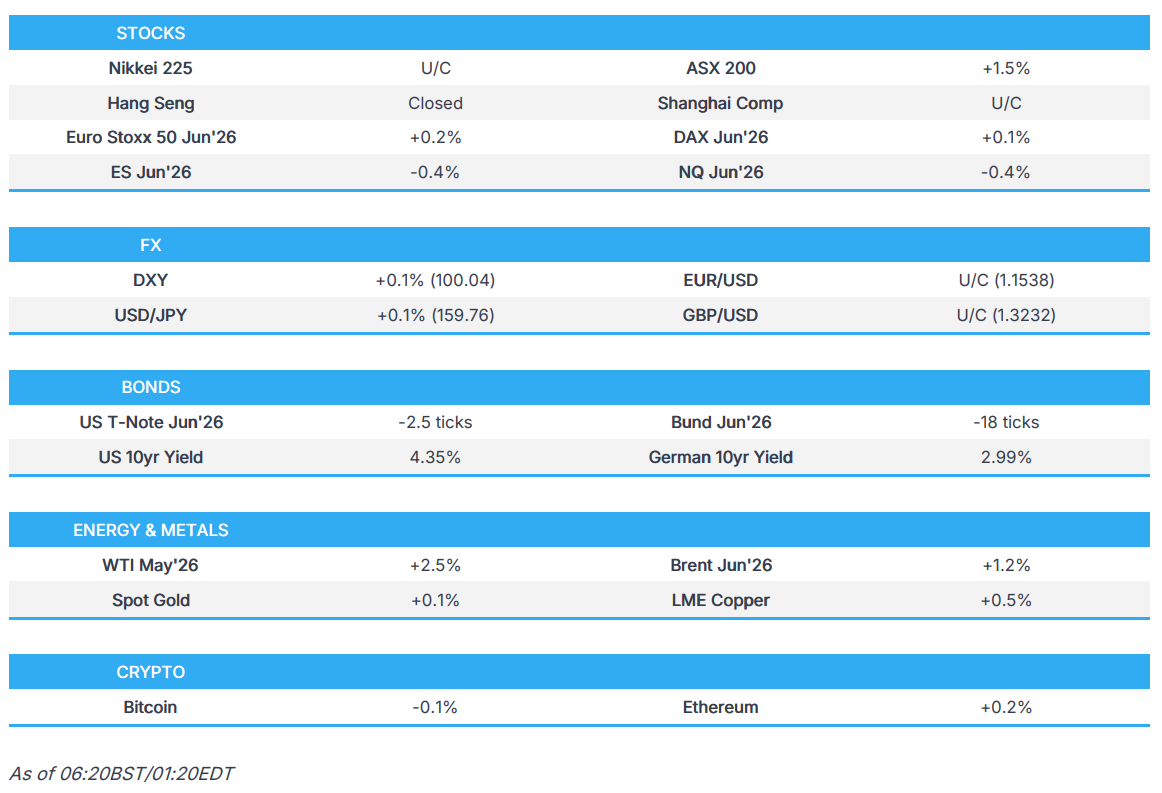
Newsquawk in 3 steps:
1. Subscribe to the free premarket movers reports
2. Listen to this report in the market open podcast (available on Apple and Spotify)
3. Trial Newsquawk’s premium real-time audio news squawk box for 7 days
IRAN CONFLICT
- US President Trump said he thinks talks are going well with Iran and reiterated the Tuesday, 7th April 20:00EDT deadline. Trump said regarding Iran talks that they have an active and willing participant on the other side, while they would like to be able to make a deal, but added that he can’t talk about a ceasefire and hopes he does not have to strike infrastructure. Trump said on taking Iran’s oil that “to the victor belongs the spoils”, and he would rather that they charge tolls than Iran in the Strait, and they have a concept where the US will charge Hormuz tolls. Furthermore, Trump said the US has plans to decimate Iran’s bridges by Tuesday night, and he threatened that every power plant will be out of business at midnight, in which decimation would happen over a four-hour period, but added they don’t want that to happen and it would take 100 years to rebuild.
- US President Trump said Iran can be taken out in one night, which could occur Tuesday night, and that the entire country could be taken out in one night. It was separately reported that Trump reiterated that Iran has until Tuesday night to reopen the Strait of Hormuz, otherwise he would destroy all of Iran’s bridges and power plants, according to The Wall Street Journal.
- US President Trump said on the Iran deadline it will not be moved again, and they have not signed any ceasefire. When asked about striking Iran’s infrastructure and whether it would be a war crime, he said no because “they are animals.” Trump added that Iran would like a ceasefire because they are getting obliterated, and said they have given Iran chances, but it has not taken them, and will see how they behave.
- US President Trump’s Board of Peace is demanding that Hamas finalise an agreement to demilitarise Gaza by the end of this week, according to NYT citing sources.
- US VP Vance is on standby for Iran negotiations, according to POLITICO, while negotiations are led by Witkoff and Kushner, but Vance could be tagged in if there is a direct meeting with Iran’s officials.”
- US War Secretary Hegseth said Monday would be the largest volume of strikes since day one of the Iran operation, and there will be even more on Tuesday.
- US military is making preparations for potential strikes on energy targets in Iran, according to WSJ citing multiple US officials, while an official said that there are many energy targets in Iran with a military nexus, and that an energy source could be considered a legitimate military target if it has been used for military purposes, for instance if it is being used to provide fuel for mobile rocket launchers.
- Israeli PM Netanyahu urged US President Trump in a call on Sunday not to go for a ceasefire at the moment and expressed concern about the risks of such a move, according to Axios citing an official, while Trump told Netanyahu that if Iran agrees to the US demands a ceasefire could happen, but stressed he will not give up on his demand that Iran hand over all of its enriched Uranium and agree not to resume enrichment, according to Axios.
- Two Israeli sources and diplomats familiar with the details of the talks said there is a very low chance of an agreement between Iran and the US, according to Amichai Stein.
- Israel approved an updated list of energy and infrastructure targets in Iran as a contingency if diplomacy fails.
- Iranian Parliament Speaker Ghalibaf’s adviser Mohammadi said it is Trump who has about 20 hours to either surrender to Iran or his allies will return to the Stone Age, while he added that they will not back down.
- Iran’s Foreign Minister, in a call with Qatari counterpart, said Iran is interested in developing ties and said current situation is strictly due to US-Israeli aggression, while it was reported that two Qatar LNG Tankers that headed toward the Strait of Hormuz on Monday morning were among those Iran allowed to transit under an Iran-US agreement reached last week via Pakistan, although the IRGC stopped Qatar tankers before transit and ordered them to hold position without an explanation.
- Iran’s top joint military command said US President Trump’s threats are ‘delusional’ and his threats have no effect on operations against the US and Israel.
- Iran’s atomic agency said heavy bombs won’t halt nuclear tech progress.
- Iran said non-hostile countries can coordinate access to the Strait of Hormuz.
- IRGC Aerospace Force Commander said they targeted the oil refinery, power plants, ports, and railway lines in Haifa Bay, and that no interception of missiles was recorded.
- Israeli military said it completed an airstrike wave aiming to damage Iranian terror regime infrastructure in Tehran and additional areas across Iran, while it later announced a new wave of strikes on Iran and issued incoming missile alerts as Iran launched a new batch of missiles towards southern Israel.
- Iranian official said there was a renewed attack on the airport in Iran’s Kashan city, while explosions were heard in Isfahan, and outlets reported that Yazd and Shiraz were shaken by blasts.
- Explosions were heard in Bahrain, while there were later reports of a large barrage of missiles headed for Bahrain, with air raid sirens and alerts in multiple areas.
- US interests and facilities were targeted by airstrikes in Kuwait, and a drone strike hit the US Victoria base in Baghdad, while a missile attack also targeted US interests in Saudi Arabia.
- Missiles hit Saudi Arabia’s Jubail, which is the largest industrial hub in the Middle East, where large petrochemical and energy facilities are located.
- Saudi Arabia’s Defence Ministry reported it intercepted several ballistic missiles targeting its eastern region, and debris from the missiles fell near energy facilities, while damage assessment was underway.
- US data centres of Amazon (AMZN), Microsoft (MSFT), Oracle (ORCL), and Equinix (EQIX) in the UAE are now identified as potential targets for Iran’s counter response in the region.
- Russia allegedly provided Iran with a key Israeli energy target list, aiding precise strike planning that could cause major blackouts, according to the Jerusalem Post.
US TRADE
EQUITIES
- US stocks returned from the Easter weekend in positive territory, despite higher yields and upside in oil. Markets had much to digest after Friday’s stronger-than-expected non-farm payrolls report, which helped ease recent labour market concerns. Nonetheless, focus remained on the Middle East with US President Trump giving Iran until Tuesday at 20:00 EDT to reopen the Strait of Hormuz and reach a deal or face US strikes on Iranian energy and power facilities, as well as bridges across the country, while he warned that if Iran did not meet the deadline, the US would take out Iran within four hours, and War Secretary Hegseth said Monday had seen the highest volume of strikes on Iran so far and that Tuesday would be even larger. Despite the threats, markets were more optimistic about the prospects for a deal after Trump said negotiators in Iran wanted to reach one, despite an earlier pushback from Iran’s Foreign Ministry, in which Iran rejected a 45-day ceasefire proposal from the US and responded with a 10-point plan, although Trump said that it was not good enough.
- SPX +0.43% at 6,611, NDX +0.61% at 24,192, DJI +0.35% at 46,669, RUT +0.44% at 2,541.
- Click here for a detailed summary.
NOTABLE HEADLINES
- Fed’s Hammack (2026 Voter) and Goolsbee (2027 Voter) both see inflation as a bigger problem than employment, according to Reuters citing a joint interview with Planet Money podcast. Hammack said “Inflation is bright orange” and said inflation been running above target for five years and has been “basically moving sideways” for the past two, while on the jobs market she said unemployment rate is the best indicator and is currently sat around where she estimates full employment should be but it is a fragile type of balance, while she added that the outlook is yellow to green.
- Fed’s Goolsbee (2027 voter) said inflation is at least orange and it has not been great, while he was optimistic inflation would get back on track to the target, but noted it is going from orange to red amid tariffs and energy price shocks. Goolsbee also stated that the labour market is “yellow” because of its low-hiring, low-firing state amid ongoing uncertainty. Furthermore, he said the financial system is yellow, and he is happy with the payment systems but “a little more anxious” about asset prices.
- US House Democrat Ansari intends to introduce articles of impeachment against Secretary of War Hegseth, citing the Iran war and war crimes as grounds for Hegseth’s impeachment, according to NBC.
APAC TRADE
EQUITIES
- APAC stocks traded cautiously following the positive lead from the US and with all focus remaining on geopolitics heading into US President Trump’s Tuesday evening deadline for Iran to open up the Strait of Hormuz or face the US destroying its power plants and bridges, although President Trump had also previously stated that he thinks talks are going well with Iran and they would like to be able to make a deal.
- ASX 200 rallied with tech and miners leading the upside and with almost all sectors in the green aside from industrials and consumer staples.
- Nikkei 225 failed to sustain its initial advances with the index pressured amid headwinds from higher oil prices and following disappointing Household Spending data.
- KOSPI surged at the open with strong gains in Samsung Electronics after its preliminary results topped forecasts and showed around an eight-fold jump in Q1 operating profit, although most of the advances were then pared as shares in the index heavyweight also pulled back.
- Shanghai Comp lacked conviction on return from the long weekend, with upside limited after another meek PBoC liquidity operation and with the Stock Connect still closed as Hong Kong markets remained shut.
- US equity futures mildly declined as oil prices edged higher in the countdown to the Tuesday evening deadline for Iran.
- European equity futures indicate a mildly higher open with Euro Stoxx 50 futures up 0.2% after the cash market closed with losses of 0.7% on Thursday.
FX
- DXY traded marginally higher as rising oil prices stoked some inflationary concerns, and with cautiousness heading into the Tuesday evening deadline for Iran to open up the Strait of Hormuz or face the risk of the US destroying all its power plants. Furthermore, President Trump said the deadline will not be moved again and that Iran can be taken out in one night, but also said that he thinks talks are going well with Iran and that they would like to be able to make a deal.
- EUR/USD took a breather and pared some of the prior day’s gains, with currency-specific newsflow light following the holiday closures across Europe, while there were prior comments from ECB’s Stournaras that the appropriate monetary policy response will depend on the size and nature of the energy shock.
- GBP/USD lacked direction and retained the 1.3200 handle amid very few catalysts for the UK.
- USD/JPY edged higher amid slight gains in the buck and with the yen pressured by higher oil prices, while Household Spending from Japan disappointed and showed a larger-than-expected Y/Y contraction.
- Antipodeans slightly pulled back after the prior day’s mild cyclical outperformance, and with markets cautious heading into Trump’s deadline on Tuesday evening.
- PBoC set USD/CNY mid-point at 6.8854 vs exp. 6.8773 (Prev. 6.8929).
FIXED INCOME
- 10yr UST futures were choppy amid the geopolitical uncertainty and following the recent mixed ISM Services report, while price action was also contained ahead of supply.
- Bund futures traded subdued following the four-day weekend and energy-related pressure, with demand not helped by upcoming Bund issuances totalling EUR 6.5bln scheduled for Tuesday-Wednesday.
- 10yr JGB futures traded on both sides of the 130.00 level amid higher oil prices and yields, while participants also digested weaker-than-expected Household Spending data and a 30yr JGB auction.
COMMODITIES
- Crude futures extended on their gains heading closer to the Tuesday evening deadline for Iran, with WTI crude futures climbing above USD 116/bbl, while strikes continued overnight across Iran and its neighbours, with an Iranian adviser threatening that US allies will return to the stone age if Trump does not surrender.
- ADNOC Gas said the affected area at the Habshan complex was isolated following an attack, and customer supply remains uninterrupted through other facilities.
- South Korea’s envoy is to visit Kazakhstan, Oman and Saudi Arabia as South Korea seeks to secure oil supplies amid the Hormuz disruptions.
- Brazilian Finance Minister Durigan said 25 states expressed an intention to join the programme about a subsidy on diesel imports, which will be BRL 0.80/ltr, while they will announce measures to ensure import and distribution of LPG for low-income households.
- Spot gold saw a bout of pressure amid headwinds from higher oil prices and a firmer dollar, but then gradually recovered and returned to flat territory amid a tentative mood.
- Copper futures were rangebound alongside the mixed risk appetite, with participants cautious as the Trump deadline looms.
CRYPTO
- Bitcoin was choppy and ultimately trickled lower after hitting resistance at the USD 69,000 level.
NOTABLE ASIA-PAC HEADLINES
- Chinese President Xi called for a new energy system as the war on Iran rocks the global economy and stated that China needs to accelerate planning and construction of a new energy system to ensure the country’s energy security.
DATA RECAP
- Japanese Household Spending MM (Feb) 1.5% vs. Exp. 2.6% (Prev. -2.5%)
- Japanese Household Spending YY (Feb) -1.7% vs. Exp. -0.7% (Prev. -1.0%)
GEOPOLITICS
RUSSIA-UKRAINE
- Russia’s Ministry of Defence said air defence forces downed 45 Ukrainian drones over Russian regions overnight.
EU/UK
NOTABLE HEADLINES
- New UK agency is to tackle abuse of labour market rules with the Fair Work Agency to focus on construction and social care that depend on migrants, in an effort to halt fraud and exploitation, according to FT.
2.a NORTH KOREA/SOUTH KOREA/JAPAN
/JAPAN
3. CHINA/
CHINA//
China Introduces Pistol-Like Coil-Gun Based On Electromagnetic-Launch Systems
Monday, Apr 06, 2026 – 10:35 PM
Authored by Bojan Stojovski via Interesting Engineering,
A new handheld coil gun developed in China is designed for discreet, non-lethal use, including law enforcement operations, state broadcaster CCTV reported. Capable of firing between 1,000 and 2,000 rounds per minute, the weapon can penetrate wooden boards from distances of several dozen yards. Its adjustable power settings allow it to incapacitate rather than kill when set lower.

The compact electromagnetic launcher features a 12-inch barrel and is light enough to be comfortably held and operated with one hand, allowing for greater mobility and ease of use in tight or urban environments where traditional firearms or larger coil guns would be cumbersome.
Equipped with a laser pointer for improved accuracy, the device – also called a Gauss gun – uses electromagnetic coils to accelerate metal projectiles at high speeds, miniaturizing technology previously limited to larger military systems.
Merging stealth and increased destructive power
The latest Chinese handheld coil gun offers a stealthy alternative to traditional firearms, producing no muzzle flash or smoke, minimal noise, and no ejected shell casings. These features make it particularly suited for covert operations, according to Chinese media.
The showcased model represents an upgrade from last year’s test version, featuring a slightly longer barrel and the ability to fire larger, heavier projectiles. While its rate of fire is somewhat slower, the weapon delivers significantly greater kinetic energy and destructive force, increasing its impact per shot, the South China Morning Post reported.
The weapon is equipped with an electronic display that provides real-time information on battery life, ammunition count, and firing modes. Operators can adjust the electric current to control output power, allowing them to vary projectile speed depending on the target’s distance and situational conditions.

This feature enables the coil gun to deliver precise, controlled force, allowing operators to tailor each shot to the situation. By adjusting power and projectile speed, the weapon can incapacitate or deter targets effectively while significantly reducing the risk of fatal injury, making it suitable for law enforcement, crowd control, or other scenarios where non-lethal force is preferred.
Portable coil gun could supplement traditional firearms
The coil gun’s design places a detachable magazine behind its centrally positioned grip, allowing the electromagnetic coils to run the full length of the chassis. This layout maximizes projectile acceleration while keeping the weapon compact and easy to handle.
Currently, the portable device is intended mainly for specialised non-lethal scenarios, limited by battery output. However, as battery technology advances, the weapon could see broader applications, potentially supplementing or even replacing traditional firearms in certain combat situations, offering a new form of precision, low-visibility firepower on the battlefield.
China has been advancing larger-scale electromagnetic weaponry as well. In 2023, the PLA Naval University of Engineering reportedly tested what is believed to be the world’s most powerful coil gun, capable of launching a 273-pound projectile at speeds reaching 435 miles per hour.
Beijing is also advancing railgun technology, a type of electromagnetic weapon that propels projectiles along a pair of parallel rails at extreme speeds, while promising higher velocity and longer range than conventional guns, potentially transforming naval and land-based combat.
4. EUROPEAN AND SCANDINAVIAN AFFAIRS PLUS NATO
FRANCE
KOLBE
looming crisis ahead!! they are in a mess: 115% debt to GDP and a huge 5% deficit in their budget this year
(Kolbe)
France’s Debt Spiral: Tax Hikes Mask A Looming Crisis
Tuesday, Apr 07, 2026 – 02:00 AM
Submitted by Thomas Kolbe
On both sides of the Franco-German border, the same problem persists: overburdened and reform-averse politicians struggle against a rapidly accelerating debt spiral. Their preferred tool: higher levies.
Last week, France’s Finance Minister Roland Lescure reported a revision of the projected budget deficit for the current year.
Initial estimates for 2026 had suggested a deficit well above five percent. Yet numerous fiscal measures brought last year’s deficit down to 5.1%. For 2026, the Finance Ministry expects it to stabilize at around five percent—provided the ongoing energy crisis and the war in Iran do not cast a lasting shadow over the year, and the economy does not abruptly collapse.
With total public debt at roughly 115% of GDP, France cannot possibly meet the Maastricht criteria under this level of new borrowing.
Do restrictive fiscal rules, such as the increasingly fading Maastricht criteria, even matter anymore in the Eurozone? It’s a rhetorical question: public spending dynamics are no longer controllable. One could also say: EU nations have entered a phase of fiscal fatalism.
After a 4% increase in government spending in 2024, outlays rose again last year, this time by 2.5%. The state apparatus continues to expand, regardless of the dramatic debt levels, pushing the public-sector share of GDP to 57%.
Similar to Germany, this figure does not account for the bureaucratic overhead borne by the private sector on behalf of the increasingly feudal state. Hundreds of thousands of private-sector jobs exist solely to fulfill government reporting and compliance obligations.
Massive Tax Hikes
Meanwhile, the French government remains stuck in its involuntary role as a reform-incapable instrument of the crumbling status quo. Parliament’s majority arithmetic leaves it paralyzed. A reform process to shrink the welfare state, reduce the massive bureaucracy, and achieve sustainable budget management is now completely out of reach for Prime Minister Sébastien Lecornu’s minority government.
Every administration supported by President Emmanuel Macron functions as a placeholder, interchangeable and powerless in a parliamentary arithmetic deadlock. Macron, facing dramatically poor approval ratings as a sort of “president without a people,” knows the fragility of France’s public finances and can at least rely on one thing: a broad political alliance capable of delivering temporary relief through tax hikes.
In Paris, as in much of the EU, policymakers are staunch etatists—staunchly loyal to the state and simultaneously hungry for power—making a large government apparatus serve their interests.
Over the past two years, France has cranked up the tax screws: a minimum rate for top incomes above €250,000, an increase in property wealth taxes, and a rise in corporate taxes for larger firms, yielding up to €6 billion in additional annual revenue.
New levies on higher dividend payouts and large corporate stock buybacks have been introduced. A Tobin-style financial transaction tax is planned to hit wealthy shareholders. Energy and environmental levies have also risen. As with tobacco and alcohol, the message is clear: “We tax luxury and the rich.”
This creates the impression of socially just taxation, while distracting from the fundamental problem: the expanding state, a European disease driving the continent into turbulence.
Where the Journey Leads
France illustrates both the mechanics and potential timeline of the emerging national debt crisis. Through intensive public-relations work and the backing of state-aligned media, politicians cultivate the impression of massive social imbalances. Punchline: societal decay and poverty, up to the misery of public finances, are the undeniable result of capitalist plunder.
The only functioning corrective to this systemic injustice comes from the benevolent, balancing state, stepping in to deliver fiscal transfers and enforce a form of justice.
In the sticky rhetoric of “justice,” the government conceals its complete failure—whether in border policy, over-bureaucratization, or the naive belief in a centrally planned economy. The result is a lifeless economy, which in France fares no better than in Germany. Only in energy has the importance of nuclear power been recognized—a wise choice, securing significant advantages for French industry.
Fiscal policy in Paris and Berlin now moves hand in hand toward the fiscal inferno. Berlin delayed necessary action by two years, but 2026 promises to be a year of major shocks. Chancellor Friedrich Merz’s government is expected to raise both inheritance tax and the top income tax rate.
Options on the tax roulette wheel include a two-percentage-point hike in VAT and the end of spousal income splitting—measures particularly cherished by the political left in its ongoing attack on the remnants of the bourgeois family sphere.
The CDU’s participation in this scheme, leveling itself with other socialist parties in the Bundestag, reveals the intellectual and ethical erosion of a party led to the threshold of socialism by Angela Merkel and now finally pushed over by Friedrich Merz.
From general political-ideological mismanagement emerges a crisis-management strategy. Germany and France offer clues about fiscal trajectories in the coming years.
In short: the state will feed off the shrinking economic substance, masking its failures with higher levies while postponing necessary reforms.
This has immediate consequences for capital markets. If the sell-off of European sovereign bonds continues, the European Central Bank will have to intervene to prevent the public debt Ponzi scheme from collapsing.
This trend is highly inflationary and accelerates the process of social and economic erosion. Those capable of cutting the Gordian knot of Europe’s complex fiscal entanglement remain, for now, on the sidelines.
END
GERMANY
KOLBE..
Germany’s deb to GDP rises about 63%. They were an ultra conservative country until they broke ranks with climate change
(Kolbe)
Germany’s Debt Spiral: Bundesbank Chief Breaks Silence
Tuesday, Apr 07, 2026 – 06:30 AM
Submitted by Thomas Kolbe
It’s not every day that top officials of the German Bundesbank take an explicit stance on daily politics.
Nagel’s stark warnings about Germany’s debt and the government’s creative accounting were surely met with grim recognition in Berlin’s corridors of power. Open criticism is rare there, and when it comes from credible insiders, it stings even more.

Chancellor Friedrich Merz and his Finance Minister Lars Klingbeil apparently still believe the fairy tale that debt-fueled demand policy can create economic miracles, generate growth, and deliver real prosperity. The result: a staggering debt binge that threatens to finish Germany economically.
Of course, this is a Keynesian nursery tale, endlessly repeated by politicians. With this simplified version of economics, political power is cemented – while the anonymous masses of taxpayers are left to clean up the debt disaster.
The government assumes the taxpayer backstop—and has surrounded itself with a state-friendly media sector, like a protective membrane. This behavior is conditioned.
The truth about mounting state debt, its destructive impact on private business, inflation, and the erosion of middle-class purchasing power is rarely discussed, and only in the media’s backrooms. When criticism reaches the public eye, its proponents are aggressively attacked and their valid arguments systematically sterilized.
Since January 2022, Joachim Nagel has led the Bundesbank. Recently, he warned for the first time about the unchecked growth of public debt—breaking Berlin’s long-standing elite vow of silence. Last year, he said, national debt rose by €144 billion to €2.84 trillion, pushing the debt-to-GDP ratio to 63.5 percent.
Some may recall the Maastricht limit, which capped debt at 60 percent. Those times are long gone, and the official debt numbers are, of course, grossly misleading.
For years—especially since the banking bailouts 15 years ago—the government has operated shadow budgets. Hoping the public won’t dig into fiscal details, these rarely illuminated debt channels are declared “special funds,” off the official books. Over 20 such hidden debt pots inflate actual state debt by at least €550 billion. Germany’s real debt likely sits near 80 percent of GDP and could exceed 85 percent by the end of this fiscal year.
The most infamous of these special funds originates from the debt crisis 15 years ago. The Financial Market Stabilization Fund (FMS) provided €400 billion in government guarantees and €80 billion in potential recapitalizations. Ultimately, €168 billion in guarantees and around €30 billion in direct transfers to financial institutions were used, while roughly €50 billion in debts from that era remain.
One of the largest black funds in federal history. Only Merz’s half-trillion-euro special fund will surpass this scale. Lesson learned: state financing has become an undeniable Ponzi scheme. Bond markets will ultimately dictate when the fiat money spree ends—they are the final arbiters of decades of political chaos.
Merz and his debt-hungry, insatiable finance minister are deliberately driving state spending to dizzying heights, yet must acknowledge that the heavily damaged German “economic tanker” can no longer move forward.
To buy time, the tragicomic duo plans to tighten middle-class taxes to the limit, holding taxpayers accountable for their fiscal free-for-all.
This is irresponsible, economically destructive policy unseen in Germany since WWII—the construction of a new socialism.
Against this backdrop, the Bundesbank president urged a return to sound budget planning. Deficits must be reduced mid-term without cutting essential infrastructure. Sadly, Nagel stopped short of endorsing free-market principles outright, missing the chance to clarify that the diversion of additional debt via special funds is systemic.
Policy cannot be fiscally restrained as long as bond markets are manipulated by monetary policy. According to the ifo Institute, 95 percent of this additional debt was added to the pre-existing debt binge and diverted. Social policy with a money printer—this is how far German fiscal policy has sunk.
Those seeking the real debt picture must dig deep—including pension obligations and current retirement promises. The scale of these liabilities defies imagination.
Germany—and nearly all of the EU—is trapped in a debt spiral. Turmoil in capital markets, broad restructuring, and massive wealth and debt redistribution loom. A standalone debt haircut would be systemic death: it would shrink circulating fiat credit and trigger a deflationary shock beyond the capacity of banks to absorb—a dead-end.
When will Germany begin monetizing its treasure, its massive gold reserves? Four years ago, the government under then-Chancellor Olaf Scholz pressured the Bundesbank to sell part of its gold to fund the defense special fund.
“Top” economists at Spiegel were reportedly inflamed by this idea—in these circles, the significance of collateralized, limited-quantity assets is poorly understood, even though they may one day underpin a new monetary regime.
It is fortunate that Nagel held the firewall against political adventurers and media amateurs. The Bundesbank may one day play a decisive role in a severe currency and debt crisis.
* * *
EUROPE
KOLBE
their climate policy is a killer
(Kolbe)
Europe’s Climate Policy Forces Industry Into Retreat; Even Its Critics Are Folding
Tuesday, Apr 07, 2026 – 03:30 AM
Submitted by Thomas Kolbe
In the media business, five months is an eternity. And it does indeed seem like an eternity has passed since Christian Kullmann, CEO of the German chemical giant Evonik, sharply criticized European climate policy at the end of October.
At the time, Kullmann gave an interview to Süddeutsche Zeitung, in which he called—if not for the outright abolition—then at least for a significant weakening of the EU-wide CO₂ emissions trading system, given the dramatic state of the economy.
Kullmann rightly pointed out that there is probably no stricter CO₂ regime anywhere in the world than in the EU. And since the climate, as we know, has no borders, he argued it makes little sense to disadvantage domestic cutting-edge technology in this way. He explicitly referred to the costly CO₂ trading system, which drained a staggering €21.4 billion from the German economy last year alone—under the banner of climate policy through this relatively new mechanism.
Five months after these remarkable statements—briefly breaking the long-standing silence of German industrial leaders—the question must be asked whether there is anywhere else in the world a comparable project to the EU’s CO₂ regime. With the United States abandoning its policy of artificial energy scarcity, its war on conventional energy production, and heavy-handed regulation of its own industrial base, the EU now stands alone in its ideological campaign against economic rationality. No one else seems willing to join the chorus of Europe’s climate apocalypticism.
This European isolationism may elsewhere be perceived as a form of late-stage counter-colonization—a return flow of capital from remorseful Europeans willing to accept self-imposed sacrifice to help other regions get back on their feet. Around the world, this selflessly naive “degrowth suicide” is welcomed, as it delivers not only so-called climate support from European funds but, more importantly, accelerated industrial investment from European companies—served on a silver platter by eco-socialist policymakers. A civilizational ingredient that, it seems, Europe itself now believes it can do without.
In China, one has learned to remain quiet when a geopolitical rival makes mistake after mistake—as is currently the case with European climate policy. Energy-intensive firms like Evonik are penalized by CO₂ pricing with an artificial competitive disadvantage. Once embedded in political and administrative structures, this amounts to a genuine stimulus program for foreign industrial locations.
At the same time, China—like the increasingly deregulated United States under President Donald Trump—is developing a powerful vacuum effect in global capital markets. The world is benefiting from German engineering and European capital.
This dynamic is particularly evident in the chemical industry. As a highly energy-intensive sector, it has suffered one of the hardest blows from European climate policy, alongside the automotive industry. Kullmann’s warning about the erosion of economic foundations was more than justified—but it came far too late and remained, for a time, a lone voice in the wilderness.
Since 2018, Germany’s chemical industry has lost roughly a quarter of its production capacity. The sector is operating at an average capacity utilization of just 70%, a level that reflects a sectoral depression not seen in Germany since the end of World War II.
Yet the worse the economic situation becomes, the more firmly German policymakers cling to their belief in the green transformation. Corporate silence is secured by a massive subsidy machine, just as the sympathetic media sector provides the shrill soundtrack to the broader economic decline.
Tactically astute from a media standpoint, Brussels—under pressure from European industry—has agreed to ease some pressure from the CO₂ cost burden. The European Commission is expected to temporarily freeze the volume of circulating certificates within the market stability reserve in order to stabilize prices.
For Evonik CEO Kullmann, the outcome presented by Brussels appears acceptable. His once sharp criticism of the CO₂ mechanism has mysteriously vanished into the media ether. The change of heart clearly follows the promise of further subsidies.
A destructive mechanism has emerged between large corporations and an eco-socialist political leadership. At the media level, corporate executives and political actors stage a kind of ping-pong game that simulates critical debate and conflicting interests at the highest levels of decision-making.
Evidently, there is no willingness to even slow down the ongoing transfer of wealth—from the productive sectors of society to politically favored extractive sectors such as the green economy—even amid prolonged economic stagnation. The economic and social consequences of this policy are, for now, being conveniently ignored in both Brussels and Berlin.
* * *
END
UK
British Official Admits UK Not Capable Of Rescuing Their Own Lost Airmen
Tuesday, Apr 07, 2026 – 02:45 AM
Europe has been dancing on the edge of a knife, flirting with notions of war with a battle hardened Russia over the conflict in Ukraine. As these tensions escalate, questions are being raised about the actual combat readiness and capabilities of countries that have relied on the US for their security for so long.
The primary division between the Trump Administration and NATO countries, the thing that started it all, was the initial refusal of so many of them to pay their fair share for defense. Currently, most NATO members budget around 2% of their GDP to defense under the NATO treaty. When asked to budget 5%, European governments became indignant, only agreeing to meet the target in a decade.
In an interesting recent admission from The Telegraph, Tom Tugendhat, a British MP and former security minister, argues that the UK simply lacks the independent military capabilities needed to pull off a rescue operation of one of their own airman similar to the recent US operation in Iran. He says that if one of their pilots needed to be saved, they would have to ask the US to do it.
“We do not have the platforms, the satellites, the reach or the mass. Our rescue plan, if the airman were British, would be to call the U.S.”

Tugendhat warned about the situation in Iran in March, saying he had questions as to why Prime Minister Keir Starmer failed to deploy appropriate air defense assets in the region to protect UK citizens and allies from missile and drone strikes. Starmer is facing mounting criticism for his delay in deploying the HMS Dragon to Cyprus, following an attack on UK base RAF Akrotiri.
Expressing his dismay at the lack of protection for British personnel, Tugendhat told GB News:
“My take is pretty simple – we may not have agreed with the initial decision to strike, that’s an American and Israeli decision…But I see absolutely no reason why we didn’t have assets in the region, why we didn’t have Type 45 destroyers in the region to protect our citizens and our allies. It’s baffling to me.”
Beyond their heavy reliance on the US and Europe’s lack of military spending, Europe is facing a crisis of public confidence. European military readiness has been exposed in the past few years as severely lacking, and a core problem these governments refuse to address is the fact that most young men simply don’t want to fight for them. In other words, in a voluntary system the governments and the countries in question need to hold similar values to the men they want to send into battle.
With far-left progressive elements holding power across Europe, this is simply not the case. So, their only option is to force a draft.
Several senior UK officials and MPs have publicly entertained or discussed the possibility of forced conscription (a military draft) as something that the government might implement in the event of a major war. UK military recruitment is far below requirements with the Army and Royal Navy consistently hitting only 60% of their personnel goals.
Dr. Mike Martin, a Liberal Democrat MP and former British Army officer, stated in March 2025 that if the UK became involved in a general war with Russia, “we’ll be conscripting the population – there’s no question about that.” He described it as something Britain “must be prepared” for, given the significant risk of wider conflict. Notions of an incoming draft have been a major topic in the British media for the past couple years.
The suspicion is that the establishment is acclimating the public to the idea over time, getting them ready to accept it as inevitable.
Germany is creating the framework for a draft right now. As of January 1, 2026, German men aged 17 to 45 must obtain “permission” from a Bundeswehr Career Center before traveling abroad for more than three months. They witnessed what happened in Ukraine at the start of the war with Russia; millions of young men fled the country to avoid conscription. Germany is establishing loss prevention, clearly planning for a near term clash with the Russians.
One strange narrative that has been circulating on social media is the argument among Europeans that the US “wasted” millions of dollars in military equipment in their successful mission to rescue “just one” wounded airman. The operation included special forces landing two MC-130s on a makeshift landing strip right under the nose of the IRGC and securing the area for the extraction of the stranded airman. The planes became stuck in the sand and had to be destroyed to prevent them falling into the hands of the Iranians.
It’s highly revealing that this sacrifice of equipment for the sake of saving a lost soldier is confusing to many Europeans. It shows that they can’t comprehend the idea of a government that would actually care enough to save them rather than throw them to the wolves. In other words, there is no loyalty on either side of the equation and Europe’s weaknesses go well beyond the political.
5. RUSSIAN AND MIDDLE EASTERN AFFAIRS
TSN ISRAEL
ISRAEL/USA VS IRAN
Trump Warns “A Whole Civilization Will Die Tonight” After Bombing Kharg Island Ahead Of Iran Deadline
Tuesday, Apr 07, 2026 – 08:10 AM
Summary:
- Kharg Island heavily bombed in preparation for potential US Marine/Special Forces ground siezure.
- Israel has begun attacking Iran’s railway infrastructure, telling civilians to not take trains, cancelations across country.
- IRGC still defiant – announces new retaliatory attacks on petrochemical plants in eastern Saudi Arabia.
- Iran’s 10-point counter to the US 15-point ceasefire shows signs of willingness to compromise (‘reparations’ from US dropped as a demand). Vance says war will end “very shortly”.
* * *
WH Trying to Manufacture ‘Mission Accomplished’? Vance Says Objectives Completed
Vice President JD Vance has said that “very shortly” this war will be “completed” in a Tuesday morning statement. He stated specifically that the military objectives have been accomplished, adding there are “two pathways” – and that optimistically this will involve “lots of negotiations” – but with a deadline of 8pm ET. The US is “confident it will get an Iran response.”
The below is from Hala Jaber, a longtime Sunday Times journalist and veteran Middle East war correspondent:
Trump is scrambling behind the scenes for a ceasefire with Iran, according to claims emerging via Fars News Agency. Allegations point to urgent outreach through multiple governments & intelligence channels. Citing what it describes as an “informed source,” the report claims the U.S. has been pushing for a ceasefire via backchannels, using countries it believes have credibility with Tehran.
According to the same account, Iran received calls from five heads of government & eight intelligence agencies, all seeking to open a path toward a ceasefire. It further claims Washington is considering reshaping its negotiation team, including removing Witkoff due to his ties to Netanyahu’s circle & replacing him with Vance to lead a more serious track. The urgency, the source says, is driven by mounting military & economic pressure, including fears of surging fuel prices. If true, it would mark a stark contrast to the public posture.
Trump: A Whole Civilization Will Die Tonight
Trump seems to be openly announcing plans for genocide – saying he’s going to annihilate an entire civilization. What else do you call this? “A whole civilization will die tonight, never to be brought back again. I don’t want that to happen, but it probably will,” he threatened in a Tuesday Truth Social Post. “However, now that we have Complete and Total Regime Change, where different, smarter, and less radicalized minds prevail, maybe something revolutionarily wonderful can happen, WHO KNOWS?” – he continued.
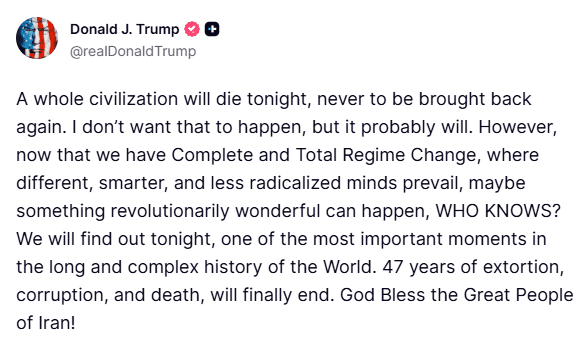
Meanwhile, according to The Associated Press:
Airstrikes pounded Tehran on Tuesday, and Iranian officials urged young people to form human chains to protect power plants, hours before the expiration of U.S. President Donald Trump’s latest deadline for the Islamic Republic to reopen the crucial Strait of Hormuz or face punishing strikes on its infrastructure.
Kharg Island Bombed (Again)
Kharg Island is being bombed again on Tuesday, with a senior US officials telling Fox’s Jennifer Griffin that the “U.S. hit dozens of military targets on Kharg Island overnight.” Per the fresh reporting the targets included bunkers, a radar station, and ammunition storage.
However, the same officials described that landing docks were not intentionally targeted – that they only would have been struck if Iranians fired something from next to them. This development has led to speculation that this could be another round of softening operations to prepare for some kind of US Marine or special forces seizure.
This send oil back to the highs…
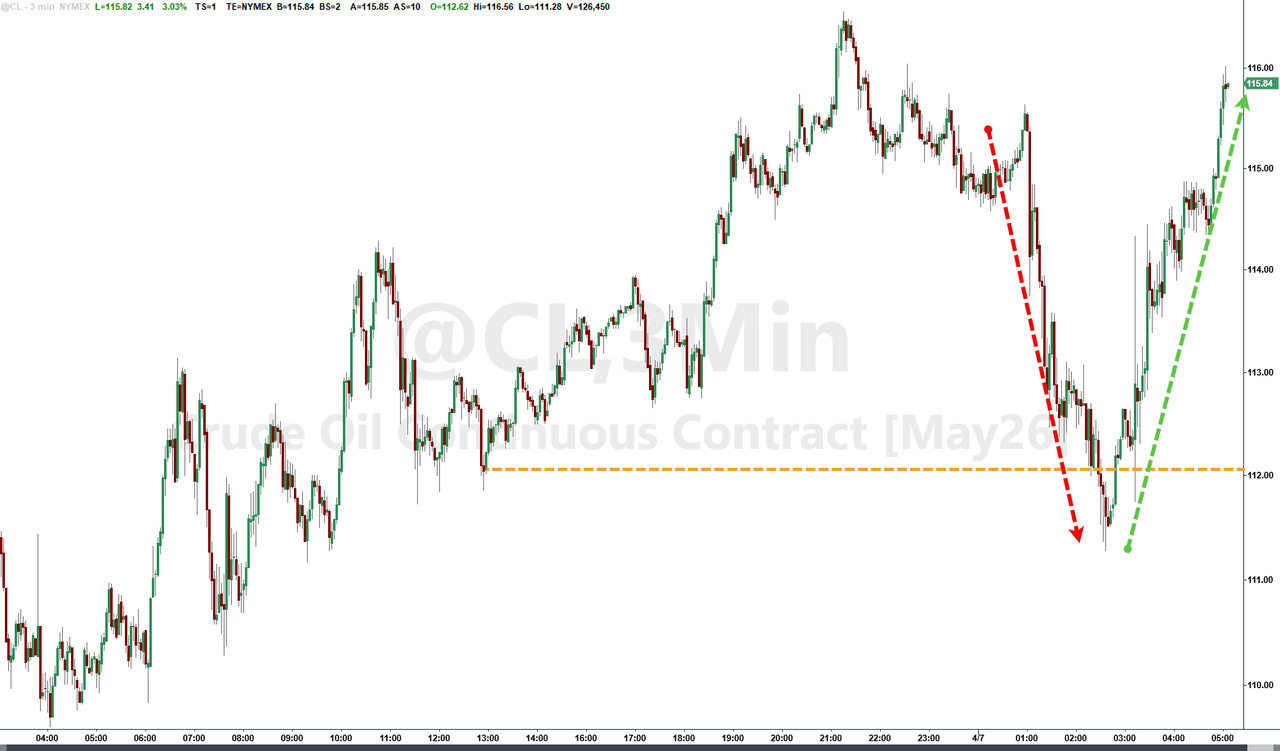
This would without doubt be very high risk, with the potential for significant US casualties. More from Griffin:
The strikes on Kharg Island were carried out solely by the US, not Israel, I am told. “This is a message to the Iranians,” a senior US official told me.
Axios cites a US official to say the strikes on Kharg island were not directed at oil infrastructure, but were “re-strikes” on military targets that were hit previously.
Bridges, Power Plants, Tit-For-Tat Warning
President Trump has been warning of the “complete demolition” of Iran’s power plants and bridges in a matter of hours – so by Tuesday’s end – if the Strait of Hormuz is not fully reopened by his deadline. Qatar’s Foreign Ministry spokesperson, Majed al-Ansari, is urging some last minute diplomatic action, warning, “We are close to the point where the situation in the region could spiral out of control.” There have meanwhile been reports of more Iranian attacks on Qatar. “There are no winners if this war continues,” he said.
But Iran’s Islamic Revolutionary Guard Corps (IRGC) is not backing down, having on Tuesday claimed responsibility for attacks on petrochemical facilities in Saudi Arabia’s Jubail region, stating the strikes were retaliation for earlier Israeli attacks on its Shiraz petrochemical facility.
Iranian officials have repeatedly warned that any strikes on Iranian power plants and bridges would trigger reciprocal attacks on regional infrastructure. The IRGC stated it targeted American companies in Jubail with missiles and drones, including Sadra, ExxonMobil, and Dark Chemical.
Images posted online show damage to a highway bridge between the northwestern Iranian cities of Hashtroud and Tabriz, following apparent Israeli strikes.
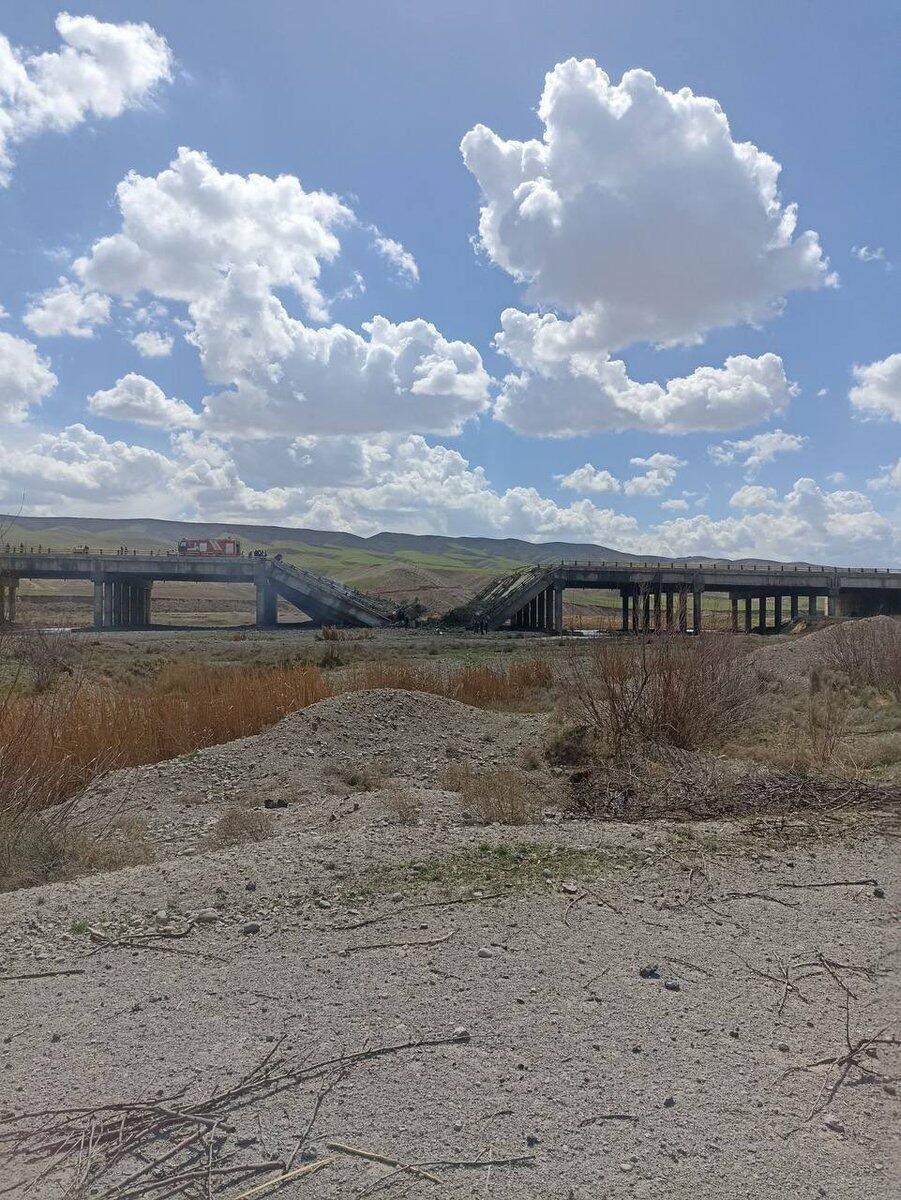
It also stated that a petrochemical complex in Juaymah belonging to the US company Shourdan Phillips was struck with medium-range missiles and drones.
Israeli Attacks on Iran Rail, Infrastructure Have Already Begun
Iran’s Mehr News Agency is reporting attacks on Iran’s rail system, including an Israeli strike hit the Yahya Abad railway bridge in the city of Kashan, in central Iran. The Deputy Governor of Isfahan has said that the strike killed two people.
The attack came after the IDF issued a warning telling Iranians against using trains for their “safety” until 9pm local time (17:30 GMT).
The governor of Mashhad has already announced the immediate suspension of all rail services departing the city amid the Israeli threat. It’s being reported as a precautionary measure that will remain in effect “until further notice”. Apparently this rail operation is being done only by the Israeli side of the bombing campaign.
More on Iran’s 10-Point Response to US Ceasefire Plan
Iran has delivered its highly anticipated “10-point” response to the US’ “15-point peace plan.” Iran’s 10-point plan includes, according to a paraphrase:
1. Guarantee that Iran will not be attacked again
2. Permanent end to the war, not just a ceasefire
3. End to Israeli strikes in Lebanon
4. Lifting of all US sanctions on Iran
5. End to all regional fighting against Iranian allies
6. In return, Iran would open the Strait of Hormuz
7. Iran would impose a Hormuz fee of $2 million per ship
8. Iran would split these fees with Oman
9. Iran to provide rules for safe passage through Hormuz
10. Iran to use Hormuz fees for reconstruction instead of reparations
Importantly, Tehran has dropped its demand for full war reconstruction reparations to be paid directly by the United States, providing a potential window to reach actual compromise with Washington.
75 Gulf Energy Assets Damaged In U.S.-Iran War As Supply Shock Intensifies
International Energy Agency (IEA) Executive Director Fatih Birol was interviewed by the French newspaper Le Figaro earlier on Tuesday and warned that the Gulf energy shock “is more severe than those of 1973, 1979, and 2022 combined” because it is affecting oil, gas, food, fertilizers, petrochemicals, helium, and global trade all at once.
Birol said in the interview that more than 75 energy sites across the Gulf region have been attacked, with about a third severely damaged, suggesting tens of billions of dollars in repairs and a prolonged disruption of some energy flows, further tightening global supplies and compounding the disruption at the Strait of Hormuz chokepoint.
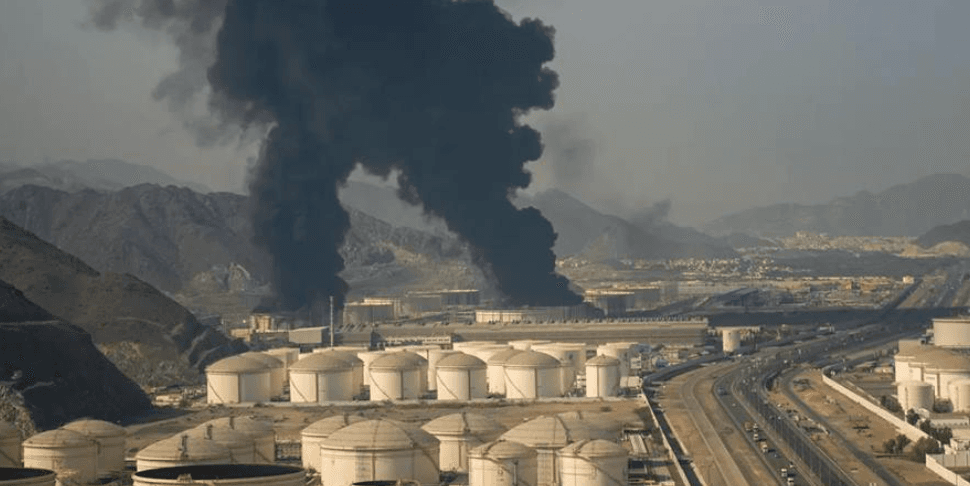
The newspaper asked Birol, “How quickly can Gulf production recover?”
He responded:
“We are monitoring energy infrastructure in real time—fields, refineries, terminals. Seventy-five facilities have been attacked and damaged, more than a third severely. Repairs will take a long time. Countries like Saudi Arabia may recover faster due to strong engineering capabilities and financial resources, but elsewhere, such as Iraq, the situation is far worse. About 15 million people depend on oil and gas revenues there, and the country has lost two-thirds of its oil income, approaching economic paralysis. It will take a long time for the Middle East—previously a reliable energy hub—to recover.”
Cherry-picking the most important parts of the interview:
Le Figaro asked: Who will suffer the most?
Birol responded: The global economy will suffer. Of course, European countries will struggle, as will Japan, Australia, and others. But developing countries will be the most affected due to high oil, gas, and food prices, and accelerating inflation. Their economic growth will be heavily impacted. I fear many developing countries will see their external debt rise significantly. That is why I am pessimistic—this crisis stems not from energy itself, but from geopolitics.
Le Figaro asked: Which countries are most exposed to shortages?
Birol responded: Import-dependent countries are most exposed: in Asia—South Korea, Japan, but especially Indonesia, the Philippines, Vietnam, Pakistan, and Bangladesh. African countries will also be heavily affected, as developing nations have limited financial flexibility.
Le Figaro asked: How quickly can Gulf production recover?
Birol responded: We are monitoring energy infrastructure in real time—fields, refineries, terminals. Seventy-five facilities have been attacked and damaged, more than a third severely. Repairs will take a long time. Countries like Saudi Arabia may recover faster due to strong engineering capabilities and financial resources, but elsewhere, such as Iraq, the situation is far worse. About 15 million people depend on oil and gas revenues there, and the country has lost two-thirds of its oil income, approaching economic paralysis. It will take a long time for the Middle East—previously a reliable energy hub—to recover.
Le Figaro asked: How significant is the drop in Gulf oil production?
Birol responded: Enormous. These countries are producing just over half of pre-war levels. As for natural gas, exports have stopped entirely. March was already difficult, but April will be worse. If the Strait remains closed throughout April, we will lose twice as much crude and refined products as in March. We are entering a “black April.” In the Northern Hemisphere, April usually marks spring—but now it may feel like the beginning of winter.
Birol has painted a bleak outlook for energy markets and the global economy for weeks in various interviews.
However, emerging through the fog of war, the U.S. appears poised to be a net beneficiary of the chaos across the Gulf, with energy flows expected to remain disrupted for some time.
- Qatar Dethroned As ‘LNG King’ As U.S. Seizes Throne, Reshaping Future Of Gas
- Wyoming’s Helium Empire Ascends As Qatar Gas Goes Flat
A reminder to readers of JPMorgan’s note last week, mapping how the energy shock dominoes begin to fall. Read it here
end
UPDATE ZEROHEDGE
Iran Says ‘All Diplomatic Comms With US Suspended’ After Trump Warns ‘A Whole Civilization Will Die Tonight’
Tuesday, Apr 07, 2026 – 11:20 AM
Summary:
- Tehran Times: All communications with US side suspended – after which NY Times confirms. This after Trump’s Tues. morning threat: “A whole civilization will die tonight, never to be brought back again. I don’t want that to happen, but it probably will.”
- Kharg Island heavily bombed in preparation for potential US Marine/Special Forces ground seizure. Reports of ‘human chains’ at bridges, power plants, in Iran forming.
- Israel has begun attacking Iran’s railway infrastructure, telling civilians to not take trains, cancelations across country.
- IRGC still defiant – announces new retaliatory attacks on petrochemical plants in eastern Saudi Arabia.
- Iran’s 10-point counter to the US 15-point ceasefire shows signs of willingness to compromise (‘reparations’ from US dropped as a demand). Vance says war will end “very shortly”.
* * *
Iran: All Diplomatic Channels With US Have Ceased
“Iran has closed all diplomatic and indirect channels of communication with the US,” Tehran Times has reported. The publication says that “Any and all message exchanges have also been suspended.”
The Tehran Times is seen as tied to the hardline factions of the government, and calls itself the “voice of the Islamic Revolution” – but is not directly state-owned per se.
The NY Times also confirms “Iran has stopped negotiating with the US and it told Pakistan that it will not continue ceasefire talks.”
Meanwhile President Masoud Pezeshkian has praised the willingness of “14 million” Iranian citizens to “sacrifice” by taking to the streets, seeking to protect power plants and other sensitive vital infrastructure, as the US-Israeli bombs rain down. US conservative MSM publications have decried this as a form of “human shields”.
‘Human chains’ seen on some bridges…
And apparently at nuclear sites…
WH Trying to Manufacture ‘Mission Accomplished’? Vance Says Objectives Completed
Vice President JD Vance has said that “very shortly” this war will be “completed” in a Tuesday morning statement. He stated specifically that the military objectives have been accomplished, adding there are “two pathways” – and that optimistically this will involve “lots of negotiations” – but with a deadline of 8pm ET. The US is “confident it will get an Iran response.”
The below is from Hala Jaber, a longtime Sunday Times journalist and veteran Middle East war correspondent:
Trump is scrambling behind the scenes for a ceasefire with Iran, according to claims emerging via Fars News Agency. Allegations point to urgent outreach through multiple governments & intelligence channels. Citing what it describes as an “informed source,” the report claims the U.S. has been pushing for a ceasefire via backchannels, using countries it believes have credibility with Tehran.
According to the same account, Iran received calls from five heads of government & eight intelligence agencies, all seeking to open a path toward a ceasefire. It further claims Washington is considering reshaping its negotiation team, including removing Witkoff due to his ties to Netanyahu’s circle & replacing him with Vance to lead a more serious track. The urgency, the source says, is driven by mounting military & economic pressure, including fears of surging fuel prices. If true, it would mark a stark contrast to the public posture.
Trump: A Whole Civilization Will Die Tonight
Trump seems to be openly announcing plans for genocide – saying he’s going to annihilate an entire civilization. What else do you call this? “A whole civilization will die tonight, never to be brought back again. I don’t want that to happen, but it probably will,” he threatened in a Tuesday Truth Social Post. “However, now that we have Complete and Total Regime Change, where different, smarter, and less radicalized minds prevail, maybe something revolutionarily wonderful can happen, WHO KNOWS?” – he continued.
Meanwhile, according to The Associated Press:
Airstrikes pounded Tehran on Tuesday, and Iranian officials urged young people to form human chains to protect power plants, hours before the expiration of U.S. President Donald Trump’s latest deadline for the Islamic Republic to reopen the crucial Strait of Hormuz or face punishing strikes on its infrastructure.
Kharg Island Bombed (Again)
Kharg Island is being bombed again on Tuesday, with a senior US officials telling Fox’s Jennifer Griffin that the “U.S. hit dozens of military targets on Kharg Island overnight.” Per the fresh reporting the targets included bunkers, a radar station, and ammunition storage.
However, the same officials described that landing docks were not intentionally targeted – that they only would have been struck if Iranians fired something from next to them. This development has led to speculation that this could be another round of softening operations to prepare for some kind of US Marine or special forces seizure.
This send oil back to the highs…
This would without doubt be very high risk, with the potential for significant US casualties. More from Griffin:
The strikes on Kharg Island were carried out solely by the US, not Israel, I am told. “This is a message to the Iranians,” a senior US official told me.
Axios cites a US official to say the strikes on Kharg island were not directed at oil infrastructure, but were “re-strikes” on military targets that were hit previously.
Bridges, Power Plants, Tit-For-Tat Warning
President Trump has been warning of the “complete demolition” of Iran’s power plants and bridges in a matter of hours – so by Tuesday’s end – if the Strait of Hormuz is not fully reopened by his deadline. Qatar’s Foreign Ministry spokesperson, Majed al-Ansari, is urging some last minute diplomatic action, warning, “We are close to the point where the situation in the region could spiral out of control.” There have meanwhile been reports of more Iranian attacks on Qatar. “There are no winners if this war continues,” he said.
But Iran’s Islamic Revolutionary Guard Corps (IRGC) is not backing down, having on Tuesday claimed responsibility for attacks on petrochemical facilities in Saudi Arabia’s Jubail region, stating the strikes were retaliation for earlier Israeli attacks on its Shiraz petrochemical facility.
Iranian officials have repeatedly warned that any strikes on Iranian power plants and bridges would trigger reciprocal attacks on regional infrastructure. The IRGC stated it targeted American companies in Jubail with missiles and drones, including Sadra, ExxonMobil, and Dark Chemical.
Images posted online show damage to a highway bridge between the northwestern Iranian cities of Hashtroud and Tabriz, following apparent Israeli strikes.
It also stated that a petrochemical complex in Juaymah belonging to the US company Shourdan Phillips was struck with medium-range missiles and drones.
Israeli Attacks on Iran Rail, Infrastructure Have Already Begun
Iran’s Mehr News Agency is reporting attacks on Iran’s rail system, including an Israeli strike hit the Yahya Abad railway bridge in the city of Kashan, in central Iran. The Deputy Governor of Isfahan has said that the strike killed two people.
The attack came after the IDF issued a warning telling Iranians against using trains for their “safety” until 9pm local time (17:30 GMT).
The governor of Mashhad has already announced the immediate suspension of all rail services departing the city amid the Israeli threat. It’s being reported as a precautionary measure that will remain in effect “until further notice”. Apparently this rail operation is being done only by the Israeli side of the bombing campaign.
More on Iran’s 10-Point Response to US Ceasefire Plan
Iran has delivered its highly anticipated “10-point” response to the US’ “15-point peace plan.” Iran’s 10-point plan includes, according to a paraphrase:
1. Guarantee that Iran will not be attacked again
2. Permanent end to the war, not just a ceasefire
3. End to Israeli strikes in Lebanon
4. Lifting of all US sanctions on Iran
5. End to all regional fighting against Iranian allies
6. In return, Iran would open the Strait of Hormuz
7. Iran would impose a Hormuz fee of $2 million per ship
8. Iran would split these fees with Oman
9. Iran to provide rules for safe passage through Hormuz
10. Iran to use Hormuz fees for reconstruction instead of reparations
Importantly, Tehran has dropped its demand for full war reconstruction reparations to be paid directly by the United States, providing a potential window to reach actual compromise with Washington.
75 Gulf Energy Assets Damaged In U.S.-Iran War As Supply Shock Intensifies
International Energy Agency (IEA) Executive Director Fatih Birol was interviewed by the French newspaper Le Figaro earlier on Tuesday and warned that the Gulf energy shock “is more severe than those of 1973, 1979, and 2022 combined” because it is affecting oil, gas, food, fertilizers, petrochemicals, helium, and global trade all at once.
Birol said in the interview that more than 75 energy sites across the Gulf region have been attacked, with about a third severely damaged, suggesting tens of billions of dollars in repairs and a prolonged disruption of some energy flows, further tightening global supplies and compounding the disruption at the Strait of Hormuz chokepoint.
The newspaper asked Birol, “How quickly can Gulf production recover?”
He responded:
“We are monitoring energy infrastructure in real time—fields, refineries, terminals. Seventy-five facilities have been attacked and damaged, more than a third severely. Repairs will take a long time. Countries like Saudi Arabia may recover faster due to strong engineering capabilities and financial resources, but elsewhere, such as Iraq, the situation is far worse. About 15 million people depend on oil and gas revenues there, and the country has lost two-thirds of its oil income, approaching economic paralysis. It will take a long time for the Middle East—previously a reliable energy hub—to recover.”
Cherry-picking the most important parts of the interview:
Le Figaro asked: Who will suffer the most?
Birol responded: The global economy will suffer. Of course, European countries will struggle, as will Japan, Australia, and others. But developing countries will be the most affected due to high oil, gas, and food prices, and accelerating inflation. Their economic growth will be heavily impacted. I fear many developing countries will see their external debt rise significantly. That is why I am pessimistic—this crisis stems not from energy itself, but from geopolitics.
Le Figaro asked: Which countries are most exposed to shortages?
Birol responded: Import-dependent countries are most exposed: in Asia—South Korea, Japan, but especially Indonesia, the Philippines, Vietnam, Pakistan, and Bangladesh. African countries will also be heavily affected, as developing nations have limited financial flexibility.
Le Figaro asked: How quickly can Gulf production recover?
Birol responded: We are monitoring energy infrastructure in real time—fields, refineries, terminals. Seventy-five facilities have been attacked and damaged, more than a third severely. Repairs will take a long time. Countries like Saudi Arabia may recover faster due to strong engineering capabilities and financial resources, but elsewhere, such as Iraq, the situation is far worse. About 15 million people depend on oil and gas revenues there, and the country has lost two-thirds of its oil income, approaching economic paralysis. It will take a long time for the Middle East—previously a reliable energy hub—to recover.
Le Figaro asked: How significant is the drop in Gulf oil production?
Birol responded: Enormous. These countries are producing just over half of pre-war levels. As for natural gas, exports have stopped entirely. March was already difficult, but April will be worse. If the Strait remains closed throughout April, we will lose twice as much crude and refined products as in March. We are entering a “black April.” In the Northern Hemisphere, April usually marks spring—but now it may feel like the beginning of winter.
Birol has painted a bleak outlook for energy markets and the global economy for weeks in various interviews.
However, emerging through the fog of war, the U.S. appears poised to be a net beneficiary of the chaos across the Gulf, with energy flows expected to remain disrupted for some time.
- Qatar Dethroned As ‘LNG King’ As U.S. Seizes Throne, Reshaping Future Of Gas
- Wyoming’s Helium Empire Ascends As Qatar Gas Goes Flat
A reminder to readers of JPMorgan’s note last week, mapping how the energy shock dominoes begin to fall. Read it here.
end
then
US Official Cites ‘Glimmer Of Progress’ On Ceasefire After Trump Warns ‘A Whole Civilization Will Die Tonight’
Tuesday, Apr 07, 2026 – 12:35 PM
Summary:
- Tehran Times: All communications with US side suspended – THEN ISSUES CORRECTION, REVERSES. This after Trump’s Tues. morning threat: “A whole civilization will die tonight, never to be brought back again.” Axios cites “glimmer” of progress on negotiations.
- In a call with FOX’s Bret Baier, Trump says 8 PM deadline today “could change if negotiations move forward, but sticking to deadline for now.”
- Kharg Island heavily bombed in preparation for potential US Marine/Special Forces ground seizure. Reports of ‘human chains’ at bridges, power plants, in Iran forming.
- Israel has begun attacking Iran’s railway infrastructure, telling civilians to not take trains, cancelations across country. IRGC still defiant – announces new retaliatory attacks on petrochemical plants in eastern Saudi Arabia.
- Iran’s 10-point counter to the US 15-point ceasefire shows signs of willingness to compromise (‘reparations’ from US dropped as a demand). Vance says war will end “very shortly”. Russia, China veto UNSC Hormuz resolution.
end
LAST MINUTE:
* * *
Last Ditch Peace Effort by Pakistan Prime Minister
With just hours until Trump’s self declared deadline wherein he said a “whole civilization will die tonight” – Pakistan’s leader and host of mediation efforts, Prime Minister Shehbaz Sharif, has tried to introduce a last minute olive branch, hoping that the US will avoid its decimation campaign:
I earnestly request President Trump to extend the deadline for two weeks. Pakistan, in all sincerity, requests the Iranian brothers to open Strait of Hormuz for a corresponding period of two weeks as a goodwill gesture. We also urge all warring parties to observe a ceasefire everywhere for two weeks to allow diplomacy to achieve conclusive termination of war, in the interest of long-term peace and stability in the region.
Will Trump latch on to this plea and last minute effort of good will? The sides are aware of the proposal:
TEHRAN IS POSITIVELY REVIEWING PAKISTAN’S REQUEST FOR A TWO-WEEK CEASEFIRE: SENIOR IRANIAN OFFICIAL
TRUMP IS AWARE OF PAKISTAN’S PROPOSAL: AXIOS CITING LEAVITT
updates Jerusalem Post
Live Updates: IDF says to expect overnight strikes from Iran as Trump’s deadline for deal draws near
US strikes Kharg Island military targets • Trump says Iran’s ‘whole civilization’ will die tonight, presses for deal before deadline • Mojtaba Khamenei reportedly unconscious in Qom •

A fragment of a missile fired from Iran toward Israel, intercepted by Israeli air defense systems, seen lodged in the ground in the Golan Heights, April 7, 2026.(photo credit: MAOR KINSBURSKY/FLASH90)
April 7, 5:16 PM
After fleeing past Hezbollah fighting, some Israelis on northern border vow to stay
“The day we had electricity, and we could put a mattress in, we got back,” said Orna Weinberg, forced to flee after her home was struck by a Hezbollah rocket in October 2023.
ByREUTERS

Anti-missile batteries fire interception missiles toward incoming ballistic missiles launched from Lebanon, as seen in northern Israel, during the war with Iran and Hezbollah and ongoing missile fire toward Israel, March 24, 2026.(photo credit: AYAL MARGOLIN/FLASH90)
Orna Weinberg was forced to leave her home in northern Israel after it was struck by a Hezbollah rocket in October 2023, and spent the next two years displaced from her tight-knit community that is located just a few meters from the border with Lebanon.
Weinberg, 59, describes those years as “pretty tough” and marked by loss that went beyond the damage to her home. Many elderly residents died during the two years they were displaced, including her mother-in-law and her uncle.
“The day we had electricity, and we could put a mattress in, we got back, and we started fixing the house from inside out,” she said.
April 7, 5:10 PM
IDF Spokesperson Defrin: ‘Expect Iran, Hezbollah attacks over the night’
The IDF Spokesperson Brig.-Gen. Effie Defrin said that he expects Iran and Hezbollah to attack Israel overnight, during the last night of Passover.
“We assess that tonight as well, the Iranian regime and Hezbollah will attempt to continue firing toward Israel. The IDF is prepared both for defense and offense and will act against any threat,” he said on X.
Defrin also said that the Israel Air Force has been striking several regime commanders and key infrastructure throughout the day, while in Lebanon, the 98th Division has joined the fighting against Hezbollah.
“Our fighters are attacking, eliminating terrorists, destroying terror infrastructure, strengthening the defense line, and pushing back direct threats from the residents of the north,” he added.
He finished by asking Israeli civilians to respect the Home Front Command guidelines and wishing a “safe and quiet Passover holiday to every house of Israel.”
April 7, 4:35 PM
French nationals released from Iran, returning to France, Macron says
ByREUTERS
French nationals Cecile Kohler and Jacques Paris are “free and on their way to France, after three and a half years of detention in Iran,” President Emmanuel Macron said on Tuesday in a post on social media platform X.
Lawmakers greeted the announcement with a standing ovation at the National Assembly.
April 7, 4:25 PM
Iran threatens to close Bab El-Mandeb waterway
ByREUTERS
Iran’s allies will close the Bab El-Mandeb waterway if “the situation gets out of control,” a senior Iranian official told Reuters on Tuesday.
The official further threatened that the region will fall into “complete darkness” if the US follows through on its threat to strike Iranian power plants.
April 7, 4:13 PM
Trump says Iran’s ‘whole civilization’ will die tonight, presses for deal
US Vice President JD Vance noted that the US “feels confident” that the US can secure a deal by Trump’s 8 p.m. EST deadline.
ByREUTERS
US President Donald Trump speaks about the conflict in Iran in the James S. Brady Press Briefing Room of the White House on April 6, 2026, in Washington, DC.(photo credit: Brendan SMIALOWSKI / AFP via Getty Images)
US President Donald Trump once again exhorted Iran to make a deal by his Tuesday deadline, saying a “whole civilization will die tonight” if an agreement is not reached to end the conflict.
“A whole civilization will die tonight, never to be brought back again. I don’t want that to happen, but it probably will,” Trump said in a post on Truth Social.
“However, now that we have Complete and Total Regime Change, where different, smarter, and less radicalized minds prevail, maybe something revolutionarily wonderful can happen, WHO KNOWS?” said Trump.
“We will find out tonight,” Trump added, “one of the most important moments in the long and complex history of the World.”Go to the full article > >
April 7, 4:12 PM
Iran attacked Saudi Arabia’s Jubail petrochemical complex, IRGC says
The attack follows US President Donald Trump’s ultimatum to Iran to open the Strait of Hormuz oil chokepoint by Tuesday night.
ByREUTERS
Iran and Saudi Arabia flag together(photo credit: SHUTTERSTOCK)
Iran has attacked Saudi Arabia‘s Jubail petrochemical complex, the heart of the kingdom’s downstream energy sector and home to multi-billion-dollar joint ventures, Iran’s Islamic Revolutionary Guard Corps (IRGC) said on Tuesday.
Jubail, a sprawling industrial city, houses massive joint ventures between state-backed oil giant Saudi Aramco and its petrochemical subsidiary SABIC, and Western energy majors.
The IRGC said the attacks were “in response to the enemy’s crimes in the aggression against (Iran’s) Asaluyeh petrochemical plants,” which had reportedly been hit by several explosions overnight.Go to the full article > >
April 7, 3:33 PM
IDF strikes bridges, railways across Iran to thwart Iranian capacity to move and hide launchers
The IDF said it had completed a wide-scale operation on Iran after reports that railways in Karaj and Qazvin, as well as bridges in Kashan and Tabriz-Zanjan, were destroyed.
Smoke rises following a strike on central Tehran, April 7, 2026.(photo credit: VIA AMICHAI STEIN)
The IDF targeted several railways and bridges across Iran in an effort to cripple the regime’s capacity to move its missile launchers and avoid them being located by the Israeli and American forces, Army Radio and Reuters reported on Tuesday.
According to a Reuters report citing Iranian media, the railways in Karaj and Qazvin were targeted during the strikes, while bridges in Kashan and Tabriz-Zanjan were also destroyed in the latest round of attacks.
Army Radio reported that 10 bridges and railways were targeted during the strikes, with the main objective of the operation being to destroy the Iranian regime’s weapon transfer capabilities, as well as damage the Iranian economy.
After the reports of the attacks on the bridges and railways, the IDF said that it had “completed a wide-scale wave of strikes targeting dozens of infrastructure sites belonging to the Iranian terror regime in several areas across Iran.”
April 7, 1:53 PM
US strikes Kharg Island air defenses, official confirms
The US conducted strikes on Kharg Island’s air defenses, a US official confirmed to Walla on Tuesday.
Explosions were heard after the airstrikes hit Iran’s Kharg Island, local media reported earlier on Tuesday afternoon.
The island has become a focal point in recent weeks, with the Trump administration reportedly planning an operation for US Marines to seize control of the island.
It plays a key role in Iran’s oil production capabilities.
April 7, 12:08 PM
WATCH: IDF kills Hezbollah anti-tank terrorists operating from southern Lebanon mosque
The military also killed a Hezbollah terrorist who was monitoring IDF operations in the region, and killed additional terror cells, seizing their weapons, including explosives and firearms.
ByJAMES GENNhttps://player.jpost.com/public/player.html?player=jpost&media=4035437&url=https://www.jpost.com/IDF footage of strikes against Hezbollah terrorists in southern Lebanon, published April 7, 2026. (credit: IDF SPOKESPERSON’S UNIT)
Soldiers from the IDF’s 91st Division identified and killed terrorists from a Hezbollah anti-tank unit operating from a mosque in southern Lebanon, and located “dozens of weapons,” the military confirmed on Tuesday.
The soldiers then dismantled the compound in order to remove any recurring threats against IDF soldiers and Israeli civilians, the military noted.
Additionally, the military identified a Hezbollah terrorist who was observing IDF movements. The Israel Air Force and ground troops coordinated to carry out an airstrike, killing the terrorist, the military stated.
/USA VS IRAN UPDATES
THIS IS GOING TO BE VERY INTERESTING!!
(ZEROHEDGE)
Trump, Rubio Eye Visa Revocations For Nearly 4,000 Iranian Elites Living In America
Tuesday, Apr 07, 2026 – 08:45 AM
Podcaster Katie Miller, who is also the wife of White House Deputy Chief of Staff Stephen Miller, said on Fox News overnight that the Trump administration and the State Department, under Secretary Marco Rubio, are planning to revoke the visas of thousands of Iranian elites living in the U.S.
“You look at the UK, and look what Keir Starmer has in his own country. You look at the nephew of Khomeini [Ruhollah Khomeini], you look at the niece of Rouhani [Hassan Rouhani]. And you say, why are there so many elites from the Iranian regime being given safety, not only here in America, but in European countries, for so long?” Miller asked while speaking with Fox’s Sean Hannity.
Miller then dropped the bombshell: “I know that President Trump and Secretary Rubio are working so diligently to revoke the visas of nearly three to four thousand Iranian elites who currently live in this country. The double standard, not only in their wardrobe, but in the fact that they get to live here in the greatest country in the world with safety and prosperity. Man, you couldn’t make it up, Sean, if you tried.”
Attention on Iranian elites living luxurious Western lifestyles has increased in recent weeks, especially after it was discovered that two Iranian women – 47-year-old Hamideh Soleimani Afshar and her daughter, 25-year-old Sarina Sadat Hosseiny, the niece and grandniece of former Quds Force commander Qassem Soleimani – had been living in Los Angeles. Both have since been arrested by U.S. immigration officials.
Rubio recently stated, “The Trump administration will not allow our country to become a home for foreign nationals who support anti-American terrorist regimes.”
Data reviewed by NewsNation show that nearly 11,000 Iranian nationals invaded the nation under the Biden-Harris regime’s nation-killing open borders.
end
HEZBOLLAH
TURKEY/ISRAEL
Gunmen Attempt To Storm Israeli Consulate In Istanbul Terror Attack
Tuesday, Apr 07, 2026 – 09:20 AM
Israel’s foreign ministry confirmed that on Tuesday there was a “terrorist attack on the Israeli Consulate in Istanbul” and has thanked Turkish security forces for stopping it before the attackers were able to make it into the building.
“We appreciate the Turkish security forces’ swift action in thwarting this attack,” a statement from the ministry on X said. It added “Israeli missions around the world have been subjected to countless threats and terrorist attacks. Terror will not deter us.” This after rapid gunfire rang out outside a building housing the Israeli Consulate in Istanbul.

Three gunmen armed with long-barreled weapons attacked the building, and quickly engaged in a firefight with Turkish police who were guarding the external premises.
Istanbul Gov. Davut Gul later announced that one attacker was dead, and the other two – said to be wounded are in custody. A couple of police officers suffered light injuries in the clash, however, some reports say one officer incurred a bullet wound.
Interior Minister Mustafa Cifti later revealed on X that the attackers traveled there from the the city of Izmit in a rented vehicle.
Authorities are reportedly eyeing potential ISIS links, as media characterized that one of the attackers was linked to a group described as “exploiting religion” – which Turkish officials have in the past used to point to the Islamic State. The AP writes:
Video from the attack showed one assailant carrying what appeared to be an assault rifle, wearing a brown backpack, and hiding behind a bus when exchanging fire with police. A police officer falls to the ground, apparently having been shot, and then rolls away to get behind a tree for cover.
Footage captured harrowing scenes shots ringing out at the site amid a heavy police response…
Turkish authorities have stated that “Intensive digital communication has been detected among the three neutralised terrorists, and the interrogation of the injured terrorists continues.”
Israeli embassies and consulates globally have been under emergency alert and are in some cases operating in a limited capacity, given the ongoing Iran war and repeat threats to Israeli assets and diplomatic outposts overseas. There could be more such attempted attacks on these outposts to come as the US-Israeli war on Iran persists.
Gunmen open fire near Israeli consulate in Istanbul in possible ISIS-linked attack
A spokesperson for Israel’s Foreign Ministry told The Jerusalem Post that the consulate is not staffed. Three gunmen were killed, and two police officers were injured, Turkish authorities confirmed.
https://player.jpost.com/public/player.html?player=jpost&media=4035481&url=https://www.jpost.com/Gunmen open fire near Israeli consulate in Istanbul, April 7, 2026. (credit: SECTION 27A OF THE COPYRIGHT ACT/VIA WALLA)ByMATHILDA HELLER, JAMES GENN, REUTERSAPRIL 7, 2026 12:45Updated: APRIL 7, 2026 14:43
Several gunmen opened fire near the building housing the Israeli consulate in Istanbul on Tuesday, in a suspected Islamic State-linked attack.
The consulate is located in Istanbul’s Besiktas District. It remains unclear at this time if the consulate was targeted during the incident. A spokesperson for Israel’s Foreign Ministry told The Jerusalem Post that the consulate is not staffed.
Video footage showed a police officer pulling out a gun and taking cover as gunshots resounded. One person was seen covered in blood.
Turkish Interior Minister appears to indicate ISIS link
Turkish Interior Minister Mustafa Ciftci noted that the attack involved three individuals and an armed clash with police officers.
One of the three gunmen was killed, and the other two were wounded.
The authorities later revealed the terrorists to be brothers Onur C., Enes C. who were arrested, and Yunus E.S, who was killed at the scene.
Ciftci reported that Yunus had “ties to an organization that exploits religion.” Separately, Turkish journalist Mehmet Karatas and Turkey’s NTV confirmed this to be ISIS.
A strong armed police presence is always maintained in the area near the Israeli consulate, Reuters noted. Television footage showed armed police patrolling in the area after the shooting.
Turkish Justice Minister Akin Gurlek stated that he has assigned three investigators to look into the incident, acknowledging that it took place outside the Israeli consulate, while not commenting on whether the incident was antisemitic or anti-Zionist in nature.
“The investigation is being conducted meticulously and in a multifaceted manner,” Gurlek wrote on X/Twitter.
The Post reached out to both the Istanbul Police and the Israeli Embassy in Ankara for comments.
This is a developing story.
END
IRAN KURDS/IRAN/USA
Iranian Kurdish Groups Deny Receiving US Arms After Trump’s ‘Guns For Protesters’ Remark
Tuesday, Apr 07, 2026 – 05:00 AM
Several Iranian Kurdish opposition groups on Monday denied reports that the US had armed them during anti-government protests and riots that erupted in January, leaving over 3,000 Iranians dead.
Mohammed Nazif Qaderi, a senior official from the opposition Kurdistan Democratic Party of Iran (KDPI), called the reports “baseless,” saying, “We haven’t received any weapons. The weapons we have are from 47 years ago, and we obtained them on the Islamic Republic’s battlefield, and we bought some from the market.”

“Our policy is not to make demonstrations violent and use harsh methods, rather we believe we must make our demands in a peaceful and civil manner without weapons,” Qaderi said.
The protests and riots began in January after the US Treasury deliberately created a shortage of US dollars in Iran’s heavily sanctioned economy, causing the Iranian currency to collapse. The uprising began with economic-driven demonstrations in Tehran’s Grand Bazaar, which saw shopkeepers shutter their stores.
Armed groups then used the protests that erupted in response as cover to carry out attacks against Iranian security forces and paramilitary groups, known as Basij. Rioters also attacked and burned government buildings and mosques.
Israeli media reported that Mossad had agents on the ground in Iran to organize armed groups and create chaos in advance of the US-Israeli bombing campaign launched weeks later, on 28 February.
The Kurdish denial came one day after US President Donald Trump admitted for the first time during an interview with Fox News that the US attempted to ship “a lot of guns” to anti-government protesters in Iran.
While confirming the intent to arm the uprising that began in late 2025, Trump claimed the operation failed because the Kurds, who were used as the delivery channel, “kept the weapons” for themselves instead of passing them to the demonstrators.
This blunt disclosure not only provides the Iranian government with direct evidence of US interference but also publicly blames the US’s Kurdish allies for the missing arms.
In response to Trump’s comments, Amjad Hussein Panahi, head of communications for Komala of the Toilers of Kurdistan, stated, “We assure you we haven’t received a single bullet or weapon from any country or place, and we’re not aware of the existence of such a thing; what we have is our own.”
Reports first emerged that the CIA was working to arm Kurdish forces in an effort to foment an uprising in Iran in early March.
Multiple people familiar with the plan told CNN that the Trump administration had been in active discussions with Iranian opposition groups and Kurdish leaders in Iraq. The CIA wished to provide weapons and air support to Kurdish militants as part of an operation to topple the Iranian government.
RUSSIA /IRAN ISRAEL
Russia provided Iran with list of Israeli energy targets, Ukrainian intelligence finds – exclusive
According to the findings, the targeted sites were divided into three categories based on their strategic importance.
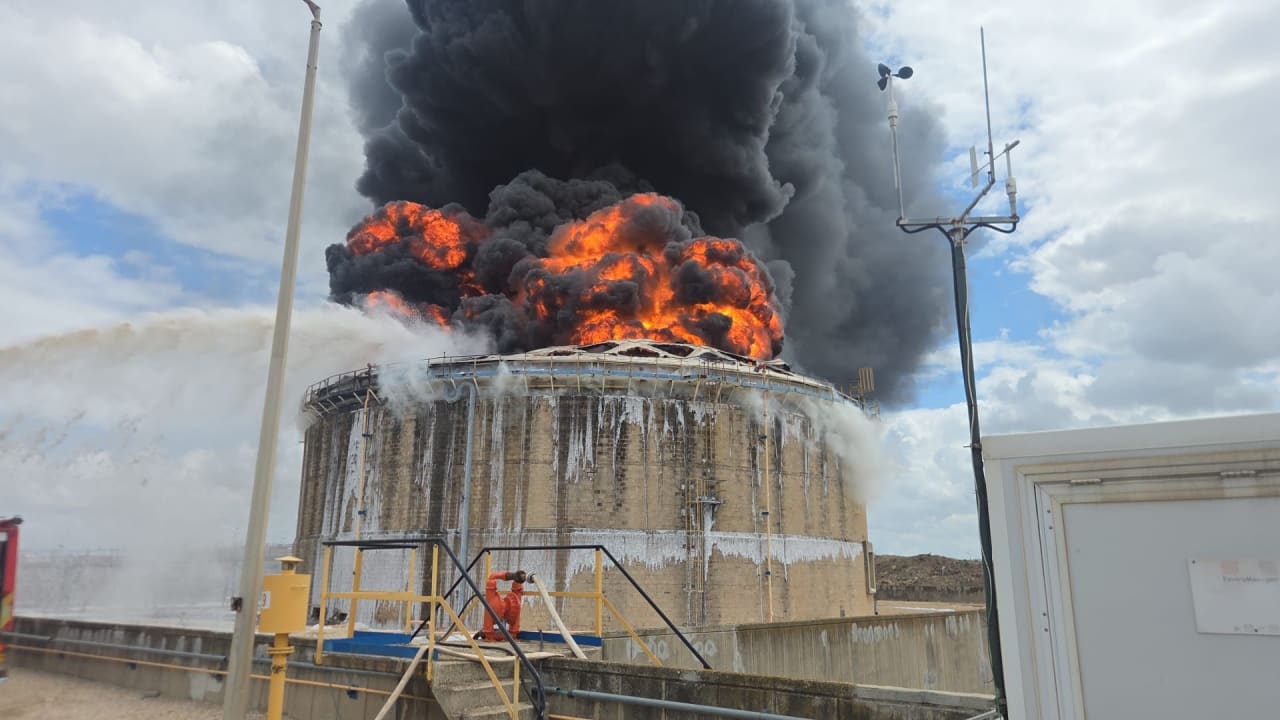
Flames rise at the Bazan refinery in Haifa after it was hit by an Iranian missile, March 30, 2026.(photo credit: FIRE AND RESCUE SERVICE)
APRIL 6, 2026 21:11Updated: APRIL 6, 2026 21:44
Russian intelligence has provided Iran with a detailed list of 55 critical energy infrastructure targets within Israel, according to information obtained by The Jerusalem Post from a source close to Ukrainian intelligence.
The report, which highlights the deepening military and intelligence cooperation between Moscow and Tehran, suggests that the information that was shared enables Iran to launch precision missile strikes against Israel’s energy grid.
According to the findings, the targeted sites are divided into three categories based on their strategic importance:
Level 1: Critical production facilities. These are sites whose destruction would cripple the national energy system. The report specifically names the Orot Rabin power station as a primary target.
Level 2: Major urban and industrial energy hubs. These facilities are located primarily in central Israel and serve large population centers.

Level 3: Local infrastructure. These targets include regional substations that support industrial zones and smaller power plants.
The Russian assessment regarding Israel’s vulnerability is that “unlike many European nations, Israel’s power grid is characterized by a high degree of isolation”. Because Israel is an “energy island” that does not import electricity from neighboring countries, Russian intelligence reportedly told Iran that damaging even a few central components could trigger a total and prolonged energy collapse, leading to mass blackouts and technical failures that could not be easily mitigated.
Zelensky warns of growing Russia-Iran alliance
Ukrainian President Volodymyr Zelensky has grown increasingly vocal about the Russia-Iran alliance, warning that the “knowledge” Russia has gained on the battlefields of Ukraine is being exported to the Middle East.
“The Russians also helped them, like the Iranians helped [Russia] at the beginning of the war when they gave them Shaheds,” Zelensky told the Post in an interview two weeks ago. “They gained big knowledge on the battlefield and this impacting and will have an impact on other regions.”
Zelensky further claimed that Russia has begun providing Iran with Shahed-style drones manufactured on Russian soil. He alleged in an interview with the Post that “Russian components” were discovered in a drone recently downed in a Middle Eastern country, though he declined to name the specific location for security reasons.
“We saw some components; they had Russian details. We know it because Iranians didn’t produce it,” the President stated.
However, Ukrainian officials maintain that the motive behind the intelligence transfer is twofold: to embolden its primary ally in the region and to create a fresh crisis in the Middle East that would divert international attention and resources away from the war in Ukraine.
Russian ambassador Anatoly Viktorov responded to the allegations, stating, “Russia and Israel established contacts to discuss national security issues long ago. These contacts have been intensively maintained between relevant Russian and Israeli agencies. The most pressing issues have been discussed at the highest level. We value track record which has been accumulated in this area.
“Representatives of the Russian political leadership have repeatedly dissented from the ‘accusations’ that our country allegedly provides intelligence data to Iran,” he added.
END
RUSSIA/CHINA/IRAN
INSANE!! ALREADY MASSIVE MILITARY FORCE BEING USED!
Russia, China Veto UN Res Authorizing Military Force To Reopen Hormuz Strait
Tuesday, Apr 07, 2026 – 12:25 PM
On Tuesday a UN Security Council resolution on opening the Strait of Hormuz failed due to Russia and China vetoing it. It was drafted by Bahrain and authorized countries to use military force if necessary to open the strait for the free flow of shipping and commerce.
The resolution garnered 11 votes in favor, but permanent veto-wielding members China and Russia blocked it by registering no votes. This comes after days of pressure from Gulf countries to restore free passage in the strait, amid Trump’s Operation Epic Fury.

Secretary General of the Gulf Cooperation Council (GCC), Jasem Mohamed Al-Budaiwi earlier in the week lamented, “Our countries are subjected to a sinful Iranian aggression, and GCC countries have a legitimate right to self-defense. The Security Council must take measures to ensure the protection of waterways, and we demand that the Security Council issue a resolution securing freedom of navigation in the Strait of Hormuz.”
And Bahrain’s Foreign Minister, Abdullatif bin Rashid Al Zayani, stated “Iranian attacks on neighboring countries cannot be justified. The draft resolution is consistent with international law and looks forward to a unified position.”
From Moscow and Beijing’s point of view, the resolution could be used to escalate US-Israeli aggression against the Islamic Republic:
It appears that China and Russia expressed concerns about the invocation of Chapter VII, arguing that such authorization could be interpreted as legitimizing the use of force by member states without clearly defined limits. They also raised concerns about the potential imposition of sanctions and maintained that the draft failed to address the root causes of the current crisis in the Middle East. In their view, the text risked exacerbating tensions rather than promoting de-escalation, and they urged Bahrain not to advance the initiative. These reservations led China and Russia to break silence twice.
Also, Russian Foreign Minister Sergei Lavrov has stated that if resolution passed it would disrupt “very fragile chances for negotiations.”
So essentially Russia and China viewed it as a ‘pro-war’ mandate which is too sympathetic to Washington’s aims in Iran.
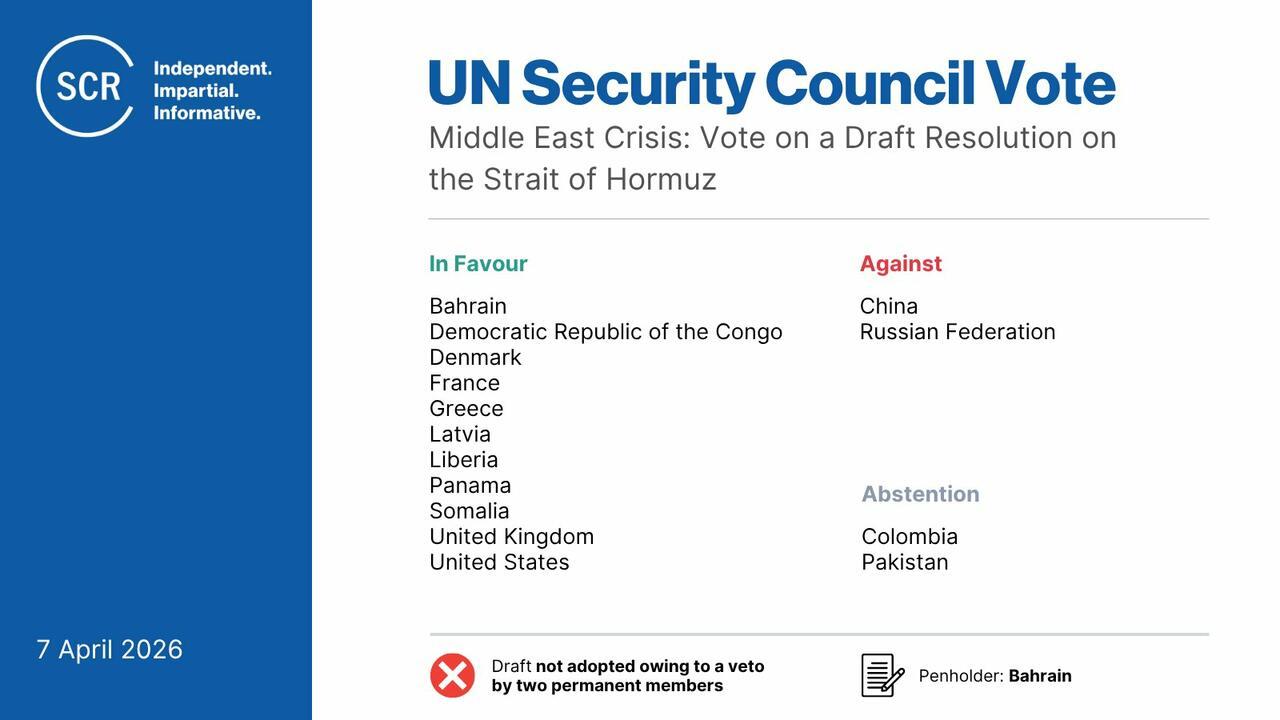
President Trump has meanwhile been busy venting his frustration at the ongoing closure of the strait, warning Iran that its “whole civilization will die tonight” if it doesn’t agree to Washington’s ceasefire terms. Tehran has said it is only interested in a permanent truce which ensures it never gets attacked again.
6.GLOBAL ISSUES, COVID ISSUES, VACCINE INJURIES/HEALTH ISSUES
GLOBAL ISSUES
MARK CRISPIN MILLER
Rocker Chad Gilbert has brain cancer; rapper Shawn Jay has Stage 4 cancer; comic Bradley Lawrence has rare kidney disorder; Nebraska weatherman Kent Boughton has Stage 4 cancer
Comedy producer Bob Sumner has cardiac arrest; composer Brendon Williams, 36, has “widowmaker” heart attack; Red River (NM) mayor Linda Calhoun collapses during “State of the Town” address
| Mark Crispin MillerApr 7 |
A survey of the likely global toll of COVID “vaccination,” based on the reports collected by our worldwide team of researchers this past week.
To help support our work, consider subscribing or making a donation.
Celebs:
UNITED STATES
Chad Gilbert Has Brain Surgery for 3 New Tumors After ‘Stumbling and Falling’
March 24, 2026

Chad Gilbert has undergone brain surgery after three tumors were discovered amid his cancer diagnosis. The New Found Glory Chad Gilbert guitarist and singer, 45, shared an update to Instagram on Monday, March 23, where he posted several photos of himself in the hospital. In the caption, the “My Friends Over You” singer wrote that his health crisis began on Feb. 20, following a show in Nashville. Gilbert wrote he was “struggling to control the movements of my left hand. My left leg was getting weaker by the day and I started stumbling and falling at times.” On Feb. 23, Gilbert went to the emergency room, where “a CT scan showed 3 new tumors had appeared in my brain.” Four days later, on Feb. 27, “I had successful brain surgery and have been recovering in the hospital since. I regained function of my left hand immediately ” Brain surgery is the latest step in the pop-punk stalwart’s ongoing treatment for a rare adrenal gland cancer known as metastatic pheochromocytoma. He was first diagnosed with the disease in late 2021, and later shared it had spread to his spine and lungs. In August 2025, he revealed that he was undergoing further treatment after doctors had discovered a “small spot in my back.” When it came to the latest tumors, Gilbert explained, “My radiation oncologist described it like this: ‘This is not a fatal blow and not the end of your story, just the beginning of a new chapter.’ My recovery has been bumpy at times but I’m feeling much better now and getting stronger by the day. Thankful to everyone who’s checked in on me and helped my family during this lengthy and challenging journey.”
News from Underground by Mark Crispin Miller is a reader-supported publication. To receive new posts and support my work, consider becoming a free or paid subscriber.
Researcher’s note – New Found Glory confirmed in August 2021 that all band members were vaccinated [sic] against COVID-19: https://www.simpleplan.cz/en/index.php/simple-plan-pull-u-s-tour-new-found-glory-safety-reasons/#:~:text=New Found Glory in the U.S.%2C which,while all the band members are vaccinated
Field Mob’s Shawn Jay Reveals Stage 4 Cancer Diagnosis
March 24, 2026

Shawn Jay [47], one half of the Atlanta Hip Hop duo Field Mob, has shared deeply emotional news with fans, revealing that his battle with cancer has progressed to stage 4. Taking to Facebook, Shawn Jay opened up about the weight of the moment with a message that was both painful and reflective. “Cancer has officially went 4th stage on me frfr. yesterday was hard,” he wrote, giving a glimpse into the reality he is now facing. Even in the face of such a devastating update, Shawn Jay found a way to speak from a place of perspective and resilience, reminding those following his journey how fragile and unpredictable life can be.
Performer Back on Stage After Rare Kidney Diagnosis
March 30, 2026

When Bradley Lawrence gained 25 pounds in two weeks and started experiencing chest pain and shortness of breath, he quickly sought care at NYU Langone Hospital-Brooklyn. He was soon diagnosed with nephrotic syndrome, a rare kidney disorder that can cause permanent damage if left untreated. Five months later, Lawrence is now in remission and has no lasting kidney damage-an outcome his care team says was possible because he didn’t delay seeking medical attention. Lawrence, 52, a storyteller, comedian, and cabaret performer who lives in Sunset Park, said the symptoms were alarming. In October 2025, he walked seven blocks from his home to the hospital’s emergency department. “When I was two blocks away, I didn’t think I was going to make it,” he recalled. “But I could see the doors to the emergency room and just kept going.” Based on test results, doctors at the hospital ruled out heart and lung conditions and referred him to nephrologist Michal L. Melamed, MD, director of NYU Langone Health’s Chronic Kidney Disease Center. After a biopsy, she diagnosed him with nephrotic syndrome caused by focal segmental glomerulosclerosis, which causes the kidneys to leak large amounts of protein into the urine, and can lead to scarring of the kidneys. If left untreated, the condition can lead to permanent kidney damage, requiring dialysis or a kidney transplant. Lawrence’s condition improved after he started treatment. Dr. Melamed first prescribed medication to help remove the excess fluid responsible for his rapid weight gain. She then prescribed a steroid and blood pressure medication to reduce the inflammation in his kidneys and help restore their function. “I didn’t love the idea of being on several medications,” said Lawrence. “But Dr. Melamed took the time to explain what each one was doing and why it mattered.” A self-described gym rat, Lawrence is slowly resuming his workout routine. He has also returned to performing cabaret and burlesque shows in the Lower East Side alongside his wife.
Researcher’s note – The Key to NYC: Unlocking the City Starts With COVID-19 Vaccination [sic] Proof for Dining, Fitness, and Entertainment Venues: https://ogletree.com/insights-resources/blog-posts/the-key-to-nyc-unlocking-the-city-starts-with-covid-19-vaccination-proof-for-dining-fitness-and-entertainment-venues/
Bob Sumner, Producer Behind ‘Def Comedy Jam’ And ‘Laff Mobb’s Laff Tracks’, Suffers Cardiac Arrest
March 29, 2026

Bob Sumner [65], the influential comedy producer best known for shaping the careers of countless stand‑up legends through HBO’s Def Comedy Jam and later Laff Mobb’s Laff Tracks, is recovering after suffering a cardiac arrest. News of the medical emergency has prompted an outpouring of support from comedians, industry peers, and fans who credit Sumner with helping define modern stand‑up culture. As updates on his condition continue to emerge, fans and colleagues remain hopeful for his recovery.
‘Star Wars’ and ‘Call of Duty’ Figure Suffers Widowmaker Heart Attack
March 25, 2026

A fan favorite composer for high-profile video games in major franchises like Star Wars and Call of Duty has suffered a major heart attack at just 36. Brendon Williams, a composer and music producer who has lent his talents to huge games like Star Wars Outlaws and Call of Duty: WWII, took to Instagram to share the harrowing news with fans. “On March 18, I suffered a ‘widowmaker’ heart attack – caused by 100% blockage of my left anterior descending artery,” Williams (no relation to prolific Star Wars composer John Williams) began in his caption of a photo of himself in a hospital bed. “Only 10-12% of people who have this particular variety of heart attack survive it if it occurs outside a hospital,” he continued. “Fortunately for me, my wife [Lindsey] immediately called 911, and the emergency response team and medical staff responded quickly. I received an emergency angioplasty and stenting that saved my life, and have been staying at the hospital since then. The doctors and cardiologists have been particularly baffled by my unique case,” Williams added, noting that at only 36, with a “relatively healthy lifestyle,” he doesn’t “fall into any of the high-risk categories.” He also has normal cholesterol, weight, and blood pressure. “So far, the conclusion is that it’s entirely due to unfortunate genetics…I truly drew the short straw on this one.”
Broadcast Meteorologist Shares News of His Stage 4 Cancer
March 28, 2026

Broadcast meteorologist Kent Boughton [68] has announced on his Facebook page that he has stage 4 cancer. The Chief Forecaster for News Channel Nebraska said he’s been diagnosed with small cell carcinoma that has spread throughout his body. In his Facebook video, Boughton said he visited a doctor after losing his voice. Instead of being an ailment of the throat, Boughton learned he had a tumor in his lung growing against his left tonsil, paralyzing it. With the left tonsil paralyzed, his voice was compromised. Boughton will be starting his second round of chemotherapy in the coming days. He asked viewers for prayers. Despite his illness, Boughton said he plans to continue to forecast for News Channel Nebraska even if his voice is impacted by his illness. Boughton has worked as a meteorologist for more than 50 years.
Researcher’s note – SAG-AFTRA and JPC Allow for Mandatory Vaccine [sic] Policies on Production Sets: https://www.dglaw.com/sag-aftra-and-jpc-allow-for-mandatory-vaccine-policies-on-production-sets/
Red River Mayor collapses during ‘State of the Town’ address
March 24, 2026

Red River, NM – Mayor Linda Calhoun [70] briefly lost consciousness Tuesday evening (March 24) during the town’s first-ever “State of the Town” address, prompting a swift response from first responders and concern among attendees at the Red River Conference Center. Roughly 15 minutes into her speech, Calhoun paused and told the audience, “I apologize guys, but I’m getting extremely dizzy,” before swooning and being helped to the floor. Emergency personnel, including town marshals, quickly responded and cleared space around the mayor as she was evaluated. The room fell quiet as attendees looked on. Calhoun later regained consciousness and was able to stand, receiving applause from the crowd before being escorted from the venue for further medical evaluation. Officials paused the event for about 10 minutes and encouraged attendees to get a plate of food. During that time, Councilor Angela Black told the audience the mayor was “fine right now,” as town EMS checked her out in an ambulance on site. Mayor Pro Tem Steve Cherry then stepped in to deliver the remainder of the address. Later in the evening, Calhoun’s daughter-in-law, Sharon Calhoun, shared an update from Holy Cross Hospital indicating the mayor was in good spirits. “She’s joking around now,” Sharon Calhoun said. “They’re ruling everything out.” No official cause for the incident has been released as of Tuesday night.
DR PAUL ALEXANDER
NEWSWIZE
MICHAEL EVERY/OR OR PICTON/GIFFIN OR RABOBANK EXECUTIVE/COMMENTARY ON WORLDLY AFFAIRS
Today Is “Bridge Day”
Tuesday, Apr 07, 2026 – 09:40 AM
By Benjamin Picton, Senior Market Strategist at Rabobank
As traders return from the Easter break markets are again counting down to an ultimatum deadline set by President Trump. Trump took to Truth Social over the weekend to warn the Iranian regime to make a deal, threatening that Tuesday will be “Power Plant Day” and “Bridge Day” where infrastructure of that kind will be targeted by American forces if Iran does not open the Strait of Hormuz. Trump has set a deadline of 8pm ET for a deal to be reached; Iran has said that it will retaliate against energy and water infrastructure of Gulf states if it is struck.
So, today is ‘Bridge Day’, but will it be a day for burning bridges, or building them?
US equity futures are pointing slightly negative in early trade. Ten-year sovereign yields are mostly lower, short yields are mixed, and hints of haven buying are again evident in precious metals, the Swiss Franc and Japanese Yen. Bitcoin is selling off in early trade after catching a sharper bid on Monday in continuation of a rally that has been underway since the Friday before last. Asian stocks have opened mixed with Chinese indices down slightly, the Nikkei mostly unchanged and the Aussie ASX is rallying to be up 1.5% at time of writing.
Axios reported over the weekend that the US and Iran were discussing terms for a 45-day ceasefire, but that prospects for agreement are slim. This puts us firmly back into ‘escalate to de-escalate’ territory, while also pushing us further along the severity spectrum where the Strait remains closed for longer and damage to economic infrastructure means that ‘re-opening’ does not imply any kind of rapid snap-back for the global economy.
Infrastructure damage is mounting. Israel recently struck Iranian petrochemical infrastructure at the South Pars gas field. Iran retaliated by launching ballistic missile strikes against Saudi Arabia’s Al-Jubail industrial city – the world’s largest petrochemicals production cluster. The WTI front future is up 0.7% this morning to $113.15/bbl, while dated-Brent closed at $141.26/bbl on Thursday – highlighting the wide spread between physical crude and the front future ($109.88/bbl), which is now the June contract.
Reports have emerged that Iran has issued a new 10-point peace plan via intermediaries to the United States. Axios reports comments from a US official calling the Iranian plan “maximalist” while Israeli PM Netanyahu has reportedly warned Trump against agreeing to a ceasefire plan. Trump himself has said that Iran’s overture was “significant” but “not good enough”.
According to the New York Times, the Iranian plan reportedly includes:
- A permanent end to the war, rather than just a ceasefire
- Guarantees that Iran would not be attacked again
- An end to Israeli strikes against Hezbollah in Lebanon
- Lifting of all sanctions
- Ending the de facto blockade of the Strait of Hormuz
- Implementing a $2 million per ship Hormuz transit fee to be split with Oman
- Iran’s share of the proceeds to be used for reconstruction in lieu of reparations
Notably absent is any mention of missile caps, missile production, uranium enrichment or what happens with the 500kg of uranium that Iran has already enriched close to weapons grade. Given that the entire rationale for the war has been ending Iran’s nuclear ambitions and dismantling its ability to sprint for a nuclear weapon behind the shelter of a conventional weapons deterrent, these are likely to be non-negotiables for the United States. Consequently, the risk of the US running out of patience and initiating large strikes on Iranian electricity and transport infrastructure is very real.
While the short term implications of the war are stealing the headlines this morning, the longer-term implications are potentially much more important. The FT and the Australian media are carrying stories of surging demand for electric vehicles as the oil shock prompts consumers to seek to reduce their exposure to the oil supply chain, but perhaps the most acute consequence of the war is the rift opening between the United States and other NATO allies.
Trump has repeatedly criticized NATO (and some non-NATO) allies in recent days for failing to lend a hand in the war against Iran. Spain, France and Italy have either fully closed or placed restrictions on US military operations within their airspace, as has Austria. The UK initially dragged its feet before offering limited support to the Americans while continually emphasizing that this is not Britain’s war and that it is not involved in offensive operations. Similarly, France recently joined with Russia and China at the UN Security Council to block a resolution backed by Gulf states to authorize the re-opening of the Strait of Hormuz by force – insisting that the Strait will only re-open with the cooperation of Iran.
Needless to say, these actions have gone down like a lead balloon in Washington where senior officials are now publicly questioning what strategic purpose NATO serves for the United States. The argument goes that the US incurs great cost to maintain bases and forward deployment of troops to protect Europe, but is then stymied by Europeans when it seeks to use those assets for its own purposes. From the US perspective, NATO is a one-way street.
There is already a deep sense in Washington that Europe has been free-riding on US military might for years by under-investing in its own capabilities. This state of affairs might be hard enough to stomach on its own, but when it is combined with European moralising over the appropriate uses of military force it becomes untenable. As noted here last week, this puts the Greenland question back into play as European assurances over access to bases appear increasingly insincere.
On the European side, French President Macron (fresh from being subjected to personal slights by Trump) has echoed Canadian PM Mark Carney in calling for greater cooperation among medium-sized powers to stand up against the United States and China. It is unclear how this would work, or could work, given the disparate interests of prospective partners and the lack of economic integration between them.
For a comprehensive architecture that could truly withstand outside pressure from would-be hegemons, thought would need to be paid to mutual defence, the balancing of trade flows and capital market integration. All of these items have eluded the European Union for decades, despite its smaller size and advantage of common geography. It similarly eluded the British Empire, despite having the benefit of a unifying British culture amongst its dominions.
This latent re-ordering of the international security architecture is not playing out in isolation. It should be remembered that another major war continues to rage in Ukraine. Ukraine has managed to do substantial damage to Russian economic (oil) infrastructure in recent weeks even as the rest of the world is desperate for more oil to come to market. Ukraine is now offering its drone warfare expertise to the Gulf states, while Russia continues to support Iran militarily. Europe and the United States continue to view this as two distinct conflicts where each has a direct interest in one, but not the other.
As we approach the deadline for escalation a significant ‘what if’ lingers: If the lines between the two conflicts continue to blur and two coalesce into one, who then will say “not our war”?
7. OIL ISSUES/NATURAL GAS/ENERGY ISSUES/GLOBAL
US Oil Premiums Hit Record High As World Scrambles For Crude
Monday, Apr 06, 2026 – 10:10 PM
By Charles Kennedy of Oilprice.com
The premiums for U.S. West Texas Intermediate crude have soared in the spot market to a record high of between $30 and $40 per barrel above key regional benchmarks as Asia and Europe scramble for supply amid the de facto closure of the Strait of Hormuz.
WTI Midland is being offered for July delivery in north Asia at premiums of between $30 and $40 per barrel, depending on the benchmark against which they are marked, trading sources told Reuters on Monday.
“Asian refiners, shut out of Middle Eastern supply, are bidding aggressively for every available Atlantic Basin barrel,” said Paola Rodriguez-Masiu, chief oil analyst at Rystad Energy, in a note dated April 3.
With most of the Middle Eastern supply still trapped at Hormuz and all Gulf producers slashing upstream production in response to the closed Strait, competition for barrels from other producers has become fierce and has pushed premiums higher and higher.
WTI Midland is offered to North Asia at a premium of $34 per barrel over the Dubai benchmark, a trader told Reuters. Another trade source said there are also offers of WTI Midland priced $30 per barrel above Dated Brent. There have been offers at nearly $40 a barrel above ICE Brent for August delivery, additional sources told Reuters.
The offers for spot WTI Midland have jumped in recent days from around $20 per barrel premium for cargoes sold at the end of March.
U.S. crude has become prized oil supply in the absence of free flows from the Middle East. As a result, the price of the WTI Crude futures benchmark soared past Brent Crude futures at the end of last week.
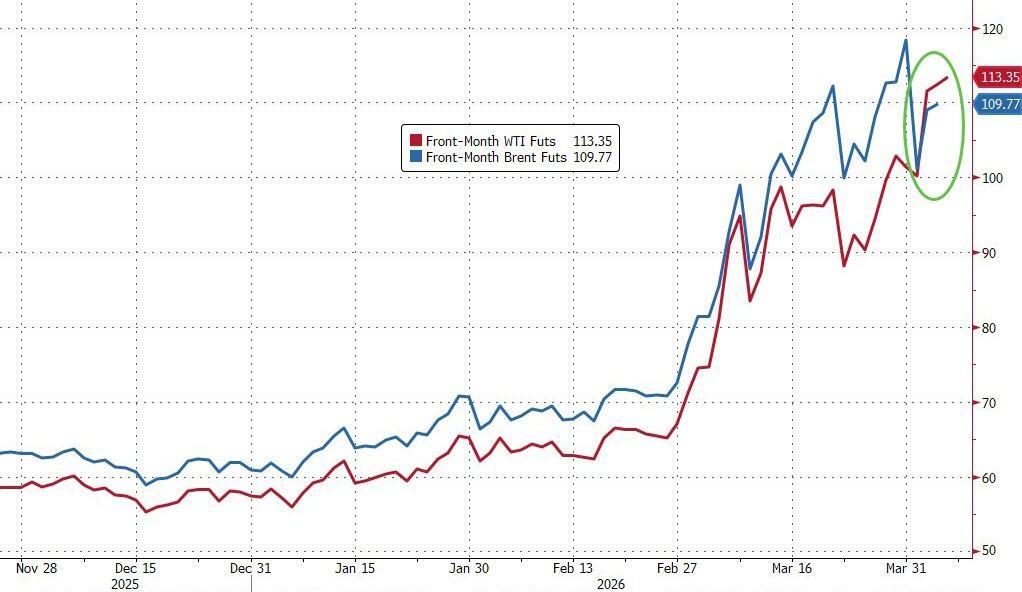
WTI Crude rarely trades at a premium to Brent. Brent crude reflects seaborne crude and typically leads during global supply shocks, while WTI crude is usually discounted.
As Julianne Geiger noted, part of the move is technical: WTI’s front-month contract reflects May delivery, while Brent has already rolled to June, skewing the headline spread.
Month-matched spread…
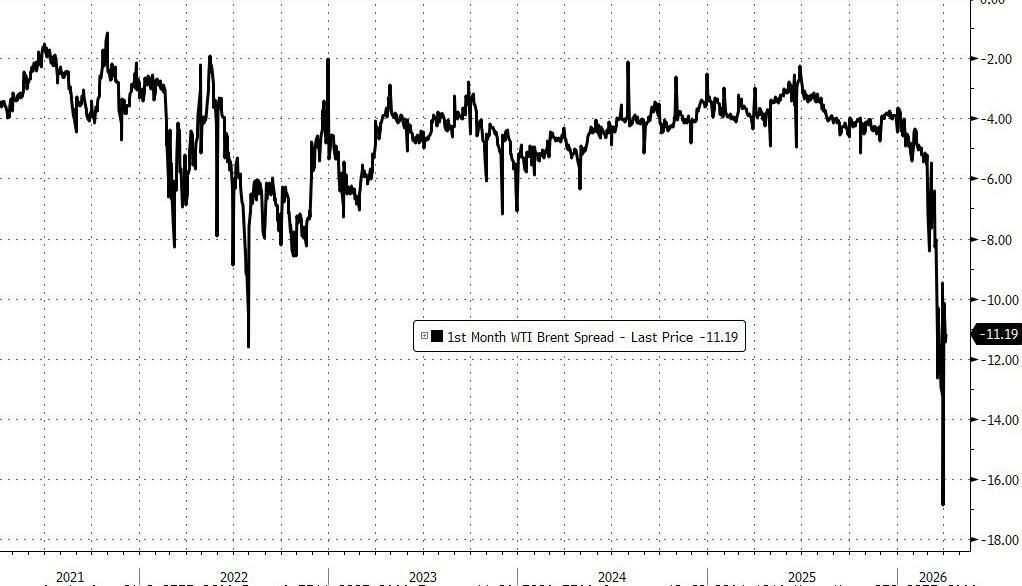
But the deeper driver is extreme prompt pressure – WTI backwardation has surged to record levels – signaling immediate demand for secure, deliverable barrels.
With rising uncertainty around global shipping routes, WTI has effectively gained a “security premium,” narrowing and even reversing its usual discount to Brent.
The current inversion points to a breakdown in normal pricing signals tied to physical flows.
END
8. EMERGING MARKETS//AUSTRALIA NEW ZEALAND ISSUES
YOUR EARLY CURRENCY/GOLD AND SILVER PRICING/ASIAN CLOSING MARKETS AND EUROPEAN BOURSE OPENING AND CLOSING/ INTEREST RATE SETTINGS TUESDAY MORNING 6;30AM//OPENING AND CLOSING
OPENING LEVELS OF CURRENCIES// AND CLOSING ASIAN STOCK MARKET AND OPENING EUROPEAN STOCKS:6 AM EST
EURO VS USA DOLLAR: 1.1574 UP 0.0033
USA/ YEN 159.48 DOWN 0.214 NOW TARGETS INTEREST RATE AT 1.75% AS IT WILL BUY UNLIMITED BONDS TO GETS TO THAT LEVEL…//YEN STILL FALLS//END OF YEN CARRY TRADE BEGINS AGAIN DEC 2024/Bank of Japan raises rates by .25% TO 1.75 ..TAKAICHI NEW PM AS YIELDS RISE//JAPAN DEEPLY IN TROUBLE WITH RISING RATES AND A FALLING YEN!!
GBP/USA 1.3283 UP 0.0050 OR 50 BASIS PTS
USA/CAN DOLLAR: 1.3909 DOWN 0.0003 CDN DOLLAR UP 3 BASIS PTS//
Last night Shanghai COMPOSITE CLOSED UP 10.09 PTS OR 0.26%
Hang Seng CLOSED DOWN 177.50 PTS OR 0.70%
AUSTRALIA CLOSED UP 2.16%
// EUROPEAN BOURSE: ALL GREEN
Trading from Europe and ASIA
I) EUROPEAN BOURSES: ALL GREEN
2/ CHINESE BOURSES / :Hang SENG CLOSED DOWN 177.50 PTS OR 0.70%
/SHANGHAI CLOSED UP 10.07 PTS OR 0.26%
AUSTRALIA BOURSE CLOSED UP 2.16%
(Nikkei (Japan) CLOSED UP 112.82 PTS OR 0.21%
INDIA’S SENSEX IN THE GREEN
Gold very early morning trading: $4688.90
silver:$72.93
USA DOLLAR VS TRY (TURKISH LIRA): 44.61 PLUS 2 BASIS PTS AND NOW WE SEE THEIR STUPIDITY OF SELLING SOME OF THEIR GOLD.
USA DOLLAR VS RUSSIAN ROUBLE: 78.66 ROUBLE// UP 0 ROUBLE AND 34 BASIS PTS
UK 10 YR BOND YIELD: 4.8460 UP 0 BASIS PTS
UK 30 YR BOND YIELD: 5.453 DOWN 1 BASIS PTS
CDN 10 YR BOND YIELD: 3.469 DOWN 2 BASIS PTS
CDN 5 YR BOND YIELD; 3.097 UP 1 BASIS PTS
USA dollar index early TUESDAY MORNING: 99.61 DOWN 20 BASIS POINTS FROM MONDAY’s CLOSE
TUESDAY MORNING NUMBERS ENDS
And now your closing TUESDAY NUMBERS 10.00 AM
Portuguese 10 year bond yield: 3.474% UP 5 in basis point(s) yield
JAPANESE BOND 10 yr YIELD: +2.395% DOWN 3 FULL POINTS BASIS POINTS /JAPAN losing control of its yield curve/
JAPAN 30 YR: 3.750 DOWN 1 BASIS PTS//
SPANISH 10 YR BOND YIELD: 3.538 UP 5 in basis points yield
ITALY 10 YR BOND: 3.934 UP 8 points in basis points yield ./ THE ECB IS QE’ ING ITALIAN BONDS (
GERMAN 10 YR BOND YIELD: 3.049 UP 6 BASIS PTS
IMPORTANT CURRENCY CLOSES : MID DAY TUESDAY
Closing currency crosses for day /USA DOLLAR INDEX/USA 10 YR BOND YIELD/10:00 AM
Euro/USA 1.1561 UP 0.0020 OR 20 basis points
USA/Japan: 159.78 UP 0.087 OR YEN IS DOWN 9 BASIS PTS// HIGHLY INFLATIONARY TO JAPAN
Great Britain 10 YR RATE 4.8730 UP 3 BASIS POINTS //
GREAT BRITAIN 30 YR BOND; 5.5034 UP 3 BASIS POINTS.
Canadian dollar DOWN 11 BASIS pts to 1.3922
xxxxxxxxxxxxxxxxxxxxxxxxxxxxxxxxxxxxxxxxxxxxxxxxxxxxxxxxxxxxxxxxxxxxxxxxxxxxxxxx
The USA/Yuan CNY UP 6.8574 ON SHORE ..
THE USA/YUAN OFFSHORE// CNH UP TO 6.8648
TURKISH LIRA: 44.61 EXTREMELY DANGEROUS LEVEL/DEATH WATCH/HYPERINFLATION TO BEGIN.//
Your closing 10 yr US bond yield UP 1 in basis points from MONDAY at 4.343.% //trading well ABOVE the resistance level of 2.27-2.32%)
USA 30 yr bond yield 4.903 UP 1 basis points /10:00 AM
USA 2 YR BOND YIELD: 3.848 DOWN 0 BASIS PTS.
GOLD AT 10;00 AM 4656.00
SILVER AT 10;00: 72.03
Your 11:00 AM bourses for Europe and the Dow along with the USA dollar index closing and interest rates TUESDAY CLOSING TIME 10:00 AM//
London: CLOSED DOWN 87.50 PTS OR 0.84%
GERMAN DAX: CLOSED DOWN 246.49 PTS OR 1.06%
FRANCE: CLOSED DOWN 54.68 PTS OR 0.67%
Spain IBEX CLOSED DOWN 111.60 PTS OR 0.64%
Italian MIB: CLOSED DOWN 213.15 PTS OR 0.47%
WTI Oil price 115.54 10.00 EST/
Brent Oil: 109.80 10:00 EST
USA /RUSSIAN ROUBLE /// AT: 78.67 ROUBLE UP 0 AND 33 / 100
CDN 10 YEAR RATE: 3.497 UP 3 BASIS PTS.
CDN 5 YEAR RATE: 3.122 UP 3 BASIS PTS
CLOSING NUMBERS: 4 PM
Euro vs USA 1.1584 UP 0.0043 OR 43 BASIS POINTS//
British Pound: 1.3272 UP 0.0038 OR 38 basis pts/
BRITISH 10 YR GILT BOND YIELD: 4.9010 UP 6 FULL BASIS PTS//
BRITISH 30 YR BOND YIELD: 5.666 UP 8 IN BASIS PTS.
JAPAN 10 YR YIELD: 2.390 DOWN 3 FULL BASIS PTS (DANGEROUS TO THEIR ECONOMY
JAPANESE 30 YR BOND: 3.736 DOWN 2 PTS AND STILL VERY DANGEROUS TO THEIR ECONOMY
USA dollar vs Japanese Yen: 159.73 UP 0.032 OR YEN DOWN 3 BASIS PTS EXTREMELY DANGEROUS/YEN FALLING DEEPLY IN VALUE
USA dollar vs Canadian dollar: 1.3895 DOWN 0.0018 PTS// CDN DOLLAR UP 18 BASIS PTS
West Texas intermediate oil: 113.06
Brent OIL: 108.78
USA 10 yr bond yield DOWN 2 BASIS pts to 4.318
USA 30 yr bond yield: UP 1 PTS to 4.903%
USA 2 YR BOND 3.817 UP 15 PTS
CDN 10 YR RATE 3.502 UP 3 BASIS PTS
CDN 5 YEAR RATE: 3.140 UP 5 BASIS PTS
USA dollar index: 99.81 DOWN 4 BASIS POINTS
USA DOLLAR VS TURKISH LIRA: 44.61 GETTING QUITE CLOSE TO BLOWING UP/IDIOTS SOLD GOLD
USA DOLLAR VS RUSSIA//// ROUBLE: 78.87 DOWN 0 AND 72/100 roubles //
GOLD $4706.00. 3:30 PM)
SILVER: 72.85 3;30 PM)
DOW JONES INDUSTRIAL AVERAGE: DOWN 85.43 OR 0.19%
NASDAQ 100 UP 16.94 PTS OR 0.04%
VOLATILITY INDEX 26.78 UP 2.61 PTS OR 10.00%
GLD: $ 431.87 UP 4.22 PTS OR 9.77%
SLV/ $65.97 DOWN 0.12 PTS OR OR 0.18%
TORONTO STOCK INDEX// TSX INDEX: CLOSED UP 5.67 PTS OR 0.17%
end
TRADING today ZEROHEDGE 4 PM: HEADLINE NEWS/TRADING
WRAP UP
Markets chop on geopolitical headlines as Trump 20:00EDT deadline awaits – Newsquawk US Market Wrap
Tuesday, Apr 07, 2026 – 04:23 PM
- SNAPSHOT: Equities up, Treasuries steepen, Crude mixed, Dollar down, Gold
- REAR VIEW: Pakistan requests Trump to extend Iran deadline for two weeks, Trump response to proposal to come; Senior Iranian official said Tehran positively reviewing Pakistan’s request for a two-week ceasefire; Trump said a whole civilization will die tonight, never to be brought back again; does not want that to happen, but it probably will; US-Iran negotiations to reportedly continue until Trump deadline expires; Trump noted if negotiations advance & there is something tangible, might extend the deadline; Iran floats retaliation on US, including Aramco, Yanbu, and Fujairah oil facilities; US strikes Kharg Island, targeting military sites, Investigations show that there are no disruptions in the functioning of oil on Kharg; Iran’s UN ambassador says UN Secretary General’s personal envoy currently on route to Tehran to pursue consolations; Strong Indirect demand in US 3yr note auction; Samsung Electronics beats on Q1 prelim earnings; AAPL foldable release reportedly remains on track for September debut.
- COMING UP: Data: French Trade Balance (Feb), EZ Retail Sales (Feb), PPI (Feb). Events: US President Trump’s Iran Deadline, RBNZ/RBI Policy Announcement, FOMC Minutes. Speakers: RBNZ’s Breman; Fed’s Daly, Waller; US President Trump. Supply: Australia, Germany, US.
More Newsquawk in 2 steps:
- 1. Subscribe to the free premarket movers reports
- 2. Trial Newsquawk’s premium real-time audio news squawk box for 7 days
MARKET WRAP
Markets were choppy amid broader risk-off sentiment for the majority of the session as participants await US President Trump’s 20:00EDT Iran deadline, as his punchy rhetoric continued as he noted “a whole civilization will die tonight, never to be brought back again; does not want that to happen, but it probably will”. However, souring risk sentiment reversed into the close due to a Pakistan proposal, which seemed to drive some positive responses (more below). Throughout Tuesday, it was a headline heavy day, as Middle East headlines unsurprisingly drove risk sentiment and market moves, as reporting differed but the most recent update was more positive and saw a reversal in risk sentiment; in response to Pakistan requesting Trump to extend Iran deadline for two weeks, and Iran opening the Strait of Hormuz for a corresponding period of two weeks as goodwill gesture, a Senior Iranian official to Reuters said Tehran is positively reviewing Pakistan’s request for a two-week ceasefire, while WH Press Sec noted Trump has been made aware of the Pakistan proposal, and a response will come. As such, and given the latest update, US equity futures closed up/flat, while the crude complex is now in the red at the time of writing, wiping out its entire gain through the day, which was initially amid chatter that Iran/US do not seem much closer to an agreement ahead of the deadline. G10 FX peers, ex-Swissy, are also gaining vs. the Greenback given the latest remarks, although performance was more mixed throughout the day, with the Aussie always outperforming. Precious metals gain, with spot gold at session highs and back above USD 4.7k/oz.
US
DURABLE GOODS: Durable Goods Orders unexpectedly declined again in March, -1.4% (exp. +0.4%, prev. -1.4%). Ex-Transport rose 0.8%, above the expected 0.7% (prev. 0.4%), while ex-defence fell 1.2% (prev. +0.5%). Nondefense capital goods orders excluding aircraft rose 0.6%. Pantheon Macroeconomics writes that the drop in headline orders in February was entirely due to a 37% plunge in the volatile aircraft orders component, reflecting a soft month for Boeing. Ahead, “Mounting consumer headwinds and depressed surveys of capex intentions suggest the goods sector is likely to remain anaemic in the months ahead.”
FED’S GOOLSBEE (2027 voter) said rising oil prices is a stagflationary shock. Now in an uncomfortable situation, with no obvious cookbook for Fed. Goolsbee’s immediate concern is the stagflationary shock of oil prices before the tariff-price shock has gone away. He views the job market as stable, but not great; Cautious and nervous about the economy. The Chicago Fed President is hoping the impact from oil will prove temporary, and gas at USD 5/gallon would affect the supply chain.
FED’S WILLIAMS (voter) thinks Iran will go directly into headline inflation given energy, and that inflation this year should be around 2.75%. NY Fed President added he is focused on underlying inflation, and that the story on core has not changed that much. Expects underlying inflation to start coming down later this year. Added monpol takes about a year to have its full effect on inflation, so we have to try and think through where inflation and the economy will be later, and expect underlying inflation to start coming down later this year. Ahead, Williams reiterated that monetary policy is well positioned to wait and see, and it is exactly where it needs to be and can be changed if needed. Speaking on the labour market, noted that the situation is complicated, and that it is low hire, low fire. He expects 2-2.5% GDP this year with stable unemployment rate.
FIXED INCOME
T-NOTE FUTURES (M6) SETTLED 1+ TICK HIGHER AT 110-27
Yield curve steepens despite gains in oil ahead of Trump’s deadline. At settlement, 2-year -2.3bps at 3.827%, 3-year -2.7bps at 3.849%, 5-year -1.8bps at 3.967%, 7-year -1.7bps at 4.147%, 10-year -0.8bps at 4.331%, 20-year +1.6bps at 4.914%, 30-year +2.1bps at 4.912%.
THE DAY: The Treasury curve steepened on Tuesday, paring some of the recent flattening, as markets navigated ongoing geopolitical uncertainty and incoming data.
- Focus remained on geopolitics ahead of President Trump’s 20:00 EDT deadline on Iran, with mixed reporting around the likelihood of a deal. Officials questioned whether an agreement could be reached in time, while the US and Israel reportedly struck Kharg Island in an effort to bring Iran to the negotiating table. The developments kept oil prices elevated and maintained uncertainty in the rates markets.
- On the data front, the NY Fed Survey of Consumer Expectations showed a rise in short- and medium-term inflation expectations, with 1-year forecasts increasing to 3.4% from 3.0% and 3-year to 3.1% from 3.0%, while 5-year expectations were unchanged at 3.0%. ADP employment improved to 26k from a recent four-week average of 10k, while Durable Goods disappointed on the headline due to transportation, although ex-transport beat. The data contributed to a softer growth backdrop, with the Atlanta Fed GDPNow estimate revised down to 1.3% from 1.6% for Q1.
- The 3-year auction was notably strong, driven by a surge in indirect demand that more than offset weak direct participation, highlighting continued robust foreign demand despite ongoing volatility.
- Looking ahead, focus remains on geopolitics, alongside key Treasury supply with the 10- and 30-year auctions still to come. Inflation data will also be in focus, with CPI and PCE due. WSJ’s Timiraos notes headline CPI is expected to rise 0.9% M/M, with the Y/Y rate seen at 3.3% (prev. 2.4%), largely driven by energy prices. Core CPI is seen at 0.27% M/M and 2.7% Y/Y, while core PCE (Feb) is expected at 0.39% M/M and 3.0% Y/Y.
SUPPLY
- The 3-year auction was strong, with a 1.2bps stop-through — the largest since February 2025 — a marked improvement on last month’s 1.1bps tail and well above the six-auction average 0.3bps stop-through. The bid-to-cover rose to 2.68x from 2.55x, above the 2.66x average, reinforcing the strong demand. The breakdown was particularly notable. Direct demand fell sharply to 11.9% from 20.7%, the lowest since April 2024 (Trump tariffs), while indirect demand — a proxy for foreign participation — surged to 74.8%, the second highest on record. Dealer take declined to 13.3% from 19.5%, closer to the 12.3% average. The composition suggests domestic real money accounts, including asset managers and money market funds, remain cautious amid ongoing geopolitical uncertainty, while foreign demand remains robust, likely supported by higher yields.
- US to sell USD 39bln of 10-year notes on April 8th and USD 22bln of 30-year bonds on April 9th; all to settle April 15th.
Bills
- US to sell USD 69bln of 17-wk bills on April 8th; USD 75bln of 8-wk bills and USD 80bln of 4-wk bills on April 9th; all to settle April 14th.
- US sold 6-wk bills at high-rate 3.615%, B/C 3.57x.
STIRS/OPERATIONS
- NY Fed RRP op demand at USD 15.345bln (prev. 0.227bln) across 22 counterparties (prev. 4).
- SOFR at 3.65% (prev. 3.66%), volumes at USD 3.217tln (prev. USD 3.251tln) on April 6th.
- EFFR at 3.64% (prev. 3.64%), volumes at USD 103bln (prev. USD 106bln) on April 6th.
CRUDE
WTI (K6) SETTLED USD 0.54 HIGHER AT USD 112.95/BBL; BRENT (M6) SETTLED USD 0.50 LOWER AT USD 109.27/BBL
The crude complex was firmer for the duration of the session, but choppy, amid a heavy headline-driven day as Trump’s 20:00EDT awaits. Geopolitics has dominated the tape on Tuesday, as expected, given everyone is counting down until the Trump-imposed deadline to see if a deal has been agreed, or whether the President sticks to his aggressive rhetoric he has threatened. Highlighting this, and giving no indication of a backward step, Trump on Truth today said “a whole civilization will die tonight, never to be brought back again; does not want that to happen, but it probably will”. There has been a deluge of reports given the in vogue topic today, from all sides, but the overall consensus seems to be the parties are not close on agreeing a deal, yet. Recapping some of the updates, Axios citing US & Israeli official said progress has been made in the past 24 hours, though reaching a ceasefire deal by Trump’s 8pm ET deadline still looks like a long shot, while WSJ reported that even before Iran cut off direct diplomacy with the US, it was sticking to a hard-line position in negotiations and showed no signs of backing down. ABC citing the White House said ‘only the President knows’. Meanwhile, Tehran Times clarified an earlier post saying diplomatic and indirect channels of talks with the US are not closed, after initially saying they were, while the likes of NYT said Iran has stopped negotiating with the US and it told Pakistan that it will not continue cease fire talks. Before all this, reports suggested a potential framework for a ceasefire is “closer than ever,” and resulted in losses in the complex. Thereafter, upside was then seen on reports that Iran’s Kharg Island was attacked, although later reports suggested military sites were targeted. Weekly private inventory data is due after-hours, but will take a back seat as all attention resides around the aforementioned deadline. For the record, WTI traded between USD 111.28-117.63/bbl and Brent USD 107.42-111.80/bbl.
EQUITIES
CLOSES: SPX +0.08% at 6,617, NDX +0.04% at 24,202 , DJI -0.18% at 46,584, RUT +0.17% at 2,545
SECTORS: Consumer Staples -1.76%, Consumer Discretionary -0.91%, Materials -0.26%, Industrials -0.21%, Real Estate -0.08%, Financials +0.02%, Health +0.23%, Utilities +0.26%, Technology +0.35%, Energy +0.78%, Communication Services +1.04%.
EUROPEAN CLOSES: European Closes: Euro Stoxx 50 -1.07% at 5,632, Dax 40 -0.99% at 22,938, FTSE 100 -0.84% at 10,349, CAC 40 -0.67% at 7,909, FTSE MIB -0.47% at 45,412, IBEX 35 -0.64% at 17,444, PSI -0.03% at 9,367, SMI -1.27% at 12,817, AEX -0.41% at 972.
STOCK SPECIFICS:
- Apple’s (AAPL) – Plans foldable release around same time as iPhone 18 Pro, Bloomberg reports; remaining on track for September debut. The report comes despite earlier reporting that the first foldable iPhone is facing setbacks in the engineering test phase that could delay mass prod. & shipments.
- Arista Networks (ANET) upgraded at Rosenblatt to ‘Buy’ from ‘Neutral’
- Arm Holdings (ARM) downgraded at Morgan Stanley.to ‘Equal Weight’ from ‘Overweight’.
- Broadcom (AVGO) will produce future versions of Google’s AI chips & also expanded its deal with Anthropic
- Casey’s General Stores (CASY) will replace Hologic (HOLX) in the S&P 500, effective BMO on 9th April
- Intel (INTC) said it has joined the Terafab project alongside SpaceX, xAI and Tesla (TSLA) to help refactor silicon fab technology.
- Pershing Square proposes USD 64bln merger deal with Universal Music Group.
- Samsung Electronics prelim Q1 op. profit & rev. topped w/ upbeat comms.
- US will raise average Medicare Advantage payments to private insurers by 2.48% in 2027. Of note for Humana (HUM), CVS (CVS), UnitedHealth (UNH), Elevance Health (ELV).
- Pimco weighing USD 14bln debt deal for Oracle (ORCL) data center, Bloomberg reports.
- Anthropic rolls out cyber AI models days after source code leak, FT reports. Anthropic has launched a new cybersecurity AI model to a select group of customers, including Amazon, Apple and Microsoft, days after details about the project were leaked online. Its new model Claude Mythos Preview, will be available only to vetted organisations, including Broadcom, Cisco and CrowdStrike.
FX
DXY traded lower despite tensions at highs ahead of Trump’s deadline at 8PM EDT for Iran to reopen the Strait of Hormuz. Trump continued to threaten the opposition, ” a whole civilisation will die tonight”, meanwhile, telling Fox News, if the negotiations advance and there is something tangible, we might extend the deadline. Iran continues to show no characteristic of caving, with WTI rising above USD 115/bbl. In other news, the NY Fed SCE for March unveiled 1- and 3yr inflation expectations ticking higher to 3+%, while the 5yr held at 3.0%. A Dallas Fed research paper finds “Little evidence of higher gasoline prices being passed through to core inflation or long-run inflation expectations becoming unanchored”. Fed’s Goolsbee, at the Chicago Fed, believes gas at USD 5/gallon would affect the supply chain. In the aftermath of NFP, Auto Sales, and ISM Services, the Atlanta Fed revised down its Q1 real GDP growth forecast to 1.3% from 1.6%.
AUD was the best performer on Tuesday, potentially helped by its lesser exposure than peers towards the Middle-East conflict. EUR and GBP also saw strength, as risk-taking was present in the FX space in spite of the sour appetite in equities.
SEK was hit by a surprise preliminary deflationary reading in March, printing -0.6% M/M (exp. 0.0%, prev. 0.6%). EUR/SEK breached the March high, peaking at 11.0537.
In EMFX, the South Korean FX Chief said they are to deploy bold measures in the FX market, if needed; USD/KRW saw a second consecutive day of losses.
USA DATA RELEASES
US Core Durable Goods Orders Surge For 11th Straight Month
Tuesday, Apr 07, 2026 – 08:41 AM
After recent string ‘soft’ survey data, this morning we get some ‘hard’ data and it’s mixed…ish…
Preliminary headline durable goods orders for February fell 1.4% MoM (worse than the -1.2% MoM exp). That is the third monthly decline in a row (the first 3-month decline since Nov 2019)
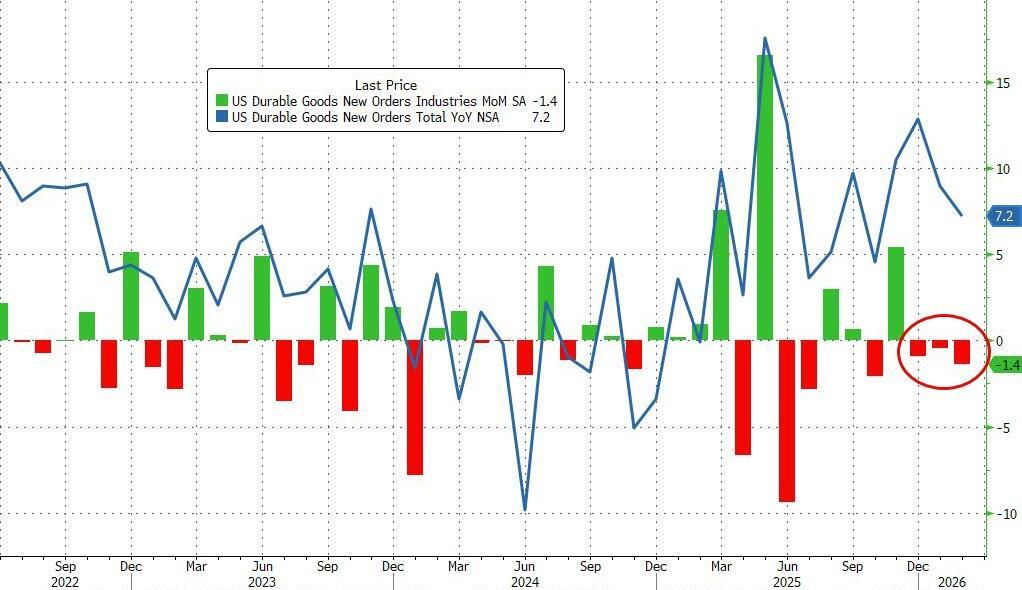
Source: Bloomberg
The monthly decline of the headline print largely reflected a decline in orders for aircraft.
Boeing said it received fewer orders for its planes in February than a month earlier.
On the other hand, core durable goods orders (prelim for Feb) rose 0.8% MoM (better than expected)…
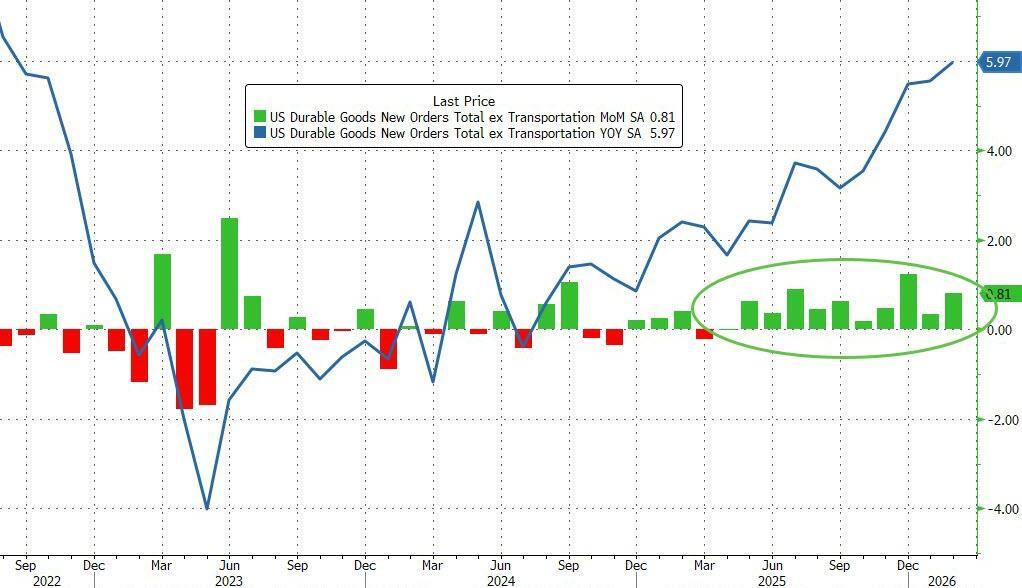
Source: Bloomberg
That is the eleventh straight month of gains, pulling core orders up 5.97% YoY – the most since Aug 2022.
Bookings for non-defense capital goods excluding aircraft, a proxy for investment in equipment, increased 0.6% MoM after a downwardly revised 0.4% decline a month earlier.
Finally, shipments figures (which actually plug into GDP) were comfortably stronger than expected (+0.9% in February versus +0.4% forecast), which suggests upside risks to Q1 forecasts.
It remains to be seen, however, how the war impacted demand for capital goods.
END
gold generally rises when inflation expectations jump
(zerohedge)
NY Fed: Inflation Expectations Jump, Driven By Surging Gas
Tuesday, Apr 07, 2026 – 12:10 PM
Ahead of Friday’s CPI report, inflation fears are already rising, with the NY Fed’s latest monthly survey of consumer expectations reporting that Inflation expectations at the one-year horizon were higher at 3.42% in March from the previous month’s 3.00%, matching the highest since April ’25. Inflation expectations also increased by 0.1% to 3.1% at the three-year-ahead horizon, and were unchanged at 3.0% at the five-year-ahead horizon in March.
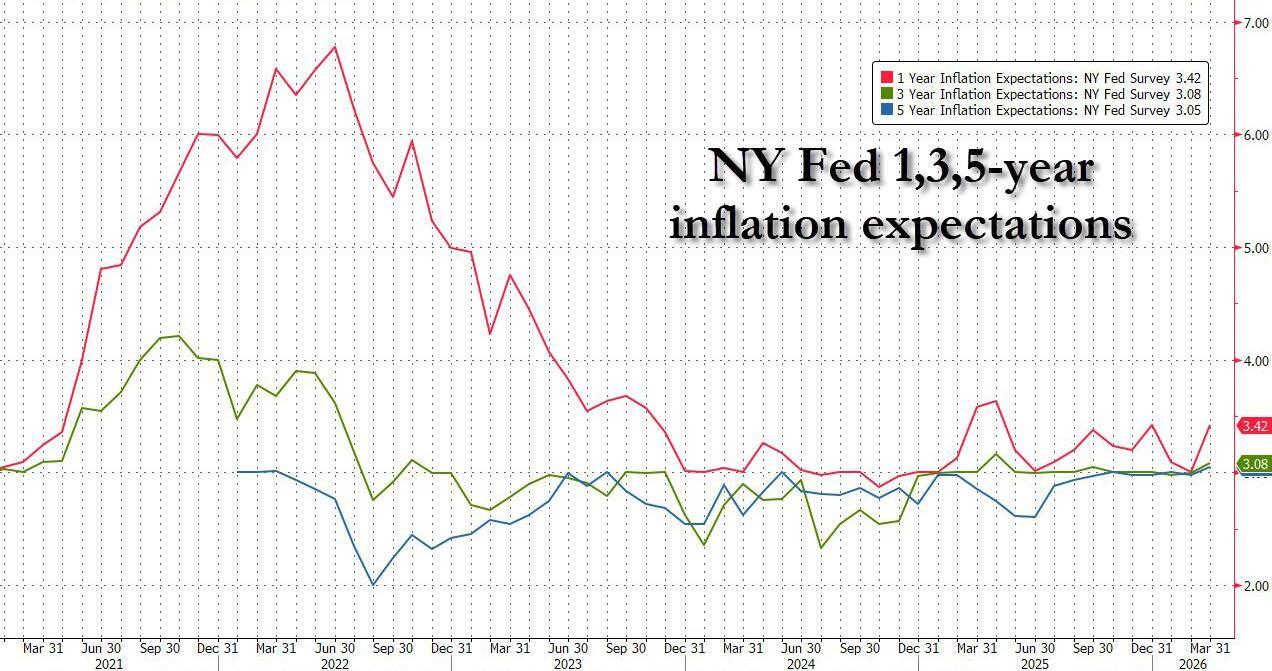
The jump in year-ahead expectations was driven by a surge in gas inflation which rose 5.3% to 9.4%, the highest reading since March 2022.
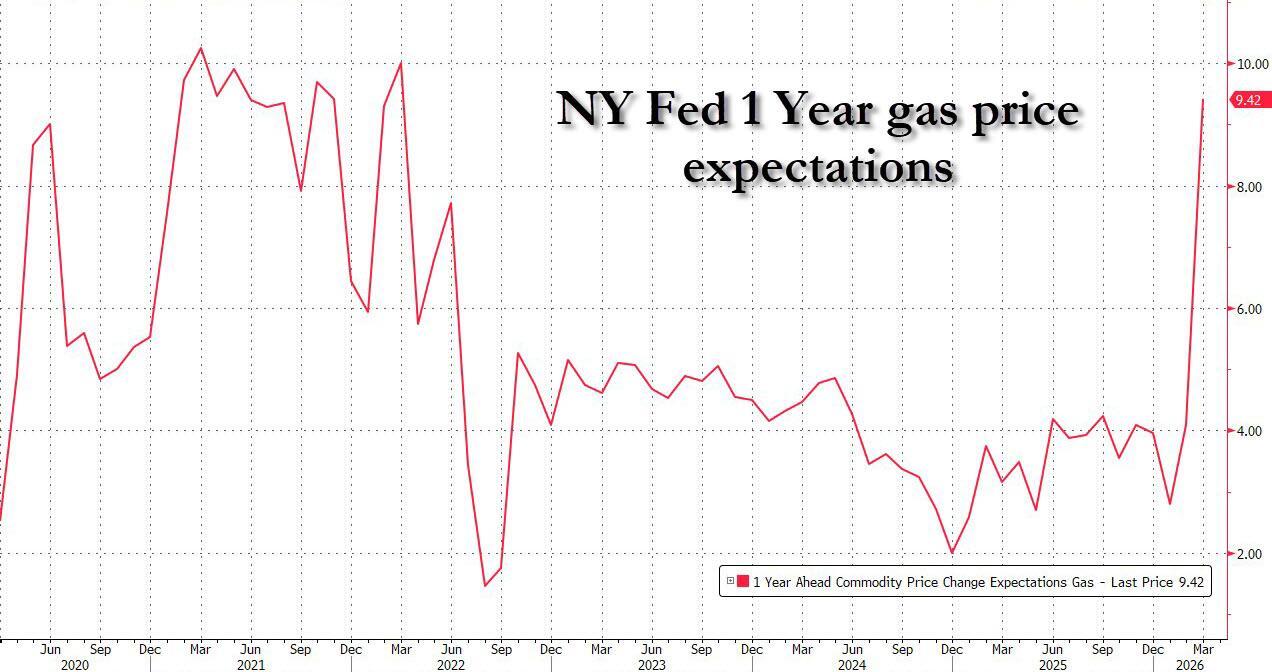
Other commodity price change expectations also rose, but to a more limited degree: food prices are now expected to rise 6%; medical costs to rise 9.7%; the price of a college education to rise 9%; rent prices to rise 7.1%.
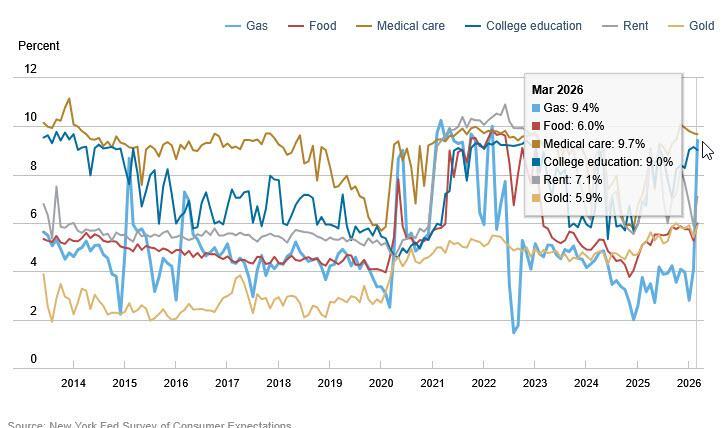
Turning to the labor market, sentiment is deteriorating fast with respondents saying that the mean probability the US unemployment rate will be higher next year rose 3.6% to 43.5%; highest reading since April 2025
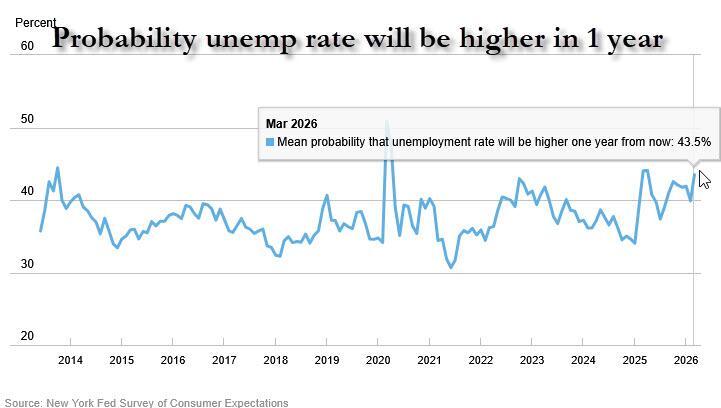
On the other end, median one-year-ahead earnings growth expectations decreased by 0.1% point to 2.4% in March, remaining below its 12-month trailing average of 2.6% and at the low end of its range seen since May 2021 of 2.4% to 3.0%.
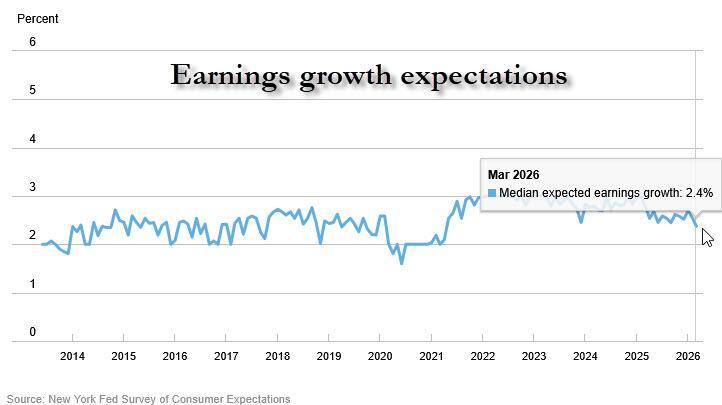
More bad news: the mean perceived probability of losing one’s job in the next 12 months increased by 0.6 percentage point to 14.4%. The reading remains below the series’ 12-month trailing average of 14.6%. The mean probability of leaving one’s job voluntarily, or the expected quit rate, in the next 12 months also increased by 2.4 percentage points to 18.3%.
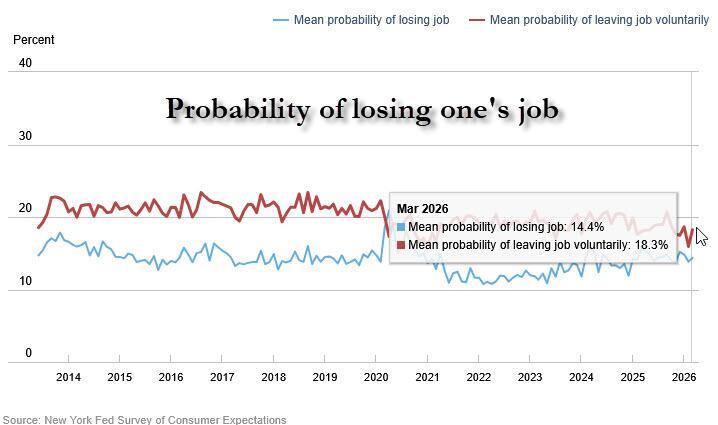
The mean perceived probability of finding a job if one’s current job was lost increased by 1.9 percentage points to 45.9%, while remaining below its 12-month trailing average of 47.5%. The increase was broad-based across age, education, and income groups.
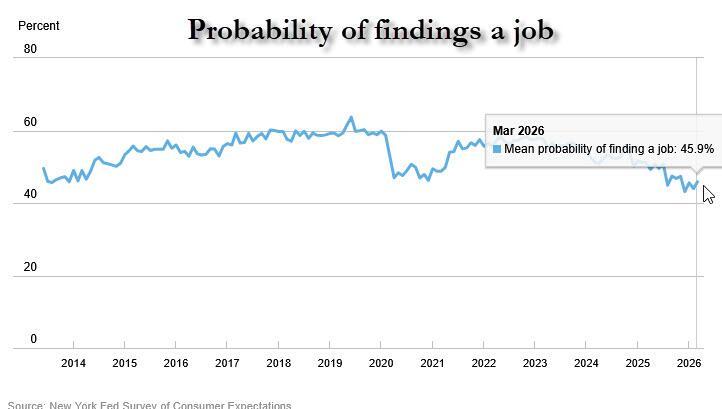
Perceptions about households’ current financial situations also deteriorated compared to a year ago, with a larger share of households reporting a worse financial situation and a smaller share reporting a better financial situation. Year-ahead expectations about households’ financial situations also worsened, with the share of households expecting a worse financial situation at its highest level since April 2025, and a smaller share of households expecting a better financial situation in one year from now.
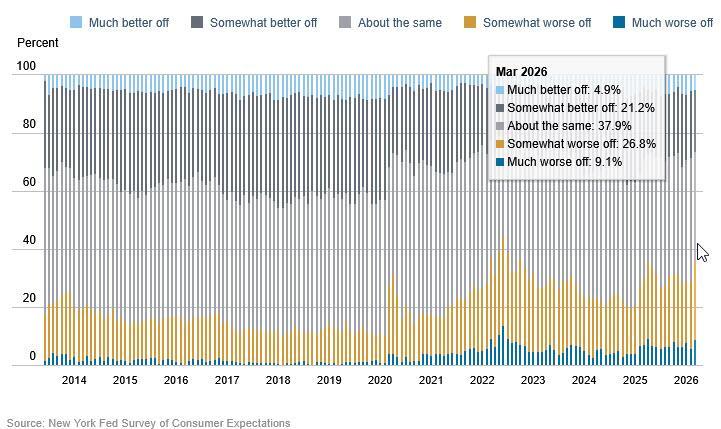
Perceptions of credit access compared to a year ago improved, with a smaller share of households reporting it is harder to get credit and a larger share of households reporting it is easier to get credit. Expectations for future credit availability slightly deteriorated, with the net share of respondents expecting it will be harder to obtain credit in the year ahead increasing.
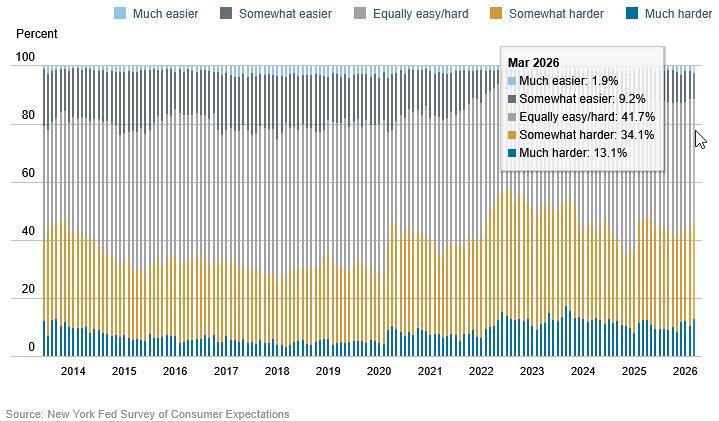
The average perceived probability of missing a minimum debt payment over the next three months increased by 0.7 percentage point to 12.3%, remaining below its 12-month trailing average of 13.2%. The increase was most pronounced for respondents above age 60, those with some college education, and those with annual household incomes below $50,000.
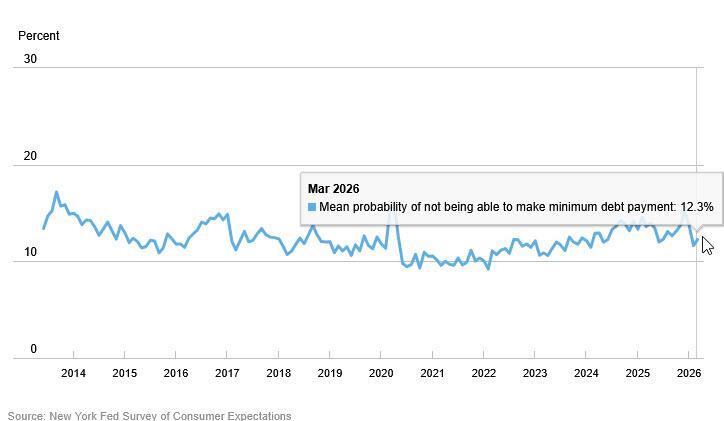
And some more Household Finance observations:
- The median expectation regarding a year-ahead change in taxes at current income level decreased by 0.2 percentage point to 3.1%.
- Median year-ahead expected growth in government debt increased by 0.6 percentage point to 9.8%, remaining well above the 12-month trailing average of 7.4%.
- The mean perceived probability that the average interest rate on saving accounts will be higher in 12 months remained unchanged at 24.9%.
- The mean perceived probability that U.S. stock prices will be higher 12 months from now decreased by 1.6 percentage points to 36.3%.
USA ECONOMIC REPORTS
The Debt Spiral Ends In Dollar Destruction: 6 Hard Truths America Can No Longer Ignore
by Tyler Durden
Monday, Apr 06, 2026 – 03:20 PM
Authored by Nick Giambruno via Doug Casey’s International Man,
“Whenever governments are granted power to purchase their own debt, they never fail to do so, eventually destroying the value of the currency.” – Ron Paul
Let’s take a step back and look at the big picture so we can assess the US government’s financial situation, where it’s likely headed, and what these trends could mean.

Observation #1: It’s Politically Impossible To Cut Spending
Among the biggest expenditures for the US government are so-called entitlements like Social Security and Medicare.
It’s unlikely any politician will cut entitlements. On the contrary, I expect them to continue growing.
That’s because tens of millions of Baby Boomers – about 22% of the population – will enter retirement in the coming years. Cutting Social Security and Medicare is a sure way to lose an election.
The interest on the federal debt is already the second-largest federal expenditure. In a matter of months, it’s set to exceed Social Security and become the biggest expenditure.

With the most precarious geopolitical situation since World War 2, National Defense—another large expenditure—is unlikely to be cut. Instead, defense spending is all but certain to increase. President Trump has proposed increasing it from $917 billion to $1.5 trillion. The ongoing war with Iran guarantees military spending has nowhere to go but up, way up. The Pentagon has requested an additional $200 billion for starters for the Iran war.
Different types of healthcare and welfare programs also make up a considerable part of the federal budget and are unlikely to be cut.
In short, efforts to reduce expenditures will be meaningless unless it becomes politically acceptable to make chainsaw-like cuts to entitlements, national defense, and welfare while reducing the national debt to lower the interest cost.
In other words, the US would need a leader who—at a minimum—returns the federal government to a limited Constitutional Republic, closes the 128 military bases abroad, ends entitlements, kills the welfare state, and repays a large portion of the national debt.
However, that’s a completely unrealistic fantasy. It would be foolish to bet on that happening.
Here’s the bottom line.
The government cannot even slow the spending growth rate, let alone cut it.
Expenditures have nowhere to go but up—way up.
Observation #2: Ever-Increasing Debt Is the Only Way To Finance Deficits
When faced with a choice, politicians always choose the most expedient option.
In this case, that means issuing more debt rather than making tough budget decisions or explicitly defaulting.
Consider the recurring debt ceiling farce in the US Congress, which has been raised over 100 times since 1944.

In any case, don’t count on increased tax revenue to offset these increases in federal expenditures.
Even if tax rates went to 100%, it still wouldn’t be enough to stop the debt from growing.
According to Forbes, there are around 902 billionaires in the US with a combined net worth of about $6.8 trillion.
The US federal government spent around $7 trillion in FY 2025, and will almost certainly spend a lot more in FY 2026 and beyond.
Even if the US government confiscated 100% of billionaire assets through a wealth tax, it wouldn’t cover even a single year of current federal spending.
And even after confiscating all billionaire wealth, the US government would still have to borrow more than $200 billion to cover FY 2025 spending.
Here’s the bottom line: increasing taxes, even to extreme levels, isn’t going to change the trajectory of this unstoppable trend—even slightly.
The truth is, no matter what happens, the deficits will not stop growing, nor will the debt needed to finance them.
The growth rate is not even going to slow down. It’s going to increase.
That means interest expense on the federal debt will continue exploding higher.
Observation #3: Over Half of US Treasury Debt Matures by 2028
This year, nearly $10 trillion of US Treasuries will mature.
And every bond that comes due has to be refinanced at today’s much higher rates—locking in substantially larger interest costs for years. What used to roll over quietly can now only be rolled over at roughly double the interest cost seen in 2022.
That’s what the chart below is really showing: the easy-money era is over. The “free money” party ended, and now the bill for the last round of stimulus has to be carried—and paid.
More than half of America’s debt will mature by 2028.
Every time US debt is refinanced at higher rates, it adds interest costs to the deficit—costs that have to be financed with even more debt issuance, compounding the problem.
It’s worth noting that about $6.6 trillion of the $9.6 trillion maturing this year—roughly 69%—are short-term T-bills.
That’s typical in a debt crisis. As demand for long-term bonds weakens, investors gravitate to short-term instruments like T-bills instead of 10-year notes and 30-year bonds.
It’s the same pattern you see in emerging-market crises. The market shortens maturities as conditions deteriorate. Only a fool would want to lend a bankrupt government money for the long term.

Observation #4: An Ever-Growing Interest Expense Fuels the Debt Spiral
Annualized interest on the federal debt exceeds $1.2 trillion and is surging higher. That means more than 23% of federal tax revenue is going just to service interest on the existing debt.

Ray Dalio is one of the world’s most successful hedge fund managers.
His success is due to his consistent ability to get the Big Picture right.
He recently said this (emphasis mine):
“We are at a point in which we are borrowing money to pay debt service.
When you keep having debt growth faster than income growth, that means you have debt service encroaching on your spending, and you want to keep spending at the same time.
As that happens, there is a need to get more and more into debt. It accelerates.
We are at the point of that acceleration. We are near that inflection point.”
The financial position of the US government has been gradually deteriorating for decades, so it’s not surprising that many people are complacent. They’ve long heard about the debt problem, and nothing has happened.
However, it is now reaching the tipping point.
That’s because the US government is now borrowing money to pay the interest on the money it has already borrowed, as Dalio noted. Politicians are adding more debt to solve the problems of prior debt. It’s creating a self-perpetuating doom loop.
The federal debt’s interest cost is already higher than the defense budget. It’s on track to exceed Social Security in the coming months and become the biggest in the federal budget.
In short, the skyrocketing interest expense has become an urgent threat to the US government’s solvency.
Observation #5: Surging Interest Expense Forces Fed To Ease Monetary Policy
The soaring interest expense threatens the solvency of the US government and forces the Fed to cut interest rates, buy Treasuries, and implement other monetary easing measures to try to control interest costs.
In the bond market, when demand for a bond falls, the interest rate rises to entice buyers.
However, the federal debt is so extreme that allowing interest rates to rise high enough to entice more natural buyers could bankrupt the US government because of the higher interest costs.
For context, when Paul Volcker raised interest rates above 17% in the early 1980s the US debt-to-GDP ratio was around 30%. Today, it’s north of 123% and rising rapidly.
Today’s higher debt load and accompanying interest expense are why meaningfully higher interest rates are not on the table; the growing interest expense could lead to the US government’s bankruptcy.
That’s a big reason President Trump has stacked the Fed with loyalists who will push for lower interest rates and pursue easy-money policies.
Further, the world isn’t hungry for more US debt right now. It’s an inopportune moment for lackluster demand because supply is exploding higher.
If higher interest rates are off the table and cannot entice more natural buyers, and foreigners aren’t going to step up to the plate, who will finance these growing multi-trillion dollar budget deficits?
The only entity capable is the Federal Reserve, which buys Treasuries with dollars it creates out of thin air.
Observation #6: Ever-Increasing Currency Debasement Is Inevitable
The skyrocketing interest expense forces the Fed to implement interest cost control policies, which inflate the money supply and debase the currency.
As that happens, prices rise.
That causes the US government to spend even more on Social Security and welfare to keep up with the cost-of-living increases. The same is true of defense and other government spending, which adjusts upward for rising prices.
Former Secretary of Defense Robert Gates recently said, “Barely staying even with inflation or worse is wholly inadequate. Significant additional resources for defense are necessary and urgent.”
This compounds the problem because, as government spending rises to account for rising prices, that increased spending can only be financed with more currency debasement.
That’s why ever-increasing currency debasement is the inevitable outcome of the US government’s debt spiral.
It’s a self-perpetuating doom loop from which they cannot escape.

In short, the only way the US government can continue to finance itself is for the Fed to create ever-increasing amounts of fake money.
It brings to mind the phrase: “You can’t taper a Ponzi scheme.”
Financial commentator Max Keiser originally said these simple yet profound words.
A Ponzi scheme is an unsustainable scam that relies on a continuous influx of new money to keep it going.
The scheme collapses if the flow of new money slows down or tapers.
Many believe the Federal Reserve is running what amounts to a giant Ponzi scheme.
That’s because the US government’s obscene spending and skyrocketing debt have reached an inflection point.
The whole system will collapse unless the Fed pumps an ever-increasing amount of new fake money into the system.
It’s like being on a runaway train with no brakes.
Ludwig von Mises, the godfather of free-market Austrian economics, summed up the Fed’s dilemma:
“There is no means of avoiding the final collapse of a boom brought about by credit expansion.
The alternative is only whether the crisis should come sooner as the result of a voluntary abandonment of further credit expansion, or later as a final and total catastrophe of the currency system involved.”
The US government will not voluntarily “abandon credit expansion,” as Mises puts it, because Washington is dependent on issuing increasing amounts of debt to pay for the ever-growing costs of Social Security, national defense, welfare, and interest on the federal debt.
That means their only choice is to debase the US dollar by ever-increasing amounts until, as Mises puts it, the “final and total catastrophe of the currency system involved.”
It’s like a drug addict who needs to keep raising his dose to get the same effect… until he dies of an overdose.
If this trend continues, the damage to your savings, purchasing power, and personal freedom could be far greater than most people imagine. And by the time the crisis is obvious to everyone, taking effective action may be much harder.
That’s why preparing now is so important.
ZH: We agree. Stock up here.
END
HOLLYWOOD/LOS ANGELES
Death Of Hollywood In Two Charts
Tuesday, Apr 07, 2026 – 05:45 AM
The nightmare story for Hollywood is playing out in real time for the world to see, as a century-old entertainment economy implodes and bears all the hallmarks of what happened to Detroit after the auto industry went bust.

A new Wall Street Journal report describes the Hollywood job market as being in “collapse” mode, with employment in the industry down 30% from its late-2022 peak, while behind-the-scenes union workers logged 36% fewer hours last year than in 2022.
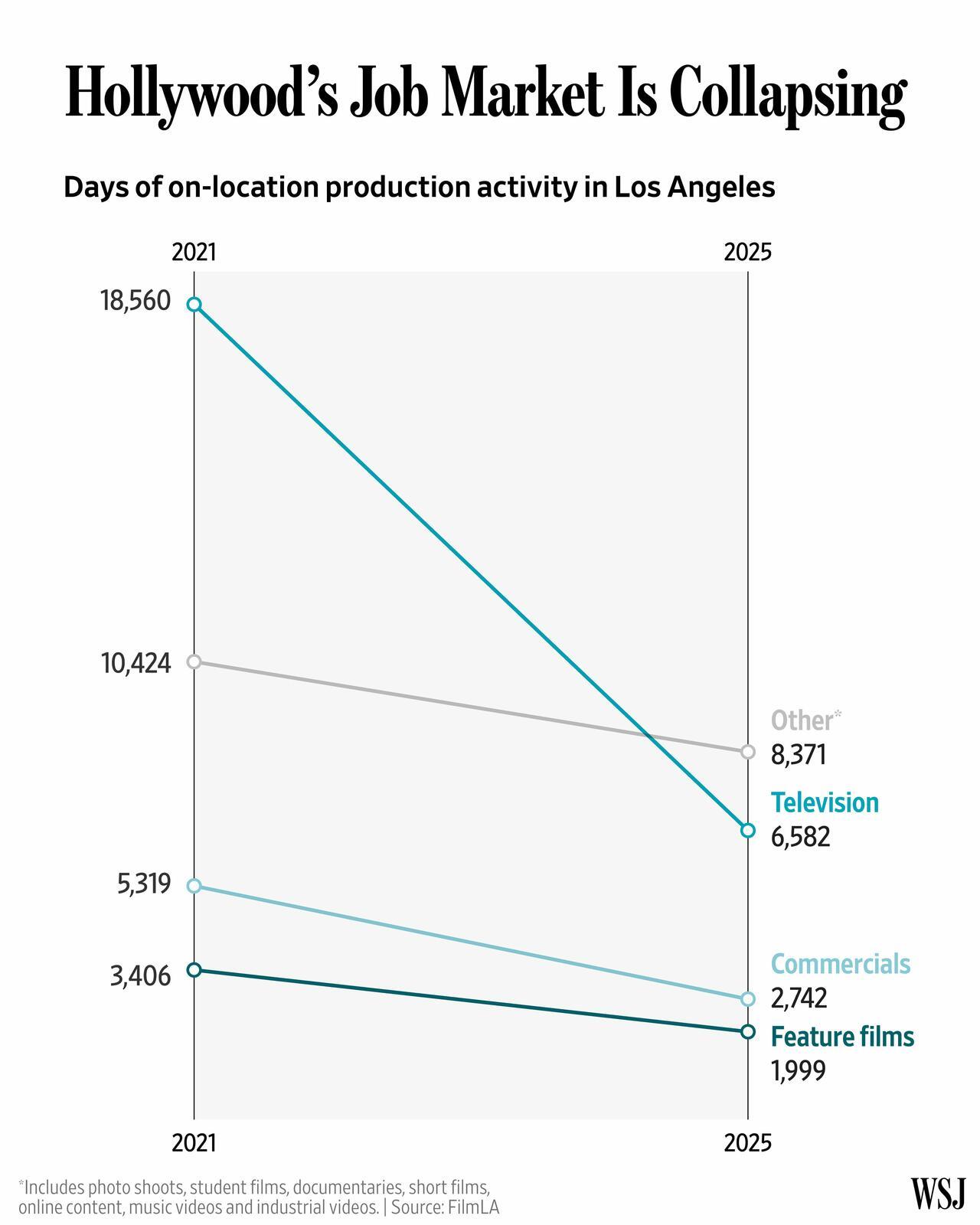
One big reason is that studios are making fewer shows and movies, and more of what they make is being filmed overseas or in other U.S. states that offer better tax incentives.
None of these overseas productions, or productions in other business-friendly states, should come as a surprise given that California is controlled by unhinged, one-party-rule Democratic Party leaders whose state-killing progressive policies have sparked a massive exodus of residents, businesses, and even billionaire tech bros.
The job market collapse in Hollywood has led to increasing calls for a federal production tax credit, with lobbyists linked to studios saying that a 15% federal incentive, on top of state subsidies (which typically range from 20% to 40%), could help break the production bust cycle and reshore more production back to the state.
But tax incentives won’t solve the job crisis on their own. With crazed liberal elites left holding the bag of studio garbage, younger audiences are spending more time on YouTube, TikTok, and Instagram for video consumption, while an increasing number of Americans have boycotted films and TV shows they consider “woke.”
“The biggest question now is whether the current downturn is temporary,” the WSJ report asked.
Well, in WSJ’s own words, the job bust will likely go into hyperdrive in the era of AI …
“Artificial intelligence, meanwhile, could eliminate more production jobs or spark a new production boom if the technology enables content to be made less expensively.”
To sum up, Hollywood’s sphere of left-wing influence is collapsing, and it is no longer taken seriously.
Beyond studios, in the world of corporate media, job losses are mounting for white-collar liberals …
VICTOR DAVIS HANSON
KING NEWS
| The King Report April 7, 2026 Issue 7715 | Independent View of the News |
| US stocks rallied on Monday on hopes and rumors that an Iran-US ceasefire was nigh. Iran Rejects Ceasefire, Demands Permanent End to War: IRNA – BBG 10:42 ET UAE opposes ceasefire that lets Iran ‘hold Strait of Hormuz hostage’ – AJZ 10:42 ET US Official: Iran sent on Monday a 10-point response for the proposal to end the war – Axios US Official on Iran response: Response was maximalist and unclear if it’ll allow moving forward to a diplomatic solution – Axios ESMs opened sharply lower on Sunday night on Iran angst but hit a daily low of 6567.00 at 18:10 ET. ESMs then marched higher until they hit 6652.25 at 5:05 ET. ESMs then traded sideways, with six dips into modestly negative territory and a daily high of 6661.00 (+38.75), into the NYSE close. ESMs closed 6650.75 (+28.50). Trading was listless due to spring vacations and confusion over Iran. Positive aspects of previous session All major indices, ex-the DJUA, closed moderately higher. USMs were +8/32 at 16:30 ET. Negative aspects of previous session May Gasoline and May WTI Oil closed modestly higher Ambiguous aspects of previous session Is the end game on Iran nigh? First Hour/Last Hour NYSE Action [S&P 500 Index]: 1st Hour: Up; Last Hour: Up Pivot Point for S&P 500 Index [above/below indicates daily trend to day traders]: 6603.23 Previous session (S&P 500 Index) High/Low: 6618.13; 6579.72 Trump: “You know who else didn’t help us? South Korea didn’t help us. We’ve got 45,000 soldiers in South Korea to protect them from Kim Jong Un, who I get along with very well. He said very nice things about me. He used to call Joe Biden a mentally… person. https://x.com/unusual_whales/status/2041247254799856039 Trump says Japan, China, South Korea should help reopen Strait of Hormuz “Let the European countries do it…Let South Korea do it,” Trump said during an Easter luncheon at the White House, Yonhap News Agency said. “Let Japan do it. They get 90 percent of the oil from the strait. Let China do it. Let them all do it.”… https://mainichi.jp/english/articles/20260402/p2g/00m/0in/009000c Today – Trump on Sunday extended the Iran deadline by one day: ‘Tuesday, 8:00 P.M. Eastern Time!’ There is NO reason to play today or tomorrow given Trump’s above statements. The US-Iran War could escalate profoundly at any moment, or a peace deal can appear. DO NOT GUESS! Most traders are long are pining for an equity rally. There is a force buoying the stock market. Monday NYSE volume was a 2026 low of 1.1301B shares. It is wise to wait & watch right now! ESMs are -8.25; NQMs are -56.50; USMs are -3/32; gas & oil are up modestly at 20:13 ET. Expected Economic Data Feb Durable Goods -1.2% m/, Ex-Trans +0.4%, Nondef Ex-Air 0.5%, Shipments 0.4%; March NY Fed 1-year Inflation Expectations 3.5% Feb Consumer Credit $10.25B; Chicago Fed Pres Goolsbee 12:35 ET S&P Index 50-day MA: 6778; 100-day MA: 6807; 150-day MA: 6761; 200-day MA: 6648 DJIA 50-day MA: 48,117;100-day MA: 48,104; 150-day MA: 47,533; 200-day MA: 46,739 (Green is positive slope; Red is negative slope S&P 500 Index (6611.83 close) – BBG trading model Trender and MACD for key time frames Monthly: Trender and MACD are positive – a close below 6035.78 triggers a sell signal Weekly: Trender and MACD are negative – a close above 6458.06 triggers a buy signal Daily: Trender and MACD are positive – a close below 6423.50 triggers a sell signal Hourly: Trender and MACD are positive – a close below 6565.70 triggers a sell signal @EricLDaugh: CNN was just forced to report that REPUBLICANS are leading net favorability by +5 points ahead of the 2026 midterms. That is HUGE, given in 2018, Democrats were +12 “Look at this. Party ahead, midterm year with GOP president? Republicans actually AHEAD by 5 points! Democrats are running BEHIND their previous benchmarks.” The Congressional GOP should CAPITALIZE on this, cancel vacation and go pass the SAVE America Act! https://x.com/EricLDaugh/status/2041161341608603688 Trump vows to catch ‘leaker’ who revealed US could not initially reach F-15 pilot in Iran: ‘Give it up or go to jail’ https://trib.al/ppv12n1 @AriFleischer: While Trump, Hegseth and the entire military were working, this is what the left was doing. Fantasizing that Trump was in the hospital. Never forget how deranged and hateful the opposition to Trump truly is. https://x.com/AriFleischer/status/2040838506273026381 Democrat Activist Says ‘Shocking’ Number of Women Prepared to Accuse Eric Swalwell (DEM Rep & CA Gov candidate – and huge DJT hater) of Harassment https://dailycallernewsfoundation.org/2026/04/06/cheyenne-hunt-eric-swalwell-sexual-harassment-allegations-california-democrat-governor-gavin-newsom/ @FCNightingale: The downtown Chicago, Illinois office vacancy rate rose to an all-time high of 28.6%… Almost half of the 40M SF of vacant office space downtown has been available for at least three years. Up from 13.8% when the COVID-19 pandemic began. “Companies cutting back on office space as they adapt to remote work trends have left downtown with a far smaller office tenant base than it had before 2020 and decimated property values, creating rampant distress and scaring off many institutional investors needed to fuel the market’s recovery.” -Crain’s @WallStreetApes: A company was paid more than 6 figures to bring in trucks and setup the No Kings Day protest at the Capitol in St Paul, Minnesota. “We provided the stage, the sound, the lighting and contracted in all the generators and infrastructure and video towers and set them up for the No Kings three rally at the Capitol” “We brought in, oh, about about a hundred speakers, which are kind of over here and all the electrical infrastructure — it had to have been 30 different trucks worth of stuff that came” The company was Slamhammer Sound & Roadcase Co, they talk about the logistics and equipment used during the ‘No Kings’ protest in St Paul, Minnesota on March 28, 2026… https://x.com/WallStreetApes/status/2040862002516787642 “The more corrupt the state, the more numerous the laws.” – Tacitus | |
SWAMP STORIES FOR YOU TONIGHT
GREG HUNTER..
SEE YOU TOMORROW
H


 harveyorganblog.com


