
GOLD $4731.60. 3:30 PM)
EXCHANGE: COMEX
CONTRACT: APRIL 2026 COMEX 100 GOLD FUTURES
SETTLEMENT: 4,657.100000000 USD
INTENT DATE: 04/07/2026 DELIVERY DATE: 04/09/2026
FIRM ORG FIRM NAME ISSUED STOPPED
092 C DEUTSCHE BANK 8
118 C MACQUARIE FUTURES US 2
118 H MACQUARIE FUTURES US 2
323 H HSBC 9
332 H STANDARD CHARTERED B 17
357 C WEDBUSH SECURITIES 1
363 H WELLS FARGO SECURITI 111
555 C BNP PARIBAS SEC CORP 91
624 H BOFA SECURITIES 4
657 C MORGAN STANLEY 3
661 C JP MORGAN SECURITIES 28 11
685 C RJ OBRIEN 23
686 C STONEX FINANCIAL INC 2
709 C BARCLAYS 22
905 C ADM 5 1
TOTAL: 170 170
MONTH TO DATE: 16,433
GOLD: NUMBER OF NOTICES FILED FOR APRIL/2026: 170 CONTRACTs NOTICES FOR 17,000 OZ or 0.5287TONNES
total notices so far: 16,433 contracts for 1,643,300 OR 51.111 tonnes)
SILVER NOTICES: 5 NOTICE(S) FILED FOR 25,000 OZ /
total number of notices filed so far this month : 1440 CONTRACTS (NOTICES) for 7.200 million oz
SILVER//OUTLINE
INITIAL STANDING FOR JANUARY: 22.915 MILLION OZ FOLLOWED BY TODAY’S 1.185 MILLION OZ QUEUE JUMP//NEW NORMAL STANDING ADVANCES TO 49.445 MILLION OZ// TO WHICH WE ADD OUR FIRST EXCHANGE FOR RISK FOR .100 MILLION OZ//NEW STANDING ADVANCES TO 49.545 MILLION OZ!!
INTIAL STANDING FOR FEBRUARY/SILVER: 13.505 MILLION OZ FOLLOWED BY TODAY’S HUGE 0.005 MILLION OZ QUEUE JUMP / : NEW STANDING FOR SILVER AT THE COMEX ADVANCES TO 25.180 MILLION OZ. BUT WE MUST ADD OUR FIRST EXCHANGE FOR RISK OF 25 CONTRACTS FOR .125 MILLION OZ AND THEN OUR SECOND EXCHANGE FOR RISK OF .0600 MILLION OZ TO OUR THIRD HUGE 2.825 MILLION OZ EXCHANGE FOR RISK!!
INITIAL STANDING FOR MARCH: A SURPRISINGLY LOW 31.076 MILLION OZ/ FOLLOWED BY A STRONG QUEUE JUMP OF 42 CONTRACTS OR 0.210 MILLION OZ/NEW STANDING REDUCES TO 46.060 MILLION OZ
INITIAL STANDING FOR APRIL: 7.120 MILLION OZ FOLLOWED BY TODAY’S 85 CONTRACT QUEUE JUMP WHERE 425,000 ADDITIONAL OZ WILL TAKE DELIVERY OVER ON THIS SIDE OF THE POND. NEW STANDING FOR SILVER AT THE COMEX THUS ADVANCES AT 7.795 MILLION OZ
NOW OUR APRIL 2026 CONTRACT MONTH:
JULY: 50.925 MILLION OZ (QUITE SMALL)
AUGUST: 59.455 MILLION OZ (QUITE SMALL)
SEPT. 50.510 MILLION OZ.(QUITE SMALL)
OCT; 82.020 MILLION OZ (WILL BE STRONG THIS MONTH)/ OCC WANTS TO REIN IN THESE ISSUANCES!
NOVEMBER: 36.425 MILLION OZ
DEC: 45.765 MILLION OZ
JANUARY 2026: 134.270 MILLION OZ (WILL BE A VERY STRONG MONTH FOR EXCHANGE FOR PHYSICAL!)
FEB : 82.130 MILLION OZ
MARCH: 56.075 MILLION OZ
APRIL; 8.965 MILLION OZ
AND JULY: 46.720 MILLION OZ//
AUGUST: 4.70 MILLION OZ INITIAL STANDING PLUS TODAY;S 5,000 OZ QUEUE JUMP //NEW STANDING ADVANCES TO 10.960 MILLION OZ
SEPTEMBER: 68.040 MILLION OZ NORMAL DELIVERY(INCLUDES ALL QUEUE JUMPING AND EXCHANGE FOR PHYSICAL TRANSFERS) PLUS 3.0 MILLION OZ EX FOR RISK = 71.040 MILLION OZ. (THIS IS THE FIRST AND ONLY ISSUANCE OF EXCHANGE FOR RISK FOR SILVER SINCE MAY.)
OCTOBER: 39.565 MILLION OZ OF NORMAL DELIVERY INCLUDES ALL QUEUE JUMPING
PLUS
2.110 MILLION OZ EXCHANGE FOR RISK//TOTAL OZ STANDING IN OCT ADVAN
NOVEMBER: INITIAL STANDING AT 11.575 MILLION OZ FOLLOWED BY TODAY’S 195,000 OZ QUEUE JUMP WHICH FOLLOWS ALL OTHER QUEUE JUMPS OF 9.155 MILLION OZ//STANDING ADVANCES TO 19.670 MILLION OZ/
DECEMBER: INITIAL AMOUNT STANDING FOR DELIVERY: 49.33 MILLION OZ// FOLLOWED BY ANOTHER STRONG 835,000OZ QUEUE JUMP+ DEC. FIRST EXCHANGE FOR RISK 0F .850 MILLION OZ + LAST WEEK.S 495,000 OZ EXCHANGE FOR RISK AND THEN A 3RD ISSUANCE IF 1.00MILLION OZ THEN FINALLY DEC 249ISSUANCE OF 1.35 MILLION OZ EXCHANGE FOR RISK//NEW TOTAL EX FOR RIS IS 3.685 MILLION OZ // STANDING ADVANCES TO 68.415 MILLION OZ//
JANUARY: INITIAL STANDING 22.915 MILLION OZ FOLLOWED BY TODAY’S 1.185 MILLION OZ QUEUE JUMP//NORMAL STANDING ADVANCES TO 49.445 MILLION OZ// TO WHICH WE ADD OUR FIRST EXCHANGE FOR RISK OF 0.100 MILLLION OZ//NEW STANDING ADVANCES TO 49.545 MILLION OZ
FEB: 13.399 MILLION OZ IS OUR INITIAL STANDING FOR SILVER! TO WHICH WE ADD OUR NEXT QUEUE JUMP FOR 5,000 OZ AND THEN ADD OUR 3 EXCHANGE FOR RISK FOR 3.010 MILLION OZ STANDING ADVANCES TO 28.190 MILLION OZ!!
MARCH: INITIAL AMOUNT OF SILVER STANDING IS 31.076 MILLION OZ FOLLOWED BY A FINAL 0.210 MILLION OZ QUEUE JUMP //NEW TOTAL STANDING ADVANCES TO 46.060 MILLION OZ
APRIL 2026: INITITAL AMOUNT OF SILVER STANDING 7.120 MILLION OZ FOLLOWED BY TODAY’S 425,000 OZ QUEUE JUMP//NEW STANDING ADVANCES TO 7.795 MILLION OZ
- MAY: SUMMARY FOR MAY TONNES WHICH STOOD FOR DELIVERY:
4. AUGUST: 60.547 TONNES OF INITIAL GOLD FIRST DAY NOTICE FOLLOWED BY THE NET MONTH’S QUEUE JUMP OF 47.2312 TONNES TO WHICH WE ADD THE FOLLOWING EXCHANGE FOR RISK ISSUANCE RECEIVED FOR THE MONTH: 5.4432 TONNES EX FOR RISK/AUG 7 , AUG 11: 2.413 TONNES EX FOR RISK AND AUG. 12 OF 2.
5.SEPT: INITIAL 8.093 TONNES OF GOLD PLUS TODAY’S QUEUE JUMP OF 0.4883 TONNES PLUS 2.2827 TONNES OF EXCHANGE FOR RISK TODAY//NEW TOTAL EX. FOR RISK/MONTH = 22.923//NEW TOTAL STANDING FOR GOLD SEPT ADVANCES TO = 48.801 TONNES!!
6.OCTOBER: 90.012 TONNES OF INITIAL GOLD STANDING WITH TODAY’S TINY 0.00311 TONNES QUEUE JUMP WHICH FOLLOWS ALL OTHER QUEUE JUMPS DURING OCT OF 76.1656 TONNES
THEN WE MUST ADD OUR 14.553 TONNES OF OUR ISSUANCE OF EXCHANGE FOR RISK/6 OCCASIONS//NEW TOTAL OF GOLD STANDING ADVANCES TO 197.5141 TONNES OF GOLD.
7.NOVEMBER BEGINS WITH 15.651 TONNES INITIALLY STANDING FOR DELIVERY FOLLOWED BY TODAY’S QUEUE JUMP OF 2.323 TONNES FOLLOWED BY ALL PREVIOUS QUEUE JUMPS IN OF OF 21.3775 TONNES TO WHICH WE ADD OUR TWO EXCHANGE FOR RISK ISSUANCE OF 4.5596 TONNES//NEW STANDING ADVANCES TO 43.9716 TONNES OF GOLD.
8. DECEMBER BEGINS WITH INITIAL STANDING OF 83.813 TONNES OF GOLD FOLLOWED BY TODAY’S 0.0TONNE QUEUE JUMP WHICH FOLLOWS ALL OTHER QUEUE JUMPS OF: 37.163 TONNES//NEW STANDING ADVANCES TO 115.390 TONNES TO WHICH WE ADD OUR 4 EXCHANGE FOR RISK FOR DECEMBER OF 6.587 TONNES/NEW STANDING ADVANCES TO 121.977 TONNES
9. JANUARY: INITITAL STANDING: 13.785 TONNES TO WHICH WE ADD OUR FIRST EXCHANGE FOR PHYSICAL TRANSFER OF 0.08709 TONNES WHICH FOLLOWS ALL OTHER QUEUE JUMPS OF 30.7117TONNES //NEW TOTAL QUEUE JUMPS 30.7117//NORMAL DELIVERY OF GOLD ADVANCES TO 36.8958 TONNES TO WHICH WE ADD OUR SIX EXCHANGE FOR RISK OF 22.315 TONNES//NEW STANDING ADVANCES TO 59.2108 TONNES.
FEB; INITIAL AMOUNT OF GOLD STANDING FOR DELIVERY: 93.567 TONNES OF GOLD TO WHICH WE ADD OUR NEXT 0.0248 TONNES 0.1555 TONNES QUEUE JUMP TO 41.2082 TONNES/ NEW NET QUEUE JUMP INCREASES TO 41.233 TONNES// AND THEN WE ADD OUR SIX EXCHANGE FOR RISK: 10,080 CONTRACTS OR 31.251 TONNES//NEW STANDING REDUCES TO 157.878 TONNES
MARCH:: INITIAL AMOUNT OF GOLD STANDING FOR DELIVERY: 8.099 TONNES TO WHICH WE ADD TODAY’S FAIR 4600 OZ QUEUE JUMP (0.2320 TONNES) AND THEN WE ADD OUR THREE EXCHANGE FOR RISK OF 22.3818 TONNES //NEW STANDING ADVANCES TO 67.6648 TONNES/
APRIL: INITIAL AMOUNT OF GOLD STANDING FOR DELIVERY: 52.600 TONNES FOLLOWED BY OUR SMALL 30 CONTRACT QUEUE JUMP FOR 3000 OZ//NEW STANDING ADVANCES TO 53.695 TONNES
MARCH:: SMALL INITIAL STANDING FOR GOLD FOR MARCH AT 8.099 TONNES TO WHICH WE ADD TODAY’S FAIR 46 CONTRACT QUEUE JUMP OF 4400 OZ OR 0.2320 TONNESAND THEN WE ADD BY OUR THREE EXCHANGE FOR RISK: 22.3818///NEW STANDING ADVANCES TO 67.6648 TONNES OF GOLD./
APRIL: INITIAL STANDING FOR GOLD; 52.600 TONNES FOLLOWED BY TODAY’S 3000 OZ QUEUE JUMP //NEW STANDING ADVANCES TO 53.695 TONNES.
STANDING FOR THE LAST 4 MONTHS JANUARY TO APRIL:
FINAL STANDING FOR GOLD, JANUARY CONTRACT AT 59.2108 TONNES OF GOLD
FEBRUARY: INITIAL STANDING FOR GOLD: 157.878 TONNES!! WHICH INCLUDES ALL QUEUE JUMPING, THREE EXCHANGE FOR PHYSICAL TRANSFERS TO LONDON AND OUR SIX ISSUANCES EXCHANGE FOR RISK!!
MARCH: INITIAL STANDING AT 8.099 TONNES TO WHICH WE ADD OUR FINAL DAY: 0.2320 TONNES QUEUE JUMP AND THEN ADD +22.3818 TONNES EXCHANGE FOR RISK//NEW STANDING ADVANCES TO 67.6648 TONNES
APRIL: INITIAL STANDING 52.600 TONNES MINUS 3000 OZ QUEUE JUMP (0.0933 TONNES): NEW STANDING ADVANCES TO 53.695 TONNES
JAN. 2025: 257.919 TONNES (ISSUANCE WILL BE PRETTY GOOD THIS MONTH BUT MUCH LOWER THAN LAST MONTH)
FEB: 207.21 TONNES//EX FOR PHYSICAL ISSUANCE (WILL BE A FAIR SIZED ISSUANCE THIS MONTH)
MARCH 130.84 TONNES//QUITE SMALL THIS MONTH.
APRIL; 208.57 TONNES. STRONG THIS MONTH
MAY: 113.499 TONNES OF GOLD EFP ISSUANCE//QUITE SMALL THIS MONTH
JUNE: 97.79 TONNES OF GOLD EFP ISSUANCE/EXTREMELY SMALL
JULY : 150.877 TONNES// QUITE SMALL
AUGUST: 175.86 TONNES A LOT LARGER THIS MONTH.
SEPT. 116.13 TONNES VERY SMALL
OCT. 252.72 TONNES//CERTAINLY MUCH LARGER THIS MONTH/VERY STRONG
NOV: 124.74 TONNES
DEC: 190.04 TONNES//GOOD SIZED THIS MONTH FINAL.
TOTAL EXCHANGE FOR PHYSICAL ISSUED FOR YEAR 2025: 2,026.20 TONNES (LOWER THAN LAST YR 2,569.00 TONNES
JANUARY: 209.08 TONNES ( (WILL BE A STRONG MONTH FOR EXCHANGE FOR PHYSICAL)
FEB. 176.35 TONNES (WHICH IS A FAIR ISSUANCE)
MARCH: 214.67 TONNES//WILL BE STRONG ISSUANCE THIS MONTH
APRIL; 16.793 TONNES// WILL BE VERY SMALL THIS MONTH
HERE IS A BRIEF SYNOPSIS OF HOW THE CROOKS FLEECE UNSUSPECTING LONG
YOU WILL ALSO NOTICE THAT THE COMEX OPEN INTEREST STARTS TO RISE BUT SO IS THE OPEN INTEREST OF SPREADERS. THE OPEN INTEREST IN WILL CONTINUE TO RISE UNTIL ONE WEEK BEFORE FIRST DAY NOTICE OF AN UPCOMING ACTIVE DELIVERY MONTH (OCT), AND THAT IS WHEN THE CROOKS SELL THEIR SPREAD POSITIONS BUT NOT AT THE SAME TIME OF THE DAY. THEY WILL USE THE SELL SIDE OF THE EQUATION TO CREATE THE CASCADE (ALONG WITH THEIR COLLUSIVE FRIENDS) AND THEN COVER ON THE BUY SIDE OF THE SPREAD SITUATION AT THE END OF THE DAY. THEY DO THIS TO AVOID POSITION LIMIT DETECTION. THE LIQUIDATION OF THE SPREADING FORMATION CONTINUES FOR EXACTLY ONE WEEK AND ENDS ON FIRST DAY NOTICE.”
WHAT IS ALARMING TO ME, ACCORDING TO OUR LONDON EXPERT ANDREW MAGUIRE IS THAT THESE EFP’S ARE BEING TRANSFERRED TO WHAT ARE CALLED SERIAL FORWARD CONTRACT OBLIGATIONS AND THESE CONTRACTS ARE LESS THAN 14 DAYS. ANYTHING GREATER THAN 14 DAYS, THESE MUST BE RECORDED AND SENT TO THE COMPTROLLER, GREAT BRITAIN TO MONITOR RISK TO THE BANKING SYSTEM. IF THIS IS INDEED TRUE, THEN THIS IS A MASSIVE CONSPIRACY TO DEFRAUD AS WE NOW WITNESS A MONSTROUS TOTAL EFP’S ISSUANCE AS IT HEADS INTO THE STRATOSPHERE.
The crooks also use the spread in the TAS account (trade at settlement). They buy the spot TAS (e.g. June) and sell the future TAS two months out (e.g. August). Then they unload the front month (i.e. unload the buy side first so the price of gold/silver falls. This occurs in the middle of the front delivery month cycle. They unload the sell side of the equation, two months down the road. The crooks violate position limits as the OCC refuse to hear our complaints.
First, here is an outline of what will be discussed tonight:
SILVER:
1.TODAY WE HAD THE OPEN INTEREST AT THE COMEX IN SILVER ROSE BY A HUGE SIZED 876 CONTRACTS OI TO 115,138 AND CLOSER TOTHE COMEX HIGH RECORD //244,710( SET FEB 25/2020). THE LAST RECORDS WERE SET IN AUG.2018 AT 244,196 WITH A SILVER PRICE OF $14.78/(AUGUST 22/2018)..THE PREVIOUS RECORD TO THAT WAS SET ON APRIL 9/2018 AT 243,411 OPEN INTEREST CONTRACTS WITH THE SILVER PRICE AT THAT DAY: $16.53). AND PREVIOUS TO THAT, THE RECORD WAS ESTABLISHED AT: 234,787 CONTRACTS, SET ON APRIL 21.2017 OVER 7 YEARS AGO. HOWEVER WE HAVE NOW SET A NEW RECORD LOW OF 111,576 CONTRACTS MARCH 20.2026
EFP ISSUANCE 111 CONTRACTS
OUR CUSTOMARY MIGRATION OF COMEX LONGS CONTINUE TO MORPH INTO LONDON FORWARDS AS OUR BANKERS USED THEIR EMERGENCY PROCEDURE TO ISSUE:
MAY 111 CONTRACTS and 0 ALL OTHER MONTHS: ZERO. TOTAL EFP ISSUANCE: 0 CONTRACTS. EFP’S GIVE OUR COMEX LONGS A FIAT BONUS PLUS A DELIVERABLE PRODUCT OVER IN LONDON. IF WE TAKE THE COMEX OI GAIN OF 876 CONTRACTS AND ADD TO THE 111 E.FP. ISSUED
WE OBTAIN A HUGE SIZED GAIN OF 987 OI OPEN INTEREST CONTRACTS FROM OUR TWO EXCHANGES DESPITE OUR LOSS OF $0.89
THUS IN OUNCES, THE LOSS ON THE TWO EXCHANGES TOTALS 5.025 MILLION PAPER OZ
OCCURRED WITH OUR LOSS IN PRICE.OF $0.89
2.ASIAN AFFAIRS APRIL 8 /2025
SHANGHAI CLOSED UP 104.83 PTS OR 2.09%
HANG SENG CLOSED UP 776.49 PTS OR 3.09%
Nikkei CLOSED UP 2892.00 PTS OR 5.42%
//Australia’s all ordinaries CLOSED UP 2.31%
//Chinese yuan (ONSHORE) CLOSED UP 6.8278
/ OFFSHORE CLOSED UP AT 6.8274 Oil DOWN TO 95.66 ollars per barrel for WTI and BRENT DOWN TO 95.51 Stocks in Europe OPENED ALL GREEN
ONSHORE USA/ YUAN TRADING 6.8278 (UP) OFFSHORE YUAN TRADING UP TO 6.8274 ONSHORE YUAN TRADING BELOW OFF SHORE AND UP ON THE DOLLAR// / AND THUS STRONGER/OFF SHORE YUAN TRADING UP AGAINST US DOLLAR/ AND THUS STRONGER
1. COMEX DATA//AMOUNTS STANDING//VOLUME OF TRADING/INVENTORY MOVEMENTS
THE TOTAL COMEX GOLD OPEN INTEREST FELL BY A SMALL 876 CONTRACTS UP TO AN OI OF 354,877 CONTRACT OI , HAVING ADVANCED FROM OUR NEW LOW OI AND SURPASSING THE PREVIOUS ALL TIME LOW IN OI OF 354,581 SET APRIL6/2026. PREVIOUS TO THAT THE ALL TIME LOW IN OI WAS 390,000 SET IN THE YEAR 2001 WHEN GOLD WAS TRADING $260.00. THE CME SHOULD BE PROUD OF THEMSELVES AS MANY HAVE ABANDONED THIS CROOKED ARENA!!THUS OUR NEW ALL TIME LOW OF COMEX OI HAS NOW BEEN SET AT 354,581 WITH GOLD AT AN EXTREMELY HIGH $4,676.00 WHICH MAKES ABSOLUTELY NO SENSE!!!
WE HAD NO T.A.S. LIQUIDATION DURING TUESDAY’S TRADING. IT SEEMS THAT THE SPECULATORS CONTINUED AGAIN TO GO MASSIVELY ON THE SHORT SIDE WITH THE BANKERS TAKING THE LONG SIDE, AS WELL AS COVERING THEIR SHORTFALL, WITH OUR TAS SPREADER LIQUIDATIONS ACCOUNTING FOR THE LOSS IN OI!!!
CENTRAL BANKS ALSO TENDERED THEIR NEW LONG CONTRACTS AT THE END OF THE DAY FOR PHYSICAL GOLD. YOU CAN VISUALIZE THIS WITH THE MASSIVE AMOUNT OF GOLD STANDING AT THE COMEX FOR THIS MARCH CONTRACT MONTH!!
THE SMALL SIZED LOSS ON OUR TWO EXCHANGES OCCURRED WITH OUR SMALL GAIN IN PRICE IN GOLD. THE SPECS HAVE NOW GONE MASSIVELY ON THE SHORT SIDE AGAIN WITH THE BANKERS BUYING UP ALL THEY COULD AND COVERING THEIR SHORTFALL IN GOLD. THE SHORT SPECS WILL BE MURDERLIZED AFTER TODAY;S HUGE GAIN IN PRICE WITH ANNOUNCEMENT OF A CEASEFIRE!.
WE THUS HAD A SMALL LOSS IN OI ON BOTH OF OUR EXCHANGES, THE COMEX AND LONDON’S EXCHANGE FOR PHYSICAL EQUATING TO 593 CONTRACTS (OR 0.255 TONNES) WITH OUR SMALL GAIN IN PRICE, AS WE WERE INFORMED OF A SMALL 40 CONTRACT EXCHANGE FOR PHYSICAL ISSUANCE..
THEN WE WERE NOTIFIED TODAY OF A ZERO CONTRACT EXCHANGE FOR RISK ISSUANCE IN GOLD CONTRACTS FOR 0 OZ OR 0.0 TONNES OF GOLD.
DURING THE MIDDLE OF THE FEBRUARY CONTRACT MONTH, WE HAD TWO IDENTICAL MONSTER 3,000 CONTRACT ISSUED FOR THE SAME 9.33 TONNES OF GOLD, AND THESE WERE THE HIGHEST EVER IN TONNAGE EVER ISSUED BY THE COMEX. ALTOGETHER THE TOTAL ISSUANCE FOR FEB TOTALLED SIX.(31.251 TONNES).
MARCH:
THURSDAY MARCH 17 WE RECEIVED ITS INITIAL 2000 CONTRACT EXCHANGE FOR RISK ISSUANCE FOR 6.22 TONNES. LAST FRIDAY: 0 ISSUANCE OF EXCHANGE FOR RISK. BUT ON MONDAY MARCH 23 WE RECEIVED NOTICE OF OUR SECOND EXCHANGE FOR RISK ISSUANCE FOR 2,200 CONTRACTS (220,000 OZ OR 6.843 TONNES) AND NOW FRIDAY WITH A MONSTER 2996 CONTRACTS FOR 9.3138 TONNES. THESE THREE ISSUANCES WILL NOW BE ADDED TO THE REGULAR AMOUNT OF GOLD STANDING, I.E. 22.3818 TONNES TO OUR NORMAL GOLD STANDING TO GIVE US WHAT WILL STAND FOR PHYSICAL GOLD FOR MARCH!
APRIL;: 0 EXCHANGE FOR RISK FOR FAR.
A LITTLE HISTORY OF EXCHANGE FOR RISK DECEMBER THROUGH TO APRIL:
IN DECEMBER WE HAVE RECORDED 5 ISSUANCES OF EXCHANGE FOR RISK/4 FOR DEC AND THE LAST ONE ON DEC 31 FOR JANUARY. WE NOW HAVE 3 CHOICES FOR THE RECIPIENT OF THIS ISSUANCE AND IT MUST BE A CENTRAL BANK. YOU WILL RECALL THAT THE BUYER ASSUMES THE RISK OF THAT DELIVERY. (THUS TOTAL EXCHANGE FOR RISK FOR THE MONTH OF DECEMBER IS 6.56 TONNES/4 OCCASIONS.
MONTH OF JANUARY/EXCHANGE FOR RISK
IN JANUARY THEY HAVE 6 TOTAL ISSUANCE : 3.446 TONNES EARLY, THEN JAN 9 ISSUANCE OF 9,331 TONNES AND THEN JAN 16: 0.1996 TONNES JAN 26: 1.499 TONNES, JAN 27: 3.160 AND FINALLY JAN 29: 4.659 TONNES TONNES//TOTAL EXCHANGE FOR RISK JANUARY 22.315 TONNES WHICH WAS ADDED TO OUR NORMAL DELVERIES.
AND FEBRUARY:
FEB EXCHANGE FOR RISK: NOW 6 ISSUANCES: 10,080 CONTRACTS FOR 1,008,000 OZ OR 31.251 TONNES!
HERE ARE THE CHOICES FOR THE RECIPIENT OF THOSE ISSUANCES:
1 THE CENTRAL BANK OF ENGLAND. BUT THEY RECEIVED CLEARANCE THAT THEIR GOLD IS BACK SO IT IS NOT LIKELY THAT THEY WOULD LIKE TO ADD TO THEIR RESERVES.
2. THE CENTRAL BANK OF THE USA: THE FED. LOGICAL CHOICE AS THEY CLAMOUR TRYING TO REDUCE THEIR 106+ TONNES OF SHORTAGE. HOWEVER THEY SEEM NOT TO BE IN A HURRY TO COVER THEIR HUGE SHORTFALL
3. THE CENTRAL BANK OF CHINA AS THEY BATTLE WITS WITH THE USA.
TOTAL EXCHANGE FOR RISK FOR DECEMBER IS 6.56 TONNES AND THIS WAS ADDED TO OUR NORMAL DELIVERY TOTALS..
THE JANUARY ISSUANCE OF 17.656 TONNES WAS ADDED TO OUR DAILY DELIVERY TOTALS!!
FEBRUARY ISSUANCES 6 FOR; 31.251 TONNES !! AND THIS WAS ADDED TO OUR DELIVERY TOTALS FOR THIS MONTH.
MARCH: CME ANNOUNCES ITS FIRST EXCHANGE FOR RISK FOR 2000 CONTRACTS FOR 200,000 OZ OR 6.22 TONNES OF GOLD DURING THE FIRST WEEK OF MARCH, AND THEN MONDAY, MARCH 22, WE RECEIVED ITS SECOND NOTICE ISSUANCE OF 2200 CONTRACTS OR 220000 OZ (6.843 TONNES). THEN FINALLY WE RECEIVED NOTICE OF OUR THIRD EXCHANGE FOR RISK OF 2996 CONTRACTS OR 9.3188 TONNES. TOGETHER ALL 3 ISSUANCES TOTAL 22.3818 TONNES WHICH WILL BE ADDED TO OUR NORMAL DELIVERY SCHEDULE.
APRIL: 0 EXCHANGE FOR RISK SO FAR.
DETAILS ON OUR NEW APRIL COMEX CONTRACT MONTH//
IN TOTAL WE HAD A SMALL SIZED LOSS ON OUR TWO EXCHANGES OF 593 CONTRACTS DESPITE OUR SMALL GAIN IN PRICE ($5.25). HOWEVER, OUR FRIENDLY PHYSICAL LONDON BOYS HAD ANOTHER FIELD DAY AGAIN THROUGHOUT THIS WEEK AS THEY WERE READY FOR THE FRBNY.S CONTINUED ORCHESTRATED ATTACKS VERY EARLY IN THE COMEX SESSIONS AS THEY TRIED TO ABSORB EVERYTHING IN SIGHT FROM THEIR DAILY ATTACKS. LONDONERS EXERCISED THEIR BOUGHT CONTRACTS FOR PHYSICAL GOLD VIA THE EXCHANGE FOR PHYSICAL ROUTE AND THANKED THE FRBNY AND OUR SHORT SPECULATORS FOR THE THOUGHTFULNESS.
LONDON ANNOUNCED EARLY IN THE YEAR (AND SCARCITY CONTINUES TO THIS DAY) THAT THEY WERE OUT OF GOLD. WRONGLY IT WAS ATTRIBUTED TO THEIR SHIPPING PHYSICAL GOLD TO COMEX FOR STORAGE DUE TO TRUMP’S INITIATION OF TARIFFS. THE TRUTH OF THE MATTER IS THAT THIS GOLD LEFT LONDON TO OTHER CENTRAL BANKS, AND COMEX BANKS HAVE BEEN PAPERING THEIR LOSSES (DERIVATIVE) WITH KILOBAR ENTRIES. BOTH COMEX AND LBMA ARE WITNESSING MASSIVE AMOUNTS OF GOLD LEAVING THEIR VAULTS.
THE LIQUIDATION OF T.A.S. CONTRACTS THROUGHOUT THE MONTHS OF JUNE THROUGH APRIL/ CONTINUES TO DISTORT OPEN INTEREST NUMBERS GREATLY ALTHOUGH THE T.A.S. ISSUANCES IN GOLD HAVE GENERALLY BEEN ON THE LOW SIDE COMPARED TO SILVER WHICH HAVE BEEN HUGE. TODAY’S NUMBER IS A FAIR SIZED T.A.S ISSUANCE CONTRACTS .THE CME NOTIFIES US THAT THEY HAVE ISSUED 1243 T.A.S CONTRACTS. THESE ARE GENERALLY USED FOR RAID PURPOSES TO STOP GOLD’S RISE AND TO TEMPER HUGE LOSSES IN OTC DERIVATIVE BETS AND IT WAS IN FULL FORCE DURING THIS WEEK WITH MUCH FAILURE DURING LONDON LBMA/OTC OPTION EXPIRY WEEK!! (APRIL FIRST DAY NOTICE)
IT SURE LOOKS LIKE THE BIS HAS SOMEHOW LOOKED THE OTHER WAY WITH ITS GOLD SWAPS WITH THE FRBNY AS THIS ENTITY FOR THE FED REFUSES THE BIS MARCHING ORDERS TO COVER AND THAT MAY EXPLAIN THE STRONG NUMBER OF T.A.S. ISSUANCES IN DECEMBER , JANUARY AND THROUGHOUT FEBRUARY TO GO ALONG WITH OUR HUGE NUMBER OF EXCHANGE FOR RISK ISSUED DURING THESE MONTHS INCLUDING FEBRUARY’S 6 EXCHANGE FOR RISK WHICH ALSO INCLUDED TWO MONSTER 9.3312 TONNE ISSUANCE (FEB 10 AND FEB 12). TOTAL EXCHANGE FOR RISK/FEB EQUALS 31.251 TONNES!! AND MARCH’S THREE ISSUANCES FOR 22.3818 TONNES! OTHER CENTRAL BANKS ARE PAYING ATTENTION AS THEY TAKE DELIVERY OF HUGE AMOUNTS OF PHYSICAL GOLD.
FOR MARCH WE HAVE 3 EXCHANGE FOR RISK ISSUANCES SO FAR FOR 7196 CONTRACTS OR 719,600 OZ/22.3818 TONNES.. AS DELIVERIES OF GOLD THESE PAST SEVERAL MONTHS HAVE BEEN HUGE!!
APRIL: 0 SO FAR HAVE BEEN ISSUED
HERE IS A SUMMARY OF GOLD STANDING FOR DELIVERY ON OUR LAST 12 MONTHS:
- FOR APRIL AT 209 TONNES
2. AND THIS CONTINUED INTO MAY WITH FINAL STANDING AT 90.23 TONNES.
3. JUNE WHICH IS A HUGE DELIVERY MONTH , FINAL STANDING WAS RECORDED AT A STRONG 93.085 TONNES. //(TOTAL NET QUEUE JUMPING FOR THE JUNE MONTH: 31.027 TONNES.)
4. IN JULY WE HAD HUGE DELIVERY NOTICES ESPECIALLY FOR A NON ACTIVE DELIVERY MONTH WITH INITIAL STANDING AT 17.947 TONNES PLUS MANY QUEUE JUMPS + 3.75 TONNES EX FOR RISK = 41.106 TONNES OF GOLD // FINAL TOTAL TONNES STANDING JULY: 41.106 TONNES
5. FOR THE MONTH OF AUGUST:
INITIAL AMOUNT OF GOLD STANDING FOR AUGUST: 60.547 TONNES PLUS THE MONTHS HUGE QUEUE JUMPS OF 47.2312 TONNES +44.696 TONNES EX FOR RISK (7 ISSUANCES) //NEW STANDING 152.208 TONNES WHICH IS MONSTROUS!!!
6. FINAL AMOUNT OF GOLD STANDING FOR SEPT; INITIAL STANDING; 2,602 CONTRACTS OR 260,200 OZ FOR 8.093 TONNES OF GOLD FOLLOWED BY TODAY’S 0.4883 TONNES QUEUE JUMP TO GO ALONG WITH TODAY’S 1.244 TONNES OF EXCHANGE FOR RISK ISSUANCE TODAY AND // TOTAL EXCHANGE FOR RISK ISSUANCE SEPT: 22.923 TONNES//NEW TOTALS STANDING ADVANCES TO 48.801 TONNES OF GOLD!!!
7. OCTOBER:
OCTOBER: INITIAL STANDING FOR GOLD: 90.164 TONNES TO WHICH WE ADD OUR LATEST OCT 30 QUEUE JUMP OF 0.00311 TONNES WHICH FOLLOWS OCT 29 QUEUE JUMP OF .4096 WHICH FOLLOWS; OCT 28 QUEUE JUMP OF .5069 TONNES WHICH FOLLOWS OCT 27 OF 0.3048 TONNES WHICH FOLLOWS: OCT 24 OF 0.8615 TONNES, FOLLOWING OCT 23 QUEUE JUMP OF 1.695 TONNES OCT 22 JUMP OF 8.622 TONNES WHICH FOLLOWS OCT 21: 3.8600 TONNES TO OCT 20 QUEUE JUMP OF 7.695 TONNE
SUMMARY FOR OCTOBER STANDING:
NOVEMBER WHERE INITIAL AMOUNT OF GOLD STANDING IS REGISTERED AT 15.651 TONNES OF GOLD FOLLOWED BY TODAY’S QUEUE JUMP OF 2 TONNES AND FOLLOWED BY ALL OTHER NOV QUEUE JUMPS OF 21.3775 TONNES TO WHICH WE ADD OUR TWO EXCHANGE FOR RISK ISSUANCE FOR 4.5596 TONNES.
/STANDING ADVANCES TO 43.9716 TONNES OF GOLD.
XXXXXXXXXXXXXXXXXXXXXXXXXXXXXXXXXXXXXXXXXXXXXXXXXXXXXXXXXXXXXXXXXXXXXXX
DECEMBER: INITIAL AMOUNT OF GOLD STANDING FOR DELIVERY IN THIS ACTIVE MONTH IS 83.813 TONNES FOLLOWED BY TODAY’S 0.XXXX TONNES QUEUE JUMP. THIS FOLLOWS ALL OTHER QUEUE JUMPING: 37.163 TONNES//NEW STANDING ADVANCES TO 115.390 TONNES TO WHICH WE ADD OUR FOUR EXCHANGE FOR RISK ISSUANCE OF 6.559 TONNES//NEW STANDING THUS INCREASES TO 121.977 TONNES
JANUARY: INITITAL STANDING: 13.785 TONNES TO WHICH WE ADD OUR QUEUE JUMP OF 0.000 TONNES WHICH FOLLOWS ALL OTHER QUEUE JUMPS OF 30.7117TONNES //NEW TOTAL QUEUE JUMPS 30.7117//NORMAL DELIVERY OF GOLD ADVANCES TO 36.8958 TONNES TO WHICH WE ADD OUR SIX EXCHANGE FOR RISK OF 22.315 TONNES//NEW STANDING ADVANCES TO 59.2108 TONNES.
FEBRUARY: . FEBRUARY: INITIAL STANDING: 93.566 TONNES TO WHICH WE ADD OUR NEXT QUEUE JUMP OF 0.0248 TONNES WHICH MUST BE ADDED ALL OTHER QUEUE JUMPS OF 41.2087 TONNES QUEUE JUMP//TOTAL QUEUE JUMP FOR FEB::ADVANCES TO 41.233 TONNES///STANDING ADVANCES TO 126.628 TONNES TO WHICH WE ADD OUR SIX EXCHANGE FOR RISK OF 31.251 TONNES/NEW STANDING RISES TO 157.879 TONNES
MARCH: INITIAL STANDING FOR GOLD: 8.099 TONNES TO WHICH WE ADD OUR NEXT QUEUE JUMP OF 0.2320 TONNES AND THEN WE ADD OUR THREE EXCHANGE FOR RISK OF 22.3818 TONNES////NEW STANDING FOR GOLD ADVANCES TO: 67.6648TONNES WHICH IS ABSOLUTELY HUGE FOR A NON ACTIVE DELIVERY MONTH!!
AND NOW APRIL 2026: INITIAL STANDING FOR GOLD: 52.600 TONNES FOLLOWED BY TODAY’S SMALL 3000 OZ (0.0933 TONNES) QUEUE JUMP. THUS STANDING FOR GOLD AT THE COMEX ADVANCES TO 53.695 TONNES.
HERE ARE THE AMOUNTS THAT STOOD FOR DELIVERY IN THE PRECEDING 48 MONTHS 2021-2024
DEC 2021: 112.217 TONNES
NOV. 8.074 TONNES
OCT. 57.707 TONNES
SEPT: 11.9160 TONNES
AUGUST: 80.489 TONNES
JULY 7.2814 TONNES
JUNE: 72.289 TONNES
MAY 5.77 TONNES
APRIL 95.331 TONNES
MARCH 30.205 TONNES
FEB ’21. 113.424 TONNES
JAN ’21: 6.500 TONNES.
TOTAL YEAR 2021 (JAN- DEC): 601.213 TONNES
YEAR 2022: STANDING FOR GOLD/COMEX
JANUARY 2022 17.79 TONNES
FEB 2022: 59.023 TONNES
MARCH: 36.678 TONNES
APRIL: 85.340 TONNES FINAL.
MAY: 20.11 TONNES FINAL
JUNE: 74.933 TONNES FINAL
JULY 29.987 TONNES FINAL
AUGUST:104.979 TONNES//FINAL
SEPT. 38.1158 TONNES
OCT: 77.390 TONNES/ FINAL
NOV 27.110 TONNES/FINAL
Dec. 64.000 tonnes
(TOTAL YEAR 656.076 TONNES)
JAN/2023: 20.559 tonnes
FEB 2023: 47.744 tonnes
MAR: 19.0637 TONNES
APRIL: 75.676 tonnes
MAY: 19.094 TONNES + 1.244 tonnes of exchange for risk = 20.338
JUNE: 64.354 TONNES
JULY: 10.2861 TONNES
AUGUST: 38.855 TONNES(INCLUDING .6842 EXCHANGE FOR RISK)
SEPT: 15.281 TONNES FINAL
OCT. 35.869 TONNES + 1.665 EXCHANGE FOR RISK =37.0355 tonnes
NOV: 18.7122 TONNES + 16.2505 EX. FOR RISK = 34.9627 TONNES
DEC. 47.073 + 4.634 TONNES OF EXCHANGE FOR RISK = 51.707 TONNES
TOTAL 2023 YEAR : 436.546 TONNES
2024/STANDING FOR GOLD/COMEX
JAN ’24. 22.706 TONNES
FEB. ’24: 66.276 TONNES (INCLUDES 1.723 TONNES EX. FOR RISK)
MARCH: 18.8398 TONNES + 1.1695 EX FOR RISK = 20.093 TONNES
APRIL: 2024: 53.673TONNES FINAL
MAY/ 2024 8.5536 TONNES + 3.3716 TONNES EX FOR RISK/= 11.9325
JUNE; 95.578 TONNES. + 1.045 TONNES EXCHANGE FOR RISK =96.623 THIS IS THE HIGHEST RECORDED GOLD STANDING SINCE AUGUST 2022
JULY: 11.692 TONNES
AUGUST 69.602 TONNES//FINAL STANDING
SEPT. 13.164 TONNES.
OCT 39.474 TONNES + + 20.917 TONNES EXCHANGE FOR RISK =60.391 TONNES
NOV . 11.265 TONNES +4.665 TONNES EXCHANGE FOR RISK/TUESDAY + 3.11 TONNES OF EX. FOR RISK/PRIOR = 19.0425 TONNES
DEC: 80.4230 TONNES PLUS DEC MONTH EXCHANGE FOR RISK TOTAL 14.6836 TONNES EQUALS 95.1066 TONNES
total year 2024: 540.30 tonnes
COMEX GOLD TRADING BEGINNING APRIL,. CONTRACT;
THE SPECS/HFT WERE UNSUCCESSFUL IN LOWERING GOLD’S PRICE( IT ROSE BY A HUGE $5.30
WE HAD ZERO T.A.S. SPREADER LIQUIDATION // COMEX SESSION// DESPITE OUR SMALL GAIN IN PRICE , OUR LONG SPECULATORS REMAIN RELENTLESS POURING INTO THE COMEX STARTING TO BUILD ON ITS OI //(OTHER SPECULATORS WENT CONTINUALLY ON THE SHORT SIDE AND THEY WILL BE TORCHERED TODAY!!). OTHER EASTERN CENTRAL BANKS TENDERED FOR PHYSICAL EVERY NIGHT WHICH ALSO EXPLAINS THE HUGE NUMBER OF TONNES OF GOLD THAT STOOD FOR GOLD FOR FEBRUARY’S ACTIVE DELIVERY MONTH (157 TONNES) , MARCH’S STANDING OF 53+ TONNES+ TODAY’S HUGE APRIL’S DELIVERY TOTALS A VERY STRONG 53 + TONNES. HOWEVER HIGH FREQUENCY TRADERS LED OUR SHORT SPECULATORS BY THE NOSE ACCOUNTING FOR THE LOSS IN OI. THIS WAS SET UP FOR THURSDAY’S MASSIVE RAID STARTING RIGHT AFTER TRUMP’S SPEECH TO THE NATION.,( LAST WEDNESDAY NIGHT)
TUESDAY NIGHT//WEDNESDAY MORNING
THE CROOKS COULD NOT STOP OTHER CENTRAL BANK LONGS, SEIZING THE MOMENT, THEY EXERCISED AGAIN FOR PHYSICAL IN A BIG WAY TENDERING FOR PHYSICAL TUESDAY EVENING/WEDNESDAY MORNING AND THUS OUR HUGE NUMBER OF GOLD CONTRACTS STANDING FOR DELIVERY AT THE COMEX. CENTRAL BANKERS WAIT PATIENTLY FOR THE GOLD
A LITTLE REVIEW OF GOLD STANDING THESE PAST 7 MONTHS:
STANDING FOR GOLD OCT THROUGH TO APRIL:
- ANALYSIS// OCT DELIVERY MONTH GOING FROM FIRST DAY NOTICE// OCT COMEX CONTRACT TO FINALIZATION OCT 31:
OCT AT 90.164 TONNES TO BE FOLLOWED BY ALL PREVIOUS QUEUE JUMPS OF 75.696 TONNES WHICH WE ADD OUR 14.553 TONNES EX FOR RISK/6 OCCASIONS:
/ TOTAL STANDING 197.551 TONNE/OCTOBER FINAL//ABSOLUTELY A MONSTER DELIVERY FOR A NORMALLY QUIET OCT MONTH
2. AND NOW NOVEMBER:
NOVEMBER BEGINS WITH A HUGE 15.651 TONNES INITIALLY STANDING FOR DELIVERY FOLLOWED BY OUR TODAY’S QUEUE JUMP OF 2.323 TONNES WHICH FOLLOWED ALL OTHER NOVEMBER QUEUE JUMPS OF 21.3775 TONNES TO WHICH WE ADD OUR TWO ISSUANCES OF EXCHANGE FOR RISK OF 4.5596 TONNES..
NEW STANDING ADVANCES TO 43.9716 ONNES OF GOLD.
3. AND NOW DECEMBER:
3. DECEMBER: INITIAL AMOUNT OF GOLD STANDING FOR DELIVERY: 83.813 TONNES FOLLOWED BY A 0 CONTRACT QUEUE JUMP FOR NIL OZ OR 0.000 TONNES WHICH FOLLOWS OTHER DEC QUEUE JUMPS OF: 0 TONNES///STANDING ADVANCES TO 115.390 TONNES TO WHICH WE ADD OUR FOUR EXCHANGE FOR RISK ISSUANCE OF 6.559TONNES/NEW STANDING ADVANCES TO 121.977TONNES
4. JANUARY:
9. JANUARY: INITITAL STANDING: 13.785 TONNES TO WHICH WE ADD OUR QUEUE JUMP OF 0.000 TONNES WHICH FOLLOWS ALL OTHER QUEUE JUMPS OF 30.7117TONNES //NEW TOTAL QUEUE JUMPS 30.7117//NORMAL DELIVERY OF GOLD ADVANCES TO 36.8958 TONNES TO WHICH WE ADD OUR SIX EXCHANGE FOR RISK OF 22.315 TONNES//NEW STANDING ADVANCES TO 59.2108 TONNES.
10. FEBRUARY: INITIAL STANDING: 93.566 TONNES TO WHICH WE ADD OUR LATEST QUEUE JUMP OF 0.0298 TONNES TO WHICH THIS IS ADDED TO ALL OTHER QUEUE JUMPS OF 41.2082 / NEW QUEUE JUMP ADVANCES TO: 41.233 TONNES//STANDING ADVANCES TO: 126.628 TONNES TO WHICH WE ADD OUR SIX EXCHANGE FOR RISK OF 10,080 CONTRACTS FOR 1,008,000 OZ OR 31.251 TONNES/NEW STANDING ADVANCES TO 157.879 TONNES
MARCH: INITIAL STANDING: 8.099 TONNES TO WHICH WE ADD OUR NEXT QUEUE JUMP OF 0.2320 TO WHICH WE THEN ADD OUR THREE EXCHANGE FOR RISK FOR 22.3818 TONNES// GOLD STANDING ADVANCES TO: 67.6648 TONNES/
APRIL: INITIAL STANDING: A VERY STRONG 52.600 TONNES FOLLOWED BY TODAY’S SMALL 3000 OZ QUEUE JUMP (0.0933 TONNES). THUS STANDING FOR GOLD AT THE COMEX ADVANCES TO 53.695 TONNES
ALL OF THIS WAS ACCOMPLISHED WITH OUR GAIN IN PRICE TO THE TUNE OF $5.25
WE HAD A FAIR XXX CONTRACTS REMOVED FROM THE COMEX TRADES TO OPEN INTEREST (CROOKS)//PRELIMINARY TO FINAL.
NET LOSS ON THE TWO EXCHANGES : 593 CONTRACTS OR 59,300 OZ OR 1.844 TONNES
INITIAL GOLD COMEX
APRIL DELIVERY MONTH
APRIL 8 2026
| Gold | Ounces |
| Withdrawals from Dealers Inventory in oz | nil |
| Withdrawals from Customer Inventory in oz | ENTRIES; 2 a) Brinks 86,839.851 oz (2701 kilobars) b) JPMorgan: 32,151.000 oz (1000 kilobars) total: 118,990.881 oz 3.7011 tonnes |
| Deposit to the Dealer Inventory in oz | 0 ENTRY |
| Deposits to the Customer Inventory, in oz | DEPOSITS/CUSTOMER 1 ENTRY DEPOSITS 1 BRINKS ENHANCED: 8099.95 OZ 20 GOOD LONDON DELIVERY BARS xxxxxxxxxxxxxxxxI |
| No of oz served (contracts) today | 170 CONTRACTS OR 17,000 OZ 0.5227 TONNES OF GOLD |
| No of oz to be served (notices) | 830 Contracts 83000 OZ 2.5816 TONNES |
| Total monthly oz gold served (contracts) so far this month | 16,433 notices 1,643300 oz 51.111 TONNES |
| Total accumulative withdrawals of gold from the Dealers inventory this month | NIL oz |
| Total accumulative withdrawal of gold from the Customer inventory this month |
dealer deposits: 0
DEPOSITS/CUSTOMER
1 ENTRY
DEPOSITS 1
BRINKS ENHANCED: 8099.95 OZ
20 GOOD LONDON DELIVERY BARS
customer withdrawals:
ENTRIES; 2
a) Brinks 86,839.851 oz (2701 kilobars)
b) JPMorgan: 32,151.000 oz (1000 kilobars)
total: 118,990.881 oz
3.7011 tonnes
comex is draining of gold/.
they are draining the comex of gold
xxxxxxxxxxxxxxxxxxxxxxxxxxxxxxxxxxxxxxxxxx
ADJUSTMENTs
ADJUSTMENTS dealer to customer
adjustments: / / 3
ADJUSTMENTS 1//DEALER TO CUSTOMER
a) Asahi 8603.095 oz
b) Brinks: 175,373.613 oz
c) Manfra: 20,367.703 oz
total loss of gold from dealer: 204,344.461 oz (6.355 TONNES)
COMEX IS DRAINING GOLD
chaos inside the comex
THE FRONT MONTH OF APRIL OI STANDS AT 1000 CONTRACTS HAVING A LOSS OF 900 CONTRACTS.
WE HAD 930 CONTRACTS SERVED UPON TUESDAY SO WE GAINED 30 CONTRACTS. THUS 3000 OZ OF ADDITIONAL GOLD WILL STAND ON THIS SIDE OF THE BORDER AND THIS EQUATES TO 0.0933 TONNES.
MAY LOST 403 CONTRACTS TO AN OI OF 4164
JUNE IS A HUGE DELIVERY MONTH AND HERE THE OI ROSE BY A SMALL 133 CONTRACTS DOWN TO AN OI OF 266,099
We had 170 contracts filed for today representing 17,000 oz
Today, 0 notice(s) were issued from J.P.Morgan dealer and 28 notices issued from their client or customer account. The total of all issuance by all participants equate to 11 contract(s) of which 170 notices were stopped (received) by j.P. Morgan dealer and 0 notice(s) was (were) stopped (received) by J.P.Morgan//customer account
To calculate the INITIAL total number of gold ounces standing for APRIL. /2026. contract month, we take the total number of notices filed so far for the month (16,433) to which we add the difference between the open interest for the front month of APRIL (1000 CONTRACTS) minus the number of notices served upon today 170 x 100 oz per contract) equals 1,726,300 OZ OR (53.695Tonnes of gold)
thus the INITIAL standings for gold for the APRIL contract month: No of notices filed so far (16,433 x 100 oz +we add the difference for front month of APRIL (1000 OI} minus the number of notices served upon today (170 )x 100 oz) which equals 1,726,300 OZ OR 53.695 TONNES//
new total of gold standing in APRIL is 53.695 TONNES//
TOTAL COMEX GOLD STANDING FOR APRIL 53.695 TONNES TONNES WHICH IS NOW HUGE FOR THIS NORMALLY VERY ACTIVE ACTIVE DELIVERY MONTH OF APRIL.
confirmed volume TUESDAY confirmed 155,779 poor
COMEX GOLD INVENTORIES/CLASSIFICATION
NEW PLEDGED GOLD:
241,794.285 oz NOW PLEDGED /HSBC 5.94 TONNES
204,937.290 OZ PLEDGED MANFRA 3.08 TONNES
83,657.582 PLEDGED JPMorgan no 1 1.690 tonnes
265,999.054, oz JPM No 2
1,152,376.639 oz pledged Brinks/
Manfra: 33,758.550 oz
Delaware: 193.721 oz
International Delaware:: 11,188.542 oz
total pledged gold: 1,878,352.072 oz 58.42 tonnes pledged gold lowers
total inventories in gold declining rapidly
total pledged gold: 1,878,352.072 tonnes oz 58.42 tonnes
TOTAL OF ALL GOLD ELIGIBLE AND REGISTERED GOLD 30,714,986.475 oz
TOTAL REGISTERED GOLD 16,044,364.0 or 499.047 Tonnes
TOTAL OF ALL ELIGIBLE GOLD 14,670,626.655 oz//eligible gold leaving hand over fist
REGISTERED GOLD THAT CAN BE SERVED UPON 14,166,012 oz ((REG GOLD- PLEDGED GOLD)=
440.622 Tonnes //
total inventories in gold declining rapidly
SILVER COMEX
APRIL DELIVERY MONTH
APRIL8
| Silver | Ounces |
| Withdrawals from Dealers Inventory | NIL oz |
| Withdrawals from Customer Inventory | 2 entries i) Out of Brinks 604,747.040 oz ii) Out of Loomis: 601,179.410 oz total withdrawal 1,205,926.450 oz |
| Deposits to the Dealer Inventory | 0 entries xxxxxxxxxxxxxxxxxxxxxxxxxxxxxx |
| Deposits to the Customer Inventory | DEPOSIT ENTRIES/CUSTOMER ACCOUNT 1 ENTRIES i) Into CNT 39,530.930 oz total deposit 39,530.930 oz |
| No of oz served today (contracts) | 5 CONTRACT(S) ( 25,000 OZ |
| No of oz to be served (notices) | 119 Contracts (0.595 MILLION oz) |
| Total monthly oz silver served (contracts) | 1440 contracts 7.200 MILLION oz |
| Total accumulative withdrawal of silver from the Dealers inventory this month | NIL oz |
| Total accumulative withdrawal of silver from the Customer inventory this month |
DEPOSITS INTO DEALER ACCOUNTS
0 entries
DEPOSIT ENTRIES/CUSTOMER ACCOUNT
DEPOSITS one entry
1 ENTRIES
1 ENTRIES
i) Into CNT 39,530.930 oz
total deposit 39,530.930 oz
xxxxxxxxxxxxxxxxxxxxxxxxx
withdrawals: customer side/eligible
2 entries
i) Out of Brinks 604,747.040 oz
ii) Out of Loomis: 601,179.410 oz
total withdrawal 1,205,926.450 oz
the comex is being drained of silver
the comex is being drained of silver
adjustments:
two adjustments dealer to customer:
a) Asahi 59,974.02 oz
Brinks 40,401.220 oz
total oz leaving dealer to customer 100,375.270 oz
tuesday volume: 50,397 oz
xxxxxxxxxxxxxx
TOTAL REGISTERED SILVER: 77.628 MILLION OZ//.TOTAL REG + ELIGIBLE. 325.073 Million oz
registered silver dropping in numbers
CALCULATIONS FOR THE NEW STANDING FOR SILVER FOR APRIL
silver open interest data:
FRONT MONTH OF APRIL /2026 OI: 124 OPEN INTEREST CONTRACTS FOR A LOSS OF 53 CONTRACTS. WE HAD 138 CONTRACTS SERVED ON TUESDAY, SO WE GAINED 85 CONTRACTS OR 425,000 OZ UNDERWENT A QUEUE JUMP. STANDING THUS ADVANCES TO 7.795 MILLION OZ WHICH IS PRETTY GOOD FOR THIS NORMALLY SMALL NON ACTIVE DELIVERY MONTH OF APRIL
XXX
MAY SAW A LOSS OF 540 CONTRACTS DOWN TO 69,851 CONTRACTS.
JUNE SAW A GAIN OF 102 CONTRACTS UP TO 551 OI CONTRACTS
TOTAL NUMBER OF NOTICES FILED FOR TODAY: 5 or 25,000 oz
CONFIRMED volume; ON TUESDAY; 50,397 poor
AND NOW APRIL. DELIVERIES:
To calculate the number of silver ounces that will stand for delivery in APRIL. we take the total number of notices filed for the month so far at 1440 X5,000 oz = 7.200 MILLION oz
to which we add the difference between the open interest for the front month of APRIL (124) AND the number of notices served upon today (5)x (5000 oz)
Thus the standings for silver for the APRIL 2026 contract month: (1440 )Notices served so far) x 5000 oz + OI for the front month of APRIL (124) minus number of notices served upon today (5 )x 5000 oz equals silver standing for the APRIL..contract month equating to 7.795 MILLION OZ.
NEW STANDING: 7.795 MILLION OZ WHICH IS STRONG FOR A GENERALLY LOUSY DELIVERY MONTH OF APRIL.
We must also keep in mind that there is considerable silver standing in London coming from our longs
There are ONLY 77.628 million oz of registered silver
JPMorgan as a percentage of total silver: 145.541/325.073million: 44.77%
The record level of silver open interest is 234,787 contracts set on April 21./2017 with the price on that day at $18.42. The previous record was 224,540 contracts with the price at that time of $20.44.
BOTH GLD AND SLV ARE MASSIVE FRAUD
APRIL 8/2026/WITH GOLD UP $88.95 TODAY/NO CHANGES IN GOLD AT THE GLD A//:/INVENTORY RESTS AT 1054.419 TONNES
APRIL 7/2026/WITH GOLD UP $5.25 TODAY/HUGE CHANGES IN GOLD AT THE GLD A DEPOSIT OF 3.429 TONNES OF GOLD INTO THE GLD//:/INVENTORY RESTS AT 1054.419 TONNES
APRIL 6/2026/WITH GOLD UP $5.30 TODAY/NO CHANGES IN GOLD AT THE GLD:/INVENTORY RESTS AT 1050.99 TONNES
APRIL 2/2026/WITH GOLD DOWN $132.75 TODAY/HUGE CHANGES IN GOLD AT THE GLD:A DEPOSIT OF 3.714 TONNES OF GOLD INTO THE GLD/INVENTORY RESTS AT 1050.99 TONNES
APRIL 1/2026/WITH GOLD UP $134.70 TODAY/HUGE CHANGES IN GOLD AT THE GLD:A DEPOSIT OF 1.143 TONNES OF GOLD INTO THE GLD/INVENTORY RESTS AT 1047.276 TONNES
MAR 31/2026/WITH GOLD UP $119.65 TODAY/HUGE CHANGES IN GOLD AT THE GLD:A MASSIVE WITHDRAWAL OF 3.429 TONNES OF GOLD OUT OF THE GLD/INVENTORY RESTS AT 1046.133 TONNES
MAR 30/2026/WITH GOLD UP $33.45 TODAY/HUGE CHANGES IN GOLD AT THE GLD:A WITHDRAWAL OF 3.143 TONNES OF GOLD OUT OF THE GLD/INVENTORY RESTS AT 1049.562
MAR 27/2026/WITH GOLD UP $103.55 TODAY/SMALL CHANGES IN GOLD AT THE GLD:A DEPOSIT OF 0.285 TONNES OF GOLD INTO THE GLD/INVENTORY RESTS AT 1052.705
MAR 26/2026/WITH GOLD DOWN $213.05 TODAY/SMALL CHANGES IN GOLD AT THE GLD:A WITHDRAWAL OF 0.580 TONNES OF GOLD INTO THE GLD/INVENTORY RESTS AT 1052.42
MAR 25/2026/WITH GOLD UP $155.30 TODAY/SMALL CHANGES IN GOLD AT THE GLD:A DEPOSIT OF 0.300 TONNES OF GOLD INTO THE GLD/INVENTORY RESTS AT 1053.000
MAR 24/2026/WITH GOLD DOWN $7.25 TODAY/HUGE CHANGES IN GOLD AT THE GLD:A HUGE WITHDRAWAL OF 4.286 TONNES OF GOLD OUT OF THE GLD/INVENTORY RESTS AT 1052.705
MAR 23/2026/WITH GOLD DOWN $165.65 TODAY/HUGE CHANGES IN GOLD AT THE GLD:A HUGE WITHDRAWAL OF 5.149 TONNES OF GOLD OUT OF THE GLD/INVENTORY RESTS AT 1056.991
MAR 20/2026/WITH GOLD DOWN $39,55 TODAY/HUGE CHANGES IN GOLD AT THE GLD:A HUGE WITHDRAWAL OF 4.855 TONNES OF GOLD OUT OF THE GLD/INVENTORY RESTS AT 1062.135
MAR 19/2026/WITH GOLD DOWN $XXX TODAY/HUGE CHANGES IN GOLD AT THE GLD:A HUGE WITHDRAWAL OF 2.57 TONNES OF GOLD OUT OF THE GLD/INVENTORY RESTS AT 1066.99
MAR 18/2026/WITH GOLD DOWN $111.80 TODAY/HUGE CHANGES IN GOLD AT THE GLD:A HUGE WITHDRAWAL OF 1.144 TONNES OF GOLD OUT OF THE GLD// /// ///INVENTORY RESTS AT 1069.564 TONNES
MAR 17/2026/WITH GOLD UP $6.80 TODAY/HUGE CHANGES IN GOLD AT THE GLD:A HUGE WITHDRAWAL OF 0.857 TONNES OF GOLD OUT OF THE GLD// /// ///INVENTORY RESTS AT 1070.708 TONNES
MAR 16/2026/WITH GOLD DOWN $60.45 TODAY/HUGE CHANGES IN GOLD AT THE GLD:A HUGE WITHDRAWAL OF 4/327 TONNES OF GOLD OUT OF THE GLD// /// ///INVENTORY RESTS AT 1071/.565 TONNES
MAR 13/2026/WITH GOLD DOWN $61.40 TODAY/HUGE CHANGES IN GOLD AT THE GLD:A HUGE WITHDRAWAL OF 1.428 TONNES OF GOLD INTO THE GLD// /// ///INVENTORY RESTS AT 1075.852 TONNES
MAR 12/2026/WITH GOLD DOWN $49.25 TODAY/HUGE CHANGES IN GOLD AT THE GLD:A HUGE DEPOSIT OF 3.715 TONNES OF GOLD INTO THE GLD// /// ///INVENTORY RESTS AT 1077.28 TONNES
MAR 11/2026/WITH GOLD DOWN $70.55 TODAY/HUGE CHANGES IN GOLD AT THE GLD:A HUGE DEPOSIT OF 2.858 TONNES OF GOLD INTO THE GLD// /// ///INVENTORY RESTS AT 1073.565 TONNES
MAR 10/2026/WITH GOLD UP $137.75 TODAY/HUGE CHANGES IN GOLD AT THE GLD:ANOTHER MONSTER WITHDRAWAL OF 2.614 TONNES OF GOLD OUT OF THE GLD// /// ///INVENTORY RESTS AT 1070.707 TONNES
MAR 9/2026/WITH GOLD DOWN $53.80 TODAY/HUGE CHANGES IN GOLD AT THE GLD:ANOTHER MONSTER WITHDRAWAL OF 2.573 TONNES OF GOLD OUT OF THE GLD// /// ///INVENTORY RESTS AT 1073.321 TONNES
MAR 6/2026/WITH GOLD UP $77.25 TODAY/HUGE CHANGES IN GOLD AT THE GLD:ANOTHER MONSTER WITHDRAWAL OF 5.144 TONNES OF GOLD OUT OF THE GLD// /// ///INVENTORY RESTS AT 1075.894 TONNES
MAR 5/2026/WITH GOLD DOWN $49.00 TODAY/HUGE CHANGES IN GOLD AT THE GLD:A WITHDRAWAL OF 18.032 TONNES OF GOLD INTO THE GLD// /// ///INVENTORY RESTS AT 1081.038 TONNES
MAR 4/2026/WITH GOLD UP $9.55 TODAY/HUGE CHANGES IN GOLD AT THE GLD:A WITHDRAWAL OF 2.545 TONNES OF GOLD INTO THE GLD// /// ///INVENTORY RESTS AT 1099.07 TONNES
MAR 3/2026/WITH GOLD DOWN $188.75 TODAY/SMALL CHANGES IN GOLD AT THE GLD:A SMALL DEPOSIT OF 0.35 TONNES OF GOLD INTO THE GLD// /// ///INVENTORY RESTS AT 1101.36 TONNES
MAR 2/2026/WITH GOLD UP $71.00 TODAY/HUGE CHANGES IN GOLD AT THE GLD:A HUGE DEPOSIT OF 3.23 TONNES OF GOLD INTO THE GLD// /// ///INVENTORY RESTS AT 1101,13 TONNES
FEB 27/2026/WITH GOLD UP $52.50 TODAY/SMALL CHANGES IN GOLD AT THE GLD:A SMALL DEPOSIT OF 0.28 TONNES OF GOLD INTO THE GLD// /// ///INVENTORY RESTS AT 1097.90 TONNES
FEB 26/2026/WITH GOLD DOWN $30.25 TODAY/HUGE CHANGES IN GOLD AT THE GLD:A MASSIVE DEPOSIT OF 11.45 TONNES OF GOLD INTO THE GLD// /// ///INVENTORY RESTS AT 1097.62 TONNES
FEB 25/2026/WITH GOLD UP $48.40 TODAY/SMALL CHANGES IN GOLD AT THE GLD:A SMALL WITHDRAWAL OF 0.300 TONNES OF GOLD OUT OF THE GLD// /// ///INVENTORY RESTS AT 1086.17 TONNES
FEB 24/2026/WITH GOLD DOWN $47.40 TODAY/HUGE CHANGES IN GOLD AT THE GLD:A MASSIVE PAPER DEPOSIT OF 7.72 TONNES OF GOLD INTO THE GLD// /// ///INVENTORY RESTS AT 1086.47 TONNES
GLD INVENTORY: 1054.419 TONNES, TONIGHTS TOTAL GOLD INVENTORY
SILVER
APRIL 8 WITH SILVER UP $3.50: NO CHANGES IN SILVER INVENTORY AT THE SLV // :INVENTORY RESTS AT 490.764 MILLION OZ
APRIL 7 WITH SILVER DOWN $0.89: NO CHANGES IN SILVER INVENTORY AT THE SLV // :INVENTORY RESTS AT 490.764 MILLION OZ
APRIL 6 WITH SILVER UP $0.41: TINY CHANGES IN SILVER INVENTORY AT THE SLV:A SMALL WITHDRAWAL OF 0.224 MILLION OZ OUT OF THE SLV // :INVENTORY RESTS AT 490.764 MILLION OZ
APRIL 2 WITH SILVER DOWN $3.57: TINY CHANGES IN SILVER INVENTORY AT THE SLV:A WITHDRAWAL OF 0.091 MILLION OZ OUT OF THE SLV // :INVENTORY RESTS AT 490.988 MILLION OZ
APRIL 1 WITH SILVER UP $1.38: HUGE CHANGES IN SILVER INVENTORY AT THE SLV:A MASSIVE AND WITHDRAWAL OF 0.453 MILLION OZ OUT OF THE SLV // :INVENTORY RESTS AT 491.079 MILLION OZ
MAR 31 WITH SILVER UP $4.22: HUGE CHANGES IN SILVER INVENTORY AT THE SLV:A MASSIVE AND FRAUDULENT WITHDRAWAL OF 3.893 MILLION OZ FROM THE SLV // :INVENTORY RESTS AT 491.532 MILLION OZ
MAR 30 WITH SILVER UP $0.74: NO CHANGES IN SILVER INVENTORY AT THE SLV: // :INVENTORY RESTS AT 495.425 MILLION OZ
MAR 27 WITH SILVER UP $1.91: HUGE CHANGES IN SILVER INVENTORY AT THE SLV: A HUGE WITHDRAWAL OF 3.351 MILLION OZ FROM THE SLV// :INVENTORY RESTS AT 495.425 MILLION OZ
MAR 26 WITH SILVER DOWN $4.75: NO CHANGES IN SILVER INVENTORY AT THE SLV// :INVENTORY RESTS AT 498.776 MILLION OZ
MAR 25 WITH SILVER UP $3.25: NO CHANGES IN SILVER INVENTORY AT THE SLV// :INVENTORY RESTS AT 498.776 MILLION OZ
MAR 24 WITH SILVER DOWN $0.15: HUGE CHANGES IN SILVER INVENTORY AT THE SLV// A MASSIVE AND FRAUDULENT DEPOSIT OF 10.505 MILLION OZ INTO THE SLV :INVENTORY RESTS AT 498.776 MILLION OZ
MAR 23 WITH SILVER UP $0.06: HUGE CHANGES IN SILVER INVENTORY AT THE SLV// NO CHANGE IN INVENTORY/.. ./ :INVENTORY RESTS AT 488.271 MILLION OZ
MAR 20 WITH SILVER DOWN $1.92: HUGE CHANGES IN SILVER INVENTORY AT THE SLV// A WITHDRAWAL OF 2.490 MILLION OZ FROM THE SLV/.. ./ :INVENTORY RESTS AT 488.271 MILLION OZ
MAR 19 WITH SILVER DOWN $6.22: HUGE CHANGES IN SILVER INVENTORY AT THE SLV// A WITHDRAWAL OF 2.9444 MILLION OZ FROM THE SLV/.. ./ :INVENTORY RESTS AT 490.761 MILLION OZ
MAR 18 WITH SILVER DOWN $2.36: HUGE CHANGES IN SILVER INVENTORY AT THE SLV// A DEPOSIT OF 1.087 MILLION OZ FROM THE SLV/.. ./ :INVENTORY RESTS AT 494.792 MILLION OZ.
MAR 17 WITH SILVER DOWN $0.89: HUGE CHANGES IN SILVER INVENTORY AT THE SLV// A WITHDRAWAL OF 3.351 MILLION OZ FROM THE SLV/.. ./ :INVENTORY RESTS AT 493.705 MILLION OZ.
MAR 16 WITH SILVER DOWN $0.57: HUGE CHANGES IN SILVER INVENTORY AT THE SLV// A WITHDRAWAL OF 2.536 MILLION OZ FROM THE SLV/.. ./ :INVENTORY RESTS AT 497.056 MILLION OZ.
MAR 13 WITH SILVER DOWN $3.83: NO CHANGES IN SILVER INVENTORY AT THE SLV// . ./ :INVENTORY RESTS AT 499.592
MAR 12 WITH SILVER DOWN $0.51 HUGE CHANGES IN SILVER INVENTORY AT THE SLV// ANOTHER MONSTER WITHDRAWAL OF 3.713 MILLION OZ OUT OF THE SLV. ./ :INVENTORY RESTS AT 499.592 MILLION OZ
MAR 11 WITH SILVER DOWN $3.96 HUGE CHANGES IN SILVER INVENTORY AT THE SLV// ANOTHER MONSTER WITHDRAWAL OF 1.812 MILLION OZ OUT OF THE SLV. ./ :INVENTORY RESTS AT 503.305 MILLION OZ
MAR 10 WITH SILVER UP $5. HUGE CHANGES IN SILVER INVENTORY AT THE SLV// A MONSTER WITHDRAWAL OF 1.63 MILLION OZ OUT OF THE SLV. ./ :INVENTORY RESTS AT 505.117 MILLION OZ
MAR 9 WITH SILVER DOWN $0.30 HUGE CHANGES IN SILVER INVENTORY AT THE SLV// A MONSTER WITHDRAWAL OF 1.54 MILLION OZ OUT OF THE SLV. ./ :INVENTORY RESTS AT 506.747 MILLION OZ
MAR 6 WITH SILVER UP $2.02 HUGE CHANGES IN SILVER INVENTORY AT THE SLV// A MONSTER WITHDRAWAL OF 5.526 MILLION OZ OUT OF THE SLV. ./ :INVENTORY RESTS AT 508,287 MILLION OZ
MAR 5 WITH SILVER DOWN $0.98 HUGE CHANGES IN SILVER INVENTORY AT THE SLV// A WITHDRAWAL OF 1.097 MILLION OZ INTO THE SLV. ./ :INVENTORY RESTS AT 512.726 MILLION OZ
MAR 4 WITH SILVER DOWN $0.21 HUGE CHANGES IN SILVER INVENTORY AT THE SLV// A DEPOSIT OF 2.545 MILLION OZ INTO THE SLV. ./ :INVENTORY RESTS AT 513.813 MILLION OZ
MAR 3 WITH SILVER DOWN $5.27 HUGE CHANGES IN SILVER INVENTORY AT THE SLV// A WITHDRAWAL OF 2/899 MILLION OZ OUT OF THE SLV. ./ :INVENTORY RESTS AT 511.268 MILLION OZ
MAR 2 WITH SILVER DOWN $3.87 HUGE CHANGES IN SILVER INVENTORY AT THE SLV// A WITHDRAWAL OF 3.352 MILLION OZ OUT OF THE SLV. ./ :INVENTORY RESTS AT 514.167 MILLION OZ
FEB 27 WITH SILVER UP $5.54 SMALL CHANGES IN SILVER INVENTORY AT THE SLV// A DEPOSIT OF 0.544 MILLION OZ OUT OF THE SLV. ./ :INVENTORY RESTS AT 517.519 MILLION OZ
FEB 26 WITH SILVER DOWN $4.05 HUGE CHANGES IN SILVER INVENTORY AT THE SLV// A WITHDRAWAL OF 0.906 MILLION OZ OUT OF THE SLV. ./ :INVENTORY RESTS AT 516.975 MILLION OZ
FEB 25 WITH SILVER UP $3.43 HUGE CHANGES IN SILVER INVENTORY AT THE SLV// A FRAUDULENT PAPER DEPOSIT OF 8.923 MILLION OZ INTO THE SLV. ./ :INVENTORY RESTS AT 517.881 MILLION OZ
FEB 24 WITH SILVER UP $0.55 HUGE CHANGES IN SILVER INVENTORY AT THE SLV// A FRAUDULENT PAPER DEPOSIT OF 10.056 MILLION OZ INTO THE SLV. ./ :INVENTORY RESTS AT 508.958 MILLION OZ
FEB 23 WITH SILVER UP $4.89 HUGE CHANGES IN SILVER INVENTORY AT THE SLV// A FRAUDULENT WITHDRAWAL OF 0.951 MILLION OZ OUT OF THE SLV. ./ :INVENTORY RESTS AT 498.902 MILLION OZ
CLOSING INVENTORY 490.764 MILLION OZ OF SILVER..
1.PETER SCHIFF
2. MATHEW PIEPENBERG/EGON VON GREYERZ
MATHEW PIEPENBURG…
XXX
JOHN RUBINO
ALASDAIR MACLEOD…
JESSE COLUMBO..
The Roadmap For Silver
Silver broke out from a five-decade-old pattern in November, signaling that a powerful bull market is underway, and that is still true despite the recent correction.
| Jesse ColomboApr 8∙Paid |
While we wait for more details to come in about the newly announced two week ceasefire with Iran and the financial markets’ reaction to it, I wanted to share a concise but useful update on the roadmap silver is following in the course of its secular bull market, which is still in its very early stages (learn more). By keeping this roadmap in mind, you will be better equipped to understand and stay optimistic during corrections like the one that occurred over the past couple of months.
As I regularly point out, back in November, silver broke out of a massive cup and handle pattern that had been forming since the 1960s. Based on the sheer size of that pattern, it projects silver reaching several hundred dollars per ounce, with a minimum target range of $300 to $500 during this bull market.
The cup and handle pattern was completed when silver finally surpassed the $50 ceiling, also known as a resistance level, which marked the peaks of the 1970s and 2000s silver bull markets and previously led to sharp declines (learn more). By breaking above that level in November, silver entered a new, extremely bullish phase.
I also want to point out that silver’s former $50 ceiling is now its new floor, or support level. As long as silver remains above it, which it has despite the recent correction, the bull market remains intact. That is one of the many reasons I was not concerned at any point during the correction.

Now I want to zoom in on silver’s weekly chart over the past few years to show why it corrected over the past couple of months and why that pullback is actually healthy, normal behavior that is fully consistent with a powerful bull market.
As the chart shows, in November, silver finally broke through the $50 resistance level that had capped its progress for decades. Fueled by strong momentum after the breakout, it soared as high as $121 in late January. At that point, however, it became overheated, also known as overbought, signaling that a healthy cooling-off period was likely ahead, as I noted at the time.
One way to gauge whether an asset has become overheated is by using the Relative Strength Index, or RSI, which is plotted beneath the price chart. As the chart shows, silver reached extremely overbought levels in late 2025 and early 2026, so the subsequent pullback to relieve that condition was both expected and necessary.
The good news is that silver is no longer overbought and remains above the key $50 support level shown earlier. This means it is in a much healthier state and well set up for the bull market to continue, which, as I explained earlier, should reach at least several hundred dollars per ounce before it runs its course.

To summarize, silver’s November breakout from its five-decade-old cup and handle pattern signals that a powerful bull market is underway, but it also got a bit ahead of itself earlier this year, so a pullback was in the cards to cool off.
The encouraging news is that silver has now successfully worked off its overbought status and is still holding above the $50 level from the cup and handle pattern, which means the breakout was and still is valid despite the recent turbulence, and that silver is now set up to continue its bull market to much higher levels.
Disclaimer: the information provided in The Bubble Bubble Report and related content is for informational and educational purposes only and should not be construed as investment, financial, or trading advice. Nothing in this publication constitutes a recommendation, solicitation, or offer to buy or sell any securities, commodities, or financial instruments.
All investments carry risk, and past performance is not indicative of future results. Readers should conduct their own research and consult with a qualified financial advisor before making any investment decisions. The author and publisher disclaim any liability for financial losses or damages incurred as a result of reliance on the information provided.
END
ALASDAIR MACLEOD..IMPORTANT:
Alasdair Macleod: The Petroyuan Shift Has Begun
As Hormuz oil flows increasingly shift toward yuan settlement, Iran may be forcing the dollar-based energy order into crisis before China even makes its final gold-backed move.
| Alasdair MacleodApr 8 |
Iran is doing more to promote the petroyuan at the expense of the petrodollar than China has achieved so far. It is accelerating the dollar’s demise at its worst possible moment.
Introduction
Unlike America’s current administration, China plans ahead. And unlike most governments whose plans are driven by day-to-day reactions to domestic politics, China’s leaders seem to be able to plan their national interests strategically for the longer term.
In 1983, the People’s Bank was appointed with the sole responsibility for acquiring the nation’s gold and silver and managing national stocks, alongside its responsibilities for foreign exchange and exchange controls. With government policies to promote mining and expand refining capabilities, this led to China rapidly becoming the largest nation by gold mine output in 2007. Having satisfied initial government demand by 2002, when hitherto gold ownership by the public was banned, the ban was finally lifted, and the Shanghai Gold Exchange was born.
The reasons behind these developments were simple. The leadership understood the role of gold in securing the value of credit, having been insulated from the Keynesian revolution in the West. They knew that their industrial revolution must be based on those of the Europeans in the nineteenth century, which proved to be a great economic leap forward based on free markets protected by colonial umbrellas. Having been on the wrong end of British colonial policy with respect to the tea trade, which led to the Opium Wars of 1832 onwards, for China, it was a lesson well learned.
If you regard China’s gold and silver policies in this light, they make sense. But importantly, Britain’s remarkable success leading a small nation to dominate world trade required a currency that was freely exchangeable for gold at a fixed rate. The pound was literally as good as gold. China knew that it would have to accumulate enough gold to emulate Britain’s example.
Apart from what has been declared as official PBOC reserves, China’s true gold holdings remain secret. There are two reasons why this has been necessary. As the principal buyer of bullion from 1983 onwards, it was not in her interests to show her hand in the market. If it was a matter of a few thousand tonnes, this would not have been much of a problem, but in the realms of tens of thousands of tonnes secrecy was vital when the 1981-2002 bear market presented itself as an opportunity to accumulate massive amounts.
Secondly, China was pursuing her gold acquisition policy in a global fiat currency environment with which she had to conform. For the sake of her balance of trade, the yuan’s relations with other currencies and, in particular, the dollar would have to be with a floating rate, rather than one fixed to gold, with the threat that implied to the fiat currency system. Furthermore, with her Confucian philosophy, China was prepared to be patient and not to be associated with the eventual and inevitable downfall of the dollar-based fiat currency system.
Then came Trump
President Trump’s election in November 2023 and his inauguration the following January changed global trade relations, particularly so when last April he revealed a new round of higher trade tariffs against every nation in the world, including China. The following week, President Xi embarked on a tour of ASEAN nations to reaffirm China’s free-trade policies, and China announced that it would accelerate plans for trade agreements with South Korea and Japan, which so far have proved stillborn. But with her ASEAN partners, Xi almost certainly discussed not only tariff-free trade, but trade settlements.
It had been clear for a long time that China was moving away from using dollars to settle trade, and in the light of weaponised US trade tariffs, China made two further important steps. The first was to promote her Cross-border International Payments system (CIPS), which allowed the exchange of all currencies for renminbi without being exchanged for dollars first.
The second step was for the Shanghai Gold Exchange to open a vault in Hong Kong, whose role as China’s international financial centre comes into play, and a further SGE gold vault in Saudi Arabia, the centre of the West Asian oil trade. These two vaulting facilities allowed for the exchange of gold for renminbi only, and vice versa.
Suddenly, the threat to the fiat dollar became obvious. All China now had to do was declare her true gold reserves and fix an exchange rate between the renminbi and a given weight of gold. This final step is now pending.
Iran as China’s proxy
On 28 February, the US and Israel attacked Iran. Iran subsequently and selectively closed the Straits of Hormuz to shipping, which became uninsurable at Lloyds anyway. The relationship between Iran, China, and Russia had led to a trilateral strategic pact in early January, a 20-year comprehensive strategic partnership including military coordination, a shared opposition to Western military dominance and its economic coercion.
Under this agreement, Iran is provided with electronic intel support from China and technical expertise from Russia. In effect, as Ukraine is NATO’s proxy in a war against Russia, and Iran is China’s and Russia’s proxy in a war against the United States. All three nations want to drive US bases out of West Asia, removing them from the Asian continent entirely. As part of the plan, Iran insists that free passage out of the Gulf through Hormuz can be obtained only for cargoes paid for in yuan, effectively ending the petrodollar for all GCC states.
This is seen as an Iranian initiative rather than one planned by China. After all, China didn’t start the war and is not a combatant. But the financial consequences for GCC states are significant. For the last 52 years they have accumulated dollars, only to find that they are now redundant, no more than an investment in a foreign currency and possibly a speculative one at that.
However, this is not the surprise it first appears. In a 2014 Goldmoney interview, which was not published, I was told by a director of a major Swiss refinery that large numbers of LBMA 400-ounce bars were being sent in from the Middle East for refining into the one-kilo 99.99% Chinese standard. Clearly, there was an understanding at least 12 years ago that with respect to energy exports, the region’s future was bound up with China.
It appears that the moment has now come for the GCC members to embrace this reality, to expel US military forces from the region, and to sell down their dollars and underlying assets.
| WEALTH PRESERVATION NOTE |
| Egon von Greyerz·March 28, 2025 |
 |
| IS IT TOO LATE TO JUMP ON THE GOLD WAGON? |
| Read full story |
END
3.CHRIS POWELL AND HIS GATA DISPATCHES:
4. ANDREW MAGUIRE AND LIVE FROM THE VAULT PODCASTS NO 266/265
ANDREW SCHECTMAN//THIS WEEK
end.
5. COMMODITY REPORT//HELIUM..
ASIAN AFFAIRS APRIL 8/2026
YOUR EARLY CURRENCY VALUES/GOLD AND SILVER PRICING/ASIAN AND EUROPEAN BOURSE MOVEMENTS/AND INTEREST RATE SETTINGS WEDNESDAY MORNING.7:30 AM
SHANGHAI CLOSED UP 104.83 PTS OR 2.09%
HANG SENG CLOSED UP 776.49 PTS OR 3.09%
Nikkei CLOSED UP 2892.00 PTS OR 5.42%
//Australia’s all ordinaries CLOSED UP 2.31%
//Chinese yuan (ONSHORE) CLOSED UP 6.8278
/ OFFSHORE CLOSED UP AT 6.8274 Oil DOWN TO 95.66 ollars per barrel for WTI and BRENT DOWN TO 95.51 Stocks in Europe OPENED ALL GREEN
ONSHORE USA/ YUAN TRADING 6.8278 (UP) OFFSHORE YUAN TRADING UP TO 6.8274 ONSHORE YUAN TRADING BELOW OFF SHORE AND UP ON THE DOLLAR// / AND THUS STRONGER/OFF SHORE YUAN TRADING UP AGAINST US DOLLAR/ AND THUS STRONGER
XXXXXXXXXXXXXXXXXXXXXXXXXXXXXXXXXXXXX
YOUR EARLY CURRENCY VALUES/GOLD AND SILVER PRICING/ASIAN AND EUROPEAN BOURSE MOVEMENTS/AND INTEREST RATE SETTINGS WEDNESDAY MORNING.7:30 AM
ONSHORE YUAN: CLOSED UP AT 6.8278
OFFSHORE YUAN: UP TO 6.8274
1.HANG SANG CLOSED UP 776,49 PTS OR 3.09%
2. Nikkei closed UP 2,893.00 PTS OR 5.42%
WEST TEXAS INTERMEDIATE OIL DOWN TO 95.66
BRENT; 95.51
3. Europe stocks SO FAR: ALL GREEN
USA dollar INDEX DOWN TO 98.64/// EURO RISES TO 1.1685 UP 83 BASIS PTS
3b Japan 10 YR bond yield:FALLS TO. +2.368 DOWN 2 FULL BASIS PTS/ VERY TROUBLESOME//Japan buying 100% of bond issuance)/Japanese YEN vs USA cross now at 158.34… JAPANESE YEN NOW FALLING AS WE HAVE NOW REACHED THE ENDING OF THE YEN CARRY TRADE AGAIN AND THE REPATRIATION OF YEN DENOMINATED BONDS TRADING IN THE USA/EUROPE. JAPAN 30 YR BOND YIELD: 3.605 DOWN 16 FULL BASIS PTS
3c Nikkei now ABOVE 17,000
3d USA/Yen rate now well ABOVE the important 120 barrier this morning
3e Gold UP /JAPANESE Yen UP CHINESE ONSHORE YUAN: 6.8278( UP AND OFFSHORE: UP AT 6.8274
3f Japan is to buy INFINITE TRILLION YEN worth of BONDS. Japan’s GDP equals 5 trillion USA
Japan to buy 100% of all new Japanese debt and NOW they will have OVER 50% of all Japanese debt.
3g Oil DOWN for WTI and BRENT DOWN this morning
3h European bond buying continues to push yields LOWER on all fronts in the EMU. German 10yr bund YIELD DOWN TO +2.9232 Italian 10 Yr bond yield DOWN to 3.702// SPAIN 10 YR BOND YIELD DOWN TO 3.361%
3i Greek 10 year bond yield DOWN TO 3.867%
3j Gold at $4795.00 //Silver at: 76.67 1 am est) SILVER NEXT RESISTANCE LEVEL AT $100.00
3k USA vs Russian rouble;// Russian rouble UP 0 AND 4 100 roubles/78.66
3m oil (WTI) into the 95 dollar handle for WTI and 95 handle for Brent/
3n Higher foreign deposits moving out of China// huge risk of outflows and a currency depreciation. This can spell financial disaster for the rest of the world/
JAPAN ON JAN 29.2016 CONTINUES NIRP. THIS MORNING RAISES AMOUNT OF BONDS THAT THEY WILL PURCHASE UP TO .5% ON THE 10 YR BOND///YEN TRADES TO 159.56 10 YEAR YIELD AFTER FIRST BREAKING .54% LAST YEAR NOW EXCEEDS THAT LEVEL TO 2.368% DOWN 2 BASIS PTS STILL ON CENTRAL BANK (JAPAN) INTERVENTION//YEN CARRY TRADE NOW UNWINDING//YEN BOND TRADING OVERSEAS REPATRIATED.//JAPAN 30 YR: 3.605 DOWN 13 PTS..: USA/SF this 0.7880 as the Swiss Franc . Euro vs SF: 0.9207
USA 10 YR BOND YIELD: 4.236 DOWN 11 BASIS PTS…
USA 30 YR BOND YIELD: 4.850 DOWN 7 BASIS PTS/
USA 2 YR BOND YIELD: 3.719 DOWN 11 BASIS PTS
USA DOLLAR VS TURKISH LIRA: 44.53 DOWN 8 BASIS PTS/LIRA GETTING KILLED//IDIOTS FOR SELLING GOLD
10 YR UK BOND YIELD: 4.8040 DOWN 14 PTS
30 YR UK BOND YIELD: 5.342 DOWN 17 BASIS PTS
10 YR CANADA BOND YIELD: 3.487 UP 2 BASIS PTS
5 YR CANADA BOND YIELD: 3.122 UP 2 BASIS PTS.
1a New York Opening report
US Futures, Global Stocks And Bonds Soar On Ceasefire Relief, Oil Plummets
Wednesday, Apr 08, 2026 – 08:26 AM
US futures, global stocks and bonds are sharply higher while oil prices plunge the most in years as a wave of optimism swept through global markets after the US and Iran agreed to a two-week ceasefire in exchange for Tehran reopening the Strait of Hormuz: JPMorgan’s Market Intel desk, which moves from Neutral to Tactically Bullish this morning, says to look for a re-risking in the very near-term albeit it with higher energy prices. As of 8:00am ET, S&P futures are 2.8% higher while emerging-market stocks rallied the most since 2022; Nasdaq gains 3.5% with Mag7 and Semis seeing significant bids as part of an ‘Everything Rally’ ex-Energy. Yet while the overwhelming mood in markets is relief, the same core challenges remain to find a resolution amenable to both countries and Goldman’s Delta-One head says he is selling the rally. Brent plunged 16% to around $93 a barrel. Bonds surged, with 10Y tsy yields sliding 8bps to 4.23% while benchmark UK yields tumbled by 22 basis points. The dollar weakened to a one-month low. Gold and silver gain. The macro data focus today is on the Fed Minutes ahead of PCE and CPI releases later this week.
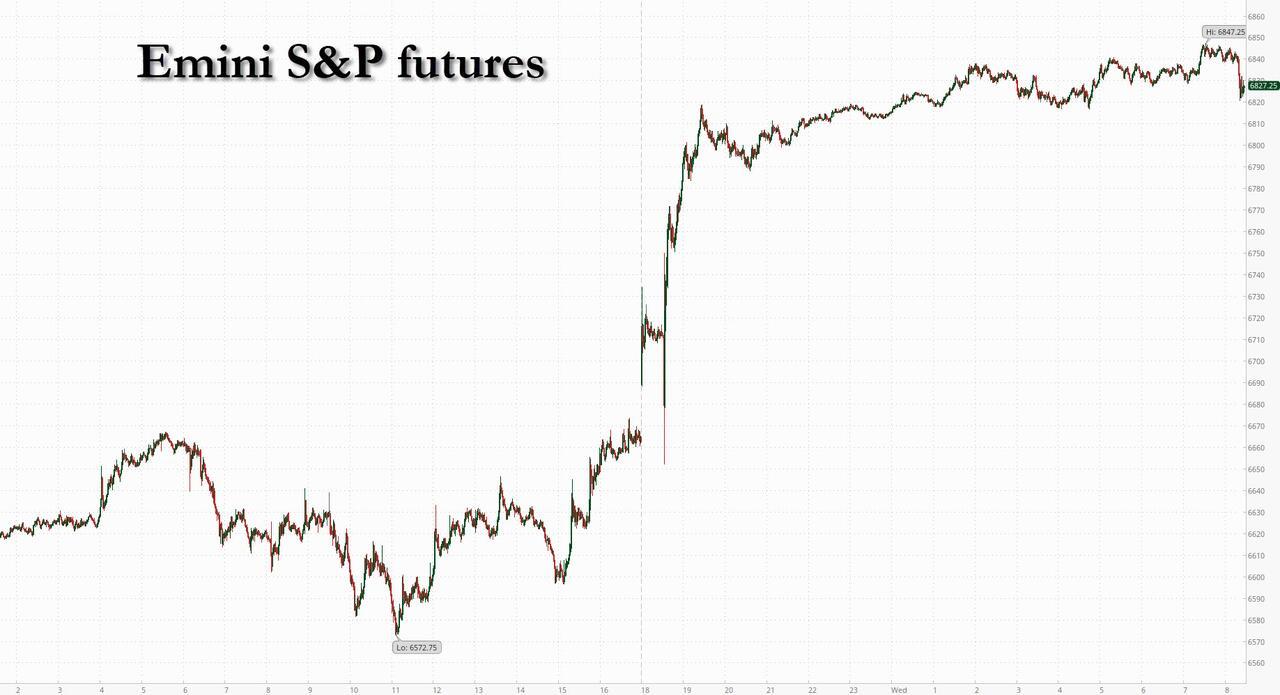
In premarket trading, Mag 7 stocks are all sharply higher: Meta +5%, Tesla +4.5%, Alphabet +4%, Nvidia +3.5%, Amazon +4%, Microsoft +3.3%, Apple +2%
- Gainers also include precious-metal miners and financial firms, while chemical and fertilizer names fall.
- Energy stocks fall due to the ceasefire: Exxon (XOM) -5.3%, Chevron (CVX) -4.3% and Venture Global (VG) -11%
- Airlines rally: United (UAL) +11%, Delta (DAL) +10%
- Aehr Test Systems (AEHR) climbs 8% after the semiconductor manufacturing company reported third-quarter results. The earnings prompted Craig-Hallum to raise its rating to buy, citing “improving business momentum and significant growth opportunities over multiple business segments.”
- Levi Strauss (LEVI) gains 9% after the apparel company boosted its adjusted earnings-per-share and revenue forecasts for the full year citing strong demand as the denim brand steers shoppers to its own stores and website.
In corporate news, Super Micro Computer launched an internal probe to investigate circumstances surrounding server sales to China. Elon Musk is seeking to have Sam Altman removed from his roles at OpenAI as part of his legal challenge to the company’s conversion to a for-profit company.
The ceasefire announcement came not long before a deadline Trump had set that threatened a major escalation of the war. “We have now stepped back off the edge of the precipice,” said Aviva’s Richard Saldanha. The rapid twists and turns of the war have led to a record intensity of stock trading, according to a measure of daily SPY ETF turnover.
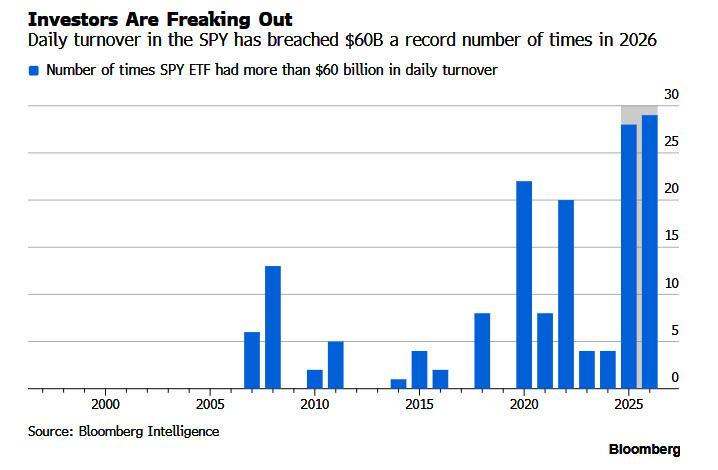
Looking at overnight markets, the most dramatic moves were in oil markets. European natural gas futures posted their biggest decline in more than two years, shedding as much as 20%. Prices of refined fuels such as diesel and jet fuel — which had been the biggest threats to global inflation — also tumbled.
As part of the two-week truce, Iran said it will allow ships to sail through the Strait of Hormuz, easing the chokehold on energy supplies that have threatened to cripple the global economy and accelerate inflation. A potential snag comes from the FT which reports that Iran demands fees for ships passing through the strait and will ask payment for tolls in crypto payment. While many investors cautioned that there is still a wide gap in the negotiation demands of Iran and the US, the widespread view was that stocks have fallen so sharply in recent weeks that any de-escalation path would be enough to trigger a rebound.
“This is also showing promising signs that we’ve dodged the worst-case scenario,” said Matthew Haupt, a fund manager at Wilson Asset Management in Sydney. “It’s a good result considering the alternatives, as it shows a willingness to get something done.”
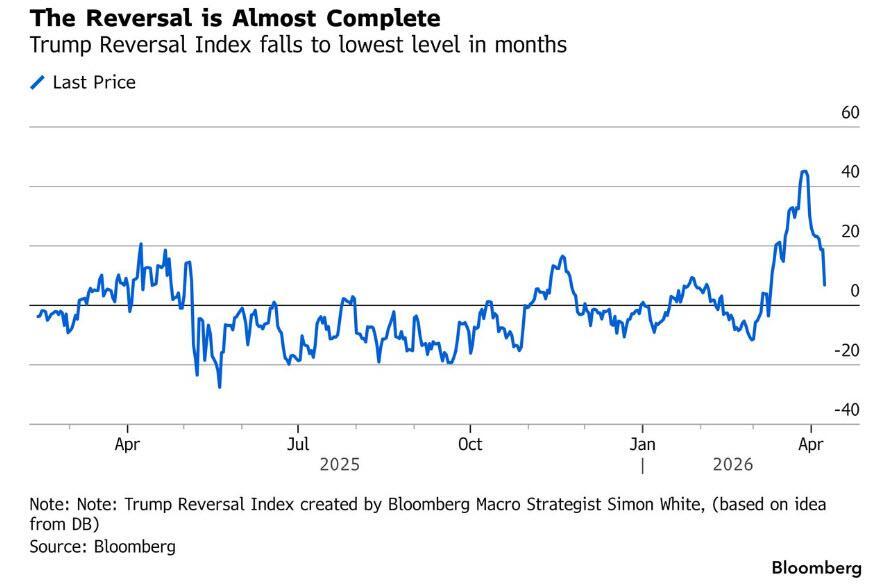
The latest news has left the Trump Reversal Index — a gauge created by Bloomberg strategist Simon White that combines various macro indicators — back to not much higher than where it was before the war started. Light positioning is also fueling Wednesday’s relief rally. Volatility-control funds’ allocations to US equities had recently fallen to 56%, the lowest since July, according to Barclays.
What comes next will depend on five questions, according to Jennifer Welch, chief geoeconomics analyst at Bloomberg Economics. These include whether Iran fully reopens Hormuz and whether Israel sticks to the ceasefire. Hormuz will “never go back to the way it was before,” said Vital Knowledge’s Adam Crisafulli. “Iran’s ability to shut the waterway will embed a risk premium in the price of all commodities flowing through it for the foreseeable future.” More than 800 ships are currently trapped in the Persian Gulf.
In politics, US regulators unveiled a plan to overhaul rules intended to prevent money laundering. US Trade Representative Jamieson Greer promoted the creation of a US-China board of trade, while downplaying the possibility of a similar group focused on bilateral investment.
Traders are now back to seeing a strong chance that the Federal Reserve will cut interest rates this year. Swaps are signaling a 60% likelihood of a rate cut by the year-end, compared with almost no chance seen at the start of this week. Before the war started, they had priced in more than two reductions.
Some of the world’s largest investment firms are betting the market turbulence is past its peak and are buying bonds and artificial-intelligence stocks, while selling the dollar. Kellie Wood at Schroders Plc snapped up short-dated bonds including Treasuries on Wednesday morning. Jupiter Asset Management Ltd. is considering doing the same alongside plans to sell the greenback. Allspring Global Investments is buying tech and defense stocks that are seen as insulated from energy shocks.
European stocks are soaring: the Estoxx 50 up more than 5% and the Stoxx 600 is up 4% alongside a 14% decline in Brent crude as markets cheer news of the US and Iran agreeing to a two-week ceasefire, even if the truce is a “fragile” one. European equity sectors are mostly higher with outperformance in travel, IT and consumer discretionary. Airline stocks, which have been pummeled by concerns of skyrocketing energy prices, lead gains in Europe. EasyJet Plc and Deutsche Lufthansa AG both jumped more than 10%. Energy stocks post material losses.Here are the biggest movers Wednesday:
- European oil stocks plunge on an otherwise broadly risk-on day, with airlines and technology shares particularly strong after the US and Iran agreed to a two-week ceasefire, sending the crude price tumbling and other asset classes soaring. Luxury-goods stocks, miners and chemicals stocks also rise strongly
- Close Brothers shares surge as much as 23%, the most since August, as the lender said the estimated cost of the FCA’s motor finance redress proposal is broadly similar to its existing provision
- Gamma Communications shares soar as much as 15%, their biggest intraday gain on record, after the telecom services company said it’s in preliminary talks with a number of potential bidders
- Redcare Pharmacy shares rise as much as 16% after the German firm’s preliminary first-quarter figures reassured analysts. Shares in Swiss peer DocMorris gain as much as 9.9%
- Polish coal miners Bogdanka and JSW slump after the US and Iran agreed to a two-week ceasefire. The move is expected to ease the energy shock, denting bets on a broader return to coal-fired power in Europe
- Shares in Norway’s Yara fall as much as 13%, while Germany’s K+S drops as much as 13%, after the US and Iran agreed to a two-week ceasefire in exchange for Tehran reopening the Strait of Hormuz
Stocks in Dubai — a key target of Iranian attacks during the conflict — jumped 8.5%, the most since Dec. 2014. Pakistan equities were also among the top gainers, after the country emerged as a key mediator in the ceasefire.
Still, there were continued reports of hostilities, underscoring the fragility of the deal. The UAE said it responded to a missile threat as of early afternoon local time, while Kuwait’s army cited “intense” attacks from Iran throughout the morning. “Markets have been moving very quickly, setting us up for a relief rally,” said Neil Birrell, chief investment officer at Premier Miton Investors. “What will happen in the next few weeks — who knows? It’s hard to believe that this is a long-term resolution.”
Asian stocks rose for a fourth straight day to a one-month high as oil prices tumbled after a two-week US-Iran ceasefire, easing fears of supply disruptions and inflation. The MSCI Asia Pacific Index gained 4.9%, led by heavyweight chipmakers including Taiwan Semiconductor Manufacturing Co. and Samsung Electronics Co. South Korea’s Kospi surged nearly 7%, leading gains in the region, while benchmarks in Japan and Taiwan advanced more than 3% each. Shares also advanced more than 3% in mainland China, Hong Kong and India. The Reserve Bank of India held key interest rates on Wednesday, striking a cautious tone as it monitors the impact of surging oil prices on the economy and pledges to curb any excessive currency moves.
In FX, the Bloomberg Dollar Spot Index is down 0.8% with the greenback lower versus all major peers. The kiwi is one of the better G-10 performers following the hawkish hold from the RBNZ.
In rates, global bond yields are materially lower with German and UK 2-year borrowing costs down 22bps and 25bps respectively as traders scale back ECB and BOE hike bets. The US curve is in bull-steepening mode with traders pricing a circa 50% chance of a Fed rate cut by year-end. Treasury futures trade near session highs reached following gap higher at the Asia open, with oil benchmarks down more than 10% and stocks surging after US and Iran set a two-week ceasefire and Tehran pledged to reopen the Strait of Hormuz. US yields are lower by 3bp-6bp across a steeper curve as long-end tenors lag front-end and belly; 10-year is lower by more than 6bp near 4.23%. Swap spreads leg higher as demand pours in for cash Treasuries, with long-end spreads wider by nearly 3bp. The US session includes 10-year note reopening; demand was strong for Tuesday’s 3-year new issue. Treasury’s $39 billion 10-year note reopening has WI yield near 4.24%, about 2bp cheaper than last month’s auction, which tailed by 0.7bp; auction cycle concludes Thursday with $22 billion 30-year reopening
In commodities, WTI crude oil futures are down about 16% near session lows; their biggest drop since the covid crash; Brent crude fell as much as 16% and European natural gas futures posted their biggest decline in more than two years despite uncertainty about how quickly transit through Hormuz can resume. Precious metals are gaining, with spot gold and silver up 1.7% and 5.3% respectively. Bitcoin has added 3.2%.
Looking at today’s calendar, the US economic data calendar is blank; Fed speaker slate includes San Francisco’s Daly at 1:05pm, and FOMC releases minutes of March meeting at 2pm.
Market Snapshot
- S&P 500 mini +2.7%
- Nasdaq 100 mini +3.5%
- Russell 2000 mini +3.8%
- Stoxx Europe 600 +3.8%
- DAX +4.7%
- CAC 40 +4.2%
- 10-year Treasury yield -6 basis points at 4.23%
- VIX -5.5 points at 20.26
- Bloomberg Dollar Index -0.8% at 1200.59
- euro +0.8% at $1.1685
- WTI crude -15.9% at $95.04/barrel
Top Overnight News
- Oil headed for the biggest drop in six years and global equities surged after the US and Iran agreed to a two-week ceasefire in exchange for Tehran reopening the Strait of Hormuz. Donald Trump said the US will help relieve Hormuz traffic with more than 800 vessels still trapped in the Persian Gulf. Benjamin Netanyahu said Israel supports the ceasefire but said it doesn’t include Hezbollah in Lebanon. BBG
- Kuwait said it’s dealing with “intense” Iranian attacks this morning and some Arab states reported continued attacks. BBG
- NATO chief Mark Rutte meets Trump today, hoping to temper the president’s anger that alliance members have refused to help. But Rutte’s own allies are questioning whether his deferential approach is appropriate, or even working, according to people familiar. BBG
- Chinese imports into the US haven’t dropped as much as the headline numbers might suggest as companies slash the value of their shipments “using tactics ranging from legal accounting tricks to outright fraud.” NYT
- The RBI held rates at 5.25% in its first policy decision since the Middle East crisis erupted. The RBNZ left its benchmark rate at 2.25%. BBG
- Japanese workers’ wages adjusted for inflation rose at the fastest pace since 2021, backing the case for the Bank of Japan to consider a rate hike as soon as this month. Real wages increased 1.9% from a year earlier in February, marking a second straight monthly gain, the labor ministry reported Wednesday. Economists had forecast a 1.3% increase. BBG
- The Treasury Department wants to talk to state insurance commissioners about the private loans piling up in insurers’ portfolios. Those state regulators have been keeping some of their thoughts to themselves.
- Moody’s Ratings has cut its outlook on a $36-billion Blue Owl fund to “negative” from “stable” on Tuesday, citing redemption requests that were “significantly higher” than peers in the first quarter. RTRS
- In Wisconsin’s Supreme Court election, the Democratic-backed candidate sailed to a nearly 20-point landslide victory Tuesday in a battleground Trump carried less than two years ago. Meanwhile, a Georgia Democrat slashed Trump’s margin of victory by two thirds in the state’s reddest district despite losing the election — the most significant overperformance the party has seen across all seven House special elections so far this cycle. Politico
A more detailed look at global markets courtesy of Newsquawk
APAC stocks rallied with markets euphoric and relieved after US President Trump announced a two-week ceasefire between the US and Iran in the final hours before his Tuesday evening deadline. The ceasefire was proposed by Pakistan and is subject to the opening of the Strait of Hormuz, which Iran was said to have agreed to, while the US and Iran are set to conduct talks on Friday in Islamabad. Furthermore, Israel and Lebanon were reported to be part of the ceasefire, although Israeli PM Netanyahu later denied that Lebanon was included. ASX 200 advanced with the gains led by outperformance in gold miners and tech, while energy was at the other end of the spectrum amid the slump in oil prices. Nikkei 225 rose above the 56,000 level with sentiment in Japan boosted by the lower oil prices, while participants also digested the firmer-than-expected wages data. Hang Seng and Shanghai Comp joined in on the widespread risk-on mood amid the US-Iran ceasefire and as Hong Kong participants returned to the market following a five-day closure.
Top Asian News
- Japanese Eco Watchers Survey Current (Mar) 42.2 vs. Exp. 47.9 (Prev. 48.9).
- Japanese Eco Watchers Survey Outlook (Mar) 38.7 (Prev. 50.0).
- Japanese Current Account (Feb) 3.933B vs. Exp. 3549B (Prev. 941.6B).
- Japanese Labour Cash Earnings (Feb) 3.3% vs Exp. 2.7% (Prev. 3.0%).
European bourses (STOXX 600 +3.7%) have expressed relief from the announcement of a two-week Iran ceasefire, with all indices gaining by over 2%. European sectors are entirely in the green, ex. Energy and Utilities. Cyclicals benefit the most, with Travel and Leisure, Technology and Consumer Products and Services topping the pile.
Top European News
- German Factory Orders MoM (Feb) M/M 0.9% vs. Exp. 2% (Prev. -11.1%).
- French Balance of Trade (Feb) -5.8B vs. Exp. -2.3B (Prev. -1.8B).
- French Imports (Feb) 57.8B (Prev. 55.3B).
- French Exports (Feb) 52.0B (Prev. 53.4B).
- EU Retail Sales MoM (Feb) M/M -0.2% vs. Exp. -0.2% (Prev. -0.1%).
- EU Retail Sales YoY (Feb) Y/Y 1.7% vs. Exp. 1.6% (Prev. 2%).
FX
- FX markets began the session firmly risk-on as the US and Iran agreed to a two-week ceasefire, clearing a path for the “re-open” of the Hormuz Strait. Unsurprisingly, the Buck has been knocked with DXY -0.7%, as it loses its favour as the preferred hedge against energy with Brent crude below the USD 100/bbl mark. In a note this morning, Jefferies set out three potential future scenarios: 1) a narrow diplomatic Off-Ramp, centred on reopening the Strait of Hormuz under a face-saving framework for Iran, 2) frozen conflict, where the ceasefire is extended or repeatedly renewed without a formal peace agreement, with oil trading below crisis peaks but above pre-war levels. 3) escalation resumes: triggering renewed disruption fears, pushing oil prices higher, and driving a sharp risk-off move in global markets.
- NZD is the clear outperformer against the USD, helped by both the positive Middle East development and remarks in RBNZ’s post-meeting presser, where Governor Breman said the MPC discussed the possibility of raising rates in April and May meetings, and the “Frequency of rate hikes could be every meeting or every second meeting” Despite the Kiwi’s strength, AUD/USD has also been helped alongside risk sentiment and a rebound in precious metals.
- GBP is relieved by the slump in crude prices, with Cable +1% at the time of writing. Markets are still expecting c. 30bps of hiking for the BoE, a pullback of the same magnitude since Tuesday’s close. The Cable rally stalled just above the 1.3440 mark; EUR/GBP has recently fallen just below its 200 DMA, and beneath the 0.87 mark – next up, 50 DMA at 0.8687.
Fixed Income
- Global fixed benchmarks are soaring this morning, with upside facilitated by the announcement of a two-week ceasefire between the US and Iran, which has helped to pressure the crude complex. As a whole, bonds are stronger, and a clear curve steepening bias is seen across the complex.
- USTs are currently trading at session highs, holding at the top end of a 111-05+ to 111-21 range. US paper moved higher on the announcement itself, and then gradually strolled to peaks as the session progressed. European price action has been fairly muted, with the benchmark ultimately trading sideways. From a yield perspective, the 2yr yield now resides around 3.719% (vs Tuesday’s close at 3.80%) and well below the peaks from the Iranian conflict at 4.027%. Geopols aside, focus today will turn to the FOMC Minutes of the March confab, where the Bank left rates unchanged at 3.50-3.75%, with no change to forward guidance, balance sheet plans or implementation guidance. A US 10yr auction is also due.
- Bunds and Gilts follow the above, and currently reside at highs. The former is higher by over 175 ticks and within a 125.74 to 126.45 range, whilst UK paper extends gains of over 230 ticks, in an 89.70 to 90.18 range. Europe and UK fixed income has been considerably pressured since the start of the Iranian war, given their high dependence on external energy. For now, some short term reprieve across assets – and this has been reflected in market pricing, with only 2bps worth of hikes priced in for the ECB’s April meeting (vs 12bps pre-ceasefire); however, the long-term outlook remains uncertain, with markets still pricing in 45bps worth of hikes by year-end. From a yield perspective, the UK 2yr yield sank at the open, bottoming at 4.044% (vs post-Iran war peak at 4.712%); GE 2yr yield now hovers around the 2.50% mark.
Commodities
- The US and Iran have agreed in principle to a two-week ceasefire, brokered with support from Pakistan, under which the US will suspend bombing, and Iran will allow controlled reopening of the Strait of Hormuz. President Trump described the move as a “double-sided ceasefire,” saying most major disputes have already been resolved and that a broader peace agreement is close. Iran has accepted the pause, with its leadership approving negotiations set to begin in Islamabad, where both sides aim to finalise terms based on a 10-point proposal submitted by Tehran.
- The ceasefire remains conditional and fragile. Iran stated it will halt military responses only if attacks stop, while warning it remains ready to retaliate if provoked. The arrangement includes limited safe passage through the Strait of Hormuz under Iranian coordination, a critical step given the severe disruption to global shipping and energy flows. Israel has signalled support for the temporary pause, though there is conflicting information over whether Lebanon is included.
- However, it is worth noting recent reporting suggests that explosions were heard at Iran’s Lavan refinery, and other reports suggest that explosions were also heard at Iran’s Siri Island – details are light at this stage. But some may begin to question whether the ceasefire has already been violated.
- Energy prices plummeted. Crude futures both tumbled beneath the USD 100/bbl level following the announcement of a two-week US-Iran ceasefire within a couple of hours prior to President Trump’s deadline. WTI May’26 resides towards the bottom of a USD 91.70-96.27/bbl and Brent Jun’26 towards the foot of a USD 91.05-109.19/bbl range. Dutch TTF slipped to under EUR 45/MWh.
- Spot gold rose above USD 4,850/oz before paring gains slightly to trade around the middle of a USD 4,713-4,858/oz range. Spot silver topped its 100 DMA (USD 76.11/oz) and resides near the top of a USD 73.38-77.65/oz parameter.
- Copper climbed to a three-week high, and aluminium also advanced as easing concerns over global growth lifted sentiment. 3M LME copper trades towards the top end of a USD 12,550.00-12,743.90/t range.
- China has reportedly given additional crude import quotas to independent refiners to maintain fuel production at the mandated 2025 levels.
- Abu Dhabi’s media office announces that three people were injured after debris from air defence interception sparked fires at the Habshan gas complex, operations have been suspended temporarily.
- IATA chief said if Hormuz Strait were to reopen, it will still take a period of months to get where jet fuel supply needs to be.
Central Banks
- RBNZ keeps the OCR at 2.25%, as expected, while it stated in the near term inflation, is expected to increase and economic recovery to weaken, while committee is focused on ensuring that inflation returns at a 2% target midpoint over the medium-term.
- RBNZ Governor Breman said in online post-meeting press conference that the decision to hold rates was a consensus, adds discussed raising rates at today’s meeting but were not close to hiking. We were not close to hiking rates today and there were no strong advocates for a hike today. If oil prices keep falling our inflation forecast would be on the high side. Frequency of rate hikes could be every meeting or every second meeting, it depends.
- Fed Vice Chair Jefferson (voter) said sees downside risks to employment and upside risks to inflation, while he is cautious on the economic outlook and noted uncertainty is elevated. Current policy rate is well-positioned to respond and rate is broadly in range of neutral. US labour market is roughly in balance and susceptible to adverse shocks. US inflation remains above the central bank’s targets and warns that persistent elevated energy prices can weigh in consumer and business spending.
- ECB’s Dolenc said that if the Iran war drags on, it will be very bad for inflation and growth.
- RBI keeps Repurchase Rate unchanged at 5.25%, as expected, with the decision unanimous and it maintains a neutral stance.
- ASB Bank now sees RBNZ raising rates in September and December of this year vs prev. forecast of a December hike.
Geopolitics
- US President Trump announced he is to suspend the bombing of Iran for two weeks, subject to Iran opening up the Strait of Hormuz, while he stated that this will be a double-sided ceasefire. Trump said the reason for doing so is that they have already met and exceeded all military objectives, and are very far along with a definitive agreement concerning long-term peace with Iran, and peace in the Middle East. Furthermore, he confirmed they received a 10-point proposal from Iran, and believe it is a workable basis on which to negotiate, while he stated that almost all of the various points of past contention have been agreed to between the US and Iran, although a two-week period will allow the agreement to be finalised and consummated.
- US President Trump posted “A big day for World Peace! Iran wants it to happen, they’ve had enough! Likewise, so has everyone else! The United States of America will be helping with the traffic buildup in the Strait of Hormuz. There will be lots of positive action! Big money will be made. Iran can start the reconstruction process…this could be the Golden Age of the Middle East!!!”
- US President Trump tells AFP that Iran deal is complete and comprehensive victory for the US, also said Iran uranium will be perfectly taken care of and that he believes China got Iran to negotiate.
- Iranian Press SNN notes of a potential ceasefire violation, highlighting several explosions that occurred in Siri and Lavan islands. Furthermore, Iran’s National Security Council says within a few hours, if firing does not stop in southern Lebanon, the air and missile unit will bomb Tel Aviv.
- Iran said negotiations with the US will be held in Islamabad to finalise details, with the aim of confirming Iran’s battlefield achievements politically within maximum of 15 days, with talks to begin April 10th and may be extended if both sides agree. Talks with the US do not mean of the war, according to Iranian media. The safe passage through Hormuz is possible for two weeks and Foreign Minister Araghchi said their forces will halt operations if attacks on Iran cease.
- Pakistan’s President invites US and Iran delegates to Islamabad on Friday, while reported also noted that EU envoys Witkoff, Kushner and VP Vance is expected to attend US-Iran talks.
- US official said ceasefire will begin this evening, but they believe it may take some time for orders to reach Revolutionary Guard units at the field level.
- Iran and Oman reportedly will be allowed to charge for passage in the Strait of Hormuz as part of a ceasefire.
- Israel’s Ynet cites security sources stating that Iran ceasefire will also include Lebanon.
- Iran’s Supreme Leader instructed negotiators to seek a truce, according to Axios.
- Iran’s permanent ambassador to the UN said Iran categorically rejects any temporary ceasefire, while he stated that any solution to the end of the conflict must guarantee a definitive and irreversible anti-aggression and establish a just and lasting peace.
- The US will insist on removing nuclear materials from Iran, Al Hadath reported citing Israeli officials via Haaretz.
- White House official said Iran ceasefire takes effect once the Strait of Hormuz is reopened.
- Senior White House official said Israel is part of the 2-week ceasefire, according to CNN. Israel agrees to suspend bombing while talks are ongoing.
- Omani Transport Minister said no fees can be imposed on the Strait of Hormuz according to the signed agreements.
- Iraq’s Islamic Resistance suspends operations for two weeks.
- Hezbollah will announce formal position on ceasefire and response to Israeli PM’s assertion that Lebanon is not included, according to sources.
- New wave of Iranian missiles fired towards Israel.
- Israeli military official said Israel is still striking Iran, according to CNN.
- Several explosions reported at Iran’s Sirri Island on Wednesday morning; source of explosions unknown, Mehr News reported.
- Explosions heard at the Lavan oil refinery (50k BPD) in Iran, Mehr reported; origin of the explosion is not known.
- Bahrain sounds missile alert hours after the US and Iran ceasefire agreement, according to AP.
- N12 noted reported of explosion in Kermanshah northwestern Iran.
- IDF said it identified missiles launched from Iran towards Israel.
- Iran’s Supreme Security Council said fingers are on the trigger and as soon as the enemy makes the slightest mistake, it will be answered with full force.
- Maritime Shipping Data shows traffic in the Strait of Hormuz remains light and limited, Arab News reported.
US Event Calendar
- 7:00 am: United States Apr 3 MBA Mortgage Applications, prior -10.4%
- 1:05 pm: United States Fed’s Daly Gives Keynote Remarks
- 2:00 pm: United States FOMC Meeting Minutes
DB’s Jim Reid concludes the overnight wrap
Markets are seeing a sharp rebound overnight following news that the US and Iran agreed to a two-week ceasefire. Trump posted that following a request by Pakistan, he agreed to suspend attacks against Iran for two weeks subject to Iran agreeing to “the COMPLETE, IMMEDIATE and SAFE OPENING of the Strait of Hormuz”. He claimed that the US had already met its military objectives and called the 10-point proposal received from Iran a “workable basis on which to negotiate”. Tehran accepted the ceasefire proposal “if attacks against Iran are halted”. Foreign Minister Araghchi also announced that, in response to Trump’s “acceptance of the general framework of Iran’s 10-point proposal”, safe passage through the Strait of Hormuz will be possible for two weeks “via coordination with Iran’s armed forces and with due consideration to technical limitations”. The AP has reported that the plan will allow Iran and Oman to charge fees for transits through the Strait. Meanwhile, Pakistan’s Prime Minister Sharif has invited US and Iran for talks in Islamabad on Friday (April 10) to negotiate a “conclusive agreement”.
Investors will be breathing a big sigh of relief that an offramp out of the war is being taken even as there’ll be various elements to watch to see whether this leads to sustained de-escalation. Will the ceasefire hold? We saw some strikes by Israel and Iran overnight though these may have been in the works before the conditional ceasefire. We’ve also seen conflicting commentary on whether the ceasefire will extend to Israel’s action in Lebanon. Can talks lead to a permanent cessation of hostilities? Trump’s comment last night that “Almost all of the various points of past contention have been agreed to” suggests a lower bar for agreement, but Iran’s reported 10-point plan includes elements such as the lifting of all sanctions and Iran controlling the Strait of Hormuz that have previously been unacceptable to the US and allies. Those points also do not restrict Iran’s enriched uranium, which Trump suggested would be “perfectly taken care of” as he claimed a “total and complete victory” in an interview to AFP late last night. And in his latest post overnight, Trump appeared keen to lean into the prospects for full resolution, claiming “a big day for World Peace” and that the US “will be helping with the traffic buildup in the Strait of Hormuz”.
Indeed, the most important question for markets will be to what extent does shipping via Hormuz pick up in the coming days. For now, oil prices have plunged on the ceasefire news, with Brent crude down -13.51% to $94.51/bbl this morning as I type, its lowest intra-day level in four weeks. It had been at nearly $110/bbl before the news of Pakistan’s ceasefire proposal began to emerge but then fell as low as $91/bbl as the ceasefire was confirmed early in the Asian session before recovering slightly. WTI is similarly down -14.92% to $96.10/bbl.
In turn, risk assets are seeing a sharp rally. S&P 500 futures are up +2.48%, which leaves them less than 2% below the levels on February 27 before the Iran strikes began and +6.8% up from their closing low on Mach 30. NASDAQ futures are +3.15%, while those on Euro STOXX 50 are +5.42% higher after a weak session yesterday. Asian equities are also rallying strongly, with the KOSPI (+7.26%) and the Nikkei (+5.26%) at the forefront. The Hang Seng (+2.82%) is advancing after the holiday, while the CSI (+2.76%) and the Shanghai Composite (+1.92%) are also seeing solid gains in mainland China, as is the S&P/ASX 200 (+2.71%) in Australia.
On the fixed income side, 2yr (-6.8bps to 3.72%) and 10yr (-5.2bps to 4.24%) Treasuries are seeing a sizeable rally, with 10yr JGBs (-4.9bps) posting a similar advance. Fed funds futures are now pricing 14bps of Fed cuts by December, up from zero when Europe went home yesterday. And in FX, the dollar index is down -0.92%, while gold is +2.00% higher.
Earlier yesterday, markets had traded cautiously amidst worsening headlines, including Trump’s social media post that a “whole civilization will die tonight” unless “something revolutionarily” happens on Iran’s side, as well as news of increased strikes by the US, Israel and Iran across the Middle East. US markets then saw a recovery late in yesterday’s session as news broke that the US and Iran were considering Pakistan’s ceasefire proposal. That helped the S&P 500 recover to +0.08% by the close, having been -1.2% down earlier in the session, while 2yr (-6.1bps) and 10yr (-3.8bps) Treasury yields rallied late yesterday, having been a few basis points higher on the day at the European close.
European markets had closed near the session lows yesterday, with the STOXX 600 falling back -1.01%. The more externally-sensitive DAX (-1.06%) led the declines, while the FTSE 100 (-0.84%), CAC 40 (-0.67%) and FTSEMIB (-0.47%) were also all in the red. European bonds also saw a significant sell-off with yields on 10yr bunds rising +9.1bps to 3.08%, just 1bps below the post-2011 high they had reached on March 27. Yields on 10yr BTPs (+11.6bps) and OATs (+10.0bps) saw a larger sell-off amid the risk-off mood.
Over in the UK, 10yr gilts (+7.1bps to 4.90%) saw a slightly more modest sell-off as the final UK March services PMI was revised down from 51.2 to 50.5. That marked a sharper decline than seen in the euro area, where the final services PMI was revised a touch higher, from 50.1 to 50.2. Within the euro area data, there was a notable divergence between resilience in Spain (53.3 vs 51.9 previous, 50.6 expected) and a marked decline in Italy (48.8 vs 52.3 prev., 50.9 exp), which might reflect the fact that while both countries have adopted fiscal measures to reduce the costs of the energy shock, the scale of the Spanish response has been significantly larger.
When it comes to yesterday’s US data, the highlight was the latest weekly ADP employment numbers, which showed private job gains pick up to +26k on average for the four weeks ending on March 21. That marked the strongest print since ADP started publishing the weekly data last year and equates to over 100k in monthly job gains. So that added to the easing labour market concerns after the strong March payrolls reports on Friday. US February durable goods orders also looked solid, with ex-transport orders up +0.8% MoM (vs. +0.5% expected) and core shipments up +0.9% (vs. +0.4% exp.). Meanwhile, NY Fed 1-yr inflation expectations series jumped from +3.00% to +3.42% in March, though this was a touch below consensus (+3.50%) and below the levels it reached after the Liberation Day tariffs last spring (3.63%). We also got comments from NY Fed President Williams, who was relatively sanguine yesterday when he said that that the war might add a tenth or two to core inflation, and that the story around underlying inflation was not much changed.
Finally, in other overnight news the Reserve Bank of New Zealand (RBNZ) maintained its cash rate at 2.25% as expected. The RBNZ’s Monetary Policy Committee noted a significant shift in the economic outlook amid higher energy prices, which are expected to push short-term inflation up while slowing economic activity. The yield on the 2yr government note is -4.2bps lower this morning, though this is mostly matching the move in Treasuries.
To the day ahead now, we’ll have UK March Construction PMI, Germany February factory orders, March construction PMI, France February trade balance, current account balance, Eurozone February PPI and retail sales. We’ll also get the March FOMC minutes
1b) European opening report
Brent -15% as US and Iran reach 2 week ceasefire, NZD outperforms amid RBNZ hike discussion – Newsquawk US Market Open

Wednesday, Apr 08, 2026 – 06:16 AM
- US President Trump announced he is to suspend the bombing of Iran for two weeks, subject to Iran opening up the Strait of Hormuz, while he stated that this will be a double-sided ceasefire. Energy slumps, with Brent slipping below USD 95/bbl.
- Trump confirmed they received a 10-point proposal from Iran, and believe it is a workable basis on which to negotiate, while he stated that almost all of the various points of past contention have been agreed to between the US and Iran.
- Iranian Press SNN noted of a potential ceasefire violation, highlighting several explosions that occurred in Siri and Lavan islands.
- Iran’s National Security Council said that within a few hours, if firing does not stop in southern Lebanon, the air and missile unit will bomb Tel Aviv
- Global equities find comfort, airlines and miners highly benefit.
- USD hit, Kiwi outperforms amid RBNZ hike discussion.
- Bonds soar and the curve steepens, with central bank paring back hawkish bets.
- Looking ahead, highlights include FOMC Minutes, Speakers including Fed’s Daly, Waller & US President Trump, Supply from the US.
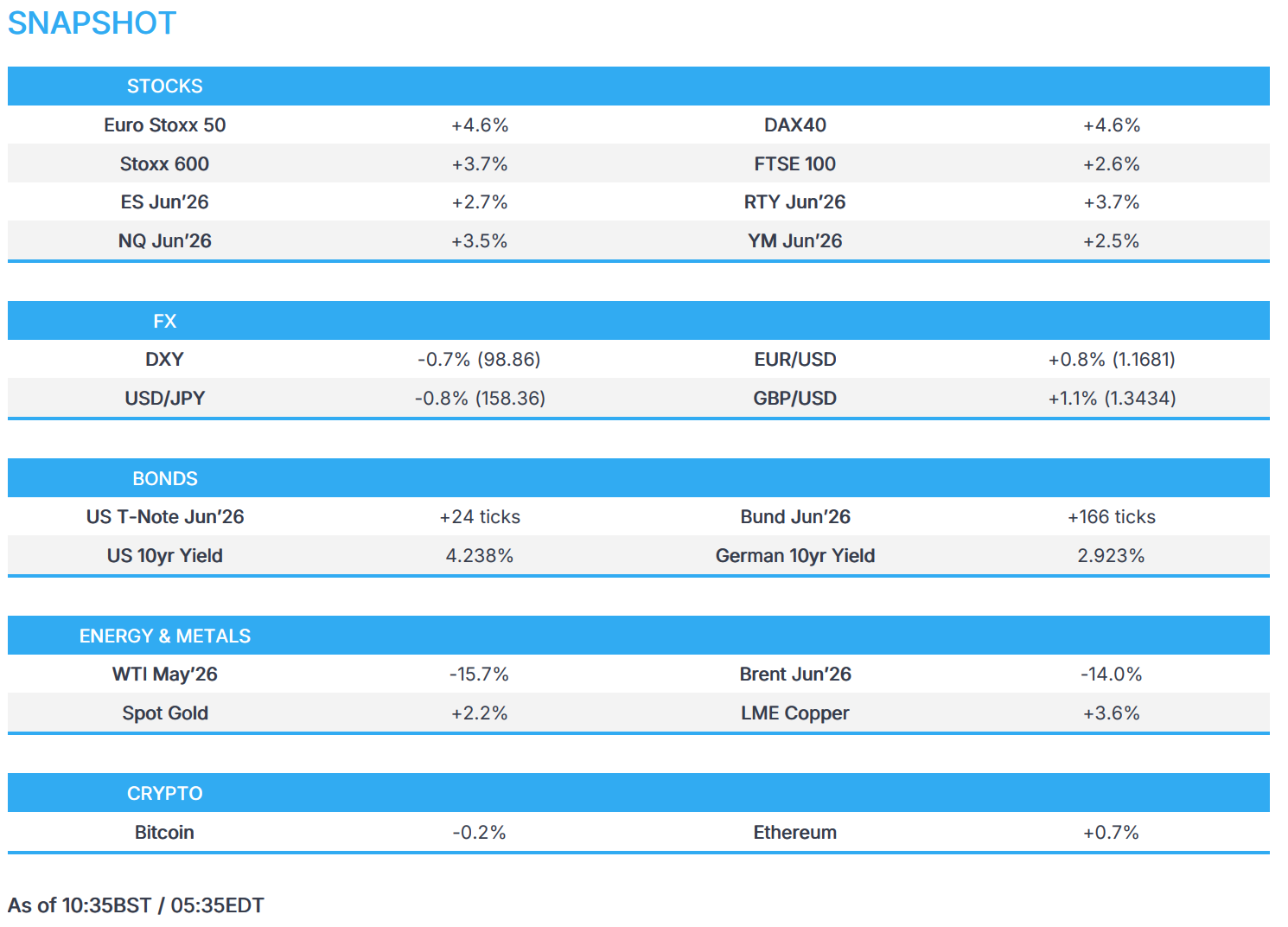
Newsquawk in 3 steps:
1. Subscribe to the free premarket movers reports
2. Listen to this report in the market open podcast (available on Apple and Spotify)
3. Trial Newsquawk’s premium real-time audio news squawk box for 7 days
EUROPEAN TRADE
EQUITIES
- European bourses (STOXX 600 +3.7%) have expressed relief from the announcement of a two-week Iran ceasefire, with all indices gaining by over 2%.
- European sectors are entirely in the green, ex. Energy and Utilities. Cyclicals benefit the most, with Travel and Leisure, Technology and Consumer Products and Services topping the pile.
- US equity futures (ES +2.7% NQ +3.5% RTY +3.7%) have surged alongside their global peers. ES has now returned to the wide 6635-7063 range that formed in the latter part of 2025, and thus far, finding some resistance at the 50-SMA at 6819.
- Click for the sessions European pre-market equity newsflow
- Click for the additional news
FX
- FX markets began the session firmly risk-on as the US and Iran agreed to a two-week ceasefire, clearing a path for the “re-open” of the Hormuz Strait. Unsurprisingly, the Buck has been knocked with DXY -0.7%, as it loses its favour as the preferred hedge against energy with Brent crude below the USD 100/bbl mark. In a note this morning, Jefferies set out three potential future scenarios: 1) a narrow diplomatic Off-Ramp, centred on reopening the Strait of Hormuz under a face-saving framework for Iran, 2) frozen conflict, where the ceasefire is extended or repeatedly renewed without a formal peace agreement, with oil trading below crisis peaks but above pre-war levels. 3) escalation resumes: triggering renewed disruption fears, pushing oil prices higher, and driving a sharp risk-off move in global markets.
- NZD is the clear outperformer against the USD, helped by both the positive Middle East development and remarks in RBNZ’s post-meeting presser, where Governor Breman said the MPC discussed the possibility of raising rates in April and May meetings, and the “Frequency of rate hikes could be every meeting or every second meeting” Despite the Kiwi’s strength, AUD/USD has also been helped alongside risk sentiment and a rebound in precious metals.
- GBP is relieved by the slump in crude prices, with Cable +1% at the time of writing. Markets are still expecting c. 30bps of hiking for the BoE, a pullback of the same magnitude since Tuesday’s close. The Cable rally stalled just above the 1.3440 mark; EUR/GBP has recently fallen just below its 200 DMA, and beneath the 0.87 mark – next up, 50 DMA at 0.8687.
FIXED INCOME
- Global fixed benchmarks are soaring this morning, with upside facilitated by the announcement of a two-week ceasefire between the US and Iran, which has helped to pressure the crude complex. As a whole, bonds are stronger, and a clear curve steepening bias is seen across the complex.
- USTs are currently trading at session highs, holding at the top end of a 111-05+ to 111-21 range. US paper moved higher on the announcement itself, and then gradually strolled to peaks as the session progressed. European price action has been fairly muted, with the benchmark ultimately trading sideways. From a yield perspective, the 2yr yield now resides around 3.719% (vs Tuesday’s close at 3.80%) and well below the peaks from the Iranian conflict at 4.027%. Geopols aside, focus today will turn to the FOMC Minutes of the March confab, where the Bank left rates unchanged at 3.50-3.75%, with no change to forward guidance, balance sheet plans or implementation guidance. A US 10yr auction is also due.
- Bunds and Gilts follow the above, and currently reside at highs. The former is higher by over 175 ticks and within a 125.74 to 126.45 range, whilst UK paper extends gains of over 230 ticks, in an 89.70 to 90.18 range. Europe and UK fixed income has been considerably pressured since the start of the Iranian war, given their high dependence on external energy. For now, some short term reprieve across assets – and this has been reflected in market pricing, with only 2bps worth of hikes priced in for the ECB’s April meeting (vs 12bps pre-ceasefire); however, the long-term outlook remains uncertain, with markets still pricing in 45bps worth of hikes by year-end. From a yield perspective, the UK 2yr yield sank at the open, bottoming at 4.044% (vs post-Iran war peak at 4.712%); GE 2yr yield now hovers around the 2.50% mark.
- Germany sells EUR 3.817bln vs exp. EUR 5.0bln 2.90% 2036 Bund: b/c 1.24x (prev. 1.18x), average yield 2.92% (prev. 2.89%), retention 23.66% (prev. 23.78%).
COMMODITIES
- The US and Iran have agreed in principle to a two-week ceasefire, brokered with support from Pakistan, under which the US will suspend bombing, and Iran will allow controlled reopening of the Strait of Hormuz. President Trump described the move as a “double-sided ceasefire,” saying most major disputes have already been resolved and that a broader peace agreement is close. Iran has accepted the pause, with its leadership approving negotiations set to begin in Islamabad, where both sides aim to finalise terms based on a 10-point proposal submitted by Tehran.
- The ceasefire remains conditional and fragile. Iran stated it will halt military responses only if attacks stop, while warning it remains ready to retaliate if provoked. The arrangement includes limited safe passage through the Strait of Hormuz under Iranian coordination, a critical step given the severe disruption to global shipping and energy flows. Israel has signalled support for the temporary pause, though there is conflicting information over whether Lebanon is included.
- However, it is worth noting recent reporting suggests that explosions were heard at Iran’s Lavan refinery, and other reports suggest that explosions were also heard at Iran’s Siri Island – details are light at this stage. But some may begin to question whether the ceasefire has already been violated.
- Energy prices plummeted. Crude futures both tumbled beneath the USD 100/bbl level following the announcement of a two-week US-Iran ceasefire within a couple of hours prior to President Trump’s deadline. WTI May’26 resides towards the bottom of a USD 91.70-96.27/bbl and Brent Jun’26 towards the foot of a USD 91.05-109.19/bbl range. Dutch TTF slipped to under EUR 45/MWh.
- Spot gold rose above USD 4,850/oz before paring gains slightly to trade around the middle of a USD 4,713-4,858/oz range. Spot silver topped its 100 DMA (USD 76.11/oz) and resides near the top of a USD 73.38-77.65/oz parameter.
- Copper climbed to a three-week high, and aluminium also advanced as easing concerns over global growth lifted sentiment. 3M LME copper trades towards the top end of a USD 12,550.00-12,743.90/t range.
- China has reportedly given additional crude import quotas to independent refiners to maintain fuel production at the mandated 2025 levels.
- Abu Dhabi’s media office announces that three people were injured after debris from air defence interception sparked fires at the Habshan gas complex, operations have been suspended temporarily.
- IATA chief said if Hormuz Strait were to reopen, it will still take a period of months to get where jet fuel supply needs to be.
TRADE/TARIFFS
- US carmakers accuse EU of blocking supersized pick-up trucks from roads, according to FT.
NOTABLE EUROPEAN DATA RECAP
- German Factory Orders MoM (Feb) M/M 0.9% vs. Exp. 2% (Prev. -11.1%).
- French Balance of Trade (Feb) -5.8B vs. Exp. -2.3B (Prev. -1.8B).
- French Imports (Feb) 57.8B (Prev. 55.3B).
- French Exports (Feb) 52.0B (Prev. 53.4B).
- EU Retail Sales MoM (Feb) M/M -0.2% vs. Exp. -0.2% (Prev. -0.1%).
- EU Retail Sales YoY (Feb) Y/Y 1.7% vs. Exp. 1.6% (Prev. 2%).
- EU PPI MoM (Feb) M/M -0.7% vs. Exp. -0.7% (Prev. 0.7%).
- EU PPI YoY (Feb) Y/Y -3.0% vs. Exp. -3% (Prev. -2.1%).
- UK Halifax House Price Index MoM (Mar) M/M -0.5% vs. Exp. 0.1% (Prev. 0.3%).
- UK Halifax House Price Index YoY (Mar) Y/Y 0.8% vs. Exp. 1.5% (Prev. 1.3%).
- Hungarian Core Inflation Rate YoY (Mar) Y/Y 1.9% (Prev. 2.1%).
- Hungarian Inflation Rate YoY (Mar) Y/Y 1.8% (Prev. 1.4%).
- Hungarian Inflation Rate MoM (Mar) M/M 0.40% (Prev. 0.1%).
CENTRAL BANKS
- RBNZ keeps the OCR at 2.25%, as expected, while it stated in the near term inflation, is expected to increase and economic recovery to weaken, while committee is focused on ensuring that inflation returns at a 2% target midpoint over the medium-term.
- RBNZ Governor Breman said in online post-meeting press conference that the decision to hold rates was a consensus, adds discussed raising rates at today’s meeting but were not close to hiking. We were not close to hiking rates today and there were no strong advocates for a hike today. If oil prices keep falling our inflation forecast would be on the high side. Frequency of rate hikes could be every meeting or every second meeting, it depends.
- Fed Vice Chair Jefferson (voter) said sees downside risks to employment and upside risks to inflation, while he is cautious on the economic outlook and noted uncertainty is elevated. Current policy rate is well-positioned to respond and rate is broadly in range of neutral. US labour market is roughly in balance and susceptible to adverse shocks. US inflation remains above the central bank’s targets and warns that persistent elevated energy prices can weigh in consumer and business spending.
- ECB’s Dolenc said that if the Iran war drags on, it will be very bad for inflation and growth.
- RBI keeps Repurchase Rate unchanged at 5.25%, as expected, with the decision unanimous and it maintains a neutral stance.
- ASB Bank now sees RBNZ raising rates in September and December of this year vs prev. forecast of a December hike.
GEOPOLITICS
MIDDLE EAST
- US President Trump announced he is to suspend the bombing of Iran for two weeks, subject to Iran opening up the Strait of Hormuz, while he stated that this will be a double-sided ceasefire. Trump said the reason for doing so is that they have already met and exceeded all military objectives, and are very far along with a definitive agreement concerning long-term peace with Iran, and peace in the Middle East. Furthermore, he confirmed they received a 10-point proposal from Iran, and believe it is a workable basis on which to negotiate, while he stated that almost all of the various points of past contention have been agreed to between the US and Iran, although a two-week period will allow the agreement to be finalised and consummated.
- US President Trump posted “A big day for World Peace! Iran wants it to happen, they’ve had enough! Likewise, so has everyone else! The United States of America will be helping with the traffic buildup in the Strait of Hormuz. There will be lots of positive action! Big money will be made. Iran can start the reconstruction process…this could be the Golden Age of the Middle East!!!”
- US President Trump tells AFP that Iran deal is complete and comprehensive victory for the US, also said Iran uranium will be perfectly taken care of and that he believes China got Iran to negotiate.
- Iranian Press SNN notes of a potential ceasefire violation, highlighting several explosions that occurred in Siri and Lavan islands. Furthermore, Iran’s National Security Council says within a few hours, if firing does not stop in southern Lebanon, the air and missile unit will bomb Tel Aviv.
- Iran said negotiations with the US will be held in Islamabad to finalise details, with the aim of confirming Iran’s battlefield achievements politically within maximum of 15 days, with talks to begin April 10th and may be extended if both sides agree. Talks with the US do not mean of the war, according to Iranian media. The safe passage through Hormuz is possible for two weeks and Foreign Minister Araghchi said their forces will halt operations if attacks on Iran cease.
- Pakistan’s President invites US and Iran delegates to Islamabad on Friday, while reported also noted that EU envoys Witkoff, Kushner and VP Vance is expected to attend US-Iran talks.
- US official said ceasefire will begin this evening, but they believe it may take some time for orders to reach Revolutionary Guard units at the field level.
- Iran and Oman reportedly will be allowed to charge for passage in the Strait of Hormuz as part of a ceasefire.
- Israel’s Ynet cites security sources stating that Iran ceasefire will also include Lebanon.
- Iran’s Supreme Leader instructed negotiators to seek a truce, according to Axios.
- Iran’s permanent ambassador to the UN said Iran categorically rejects any temporary ceasefire, while he stated that any solution to the end of the conflict must guarantee a definitive and irreversible anti-aggression and establish a just and lasting peace.
- The US will insist on removing nuclear materials from Iran, Al Hadath reported citing Israeli officials via Haaretz.
- White House official said Iran ceasefire takes effect once the Strait of Hormuz is reopened.
- Senior White House official said Israel is part of the 2-week ceasefire, according to CNN. Israel agrees to suspend bombing while talks are ongoing.
- Omani Transport Minister said no fees can be imposed on the Strait of Hormuz according to the signed agreements.
- Iraq’s Islamic Resistance suspends operations for two weeks.
- Hezbollah will announce formal position on ceasefire and response to Israeli PM’s assertion that Lebanon is not included, according to sources.
- New wave of Iranian missiles fired towards Israel.
- Israeli military official said Israel is still striking Iran, according to CNN.
- Several explosions reported at Iran’s Sirri Island on Wednesday morning; source of explosions unknown, Mehr News reported.
- Explosions heard at the Lavan oil refinery (50k BPD) in Iran, Mehr reported; origin of the explosion is not known.
- Bahrain sounds missile alert hours after the US and Iran ceasefire agreement, according to AP.
- N12 noted reported of explosion in Kermanshah northwestern Iran.
- IDF said it identified missiles launched from Iran towards Israel.
- Iran’s Supreme Security Council said fingers are on the trigger and as soon as the enemy makes the slightest mistake, it will be answered with full force.
- Maritime Shipping Data shows traffic in the Strait of Hormuz remains light and limited, Arab News reported.
CRYPTO
- Bitcoin nears USD 72k after being supported by the constructive risk mood.
APAC TRADE
- APAC stocks rallied with markets euphoric and relieved after US President Trump announced a two-week ceasefire between the US and Iran in the final hours before his Tuesday evening deadline. The ceasefire was proposed by Pakistan and is subject to the opening of the Strait of Hormuz, which Iran was said to have agreed to, while the US and Iran are set to conduct talks on Friday in Islamabad. Furthermore, Israel and Lebanon were reported to be part of the ceasefire, although Israeli PM Netanyahu later denied that Lebanon was included.
- ASX 200 advanced with the gains led by outperformance in gold miners and tech, while energy was at the other end of the spectrum amid the slump in oil prices.
- Nikkei 225 rose above the 56,000 level with sentiment in Japan boosted by the lower oil prices, while participants also digested the firmer-than-expected wages data.
- Hang Seng and Shanghai Comp joined in on the widespread risk-on mood amid the US-Iran ceasefire and as Hong Kong participants returned to the market following a five-day closure.
NOTABLE APAC DATA RECAP
- Japanese Eco Watchers Survey Current (Mar) 42.2 vs. Exp. 47.9 (Prev. 48.9).
- Japanese Eco Watchers Survey Outlook (Mar) 38.7 (Prev. 50.0).
- Japanese Current Account (Feb) 3.933B vs. Exp. 3549B (Prev. 941.6B).
- Japanese Labour Cash Earnings (Feb) 3.3% vs Exp. 2.7% (Prev. 3.0%).
1 c) Asian opening report
Markets relieved on two-week Iran war ceasefire – Newsquawk EU Market Open
Wednesday, Apr 08, 2026 – 01:47 AM
- US President Trump announced he is to suspend the bombing of Iran for two weeks, subject to Iran opening up the Strait of Hormuz, while he stated that this will be a double-sided ceasefire.
- Trump confirmed they received a 10-point proposal from Iran, and believe it is a workable basis on which to negotiate, while he stated that almost all of the various points of past contention have been agreed to between the US and Iran.
- Iran accepted Pakistan’s two-week ceasefire proposal, with the ceasefire approved by the Supreme Leader, while Iran said negotiations with the US will be held in Islamabad to finalise details and that talks are to begin on Friday, April 10th and may be extended if both sides agree.
- Iranian Foreign Minister Araghchi’s statement, which was posted by Trump on Truth, stated that for a period of two weeks, safe passage through the Strait of Hormuz will be possible via coordination with Iran’s Armed Forces
- APAC stocks rallied with markets euphoric and relieved after US President Trump announced a two-week ceasefire; European equity futures indicate a stellar open for the cash market with Euro Stoxx 50 futures up over 5%.
- Crude futures tumbled beneath the USD 100/bbl level, DXY was pressured; RBNZ maintained rates as expected but provided some hawkish-leaning rhetoric.
- Looking ahead, highlights include French Trade Balance (Feb), EZ Retail Sales (Feb), PPI (Feb), FOMC Minutes, Speakers including Fed’s Daly, Waller & US President Trump, Supply from Germany & US.
SNAPSHOT
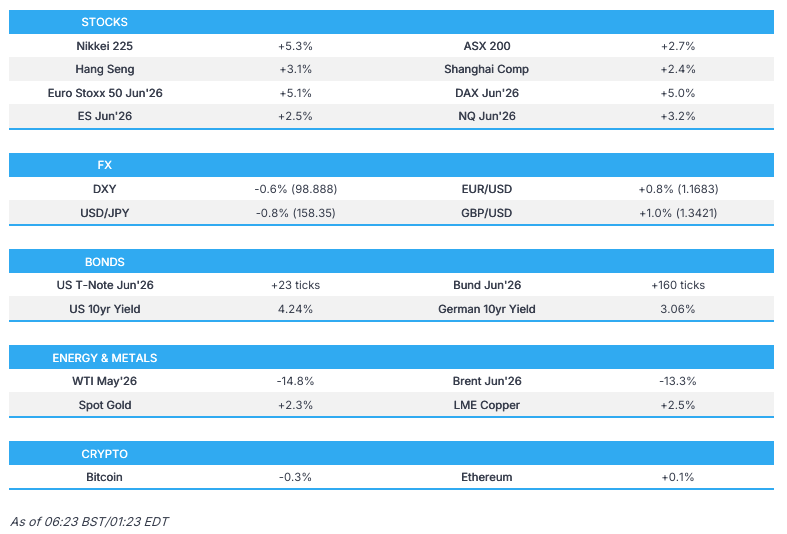
Newsquawk in 3 steps:
1. Subscribe to the free premarket movers reports
2. Listen to this report in the market open podcast (available on Apple and Spotify)
3. Trial Newsquawk’s premium real-time audio news squawk box for 7 days
IRAN CONFLICT
- US President Trump announced he is to suspend the bombing of Iran for two weeks, subject to Iran opening up the Strait of Hormuz, while he stated that this will be a double-sided ceasefire. Trump said the reason for doing so is that they have already met and exceeded all military objectives, and are very far along with a definitive agreement concerning long-term peace with Iran, and peace in the Middle East. Furthermore, he confirmed they received a 10-point proposal from Iran, and believe it is a workable basis on which to negotiate, while he stated that almost all of the various points of past contention have been agreed to between the US and Iran, although a two-week period will allow the agreement to be finalised and consummated.
- US President Trump posted “A big day for World Peace! Iran wants it to happen, they’ve had enough! Likewise, so has everyone else! The United States of America will be helping with the traffic buildup in the Strait of Hormuz. There will be lots of positive action! Big money will be made. Iran can start the reconstruction process…this could be the Golden Age of the Middle East!!!”
- US President Trump told AFP that the Iran deal is a complete and comprehensive victory for the US, while he also said that Iran’s uranium will be perfectly taken care of and that he believes China got Iran to negotiate
- White House senior official said Israel is part of the 2-week ceasefire and that it agreed to suspend bombing whilst talks are ongoing, while a US official also stated that the Iran ceasefire takes effect once the Strait of Hormuz is reopened.
- Iran accepted Pakistan’s two-week ceasefire proposal, with the ceasefire approved by the Supreme Leader, while Iran said negotiations with the US will be held in Islamabad to finalise details and that talks are to begin on Friday, April 10th and may be extended if both sides agree. Iran also said that talks with the US do not mean an end to the war, according to Iranian media.
- Iranian officials said the negotiations could last up to 15 days, during which Tehran seeks to translate battlefield gains into political agreements, IRNA reported.
- Iranian Foreign Minister Araghchi’s statement, which was posted by Trump on Truth, stated that if attacks against Iran are halted, their powerful armed forces will cease their defensive operations, while he added that for a period of two weeks, safe passage through the Strait of Hormuz will be possible via coordination with Iran’s Armed Forces and with due consideration of technical limitations.
- Pakistan’s PM said diplomatic efforts for the peaceful settlement of the ongoing war had progressed steadily, while he requested US President Trump to extend the Iran deadline for two weeks and requested Iran to open the Strait of Hormuz for a corresponding period of two weeks as a goodwill gesture.
- Iran’s Supreme Security Council said fingers are on the trigger, and as soon as the enemy makes the slightest mistake, it will be answered with full force.
- Israel’s Ynet cited security sources that stated the Iran ceasefire will also include Lebanon. However, it was later reported that Israeli PM Netanyahu said he backs Trump’s ceasefire but noted that Lebanon is not included in the ceasefire.
- There were reports of several missile launches towards Israel and Iran’s regional neighbours, while an explosion was also reported in Kermanshah, northwestern Iran. However, a US official said the ceasefire would begin Tuesday evening, but they believe it may take some time for orders to reach Revolutionary Guard units at the field level, while Iranian media reported that the Supreme Leader has ordered units to cease launches.
- Israeli military official said Israel is still striking Iran, while sirens sounded in Bahrain hours after the ceasefire announcement.
- Iran and Oman will be allowed to charge for passage in the Strait of Hormuz as part of the ceasefire.
- UN Security Council failed to approve a Bahraini resolution encouraging protection of shipping in the Strait of Hormuz after Russia and China vetoed it, with sources saying the veto was used despite watered-down language due to the timing alongside Trump’s threats and a desire not to be seen as siding with military rhetoric. Furthermore, Iran’s mission to the UN expressed appreciation to China and Russia for the veto on the Hormuz resolution in the UN Security Council.
US TRADE
EQUITIES
- US stocks finished mixed and relatively flat with markets choppy amid broader risk-off sentiment for the majority of the session as participants await US President Trump’s 20:00EDT Iran deadline, as his punchy rhetoric continued as he noted “a whole civilization will die tonight, never to be brought back again; he does not want that to happen, but it probably will”. However, souring risk sentiment reversed into the close due to a Pakistan proposal, which seemed to drive some positive responses.
- Throughout Tuesday, it was a headline-heavy day, as Middle East headlines unsurprisingly drove risk sentiment and market moves, as reporting differed but the most recent update was more positive and saw a reversal in risk sentiment; in response to Pakistan requesting Trump to extend Iran deadline for two weeks, and Iran opening the Strait of Hormuz for a corresponding period of two weeks as a goodwill gesture, a Senior Iranian official to Reuters said Tehran is positively reviewing Pakistan’s request for a two-week ceasefire, while WH Press Sec noted Trump has been made aware of the Pakistan proposal, and a response will come. As such, and given the latest update, US equity futures closed up/flat, while the crude complex is now in the red at the time of writing, wiping out its entire gain through the day.
- SPX +0.08% at 6,617, NDX +0.04% at 24,202, DJI -0.18% at 46,584, RUT +0.17% at 2,545.
- Click here for a detailed summary.
TARIFFS/TRADE
- US carmakers accuse the EU of blocking supersized pick-up trucks from roads, as Brussels proposes to tighten safety rules that apply to a small number of specialist imports, according to FT.
NOTABLE HEADLINES
- Fed Vice Chair Jefferson (voter) said he sees downside risks to employment and upside risks to inflation, while he is cautious on the economic outlook and noted that uncertainty is elevated. Jefferson also stated that the current policy rate is well-positioned to respond and the rate is broadly in range of neutral, as well as stated the labour market is roughly in balance and susceptible to adverse shocks, while inflation remains above the central bank’s target and warned that persistently elevated energy prices can weigh on consumer and business spending.
- Fed’s Goolsbee (2027 voter) said nothing in the Federal Reserve Act mandates making the stock market or the President happy, warning that removing Fed independence would cause inflation to surge, adding that rising oil prices represent a stagflationary shock and that there is no obvious policy playbook in the current environment.
APAC TRADE
EQUITIES
- APAC stocks rallied with markets euphoric and relieved after US President Trump announced a two-week ceasefire between the US and Iran in the final hours before his Tuesday evening deadline. The ceasefire was proposed by Pakistan and is subject to the opening of the Strait of Hormuz, which Iran was said to have agreed to, while the US and Iran are set to conduct talks on Friday in Islamabad. Furthermore, Israel and Lebanon were reported to be part of the ceasefire, although Israeli PM Netanyahu later denied that Lebanon was included.
- ASX 200 advanced with the gains led by outperformance in gold miners and tech, while energy was at the other end of the spectrum amid the slump in oil prices.
- Nikkei 225 rose above the 56,000 level with sentiment in Japan boosted by the lower oil prices, while participants also digested the firmer-than-expected wages data.
- Hang Seng and Shanghai Comp joined in on the widespread risk-on mood amid the US-Iran ceasefire and as Hong Kong participants returned to the market following a five-day closure.
- US equity futures surged following US President Trump’s ceasefire announcement.
- European equity futures indicate a stellar open for the cash market with Euro Stoxx 50 futures up over 5%.
FX
- DXY was pressured amid the broad heightened risk appetite following the announcement of a two-week ceasefire in the Middle East, with the US and Iran agreeing to halt strikes and are set to conduct talks on Friday, while Israel and Lebanon were also reported to be included in the ceasefire, but Israeli PM Netanyahu later denied that Lebanon was included. Furthermore, there were reports of Iranian launches since the agreement, although US officials said they believe it may take some time for orders to reach Revolutionary Guard units at the field level.
- EUR/USD rallied as the buck weakened and a slump in oil prices eased energy-related concerns, while there were previous comments from ECB’s Wunsch that he is open to an interest rate rise at the April meeting.
- GBP/USD reclaimed the 1.3400 level to the upside amid the weaker dollar and upside in cyclical currencies.
- USD/JPY slipped to beneath the 159.00 level amid broad selling in the dollar and as Japan’s currency benefited from the drop in oil prices, while Japanese wage data also topped forecasts.
- Antipodeans outperformed amid the heightened risk appetite and with upside also seen in NZD/USD following the RBNZ rate decision where it kept rates unchanged, as expected, but also provided some hawkish-leaning rhetoric, stating that inflation is expected to increase in the near-term and the Committee is focused on ensuring that inflation returns at a 2% target midpoint over the medium-term, while it added that if certain conditions are not met, decisive and timely increases in the OCR would be required. Furthermore, RBNZ Governor Breman later revealed that they discussed hiking at the meeting, but they were not close to hiking, and there were no strong advocates for a hike today.
- PBoC set USD/CNY mid-point at 6.8680 vs exp. 6.8369 (Prev. 6.8854)
FIXED INCOME
- 10yr UST futures surged higher as yields and inflationary pressures were eased by a double-digit drop in oil following the US-Iran ceasefire announcement, while participants look ahead to a 10yr auction and FOMC Minutes.
- Bund futures rallied as markets were relieved by the ceasefire agreement and with Iran to allow safe passage through the Strait of Hormuz, while Eurozone Retail Sales and a EUR 5bln Bund issuance loom.
- 10yr JGB futures followed suit to the advances in global peers, but is off today’s best levels following stronger-than-expected Labour Cash Earnings for Japan.
COMMODITIES
- Crude futures tumbled beneath the USD 100/bbl level following the announcement of a two-week US-Iran ceasefire within a couple of hours prior to President Trump’s deadline.
- US Weekly Private Inventory Data (bbls): Crude +3.7mln (exp. -1.6mln), Distillate -0.6mln (exp. -0.9mln), Gasoline -4.0mln (exp. -1.4mln), Cushing -0.6mln.
- US EIA STEO sees 2026 world oil demand at 104.6mln BPD (prev. 105.2mln BPD), and 2027 is seen at 106.2mln BPD (prev. 106.6mln BPD), while world oil production for 2026 is seen at 104.3mln bpd (prev. 107mln bpd) and 2027 at 109.5mln bpd (prev. 109.6mln bpd).
- Spot gold rallied to around the USD 4,800/oz level as oil, the dollar, and yields retreated on the two-week ceasefire announcement.
- Copper futures climbed higher amid the widespread risk-on mood with a relief rally spurred by the ceasefire agreement.
CRYPTO
- Bitcoin trickled lower overnight after hitting resistance around the USD 72,000 level.
NOTABLE ASIA-PAC HEADLINES
- RBNZ kept the OCR at 2.25%, as expected, while it stated inflation is expected to increase and economic recovery to weaken in the near term. RBNZ said the Committee is focused on ensuring that inflation returns at a 2% target mid-point over the medium-term, which requires core inflation and wage growth to remain contained and medium- and long-term inflation expectations to remain around 2%, as well as noted that if these conditions are not met, decisive and timely increases in the OCR would be required. RBNZ Minutes stated the Committee will continue to assess the countervailing forces on the inflation outlook and stands ready to act decisively to ensure that inflation reaches the 2% mid-point of the target band in the medium term and some members placed more emphasis on the arguments in favour of an early monetary policy response, but other members emphasised downside risks to growth, while it added that any signs of significant second-round inflationary effects or increases in medium-term inflation expectations would require decisive and timely increases in the OCR to re-anchor inflation expectations.
- RBNZ Governor Breman stated during the online post-meeting press conference that the decision to hold rates was a consensus, and that they discussed raising rates at today’s meeting but were not close to hiking, and there were no strong advocates for a hike today. She also stated that tighter financial conditions are expected to modestly dampen growth and frequency of rate hikes could be every meeting or every second meeting, it depends.
- RBI kept its Repurchase Rate unchanged at 5.25%, as expected, with the decision unanimous and it maintained a neutral stance, while the Standing Deposit Facility Rate remained unchanged at 5% and both the Marginal Standing Facility Rate and the Bank Rate were also kept at 5.5%. RBI Governor Malhotra said safe-haven flows have exerted depreciation pressures on currencies of major economies and that global growth faces downside risk, although he added that India’s economy is on a stronger footing at the current juncture and noted that upside risk to inflation outlook has risen.
DATA RECAP
- Japanese Labour Cash Earnings (Feb) 3.3% vs Exp. 2.7% (Prev. 3.0%)
GEOPOLITICS
OTHER
- South Korea detected an unidentified projectile launch from North Korea.
- Russian Ambassador Zinoviev said US-South Korea drills are not positive for the Korean Peninsula.
2.a NORTH KOREA/SOUTH KOREA/JAPAN
/JAPAN
3. CHINA/
CHINA//
4. EUROPEAN AND SCANDINAVIAN AFFAIRS PLUS NATO
GERMANY
KOLBE
GERMANY’S KISS OF DEATH; THEIR GOVERNMENT CLIMATE CHANGE SUPPORT
Germany’s 67-Point Climate Plan: Fatal Yet Highly Effective
Wednesday, Apr 08, 2026 – 02:00 AM
Submitted by Thomas Kolbe
Travel is said to broaden the mind. At least, this wisdom applies to those willing to leave their routines behind and not stubbornly defend their claimed spot by the pool. In the case of Economics Minister Katharina Reiche, the “aha” moment arrived at breathtaking speed. She is currently traveling in North America, specifically in Ontario, Canada.
This week, the CDU politician toured the site of a so-called SMR, a small modular reactor. Apparently deeply impressed by the technology and the high efficiency of energy generation—which occurs almost emission-free and without waste—she came out on the sidelines of the CERAWeek energy conference as a converted nuclear energy supporter.
As noted: travel broadens the mind. Little is known about the travel habits of her cabinet colleagues, yet it appears they prefer monotonous package trips over stimulating cultural journeys.
The contrast could hardly be greater:
Almost simultaneously, Environment Minister Carsten Schneider of the SPD presented a comprehensive set of measures to deepen the climate strategy. Schneider thereby proves that one can settle comfortably into a simulated pseudo-reality. Berlin mobilizes all resources to perpetuate the long-failed energy transition into the future. The return to nuclear power is not part of the plan.
German politics has become dysfunctional, having constructed an ideologically dystopian pseudo-world whose stimulus-response patterns are no longer causally connected to the surrounding environment.
The devastating signals from the German economy—the ongoing insolvencies and job cuts, clearly linked to the energy crisis and disastrous climate policies—are shielded from public scrutiny by political protective membranes.
It almost seems as if the Berlin Degrowth Club is actively wishing for deindustrialization to free up capacity for its own clientelist networks. The climate plan complements this green control ideology precisely.
An astounding 67 points make up this expanded action framework, designed to help Germany reach its target and cut CO2 emissions by 80% by 2030.
By then, Schneider must cut an additional 25 million tons of CO2 to meet the ambitious deindustrialization goals. Environmental groups find the plan far from sufficient, and their criticism was immediate.
The Thunberg faction of Fridays for Future appeared visibly dissatisfied with the minister’s presentation. The German Environmental Aid (DUH), always present when it comes to taxing German taxpayers and pushing entire industries over the cliff with an army of lawyers, voiced even sharper criticism.
It threatened to take the government to court if the 2030 climate target is not met.
The situation highlights the precarious position of the Federal Republic. By enshrining the Net-Zero target in the constitution, the party cartel has embedded a suicidal time bomb deep within the state’s foundations. DUH careerists now hold the fuse, using it as leverage to maximize Germany’s decline.
A battlefield, then, for the eco-socialist NGO complex, whose parliamentary arm, Green faction leader Katharina Dröge, called Schneider’s climate program a brazen deception. Apparently, more is never enough; Schneider nevertheless offered a lifeline for companies thriving on the endless subsidies of the green machinery.
The highly subsidized wind sector alone is set to expand by 2,000 additional large turbines by 2030. These are unmistakable signs of the green triumph, disfiguring the landscape with potentially enormous aesthetic losses.
In addition, the existing infrastructure of over 200,000 electric vehicle charging stations is set to be massively expanded with public funds. Nine million private parking spaces, Schneider notes, could be integrated into the EV network. Naturally, all funded by taxpayers.
The federal government is providing an additional €8 billion on top of existing subsidies, including purchase incentives for 800,000 EVs. Still not enough for the green subsidy hunters? The answer is likely a firm no.
The enormous green complex is accustomed to billions in subsidies. Criticism from environmental groups is therefore almost understandable—they crave ever higher doses.
That public budgets are rapidly deteriorating in the recession is irrelevant to these circles. In the heart of the saturated NGO complex and climate industry, there is plenty of excess—funded by the anonymous army of taxpayers, the very people met with maximum contempt.
Ignoring criticism from his own ranks, Schneider defends his program. It will supposedly deliver a boost to climate protection and reduce dependence on expensive and unreliable oil and gas imports. The plan is projected to save seven billion cubic meters of natural gas and roughly four billion liters of gasoline annually.
If policymakers stick to Agenda 2030, no additional measures will be needed. Fuel, heating, and vacations will become luxury goods in an increasingly pauperized society, with consumption naturally declining. One can rightly say: the climate agenda works. It is fatal, yet highly effective.
Geopolitical strategy, ecological ambition, and energy efficiency merge in Berlin’s fantasy world into yet another guillotine descending on the German middle class.
According to the Environment Ministry, the plan serves multiple purposes. It is meant to pacify the militant NGO complex, pushing for faster industrial destruction, while Berlin naively assumes the majority of Germans still do not see through the political camouflage behind the CO2 narrative. Thus, officials are convinced that by preaching a fusion of ecology and economy, they can deliver a small economic miracle.
Finally, it should be noted: The CO2 saved in Germany will immediately contribute to dirtier industrial production elsewhere, yet the Berlin climate clan does not care. In the land of unlimited green subsidies, the extraction machine runs at full speed, and the chancellor was wrong to claim the lemon had been fully squeezed. Germany is only at the beginning.
END
GERMANY
KOLBE…
GERMANY IS NOW A FAILED STATE
Berlin Targets Entrepreneurs: Apprenticeships, Punishment, And Social Decay
Wednesday, Apr 08, 2026 – 05:00 AM
Submitted by Thomas Kolbe
The German capital is hardly a hospitable place for entrepreneurs or founders. Ambitious individuals who aim to build a career outside the state subsidy system and establish their own livelihoods encounter, in this strangest of European capitals, an atmosphere of contempt and hostility.
Berlin politics, regardless of who is currently in power, fosters a culture of societal division. Parties spare no effort in masking the jointly caused economic and social distortions in the city with an endless media spectacle.
Unemployment rises—naturally, the entrepreneurs are blamed. Rents are unaffordable—it has, of course, nothing to do with open borders or mass immigration. Responsibility lies with the greed of landlords, who have elevated exploitation to their fundamental operating principle. In Berlin, apprenticeship positions are now scarce. Naturally, entrepreneurs are also blamed in this case. It could never be because politics, with its green ideological zeal, may have let the economy derail years ago.
To underline once again that Berlin is by no means willing to take responsibility for the visible crisis and instead prefers to put entrepreneurs in the pillory, the Berlin Senate has passed a corresponding law. Companies that fail to provide sufficient apprenticeship positions will be financially squeezed in the future.
Under the quaint title “Apprenticeship Promotion Fund Act” (AusbFFG), the all-knowing Berlin bureaucracy—yes, the same people who take six months to issue a new passport—will determine how many apprenticeship slots each company must offer.
The law was passed on March 26 and is set to take effect on January 1, 2028. Until then, the top economists and social-state engineers of the Red City Hall plan to complete the detailed calculations still required to determine the exact apprenticeship quota. The measure is based on each company’s gross wage sum.
In the eyes of typical Berlin socialists—and that includes all parties except the AfD—the economy is a monocausal monolith animated only by greed and profiteering, allowing the rule to be applied indiscriminately across all companies and sectors.
Naive, childish, maximally hostile: politics seeks conflict with entrepreneurs and investors because it knows that resentment in society always leaves a smoldering ember somewhere, which can be quickly fanned into a larger fire by the media. Berlin also knows very well that the country is heading for mass unemployment and that, should criticism or social unrest arise, a suitable lightning rod must always be at hand. Media-savvy tactics: debates on inheritance tax, the housing crisis, and the apprenticeship market are already being used to plant the narrative of the greedy failing entrepreneur in people’s minds.
It is shabby, socially destabilizing, but hardly surprising: socialist rot, indeed. This unreflective hatred, the agitation against the middle class and high achievers, forms socialism’s typical power source—resentment, cheap envy of others’ success. When this behavior is institutionalized in politics, it is a clear indicator of advanced societal and economic decay.
Berlin is long bankrupt. The neglect manifest across much of the city has become a visible hallmark of the unteachable nature of German socialists. Beyond Germany’s borders, one can study the societal decay of the country through its capital. A victim of Europe’s postmodern cultural rift, visible wherever open-border policies erode traditional cultural ferment, and where state bureaucracy thrives as the last line of defense for an impotent state apparatus that fears those whose social standing allows them to offer justified criticism of the visible rot in the community.
Certainly: the entrepreneurs, the self-employed, and investors are needed, only to have their financial resources extracted and the socialist experiment carried forward. That apprentices were chosen as vehicles for this plunder and media leverage comes as no surprise.
The political assault on entrepreneurs is now carried out on every possible level. The tighter the fiscal situation, the more aggressively politics lashes out. The logic is simple: those who do not follow the prescribed recipes and rules of politics—whether in training or emissions—are sanctioned. The complexity of the economy, differences in sectors, location, or individual businesses are ignored.
The gross wage sum becomes a moral metric, and the entrepreneur a prisoner of a political formula meticulously crafted in one of the countless party-state working groups.
Nowhere is this decay of German society more visible than in its parasitic capital, which hangs off the hinterland. The so-called Berlin political elite no longer claims to represent a societal engine of modernization and inspiration. Were it bold enough to present itself as a stabilizer of meritocratic values of performance and seriousness, it would be met only with biting mockery. Berlin remains Berlin, and its fundamental principle of rule is, quite Caesar-like: divida et impera—divide and rule, seek enemies that can be politically and media-wise exploited to distract from one’s own failures.
* * *
UK
Follow
Posted by
So 3 Muslims in Wales kidnapped a Jewish man, tied him to a radiator, and brutally beat and tortured him. They intended to kill him, but he survived only because he managed to escape. Can you imagine the global outrage if the opposite happened? Why is the media silent?
Your response is private
END
UK
UK Schools Rake In Record £572 Million For Non-English Speaking Pupils
Wednesday, Apr 08, 2026 – 03:30 AM
Authored by Steve Watson via Modernity.news,
Mass immigration is once again exposing the true cost to British taxpayers, with UK schools now receiving a record £572 million to support pupils who do not speak English as their first language.

The bill has soared by £157 million since modern records began in 2020, according to Department for Education figures. This comes as the number of such pupils has climbed to 1.8 million – one in five children nationwide – up from 1.2 million a decade ago.
As revealed in a Daily Mail report, two schools alone – one in Manchester and one in Northampton – each collected at least £500,000 this year for translators, bilingual teaching assistants and support materials. Manchester Academy topped the list with over £670,000.
The funding is not ring-fenced and councils admit it can be spent on “almost anything” within a school’s overall budget. Nationwide, the average payout sits at around £27,418 per school, or roughly £320 per eligible pupil.
This latest education bombshell ties directly into the wider crisis of unchecked migration straining every corner of British life.
As we’ve highlighted, migrants are set to swallow 40% of all new UK homes by 2030, based on Conservative analysis of Office for Budget Responsibility projections.
With net migration forecast at 1.2 million between 2026 and 2030, around 500,000 extra homes will be needed just to house new arrivals – equating to nearly four in ten of all projected builds.
And this is just the tip of the iceberg when it comes to taxpayer exploitation.
A whopping 1.3 million migrants are on Universal Credit, with over half unemployed – directly contradicting years of claims that immigration delivers a net economic boost.
Benefits costs have doubled in just five years, prompting Reform UK leader Nigel Farage to slam the prioritisation of migrant payouts over British pensioners.
A massive 1.158 million foreign claimants are draining public funds on an industrial scale
As we’ve further documented, small UK towns are finding themselves suddenly inundated with hundreds of illegal migrants and the social fallout is evident with foreigners accounting for 79 per cent of theft arrests and 40 per cent of violent suspects on UK trains, and migrants being 3.5 times more likely to be arrested for sex crimes than native Brits.
Back in the classroom, the education funding surge has sparked sharp criticism. Chris McGovern of the Campaign for Real Education told the Daily Mail: “Stop pitying them, we obsess about it far too much and we don’t need to fret about them – we need to worry about the white working-class kids.”
He added: “Of course children who don’t have the requisite English language skills need to be assimilated and have time and money spent but that should come before they enter the school system.”
McGovern continued: “We have consistent and obvious annual evidence that it is the white working-class children who perform worse and need numeracy and literacy support, if there is money to be going around. A lack of imagination is the big problem with the educational world but however we tackle it we need to focus on the right group – don’t pity the immigrant, they are the education system’s biggest success story.”
Just one in five white working-class pupils achieve a good pass in English and maths, compared to 45.4 per cent across all demographics. Yet the system continues to pour resources into English as an Additional Language (EAL) provision, which now features in Ofsted inspections.
A Department for Education spokesman responded: “Every child deserves a high-quality education, including children who speak English as an additional language. We trust schools, who know their pupils best, to make decisions about how to invest their funding to support every child while getting the best value for money from overall resources.”
Critics argue the real priority should be British children whose communities are being transformed beyond recognition. The same open-borders policies driving the housing crunch, welfare explosion and crime spikes are now turning classrooms into translation hubs at massive public expense.
Britain cannot keep subsidising mass immigration while its own working-class children and struggling towns are pushed to the back of the queue. The numbers don’t lie – and neither do the consequences.
Your support is crucial in helping us defeat mass censorship. Please consider donating via Locals or check out our unique merch. Follow us on X @ModernityNews.
END
5/ RUSSIAN AND MIDDLE EASTERN AFFAIRS
ISRAEL/USA VS IRAN
US, Iran, Israel Agree To 2-Week Ceasefire, Iran Will Allow Safe Passage Via Hormuz For Two Weeks
Tuesday, Apr 07, 2026 – 06:45 PM
Summary:
- President Trump agrees to a two-week ceasefire with Iran, conditional on them “agreeing to the COMPLETE, IMMEDIATE, and SAFE OPENING of the Strait of Hormuz”
- Iran accepts Pakistan’s two-week ceasefire proposal, with the deal approved by the New Supreme Leader; Iran also says safe passage via Hormuz “Possible” for two weeks
- Israel has reportedly agreed to suspend bombing while talks are ongoing.
* * *
President Trump, Iran Agree To 2-Week Ceasefire
Building on the conversations leaked all day, it appears President Trump has withdrawn his threat to end Iranian civilization as they know it…
Based on conversations with Prime Minister Shehbaz Sharif and Field Marshal Asim Munir, of Pakistan, and wherein they requested that I hold off the destructive force being sent tonight to Iran, and subject to the Islamic Republic of Iran agreeing to the COMPLETE, IMMEDIATE, and SAFE OPENING of the Strait of Hormuz, I agree to suspend the bombing and attack of Iran for a period of two weeks.
This will be a double sided CEASEFIRE!
The reason for doing so is that we have already met and exceeded all Military objectives, and are very far along with a definitive Agreement concerning Long-term PEACE with Iran, and PEACE in the Middle East.
We received a 10 point proposal from Iran, and believe it is a workable basis on which to negotiate.
Almost all of the various points of past contention have been agreed to between the United States and Iran, but a two week period will allow the Agreement to be finalized and consummated.
On behalf of the United States of America, as President, and also representing the Countries of the Middle East, it is an Honor to have this Long-term problem close to resolution.
Thank you for your attention to this matter!
President DONALD J. TRUMP
Additionally, CNN reports that Israel has agreed to suspend bombing while talks are ongoing.
Israel is a part of the two-week ceasefire Trump agreed to just an hour and a half before his deadline, a senior White House official tells CNN.
Israel has agreed to also suspend its bombing campaign while negotiations continue, the official said.
And the most important variable, Iran, is also on the same page, and accepts Pakistan’s two-week ceasefire proposal with the deal approved by the New Supreme Leaders, according to the NYT.
More importantly, Iran has said that Safe Passage via Hormuz “Possible” for Two Weeks.
Talks between the US and Iran will start on Friday, although Iran was quick to note that it will engage in talks with complete distrust.
* * *
The reaction is as you would expect.
Oil plunged…
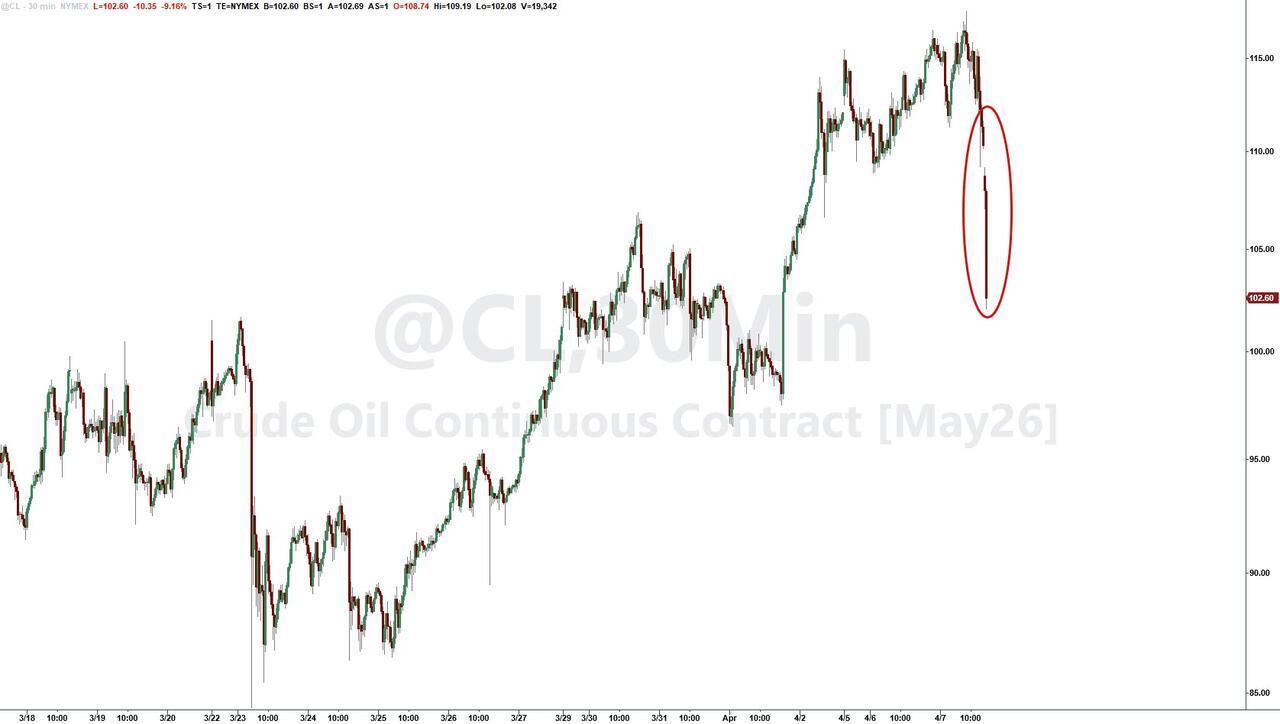
Stocks spiked…
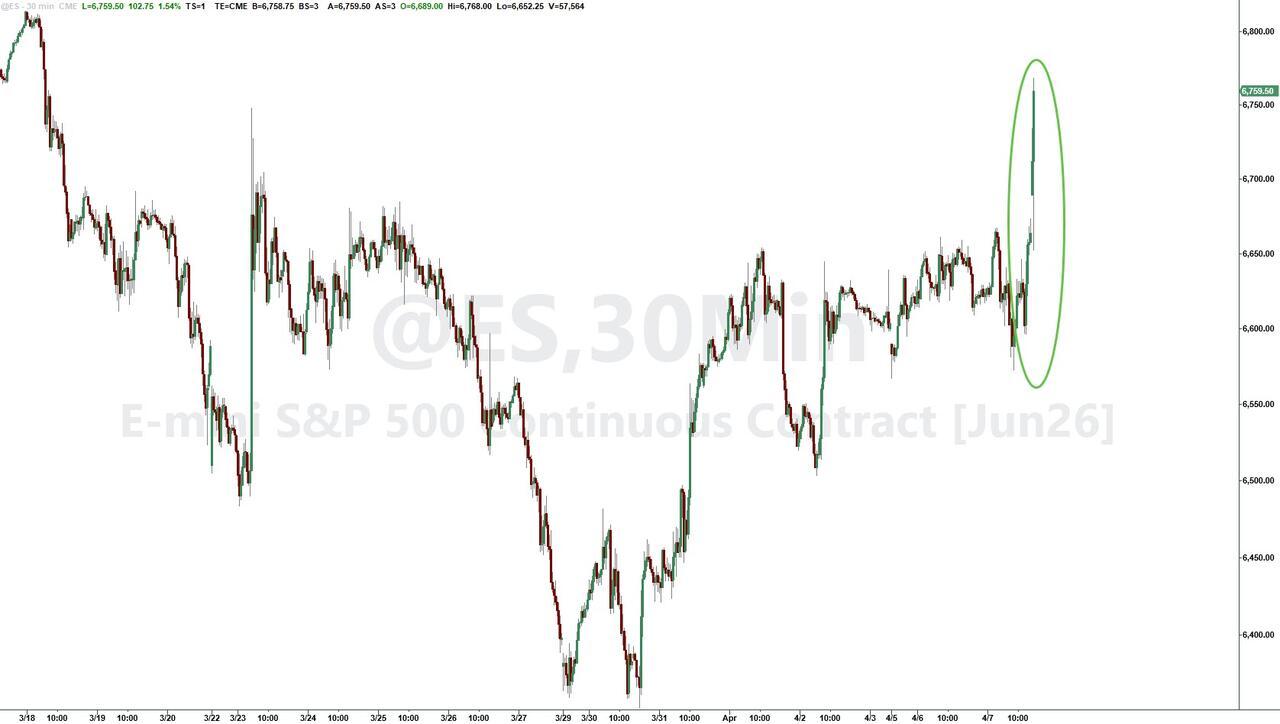
Gold and Bitcoin are soaring.
Treasury yields and the dollar are tumbling.
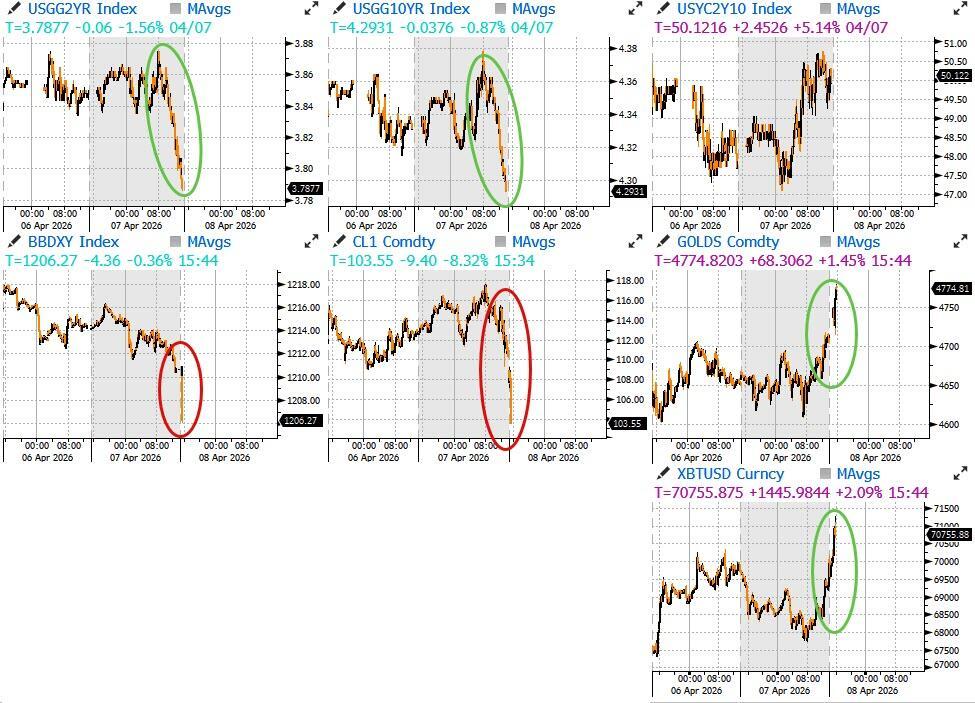
…well it wouldn’t be Tuesday without TACOs…
Just one thing though – Iran haven’t formally agreed to open the Strait (yet) and as a reminder, it takes two to tango ceasefire.
Last Ditch Peace Effort by Pakistan Prime Minister
With just hours until Trump’s self declared deadline wherein he said a “whole civilization will die tonight” – Pakistan’s leader and host of mediation efforts, Prime Minister Shehbaz Sharif, has tried to introduce a last minute olive branch, hoping that the US will avoid its decimation campaign:
I earnestly request President Trump to extend the deadline for two weeks. Pakistan, in all sincerity, requests the Iranian brothers to open Strait of Hormuz for a corresponding period of two weeks as a goodwill gesture. We also urge all warring parties to observe a ceasefire everywhere for two weeks to allow diplomacy to achieve conclusive termination of war, in the interest of long-term peace and stability in the region.
Will Trump latch on to this plea and last minute effort of good will? The sides are aware of the proposal:
TEHRAN IS POSITIVELY REVIEWING PAKISTAN’S REQUEST FOR A TWO-WEEK CEASEFIRE: SENIOR IRANIAN OFFICIAL
TRUMP IS AWARE OF PAKISTAN’S PROPOSAL: AXIOS CITING LEAVITT
In the meantime, some fresh statements via state Tasnim:
- “If Trump wants to fall into a hole with his madness, we have prepared a black hole for him from which it will be impossible for him to get out”, Tasnim reports citing an Iranian military source
- “Have prepared good surprises for Trump’s possible madness; One of them is the addition of Aramco oil facilities, Yanba oil facilities and the Fujairah pipeline to Iran’s goals, and in case of Trump’s crime, Iran will not hesitate to impose heavy costs on America and its partners.”
- “Trump thinks that with these threats the strait will be opened and the price of oil will go down! He doesn’t know that if he carries out his threat, he will have to wait for the oil price of $200 in the coming days.”
Axios Cites ‘Glimmer’ of Progress as Trump Deadline Looms
More from Axios’ Barak Ravid, though we should note that it’s increasingly difficult to know what has legitimacy:
Progress has been made in the past 24 hours in the negotiations between the U.S. and Iran, though reaching a ceasefire deal by President Trump’s 8pm ET deadline still looks like a long shot, according to a U.S. official, an Israeli official and two other sources with knowledge of the talks.
- A U.S. official said the thinking in the White House has shifted from “can we get there?” to “can we get there by 8 o’clock tonight?”
These wild headline swings (and in markets) concerning positive or negative signs on the status of indirect negotiations have been going for weeks at this point.
WH Press Secretary Karoline Leavitt thinks it’s assuring to inform the public that only Trump knows “where things stand and what he will do,” adding: “The Iranian regime has until 8PM Eastern Time to meet the moment and make a deal with the United States.”
Russia, China Veto Hormuz Strait Resolution at UNSC
On Tuesday a UN Security Council resolution on opening the Strait of Hormuz failed due to Russia and China vetoing it. It was drafted by Bahrain and authorized countries to use military force if necessary to open the strait for the free flow of shipping and commerce.
The resolution garnered 11 votes in favor, but permanent veto-wielding members China and Russia blocked it by registering no votes. This comes after days of pressure from Gulf countries to restore free passage in the strait, amid Trump’s Operation Epic Fury. Russia complained that the UN res would damage “very fragile truce negotiations” by given broad allowance to use military force to reopen the waterway.
Tehran Times Reverses in Astounding Correction, Now Says Talks Are Not Closed
The NY Times had also said it only within the last hour, based on the initial headline out of Tehran, that all backchannel talks were suspended.
Tehran Times deleted this post from 2 hours ago saying all communication with US has closed.
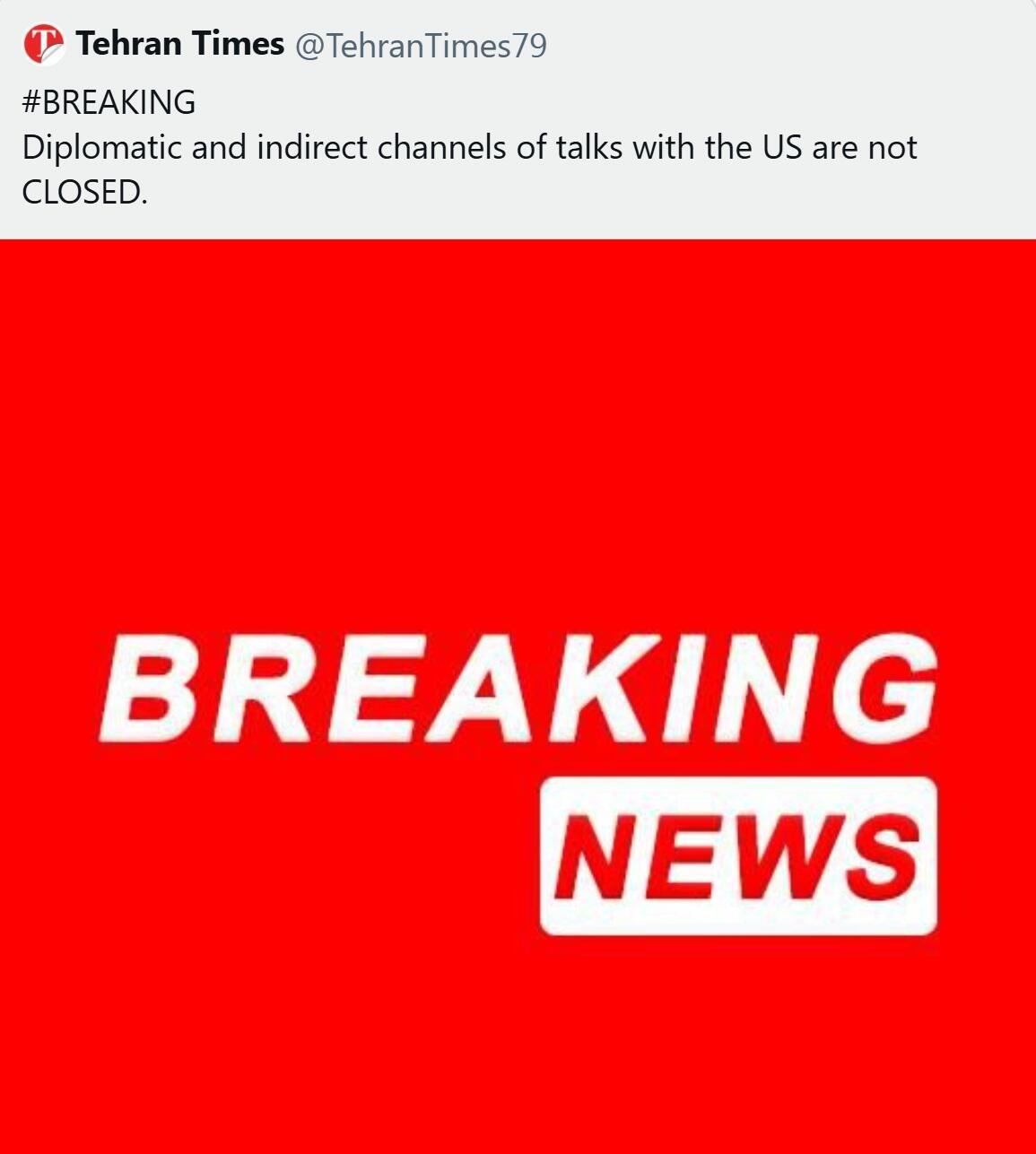
Trump Hints at Possible Deadline Extension
In a call with FOX’s Bret Baier, Trump says 8 PM deadline today “could change if negotiations move forward, but sticking to deadline for now.” And yet Tehran has said it has suspended all back channel negotiations. TACO Tuesday?
TRUMP TELLS FOX NEWS IF NEGOTIATIONS ADVANCE AND THERE IS SOMETHING TANGIBLE WE MIGHT EXTEND THE DEADLINE: AL ARABIYA
Meanwhile, per news wires and CNN:
The Israeli military is on standby and ready to launch strikes on Iran ahead of US President Trump’s deadline for Iran to reopen the Strait of Hormuz, an Israeli security source tells CNN. The Israeli security source said plans have been prepared for a combined US-lsraeli operation with full military coordination pending a green light from Trump.
Iran: All Diplomatic Channels With US Have Ceased
“Iran has closed all diplomatic and indirect channels of communication with the US,” Tehran Times has reported. The publication says that “Any and all message exchanges have also been suspended.”
The Tehran Times is seen as tied to the hardline factions of the government, and calls itself the “voice of the Islamic Revolution” – but is not directly state-owned per se.
The NY Times also confirms “Iran has stopped negotiating with the US and it told Pakistan that it will not continue ceasefire talks.”
Meanwhile President Masoud Pezeshkian has praised the willingness of “14 million” Iranian citizens to “sacrifice” by taking to the streets, seeking to protect power plants and other sensitive vital infrastructure, as the US-Israeli bombs rain down. US conservative MSM publications have decried this as a form of “human shields”.
‘Human chains’ seen on some bridges…
And apparently at nuclear sites…
Accomplished’? Vance Says Objectives Completed
Vice President JD Vance has said that “very shortly” this war will be “completed” in a Tuesday morning statement. He stated specifically that the military objectives have been accomplished, adding there are “two pathways” – and that optimistically this will involve “lots of negotiations” – but with a deadline of 8pm ET. The US is “confident it will get an Iran response.”
The below is from Hala Jaber, a longtime Sunday Times journalist and veteran Middle East war correspondent:
Trump is scrambling behind the scenes for a ceasefire with Iran, according to claims emerging via Fars News Agency. Allegations point to urgent outreach through multiple governments & intelligence channels. Citing what it describes as an “informed source,” the report claims the U.S. has been pushing for a ceasefire via backchannels, using countries it believes have credibility with Tehran.
According to the same account, Iran received calls from five heads of government & eight intelligence agencies, all seeking to open a path toward a ceasefire. It further claims Washington is considering reshaping its negotiation team, including removing Witkoff due to his ties to Netanyahu’s circle & replacing him with Vance to lead a more serious track. The urgency, the source says, is driven by mounting military & economic pressure, including fears of surging fuel prices. If true, it would mark a stark contrast to the public posture.
END
IRAQ KUWAIT/tuesday night
Iraqi Protesters Overrun Kuwait Consulate, Angry Over Role In US Actions
Tuesday, Apr 07, 2026 – 07:40 PM
Close US ally Kuwait finds itself under growing political pressure from its neighbor Iraq, related to the ongoing Iran war.
Angry crowds stormed the Kuwaiti consulate in Iraq’s southern Basra governorate on Tuesday after rockets which came from the direction of Kuwait killed three people, according to police sources cited by Reuters and Al Arabiya.
Neither Kuwaiti nor Iraqi officials issued immediate public statements, and the rocket incident remains a mystery in terms of its origin or the motives behind the attack.
It may have been a missile fired on Kuwait from Iran, which errantly crossed the border and landed on Iraqi homes:
At least three people were killed and five others wounded when rockets fired from the direction of Kuwait hit a house in Khor al-Zubair near Basra, security and health officials told Reuters.
Protesters are angry at Kuwait’s role in the war, as it has played host to American forces, and reportedly has been a staging ground for US raids into Iran.
The crowds seem to have effective control over the Kuwaiti consulate in Basra…
This marks a sharp escalation along the sensitive Iraq-Kuwait border as the wider Gulf region faces sustained fallout from weeks of Iranian drone and missile strikes targeting neighboring states, including Kuwait. Iraq has a majority Shia population, and its major political players remain sympathetic to the plight of Iran.
Meanwhile Kuwait is telling its some 5 million citizens to shelter in place amid President Trump’s threat to obliterate civilian infrastructure inside Iran:
The Kuwaiti Ministry of Interior urged those in the country to shelter in place for six hours early Wednesday, which overlaps with President Trump’s 8 p.m. EDT Tuesday deadline for the Iranian government to lift restrictions on the Strait of Hormuz.
In a Tuesday post on social platform X, the ministry instructed Kuwaiti citizens and residents to “remain in their homes and avoid going out, except in cases of utmost necessity” from midnight to 6 a.m. local time Wednesday. Trump’s deadline hits at 3 a.m. in Kuwait.
The Gulf states have bore the brunt of Iran’s retaliation, along with Israel, after over a month since the start of Operation Epic Fury. Tehran says that if its critical infrastructure is hit, such as water desalination plants, then it will do the same to America’s allies in the region.
END
ISRAEL/USA/IRAN/SAUDI ARABIA
AND THIS IS WHAT A CEASEFIRE LOOKS LIKE IN THE EYES OF THE IRANIANS
Saudi Arabia’s Oil Pipeline To Red Sea Hit By Drone Attack Just As Hegseth Declares ‘Overwhelming Victory’ Against Iran
Wednesday, Apr 08, 2026 – 09:00 AM
Summary:
- The Hegseth/Caine presser as expected declared ‘victory’ in Iran while Gen. Caine emphasized the ceasefire is a “pause” but US forces remain “ready to resume combat.“ Hegseth says “military will be hanging around in Iran, won’t go anywhere, and will make sure Iran complies.
- Caine hails that US has destroyed Iran’s defense-industrial base, including over 80% of missile facilities gone, and its navy lies at the “bottom of the Arabian Sea”. It’s clear that after six weeks the Pentagon is trying to put a bow on Operation Epic Fury.
- Iran meanwhile demands stiff fees for ships passing through Hormuz during the ceasefire, and says it holds the final authority on which vessels get to pass. Tehran leaders have asserted ‘victory’ for Iran, amid positive international reaction to the ceasefire.
- Attacks on Bahrain, UAE, Kuwait, and Saudi Arabia continued on Wednesday, hours after the ceasefire announcement. Also, there’s as yet been no significant change in navigation traffic in the Strait of Hormuz today, per Bloomberg satellite data.
- Saudi Arabia’s vital East-West oil pipeline carrying crude from the Gulf to the Red Sea for export has been attacked at a pumping station, oil rises on the news.
Saudi Aramco Export Pipeline To Red Sea Struck
A huge, and not very ‘ceasefirey’ development in Saudi Arabia, per the FT (just as Hegseth was speaking): “A pumping station was hit at 1 p.m. local time, the people told FT. The attack was carried out by a drone and damage was being assessed, one of the people told FT Saudi Aramco, which owns and operates the pipeline.” FT continues, “The people said a pumping station, one of several along the 1,200km pipeline that has become an economic lifeline for the kingdom since the near closure of shipping through the Strait of Hormuz, was hit at about 1pm local time on Wednesday.”
One Gulf based representative and analyst complains, “For a ceasefire, the fire does not seem to be ceasing. The UAE and Kuwait are under attack, and Iran says it is under attack too. Beyond the ceasefire itself, the bigger question is that the plan still looks unclear when it comes to what follows…”
The development pushed oil slightly up…
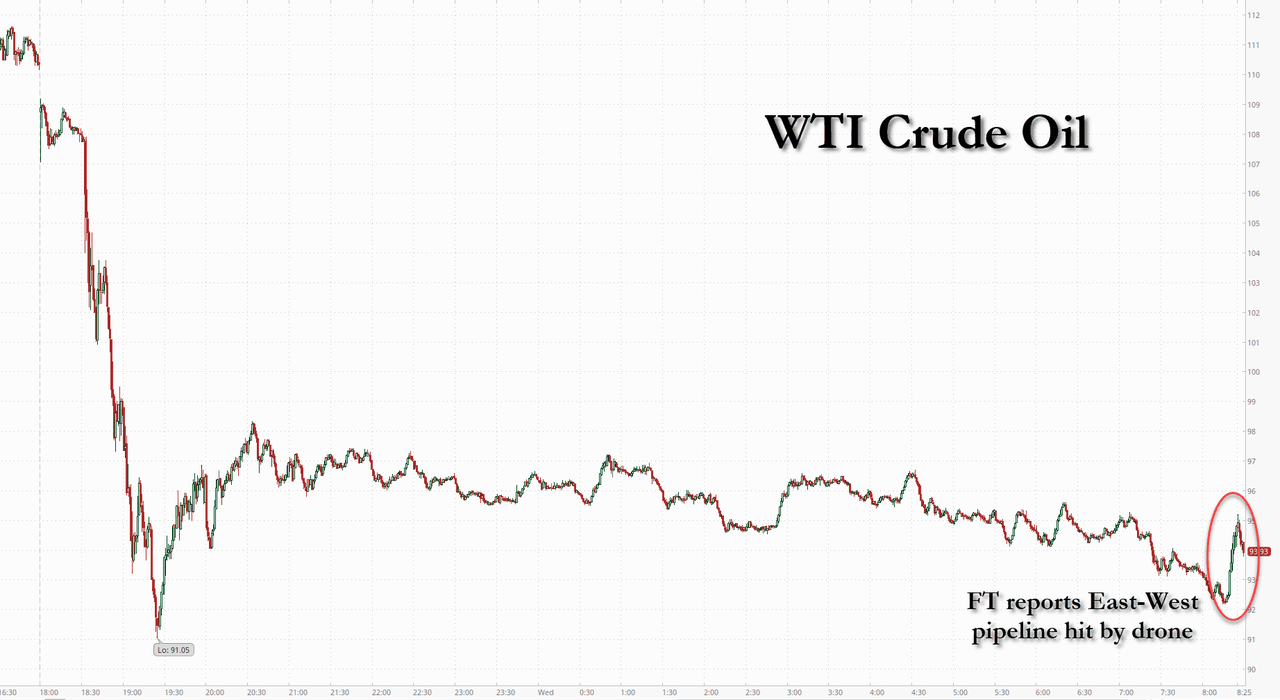
Pentagon Tries to put a Bow on Operation Epic Fury: ‘Overwhelming Victory’
Hegseth in his Pentagon press briefing called the ceasefire an “overwhelming victory” for the United States and stated the military “stands ready” to ensure Iran complies with the agreement. He said US forces will still be “hanging around” the region, and further that Iran’s nuclear “dust” is being monitored, buried under the rubble, and that eventually the US will either take the enriched uranium or else it will be handed over. “Iran begged for ceasefire,” Hegseth declared.
“We stand ready in the background to ensure Iran upholds every reasonable term,” Hegseth said. Also Joint Chiefs chairman Gen. Caine stated that all US objectives in Iran have been achieved. He hailed that US has destroyed Iran’s defense-industrial base, including over 80% of missile facilities gone, and its navy lies at the “bottom of the Arabian Sea”. It’s clear that after six weeks the Pentagon is trying to put a bow on Operation Epic Fury.
During the Q&A, there was a question – largely dodged by Hegseth – centered on wither the US has achieved “strategic” victory vs. merely tactical victory. That ultimately is the question.
Also, is there really ceasefire on the ground? But this is merely day one:
But Iran also sees this as Victory
The United States and Iran have announced a two-week suspension of all attacks, and Tehran reportedly agreed to allow safe transit of vessels through the Strait of Hormuz. It all started with President Trump seizing on the last-minute olive branch plan offered by Pakistan’s prime minister, which urged a two week extension of the US deadline before massive obliteration bombings began, and in return Iran would agree to reopen the Strait of Hormuz.
Iran has essentially declared victory and stated that upcoming talks in Islamabad, Pakistan, on Friday do not guarantee an end to the war. Israeli Prime Minister Benjamin Netanyahu has given supportive lip service to the US decision but stated that Lebanon is excluded from the two-week ceasefire.
Latest from Trump on Truth Social:
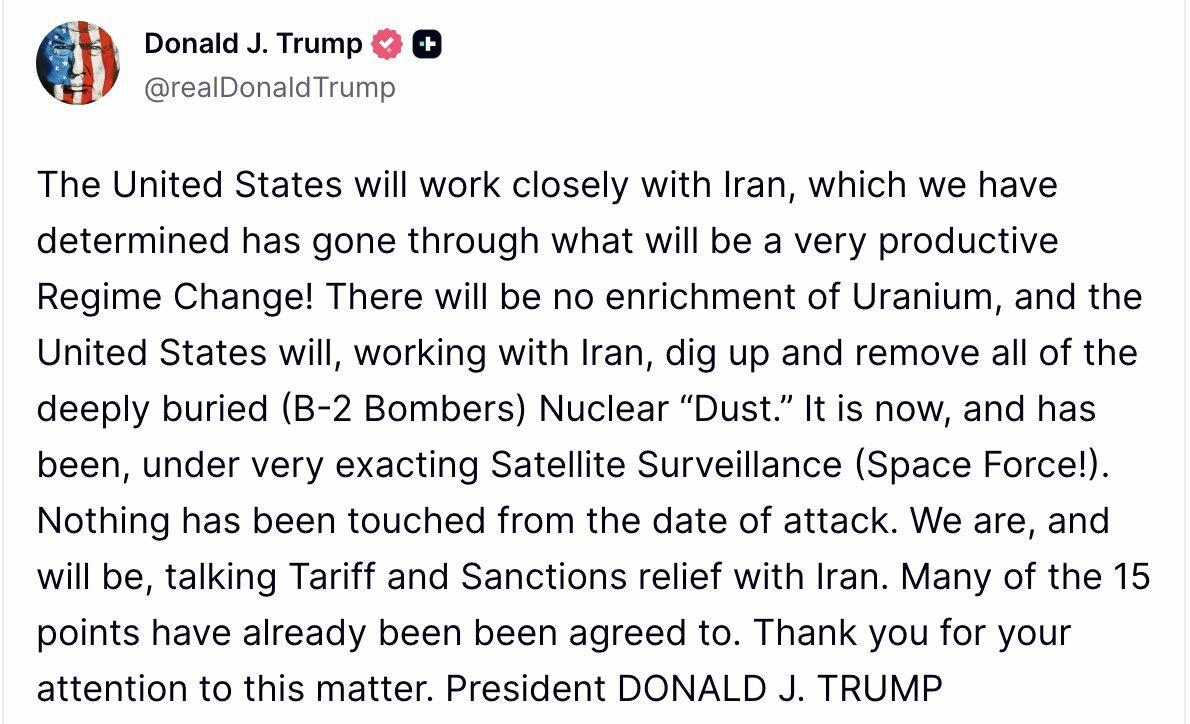
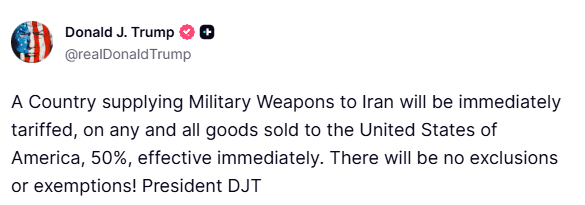
Oil prices dropped rapidly after Trump announced the pause, with Brent crude trading just below $95 per barrel. Qatar’s Cabinet welcomed the US-Iran ceasefire brokered by Pakistan, stating it emphasizes “the necessity of immediately halting all hostile actions and practices that undermine regional stability, respect for state sovereignty, and the assurance of security for maritime passages, freedom of navigation, and international trade.”
Iran meanwhile is demanding stiff fees for ships passing through Hormuz during the ceasefire, and says it holds the final authority on which vessels get to pass. So now, in essense… stability in global energy flows depends on accommodating Iran AND it will likely get sanctions relief, per the deal on the table.
Iranian state media has featured celebratory scenes in the streets:
END
PETER TCHIR ON THE CEASEFIRE:
A Pause To Negotiate A Deal? Some Caveats…
Wednesday, Apr 08, 2026 – 08:25 AM
Authored by Peter Tchir via Academy Securities,
Basically we wound up at the better end of our “base case” in yesterday’s Spaghetti Western, and you could argue we made it all the way into our best case of “ceasefire” (I’m reluctant to label it that, as you will see, but it is touching on that end).
I do think we are far from a “real deal”.
In any case, markets are responding according as both sides send people to Pakistan to negotiate a deal.
Stocks are up strongly across the globe, with Europe and Asia leading the way (they were hit hardest by the conflict).
Bonds too are having an incredibly strong day (once again led by Europe).
Crude oil is falling like a rock, as shipping is potentially set to resume.
One reason stocks didn’t seem to respond much last week to rising spot oil prices was because later month contracts hadn’t risen much.
For now, the August WTI contract is basically where we were on March 23rd, the Monday that began the “deal is on the way” theater, which will temper how much further the stock market can rally.
Any “Ceasefire” Should Benefit the U.S. the Most
While we don’t know the specific status of each country, it seems fair to argue that the U.S. can do more to bolster its position – politically and military, than Iran can during a pause. A win for the U.S. and markets.
It will be interesting to see what develops on the “coalition” side of the equation. There has been reporting/wild speculation (difficult to tell the difference sometimes) that China was involved in bringing Iran to the deal. That could be interesting if true, and if China really wants to play a role.
Some “Caveats”
I suspect that how markets and voters respond, will influence what comes next. Two things show up as “immediate” question marks around the negotiations:
- The U.S. acceptance is “subject to” Iran opening the Strait. Iran has agreed to control shipping through the Strait. Both sides are “vague” enough that this could be acceptable enough to keep the negotiations going. Though it is pretty clear, that the first “walk away” moment, is likely to come from either side regarding how open the Strait really is.
- Vance (who will be leading the U.S. team) has already brought up the need for Iran to “negotiate in good faith”. Since the conflict started while “technical negotiations” were ongoing, this is another signal that the U.S. needs progress.
- The “Supreme Leader” who until last night, allegedly sending slips of paper with instructions to runners to deal with the negotiations, had been largely MIA (with many reporting severe wounds and questions about his power).
- Israel reportedly has agreed to cease attacks as well. Israel is largely aligned with the U.S. and largely dependent on U.S. forces in the region, but largely is not the same as totally.
These are just some of the things that could cause some breakdown in talks.
Everyone’s a Winner…
Both Iran and the U.S. are claiming this to be a major victory.
While it is all evolving rapidly, the U.S. has a multipoint plan. Iran has a multipoint plan.
Very few of the points align.
Clearly this is why they are sitting down at the table.
Both sides have clearly read the “Art of the Deal” and are approaching negotiations from a maximalist point of view.
How serious either side is on each of their points remains to be seen. Given where we were yesterday morning, it would seem that the U.S. is likely to be the first to use the threat of ending the ceasefire to get maximum leverage.
Just this morning, the President announced “working with Iran” to dig up the nuclear materials. That seems like progress as ensuring Iran cannot attain nuclear weapons should be a key goal of the administration (and the world).
Bottom Line
This played out at the “optimistic” end of our spectrum of outcomes. A very pleasant surprise.
From here the devil (almost literally) will be in the details. I don’t expect smooth sailing, but market reaction will be muted in either direction, but especially to the downside, now that both sides seem willing to play ball. Though who wouldn’t play ball when you think your demands might be met, for a one-sided victory?
I do think public reaction, domestically, will influence how tough the U.S. negotiates versus trying to declare victory and move on.
Hopefully we see significant transit through the Strait.
On the negative side of things (there always has to be a negative), it is unclear how much damage has already been done to the global economy and supply chain, and how quickly that can be rectified (especially if traffic is limited).
Now we can get back to affordability (which got better with the pause, but is still an issue), private credit, etc.
Lot of comparisons to the post Liberation Day, TACO, rally. That just doesn’t seem correct.
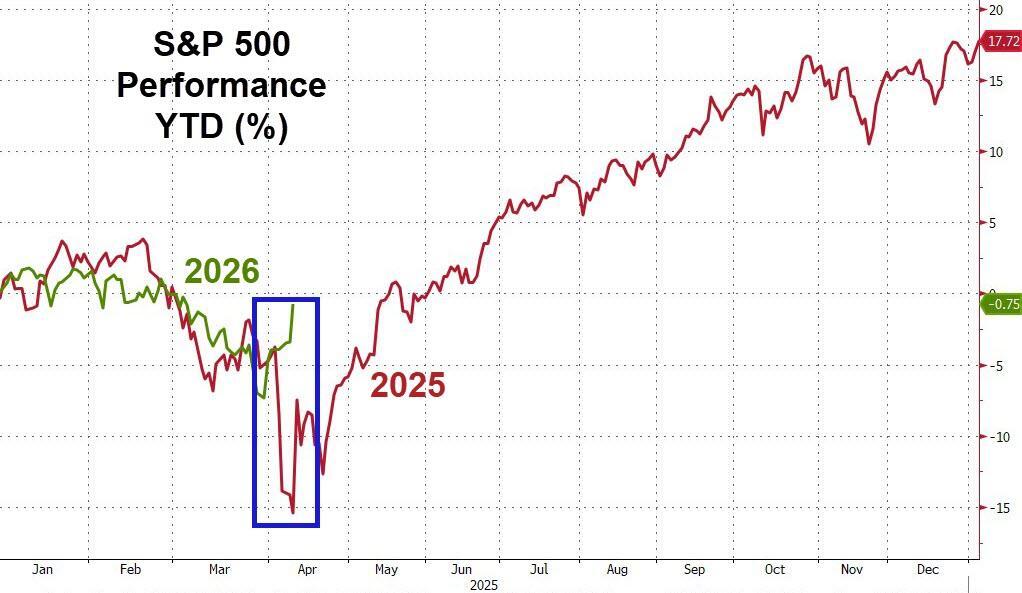
Stocks were never in freefall like they were then.
We have not moved too far from the highs on many major indices. So, yes, the rally overnight can continue, but the comparisons to post Liberation Day, tariff walkback, rally isn’t realistic.
Good luck and am glad we aren’t waking up to the smoking rubble of a society (which never seemed likely but was in the back of everyone’s mind).
JERUSALEM POST ON THE CEASEFIRE:
Five things to watch amid the ceasefire with Iran
The upcoming issues include Lebanon, Iraq, JD Vance, domestic political fallout, and the details of Iran’s 10-point plan.

U.S. Secretary of War Pete Hegseth (L) looks to Chairman of the Joint Chiefs of Staff Gen. Dan Caine as he speaks during a press briefing at the Pentagon on April 08, 2026 in Arlington, Virginia.(photo credit: Andrew Harnik/Getty Images)BySETH J. FRANTZMANAPRIL 8, 2026 16:05
On April 8, a fragile ceasefire took shape in the Middle East. The fragility of the ceasefire is clear from reports of continued Iranian attacks on the Gulf, as well as news that Israel will continue its strikes in Lebanon.
In addition, it is clear that US Vice President JD Vance believes the ceasefire is fragile.
He hopes to see Iran engage “in good faith” in talks. Vance has generally avoided the spotlight in the Iran war.
However, it appears that the Iranians are very suspicious of other White House mediators, particularly Steve Witkoff and Jared Kushner.
Iran believes it was deceived in the talks in February and last June, and that the talks were used to give the US time to prepare airstrikes. Iran doesn’t believe the US engaged in good faith.

The US also seems to feel the same way about Iran.
As such, it’s worth looking at several key issues that will remain hot topics and crisis points as the ceasefire begins.
Lebanon
Lebanon is a key frontline for Israel. After Hezbollah launched rockets at Israel on March 2, the IDF launched a major offensive in Lebanon. This has included airstrikes and calls for Lebanese to evacuate a swath of southern Lebanon.
This has displaced more than one million people. Israel has bombed the bridges over the Litani River, claiming they were used by Hezbollah. This will also prevent most of the people from returning to southern Lebanon. The IDF has inched forward as well, taking over areas close to the Israeli border with Lebanon. It is not clear if the IDF wants to actually take over most of the area south of the Litani, or turn it into a kind of no-man’s land.
Hezbollah will want Iran to help it secure a ceasefire in Lebanon. As such, it is likely that Iran will feel pressured in its talks with the US to bring Lebanon into the mix.
Lebanon’s government will also want a ceasefire. However, messaging from Israel regarding the offensive in southern Lebanon paints a picture that this is only the beginning of a conflict in Lebanon that will turn southern Lebanon into a replay of what happened in Gaza, essentially moving the civilians many miles north and razing many villages along the border.
The theory in Jerusalem is that after October 7, Israel won’t accept the borders as they were in the past. This offensive “defense” means moving into Gaza and Lebanon for the foreseeable future. It’s unclear if Israel will accept Lebanon being included in any ceasefire deal. If it doesn’t, this will lead to questions about what Hezbollah and other Iranian proxies may do in response.
Iraq
Iran has inflamed Iraq throughout the war that began with Israeli and US airstrikes on February 28. Iranian-backed militias in Iraq have carried out around 800 drone and missile attacks in Iraq. It appears that although the militias are signaling they will join the ceasefire, there have still been incidents in Iraq.
The Kurdistan Region of Northern Iraq was impacted the most, with some 600-700 drone and missile attacks. US facilities, including the embassy and a diplomatic support post at Baghdad Airport, were also major targets of the militias.
Iran showed during the war that it controls most of Iraq. The militias are paid by the government as part of the Popular Mobilization Forces, but they work on behalf of Iran. They also kidnapped an American journalist, Shelly Kittelson. She was released late on April 7.
It’s unclear if this was part of the ceasefire deal. Prior to her release, the kidnappers, likely from a militia called Kataib Hezbollah, released a video they forced her to make. The militias are emboldened. Iraq still lacks a new prime minister, despite elections in November 2025. As such, Iraq will remain in play during the ceasefire.
JD Vance
The US vice-president has been a key figure throughout the Iran war. He has been key mostly for not being involved. He is seen as a member of the administration who may have been skeptical of this policy shift. The Trump doctrine, prior to the war with Iran, was skeptical of new wars in the Middle East. Vance is also likely skeptical of new foreign wars.
“If the Iranians don’t engage in good faith, they’re going to find out that President Trump is not one to mess around,” Vance said after the ceasefire deal was announced. He is in Budapest, where Victor Orban is seeking to win new elections and cement almost two decades in power.
Vance was tapped to play a role, likely because the other countries involved appear to trust him. Reports from Al-Ain media in the UAE say that on Monday, American envoy Steve Witkoff continued making intensive phone calls. “Then began a busy day of adjustments, as Pakistani mediators passed new drafts between Witkoff and Iranian Foreign Minister Abbas Araqchi, while the foreign ministers of Egypt and Turkey sought to narrow the gap,” Al-Ain says.
Vance will be key to what happens in the next two weeks. The countries that want the deal to continue will hope he remains involved.
Domestic political fallout
In the US and Israel, there will be increased focus on the war. Were the goals achieved? What were the goals? It is still unclear what the precise goal of the war was. The nuclear file and ballistic missiles were among the stated goals. However, US officials have also talked about destroying the Iranian navy and air force as a goal, and Israel and the US have also focused on destroying Iranian infrastructure and its military industrial complex.
It is not clear how many of the strikes were able to complete all these goals. Iran still has missiles and has shown it can launch them, and also drones throughout the war. There will be questions in Israel and the US, among the public, about what the war accomplished. Israel is likely to hold an election in the fall, and the US has midterms.
This Iran war may have ended in time to avoid overshadowing those elections too much. However, energy prices and other aftereffects will continue. Domestic political pressure may change US President Trump’s perception of whether this was a good war to engage in. Reports at The New York Times continue to paint a picture of Israel encouraging this war, and also have overly rosy assessments of the chance for regime change.
Meanwhile, in the US, there is anger over Trump’s threats to destroy Iran and its civilization. The comments about bombing it to the Stone Age and making its civilization “die” are not the usual rhetoric of American leaders in wartime. “No President in control of his senses would publicly promise to eradicate an entire civilization,” US Senator Chris Murphy said.
The Iranian 10-point proposal
Iran has floated a 10-point proposal, which the United States received from Tehran over the last several days. US mediators appear to think this is not workable, and that is why the ceasefire remains fragile. It’s unclear if Iran will agree to the US demands regarding its nuclear program or missiles. It’s unclear if Iran feels it won or lost the war. Its control over the Straits of Hormuz makes Iran feel emboldened.
It successfully shifted the war from one that may have been more narrowly tailored by the US and Israel to one that inflamed the whole region. The next two weeks will need to be focused on whether the US or Iran is merely playing for time until a new round of conflict. Most countries in the region want this war to end and not be dragged back in.
END
ROBERT H ON THE CEASEFIRE:
A temporary halt to hostilities ?
The terms of the proposed “Islamabad Peace Accord” represent a total geopolitical transformation. According to the Iranian official narrative, the U.S. has agreed to a permanent ceasefire, the full removal of all sanctions, and—most significantly—the complete withdrawal of U.S. combat forces from across the Middle East. Iran will maintain absolute control over the Strait of Hormuz, with international acceptance of its nuclear enrichment program and the termination of all UN resolutions targeting Tehran. Furthermore, Trump has reportedly agreed to pay reparations for destroyed infrastructure and to halt all military aggression against the “Axis of Resistance,” including Hezbollah and the Houthis. THIS IS SAME PLAN FIRST REJECTED BY THE US. Should we believe this change of heart?
This stunning reversal was supposedly reportedly driven by a “last-minute” intervention from China and Pakistan. Prime Minister Shehbaz Sharif and Field Marshal Asim Munir successfully persuaded a “trapped” Trump that victory was unattainable, while Beijing warned of a total global economic collapse if U.S. strikes targeted Iranian energy infrastructure. This is all true but why listen to words already said? The so called OFF Ramp was bombing Iran back to the “Stone Age”.
However there is another key element that perhaps the media may if allowed tell us. While American jets were air borne from England to meet the 8PM strike timeline, Iran acted. A 2 stage hypersonic ballistic solid fuel missile flying at Mach 5+ hit Jerusalem. This temporary stopped everything. Why? No one thought Iran has such capability. And having such missile technology means that Iran can respond readily to further escalations. And neither Israel nor America can stop such missiles. And it is clear Iran will fight and not surrender.
While we all hope and pray for peace the fog of war suggests that it is premature to think this is over. Yes, military Planners need time to catch their wind to think. However none of the options are good. And today being Wednesday strikes are continuing against Iran and the UAE is being hit by Iran. While the US military air bridge from CONUS to Europe, continued all night unbated. Whatever the US has been moving to the Middle East, continues to move in great quantity.
Whatever comes forth, it is premature to think that America has given up the Middle East or that the so called Petro dollar has died. And the Iranian defiance and weapons are causing other STATE Actors to rethink their positions and possibly revise their thinking and possible actions. Whether even countries like China or Russia knew the true extent of Iranian weapons knowledge is a question mark. Clearly the Americans and Israelis did not.
We all await to see what comes next in this caper that holds the world hostage to energy disruptions.
And not to be forgotten are moves being made by Central Banks that this crisis is augmenting. France having learnt last year that the New York Fed could not deliver their gold in storage back since they sold it. Paid in cash at a high price and the conflict has allowed the French to restore their gold holdings making a profit. As the Middle East and Russia have sold off gold for liquidity. If the Italians and Germans demand their gold back they too may well find themselves receiving paper money and not physical metals. Such events further erode Federal Reserve creditability.
The combination of events will at some point cause trade settlement issues well beyond energy availability.
…
[Message clipped] View entire message
END
LATE UPDATE
VANCE WARNS;
Vance Warns Iranians Ahead Of Pakistan Talks: US “Has All The Cards” & “We Want The Nuclear Fuel”
Wednesday, Apr 08, 2026 – 04:10 PM
Summary:
- Vice President Vance (who’s been tapped to lead talks) warns Iranians: Trump “has all the cards” and cannot have a nuclear weapon. Follows Pentagon/WH declaring “total victory”. Iran says it has upper-hand.
- US, Iran agree to meet for first direct talks in Islamabad. Situation fragile given that Iran is threatening to hit Israel again over IDF’s massive Lebanon airstrikes. Tehran says 3 clauses already violated.
- Iran meanwhile demands stiff fees for ships passing through Hormuz during the ceasefire, and says it holds the final authority on which vessels get to pass. Tehran leaders have asserted ‘victory’ for Iran, amid positive international reaction to the ceasefire.
- The first two ships since the ceasefire was announced have crossed the Strait of Hormuz after Iran said it will demand that shipping companies pay tolls in cryptocurrency. Hours later, Fars announces a halt to ships’ passage. This as IDF pummels Lebanon.
- Saudi Arabia’s vital East-West oil pipeline carrying crude from the Gulf to the Red Sea for export has been attacked at a pumping station, oil rises on the news. There’s been sporadic attacks on other Gulf states too. Kuwait sees key energy, water sites hit.
Vance Could Run Point in Pakistan Talks, Issues Warning to Tehran Side
President Trump earlier in the day floated the possibility that it could be Vice President JD Vance heading up negotiations with the Iranians in Islamabad. Axios is now reporting that he’s been tapped. Vance this afternoon, speaking to Fox News, asserted that President Trump “has all the cards” in negotiations and that Tehran must recognize the US position.
Vance outlined Washington’s apparent core objective, saying, “We want Iran to not be able to make a nuclear weapon. We want the nuclear fuel, which is something the president has made very clear.”
“And again, the way to think about this is the United States has certain demands and certain things that we want. The Iranians have things they can get out of the negotiation. The more that they’re willing to give us, I think the more they’re going to get things out of this negotiation. The president’s talked about sanctions relief.”
However, he added that economic incentives remain conditional, saying, “The president’s talked about economic partnerships and things like that. That’s not going to happen unless the Iranians make a firm commitment to stop anything close to the development of a nuclear weapon.”
Vance concluded by emphasizing US leverage, stating, “And frankly, the president has all the cards here. We’ve got a lot of leverage. We’ve got a lot of things that we can do, but right now, I think we’re in a good spot.”
Meanwhile, unexpected…
Iranian President Pezeshkian called on Europe to play an “effective” role in supporting lasting stability and security in the region.
Ghalibaf: US Already in Violation of Ceasefire Deal
Iran has expressed its ‘agreement’ with Trump on the proposed 10-point ceasefire plan being workable, but has at the same time issued official statement, via Parliament Speaker Ghalibaf, complaining that three key clauses have already been violated. They center on:
- Israel’s ongoing attacks on Lebanon
- Ongoing US-Israeli violation of Iranian airspace
- Iran’s ‘right’ to enrich uranium
‘Ball is in US court’… says Iran FM:
WH: ‘Total Victory’ Achieved in Iran
Leavitt declared ‘total’ US victory in Iran in the Wednesday afternoon briefing. She was repeatedly pressed on Trump’s prior threats to destroy a whole ‘civilization’. She said: “With respect to the Iranian people, the president has taken out the imminent threat that was posed by their military to the United States, to our allies in the region, to our forces in the region, and of course as the president has long said, he hopes that Iran will be a country of peace and prosperity and we’re moving into this next round of negotiations to hopefully come to an agreement with this new regime that will create long term stability to the Middle East.”
Will hold Iran to keeping the strait open. More from Leavitt: “The president was very clear … in his language last night … he said that this ceasefire is subject to the free, safe and immediate reopening of the Strait of Hormuz.” She added: this means “without limitation, including tolls.”
She goes after media coverage: “So let me be clear and correct the record,” Leavitt said. “The Iranians originally put forward a 10-point plan that was fundamentally unserious, unacceptable and completely discarded. It was literally thrown in the garbage by President Trump and his negotiating team,” Leavitt said. “Many outlets in this room have falsely reported on that plan as being acceptable to the United States. And that is false.” She then emphasized negotiations will take place behind closed doors.
END
LEBANON VS HEZBOLLAH
Lebanon vs Hezbollah: A standoff between state sovereignty and Iranian influence – opinion
Although much weakened by Israel’s military, and other more covert operations, Hezbollah is still too powerful to be controlled by the government.
A Hezbollah flag waves among a destroyed building following an Israeli airstrike during a media tour in Baalbek, Lebanon, on March 23, 2026.(photo credit: Jonathan Labusch / Middle East Images / AFP via Getty Images)ByNEVILLE TELLERAPRIL 7, 2026 18:00
The Lebanese government, under President Joseph Aoun, has been making a determined effort to assert its authority over the rogue Iranian-backed terrorist Hezbollah organization that once operated inside Lebanon as a virtual “state within a state.”
Although much weakened by Israel’s military, and other more covert operations, Hezbollah is still too powerful to be controlled by the government. Since it entered the war on March 2 in support of Iran, it has been launching an average of 150 rockets a day into northern Israel, some coordinated with Iranian missile attacks.
The Lebanese presidency and cabinet have declared Hezbollah’s cross-border attacks “unlawful” and not authorized by the state, stressing that no non-state actor has the right to drag Lebanon into war.
On March 9, Aoun outlined a four-point plan calling for a “total ceasefire,” Hezbollah’s disarmament, and international support to strengthen the Lebanese Armed Forces, coupled with direct Lebanese-Israeli talks under international auspices. In an online conference with senior EU officials, Aoun described the plan as a path toward “permanent security and stability arrangements on our borders,” but declared it was conditional on a halt to Israeli strikes inside Lebanon.
Perhaps as a sign of the sincerity of his intentions, on March 24 Aoun declared Iran’s ambassador-designate Mohammad Reza Sheibani persona non grata, and gave him five days to leave the country. Lebanon objects to the close connection between Hezbollah and Iran’s hardline Islamic Revolutionary Guard Corps, accusing the IRGC of “commanding Hezbollah’s operations” in the current conflict.

On March 30, it emerged that Sheibani, backed by Iran and its Hezbollah supporters, had refused to leave. Iran has stated unequivocally that its ambassador to Lebanon would remain in his post.
A standoff between the Lebanese government, in its efforts to control Hezbollah, and Iran, which regards Lebanon as its colony, has developed. Lebanon has not enforced its own decision, for example, by closing the Iranian embassy, or attempting an arrest of Sheibani. In fact, the situation has settled into a symbolic but revealing deadlock.
Negotiations between Israel and Lebanon
Israel and Lebanon are similarly in a state of frozen animation, and have been for nearly 80 years. The two countries are still technically at war – the war launched on the nascent State of Israel in 1948 by the joint Arab armies.
Since then, no peace treaty or armistice has been negotiated between them, and there have been no diplomatic relations or official channels of communication. Any interchanges have been indirect, via the UN, international mediators, and back-channel contacts. Only UN Security Council Resolution 1701 and subsequent arrangements have provided a formal framework for the cessation of hostilities along the border.
All of which makes Aoun’s recent apparent overture the more unusual. Whether it can lead to direct negotiations is highly unlikely, given the current situation. Israel is establishing a security buffer zone inside southern Lebanon, which it describes as a temporary defense measure rather than a permanent occupation. At the same time, it is undertaking extensive airstrikes against Hezbollah infrastructure and fighters, including in Beirut.
Even so, on March 13 the Qatar-funded Caliber media company reported that Aoun had proposed a one-month truce with Israel, pledging to use the period to achieve the disarmament of Hezbollah. This proposal was communicated to Israel through US Ambassador to Lebanon Michael Issa, but like so many pledges emanating from the Lebanese government, it has simply withered on the vine.
The official Israeli position is that the Lebanese government, in accordance with a number of prior agreements and commitments, is responsible for disarming Hezbollah. If it cannot achieve that, Israeli officials have argued that the war will end only when Hezbollah no longer poses a threat to Israel from Lebanese territory.
Israel has not signaled any readiness to enter political talks with Beirut as long as its relationship with Lebanon is dominated by active hostilities. But the door is not shut fast. Even though Lebanon’s infrastructure is affected by the ongoing military offensive, and civilian deaths and displacements continue to mount, Israel does not describe current operations as a conflict with the Lebanese state, but as self-defense against Hezbollah.
The struggle against Hezbollah
The political gap between the Lebanese and Israeli governments is wide, but not unbridgeable. From Israel’s perspective, Hezbollah is lodged firmly within the Lebanese arena, and it holds the Lebanese state responsible for its disarmament. The Lebanese administration does not disagree, for it is trying to distance the state from Hezbollah’s actions, is openly seeking help to bring the terrorist organization under state control, and has signaled its readiness to negotiate.
On March 31, the EU’s Diplomatic Service issued a statement on behalf of 10 states, including the UK, asserting that the responsibility for the current conflict in Lebanon “lies with Hezbollah,” adding, “We strongly condemn Hezbollah’s attacks in support of Iran against Israel, which must cease immediately.”
They expressed their “full support to the government and people of Lebanon,” and called for “direct political negotiation between Lebanon and Israel, that can contribute to putting a durable end to this conflict and set the conditions for peaceful regional coexistence.”
There is another factor at play. Lebanon’s next parliamentary elections, originally scheduled for May 2026 but now delayed until 2028, could consolidate Hezbollah’s strength, or signal its decline. Aoun has managed to achieve a breathing space of two years in which to ensure that the state gains the upper hand in its struggle with Hezbollah. It is because he acknowledges that the government is not powerful enough to achieve this without help, that he has floated the idea of direct Lebanese-Israeli talks under international auspices.
Negotiations, perhaps leading to joint military operations, could eliminate Hezbollah’s constant onslaught on Israel’s northern border, and would justify Israel’s withdrawal from the buffer zone it is establishing in southern Lebanon. If such talks were ever to be arranged, Hezbollah would undoubtedly attempt to disrupt them, so Israel’s participation would have to be dependent on firm security guarantees, perhaps underwritten by international enforcement.
The possibility of face-to-face talks may seem unlikely. But should the potential, however remote, of a collaborative Lebanese-Israeli effort to strike down Hezbollah – with Israel for once in lockstep with international opinion – be rejected out of hand?
The writer, a former senior civil servant, is the Middle East correspondent for Eurasia Review. Follow him at: http://www.a-mid-east-journal.blogspot.com
END
ISRAEL TBN/
IRAN/USA/ISRAEL
Watch Live: Hegseth Declares ‘Victory’ As Fragile Iran Ceasefire Hailed Internationally
Wednesday, Apr 08, 2026 – 07:55 AM
War Secretary Pete Hegseth and Gen. Dan Caine, chairman of the Joint Chiefs of Staff, are expected to give their first post-ceasefire announcement briefing on Iran at 8am Eastern time. Watch Live:
Iran sees this as Victory
The United States and Iran have announced a two-week suspension of all attacks, and Tehran reportedly agreed to allow safe transit of vessels through the Strait of Hormuz. It all started with President Trump seizing on the last-minute olive branch plan offered by Pakistan’s prime minister, which urged a two week extension of the US deadline before massive obliteration bombings began, and in return Iran would agree to reopen the Strait of Hormuz.
Iran has essentially declared victory and stated that upcoming talks in Islamabad, Pakistan, on Friday do not guarantee an end to the war. Israeli Prime Minister Benjamin Netanyahu has given supportive lip service to the US decision but stated that Lebanon is excluded from the two-week ceasefire.
Oil prices dropped rapidly after Donald Trump announced the pause, with Brent crude trading just below $95 per barrel. Qatar’s Cabinet welcomed the US-Iran ceasefire brokered by Pakistan, stating it emphasizes “the necessity of immediately halting all hostile actions and practices that undermine regional stability, respect for state sovereignty, and the assurance of security for maritime passages, freedom of navigation, and international trade.”
Iran meanwhile is demanding stiff fees for ships passing through Hormuz during the ceasefire, and says it holds the final authority on which vessels get to pass. So now, in essense… stability in global energy flows depends on accommodating Iran AND it will likely get sanctions relief, per the deal on the table.
Iranian state media has featured celebratory scenes in the streets:
Ceasefire Hailed Internationally
Pakistan’s Prime Minister Shehbaz Sharif said on X that he held a “warm, substantive” conversation with Iran’s President Masoud Pezeshkian. “I conveyed my deep appreciation for the wisdom and sagacity of the Iranian leadership in accepting Pakistan’s offer to host peace talks in Islamabad later this week to work jointly for the return of peace to the region,” he said.
“President Pezeshkian reaffirmed Iran’s participation in the upcoming negotiations and expressed appreciation for Pakistan’s efforts, while conveying his best wishes for the people of Pakistan,” he added.
Lebanon’s President Joseph Aoun welcomed the ceasefire, while Israel has instead asserted that Lebanon remains outside the agreement and continued strikes on the country.
To quote armchair war hawk Michael Weiss, A month ago Trump demanded Iran’s “unconditional surrender.” Now the U.S. claims these are a feasible starting point for negotiations…
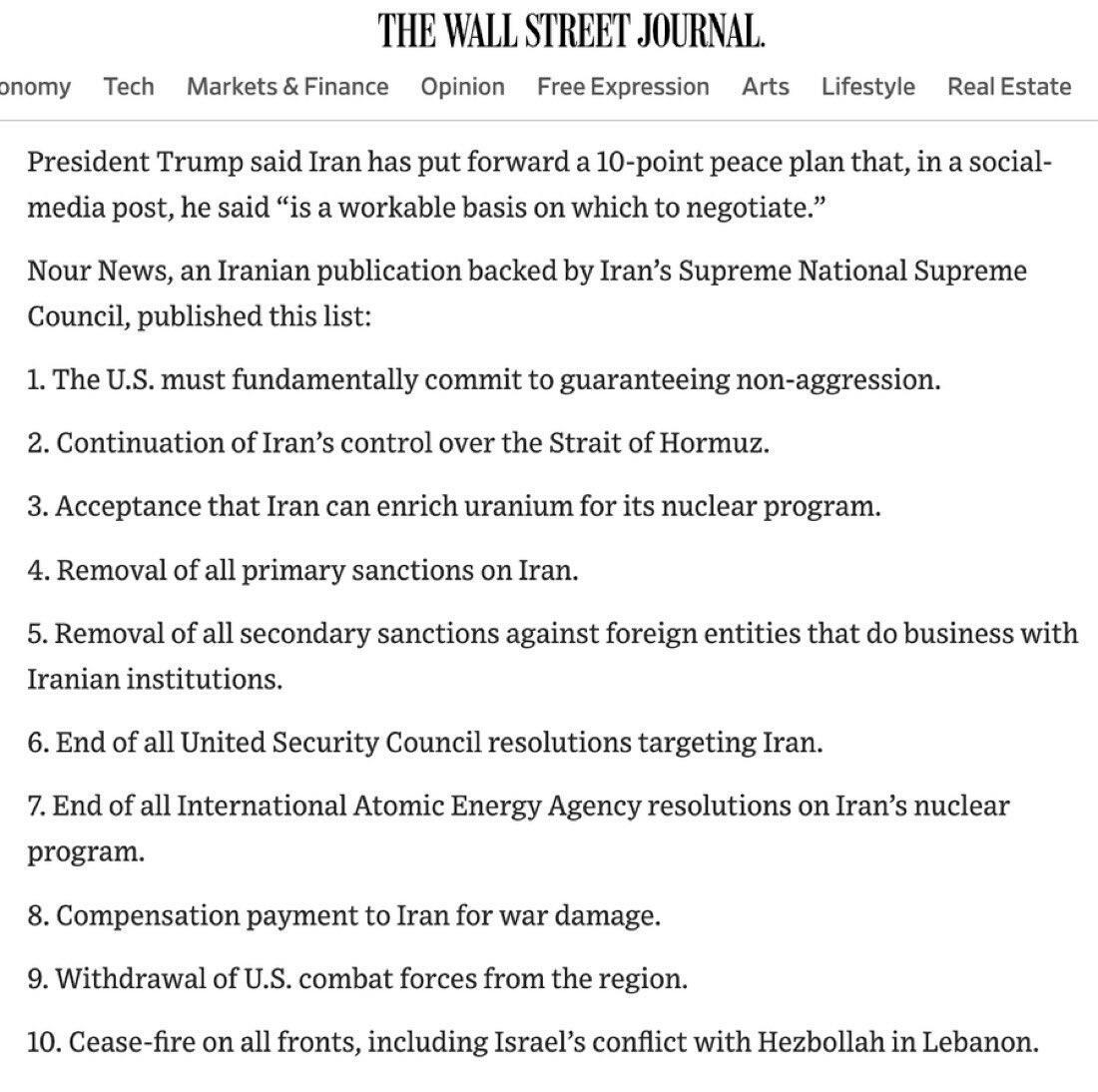
Pope Leo XIV praised the agreement as a “sign of real hope,” stating, “I welcome with satisfaction, and as a sign of real hope, the announcement of an immediate two-week truce. Only by returning to negotiations can we reach the end of the war,” during his weekly audience at the Vatican.
The International Atomic Energy Agency welcomed the ceasefire and signaled readiness to support a diplomatic resolution. Director General Rafael Grossi stated, “IAEA DG Grossi welcomes … a return to diplomacy aimed at negotiating a settlement on key issues including Iran’s nuclear program.” It added: “The IAEA stands ready to support these efforts through its indispensable safeguards and verification role.”
Attacks Continue? Hormuz Status
However, attacks on Bahrain, the United Arab Emirates, and Kuwait continued on Wednesday, hours after the ceasefire announcement. Also, there’s as yet been no significant change in navigation traffic in the Strait of Hormuz today, per Bloomberg satellite data.
A global shipping industry group representing 130 companies and around 1,500 vessels stated that conditions in the Gulf remain unstable. CEO Knut Arild Hareide said, “We note the signals of a ceasefire, but the situation in the Strait of Hormuz remains unresolved and unpredictable.”
“It is not yet clear under what conditions safe transit can be carried out. Shipowners are assessing the situation and will not resume transits until there is real security for safe passage,” Hareide added.
Earlier, Denmark’s Maersk shipping company stated that the ceasefire announcement does not provide sufficient certainty to resume normal operations in the region.
END
UPDATES CEASEFIRE/ZEROHEDGE
Iran Ceasefire Extremely Fragile As Trump Highlights Discrepancy In 10-Points; Direct Talks Planned ‘Soon’ In Pakistan
Wednesday, Apr 08, 2026 – 12:10 PM
Summary:
- The Hegseth/Caine presser as expected declared ‘victory’ in Iran while Gen. Caine emphasized the ceasefire is a “pause” but US forces remain “ready to resume combat.“ Pentagon is trying to put a bow on Operation Epic Fury. NYT: 10-point plan might differ between Tehran & Washington.
- US, Iran agree to meet for first direct talks in Islamabad Friday, Pakistan PM Sharif announces. Situation fragile given that Iran is threatening to hit Israel again over IDF’s massive Lebanon airstrikes.
- Iran meanwhile demands stiff fees for ships passing through Hormuz during the ceasefire, and says it holds the final authority on which vessels get to pass. Tehran leaders have asserted ‘victory’ for Iran, amid positive international reaction to the ceasefire.
- The first two ships since the ceasefire was announced have crossed the Strait of Hormuz after Iran said it will demand that shipping companies pay tolls in cryptocurrency. Hours later, Fars announces a halt to ships’ passage. This as IDF pummels Lebanon.
- Saudi Arabia’s vital East-West oil pipeline carrying crude from the Gulf to the Red Sea for export has been attacked at a pumping station, oil rises on the news. There’s been sporadic attacks on other Gulf states too. Kuwait sees key energy, water sites hit.
Trump Highlights Differing Versions of 10-point Ceasefire Plan
Throws more uncertainty and confusion in the mix with this latest…
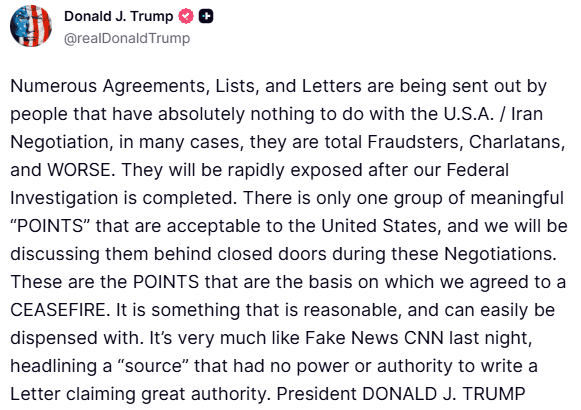
This is alarming and surreal, and doesn’t bode well for what’s already a very shaky ceasefire holding, via the NY Times:
A White House official says that the 10-point peace plan that Iran publicly released on Wednesday differs from the plan that Trump said was a “workable basis on which to negotiate.” The official declined to elaborate on the differences but said Karoline Leavitt, the White House press secretary, was expected to clarify at a 1 p.m. briefing.
There’s talk of Kushner, Witkoff, and maybe Vance going to Pakistan for planned Friday meeting with Iranian side.
Key Energy Sites Hit in Kuwait, Despite Ceasefire
Kuwait’s Interior Ministry is condemning fresh Iran attacks, reporting “severe material damage” at several vital facilities of the Kuwait Petroleum Corporation. Also water desalination plants have been hit.
“The ministry said fire broke out at some of the attacked sites, which include oil facilities, three power stations and water desalination plants,” Al Jazeera reports.
Oil Transit through Hormuz Halted Again: FARS
Iran’s Fars News agency reports that oil tankers passing through Hormuz have been stopped after Israel’s “ceasefire breach.” This as Iranian officials are warning of resumed missile launches on Israel for what’s happening in Lebanon (see below).
There’s currently contradiction and confusion over whether the Pakistan-mediated Iran ceasefire deal extends to Lebanon. Pakistan says yes, Iran says yes, while the US and Israel say no. Tehran appears willing to apply its leverage. Oil jumps on initial ‘breach’ rumblings…
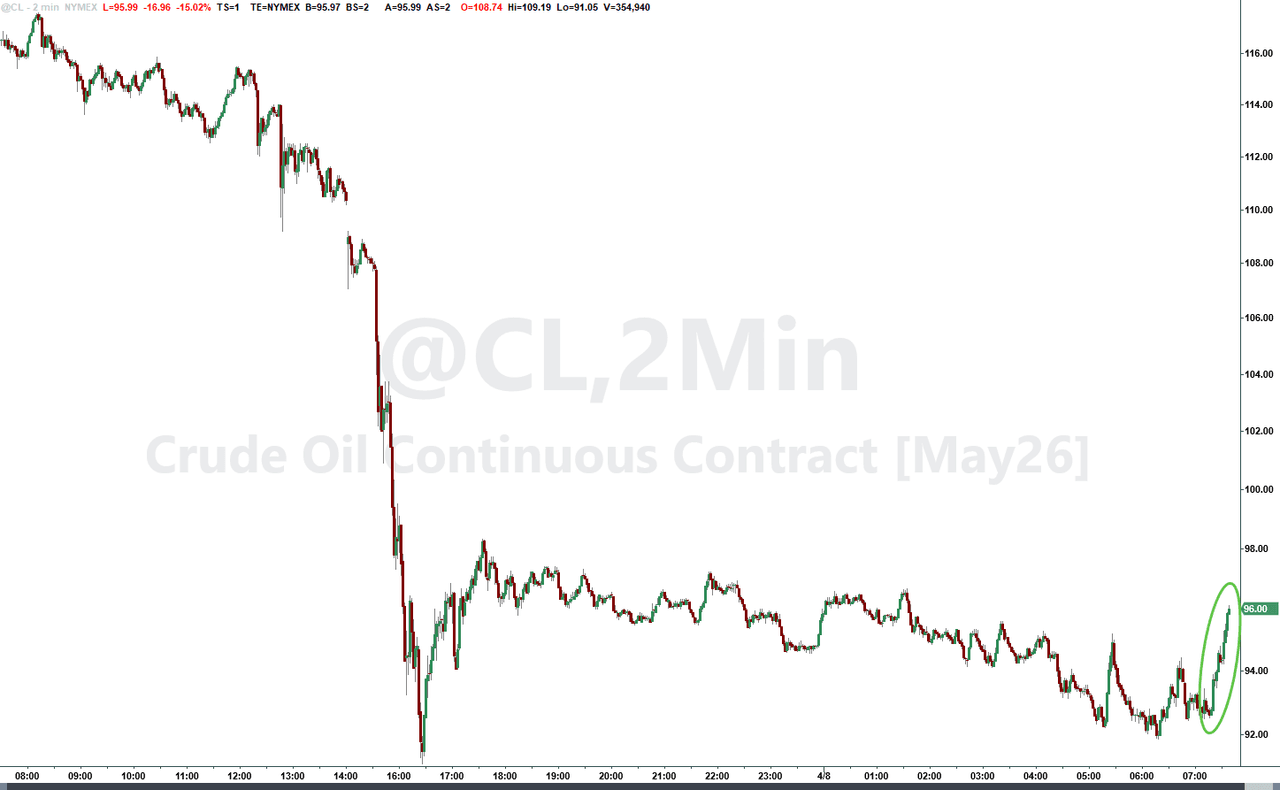
Hellish scenes out of Berit on Wednesday:
Israel in Massive Surprise Attack on Lebanon; Iran Warns Could Resume Missiles on Israel
A surprise Israeli attack on Beirut, southern Lebanon, and the eastern Bekaa Valley has resulted in huge destruction and many casualties. President Trump has said the Lebanon conflict is not part of the Iran ceasefire deal, contradicting statements out of Pakistan. But Trump said that will be taken care of separately, and appeared to defend Israel’s ability to go after Hezbollah.
Iranian officials are signaling they could be ready to resume ballistic missile attacks on Israel once again, as a response to the strikes on Lebanon.
Meanwhile a statement from the UAE: “The blatant Iranian attacks since the ceasefire took effect have reached 17 ballistic missiles and 35 drones, and the air defenses have successfully dealt with them,” the UAE’s ministry of defence said in a social media post. Kuwait has said the same.
US, Iranian Delegates Agree to Meet in Islamabad Friday
Pakistani Prime Minister Shehbaz Sharif has announced that American and Iranian delegates have accepted an invitation to meet in Islamabad on Friday.
He said of a talk with the Iranian president, “I expressed my deep appreciation for the wisdom and foresight of Iran’s leadership in accepting Pakistan’s proposal to host peace talks in Islamabad later this week, aimed at our joint efforts to restore calm to the region. President Pezeshkian also affirmed Iran’s participation in the upcoming negotiations, expressed gratitude for Pakistan’s efforts, and extended his best wishes to the people of Pakistan.”
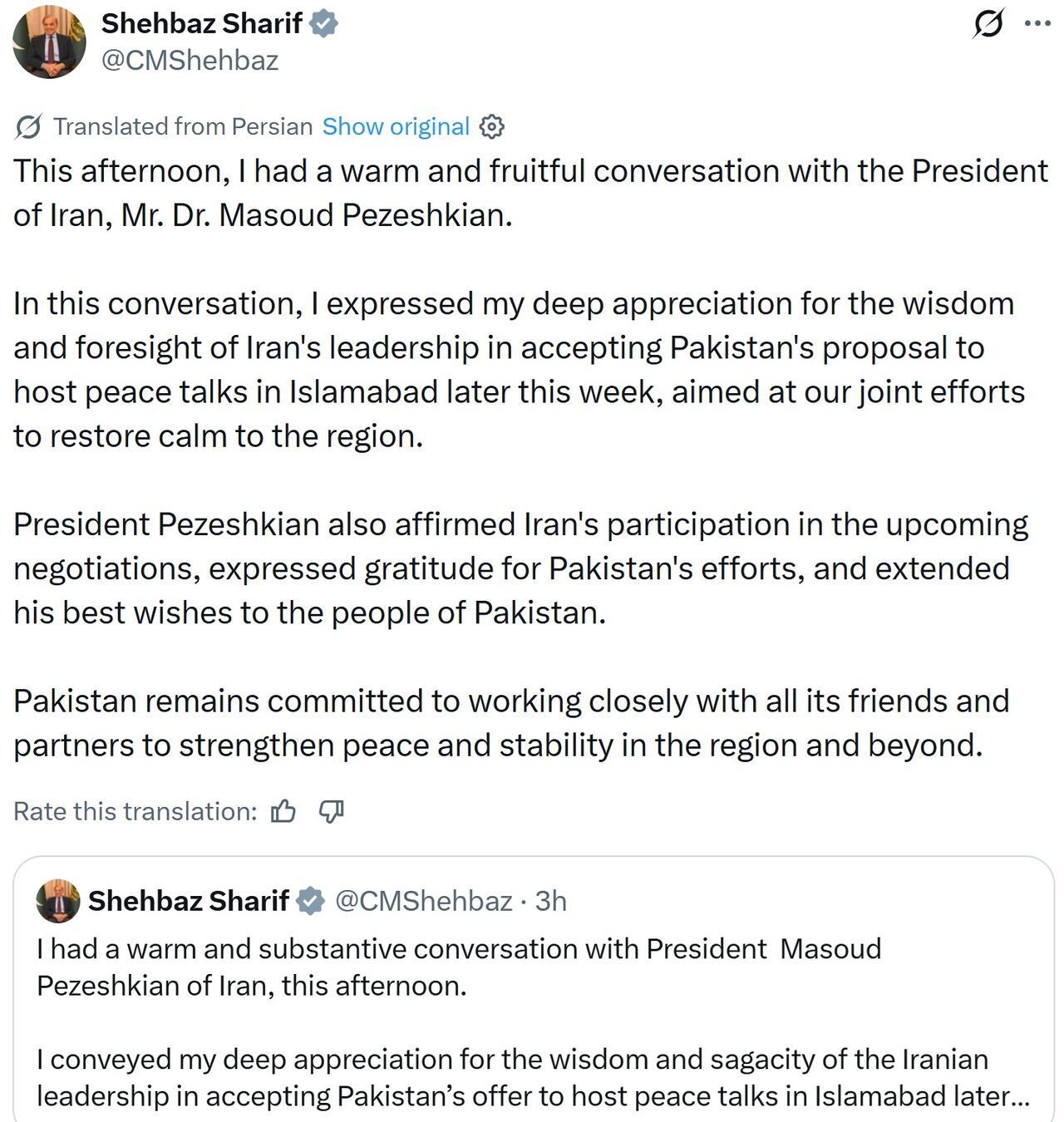
IRGC Parliament Official: ‘Maritime Traffic in the Strait of Hormuz Must be Halted’
Reuters has picked up on the words of IRGC officer and member of Iranian parliament’s “Expediency Discernment Council” Mohsen Rezaee: “In response to the brutal aggression against Lebanon, maritime traffic in the Strait of Hormuz must be halted immediately and a strong, decisive strike must be delivered against the entity.”
This perhaps represents a hardline faction approach, given clearly Tehran has held significant leverage and maintains de facto control of the Hormuz Strait. However, it does not yet appear the official government position, given also the first two vessels have passed through the waterway since the ceasefire was announced.
As we reported earlier Wednesday, The Liberia-flagged Daytona Beach, destined for the United Arab Emirates, crossed just before 8am UK time, while the Greek-owned NJ Earth followed about two hours later, with its destination undisclosed, the tracking platform Kpler showed.
Saudi Aramco Export Pipeline To Red Sea Struck
A huge, and not very ‘ceasefirey’ development in Saudi Arabia, per the FT (just as Hegseth was speaking): “A pumping station was hit at 1 p.m. local time, the people told FT. The attack was carried out by a drone and damage was being assessed, one of the people told FT Saudi Aramco, which owns and operates the pipeline.” FT continues, “The people said a pumping station, one of several along the 1,200km pipeline that has become an economic lifeline for the kingdom since the near closure of shipping through the Strait of Hormuz, was hit at about 1pm local time on Wednesday.”
One Gulf based representative and analyst complains, “For a ceasefire, the fire does not seem to be ceasing. The UAE and Kuwait are under attack, and Iran says it is under attack too. Beyond the ceasefire itself, the bigger question is that the plan still looks unclear when it comes to what follows…”
The development pushed oil slightly up…
Pentagon Tries to put a Bow on Operation Epic Fury: ‘Overwhelming Victory’
Hegseth in his Pentagon press briefing called the ceasefire an “overwhelming victory” for the United States and stated the military “stands ready” to ensure Iran complies with the agreement. He said US forces will still be “hanging around” the region, and further that Iran’s nuclear “dust” is being monitored, buried under the rubble, and that eventually the US will either take the enriched uranium or else it will be handed over. “Iran begged for ceasefire,” Hegseth declared.
“We stand ready in the background to ensure Iran upholds every reasonable term,” Hegseth said. Also Joint Chiefs chairman Gen. Caine stated that all US objectives in Iran have been achieved.
He hailed that US has destroyed Iran’s defense-industrial base, including over 80% of missile facilities gone, and its navy lies at the “bottom of the Arabian Sea”. It’s clear that after six weeks the Pentagon is trying to put a bow on Operation Epic Fury.
During the Q&A, there was a question – largely dodged by Hegseth – centered on wither the US has achieved “strategic” victory vs. merely tactical victory. That ultimately is the question.
Also, is there really ceasefire on the ground? But this is merely day one:
Nawaf Al-Thani نواف بن مبارك آل ثاني
For a ceasefire, the fire does not seem to be ceasing. The UAE and Kuwait are under attack, and Iran says it is under attack too. Beyond the ceasefire itself, the bigger question is that the plan still looks unclear when it comes to what follows, assuming the ceasefire actually holds
But Iran also sees this as Victory
The United States and Iran have announced a two-week suspension of all attacks, and Tehran reportedly agreed to allow safe transit of vessels through the Strait of Hormuz. It all started with President Trump seizing on the last-minute olive branch plan offered by Pakistan’s prime minister, which urged a two week extension of the US deadline before massive obliteration bombings began, and in return Iran would agree to reopen the Strait of Hormuz.
Iran has essentially declared victory and stated that upcoming talks in Islamabad, Pakistan, on Friday do not guarantee an end to the war. Israeli Prime Minister Benjamin Netanyahu has given supportive lip service to the US decision but stated that Lebanon is excluded from the two-week ceasefire.
Iran warns of decisive response to any ‘miscalculations’ by US. The IRGC said in a statement: “While we remain open to talks, we trust no promises from our adversaries. Our forces are poised, prepared by decades of experience in confrontations with American and Zionist forces, ready to respond decisively to any miscalculations by the enemy.”
Latest from Trump on Truth Social:
Oil prices dropped rapidly after Trump announced the pause, with Brent crude trading just below $95 per barrel. Qatar’s Cabinet welcomed the US-Iran ceasefire brokered by Pakistan, stating it emphasizes “the necessity of immediately halting all hostile actions and practices that undermine regional stability, respect for state sovereignty, and the assurance of security for maritime passages, freedom of navigation, and international trade.”
Iran meanwhile is demanding stiff fees for ships passing through Hormuz during the ceasefire, and says it holds the final authority on which vessels get to pass. So now, in essense… stability in global energy flows depends on accommodating Iran AND it will likely get sanctions relief, per the deal on the table.
Iranian state media has featured celebratory scenes in the streets:
END
AI
Two Questions And Five Scenarios For What Happens Next
The ZeroHedge article you’re referencing (posted today) appears to discuss the fragile US-Iran two-week ceasefire announced on April 8, 2026, following weeks of escalation that began with US-Israeli strikes on Iran in late February. The conflict involved attacks on nuclear/military sites, Iranian retaliation (including missile strikes on Israel and Gulf states), disruption of the Strait of Hormuz, and broader regional impacts on oil, shipping, and infrastructure.
@zerohedgeBoth sides have claimed “victory” in the pause, but tensions remain high — with ongoing strikes in Lebanon (not covered by the truce), questions over Iran’s 10-point counterproposal (demanding sanctions relief, reconstruction aid, and regional de-escalation), and risks of renewed fighting once the two weeks end. The piece likely frames two core questions (common in such analyses: e.g., “Will the ceasefire hold?” and “What are the economic/market implications?”) before outlining five plausible scenarios for the near term.Since the full article text is paywalled/limited in public extracts, here’s a reasoned synthesis based on the current context (as of April 8, 2026):Two Key Questions
- Will the ceasefire actually hold beyond the initial pause?
- Iran has accepted a temporary truce to reopen the Strait of Hormuz but insists on a permanent end to hostilities and broader concessions. Trump has touted it as a win from brinkmanship, yet both sides warn they remain ready to escalate. Proxies (Hezbollah, Houthis, etc.) add layers of unpredictability, and incidents like attacks on Gulf desalination plants or pipelines could derail talks.
- What are the broader implications for global markets, energy security, and geopolitics?
Oil prices have spiked amid Hormuz disruptions (a chokepoint for ~20% of global oil). Stock markets have taken hits, reconstruction costs loom, and there’s risk of wider economic fallout if shipping doesn’t normalize quickly. Longer-term: Will this lead to a nuclear deal redux, regime pressure in Iran, or a new regional order?
Five Plausible Scenarios for What Happens NextThese draw from ongoing reporting on the fragile truce, Iran’s counterproposals, Trump’s threats, and analyst views. Likelihoods are speculative and could shift rapidly with Friday talks or incidents.
- Short-Lived Pause Leading to Renewed Escalation (Most Discussed “Smoke Break” Risk)
The two-week window allows both sides to rearm and reposition. Minor violations (e.g., proxy attacks, Hormuz incidents, or disputes over “safe passage”) spark round two by mid-to-late April. Oil spikes further, Gulf infrastructure takes more damage, and talks collapse. This aligns with comments noting the truce as temporary rather than resolution. Markets treat it as volatility fuel rather than relief. - Muddling Through with Fragile Diplomacy (Ambiguous “Diplomacy Without Resolution”)
Talks in Pakistan or elsewhere produce incremental agreements (partial sanctions easing, monitored Hormuz reopening) but no comprehensive deal. Fighting stays low-intensity, with occasional flare-ups contained. Iran keeps leverage via proxies/nuclear ambiguity; the US declares partial success. Economic damage lingers (higher energy prices, supply chain hits), but full war is averted for months. This could resemble past JCPOA-style negotiations with trust deficits. - Iranian Concessions Under Pressure (Trump “Decisive Victory” Path)
Facing internal strain, reconstruction needs, and military degradation, Iran offers more substantive concessions on its nuclear program or regional proxies. The US eases some sanctions in return, framing it as a win. Ceasefire extends, Hormuz normalizes quickly, and oil prices ease. However, hardliners on both sides could undermine it, and domestic protests in Iran (or political pushback in the US) complicate follow-through. - Regional Widening Involving Proxies and Allies
The truce doesn’t cover Lebanon/Hezbollah fully, leading to spillover. Strikes continue or expand to Iraqi militias, Houthis, or other fronts. Gulf states face more direct threats (water/power infrastructure). This draws in broader actors (potentially Russia/China diplomatically, or others indirectly), raising risks of a multi-front conflict. Economic collateral damage grows, with global shipping and energy markets under prolonged stress. - Breakthrough to Broader De-Escalation or “New Normal”
Successful talks yield a wider accord addressing sanctions, reconstruction, Hormuz security protocols, and regional ceasefires (including Lebanon). Both sides claim victory; markets rally on reduced uncertainty. Long-term questions remain (Iran’s nuclear future, influence of external powers). Least likely in the immediate term due to maximalist positions, but possible if mutual exhaustion sets in and mediators (Pakistan, others) bridge gaps.
The situation is highly fluid — with reports of continued Lebanon strikes, economic warnings about non-reversible damage, and both sides keeping “hands on the trigger.” Markets will likely remain jittery, treating this as a pause rather than peace.If this isn’t the exact framing you had in mind, or if you’re referring to a different context (e.g., a personal take on markets, precious metals, or something else tied to your usual topics), feel free to share more details for a tailored breakdown! What specifically prompted the query — the ZeroHedge post, broader geopolitics, or investment angles?
JERUSALEM POST
MAJOR HEADLINES FOR THIS MORNING;
Live Updates: Trump announces ceasefire with Iran as Tehran launches missile barrage towards Israel, Gulf states
Strikes reported in Lebanon shortly after Netanyahu refutes claim that Lebanon is included in Iran ceasefire • Lapid slams ceasefire as ‘political disaster’ • Gulf states on high alert

A man holds a photo of Iran’s Supreme Leader, Mojtaba Khamenei, while the flags of the US and Israel are burnt, as people gather after a two-week ceasefire in the Iran war was announced, in Tehran, Iran, April 8, 2026.(photo credit: MAJID ASGARIPOUR/WANA (WEST ASIA NEWS AGENCY) VIA REUTERS)
April 8, 10:20 AM
EU’s Kallas says ceasefire is step in right direction as Macron demands inclusion of Lebanon
ByTOBIAS HOLCMAN, REUTERS

French President Emmanuel Macron welcomes European Union High Representative for Foreign Affairs and Security Policy and European Commission Vice-President Kaja Kallas.(photo credit: REUTERS/BENOIT TESSIER)
The European Union High Representative for Foreign Affairs, Kaja Kallas, said on Wednesday that the agreement was a “step back from the brink after weeks of escalation,” and said that it “creates a much-needed chance to tone down threats, stop missiles, restart shipping, and create space for diplomacy towards a lasting agreement.”
“The Strait of Hormuz must be open for passage again,” Kallas added as she thanked Pakistan for its mediation. “The door to mediation must remain open, as the underlying causes of the war remain unresolved. The EU stands ready to support those efforts and is in touch with partners in the region. I will discuss this in Saudi Arabia today.”
French President Emmanuel Macron also said that he welcomed the ceasefire between Iran and the United States at the start of his defense meeting with advisers and members of his cabinet, but added that the situation in Lebanon remained critical and called for Lebanon to be included in the deal.Go to the full article > >
April 8, 10:06 AM
India set to get first Iranian oil cargo in 7 years, ship tracking data shows
ByREUTERS
India is set to receive Iranian oil this week, its first purchase in seven years, after the US temporarily removed sanctions on Iranian oil and refined products to ease supply shortages, ship-tracking data from LSEG and Kpler showed on Wednesday.
India’s oil ministry said last week that refiners have purchased Iranian oil amid the Middle East conflict, which has disrupted supplies through the Strait of Hormuz.
April 8, 9:22 AM
UK’s Starmer to discuss Strait of Hormuz reopening in Gulf trip after ceasefire
ByREUTERS
British Prime Minister Keir Starmer will travel to the Middle East to hold talks with Gulf partners on ensuring the reopening of the Strait of Hormuz remains permanent after a US-Iran ceasefire, his office said on Wednesday.
“I welcome the ceasefire agreement reached overnight, which will bring a moment of relief to the region and the world,” Starmer said in a statement.
April 8, 9:15 AM
Hours after ceasefire, shipping data shows Strait of Hormuz still mostly untransited
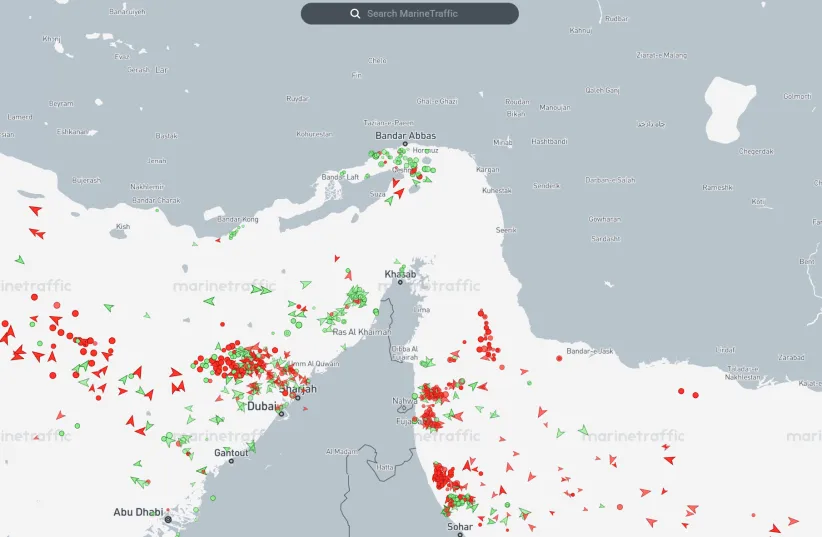
Map shows most ships docked on either side of the Strait of Hormuz, with low activity still reported in the waterway.(photo credit: Screenshot/MarineTraffic)
According to data from Marinnetraffic, a specialized website for tracking maritime vessels, most ships in the Persian Gulf are still stationed, waiting to secure passage through the Strait of Hormuz.
“The ceasefire is a necessary first step, but it does not mean commercial shipping immediately normalizes through the international traffic lanes in the Strait,” Charlie Brown, senior advisor of Dark Fleet Tracking at United Against Nuclear Iran, told CNN.
April 8, 8:40 AM
Lapid slams ceasefire as ‘political disaster,’ says Israel sidelined
Opposition leader Yair Lapid sharply criticized on Wednesday the ceasefire with Iran announced earlier in the day, calling it a failure of political and strategic leadership and warning of long-term consequences for Israel’s security.
“There has never been such a political disaster in all of our history,” Lapid said, arguing that “Israel wasn’t even at the table when decisions were made concerning the core of our national security.”
April 8, 8:32 AM
‘Victory for the US,’ claims WH Press Secretary Leavitt, as world reacts to Iran ceasefire
“From the very beginning of Operation Epic Fury, President Trump estimated this would be a 4-6 week operation,” Leavitt said. Countries like Pakistan, Australia, and Egypt welcomed the agreement.
ByTOBIAS HOLCMAN, REUTERS
White House Press Secretary Karoline Leavitt points while she holds a press briefing at the White House, in Washington, DC, US, December 1, 2025.(photo credit: REUTERS/EVELYN HOCKSTEIN)
White House Press Secretary Karoline Leavitt on Wednesday called the two-week ceasefire between the United States, Israel and Iran a “victory for the United States that President Trump and our incredible military made happen.”
“From the very beginning of Operation Epic Fury, President Trump estimated this would be a 4-6 week operation,” she said and added, “Thanks to the unbelievable capabilities of our warriors, we have achieved and exceeded our core military objectives in 38 days.”
She also announced that Defense Secretary Pete Hegseth and General Dan Caine, chairman of the Joint Chiefs of Staff, would hold a press conference on Wednesday morning.
“The success of our military created maximum leverage, allowing President Trump and the team to engage in tough negotiations that have now created an opening for a diplomatic solution and long-term peace,” she concluded.
April 8, 8:20 AM
Lebanese media reports strikes on southern Lebanon amid ceasefire confusion
Initial reports in Lebanon attributed the strike to Israel, with early accounts indicating at least four casualties in the attack. The IDF has not yet confirmed or denied its involvement.
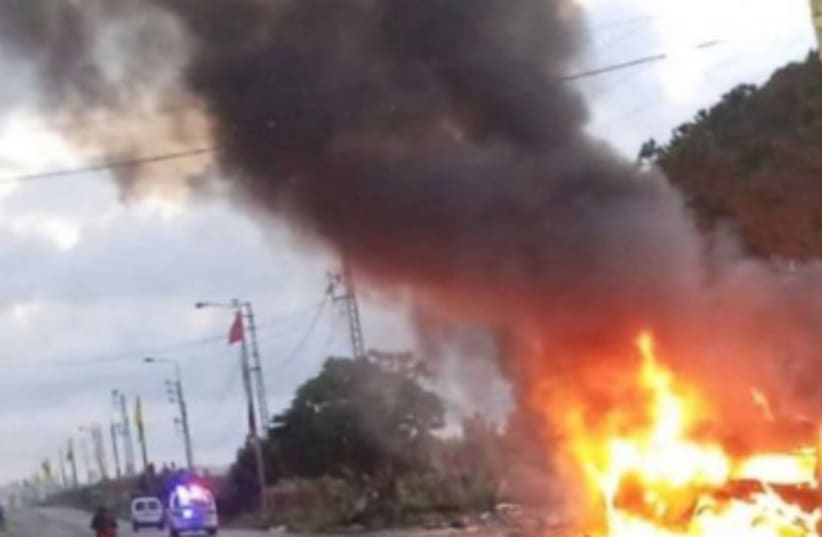
A vehicle can be seen burning in the Tyre District, southern Lebanon, April 8, 2026.(photo credit: SOCIAL MEDIA)
A vehicle was struck in the town of al-Qalila in southern Lebanon on Wednesday, with no immediate confirmation on casualties or damage, according to reports in Lebanese media, amid ongoing confusion over the scope of the ceasefire. The circumstances surrounding the strike remain unclear.
Initial reports in Lebanon attributed the strike to Israel, with early accounts indicating at least four casualties in the attack. Israeli forces have been operating in the Tyre District in recent days as part of a broader campaign against Hezbollah targets. The IDF has accused the Lebanese-based terror group of using civilian infrastructure in the area to carry out strikes on Israel and IDF forces.
April 8, 7:30 AM
Vehicle reportedly struck in southern Lebanon amid ceasefire confusion
A vehicle was struck in the town of al-Qalila in southern Lebanon on Wednesday, with no immediate confirmation on casualties or damage, according to reports in Lebanese media. The circumstances surrounding the strike remain unclear.
The incident comes as uncertainty persists over the scope of a recently announced ceasefire between the US, Israel, and Iran, with conflicting signals emerging from different parties.
While Pakistani officials and an Israeli source have suggested that Lebanon is included in the understandings, Prime Minister Benjamin Netanyahu said earlier that the ceasefire would not apply to the Lebanese arena, appearing to contradict those claims.
April 8, 7:27 AM
Bahrain Interior Ministry says fire detected, sirens activated due to Iranian attack
The Bahrain Interior Ministry said on Wednesday that air raid sirens were activated across the country following an Iranian attack on its territory.
“The alarm siren has been activated. Citizens and residents are requested to remain calm, head to the nearest safe place, and follow updates through official channels,” the Bahrain ministry said in a statement.
Later on Wednesday, Bahrain confirmed the attack was carried out by Iran, with the missile causing a fire without leaving anyone wounded.
This comes hours after Iran, the United States, and Israel agreed to a two-week ceasefire in their current war.
April 8, 7:10 AM
Trump calls Iran ceasefire deal a ‘total victory,’ says this could be ‘golden age of Middle East’
ByREUTERS, JERUSALEM POST STAFF
US President Donald Trump told AFP on Wednesday that the United States had won a “total and complete victory” after agreeing to a two-week ceasefire deal with Iran.
Later, Trump also posted a statement on Truth saying that today was a “big day for world peace,” that the US would be “helping with the traffic buildup in the Strait of Hormuz,” and that the ceasefire could bring “a new golden age to the Middle East.”
“Iran can start the reconstruction process. We’ll be loading up with supplies of all kinds, and just “hangin’ around” in order to make sure that everything goes well. I feel confident that it will,” he added.
END
Trump asserts Lebanon not included in US-Iran ceasefire deal
US President Donald Trump asserted that Lebanon was not included in the two-week temporary ceasefire deal between the US, Israel, and Iran during a conversation with PBS News reporter Liz Landers on Wednesday.
When probed for a reason why Lebanon was excluded, Trump stated that it was because of the Lebanese terrorist organization Hezbollah.
He added that “that’ll get taken care of too” and that Israel’s ongoing fight against Hezbollah is a “separate skirmish” from the US’s war with Iran.
END
IRAN’S SHATTERED ECOONO
Iran’s shattered economy means any success in war may be fleeting
Even as Iran appears emboldened on the regional stage after exerting its control over crucial energy supplies, it faces mounting internal problems.
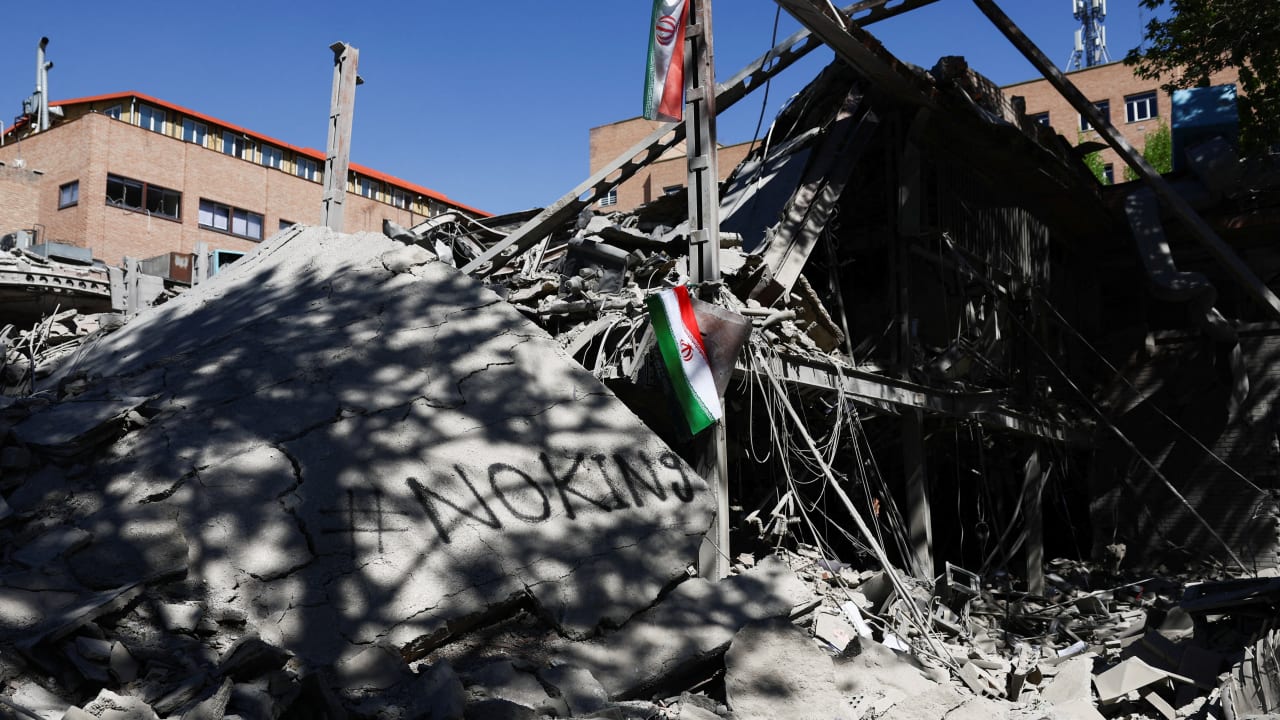
An Iranian flag hangs amidst the rubble of a building of the Sharif University of Technology, which was damaged in a strike, amid the US-Israeli conflict with Iran, in Tehran, Iran, April 7, 2026.(photo credit: MAJID ASGARIPOUR/WANA (WEST ASIA NEWS AGENCY) VIA REUTERS)ByREUTERSAPRIL 8, 2026 17:48
Iranian authorities see the truce with the United States and Israel as a strategic victory, but they emerge battered and isolated with an economy in tatters, little prospect of rapid recovery, and an impoverished, embittered population.
After weeks of US and Israeli strikes, many Iranians have lost their jobs. Prices have surged. Factories, power plants, railways, airports, and bridges have been destroyed. And the critical trading relationship with Gulf states has been severed – maybe for decades.
Even as Iran appears emboldened on the regional stage after exerting its control over crucial energy supplies, it faces mounting internal problems that might ultimately pose a greater threat to the Islamic Republic than Israeli or US bombs.
Iran’s need for sanctions relief
In interviews with Iranian political insiders, business owners, and analysts, Reuters charted a country near the brink of economic collapse, its leaders fearful of a poorer, uncertain future.
Always hovering in the background is the threat of another bout of nationwide street protests, such as those that erupted in January, which authorities eventually put down by killing thousands of people, a higher death toll than Iran has suffered during the war.

Advertisement
Anxiety that the broken economy could spur new rounds of protests haunted every government decision, a reformist former official said, while a political insider close to the Iranian establishment said officials regarded the economy as the country’s Achilles heel.
Any comprehensive peace agreement would need to lift international sanctions and release frozen funds, or authorities would face severe difficulties even to meet payroll obligations, let alone repair damaged infrastructure, the insider said. This would eventually put into doubt the leadership’s ability to govern the country of 90 million people, they added.
“We can’t really see the extent of damage and blowback inside Iran. But on any metric, it’s a fiasco for Iran – there’s no money and the infrastructure is shot,” said Ali Ansari, a professor of history at St Andrews University.
“Closing Hormuz was the option of last resort, and the fact they did so tells you they’re desperate. It’s a diminishing return because the cost for Iran in the medium to long term is going to be absolutely enormous,” he added.
Arash, the owner of a small clothing factory in the northern city of Tabriz, said he had been forced to halt production, putting his 12 employees temporarily out of work.
“Even now, I don’t know when I’ll be able to reopen. It all depends on when this really comes to an end,” he said.
Iran’s major industries hammered
One Iranian official said the scale of damage meant the biggest industrial facilities driving the economy would take months or years to repair, and the country “will face a disaster” if sanctions are not lifted.
Damage to factories and other industrial sites created a chain reaction, forcing dozens of other companies depending on major facilities to halt their own work, leaving many thousands of people out of work, the official added.
Strikes have targeted Iran’s production facilities at the South Pars gas field, which cost billions of dollars to build. Other attacks have hit its main petrochemicals producers.
Iranian press reports have charted shutdowns at the massive steel works in Khuzestan and Isfahan, with many thousands of workers affected at each plant, along with closures at industrial zones on the Gulf coast affected by power plant outages.
Even if the Iranian industry can be revived, critical relationships have been poisoned by Tehran’s targeting of Gulf states during the war.
The United Arab Emirates, in particular, was important to Iran’s economic relations with the outside world.
A UAE official said it was possible that ties between Iran and Gulf states could eventually recover because they would remain neighbors. But Iran’s strikes on Gulf countries created “a huge trust gap that in my opinion will last for decades to come,” the official added.
One Iranian businessman based in Dubai, the Gulf’s biggest international economic center, said he was relocating his export-import business to Oman.
Popular frustration growing within Iran
Iran’s government has issued no new economic data since the war began, and the difficulty in reporting inside the country means a comprehensive accounting of the economic problems is hard to define.
Advertisement
Umud Shokri, senior visiting fellow at George Mason University, said sanctions, inflation, currency depreciation, mismanagement, and energy shortages had already greatly weakened the economy before war damage was layered on top.
Shokri said some estimates suggested the war could shrink the economy by 10% this year and that any positive impact from high oil prices or sanctions evasion networks would likely benefit state-linked entities rather than the wider population.
“While exact figures vary, millions are experiencing job losses, income reductions, or business closures,” Shokri said.
On the streets, the background economic noise is not yet deafening. Residents of Tehran and other cities said there were no shortages of goods, while markets, shops, many businesses, banks, and government offices were all working as usual.
But they described rising prices – in some cases of around 40% since the war began – and a reluctance to buy anything other than necessities, with one art gallery owner in the capital saying her business was “effectively dead.”
Another senior Iranian source said there had been several high-level meetings devoted to keeping the economy running with limited resources and that a truce, and the prospect of a longer-term ceasefire, might give more leeway for government spending.
Since the war began, the Iranian state has already subsidized people who were forced to flee their homes, along with outlays on urgent repairs to crucial infrastructure.
However, the end of the conflict would also mean people starting to grow more impatient with the authorities than was the case when bombs were falling, the senior Iranian source added.
END
Iran claims it is weighing strikes on IDF West Bank, Lebanon positions after ceasefire announced
Iran’s Supreme National Security Council said it had accepted the two-week ceasefire, while stressing that the war itself had not ended yet.

An Israeli air-defence system intercepts an Iranian missile flying towards Israel, amid the US-Israeli conflict with Iran, as seen from Hebron, West Bank, April 7, 2026.(photo credit: REUTERS/MUSSA QAWASMA)ByJERUSALEM POST STAFFAPRIL 8, 2026 04:27Updated: APRIL 8, 2026 17:06
Iran launched missiles toward Israel early Wednesday morning and indicated that it would strike Israeli military positions in Lebanon and the West Bank hours after US President Donald Trump announced a two-week ceasefire involving the US, Israel, and Iran.
The state-backed Fars News Agency reported that Iran was weighing attacking IDF positions around the region. “The regime’s continued attacks, despite the agreement on all fronts, indicate that the United States is unable to control Netanyahu or that the American Central Command (CENTCOM) has given the Zionist regime free reign,” Fars reported.
Earlier, air raid alerts continued in Israel after the truce was announced, raising immediate doubts about whether the arrangement would hold.
Also on Wednesday, the Bahrain Interior Ministry said that air raid sirens were activated across the country following an Iranian attack on its territory.
“The alarm siren has been activated. Citizens and residents are requested to remain calm, head to the nearest safe place, and follow updates through official channels,” the Bahrain ministry said in a statement.
Later on Wednesday, Bahrain confirmed the attack was carried out by Iran, with the missile causing a fire without leaving anyone wounded.
Trump said the ceasefire was tied to Iran halting attacks and allowing shipping through the Strait of Hormuz, with talks scheduled to begin in Islamabad on Friday under Pakistani mediation. Iran’s Supreme National Security Council said it had accepted the two-week ceasefire, while stressing that the war itself had not ended and warning that any further move by its enemies would be met forcefully.
s remained active after the ceasefire announcement.
The ceasefire was challenged beyond Israel as well. Reuters reported an Iranian strike on Saudi Arabia’s Jubail petrochemical area, and missile alerts in the United Arab Emirates after the truce announcement, underscoring that the threat was regional from the outset and that the pause in fighting was already under strain.
Israeli skepticism of ceasefire deal
Israeli officials had expressed skepticism about the truce from the outset. However, in the material reviewed, no clearly attributable new statement from the Prime Minister’s Office responding specifically to the post-ceasefire launches had been publicly confirmed.
The White House also had not issued a detailed formal response in the reports reviewed, though the broader situation was described as fluid as regional actors waited to see whether the pause in fighting would survive its first day.
The ceasefire followed weeks of direct confrontation involving Israeli and US strikes on Iranian targets and repeated Iranian missile attacks across the region. Markets reacted positively to the announcement, with oil prices falling sharply on hopes of de-escalation, even as continued alerts suggested the military picture remained unstable.
RUSSIA VS UKRAINE
6.GLOBAL ISSUES, COVID ISSUES, VACCINE INJURIES/HEALTH ISSUES
GLOBAL ISSUES
MARK CRISPIN MILLER
In memory of those who “died suddenly” in the United States and worldwide, March 30-April 6, 2026
Actors Dee Freeman (C), Tim Fullerton (59, C); former Miss NC Carrie Everett (22, C); baseballer Ken Clay; footballer Jack Pugh (24); ex-Yankees coach Tom Nieto; rocker Bo Lueders (Harm’s Way); & more
| Mark Crispin MillerApr 8 |
A survey of the likely global toll of COVID “vaccination,” based on the reports collected by our worldwide team of researchers this past week.
To help support our work, consider subscribing or making a donation.
UNITED STATES (112)
Dee Freeman, Actress Known for The Young and the Restless and Sistas, Dies at 66 After Lung Cancer Diagnosis
April 4, 2026

Dee Freeman, an actress best known for starring in The Young and the Restless and Sistas, has died. She was 66. The actress died following a stage 4 lung cancer diagnosis, her publicist Desirae L. Benson said in a statement. Freeman’s family confirmed her death in a post on her Instagram on Friday, April 3.
Researcher’s note – Sept. 20, 2025: Help Dee Fight Lung Cancer and Keep Her Light Shining: https://www.gofundme.com/f/help-dee-fight-lung-cancer-and-keep-her-light-shining
Dee Freeman was working in Hollywood between 2021-2023: Hollywood’s On-Set Vaccine [sic] Mandates to End on May 12, 2023: https://variety.com/2023/biz/news/covid-protocols-end-vaccine-mandate-hollywood-return-to-work-1235569515/
Oregon Cabaret Theatre actor passes away
March 31, 2026

ASHLAND, Ore. – A well-known actor who performed in multiple roles for the Oregon Cabaret Theatre in Ashland has passed away. Tim Fullerton, best known for his role as Sam in Mamma Mia! at the Cabaret Theatre, passed away earlier this month in Utah at the age of 59. In 2022, Fullerton was cast at the Utah Shakespeare Festival, where he continued to be offered roles until his death in Cedar City.
Researcher’s note – Tim Fullerton, a well-known actor with the Oregon Cabaret Theatre in Ashland, passed away on the night of March 27, 2026, due to cancer of the liver and lungs. According to a statement from the Oregon Cabaret Theatre, Fullerton had recently been diagnosed with the illness and passed away surrounded by his wife, mother, and close friends.
Former Miss North Carolina 2024, Carrie Everett, passes away after brave battle with cancer
April 6, 2026

RALEIGH, N.C. – It is with heavy hearts that we share the news confirmed by her family of Carrie Everett, the former Miss North Carolina 2024, who passed away Sunday night after a courageous battle with a rare and aggressive gastric cancer. The Seattle native was given the crown in June 2024 during her sophomore year at N.C. Central University. Carrie was diagnosed with metastatic signet ring cell carcinoma in July 2025 while visiting family in Seattle. The 22-year-old remained in Seattle while undergoing chemotherapy and other treatments.
Researcher’s note – Following CDC guidance, which expresses a clinical preference for individuals to receive an mRNA COVID-19 vaccine [sic] over the J&J COVID-19 vaccine [sic], NCCU no longer has the J&J vaccine [sic] available. Students must upload proof of vaccination [sic] through the link on the myEOL banner or by clicking this link: https://www.nccu.edu/covid-19/vaccination
Two-time Yankees World Series Winner Found Dead at 71
April 1, 2026
Ken Clay’s time in the major leagues was brief, uneven, and at times turbulent, but it placed him inside one of baseball’s most closely watched dynasties. A member of the New York Yankees during their late-1970s championship run, Clay has died at 71, bringing to a close a career that intersected with both October glory and personal hardship. Clay faced multiple legal issues over the years, including convictions tied to theft and fraud. Incidents in Virginia and Florida led to jail time and financial restitution, marking a difficult transition away from the game that once placed him on baseball’s biggest stage. Clay died at his home in Lynchburg, Virginia. According to Dr. Jim Warner of the Centra Heart & Vascular Institute, the cause was complications related to heart and kidney issues.
Former Wisconsin Football Player Jack Pugh Remembered as ‘Cherished Son’ After Death at 24
April 2, 2026

Jack Pugh is being remembered as far more than a football star after the former University of Wisconsin player died at the age of 24. Pugh’s obituary describes him as “a cherished son, devoted brother, and beloved friend, who left this world unexpectedly.” His death was announced by the University of Wisconsin on Tuesday, March 31. The cause of death has not been revealed. Pugh received his degree from the University of Wisconsin last year.
Researcher’s note – UW Students Who Get Vaccinated [sic] Will Be Exempt From COVID-19 Testing Requirements: https://www.wpr.org/education/uw-students-who-get-vaccinated-will-be-exempt-covid-19-testing-requirements
No cause of death reported.
Ex-Yankees, Mets coach Tom Nieto dead at 65 after heart attack
April 6, 2026

Tom Nieto, a World Series champion with the Twins and a former coach for the Yankees and Mets, died of a heart attack at the age of 65. Nieto died on March 27 while at his home in Florida, his sister wrote in a post on Facebook on Sunday and the Twins later confirmed the news in a social media announcement on Monday. “On Friday, March 27th, my brother Tom passed on after a heart attack, leaving cherished memories in Florida with his family; his strength and resilience will continue to inspire us all,” Denise Nieto-Jackson wrote.
Harm’s Way guitarist Bo Lueders dead at 38
April 2, 2026

Bo Lueders, guitarist for Chicago [IL] hardcore veterans Harm’s Way, has died aged 38, it has been confirmed. The news was shared in a joint statement posted across social media from Harm’s Way and HardLore, the hugely popular podcast that Bo co-hosted alongside Twitching Tongues frontman Colin Young. The statement ends with a message for those struggling against mental health issues: “For those struggling with depression or urges to self harm, help is always available. We’re not in this alone. Suicide and Crisis Lifeline: 988.”
No cause of death reported.
James Lollar, GOST mastermind, dead at 46
April 2, 2026

James Lollar, the founding multi-instrumentalist and producer behind synthwave project GosT, has died at the age of 46, his management team has confirmed. Lollar’s management team at Bad Behaviour confirmed the musician’s surprise passing today (April 2nd). “The whole GOST team is incredibly saddened to inform you that James Cody Lollar, known as GOST, passed away yesterday,” they wrote. “We are sending all our prayers to his family and friends during this time of grief. He will be remembered as a wonderful human being and a tremendously talented artist.”
No cause of death reported.
A composer and record producer “died suddenly”:
Reported on March 28:
Christopher Robert Leidhecker, 36
March 28, 2026

Christopher Robert Leidhecker, 36, of Nashville, Tennessee, formerly of Williamsport, Pennsylvania, passed away on March 4, 2026, after a brief but courageous battle with an aggressive cancer. While Chris loved playing drums, his talents extended to composing, arranging, and recording engineering. Frequently collaborating with his brother Jeremy, together they arranged more than 30 marching band shows. Chris also wrote music for advertising and licensing, with clients including MTV, Bravo, ABC, CBS, and Discovery. In Nashville, he built a recording studio that became a creative home for artists, where he recorded and produced music in close collaboration with others. It was also the birthplace of his passion project, Spirisow, centered on ambient piano-based composition. He was deeply beloved in the Nashville music community by the hundreds of people he befriended through his work. In an industry that can often feel transactional, Chris saw others as people first, making them feel valued, seen, and cared for.
Tejano musician David Lee Garza announces death of his son
March 31, 2026
Poteet, Texas – The Tejano music community is mourning the loss of David Lee Garza Jr., the son of longtime musician David Lee Garza. News of Garza’s death was shared on the band’s official social media page, which described the loss as a “very sad day” for the family. He was 44 years and died of a stroke, according to someone close with the family.
Colorado cartoonist Matt Scharf has passed away
April 3, 2026

Matt J. Scharf (64) died suddenly on March 30th at his home in Steamboat. Matt was a proud long-time local, sharing his cartoons and graphic design through his publication, “The Valley Voice”. He was also a cartoonist for the Steamboat Pilot and a designer for many local and national clients. Matt loved dirt bikes, outdoor sports, animals, decal stickers, and his partner, Remi Deraedt.
No cause of death reported.
A dancer and choreographer “died suddenly”:
Reported on March 18:
Samuel Louis Javier, 28
March 18, 2026

Samuel Louis Javier, fondly called “Sam” by both family and friends, passed away on Wednesday, March 18, 2026, at his home in Jersey City, New Jersey. He was 28 years old when he was called by his Creator. He continued to pursue his college degree at Rutgers University, NJ, wherein he graduated in 2022 with a bachelor’s degree in psychology and human resources. While at Rutgers University, he was involved with the Rutgers Dance Troupe where he found his passion for dancing and choreography. After college, he continued to pursue his love for dancing and choreography with his affiliation with professional dance troupes based primarily in New York City. Eventually, he went solo as a Hip-hop professional dancing instructor and choreographer under the monicker “Samjavi.” In such a short span of time, his talent spread everywhere via the social media platforms of Instagram, TikTok, YouTube and others. His skills and talent have brought him all over the world, not only in the United States but all over Europe and Asia.
Researcher’s note: Rutgers was the first large U.S. university to mandate the COVID “vaccines”. The requirement, with no option to test instead, began in the Fall 2021 semester, and a booster was mandated for the Spring 2022 semester: https://www.npr.org/sections/coronavirus-live-updates/2021/03/25/981215860/rutgers-to-require-vaccine-proof-for-all-students-planning-to-attend-this-fall#:~:text=KQED,for the next school year.
No cause of death reported.
Update to our report last year:
Beyoncé and Drake producer Sidney ‘Omen’ Brown’s cause of death revealed after he was found dead inside NYC apartment
April 2, 2026
DR PAUL ALEXANDER
NEWSWIZE
MICHAEL EVERY/OR OR PICTON/GIFFIN OR RABOBANK EXECUTIVE/COMMENTARY ON WORLDLY AFFAIRS
7. OIL ISSUES/NATURAL GAS/ENERGY ISSUES/GLOBAL
Container Ship Sinks In Hormuz After Iranian Strike Last Month; UBS Gives Latest Strait Update
Tuesday, Apr 07, 2026 – 05:20 PM
The Egyptian-owned, Maltese-flagged container ship Safeen Prestige (IMO: 9593517), which was damaged in the first week of the U.S.-Iran conflict following an Iranian strike, has reportedly sunk in the Strait of Hormuz.
According to Bloomberg, Pakistan’s hydrographic service said the container ship sank last week, leaving only an oil slick on the surface of the water in the Hormuz chokepoint.
Satellite imagery from the EU’s Copernicus Browser appears to confirm this, showing the container ship on fire in late March and then disappearing from imagery by last Thursday.
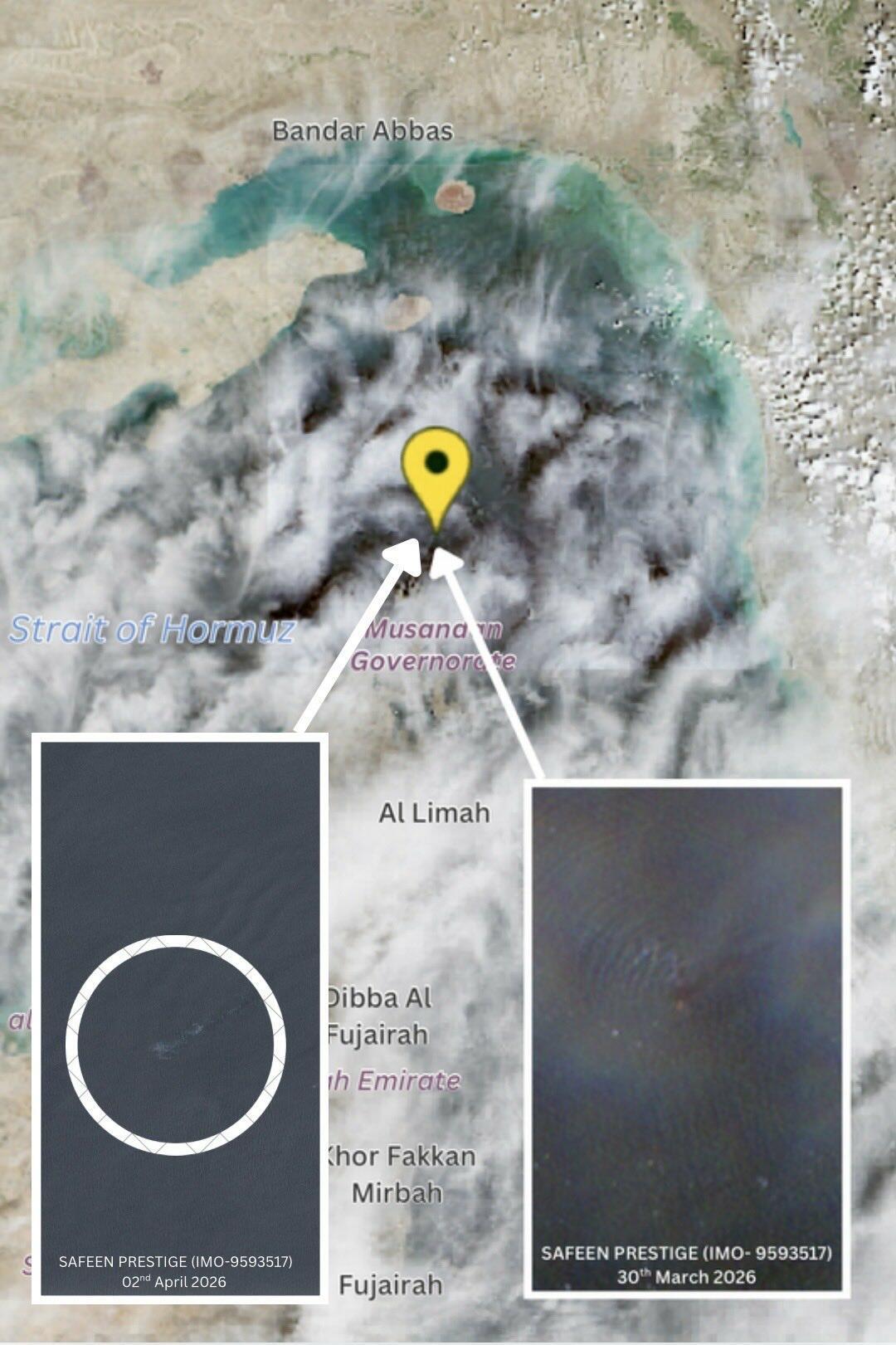
The Safeen Prestige is owned by Transmar International Shipping of Egypt and managed by GFS Ship Management of Dubai, according to the maritime blog TradeWinds. It is also listed as a Maltese-flagged container ship on VesselFinder.
Data from the risk intelligence platform Sayari shows the ownership structure of the container ship:
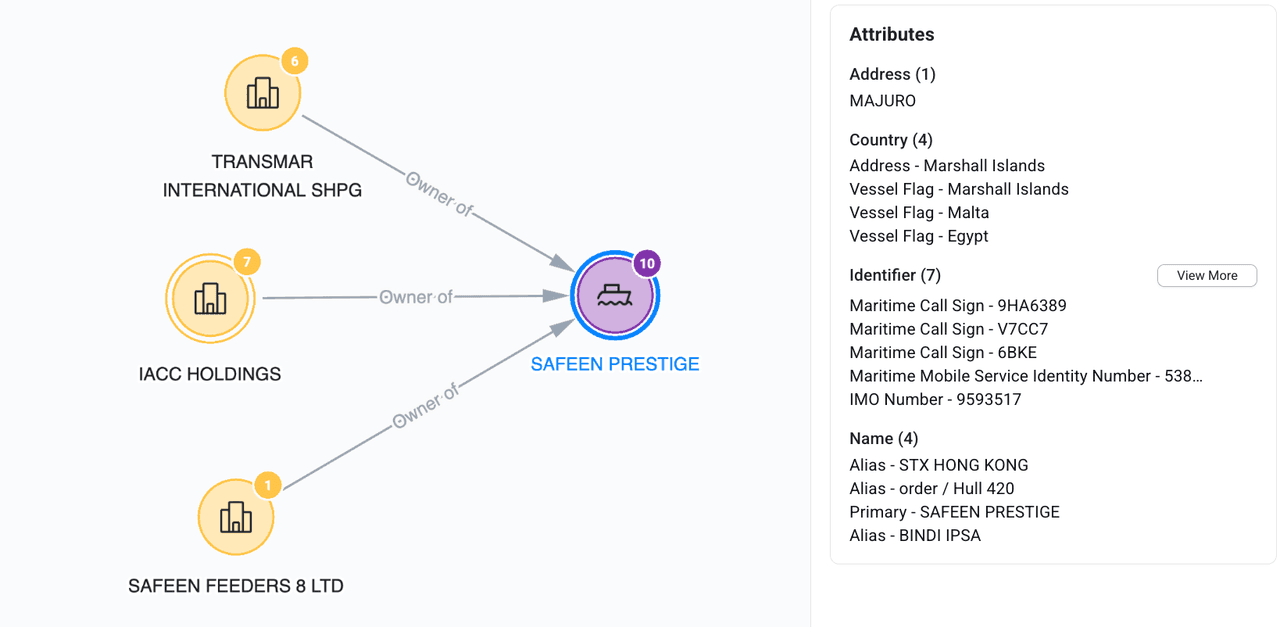
The latest on Strait traffic comes from UBS analyst Henri Patricot, who noted as of Tuesday morning, there were still “mixed developments” in the maritime chokepoint.
Here’s more from Patricot:
We mentioned on Friday that flows via the Strait picked up slightly as two oil tankers and a LNG carrier came out of the Gulf but this is still very limited and we continue to estimate an oil shortfall of ~12Mb/d, pre-SPR release.
Over the weekend, an Iranian spokesperson said that Iraqi ships would be allowed to pass through the Strait. It is not clear how that is different from previous comments that the Strait would be open to friendly countries and the announcement has not led to a visible increase in flows for now. Iraqi oil production has dropped by >3Mb/d since the start of the conflict as the country’s alternative export routes are limited.
Separately, two Qatari LNG carriers attempting to cross the Strait on Monday ended up turning back.
UBS analyst Catherine Gordon provided more color:
Developments around the Strait of Hormuz remain mixed ahead of the latest stated US deadline, though dedicated investors are cautious about anchoring too heavily to the timing itself, given prior instances in which similar deadlines were set and later extended.
Even if President Trump ultimately opts to delay, soften, or walk back the deadline, that would do little to change the current reality of the oil disruption, as there is still no evidence of a meaningful improvement in flows.
While a small number of tankers have exited the Gulf, volumes remain extremely limited, two Qatari liquefied natural gas carriers reportedly turned back, and UBS continues to estimate an oil shortfall of approximately 12mb/d pre‑Strategic Petroleum Reserve.
Weekend commentary suggesting Iraqi vessels may transit the Strait has yet to translate into observable normalization, even as Iraqi production has fallen by more than 3mb/d due to constrained export routes.
Against this backdrop, conditions are increasingly consistent with UBS’s “two‑month disruption” scenario, with Brent potentially reaching around $130/bbl in the second quarter and remaining historically elevated through year‑end, lifting inflation and weighing modestly on growth without tipping the global economy into recession (Global Economics & Strategy note).
Polymarket odds have 13% odds of traffic resuming to normal by the end of April. https://embed.polymarket.com/market?market=strait-of-hormuz-traffic-returns-to-normal-by-april-30&creator=Alastair&height=300Strait of Hormuz traffic returns to normal by end of April?
Yes 13% · No 88%
View full market & trade on Polymarket
Professional subscribers can read more on the Hormuz chokepoint at our new Marketdesk.ai portal.
END
800 Ships Trapped In The Persian Gulf Are Scrambling To Figure Out If They Can Leave
AI
Yes, this headline is accurate and reflects the latest developments as of April 8, 2026.
bloomberg.com
Shipowners and operators are indeed scrambling to interpret the details of a recently announced U.S.-Iran ceasefire (agreed around April 7), which includes provisions that could temporarily reopen the Strait of Hormuz—the narrow chokepoint connecting the Persian Gulf to the open ocean. The goal is to extract more than 800 vessels currently trapped inside the Gulf after weeks of near-total disruption to maritime traffic.
m.economictimes.com
Background on the Situation
- The disruption stems from the ongoing conflict involving U.S., Israeli, and Iranian forces. Iran tightened control over the Strait of Hormuz following strikes, leading to attacks on commercial ships, safety concerns for crews, and a drastic slowdown in transits (normally ~130–135 vessels per day; recently down to a trickle, with fewer than 200 ships escaping in over a month).
- Broader estimates put the total number of affected ships in the region at around 2,000, with over 20,000 seafarers stranded. Many have been at sea for weeks, facing issues like dwindling food/water supplies, crew fatigue, and even reported fatalities. A significant portion (hundreds) are energy carriers: roughly 426 crude/product tankers, 34 LPG carriers, and 19 LNG vessels. wsj.com
- The near-closure has caused a global energy supply crunch, spiking oil and gas prices earlier due to fears over 20% of the world’s oil and key LNG/fertilizer flows.
Current Dynamics with the Ceasefire
- The ceasefire is described as short-term (reports mention a two-week window tied to finalizing talks), and details remain unclear—hence the “scrambling” to understand terms, risks, insurance implications, and any potential tolls or safe corridors imposed by Iran.
- Not all ships may exit immediately; there’s likely to be congestion, prioritization (e.g., laden tankers first), and ongoing risk assessments. Some vessels belong to “non-friendly” nations or may face high costs/conditions to transit.
- Markets reacted quickly: Oil prices dropped sharply (Brent and WTI fell 12–14% in sessions following the news) on hopes of eased supply pressure, though prices remain elevated year-over-year and volatility is high. Full normalization won’t happen overnight due to the backlog. bitget.com
This is a fast-moving story tied to fragile geopolitics. A temporary opening could provide short-term relief for trapped crews and global supply chains, but sustained safe passage depends on the ceasefire holding. Broader impacts include higher shipping/insurance costs and ripple effects on energy markets if disruptions linger. For real-time updates, check shipping data providers like Kpler or maritime authorities.
END
THEY STILL ARE DEMANDING A 2 MILLION FEE TO CROSS THE STRAIT?
First Two Ships Pass Through Strait Of Hormuz Since Ceasefire
Wednesday, Apr 08, 2026 – 09:09 AM
Last night we reported that no less than 800 ships were still trapped in the immediate aftermath of the US-Iran ceasefire agreement, unsure what the fine print of the deal meant for transits. This morning we are down to ~798, after the first two cargo vessels have crossed the Strait of Hormuz since the ceasefire, according to ship tracking data.
The Liberia-flagged Daytona Beach, destined for the United Arab Emirates, crossed just before 8am UK time, while the Greek-owned NJ Earth followed about two hours later, with its destination undisclosed, the tracking platform Kpler showed.
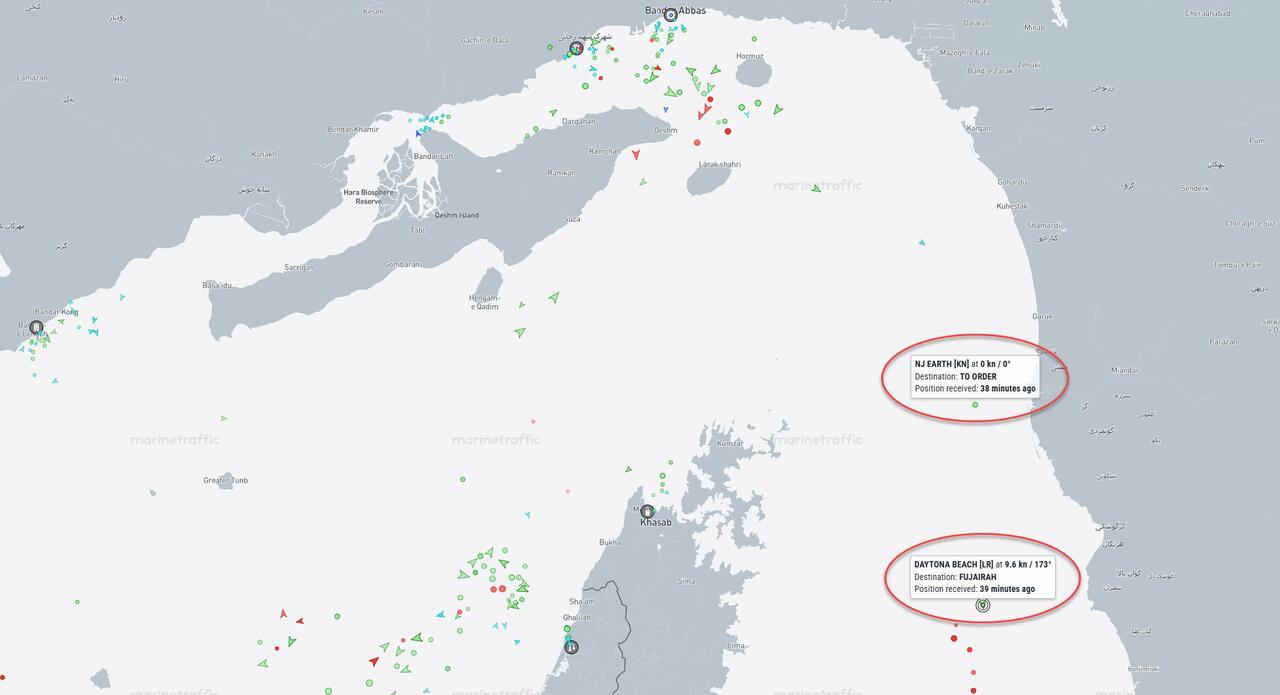
The ships are the first large vessels to transit the critical waterway since the agreement of a two-week ceasefire, under which Iran has claimed it would maintain control of the strait. It was unclear if they paid any tolls to make the crossing. Around 175 million barrels of crude and refined products are currently loaded on to 187 tankers in the Gulf, according to Kpler data — which could now start to move, depending on what happens in the strait.
Regarding Hormuz transit, Iran said it will demand that shipping companies pay tolls in cryptocurrency for oil tankers passing through the Strait of Hormuz, as it seeks to retain control over passage through the key waterway during the two-week ceasefire, the FT reported.
Hamid Hosseini, a spokesperson for Iran’s Oil, Gas and Petrochemical Products Exporters’ Union, told the FT on Wednesday that Iran wanted to collect tolling fees from any tanker passing and to assess each ship.
“Iran needs to monitor what goes in and out of the strait to ensure these two weeks aren’t used for transferring weapons,” said Hosseini, whose industry association works closely with the state. “Everything can pass through, but the procedure will take time for each vessel, and Iran is not in a rush,” he added.
Decisions on the conditions for passing the strait are taken by Iran’s Supreme National Security Council. Hosseini’s remarks suggest Iran will require any tankers to use the northerly route close to its coastline, raising questions over whether western or Gulf state-linked vessels will be willing to risk transit.
Hosseini said that each tanker must email authorities about its cargo, after which Iran will inform them of the toll to be paid in digital currencies.
He said that the tariff is $1 per barrel of oil, adding that empty tankers can pass freely.
“Once the email arrives and Iran completes its assessment, vessels are given a few seconds to pay in bitcoin, ensuring they can’t be traced or confiscated due to sanctions,” Hosseini added.
Speaking to CBS this morning, Trump said that there may be a joint US-Iran venture for Hormuz tolls.
Tankers in the Gulf on Wednesday received a radio broadcast that warned they would be targeted with military strikes unless they first gained approval from Iranian authorities.
“If any vessels try to transit without permission, [they] will be destroyed,” said the broadcast, which is in English, according to a recording shared with the FT.
The fate of transit through the strait is one of the thorniest issues facing negotiators as they try to turn a temporary ceasefire into a prolonged peace, with Iran’s desire to retain leverage over the key waterway clashing with fierce opposition from the US’s allies in the Gulf.
A statement from Iran’s Supreme National Security Council listed 10 points that form the basis for negotiations with the US, including a new “protocol for secure passage” through the strait in co-ordination with Iran’s armed forces.
Western ship owners said on Wednesday they were taking a cautious approach while waiting for details on how and whether the strait might reopen, with no vessels currently braving the transit apart from two linked to Iran.
Maersk, the world’s second biggest shipping line, said it is “working with urgency” to clarify the terms.
“The ceasefire may create transit opportunities, but it does not yet provide full maritime certainty,” the company said, adding that it would continue to take a “cautious approach” with cargoes and was not yet making changes to specific services.
Allowing Iran to continue to control the crucial waterway is likely to be highly unpalatable to Gulf states including Saudi Arabia, Qatar and the UAE. The Omani Minister of Transport said that Oman’s position is clear regarding the Strait of Hormuz: Oman has signed all international maritime transport agreements. The Strait of Hormuz is a natural passage, created without human intervention, and therefore fees cannot be imposed on it according to the international agreements signed by the Sultanate.
🚨وزير النقل العُماني:
بالنسبة لمضيق هرمز، موقف عُمان واضح، عُمان وقّعت على جميع الاتفاقيات الخاصة بالنقل البحري دولياً.
مضيق هرمز معبر طبيعي، لم يتدخل الإنسان في خلقه، ولذلك لا يمكن فرض رسوم عليه حسب الاتفاقيات الدولية التي وقّعت عليها السلطنة. pic.twitter.com/G8cE4mhDaA— الأحداث العالمية (@NewsNow4USA) April 8, 2026
It also raises questions for Opec+, the oil producers’ group, with analysts warning that handing Iran control of Hormuz could fundamentally alter the balance of power within the organisation by giving Tehran a potential veto over rival members’ exports.
Ali Shihabi, a commentator close to the Saudi royal court, said the kingdom would demand “unimpeded” access to global markets.
“Allowing Iran any form of control over the strait would be a red line,” Shihabi said. “The priority has to be unimpeded access through the strait.”
On Wednesday Saudi Arabia’s key East-West pipeline, which the kingdom has been using to reroute oil exports to the Red Sea, was struck by a drone according to people familiar with the matter, despite the ceasefire.
Several traders said they thought the situation in the coming days would resemble the system that has developed over the past fortnight, in which a handful of ships that have been approved by Iran are allowed to pass on a specific route. During the conflict this was largely limited to vessels that had generally done business with Iran and that were not connected to the US, Israel or Gulf states that had provided staging for attacks.
Martin Kelly, head of advisory at maritime intelligence group EOS Risk, said that there was “no way” that the backlog of ships waiting to get out could be cleared in two weeks.
Around 10 to 15 ships might be able to transit the strait per day as the process was “quite time-consuming”, he said, down from 135 ships before the war.
END
Iran Gives Approved Hormuz Shippers “Few Seconds” To Submit Payment In Bitcoin
Wednesday, Apr 08, 2026 – 10:00 AM
Iran plans to require shipping companies to pay transit tolls in Bitcoin for vessels passing through the Strait of Hormuz, according to a Financial Times report.
As Micah Zimmerman reports for BitcoinMagazine.com, this links bitcoin to one of the world’s most critical energy corridors and current events.
The policy would apply to oil tankers seeking passage during a two-week ceasefire between Iran and the United States, announced after a shift in posture from Donald Trump. The arrangement aims to reopen a route that handles a large share of global oil flows while allowing Tehran to maintain control over access.
According to statements attributed to Iranian officials, shipping firms would receive a payment request prior to transit. Once approved, vessels would be given a short window to complete the transaction in bitcoin. The structure reflects an attempt to bypass traditional financial rails that remain constrained by sanctions, while preserving a mechanism for enforcement over passage.
As The FT details, Hamid Hosseini, a spokesperson for Iran’s Oil, Gas and Petrochemical Products Exporters’ Union, told the FT on Wednesday that Iran wanted to collect tolling fees from any tanker passing and to assess each ship.
“Iran needs to monitor what goes in and out of the strait to ensure these two weeks aren’t used for transferring weapons,” said Hosseini, whose industry association works closely with the state.
“Everything can pass through, but the procedure will take time for each vessel, and Iran is not in a rush,” he added.
Decisions on the conditions for passing the strait are taken by Iran’s Supreme National Security Council. Hosseini’s remarks suggest Iran will require any tankers to use the northerly route close to its coastline, raising questions over whether western or Gulf state-linked vessels will be willing to risk transit.
Hosseini said that each tanker must email authorities about its cargo, after which Iran will inform them of the toll to be paid in digital currencies.
He said that the tariff is $1 per barrel of oil, adding that empty tankers can pass freely.
“Once the email arrives and Iran completes its assessment, vessels are given a few seconds to pay in bitcoin, ensuring they can’t be traced or confiscated due to sanctions,” Hosseini added.
Bitcoin, Iran, and the Strait of Hormuz
The move places bitcoin at the center of a geopolitical flashpoint. Iran has faced restrictions on dollar-based settlement systems for years, limiting its ability to collect fees or process payments tied to maritime trade. By shifting to bitcoin, authorities seek a channel that operates outside conventional banking networks and offers resistance to seizure.
Shipping companies face a different calculation. Compliance may secure safe passage through a narrow waterway that links the Persian Gulf to global markets, but it introduces exposure to digital asset volatility, operational risk, and legal uncertainty tied to sanctions regimes.
Markets have begun to react. Bitcoin rose above $72,500 following the ceasefire announcement, reversing earlier weakness tied to fears of escalation.
Currently bitcoin is trading near $73,000. The price move reflects a shift in risk sentiment as traders reassess the likelihood of supply disruptions and broader conflict.
The proposed toll system underscores how digital assets can intersect with state policy under pressure.
For Iran, bitcoin offers a tool to collect revenue and assert control without reliance on intermediaries.
For global shipping, it signals a potential change in how access to key infrastructure could be priced and enforced.
The ceasefire remains limited in scope and duration. Any breakdown in negotiations could halt transit or alter the payment framework, leaving companies exposed to sudden shifts in policy.
For now, the introduction of bitcoin as a toll mechanism marks a test case for cryptocurrency use in sovereign-controlled trade routes, with implications that extend beyond the region.
Unpalatable
Allowing Iran to continue to control the crucial waterway is likely to be highly unpalatable to Gulf states including Saudi Arabia, Qatar and the UAE.
It also raises questions for Opec+, the oil producers’ group, with analysts warning that handing Iran control of Hormuz could fundamentally alter the balance of power within the organisation by giving Tehran a potential veto over rival members’ exports.
Ali Shihabi, a commentator close to the Saudi royal court, said the kingdom would demand “unimpeded” access to global markets.
“Allowing Iran any form of control over the strait would be a red line,” Shihabi said. “The priority has to be unimpeded access through the strait.”
Several traders said they thought the situation in the coming days would resemble the system that has developed over the past fortnight, in which a handful of ships that have been approved by Iran are allowed to pass on a specific route.
END
Airline Stocks Soar On Iran Ceasefire As IATA Sees “Positive” Tailwinds, But Warns Jet Fuel Crisis Will Persist
Wednesday, Apr 08, 2026 – 08:45 AM
Airline stocks are flying high in premarket trading in New York after the overnight ceasefire between the Trump administration and Tehran. The truce is a positive for the aviation industry, which has been locked in turbulence for six weeks, as surging jet fuel prices have crushed the margins of major carriers, forcing ticket and baggage price hikes and triggering travel chaos across the Gulf region.
“Even two weeks is a positive because we will see some flow of oil return,” Willie Walsh, director general of the International Air Transport Association, told Bloomberg Television in an interview.
Walsh pointed out that even with a ceasefire underway, jet fuel prices “will remain elevated for some time.”
“If crude has come down 16%, you like to think jet will come down by a similar figure, but it’s still going to be a high price. That will mean higher ticket prices. It is inevitable,” he warned.
Walsh also cautioned that jet fuel supply shortage risks remain elevated, with Asia seen as the most exposed region, followed by Africa and Europe. JPMorgan outlined “demand destruction” and how the energy shock spreads in a note here.
Even though WTI and Brent crude prices collapsed overnight, Walsh said normalization across the airline industry and energy markets will take time.
Delta Air Lines warned earlier that it expects to incur more than $2 billion in fuel costs through June, but noted that it has yet to change its full-year profit forecast because the outlook remains too murky.
Last week…
Malaysia Airlines’ Nasaruddin Bakar warned that “even if the war stops, it’s going to take many, many more months for the price to stabilize.”
Thai Airways CEO Chai Eamsiri pointed out, “This time is about the infrastructure that was destroyed. It will take some time to bring back all the supply, the facilities, the refineries, and the infrastructure.”
“The Iran conflict has flipped the airline industry on its head, as fuel costs have more than doubled at a time when demand has improved,” Melius analyst Conor Cunningham told clients.
Relief in airline stocks was evident in premarket trading in New York, with United Airlines up 11.5%, Delta Air Lines up 11%, and Southwest Airlines up 10%.
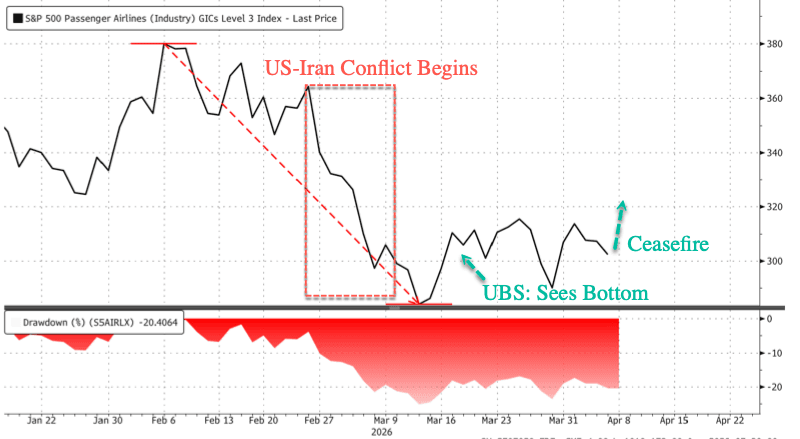
In mid-March, amid all the panic, UBS analyst Atul Maheswari asked: “Are we approaching a bottom for these airline stocks?” It appears so (well so far).
8. EMERGING MARKETS//AUSTRALIA NEW ZEALAND ISSUES
YOUR EARLY CURRENCY/GOLD AND SILVER PRICING/ASIAN CLOSING MARKETS AND EUROPEAN BOURSE OPENING AND CLOSING/ INTEREST RATE SETTINGS WEDNESDAY MORNING 6;30AM//OPENING AND CLOSING
OPENING LEVELS OF CURRENCIES// AND CLOSING ASIAN STOCK MARKET AND OPENING EUROPEAN STOCKS:6 AM EST
EURO VS USA DOLLAR: 1.1685 UP 0.0020
USA/ YEN 158.34 DOWN 0.382 NOW TARGETS INTEREST RATE AT 1.75% AS IT WILL BUY UNLIMITED BONDS TO GETS TO THAT LEVEL…//YEN STILL FALLS//END OF YEN CARRY TRADE BEGINS AGAIN DEC 2024/Bank of Japan raises rates by .25% TO 1.75 ..TAKAICHI NEW PM AS YIELDS RISE//JAPAN DEEPLY IN TROUBLE WITH RISING RATES AND A FALLING YEN!!
GBP/USA 1.3422 UP 0.0200 OR 200 BASIS PTS
USA/CAN DOLLAR: 1.3856 DOWN 0.0060 CDN DOLLAR UP 60 BASIS PTS//
Last night Shanghai COMPOSITE CLOSED UP 104.83 PTS OR 2.69%
Hang Seng CLOSED UP 776.49 PTS OR 3.09%
AUSTRALIA CLOSED UP 2.31%
// EUROPEAN BOURSE: ALL GREEN
Trading from Europe and ASIA
I) EUROPEAN BOURSES: ALL GREEN
2/ CHINESE BOURSES / :Hang SENG CLOSED UP 776.49 PTS OR 3.09%
/SHANGHAI CLOSED UP 104.83 PTS OR 2.09%
AUSTRALIA BOURSE CLOSED UP 2.31%
(Nikkei (Japan) CLOSED UP 2897.00 PTS OR 5.42%
INDIA’S SENSEX IN THE GREEN
Gold very early morning trading: $4804.20
silver:$76.72
USA DOLLAR VS TRY (TURKISH LIRA): 44.53 MINUS 8 BASIS PTS AND NOW WE SEE THEIR STUPIDITY OF SELLING SOME OF THEIR GOLD.
USA DOLLAR VS RUSSIAN ROUBLE: 78.46 ROUBLE// UP 0 ROUBLE AND 4 BASIS PTS
UK 10 YR BOND YIELD: 4.7040 DOWN 14 BASIS PTS
UK 30 YR BOND YIELD: 5.342 DOWN 17 BASIS PTS
CDN 10 YR BOND YIELD: 3.487 UP 2 BASIS PTS
CDN 5 YR BOND YIELD; 3.122 UP 2 BASIS PTS
USA dollar index early WEDNESDAY MORNING: 98.64 DOWN 105 BASIS POINTS FROM TUESDAY’s CLOSE
TUESDAY MORNING NUMBERS ENDS
And now your closing TUESDAY NUMBERS 10.00 AM
Portuguese 10 year bond yield: 3.309% DOWN 19 in basis point(s) yield
JAPANESE BOND 10 yr YIELD: +2.372% DOWN 2 FULL POINTS BASIS POINTS /JAPAN losing control of its yield curve/
JAPAN 30 YR: 3.613 DOWN 14 BASIS PTS//
SPANISH 10 YR BOND YIELD: 3.360 DOWN 21 in basis points yield
ITALY 10 YR BOND: 3.691 DOWN 30 points in basis points yield ./ THE ECB IS QE’ ING ITALIAN BONDS (
GERMAN 10 YR BOND YIELD: 2.9217 DOWN 14 BASIS PTS
IMPORTANT CURRENCY CLOSES : MID DAY WEDNESDAY
Closing currency crosses for day /USA DOLLAR INDEX/USA 10 YR BOND YIELD/10:00 AM
Euro/USA 1.1691 UP 0.0080 OR 80 basis points
USA/Japan: 158.27 DOWN 0.445 OR YEN IS UP 45 BASIS PTS// HIGHLY INFLATIONARY TO JAPAN
Great Britain 10 YR RATE 4.7160 DOWN 17 BASIS POINTS //
GREAT BRITAIN 30 YR BOND; 5.359 DOWN 15 BASIS POINTS.
Canadian dollar UP 55 BASIS pts to 1.3861
xxxxxxxxxxxxxxxxxxxxxxxxxxxxxxxxxxxxxxxxxxxxxxxxxxxxxxxxxxxxxxxxxxxxxxxxxxxxxxxx
The USA/Yuan CNY UP 6.8297 ON SHORE ..
THE USA/YUAN OFFSHORE// CNH UP TO 6.8261
TURKISH LIRA: 44.53 EXTREMELY DANGEROUS LEVEL/DEATH WATCH/HYPERINFLATION TO BEGIN.//
Your closing 10 yr US bond yield DOWN 9 in basis points from TUESDAY at 4.254.% //trading well ABOVE the resistance level of 2.27-2.32%)
USA 30 yr bond yield 4.861 DOWN 6 basis points /10:00 AM
USA 2 YR BOND YIELD: 3.752 DOWN 8 BASIS PTS.
GOLD AT 10;00 AM 4776.00
SILVER AT 10;00: 76,41
Your 11:00 AM bourses for Europe and the Dow along with the USA dollar index closing and interest rates WEDNESDAY CLOSING TIME 10:00 AM//
London: CLOSED UP 260.09 PTS OR 2.51%
GERMAN DAX: CLOSED UP 115.90 PTS OR 3.06%
FRANCE: CLOSED UP 355.13 PTS OR 4.49%
Spain IBEX CLOSED UP 688.00 PTS OR 3.94%
Italian MIB: CLOSED UP 1679.76 PTS OR 3.70%
WTI Oil price 93.55 10.00 EST/
Brent Oil: 92.75 10:00 EST
USA /RUSSIAN ROUBLE /// AT: 78.27 ROUBLE UP 0 AND 31 / 100
CDN 10 YEAR RATE: 3.421 DOWN 7 BASIS PTS.
CDN 5 YEAR RATE: 3.045 DOWN 7 BASIS PTS
CLOSING NUMBERS: 4 PM
Euro vs USA 1.1663 DOWN 0.0022 OR 22 BASIS POINTS//
British Pound: 1.3402 UP 0.0013 OR 13 basis pts/
BRITISH 10 YR GILT BOND YIELD: 4.7110 DOWN 21 FULL BASIS PTS//
BRITISH 30 YR BOND YIELD: 5.339 DOWN 33 IN BASIS PTS.
JAPAN 10 YR YIELD: 2.369 DOWN 2 FULL BASIS PTS (DANGEROUS TO THEIR ECONOMY
JAPANESE 30 YR BOND: 3.607 DOWN 13 PTS AND STILL VERY DANGEROUS TO THEIR ECONOMY
USA dollar vs Japanese Yen: 158.58 DOWN 0.134 OR YEN UP 13 BASIS PTS EXTREMELY DANGEROUS/YEN FALLING DEEPLY IN VALUE
USA dollar vs Canadian dollar: 1.3847 DOWN 0.0018 PTS// CDN DOLLAR UP 18 BASIS PTS
West Texas intermediate oil: 96.57
Brent OIL: 96.40
USA 10 yr bond yield DOWN 6 BASIS pts to 4.279
USA 30 yr bond yield: DOWN 4 PTS to 4.885%
USA 2 YR BOND 3.786 DOWN 5 PTS
CDN 10 YR RATE 3.432 DOWN 7 BASIS PTS
CDN 5 YEAR RATE: 3.058 DOWN 9 BASIS PTS
USA dollar index: 98.81 DOWN 88 BASIS POINTS
USA DOLLAR VS TURKISH LIRA: 44.50 GETTING QUITE CLOSE TO BLOWING UP/IDIOTS SOLD GOLD
USA DOLLAR VS RUSSIA//// ROUBLE: 78.87 DOWN 0 AND 72/100 roubles //
GOLD $4731.00. 3:30 PM)
SILVER: 74.39 3;30 PM)
DOW JONES INDUSTRIAL AVERAGE: UP 1325.46 OR 2.95%
NASDAQ 100 UP 700.79 PTS OR 2.90%
VOLATILITY INDEX 21.28 DOWN 450 PTS OR 17.46%
GLD: $ 434.51 UP 2.70 PTS OR 0.63%
SLV/ $67.49 UP 1.55 PTS OR OR 2.35%
TORONTO STOCK INDEX// TSX INDEX: CLOSED UP 379.69 PTS OR 1.14%
end
TRADING today ZEROHEDGE 4 PM: HEADLINE NEWS/TRADING
The Fog Of (Cease)Fire: Markets Fade Initial Euphoria As Reality Sets In
WRAP UP
USA DATA RELEASES
FOMC Minutes Signal Fed Saw “Dual Sided” Risks From Iran War
Wednesday, Apr 08, 2026 – 02:10 PM
Since the last FOMC meeting (March 18th), a lot has happened (war, more war, and now less war), and rate-change expectations hawkishly surged, then dovishly normalized today…
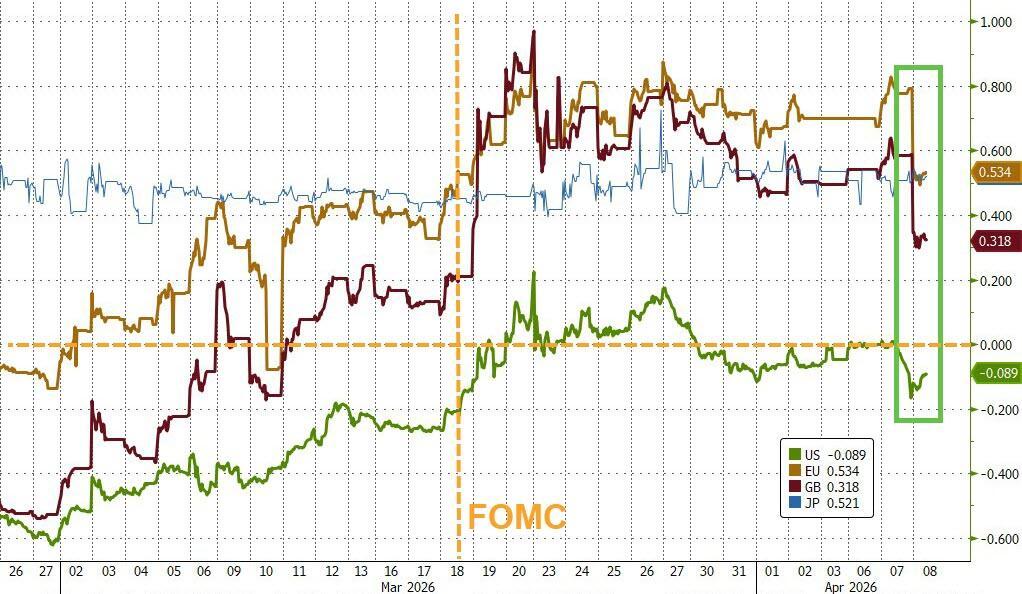
And given the last 24 hours, perhaps this information is more useful now, as we return to macro-fundamentals from geopolitical chaos running markets.
The minutes, released three weeks after the meeting, underscore the Fed’s dilemma as it seeks to fill its congressional mandates of low inflation and maximum employment.
Fed officials wrestled with starkly differing scenarios for the US economy following the outbreak of the Iran war, including one that called for interest-rate cuts and another that would require raising rates.
On one side, Fed officials acknowledged that the Iran conflict could also force households to cut back spending to offset higher gas prices, which would slow growth and raise unemployment.
“…most participants raised the concern that a protracted conflict in the Middle East could lead to a further softening in labor market conditions, which could warrant additional rate cuts,” according to the minutes of the meeting.
But on the other side:
“…many participants pointed to the risk of inflation remaining elevated for longer than expected amid a persistent increase in oil prices, which could call for rate increases.”
And at the same time, many policymakers highlighted the risk to inflation that might ultimately warrant rate increases.
“Partly as a result of these factors, the vast majority of participants noted that progress toward the Committee’s 2 percent objective could be slower than previously expected,” according to the minutes.
The record of the meeting also showed that a growing number of officials urged their colleagues to consider language in the committee’s statement raising the scenario of hiking interest rates under certain conditions.
“Some participants judged that there was a strong case for a two-sided description of the committee’s future interest-rate decisions in the post-meeting statement, reflecting the possibility that upward adjustments to the target range for the federal funds rate could be appropriate if inflation were to remain at above-target levels,” the minutes said.
As a reminder, The Fed kept its key rate unchanged at about 3.6% with Powell saying that another reduction depended on underlying inflation cooling steadily this year:
“If we don’t see that progress then you won’t see the rate cut,” he said then.
Will the ceasefire slow inflation or is the damage already done and yet to flow through global supply chains?
Read the full Minutes below:
USA ECONOMIC REPORTS
NEW YORK
Living In Any New York Borough Now Requires A Six Figure Income
Tuesday, Apr 07, 2026 – 09:20 PM
Living in New York City without financial assistance now requires a six-figure income in every borough, according to Bloomberg.
The Fund for the City of New York’s latest “self-sufficiency standard” shows that in 2026, a family of four with two school-age children needs about $133,000 a year to cover basic expenses without outside help. Still, 46% of households fall short of that level.
A separate report from Mayor Zohran Mamdani’s office found that economic strain is even more widespread. In 2022, more than 5 million residents—62% of the population—were unable to both meet essential costs and save for emergencies. For families with children, the median income required rises to $159,197.
Together, the findings point to a deepening affordability crisis. Mamdani has proposed measures such as free universal childcare, fare-free buses, and rent freezes to ease the burden. He also noted that Black and Latino communities are disproportionately affected.
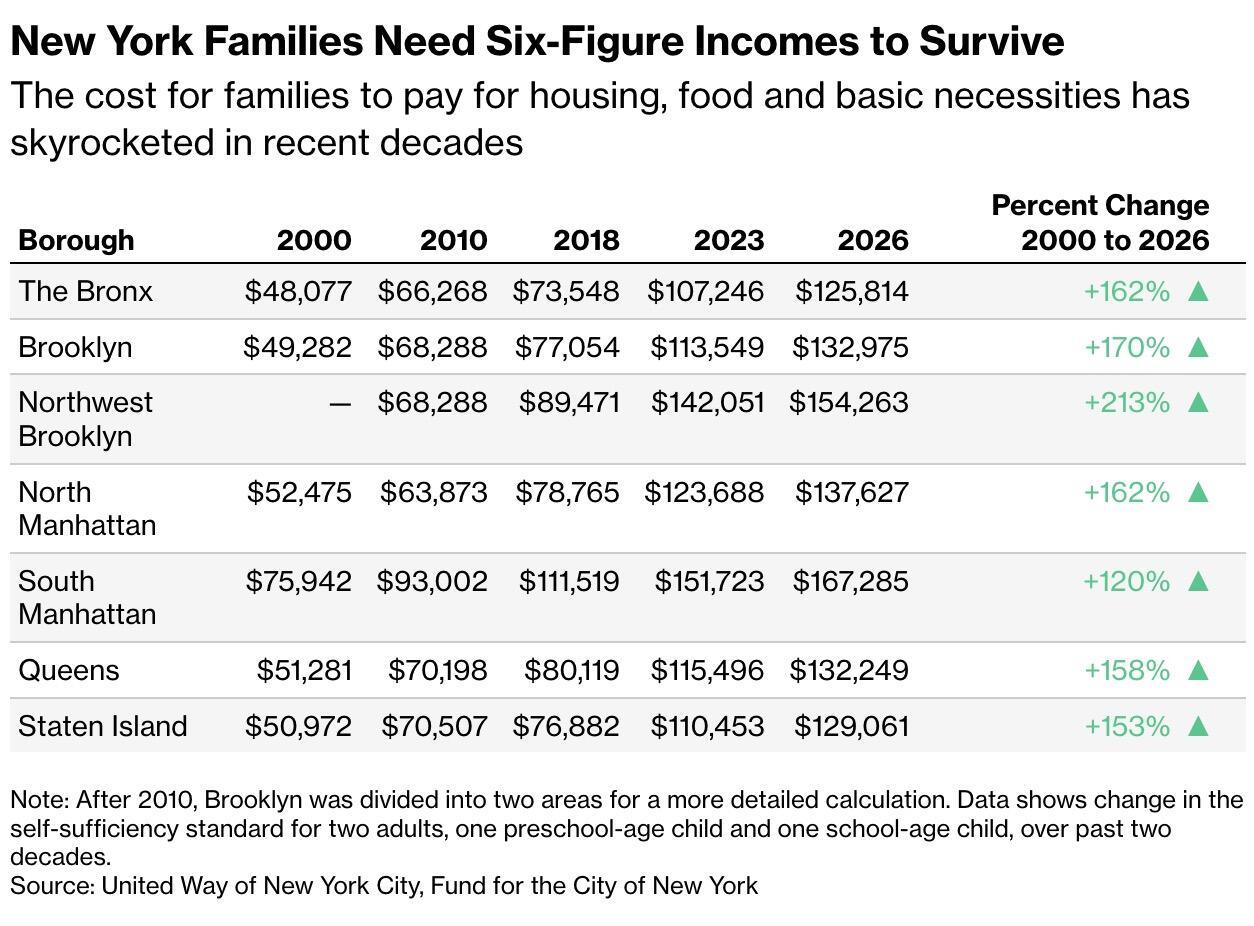
Costs have surged dramatically over time. In the Bronx, a two-parent household with two children now needs about $125,814 annually—up 162% from 2000. In Northwest Brooklyn, that figure reaches roughly $154,000, more than triple the borough’s earlier benchmark. Every borough has seen similar triple-digit increases.
Having children significantly raises expenses. Nearly half of married couples with kids earn below what they need, while households with two adults and no children were the only group consistently meeting costs in 2022.
Bloomberg writes that the impact is especially severe for younger residents. About 1.2 million children—73% of those under 18—live in families below the true cost-of-living threshold. Rising expenses have also driven families out: the number of children under five dropped 18% between 2020 and 2024.
Single parents face the greatest financial pressure. In 2022, 84% of those with one child fell short of the income needed to get by, rising to 94% for two children and 99% for three.
Recall, Zero Hedge contributor Quoth the Raven recently wrote about exactly how Mamdani’s “tax fantasy” has already failed elsewhere in the United States. Now it looks like it’s failing in New York.
END
HUGE
US Scientists Crack Superconductor Code – Zero Energy Loss Moves Closer To Reality
Tuesday, Apr 07, 2026 – 10:35 PM
Authored by Prabhat Ranjan Mishra via Interesting Engineering,
Researchers in the United States have unlocked secrets of high-temperature superconductors.

Researchers at the U.S. Department of Energy’s (DOE) Argonne National Laboratory have discovered how tiny changes in superhydride structure enable superconductivity at near room temperatures but extreme pressure – offering clues for designing more practical superconductors.
“These experiments show what the upgraded APS can do. We can now study atomic-level structures with unprecedented detail in materials under extreme pressure,” said Maddury Somayazulu, Argonne physicist.
Superconductors allow electricity to flow without resistance
Researchers revealed that superconductors allow electricity to flow without resistance, meaning no energy is lost as heat. This property makes them useful for technologies such as MRI scanners, particle accelerators, magnetic-levitation trains and some power-transmission systems.
They also highlighted that most superconductors, however, only work at extremely low temperatures – often hundreds of degrees below zero Fahrenheit. Keeping materials that cold requires complex and costly cooling systems, which limits where the superconductors can be used.
Now, researchers in the U.S. have helped take a step toward easing that limitation. They have gained new insight into a class of materials called superhydrides that can become superconducting at much higher temperatures – around 10 degrees Fahrenheit.
In the new study, Hemley and his fellow researchers explored whether changing the material’s chemistry could lower the pressure needed for superconductivity. They added a small amount of yttrium to the lanthanum superhydride to make it more stable and reduce the pressure required.
“To reach these extreme pressures, we squeezed a tiny sample between two diamonds,” said Maddury Somayazulu, a physicist at the APS. The team’s diamond-anvil device can generate pressures as high as five million atmospheres.
Forming superconducting material at high pressure and temperature
After forming the superconducting material at high pressure and temperature, the team used high-energy X-rays from the APS to study its structure (at beamlines 16-ID-B and 13-ID-D).
”We focused an intense X-ray beam onto a sample only a few micrometers thick and about ten to twenty micrometers across,” said Vitali Prakapenka, a beamline scientist and research professor at the University of Chicago. One micrometer is about 1/70th the width of a human hair.
The recent APS upgrade made these measurements possible. Its brighter, more tightly focused X-ray beam allowed researchers to study extremely small samples while changing the pressure, according to a press release.
“That beam allowed us to separate signals coming from the tiny sample itself as opposed to those coming from the surrounding materials and diamond anvils,” Prakapenka said.
The team found that small differences in how atoms are arranged in a crystalline lattice can strongly affect superconductivity. They identified two different crystal structures, each becoming superconducting at a slightly different temperature, as per the release.
“These experiments show what the upgraded APS can do,” Somayazulu said. ”We can now study atomic-level structures with unprecedented detail in materials under extreme pressure.”
Researchers also highlighted that although the pressures used in the experiments are still very high — about 1.4 million times atmospheric pressure — the researchers see this as part of a longer path forward. They are adding more elements to lower the pressure further with the goal of making these materials practical.
END
LOS ANGELES/HOUSTON
HUGE EXODUS LOS ANGELES/MANY MOVED TO HOUSTON!
(zerohedge)
As Los Angeles Hits “Breaking Point” Population Exodus, Houston’s GDP Rockets Higher
Tuesday, Apr 07, 2026 – 10:10 PM
California – which spends nearly 40% of taxpayer revenue ($95.5 billion, not including federal funds) on social services that’s rife with fraud – and which spends roughly 25% of its $95.5 billion Medi-Cal budget (free healthcare) on illegal immigrants, is in the midst of a massive population exodus due to housing affordability, crime, taxes, wildfires, parental rights, and homelessness.

And while San Francisco and Los Angeles compete for the biggest cesspool in the country, LA county just took the crown when it comes to population loss.
According to the latest US Census data, Los Angeles county lost over 53,000 residents – marking the largest decline in any US city between July 1, 2024 and July 1, 2025 – while the overall population loss from 2020 to today is roughly 300,000 people.
“There is a real sense of burnout. They are paying insane taxes and getting absolutely nothing in return,” according to real estate developer Robert Rivani in a comment to Fox Business. “People feel like they’re living in a place that’s draining them financially and in exchange they’re dealing with rising crime, shrinking services, and a sense that everyone around them is trying to leave too.”
“It isn’t just one factor, it’s the breaking point phenomenon. The taxes, the lack of safety, the red tape,” Compass Real Estate agent Chad Carroll told the outlet. “I have a client from California whose home was broken into twice in the past six months. The whole political landscape there is destroying the state.”
“These are individuals who have spent their lives building businesses and wealth,” he added, “and they feel that California has become a place that takes everything and gives back very little in terms of safety, infrastructure and opportunity.”
Houston We Have The Opposite Of A Problem
Meanwhile, Houston is undergoing a transformation. Not only can you actually get homeowner’s insurance (13% of realtors said they’ve had at least one home fall out of escrow because a buyer couldn’t find insurance),
Let’s compare to Los Angeles:
- Housing Affordability & High Cost of Living: LA housing is 2.5–3× more expensive than Houston (median ~$900k+ vs ~$340k).
- High Taxes: Houston has no state income tax. Los Angeles has a top rate of 13.3%.
- Crime, Homelessness & Public Safety: Houston has far lower homelessness (~14× lower rate) and better recent crime trends.
- Parental Rights & Education Policies: Houston/Texas has stronger parental notification and consent laws.
- Wildfires, Natural Disasters & Insurance Crisis: Los Angeles faces severe wildfire insurance non-renewals and premium spikes. Houston does not.
- Jobs, Wages & Economic Opportunity: Houston has stronger job growth and better cost-of-living-adjusted wages.
- Traffic, Congestion & Infrastructure: Los Angeles has significantly worse traffic (83 vs 56 hours lost per year).
- Broader Quality-of-Life: Houston has lighter regulations, faster permitting, and lower energy costs.
About that job growth: Houston real estate experts @Houstonomics just revealed that Houston became the 6th largest metro economy in 2024 (most recent data), and became the second fastest growing city out of the country’s 20 largest metro economies.

In a Saturday post on X (via Capital.news), they note: The numbers are in, and they demand attention.
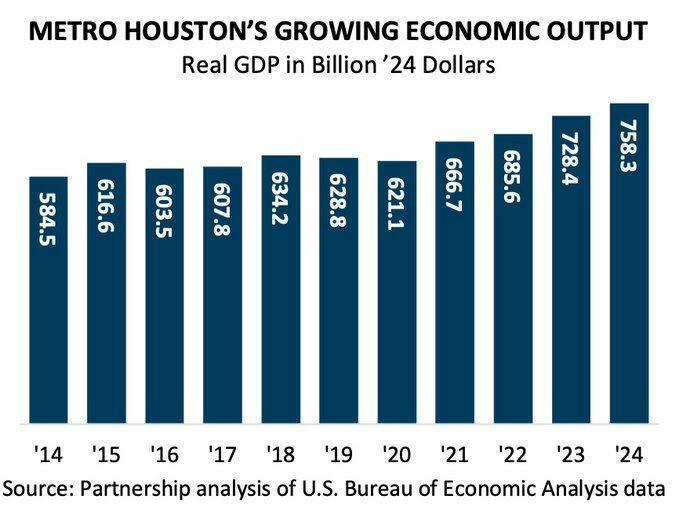
Metro Houston’s GDP hit $758.3 billion in 2024, crossing three-quarters of a trillion dollars in real, inflation-adjusted terms for the first time on record. That makes Houston the 6th largest metro economy in the United States, ahead of Washington D.C. and closing in fast on the cities above it.
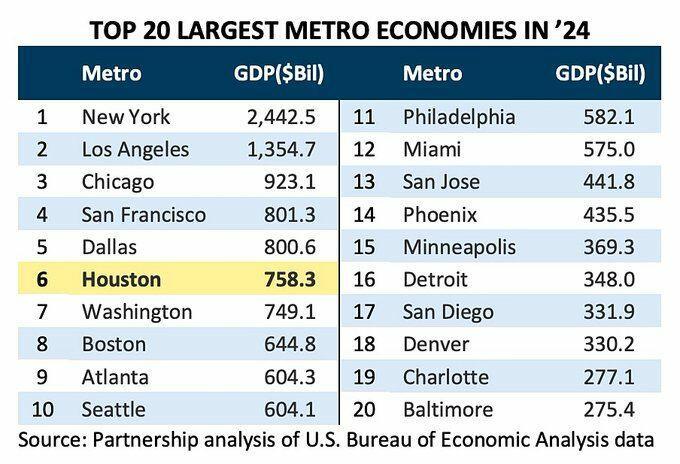
But the size of the number is not the real story. The velocity is.
Houston grew at 4.1% in 2024, nearly double the national rate of 2.8%. Over the prior two years, only Seattle grew faster among the 20 largest metro economies. In absolute dollar terms, Houston added $72.6 billion in output, second only to New York City. That is not an oil town riding a commodity cycle. That is a diversified industrial powerhouse firing on all cylinders.
The conventional wisdom about Houston has always centered on energy. And yes, energy is still woven into the fabric of this city. But oil and gas extraction has fallen from 7.7% of GDP in 2014 to just 3.8% today, even as total output has grown. The city has not abandoned energy. It has grown everything else around it faster.
Manufacturing tells that story best. Houston produced $126.9 billion in manufactured goods in 2024, leading every metro in the country for the third straight year. More than Los Angeles. More than Chicago. More than double Detroit. Recent project announcements from Foxconn, Eli Lilly, and Tesla signal that this base is expanding well beyond its petrochemical roots.
Worker productivity reinforces the picture. The average Houston worker generates $221,000 in economic output per year, nearly 19% above the national average. That figure has risen 11.1% since 2019, outpacing the 7.9% national gain. Houston achieves this not through a narrow concentration of tech billionaires, but through the rare combination of skilled blue-collar workers and world-class industrial capital operating at scale.
Then there is trade. Nearly one in four dollars produced in Houston gets exported to global markets. No other major metro comes close. Dallas and Chicago export roughly 6% of their output. Houston exports 24%. The Port of Houston connects this industrial base to the world, and the world keeps buying.
The investment community is paying attention. In 2025, the Greater Houston Partnership recorded 683 new business announcements, a 26.5% increase over the prior year. Of the 683 announcements tracked in ’25:
- 35 disclosed employment figures totaling 14,834 new jobs.
- 42 reported $10.5B in capital investment.
- 665 disclosed 602.8M SF in space occupancy.
Of those, 117 came from foreign-owned firms, the highest volume on record. Companies from around the world are choosing Houston not as a backup plan, but as a primary destination.
The Purchasing Managers Index has shown continuous expansion for 68 consecutive months. Vehicle sales hit an all-time regional record. Sales tax revenues rose 5.9% in 2025, even after adjusting for inflation. The macro data and the street-level data are telling the same story.
Houston is not having a moment. It is building a permanent position at the top tier of American economic geography. The city that the coastal consensus once dismissed as a boom-bust energy town has quietly become one of the most productive, most export-oriented, most globally connected industrial economies on the planet.
The data is out. The question is whether the rest of the country is paying attention.
Data sourced from the Greater Houston Partnership, “Houston:The Economy at a Glance,” March 2026.
END
VICTOR DAVIS HANSON
KING NEWS
| The King Report April 8, 2028 Issue 7716 | Independent View of the News |
| Trump TACOs again – extends deadline for two weeks at Pakistan’s behest! Trump: Based on conversations with Prime Minister Shehbaz Sharif and Field Marshal Asim Munir, of Pakistan, and wherein they requested that I hold off the destructive force being sent tonight to Iran, and subject to the Islamic Republic of Iran agreeing to the COMPLETE, IMMEDIATE, and SAFE OPENING of the Strait of Hormuz, I agree to suspend the bombing and attack of Iran for a period of two weeks. This will be a double-sided CEASEFIRE! The reason for doing so is that we have already met and exceeded all Military objectives and are very far along with a definitive Agreement concerning Long-term PEACE with Iran, and PEACE in the Middle East. We received a 10-point proposal from Iran, and believe it is a workable basis on which to negotiate. Almost all of the various points of past contention have been agreed to between the United States and Iran, but a two-week period will allow the Agreement to be finalized and consummated… it is an Honor to have this Long-term problem close to resolution… i24News: Iran accepts Pakistan… 2-week ceasefire following ‘last minute’ intervention by China Iran State TV: Trump’s humiliating retreat from anti-Iran rhetoric. Trump accepts Iran terms for ending the war – Reuters. Iran’s Supreme National Security Council: The enemy, in its unfair, illegal, and criminal war against the Iranian nation, has suffered an undeniable, historic, and crushing defeat… This victory forced criminal America to accept Iran’s 10-point plan, in which America is fundamentally committed to non-aggression, the continuation of Iran’s control over the Strait of Hormuz, the acceptance of enrichment, the removal of all primary and secondary sanctions, the termination of all resolutions of the Security Council and the Board of Governors, the payment of damages to Iran, the withdrawal of American combat forces from the region, and the cessation of war on all fronts, including against the heroic Islamic Resistance of Lebanon… The field was narrowed for the enemy on all fronts to such an extent that not only were none of the enemy’s primary objectives realized, but the enemy realized—approximately 10 days after the start of the war—that it had no capacity for victory. Consequently, it began attempting to contact Iran through various channels and methods to request a ceasefire.” https://x.com/hey_itsmyturn/status/2041652939282849921 US military strikes against Iran have stopped according to the two-week cease-fire agreement: NYT Axios’ @BarakRavid: A first round of negotiations between the United States and Iran on an agreement to end the war is planned to take place in Islamabad on Friday, according to two sources… Israel has agreed to the ceasefire and will also suspend its strikes on Iran for two weeks… The White House official said ceasefire will come into force when Iran opens the Strait of Hormuz Equity futures surged; gas & oil sank on Tuesday night. ESMs hit 6818.75 (+162.00) at 19:26 ET; NQMs hit 25,091.25 (+720.25) at 20:02 ET. More details and chronology of events below. ‘A whole civilization will die tonight’ says Trump as Iran defies nearing deadline “A whole civilization will die tonight, never to be brought back again. I don’t want that to happen, but it probably will,” Trump wrote on his Truth Social website. “However, now that we have Complete and Total Regime Change, where different, smarter, and less radicalized minds prevail, maybe something revolutionarily wonderful can happen, WHO KNOWS? We will find out tonight, one of the most important moments in the long and complex history of the World.”… https://www.yahoo.com/news/articles/iran-defiant-eve-trumps-ceasefire-042120448.html WSJ on Tuesday morning: Iran has cut off direct communications with the U.S. over President Trump’s threat to destroy Iran’s “whole civilization” Monday morning, though talks with cease-fire mediators continue, Middle Eastern officials said. The move has temporarily complicated efforts to make a deal by Trump’s 8 p.m. deadline Tuesday but hasn’t ended the talks, the officials said… Iran threatens Bab al-Mandeb closure: How would that affect world trade? The strait is between Yemen to its northeast and Djibouti and Eritrea in the Horn of Africa to the southwest. It connects the Red Sea to the Gulf of Aden, which then extends into the Indian Ocean. It is 29km (18 miles) wide at its narrowest point, limiting traffic to two channels for inbound and outbound shipments and is effectively controlled by the Iran-backed Houthis…. https://www.msn.com/en-us/news/world/iran-threatens-bab-al-mandeb-closure-how-would-that-affect-world-trade/ar-AA20fKw2 Trump has repeatedly delayed deadlines for Iran, but suggests Tuesday’s is final – AP https://wgntv.com/news/israel-iran-conflict/ap-trump-has-repeatedly-delayed-deadlines-for-iran-but-suggests-tuesdays-is-final/ @ElectionWiz: Iran urges civilians, including youth, to show their patriotism by forming human chains and shields around power plants https://x.com/ElectionWiz/status/2041304749627048167 Netanyahu says Israeli planes have struck Iran bridges, railways ahead of Trump vow to do so tonight (possibly a preemptive strike before human shields could be forcibly employed.) https://justthenews.com/world/middle-east/netanyahu-says-israeli-planes-have-struck-iran-bridges-railways-ahead-trump-vow Iran told mediators its weapons arsenal is nowhere near depleted – WSJ Tehran tells mediators arsenal nowhere near depleted, sticks to hardline position as Trump deadline nears; threatens Gulf and Israeli energy strikes… Tehran told Pakistan, which is mediating talks, that it believed it was winning and that it retained 15,000 missiles and 45,000 drones in its arsenal, according to mediators and a person familiar with the matter. Mediators said the numbers were likely exaggerated but reflected Iran’s unflinching negotiating position. The U.S. and Israel are continuing to strike Iran with force as President Trump’s ultimatum deadline nears. Iran has threatened to retaliate with large-scale strikes on Gulf countries and Israeli power and energy infrastructure, according to mediators and Iran’s Islamic Revolutionary Guard… https://www.wsj.com/livecoverage/iran-war-2026-trump-deadline-latest-news/card/iran-told-mediators-weapons-arsenal-nowhere-near-depleted-pExZQxsQeVNeZucYOCsZ Trump does NOT understand the mentality of the radical Iran regime. It’s akin to what the US faced with Japan in WWII. Even after two A-bombs and the loss of all their island holdings, Japanese officials struggled with the decision to surrender. And after the Emperor blessed the surrender decision, military hardliners staged a revolt. Dated Brent Oil Price Hits A Record of $144.42 a Barrel – BBG 14:27 ET ESMs traded modestly higher early on Monday, but broker lower at 18:21 ET. ESMs declined to 6609.00 (-42.00) at 22:05 ET. ESMs then rallied to a daily high of 6667.00 (+16.00 ET) at 5:33 ET on foolish buying. ESMs then did a 5-wave decline, with acute 2 & 4 wave rebounds, that hit a daily low of 6572.75 (-78.25) at 11:05 ET. Traders then aggressively bought; ESMs ascended to 6646.59 at 13:36 ET. After a tumbled to 6597.50 at 1506 ET, ESMs then went inert. At 15:12 ET, ESMs went vertical and hit 6645.50 at 15:20 ET. Some once again got inside info and profited from again. Pakistan: Request Trump to Extend Deadline by Two Weeks – BBG 15:20 ET. Pakistan: Request Iran to Open Hormuz Strait for Two Weeks – BBG 15:20 ET After a retreat to 6622.25 at 15:37 ET, ESMs went inert again. However, at 15:44 ET, a manipulation appeared; ESMs jumped to 6655.50 at 15:45 ET. After a retreat to 6637.50 at 15:50 ET, ESMs rallied to 6662.75 at 16:02 ET. Positive aspects of previous session Equities had a sharp rebound rally after 11:05 ET. Three late ESMs manipulation appeared. The DJTA was strong all session on the relative rotational rally. Negative aspects of previous session Fangs declined smartly on the relative rotational rally into DJTA stocks and out of Fangs. Gasoline and oil rallied moderately. Ambiguous aspects of previous session Did Team Trump once again leak important news to its friends? First Hour/Last Hour NYSE Action [S&P 500 Index]: 1st Hour: Down; Last Hour: Up Pivot Point for S&P 500 Index [above/below indicates daily trend to day traders]: 6589.89 Previous session (S&P 500 Index) High/Low: 6618.26; 6534.55 @kashyap286: Phillips 66 $PSX, a leading US based refiner, has warned that its Q1 results will be hit by a $900 million pre-tax loss on its derivatives positions. PSX is net short 50 million barrels of crude and refined products. The company had to post $3 billion in collateral to cover its paper losses… In the 2022 refining bull market, US refiner Vertex Energy went bankrupt because they had gone heavily net short. A windfall quarter for other companies turned into a bankruptcy filing for VTNR. While PSX is far from going bankrupt, it won’t be the only company to report losses from hedges gone awry. Something commodity investors need to watch out for. https://x.com/kashyap286/status/2041563863624380436 @om_patel5: Sam Altman watching ChatGPT hallucinate live on stage is the funniest thing i’ve seen all week. The CEO of OpenAI, on stage, in front of everyone, watching his own AI just make things up in real time, and his face says it all. tthis is the guy telling us AGI is coming soon btw https://t.co/6uqT1XovBx Trump Says US in ‘Heated’ Iran Talks Amid Extensions Request – BBG 16:12 ET Today – Trump extended the Iran deadline once again. Most traders were long – and got even longer on Tuesday night! Ergo, the risk is for another defiant act by Iran, which continues to vex Trump with its Rope-a-Dopey Don strategy. Iran keeps playing for time and the appearance of foreign and domestic political pressure on DJT. Monday NYSE volume was a 2026 low of 1.1301B shares. Tuesday NYSE volume was 1.2323B, the 2nd lowest session of 2026. ESMs are+138.75; NQMs are +676.50; USMs are +1 4/32; gas & oil are down huge at 20:20 ET. FOMC Minutes (March 18) 14:00 ET; SF Fed Pres Daly 13:05 ET S&P Index 50-day MA: 6772; 100-day MA: 6805; 150-day MA: 6763; 200-day MA: 6651 DJIA 50-day MA: 48,067;100-day MA: 48,097; 150-day MA: 47,540; 200-day MA: 46,761 (Green is positive slope; Red is negative slope S&P 500 Index (6611.83 close) – BBG trading model Trender and MACD for key time frames Monthly: Trender and MACD are positive – a close below 6035.78 triggers a sell signal Weekly: Trender and MACD are negative – a close above 6458.06 triggers a buy signal Daily: Trender and MACD are positive – a close below 644.26 triggers a sell signal Hourly: Trender and MACD are positive – a close below 6558.06 triggers a sell signal @BillMelugin_: In interview w/ colleague @BretBaier, DHS Secretary Markwayne Mullin floats the idea of stripping CBP/customs officers from airports in large sanctuary cities as retaliation for refusing to cooperate with the federal government. International travelers wouldn’t be able to fly into airports and leave without going through customs. Mullin points out that Democrats are also refusing to fund CBP.“ It’s something we’re looking at,” Mullin said. GOP Rep. Anna Paulina Luna @RepLuna: I am sick of serving in Congress with immoral freaks who abuse their office and bring dishonor to the institution. Congress is rotten to the core and it needs a complete overhaul. The American people deserve better than this. | |
SWAMP STORIES FOR YOU TONIGHT
Joshua Hall on X: “ BREAKING: FBI Director Kash Patel is reportedly preparing to formally announce FEDERAL CRIMINAL CHARGES against DISGRACED former President Barack Obama and DOZENS of other key individuals who were involved in the planning and execution of Russiagate in the aftermath of the https://t.co/zthL4ULWRV” / X
Inbox

| Robert Hryniak | 10:24 AM (0 minutes ago) | ||
to | |||
This could drop in early May.
GREG HUNTER….


 harveyorganblog.com


