
My website is still under construction. However I will be posting my commentary at
harveyorganblog.com or harveyorgan.wordpress.com and at the silverdoctors website on a continual basis.
I would like to thank you for your patience.
Gold: $1161.10 up $2.30
Silver: $15.61 down 1 cent
In the access market 5:15 pm
Gold $1162.50
silver $15.68
Gold had a good day price wise (silver basically the same in price)
The bankers came to work early this morning in London knocking both metals down (gold nadir $1155/silver $15.60) but gold/silver rebounded as we approached the comex time zone. By 12;00 noon, gold hit its zenith at $1167 which is the time that London was put to bed and the end of the physical time zone. From that point on, the bankers whacked to values recorded above.
The gold comex today had a poor delivery day, registering 0 notices served for nil oz.
Silver comex registered 31 notices for 155,000 oz.
A few months ago the comex had 303 tonnes of total gold. Today the total inventory rests at 255.02 tonnes for a loss of 48 tonnes over that period. .
In silver, the open interest rose considerably despite Wednesday’s fall in price ( 5 cents). It looks like we have a few nervous shorts in silver racing against the clock to cover some of their shortfall!! The total silver OI remains extremely high with today’s reading at 171,698 contracts.
The big December silver OI contract lowered to 86,157 contracts which is to be expected with a normal contraction as some of the paper longs move to March..
In gold we had a small loss in OI with yesterday’s fall in price of gold to the tune of $3.90 . The total comex gold OI rests tonight quite elevated at 440,596 for a loss of 2,826 contracts. The December gold OI however rests tonight at 227,675 contracts which had a huge loss of 18,451 contracts. Obviously the paper longs decided it was better to roll into February. The silver December longs decided to stay put.
Today, we had a big withdrawal of gold Inventory at the GLD of 2.0500 tonnes/ inventory rests tonight at 720.62 tonnes.
In silver, the SLV inventory had no change.
SLV’s inventory rests tonight at 344.888 million oz.
.
We have a few important stories to bring to your attention today…
Let’s head immediately to see the major data points for today.
First: GOFO rates: move again deeper in backwardation!!
OH!!! OH!!
All months basically moved deeper into backwardation and all months moved into the negative direction..
Now, the first 4 month GOFO rates moved deeply into the negative with the 6th month GOFO just entering backwardation.. On the 22nd of September the LBMA stated that they will not publish GOFO rates. However today we still received today’s GOFO rates.
It looks to me like these rates even though negative are still fully manipulated.
London good delivery bars are still quite scarce.
The backwardation in gold is incompatible with the raid on gold . It does not make any economic sense.
Nov 13 2014
1 Month Rate: 2 Month Rate 3 Month Rate 6 month rate 1 yr rate
-.2125% -0.1575% -0.1025% – .00% + .1150%
Nov 12 .2014:
1 Month Rate 2 Month Rate 3 Month Rate 6 month Rate 1 yr rate
–.205% + -.1475% -.09500% +.0000 % + .1150%
end
Let us now head over to the comex and assess trading over there today,
Here are today’s comex results:
The total gold comex open interest fell by a small margin of 2,826 contracts from 443,422 down to 440,596 with gold down $3.90 yesterday. The front delivery month is November and here the OI actually rose by 4 contracts. We had 0 delivery notices filed on Tuesday so we gained 4 contracts or 400 additional gold ounces will stand for the November contact delivery month. The big December contract month saw it’s Oi fall by a mammoth 18,451 contracts down to 227,675. Most of the selling December longs rolled into February. You will see below that this is not, so for, happening to our December silver longs who are standing pat. The estimated volume today was fair at 122,197. The confirmed volume yesterday was very good at 240,857. (with mucho help from our HFT traders.) Strangely on this 11th day of notices, we again had zero notices filed for nil oz.
And now for the silver comex results. The total OI rose nicely again by 1,014 contracts from 170,684 up to 171,698 even though silver was down 5 cents yesterday. It seems that judging from silver’s OI, our banker friends are still very nervous as they continue to cover their massive shortfall in silver. In ounces, this represents a total of 858 million oz or 122.6% of annual global supply. We are now in the non active silver contract month of November and here the OI remained constant at 112 for 0 loss.. We had 0 notices filed on yesterday so we neither gained nor lost any silver contracts that will stand for the November contract month. The big December active contract month saw it’s OI fall by 5,262 contracts down to 86,157. This a normal contraction as generally they lose 5,000 contracts per day on a roll. The December contract month remains highly elevated for this time in the delivery cycle. In ounces the December contract is represented by 430 million oz or 61.5% of annual global production (production = 700 million oz – China). The estimated volume today was poor at 22,992. The confirmed volume yesterday was huge at 69,914. We also had 31 notices filed today for 155,000 oz.
If I am reading the comex first day notice properly, first day notice is Nov 26.2014 the day before Thanksgiving. We thus have 9 more comex sessions.
Data for the November delivery month.
November initial standings
Nov 13.2014
| Gold |
Ounces |
| Withdrawals from Dealers Inventory in oz | nil |
| Withdrawals from Customer Inventory in oz | 10,649.181 (Scotia) |
| Deposits to the Dealer Inventory in oz | nil |
| Deposits to the Customer Inventory, in oz | 10,049.181 oz |
| No of oz served (contracts) today | 0 contracts(nil oz) |
| No of oz to be served (notices) | 33 contracts (3300 oz) |
| Total monthly oz gold served (contracts) so far this month | 10 contracts (1000 oz) |
| Total accumulative withdrawals of gold from the Dealers inventory this month | 80,623.1 oz |
|
Total accumulative withdrawal of gold from the Customer inventory this month |
528,091.9 oz |
Today, we had 0 dealer transactions
total dealer withdrawal: nil oz
total dealer deposit: nil oz
we had 1 customer withdrawals: and this is a strange one!!
i) Out of Scoti 10,649.181 oz
total customer withdrawals : 10,649.181 oz
now watch this carefully: from this withdrawal
we had 1 customer deposit:
Into HSBC: 10,049.181 oz is deposited
total customer deposits : 10,049.181 oz
and then 600.000 oz exactly departs all registered vaults. How could this be possible???
We had 0 adjustments:
Total Dealer inventory: 868,910.561 oz or 27.02 tonnes
Total gold inventory (dealer and customer) = 8.200 million oz. (255.06) tonnes)
Several weeks ago we had total gold inventory of 303 tonnes, so during this short time period 48 tonnes have been net transferred out. We will be watching this closely!
Today, 0 notices was issued from JPMorgan dealer account and 0 notices were issued from their client or customer account. The total of all issuance by all participants equates to 0 contracts of which 0 notices were stopped (received) by JPMorgan dealer and 0 notices were stopped by JPMorgan customer account.
To calculate the total number of gold ounces standing for the November contract month, we take the total number of notices filed for the month (10) x 100 oz to which we add the difference between the OI for the front month of November (33) – the number of gold notices filed today (0) x 100 oz = the amount of gold oz standing for the November contract month.
Thus the initial standings:
10 (notices filed today x 100 oz + (33) OI for November – 0 (no of notices filed today) = 4300 oz or .1337 tonnes. We gained 400 oz of gold standing for the November contract month.
Nov 13/2014:
November silver: initial standings
| Silver |
Ounces |
| Withdrawals from Dealers Inventory | 597,641.49 oz (CNT) |
| Withdrawals from Customer Inventory | 788,436.206 oz (CNT,Brinks,Scotia HSBC,Delaware) |
| Deposits to the Dealer Inventory | nil |
| Deposits to the Customer Inventory | nil |
| No of oz served (contracts) | 31 contracts (155,000 oz) |
| No of oz to be served (notices) | 110 contracts (550,000 oz) |
| Total monthly oz silver served (contracts) | 155 contracts 775,000 oz) |
| Total accumulative withdrawal of silver from the Dealers inventory this month | 781,023.9 oz |
| Total accumulative withdrawal of silver from the Customer inventory this month | 5,026,938.5 oz |
Today, we had 0 deposits into the dealer account:
total dealer deposit: nil oz
we had 1 dealer withdrawal:
i) Out of CNT: 597,641.49 oz
total dealer withdrawal: 597,641.49 oz
We had 5 customer withdrawals:
i) Out of CNT: 60,179.07 oz
ii) Out of Brinks: 25,111.13 oz
iii) Out of Scotia; 536,933.675 oz
iv) Out of Delaware: 44,917.346 oz
v) Out of HSBC: 121,294.99 oz
total customer withdrawal 788,436.206 oz
We had 0 customer deposits:
total customer deposits: nil oz
we had 0 adjustment
Total dealer inventory: 65.602 million oz
Total of all silver inventory (dealer and customer) 178.056 million oz.
The total number of notices filed today is represented by 31 contracts or 155,000 oz. To calculate the number of silver ounces that will stand for delivery in November, we take the total number of notices filed for the month (155 ) x 5,000 oz to which we add the difference between the total OI for the front month of November(110) minus (the number of notices filed today (31) x 5,000 oz = the total number of silver oz standing so far in November.
Thus: 155 contracts x 5000 oz + (110) OI for the November contract month – 31 (the number of notices filed today) = amount standing or 1,170,000 oz of silver standing.
we neither gained nor lost any silver standing.
It looks like China is still in a holding pattern ready to pounce when needed.
end
The two ETF’s that I follow are the GLD and SLV. You must be very careful in trading these vehicles as these funds do not have any beneficial gold or silver behind them. They probably have only paper claims and when the dust settles, on a collapse, there will be countless class action lawsuits trying to recover your lost investment.
There is now evidence that the GLD and SLV are paper settling on the comex.
***I do not think that the GLD will head to zero as we still have some GLD shareholders who think that gold is the right vehicle to be in even though they do not understand the difference between paper gold and physical gold. I can visualize demand coming to the buyers side:
i) demand from paper gold shareholders
ii) demand from the bankers who then redeem for gold to send this gold onto China
vs no sellers of GLD paper.
And now the Gold inventory at the GLD:
nov 13. we lost another 2.05 tonnes of gold at the GLD/Inventory at 720.62 tonnes
Nov 12.2014; we lost another 1.79 tonnes of gold at the GLD/Inventory at 722.67 tonnes
This gold left the shores of England and landed in Shanghai.
Nov 11.2014: we lost another 0.900 tonnes of gold at the GLD/Inventory 724.46 tonnes
Nov 10. we lost another 1.79 tonnes of gold at the GLD/Inventory 725.36 tonnes
Nov 7 wow!! we lost another huge 5.68 tonnes of gold at the GLD/inventory 727.15 tonnes
Nov 6.2014: we had another huge withdrawal of 2.99 tonnes of gold. Inventory 732.83 tonnes
This gold is also heading to Shanghai. If I was a shareholder of GLD I would be quite concerned as there will be no real gold inventory left per outstanding shares.
Nov 5 we had another huge withdrawal of 3.000 tonnes of gold. This gold will be heading to Shanghai/GLD inventory 735.82 tonnes
Nov 4.2014: a huge withdrawal of 2.39 tonnes of gold/GLD inventory/738.82 tonnes
Nov 3.2014: no change in gold inventory at the GLD/741.21 tonnes
Oct 31.2014: no change in gold inventory at the GLD despite the raid/inventory at 741.21 tonnes
October 30.2014: we had another 1.2 tonnes of gold leave the GLD and heading to Shanghai/Inventory 741.21 tonnes
October 29.2014: we had another .99 tonnes of gold removed from the GLD/inventory 742.40 tonnes
Today, Nov 13. a big withdrawal of 2.0500 tonnes gold inventory at the GLD
inventory: 720.62 tonnes.
The registered vaults at the GLD will eventually become a crime scene as real physical gold departs for eastern shores leaving behind paper obligations to the remaining shareholders. There is no doubt in my mind that GLD has nowhere near the gold that say they have and this will eventually lead to the default at the LBMA and then onto the comex in a heartbeat (same banks).
GLD gold: 720.62 tonnes.
end
And now for silver:
Nov 13. no change in silver inventory at the SLV/344.888 million oz.
Nov 12.2014: no change in silver inventory at the SLV/inventory rests tonight at 344.888 million oz. And please note that gold leaves GLD/silver does not. Why? there is no physical silver at the SLV..just paper obligations.
Nov 11.2014: no change in silver inventory at the SLV/inventory rests tonight at 344.888 million oz.
Nov 10/ we had an addition of 1.438 million oz of silver into inventory at the SLV/Inventory 344.888 million oz (again note the difference between gold and silver)
Nov 7/ 2014/no change in silver inventory/inventory rests at 343.45 million oz. (please note the difference between silver (SLV) and gold (GLD)
Nov 6.2014: no change in silver inventory/(as of 6 pm est) inventory rests at 343.45 million oz.
Nov 5 today, the total silver inventory drops of 2.074 million oz/SLV inventory: 343.45 million oz
Nov 4.2014: wow!! we had another addition of 1.151 million oz of silver inventory/SLV inventory rises to 345.524
Please note the difference between GLD and SLV. The GLD has physical gold to send on its way to Shanghai/SLV has no silver to offer to the participants to give to various players..
Nov 3.2014: this is good news: the “actual silver inventory” rose by 958,000 oz to 344.373 oz
(I guess there is no physical silver to raid from the SLV vaults:)
October 31.2014: despite the huge raids yesterday and today: no change in silver inventory at the SLV/inventory at 343.415 million oz
October 30.2014; no change in silver inventory at the SLV/inventory at 343.415 million oz
October 29.2014 no change in silver inventory at the SLV inventory/343.415 million oz
October 28.2014: no change in silver inventory at the SLV/Inventory at 343.415 million oz
Oct 27.2014: no change in silver inventory at the SLV
end
And now for our premiums to NAV for the funds I follow:
Note: Sprott silver fund now deeply into the positive to NAV
Sprott and Central Fund of Canada.
(both of these funds have 100% physical metal behind them and unencumbered and I can vouch for that)
1. Central Fund of Canada: traded at Negative 10.5% percent to NAV in usa funds and Negative 10.5% to NAV for Cdn funds!!!!!!!
Percentage of fund in gold 61.6%
Percentage of fund in silver:37.90%
cash .5%
( Nov 13/2014)
2. Sprott silver fund (PSLV): Premium to NAV falls to positive 3.78% NAV (Nov 13/2014)
3. Sprott gold fund (PHYS): premium to NAV rises to negative -0.45% to NAV(Nov 13/2014)
Note: Sprott silver trust back hugely into positive territory at 3.78%.
Sprott physical gold trust is back in negative territory at -0.45%
Central fund of Canada’s is still in jail.
end
And now for your most important physical stories on gold and silver today:
Early gold trading form Europe early Thursday morning:
(courtesy Goldcore/Mark O’Byrne)
“Now Is A Good Time” To Buy Gold – Fidelity Investments
Joe Wickwire, research analyst and portfolio manager at Fidelity investments, presented some very grounded, reasonable arguments as to why one should buy gold at the LBMA Precious Metals Conference in Lima, Peru which concluded on Tuesday.

Fidelity Investments Logo
Fidelity Investments are a largely family owned mutual fund and financial services company. It is one of the largest mutual fund and financial services groups in the world. Founded in 1946, the company has since served North American investors. This year they were voted best investment company in an online broker review by Stockbroker.com. They have gradually moved up in the rankings from eighth place in 2011.
They currently manage a massive $2 trillion worth of assets. Gold is a diversification and makes up only a small proportion of their overall assets. Thus their pronouncements concerning gold can be regarded as independent.
“I believe that now is a good time to take advantage of the negative sentiment short-term trading sentiment”, Wickwire said as reported by the Bullion Desk:
| Wickwire argues that, from an asset allocation standpoint, actual gold market fundamentals are not linked to transitory US stock market volatility or whether or not the dollar moves up or down against the euro or the yen. Those items can be the basis for short-term trading strategies but not for long-term portfolio construction.“I believe that now is a good time to take advantage of negative short-term trading sentiment,” Wickwire said. |
He emphasised that, while precious metals may respond to market volatility in the short term, in the longer term the fundamentals are sound.
As many as 40% of mining companies cannot turn a profit with prices below $1250. We can extrapolate therefore that if prices do not rise from where they now languish ($1163) many mining companies will fold. This would lead to a supply crunch and consequent rising prices.
Mr. Wickwire reviewed the conditions behind the surge in gold price from 2001 – 2008 and concluded that similar dynamics are currently in operation.
“Today is quite similar – there are negative real interest rates, while countries are using currency as a policy tool to support nominal growth at the expense of real growth. And on top of that, supply from the gold industry is starting to come down.”
He emphasised the importance of owning gold as a form of financial insurance and concluded
“It’s important to remember that a little gold goes a long way. If you had 5-10% allocation in your portfolio from 2000 to 2010, you wouldn’t have suffered a lost decade.”
We agree that in the long term gold acts as a counterbalance to and a hedge against market volatility.
To fret over declines in price is to miss the point. Holding an allocation of physical gold as a proportion of one’s portfolio ensures that, if and when faith in paper and digital assets declines and counterparty and systemic risk returns, one is hedged and ones wealth is protected. This is the whole point of owning gold bullion.
As always we advise owning gold in allocated gold accounts in vaults in the safest jurisdictions in the world such as Singapore and Switzerland.
Get Breaking News and Updates on the Gold Market Here
MARKET UPDATE
Today’s AM fix was USD 1,161.00, EUR 930.81 and GBP 736.26 per ounce.
Yesterday’s AM fix was USD 1,151.25, EUR 927.90 and GBP 726.43 per ounce.
Gold for immediate delivery lost 0.1% to $1,162.60/oz in late morning trade in London. It reached $1,132.16 last Friday, November 7, the lowest since April 2010.
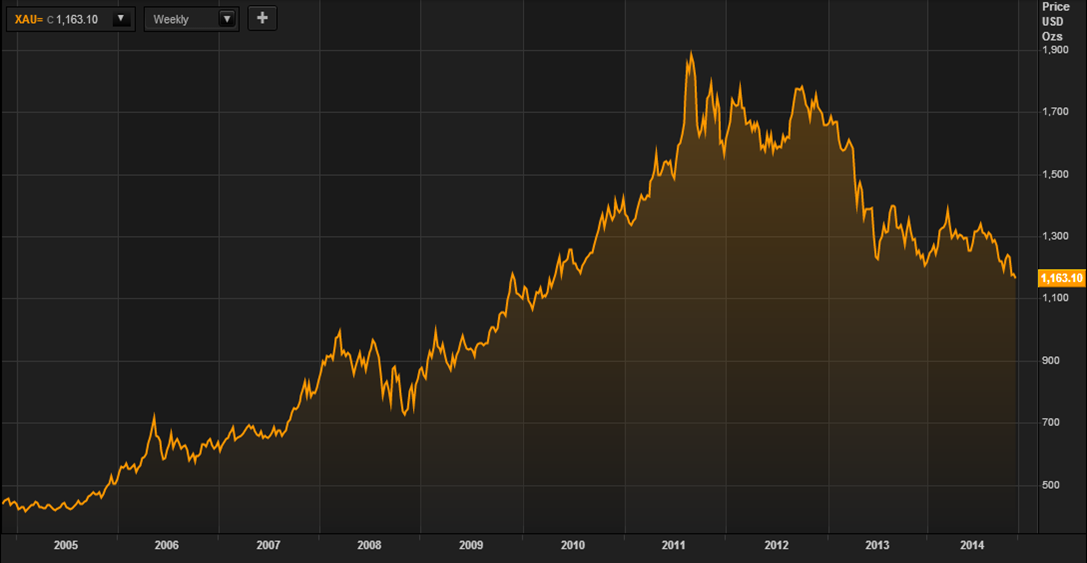
Gold in U.S. Dollars – 10 Years (Thomson Reuters)
Futures trading volume was more than double the average for the past 100 days for this time of day, data compiled by Bloomberg show.
Global bullion demand declined 2.5% from a year earlier to 929.3 metric tons in the third quarter, the lowest since the last quarter of 2009, the London-based World Gold Council said in a report today. Jewelry consumption slipped 4%, while bar and coin purchases dropped 21%, it said.
Although questions are being asked about the Chinese demand data as it appears to only view Chinese demand through the rather narrow prism of Hong Kong exports to China. However, today China is importing huge volumes of gold bullion from all over the world and therefore deliveries on the Shanghai Gold Exchange are a much better benchmark of real Chinese demand.
Holdings in gold exchange traded funds fell 4 tons to 1,620 tons yesterday, remaining at the lowest in more than five years due to poor sentiment and weak hand selling.
Holdings in the world’s largest gold backed exchange-traded fund, SPDR Gold Shares, fell 1.8 tonnes to 722.67 tonnes on Wednesday. This is the seventh straight day of declines.
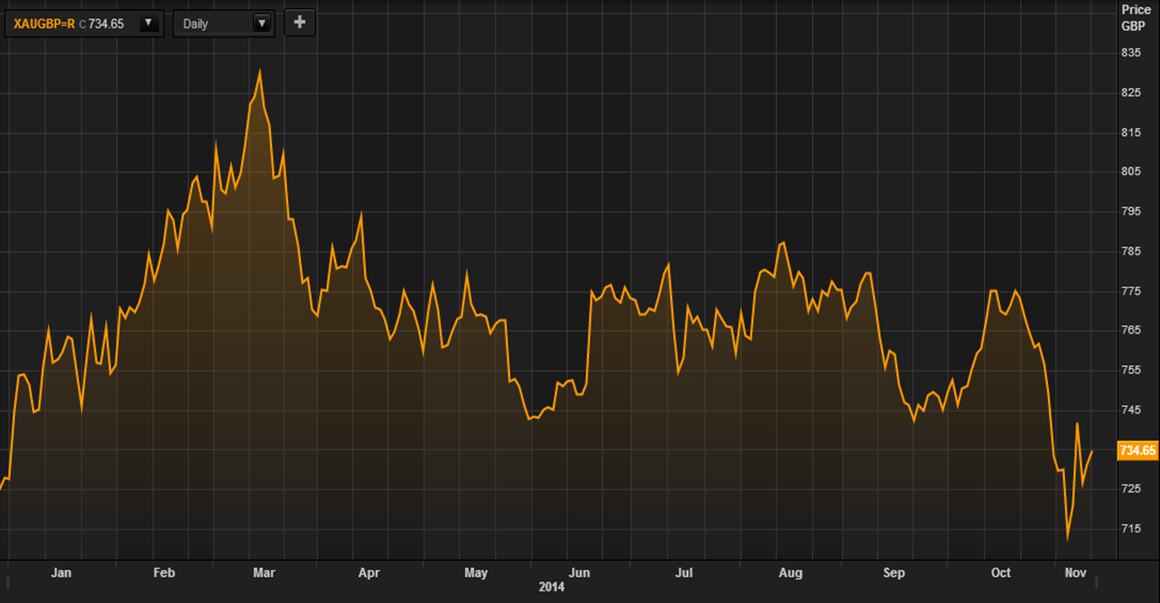
Gold in GBP – YTD 2014 (Thomson Reuters)
A small amount of the ETF liquidations are by investors concerned about the return of the Eurozone debt crisis, geopolitical risk and systemic risk and opting for the safety of allocated and segregated gold bullion coins and bars.
Some support was offered by buying of physical gold bullion in China overnight, dealers told Reuters.
Buy Gold Bars at the Lowest Prices and in the Safest Way
Zero Premium Gold, a new low cost and safer gold investment, has been launched today. It allows investors internationally to invest in physical gold bars at the lowest prices in the market. Investors can now own gold bars at a record low premium of just 0% which is at the live market spot gold price.
High charges or premiums for gold bars have made investors wary of physical gold bars in the past and led to the success of online gold account providers with pooled allocated accounts and gold exchange traded funds (ETFs).
Zero Premium Gold is as cost effective as gold ETFs and other gold investment vehicles with the added security of outright ownership of the underlying physical asset.
end
James Turk talks with Eric King on the huge backwardation in gold and what it means
(courtesy James Turk/Kingworldnews)
Gold has never been so much in backwardation, Turk tells King World News
8:25p ET Wednesday, November 12, 2014
Dear Friend of GATA and Gold:
GoldMoney founder and GATA consultant tells King World News tonight that gold has never been as backwardated as it is now and that a rally in the gold price always follows backwardation. An excerpt from the interview is posted at the KWN blog here:
http://kingworldnews.com/kingworldnews/KWN_DailyWeb/Entries/2014/11/12_T…
CHRIS POWELL, Secretary/Treasurer
Gold Anti-Trust Action Committee Inc.
end
We must be very mindful of the following:
(courtesy Victor Sperandeo/Eric King/Kingworldnews)
Putin’s trump card is to refuse dollars for Russian energy, Sperandeo tells KWN
11:20p ET Wednesday, November 12, 2014
Dear Friend of GATA and Gold:
Picking up a theme long expressed by fund manager and geopolitical strategist James G. Rickards, market analyst Victor Sperandeo tonight tells King World News that all Russian President Vladimir Putin has to do to control the currency, energy, and commodity markets is to ban acceptance of U.S. dollars for purchase of Russian oil and gas. Timing such a move with the arrival of cold weather would make it even more effective, Sperandeo says. An excerpt from the interview is posted at the KWN blog here:
http://kingworldnews.com/kingworldnews/KWN_DailyWeb/Entries/2014/11/13_P…
CHRIS POWELL, Secretary/Treasurer
Gold Anti-Trust Action Committee Inc.
end
We have already brought to your attention Russia’s huge purchase of gold in the 3rd quarter: 55 tonnes
(made up of: 37 tonnes last month Sept
August: 10 tonnes and July; 8 tonnes)
I am glad the news is well received by the mainsteam media.
(courtesy UK Telegraph/zero hedge)
Putin “Prepares For Economic War”, Buys Whopping 55 Tonnes Of Gold In Q3

Submitted by Tyler Durden on 11/13/2014 15:53 -0500
Just as China is buying ‘cheap’ oil with both hands and feet, so Russia, according to the latest data from The World Gold Council (WGC) has been buying gold in huge size. Dwarfing the rest of the world’s buying in Q3, Russia added a stunning 55 tonnes to its reserves, asThe Telegraph reports, Putin is taking advantage of lower gold prices to pack the vaults of Russia’s central bank with bullion as it “prepares for the possibility of a long, drawn-out economic war with the West.”
Bottom line: Russia bought more gold in Q3 then all other countries combined (of course, nobody know what or how much China is buying).

* * *
* * *
Vladimir Putin’s government is understood to be hoarding vast quantities of gold, having tripled stocks to around 1,150 tonnes in the last decade. These reserves could provide the Kremlin with vital firepower to try and offset the sharp declines in the rouble.
Russia’s currency has come under intense pressure since US and European sanctions and falling oil prices started to hurt the economy. Revenues from the sale of oil and gas account for about 45pc of the Russian government’s budget receipts.
In total, central banks around the world bought 93 tonnes of the precious metal in the third quarter, marking it the 15th consecutive quarter of net purchases. In its report, the World Gold Council said this was down to a combination of geopolitical tensions and attempts by countries to diversify their reserves away from the US dollar.
By the end of the year, central banks will have acquired up to 500 tonnes of gold during the latest buying spell, according to Alistair Hewitt, head of market intelligence at the World Gold Council.
“Central banks have been consistently adding to their gold holdings since 2009,” Mr Hewitt told the Telegraph.
* * *
end
And I quote; :”people close to the probe said it (the evidence) is of ‘ startling quality’ ”
wait until they see the gold manipulation emails.
(courtesy London’s Financial times)
US and Brussels target at least 12 banks over forex
Kara Scannell and Alex Barker
Financial Times, London
Thursday, November 13, 2014
Six banks agreed a $4.3 billion settlement with UK, US, and Swiss regulators on Wednesday for allegedly attempting to manipulate the foreign exchange market. But for them and at least half a dozen other banks and their legal and public relations, the exposure is far from over as US and European investigators continue to pursue cases.
The US Department of Justice is investigating numerous banks, former traders, and salesmen for allegedly manipulating the $5.3 trillion forex market and overcharging customers, while evidence obtained by Europe’s top competition authority, people close to the probe said, is of “startling quality.”
The investigations, which are expected to play out over the next year or longer, will probably result in large fines and criminal findings from the DoJ, these people say. …
… For the remainder of the report:
http://www.ft.com/intl/cms/s/0/3f33027a-6b51-11e4-9337-00144feabdc0.html…
end
The London’s Financial times is now worried about the Swiss Gold Initiative:
(courtesy London’s Financial times)
Swiss Gold Initiative continues to frighten Financial Times
Anxious Gold Bugs Swarm Switzerland’s Central Bank
By James Shotter
Financial Times, London
Thursday, November 13, 2014
ZURICH, Switzerland — From rescuing Switzerland’s biggest bank during the financial crisis to stemming a dramatic appreciation of the franc, the Swiss National Bank has faced its fair share of challenges in recent years. Now another is looming: “Save Our Swiss Gold.”
That is the name of a radical initiative that the Swiss public will vote on November 30 that would drastically change how the central bank functions. If accepted, it would force the SNB to hold at least 20 per cent of its assets in gold; ban it from ever selling the metal; and require all its gold to be stored in Switzerland.
The initiative is the latest in a string of proposals fuelled by mounting popular anxiety in Switzerland about the 8 million-strong nation’s ability to control its affairs in a turbulent world. …
… For the remainder of the report:
http://www.ft.com/cms/s/0/218f6cec-6a1e-11e4-9f65-00144feabdc0.html#axzz…
end
Chris Powell with a dandy commentary:
(courtesy Chris Powell/GATA)
Central banks ‘managing’ — that is, rigging — gold ‘more actively,’ LBMA is told
11:48a ET Thursday, November 13, 2014
Dear Friend of GATA and Gold:
Bullion Vault research director Adrian Ash this week called attention to what may be the most relevant remark coming out of the London Bullion Market Association’s conference in Lima, Peru.
It’s the assertion by the market operations director of the Banque de France, Alexandre Gautier, that central banks now are managing their gold reserves “more actively,” a remark conveyed to Ash by a colleague attending the conference. Ash wrote about it Tuesday in his daily commentary at Bullion Vault:
https://www.bullionvault.com/gold-news/gold-price-111120141
Gautier told the LBMA conference in Rome in September 2013 that the Banque de France is trading gold for its own account “nearly on a daily basis” and is “active in the gold market for central banks and official institutions”:
http://www.gata.org/node/13373
According to the slides for Gautier’s presentation in Lima, which, as Ash notes, were posted at the LBMA’s Internet site and are copied to GATA’s Internet site here —
http://www.gata.org/files/Gautier-LBMA-Lima-11-10-2014.pdf
— this more active management of central bank gold reserves mainly involves gold swaps.
Perhaps as a note of caution to his co-conspirators, Gautier added in his presentation that “auditability” is “becoming a crucial issue” for central bank gold reserves. So hooray for gold’s friends and their clamor in Germany and Switzerland.
Of course as the March 1999 report of the staff of the International Monetary Fund disclosed, surreptitious gold swaps and leasing are primary mechanisms of secret intervention in the gold and currency markets by central banks:
http://www.gata.org/node/12016
http://www.gata.org/files/IMFGoldDataMemo–3-10-1999.pdf
So if, as Gautier told the LBMA conference this week, central banks are getting more active in managing their gold reserves through swaps, they almost certainly have been intensifying their efforts at gold price suppression, which would explain the price’s steady decline in recent months.
A warning to mainstream financial journalists: Though the official documentation is plainly laid out for all to see —
http://www.gata.org/taxonomy/term/23
http://www.gata.org/taxonomy/term/21
— and Gautier’s employer, the Banque de France, has, as do all other central banks, a street address, telephone number, and e-mail address —
https://www.banque-france.fr/en/banque-de-france/how-to-contact-us.html
— don’t ask central banks critical questions about their secret activity in the gold market and their increasingly comprehensive intervention in all major markets —
http://www.gata.org/node/14385
http://www.gata.org/node/14411
— unless you are prepared to be told to drop dead and want to be transferred to the East Overshoe bureau. Actual journalism involving central banks is a punishable offense.
CHRIS POWELL, Secretary/Treasurer
Gold Anti-Trust Action Committee Inc.
end
wow!! India now up to 150 tonnes imported per month.
This is huge when you consider that a huge amount of gold is smuggled and this is not included in the official numbers
(courtesy Reuters)
UPDATE 4-Indian gold curbs still possible after inconclusive policy meeting
* October gold imports jump to 150 tonnes -govt source
* Curbs could imposed for private trading firms
* Finance ministry and central bank to resume talks (Adds failure to reach decision at meeting)
By Manoj Kumar and Suvashree Choudhury
NEW DELHI/MUMBAI, Nov 13 (Reuters) – India’sFinance Ministry and central bank will reconvene in a day or two after failing to come to a decision on Thursday over whether to restrict gold imports after inbound shipments surged in the past two months, pressuring the country’s trade deficit.
October shipments to India, the world’s No.2 gold consumer behind China, jumped to about 150 tonnes from less less than 25 tonnes a year earlier and 143 tonnes in September, a finance ministry official said on Thursday.
Officials from the country’s central bank and Finance Ministry met on Thursday to discuss the policy but no decision was taken, a senior ministry official told Reuters after the meeting. They will resume their discussions in a day or two.
Measures under discussion would restrict imports by private trading firms, which started importing gold around the middle of this year after being barred from doing so from July 2013, two other sources with knowledge of the matter said earlier.
All the sources declined to be named because of the sensitivity of the matter.
The October jump follows a 450 percent increase in September imports to $3.75 billion, weighing on India’s trade deficit and prompting suggestions that the government could again step in to curb gold imports.
Any new restrictions could raise local premiums to the global benchmark and hurt consumer demand. Reduced Indian gold buying would also pressure global prices, already smarting from weakening demand in China.
Struggling with a high current account deficit, India last year raised the import duty to a record 10 percent and made it mandatory to export a fifth of all bullion imports, crimping supply, boosting local premiums and encouraging smuggling.
India’s gold imports are typically strong in the second half of the year asbanks and retailers stock up for major festivals such as Dhanteras and Diwali, when it is considered auspicious to buy gold.
India’s appetite for gold jumped by more than a third to 225.1 tonnes in the July-Sept quarter, boosted by jewellery demand, the World Gold Council said.
“Given the recent seasonality, it would be advisable to wait for another month or two of gold import data before re-imposing any restrictions,” Nomura analysts said in a note.
“There’s been some increase in underlying gold demand as well, but we do not expect this to be sustained.” (Writing, additional reporting by Krishna N. Das and A. Ananthalakshmi; Editing by Joseph Radford and David Goodman)
end
The next piece from Bill Holter is a humdinger!!
Please take your time with it
(courtesy Bill Holter/Miles Franklin)
“Cleaning up our act” …too late and too dirty!
The “reality” is that if a firm admitted guilt …of anything, can you imagine the private slam dunk lawsuits that would arise? These lawsuits could total more than ALL of the equity these firms have combined! But wait, this is still not the real reason. The real reason that these firms are not held to task is because of the word “discovery”. Do you understand? If there were private lawsuits that actually went to trial and were not settled ahead of time with “gag orders” included, the process of discovery would go forward and who knows what would be uncovered! “Who knows what?” such as what other firms were involved and yes …which central banks or sovereign treasuries?!!! Spam me if you like and tell me that “governments” would never participate in “frauds”, my answer will be as simple as suggesting you look at the fiat you have in your pocket. Would you like other examples?
end
And now for our more important paper stories
today:
1. Stocks up with Asian bourses with a higher yen value to 115.54
2 Nikkei up 194 points or 1.14%
3. Europe stocks all up /Euro rises/ USA dollar index down at 87.72.
3b Japan 10 year yield at .51%/Japanese yen vs usa cross now at 115.54 (the rising Japanese yield is ominous)
3c Nikkei now above 17,000
3d Abe goes all in with another QE/it is now all up to Japan to stimulate the world/will be known as the great Yen massacre!!!
3e The USA/Yen rate crosses back over the 115 barrier again last night as Abe hints on delay of sales tax and a snap election. sends all bourses around the globe higher
3fOil: WTI 76.73 Brent: 79.43 /
3g/ Gold up/yen up; yen well above 115 to the dollar/
3h/ Japan is to buy the equivalent of 108 billion usa dollars worth of bonds per MONTH or $1.3 trillion
Japan’s GDP equals 5 trillion usa/thus bond purchases of 26% of GDP
3i Japan to buy 100% of all new Japanese debt and by 2018 they will have 25% of all Japanese debt. Fifty percent of Japanese budget financed with debt (see Von Greyerz)
3j ECB to start expanding its balance sheet. Should be positive for gold.
Japan and China relations improve at the APEC meeting. USA left in the dark.
3k Huge FX rigging settlement at 3.3 billion dollars. Barclay’s left out and may lose its uSA banking license.
3l Gold at $1162.00 dollars/ Silver: $15.74
4. USA 10 yr treasury bond at 2.37% early this morning.
5. Details Ransquawk/Bloomberg/Deutche bank/Jim Reid
(courtesy zero hedge)/your early morning trading
from Asia and Europe
Global Stocks Rise, US Futures At Fresh Record On Latest Reduction Of Growth Forecasts
Submitted by Tyler Durden on 11/13/2014 06:48 -0500
The relentless regurgitation of the only two rumors that have moved markets this week, namely the Japanese sales tax delay and the “surprise” cabinet snap elections, was once again all over the newswires last night in yet another iteration, and as a result the headline scanning algos took the Nikkei another 1.1% higher to nearly 17,400 which means at this rate the Nikkei will surpass the Dow Jones by the end of the week helped by further reports that Japan will reveal more stimulus measures on November 19, although with US equity futures rising another 7 points overnight and now just shy of 2050 which happens to be Goldman’s revised year-end target, the US will hardly complain. And speaking of stimulus, the reason European equities are drifting higher following the latest ECB professional forecast release which saw the panelslash their GDP and inflation forecasts for the entire period from 2014 to 2016. In other words bad news most certainly continues to be good news for stocks, which in the US are about to hit another record high, with the bulk of the upside action once again concentratedbetween 11:00 and 11:30am.

Those looking for bad economic news got another boost out of China which reported an across the board miss last night when it announced that October’s Fixed Assets Investments (+15.9% YTD yoy v +16.0% expected) and Retail Sales (+11.5% yoy v +11.6% expected) both missed but Industrial Production (+7.7% yoy v +8.0% expected) was a quite notable miss and immediately spun as bullish for even more PBOC intervention, which however continues to be in the form of direct liquidity injections, this time into small banks.
So with global growth continuing to founder, oil prices not unexpectedly dipped lower once more with Brent dropping further below $80, or $79.56 at last check, with WTI the usual $3 or so below, and making life for US shale companies increasingly more difficult. Them, and oil exporting nations too, after the Ruble once again dipped by 1% overnight but it was the Nigerian Naira which tumbled once again to fresh record lows, as the oil-exporting nation pain hits a crescendo.
European equities languish firmly in the green in a continuation of the price action seen overnight, whereby Japanese equities saw further upside from continued expectations of a sales-tax delay and possible snap election. Furthermore, European equities continue to drift higher following the latest ECB professional forecast release which saw the panel slash their GDP and inflation forecasts for 2014/15/16, which has helped hammered home the point that further stimulus may be warranted in the Eurozone. On a sector specific basis, utilities are the sole underperformers in the European equity sphere following a less than impressive pre-market report from RWE (-2.6%). The strength in stocks subsequently supressed some of the price action in fixed income markets, with Gilts holding tight following their sizeable gains yesterday. However, heading into the North American open, fixed income products have begun to tick higher following the ECB forecasts and their potential implications for the future path of ECB policy
Looking at the rest of the day ahead, today we will get the JOLTS report in the US, which while delayed by a month remains one of Yellen’s favorite economic indicators. In terms of what to expect from the JOLTs release today, in order for Yellen to be comfortable that the labour market has returned to more of a normalized state, the hiring and quits rates each need to improve several tenths from their current readings (3.3% and 1.8% respectively). We also have the initial jobless claims print and October budget statement. Fed member Plossner will also be speaking today. In Europe ECB’s Lautenschlaeger will be speaking this morning and we are expecting Coeure to speak this afternoon in New York so will keep an eye open for any interesting developments there.
Bulletin Headline Summary from RanSquawk and Bloomberg
- Europe follow suit from Japan and push stocks higher while
- Brent crude futures break below USD 80.00bbl for the first time since 2010 as the glut of global supply continues to weigh on prices with no further indications of action from OPEC at their upcoming meeting.
- Looking ahead, attention will turn towards the weekly US jobs report, DoE inventories and any comments from ECB’s Coeure and Lautenschlaeger.
Market Wrap
- S&P 500 futures up 0.3% to 2042.4
- Stoxx 600 up 0.5% to 336.9
- US 10Yr yield little changed at 2.37%
- German 10Yr yield little changed at 0.81%
- MSCI Asia Pacific up 0.4% to 141.9
- Gold spot little changed at $1162.6/oz
FX
In FX markets, in a somewhat counter-intuitive move EUR is actually outperforming GBP with technical buying seen in EUR/GBP after a break above 0.7900, underpinning the bid in EUR/USD alongside large expiries in the EUR/USD pair as 6bln sits between 1.2400-1.2500 which rolls off at the 10am NY cut. Elsewhere, the USD has weakened slightly in recent trade as AUD and NZD have rebounded against the USD with tech buying seen in AUD and NZD after stops taken out at 0.8750 and a break above 0.7900. Thus AUD has erased some of the downside seen overnight following comments from RBA assistant Governor Kent who refused to rule out intervention on AUD, with AUD now supported by rising copper prices and further hopes of Chinese stimulus following the weak overnight Chinese data.
COMMODITIES
In the energy complex, WTI and Brent crude futures trade with further losses, with Brent crude futures residing below the USD 80.00bbl level after breaking below the handle for the first time since 2010 overnight. Despite the larger than previous drawdown in the API inventories yesterday, markets are instead placing focus on the Saudi Oil Minister dismissing any talk of a price war and offering no response to recent fall in prices. In the metals complex, price action is relatively muted with both spot gold and silver residing in relatively neutral territory with participants looking out for any further developments regarding the Ukraine/Russia situation. However, copper prices continue to outperform, with weak Chinese IP and retail sales figures furthering calls for the PBOC to provide the Chinese economy with additional stimulus.
To summarize, European shares remain higher with the tech and chemicals sectors outperforming and oil & gas, utilities underperforming. S&P futures also rise. Chinese October industrial production data was below estimates. Japan’s Abe said likely to call snap election. Ruble weakens most among emerging markets. Companies including SABMiller, Rolls-Royce, Ahold, RWE, GDF Suez released results.
The Swedish and German markets are the best-performing larger bourses, Dutch the worst. The euro is stronger against the dollar. Japanese 10yr bond yields fall; Greek yields increase. Commodities decline, with natural gas, Brent crude underperforming and corn outperforming. U.S. jobless claims, monthly budget statement, JOLT job openings due later.
* * *
Deutsche’s Jim Reid concludes the overnight recap
There’s only one direction to head to as we start this morning and that’s to China. As we go to print the latest monthly stats are out. October’s Fixed Assets Investments (+15.9% YTD yoy v +16.0% expected) and Retail Sales (+11.5% yoy v +11.6% expected) were largely in line with expectations but Industrial Production (+7.7% yoy v +8.0% expected) was a notable miss. The credit and money supply stats are not yet out but are certainly also worth monitoring. As for overnight markets, the Shanghai Composite is off the intraday lows but still -0.2% lower on the day. There seems to be also some profit-taking in Chinese small caps ahead of the start of the stock connect next week. The initial market reaction to the Chinese data has been somewhat muted but let’s see how we finish the day. Staying in China, Chinese leaders have apparently discussed lowering the 2015 GDP target below 7.5%. According to Bloomberg, the government discussed targets of 7%, 7.3% and ‘below 7.5%’. Away from China markets are fairly mixed in Asia this morning. Momentum in the Nikkei (+0.98%) remains solid although bourses in Korea (-0.6%) and Australia (-1.4%) are both lower.
Next up this morning will be the important European CPI numbers with data out of Germany, France, Italy and Spain. Clearly these data points are going to be quite important in influencing the ECB into the timing of additional policy action so will be widely watched. Our economists think an eventual downgrade of the growth and inflation outlook could be a pre-cursor to Public QE.
Before all this, yesterday was a fairly resilient day for US equities even though the S&P 500 (-0.07%) saw a halt to its five-day streak of fresh record highs. There wasn’t a whole lot going on although Utilities (-2.03%) and Energy (-0.92%) were the main laggards yesterday. The latter was probably affected by what was another weak day for Oil which saw Brent dip below US$80/bbl for the first time since September 2010 (more below). Exelon Corp (-4.31%) suffered its biggest drop in almost 18 months which weighed on the Utilities sector on news that the US and China have deepened their promise to fight climate change. Presidents Obama and Xi have agreed upon capping China carbon emissions by 2030 and have agreed to further cut emissions in the US by 2025. This marks a particularly important step for China with Beijing having previously been uncommitted around the subject. On the data front, we saw a fairly subdued US wholesale inventories print (+0.3% mom vs. +0.2% mom expected) and MBA new mortgage applications reading (+1.1%). Fed speak offered more interesting sound bites with Kocherlakota reiterating his expectation that PCE inflation will not reach 2% until 2018 whilst also urging other Fed members to defer raising interest rates until they are confident that the target will be hit within one to two years.
In comparison the day wasn’t as pleasant for European markets. The Stoxx 600 declined 1.14%, dragged lower by financials following news that regulators have fined select lenders in relation to the probe over FX manipulation. This all came after a fairly non-eventful Eurozone industrial production print with the +0.6% mom reading, a shade under expectations of +0.7%. Elsewhere in Europe we also had a fairly dovish BoE inflation report yesterday with few notable changes to its medium-term inflation or growth forecasts. DB’s Dr. Buckley noted that 2yr-ahead forecasts for inflation remained at 1.8% whilst the 3yr-ahead view was a few basis points below the 2% inflation target. Unsurprisingly near term inflation was revised down given the weaker data outturns whilst the downward growth revisions were on the whole reasonable with the MPC expecting 0.7% qoq growth until mid-2015 and then slowing to a series of 0.6s and 0.7s thereafter (from 0.8% and 0.7% respectively). The ILO unemployment figure was in line with the previous quarter at 6.0% (5.9% expected) however there was some encouragement from yesterdays wage growth print. The headline figure was fairly subdued with growth of just 1.0% however George pointed out that we have seen some encouraging momentum over the past six months as private sector regular pay (so excluding bonuses and the public sector) has not fallen once on a % mom basis and has risen at an annualized rate of 3.7% over that time which marks the fastest rate over six months since 2008. Gilts were notably stronger on the day, the 10yr fell 4bps lower to 2.19% whilst Bunds were 2bps tighter not helped by a weaker wholesale price index print in Germany (-0.6% yoy).
Staying in Europe, Jens Weidmann of the German Central Bank warned that the ECB would encourage euro zone states to pile up debt if it were to buy state bonds again (Reuters). Weidmann went on to say that ‘expansionary monetary policy is fundamentally appropriate and that it’s understandable that the ECB has discussed additional measures’. Although Weidmann was one of the 18 eurozone members backing more unconventional measures to stimulate the economy, he referred to the one trillion euro balance sheet expansion as an ‘expectation’ and not a target.
Central banks are still likely to be heavily influenced by the inflation outlook and on that note the continued fall in energy prices is likely to be important even if it doesn’t directly impact the core numbers. As mentioned above Brent broke below the US$80 mark yesterday and it’s held those levels overnight in Asia, trading at $79.96/bbl as we write. Sentiment around oil continues to wane with Bloomberg suggesting that OPEC will refrain from removing a surplus triggered by booming US shale output. On the topic of oil prices, our US colleague Oleg Melentyev has put together some work on the US high yield energy sector with regards to a potential ‘tipping point’ for the cohort following a further slump in the oil price. The basic premise of the note is that the US HY energy sector sits at the higher end of the credit quality scale and for this reason enables companies to absorb oil price shocks. However a WTI price of $60/bbl could likely be enough to push the whole sector into distress. It’s certainly worth a read as the one thing that’s been stable in this summer/autumn HY sell-off has been fundamentals. This is one sector where this is some serious debate about fundamentals and future default risk.
Wrapping up the news flow from yesterday, there was further news (Bloomberg) out of Ukraine who are reported to be redeploying troops in the east of the country following NATO comments that the alliance had seen Russian troops and tanks entering in the last few days. Russian CDS spreads were fairly steady closing just around 3bps wider yesterday to 278bp whilst the MICEX was also little changed.
Looking at the rest of the day ahead, today we will get the JOLTS report in the US. This print is based off the same sample used for nonfarm payrolls and average hourly earnings however the reading is a lagging economic indicator covering September as opposed to the October nonfarm prints last week. However, as our US colleagues point out, the JOLTS report is on Yellen’s dashboard of economic indicators as two components of the report (the hiring and quits rates) are incorporated in the Fed’s labour market conditions index. In terms of what to expect from the JOLTs release today, in order for Yellen to be comfortable that the labour market has returned to more of a normalized state, the hiring and quits rates each need to improve several tenths from their current readings (3.3% and 1.8% respectively) whilst the recent trend in claims data might suggest that the two series should improve significantly over the next several quarters. That aside, we also have the initial jobless claims print and October budget statement. Fed member Plossner will also be speaking today. In Europe ECB’s Lautenschlaeger will be speaking this morning and we are expecting Coeure to speak this afternoon in New York so will keep an eye open for any interesting developments there.
ISIS, Al-Qaeda Join The M&A Bubble, Agree To Fight “Common Foes” Together In Syria
Following al-Baghdadi’s threats this morning, and General Dempsey’s warnings, it appears things are escalating once again in The Middle East:
- *ISIS, AL-QAEDA AFFILIATE AGREE TO FIGHT TOGETHER IN SYRIA: AP
As AP reports, the deal could be a heavy blow to Washington’s strategy against the
Islamic State group, relying on arming moderate rebel factions to push
back extremists in Syria. It appears The West is “gonna need a bigger coalition.”
BREAKING: AP Sources: Islamic State, al-Qaida affiliate agree to fight foes together in Syria.
Two Syrian opposition figures say the Islamic State group and al-Qaida’s branch met last week and agreed to stop fighting each other and work together against their opponents.
The deal could be a heavy blow to Washington’s strategy against the Islamic State group, relying on arming moderate rebel factions to push back extremists in Syria.
A prominent Syrian opposition official and a rebel commander say delegates from the two groups met in secret on Nov. 2 in northern Syria and agreed to end months of fighting between them and cooperate on the ground. The two spoke on condition their names not be used for their own protection or because they were not authorized to release the information.
The accord stops short of a merger between the two.
As The Daily Beast reports, this has been looming…
Jihadi veterans known collectively as the Khorasan group, which have been targeted in two waves of airstrikes by U.S. warplanes, are trying to broker an alarming merger between militant archrivals the Islamic State and Jabhat al Nusra, the official Syrian branch of al Qaeda.
The merger, if it comes off, would have major ramifications for the West. It would reshape an already complex battlefield in Syria, shift forces further against Western interests, and worsen the prospects for survival of the dwindling and squabbling bands of moderate rebels the U.S. is backing and is planning to train.
“Khorasan sees its role now as securing an end to the internal conflict between Islamic State and al Nusra,” says a senior rebel source. The first results are already being seen on the ground in northern Syria with a coordinated attack on two rebel militias favored by Washington.
All three of the groups involved in the merger talks—Khorasan, Islamic State (widely known as ISIS or ISIL), and al Nusra—originally were part of al Qaeda.
end
Which leads to this:
(courtesy zero hedge)
Chairman Of Joint Chiefs Tells Congress Considering Boots-On-The-Ground In Iraq
Submitted by Tyler Durden on 11/13/2014 13:52 -0500
Despite President Obama’s “promise” that there would be no combat troop boots-on-the-ground in the fight against ISIS in Iraq (and his doubling of ‘military advisor’ troop levels last week), The Guardian reports that General Martin Dempsey, the chairman of the joint chiefs of staff, indicated to the House of Representatives armed services committee that the strength of ISIS relative to the Iraqi army may be such that he would recommend abandoning Obama’s oft-repeated pledge against returning US ground troops to combat in Iraq. Dempsey added, rather uncomfortably, that “we’re going to need about 80,000 competent Iraqi security forces to recapture territory lost, and eventually the city of Mosul, to restore the border.” The irony of this is that the ‘not-dead’ leader of ISIS al-Baghdadi spoke today and exclaimed that the US will be soon compelled to come on the ground to fight his group.
General Martin Dempsey, the chairman of the joint chiefs of staff, indicated to the House of Representatives armed services committee that the strength of Isis relative to the Iraqi army may be such that he would recommend abandoning Obama’s oft-repeated pledge against returning US ground troops to combat in Iraq.
Retaking the critical city of Mosul, Iraq’s second largest, and re-establishing the border between Iraq and Syria that Isis has erased “will be fairly complex terrain” for the Iraqi security forces that the US is once again supporting.
“I’m not predicting at this point that I would recommend that those forces in Mosul and along the border would need to be accompanied by US forces, but we’re certainly considering it,” Dempsey said.
Iraq will need about 80,000 effective military troops to retake the terrain it lost to Islamic State militants and restore its border with Syria, the top U.S. general said on Thursday.
“We’re going to need about 80,000competent Iraqi security forces to recapture territory lost, and eventually the city of Mosul, to restore the border,” Army General Martin Dempsey, the chairman of the Joint Chiefs of staff, told a congressional hearing.
end
Russia flexing its muscle with an OK from China:
(courtesy zero hedge)
Russia To Dispatch Long-Range Bomber Patrols Over Gulf Of Mexico, Caribbean
While the west is seemingly eager to once again restart the military escalation, if only in rhetoric for now, surrounding the east-Ukraine conflict, leading to a reportthat the “European Union and the U.S. will weigh further sanctions against Russia’s economy and Ukrainian separatists, after the reported movement of tanks, artillery and combat troops into eastern Ukraine”, Russia has chosen to change track completely and give the US a dose of its own cooking, by bringing the military threat next to the borders of the US itself.
As cited by RIA and Bloomberg, yesterday Russian Defense Minister Shoigu said that “his country’s military will start conducting regular long-range bomber patrols along Russia’s borders and over the Arctic Ocean.” It gets better: while Russia has repeatedly denied it has moved its own troops into east Ukraine contrary to western press reports over the past week, it is making it quite clear it will soon move bombers just off the coast of the US: the Gulf of Mexico and the Caribbean.
Quote Shoigu:
“In this situation, we have to maintain a military presence in the western part of the Atlantic and the eastern part of the Arctic Ocean, in the Caribbean and in the Gulf of Mexico.”
RIA also adds that according to Shoigu Russian long-distance aviation flights and military preparedness has increase substantially over the past year.
So while NATO is building up its own forces along Russian borders, using even the smallest escalation in tensions over Ukraine as a pretext to send even more troops and warplanes, Russia has decided to retort in kind.
CNN adds more:
Russia plans to send long-range bombers to patrol the Gulf of Mexico and the Caribbean, the nation’s defense minister said, amid escalating tensions with the West over Ukraine. The patrols would bring the flights close to the United States’ territorial waters. In September, the U.S. intercepted six Russian planes, including fighter jets, near airspace off Alaska, officials said.
The plan to send the long-range bombers is in response to a growing international resentment against Russia, defense minister Sergey Shoigu said Wednesday.
In addition, he said, Russia will boost its security in Crimea, the region it annexed from Ukraine earlier this year.
“In many respects, this is connected with the situation in Ukraine, with fomentation of anti-Russian moods on the part of NATO and reinforcement of foreign military presence next to our border,” Shoigu said.
“Under these conditions, the formation of full-fledged and self-sufficient forces on the Crimean peninsula is a priority task.”
Shoigu said Russian long-range bombers will conduct flights along the Russian border and over the Arctic Ocean.
“In the current situation we have to maintain military presence in the western Atlantic and eastern Pacific, as well as the Caribbean and the Gulf of Mexico,” he said. “Due to that, as part of the drills, Russian long-range bombers will conduct flights along Russian borders and over the Arctic Ocean.”
So will sights like these become the norm soon in proximity to US shores? Probably not, but America’s response to being in the same situation as Russia finds itself, would certainly be one to watch.


ShaleNado – WTI Tumbles Below $75
Submitted by Tyler Durden on 11/13/2014 12:25 -0500
WTI has now dropped over $2 today with December futures trading below $75 for the first time in over 4 years… “unequivocally good news” right?

Venezuelan Bonds Are Collapsing, FinMin Denies Devaluation Looming
While talking heads proclaim – incorrectly – that low oil prices are unequivocally good for the US economy, it is very much not the case for oil producers around the world. Most notably, Venezuela – which ‘needs’ oil prices above $100 to maintain its socialist utopia – and currently ranks at a lowly 100th on the world’s prosperity index, is in grave trouble if this trend continues. Venezuelan bonds plunged to new record lows today as oil prices hit fresh cycle lows, strongly suggesting default or currency devaluation is imminent. However, as is usual (think Mexico) Finance Minister Rodolfo Marco Torres ruled out devaluation even as oil price drop exacerbates country’s finances. As one analyst noted, “there’s broad understanding that in the absence of any corrective policy measures that these guys are going to be in serious trouble.” It appears they already are.

As we noted previously, While Saudi Arabia tests the mettle of North American producers, it could be Venezuela that is the most vulnerable.(via Nick Cunningham of OilPrice.com)
As a fellow OPEC member, Venezuela has been the most vocal about the need to cut oil production and has called for an emergency meeting of the 12-member oil cartel. That is because Venezuela is in a much weaker position than many of the other member countries, and the recent drop in prices has raised alarm in Caracas.
Using state-owned oil company PDVSA as a piggy bank has allowed the Venezuelan government to increase social spending over the last decade, a key political objective of the late President Hugo Chavez and his successor, Nicolas Maduro. However, using oil revenues for a wide array of spending priorities has also starved PDVSA of money needed for investment in order to boost oil production, let alone keeping output level. Since 2000, Venezuela has seen its oil output drop from 3.5 million barrels per day (bpd) down to 2.5 million bpd.

The bad news for President Maduro is that there was major unrest earlier this year even when oil prices were above $100 per barrel. That is because oil makes up 97 percent of Venezuela’s foreign earnings, and the country needs oil prices of around$120 per barrel for its bloated budget to break even.
Venezuela is in an economic crisis. Annual inflation is estimated to be in excess of 60 percent. The country’s economy actually shrank at a rate of 5 percent in the first six months of 2014. Shortages of food, medicine, shampoo, diapers, and other basics are so common that the government rolled out a plan this past summer to fingerprint people at grocery stores.
Crime is so rampant in the capital that people are afraid to go out at night. For those who can afford it, leaving the country has become the best option.
The government is heavily indebted, and Venezuela’s bonds are now competing with Ukraine’s for the mantle ofthe world’s riskiest. With bond yields surpassing 16 percent, Venezuela cannot keep up. There is a 50-50 chance of default within the next two years, according to credit rating agency Standard & Poor’s.
The sudden 20 percent decline in oil prices since June is compounding the problem and has the potential to throw the country into crisis. “Venezuela’s oil prices have been high for several years now, and the country is still struggling to pay its debt at those prices,” Russ Dallen of Caracas Capital Markets told The Wall Street Journal. Lower oil prices could bring things to a head.
The Maduro government desperately needs a rise in oil prices, but Saudi Arabia has so far rebuffed calls for an emergency meeting as it pursues a strategy of waiting out higher cost competitors. OPEC does not plan on meeting until Nov. 27. That is still an eternity for a country that is beginning to unravel.
* * *
And it appears other oil producers are suffering too… the Naira hits a new record low…

USA/JAPAN YEN 115.54 down .0400
GBP/USA 1.5748 down .0019
USA/CAN 1.1309 down .0012
This morning in Europe, the euro is up, trading now well above 1.24 level at 1.2463 as Europe reacts to deflation. Abe went all in with Abenomics with another round of QE purchasing 80 trillion yen from 70 trillion on Oct 31.. The yen staged a comeback as it is up this morning closing in Japan rising by 4 basis points to 115.54 yen to the dollar. The pound is slightly down this morning as it now trades well below the 1.58 level at 1.5748.(very worried about the health of Barclays Bank)
Early Thursday morning USA 10 year bond yield: 2.37% !!! up 1 in basis points from Wednesday night/
end
The NIKKEI: Thursday morning up 196 points or 1.14%
Trading from Europe and Asia:
1. Europe all in the green
2/ Asian bourses all in the green except / Chinese bourses: Hang Sang in the green, Shanghai in the green, Australia in the green: /Nikkei (Japan) green/India’s Sensex in the green/
Gold early morning trading: $1162.00
silver:$ 15.74
Your closing Spanish 10 year government bond Thursday/ up 4 in basis points in yield from Wednesday night.
Spanish 10 year bond yield: 2.14% !!!!!!
Your Thursday closing Italian 10 year bond yield: 2.38% / up 4 in basis points:
trading 24 basis points higher than Spain:
IMPORTANT CLOSES FOR TODAY
Closing currency crosses for Thursday night/USA dollar index/USA 10 yr bond: currencies falling apart this afternoon
Euro/USA: 1.2478 up .0051!!!!!!
USA/Japan: 115.72 up .140
Great Britain/USA: 1.5706 down .0060 (Barclay’s in big trouble)
USA/Canada: 1.1369 up .0050
The euro rose in value during this afternoon’s session, and it was up by closing time , closing well below the 1.25 level to 1.2478. The yen was down during the afternoon session, and it lost 23 basis points on the day closing well above the 115 cross at 115.72. The British pound lost huge ground during the afternoon session and was down on the day closing at 1.5706. The Canadian dollar was down in the afternoon and was down on the day at 1.1369 to the dollar.
Currency wars at their finest today.
Your closing USA dollar index: 87.33 down 9 cents from last night.
your 10 year USA bond yield , down 1 in basis points on the day: 2.35%
European and Dow Jones stock index closes:
England FTSE up 24.41 or 0.37%
Paris CAC up 8.07 or 0.19%
German Dax up 37.55 or 0.41%
Spain’s Ibex down 16.90 or 0.17%
Italian FTSE-MIB up 80.31 or 0.43%
Nasdaq; up 4.05 or 0.09%
OIL: WTI 74.42 !!!!!!!
Brent: 77.92!!!!
end
And now for your big USA stories
Today’s NY trading:
Oilpocalypse Now Sends Small Caps To Worst Day In 3 Weeks
WTI Crude plunged another 3.75% to as low as $74.06 today – the lowest since Sept 2010 and dropping at the fastest rate of collapse since Lehman. Airlines popped and Energy stocks dropped 2.7% (now worst sector of the year) but Small Caps were the worst performing major index of the day (turning first around 1030ET and dropping most in over 3 weeks). The S&P tested back into the red for the week but was VWAP-rescued twice. AAPL once again bid saved the Nasdaq.Treasury yields slid lower all day (down 2-3bps across the complex) but remain up 4-5bps on the week. The USD weakened very marginally (still up 0.25% on the week) led by EUR strength. Gold and silver were flat butcopper tumbled back below $300 – its lowest close in a month (near lowest close since Jul 2010). HY Credit diverged bearishly this afternoon as stocks ramped to VWAP. VIX rose for the 3rd day in a row, back over 14. Dow record close, Russell biggest drop in 3 weeks.
It was a weak day in stocks… so what do u think happened to trading volume… But of course, it wouldn’t be the US equity market without a late-day panic buying algo surge to VWAP??!!

* * *
But today was all about Oil…
WTI at over 4 year lows and falling at the fastest pace since Lehman…

And Lowest seasonal gas price since 2010…

The Energy sector is easily the worst performing sector of the year (and note EVERYTHING else ignoring the dip)

Don’t forget – the collapse in oil prices is due to over-supply and NOT (repeat not) due to a collapse in global demand (which of course are merely 2 sides of the same coin)

* * *
On the day, Small Caps underperformed…

And the S&P tested red for the week intrday… and bounced…
VIX has decoupled for 3 days and it appears stocks are catching down…

Treasuries rallied today but yields remain 4-5bps higher on the week…

HY credit decoupled from stocks yesterday and remained there…

FX markets were relatively quiet today with EUR strength the main driver (as it seems EURUSD and TSYs are flip-flopping each day)

Gold and Silver were relatively quiet today as Copper and Oil got plugged…

Close up, oil down from over $78 to just above $74…

and Copper smashed from over $3.05 to $2.98…

Charts: Bloomberg
Bonus Chart: It appears Airlines decided that once Bullard had spoken low oil prices can only mean good things for the global economic wealth of travelers… +45% in 3 weeks?

Bonus Bonus Chart: Just when you thought TWTR was fixed with Noto’s dreams yesterday.. all the gains are eviscerated today…

Bonus Bonus Bonus Chart: Today marked the 20th day in a row that the S&P has closed above its 5-day moving average. MKM’s Jonathan Krinsky notes this length of streak has only happened 3 other times in the past 20 years.. and each time the 5DMA was broken, it was followed by a sell off (2/14/96 -2.3% in 2 weeks, 7/2198 -14.66% in 6 weeks, 12/3/96 -2.97% in 2 weeks)

There are many studies suggesting that fracking may cause earthquakes:
It looks like it is true!!
(courtesy zero hedge)
Frackquake: 4.8 Magnitude Earthquake Felt Throughout Kansas
Submitted by Tyler Durden on 11/12/2014 17:15 -0500
While it is unclear if moments ago the Mississippian Lime Play under south Kansas was the first major shale quake to hit Kansas, or this was simply the first yet to be named shale company going Chapter 11, but moments ago the USGS reported that a 4.8 quake located 30 miles SSW of Wichita as well as a various other smaller quakes in north Oklahoma,shook the two states.

From KWCH:
KWCH has received numerous reports of an earthquake felt throughout the state.
The U.S. Geological Survey has confirmed the epicenter of the quake as 8 miles south of Conway Springs, Kansas.
The earthquake was felt near Haysville, Derby, Wichita, and Oklahoma City.
So far, there have been no reports of damage or injuries due to this earthquake.
That said, it will likely take a few more, substantially stronger frackquakes in shale regions, before the popular mood turns against America’s shale revolution which has been blamed – in Ohio and elsewhere- on an increased incidence of tremors.
end
initial jobless claims rise:
(courtesy BLS/zero hedge)
Initial Jobless Claims Rise 12k To 6-Week Highs But Hovers Near 40 Year Lows
Submitted by Tyler Durden on 11/13/2014 08:40 -0500
A 12k rise in initial jobless claims (on a seasonally-adjusted basis) missed expectations by the most in 8 weeks and rose to its highest in 7 weeks at 290k. Non-Seasonally-adjusted, claims rose a more interesting 43k but bigger picture shows the average of this noisy time series hovers near 40 year lows as low-paying jobs replace high-paying jobs… but remember a jobs a job in the eyes of the government propagandists.
Miss and rise.. but nothing too scary yet…

as the longer-term trend remains near 40-year lows…

Charts: Bloomberg
end
That is all for today
I will see you Friday night
bye for now
Harvey,


 harveyorganblog.com
[…] Keep on reading @ harveyorganblog.com […]
LikeLike