
WEB PAGE ADDRESS: WWW.HARVEYORGANBLOG.COM
Good evening Ladies and Gentlemen:
Here are the following closes for gold and silver today:
Gold: $1201.00 up $4.10 (comex closing time)
Silver: $16.42 down 24 cents (comex closing time)
In the access market 5:15 pm
Gold $1205.00
silver $16.55
The two big stories which will shape the paper world are the Greece crisis and the Ukraine crisis. Germany seems to have many doubts that Greece will carry out the reforms it promised. Actually unless funds start coming in next week, they may default anyways.
In the Ukraine, hyperinflation is getting a strong foothold. The Hryvnia in the black market is fetching 39 UAH to the dollar. The minimum wage today in the Ukraine is about 47.00 dollars per month. In all probability Russia will take the Eastern section of the country, with Poland taking Galicia. It is anybody’s guess who will take Kiev and the agricultural belt of the northwest of Ukraine. Regardless of this, the debt owed by the country will be shared by the Europeans who funded much of their loans. The USA will probably cough up more money to replace losses by the IMF. I wonder how many of the European countries will feel when they get a margin call. Late tonight, Goldman Sachs calls for the end game being played out in the Ukraine
We have many stories on these two fronts for you tonight.
And now for gold/silver trading today.
Gold/silver trading: see kitco charts on right side of the commentary.
Following is a brief outline on gold and silver comex figures for today:
The gold comex today had a good delivery day, registering 266 notices served for 26,600 oz. Silver comex registered 9 notices for 45,000 oz .
Three months ago the comex had 303 tonnes of total gold. Today the total inventory rests at 259.32 tonnes for a loss of 44 tonnes over that period.
In silver, the open interest fell by only 553 contracts as Tuesday’s silver price was down by 6 cents. The total silver OI continues to remain relatively high with today’s reading at 166,676 contracts. The front month of March contracted by only 9,271 contracts with only 2 days before first day notice.
Also the entire silver complex has not collapsed yet as is their usual procedure when we approach the first day notice for an active contract month. We had 9 notices served upon for 45,000 oz.
In gold we had a good rise in OI even though gold was down by $3.40 yesterday. The total comex gold OI rests tonight at 399,307 for a gain of 739 contracts. Today we had 266 notices served upon for 26,600 oz.
Today, no change in gold inventory at the GLD/Inventory at 771.25 tonnes
In silver, /SLV we had no changes in inventory to the SLV/Inventory 325.734 million oz
We have a few important stories to bring to your attention today…
Let’s head immediately to see the major data points for today
.
ting.
Let us now head over to the comex and assess trading over there today.
Here are today’s comex results:
The total gold comex open interest rose by 739 contracts today from 398,568 up to 399,307 as gold was down by $3.40 yesterday (at the comex close). We are now in the big delivery month of the active February contract and here the OI fell by 0 contracts remaining at 362. We had 0 contracts served upon yesterday, thus we neither gained nor lost any additional ounces standing in this delivery month . The next contract month of March saw it’s OI fall by 156 contracts down to 602. The next big active delivery month is April and here the OI fell by 862 contracts down to 264,156. The estimated volume today (which is just comex sales during regular business hours of 8:20 until 1:30 pm est) was awful at 72,319. The confirmed volume yesterday ( which includes the volume during regular business hours + access market sales the previous day) was poor at 127,740 contracts even with mucho help from the HFT boys. Today we had 266 notices filed for 26,600 oz.
And now for the wild silver comex results. Silver OI rose by 553 contracts from 166,123 up to 166,676 as silver was down by 6 cents with yesterday’s trading. The bankers are still not able to shake many silver leaves from the silver tree. We are still awaiting the usual collapse in OI as we get closer to first day notice. We are now in the non active contract month of February and here the OI remained constant at 12 contracts. We had 0 notices filed on yesterday so we neither gained nor lost any silver contracts in this February contract month . The next big active contract month is March and here the OI fell by only 9,271 contracts down to 24,585. First day notice for the gold and silver February contract months is on Friday, Feb 27.2015 or 2 trading days away. The March OI is still extremely high. The estimated volume today was good at 54,647 contracts (just comex sales during regular business hours. The confirmed volume yesterday was excellent (regular plus access market) at 69,844 contracts. We had 9 notices filed for 45,000 oz today.
February initial standings
Feb 25.2015
| Gold |
Ounces |
| Withdrawals from Dealers Inventory in oz | nil oz |
| Withdrawals from Customer Inventory in oz | 16,075.000 oz 500 kilobars(Scotia) |
| Deposits to the Dealer Inventory in oz | nil |
| Deposits to the Customer Inventory, in oz | 80,375.000 oz 2500 kilobars (JPMorgan,Scotia) |
| No of oz served (contracts) today | 266 contracts (26600 oz) |
| No of oz to be served (notices) | 96 contracts (9600 oz) |
| Total monthly oz gold served (contracts) so far this month | 1079 contracts(107,900 oz) |
| Total accumulative withdrawals of gold from the Dealers inventory this month | |
|
Total accumulative withdrawal of gold from the Customer inventory this month |
244,510.6 oz |
Today, we had 0 dealer transactions
we had 0 dealer withdrawals:
total dealer withdrawal: nil oz
we had 0 dealer deposits:
The farce with kilobars continues!!
we had 1 customer withdrawals
i) Out of Scotia: 500 kilobars or 16,075.000 oz
total customer withdrawal: 16,075.000 oz
we had 2 customer deposits:
i) Into JPMorgan; 64,300.000 oz (2000 kilobars)
ii) Into Scotia: 16,300.000 oz (500 kilobars)
total customer deposits; 80,375.000 oz (2500 kilobars
We had 1 adjustment
i) Out of Brinks: 192.90 oz (6 kilobars) was adjusted out of the customer and this landed into the dealer’s account at Brinks.
Today, 0 notices was issued from JPMorgan dealer account and 0 notices were issued from their client or customer account. The total of all issuance by all participants equates to 266 contract of which 0 notices were stopped (received) by JPMorgan dealer and 261 notices were stopped (received) by JPMorgan customer account.
To calculate the total number of gold ounces standing for the December contract month, we take the total number of notices filed for the month (1079) x 100 oz or 107,900 oz , to which we add the difference between the OI for the front month of February (362 contracts) minus the number of notices served today x 100 oz (266 contracts) x 100 oz = 117,500 oz, the amount of gold oz standing for the February contract month.( 3.654 tonnes)
Thus the initial standings:
1079 (notices filed for the month x( 100 oz) or 107,900 oz + { 362 (OI for the front month of Feb)- 266 (number of notices served upon today} x 100 oz per contract} = 117,500 oz total number of ounces standing for the February contract month. (3.654 tonnes)
we neither gained nor lost any gold ounces standing in this February contract month.
Total dealer inventory: 810,240.319 oz or 25.20 tonnes
Total gold inventory (dealer and customer) = 8.337 million oz. (259.32) tonnes)
Several weeks ago we had total gold inventory of 303 tonnes, so during this short time period 44 tonnes have been net transferred out. However I believe that the gold that enters the gold comex is not real. I cannot see continual additions of strictly kilobars.
end
And now for silver
February silver: initial standings
feb 25 2015:
| Silver |
Ounces |
| Withdrawals from Dealers Inventory | nil oz |
| Withdrawals from Customer Inventory | 80,744.310 oz (CNT,Scotia,) |
| Deposits to the Dealer Inventory | nil |
| Deposits to the Customer Inventory | 584,789.800 oz ( Scotia) |
| No of oz served (contracts) | 9 contracts (45,000 oz) |
| No of oz to be served (notices) | 3 contracts (15,000 oz) |
| Total monthly oz silver served (contracts) | 432 contracts (2,160,000 oz) |
| Total accumulative withdrawal of silver from the Dealers inventory this month | |
| Total accumulative withdrawal of silver from the Customer inventory this month | 6,014,677.4 oz |
Today, we had 0 deposit into the dealer account:
total dealer deposit: nil oz
we had 0 dealer withdrawal:
total dealer withdrawal: nil oz
We had 1 customer deposits:
i) Into Scotia: 584,789.800
total customer deposit: 584,789.800 oz
We had 2 customer withdrawals:
i) Out of CNT: 30,014.000 oz ????
ii) Out of Scotia: 50,730.31 oz
total customer withdrawal: 80,744.310 oz
we had 0 adjustments
Total dealer inventory: 67.514 million oz
Total of all silver inventory (dealer and customer) 176.895 million oz
.
The total number of notices filed today is represented by 9 contracts for 45000 oz. To calculate the number of silver ounces that will stand for delivery in February, we take the total number of notices filed for the month (432) x 5,000 oz = 2,160,000 oz to which we add the difference between the OI for the front month of February (12)- the number of notices served upon today (9) x 5,000 oz per contract = 2,175,000 oz, the number of silver oz standing for the February contract month
Initial standings for silver for the February contract month:
432 contracts x 5000 oz= 2,160,000 oz + (12) OI for the front month – (9) number of notices served upon x 5000 oz per contract = 2,175,000 oz, the number of silver ounces standing.
we neither gained nor lost any silver ounces standing in this February contract month.
for those wishing to see the rest of data today see:
http://www.harveyorgan.wordpress.com or http://www.harveyorganblog.com
end
The two ETF’s that I follow are the GLD and SLV. You must be very careful in trading these vehicles as these funds do not have any beneficial gold or silver behind them. They probably have only paper claims and when the dust settles, on a collapse, there will be countless class action lawsuits trying to recover your lost investment.
There is now evidence that the GLD and SLV are paper settling on the comex.
***I do not think that the GLD will head to zero as we still have some GLD shareholders who think that gold is the right vehicle to be in even though they do not understand the difference between paper gold and physical gold. I can visualize demand coming to the buyers side:
i) demand from paper gold shareholders
ii) demand from the bankers who then redeem for gold to send this gold onto China
vs no sellers of GLD paper.
And now the Gold inventory at the GLD:
Feb 25. no change in gold inventory at the GLD/Inventory at 771.25 tonnes
Feb 24.2015: no change in gold inventory at the GLD/Inventory at 771.25 tonnes
Feb 23.2015: no change in gold inventory at the GLD/Inventory at 771.25 tonnes
Feb 20/we had another good addition of 1.79 tonnes of gold into the GLD. Inventory 771.25 tonnes
Feb 19/ a huge addition of 1.5 tonnes of gold into the GLD/Inventory 769.46
Feb 18/ a small withdrawal of .3 tonnes/no doubt to pay for fees/Inventory 767.96 tonnes
Feb 17/no changes in gold inventory at the GLD/Inventory 768.26 tonnes
feb 13. we another another withdrawal f 3.25 tonnes of gold from the GLD/Inventory 768.26 tonnes
Feb 12: we had a withdrawal of 1.8 tonnes of gold from the GLD/Inventory 771.51 tonnes
Feb 11.no change in gold inventory at the GLD/Inventory 773.31 tonnes
Feb 10 no change in gold inventory at the GLD/inventory 773.31 tonnes
Feb 9 no change in gold inventory at the GLD/Inventory 773.31 tonnes
feb 6/ no change in gold inventory tonight/inventory 773.31 tonnes
feb 5. we had another addition of 5.38 tonnes of gold to the GLD/Inventory tonight at 773.31 tonnes
Feb 4/2015; we had another addition of 2.99 tonnes added to the GLD inventory/Inventory tonight 767.93
Feb 25/2015 / no change in gold inventory at the GLD/
inventory: 771.25 tonnes.
The registered vaults at the GLD will eventually become a crime scene as real physical gold departs for eastern shores leaving behind paper obligations to the remaining shareholders. There is no doubt in my mind that GLD has nowhere near the gold that say they have and this will eventually lead to the default at the LBMA and then onto the comex in a heartbeat (same banks).
GLD : 771.25 tonnes.
end
And now for silver (SLV):
Feb 25. no changes in silver inventory/SLV inventory at 725.734 million oz
Feb 24.we had an addition of 1.435 million oz of silver to the SLV/SLV inventory at 725.734 million oz
Feb 23 no change in silver inventory/324.299 million oz
Feb 20 no change in silver inventory/324.299 million oz
Fen 19/ we had a huge addition of 4.082 million oz of silver into the SLV/Inventory 324.299 million oz
Feb 18.2015/ no change in silver inventory at the SLV/Inventory at 320.327 million oz
Feb 17 no changes in silver inventory at the SLV/Inventory at 320.327 million oz
Feb 13 no change in silver inventory at the SLV/inventory at 320.327 million oz.
Feb 12 no change in silver inventory at the SLV/inventory at 320.327 million oz
Feb 11 no change in silver inventory at the SLV/inventory at 320.327 million oz
Feb 10 no change in silver inventory at the SLV/inventory at 320.327 million oz
Feb 9 no change in silver inventory/SLV inventory at 320.327 million oz
Feb 6 no change in silver inventory/SLV’s silver inventory at 320.327 million oz.
Feb 5.we had no change in silver inventory/320.327 million oz/
Feb 4/we had a small withdrawal of 136,000 oz of silver from the SLV vaults/Inventory/320.327 million oz
feb 3.2015: we had a good addition of 1.149 million oz of silver inventory/inventory 320.463 million oz
feb 25/2015 no changes/
SLV inventory registers: 325.735 million oz
end
And now for our premiums to NAV for the funds I follow:
Note: Sprott silver fund now for the first time into the negative to NAV
Sprott and Central Fund of Canada.
(both of these funds have 100% physical metal behind them and unencumbered and I can vouch for that)
1. Central Fund of Canada: traded at Negative 5.9% percent to NAV in usa funds and Negative 6.0% to NAV for Cdn funds!!!!!!!
Percentage of fund in gold 61.4%
Percentage of fund in silver:38.2%
cash .4%
( feb25/2015)
Sprott gold fund finally rising in NAV
2. Sprott silver fund (PSLV): Premium to NAV falls to + 2.95%!!!!! NAV (Feb 25/2015)
3. Sprott gold fund (PHYS): premium to NAV falls to +.29% to NAV(feb 25 /2015)
Note: Sprott silver trust back into positive territory at +2.95%.
Sprott physical gold trust is back into positive territory at +.29%
Central fund of Canada’s is still in jail.
end
And now for your most important physical stories on gold and silver today:
Early gold trading from Europe early Wednesday morning:
(courtesy Mark O’Byrne)
12 Reasons Why Ritholtz and Many Experts Are Mistaken On Gold
Being involved in the fairly niche business of an international gold brokerage for nearly 12 years now, we find ourselves continuously engaged in conversation with people who demonstrate an incredible lack of understanding of the function of gold and the importance of gold as a DIVERSIFICATION and as a SAFE HAVEN asset.

This lack of understanding is not confined to the public but also prevalent with some financial experts. One example of this is one of the more vocal anti gold experts in recent months – leading Bloomberg columnist Barry Ritholtz.
This lack of understanding results in many investors being very exposed and at risk of financial losses due to their significant over exposure to paper assets and fiat digital currencies andcomplete lack of any allocation to gold whatsoever.
These experts are highly intelligent people. As are many in the public and yet the concept of diversifying and having an allocation to gold is utterly foreign to them.
The public have little terms of reference except for movies such as Goldfinger and fairytales about Leprechauns and crocks of gold. Indeed, their primary reference point is often jewellery, wedding rings and of course the recent ‘cash for gold’ phenomenon.
They have no understanding of the central role gold plays in macro-economics, geopolitics and of course monetarily.
They have no knowledge of the fact that gold has protected people throughout history from financial and economic crashes and from currency devaluations. The significant body ofacademic research on gold showing it to be a hedging instrument and a safe haven asset is ignored and unknown.
We find ourselves constantly confronted by the same set of ill-informed opinions on gold.
Many of these misconceptions were encapsulated in a 2013 article by Barry Ritholtz, with the peculiar title “12 Rules of Goldbuggery”.
Oddly, we happen to agree with a lot of what Ritholtz has to say. There are some – among the diverse range of people online who promote ownership of physical bullion coins and bars – whose enthusiasm for the metal can border on religious zeal. They are a minority.
At the same time we feel that Ritholtz’s article was somewhat disingenuous. It was unbalanced and simplistically denigrates gold ownership – ignoring academic research and indeed history and the experience of recent years – the U.S. and Euro zone debt crisis, Lehman Brothers etc.
The article was very widely disseminated and will have discouraged many investors from allocating to gold in a properly balanced portfolio.
The immediate problem with critiquing the disparaging remarks in “Goldbuggery” is that Ritholtz doesn’t approach his distaste for gold head-on. Instead he puts words in the mouth of apparent“gold bugs”. He therefore avoids making statements he may later regret.
Certainly, some of these views are held by some gold buyers but, in our experience with our clients, they are by no means the mainstream view in the gold community.
It is worth noting that there is no asset-class other than gold where its proponents have their own derogatory classification. We are labelled “gold bugs”, but there are no “stock-roaches” or “preying-bankers.” Let alone “paper bugs”, “dollar bugs,” “euro bugs” or heaven forfend “banker bugs.”
One has to ask – why the silly name calling regarding gold. Why use a pejorative and derogatory term for those who own physical gold to protect themselves from market turmoil and currency devaluations? It suggests an anti gold agenda or at least anti gold beliefs.
Let us now look at Ritholtz’s Twelve Rules of Goldbuggery. We will look at each of these contentions and deconstruct them one by one.
1.Gold is Currency
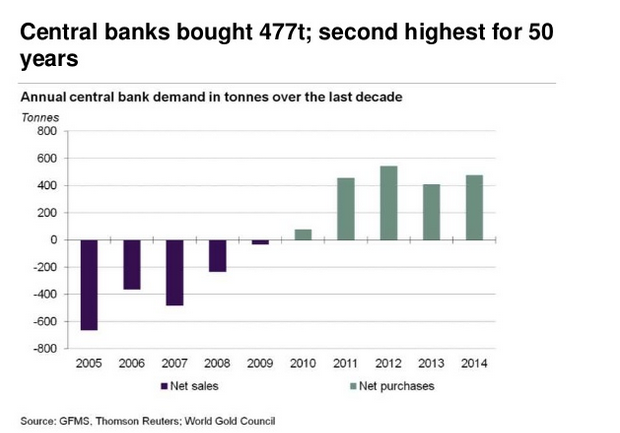
That gold is a form of currency and money is self evident. If it were not, central banks, particularly in Asia, would not be buying vast amounts of it and Western central banks would not continue to be holding vast amounts of gold reserves.
When the U.S. shut Iran out of the SWIFT system Iran began successfully trading oil for gold. In extremis, at this time and place in history, gold is the ultimate form of payment as Alan Greenspan recently pointed out.
Ritholtz suggests that proponents of gold ownership view it, irrationally, as a permanent store of value because it was declared so in Greece 2700 years ago and “it shall ever be thus.”
Placing monetary value in a piece of metal is an abstraction, we agree. However, in practical terms there is no company, currency or empire that has outlived the value that man has placed on gold.
Maybe the time will come when humankind devise a more sophisticated means of exchange but in the here and now gold is money. In the not unlikely event of a monetary crisis, with currencies based on confidence alone today, gold – which has industrial applications and psychological appeal – will again retain value and outperform.
The ECB’s Mario Draghi said gold is a monetary “reserve of safety”.
2. The price of gold cannot fall, it can only be manipulated lower.
Like all currencies gold fluctuates in value relative to other currencies. No rational person would ever state otherwise. At the same time there is mounting evidence that violent downward swings in the price of gold have been orchestrated by large banks.
This is achieved by dumping large contracts for gold which they are not in physical possession of (naked short selling) onto the market during quiet periods when there are few buyers to support the price.
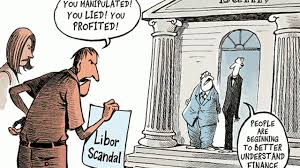
In fairness, Ritholtz wrote his article before it was exposed last year that banks were rigging practically every market on the planet and continue to do so.
This week it has emerged an astounding ten of the major banks may be directly involved in rigging the gold-price are now being investigated by the Department of Justice in the US and by the CFTC.
Under investigation are the household names of International banking including Barclays PLC, Deutsche Bank AG, Credit Suisse Group AG, UBS and Societe General. Of course no banking scandal is complete without JP Morgan Chase & Co. and Goldman Sachs Group Inc.
3. If the price of gold is rising, it is doing so despite enormous and desperate efforts by manipulators to prevent the rise
This is possible. As is the possibility of a tactical retreat whereby banks aware that physical demand may overwhelm their manipulation of gold and silver prices decide to gradually allow prices to rise, hoping that this will dampen physical demand and they can cap prices at higher prices.
Ultimately, the price of most things will be dictated by the forces of supply and demand of the nearly 7 billion people on the planet. Banks can prevent price discovery in the short term but in the long term, the small physical gold market will dictate the price.
4. The world MUST return to the Gold Standard one day
Ritholtz fourth rule – that the world “MUST” return to the gold standard one day – is also not a view widely held in the gold community.
Certainly, there is a potential for such – and some would suggest a necessity – but nobody knows what political action will be taken in different countries if confidence is finally lost in the world’s erstwhile reserve currency – the dollar.
If China and the Eurasian Economic Union headed by Russia choose to partially back their currencies with gold, which seems possible given the huge volumes they have been accumulating, they could potentially challenge the dollar’s role as reserve currency.
In such a case it is not unreasonable to suggest that the U.S. might be forced to back it’s enormous debt with the 8,500 tonnes of gold it claims to have. In such a case the very high prices of gold that Ritholtz ridicules – such as $15,000 – would not be so completely outlandish – although there are many more conservative estimates of gold over $5,000 per ounce.
Of course the purchasing power of those dollars would be greatly impaired. This is precisely why we advise clients to own gold. It is not necessarily for building wealth but for protecting it.
5. Central Bankers are printing money relentlessly, and this can only drive Gold prices higher
This is true and to suggest otherwise is misguided.
Central banks are printing money hand over fist. This will inevitably destroy the purchasing power of currencies in the long term. There is no precedent in history for the scale of the currency debasement of central banks in the past fifteen years.
Whether or not the central bankers have finally, this time, perfected the alchemy of wealth creation through money printing is yet to be seen. Prudence would dictate that one takes measures to hedge against the typical outcome of such monetary incontinence throughout history. That is, uncontrollably high inflation. Historically gold has behaved as such a hedge.
Ritzholtz says that “gold-bugs” try to ignore the fact that gold had not gone markedly higher in the two year period before he wrote his piece despite massive QE.
Well, as Alan Greenspan explained in his address to the CFR last year, QE had not caused the desired inflation because all the cash got swallowed up in the stock markets or was loaned abroad causing high inflation in emerging markets.
Should the stock market bubble burst or should emerging markets shed their dollars, a wave of dollars will hit the real economy in the U.S. engendering very high inflation. Whether gold performs its traditional function in this scenario remains to be seen but in the absence of any other alternative we are confident that it would.
6. Gold works whether the economy is good or bad
The purpose of owning gold is to hedge risk and protect against uncertainty. When things go very bad it rises as one’s other assets fall, cancelling or at least reducing the loss. Ritholtz mockingly refers to it as “a trade that never fails!” Owners of physical gold do not view gold this way. They do not speculate with it. They hold it as an insurance policy that has no counter-party risk.
Therefore, yes if owned as financial insurance, gold like insurance, is useful and “works whether the economy is good or bad.”
Generally, gold performs better when the economy is bad. However, we live in a very uncertain world and no one can protect the economic cycle hence the vital importance of DIVERSIFICATION.
7. Gold will survive after the world economy crumbles
The assertion is that if the world economy collapses, we would be in a post-apocalyptic ‘Mad Max’ type scenario. This is childish nonsense. Industrial, technological and agricultural capacities would remain intact for the most part.
Social chaos and war may ensue during the transition with some resulting destruction but by and large trade would continue in most parts of the world.
The economic catalyst for a collapse in the global economy, should it happen in these times, would likely be the failure of paper currencies due to gargantuan unpayable debt.
In such a climate it is reasonable to suggest that gold could be the last man standing. It may not be held in great esteem in the West but in the East, it certainly is.
In the event of a currency collapse exporters will expect something of value in exchange for their produce. When faced with a choice between unlimited paper and digital fiat currencies with no tangible backing on one hand and gold-backed Eurasian or Chinese money on the other, it is reasonable to speculate that they will choose the latter.
8. Never admit that Gold is essentially a sucker’s bet
Ritholtz lists periods when gold has not performed well in dollar terms, choosing to ignore the intervening periods in which it thrived. Data mining is such an easy thing to do. One could pull similar rabbits from a hat to disparage the Dow Jones and S&P and other benchmarks.
The difference is that owners of physical gold still owned something at the end of a bad period whereas owners of stocks and shares of many companies lost everything.
Also gold was money throughout many of the periods cited as dollars were backed by gold. Gold has a fixed price of $20 per ounce and then $25 per ounce and it was not a freely traded market. Therefore it is unfair and disingenuous to compare it to stocks, traded markets or other speculative ‘bets’.
9. Gold is a rejection of government, and their control of fiat money and finance
This is another sweeping generalisation. Many of our clients believe this. Most don’t.
Most do not ‘reject’. Many are concerned.
Owning gold needs no ideological basis. True, it can protect one from the stupidity of the types of politician and policy maker who have destroyed economies throughout history.
Owning gold as protection from government stupidity and corruption is not a rejection of government per se.
The wise Founding Fathers of the U.S. were adamant that gold and silver – and nothing else – were money. So much so that they had it written into the constitution.
Did these “goldbugs” reject the concept of government? Or rather did they see the benefit of having monetary controls on bankers, politicians and governments?
10. All Gold discussions must contain ominous macro forecasts
This is another sweeping generalisation. Some gold analysts make ominous forecasts. Others do not. Some stock and bond market analysts make ominous forecasts. Others do not.
We generally do not make forecasts. We address macro-economic and geopolitical facts and highlight the unavoidable conclusion that there is very high, perhaps unprecedented economic and geopolitical risk in the world today for which people should be prepared.
Ritholtz suggests that gold analysts “avoid empirical data at all costs.” This is nonsense. We, and many of our competitors in the gold business, consistently use important data, much of which is studiously ignored by many bank and other economists when they conflict with the official narrative of “green shoots” of recovery.
11. Gold is always rallying in one currency or another
This is a statement of fact – especially in this era of currency devaluations and currency wars.
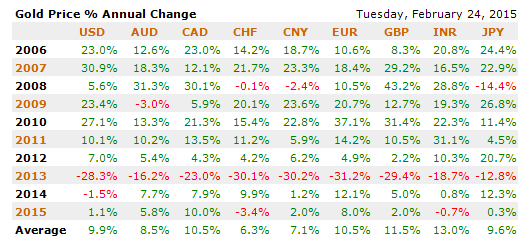
Obviously, the price of gold in another currency has no immediate bearing on the price of gold in an investor’s own currency.
However, it is highly relevant in demonstrating how owners of gold manage to preserve some of their wealth when the economy of the country in which they live is mismanaged and has an economic and or monetary crisis.
Gold priced in roubles rose 75% in 2014, during the Russian economic crisis. This aptly demonstrates the role gold plays in economic crises and it is relevant information in highlighting the case for owning gold.
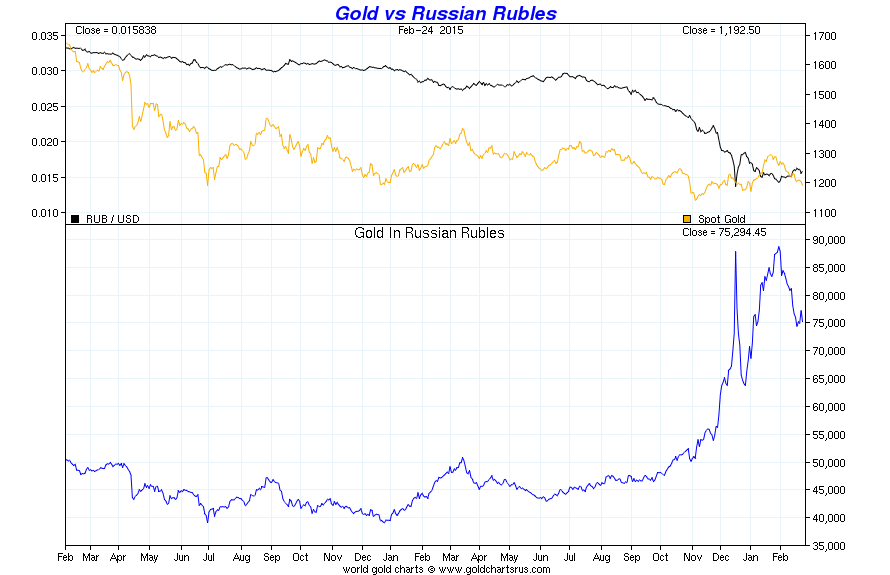
Gold is again acting as a hedge against currency weakness and the ongoing devaluation of currencies as stealth currency wars continue.
The focus on gold solely in dollar terms is misleading. It shows a peculiarly dollar centric way of looking at the world. It is important for investors in the UK, EU, Japan and elsewhere to always consider performance in local currency terms and top not lose sight of the fact that all fiat currencies are being devalued today – including the dollar.
12. China & India know the value of Gold; The Western world does not
This is true too. Go to India, China and Asia and talk to ordinary people and you will quickly realise this.
The people of China and India live in societies where wealth has been periodically extracted from them through currency devaluations. Therefore, they have a natural affinity for gold as insurance and as a store of wealth.

It is not a matter of them “knowing” the value of gold. What is important is that actual direct experience has caused a mass of people – that compose one third of the entire population of the globe – to value gold.
Gold will remain a store of value for most Asians for the foreseeable future, thus supporting the price that people are likely to pay for it – especially in a crisis.
Western populations, except perhaps for Germans, are not prepared for a potential monetary crisis and severe inflation. They do not understand the potential for even deeper currency devaluations and the role that gold would play protecting their wealth in such a scenario.
Conclusion
This concludes our reply to Ritholtz’s 12 rules. As you can see, they are misleading and misrepresent the case for owning gold.
Gold has proven itself a safe haven both historically and again in recent years. There is now a large body of academic and independent research showing gold is a safe haven asset. Numerous academic studies have proved gold’s importance in investment and pension portfolios – for both enhancing returns but more importantly reducing risk.
The importance of owning gold in a properly diversified portfolio has been shown in studies and academic papers by numerous academics and by Mercer Consulting, New Asset Frontiers and the asset allocation specialist, Ibbotson.
This is not an attack piece on Ritholtz. As we said at the outset we share his views on many matters financially.
Rather it is an attempt to try and engender a more fair, balanced, nuanced and enlightened debate about gold as an asset and a safe haven.
As a frequent contributor to Bloomberg, I would welcome the opportunity to debate this with Barry.
What say you @ritholtz ? : )
Click here for Gold Is A Safe Haven Asset
MARKET UPDATE
Today’s AM fix was USD 1,206.50, EUR 1,062.06 and GBP 777.99 per ounce.
Yesterday’s AM fix was USD 1,195.50, EUR 1,057.97 and GBP 774.59 per ounce.
Gold fell 0.16% percent or $1.90 and closed at $1,200.20 an ounce on yesterday, while silver slipped 0.43% percent or $0.07 closing at $16.25 an ounce.
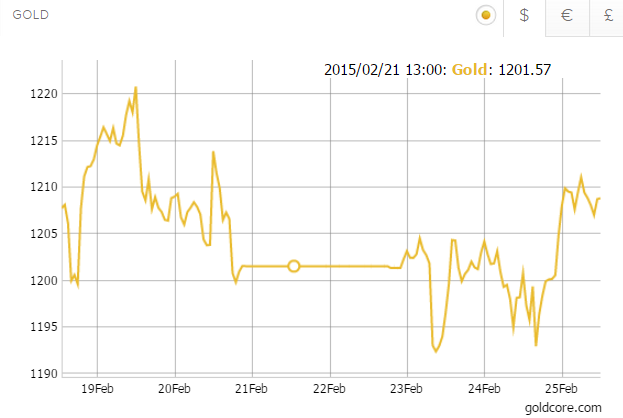
Gold jumped 1 percent in late Asian trading after falling to a seven-week low in the prior session, as Fed Chair Janet Yellen’s dovish tone hinted at flexibility in raising U.S. interest rates – meaning she is happy to hold them near zero for as long as possible.
The timetable for the Fed’s interest rate hike is now perhaps June through September – if even that – ZIRP looks here to stay.
Yellen’s comments sent the U.S. dollar lower, and stoked a rally in precious metals with silver rising over 3 percent and palladium reaching a six week high.
China’s return from its Lunar New Year break also strengthened gold prices, with premiums on the Shanghai Gold Exchange (SGE) rising to $5-$6 an ounce over global spot prices, from $3-$4 before the New Year’s holiday.
In late morning trading, gold is $1,208.61 up 0.31%, silver is $16.54 up 0.77% and platinum is $1,169.20 up 0.22 %
Daily and Weekly Updates Here

end
Now we have the Swiss competition commission, WEKO, looking into the gold/silver price manipulation!
I am truly surprised that they have woken up from their 20 year slumber!!
(courtesy Reuters)
Swiss Watchdog Says It’s Looking at Possible Gold Market Manipulation
Feb 24 (Reuters) – Switzerland’s competition commission WEKO is looking into possible manipulation of price fixing in the precious metals market, its spokesman said on Tuesday.
The gold and silver fixes, along with other commodity benchmarks, have come under increasing scrutiny by regulators in Europe and the United States since a London Interbank Offered Rate (Libor) manipulation case in 2012.
The century-old gold fix is a standard price for the metal that banks set twice a day over the phone.
“We have a preliminary investigation into the manipulation of gold and precious metal price fixing,” the spokesman said. He declined to say which banks were involved…
http://www.reuters.com/article/2015/02/24/swiss-banks-probe-idUSL5N0VY4FQ20150224
-END-
Good commentary today from the New York Sun on the Rand Paul’s bid to audit the Fed:
(courtesy New York Sun/GATA)
New York Sun: Janet Yellen’s audit
From the New York Sunday
Tuesday, February 24, 2015
It strikes us that it was passing strange for Chairman Janet Yellen to wave a copy of the central bank’s audited financial statement as a prop in answering Congress on Senator Rand Paul’s “Federal Reserve Transparency Act.” She did this today at the hearing of the Senate Banking Committee. Her suggestion that a standard financial audit is what the Transparency Act is all about was almost contemptuous. So was her suggestion that the bill that has already twice passed the House — September’s bipartisan vote was 333 to 92 — is somehow designed to politicize monetary policy.
Just to underline the point, what Mrs. Yellen held up was an audited report of the kind that is done by accountants using green eyeshades. What the Congress wants is a look not only at the books but also at the Fed’s holdings and minutes and transactions overseas. It is not an attempt to interfere with Fed policy. It is an attempt to find out what the Federal Reserve is doing. It’s just shocking that the Federal Reserve would want to deny to its creator this kind of inspection once every, oh, say, century.
Particularly on this morning, when the world is digesting the Wall Street Journal’s astonishing scoop about how the Justice Department is investigating trading by “at least 10 major banks” for rigging the market in gold and other precious metals. …
… For the complete commentary:
http://www.nysun.com/editorials/janet-yellens-audit/89061/
end
Now it is Bank of New York, Mellon that is in settlement talks for foreign exchange fraud
(courtesy Reuters/GATA)
BNY Mellon in settlement talks over forex fraud, sources tell Reuters
By Karen Freifeld and Nate Raymond
Reuters
Tuesday, February 24, 2015
NEW YORK — Bank of New York Mellon Corp. is in settlement talks with the U.S. Justice Department and New York attorney general over claims the bank defrauded clients in foreign exchange transactions, according to sources familiar with the matter.
BNY Mellon last week revealed that it would take a $598 million charge as it sought to resolve matters including “substantially all” foreign exchange litigation it faced, though it did not specify which cases.
The bank faces several lawsuits, including class actions, stemming from allegations that it misled clients about how it determined currency exchange rates for certain transactions.
The Justice Department, which has a lawsuit against BNY Mellon pending in Manhattan federal court, is engaging in settlement talks, a person familiar with the matter said. …
… For the remainder of the report:
http://www.reuters.com/article/2015/02/24/us-bank-of-ny-melln-forex-sett…
end
The Bill King Report/banks suspected of rigging the gold are likely doing the deeds for central banks:
(courtesy Bill King/GATA)
King Report: Banks suspected of rigging gold likely do it for central banks
By Bill King
Excerpted from The King Report, Burr Ridge, Illinois
Wednesday, February 25, 2015
http://www.mramseyking.com/king-report
For years if not decades the usual suspects ridiculed people who claimed that gold was being manipulated. But the conspiracy crowd was right:
“U.S. Investigates at Least 10 Major Banks for Possible Rigging of Precious-Metals Markets”: http://on.wsj.com/1DgToAr
A similar investigation of the manipulation of the gold market by European banks was quietly squashed. It’s reasonable to surmise that investigators quickly discovered that the biggest banks were often doing the bidding for central banks to keep excess liquidity flowing into financial assets instead of gold.
Surging precious metal prices, like in 2011, could induce investors to eschew financial assets for metals. This is what occurred in the late 1970s, and it could usurp central banks’ and sovereigns’ plans to inflate away unserviceable debt. …
end
As China comes back from its New Year celebrations, they buy gold and silver:
(courtesy zero hedge)
Gold & Silver Bid In Asia Session As China Returns From Holiday
With China’s return from the Lunar New Year celebrations, it appears precious metals are benefitting from some pent-up demand. Gold, and its high-beta cousin Silver have jumped in the Asia session and are now the best performing asset post-Yellen testimony. US equity futures have drifted lower from the cash close and copper has given back most of its gains…
Post-Yellen, Gold and Silver are outperforming…

Gold topped $2010 and Silver $16.70…

With the Yuan trading near 30-month lows against the USD, perhaps the Chinese are starting to rotate away having rested for a few days…
end
Dave Kranzler on silver:
Silver Will Be The Gift That Keeps On Giving In 2015
Many of us in the precious metals community have been conjecturing, based on silver’s particular buoyancy since Halloween, that the bullion banks who are massively short paper silver might have a bigger problem with delivering physical silver right now than they do with gold.
There’s been plenty of “tracks in the snow,” like the huge volume of silver that moves in and out of the Comex silver vaults on a weekly basis, the unanticipated record amount of silver imported by India in 2014 and the stunning withdrawal of roughly 90% of the silver stock on the Shanghai Futures Exchange since 2013.
It’s almost as if the bona fide physical silver accumulators are removing as much physical silver possible while the NY/London bullion banks play “the shell game” with silver baseballing in and out of the Comex and the SLV Trust. Even HSBC, surprisingly, issued a report forecasting an 11 million ounce silver supply deficit in 2015. If a bullion bank of HSBC’s stature is admitting to a deficit, the real deficit will likely be more like 110 million ounces…
I wrote an article recently for Seeking Alpha in which I defended my view that silver would be the best performing asset in 2015: Silver/Seeking Alpha.
The graph below shows silver’s performance since Halloween (click to enlarge):

The black line shows that silver started to go parabolic until the bullion banks “stunted” the move on the day that the Government released the infamously phony non-farm payroll report. I have argued that they did us favor by slamming silver because parabolic moves are the “death” of a bull market. I also suggested that the silver would have healthy pullback and begin to head higher again. The blue line shows a more “healthy-looking” bull market trend developing.
This week and last week the bullion banks worked overtime everyday after the Comex paper gold/silver market opened. And every time silver was smacked close $16, it popped right back up, typically on little or no possible news triggers. Today was another example of this.
The point here is that silver should bought on every manipulated smack. If you want to accumulate a long term trading position, buy every hit and sell 1/2 your position on the bounce. But reload a little more than you sold on the next hit.
If you want a silver mining stock play that will be a home run on the next big bull run in the metals, I would suggest this junior explorer/emerging producer for which I’ve written a detailed research report: Emerging Silver Producer/Free Cash Flow Positive.
This Company started producing silver last year and is free cash flow positive before exploration costs. While the existing mine deposit has a lot silver, the Company controls several parcels of land near its existing operation on which the Company believe will contain, in aggregate, a lot more silver than at its existing mine deposit. In fact, the Company recently announced a new discovery on of these properties which contains near-surface gold and silver mineralization and confirms the potential for a low-grade oxide open pit operation from which it will be able to utilize the existing milling operation.
This Company has the potential to be a home run in 2015 if my silver forecast is even half-accurate.
Austria is expressing grave concern over their gold at the BOE. It is now supposedly in allocated form but the sovereign has its doubts on this:
a very important read..
(courtesy Koos Jansen)
Austria Expresses Concern Over Their Gold At BOE
Yesterday the Austrian Court of Audit (Der Rechnungshof) released a report on the Austrian central bank’s official gold reserves audits (Austria holds in total 280.0 metric tonnes). This report contains (official) critical notes regarding the safekeeping of the Austrian gold.
The report is written in German, but from being Dutch (my native language is similar to German), using Google Translate, having spoken to Peter Boehringer about this and using the English introduction from the Rechnungshof’s report, we can squeeze the essential bullion points from the report.
I will sum up the highlights. Let’s start with a quote from the English introduction:
In end-2013, the OeNB (central bank of the Republic of Austria) stored some 82 % of its physical gold holdings at a depository in England [BOE] and therefore ran a high concentration risk. The current depository concept lacked adequate measures to reduce this risk. Additionally, the gold depository contract with the depository in England contained deficiencies. As regards the gold reserves stored abroad, internal auditing measures were lacking.
The Austrian Court of Audit expresses great concern about the disproportionate amount of official gold reserves (229.6 tonnes) stored at the Bank Of England (BOE), which will be their excuse for repatriating, “the gold depository contract with the depository in England contained deficiencies” and, “gold reserves stored abroad, internal auditing measures were lacking”. They’re putting it blunt for an official source on a topic so sensitive as gold.

The OeNB didn’t have any proper auditing rights or access to their own gold at the BOE until 2013. This is line with what Bundesbank executive board member Carl-Ludwig Thiele said in 2011, “We’re in negotiations with our partner central banks [FRBNY] to develop auditing rights.” Apparently, foreign central banks had no rights whatsoever to audit their own gold at the BOE or Federal Reserve Bank of New York (FRBNY) until 2013.
Though it hasn’t been only imprudent policy from the BOE; between 2009 and 2013 there had been no audit protocol for the Austrian gold by the OeNB itself. From the February 24, 2015, report:
The OeNB had no appropriate concept to perform audits of its gold reserves. … The lack of audit measures represented a gap in the internal control procedures of the OeNB. The OeNB started in March 2014 with the development of an audit program, which included all the gold holdings of the OeNB.
In May 2014, for the first time, a delegation from the Austrian accountability office travelled to London in order to check on Austria’s gold reserves stored in vaults at the BOE.
Strikingly the Bundesbank’s current gold repatriation schedule was released January 16, 2013. The Austrian central bank decided on January 17, 2013, to “adopt measures … in terms of the management of gold stocks … that should reduce the risk of asset losses of the OeNB”. Repatriating gold is highly contagious at the moment.
After Germany received its first gold bars from the US in 2013, the Dutch central bank surprised the world on November 21, 2014, by stating they had successfully repatriated 122.5 tonnes from New York (which according to me was planned long before), on December 5, 2014, the Belgian central bank announced they were investigating to repatriate their gold reserves, followed by the Austrians on December 12, when newswire Der Standard stated:
…In Austria, the Court of Auditors has adopted the gold concept in its recent OeNB examination. In its draft report it provides the OeNB diverse recommendations. One of the key points: Given the “risk of a high concentration at the Bank of England”, the examiner advises to “rapidly evaluate all possibilities of a better dispersion of the storage locations”. Not only the parties should be diversified, but also the “actual spread of storing among locations”.
Gold Relocation Possible
The central bank has not ruled out such a relocation. The existing gold storage concept would be reviewed, potentially it will bring parts of the stored gold in the UK to Austria, OeNB experts have stated. Any changes will be decided upon security and economic criteria, according to the OeNB.
A brief orientation on the current gold concept: Austria has 280 tonnes of official gold reserves, only a small part of (17 %) is kept in Vienna. 80 % of the reserves are located in London, the most trading partner in gold, 3% percent is stored in Switzerland.
What more can we learn from the latest report from the Austrian Court of Auditors. Quite a lot, apparently the OeNB has been allocating gold and unwinding leases at a rapid pace since 2009. Have the Austrians been preparing repatriating a few years ago? Just like the Dutch? From the report February 24, 2015:
The composition of the gold holdings of the OeNB in the years 2009 to 2013 changed greatly. The proportion of non-physical inventory fell from 56% in 2009 to approx. 22% in 2013.
Currently all gold loans ran out no later than September, 24, 2014.
In the report there is a table of all gold holding compositions from 2009 to 2013. Here’s my best translation:

We can see Gold loans dropped from 116.451 tonnes in 2009 to 23.887 in 2013, down 79.49 %. Total non-physical holdings dropped from 156.589 tonnes in 2009 to 61.671 in 2013, down 60.62 %. Austria has unwounded all leases and is working towards being fully allocated.
If I compare these numbers with previous research I did on the gold holdings of the Austrian central banks, the similarities are not hard to find. It seems the Austrian Court of Auditors has labeled unallocated gold as non-physical,which is probably the best way of putting it, as unallocated gold represent a claim on gold, though the holder does not own specified bullion. From the LBMA:
UNALLOCATED ACCOUNT An account where specific bars are not set aside and the customer has a general entitlement to the metal. … The holder is an unsecured creditor.
The next chart demonstrates the composition of Austrians allocated versus unallocated gold. We can see that by end 2013 unallocated gold accounted for 61.68 tonnes, the same as the total non-physical holdings in the chart above.

This chart reaches to December 2014, when Austria only had 15.58 tonnes of unallocated gold versus 264.41 tonnes allocated – nearly fully allocated.
There is more information in the report that I don’t feel comfortable publishing as I haven’t discussed it with a native German speaker.
The Eurosystem
Austria’s allocation policy has been the main reason the Eurosystem’s total unallocated gold dropped to from 232 tonnes in 2013 to 183 tonnes by the end of 2014 (France and Malta also helped).
 Reuters released an article on February 24, stating the Eurozone has increased its gold holdings by 7.437 tonnes to 10,791.885 tonnes in January 2015. I can’t verify this from the numbers I have. Perhaps it has got something to do with Lithuania joining the Eurosystem on January 1, 2015, though Lithuania holds only 5.8 tonnes (fully allocated). The article also notes Turkey has decreased its official holdings, though this is due to changes in Reserve Requirements commercial banks hold at the Turkish central bank (CBRT), not because the CBRT is trading on the open market – readthis post for more details on the Turkish gold market.
Currently Germany, Estonia, Ireland, Greece, Italy, Cyprus, Latvia, Luxembourg, The Netherlands, Slovakia and Finland are fully allocated.

Koos Jansen
E-mail Koos Jansen on: koos.jansen@bullionstar.com
end
Looks what happens to gold when hyperinflation grips your country:
Ukraine edition!!
(courtesy zero hedge)
This Is What Happens To Gold In A Hyperinflationary Currency Crisis: Ukraine Edition
As Ukraine’s socio-economic situation goes from wost to worst-er, today’s announcement by President Poroshenko that the government will take actions to stabilize the currency (which as we previously noted, appears to be heading for hyperinflation) has Ukrainians rushing for the exits into precious metals… with only one goal in mind – wealth preservation.

This is what gold does in a fiat-currency crisis. Now if only Ukraine actually still had some gold…
Furthermore, according to RIA, on Tuesday, Ukrainian television channel Ukraina announced that with the new exchange rate, the minimum wage in Ukraine stands at around $42.90 per month, which according to the channel, is lower than in Ghana or Zambia.
There are currently no plans to raise the minimum wage until December.
Behold hyperinflation:
“Food prices among producers rose 57.1 percent, with the price for grains and vegetables rising 91 percent from January 2014 to January 2015, while the official inflation rate over the period totaled 28.5 percent.
Meanwhile, Ukrainian consumers responded to economic difficulties by cutting their spending in hryvnias by 22.6 percent, which amounts to an almost 40 percent decrease in real consumption.”
Nothing to fear though: we are sure all that hard-earned US taxpayer-lent money will be safe and sound.
A very important discussion from Bill Holter
(courtesy Bill Holter/Miles Franklin)
The globe is a banana republic ...
And now for the important paper stories for today:
Early Tuesday morning trading from Europe/Asia
1. Stocks mixed on major Asian bourses / the yen rises to 118.81
1b Chinese yuan vs USA dollar/ yuan slightly weakens to 6.2601
2 Nikkei down 18.28 or 0.10%
3. Europe stocks all down // USA dollar index up to 94.35/
3b Japan 10 year yield huge rise to .38%/ (Japan buying 100% of bond issuance)/Japanese yen vs usa cross now at 118.69/everybody watching the huge support levels of 117.20 and that level acting as a catapult for the markets.
3c Nikkei now above 17,000/
3e The USA/Yen rate still below the 120 barrier this morning/
3fOil: WTI 49.50 Brent: 58.97 /all eyes are focusing on oil prices. This should cause major defaults as derivatives blow up.
3g/ Gold up /yen up;
3h/ Japan is to buy the equivalent of 108 billion usa dollars worth of bonds per MONTH or $1.3 trillion
Japan’s GDP equals 5 trillion usa/thus bond purchases of 26% of GDP
3i Japan to buy 100% of all new Japanese debt and by 2018 they will have 25% of all Japanese debt. Fifty percent of Japanese budget financed with debt (see Von Greyerz)
3j Oil constant this morning for WTI and Brent
3k Greece’s list to the Troika not prepared at all by Greece/prepared by EU
3l Greek 10 year bond yield :8.56% (down 50 basis points in yield)
3m Gold at $1209.50. dollars/ Silver: $16.60
3n USA vs Russian rouble: ( Russian rouble flat per rouble / dollar in value) 62.11!!!!!!. Ukraine’s UAH:33.05 down 5 UAH from Tuesday night
3 0 oil into the 49 dollar handle for WTI and 58 handle for Brent
3p Troika happy with Greece’s reform list/they should be: they wrote it
3Q SNB (Swiss National Bank) still intervening again driving down the SF/window dressing/Swiss rumours of intervention to keep the soft peg at 1.05 Swiss Francs/euro and major support for the Euro.
3r USA justice department investigating 10 major USA banks in the manipulation of gold and silver pricing
3s Negative German 5 year bond yield for first time.
3t Humphrey Hawkins testimony by Janet Yellen tomorrow night
4. USA 10 yr treasury bond at 1.977% early this morning. Thirty year rate well below 3% (2.58%!!!!)/yield curve flattens/foreshadowing recession
5. Details: Ransquawk, Bloomberg/Deutsche bank Jim Reid
(courtesy zero hedge)/your early morning trading from Asia and Europe)
Stocks In Holding Pattern Following Blow-Off Top, Oblivious Of Fed’s Warning Of “Stretched” Valuations
Following the first of two Janet Yellen testimonies to Congress, the market read between the lines of what the Fed Chairman said when she hinted that “the Fed needs confidence on recovery and inflation before beginning to raise rates” and realized that the case of a June rate hike is suddenly far less realistic than previously expected, as a result not only did we see another blowoff top in stocks to fresh all time highs, a move which sent the USD lower, has pushed the median EV/EBITDA multiple to the mid 11x (!) range and the forward PE to just shy of 18x ironically coming on a day when the Fed itself warned about “stretched” equity valuations, and led to brisk buying of global Treasurys across the board, pushing the 10 Year in the US back under 2%, and due to the global convergence trade (because if the Fed returns to QE, it will be forced to buy up Treasuries not just in the US but around the globe, since net issuance including CBs globally is now negative) and leading to today’s German 5 Year bond auction pricing at a negative yield for the first time ever.
Then again since the breadth of the “market” is now defined by just 5 stocks which are responsible for the parabolic move in the Nasdaq in the past two months, talking about a market is no longer meaningful, and any attempts to forecast what a central-bank dominated market will do are now more futile than ever. One thing that will surely impact stocks again, will be Yellen’s second day of testimony, this time before the Senate, where her prepared remarks will be the same, however where she is now expected to be forced with more aggressive questions than the generic fluff the members of the House lobbed at her yesterday, with the possible exception of Elizabeth Warren’s demands for a “Yes or No” answer on whether Citigroup runs Fed policy now by drafting swaps push out laws.
So, to keep it easy, here is what has already happened: European equities reside in negative territory across the board albeit modestly so, with things pretty light in Europe so far this morning. On a sector specific basis, energy names lead the way lower in a continuation of yesterday’s move despite oil prices holding their own this morning. Price action nonetheless has been more defined across fixed income products with core paper continuing to rally in the wake of comments from Fed Chair Yellen whose remarks were perceived as more dovish than markets were expecting, leading to markets now pricing in a 66% probability of a FFR hike in Oct. From a UK perspective, Gilts have been outperforming in early trade as UK paper plays catch up with US and GE paper which rallied after the UK close yesterday.
Asian equity markets initially traded mostly higher after taking the lead from another record Wall Street close for the DJIA and S&P 500. However, Nikkei 225 (-0.1%) was unable to hold on to its earlier advance after fluctuating between losses and gains, amid a strengthening JPY. Shanghai Comp (-1%) and Hang Seng (-0.1%) traded lower after a mixed Chinese February HSBC Flash Mfg. PMI which rose to a 4-month high (50.1 vs. Exp. 49.5 (Prev. 49.7), although export orders fell by the most since Jun’13. JGBs gained 29 ticks, lifted by spill-over buying in USTs yesterday’s and the BoJ buying a total of JPY 1.18trl worth of government debt from the market.
Despite the upside for Gilts, GBP actually outperforms in the FX market this morning as policy divergence takes precedence given the dovish outcome of Yellen’s speech compared to more hawkish commentary from the BoE of late. More specifically, BoE’s Forbes yesterday said that gradual increases in interest rates should support the economy in the UK adding that low inflation present at the moment will fade quickly while BoE’s Weale said that the BoE may have to lift rates before the time frame which markets are currently expecting. Elsewhere, given the move lower in US yields, USD has continued to trail its major counterparts, much to the benefit of EUR with EUR/USD making a technical break above yesterday’s highs while EUR/GBP manages to remain resilient to the broad-based GBP strength. Finally, CAD has managed to hold onto its gains against the Greenback in the wake of those less dovish than expected comments from BoC’s Poloz, which has resulted in markets scaling back their expectations for action by the central bank next week.
In the commodity complex, both spot gold and silver remain in the green with the weaker USD aiding prices. Elsewhere, Copper saw a mild decline overnight, while iron ore prices were also weaker as the largest buyer China saw a subdued return to the market following the week-long Lunar New Year holiday. Despite the reprieve for precious metals markets, the energy complex has failed to capitalise from the move following last night’s API inventory report showed a smaller than previous build in stockpiles (W/W +8900k vs. Prev. +14300k) but a build nonetheless.
In summary: European shares fall with autos and banks underperforming and utilities, travel & leisure outperforming. The Swiss and Italian markets are the worst-performing larger bourses, Germany’s is the best. The euro is stronger against the dollar. Japanese 10yr bond yields fall; German yields decline Germany seels 5 years debt at a negative yield for the first time ever. Commodities decline, with WTI crude, copper underperforming and silver outperforming. U.S. mortgage applications, new home sales, mortgage delinquencies, mortgage foreclosures, due later.
Taking a look at the day’s calendar, it’s quiet in the Euro-area this morning with just French consumer confidence for France due. Draghi speaking this afternoon in European parliament however will most likely attract attention. Over in the US we’ve got new home sales data to look forward whilst Yellen is also due to speak again, this time to the House Financial Services Committee. Historically the second day’s testimony is a repeat affair with less likelihood of market moving themes given the prior day’s discussion.
Market Wrap:
- S&P 500 futures down 0.1% to 2111.4
- Stoxx 600 down 0.2% to 386.5; Eurostoxx 50 -0.2%, FTSE 100 -0.3%, CAC 40 -0.2%, DAX -0%, IBEX -0.3%, FTSEMIB -0.5%, SMI -0.6%
- US 10Yr yield down 2bps to 1.96%
- German 10Yr yield down 3bps to 0.34%
- Gold spot up 0.6% to $1207.6/oz
- MSCI Asia Pacific up 0.6% to 146.3
- Nikkei 225 down 0.1%, Hang Seng up 0.1%, Kospi up 0.7%, Shanghai Composite down 0.6%, ASX up 0.3%, Sensex up 0%
- Euro up 0.23% to $1.1366
- Dollar Index down 0.28% to 94.23
- Italian 10Yr yield down 1bps to 1.45%
- Spanish 10Yr yield down 0bps to 1.38%
- French 10Yr yield down 3bps to 0.62%
- S&P GSCI Index down 0.1% to 409.6
- Brent Futures up 0.1% to $58.7/bbl, WTI Futures down 0.4% to $49.1/bbl
- LME 3m Copper down 0.4% to $5760/MT
- LME 3m Nickel up 0.3% to $14400/MT
- Wheat futures up 0.1% to 504.5 USd/bu
Bulletin Headline Summary from Bloomberg and RanSquawk
- European equities trade in a relatively tentative manner while fixed income products continue to climb following Fed Yellen’s testimony yesterday
- USD weakness has helped lift its major counterparts, notably GBP which has been provided a further boost by policy divergence plays
- Looking ahead, today sees the release of US new home sales, DoE inventories and comments from Fed’s Yellen and ECB President Draghi. Note Yellen’s testimony today will likely be a reiteration of yesterday’s
- Treasuries gain, 10Y yield below 2% in extension of rally spurred by Yellen comment that Fed needs confidence on recovery and inflation before beginning to raise rates; auctions continue with $13b 2Y FRN, $35b 5Y; WI 1.465% vs. 1.288% in Jan.
- Germany sold 5Y notes at a negative yield for the first time, Irish 10Y yields fell below 1% and rates on Italian and Spanish debt touched all time lows before ECB begins QE next week
- While the Greek government was praised for coming up with a workable package of measures including maintaining state-asset sales and collecting more tax, the EC, ECB and IMF all warned that action speaks louder than words
- HSBC/Markit’s preliminary China PMI was at 50.1 in Feb., exceeding the median estimate of 49.5 in a Bloomberg survey and up from January’s 49.7
- China is preparing measures to counter a housing market slump and will roll them out if the economy needs support, people with knowledge of the matter said
- RBS will outline plans Thursday to reduce the number of countries in which it operates by two-thirds to 13, a person with knowledge of the matter said
- Ukraine said fighting in its easternmost regions has subsided, though a “full truce” still hasn’t taken effect
- Obama yesterday vetoed the Keystone XL pipeline bill because it interfered with a review being led by the State Department, though he hasn’t decided whether to approve a permit for the pipeline, White House spokesman Josh Earnest said Tuesday
- Chicago mayor Rahm Emmanuel was forced into a runoff election in a clear sign of discord in the third-largest city, where $20b in unfunded pension liabilities threaten insolvency and citizens are plagued by persistent violence
- Sovereign 10Y yields lower. Asian stocks mixed, European stocks decline; U.S. equity-index futures fall. Crude and gold higher, copper declines
DB’s Jim Reid concludes the overnight recap
It took a lot of skill for Mrs Yellen to ensure that both the hawks and doves in the market could claim victory after her testimony yesterday. We think it was slightly dovish due to her inflation comments but others we respect think it more hawkish. Indeed the hawks would point towards the upbeat tone surrounding the labour market as well as the overall more positive economic outlook in the US. In addition the text around forward guidance would be of most interest to the hawks. Specifically Yellen commented that should economic conditions improve as anticipated, the Fed will consider an increase in the target rate on a meeting by meeting basis but would beforehand alter the forward guidance provided to markets. Yellen went on to say that ‘it is important to emphasize that a modification of the forward guidance should not be read as indicating that the Committee will necessarily increase the target range in a couple of meetings. Instead the modification should be understood as reflecting the Committee’s judgment that conditions have improved to the point where it will soon be the case that a change in the target range could be warranted at any meeting’. So the hawks would point towards there being sufficient evidence and a case to be made that we could see the ‘patience’ language dropped and possibly as soon as the March meeting, which in turn means June is in play.
On the other hand, the doves would argue that Yellen’s comments were more aimed at gaining the necessary flexibility to react rather than being tied to any particular time frame. Clearly a large part of the focus will be on the data and the doves would argue that on the whole macro prints generally have been unsupportive for a rate move. The lack of wage growth is clearly a concern and one which is holding back labour market data on balance. Also Yellen’s comments that ‘before raising rates, we will want to feel confident that the recovery will continue and that inflation is moving up over time’ puts some emphasis on the need to see clarity of the recovery in inflation prior to a hike. So it all might rest on inflation and interestingly tomorrow sees a strong possibility that we might see a negative headline YoY CPI print. Given Yellen also said they’re looking at all measures of inflation then maybe we need to see this start to recover over the months ahead before the FOMC pull the trigger.
So all in all a fairly balanced tone from Yellen, with a case to be made that it neither favours the hawks nor the doves and instead leaves the Fed in a position of flexibility with no particular bias either way as of right now. If you think inflation is going to pick up soon then maybe you can read it hawkishly. If you think low inflation is here for a while longer then you’re a dove! In terms of the market reaction, the S&P 500 recorded a fresh record high after closing +0.28% whilst the Dow added +0.51% to also mark a fresh record high. There were sharper moves in Treasuries however as yields rallied across the board. Indeed 3y (-6.5bps), 5y (-8.5bps), 10y (-7.7bps) and 30y (-6.5bps) yields all closed tighter. In fact 10y yields actually widened 4bps immediately following the speech, before then rallying into the close and perhaps supporting those on the dovish side. Given the shift down in the yield curve, the moves suggested a more dovish speech than expected. There were similar moves in the Dollar as the DXY bounced as much as +0.4% intraday before paring those gains to finish down 0.1%.
Meanwhile, turning over to the latest in the Greek saga, yesterday we learned that the Eurozone had approved the latest reform proposals from the Greek government. Whilst a step in the right direction, as we’ve previously mentioned the key will be the actual substance behind the proposals for which the current government has an end-April deadline to act by. In the mean time, yesterday we also heard echoes of caution from various European officials yesterday with the IMF’s Lagarde in particular saying that the list is ‘not very specific’ and didn’t portray ‘clear assurances’. A statement issued by the Eurogroup meanwhile said that ‘we call on the Greek authorities to further develop and broaden the list of reform measures’.
We’ve already heard of some potential tension in SYRIZA itself so it’ll be interesting to see how things progress as Tsipras and Varoufakis start talks internally, but clearly there is still much for Greece to do. It’s also not entirely clear how Greece will fund itself through the month of March with suggestions that they will run out of cash shortly after the end of this month (Bloomberg). This could in effect force Greece to agree on things much earlier than the end-April deadline or we could see an increase in the T-Bill issuance cap. Some near term attention will now also turn to Greek banks where Bloomberg reported that the ECB would be unlikely to wait until at least its next policy meeting on March 5th before making a decision on restoring the collateral waiver and allowing Greek banks direct funding.
Equity markets in Europe firmed with the approval news though. Having traded relatively subdued for most of the morning, the bulk of the gains came shortly following the headlines with the Stoxx 600 (+0.56%), DAX (+0.67%) and CAC (+0.50%) all finishing higher. The Stoxx 600 in fact closed higher for the 6th consecutive day and extended its 7y highs. The index is now +13% through 2015 already whilst the DAX and CAC have similar year-to-date returns. On the other hand and despite reaching record highs, the S&P 500 is +2.8% through 2015 so far. Elsewhere, Greek equities (+9.8%) were a notable outperformer yesterday with banks (+17%) leading the way. 3y and 10y yields for Greece meanwhile rallied 221bps and 55bps on the better sentiment. Peripheral 10y yields meanwhile were 2-4bps tighter and the Euro closed relatively unchanged at $1.134 – although in reality bounced around with Greek headlines and Yellen’s comments.
Away from Greece and Yellen yesterday, it was actually a fairly busy day data wise. In Europe Germany reported no change to their final Q4 GDP reading of +1.6% yoy. Our European colleagues have however raised their growth target for Germany in 2015 to 2.0% from 1.4% previously. They note that the upgraded forecast reflects the stronger carry over effect from the Q4 reading. The team has also raised their Q1 2015 forecast to +0.5% qoq from +0.3% qoq previously. Elsewhere the final January CPI print for the Euro-area was confirmed at -0.6% for the headline and +0.6% for the core. French manufacturing confidence (99 vs. 99 expected) meanwhile was in line with consensus however business confidence (94 vs. 95) was a touch below expectations. Over in the US, the S&P/Case Shiller home price index came in higher than consensus (+4.46% vs. 4.30% expected) whilst the services PMI bounced 2.8pts to 57.0 (vs. 54.5 expected) for February. Elsewhere, the consumer confidence print for February disappointed, falling 7.4pts to 96.8 and backing up recent falls in other confidence indicators. Finally there was also softness in manufacturing with the Richmond Fed manufacturing index for February falling 6pts to 0 – the lowest reading since March last year.
In terms of the trading this morning in Asia, bourses are largely following the US lead and trading firmer as we type. The Kospi (+0.69%), ASX (+0.30%) and Hang Seng (+0.36%) in particular are all trading stronger. Meanwhile equity markets in China – having reopened after a break for the New Year holiday- are softer despite a better than expected manufacturing PMI reading (50.1 vs. 49.5 expected). The Shanghai composite is -0.12% as we got to print.
Taking a look at the day’s calendar, it’s quiet in the Euro-area this morning with just French consumer confidence for France due. Draghi speaking this afternoon in European parliament however will most likely attract attention. Over in the US this afternoon, we’ve got new home sales data to look forward whilst Yellen is also due to speak again, this time to the House Financial Services Committee. Historically the second day’s testimony is a repeat affair with less likelihood of market moving themes given the prior day’s discussion.
China’s sluggish PMI suggests that domestic activity is slowing down coupled with a very uncertain export demand:
(courtesy zero hedge)
China Manufacturing PMI Suggests “Sluggish Domestic Activity & Uncertain Export Demand”
Modestly higher than the ‘contractionary’ 49.7 print in Janauary, February’s Markit (flash) China Manufacturing PMI printed at 50.1 (beating expectations of a drop to 49.5). However, before global investors pop the proverbial champagne corks of global recovery, we note thatemployment’s drop accelerated, New Export Orders contracted the most since June 2013, and prices continued to fall. Of course, HSBC is careful to note that “more policy easing is still warranted” because they believe, “domestic economic activity is likely to remain sluggish and external demand looks uncertain.” For now Chinese stocks are holding losses after the lunar new year and the Yuan has weakened further near 30 month lows – once again testing the upper 2% fix band.
A middle of the road 50.1…

And the breakdown does not encourage too much…

With the biggest contraction in export orders in almost 2 years and continued weakness in employment…

And the Yuan is weakening further…

Charts: Bloomberg
end
If you missed yesterday’s big story: The entire Greek letter and reforms to the Troika were written not by Greece but my the EC:
(courtesy zero hedge)
About The Authorship Of The Infamous “Greek Reforms” Memo
Following the earlier report that the Greek reforms memo contained something very unexpected in the “Author” field of its metadata properties, namely that it wasn’t the name of the Greek finance minister, but a European Commission (ECFIN) bureaucrat Declan Costello…

… there has been a flurry of outrage from all sides, all quite understandable, because if indeed it wasn’t the Greeks who created the memo then it merely confirms that Greece not only has no stated sovereignty, but it isn’t even permitted to draft its own memos.
What the apologists of this phenomenon claim is that the “Author” of the pdf document is not the creator of the Doc file but the person who received the Doc file and converted it to pdf. A perfectly reasonable explanation, and one that would make sense: after all Yanis Varoufakis may have simply sent to the European Commission his final word document, which was then converted to a pdf for broad distribution.
There is only one problem with this explanation: it is wrong.
The reason it is wrong is because the metadata of pdf files follows the creator of the original doc file, not the creator of the pdf file.
Quick example: say “Tyler Durden”, the default creator of word files on a computer, were to draft a blank memo…

Then naturally, the doc file would show in its properties the creator was, logically, “Tyler Durden”

Let’s change the default to a random user, say “European Commission Bureaucrat”

Then draft a brief memo “signed” by a Greek finance minister…

… then save it, and proceed to convert it to a pdf.

What the pdf will show, regardless if the default user “Tyler Durden”, or anyone else for that matter,converts the doc file into a pdf, is that the author is the specific user who created the doc file, in this case “European Commission Bureaucrat” and not the default pdf owner/author. This is because the pdf creation metadata follow the creator of the original underlying file, not the creator of the pdf: there is no break in the chain of authoriship/ownership just because someone else took one’s doc and made it into a pdf.

In other words, the generic “explanation” by those who wish to make it seem that it may well have been Varoufakis who drafted the doc file but it was simply some European Commission bureaucrat who converted it, falls apart.
To be sure, it is distinctly possible that someone hard-changed the actual “authorship” metadata after the fact, but that would make matters even worse.
Of course, it is impossible to know if the doc file was created in Brussels as a blank then sent to Vaourfakis to fill out and convert to pdf, but that would also be a very problematic explanation. There are also many other explanations which may validly ascribe ownership of some/all of the created content to the Greek FinMin, and creation of the doc file to the Troika, which we leave to readers to pursue.
Perhaps what is most amazing about this who situation, is how few so-called “journalists” were unaware of any of the above, but were quick to dismiss the entire fiasco simply by saying the ECFIN guy converted the pdf and that’s why he was the “author.”
In conclusion, that there is a very simple resolution to all of this: Declan Costello, who is named as the author of the “Greek” memo, should state publicly whether or not he drafted, saved and made into a pdf the doc file with the Greek reforms, or if his name appears in the metadata purely by accident. Considering the amount of consternation that this issue appears to have generated, it would certainly bring the topic to a prompt closure.
And after all, isn’t the whole point of “reporting” is to get to the bottom line, especially when the implications are substantial as in this case, and not to dismiss anything, however strange it may be, as merely too strange to investigate because it “just doesn’t make sense.” Unless, of course, one has prior advertising arrangements with HSBC, or the European Commission, or perhaps some of its countless financial backers. In which case we, too, are perfectly happy to let this whole topic go especially if there is no public interest in it whatsoever.
Finally, for anyone who is involved in the creation, drafting, and production of mission-critical documents, whose metadata can have huge downstream consequences, the best solution is to simply read the brief manual on Redaction of Confidential Information in Electronic Documents which nobody ever does at least not before they hint save, print or send…
end
Two important points here:
1. Greece will run out of money in March and Germany will not allow any more funding until they show the willingness to stop the tax evasion.
2. The German Bundestag has 60 members that will not vote on Friday for the extension. They claim that in July, (correctly) that Greece will need another 20 billion euros.
Greece may be completely insolvent in March as it runs out of cash.
Expect a disharmonious GREXIT and that should cause considerable harm to the EU.
(courtesy zero hedge)
Schauble: “Germans Doubt Greek Promises”, No More Money For Athens Until All Commitments Met
After the new Greek government fought valiantly a la David vs Goliath for several weeks, only to cave in the last minute and admit that the best it can do is continue the much hated policies of the predecessor Samaras government by extending the Greek bailout program, it now has a bigger problem: assuring its European “partners” that, having flipflopped, it is as trustworthy as the Samaras government. And none other than the German FinMin Wolfgang Schaeuble made that point early on Wednesday when in a radio interview with SWR2 radio, he said that it had not been an easy decision for euro zone finance ministers to extend the Greek rescue plan by four months and “much doubt remained about how credible Athens’ latest reform commitments really were.”
Reuters quotes Schauble who said that: “It wasn’t easy an easy decision for us but neither was it easy for the Greek government because (they) had told the people something completely different in the campaign and afterwards.”
“The question now is whether one can believe the Greek government’s assurances or not. There’s a lot of doubt in Germany, that has to be understood,” said Schaeuble who despite his misgivings, he has urged German lawmakers to approve the Greek extension in a vote in parliament expected on Friday.
The finance minister made one thing very clear: No payments will be made to Athens unless Greek govt meets its commitments in full.
In other words, Greece may have bought itself a 4 month bailout extension on paper, but in practice unless it succeeds in boosting its tax collections in the coming days, its state coffers – already on the verge of being completely empty – will run out of cash, and Greece will then really have no choice but to declare full insolvency. The only question is how much longer will the Troika continue its “pass-thru” funding operations, where it gives Greece aid so that Greece can pay interest and maturities on Troika debt?
Something tells us that if the government runs out of all cash to pay government workers, it is all over anyway.
And then there is the issue of whether the proposed Greek bailout extension will even pass a Bundestag vote:according to Rheinische Post, up to 60 government members will vote against the Greek bailout on Friday when the vote on the extension is due, following reports that Greece now expects a third bailout in the summer amounting to at least €20 billion.
Full Schauble interview below.
The Biggest Problem For Greece Isn’t Debt: It’s This
“Greeks consider taxes as theft,” which, among other things, explains, as WSJ reports, at the end of 2014,Greeks owed their government about €76 billion in unpaid taxes accrued over decades; the government says only €9 billion of that can be recovered, with most of the rest lost to insolvency. Syriza is now making tax collection a top priority among the measures promises the new Troika, but as one government official warned, “the Greek economy would collapse if the government were to force these people to pay taxes.” The bottom line is that “normally taxes are considered the price you have to pay for a just state, but this is not accepted by the Greek mentality,” and perhaps with this latest round of deference to the EU overlords, it is clear why…

Greece’s new government, scrambling to secure another tranche of short-term funding, agreed on Tuesday tomake tax collection a top priority on a long list of measures. Yet previous governments have made similar promises, only to fall short. As The Wall Street Journal reports,
“Greeks consider taxes as theft,” said Aristides Hatzis, an associate professor of law and economics at the University of Athens.“Normally taxes are considered the price you have to pay for a just state, but this is not accepted by the Greek mentality.”
Indeed, for most Greeks tax evasion isn’t considered a serious crime and there is little stigma attached to getting caught, unlike in other European countries or even the U.S.
…
Kosmas, a 32-year-old chef in Athens, says his income taxes are automatically deducted from monthly paychecks. But every time he buys something and he is given an option topay less if he doesn’t ask for a receipt, he says yes.
“It is a win-win situation,” he said. “I pay less for the products and the store pays less in taxes.”
…
The government’s tax-revenue shortfall in January alone was 23% below its €4.5 billion target for the month.
Last week, the government outlined plans to forgive up to 50% of individuals’ tax arrears, a sign would make good on its campaign rhetoric.
Syriza would risk a popular uprising by the very people who put it into power if it were to back away from those policies and get tough on taxes, political analysts warn.
Even within the government’s own ranks, officials say Syriza can’t risk tougher enforcement.
The reason isn’t just political, but economic.
…
“The Greek economy would collapse if the government were to force these people to pay taxes,” said one senior government official.
* * *
And it seems they are already in trouble…
Greece admitted on Wednesday it will struggle to make debt repayments to the IMF and the European Central Bank this year as Germany’s finance minister voiced open doubts about Athens’ trustworthiness.
A day after euro zone finance ministers agreed to a four-month extension of a financial rescue for the currency bloc’s most heavily indebted member, Finance Minister Yanis Varoufakis gave a frank assessment of Greece’s financial position.
“We will not have liquidity problems for the public sector. But we will definitely have problems in making debt payments to the IMF now and to the ECB in July,”he told Alpha Radio.
* * *
More broken promises to come…
Of course the answer to Greece’s problems is simple:
Doubts (And Bond Yields) Are Rising Again In Greece
If “everything is awesome” in Greece (and Europe) then why – oh why – did Greek government bond yields surge higher today, Greek stocks tumble, Greek bank stocks (and less so bonds) collapse, and Greek CDS jump? It appears that as the euphoria relief wears off, as WSJ reports, doubts over the willingness of Greece’s left-wing government to follow its creditors’ orders on budget cuts and economic overhauls spilled into the public today. IMF’s Lagarde stated that the Greek proposal “is not conveying clear enough assurances that the government intends to undertake the reforms,” and even Syriza officials admitted, “it is difficult to determine how the government can fulfill its promises, including the debt write-off, with this agreement,” as doubts arise across Europe’s policymakers and markets.
Greek banks were monkey-hammered… not exactly the reaction of a confident “deal done” investor base…

And Greek government bond yields surged (5Y +65bps today!)

* * *
As Xinhua reports, Germany’s Schaeuble remains as doubtful as ever…
German Finance Minister Wolfgang Schaeuble said on Wednesday that there were doubts in Germany about Greek government’s credibility over debt issue.
The minister said Eurogroup’s decision on Tuesday to extend aid program for Greece until end of June was “not easy” for creditors, nor for Greek government.
“Now the question is: Can you believe the assurances of the Greek government or not? There are many doubts in Germany, this must be understood,” Schaeuble said in an interview with German SWR2 radio.
A poll by INSA institute showed on Wednesday that only 21 percent of Germans support the extension of aid program for Greece.
Bundestag, the lower house of German parliament, was due to vote on the deal on Friday. Though Chancellor Angela Merkel’s governing coalition of CDU/CSU and SPD holds the majority in the parliament, skeptical voices were heard on Wednesday.
CDU’s economic council sent a letter to parliament members to urge them not to support the extension.
“We must not fear of a blackmail from aid we have already paid,” read the letter cited by Frankfurter Allgemeine Zeitung newspaper.
In an interview with Passauer Neue Presse newspaper, CDU politician Wolfgang Bosbach warned that he would vote against the extension on Friday.
Schaeuble said euro zone finance ministers’ decision on Tuesday gave Greece more time to fulfill its reform commitments made to international creditors.
“If they do so, they will get the outstanding payments from the current program,” he said. “No single euro will be paid before that.”
* * *
This is a long way from over… And sure enough Fitch pitches in…
- *FITCH:GREEK DEAL MAY NOT ADDRESS ALL BANK FINANCE UNCERTAINTIES
- *FITCH: HIGHLY UNLIKELY GREECE TO GET MKT ACCESS BEFORE SUMMER
- *FITCH:GREECE TO PROBABLY NEED REPLACEMENT PROGRAM PRE JUNE END
end
Ukraine Enters Hyperinflation: Currency Trading Halted, “Soon We Will Walk Around With Suitcases For Cash”
Yesterday we summarized the most recent economic, political and social situation in Ukraine as follows:
“A year or so on from the last coup in Ukraine, Ukraine’s former Prime Minister Sergey Arbuzov told TASS, with growing popular discontent, “another state coup can’t be ruled out in Ukraine.” As the cease-fire deal hangs torn and tattered in the Debaltseve winds, the nation is a mess: a new gas dispute looms as Gazprom demands upfront payments; capital controls have been tightened as the $17.5bn IMF loan may not be enough; and the central bank governor faces prosecution as the economy craters. All of these factors have driven massive outflows from Ukraine and the Hryvnia has crashed to over 33 to the USD – a record high (and 70% devaluation from the last coup).”

So as the Ukraine government watches its country go down in flames, with the blessings of the US State Department of course, it decided to take action. According to Reuters, with the hryvnia in free fall (see above) the central bank tried to call a halt on Wednesday by banning banks from buying foreign currency on behalf of their clients for the rest of this week.
Although banks could still trade with each other, by mid-morning there were no registered trades at any rate, leaving the currency in limbo. The previous day, the central bank rate based on reported trades had fallen 11 percent against the dollar.
Exchange kiosks on the streets in Kiev were selling limited amounts of dollars for 39 hryvnias, around 20 percent worse than the rates advertised in the windows of commercial banks where dollars were not available. This compares to the official rate of 33 USDUAH posted yesterday, a rate which will continue in freefall, now that the central bank has no more gold left to sell (it’s mysteriously gone), and virtually no foreign reserves.
Following the closing of the FX market closing, the central bank has been able to artificially dictate the interbank rate, which it reduced from 32 to 24 hryvnias as of 12:45 p.m. local time. The artificial rate only affects exporters, who are forced to sell 75 percent of their foreign currency revenue to the National Bank at the rate.
Even the Ukraine government is shocked by what is going on: “I learned this morning on the Internet that the National Bank of Ukraine has, as usual on its own without any sort of consultations, made the decision to close the interbank currency market, which will absolutely not add to the stability of the national currency that the national bank is responsible for. This situation has a very complex and negative influence on the country’s economy,” Ukrainian Prime Minister Arseniy Yatsenyuk said.
The Ukrainian National Bank chairwoman Valeriya Hontareva, however, contradicted the Prime Minister’s statement. “We coordinate all administrative measures with the International Monetary Fund first, and only then implement them,” Hontareva told reporters.
In short: total chaos, which is indicative of any country’s collapse into the hyperinflationary abyss.
It gets better. According to RIA, on Tuesday, Ukrainian television channel Ukraina announced that with the new exchange rate, the minimum wage in Ukraine stands at around $42.90 per month, which according to the channel, is lower than in Ghana or Zambia. There are currently no plans to raise the minimum wage until December.
Behold hyperinflation: “Food prices among producers rose 57.1 percent, with the price for grains and vegetables rising 91 percent from January 2014 to January 2015, while the official inflation rate over the period totaled 28.5 percent. Meanwhile, Ukrainian consumers responded to economic difficulties by cutting their spending in hryvnias by 22.6 percent, which amounts to an almost 40 percent decrease in real consumption.”
And the punchline: “A construction worker exchanging dollars at a kiosk in a grocery shop in return for a bag filled with thousands of hryvnia, laughed and told shoppers: “Soon we will have to walk around with suitcases for cash, like in the 1990s.””
Which is ironic, because the central banks of “developed world” nations, most of which are now facing over 300% debt to consolidated GDP, would define Ukraine’s imminent hyperinflation with just one word: “success.”

Ukraine Enters The Endgame
Back in March 2014 we forecast that it in the aftermath of the US State Department-sponsored military coup in Kiev, it was only a matter of time before Ukraine (all of its sovereign gold having since “vaporized“) succumbed to full blown hyperinflation and economic implosion. Less than a year later, precisely this outcome has finally played out, and as a result, the entire nation has finally entered its economic endgame, one which has two conclusion: either it joins Greece in becoming a ward of Europe (of which it is not an official member) and the IMF (thank you Joe Q Public taxpayer), or it quietly fades away into insolvent “failed state” status.
This is in a nutshell the assessment by Goldman Sachs, presented below, which really doesn’t say much we didn’t cover earlier in “Ukraine Enters Hyperinflation: Currency Trading Halted, “Soon We Will Walk Around With Suitcases For Cash“, but which does lays out the (very unpleasant) alternatives for yet another nation brought to ruin through American neo-colonial expansion, in what may well be a record short period of time. Of these, the primary ones focus on yet another IMF bailout which the agency may find some resistance to as a result of the near-total collapse of Greece at the same time. And not only that but Goldman’s “base case of IMF fund disbursement in mid-March may not come quickly enough to stabilize the Hryvnia.” Oops.
Should the IMF fail to provide the much needed funding (and as of this moment the days of merely jawboning its support for the central banks are finished since Russia will once again shut down its gas to Kiev unless it is paid in full and upfront), this is what happens: “the Ukrainian authorities could tighten FX controls further. In the extreme, this could potentially involve a bank deposit freeze, a ban on retail FX purchases and/or moratorium on external payments and complete closure of the capital account.”
Hence our question to Ukrainians: was the coup worth the economic disintegration of your nation, and leaving your faith in the hands of the US, whose recent global intervention case-studies include such sterling examples as Libya, Egypt and Iraq?
And before we present the Goldman piece, here is something truly funny: in discussing the causes of the collapse of the Ukraine currency, Goldman lays out “monetary financing of Ukraine’s fiscal deficits” as one of the reasons.
This is certainly not funny for Ukraine which now may have just enough cash to cover 3 weeks worth of imprts:
While monetary financing of the deficit may debase the value of the Hryvnia in the medium term, it is the shortage of FX in the system that has caused the proximate pressure on the currency, as NBU reserves declined to US$6.4bn in January (4 weeks of imports) and are likely to decline to US$5-5.5bn in February (3 weeks of import cover). These international reserves include about US$1bn in monetary gold, so the liquid amount of reserves is likely to fall to US$4-4.5bn in February (2.5 weeks of imports).
So why is it that funny? Because as the chart below shows, it is not just Ukraine that is engaged in “monetary financing of its deficit” – so is the entire developed world to the point where central banks will buy up every single dollar of debt government have to issue (and thus fund deficits) and then some!

In other words, we now live in a world in which the entire global fiscal, and every other, debt-funded deficit is being plugged by central banks! Therefore, for anyone curious what will eventually happen to the world’s various fiat currencies, look no further than the UAH.
So without further ado, here is Goldman with “As pressure builds on the Hryvnia, short-term risks mount and may prompt policy action”
Bottom line:
The Hryvnia weakened over the weekend to UAH 30 vs. the USD, prompting the Ukrainian authorities to tighten FX controls and to intervene by a reported US$80mn today, and causing a further weakening of the currency to UAH 40 on the black market as of this morning. While pressures have subsided somewhat (with black-market, mid-market spot now around UAH 33), in our view, the current FX controls are only likely to provide temporary relief to the currency and, thus, introduce risks that the authorities could tighten FX controls further. Given that capital flight, debt repayments, ongoing imports and a destabilization of expectations in the FX market are likely to continue exerting pressure on the Hryvnia in the coming days and weeks, our base case of IMF fund disbursement in mid-March may not come quickly enough to stabilize the Hryvnia. In our view, this could cause the authorities to resort to more severe FX controls and/or could cause international donors aware of the fragility of the situation to make available emergency funds in order to serve as a bridge until IMF loans arrive.
Authorities step up FX controls, as pressure builds on Hryvnia …
The Ukrainian authorities have put in place an array of FX controls since late 2012, including the mandatory sale of FX proceeds, bank FX withdrawal limits, FX bank transfer limits, and de facto restrictions on access to NBU FX provision for banks. The latter restriction caused the black-market Hryvnia rate to be 20-30% weaker than the official rate in recent months, but was dismantled in early February, leading to a sharp depreciation of the Hryvnia and aligning the official exchange rate to the black-market one. Despite these restrictions, the Hryvnia continued to weaken last week, with the official rate reaching UAH 27.9 vs. the USD as of February 20 and the black-market rate rising to UAH 31 over the weekend.
As a result, in the past week, the authorities have stepped up their FX controls significantly. The government discussed imposing a duty on non-essential imports last week and the NBU earlier this week increased scrutiny and put into place checks on import pre-payments exceeding US$50,000 (and required a letter of credit from an investment-grade-rated bank for those exceeding US$500,000), while also banning leveraged FX purchases by corporates. The Hryvnia continued to weaken in response to these measures, to UAH 35 vs. the USD yesterday on the black market, and the NBU accordingly introduced further restrictions, including a complete ban on corporate purchases of FX through end-week and restrictions for banks as well. The initial response to these measures was a sharp weakening of the Hryvnia on the black market to in excess of UAH 40 vs. the USD this morning, but the end-day rate has now settled down to around UAH 33, although the bid-ask spread has widened sharply to about 15% of the mid-market price, indicative of very poor liquidity conditions. While the official rate had been aligned with the black market during the period February 6-21, it has returned to being about 20% stronger than the black market in the past several days.

There are several causes for the weakening of the Hryvnia:
- Net private capital outflows (excluding net IMF/official sector flows), which stood at an estimated US$10bn in 2014. This number excludes US$3.7bn in repayments to the IMF and about US$4.5bn in debt service on external sovereign bonds.
- Current account and trade deficits, due to the collapse in exports and despite the fact that domestic demand has weakened sharply.
- Monetary financing of Ukraine’s fiscal deficits.
While Ukraine’s current account and trade balances should close as domestic demand continues to contract and as the Hryvnia has weakened further, capital flight continues, with bank FX deposit outflows of US$600-700mn/month in November-January. Moreover, monetization of the deficit has accelerated as local banks are no longer able to absorb domestic bond issuance. The share of domestic government bonds owned by the NBU has risen to 71% in January, from 59% one year prior, with the share held by domestic banks falling by the same amount (to 20%). Meanwhile, narrow money continues to grow at around 15-20%yoy, at a time when domestic credit is now contracting by 10%yoy. While money supply growth in the mid-single digits in a context of weak credit growth may have been offset for most of 2014 by large-scale FX interventions by the NBU, withdrawing liquidity, FX interventions have slowed in H2-2014 and the NBU reportedly stopped intervening in February (although it intervened once again by US$80mn today). This has caused assets on the NBU’s balance sheet to grow by about 60%yoy in recent months and by 8%mom in January (seasonally-adjusted). In our view, with the economy and cash demand weakening, domestic credit shrinking and an absence of liquidity withdrawal via interventions, money supply growth at the current pace will ultimately prove inflationary and will cause the Hryvnia to weaken further.
While monetary financing of the deficit may debase the value of the Hryvnia in the medium term, it is the shortage of FX in the system that has caused the proximate pressure on the currency, as NBU reserves declined to US$6.4bn in January (4 weeks of imports) and are likely to decline to US$5-5.5bn in February (3 weeks of import cover). These international reserves include about US$1bn in monetary gold, so the liquid amount of reserves is likely to fall to US$4-4.5bn in February (2.5 weeks of imports).
… raising short-term risks, until IMF funds arrive …
In our view, while the current FX controls may provide some temporary relief, pressure is likely to continue to build on the Hryvnia until expectations stabilize, confidence is restored, and the country’s FX reserves are replenished. Given the poor liquidity and destabilization of expectations in the FX market, the ongoing conflict in Donbass that undermines confidence, and the continued need to import natural gas and other essential goods and make external debt payments, these factors are likely to continue to exert pressure on the Hryvnia, at least until the IMF Board approves the newly-agreed program and makes its first disbursement. However, this will likely take at a minimum 2-3 weeks and there are risks of delays. First, the authorities must fulfil their prior actions for the program, and notably the Rada must approve a new budget law. This is scheduled to take place in a session on March 3, although PM Yatseniuk is attempting to accelerate this process by holding an extraordinary Rada session to approve the legislation. Even if the session is moved forward, in our view, there is no guarantee that the law will be approved immediately and delays are possible. Once prior actions are fulfilled, the IMF Board can meet, approve the new program, then disburse funds shortly thereafter. Our base case is that this will take place in mid-March (the current board review date is reportedly scheduled for March 11), although it is possible that this could be delayed. With the current pace of reserve depletion and pressure build-up on the Hryvnia, it is possible that the IMF funds may not arrive quickly enough. This raises the short-term risk of a significant further increase in pressure on the Hryvnia.
… and implying potential need for emergency policy action
Given the balance of payments and monetary pressures on the currency, the authorities and international donors, in our view, have several policy options. First, the Ukrainian authorities could tighten FX controls further. In the extreme, this could potentially involve a bank deposit freeze, a ban on retail FX purchases and/or moratorium on external payments and complete closure of the capital account. Second, international donors (bilateral lenders and IFIs) could recognize the fragility of the current situation and the fact that the IMF timeframe may prove to be too slow to stabilize the currency. Thus, in our view, the international community could make available emergency funds in the coming days or weeks, effectively bridging financing for Ukraine until the IMF disbursement arrives. However, bureaucratic, legal and political hurdles may exist to any large-scale emergency disbursement to Ukraine, either bilaterally or multilaterally. Thus, there is no guarantee that such emergency funds could or would be made available. This introduces further short-term policy uncertainties.
Finally, the recent and sharp weakening of the Hryvnia, as well as significant recent shifts in money demand and supply, could necessitate an overhaul of some of the IMF’s program assumptions and targets. In our view, this could require further technical work on the part of the IMF and could cause additional delays to disbursement of IMF funds. As the monetary and financial dynamics evolve rapidly, so may the IMF’s working program assumptions and the parameters of the program.
end
Washington Has Resurrected The Threat Of Nuclear War — Paul Craig Roberts
Paul Craig Roberts
Foreign Affairs is the publication of the elitist Council on Foreign Relations, a collection of former and current government officials, academics, and corporate and financial executives who regard themselves as the custodian and formulator of US foreign policy. The publication of the council carries the heavy weight of authority. One doesn’t expect to find humor in it, but I found myself roaring with laughter while reading an article in the February 5 online issue by Alexander J. Motyl, “Goodbye, Putin: Why the President’s Days Are Numbered.”
I assumed I was reading a clever parody of Washington’s anti-Putin propaganda. Absurd statement followed absurd statement. It was better than Colbert. I couldn’t stop laughing.
To my dismay I discovered that the absolute gibberish wasn’t a parody of Washington’s propaganda. Motyl, an ardent Ukrainian nationalist, is a professor at Rugers University and was not joking when he wrote that Putin had stolen $45 billion, that Putin was resurrecting the Soviet Empire, that Putin had troops and tanks in Ukraine and had started the war in Ukraine, that Putin is an authoritarian whose regime is “exceedingly brittle” and subject to being overthrown at any time by the people Putin has bought off with revenues from the former high oil price, or by “an Orange Revolution in Moscow” in which Putin is overthrown by Washington orchestrated demonstrations by US financed NGOs as in Ukraine, or by a coup d’etat by Putin’s Praetorial guards. And if none of this sends Putin goodbye, the North Caucasus, Chechnya, Ingushetia, Dagestan, and the Crimean Tarters are spinning out of control and will do Washington’s will by unseating Putin. Only the West’s friendly relationship with Ukraine, Belarus and Kazakstan can shield “the rest of the world from Putin’s disastrous legacy of ruin.”
When confronted with this level of ignorant nonsense in what is alleged to be a respectable publication, we experience the degradation of the Western political and media elite. To argue with nonsense is pointless.
What we see here with Motyl is the purest expression of the blatant propagandistic lies that flow continually from the likes of Fox “News,” Sean Hannity, the neocon warmongers, the White House, and executive branch and congressional personnel beholden to the military/security complex.
The lies are too much even for Henry Kissinger.
As Stephen Lendman, who documents the ever growing anti-Russian propaganda, honestly states: “America’s war on the world rages. Humanity’s greatest challenge is stopping this monster before it destroys everyone.”
The absurdity of it all! Even a moron knows that if Russia is going to put tanks and troops into Ukraine, Russia will put in enough to do the job. The war would be over in a few days if not in a few hours. As Putin himself said some months ago, if the Russian military enters Ukraine, the news will not be the fate of Donetsk or Mauriupol, but the fall of Kiev and Lviv.
Former US Ambassador to the Soviet Union (1987-91) Jack Matlock cautioned against the crazed propagandistic attack against Russia in his speech at the National Press Club on February 11. Matlock is astonished by the dismissal of Russia as merely “a regional power” of little consequence to the powerful US military. No country, Matlock says, armed with numerous, accurate, and mobile ICBMs is limited to regional power. This is the kind of hubristic miscalculation that ends in world destruction.
Matlock also notes that the entirely of Ukraine, like Crimea, has been part of Russia for centuries and that Washington and NATO have no business being in Ukraine.
He also points out the violations of promises made to Russia not to expand NATO eastward and how this and other acts of US aggression toward Russia have recreated the lack of trust between the two powers that Reagan worked successfully to overcome.
Reagan’s politeness toward the Soviet leadership and refusal to personalize differences created an era of cooperation that the morons who are Reagan’s successors have thrown away, thus renewing the threat of nuclear war that Reagan and Gorbachev had ended.
Washington’s foreign policy, Matlock says, is autistic, which he defines as impaired social interaction, failed communication, and restricted and repetitive behavior.
end
Crude Oil Inventories Surge For 7th Week In A Row To Record Highs Amid Record Production
Oil prices dumped (last night’s major 8.9 million barrel inventory build from API), pumped (the Saudi minister claiming “demand is growing” – which just seems like total fiction given economic backdrops andChina’s VLCC count plunge), and then this morning, dumped setting the scene for this morning’s EIA inventory data. Against expectations of an 8 million barrel build, crude inventories saw a 8.43 million barrel build (5 times higher than the 5 year average). Record levels of production and record total inventrory sent WTI plunging out of the gate but it is stabilizing for now…
US Crude oil inventories

US Oil Production hit a new record high… (despite the declining rig count – perhaps finally putting a nail in that meme)…

And Total Oil Inventory hit a new record high – massively higher than seasonal norms…

The reaction – algos gone wild – dump and pump

and the close-up reaction…

Charts: Bloomberg
Your more important currency crosses early Wednesday morning:
Eur/USA 1.1346 up .0005
USA/JAPAN YEN 118.46 down .059
GBP/USA 1.5493 up .0037
USA/CAN 1.2411 down .0087
This morning in Europe, the euro is up, trading now well below the 1.14 level at 1.1346 as Europe is supported by other nations keeping the Euro afloat, Europe reacts to deflation, announcements of massive stimulation, the Greek crisis and today crumbling bourses . In Japan Abe went all in with Abenomics with another round of QE purchasing 80 trillion yen from 70 trillion on Oct 31. The yen continues to trade in yoyo fashion as this morning it settled up again in Japan by 6 basis points and settling well below the 120 barrier to 118.86 yen to the dollar. The pound was up this morning as it now trades just above the 1.54 level at 1.5493.(very worried about the health of Barclays Bank and the FX/precious metals criminal investigation/Dec 12 a new separate criminal investigation on gold,silver oil manipulation and now the HSBC criminal probe). The Canadian dollar was well up again reacting to the slightly higher oil price and is trading at 1.2411 to the dollar. It seems that the 4 major global carry trades are being unwound. (1) The total dollar global short is 9 trillion USA, and as such we now witness a sea of red blood on the streets as derivatives blow up with the massive rise in the dollar against all paper currencies.We also have the second big yen carry trade unwind as the yen refuses to blow past the 120 level.(3) the Nikkei vs gold carry trade. (4) short Swiss Franc/long assets (European housing), the Nikkei, etc. These massive carry trades are terribly offside as they are being unwound. It is causing deflation as the world reacts to a lack of demand. Bourses around the globe are reacting in kind to these events as well as the potential for a GREXIT.
The NIKKEI: Wednesday morning : down 18.28 or 0.56%
Trading from Europe and Asia:
1. Europe stocks all in the red
2/ Asian bourses mixed … Chinese bourses: Hang Sang in the green ,Shanghai in the red, Australia in the green: /Nikkei (Japan) red/India’s Sensex in the green/
Gold very early morning trading: $1209.50
silver:$16.60
Early Wednesday morning USA 10 year bond yield: 1.97% !!! down 2 in basis points from Tuesday night/
USA dollar index early Wednesday morning: 94.35 down 14 cents from Tuesday’s close.
This ends the early morning numbers, Wednesday morning
And now for your closing numbers for Wednesday:
Closing Portuguese 10 year bond yield: 2.02% down 12 in basis points from Tuesday
Closing Japanese 10 year bond yield: .34% !!! down 4 in basis points from Tuesday
Your closing Spanish 10 year government bond, Wednesday down 3 in basis points in yield from Tuesday night.
Spanish 10 year bond yield: 1.39% !!!!!!
Your Wednesday closing Italian 10 year bond yield: 1.46% down 4 in basis points from Tuesday:
trading 7 basis points higher than Spain.
IMPORTANT CURRENCY CLOSES FOR TODAY
Closing currency crosses for Wednesday night/USA dollar index/USA 10 yr bond:
Euro/USA: 1.1359 up .0020
USA/Japan: 118.83 down .034
Great Britain/USA: 1.5528 up .0072
USA/Canada: 1.2428 down .0068
The euro rose a bit quite this afternoon but it was up on the day by 20 basis points finishing the day just below the 1.14 level to 1.1359. The yen was constant in the afternoon, and it was up by closing to the tune of 4 basis points and closing just below the 119 cross at 118.83. The British pound gained a lot of ground during the afternoon session and was up on the day closing at 1.5528. The Canadian dollar was up again today as oil price was up. It closed at 1.2428 to the USA dollar
As explained above, the short dollar carry trade is being unwound, the yen carry trade , the Nikkei/gold carry trade, and finally the long dollar/short Swiss franc carry trade are all being unwound and these reversals are causing massive derivative losses. And as such these massive derivative losses is the powder keg that will destroy the entire financial system. The losses on the oil front will no doubt produce many dead bodies. The last asset still rising are the stock exchanges.
Your closing 10 yr USA bond yield: 1.96 down 3 in basis points from Tuesday (reacting to bad economic indicators)
Your closing USA dollar index: 94.22 down 27 cents on the day.
European and Dow Jones stock index closes:
England FTSE down 14.25 points or 0.21%
Paris CAC down 4.22 or 0.09%
German Dax up 4.53 or 0.04%
Spain’s Ibex down 15.00 or .14%
Italian FTSE-MIB down 212.51 or 0.90%
The Dow: up 15.38 or 0.08%
Nasdaq; down .98 or 0.02%
OIL: WTI 50.77 !!!!!!!
Brent: 61.63!!!!
Closing USA/Russian rouble cross: 61.18 up almost 1 3/4 roubles per dollar on the day.
closing UKrainian UAH: (hryvnia) 28.15 UAH to the dollar. However real rate is around 39 UAH per dollar.
Since November the currency has lost more than half its value.
end
And now for your more important USA economic stories for today:
Your New York trading for today:
Falling AAPL Ends Nasdaq Anti-Gravity Streak
When your best AAPL pump just isn’t good enough…
Here is the only chart that matters… AAPL’s ~3% drop today may not be the AAPLocalypse for your average high beta muppetry stock, but for a nation of day traders – this is the 2nd biggest non-earnings day drop in 6 months for AAPL.. and yes it’s only dropped to Friday levels but its really all relative…

The tumble in AAPL (and the broad market) appeared to occur as Crude oil accelerated nonsenically into the NYMEX close – breaking the high correlation between the two assets…

Despite a late day panic buying scramble to get Nasdaq green, it ended its streak today…

From the start of Yellen’s testimony yesterday, stocks are higher – thanks to the meltup in the last few mins…

and bonds are 10-12bps lower

The US Dollar limped lower today (modestly lower on the week) led by CAD and GBP strength)… down 0.5% from the start of Yellen’s testimony

Silver gained notably on the day, gold less so alonmg with copper but crude’s idiotic meltup mimics the same runs we have seen in other commodities this week\

Yeah it was deja vu all over again in the oil patch… huge builds, record production, Saudi commenbts discounted early and record inventories… BUY BUY BUY…

Charts: Bloomberg
Bonus Chart: Consider…
This Is Why Hewlett-Packard Is Firing 58,000
he biggest scandal in today’s release of Hewlett Packard Q1 earnings was not that, just as the Nasdaq is knocking on 5000’s door, it reported revenues of $26.8 billion missing consensus expectations of $27.3 billion, while beating non-GAAP EPS by 1 cent to $0.92 (up from $0.90 a year ago) entirely due to a massive reduction in outstanding stock and some truly gargantuan non-GAAP addbacks (GAAP EPS declined from $0.74 a year ago to $0.73) pushing the stock down 7% after hours.
The biggest scandal was the company announced that having cut 44,000 workers so far, it will cut 58,000 jobs by the end of 2015. From Bloomberg:
- HP SAYS HAS CUT 44,000 JOBS TO DATE
- HP SAYS EXPECTS TO CUT 58,000 JOBS BY END OF FISCAL 2015
Incidentally, just 10 years ago Hewlett Packardemployed a total of 58,000 people in the entire US.
So why is the company axing 58 thousand workers? Simple: so it can cut enough costs on top and continue to fund its now exponential surge in stock buybacks,which in the just concluded quarter was a record $1.6 billion, an increase of 178% from a year ago, and 66% more than the company spent on CapEx,in the process making its shareholders even richer while its management team get massive equity-linked bonuses.

Rinse. Repeat.
New Home Sales & Prices Slip But Weather-Impacted Midwest Sales Surge
When existing home sales missed expectations, the fault was laid squarely at the foot of the meteorological conditions (despite a rise in NorthEast sales). New Home Sales beat expectations in January, printing 481k vs 470k expectations (though very modestly lower than December’s revised 482k) and – destroying the meme that weather is to blame – sales soared in The Midwest. Median prices dropped MoM to the lowest since September but remain up an impressive 9% YoY. Lack of inventory continues to be blamed for weak sales – but, we ask rhetorically, doesn’t price rise when supply drops?
New Home Sales “recovery” in context…

And prices drops to September lows…

Charts: Bloomberg
end
That did not take long!! Goldman Sachs is cutting USA growth in first quarter GDP because of the port congestion:
(courtesy zero hedge)
After Cutting US Growth Due To Snow, Goldman Now Warns West Coast Port Congestion Will “Drag On GDP”
Last week, when with much amusement we observed that the first of many Q1 GDP cuts due to snow… in the winter… had taken place just as predicted when Goldman warned snow (in the winter) may lead to a 0.5% drop in GDP, we hinted that with snow down, faltering Q1 GDP will need all the scapegoating help it can get, and that the West Coast port strike will be used next to justify the sequential tumble in GDP from 5% in Q3 to barely above 2%, and falling, in Q1.
To wit:
Because what above-trend growing economy can possibly handle a few extra feet of snow? What really!? Laughter aside, expect another round of GDP cuts by the, how did we put it,“laughable cadre of propaganda sycophants known as tenured and/or Wall Street economists” due to not only snow in the winter, but also the West Coast port strike as predicted here 2 weeks ago, to take place in 2-4 weeks, once the reality of the latest sharp US slowdown filters through their goalseek-o-trons.
We were wrong: it wasn’t 2-4 weeks. It was 4 days, because overnight first Goldman (and soon all the other penguins) released a report titled “The Fallout from West Coast Port Disruptions” and sure enough, Goldman’s conclusion is that “On balance, we think the net impact on Q1 GDP is probably a modest drag, although the estimated effect is highly uncertain at this point in the quarter.”
Full note:
Problems with the West Coast seaports have been building since the fall of last year, due to a combination of capacity constraints and labor disputes. The situation deteriorated significantly in January and February, as an apparent work slowdown on the part of the dockworkers’ union (ILWU) escalated to employers cutting back on hours and ultimately closing 29 ports for four of five days around Presidents’ Day weekend. Although data are not yet available for February, the total number of “twenty-foot equivalent units” (TEUs) processed through the major West Coast ports appears to have fallen by 20% or more during January. (One TEU equals one 20”x8”x8” shipping container.) The disruptions were noticed in different sectors of the economy, as reflected in respondents’ commentary in the January ISM manufacturing survey, for example. Although a tentative deal was reached between the ILWU and the PMA (the organization representing port owners) on Friday, February 20, the damage to port activity in January had already been done, and our transport equity analyst believes that even the six- to eight-week timeline for clearing up the backlog suggested by the Port of Oakland appears to be aggressive.
Exhibit 1. Labor Disputes Result in Major Disruption
By way of background, four of the top 10 largest US ports by value of imports—Los Angeles, Long Beach, Seattle/Tacoma, and Oakland—were affected by the labor dispute (Exhibit 2). These ports are particularly important gateways for Asian goods imports to the US, handling a reported 70% of this trade volume. The most direct impact on US economic data in the coming weeks will probably appear in the January trade report. Because the US runs a net trade deficit with Asia, and because US exports are geared to a larger extent toward services and air-shipped goods rather than seaborne goods, the West Coast port disruptions can be expected to temporarily reduce the trade deficit in January. Indeed, the 11-day ILWU strike in October 2002—which affected the same ports as the most recent labor dispute—seems to have contributed to both a decline in goods exports (-$800mn) and goods imports (-$2.5bn), resulting in a net +$1.7bn temporary “improvement” in the goods trade balance.
Exhibit 2. Los Angeles is Most Important US Port
The case for a narrower trade deficit in January was already strong, in our view, given the suspicious jump in real petroleum imports in December and the continued drop in petroleum import prices through January. Adding in the effect of port disruptions, our preliminary forecast for January is a large $8.6bn improvement in the nominal trade deficit to -$38bn. This estimate accounts for the fact that some activity was likely diverted to other ports. However, any “benefit” from the smaller trade deficit will probably begin to reverse by the end of March, by which point substantial progress should have been made in processing through the backlog of ships waiting to unload at West Coast ports. In addition, higher net exports (a positive for GDP) will probably be met with lower inventory accumulation (a negative for GDP), as consumer end demand remains little changed.
Exhibit 3. Trade Deficit Likely to Narrow in January
Exhibit 4. Following the Flow of Goods
More serious problems occur when the disruptions last for a longer period of time.First, some exports cannot be stored in inventory indefinitely, such as fresh fruits and vegetables. This production may be lost for good if the shutdown persists, and would show up as an inventory write-off. Second, producers may be forced to reduce output due to supply chain disruptions. Our auto equity analysts have already noted that some Japanese companies with production located in the US have cut back on scheduled production in light of supply-chain issues. (However, disruptions are likely to be smaller than after the Fukushima earthquake in 2011, as companies have made more robust contingency plans following that experience.) Third, direct job and income losses among dockworkers could pile up. For example, about 20,000 dockworkers were affected by the recent disputes. Fourth, indirect multiplier effects could adversely affect other areas of the economy.
Many media accounts have cited an estimate that closures of the Ports of Los Angeles and Long Beach could cost the economy $2bn/day, which looks to have come from an industry group study. (We interpret “cost the economy” to mean reduced GDP.) However, a detailed study from the CBO on the economic costs of disruptions in container shipments was highly critical of estimated effects of this size, and put the cost at a much lower $65 – $150mn per day. We gross up this estimate by a factor of 1.7x to account for the larger value of shipments now handled by the Ports of Los Angeles and Long Beach (vs. at the time of the CBO study), and the fact that—although representing the majority of West Coast port traffic—the remaining ports also matter. As a result, we would put the total cost of shutting down seaborne shipping to and from the West Coast ports at $110 to $255mn per day. Assuming that port disruptions in January and February were equivalent to two full weeks of a shutdown, and that dockworkers do not make up for lost time in March, this would imply a manageable GDP growth drag of around two-tenths of a percentage point in Q1.
There is substantial uncertainty around this estimate, and it is highly sensitive to assumptions. For example, under an aggressive set of assumptions about the amount of perishable goods exports that may never be recovered, one could arrive at a two-tenths drag in Q1 through this channel alone. In light of the high degree of uncertainty we leave our Q1 GDP tracking forecast unchanged and will wait for any trade disruption-related effects to show up in the data before incorporating in our tracking estimate.


* * *
In other words, once final Q1 GDP prints well below 2%, the economists army will immediately announce that upon adding back the “priced to perfection” non-GAAP benefits from non-snow and non-west coast strikes, then real GDP was almost if not in line with the 5% blast off rate recorded in Q3 2014 thanks entirely to Obamacare.
14 Signs That Most Americans Are Flat Broke And Totally Unprepared For The Coming Economic Crisis
submitted by Michael Snyder via The Economic Collapse blog,
When the coming economic crisis strikes, more than half the country is going to be financially wiped out within weeks. At this point, more than 60 percent of all Americans are living paycheck to paycheck, and a whopping 24 percent of the country has more credit card debt than emergency savings. One of the primary principles that any of these “financial experts” that you see on television will teach you is to have a cushion to fall back on. At the very least, you never know when unexpected expenses like major car repairs or medical bills will come along.
And in the event of a major economic collapse, if you do not have any financial cushion at all you will be a sitting duck. Yes, I know that there are millions upon millions of families out there that are just trying to scrape by from month to month at this point. I hear from people that are deeply struggling in this economy all the time. So I don’t blame them for not being able to save lots of money. But if you are in a position to build up an emergency fund, you need to do so. We have been experiencing an extended period of relative economic stability, but it will not last. In fact, the time for getting prepared for the next great economic downturn is rapidly running out, and most Americans are not ready for it at all.
The following are 14 signs that most Americans are flat broke and totally unprepared for the coming economic crisis…
#1 According to a survey that was just released, 24 percent of all Americans have more credit card debt than emergency savings.
#2 That same survey discovered that an additional 13 percent of all Americans do not have any credit card debt, but they do not have a single penny of emergency savings either.
#3 At this point, approximately 62 percent of all Americans are living paycheck to paycheck.
#4 Adults under the age of 35 in the United States currently have a savings rate of negative 2 percent.
#5 More than half of all students in U.S. public schools come from families that are poor enough to qualify for school lunch subsidies.
#6 A study that was conducted last year found that more than one out of every three adults in the United States has an unpaid debt that is “in collections“.
#7 One survey discovered that 52 percent of all Americans really cannot even financially afford the homes that they are living in right now.
#8 According to research conducted by Atif Mian of Princeton University and Amir Sufi of the University of Chicago Booth School of Business, 40 percent of Americans could not come up with $2000 right now without borrowing it.
#9 That same study found that 60 percent of Americans could not say yes to the following question…
“Do you have 3 months emergency funds to cover expenses in case of sickness, job loss, economic downturn?”
#10 A different study discovered that less than one out of every four Americans has enough money stored away to cover six months of expenses.
#11 Today, the average American household is carrying a grand total of 203,163 dollars of debt.
#12 It is estimated that less than 10 percent of the entire U.S. population owns any gold or silver for investment purposes.
#13 48 percent of all Americans do not have any emergency supplies in their homes whatsoever.
#14 53 percent of all Americans do not even have a minimum three day supply of nonperishable food and water in their homes.
Perhaps none of this concerns you.
Perhaps you think that this bubble economy can persist indefinitely.
Well, if you won’t listen to the more than 1200 articles that set out the case for the coming economic collapse on my website, perhaps you will listen to former Federal Reserve Chairman Alan Greenspan. The following is what he recently told one interviewer…
We asked him where he thought the gold price will be in five years and he said “measurably higher.”
In private conversation I asked him about the outstanding debts… and that the debt load in the U.S. had gotten so great that there has to be some monetary depreciation. Specially he said that the era of quantitative easing and zero-interest rate policies by the Fed… we really cannot exit this without some significant market event… By that I interpret it being either a stock market crash or a prolonged recession, which would then engender another round of monetary reflation by the Fed.
He thinks something big is going to happen that we can’t get out of this era of money printing without some repercussions – and pretty severe ones – that gold will benefit from.
And as I have stressed so frequently, the signs that the next crisis is almost here are all around us.
For example, the Baltic Dry Index has just plunged to a fresh record low, and things have already gotten so bad that some global shippers are now filing for bankruptcy…
The unintended consequences of a money-printed, credit-fueled, mal-investment-boom in commodities (prices – as opposed to physical demand per se) and the downstream signals that sent to any and all industries are starting to bite. The Baltic Dry Index has plunged once again to new record lowsand the collapse of the non-financialized ‘clean’ indicator of the imbalances between global trade demand and freight transport supply has the real-world effects are starting to be felt, as Reuters reports the third dry-bulk shipper this month has filed for bankruptcy… in what shippers call “the worst market conditions since the ’80s.”
Perhaps you do see things coming.
Perhaps you do want to get prepared.
If you are new to all of this, and you don’t quite know how to get started preparing, please see my previous article entitled “89 Tips That Will Help You Prepare For The Coming Economic Depression“. It will give you some basic tips that you can start implementing right away.
And of course one of the most important things is something that I talked about at the top of this article.
If at all possible, you have got to have an emergency fund. When the coming economic storm strikes, your family is going to need something to fall back on.
If you are trusting in the government to save you when things fall apart, you will be severely disappointed.
end
We will see you on Thursday.
bye for now
Harvey,


 harveyorganblog.com
And I never expected such delightful humor from Paul Craig Roberts. Go Paul!
It reminds me of a neighbor we once had. There was a road up and across the street with gorgeous houses on it. It made a hair-pin turn and came back to the main road. At the hair-pin stood a beautiful walled estate owned by the great Muhammed Ali. The champ would run down his street, cross the road, and do his training runs through the large housing development next door to our farm. Tiny boys would be peering out their windows waiting for him. They would scamper out to the sidewalk, put on their meanest faces, and shadow-box the champ as he ran by. The gracious Mr. Ali would give them a playful evil eye and shadow box back at them. So there were a lot of tiny little boys in the elementary school bragging about how they boxed The Champ and were still standing. It is one of my most precious and adorable memories. Unfortunately, though so similar, the Ukraine-Russia confrontation is neither precious nor adorable.
There are still pockets of people in Eastern Europe [and elsewhere though less clustered] where a mythology of ethnic superiority and greatness pervades all thinking. It grosses me out when I hear them brag. They hear nothing but their little-boy fantasy dreams. Those beliefs are at the foundation of nazi movements. This is what frightens Russia.
LikeLike
I just stumbled upon your ebsite and with Custom Parcel Solutions to
assert that I get actually ejoyed account your bloog
posts. Anyway I’ll be subscribing to youur augment and even I achievement you access consistently rapidly.|
Do you need drop shippping for your productt?
LikeLike