
Good evening Ladies and Gentlemen:
Here are the following closes for gold and silver today:
Gold: $1150.70 down $9.40 (comex closing time)
Silver: $15.41 down 27 (comex closing time)
In the access market 5:15 pm
Gold $1161.60
silver $15.62
The unhedged HUI index rose by 5.16 up to 162.72 despite gold’s fall. This may be the bottom for gold.
Gold/silver trading: see kitco charts on right side of the commentary.
Following is a brief outline on gold and silver comex figures for today:
The gold comex today had a poor delivery day, registering 0 notices served for nil oz. Silver comex registered 1 notice for 5,000 oz .
Several months ago the comex had 303 tonnes of total gold. Today the total inventory rests at 254.52 tonnes for a loss of 48.5 tonnes over that period. Lately the removals have been rising!
In silver, the open interest rose by an astonishing 1,494 contracts even though yesterday’s silver price was down 14 cents. The total silver OI continues to remain relatively high with today’s reading at 169,125 contracts. The front month of March contracted by 51 contracts.
We had 1 notice served upon for 5,000 oz.
In gold we had a fall in OI with gold down by $6.30 yesterday. The total comex gold OI rests tonight at 410,918 for a loss of 2,783 contracts. Today, surprisingly we again had only 0 notices served upon for nil oz.
Today, we had no changes in the GLD/Inventory rests at 753.04 tonnes
In silver, /SLV we had no change in inventory at the SLV/Inventory, remaining at 327.332 million oz
We have a few important stories to bring to your attention today…
1. The Greece affair.
It looks like the Troika are going to set foot on Greek soil. Greece starts to make noise that they want compensation for Nazi crimes during World War ii
(zero hedge)
2. Euro falters to 1.053 to the dollar. ECB finds it difficult to purchase bonds on their QE program.
3. Venezuela now starting negotiations to swap some of its gold for dollars. (zero hedge)
4. Thailand becomes the 23rd nation to lower interest rates as the global economy falters badly.
5. The IMF agree to a 15.4 billion loan agreement with the Ukraine.
we have these and other stories for you tonight.
Let us now head over to the comex and assess trading over there today.
Here are today’s comex results:
The total gold comex open interest fell by a wide margin of 2,783 contracts today from 413,701 down to 410,918 as gold was down by $6.30 yesterday (at the comex close). We are now in the contract month of March which saw it’s OI rise by 3 contracts up to 120. We had 0 notices filed on yesterday so we gained 3 gold contract or an additional 300 oz will stand for delivery in this delivery month of March. The next big active delivery month is April and here the OI fell by 13,037 contracts down to 226,123. The estimated volume today (which is just comex sales during regular business hours of 8:20 until 1:30 pm est) was poor at69,156. The confirmed volume yesterday ( which includes the volume during regular business hours + access market sales the previous day) was fair at 219,160 contracts with mucho help from the HFT boys. Today we had 0 notices filed for nil oz.
And now for the wild silver comex results. Silver OI rose by an extremely high 1494 contracts from 167,631 up to 169,125 with silver down by 14 cents with respect to yesterday’s trading. We are now in the active contract month of March and here the OI fell by 51 contracts down to 884. We had 41 contracts served upon yesterday. Thus we lost 10 contracts or an additional 50,000 oz will not stand in this March delivery month. The estimated volume today was poor at 14,652 contracts (just comex sales during regular business hours. The confirmed volume on yesterday (regular plus access market) came in at 41,106 contracts which is fair in volume. We had 1 notice filed for 5,000 oz today.
March initial standings
March 11.2015
| Gold |
Ounces |
| Withdrawals from Dealers Inventory in oz | nil |
| Withdrawals from Customer Inventory in oz | 4018.75 oz /125 kilobars (Scotia) |
| Deposits to the Dealer Inventory in oz | nil |
| Deposits to the Customer Inventory, in oz | nil |
| No of oz served (contracts) today | 0 contracts (nil oz) |
| No of oz to be served (notices) | 120 contracts (12,000 oz) |
| Total monthly oz gold served (contracts) so far this month | 5 contracts(500 oz) |
| Total accumulative withdrawals of gold from the Dealers inventory this month | 114,790.651 oz |
|
Total accumulative withdrawal of gold from the Customer inventory this month |
250,625.3 oz |
Today, we had 0 dealer transactions
total Dealer withdrawals: nil oz
we had 0 dealer deposit
total dealer deposit: nil oz
we had 1 customer withdrawals (and the farce continues)
i) Out of Scotia: 4,018.75 oz (125 kilobars)
total customer withdrawal: 4018.75 oz
we had 0 customer deposits:
total customer deposits; nil oz
We had 0 adjustments
Today, 0 notices was issued from JPMorgan dealer account and 0 notices were issued from their client or customer account. The total of all issuance by all participants equates to 0 contracts of which 0 notices were stopped (received) by JPMorgan dealer and 0 notices were stopped (received) by JPMorgan customer account.
To calculate the total number of gold ounces standing for the March contract month, we take the total number of notices filed so far for the month (5) x 100 oz or 500 oz , to which we add the difference between the open interest for the front month of March (120) and the number of notices served upon today (0) x 100 oz equals the number of ounces standing.
Thus the initial standings for gold for the March contract month:
No of notices served so far (5) x 100 oz or ounces + {OI for the front month (120) – the number of notices served upon today (0) x 100 oz} = 12,500 oz or .3888 tonnes
we gained 3oo additional gold ounces standing in this March contract month.
Total dealer inventory: 656,644.474 oz or 20.424 tonnes
Total gold inventory (dealer and customer) = 8.178 million oz. (254.39) tonnes)
Several weeks ago we had total gold inventory of 303 tonnes, so during this short time period 48.5 tonnes have been net transferred out. However I believe that the gold that enters the gold comex is not real. I cannot see continual additions of strictly kilobars.
end
And now for silver
March silver initial standings
March 11 2015:
| Silver |
Ounces |
| Withdrawals from Dealers Inventory | nil oz |
| Withdrawals from Customer Inventory | nil |
| Deposits to the Dealer Inventory | nil oz |
| Deposits to the Customer Inventory | 997.800 (Delaware) oz |
| No of oz served (contracts) | 1 contracts (5,000 oz) |
| No of oz to be served (notices) | 883 contracts (4,415,000) |
| Total monthly oz silver served (contracts) | 1732 contracts (8,670,000 oz) |
| Total accumulative withdrawal of silver from the Dealers inventory this month | |
| Total accumulative withdrawal of silver from the Customer inventory this month | 2,233,478.9 oz |
Today, we had 0 deposit into the dealer account:
total dealer deposit: nil oz
we had 0 dealer withdrawal:
total dealer withdrawal: nil oz
We had 0 customer deposits:
total customer deposit: nil oz
We had two customer withdrawals:
i) Out of Delaware: 533,211.929 oz
ii) Out of Scotia: 60,258.27 oz
total withdrawals; 593,470.199 oz
we had 1 adjustment
i) out of Delaware: 9,457.200 oz was adjusted out of the customer and this landed into the dealer account of Delaware;
Total dealer inventory: 68.834 million oz
Total of all silver inventory (dealer and customer) 177.443 million oz
.
The total number of notices filed today is represented by 1 contracts for 5,000 oz. To calculate the number of silver ounces that will stand for delivery in March, we take the total number of notices filed for the month so far at (1732) x 5,000 oz = 8,660,000 oz to which we add the difference between the open interest for the front month of March (884) and the number of notices served upon today (1) x 5000 oz equals the number of ounces standing.
Thus the initial standings for silver for the March contract month:
1732 (notices served so far) + { OI for front month of March( 884) -number of notices served upon today (1} x 5000 oz = 13,075,000 oz standing for the March contract month.
we lost 10 contracts or an additional 50,000 oz will not stand for delivery in March.
for those wishing to see the rest of data today see:
http://www.harveyorgan.wordpress.com orhttp://www.harveyorganblog.com
end
The two ETF’s that I follow are the GLD and SLV. You must be very careful in trading these vehicles as these funds do not have any beneficial gold or silver behind them. They probably have only paper claims and when the dust settles, on a collapse, there will be countless class action lawsuits trying to recover your lost investment.
There is now evidence that the GLD and SLV are paper settling on the comex.
***I do not think that the GLD will head to zero as we still have some GLD shareholders who think that gold is the right vehicle to be in even though they do not understand the difference between paper gold and physical gold. I can visualize demand coming to the buyers side:
i) demand from paper gold shareholders
ii) demand from the bankers who then redeem for gold to send this gold onto China
vs no sellers of GLD paper.
And now the Gold inventory at the GLD:
March 11.2015: no changes in gold inventory at the GLD/Inventory at 753.04 tonnes
March 10 no report on the GLD tonight/computer down/inventory remains 753.04 tonnes
March 9/ we had another huge withdrawal of 3.38 tonnes of gold from the GLD, no doubt heading for Shanghai/Inventory 753.04 tonnes
March 6/we had a huge withdrawal of 4.48 tonnes of gold from the GLD/inventory rests tonight at 756.32/Also HSBC is getting out of the gold business in London and is giving up all of its 7 vaults.
March 5 no change in gold inventory at the GLD/760.80 tonnnes
March 4/ no change/inventory 760.80 tonnes
March 3 we had another 2.69 tonnes of gold withdrawn from the GLD. Inventory is now 760.80 tonnes.
March 2 we had 7.76 tonnes of withdrawal from the GLD today and this physical gold landed in Shanghai/Inventory 763.49 tonnes
March 11/2015 / the GLD tonight has no changes:
inventory: 753.04 tonnes.
The registered vaults at the GLD will eventually become a crime scene as real physical gold departs for eastern shores leaving behind paper obligations to the remaining shareholders. There is no doubt in my mind that GLD has nowhere near the gold that say they have and this will eventually lead to the default at the LBMA and then onto the comex in a heartbeat (same banks).
GLD : 753.04 tonnes.
end
And now for silver (SLV):
March 11/no changes in silver inventory/327.332 million oz
March 10/ no change in silver inventory/327.332 million oz
March 9/ no change in silver inventory at the SLV/327.332 million oz
March 6: huge addition of 1.34 million oz of silver into the SLV/Inventory 727.332 million oz
March 5 no change in inventory/725.992 million oz
March 4 a slight reduction of 126,000 oz of silver/SLV inventory at 725.992 (probably to pay for fees)
March 3 a small deposit of 328,000 oz of silver into the SLV/Inventory at 726.118 million oz.
March 2/ no change in silver inventory tonight; 725.734 million oz
Feb 27.2015 no change in silver inventory tonight: 725.734 million oz
Feb 26. no change in silver inventory at the SLV/Inventory at 725.734 million oz
Feb 25. no changes in silver inventory/SLV inventory at 725.734 million oz
March 11/2015 no change in silver inventory at the SLV/ SLV inventory rests tonight at 327.332 million oz
end
And now for our premiums to NAV for the funds I follow:
Note: Sprott silver fund now for the first time into the negative to NAV
Sprott and Central Fund of Canada.
(both of these funds have 100% physical metal behind them and unencumbered and I can vouch for that)
1. Central Fund of Canada: traded at Negative 8.6% percent to NAV in usa funds and Negative 8.7% to NAV for Cdn funds!!!!!!!
Percentage of fund in gold 61.5%
Percentage of fund in silver:38.0%
cash .5%
( March 11/2015)
Sprott gold fund finally rising in NAV
2. Sprott silver fund (PSLV): Premium to NAV rises to + 2.29%!!!!! NAV (March 11/2015)
3. Sprott gold fund (PHYS): premium to NAV rises to -.24% to NAV(March 11 /2015)
Note: Sprott silver trust back into positive territory at +2.29%.
Sprott physical gold trust is back into negative territory at -.24%
Central fund of Canada’s is still in jail.
end
And now for your more important physical gold/silver stories:
Gold and silver trading early this morning
(courtesy Mark O’Byrne)
Apple Gold Demand – Bloomberg View Misrepresents GoldCore
By Mark O’Byrne March 11, 2015 0 Comments
– Bloomberg View’s Mark Gilbert misrepresents our widely read Apple gold demand
– CNBC quoted extensively and favourably from our market update
– Gilbert quoted selectively from our piece to misrepresent “gold bugs”
– Silly gold ‘bug’ name calling shows bias against gold and towards stocks
– “Gold bugs” and “stock roaches” can peacefully coexist
– In these uncertain times diversification is what remains vitally important
In his column on Monday, Bloomberg columnist Mark Gilbert made reference to our Market Update released last Friday –Apple Major New Gold Buyer – Propel Gold Higher?. Our piece was very widely read – Apple being the sexy tech and investment story of today. It was picked up very widely including being quoted from favorably and extensively by CNBC.

Gilberts article, ‘Apple Watch Won’t Rescue Gold Bugs’, describes our analysis as “breathless”. It suggests to us that he may have not read our entire piece and the many qualifications and caveats in the piece. If he had read the entire piece and the important context and substantive points made, it is unlikely that he would have described it with such negative bias.
We based our analysis on data provided by the Wall Street Journal which, like Bloomberg, has vast resources at its disposal with which to conduct research.
Gilbert does not disparage the Wall Street Journal over their possibly questionable information. Instead, he attacks us for having the temerity to use this information to promote the positive supply and demand equation in the gold market and the case for owning gold.
He doesn’t seem to realise that we ourselves disputed the figures put forward by the Wall Street Journal for Apple’s projected sales of their luxury range of watches. We also questioned the notion that a full two ounces of gold would be used in each watch.
The fact remains that a major new buyer, in the form of Apple,has come into the market for gold. On Sunday, Forbes reported that each watch will, in fact, contain around one half an ounce of gold – excluding the bracelet – due to a newly-patented low density alloy. The Edition will contain 75% gold by weight but not by volume.
As we said in our piece it would be a “tall order” for Apple to shift the number of Edition watches the Wall Street Journal suggested that Apple expects to, especially at the now confirmed price of $10,000. However, if Apple manage to clear even one million units in an entire year it would require roughly 15 tonnes of gold.
And, for reasons we explored in our piece, it is unlikely that these sales would come from buyers ordinarily in the market for luxury watches. They would be, primarily, customers in the market specifically for an exclusive Apple product. As such, it represents new gold demand.
Gold prices are down markedly from their 2011 highs, as Gilbert points out. This decline is more a function of the bullion bank market rigging and suppression of prices – now proven – rather than real world supply and demand fundamentals.
The deficit is being made up from existing above-ground stocks. In such an environment gold prices should be rising. However, enormous volumes of paper contracts and derivatives for gold are being sold – by entities who are not in actual possession of the asset they are selling – relative to the actual amount of physical gold being purchased which is causing the price to decline.
Gilbert’s piece is disparaging toward an illusory class of investor called “gold bugs” – among whom we apparently number. We feel no need to refer to those who tout stocks – despite their trading at record highs due to central bank intervention in the form of the continuing reckless monetary experiment that is ‘QE’ – as “stock-roaches”.
He sneers that these gold-bugs “only ever seem to see reasons to buy”.

We could say the same about most bank and other analysts in the City of London and Wall Street and their pollyanna attitude toward stocks and indeed property.
We would add, however, that there is always a reason to buy physical gold. Gold is financial insurance.
There is never a bad time to acquire fire insurance, motor insurance or health insurance. So it is true for gold.
That proponents of a particular asset class should have their very own pejorative epithet says more about the user of such terminology than it does about the person being described.
There is already a negative connotation with the expression of ‘gold bug’.
The pejorative language used regarding those who advocate owning gold is another very interesting point and one we have pointed out before. People who are bullish on stocks or the dollar are not called ‘stock roaches’ or ‘dollar bugs’ rather they are stock bulls and dollar bulls.
When one resorts to name-calling in the place of rational discussion we suspect a weakness in one’s position. Gold is reviled in certain sections of the banking, financial and indeed political world because it represents monetary discipline in a world drowning in ever-expanding unpayable debt.
Gilbert then goes on to make an odd distinction between “gold-bugs” and “those investors who use it as a store of value rather than to speculate on its price”. He describes us as the later when in fact we consistently advise our readers to own gold as a store of value and never as a speculative tool. We stated as much at the bottom of our piece – the same piece on which Gilbert based his article.
We have only ever advocated allocating a portion of one’s portfolio to gold – between 5% and 10% depending on one’s assessment of the global macroeconomic and geopolitical situation.
We seldom encounter investors who wish to invest more than this proportion of their wealth in gold. So neither we, nor our clients qualify as gold bugs by Gilbert’s own criteria.
We do have clients who have higher allocations to precious metals. Even so – should they be called ‘gold bugs’?
As for those who speculate on the price of gold, we don’t believe they have any ideological attachment to the stuff – they are simply momentum chasers on the latest bandwagon. Good luck to them as most will need luck in the volatile markets of today. But they, therefore, do not qualify as gold-bugs either.
Updates and Award Winning Research Here
MARKET UPDATE
Today’s AM fix was USD 1,158.75, EUR 1,096.06 and GBP 769.42 per ounce.
Yesterday’s AM fix was USD 1,161.00, EUR 1,079.40 and GBP 770.41 per ounce.
Gold fell 0.48% percent or $5.60 and closed at $1,161.30 an ounce yesterday, while silver slipped 0.7% or $0.11 to $15.68 an ounce.
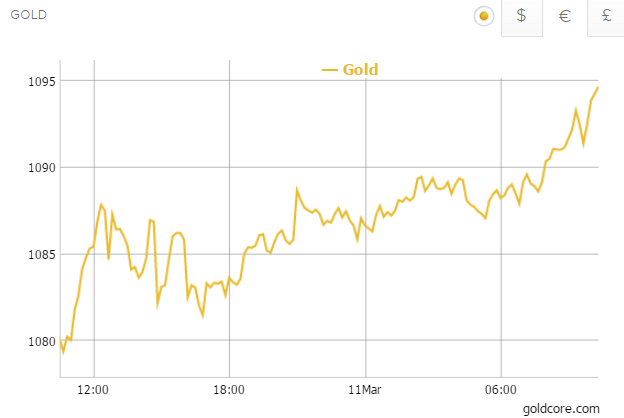
Gold remained steady at its lowest levels in three months as the U.S. dollar moves closer to parity with the euro.
In Singapore, towards the end of the trading day, gold for immediate delivery was $1,164.05 an ounce.
Recent U.S. economic data like the positive employment figures have stoked hopes the U.S. Fed will raise interest rates in June and this is hurting the yellow metal.
Asian physical demand will support prices as Chinese buyers tend to buy the dip. The premiums gold is trading at in Asia recently has been between $4-$6 over London benchmarks.
The Troika are meeting with Greece today who again needs help with debt repayments. Grexit is still a question mark and it is effecting the euro. Gold in euros is rising while gold in U.S. dollars is falling.
The euro has fallen below 1.06 versus the dollar and is approaching its lowest since March 21, 2003, after Draghi cautioned that inflation in the eurozone, which dipped into negative territory in December, will remain at low or negative levels for several months.
However, with Draghi’s big QE guns (buying up bonds) he notes the the ECB’s asset purchase programme will ultimately succeed in stoking inflation near the bank’s two percent target and that the slowdown in growth has been reversed.
In London in late morning trading, spot gold is trading at $1,158.59 or off 0.46 percent. Silver is $15.63 or $1,125.20 or down 0.36 percent. Platinum has been trading at its lowest levels since 2009.
end
It seems that the HSBC vault closing is only for retail customers.
GLD will still be housed by HSBC vaults. The move to force out the retail customers will probably see some customers sell their gold for cash due to a failure to locate a suitable facility:
(courtesy GATA/ Kingworldnews/Eric King/Andrew Maguire)
HSBC vault closures forcing customers to sell gold, Maguire tells KWN
Submitted by cpowell on Tue, 2015-03-10 23:35. Section: Daily Dispatches
7:30a TNT Wednesday, March 11, 2015
Dear Friend of GATA and Gold:
London metals trader Andrew Maguire tells King World News today that HSBC’s announcement that it is closing its London gold vaults — what the bank now is calling its “retail safe-deposit facilities” — with only 60 days’ notice is forcing some customers to sell their metal. Maguire suspects that this is the bank’s intent. An excerpt from his interview is posted at the KWN blog here:
http://kingworldnews.com/andrew-maguire-stunning-update-hsbc-london-gold…
CHRIS POWELL, Secretary/Treasurer
Gold Anti-Trust Action Committee Inc.
end
Doorknobs!!
“Under the swap, the central bank would provide 1.4 million troy ounces in exchange for cash, said a central bank source. After four years, it would have right of first refusal to buy the gold back, added the source, who asked not to be identified.”
The 1.4 million oz or 43.5 tonnes would satisfy China’s demand for gold for one week.
(courtesy zero hedge)
Venezuela negotiating again to pawn its gold reserves, sources tell Reuters
Submitted by cpowell on Wed, 2015-03-11 10:57. Section: Daily Dispatches
Venezuela Discussing Gold Swap with Wall Street Banks, Sources Say
By Eyanir Chinea and Corina Pons
Reuters
Tuesday, March 10, 2015
CARACAS, Venezuela — Venezuela’s central bank is in talks with Wall Street banks to create a gold swap that would allow it to monetize some $1.5 billion of the metal held as international reserves, according to government sources familiar with the operation.
The move would help the government of President Nicolas Maduro boost its hard currency position as the OPEC nation struggles with soaring consumer prices, chronic product shortages and a shrinking economy caused by low oil prices.
Under the swap, the central bank would provide 1.4 million troy ounces in exchange for cash, said a central bank source. After four years, it would have right of first refusal to buy the gold back, added the source, who asked not to be identified.
… For the remainder of the report:
http://www.reuters.com/article/2015/03/10/us-venezuela-gold-idUSKBN0M62C…
end
Zero hedge comments on the above story:
(courtesy zero hedge)
Venezuela Begins Liquidating Its Gold
http://www.zerohedge.com/users/tyler-durdenSubmitted by Tyler Durden on 03/11/2015 10:07 -0400
Yesterday we reported that in retaliation to the latest Obama executive order which declared Venezuela a national security threat and ordered sanctions against seven officials, Maduro promptly took advantage of this “outside threat” to rally his toilet paper-starved population “around the flag”, and while pointing at the “evil imperialist” Obama, granted himself even greater authoritarian powers: “I have put together a special law that gives me special powers to preserve the peace, the integrity and the sovereignty of the country before any situation that presents itself due to this imperialist aggression.“
Bloomberg further quoted Maduro as saying that the “special decree powers will help defend Venezuela democracy, freedoms”, that “the U.S. using human rights issues to justify invasion of Venezuela, planning trade blockade”, and that Maduro will “lead a special defensive military exercise on March 14.” Because nothing screams democracy like going “peak dictator” and launching a military exercise.
Venezuela’s always entertaining leader aside, Venezuela’s political problems have their basis in, and will only get worse due to one simple thing: money, or the lack thereof.
As a reminder, the nation whose primary – and only according to some – export is oil, has been slammed in recent months due to tumbling oil prices, which means oil is now a loss-maker for Caracas, whose oil breakeven price is said to be far higher than where Brent is currently trading. Which is why Maduro’s political troubles seem to be multiplying in recent months: in fact it has gotten so bad that some press reports suggest Maduro’s grip on the military is starting to wane.
Which likely explains why in an attempt to secure some stability, i.e., funds, now that Venezuela is no longer able to tap Chinese bailout loans as last-recourse funding, Reuters reported that Venezuela’s central bank is in talks with Wall Street banks to create a gold swap that would allow it to monetize some $1.5 billion of the metal held as international reserves, according to government sources familiar with the operation.
Under the swap, the central bank would provide 1.4 million troy ounces in exchange for cash, said a central bank source. After four years, it would have right of first refusal to buy the gold back, added the source, who asked not to be identified.
Of course, by then Maduro will almost certainly no longer be the ruler, so the “gold buying back part” will be someone else’s problem, and what is actually happening is that Maduro is “pawning” some 1.4 million ounces of gold to a banker syndicate, one organized by Bank of America and Credit Suisse according to Reuters, in exchange for $1.5 billion.
It also explains why there is an implied 7% discount to market prices in the swap, since 1.4 million ounces equivalent to $1.5 billion translates to about $1,070 per ounce, or a 7% discount to market.
Or said otherwise, a liquidation.
The banks and Venezuela’s central bank did not immediately respond to requests for comment.
“Work is being done to complete this operation toward the end of April,” said another source, linked to Venezuela’s finance ministry.
Venezuela would have to pay interest on the funds but the central bank would most likely be able to maintain the gold as part of its foreign currency reserves.
As a further reminder, most of Venezuela’s reserves are held in gold after late socialist leader Hugo Chavez began moving central bank assets away from the dollar in the wake of the 2008 global financial crisis. “The central bank in late 2013 received proposals to carry out a similar operation, the bank’s chief said at the time, but denied any agreements had been completed.”
And now, Venezuela is selling its gold, which at least in the global central bank arena, appears to be a far more liquid asset that “tradition” and is instead perfectly legitimate legal tender.
Finally, now that Maduro has tipped his hand how he plans on funding the country’s near term debt and cash obligations, this is just the beginning: his administration faces a cash crunch following the maturity of a 1 billion euro bond this month and coupon payments of nearly $700 million in April. Expect Venezuela’s gold liquidation to accelerate. The only question is who will end up the rightful owner of Venezuela’s physical gold once the pawn shop confiscates the collateral.
http://www.zerohedge.com/news/2015-03-11/venezuela-begins-liquidating-its-gold
end
(courtesy Lawrence Williams/Mineweb)
World top 10 gold miners face negative free cash flows
The world’s biggest gold miners moved to combined negative cash flow in Q4 2014.

We are indebted again to precious metals analysis consultancy, Metals Focus, for bringing to our attention that the world’s top gold miners had moved into a combined Negative Cash Flow (NCF) position during the final quarter of last year. This is after three consecutive quarters where they had recorded positive Free Cash Flow (FCF) – that is after taking into account all elements of costs including capital expenditures.
For several years, Mineweb ran a campaign to push the gold mining sector to report FCF figures (South Africa’s Gold Fields was probably the only Tier 1 gold miner at the time which did) but eventually most have come round to so doing – helped by the relatively new reporting metric of All In Sustaining Costs (AISC), to which most big gold miners now subscribe, which gets close to reporting the FCF figure.
Prior to this mining companies, and gold miners in particular, were prone to reporting profits and capital expenditures as completely separate balance sheet items, although the true situation frequently saw profits being reported while company treasuries were being drained overall by high capex and led to the situation where borrowing, equity raising or asset disposals had proved to be necessary for the company to maintain its dividends.
The latest Metals Focus Peer Group Analysis report looks at the ten top gold mining companies which between them account for around a third of global new mined gold output. In Q4, this subset of gold miners fell back into reporting a combined negative cash flow of $270 million.
While lower gold prices were part of the equation (on average 6% quarter on quarter) and operating costs continued to show some improvement on the prior quarter, although only flat on those of a year earlier, what was apparent was that some other costs – notably corporate costs, were up by as much as 4% QOQ – and this despite continuing job cuts at corporate level.
Perhaps most significant though was a rise in capital spending – up 9% QOQ – and even more significantly perhaps is that this was mostly incurred in terms of sustaining capex – or stay-in-business capex as Metals Focus puts it. New project capex continues to be down and the consultancy notes that while in 2010-2013 sustaining capex accounted for less than 50% of total capital expenditures, in Q4 last year that figure had risen to around 70%. This confirms that the big gold miners are currently putting far less money into greenfields projects and major mine expansions as they struggle to keep overall expenditures down due to shareholder pressures to do so.
But what this signifies too, perhaps, is that the easy cost cutting improvements have already been made – and the rise in corporate costs could also suggest that the gold miners are beginning to drop the ball as far as cost cutting is concerned. The fact that sustaining capex costs are rising again – and quite steeply it seems – also has to be a worry for the miners and their shareholders. The gold price remains weak, and is seen by many observers as likely to stay depressed for the next several months at least – and perhaps fall back further, which does not bode well for FCF figures in the current half year. Perhaps the earnings recoveries seen last year are going to be difficult to build on in many cases.
Another factor pointed out by Metals Focus in its peer group analysis is the high level of net debt within the grouping, although this does not apply to all the companies surveyed. Cumulatively it stood at $27.5 billion at the end of 2014 and will take several years to pay off based on earnings before interest and tax – and if the gold price remains weak or falls further this could take much longer still. There are thus still considerable hurdles ahead to be overcome for even the biggest gold miners and it looks as though top tier gold miner FCF will remain weak or negative unless and until the gold price sees a significant turnaround.
Charlie Brown and higher interest rates
Do you remember how Lucy always pulled the football each time Charlie Brown tried to kick it? To this day, he’s fallen on his rear end and every time while Lucy just snickers. This is exactly what the Federal Reserve has done since late 2009. If you recall, we heard about “green shoots” in the economy and “recovery” has been the watch word ever since. The one word you have not heard and certainly not seen is “expansion”.
And now for the important paper stories for today:
Early Wednesday morning trading from Europe/Asia
1. Stocks generally lower on major Chinese bourses/ / the yen slightly falls to 121.48
1b Chinese yuan vs USA dollar/ yuan strengthens to 6.2615
2 Nikkei up 58.14 or 0.31%
3. Europe stocks all up // USA dollar index up to 99.56/Euro in free fall down to 1.0605
3b Japan 10 year yield .43%/ (Japan buying 100% of bond issuance)/Japanese yen vs usa cross now at 121.35/everybody watching the huge support levels of 117.20 and that level acting as a catapult for the markets.
3c Nikkei still above 17,000/
3e The USA/Yen rate now above the 121 barrier this morning/
3fOil: WTI 48.48 Brent: 56.57 /all eyes are focusing on oil prices. This should cause major defaults as derivatives blow up.
3g/ Gold s down /yen slightly down;
3h/ Japan is to buy the equivalent of 108 billion usa dollars worth of bonds per MONTH or $1.3 trillion
Japan’s GDP equals 5 trillion usa/thus bond purchases of 26% of GDP
3i Japan to buy 100% of all new Japanese debt and by 2018 they will have 25% of all Japanese debt. Fifty percent of Japanese budget financed with debt (see Von Greyerz)
3j Oil up this morning for WTI and for Brent
3k European bond buying pushes yields lower on all fronts in the EMU
Except Greece which sees its 2 year rate rise to almost 19% /Greek stocks down .8%/expect huge bank runs on Greek banks
3l Greek 10 year bond yield :10.69% (up 60 basis points in yield)
3m Gold at $1158.50 dollars/ Silver: $15.60
3n USA vs Russian rouble: ( Russian rouble down 5/8 rouble / dollar in value) 61.86!!!!!!.
3 0 oil into the 48 dollar handle for WTI and 56 handle for Brent
3p higher foreign deposits into China sees risk of outflows and a currency depreciation can spell financial disaster for the rest of the world./China may be forced to do QE!!
3Q SNB (Swiss National Bank) still intervening again driving down the SF/window dressing/Swiss rumours of intervention to keep the soft peg at 1.05 Swiss Francs/euro and major support for the Euro.
Rumours SNB may cut rates to negative 1.5%
3r Britain’s Serious fraud squad investigating the Bank of England/
3s the 7 year German bund is now in negative territory/no doubt the ECB will have trouble meeting its quota of purchases and thus European QE will be a total failure (see passage below)
3t Talks with Greece to start today/does not look good
4. USA 10 yr treasury bond at 2.13% early this morning. Thirty year rate well below 3% (2.74%!!!!)/yield curve flattens/foreshadowing recession
5. Details: Ransquawk, Bloomberg/Deutsche bank Jim Reid
Euro In Freefall, Dollar Surge Accelerates; Futures Rebound On USDJPY Rise; Greece On The Ropes
While the dollar strength this morning, which has pushed it to a fresh 13 year high and has accelerated the EURUSD plunge to under 1.06 – a drop of over 300 pips since the start of the week – has been a recap of yesterday’s trading action, the main difference is that unlike yesterday, the USDJPY has managed to find a strong bid in the overnight session, pushing not only the Nikkei up by 0.4%, but also lifting US equity futures as the entire global marketplace is now merely a sandbox in which the central banks try to crush their currencies as fast as possible.

And it isn’t just Europe: overnight, China reported property sales in the first two months of 2015 which dropped by the most in three years amid a glut of housing supply, and real estate investment growth eased. Retail Sales (10.7%, Exp 11.66%) and Industrial Output also missed, rising 6.8% for the Jan/Feb period, below estimates of 7.7%. Even Goldman was shocked: “Activity data for the combined January-February period (the NBS releases these two months together given the difficulty of adjusting for Chinese New Year effects) was significantly weaker than expected across IP, FAI, and retail sales. For overall industrial production,this was the weakest year-over-year reading ever (China’s IP data starts from 1995) outside the global financial crisis.
This follows news that China plans to merge its big state-owned enterprises, telling thousands of SOEs “that they need to rely less on state life support and get themselves ready to list on public markets.” But the most surprising development was increasing chatter of QE out of China which is banging the dram that “no QE is coming” but it simply makes the market wonder just how much further can the economy tumble before the government has to do what we first said it will. More on this in a follow-up post.
And as usual the other big story out of Europe is how long until the entire European bond curve trades at -0.20%. Germany’s 10Y Bund briefly dropped to under 0.20% before staging a modest rebound, which may well have been the ECB selling some bonds even as it buys, just to show the market it isn’t merely one way action. Alas, with EGB volumes aside from the ECB negligible, it will have its work cut out for itself and very soon Draghi may be forced to admit defeat after he pushes the entire European bond complex into negative territory with over a year of QE left, giving him no further room for monetization.
The one place where European yields moved wider was Greece, where the market is increasingly convinced the troubled nation may be finally let loose from the Eurozone, especially following a Draghi statement thatECB action shields euro zone states from Greek contagion, which has been taken by some as a green light that Greece’s days in the Eurozone are numbered. Not helping is French FinMin Sapin, who said Greece is running out of time, money and friends, which meanns that even France which had made the most conciliatory noises toward Greek calls for less austerity, expressed frustration with Greece FinMin Varoufakis, while Spain’s finance minister also hardened the rhetoric. As a result the selling across the Greek curve has continued for yet another day as follows:
- 3y 18.20%; +177 bps
- 5y 14.76%; +79 bps
- 10y 10.75%; +36 bps
- 15y 10.77%; +38 bps
As a reminder, today the Greek technical negotiations, both in Brussels and, far more quietly in Athens, are set to begin. The outcome will not be pleasant.
Looking at equity markets, Asian stocks traded mixed following yesterday’s sell-off on Wall Street, which saw US equities record their worst run in 2-months, erasing their gains for the year. Nikkei 225 (+0.3%) recovered earlier losses amid a weak JPY and as gains by health care stocks outweighed declines in energy names.Shanghai Comp (+0.1%) and Hang Seng (-0.8%) both came off their best levels as Chinese data missed expectations. Industrial Production rose 6.8% vs. Exp. 7.7% while Retail Sales saw an increase of 10.7% vs. Exp. 11.6%. JGB’s trade up 52 ticks with outperformance in the belly of the curve underpinned by yesterday’s rally across USTs and German Bunds.
European equities trade higher despite the losses seen at yesterday’s Wall Street close and overnight, with no pertinent new macro newsflow behind the move. However to put today’s move into perspective, European equites trade only modestly above yesterday’s open, with prices relatively depressed elsewhere after US equities reversed their gains for the year during yesterday’s session with the S&P 500 also breaking below its 50DMA.Furthermore, analysts at Goldman Sachs note that European equities have been bolstered by the ECB’s QE programme and the weaker EUR which has also stemmed from the prospect of Fed rate lift-off. As a consequence of the weaker EUR< European car names lead the way higher with gains largely broad-based elsewhere after early outperformance in energy names failed to sustain as the USD continues to weigh on oil prices.
Despite pulling away from their best levels, Bunds rose sharply after the Eurex open in a similar fashion to the past few days since the commencement of the ECB’s bond-buying programme, subsequently sending the German 10yr yield below 0.2% for the first time. Interestingly, after-market yesterday ECB’s Coeure said he does not see any signals that it will be hard to find bonds to purchase. Nonetheless, the upside momentum for German paper failed to sustain alongside the strength in equities, while the GR/GE spread is wider as technical talks between Greece and EU start today with comments yesterday from the German finance minister suggesting a compromise is still some way off.
In FX markets, once again a bulk of the price action has been led by the USD-index which still shows no signs of slowing its recent move to the upside. This has subsequently weighed on its major counterparts, with EUR/USD further consolidating its move below 1.0600. Alongside the move in the USD, GBP/USD was unable to hold onto opening gains after the latest Ashcroft poll revealed a 4ppt lead for the Conservative party ahead of the May election; the largest lead in 3 years. This morning’s session also saw ECB President Draghi on the speaker slate, however, comments were largely a reiteration of those already made.
In the commodity complex, energy prices were initially supported by yesterday’s API crude inventories showed an unexpected fall in oil stockpiles (W/W -404K vs. Prev. 2900K). Nonetheless, the latest figures were not enough to sustain the upside, with Brent and WTI subsequently dragged lower by the USD to relatively unchanged territory. In metals markets, spot gold and silver trade relatively flat while Dalian iron ore futures were weaker overnight amid continued China steel sector concerns after steel inventories rose for a 6th consecutive session.
In summary: European shares rise with the autos and telco sectors outperforming and retail, oil & gas underperforming. French 10-year bond yield falls below 0.5% for first time, yields also fall to record lows in Spain, Italy, Finland, Austria. Euro drops to lowest since April 2003 against dollar. Draghi says ECB action can and will return inflation to goal. China Feb. industrial production, retail sales below estimates. The French and Italian markets are the best-performing larger bourses, U.K. the worst. The euro is weaker against the dollar. Japanese 10yr bond yields fall; German yields decline. Commodities gain, with natural gas, Brent crude underperforming and wheat outperforming. U.S. mortgage applications due later.
Market Wrap
- S&P 500 futures up 0.4% to 2050.1
- Stoxx 600 up 1% to 393.7
- US 10Yr yield little changed at 2.13%
- German 10Yr yield down 1bps to 0.22%
- MSCI Asia Pacific down 0.3% to 142.3
- Gold spot up 0% to $1162.4/oz
- Eurostoxx 50 +1.3%, FTSE 100 +0.4%, CAC 40 +1.4%, DAX +1.2%, IBEX +0.9%, FTSEMIB +1.2%, SMI +0.7%
- Asian stocks fall with the Nikkei outperforming and the Hang Seng underperforming.
- MSCI Asia Pacific down 0.3% to 142.3; Nikkei 225 up 0.3%, Hang Seng down 0.7%, Kospi down 0.2%, Shanghai Composite up 0.1%, ASX down 0.5%, Sensex up 0%
- Euro down to $1.0566
- Dollar Index up 0.38% to 99
- Italian 10Yr yield down 3bps to 1.19%
- Spanish 10Yr yield down 1bps to 1.24%
- French 10Yr yield down 1bps to 0.51%
S&P GSCI Index up 0.3% to 404.3 - Brent Futures down 0.1% to $56.4/bbl, WTI Futures up 0.4% to $48.5/bbl
- LME 3m Copper up 0.4% to $5788/MT
- LME 3m Nickel up 0.8% to $14160/MT
- Wheat futures up 1.4% to 500.3 USd/bu
Bulletin Headline Summary from RanSquawk and Bloomberg
- As has been the case over the past few days, USD-index has continued to climb, much to the detriment of its major counterparts
- European stocks trade higher amid no new fundamental macro news with European car makers leading the way higher as a result of the weaker EUR
- Looking ahead, today sees the release of US crude oil inventories which are expected to show a build of 4.75mln bbls (prev. build 10.303mln) as well as the results of the Fed stress test results
Treasuries steady as week’s auctions continue with $21b 10Y notes; WI yield 2.15%, highest since Dec., vs. 2.00% award in February.
Jeffrey Gundlach says if the “blockhead” Fed raises rates in the middle of 2015, it will have to reverse course; says Fed has not learned from errors made by global counterparts, Yellen spends too much time with foreign officials
Draghi said the ECB’s expanded asset purchases will succeed in pushing inflation in the euro area back toward its goal
The amount of bonds eligible for the ECB to buy under QE is poised to shrink as the purchases risk pushing more yields below zero, according to SocGen
ECB QE may end early on “ugly” bond market selloff, Scotia’s Guy Haselmann says
Bank of Japan needs to drive JPY to 140 if it wants to secure a 2% inflation target next year, a survey of economists by Bloomberg News shows
Officials from the ECB, EC and IMF are headed for Athens as the govt prepares to open its accounts for inspection; talks due to begin in Brussels on Wednesday with technical discussions starting in Athens a day later, according to two officials
Greece is running out of time, money and friends. France’s Michel Sapin, whose govt had made the most conciliatory noises toward Greek calls for less austerity, expressed frustration with Greece FinMin Varoufakis, while Spain’s finance minister also hardened the rhetoric
U.K. manufacturing output fell 0.5% in January vs expectations for 0.2% gain as computer and electronics production plunged
China’s economy is already behind target as monetary easing shows few signs of traction, with industrial output, investment and retail sales growth missed analysts’ estimates in January and February
Sovereign 10Y yields mostly lower. Asian stocks mostly lower, European stocks gain, U.S. equity-index futures rise. Crude and copper higher, gold lower
DB’s Jim Reid completes the overnight event summary
Whether there’ll be a happy ending to the Fed story in 2015 is intriguing. One of the reasons we think they’ll find it tough to raise rates or at least justify anything close to the dots over time is due to the likely adverse market reaction across large parts of the world to such a move. Also the continued strength of the dollar seems to be leading to more conversations along the lines of at what point does dollar strength stop simply being a sign of a relatively strong US economy and start being a reason to doubt the continuation of that strength. As we have said many times, can the Fed afford to position policy in a way that ensures they lose out in the ongoing subtle global currency war? This story won’t go away. With a strong dollar, risk assets struggled across the board yesterday with global equity, credit and commodity markets weak whilst government bonds rallied again. In European equities, the Stoxx 600 fell -0.9%, the FTSE 100 -2.5%, the CAC -1.1%, the DAX -0.7%, the IBEX 35 -1.4% and the FTSE MIB -1%. There were no specific headlines to speak of in the US but the S&P500 echoed the broad based pull back in risk to close -1.7% on the day to wipe out its YTD gain. European equities are still well ahead of the US this year and we think the gap can increase further, even on a currency adjusted basis. Follow the QE flow.
China’s monthly data dump has come out just as we’re going to print. Overall the data was disappointing with retail sales, industrial production and fixed asset investment February YTD all below expectations. In terms of market reaction, Asian equities are a mixed bag with the Nikkei up +0.7% and the Shanghai Comp (+0.4%) outperforming the rest of the region, however the data has only just come out. The softness might promote more easing hopes though. Elsewhere the Dollar is broadly stable overnight against major currency pairs which has perhaps given Oil some support. Brent and WTI are up +0.8% and +1.3% respectively as we go to print.
Credit markets also struggled a bit yesterday with Main and Crossover in Europe +1bps and +4bps wider whilst in the US CDX IG and CDX HY widened out by +1bp and +9bps. In commodities oil closed the day down -1.4% whilst copper closed down -1.7%. The notable outperformers yesterday were government bonds which experienced a second day of impressive performance with the strong payrolls now long forgotten as German, French, UK and US 10Y yields fell 8bps, 8bps, 13bps and 6bps respectively with most European markets at multi-century all time yield lows again. We jokingly said yesterday that if the first day of QE is extrapolated out to September 2016, 10 year Bunds will be -31%! On day two moves were similar to day one so we’re still on course! At a yield of 0.23% the world is indeed a strange place. Elsewhere on the curve German 2yrs rallied 1.8bps to -0.24% and 30yrs a large -13bps to 0.76%. European peripheral governments also had a positive day with 10Y Spanish and Italian yields also dropping 3bps and 6bps, although continued tensions (more later) in Greece saw the Greece 10Y yield rise 29bps to end the day back above 10%.
With the strong dollar, it was also a big day for FX markets yesterday with the euro falling 1.3% vs the greenback and 1% vs sterling, hitting roughly 12 year and 7 year lows respectively. Indeed the US dollar rose vs. every other G10 currency. This move came on the back of a relatively hawkish final speech from the president of the Fed bank of Dallas (who is stepping down later this month) during yesterday’s Asian session. He argued for hikes sooner rather than later saying, “The idea that we can substitute a steeper future funds-rate path for an early liftoff seems risky to me… I would rather the FOMC raise rates early and gradually than late and steeply.”
On a related note, DB’s FX team in a special report yesterday revised their EUR/USD forecasts lower and now see a move down to 1.00 by the end of the year, 90cents by 2016 and a new cycle low of 85cents by 2017. Their forecasts are based upon their “Euroglut” theory which is the idea that the Euro-area’s huge current account surplus reflects a very large pool of excess savings that will have a major impact on global asset prices for the rest of this decade.
In terms of macro data in Europe, yesterday saw French January IP came in notably ahead of expectation (at +0.4% MoM) whilst Italian IP came in notably below (at -0.7% MoM) whilst over in the US wholesale inventories rose more than expected (at +0.3% MoM) and the JOLTS job opening report saw both a below expectation read and a negative revision to the previous number.
Looking to the day ahead the main highlight is likely to be the talks between Greece and its creditors today with eurogroup head Jeroen Dijsselbloem (Bloomberg News) saying yesterday that Greece must begin talks today with both technicians (EC, ECB and IMF in Athens) and creditors in Brussels as, “If the programme remains lying dead in a corner, then the world outside won’t have much trust in it, and then the lack of confidence in Greece and around Greece will return” (Reuters). He added that, “Just receiving the money without any action – it’s not going to happen,” which underlines that the rest of Europe is expecting progress from the Greeks now. Beyond Greece, in Europe we have UK January IP (expected to rise to +0.2%), and have speeches from the ECB’s Draghi, Praet and Liikanen. In the US the Fed is releasing results for the second set of stress tests.
end
China reports worst Industrial production ever:
(courtesy zero hedge)
China Reports Worst Industrial Production Data Ever Outside Of The Global Financial Crisis
Following two clear recessionary indicators out of the US in the form of the recently reported factory orders…

and Wholesale Trade…

overnight it was China’s turn to remind the US that things can always get worse when it reported retail sales, industrial production and fixed asset investment all of which slid about as fast as the C:\China\economy\goalseek.xls would allow them, and wildly missed expectations, suggesting that China will strugle significantly even with hitting its downward revised 7% growth bogey. Putting this ugly data in context, China’s overall industrial production just saw its weakest year-over-year reading ever outside the global financial crisis.

Here is Goldman’s summary:
- Industrial production (IP): 6.8% yoy in Jan-Feb (GS and Bloomberg consensus: 7.7%); December: 7.9% yoy. Sequential IP growth (Jan-Feb over Dec) -4.4% annualized (seasonally adjusted by GS). December: +16.8% SA, annualized.
- Retail sales: 10.7% yoy in Jan-Feb (GS: 11.0%, consensus: 11.6%); December: 11.9% yoy.
- Fixed asset investment (FAI): +13.9% yoy in Jan-Feb (GS: 14.0%, consensus: 15.0%). December: 15.0% yoy.
- Property FAI: + 10.4% yoy in Jan-Feb, from 2014 full year growth of 10.5% yoy.
- Infrastructure FAI: + 21.7 % yoy, vs 21.1% yoy for full year 2014.
- Manufacturing FAI: +10.6% yoy, down from 13.5% yoy for full year 2014.
- Property sales (floor space sold): -16.3% yoy (versus -7.6% in 2014). New starts: -17.7% yoy vs 2014 full year -10.7%. Floor area under construction +7.6% yoy in Jan-Feb (vs. 9.2% yoy in 2014)
Activity data for the combined January-February period (the NBS releases these two months together given the difficulty of adjusting for Chinese New Year effects) was significantly weaker than expected across IP, FAI, and retail sales. For overall industrial production, this was the weakest year-over-year reading ever (China’s IP data starts from 1995) outside the global financial crisis.
We believe the weakness is primarily a reflection of genuinely weak domestic demand. This in turn was a function of weaker fiscal outlays and less aggressive administrative policy support for FAI (compared with late 2014), as well as seasonal effects of the heightened anticorruption campaign (which are particularly evident around the traditional gift-giving period of Chinese New Year). Export momentum is more difficult to assess given large Chinese New Year effects, but does not look to have been particularly strong either (the bulk of the rise in trade surplus has come from particularly weak import, on both price and volume effect) The yoy growth of industrial goods export delivery fell from 4Q 2014 level while yoy customs exports growth improved, possibly reflecting the difference between time of production and shipment.
Since the NBS no longer releases January and February activity data separately we cannot gauge if there was an improvement in February from January level. This is unfortunate since had February IP data shown an improvement despite downward Chinese New Year distortions, as happened to both the official and HSBC PMI series, we would be able to know if there indeed has been a sequential improvement on the back of more aggressive policy support.
Given this set of exceptionally soft data, we believe the government will certainly loosen policy further, especially in terms of administrative measures to encourage fiscal outlays, in the coming months. This should lead to at least some pickup in sequential activity data.


That’s the bad news. The good news is that since every economic action has a more than equal and opposite central bank reaction, Goldman’s conclusion is that “combined January-February activity data surprised significantly on the downside, which increases the likelihood of additional policy easing in the near term.”
So just how much longer do we have to wait until the inevitable moment when the last marginal central bank joins the global currency war and starts “printing money” on its own, finally pushing the world over to the next escalation level in the “[insert noun] wars” chain?
end
China’s shipping industry in a total mess:
(courtesy London’s financial times and special thanks to Robert H for sending this to us)
China shipbuilders urged to merge in bid to stay afloat
Missing shipowners, a white knight reportedly detained by Beijing police and an abandoned African timber deal have all featured in recent Chinese shipping disasters, as the country’s slowest economic growth in a quarter-century sinks Chinese shipbuilders and their clients at an alarming rate.
In a bid to contain the damage, government official have urged the country’s two largest private shipbuilders to discuss a potential merger.
Earlier this week, Singapore-listed Yangzijiang Shipbuilding said it had been asked by Chinese government agencies to consider taking a stake in China Rongsheng Heavy Industries, a smaller rival that last year restructured debts totalling more than Rmb10bn ($1.6bn).
Rongsheng suspended trading in its Hong Kong-listed shares on Wednesdaymorning, pending the announcement of a “substantial disposal”.
While Rongsheng’s woes have been building for years, the recent collapse in the benchmark Baltic Dry Index to 30-year lows has pushed it and many other maritime companies to the brink — especially small, privately owned companies that build, lease or operate the bulk carriers that transport commodities such as iron ore and coal.
“Short-term ship leasing is cheap, punishing those who signed long-term leases at higher day rates a year ago,” says Russell Barling, an independent transport analyst. “Bulk shipping has been going through a long period of pain, winnowing out those with cashflow problems, and not just in China.”
Some recent failures have reverberated beyond Chinese shores.
On March 5, a Hong Kong liquidation meeting for Shagang Shipping attracted more than two dozen creditors including representatives of big global maritime players such as George Economou, the Greek shipping magnate, and Belgian bulk carrier Bocimar.
Privately owned Shagang first made waves overseas in 2013 when it asked South Korean authorities to seize a cruise ship operated by HNA Group, a Chinese conglomerate with which it has been embroiled in a dispute over $66m in alleged arrears. Shagang’s action forced HNA to organise an airlift evacuation of the vessel’s 1,600 stranded passengers.
Shagang’s own debts could be more than 10 times the amount it is seeking from HNA, according to Chris Grieveson, a maritime lawyer who is defending HNA. Shagang’s liquidators declined to comment.
“The massive profits that shipowners enjoyed up to 2008 were all driven by China’s demand for raw materials,” Mr Grieveson says. “But now there’s excess tonnage in the market and you’ve got low freight rates, so people are struggling.
“[Shagang] isn’t the only big shipping bankruptcy recently,” he adds, referring to the collapses of Denmark’s Copenship and Daebo Shipping of South Korea. “But China is very much in the centre of it all because everyone is taking goods there.”
In Rongsheng’s case, Chinese authorities intervened less than a week after a white knight investor, who had been poised to inject up to Rmb2.5bn into the company, was reportedly detained by Beijing authorities during the course of an unrelated corruption investigation.
“The company has no information as to the details of the incident and has been unable to contact [the investor],” Rongsheng told the Hong Kong stock exchange on March 4. “The board has decided that it is not in the best interests of the company and its shareholders to proceed with the [deal].”
Four other Chinese shipbuilders have, since early February, either been hit by court orders freezing their shareholders’ assets, secured government approval for restructuring or halted trading in their shares pending a reorganisation.
In the last case, Singapore-listed JES International announced the restructuring of its Chinese shipbuilding arm, which it said had been brought low by “inadequate internal management” and “sustained significant financial losses”. The company also abandoned plans to purchase a forestry business in the Congo.
China shipping industry distress Company Sector Debt (Rmb m) Notes China Rongsheng Heavy Industries Shipbuilding 10,000 White knight investor reportedly missing Shagang Shipping Bulk shipping 4,125 Filed for liquidation in Hong Kong Mingde Heavy Industry Shipbuilding 700 Company president, shareholder’s assets frozen Shanghai Hong Sheng Gang Tai Shipping Container shipping 200 Management reportedly missing; ships/cargo seized Dalian Winland Shipping Bulk shipping na Bankrupt Jiangsu Eastern Heavy Industries Shipbuilding na Parent’s Singapore-traded shares halted pending restructuring Guangzhou Wenchong Shipyard Shipbuilding na Restructuring approved by Chinese government Yangzhou Kejin Shipyard Shipbuilding na Restructuring approved by Chinese government Sources: www.splash247.com, company announcements, Chinese media reports In another diversification bid, Rongsheng purchased stakes in four oil fields in Kyrgyzstan last year but remains hamstrung by the collapse of its core business. In its search for a saviour for Rongsheng, the Chinese government passed over six large state-owned groups, many of which are struggling with chronic problems of their own.
“There is massive overcapacity in Chinese shipbuilding,” says Tim Huxley, chief executive of Wah Kwong Maritime Transport, a Hong Kong shipping company. “State-owned yards are not going to rush in to save these facilities.”
In addition to China’s struggling shipbuilders and Shagang, at least three other privately owned Chinese shipping companies have capsized this year.
end
we now have our 23rd nation with an interest rate cut:
(courtesy zero hedge)
Thai Central Bank’s Surprise Action Is 23rd Rate Cut Of The Year
Whether the world’s central banks are ‘co-operating’ or competing is up for question but the tsunami of policy easings so far this year is making the ‘surprise’ rate cut, unsurprising. As Bloomberg reports, Thailand today became the latest to execute an unexpected interest-rate cut, bringing the total to 23 in 2015. While only 6 of 22 economists expected it, the Southeast Asian country — a onetime export powerhouse that’s seen its manufacturing mojo dim somewhat in recent years amid historic flooding and political infighting — lowered its main rate to 1.75%. “The surprise move suggests the economy is much weaker than expected,” noted one analyst, adding that “it is negative for the baht and there’s concern that lower rates may lead to more outflows as the U.S. is expected to raise rates.”
The Thai economy expanded at its slowest pace in three years in 2014. It has continued to recover slowly, and the central bank will lower its forecast for growth this year from 4 percent on March 20, Assistant Governor Mathee Supapongse said today.
“The policy effectiveness may not be much, but the rate cut can help the economy when the other drivers are not fully functioning,” he told reporters after monetary policy committee members voted four-to-three in favor of today’s decision. “We should use the bullets that we have.”
The central bank will act when needed to support the recovery and maintain financial stability in the long term, he said. Fiscal stimulus, especially the implementation of planned public investment, should be a key growth driver, he said.
…
In Thailand’s case, China loomed large.Its biggest trading parter expanded the least since 1990 last year, and the Bank of Thailand acted hours after economic data showed China’s slowdown continued into 2015.
“The surprise move suggests the economy is much weaker than expected,”said Sasikorn Charoensuwan, head of research at Phillip Securities (Thailand) Pcl in Bangkok.“While the reduction is positive for stocks and bonds, it is negative for the baht and there’s concern that lower rates may lead to more outflows as the U.S. is expected to raise rates.”
The benchmark SET Index closed 0.8 percent higher, erasing an earlier loss of as much as 0.7 percent. The baht dropped 0.6 percent to 32.92 a dollar, the weakest since Jan. 5.
* * *
And the Thai Baht is dumping lower…

* * *
Here is the full list of the 23 central bank rate cuts so far in 2015:
1. Jan. 1 UZBEKISTAN
Uzbekistan’s central bank cuts its refinancing rate to 9 percent from 10 percent.
2. Jan. 7/Feb. 4 ROMANIA
Romania’s central bank cuts its key interest rate by a total of 50 basis points, taking it to a new record low of 2.25 percent. Most analysts polled by Reuters had expected the latest cut.
3. Jan. 15 SWITZERLAND
The Swiss National Bank stuns markets by scrapping the franc’s three-year-old exchange rate cap to the euro, leading to an unprecedented surge in the currency. This de facto tightening, however, is in part offset by a cut in the interest rate on certain sight deposit account balances by 0.5 percentage points to -0.75 percent.
4. Jan. 15 EGYPT
Egypt’s central bank makes a surprise 50 basis point cut in its main interest rates, reducing the overnight deposit and lending rates to 8.75 and 9.75 percent, respectively.
5. Jan. 16 PERU
Peru’s central bank surprises the market with a cut in its benchmark interest rate to 3.25 percent from 3.5 percent after the country posts its worst monthly economic expansion since 2009.
6. Jan. 20 TURKEY
Turkey’s central bank lowers its main interest rate, but draws heavy criticism from government ministers who say the 50 basis point cut, five months before a parliamentary election, is not enough to support growth.
7. Jan. 21 CANADA
The Bank of Canada shocks markets by cutting interest rates to 0.75 percent from 1 percent, where it had been since September 2010, ending the longest period of unchanged rates in Canada since 1950.
8. Jan. 22 EUROPEAN CENTRAL BANK
The ECB launches a government bond-buying programme which will pump over a trillion euros into a sagging economy starting in March and running through to September next year, and perhaps beyond.
9. Jan. 24 PAKISTAN
Pakistan’s central bank cuts its key discount rate to 8.5 percent from 9.5 percent, citing lower inflationary pressure due to falling global oil prices. Central Bank Governor Ashraf Wathra says the new rate will be in place for two months, until the next central bank meeting to discuss further policy.
10. Jan. 28 SINGAPORE
The Monetary Authority of Singapore unexpectedly eases policy, saying in an unscheduled policy statement that it will reduce the slope of its policy band for the Singapore dollar because the inflation outlook has “shifted significantly” since its last review in October 2014.
11. Jan. 28 ALBANIA
Albania’s central bank cuts its benchmark interest rate to a record low 2 percent. This follows three rate cuts last year, the most recent in November.
12. Jan. 30 RUSSIA
Russia’s central bank unexpectedly cuts its one-week minimum auction repo rate by two percentage points to 15 percent, a little over a month after raising it by 6.5 points to 17 percent, as fears of recession mount following the fall in global oil prices and Western sanctions over the Ukraine crisis.
13. Feb. 3 AUSTRALIA
The Reserve Bank of Australia cuts its cash rate to an all-time low of 2.25 percent, seeking to spur a sluggish economy while keeping downward pressure on the local dollar.
14. Feb. 4/28 CHINA
China’s central bank makes a system-wide cut to bank reserve requirements — its first in more than two years — to unleash a flood of liquidity to fight off economic slowdown and looming deflation. On Feb. 28, the People’s Bank of China cut its interest rate by 25 bps, when it lowered its one-year lending rate to 5.35% from 5.6% and its one-year deposit rate to 2.5% from 2.75%. It also said it would raise the maximum interest rate on bank deposits to 130% of the benchmark rate from 120%.
15. Jan. 19/22/29/Feb. 5 DENMARK
The Danish central bank cuts interest rates a remarkable four times in less than three weeks, and intervenes regularly in the currency market to keep the crown within the narrow range of its peg to the euro.
16. Feb. 13 SWEDEN
Sweden’s central bank cut its key repo rate to -0.1 percent from zero where it had been since October, and said it would buy 10 billion Swedish crowns worth of bonds
17. February 17, INDONESIA
Indonesia’s central bank unexpectedly cut its main interest rate for the first time in three years
18. February 18, BOTSWANA
The Bank of Botswana reduced its benchmark interest rate for the first time in more than a year to help support the economy as inflation pressures ease.
The rate was cut by 1 percentage point to 6.5 percent, the first adjustment since Oct. 2013, the central bank said in an e-mailed statement on Wednesday.
19. February 23, ISRAEL
The Bank of Israel reduced its interest rate by 0.15 percentage points, to 0.10 percent in order to stimulate a return of the inflation rate to within the price stability target of 1–3 percent a year over the next twelve months, and to support growth while maintaining financial stability.
20. March 1, CHINA
China’s Central Bank lowered by a quarter percentage point both the benchmark one-year loan rate, to 5.35%, and the one-year deposit rate, to 2.5%. “Deflationary risk and the property market slowdown are two main reasons for the rate cut this time.”
21. Jan. 15, March 3, INDIA
The Reserve Bank of India surprises markets with a 25 basis point cut in rates to 7.75 percent and signals it could lower them further, amid signs of cooling inflation and growth struggling to recover from its weakest levels since the 1980s. Then on March 3, it followed through on its promise and indeed cut rates one more time, this time to 7.50%
22. March 4, POLAND
The Monetary Policy Council lowered its benchmark seven-day reference rate by 50 basis points to 1.5 percent, matching the prediction of 11 of 36 economists in a Bloomberg survey. Twenty-three analysts forecast a 25 basis-point reduction, while two predicted no change.
23. March 11, THAILAND
The Southeast Asian country — a onetime export powerhouse that’s seen its manufacturing mojo dim somewhat in recent years amid historic flooding and political infighting — lowered its main rate to 1.75 percent.
* * *
Looks like it is the end for Greece:
(courtesy zero hedge
Tsipras Slams “Crimes Of Third Reich And Hitler’s Hordes”, Threatens Seizure Of German Assets
Earlier today, despite fears that it may not find enough cash to fund its latest T-Bill rollover, Greece was able to sell €1.3 billion of three-month Treasury bills, covering the amount it wanted to refinance a maturing issue, in what Reuters dubbed was an “auction that tested its ability to raise funds amid a cash crunch.” The paper came at a higher cost as the T-bills were priced to yield 2.70 percent, up 20 basis points from 2.50 percent in a previous sale in February, the country’s debt agency PDMA said.
However, this latest funding appears to have brought Greek funds to a critical low level because roughly at the same time news broke that Greek Justice Minister Nikos Paraskevopoulos said he is ready to sign an older court ruling that will enable the foreclosure of German assets in Greece in order to compensate the relatives of victims of Nazi crimes during the Second World War.
As Kathimerini reports, Greece’s Supreme Court ruled in favor of Distomo survivors in 2000, but the decision has not been enforced. Distomo, a small village in central Greece, lost 218 lives in a Nazi massacre in 1944.


“The law states that in order to implement the ruling of the Supreme Court, the minister of justice has to order it. I believe this permission should be given and I’m ready to give it, notwithstanding any obstacles,” Paraskevopoulos told Antenna TV on Wednesday.
“There must probably be some negotiation with Germany,” said Paraskevopoulos, who first announced his intention Tuesday during a Parliament debate on the creation of a committee to seek war reparations, the repayment of a forced loan and the return of antiquities.
Some background on the story from Keep Talking Greece:
On Tuesday, Greek Justice Minister Nikos Paraskevopoulos said that he was ready to sign an older decision issued in year 2000 by Greece’s Highest Court Areios Pagos that enables confiscation of German state property in Greece. The court decision confirmed the First Instance Court decision of 1997 that had ruled that Germany had to pay €28 million to descendants of the Distomo massacre.
On 10 June 1944, Waffen SS killed 218 men, women and children of Distomo village, in reprisal for attacks by resistance fighters.
“The confiscation of German property in Greece would affect the Goethe Institute and the German Schools in Athens and Thessaloniki,” Greek media report.
Speaking to ANT1 TV this morning, Paraskevopoulos said that the court decision needs only the signature of the Justice Minister in order to go in effect. However he implied that this will not be done immediately.
According to Greek media, already in 2000, PASOK Justice Minister had signed the court decision and a justicial clerk appeared at the door of Goethe Institute in Athens.
“However, the Justice minister withdrew his signature. after a couple of days later Germany approved the entrance of Greece to the Euro zone,” notes Proto Thema.
But the Justice Minister and every Justice Minister has to take into consideration the impact on bilateral relations.
Also on Tuesday, deputy Defense Minister Kostas Ysichos said that the ministry has the so-called Wehrmacht- Archive, an archive of 400,000 records of the German occupation, that is currently in the process of digitilization.
Clearly this would not set a favorable precedent for wealth redistribution within the European “Union.”
As KTG succinctly observes, “The decision comes amid a frozen atmosphere between Greece and Germany over bailout reforms and a series of insults spoken by German Finance Minister Wolfgang Schaeuble against his couPnterpart Yanis Varoufakis.”
During the same debate, Prime Minister Alexis Tsipras expressed his government’s firm intention to seek war reparations from Germany, noting that Athens would show sensitivity that it hoped to see reciprocated from Berlin.
Then again, “sensitive” is hardly how one would characterize his speech: when speaking before Parliament, Tsipras accused Germany of using legal tricks to avoid paying reparations for the Nazi occupation of Greece and said he would support parliamentary efforts to review the matter.
“After the reunification of Germany in 1990, the legal and political conditions were created for this issue to be solved. But since then, German governments chose silence, legal tricks and delay. And I wonder, because there is a lot of talk at the European level these days about moral issues: is this stance moral?” Tsipras said and added that “despite the crimes of the Third Reich and Hitler’s hordes, the German debt was written off”.
Germany has repeatedly rejected Greek calls for WWII reparations claiming that “war compensations to individuals was settled with the Agreement of 1960? and the “Agreement of 1990.”
However, “the Agreement of 1960 covered only compensation for the individual victims of Nazi horrors, not the destruction wrought on Greece during the 1941-1944 occupation and the enforced loan,” Tsipras said.
Why is Greece pushing for any recovery on the reparations front? Because the amount for the cash-strapped, and now desperate, country could be substantial: “according to some sources, the Greek claims from Germany are estimated €269 – €332 billion. In April 2013, after the investigation committee concluded its work, newspaper To Vima reported that the Greek claim was 162 billion euro.”
To Vima stressed to have seen the findings and reports that the experts found that Germany should pay Greece 108 billion euros for damage to infrastructure and 54 billion euros for a loan that the Nazi occupation forces obliged Greece to take in order to pay Berlin during the war.
In other words, the reparations are equivalent to about 80 percent of Greek gross domestic product.
Clearly this is merely the initial Greek ask. It would settle for anything. However, judging by the less than frosty German response, it will get exactly nothing: as Bloomberg reports, Germany views Greek reparations claims related to World War II as closed, Chancellor Angela Merkel’s spokesman Steffen Seibert says. “Germany has made its stance known and is sticking with it.” FinMin spokesman Martin Jaeger added that Germany “won’t negotiate on Greek claims because “this chapter is legally and politically closed as far as we’re concerned” adding that “Germany is very aware” of “moral responsibility” for legacy of Nazi era but that doesn’t change govt’s legal and political assessment.”
This is ironic considering just two days ago…
Sarcasm aside, digging up old wounds will merely accelerate the (less than) amicable parting of ways, especially after a speech earlier by ECB’s Draghi in which he said that ECB bond buying “may be shielding countries in the euro zone from any knock-on effect from events in Greece, ECB President Mario Draghi said on Wednesday.”
Which simply means that just because European government bond yields are on their way to 0% or below, the ECB is now convinced that any Greek leverage has been lost, and the more Greece pushes, the more likely the divorce finally takes place, even if a Grexit ultimately does open up a whole new can of worms because as Italy’s Padoan said yesterday, a “Euro exit would show that the Euro is not irreversible.” But we’ll cross that particular bridge once we get to it.
end
Greece is faltering because its biggest “export” i.e. shipping services is faltering because of poor growth from all countries including China.
Greece’s exports of goods is fine, it is in its service sector account, that is the shipping component of its current account that is suffering
(courtesy zero hedge)
The ‘Other’ Biggest Greek Problem: Shipping
Simply put – the Greek economy still consumes more than it earns. Despite a 25% contraction in its economy, a plunge in domestic consumption and a sharp decline in imports, as WSJ reports, Greece is still exporting less than it imports, i.e. its current account is still negative. The reason… Shipping.
Greece has enough problems, from food shortages and cash shortages to unemployment and suicides, but, as The Wall Street Journal blog notes, without a large current-account surplus, the Greek government and Greek companies will have big problems repaying the debtowed to creditors throughout the eurozone and at the International Monetary Fund.
Why haven’t those surpluses materialized? One reason was the sheer size of Greece’s current-account deficit: It peaked at 16.5% of gross domestic product in 2008. Without the ability to devalue its currency within the eurozone, erasing that deficit through cuts in relative wages and prices was always going to be a long and grueling process.
Wages across the Greek economy have fallen sharply, but Greece’s performance in the export of goods and services has been among the weakest in the eurozone over the last seven years:

Greece’s merchandise exports have actually performed quite well:

The fault lies in Greece’s exports of services, which slumped post-crisis and never recovered:

Look no further than shipping for an explanation here.
One of Greece’s main services exports is its large shipping industry. And after 2008, the economic crisis and a glut of new ships hitting the market caused global shipping rates to collapse; prices haven’t really recovered at all since.Greek exports of transport services – the vast majority of which are sea-freight exports – fell from €19 billion in 2008 to €12 billion in 2013.
And finally, to get a flavor of how ‘uncompetitive’ Greece was in 2008, even at record-high shipping rates, Greece’s current defict was nearly 16% of GDP…

So while the world points its finger at “lazy” Greeks, it appears their biggest problem is global growth and weak demand… the same as everyone else.
Charts: Bloomberg
end
Late in the day from Greece: they plan on raiding their pension fund
Reuters..
“Greece may tap social security funds to avert liquidity crunch: The FT cited a Greek government official, who warned of a €1.5B funding shortfall by the end of the month that could prompt the government to tap social security funds to avert a delay in government wage and pension payments. The article noted that ~€2B in in social security reserves could be transferred to the central bank’s Common Fund.”
USA sends drones and humvees to Ukraine as well as increase Russian sanctions:
(courtesy zero hedge)
US To Send Drones, Humvees To Ukraine, Boost Russia Sanctions As Moscow May “Deploy Nuclear Weapons In Crimea”
So much for the second Minsk ceasefire. A few hours ago, the US returned to its strategy of escalating Russian “costs” when it placed sanctions on eight Ukrainian separatists and a Russian bank, warning that recent attacks by rebels armed by Russia violated a European-brokered ceasefire in the war-torn country.
“If Russia continues to support destabilizing activity in Ukraine and violate the Minsk agreements and implementation plan, the already substantial costs it faces will continue to rise,” Adam Szubin, the Treasury Department’s acting undersecretary for terrorism and financial intelligence, said in a statement announcing the sanctions.
As Reuters adds, “the sanctions signal Washington is ratcheting up pressure on Moscow a day after accusing Russia of sending tanks and heavy military equipment into Ukraine, which a top U.S. official also said breached the Minsk accord agreed on Feb. 12.” What was not said is that this also comes a day after the US sent over 100 tanks and armors to Russia neighbor Latvia in a move that would, from the Kremlin’s perspective, signal further NATO arms build up on its borders.
Among the more prominent individuals sanctioned was Roman Lyagin, who chairs an election commission in separatist territory. The U.S. Treasury accused him of preventing voting in Ukraine’s May presidential election.
Lyagin said he was not a fighter and was playing a peaceful role in the separatists’ activities.
“It’s the opposite, I do my best to stop the bloodshed,” he said.
The full list of sanctioned individuals, as well the Russian National Commercial Bank, can be found here.
The Russian response to the latest sanction pending, but the response may have been hinted at earlier today when an official from Russia’s Foreign Ministery said the nation has the right to deploy nuclear arms in the Black Sea peninsula of Crimea, however he added “he knew of no plans to do so.”
“I don’t know if there are nuclear weapons there now. I don’t know about any plans, but in principle Russia can do it,” said Mikhail Ulyanov, the head of the ministry’s department on arms control, was quoted as saying by Interfax news agency.
And finally, indicating that the semi-hot escalation between the US and Russia is close to getting out of control, AP reported moments ago that Vice President Joe Biden told Ukraine’s president Wednesday the U.S. will send more aid to the country, which U.S. officials said will include small drones and armored Humvees.
The White House said in a statement that Biden delivered the news in a call to Ukrainian President Petro Poroshenko, while expressing concern that Russian-backed separatists are violating cease-fire agreements in eastern Ukraine and keeping out international monitors.
U.S. officials, speaking on a condition of anonymity because they weren’t authorized to discuss the aid on the record, said the aid includes some small Raven drones systems, which can be launched by hand. The U.S. will also send 30 heavily armored Humvees and 200 other regular Humvees, as well as radios, counter-mortar radars and other equipment. All of the aid is nonlethal, and the drones are not armed.
AP adds that the drones and other equipment, not including the Humvees, are worth about $75 million. It’s not clear how many drones would be sent or what the Humvees cost.

The good news: unlike US Humvees in Iraq, there are no ISIS soldiers in Ukraine who will “confiscate” this latest US taxpayer funded gift. At least not yet.
The iMF has approved the 17.5 billion dollar loan to the Ukraine.
The Russians are happy as this means that Gazprom will be paid. Thus in actuality the money Greece borrowed from its pension fund pays the IMF in which in turn pays Gazprom.
(courtesy zero hedge)
IMF Approves $17.5 Billion Ukraine Bailout
To all those Greeks who are wondering why their government is raiding their pensions so it can make recurring payments to the IMF, here is the answer:
- IMF BOARD SIGNS OFF ON $17.5 BLN FOUR-YEAR LOAN PROGRAM FOR UKRAINE — IMF CHIEF LAGARDE
- IMF’S LARGARDE SAYS UKRAINE HAS MOVED TOWARD TALKS WITH HOLDERS OF ITS PUBLIC SECTOR DEBT WITH A VIEW TO IMPROVE MEDIUM-TERM SUSTAINABILITY
- LARGARDE SAYS UKRAINE PROGRAM AMBITIOUS, INVOLVES RISKS; SAYS THERE IS “REASONABLY STRONG PROSPECT OF SUCCESS
- LAGARDE SAYS UKRAINE OFFICIALS SHOW STRONG COMMITMENT TO REFORM
That said, there are risks. Such as a civil war:
- LAGARDE SAYS CONFLICT IN EASTERN UKRAINE POSES RISKS TO LOAN
But that’s ok because:
- LAGARDE SAYS MINSK CEASEFIRE LARGELY HOLDING FOR NOW
Oddly enough, that is not what the US said yesterday and today, when it used the breakdown in the ceasefire as the pretext to send tanks and armors to Latvia and Humvees and drones to Ukraine.
That said, this is great news for Gazprom whose gas payments from the Ukraine for the next several years are now assured. The only question is how long will it take the current puppet government to syphon off enough funds into various illegal ventures and offshore accounts before the IMF has to step back in a la Greece with bailout #2.
And as a reminder, this is what the IMF said a month ago when the IMF proposed its $17.5 billion bailout for the first time:
Ms. Christine Lagarde, Managing Director of the International Monetary Fund (IMF), issued the following statement today in Brussels, Belgium:
“I am pleased to announce that the IMF team working in Kiev has reached a staff-level agreement with the Ukrainian government on a new economic reform program that would be supported by an Extended Fund Facility of SDR 12.35 billion (about $17.5 billion, €15.5 billion) from the IMF, as well as by additional resources from the international community. I intend to recommend this program for consideration to the IMF Executive Board. This new four-year arrangement would support immediate economic stabilization in Ukraine as well as a set of bold policy reforms aimed at restoring robust growth over the medium term and improving living standards for the Ukrainian people.
“It is an ambitious program; it is a tough program; and it is not without risk. But it is also a realistic program and its effective implementation—after consideration and approval by our Executive Board–can represent a turning point for Ukraine.
“There are a number of reasons why this new program can succeed:
“First, demonstrated commitment to reform.
“Over the past year, despite the challenging environment, the Ukrainian authorities have clearly shown their commitment to ambitious reform on several key fronts. They have maintained strong fiscal discipline (a 2014 deficit of 4.6 percent of GDP vs. a target of 5.8 percent); they have adopted a flexible exchange rate regime; and they have significantly increased household gas prices to 56 percent of the import price and heating prices to about 40 percent of the import price in 2014. In addition, in the first such move in many years, they have begun to strengthen the country’s anti-corruption and anti-money laundering framework.
“Second, front-loaded actions going forward.
“The government is committed to front-loaded measures under the new program—including further sizable energy tariff increases; bank restructuring; governance reforms of state-owned enterprises; and legal changes to implement the anti-corruption and judicial reform agenda. This program will require the authorities’ steadfast determination to reform the economy. To help cushion the adjustment, especially for the poorest groups, measures are being taken to strengthen and better target the social safety net.
“Third, increased external support.
“The change in the IMF-supported program (from Stand-By Arrangement to Extended Fund Facility) will itself provide more funding, more time, more flexibility, and better financing terms for Ukraine to implement its reform agenda. These IMF resources will be complemented by other bilateral and multilateral financing. In addition, as the Ukrainian government has previously announced, it intends to hold consultations with the holders of their sovereign debt with a view to improving medium-term sustainability. From these various sources taken together, a total financing package of around $40 billion is estimated over the four year period.
“In short, this new program offers an important opportunity for Ukraine to move its economy forward at a critical moment in the country’s history. And yet, while this is a comprehensive and strong program, it is also subject to high risks. The main risk, of course, relates to geopolitical developments that may affect market and investor confidence. For this reason, the program is based on conservative macroeconomic assumptions to buffer further the impact of the conflict in the East.
“Of course, resolution of the conflict, so critical for people, would also strengthen and speed up prospects for macroeconomic stabilization and growth.”
* * *
To summarize: Greek pensioners are now paying the IMF, which is paying Kiev, which is paying Gazprom, which is paying Putin.
end
Already after two days, the ECB cannot buy bonds due to the fact that many of the bonds are already in negative yield territory and bankers just will not use them as deposits which are already giving negative yields. We now have our first taper tantrum:
(courtesy zero hedge)
“Taper Tantrum” Talk Starts In Europe Two Days Into Q€
The ECB’s PSPP got off to a rather inauspicious start on Monday when the central bank admitted that the governing council “hasn’t agreed on how to treat losses” on bonds with negative yields. Clearly this is a problem given that: 1) quite a bit of core, shorter-dated paper already trades in negative territory, and 2) the purchases themselves will drive down yields across the board in what will quickly become a self-fulfilling prophecy. The only hint given as to how the ECB and NCBs intend to tackle the issue was this: “National central banks might try to avoid buying such securities for now.”
Then we learned that DOMO trades were going through in increments of between €15 and €50 million suggesting that a general lack of supply and/or liquidity may well stymy the entire enterprise. On that point, we said the following:
Needless to say, if the ECB is unable to meet its monthly asset purchase targets (which, at €15-50 million dribs and drabs, looks likely), expect chaos, as the market has spent the last several months front running PSPP and would be absolutely horrified if DOMO (Draghi-open-market-operations) has to be downsized.
On day two of PSPP the news continued to reinforce both the idea that “avoiding” negative-yielding assets will be quite difficult given the program’s scope and, relatedly, sourcing enough bonds to meet monthly targets is going to prove exceptionally difficult in some markets.
As for trying to avoid negative-yielding assets, it appears as though that effort lasted all of 24 hours. Here’s Bloomberg:
- Central banks said to buy German notes that have negative yields
- Central banks purchased 5Y securities, said three people with knowledge of the trades, who asked not to be identified because the transactions are confidential
In terms of sourcing enough purchasable bonds, Citi notes that if, in a pinch, the ECB expanded the issue cap all the way up to 50% (from 25%) in non-CAC bonds (NCBs can’t do this with paper that contains CAC clauses without obtaining a blocking minority), the central bank could add an additional €500 billion to the program:

However, Citi goes on to say that even with that option and even if the ECB adds other agencies to the list of eligible debt, core countries may still fall short of their targets resulting in “effective tapering”:
The third, and final concern on QE execution is that despite the agency and non-CAC bond options, some core NCBs may not be able to fulfill their QE quota. In that instance, we see the following evolution of events:
The core NCB quota is moved to the semi-core/periphery to prevent the effective tapering of QE. This is made more practical buy the localization of risks.
If that proves too controversial, perhaps with an eye on the German constitutional Court, then the ECB could move to cutting the depo rate further to maintain loose financial conditions and especially to prevent a taper tantram forcing EURUSD higher.
There are several interesting things to note there. First, only two days into DOMO and there’s already talk of a taper tantrum triggered by the core’s inability to source enough bonds to meet quotas (everyone saw this coming of course, including us). Second, as we noted last week, it does indeed look as though the ECB will have to cut rates further into negative territory — recall thatJPMorgan thinks we’re headed all the way down to minus 3%.
The punchline to the whole thing is this: even though PSPP is so large that it literally cannot be implemented fully given supply constraints, in the new paranormal where QE programs are measured in terms of how large they are relative to a country’s GDP, the ECB’s effort here is just not enough to appease the market. From Citi:
…the size of the programme is small in terms of what is needed to achieve the stated objective of increasing medium-term inflation of “below but close to 2%”, especially when compared to the size of QE in other markets.

end
A very important commentary from Michael Snyder today. Basically he states that we have reached peak debt saturation (and by definition peak lack of collateral). The USA dollar continues to rise which causes all of the emerging market debt to increase, relative to its GDP, causing much hardship to these nations. These nations are desperately lowering their interest rates trying to stimulate their economies. However the big black swan in all of this is some of the huge 76 trillion of currency derivatives have no doubt blown up due to the huge rise in the dollar. Anything that rises this quickly without a doubt blows up the derivatives that have been bet upon.
a must read..
(courtesy Michael Snyder/EconomicCollapse Blog)
The Last, Great Run For The U.S. Dollar, The Death Of The Euro And 74 Trillion In Currency Derivatives At Risk
 By Michael Snyder, on March 10th, 2015
Are we on the verge of an unprecedented global currency crisis? On Tuesday, the euro briefly fell below $1.07 for the first time in almost a dozen years. And the U.S. dollar continues to surge against almost every other major global currency. The U.S. dollar index has now risen an astounding 23 percent in just the last eight months. That is the fastest pace that the U.S. dollar has risen since 1981. You might be tempted to think that a stronger U.S. dollar is good news, but it isn’t. A strong U.S. dollar hurts U.S. exports, thus harming our economy. In addition, a weak U.S. dollar has fueled tremendous expansion in emerging markets around the planet over the past decade or so. When the dollar becomes a lot stronger, it becomes much more difficult for those countries to borrow more money and repay old debts. In other words, the emerging market “boom” is about to become a bust. Not only that, it is important to keep in mind that global financial institutions bet a tremendous amount of money on currency movements. According to the Bank for International Settlements, 74 trillion dollars in derivatives are tied to the value of the U.S. dollar, the value of the euro and the value of other global currencies. When currency rates start flying around all over the place, you can rest assured that someone out there is losing an enormous amount of money. If this derivatives bubble ends up imploding, there won’t be enough money in the entire world to bail everyone out.
Do you remember what happened the last time the U.S. dollar went on a great run like this?
As you can see from the chart below, it was in mid-2008, and what followed was the worst financial crisis since the Great Depression…

A rapidly rising U.S. dollar is extremely deflationary for the overall global economy.
This is a huge red flag, and yet hardly anyone is talking about it.
Meanwhile, the euro continues to spiral into oblivion…

How many times have I said it? The euro is heading to all-time lows. It is going to go to parity with the U.S. dollar, and then it is eventually going to go below parity.
This is going to cause massive headaches in the financial world.
The Europeans are attempting to cure their economic problems by creating tremendous amounts of new money. It is the European version of quantitative easing, but it is having some very nasty side effects.
The markets are starting to realize that if the value of the U.S. dollar continues to surge, it is ultimately going to be very bad for stocks. In fact, the strength of the U.S. dollar is being cited as the primary reason for the Dow’s 332 point decline on Tuesday…
The Dow Jones industrial average fell more than 300 points to below the index’s 50-day moving average, wiping out gains for the year. The S&P 500 also closed in the red for the year and breached its 50-day moving average, which is an indicator of the market trend. Only the Nasdaq held onto gains of 2.61 percent for the year.
There’s “concern that energy and the strength in the dollar will somehow be negative for the equities,” said Art Hogan, chief market strategist at Wunderlich Securities. He noted that the speed of the dollar’s surge was the greatest market driver, amid mixed economic data and concerns about the Federal Reserve raising interest rates.
And as I noted above, when the U.S. dollar rises the things that we export to other nations become more expensive and that hurts our businesses.
This is so basic that even the White House understands it…
Despite reassurance from The Fed that a strengthening dollar is positive for US jobs, The White House has now issued a statement that a “strengthening USD is a headwind for US growth.”
But even more important, a surging U.S. dollar makes it more difficult for emerging markets all over the world to borrow new money and to repay old debts. This is especially true for nations that heavily rely on exporting commodities…
It becomes especially ugly for emerging market economies that produce commodities. Many emerging market countries rely on their natural resources for growth and haven’t yet developed more advanced industries. As the products of their principal industries decline in value, foreign investors remove available credit while their currency is declining against the U.S. dollar. They don’t just find it difficult to pay their debt – it is impossible.
It has been estimated that emerging markets have borrowed more than 3 trillion dollars since the last financial crisis.
But now the process that created the emerging markets “boom” is starting to go into reverse.
The global economy is fueled by cheap dollars. So if the U.S. dollar continues to rise, that is not going to be good news for anyone.
And of course the biggest potential threat of all is the 74 trillion dollar currency derivatives bubble which could end up bursting at any time.
The sophisticated computer algorithms that financial institutions use to trade currency derivatives are ultimately based on human assumptions. When currencies move very little and the waters are calm in global financial markets, those algorithms tend to work really, really well.
But when the unexpected happens, some of the largest financial firms in the world can implode seemingly overnight.
Just remember what happened to Lehman Brothers back in 2008. Unexpected events can cripple financial giants in just a matter of hours.
Today, there are five U.S. banks that each have more than 40 trillion dollars of total exposure to derivatives of all types. Those five banks are JPMorgan Chase, Bank of America, Goldman Sachs, Citibank and Morgan Stanley.
By transforming Wall Street into a gigantic casino, those banks have been able to make enormous amounts of money.
But they are constantly performing a high wire act. One of these days, their reckless gambling is going to come back to haunt them, and the entire global financial system is going to be severely harmed as a result.
As I have said so many times before, derivatives are going to be at the heart of the next great global financial crisis.
And thanks to the wild movement of global currencies in recent months, there are now more than 74 trillion dollars in currency derivatives at risk.
Anyone that cannot see trouble on the horizon at this point is being willingly blind.
end
Dave Kranzler on the parabolic rise in the uSA dollar:
(courtesy Dave Kranzler/IRD)
The U.S. Dollar Is Going Parabolic – Something Somewhere Is Collapsing
Marketvane’s Bullish Consensus for the $US hit 90% yesterday. At the beginning of March it was 83%. Market bullish sentiment toward the dollar has not been this bullish since the turn of the millenium. It is a very strong contrarian signal…
The US Dollar index is going parabolic. More often than not, markets that go parabolic will crash. This is what happened with the dollar in 2008 (click to enlarge):

The common “narrative” out there is that the dollar squeeze is being fueled by European sovereign and corporate entities scrambling for dollars in order to pay dollar-denominated debt obligations. Yes, this is part of the equation. But, just like in 2008, it is a sympton of a castrophic underlying systemic problem. After all, the Fed has created close to $4 trillion in new dollars, $2.6 trillion of which are sitting in the excess reserve account of the big banks at the Fed earning interest. That’s $2.6 trillion in excess dollars that can used to fund any excess demand for dollars.
There’s also a repo collateral short squeeze plus a vicious Treasury short-squeeze going on, especially in the middle of the curve, where the Fed has removed most of the supply. But again, these are all “symptoms” of an underlying problem. Let’s not forget that the price of oil, along with many other key economic indicators are collapsing right now.
I believe that the collapse in the energy sector has triggered a silent derivatives counterparty bomb that we can’t see because of the intentional opacity of the OTC derivatives market. But you don’t have a 50% collapse in a key economic commodity like oil – a commodity which has $100’s of billions in OTC derivatives securities wrapped around it – without some kind of counterparty default tsunami that has been triggered. Throw on top of that the Greece situation and you have a recipe for a derivatives financial nuclear meltdown.
Wall Street has been stunningly silent about the meltdown in the energy sector. There has not been one utterance about any derivatives connected to the situation. But we’ve seen at least two big energy junk bond issuers blow up. One of them did not even make the first interest payment on its debt. Without question there were OTC credit default swaps connected to this debt.
The parabolic dollar “short squeeze” storyline is what they want you see. I would suggest that something much bigger and catastrophic unfolding behind that curtain…
end
OIL related stories:
OIL wars still remaining persistant!!
(courtesy UKTelegraph/and special thanks to Robert H for sending this to us)
Opec signals oil price war set to continue – Telegraph
Opec’s Gulf oil producers have signalled that the cartel will persist with its current price war strategy when it gathers to decide on production quotas in June.
Kuwait’s governor to the organisation told an energy conference in Qatar on Tuesday that the current policy of producing around 30m barrels per day of crude will continue.
“I think so because there is less than two months, removing weekend and summer time, before the next Opec meeting,” said Nawal Al-Fuzaia. “I don’t think there would be a big change in the oil market supply/demand in this time.”
His remarks come just a few weeks after Nigeria’s oil minister and current Opec president Diezani Alison-Madueke floated the idea of convening an early meeting of the 12-member group to address falling prices, which are causing havoc among its economies. Opec controversially decided last November to allow oil prices to fall after it refused to respond to weakening demand by cutting its production quota. The decision, which has since opened up deep divisions within the cartel, saw crude plummet to levels well below $50 per barrel.
Saudi Arabia, the group’s largest producer, has formed together a core of wealthy Gulf allies within Opec who appear determined to hold the line on the current policy. This group is opposed by members including Iran, Nigeria and Venezuela, who are feeling the most economic pain from falling prices.
According to the credit rating agency Moody’s Investor Service, crude oil is expected to average $55 a barrel throughout 2015, around 30pc lower than its project for the final quarter of 2014. It says this level will put pressure on the economies of major producing countries and raise levels of debt.
Countries in the Gulf Co-operation Council such as Saudi Arabia and the United Arab Emirates “will be affected through lower oil revenues, which will likely lead to cutbacks in public expenditure and in some cases, rising debt burdens,” said Steffen Dyck, a senior analyst at Moody’s.
At the Telegraph’s Middle East Congress last month, the former Opec president Abdullah bin Hamad al-Attiyah warned that an emergency meeting would fail to reach agreement to reverse declines in prices which follow Opec’s gradual loss of oil market share to Russia and the US. In North America, Opec’s share of the market for crude has declined amid a rush to develop shale oil resources.
end
Your more important currency crosses early Wednesday morning:
Eur/USA 1.0695 down .0101
USA/JAPAN YEN 121.48 up .426
GBP/USA 1.5054 down .0022
USA/CAN 1.2674 up .0001
This morning in Europe, the euro is spiraling downward by a considerable amount, trading now just above the 1.06 level at 1.0605; Europe is reacting to deflation, announcements of massive stimulation, the ramifications of a default at Austrian Hypo bank, and the possible default of the Ukraine and Greece. In Japan Abe went all in with Abenomics with another round of QE purchasing 80 trillion yen from 70 trillion on Oct 31. The yen continues to trade in yoyo fashion as this morning it settled down again in Japan by 43 basis point and settling well above the 121 barrier to 121.48 yen to the dollar. The pound was down this morning as it now trades well below the 1.51 level at 1.5054.(very worried about the health of Barclays Bank and the FX/precious metals criminal investigation/Dec 12 a new separate criminal investigation on gold,silver oil manipulation and now the HSBC criminal probe). The Canadian dollar was down again reacting in sympathy to the lower oil price and lower bourses around the world/ It is trading at 1.2674 to the dollar. It seems that the 3 major global carry trades are being unwound. (1) The total dollar global short is 9 trillion USA, and as such we now witness a sea of red blood on the streets as derivatives blow up with the massive rise in the dollar against all paper currencies..(2) the Nikkei vs gold carry trade. (3) short Swiss Franc/long assets (European housing), the Nikkei, etc. These massive carry trades are terribly offside as they are being unwound. It is causing deflation as the world reacts to a lack of demand. Bourses around the globe are reacting in kind to these events as well as the potential for a GREXIT.
The NIKKEI: Wednesday morning : up 58.41 points or 0.31%
Trading from Europe and Asia:
1. Europe stocks all in the green2/ Asian bourses mostly in the red … Chinese bourses: Hang Sang in the red ,Shanghai in the green, Australia slightly in the red: /Nikkei (Japan) green/India’s Sensex in the red/
Gold very early morning trading: $1159.00
silver:$15.67
Early Wednesday morning USA 10 year bond yield: 2.15% !!! up 2 in basis points from Tuesday night/
USA dollar index early Wednesday morning: 99.18 up 56 cents from Tuesday’s close.
This ends the early morning numbers, Wednesday morning
And now for your closing numbers for Wednesday:
Closing Portuguese 10 year bond yield: 1.71% down 5 in basis points from Tuesday
Closing Japanese 10 year bond yield: .47% !!! up 3 in basis points from Tuesday/ extremely ominous/Japanese interest costs no doubt will exceed 50% of all tax revenues.
Your closing Spanish 10 year government bond, Wednesday down 4 in basis points in yield from Tuesday night.
Spanish 10 year bond yield: 1.24% !!!!!!
Your Wednesday closing Italian 10 year bond yield: 1.22% down 6 in basis points from Monday:
trading 2 basis points lower than Spain.
IMPORTANT CURRENCY CLOSES FOR TODAY
Closing currency crosses for Wednesday night/USA dollar index/USA 10 yr bond:
Euro/USA: 1.0540 down .0166
USA/Japan: 121.42 down .366
Great Britain/USA: 1.4934 down .0142
USA/Canada: 1.2755 up .0079
The euro fell dramatically again this afternoon, after cascading all this week. It was well down on the day by 166 basis points finishing the day well below the 1.06 level to 1.0540. The yen was slightly up in the afternoon, but it was down by closing to the tune of 37 basis points and closing well above the 120 cross at 121.42. The British pound lost huge ground during the afternoon session and was down on the day closing at 1.4934. The Canadian dollar was well down again today along with oil. It closed at 1.2755 to the USA dollar
As explained above, the short dollar carry trade is being unwound, the yen carry trade , the Nikkei/gold carry trade, and finally the long dollar/short Swiss franc carry trade are all being unwound and these reversals are causing massive derivative losses. And as such these massive derivative losses is the powder keg that will destroy the entire financial system. The losses on the oil front will no doubt produce many dead bodies. The last asset still rising are the stock exchanges.
Your closing 10 yr USA bond yield: 2.11 down 2 in basis points from Tuesday
Your closing USA dollar index: 99.71 up $1.04 on the day.!!!
European and Dow Jones stock index closes:
England FTSE up 18.67 points or 0.28%
Paris CAC up 115.80 or 2.37%
German Dax up 305.61 or 2.66%
Spain’s Ibex up 119.60 or 1.10%
Italian FTSE-MIB up 487.58. or 2.18%
The Dow: down 27.55 or 0.16%
Nasdaq; down 9.85 or 0.20%
OIL: WTI 48.29 !!!!!!!
Brent: 57.81!!!!
Closing USA/Russian rouble cross: 61.48 /up 7/8 roubles per dollar on the day.
end
And now for your more important USA economic stories for today:
Your New York trading for today:
Dead-Cat-Bounce Dies: Euro-calypse Sparks Stock Slump, Commodity Carnage
But we were promised a bounce?
Stocks tried their best to dead cat abounce and squeeze higher… Trannies and small caps bounced with oil prices in the afternoon…
Now getting ugly post Payrolls… and from the Nasdaq 5000 euphoria… Dow now down 650 from its highs
Year-to-date, S&P and Dow are now down 1%, Trannies down 2.7% – all 3 of which catching down to unch post-QE3…
March has been ugly for all sectors though financials have outperformed…
With CCARs due shortly, financial stocks remain hopeful…
The Dollar just keeps on going… led by a continued collapse in the euro…
EURUSD 1.0511 lows… Jan 2003 lows
Treasury yields rose in themorning but a 10Y auction that bid through sparked significant buying to bash 30Y 15bps lower on the week… 10Y and 30Y yields are now down from payrolls
Credit markets decoupled once again hinting at the dead-cattiness of the bounce…
The dollar strength whacked commodities some more…
With crude testing down towards cycle low…
Charts: Bloomberg
Bonus Chart: Cross Asset Vols are picking up once again…
end
My goodness!! Look who is telling the truth on rigged markets!!
The former Security and Exchange Director!!!!!!
(courtesy zero hedge)
Former SEC Director Admits The Truth: The Market Is Rigged
As SEC Director of Trading & Markets, Ramsay tells Bloomberg her “had red tape over his mouth,” but now he is “uncorked.”
“I’ve been able to find my voice on these issues in a way I couldn’t have done when I was in the government, because you’re always limited by internal politics and not wanting to get too far out in front of the agency,” he said. “I feel like I’ve been a little bit uncorked.”
Having joined Brad Katayama’s IEX Group (infamous for the Flash Boys’ exposure), Ramsay is calling out the “convoluted” and “illogical” pricing rules of major stock exchanges and compared the $25 trillion U.S. stock market’s structure to the Death Star of “Star Wars.”
It will be hard for current regulators to shrug off Ramsay’s comments,
“He’s a guy who accomplished a lot and doesn’t have anything to prove,” said James Burns, who worked with Ramsay at the SEC and is now a partner at the law firm Willkie Farr & Gallagher LLP.
Ramsay helped the SEC hammer out the post-crisis Volcker Rule, which bans government-insured banks from gambling with depositors’ money. The rule has an exemption — it allows banks to continue “making markets,” or standing ready to buy or sell stocks and bonds from customers. Financial regulators initially clashed over that exemption, with banking agencies fretting that the language would open loopholes for Wall Street to exploit.
Ramsay helped ease the tension with clear language and humor, bank regulators said. Ramsay was the voice at the table “making us understand how market making is done, and what kind of parameters are around it,” said Scott Alvarez, the Federal Reserve’s general counsel.
And so when he uncorks a nasty reality check on the market, perhaps it is time to listen…
“The current market ecosystem is not sustainable, and significant changes are coming one way or another,”Ramsay said in a speech delivered at a New York technology conference in September.
Ramsay said his opinions grew more critical in recent years as he watched the market fragment into 11 public exchanges and more than 40 less-regulated private venues such as dark pools.
Trading became more complex and prone to technological malfunctions in the face of rules that were supposed to boost competition and create new choices for investors, he said.
He outlined how the market lost its way:conflicts of interest among brokers, a two-tier system favoring the speediest and a general sense that today’s rules have been crafted to the benefit of insiders.
* * *
Is “crafted for the benefit of insiders” not the very definition of a rigged game?
end
Goldman’s Cohn is correct: the high USA dollar is bad for USA jobs; uSA companies and also for the entire world:
(courtesy zero hedge)
Goldman’s Cohn Slams Fed’s Fisher: A Soaring Dollar Is Not Positive For US Jobs, Companies
Who knows what to believe? Aside, that is, from the fact that the world appears to believe that it’s better to have a weaker currency than stronger currency.. apart, that is, from Larry Kudlow and The Fed’s Richard Fisher…
Sharp gains in the U.S. dollar are good for the U.S. labor market, a top Federal Reserve official said on Friday, downplaying a crescendo of complaints from top executives over the dent to their profits.
“CEOs that have international operations complain about it,” Dallas Fed President Richard Fisher told Reuters in an interview. “I hear from every one of them – it offsets their powerful earnings here domestically.”
Fisher takes those complaints with a grain of salt.
“It brings to my mind the vision of Edward Munch’s painting ‘The Scream’,” he said, adding, “It’s not the end of the world.”
Fisher, who plans to retire from his post in March, holds views that are often far from those at the Fed’s core. Still, the former hedge-fund manager says he feels his views are heard at the policy-setting table.
“The more income and investment flows we get, the better it is for our companies big and small to go out and hire American workers,” Fisher said. “And it does help on the consumption side, if, for example, oil is denominated in dollars, it just helps us have cheaper goods.”
While a stronger dollar does hurt net exports, he said, it puts less of a damper on U.S. job creation than it may have in the past because the U.S. economy has become less export driven.
* * *
And then there’s Goldman’s President Gary Cohn…
“the effects of the soaring dollar are just starting
to be felt; for US exports, manufacturing, and jobs – it is not going to
be positive.”
* * *
Once again The Fed remains in a world of its own. Or perhaps this explains it…
“It is difficult to get a man to understand something, when his salary depends upon his not understanding it!”


 harveyorganblog.com
[…] READ MORE […]
LikeLike