
Good evening Ladies and Gentlemen:
Here are the following closes for gold and silver today:
Gold: $1209.80 down $3.80 (comex closing time)
Silver: $16.67 up 8 cents (comex closing time)
In the access market 5:15 pm
Gold $1204.50
Silver: $16.55
Gold/silver trading: see kitco charts on the right side of the commentary.
Yesterday was options expiry on the comex. On Thursday we will have options expiry on the LBMA in London and on the OTC market as well. It was no surprise at all to see the bankers try and whack gold and silver. Their attempt today was quite feeble.
Following is a brief outline on gold and silver comex figures for today:
At the gold comex today, we had a good delivery day, registering 12 notices served for 1200 oz. Silver comex filed with 50 notices for 250,000 oz .
Several months ago the comex had 303 tonnes of total gold. Today the total inventory rests at 241.27 tonnes for a loss of 62 tonnes over that period. Lately the removals have been rising!
In silver, the open interest fell by 6461 contracts despite the fact that Monday’s silver price was up by 20 cents. It sure looks like we had some short covering by the crooked bankers. Also lately it is the custom for OI to liquidate somewhat once we get into an active delivery month. The total silver OI continues to remain extremely high with today’s reading at 179,411 contracts maintaining itself at multi-year highs. The front April month is now off the board. We are now at multi year high in the total OI complex despite a record low price. This dichotomy has been happening now for quite a while and defies logic. There is no doubt that the silver situation is scaring our bankers to no end. The COT report on Friday in silver showed the commercials going long in silver in a big way and the large specs going short. Is a short squeeze coming?
In silver had 50 notices served upon for 250,000 oz.
In gold, the total comex gold OI rests tonight at 403,563 for a loss of 1,,55 contracts despite the fact that gold was up by $10.70 yesterday. We had 12 notices served upon for 1200 oz.
Today, we no change in gold inventory at the GLD/ Gold Inventory rests at 739.06 tonnes.
In silver, / /we had a huge loss of 23.963 million oz of silver inventory to the SLV/ and thus the inventory tonight is 327.673 million oz
We have a few important stories to bring to your attention today…
1. Today we had the open interest in silver fall by 6461 contracts despite the rise in price yesterday (20 cents). The OI for gold fell by 1,155 contracts down to 403,563 contracts despite the fact that the price of gold was up by $10.70 yesterday. GLD remained constant but SLV lost close to 3.0 million oz
(report Harvey)
2,One important commentaries on Greece today:
Last week, we reported that sovereign Greece will raid the pension fund as well as municipality funds as they hope to garner around 2.5 billion euros. Payroll for federal employees is on Thursday. On Tuesday we were told that at most there is only 500 million euros that was available to be transferred and then late in the day, the municipalities voted to not send the money over. Yesterday we were told that Greece is short by 500 million euros in their quest to pay salaries and pensioners on Thursday. With the hope that the EU will release some of the 7.2 billion euros promised from the last bailout, Greece hopes to pass some Troika friendly reforms e.g. a single 18% VAT across the board (except medicine). Today, news broke that we had huge runs on the Greek banks which necessitated another 1.4 million euro increase of ELA. The total amount in the Greek banking system drops to 138 billion euros/an all time low.
(zero hedge)
3. USA first quarter GDP officially falls to .2% even with an extremely high inventory levels.
(zero hedge/Dave Kranzler/ IRD)
4. FOMC statements: still dovish.
(the Fed/zero hedge)
5. Bill Holter’s address to us today.
(Bill Holter/Miles Franklin)
we have these and other stories for you tonight
Let us now head over to the comex and assess trading over there today.
Here are today’s comex results:
The total gold comex open interest fell by 1,155 contracts from 404,718 down to 403,563 despite the fact that gold was up by $10.70 yesterday (at the comex close). We are off the active delivery month of April as we enter May. Thus our next non active delivery month is May and here the OI fell by 34 contracts down to 239. The next big active delivery contract month is June and here the OI fell by 1,691 contracts down to 258,766. June is the second biggest delivery month on the comex gold calendar. The estimated volume today (which is just comex sales during regular business hours of 8:20 until 1:30 pm est) was poor at 139,926. The confirmed volume yesterday ( which includes the volume during regular business hours + access market sales the previous day) was poor at 164,803 contracts. Today we had 12 notices filed for 1200 oz.
And now for the wild silver comex results. Silver OI fell by 6461 contracts from 185,872 down to 179,411 despite the fact that the price of silver was up in price by 20 cents, with respect to yesterday’s trading. Somebody big is willing to take on JPMorgan.We must have had some guys leaving the silver arena as they did not like what they saw. We also witness the OI contracting once an active delivery month is upon us whether it is silver or gold. We are off the non active delivery month of April as we head into the active delivery month of May. In our May delivery month the OI fell by 14,280 contracts down to 9,081. We have 1 trading day left before first day notice on Thursday, April 30.2015. The estimated volume today was good at 72,812 contracts (just comex sales during regular business hours. The confirmed volume yesterday (regular plus access market) came in at 115,799 contracts which is excellent in volume except we had many rollovers. We had 50 notices filed for 250,000 oz today.
April final standings
April 29.2015
| Gold |
Ounces |
| Withdrawals from Dealers Inventory in oz | nil |
| Withdrawals from Customer Inventory in oz | 64.30 oz (Manfra) |
| Deposits to the Dealer Inventory in oz | nil |
| Deposits to the Customer Inventory, in oz | 11,252.500 oz Brinks350 Kilobars |
| No of oz served (contracts) today | 12 contracts (1200 oz) |
| No of oz to be served (notices) | 0 contracts(nil) oz |
| Total monthly oz gold served (contracts) so far this month | 2801 contracts(280,100 oz) |
| Total accumulative withdrawals of gold from the Dealers inventory this month | oz |
|
Total accumulative withdrawal of gold from the Customer inventory this month |
573,702.1 oz |
Today, we had 0 dealer transaction
total Dealer withdrawals: nil oz
we had 0 dealer deposit
total dealer deposit: nil oz
we had 1 customer withdrawals
i) Out of Manfra: 64.30 oz (2 kilobars)
total customer withdrawal: 64.30 oz
we had 1 customer deposit
i) Into Brinks: 11,252.500 oz (350 kilobars)
total customer deposit: 11,252,500 oz
We had 0 adjustment:
Today, 0 notices was issued from JPMorgan dealer account and 9 notices were issued from their client or customer account. The total of all issuance by all participants equates to 12 contracts of which 0 notices were stopped (received) by JPMorgan dealer and 3 notices were stopped (received) by JPMorgan customer account
To calculate the total number of gold ounces standing for the March contract month, we take the total number of notices filed so far for the month (2801) x 100 oz or 280.100 oz , to which we add the difference between the open interest for the front month of April (12) and the number of notices served upon today (12) x 100 oz equals the number of ounces standing.
Thus the final standings for gold for the April contract month:
No of notices served so far (2801) x 100 oz or ounces + {OI for the front month (12) – the number of notices served upon today (12) x 100 oz which equal 280,100 oz or 8.712 tonnes of gold.
we neither lost nor gained any gold contracts that will stand for delivery in this April contract month.
This has been the lowest amount of gold ounces standing in an active month in quite some time.
Total dealer inventory: 603,795.373 or 18.78 tonnes
Total gold inventory (dealer and customer) = 7,756,890.161 oz. (241.27) tonnes)
Several months ago the comex had 303 tonnes of total gold. Today the total inventory rests at 241.27 tonnes for a loss of 62 tonnes over that period. Lately the removals have been rising!
end
And now for silver
April silver initial standings
April 29 2015:
| Silver |
Ounces |
| Withdrawals from Dealers Inventory | nil oz |
| Withdrawals from Customer Inventory | 48,300.464 oz (Delaware,Scotia) |
| Deposits to the Dealer Inventory | nil |
| Deposits to the Customer Inventory | nil |
| No of oz served (contracts) | 50 contracts 250,000 oz) |
| No of oz to be served (notices) | 0 contracts (nil oz) |
| Total monthly oz silver served (contracts) | 616 contracts (3,080,000 oz) |
| Total accumulative withdrawal of silver from the Dealers inventory this month | 884,245.2 oz |
| Total accumulative withdrawal of silver from the Customer inventory this month | 11,484,461.5 oz |
Today, we had 0 deposits into the dealer account:
total dealer deposit: nil oz
we had 0 dealer withdrawal:
total dealer withdrawal: nil oz
We had 0 customer deposits:
total customer deposits: nil oz
We had 2 customer withdrawals:
i) Out of Delaware: 18,244.004 oz
ii) Out of Scotia; 30,056.46 oz
total withdrawals; 48,300.464 oz
we had 0 adjustments:
Total dealer inventory: 62.635 million oz
Total of all silver inventory (dealer and customer) 175.312 million oz
.
The total number of notices filed today is represented by 50 contracts for nil oz. To calculate the number of silver ounces that will stand for delivery in April, we take the total number of notices filed for the month so far at (601) x 5,000 oz = 3,080,000 oz to which we add the difference between the open interest for the front month of April (50) and the number of notices served upon today (50) x 5000 oz equals the number of ounces standing.
Thus the final standings for silver for the April contract month:
601 (notices served so far) + { OI for front month of April(50) -number of notices served upon today (50} x 5000 oz =3,080 ,000 oz standing for the April contract month.
we gained another 250,000 additional silver ounces that will stand for delivery in this April contract month.
for those wishing to see the rest of data today see:
http://www.harveyorgan.wordpress.com orhttp://www.harveyorganblog.com
end
The two ETF’s that I follow are the GLD and SLV. You must be very careful in trading these vehicles as these funds do not have any beneficial gold or silver behind them. They probably have only paper claims and when the dust settles, on a collapse, there will be countless class action lawsuits trying to recover your lost investment.
There is now evidence that the GLD and SLV are paper settling on the comex.
***I do not think that the GLD will head to zero as we still have some GLD shareholders who think that gold is the right vehicle to be in even though they do not understand the difference between paper gold and physical gold. I can visualize demand coming to the buyers side:
i) demand from paper gold shareholders
ii) demand from the bankers who then redeem for gold to send this gold onto China
vs no sellers of GLD paper.
And now the Gold inventory at the GLD:
April 29/no change in gold inventory/739.06 tonnes of gold at the GLD
April 28/ no change in inventory/739.06 tonnes of gold at the GLD
April 27. we lost 3.29 tonnes of gold inventory at the GLD/Inventory rests tonight at 739.06 tonnes
April 24. no changes in gold inventory at the GLD/Inventory at 742.35 tonnes
April 23. no changes in gold inventory at the GLD/inventory at 742.35 tonnes
April 22. no changes in gold inventory at the GLD/inventory at 742.35 tonnes
April 21.2015: a huge addition of 3.26 tonnes of gold inventory at the GLD/Inventory rests at 742.35 tonnes
April 20.2015: no change in gold inventory at the GLD/Inventory rests at 739.06 tonnes
April 17.2015/ we had a huge addition of 3.01 tonnes of gold inventory at the GLD. It looks like the raids at the GLD have stopped.
April 16.2015: no change in inventory at the GLD/total inventory at 736.08 tonnes
April 15/ a huge addition of 1.79 tonnes of gold inventory added to the GLD/ Inventory tonight at 736.08 tonnes
April 14/ no change in gold inventory at the GLD/Inventory rests at 734.29 tonnes
April 13.2015: we had a withdrawal of 1.75 tonnes of GLD/Inventory at 734.29 tonnes
April 29/2015 / we had no change in tonnage of gold inventory at the GLD/Inventory stands at 739.06 tonnes
The registered vaults at the GLD will eventually become a crime scene as real physical gold departs for eastern shores leaving behind paper obligations to the remaining shareholders. There is no doubt in my mind that GLD has nowhere near the gold that say they have and this will eventually lead to the default at the LBMA and then onto the comex in a heartbeat (same banks).
GLD : 739.06 tonnes.
end
And now for silver (SLV):
April 29/ we lost 2.963 million oz of silver inventory from the SLV/inventory tonight 327.673 million oz
April 28/another huge addition of 1.434 million oz to the SLV/Inventory stands tonight at 330.636 million oz
April 27.we had a huge addition of 2.976 million oz to the SLV/Inventory stands tonight at 329.202 million oz
April 24/ we had a small withdrawal of 88,000 oz of silver at the SLV/326.226 million oz
April 23.no changes in silver inventory at the SLV/326.334 million oz of inventory
April 22/no changes in silver inventory at the SLV/326.334 million oz of inventory
April 21.2015/we had another huge addition of 1.434 million oz of silver into the SLV
April 20/ no change in silver inventory tonight/SLV 324.900 million oz.
April 17.2015: no change in silver inventory tonight at the SLV.324.900 million oz
April 16.2015: no change in silver inventory tonight at the SLV/324.900 million oz
April 15.2015: no change in silver inventory tonight at the SLV/324.900 million oz is the inventory tonight.
April 29/2015 we had a huge loss (withdrawal) in inventory at the SLV (2.963 million oz / inventory rests at 327.673 million
end
And now for our premiums to NAV for the funds I follow:
Central fund of Canada data not available today/
Note: Sprott silver fund now for the first time into the negative to NAV
Sprott and Central Fund of Canada.
(both of these funds have 100% physical metal behind them and unencumbered and I can vouch for that)
1. Central Fund of Canada: traded at Negative 6.8% percent to NAV in usa funds and Negative 6.2% to NAV for Cdn funds!!!!!!! (and they are being taken over by Sprott???)
Percentage of fund in gold 61.5%
Percentage of fund in silver:38.1%
cash .4%
( April 29/2015)
Sprott gold fund finally rising in NAV (not available tonight/website down)
2. Sprott silver fund (PSLV): Premium to NAV rises to + 0.90%!!!!! NAV (April 28/2015)
3. Sprott gold fund (PHYS): premium to NAV falls to -.31% to NAV(April 28/2015
Note: Sprott silver trust back into positive territory at +0.90%.
Sprott physical gold trust is back into negative territory at -.31%
Central fund of Canada’s is still in jail.
end
Gold trading early this morning:
(courtesy Mark O’Byrne)
Europe’s Largest Airline Falls Prey to $5 Million Cyber-Theft
– Europe’s largest airline says $5 million (€4.5m) taken from bank accounts
– Ryanair confirms hackers stole via Chinese bank
– Cash siphoned from one of its bank accounts
– Hackers transfer $5 million from a Ryanair dollar account to Chinese bank
– Highlights growing risks of cyber crime and lack of protection
– Cyberattacks as the “New Cold War” and risk to all our wealth
– Cash no longer king – deposits more risky due to cyber crime

Europe’s largest airliner in terms of passengers, Ryanair, has had $5 million siphoned from one of its bank accounts. It is alleged that Ryanair were hacked by cyber criminals and had the cash illegally transferred to a bank account in China.
Cyber thieves managed to initiate a single fraudulent transaction using a Chinese bank when stealing the money from the airline, according to reports. The hacked account held dollars which the Irish company uses for fuel purchases.
In a statement Ryanair said the following:
“The airline has been working with its banks and the relevant authorities and understands that the funds – less than $5 million – have now been frozen.”
“The airline expects these funds to be repaid shortly, and has taken steps to ensure that this type of transfer cannot recur.”

Although the sum stolen was relatively small in corporate terms and appears to have been tracked and frozen quite quickly, the incident – yet again – highlights the threat posed by cybercrime to today’s banking and financial systems.
Legislation to deter cyber theft is only as effective as the means to enforce it. It is a relatively new phenomenon that a theft could be committed without the thief having to set foot in the jurisdiction from where the asset is stolen.
If the perpetrators are above the law or reside in a different jurisdiction legislation is not an effective deterrent.
In February, we covered how Moscow based cyber security firm Kaspersky Lab had uncovered the operations of an international group of cyber criminals who stole up to $1 billion from “over 100 banking and financial institutions in 30 different countries across the world”.
To date, there appears to have been no progress in identifying the hackers demonstrating the comfort and impunity with which very savvy cyber-thieves can operate.
Guy Haselmann from Scotiabank has described cyber attacks as the “New Cold War.” In his piece “The Invisible Enemy” he refers to President Obama’s recent State of the Union address where he described “foreign cyber-threats as a ‘national emergency’.”
Obama said that the “if the US government does not improve cyber defenses, we leave our nation and our economy vulnerable”.
Haselmann goes on to suggest that warfare ideology has moved from the insane doctrine of Mutually Assured Destruction (MAD) through nuclear weaponry to “Multilateral Unconstrained Disruption” – MUD.
“This unrestricted warfare”, he says, “is meant to disrupt societal functioning; to ‘poison’ information to elevate distrust of all computer information.”
That governments are involved in this type of warfare is beyond dispute. We previously covered how a broad spectrum of countries had perpetrated cyber-attacks against their rivals.
The outcomes of such attacks, while not on a par with a nuclear holocaust, should not be taken lightly. It is believed that the deployment of the stuxnet virus by the U.S. and Israel against an Iranian nuclear facility almost caused a major environmental catastrophe.
Trojan malware, apparently of Russian origin, was found in on Nasdaq’s central servers which was capable, according to the NSA, of “wiping out the entire exchange”. The knock-on effects of such an action would likely have led to stock market crashes, recession and possibly depressions and social upheaval across the world.
The new cold war may indeed be one of cyber-warfare. If so we can expect an escalation of such attacks should relations between Washington and NATO and Russia, Iran and other Middle Eastern nations deteriorate further.
The fact that cyber theft can occur demonstrates the abstract nature of modern currency. By manipulating digits on a computer screen and through hacking, wealth can be transferred from one part of the world to another and from one bank account to another.
The means to acquire goods and services is now almost entirely determined by an intangible and virtual medium of exchange. This renders cash little better than crypto currency, although in theory crypto currency should not and cannot be printed and electronically created with reckless abandon as is happening to the dollar, euro, pound and other paper and electronic currencies today.
The risks posed by cyber-crime, cyber-warfare and cyber-terrorism to this type of monetary system should not be underestimated.
If the system were to become severely compromised or even collapse – through cyber-attacks or any of the myriad risks to the system that exist today – it is highly likely that in the ensuing panic gold and silver buying, prices would surge to levels never seen before.
That would see gold and silver rise well above the inflation adjusted record highs or real record highs above $2,500 per ounce and $150 per ounce.
Owning physical gold in segregated, allocated accounts is essential financial insurance to protect wealth today.
Important Guide: 7 Key Gold Storage Must Haves
MARKET UPDATE
Today’s AM LBMA Gold Price was USD 1,204.80, EUR 1,095.45 and GBP 783.99 per ounce.
Yesterday’s AM LBMA Gold Price was USD 1,201.40, EUR 1,100.56 and GBP 788.17 per ounce.
Gold climbed 0.82 percent or $9.80 and closed at $1,212.20 an ounce yesterday, while silver rose 1.4 percent or $0.23 closing at $16.61 an ounce.
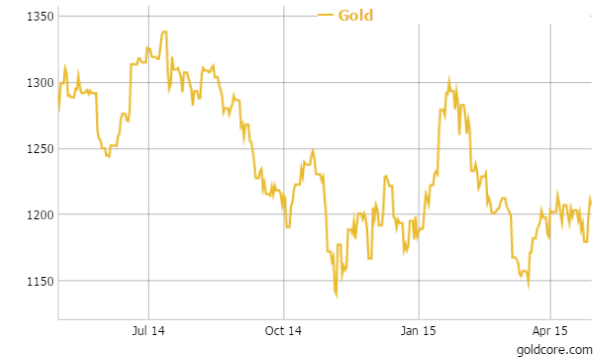
In Asia overnight, Singapore gold prices ticker marginally lower and hovered at $1,209 an ounce near the end of day trading after gaining almost 3 percent the two previous trading sessions. Gold eked out small gains this morning to trade to its highest price in three weeks as a weak U.S. data and a weak dollar have lowered expectations for a U.S. interest rate hike in June.
Today’s focus will primarily be on the U.S. Federal Open Market Committee statement at 1900 GMT and the U.S. GDP data out earlier at 1330 GMT.
Most analysts are expecting a dovish statement from the Fed especially if the GDP data published today is weak. A softer dollar will should help the yellow metal’s safe haven appeal and boost prices.
China’s gold bullion imports from Hong Kong fell this March to its lowest level in seven months. Q1 saw a 9 percent fall in Chinese physical gold buying cited an industry report. Although demand as seen on the Shanghai Gold Exchange withdrawals remains near record highs.
Iran and the U.S. Navy appear poised for a battle that could degenerate into another theatre of war in the Middle East.
Yesterday, a cargo ship was shot at, boarded and confiscated by Iranian naval forces and taken to the Persian Gulf port of Bandar Abbas, on the Strait of Hormuz. 34 sailors on board the vessel are American, although U.S. officials later said that the ship, bearing the flag of the Marshall Islands, has no American sailors on board.
Iran’s FARS news agency said the vessel had been detained “for trespassing in Iran’s territorial waters.” The Pentagon said the action was “provocative.”
Some 17 million barrels per day – about 30 percent of all seaborne-traded oil – passed through the Straits of Hormuz in 2013, according to the US Energy Information Administration.
Just last week, the president directed the USS Theodore Roosevelt to the Gulf of Aden to “ensure the freedom of navigation” through its strait, US officials said, as Iranian ships approached Yemen’s shores.
Geopolitical risk remains underestimated by markets. There are a number of geopolitical Black Swans out there – from the Ukraine to the Middle East which could flare up and be the catalyst for the next stage of gold’s bull market.
Gold in late morning trading in London is down 0.53 percent at $1,205.28 an ounce. Silver is off 0.83 percent at $16.46 an ounce while platinum has dipped 0.32 percent at $1,151.49 an ounce.
end
For now, India brushes off concerns over gold import spike
By Suvashree Choudhury and Meenakshi Sharma
Reuters
Wednesday, April 29, 2015
MUMBAI, India — Weak oil and commodity prices are offsetting concerns at India’s central bank over the impact of a spike in gold imports on the broader economy, officials say, even as the industry forecasts another three months of strong buying.
A more sustained increase in bullion imports after June, however, could cause concern, a policymaker said.
While “we have the comfort from low oil prices, there is a large cushion and we don’t need to be very concerned about the gold imports numbers,” said one senior official involved in policy decisions, who declined to be named. Concern would kick in if imports stay at or over 100 tonnes a month after June, he said. …
… For the remainder of the report:
http://in.reuters.com/article/2015/04/29/india-gold-imports-idINKBN0NK0R…
end
(courtesy Bill Holter/Miles Franklin)
The money has to go somewhere …
 (Bloomberg/Zerohedge)
1. Stocks lower on major Chinese bourses as bubblemania is the name of the game in Shanghai (down) but Hong Kong up /Japan bourse closed /yen falls to 119.27/Shanghai to allow short selling to stop their bubble/China then cuts RRR by 1% and Chinese authorities sooth fears that they want to prick that huge bubble.
1b Chinese yuan vs USA dollar/yuan strengthens to 6.2000
2 Nikkei closed
3. Europe stocks all down/USA dollar index down to 96.00/Euro rises to 1.0998/
3b Japan 10 year bond yield .30% !!!!(Japan buying 100% of bond issuance)/Japanese yen vs usa cross now at 119.27/
3c Nikkei still above 20,000
3d USA/Yen rate now well below the 120 barrier this morning
3e WTI 56.77 Brent 64.56
3f Gold down/Yen down
3gJapan is to buy the equivalent of 108 billion uSA dollars worth of bond per month or $1.3 trillion. Japan’s GDP equals 5 trillion usa.
Japan to buy 100% of all new Japanese debt and by 2018 they will have 25% of all Japanese debt. Fifty percent of Japanese budget financed with debt.
3h Oil down for WTI and down for Brent this morning
3i European bond buying continues to push yields lower on all fronts in the EMU. German 10 yr bund rises to 17.0 basis points. German bunds in negative yields from 6 years out.
Except Greece which sees its 2 year rate rises quite a bit to 21.43%/Greek stocks down .30%/ still expect continual bank runs on Greek banks.
3j Greek 10 year bond yield: 11.08% (down 70 in basis point in yield)
3k Gold at 1208.00 dollars/silver $16.48
3l USA vs Russian rouble; (Russian rouble up 1/2 rouble/dollar in value) 51.47 , the rouble is still the best acting currency this year!!
3m oil into the 56 dollar handle for WTI and 64 handle for Brent/Saudi Arabia increases production to drive out competition.
3n Higher foreign deposits out of China sees huge risk of outflows and a currency depreciation. This can spell financial disaster for the rest of the world/China may be forced to do QE!! (last Monday they lowered its RRR it is effectively doing QE)
30 SNB (Swiss National Bank) still intervening again in the markets driving down the SF. It is not working: USA/SF this morning 95.29 as the Swiss Franc is still rising against most currencies. Euro vs SF is 1.0479 well below the floor set by the Swiss Finance Minister.
3p Britain’s serious fraud squad investigating the Bank of England/ the British pound is suffering
3r the 6 year German bund remains in negative territory with the 10 year close to negativity at +.17/no doubt the ECB will have trouble meeting its quota of purchases and thus European QE will be a total failure.
3s Last week the ECB increased the ELA to Greece by another large 1.5 billion euros.Today they increased it again by 1.4 billion euros. The new maximum is 76.9 billion euros. The ELA is used to replace depositors fleeing the Greek banking system. The bank runs are increasing exponentially. The ECB is contemplating cutting off the ELA which would be a death sentence to Greece and they are as well considering a 50% haircut to all Greek sovereign collateral which will totally wipe out the entire Gr. banking and financial sector.
3t Greece informally asked the IMF to delay its payment for May 1 and they refused.
3 u. With the big meeting in Riga a failure on Friday,sheer anger developed between the Finance Ministers and the Greek contingent. There was no substance in the meetings to suggest that Greece was going to reform. Greece will not reform its public pensions.
If the ECB cuts off Greece’s ELA they would have very little money left to function.
4. USA 10 year treasury bond at 2.01% early this morning. Thirty year rate well below 3% at 2.72%/yield curve flatten/foreshadowing recession.
5. Details Ransquawk, Bloomberg, Deutsche bank/Jim Reid.
(courtesy zero hedge/Jim Reid Deutsche bank)
Futures Flat On FOMC, GDP Day; Bunds Battered After Euro Loans Post First Increase In Three Years
Today we get a two-for-one algo kneejerk special, first with the Q1 GDP release due out at 8:30 am which will confirm that for the second year in a row the US economy barely grew (or maybe contracted depending on the Obamacare contribution) in the first quarter, followed by the last pre-June FOMC statement, in which we will find out whether Janet Yellen and her entourage of central planning academics will blame the recent weakness on the weather and West Coast port strikes and proceed with their plan of hiking rates in June (or September, though unclear which year), just so they can push the economy into a full blown recession and launch QE4.
This is how Deutsche Bank previews today’s macroeconomic twofer:
By tonight we should have a lot more to talk about with regards to the US economy and the Fed as we see the first estimate of Q1 GDP and the FOMC conclusion. As we discussed earlier in the week the consensus for growth is 1% with DB now at 0.7% and the Atlanta Fed GDPNow at 0.1%. While we think some of the likely weakness is temporary we still believe that the US will continue to struggle to get close to its former trend rate of growth as far as the eye can see. That’s partly due to sympathy with secular stagnation views and partly due to global weakness combined with a stronger dollar in a beggar thy neighbour world. We don’t think the Fed shares this view so the FOMC statement (no press conference) will be interesting as to how much they put recent weakness down to transitory factors. DB’s Peter Hooper expects that the Fed will leave the door open for a June hike but sound balanced enough to leave market expectations for a rate hike by December (with high probability) if not September in place. However our read on this is that it leaves plenty of the time for the data to go either way so although we’ll learn a lot about their thoughts on the recent weakness, the reality is that data will blow everything out of the water over the coming months.
Speaking of more QE, while hardly noticed in the US, overnight the Bank of Thailand shot a few rounds in the global currency war when it cut rates unexpectedly from 1.75% to 1.50%, followed by the Swedish Riksbank, which kept rates on hold at a negative 0.25%, however boosted its own QE by SEK40-50 billion as yet another bank tries to outpace its competitors in the race to the currency devaluation bottom.
Also overnight we got a German Bund auction which was once again technically an “uncovered” failure with just €3.65 billion in bids for a €4 billion issue, not helped when stops were tripped to the downside earlier, blowing out by a whopping 8 bps, and touching as much as 0.24% following news yesterday that Gundlach was joining Gross in shorting the German Treasury.
But perhaps the biggest catalyst for the selloff in the government complex as well as the jump in the EURUSD above 1.10 for the first time in three weeks is that for the first time in three years, lending by Euro-area banks to companies and households rose, which according to Bloomberg is “a sign that record monetary stimulus is finally reaching the economy.”

From Bloomberg:
Bank lending increased 0.1 percent in March from a year earlier, the ECB said in a statement on Wednesday. Loans had posted annual declines in every month since May 2012. Lending climbed 0.2 percent from February.
“With its more aggressive stance, the ECB is finally bringing the euro zone back to at least trend growth,” said Holger Schmieding, chief economist at Berenberg Bank in London. “Money and credit point to a firming business cycle.”
Of course, while one can be skeptical about these numbers and ask just how many of the trillions in NPLs had to be netted out of the calculation, the risk for the liquidity addicts is that loan creation will surge in the coming months and thus force the ECB to halt QE prematurely. As a reminder, commercial bank loan creation has been the all critical missing link from the European recovery.
Then again, Europe did “represent” a loan recovery in early 2012 before the latest credit dead cat bounce faded just as fast.
Back to markets, where we saw Asian stocks trade mostly lower following a mixed Wall Street close, which saw the NASDAQ 100 underperform after Twitter’s poor earnings release, dampening sentiment across Asian tech names. Shanghai Comp (-0.01%) and Hang Seng (-0.15%) fell and are on course for their first 2-day decline in 2 months, weighed on by several poor earnings. ASX 200 (-1.2%) was the worst performer with all sectors firmly in the red after yesterday’s AUD rally. Japanese stock markets were closed due to the Showa Day holiday.
European equities trade mixed with the telecommunications sector outperforming following talk of a possible combination between Sky (+0.6%) and Mediaset (+1.2%). The basic materials sector led the way lower with iron prices retracing some of its 20% gains seen this month. Large cap earnings in the form of Volkswagen saw the DAX heavyweight post a beat on revenue and profit which led to carmaker to initially open higher by 2%, only to pare the move after participants focused on CEO Winterkorn warning that market conditions for the auto-market will be challenging this year.
In fixed income markets, UST’s have edged lower alongside German paper with the UST 10y yield reaching 2% for the first time since March 17th. Weakness in Bunds have also pushed the 10y yield back above 0.2% after tripping stops to the downside at 159.00 and following the recent technically uncovered Bobl auction. German paper is also weighed upon by an influx of supply from the Eurozone in today’s session.
Today provides a flurry of central bank releases with the Riksbank kicking off proceedings after they unexpectedly kept interest rate on hold at -0.250% which sent EUR/SEK lower by more than 700 pips. Furthermore, the Riksbank expanded their quantitative easing programme further by SEK 40-50bln and warned of a possibility of further cut in rates in the near future.
The USD-index has ticked lower with market participants exiting their long USD positions ahead of the FOMC meeting today which is expected to be relatively dovish given the slew of lacklustre data throughout the month. GBP/USD has benefitted from broad based USD weakness and reached 8 week highs as investors are caught short shrugging off some of the political uncertainty surrounding the UK. EUR/USD has also seen supported with slightly positive rhetoric from EU’s Moscovici stating that negotiations are close however, maintaining that progress remains slow.
USD/JPY has squeezed higher after RANsquawk sources noted a carry-trade driven hedge fund buying in USD/JPY in addition to favourable yields in UST’s as it trades at 2% for the first time in over a month. For EUR/JPY, main desks are eyeing a break of 131.50 which could result in the cross to test 135.00.
WTI and Brent crude futures reside in modest negative territory after yesterday’s API’s which showed a build of 4.2mln vs. a Prev. 5.5mln, a record 16th consecutive weekly build. In precious metals markets, spot gold is seen lower in a retracement of yesterday’s gains with Chinese gold output rising 14.72% Y/Y to 110,704 tons.
In summary: European shares fall with the basic resources and chemicals sectors underperforming and telco, utilities outperforming. Fed to Release Interest Rate Decision. Saudi King Puts Son Second-in-Line to Throne. Riksbank Increases Bond Purchases as Key Rate Left Unchanged. The Swedish and Dutch markets are the worst-performing bourses, the Italian the best. The euro is stronger against the dollar. German 10yr bond yields rise; French yields increase. Commodities decline, with nickel, silver underperforming and wheat outperforming. U.S. mortgage applications, FOMC rate decision, GDP, personal consumption, core PCE, pending home sales due later.
Market Wrap
- S&P 500 futures down 0.1% to 2109.8
- Stoxx 600 down 0.1% to 405.7
- US 10Yr yield little changed at 2%
- German 10Yr yield up 6bps to 0.23%
- MSCI Asia Pacific down 0.8% to 156.1
- Gold spot down 0.5% to $1206.6/oz
- Asian stocks fall with the Shanghai Composite outperforming and the ASX underperforming.
- MSCI Asia Pacific down 0.8% to 156.1; Nikkei 225 is closed, Hang Seng down 0.1%, Kospi down 0.2%, Shanghai Composite up 0%, ASX down 1.8%, Sensex down 0.5%
- Euro up 0.19% to $1.1002
- Dollar Index down 0.18% to 95.92
- Italian 10Yr yield up 6bps to 1.44%
- Spanish 10Yr yield up 6bps to 1.39%
- French 10Yr yield up 7bps to 0.49%
- S&P GSCI Index down 0.4% to 432.7
- Brent Futures down 0.5% to $64.3/bbl, WTI Futures down 0.6% to $56.7/bbl
- LME 3m Copper down 0.5% to $6088/MT
- LME 3m Nickel down 1.2% to $13290/MT
- Wheat futures up 0.1% to 476.5 USd/bu
Bulletin headline summary from Bloomberg and RanSquawk
- The USD-index is softer ahead of today’s FOMC meeting as market participants square positions before the highly awaited release
- US Treasury yields reach 2% for the first time since March 17th due to an influx of supply this week from the US
- Looking ahead sees the release of German CPI, US GDP, Pending Home Sales, DoE crude inventories as well large cap earnings from Mastercard, Mondelez, Valeant and Time Warner
- Treasuries steady before FOMC statement at 2pm and as week’s auctions conclude with $15b 2Y FRN, $29b 7Y notes; WI yield 1.765% vs 1.792% in March.
- FOMC statement today likely to mention weaker 1Q due to temporary factors, reflect reduced chances of June liftoff, based on published research and interviews
- Lending by euro-area banks increased 0.1% in March from a year earlier, according to ECB, after posting annual declines in every month since May 2012
- Germany received EU3.649b bids at an auction of 5Y notes, missing EU4b goal; Bundesbank retention rose
- ECB raised the amount of emergency liquidity available to Greek banks while signaling that access to such funds may become more difficult as bailout talks remain deadlocked
- Greek Finance Minister Yanis Varoufakis said he and his wife were attacked by a group of hooded anarchists while they dined in central Athens Tuesday night
- Hillary Clinton’s presidential run is prompting new scrutiny of the Clintons’ financial and charitable affairs—something that’s already proved problematic for the Democratic frontrunner, given how closely these two worlds ove rlap
- Sovereign bond yields higher. Asian, European stocks lower, U.S. equity-index futures decline. Crude oil, gold and copper lower
DB’s Jim Reid concludes the overnight recap
Turning to markets it looks like Asian investors are mostly on the back foot overnight. Indeed The Shanghai Composite (-0.35%) is having its first back to back loss in two months on news that one of the biggest brokerages in China has restricted the number of shares eligible for margin lending. The softer tone also comes after the numerous press chatter of Chinese QE over the last few days. Our former colleague Jun Ma has made some comments on the QE story. Indeed the now Chief Economist for PBOC said that he sees no need for PBoC to inject funds via bond purchases as the Chinese central bank has sufficient tools to maintain liquidity at reasonable levels, including targeted re-lending, interest rates and reserve requirement ratios. He also added that direct funding to government by central bank is forbidden according to China’s law. China’s 1yr rate swaps rose the most in a month following comments by Jun as markets scaled back hopes of QE.
Elsewhere in Asia the Hang Seng, KOSPI and the ASX 200 are down -0.5%, -0.6% and -1.3%, respectively. The Dollar is holding firm overnight against major currency pairs ahead of the Fed meeting announcement. Asian credit markets are focused on digesting new supply while the 10yr Treasury is largely unchanged at around 2% as we go to print.
Speaking of Treasuries the 8bp move higher in the 10yr was perhaps one of the more notable market moves during yesterday’s trading session. This was the biggest one day spike since early March and the first flirtation with the 2% mark for about 6 weeks. The 30yr yield rose 9bps higher to 2.70%. Staying in the US the S&P 500 (+0.28%) finished the day a little higher helped by gains across all sectors except Consumer Discretionary. Sentiment was boosted by positive earnings and encouraging signs from Greece’s debt negotiations even though the data flow was quite mixed. On the earnings front it was a busy day for US companies yesterday. A total of 40 companies reported of which 68% of them exceeded EPS estimates but only 40% of them did the same with sales forecasts. Data wise we saw Consumer Confidence in April plunge to the lowest level in four months whilst the Richmond Fed manufacturing index fell more than expected. US credit spreads were fairly stable with the market continuing to focus on the heavy supply. Oracle’s new deal was the largest print of the day as the company raised US$10bn across six tranches to fund cash dividends and share buybacks.
Moving to Europe, DB’s resident Greece expert George Saravelos had a note out yesterday with his latest views. In it he highlighted, “a ray of sunshine” in the situation due to three recent developments. First that opinion polls have started to turn with the electorate turning more cautious on the Greek government’s negotiation strategy whilst support for a European solution has remained consistently strong both of which have been increasing pressure on the government. On the second positive recent development George points to the reshuffle of the Greek government’s negotiation team which has seen officials more closely aligned to the moderate deputy PM who has being given a greater role. The third and most important development according to George is PM Tsipras’s Greek TV news interview on Monday evening in which the PM signaled that a referendum would be his preferred route (rather than a general election). The implication of this is that it signals that an agreement which crosses the government’s “red lines” is being actively discussed and represents an internally consistent strategy from the PM for breaking the deadlock. Given these developments George believes the most likely outcome for Greece is a “reluctant agreement” followed by a referendum for popular approval. George sees this as the most positive outcome as it would likely pass and be a catalyst for the inclusion of more moderate parties into the government.
Looking back to the European session yesterday, it was a weak day for European markets with the Stoxx 600 down -1.6% led by a -2% fall in the DAX. European credit also struggled with iTraxx Crossover around 5bps wider. Performance wasn’t helped by a day of relatively weak data and some earnings disappointments. Indeed only about 56% of the European companies that reported yesterday managed to surprise EPS on the upside (TNT Express, MAN, and Santander were some of those who missed). That said sales performance was quite strong with over three quarters of those beating estimates. In terms of other data, UK Q1 GDP came in weaker than expected at +0.3% QoQ (vs. +0.6% previously and +0.5% expected).
On the topic of geopolitics the US Navy is said to have sent a destroyer towards the Persian Gulf on Tuesday after Iran took control of a cargo ship it accused of trespassing territorial waters. The cargoship carried 24 crew members and Iranian forces were said to have fired shots across the ship’s bow. The episode raised tensions between the two countries a few weeks after world powers and Iran reached a tentative agreement in which Tehran would drastically cut its enrichment of uranium in exchange for an easing of sanctions.
Looking to the day ahead, in Europe we have Spanish March retail sales (expected up +3.6% YoY), Italian April consumer confidence (expected steady 110) and German CPI April inflation (expected to fall to -0.1% MoM). Over in the US the big events will be the already previewed Q1 GDP and FOMC statement. In terms of earnings in Europe we will get results from the likes of VW, Barclays and Fiat whilst in the US we will get reports from Time Warner, MasterCard and others.
end
If Greece leaves the Euro according to UBS there are two routes to take:
i) the fast route
ii) the slow route.
and it is 50/50 which one they will choose.
(courtesy UBS/zero hedge)
How Will Greece Default? Let Us Count The Ways
What was once anathema has become conventional wisdom, and lately the only question when discussing the fate of Greece is not if but when it will default. Actually, there is another question: how? Because as the following UBS flow chart shows, when it comes to the matter of picking an obligation on which to not make a payment, Greece has a truly 5 star menu selection.

Ths is what UBS says:
We do not believe that Greece will leave the euro in our base case scenario. However, were it to happen, we think it would probably do so via one of two main routes:
(1) The fast route: A rapid deposit withdrawal from the banking system, if the Eurosystem refused to finance it through expansion of the ELA facility. The government would then need to refinance (and probably recapitalise) the banking system by creating a new currency to do so. However, this could probably be slowed with the imposition of capital controls limiting deposit withdrawal.
(2) The slow(er) route: The government, running out of funds, could substitute IOUs for euros in some of its payments. Starting with payments to suppliers (including for pharmaceuticals, as in 2011), and then – in theory – progressing on to public sector salaries and pensions over time. As current Greek debt obligations are not valued at their face value by the bond market, nor would these notes be, meaning that their purchasing power would likely be lower than that of the euro. In this way, the parallel currency would already be devalued.
The more of these notes that were issued, the greater the need would be for the banking system to clear payments in them. The need would also increase for businesses and citizens to use them to pay taxes. As this continued, it would be likely that more euros would leak out of the Greek banking system and the economy would rely on the new currency to a greater extent.
Nominally, Greece could (in theory, and just conceivably) remain in the euro under these circumstances, but there would come a point in this process at which it had in a practical sense already left.
Below we look at the likely impact of impairment of some of the Greek government’s obligations, were any to take place.
IMF loans
The IMF has a “timetable of remedial measures” for overdue payments which we reproduce in the annex at the bottom of this note. As the cross-default clause in the bond documentation only refers to impairment of other securities, we doubt that non-payment to the IMF would accelerate bond repayments.

However, it is possible that non-payment to the IMF causes an acceleration of amounts due to the EFSF, which in turn could accelerate repayment of bonds if as would seem likely they were also left unpaid.
According to the “Master Financial Assistance Facility Agreement” between the EFSF and Greece, the EFSF may “declare the aggregate principal amount of any or all Financial Assistance made and outstanding… immediately due and payable, together with accrued interest” if (among other clauses) “the Beneficiary Member State does not make timely repurchases from the IMF in relation to the IMF Arrangement of any outstanding purchases… or has overdue charges on outstanding purchases”.
It is important to note that the EFSF also states that it “may, but is not obliged to, exercise its rights under this Clause”.
Were the EFSF to exercise this right, it is likely that bond repayments would also be accelerated. The documentation for the PSI bonds (those issued in exchange in the 2012 restructuring) cites as an event of default if amounts due to the EFSF “are declared to be due and payable prior to their scheduled maturity”. However, it should be noted that this clause does not appear in the prospectuses for the 2017 and 2019 bonds issued by the Greek government last year.
Government bonds and bills
The normal consequences of a failure to make a payment on a sovereign bond or bill are relatively well-known: the bonds enter into default and in due course CDS is triggered after a decision of the ISDA determinations committee. Additionally, in the case of non-payment on the “New Greek Bonds” (PSI bonds), the EFSF could decide to accelerate amounts due to it as with non-payment to the IMF (see above).
It is possible (though for a variety of reasons very unlikely) that an attempt is made to restructure privately-held bonds at some point in the near-medium term. However, no bonds have been issued to the private sector under Greek law since before the 2012 restructuring, meaning that any restructuring within the law would have to take place via investor votes as per collective action clauses. As the investor base is mostly composed of hedge funds and foreign asset managers, it is reasonable to infer that such a restructuring attempt would be unsuccessful.
Bilateral and EFSF loans
No interest or principal payments are due on the loans made in the first and second Greek aid programmes until 2020. As a result, and unless the Greek government were formally to repudiate its debt obligations under these programmes, impairment would seem unlikely.
* * *
So now that you know your options Greece, choose. And remember: your last check should always bounce, or at least be written in a currency that will soon no longer exist.
end
(courtesy Bloomberg)
The ECB increases ELA by 1.4 billion euros to 76.9 billion euros.
Deposit outflows continue to increase in April as depositors are getting quite nervous.
Greek Banks Get More Funds as ECB Weighs Collateral Discount
The European Central Bank raised the amount of emergency liquidity available to Greek banks while signaling that access to such funds may become more difficult as bailout talks remain deadlocked.
The Governing Council lifted the cap on Emergency Liquidity Assistance by 1.4 billion euros ($1.5 billion) to 76.9 billion euros in a telephone conference on Wednesday, people familiar with the decision said. That follows an increase of about 1.5 billion euros last week. An ECB spokesman declined to comment.
With no speedy deal between Greece and its creditors in sight, the ECB is studying measures to rein in ELA funding to limit risks should political talks falter. Staff have proposed increasing the discounts imposed on the securities banks post as collateral when borrowing, and the Governing Council may discuss the issue at its May 6 meeting.
“When the Eurosystem as a whole gives such support, we have our own collateral rules, we can set them ourselves,” ECB Governing Council member Ardo Hansson told reporters in Tallinn, Estonia. “When it’s ELA, then that’s given by the national central bank, which has some latitude in this matter.”
Intended to counter deposit outflows, Greece’s ELA is provided by the country’s central bank at its own risk, and against lower-quality collateral than the ECB accepts.
Weekly ELA injections reflect deposit outflows, as liquidity buffers are kept at about 3 billion euros to give the Bank of Greece and the ECB time to react in an emergency. The Bank of Greece will release Wednesday figures on end-March deposit outflows, which will likely show that the bleeding continued for a sixth consecutive month amid growing alarm among savers over the country’s place in the euro area.
Deposit Outflows
Deposits from households and businesses are set to hit a new 10-year record low, according to March figures to be released today, while outflows are said to continue in April, as reflected in successive ELA-ceiling increases.
ECB says that ELA cash can’t be used for state-financing, including t-bills, pointing out that this would be against European Union treaties.
ECB help to Greek banks “can’t continue indefinitely,” Governing Council member Christian Noyer said in an interview on Europe 1 radio on Tuesday. “What’s needed are decisions on fundamental reforms.”
Time is running out for Greek Prime Minister Alexis Tsipras as pensions and salaries loom at the end of the month and the International Monetary Fund awaits payment of almost 1 billion euros in the first half of May. After euro-area finance ministers failed to reach a deal at an April 24 meeting in Riga, Tsipras signaled that he may ask voters to approve an agreement with creditors that may not be in line with his campaign pledge to end austerity.
Market Reaction
Greek stocks and bonds have risen this week after the government sidelined Finance Minister Yanis Varoufakis, who had drawn criticism from euro-area partners for his handling of the bailout discussions. The Athens Stock Exchange Index was up 0.8 percent at 12:00 p.m., after rising 1.4 percent on Tuesday and 4.4 percent the day before.
In a televised interview on Monday night Tsipras said the government is doing all it can to show that Greece is willing to make the compromises needed to reach an accord with its creditors.
“The negotiations are in the most crucial stage, the final stage,” he said. “We are making great efforts to cover the distance to reach an agreement. As I said in Brussels, we have covered 70 percent of the distance and we ask them to walk the remaining 30 percent together.”
end
Total bank deposits drop below 140 billion euros to 138.55 billion euros.
(courtesy Reuters)
Greek bank deposits drop 1.36 pct in March for sixth month in a row
(Reuters) – Greek bank deposits dropped in March but at a slower pace than in the previous month, central bank data showed on Wednesday, as savers continue to worry over the slow-moving talks between Athens and its lenders to reach a deal and unlock bailout funds.
Business and household deposits dropped by 1.91 billion euros or 1.36 percent month-on-month to 138.55 billion euros ($152.3 billion) from 140.47 billion euros in February, down for the sixth month in a row, Bank of Greece data showed.
The drop brought deposit balances to their lowest level since February 2005. (Reporting by George Georgiopoulos)
end
Zero hedge discusses the above Reuters story:
(courtesy zero hedge)
Greek Deposits Now Lowest Since 2005; One Third Of Bank Assets Now ECB-Funded
As a refresher, here’s the latest on Greece. Greek PM Alexis Tsipras is scrambling to “reshuffle” his negotiating team after embattled FinMin Yanis Varoufakis’ “lecturing” finally pushed EU officials over the edge in Riga last Friday. A government decree to sweep excess cash reserves from local municipalities has unsurprisingly proven to be quite controversial, leaving the governmentshort some €400 million for pensions and salaries. Athens is still playing the Russia/Gazprom pivot card in a pitiable effort to demonstrate that Greece still has one last trick up its negotiating sleeve, and anarchists are attackingVaroufakis at dinner. You can’t make this stuff up.
In the midst of this, the Greek banking sector continues to bleed cash as the latest data from the ECB shows deposits fell by another €2.5 billion in March, bringing the total to €27 billion (or around half a month’s worth of PSPP purchases) since December. Here’s more via Goldman:
The ECB released the March deposit data today (April 29), which paints a solid deposit picture across all markets, with the exception of Greece. Here, deposit outflows continued and reached €2.5 bn in March, driven by the decline in retail (-2%), public sector/other balances (-5%).
And of course more ELA means more deposit flight…
Between December and March, the Greek banks have lost €27 bn of deposits, a 16% decline. During this period, the stock of corporate deposits is down 29%, retail 13% and other 14%. The hike in the Emergency Liquidity Assistance (ELA) limit by a further €5.6 bn in April implies that outflows may have re-accelerated in recent weeks.
Without market access, the ECB remains Greek banks’ sole refinancing avenue. Greek usage of ECB facilities has increased by >€60 bn over the past four months. The Greek banking system – representing 1.2% of Euro area assets – now accounts for 18% of total ECB facility usage. 27% of all Greek bank assets are now ECB-funded.


As for what happens next, projections abound with most commentators predicting some iteration of Citi’s “Grimbo” scenario involving capital controls, defaults, and a kind of slow motion economic collapse which may (or may not) shock both Greece and its creditors into action. For their part, Deutsche Bank sees a 50% chance of a national referendum following a “reluctant” agreement with creditors. Of course, there’s still a one in three chance of ELA suspension and all of the rather unpalatable things that come with it. Here’s more:
After the first few weeks’ honeymoon period,the electorate is turning more cautious on the administration’s negotiating strategy, reflected in declining approval ratings for both the government and PM Tsipras himself. Most significantly, even as tensions rise, polls show continued and overwhelming public support for a European solution: between “rupture” or “agreement”, opinion polls consistently point to more than 70% support for the latter…
PM Tsipras gave a wide-ranging interview to a Greek TV news channel. The deadlock in terms of sticking points was confirmed, yet the PM’s statements on the government’s negotiating strategy were more important. When asked on the way forward if an agreement violating electoral promises is required, the Prime Minister signaled that a referendum would be his preferred route, ruling out a general election…
A referendum now looks as the most likely outcome (reflecting the current scenario, we would see an indicative 50% probability): the government would reach a “reluctant agreement” with Europe followed by a national referendum for popular approval…
Most importantly, ongoing delays in negotiations and/or an accidental default, insufficient time to hold a referendum/change government, or an active decision to reject an agreement would likely lead to a suspension of ECB financing of Greek banks (30% probability). On this front, Draghi has recently signaled that a change in the haircuts of collateral submitted to ELA financing is possible, with a decision as soon as the May 8th ECB meeting…
Assuming the above is the case, the ultimate cut-off point for an agreement will still be defined by the time when the Greek government exhausts its cash position: any disbursement from creditors will materialize only after a full-staff level agreement and approval through parliament of a number of agreed prior actions. Liquidity in the meantime continues to drain, with the government legislating a forcible deposit of municipal/regional government excess liquidity into a central bank account last week, and similar legislation for pension funds possible. There are conflicting reports on whether enough cash is available to service the May 12th payment to the IMF.
Meanwhile, on the ground in Greece:
- GPO POLL SHOWS 61.9% OF GREEKS OPPOSE REFERENDUM ON AGREEMENT
Apparently then, Greeks oppose austerity, oppose leaving the euro, and oppose a refrendum on staying.
For good measure, here’s a look at Grexit risk over time as measured be Sentix’s Euro breakup index:

end
I am sure that Greeks will do the honourable deed and repatriate their hard earned euros back into Greece:
(courtesy zero hedge)
The Greek Modest Proposal To Savers: Please Bring Your Cash Home
Earlier today we reported that after a €2.5 billion outflow in March, Greek deposits have hit their lowest level since 2005 and have fallen by some €27 billion (or 16%) since December. A few other rather disconcerting data points: although the Greek banking system only comprises a little over 1% of eurozone assets, it accounts for nearly a fifth of ECB facility usage while nearly a third of Greek banking assets are now funded by the central bank.
In the midst of this decidedly untenable situation, and as Tsipras does his best to shakedown municipalities and pension funds for excess cash (“Where’s the money Lebowski?!), FinMin Varoufakis has a new proposal for all Greeks who have taken the very rational step of moving their cash elsewhere to avoid being Cyprus’d: bring your money back and we won’t tax it at 50%. Here’s more from Reuters:
Greece is to allow money held abroad by its taxpayers to be declared without penalty and taxed at a discount rate, a move to help overcome a cash crunch threatening the country with bankruptcy.
“The government will table a bill to allow citizens to voluntarily declare their deposits abroad,” Finance Minister Yanis Varoufakis told reporters after meeting Swiss officials in Athens.
Greeks have sent billions of euros abroad since the debt crisis exploded in 2010, fearing that the country may crash out of the euro zone. The deposit flight has strained its banks which have become dependent on central bank funding for liquidity.
A portion of the money has fled to Swiss banks.
Under the planned law, the deposits may be taxed at a rate of 15 to 20 percent, a senior finance ministry official said, an incentive for those who have sent money abroad but have not reported it as income to Greek tax authorities.
Depositors who have evaded reporting incomes would otherwise face a 46 percent tax rate and 46 percent in penalties if caught.
Varoufakis said that once the bill is passed by parliament, a political agreement will be signed between Greece and Swiss authorities to exchange information on Greek deposits held in Swiss banks.
This may sound like a good idea in principle, but we’re not entirely sure why this represents a compelling value proposition for those who are storing their euros in the safe confines of Swiss bank accounts. That is, why would anyone want to bring cash back to Greece and pay a 20% tax only to face the very real chance that those deposits will be converted to drachma or some equally worthless scrip in the not-so-distant future?
Here’s what UBS had to say on the subject of redenomination risk earlier this month (we think it applies here):
Even if a depositor thinks that there is only a 1% chance their country will exit the Euro, why take a 1% chance that your life savings are forcibly converted into a perceived worthless currency if by acting quickly (and withdrawing deposits) one can have 100% certainty that your life savings remain in Euros?
As a reminder, here is the deposit situation in Greece:
Peter Cooper discusses the fact that we have over 3 trillion in negative yielding eurobonds. He explains why this is a time bomb!!
(courtesy Peter Cooper/Arabian money.com)
$3tn in negative-yielding eurobonds are a time bomb so buy gold!
Posted on 29 April 2015 with no comments from readers

The $3 trillion worth of eurobonds now with negative yields – that means their owners are actually paying to hold them – are a time bomb for the global financial system and will destroy the savings of pensioners as rapidly as they crash hedge funds.
This extraordinary phenomenon puts the world’s second most widely-traded currency on the path to the biggest mass default in history, according to Jeremy Warner writing in The Daily Telegraph today.
Negative-yielding bonds
Seventy per cent of German bunds now trade on a negative yield while in France it’s 50 per cent and even in Spain it’s 17 per cent despite this country being virtually bankrupt a few years back. How long can this go on?
It is clearly utter madness to hold an investment that costs you money to hold. It is a guaranteed loser. Money printing via quantitative easing is to blame and QE is having the reverse of the intended effect.
Rather than encouraging investors to go into high risk assets they have become afraid of the lofty and artificial valuations created by low interest rates. By comparison bonds seem to offer lower risk to capital even if that insurance actually costs you money, though not if they default.
‘Sickening losses’
Mr. Warner professes himself baffled by what the endgame will be except to say: ‘The bond market bubble is just the half of it; since most other assets are priced relative to bonds, just about everything else has been going up as well. Eventually, there will be a massive correction, in which creditors will suffer sickening losses.’
Unfortunately it is not good enough to throw your hands in the air and exclaim: ‘What comes next is anybody’s guess’ as does Mr. Warner in his column today.
Investors need to start taking protection now against this blow-up in global financial markets which is inevitably going to be the round two of the Global Financial Crisis of 2008-9. With hindsight there were plenty of warnings of the GFC from the likes of Nouriel Roubini and others who understood the housing subprime loans debacle.
Subprime part 2?
This time the negative yields on eurobonds are the canary singing loudly in the coal mine. Hard assets are the way to survive in this next crisis.
That means any sort of real estate without debt, works of art, land and gold and silver. Paper or financial assets like bonds and fiat currency will suffer horrible real devaluations in the next crisis that will be permanent readjustments.
Think back to the post-USSR Russia of the 1990s and how the ruble was devalued to nothing while apartments kept their value and so did precious metals and art. This is about to happen again but on a much bigger scale. Take heed and take action!
And now for continuing news on our flash crash trader who has arrested last week. He now remains in jail after failing to pay bail at a hearing.
end
(courtesy Bloomberg)
Sarao Remains in Jail After Failing to Pay Bail at Hearing
Navinder Singh Sarao, the British trader facing U.S. charges for his alleged role in the 2010 flash crash, returned to Wandsworth prison after he failed to pay the 5 million pounds ($7.7 million) required for his bail.
Sarao, 36, has been in custody since April 21, when he was arrested at the house he shares with his parents near Heathrow airport. The terms he must meet to be released on bail were extended by one week at a hearing at Westminster Magistrates’ Court in London Wednesday.
Sarao, who appeared in court wearing a long-sleeved gray t-shirt, is facing 22 charges in the U.S. after being accused by prosecutors of contributing to the frenzy of the May 2010 flash crash, when investors saw nearly $1 trillion of value erased from U.S. stocks in just minutes. He’s alleged to have made almost $900,000 on the day of the crash and $40 million from 2010 to 2014. He is fighting extradition.
The date of his extradition hearing was pushed back from August until Sept. 24 at the request of a lawyer for the U.S. at the hearing. No reason was given for the delayed bail payment. A lawyer for Sarao said last week he has about 5 million pounds in trading accounts and another 100,000 pounds in various betting accounts. Sarao holds a number of offshore accounts, according to documents released by U.S. authorities.
Bail Conditions
When his security is paid he will be allowed to go home, but will have to adhere to conditions including not accessing the Internet, checking in at a local police station three times a week, and staying at home every night, according to the trader’s bail order.
Wandsworth prison is the largest prison in the U.K. with more than 1,800 inmates, according to the Ministry of Justice website. Defendants from Westminster are automatically remanded in custody at Wandsworth, which has the second-highest security rating among U.K. detention facilities.
end
Your more important currency crosses early Wednesday morning:
Euro/USA 1.0998 up .0031
USA/JAPAN YEN 119.27 up .436
GBP/USA 1.5354 up .0023
USA/CAN 1.2052 up .0014
This morning in Europe, the Euro rose a little by 31 basis points, trading now well above the 1.09 level at 1.0998; Europe is still reacting to deflation, announcements of massive stimulation, a proxy middle east war, crumbling bourses and the ramifications of a default at the Austrian Hypo bank, a possible default of Greece and the Ukraine.
In Japan Abe went all in with Abenomics with another round of QE purchasing 80 trillion yen from 70 trillion on Oct 31. The yen continues to trade in yoyo fashion as this morning it settled down again in Japan by 44 basis points and trading well below the 120 level to 119.27 yen to the dollar.
The pound was well up this morning as it now trades just above the 1.53 level at 1.5354 ( still very worried about the health of Barclay’s Bank and the FX/precious metals criminal investigation/Dec 12 a new separate criminal investigation on gold, silver and oil manipulation).
The Canadian dollar is down by 14 basis points at 1.2052 to the dollar
We are seeing that the 3 major global carry trades are being unwound. The BIGGY is the first one;
1. the total dollar global short is 9 trillion USA and as such we are now witnessing a sea of red blood on the streets as derivatives blow up with the massive rise in the rise in the dollar against all paper currencies
2, the Nikkei average vs gold carry trade (still ongoing)
3. Short Swiss franc/long assets (European housing/Nikkei etc. This has partly blown up (see Hypo bank failure). Swiss franc is now 1.0280 to the Euro, trading well above the floor 1.05. This will continue to create havoc with the Hypo bank failure.
These massive carry trades are terribly offside as they are being unwound. It is causing global deflation ( we are at debt saturation already) as the world reacts to lack of demand and a scarcity of debt collateral. Bourses around the globe are reacting in kind to these events as well as the potential for a GREXIT>
The NIKKEI: this morning :closed
Trading from Europe and Asia:
1. Europe stocks all in the red
2/ Asian bourses mostly in the red … Chinese bourses: Hang Sang in the red (massive bubble forming) ,Shanghai in the green (massive bubble ready to burst), Australia in the red: /Nikkei (Japan) closed/India’s Sensex in the red/
Gold very early morning trading: $1208.00
silver:$16.48
Early Wednesday morning USA 10 year bond yield: 2.01% !!! up 2 in basis points from Tuesday night/
USA dollar index early Wednesday morning: 96.00 down 11 cents from Tuesday’s close. (Resistance will be at a DXY of 100)
This ends the early morning numbers, Wednesday morning
And now for your closing numbers for Wednesday:
Closing Portuguese 10 year bond yield:2.12% up 15 in basis points from Tuesday
Closing Japanese 10 year bond yield: .30% !!! par in basis points from Tuesday
Your closing Spanish 10 year government bond, Wednesday, up 15 in basis points in yield from Tuesday night.
Spanish 10 year bond yield: 1.47% !!!!!!
Your Wednesday closing Italian 10 year bond yield: 1.51% up 13 in basis points from Tuesday:
trading 4 basis points above Spain.
***QE not working as the ECB is having difficulty finding the number of bonds to purchase.
IMPORTANT CURRENCY CLOSES FOR TODAY
Closing currency crosses for Wednesday night/USA dollar index/USA 10 yr bond: 4 pm
Euro/USA: 1.1117 up .0149 ( Euro up 149 basis points)
USA/Japan: 119.12 up .275 ( yen down 28 basis points)
Great Britain/USA: 1.5430 up .0099 (Pound up 99 basis points)
USA/Canada: 1.2012 down .0026 (Can dollar up 26 basis points)
The euro rose sharply today. It settled up 149 basis points against the dollar to 1.1117 as the dollar falters on all fronts. The yen was down 28 basis points and closing just above the 119 cross at 119.12. The British pound gained considerable ground today, 99 basis points, closing at 1.5430 despite a softer economy. The Canadian dollar gained a little ground to the USA dollar, up 26 basis points closing at 1.2012.
As explained above, the short dollar carry trade is being unwound, the yen carry trade , the Nikkei/gold carry trade, and finally the long dollar/short Swiss franc carry trade are all being unwound and these reversals are causing massive derivative losses. And as such these massive derivative losses is the powder keg that will destroy the entire financial system. The losses on the oil front and huge losses on the USA dollar will no doubt produce many dead bodies.
Your closing 10 yr USA bond yield: 2.04% up 5 in basis points from Wednesday
Your closing USA dollar index:
95.17 down 94 cents on the day. (this is really good news)
European and Dow Jones stock index closes:
(everybody had a bad hair day)
England FTSE down 84.25 or 1.20%
Paris CAC down 133.99 or 2.59%
German Dax down 378.94 or 3.21%
Spain’s Ibex down 228.80 or 1.97%
Italian FTSE-MIB down 536.46 or 2.28%
The Dow: down 74.61 or 0.41%
Nasdaq; down 31.78 or 0.63%
OIL: WTI 58.49 !!!!!!!
Brent: 65.60!!!!
Closing USA/Russian rouble cross: 50.68 up 4/5 rouble per dollar on the day.
end
And now your important USA stories:
NYSE trading for today.
Fed Fails To Spark Buying Frenzy; Stocks, Bonds, Dollar Drop
The message from the Fed appears to be…
Which is a problem for stocks…(post-FOMC) – Small Caps worst…

And cash indices on the day tried to ramp to green but failed…

Futures show the early weakness during the European session…

Leaving the cash indices all in the red for the week…

Crazy day in vol too…

Treasuries were weak once again going in (the daily 8am selling resumed), weakened after an initial rally after GDP, then were unchanged post-FOMC…

The USDollar was spanked lower after GDP and recovered modestly after The FOMC Statement…

Dollar weakness helped commodities a bit but in general gold, silver, and copper ended unch on the day…

Crude pumped on a Cushing inventory draw, dropped after NYMEX Close…

EURUSD soared today – pressing up towards 1.12 before The FOMC Statement pulled back some gains…

And finally it is worth looking at the carnage in Europe today (specifically Germany)…

Charts: Bloomberg
Bonus Chart: Yeah, him again…

(courtesy BEA/zero hedge)
US Economy Grinds To A Halt, Again: Q1 GDP Tumbles Below Expectations, Rises Paltry 0.2%
And so the Atlanta Fed, whose “shocking” Q1 GDP prediction Zero Hedge first laid out nearly 2 months ago, with its Q1 GDP 0.1% forecast was spot on. Moments ago the BEA reported that Q1 GDP was far worse than almost everyone had expected, and tumbled from a 2.2% annualized growth rate at the end of 2014 to just 0.2%, in a rerun of last year when it too “snowed” in the winter. In other words, in the quarter in which the S&P rose to unseen highs, the economy ground to a near halt.
Only this time it wasn’t the snow, as the main reason for the plunge in economic growth was not only personal consumption which was cut by more than 50% from last quarter, tumbling to just 1.31%, but fixed investment, i.e., CapEx, which subtracting 0.40% from the bottom line GDP number, was the lowest print since 2009!

The fact that trade also subtracted a whopping 1.25% from the final number shows that while one can blame the weather for anything, the reality is that in the start of the year global trade did indeed grind to a halt, a picture which is only getting worse with every passing day.
Here is the full breakdown of the GDP number:

And a historical breakdown showing that the Q1 “snow in the winter” curse is alive and well.

Biggest Inventory Build In History Prevents Total Collapse Of The US Economy
While we already observed that in Q1, US GDP rose by an appalling 0.2%, far, far below the consensus Wall Street estimate (in case you missed it, here again is the one thing every Wall Street economist desperately needs) and precisely in line with the Atlanta Fed forecast which we brought attention to in early March, confirming yet again that US stocks no longer reflect any fundamentals but merely Fed and global liquidity injections, there is something far more disturbing under the surface of today’s GDP report.
Inventories.
Specifically, the $121.9 billion increase in private, mostly nonfarm, inventories in the first quarter.
Cutting to the punchline, this was the biggest inventory build in history.

Another punchline: in Q1 2015, the US economy rose by a paltry $6.3 billion in nominal terms to $17.710 trillion.
Here is how the total GDP growth compares to just the increase in inventories, which as we wrote earlier this week, is the primary reason why the world is now gripped in a global deflationary wave.

In other words, if US inventories, already at record high levels, and with the inventory to sales rising to great financial crisis levels, had not grown by $121.9 billion and merely remained flat, US Q1 GDP would not be 0.2%, but would be -2.6%.
Oh heck, just round it down to -3.0%
Which means that as this massive inventory overhang is eventually cleared out (once the US runs out of space to store all these widgets, gadgets and raw materials, here’s looking at you Cushing) US GDP will be pressured even more with every passing quarter, or else the moment of deflationary rapture when everyone is forced to liquidate and/or dump this inventory at the same time, will result in a monetary supernova which will leave the Fed with no choice but to literally paradrop money on the continental US.
end
GDP “Bad News” Is Not Good News: Stocks, Bond Yields, & Dollar Down, Gold Up
It appears bad news is not great news when it comes to GDP. Having missed consensus by a mile, GDP’s weakness has sparked a more ‘normal’ reaction across asset classes for now. Weakness in the dollar and stocks along with bond yields tumbling (10Y back under 2.00%) and strength in precioius metals. Crude is uncaring for now.
After missing GDP expectations by a mile…

The reaction is not positive…

Charts: bloomberg
end
Dave Kranzler comments on the latest development of a poor Q1 GDP:
(courtesy Dave Kranzler IRD)
The U.S. Economy: “Escape Velocity” To The Downside
Well, now we know why the new Wall Street brain trust consensus for an interest rate hike has been pushed out to September. Kick that can down the road some more. These Wall Street idiots really like to move around in herds. They’re like cattle, or sheep. Perhaps they even get treated like sheep by their male overlords, or herdsman if you will…
The Bureau of Economic Analysis reported that Q1 GDP came in at a .2% annualized rate of growth. The underlying numbers are far worse, however. But first, here’s an example of what downside “escape velocity” looks like (source Zerohedge, edits are mine) – click to enlarge:

The economy is tanking just like I’ve been suggesting in several previous posts. The change in real private inventories added .74% to Q1 GDP. This means that manufactures piled up inventory. BUT, real final sales of domestic product dropped .5% in Q1 (vs. a 2.3% gain, supposedly in Q4 2014). This means that the .2% GDP number was boosted .74% by manufacturers producing inventory that didn’t sell. If manufacturers produced goods at the rate those goods were selling, GDP would have been negative.
This is why we get graphs that look like this one, which shows business inventories to sales:

That graph shows a big part of the reason for “downside escape velocity.” If big manufactures had been applying “just in time” inventory management, GDP would have been negative because real final sales were negative.
Update: Zerohedge is identifying the inventory build that I just described as “the biggest inventory build in history” (LINK). What’s going to happen to manufacturing output when retail spending does not recover, despite the good weather? Let’s call what will happen, “escape velocity to the downside.”
And why are real final sales negative? This graph goes a long way toward answering that question:

That graph shows the direction of wages for 80% of the population that actually have jobs. 80% of all workers have less money to spend, especially after netting out non-discretionary spending plus the increased cost of Obamacare. That graph shows real “downside escape velocity” in wages.
Real nonresidential fixed investment dropped 3.4%. What happened to this boom in commercial real estate? I know for a fact that the commercial real estate vacancy rate in Denver is soaring. I’m hearing the same thing from readers all over the country. QE has done nothing except keep the big banks from collapsing and has created hundreds of billions of dollars of malinvestment, leading to massive overcapacity of commercial buildings and production facilities.
The reason propaganda, manipulated economic statistics and market intervention/rigging always ultimately fails is because eventually the truth about the underlying reality eventually emerges. This is why I believe that we are on the cusp of a massive systemic collapse.
end
And now the FOMC statements:
the official statement from Yellen:
fed blames the snow for the poor performance in Q1:
(courtesy the Fed)
“Not Patient” Fed Blames Snow For Weakness, Removes Calendar Guidance
With everyone hoping that The Fed says something dovish(because after all stocks are 1% off their highs) there was some disappointment as the weakness was shrugged off as transitory:
- *FED SAYS WINTER SLOWDOWN PARTLY REFLECTS `TRANSITORY FACTORS’
- *FED SEES MODERATE GROWTH, JOB GAINS EVEN AFTER 1Q SLOWDOWN
In the end, once again, the dovish Fed provides just enough wealth-creating hope to keep stock dreams alive but knows it has to move sooner rather than later (keeping the “but we think the economy will strengthen” meme alive).
Pre-FOMC: S&P Futs 2099.50, 10Y 2.04%, EUR 1.1175, Gold $1210, Oil $58.85
Here is the best, and really only notable part:
Information received since the Federal Open Market Committee met in March suggests that economic growth slowed during the winter months, in part reflecting transitory factors. The pace of job gains moderated, and the unemployment rate remained steady. A range of labor market indicators suggests that underutilization of labor resources was little changed. Growth in household spending declined; households’ real incomes rose strongly, partly reflecting earlier declines in energy prices, and consumer sentiment remains high. Business fixed investment softened, the recovery in the housing sector remained slow, and exports declined. Inflation continued to run below the Committee’s longer-run objective, partly reflecting earlier declines in energy prices and decreasing prices of non-energy imports. Market-based measures of inflation compensation remain low; survey-based measures of longer-term inflation expectations have remained stable.
So the economy slowed down during a transitory winter… which means that the Fed will only hike from now on in California? Real income rose strong… due to deflation, and “consumer sentiment remains high” as can be seen in the photo below.

To summarize.
* * *
As Forward Guidance remains a dim and distant bullshit dream…
* * *
By way of interest, since the March FOMC meeting,Oil is up 22%, Gold & Silver up 4.75%, Stocks and credit unchanged, and bonds modestly higher (lower in yield)…

end
Hilsenrath (the mouthpiece for the fed) adds his two cents worth:
(courtesy zero hedge)
‘Hawkish’ Hilsenrath Confirms Fed Not Worried About Q1 Growth, Rate Hikes Coming
At a stunning pace of 608 words in just 4 minutes, The Wall Street Journal’s Fed-Whisperer, Jon Hilsenrath, has proclaimed his “common knowledge” meme for today’s FOMC statement. Confirming that officials “aren’t at this point alarmed about the first quarter slowdown,” and in fact stating they are confident of spending picking up due to consumer sentiment(which just fell)… which leaves them signalling no shift in policy stance – i.e. rate hikes are coming whether the economy can handle it or not…
Federal Reserve officials attributed the economy’s sharp first-quarter slowdown to transitory factors, in effect signaling an increase in short-term interest rates remains on the table for the months ahead although the timing has become more uncertain.
The Fed now needs time to make sure its expectation of a rebound proves correct after a spate of soft economic data. That means the chances of a rate increase by midyear have greatly diminished, a point underscored by the Fed’s statement released Wednesday at the conclusion of a two-day policy meeting.
“Economic growth slowed during the winter months, in part reflecting transitory factors,” the Fed said. The Fed also said that although growth and employment had slowed officials expected economic activity to return to return to a modest pace of growth and job market could continue to improve, “with appropriate policy accommodation.”
The gathering concluded a few hours after the Commerce Department reported the U.S. economy grew at a 0.2% annual rate in the in the first quarter. It was the worst performance in a year, pocked with evidence of a slowing trade sector and anemic business investment. The report also showed annual consumer price inflation slowed in the first quarter.
For now, the Fed isn’t signaling any shift in its policy stance. It repeated it would keep its benchmark short-term interest rate, the federal funds rate, pinned near zero, where it has been since December 2008. Officials in March opened the door to rate increases later this year, by removing from the policy statement assurances rates would stay low.
The policy statement said, as it did in March, that the central bank would raise rates when officials become reasonably confident that inflation is moving back up toward the Fed’s 2% objective and as long as the job market continues to improve.
Officials sought to acknowledge the recent economic downshift in their policy statement, while keeping their options open. The pace of job gains moderated, the Fed statement said, and measures of labor market slack were little changed. Business investment softened and exports declined.
The statement also said officials saw the risks to the outlook were balanced – an important sign that they aren’t at this point alarmed about the first quarter slowdown. Many officials believe that conditions are ripe for consumer spending to pick up in the months ahead, in part because employment, incomes and confidence have risen and falling gasoline prices have boosted household purchasing power.
The statement pointed to strong gains in inflation-adjusted household incomes and consumer sentiment, underscore this view.
Nobody dissented at the meeting. It was the fifth time in 10 meetings run by Fed Chairwoman Janet Yellen with no dissents.
* * *
Fed officials thought the 2014 slowdown was a temporary blip and in that case proved to be right. Economic growth picked up in the second and third quarters of last year… will 2015 be different?
end
Despite the bad news on the economy where yields initially plummeted, we see the mysterious seller of USA bonds is back causing yields to rise back up again.
(courtesy zero hedge)
The Mysterious US-Session Bond-Seller Is Back
After taking 2 days off last week, the mysterious but persistent US Treasury bond seller is back. Like clockwork as the US markert awakes, no matter what the trend overnight, Treasuries are offered in size and yields snap higher…
Around 8amET each day, bonds become magically offered…

Bernanke’s new gig must be working out?
Chart: Bloomberg
end


 harveyorganblog.com
[…] APRIL 29/GDP GROWTH AT ONLY .2%/INVENTORY LEVELS SPIKE HIGHER WHICH GIVES FALSE IMPRESSION AS TO THE… […]
LikeLike