
Good evening Ladies and Gentlemen:
Sorry for being late. I was out of the loop for most of the day and I had to get my computer fixed.
Everything is fine now.
Here are the following closes for gold and silver today:
Gold: $1204.40 down $4.80 (comex closing time)
Silver $17.11 up 2 cents (comex closing time)
In the access market 5:15 pm
Gold $1206.20
Silver: $17.16
Gold/Silver trading: see kitco charts on the right side of the commentary
Following is a brief outline on gold and silver comex figures for today:
At the gold comex today, we had a poor delivery day, registering 0 notices serviced for nil oz. Silver comex filed with 0 notices for nil oz
Several months ago the comex had 303 tonnes of total gold. Today, the total inventory rests at 243.60 tonnes for a loss of 59 tonnes over that period.
In silver, the open interest fell by 3 contracts as Wednesday’s silver price was up by 4 cents. The total silver OI continues to remain extremely high with today’s reading at 174,334 contracts maintaining itself near multi-year highs despite a record low price. This dichotomy has been happening now for quite a while and defies logic. There is no doubt that the silver situation is scaring our bankers to no end.
In silver we had 0 notices served upon for nil oz.
In gold, the total comex gold OI rests tonight at 427,203 for a loss of 1,394 contracts as gold was up by $2.00 yesterday. We had 0 notices served upon for nil oz.
Today, we had no changes in inventory at the GLD, thus the new inventory rests tonight at 715.26 tonnes. The appetite for gold coming from China is depleting not only gold from the LBMA and GLD but also the comex is bleeding gold.
In silver, /we had no change in silver inventory at the SLV/Inventory rests at 317.930 million oz
We have a few important stories to bring to your attention today…
1. Today we had the open interest in silver fall by 3 contracts as silver was up in price yesterday by 4 cents. The OI for gold fell by 1394 contracts down to 427,203 contracts as the price of gold was up by $2.00 yesterday.
(report Harvey)
2,Today we had 1 major commentary on Greece:
(zero hedge )
3.Koos Jansen reports on the SGE gold calculations
4. Weak Chinese PMI sends Chinese stocks lower
5 The moratorium on the Ukrainian debt: basically a defacto default
(zero hedge)
6. 4 huge USA misses showing the USA economy faltering
Let us now head over to the comex and assess trading over there today.
Here are today’s comex results:
The total gold comex open interest fell by 1394 contracts from 428,597 down to 427,203 as gold was up by $2.00 yesterday (at the comex close). We are in our next non active delivery month of May and here the OI fell by 15 contracts falling to 124. We had 8 notices filed yesterday. Thus we lost 7 gold contracts or an additional 700 oz will not stand for delivery in May. The next big active delivery contract month is June and here the OI fell by 12,806 contracts down to 163,115. June is the second biggest delivery month on the comex gold calendar. First day notice is May 29.2015 so we have 6 trading sessions left. The estimated volume today (which is just comex sales during regular business hours of 8:20 until 1:30 pm est) was poor at 105,113. The confirmed volume yesterday (which includes the volume during regular business hours + access market sales the previous day) was poor at 154,805 contracts as the bankers continued to use non backed paper against all of that demand as they knocked off a few speculators. Today we had 0 notices filed for nil oz.
And now for the wild silver comex results. Silver OI fell by 3 contracts from 174,337 down to 174334 as the price of silver was up in price by 4 cents, with respect to Wednesday’s trading. We are into the active delivery month of May where the OI fell by 8 contracts down to 289. We had 1 contract filed upon with respect Wednesday’s trading. So we lost 7 contracts or an additional 35,000 oz will not stand for delivery in this May delivery month. The estimated volume today was poor at 12,014 contracts (just comex sales during regular business hours. The confirmed volume yesterday (regular plus access market) came in at 40,369 contracts which is good in volume. We had 0 notices filed for nil oz today.
May initial standings
May 21.2015
| Gold |
Ounces |
| Withdrawals from Dealers Inventory in oz | nil |
| Withdrawals from Customer Inventory in oz | nil |
| Deposits to the Dealer Inventory in oz | nil |
| Deposits to the Customer Inventory, in oz | 500.000 oz HSBC, |
| No of oz served (contracts) today | 0 contracts (nil oz) |
| No of oz to be served (notices) | 124 contracts(12,400) oz |
| Total monthly oz gold served (contracts) so far this month | 15 contracts(1500 oz) |
| Total accumulative withdrawals of gold from the Dealers inventory this month | 164,151.8 oz |
| Total accumulative withdrawal of gold from the Customer inventory this month | 53,054.3 oz |
Today, we had 0 dealer transactions
total Dealer withdrawals: nil oz
we had 0 dealer deposit
total dealer deposit: nil oz
we had 0 customer withdrawals
total customer withdrawal: nil oz
We had 1 customer deposits:
i) Into HSBC: 500.000 oz ???? (not divisible by 32.15)
Total customer deposit: 500.00 oz
We had 0 adjustments:
Today, 0 notices was issued from JPMorgan dealer account and 0 notices were issued from their client or customer account. The total of all issuance by all participants equates to 0 contracts of which 0 notices were stopped (received) by JPMorgan dealer and 0 notices were stopped (received) by JPMorgan customer account
To calculate the total number of gold ounces standing for the May contract month, we take the total number of notices filed so far for the month (15) x 100 oz or 1500 oz , to which we add the difference between the open interest for the front month of May (124) and the number of notices served upon today (0) x 100 oz equals the number of ounces standing.
Thus the initial standings for gold for the May contract month:
No of notices served so far (15) x 100 oz or ounces + {OI for the front month 124) – the number of notices served upon today (0) x 100 oz which equals 13,900 oz standing so far in this month of May. (.4323 tonnes of gold)
we lost 700 oz of gold standing in this May delivery month.
Total dealer inventory: 372,835.022 or 11.596 tonnes
Total gold inventory (dealer and customer) = 7,832,317.010. (243.60) tonnes)
Several months ago the comex had 303 tonnes of total gold. Today the total inventory rests at 243.60 tonnes for a loss of 59 tonnes over that period. Lately the removals have been rising!
end
And now for silver
May silver initial standings
May 21 2015:
| Silver |
Ounces |
| Withdrawals from Dealers Inventory | nil |
| Withdrawals from Customer Inventory | 146,602.800(HSBC,Scotia) |
| Deposits to the Dealer Inventory | nil |
| Deposits to the Customer Inventory | nil |
| No of oz served (contracts) | 0 contracts (nil oz) |
| No of oz to be served (notices) | 289 contracts (1,445,000 oz) |
| Total monthly oz silver served (contracts) | 2673 contracts (13,365,000 oz) |
| Total accumulative withdrawal of silver from the Dealers inventory this month | 126,359.680 oz |
| Total accumulative withdrawal of silver from the Customer inventory this month | 3,852,778.7 oz |
Today, we had 0 deposits into the dealer account:
total dealer deposit: nil oz
we had 0 dealer withdrawal:
total dealer withdrawal: nil oz
We had 0 customer deposits:
total customer deposit: nil oz
We had 2 customer withdrawals:
i) Out of HSBC: 95,263.10 oz
ii Out of Scotia: 51,339.700
total withdrawals from customer; 146,602.800 oz
we had 0 adjustments
Total dealer inventory: 60.702 million oz
Total of all silver inventory (dealer and customer) 178.762 million oz
The total number of notices filed today is represented by 0 contracts for nil oz. To calculate the number of silver ounces that will stand for delivery in May, we take the total number of notices filed for the month so far at (2673) x 5,000 oz = 13,365,000 oz to which we add the difference between the open interest for the front month of April (289) and the number of notices served upon today (0) x 5000 oz equals the number of ounces standing.
Thus the initial standings for silver for the May contract month:
2673 (notices served so far) + { OI for front month of April (289) -number of notices served upon today (0} x 5000 oz = 14,810,000 oz of silver standing for the May contract month.
We lost 7 contracts or an additional 35,000 oz. will not stand for delivery in this active May delivery month.
for those wishing to see the rest of data today see:
http://www.harveyorgan.wordpress.com orhttp://www.harveyorganblog.com
end
The two ETF’s that I follow are the GLD and SLV. You must be very careful in trading these vehicles as these funds do not have any beneficial gold or silver behind them. They probably have only paper claims and when the dust settles, on a collapse, there will be countless class action lawsuits trying to recover your lost investment.
There is now evidence that the GLD and SLV are paper settling on the comex.
***I do not think that the GLD will head to zero as we still have some GLD shareholders who think that gold is the right vehicle to be in even though they do not understand the difference between paper gold and physical gold. I can visualize demand coming to the buyers side:
i) demand from paper gold shareholders
ii) demand from the bankers who then redeem for gold to send this gold onto China
vs no sellers of GLD paper.
And now the Gold inventory at the GLD:
May 21./no changes in gold inventory at the GLD/Inventory rests at 715.26 tonnes
May 20./we had another withdrawal of 2.98 tonnes of gold leaving the GLD. Inventory rests tonight at 715.26 tonnes
May 19/no changes in gold inventory at the GLD/Inventory at 718.24 tonnes
May 18/we lost another 5.67 tonnes of gold inventory at the GLD/Inventory rests at 718.24 tonnes
May 15./no change in gold inventory at the GLD/Inventory rests at 723.91 tonnes
May 14./ a huge withdrawal of 4.41 tonnes of gold/Inventory rests at 723.91 tonnes
May 13.2015: no change in inventory at the GLD/Inventory rests at 728.32 tonnes
May 12/no change in inventory at the GLD/inventory rests at 728.32 tonnes
May 11/ no changes at the GLD/Inventory rests at 728.32 tonnes
May 8/ they should call in the Serious Fraud squad as the owners of the GLD just saw 13.43 tonnes of gold leave its vaults heading for China:
Inventory tonight: 728.32 tonnes
May 7. no change in gold inventory at the GLD/741.75 tonnes
May 6/no change in gold inventory at the GLD/741.75 tonnes
may 5/no change in gold inventory at the GLD/741.75 tonnes
may 4/no change in gold inventory at the GLD./741.75 tonnes
May 21 GLD : 715.26 tonnes.
end
And now for silver (SLV)
May 21.no changes at the SLV/Inventory rests at 317.93 million oz
May 20/no changes at the SLV. Inventory rests at 317.93 million oz/
May 19.2015: we lost another 1.195 million oz of inventory at the SLV/Inventory rests at 317.93 million oz/
May 18.2015: we lost another 1.625 million oz of inventory at the SLV/Inventory rests tonight at 719.125 million oz
May 15./no change in silver inventory at the SLV/inventory rests tonight at 320.75 million oz
May 14/ a huge withdrawal of 1.912 million oz from the SLV/Inventory at 320.75 million oz.
May 13.2015: no changes at the SLV/Inventory rests at 322.662 million oz
May 12/no changes at the SLV/Inventory rests at 322.662 million oz
May 11/no changes at the SLV/Inventory rest at 322.662 million oz
May 8/ today we lost a huge 2.87 million oz of silver from the SLV/Inventory 322.662
May 7/no change in silver inventory/325.53 million oz
May 6/we had a huge withdrawal of 2.143 million oz of silver from the SLV/325.53 million oz
May 5/no change in silver inventory at the SLV/327.673 million oz
May 21/2015 no change in inventory/SLV inventory 317.930 million oz/
end
And now for our premiums to NAV for the funds I follow:
Note: Sprott silver fund now for the first time into the negative to NAV
Sprott and Central Fund of Canada.
(both of these funds have 100% physical metal behind them and unencumbered and I can vouch for that)
1. Central Fund of Canada: traded at Negative 7.9% percent to NAV in usa funds and Negative 7.9% to NAV for Cdn funds!!!!!!!
Percentage of fund in gold 60.5%
Percentage of fund in silver:39.2%
cash .3%
( May 21/2015)
2. Sprott silver fund (PSLV): Premium to NAV falls to-0.42%!!!!! NAV (May 21/2015)
3. Sprott gold fund (PHYS): premium to NAV falls to -20% to NAV(May 21/2015
Note: Sprott silver trust back into negative territory at -42%.
Sprott physical gold trust is back into negative territory at -.20%
Central fund of Canada’s is still in jail.
end
Early morning trading from Asia and Europe last night:
Gold and silver trading from Europe overnight/and important physical
stories
(courtesy Mark O’Byrne/Goldcore)

Gold Bullion “Less Sexy” Than Bitcoin … For Now
– “There is a global financial bubble”
– Stock markets and bond markets at all time record highs
– Medium to long term, gold’s “fundamentals look very sound”
http://player.cnbc.com/cnbc_global?playertype=synd&byGuid=3000381160&size=530_298
Wilfred Frost of CNBC:
Do you think markets are adequately pricing in the risks that are present around the world today, particularly in Europe and the gold price itself?
Mark O’Byrne of GoldCore:
No, I don’t think so. I think in light of the “Grexit”, which you just mentioned, and also the “Brexit” and the overall debt positions globally — we would have a concern that there is a global financial bubble with stock markets at all time record highs, bond markets at all time record highs.
Meanwhile, gold prices have traded sideways, as you said, for a long period of time. We have had a serious correction and we believe there is consolidation. It looks undervalued. At the same time it could go lower before it goes higher. I think technically there is a weakness there and I think there is support at $1140 so short-term there is weakness, quite possibly, but medium to long term the fundamentals look very sound.
Wilfred Frost of CNBC:
Do you think that’s because we have had a breakaway from the idea that gold remains a great hedge towards any risk that’s out there — whether that’s inflation, deflation or just big geopolitical crises or is it just because markets don’t understand that those risks are present and they are ignoring them?
Mark O’Byrne of GoldCore:
I think the latter…for the moment.
I think it’s very like the 2003 to 2006-2007 period. The imbalances were building up in the system – meanwhile stock markets kept gallivanting higher and gold was a very under-owned asset and there wasn’t an appreciation of gold as a safe haven asset.
I think you are right.. I think that perception of gold … it has fallen out of favour. Sentiment towards gold is as bad as we have seen it since the 2003/2004 period.
Bitcoin is the more sexy thing. People want to talk about bitcoin and anything with “bit” in the name seems to be doing very well.
Whereas gold is very much less sexy. It’s less on the radar because it has performed quite badly in the short term. But, I suppose past performance is no guarantee of future returns and you have to look at the long-term store of value characteristics of gold as a proven hedging instrument and safe haven asset… over the long term. Not in the short term, obviously.

Carolin Roth of CNBC:
Mark, there simply is no inflationary pressure… I don’t see why gold should be moving higher at all. We are in a disinflationary or low inflation world. I don’t see why gold should be moving past the $1200 level that we’ve been bumping around over the last couple of months. And then we’ve got a dollar that’s moving higher. It’s a bit of a rough patch for the dollar right now but it’s still moving higher. I don’t see why anything we are seeing in gold is more than a dead cat bounce, essentially…?
Mark O’Byrne of GoldCore:
You’re right — there [are] no inflationary pressures … right now.
The question is “is that inflation building up?” And I think it probably is.
At the same time gold is not just a hedge against inflation — it’s actually not a really a hedge against inflation per se, it’s more of a hedge against serious inflation and stagflation. It’s also a hedge against deflation.
So when you have a Lehman Brothers moment or a potential “Grexit” there is that significant counterparty risk. And gold — because it has no counterparty risk if you own the actually physical asset — it is actually a hedge against deflation as well.
There is a huge body of academic research that shows that.
The CNBC interview, “Is Gold Becoming ‘Less Sexy’?” can be watched on CNBC here and on Yahoo Finance here
MARKET UPDATE
Today’s AM LBMA Gold Price was USD 1,209.60, EUR 1,084.36 and GBP 772.60 per ounce.
Yesterday’s AM LBMA Gold Price was USD 1,206.75, EUR 1,085.33 and GBP 777.57 per ounce.
Gold climbed $2.00 or 0.17 percent to $1,210.20 an ounce on yesterday, and silver remained unchanged at $17.12 an ounce. Overnight, gold in Singapore continued to flatline and near the end of day trading was steady at $1,209.60 an ounce.
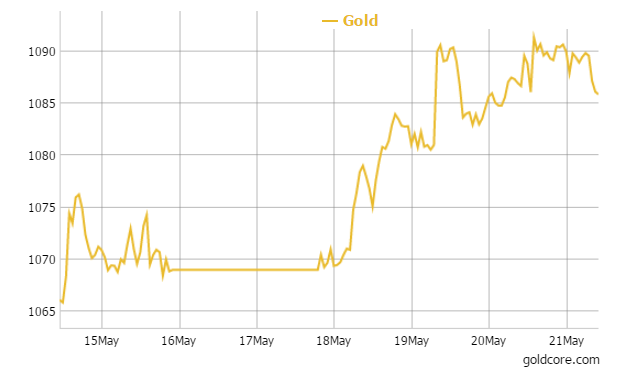
Gold remained firm above $1,200 an ounce as yesterday’s Fed minutes contained no new information and showed that a June rate hike would be premature.
In spite of the news, outflows in the world’s largest gold-backed exchange-traded fund, New York-listed SPDR Gold, showed bearish sentiment. The fund holdings fell 0.41 percent to 715.26 tonnes yesterday its lowest in four months. Holdings fell another 2.98 tonnes yesterday, bringing its total outflow for the month to just over 24 tonnes
Recent dollar strength after some positive U.S. economic data has capped gold’s recent rise. A strong dollar makes gold more expensive for holders of other currencies reducing its role as a hedge.
The government of India has released a discussion paper on the gold monetisation scheme that the finance minister had proposed in his budget. The paper outlines that citizens can benefit from a tax-free interest on gold that is deposited with the banks. It proposes individuals and institutions to deposit gold as low as 30 grams.
In the past gold deposit scheme the government only allowed a minimum quantity of 500g of gold. This allows Indians to use their wedding jewellery or other gifts to finance other business endeavors, family loans etc. However, Indians like to take possession of their gold and wear it and keep it in the house due to a distrust of banks.
The new scheme to relieve the Indians of their gold is unlikely to succeed due to their cultural preference to possess their gold — be that coins, bars and especially jewellery.
On the Comex in New York gold futures for June delivery tacked on $1.50, or 0.12%, to trade at $1,210.20 a troy ounce and futures were in a tight range between $1,207.70 and $1,212.30. Silver futures on the Comex for July delivery climbed 9.9 cents, or 0.58%, to trade at $17.21 a troy ounce.
In mid morning European trading gold is up 0.07 percent at $1,210.83 an ounce. Silver is up 0.53 percent at $17.19 an ounce and platinum is unchanged at $1,155.00 an ounce.
end
Ray Dalio Slams Buffett For Being “Wrong On Gold”, Says “Social Disruption” Is Inevitable
Given the recent resurgence of precious metals and the looming ‘endgame’ of Federal Reserve faith, we thought dusting off the following 160 seconds of uncomfortable truth from Bridgewater’s Ray Dalio was worthwhile…
“we’re beyond the point of being able to successfully manage this… and I worry about another leg down in the economy causing social disruption… Hitler came to power in 1933 because of the social tension between the factions.”
“Gold should be a part of everybody’s portfolio to some degree because… it is the alternative money.
Warren Buffett is making a big mistake.”
Dalio explains…
PBOC Gold Purchases: Separating Facts from Speculation
As we are approaching the moment the PBOC unveils they have more physical gold in reserve than what has been disclosed since 2009, 1054 tonnes, we will again analyze everything there is to find about PBOC gold purchases. Grasping the exact size of their current official gold reserves is unfortunately impossible, but if we understand why, “not-knowing” actually forms a piece of the puzzle. The purpose of this post is to get an overview of all data and clues in order to separate the facts from speculation.From there we’ll estimate how much above ground gold is held in China mainland – official (PBOC) and private reserves.
I have been writing for a long time the PBOC does not buy any gold trough the Shanghai Gold Exchange (SGE), therefor PBOC purchases must be seen in addition to the flows of gold going through the famous bourse in Shanghai. However, I deem it necessary to contemplate this assumption one more time. I’ll tell you what I know and what I think.
We have a fairly good view on how much gold is going through the SGE and is net imported into China, after which it’s not allowed to be exported and thus is accumulated in the mainland (read this post for an analysis on Chinese gold trade rules). By adding domestic mine supply we can estimate how much gold is held in reserves by the Chinese. But, are any of these visible gold flows bought by the PBOC? If not, how much does the PBOC buy abroad in addition to the visible flows we see entering China mainland through the SGE? These questions are the springboard for our investigation.
Please make sure you have read this post, about the basic mechanics of the Chinese gold market with the SGE at its core, before you continue.
Why The PBOC Would Not Buy Gold Through The SGE
1) The get a better grip on this subject it helps if we understand why the PBOC would buy gold in the first place, so let’s sum up all possible incentives. The main objectives for the PBOC to accumulate gold are:
- Supporting the renminbi for its internationalization (adding trust and credibility).
- Owning hard currency as the cornerstone of capitalism.
- Owning reserves that protect the Chinese economy from external/internal shocks and inflation.
- Owning reserves that are not controlled by a foreign nation (the US).
- Diversifying its excessively large US dollar (USD) reserves.
- Hedge their USD reserves.
- Overthrow the USD hegemony.
After reading this list it should be clear the PBOC rather buys gold with their foreign exchange reserves than with renminbi – China’s FX reserves are worth about $3.7 trillion and mostly held in USD. The amount of gold currently on the PBOC’s balance sheet is disproportionate to the amount of USD held. Hence, the PBOC needs to exchange USD for gold (less USD, more gold). All gold on the SGE is quoted in renminbi, meaning the PBOC can’t exchange USD with gold through the SGE. Therefor, they are more likely to buy gold abroad and these purchases should be added to thevisible gold flows we see entering the mainland through the SGE – later on we’ll do some number crunching.
2) It should be said the SGE is a subsidiary of the PBOC. In 2002 China’s central bank created the SGE for the domestic Chinese gold market, for the people to trade gold in renminbi. Gold bar sizes available on the SGE vary from 50 gram to 12.5 Kg, though the volume of 12.5 Kg contracts (Au99.5 and iAu99.5) ever traded is close to nil.Only the 50g, 100g, 1 Kg and 3 Kg bars are traded, which are consumer sizes. This is a sign the PBOC is not likely to be buying gold through the SGE (gold in larger denominations such as 12.5 Kg bars is cheaper and more attractive for buyers such as the PBOC).
3) The reason we don’t know how much Chinese official gold reserves are is because this is the best kept secret in China. The PBOC buys gold in utmost secret or it would influence the market and geo-politics. If we think from the PBOC’s strategy, why would they leave a single trace when buying gold? Why would the PBOC buy any gold through the SGE for the world to see? I think they wouldn’t.
4) Furthermore, why would any gold we can see being exported by Hong Kong, the UK, Switzerland, Australia or Singapore to China mainland be destined for the PBOC? All gold (bullion) trade on planet earth that is visible (that shows up in customs reports) is classified as non-monetary (usually HS code 7108.1100, 7108.1200, 7108.1310 or 7108.1380). Monetary gold is not published in customs reports (HS code 7108.2000, which captures data that is not publically disclosed). I don’t see it likely the PBOC would insist exporting countries to disclose the gold as non-monetary trade, for the world to see, while it can easily be hidden as monetary trade. Therefor, all visible gold exports to China are not PBOC purchases in my opinion.
To illustrate the difference between monetary gold and non-monetary gold trade let’s have a look at the UK. Data about all gold traded in and out of the UK – the London Bullion Market – was not publically available a few years ago. UK customs (HMRC) told me in 2014 all gold import and export used to be hidden under HS code 7108.2000 (monetary). They wrote me:
For trade prior to 2014, the UK had a long standing exemption from the International reporting requirements for gold. This means that gold held as a ‘store of wealth’ had not been recorded as trade in goods. It had previously been classified as monetary gold, which is excluded from trade in goods as per international guidelines.
In order to bring the UK recording of non-monetary gold in line with international standards and legislation, the majority of the UK trade originally classified in the monetary gold commodity code (7108.2000) was reclassified as non-monetary gold. All that Monetary gold re-classified as Non-Monetary gold was put into the comcode [HS] 7108.1310. This was for the period 2005 to 2013 and allows better comparability with the statistics produced by other countries.
Switzerland enjoyed the same long standing exemption from International reporting. Hence, I think in any country gold trade can be disclosed in customs reports under HS code 7108.xxxx if no one is making a fuss, or it can be hidden under HS code 7108.2000.
The PBOC (or its proxies like SAFE and CIC) is likely to buy bullion from places like the UK, US, Switzerland, Hong Kong or Singapore; the big gold hubs. Possibly, gold has at some point been imported into one of these countries, and disclosed in their respective customs reports as such, after which it was exported to China, without being disclosed in any customs reports. Let’s take Hong Kong for example. Since January 2013 Hong Kong has net imported 836 tonnes of gold, illustrated in the charts below.


Some of this gold could have been visibly (non-monetary trade) imported into Hong Kong, and then invisibly (monetary trade) exported to PBOC vaults in the mainland. Resulting in less residual gold present in Hong Kong than data from the local Census Department indicates.
5) The majority of global gold trade (total volume) is done through the London Bullion Market. This is not a central exchange like the COMEX, but an Over The Counter (OTC) market where buyers and sellers connect (electronically) one on one to trade gold without nosy analysts taking notes. Gold traded can be Loco London – located in London – or elsewhere. The London Bullion Market is ideal for the PBOC, as opposed to the SGE. I don’t rule out there is goldinvisibly exported from the UK as well.
6) Another reason for the PBOC to buy abroad would be because it’s cheaper. Gold on the SGE often attracts a premium over London spot. Why pay a premium? (Especially, if one is buying large quantities.)
7) Gold industry expert Jim Rickards has written in The Death Of Money (2014):
A senior manager of G4S, one of the world’s leading secure logistics firms, recently revealed to a gold industry executive that he had personally transported gold into China by land through central Asian mountain passes at the head of a column of People’s Liberation Army tanks and armored transport vehicles. This gold was in the form of the 400- ounce “good delivery” bars favored by central banks rather than the smaller one- kilo bars imported through regular channels and favored by retail investors.
This is very interesting. Not only because it demonstrates the PBOC prefers 400 ounce (12.5 Kg) bars over 1 Kg bars, but more so because it confirms the PBOC does not import gold through visible channels. This strengthens my assumption the PBOC does not buy any gold through the SGE. Note, all visible import (general trade) is required to be sold through the SGE in China.
8) On the LBMA Bullion Market Forum in Singapore on 25 June, 2014, a speech was delivered by Xu Luode, Chairman of the Shanghai Gold Exchange. Let’s have a look at a snippet:
Last year, China imported 1,540 tonnes of gold. Such imports, together with the 430 tonnes of gold we produced ourselves, means that we have, in effect, supplied approximately 2,000 tonnes of gold last year.
The 2,000 tonnes of gold were consumed by consumers in China. Of course, we all know that the Chinese ‘dama’ [middle-aged women] accounts for a significant proportion in purchasing gold. So last year, our gold exchange’s inventory reduced by nearly 2,200 tonnes, of which 200 tonnes was recycled gold.
Xu mentions the amount of gold imported into China mainland in 2013 (1,540 tonnes). Would Xu be allowed to break China’s best kept secret on an LBMA forum? Would any of these imports end up at the PBOC? I don’t think so. Moreover,Xu explicitly says all imports and mine output (and scrap supply) has been sold through the SGE system to consumers, not the PBOC.
Economic person of the year 2011 in China, Sun Zhaoxue, who was also the President of the China Gold Association and General Manager of the China National Gold Group Corporation, wrote in August 2012:
Individual investment demand is an important component of China’s gold reserve system, we should encourage individual investment demand for gold. Practice shows that gold possession by citizens is an effective supplement to national reserves and is very important to national financial security.
Sun makes a clear distinction between consumer purchases (SGE flows) and “national reserves”.
9) When examining SGE gold purchases, by withdrawals from SGE designated vaults, we can depict a seasonal trend of strong demand around New Year (and in April 2013 when the price of gold made its famous nosedive). The Chinese typically buy gold in this period as gifts for each other. Does this trend look like PBOC activity?

10) Though at first the WGC thought the PBOC would buy gold through the SGE, last thing I read from them on China they seemed to have to have changed their stance (Understanding China’s gold market, July 2014):
China’s authorities have a range of options when purchasing gold. They may acquire some of the gold which flows into China; there has been no shortage of that. Butthere are reasons why they may prefer to buy gold on international markets: gold sold on the SGE is priced in yuan and prospective buyers – for example, the PBoC with large multi-currency reserves – may rather use US dollars than purchasing domestically-priced gold. The international market would have a lot more liquidity too.
11) For what it’s worth, I have two sources in the mainland, including a teacher in ‘economics and the gold market’ at the Henan University of Economics and Law in Zhengzhou City, that both tell me the PBOC would not buy gold through the SGE.
12) Last but not least, the SGE President of the Transaction Department confirmed to Na Liu from CNC Asset Management Ltd. the PBOC does not buy any gold through the SGE. Na Liu wrote in a report about 2013 SGE withdrawals:
…none of the 2,200 tonnes of gold was bought by the Chinese central bank. The President said: “The PBOC does not buy gold through the SGE.”
Why The PBOC Buys Gold Through The SGE
1) There are also arguments the PBOC does buy gold through the SGE. For example, in the previous chart we can see SGE customers are very keen on buying the dips. Is this buying pattern caused by clever consumers or is the PBOC perhaps in play here? (My response would be, currently the SGE has 8,358 institutional customers – and 7.33 million individual customers, I believe these buyers can perfectly be responsible for the buying pattern we see on the SGE with regard to withdrawals in relation to the price of gold.)
2) More important is a lot of metal on the balance sheets of Chinese banks. Although the annual reports of the banks do rarely specify these holdings other than “precious metals”, presumably they can be gold, silver, platinum, gold savings accounts, gold swaps, leases, pledges and derivatives. MacQuarie bank has estimated by the end of 2014 approximately 1,800 tonnes of gold was spread over all Chinese banks’ balance sheets. Though unclear what kind of gold we’re actually talking about, I’m positive all this gold has at some point been through the SGE system and therefor belongs to the visible gold flows. I will research the banks balance sheet topic extensively for a separate post,for now let’s be open minded to the possibility some of this gold can be added to the PBOC balance sheet in the future. Song Xin, President of the China Gold Association, General Manager of the China National Gold Group Corporation and Party Secretary, wrote I an opinion editorial in July 2014:
Establish a Gold bank. We need to establish our gold bank as soon as possible, and enable it to break the barrier between the commodity and monetary world. It can further help us acquire reserves and give us more say and control in the gold market. It may be guided under the PBOC and led by the China Gold Association, involving leading gold industry companies and commercial banks, and it’s business would include: gold pricing (fix), gold financing and leasing, gold-guaranteed payments, gold saving accounts, gold lending, gold production chain financing and issuance and trading of paper gold and other gold investments. This gold bank can then naturally use market-oriented methods to change commodity gold into monetary gold reserves, thus help us increase our strategic gold reserves.
3) Probably the most significant reason people think the PBOC buys gold through the SGE is the huge gap between SGE withdrawals and consumer demand as reported by the World Gold Council (WGC). Let’s have a look at this gap in a chart.

As you can see there is an immense gap between the purple bars (WGC demand) and the red bars (SGE withdrawals). Possibly some of this gold has been moved to PBOC vaults.
I’ve extensively been writing on these pages “the gap” was not filled by PBOC purchases – for a lot of reasons. I’ll let go of this analysis here, simply to be able to present all pros and cons.
4) There are periods in which gold on the SGE (Au99.99) trades at a discount to London/NY spot. When the price in China is lower than in the UK this means there is more supply in Shanghai than in London. Gold is currently not allowed by the PBOC to be exported from the mainland; for foreigners the gold in China can’t be physically moved out of the mainland in general trade (however, I think there is possibility for SGEI members to arbitrage an SGE discount, that is to buy Au99.99 (long) and at the same time hedge on the COMEX (short) when the discount has narrowed close all positions and strike a profit).
In the periods of persistent discounts on the SGE – i.e. March 2014 – withdrawals remain relatively high. Is the PBOC buying the discounted gold to take possession and support SGE trading?
I shall rest here. For all pros and cons we think of many counter arguments, it’s an endless story. The purpose of the listed arguments is to provide you with as much information about the Chinese gold market and PBOC purchases as possible.
Does The PBOC Buy Gold?
Do we know the PBOC buys gold at all? Yes, Jim Rickards’ story illustrates what goes on behind the scenes – gold is imported from central Asia – and his writings are certainly not all we have. I’ll briefly present a few clues, after which we’ll try to make some sense of it all.
1) From a study by Zhang Bingnan, Vice President of the China Gold Association, (August 2012):
Forecast the optimal gold reserve capacity in the next 20 years. The conclusion is: 2020, China’s gold optimal reserves should be 5,787 tonnes – 6,750 tonnes. 2030 should be 8,995 tonnes – 10,532 tonnes.

2) Yi Gang, deputy Chinese central bank governor, stated (March 2013):
We will always keep gold in mind as an option in reserve assets and investments. We are able to import 500-600 tons a year, or more, but we will also take into consideration a stable gold market. If the Chinese government were to buy too much gold, gold prices would surge, a scenario that will hurt Chinese consumers. We can only invest about 1-2 percent of the foreign exchange reserves into gold because the market is too small.
3) From Song Xin, President of the China Gold Association, (July 2014):
That is why, in order for gold to fulfill its destined mission, we must raise our [official] gold holdings a great deal, and do so with a solid plan. Step one should take us to the 4,000 tonnes mark, more than Germany and become number two in the world, next, we should increase step by step towards 8,500 tonnes, more than the US.
4) Deutsche Bank Markets Research (November 2014):
In another example, the Chinese government’s open market purchases of roughly 500 tonnes per year have not prevented the gold price from plummeting in recent years.
5) Roland Wang, World Gold Council China Managing Director, said (March 26, 2015):
China currently holds about 1.6 percent of its foreign exchange reserves in gold, which is relatively low compared with developed countries and some developing countries, WGC China managing director Roland Wang said.
“The ideal amount should be at least 5 percent of its total forex reserves,” Wang told Reuters in an interview in Hong Kong.
Remarkably, the exact same day Reuters published Wang’s statement Chinese newswire Caixin published a story on gold written by Hedge Fund manager Li Sheng (March 26, 2015):
Gold accounts for only 1.6 percent of China’s forex reserves. This is only a fraction of the figure in the United States and many other developed countries. If China ever increased the level to 5 percent, it would have an enormous impact on global demand for gold.
Funny enough, Li mentions the exact same numbers as Wang from the World Gold Council on the same day: 1.6 % and 5 % of total FX reserves. If China would announce they hold 5 % of total reserves in gold, this would translate into roughly 5,000 tonnes.
6) Jeremy East, Managing Director Global Head, Metals Trading, Standard Chartered Bank (June 25, 2014):
I was at the Shanghai Derivatives Forum at the end of May and one of the speakers was a representative of the [China] Gold Association. He gave us quite an interesting insight into the flavor of what is going on in China from a strategic perspective. Some of the things he talked about included that China planned to change the landscape of world gold markets. He talked about having a strong currency and about having that currency backed by gold, like the US dollar. He also talked about people holding more gold and encouraging more people to hold gold. That is not just individuals, but also the central bank. From that perspective, it is also getting gold into the country in terms of encouraging domestic gold production, but also investing in international mining companies and sourcing the product from them. China has got a very friendly gold strategy.
I do not rule out the PBOC buys gold through overseas mines. (By the way, China is not planning to “back” their currency with gold in my opinion, they’re more likely to “support” their currency with gold at no fixed parity.)
What many of these clues have in common is that they hint the PBOC buys about 500 tonnes a year and thus its official gold reserves are approximately 3,500 tonnes. Unfortunately, we can’t know anything for sure. We just have to wait for the Chinese government to make a decision and disclose a number they see fit – the number disclosed can be less of what they actually have.
Facts And Speculation
Let’s chew on some numbers to separate facts from speculation. In the first chart below I’ve plotted a conservative estimate of the total above ground reserves in China mainland on March 31, 2015. This estimate is based on the assumption the PBOC has bought zero gold since 2009. The starting point is 1994, when the Chinese gold market was not yet liberated, at that time the PBOC was the Chinese gold market, it had the monopoly on all gold trade.

Let me explain how I compiled this chart. Precious Metals Insights (PMI) has estimated that 2,500 tonnes of gold amongst the population were present in the mainland in 1994; that’s the dark grey jewelry base you can see in the chart.
According to the PBOC their official reserves in 1994 accounted for 394 tonnes. Since then China is said to be an “importer”, suggesting mined gold before 1994 could have been exported. In the next screen shot from the China Gold Market Report 2010 we can read the clue “China has been a gold importer since the 1990s” (/1994).

To support the theory China has only seriously began importing gold a few years ago – not in the eighties – have a look the next chart on gold trade between Hong Kong and China. Net imports ramp up in 2010. Other countries than Hong Kong, such as Switzerland, started to visibly export to China after 2010.

Chinese domestic mines produced 90 tonnes in 1994. This is a chart showing Chinese mining since 1994:

The starting point in the first “estimate chart” above is 2,500 (jewelry base) + 394 (official reserves) + 90 (mining) = 2,984 tonnes in 1994. Subsequently I added yearly domestic mining, cumulative, as the Chinese didn’t export any gold since that year, and cumulative imports.
In 2001 The PBOC announced their official reserves had increased to 500 tonnes, in 2003 to 600 tonnes and in 2009 to 1,054 tonnes. Because the Chinese gold market wasn’t fully liberalized in that period I have subtracted all PBOC gains until 2003 from cumulative domestic mining. From 2003 to 2009 total supply (scrap + mine + import from Hong Kong) wasn’t sufficient to meet total consumer demand and 454 tonnes PBOC purchases. Although the PBOC claims all purchases before 2009 were done from domestic mines and scrap, I don’t think that’s possible. Hence, I think the PBOC started invisible import somewhere in between 2003 and 2009.
Fact is, the result is that the minimum of total above ground gold reserves in China mainland on March 31, 2015, was 13,177 tonnes (1,054 tonnes in official reserves and 12,123 tonnes in private reserves).This does not capture gold in the black market, that thrived before 2002, neither any assets from wealthy Chinese families. It’s the most conservative estimate I can make using all data I could find. This estimate can also be used if the PBOC has predominantly bought gold through the SGE since 2009, for these purchases would have been captured invisible import numbers or in domestic mining, both flows go through the SGE. If so, additional PBOC purchases, everything north of 1,054 tonnes, would have to be subtracted from the 12,123 tonnes in private reserves.
However, in my opinion the PBOC has not bought gold through the SGE since 2009, but abroad through the major global gold hubs and possibly from overseas mines. The next chart is a copy of the previous conservative estimate, now supplemented by 500 tonnes a year since 2009 for PBOC purchases, which I have not subtracted from cumulative domestic mining or cumulative import, as my assumption is this gold has invisibly been imported and not bought through the SGE.

Speculating, this total has reached to 15,623 tonnes on March 31, 2015 (3,500 tonnes official reserves, 12,123 tonnes private reserves). Although, the official reserve can be more or less.
Summary: the PBOC has at least 1,054 tonnes and at least 13,177 tonnes in total is located in the mainland. Possibly, the PBOC could have as much as 3,500 tonnes, stretching total above ground reserves in the mainland to 15,623 tonnes. If the PBOC has bought gold through the SGE and invisibly abroad, the part bought through the SGE should be subtracted from 12,123 tonnes in private reserves (which would lower total reserves).
In addition, there can be a lot more gold in China – accumulated through thousands of years of civilization – of which I have no evidence.
These are the best estimates I can make at this stage; if I find new information I’ll keep you posted.
Addendum
Above you could read clues from Song Xin (China Gold Association, July, 2014) and Jeremy East (June 25, 2014) aboutChina working on a new monetary system that will include gold. Something similar was said by Zhou Ming, General Manager of the Precious Metals Department at ICBC, when Jeremy East asked him at LBMA forum in Singapore (June, 2014) if the statement “Western gold moves East” was true:
With the status of the US dollar as the international reserve currency is shaky, a new global currency setup is being conceived. Uncertain changes will happen to gold’s traditional dollar-pricing so the US dollar’s influence on gold pricing needs to be re-evaluated.
Jean-Claude Trichet, former president of the European Central Bank and a co chairman of the International Financial Forum (IFF) think tank, said at the IFF forum in Beijing (April, 2014):
The global economy and global finance is at the turning point in a way,.. new rules have been discussed not only inside the advanced economies, but with all emerging economies, including the most important emerging economies, namely, China.
The IFF Board consists of Mr. Cheng Siwei as the Chairman; Mr. Paul Volcker as the Honorary Chairman; Mr. Han Seung-soo, Mr. Jean-Claude Trichet, and Mr. Kevin Rudd as the Co-Chairmen; and Mr. Dai Xianglong as the President.
Koos Jansen
E-mail Koos Jansen on: koos.jansen@bullionstar.com
end
And now overnight trading in stocks and currency in Europe and Asia
1 Chinese yuan vs USA dollar/yuan strengthens to 6.2035/Shanghai bourse green and Hang Sang: red
2 Nikkei closed up by 6.31 points or .03%
3. Europe stocks all in the red/USA dollar index down to 95.12/Euro rises to 1.1148/
3b Japan 10 year bond yield: slight rises to .41% !!!!(Japan buying 100% of bond issuance)/Japanese yen vs usa cross now at 121.06/
3c Nikkei still just above 20,000
3d USA/Yen rate now well above the 120 barrier this morning
3e WTI 59.75 and Brent: 65.89
3f Gold up/Yen up
3gJapan is to buy the equivalent of 108 billion uSA dollars worth of bond per month or $1.3 trillion. Japan’s GDP equals 5 trillion usa.
Japan to buy 100% of all new Japanese debt and by 2018 they will have 25% of all Japanese debt. Fifty percent of Japanese budget financed with debt. Last night Japan refused to increase it’s QE
3h Oil up for WTI and up for Brent this morning
3i European bond buying continues to push yields lower on all fronts in the EMU. German 10 yr bund falls to 61 basis points. German bunds in negative yields from 4 years out.
Except Greece which sees its 2 year rate rise slightly to 23.03%/Greek stocks down 0.07%/ still expect continual bank runs on Greek banks./Greek default inevitable/
3j Greek 10 year bond yield rises to: 11.16%
3k Gold at 1210. dollars/silver $17.30
3l USA vs Russian rouble; (Russian rouble up 1/2 rouble/dollar in value) 49.57 , the rouble is still the best acting currency this year!!
3m oil into the 59 dollar handle for WTI and 65 handle for Brent/Saudi Arabia increases production to drive out competition.
3n Higher foreign deposits out of China sees huge risk of outflows and a currency depreciation. This can spell financial disaster for the rest of the world/China may be forced to do QE!!
30 SNB (Swiss National Bank) still intervening again in the markets driving down the SF. It is not working: USA/SF this morning .9326 as the Swiss Franc is still rising against most currencies. Euro vs SF is 1.0397 well below the floor set by the Swiss Finance Minister.
3p Britain’s serious fraud squad investigating the Bank of England/
3r the 4 year German bund remains in negative territory with the 10 year moving further away from negativity at +.61/
3s Tw0 weeks ago, the ECB increased the ELA to Greece by another large 2.0 billion euros.Last week, they raised it another 1.1 billion and then yesterday they raised it another tiny 200 million euros thus at this point the new maximum was 80.2 billion euros. The ELA is used to replace depositors fleeing the Greek banking system. The bank runs are increasing exponentially. The ECB is contemplating cutting off the ELA which would be a death sentence to Greece and they are as well considering a 50% haircut to all Greek sovereign collateral which will totally wipe out the entire Gr. banking and financial sector.
3t Greece paid the 700 million plus payment to the IMF last Wednesday but with IMF reserve funds. It must be paid back in 24 days.
3 u. If the ECB cuts off Greece’s ELA they would have very little money left to function. So far, they have decided not to cut the ELA
4. USA 10 year treasury bond at 2.26% early this morning. Thirty year rate well above 3% at 3.03% / yield curve flatten/foreshadowing recession.
5. Details Ransquawk, Bloomberg, Deutsche bank/Jim Reid.
(courtesy zero hedge/Jim Reid Deutsche bank)
Despite Weak Economic Data Overnight, Futures Slide On Rate Hike Concerns
The big news overnight was neither the Chinese manufacturing PMI miss nor the just as unpleasant (and important) German manufacturing and service PMI misses – the second consecutive monthly slowdown – but that speculation about a rate hike continues to grow louder despite the abysmal economic data lately, with the latest vote of support of a 25 bps rate increase coming from Goldman which overnight updated its “Fed staff model” and found surprisingly little slack in the economy suggesting that the recent push to blame reality for not complying with economist models (and hence the need for double seasonal adjustments) is gaining steam, and as we first suggested earlier this week, it may just be the case that the Fed completely ignores recent data (saying it was not adjusted enough), and pushes on to tighten conditions, if only to rerun the great Trichet experiment of the summer of 2011 when the smallest of rate hikes resulted in a double dip recession.
This may also be why equity futures this morning are a peculiar shade of green, one not seen in over a week, as the reality that a rate hike is coming finally trickles down to the smallest and slowest algorithm.
We will have more to say on the Goldman note shortly, but here are the main take-aways are: (1) potential growth has continued to recover (estimated at 1.8% year-over-year in 2015Q1); (2) the structural unemployment rate has remained low at 5%; (3) the cyclical gap in participation is very small; and (4) the output gap has continued to close (reaching -0.6% in 2015Q1). Goldman summarizes that “we broadly agree on the model’s estimates for potential growth.” In other words, a rate hike in the current slow-growth, un-double-seasonally adjusted environment may be just what the Econ Ph.Doctor ordered.
As for economic data overnight, it was again lousy, starting with China’s May Mfg PMI which while improving slightly from April, up from 48.9 to 49.1, was still slightly below market expectation of 49.3, and the third consecutive contraction. The performances of the two most important sub-indices are mixed: Compared with April final readings, the production index went down to 48.4 from 50.0, while new orders index increased to 49.3 from 48.7 (despite the new export orders declining to 46.8 from 50.3). The employment index, which tends to lag the most, increased to 49 from 47.8. Suppliers’ delivery times decreased to 49.9 from 50.1. Raw material inventory increased to 49.1 from 47.6.

But it was Germany’s (and Europe’s) PMI miss that was even more disappointing: the Euro area flash composite PMI eased by 0.5pt to 53.4 in May, below consensus forecast of flat reading (Cons: 53.9). The 0.3pt improvement in the manufacturing PMI was more than offset by the 0.8 contraction in the services PMI. At the country level, the German composite PMI fell further, while the French composite PMI ticked up in May.
In addition to the Euro area aggregate PMI, Flash PMIs were released for Germany and France. The German composite PMI declined by 1.3pt to 52.8, below consensus expectations for a smaller contraction (Cons: 53.8). This was driven by a 1.1pt decline in the services PMI as well as a 0.8pt decrease in the manufacturing PMI. The German composite PMI has lost 2.6pt in the two first months of Q2.


In immediate reaction both Citi and JPM cut Germany’s Q2 GDP forecast from 2.0% to 1.7%, and from 2.5% to 2.0%, respectively. Was that it for the great European economic recovery? Without further substantial weakening in the EUR, the answer may be yes.
Asian equities mostly rose led by the Shanghai Comp (+1.9%) after the latest Chinese HSBC flash Mfg PMI saw its 3rd
consecutive month of contraction (49.1 vs. Exp. 49.3), stoking further easing expectations. Nikkei 225 (+0.2%) once again
topped its 15-year highs, ahead of tomorrow’s BoJ monetary policy meeting, with reports suggesting the central bank could
upgrade its economic forecasts.
European equites (Euro Stoxx: -0.54%) trade in the red weighed on by the European PMI’s and the stronger EUR while the FTSE (-0.1%) outperforms after Australian Treasury Hockey stated that Australia will not be conducting an inquiry into the iron ore market, bolstering the materials sector with commodities complex also benefitting from the aforementioned USD weakness (-0.4%). The e-mini S&P has ebbed lower since the release of Fed minutes, amid little other fundamental news, while US earnings due out today include Hewlett-Packard, Intuit and Ross Stores, who all report after market.
Fixed income markets have seen Bunds trend lower heading into the North American crossover, while bond auctions from both Spain and France easily absorbed, elsewhere today sees the only Treasury supply of the week in the form of a USD 13bln 10yr TIPS auction. T-Notes outperform Bunds today after Analysts at Citi and Goldman Sachs have revised higher their forecast for German 10Y yields for end of 2015 to 0.4% from 0.2% and 0.9% from 0.5% respectively, with the latter also raising their end of 2015 UST yield forecast to 2.75% from 2.5% and predicting a September Fed rate hike.
USD (-0.5%) has trended lower throughout the European session following yesterday’s Fed meeting minutes with a June rate hike now appearing unlikely. EUR/USD and GBP/USD have both gained on the back of the weak USD as the latter moves higher on the day by over 150 pips. As well as yesterday’s Fed minutes, this morning saw strong UK Retail Sales Ex Auto (1.2% vs Exp. 0.2%, Prev. 0.2%). Germany and the Eurozone released their May prelim PMI’s, with German figures weaker across the board and Eurozone printing mixed data.
The commodity complex has seen strength in energy amid light news flow as a consequence of USD weakness ahead of the EIA NatGas Storage change scheduled for 1530BST/0930EDT, which is expected to show a build of 96 after last week’s build of 111. Also of note, Indian April Gold imports reached 86.7 tons (Prev. 43.2 tons Y/Y), according to an Indian Finance Ministry official.
Looking ahead, today sees the release of ECB minutes, US weekly jobs numbers, manufacturing PMIs, Existing home sales and Philadelphia Fed Business Outlook as well as comments from BoE’s Weale (Soft Hawk) and Fed’s Fischer (Soft Dove, Voter).
In summary: European shares fall with the real estate and tech sectors underperforming and oil & gas, basic resources outperforming. Euro-area manufacturing PMI above estimates, services PMI below. German manufacturing and services PMI below estimates; French manufacturing PMI above. U.K. retail sales above market expectations. Earlier, China manufacturing PMI below estimates at 49.1. The Italian and German markets are the worst-performing larger bourses, the Swiss the best. The euro is stronger against the dollar. German 10yr bond yields rise; Japanese yields increase. Commodities gain, with nickel, zinc underperforming and WTI crude outperforming. U.S. jobless claims, continuing claims, Markit U.S. manufacturing PMI, Bloomberg consumer comfort, Bloomberg economic expectations, Philadelphia Fed index, Chicago Fed index, existing home sales, leading index, Kansas City Fed index due later.
Market Wrap
- S&P 500 futures down 0.2% to 2118.2
- Stoxx 600 down 0.2% to 405.6
- US 10Yr yield at 2.24%
- German 10Yr yield up 3bps to 0.66%
- MSCI Asia Pacific up 0.1% to 153
- Gold spot down 0.1% to $1208.7/oz
- 32.7% of Stoxx 600 members gain, 64.5% decline
- Eurostoxx 50 -0.6%, FTSE 100 -0.1%, CAC 40 -0.5%, DAX -0.5%, IBEX -0.4%, FTSEMIB -0.7%, SMI +0%
- Asian stocks little changed with the Shanghai Composite outperforming and the Kospi underperforming; MSCI Asia Pacific up 0.1% to 153
- Nikkei 225 up 0%, Hang Seng down 0.2%, Kospi down 0.8%, Shanghai Composite up 1.9%, ASX up 0.9%, Sensex down 0.1%
- Euro up 0.7% to $1.1172
- Dollar Index down 0.43% to 95.04
- Italian 10Yr yield up 2bps to 1.88%
- Spanish 10Yr yield up 1bps to 1.81%
- French 10Yr yield up 4bps to 0.95%
- S&P GSCI Index up 0.8% to 444.2
- Brent Futures up 1.2% to $65.8/bbl, WTI Futures up 1.2% to $59.7/bbl
- LME 3m Copper up 0.3% to $6239.5/MT
- LME 3m Nickel down 1.1% to $12970/MT
- Wheat futures up 0.7% to 516.5 USd/bu
Bulletin Headline Summary From Bloimberg and RanSquawk
- USD falls 0.5% following Fed meeting minutes while strong UK Retail Sales Ex Auto (1.2% vs Exp. 0.2%, Prev. 0.2%) sees GBP/USD trade higher by over 150 pips
- Bunds have weakened heading into the North American crossover after both Citi and Goldman Sachs revised higher there end of 2015 Bund yield forecasts
- Today sees the release of US weekly jobs numbers, manufacturing PMIs, Existing home sales and Philadelphia Fed Business Outlook as well as comments from Fed’s Fischer and BoE’s Weale
- Treasuries steady before jobless claims, TIPS auction; market activity may be muted today and tomorrow before long holiday weekend in U.S. and U.K.Markit/HSBC’s China manufacturing gauge was at 49.1 for May, missing the median 49.3 estimate in a Bloomberg survey
- Germany’s economy stuttered again this month, with Markit’s composite PMI falling to 52.8 from 54.1 in April, second straight decline and the lowest level this year
- Markit’s euro zone composite PMI slipped to 53.4, lower than forecast, from 53.9
- ECB approved the smallest rise in emergency cash for Greek lenders since tensions re-emerged in February, according to people familiar; no decision was taken to alter the discounts applied to collateral pledged for the Bank of Greece loans, the people said
- Germany’s Schaeuble doesn’t rule out a Greek bankruptcy, saying in an interview that far too little progress has been make in talks and that he would “consider for a long time” before repeating 2012 comment that Greece wouldn’t go bankrupt
- U.K. retail sales rose 1.2% in April, more than forecast, as clothing demand rose the most in four years
- U.K. Prime Minister David Cameron will pledge on Thursday to reduce immigration as his Conservative administration prepares new laws to punish illegal workers, step up deportations and tag foreign criminals
- Islamic State militants seized control of Palmyra, a city in northern Syria that’s home to one of the region’s most renowned classical sites, according to the Syrian Observatory for Human Rights
- NATO must send more troops to Baltic countries for “quite some time” to counter increased threats from Russia, according to Estonia’s defense minister
- U.S. Senator Rand Paul held the Senate floor for more than 10 hours to protest legislation extending much of the National Security Agency’s spying program
- Sovereign bond yields mixed. Asian stocks mostly higher, European stocks, U.S. equity-index futures decline. Crude oil and copper higher, gold little changed
DB’s Jim Reid concludes the overnight recap
It seems the Fed have moved closer to giving up on a June hike after the release of April’s FOMC minutes last night. This pretty much confirms the market’s expectation but it firmed it up more. Although a ‘few’ members anticipated that the US economy would be ready for a move in June, this was seemingly outweighed by the comment that ‘many’ participants ‘thought it unlikely that the data available in June would provide sufficient confirmation that the conditions for raising the target range for the federal funds rate had been satisfied’. The minutes did say that they ‘did not rule out this possibility’, but it’s hard to see the tone favouring a move in June now. Aside from this, there were more mentions in the minutes that officials expect ‘moderate’ growth to resume again after the weak Q1, while the committee touched on the transitory effects of that quarter including the severe winter weather and labour dispute at West Coast ports temporarily disrupting some supply chains. In terms of forward guidance, the committee once again noted that any decision will be made on a ‘meeting-by-meeting’ basis while there was some discussion on the merits of using post meeting statements to provide forward guidance, however this was ultimately rejected. Although the general consensus appeared to be that most still view the risks to the outlook for economic growth and the labour market as nearly balanced, there was some discussion on the strengthening Dollar being a factor restraining economic growth for some time, while the committee also touched on the slowdown in growth in China and problems in Greece as potential downside risks.
So all-in-all a fairly neutral tone which probably leaned towards the doves at the margin if you had to pick a side. In terms of price action, having traded modestly lower for most of the session pre-minutes, the S&P 500 initially rose +0.3% immediately following the release, however this proved to be short lived with the gains then pared into the close and the index finishing -0.09%. There was little change in the pre and post FOMC levels for Treasuries either, with the 10y benchmark eventually closing at 2.249%, a -4.1bps move down on the day. The Dollar had a slightly stronger day meanwhile, with the DXY +0.34% while Gold finished +0.16% at $1210/oz. Credit markets were mostly flat. Aside from the minutes, newsflow was fairly limited. The Chicago Fed’s Evans was in focus again, reiterating his 2016 timeframe but suggesting that ‘substantially stronger and sustained nominal wage growth would be a very important harbinger of rising inflation pressures or improvements in the economy’, which in turn could change his mind on the potential path of rates. Looking at the follow up in markets in Asia, bourses are generally mixed this morning after somewhat divergent flash PMI
manufacturing readings in China and Japan. For the latter, the 50.9 (vs. 50.3 expected) print came in above market and a point higher on last month’s reading. The same can’t be said for China’s reading however. Despite a 0.2pt increase on April, the 49.1 reading came in below market forecasts of 49.3 to mark the third consecutive month of sub-50 prints. The China MNI business indicator print for May made for modestly better reading however, rising 0.9pts to 49.7 for its first monthly gain since December. Both the Shanghai Comp (+1.12%) and CSI 300 (+1.30%) are higher despite the data, perhaps reflecting the hope that more easing is in the air. The Nikkei (+0.56%) and Topix (+0.75%) have both firmed on the data, while the Hang Seng (-0.04%) and Kospi (-0.72%) are lower as we type. Credit markets have been fairly unmoved.
Moving on, aside from further Greek headlines it was a quiet session in Europe on the whole. As technical talks between Greece and its creditors continued, the ECB raised the ELA facility ceiling yesterday by €200m – the smallest increase since February. At the same time, there were no announced changes to haircuts on Greek collateral despite concerns that the ECB had drafted a plan to do such. For now, focus turns to the 2-day European leaders summit in Riga today where PM Tsipras and German Chancellor Merkel are expected to meet on the sidelines in what looks set to be more of a political confidence boost than anything else. Comments continue to pour in from both sides of progress being made however in reality the outstanding (and more concrete) issues surrounding pension and labour reforms in particular still remain. In the meantime, it’s looking increasingly likely that the IMF payment due on June 5th will unlikely be made without any release of funds – which is unlikely to be a surprise to most. This was confirmed by a SYRIZA spokesman yesterday who was quoted on Greek TV (ANT1) as saying that ‘if there is no deal by then that will address the current funding problem, they won’t get any money’. With the clock ticking away, the situation continues to be a daily affair for markets with the various outcomes still far from certain.
Aside from the DAX (-0.04%), it was a better day on the whole for European equities as the Stoxx 600 (+0.41%), CAC (+0.31%), IBEX (+0.66%) and FTSE MIB (+0.25%) all closed higher. In bond markets yields moved higher in the afternoon with 10y Bunds closing 3.7bps higher at 0.630% and yields in the periphery widening 5-7bps. It was a quiet day on the data front meanwhile with just a slightly softer than expected German PPI reading (+0.1% mom vs. +0.2% expected) for April to digest.
Yesterday’s Bank of England minutes appeared to reaffirm the expectation that inflation will pick up ‘notably’ as the year moves on. Despite a unanimous vote to keep rates on hold for now, the decision was ‘finely balanced’ for two MPC members, potentially pointing towards a return towards split decisions in the near term. The minutes also estimated that the level of slack in the economic was about 0.5% of GDP and that this is ‘likely to be fully absorbed within a year’. Sterling ended the day +0.15% higher versus the Dollar and +0.68% versus the Euro.
Focus will quickly shift from yesterday’s FOMC minutes to what is a busy day for data today as well as more Central Bank attention as we get the ECB minutes from the April 14th/15th meeting around midday. This morning’s data releases will be highlighted by the May flash manufacturing, services and composite prints for the Euro area and also regionally in Germany and France. Euro-area consumer confidence will also be due while in the UK, April’s retail sales are due out. There is plenty of data to get through in the US this afternoon and we there might get quite a few Q2 clues as a result. We kick off with the Chicago Fed national activity index, followed closely by initial jobless claims. The flash manufacturing PMI will follow this, before we get the May reading for the Philadelphia Fed business outlook, existing home sales, the conference board’s leading indicators and finally the Kansas City Fed manufacturing activity print. As well as this, Fed Vice-Chair Fischer is due to speak. A busy day ahead.
end
Weaker Chinese PMI numbers causes their stock market to fall:
(courtesy zero hedge)
Despite Weaker-Than-Expected PMI, Chinese Stocks Stumble
Chinese Manufacturing PMI missed expectations, printing a contractrionary 49.1 (against 49.3 expectatons) for the 3rd month in a row. While this was a small pick up from last month’s 48.9 print, it hardly signals ‘success’ for the various easing efforts unleashed upon an all-knowing investing public. After yesterday’s weakness in Chinese stocks, one would think a disappointing PMI was just the ticket to send investors wild with buying in anticipation of more easing, but now, Chinese stocks have erased early modest gains and are fading back...
a 3rd month of contraction in Chinese manufacturing PMI…

The result – an odd selloff on bad news…

Democracy Under Fire: Troika Looks To Force Greek Political “Reshuffle”
The countdown to the June 5 IMF payment is about to go under two weeks and if there’s one thing that Greece and the IMF agree on, it’s that Athens can’t make that payment unless creditors disburse the last tranche of aid from the country’s current bailout program. European officials have done an admirable job of making life miserable for Syriza since the democratically elected government took over in January, as the “institutions” (and Germany) are keen on sending the followingunequivocal message to any other ‘leftist radicals’ who may be thinking about using the “one move and the idea of EMU indissolubility gets it” routine as a way to negotiate for breathing room on austerity pledges: you will get exactly nowhere and will have a very unpleasant time on the way.
But time is running short and the Greeks have yet to cave on ‘red lines’, setting up the possibility that Germany’s Hellenic debt serfs may actually default next month, triggering instability in Europe and testing the ECB’s “whatever it takes” resolve in sovereign debt markets. That’s not ideal for EU officials who would much rather force PM Alexis Tsipras to abandon his campaign promises in exchange for aid or, perhaps better yet, make things so unbearable for Greeks that the populace begins to ask itself if a government of pandering technocrats is better than starving. This is perhaps why both Moody’s and Schaeuble stepped up their efforts to trigger a terminal bank run on Wednesday.
Whatever the case, it is becoming increasingly clear that the Syriza show will ultimately have to be canceled in Greece (or at least recast) if the country intends to find a long-term solution that allows for stable relations with European creditors, but as we noted on Wednesday, it may be time for Greeks to ask themselves if binding their fate to Europe is in their best interests given that some EU creditors seem to be perfectly fine with inflicting untold economic pain upon everyday Greeks if it means usurping the ‘radical leftists.’
Given the above, it isn’t any wonder that everyone is now taking a hard look at the political ramifications of the June 5 deadline and implicitly asking if the troika will, in the final analysis, be successful in using financial leverage to undermine the democratic process.
Via The Independent:
Were Greece an independent country it would all have been easy. There is a template. Countries often default…
What has changed now is that Greece is not financially independent. If you don’t control your own currency you become a sort of super-municipality. You can default on your debts, as Detroit has done, but then you will not be able to borrow any more money. So your ability to continue functioning depends on your ability to raise enough tax to pay wages and pensions, and buy the goods and services that any government needs. You are not paying any interest. You are not repaying any debts as they fall due. But as long as enough tax comes in to cover your day-to-day spending, you are still in business.
Until a few weeks ago that looked like being an option for Greece. I suspect that was the reason behind the swagger of its finance minister.
Since then three things have happened, all of them negative. One is that people have been taking their money out of their bank accounts, in some cases literally stuffing it under the mattress…
This closes options. The banks may be unable to pay out deposits when they fall due. So there may be capital controls – indeed that seems extremely likely, though this in effect turns the euro into a two-tier currency, with “good” euros that can cross borders and “bad” ones in Greek banks that cannot do so.
A number of Greek politicians have asserted that they would prioritise payroll over debt service, and that is understandable. But it may not be a question of that: Greece may be unable to meet payroll, even if it pays no interest on its debt – let alone makes any repayments.
So what will happen? My hunch is that there will be some sort of fudge, or at least this is the most likely outcome…
Greece will keep the euro for the time being, and there will be no further formal default. There may have to be a referendum to get popular approval for what will be an unpopular agreement. Then, at some stage in the future, there will be further political revolt.
Then there’s FT, who fears both the leftist ‘germ’ and the dreaded ‘Russian pivot’:
Forget debt ratios, fiscal balances, liquidity crunches and the rest. The EU and International Monetary Fund technicians negotiating with Athens are going through the motions. The Greek crisis was always as much about politics as economics. Now it is all about politics…
Two political impulses are at work. Most obviously, the rest of the eurozone has concluded that Athens is unable or unwilling — probably both — to implement an economic reform programme. The problem is not so much the debt, nor even the pace of deficit reduction, but Syriza’s refusal to embark on reform of the state. The words most often spoken to describe governance in Greece are clientelism, corruption, rent-seeking, special interests and favouritism. Without radical overhaul of the nation’s political and administrative capacity, no economic programme can work…
Greece’s partners also have their own politics to tend. High quality global journalism requires investment. Their political leaders do not see why Greece should be let off the hook.To concede now to Syriza, they say, would be to legitimise the populists in their own countries…
Greece sits in the strategically vital southeast corner of the European continent. It provides an entry for migrants and asylum seekers fleeing the fires of the Middle East, and a potential stepping off point for Islamist jihadis seeking to bring their war to Europe. The Balkans are an area of intense focus in Russian president Vladimir Putin’s efforts to destabilise the western alliance. Greece is a member of Nato. Can Europe really allow the government in Athens to fall into the arms of Moscow?
And finally, Barclays is out with an in depth look at the political upheaval which the bank says is now the base case scenario for Greece:
In spite of recent reported progress, significant disagreements between Greece and the institutions remain. Further, even if an agreement was negotiated last minute on a technical level, the implied U-turn on election promises would likely push the Greek government into crisis, in our view, forcing a change in the current set up.
Such political change could emerge through:1) a government re-shuffle with more radical members exiting; 2) a referendum; or 3)snap elections. We think that the first scenario is the most likely, which would seem the least disruptive, allowing Greece to ‘return’ to a programme agreement before end-June. Importantly, we think that the Eurogroup could find ways to bridge temporary funding gaps (eg, by disbursing SMP profits or raising the T-bill ceiling), if it deemed the prospects for successfully finalising programme negotiations were good.
In contrast, scenarios two and three would be more disruptive and face timing issues towards the 20 July bond repayment. These would then likely entail full-fledged bank runs and capital controls, and increase the risk of missing the crucial 20 July bond payments. The risk of not ‘returning’ from such a path, ie, stumbling into an ‘accidental’ exit with permanent capital controls and widespread defaults would increase.
Here’s a look at possible scenarios both political and financial…

…and here’s more on a possible government “reshuffle”…
This combination of growing liquidity pressures and remaining disagreement in the programme negotiations suggests that an eventual agreement would lead to some form of political disruption. Even if the government negotiators were to agree on a technical level at the last minute – which we think is likely – this would imply such a U-turn on Syrizas’ election promises that the government in all likelihood would experience some form of political crisis. We believe the consequence could be either: 1) a ‘soft’ political resolution, possibly involving a government reshuffle and the loss of some radical-left MPs; 2) a referendum; or 3) a call for snap elections.

As you can see, the consensus seems to be that in the end, the troika will succeed in using its financial leverage to force political change in Athens in what is perhaps a validation of Varoufakis’ lament about “relative power” trumping sound “arguments” in his conversations with German FinMin Wolfgang Schaeuble. Speaking of those conversations, we’ll close with what Varoufakis says he would tell his daughter about the incorrigible German paymaster.
From Varoufakis’ blog, excerpted from an interview with Die Zeit:
1. If you would explain to a teenager, maybe your own daughter, what your relationship to the German Finance Minister Wolfgang Schäuble looks like – what would you tell her?
I would tell my daughter that it is, from my perspective, a multi-layered relationship. There is a sense of awe that I feel from meeting with a legendary figure whose work I have been following critically for decades. Then there is a strong urge to counter his overarching approach to common problems regarding Europe. Additionally, there is some frustration at not having the opportunity to discuss in a different setting; to stage these meetings in a proper federal, democratic context in which arguments, rather than relative power, would play a more prominent role.
2. What are the European topics you probably could agree on with Mr Schäuble?
That Europe needs a political union and that, without it, our monetary union is problematic.
3. Do you think Mr Schäuble makes mistakes in his analysis of the Greek situation? If yes, which ones?
Yes I do (as I am sure he thinks that I err in my analysis). Primarily, he associates past Greek governments with the Greek people; as if the former reflect the character of the latter. And he does not appreciate how helpful it would be for mainstream Northern Europe to find a modus vivendi with a movement (like SYRIZA in Greece) which may be very critical of European institutions but which is profoundly pro-European and eager to help bring Europe closer together.
According to The China People’s Daily, Indonesia has just sank a large Chinese vessel and 40 other foreign ships caught fishing in The South China Sea. AP confirms that Indonesian authorities blew up and sank the 41 vessels… which seems like something that might just lead to some serious escalation if true…

* * *
The tweet…

Indonesian authorities blew up and sank 41 foreign fishing vessels Wednesday as a warning against poaching in the country’s waters.
The vessels from a variety of countries were blown up in several ports across the archipelago, which has some of the world’s richest fishing grounds.
Navy spokesman First Adm. Manahan Simorangkir said 35 vessels were sunk by the navy and six by the coast guard police.
Fisheries Minister Susi Pudjiastuti said Indonesia has blown up several other boats since the current government took over last year after President Joko “Jokowi” Widodo was elected. Part of his platform was to preserve Indonesia’s oceans to ensure future generations will benefit from its rich waters.
The boats, seized from Chinese, Malaysian, Philippine, Thai and Vietnamese fishermen, were blown up on National Awakening Day, which commemorates the first political movement toward Indonesia’s independence.
* * *
end
Putin Pans Ukraine’s Debt Moratorium As “De Facto Default”, Threatens Court
Chinese ‘Virus’ Spreads To Germany: Meet The Company That Went From Record High To Zero In 1 Week
It appears the frauds, falsehoods, and f##king fallacies are all being exposed at the same time. While we have noted three companies that have collapsed in the last week – destroying their billionaire owners’ wealth in the process – it appears the Chinese capital destruction virus has spread to Germany. Joyou AG – a Chinese affiliate of German bathroom manufacturer Grohe – has collapsed from record highs a week ago to 0, pending bankruptcy, after admitting balance sheet manipulation.
The following ‘real company’ employs over 4000 people in Nan An, China.
Jianping “Dorothy” Wu is the CFO

It was a €400 Million company a week ago… And this just happened…

Bloomberg describes the company:
Joyou AG designs, produces and sells faucets and other sanitary ware products in China under its own brand as well as other international brands. The Company’s offers bathroom faucets, kitchen products, shower products as well as other bathroom products and other faucets and sanitary hardware.
Joyou AG says issues notice of loss pursuant to section 92(1) of the german stock corporation act.
Joyou says it must be assumed that a loss of more than half of registered share capital of company has occurred.
Management to convene meeting of shareholders.
Joyou says management board examining whether to file an application for opening of insolvency proceedings.
Joyou says to postpone publication of financial report Q1.
Loss due to extraordinary writedown on shareholding in Hong Kong Zhongyu Sanitary Technology Ltd
* * *
The Chinese ‘truth’ is leaking out to the rest of the world…
For those with questions, here is Ulf Von Lengerich – a European analyst who has a €21 target for the company…

Last but not least, have fun recovering anything in this particular bankruptcy process.

California Governor Declares State Of Emergency As Santa Barbara Oil Spill Worsens Dramatically
What was originally thought to be around 21,000 barrels is now over 105,000 barrels of oil spilled on to the pristine beaches of Santa Barbara County. On Wednesday, Gov. Jerry Brown declared a state of emergency for Santa Barbara County to free up resources to respond to the spill, which as the following horrible images show, is far worse than it initially appeared. After seeing all of that, it is no wonder thatOilPrice.com’s Charles Kennedy believes this latest oil pipeline spill could galvanize environmentalist opposition.
Santa Barbara area oil and gas facilities

But the images of the cleanup are awful…


Source: LA Times, The Telegraph
* * *
After seeing all of that, it is no wonder thatOilPrice.com’s Charles Kennedy believes this latest oil pipeline spill could galvanize environmentalist opposition.
A pipeline in California broke and spilled oil into the Pacific Ocean on May 19.
Oil washed up on the shores in Santa Barbara County with the slick extending an estimated 4 miles. While data is preliminary, the pipeline may have spilled 21,000 gallons, or 500 barrels, perhaps even more. For now, it is unclear what caused the pipeline to rupture.
The pipeline, owned by Plains All American Pipeline, was constructed in 1991 and has a daily throughput of about 150,000 barrels. “Plains deeply regrets this release has occurred and is making every effort to limit its environmental impact. Our focus remains on ensuring the safety of all involved. No injuries have been reported at this time,” the company said in a statement released early on May 20.
Plains All American is a midstream company that owns and operates pipelines, oil and gas storage facilities, and rail terminals. It operates several crude oil storage facilities in California along with the implicated Las Flores to Gaviota pipeline that runs through Santa Barbara County. But it has a much larger footprint in Texas and Louisiana, as well as Alberta, where it has a wider network of crude oil pipelines and storage facilities.
Plains All American says on its website that it “committed to designing, constructing, operating, and maintaining its pipelines in a safe and reliable manner, and to meeting or exceeding safety standards.”
The oil sheen in the Pacific Ocean evokes memories of the catastrophic 1969 disaster resulting from a blowout of an offshore oil platform owned by Union Oil Company. The accident led to 3 million gallons of oil escaping into the ocean.
The incident was a momentous one as itsparked the modern environmental movement and contributed to the passage of several federal environmental laws a few years later, including the Clean Water Act. California has not allowed drilling within its maritime limits since then, and has fought drilling at the federal level as well.
The latest pipeline spill will no doubt give more ammo to pipeline opponents, perhaps rekindling arguments over the Keystone XL pipeline. But for now it is too early to tell if there will be any other policy implications.
* * *
Your more important currency crosses early Thursday morning:
Euro/USA 1.1148 up .0048
USA/JAPAN YEN 121.06 down .146
GBP/USA 1.5683 up .0142
USA/CAN 1.2207 up .0001
This morning in Europe, the Euro rose by a considerable 48 basis points, trading now just above the 1.11 level at 1.1148; Europe is still reacting to deflation, announcements of massive stimulation, a proxy middle east war, and the ramifications of a default at the Austrian Hypo bank, a possible default of Greece and the Ukraine, rising peripheral bond yields and today crumbling bourses.
In Japan Abe went all in with Abenomics with another round of QE purchasing 80 trillion yen from 70 trillion on Oct 31. The yen continues to trade in yoyo fashion as this morning it settled up again in Japan by 15 basis points and trading well above the 120 level to 121.06 yen to the dollar.
The pound was up this morning as it now trades well above the 1.56 level at 1.5683,still celebrating a conservative victory but still very worried about the health of Barclay’s Bank and the FX/precious metals criminal investigation/Dec 12 a new separate criminal investigation on gold, silver and oil manipulation.
The Canadian dollar is down by 1 basis points at 1.2206 to the dollar.
We are seeing that the 3 major global carry trades are being unwound. The BIGGY is the first one;
1. the total dollar global short is 9 trillion USA and as such we are now witnessing a sea of red blood on the streets as derivatives blow up with the massive rise in the rise in the dollar against all paper currencies
2, the Nikkei average vs gold carry trade (still ongoing)
3. Short Swiss franc/long assets (European housing/Nikkei etc. This has partly blown up (see Hypo bank failure). Swiss franc is now 1.0425 to the Euro, trading well above the floor 1.05. This will continue to create havoc with the Hypo bank failure.
These massive carry trades are terribly offside as they are being unwound. It is causing global deflation ( we are at debt saturation already) as the world reacts to lack of demand and a scarcity of debt collateral. Bourses around the globe are reacting in kind to these events as well as the potential for a GREXIT>
The NIKKEI: this morning : up 6.31 points or 0.03%
Trading from Europe and Asia:
1. Europe stocks all in the red
2/ Asian bourses mostly mixed … Chinese bourses: Hang Sang red (massive bubble forming) ,Shanghai in the green (massive bubble ready to burst), Australia in the green: /Nikkei (Japan) green/India’s Sensex in the red/
Gold very early morning trading: $1210.00
silver:$17.30
Early Thursday morning USA 10 year bond yield: 2.24% !!! down 2 in basis points from Wednesday night and it is trading under resistance at 2.27-2.32%.
USA dollar index early Thursday morning: 95.12 down 33 cents from Wednesday’s close. (Resistance will be at a DXY of 100)
This ends the early morning numbers, Thursday morning
And now for your closing numbers for Thursday:
Closing Portuguese 10 year bond yield: 2.40 down 2 in basis points from Wednesday
Closing Japanese 10 year bond yield: .41% !!! up 1 in basis points from Wednesday/
Your closing Spanish 10 year government bond, Thursday, down 3 points in yield
Spanish 10 year bond yield: 1.77% !!!!!!
Your Thursday closing Italian 10 year bond yield: 1.84% down 2 in basis points from Wednesday: (massive central bank intervention/)
trading 7 basis point higher than Spain.
IMPORTANT CURRENCY CLOSES FOR TODAY
Closing currency crosses for Thursday night/USA dollar index/USA 10 yr bond: 4 pm
Euro/USA: 1.1116 down .0015 ( Euro down 15 basis points)
USA/Japan: 121.01 down .193 ( yen up 19 basis point)
Great Britain/USA: 1.5661 up .0119 (Pound up 119 basis points)
USA/Canada: 1.2194 down .0013 (Can dollar up 13 basis points)
The euro fell today. It settled down 15 basis points against the dollar to 1.1150 as the dollar was mixed against the various major currencies. The yen was up 19 basis points and closing well above the 120 cross at 121.01. The British pound gained huge ground today, 119 basis points, closing at 1.5661. The Canadian dollar gained back some ground to the USA dollar,13 basis points closing at 1.2194.
As explained above, the short dollar carry trade is being unwound, the yen carry trade , the Nikkei/gold carry trade, and finally the long dollar/short Swiss franc carry trade are all being unwound and these reversals are causing massive derivative losses. And as such these massive derivative losses is the powder keg that will destroy the entire financial system. The losses on the oil front and huge losses on the USA dollar will no doubt produce many dead bodies.
Your closing 10 yr USA bond yield: 2.19% down 5 in basis points from Wednesday (below the resistance level of 2.27-2.32%)
Your closing USA dollar index:
95.39 down 20 cents on the day.
European and Dow Jones stock index closes:
England FTSE up 6.21 points or 0.09%
Paris CAC up 13.40 points or 0.26%
German Dax up 16.12 points or 0.14%
Spain’s Ibex up 21.30 points or 0.18%
Italian FTSE-MIB down 32.92 or 0.14%
The Dow up .34 or 0.00%
Nasdaq; up 19.05 or 0.38%
OIL: WTI 60.64 !!!!!!!
Brent:66.48 !!!!
Closing USA/Russian rouble cross: 50.02 down 1/3 rouble per dollar on the day.
end
And now your important USA stories:
NYSE trading for today
2015’s Lowest Volume, VIX Crush, & Data Dump Send Stocks To Record Highs
SUMMING IT ALL UP FIRST – WE HIT RECORD HIGHS TODAY ON THE LOWEST VOLUME OF THE YEAR AS GLOBAL MACRO DATA MISSED EN MASSE… that is all
In the last 12 hours – China PMI Miss/Drop, Japan All Actvity Index Miss/Drop, France Services PMI Miss, German Manufacturing & Services PMI Miss/Drop, Eurozone Composite PMI Miss/Drop, Chicago Fed National Activity Index Miss/Drop, Initial Jobless Claims Miss/Drop, US Manufacturing PMI Miss/Drop, Bloomberg Consumer Comfort Plunge, Philly Fed Miss/Drop, EU Consumer Confidence Miss/Drop, Existing Home Sales Miss/Drop, Kansas City Fed Collapsed… and Stocks Surge…
First if anyone wondered what was driving US equity strength today (in light of the total collapse in US, European, and Chinese data)… we present…

NOTE – when Oil closed on NYMEX, stocks got jiggy and (see below) VXX manipulation started
Second, volume was the worst of the year… period!

* * *
OK – having got that off our chest, here are your “markets”…
NOTE – Before you all whine about the use of the word “Bounce” when close to close was so weak, perhaps look at the chart first… stocks dumped after hours last night on Goldman’s “no slack” report
Stocks rallied excitedly… recovering the BEA-embarrassment dump

In anticipation of how just one more rate cut, one more month of no rate hikes, or one more QE drip will bring about escape velocity and fill the void between the fundamentals and the fallacy of stocks…

Oh and even better, Draghi uttered this total lie –*DRAGHI SAYS ECONOMIC CONDITIONS HAVE IMPROVED RECENTLY

Remember, “Decoupling”…

Trannies bounced the most on the day (after an ugly week)…

Now seemingly loving higher oil prices…

Leaving Nasdaq and Small Caps leading on the week… and Trannies still red

VIX was clubbed like a baby seal… Spot VIX 12.09!!

VIX Futures were a one way street…

VXX hit a new 52-week low – and was just absolutely crushed…

Bonds rallied notably on the day with a dramatic flattening of the curve…

The USDollar limped very modestly lower on the day but remains up over 2.2% on the week…

Despite USD weakness today, gold, silver and copper were all flat to slightly lower on the day…
Post-FOMC, Crude is crushing it, gold sliding…

But crude went full ‘there will be blood”-tard…

Charts: Bloomberg
Bonus Chart: Well…
Four huge misses with respect to USA data:
The first: the big Chicago manufacturing USA index contracts for the 4th month in a row:
Chicago Fed Contracts For 4th Month In A Row As Initial Jobless Claims Hover Near 40 Year Lows
Initial claims rose very modestly this week but the smoother 4-week average hit fresh cycle lows at 271k – just shy of the lowest level since 1973. Continuing claims also fell to new cycle lows at their lowest since 2000. It appears, as we have noted previously, that peak job-related cost-cutting has been achieved. However, it’s not all unicorns and ponies… as Chicago Fed National Activity Indicator printed a disappointing -0.15, the 4th month in a row of contraction.
Jobless data says everything is awesome…


But Chicago Fed says all is not well…

The CFNAI Diffusion Index, which is also a three-month moving average, was unchanged at –0.12 in April. Thirty-eight of the 85 individual indicators made positive contributions to the CFNAI in April, while 47 made negative contributions. Forty-six indicators improved from March to April, while 37 indicators deteriorated and two were unchanged. Of the indicators that improved, 19 made negative contributions.
Charts: Bloomberg
Kansas City Fed In Recession Territory After Respondent “Laid Off 8% Of Workforce In 2 Months”
For the 5th month in a row, Kansas City Fed missed expectations by an inmcreaisngly large amount. May’s -13 print is the worst since April 2009, and is the biggest drop since 2009. Every single individual component also tumbled led by orders, backlog, number of employees and average workweek. Firmly in recession territory, the respondents comments are stunningly reminiscent of the great recession (or depression)…
Recession.. .or no recession!?

The breakdown is a disaster…

“We had a good first quarter but the brakes have been applied since the start of May. Looks like our business will be down compared to last May.”
“It is becoming increasingly difficult to find qualified job candidates who are not carrying some form of personal baggage / problem.”
“We are continuing to operate at full capacity but the volume of new orders has slowed significantly with the ongoing cutbacks in E&P expenditures.”
“We laid off 8% of the workforce over the last two months. The low price of oil combined with dropping steel prices has caused adverse volatility in new orders and margins. The strong dollar is beginning to incent unabated dumping of product at prices that challenge our raw material cost from domestic sources. The cost and complexity of government regulation continues to steer even more resources and attention away from productive economic activities.”
“The drop in oil prices has impacted our business severely for the worse.”
“We see no end to the sudden slowdown in business. Our customers also see no turnaround. We have gone to a four-day workweek and still struggle to keep our workers busy.”
Charts: Bloomberg
Philly Fed Hovers Near 15-Month Lows, Prices Paid Collapse Most Since Lehman
After a very modest bounce in April, Philly Fed fell again in May, printing a disappointing 6.7 (against 8.0 expectations). Philly Fed has now missed 5 of the last 6 (and 7 of the last 9) months. While new orders picked up, prices paid plunged at recessionary pace, inventories tumbled, and the average workweek slumped. Hope also tumbled as future expectations dropped.
Philly Fed hovers neasr 15 month lows…

Prices Paid are signalling recessionary environment…

Charts:Bloomberg
end
Fourth:
US Manufacturing PMI Tumbles To Lowest In 16 Months As New Orders Tumbled
Having dipped and missing by the most on record in April, Markit’s US Manufacturing PMI printed 53.8 (against expectations of 54.5). This comes on the heels of weakness in European PMIs (especially Germany – but but but lower EUR… exports, growth, etc…) and Chinese PMIs. This is the lowest US Manufacuring PMI since Jan 2014 (in the middle of the polar vortex). May saw the slowest rise in new orders since Jan 2014 – but the post-weather rebound? – and input costs rrise for the first time in 2015. Markis now carefully noting that “the survey is likely to encourage policymakers to err on the side of caution.”

As Markit explains,
“Manufacturers reported their weakest growth since the start of 2014 in May, with the survey results ad ing to fears that the strong dollar is weighing on the US economy and hitting corporate earnings.
Although falling only modestly, export sales have now dipped for two straight months, something not seen for two years and a far cry from the solid export performance seen this time last year. Overall order books are consequently growing at the slowest rate seen since the start of last year.
“The weaker order book trend doesn’t appear to have affected hiring, at least not yet, with job creation picking up in May. However, unless production growth revives there is a worry that payroll growth will slow as companies seek to boost productivity.
“Higher oil prices are meanwhile pushing up firms’ input costs for the first time so far this year, but producers seem to have been able to pass the increase on to customers. However there are few signs of any significant upturn in inflation.
“Despite signs of price pressures picking up, the survey is likely to encourage policymakers to err on the side of caution, especially in relation to any further damaging impact of the stronger dollar on growth and earnings if policy were to be tightened. Any decision on hiking interest rates is therefore likely to be put off until later in the year.”
Charts: Bloomberg
end
Another USA consumer confidence number crashes:
(courtesy zero hedge)
Economic Hope Crashes By Most Since 2013 Government Shutdown
Consumer Comfort is now the lowest it has been since Dec 2014 as Bloomberg’s sentiment index continues to track the pain of higher gas prices better than the gain of higher stock prices. This is the biggest 6-week plunge in sentiment since Oct 2013. What is more worrisome is ‘hope’ is plunging. Economic Expectations fell by the most since Oct 2013 – the government shutdown – having fallen for 3 straight months. It appears the trickle-down popularity of seeing a Green Dow print every night on the news does not make the average joe feel any better about the world after all???
Confidence is tumbling…

As Hope collapses…

Charts: Bloomberg
Former Fed Governor Says Fed Lost Credibility To “Stay On Top Of Ticking Monetary Bomb”
Submitted by Wolf Richter via WolfStreet.com,
Lawrence Lindsey, a Governor of the Federal Reserve from 1991 to 1997, was right before. And got fired for it. Reality was too inconvenient.
In December 2002, as George W. Bush’s economic adviser and Director of the National Economic Council at the White House, he fretted out loud that the invasion of Iraq would be a lot more expensive than supporters of it were claiming. Clearly he’d failed to drink the Kool-Aid. Instead of peanuts, it would cost as much as $200 billion, he said. It shook the White House at its foundations, the fact that he had the temerity to say this.
The Atlantic explains:
Bush instead stood by such advisers as Paul Wolfowitz, who said that the invasion would be largely “self-financing” via Iraq’s oil, and Andrew Natsios, who told an incredulous Ted Koppel that the war’s total cost to the American taxpayer would be no more than $1.7 billion.
As it turns out, Lawrence Lindsey’s estimate was indeed off — by a factor of 10 or more, on the low side.
So maybe people should listen to him. And maybe, if his record repeats itself, the disaster he warns about is going to be a lot more costly in the end than the worst-case scenario he is now predicting.
Lindsey was speaking during a panel discussion on Fed policy at an event sponsored by the Peterson Foundation,MarketWatch reported. And once again, he dared to say what everyone already knew, but what the financial establishment on Wall Street fights tooth and nail:
The Fed has dragged out the normalization of interest rates “way beyond what is prudent.”
He explained that in graduate school, if you suggested that the federal funds rate should be kept at zero while the unemployment rate is 5.4%, which is exactly what the Fed has been doing, “you would have been laughed out of the classroom.”
“At some point we’re going to get a series of bad numbers, showing a little higher inflation, and the market is going to say ‘on my god, we’re so far behind the curve’ and force an adjustment that is going to be wrenching,” he said.
According to his calculus, when this “wrenching” adjustment kicks in, it would turn into a market disruption at a level “seven or eight” on a scale of 10, with 10 being the worst.
But that’s the guy that warned that the total cost of the Iraq invasion would be $200 billion, instead of peanuts, and later it turns out to amount to $2 trillion. So by how much is he underestimating the ultimate debacle with his prediction of a “wrenching” adjustment of “seven or eight” on a scale of 10? Maybe we’re better off not knowing the answer.
So what should the Fed do to mitigate the risk of this sort of bone-chilling bond market? Start hiking rates. Start with modest hikes. But start in June.
But it may already be too late.
He said the Fed “has almost no credibility” with his clients about its ability to “stay on top of ticking monetary bomb.”
Stocks are at all-time highs. The party is just too fun to walk away from. Money is once again flooding into even distressed energy-related junk-rated companies that are once again able to sell bonds on a wing and a prayer because yield-starved investors, brainwashed by the Fed’s interest-rate repression, are chasing yield wherever they can find it, no matter what the risks.
Times are good, and everyone is having fun now. But it won’t last: “the market is going to take the Fed and the Treasury curve to task in a very painful way,” he warned.
Rate hikes would have a long way to go: If the Fed raised rates by a quarter percentage point at every other meeting starting this June – oh my, can you see the tantrum already? – monetary policy would not actually be restrictive until December 2016, he said.
Going that far, ever, though it would only mean going back to “normal,” would be plain unthinkable for Wall Street hype mongers that have conniptions every time the Fed contemplates raising rates just once, and just a quarter point, just to show that it’s still there, even if it has no intention whatsoever of staying on “top of the ticking monetary bomb.”
A disturbing scenario is already playing out for folks fretting about “financial instability,” as it’s called in central-bank jargon. Read… “Buyers beware”: Capital Markets “Completely Backwards”
Well that about does it for today.
see you tomorrow


 harveyorganblog.com
[…] MAY 21/UKRAINE MORATORIUM ON ITS DEBT BASICALLY SENDS MESSAGE OF A DEFAULT/EU TRYING TO CHANGE GREEK… […]
LikeLike
Hello
Get 5 Free Images from Visual Bounty.
Visual Bounty is a creative image collection that is super affordably priced. Scoop up a bunch of visuals and create your own collage, cards, gallery wall, DIY decor, gift wrap, video and zoom backgrounds. How you use these images is entirely up to you!
Right now get five free downloads with code 5FREE at checkout here: https://zeep.ly/oFmSX
Thanks
LikeLike