
Good evening Ladies and Gentlemen:
Everything is fine now.
Here are the following closes for gold and silver today:
Gold: $1204.30 down $0.10 (comex closing time)
Silver $17.03 down 8 cents (comex closing time)
In the access market 5:15 pm
Gold $1205.60
Silver: $17.11
Gold/Silver trading: see kitco charts on the right side of the commentary
Following is a brief outline on gold and silver comex figures for today:
At the gold comex today, we had a poor delivery day, registering 0 notices serviced for nil oz. Silver comex filed with 30 notices for 150,000 oz
Several months ago the comex had 303 tonnes of total gold. Today, the total inventory rests at 243.71 tonnes for a loss of 59 tonnes over that period.
In silver, the open interest rose by 259 contracts as Thursday’s silver price was up by 2 cents. The total silver OI continues to remain extremely high with today’s reading at 174,593 contracts maintaining itself near multi-year highs despite a record low price. This dichotomy has been happening now for quite a while and defies logic. There is no doubt that the silver situation is scaring our bankers to no end.
In silver we had 30 notices served upon for 150,000 oz.
In gold, the total comex gold OI rests tonight at 417,821 for a loss of 9,382 contracts as gold was down by $4.80 yesterday. We had 0 notices served upon for nil oz. Whenever we approach first day notice, the entire open interest for the gold or silver complex collapses.
Today, we had no changes in inventory at the GLD, thus the new inventory rests tonight at 715.26 tonnes. The appetite for gold coming from China is depleting not only gold from the LBMA and GLD but also the comex is bleeding gold.
In silver, /we had no change in silver inventory at the SLV/Inventory rests at 317.930 million oz
We have a few important stories to bring to your attention today…
1. Today we had the open interest in silver rise by 259 contracts as silver was up in price yesterday by 2 cents. The OI for gold fell by 9382 contracts down to 417,821 contracts as the price of gold was down by $4.80 yesterday. We continually witness open interest contraction once first day notice approaches on an active precious metals contract.
(report Harvey)
2,Today we had 2 major commentaries on Greece where it looks like this country will have to issue IOU’s.
(zero hedge,Paul Mason )
3.Koos Jansen reports on the Chinese gold leasing game.
(Koos Jansen)
4. Austria announces 110 tonnes of gold is to be repatriated from the Bank of England
(GATA/zero hedge)
5. An unbelievable COT report
(report Harvey)
6. The Russians add another 9.33 tonnes to the reserves (300,000 oz)
(goldchartsrus.com)
7. Bill Holter delivers a super commentary where he states that June will see the big explosion in the financial markets and he explains why.
(Bill Holter/Holter/Sinclair collobration)
8. The USA reported huge inflationary numbers and the culprit: Obamacare (2 commentaries)
(zero hedge/Dave Kranzler IRD)
9. The Russians call in their 3 billion USA note:
(the Russian insider)
Let us now head over to the comex and assess trading over there today.
Here are today’s comex results:
The total gold comex open interest fall by 9382 contracts from 427,203 down to 417,821 as gold was down by $4.80 yesterday (at the comex close). For at least the past 18 months, we have been witnessing a total contraction of open interest in an active precious metals month once we are about to enter first day notice. We are in the active delivery month of May and here the OI fell by 42 contracts falling to 82. We had 0 notices filed yesterday. Thus we lost 42 gold contracts or an additional 4,200 oz will not stand for delivery in May. The next big active delivery contract month is June and here the OI fell by 23, contracts down to 139. June is the second biggest delivery month on the comex gold calendar. First day notice is May 29.2015 so we have 4 trading sessions left. The estimated volume today (which is just comex sales during regular business hours of 8:20 until 1:30 pm est) was poor at 94,656. The confirmed volume yesterday (which includes the volume during regular business hours + access market sales the previous day) was poor at 190,352 contracts paper. Today we had 0 notices filed for nil oz.
And now for the wild silver comex results. Silver OI rose by 259 contracts from 174,334 up to 174,5932 as the price of silver was up in price by 2 cents, with respect to Thursday’s trading. We are into the active delivery month of May where the OI fell by 0 contracts and thus remaining at 289. We had 0 contracts filed upon with respect Thursday’s trading. So we lost 0 contracts so we neither lost nor gained any silver ounces standing for delivery in this May delivery month. The estimated volume today was poor at 18,716 contracts (just comex sales during regular business hours. The confirmed volume yesterday (regular plus access market) came in at 23,790 contracts which is poor in volume. We had 30 notices filed for 150,000 oz today.
May initial standings
May 22.2015
| Gold |
Ounces |
| Withdrawals from Dealers Inventory in oz | nil |
| Withdrawals from Customer Inventory in oz | nil |
| Deposits to the Dealer Inventory in oz | nil |
| Deposits to the Customer Inventory, in oz | 3000.000 oz ???HSBC, |
| No of oz served (contracts) today | 0 contracts (nil oz) |
| No of oz to be served (notices) | 82 contracts(8200) oz |
| Total monthly oz gold served (contracts) so far this month | 15 contracts(1500 oz) |
| Total accumulative withdrawals of gold from the Dealers inventory this month | 164,151.8 oz |
| Total accumulative withdrawal of gold from the Customer inventory this month | 53,054.3 oz |
Today, we had 0 dealer transactions
total Dealer withdrawals: nil oz
we had 0 dealer deposit
total dealer deposit: nil oz
we had 0 customer withdrawals
total customer withdrawal: nil oz
We had 1 customer deposits:
i) Into HSBC: 3,000.000 oz ???? (not divisible by 32.15)
Total customer deposit: 3000.00 oz
We had 2 adjustments:
i) Out of HSBC: 101.85 oz was adjusted out of the dealer and this landed into the customer account of HSBC
ii) Out of JPMorgan; 102.18 oz was removed from the dealer account of JPMorgan and this landed into the customer account of JPM
Today, 0 notices was issued from JPMorgan dealer account and 0 notices were issued from their client or customer account. The total of all issuance by all participants equates to 0 contracts of which 0 notices were stopped (received) by JPMorgan dealer and 0 notices were stopped (received) by JPMorgan customer account
To calculate the total number of gold ounces standing for the May contract month, we take the total number of notices filed so far for the month (15) x 100 oz or 1500 oz , to which we add the difference between the open interest for the front month of May (82) and the number of notices served upon today (0) x 100 oz equals the number of ounces standing.
Thus the initial standings for gold for the May contract month:
No of notices served so far (15) x 100 oz or ounces + {OI for the front month 82) – the number of notices served upon today (0) x 100 oz which equals 9700 oz standing so far in this month of May. (.3017 tonnes of gold)
we lost 4,200 oz of gold standing in this May delivery month.
Total dealer inventory: 372,630.992.022 or 11.59 tonnes
Total gold inventory (dealer and customer) = 7,835,317.01. (243.71) tonnes)
Several months ago the comex had 303 tonnes of total gold. Today the total inventory rests at 243.71 tonnes for a loss of 59 tonnes over that period. Lately the removals have been rising!
end
And now for silver
May silver initial standings
May 22 2015:
| Silver |
Ounces |
| Withdrawals from Dealers Inventory | nil |
| Withdrawals from Customer Inventory | 1006.80 oz (CNT) |
| Deposits to the Dealer Inventory | nil |
| Deposits to the Customer Inventory | 3078.63 oz (CNT,Delaware) |
| No of oz served (contracts) | 30 contracts (150,000 oz) |
| No of oz to be served (notices) | 259 contracts (1,295,000 oz) |
| Total monthly oz silver served (contracts) | 2703 contracts (13,515,000 oz) |
| Total accumulative withdrawal of silver from the Dealers inventory this month | 126,359.680 oz |
| Total accumulative withdrawal of silver from the Customer inventory this month | 3,853,785.3 oz |
Today, we had 0 deposits into the dealer account:
total dealer deposit: nil oz
we had 0 dealer withdrawal:
total dealer withdrawal: nil oz
We had 2 customer deposits:
i) Into CNT: 2015.63 oz
ii) Into Delaware: 1063.000 oz???
total customer deposit: 3078.63 oz
We had 1 customer withdrawals:
i) Out of CNT: 1006.80 oz
total withdrawals from customer; 1006.80 oz oz
we had 1 adjustments
i) out of Delaware: 152,614.100 oz was adjusted out of the customer and this landed into the dealer account of Delaware.
Total dealer inventory: 60.854 million oz
Total of all silver inventory (dealer and customer) 178.764 million oz
The total number of notices filed today is represented by 30 contracts for 150,000 oz. To calculate the number of silver ounces that will stand for delivery in May, we take the total number of notices filed for the month so far at (2703) x 5,000 oz = 13,515,000 oz to which we add the difference between the open interest for the front month of April (289) and the number of notices served upon today (30) x 5000 oz equals the number of ounces standing.
Thus the initial standings for silver for the May contract month:
2703 (notices served so far) + { OI for front month of April (289) -number of notices served upon today (30} x 5000 oz = 14,810,000 oz of silver standing for the May contract month.
We neither lost nor gained any silver ounces standing for the May contract month.
for those wishing to see the rest of data today see:
http://www.harveyorgan.wordpress.com orhttp://www.harveyorganblog.com
end
The two ETF’s that I follow are the GLD and SLV. You must be very careful in trading these vehicles as these funds do not have any beneficial gold or silver behind them. They probably have only paper claims and when the dust settles, on a collapse, there will be countless class action lawsuits trying to recover your lost investment.
There is now evidence that the GLD and SLV are paper settling on the comex.
***I do not think that the GLD will head to zero as we still have some GLD shareholders who think that gold is the right vehicle to be in even though they do not understand the difference between paper gold and physical gold. I can visualize demand coming to the buyers side:
i) demand from paper gold shareholders
ii) demand from the bankers who then redeem for gold to send this gold onto China
vs no sellers of GLD paper.
And now the Gold inventory at the GLD:
May 22.2015: no changes in gold inventory at the GLD/Inventory rests at 715.26 tonnes
May 21./no changes in gold inventory at the GLD/Inventory rests at 715.26 tonnes
May 20./we had another withdrawal of 2.98 tonnes of gold leaving the GLD. Inventory rests tonight at 715.26 tonnes
May 19/no changes in gold inventory at the GLD/Inventory at 718.24 tonnes
May 18/we lost another 5.67 tonnes of gold inventory at the GLD/Inventory rests at 718.24 tonnes
May 15./no change in gold inventory at the GLD/Inventory rests at 723.91 tonnes
May 14./ a huge withdrawal of 4.41 tonnes of gold/Inventory rests at 723.91 tonnes
May 13.2015: no change in inventory at the GLD/Inventory rests at 728.32 tonnes
May 12/no change in inventory at the GLD/inventory rests at 728.32 tonnes
May 11/ no changes at the GLD/Inventory rests at 728.32 tonnes
May 8/ they should call in the Serious Fraud squad as the owners of the GLD just saw 13.43 tonnes of gold leave its vaults heading for China:
Inventory tonight: 728.32 tonnes
May 7. no change in gold inventory at the GLD/741.75 tonnes
May 6/no change in gold inventory at the GLD/741.75 tonnes
may 5/no change in gold inventory at the GLD/741.75 tonnes
may 4/no change in gold inventory at the GLD./741.75 tonnes
May 22 GLD : 715.26 tonnes.
end
And now for silver (SLV)
May 22.2015: no changes in SLV/Inventory rests at 317.93 million oz
May 21.no changes at the SLV/Inventory rests at 317.93 million oz
May 20/no changes at the SLV. Inventory rests at 317.93 million oz/
May 19.2015: we lost another 1.195 million oz of inventory at the SLV/Inventory rests at 317.93 million oz/
May 18.2015: we lost another 1.625 million oz of inventory at the SLV/Inventory rests tonight at 719.125 million oz
May 15./no change in silver inventory at the SLV/inventory rests tonight at 320.75 million oz
May 14/ a huge withdrawal of 1.912 million oz from the SLV/Inventory at 320.75 million oz.
May 13.2015: no changes at the SLV/Inventory rests at 322.662 million oz
May 12/no changes at the SLV/Inventory rests at 322.662 million oz
May 11/no changes at the SLV/Inventory rest at 322.662 million oz
May 8/ today we lost a huge 2.87 million oz of silver from the SLV/Inventory 322.662
May 7/no change in silver inventory/325.53 million oz
May 6/we had a huge withdrawal of 2.143 million oz of silver from the SLV/325.53 million oz
May 5/no change in silver inventory at the SLV/327.673 million oz
May 22/2015 no change in inventory/SLV inventory 317.930 million oz/
end
And now for our premiums to NAV for the funds I follow:
Note: Sprott silver fund now for the first time into the negative to NAV
Sprott and Central Fund of Canada.
(both of these funds have 100% physical metal behind them and unencumbered and I can vouch for that)
1. Central Fund of Canada: traded at Negative 8.2% percent to NAV in usa funds and Negative 8.1% to NAV for Cdn funds!!!!!!!
Percentage of fund in gold 60.4%
Percentage of fund in silver:39.3%
cash .3%
( May 22/2015)
2. Sprott silver fund (PSLV): Premium to NAV falls to-1.04%!!!!! NAV (May 22/2015)
3. Sprott gold fund (PHYS): premium to NAV falls to -39% to NAV(May 22/2015
Note: Sprott silver trust back into negative territory at -1.04%.
Sprott physical gold trust is back into negative territory at -.39%
Central fund of Canada’s is still in jail.
end
At 3:15 est the CME sends down the COT reports which tells us position levels of our major players. I have never in my life seen a report like this.
Let us first see our gold COT
gold: COT
| Gold COT Report – Futures | ||||||
| Large Speculators | Commercial | Total | ||||
| Long | Short | Spreading | Long | Short | Long | Short |
| 202,190 | 79,569 | 46,685 | 140,751 | 273,085 | 389,626 | 399,339 |
| Change from Prior Reporting Period | ||||||
| 22,933 | -22,248 | -2,766 | -4,078 | 50,754 | 16,089 | 25,740 |
| Traders | ||||||
| 142 | 89 | 81 | 49 | 52 | 223 | 196 |
| Small Speculators | ||||||
| Long | Short | Open Interest | ||||
| 38,971 | 29,258 | 428,597 | ||||
| 6,896 | -2,755 | 22,985 | ||||
| non reportable positions | Change from the previous reporting period | |||||
| COT Gold Report – Positions as of | Tuesday, May 19, 2015 | |||||
Our large specs:
Those large specs that have been long in gold added a monstrous 22,933 contracts to their long side
Those large specs that have been short in gold covered a whopping 22,248 contracts from their short side.
Our commercials:
Those commercials who were long in gold pitched 4078 contracts from their long side.
Those commercials who were short in gold added a monstrous 50,754 contracts and it was these guys who were supplying the non backed paper. Are the police around??
Our small specs;
Those small specs that have been long in gold added 6896 contracts to their long side.
Those small specs that have been short in gold pitched 2745 contracts from their short side.
Conclusion: the massive fraud orchestrated by the bankers continue unabated.
And now for our silver COT:
| Silver COT Report – Futures | ||||||
| Large Speculators | Commercial | Total | ||||
| Long | Short | Spreading | Long | Short | Long | Short |
| 68,171 | 16,891 | 21,281 | 62,550 | 125,035 | 152,002 | 163,207 |
| 2,869 | -19,073 | 1,193 | -5,787 | 18,595 | -1,725 | 715 |
| Traders | ||||||
| 82 | 45 | 39 | 35 | 47 | 139 | 114 |
| Small Speculators | ||||||
| Long | Short | Open Interest | ||||
| 22,335 | 11,130 | 174,337 | ||||
| 1,143 | -1,297 | -582 | ||||
| non reportable positions | Change from the previous reporting period | |||||
| COT Silver Report – Positions as of | Tuesday, May 19, 2015 | |||||
| Tuesday, May 19, 2015 | ||||||
Our large specs;
Those large specs that have been long in silver added a whopping 2869 contracts to their long side.
Those large specs that have been short in silver covered a whopping 19,073 contracts.
Our commercials
Those commercials that have been long in silver added a large 5787 contracts to their long side
Those commercials that have been short in silver added a monstrous 18,595 contracts to their short side.
Our small specs:
Those small specs that have been long in silver added 1143 contracts to their long side.
Those small specs that have been short in silver covered 1297 contracts from their short side.
Conclusion; same as gold.
Early morning trading from Asia and Europe last night:
Gold and silver trading from Europe overnight/and important physical
stories
(courtesy Mark O’Byrne/Goldcore)

‘Titanic’ Global Economy May “Collapse” Warn HSBC – Gold Is Lifeboat
-“The world economy is like an ocean liner without lifeboats …” – HSBC
– Four areas of high risk identified by HSBC
– Risk of stock market crash
– Pension funds and insurers may not meet obligations
– Chinese recession may drag U.S. into recession or depression
– Premature rate rise would expose very fragile global economy
– “There aren’t enough lifeboats to go round”
– Gold vital lifeboat when global ship strikes iceberg
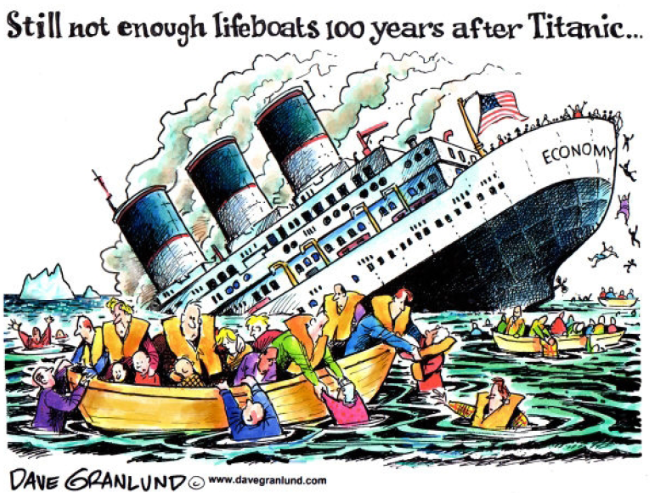
The chief economist of the world’s third largest bank, HSBC’s Stephen King, has compared the global economy to the Titanic.
In a note to clients on Wednesday he wrote “We may not know what will cause the next downswing but, at this stage, we can categorically state that, in the event we hit an iceberg, there aren’t enough lifeboats to go round.”
“The world economy is like an ocean liner without lifeboats.” As we have been warning in recent months, when another recession arrives, governments do not have the ability or the reserves to prop up the economy like they did in 2008.
Global debt has soared by 40 percent since the Great Recession. We now have a staggering $200 trillion of debt globally, or almost three times the size of the global economy. It would be a “truly titanic struggle” for policymakers to right the economy, King said.
He believes that we are now nearer to the next global recession than we are to the last one which ended six years ago. In that time, however, the world has amassed mountains of new unpayable debt – expanding 25% in the last six years – and the U.S. economy has been sluggish despite an unprecedented wave of money printing which was intended to boost the economy. Indeed, post recession growth has never been so anaemic in recent history.
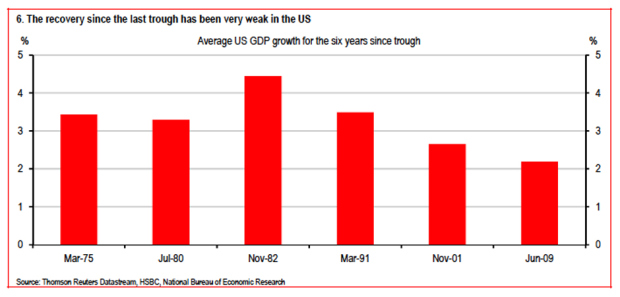
This weakness has left policy makers ill-equipped to deal with the next crisis,
“Whereas previous recoveries have enabled monetary and fiscal policymakers to replenish their ammunition, this recovery – both in the US and elsewhere – has been distinguished by a persistent munitions shortage. This is a major problem. In all recessions since the 1970s, the US Fed funds rate has fallen by a minimum of 5 percentage points. That kind of traditional stimulus is now completely ruled out.”
Elsewhere in the note he describes the problem facing policy makers as “titanic”. He identifies four areas as being of particularly high risk,
– The equity bubble may burst as increasing wages impair corporate profits. This would lead consumers to lose confidence triggering another an economic contraction.
– Pension funds and insurers may not have cash to meet future obligations causing them liquidate assets. This may cause a scramble for liquid assets and mass panic-selling in an environment of low demand causing a collapse in asset prices.
– A recession in China would likely force the PBOC to weaken the Yuan. This would cause a consequent rise in the dollar further undermining the ability of the U.S. to export. In such an environment the Fed has typically dropped rates by around 5%. As the Fed’s base rate is currently at 0.25% it has absolutely no policy tools left to deal with such an event. King concludes “TheU.S. is eventually dragged into a recession through forces beyond its control.”
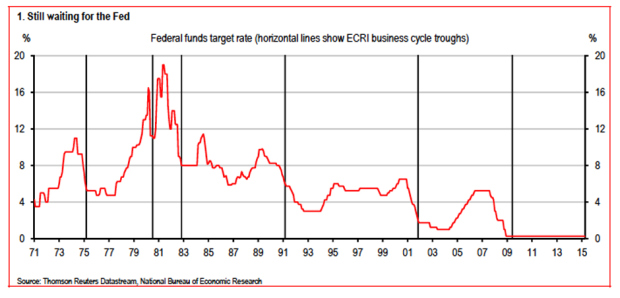
– If the Fed were to raise rates too soon it could expose the very fragile nature of the “recovery”. Neither governments, nor corporations nor households would have the strength to absorb the costs of servicing their debts should the Fed begin raising rates.
King is extremely doubtful that policy makers will be able to cope with the next crisis:
“The world economy is like an ocean liner without lifeboats. If another recession hits, it could be a truly titanic struggle for policymakers.” Reports do not indicate if King speculates on what the next crisis would look like in the absence of adequate policy tools.
We do not know how it will unfold either. But we suspect that after more that twenty years of Fed intervention to protect too-big-to-fails and a gargantuan build up of debt a monumental day of reckoning may then be at hand. In such an environment we would once again understand the true value of gold as a currency which is finite and which has no counter-party risk.
HSBC’s chief economist does not mention gold as a potential life boat to protect from a titanic economic collapse. However, HSBC’s precious metals team are currently very constructive on the long term outlook for gold prices.
In reaction to their chief economist’s warning, their precious metals analysts said, that any of the scenarios outlined by Stephen King would be positive for gold bullion.

Given the significant and growing economic risks of today, it is prudent to have an allocation to physical bullion stored in reliable vaults in the safest jurisdictions around the world.
Have you got your lifeboat ready?
Must Read Bullion Guides below:
Essential Guide to Bullion Storage in Switzerland
Essential Guide to Bullion Storage in Singapore
MARKET UPDATE
Today’s AM LBMA Gold Price was USD 1,211.00, EUR 1,083.45 and GBP 772.96 per ounce.
Yesterday’s AM LBMA Gold Price was USD 1,209.60, EUR 1,084.36 and GBP 772.60 per ounce.
Gold fell $3.78 to close at $1,205.82 an ounce on yesterday, and silver remained unchanged at $17.12 an ounce.
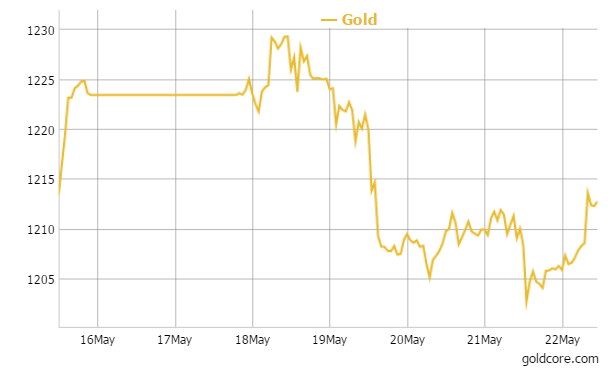
Overnight, gold in Singapore inched up 0.2 percent to $1,208.19 an ounce near the end of day trading. Gold is on track to trade down 1.4 percent it largest weekly drop in a month.
Gold prices have rebounded today after ending yesterday down 0.3%, but appear to have run into some resistance at their 200-day moving average (1215). On the week, gold is down 0.7% andsilver is marginally lower in dollars for the week but has eked out gains in euro terms. The biggest fall of the week was palladium, down just over 2%.
On a daily basis, palladium’s the only precious metal lower today, down just over half a percent, while platinum’s up 0.3% and silver’s 0.5% higher.

Gold was weak in dollar terms but strong in euro terms this week. The U.S. dollar gained nearly 2 percent this week as the euro weakened again.
‘Grexit’ remains a real risk. German chancellor Angela Merkel, Greek Prime Minister Alexis Tsipras and French president Francois Hollande are negotiating a cash-for reforms deal that would allow Greece to meet its debt repayments next month and join the ECB’s quantitative easing programme.
“We can’t just throw Greece of the euro” – Juncker has threatened ahead of the crunch summit. Greece says a reform deal can come in 10 days, but Merkel is cautious – she warned that there is a ‘whole lot left’ to do on Greece bailout talks.
Jitters remains about the next repayment which is due on June 5th. ‘Extend and pretend’ seems likely again but obviously this can only go on for so long before we get a very serious crisis and potentially contagion.
Thomson Reuters’ Lipper service data showed yesterday that investors in U.S.-based funds removed $597 million out of commodities and precious metals funds in the week ended May 20, the biggest outflow since December 2013, showing negative sentiment towards the sector.
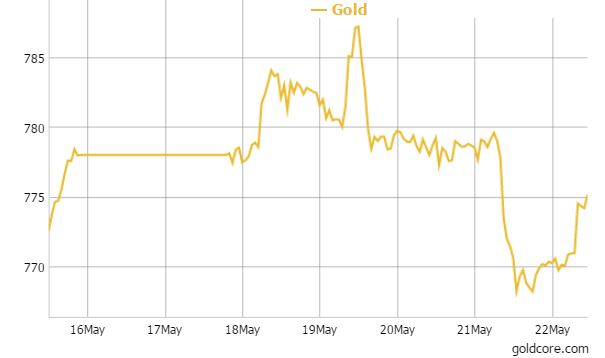
However, the smart money continues to maintain allocations or accumulate positions. U.S. mining financier Oskar Lewnowski is preparing to launch a base and precious metals fund, sources have told Reuters. This is his latest step in recreating Red Kite – the famed trading and investment enterprise he co-founded a decade ago.
Two years after going out on his own and creating a private equity investment firm Orion Resource Partners, the 50 year old New Yorker has already invested almost $1 billion in equity, loans and royalty streams into at least 17 junior mining firms, and hired a physical metals trader to handle supply.
Russian gold reserves increased by another sizeable 300,000 troy ounces in April to bring total, declared Russian gold reserves over the 40 million mark – to 40.1 million troy ounces. There is of course the possibility that Russia is not declaring all of their gold bullion purchases and reserves, in the manner of the People’s Bank of China.
In late morning European trading gold is up 0.56 percent at $1,212.67 an ounce. Silver is up 0.68 percent at $17.28 an ounce and platinum is up 0.27 percent at $1,157.00 an ounce.
Breaking News and Research Here
end
Von Greyerz asks: How much gold do West and China really have?
Submitted by cpowell on Thu, 2015-05-21 16:52. Section: Daily Dispatches
12:50p ET Thursday, May 21, 2015
Dear Friend of GATA and Gold:
As debt collapses of its own weight and brings derivatives down with it, Swiss gold fund manager Egon von Greyerz tells King World News today, the determinant of the world’s new financial system will be a matter of who has gold and who doesn’t. An excerpt from von Greyerz’s interview is posted at the KWN blog here:
http://kingworldnews.com/as-the-risk-of-a-total-meltdown-increases-expon…
CHRIS POWELL, Secretary/Treasurer
Gold Anti-Trust Action Committee Inc.
end
(courtesy Reuters/GATA)
Reuters: CME developing European gold futures contract
Submitted by cpowell on Thu, 2015-05-21 17:54. Section: Daily Dispatches
Is it to increase deliveries, as the sources tell Reuters, or just to paperize London more?
* * *
By Clara Denina and Jan Harvey
Reuters
Thursday, May 21, 2015
LONDON — The Chicago Mercantile Exchange is developing a European gold futures contract to serve customers in London, three sources familiar with matter said, which could present a direct challenge to London’s traditional cash market.
The contract would mirror existing futures traded on CME’s New York COMEX platform, which has a 100-ounce contract size and typically trades volumes of between 15 million and 20 million ounces daily.
That is the world’s most liquid gold contract, essentially setting the benchmark for bullion futures globally.
“The CME has been working on a loco (deliverable in) London futures contract for a while,” one source familiar with the matter said. “Comex futures are deliverable at Comex warehouses, but instead with London futures you would take delivery at your London vault. Potentially they would see a lot more futures being delivered if customers could have London gold.” …
… For the remainder of the report:
http://uk.reuters.com/article/2015/05/21/uk-gold-futures-cme-idUKKBN0O61..
end
Koos Jansen explains the leasing of gold in China and how the WGC distorts its meaning into their fraudulent figures:
(courtesy Koos Jansen/GATA)
Chinese Gold Leasing Not What It Seems
Welcome to another episode of understanding how mainstream consultancy firms (the World Gold Council, GFMS, CPM Group, Precious Metals Insights) understate Chinese gold demand. One of their main arguments is that hundreds if not thousands of tonnes are tied up in Chinese Commodity Financing Deals (CCFDs). As it was first stated by the World Gold Council (China’s Gold Market Progress And Prospects, April, 2014):
No statistics are available on the outstanding amount of gold tied up in financial operations [CCFDs] linked to shadow banking but Precious Metals Insights believes it is feasible that by the end of 2013 this could have reached a cumulative 1,000t.
Many mainstream news outlets, such as Reuters and the Financial Times, copied this segment, writing something along the lines of “1,000 tonnes is tied up in financing deals, it’s all a fraud and when this will be unwound the gold will flush the Chinese market”. In reality there was not 1,000 tonnes tied up in financing deals in 2013, as was portrayed by the WGC report.
The Details
Since 2013 I have been writing Chinese wholesale gold demand, measured by SGE withdrawals, is roughly twice as much as what the WGC discloses in their Gold Demand Trends. Since then I’ve been trying to reflect all arguments presented by the WGC against reality; most have proven to be misleading.
The primary reason mainstream gold analysts think the gap between SGE withdrawals and WGC demand is caused are CCFDs. Although, the mainstream media is not obliged to explain anything about what they write, CCFDs can be either round tripping (gold trade between China mainland and abroad through processing trade in free trade zones by speculators to acquire cheap funds) or gold leasing in the Chinese domestic gold market (to acquire cheap funds). In a previous post I’ve explained why round tripping has absolutely nothing to do with the Chinese domestic gold market and the SGE system (click here to read the post). That leaves gold leasing.

ICBC presented the above slide at a congress in Dubai last April. We can see gold lending, in China done through the SGE, was 1,070 tonnes in 2013 and in 2014 it reached 1,600 tonnes – without a doubt 1,070 tonnes was used by the WGC as the volume “tied up” in CFFDs.
I’ve expanded on the workings of the Chinese gold lease market in one, two, three, previous posts.
First of all, the WGC itself wrote me the majority of the leases are for genuine gold business, so not much of an argument after all – speculative leasing is not likely to be withdrawn from SGE vaults and thus can’t explain the SGE withdrawals vs WGC demand gap. But, I have more information on Chinese gold leasing. Some numbers on 2013 leasing were disclosed in a post from April 8, 2015 (Minsheng bank):
Among various tenors of lease contracts, 1 year leasing accounted for 44.26 % of total contracts, 6 to 12 months was 35.24 %, 3 to 6 months was 10.38 % and less than 3 months 10.12 %.
These percentages raised the question, was 1,070 tonnes leased out at 31 December 2013, or did all leases conducted in 2013 summed up at 1,070 tonnes? A few emails with an employee of the precious metals trading desk of a Chinese bank pointed out the latter is correct, aggregate leases in 2013 were 1,070 tonnes. To illustrate the difference, if a refinery borrows 10 tonnes of gold for 1 month and the loan is rolled over 11 months, total lease volume is 120 tonnes.There was no 1,000 tonnes “tied up” in CFFDs. For sure some gold was “tied up” in round tripping and speculators are leasing gold to acquire cheap funds, but the truth is completely different than what is written by mainstream media and the WGC.
Koos Jansen
E-mail Koos Jansen on: koos.jansen@bullionstar.com
end
The big story of the day: Austria confirms that they have asked the Bank of England for 110 tonnes of their gold stored there. Thus only 30% of their gold will be held at the B. of E. and 3% in Switzerland, with the remainder in Austria. What is fascinating is that central banker head of Austria, Edwald Nowotny, a key inner circle of trust in Draghi’s den ordered the gold right under the nose of the ECB. No doubt that this is a huge dagger into the heart of the ECB!!!
The real problem for the bankers is the fact that they will still have 100 times the 110 tonnes or 11,000 tonnes of gold obligations still outstanding that they will not be able to fulfill due to the shrinking amount of physical available.
(courtesy zero hedge/Kronen Zeitung/GATA/Koos Jansen)
Austria Confirms Faith In Fiat Fading: Repatriates 110 Tons Of Gold From BOE
Six months ago we warned that Austria was considering it, and now, as Kronen-Zeitung reports, with no rigged Swiss-like referendum required, Austrian Central Bank Governor, and the person many claim is in Mario Draghi’s inner circle of trust (soon to be revised) Edwald Nowotny has committed to repatriating 110 tonnes of gold. This is part of Nowotny’s new “gold strategy” and with his position (on paper) as one of Draghi’s foremost lieutenants, appears to be a big stab in the back for super money printing Mario.
While gold withdrawals from the NY Fed have been incessant over the past year…

… this time it appears the Bank of England faces the trust-fall as 80% of Vienna’s gold is held there.
 +
+
- CENTRAL BANK TO BRING MOST GOLD RESERVES BACK TO AUSTRIA: KRONE
- KRONEN-ZEITUNG REPORTS ON AUSTRIAN CENTRAL BANK’S GOLD PLANS
- AUSTRIA TO TRANSPORT 110 TONNES GOLD BACK TO AUSTRIA: KRONE
Austrian central bank plans to keep 50% of its gold reserves in Austria vs 17% now, Kronen-Zeitung reports, citing governor Ewald Nowotny’s unpublished new “gold strategy.” Bloomberg adds,
- 30% of gold reserves to be kept in U.K., down from 80% now
- 20% to be kept in Switzerland vs ~3% now
- Intention is “risk diversification:” Krone
Overall, Austria has 280 tonnes of gold reserves, according to central bank’s 2013 annual report.
For the population that is good news, because polls show that this corresponds to the wishes of the majority.
Since 2007, no gold has been sold, and also according to the Central Bank’s new strategy, this “emergency reserve” will not be touched.
Following the repatriation, Austria will have at least half of its gold located on its own territory, with gold held at Threadneedle Street tumbling from 80% of total to just 30%, with the remaining 20% will be held in Switzerland. According to Krone, the 110 repatriated tons will be “transferred back” in small tranches over the coming months.
So to summarize: so far the following recent gold repatriations have taken place:
As for what this ever more aggressive scramble by official monetary authorities to repatirate their gold means, we hardly need to comment what that means for the future of “non-6000 year old, non-traditional” fiat currencies.

So why is Austria engaging in a move that will be seen as merely the latest slap in the face of a crumbling fiat regime? “Risk diversification” accordig to Krone, which also adds that “that is good news for the Austrian population, because polls show that this corresponds to the wishes of the majority.” After all, Krone adds, “the German Bundesbank – in late 2013 – decided to bring half of its gold reserves to Frankfurt, the rest remains in New York and in London.”
But what “risk” is there to diversify? After all there is a saying: “As safe as the Bank of England.” Well, as a reminder – this is what happens when you hand your gold over to The Bank of England for “safekeeping”…
“The Bank for International Settlements is the bank which sanctions the most notorious outrage of this generation— the rape of Czechoslovakia.”
— George Strauss, Labor MP, speaking in the House of Commons, May 1939
“the Bank for International Settlements should be liquidated before it
furnished any more sinews of war to Germany, and that the odd
relationship between the British government and the Bank of England
should be re-examined without delay.”
— “Sees British Hands Tied on Czech Gold,” New York Times, June 6, 1939
When Nazi Germany annexed the Czechoslovak border province of the Sudetenland in September 1938, it immediately absorbed a good part of the country’s banking system as well as most of Czechoslovakia’s strategic defenses. By then the country’s national bank had prudently transferred most of its gold abroad to two accounts at the Bank of England: one in the name of the BIS, and one in the name of the National Bank of Czechoslovakia itself. (Countries had deposited some of their gold reserves in a sub-account at the BIS account in London to ease gold sales and purchases.) Of the 94,772 kilograms of gold, only 6,337 kilograms remained in Prague. The security of the national gold was more than a monetary issue. The Czechoslovak reserves, like those of Republican Spain, were an expression of nationhood. Carved out of the remains of the Austro-Hungarian Empire in 1918, the Czechoslovak Republic was a new and fragile nation. A good part of the gold had been donated by the public in the country’s early years. Josef Malik, the governor of the national bank, and his fellow Czechs believed that, even as the Nazis’ dismembered their homeland, if the national gold was safe, then something of the country’s independence would endure.
They were wrong. The Czechoslovaks’ faith in the probity of the BIS and the Bank of England was tragically misplaced. The gold was sacrificed, with barely a second thought, to the needs of transnational finance and the Third Reich.
The Nazis’ first demand came in February 1939 when Berlin ordered Prague to transfer just over 14.5 metric tons of gold, supposedly to back the German currency now circulating in the Sudetenland. This was certainly an innovative idea— first invade a neighboring country, annex part of it, and then demand that the newly truncated state supply the gold to pay for the loss of its territory.
The following month the question became academic. On March 15 the Wehrmacht marched into Prague. The German protectorate of Bohemia and Moravia was declared, and Czechoslovakia no longer existed. But the gold reserves did. Three days later a Reichsbank official was dispatched to the National Bank of Czechoslovakia and ordered the directors, under the threat of death, to issue two orders. Thanks to diligent detective work by Piet Clements, the BIS archivist, we have a clear picture of what happened next. The first order instructed the BIS to transfer the 23.1 metric tons of Czechoslovak gold held at the BIS account at the Bank of England to the Reichsbank BIS account, also held at the Bank of England. The second order instructed the Bank of England to transfer almost 27 metric tons of gold held in the National Bank of Czechoslovakia’s own account to the BIS’s gold account at the Bank of England.
Malik and his fellow directors hoped that it would be obvious that the instructions had been issued under duress and so would not be implemented. The Nazis had just invaded Czechoslovakia and would obviously target the national gold reserves. But Malik had not reckoned on Montagu Norman. The governor of the Bank of England had no interest in whether Czechoslovakia was free or a Nazi colony. “Political” considerations must not affect the BIS’s transactions. The transfer order, he said, must go through.
Meanwhile, in Basel, Johan Beyen, the Dutch president of the BIS, wavered. Beyen discussed the matter with the BIS’s legal adviser, Felix Weiser. But like Norman, Weiser took the most formalistic approach possible. As long as the paperwork was in order, the monies must go through. Weiser argued, somewhat bizarrely, that there could be no legal grounds to claim that the transfer order had been issued under duress, as such a plea could be brought before a Swiss court only by the persons who had acted under duress. Clearly, the directors of the National Bank of Czechoslovakia were unlikely to travel to Switzerland to present their case. Therefore any decision not to authorize the transfer would be one of BIS policy, rather than administration. The board of the BIS made policy. Thus Beyen would have to consult the board to stop the payment. (This was poor advice for another reason— under the terms of the BIS statutes the Swiss authorities anyway had no jurisdiction over gold transfers between states.)
Beyen was unwilling to take a decision without authorization. But who could he ask? The chairman of the BIS board, Sir Otto Niemeyer, of the Bank of England, was traveling to Egypt and so was incommunicado. At 6 p.m. on March 20, Roger Auboin, the bank’s general manager, told Beyen that the governor of the Bank of France had discussed the matter with London. The Bank of England and the Bank of France would not be taking any action to stop the transfer, because they felt that there were no grounds for action. The BIS transfer order went through.
With London, Paris, and Basel’s compliance, Nazi Germany had just looted 23.1 metric tons of gold without a shot being fired. More than two-thirds of that gold was traded with the Dutch and Belgian national banks and was eventually transported from Amsterdam and Brussels to the Reichsbank’s vaults in Berlin. Czechoslovakia’s diligent planning to safeguard its national gold reserves, together with its misplaced faith in the integrity of the new international financial system, had come to nothing. The second transfer order for the 27 metric tons held in the National Bank of Czechoslovakia’s own account at the Bank of England did not go through. Sir John Simon, the chancellor of the Exchequer, had instructed banks to block all Czechoslovak assets. But Czechoslovak gold held in a BIS account at the Bank of England, it seemed, was not defined as a national asset and was beyond the reach of UK laws.
Norman and Beyen’s decision caused despair and incomprehension in Prague and uproar in London. The loss of the Czechoslovak gold was all “Norman’s fault,” exclaimed the Daily Herald. Paul Einzig, of the Financial News, ran a stream of stories exposing the complicity of both the treasury and the Bank of England in the affair. Einzig demanded to know why the treasury had not stopped the transfer, as it was in clear violation of the law known as the Czechoslovakia Act. Brendan Bracken, a journalist and ally of Winston Churchill, declared in the House of Commons that “the Bank of England after what has happened may no longer be looked on as the safest place in the world and the phrase ‘Safe as the Bank of England’ may no longer apply.” Churchill himself demanded to know how the government could urge people to enlist in the military when it was “so butter-fingered that six million pounds of gold can be transferred to the Nazi government.”
The real villain of the affair was Norman. Beyen, who later served as Dutch foreign minister and as executive director of the International Monetary Fund, was an ineffectual bureaucrat, paralyzed by the idea that he might have to take responsibility for a decision. Norman could have stopped the transfer immediately. He was the governor of the Bank of England, which held the two BIS accounts involved. At the very least he could have asked for the transfer to be referred to the BIS board for a decision, which would also have been a face-saving measure. He chose not to do so. It was clear that war was coming, one that Britain would have to fight. The Nazi invasion of Czechoslovakia had destroyed the last hopes of peace. That country’s gold reserves, held in London, were now a British national security issue.
Yet Norman’s priority was not the best interests of his homeland, but rather the independence of his beloved BIS. Even as the shells were loaded into the German tanks, Norman still believed that for the bankers it could be business as usual. Nothing could interfere with the bankers’ sacred neutrality and gentlemanly trust in one other, not even the coming conflagration with a regime whose evil was now plain to see. The Bank of France had refused to stop the transfer but had also asked Norman to block it. Norman was adamant. There could be no political interference in the operations of the BIS, even, it seemed, when they were ordered at gunpoint.
Norman did not express any regret at all over the Czech gold transfer. In fact, he was positively indignant at the very idea that the British government might have some say in the bank’s actions. He wrote, “I can’t imagine any step more improper than to bring government into the current banking affairs of the BIS. I guess it would mean ruin. I imagine the Germans would never have paid any interest to the BIS, and at the board we would have then likely have found the Germans, Italians, and Japs standing together!” Norman then lied to Sir John Simon, the chancellor of the Exchequer, albeit with a very telling falsehood. Simon asked Norman if he could not have warned the government that, thanks to the BIS, Germany was about to acquire “large additional financial strength.” Norman told Simon that while the Bank of England held gold for the BIS, it did not know if the gold was actually owned by the BIS or was held by the BIS for other central banks. This was untrue, as Norman later admitted. Norman then made a significant, even shocking, admission. He told Simon that “he was very doubtful that he would have thought it his duty, as Director of the BIS, to make a statement about its transactions to the British government.”
Norman even wrote to Beyen to clarify the matter and to assure the BIS president where his ultimate loyalties lay in Basel. Norman did not want to publicly correct the minutiae of what was being reported in the press and Hansard, the British parliamentary journal— that the Bank of England did not know whose gold was held in the BIS accounts— as that would expose him. “The difficulty is that if I point out to the Treasury that this is incorrect, I lay myself open to being asked details of BIS transactions, which I do not consider the Treasury are entitled to know.” This was little short of treason. As Norman’s compatriots were enlisting in the military, preparing to risk their lives for the freedoms and luxury that he enjoyed, as his country prepared for the war against the Nazis that all knew was coming, Norman blithely announced that his primary loyalty was not to Britain, but to a hyper-privileged, international bank that was not even a decade old.
The mistake of Malik, the director of the National Bank of Czechoslovakia, was to believe that either Norman, Beyen, or indeed any of the BIS management could conceive of any moral or political dimension to their decisions. The world’s most powerful international bankers were not only unwilling to obstruct the Nazi seizure of Czechoslovak— or Austrian— assets. They simply could not conceive of any reason why they should do so. As long as the formalities were observed, the necessary papers were stamped and the gold was re-assigned. Norman’s precious independence for both the Bank of England and the BIS had been bought at a high price— in mountains of gold ingots to pay for steel to build bombs that would soon rain down on London.
* * * * *
… the affair had highlighted the deeply unsettling connections between the Bank of England, the British government, and the BIS. There was a good deal of cross-party feeling in Britain, reported the New York Times, that “the Bank for International Settlements should be liquidated before it furnished any more sinews of war to Germany, and that the odd relationship between the British government and the Bank of England should be re-examined without delay.” The New York Times then was able to assume that its readers would understand a classical allusion. The word “sinews” was a reference to an epithet of Cicero, the Roman philosopher, who had said, “The sinews of war are infinite money.” Cicero’s observation was as prescient then as during the late 1930s. But those who wanted the BIS to be liquidated were too late. Thanks to the BIS the “sinews of war” and the flow of near-infinite money were about to be immeasurably strengthened.
(source: Goldchartsrus.com):
 Russian gold reserves have increased by over 300% since 2006.
end
Alasdair Macleod talks about the Chapwood index which measures the 500 most commonly used items in the USA over 50 cities. He has done this for several years. You will be surprised: inflation is not tiny but averaging 10% per year.
(courtesy Alasdair Macleod/goldmoney.com/GATA)
Alasdair Macleod: Inaccurate statistics and the threat to bonds
9:22p ET Thursday, May 21, 2015
Dear Friend of GATA and Gold:
GoldMoney’s research chief, Alasdair Macleod, tonight calls attention to a private index of inflation in the United States over the last five years, the Chapwood Index, which measures “the unadjusted actual cost and price fluctuation of the top 500 items on which Americans spend their after-tax dollars in the 50 largest cities in the nation.” According to the Chapwood Index, inflation has not been tame, as the U.S. government would have people believe, but has been running at an average of 10 percent per year since 2011. If the bond market ever acknowledged this, Macleod writes, bond prices would be quite different. All the more reason for the U.S. government to suppress the price of gold, ordinarily an indicator of inflation.
Macleod’s commentary is headlined “Inaccurate Statistics and the Threat to Bonds” and it’s posted at GoldMoney here:
https://www.goldmoney.com/research/analysis/inaccurate-statistics?gmrefc…
CHRIS POWELL, Secretary/Treasurer
Gold Anti-Trust Action Committee Inc.
end
Eric Sprott talks with Eric King and states that the order of the day will be the huge defaults and bankruptcies due to the unprecedented growth in the bond bubble:
(courtesy Eric Sprott/Kingworldnews/Eric King)
Defaults, bankruptcies will make things plain, but too late, Sprott says
2:25p ET Friday, May 22, 2015
Dear Friend of GATA and Gold:
Debt and bond monetization have limits that are already being reached, Sprott Asset Management’s Eric Sprott tells King World News today, adding that a few defaults and bankruptcies eventually will make it plain to the financial markets. He asks: “Why not get out now, rather than wait until it’s too late?” The interview is excerpted at the KWN blog here:
http://kingworldnews.com/billionaire-eric-sprott-just-issued-one-of-the-…
CHRIS POWELL, Secretary/Treasurer
Gold Anti-Trust Action Committee Inc.
end
They also missed the huge rigging in the precious metals markets;
(courtesy London’s Financial Times/GATA)
NY State investigators think Feds missed the bulk of big banks’ forex rigging
Banks Probed Over Automated Forex Deals
Gina Chon and Ben McLannahan
Financial Times, London
Friday, May 22, 2015
Wall Street banks are facing the threat of new and more damaging allegations about their rigging of foreign exchange markets, as New York’s banking regulator intensifies a probe into computer-driven currency trading — raising the prospect that the total penalties arising from the scandal will exceed the $10 billion already paid.
The New York Department of Financial Services, run by Benjamin Lawsky, has become increasingly convinced that banks have been systematically abusing forex markets through the use of automated trades driven by computer algorithms, according to people familiar with its investigation.
Findings from the probe may indicate more widespread market abuse than US and UK authorities disclosed on Wednesday, when detailing their settlement with six global banks, the people added. They pointed out that this $5.6 billion settlement related to allegations of market manipulation by bank employees — but Mr Lawsky’s probe covers electronic trading, which accounts for the majority of forex transactions. …
… For the remainder of the report:
http://www.ft.com/intl/cms/s/0/092572d2-0005-11e5-abd5-00144feabdc0.html
end
A huge and important commentary from Bill Holter tonight.
(courtesy Holter/Sinclair dynamic duo)
A Flock of Black Swans in June?
Very soon we will be entering the month of June. Normally June is the time of year in the northern hemisphere when people think of picnics, parks, water sports and the outdoors. It is a time where plans are made for vacation, rest and relaxation. This year may be a little bit different. I say “different” because there is a plethora of converging events, any single one of them with the ability to take the financial markets down to their knees!
And now overnight trading in stocks and currency in Europe and Asia
1 Chinese yuan vs USA dollar/yuan strengthens to 6.1970/Shanghai bourse green and Hang Sang: green
2 Nikkei closed up by 61.54 points or .30%
3. Europe stocks all in the red (except London)/USA dollar index down to 95.00/Euro rises to 1.1182/
3b Japan 10 year bond yield: slight rises to .42% !!!!(Japan buying 100% of bond issuance)/Japanese yen vs usa cross now at 120.96/
3c Nikkei still just above 20,000
3d USA/Yen rate now well above the 120 barrier this morning
3e WTI 60.09 and Brent: 65.77
3f Gold up/Yen up
3gJapan is to buy the equivalent of 108 billion uSA dollars worth of bond per month or $1.3 trillion. Japan’s GDP equals 5 trillion usa.
Japan to buy 100% of all new Japanese debt and by 2018 they will have 25% of all Japanese debt. Fifty percent of Japanese budget financed with debt. Last night Japan refused to increase it’s QE
3h Oil up for WTI and up for Brent this morning
3i European bond buying continues to push yields lower on all fronts in the EMU. German 10 yr bund falls to 62 basis points. German bunds in negative yields from 4 years out.
Except Greece which sees its 2 year rate rise slightly to 23.34%/Greek stocks up 0.04%/ still expect continual bank runs on Greek banks./Greek default inevitable/
3j Greek 10 year bond yield rises to: 11.26%
3k Gold at 1213. dollars/silver $17.26
3l USA vs Russian rouble; (Russian rouble par in roubles/dollar in value) 50.03 , the rouble is still the best acting currency this year!!
3m oil into the 60 dollar handle for WTI and 65 handle for Brent/Saudi Arabia increases production to drive out competition.
3n Higher foreign deposits out of China sees huge risk of outflows and a currency depreciation. This can spell financial disaster for the rest of the world/China may be forced to do QE!!
30 SNB (Swiss National Bank) still intervening again in the markets driving down the SF. It is not working: USA/SF this morning .9317 as the Swiss Franc is still rising against most currencies. Euro vs SF is 1.0417 well below the floor set by the Swiss Finance Minister.
3p Britain’s serious fraud squad investigating the Bank of England/
3r the 4 year German bund remains in negative territory with the 10 year moving further away from negativity at +.62/
3s Tw0 weeks ago, the ECB increased the ELA to Greece by another large 2.0 billion euros.Last week, they raised it another 1.1 billion and then on Wednesday they raised it another tiny 200 million euros thus at this point the new maximum was 80.2 billion euros. The ELA is used to replace depositors fleeing the Greek banking system. The bank runs are increasing exponentially. The ECB is contemplating cutting off the ELA which would be a death sentence to Greece and they are as well considering a 50% haircut to all Greek sovereign collateral which will totally wipe out the entire Gr. banking and financial sector.
3t Greece paid the 700 million plus payment to the IMF last Wednesday but with IMF reserve funds. It must be paid back in on June 9.
3 u. If the ECB cuts off Greece’s ELA they would have very little money left to function. So far, they have decided not to cut the ELA
4. USA 10 year treasury bond at 2.17% early this morning. Thirty year rate well below 3% at 2.96% / yield curve flatten/foreshadowing recession.
5. Details Ransquawk, Bloomberg, Deutsche bank/Jim Reid.
(courtesy zero hedge/Jim Reid Deutsche bank)
Chinese Stock Bubble Frenzy Returns; US Futures Flat Ahead Of Today’s Pre-Holiday Zero Volume Melt Up
The highlight of the overnight newsflow may have been the BOJ’s preannounced statement that it is keeping its QE unchanged (which comes as no surprise after a few weeks ago the BOJ adimirted it would be unable to keep inflation “stable” at the 2% in the required timeframe), but the highlight of overnight markets was certainly China, where the Banzai Buyers have reemerged, leading to another whopping +2.8% session for the Shanghai Composite which has now risen to a fresh 7 years high.


The catalyst? In addition to the PBOC’s desire to reflate the biggest equity bubble ever, was follow through from the US zero volume levitation to its 4th record high close in 6 sessions. As a result expect US stocks to rise next to recorder highs because China surged because the US surged, and so on. That, and of course the slow motion economic collapse which is the best news a stock buyer can have: after all it means that more easing – if only for stocks – is all but assured.
A broader look at Asian equities in general shows Hang Seng (+1.7%) and Shanghai Comp (+2.8%) leading the way, with the latter touching another consecutive fresh 7yr high, as easing expectations continued to underpin sentiment. This also follows excess funds from yesterday’s conclusion of this week’s 20 IPO offerings, being channelled back to underperforming stocks.
European stocks (Eurostoxx50: -0.40%) started the session on a relatively tentative footing and trade lower amid light newsflow. Of relevance for Liberty Global, the FTSE 100 modestly outperforms due to Vodafone (+4.8%) who were lifted by comments from Goldman Sachs saying they were more likely to be sellers of assets rather than buyers. To the downside, luxury names have been weighed on by Richemont’s (-1.78%) pre-market update which revealed an unexpected 8% decline in April sales. Today’s only large cap earnings from the US is Deere & Co. who are scheduled to report at 1200BST/0700EDT.
USTs (+5 ticks) have moved higher in tandem with Bunds (+44 ticks) during the European morning, which have ebbed higher to retrace some of the downside seen yesterday and making a technical break above yesterday’s high at 153.99. Of note, analysts at BNP Paribas have stated they expect European bonds to trade in a tight range today and in the coming week.
In commodities, the metals complex has benefited from weakness in the USD while after market yesterday CME lowered COMEX 100 gold futures initial margins for specs by 6.3% to USD 4,125/contract from USD 4,400/contract and lowered COMEX 5000 silver futures initial margins for specs by 9.1% to USD 7,700/contract from USD 8,470/contract. WTI and Brent both reside in negative territory amid light newsflow. However WTI remains on track to finish higher for the 10th consecutive week, the longest streak since trading began in 1983.
USD (-0.5%) weakened throughout the European morning, with the greenback initially impacted by JPY strength in the wake of the BoJ policy decision to see USD/JPY pull away from the 121.00 handle. USD was further weakened on the back of better than expected German IFO Business Climate (108.5 vs. Exp. 108.3, Prev. 108.6), which bolstered EUR/USD (+78 pips) as market participants await comments regarding Greece from the Eurogroup meeting. Not surprisingly, the “good” German data (unlike the PMI or the ZEW earlier this week), has pushed not only the EUR higher, but the DAX lower which correlates inversely to the strength of the European currency with about 0.9 R-squared.
German Chancellor Merkel and French President Hollande have told Greek PM Tsipras that they would personally contribute toward the direction of a viable, long-term solution for Greece and accelerate the procedure, according to a senior Greek government official. Nonetheless, talks between Greece and its creditors failed to reach an agreement overnight, with a Greek government spokesman suggesting a deal could be finalised within the next 10 days and aims to meet all of its debt obligations in June.
Looking ahead, the pre-holiday US session sees US and Canadian CPI, with Greek news from the Eurogroup meeting in Riga once again on the radar but perhaps the most important event will come from Yellen, speaking at 1pm Eastern in Rhode Island just as the bond pit closes earlier ahead of Memorial Day. And since volumes today will be even more abysmal than usual, the zero volume levitation algos should have no problem pushing the S&P up at least another 10 points on a few thousands ES contracts.
Bulletin Headline Summary from Bloomberg and RanSquawk
- USD (-0.5%) weakened during the Asian session following JPY strength in the wake of the BoJ policy decision to see USD/JPY pull away from the 121.00 handle
- USD was further weakened in European hours on the back of better than expected German IFO Business Climate which bolstered EUR/USD (+78 pips)
- Looking ahead, the US session sees US and Canadian CPI, with participants looking out for any Greek news filtering out from the Eurogroup meeting in Riga and comments from Fed’s Yellen, BoE’s Carney and Shafik.
- Treasuries gain, paring weekly decline before CPI report, Yellen speech as bunds lead rally in EGBs; trading likely to be muted before long holiday weekend with futures closing at 1pm, cash market at 2pm.
- German Chancellor Merkel said that greater efforts are needed to unlock bailout funds for Greece after late-night negotiations with Greek PM Tsipras failed to yield any sign of a breakthrough
- Greece’s economy is faring even worse than a string of developing countries which suffered traumas in the last two decades, which leaves Commerzbank AG declaring the country is in little position to pare its debt and that default or a restructuring may loom
- Draghi said euro-area countries must speed up structural reforms not only to raise economic growth and bring down unemployment, but also to allow ECB policy makers to ensure price stability
- Germany’s Ifo institute business climate index dropped to 108.5 from 108.6 in April, falling for the first time in seven months; median estimate in Bloomberg survey was for a decline to 108.3
- China’s territorial maneuvers in the contested South China Sea are bringing its Communist neighbor Vietnam and the U.S. closer together, according to the new ambassador to Vietnam, Ted Osius
- The Bank of Japan refrained from increasing stimulus and signaled a more optimistic view on the economy, as Governor Haruhiko Kuroda bets on stronger growth fueling stalling inflation
- Sovereign bond yields fall. Asian stocks gain, European stocks decline, U.S. equity-index futures gain. Crude oil and copper lower; gold higher
DB’s Jim Reid Concludes the overnight recap
It’s a weekend of closed door, secret European meetings ahead with lots of behind the scenes maneuverings and no-one with any idea which way it’ll go until the end. Yes, the annual Eurovision song contest is 60 years old tomorrow night and much of the continent will be glued to the action. Last year a man dressed as a lady but with a full beard won the contest so who knows what to expect and if anyone can explain to me why Australia are in tomorrow’s event then I’d be grateful. Apparently Sweden is favourite and who knows we may revisit the glory days of ABBA. We should note for the record that Greece’s entry is called “One last breath”. Oh and the UK entry is awful in my opinion. Lots of ‘nul points’ await.
In this nul interest rate world, today’s US CPI will further add to the lift-off debate as will a Yellen speech at 6pm London time. In terms of CPI the current Bloomberg consensus is for a fall in the headline (+0.1% mom from +0.2%) which in turn is expected to lower the annualized rate down to -0.2%. Meanwhile the core is expected to be unchanged for the month at +0.2% mom, but the annualized rate is expected to round down to +1.7% yoy. With a few large markets closed for a public holiday on Monday, it’s possible that we could see some exaggerated price action if the number is away from consensus. So one to look forward to this afternoon and it’s worth remembering that the reading follows last week’s weaker than expected PPI print for the same month.
Ahead of this bourses in Asia are generally firmer across the board with the Nikkei (+0.24%) and ASX (+0.11%) a touch higher, while there are large gains for the Hang Seng (+1.48%) and Shanghai Comp (+1.93%) with the latter back at 7-year highs. Credit markets are around a basis point tighter. Meanwhile, the Bank of Japan has announced that it has made no change to its QE programe as largely expected. The BoJ will continue to increase the monetary base at a pace of ¥80tn per year with the accompanying statement saying that the economy ‘has continued to recover modestly’. The BoJ also noted that the effect of the decline in energy prices means CPI is ‘likely to be about zero per cent for the time being’.
There was a lot of data to get through yesterday. It was kick started with some modestly weaker flash PMI’s in Europe and then followed up with a generally softer set of indicators in the US which once again illustrated a Q2 yet to fire on all cylinders. This helped send Treasury yields lower as we saw 5y (-4.0bps), 10y (-5.8bps) and 30y (-5.9bps) yields fall to 1.512%, 2.191% and 2.989% respectively. Risk assets closed firmer meanwhile as the S&P 500 closed +0.23% to make a new record high, supported also by a move higher for WTI (+2.95%) and Brent (+2.32%), while in credit CDX IG closed nearly a basis point tighter. The Dollar was a tad more muted as the DXY eventually finished 0.10% lower, bringing to an end three consecutive days of gains.
In terms of details on the data, aside from a better than expected Conference Board leading indicator print for April (+0.7% mom vs. +0.3% expected) and an ‘ok’ initial jobless claims print which climbed 10k to 274k for the week but kept the four-week moving average at a 5-year low (266k), it was a day of disappointment in the US on the whole. The flash manufacturing PMI for May fell 0.3pts and below consensus to 53.8 (vs. 54.5 expected), marking three consecutive months of declines with new orders in particular hitting a 16-month low. The weakness in existing home sales for April also garnered attention after falling -3.3% (vs. +0.8% expected) in the month. As well as the weakness in the flash PMI, the May Kansas City Fed manufacturing activity index fell to the lowest level since April 2009 after the -13 print fell six points from the previous month. The components of the index made for no better reading as the volume of new orders (-19), number of employees (-17) and average workweek (-14) all fell into deep negative territory. Elsewhere, there was a 0.8pt fall for the Philadelphia Fed Business outlook to 6.7 (vs. 8.0 expected) while the Chicago Fed national activity index (-0.15 vs. 0.00) rose slightly but still came in below consensus.
Data flow in Europe was dominated by yesterday’s May flash PMI readings. On the whole the readings were slightly disappointing and although still suggestive of a modest recovery, it perhaps signaled some dissipating upward momentum – in line with the thoughts of DB’s Marco Stringa who highlighted a material risk that the upward trend in consensus forecasts for 2015 will not continue with the DB SIREN-Surprise index turning negative in mid-April and yesterday hitting its lowest value since November. On the data, the Euro-area composite weakened by 0.5pts to 53.4 which was below expectations of no change. The weakness wasn’t helped by a softening in the services print (53.3 vs. 53.9 expected) which fell 0.8pts and offset a modest 0.3pt rise in the manufacturing print (52.3 vs. 51.8 expected). Regionally, there was more disappointment in Germany as the composite (52.8 vs. 53.8 expected) declined 1.3pts while in France the composite rose 0.4pts in line with expectations to 51.0. Marco notes that although disappointing, the readings still point to a +0.4% qoq GDP growth rate for Q2.
Elsewhere, European consumer confidence for May was downgraded to -5.5 from -4.6 previously. There was a bright spot for data in the UK however as April retail sales both ex fuel (+1.2% mom vs. +0.2% expected) and including fuel (+1.2% mom vs. +0.4% expected) came in higher than expected. The ECB minutes meanwhile offered few surprises, noting that ‘members agreed that emphasis needed to be placed on a steady course of monetary policy with a focus on the firm implementation of the Governing Council’s recent monetary-policy decisions’. There was however some mention of the uncertainties with regards to structural reforms, with the minutes noting that ‘members expressed that the risk of insufficient reform progress was particularly pronounced with regard to structural policies, which were hampered by resistance to change’ and that ‘in the absence of structural reforms, there were serious risks that potential growth would remain low and investment demand would not pick up as strongly as expected’.
Just wrapping up yesterday’s price action, European equity markets finished slightly higher in most regions, rising into the close as US markets moved higher. The Stoxx 600 (+0.36%), DAX (+0.14%) and CAC (+0.26%) in particular led gains. It was more mixed in bond markets meanwhile as 10y Bunds finished 0.8bps higher at 0.637% while similar maturity yields in the periphery finished 1-4bps lower.
Talks between Greek PM Tsipras, French PM Hollande and German Chancellor Merkel at the European summit in Riga yesterday appeared to offer few clues that any material progress has been made. Headlines on the wires have suggested that the meeting appears to have been nothing more than a sign of political support so far with a joint statement released after saying that talks took place in a ‘friendly and constructive atmosphere’ and were based on ‘the successful fulfillment of the current program’. The statement went on to say that ‘it was agreed that the talks between the Greek government and the institutions will be continued’ while open issues discussed included pensions and tax reforms. Talks will continue at the summit today.
Looking at today’s calendar now, it’s a busy data docket this morning in the European session as we kick off with the final Q1 GDP print for Germany quickly followed by business and manufacturing confidence readings out of France. We’ll be back in Germany shortly after this when we get the May IFO business survey before we get Italian retail sales and UK public sector net borrowing data. In the US focus will be on the aforementioned CPI print while we’ll also get average weekly earnings data. The European summit continues in Riga for a second day while as mentioned at the top, the Fed’s Yellen is also due to speak later on the US economic outlook which will be worth watching.
end
We have been highlighting to you the same theme as what Mac Slavo comments on today:
(courtesy Mac Slavo)
Guest Post: This October The World Will Change – “China Is Preparing For Something Big”
Submitted by Mac Slavo via SHTFPlan.com,
“China… across the board… is preparing for something big in currency markets.”
(Video Via Future Money Trends)
This October may see the beginning of the end for the U.S. dollar as the world’s reserve currency.Twice every decade the International Monetary Fund meets to discuss their Special Drawing Rights (SDR) currency basket. Currently comprised of the dollar, Japanese Yen, British Pound and Euro, if China has their way a few months from now, we may well see the Chinese Yuan take its place among the world’s most trusted currencies.
U.S. Treasury Secretary Jack Lew says, “China isn’t ready for currency reserve status,” and would certainly like to see the Chinese blocked from entry, preserving the dollar’s status as the world’s go-to currency and primary mechanism of exchange for global international trade.
But while Lew and his predecessors have presided over the largest growth in national debt in world history, the Chinese have been strategically positioning, much like the United States did in the early 1900’s, to not just become the world’s largest economy, but to be the super power of the 21st century.
Forget for a moment what’s being touted by analysts, forecasters, politicians, and financial officials who say China is not ready. Focus instead on the actions being undertaken by China and you’ll understand why Chinese President Hu Jintao says that the dollar is a product of the past.
Excerpted From Future Money Trends:
Already we are seeing China and Russia hoard gold with Chinese demand skyrocketing in the past give year… China is both, the world’s largest gold producer and biggest importer… so not only are they accumulating gold by the truck load, but not one ounce produced is leaving their shore.
China… across the board… is preparing for something big in currency markets.
…
The world has an unease about the dollar system… President Hu of China said ‘the dollar is a product of the past.’
There was a time when the U.S. dollar was backed by gold. This backing helped to solidify it as a currency that could be trusted on the open market. Today, however, for all intents and purposes, the dollar is backed by absolutely nothing.
It is this weakness that the Chinese aim to exploit and that’s why they have been actively stockpiling thousands of tons of gold in recent years. But this is only part of the story.
In addition to their physical gold holdings, the Chinese have been using a secret gold accumulation strategy that no one is talking about :
The headlines for gold these past few years have only focused on physical gold accumulation by China, Russia and Eastern central banks. But what they have missed is a 7,000 year-old strategy that China is doubling down on.
According to data compiled by Bloomberg, in 2013 asset purchases by Hong Kong and [Chinese] mainland miners increased to a record $2.2 billion.
China is buying gold mines at a record… something completely missed by both, the mainstream investor and even the gold analysts who tend to only focus on the bullion sales, which haven’t been disclosed officially since 2009.
Although, according to Bloomberg, based on trade data the physical bullion stockpile has likely tripled since then.
China, who is aggressively buying gold, would spark an event if it disclosed how much gold it has stockpiled.
But imagine the true disclosure when you add up all their deposits… not just in China, but offshore. $2.2 billion is equivalent to 46 metric tons of physical gold… but when buying gold deposits in the ground this could be upwards of 5,000 metric tons.
And that is just one year of record mine buying from China.
It’s been rumored that China may disclose those gold holdings ahead of the IMF’s decision this October in an effort to prove to the world that their currency is not only worthy of admission into the SDR basket, but that it is more trustworthy than the U.S. dollar itself.
The winds of change are blowing and the Chinese will soon be taking the helm of the global economy. They know a major event is coming and they have been preparing for it by acquiring the one asset that has survived the test of time as a mechanism of exchange.
For those desperately trying to figure out where they should be putting their money before the next major market event takes shape, consider following their strategy.
end
Even George Soros warns that something big is going on between China and USA relations: He states that they are on the threshold of World War iii
(courtesy zero hedge)
George Soros Warns “No Exaggeration” That China-US On “Threshold Of World War 3”
While admitting that reaching agreement between the two countries will be difficult to achieve, George Soros –speaking at The World Bank’s Bretton Woods conference this week – warned that unless the U.S. makes ‘major concessions’ and allows China’s currency to join the IMF’s basket of currencies, “there is a real danger China will align itself with Russia politically and militarily, and then the threat of world war becomes real.”
Much in global geopolitics depends on the health and trajectory of the Chinese economy, was the undertone of George Soros’ comments as he spoke this week, but as MarketWatch reports,
Billionaire investor George Soros said flatly that he’s concerned about the possibility of another world war.
…
If China’s efforts to transition to a domestic-demand led economy from an export engine falter, there is a “likelihood” that China’s rulers would foster an external conflict to keep the country together and hold on to power.
…
To avoid this scenario, Soros called on the U.S. to make a “major concession” and allow China’s currency to join the International Monetary Fund’s basket of currencies. This would make the yuan a potential rival to the dollar as a global reserve currency.
In return, China would have to make similar major concessions to reform its economy, such as accepting the rule of law, Soros said.
Allowing China’s yuan to be a market currency would create “a binding connection” between the two systems.
An agreement along these lines will be difficult to achieve, Soros said, but the alternative is so unpleasant.
“Without it, there is a real danger that China will align itself with Russia politically and militarily, and then the threat of third world war becomes real, so it is worth trying.”
And while on the topic, Soros also spoke recently, as ValueWalk notes, on the situation in Europe…
“The European Union was a very inspiring idea to people like me,” he commented, reflecting back to when EU economies were more balanced. “It was the embodiment of the idea of an open society, like minded countries getting together and sacrificing part of their sovereignty for the common good. It was meant to be a voluntary association of equals.”
Soros continued to say: “Because of the Euro crisis, [the E.U.] has been transformed into something radically different.” He also emphasized that over time two different classes of countries have evolved: creditors and debtors. “The debtors had difficulty meeting their obligations and this put the creditors in charge. They (the creditors) set the rules and made it very difficult for the debtors to exit their inferior status. A voluntary association of equals turned into an involuntary association of un-equals.”
While avoiding making predictions, on Greece Soros noted: “Greece is a poisonous situation. All sides have made a lot of mistakes, and there is a lot of hostility, a lot of negative sentiments…Both sides are willing to hurt the other side even if it hurts them.”
* * *
The billionaire investor concluded by pointing out that military spending is currently on the rise in both Russia and China, warning ominously…
“If there is conflict between China and a military ally of the United States, like Japan, then it is not an exaggeration to say that we are on the threshold of a third world war.”
end
Greece May Need To Issue IOUs Schaeuble Says After Latest Failure To Reach A Deal
In many ways, four months of negotiations between Greece and its creditors can be summed up with the following two headlines from this morning:
- GREECE VERY CLOSE TO SEALING DEAL WITH CREDITORS: SPOKESMAN
- GREECE WON’T COMPROMISE ON LABOR REFORMS, PENSIONS: SPOKESMAN
Those came back-to-back believe it or not, which underscores the whole problem: the Greek government wants money but doesn’t want the conditions which come with the money because those conditions entail the wholesale abandonment of the mandate that got them elected in January.
Despite it all, PM Alexis Tsipras still thought he could effectively secure a deal in Latvia this week by whispering to Angela Merkel on the sidelines of a Eurogroup meeting, a tactic he’s tried before to no avail. Unsurprisingly, these “sideline” talks produced exactly nothing after Tsipras kept Merkel and French President Francois Hollande up until 1 in the morning in Riga, proving that, to quote Jean-Claude Juncker, “Riga just isn’t the place” for eleventh hour bailout negotiations. Here’s more from Bloomberg:
With time running out for a deal to free up the remaining 7.2 billion-euro ($8 billion) tranche of aid, Merkel’s discussions in Latvia with Tsipras and French President Francois Hollande broke up in the early hours of Friday with an agreement only to keep talking.Tsipras talked of a resolution “soon,” whereas Merkel said there’s “a whole lot to do.”
“It was a very friendly, constructive discussion,” the chancellor told reporters on Friday as she arrived for the second day of a two-day European Union summit in the Latvian capital, Riga. “But it was very clear that further work has to be done with the three institutions.”
The meeting marked another rejection by Merkel of the latest Tsipras attempt to bypass finance ministers and strike a political deal at the level of government leaders, highlighting German insistence that Greece’s budget numbers must add up before aid can be released.
A short statement released separately by the French and German governments after more than two hours of talks with Tsipras was devoid of earlier optimism expressed by Hollande at paving the way for an accord as soon as the end of the month. In its place, the governments of the two biggest euro-area economies talked of agreement “to stay in close contact.”
A government official, in a debriefing after the talks broke up about 1 a.m., signaled Greek frustration by saying that a main obstacle is that the International Monetary Fund needs to be on board. The IMF is one of Greece’s creditors along with the European Central Bank and euro-area governments. “Open issues” remain with creditors, including pensions, sales-tax rates and targets for a primary budget surplus, the official told reporters.
The French and German statements lacked Hollande’s upbeat tone as he arrived in Riga, when he had opened the prospect of striking a political deal that could help lead to an accord by finance ministers at the end of May or early June. Without an agreement, Greece risks a default that would put in question its future in the 19-nation euro region.
Absent too from the final statements was any reference to an extraordinary finance ministers’ meeting on Greece. Hollande had said that the discussion with Tsipras would “help prepare for the expected deadline, especially the eurogroup” meeting of euro-area finance ministers “at the end of May or in early June.” That suggested a special meeting since the next regular gathering isn’t due until June 18.
France and Germany offered to provide assistance to Greece and Tsipras whenever questions come up, Merkel said. “But the accord must be reached with the three institutions and very, very intensive work has to be done.”
As for Germany — where Christian Democratic lawmakers have for weeks been pressuring Merkel to call it quits on Greece — the Finance Ministry and the central bank are out questioning the utility of continuing to negotiate with Syriza.
First there’s Bundesbank chief Jens Weidmann…
“The prospect of a sustainable stabilization of Greece is decisive, that requires an improvement in competitiveness, solid state finances and better administrative structures. The IMF has also rightly advised this. Hence, the ball is clearly in the court of the Greek government.”
…and then the German finance ministry…
“International Monetary Fund participation in negotiations on Greece’s aid program is mandatory
requirement.”
…and finally, the Schaeuble was unleashed…
German Finance Minister Wolfgang Schaeuble conceded the possibility that Greece may need a parallel currency alongside the euro if the country’s talks with creditors fail, people familiar with his views said.
Yes, “conceded the possibility,” and while those who actually witnessed the German FinMin’s comments claim he “didn’t endorse the idea”, we imagine his feelings wouldn’t be hurt if it came to pass because as we’ve seen, Schaeuble is no fan of radical socialist shenanigans.
Meanwhile, Commerzbank says the country’s economy (which, as a reminder, is losing €22.3 million a day) not to mention its citizens, simply can’t take the pain any longer and when comparing Greece to other historical instances of EM “turmoil”, the country doesn’t come out so well.
Via Bloomberg:
As another round of aid talks between the Mediterranean nation and its creditors ends without a deal, its economy is faring even worse than a string of developing countries which suffered traumas in the last two decades. That leaves Commerzbank AG declaring the country is in little position to pare its debt and that default or a restructuring may loom.
“Just as with emerging markets in the past there is a point in time where you need to move on to the next stage rather than being paralyzed,” Simon Quijano-Evans, head of emerging market research at Commerzbank in London, said in a telephone interview. “In Greece, we need to think of next steps and be innovative.”
To illustrate Greece’s pain, he published a report this month comparing how the economic fallout from its five-year-old crisis compared with the bouts of turmoil suffered in the last two decades by Turkey, Argentina, Latvia and Thailand. The result illustrates why Commerzbank sees a 50 percent chance of Greece ultimately leaving the euro area.
“Comparing Greece’s experience so far with that of EM crisis countries shows very simply that the country’s already stressed economy and electorate are unable to cope with more pain,” said the Commerzbank economist.
While Athens has imposed the tightest fiscal squeeze of the five and pushed its budget balance excluding interest payments into surplus from a deficit of about 10 percent of gross domestic product in 2009, Turkey and Argentina were doing better at the same stage.
Yeah… about that budget balance…
- GREEK MARCH CURRENT ACCOUNT DEFICIT WIDENS TO EU404M
* * *
We’ll close with the following comments from Jacob Funk Kirkegaard, senior fellow at the Peterson Institute for International Economics in Washington who spoke to Bloomberg today by phone:
“[Germany is ready] to take this brinkmanship very far [with Schaeuble as] attack dog. We’re in this game of chicken. The problem is that Alexis Tsipras is riding a scooter and Wolfgang Schaeuble is driving an armored BMW.”
* * *
Summing up all of the above in two pictures…


Why Greece’s Syriza party is not sticking to the script on an IMF deal
The leaked IMF document seen by Channel 4 News last weekend effectively signals a three-week endgame in the Greek debt stand-off.
The IMF thinks there is “no possibility” that Greece can meet €11bn worth of debt repayments due between June and the end of August. The Greek government is running out of cash.
Yanis Varoufakis, the finance minister, told Channel 4 News last night (see video below) that faced with the choice of paying €350m due on 5 June to the IMF on 5 June, or paying pensions and salaries, he would choose the latter.
Privately, those within the ruling far-left party Syriza who were once confident of reaching a compromise with lenders, are now alarmed. Euro exit plans drawn up by the far left of the party are being studied seriously by those previously dismissive of them; articles contemplating a debt default have begun to appear in the party’s daily paper Avgi.
In the script according to the eurozone, the expected ending is: Syriza splits; finance minister Varoufakis makes good his pledge not to sign a surrender and resigns. A government of the centre-left forms, with Alexis Tsipras now allied to the centrist Potami party and with tacit support from a liberal wing of the New Democracy party. Debt relief happens, but on the terms dictated by the lenders, and Syriza survives to complete its mutation into a centre-left social democratic party.
Not sticking to the script
However, there are some who are not sticking to that script.
Zoe Konstantopoulou, a 39-year-old, Sorbonne-educated human rights lawyer who is now the speaker of the Greek parliament, is among them.
The Syriza MP has used her office set up three legal processes that could, even now, give the radical left government leverage over its lenders: a “debt truth” committee, a committee to oversee Greek war reparations claims against Germany, and a pipeline of high-level corruption cases targeted around public sector contracts with German firms.
It had been assumed in Europe that these initiatives were rhetorical, allowing Syriza to construct a narrative in government and nothing more.
Now I understand the debt truth committee has identified a tranche of Greek debt that looks – according to those who’ve seen the evidence – “unconstitutional”. Ms Konstantopoulou told me:
“There is strong evidence on the illegitimacy, odiousness and unsustainability of a large part of what is purported to be the Greek public debt.”
She warned creditors that the Greek people have the right “to demand the writing-off of the part which is not owed.”
“Pending the audit, it is unethical on the part of creditors to demand further payments while refusing disbursements and at the same time exercising extortionate pressure for the implementation of policies contrary to the public mandate,” she said.
Legal proceedings?
If the Greek parliament – not the government – were to launch legal proceedings, not only demanding write-offs and reparations but demanding the Greek government unilaterally cancel parts of the debt, that would take matters out of the hands of Syriza ministers.
“Claiming the abolition of the unsustainable part of the debt and demanding the reparations is not a matter of prerogative,” MS Konstantopoulou told me: it is a legal duty.
Though not well known in the Anglosphere, Ms Konstantopoulou is being touted among some Syriza members and MPs as a potential figurehead for opposition to the coming deal. In the past month she has toured European capitals to make Greece’s case – standing alongside Vladimir Putin at the Russian V-Day parade on 8 May.
Yesterday, as pensioners were blocked from approaching parliament by riot police, Ms Konstantopoulou stormed out of her office and confronted the police commander, live on TV. You don’t have to understand Greek to get the gist:
The symbolism was not lost on the Greek press this morning (see illustration below).
The lenders, and the centre-right in Greek politics, have calculated – correctly up to now – that the Greek lower middle class is so wedded to euro membership that a Syriza goverment that risked it would face revolt.
But on the ground things are shifting. The three months since Mr Varoufakis made what he thought was a deal that could unblock Greece’s frozen banking system have sapped people’s energy. More than €35bn has drained from the banking system.

And though recent opinion polls have found a majority in favour of staying in the Euro, 70 per cent said it should not come at the cost of giving in on the so-called “red line” issues of pension entitlements, trade union rights and reinstating laid off workers.
Those saying “stay in at all costs” are now down to 52 per cent.
The hard left of Syriza is already pushing a “negotiated” euro exit plan launched publicly this week by London University professor and Syriza MP Costas Lapavitsas.
But in the weeks since the Riga summit, the main body of the party’s membership, and many of its influential journalists, have begun seriously to debate the merits of a default and exit strategy.
To the European officials trying to seal a last-minute deal, it is now no longer just the obstinacy of Germany and its allies in the ECB that they have to worry about.
They also have to anticipate the threat of a wider revolt within Syriza, and the actions the debt truth committee, both of which could throw a spanner into the works of any agreement.
Follow @PaulMasonNews on Twitter
– See more at: http://blogs.channel4.com/paul-mason-blog/greeces-syriza-party-sticking-script-imf-deal/3717#sthash.h21Jb2Mv.dpuf
end
This should be interesting: Russia calls in its 3 billion USA note:
Ladies and Gentlemen: the fun begins!!
(courtesy the Russian Insider and special thanks to Robert H for sending this to us)
As Ukraine Falls Into Default, Russia Calls in Its $3 Billion in Debt Obligations
Prime Minister Medvedev charged with enforcing repayment of $3 billion in Eurobonds
Vladimir Putin is one of those rare world leaders that talks straight, and call it like it is. The man is pure realpolitik to the max, and as red pill as you can get.
While the western financial oligarchs fiddle around, trying to find creative wording for what is happening to Ukraine’s recent “debt payment moratorium” announcement (call it something, but don’t use the word default)…Russia’s President breaks it down for all to digest…
“This de facto announcement of a looming default demonstrates that the level of responsibility and professionalism [of the country’s leadership] appears to be low, despite the fact that the country is being ran from the outside.”
Default…hell yes, let’s not kid ourselves.
The icing on the cake…“country is being ran from the outside.” Yeah that means you President Pyatt, Queen Nuland and all the CIA analysts currently working out of the Kiev SBU government offices.
Who is to blame for Ukraine’s utter and complete meltdown?
All the fools and turncoats who gathered at Maidan (paid by Soros and unpaid as well), who sold out their country for their individual greedy desires. They let the vultures take over and have now destroyed their entire history, present and future.
You all got played…big time!
RT reports…
Ukraine’s statement regarding a possible default is a consequence of Kiev’s low level of professionalism, said Russian President Vladimir Putin, ordering the Finance Ministry to sort out the issue of Ukraine’s debt to Russia.
“The announcement of the upcoming default shows a level of responsibility and professionalism which is apparently not high,” Putin said at a meeting with members of the government.
“As far as I understand, the IMF [International Monetary Fund] doesn’t provide any loans to countries that are in a situation of default or bankruptcy,” he added addressing Finance Minister Anton Siluanov, requesting that he hold consultations on Ukraine’s debt to the Russian Federation.
According to the conditions of the loan, Russia is already within its rights to demand early repayment of Ukraine’s debt, but has not done so at the request of Kiev and the IMF, Putin said, adding that Russian banks have issued around $25 billion in loans to Ukrainian creditors.
“We have long had the right to request an early repayment of these funds, bearing in mind that under the terms of our agreement signed according to European law, there is a right to demand early repayment if the total public debt of Ukraine exceeds 60 percent,” he said. “However, at the request of our Ukrainian partners and the IMF, we do not exercise this right. We do not want to aggravate the economic situation of our partners and neighbors, which is already complicated,” he concluded.
The Finance Ministry hasn’t yet noted any violations of the terms of the loan agreement with Ukraine, but if they appear, Russia is ready to resolve the issue in court, Siluanov said.
“Until now, Ukraine has fulfilled all its obligations on debt service. The last payment was made in February this year; the next payment in the amount of $75 million is due on June 20. There have been no violations of the agreement, except for covenants,” he said.
“If we see a violation of the commitments that Ukraine took upon itself when we invested our resources in the bonds of its government, we will request a judicial procedure in order to protect our interests,” he concluded.
On May 19, the Ukrainian government adopted a law, valid until 1 July 2016, which gives it the power to declare a moratorium on some loan repayments. The country’s prime minister, Arseny Yatsenyuk, said that suspension of payments will only be applicable to private loans. However, Ukraine continues to consider its $3 billion debt to Russia private, a position that Moscow completely refutes.
end
US Retaliates At China Escalation, Warns Sea “Sandcastles” May “Lead To Conflict”
On Wednesday we showed what happens when US spy planes carrying CNN reporters get too close to China’s land reclamation project in the South China Sea. In short, the Chinese Navy not-so-politely advises them to “Go now!”
China is working diligently to construct man-made islands atop reefs in the Spratly archipelago where Beijing shares disputed waters with the Philippines, Vietnam, Malaysia, Brunei and Taiwan. For its part, Washington is none too pleased with the effort and in a fantastic example of ironic rhetoric and American hypocrisy, The White House is shouting about violations of territorial sovereignty and Chinese “bullying”.
The Pentagon meanwhile has said the US may consider confronting China in the region with surveillance aircraft (and CNN crews apparently) and war ships, a move China has gently advised against, telling Washington that it might be in everyone’s best interest if the US “refrains from risky and provocative actions,” and now, China looks to have conducted a practice bombing raid on Wednesday.
Via The South China Morning Post:
China’s air force sent a group of strategic bombers through the Miyako Strait south of Okinawa in a long-range drill for the first time yesterday as part of military exercises in the western Pacific.
The manoeuvre came as US-based CNN reported that the Chinese navy repeatedly warned a US surveillance plane to leave airspace over artificial islands that Beijing is building in the disputed South China Sea.
CNN reported that on Wednesday a Chinese navy dispatcher demanded eight times that a US Air Force P8-A Poseidon surveillance aircraft leave the area as it flew over Fiery Cross Reef, where China has conducted extensive reclamation work. The exercise and the warnings underscore growing tensions between the armed forces of China and the United States, and China’s neighbours.
PLA Air Force spokesman Colonel Shen Jinke said in a statement on The PLA Daily’s website that the bombers flew over the strait in a routine drill that was part of a blue-water training exercise.
Shen said the drill was not aimed at any country, region or target, and similar exercises could be conducted in future.
Now that the Chinese Navy has explicitly told at least one US surveillance aircraft to “leave immediately” (and implicitly threatened to shoot it down, CNN camera crew and all), it’s the US’s turn to ratchet up the war rhetoric. This time it’s John Kerry’s deputy Secretary of State Antony Blinken’s turn to denounce China’s series of sea sandcastles. Reuters has more:
China’s land reclamation around reefs in the disputed South China Sea is undermining freedom and stability, and risks provoking tension that could even lead to conflict, U.S. Deputy Secretary of State Antony Blinken told a conference in Jakarta.
China claims 90 percent of the South China Sea, which is believed to be rich in oil and gas, its claims overlapping with those of Brunei, Malaysia, the Philippines, Vietnam and Taiwan.
Recent satellite images suggest China has made rapid progress in filling in land in contested territory in the Spratly islands and in building an airstrip suitable for military use and that it may be planning another.
“As China seeks to make sovereign land out of sandcastles and redraw maritime boundaries, it is eroding regional trust and undermining investor confidence,”Blinken said on Wednesday.
“Its behavior threatens to set a new precedent whereby larger countries are free to intimidate smaller ones, and that provokes tensions, instability and can even lead to conflict.”
As for China … well, let’s just say that the resolve to implement territorial expansion via fake island construction is pretty strong:
China said its determination to protect its interests was “as hard as a rock”.
Asked about Blinken’s remarks, China’s Foreign Ministry demanded on Thursday that the United States abide by the principle of not taking sides on the South China Sea, and said his comments damaged trust in the region.
“The U.S. assumptions are groundless,”ministry spokesman Hong Lei told a regular briefing.
“Groundless” though these assumptions may be, one thing that is now certainly not “groundless” is Fiery Cross Reef.
* * *

Satellite photography has identified three cement plants operating on the island.

China has already constructed in excess of 60 semi-permanent or permanent buildings.

At least 20 structures are visible on the southern side of the island (ZH: including a helipad).

China is building an airstrip on the island. The airstrip is likely large enough to land nearly any Chinese aircraft.

Images taken on April 11 show the runway more than one-third complete.


Full interactive report available here from the AMTI
Bank Of England Accidentally E-mails Top-Secret Brexit Plan To Newspaper
The first rule of “Project Bookend” is that you don’t talk about “Project Bookend.”
In retrospect, maybe the first rule should have been “you don’t accidentally e-mail ‘Project Bookend’ to a news agency”, because as the Guardian reports, one of its editors opened his inbox and was surprised to find a message from the BOE’s Head of Press Jeremy Harrison outlining the UK financial market equivalent of the Manhattan project.
Project Bookend is a secret (or ‘was’ a secret) initiative undertaken by the BOE to study what the fallout might be from a potential ‘Brexit’, but if anyone asked what Sir Jon Cunliffe and a few senior staffers were up to, they were instructed to say that they were busy investigating “a broad range of European economic issues.”
Here’s more from The Guardian:
Bank of England officials are secretly researching the financial shocks that could hit Britain if there is a vote to leave the European Union in the forthcoming referendum.
The Bank blew its cover on Friday when it accidentally emailed details of the project – including how the bank intended to fend off any inquiries about its work – direct to the Guardian.
According to the confidential email, the press and most staff in Threadneedle Street must be kept in the dark about the work underway, which has been dubbed Project Bookend…
MPs are now likely to ask whether the Bank intended to inform parliament that a major review of Britain’s prospects outside the EU was being undertaken by the institution that acts as the UK’s main financial regulator. Carney is also likely to come under pressure within the Bank to reveal whether there are other undercover projects underway.
Officials are likely to have kept the project under wraps to avoid entering the highly charged debate around the EU referendum, which has jumped to the top of the political agenda since the Conservatives secured an overall majority. Many business leaders and pro-EU campaigners have warned that “Brexit” would hit British exports and damage the standing of the City of London.
The email indicates that a small group of senior staff are to examine the effect of a Brexit under the authority of Sir Jon Cunliffe, who as deputy director for financial stability has responsibility for monitoring the risk of another market crash.
Cunliffe also sits on the board of the City regulator, the Prudential Regulatory Authority.
The email from Cunliffe’s private secretary to four senior executives, was written on 21 May and forwarded by mistake to a Guardian editor by the Bank’s head of press, Jeremy Harrison.
It says: “Jon’s proposal, which he has asked me to highlight to you, is that no email is sent to James’s team or more broadly around the Bank about the project.”
It continues: “James can tell his team that he is working on a short-term project on European economics in International [division] which will last a couple of months. This will be in-depth work on a broad range of European economic issues. Ideally he would then say no more.”
* * *
In sum: Mark Carney accidentally pulled a Coeure who intentionally pulled a Yellen.
On the bright side for Carney, it looks like he’s making big strides when it comes to his goal of providing “greater transparency over [the BOE’s] decision-making.
end
Oil related stories:
Oil Prices Unmoved By Oil Rig Count Decline Of Just 1
The total rig count dropped by just 3 last week – the smallest decline since December – to 885, tracking perfectly with the 4-month lagged oil price we have been showing for 4 months.

Oil rigs dropped just 1 on the week to just 659 – the lowest since August 2010. Oil prices are unch.
- *U.S. OIL RIG COUNT FALL 1 TO 659 ,BAKER HUGHES SAYS

Charts: Bloomberg
Your more important currency crosses early Friday morning:
Euro/USA 1.1182 up .0072
USA/JAPAN YEN 120.94 down .112
GBP/USA 1.5625 down .0031
USA/CAN 1.2211 up .0013
This morning in Europe, the Euro rose by a considerable 72 basis points, trading now well above the 1.11 level at 1.1182; Europe is still reacting to deflation, announcements of massive stimulation, a proxy middle east war, and the ramifications of a default at the Austrian Hypo bank, a possible default of Greece and the Ukraine, rising peripheral bond yields and today crumbling bourses for most of them (except England).
In Japan Abe went all in with Abenomics with another round of QE purchasing 80 trillion yen from 70 trillion on Oct 31. The yen continues to trade in yoyo fashion as this morning it settled up again in Japan by 11 basis points and trading well above the 120 level to 120.94 yen to the dollar.
The pound was down this morning as it now trades well above the 1.56 level at 1.5625,still celebrating a conservative victory but still very worried about the health of Barclay’s Bank and the FX/precious metals criminal investigation/Dec 12 a new separate criminal investigation on gold, silver and oil manipulation.
The Canadian dollar is down by 13 basis points at 1.2211 to the dollar.
We are seeing that the 3 major global carry trades are being unwound. The BIGGY is the first one;
1. the total dollar global short is 9 trillion USA and as such we are now witnessing a sea of red blood on the streets as derivatives blow up with the massive rise in the rise in the dollar against all paper currencies
2, the Nikkei average vs gold carry trade (still ongoing)
3. Short Swiss franc/long assets (European housing/Nikkei etc. This has partly blown up (see Hypo bank failure). Swiss franc is now 1.0425 to the Euro, trading well above the floor 1.05. This will continue to create havoc with the Hypo bank failure.
These massive carry trades are terribly offside as they are being unwound. It is causing global deflation ( we are at debt saturation already) as the world reacts to lack of demand and a scarcity of debt collateral. Bourses around the globe are reacting in kind to these events as well as the potential for a GREXIT>
The NIKKEI: this morning : up 61.54 points or 0.30%
Trading from Europe and Asia:
1. Europe stocks mostly in the red
2/ Asian bourses all in the green … Chinese bourses: Hang Sang green (massive bubble forming) ,Shanghai in the green (massive bubble ready to burst), Australia in the green: /Nikkei (Japan) green/India’s Sensex in the green/
Gold very early morning trading: $12113.00
silver:$17.26
Early Friday morning USA 10 year bond yield: 2.17% !!! down 2 in basis points from Thursday night and it is trading under resistance at 2.27-2.32%.
USA dollar index early Friday morning: 95.00 down 40 cents from Thursday’s close. (Resistance will be at a DXY of 100)
This ends the early morning numbers, Friday morning
And now for your closing numbers for Friday:
Closing Portuguese 10 year bond yield: 2.43 up 3 in basis points from Thursday
Closing Japanese 10 year bond yield: .42% !!! up 1 in basis points from Thursday/
Your closing Spanish 10 year government bond, Friday, up 1 points in yield
Spanish 10 year bond yield: 1.78% !!!!!!
Your Friday closing Italian 10 year bond yield: 1.86% up 2 in basis points from Thursday: ( still massive central bank intervention/)
trading 8 basis point higher than Spain.
IMPORTANT CURRENCY CLOSES FOR TODAY
Closing currency crosses for Friday night/USA dollar index/USA 10 yr bond: 4 pm
Euro/USA: 1.1007 down .0102 ( Euro down 102 basis points)
USA/Japan: 121.54 down .488 ( yen down 49 basis point)
Great Britain/USA: 1.5475 down .0182 (Pound down 182 basis points)
USA/Canada: 1.2300 up .0100 (Can dollar down 100 basis points)
The euro fell badly today. It settled down 102 basis points against the dollar to 1.1007 as the dollar was well up against all the various major currencies. The yen was down 49 basis points and closing well above the 120 cross at 121.54. The British pound lost huge ground today, 182 basis points, closing at 1.5475. The Canadian dollar lost huge ground to the USA dollar,100 basis points closing at 1.2300.
As explained above, the short dollar carry trade is being unwound, the yen carry trade , the Nikkei/gold carry trade, and finally the long dollar/short Swiss franc carry trade are all being unwound and these reversals are causing massive derivative losses. And as such these massive derivative losses is the powder keg that will destroy the entire financial system. The losses on the oil front and huge losses on the USA dollar will no doubt produce many dead bodies.
Your closing 10 yr USA bond yield: 2.21% up 2 in basis points from Thursday (below the resistance level of 2.27-2.32%)
Your closing USA dollar index:
96.22 up 97 cents on the day.
European and Dow Jones stock index closes:
England FTSE up 18.25 points or 0.26%
Paris CAC down 3.81 points or 0.07%
German Dax down 49.58 points or 0.42%
Spain’s Ibex down 41.20 points or 0.42%
Italian FTSE-MIB up 42.09 or 0.18%
The Dow down 53.72 or 0.29%
Nasdaq; down 1.43 or 0.03%
OIL: WTI 59.86 !!!!!!!
Brent:65.84 !!!!
Closing USA/Russian rouble cross: 49.97 up 8/100 roubles per dollar on the day.
end
And now your important USA stories:
NYSE trading for today
(courtesy zero hedge)
Sudden Selling Panic Sends Stocks Reeling On Dollar’s Best Week Since Lehman
VIX Smashed, Euro Trashed, Bonds Cashed, Stocks Dashed… and Markets BREAK!!! 1517ET BATS BYX HAS DECLARED SELF-HELP AGAINST NASDAQ
In case it was unclear from all the positive spin post-Yellen speech… (h/t @jonvthvn)

On the day – it was very quiet with some excitement around a hot CPI and not-hot Janet Yellen

Everything might have been awesome for The Nasdaq and Small Caps high-beta buffonery, but Trannies werer trounced on the week…

Sectors were very mixed on the week…

While cash looks relatively stable… the serious swings in the equity markets are much clearer when looking at futures…

NOTE – just look again at the week in cash and the week in futures… now look at VIX!
VIX was smashed to an 11 handle – lowest since early December…

Before it started to rip back higher and so th emarket broke…

Treasury yields ended the week higher – jumping notably after today’s CPI data…(but note the flattening of the curve – 5Y notably underperforming 30Y)

The USDollar rose well over 3% this week – its best week since Lehman…

Led by a 4%-plus collapse in the Euro – its worst since Lehman…

The USD strength kept commodities under pressure (with copper worst)… higher than expected inflation – sell Gold!

Crude had another magical v-shaped recovery week…

Charts: Bloomberg
Bonus Chart: Did the Microsoft curse strike again?

SEC Commissioner Furious That SEC Has Made A Mockery Of “Recidivist Criminal Behavior” By Banks
Yesterday, in the aftermath of the latest settlement by the world’s biggest banks, who finally admitted they have criminally rigged virtually all markets since the Great Financial Crisis (and prior) despite promising repeatedly they would not do that after having been caught time and again and punished with ever “harsher” wristslaps, we wrote that the “Public Is Confused Why World’s Biggest Banks Admitting Criminal Fraud, Leads To Public Yawns.”
It appears the public is not the only one who is confused, or yawning, that yet again banks get away with just another penalty (to be paid by their shareholders) and zero jail time for the perpetrators despite what is supposedly “criminal” rigging: none other than a SEC regulator working for the same enforcer who “punished” the Too Big To Prosecute banks only to immediately grant them waivers to continue business as usual, is just as confused.
Here, two weeks after SEC commissioner Cara Stein raged that the SEC would turn a blind eye to Germany’s Deutsche Bank for a “Decade Of Lying, Cheating, And Stealing“, is her dissenting opinion with the SEC settlement, this time broadening her anger to include all the banks, not just the German one.
* * *
Dissenting Statement Regarding Certain Waivers Granted by the Commission for Certain Entities Pleading Guilty to Criminal Charges Involving Manipulation of Foreign Exchange Rates
Commissioner Kara M. Stein
May 21, 2015
I dissent from the Commission’s Orders, issued on May 20, 2015, that granted the following waivers from an array of disqualifications required by federal securities regulations:
- UBS AG, Barclays Plc, Citigroup Inc., JPMorgan Chase & Co. (“JPMC”), and the Royal Bank of Scotland Group Plc (“RBSG”), waivers from the provisions under Commission rules that automatically make them ineligible for well-known seasoned issuer (“WKSI”) status;
- UBS AG, Barclays, and JPMC waivers from automatic disqualification provisions related to the safe harbor for forward-looking statements under Section 27A of the Securities Act and Section 21E of the Securities Exchange Act of 1934; and
- UBS AG and three Barclays entities waivers from the automatic Bad Actor disqualification provided under Rule 506.
The disqualifications were triggered for generally the same behavior: a criminal conspiracy to manipulate exchange rates in the foreign currency exchange spot market (“FX Spot Market”), a global market for buying and selling currencies. Traders at these firms “entered into and engaged in a combination and conspiracy to fix, stabilize, maintain, increase or decrease the price of, and rig bids and offers for,” the euro-dollar foreign currency exchange (“FX”). To carry out their scheme, the conspirators communicated and coordinated trading almost daily in an exclusive online chat room that the traders referred to as “The Cartel” or “The Mafia.” Additionally, salespeople and traders lied to customers in order to collect undisclosed markups in certain transactions. This criminal behavior went on for years, unchecked and undeterred.
There are compelling reasons to reject these requests to waive the automatic disqualifications required by statute or rule. Chief among them, however, is the recidivism of these institutions. For example, in the face of the FX criminal action, a majority of the Commission has determined to grant Citigroup yet another WKSI waiver, its fourth since 2006. It is worth noting that Citigroup was automatically disqualified from WKSI status between 2010 and 2013 for unrelated misconduct, meaning that it has effectively now triggered WKSI disqualifications five times in roughly nine years. Further, through this latest round of Orders, the Commission has granted:
- Barclays its third WKSI waiver since 2007;
- UBS its seventh WKSI waiver since 2008;
- JPMC its sixth WKSI waiver since 2008; and
- RBSG its third WKSI waiver since 2013.
- The Commission has thus granted at least 23 WKSI waivers to these five institutions in the past nine years. The number climbs higher if you include Bad Actor and other waivers.
This latest round of criminal charges also comes on the heels of the Department of Justice’s actions against UBS, Barclays, and RBSG for their collusive manipulation of the London Interbank Offered Rate (“LIBOR”), a benchmark used in financial products and transactions around the world. The manipulation of LIBOR was flagrant and “impact[ed] financial products the world over, and erode[d] the integrity of the financial markets.” As part of the settlements in the LIBOR matters, UBS, Barclays, and RBSG each entered into agreements with the Department of Justice in which they undertook not to commit additional crimes during the term of the agreements.
Allowing these institutions to continue business as usual, after multiple and serious regulatory and criminal violations, poses risks to investors and the American public that are being ignored. It is not sufficient to look at each waiver request in a vacuum.
And today the Commission heads further down this path. After the LIBOR guilty pleas, UBS was granted a WKSI waiver that was explicitly conditioned on compliance with the judgment in the LIBOR-related matter. That explicit condition has now been violated. Yet, the Commission has just issued UBS a new WKSI waiver.
It is troubling enough to consistently grant waivers for criminal misconduct. It is an order of magnitude more troubling to refuse to enforce our own explicit requirements for such waivers. This type of recidivism and repeated criminal misconduct should lead to revocations of prior waivers, not the granting of a whole new set of waivers. We have the tools, and with the tools the responsibility, to empower those at the top of these institutions to create meaningful cultural shifts, yet we refuse to use them.
In conclusion, I am troubled by repeated instances of noncompliance at these global financial institutions, which may be indicative of a continuing culture that does not adequately support legal and ethical behavior. Further, I am concerned that the latest series of actions has effectively rendered criminal convictions of financial institutions largely symbolic. Firms and institutions increasingly rely on the Commission’s repeated issuance of waivers to remove the consequences of a criminal conviction, consequences that may actually positively contribute to a firm’s compliance and conduct going forward.
* * *
Or to summarize, running a criminal cartel is expensive…

… but at least keep everyone out of prison. For, you know, crimes.
Why The US Consumer Is About To be Crushed: The Obamacare Inflationary Deluge Arrives
For the past three years, the biggest argument supporters of Obamacare would trot out every single time when faced with opposition to the mandatory tax, would be that despite widespread predictions of soaring prices, US medical care service costs had remained low and even, on occasion, declined (we leave aside the lack of discussion about soaring deductibles which are recurring “one-time” charges incurred whenever anyone does need medical care, and whose weighted impact on overall medical outlays is dramatic).
A big reason for this delayed increase in prices is that many insurers were unable to gauge the full base-effect impact of Obamacare on their P&L: after all, effective implementation of Obamacare had been materially delayed thus preventing an apples to apples comparison of incurred fees versus revenues.
All that changed moments ago when core US inflation finally spiked the most since 2013 driven by a 0.7% monthly surge in medical care service costs: the highest since 2007!

What’s far worse for the troubled US consumer, this is just the beginning. Because after finally digesting the true cost of Obamacare, any recent insurance prime hikes will seem like a walk in the park compared to what is coming.
According to the WSJ, key insurers in some states are proposing hefty rate boosts for plans sold under the federal health law.
Case in point:
- In New Mexico, market leader Health Care Service Corp. is asking for an average jump of 51.6% in premiums for 2016.
- In Tennessee, the biggest insurer BlueCross BlueShield of Tennessee, has requested an average 36.3% increase.
- In Maryland, market leader CareFirst BlueCross BlueShield wants to raise rates 30.4% across its products.
- In Oregon, the largest insurer Moda Health seeks an average boost of around 25%.
All of them cite high medical costs incurred by people newly enrolled under the Affordable Care Act.
The irony is that while the Obama administration “can ask insurers seeking increases of 10% or more to explain themselves, but cannot force them to cut rates. Rates will become final by the fall.”
Why the explosion in costs? Simple: take on look at the IBB or any other biotech index, all of which have exploded in recent years as a result of one key thing: pushing prices of medicines ever higher. Now, finally, these soaring prices which have likewise resulted in soaring stock prices, are about to be funded by everyone else.
Insurers say their proposed rates reflect the revenue they need to pay claims, now that they have had time to analyze their experience with the law’s requirement that they offer the same rates to everyone—regardless of medical history.
Health-cost growth has slowed to historic lows in recent years, a fact consumer groups are expected to bring up during rate-review debates. Insurers say they face significant pent-up demand for health care from the newly enrolled, including for expensive drugs.
“This year, health plans have a full year of claims data to understand the health needs of the [health insurance] exchange population, and these enrollees are generally older and often managing multiple chronic conditions,” said Clare Krusing, a spokeswoman for America’s Health Insurance Plans, an industry group. “Premiums reflect the rising cost of providing care to individuals and families, and the explosion in prescription and specialty drug prices is a significant factor.”
David Axene, a fellow at the Society of Actuaries, said some insurers were trying to catch up with the impact of drugs such as Sovaldi, a pricey pill that is first in a new generation of hepatitis C therapies.
Now Sovaldi has been great news for one group of consumers: those who were long the stock of drug maker Gilead. Alas, now the time has come to pay the piper. And while Sovaldi’s cost at $1,000 per pill and $84,000 for a typical 12-week course of treatment, has been a goldmine for GILD, the piper’s invoice will be massive.
Who pays it? Why everyone dear America. That’s the magic of socialized medicine the Obamcare tax, which means everyone has to chip in for the healthcare of the few. Meanwhile, GILD shareholders are laughing all the way to the bank.
As a result, expect Obamacare premiums, which are about to spike across the board virtually everywhere, to become a key talking point:
Insurance premiums have become a top issue for consumers and politicians as they evaluate how well the law is working. Obama administration officials weathered a storm as some younger, healthier consumers saw their premiums jump when the law rolled out, but were also able to point to modest premiums overall as insurers focused on other ways to keep costs down, such as narrow provider networks.
For 2015 insurance plans, when insurers had only a little information about the health of their new customers, big insurers tended to make increases of less than 10%, while smaller insurers tried offering lower rates to build market share.
Since the insurers have now had a chance to evaluate the impact of Obama’s landmark tax on the top- and bottom-line, they have decided that they will need to charge the mandatorily insured Americans more. Much more. After all, it’s not like Americans have much of a choice to say no to a “mandatory” tax.
BlueCross BlueShield of Tennessee, CareFirst in Maryland and Moda in Oregon all said high medical claims from plans they sold over insurance exchanges spurred their rate-increase requests.
The Tennessee insurer said it lost $141 million from exchange-sold plans, stemming largely from a small number of sick enrollees. “Our filing is planned to allow us to operate on at least a break-even basis for these plans, meaning that the rate would cover only medical services and expenses—with no profit margin for 2016,” said spokeswoman Mary Danielson. The plan’s lowest monthly premium for a midrange, or “silver,” plan for a 40-year-old nonsmoker in Nashville would rise to $287 in 2016 from $220.
* * *
Moda Health said that with more than 100,000 individual members, it had the best data “on the care actually being received by these Oregonians. Our proposed rates reflect that.”
Under Moda’s proposal, a 40-year-old nonsmoker in Salem would pay $296 a month in 2016 for a silver plan, up from $245 a month this year. “It is a balance,” said Oregon Insurance Commissioner Laura Cali of her rate-review process.
But wasn’t the Affordable Care Act supposed to make healthcare prices more, well, a?. Well no, as we have explained time and again, most recently last summer.
But the biggest irony: just as Obamacare was the primary reason for the US Q3 GDP surge to 5%, as we explained last December, fooling many pundits into believing the US economy was finally in a self-sustaining liftoff mode…

… so this year it will be up to Obamacare to single-handedly pump up core CPI inflation – that biggest missing link from the Fed’s “successful monetary policy” checklist.
As for US consumers? Why, they are about to get the short end of the stick again, as any and all “gas savings” now and in the future, will be once again spent on, you guessed it, health insurance.
The problem with that being that unless oil crashes again, there are no gas-savings to be had. Which means one thing: the only thing crushed yet again will be the US consumer, that 70% component of US GDP.
But don’t worry: when the US economy slows down to a crawl once more, and posts a negative GDP print this time during the summer, there will be a double seasonal adjustment for that.
end
here is the official story of consumer prices jumping the most since 2006:
(courtesy zero hedge)
Core Consumer Prices Jump Most Since March 2006 Thanks To Surging Healthcare Costs
The market appears to have chosen the hotter-than-expected Core CPI print (as opposed to weakest headline CPI YoY print since Oct 2009 of -0.2%) as key. Core CPI rose 0.3% MoM in April – the most since March 2006; and 1.8% YoY – the most since Jan 2013. The biggest driver of the surge in consumer prices is medical care costs – which rose 0.7% – the biggest increase since January 2007 (thanks Obamacare).
Overall CPI is the lowest since Oct 2009…

But Core CPI is surging…


The Core CPI breakdown…
The index for all items less food and energy increased 0.3 percent in April, its largest increase since January 2013. The shelter index increased 0.3 percent, the same increase as in March. The indexes for rent, owners’ equivalent rent, and lodging away from home all rose 0.3 percent. The medical care index rose 0.7 percent, its largest increase since January 2007. The index for medical care services rose 0.9 percent with the hospital services index rising 1.9 percent. The index for household furnishings and operations rose 0.5 percent, its largest increase since September 2008. The index for used cars and trucks increased 0.6 percent, and the new vehicles index rose 0.1 percent. The indexes for alcoholic beverages and for tobacco were both unchanged in April. The apparel index declined for the first time since December, falling 0.3 percent. The index for airline fares continued to decline, falling 1.3 percent after a 1.7-percent decline in March.
The index for all items less food and energy has risen 1.8 percent over the past 12 months, the same increase as for the 12 months ending March. This is slightly below its 1.9-percent annualized increase over the past 10 years. The shelter index has risen 3.0 percent over the last year, and the medical care index has advanced 2.9 percent. The index for airline fares fell 7.5 percent over the last year, and the indexes for apparel and for used cars and trucks have also declined.
As Medical Care Costs soared… 0.005% shy of the biggest MoM increase in healthcare costs in 21 years!

Thanks Obamacare
Charts: Bloomberg
The Government Fraudulently Reported April Inflation Numbers
There’s no B.S. like the BLS – Dave Kranzler, Investment Research Dynamics
The Bureau of Labor Statistics reported the Consumer Price Index for April this morning. This Ministry of “Truth” published an inflation report that asserts that consumer inflation rose .1% month over month for April. But a further dissection of the numbers shows that the BLS has the price of gasoline falling 1.7% during April.
This is either a politically motivated act of fraud or complete incompetence on the part of the Government statisticians and data gatherers (the Census Bureau).
In fact, the price of gasoline rose over 12% during April – the fastest monthly rise in history:

As you can see, the price of gasoline rose from $1.77 to $2.00 during the month of April. Either the people running the BLS are complete incompetent idiots or have been given strict orders from above – i.e. the White House – to produce politically friendly economic reports. Let’s call the BLS “The Ministry of Disinformation.”
The BLS’ distortion of the data it reports is far greater and fraudulent that ANYONE is willing to admit, investigate or report.
Here’s what they did to gold after that fraud-filled CPI report was released (click to enlarge):

Any questions as to the political motivation behind the Government’s intentional release of fraudulent economic data?
end
Mass layoffs in the coal industry as steel production falters terribly as global demand is falling off the cliff:
(courtesy zero hedge)
Meanwhile, Mass Layoffs Continue For America’s Miners
Earlier this month we reported that Patriot Coal, the second-largest coal miner east of the Mississippi, had filed for bankruptcy (again) due to “challenging market conditions.”
Summarizing, a global supply glut (which, as we’ve shownis by no means confined to coal), cheap natural gas, and efforts to curb pollution have conspired to drive prices ever lower, creating an epic downturn in the coal market, exerting enormous pressure on producers.
The latest casualty: nearly 2,000 workers at Murray Energy (where the mascot is a bald eagle).
Murray,the third-largest producer in the US, will layoff 21% of its employees with the majority of the cuts coming in West Virginia, which is staring down a $195 million budget gap thanks to the slide in coal prices.
Interestingly, CEO and founder Robert Murray is adding businesses just as fast as he’s subtracting employees in an effort to stay afloat by driving down the cost of production.
Of course, the acquisition spree is being funded by all manner of debt including three quarters of a billion in second-lien notes. Here’s WSJ:
Murray two months ago paid $1.4 billion for a controlling stake in Illinois basin miner Foresight Energy LP. The new company controls over nine billion tons of coal reserves, and can generate nearly 90 million tons of coal production annually—enough to supply 4% of the U.S.’s yearly electricity needs.
Murray, which already has roughly $1.9 billion in debt, said it would finance the purchase with new debt, including a new $1.6 billion term loan facility and approximately $860 million in second-lien senior secured notes. In late 2013, Mr. Murray paid $3.25 billion to buy five mines from Pittsburgh-based Consol Energy Inc.
How is all of this likely to turn out? Poorly and with thousands more lost jobs and thus thousands more Americans set to be “Liesman’d” out from the BLS’s official numbers so the US can perpetuate the “recovery” narrative.
Don’t believe us? Just ask Robert Murray himself:
“We have the absolute destruction of the coal industry. If you think it’s coming back, you don’t understand the business — or you’re smoking O.P. — because it’s not going to come back.”

Let us wrap up this week with this offering courtesy of Greg Hunter:
WNW 191-Criminal Financial System, Gold Fraud, Middle East on Fire, China Warns US Again
 By Greg Hunter’s USAWatchdog.com
The bankers have done it again. They committed an enormous global crime and only paid a fine. JP Morgan, Barclays, Citigroup, Royal Bank of Scotland and UBS will pay $5.8 billion in penalties for rigging the $5.3 trillion a day currency market. Once again, nobody will go to jail, even though all these big banks plead guilty to criminal charges for rigging the Forex market. UBS received immunity from criminal prosecution because it blew the whistle on the crime. I did not know a bank can be a criminal and the humans running it be exempt from charges. This means the masterminds will pay nothing, and the fines will be paid by shareholders. Why should you care? This is a sign that the system is extremely weak and is being propped up by pure fraud and manipulation. My friend Gregory Mannarino says that the $5.8 billion fine is nothing and is the cost of doing business. Mannarino told me this is just a show to make people think the system is safe and regulated and points out,“There is a need to keep confidence in the financial system.” Mannarino says if the fine was nearly $6 billion, how do you know the bankers didn’t make $600 billion in this fraud.” Again, nobody at the banks goes to jail and shareholders pay the fines.
Guess what? UBS is a whistleblower in a new case coming up, and this time, it involves some of the same big banks and price rigging in the precious metals market. That’s right, gold and silver prices are being rigged, and the Justice Department is probably going to fine some more bankers. Might I remind you that several big banks paid fines after admitting to rigging the LIBOR interest rate markets. Hundreds of trillions of dollars in interest rates are set off LIBOR. Let’s see, interest rates have been rigged, currency markets have been rigged and precious metals markets are being rigged. Are you getting the picture of how dire it must be that all markets are rigged in some way? This past week, Rob Kirby said, “The markets are a crime scene.” This is not an exaggeration. There is proof in terms of fines, penalties and widely reported cases that all markets are rigged in some way, and governments will not jail any of these bankers! Not a single big name banker has gone to jail for massive global fraud. What could go wrong?
In the latest “there is no recovery” news, look no further than the Federal Reserve. In last month’s Fed meeting, policymakers said they would not raise interest rates in June. According to USA Today, it is because of “the economy’s recent sluggish performance.” There is NO RECOVERY and the Fed knows it.
It looks like a crisis has been averted off the coast of Yemen. Iran has agreed to UN inspections of a cargo ship carrying humanitarian aid to Yemen. Iraq is not that lucky. Ramadi has fallen to ISIS. So has the ancient city of Palmyra in Syria. With these defeats, ISIS get new equipment and tanks as they are abandoned by retreating Iraq forces. The US policy in Iraq is turning into a disaster, and, yet, the Presidents top priority is “climate change,” also known as “global warming.” That is the top “security threat.”
We also found out this week that there is major cooperation between Iran and al-Qaeda. Of course, ISIS is an even more radical offshoot of al-Qaeda. You would never know that if you only listened to the mainstream media such as USA Today. Their front page headline about new information gathered in the Bin Laden raid talks of “Love letters.” The headline should read “Bin Laden Intel Shows Iran and al-Qaeda Working Together for Years.”
Finally, China is, once again, telling the US to back off in the South China Sea. This time because of a U.S. spy plane taking pictures of the islands they are building in the middle of nowhere. It has always been international waters, but now China is claiming a large chunk of it.
Join Greg Hunter as he talks about these stories and more in the Weekly News Wrap-Up.
end
Well that about does it for today.
I am very tired
see you on Tuesday, after Memorial day holiday in the uSA.
I will not write a commentary on Monday.


 harveyorganblog.com
Hi Harvey, please check your Facebook ID for a short story from me and please email me. Thanks, DSD
LikeLike
[…] MAY 22/AUSTRIA TO REPATRIATE 110 TONNES OF GOLD FROM THE BANK OF ENGLAND/HUGE INFLATIONARY NUMBERS F… […]
LikeLike
nice post. i like it
LikeLike
Hey Harvey, Thanks for what you do here every day, it is a breath of fresh air in a bullshit world. For this reason I have to tell you that the statement in the last article, ” Bin-Laden intel shows Iran and Al-Qaeda working togeather for years”, reeks of BS to me . Al-Qaeda was organized and funded by the CIA – numerous official gov’t documents confirm this and the same is true of Isis. We also know that the Zionists and the Cabal want a war with Iran – and so the “set-up propaganda ” begins. I am a little disappointed that your site is contributing to war this way.
LikeLike