
Here are the following closes for gold and silver today:
Gold: $1189.40 up $1.30 (comex closing time)
Silver $16.78 up 3 cents (comex closing time)
In the access market 5:15 pm
Gold $1190.25
Silver: $16.74
Gold/Silver trading: see kitco charts on the right side of the commentary
Following is a brief outline on gold and silver comex figures for today:
At the gold comex today, we had a poor delivery day, registering only 43 notices serviced for 4300 oz on first day notice. Silver comex filed with 197 notices for 985,000 oz which is quite high for a non active delivery month.
Several months ago the comex had 303 tonnes of total gold. Today, the total inventory rests at 244.83 tonnes for a loss of 58 tonnes over that period.
In silver, the open interest rose by 1403 contracts as Thursday’s silver price was up by 2 cents. The total silver OI continues to remain extremely high with today’s reading at 178,022 contracts maintaining itself near multi-year highs despite a record low price. This dichotomy has been happening now for quite a while and defies logic. There is no doubt that the silver situation is scaring our bankers to no end.
In silver we had 197 notices served upon for 985,000 oz.
In gold, the total comex gold OI rests tonight at 398,554 for a loss of 10,785 contracts as gold was up $2.50 yesterday. We had 43 notices served upon for 4300 oz. Whenever we approach first day notice, the entire open interest for the gold or silver complex collapses. It sure looks like some massive cash settlements are occurring.
Today, we had no changes in inventory at the GLD, thus the inventory rests tonight at 715.86 tonnes. The appetite for gold coming from China is depleting not only gold from the LBMA and GLD but also the comex is bleeding gold.
In silver, /we had no change in silver inventory at the SLV/Inventory rests at 317.070 million oz
We have a few important stories to bring to your attention today…
1. Today, is first day notice for both silver and gold. We had the open interest in silver rise by 1403 contracts despite the fact that silver was up in price by only 2 cents yesterday. The OI for gold fell by 10,785 contracts down to 398,554 contracts as the price of gold was up by $2.50 yesterday. We continually witness open interest contraction once first day notice approaches on an active precious metals contract.
(report Harvey)
2,Today we had 3 major commentaries on Greece
(zero hedge/Peter Cooper/Arabian money )
3. Austria confirms that it will repatriated 140 tonnes of gold over the next 5 years from the Bank of England. They have also confirmed lack of confidence in the B. of E. We wish them luck in retrieving their gold.
(GATA/the Guardian)
4.ONE major stories involving Russia today
yesterday we brought you the following stories:
i) the USA laid charges against international FIFA executives claiming corruption (mega bribes orchestrated through USA banks). The real reason for the charges: to remove its president and then the removal of the FIFA games from Moscow
ii) NATO just broke a long standing treaty not to put permanent forces into the Baltic. War nerves were just rattled.
Today: Russia backs the use of its own SWIFT to break the backs of the USA dollar
(courtesy Sputnik)
5. Ted Butler delivers a scathing attack against our regulators as he comments on last week’s horrendous COT report
(Ted Butler)
6. a) Tonight’s COT report
(Harvey)
6 b) We have a report on gold repatriated from the FRBNY at 9.57 tonnes/no doubt that this belongs to Germany
(Harvey)
7. Japan has learned well from the USA as they fudge their employment data
(zero hedge)
8. Dave Kranzler reports on the USA housing scene and it is becoming a disaster
(courtesy Dave Kranzler)
9. Three major commentaries concerning USA data today:
i) U. of Michigan consumer sentiment
ii Milwaukee ISM
iii) GDP revision at .7%/exports plummet/inventories rise/imports rise.
10. other important commentaries as well tonight…
Let us now head over to the comex and assess trading over there today.
Here are today’s comex results:
The total gold comex open interest fell by 10,785 contracts from 409,339 down to 398,554 as gold was up by $2.50 yesterday (at the comex close). For at least the past 18 months, we have been witnessing a total contraction of open interest in an active precious metals month once we are about to enter first day notice and today the tradition continues. We are now closing the active delivery month of May and enter the next big active delivery contract month of June. Here the OI fell by 22,113, contracts down to 8,380, which is the number of contracts standing initially for the June contract month. June is the second biggest delivery month on the comex gold calendar. The next contract month is July and here the OI fell by 14 contracts down to 429. The next big delivery month after June will be August and here the OI rose by 11,407 contracts but to 257,392. Thus almost 11,000 contracts were liquidated instead of rolling which makes no sense as the cost to roll is zero. The estimated volume today (which is just comex sales during regular business hours of 8:20 until 1:30 pm est) was poor at 61,898. The confirmed volume yesterday (which includes the volume during regular business hours + access market sales the previous day) was good at 210,605 contracts. Today we had only 43 notices filed for 4,300 oz even though we have a huge number of contracts standing.
And now for the wild silver comex results. Silver OI rose by 1403 contracts from 176,619 up to 178,022 as the price of silver was up in price by 2 cents, with respect to Thursday’s trading. We have now closed the active contract month of May. The front non active delivery month of June saw it’s OI fall by 6 contracts down to 227. The estimated volume today was poor at 14,827 contracts (just comex sales during regular business hours. The confirmed volume on yesterday (regular plus access market) came in at 45,614 contracts which is very good in volume. We had 197 notices filed for 985,000 oz today.
June initial standing
May 29.2015
| Gold |
Ounces |
| Withdrawals from Dealers Inventory in oz | nil |
| Withdrawals from Customer Inventory in oz | 1286.000 (Scotia)40 kilobars |
| Deposits to the Dealer Inventory in oz | nil |
| Deposits to the Customer Inventory, in oz | nil |
| No of oz served (contracts) today | 43 contracts (4300 oz) |
| No of oz to be served (notices) | 8337 contracts (833,700 oz) |
| Total monthly oz gold served (contracts) so far this month | 43 contracts(4300 oz) |
| Total accumulative withdrawals of gold from the Dealers inventory this month | nil |
| Total accumulative withdrawal of gold from the Customer inventory this month | 1286.00 oz |
Today, we had 0 dealer transactions
total Dealer withdrawals: nil oz
we had 0 dealer deposit
total dealer deposit: nil oz
we had 1 customer withdrawals
i) Out of Scotia 1286.000 oz (40 kilobars)
total customer withdrawal: 1286.000 oz
Strange!! as we enter first day notice, no deposits of gold!!
We had 0 customer deposits:
Total customer deposit: nil oz
We had 1 adjustment:
i) Out of HSBC: 202.10 oz was adjusted out of the dealer and this landed into the customer account of HSBC
Today, 0 notices was issued from JPMorgan dealer account and 32 notices were issued from their client or customer account. The total of all issuance by all participants equates to 43 contracts of which 0 notices were stopped (received) by JPMorgan dealer and 10 notices were stopped (received) by JPMorgan customer account
To calculate the total number of gold ounces standing for the May contract month, we take the total number of notices filed so far for the month (43) x 100 oz or 4300 oz , to which we add the difference between the open interest for the front month of June (8380) and the number of notice served upon today (43) x 100 oz equals the number of ounces standing.
Thus the initial standings for gold for the June contract month:
No of notices served so far (43) x 100 oz or ounces + {OI for the front month (8380) – the number of notices served upon today (43) x 100 oz which equals 838,000 oz standing so far in this month of June(26.06 tonnes of gold). Thus we have 26.06 tonnes of gold standing and only 11.52 tonnes of registered or for sale gold is available:
Total dealer inventory: 370,451.835 or 11.522 tonnes
Total gold inventory (dealer and customer) = 7,871,520.915 (244.83) tonnes)
Several months ago the comex had 303 tonnes of total gold. Today the total inventory rests at 244.83 tonnes for a loss of 58 tonnes over that period.
end
And now for silver
June silver initial standings
May 29 2015:
| Silver |
Ounces |
| Withdrawals from Dealers Inventory | nil |
| Withdrawals from Customer Inventory | 30,186.000 oz (HSBC)????? |
| Deposits to the Dealer Inventory | nil |
| Deposits to the Customer Inventory | 601,024.210 oz (Brinks) |
| No of oz served (contracts) | 197 contracts (985,000 oz) |
| No of oz to be served (notices) | 30 contracts(150,000 oz) |
| Total monthly oz silver served (contracts) | 197 contracts (985,000 oz) |
| Total accumulative withdrawal of silver from the Dealers inventory this month | nil |
| Total accumulative withdrawal of silver from the Customer inventory this month | 30,186.000 oz |
Today, we had 0 deposits into the dealer account:
total dealer deposit: nil oz
we had 0 dealer withdrawal:
total dealer withdrawal: nil oz
We had 0 customer deposits:
total customer deposit: nil oz
We had 1 customer withdrawal:
i) Out of HSBC: 30,186.000 oz ???? how can this be possible/??
total withdrawals from customer; 30,186.000 oz
we had 1 adjustment
i) Out of CNT: and it is a dandy for a non active delivery month
we had one adjustment whereby 2,434,913.290 oz was adjusted out of the dealer of CNT into the customer account of CNT
Total dealer inventory: 60.859 million oz
Total of all silver inventory (dealer and customer) 178.715 million oz
The total number of notices filed today is represented by 197 contracts for 955,000 oz. To calculate the number of silver ounces that will stand for delivery in June, we take the total number of notices filed for the month so far at (197) x 5,000 oz = 985,000 oz to which we add the difference between the open interest for the front month of June (227) and the number of notices served upon today (197) x 5000 oz equals the number of ounces standing.
Thus the initial standings for silver for the June contract month:
197 (notices served so far) + { OI for front month of June (227) -number of notices served upon today (197} x 5000 oz = 1,135,000 oz of silver standing for the June contract month.
for those wishing to see the rest of data today see:
http://www.harveyorgan.wordpress.com orhttp://www.harveyorganblog.com
end
The two ETF’s that I follow are the GLD and SLV. You must be very careful in trading these vehicles as these funds do not have any beneficial gold or silver behind them. They probably have only paper claims and when the dust settles, on a collapse, there will be countless class action lawsuits trying to recover your lost investment.
There is now evidence that the GLD and SLV are paper settling on the comex.
***I do not think that the GLD will head to zero as we still have some GLD shareholders who think that gold is the right vehicle to be in even though they do not understand the difference between paper gold and physical gold. I can visualize demand coming to the buyers side:
i) demand from paper gold shareholders
ii) demand from the bankers who then redeem for gold to send this gold onto China
vs no sellers of GLD paper.
And now the Gold inventory at the GLD:
May 29/ no changes in gold inventory at the GLD/Inventory rests at 715.86 tonnes
May 28/ no changes in gold inventory at the GLD/Inventory rests at 715.86 tonnes
may 27: no changes in gold inventory at the GLD/Inventory rests at 715.86 tonnes
may 26.2015/we had a slight addition of .600 tonnes of gold to the GLD inventory/inventory rests at 715.86 tonnes
May 22.2015: no changes in gold inventory at the GLD/Inventory rests at 715.26 tonnes
May 21./no changes in gold inventory at the GLD/Inventory rests at 715.26 tonnes
May 20./we had another withdrawal of 2.98 tonnes of gold leaving the GLD. Inventory rests tonight at 715.26 tonnes
May 19/no changes in gold inventory at the GLD/Inventory at 718.24 tonnes
May 18/we lost another 5.67 tonnes of gold inventory at the GLD/Inventory rests at 718.24 tonnes
May 15./no change in gold inventory at the GLD/Inventory rests at 723.91 tonnes
May 14./ a huge withdrawal of 4.41 tonnes of gold/Inventory rests at 723.91 tonnes
May 13.2015: no change in inventory at the GLD/Inventory rests at 728.32 tonnes
May 29 GLD : 715.86 tonnes.
end
And now for silver (SLV)
May 29/no changes in inventory at the SLV/Inventory rests at 317.07 million oz
May 28/a small deposit of 143,000 oz of silver added to the SLV/Inventory rests at 317.070 million oz
May 27/we had another 1.003 million oz withdrawn from the SLV/Inventory rests tonight at 316.927 million oz
May 26.2015: no change in SLV /Inventory rests at 317.93 million oz
May 22.2015: no changes in SLV/Inventory rests at 317.93 million oz
May 21.no changes at the SLV/Inventory rests at 317.93 million oz
May 20/no changes at the SLV. Inventory rests at 317.93 million oz/
May 19.2015: we lost another 1.195 million oz of inventory at the SLV/Inventory rests at 317.93 million oz/
May 18.2015: we lost another 1.625 million oz of inventory at the SLV/Inventory rests tonight at 719.125 million oz
May 15./no change in silver inventory at the SLV/inventory rests tonight at 320.75 million oz
May 14/ a huge withdrawal of 1.912 million oz from the SLV/Inventory at 320.75 million oz.
May 13.2015: no changes at the SLV/Inventory rests at 322.662 million oz
May 29/2015: no change in inventory/SLV inventory at 317.070 million oz/
end
And now for our premiums to NAV for the funds I follow:
Note: Sprott silver fund now for the first time into the negative to NAV
Sprott and Central Fund of Canada.
(both of these funds have 100% physical metal behind them and unencumbered and I can vouch for that)
1. Central Fund of Canada: traded at Negative 7.8% percent to NAV in usa funds and Negative 8.1% to NAV for Cdn funds!!!!!!!
Percentage of fund in gold 60.9%
Percentage of fund in silver:38.7%
cash .4%
( May 29/2015)
2. Sprott silver fund (PSLV): Premium to NAV rises to-0.21%!!!!! NAV (May 29/2015)
3. Sprott gold fund (PHYS): premium to NAV falls to -39% to NAV(May 29/2015
Note: Sprott silver trust back into negative territory at -0.21%.
Sprott physical gold trust is back into negative territory at -.39%
Central fund of Canada’s is still in jail.
This morning Sprott formally launches its offer for Central Trust gold and Silver Bullion trust:
SII.CN Sprott formally launches previously announced offers to Central GoldTrust (GTU.UT.CN) and Silver Bullion Trust (SBT.UT.CN) unitholders (C$2.64)
Sprott Asset Management has formally commenced its offers to acquire all of the outstanding units of Central GoldTrust and Silver Bullion Trust, respectively, on a NAV to NAV exchange basis.
Note company announced its intent to make the offer on 23-Apr-15 Based on the NAV per unit of Sprott Physical Gold Trust $9.98 and Central GoldTrust $44.36 on 22-May, a unitholder would receive 4.45 Sprott Physical Gold Trust units for each Central GoldTrust unit tendered in the Offer.
Based on the NAV per unit of Sprott Physical Silver Trust $6.66 and Silver Bullion Trust $10.00 on 22-May, a unitholder would receive 1.50 Sprott Physical Silver Trust units for each Silver Bullion Trust unit tendered in the Offer.
* * * * *
end
| Gold COT Report – Futures | ||||||
| Large Speculators | Commercial | Total | ||||
| Long | Short | Spreading | Long | Short | Long | Short |
| 191,951 | 87,257 | 38,409 | 144,540 | 254,260 | 374,900 | 379,926 |
| Change from Prior Reporting Period | ||||||
| -10,239 | 7,688 | -8,276 | 3,789 | -18,825 | -14,726 | -19,413 |
| Traders | ||||||
| 125 | 97 | 77 | 52 | 49 | 216 | 192 |
| Small Speculators | ||||||
| Long | Short | Open Interest | ||||
| 37,061 | 32,035 | 411,961 | ||||
| -1,910 | 2,777 | -16,636 | ||||
| non reportable positions | Change from the previous reporting period | |||||
| COT Gold Report – Positions as of | Tuesday, May 26, 2015 | |||||
Our large speculators:
Those large specs that have been long in gold got burned again as they pitched 10,239 contracts from their long side.
Those large specs that have been short in gold added 7688 contracts to their short side.
Our commercials;
Those commercials that have been long in gold added 3789 contracts to their long side.
Those commercials that have been short in gold covered a monstrous 18,825 contracts from their short side.
Our small specs:
Those small specs that have been long in gold pitched 1910 contracts from their long side.
Those small specs that have been short in gold added 2777 contracts to their short side.
Conclusion: the bankers will kill you every time.
And now for our silver COT:
| Silver COT Report: Futures | |||||
| Large Speculators | Commercial | ||||
| Long | Short | Spreading | Long | Short | |
| 66,592 | 15,611 | 21,336 | 63,321 | 124,823 | |
| -1,579 | -1,280 | 55 | 771 | -212 | |
| Traders | |||||
| 78 | 47 | 43 | 38 | 46 | |
| Small Speculators | Open Interest | Total | |||
| Long | Short | 173,629 | Long | Short | |
| 22,380 | 11,859 | 151,249 | 161,770 | ||
| 45 | 729 | -708 | -753 | -1,437 | |
| non reportable positions | Positions as of: | 140 | 117 | ||
| Tuesday, May 26, 2015 | © SilverSeek.com | ||||
Our large specs:
Those large specs that have long in silver pitched 1579 contracts from their long side
Those large specs that have been short in silver covered 1280 contracts from their short side.
Our commercials:
Those commercials that have been long in silver added only 771 contracts to their long side.
Those commercials that have been short in silver covered a tiny 212 contracts from their short side.
Our small specs;
Those small specs that have been long in silver added 45 contracts to their long side
Those small specs that have been short in silver added a tiny 729 contracts to their short side.
conclusion: note the difference between gold and silver. it looks to me like our bankers are having trouble covering their massive silver shortfall.
end
Early morning trading from Asia and Europe last night:
Gold and silver trading from Europe overnight/and important physical
stories
(courtesy Mark O’Byrne/Goldcore)
Goldman Sachs Warns “Too Much Debt” Threatens World Economy
– Debt load of many countries is an economic risk
– Ageing populations in developed world to put pressure on economies
– Goldman proposes “creative” social policy to deal with looming crisis
– Entire debt-based monetary system needs reform

The debt burden – particularly in “developed” countries – along with ageing populations pose a risk to the economies of those countries, Goldman Sachs has warned. Andrew Wilson, Goldman Sachs Asset Management’s chief executive in Europe said, “There is too much debt and this represents a risk to economies. Consequently, there is a clear need to generate growth to work that debt off but, as demographics change, new ways of thinking at a policy level are required to do this.”
Japan, as an example of a major economy, now has a government debt-to-GDP ratio of over 200%, which Wilson says is “not sustainable over the long term.” Other countries with very high debt loads include the U.S., most of Europe and Brazil.
Among those countries on the other end of the scale are Russia, other central Asian countries and most of the Gulf states demonstrating the latent and as yet widely unacknowledged strength of the emerging Eurasian Economic Union and its ties to the Chinese New Silk Road project.
Wilson is particularly focussed on the issue of an ageing population:
“The demographics in most major economies – including the US, in Europe and Japan – are a major issue – and present us with the question of how we are going to pay down the huge debt burden. With life expectancy increasing rapidly, we no longer have the young, working populations required to sustain a debt-driven economic model in the same way as we’ve managed to do in the past.”
Goldman proposes that society should bend to the needs of the financial and monetary system rather than reform of that system. “The demographic shift means that we need to look to more creative policy, including immigration and workforce expansion in order to find ways to pay down debt.” He lauds prime Minister Shinzo’s drive to increase female labour participation and efforts to boost inflation in Japan.
Peter Sutherland, who retired as head of Goldman Sachs International earlier this month after 20 years, has shown great interest in migrant affairs in recent years.
According to the Financial Times, “His main activity in retirement will be his role as a special representative of the Secretary-general of the UN for Migration and Development. Mr Sutherland recently spoke on Irish national radio about his support of EU proposals that would share the burden of migrants more broadly across the continent.”
Sutherland was quoted as saying, “The fundamental issue here is saving people who are drowning in the Mediterranean…this is not about getting into battles about quotas when we are facing a humanitarian crisis.”
While we are in favour of any measures that may relieve the hardship suffered by people in parts of the world where life can be more harsh, we are not convinced that using migration as a tool to deal with a broken system is a wise policy. Migration should be a natural process, not one that is orchestrated by the most powerful people in our society.
Unless and until the debt-based money system is reformed there will always be debt-related crises. Almost all currency today comes into existence as interest on existing debt. Debt cannot be repaid unless new debt is created. This process leads to ever greater amounts of debt.

This global money system – from which Goldman Sachs derives such immense benefit – actually creates, to a considerable extent, the environment where emigration becomes imperative.
At any rate, the proposals put forward by Goldman are unlikely to achieve any kind of long-term solution to the problem of massive unsustainable debt faced by the western world and Japan. If central banks begin to raise interest rates to more normal levels a debt crisis will likely ensue.
The longer central banks wait before raising rates, the greater the bubbles in financial assets will grow and the greater the eventual crisis will be. Either way a financial, currency and economic crisis seems unavoidable at this point.
Such a crisis would likely involve bail-ins of deposits in bank accounts as banks and governments struggle to deal with wave after wave of defaults. Physical gold, held outside of the banking system is an essential form of insurance against such crises. We offer storage in the most trusted facilities in the world in very safe jurisdictions such as Switzerland and Singapore.
Must-read guides:
Protecting Your Savings In The Coming Bail-In Era
From Bail-Outs To Bail-Ins: Risks and Ramifications
MARKET UPDATE
Today’s AM LBMA Gold Price was USD 1,190.40, EUR 1,083.86 and GBP 778.24 per ounce.
Yesterday’s AM LBMA Gold Price was USD 1,189.45, EUR 1,087.08 and GBP 775.94 per ounce.
Gold climbed $1.00 or 0.08 percent yesterday to $1,188.50 an ounce. Silver rose $0.01 or 0.06 percent to $16.70 an ounce.

Gold in Singapore for immediate delivery was steady at $1,187.90 an ounce while gold in Zurich was also little changed as it continues to be capped below $1,200 per ounce.
Gold inched up on Friday in London as the U.S. dollar pulled back, but the yellow metal still remained on track for its second weekly decline of about 1.5 percent.
U.S. GDP figures are out at 12:30 pm today.
Although Greek officials seem optimistic that they can negotiate a deal before the weekend, IMF director Christine Lagarde has cautioned that Athens is unlikely to agree any deal in the next few days and that “a Greek exit is a possibility”.
In late morning European trading gold is up 0.11% at $1,190.00 an ounce. Silver is up 0.16 percent at $16.74 an ounce and platinum is down 0.02 percent at $1,117.68 an ounce.
Breaking News and Research Here
end
Just received the data from gold leaving the Federal Reserve Bank of New York:
From March 2015: From April 2015:
8116 million dollars 8103 million dollars
Thus 13 million dollars of gold left the shores of NY at a value of 42.22 dollars per oz
No of oz that left: 307,910.94 oz or 9.577 tonnes
This no doubt belongs to Germany as they slowly repatriate their gold.
(courtesy Ted Butler)
Curiouser and Curiouser
|
May 28, 2015 – 8:55am
What’s so curious is that just as the silver (and gold) COMEX price manipulation becomes more blatant and easier to prove, those being damaged the most by it, silver producers, are nowhere to be found; even though there is much they could do to end the damage inflicted on shareholders by artificially depressed prices. Let me explain how the price manipulation is becoming more obvious and then what mining companies can do about it.
Before I do this, please know that I am deliberately intending to make what must be considered a fairly complicated circumstance to be as simple and specific as possible and will leave out all manner of allegations of corruption by those responsible for the manipulation or the regulators or what many believe to be the hidden motives behind the manipulation. That doesn’t mean that I don’t have such strong sentiments, it just means I am putting those thoughts aside for the purpose of keeping things as unemotional and simple as possible.
As I indicated on Saturday, there can be no clearer proof of manipulation in COMEX silver and gold than was documented in the Commitments of Traders Report (COT) as of the close of business May 19, 2015. In just one reporting week, more managed money contracts were bought and more commercial contracts were sold in COMEX silver and gold futures than ever in the more than 30 year history of the COT report.
In COMEX silver, there was net commercial selling of nearly 24,400 contracts which is the equivalent of 122 million ounces and managed money net buying of more than 28,200 contracts, which is the equivalent of 141 million ounces. Since the world produces 2.3 million ounces of silver each day through mining, this means the commercials sold 53 days and the managed money traders bought 61 days of world silver mine production in one five day trading week.
By CFTC definition, managed money traders are exclusively classified as speculators as opposed to being hedgers engaged in transferring risk to other speculators. So, by CFTC designation, speculators on the COMEX, in the form of managed money traders bought the equivalent of 61 full days of world silver mine production. Since the commercials who sold, during the same reporting week, were exclusively banks and other financial institutions, as opposed to being mining companies engaged in hedging, these commercials are functioning as speculators even though they are classified as commercials.
Therefore, according to verifiable government data, one group of speculators bought the equivalent of 61 days of world silver mine production, while another group of speculators sold 53 days of equivalent world silver mine production with nary a real miner involved, all in just one week. I’m not talking about the 163 days of world silver production (376 million oz) that just 8 traders on the COMEX hold net short, the largest concentrated short position of any regulated commodity; I’m just talking about the 53 and 61 days of world production sold and bought in just one week.
The only way of demonstrating just how extreme the day’s production measurement is in silver is through comparison with other commodities. One can’t objectively compare without first coming to a sensible common denominator or base reference metric. Not to be too simple, all physical commodities, by definition, are physically produced and regulated futures markets are derivative contracts based upon those physical commodities. Therefore, the most logical way of spotting any aberrations between the size and potential price influence of futures contracts is by comparing based upon the daily world production of each commodity.
In COMEX gold futures which also experienced a record one-week amount of nearly 55,000 contracts being sold by so-called commercial traders, or the equivalent of 5.5 million ounces, that works out to 20 full days of world gold mine production (275,000 oz per day). While the record weekly COMEX change in gold was at a truly phenomenal level, 20 days of gold mine production is much less than half of the 53 and 61 days production positioning seen in silver. Also, the total concentrated short position of the 8 largest traders in COMEX gold, while large at 16.4 million ounces, is equal to 60 days production in gold, compared to 163 days in silver.
Gold’s numbers in day’s production are large enough to allege the COMEX paper market is manipulating the price of gold, but it is only when you compare silver (and gold) to other commodities that the full force of the influence of paper transactions on the COMEX hits you. Recently, I have highlighted COMEX copper and NYMEX crude oil futures trading as unduly influencing actual copper and crude oil prices. I still believe this to be the case, but even where those prices may be manipulated on the futures market, the manipulation in COMEX silver is a world apart in severity.
If, for instance, copper futures experienced 53 or 61 days of world copper production (50,000 tons per day) being bought and sold by speculators on the COMEX during one week, as just occurred in silver futures, that would mean between 210,000 to 240,000 COMEX copper contracts would be repositioned, an impossibility for a market with a total open interest of less than180,000 contracts. Further, the concentrated short position of the eight largest traders in COMEX copper comes to 15 days world production, less than a tenth of the 163 days of world production in COMEX silver.
If NYMEX crude oil experienced 53 days of world oil production (93 million barrels a day) being sold in one week, as just occurred in COMEX silver, that would be the equivalent of 5 billion barrels of oil or 5 million NYMEX futures contracts. NYMEX crude oil is the largest oil futures contract in the world and has a current total open interest of around 1.6 million contracts and it would be impossible for any group of speculators to sell or buy 53 days of world production in a year or longer, no less in a week as just occurred in COMEX silver. In terms of the concentrated short position of the 8 largest traders in NYMEX crude oil, it comes to less than 4 days of world oil production, compared to the 163 days of production held short in COMEX silver.
It is only when you compare what just occurred in COMEX silver to other commodities does the extent of the manipulation come through. I’d use the words preposterous and absurd to describe the situation, but the COT report is factual and as real as rain. Instead, what is preposterous and absurd is for anyone to pretend that what is going on in silver is somehow normal. This is particularly true for silver investors and mining companies and their shareholders which are being held hostage to the most defective price discovery process in history.
The defective price discovery process has little to do with the price change during the reporting week, which was largely unremarkable. Instead, it has everything to do with the massive quantities of equivalent metal changing hands by two different groups of speculators in an orgy of private bucket shop trading that is dictating silver prices to the rest of the world. Look, if these two groups of speculators, managed money traders on one side and speculators we call commercials on the other side wanted to wager massive bets and kept their betting to themselves, then no problem – they can have at it. But by dictating silver prices to everyone else in the world involved in silver investing or mining, their private betting becomes a very big problem.
The Problem and the Solution
That’s why the silver mining companies and their shareholders must get involved. The time to sit by and pretend the COMEX manipulation doesn’t involve everyone has long passed. The problem, simply stated, is that massive speculative positioning on the COMEX is dictating the price, not actual supply/demand fundamentals. The speculative positioning in COMEX silver is head and shoulders above any other commodity on an actual day’s production basis. No one can argue with the actual data as outlined above.
Fortunately, there may be a simple solution to the problem in silver. The solution involves the right people inquiring about the distortions in speculative positioning as I outlined above. Yes, I am conceding that I am not included in the “right” people crowd, even though I have been on top of this issue for 30 years. I’m not complaining, I’m just stating the obvious. In fact, I am content with any influence I have had in convincing those who hold that the price of silver has been manipulated, including instigating the various investigations conducted by the CFTC into the silver manipulation. But the manipulation still exists and new approaches must be taken to end it.
If I wrote to the CFTC again, it wouldn’t accomplish much. The Commission would not respond, even though the issues sit at the very top of its primary mission. In fact, I doubt the Commission would respond to anyone raising the issues I’ve raised today, but that matters little the way I figure it. I would plan on getting no response from the Commission because it doesn’t want to open a can of worms. Yet a simple solution to the silver manipulation would be for silver producers to ask the Commission about the issues I raised above.
Wait, have I lost my mind? I just stated that the CFTC wouldn’t respond to anyone asking about the issues I raised today, and I’m still suggesting that silver producers write to them? Yes, that’s exactly what I’m suggesting. And I’ll even provide a sample letter that producers should send to the agency. The reason for my apparent contradiction is this – it’s not the (lack of a) response from the CFTC that will matter, but the potential reaction from world investors if silver producers do petition the agency.
To this point in time and with more observers than ever now convinced that the price of silver (and gold) is manipulated, there has never been, to my knowledge, any public petition from a mining company that there might be something wrong with the price discovery process on the COMEX. Yes, there’s been some recent grumbling from a very few miners, but none have written to the primary regulator with their concerns. This week’s COT report has provided a wonderful opportunity for such a petition.
Let’s face it – if the producer of any item, whether manufactured or raw material, suspected some artificial interference with the pricing of its product, that producer would do everything in its power to rectify the pricing interference; whether it involved illegal dumping or any other trade infringement. It would not be an understatement to say that any producer which suspected artificial pricing influences would have a responsibility to take any reasonable corrective action possible.
In this case, no one is asking any silver producer to allege wrongdoing in COMEX silver (I can do that by myself). But the situation with the latest COT report is so glaring that no allegation need be made; a simple request to explain how 53 and 61 days of equivalent world production changing hands in one week, the most ever, by two groups of speculators was in keeping with commodity and interstate commerce law. And why COMEX silver has the largest concentrated short position of all commodities, even though its price is down 70% from the peaks of four years ago.
No silver producer needs to allege anything; instead they should merely ask for an explanation to questions they should already be asking themselves. No good answers will be forthcoming from the agency and that’s a big part of why the questions should be asked – because there are no legitimate good answers available. Besides, the reason behind silver producers asking is not what the CFTC would say, but how outside investors might react. This is the key.
We’ve all seen trade disputes and claims involving, for example, the dumping of steel or solar panels. But there’s usually no way an outsider would be able to get involved, except as an observer. Because silver is a potential investment available to all the world’s investors, any public suggestion that its price was artificially depressed could very easily translate into investors purchasing it. Since there is no doubt that investment demand drives the price of silver, it is hard to see how producers asking the primary regulator about the unusual developments on the COMEX could possibly do any harm, but instead much potential good. The whole idea here is to get investors to look at what’s going on in silver and the producers asking about how the price is set could do the trick.
Here’s a sample letter –
Dear Chairman Massad
The Commitments of Traders Report (COT) for May 19, 2015 indicates a record position change of more than 28,200 net contracts of COMEX silver futures being purchased by traders in the managed money category, the equivalent of 141 million ounces of silver and 61 days of world mine production. The COT report also indicates nearly 24,400 net contracts were sold by traders classified as commercials and the equivalent of 122 million ounces and 53 days of world mine production.
In addition, the report indicated that 8 traders in COMEX silver futures held a net short position of 376 million equivalent ounces of silver, by far the most of any commodity in terms of world production (163 days). With silver prices at current low levels, it is puzzling why the concentrated short position would be so large.
Since the Commission classifies traders in the managed money category as speculators (as opposed to hedgers) and because there is little evidence from public financial reports that silver producers are represented in the commercial category, it appears the big changes in positions on the COMEX are by speculators and commercials acting as speculators and not by those engaged in bona fide hedging.
It occurs to me that such massive speculation in COMEX silver futures may not be in keeping with the spirit and intent of commodity law and may suggest something is wrong with the price discovery process, since real producers and consumers of silver don’t appear to be represented.
Please address these issues in light of the current depressed price of silver.
Sincerely,
A Silver Producer
I must emphasize that there is little, if any chance that the CFTC would ever respond to such a request, no matter how legitimate it is. The absolute key for any producer sending such a letter to the agency is to make the letter public, as that will be the only way for shareholders and outsiders to learn of it. It makes no sense to send such a letter and keep it private. Please feel free to send this article to any silver producer you may have an interest in and don’t limit it to primary silver producers. These issues apply to copper, gold and the PGMS, and anything that draws attention to the matter is unlikely to be counterproductive.
One thing I feel certain of is that any mining company executive who sends and makes public such a letter will gain great personal admiration from shareholders and potential shareholders. If ever there was a win-win situation presented to mining managers, this is surely such a circumstance.
Ted Butler
May 28, 2015
end
(courtesy the Guardian/GATA)
Guardian: Austrian repatriation arises from fear of new Auric Goldfinger and Pussy Galore
Submitted by cpowell on Fri, 2015-05-29 01:52. Section: Daily Dispatches
It would be hard to miss the point more spectacularly than this.
* * *
Austria’s Central Bank to Repatriate L3.5 Billion of Gold Reserves from UK
By Phillip Inman
The Guardian, London
Thursday, May 28, 2016
http://www.theguardian.com/business/2015/may/29/austrias-central-bank-to…
Austria’s central bank plans to repatriate £3.5bn of its gold reserves currently stored in Britain — amounting to 80% of its entire stocks — after auditors warned against the risks of keeping a majority in a foreign country.

The Austrian court of Audit has warned of the ‘heightened concentration risk’ of storing 80% of reserves in Britain. Photograph: Bloomberg/Getty Images
The Austrian National Bank will spend the next five years flying gold bars back to Vienna to raise its own stocks to half the total of 280 tonnes.
The move echoes Germany’s plan in 2013 to repatriate all of its gold stocked in France as well as some of the reserves held in the United States, to ensure at least 50% was kept on German soil by 2020.
Until now the Austrian National Bank has relied on the Bank of England to watch over most of its L6.7 billion gold reserves. The BoE looks after much of the world’s gold as most central banks send some of the stocks to London for safekeeping.
Now the BoE’s stock of the precious metal will be reduced to 30%, while Austria will hold 50% and Switzerland 20%.
The Austrian authorities appeared to be conscious of the perils of bulk-storing gold in the manner of Fort Knox in the US, made famous by Auric Goldfinger’s attempted heist in the third James Bond film.
The fictional villain seeks to corner the gold market in his position as treasurer of Smersh, the arch enemy of MI6. However, the decision was taken earlier this year, before the Hatton Garden robbery, which saw millions of pounds of precious metals and jewels stolen and resulted in mass arrests this month.
The central bank shifted its position after a report by the Austrian court of audit in February, which warned of a “heightened concentration risk” linked to storing the majority of its reserves in Britain.
At the time, the bank had argued that the policy was warranted because London was a major international centre for the gold trade. London’s bullion market is the largest in the world and attracts buyers from Europe, Asia, Africa, and US.
Transport of the bullion is likely to be arranged with one of the four main security firms listed by the London Bullion Market — Brink’s, G4S, Malca-Amit Commodities, and VIA-MAT, most of which operate out of business units near Heathrow airport.
It is likely the bars will be flown out of the country in five-tonne batches, on specially commissioned and heavily guarded planes.
Vienna confirmed that it would begin to repatriate 92.4 tonnes this summer. A further 47.6 tonnes will be transferred from Britain to Switzerland.
Last year Swiss voters rejected a proposal to force the central bank to bring back gold reserves from Britain and Canada.
U.S. Mint ends rationing of silver eagles — but for how long?
12:17p ET Friday, May 29, 2015
Dear Friend of GATA and Gold:
Coin News reports today that the U.S. Mint has ended its rationing of U.S. silver eagle coins. It’s not clear whether the end of rationing is intended to be permanent or if rationing might be reinstated along with reductions and even suspension of production if demand increases enough. The Coin News report is here:
http://www.coinnews.net/2015/05/29/us-mint-to-lift-2015-american-silver-…
Bix Weir of the Road to Roota Internet site notes that U.S. law appears to require the mint to produce the coins as necessary to meet demand, which would seem to forbid rationing production. But, Weir adds, following the intent of the law might turn the mint into a greater engine of silver market offtake and undermine the longstanding U.S. government policy of suppressing the price of the monetary metals:
http://www.roadtoroota.com/public/1571.cfm
CHRIS POWELL, Secretary/Treasurer
Gold Anti-Trust Action Committee Inc.
end
Currency wars, gold pools, and Comex potential claims per deliverable ounce
12:21p ET Friday, May 29, 2015
Dear Friend of GATA and Gold:
An excellent overview of the worldwide great game in gold, outlining what is known and the possibilities for what is unknown, was posted today at Jesse’s Crossroads Cafe. Jesse reviews why big money never puts the gold futures markets into the short squeeze to which they are so plainly vulnerable. He also identifies the political and economic factions around the world that likely have an interest in the gold market. His commentary is headlined “Currency Wars, Gold Pools, and Comex Potential Claims Per Deliverable Ounce” and it’s posted here:
http://jessescrossroadscafe.blogspot.com/2015/05/currency-wars-gold-pool…
CHRIS POWELL, Secretary/Treasurer
Gold Anti-Trust Action Committee Inc.
And now overnight trading in stocks and currency in Europe and Asia
1 Chinese yuan vs USA dollar/yuan strengthens to 6.2000/Shanghai bourse red and Hang Sang: red
2 Nikkei closed up by 11.69 points or .06%
3. Europe stocks mostly in the red/USA dollar index down to 96.96/Euro rises to 1.0965/
3b Japan 10 year bond yield: slight falls to .40% !!!!(Japan buying 100% of bond issuance)/Japanese yen vs usa cross now at 123.90/
3c Nikkei still just above 20,000
3d USA/Yen rate now well above the 124 barrier this morning
3e WTI 58.34 and Brent: 63.22
3f Gold up/Yen up
3gJapan is to buy the equivalent of 108 billion uSA dollars worth of bond per month or $1.3 trillion. Japan’s GDP equals 5 trillion usa.
Japan to buy 100% of all new Japanese debt and by 2018 they will have 25% of all Japanese debt. Fifty percent of Japanese budget financed with debt. Last night Japan refused to increase it’s QE
3h Oil up for WTI and up for Brent this morning
3i European bond buying continues to push yields lower on all fronts in the EMU. German 10 yr bund falls to 51 basis points. German bunds in negative yields from 5 years out.
Except Greece which sees its 2 year rate fall to 23.31%/Greek stocks down 0.64%/ still expect continual bank runs on Greek banks./Greek default inevitable/
3j Greek 10 year bond yield rises to: 11.18%
3k Gold at 1188.10 dollars/silver $16.70
3l USA vs Russian rouble; (Russian rouble falls 1/10 rouble/dollar in value) 52.40 , the rouble is still the best acting currency this year!!
3m oil into the 58 dollar handle for WTI and 63 handle for Brent/Saudi Arabia increases production to drive out competition.
3n Higher foreign deposits out of China sees huge risk of outflows and a currency depreciation. This can spell financial disaster for the rest of the world/China may be forced to do QE!!
30 SNB (Swiss National Bank) still intervening again in the markets driving down the SF. It is not working: USA/SF this morning .9422 as the Swiss Franc is still rising against most currencies. Euro vs SF is 1.0338 well below the floor set by the Swiss Finance Minister.
3p Britain’s serious fraud squad investigating the Bank of England/
3r the 5 year German bund remains in negative territory with the 10 year moving further away from negativity at +.51/
3s Four weeks ago, the ECB increased the ELA to Greece by another large 2.0 billion euros.Two weeks ago, they raised it another 1.1 billion and then last Wednesday they raised it another tiny 200 million euros thus at this point the new maximum was 80.2 billion euros. The ELA is used to replace depositors fleeing the Greek banking system. The bank runs are increasing exponentially. The ECB is contemplating cutting off the ELA which would be a death sentence to Greece and they are as well considering a 50% haircut to all Greek sovereign collateral which will totally wipe out the entire Gr. banking and financial sector.
3t Greece paid the 700 million plus payment to the IMF last Wednesday but with IMF reserve funds. It must be paid back in on June 9.
3 u. If the ECB cuts off Greece’s ELA they would have very little money left to function. So far, they have decided not to cut the ELA
4. USA 10 year treasury bond at 2.13% early this morning. Thirty year rate well below 3% at 2.87% / yield curve flatten/foreshadowing recession.
5. Details Ransquawk, Bloomberg, Deutsche bank/Jim Reid.
(courtesy Jim Reid/Bloomberg/Deutsche bank/zero hedge)
China’s Nauseating Volatility Continues, US Futures Flat Ahead Of Disastrous GDP Report
The most prominent market event overnight was once again the action in China’s penny-index, which after tumbling at the open and briefly entering a 10% correction from the highs hit just two days ago, promptly saw the BTFDers rush in, whether retail, institutional or central bankers, and after rebounding strongly from the -3% lows, the SHCOMP closed practically unchanged following a 2% jump to complete yet another 5% intraday swing on absolutely no news, but merely concerns what the PBOC is doing with liquidity, reverse repos, margin debt, etc. Needless to say, this is one of the world’s largest stock markets, not the Pink Sheets.
Just to put thing in perspective again:

Elsewhere, European equities opened firmly in the red after Greece stated yet again they are expecting a deal to be agreed on Sunday ahead of their IMF payment due on June 5th, thereby seeing markets using the excuse of month-end to take risk of the table ahead of this key risk event, with Greek banks among the worst performers. Over the last few minutes the selling ceased and Europe has rebounded on a bout of buying, which has pushed both the EUR lower and US equity futures into the green.
And just to complete the confusion, it also sent the yield on the German 5Y bond negative once again for the first time since April, as NIRP is back once again. Whether this was a consequence of month-end demand or uncertainty surrounding Greece is unclear, but should the entire German curve go subzero again, expect the ECB to instill another panic selling episode as the more negative German yields go, the less purchasing capacity the ECB has in an already collateral constrained market.

In FX, month-end buying is a prominent factor in market movements during the last Europeans session of the month amid light news flow elsewhere. GBP has underperformed so far today with EUR and USD relatively flat on the day amid desks reporting monthend demand in EUR/GBP.
Fed’s Kocherlakota reiterated his dovish stance yesterday by repeating his belief that the FOMC should delay a rate hike until 2016 and that the central bank risk the health of the labor market by hiking raising rates in 2015. Looking ahead, today’s US GDP (Q1 S) reading is expected to show a substantial revision (Exp. -0.9%, Prev. 0.2%) given the recent slew of worse than expected US data, while other highlights include US Chicago Purchasing Manager Index and University of Michigan Sentiment as well as Canadian GDP and comments from ECB’s Mersch.
The energy complex resides in positive territory, with WTI bolstered by yesterday’s better than expected DoE inventories
(-2802k vs. Exp. -2000k, Prev. -2674k), while the metals complex is relatively flat in line with the greenback.
On today’s calendar we have the Chicago PMI and the UMich Consumer Confidence, but the biggest variable will be the first Q1 GDP revision which is expected to crash from 0.2% to -0.9%. This will be the third quarterly GDP contraction of the “recovery.” As a reminder, Q2 GDP according to the Atlanta Fed is trending at 0.8% suggesting GDP in the first half of 2015 was negative. And that is including the $122 billion inventory boost carryover from Q1: should inventory clearance accelerate, Q2 GDP may easily drop negative as well.
In summary: European shares stay negative, though above session lows, with all sectors declining; food, resources stocks are weakest; oil & gas outperforms. Greece creditors say no deal near as frustration vented at G-7. Swedish 1Q GDP growth below ests. Ukraine creditors said to offer coupon cuts, 10-year extension. The French and German markets are the worst-performing larger bourses, the Italy the best. The euro is little changed against the dollar. German 10yr bond yields fall. Oil advances. U.S. Chicago purchasing manager, Michigan confidence, GDP, personal consumption, core PCE, ISM Milwaukee due later.
- USD remains relatively flat during the European morning amid light newsflow, while GBP has underperformed amid desks reporting month-end demand in EUR/GBP
- European equities reside firmly in the red, with Greek banks the worst performers after Greece stated they are expecting a deal to be agreed on Sunday ahead of their IMF payment due on June 5th
- Today’s US GDP (Q1 S) reading is expected to show a substantial revision (Exp. -0.9%, Prev. 0.2%) given the recent slew of worse than expected US data
- Long-end Treasury yields drop in overnight trading before release of 1Q GDP revision; yesterday’s 7Y auction was awarded at 1.888%, highest 7Y stop since Dec. and second straight to stop through after previous seven tailed.
- Greece’s creditors said the government must make hard commitments to overhaul its finances or it won’t get a deal to unlock bailout payments
- Ukraine’s creditors put forward a restructuring proposal that includes maturity extensions of up to 10 years and reductions in interest payments of about $500 million
- Young traders who’ve known nothing but rock-bottom interest rates and rising markets are about to learn what higher rates from the Fed look like — and their older, more experienced colleagues wonder how the youngsters will fare
- JPMorgan will cut thousands of jobs over the next year as the biggest U.S. bank by assets seeks to contain expenses and sells businesses, said a person with knowledge of the plans
- Support for Sepp Blatter extending his 17-year hold over global soccer weakened before his re-election bid, while the FIFA president blamed countries missing out on hosting the World Cup for his organization’s troubles
- Sovereign 10Y bond yields mostly lower except Portugal which is ~3bps higher. Asian stocks mixed; European stocks, U.S. equity-index futures fall. Crude oil, gold and copper higher
One thing I’ve noticed with China is that a lot of the days with big equity moves sees big swings late in the day and after we publish the EMR. Yesterday was a prime example as the Shanghai Comp was only down -1.4% as we went to print. Two and a half hours later at the close it was down -6.5%. So experience tells us that informing you that the same index is trading +0.12% this morning could be out of date by the close! Indeed as we discuss below we opened around -4% down before recovering.
As briefly touched upon at the top, the Shanghai Comp actually tumbled as much as 4.2% in early trading before fighting back towards flat. Other China equities markets are up also this morning with the CSI 300 +0.61% and Shenzen Composite +1.04%. Elsewhere, the Nikkei (+0.19%) has extended its run of up days to 11 as it stands. On only 5 other occasions has such a run occurred, the longest being 15 days in 1988. The run is being helped by a weaker Yen of late, although this morning the currency is actually +0.15% firmer against the Dollar after slightly higher than expected inflation data. Despite the headline April print coming in as expected at +0.6% yoy, the core (+0.3% vs. +0.2% expected) and core-core (+0.4% vs. +0.3% expected) were above consensus. Household spending for the month was disappointing however (-1.3% yoy vs. +3.0% expected) while industrial production (+1.0% mom) was in line. Elsewhere in markets this morning, the Hang Seng (+0.30%) and Kospi (+0.32%) are both higher.
Moving on, the Greece saga continues with headlines aplenty. Yesterday we heard more push back from the European side that Greece and its Creditors are still not in agreement and seemingly still struggling to come to terms on reforms. The IMF’s Lagarde was noted as saying that ‘things have moved, but there is still a lot of work to do’ in comments on German TV ARD. The European Economic Commissioner Moscovi said that the two sides are ‘certainly not the three quarters of the way’ and that ‘we need to work day and night’. The comments from the Greek side continue to paint a picture of progress and hope that a deal is imminent, which has been in stark contrast to the comments from the Creditors for some time now. Greek government spokesman Sakellaridis said yesterday that ‘this optimism is not just words, it is based on the experience of the previous weeks and the progress achieved’. Greece has seemingly over emphasised the ‘progress’ and achievement in negotiations for months now, so it’s worth being careful over interpreting most headlines coming from the Greece side.
With 7 days to go now until the first June IMF repayment, and what’s seen as something of a make-or-break date, DB’s resident Greece expert George Saravelos yesterday published an update looking at the current state of play. George’s baseline remains the same, that an agreement between the government and its creditors is the marginally higher probability outcome. The difference now remains timing, with cash essentially exhausted and the potential for an agreement being needed to go through a referendum or parliamentary approval meaning non-payment to the IMF over the course of June is a distinct possibility. Ultimately, George believes that agreement without capital controls is the baseline (with a 60% probability). The alternative is that no agreement is reached and time/politics breaks down resulting in a suspension of ECB financing and imposition of capital controls (40% probability). Assuming an agreement is reached in some form, George believes that there is a roughly even split between this being done in 1.) a timely manner through Greek parliament (best case scenario) and 2.) not in time to pass through parliament before the IMF payment. In the case of the second scenario (a last minute agreement), any agreement in insufficient time essentially boils down to the domestic political situation and whether or not a change in coalition would be required. In this event, it is possible that the ECB provides interim financing to pay back the IMF via raising T-Bill issuance, but George considers it more likely that they allow Greece to fall into arrears at the IMF and the ECB makes a less binding increase in haircuts on ELA collateral, thus keeping the pressure on. One other point to note is that a number of reports have suggested that the IMF June payments could be bundled (for example in the Tovima report). George considers this unlikely and the IMF said yesterday that they have not been asked such a request from Greece, but it any case even if such an event materializes, it would only buy Greece a matter of a few weeks.
Ultimately the factors driving this still remain deeply political and the relative outcome paths are still far from certain. Importantly though, next Friday’s IMF repayment due provides a key date and by then we should have a decent idea of where things stand.
Back to markets yesterday, it was a softer day in equities as the initial China weakness and more Greece headlines reverberated. In the US the S&P 500 and Dow closed -0.13% and -0.20% respectively, while in Europe the Stoxx 600 (-0.50%), DAX (-0.79%) and CAC (-0.86%) all fell. Oil markets seemed to play their part dragging down energy and industrial names. Brent (+0.84%) and WTI (+0.30%) eventually finished up on the day at $62.58/bbl and $57.68/bbl, however both traded as much as 1.5% down intraday and in turn reached the lowest levels since April 15th. With WTI and Brent -2.1% and -5.4% MTD respectively, the recovery seems to have stuttered somewhat of late with US output in particular still at 30-year highs. A report on Bloomberg that the biggest US ETF that tracks oil is heading for the largest two-month outflow in six years will not have helped sentiment.
Over in Greece the ASE closed -1.69% to snap 2 consecutive days of gains, while Greek 2y and 10y yields were 27.5bps and 15.9bps higher respectively. Bond markets in Europe were mixed, influenced by the sentiment out of Greece. Core markets largely firmed with 10y Bund yields 2.4bps lower at 0.527%. Other core markets had similar gains while in the periphery Italy (+0.8bp), Spain (+3.6bps) and Portugal (+5.1bps) all ended higher. 10y Treasuries ended relatively unchanged on the day at 2.136% (+0.7bps) having traded in a fairly tight range. Indeed, yesterday’s data didn’t appear to offer too many surprises. Pending home sales for April rose +3.4% mom, ahead of expectations of +0.9% which helped push the annualized rate up to +13.4% yoy. Initial jobless claims (282k vs. 270k expected) meanwhile were solid if unspectacular and probably did little to sway payrolls expectations next week. The print did however mark the 12th consecutive week of a sub-300k reading.
Fedspeak yesterday was focused on the divergent views of Minneapolis Fed President Kocherlakota and St Louis Fed President Bullard. The latter suggested that holding off on a rate rise would be a ‘recipe for asset price bubbles and a lot of mischief to happen’, before going on to say that his base case is for liftoff sometime this year. That compares to a 2016 timeline for Kocherlakota, who said that he still needs more evidence that the labour market conditions are returning to their 2006 levels before the Fed should move.
Wrapping up yesterday’s data, Euro area economic confidence for May was slightly better than expected (103.8 vs. 103.5 expected) while the final consumer confidence reading was unchanged at -5.5. The German import price index was a tad better than expected (+0.6% mom vs. +0.5% expected) while in the UK the second reading of the Q1 GDP report confirmed the +0.3% qoq reading. 10y Gilts closed 5.8bps lower yesterday.
Looking at the day ahead now, the early data releases in Europe this morning include Euro area money supply, German retail sales and also French PPI and consumer spending. Italy Q1 GDP is also expected. Over in the US this afternoon, eyes will be glued to the second revision for Q1 GDP in the US with the market expecting the report to be revised down to -0.9% qoq from the initial +0.2% print. DB’s Joe Lavorgna is a little bit more skeptical and has a forecast of -1.0%. It’s quite interesting to see that there was a similar trend in Q1 2014 GDP when the initial +0.1% reading was then downgraded to -1.0% at the second revision and then finally revised down to -2.1%. With the seasonal adjustment weightings being revised in the summer the sting may be taken out of the print for now. Also in the US today, we’ve got the ISM Milwaukee, Chicago PMI and final University of Michigan consumer sentiment reading for May.
end
Here is how Japan is heading into a sinkhole:
The Japanese have learned well from their masters: the USA fudge masters:
(courtesy zero hedge)
How Japan’s Unemployment Rate Dropped Even As 280,000 People Lost Their Jobs
Back in August 2010, Zero Hedge was ostracized fordaring to first point out the massive distortion to the US unemployment rate as a result of the collapse in the labor force participation, and the far less realistic modeling of the US labor force. We said that while the US unemployment rate was shown to be steadily declining, the real unemployment rate when one factors in a realistic participation rate is well above 10%. It still is.
Since then not only tenured Wall Street weathermen but Janet Yellen herself has admitted the unemployment rate is no longer a meaningful estimation of slack in the US economy, in other words it is a purely propaganda data point that serves a political purpose (look how strong the economy is) to restore confidence, and no other.
Well, now that Japan has decided to follow in US footsteps and aggressively devalue its way to prosperity and a Keynesian utopia, Abe will need to adopt every trick in the BLS book to survive even as the Japanese economy is crashing and burning, courtesy of the plunging Yen which however is boosting the “wealth effect” for a small but powerful and wealthy portion of the population, and is thus tolerated.
And so it has.
Yesterday Japan amazed everyone when it reported that its unemployment rate had dropped yet again, this time to 3.3%, the lowest since April 1997.
The paradox is that while the number of Japan’s unemployed dropped by 20,000, the number of those employed plunged by 280,000! Or as Goldman calls, it “growth in jobholders looks to have peaked amid a lack of recovery momentum in the economy”

But how can that result in a lower unemployment rate? Simple. The answer is shown on the chart below.

And there you have it, BLS labor data fudge 101: Japan’s labor “statistics” office just crashed the labor force, in this case by 340,000 in one month (following 190,000 in March and 20,000 in February) to push the unemployment rate lower.
But one doesn’t need to even dig that deep to figure out just how cooked Japan’s books are. As the FT noted overnight:
The figures highlight a crucial paradox in Japan’s economy: even as the labour market tightens, workers are not extracting pay rises. The Bank of Japan is relying on wage increases to boost consumption and create a virtuous circle of higher inflation.
Indeed, alongside the employment data Japan also reported household spending which once again dropped, wildly missing expectations of a 2.8% increase, and confirming that Abenomics is the worst thing that could have happened to Japan’s economy. Goldman has the breakdown:
Household spending falls again after a rebound in March; consumption remains weak:
Based on the Household Survey, real consumer spending fell 1.3% yoy, coming in well below the market consensus for +2.8%. However, this is partly due to non-consumption spending items that should essentially not be included in consumption, such as money gifts. Core consumption, which excludes such items, rose 1.4% yoy. We believe this suggests that consumption recovery is still weak, given core consumption in April 2014 was at a slump at -6.6% yoy. Even on a seasonally adjusted mom basis, real consumption spending and real core consumption fell 5.5% and 3.5%, respectively, suggesting that the consumption recovery in March (+2.4% and +2.8%, respectively) was a one-off event. Core consumption fell to the average level seen in Apr-Jun 2014, a period right after the consumption tax hike.
Real disposable income remains sluggish:Real disposable income of workers’ households rose 0.1% mom in April, coming in broadly flat mom (March: -0.9%). While we cannot determine the trend based on the March figure alone given that real disposable income fluctuates significantly every month, the figure has been sluggish since end-2014.

So what is really going on in Japan and how does one explain the complete lack of an increase in either spending or wages, yet coupled with a 3.3% unemployment rate? Well, as noted above, the unemployment rate is a fabricated, statistica gimmick, goalseeked to “confirm” that Abenomics is working, when in reality it isn’t, and is merely nudging the denominator in the employment rate calculation.
But the real answer is the following. Just like in the US, all of Japan’s recent “hiring” has been of part-time workers at the expense of full-time jobs, leading to increasing wage slack…

… and not only that, but just like in the US, focusing primarily on senior citizens and housewives.

And that is how you stage and fabricate a “recovery” right in front of everyone’s eyes: a Copperfieldian sleight of hand which works only as long as everyone is perfectly happy to be lied to by their government.
Source: Japan Statistics Bureau
Greek banks lost an astonishingly high 5 billion euros and the total amount of euros in the Greek banking system is now at a very low 133.7 billion euros. I think that most of the deposits in Greece are under the 100,000 euro limit and it will be difficult for the ECB to confiscate these funds from Greek depositors.
Also Greece again slides back into a recession with a drop of .2% in GDP
(courtesy zero hedge)
Greece Slides Back Into Recession As Deposits Hit 11-Year Low
On Wednesday, Greek PM Alexis Tsipras posted a statement on his official government website that contained the following passage:
I am optimistic that we will soon have positive results. We all, however, need to turn a deaf ear to those spreading doom, the alarmists. There is absolutely no danger to salaries and pensions or to the banks and people’s savings. And I believe that very soon we will be able to look ahead with greater optimism. However, we need composure and determination in this final stretch.
We would eventually learn that Tsipras had in fact been prompted by aides to say something — anything — to avert a bank run because according to some reports, €300 million in deposits were withdrawn on Tuesday alone after Yanis Varoufakis suggested the country may consider a levy on ATM visits in order to encourage Greeks to rely on their credit cards.
Today, we got the latest read on the Greek banking sector and, sure enough, deposits fell by another €5 billion and now stand at just €133.7 billion, the lowest level since September of 2004. Greek banks have now lost €32 billion in deposits since November and are losing another €167 million every day, on average. As a reminder, Greek banks are relying on ELA to stay solvent and a missed IMF payment risks a showdown with the ECB which could decide to effectively break the banks overnight if it raises haircuts on ELA collateral or continues to refuse to lift the ELA ceiling. Here’s the situation visually:

Meanwhile, G-7 officials meeting in Dresden have given the market little reason to buy into Greece’s upbeat rhetoric.
Via Bloomberg:
The Greek administration saw its optimism about a deal rebuffed as European policy makers gathered in the German city of Dresden for a Group of Seven meeting. While Greece isn’t on the formal agenda, it has dominated public comments after the country’s officials claimed an accord can be reached by Sunday.
Bailout talks “are progressing faster but not yet fast enough to conclude,” French Finance Minister Michel Sapin said in an interview with Bloomberg at the G-7. “The red line is that there cannot be a deterioration of the overall budget situation, and in fact there needs to be an improvement.”
And, as expected, the IMF is sticking to its pension reform and debt writedown stance…
The IMF won’t support an accord unless Greece commits to a credible medium-term primary budget surplus and changes to its pension system, said a separate official involved in the G-7 talks. Greece and its international creditors remain far apart, said the official, who spoke to reporters on condition of anonymity because the discussions are confidential.
While Tsipras must make binding commitments, euro-area countries may also need to offer debt relief as part of any solution, the official said.
“I would not say that we have achieved results, that we are close to the end of the process,” IMF Managing Director Christine Lagarde said on Thursday in a television interview with ARD from Dresden. “There is still a lot of work to be done.”
…while German FinMin Wolfgang Schaeuble rather dryly notes that despite calls from European economic commissioner Pierre Moscovici to “work day and night” for a deal, no one spent too much time on the issue…
- SCHAEUBLE: GREECE TALKS AT G-7 ONLY TOOK `A FEW MINUTES
It’s easy to understand why the IMF is concerned about participating in a third program for Greece or indeed even disbursing its portion of the €7.2 billion in aid still ‘owed’ to Greece under a previous bailout. The economic situation simply isn’t improving, meaning creditors are throwing money into a black hole. This point was reinforced on Friday when the latest GDP print out of Athens showed that the country is now officially back in a recession.
Greece’s economy shrank 0.2% in 1Q from 4Q 2014, when it contracted 0.4%, according to e-mailed statement from Eurostat.
This makes the following soundbite from Varoufakis seem rather ironic:
- VAROUFAKIS SAYS GREECE WILL NOT ACCEPT RECESSIONARY MEASURES
Greece faces IMF payments of more than €1.5bn between 5 and 12 June, and our euro area team thinks a cash crunch will hit by mid-June. While a European agreement could emerge next week, cash disbursements will be conditional on the Greek parliament rubberstamping the deal. With Greece drawing “red lines” on primary surpluses and changes to pensions, passing a deal acceptable to creditors through the Greek parliament will be hard. A missed payment is looking increasingly likely.The focus is understandably shifting to the fallout from a potential default. A missed payment to the Fund would not place Greece in technical default immediately. Greece could have an implicit grace period of about a month. But it would signal deeply entrenched positions around the negotiating table. ECB support to the Greek banks could also come into question, accelerating capital outflows.The case for Greek contagion has largely rested on what the crisis in this small country in the European Southeast says about the euro area architecture. The Greek crisis would be less relevant now that backstops have been strengthened and other peripheral countries regained some competitiveness. But austerity has left political scars, the implications of which are still sinking in. The highly uncertain fallout from a Greek exit could add momentum to centrifugal political forces.
I guess the bank run rate increased as Greece announces that it will make a payment to the IMF on June 6.2015. Only one problem: they have no idea where the funds will come from to pay these guys.
(courtesy zero hedge)
Here We Go Again: Latest “Greece Will Make Payment” Headline Sends Stocks Surging
Another day, another stock market dump saved by another Greece headline…
- GREECE WILL MAKE JUNE 5 PAYMENT DUE TO IMF, GREEK ECONOMY MINISTER STATHAKIS: REAL
The question is, what money will Greece use this time? They already “borrowed” their IMF reserves to make the May 12 €750MM payment to the IMF…

We would note for those paying attention that S&P futures VWAP is 2011.

Crude is soaring this morning…

Charts: Bloomberg
Greece could be the next Lehman moment by the end of next week hints IMF boss
Posted on 29 May 2015 with no comments from readers

The long-running Greek debt tragedy is almost over. The International Monetary Fund may be the first to blink at the end of next week, triggering another global financial crisis. Not surprisingly for financial markets the worry at the moment is Greece, Greece, Greece.
International Monetary Fund CEO Christine Lagarde told Germany’s Frankfurter Allgemeine Zeitung she could not ‘preclude’ a Greek exit, after four months of tortuous bail-out talks that have failed to get both sides closer to a deal to release aid to the country.
Optimism fades
‘No one wishes the Europeans a Grexit,’ said Ms Lagarde, hinting that Greece is closer to leaving the single currency than ever before. Extinguishing recent hopes in Athens that the two sides were ready to draft an agreement by the end of the week, Ms Lagarde said recent optimism over the country’s future had ’sobered’.
‘It’s very unlikely that we will reach a comprehensive solution in the next few days’, Ms Lagarde told the newspaper during a summit of G7 leaders in Dresden on Thursday.
Peter Rosenstreich, chief FX analyst at Swissquote Bank, explains why he thinks the market is finding the Greece deal situation ‘numbing’ right now…
http://player.cnbc.com/cnbc_global?playertype=synd&byGuid=3000382471&size=530_298
A killer blow to the hegemony of the uSA dollar. Russia backs the use of its SWIFT system as an alternative to the USA SWIFT. A dagger into the heart of the USA dollar.
(courtesy zero hedge)
De-Dollarization Du Jour: Russia Backs BRICS Alternative To SWIFT
Back in February, Russia detailed a SWIFT alternative that would link 91 domestic banks to the Central Bank of Russia.
On the one hand, the plan represented yet another move towards global de-dollarization but on the other, was borne out of necessity when Russia began to believe it may be expelled from SWIFT as punishment for its support of rebels in Ukraine. Prime Minister Dmitry Medvedev warned of “unlimited consequences” if the West decided on a punitive SWIFT freeze.
Two months later, Moscow would receive a seat on the SWIFT board.
Now, Russia is taking de-dollarization a step further by suggesting that a BRICS alternative to SWIFT may be in the cards. RT has more:
The Central Bank of Russia has proposed a discussion about establishing an analogue to the SWIFT global network for transmission of financial information that processes $6 trillion worth of communiqués daily.
The CBR hopes to cut the risks of possible disruptions.
“Seriously speaking, there is no analogue to SWIFT at the moment in the world, it is unique. The only topic that may be of interest to all of us within BRICS is to consider and talk over the possibility of setting up a system that would apply to the BRICS countries, used as a backup,”said Deputy Governor of the Central Bank of the Russian Federation Olga Skorobogatova on Friday.
This comes as Russia (which, incidentally, is the second heaviest SWIFT user) is set to convene a BRICS summit in Ulfa on July 8-9 where the $100 billion BRICS bank will officially be launched along with a $100 billion currency reserve. Much like the China-led AIIB, the BRICS bank is in many ways a response to the failure of US-dominated multilateral institutions to meet the needs of modernity and offer representation that’s commensurate with the economic clout of its members.

This state of affairs isn’t likely to change anytime soon, because, as we discussed earlier this month, the The White House has signaled it will be unwilling to give up US veto power even if it means setting up and end-around that would allow the Fund to be reformed without the approval of congress. The Washington Post summarizedthe situation nicely after the 6th BRICS Summit last summer:
Although the BRICS comprise over one-fifth of the global economy, together they wield about 11 percent of the votes at the IMF. But reform to the governance of the Bretton-Woods institutions has encountered a number of roadblocks. In 2008 and again in 2010, quota reform at the IMF was intended to double total financial commitments from all member countries, while at the same time giving BRICS countries larger voting shares. Because this required additional contributions by member governments of richer countries, several balked for different reasons.
Russia is also pressing ahead with plans to establish a Eurasian currency union, something we first discussed a few months back. Here’s what we said in March:
One person who is paying attention to the failure of the US to grasp that the unipolar world of the 1980s is long gone, is Russia’s Vladimir Putin, who earlier today proposed creating a “Eurasian” currency union which would have Belarus and Kazakhstan as its first members, which already are Russia’s partners in a political and economic union made up of former Soviet republics.
Sputnik News has the latest:
Russia is ready to consider the creation of a currency union with other members of the Eurasian Economic Union (EEU), Russian Prime Minister Dmitry Medvedev said Thursday.
“In this [EEU] format it would be possible to consider the possibility and conditions of eventually creating a monetary union,” Medvedev said.
The prime minister is currently in Kazakhstan for a session of the Eurasian Intergovernmental Council.
The EEU, which officially came into force January 1, 2015, comprises Armenia, Belarus, Kazakhstan and Russia. The bloc seeks to achieve greater economic integration, including the free flow of goods, services, capital and labor across its member states.
With that, we have triple-dose of de-dollarization, as Russia moves to undercut a critical financial communications link by creating an alternative system backed by the world’s rising EM powerhouses who are set to officially launch their own development bank when they convene in July. At the same time, Moscow will consider cementing its economic ties with regional allies via the establishment of a currency bloc.
Paging King dollar: your grip on the throne grows weak
end
Graham Summer’s weekend message to us:
(courtesy Graham Summers/Phoenix Research Capital)
More and More Outlets Are Suggesting a Carry Tax on Physical Cash
A carry tax… or tax on physical currency… is coming.
The Fed and other Central Banks literally took the nuclear option in dealing with the 2008 bust. Collectively, they’ve printed over $11 trillion and have cut interest rates to zero for nearly six years.
All of these efforts were focused on driving in trashing cash and forcing investors/ depositors into risk assets.
But these policies have failed to generate growth.
Rather than admit they are completely wrong, Central Banks are reverting to more and more extreme measures to destroy cash and force investors to move into risk against their will.
Things went into hyperdrive last June when the ECB cut interest rates to negative, thereby CHARGING depositors to keep their money in cash.
Since that time, Denmark, Switzerland and other nations have followed suit.
The banks are following in their footsteps. Julius Baer, JP Morgan, and other firms have begun to charge large account holders for parking in cash. JP Morgan openly stated it wanted to LOSE $100 billion in deposits.
This is just the beginning. More and more we’re seeing hints that Central banks are planning on charging individuals who sit on cash… or possibly even banning physical cash entirely.
Now comes the interesting part. There are signs of an innovation war over negative interest rates. There’s a surge of creativity around ways to drive interest rates deeper into negative territory, possibly by abolishing cash or making it depreciable…
As long as paper money is available as an alternative for customers who want to withdraw their deposits, there’s a limit to how low central banks can push rates.
The old adage says “you can lead a horse to water, but you cannot make him drink.” The Fed and other Central Bankers lead the horse to the water. The horse wouldn’t drink. So now they’re talking about holding the horse’s head underwater until he does.
Again… a carry tax is coming. The Fed and other Central Banks are going to do everything they can to incinerate cash going forward. In Europe over 40% of sovereign bonds are NEGATIVE in nominal terms (meaning investors are paying to own these bonds).
This is just the beginning.
It sounds like absolute insanity, but we can assure you that Central Banks take these sorts of proposals very seriously. QE sounded completely insane back in 1999andwe’ve already seen three rounds of it amounting to over $3 trillion.
No one would have believed the Fed could get away with printing $3 trillion for QE in 1999, but it has happened already. And given that it has failed to boost consumer spending/ economic growth, we wouldn’t at all surprised to see the Fed float one of the other ideas in the coming months.
Indeed, we’ve uncovered a secret document outlining how the Fed plans to incinerate savings.
We detail this paper and outline three investment strategies you can implement
right now to protect your capital from the Fed’s sinister plan in our Special Report
Survive the Fed’s War on Cash.
end
This is scary!!
(courtesy zero hedge)
US-Trained Special Forces Chief Joins ISIS, Vows To Bring Jihad To Russia & America
Meet Gulmurod Khalimov, the US-trained and funded former commander of Tajikistan’s special forces, who, as Reuters reports, has now gone to Syria to fight with ISIS. He has a message: “Listen, you American pigs, I’ve been three times to America, and I saw how you train fighters to kill Muslims…God willing, I will come with this weapon to your cities, your homes, and we will kill you.”

Colonel Gulmurod Khalimov commanded the Central Asian nation’s special-purpose police known as OMON, used against criminals and militants. He disappeared in late April, prompting a search by Tajik police.
He reappeared Wednesday, vowing to bring jihad to Russia and the United States as he brandished a cartridge belt and sniper rifle, in a professionally made, 10-minute video clip posted in social networks.
Here is an excerpt of that video, in Russian
“The video, allegedly made in Syria, says that Khalimov joined the jihadists in protest against government policies that do not allow namaz (canonical prayer) or the wearing of Islamic dress,” the video’s Russian source states.
The Washington Post’s Ishaan Tharoor compiled some of Khalimov’s fun video soundbites:
“Listen, you dogs, the president and ministers,” Khalimov says in the video, “if only you knew how many boys, our brothers are here, waiting and yearning to return to reestablish sharia law there.”…
“Listen, you American pigs, I’ve been three times to America, and I saw how you train fighters to kill Muslims,” he said. “God willing, I will come with this weapon to your cities, your homes, and we will kill you.”
* * *
The big question is – was he ‘recorded’ as a moderate when America considered funding and training his elite special forces unit?
end
Greg Hunter gives his wrap up for the week:
(courtesy Greg Hunter/USAWatchdog)
WNW 192-War Hot Spots, Obama Immigration Shot Down Again, Soccer Crime Not Banker Crime
 By Greg Hunter’s USAWatchdog.com
There are three hot spots in the world where war could break out. Tensions continue to be high in the Ukraine crisis. The U.S. is continually beefing up supplies and help to Eastern Europe. There are military drills happening on land and in the air with NATO. Likewise, the same type of drills are happening with Russian military. Iraq is a mess with gains being made by ISIS and counter attacks by the Iraqi military and Shia militia. Secretary of Defense Ash Carter said the Iraqis outnumber ISIS but “lack the will to fight.” Military sources said, this past week, that Iraqi forces were “not driven out” of Ramadi, but they just “drove out” of that town on their own. Now, a new offensive is taking shape to take back Ramadi. President Obama is not planning on sending troops but will train and fly support missions. The support bombing missions are sparse and some say are a joke. We see how well the Obama Administration strategy has worked so far. It’s a disaster.
The big future war probability, that isn’t getting much coverage, is China. The South China Sea is supposed to be international waters, but China is now claiming a large chunk of it. That country is building islands, lighthouses and future military bases on them. The Chinese themselves say these Islands are for military purposes. They are building bases with long runways, and this is a way for China to project power. It should worry anyone with a brain. The Chinese claim the US is causing“provocations and instigations.” The Pentagon says it will keep sending ships and surveillance aircraft into the South China Sea. Can a military conflict be far off?
President Obama’s immigration policy that would allow 5 million illegal immigrants to stay in America and receive benefits took another body blow. A Federal appeals court upheld the blocking of Obamas immigration amnesty that was ruled unconstitutional by a federal judge earlier this year. This is a pie in the face for Mr. “pen and phone.” This ruling is going to be very hard to overturn in the next appeal, but who knows what the President will continue to do on his own.
Goldman Sachs is warning the world is drowning in debt. It is outright warning of another financial calamity that could be caused by a “liquidity crisis” and “ballooning debt.” Multiple countries around the world have debt to GDP ratios near or more than 100%. The USA is just over 100%. History shows that when countries have more debt than GDP, bad things happen to the economy–like it can implode. I thought we had a “recovery”? The fact is we don’t have a recovery, and banks like Goldman Sachs don’t want to lose credibility, so they are putting out warnings. Gregory Mannarino thinks this is a real warning, and Goldman does not want to miss the next meltdown and take a big hit to their waning credibility. There are plenty of catalysts to cause a crash, and one is a Greek debt default. The time is running out for the Greek game, and there may be a conclusion as soon as the Greeks are running out of ways to borrow money to pay debts. The other is a war that goes regional or global, and the three top hot spots are Russia, China and the Middle East. Big wars in any of those places could touch off a financial calamity worse than 2008. It’s worse because the debt in the world is much greater. As I always say, “We have been told that debt (Federal Reserve Note) is money and debt (bonds) is an asset. We are going to find out neither is true. Debt is always a liability.” The world is chocked full of liabilities.
Join Greg Hunter of USAWatchdog.com as he talks about these stories and more in the Weekly News Wrap-Up.
end
Oil related stories:
Oil rises on this nonsense!
WTI Crude Continues To Soar As Oil Rig Count Decline Re-Accelerates
With production soaring by the most in almost 2 years, the rig count declines (or additions) appear to have become noise but following last week’s single oil rig decline but this week’s re-acceleration of declines is rather notable. Total rigs declined 10 to 875 and oil rigs declined 13 to 646 (the biggest weekly drop in a month). Crude prices had soared into the rig count data (despite the record production in Russia, OPEC’s promise to keep production at highs, US production surging, and economic growth slumping) and kept going after.
*U.S. OIL RIG COUNT DOWN 13 TO 646, BAKER HUGHES SAYS

And Total Rigs decline 13…

Crude was ripped higher into the data and kept going…

Charts: Bloomberg
Your more important currency crosses early Friday morning:
Euro/USA 1.0965 up .0004
USA/JAPAN YEN 123.90 up .095
GBP/USA 1.5256 down .0062
USA/CAN 1.2440 up .0016
This morning in Europe, the Euro rose by a tiny 4 basis points, trading now well above the 1.09 level at 1.0965; Europe is still reacting to deflation, announcements of massive stimulation, a proxy middle east war, and the ramifications of a default at the Austrian Hypo bank, a possible default of Greece and the Ukraine, rising peripheral bond yields.
In Japan Abe went all in with Abenomics with another round of QE purchasing 80 trillion yen from 70 trillion on Oct 31. The yen continues to trade in yoyo fashion as this morning it settled up again in Japan by 10 basis points and trading just below the 124 level to 123.90 yen to the dollar.
The pound was down this morning as it now trades well below the 1.53 level at 1.5256, still very worried about the health of Barclay’s Bank and the FX/precious metals criminal investigation/Dec 12 a new separate criminal investigation on gold, silver and oil manipulation.
The Canadian dollar is down by 16 basis points at 1.2440 to the dollar.
We are seeing that the 3 major global carry trades are being unwound. The BIGGY is the first one;
1. the total dollar global short is 9 trillion USA and as such we are now witnessing a sea of red blood on the streets as derivatives blow up with the massive rise in the rise in the dollar against all paper currencies
2, the Nikkei average vs gold carry trade (still ongoing)
3. Short Swiss franc/long assets (European housing/Nikkei etc. This has partly blown up (see Hypo bank failure). Swiss franc is now 1.0341 to the Euro, trading well above the floor 1.05. This will continue to create havoc with the Hypo bank failure.
These massive carry trades are terribly offside as they are being unwound. It is causing global deflation ( we are at debt saturation already) as the world reacts to lack of demand and a scarcity of debt collateral. Bourses around the globe are reacting in kind to these events as well as the potential for a GREXIT>
The NIKKEI: this morning : up 11.69 points or 0.06%
Trading from Europe and Asia:
1. Europe stocks mostly in the red
2/ Asian bourses mostly in the red … Chinese bourses: Hang Sang red (massive bubble forming) ,Shanghai in the red (massive bubble ready to burst), Australia in the green: /Nikkei (Japan) green/India’s Sensex in the green/
Gold very early morning trading: $1188.10
silver:$16.70
Early Friday morning USA 10 year bond yield: 2.13% !!! par in basis points from Thursday night and it is trading under resistance at 2.27-2.32%.
USA dollar index early Friday morning: 96.96 down 1 cent from Wednesday’s close. (Resistance will be at a DXY of 100)
This ends the early morning numbers, Friday morning
And now for your closing numbers for Friday:
Closing Portuguese 10 year bond yield: 2.57 up 3 in basis points from Thursday
Closing Japanese 10 year bond yield: .39% !!! down 1 in basis points from Thursday/
Your closing Spanish 10 year government bond, Friday, flat points in yield
Spanish 10 year bond yield: 1.84% !!!!!!
Your Friday closing Italian 10 year bond yield: 1.85% down 2 in basis points from Thursday: ( still massive central bank intervention/)
trading 0 basis point higher than Spain.
IMPORTANT CURRENCY CLOSES FOR TODAY
Closing currency crosses for Friday night/USA dollar index/USA 10 yr bond: 4 pm
Euro/USA: 1.0985 up .0023 ( Euro up 23 basis points)
USA/Japan: 124.06 up .248 ( yen down 25 basis points)
Great Britain/USA: 1.5289 down .0029 (Pound down 29 basis points)
USA/Canada: 1.2436 up .0012 (Can dollar down 12 basis points)
The euro rose today. It settled up 23 basis points against the dollar to 1.0985 as the dollar was mixed against all the various major currencies. The yen was down 25 basis points and closing just above the 124 cross at 124.06. The British pound lost some ground today, 29 basis points, closing at 1.5289. The Canadian dollar lost more ground back against the USA dollar,12 basis points closing at 1.2436.
As explained above, the short dollar carry trade is being unwound, the yen carry trade , the Nikkei/gold carry trade, and finally the long dollar/short Swiss franc carry trade are all being unwound and these reversals are causing massive derivative losses. And as such these massive derivative losses is the powder keg that will destroy the entire financial system. The losses on the oil front and huge losses on the USA dollar will no doubt produce many dead bodies.
Your closing 10 yr USA bond yield: 2.12% down 2 in basis point from Thursday (below the resistance level of 2.27-2.32%)
Your closing USA dollar index:
96.90 down 06 cents on the day.
European and Dow Jones stock index closes:
England FTSE down 56.49 points or 0.80%
Paris CAC down 129.44 points or 2.53%
German Dax down 263.75 points or 2.26%
Spain’s Ibex down 165.20 points or 1.45%
Italian FTSE-MIB down 248.45 or 1.05%
The Dow down 115.44 or 0.64%
Nasdaq; down 27.95 or 0.55%
OIL: WTI 60.27 !!!!!!!
Brent:65.51!!!!
Closing USA/Russian rouble cross: 52.27 up 1/3 rouble per dollar on the day.
end
And now for your more important USA stories.
NY trading for today:
Worst Economic Data Day Of 2015 Ends With Some Folks Selling In May
If ever there was a day (or week) for this clip, today is it… “we got this… yay record highs…oh wait…”
First things first… “sustainable”

This was the worst week for US Macro in 5 weeks andtoday was the worst day for US Macro since last Thankgiving!

* * *
May ends with Silver best (+3.7%), bonds worst (-2%), with stocks just outperforming gold…

Treasury yields rose on the month with 30Y up 12bps, 2Y up around 4bps – but the last 10 days or so have seen notable strength…

“Sell (Trannies) In May” appears to have worked and the rest of the major indices scarped out small gains… (Trannies down 5 of the last 6 months and over 11% off the November highs)

Energy stocks were the worst in May and healthcare surged thanks to a huge squeezeback higher in Biotechs…

On the week, Trannies were also worst (down 4 of the last 5 weeks) making it the worst 3-week run (-5.4%) since Oct 2014 – notice the S&P managed to very briefly tag green for the week before tumbling back..

The last 6 weekly closes on the S&P (from oldest to most recent) are 2117, 2108, 2116, 2122, 2126, 2115 – less than 1%!

And finally, Trannies were the worst performer today also…and an ugly close

To round out the equity excitement – here are futures from Friday’s close showing all the volatility away from US sessions…

Treasury yields and stocks decoupled mid-week – but stocks wanted to catch back down…

But in the week Treasury yields collapsed…led by the long-end…with some month-end, week-end profit taking at the close

With a dramatic 13bps flattening in 2s30s…the biggest weekly flattening since April 2013…

The USDollar fell for the 3rd day in a row but ended the week higher by around 0.7% – Aud was the weakest of the majors and Swissy strongest

Despite the swings in the dollar, gold continued to go absolutely nowhere (as did Silver) but copper tumbled as crude soared…

And finally crude… What is there to say when production in Russia, America, and OPEC are all at record highs on a day when growth is shown for its weakness. This is Crude’s best day in 7 weeks! Epic short squeeze into last trading day of the month and ahead of next week’s OPEC meeting

and your guess is as good as ours as to what stocks think of oil…

Charts: Bloomberg
Bonus Chart: Because well, you have to laugh really…

The Next Housing Crash Is “Coming Soon”
If you’ve bought in the last two years you will be underwater sleeping with the fishes like Luca Brasi (from “The Godfather”) in the not too distant future. – Jim Quinn, The Burning Platform
Anyone seeing a surge in “Coming Soon” signs on top of realtor signs? I drive all around Denver almost everyday surveying the housing market from a “boots on the ground” perspective. I’m seeing both a lot more “coming soon” and “for rent” signs in every neighborhood. For those who don’t know, “coming soon” just means that one broker has an exclusive right to sell a home for short period of time before it’s listed officially in the MLS database. It represents “for sale” inventory that does not get picked up by NAR estimates for about three months (NAR inventory numbers lag).
The housing market has already crashed. The crash occurred in 2005-2006. The visible evidence of the crash emerged in 2007-2009 when foreclosures piled up and prices crashed. The reality is that were are in the middle of housing bear market that was interrupted by several trillion dollars of market intervention – direct and indirect – by both the Federal Reserve and the U.S. Government. Several trillion dollars and this is all we get for a dead cat bounce? (source, Shadowstats.com) – click to enlarge:

I wrote an article for Seeking Alpha explaining why the housing stocks are currently the most overvalued that they’ve been in history, especially in relation to their underlying business and financial fundamentals. “In the context of both new homes sales and homebuilder market sentiment, I believe that homebuilder stock valuations have become exceedingly “stretched” to the upside.”
You can read the rest of my analysis here: April New Home Sales, Homebuilder Sentiment And Overvalued Homebuilder Stocks.
 One aspect that no one is discussing is the fact that in the last several months, a preponderance of home sales volume has been driven by “mom and pop” speculators. While historically “retail” flippers have been using cash to buy homes, current data shows that the most of them have resorted to using mortgage debt.
We’ve seen this movie before. This Fed-fueled dead-cat market bounce in housing is just about over and the next leg down will particularly brutal, especially for anyone who has legitimately bought a home to live in over the last couple of years.
end
Margin Debt Breaks Out: Hits New Record 50% Higher Than Last Bubble Peak
For a few months in mid/late 2014 there was some concern among those who still don’t get that in this New Paranormal market the only real buyers are central banks, that while the stock market kept on rising, and rising, NYSE margin debt was flat, and in fact the total amount of purchases on margin at the end of 2014 was nearly the same to those in January. Meanwhile the S&P 500 had soared to recorder highs.
A few things here: first, as we explained one year ago, in a world in which levered purchases take place via such shadow banking conduits as repo and primary broker arrangements, margin debt has become an anachronism from a bygone generation in which there wasn’t $2.5 trillion in Fed reserves supporting the market, and is now almost entirely meaningless
But for those who still cling on to margin debt as indicative of anything, the latest NYSE report should provide some comfort: finally the long-awaited breakout in participation has arrived, and after stagnating for over a year, investors – mostly retail – are once again scrambling to buy stocks on margin, i.e., using debt, and as of April 30, the amount of margin debt just hit a new all time high of $507 billion, $30 billion more than the month before, and nearly 50% higher than the last bubble peak reached in October 2007.

It’s not just margin debt that hit a record high. Investor net worth, which is the inverse, or investor cash and credit balances less total margin debt, just dropped to ($227 ) billion, a new record low, meaning not only is the amount of investors leverage at an all time high, but investor net worth is also at an all time low.
Why? Because there is one more thing that is at record highs. As we showed a few days ago, complacency has also never been higher now that market participants enterwhat Deutsche Bank dubbed the Mania phase of the market cycle.

Source: NYSE
Today we get revisions to first quarter GDP and as expected GDP dropped by .7% as corporate profits crash along with exports. Inventories continue to rise setting the stage for a contraction in Q2:
(courtesy zero hedge)
“Welcome To The Contraction”: Q1 GDP Drops By 0.7%, Corporate Profits Crash
And you thought the preliminary 0.2% Q1 GDP print from last month was bad. Moments ago, just as we warned, the BEA released its latest, first, revision of Q1 GDP (pre second-seasonal adjustments of course), and we just got confirmation that for the third time in the past four years, the US economy suffered a quarterly contraction, with the Q1 GDP revised drastically from a 0.2% growth to a drop of -0.7%: the worst print since snow struck, so very unexpectedly, last winter.

Incidentally, there has not been a US “expansion” with three negative quarters in it in the past 60 years.
Worse, the breakdown shows that far from being a non-core slowdown, consumption rose just 1.8%, below the 2.0% expected, and contributed just 1.23% of the bottom line GDP number. This was the worst Personal Spending contribution since Q1 of last year, when revised GDP dropped by -2.11%.

What is disturbing is that as noted before, inventories contributed the biggest component of Q1 GDP growth, adding $106 billion in nominal “growth.” Without that contribution, annualized GDP would have been worse than -3%!

And worst of all, was the plunge in corporate profits. According to the report:
Profits from current production (corporate profits with inventory valuation adjustment (IVA) and
capital consumption adjustment (CCAdj)) decreased $125.5 billion in the first quarter, compared with a
decrease of $30.4 billion in the fourth.
Profits of domestic financial corporations decreased $2.6 billion in the first quarter, compared with a decrease of $12.5 billion in the fourth. Profits of domestic nonfinancial corporations decreased $100.4 billion, in contrast to an increase of $18.1 billion. The rest-of-the-world component of profits decreased $22.4 billion, compared with a decrease of $36.1 billion. This measure is calculated as the difference between receipts from the rest of the world and payments to the rest of the world. In the first quarter, receipts decreased $28.9 billion, and payments decreased $6.5 billion
Or visually, here was the third largest corporate profit crash since the financial crisis:

In short: welcome to the recession, which however will soon be double seasonally adjusted into another flourishing, of only stiatistically, “recovery.”
GDP Report Confirms Global Trade Is Crashing, And Why That Is Good News For Some
We did not actually need confirmation that global trade is slowing to a crawl (and has in fact reversed): after all, we have been showing just that for the past year, most recently earlier this week…
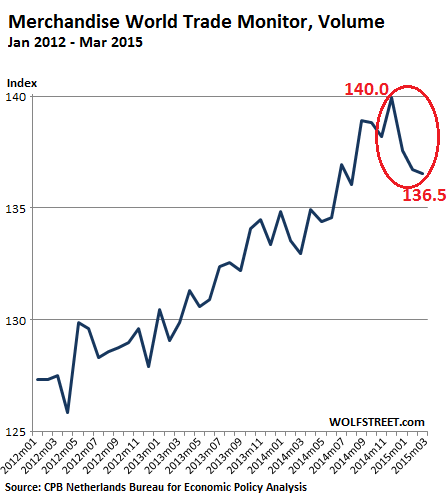

… but it is important to note that in today’s negative GDP print, it was net trade (exports less imports) that subtracted -1.9% from the final GDP print, driven by a -1.03% annualized drop in exports. This was the biggest hit to US trade since the great financial crisis.

The breakdown of the chart above is shown as follows, with Net Trade in real dollar terms subtracting $545 billion from US GDP, following the lowest exports number since Q2 2014 even as imports rose to a new all time high (most of it likely going to boost already near record high inventories):

Again, none of this is a surprise, and contrary to what some superficial pundits may claim, this is far more than oil. Deutsche Bank explains:
The first is the surprisingly sharp drop off in global trade in early 2014 that followed weakening into yearend 2014. This is over and above the decline in oil. It is likely affected by the west coast port issues but this doesn’t obviously account for other regional weakness. In the grand scheme of things trade is well correlated with turning points in the interest rate cycle and all else equal clearly “justifies” current low real yields. It is a requirement almost now for trade volumes to stabilize and improve for yields to be stable or higher.
Why trade is so weak may speak to the demand side of the secular stagnation debate. Supply creates demand and maybe demand creates supply; the issue is that secular stagnation can be driven by lack of productivity for lack of investment or innovation. But also demographics and the residual of financial repression can affect the outlook for demand. Note that globally productivity is also very weak whether Japan, Europe or China.
What is really happening is quite simple: the massive surge in the dollar, which we have said since the fall of 2014 will crush both GDP and corporate profits (as confirmed earlier today) has led to a collapse in US exports, and thus, trade contribution to GDP, over and above the deterioration in global trade as is.
Worse: as Aurelija Augulyte conveniently reminds us, it is about to get even worse: the reason, an advance read of the nominal effective USD exchange rate (as in stronger dollar due to fears of an imminent rate hike by the Fed) implies that US exports are about to really crash, which means Q2 GDP may not only not meet the Atlanta Fed’s 0.8% estimate, but may even print negative especially if the US economy can’t stock up on any more inventory (already just shy of all time highs).

So yes, crashing trade as a result of not only the soaring dollar but a secular decline in global demand is horrible news for the economy. But not horrible news for everyone.
As the following chart shows, US Treasurys are once again ahead of the game (certainly ahead of manipulated equities), and reflect not only the Fed’s and other central banks’ monetization of debt (which in turn is dictated by the collapsing global economy), but also the plunge in world trade volumes….

… a correlation which can be seen for global bond yields as well!

In other words, the worse the econ data, as manifested in this case by global trade, the lower bond yields will drop.In fact, with global trade now contracting, global NIRP, already tested in Europe, is just a matter of time.
And the punchline: since the entire concept of QE has been flawed from the beginning, and as we said from day one, will and has led to a disintegration of the economy unless someone stops the crazed central-planners, the lower bond yields drop, the greater the secular decline in aggregate demand (aka “deflation”), the more businesses focus on investing in short-term capital gains (see Chinese stocks) instead of long-term growth projects (see Capex), the worse global trade will get, forcing even more debt monetization, even lower yields, even lower trade, until finally even the central planners realize that money printing as a circular falacy, and have no choice but to finally dump money out of drones (as seen here) in the last ditch effort to spur (hyper)inflation.
And with that final “lights out” act for fiat currencies and the existing monetary regime, they will finally succeed… in destroying themselves.
Chicago PMI Bounce Is Dead, Crashes Back Near 6 Year Lows
Submitted by Tyler Durden on 05/29/2015 09:48 -0400
Following Milwaukee ISM’s plunge to 15-month lows this morning with a plunge in new orders (missing for 4 of last 5 months), Chicago PMI printed a disappointing 46.2 (against expectations of a slight rise to 53.0 from 52.3 last month) – lower than the lowest economist estimate. After last month’s modest (dead-cat) bounce back from winter’s collapse to 6 year lows, this re-collapse is hardly the kind of Q2-recovery-reinforcing data the mainstream wants. With the level now back at the same when Lehman hit, New Orders, Production, and Employment all contracted in May.
Milwaukee was ugly…

But Chicago PMI was uglier – as bad as it was when Lehman hit…

Can we get a better sell-side?

Chicago PMI breakdown…
- Forecast range 51 – 55 from 45 economists surveyed
- Prices Paid rose compared to last month
- New Orders fell compared to last month
- Employment fell compared to last month
- Inventory fell compared to last month
- Supplier Deliveries fell compared to last month
- Production fell compared to last month
- Order Backlogs fell compared to last month
- Business activity has been positive for 9 months over the past year.
- Number of Components Rising: 1
- end


 harveyorganblog.com
