
Good evening Ladies and Gentlemen:
Here are the following closes for gold and silver today:
Gold: $1173.00 up 40 cents (comex closing time)
Silver $15.84 flat.
In the access market 5:15 pm
Gold $1172.5
Silver: $15.86
>xxxxxxxxxxxxxxxxxxxxxxxxxxxxxxxxxxxxxxxxxxxxxxxxxxxxxxxxxxxxxx
Gold/Silver trading: see kitco charts on the right side of the commentary
Following is a brief outline on gold and silver comex figures for today:
At the gold comex today, we had a good delivery day, registering 44 notice serviced for 4400 oz. Silver comex filed with 0 notices for nil oz. Remember we are entering options expiry with today the comex gold and silver expires and then next Tuesday, we have options expiry on the gold/silver LBMA contracts and on the OTC contracts. So gold and silver will be subdued in price until Tuesday night.
Several months ago the comex had 303 tonnes of total gold. Today, the total inventory rests at 245.62 tonnes for a loss of 57 tonnes over that period.
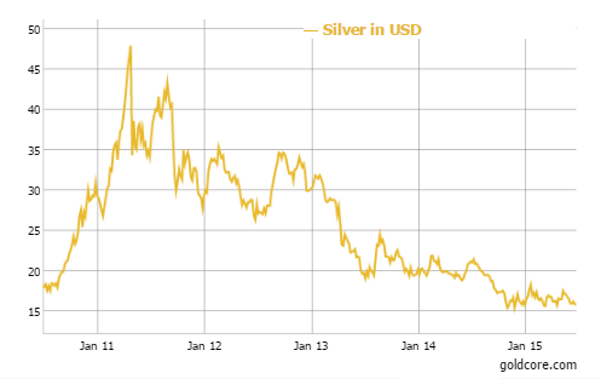
In silver, the open interest fell by 1695 contracts despite yesterday’s small price rise of 11 cents. The total silver OI continues to remain extremely high, with today’s reading at 198,578 contracts now at decade highs despite a record low price. We must have had some banker short covering yesterday. In ounces, the OI is represented by .994 billion oz or 142% of annual global silver production (ex Russia ex China). This dichotomy has been happening now for quite a while and defies logic. There is no doubt that the silver situation is scaring our bankers to no end as they continue to raid as basically they have no other alternative. There can only be one answer as to how the OI of comex silver is now just under 1 billion oz coupled with a low price under 16.00 dollars: sovereign China through proxies are the long and they have extremely deep pockets.
In silver we had 0 notices served upon for nil oz.
In gold, the total comex gold OI rests tonight at 636,180 for a gain 5,202 contracts as gold was down $3.60 yesterday. We had 44 notices filed for 4400 oz.
we had a huge addition in tonnage at the gold inventory at the GLD to the tune of 6.86 tonnes; thus the inventory rests tonight at 713.23 tonnes. The appetite for gold coming from China is depleting not only gold from the LBMA and GLD but also the comex is bleeding gold. I am sure that 700 tonnes is the rock bottom inventory in gold. Anything below this level is just paper and the bankers know that they cannot retrieve “paper gold” to send it onwards to China.In silver, /we had a huge addition in inventory at the SLV to the tune of 1.242 million oz/ Inventory now rests at 328.16 million oz
We have a few important stories to bring to your attention today…
1. Today, we had the open interest in silver fall by 1695 contracts to 198,578 despite the fact that silver was up marginally yesterday to the tune of 11 cents.. The OI for gold rose by another 5,202 contracts up to 436,180 contracts as the price of gold was down $3.60 yesterday.
(report Harvey)
2. Today, 8 important commentaries on Greece
(zero hedge, Reuters/Bloomberg)
3.the fraudulent data at the comex
(Dave Kranzler IRD)
4. Gold trading overnight
(Goldcore/Mark O’Byrne)
5. Trading from Asia and Europe overnight
(zero hedge)
6. Trading of equities/ New York
(zero hedge)
we have these plus other stories to bring your way tonight. But first……..
let us now head over to the comex and assess trading over there today.
Here are today’s comex results:
The total gold comex open interest rose appreciably by 5202 contracts from 430,978 up to 436,978 despite the fact that gold was down $3.60 in price yesterday (at the comex close). We are now in the big active delivery contract month of June. Here the OI fell by 102 contracts down to 267. We had 1 notice served upon yesterday. Thus we lost 101 contracts or an additional10,100 oz will not stand for delivery as they were no doubt cash settled. The next contract month is July and here the OI rose by 23 contracts to 624. The next big delivery month after June will be August and here the OI rose by 3,865 contracts up to 282,525. The estimated volume today (which is just comex sales during regular business hours of 8:20 until 1:30 pm est) was poor at 49,893. The confirmed volume yesterday (which includes the volume during regular business hours + access market sales the previous day was poor at 124,329 contracts. Today we had 44 notices filed for 4400 oz.
And now for the wild silver comex results. Silver OI fell by a small 1695 contracts from 200,273 down to 198,578 despite the fact that the price of silver was up in price by 11 cents, with respect to yesterday’s trading. We continue to have our bankers pulling their hair out with respect to the continued high silver OI. Yesterday, we probably had some bankers cover a few of their silver shorts as the temperature is getting a little too hot for them. The front non active delivery month of June saw it’s OI fall 1 contract to 23 contracts. We had 1 contract delivered upon yesterday. Thus we neither gained nor lost any silver contracts that will stand for delivery in this non active June contract month. The next delivery month is July and here the OI surprisingly fell by only 10,984 contracts down to 44,083. We have 3 trading days left before first day notice on June 30 and the front month is not contracting much in volume at all. The next major active delivery month is September and here the OI rose by a huge 7,697 contracts to 100,879. So far, for the first time we are not witnessing the collapse of OI in an active delivery month. The estimated volume today was poor at 28,987 contracts (just comex sales during regular business hours. The confirmed volume on yesterday (regular plus access market) came in at 80,971 contracts which is excellent in volume but lower than expected. However we still had many rollovers. We had 0 notices filed for nil oz today.
June initial standing
June 25.2015
| Gold |
Ounces |
| Withdrawals from Dealers Inventory in oz | nil |
| Withdrawals from Customer Inventory in oz | 1607.500 oz (,Scotia) 50 kilobars |
| Deposits to the Dealer Inventory in oz | nil |
| Deposits to the Customer Inventory, in oz | nil |
| No of oz served (contracts) today | 44 contracts (4400 oz) |
| No of oz to be served (notices) | 223 contracts (22,300 oz) |
| Total monthly oz gold served (contracts) so far this month | 2734 contracts(273,400 oz) |
| Total accumulative withdrawals of gold from the Dealers inventory this month | 99.93 oz |
| Total accumulative withdrawal of gold from the Customer inventory this month | 526,857.6 oz |
Today, we had 0 dealer transactions
we had zero dealer withdrawals
total Dealer withdrawals: nil oz
we had 0 dealer deposits
total dealer deposit: zero
we had 1 customer withdrawal
i) Out of Scotia: 1607.500 oz (50 kilobars)
total customer withdrawal: 1607.50 oz (50 kilobars)
We had 0 customer deposits:
Total customer deposit: nil oz
We had 0 adjustments:
Today, 0 notices was issued from JPMorgan dealer account and 0 notices were issued from their client or customer account. The total of all issuance by all participants equates to 44 contracts of which 0 notices were stopped (received) by JPMorgan dealer and 44 notices were stopped (received) by JPMorgan customer account
To calculate the total number of gold ounces standing for the June contract month, we take the total number of notices filed so far for the month (2734) x 100 oz or 273,400 oz , to which we add the difference between the open interest for the front month of June (267) and the number of notices served upon today (44) x 100 oz equals the number of ounces standing.
Thus the initial standings for gold for the June contract month:
No of notices served so far (2734) x 100 oz or ounces + {OI for the front month (267) – the number of notices served upon today (44) x 100 oz which equals 295,700 oz standing so far in this month of June (9.198 tonnes of gold). Thus we have 9.198 tonnes of gold standing and only 16.07 tonnes of registered or for sale gold is available. We lost 101 contracts or 10,100 oz to probable cash settlements.
Total dealer inventory 517,422.669 or 16.09 tonnes
Total gold inventory (dealer and customer) = 7,896,728.553 oz or 245.62 tonnes
Several months ago the comex had 303 tonnes of total gold. Today the total inventory rests at 245.62 tonnes for a loss of 57 tonnes over that period.
end
And now for silver
June silver initial standings
June 25 2015:
| Silver |
Ounces |
| Withdrawals from Dealers Inventory | nil |
| Withdrawals from Customer Inventory | nil |
| Deposits to the Dealer Inventory | nil |
| Deposits to the Customer Inventory | 598,131.700 oz (CNT) |
| No of oz served (contracts) | 0 contracts (nil oz) |
| No of oz to be served (notices) | 23 contracts(115,000 oz) |
| Total monthly oz silver served (contracts) | 274 contracts 13,655,000 oz) |
| Total accumulative withdrawal of silver from the Dealers inventory this month | 526,732.4 oz |
| Total accumulative withdrawal of silver from the Customer inventory this month | 5,575,143.2 oz |
Today, we had 0 deposits into the dealer account:
total dealer deposit: nil oz
we had 0 dealer withdrawal:
total dealer withdrawal: nil oz
We had 1 customer deposit:
i) Into CNT: 598,131.700 oz
total customer deposit: 598,131.700 oz
We had 0 customer withdrawals:
total withdrawals from customer;nil oz
we had 2 adjustments
i) Out of Brinks:
15,584.710 oz was adjusted out of the customer and this landed into the dealer account of Brinks
ii) Out of Scotia;
10,267.000 oz ???? was adjusted out of the customer account and this landed into the dealer account of Scotia:
Total dealer inventory: 57.866 million oz
Total of all silver inventory (dealer and customer) 181.715 million oz
The total number of notices filed today is represented by 0 contract for nil oz. To calculate the number of silver ounces that will stand for delivery in June, we take the total number of notices filed for the month so far at (274) x 5,000 oz = 13,700,000 oz to which we add the difference between the open interest for the front month of June (xxx) and the number of notices served upon today (0) x 5000 oz equals the number of ounces standing.
Thus the initial standings for silver for the June contract month:
274 (notices served so far) + { OI for front month of June (24) -number of notices served upon today (0} x 5000 oz ,= 13,815,000 oz of silver standing for the June contract month.
we neither gained nor lost any silver ounces standing for delivery in this non active delivery month of June.
for those wishing to see the rest of data today see:
http://www.harveyorgan.wordpress.comorhttp://www.harveyorganblog.com
end
The two ETF’s that I follow are the GLD and SLV. You must be very careful in trading these vehicles as these funds do not have any beneficial gold or silver behind them. They probably have only paper claims and when the dust settles, on a collapse, there will be countless class action lawsuits trying to recover your lost investment.
There is now evidence that the GLD and SLV are paper settling on the comex.
***I do not think that the GLD will head to zero as we still have some GLD shareholders who think that gold is the right vehicle to be in even though they do not understand the difference between paper gold and physical gold. I can visualize demand coming to the buyers side:
i) demand from paper gold shareholders
ii) demand from the bankers who then redeem for gold to send this gold onto China
vs no sellers of GLD paper.
And now the Gold inventory at the GLD:
June 25/a huge additon of 6.86 tones of inventory at the GLD/Inventory rests tonight at 713..23 tonnes
June 24/ a good addition of.900 tonnes of gold into the GLD/Inventory rests at 706.37 tonnes
June 23/no change in gold inventory/rests tonight at 705.47 tonnes
June 22/ a huge increase of 3.27 tonnes of gold into GLD/Inventory tonight: 705.47 tonnes
June 19.2015: no change in gold inventory/rests tonight at 701.90 tonnes.
June 18/no change in gold inventory/rests tonight at 701.90 tonnes
June 17/no change in gold inventory/rests tonight at 701.90 tonnes
June 16./no change in gold inventory/Rests tonight at 701.90 tonnes.
June 15/we lost a huge 2.08 tonnes of gold from the GLD/Inventor rests tonight at 701.90 tonnes
June 12/we had a small withdrawal of .24 tonnes of gold from the GLD/Inventory rests this weekend at 703.98 tonnes.
June 11/we had another huge withdrawal of 1.5 tonnes of gold from the GLD/Inventory rests tonight at 704.22 tonnes
June 10/ we had a huge withdrawal of 2.98 tonnes of gold from the GLD/inventory rests at 705.72
June 9/ no change in gold inventory at the GLD/Inventory rests at 708.70 tonnes
June 8/ a big withdrawal of 1.19 tonnes of gold from the GLD/Inventory rests at 708.70 tonnes
June 25 GLD : 713.23 tonnes
end
And now for silver (SLV)
June 25/ a huge increase of 1.242 million oz of silver into the SLV inventory/Inventory rests at 128.918 million oz
June 24/no change in inventory/rests tonight at 326.918 million oz
June 23/we had a small withdrawal of 956,000 oz/Inventory tonight rests at 326.918 million oz
June 22/ no change in silver inventory/327.874 million oz
June 19/no change in silver inventory/327.874 million oz
June 18 no change in silver inventory/327.874 million oz
June 17/no change in silver inventory/327.874 million oz
June 16./no change in silver inventory/327.874 million oz
June 15/we had no change in silver inventory/327.874 million oz
June 12/we had another addition to the tune of 956,000 oz/Inventory rests this weekend at 327.874. Please note that there has been an addition on each of the past 5 days.
June 11.2015: we had another monster of an addition to the tune of 2.791 million oz/Inventory rests at 326.918
June 10/another monster of an addition to the tune of 1.126 million oz/Inventory rests at 324.127
June 9/ a monster of an addition to the tune of 3.393 million oz/inventory rests at 323.001 million oz.
June 8/no change in inventory/SLV inventory rests at 319.608 milion oz.
June 5 a huge addition of 1.433 million oz of silver added to the SLV/Inventory at 319.608 million oz
June 25/2015: we had an addition of 1.242 million oz silver inventory/SLV inventory rests tonight at 328.918 million oz
end
And now for our premiums to NAV for the funds I follow:
Sprott and Central Fund of Canada.
(both of these funds have 100% physical metal behind them and unencumbered and I can vouch for that)
1. Central Fund of Canada: traded at Negative 7.3 percent to NAV usa funds and Negative 7.6% to NAV for Cdn funds!!!!!!!
Percentage of fund in gold 61.9%
Percentage of fund in silver:37.8%
cash .3%
( June 25/2015)
2. Sprott silver fund (PSLV): Premium to NAV rises to 1.00%!!!! NAV (June 25/2015)
3. Sprott gold fund (PHYS): premium to NAV rises to – .54% toNAV(June25/2015
Note: Sprott silver trust back into positive territory at +1.00%
Sprott physical gold trust is back into negative territory at -.54%
Central fund of Canada’s is still in jail.
Sprott formally launches its offer for Central Trust gold and Silver Bullion trust:
SII.CN Sprott formally launches previously announced offers to CentralGoldTrust (GTU.UT.CN) and Silver Bullion Trust (SBT.UT.CN) unitholders (C$2.64)
Sprott Asset Management has formally commenced its offers to acquire all of the outstanding units of Central GoldTrust and Silver Bullion Trust, respectively, on a NAV to NAV exchange basis.
Note company announced its intent to make the offer on 23-Apr-15 Based on the NAV per unit of Sprott Physical Gold Trust $9.98 and Central GoldTrust $44.36 on 22-May, a unitholder would receive 4.45 Sprott Physical Gold Trust units for each Central GoldTrust unit tendered in the Offer.
Based on the NAV per unit of Sprott Physical Silver Trust $6.66 and Silver Bullion Trust $10.00 on 22-May, a unitholder would receive 1.50 Sprott Physical Silver Trust units for each Silver Bullion Trust unit tendered in the Offer.
* * * * *
end
And now overnight trading in gold/silver from Europe and Asia/plus physical stories that might interest you:
First: Goldcore’s Mark O’Byrne
(courtesy Goldcore/Mark O’Byrne)
“They Can’t Print Money Forever” – Ron Paul
– Former U.S. Congressman blasts Fed’s role in markets
– Gives scathing analysis of modern economics and markets
– Highlights complete disregard of economic fundamentals in investment decisions today
– As will be the case with Greece, U.S. will eventually be forced to liquidate debt
– Attempts to forecast day of reckoning are futile as it is a function of psychology
– “They can’t print money forever”
– Gold and silver will weather and thrive in currency devaluation
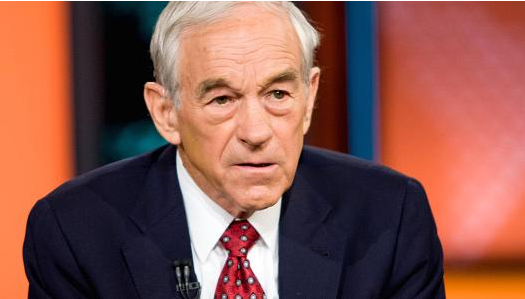
Ron Paul, former congressman for Texas, laid plain the absurdity of central policy towards the markets in a recent interview with Amanda Diaz on CNBC. He believes a day of reckoning is in the cards because the central banks “can’t print money forever.”
Dr. Paul blasted the role of the Federal Reserve in markets where superficial pronouncements herd speculators to and fro: “I am utterly amazed at how these Federal Reserve Chairman reports can play havoc with the market: one word – what they say and what they don’t say and who’s going to interpret it,” he said.
He believes this manipulation of markets by the Fed is having very negative consequences for the economy. Speculators are chasing Fed-induced momentum rather than making investment decisions based on analysis of what is happening in the real world. Savings, once the bedrock of American capitalism, have been replaced by easy credit leading to “a lot of malinvestment and a pyramiding of gigantic debt”, adding“People don’t depend on savings for their capital – they depend on the Fed!”
He states that at some point the financial elites are going to have to admit that Greece’s debt is unpayable and will have to be liquidated. He sees the same thing eventually unfolding in the U.S. also, saying “there will be an unwinding of this pyramiding of debt and all this malinvestment that has occurred for a good many years.”
The interviewer – abandoning any pretence that the markets are in anyway independent – states “This is a Fed that has held this market up for quite some time now” and then asks Dr. Paul to indicate when he thinks the crisis will unfold.
He states that it could happen any time – maybe tomorrow, maybe two years from now. “It all depends on a psychological acceptance of this system. So, a lot of people who are still making a lot of money know that it is not going to last but they figure ‘well, everybody else thinks it’s going to last…’ and they just keep owning bonds and buying stocks.”
He therefore believes that it is impossible to gauge when the day of reckoning will come.
“So no, I don’t think there is anyway to know what the time is but after thirty five years of a gigantic bull market in bonds: believe me, they cannot reverse history and you cannot print money forever and deceive the markets forever. Eventually, the markets will rule and that’s only a question of when that will happen and of course I’m running a little bit scared because I think there will be a day of reckoning.”
In the event of currency devaluations, physical gold and silver – which cannot be printed and devalued by central banks with reckless abandon – will not only survive but thrive.
Must Read Guide: 7 Key Gold Must Haves
MARKET UPDATE
Today’s AM LBMA Gold Price was USD 1,174.60, EUR 1,052.51 and GBP 748.80 per ounce.
Yesterday’s AM LBMA Gold Price was USD 1,175.75, EUR 1,048.93 and GBP 744.71 per ounce.
Gold fell $3.20 or 0.27 percent yesterday to $1,174.40 an ounce. Silver climbed $0.07 or 0.44% percent to $15.90 an ounce.
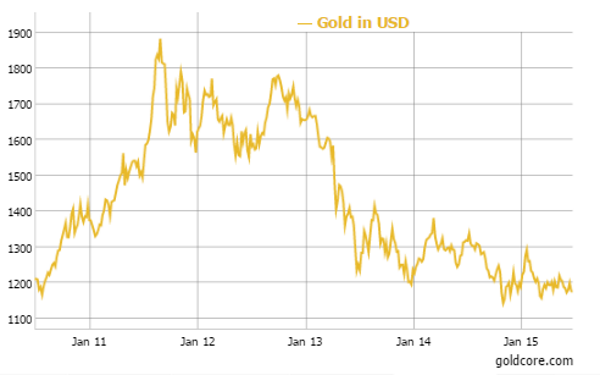
Gold in Singapore for immediate delivery was up 0.2 percent to $1,176.80 an ounce.
Gold’s move lower is counter intuitive as the poor GDP number, while expected, allied to lower stock markets on continuing Greek concerns should have provided a boost to gold.
It suggests that the gold market is still largely controlled by speculative, fast trading money going long and short and trading the range between $1,150 per ounce and $1,225 per ounce. Passive allocations to physical gold and global physical demand is not impacting prices at this time.
Even the introduction of a gold dinar as currency by the ISIS fanatics has been greeted with a huge yawn as traders hold sway for now.
China’s Industrial and Commercial Bank of China (ICBC) is making a move to be part of the London gold price benchmarking process, the bank said during the LBMA bullion market forum.
Only last week, the Bank of China (BOC) became the first Chinese bank to participate in the LBMA Gold Price, which formally replaced the 100 year old London Gold Fix on March 20th.
Standard Chartered and Morgan Stanley will join present members JPMorgan Chase Bank, Scotiabank, HSBC, Société Générale, UBS, Barclays and Goldman Sachs including the two Chinese banks.
The ICE Benchmark Administration (IBA), was established in April 2013 to administer benchmarks, and currently provides the price platform, methodology and overall administration and governance for the LBMA gold price after a price fixing scandal.
Chinese banks are ramping up their commodities business while some western banks are exiting them.
In late morning European trading gold is U.S. dollars is down 0.01 percent at $1,175.23 an ounce. Silver is down 0.30 percent at $15.85 an ounce and platinum is up 0.21 percent at $1,076.44 an ounce.
Breaking News and Research Here
end
The author talks about CEO Newmayer who warns of a global reset exactly what Bill Holter has predicted:
(courtesy Mac Slavo/GATA)
Top CEO Warns Of Global Reset: “It’s In The Cards For Sure… It Could Happen This Year”
Submitted by Mac Slavo via SHTFPlan.com,
Over the last several months there have been numerous reports highlighting the frantic activities of the world’s ultra-wealthy elite. From the purchasing of emergency hideaways and airstrips to warnings from their financial advisors that it’s time to shift their assets into physical holdings, it appears that a lot of powerful people are afraid of a significant shift set to take place in the near future.
In his latest interview with Future Money TrendsKeith Neumeyer, who recently penned a very public (and very viral) letter to the Commodity Futures Trading Commissions outlining the rampant manipulation by concentrations of shadowy market players taking place on commodities exchanges, shares his insights on what many believe to be a coming global reset.
According to First Mining Finance Chairman Neumeyer, the day of reckoning may come a lot sooner than most people think:
It’s in the cards for sure. Predicting exactly what it’s going to mean or what it’s going to look like… that’s the big challenge… I think a lot of people are ignoring it… but there are some forward thinkers out there who talk about it.
I think that the Chinese want their currency part of a floating currency… I think that’s really going to be the next leg in this whole change… in this reset going forward. It could even happen this year.
Watch the full interview with Keith Neumeyer
When this reset comes to pass the manipulations so apparent in commodities and broader stock markets today will be exposed, and according to Neumeyer, may lead to the biggest surge in precious metals we have ever seen.
Echoing the forecasts of one of the world’s leading trend strategists Gerald Celenete, Neumeyer notes that the monetary system that takes hold after a global reset could result in gold rising to $3000 an ounce or more. Such a move would have a similar impact on silver, which may stabilize at it’s historical silver-to-gold ratio of 16:1, putting it’s strike price somewhere above $150 an ounce.
Right now, you’re mining 10 ounces of silver for every one ounce of gold. So gold is trading at… let’s say $1,200 just to round it up. So that would be $120 silver, if the ratio was 10-to-1. So I say silver should be $120.
The other key ratio is the ratio that has been common for 500 years… Sir Isaac Newton came up with the ratio of 16-to-1 and that’s how they created the pound sterling. And so there was a theory that there was for every one ounce of gold, 16 ounces of silver in the earth’s crust. So using 16-to-1, at $1,200, it’s somewhere around $80-$90.
Silver should be trading, in my view, somewhere from $80 to $120 an ounce.
The prices Neumeyer cites are based on current trading levels, suggesting that silver is significantly under-priced already.
Now imagine what happens should we see a widespread crisis and subsequent global reset of the financial, economic and monetary systems. Markets are so fragile that even something as simple as China publicly declaring their true gold holdings could spark the next bull run in precious metals:
Of course it would and that plays back to what I was saying earlier. I don’t know if China’s ready for that to happen, becauseonce they do it gold will probably go up by multiples… hundreds and hundreds of dollars.
I could see gold going up to $3,000 or some number like that.
Who knows exactly… but I do believe that that would occur because the people would see the hoard that the Chinese have actually accumulated over the last decade and that would completely change the market.
Countries like China and Russia are secretly accumulating massive stockpiles of gold and silver. Further, the ultra-wealthy have been warned in no uncertain terms by their advisors to do the same.
If there were ever a tell-tale sign that a momentous set of events is soon to take place, this is it. Follow the money, which at this time just so happens to be shifting to physical assets of real value in anticipation of the next leg of the global reset.
Craig Hemke does a superlative job analyzing the silver comex. He is coming to the same conclusion as Bill Holter and myself;
(courtesy Craig Hemke/TFMetals,GATA)
TF Metals Report: The silver short bubble
3:45p ET Wednesday, June 24, 2015
Dear Friend of GATA and Gold:
The TF Metals Report’s Turd Ferguson today marvels at the record open interest in silver futures on the New York Commodity Exchange, which, he argues, is a “short bubble” about to pop.
On the other hand, if the U.S. government, which creates infinite amounts of the world reserve currency, is essentially behind the shorting, it can go on forever, or at least until real metal runs out or the dollar ceases to be the world reserve currency.
Ferguson’s commentary is headlined “The Silver Short Bubble” and it’s posted at the TF Metals Report’s Internet site here:
http://www.tfmetalsreport.com/blog/6942/silver-short-bubble
CHRIS POWELL, Secretary/Treasurer
Gold Anti-Trust Action Committee Inc.
end
China plans to launch yuan gold fix by end of this year
By A. Ananthalakshmi
Reuters
Thursday, June 25, 2015
SHANGHAI — China plans to launch a yuan-denominated gold fix by the end of 2015 via the Shanghai Gold Exchange in a move aimed at giving the world’s biggest bullion producer and consumer more influence over pricing.
The first public confirmation made by an exchange official comes after Reuters cited sources in February on the proposal for the fix to be set through trading on the SGE, the world’s biggest physical bullion exchange.
“We will be introducing a renminbi-denominated fix at the right moment. We are hoping to introduce it by the end of the year,” Shen Gang, SGE’s vice president, said at the LBMA Bullion Market Forum in Shanghai on Thursday. …
… For the remainder of the report:
http://finance.yahoo.com/news/china-plans-launch-yuan-gold-095318339.htm…
end
The following should be interesting!!!
(courtesy Reuters/GATA)
LBMA to start reporting OTC gold trade soon; exchange model seen costly
By A. Ananthalakshmi
Reuters
Thursday, June 25, 2015
SHANGHAI — The London Bullion Market Association could soon take steps to report trades of the over-the-counter gold market, but the prospect of higher costs makes an exchange-traded model unattractive to participants for now, its chief executive said.
The LBMA had commissioned consultancy EY, formerly known as Ernst & Young, to review the London gold market and recommend further developments including the possibility of creating an exchange for gold trading in the city.
More than $5 trillion worth of gold transactions are made over the counter in London every year. The OTC market, where trades are executed via dealer networks as opposed to a centralized exchange, exceeds the trading of gold futures.
“Our next step following the EY recommendations, certainly trade reporting is going to be a big first one,” CEO Ruth Crowell said, ahead of the LBMA Bullion Market Forum to be held here today.
Currently no data is available for the bilateral OTC trades, leading to complaints of lack of transparency in the market. …
… For the remainder of the report:
http://www.reuters.com/article/2015/06/25/us-china-goldconference-lbma-i…
end
Alasdair Macleod…
(courtesy A. Macleod)
Alasdair Macleod: Managing trade deficits
By Alasdair Macleod
GoldMoney.com, St. Helier, Jersey, Channel Islands
Thursday, June 25, 2015
Currency devaluation is seen by nearly every macro-economist to be the cure for trade deficits.
Recently they have recommended it to Greece, arguing for the reintroduction of the drachma so that the Greek economy can become “competitive” and “rebalanced.” This widespread assumption is easily demonstrated to be incorrect.
Empirical evidence confirms the error: In the post-war years Germany and Japan were the strongest exporting nations despite persistent rises in their exchange rates, and the UK consistently the weakest, despite the sought-after benefit of sterling depreciation. Hong Kong dropped currency management entirely in favor of a currency board tied rigidly to the US dollar, and despite having to import everything, managed very well. …
… For the remainder of the commentary:
https://www.goldmoney.com/research/analysis/managing-trade-deficits?gmre…
end
Dave Kranzler on the fraudulent data provided to us by the bankers:
(courtesy Dave Kranzler/IRD)
SoT #39 – Market Update: Is The Comex End-Game In Sight?
The information in this report is take from sources believed to be reliable; however, the Commodity Exchange, Inc disclaims all liability whatsoever to its accuracy or completeness. This report is produced for information purposes only. – Legal disclaimer at the bottom of the Comex daily gold and silver vault inventory reports
The legal disclaimer showed up one day a couple years ago at the bottom of the Comex vault reports. Every gold and silver – especially silver – analyst on the internet discusses the state of condition of the Comex using these reports as if they are bona fide.
Given the implications of the above legal disclaimer, this is quite disconcerting. Even gold/silver analysts who are critical of the rampant illegal manipulation of the gold and silver markets on the Comex take the data as reported as being legitimate.
CLEARLY, that disclaimer tells us not to take the Comex data reports seriously. In fact, it suggests the distinct possibility that the reports might not be accurate or complete. Why? Because the reports largely come from the three primary market making banks on the Comex: JP Morgan, Scotia and HSBC.
The big banks have been successufully prosecuted and fined for fraud and criminal behavior in just about every business segment of their operations except their gold and silver trading. This includes criminal activity in other commodity markets. If these reports are in fact accurate and bona fide, it would be the ONLY business segment of any of these banks that is reported without any misrepresentation or outright fraud. The probability of that being the case is 0% using a 100% confidence interval. Sorry Ted.
The U.S. financial markets are the most corrupt markets in the history of the world. – Shadow of Truth
We also discuss the TPP Agreement. The TPP Agreement completely incinerates what’s left of the Constitution. It completely usurps U.S. Federal and State laws and hands ultimate legal decision over to a tribunal international multinational corporations. It extends well beyond just trade issues. It completely nullifies the Constitution and States’ Rights. Any signatory to the Agreement agrees to waive its own sovereign laws and abide by the enforcement of laws set forth in the TPP Agreement on any matter involving TPP issues.
The TPP Agreement is the end of any country as it was founded and conceived.
end
and now overnight trading in stocks and bonds from Asia and Europe:
1 Chinese yuan vs USA dollar/yuan strengthens to 6.2060/Shanghai bourse red and Hang Sang: red
2 Nikkei closed down by 96.63 points or 0.46%
3. Europe stocks all in the green /USA dollar index down to 95.13/Euro falls to 1.1200
3b Japan 10 year bond yield: rises to .474% !!!!(Japan buying 100% of bond issuance)/Japanese yen vs usa cross now at 123.66/ominous to
3c Nikkei still just above 20,000
3d USA/Yen rate now well above the 123 barrier this morning
3e WTI 60.03 and Brent: 63.60
3f Gold up/Yen up
3gJapan is to buy the equivalent of 108 billion uSA dollars worth of bond per month or $1.3 trillion. Japan’s GDP equals 5 trillion usa.
Japan to buy 100% of all new Japanese debt and by 2018 they will have 25% of all Japanese debt. Fifty percent of Japanese budget financed with debt.
3h Oil down for WTI and up for Brent this morning
3i European bond buying continues to push yields lower on all fronts in the EMU. German 10 yr bund falls to .83 per cent. German bunds in negative yields from 3 years out.
Except Greece which sees its 2 year rate rise to 22.01%/Greek stocks this morning rises by 0.87%/ still expect continual bank runs on Greek banks /Greek default inevitable/
3j Greek 10 year bond yield rise to: 10.70%
3k Gold at 1173.50 dollars/silver $15.82
3l USA vs Russian rouble; (Russian rouble down 1/4 in roubles/dollar in value) 54.56,
3m oil into the 60 dollar handle for WTI and 63 handle for Brent/Saudi Arabia increases production to drive out competition.
3n Higher foreign deposits out of China sees huge risk of outflows and a currency depreciation. This can spell financial disaster for the rest of the world/China may be forced to do QE!!
30 SNB (Swiss National Bank) still intervening again in the markets driving down the SF. It is not working: USA/SF this morning .9411 as the Swiss Franc is still rising against most currencies. Euro vs SF is 1.0542 just above the floor set by the Swiss Finance Minister.
3p Britain’s serious fraud squad investigating the Bank of England/
3r the 3 year German bund remains in negative territory with the 10 year moving closer to negativity at +.83
3s Last Friday, another 1.8 billion ELA was raised to a maximum of 85.9 billion euros. Monday morning then saw another 1.9 euros added to the ELA as massive bank runs were the object of the day and thus the ELA stood at a maximum 87.8 billion euros.Then Tuesday and Wednesday, the ELA was raised twice but the figures were not released (Reuters).The ELA is used to replace depositors fleeing the Greek banking system. The bank runs are increasing exponentially.This week the ECB is contemplating cutting off the ELA which would be a death sentence to Greece and they are as well considering a 50% haircut to all Greek sovereign collateral which will totally wipe out the entire Gr. banking and financial sector.
3t Greece paid the 700 million plus payment to the IMF last Wednesday but with IMF reserve funds. The funds are deferred to June 30.
3 u. If the ECB cuts off Greece’s ELA they would have very little money left to function. So far, they have decided not to cut the ELA but this weekend is the likely time to do it.
4. USA 10 year treasury bond at 2.40% early this morning. Thirty year rate well above 3% at 3.16% / yield curve flatten/foreshadowing recession.
5. Details Ransquawk, Bloomberg, Deutsche bank/Jim Reid.
(courtesy Jim Reid/Bloomberg/Deutsche bank/zero hedge)
Jittery Markets Seesaw With Every Greek Headline As Time Runs Out, China Replunges
Before we get into the main story for headline scanning algos which of course is the endless Greek tragedy, it is worth noting that while overnight China scrapped its 75% loan to deposit ratio cap for commercial banks, broadly seen as yet another easing move, the PBOC also engaged in its first liquidity injection via reverse repo since April in what many took to be an indication that an RRR-cut is increasingly less likely. As Reuters reports, “The decision to resume injecting funds via reverse bond repurchase agreements after a nine-week hiatus shows the bank is moving proactively to offset rising seasonal cash demand as companies prepare to file their first-half financial reports.”
Money rates are typically under pressure toward the end of the quarter, and in particular at the end of the first half, when banks and corporates stock up on cash to burnish their balance sheets.
In addition, large batches of IPOs have from time to time frozen a large amount of short-term liquidity.
China’s securities regulator said late on Thursday it had approved a new batch of 28 IPOs after 24 firms just finished subscriptions this week and last.
In response, the People’s Bank of China (PBOC) injected 35 billion yuan ($5.64 billion) into the market through seven-day reverse bond repurchase agreements on Thursday, its first open market operation since mid-April.
The central bank also set the yield on its seven-day reverse repos at 2.7 percent, down sharply from 3.5 percent in April but about in line with the currency market rates.
The result, as well-meaning as it may have been, is that after two days of increases Chinese stocks retumbled – with another cash-draining battery of IPOs over the corner surely not helping – sliding down 3.5% to close near the lows, and set the early sour mood ahead of today’s endless Greek discussions.
So back to the main event of the day, the so far fruitless Greek negotiations continued in Brussels where nobody really knows what is going on but there has been a constant barrage of disjointed headlines, many of which leaked by interested sources, and which are outright contradictory. In other words, business as usual.
Furthermore, even if there is some framework of a deal it once again has to go back to Athens to get parliamentary approval as Tsirpas is forced to make even more concessions.
In any event some of the key news were that the ECB kept the ELA flat with Handelsblatt reporting that 6 members of the governing council demanding to stop the ELA immediately. This is clearly a return to the old negotiating “tactic” of threatening the Greek banking system with a liquidity halt if there is no deal.
For now, however it isn’t working, as Greece was said earlier to have been given an 11am deadline to come up with a final proposal, which came and went only for the creditors to state that a Sunday “deadline” was perfectly acceptable.
Then there was some speculation that the Troika had failed to agree on a single Greek proposal only for them to promptly deny it.
Then, after it was reported that Greece had in fact submitted a counter to the IMF’s counter, there was a brief burst of euphoria when the following headline hit:
- GREECE DOCUMENTS CAN BE BASIS FOR A DEAL: EU OFFICIAL
Only for the ES spike to fizzle when this came moments later:
- GREEK GOVT REMAINED FIRM IN ITS POSITIONS, OFFICIAL SAYS
Bloomberg adds that Greece hasn’t accepted the documents sent by the institutions.
And then this hit:
- GREECE, CREDITORS FAIL TO REACH AGREEMENT AHEAD OF EUROGROUP
So where do we stand?
Nobody really knows as the market continues to react to headline after headline, without any clear sense of direction although based on the green tone to equity futures – if only for now – there is once again a sense of optimism that a deal will be struck in the last minute… the same as the optimism last week… and the week before… and so on, as hope has managed to push the S&P to just shy of all time highs on “hope” of an imminent Greek deal which always is just around the corner.
Expect countless more headlines over the day, and into tomorrow and the weekend as a deal appears improbable, and even if the Brussels delegation does come up with a resolution, the Greek parliament will throw up all over it and then the entire charade will repeat once again.
Bloomberg’s Richard Breslow summarized it best when he said that “for right now, the market is watching and thinking “To- morrow, and to-morrow, and to-morrow, Creeps in this petty pace from day to day.” Let’s hope it isn’t a “tale Told by an idiot, full of sound and fury. Signifying nothing.” Shakespeare ended Macbeth with the fifth act. One can only hope the politicians do the same.
* * *
Greece aside, a quick recap of overnight markets showed early strength in equity markets buoyed by the reports that China is to relax loan to deposit ratios, while the PBoC injected funds into the interbank market for the 1st time in 2-months, gradually waned and major indices settled broadly lower. Much of this stemmed from the fact that the latest actions by the Chinese central bank prompted speculation that the Bank will refrain from cutting RRR to support economic growth
Stocks in Europe have come off the worst levels, but the price action remained volatile, as the talks between Greece and its creditors resumed this morning and are expected to be presented at the Eurogroup summit. At the same time, Bunds have gradually edged lower to trade near the unchanged mark and Greek bonds came off the worst levels of the session. Of note, it was reported that the Eurogroup is determined to conclude its meeting by 1700CET so it does not clash with the leader summit, while a banking source noted that ECB has approved ELA request for Greek banks by the local central bank.
EUR weakness was observed across the board, driven by the downside breakdown of EUR/JPY, which in turn triggered selling
pressure in EUR/USD and EUR/GBP. At the same time, CHF gradually pared the initial weakness, as market participants
positioned to hedge their risks amid the Greek impasse. Of note, analysts at Barclays forecast that the BOE will hike rates by 25bps in Q1 2016 and then start a 25bp rate hike cycle every 6 months.
Despite the volatile price action in equity markets and the FX in Europe this morning, WTI and Brent crude prices held steady, with WTI trading little changed. At the same time, little in terms of underlying price action was observed by gold, which too trades near the unchanged mark as markets participants await further developments relating to Greece.
In summary: European shares stay higher, having pared earlier losses, with the telco and bank sectors outperforming and travel & leisure, retail underperforming. Greece, creditors fail to reach agreement ahead of Eurogroup. Earlier, Greek govt handed over a revised proposal to stave off a default; Greece didn’t accept a set of documents sent by the creditor institutions. ECB said to leave Greek banks ELA ceiling unchanged. South Korea cuts 2015 growth forecast, plans fiscal stimulus package. The Italian and Dutch markets are the best-performing larger bourses, Swedish the worst. The euro is little changed against the dollar. Japanese 10yr bond yields rise; German yields increase. Commodities decline, with nickel, silver underperforming and natural gas outperforming. U.S. jobless claims, continuing claims, Bloomberg consumer comfort, Kansas City Fed index, personal income, personal spending, Markit U.S. composite PMI, Markit U.S. services PMI due later.
Jim Read:
After late night talks ended shortly after midnight with a deal still yet to be reached, technical teams agreed to reconvene at 6am CET before Greek PM Tsipras, the IMF’s Lagarde, the ECB’s Draghi and the European Commission’s Juncker are due to resume talks at 9am CET. A Eurogroup meeting has been scheduled now for 1pm CET.
There appeared to be no further comments from either Tsipras or the Creditors following the meeting late last night. Before this we learned that, after a number of time consuming meetings during the day, Greece and its Creditors had still failed to bridge the remaining gaps in proposals that are on the table. Eurogroup President Dijsselbloem confirmed this while the WSJ released a copy of the counter proposal from the Creditors which showed where the differences still remained. In particular this includes the proposed corporate taxation increases, sales taxes and defense spending cuts amongst others areas. Various wires are reporting that the IMF in particular appears to be leading some of the pushback with Reuters quoting the Fund’s Chief Lagarde as saying ‘you can’t build a programme just on the promise of improved tax collection, as we have heard for the past five years with very little result’. That yielded a response out of Tsipras who said that ‘this odd stance seems to indicate that either there is no interest in an agreement or that special interests are being backed’. Greece’s State Minister Flabouraris, meanwhile, said that the revisions by the Creditors to some of Greece’s proposals were ‘absurd’.
So with all this it was a weaker day for equity markets across the board yesterday. Led by a -1.77% decline for Greek equities, the Stoxx 600 (-0.38%), DAX (-0.62%), CAC (-0.24%), IBEX (-0.71%) and FTSE MIB (-0.53%) all ended lower with the bulk of the losses coming early in the session and seemingly sparked by a Bloomberg headline stating Tsipras as saying that the Creditors didn’t accept Greece’s proposals. The weakness then filtered over into the US session where we saw the S&P 500 sell off 0.74% with losses relatively broad-based across sectors. Treasuries (-4.1bps) and Bunds (-2.9bps) resumed their usual safe haven status as 10y yields fell to 2.368% and 0.841% respectively while in the periphery a volatile session in which yields traded in a 10bps range saw 10y yields in Spain (+0.8bps), Italy (-1.0bps) and Portugal (-0.8bps) actually finish relatively unchanged. There was some softness in credit markets too. Crossover initially spiked +13bps wider on the early headlines, before settling down to end +6bps wider at the close while in the US we saw CDX IG end +2.25bps wider.
Looking at the reaction in the Asia timezone, with the exception of China it’s a largely weaker start for most major bourses. Indeed, the Nikkei (-0.32%), Hang Seng (-0.31%), Kospi (-0.01%) and ASX (-0.65%) are all lower while in China the Shanghai Comp (+0.43%) and Shenzhen (+0.24%) have both displayed their usual volatility with the Shanghai Comp in particular trading between gains and losses 10 times already this morning. 10y Treasury yields have risen +1.1bps while similar maturity yields in South Korea (+1.1bps), Singapore (+1.0bps) and Australia (+0.2bps) are also wider. Markets in Korea are also reacting to the news that the Korea Finance Ministry has cut its GDP forecast for 2015 to 3.1% from 3.8% in light of the MERS outbreak and the drought. The CPI forecast was also lowered from 2% to 0.7% while the ministry announced it was planning a stimulus package of $13.5bn in response.
Meanwhile, late last night China’s State Council announced that it had approved a draft amendment to scrap the 75% loan-to-deposit ratio (a 20-year old legislation) for Chinese banks. The Standing Committee of the People’s Congress now need to give their approval in order for it to become effective. With the obvious positive potential implications for credit growth, the proposed move is another step in the recent liberalization of markets in China through financial reform in a bid to stimulate the economy. China Construction Bank (+2.06%), Agricultural Bank of China (+0.80%) and ICBC (+0.96%) are all up on the news.
In truth away from Greece there was fairly minimal news flow elsewhere yesterday. In the US we saw the third reading for Q1 GDP revised up to -0.2% saar as expected from the previous -0.7% print. We also saw an upward revision to personal consumption to 2.1% saar, a 30bps move higher. Finally Core PCE was kept unchanged at +0.8% saar. The Dollar swung around with the various headlines before the DXY eventually closed down a modest -0.15%. The Treasury market also had to deal with a weaker 5 year auction yesterday where we saw the bid-to-cover ratio fall 2.39, well below the average of the last 10 auctions of 2.54. Elsewhere, one date to now mark in the diary is that of the next Fed’s semi-annual Monetary Policy report in front of congress which will take place on July 15th after it was confirmed that Fed Chair Yellen will be returning back to Capitol Hill.
Data wise in Europe yesterday the focus was on Germany where we got a weaker than expected IFO survey reading, particularly in light of the previous day’s PMI’s. The headline declined 1.1pts to 107.4 (vs. 108.1 expected) supported by falls for both the current assessment (down 1.2pts to 113.1; expected 114.1) and expectations (down 1pt 102.0; expected 102.4) with the latter falling for the third straight month. Our colleagues in Europe noted that level-wise the expectations reading is still consistent with 0.5% qoq GDP growth in Q2 however. Elsewhere, yesterday we saw the final Q1 GDP reading in France kept unchanged at +0.6% qoq.
Turning over to the day ahead now, it’s set to be all eyes on Greece this morning once again with Tsipras’s meeting with the Creditors followed by the Eurogroup meeting shortly after. Data wise we’ve got German consumer confidence and UK CBI reported sales as the main releases this morning. It’s set to be a busy session in the US this afternoon however headlined by the May PCE deflator (the Fed’s preferred inflation measure) reading. As well as this we get the May readings for personal income and spending as well as initial jobless claims, Kansas City Fed manufacturing activity index and the flash composite and services PMI prints.
Greek Negotiations Now “Moving Backwards” As Confusion Reigns In Brussels – Live Updates
For a couple of hours on Tuesday, it appeared as though Greece had managed to sneak a debt deal proposal by the troika that, while hitting some of the mandated fiscal targets, did not include the pension cuts and VAT concessions that had previously constituted creditors’ “red lines.”
Then, on Tuesday evening, the IMF apparently decided to read the terms of the “deal” and Christine Lagarde did not like what she saw.
A few hours later, we were back to square one and Greek PM Alexis Tsipras was calling the IMF’s stance “weird” although in reality, the Fund was simply reiterating what it’s been saying since May, when Lagarde lost patience with the situation following Athens’ move to make a €750 million payment out of its SDR reserves.
Following meetings with EU officials and then with Lagarde and ECB chief Mario Draghi on Wednesday evening, Tsipras is back at it on Thursday, in a frantic attempt to win over EU finance chiefs (who are collectively losing their will to keep Greece in the currency bloc) and the IMF as the EU summit kicks off in Brussels. Here’s Bloomberg summing up:
As the pressure grew, Tsipras met with International Monetary Fund chief Christine Lagarde, European Central Bank President Mario Draghi and European Commission President Jean-Claude Juncker after concluding hours of discussions Wednesday that yielded no breakthrough. Euro-area finance chiefs are also in Brussels trying to find a way to broker an agreement that will satisfy all sides ahead of a two-day summit of European Union leaders that begins later Thursday.
The contradictory headlines are coming fast and furious Thursday morning as confusion reigns.
- GREEK OFFICIAL SAYS GOVT SUBMITTED PROPOSALS TO INSTITUTIONS
- GREECE DOCUMENTS CAN BE BASIS FOR A DEAL: EU OFFICIAL
- INSTITUTIONS UNANIMOUSLY AGREED ON GREECE PAPERS: EU OFFICIAL
- GREEK GOVT REMAINED FIRM IN ITS POSITIONS, OFFICIAL SAYS
- INSTITUTION DOCUMENTS NOT ACCEPTED BY GREEKS: EU OFFICIAL
- DIFFERENCES BETWEEN GREEK, INSTITUTIONS BAILOUT DOCUMENTS ‘NOT THAT BIG”–OFFICIALS
It now appears the Greeks have missed a deadline to present a counter proposal ahead of the finance ministers’ meeting, meaning the troika’s proposal will be discussed instead, even though the Greeks rejected that proposal yesterday.
- GREECE, CREDITORS FAIL TO REACH AGREEMENT AHEAD OF EUROGROUP
And now that meeting has been delayed, presumably because it’s pointless to discuss a proposal that one side has already rejected.
- EUROGROUP MEETING DELAYED BY 30 MINUTES TO 1:30 PM IN BRUSSELS
Here’s Austrian Finance Minister Hans Joerg Schelling attempting to explain where things stand:
“I believe that it still is possible to come to an agreement. This is no longer about days; it’s about hours. We have been commissioned by the summit to present a compromise by 4 p.m.Negotiations took the entire night. The Greeks are rejecting every compromise, constantly present new wishes. We are prepared to make an agreement, to help Greece as finance ministers, but the responsibility lies solely with Greece to accept these compromises.”
While Wolfgang Schaueble says if anything, the divide between Athens and Brussels is growing:
- GERMAN FINMIN SAYS: WE HAVE NOT MADE PROGRESS;
- GREEKS HAVE MOVED BACKWARDS RATHER THAN FOREWARDS
- SCHAEUBLE: THE DIFFERENCE HAS BECOME BIGGER
Ahead of the meeting, finance ministers were given a so-called “feasibility blueprint,” which appears to be a largely unchanged version of what was tabled by the troika on Wednesday (document embedded below). Here are some highlights from FT:
The first place to look is page three of the nine-page document, where the section on pension reforms begins. This has become the major sticking point between the two sides and, while it makes some concessions to the Greek government, it is very much in keeping with creditor demands that early retirement schemes be curtailed and the effective retirement age be raised very quickly.
Under the plan sent to finance ministers, Athens would ensure the retirement age is moved to 67 by 2022, significantly faster that Alexis Tsipras, the Greek prime minister, had sought. Originally, Athens was pushing for 2036, but Mr Tsipras’ compromise plan submitted on Monday moved that to 2025.
There is an important creditor concession in the pension reforms, too, though. Creditors have been trying to get rid of a “solidarity grant” programme that provides a top-up bonus to poorer pensioners, known by the Greek acronym EKAS, by 2017 at the latest. Athens had offered 2020. The new plan splits the difference and goes with December 2019.
The other major sticking point between the two sides has been an overhaul of Greece’s value-added tax scheme. Here, too, the plan makes some compromises to the Greek plan. Creditors had originally sought a simplified two-tier system with most goods taxed at the top 23 per cent rate. Creditors have now gone along with a Greek idea of a three-tier system, including a “super-reduced” rate of 6 per cent for pharmaceuticals, books and the theatre.
Importantly, the creditors have conceded on keeping electricity in a middle 13 per cent VAT rate, something Athens has long demanded. “Basic food” also goes into the middle rate, but it appears all other kinds of foods – including restaurants and processed foods – goes at the higher 23 per cent rate. Athens has attempted to keep process foods at the reduced middle rate.
Another blow to Athens: the creditors plan would strip out VAT exemptions for Greek islands. This is particularly sensitive for Mr Tsipras’s coalition partner, the Independent Greeks, who have argued it was unfair for some of Greece’s most remote islands to pay the same kind of taxes that mainlanders do.
Meanwhile, the ECB has reportedly not raised the ELA ceiling on Thursday as of yet, but stands ready to lift the cap if the situation deteriorates, which certainly seems to be the case. “ECB stands ready to review Greek ELA ceiling in next 24 hours, if that is needed,” a Greek official told Bloomberg. Notably, there are also reports that some ECB governing council members are running low on patience regarding Greek banks’ dependence on emergency funding. More specifically, Bundesbank chief Jens Weidmann is out reiterating his concern that the ECB is effectively financing the Greek government. Via Reuters:
The Eurosystem of central banks should not provide bridge financing to Greece, the head of the Bundesbank said on Thursday, warning that Greek lenders’ reliance on emergency funding raised questions over their solidity.
In his strongest criticism yet of the provision of Emergency Liquidity Assistance (ELA) to Greek banks, Jens Weidmann said those banks should not continue to buy the short-term debt of their government.
“The Eurosystem must not provide bridge financing to Greece even in anticipation of later disbursements,” said Weidmann, who also sits on the European Central Bank’s Governing Council, which approves such funding to Greece.
“When banks without access to the markets buy debt of a sovereign which is likewise locked out of the market, taking recourse to ELA raises serious monetary financing concerns,” he said in a speech to be delivered at a conference in Frankfurt.
* * *
Proposal reportedly under discussion at Thursday’s Eurogroup meeting:
end
Please take a look at the following video which gives you a pretty good idea as to what is happening on the pension front in Greece
(courtesy Bloomberg)
http://www.bloomberg.com/news/videos/2015-06-25/meet-greece-s-82-year-old-pensions-warrior
end
Wow!! The Bundesbank is slamming the ECB on the bridge financing of Greece which of course is illegal in their charter:
(courtesy zero hedge)
Bundesbank Slams ECB’s “Bridge Financing” To Greece
On Monday we reported something history: as a result of the relentless increase in Greek ELA usage (which if there is no deal today is set to surge yet again as the Greek bank run returns with a vengeance) in addition to the €38 billion in other claims the ECB has on Greece, for the first time ever the amount of ECB claims (i.e., implicit funding) on the Greek banking system surpassed total Greek deposits.

We asked rhetorically why this is important, to which we answered “because if overnight the ECB says “no more”, and pulls a Cyprus, forcing Greek banks to procure liquidity in other ways, those Greek “assets” which have collateral value only because the ECB is backstopping them (and which would fetch at most pennies on the dollar once all Greeks stop paying their interest expense on outstanding debt in a default situation), then suddenly the reality of a Greek bail-in which could amount to up to 100% of total Greek deposits, becomes all too real.”
In other words, this is the biggest leverage the ECB has over Greece. It also is a prima facie example of monetary financing of a state by keeping its insolvent banking system “solvent” but only as long as the ECB maintains the ELA.
This is also the criticism Bundesbank’s Jens Weidmann unleashed on the Eurosystem (read the ECB) when he said that Greek banks should not continue to buy the short-term debt of their government, which is then repoed back to the ECB in exchange for precious cash.
“The Eurosystem must not provide bridge financing to Greece even in anticipation of later disbursements,” said Weidmann, who also sits on the European Central Bank’s Governing Council, which approves such funding to Greece.
“When banks without access to the markets buy debt of a sovereign which is likewise locked out of the market, taking recourse to ELA raises serious monetary financing concerns,” he said in a speech to be delivered at a conference in Frankfurt.
“This casts doubt on their financial solidity,” Weidmann asserted. “The latter is especially undermined by Greek policy decisions that have sparked capital flight and large-scale cash withdrawals.”
Some other headlines from MNI:
- WEIDMANN: GREECE HAS ERODED SUPPORT FOR TRANSFER OF SOVEREIGNTY
- WEDIMANN: GREEK GOV POLICIES HAVE SPARKED CAPITAL FLIGHT
- WEIDMANN: ELA RAISES SERIOUS CONCERNS IF BANKS LEND TO STATE
- WEIDMANN: PROLONGED ELA FOR GREECE CASTS DOUBT ON BANK SOLIDITY
Weidmann is not the first to demand that the ELA be halted: on Monday we reported that the finance ministers of Germany (naturally) and Ireland (surprisingly) had voiced a strong opinion against extending Greek ELA if there was no capital controls to make sure that the ECB isn’t merely funding the Greek bank run… which it is.
So is anything changing? Well, earlier today the ECB did not increase the Greek ELA. This was the second day the ECB kept its ELA unchanged according to Reuters citing a source familiar with their talks said, having previously increased it steadily over many weeks.
So is this just the ECB turning the screws on Athens in hopes of scaring Tsirpas into a quick deal, who should know by now that without the ECB’s backstop, Greek banks will fail overnight, or did Jens Weidmann just do the Greeks the biggest favor possible – after all the animosity between him and Draghi is no secret. If there is anything the former Goldman partner would love it is to spite the Bundesbank head even more. As such, is it possible that the ECB would continue funding Greece even after June 30? Even after Greece defaults to the ECB on July 19?
We will know the answer very soon although when central banks abdicate their primary objective and commit fully to playing puppetmaster in regional and global politics, everything is possible.
Grexident Looms: Stocks Tumble After Eurogroup Meeting Suspended With “No Deal In Sight”
As reported in exhaustive detail earlier this morning, talks between Greece and creditors have once again fallen apart as the Greek delegation is unwilling to concede to the IMF’s demands for pension cuts and a VAT hike:
- NO EUROGROUP AGREEMENT IN SIGHT ON GREECE: EU OFFICIAL
- EUROGROUP HAS BEEN ‘INDEFINITELY SUSPENDED:’ EU OFFICIAL
- EUROGROUP MAY RECONVENE ONCE GREECE PROPOSAL RECEIVED: OFFICIAL
Just remember, Greece doesn’t matter…

The algos’ reaction to the news was violent and swift:
Meanwhile things are rapidly imploding:
Which means that Tsipras, back to the wall, is again threatening with elections/referendum and maybe even resigning as rumored earlier, and outcome which
Which means that Tsipras, back to the wall, is again threatening with elections/referendum and maybe even resigning as rumored earlier, and outcome which is precisely the worst “Grexident” case outcome that so many have warned about and that Goldman, as we reported previously, has been plotting all along to give the ECB a greenlight for even more QE…
Merkel “Won’t Be Blackmailed By Greece”, Demands Deal Before Market Open On Monday
The Eurogroup meeting between EU finance ministers has broken up for the day and will reconvene on Saturday according to reports.
As noted earlier, Greece is now refusing to agree to the IMF’s hardline stance on pension cuts and the VAT, while the IMF isn’t interested in a deal that sees Athens escaping long-term fiscal reform by resorting to short-term, unenforceable solutions such as tax hikes.
As EU leaders convene for a two-day summit in Brussels (where it will be all Greece, all day, despite what anyone says), German Chancellor Angela Merkel now looks to be leaning towards drawing a line in the sand consistent with her finance minister, her lawmakers, and her central bank chief.
- GERMANY’S MERKEL TOLD EU PARTY LEADERS THERE MUST BE DEAL ON GREECE BEFORE MARKETS OPEN ON MONDAY -PARTICIPANTS
- MERKEL ALSO TOLD CONSERVATIVE EPP LEADERS “WE WON’T BE BLACKMAILED” BY GREECE -PARTICIPANTS
This marks a critical turn of events. Until now, Merkel had been relucant to fold under pressure from Wolfgang Schaeuble as the Chancellor viewed the geopolitical risks of Grexit as too great given the situation in Ukraine and recent friction between Europe and Russia including the extension of economic sanctions, an anti-trust suit against Gazprom, and the seizure of Russian state assets in France, Belgium, and Austria.

Now, it appears Merkel’s patience has run out, and understandably so given not only the fact that sending a strong message to Greece is critical if Berlin hopes to avoid being drug into similar negotiations with Spain, Portugal, and/or Italy in the future, but also because, as we’ve explained at length, each ELA cap hike from the ECB effectively adds another billion euros or more to Germany’s TARGET2 credit.

Shots Fired: ECB Again ‘Threatens’ To Collapse Greek Bank System
Given the self-admitted lack of ‘rules’ around emergency funding from The ECB, today’s (latest) threats to withhold Greek funding “due to politicial events”are perhaps the most ominous non-blackmail warning yet by the entirely independent Mario Draghi and his henchmen…
After 2 days of not increasing the ELA limit for Greece
…and following today’s total farce in Brussels, ECB Governing Council member Luc Coene warned today that The ECB stood ready to reassess its decision to continue providing liquidity assistance to Greek banks.
“If for any reason market conditions and more let’s say political events would have to lead to a reassessment of this, the governing council will do so,” he told reporters at the central bank in Brussels Thursday.
Which perhaps explains why amid all the exuberance, Greek bank bonds are not recovering…

As Reuters reports, this comes on the heels of general disgust at The ECB funding insolvent Greek banks via their taxpayers…
Bundesbank President Jens Weidmann on Thursday gave his strongest criticism yet of the use of emergency credit to prop up Greece’s banks. Weidmann said those banks should not continue to buy the short-term debt of their government.
“The Eurosystem must not provide bridge financing to Greece even in anticipation of later disbursements,” said Weidmann, who also sits on the European Central Bank’s Governing Council, which approves such funding, dubbed Emergency Liquidity Assistance (ELA).
“When banks without access to the markets buy debt of a sovereign which is likewise locked out of the market, taking recourse to ELA raises serious monetary financing concerns,” he said at a conference in Frankfurt.
Earlier this week, politicians in Ireland and Germany voiced similar concerns.
* * *
Which should be no surprise given that The ECB basically now owns The Greek banks...
As we warned previously:
Why is this important? Because if overnight the ECB says “no more”, and pulls a Cyprus, forcing Greek banks to procure liquidity in other ways, those Greek “assets” which have collateral value only because the ECB is backstopping them (and which would fetch at most pennies on the dollar once all Greeks stop paying their interest expense on outstanding debt in a default situation), then suddenly the reality of a Greek bail-inwhich could amount to up to 100% of total Greek deposits, becomes all too real.
Will the ECB use such a scorched earth approach, one which could potentially wipe out virtually all Greek deposits in the biggest “bail in” in history? For the sake of the Greek people, we certainly hope not but then again there are those record Goldman bonuses to think of, and remember: the ECB does not a catalyst to boost QE even more…
Dijsselbloem Says ‘Saturday Or Bust’ On Greece Deal – Cancels Leaders Summit
It appears it is “Saturday or bust” to avoid Merkel’s worst nightmare. Jerome Dijsselbloem just told EU leaders that“insufficent progress” has been made on the Greek deal and has cancelled the EU Leaders’ Summit for today and tomorrow:
- *EUROGROUP SATURDAY HAS TO GET THE DEAL DONE, EU OFFICIAL SAYS
Because, as Merkel said, this better be fixed Monday (or else).
end
Greek Suicide Rate Surges 35% In 2 Years
In a disturbing new report confirming “The impact of economic austerity and prosperity events on suicide in Greece,”tough financial austerity measures in Greece have led to a 35% jump in suicide rates in a little less than 2 years.
As KeepTalkingGreece reports, George Rachiotis notes this surge in suicides (especially among men) mirrors a very similar increase in suicide rates from 1989-1994 in Russian men when the so-called “shock therapy” programs were being implemented.
Correlation is not causation, but… (please note when we use the word “austerity” we mean in the “we can’t spend seriously crazy amounts of money even if we don’t have it” way… which, translated, means “living within your means – no longer funded by insurmountable debt.”)

Findings from Dr Rachiotis’ study are alarming enough, but they have been corroborated by a number of other studies, including a study by Charles C. Branas, MD, and colleagues that was published February 2, 2015, in BMJ Open.
Having tracked the suicide rate in Greece for more than 30 years, Dr Branas and coworkers found that the highest monthly rates of suicide in Greece occurred in 2012.
“The passage of new austerity measures in June 2011 marked the beginning of significant, abrupt and sustained increases in total suicides (+35.7%) and male suicides (+18.5%),” the investigators write.
Suicides among men in Greece also underwent a significant, abrupt, and sustained increase in October 2008, when the Greek recession began along with an abrupt albeit temporary increase in suicides in April 2012, when a pharmacist publicly shot himself to protest the austerity measures.
The report’s conclusion is ominous in light of today’s negotiations…
Our analysis points to a significant increase in suicides following austerity-related events in Greece.
As future austerity measures are considered, greater weight should be given to the unintended mental health consequences of these measures.
EU’s Tusk To Greece’s Tsipras: “Game Over”
Brinksmanship is building:
- *GREEK OFFICIAL SAYS TUSK TOLD TSIPRAS AT EU SUMMIT “GAME OVER”
- *GREEK GOVT OFFICIAL COMMENTS IN TEXT MESSAGE
- *TSIPRAS TOLD TUSK AT EU SUMMIT “THIS ISN’T A GAME”: OFFICIAL
- *TSIPRAS SAID AT SUMMIT CREDITORS’ PROPOSALS EXTREME: OFFICIAL
- *GREECE-AID DEAL IS MATTER OF POLITICAL WILL: GREEK OFFICIAL
- *GREEK GOVERNMENT EXPECTS MIX OF GREEK, CREDITOR PLANS: OFFICIAL
- *TSIPRAS TOLD EU SUMMIT GREECE HAS NEW PRIORITIES: OFFICIAL
* * *
Insert Coin!

Forget Grexit, “Madame Frexit” Says France Is Next: French Presidential Frontrunner Wants Out Of “Failed” Euro
There has been some confusion why Germany and the Eurozone are so strict in negotiating with France and unwilling to concede even to the smallest of what they deem as outlandish Greek demands. The reason is not so much whether Spain or even Italy, both countries with soaring unemployment, a lost generation and a sweeping movement against “austerity”, follow with comparable demands should Europe concede to Tsipras, but France, where the frontrunner for the next president, the National Front’s Marine Le Pen, has just warned that not only is a Grexit inevitable, but that France would follow shortly.
Here it is worth reminding that one of the biggest European concerns with Greece is not so much its resolute attitude toward Greek demands which Europe can easily squash and force a regime change by cutting off ELA to Greek banks forcing a prompt and violent coup d’etat, but dealing with political parties who promise anything and everything just to be elected, in the process pushing aside Europe’s preferred technocrats who will do the bidding of Brussels without the smallest objection.
Le Pen is not a technocrat. In fact, as leader of the popular right-wing National Front party she is about as diametrically opposite as one can get to being a puppet of unelected bureaucrats. And that is concerning to Europe because having seen how easy it is for a populist party to get elected in Greece, promising an end to austerity and, if necessary, an exit from the Euro which in addition has become the “black sheep” political parties bogeyman.
Sure enough, that’s precisely Le Pen’s game plan: as she told Bloomberg in a recent interview, Le Pen, a frontrunner in France’s 2017 presidential election, says a Greek exit from the euro is inevitable. “And if it’s up to her, France won’t be far behind.”
“We’ve won a few months’ respite but the problem will come back,” Le Pen said of Greece in an interview at her National Front party headquarters in Nanterre, near Paris, on Tuesday. “Today we’re talking about Grexit, tomorrow it will be Brexit, and the day after tomorrow it will be Frexit.”
And Brussels is listening. Le Pen, 46, is leading first-round presidential election polls in France, ahead of President Francois Hollande, ex-leader Nicolas Sarkozy and Prime Minister Manuel Valls. This is hardly good news for the Eurozone because she’s the only one of the four calling for France to exit the euro, banking on people’s exasperation with the Greek crisis and Britain’s proposed referendum on the European Union to win over voters.
Needless to say, without France there is no “European Union”, and certainly no common currency.
And just to cement her chances of becoming the next president, Le Pen has already learned that in this day and age it is all about snarky, witty aphorisms and slogans. Such as this one: “I’ll be Madame Frexit if the European Union doesn’t give us back our monetary, legislative, territorial and budget sovereignty.”
What exactly are her demands:
She’s calling for an orderly breakup of the common currency, with France and Germany sitting around the table to dismantle the 15-year-old monetary union.
Since she took over from her father as head of the National Front in 2011, Marine Le Pen has done her best to push the anti-immigration party into the French political mainstream. She came third in the 2012 presidential race and currently has two members in the country’s National Assembly for the first time since 1997.
As a reminder, yesterday we reported that French unemployment just hit a record high.
This is wonderful news for Mme Le Pen. “The combination of tepid economic growth and high unemployment at home, together with hundreds of thousands of African and Middle Eastern immigrants seeking jobs or asylum in Europe, has given Le Pen increased traction.”
But the biggest fear is not so much her nationalistic angle, but the threats to crush the world’s most expensive artificial currency experiment in history.
Le Pen, meanwhile, is pulling out all the stops to win more votes from the center-right, publicly distancing herself from the anti-Semitism and Holocaust denial of her party’s hard-liners –- which include her father –- and focusing instead on an anti-euro, anti-immigration and anti-radical-Islam platform.
Observers say it would be a mistake to rule her out of the running too quickly.
“To many people in France and to many people outside of France, a lot of the arguments she makes are very sound, particularly given everything that’s transpired,” Blackstone Group LP’s John Studzinski said in an interview Tuesday. “I think people are migrating toward leadership and I think Marine Le Pen is strong on a lot of things.”
Even German Chancellor Angela Merkel has expressed concern about the level of support Le Pen will receive in 2017 and how that power might weigh on French economic policy.
“She knows perfectly well that if France leaves, there’s no more euro,” Le Pen said. Although Le Pen hasn’t given a full, detailed plan of how she would lead her country out of the euro, she says she doesn’t believe France would be shut out of the borrowing market or rejected by investors as a result.
And so, slowly but surely, Europe’s latest doomed attempt to integrate itself monetarily, fiscally, culturally and ethnically is set to crash.
The only question at this point is whether in the summer of 2017 the same European Commission that is currently the venue of the endless Grexit negotiations will be filled with Portugal, Italy, Spain… or France, seeking to recreate the Greek fiasco demanding similar easing of their “austerity” terms as Greece is doing today. Or perhaps all of them together.
The First Time Ever, QE Has Officially Failed
Over two years ago in “Desperately Seeking $11.2 Trillion In Collateral“, Zero Hedge first warned that as a result of relentless central bank monetization of debt, liquidity in bond markets would decline at an ever faster pace even as, paradoxically, these same central banks added “phantom liquidity” (the topic of another post from two years ago) to equity markets in their attempt to artificially inflate stock prices to record levels without fundamental justification. Sure enough, with the usual 2 year delay, in 2015 the primary financial topic discussed by the mainstream financial media and all the “serious” pundits is the collapse in bond market liquidity.
Some, the more naive ones, blame regulation. Others, such as iconic Citigroup credit strategist Matt King strategist explained – once again – that Dodd Frank is a negligible reason for the total plunge in bond market liquidity which is the result of, just as we warned, central bank intervention and the relentless ascent of algorithmic trading.
But even as everyone is finally arguing about the cause of the plunging bond market liquidity and has no clue how to resolve this biggest nightmare for what once used to be the deepest and most liquidity of markets (at least not without forcing central banks to sell the trillions in bonds they hold, a step which would free up collateral but also result in the biggest market crash ever), a far more ominous question has reappeared. One which, as usual, we asked nearly three years ago:what happens when central banks soak up too much liquidity.
Our answer, at that point, QE will have officially failed, because instead of lowering bond yields – which as a reminder is the primary QE transmission mechanism, one which forces investor to reach not only for yield but also for risk in other asset classes such as equities – any incremental bond purchases will start raisingyields as the adverse impact from the illiquidity “premium” surpasses the price appreciation benefit from frontrun central bank buying.
Impossible, you say?
Not only not impossible but in one country it just happened. Sweden.
And as Bloomberg sarcastically notes, “It’s probably not what the Riksbank expected.”
What is “it”? Precisely what we said would happen three years ago:
Quantitative easing is supposed to drive down longer-dated yields. But as investors obsess over market depth, the Riksbank’s bond purchases are undermining liquidity and driving Swedish yields higher.
“The financial conditions — the currency and the bond yields — are moving in the wrong direction,” Roger Josefsson, chief economist at Danske Bank A/S in Stockholm, said by phone. The assumption is that “the Riksbank wants yields to go down and the krona to weaken, but it’s been the opposite direction recently. That should pose a problem.”
As can be seen on the chart below, Sweden’s 10-year government-bond yield, which traded as low as 0.2 percent in April, was at 1.1 percent on Tuesday. Its five-year yield was 0.4 percent, after trading below zero just two months ago. And though Swedish yield spreads have narrowed relative to German bonds, investors can still earn about 15 basis points more by holding AAA-rated 10-year notes issued by Sweden than they can holding similar notes from Germany.

Why? Danske Bank explains: “Swedish rates continue to trade strong relative to Germany because of a lack of material in the repo market as a result of the Riksbank’s QE program.”
The Riksbank targets about $10 billion in government bond purchases as it tries to revive consumer-price growth after months of deflation. That’s about 14 percent of the market or 3 percent of Sweden’s gross domestic product. Any efforts to expand asset purchases would deplete Sweden’s already limited sovereign debt supply, SEB AB and Danske Bank have said.
Adding insult to injury, now that the “virtuous QE cycle” is broken, the extra yield is adding to the appeal of the krona. “Since the Riksbank started its bond-purchase program in mid-February, Sweden’s currency has appreciated more than 4 percent against the euro. It’s up 5 percent against Norway’s krone and is 3 percent higher versus the dollar.”
That will make it harder for the bank to prevent disinflation as import prices decline.
And since Swedish QE has now officially broken and every incremental monetization will merely boost yields that much higher as the bonds become ever scarcer, the Riksbank can well proceed to monetize more… only to end up with higher yields… and an even stronger currency!
Which is precisely the opposite of what QE is intended to achieve.
And just like that, for the first time ever we see just how the closed QE loop transitions from virtuous to absolutely vicious, and how suddenly the central bank is left without any recourse to push yields lower as the very mechanism that has been designed for this now is pushing yields higher.
The good news for the rest of the world is that there is still some unencumbered collateral left, and that – at best – the world’s central banks probably have 2-3 years of monetization dry powder left. After that it’s pretty much game over… and the monetary paradrop.
For Sweden, however, it may be far too late. Then again, the locals don’t seem too concerned.

And now for your more important early morning currency and Asian and European bourse results:
Euro/USA 1.1200 down .0005
USA/JAPAN YEN 123.66 down .192
GBP/USA 1.5709 up .0005
USA/CAN 1.2382 down .0003
This morning in Europe, the Euro fell by a tiny 5 basis points, trading now just at the 1.12 level at 1.1200; Europe is still reacting to deflation, announcements of massive stimulation, a proxy middle east war, and the ramifications of a default at the Austrian Hypo bank, a possible default of Greece and the Ukraine, rising peripheral bond yields.
In Japan Abe went all in with Abenomics with another round of QE purchasing 80 trillion yen from 70 trillion on Oct 31. The yen continues to trade in yoyo fashion as this morning it settled up again in Japan by 19 basis points and trading well above the 123 level to 123.66 yen to the dollar.
The pound was again up this morning as it now trades just above the 1.57 level at 1.5709, still very worried about the health of Barclay’s Bank and the FX/precious metals criminal investigation/Dec 12 a new separate criminal investigation on gold, silver and oil manipulation.
The Canadian dollar is up by 3 basis points at 1.2382 to the dollar.
We are seeing that the 3 major global carry trades are being unwound. The BIGGY is the first one;
1. the total dollar global short is 9 trillion USA and as such we are now witnessing a sea of red blood on the streets as derivatives blow up with the massive rise in the rise in the dollar against all paper currencies
2, the Nikkei average vs gold carry trade (still ongoing)
3. Short Swiss franc/long assets (European housing/Nikkei etc. This has partly blown up (see Hypo bank failure). Swiss franc is now 1.0489 to the Euro, trading well below the floor 1.05. This will continue to create havoc with the Hypo bank failure.
These massive carry trades are terribly offside as they are being unwound. It is causing global deflation ( we are at debt saturation already) as the world reacts to lack of demand and a scarcity of debt collateral. Bourses around the globe are reacting in kind to these events as well as the potential for a GREXIT>
The NIKKEI: this morning : down 96.63 points or 0.46%
Trading from Europe and Asia:
1. Europe stocks all in the green
2/ Asian bourses mostly in the red … Chinese bourses: Hang Sang red (massive bubble forming) ,Shanghai in the red (massive bubble ready to burst), Australia in the red: /Nikkei (Japan) red/India’s Sensex in the green/
Gold very early morning trading: $1173.50
silver:$15.82
Early Thursday morning USA 10 year bond yield: 2.40% !!! down 2 in basis points from Wednesday night and it is trading just above resistance at 2.27-2.32% and no doubt still setting off massive derivative losses.
USA dollar index early Thursday morning: 95.27 down 1 cents from Wednesday’s close. (Resistance will be at a DXY of 100)
This ends the early morning numbers, Thursday morning
And now for your closing numbers for Thursday:
Closing Portuguese 10 year bond yield: 2.69% down 6 in basis points from Wednesday ( still very ominous/and dangerous with an accident waiting to happen)
Closing Japanese 10 year bond yield: .48% !!! up 2 in basis points from Wednesday/very ominous
Your closing Spanish 10 year government bond, Thursday, down 4 in basis points (still very ominous)
Spanish 10 year bond yield: 2.07% !!!!!!
Your Thursday closing Italian 10 year bond yield: 2.09% down 3 in basis points from Wednesday: (very ominous)
trading 2 basis points higher than Spain.
IMPORTANT CURRENCY CLOSES FOR TODAY
Closing currency crosses for Thursday night/USA dollar index/USA 10 yr bond: 4 pm
Euro/USA: 1.1200 down .0005 ( Euro down 5 basis points)
USA/Japan: 123.62 up .231 ( yen down 23 basis points)
Great Britain/USA: 1.5733 up .062 (Pound down 33 basis points)
USA/Canada: 1.2223 down .0062 (Can dollar up 62 basis points)
The euro rose by a small amount today. It settled down 5 basis points against the dollar to 1.1200 as the dollar traded in all directions today against the various major currencies. The yen was down by 23 basis points and closing well above the 123 cross at 123.62. The British pound gained some ground today, 33 basis points, closing at 1.5733. The Canadian dollar gained some ground against the USA dollar, 62 basis points closing at 1.2323.
As explained above, the short dollar carry trade is being unwound, the yen carry trade , the Nikkei/gold carry trade, and finally the long dollar/short Swiss franc carry trade are all being unwound and these reversals are causing massive derivative losses. And as such these massive derivative losses is the powder keg that will destroy the entire financial system. The losses on the oil front and huge losses on the USA dollar will no doubt produce many dead bodies.
Your closing 10 yr USA bond yield: 2.40% up 3 in basis point from Tuesday// (just below the resistance level of 2.27-2.32%)/ and ominous
Your closing USA dollar index:
95.19 down 9 cents on the day
.
European and Dow Jones stock index closes:
England FTSE down 36.98 points or 0.54%
Paris CAC down 3.64 points or 007%
German Dax up 1.87 points or 0.02%
Spain’s Ibex down 13.50 points or 0.12%
Italian FTSE-MIB up 19955. or 0.85%
The Dow down 75.71 or 0.42%
Nasdaq; down 10.22 or 0.20%
OIL: WTI 59.65 !!!!!!!
Brent:63.27!!!!
Closing USA/Russian rouble cross: 54.62 down 3/10 rouble per dollar on the day
end
And now for your more important USA stories.
NY trading for today:
Stocks Give Up “Greece Doesn’t Matter” Gains; Oil Drops, VIX Pops
There was only one clip for today…
But Greece is priced in and doesn’t matter anyway right?

Not off the lows…

Futures how the day’s moves with a hope-driven ramp early on (based on absolutely nothing) that tumbled after mixed data (spending up – but only because energy prices are up; and PMIs down and ugly) only to extend losses after EU Leaders cancelled the summit, walked away, and said “game over”

Post-FOMC gains are dissolving…

VIX jumped back above 14 (was 11 handle 2 days ago)…

Trannies closed at their lowest since Oct 20th 2014… and are lower than they were in early june 2014!

Trannies are in the red YoY!!

The big news – Healthcare! Between Managed Care M&A and SCOTUSCARE (but gains in the broad healthcare saw losses for Biotechs as ETF paits trades implied weakness)…

NFLX pooped the bed again – biggest 2 day drop since Oct 2014 earnings collapse…

Greek Stocks and US Stocks “coupled”…

Treasury yields were mixzed with the short- and long-end unch and belly slighlty higher – though bid after a striong 7Y auction traded through…

The dollar was deadstick despite some early turnoiling in Swissy and EUR…

Silver & Gold slipped lower once again as did Crude (with coppers China drop v-shape recovering)…

Charts: Bloomberg
Bonus Chart: The Greek Debt meetings will continue…
Personal spending surges but it is due mostly to higher energy costs. However savings rate tumbles:
(courtesy zero hedge)
Personal Spending Surges Most Since August 2009 As Savings Rate Tumbles
After 6 straight months of decline in annual spending growth, May saw YoY spending pop 3.6% (the most since Dec 2014). After an unchanged April, May expectations for spending were a 0.7% jump but the data blew that away, printing a 0.9% MoM jump – the biggest since August 2009 and biggest beat since Jan 2013. Personal Income only grew at 0.5% (still the highest MoM jump since March 2014) driving the savings rate down to 5.1% – the lowest since December. Before Steve Liesman and his buddies get too excited – spending was driven mainly by a 4.72% surge in spending on Energy goods & services – not exactly what the discretionary buying consumer-oriented society that is required to keep the dream alive was looking for. Finally we note non-durable spending topped durables and this exuberant GDP-boosting spendfest (un-save-fest) provides more ammo for an earlier Fed rate hike.
Spending Spike…

But all of the gains went to energy costs… Spending Ex-Energy is the lowest since March 2011…

Savings Down…

As spending outpaces income once again…

With non-durable spending outpacing durables…

Charts: Bloomberg
US Services PMI Misses By Most On Record, Tumbles To Lowest Since January
Missing by the most on record (as serial extrapolators expected a rise to 56.5), Markit US Services PMI (following weakness in the Manufacturing PMI) printed 54.8 – the lowest since the middle of weather carnage in January. As Markit notes, with the exceptions of the weather-related slowdown at the turn of the year and the 2013 government shutdown, June saw the weakest pace of economic growth since May 2013 as the Composite PMI slipped to 54.6 – its lowest since January 2015 (as employment tumbled and cost burdens surged the most since Oct 2013). As Markit conludes, hopes for a 3.00% growth are receding as “there has clearly been a loss of momentum in recent months.”

Signaling growth expectations are way ahead of themselves again…

Commenting on the flash PMI data, Chris Williamson, chief economist at Markit said:
A slowdown in the economy at the end of the second quarter may mean the Fed takes a further pause for thought before hiking interest rates.
The latest flash PMI surveys showed the smallest rise in service sector activity since January and the slowest growth of factory output for over a year and a half, linked to the strong dollar.
With the exceptions of the weather-related slowdown at the turn of the year and the 2013 government shutdown, June saw the weakest pace of economic growth since May 2013.
While the surveys point to the economy growing at an annualised rate of around 3% in the second quarter as a whole, there has clearly been a loss of momentum in recent months. With June also seeing one of the smallest increases in new orders recorded over the past two years, the surveys suggest that GDP growth could slow appreciably in the third quarter.
Although the PMI data also point to employment rising strongly again in June, consistent with another 200,000-plus rise in non-farm payrolls, hiring is likely to cool in coming months in response to weaker order book growth.
The big question is whether these signs of the economy losing momentum will buy more time at the Fed, pushing out the first rate hike into next year, or whether policymakers will be persuaded into hiking sooner due to the current strength of the labour market, robust second quarter economic growth and reviving price pressures.”
Charts: Bloomberg
end
Well that is all for today
I will see you Friday night.
Harvey


 harveyorganblog.com

[…] JUNE 25.B/NO DEAL YET WITH GREECE AS A GREXIT LOOKS LIKE THE ORDER OF THE DAY/HUGE INCREASE IN GOLD … […]
LikeLike