
Gold: $1106.50 down $7.70 (comex closing time)
Silver $15.06 down 18 cents
In the access market 5:15 pm
Gold $1108.00
Silver: $15.08
First, here is an outline of what will be discussed tonight:
At the gold comex today, we had a very poor delivery day, registering 0 notices for nil ounces. Silver saw 3 notices for nil oz.
Several months ago the comex had 303 tonnes of total gold. Today, the total inventory rests at 208.30 tonnes for a loss of 95 tonnes over that period.
In silver, the open interest fell by only 801 contracts despite silver being down 27 cents in Tuesday’s trading. The total silver OI now rests at 166,942 contracts In ounces, the OI is still represented by .835 billion oz or 119% of annual global silver production (ex Russia ex China).
In silver we had 3 notices served upon for 300 oz.
In gold, the total comex gold OI fell by a rather large 6684 contracts to 443,900 contracts as gold was down $21.60 yesterday. We had 0 notices filed for nil oz today.
We had no change in gold inventory at the GLD / thus the inventory rests tonight at 686.30 tonnes. The appetite for gold coming from China is depleting not only gold from the LBMA and GLD but also the comex is bleeding gold. It sure looks like 670 tonnes will be the rock bottom inventory in GLD gold. It looks to me that China has taken the last amounts of physical gold from the GLD. I guess the only place left for China to receive physical gold will be the FRBNY and the comex. In silver,no change in silver inventory / Inventory rests at 313.817 million oz.
We have a few important stories to bring to your attention today…
1. Today, we had the open interest in silver fell by a tiny 801 contracts down to 166,942 despite the fact that silver was down 16 cents with respect to yesterday’s trading. The total OI for gold fell by a rather large 6684 contracts to 443,900 contracts as gold was down $21.60 yesterday.
The fact that OI continues to remain high in silver necessitates the bankers to continue raiding hoping to shake the leaves from both the gold and silver trees. Remember that December is generally a big delivery month for both gold and silver
(report Harvey)
2.Gold trading overnight, Goldcore
(/Mark OByrne)
iii Now we are witnessing 3 big transportation vehicles that show that global trade is in one big freefall:
a) Shipping container rates
b) Train freight
c) Trucking
(courtesy zero hedge)
iii) Now British Prime Minister weighs in on the possible cause of the downing of the Russian airliner and he suspects a bomb
v) This is a big story…the aquifers that have been supplying water to Saudi Arabia to grow wheat etc has now run dry.
ii) Just look at which Middle Eastern oil nations are going broke:
9 USA stories/Trading of equities NY
i) ADP shows slower growth in employment in both manufacturing and service sector
(ADP)
ii) Senators to probe USA drug pricing especially for Valeant and Turing
(zero hedge)
iii The USA deficit narrows a bit signifying the global drop in output. If one excludes petroleum the deficit is far worse. When the shale industry finally halts, the deficit will skyrocket and the need for more monetization will be demanded
iv) a) US Services report is down badly, yet ISM services up.
Baffle them with BS
iv b) The last time we have a bifurcation between ISM manufacturing and ISM service reports, markets tanked 2001 and 2008
(ISM/zero hedge)
(zero hedge)
vii) Interesting!! Yesterday we witness the first criminal conviction on spoofing, yet HFT’s are free to do their illegal stuff.
They warn: if you outsmart us, yo go to jail!!”
(zero hedge)
viii FHFA’s Mel Watt warns that Fannie and Free may need another taxpayer bailout despite the low interest rates
(courtesy Mike Krieger)
ix) Dave Kranzler talks about the upcoming jobs report:
As everybody know, Friday is the jobs report
Dave Kranzler warns that gold and silver will be whacked on phony job gains. According to Mark Zandi they will use the B/D plug of 145,000 jobs to show a 190,000 job gain. Then they will whack gold and silver down from which the shorts will cover their shortfall.
Criminal activity at its finest…
(courtesy Dave Kranzler/IRD)
x) the economy must be booming: Kraft Heinz to layoff 10% of its workforce(courtesy zero hedge)
10. Physical stories
i) Koos Jansen on the important reason why the central bank of Austria is repatriating her gold.
(Governor of central Bank of Austria/Kitco/Koos Jansen)
ii) Bill Holter interview with Greg Hunter/USA Watchdog)
iii) Kingworldnews interviews John Embry
iv) India’s plan to monetize gold is falling on deaf ears
(Reuters/GATA)
Let us head over to the comex:
November contract month:
INITIAL standings for November/First day notice
Nov 4/2015
| Gold |
Ounces
|
| Withdrawals from Dealers Inventory in oz | nil |
| Withdrawals from Customer Inventory in oz nil | 356.424 oz
(HSBC,Manfra) |
| Deposits to the Dealer Inventory in oz | nil |
| Deposits to the Customer Inventory, in oz | nil |
| No of oz served (contracts) today | 0 contracts
nil oz |
| No of oz to be served (notices) | 293 contracts
(29,300 oz) |
| Total monthly oz gold served (contracts) so far this month | 6 contracts
600 oz |
| Total accumulative withdrawals of gold from the Dealers inventory this month | nil |
| Total accumulative withdrawal of gold from the Customer inventory this month | 3271.4 oz
(Scotia) |
Total customer deposits nil oz
we had 0 adjustments:
November initial standings/First day notice
Nov 4/2015:
| Silver |
Ounces
|
| Withdrawals from Dealers Inventory | nil |
| Withdrawals from Customer Inventory | 46,817.606 oz
(Delaware, CNT,Scotia) |
| Deposits to the Dealer Inventory | nil |
| Deposits to the Customer Inventory | |
| No of oz served (contracts) | 3 contracts (15,000 oz) |
| No of oz to be served (notices) | 11 contracts
55,000 oz) |
| Total monthly oz silver served (contracts) | 5 contracts (25,000 oz) |
| Total accumulative withdrawal of silver from the Dealers inventory this month | nil oz |
| Total accumulative withdrawal of silver from the Customer inventory this month | 902,423.7 oz |
Today, we had 0 deposit into the dealer account:
total dealer deposit; nil oz
total customer deposits: nil oz
total withdrawals from customer: 46,817.606 oz
And now SLV
Nov 4/2015: no change in silver inventory/rests tonight at 313.817 million oz/
Nov 3.2015; no change in silver inventory/rests tonight at 313.817 million oz/
Nov 2/a withdrawal of 716,000 oz from the SLV/Inventory rests tonight at 313.817 million oz
Oct 30.no change in silver inventory at the SLV/Inventory rests at 314.532 million oz
Oct 29/a big withdrawal of 1.001 million oz from the SLV/Inventory rests at 314.532 million oz
Oct 28.2015: no change in silver inventory at the SLV//inventory rests at 315.533 million oz.
Oct 27/no change in silver inventory at the SLV/Inventory rests at 315.533 million oz/
Oct 26/no change in silver inventory at the SLV/Inventory rests at 315.533 million oz/
Oct 23./no change in silver inventory at the SLV/Inventory rests at 315.533 million oz
Oct 22./no change in silver inventory at the SLV/Inventory rests at 315.533 million oz
Oct 21:a we had a small addition in silver ETF inventory of 381,000 oz/inventory rests tonight at 315.533 million oz
Oct 20.2015/ no change in silver ETF/Inventory rests at 315.152 million oz
“Great Optimist” Faber Says “I Added To My Gold Position”
Marc Faber, Swiss economist, forecaster, renowned investor and the original Dr. Doom, may need a new nickname.
In an interview on CNBC’s “Trading Nation,” the Gloom, Boom & Doom Report editor revealed he may not be as bearish as some may think and that he is actually a “great optimist.”

Marc Faber on one of his five motorcycles
“I always tell people, ‘I am a great optimist … because one of the most dangerous things to do is to drive motorcycles in Thailand and I have five motorcycles.”
The blunt-spoken, truth-telling Faber may have helped people understand that one may be worried about the economic outlook and bearish on stocks and other markets and yet be an optimist about life and all the wonderful things it has to offer and on the human spirit and our capacity to overcome even the worst financial and economic crashes.
On the risks of being a perma bull, he warned:
“You can’t be always sitting there and saying ‘Stocks always go up, real estate always goes up’ and so forth and so on”.
“You could have zero interest rates and stocks go down – as they’ve done in Japan until three years ago. Even at these very low interest rates, something can happen and dampen the enthusiasm for equities.”
Faber admits that he is bearish on the global economy. “I’m most gloomy about the prospects of the global economy, but it doesn’t mean that markets will go down,” he told CNBC. But on the other hand, he says “you have the mad professors at central banks around the world who think that because of a weakening economy they have to do more [quantitative easing].”
On a more positive note, Faber says he is most optimistic about the Indochinese region, which he likens to Los Angeles.
“Provided there is peace and not tensions that explode, I think the region of Indochina is right now like Newport Beach and Huntington Beach and Manhattan Beach, where I’m at right now,” he told CNBC. “It’s a boom region, Indochina. It includes Vietnam, Cambodia, Laos, Thailand – which is not booming right now – Myanmar, Malaysia, Singapore.”
According to Faber, this region could “easily” grow at 6%-8% per annum for the next 10 years as long as there is peace.
“Cambodian exports were up 20% this year,” he added. “Vietnamese exports are up approximately 10% this year. So relative to the rest of the world, this is a boom region.”
Faber said he would invest in both this region’s stock and real estate markets. Faber believes that U.S. equities are fully priced. And while he says it’s possible that indexes could make a new high, he thinks that the majority of shares would not.
When asked if he’d bought any U.S. stocks recently, Faber said he’s done very little.
“The only thing I’ve really done recently is I added to my gold position about two months ago, and I bought some gold-related equities.” “But other than that, I’ve done very little because I believe that in this extreme volatility where markets suddenly drop 10%, individual stocks drop 10% or 20% in one day – it’s a very difficult environment to make a lot of money unless you take huge risks.”
The shrewd investment adviser is staunch advocate of owning physical gold bullion which he describes as being a way to become “your own central bank.”
He believes an allocation to bullion is vital financial insurance and that the biggest question is where to store your gold? He believes that Singapore is the safest place to own gold in the world today.
Watch the complete interview with Marc Faber on CNBC
Marc Faber Webinar on Storing Gold in Singapore
Essential Guide To Storing Gold In Singapore

DAILY PRICES
Today’s Gold Prices: USD 1118.00, EURO 1024.09 and GBP 724.99 per ounce.
Yesterday’s Gold Prices: USD 1130.90, EURO 1029.82 and GBP 733.95 per ounce.
(LBMA AM)

Gold lost $16.60 yesterday to close at $1117.70. Silver closed at $15.29, down $0.14. Platinum lost $13 to $961.


Why Austria Is Repatriating Gold From London
At the LBMA conference in Vienna, which was held from 18 – 20 October 2015, the Executive Director of the Austrian central bank, Peter Mooslechner, was interviewed by Editor-in-Chief for Kitco News, Daniele Cambone. You can watch the interview here. This particular interview is interesting because the central banker from Austria made some exceptional remarks about repatriating gold and indirectly about gold management by central banks around the world in our current economic climate. Central bankers have a long history of keeping silent about anything related to their gold policy, and this interview suits the tradition in part, though Mooslechner by accident told us what’s happening behind the scenes.
Many central banks around the world are aware the international monetary system is moving away from the US dollar and that the role of gold will (officially) be much greater in the future. In this development central banks benefit from a smooth and slow transition to a new system, as sudden shocks will bring the global economy in a free fall and more time provides better preparations. Central bankers prefer slow and attentive change. Signs of the slow development towards gold by central banks can be seen across several continents. In Europe slowly more and more countries are repatriating their gold from the UK (Bank Of England) and the US (Federal Reserve Bank Of New York). Certainly not all their gold but weighed amounts and in the case of Germany and Austria the gold is repatriated over several years. If all European countries would repatriate all their gold at once it would cause a panic in financial markets. In the East, Russia and China are increasing their gold reserves every single month by relative small amounts, respecting the slow development towards gold. Asian central bankers differ from their European colleagues because they verbally acknowledge the role of gold in finance. In 2004 Zhou Xiaochuan, governor of the People’s Bank Of China, said:
… China’s gold market should move from commodity trade to financial product trade. Gold is a commodity that combines the attributes of a currency, financial commodity and general commodity. … gold still has a strong financial nature and remains an indispensable investment tool. In financial centers in the world, the gold market – together with the money market, securities market and FX market – constitutes the main part of the financial market.
Obviously all these central banks are aware what the future will hold. How else can we explain Europe’s repatriating gold policy and Asia’s buying gold policy?
Candid statements from European central bankers regarding their gold policy are scarce. The slow development towards gold previously described is usually covered in excuses by European policy makers. I can recall the Dutch Minister Of Finance, Jeroen Dijsselbloem, was asked in a television interview why the Dutch central bank (DNB) had covertly repatriated 123 tonnes of gold from the Federal Reserve Bank of New York in 2014. Dijsselbloem answered with a condescending smile, saying, “ the decision was made by DNB to spread its gold stock in a more balanced way, but it was of little importance”. Of course the military operation that DNB had carefully planned and executed over the course of two years was of utmost importance for the financial well being of the Netherlands, but Dijsselbloem could not openly acknowledge this importance because of the sensitivity of the subject. Just like Jean-Claude Juncker said in 2011:
When it becomes serious, you have to lie.

With the slow developmenttowards gold in mind, let us analyze the interview with Mooslechner in order to distil the genuine reason why Austria is repatriating its gold from London. Below is the transcript of the interview supplemented by my comments.
Cambone:
I want to talk to you about the role of gold in a central bank. Is it loosing appeal in the role it plays in a central bank, or is it gaining ground? How do see you gold.
Mooslechner:
I think it differs a lot. For a small central bank like we are, and we have joined the Eurosystem some time ago, the role of gold has significantly changed. It was of big importance during the period of the Bretton Woods System, it played a key active role also in the management of our over all reserves. But having become now part of a much greater monetary and economic area, it has transformed into something like the basic part of reserves to be hold for as a liquidity buffer or for security reasons, but not so much an active part of management of gold reserves anymore.
Interesting. Mooslechner states that his central bank views its 280 tonnes of gold as “the basic part of reserves”. This is in line with the Balance of Payments and International Investment Position Manual (BPM6) drafted by the IMF, in which gold is regarded as “the only case of a financial asset with no counterpart liability” and is therefor listed at the top of all reserve assets – above SDRs.

…
Cambone:
Does the Austrian central bank have plans to increase its gold reserves? Last estimates were 43.9 %.
Mooslechner:
We don’t think so that we have to increase, because we are now part of the much bigger intervening power of the Eurosystem and the ECB. But what we have decided in the last strategic …. uhm … documents, is to keep the share of gold and the amount of gold constant for the time being.
Apparently, the Austrian central bank’s gold policy is communicated in strategic “uhm… … documents”. I wonder if these documents are publicly accessible? I guess not.
Cambone:
You want to repatriate 3.5 billion pounds of the gold, which is currently in the UK, moving it back to Austria over the course of five years. Why did you decide on this move?
Mooslechner:
This goes back to a request by our general court of auditors, they thought that the concentration of our gold holdings at the Bank Of England [BOE] is a little bit too high and they wanted us to reduce concentration risk there. Frankly speaking, we didn’t see much of a concentration risk because the Bank Of England is the best place to be, but we decided to go a little bit more in the direction of diversification, so we’ll bring a little bit back to Austria, in fact, in the end 50 % of our gold holdings should be kept in Austria and we will also stock up our holdings in Switzerland, from the original part, which is held by the Bank Of England in London.
Mooslechner states the Austrian central bank (OeNB) will repatriate its gold from the BOE because of a concentration risk in London, while at the same time he states the BOE is the best place to store gold. This contradiction indicates his answer is nonsense. The BOE cannot be the best place for foreign central banks to store official gold reserves or Mooslechner wouldn’t take the effort to repatriate. Aside from the contradiction, in 1976 there were more than 12,000 tonnes of gold stored at the Federal Reserve Bank of New York for foreign central banks. Did anybody complain about a concentration risk at the time? Why are European countries currently repatriating official gold reserves due to concentration risks, but they didn’t complain about concentration risks in the past decades when their gold was stored in London and New York as well? The argument to repatriate gold because of concentration risks is an excuse.
One aspect of the genuine reason for the Austrian central bank to repatriate gold from the UK was passingly disclosed by the Austrian general court of auditors in February 2015:
… the gold depository contract with the depository in England [BOE] contained deficiencies. As regards the gold reserves stored abroad, internal auditing measures were lacking.
…
The OeNB had no appropriate concept to perform audits of its gold reserves. … The lack of audit measures represented a gap in the internal control procedures of the OeNB.
The problem was not the concentration risk of gold in London, but the fact OeNB couldn’t audit its gold abroad.
Carry in your mind, a few years before the report by the general court of auditors was published in 2015, the Austrian central bank started to unwind its gold leases. Its conventional gold leases to commercial banks stood at 116 tonnes in 2009, but brought down to 24 tonnes in 2013.

And since January 2013 OeNB has moved 59 tonnes of gold from unallocated gold accounts to allocated gold accounts (gold bullion). In January 2013 OeNB’s unallocated gold accounted for 74.62 tonnes, in August 2015 it was at 15.58 tonnes. Total OeNB official gold reserves are flat at 280 tonnes since 2007.

The fact Austria started securing its gold bullion in 2009 demonstrates the decision by OeNB to repatriate was not simply because the general court of auditors saw a concentration risk in 2015. As, the decision to repatriate was taken a long time ago, likely when the global economic crisis and the eurocrisis erupted – Germany and the Netherlands decided to repatriate in 2012.
Mooslechner used the concentration risk argument by the general court of auditors as an excuse to repatriate. As we know by now, there have been safety issues with the Austrian gold in London, one example that we know of is that OeNB was not able to audit the gold until 2013. But if Mooslechner would have used this argument as the sole reason to repatriate all hell would break loose. And so he used an excuse, the concentration risk.
Note, the concentration risk excuse was also used by the Netherlands. Apparently this was communicated among European central bankers. Nice teamwork.
Cambone:
It seems that Germany started the movement one day asked for the gold back that was held in New York, you think that had anything to do with it? Because we so many other countries follow suit after Germany’s announcement.
Yes, Daniela ask him! In 2011 Germany’s central bank Executive Board Member Carl-Ludwig Thiele testified to the German parliament’s budget committee, “We’re in negotiations with our partner central banks [the Federal Reserve Bank of New York and the Bank Of England] to develop auditing rights”, according to Bloomberg. This sounds like the exact same problem the Austrians ran into in London. Maybe, just maybe, this is all connected. Let’s read what Mooslechner answered:
Mooslechner:
Perhaps this could be also be labeled as some sort of economic nationalism, which has risen politically in I think a lot of countries. …
A few seconds ago Mooslechner stated OeNB is repatriating because the Austrian general court of auditors observed concentration risks at the BOE. Now, he turns around and states Austria is repatriating because of economic nationalism. If we take into account OeNB has been working on securing its gold bullion since at least 2009 and tried to audit its gold in vain, economic nationalism sounds more like the genuine reason to repatriate than concentration risks. Mooslechner is actually saying OeNB prefers to store its gold on its own soil, instead of storing it abroad and risk a foreign institution (BOE) to use the gold at its own discretion. If the BOE would be capable of doing such things no wonder OeNB was not granted any auditing rights.
Also note, by revealing the genuine reason to repatriate Mooslechner confirms the ‘official reason’ (concentration risk) is nonsense.
…
Cambone:
If we see continued easing in Europe however, what impact do you feel that would have on gold?
Mooslechner:
It depends, if uncertainty increases in parallel, for whatever reason, for example reasons which are situated in Asia in the Chinese situation, then perhaps gold might become more attractive even in Europe. On the other hand if Europe, as it’s the view form the US for example, at the moment if Europe can improve its economic situation as planned in our forecast, then this might not have a big impact on the situation of the gold market.
Cambone:
Peter, thank you so much for your thoughts today.
Thanks indeed Peter, that’s very honest, but in fact common knowledge, when the shit hits the fan “gold might become more attractive even in Europe”. Let’s hope Austria has a fair share of its gold repatriated in due time.
In conclusion, European countries are repatriating gold from the UK and US simply because the abroad depositories are not considered safe. Therefor, gently the gold is being repatriated in segments, respecting the slow development towards gold.
Koos Jansen
E-mail Koos Jansen on: koos.jansen@bullionstar.com
end
(courtesy John Embry/Kingworldnews)
Fed knows but won’t admit that the problem is debt, Embry tells KWN
Submitted by cpowell on Wed, 2015-11-04 13:07. Section: Daily Dispatches
8:06a ET Wednesday, November 4, 2015
Dear Friend of GATA and Gold:
The Federal Reserve knows that the world financial system’s big problem is too much debt and that higher interest rates will sink the world economy but can’t admit it, Sprott Asset Management’s John Embry tells King World News. Instead, Embry says, the Fed merely talks about raising rates and issues bogus economic data. An excerpt from his interview is posted at the KWN blog here:
http://kingworldnews.com/the-unsuspecting-public-is-being-led-into-immen…
CHRIS POWELL, Secretary/Treasurer
Gold Anti-Trust Action Committee Inc.
CPowell@GATA.org
end
As we told you on countless occasions India’s plan to monetize gold will not work
(courtesy Reuters/GATA)
India launches gold monetization scheme, response seen muted
Submitted by cpowell on Wed, 2015-11-04 13:19. Section: Daily Dispatches
By Manoj Kumar
Reuters
Wednesday, November 4, 2015
NEW DELHI, India — Prime Minister Narendra Modi will launch on Thursday a programme to lure tonnes of gold from households into the banking system, but low returns and concerns over tax authorities hounding depositors may hinder a scheme aimed at cutting imports.
India’s obsession with gold is rivaled only by China, with the metal used widely in wedding gifts, religious donations, and as an investment. The country has amassed about 20,000 tonnes of gold worth over $800 billion in family lockers and temples.
Previous attempts at mobilising this gold have been unsuccessful, but the prime minister is hoping higher interest rates paid will help it to succeed this time.
“The government wants to reduce the reliance on gold imports over time,” a finance ministry official said.
Banks will collect gold for up to 15 years to auction it off or lend it to jewellers from time to time. They will pay 2.25-2.50 percent interest a year, higher than previous rates of around 1 percent.
But industry experts and bankers said many prospective depositors will not take up the scheme due to concerns that the tax department could question the source of gold, while others may find conventional bank deposit rates of 8 percent more attractive. …
… For the remainder of the report:
http://in.reuters.com/article/2015/11/04/india-gold-modi-monetisation-id…
end
Lawrie on Gold updates WGC official gold reserves:
the big surprise is the big addition of gold to Jordan’s official reserves
Probable increase in central bank purchases amount to 440 tonnes this year.
(courtesy Lawrie on Gold
Significant Changes YTD in World Gold Holdings
The World Gold Council has just updated its tabulation of global gold reserves country-by country – and the accompanying table of country-by-country reported changes year to date makes for interesting reading at looking at gold flows in and out of global central banks. The tabulation of significant (+1 tonne total) changes in gold holdings on a month by month basis is set out below:
| Country | Jan | Feb | Mar | Apr | May | June | Jul | Aug | Sept | Net Total |
| Belarus | -1 | 3 | 2.5 | -3 | 1.5 | |||||
| China* | 604.3 | 19 | 16.2 | 14.9 | 654.4 | |||||
| El Salvador | -5.4 | -5.4 | ||||||||
| Germany | -0.8 | -2.4 | -3.2 | |||||||
| Jordan | 3.4 | 8.1 | 2.5 | 0.9 | 7.5 | 22.4 | ||||
| Kazakhstan | 1.7 | 2.7 | 2.3 | 2.4 | 2.6 | 2.3 | 2.5 | 2.1 | 3.2 | 21.8 |
| Malaysia | 0.6 | 0.6 | 0.3 | 0.6 | 2.1 | |||||
| Mauritius | 1 | 1 | ||||||||
| Mongolia | -1 | -0.1 | -0.3 | 0.7 | 1.0 | -0.9 | -0.6 | -1.2 | ||
| Russia | -0.5 | 30.5 | 8.3 | 4.3 | 24.1 | 13.1 | 29.6 | 34.5 | 143.9 | |
| Turkey** | -14.2 | -4.6 | 2.7 | -6.5 | -1.9 | -4.8 | 17.2 | 0.6 | -13.2 | -24.7 |
| Ukraine | 0.3 | 2.2 | 0.9 | 3.4 | ||||||
| UAE | 2.6 | -0.1 | 2.4 | 0.1 | 0.1 | 5.1 |
Source: World Gold Council, IMF, lawrieongold
*China figure includes big gold reserve accumulation reported in July, but applicable to an unreported reserve build-up over the previous 6 years.
** Turkey’s reserve figures are somewhat anomalous as they include holding held in the country’s commercial banking system and are thus prone to be far more volatile on a month-by-month basis.
Looking at annual Central Bank gold purchases, if we strip out the big Chinese reported addition to reserves reported in June (which was an accumulation built up over the prior 6 years) and replace that with a nominal 15 tonnes a month for the first nine months of the year – the kind of level it is reporting now on a month by month basis. And also strip out the anomalous Turkey total, we look to be heading for total central bank purchases, net of sales, for the full year of around 440 tonnes which is pretty much on target from analysts forecasts.
With the major monthly buyers – Russia, China, Kazakhstan, and perhaps Jordan – seemingly committed to ongoing gold reserve increases there seems to be little reason why these shouldn’t continue into 2016 and beyond.
end
great interview of Bill Holter with Greg Hunter of USA Watchdog:
(courtesy Bill Holter/Greg Hunter)
China Could Reprice Gold to $100,000 per Ounce-Bill Holter
By Greg Hunter On November 4, 2015

Financial writer and gold expert Bill Holter contends China has enormous debt problems, but a very good plan. B. Holter explains, “China used fiat debt to build real infrastructure, and when the system blows up, the fiat debt blows away and they are left with infrastructure. Do they have 20% bad loans? They very well could and probably do. If it is true that they are going to have a debt blow up, don’t forget China has been importing big tonnage of gold for years now. Over the last five years, they have imported 9,000 tons of gold. Their way out is the old way out. The old way out was to revalue gold higher. They could revalue gold and step up and say they will pay $50,000 or $100,000 per ounce for any and all ounces for sale. You can’t say there is not enough gold. What you can say is that it’s not priced correctly to support the system. If they have an implosion of debt which leaves their balance sheets impaired, the way to recapitalize the balance sheets is to revalue the price of gold higher. It creates capital, in other words.”
How about the U.S. debt problem? Holter says, “That does not and cannot work for the U.S. because we have offloaded our gold. Simple math tells you the gold that China received has to come from somewhere, and that only somewhere in the world is Western U.S. vaults.”
Could the U.S. still have its more than 8,000 tons of gold? Holter says, “That’s pure ‘hopium’ that the U.S. still has their gold. Common sense and logic tells you that the gold is gone.”
So, has the U.S. budget and debt ceiling deal fixed anything? Holter says, “If they didn’t raise the debt ceiling, there would have been an immediate implosion. You have to understand, Americans are the only people on earth that aren’t laughing at the debt ceiling. Foreigners are laughing at it. You are talking about $20 trillion. It can’t be paid. We are at 110% of GDP already, and we’re the reserve currency.”
Holter goes on to say, “It’s another bubble. It’s going to burst, and the banks are in worse condition now from a debt to equity standpoint. Nothing has changed–it’s just bigger.”
Holter worries about possible deals between Saudi Arabia and Russia that could impair the petro-dollar. Holter says, “The (dollar) dam is leaking, at this point, because there is less and less use of the dollars around the world. . . . If Saudi Arabia were to say we’ll accept euros, yuan or rubles for oil or if they said we won’t accept dollars anymore, that’s like pulling a center piece out of a dam. It will break, and it’s over for the dollar. They could do that, and they could get bombed back to the stone-age, but I am sure it’s been talked about.”
Holter says there is “no rule of law,” and criminal activity has suppressed the price of physical gold. Holter says, “We have been through a four year period of time where paper gold has been pounding the price of physical gold. You have people who were strong legged, hard money guys who are weak in the knees now, and they shouldn’t be. My hope is we can strengthen some weak knees, to not sell you only insurance in a financial Armageddon. It is mathematically coming. There is absolutely no possible exit with the system intact and the rule of law.”
Join Greg Hunter as he goes One-on-One with Bill Holter of JSMineset.com.
(There is much more in the video interview.)
Video Link
http://usawatchdog.com/china-could-reprice-gold-to-100000-per-ounce-bill-holter
or this link:
1 Chinese yuan vs USA dollar/yuan rises , this time at 6.3355 Shanghai bourse: in the green, hang sang:green
2 Nikkei closed up 243.67 or 1.30%
3. Europe stocks mostly in the green /USA dollar index up to 97.36/Euro up to 1.0934
3b Japan 10 year bond yield: rises slightly to .319% !!!!(Japan buying 100% of bond issuance)/Japanese yen vs usa cross now at 121.21
3c Nikkei now just above 18,000
3d USA/Yen rate now just above the important 120 barrier this morning
3e WTI: 48.13 and Brent: 50.72
3f Gold up /Yen down
3gJapan is to buy the equivalent of 108 billion uSA dollars worth of bond per month or $1.3 trillion. Japan’s GDP equals 5 trillion usa.
Japan to buy 100% of all new Japanese debt and by 2018 they will have 25% of all Japanese debt. Fifty percent of Japanese budget financed with debt.
3h Oil up for WTI and up for Brent this morning
3i European bond buying continues to push yields lower on all fronts in the EMU. German 10 yr bund rises to .566 per cent. German bunds in negative yields from 5 years out
Greece sees its 2 year rate fall to 8.02%/: still expect continual bank runs on Greek banks
3j Greek 10 year bond yield falls to : 7.74% (yield curve inverted)
3k Gold at $1118.00 /silver $15.28 (8:00 am est)
3l USA vs Russian rouble; (Russian rouble up 1/100 in roubles/dollar) 62.58
3m oil into the 48 dollar handle for WTI and 50 handle for Brent/ China purchases huge supplies from Saudi Arabia
3n Higher foreign deposits out of China sees huge risk of outflows and a currency depreciation (already upon us). This can spell financial disaster for the rest of the world/China forced to do QE!! as it lowers its yuan value to the dollar.
30 SNB (Swiss National Bank) still intervening again in the markets driving down the SF. It is not working: USA/SF this morning .9895 as the Swiss Franc is still rising against most currencies. Euro vs SF is 1.0821 well above the floor set by the Swiss Finance Minister. Thomas Jordan, chief of the Swiss National Bank continues to purchase euros trying to lower value of the Swiss Franc.
3p Britain’s serious fraud squad investigating the Bank of England on criminal charges/
3r the 5 year German bund now in negative territory with the 10 year rises to +.566%/German 5 year rate negative%!!!
3s The ELA lowers to 82.4 billion euros,
The bank withdrawals were causing massive hardship to the Greek bank. the Greek referendum voted overwhelming “NO”. Next step for Greece will be the recapitalization of the banks and that will be difficult.
4. USA 10 year treasury bond at 2.21% early this morning. Thirty year rate below 3% at 2.99% / yield curve flatten/foreshadowing recession.
5. Details Ransquawk, Bloomberg, Deutsche bank/Jim Reid.
(courtesy Jim Reid/Bloomberg/Deutsche bank/zero hedge)
Global Rally Continues After PBOC “Unintentionally” Sparks Market Surge With Stale News, Largest 2015 IPO Prices
The most entertaining overnight story has to do with the latest farcical development in the Chinese “market” when just after open, it was reported that PBOC Governor Zhou said a trading link with Shenzhen will start this year which promptly sent all Chinese brokerages soaring, and the Shanghai Composite jumped over 3%. And then, out of the blue, the PBOC said the undated comments were actually as of May. As Bloomberg put it, “China’s central bank unintentionally sparked a surge in the nation’s stock market by publishing five-month-old comments from governor Zhou Xiaochuan that said a link between exchanges in Shenzhen and Hong Kong would start in 2015.”
Zhou’s comments appeared in a lengthy article dated Tuesday that focused on the need for Communist Party discipline. It was published on the PBOC’s website without any indication that the statements were old. The central bank later said via text message that the comments were taken from a speech on May 27, while Hong Kong’s bourse said the link is still subject to regulatory approval. The clarifications came after a 3.3 percent surge in the Shenzhen Composite Index and a 3.1 percent gain in Hong Kong’s Hang Seng Index in early trading.
AS Bloomberg further adds, the PBOC article moved markets because it came as a surprise to many investors who had anticipated the link would be delayed after a $5 trillion rout in Chinese shares. As a result of the non-news, everything jumped, and while there was some retracing in stock prices after the PBOC correction…

… soon thereafter the refutation was forgotten and only the original non-news remained, allowing the PBOC to achieve its mission of sparking a marketwide ramp on a 5-month-old statement, with all the brokerages closing limit up (Pacific Sec +10%, Citic Sec +10%, Haitong Sec +10%, Guotai Junan +10%, Shenwan Hongyuan +10%), even as the Composite closed at its highs, up 4.3% on the day.
The other main event in Asia was the IPO of Japan Post which soared after going public in a $12 billion, three part deal which also included its banking and insurance divisions, making it the biggest IPO of 2015 and the largest since Alibaba’s $25 deal in 2014. It was also the Japanese government’s largest asset sale in nearly three decades.
Japan Post Holdings opened at 1,631 yen per share, 16.5% above the IPO price of 1,400 yen. The banking unit started at 1,680 yen, up almost 16% from its IPO price, while the insurance unit was 33% higher.
Shares in the parent company Japan Post Holdings closed up 20%; shares of Japan Post Bank closed up 15% while Japan Post Insurance soared 56%.
Angus Nicholson, market analyst at trading firm IG, said the “blockbuster” IPO was helping to drive the rally in Japanese markets as they returned from a holiday on Tuesday. And indeed, the euphoria surrounding the issue also helped push both the USDJPY higher, and closed the Nikkei up some 1.3%.
The Japanese government plans to raise a total of 4tn yen in additional asset sales in the coming years. It has said the funds will be used to help reconstruct areas hit by the 2011 earthquake and tsunami disaster.
Other Asian headline news:
- China’s Latest Bond Scare Burns Holdouts as Default Risks Spread: Hidili has said it can’t pay $190.6m due Wednesday.
- Historic China-Taiwan Meeting Shakes Up Island’s President Race:: Leaders of China and Taiwan plan to meet Saturday for the first time since their civil war seven decades ago.
- Rajan Sees Rupee as Investment Currency; Dollar Debt Curbed: Monetary policy ‘just right’ to reach 2017 inflation target.
- Standard Chartered’s Bad Loans Show Cracks in Asia Economies: Bank had gambled on success in emerging markets such as India, which instead saddled the lender with delinquent loans.
Moving to Europe, recently infamous heavyweight Volkswagen (-8.5%) is once again the notable underperformer as the emissions scandal is further fuelled by recent reports suggesting that it was not only diesel engines which have been implicated. As such, the carmaker has gone on to weigh on the DAX (-0.2%), which is the laggard compared to other major European indices (Euro Stoxx +0.7%). Separately, energy and material names are the best performing sectors today as yesterday’s API inventories showed a lower than previous build 2800K (Prey. 4100K), while materials trade in the green after Glencore (+5.4%) reported they are to increase the planned cuts to copper production and reiterated their FY forecast.
We also got European Service PMI data, which came in better than expected in Spain 55.9, exp. 55.4, (last 55.1), France 52.6, exp. 52.3 (last 52.3), while it disappointed in Italy 53.4, exp. 53.5 (last 52.3), and Germany at 54.2, exp. 55.2 (last 55.2). The combinedf Euro-area composite PMI rose to 53.9 from 53.6, slightly missing expectations; U.K. services rose to 54.9 from 53.3, better than forecast.
Fixed income markets see Bunds in modest positive territory, aided by small real money buying, while the 5s/30s German curve is close to its September high at 146bps. Portuguese bonds are currently outperforming their EU counterparts with the PO/GE spread tighter after PM Coehlo has said he would be willing to lead a caretaker govt, a step that is seen as a measure of stability for Portuguese politics. Finally of note, for USD swaps, the curve is seen flatter after a deal hedge position, with November expected to see plenty of issuance as treasurers look to close off all funding ahead of a potential Fed lift off in December.
Despite the latest Volkswagen snafu, European stocks gain for third day to highest since late Aug. after ECB President Draghi’s comments last night reiterated commitment to euro-area recovery, with Norwegian, Swiss bourses outperforming. “The degree of monetary policy accommodation will need to be re-examined at the Governing Council’s December meeting,” Draghi said at in Frankfurt last night; “The Governing Council is willing and able to act by using all the instruments available within its mandate if warranted in order to maintain an appropriate degree of monetary accommodation.”
As a result, 18 out of 19 Stoxx 600 sectors rise with basic resources, oil & gas outperforming and autos underperforming with 72% of Stoxx 600 members gain, 26% decline.
Other European key news:
- VW Scandal Deepens as Emissions Woes Spread to Gasoline Cars: Co. says internal probe showed 800,000 gasoline- powered cars had “unexplained inconsistencies” concerning their carbon-dioxide output.
- Bank of England Will Raise Key Rate in Early 2016, Niesr Says: BoE will probably raise its benchmark interest rate in Feb., according to National Institute for Economic and Social Research.
- Merkel’s Coalition Will Survive Refugee Turmoil, Ally Says: Asked whether Merkel’s govt could collapse, Deputy Foreign Minister Michael Roth said: “No, not at all.”
- Iceland Raises Rates as It Moves Closer to Capital Controls Exit: 7-day term deposits rate was raised to 5.75% from 5.5%.
- Lonmin May ’Cease Trading’ If $400 Million Share Sale Fails: World’s third-largest platinum miner said shareholders risk losses if they block a $770m refinancing plan that includes sale of shares.
In FX markets, the EUR underperformed both USD and GBP after further dovish comments from ECB’s Draghi overnight , suggesting that the degree of accommodation within monetary policy required will need to be re-examined at the December meeting and is willing to act if necessary. However losses were capped by generally better than expected services and composite PMIs from across Europe, although the German and Eurozone readings both missed on expectations. GBP did see modest strength on the back of the UK release of services and composite PMIs (Services PMI 54.9 vs. Exp. 54.5) however is still relatively unchanged on the day against the USD..
The commodity complex heads into the North American crossover relatively flat, with WTI and Brent having seen strength after API crude inventories (W/W 2800K Prey. 4100K) showing a smaller build than the previous week . Looking ahead, today sees the DoE crude oil inventories, which are expected to show a build of 2500k (Prey. 3376k). The metals complex has seen copper outperform after reports from Glencore that they are going to cut production of the metal by a further 55,000, for a total cut of 455,000 by the end of 2017.
And now we look forward to the main even in th US market, where in addition to notable US earnings including Facebook, Allergan and Time Warner, as well as US ADP employment change, services and composite PMIs and ISM Non-manufacturing composite, the most important thing everyone will be watching is the deluge of Fed commentators which include the Fed’s Brainard, Harker, Dudley, Lockhart, Fischer while Janet Yellen herself will address Congress this morning on bank regulatory matters.
In short, prepares for a deluge of Fed speakers to prepare the equity, and the Fed Fund futures markets, for a December rate hike now that the Fed again has a green light to hike rates with the S&P is back at its all time highs. Here is the schedule:
- 5:30am: Fed’s Brainard speaks in Frankfurt
- 8:00am: Fed’s Harker speaks in Philadelphia
- 10:00am: Fed’s Yellen testifies before House Financial Services Committee
- 2:30pm: Fed’s Dudley speaks in New York
- 7:30pm: Fed’s Fischer speaks in Washington
Market Wrap:
S&P 500 futures up 0.1% to 2105
Stoxx 600 up 0.8% to 382
MSCI Asia Pacific up 1.1% to 135
US 10-yr yield up less than 1bp to 2.21%
Dollar Index up 0.29% to 97.44
WTI Crude futures up 0.2% to $47.99
Brent Futures up 0.2% to $50.66
Gold spot up less than 0.1% to $1,118
Silver spot up less than 0.1% to $15.29
Top Overnight News:
- Tesla’s ‘Aspiration’ to Have Positive FCF in 1Q 2016: Sees production rate of “several hundred” Model X per week by next month.
- PBOC Inadvertently Boosts China Stocks With Dated Zhou Comments: 2015 target for Shenzhen-Hong Kong link surprises investors.
- Japan Post Bank May Shift Some Investment Funds to Stocks: Stock listed Wednesday after three-pronged $12b IPO.
- Takata to Pay Up to Record $200 Million Over Faulty Air- Bags: Under 5-year consent decree with NHTSA, co. agreed to pay $70m, plus up to $130m more in fines if it doesn’t adhere to settlement terms.
- San Francisco Voters Reject Ballot Measure to Curb AirbnbP: Measure would have imposed 75-day/yr limit on Airbnb rentals, forcing hosts to register with city; its was losing 55% to 45% with all precincts reporting.
- Ohio Voters Reject Legalizing Pot Controlled by Investors
- Druckenmiller Says He’s Short the Euro, Stocks Could Be Next: Says Draghi has “pretty much pre-announced step two,” signaling either further discount rate cut, more quantitative easing or both.
Bulletin Headline Summary from RanSquawk and Bloomberg
- European heavyweight Volkswagen (-8.3%) is once again the notable underperformer as the emissions scandal is further fuelled by recent reports suggesting that it was not only diesel engines which have been implicated
- FX markets have seen EUR underperform both USD and GBP after further dovish comments from ECB’s Draghi overnight
- Looking ahead, notable highlights include the US ADP employment change, services and composite PMIs and ISM Non-manufacturing composite as well as a number of FED and ECB speakers and earnings from Facebook and Allergan
- Treasuries little changed as stocks, crude oil and copper gain; today brings ADP for first look at October employment (est. 180k) and $26b 2Y sale. WI 0.79%, highest since 2010, vs 0.699% last month.
- At 8:30am ET, U.S. to announce plans for Quarterly Refunding auctions of 3Y/10Y notes, 30Y bonds (See Treasury link)
- Volkswagen said late Tuesday that an internal probe showed 800,000 cars had “unexplained inconsistencies” concerning their output of CO2, with affected vehicles include gas- powered models for the first time
- Euro-area composite PMI rose to 53.9 from 53.6, below expectations; U.K. services rose to 54.9 from 53.3, better than forecast
- Standard Chartered Plc became the third European bank in less than two weeks to announce sweeping job cuts, bringing the total planned reductions to more than 30,000, or almost one in seven positions
- Less than three months after its sudden yuan devaluation roiled global markets, the PBOC sowed confusion among stock traders by presenting five-month-old comments from governor Zhou Xiaochuan as if they were fresh in an article on the PBOC’s website Tuesday
- Stan Druckenmiller, who boasts one of the best investor track records over the past three decades, said he’s betting against the euro again and could see himself becoming bearish on stocks
- Sovereign 10Y bond yields lower. Asian, European stocks gain; U.S. equity- index futures rise. Crude oil and copper higher, gold little changed
DB’s Jim Reid completes the overnight wrap
The last 24 hours or so in markets has largely seen a continuation of the trend that we got for the most part during Monday’s session. The positive tone for risk assets extended yesterday with US equities edging closer to their YTD highs. Indeed, despite softening into the close, the S&P 500 finished +0.27% after energy stocks again led the charge following a strong day in Oil markets. The S&P 500 has in fact now rebounded 13% from the August 25th low and is just 1% off the YTD high we reached back in May. European equity markets generally nudged a bit higher despite financials taking a knock following the latest quarterly reports from UBS and Standard Chartered (more on that later). Meanwhile Treasury yields continue to creep up. 10y Treasuries were another 4bps higher at the close yesterday at 2.211% and are now at their highest since September 16th.
The big event this week is Friday’s payroll report for which analysts will get a final chance to fine tune their estimates after today’s October ADP employment change reading where market expectations are currently sitting at 180k after printing at 200k in September. There’s plenty of Fedspeak for us to keep an eye on as well today including Fed Chair Yellen who is due to testify in front of Congress at 3pm London time. While the official topic is on financial regulation, it’s possible that we see Congress also pick the Fed Chair’s brain on her current economic outlook in what will be her first public comments since last week’s FOMC meeting.
Before we get there though, it’s been a strong start for bourses in Asia this morning with decent gains across the board. In China the Shanghai Comp has rallied +2.67% while the Shenzhen is +3.52% and supported by the news out of the PBoC that the much-anticipated Hong Kong-Shenzhen connect is set to be accelerated in a bid to open as soon as this year, although a subsequent release from the PBoC suggests this comment was made earlier this year which is seemingly causing come confusion. In Japan and having reopened from a public holiday yesterday the Nikkei is +1.94% and the Topix is +1.37% while elsewhere this morning, the Hang Seng is +2.38% and ASX +0.10%. Asia credit is around 5bps tighter, while Aus credit is 3.5bps tighter.
Meanwhile, there’s been more data out of China this morning. The non-official services PMI for October has come in at 52.0 which is up 1.5pts from September and the best reading since July. That’s also helped lift the composite PMI up 1.9pts to 49.9. Staying in China, there’s also a story doing the rounds on Bloomberg this morning of another potential Chinese corporate default on the horizon. The article suggests that on October 20th Chinese coal miner Hidili Industry and Development said it was unable be repay $191m of bond interest and principal that was due. One to keep an eye on.
Yesterday evening, ECB President Mario Draghi did little to move the dial following comments which were largely a repeat of what we heard post the ECB meeting nearly 3 weeks ago. Draghi reiterated that ‘the degree of monetary policy accommodation will need to be re-examined at the Governing Council’s December meeting’ and that the Council is willing and able to act by using all the instruments available within its mandate if warranted in order to maintain an appropriate degree of monetary accommodation. This came after the ECB President warned that even though domestic demand remains resilient, downside risks are being created, affecting the outlook for growth and inflation as a result of concerns over growth prospects in emerging markets and other external factors.
The comments actually came as Oil markets were staging a decent rally yesterday. WTI closed +3.81% and just shy of $48, while Brent finished +2.95% and back above $50 for the first time since October 16th. A couple of factors appeared to help support the leg up in prices. A fall in production out of Libya by as much as 70k barrels a day is expected after a force majeure was declared and the Eastern export terminal of Zueitina blocked. Meanwhile there was also some expectation that we may also see a drop in production out of Brazil according to the WSJ, after the nation’s biggest oil-sector union commenced a strike on Sunday.
Moving on, it was a reasonably light day for economic data yesterday. With nothing out in Europe, the main data of note was in the US where we saw factory orders fall during September (-1.0% mom vs. -0.9% expected) more or less in line with expectorations. The November IBD/TIPP economic optimism reading declined 1.8pts and below market to 45.5 (vs. 47.4 expected) but there was better news in the autos sector where total vehicle sales in October rose to 18.1m saar (vs. 17.7m expected) during the month, a second consecutive monthly +18m read. Finally the ISM NY was up a robust 21.3pts to 65.8 (vs. 45.7 expected).
As noted earlier, headlines out of Standard Chartered and UBS attracted plenty of attention yesterday. As part of its restructuring program aimed at shrinking costs, the former announced that it expects to cut up to 15,000 jobs, equivalent to 17% of its workforce. The bank also outlined plans looking at either restructuring or exiting $100bn of assets, while also announcing a sizeable rights issue. Meanwhile UBS, despite reporting some better than expected Q3 earnings yesterday, announced that it expects to take a year longer than expected to reach profitability targets.
Meanwhile VW continues to remain firmly in the spotlight. After we noted yesterday that the scandal looks set to spread to Porsche and Audi, the episode appears to have taken another twist after an internal probe showed that VW also found problems involving carbon dioxide emissions, including petrol-powered vehicles. This latest finding is said to have found ‘unexplained inconsistencies’ on 800k vehicles according to the automaker.
Before we take a look at the day ahead, quickly recapping the latest from earnings season yesterday saw 27 S&P 500 companies report their latest quarterly numbers, with 16 (59%) beating earnings expectations, but just 8 (30%) above revenue expectations. That was a lot softer than the overall trend so far and with nearly 80% of the S&P 500 now having reported (388 companies), 73% having beaten earnings expectations and 44% revenue expectations, down from 74% and 45% respectively this time yesterday.
In terms of the day ahead, data-wise in Europe it’ll be all eyes on the final October services and composite PMI readings for the Euro area, Germany and France. We’ll also get readings for the UK and Italy while Euro area PPI data is also expected. Over in the US this afternoon the main data of note will be the October ADP employment change reading ahead of Friday’s payrolls, while the October non-manufacturing ISM reading will also be closely watched with markets expectations for a 0.4pt fall to 56.5. The full September trade report is also due, while the final October PMI’s are also scheduled to be released. It’s a busy day for Fedspeak also. Fed Chair Yellen is set to address Congress at around 3pm GMT on bank regulatory matters, while Brainard (at 10am GMT) is speaking on financial stability and Dudley (7.30pm) speaking on income inequality. Earnings wise we’ve got 26 S&P 500 companies due to report, headlined by Facebook. 18 Stoxx 600 companies are due to report also.
end
China’s Fixed? Stocks Pop But Yuan Drops After Services PMI Surge
Following Caixin China Manufacturing’s ‘surprise’ jump higher (in the face of the official PMI flat), Caixin Services PMI just beat expectations and bounced considerably to ‘healthy expanding’ 52.0, bringing the Composite PMI to 49.9 – thus proving that billions of dollars of liquidity injections, market interventions, debt transfers to SOEs, arrests, shootings, and general thuggery has fixed China. For now stocks are rallying on this news but offshore Yuan is continuing to leak back to Friday’s lows.
Is China Fixed?

Who knows?


Chinese stocks are recovering on the ‘good’ news…

But it seems the Yuan continues to weaken...

Charts: Bloomberg
Bitcoin Soars To 14-Month Highs As Major Exchange Eases Access For Chinese
Bitcoin, at $444, is now up over 100% since we suggested, in early September, it would become the conduit for Chinese capital outflows following China’s crackdown on capital controls. This afternoon’s sudden BIS-induced plunge, taking the virtual currency down $50, has been entirely retraced and more as BTCC (China’s leading Bitcoin Exchange) announced it will now accept direct deposits (making it significantly easier for Chinese to rotate their Yuan deposits into the virtual currency and out of the potential clutches of capital controlling communists).
As BTCC details,
Recent bitcoin price increases have reignited enthusiasm in buying bitcoin. BTCC is confident this trend will continue. As such, we are pleased to announce that we now accept direct deposits.
Customers now need only log in, click on “Account,” then “Fund,” and then select the “Bank Deposit” option to fund their BTCC accounts through their bank accounts. All customers who have Chinese bank accounts will be able to make direct deposits through ATM transfers or online banking.
And adds, even more crucially…
BTCC will stop accepting customer deposits through agents on November 15.
Which appeared to provide further dip-buying impetus to the recovery off the day’s earlier mysterious plunge...

Lifting BTC to $444 highs, more than double the September levels when we suggested it. Notice the rally is on rapidly increasingly volumes also (as word spreads and ease of access is enabled)…

As we noted previously, this is the validation that, just as predicted here two months ago, bitcoin has become the go-to asset class for millions of Chinese savers seeking to quietly and under the radar transfer funds from point A to point B, whatever that may be, in the process circumventing the recently expanded governmental capital controls:
While he didn’t provide any concrete numbers, he did comment last week on what was driving the adoption. “Some Chinese traders are expressing a view on the CNY exchange rate after the last devaluation and you have interest by mainland speculators to move to other assets after the stock market fallout,” he explained in an interview with Bitcoin Magazine.
Which again brings us back to our conclusion from two months ago:
… if a few hundred million Chinese decide that the time has come to use bitcoin as the capital controls bypassing currency of choice, and decide to invest even a tiny fraction of the $22 trillion in Chinese deposits in bitcoin (whose total market cap at last check was just over $3 billion), sit back and watch as we witness the second coming of the bitcoin bubble, one which could make the previous all time highs in the digital currency, seems like a low print.
As of this moment, the total value of bitcoin is up from the $3 billion two months ago to a little over $5 billion. That means the ratio of Chinese deposits (at around $22 trillion) to bitcoin, is down to a far more “conservative” 4,400x.
And now, again, imagine what could happen if these same Chinese depositors realize they have been lied about the non-performing loans “backing” their deposits and that instead of the official 1.5% bad debt ratio, the real number is really far greater, somewhere in the 20% ballpark as we will show shortly, suggesting major deposit impairments are no longer the stuff of Cypriot nightmares but just the thing hundreds of millions of Chinese depositors have to look forward to, and that they have just two possible choices to avoid said impairment: reallocating their savings into bitcoin or, of course, gold.
* * *
How will the Chinese regulators and government react to this? Especially as the volumes are start to become relevant.
end
Volkswagen Tumbles Again As Emissions Scandal Deepens, Gasoline Engines Dragged In: Wall Street’s Reaction
The thing about sweeping corporate scandals is that once you start finding out where all the bodies are buried you usually discover that whatever event or revelation served as the impetus for the investigation was in fact just the tip of the proverbial iceberg.
Indeed, it now looks as though that assessment will certainly apply to the Volkswagen emissions scandal because as it turns out, in addition to software installed on some 11 million diesel vehicles designed to game nitrogen oxide tests, Germany’s largest carmaker has also been habitually understating CO2 output on around 800,000 cars sold in Europe.
As Bloomberg reports, the company found “unexplained inconsistencies” while conducting an internal probe related to carbon-dioxide output.
For the first time, gasoline engines are also said to be affected.
“VW is leaving us all speechless,” Evercore ISI’s Arndt Ellinghorst said. “It seems to us that this is another issue triggered by VW’s internal investigation and potentially related to Europe.”
It “seems” that way to us as well. Meanwhile, the company is fighting allegations by the EPA that some SUVs sold in the US are also equipped with questionable “software.” From Reuters:
U.S. environmental regulators said on Monday that similar “defeat devices” were installed on larger 3.0 litre engines used in luxury sport utility vehicles from Porsche and Audi, although VW has denied those allegations.
Porsche’s North American unit said it was discontinuing sales of Porsche Cayenne diesel sport utility vehicles until further notice, citing the allegations.
And from BofAML:
The EPA issued a second notice of violation of the Clean Air Act to VW, potentially increasing the fines the company is liable for. Under the Clean Air Act, the EPA can fine a car manufacturer up to $37,500 per vehicle for violations. The EPA held a press conference yesterday to announce the results. The EPA (along with counterparts in California and Canada) found that, when the defeat device was deactivated, total emissions of nitrogen oxide were up to nine times the amount permitted. Since the VW diesel scandal broke in September, the EPA has been testing all the new diesel models available in the US. So far, only VW has been implicated.
Finally, from Bloomberg:
The 3.0-liter diesel motors targeted on Monday by the EPA probe aren’t part of the latest company finding. Volkswagen rejected allegations that its cheating on diesel-emissions tests included the Porsche Cayenne and VW Touareg sport utility vehicles and as well as larger sedans and the Q5 SUV from Audi, setting up a showdown with the regulator.
“You’re fighting against the biggest regulator in the world,” Arndt Ellinghorst, a London-based analyst in Evercore ISI, said on Bloomberg TV. “This can get pretty ugly.”
Yes it sure can. And speaking of ugly, here’s a look at the reaction in VW shares:

As far as the new findings regarding CO2 emissions are concerned, the company said the issue could add some €2 billion to the nearly €7 billion already earmarked for vehicle “repairs.” Here’s a peak at the sellside reactions:
- Exane BNP Paribas (neutral, PT EU116)
- Adding EU4b in VW recall/compensation costs for the latest 800k cars to previous est. EU12b costs
- Reducing 2016 EPS by 10%, may affect customer behavior more than diesel engine recall
- See potential ramifications across sector; sees CO2 risks greatest at Daimler and least at Renault
- Tire makers may be safest place in sector
- JPMorgan (neutral)
- Latest news brings total provisioning to EU8.7b, JPM est. total liability now EU13.2b including legal claims
- Co. leaving “no stone unturned,” has EU27.8b net cash to face crisis
- Credit Suisse (underperform)
- New EU2b provision implies cost of EU2,500/car for gasoline engine vehicles affected vs EU609/car for diesels
- “Key question” remains whether there will be other disclosures
- See VW’s credibility deteriorating; uncertainty not priced in
- UBS (buy)
- Will add to pressure on VW shares and concern about costs and governance
- Reiterates investment case; sees EU32b negative value after EU35b in total fixing and litigation costs, co can cope with those costs over 5+ yrs without raising capital
So yeah, bad news all around. Barclays is also out with a bit of commentary on the near-term implications:
According to Automotive News Europe, the models affected are VW, Seat and Skoda vehicles that use 1.4-, 1.6- and 2.0-liter diesels built in 2012 and later. These so far include VW Golf, Polo, Passat, Audi A1 and A3, Seat Ibiza and Skoda Octavia models. VW’s 1.4-liter ACT gasoline engine in the Polo that has cylinder on demand technology is also affected. The issue of potentially false CO2 levels mainly affects Europe, the biggest market for diesel cars, where a model’s carbon emissions are always communicated to consumers.
We believe that this latest development increases the risk of a downgrade at Moody’s (A2 negative) given that the agency only changed the outlook from stable to negative so far. Fitch (A Watch negative) could also decide to act on its negative watch and cut by one notch and keep the company on watch negative, as S&P did in October 2015 (A- Watch negative).

As for the longer-term implications, just about the last thing Germany needs is for its exports to be crippled by the demise of the largest player in the country’s proud auto industry just as demand from China collapses. On that note, we remind you that the surest sign of a problem is when officials and policymakers start telling the public there’s no problem and with that, we close with comments out today from German Economy Minister Sigmar Gabriel:
“I’m firmly convinced, with more than 100 years of experience in quality from the ‘Made in Germany’ label in industrial production, that this problem will be overcome. I’m very certain that this won’t mean sustained damage to German industry.”
* * *
“Stability in volatile times”…
end
The Volkswagen scandal and more talk from Draghi of further QE softens the Euro/USA cross. A huge dagger into the heart of USA multinationals:
(courtesy zero hedge)
EURUSD Hammered To 1.08 Handle, 3-Month Lows
After Draghi’s moar dovishness yesterday, this morning’s “meh” US data has sparked another leg lower in EURUSD (as December rate-hike odds rise modestly from 52% to 55%). EURUSD is now trading with a 1.08 handle for the first time since early August... more pain for US corporate earnings…
Just keeps falling…

Banging EURUSD to 3-month lows, drastically lower since Draghi said The ECB GC had talked about easing more…

Dogfights Next? US Sends F-15 Jets To “Counter” Russian Air Force Over Syria
When the Obama administration announced it would soon put 50 (er… 100 we guess, since soldiers generally have two feet) boots on the ground in Syria, the US media immediately asked the wrong set of questions.
As we noted in “US Sends Troops To Syria: Here Are The Questions The Media Should Be Asking,” the Josh Earnest presser was nothing short of a joke, as the media peppered the Press Secretary with question after question about whether the President had gone back on his promise (made to the American people at least 16 times) to not put US ground troops into combat in Syria.
Of course that completely misses the point. And here’s why:
There have been boots on the ground in Syria and Iraq for years and indeed, the public seems to have forgotten that just five months ago, US commandos executed a raid in Syria that purportedly killed Islamic State’s “gas minister” (and yes, that’s just as absurd as it sounds).
Additionally, Washington has made no secret of the now defunct “train and equip” program for Syrian rebels – clearly, the American public hadn’t thought very hard about who was doing the on-the-ground “training.”
Finally, there’s no telling how many CIA operatives and black ops have been running around in Syria assisisting Saudi Arabia and Qatar’s proxy armies from the very beginning.
Given that, there are two questions everyone should be asking: 1) how does Washington plan to explain to Ankara that the Pentagon is set to embed US ground troops with the YPG in Syria and fly sorties from Incirlik in support of those ground troops when Turkey is literally flying from the exact same airbase on the way to bombing the exact same YPG forces with whom the US is set to embed?, and 2) how does the US intend to make sure that Russia doesn’t end up “accidentally” bombing US positions?
Well, one way to answer both of those questions is to send US dogfighters to Syria. The Daily Beast reports:
The U.S. Air Force is deploying to Turkey up to a dozen jet fighters specializing in air-to-air combat—apparently to help protect other U.S. and allied jets from Russia’s own warplanes flying over Syria.
Officially, the deployment of F-15C Eagle twin-engine fighters to Incirlik, Turkey—which the Pentagon announced late last week—is meant to “ensure the safety” of America’s NATO allies, Laura Seal, a Defense Department spokesperson, told The Daily Beast.
That could mean that the single-seat F-15s and the eight air-to-air missiles they routinely carry will help the Turkish air force patrol Turkey’s border with Syria, intercepting Syrian planes and helicopters that periodically stray into Turkish territory.
But more likely, the F-15s will be escorting attack planes and bombers as they strike ISIS militants in close proximity to Syrian regime forces and the Russian warplanes that, since early October, have bombed ISIS and U.S.-backed rebels fighting the Syrian troops.
Well, kind of. We could always be wrong, but it seems unlikely that The Pentagon is going to send F-15s into battle against Russian fighter pilots in western Syria. What’s pretty clearly going on here is that Washington is sending just enough air support to ensure that once the Russians and Iranians secure Syria’s major cities in the west, the US has the capability to shoot down Russian jets should they threaten whatever the hell Washington’s spec ops are trying to accomplish near Raqqa in conjunction with the YPG. Anyway, back to The Daily Beast:
Seal declined to discuss the deployment in detail, but hinted at its true purpose. “I didn’t say it wasn’t about Russia,” she said.
Russia’s air wing in western Syria is notable for including several Su-30 fighters that are primarily air-to-air fighters. The Su-30s’ arrival in Syria raised eyebrows, as Moscow insists its forces are only fighting ISIS, but ISIS has no aircraft of its own for the Su-30s to engage.
The F-15s the U.S. Air Force is sending to Turkey will be the first American warplanes in the region that are strictly aerial fighters. The other fighters, attack planes and bombers the Pentagon has deployed—including F-22s, F-16s, A-10s and B-1s—carry bombs and air-to-ground missiles and have focused on striking militants on the ground.
In stark contrast, the F-15s only carry air-to-air weaponry, and their pilots train exclusively for shooting down enemy warplanes. It’s worth noting that F-15Cs have never deployed to Afghanistan, nor did they participate in the U.S.-led occupation of Iraq. The war in Syria is different.
And while that is indeed interesting, the following is nonsense:
Incirlik and its growing contingent of warplanes is the key to a new northern strategy in the U.S. campaign against ISIS, an unnamed Pentagon official said on Oct. 30. “One of the principal things we will do to put pressure in the border area and into Syria is, quote, ‘thicken’ air operations in northern Syria.”
“That means we want a greater density of planes striking. We need a greater density of intelligence assets developing targets. You—the White House announced A-10s, which are already on the ground at Incirlik, and F-15s forthcoming on—in Incirlik, to help in the counter-ISIL campaign,” the official added, using another acronym for ISIS.
As we’ve said on too many occasions to count, if Washington and Ankara (both of which are flying from Incirlik) were that concerned about ISIS in the “border area”, then they wouldn’t have explicitly forbidden the YPG from advancing on ISIS west of the Euphrates.

In the final analysis, Washington has absolutely no idea what’s going to happen now that i) the PKK has suffered a bitter electoral defeat at the hands of Erdogan in Turkey, and ii) it’s just a matter of time before Hezbollah advances on Raqqa supported by Russian warplanes and so, the Pentagon is sending in the dogfighters to make sure that in case something goes horribly wrong, the US can shoot down whoever happens to be in the sky before the “50” spec ops get bombed.
In New Audio, Video ISIS Says “We Downed” Russian Plane, Threatens Putin With Bowie Knife From Front Yard
The thing about the ongoing “war” on terror is that it seems to get more surreal by the day and indeed, the videos, pictures, and claims that emanate from ISIS’ media arm are at times so outlandish, violent, and outright bizarre that quite a few observers have questioned how they can possibly be authentic.
There was the clip purporting to show members building flying landmines out of condoms for instance and let’s not forget the nearly hour long video (that at times appeared as though it walked right out of a high school social studies class) explaining why ISIS intended to wean the world off of fiat money and transition back to the gold dinar.
And of course no critique of ISIS propaganda would be complete without mentioning their uncanny ability to produce Hollywood-esque murder montages violent enough to make Quentin Tarantino blush (a few installments back, ISIS filmed the drowning of a handful of “spies” and judging from the video, high quality underwater video cameras are something you regularly come across in the Syrian countryside).
Finally, in what has to be considered the silliest terror-related story of the year, al-Qaeda was out this week calling ISIS leader Bakr al-Baghdadi a “feeble, failure person.” ISIS responded by calling al-Qaeda a bunch of “donkeys.” If you want to understand just how surreal the whole thing is, look no further than the following picture (note that everyone looks to be wearing white, high top Nikes):

Well, the story took a further turn for the ridiculous on Wednesday after IS Sinai, apparently aggravated by claims that their video of an exploding plane doesn’t actually depict the destruction of the Russian passenger jet that crashed in the Sinai Peninsula last Saturday, released an audio message to confirm that they did indeed “down” the plane and that they’ll prove it when they’re good and ready and not a minute prior.
Some highlights:
- “We downed Russia plane, so die in your rage.”
- “Bring your black box, and do your analysis...prove we didn’t down it...we will reveal the way at the time we wish.”
- “We are the ones who downed it thank to God and we are not forced to reveal how we downed it.”
The group says that for now, the proof is that the attack coincided with the one-year anniversary of IS Sinai’s pledge of allegiance to Baghdadi (Ayman al-Zawahiri’s “feeble, failure person”) but the dates appear to be questionable.
Whatever the case, it doesn’t seem to have occurred to IS Sinai that they are asking the world to prove a negative.
Meanwhile, the home office in Raqqa is out praising the supposed “downing.” In a new video, five ISIS members praise the actions of their “Sinai brothers” and then go the extra mile by directly threatening Vladimir Putin. The video:
Here’s a screenshot for your amusement:

And yes, that is an actual still shot from the video.
Five guys sitting in the front yard waving a bowie knife at The Kremlin.
There you go Moscow. Your move.
Bomb May Have Brought Down Russian Plane Over Egypt, U.K. Says

-
U.K.-bound flights halted from Sharm el-Sheikh for security
-
David Cameron calls emergency meeting of COBRA committee
U.K. Prime Minister David Cameron’s office said that a bomb may have brought down the Russian plane that crashed in Egypt on Saturday.
The statement from the usually cautious British government is the strongest indicator yet that terrorists may have been responsible for the crash of the Metrojet Airbus Group SE A321, which was carrying 224 people. So far there haven’t been any findings released by investigators suggesting whether a bomb, some other explosion or a structural failure caused the plane to break into pieces and fall to the ground.
“While the investigation is still ongoing we cannot say categorically why the Russian jet crashed,” Cameron’s office said in an e-mailed statement on Wednesday. “But as more information has come to light we have become concerned that the plane may well have been brought down by an explosive device.”

Britain isn’t formally a party to the probe and the government statement didn’t say whether its actions are based on findings from the crash investigators or an interpretation of information already in the public domain. Egypt said Wednesday that the Airbus’s cockpit-voice recorder was damaged in the crash and that work is required to access its final few minutes. The flight-data device has been decoded and work will begin on that information shortly.
Earlier, Michael McCaul, chairman of the U.S. House of Representatives Homeland Security Committee, said he wouldn’t rule out terrorism. He pointed to the Khorasan group, made up of al-Qaeda members operating in Syria, which he said has been developing non-metallic improvised explosive devices that can avoid screening technology.
“One of my concerns about the Russian plane, given the Russian activity now in Syria, is that it possibly could have been one of these non-metallic IEDs,” McCaul said in an interview. “You can’t rule that out at this point in time.”
Revised data covering the Metrojet’s final moments show that it slowed suddenly and then plunged to the Earth at 300 miles (483 kilometers) per hour, according to flight-tracking websiteFlightRadar24. The plane fell from 31,000 feet to 26,000 feet in the final 26 seconds, according to the final transmissions from its radio transponder.
The new data is consistent with reports from Egyptian and Russian officials, who said that the plane came apart as it was flying at cruising altitude from Sharm el-Sheikh to St. Petersburg. It also indicates that the plane’s direction of travel was wobbling from side to side, which would occur if it was coming apart. In the seconds after that, readings from the plane generated by air pressure begin to become suspicious, according to the company.
White House press secretary Josh Earnest said the U.S. had no information to share on the ongoing investigation, which the Egyptians are leading with Russian involvement. “I don’t want to say anything that would interfere with or prejudice that ongoing investigation,” he told reporters.
Russian Foreign Ministry spokeswoman Maria Zakharova declined to comment on the U.K. government statement.
Flights from Sharm el-Sheikh to the U.K. are to be delayed to allow time for aviation security experts to arrive in Egypt and assess the arrangements at the airport. Cameron is to chair a meeting of the government’s emergency COBRA committee later on Wednesday. There were no more flights due to travel to Sharm from the U.K. on Wednesday, the government said.
US Ally Turkey Throws Journalists In Jail For “Attempting To Overthrow The Government”
Let’s just be clear: while it’s not precisely clear what combination of voter fraud, intimidation, and coercion ultimately led to Sunday’s sweeping ballot box victory for AKP in Turkey, there’s little question that the election results reflect the will of President Recep Tayyip Erdogan more than they reflect the will of the people.
Indeed, quite a few observers have voiced concerns over the election outcome including the US.
“We have both publicly and privately raised our concerns about freedom of the press, freedom of speech and freedom of assembly in Turkey,” White House Press Secretary Josh Earnest said on Monday.
For those unfamiliar with the backstory, Erdoganeffectively started a civil war with the PKK in order to convince the public that only a dictator is capable of keeping the peace. Meanwhile, the PKK claims that Ankara has been using ISIS affiliates to stage what amount to false flag suicide bombings on Turkish citizens in order to frighten voters into relinquishing their support for the pro-Kurdish HDP.
The turmoil led directly to a plunging lira and crackdowns on anyone that even looked like they might be against the government. For example, here are some images from attacks on HDP offices in the lead up to the elections:


Indeed, just a week prior to the events depicted above, Ankara arrested three Vice News journalists (two British citizens and an Iraqi) for allegedly “engaging in terror activity” on behalf of ISIS. And as we said at the time, the media crackdown didn’t stop there. Turkish police also raided Koza-Ipek Media which, as AFP noted, owns the “Turkish dailies Bugun and Millet, the television channels stations Bugun TV and Kanalturk and the website BGNNews.com and is close to Erdogan’s political rival, the US-based Muslim cleric Fethullah Gulen.”
Now, in the wake of “elections” which virtually no impartial observer considers legitimate, Turkey has arrested the editors of a news magazine and charged them with attempting to orchestrate a “coup.” Here’s NBC:
Editors of a left-leaning Turkish news magazine were charged on Tuesday with attempting to topple the government over a cover suggesting Sunday’s election strengthening President Tayyip Erdogan could lead to a “civil war,” the journal said.
Nokta’s latest edition carried the cover headline “the beginning of civil war” after the ruling AK Party founded by Erdogan regained the parliamentary majority it had lost in a June poll.
“Senior editors Cevheri Guven and Murat Capan have been sent to jail pending trial over charges of ‘staging a coup attempt’ and ‘attempting to overthrow the government,'” Nokta said on its Twitter account.
Journalists accused of involvement in coup conspiracies against Erdogan have in the past been held in custody for months or even years awaiting trial.
Turkey, which aspires to membership of the European Union, ranks towards the bottom of global press freedom rankings. Erdogan’s opponents fear Sunday’s election result, which could pave the way for him to assume greater presidential powers, could encourage increasingly authoritarian rule.
Obviously, this is a complete farce. It’s Ankara that started the civil war and it began months ago. This is just another example of Erdogan persecuting dissent and frankly, it’s appalling that we’re talking about a NATO member and a country that’s considered one of the most important emerging markets in the world.
This is a backward state run by what amounts to a dictator and he’s managed to secure Washington’s tacit support for a brutal crackdown on his political foes by agreeing to let the US fly missions from Incirlik. This is, and always has been, an unholy alliance, and for those who contend that no matter what the political situation, we must still pay attention to Turkey due to its status as an up and coming economy, we encourage you to have a look at a six month chart of the lira prior to the post-election rally. That’s what happens when you’re a third world autocracy masquerading as a partially developed economy.

It’s Just Not Saudi Arabia’s Year: First Oil Prices, Now This…
Last week, in the latest sign of Saudi Arabia’s deteriorating financial condition, S&P downgraded the kingdom to AA- negative citing “lower for longer” crude and the attendant ballooning fiscal deficit.
To be sure, we’ve covered the story extensively and it was almost exactly one year ago that we flagged the quiet death of the petrodollar and explained the significance to a market that hadn’t yet woken up to just what it means when, thanks to plunging crude prices, producing nations cease to be net exporters of capital.
With more than $650 billion in SAMA reserves, Riyadh does have a sizeable cushion. However, there are a number of factors (in addition to low oil prices) that are weighing heavily including, i) financing the war in Yemen, ii) maintaining the lifestyle of everyday Saudis, and iii) preserving the riyal peg. Here’s a look at the breakdown of government expenditures:

When you mix heavy outlays with declining revenue, it means dipping into the warchest…

Here’s a bit of color from Deutsche Bank which helps to explain what we mean by “the cost of preserving the societal status quo”:
The largest energy subsidy beneficiary is the end-consumer in the form of fuel (petrol) subsidies. Bringing up the price of petrol to levels in the UAE, which earlier this year eliminated the petrol subsidy, could provide the government with USD27bn incremental revenues, or 20% of the budget deficit. However, this is a highly unlikely scenario given the demographic differential between KSA and UAE and the socio-economic impact that such an outcome (blended prices rising from USD0.11/l to USD0.5/l) could have within the country.
The Saudi government could look to increase electricity tariffs. This would be a challenge for residential consumption (51% of aggregate consumption) given the political/social impact, though it would present the highest incremental revenue benefit. Bringing up the electricity rates for industrial/commercial consumers to UAE levels could raise incremental revenues of USD3bn, which, while higher than those from the chemical sector feedstock impact, is still only 2.3% of the budget deficit.
Water is another area where the government could raise more revenues. Currently consumers pay only SAR0.1/cu meter for consumption of 50 cu.m per month, which is one of the lowest in the world.

You get the idea. The Saudis are paying a heavy price to pacify the masses and ensure that some type of Arab Spring event doesn’t come to Riyadh. This puts enormous pressure on the budget which leads directly to pressure on SAMA reserves when oil prices collapse.
In a sign of the times, the Saudis have also tapped the debt market, setting up a scenario where Riyadh’s debt-to-GDP ratio (which might as well have been zero) is now set to rise at least sevenfold by the end of next year and fifteenfold by 2020.

All of this suggests that S&P may be painting far too rosy a picture. That is, it’s not entirely clear that a 16% fiscal deficit is attainable this year, and we’re not sure it’s looking good for 10% in 2016. Here are Deutsche Bank’s estimates:

As for the economy, well, it’s set to decelerate meaningfully going forward.

Finally, note that for the first time in decades, the Saudis are actually staring down a current account deficit and speaking of trade, Bloomberg is out today with a particularly interesting assessment of the kingdom’s aquifers which have run dry, meaning the country will no longer be able to grow wheat in the harsh desert environment. Here’s more:
For decades, only a few features punctuated the vastness of the Saudi desert: oil wells, oases — and wheat fields.
Despite torrid weather and virtually no rain, the world’s largest oil producer once grew so much of the grain that its exports could feed Kuwait, United Arab Emirates, Qatar, Bahrain, Oman and Yemen. The circular wheat farms, half a mile across with a central sprinkler system, spread across the desert in the 1980s and 1990s, visible in spring to anyone overflying the Arabian peninsula as green spots amid a dun sea of sand.
The oilfields remain, but the last wheat farms have just disappeared to save the aquifers supplying them. For the first time, Saudi Arabia will rely almost completely on wheat imports in 2016, a reversal from its policy of self-sufficiency. It will become a full member of the club of Middle Eastern nations that, according to the commodity-trade adage, “sell hydrocarbons to buy carbohydrates.”
“The Saudis are the largest new wheat buyer to emerge,” said Swithun Still, director of grain trader Solaris Commodities SA in Morges, Switzerland.
Ahmed bin Abdulaziz Al-Fares, managing director of the Grain Silos and Flour Mills Organization, the state agency in charge of cereal imports, told an industry conference in Riyadh last month that Saudi Arabia will import 3.5 million metric tons in 2016. That’s a 10-fold increase from about 300,000 tons in 2008, the first year local crops were curtailed. An agency presentation says the kingdom will rely on imports for “100 percent” of its wheat in 2016 for the first time.
By 2025, demand is forecast to rise to 4.5 million tons as population growth drives demand for flour, positioning Saudi Arabia as one of the 10 biggest wheat buyers worldwide.
It may not be the last country to turn away from growing its own crops. Aquifers in other key agricultural regions, including northern India and northern China, are also under pressure. The stress is compounded by erratic rains, which some blame on climate change.
Saudi Arabia became a net exporter of wheat in 1984 from producing almost none in the 1970s. The self-sufficiency program became a victim of its own success, however, as it quickly depleted aquifers that haven’t been filled since the last Ice Age. In an unexpected U-turn, the government said in 2008 it was phasing out the policy, reducing purchases of domestic wheat each year by 12.5 percent and bridging the gap progressively with imports.


In short, the Saudis are running out of money, water, and food and although the global deflationary supply glut (thank you ZIRP) means that importing things like wheat will be cheap for the time being …

…moving away from self sufficiency as you deliberately suppress the price of your most important export while attempting to simultaneously fight two proxy wars and preserve costly subsidies for the oppressed masses is a dangerous cocktail, and with Tehran set to transition from pariah state to regional power broker we ask once again: is the House of Saud about to enter a terminal decline?
end
Stocks, Bonds, Commodities Tumble After Yellen’s Hawkish December Hike Comments
Janet Yellen, testifying on The Hill, just dropped the largest hint that December is “on like donkey kong” no matter what. When askd if missed inflation mandates would hold her back from liftoff, she explaiend…
- *YELLEN SAYS SHE SEES U.S. ECONOMY AS PERFORMING WELL (Harvey: good grief!!)
- *YELLEN SAYS SHE SEES LABOR SLACK DIMINISHED SIGNIFICANTLY (Harvey: why the huge layoffs?)
- *YELLEN SAYS FOMC THOUGHT IT COULD BE APPROPRIATE TO MOVE IN DEC (Harvey: would cause USA dollar to rise and thus kill multinationals0
- *YELLEN SAYS NO DECISION MADE ON DEC. MOVE, DATA TO BE MONITORED
- *YELLEN SAYS DEC. WOULD BE `LIVE’ MEETING IF DATA SUPPORTS MOVE
- *YELLEN: FED EXPECTS ECONOMY TO JUSTIFY GRADUAL TIGHTENING PACE
And stocks, bonds, and commodities tumbled.
Click image for huge legible version…

But last week a hawkish Fed was bullish??
Just as we predicted…
With just a few words, Yellen has pushed December rate hike odds from a 50% coin flip to a 60% confidence.

This has extended the selling pressure in Treasuries with 2Y at 2011 highs (and 5Y at 3month highs)…

And the entire curve surging, as the short-end underperforms…

Credit markets are getting very anxious…

Charts: Bloomberg
end
Now we are witnessing 3 big transportation vehicles that show that global trade is in one big freefall:
a) Shipping container rates
b) Train freight
c) Trucking
(courtesy zero hedge)
Global Trade In Freefall: China Container Freight At Record Low; Rail Traffic Tumbles, Trucking Slows Down
Over the past year we have regularly contended that a far greater threat to the global economy than either corporate earnings, currency devaluations, rate cuts (or hikes), reserve outflow, or even the stock market, is the sudden, global trade crunch which has been deteriorating rapidly since late 2014 and has seen an even more dramatic drop off as 2015 is winding down. Actually, that is incorrect: global trade is merely a manifestation of the true state of the above listed items.
First, there was ships.
Back in March, we reported that “Global Trade Volume Tumbles Most Since 2011; Biggest Value Plunge Since Lehman.”
Then in August when we first pointed out a dramatic slowdown in the Baltic Dry index which had peaked just a few weeks earlier and we said that “should the dead cat bounce in shipping rates indeed be over, and if the accelerate slide continues at the current pace, not only will shippers mothball key transit lanes, but the biggest concern for global economy, the unprecedented slowdown in world trade volumes, which we flagged a week ago, will be not only confirmed but is likely to unleash yet another global recession.”
Three weeks later, we we got confirmation that the BDIY has indeed become a lagging indicator to actual demand, when Reuters reported in its latest weekly update using data from the Shanghai Containerized Freight Index, that key shipping freight rates for transporting containers from ports in Asia to Northern Europe fell by 26.7 percent to $469 per 20-foot container (TEU) in the week ended on Friday.The collapse in rates is nothing short of a bloodbath: “it was the third consecutive week of falling freight rates on the world’s busiest route and rates are now nearly 60 percent lower than three weeks ago.
Fast forward to the latest update from the China Containerized Freight Index which as of October 30 has fallen about as far as it ever has in history: at 744.44 it was the lowest on record which suggests that beyond the headline propaganda of some nascent recovery, global trade has literally fallen of a cliff.

And while one could try the usual excuse and blame an excess supply of ships, while ignoring the fact that a third of all containers shipped out of the ports of LA and Long Beach port are now empty…

… apparently a supply which was “not there” earlier this year when the Index was more than 50% higher, that excuse won’t hold when looking at what is going on inside the US itself.
Then there was trains.
According to Reuters, “freight carried by major U.S. railroads fell by 7 percent in the second quarter of 2015 compared with the same period in 2014,confirming that large parts of the industrial economy are in recession.”

It adds that the major Class 1 railroads carried 431 billion ton-miles of freight in the three months ending June, down from 463 billion ton-miles in 2014, according to the U.S. Surface Transportation Board.

Changes in freight volumes reflect broader difficulties in the industrial economy. Rail operators have been struck by a perfect storm which has hit both their traditional and new business lines.
The main drivers for the slowdown are all those commodities that make the backbone f America’s industrial economy:
Coal shipments to power plants, the biggest commodity on the network, accounting for about one-third of total tonnage, have been hit by a combination of environmental regulations and low gas prices. Coal shipments were down by 27 million tonnes, around 15 percent, in the second quarter compared with same 2014 period.
Petroleum shipments, one of the fastest growing sources of new business during the oil boom, fell more than 650,000 tonnes, 5 percent, as production began to peak and new pipelines diverted crude from the rails.
And shipments of sand and gravel, a key ingredient in fracking, plunged by more than 2 million tonnes, nearly 14 percent, as the number of new wells drilled and fracked tumbled.
It’s not just these well-known culprits: shipments of a range of other items from chemicals to fertilisers and other industrial supplies were also lower as the industrial economy ran into stiff headwinds from a stronger dollar and sluggish capital spending.
Other sources also confirm that the slowdown in industrial-related freight has continued into the second half of the year. Total traffic on U.S. railroads in the 42 weeks ending on Oct. 24 was down 1.3 percent compared with 2014, according to weekly carload statistics published by the Association of American Railroads (AAR).
Shipments of intermodal shipping containers, which mostly handle manufactured products, were up 2.2 percent but shipments using box cars, tank cars, hoppers and gondolas, which handle farm and industrial products, were down 4.5 percent. Shipments were down in five of the 10 freight categories including coal (10 percent), forest products (3 percent), metallic ores and minerals (10 percent), nonmetallic minerals (2 percent) and petroleum (7 percent).
The downturn has deepened and spread to more sectors as the year has progressed, according to AAR data.
The number of cars carrying coal is down 10 percent so far this year but almost 13 percent in the most recent week. The number of cars carrying petroleum and petroleum products is down 7 percent year-to-date but almost 22 percent in the most recent week.
But the most vocal confirmation comes at the micro level, companies themselves. In its third quarter earnings presentation on Oct. 22, Union Pacific, the largest publicly owned railroad, acknowledged freight had shrink in five of six categories during the quarter compared with 2014.
Union Pacific carried lower volumes of farm products (3 percent), chemicals (3 percent), containers (4 percent), industrial products (12 percent) and coal (15 percent). The only sector to increase was automotive (5 percent).
Other publicly owned railroads all reported falling volumes during the third quarter compared with 2014.
Norfolk Southern blamed a “decline in metals and construction traffic due to softer steel production” and reported a 16 percent in coal volumes. Kansas City Southern reported that its volumes were down 2 percent including a 24 percent decline in frac sand. CSX reported volumes fell 3 percent including a 15 percent drop in metals traffic and an 18 percent drop in coal.
* * *
And then there was trucking.
As reported here a week ago, as recently as 2014, trucking had been booming in what many saw as a banner year.
Capacity was squeezed, and rates were rising, so trucking companies went on a buying binge, ordering everything in the book in preparation for red-hot demand in 2015 and more banner years down the road. But then came 2015.
Among businesses, over-ordering and tepid sales caused inventories to rise and the inventory-to-sales ratio to spike to Financial Crisis proportions. And now businesses are trying to bring them down by trimming orders because they’re having trouble selling more to the middle class, the over-indebted modern proletariat whose stagnant incomes are being eaten up by skyrocketing costs of housing, healthcare, college, and the like – and they simply can’t spend that much on shippable items.
Unusually “slack demand” in September – the beginning of shipping season – after “a quiet July and even quieter August,” impacted most of the nation, except in the Pacific Northwest, where “fall harvests of apples, potatoes and onions rolled to market in vans as well as reefers,” explained Mark Montague, a statistician at DAT.
September looks terrible compared to September in banner-year 2014. It still “looks anemic even when compared to the more typical freight movement of September 2013,” Montague said. This slack demand whacked load-to-truck ratios. And that matters:
Load-to-truck ratios signal changes in the marketplace that are usually reflected in truckload rates. In the past five years, a change in the load-to-truck ratio has correlated at a rate of 0.8 with an immediate change in spot market rates, and a sustained change in spot market rates is typically followed by a change in contract rates, as well.
Since late last year, DAT’s van load-to-truck ratios have been on a declining trend. Every month this year, the ratios were below the ratios in 2014. In July, August, and September, the ratios hit 1.8, the lowest in years. In September, the ratio was 42% below a year earlier:
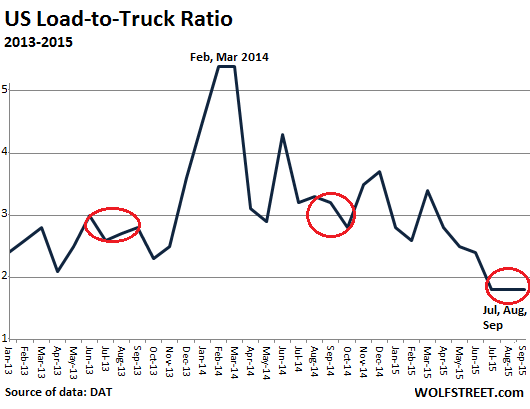
Trucking is a thermometer for the merchandise economy. It doesn’t track consumer expenses like rent or college. But it tracks exports and imports, manufacturing, distribution, retail, and other sectors. It tracks a big part of the real economy. And the sudden slowdown in the trucking industry is another wildly flashing signal in our recession watch.
* * *
We have in the past joked that the only thing that could possibly save the world from what is a trade recession is if the central banks can somehow find a way to “print trade” the way they artificially boost asset prices higher to give the impression of a status quo normalcy. Unfortunately, as this is not a real option, and with both global and US trade in freefall, many wonder just how will the world’s central planners mask this most dangerous aspect of the global economic slowdown?

Average:
none
Euro/USA 1.0934 down .0028
USA/JAPAN YEN 121.21 up .126
GBP/USA 1.5418 up .0002
USA/CAN 1.3051 down .0016
Early this morning in Europe, the Euro fell by 28 basis points, trading now well below the 1.10 level falling to 1.0934; Europe is still reacting to deflation, announcements of massive stimulation (QE), a proxy middle east war, and the ramifications of a default at the Austrian Hypo bank, an imminent default of Greece, Glencore,and now Nysmark and the Ukraine, along with rising peripheral bond yield. Last night the Chinese yuan rose in value (onshore). The USA/CNY rate at closing last night: 6.3355 down .0001/ (yuan higher)
In Japan Abe went all in with Abenomics with another round of QE purchasing 80 trillion yen from 70 trillion on Oct 31/2014. The yen now trades in a slight southbound trajectory as settled down again in Japan by 13 basis points and trading now just above the all important 120 level to 121.21 yen to the dollar.
The pound was up this morning by 2 basis points as it now trades just above the 1.54 level at 1.5418.
The Canadian dollar is now trading up 16 basis points to 1.3051 to the dollar.
We are seeing that the 3 major global carry trades are being unwound. The BIGGY is the first one;
1. the total dollar global short is 9 trillion USA and as such we are now witnessing a sea of red blood on the streets as derivatives blow up with the massive rise in the rise in the dollar against all paper currencies and especially with the fall of the yuan carry trade. The emerging market which house close to 50% of the 9 trillion dollar short is feeling the massive pain as their debt is quite unmanageable.
2, the Nikkei average vs gold carry trade (blowing up)
3. Short Swiss franc/long assets (European housing/Nikkei etc. This has partly blown up (see Hypo bank failure).(blew up)
These massive carry trades are terribly offside as they are being unwound. It is causing global deflation ( we are at debt saturation already) as the world reacts to lack of demand and a scarcity of debt collateral. Bourses around the globe are reacting in kind to these events as well as the potential for a GREXIT>
The NIKKEI: this WEDNESDAY morning:closed up 243.67 or 1.30%
Trading from Europe and Asia:
1. Europe stocks mostly mostly in the green except Germany
2/ Asian bourses mixed … Chinese bourses: Hang Sang green (massive bubble forming) ,Shanghai in the green (massive bubble ready to burst), Australia in the green: /Nikkei (Japan) in the green/India’s Sensex in the red/
Gold very early morning trading: $1119.00
silver:$15.28
Early Wednesday morning USA 10 year bond yield: 2.21% !!! down 1 in basis points from Friday night and it is trading well below resistance at 2.27-2.32%. The 30 yr bond yield falls to 2.99 down 1 in basis point.
USA dollar index early Tuesday morning: 97.36 cents up 16 cents from Tuesday’s close. (Resistance will be at a DXY of 100)
This ends early morning numbers Wednesday morning
Crude Prices Jump Despite 6th Consecutive Inventory Build & Surge In Production
Crude oil algos traders are buying WTI despite DOE reporting the 6th consecutive weekly inventory build in US crude stocks (confirming API’s build at 2.8mm barrels). Furthermore, for the 3rd week in a row, US crude production rose (back to one-month highs).
Another weekly build in US crude inventories…

And for the 3rd week in a row production rose…

And crude rallies…

Charts: Bloomberg
Here’s Which Mid-East Oil Producers Are Going Broke In The Face Of The New “Crude” Reality
A few weeks ago, the IMF said something that, although it should have been obvious, seemed to surprise quite a few people. Here’s the quote from a recently released study:
Bahrain, Oman, and Saudi Arabia have medium-term fiscal gaps of some 15–25 percentage points of non-oil GDP, while conflict-torn Libya has a gap of more than 50 percent of non-oil GDP.
In, contrast, CCA oil exporters have at least 15 years’ worth of available financial savings,1 while GCC countries are split evenly between countries with relatively large buffers (Kuwait, Qatar, and the United Arab Emirates—more than 20 years remaining) and countries with relatively smaller buffers (Bahrain, Oman, and Saudi Arabia—less than five years).
In other words, the Saudis, Oman, and Bahrain are going to go broke in “less than five years” if something doesn’t give in terms of either oil prices, budgeting, or both.

Because this represents nothing short of a seismic shift in the way we think about ME crude exporters, and because it’s helpful to know just where producers need prices to go in order to avoiding racking up double-digit budget deficits, we present the following visual from Deutsche Bank which depicts breakeven prices and also summarizes where the various Mid-East producers stand (fiscally speaking) in the wake of crude’s remarkable decline:

As you can see, there’s a long way to go for the Saudis and the UAE to get back into the black and indeed, even Qatar is now set to post red ink.
We’re sure invading Syria would help. After all, things have gone so well in Yemen…
USA/Chinese Yuan: 6.3355 flat on the day (yuan flat)
New York equity performances for today:
Hawkish-er Yellen Sparks Dollar Pop As Stocks, Bonds, Commodities Drop
A hawkish Yellen a week ago sparked an exuberant rally because “rate hikes must mean the economy is awesome” but a hawkish-er Yellen today sparked turmoil as the dollar jumped and bonds, stocks, and commodities dumped… (though we note markets had been anticipating some of this move into her statement)

Smashing Dec rate hike odds to 60% (from 50% overnight)
Everyone knows you never go full Hawk-tard…
Still, stocks are holding most of the gains from the Hawkish FOMC statement…

Futures once again show the craziness this week best..

But Trannies were worst today as a late-day panic buying effort as Nasdaq and Small Caps were ramped to unchanged

As S&P 2,100 was clearly important to the machines…. as VIX was used to ensure it closed above that level

Yesterday’s credit decoupling extended dramatically after Yellen’s comments…

Yesterday’s VIX decoupling also extended notably…

Treasury yields were ugly, although most of the heavy selling pressure was in the short-end… as 30Y ended the day unchanged and 2Y +5bps

With yields notably higher still from The FOMC statement (again with the short-end underperforming)
As 2Y Yields hit 4 year highs…
The US Dollar extended gains against the majots – with EURUSD plunging to a 1.08 handle – now up 1.3% sicne Friday…

Dollar strength did not help the slide in commodities… with crude worst today but PMs pummeled this week…

Crude crashed back from yesterday’s exubeerant highs after production and inventories rose…

Precious Metals have been pummelled…

Charts: Bloomberg
Bonus Chart: Food vs Friends…

end
The usually too optimistic ADP report shows employment slowdown/service job growth also weakens as does manufacturing jobs by 2,000:
(courtesy ADP)
ADP Employment Slows Further; Services Job Growth Weakens As Manufacturing Jobs Drop By 2,000
Having relatively disappointed all year, compared to 2014’s high levels, ADP for October printed 182k (practically in with expectations of 180k and below September’s revised lower 190k) – the lowest since July. Following September’s biggest manufacturing job losses since Jan 2010, October saw further losses (-2k) and Services job growth slowed as small business gains dominated large business (which ADP reports facing strong dollar challenges). December rate hike odds were 52.0% before ADP with no significant change yet.

Zoomed in:

Compared to NFP:

And by industry:

Change in Total Nonfarm Private Employment by Company Size

But manufacturing lost jobs again

A glass-half-full Mark Zandi, chief economist of Moody’s Analytics, said:
“Job growth as measured by the ADP Research Institute is not slowing meaningfully in contrast with the recent slowdown in the government’s data. The economy is creating close to 200,000 jobs per month. Job gains are broad based with energy and manufacturing alone subtracting from the top line. Small businesses, in particular, are contributing to the labor market’s solid performance.”
As ADP details,
Payrolls for businesses with 49 or fewer employees increased by 90,000 jobs in October, almost double the revised September gain of 47,000. Employment among companies with 50-499 employees increased by 63,000 jobs, up 50 percent from the previous month. Employment at large companies – those with 500 or more employees – rose by 29,000 jobs in October after adding 101,000 the previous month. Companies with 500-999 added 7,000 jobs. Companies with over 1,000 employees gained 22,000 jobs, after adding 100,000 in September.
Goods-producing employment rose by 24,000 jobs in October, representing the best month in this sector since January of this year. The construction industry added 35,000 jobs in October, roughly matching September’s gain. Meanwhile, manufacturing remained in negative territory losing 2,000 jobs in October after shrinking by 17,000 in September.
Service-providing employment rose by 158,000 jobs in October, down from a downwardly revised 182,000 in September. The ADP National Employment Report indicates that professional/business services contributed 13,000 jobs in October, less than half the September number. Trade/transportation/utilities grew by 35,000, off slightly from the previous month. The 9,000 new jobs added in financial activities were the fewest in this industry in the last six months.
“Firm size contributions to October employment gains returned to the same pattern we had been seeing for some time prior to September as small businesses rebounded to account for almost half the jobs added,” said Ahu Yildirmaz, VP and head of the ADP Research Institute.“Large companies continue to be negatively impacted by trends such as low oil prices and the strong dollar driving weaker exports. On the other hand, small businesses can benefit from these same trends.”
The full breakdown:

Charts: Bloomberg
US Trade Deficit Narrows 15%, Smallest Since Feb 2015 As Petroleum Imports Collapse
Against expectations of a $41bn deficit, September’s trade deficit was practically in line at -$40.8bn,dramatically narrower than the revised higher (less negative) August print of $48.02bn as petroleum imports plunge to lowest since May 2004.With the smallest deficit since Feb 2015, The Fed is going to need a bigger boat to have enough debt to monetize when the looming rate hike drags the economy to the point of requiring more intervention.


- The goods deficit decreased $7.3 billion from August to $60.3 billion in September.
- The services surplus decreased $0.1 billion from August to $19.5 billion in September.
However, if one excludes petroleum trade, the core US trade deficit is about as about as bad as ever. Should the shale destruction continue, and US imports of oil return, this will be what happens to overall US trade.
And while the headline trade data may show improvement, breaking down the imports and exports on a Y/Y basis show that both imports and exports are down compared to last year as the global trade slowdown shows no signs of relenting:

The breakdown by category:
Exports
- Exports of goods and services increased $3.0 billion, or 1.6 percent, in September to $187.9 billion. Exports of goods increased $2.9 billion and exports of services increased $0.1 billion.
- The increase in exports of goods mainly reflected increases in consumer goods ($1.3 billion) and in capital goods ($0.9 billion).
- The increase in exports of services mainly reflected increases in travel (for all purposes including education) ($0.1 billion) and in other business services ($0.1 billion), which includes research and development services; professional and management services; and technical, trade-related, and other services.
Imports
- Imports of goods and services decreased $4.2 billion, or 1.8 percent, in September to $228.7 billion. Imports of goods decreased $4.4 billion and imports of services increased $0.1 billion.
- The decrease in imports of goods mainly reflected decreases in industrial supplies and materials ($1.6 billion), in capital goods ($1.0 billion), and in automotive vehicles, parts,and engines ($0.8 billion).
- The increase in imports of services mainly reflected an increase in travel (for all purposes including education) ($0.1 billion).
And trade broken down by geographic region:
Goods by geographic area (seasonally adjusted, Census basis)
- The deficit with China decreased from $32.9 billion in August to $30.7 billion in September. Exports increased $0.4 billion to $10.2 billion and imports decreased $1.8 billion to $41.0 billion.
- The deficit with Germany decreased from $6.8 billion in August to $5.7 billion in September. Exports increased $0.3 billion to $4.2 billion and imports decreased $0.8 billion to $9.9 billion.
- The deficit with the United Kingdom increased from $0.3 billion in August to $1.2 billion in September. Exports increased $0.2 billion to $4.8 billion and imports increased $1.0 billion to $5.9 billion.
US Services Economy Weakest Since January As New Orders, Employment Tumble (But ISM Surges)
or
try this heading!!!
Schrodinger Schizophrenia: The Service Economy Is Both Soaring (According To ISM) And Sliding (According To PMI)
Following the “baffle ’em with bullshit” beats and misses, improvements and deteriorations in China’s Services and Manufacturing PMIs, this morning we round out the US data. After US Manufacturing rose (Markit PMI) and dropped (ISM), US Services PMI dropped to 54.8 and has not been lower since January (despite modestly beating the preliminary print) amid the weakest new order volume since January and poorest employment growth in 8 months. As Markit warns, “the survey data also reinforce strong arguments – notably a continued absence of inflationary pressures – that there is no rush to tighten policy.” But then, just to top off all the idiocy, ISM Services surges from 56.9 to 59.1, smashing expectations confirming the “baffle ’em with bullshit” meme.
With China entirely confusing in both Services and Manufacturing PMIs…
It is perhaps not surprising that US Manufacturing is both improving and collapsing…

But Services PMI dropped to its lowest since January as ISM Services spiked…

As Markit notes, as was the case with activity, new business volumes also increased at a slower rate in October. Moreover, with the latest expansion of new order books the slowest since January, companies were more cautious with regard to their hiring policies, with service sector employment rising at the weakest pace since February.
Services PMI notes deterioration in:
- – Client demand
- – New Busines
- – Order Books
- – Employment
- – Inflation
- – Optimism
And ISM Services saw everything improving…

Which does not seem to sit well with ADP’s jobs growth hope or the ignroance of Manufacturing in favor of Services…
“The PMI surveys indicated that the pace of economic growth held steady in October, but remains weaker than the rate seen throughout much of the year so far. Job creation also slipped to the lowest seen for eight months, as service sector firms in particular have become increasingly nervous about committing to additional headcounts.
“The surveys nevertheless signal ongoing moderate growth of business activity and employment in the manufacturing and service sectors, which will keep alive the possibility that policymakers could be persuaded into raising interest rates before the year is over. However, the survey data also reinforce strong arguments – notably a continued absence of inflationary pressures – that there is no rush to tighten policy.
“Much will now depend on the November survey data, which will provide a reliable guide to business conditions in the fourth quarter.”
Charts: Bloomberg
end
The last time we have a bifurcation between ISM manufacturing and ISM service reports, markets tanked 2001 and 2008
(ISM/zero hedge)
The Last Two Times The US Jobs Market Was This Bifurcated, Things Ended Badly
Welcome to the most bifurcated US jobs market ever… According to ISM, employment is best since 2005 for the Services ‘economy’ and the worst since 2009 for the Manufacturing ‘economy’. The last two times the labor market was so divergent… did not end well.
The bifurcated job market…

The last two times this happened, things did not end well…

Of course, this should all be ignored as transitory now given that Yellen just greenlit December no matter what.
Charts: Bloomberg
The Most Important Chart You’ve Never Seen: Tax Receipts Top-Tick The Stock Market
Submitted by Charles Hugh-Smith of OfTwoMinds blog,
This time is always different just before a bone-crushing decline.
This may well be the most important chart you’ve never seen. Courtesy of longtime analyst-correspondent B.C., this chart reveals that real per capita tax receipts have reliably top-ticked the stock market since 1973.

Note that this is specifically real (i.e. adjusted for inflation) state and local income tax and sales tax receipts–not federal tax receipts–and that the chart show annualized changes smoothed over three different time frames: seven quarters, 6 years and 9 years.
Anyone who sold stocks once the 6-year annualized change in real local/state tax receipts started declining would have been spared the horrendous, bone-crushing losses of the Bear markets that subsequently shredded stocks.
This indicator even worked reliably to identify Bear market rallies that briefly boosted tax receipts before rolling over: the stock market rally of 1975 to 1977 reversed the annualized decline in tax receipts but when tax receipts rolled over in 1977, that was a reliable top-tick of a market that subsequently fell 25%.
The annualized 6-year change nailed the top of the market in 1989, 2000, 2008–and now, in 2015. This leaves current bulls with the task of explaining why an indicator that has reliably top-ticked every previous market top for over 40 years is suddenly and magically wrong in 2015.
This time is always different just before a bone-crushing decline.
end
Senators Open Investigation Into Drug Pricing; Request Documents from Valeant, Turing
Back in September, Turing Pharma CEO Martin Shkreli caused a veritable firestorm when he moved to boost the price of a toxoplasmosis drug by 5000%.

That rather egregious example of unbridled greed immediately caused the American public as well as lawmakers in Washington to begin taking a closer look at a practice that, as we noted when the whole Turing debacle began, happens all the time in Big Pharma even if they’re careful to be a bit less audacious about it than Shkreli.
Hillary Clinton herself took aim at the industry in a tweet which promptly tanked biotech shares proving that when it comes to moving markets, perhaps Janet Yellen doesn’t have anything on America’s political aristocracy.

Indeed, the scrutiny on beleaguered Valeant and its relationship with Philidor doesn’t seem set to abate anytime soon (sorry Bill). Via Bloomberg:
Weeks before Valeant Pharmaceuticals International Inc. said it would cut ties with Philidor Rx Services, the drugmaker was planning to expand its use of the mail-order pharmacy, said three people familiar with the matter.
Philidor was on the brink of becoming a larger part of Valeant’s operations as the drugmaker planned to widen the pharmacy’s role beyond dermatology to other lines of medications, the people said.
Philidor also hired a number of former Valeant employees, according to an outside spokeswoman for Valeant. The workers, part of a group of about 30 people that helped show doctors how to direct patients to Valeant products, were dismissed by the drugmaker, with severance, before being subsequently hired by Philidor, the spokeswoman said. They followed a Valeant manager named Gary Tanner who, before leaving Valeant in September, led the drugmaker’s so-called Access Team, she said.
There’s your “limited” relationship.
Don’t look now but not only are House Democrats pushing for a vote to subpoena CEOs of Valeant and Turing to hand over documents on drug-price increases, but Senators Susan Collins (R-Maine) and Claire McCaskill (D-Mo.), who together lead the Senate Special Committee on Aging, have opened a bipartisan investigation into pharmaceutical drug pricing.
In the crosshairs are Valeant, Turing, Retrophin (founded by Shkreli), and Rodelis.
From the press release
U.S. Senators Susan Collins (R-Maine) and Claire McCaskill (D-Mo.), who together lead the Senate Special Committee on Aging, today announced a bipartisan Senate investigation into pharmaceutical drug pricing. The announcement follows a series of media reports detailing dramatic drug price increases—often on older, off-patent drugs—after the acquisition or merger of pharmaceutical companies.
“The sudden, aggressive price hikes for a variety of drugs used widely for decades affect patients and health care providers and the overall cost of health care. These substantial increases have the potential to inflate the cost of health care for Americans, especially our seniors, by hundreds of millions of dollars each year,” said Chairman Collins. “Given the potential harm to patients across our country who rely on these drugs for critical care and treatment, the Senate Special Committee on Aging considers these massive price increases worthy of a serious, bipartisan investigation into the causes, impacts, and potential solutions.”
“Some of the recent actions we’ve seen in the pharmaceutical industry—with corporate acquisitions followed by dramatic increases in the prices of pre-existing drugs—have looked like little more than price gouging,” said McCaskill, former Missouri State Auditor and courtroom prosecutor. “We need to get to the bottom of why we’re seeing huge spikes in drug prices that seemingly have no relationship to research and development costs. I’m proud to help lead this bipartisan investigation so that we can find some answers the public wants and deserves.”
The Senators have requested documents and information from four pharmaceutical companies: Valeant Pharmaceuticals, Turing Pharmaceuticals, Retrophin Inc, and Rodelis Therapeutics. Each request focuses on drugs that have seen recent and significant spikes in price.
“We seek your cooperation with this investigation so that the Committee may better understand drug pricing and related regulatory and public policy concerns. In particular, the Committee wishes to learn more about Turing Pharmaceuticals’ recent acquisition of the rights to sell Daraprim, a drug used to treat and prevent infections, from Impax Laboratories and Turing’s subsequent decision to increase the price of Daraprim from $13.50 to $750 [per tablet],” reads the Senators’ letter to Turing Pharmaceuticals CEO Martin Shkreli.
The Committee’s investigation will include an examination of:
- Substantial price increases on recently acquired off-patent drugs;
- Mergers and acquisitions within the pharmaceutical industry that have sometimes led to dramatic increases in off-patent drug prices; and
- The Food and Drug Administration’s role in the drug approval process for generic drugs, the agency’s distribution protocols, and, if necessary, its off-label regulatory regime.
- The Senate Special Committee on Aging has tentatively scheduled an initial hearing on this issue for December 9, 2015 and will hold subsequent hearings, as needed, in the following months.
Seniors account for 13 percent of the population but account for 34 percent of the all prescription medication used. More than 40 percent of seniors take five or more prescription drugs per day.
end
These guys are nothing but crooks:
As The Market Crashed, The Biggest HFT Firm Made Out Like A Bandit
Back in May, when we first got our glimpse at Virtu’s financial results we found something unexpected: instead of equities, the biggest source of revenue growth for the HFT titan was one very different asset class: “global currencies” or FX, which as of Q1 was not only Virtu’s largest source of revenue (surpassing America equities) at $42.2 million, but had grown at a stunning 103% Y/Y.

And while FX volatility, and frontrunning mammoth central bank orders was clearly profitable to Virtu, many were wondering how would the recently public company return to its roots of making the most money in equities.
To be sure we got a hint of the answer on August 25, the dat after the ETFlash crash, when Virtu’s CEO said he “was on track to have one of its biggest and most profitable days in history Monday amid a tumultuous 24 hours for world markets.”
Earlier today, when Virtu released its earnings we got confirmation of precisely that. As the chart below shows, while the market was plunging in the third quarter, Virtu was making off like a bandit, with revenue from American Equities soaring by 68% to $46 million in the quarter – the highest quarterly revenue in that category Virtu has generated in history.

Another chart showing just the dramatic Y/Y jump in US equities “trading” revenue:

How did this happen? This is what Virtu’s CEO said three months ago: “we don’t cause volatility, as a market maker we’re absorbing volatility and we think we soften it.”
It remains to be seen if Virtu does not cause it, although one thing is now clear – every time there is a market crash, whether caused by HFTs or not, one company will make a huge profit. And if, as some suspect, Virtu does indeed “cause volatility” expect many more such episodes in the months to come.
end
Interesting!! Yesterday we witness the first crimina lconviction on spoofing, yet HFT’s are free to do their illegal stuff.
They warn: if you outsmart us, yo go to jail!!”
(zero hedge)
With First Ever Criminal “Spoofer” Conviction, HFTs Issue Warning: “Outsmart Us, And You Go To Jail”
ust one day before Virtu reported its best quarter yet thanks to the August 24 ETFlash crash (which itmay or may not have been instrumental in unleashing), history was made yesterday in a federal courthouse in Chicago Jurors when, in the first criminal spoofing trial on US soil, commodity trader Michael Coscia, owner of New Jersey-based Panther Trading, was found of six counts of commodities fraud and six counts of spoofing. When sentenced, Coscia faces as long as 25 years in prison on the most serious counts.
While we have previously profiled the case, here is a reminder on Coscia’s bacgkround courtesy of Bloomberg: he grew up in Brooklyn. His father was a subway token clerk and he was the first in his family to go to college. During the day he was a mail carrier and went to Brooklyn College at night and graduated with a business management degree in 1986. He has been married for 25 years and his son attends the University of Michigan.
He testified that he first became interested in the markets after his father bet on a horse race and turned a $2 bet into a $55,000 winner. His father put the profit in the market and Coscia tracked his father’s investments, sparking his interest in finance.
Coscia had a cousin who worked on the floor of the New York Mercantile Exchange and that’s how he got started on the floor, beginning as a clerk. He was a trader for 27 years.
What happened then is the same thing that happened with the other two notorious “spoofers” who have gained prominence in the recent year, Nav Sarao and Igor Oystacher: they got too good. So good in fact the HFTs – mostly Citadel – were consistently losing money to them. As a result, Coscia et al had to be punished.
He was accused of entering large orders into futures markets in 2011 that he never intended to execute. His goal, prosecutors said, was to spoof, or fool other traders to markets by creating an illusion of demand so that he could make money on smaller trades. Prosecutors said he illegally earned $1.4 million in fewer than three months in 2011 through spoofing.
Bloomberg has more details:
Prosecutors focused on six transactions, all from 2011, in the gold, euro, soybean meal, soybean oil, British pound, and copper futures markets. In total, these trades resulted in a profit of $1,070, according to the testimony. Prosecutors said Coscia conducted thousands of such trades.
Coscia’s trading showed that he would first place a small order and then large orders on the other side of the market that were subsequently canceled after he executed smaller trades, according to testimony by Federal Bureau of Investigation special agent Brent Potter.
Computer programmer Jeremiah Park testified about trading algorithms he created under Coscia’s direction. Those programs included “quote” orders designed to “pump up market,” according to Park’s notes that were shown in court. The quote orders were to stimulate the market to get a reaction, Park testified.
Orders to “pump up the market”? We wonder if the NY Fed in its joint ventura with the biggest spoofer in the world, Citadel, has ever heard of those?
As reported by Reuters, Coscia’s firm had fewer than 10 employees. However, he “entered more large orders than anyone else in the world” in nearly a dozen CME Group Inc markets ranging from corn and soybeans to gold after he began using two algorithmic trading programs in August 2011, prosecutors said during the trial.
To be sure Coscia disagreed with the accusation: he testified that he didn’t do anything wrong and repeatedly said he intended to trade on every order he placed. He also said he traded a lot of large orders he placed. He was asked whether he fraudulently induced other market participants to react to the deceptive market information he created.
“I didn’t induce anyone,” Coscia said. “There’s no deceptive market information either.”
Technically, he is right – he did not induce anyone. He induced a whole of anythings, mostly countless HFT algos that reacted to his orders by pushing the market in the direction of his orderflow, only to be “spoofed.”
At which point the case really boiled down to just one thing: not whether it is legal to spoof, which it is and yet massive, well-connected HFT firms get away with it every single day, but whether it is legal to take advantage of HFT algos programmed to do just one thing – frontrun orders, and activity which leads to massive losses for the algos and the Citadels behind them, when the spoofer realizes just how dumb his counterparty truly is.
* * *
The verdict was clear: nobody is allowed to outspoof the spoofers.
Here is the punchline from the lobby of very group of people who take advantage of broken markets every given day:
“Investors are better off when spoofers who prey on high-frequency traders are brought to justice,” said Bill Harts, chief of the Modern Markets Initiative, a group representing high-frequency and algorithmic traders.
Funnier words have rarely been spoken by the person whose “Modern Markets” Initiative has made real modern markets a farcial disaster.
And so the gauntlet has been thrown: anyone who dares to make money by “abusing” the dumb logic of Citadel algos will go to jail.
“This is the clarity that people have been looking for – what exactly is spoofing, what defines it,” said Trace Schmeltz, an attorney specializing in white-collar crime at law firm Barnes & Thornburg who was not involved in the case.
“The defendant’s trading activities disrupted the markets in his favor and against legitimate traders and investors,” said Zachary Fardon, U.S. Attorney for the Northern District of Illinois.
Such as… high-frequency traders.
And the biggest irony: Steven Peikin, one of Coscia’s lawyers, argued that high-frequency traders routinely canceled orders. He told the jury that Coscia’s trading strategy was unique but not illegal.
Wrong: it is illegal, but he is absolutely right that everyone does it, especially the HFTs. But doesn’t matter – next year Coscia will be back in court to hear just how many years he will spend in prison.

As for the HFTs… well, we already showed just what their “punishment” is when as reported earlier, Virtu reported record revenue in US equity trading in the third quarter…
FHFA Head Warns Fannie Mae, Freddie Mac May Need Another Taxpayer Bailout
Submitted by Mike Krieger via Liberty Blitzkrieg blog,
Yesterday, we learned that Fannie Mae recently rolled out a new program known as “Home Ready,” which would allow borrowers to obtain a 3% downpayment mortgage with no minimum cash contribution.

Now we learn this.
From MarketWatch:
WASHINGTON (MarketWatch) — Fannie Mae and Freddie Mac are at risk of needing an injection of Treasury capital after the latter reported its first quarterly loss in four years, the director of the Federal Housing Finance Agency said Tuesday.
FHFA Director Mel Watt issued a statement following mortgage-finance company Freddie Mac’s $475 million third-quarter loss, its first quarterly loss in four years.
“Volatility in interest rates coupled with a capital buffer that will decline to zero in 2018 under the terms of the senior preferred stock purchase agreements with Treasury will likely make both Enterprises increasingly susceptible to the possibility of quarterly losses that could result in draws going forward,” Watt said.
Freddie Mac said its loss was driven by interest rate changes that soured the value of derivatives it holds.
You really can’t make this stuff up.
* * *
So now The GSEs may need another capital injection from The Treasury (or in other words, you, The US Taxpayer) in order that the least creditworthy can buy unaffordable homes at maximum (infinite) leverage… because it’s fair.
end
As everybody know, Friday is the jobs report
Dave Kranzler warns that gold and silver will be whacked on phony job gains. According to Mark Zandi they will use the B/D plug of 145,000 jobs to show a 190,000 job gain. Then they will whack gold and silver down from which the shorts will cover their shortfall.
Criminal activity at its finest…
Extreme And Blatant Gold Futures Manipulation: Bad Jobs Report Ahead?
These guys are seriously overplaying their hand so something must be up. – John Embry email to me in reference to the blatant intervention in the stock and gold futures markets
The Cliff’s Notes explanation to John’s comment: The Fed knows the economy is technically in a recession and will be forced to take Fed Funds negative sometime in early 2016. Yellen floated that trial balloon earlier today. That’s an event that should launch gold.
First, in reference to the extreme degree of anti-gold propaganda currently being vomited by the western media – see this article from Mark Hulbert LINK and this article from the new Jon Nadler LINK – here is what is going on in the physical gold market:
Reuters has reported that the China Gold Association has announced that Jan/Sept gold production was up 1.48% to 356.9 tonnes and consumption was up 7.83% to 813.89 tonnes. This is the biggest gap between production and consumption growth that JBGJ can remember. The huge Chinese output growth has been going on for well over 10 years and with the early mines getting old sustaining the trend must be getting increasingly difficult. A leveling off or even more a decline in Chinese gold output could increase import demand dramatically. – John Brimelow from his Gold Jottings report
Typically when there’s bad news coming, the Fed/banks engage in an extreme degree of market intervention to keep the stock market aloft and a heavy lid on the price gold. After all, they can’t have a rising price of gold alert the world to the degree to which the U.S. system is one big fraud.
The stock market has become historically overvalued. David Stockman discusses this in his latest article – This Time Is The Same – And Worse. In his analysis, he reports that the trailing 12-month P/E ratio on the S&P 500 is 22.49x, or higher than it was at the peak of the stock market in 2007.
However, there’s one big flaw in Stockman’s analysis. He’s using current GAAP accounting numbers. In order to compare current S&P earnings with earnings and P/E ratios, we have to adjust the earnings by employing “apples to apples” GAAP standards. Generically, the latest significant GAAP changes in 2010 enabled the big banks to include a significant amount of non-cash “adjustments” as part of their reported net income. In some quarters, more than 90% of the GAAP net income reported by major banks and financial firms is based on non-cash, discretionary “adjustments.”
In truth, and admittedly this is somewhat imprecise but not wholly inaccurate because the same dynamic applies to the tech sector S&P 500 companies as well (note: IBM is currently being investigated by the SEC for revenue recognition issues – this fact supports my assertion), it is highly probable that the $93.80 per share EPS cited by David Stockman is substantially less than $93.80 using 2007 or 2000 or 1987 GAAP standards. I would hazard a highly educated guess that if we did the exercise of adjusting today’s S&P 500 earnning using the GAAP rules in place in 2000 that the $93.80 EPS would be cut in half.
In fact, I know of someone who did that exercise back in 1998, using 1987 GAAP standards, and this person determined that the reported earnings in 1998 were less than half of what was reported that year if 1987 GAAP standards were employed.
In other words, the true P/E ratio on this current stock market is, in all probability, the highest in history.
I want to show the gold market intervention that occurred blatantly today and then I’ll suggest a good possibility for the current extreme degree of market intervention (click on each to enlarge):


The ratio of paper gold to deliverable physical gold reported to be in Comex vaults almost hit 300 earlier this week. After yesterday’s long-side liquidation/bullion bank short-covering operation the ratio “mellowed” out a mere 278x.
As you can see, gold moved higher after a series of gold-friendly comments from the ECB’s Mario Draghi. It was promptly slapped back down about 10 minutes before he Comex floor trading in gold commenced. This occurs about 90% of the time. No news or events occurred that would have prompted the sell-off in gold. After starting to recover from the obligatory Comex floor trading smack, Janet Yellen issued tourettes syndom outbursts loaded with incoherent nonsense about how great the economy was doing, the labor market was tight and the FOMC was going hike rates in December.
Yellen’s comments, other than being the drool of a babbling idiot, had no basis in provable fact. Nearly every private-sector compiled economic data series is reflecting a precipitous decline in economic activity that is back down the activity levels of 2008/2009. As for a “tight” labor market? Yes, I suppose if you just ignore the 93 million who have left the labor force – i.e. 28% of the total U.S. population – then I suppose it’s a bit easier to manipulate the data to reflect a low rate of unemployment. Make no mistake, the unemployment rate number being reported is an unmitigated fraud, which makes Janet Yellen an unmitigated fraud.
This brings me back to my explanation for the extreme and blatant stock/gold market manipulation this week. A friend and colleague of mine from NYC does great work on how the BLS uses its fraudulent “birth/death” model to manipulate the non-farm payroll report every month. The employment report for October comes out Friday this week. Historically the BLS inserts a big bump up in the birth/death jobs additions in October. My colleague believes that the number reported will be manipulated higher than the 177k estimate in order to support Janet “Tourettes Syndrome” Yellen’s rate-hike in December fairytale:
BD model adds 145,000 jobs. NFP for October comes in at 190,000. Mark Zandi gets quoted in every wire service saying it’s a clear indicator of the underlying strength and improvement in the economy All jump even harder on the consensus December Fed rate hike band wagon Stock market rips lower and Gold gets hammered to under $1100 Stock market rips at 3:30pm into the Friday close as they force massive short covering into green and Gold goes unchanged on the day. A bullish comment from Jim Bullard is optional…
This view is well-crafted and will likely be right. However, with each passing non-Government economic report which shows jobs being cut, especially in the manufacturing, energy and financial sectors, the big job additions reported by the BLS take the Government numbers deeper into the credibility hole. The extreme manipulation and intervention in the U.S. stock/gold market reflects the extreme degree of desperation which the Fed/Treasury/banks are exerting in order to prevent the markets from revealing the truth about the degree to which the U.S. political/financial/economic system has been completely engulfed in fraud and corruption.
Expect a big “beat” on Friday from the NFP report, followed by beat-down of gold. That smack in gold should be bought with both hands.
One more point, Yellen referenced the possibility of taking rates negative. Talk about an obvious trial balloon. This tells us that she and her band of FOMC stooges understand the truth about the economy. This is an event that should send gold on a moonshot. They are working to make sure that the lift-off platform is as low as possible.
end
Geez!! Janet, the economy must be booming: Kraft Heinz to layoff 10% of its workforce
(courtesy zero hedge)
Buffett Bloodbath: Kraft Heinz Laying Off 10% Of Workforce
Back in August, we said “thanks uncle Warren” on the heels of reports which indicated it was time for Kraft employees to do their part to facilitate merger “synergies” in the wake of the Kraft-Heinz tie-up engineered earlier this year by everyone’s favorite folksy octogenarian billionaire along with 3G.
In short, Kraft Heinz said it would lay off 700 workers at Kraft’s corporate headquarters in north suburban Northfield, part of a cost-cutting plan that would slash the combined entity’s headcount in the U.S. and Canada by 2,500 jobs.
Well, on Wednesday we got more of the same with CNBC reporting that Kraft Heinz will close seven plants and lay off 2,600 employees. The company is also reportedly moving Oscar Mayer to Chicago from Wisconsin. Here’s what we know so far:
The closing factories are in Fullerton, California; San Leandro, California; Federalsburg, Maryland; St. Marys, Ontario, Canada; Campbell, New York; Lehigh Valley, Pennsylvania; and Madison, Wisconsin, Michael Mullen SVP of corporate and government affairs, said in a statement.
Over the next 12-24 months, he said, production in those locations will shift to other existing factories in North America.
He said the decision to close the factories came after “an extensive review of the Kraft Heinz North American supply chain footprint, capabilities and capacity utilization.”
Calling the move “difficult but necessary,” Mullen said the closures would cut approximately 2,600 positions from the company’s North American factory-based employee population.
Here’s the headline dump:
- KRAFT HEINZ NORTH AMERICAN TO CUT 2,600 JOBS, CLOSE 7 NA PLANTS
- KRAFT HEINZ SEES CLOSURE PROCESS OVER NEXT 12-24 MONTHS
- KRAFT HEINZ SEES BRINING 250 JOBS TO CHICAGO AREA IN 2016
- KRAFT HEINZ SEES INVESTING HUNDREDS MILLIONS INTO MODERNIZATION
- KRAFT HEINZ COMMENTS IN EMAILED STATEMENT
And here’s a bit of much needed (if minimal) good news for Chicago:
Kraft Heinz announced Wednesday that it will move Oscar Mayer and the company’s U.S. meats business unit from Madison, Wis., to Chicago — a move that will add 250 jobs to the Chicago area, according to a company news release.
Meanwhile, Bloomberg reports that New York Governor Andrew M. Cuomo and U.S. Senator Charles Schumer have struck a deal to keep Kraft-Heinz facilities in upstate New York operational. Here’s more:
Governor Andrew M. Cuomo and U.S. Senator Charles Schumer today announced that an agreement has been reached to save at-risk Kraft-Heinz facilities which employ nearly 1,000 workers throughout Upstate New York. The agreement will ensure that Kraft-Heinz preserves a significant employment base throughout New York State for years to come and paves the way for additional investment and growth at a number of Kraft-Heinz facilities. Under the agreement, Kraft-Heinz will continue operating the Avon, Walton and Lowville plants. Additionally, Kraft-Heinz will defer its planned closure of the Campbell plant for a period of 12-24 months, during which time the company will work with state, federal and local officials in an effort to identify a new operator who would retain the plant?s existing employment. The State and company are also committing to each invest at least $20 million to support and modernize Kraft-Heinz’s Upstate operations.
Governor Cuomo said: “The prospect of these across the board closures was very real and not only would have been devastated these communities, but caused ripple effects in New York’s dairy industry and beyond. This agreement reverses course and, saves hundreds of local jobs and commits Kraft-Heinz to invest millions of dollars in the Upstate economy, with the potential for job increases in the years to come. I thank Senator Schumer and Kraft-Heinz for working with us to protect jobs in these communities and help ensure the future of each of these plants.”
Senator Schumer said: “After any merger that involves an important Upstate company like Kraft that employs so many hundreds of workers and supports so many dairy farmers, I worry about any potential negative impacts on our Upstate New York jobs. New York Kraft factories in Avon, Walton, Campbell and Lowville were in the crosshairs, and thousands of families were at severe risk of losing their jobs. But working together with Governor Cuomo we were able to craft a deal with Kraft-Heinz that saves these factories from closure; that protects jobs; and that invests in growth for our future in each of these communities. It’s a win-win deal that will be good for Kraft-Heinz and good for retaining and growing jobs in Upstate New York.”
Ok so apparently, Kraft-Heinz is laying off 2,600 immediately after agreeing to not layoff 1,000 in upstate New York under pressure from Cuomo and Schumer.
The net result would seem to be 1,600 layoffs, but who knows as this is still a developing story. What we do know for sure is that we were correct in March, when we saidthe following in the wake of the megamerger:
Another day, another mega-M&A deal taking advantage of abnormally low bond rates, this time however not involving biotechs or a specialty pharma seeking to purchase a debt-free balance sheet, but one involving the Oracle of Omaha himself, and his Heinz investment, which will merge with Kraft Foods whose market cap was over $40 billion this morning on the news of the merger, and create the third largest food and beverage company in the US, and 5th largest in the world.
And while the resulting company will certainly be an unprecedented food giant, one which leaves the US food industry even more concentrated, here is the rationale behind the deal and the punchline for American workers: “significant synergy opportunities.”Translation: thousands of layoffs imminent.
It took seven months.
end
Well that about does it for tonight
I will see you tomorrow night
h.


 harveyorganblog.com
[…] NOV 4/OPEN INTEREST ON GOLD COMEX FALLS APPRECIABLY BUT NOT SILVER/BANKERS CONTINUE TO RAID GOLD/SIL… […]
LikeLike