
Gold: $1087.60 down $16.80 (comex closing time)
Silver $14.69 down 30 cents
In the access market 5:15 pm
Gold $1088.90
Silver: $14.77
First, here is an outline of what will be discussed tonight:
At the gold comex today, we had a very poor delivery day, registering 1 notice for 100 ounces. Silver saw 0 notices for nil oz.
Several months ago the comex had 303 tonnes of total gold. Today, the total inventory rests at 208.82 tonnes for a loss of 94 tonnes over that period.
In silver, the open interest surprisingly rose by 117 contracts despite silver being down 7 cents in Thursday’s trading. The total silver OI now rests at 166,915 contracts In ounces, the OI is still represented by .835 billion oz or 119% of annual global silver production (ex Russia ex China).
In silver we had 0 notices served upon for nil oz.
In gold, the total comex gold OI fell by a monstrous 10,742 contracts to 435,640 contracts as gold was down $2.10 yesterday. No doubt with the raid today, the entire OI gold complex will see a massive OI decline on Monday. We had 1 notice filed for 100 oz today.
We had a huge withdrawal in gold inventory at the GLD to the tune of 2.68 tonnes / thus the inventory rests tonight at 669.09 tonnes. The appetite for gold coming from China is depleting not only gold from the LBMA and GLD but also the comex is bleeding gold. Our 670 tonnes of rock bottom inventory in GLD gold has been broken. It looks to me that China has taken the last amounts of physical gold from the GLD. I guess the only place left for China to receive physical gold will be the FRBNY and the comex. In silver,no change in silver inventory / Inventory rests at 313.817 million oz.
We have a few important stories to bring to your attention today…
1. Today, we had the open interest in silver rose by 117 contracts up to 166,915 despite the fact that silver was down 7 cents with respect to yesterday’s trading. The total OI for gold was clobbered by a rather large 10,742 contracts to 435,640 contracts as gold was down $2.10 yesterday. Anyone who plays the gold/silver comex simply do not read as they always succumb to vicious raids.
The fact that OI continues to remain high in silver necessitates the bankers to continue raiding hoping to shake the leaves from both the gold and silver trees. Remember that December is generally a big delivery month for both gold and silver
(report Harvey)
2.Gold trading overnight, Goldcore
(/Mark OByrne)
i) We have a repeat of a huge story that we brought to your attention over the past 2 weeks. You will recall that we are witnessing interest rate swaps (repos) are now negative. Generally in simplistic terms, the swap which is a fixed rate swapped for a variable rate and points are always given and that makes sense as the variable rate is generally more risky. For the past two weeks, the opposite is occurring and this has not happened before safe for one week prior to the Lehman collapse.
i) and ii Arcelor Mittal, the latest victim in China’s steel export glut.
9 USA stories/Trading of equities NY
i) Official release of the FOMC jobs reports shows a huge 271,000 gain
(zero hedge)
ii) Yet the labour participation rate stays at 62.4% with 94.5 million poor souls out of the labour pool
(zero hedge)
iii) Immediately after the release of the news of the job gains, the dollar skyrockets, the Dow initially rises then falls, commodities belted and bond yields plummet. Also the percentage chance of the rate hike rises to over 74%
(zero hedge)
iv) the strong dollar will hurt multinationals as well as USA manufacturers that export their goods
(zero hedge)
v) Who had the big gain in job growth in the USA with the latest FOMC: ages 55 and over had all of the job gains
who suffered: age 25 through to 34 lost jobs.
and all of the job gains were in the bartender area, low paid entry jobs.
(zero hedge)
vi) Since 2008, the USA has hired 1.5 million bartenders while manufacturing jobs declined by 1.4 million
(zero hedge)
vii) More trouble for Valeant as Goldman Sachs was forced to sell Valeant shares to cover loans by CEO Pearson:
(zero hedge)
viii) Consumer credit rose by a whopping 22 billion dollars and it was in two areas:
10. Physical stories
i ) Alasdair Macleod’s paper released today is entitled: ” The end point in financial credit’
ii) the Indian Government tells its citizens to give up gold or an interest rate in a hair brained scheme that will never work
(Reuters/GATA)
iii) Chinese gold investment at risk if the yuan is set free
(zero hedge)
iv) Comex gold data is irrelevant, according to Chris Powell,
Only central bank gold inventory is important and this remains a secret
(Chris Powell/GATA)
v) Central banks meddle in gold on a daily basis
(Chris Powell/GATA)
Let us head over to the comex:
November contract month:
INITIAL standings for November
Nov 6/2015
| Gold |
Ounces
|
| Withdrawals from Dealers Inventory in oz | nil |
| Withdrawals from Customer Inventory in oz nil | 76,911.630 oz
(Scotia) |
| Deposits to the Dealer Inventory in oz | nil |
| Deposits to the Customer Inventory, in oz | 95,397.880 (JPMorgan/Scotia) |
| No of oz served (contracts) today | 1 contract
100 oz |
| No of oz to be served (notices) | 215 contracts
(21,500 oz) |
| Total monthly oz gold served (contracts) so far this month | 7 contracts
700 oz |
| Total accumulative withdrawals of gold from the Dealers inventory this month | nil |
| Total accumulative withdrawal of gold from the Customer inventory this month | 82,272.8 oz
|
Total customer deposits 95,397.880 oz
we had 0 adjustments:
November initial standings/First day notice
Nov 6/2015:
| Silver |
Ounces
|
| Withdrawals from Dealers Inventory | nil |
| Withdrawals from Customer Inventory | 1,030,354.010 oz
(Brinks, CNT,Scotia) |
| Deposits to the Dealer Inventory | nil |
| Deposits to the Customer Inventory | |
| No of oz served (contracts) | 0 contracts (nil oz) |
| No of oz to be served (notices) | 7 contracts
35,000 oz) |
| Total monthly oz silver served (contracts) | 5 contracts (25,000 oz) |
| Total accumulative withdrawal of silver from the Dealers inventory this month | nil oz |
| Total accumulative withdrawal of silver from the Customer inventory this month | 2,614,373.3 oz |
Today, we had 0 deposit into the dealer account:
total dealer deposit; nil oz
total customer deposits: nil oz
total withdrawals from customer account: 1,030,354.01 oz
And now SLV
Nov 6/ we had a very tiny withdrawal of 136,000 oz (probably to pay for fees)/Inventory rests tonight at 313.681 oz
Nov 5/strange no change in silver inventory/rests tonight at 313.817 million oz/
Nov 4/2015: no change in silver inventory/rests tonight at 313.817 million oz/
Nov 3.2015; no change in silver inventory/rests tonight at 313.817 million oz/
Nov 2/a withdrawal of 716,000 oz from the SLV/Inventory rests tonight at 313.817 million oz
Oct 30.no change in silver inventory at the SLV/Inventory rests at 314.532 million oz
Oct 29/a big withdrawal of 1.001 million oz from the SLV/Inventory rests at 314.532 million oz
Oct 28.2015: no change in silver inventory at the SLV//inventory rests at 315.533 million oz.
Oct 27/no change in silver inventory at the SLV/Inventory rests at 315.533 million oz/
Oct 26/no change in silver inventory at the SLV/Inventory rests at 315.533 million oz/
Oct 23./no change in silver inventory at the SLV/Inventory rests at 315.533 million oz
Oct 22./no change in silver inventory at the SLV/Inventory rests at 315.533 million oz
Oct 21:a we had a small addition in silver ETF inventory of 381,000 oz/inventory rests tonight at 315.533 million oz
Oct 20.2015/ no change in silver ETF/Inventory rests at 315.152 million oz
Our large specs:
Those large specs that have been long in gold pitched a gigantic 31,201 contracts from their long side
Those large specs that have been short in gold added another 9891 contracts to their short side.
Our commercials:
What more can I say:
Those commercials that have been long in gold added 7599 contracts to their long side.
Those commercials that have been short in gold covered an absolutely monstrous 33,261 contracts from their short side.
Our small specs:
Those small specs that have been long in gold pitched a tiny 169 contracts from their long side.
Those large specs that have been short in gold covered 401 contracts to their short side.
Conclusion:
after the past 3 days of wash outs, the commercials will have covered many more shorts and thus we can look forward to gold rising.
| Gold COT Report – Futures | ||||||
| Large Speculators | Commercial | Total | ||||
| Long | Short | Spreading | Long | Short | Long | Short |
| 194,784 | 78,442 | 63,397 | 146,369 | 271,357 | 404,550 | 413,196 |
| Change from Prior Reporting Period | ||||||
| -31,201 | 9,891 | 891 | 7,599 | -33,261 | -22,711 | -22,479 |
| Traders | ||||||
| 143 | 96 | 92 | 51 | 54 | 234 | 213 |
| Small Speculators | ||||||
| Long | Short | Open Interest | ||||
| 39,350 | 30,704 | 443,900 | ||||
| -169 | -401 | -22,880 | ||||
| non reportable positions | Change from the previous reporting period | |||||
| COT Gold Report – Positions as of | Tuesday, November 03, 2015 | |||||
Our large specs:
Those large specs that have been long in gold pitched a gigantic 31,201 contracts from their long side
Those large specs that have been short in gold added another 9891 contracts to their short side.
Our commercials:
What more can I say:
Those commercials that have been long in gold added 7599 contracts to their long side.
Those commercials that have been short in gold covered an absolutely monstrous 33,261 contracts from their short side.
Our small specs:
Those small specs that have been long in gold pitched a tiny 169 contracts from their long side.
Those large specs that have been short in gold covered 401 contracts to their short side.
Conclusion:
after the past 3 days of wash outs, the commercials will have covered many more shorts and thus we can look forward to gold rising.
| Silver COT Report: Futures | |||||
| Large Speculators | Commercial | ||||
| Long | Short | Spreading | Long | Short | |
| 77,220 | 18,843 | 25,492 | 41,512 | 108,653 | |
| -4,803 | -735 | 498 | 462 | -1,770 | |
| Traders | |||||
| 86 | 46 | 52 | 32 | 40 | |
| Small Speculators | Open Interest | Total | |||
| Long | Short | 166,942 | Long | Short | |
| 22,718 | 13,954 | 144,224 | 152,988 | ||
| 1,028 | -808 | -2,815 | -3,843 | -2,007 | |
| non reportable positions | Positions as of: | 143 | 122 | ||
| Tuesday, November 03, 2015 | © Silv | ||||
Our commercials:
Worlds Largest Debtor Ever Raises U.S. ‘Debt Ceiling’…Again
The US government has once again agreed to increase it’s so-called debt “ceiling” – this time from $18.5 trillion to $20 trillion. The so-called debt ceiling is recognized industry-wide as a complete misnomer.

Source: Sharelynx.com
“The phrase “debt ceiling” sounds austere and restrictive, as if intended to keep a lid on government spending. Actually, the U.S. national debt limit was conceived almost a century ago to do the opposite: to make it easier for Washington to borrow money” (see: Bloomberg Quicktake)
Investment advisers Casey Research yesterday called the debt ceiling ‘a farce’. “Last week, Forbes reported the U.S. government has raised the debt ceiling 74 timessince March 1962. The latest increase – number 75 – should help fund the government until March 2017 or so.”
They highlight just how serious and foreboding these uncontrolled US debt levels are: “With a debt of $18.3 trillion, the U.S. is the most indebted nation in the history of the world. This massive and unprecedented debt load is extremely dangerous. We believe it’s only a matter of time until it sparks the next financial crisis.”
In their article Casey Research point to the extremely low interest rates as another dangerous factor in the US debt game. “The Federal Reserve dropped its key rate to effectively zero in December 2008. Seven years of easy money has made it incredibly cheap for consumers, businesses, and the federal government to borrow money”.
The research firm quote the recent observations of famed contrarian investor Marc Faber, who points to the facts:
The U.S. government’s debt has more than doubled over the past decade, from $7.3 trillion in 2004 to more than $18 trillion today. But due to low interest rates, the cost to service that debt has only gone up 34%.
This is one reason why Faber is investing in precious metals and precious metals stocks…
Read the full article “Why the U.S. Debt Ceiling is a Farce“.
Casey Research can be followed @caseyresearch
DAILY PRICES
Today’s Gold Prices: USD 1107.70, EUR 1018.81 and GBP 731.64 per ounce.
Yesterday’s Gold Prices: USD 1107.30, EUR 1019.80 and GBP 719.61 per ounce.
(LBMA AM)

Gold closed yesterday at $1130.50, down again by $4.00 for the day. Silver also closed lower by $0.09, finishing at $15.00 even yesterday. Platinum lost $7 to $946.
Download Essential Guide To Storing Gold In Switzerland


The end-point in financial credit
Since the 1980s, markets have had to adapt to a world of infinite credit.
Of course, this credit has not been available to everyone: it has been principally deployed in favour of governments, financial markets, and big business. It amounts to a cartel, planned or unplanned, a partnership between banks and government that dominates and controls previously free markets.
The justification for this arrangement is based on anti-market macroeconomic theories, always sympathetic to central planning. The partnership is between governments, their central banks and the commercial banks, granting them a licence to operate by expanding credit out of thin air. To this state-sponsored monopoly has been added control of securities markets, inflating them as well. Bank credit and securities markets are on parallel tracks, because bank credit fuels the securities business. We should look at them both to make sense of the implications, and to understand the consequences for the ordinary person.
It has been said not one person in ten thousand understands the process by which banks conjure money out of thin air, but it is a simple process. A favoured customer asks the bank for a loan. The bank credits the customer’s account with the money at a stroke of the keyboard. As the customer draws on the facility, for example to pay his creditors, this creates matching deposits at the creditors’ bank accounts. Their deposits are recycled through the banking system to cover the original loan as it is drawn down.
This is how a loan creates deposits, and from the bank’s point of view it can expand its loan book and deposits to the maximum level related to the bank’s own capital as set by the government regulator. The regulator is usually under the control of the central bank which oversees the system, ensuring the process operates seamlessly. The fact that the state regulates the banks legitimizes credit creation, maintaining public confidence, so that whatever their misgivings, people believe the system is controlled in their interest.
At the heart of it is an exemption from property law. Anyone who sets himself up to take someone else’s property to use it as he wishes is guilty of fraud. But not the banks: they have an exemption granted to them by virtue of their banking licences, allowing them to use everyone’s deposits as their property, offsetting loans to their debtors, and leaving depositors as unsecured creditors. This is a second point that only one in ten thousand understands: his money in the bank is not his money at all. Furthermore, no bank goes out of its way to tell their customers that by depositing money it is no longer theirs. A fraud in natural law is bolstered by an economy of the truth.
So what? Well, the system allows the partnership of government and banks to expand the quantity of money in circulation in directions which suit it most. Crucially, the expansion of money is facilitated by falling interest rates, because lower interest rates allow borrowers to borrow even more. Furthermore, since the 1980s, when the UK government handed the securities industry on a plate to the banks, and the US Glass Stegall Act’s impediment to integrated banking was dropped, banks have expanded into and monopolised the lucrative securities business as well.
Perhaps not one in a hundred thousand fully understands the implications of the banks taking over the securities business. It’s said to be a good thing, because the banks have enhanced market liquidity. But the twin nexus of government and banks has not only acquired the ordinary person’s money through fractional reserve banking, but it now controls the value of his assets as well. It’s a wonderful trick to be able to devalue your own obligations by flooding the economy with money created out of thin air, while at the same time increasing the values of everyone else’s assets. Nobody complains.
Zero interest rates are what the banks now pay for easy money. Crony capitalists, in the form of big and politically influential businesses pay a little more. Banks really don’t need ordinary customers, except perhaps for appearance’s sake, because they are expensive to administer. Solvent small and medium size businesses will pay seven to ten percent interest when deposit rates are zero. Mortgages, student debt, car and credit card loans are mostly securitised, but the banks have little need to worry about credit risk. They are ultimately a liability for the central bank, which in America was first expressed in the Greenspan put, then the Bernanke put, and now the Yellen put. The systemically important banks will always be bailed out, and the bankers whose bonuses can only reflect the good times know it.
This creeping control over securities markets evolved from the mid-eighties before the banking crisis in 2008 put a temporary stop to it. But the end result of the banking crisis was to strengthen the cartel’s business, instead of hastening a return to the sanity of free markets. In America, the Fed bought valueless mortgage securities from the commercial banks, paying face value by printing money. It may be astounding to outside observers that the banks were rewarded in proportion to their losses. The Fed also offered an open-ended facility guaranteeing the banks could continue to trade as if nothing had happened. The Fed simply chose to perpetuate the system by issuing yet more money.
They say lessons were learned, but since the banking crisis, the expansion of the money supply, government bonds and derivatives has continued as if nothing happened. In round numbers global debt now easily exceeds the equivalent of $200 trillion, to this shadow banks add $70 trillion, and derivative contracts a further $650-700 trillion. These are huge numbers: one quadrillion dollars would easily carpet the whole of the United States with lots to spare. Banks are at the centre of the creation of all these obligations, which together exceed global GDP by thirteen times.
Banks have also diversified their profit generation from interest-bearing business towards arrangement fees and dealing profits, so they are now dependent on perpetually rising markets. They have also managed to depress the general level of commodity prices by flooding markets with synthetic commodities in the form of futures and options, absorbing speculative buying which otherwise would have led to higher prices. Instead, lower commodity and raw material prices have suppressed price inflation below what it would otherwise have been in these easy-money conditions, maintaining the illusion of currency stability. Print money and credit without any discernible loss of purchasing power, and the merry-go-round can continue indefinitely.
The foregoing is a summary of the developing stranglehold that has progressively tightened over free markets since the 1980s. But it leads us to the point where with many short-term government bonds in Europe sporting negative yields, the government and banking cartel must be approaching an end-point.
As is often the case in life, when the music stops there will be unexpected consequences. Silence becomes everyone’s enemy and survival instincts take over. This is when black-swan events happen. The global banking system has much to worry about. Without the helium of yet lower interest rates, the debt balloon stops inflating and rising. The burden of hidden taxation through monetary debasement that has shifted resources from the non-financial economy into the financial will be increasingly noticed. The level of genuinely productive employment bulled up by government statisticians is closer to depression-era levels than the propaganda admits. The whole financial system, having been based on an ever-inflating dollar and facilitated by falling interest rates, has now become dangerously unstable.
External threats to the dollar as the world’s reserve currency are mounting as well. Trade patterns have changed with the rise of Asia and the demise of the petrodollar. America, which is at the heart of the global monetary system, is losing the political power necessary to maintain the dollar’s hegemonic status. When foreign demand for the dollar fails, so will its purchasing power. In that case, it will require a significant rise in dollar interest rates to maintain confidence in the currency.
It would mark the end-point in the expansion of bank credit, and is not only a terminal risk for the current relationship between governments and their licenced banks, it will also threaten the little people, the 9,999 out of 10,000 who do not understand what is happening to the money they think they possess.
But why should they worry, when the government guarantees small deposits? When, and this is increasingly likely, the banking system faces a systemic event, the policy of expanding money as a cure-all must go into hyper-drive: there is no other option that will keep the game going just a little longer. That is lesson of the Lehman crisis. This time, increasing numbers of our ten thousand will begin to discover the truth about money and the banking system. And when they do, they will find there are measures in place to stop them from reclaiming what was their property by withdrawing physical cash. Our newly-educated masses will only have limited options: dump their bank balances in return for tangible goods, or turn to other payment methods.
It is from here that the phoenix will arise from the ashes of state control of markets. The public can begin to make itself independent from fiat currencies and the banking system. We are seeing early signs of this at Bitgold, which is expanding at a pace to rival any of the internet superstars. The technology of payments is no longer a banking monopoly.
The moral of the story is that markets always sidestep or defeat state-sponsored control eventually. Ask anyone from Eastern Europe who experienced the collapse of central planning twenty-five years ago. This is not a negative message, but an immensely positive one: when the state-sponsored system of planning and control is driven from the marketplace, it will be a new dawn of economic freedom and opportunity.
The views and opinions expressed in the article are those of the author and do not necessarily reflect those of GoldMoney, unless expressly stated. Please note that neither GoldMoney nor any of its representatives provide financial, legal, tax, investment or other advice. Such advice should be sought form an independent regulated person or body who is suitably qualified to do so. Any information provided in this article is provided solely as general market commentary and does not constitute advice. GoldMoney will not accept liability for any loss or damage, which may arise directly or indirectly from your use of or reliance on such information.
end
This scheme has not a chance of working
(courtesy Chris Powell/Bloomberg)
Indian govt. tells people: Deposit your gold with us so we can drive its price down
Submitted by cpowell on Thu, 2015-11-05 15:37. Section: Daily Dispatches
India’s Gold Stash Dwarfs Fort Knox Hoard and Modi Wants It
By Swansy Afonso and Vrishti Beniwal
Bloomberg News
Thursday, November 5, 2015
There’s about 20,000 metric tons of gold stashed away in India’s temples and households — more than four times the amount held in Fort Knox in Kentucky — and Narendra Modi wants to get his hands on it.
India’s prime minister today unveiled three state-backed plans to try to tap the stockpiles of the precious metal to trim physical demand and reduce imports by providing people with alternative avenues for investment. At an event in New Delhi, Modi announced the formal start of a gold-deposit plan, a sovereign-bond program linked to the metal’s price and introduction of locally minted coins, some bearing the face of Mahatma Gandhi. …
… For the remainder of the report:
http://www.bloomberg.com/news/articles/2015-11-05/india-has-four-fort-kn..
end
China’s gold investment at risk as Beijing frees yuan
Submitted by cpowell on Thu, 2015-11-05 15:41. Section: Daily Dispatches
By Clara Denina
Reuters
Thursday, November 5, 2015
LONDON — Appetite for gold in China, which accounts for one fifth of global investment demand, could fall in the long term as the country moves to free the yuan, enabling savers to gain direct access to foreign stocks or bonds.
In its latest five-year plan last month, a blueprint for China’s economic and social development, Beijing committed to liberalise its capital account in the Shanghai free trade zone, as part of efforts to making the yuan more convertible. It also plans to expand its role in international trade and investment.
Freer capital flows eventually would involve freedom of movement of cash and by implication freedom of movement of gold. …
… For the remainder of the report:
http://www.reuters.com/article/2015/11/05/gold-china-exports-idUSL8N1303…
end
A worthy commentary from Chris Powell of GATA tonight
(courtesy Chris Powell/GATA)
Comex gold data doesn’t matter; only central bank gold data does, and it’s top-secret
Submitted by cpowell on Fri, 2015-11-06 16:44. Section: Daily Dispatches
11:45a ET Friday, November 6, 2015
Dear Friend of GATA and Gold:
A friend at a bullion shop, B.W., calls attention to the TF Metals Report’s notation this week that the total stock of gold bullion registered and readily deliverable on the New York Commodities Exchange has sunk below 5 tonnes and that the ratio of Comex gold contract claims to readily deliverable gold has risen to nearly 300 to 1:
http://www.tfmetalsreport.com/blog/7249/bullion-bank-leverage-soars-near…
B.W. writes: “We can hardly believe our eyes.”
The TF Metals Report keeps up with this Comex data not just to suggest that gold is running out but also to complain about the unfairness of the commodity trading system in the United States. For your secretary/treasurer, that unfairness is a given, part of the architecture of government intervention in the monetary metals markets, intervention fully authorized by law under which the U.S. government, through the Treasury Department’s Exchange Stabilization Fund, can intervene secretly in any market at any time:
http://www.treasury.gov/resource-center/international/ESF/Pages/esf-inde…
As for the Comex data itself, it long has struck your secretary/treasurer as irrelevant.
For Comex gold vault figures, for both “registered” and “eligible” gold, mean little if the bullion banks have easy access to gold outside the Comex system, particularly access to government and central bank gold, or if the bullion banks are executing trades as agents of governments and central banks, as surely they are doing:
http://www.gata.org/node/15441
http://www.gata.org/node/15241
http://www.gata.org/node/14385
http://www.gata.org/node/14411
http://www.gata.org/node/13373
Gold from governments and central banks can be added to the Comex system almost instantaneously, and governments and central banks will never let the market know how much metal remains available to them for currency market control.
Indeed, that information — the true location and disposition of government gold reserves — is the most sensitive information on the planet, for it would reveal the amount of ammunition available to governments for market intervention. This sensitivity was noted by the secret March 1999 report of the staff of the International Monetary Fund, which explained why central banks insist on keeping the information secret:
http://www.gata.org/node/12016
Meanwhile, GATA’s friend R.W. writes:
“After so many consecutive down days for gold I’m finding it difficult to round up the rationale for hanging on to my hoard.
“Old-fashioned supply-and-demand economics is now obsolete, having succumbed to high-frequency trading and nano-second spoofing. Throw in the criminally negligent regulatory agencies and they’re all really piling on gold. I need some clarity here.
“I have admired your courage, eloquence, and integrity going on 12 years now, so I will not ask for advice here, but is there a strong possibility that the cabal will never lose control without a complete implosion of the world financial system? I thought I understood this but find myself puzzled.
“I had thought that if you suppress the price of a desired commodity for an extended time, there eventually would be an extreme shortage and force majeure in the futures markets along with a price explosion. I’m 80 so it probably will not happen in my lifetime. Any thoughts would be greatly appreciated.”
Your secretary/treasurer replied:
“History suggests that things will change only when 1) the gold available to central banks for price suppression is exhausted, including all central bank reserves, or 2) central banks want to devalue their currencies to devalue debt and decide do this in part by raising the gold price dramatically. Both kinds of events have happened repeatedly.
“The first sort of event can be hastened by retail buyers and would signify a loss of control by central banks, so central banks have to discourage retail buying. That’s why, for example, the Indian government is striving to induce the Indian people, the biggest private holders of gold, to exchange their metal for paper so their metal can be used to flood the world market for price suppression. The World Gold Council actually supports this, signifying that its true objective is to subvert gold’s independent monetary function and the industry the council purports to represent.
“The current round of gold price suppression has been much lengthened by derivatives, high-frequency trading, the intimidation of the gold-mining industry, and, perhaps just as important, the complicity of mainstream financial news organizations, which refuse to report about central bank intervention in the gold market and other markets even as this intervention has gone far beyond obvious.
“Yet the U.S. economists and fund managers Paul Brodsky and Lee Quaintance speculated a few years ago that the second possibility above — a dramatic increase in the gold price — is the objective of the major central banks, once the world’s gold reserves have been redistributed to indemnify the nations that hold large foreign-exchange reserves in U.S. dollars and U.S. government debt:
http://www.gata.org/node/11373
“The recent unguarded comments of an Austrian central banker seem to lend support to such speculation:
http://www.gata.org/node/15898
“In any case it is hard to invest in an industry that will do nothing to defend itself against an existential threat, an industry that acts no differently than it would act if it was owned entirely by central banks.
“But GATA is not an investment adviser. We’re not urging people to put their wealth at risk to fight totalitarianism. Rather we’re trying to keep the flag flying for free and transparent markets, limited and accountable government, and individual liberty.
“Vital as it is, gold is just a means to those ends, not an end in itself.”
CHRIS POWELL, Secretary/Treasurer
Gold Anti-Trust Action Committee Inc.
CPowell@GATA.org
* * *
end
What we are up against:
(courtesy GATA)
French central bank secretly trades the gold market almost every day
Submitted by cpowell on Fri, 2013-12-13 22:17. Section: Documentation
5:47p ET Friday, December 13, 2013
Dear Friend of GATA and Gold:
The French central bank trades gold for its own account “nearly on a daily basis” and is “active in the gold market for central banks and official institutions,” a bank official told a conference of the London Bullion Market Association in Rome on September 30.
The official, Alexandre Gautier, the Banque de France’s director of market operations, added that the bank is considering returning to the gold lending business. He implied that the bank’s objectives in the gold market are simply allocation of foreign exchange assets and earning ordinary profits on trading rather than intervention in the currency or gold markets.
A transcript of Gautier’s remarks to the LBMA conference has been posted at the organization’s Internet site here:
http://www.lbma.org.uk/assets/Gautier%2020130930.pdf
And at GATA’s Internet site here:
http://www.gata.org/files/BanqueDeFrance.pdf
In contrast, the deputy chief of market operations for Germany’s Bundesbank, Clemens Werner, told the LBMA conference that at the German central bank “there is no active management of gold reserves, no buying and selling every day.” Werner added that only 9 kilograms of the Bundesbank’s gold is held as a mere paper claim — unallocated metal. This suggested his confidence that the German gold vaulted at the Federal Reserve Bank of New York remains there unencumbered, though the Bundesbank’s announcement this year that it will take seven years to repatriate only 20 percent of its gold at the New York Fed has raised suspicions.
Werner said that after 1999 “there were several attempts and some pressure for the Bundesbank to sell gold” but these were resisted.
A transcript of Werner’s remarks is posted at the LBMA’s Internet site here:
http://www.lbma.org.uk/assets/Werner%2020130930.pdf
And at GATA’s Internet site here:
http://www.gata.org/files/Bundesbank-LBMA-Rome.pdf
Another presentation to the LBMA conference might have been very interesting — that of the chief of the customer banking division of the Bank of England, Matthew Hunt, whose topic, according to the conference program, posted at the LBMA’s Internet site here —
http://www.lbma.org.uk/pages/?page_id=159&title=programme
— was “The Bank of England’s Gold Vault Operations.”
For back in July GoldMoney research director Alasdair Macleod identified what appeared to be a 1,200-tonne discrepancy in the Bank of England’s custodial gold data, a huge decline in custodial gold that seemed to coincide with the smashing of the gold price in April. The Bank of England peremptorily refused your secretary/treasurer’s request to explain the discrepancy:
http://www.gata.org/node/12859
Yesterday by e-mail your secretary/treasurer asked the Bank of England to provide a copy of Hunt’s presentation to the LBMA conference. No reply has been received yet.
Some conclusions may be drawn here:
— Central banks participate in the gold market every day and on the whole are the biggest participants but they fail to disclose their trading and it never figures in the market reporting of mainstream financial news organizations or the commentary of most market analysts. For the most part those news organizations and analysts, ignoring central bank activity, are interpreting mere holograms and attributing market moves to mere concoctions. Indeed, central banks are never questioned at all by news organizations and analysts about their activity in markets.
— While they are government institutions, the Bank of England and the Banque de France conduct or plan to conduct business in the gold market on behalf of private clients.
— As demonstrated by their participation at the LBMA conference in Rome, the Bank of England and Banque de France share with those private clients information that is not made available to other market participants or to the public generally. That is, in serving their clients the banks are likely advancing some secret government policy, policy that includes influencing the markets surreptitiously if not rigging them outright.
The documents cited here seem to have been brought to light first by the market researcher who operates the Another Free Gold Blog:
http://anotherfreegoldblog.blogspot.nl
CHRIS POWELL, Secretary/Treasurer
Gold Anti-Trust Action Committee Inc.
end
1 Chinese yuan vs USA dollar/yuan falls in value , this time at 6.3525 Shanghai bourse: in the green, hang sang:red
2 Nikkei closed up 243.67 or 1.30%
3. Europe stocks mostly in the green /USA dollar index up to 98.12/Euro down to 1.0879
3b Japan 10 year bond yield: rises slightly to .324% !!!!(Japan buying 100% of bond issuance)/Japanese yen vs usa cross now at 121.92
3c Nikkei now just above 18,000
3d USA/Yen rate now well above the important 120 barrier this morning
3e WTI: 45.45 and Brent: 48.43
3f Gold up /Yen down
3gJapan is to buy the equivalent of 108 billion uSA dollars worth of bond per month or $1.3 trillion. Japan’s GDP equals 5 trillion usa.
Japan to buy 100% of all new Japanese debt and by 2018 they will have 25% of all Japanese debt. Fifty percent of Japanese budget financed with debt.
3h Oil up for WTI and up for Brent this morning
3i European bond buying continues to push yields lower on all fronts in the EMU. German 10 yr bund rises to .604 per cent. German bunds in negative yields from 5 years out
Greece sees its 2 year rate fall to 7.70%/: still expect continual bank runs on Greek banks
3j Greek 10 year bond yield falls to : 7.71% (yield curve flat)
3k Gold at $1108.40 /silver $15.03 (8:00 am est)
3l USA vs Russian rouble; (Russian rouble down 4/10 in roubles/dollar) 63.78
3m oil into the 45 dollar handle for WTI and 48 handle for Brent/ China purchases huge supplies from Saudi Arabia
3n Higher foreign deposits out of China sees huge risk of outflows and a currency depreciation (already upon us). This can spell financial disaster for the rest of the world/China forced to do QE!! as it lowers its yuan value to the dollar.
30 SNB (Swiss National Bank) still intervening again in the markets driving down the SF. It is not working: USA/SF this morning .9964 as the Swiss Franc is still rising against most currencies. Euro vs SF is 1.0835 well above the floor set by the Swiss Finance Minister. Thomas Jordan, chief of the Swiss National Bank continues to purchase euros trying to lower value of the Swiss Franc.
3p Britain’s serious fraud squad investigating the Bank of England on criminal charges/
3r the 5 year German bund now in negative territory with the 10 year rises to +.604%/German 5 year rate negative%!!!
3s The ELA lowers to 82.4 billion euros,
The bank withdrawals were causing massive hardship to the Greek bank. the Greek referendum voted overwhelming “NO”. Next step for Greece will be the recapitalization of the banks and that will be difficult.
4. USA 10 year treasury bond at 2.21% early this morning. Thirty year rate below 3% at 2.99% / yield curve flatten/foreshadowing recession.
5. Details Ransquawk, Bloomberg, Deutsche bank/Jim Reid.
(courtesy Jim Reid/Bloomberg/Deutsche bank/zero hedge)
Futures Flat Ahead Of Payrolls; World’s Largest Steel Maker Ends Dividend; China IPOs Return
As DB so well-puts it, “Welcome to random number generator day also known as US payrolls.” Consensus expects 185k new in October but it’s fair to say that the whisper number has edged up this week with slightly firmer US data. It is also fair to say that even if one knew the number beforehand, it would be impossible to know how the market will react.
Recall that the October mega rebound started with the 57 point S&P 500 turnaround on the weak payroll number last month, and then in the last few weeks, the rally continued on strong economic news, as the odds of a rate hike jumped, as did the Dollar and for some reason algos assumed that this (manifesting in a spiking USDJPY) is good for corporate earnings and the S&P. In other words, stocks may well jump if the NFP misses and they may jump more if the NFP beats. Or they may plunge in either case – nobody knows. At the end of the day, it all really depends on Citadel’s HFT spoofing of the E-mini (with the NY Fed’s green light, of course).
According to DB’s Jim Reid, the best number for the market is “probably one between 150-180k might be the immediate sweet spot. We haven’t eradicated slow down fears enough to revel in another weak number but with this week’s strength in the dollar and renewed weakness in Oil and EM post-Yellen’s hawkishness, a strong number would risk reinforcing these themes.”
The answer will be revealed in two hours but whatever it is, it will almost certainly result in another intraday S&P high, just so the stop-hunting algos prove they still are in control.
For now a quick look at overnight markets, first a look at Asia where equity markets traded mostly higher in a subdued session, following the lacklustre close on Wall St. as participants remained cautious ahead of the US NFP report. Nikkei 225 (+0.8%) was is in minor positive territory as it extended on its recent gains although volumes were light, while the ASX 200 (+0.4%) also saw marginal gains as commodity weakness was offset by defensive stocks. Chinese bourses saw mixed trade with the Hang Seng (-0.8%) underperforming amid profit taking coupled with pressure from the energy sector, while the Shanghai Comp. (+1.9%) extended its charge into bull market territory led by tech strength.
Speaking of China, “It’s very difficult to see this [China] rally sustaining without an earnings recovery,” said Tony Chu, a Hong Kong-based money manager at RS Investment Management, which oversees ~$18b.
However, Chinese A50 futures sank -1.7% after the close following unexpected announcement by China Securities Regulatory Commission spokesman Deng Ge that China would resume liquidity-draining IPOs which had been halted earlier in the year following the July market rout. IPOs won’t resume before Nov. 20, says separate CSRC official, who asked not to be identified because of agency rules. Deng adds that 28 companies were in the process of listing, when the current freeze began, says Deng, and 10 of those will restart the process of listing after Nov. 20. It would then take them two weeks to complete the process, while the other 18 cos. will sell shrs by the end of the year says Deng.
Elsewhere in less euphoric news, and proving just how devastating, and deflationarty, the commodity excess capacity tsunami is, the world’s biggest steel maker ArcelorMittal, cut its full-year profit target and suspended its dividend, and as Bloomberg notes, put the blame on the flood of cheap steel from China’s loss-making mills. The market is being overwhelmed with material coming from the nation’s state-owned and state-supported producers, a collection of industry associations said Thursday.

“It is obvious that we are operating in a very challenging market,” Chief Financial Officer Aditya Mittal said on a call with reporters. “This is essentially the result of very low export prices out of China that are impacting prices worldwide.”
Asian Wrap
- MSCI Asia Pacific down 0.2% to 135
- Nikkei 225 up 0.8% to 19266
- Hang Seng down 0.8% to 22867
- Shanghai Composite up 1.9% to 3590
- S&P/ASX 200 up 0.4% to 5215
In Europe, there was another major economic miss after German Industrial Production continued the recent series of misses and dropped -1.1%, on expectations of a 0.5% rebound, and cautious sentiment dominated the price action as market participants positioned for the upcoming release of the latest US jobs report by the BLS . Despite being heavily weighted towards defensive sector (healthcare), the French CAC-40 index (-0.7%) underperformed its peers (Euro Stoxx: -0.4%), with pharma major Sanofi (-5.44%) falling the most in 6-months amid somewhat disappointing investor day commentary. At the same time, luxury names lost some of its sparkle after the Geneva-based maker of luxury watches and jewellery Richemont (-7.5%) posted somewhat mixed trading performance and warned over challenging H2. Bunds traded bid, albeit marginally, with the Short-Sterling curve extending bull flattening bias following yesterday’s dovish BoE as market participants continued to re-price interest rate expectations.
European data:
- Germany Sept. industrial production -1.1% m/m vs survey +0.5%
- U.K. Sept. industrial production -0.2% m/m vs survey +0.1%
- Spain Sept. industrial production +3.8% y/y vs survey +2.8%
- Austria Oct. wholesale price index -4.1% y/y
European wrap:
- Stoxx 600 down 0.5% to 377
- FTSE 100 up less than 0.1% to 6368
- DAX down 0.3% to 10859
- German 10Yr yield down less than 1bp to 0.6%
- Italian 10Yr yield down less than 1bp to 1.69%
- Spanish 10Yr yield up 2bps to 1.82%
- S&P GSCI Index up 0.8% to 358.3
In FX, the Dollar Spot Index touches a new 7-monht high as investors await U.S. employment data. GBP reaches 1-mo. low vs USD as investors digest BOE’s signals from Super Thursday and look fwd to U.S. jobs report. The EUR/GBP advances towards the 100DMA line while the GBP/USD 1-month vol edged higher to 7.59 vs. Prey. 6.9 yesterday prior to risk events, while the latest reading of manufacturing and industrial production failed to move GBP.
Of note, RBA statement of monetary policy said there is capacity to easy policy further if needed to uplift demand, and that prospects of economic improvement are firmer in recent months. RBA also lowered its Q2 2016 CPI forecast to 1.5%-2.5% from 2%-3% and lowered its GDP forecast to 2.25% from 2%-3% in the same period. (BBG)
In commodities, gold has recovered from some of yesterday’s losses amid position squaring heading into today’s key risk US non-farm payrolls report , with prices on course for a 3rd consecutive weekly decline on prospects of a December Fed rate lift-off. WTI and Brent also trade relatively range bound, ahead of NFP’s and with a lack of key fundamental news driving price action. Elsewhere, copper prices remained weak, languishing around 5-week lows, while iron ore iron also saw mild losses on concerns over Chinese demand. Elsewhere, Reuters reproted that OPEC are unlikely to cut production in the December meeting if non-OPEC members do not agree to do the same, according to a Gulf delegate.
Apart from focusing on the latest US NFP release, attention will also be on the latest Canadian jobs report, Baker Hughes rig count data and comments from Fed’s Bullard and Brainard, as well as the consumer credit print before the close of the week.
Top News
- AstraZeneca to Buy ZS Pharma for $2.7 Billion in Cash Deal: Co. to buy ZS Pharma of California to gain a potential blockbuster medicine for a deadly condition.
- MetLife Says Finra Staff Recommends ‘Significant Fine’ of Broker: Finra has indicated it will seek “significant fine” from co.’s broker-dealer unit as part of probe into possible violations tied to variable annuities.
- Disney Profit Tops Estimates With ESPN Unit a Bright Spot: ESPN ad revenue this qtr is pacing up signifiantly.
- Goldman to Speed Promotions to Stem Junior Banker Defections: Faster promotions, third-year rotations, more automated tasks are among latest changes to improve life for young investment bankers.
- Towers Watson Holders Should Reject Willis, Advisers Say: Shrs have plunged since deal was announced; “effective premium” offered to co.’s shareholders has declined as well: ISS.
- Valeant Said to Pay Behind Schedule on $17m in Royalties:
Market Wrap
- S&P 500 futures down less than 0.1% to 2093
- Stoxx 600 down 0.5% to 377
- MSCI Asia Pacific down 0.2% to 135
- US 10-yr yield down less than 1bp to 2.23%
- Dollar Index up 0.19% to 98.12
- WTI Crude futures up 0.7% to $45.51
- Brent Futures up 1% to $48.46
- Gold spot up 0.4% to $1,108
- Silver spot up 0.3% to $15.03
Bulletin Headline Summary
- Cautious sentiment dominated the price action in European trade as market participants positioned for the upcoming release of the latest US jobs report by the BLS
- The spill-over effects from yesterday’s BoE announcements resulted in GBP underperforming its peers, with EUR/GBP advancing towards the 100DMA
- Apart from focusing on the latest US NFP release, attention will also be on the latest Canadian jobs report, Baker Hughes rig count data and comments from Fed’s Bullard and Brainard
- Treasuries steady before report forecast to show U.S. economy added 185k jobs in October and unemployment rate fell to 5.0% from 5.1%.
- China will lift a freeze on IPOs by the end of the year, removing one of its key measures of support for the stock market as equities recover from a $5t rout
- St. Louis Fed President James Bullard tells Reuters in interview that Fed may need a new communications campaign to convince markets and the public of a counter-intuitive idea: that slowing monthly job growth is natural at this point in the recovery
- German industrial production fell 1.1% from August, when it declined a revised 0.6%, data from the Economy Ministry in Berlin showed on Friday
- ECB Executive Board member Peter Praet says in speech in Frankfurt that asset-purchase program “is intended to run until we see sustained adjustment in inflation toward our medium-term aim”
- Tullet Prebon confirms it is in talks regarding possible acquisition of ICAP’s global broking business, including ICAP’s associated technology and broking platforms, ICAP’s associated information services revenue and certain of ICAP’s joint ventures and associates
- Pimco is showing signs of “green shoots” following a prolonged period of outflows and the departure of co-founder Bill Gross, Dieter Wemmer, CFO of parent company Allianz SE said in an interview
- $15.85b IG priced yesterday, $7b HY. BofAML Corporate Master Index OAS narrows 1bp to +162, YTD range 180/129. High Yield Master II OAS widens 7bp to +580, YTD range 683/438
- Sovereign 10Y bond yields mostly lower. Asian stocks mostly lower, European stocks and U.S. equity-index futures decline. Crude oil and gold higher, copper falls
US Event Calendar
- 8:30am: Change in Nonfarm Payrolls, Oct., est. 185k (prior 142k)
- Change in Private Payrolls, Oct., est. 169k (prior 118k)
- Change in Mfg Payrolls, Oct., est. -5k (prior -9k)
- Unemployment Rate, Oct., est. 5% (prior 5.1%)
- Average Hourly Earnings m/m, Oct., est. 0.2% (prior 0%)
- Average Hourly Earnings y/y, Oct., est. 2.3% (prior 2.2%)
- Average Weekly Hours All Employees, Oct., est. 34.5 (prior 34.5)
- Underemployment Rate, Oct., est. 9.9% (prior 10%)
- Change in Household Employment, Oct., est. 200k (prior -236k)
Labor Force Participation Rate, Oct. (prior 62.4%)
- 3:00pm: Consumer Credit, Sept., est. $18b (prior $16.018b)
Central Banks Speakers
- 9:15am: Fed’s Bullard speaks in St. Louis
- 4:15pm: Fed’s Brainard speaks in Washington
- 11:00pm: Bank of Japan’s Kuroda speaks in Tokyo
DB’s Jim Reid completes the overnight wrap
Markets continue to be in risk-off mode post-Yellen’s comments earlier in the week as US equities retreated again yesterday, although the fairly modest moves indicating that there’s not a whole lot of conviction ahead of today’s employment report. The S&P 500 nudged down -0.11% having pared some earlier heavier losses while the Nasdaq fell -0.29%. Another weak day for the Oil complex helped fuel this with WTI down -2.42% and back below $46 which takes it now nearly 4.5% down from the start of Yellen’s hawkish comments on Wednesday. In the same time frame the Dollar is up about +0.7% while if we look at some of the biggest losers in the FX space in that time there’s a notable EM theme with currencies in Malaysia, Colombia, Russia, Chile and Mexico among the biggest decliners.
Credit indices widened a bit in the US (CDX IG +0.7bps) yesterday but again it was another busy day in the primary with $16bn of bonds (helped by bumper deals from Halliburton and Shell) said to have priced in the highest volume session since last Thursday bringing the weekly volume to over $30bn and making the $90-$100bn forecast for the full month look fairly achievable.
Meanwhile, Treasury yields moved a tad higher with the 10y up another basis point at 2.232% and extending the seven-week high. In truth there was very little of note in yesterday’s data. Initial jobless claims rose 16k last week to 276k and above market expectations of 262k. The first estimate of Q3 nonfarm productivity printed at +1.6% qoq saar which was far better than expectations of a -0.3% decline. Meanwhile Q3 unit labour costs rose +1.4% qoq saar which was disappointing relative to expectations of 2.5%.
Instead it was the Fedspeak which got more of the attention. The Atlanta Fed President Lockhart appeared to stick to his role as something of a centrist in the camp. Lockhart said that ‘I expect to see a subsiding of the risks that appropriately led, in my opinion, to a policy hold in September and October’ and so ‘I think the case for liftoff will continue to firm up’. Despite that, Lockhart also added that ‘liftoff remains a close call’ and that ‘revisions in my forecast of how quickly remaining output and inflation-target gaps might close could quite easily point to a longer period for a zero funds rate’.
A decidedly dovish BoE was the other big theme yesterday, raising questions about a possible pushback in hike expectations to 2017 and which resulted in Sterling selling off over a percent versus the Dollar and Euro. Rates were left on hold as expected, by a majority 8-1 vote. Meanwhile, although the 2-year ahead CPI forecast was fairly unchanged to that in August, it was based upon a market yield curve implying the first rate hike in Q1 of 2017, as opposed to mid-2016 in the August projections. Near term inflation forecasts were nudged down. For the final quarter of 2015, the BoE expects inflation of just 0.1% (compared to 0.4% at August) while inflation is expected to reach 1.2% by the end of 2016 compared to the earlier forecast of 1.6%. BoE Governor Carney did say later in the Q&A that it’s ‘reasonably prudent behaviour’ that the majority of British people think rates will likely go up next year, but noted in particular the weakness and cuts to the global outlook due to China and emerging markets.
Moving on. It’s a bit of a mixed end to the week in Asia this morning. Equity bourses in China have extended their bull run with the Shanghai Comp +1.20%, while the Shenzhen is up a sharp +2.10%. It’s a better end to the week for the Nikkei (+0.74%) and ASX (+0.42%) too, although the Hang Seng (-0.70%) and Kospi (-0.34%) are both in the red. Oil markets have recovered half a percent, although US equity futures are pointing towards a slightly softer open. The Aussie Dollar, although unchanged as we go to print, has had a slightly more choppy morning after the RBA’s quarterly update saw inflation forecasts lowered but signaled that the labour market is a little stronger than the RBA had previously expected.
Meanwhile there was robust vehicle sales data out of China this morning, with sales up 11.3% in October which was the biggest monthly gain since March after the government had lowered taxes on small vehicles at the end of September.
It was another mixed session in Europe yesterday. The Stoxx 600 finished -0.40% along with falls of similar magnitude in some of the peripheral markets. However the DAX rebounded +0.39% and the CAC closed up +0.64%. Data wise the highlight was a weak September German factory orders reading with orders down -1.7% mom (vs. +1.0%) expected following a similar decline in August. Core order numbers were soft too and this comes ahead of today’s German IP report and makes for an obvious downside risk to the current expectation of +0.5% mom. The data supports our European colleagues forecast for a more cautious Q3 GDP forecast (+0.3% qoq). Elsewhere, Euro area retail sales were softer than expected in September (-0.1% mom vs. +0.2% expected).
Also of note yesterday were the new EC growth and inflation forecasts for the Euro area. The commission now expects 2016 GDP to be 1.8%, down from its initial 1.9% forecast in May. At the same time growth for this year was upgraded one-tenth to 1.6%. Inflation expectations were hit however with 2016 inflation now lowered to 1% from 1.5% previously, before increasing to 1.6% in 2017.
Looking at the day ahead now, the main data of note in the European session this morning are the various September industrial production reports out of Germany, UK and Spain. We’ll also get the latest September trade data numbers out of France and the UK. The focus this afternoon will of course be on the October payrolls number, while we’ll also get the associated employment readings including the unemployment rate (expected to fall to 5.0% from 5.1%), average hourly earnings (expected to tick up to 2.3% yoy from 2.2%) and the labour force participation rate. Later in the evening the September consumer credit reading will be out. Of interest also will be the Fedspeak today. Shortly after the payrolls print at 2.15pm GMT Bullard is due to speak on the US economic outlook and monetary policy, while the Fed’s Brainard will be taking part in an IMF panel at 9.15pm GMT. Earnings wise its quiet with just 4 S&P 500 companies due to report, the highlight being Berkshire Hathaway. Meanwhile in Europe we’re due to get the latest quarterly updates from 16 Stoxx 600 companies.
Before we wrap up, Chinese trade data for October is due to be released over the weekend along with the latest October foreign reserves data, so one to keep an eye on ahead of the open on Monday.
end
China’s Re-Bubble – Stocks Soar 10% In 3 Days, 2nd Best Run Since 2014
Because nothing says ‘stability’ like a 10% surge in the ‘price’ of stocks in 3 days. Having trodden water between in a narrow range for a month, the last 3 days (ahead of US payrolls and China’s weekend) are the biggest rally since China first banned short-selling in July, and 2nd biggest since December 2014 when the epic bubble really took off in Chinese stocks. Now, with China ‘fixed’, all The Fed needs is a “not terrible” payrolls print tomorrow and December is a done deal…
Up 10% in 3 days… “normal”

The biggest jump since the short-selling ban and 2nd biggest since December…

Charts: Bloomberg
end
A great commentary from David Stockman talking about the new IPO issued in Japan: Japan Post
Their only income is from bonds yielding .31%. They pay out negligible amounts for deposits but the differential is razor thin and
will not provide provides in the near term:
(courtesy David Stockman)
The Japan Post IPO——-Now That’s A Ponzi!
by David Stockman • November 5, 2015


The global financial Ponzi gets crazier by the day, and more often than not the mad men who run Japan Inc. are front and center. But even Japan’s whacko Prime Minister, Shinzo Abe, has outdone himself with the Japan Post Holdings IPO.
We could start with the fact that after trading up roughly 25% from the offer price in an apparent fit of nationalistic mania, the holding company and its two subsidiaries were valued at $140 billion. Needless to say, that sporty valuation was not owing to the fact that Japan’s 24,000 unit postal savings system experienced a sudden spurt of growth.
In fact, revenue has been falling for years, and net profits have been nothing to write home about. Indeed, the group’s offering release indicated an expectation that Japan Post Holdings’ net income would drop 23% to 370 billion yen in the year ending next March 31.
Stated differently, Abe & Co have foisted on Japan’s retail public, which got upwards of 75% of the shares sold this week, the vastly inflated stock of a dying public bureaucracy which by its own admission is now “earning” 33% less than it did in FY 2013.


And this would not be the first time. Back at the height of the dotcom bubble, the Japanese government sold the retail public 2.1 trillion-yen ($18 billion) worth of shares of Japan’s wireless telecom services provider (NTT DoCoMo). In perhaps a foreshadowing of what comes next, the company’s implied total market cap of $220 billion at the time now stands at just $78 billion. That is, about $140 billion of bottled air was foisted upon the Japanese citizenry.

Despite its insane overvaluation, at least DoCoMo was in an industry with a future. By contrast, the principle asset of Post Holdings is the Japan Post Bank, which is a relic of the Meiji Restoration created 1875. Needless to say, its millions of Japanese depositors are almost entirely over 65, and its President is an ex-BOJ bureaucrat who is, befittingly, 79 years old.
Nevertheless, the Post Bank alone was valued at $60 billion at the close of the first day of trading, representing about 20X its most recent year net income of about $3 billion. But it’s no Goldman Sachs or even Citigroup. In fact, the Post Bank’s financial statement is a testament to the depredations of ZIRP, as it has been practiced in Japan by nearly two decades.
To wit, nearly 70% of the Post Banks $1.8 trillion of assets reported for FY 2014 were invested in Japanese government debt——from which it earned the grand sum of 93 basis points. So how could a “bank” which doesn’t even invest in home mortgages—-to say nothing of high yield loans or proprietary trading in debt, currencies and commodities—-possibly earn $3 billion on Japanese government bonds?
Simple. Pay the long-suffering householders of Japan a microscopic 14 basis points of interest on their $1.5 trillion of deposits in the Post Bank. As a mathematical matter, of course, that did produce an enviable net interest margin. In FY 2014, the Post Bank booked $17 billion of interest income compared to only $3 billion of interest expense.
But here’s the giant snag. The Keynesian geniuses who run Japan Inc. are literally driving the yield on the nation’s towering pile of public debt toward absolute zero. As a result of the BOJ massive $70 billion per month QE campaign, the central bank is providing a nearly endless bids for Japanese government bonds, and has now driven the 10-year yield to just 31 basis points, the 5-year to 5 basis points and the two year bond to zero!
So it was only a matter of time before the Post Bank’s earnings on its $1.1 trillion of government bonds would shrink to the vanishing point. Accordingly, its net interest margin would disappear entirely—even if it reduced its deposit rate to zero. And that not the half of it.
Japan’s population is aging so rapidly that its primary customer base is in a liquidation mode. That is, before Japan’s elderly households check-out entirely, the will liquidate most of the $1.5 trillion in deposits now lodged in the post bank.
This all amounts to what Wall Street might call a problem with the business model. That is, the customer deposit base will be shrinking and the net interest margin on what remains will be heading toward the zero bound as the portfolio of Japanese government debt turns over.
Needless to say, that’s not exactly a 20X valuation opportunity in most parts of the known universe. But Professor Krugman’s disciples in Japan operate on a completely different economic logic.
In truth, Japan is an old age colony heading for bankruptcy.
(to be continued)
Another Abenomics Fail: New Survey Shows Inequality Growing In Japan
One thing that’s become abundantly clear in the post-crisis world is that round after round of QE are enriching the few at the expense of the many.
Ben Bernanke (the architect of the current DM CB regime)will tell you that the growing divide between the haves and the have nots isn’t attributable to central bank policy because after all, the poor have been getting poorer vis-a-vis the rich for decades and so whatever effect the Fed may have had is surely minimal from a historical perspective.
That is of course absurd. When you deliberately inflate the value of the assets that are most likely to be held in the hands of the rich, you are explicitly exacerbating the wealth gap and the effect QE has had on the value of financial assets the world over is certainly no secret.
Nowhere is this more apparent than Japan, where central bank Governor Haruhiko Kuroda has become the poster child for Keynesian insanity after commandeering 52% of the domestic ETF market on the way to providing daily plunge protection for the Nikkei.
We’ve documented the effect this has had on stocks on any number of occasions and we also noted back in Aprilthat according to Akio Doteuchi, a senior researcher at the NLI Research Institute, anyone in the middle class is now at risk of falling into poverty.
Well, even as the BoJ recently “disappointed” the market by not announcing more QE, the wealthy are still getting wealthier under Abenomics. Here’s Bloomberg with the most recent read on household wealth:
Signs of inequality in Japan are increasing as people living on their own fall further behind and wealthier households accumulate more assets,according to surveys released Thursday by the Bank of Japan.
The ratio of single-member households with no financial assets climbed to almost 48 percent in 2015, the highest level since 2007, from about 39 percent a year earlier, according to an annual survey by the central bank. At the same time,households with two or more people who held assets such as stocks and bonds saw these rise to a record high 18.2 million yen ($149,597), a separate BOJ report showed.
The widening inequality highlights Prime Minister Shinzo Abe’s challenge as he seeks to spread the benefits of record corporate profits and stock prices that this year reached levels not seen since 1996. Low-income households are feeling the effects of last year’s sales-tax hike and limited wages gains while more well off Japanese are benefiting from the swelling value of their investment portfolios.
“Inequality seems to be widening,” said Hiroshi Hanada, head of economic research at Sumitomo Mitsui Trust Bank Ltd. “A sales-tax hike and price increases last year hit households hard. Abe hasn’t succeeded to bring benefits to most ordinary people.”


So, there you go. But as long as the rich are doing well, we suppose this is fine.
Of course then again, what’s about to happen here is that Japan is going to run out of monetizable government bonds. Once that happens, the BoJ will need to consider two alternatives: 1) buying pretty much the entirety of the Japanese ETF market, and/or 2) resorting to direct deficit financing (i.e. “helicopter money”).
While neither of those options will fix the country’s demographic problem or do anything to change the fact that Tokyo is headed for “failed state” status by 2018, there may still be some more room for the rich to get a little richer vis-a-vis the peasantry so, mission accomplished?

Ceasefire Is Over: Kurds Call Time After Erdogan Engineers Election Victory
In the wake of Turkey’s “elections” held a few days back, the question was how the market would ultimately view the results of the country’s trip to the ballot box.
Make no mistake, this was to certain extent a complete farce. That is, as soon as it became apparent that elections held in June yielded results that did not support President Recep Tayyip Erdogan’s bid to alter the constitution on the way to consolidating his power, it was clear that Ankara would undercut the coalition building process on the way to calling for snap elections.
In short, Erdogan wanted a mulligan and in order to boost the odds that new elections would yield the outcome he wanted (i.e. more support for AKP and less support for HDP), he engineered a NATO sponsored civil war with the PKK in order to scare voters into backing away from their support for the Kurds.
What the market wants, of course, is stability, which is why the lira rallied hard in the immediate aftermath of Sunday’s elections. But in reality, this was a lose-lose for Ankara. Either AKP won back its majority at the expense of democracy or the opposition once again put up a strong showing, validating the democratic process but prompting a renewed crackdown from the regime. In other words, there will likely be instability either way.
Well, now that Erdogan has won, the PKK has called off a pre-election cease fire. Here’s Reuters with more:
Kurdish militants scrapped a month-old ceasefire in Turkey on Thursday, a day after President Tayyip Erdogan vowed to “liquidate” them, dashing hopes of any let-up in violence in the wake of a national election.
The Kurdistan Workers’ Party (PKK) militant group said the ruling AK Party, which won back its parliamentary majority in Sunday’s election, had shown it was on a war footing with attacks launched this week.
“The unilateral halt to hostilities has come to an end with the AKP’s war policy and the latest attacks,” it said in a statement carried by the Firat news agency, which is close to the militant group, based in the mountains of northern Iraq.
Erdogan, who oversaw a peace process with the PKK that collapsed in July, vowed on Wednesday to continue battling the group until every last fighter was “liquidated”.
Yes, Erdogan is going to fight the Kurds until Ankara “liquidates every last fighter” which means the country’s civil war is going to continue unabated. That portends further danger for civilians. Make no mistake, Erdogan’s most powerful weapon over the past six or so months has been fear and the PKK has variously accused Ankara of effectively terrorizing their own people in order to strengthen the position of the regime.
Well now, in the wake of what many view as rigged elections, the PKK has called an end to the cease fire. Here’s Reuters with more:
Kurdish militants scrapped a month-old ceasefire in Turkey on Thursday, a day after President Tayyip Erdogan vowed to “liquidate” them, dashing hopes of any let-up in violence in the wake of a national election.
The Kurdistan Workers’ Party (PKK) militant group said the ruling AK Party, which won back its parliamentary majority in Sunday’s election, had shown it was on a war footing with attacks launched this week.
“The unilateral halt to hostilities has come to an end with the AKP’s war policy and the latest attacks,” it said in a statement carried by the Firat news agency, which is close to the militant group, based in the mountains of northern Iraq.
Erdogan, who oversaw a peace process with the PKK that collapsed in July, vowed on Wednesday to continue battling the group until every last fighter was “liquidated”.
The PKK’s latest declaration, on top of the renewed surge in violence, was a fresh source of concern for foreign investors who broadly viewed Sunday’s election as offering the potential for increased stability in NATO-member Turkey.
However, generally weaker Turkish financial markets showed little immediate reaction to the PKK move.
The PKK – designated a terrorist group by Turkey, the United States and the European Union – declared the ceasefire on Oct. 10, saying it wanted to avoid violence that might prevent a fair election. The government dismissed it as an electoral tactic.
Right, an “electoral tactic,” much like starting a civil warin an effort to frighten the electorate into “voting” for a dictator.
As we’ve documetned extensively, the interesting thing to note here is that this comes as Washington is set to, i) embed spec ops with the PKK-affiliated YPG in Syria and, ii) fly missions from a Turkish airbase to support that effort.
So the question is this: if the PKK steps up its attacks on the Erdogan regime, how will Ankara reconcile that with Washington’s move to place ground troops with the group’s Syrian sister organization and what will that mean for two air forces that are flying from the same base at Incirlik?
end
Obama’s strategy is illegal and an embarrassment, says a retired USA Lieutenant Colonel”
(courtesy zero hedge)
Former US Air Force Lieutenant Colonel: Obama’s Syria Strategy Is An “Illegal Embarrassment”
If there’s anything that should have become abundantly clear over the past several months it’s that Washington’s “strategy” in the Mid-East is coming apart at the seams.
To be sure, there’s no reason why intelligence officials in the US should have ever thought the Syria gambit was going to work. Playing on the Sunni-Shiite divide can certainly be effective when it comes to creating chaos but it’s a notoriously risky way to go about things and it’s fraught with uncertainty.
The Pentagon should know this all too well. After all, it was the very same jihadists who the US supported in the Soviet- Afghan war that ended up flying commercial airliners into US “targets” on 9/11.
But America doesn’t learn, which is why, even as Tehran attempted to help Washington hunt Taliban and al-Qaeda targets in Afghanistan, The White House labeled Iran an “evil” nation and while there are certainly legitimate questions as to the IRGC’s role in sponsoring terrorism (and more specifically, in attacking US convoys in Iraq after the fall of Saddam), it now seems relatively clear that if you’re going to pick sides in the Mid-East (and you probably shouldn’t), deliberately supporting states that funnel money and arms to Sunni extremists isn’t the way to go.
Of course Washington hasn’t just indirectly supported militants in the region. Both the CIA and The Pentagon are actively propping up rebels in Syria and as we noted on Thursday, handing anti-tank weapons and shoulder-fire man-portable air-defense systems to people who may well morph from “moderate” to “extremist” is probably a bad idea – especially in light of recent events in the Sinai Peninsula.
With all of the above in mind, we bring you the following comments from Karen Kwiatkowski, retired US Air Force lieutenant-colonel who spoke to RT earlier this week.
RT: In light of this admission from the State Department, do you expect the US to rethink its support for the so-called moderate rebels in Syria?
Karen Kwiatkowski: It doesn’t appear that they want to rethink it. Being that we sent troops and probably more troops will come. What I am hoping is that Congress will rethink it for them. I think the administration is not willing to admit some mistakes that it’s made. But the Congress itself – there is no legal authorization for troops to go into Syria without permission, this is illegal – Congress is not being consulted and asked and they had not approved it. So, the president is acting out of bounds.
Note that that is precisely what Congresswoman Tulsi Gabbard recently told CNN. Of course it’s also illegal because Damascus didn’t invite the US (or Riyadh, or Ankara, or Doha for that matter) to come in and meddle in the affairs of a sovereign state, but that’s another story.
RT: Russia has repeatedly asked the US for closer coordination in the fight against Islamic State. Why do you think Washington is unwilling to work with Moscow in Syria?
KK: It seems like it is simply a matter of pride or lost face. They don’t want to lose face, they don’t want to look like they are taking orders or responding in a positive way to what Russia has decided to do. I can’t think of any other reason why they wouldn’t share that type of information, unless the information that we have is really not reliable. And given our coordination with these rebels, we don’t know who we are working with. Our information may not be very good at all, and maybe we don’t want that to be found out. I just don’t know; it is a mystery.
It sure is.
RT: Do you think the US has a clear strategy for Syria and if so, what is it?
KK: I think the strategy is confused. The people in Washington have imagined how the Middle East works that it is really not related to reality at all. It is unrealistic. And they are trying to put forth things – the military doesn’t want to say no. Because the militaries always are militaries – they want to show you how they can do the job that you are asking them to do.
So, we have a crisis in Washington that plays out in a very confused strategy that is not working in Syria and in the rest of the Middle East. So, I am thinking that you are going to see something out of Congress, because we, as Americans, are embarrassed by this – this is an embarrassing situation. Obama is embarrassed, the State Department sounded quite embarrassed when they briefed Congress. I think we are looking at somebody taking some action. Again, our Congress has to pull the plug on this failed strategy if you can even call it a strategy in Syria.
Yes, an “illegal,” “embarrassing,” “mystery” strategy.
But we’re not sure Kwiatkowski is right to say that Congress is going to do anything about this. US lawmakers have demonstrated a remarkable propensity for ineptitude and the people who elected them are so clueless as to gobble up The White House’s Mid-East story hook, line, and sinker.

Over the course of the last several days, it’s become increasingly clear that an explosion was the likely cause of the disaster that caused a Russian passenger plane to abruptly stall and then plummet to the ground at 300 miles per hour last weekend over the Sinai Peninsula.
Initially, “experts” dismissed Islamic State’s claims that the plane was “destroyed” by terrorists, noting that it was extremely unlikely that IS Sinai possessed the technology and/or the expertise to down a plane flying at cruising altitude.
But the odd thing about all of the official denials is that it was never entirely clear that ISIS was claiming to have shot the plane down. Indeed, the video – real or fake – doesn’t depict a missile strike and in a “statement” released on Wednesday, the group explained that it’s under no obligation to reveal precisely how it downed the aircraft. Instead, they simply challenged the world to prove a negative (i.e. “prove we didn’t down it”) and told Russia to “die in your rage.”
Meanwhile, the home office in Raqqa aired a bizarre clip of ISIS militants handing out candy from a bowl, apparently in celebration of their Egyptian brothers’ “achievements”. The video then cuts to five guys sitting in the front yard threatening Vladimir Putin with a bowie knife.

Well, as surreal as all of this most certainly is, both the US and the UK ultimately admitted that ISIS likely did bring down the jet. Both London and Washington cited their own “intelligence” sources on the way to speculating that a bomb was on board.
“Forensic experts” in Egypt corroborated that assessment, noting that when you see body parts scattered in an 8 kilometer radius, something probably exploded. This led directly to a decision by the UK to suspend air traffic from Sharm el-Sheikh and now, Vladimir Putin has suspended flights to Egypt. Here’s AP with more:
Russian President Vladimir Putin agreed to suspend all Russian flights to Egypt on Friday after a recommendation by his chief of intelligence for a halt until the cause of last week’s crash of a passenger jet in the Sinai Peninsula is determined, as an official said pieces of wreckage from the plane had been brought to Moscow to test for possible traces of explosives.
The suspension came after several days of statements by British and American officials that it was possible a bomb on board had brought down the Russia carrier Metrojet’s Airbus A321-200, which crashed 23 minutes after takeoff from the Sinai resort of Sharm el-Sheikh, killing all 224 people on board. Russian and Egyptian officials had bristled at the statements, saying it was too soon to tell the cause.
The suspension, covering all of Egypt, is even more sweeping than that imposed by Britain, which had halted flights to Sharm el-Sheikh only.
“I think it will be reasonable to suspend all Russian flights to Egypt until we determine the real reasons of what happened,” intelligence chief Alexander Bortnikov Bortnikov said in televised comments. “It concerns tourist flights most of all.”
Meanwhile, British tourists are literally trapped at Sharm el-Sheikh. Back to AP:
The development is likely to hinder Britain’s attempts to smoothly bring back the estimated 20,000 U.K. nationals in Sharm el-Sheikh. Transport Secretary Patrick McLoughlin said earlier Friday that “most of the people who were expecting to be home by tonight will be home by tonight.”
Tempers ran high among the crowds of tourists in the airport departure lounge. When U.K. Ambassador John Casson appeared to reassure them, one irate British tourist who had waited at the airport since early morning hours, harangued him with angry shouts of: “When are we going home?”
Inside the crowded airport, British tourists said they were just anxious to get home.
“We were in the first flights that were cancelled Wednesday night, we were already queuing to board,” said Amy Johnson, a 27-year-old British administrative assistant hoping to catch one of easyJet flights out.
Standing in a crush of people waiting to pass through security, Terrance Mathurian, a British builder vacationing with his family, said hotel staff told them in the morning to head to the airport, following conflicting information.
The British Department for Transport said travelers should not leave for the Sharm el-Sheikh airport unless they have a confirmed flight and asked for “people’s patience at this difficult time.”
Meanwhile, Dutch carrier KLM announced it instructed its passengers leaving from the Egyptian capital of Cairo that they can only take hand luggage on the plane departing Friday. A statement on KLM’s website says the measure is “based on national and international information and out of precaution.”
Right. So essentially, everyone is now convinced that this wasn’t the result of some decade-old, faulty tail strike repair and more likely occurred because (gasp) someone detonated something on board.
Once again, the irony of IS Siani’s contention that the world must prove a negative is that officials must indeed attempt to do so in order to ensure that whatever happened to Metrojet’s Airbus A321-200 doesn’t happen again.
Of course militants concerned that revealing the method to their proverbial madness may impair subsequent efforts to attack commercial flights needn’t worry. Even if the world figures out how IS Sinai “downed” this particular Russian passenger plane, the CIA and the Saudis are more than willing to send MANPADS to rebels in Syria.
Deutsche Bank: “This Is Yet Another Sign Showing How Broken The Financial Market Is Around The World”
Two days ago we pointed out the dramatic plunge in the 10 Year swap spread in the aftermath of last week’s TLAC announcement, which just yesterday tumbled to negative record lows of -0.18% in a move that few can explain, even if many explanations have been offered. Here is DB’s Jim Reid with what is perhaps the best “explanation” of what has happened.
From DB:
It’s worth highlighting the stunning move of swap spreads of late and especially in the last 24 hours. 10 year US swap spreads yesterday hit a record low of nearly -18bp before closing at -12bp. The exact reason for the sharp move is unclear but blame has been placed on high corporate issuance (current and future with the WSJ discussing future high US bank TLAC issuance), balance sheet re-pricing into year-end given tighter regulatory pressure (on balance sheet USTs more expensive than swaps) and also the poor liquidity which as we know has the habit of exacerbating moves in many markets these days. You can see how savage the recent move has been with the chart below going back to 1988. This is yet another sign showing how broken the financial market is around the world. Normally you have tight swap spreads when Governments are issuing like crazy (not the case in the US) or if bank credit quality was perceived to be very strong (not really where we are today). Before September we’d only ever seen negative 10y swap spreads for a period in 2010 although they did turn negative intra-day 3-years ago. It’s not quite up there with the flash rally/crash in Treasuries 13 months ago but it’s a very strange occurrence and one to watch and likely another product of regulation and liquidity.

It’s Official: The Baltic Dry Index Has Crashed To Its Lowest November Level In History
2015 has been an ‘odd’ year. Typically this time of year sees demand picking up amid holiday inventory stacking and measures of global trade such as The Baltic Dry Index rise from mid-summer to Thanksgiving. This year, it has not.

In fact, it has plummeted as the world’s economic engines slow and reality under the covers of global stock markets suggests a massive deflationary wave (following a massive mal-investment boom). At a level of 631, this is the lowest cost for Baltic Dry Freight Index for this time of year in history.. and within a small drop of an all-time historical low.

Hard to ignore something that has never happened before as anything but a total disaster for world trade and economic growth.
* * *
As we concluded previously after exposing the collapse inShips…


Trains…

And Trucks…
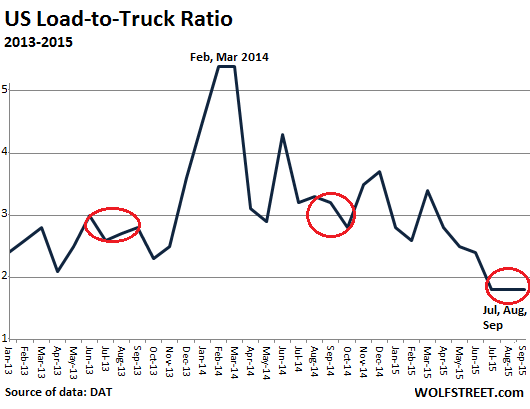
We have in the past joked that the only thing that could possibly save the world from what is a trade recession is if the central banks can somehow find a way to “print trade” the way they artificially boost asset prices higher to give the impression of a status quo normalcy. Unfortunately, as this is not a real option, and with both global and US trade in freefall, many wonder just how will the world’s central planners mask this most dangerous aspect of the global economic slowdown?

Charts: Bloomberg
ArcelorMittal Is Latest Victim of China’s Steel-Export Glut
-
Full-year Ebitda forecast reduced to $5.2 billion-$5.4 billion
-
Third-quarter profit declines 29% from a year earlier
ArcelorMittal is taking the latest knock from record Chinese steel exports hurting producers across the globe.
The world’s biggest steelmaker on Friday cut its full-year profit target and suspended its dividend, putting the blame on the flood of cheap steel from China’s loss-making mills. The market is being overwhelmed with material coming from the nation’s state-owned and state-supported producers, a collection of industry associations said Thursday.
“It is obvious that we are operating in a very challenging market,” Chief Financial Officer Aditya Mittal said on a call with reporters. “This is essentially the result of very low export prices out of China that are impacting prices worldwide.”
The steel industry has been roiled by the slowest economic growth in two decades in China, the biggest consumer. The flood of cheap exports from the nation has drawn complaints from Europe and the U.S. that the shipments are unfair. Bloomberg Intelligence estimates Chinese steel shipments overseas will exceed 100 million metric tons this year, more than the combined output of Europe’s top four producing countries.
While demand for steel in the company’s largest markets of the U.S. and Europe is recovering, producers’ profits are being hit by slumping prices because China has been pushing excess supply onto the world market as its economy slows.
‘Import Crisis’
“This is not an economic crisis, it is not a volume crisis, it is an import crisis,” Mittal said. “Our core markets of Europe and Nafta are still growing,” he said, referring to North American Free Trade Agreement.
ArcelorMittal’s shares were little changed at 4.979 euros by 10:24 a.m. in Amsterdam. The Luxembourg-based company’s stock has dropped 45 percent this year and reached a 12-year low in October. The producer previously reduced its 2015 profit forecast in May.

Mittal said exports into the Nafta region from China rose 30 percent to 40 percent in the first half while those to Europe gained about 40 percent in the first nine months of the year. ArcelorMittal lowered its expectations for steel demand in China, forecasting that consumption would contract by 3.5 percent this year.
The company reduced its full-year Ebitda forecast to $5.2 billion to $5.4 billion from an earlier target of $6 billion to $7 billion. It reported a 29 percent drop in third-quarter profit. Scrapping the dividend will save about $360 million, the CFO said.
Price Rout
“Global steel prices continue to deteriorate,” said Seth Rosenfeld, an analyst at Jefferies International Ltd. in London. “The key to 2016 will be a potential reversal of painful market-wide trends that impacted 2015.”
Other steel producers have already been hit. Nippon Steel & Sumitomo Metal Corp. and JFE Holdings Inc., Japan’s two biggest, cut their profit forecasts last month. Germany’s Kloeckner & Co SE reported a 54 percent drop in third-quarter profit last week and India’s JSW Steel Ltd. warned last month that steel prices will remain under pressure from the global surplus.
Nine associations, including Eurofer and the American Iron and Steel Institute, on Thursday said there is almost 700 million tons of excess capacity around the world, with China contributing as much as 425 million tons.
“The pricing that is coming out of China is just not sustainable,” Mittal said. “The volume of losses that they are encountering is very significant. Their problem is being amplified and then exported on to our markets.”
ArcelorMittal’s third-quarter earnings before interest, taxes, depreciation and amortization declined to $1.35 billion from $1.9 billion a year earlier. That was in line with the average of 14 analyst estimates compiled by Bloomberg. The company posted a net loss of $711 million after writing down the value of its steel inventories.
Sales fell 22 percent from a year earlier to $15.6 billion. The company lowered its 2015 capital expenditure forecast to $2.8 billion from about $3 billion and said net debt would fall below $15.8 billion by year-end.
end
And now zero hedge discusses the above story!!
World’s Largest Steelmaker Reports Huge Loss, Suspends Dividend, Blames China
It’s no secret that Beijing has an excess capacity problem.
Indeed, the idea that a yearslong industrial buildup intended to support i) the expansion of the smokestack economy, ii) a real estate boom, and iii) robust worldwide demand ultimately served to create a supply glut in China is one of the key narratives when it comes to analyzing the global macro picture.
That, combined with ZIRP’s uncanny ability to keep uneconomic producers in business, has served to drive down commodity prices the world over, imperiling many an emerging market and driving a bevy of drillers, diggers, and pumpers to the brink of insolvency.
As we noted late last month, if you want to get a read on just how acute the situation truly is, look no further than China’s “ghost cities”…


Here’s the simple, straightforward assessment from the deputy head of the China Iron & Steel Association:
“Production cuts are slower than the contraction in demand, therefore oversupply is worsening. Although China has cut interest rates many times recently, steel mills said their funding costs have actually gone up.”
To which we said, “meet the deflationary commodity cycle in all its glory”:
China’s mills — which produce about half of worldwide output — are battling against oversupply and sinking prices as local consumption shrinks for the first time in a generation amid a property-led slowdown. The fallout from the steelmakers’ struggles is hurting iron ore prices and boosting trade tensions as mills seek to sell their surplus overseas.Shanghai Baosteel Group Corp. forecast last week that China’s steel production may eventually shrink 20 percent, matching the experience seen in the U.S. and elsewhere.
“China’s steel demand evaporated at unprecedented speed as the nation’s economic growth slowed,” Zhu said. “As demand quickly contracted, steel mills are lowering prices in competition to get contracts.”
Right. Well actually there’s that, and the fact that they can’t get loans despite multiple RRR cuts and attempts on Beijing’s part to boost China’s credit impulse. In fact, over half the debtors in China’s commodity space are generating so little cash, they can’t even cover their interest payments.

So, considering all of the above, the obvious implication is that China will simply export its deflation…

Given that, it shouldn’t come as any surprise that on Friday, the world’s biggest steelmaker suspended its dividend and cut its outlook.
Here’s more from Bloomberg:
The world’s biggest steelmaker on Friday cut its full-year profit target and suspended its dividend, putting the blame on the flood of cheap steel from China’s loss-making mills. The market is being overwhelmed with material coming from the nation’s state-owned and state-supported producers, a collection of industry associations said Thursday.
“It is obvious that we are operating in a very challenging market,” Chief Financial Officer Aditya Mittal said on a call with reporters.“This is essentially the result of very low export prices out of China that are impacting prices worldwide.”
The steel industry has been roiled by the slowest economic growth in two decades in China, the biggest consumer.
The flood of cheap exports from the nation has drawn complaints from Europe and the U.S. that the shipments are unfair. Bloomberg Intelligence estimates Chinese steel shipments overseas will exceed 100 million metric tons this year, more than the combined output of Europe’s top four producing countries.
While demand for steel in the company’s largest markets of the U.S. and Europe is recovering, producers’ profits are being hit by slumping prices because China has been pushing excess supply onto the world market as its economy slows.
So again, we’re seeing disinflation (the exact opposite of what DM central bankers intended when they decided to expand their balance sheets into the trillions) as global growth and trade enters a new era, characterized by a systemic slump in demand. Here’s the damage in terms of the Arcelor’s equity:

And here’s more from The New York Times on the impact of Chinese “dumping:
“The Chinese are dumping in our core markets,” Mr. Mittal said. “The question is how long the Chinese will continue to export below their cost.”
The company’s loss for the period compared with a $22 million profit for last year’s third quarter.
ArcelorMittal, which is based in Luxembourg, also sharply cut its projection for 2015 earnings before interest, taxes, depreciation and amortization — the main measure of a steel company’s finances. The new estimate is $5.2 billion to $5.4 billion, down from the previous projection of $6 billion to $7 billion.
On a call with reporters, Aditya Mittal, Mr. Mittal’s son and the company’s chief financial officer, said that a flood of low-price Chinese exports was the biggest challenge for ArcelorMittal in the European and North American markets.
The company estimates that Chinese steel exports this year will reach 110 million metric tons, compared with 94 million tons last year and 63 million tons in 2013. ArcelorMittal produced 93 million metric tons of steel in 2014.
Of course when the standing government policy is to roll over bad debt and avoid SOE defaults at all costs, uneconomic producers can and will continue to produce. This means the deflationary impulse ArcelorMittal cites isn’t likely to dissipate anytime soon, and on that note we close with what we said just a week ago:
The cherry on top is that China itself is now trapped: it simply can’t afford to let anyone default, as one bankruptcy would cascade across the entire bond market and wipe out countless corporations leaving millions of angry Chinese workers unemployed, and is therefore forced to keep bailing out insolvent companies over and over. By doing so, it is adding even more deflationary capacity and even more production into the market, which leads to even lower prices, and even greater bailouts! In short: this is a deflationary toxic spiral.
end
Euro/USA 1.0879 down .0004
USA/JAPAN YEN 121.92 up .228
GBP/USA 1.5121 down .0088
USA/CAN 1.3206 up .0045
Early this morning in Europe, the Euro fell by a minuscule 4 basis points, trading now well below the 1.09 level rising to 1.0879; Europe is still reacting to deflation, announcements of massive stimulation (QE), a proxy middle east war, and the ramifications of a default at the Austrian Hypo bank, an imminent default of Greece, Glencore,and now Nysmark and the Ukraine, along with rising peripheral bond yield. Last night the Chinese yuan down in value (onshore). The USA/CNY up in rate at closing last night: 6.3525 / (yuan down)
In Japan Abe went all in with Abenomics with another round of QE purchasing 80 trillion yen from 70 trillion on Oct 31/2014. The yen now trades in a slight southbound trajectory as settled down again in Japan by 23 basis points and trading now well above the all important 120 level to 121.92 yen to the dollar.
The pound was clobbered again this morning by 88 basis points as it now trades just below the 1.52 level at 1.5121.
The Canadian dollar is now trading down 45 basis points to 1.3206 to the dollar.
We are seeing that the 3 major global carry trades are being unwound. The BIGGY is the first one;
1. the total dollar global short is 9 trillion USA and as such we are now witnessing a sea of red blood on the streets as derivatives blow up with the massive rise in the rise in the dollar against all paper currencies and especially with the fall of the yuan carry trade. The emerging market which house close to 50% of the 9 trillion dollar short is feeling the massive pain as their debt is quite unmanageable.
2, the Nikkei average vs gold carry trade (blowing up)
3. Short Swiss franc/long assets (European housing/Nikkei etc. This has partly blown up (see Hypo bank failure).(blew up)
These massive carry trades are terribly offside as they are being unwound. It is causing global deflation ( we are at debt saturation already) as the world reacts to lack of demand and a scarcity of debt collateral. Bourses around the globe are reacting in kind to these events as well as the potential for a GREXIT>
The NIKKEI: this FRIDAY morning:closed up 149.19 or 0.78%
Trading from Europe and Asia:
1. Europe stocks all in the red
2/ Asian bourses mostly in the green … Chinese bourses: Hang Sang red (massive bubble forming) ,Shanghai in the green (massive bubble ready to burst), Australia in the green: /Nikkei (Japan) in the green/India’s Sensex in the red/
Gold very early morning trading: $1109.00
silver:$15.05
Early Friday morning USA 10 year bond yield: 2.23% !!! down 1 in basis points from Wednesday night and it is trading well below resistance at 2.27-2.32%. The 30 yr bond yield falls to 2.99 down 1 in basis point.
USA dollar index early Thursday morning: 98.14 cents up 16 cents from Wednesday’s close. (Resistance will be at a DXY of 100)
This ends early morning numbers Friday morning
Wolf Richter www.wolfstreet.com
Chesapeake Energy is a good example. The second largest natural gas producer in the US, after Exxon, reported its debacle yesterday.
Revenues plunged 49% from the quarter a year ago, when the oil bust had already set in. The company has been slashing costs and capital expenditures. In June, it eliminated its dividend. And yesterday, it recognized $5.4 billion in impairment charges, bringing impairments for the nine months to a staggering $15.4 billion.
Impairment charges are a sudden accounting recognition of accumulated capital destruction. These impairments pushed its losses from operations to $5.4 billion in Q3 and to $16 billion for the nine months.
Chesapeake currently gets 72% of its production from natural gas, 17% from oil, and 11% from natural gas liquids. The oil bust has been going on since the summer of 2014. The US natural gas bust has been going on since 2009! Two natural gas producers have already gone bankrupt this year: Quicksilver Resources and Samson Resources.
Its annual free cash flow has been negative since 1994, even during good times, with only two tiny exceptions (Bloomberg chart). After living off borrowed money, it’s now trying to hang on by selling assets and lowering its mountain of debt. But it still owes $16 billion, much of which QE-besotted, ZIRP-blinded, yield-hungry investors had handed it over the years, based on hype and false hopes.
Its shares last traded at $7.50, down 75% from peak hype in June 2014. Its 4.875% notes due 2022 and its 5.75% notes due 2023, according to S&P Capital IQ LCDyesterday, traded for 66 cents on the dollar.
In terms of capital destruction, Chesapeake is in good company, and not even the leader. A new report byEvaluate Energy, which covers Oil & Gas companies around the globe, examined the financial statements of the 48 US oil & gas companies that have reported earnings for the third quarter so far. The amounts and the speed of deterioration are just stunning.
Turns out, what started in Q4 last year is getting worse relentlessly. And now it’s getting serious: plunging revenues, squeezed operating margins, whopping impairment charges, and horrendous losses are combining into a very toxic mix.
Evaluate Energy determined that net income of those 48 companies was a gigantic loss for the three quarters combined of $57 billion.
On a quarterly basis, the losses in Q3 jumped 58% from Q2 and 70% from Q1 to $25.5 billion. This fiasco, which has been spiraling down at a breath-taking pace, looks like this:
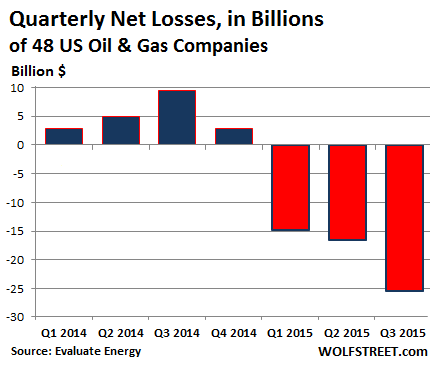
The biggest factor in these losses, as in Chesapeake’s case, was the impairments. For this study, Evaluate Energy only counted impairments of property and equipment, not of financial assets such as “goodwill.” Including charge-offs of goodwill, it would have been even worse (an example is Whiting Petroleum, which we’ll get to in a moment).
Of the 48 companies, 38 recognized impairment charges totaling $32.8 billion in Q3 alone, a 79% jump from Q2, when impairments hit $18.4 billion. Since Q4 2014, these 48 companies recognized impairments of $84.6 billion; 39% of that in Q3.
Devon Energy was king of the hill, with $5.9 billion in impairments in Q3, after having recognized impairments every quarter this year, for a total of about $15.5 billion.
Our natural-gas hero Chesapeake is in second place, if only barely, with $5.4 billion in impairments this quarter, and $15.5 billion for the nine months.
Of note, Occidental Petroleum, with impairments of $3.3 billion in Q3, Murphy Oil, Whiting Petroleum, and Carrizo Oil & Gas all recognized over 90% of their respective impairments this year in this misbegotten third quarter. They were in no hurry to grant their investors a peak at reality.
However, Whiting’s impairments of $1.7 billion do not include an additional $870 million in write-offs of goodwill in connection with its once highly ballyhooed acquisition of Kodiak Oil & Gas, which closed in December last year.
In Q4 2014, many investors thought the oil bust was a blip, that this was just a correction of sorts in oil prices and that they’d rebound in early 2015. But in 2015, oil and natural gas both have plunged to new cycle lows. And yet, over and over again, sharp sucker rallies gave rise to hopes that it would all be over pronto, that the price would settle safely above $80 a barrel, or at least above $65 a barrel, where some of the oil companies could survive.
But now that oil in storage is practically coming out of our ears, globally, the meme has become “lower for longer,” and the game has boiled down to who can slash operating costs and capital expenditures fast enough without losing too much production, who has enough cash to burn through while this lasts, and who can still get new money at survivable rates. And that game is accompanied, as in Q3, by the giant sucking sound of capital destruction.
Banks, when reporting earnings, are saying a few choice things about their oil & gas loans, which boil down to this: it’s bloody out there, but we made our money and rolled off the risks to others in a trade that has become blood-soaked. Read… Who on Wall Street is Now Eating the Oil & Gas Losses?
Only 1 Percent Of Bakken Shale Is Profitable At These Prices
Submitted by Arthur Berman via OilPrice.com,
Only 1 percent of the Bakken Play area is commercial at current oil prices based on my analysis that follows.
Only 4 percent of horizontal wells drilled since 2000 meet the EUR (estimated ultimate recovery) threshold needed to break even at current oil prices, drilling and completion, and operating costs.
The leading producing companies evaluated in this study are losing $11 to $38 on each barrel of oil that they produce, the very definition of waste.
Although NYMEX prices are about $46 per barrel, realized wellhead prices in the Bakken are only $30 per barrel according to the North Dakota Department of Mineral Resources. At that price, approximately 125,000 acres of the drilled play area of 10,500,000 acres is commercial (green areas in Figure 1).

Figure 1. Bakken Shale Play commercial area map at $30 per barrel wellhead price. Contours are in barrels of oil estimated ultimate recovery. Contour interval = 200,000 barrels of oil. Source: Drilling Info, North Dakota Department of Natural Resources & Labyrinth Consulting Services, Inc.
(click image to enlarge)
The break-even per-well EUR is 700,000 barrels at a $30 oil price. The underlying economic assumptions are shown in Table 1.

Table 1. Economic assumptions and outcomes used to determine the Bakken $30 per barrel commercial area shown in Figure 1. Source: Company presentations and Labyrinth Consulting Services, Inc.
(click image to enlarge)
There has been much debate about the break-even price for tight oil plays in the U.S. This discussion is largely meaningless because there is no single break-even price for any play.
After seven long years, and following the State Department’s denial of TransCanada’s request to suspend its permit application, the Obama Administration, according to The Wall Street Journal, is set to reject the Keystone XL Pipeline (the controversial project to link oil sands in Alberta to U.S. Gulf of Mexico refineries). President Obama is expected to cite the urgency of climate change as a key reason behind his decision, these people said.

As The Wall Street Journal reports,
The Obama administration will reject the Keystone XL pipeline, according to people familiar with the decision, capping a politically charged review of the oil project that lasted more than seven years and escalated into a broader debate on energy, climate change and the economy.
President Barack Obama is expected to cite the urgency of climate change as a key reason behind his decision, these people said.
Mr. Obama, who has made environmental issues a centerpiece of his second term, had signaled deep misgivings about the pipeline project as he pursued an expansive agenda aimed at fighting climate change. He said repeatedly that the pipeline would create few jobs and would fail to lower gasoline prices, while exacerbating climate change.
Interviews suggest TransCanada fumbled its U.S. push for the project by pursuing a politically naive public-relations strategy over the past seven years. Those interviewed said TransCanada followed a playbook that no longer works in Washington, where regulatory approvals can get caught up in ideological conflicts.
Democratic presidential candidate Bernie Sanders urged President Barack Obama to reject the pipeline ahead of the Paris climate talks set for later this month, The Hill reports.
And the winner is…

With BNSF!!
For the 10th consecutive week, the US oil rig count declined. Dropping 6 to 572 rigs, this is the lowest since June 2010. WTI Crude prices were unmoved by the drop having tumbled earlier after the ‘great’ payrolls data.

Rigs continue to track almost spookily the 3mo ahead crude price…

Charts: Bloomberg
USA/Chinese Yuan: 6.3528 up .007 on the day (yuan down)
New York equity performances for today:
S&P Ends Red After 2015’s Best Jobs Data Sparks Bond & Bullion Breakdown
The best jobs print in 2015 sparked a surge in the dollar and purge on everything else… quickly followed by this from some…
…and this from the mainstream media and their sponsoring talking heads.
* * *
Having dipped and ripped on a huge miss in October, after today’s beat, the market couldn’t quite pull it off…

WTI Crude was the worst-performer post-Payrolls as stocks desperately ramped to get back to unchanged…

On the day, Small Caps and Trannies were on fire (squeeze) as S&P was unablew to get there…

Despite the massive crush on VIX to get the S&P 500 above 2100 – which failed..

VIX (equity implied business risk) and HY bond spreads (credit implied business risks) remain notably decoupled…

Thanks to yet another big short squeeze…

Small Caps had a massive week… the 2nd biggest week since Oct 2014’s Bullard Bounce

As Financials surged…

BABA was bashed (and thus YHOO yanked) after Chanos said he was shorting…

Credit markets did not bounce…

Treasury yields spiked after the jobs data and did not give much back as stocks sank… (notice that on the week 2Y actually outperformed with the belly worst)

We note that 2Y yields spiked to 95bps at their highs (and futures were halted) before fading back (still 6bps higher on the day) – the highest since May 2010…

The USD surged today on the payrolls beat… with AUD crashing and EURUSD

The USD Index hit 7-month hghs today… after biggest 3-week gain since March’s peak…

The USD strength weighed heavy on all commodities with Copper managing to modestly outperform as gold, silver, and crude all huddled together down 4.5 to 5% on the week…

Gold is back under $1100, at August lows (down 8 straight days, and 12 of the last 13), and Silver down 7 straiught days to September lows…

Charts: Bloomberg
The official phony release!!
(courtesy zero hedge)
October Jobs Soar To 271K, Smash Expectations, Unemployment Rate 5.0%, Hourly Earnings Spike
If there was any doubt if the Fed would hike rates in December, it is gone now: October payrolls soared by 271K, smashing not only consensus of 184K, but the highest expected print. This was the highest monthly print since December 2014 when the gain was 329K and pushed the YTD average monthly gain from 199K to 206K.

The household survey likewise posted a solid gain of 320K, with the number of employed rising from 148,800 to 149,120, another post-crisis high.
The unemployment rate dropped from 5.1% to 5.0%, the lowest since April 2008, and most importantly, the average hourly earnings rose from 0.2% to 0.4%, the highest hourly earnings jump since 2009!
The two charts which the Fed will be most focused on are the following, showing both average hourly and weekly earnings rebounded solidly from recent week levels.

The breakdown from the report:
Total nonfarm payroll employment increased by 271,000 in October. Over the prior 12 months, employment growth had averaged 230,000 per month. In October, job gains occurred in professional and business services, health care, retail trade, food services and drinking places, and construction. (See table B-1.)
Employment in professional and business services increased by 78,000 in October, compared with an average gain of 52,000 per month over the prior 12 months. In October, job gains occurred in administrative and support services (+46,000), computer systems design and related services (+10,000), and architectural and engineering services (+8,000).
Health care added 45,000 jobs in October. Within the industry, employment growth continued in ambulatory health care services (+27,000) and in hospitals (+18,000). Over the past year, health care has added 495,000 jobs.
Employment in retail trade rose by 44,000 in October, compared with an average monthly gain of 25,000 over the prior 12 months. In October, job gains occurred in clothing and accessories stores (+20,000), general merchandise stores (+11,000), and automobile dealers (+6,000).
Food services and drinking places added 42,000 jobs in October. Over the year, the industry has added 368,000 jobs.
(Harvey: more bartenders)
Construction employment increased by 31,000 in October, following little employment change in recent months. Employment in nonresidential specialty trade contractors rose by 21,000. Over the past 12 months, construction has added 233,000 jobs.
Employment in mining continued to trend down in October (-5,000). The industry has shed 109,000 jobs since reaching a recent employment peak in December 2014.
Employment in other major industries, including manufacturing, wholesale trade, transportation and warehousing, information, financial activities, and government, showed little or no change over the month.
The average workweek for all employees on private nonfarm payrolls remained at 34.5 hours in October. The manufacturing workweek edged up by 0.1 hour to 40.7 hours, and factory overtime edged up by 0.1 hour to 3.3 hours. The average workweek for production and nonsupervisory employees on private nonfarm payrolls edged up by 0.1 hour to 33.7 hours. (See tables B-2 and B-7.)
In October, average hourly earnings for all employees on private nonfarm payrolls rose by 9 cents to $25.20, following little change in September (+1 cent). Hourly earnings have risen by 2.5 percent over the year. Average hourly earnings of private-sector production and nonsupervisory employees increased by 9 cents to $21.18 in October. (See tables B-3 and B-8.)
The change in total nonfarm payroll employment for August was revised from +136,000 to +153,000, and the change for September was revised from +142,000 to +137,000. With these revisions, employment gains in August and September combined were 12,000 more than previously reported. Over the past 3 months, job gains have averaged 187,000 per month.
end
Now the real story: labour participation remains at the low end at 62.4%
Labor Participation Rate Remains At 37 Year Low As 94.5 Million Remains Outside The Labor Force
In another sign that the labor market slack, at least from the Fed’s perspective, is now reaching a peak, the Household survey reported that while the civilian labor force rose by over 300K in October, the number of people not in the labor force actually declined by 97K to 94.5MM (as those employed rose by 320K), following a surge of over half a million in September. Despite this headline improvement, however, the participation rate remained at 62.4%, same as the prior month, and at a level last seen in 1977.

Elsewhere, the civilian employment to population ratio also remained rather downbeat at 59.3%, a modest increase from last month’s 59.2% and virtually unchanged from the 59.2% also reported one year ago.

Finally, while there are many explanations why the participation rate remains so low (and continues to decline) most notably from the Fed who said that people “just don’t want a job”, the reality is that 94.5 million Americans either no longer have an interest or desire to look for a job.
Good News Is Terrible News: Dollar Surges As Bonds, Stocks, Commodities Purge After Payrolls Print
“Everything is awesome.” The Fed got just what it wanted… surge in jobs and a surge in wages – which has sent December rate hike odds from 56% to 74%.

A big surge from before…

This appears to be a problem for everything else.

The dollar has soared (EURUSD almost a 1.06 handle), Bond yields have exploded (though the long-end is notably outperforming), stock prices plunged, and commodities across the board are getting hammered.

Charts: Bloomberg
As The Dollar Soars, These Sectors Are Most At Risk
The USDollar Index is soaring (hitting its highest since early April and approaching 2015 highs) as the probability of a December rate hike hits 74%. This is not unequivocally good for a large number of American firms..
Spot the Difference…

So who gets hurt the most?

As Deutsche Bank details,
A stronger dollar, the reset in oil prices to significantly lower levels and slower global growth and investment spending vs. last cycle will challenge many of the S&P’s commodity and industrial capital goods producers for a long time. We’ve been under-weight Energy, Materials and Industrials since last year on these reasons and expect these sectors to underperform in 2015, 2016 and perhaps longer. Unless lower stock prices offer a more attractive entry point.
We remain concerned about the risk to EPS growth at many S&P industries with high foreign profits owing to FX translation from a stronger dollar. This includes most Technology, Industrials, Consumer Staples, and many Health Care and Consumer Discretionary stocks. Until we can observe how the dollar reacts to initial Fed hikes this remains a difficult risk to dismiss or quantify. At current FX rates, FX drags should stop in 2Q16. We see Industrials with most FX risk given its high foreign profits and then disadvantages vs. trade partners.
Charts: Bloomberg
end
Who Hired In October: The Full Breakdown By Industry
We know that 271K jobs were added in October; we also know that workers 55 and over got a whopping 378,000 of the jobs (this was the biggest montly gain for this age group since January 2012, a month when total job gains were 380K, the third highest since the crisis), while males aged 25-54 lost 119,000 jobs.But who was hiring in October?
Below is the breakdown of select industries which, according to the BLS, were most active in October hiring. The breakdown:
- Education and Health: +57K
- Professional Services: +54K
- Retail Trade: 44K
- Leisure and Hospitality: +41K
- Temp Help: 25K
And Manufacturing workers: +0
In short, one more month where the bulk of job additions went to the lowest paying jobs, including teachers, waiters, entry level professionals, retail trade, and temp workers, while the US industrial economy continues to stagnate.
Visually:

And here is the breakdown of waiters vs manufacturing workers since December 2007: the former up 1.5 million; the latter down 1.4 million.

The Most Surprising Thing About Today’s Jobs Report
After several months of weak and deteriorating payrolls prints, perhaps the biggest tell today’s job number would surprise massively to the upside came yesterday from Goldman, which as we noted earlier, just yesterday hiked its forecast from 175K to 190K. And while as Brown Brothers said after the reported that it is “difficult to find the cloud in the silver lining” one clear cloud emerges when looking just a little deeper below the surface.
That cloud emerges when looking at the age breakdown of the October job gains as released by the BLS’ Household Survey. What it shows is that while total jobs soared, that was certainly not the case in the most important for wage growth purposes age group, those aged 25-54.
As the chart below shows, in October the age group that accounted for virtually all total job gains was workers aged 55 and over. They added some 378K jobs in the past month, representing virtually the entire increase in payrolls. And more troubling: workers aged 25-54 actually declined by 35,000, with males in this age group tumbling by 119,000!

Little wonder then why there is no wage growth as employers continue hiring mostly those toward the twilight of their careers: the workers who have little leverage to demand wage hikes now and in the future, something employers are well aware of.
The next chart shows the break down the cumulative job gains since December 2007 and while workers aged 55 and older have gained over 7.5 million jobs in the past 8 years, workers aged 55 and under, have lost a cumulative total of 4.6 million jobs.

The same chart as above showing the full breakdown by age group – once again the 25-54 age group sticks out.

But young workers’ loss is old workers’ gain, as the following chart of total jobs held by those aged 55 and over shows. As of October, there was a record 33.8 million workers in the oldest age group tracked by the BLS – the same workers who, as noted above, also have the poorest wage negotiating leverage.

Finally, the most disappointing data point in today’s report is that while overall labor growth was solid, the participation rate for workers 25-54, was 80.7%, far below is peak of just under 85%, and below the 80.8% at the end of 2014.

Time for a rate hike?

Goldman Forced To Sell Valeant Shares As CEO Stock-Pledged Loan Hit 100% LTV
Back in late 2008, Goldman was faced with a serious problem: as its stock was tumbling, numerous employees found themselves in a hot spot as they had taken out loans pledged by Goldman stock. As the stock cratered, suddenly the loans hit 100% LTV, or above, and as a result they got margin calls. Many scrambled to sell other assets to cover these calls. Of course, the biggest taxpayer-backed bailout followed, Goldman stocks surged, and the rest is history.
7 years later, the story is repeating itself, only this time instead of Goldman executives it was the CEO of Valeant, Michael Pearson, who was in the same tough position.
According to a just issued press release, Valeant’s CEO had taken out a $100 million loan pledged with 1.3 million VRX shares to Goldman Sachs. Well, when the stock tumbled below $80 yesterday, the LTV on the loan hit 100% and as a result Goldman had no choice but to sell, showing how pro-cyclical and self-sustaining stock selloffs can be in the current environment in which many executives, assuming their stock would keep rising in perpetuity, took out loans pledged with stock, only to be shocked when said stock plunged.
From the release:
Valeant Pharmaceuticals International, Inc. (NYSE: VRX) (TSX: VRX) stated today that1,297,399 shares pledged to Goldman Sachs to secure loans made to chairman and chief executive officer J. Michael Pearson were sold by Goldman Sachs on November 5, 2015. Goldman Sachs held the shares as collateral for loans extended to Pearson.
As disclosed in the company’s proxy statement filed on April 22, 2014, the company’s board permitted Pearson to pledge approximately two million shares. As of the company’s most recent proxy statement, filed April 9, 2015, those shares represent approximately 20.19% of his shares beneficially owned. Pearson pledged those shares to Goldman Sachs as collateral for loans of approximately $100 million that he used for, among other things, financing charitable contributions, including to Duke University, and helping to fund a community swimming pool, purchasing Valeant shares, and meeting certain tax obligations related to the vesting and payment of Valeant compensatory equity awards. Goldman Sachs required repayment of the loans, and has informed the company that it sold the shares it held as collateral in satisfaction of the loans.
After repayment of the loans with the proceeds from the sale by Goldman Sachs, the loan agreements will terminate and there will be no amounts outstanding under those agreements.
“Since joining Valeant, I have not sold any shares provided to me as compensation, and it was not my desire that shares be sold now,” Pearson said. “I have complete confidence in Valeant’s ability to move forward and continue meeting our commitments to patients, doctors, and shareholders.”
In January 2015, Pearson agreed to not receive a base salary and instead be compensated exclusively through cash and stock incentive awards tied to performance.
Consumer Credit Has Biggest Jump In History, Led By Government-Funded Car And Student Loans
If there was any confusion where all those soaring new car sales are coming from, we now have the definitive answer: moments ago the latest consumer credit data for September was released, and surging by $28.9 billion – a 4.9% jump Y/Y – not only did this smash expectations of a “modest” $18 billion rise, this was the biggest monthly increase ever!

And while revolving credit rose a respectable $2.7 billion to $925 billion, still well below its historic high of $1.02 trillion…

… the monthly swing was all in the non-revolving credit, i.e., the student and car loans: soaring by $22.2 billion, this was the second biggest monthly jump on record.

The source? Drumroll – the US government, which on one hand laments the credit bubble it has created via ZIRP and QE and is eager to raise rates by 25 bps, and on the other is directly funding the biggest student and car debt bubble in history.

Presenting: the government bubble in all its glory.

Russia & China War Update, Dec Fed Rate Hike, Tanking Economy Continues
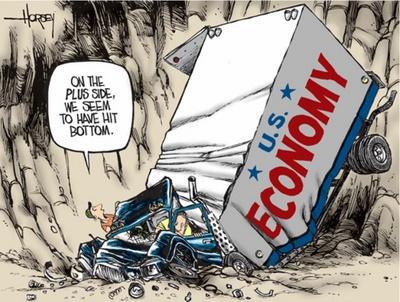 By Greg Hunter’s USAWatchdog.com (WNW 215 11.6.15)
The U.S. is sending a dozen F-15’s to Turkey. The F-15 specialize in air-to-air combat. The Pentagon officially says the jets are to “ensure the safety” of NATO allies, but there is much speculation that the jets could also offer protection to the Kurds and the recently announced Special Ops Forces going to help “train” the Kurds. There is also the fear that these jets could meet Russian jet fighters in air-to-air combat either on purpose or accident. They have plenty of other U.S. Airforce firepower in Turkey such as the F-16, F-22 and B-1 bombers, to name a few.
Meanwhile, Russia is having meetings with many Middle East players including Saudi Arabia and Egypt. Speaking of Egypt, there is a lot of confusion over why that Russian passenger jet went down on the Sinai Peninsula. The British say it was a bomb, and ISIS has taken credit for killing more than 220 people. Usually, when you kill more than 200 people, you are a little sheepish, but not ISIS. The group wants credit for the murders of Russians and have almost demanded they get the credit. What a sick group of people. That said the jury is still out on what exactly happened to the Russian passenger jet. The U.S. and Russia say they don’t have conclusive evidence it was a bomb. Some suggest the tail of the plane fell off because it had damage to it years ago and it was not repaired correctly. If it was ISIS that killed those Russians, tourism in that part of Egypt will come to a screeching halt. This will further kill Egypt’s economy that is dependent on tourism. It’s 11% of GDP, and it caters to more than 14 million tourists per year. One thing is for sure, the situation and violence in the Middle East is heating up and not slowing down.
Friction and war talk is also heating up in the South China Sea where China has built islands and claimed territory 600 miles from its shores. The U.S. is sending war ships to the islands and announced it will do so on a regular basis. China is reacting angrily and says its sovereignty is“threatened” and calls the U.S. action “highly-dangerous.” U.S. Pacific Command, Adm. Harry Harris, who is a critic of China’s island building activities, told Congress recently, “The South China Sea is no more China’s domain than the Gulf of Mexico is Mexico’s.” The tensions mount, and the U.S. has conflict with Russia and China on at least two fronts.
Fed Head Janet Yellen is doubling down on the rate hike talk. She told Congress this week a December rate hike is “a live possibility.” Folks like David Stockman say the Fed should raise rates ASAP. Other people say the Fed can’t raise rates, and if it does, stock and bond markets would tank. The IMF has been continually warning the Fed not to raise rates. It is beyond me that the Fed does not know what it’s going to do little more than six weeks from now. The only reason why the stocks and bonds have not tanked is because the Fed and other central banks continue to prop up the global markets.
Join Greg Hunter as he analyzes these stories and more in the Weekly News Wrap-Up.


 harveyorganblog.com
Harvey, Chris Powell has given you the message (which you yourself included in this blogpost). Didn’t you get the message? All the COMEX data is garbage and irrelevant, which is what the origin of your blog was centered on: To make sense of the COMEX data. Nobody can make any sense of this trash published by the criminals, because it’s all mumbo-jumbo pack of lies. They don’t mean anything. Time to shut down your blog.
LikeLike
To Chiefe,
I have gotten a lot out of Harvey’s reports over the years. It’s a continuous study of continuous details. I have no reason to defend his report to anyone. It’s up to you to find the patterns yourself, or you could just stop reading. And who are you, anyway, to threaten to shut down Harvey’s blog? Were you the one who did it before? Well, Harvey’s back better than ever. But, hey, shut him down again if you need him shut up. Now that some of us know the patterns, we can find them ourselves. It will just take more effort for us. Like Hydra, more heads sprout when you chop off this one.
LikeLike