
Gold: $1069.40 down $5.40 (comex closing time)
Silver $14.28 down 2 cents
In the access market 5:15 pm
Gold $xxxx
Silver: $xxxx
We now enter options expiry week:
the comex options expire if I am correct on Dec 28 (Monday)
the London LBMA option on Dec 31 (Thurs)
the OTC market: Dec 31.(Thurs)
At the gold comex today, we had a good delivery day, registering 136 notices for 13,600 ounces.Silver saw 12 notices for 60,000 oz.
Several months ago the comex had 303 tonnes of total gold. Today, the total inventory rests at 198.93 tonnes for a loss of 104 tonnes over that period.
In silver, the open interest fell by 980 contracts even though silver was unchanged in price with respect to yesterday’s trading and without a doubt we had more short covering. We have an extremely low price of silver and a very high OI coupled with backwardation in silver at the LBMA and the comex. (negative SIFO rates). The total silver OI now rests at 161,116 contracts. In ounces, the OI is still represented by .805 billion oz or 115% of annual global silver production (ex Russia ex China).
In silver we had 12 notices served upon for 60,000 oz.
In gold, the total comex gold OI rose by 2691 contracts to 405,294 contracts despite the fact that gold was down $7.10 in price with respect to yesterday’s trading.
We had no change tonight in gold inventory at the GLD, / thus the inventory rests tonight at 645.94 tonnes. The appetite for gold coming from China is depleting not only gold from the LBMA and GLD but also the comex is bleeding gold. Our 670 tonnes of rock bottom inventory in GLD gold has been broken. It looks to me that China has taken the last amounts of physical gold from the GLD. I guess the only place left for China to receive physical gold, after they deplete the GLD will be the FRBNY and the comex. In silver, we had no changes in inventory at the SLV /Inventory rests at 322.079 million oz. I will be reporting on updates tomorrow night
First, here is an outline of what will be discussed tonight:
1. Today, we had the open interest in silver fall by 980 contracts down to 161,116 despite the fact that silver was unchanged in price with respect to yesterday’s trading. The total OI for gold rose by 2691 contracts to 405,294 contracts as gold was down $7.10 in price
(report Harvey)
2 a) Gold trading overnight, Goldcore
(Mark OByrne)
3. ASIAN AFFAIRS
i)Last night, TUESDAY night, WEDNESDAY morning: Shanghai closes down sharply after being up throughout the day , Hang Sang rises, Chinese yuan falls a bit to 6.4804. Stocks in Asia mainly in the green, . Oil rises in the morning,. Stocks in Europe in the green. In China late in the day the Hibor rose dramatically signalling a problem with some Hong Kong banks/Chinese banks (see below)
ii)
(zero hedge)
iii)
(courtesy zero hedge)
iv) The big story of the day: The USA adds another 256% tariff tax on imported Chinese steel on top of the 236% duty imposed last month. Together close to 500% tax on Chinese steel is now imposed. China needs a huge market to sell its excess steel and the imposition of tariffs will hamper them greatly. As more steel producing nations engage in protectionism, this will cause many firms in China to implode. Ladies and Gentlemen: start your engines. We now have trade wars commence!
( zero hedge)
4. EUROPEAN AFFAIRS
none today
5. RUSSIAN AND MIDDLE EASTERN AFFAIRS
i)Iraq retakes the Sunni city of Ramadi from ISIS
ii)
iii) The Ukraine is again in trouble but this time it is internal bickering amongst themselves. All sides in government cannot get their act together and provide a budget for 2016. A failure to do so will cause the IMF to derail providing them with their badly needed 17.5 billion USA bailout.
6. GLOBAL ISSUES
ii) The following is a powerful commentary from David Stockman has he describes how we got to where we are today.
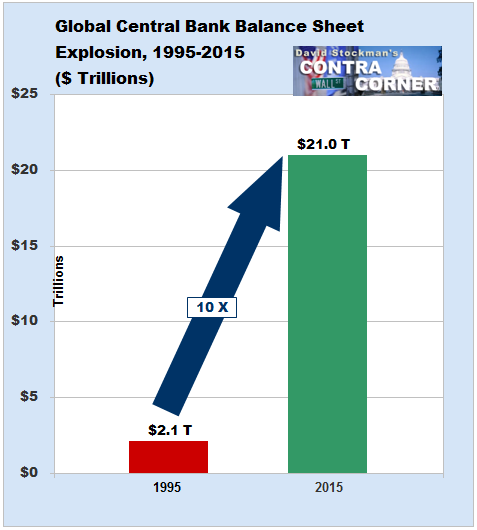
The central banks around the world increased their balance sheet in 20 years by 19 trillion dollars and the world increased their debt load by 185 trillion. The increase in debt load was not from savings but just printing. This sets the stage for a huge reversal as deflation is manifested upon the globe from China et al.
a must read..
(courtesy David Stockman/ContraCorner)
7. EMERGING MARKETS
none today
8. OIL MARKETS
i) Early this morning, algos run the price of oil into the 37 dollar category:
now we await, DOE and Cushing
(zero hedge)
ii)DOE reports a huge 5.88 mm draw/Cushing however confirms a 2.045 build: thus oil holds in price:
9. PHYSICAL MARKETS
i) Spoofing intensifies
(Bloomberg/GATA)
ii) Class action lawsuit filed in Toronto against the gold manipulators in the fixing of gold
(National Post/GATA)
10 USA STORIES WHICH WILL INFLUENCE THE PRICE OF GOLD/SILVER
i) Consumer spending in line with expectations but year over year sees the worst growth since May 2013.
ii) personal income in line as well as consumer spending both up by .3%. USA savings rate dips to 5.5% as consumers dip into their savings to spend;
iii) Defense spending soars, everything else plummets:
iv There is no housing recovery: we now have 5 months of downward revisions:
v) And with the above releases of bad numbers for the USA it is not surprising that the Atlanta Fed came out andlowered 4th quarter GDP to 1.3% from 1.9%
vii) On light volume, they are trying to ‘correct” the policy error. The 30 yr bond yield rises above 3.00%
viii) This is going to be disastrous! When markets go up you want to see volumes of strength. We are not witnessing this as the data shows.
Let us head over to the comex:
The total gold comex open interest rose to 405,294 for a gain of 2691 contracts as gold was down by $7.10 in price with respect to yesterday’s trading. For the past two years, we have strangely witnessed two interesting developments with respect to the gold open interest: 1) total gold comex collapse in OI as we enter an active delivery month, and 2) a continual drop in the amount of gold standing in an active month. Today, both scenarios were in force as the net outstanding OI dropped 85 contracts. We are now in the big December contract which saw it’s OI fall by 128 contracts to 903. We had 43 notices filed upon yesterday, so we lost 85 contracts or an additional 8500 oz will not stand for delivery in this active delivery month of December. The next contract month of January saw it’s OI fall by 23 contracts down to 541. The next big active delivery month is February and here the OI rose by 1553 contracts up to 283,382. The estimated volume today (which is just comex sales during regular business hours of 8:20 until 1:30 pm est) was 81,987 which is poor. The confirmed volume yesterday (which includes the volume during regular business hours + access market sales the previous day was also poor at 84,862 contracts. The comex is in backwardation in gold up to April. The backwardation from December to January is $1.10 i.e. December is higher by $1.10 ./December to April $1.10
December contract month:
INITIAL standings for DECEMBER
Dec 23/2015
| Gold |
Ounces
|
| Withdrawals from Dealers Inventory in oz | provide tomorrow |
| Withdrawals from Customer Inventory in oz nil | provide tomorrow |
| Deposits to the Dealer Inventory in oz | provide tomorrow |
| Deposits to the Customer Inventory, in oz | provide tomorrow |
| No of oz served (contracts) today | 136 contracts
13,600 oz |
| No of oz to be served (notices) | 767 contracts
(76,700 oz) |
| Total monthly oz gold served (contracts) so far this month | 1309 contracts(130,900 oz) |
| Total accumulative withdrawals of gold from the Dealers inventory this month | nil |
| Total accumulative withdrawal of gold from the Customer inventory this month | 203,033.8 oz |
Total customer deposits nil oz
DECEMBER INITIAL standings/
Dec 23/2015:
| Silver |
Ounces
|
| Withdrawals from Dealers Inventory | will provide tomorrow |
| Withdrawals from Customer Inventory | will provide tomorrow
, |
| Deposits to the Dealer Inventory |
will provide tomorrow |
| Deposits to the Customer Inventory | will provide tomorrow |
| No of oz served today (contracts) | 12 contracts
60,000 oz |
| No of oz to be served (notices) | 183 contracts
(915,000 oz) |
| Total monthly oz silver served (contracts) | 3768 contracts (18,840,000 oz) |
| Total accumulative withdrawal of silver from the Dealers inventory this month | nil oz |
| Total accumulative withdrawal of silver from the Customer inventory this month | 6,511,969.0 oz |
Today, we had xxx deposit into the dealer account: (will provide tomorrow)
total dealer deposit; xxx oz
we had xxx dealer withdrawals:
total dealer withdrawals: xxx
we had xxx customer deposits:
total customer deposits: xxx oz
total withdrawals from customer account: xxxx oz
we had xxx adjustments:
And now the Gold inventory at the GLD:
Dec 23. will update GLD inventory tomorrow
Dec 22.no change in inventory tonight/inventory rests at 645.94 tonnes/
Dec 21/tonight a huge deposit of 15.77 tonnes of gold was added to the GLD/Inventory rests tonight at 645.94 tonnes
(With gold in backwardation it is highly unlikely that physical gold was added/probably a paper gold addition.)
Dec 18.2015: late last night: a huge withdrawal of 4.46 tonnes of gold/Inventory tonight rests at 630.17 tonnes
DEC 17.no changes in gold inventory at the GLD/Inventory rests at 634.63 tonnes/
dec 16/no changes in gold inventory at the GLD/inventory rests at 634.63 tonnes.
Dec 15.2105/no changes in gold inventory at the GLD/Inventory rests at 634.63 tonnes
Dec 14.no change in gold inventory at the GLD/Inventory rests at 634.63 tonnes
DEC 11/no change in gold inventory at the GLD/inventory rests at 634.63 tonnes
Dec 10.2015/no change in gold inventory at the GLD/inventory rests at 634.63 tonnes
And now your overnight trading in gold and also physical stories that may interest you:
Spoofing went mainstream in 2015
Submitted by cpowell on Tue, 2015-12-22 13:30. Section: Daily Dispatches
By Matthew Leising
Bloomberg News
Tuesday, December 24, 2015
Inside Ken Griffin’s $25 billion empire, Citadel LLC’s cyber investigators had isolated a new enemy: spoofers.
It was late 2013, and at the firm’s Chicago headquarters, a team of researchers discovered that a rival company’s algorithm was outmaneuvering their automated trader. The algo was placing futures orders it had no intention of filling to entice firms like Citadel into the transactions, then canceling them, leaving Citadel with money-losing trades. Citadel’s plan: to pit its computers against the spoofer in a high-stakes duel over market manipulation.
That the firm took matters into its own hands shows how deeply the electronic bait-and-switch scheme has penetrated the global marketplace — and how slow regulators have been to root it out. The firm’s efforts, disclosed in a court filing in November, enabled Citadel to detect suspicious orders and, in a blink, pull back from trading.
Citadel isn’t the only one girding for battle. In London, New York, Washington, and beyond, 2015 will go down as the year that spoofing exploded into the financial lexicon. Whistles were blown. Convictions were made. And, in a twist, the financial players themselves stepped up to help outgunned regulators police the markets.
So far, the fight has yielded little. More than five years after the Dodd-Frank Act made spoofing a crime, the Commodity Futures Trading Commission sued just three traders for spoofing in 2015. And while the number of enforcement cases on CME Group Inc., which owns futures markets including the Chicago Board of Trade, doubled this year from 2014, there were only 16. …
… For the remainder of the report:
http://www.bloomberg.com/news/articles/2015-12-22/nabbing-the-rogue-algo…
end
(courtesy National Post/GATA)
Canadian lawsuit accuses former London gold fix banks of market manipulation
Submitted by cpowell on Wed, 2015-12-23 01:26. Section: Daily Dispatches
8:35p ET Tuesday, December 22, 2015
Dear Friend of GATA and Gold:
A class-action lawsuit brought in Canada this week accuses the bullion banks that participated in the former daily London gold fix of conspiring to manipulate the gold market in violation of Canada’s Competition Act and the anti-trust laws of other nations.
Though the bullion banks are almost certainly agents and intimate customers of central banks, the lawsuit makes no accusations against central banks, probably because gold market rigging by Western central banks is specifically authorized by law — in the United States by the Gold Reserve Act of 1934, as amended — and possibly because rigging of the gold market by central banks is an officially prohibited subject among Western financial news organizations and thus any mention of central banks in the lawsuit would have disqualified the suit from any publicity at all.
The lawsuit seems to aim entirely at the secret communications between the banks participating in the former daily gold price fixing system in London.
The National Post’s report today about the lawsuit is appended.
The lawsuit’s full complaint as filed in Ontario Superior Court is posted in PDF format at GATA’s Internet site here:
http://www.gata.org/files/CanadaGoldManipulationLawsuit-12-18-2015.pdf
GATA supporter David Caron of Kelowna, British Columbia, is one of two lead plaintiffs. Among the investors claimed to have suffered losses as a result of the market manipulation are investors in financial instruments managed by GATA’s friends at Sprott Asset Management in Toronto.
CHRIS POWELL, Secretary/Treasurer
Gold Anti-Trust Action Committee Inc.
CPowell@GATA.org
* * *
Canadian Lawsuit Names Bank of Nova Scotia in Gold Price Manipulation
By Barbara Schecter
National Post, Toronto
Tuesday, December 22, 2015
http://business.financialpost.com/news/fp-street/bank-of-nova-scotia-nam…
TORONTO — Bank of Nova Scotia, along with a handful of international banks embroiled in a lawsuit in the United States over alleged manipulation of a key benchmark based on the gold price, is facing a fresh lawsuit filed in Canada.
Lawyers at Sotos LLP, Koskie Minsky LLP and Camp Fiorante Matthews Mogerman are seeking class action status for the lawsuit filed in the Ontario Superior Court of Justice.
In a statement Tuesday, the law firms said they are seeking up to $1 billion in damages or compensation on behalf of Canadian investors who bought “a gold market instrument either directly or indirectly” between Jan. 1, 2004, and March 19, 2014.
The lawsuit alleges the defendants, including Bank of Nova Scotia, “conspired to manipulate prices in the gold market under the guise of the benchmark fixing process, known as the London PM Fixing, for a 10-year period,” the law firms said in the statement.
“It is further alleged that the defendants manipulated the bid-ask spreads of gold market instruments throughout the trading day in order to enhance their profits at the expense of the class.”
None of the allegations has been proven, and the case cannot move forward as a class action unless certified by a court.
“We believe that this matter has no merit and will defend ourselves vigorously,” a spokesperson for the Bank of Nova Scotia said in an emailed statement. “As this matter is before the courts we are unable to comment further.”
Scotia is also among a handful of financial institutions including Barclays PLC and Deutsche Bank AG named in a lawsuit filed in New York last year, which alleges five banks overseeing the setting of a century-old benchmark known as the London gold fix colluded to manipulate it.
Kirk Baert, a partner at Koskie Minsky who is involved in the recently filed Canadian lawsuit, said he believes it is the first case in this country to make claims against banks involved in the setting of the gold price and benchmarks.
“It’s the first I know of,” Baert said, adding that the case contains “very troubling allegations.”
Scotia became a large player in the gold market in late 1997 with the purchase of the precious metals business of Standard Chartered Bank. That deal transformed Scotia from the biggest Canadian precious metals player to a global force, and landed the Canadian bank a seat at the table for the prestigious London gold fixing, a twice-daily auction that served as a pricing mechanism for the precious metal.
Scotiabank’s gold division, Scotia Mocatta, as well as parent company Bank of Nova Scotia and Scotia Capital (USA) Inc. are named in the notice of action filed in connection with the Canadian lawsuit.
Barclays Bank, Deutsche Bank Securities, SBC Securities, Société Générale, and UBS AG are also name as defendants.
Since the financial crisis of 2008, regulators have probed the price-setting mechanisms of a number of key benchmarks, including an interest rate benchmark known as LIBOR.
According to Tuesday’s statement from the law firms behind the latest lawsuit involving the gold benchmark, the United States Department of Justice is in the midst of an “active and ongoing” investigation of the price-setting practices, and the Commodity Futures Trading Commission is also investigating.
“Other law enforcement and regulatory authorities in the United States, Switzerland, and the United Kingdom have active investigations into the defendants’ conduct in the gold market,” the statement from the law firms said.
end
1 Chinese yuan vs USA dollar/yuan falls in value , this time to 6.4804/ Shanghai bourse: in the red with a late sell off , hang sang: green
2 Nikkei closed on a holiday
3. Europe stocks all in the green/USA dollar index up to 98.33/Euro down to 1.0928
3b Japan 10 year bond yield: falls to .275 !!!!(Japan buying 100% of bond issuance)/Japanese yen vs usa cross now at 120.97
3c Nikkei now just above 18,000
3d USA/Yen rate now well above the important 120 barrier this morning
3e WTI: 36.65 and Brent: 36.65
3f Gold down /Yen up
3g Japan is to buy the equivalent of 108 billion uSA dollars worth of bond per month or $1.3 trillion. Japan’s GDP equals 5 trillion usa.
Japan to buy 100% of all new Japanese debt and by 2018 they will have 25% of all Japanese debt. Fifty percent of Japanese budget financed with debt.
3h Oil up for WTI and up for Brent this morning
3i European bond buying continues to push yields lower on all fronts in the EMU. German 10 yr bund rises to .598% German bunds in negative yields from 5 years out
Greece sees its 2 year rate rise to 7.98%/: still expect continual bank runs on Greek banks
3j Greek 10 year bond yield rises to : 8.28% (yield curve flattening)
3k Gold at $1070.60/silver $14.25 (7:45 am est)
3l USA vs Russian rouble; (Russian rouble up 64/100 in roubles/dollar) 70.62
3m oil into the 36 dollar handle for WTI and 36 handle for Brent/
3n Higher foreign deposits out of China sees huge risk of outflows and a currency depreciation (already upon us). This can spell financial disaster for the rest of the world/China forced to do QE!! as it lowers its yuan value to the dollar.
30 SNB (Swiss National Bank) still intervening again in the markets driving down the SF. It is not working: USA/SF this morning 0.9988 as the Swiss Franc is still rising against most currencies. Euro vs SF is 1.0807 well above the floor set by the Swiss Finance Minister. Thomas Jordan, chief of the Swiss National Bank continues to purchase euros trying to lower value of the Swiss Franc.
3p Britain’s serious fraud squad investigating the Bank of England on criminal charges/arrests 10 traders for Euribor manipulation
3r the 5 year German bund now in negative territory with the 10 year falls to + .598%/German 5 year rate negative%!!!
3s The ELA at 75.8 billion euros,
The bank withdrawals were causing massive hardship to the Greek bank. the Greek referendum voted overwhelming “NO”. Next step for Greece will be the recapitalization of the banks and that will be difficult.
4. USA 10 year treasury bond at 2.25% early this morning. Thirty year rate at 3% at 2.98% /POLICY ERROR
5. Details Ransquawk, Bloomberg, Deutsche bank/Jim Reid.
(courtesy Jim Reid/Bloomberg/Deutsche bank/zero hedge)
Santa Rally Lifts Global Stocks For Third Day: Will Volumeless Levitation Push The S&P Green For 2015?
With memories of last week’s high-volume, post-Fed, quad-witching selloff fading fast, overnight the Santa rally defined as no volume, no breadth levitation, has continued for a third day and moments ago European stocks rose to their best level of the day, with the Stoxx Europe 600 Index headed for its biggest advance in a week, while US equity futures ramped on the European open as they traditionally do, and then again hit session highs minutes ago, as holiday volumes are in meltdown mode, and oddlots can move the E-mini by 1 point.
Helping the European move higher was an increase in industrial metal prices as well as a rise in oil prices after yesterday’s API oil inventory drawdown report. Still, the Stoxx 600 has declined 5.9% this month, on track for its worst December since 2002. The gauge has gained almost 6 percent this year, poised for a fourth straight annual gain.
“The huge rebound in some oil and basic-material stocks really fuels the rally today and people are buying the laggards of this year.” Benno Galliker, a trader at Luzerner Kantonalbank AG in Lucerne, Switzerland told Bloomberg. “It’s usual for the market to go higher the day before Christmas holidays, and the volumes are very thin so you can easily move the market.”
Sure enough, the volume of shares traded on Stoxx 600 companies was almost a third lower than the 30-day average, as the Christmas holiday neared. Some European markets are closed on Thursday, while others have shorter trading days. Most will reopen on Dec. 28, while U.K. markets do so on Dec. 29.
Chinese brokerage firms soared however while the SHCOMP was set to close at its best level of the day, an unexpected selloff in the last 30 minutes of trading promptly pushed it to the lows.
The Stoxx Europe 600 Index added 1.7 percent to 362.90 at 10:32 a.m. in London, as all 19 industry groups advanced. West Texas Intermediate February oil futures rose 0.9 percent to $36.46 per barrel.
With just a handful of trading sessions left in the year, this is how the major global markets look as 2015 is about to close. As of this moment, and in keeping with the Christmas spirit, the biggest question is whether the S&P500 will close green or red for the year.

That is YTD. This is where the key indices trade as of this moment.
- S&P 500 futures up 0.2% to 2040
- Stoxx 600 up 1.6% to 363
- FTSE 100 up 1.4% to 6168
- DAX up 1.6% to 10657
- German 10Yr yield down less than 1bp to 0.6%
- Italian 10Yr yield unchanged at 1.64%
- Spanish 10Yr yield up less than 1bp to 1.8%
- MSCI Asia Pacific up 0.3% to 131
- US 10-yr yield up less than 1bp to 2.24%
- Dollar Index up 0.13% to 98.36
- WTI Crude futures up 0.9% to $36.46
- Brent Futures up 1.1% to $36.51
- Gold spot down less than 0.1% to $1,072
- Silver spot down less than 0.1% to $14.26
Looking closer at Asian equity markets, stocks tracked the gains seen on Wall St. after US stocks experienced a “Santa Rally”, while the continued recovery in commodities also underpinned sentiment with crude climbing on the API drawdown. Large mining names and energy stocks led the ASX 200 (+0.9%) higher while financials outperformed in that China is to remove private equity management licenses from 17 banks. Japanese markets were closed due to the Emperor’s Birthday public holiday.
Top Asian News:
- Three More Chinese Companies Face Difficulty in Bond Repayments: China Securities expects more private and SOE defaults
- Noble Group Sells Farm Unit Stake for $750 Million to Avoid Junk: Commodities house may receive further $200m from sale
- Macquarie Fund Said to Near Purchase of Universal Terminal Stake: Deal could value Universal Terminal at ~$3b including debt
- Brotherly Love Adds Bonus to Anil Ambani’s Debt-Reduction Plans: Proposed sale of towers can raise $3.4b, Moody’s says
- Modi Seeks Russian Crown Jewel in Decade’s Biggest Arms Deal: India approves purchase of Russia’s S-400 missile shield
- Taiwan Nov. Industrial Output Falls 4.94% Y/y; Est. 5.55% Fall
- Malaysia Nov. Consumer Prices Rise 2.6% Y/y; Est. +2.3%
The Santa rally has continued today through the European morning after US and Asian equities have been bolstered over the past 24 hours , with Euro Stoxx trading higher by 1.6%. Equities have been bolstered this morning by the likes of ArcelorMittal (+9.0%), Glencore (+6.5%) and Anglo American (+5.8%) due to the recovery in sentiment for mining names and outperformance during Asia-Pacific trade. Elsewhere in Europe, UK supermarkets are performing strongly this morning, with UK press suggesting that this could be the busiest day of the year so far and that supermarkets have performed better than anticipated so far over the Christmas period.
As was the case yesterday, trade in fixed income markets has been particularly light ahead of the Christmas break, with just around 61k contracts having gone through Bund Mar’16 futures by mid-morning.
Top European News:
- As Europe Stock Rally Wanes, Forecasters Look to 2016 for Record: Stoxx Europe 600 Index will rally 16% from Tuesday’s close to surpass its April record, according to average of 10 forecasts compiled by Bloomberg.
- U.K. GDP Grew Less Than Estimated in 3Q on Finance: GDP rose 0.4% in 3Q instead of 0.5% previously estimated, Office for National Statistics in London said on Wednesday
- ‘Brexit’ and ‘Brexit’: The Biggest Risks to U.K. Economy in 2016: 43% of economists in Bloomberg News survey said British departure from EU is biggest threat, while 13% chose as main threat buildup to referendum on membership of the bloc.
- German Regulator Bans Booking.Com Best-Price Clause: Co. needs to cut clause from terms that requires hotels to offer best price for rooms exclusively to portal.
- Tobacco Cos. Should Lose Fight Over Stricter EU Law, Court Aide Says: Philip Morris, BAT, Imperial Tobacco should lose challenge against stricter EU laws that force them to cover cigarette packs with anti-smoking pictures, warnings
- U.K. 3Q GDP +2.1% y/y vs survey +2.3%
- Finland Nov. PPI -3% y/y; Finland Nov. preliminary retail sales volume +2.6% y/y
- France 3Q GDP final +1.1% y/y vs survey +1.2%
- Spain Nov. PPI -2.6% y/y
FX markets have seen some relatively choppy price action so far today, with the USD-index coming off intra-day lows to reside in the green and weigh on major counterparts. However GBP did see strength through much of the morning to recover from the significant losses seen yesterday, before softening after the surprise miss on UK Q3 GDP (Y/Y 2.10% vs. Exp. 2.30%). GBP/USD has recovered towards the North American crossover however, residing back above the 1.4850 level.
The euro dropped against all but two of 16 major peers. The common currency slid 0.3 percent to $1.0924, halting a three-day advance. The Bloomberg Dollar Spot index was little changed, still on course for a 0.5 percent drop this month as traders bet the Federal Reserve will wait until at least April to raise interest rates again.
Elsewhere in FX markets, AUD has seen some softness in European trade coming off highs reached yesterday where the antipodean rallied, following the brief reprieve in commodity prices, before finally finding support at 0.7220.
In commodities, West Texas Intermediate February futures climbed as much as 1.2 percent. On Tuesday it rose to a premium over Brent for the first time since January on speculation the U.S. decision this month to end a 40-year ban on exports may ease the nation’s oversupply. The industry-funded American Petroleum Institute was said to report Tuesday that U.S. crude inventories fell by 3.6 million barrels. The commodity is heading for a second yearly loss on signs a global glut will be prolonged after the Organization of Petroleum Exporting Countries effectively abandoned output limits at a meeting earlier this month. Brent, the benchmark for more than half the world’s crude, is poised to end 2015 with the lowest annual average price in 11 years.
Industrial metals rallied, led by increases in zinc. Aluminum climbed to the highest level this month on the London Metal Exchange. The LME index of six industrial metals has fallen 25 percent this year, heading for the biggest drop since 2008.
Gold has dipped below yesterday’s lows it reached following the better than expected final US Q3 GDP reading, which supports the outlook of additional Fed rate hikes, while the rally in US and Asian equities also dampened demand for safe-haven assets . Elsewhere, copper prices saw uneventful trade while Dalian iron ore futures declined around 1.5% as prices pulled back from its longest win streak in 3 months.
Top Global News
- Consumer Spending in U.S. Increases by Most in Three Months: Spending advanced 0.3%, matching median forecast in Bloomberg survey, to a $12.43t/y rate, according to Commerce Dept. report yesterday.
- Nike Defies Stagnation in U.S. Retail, China as Orders Surge: Co. posted 2Q results that showed footwear, athletic- apparel giant remains largely immune to the shopper malaise that’s plagued much of retail.
- Blackstone, Citadel Surge in Year When Other Hedge Funds Falter: handful of multibillion-dollar firms including Blackstone Group, D.E. Shaw, Millennium Partners, Citadel have managed to side-step problems, post double-digit returns.
- Chesapeake’s Debt Rating Cut Two Levels by S&P Amid Gas Slump: Co.’s credit rating was lowered 2 notches by Standard & Poor’s Ratings Services on concern that prolonged slide oil & natgas prices will persist.
- Disney Said in Talks to Sell Stake in Fusion to Univision: Co. in talks to sell its half of Fusion cable TV venture to its partner Univision, according to person familiar.
- Drugmaker Founded by Shkreli to Cut Jobs, Seek Permanent CEO: Co. will also seek permanent CEO to take over for interim CEO Ron Tilles, closely held Turing said in a statement Tuesday
- SunEdison Said to Work With Bankers on Raising New Debt: WSJ: Co. also marketing its solar, wind project portfolio to potential buyers, WSJ reports.
- ‘Star Wars’ Projected to Lift U.S. Box Office Over $11b: Record Dec. debut of “Star Wars: The Force Awakens,” along with blockbusters like “Jurassic World,” have put U.S. movie industry on track to top $11b in ticket sales for first time ever.
Bulletin Headline Summary From RanSquawk and Bloomberg
- Brent trades in close proximity to WTI, after yesterday’s API Crude Oil Inventories (-3600k Prey. 2300k) printed a drawdown and caused WTI to trade higher than its counterpart for the first time since January
- The Santa rally has continued today through the European morning after US and Asian equities have been bolstered over the past 24 hours, with Euro Stoxx (+1.6%)
- Looking ahead, US Personal Income, PCE Deflator, New Home Sales, U. of Mich. Sentiment and Durable Goods, Canadian GDP, DoE Inventories and BoJ Minutes
- Treasuries drift lower as oil, stocks gain, volumes light as Christmas holiday approaches; on pace for a modest gain this year even after Fed raised rates amid signs of uneven U.S. economic growth.
- In Europe, low-volume and range-bound session in bund futures, with peripheral spreads edging wider
- Stung by a spending slowdown, more retailers are offering free online shipping, giving consumers a holiday gift but also cutting into profits
- OPEC said demand for its crude will slide to 2020, though less steeply than previously expected, as rival supplies continue to grow; underlines struggle it faces as it seeks to defend market share against surge in output from U.S., Russia
- U.K. GDP expanded 0.4% in 3Q, less than previously estimated; 2Q revised down by 0.2ppt to 0.5%
- 43% of economists surveyed by Bloomberg said a British departure from the EU is the biggest threat, while 13% chose the buildup to the referendum on membership of the bloc
- China will add monetary stimulus next year, making good on a pledge to support growth as leaders push through policies to cut overcapacity and reliance on credit, according to economists surveyed by Bloomberg
- China Foreign Exchange Trading System will extend yuan trading time to 23:30 Beijing time starting Jan. 4, according to a statement posted on PBOC website; PBOC says China aims to provide more channels for CNY trading which will help converge the onshore and offshore rates
- Surging bankruptcies and joblessness, inflation above 10% and a tumbling currency are doing away with the hard-won gains achieved by Brazil’s middle class over the past decade
- A fist fight in parliament and an expletive-filled clash between a minister and a regional governor underline discord that’s threatening to sink Ukraine’s government and derail a $17.5b IMF rescue
- Sovereign 10Y bond yields increase. Asian stocks mostly higher, European stocks gain, U.S. equity-index futures rise. Crude oil higher, gold little changed, copper falls
ASIAN AFFAIRS
let us begin:
Last night, TUESDAY night, WEDNESDAY morning: Shanghai closes down sharply after being up throughout the day , Hang Sang rises, Chinese yuan falls a bit to 6.4804. Stocks in Asia mainly in the green, . Oil rises in the morning,. Stocks in Europe in the green. In China late in the day the Hibor rose dramatically signalling a problem with some Hong Kong banks/Chinese banks (see below)
Something Just Snapped In China
While Sweden is over-flowing with excess cash on bank balance sheets, it appears that banks in Hong Kong are desperate to borrow Yuan (or scared to lend) as overnight HIBOR just exploded higher to 9.45% – a record for the interbank offered rate. The HKD and CNY/CNH FX markets remain relatively stable (with Yuan fixed marginally higher again for the 3rd day).
From sub-2% a week ago (before The Fed hiked rates) to 9.45%, the overnight rates has exploded…

It appears as though it could be year-end window-dressing-related as 1-week rates also soared – but we do note the extent of the spikes are unprecedented even for year-end liquidty needs.
The last time 1-week rates spiked like this, US equity markets crashed…

Did a Chinese/Hong Kong bank just blow-up and suck all the liquidity out of the room? Or is this delayed blowback from The fed’s RRP?
We suspect it is unrelated but we do note that Caixin earlier reported the banking regulator has suspended the private-equity arms of 17 commercial lenders.
Charts: Bloomberg
end
The big story of the day: The USA adds another 256% tariff tax on imported Chinese steel on top of the 236% duty imposed last month. Together close to 500% tax on Chinese steel is now imposed. China needs a huge market to sell its excess steel and the imposition of tariffs will hamper them greatly. As more steel producing nations engage in protectionism, this will cause many firms in China to implode. Ladies and Gentlemen: start your engines. We now have trade wars commence!
(courtesy zero hedge)
The Trade Wars Begin: U.S. Imposes 256% Tarriff On Chinese Steel Imports
Two weeks ago, when looking at the latest import price index data, we showed something disturbing: China has become an all out exporter of deflation. As the chart below shows, In November, import prices from China decreased 1.5% over the past 12 months, the largest year-over-year drop since the index declined 1.7% for the year ended in January 2010.

How did this happen? As we explained, with all of its domestic markets fully saturated, China has had no choice but to export its soaring commodity production as we explained in “Behold The Deflationary Wave: How China Is Flooding The World With Its Unwanted Commodities.”
As we noted then, shipments of steel, oil products and aluminum are reaching for new highs, according to trade data from the General Administration of Customs. That’s because mills, smelters and refiners are producing more than they need amid slowing domestic demand, and shipping the excess overseas.

Logically, the less domestic demand for steel, and the greater China’s steel exports, the lower the price continues to tumble, now at a 10 year low.

That’s because mills, smelters and refiners are producing more than they need
amid slowing domestic demand, and shipping the excess overseas.
The flood of Chinese supplies is roiling manufacturers around the world and exacerbating trade frictions. The steel market is being overwhelmed with metal from China’s government-owned and state-supported producers, a collection of industry associations have said. The nine groups, including Eurofer and the American Iron and Steel Institute, said there is almost 700 million tons of excess capacity around the world, with the Asian nation contributing as much as 425 million tons.
According to Macquarie’s Colin Hamilton, head of commodities research, it is about to get even worse: the price of hot-rolled coil, used in everything from fridges to freight containers, may decline about 13 percent next year. The nation’s steel exports, which have ballooned to more than 100 million metric tons this year, may stay at those levels for the rest of the decade as infrastructure and construction demand continues to falter.

A worker walks on stacks of steel pipes at a storage yard in Shanghai.
China’s metals industry is facing the same problem that OPEC has had to deal with over the past year: a huge supply glut faced with declining global demand, only unlike OPEC there is no “efficient, rational” producer cartel that can (or in the case of OPEC could) implement production limits.
While falling steel prices are partly driven by the collapse in raw materials and lower output costs, “it’s just more to do with the fact the industry was built for demand growth that hasn’t come through,” Hamilton said last week. “We’re past peak steel demand. I think provided there is overcapacity in the Chinese system and given where demand is, it’s going to be like this for some time.”
Well, maybe not: there is one thing that could dramatically slow down China’s metal exports – tariffs, anti-dumping duties and other forms of protectionism.
“What may slow down the exports is anti-dumping and protectionist measures that several countries have taken against cheap imports,” said Ernst & Young’s Agrawal. “We’re going to see an impact. More and more countries are raising their objections.”
In other words, a trade war.
To be sure India has already done just that:
India plans to step up its protection for debt-laden domestic steelmakers by imposing a minimum price on steel imports among other measures, Steel Secretary Aruna Sundararajan said in an interview this week. The import curbs are necessary to ensure a “level-playing field” for Indian companies after restrictions imposed in September failed to stop a decline in prices, she said.
And now it’s America’s turn.
According to a report released Tuesday by the US Department Of Commerce, corrosion-resistant steel imports from China were sold at unfairly low prices and will be taxed at 256 percent.
The measure is clearly aimed exclusively at China’s dumping of steel on the US market, and its relentess exports of deflation.
According to Bloomberg, imports from India, South Korea and Italy will be taxed at lower rates. Imports from Taiwan and Italy’s Marcegaglia SpA will not face anti-dumping tariffs. The government found dumping margins of 3.25 percent for most South Korean steel imports, with Hyundai Steel Co.’s shipments subject to duties of 3.5 percent. Imports from Italian companies excluding Marcegaglia will be taxed at 3.1 percent. Indian imports are subject to duties from 6.6 percent to 6.9 percent.
Which means that the biggest “beneficiary” of this dramatic import price surge will be none other than Beijing.
“We’re concerned that the dumping that’s occurring is at higher levels than these determinations reflect,” Tim Brightbill, a partner at Wiley Rein LLP, a law firm representing U.S. steelmaker Nucor Corp., said Tuesday in an interview. “We have serious concerns that these preliminary duties are not enough at a time when unfairly priced imports continue to surge into the U.S. market at unprecedented rates.”
According to some the US foray into trade wars was long overdue:
U.S. producers including Nucor, U.S. Steel Corp. and Steel Dynamics Inc. filed cases in June alleging that some products from China, India, Italy, South Korea and Taiwan had been dumped in the U.S., harming domestic companies.In November, the government found that all those countries, except Taiwan, subsidized their domestic production by as much as 236 percent of its price.
The tarfiff hike comes on the heels of a previous announcement from November 3, which saw countervailing duties as high as 236%. Together these create a barrier to imports of these steel products from China, said Caitlin Webber, an analyst at Bloomberg Intelligence in Washington.
“A 500 percent duty is obviously prohibitive,” Webber said in an interview. “The lower ones are much less prohibitive and would probably have a lower impact on imports.”
This means that suddenly China’s steel exporters will have to scramble to find a comparably large market in which to sell their wares as now exporting to the US will result in massive losses to domestic producers.
According to Bloomberg ,calls to the spokesman’s office at China’s Ministry of Commerce in Beijing weren’t answered. An official who answered a call to the China Iron & Steel Association couldn’t immediately comment.
The problem for China, however, is that as we have explained previously, unless local commodity producers can keep generating some cash flow, even if it is negligible, China will be swept in a default wave that will sweep away all the overlevered producers of steel and other commodities, leading to social unrest or worse.
Which means that now that the US has fired the first trade war shot, it will be up to China to retaliate. It will do so either by further devaluing its currency or by reciprocating with its own protectionist measures against the US, or perhaps by accelerating the selling of US Treasurys. To be sure, it has several choices, clearly none of which are optimal from a game theory perspective, but now that the US has openly “defected” from the “prisoner’s dilemma” game, all bets are off.
end
(courtesy zero hedge)
Chinese Executive Who Was Once Kidnapped By Angry Investors Disappears
(Harvey: WMP = wealth management product: a shadow banking derivative product)
Back in August, angry investors captured Shan Jiuliang, the head of Fanya Metals Exchange, in a daring predawn raid on a luxury hotel in Shanghai.
The citizen’s arrest (depicted in the rather dramatic image shown below) came after Fanya stopped making payments on WMPs it issued. As we reminded readers at the time, WMPs are marketed to investors through as a high yielding alternative to savings deposits. Investors aren’t often aware of exactly what they’re investing in or how risky it might be or that in many cases, issuers borrow short to lend long resulting in a perpetual case of maturity mismatch.

“Fanya, based in the southwestern city of Kunming, bought and stockpiled minor metals such as indium and bismuth, while also offering high interest, highly-liquid WMPs from its offices in Shanghai and its financing branch in Kunming,” FT explained. Over the summer, the exchange ran into “liquidity problems” at which point those who had bought the company’s financial products had their funds (billions worth) frozen. Investors began to protest.

The situation began to deteriorate rapidly after that, and within a month, investors decided to take matters into their own hands by flying in from all corners of the country to ambush Shan and deliver him to local authorities. He was later released.

As the RBA put it in a report out earlier this year, “a key issue is whether the presumption of implicit [state] guarantees is upheld or the authorities allow failing WMPs to default and investors to experience losses arising from these products.” That may indeed be a key issue, but as we noted in “The 8 Trillion Black Swan: Is China’s Shadow Banking System About To Collapse?,” in the event investors are forced to take losses, the key issue is what those investors will do next.
Similarly, FT says that “one of the risks posed by high interest rate shadow banking in China is the possibility that it will erode support for the Communist party among the urban middle classes who have benefited most from China’s increasing prosperity.”
In other words: if China’s multi-trillion dollar WMP market implodes and the state doesn’t step in to bail investors out, there’s a very real risk of social upheaval as evidenced by what happened to Shan in August.
Well, if Xi and his attack dog Fu Zhenghua are serious about rooting out corruption in China’s financial markets, you’d think they’d spend a little more time getting to the bottom of things like $6.4 billion in missing funds tied to WMPs issued by an indium exchange than on arresting securities officials for frontrunning the national team.
Sure enough, Imagi Animation Studies (another company run by Shan) now says it can’t locate its leader. “In a filing to the Hong Kong stock exchange, Imagi Animation Studies, a company controlled by Shan Jiuliang, said it had “lost contact” with the Fanya founder. It said he last attended a board meeting on October 15 but did not turn up for a meeting on December 11 and had not been reachable,” FT reports, adding that “announcements that a company has ‘lost contact’ with its leader are usually the first and sometimes only sign that a Chinese executive has become ensnared in the country’s three-year anti-corruption campaign.”
Party officials have reportedly occupied Fanya’s offices and are now rummaging through files and documents presumably in an effort to figure out where the money is and what happened over the summer that forced Shan to freeze the WMP payouts.
As noted above, the Politburo isn’t particularly keen on witnessing a popular revolt triggered by some kind of dramatic meltdown in financial markets. Indeed, the main reason the PBoC spent CNY1.5 trillion in Q3 propping up the SHCOMP was to keep the legions of farmers and housewives-turned day traders (who China encouraged to leverage their life savings by buying grossly overvalued stocks on margin) from losing their minds in the midst of the summer selloff.
Given that, it seems likely that Beijing will end up bailing out Fanya’s disgruntled investors rather than risk ongoing protests – or worse. As for Shan, we imagine Xi will be none to pleased about having to shell out CNY36 billion to fix a problem that very well might have arisen from mismanagement, greed, or both. On that note, we’ll close with a quote from an attorney who helps foreign firms ensnared by Xi’s anti-corruption probe:
“The best thing you can do is establish processes for who is likely to be taken away, and how to make sure they aren’t disappeared forever.”
* * *
Full Imagi filing
end
In Major “Psychological” Victory, Iraq Liberates Sunni “Heartland” From ISIS
“The Iraqi forces just showed no will to fight. They were not outnumbered. In fact they vastly outnumbered the opposing force and yet they failed to fight and withdrew from the site…We can give them training, we can give them equipment. We obviously can’t give them the will to fight.”
That’s what Ash Carter had to say about the Iraqi army’s half-hearted attempt to defend Ramadi, which fell to ISIS in May. As we documented earlier this month, retaking the city is seen as a major psychological milestone for Baghdad as Iraq draws up plans for an assault on Mosul, which has been under Islamic State control for some 18 months.
“It’s the biggest city in Iraq’s largest province and the heartland of the Sunni community of Iraq,” Al Jazeera’s Imran Khan says of Ramadi, adding that “it’s a big trading post for the country as well, with roads leading into Jordan and Syria.”
The effort to retake the city – which is about 60 miles west of Baghdad – had been hampered by a network of IEDs ISIS constructed to keep the army out and citizens in. Around two weeks ago, Iraqi regulars managed to retake a strategic operations center and appeared poised to drive the militants from the city. Here’s what the situation on the ground looked like at the time:

Desperate to get in on the action, The Pentagon offered to send Apache helicopters to assist Baghdad in finishing the job, which is amusing because the total number of Islamic State fighters operating in the city is thought to be just 300. PM Haider Abadi politely declined just as he did the last time Ash Carter offered to send choppers and their crews to Baghdad and on Tuesday, after “ferocious” fighting, the Iraqi army all but routed ISIS in the city.
“Government forces expect to dislodge Islamic State militants from the western Iraqi city of Ramadi within days,” Reuters reports, citing state television and army chief of staff Lt. General Othman al-Ghanemi.
“In the coming days will be announced the good news of the complete liberation of Ramadi,” al-Ghanemi said.
As Reuters goes on to note, “the offensive started on Tuesday at dawn, when units crossed the Euphrates river into central districts using two bridges – one rebuilt by army engineers, and a second floating structure.”


“We went into the center of Ramadi from different axes, and we started clearing residential areas,” Gen. Sabah al-Numani, a spokesman for the army counterterrorism unit in charge of the offensive, said in a statement Tuesday. “The city will be cleared within the coming 72 hours,” he continued. The New York Times has more color:
Six hundred to 1,000 Islamic State fighters were said to have been in Ramadi when the overall offensive began two weeks ago, but several hundred of them have been killed in fighting and airstrikes since then, according to Iraqi and Western officials.
Those remaining did not appear to be giving up easily. Iraqi forces, including a mix of soldiers and policemen along with a contingent of Sunni tribal fighters, faced heavy fire and were assaulted by car bombs, Iraqi officials said. And fighters for the Islamic State destroyed three bridges over the Euphrates River to slow the security forces’ advance, according to Gen. Ahmed al-Belawi, the leader of a battalion of Sunni tribal fighters. The force crossed on Tuesday using portable bridges supplied by American forces, officials said.
If the Iraqi forces manage to fully reassert control over Ramadi — the provincial capital of Anbar Province, in the Sunni Arab heartland — it would be the most important of a series of military setbacks for the Islamic State since its explosive expansion across Iraq that began with the capture of Mosul last year.
In early April, Iraqi forces and Shiite militias drove the Islamic State out of the city of Tikrit, and in October retook control of the northern city of Baiji and its oil refinery. Last month, Kurdish and Yazidi forces assaulted the northern city of Sinjar, driving out fighters with the Islamic State, also known as ISIS or ISIL.
The capture of Ramadi, 60 miles from Baghdad, would give the government of Prime Minister Haider al-Abadi a badly needed morale lift, and a successful cooperative effort with the country’s alienated Sunnis.

And therein lies the problem. Iraq hasn’t enlisted the help of Iran’s powerful Shiite militias in the battle for Ramadi as Baghdad feared doing so would risk triggering a sectarian backlash. But as we documented earlier this month, the risk is that poorly trained and inadequately armed Sunni tribesmen will ultimately be left to hold territory captured by the army. How reliable they would be in the face of an ISIS counter-offensive is an open question, especially considering the fact that Islamic State is of course Sunni and many Iraqi Sunnis distrust Tehran’s militias and are skeptical of Shiite lawmakers in Baghdad.
Whatever the case, the takeaway is that ISIS is gradually losing ground in Iraq and it’s no thanks to the Americans. While US airstrikes played a role in the assault on Sinjar, the victory there was largely attributable to the Kurds. The success at Baiji owed much to Iran’s Shiite militias and it now appears the Iraqi regulars are set to take Ramadi without the help of Ash Carter’s Apaches.
Be that as it may, the US is still doing its part. Remember, Washington’s warplanes “accidentally” killed a handful of Iraqi troops advancing on Fallujah last week.

China this month tested a new rail-car-mounted long-range missile capable of hitting targets in the United States, according to American intelligence agencies monitoring the test.
A canister ejection test for a DF-41 missile mounted on a rail launch platform was detected December 5 in western China, defense officials familiar with reports of the test told the Washington Free Beacon.

Beijing has been developing rail-based missile launchers since 1982, according to declassified CIA documents. The most recent test is a significant milestone for Chinese weapon developers, demonstrating that Beijing is moving forward with deploying the DF-41 on rail cars, in addition to road-mobile launchers, officials told the Free Beacon.
Military analysts say the mobile basing of missiles is designed to complicate preemptive attacks on nuclear forces. The train carrying the missiles includes missile launch cars, a command car, and other system support railcars, all disguised as passenger train cars.
Beijing’s current warhead stockpile is currently estimated to include around 300 warheads.

China is believed to have obtained rail-mobile missile technology from Ukraine, which, during the Soviet era, built the SS-24 rail-based ICBM, according to a report by Georgetown University’s Asian Arms Control Project.
China also is developing an extensive rail and tunnel system in central China for the missile train, according to the report.
Phillip A. Karber, a defense expert who heads the Potomac Foundation, said his organization recently identified a DF-41 at a launch site at Taiyuan.
“If that missile train hosts the DF-41 ICBM it means it will also have a MIRV potential,” Karber told the Free Beacon.
“The combination of high-speed mobility, launch cars disguised as civilian passenger trains, tunnel protection and secure reloading of missiles, coupled with multiple warheads, makes the system extremely hard to regulate or verify the number of systems.
Read more: http://sputniknews.com/asia/20151222/1032117958/china-rail-based-missile.html#ixzz3v5vNCuPP
This Time It’s Not Putin: Ukraine Flirts With Political Suicide
-
Discord within ruling coalition laid bare in parliament brawl
-
Tensions risk derailing $17.5 billion IMF bailout loan
Who needs Vladimir Putin to knock Ukraine off its post-revolutionary path? The nation’s current rulers are managing by themselves.
While the Russian president’s new focus on Syria has helped soothe the conflict in eastern Ukraine, offering a window for reform and recovery from a recession, the administration in Kiev is being overrun by internal squabbles. This month’s fist fight in parliament and an expletive-filled clash between a minister and a regional governor underline discord that’s threatening to sink the government and derail a $17.5 billion International Monetary Fund rescue. The next flash point will be a vote on the 2016 budget.
With memories of the failed Orange Revolution still fresh, Ukraine risks letting internal disputes hijack the second attempt in a decade to break free from its communist past. Reformers are clashing with the vested interests that control swathes of the economy, a target of the protesters who dislodged the country’s pro-Russian leader in 2014 demanding European-style transparency. Dangers to the IMF bailout and billions more in aid from ally nations are reflected in surging bond yields.
Moscow Wins
“Judging by recent events, Ukraine is edging ever closer to committing political suicide,” said Joerg Forbrig, senior program director at the German Marshall Fund of the U.S. in Berlin. “Infighting in Kiev benefits no one more than Moscow. If Ukraine’s commitment to change weakens, infighting erupts, and the rapprochement with the West stalls, Moscow has effectively achieved its objective.”
President Petro Poroshenko and Prime Minister Arseniy Yatsenyuk, backed by the U.S. and Europe, are under pressure for failing to deliver on promises to tame corruption and reduce the sway of oligarchs. Transparency International ranks Ukraine 142nd-worst of 175 countries for graft perceptions, while the World Bank said in October that Ukraine has a “long way to go.”
Frustration is boiling over. A Dec. 11 speech in parliament by Yatsenyuk was interrupted when a lawmaker from Poroshenko’s party who wants the premier replaced sparked a mass brawl. Days later, ex-Georgian President Mikheil Saakashvili, now Odessa region governor, used a meeting on reform to accuse Interior Minister Arsen Avakov and other government members of graft. As they hurled abuse at each other, Poroshenko sat with his head in his hands.
‘Confidence Shock’
Rifts within the ruling coalition that won a landslide in elections last year are also holding up next year’s budget, delaying disbursements of almost $5 billion in international aid as the economy struggles to recover from 18 months of contraction. The IMF said Friday that parliament must pass a budget that meets its deficit target of 3.7 percent of economic output, as proposed by the government, or the bailout would be interrupted.
Some may oppose calls for more fervent anti-corruption efforts and interference from the IMF, which wants tighter budgetary controls, according to Viktor Szabo, a money manager at Aberdeen Asset Management Plc in London.
“The key risk is that some senior politicians are happy to blow up the budget in an effort to keep the IMF out and prevent the anti-corruption push,” said Szabo, who helps oversee $12 billion of developing-nation debt. “If the IMF deal breaks down, you have another negative confidence shock, and you’ll see no growth next year.”
The tensions are spilling into debt markets. The yield on Ukraine’s dollar-denominated bond due 2019 has jumped by more than a percentage point to 10.106 percent since the notes were first traded four weeks ago, eroding optimism after a restructuring. Central bank Governor Valeriya Gontareva said Thursday that political strains were a factor in policy makers keeping the benchmark interest rate at 22 percent.
‘Corrupt Oligarchs’
The Saakashvili-Avakov spat prompted Ukraine’s leaders to reaffirm their unity and quash talk of a new premier. In a joint statement, Poroshenko, Yatsenyuk and parliament Speaker Volodymyr Hroisman blamed “corrupt oligarchs” for instigating an “anti-government, hysterical and anti-state campaign.” They said togetherness is needed for “successful changes” in Ukraine.
Unity is just what U.S. Vice President Joe Biden urged when he visited Kiev this month. Addressing lawmakers and the country’s rulers, he said “all of you must put aside parochial differences and make real the Revolution of Dignity,” in reference to last year’s uprising. Bilateral loans from the U.S., the EU and Japan, among others, hinge on progress toward reform. The U.S. has provided guarantees for $2 billion of bond sales by Ukraine’s government.
Lingering Issues
The latest political turbulence will blow over, according to Bank of America. “We expect parliament will pass the budget, the IMF program will continue with minor delays and the coalition will remain intact in the next six months,” strategist Vadim Khramov said in a research note.
Even if lawmakers do what’s necessary for Ukraine to receive its next slice of aid, there are still issues that promise to remain unsettling in 2016.
Former Premier Yulia Tymoshenko, whose party is part of the government, remains intent on triggering a no-confidence vote against Yatsenyuk. Samopomich, another party from the coalition, is pushing to remove of Poroshenko’s top prosecutor, a frequent target for protesters in Kiev who complain he’s not pursuing graft cases. Lawmakers are also at odds with the government over a new tax code, with discussions pushed into next year.
“It’s obvious that rifts within the governing coalition are becoming a hindrance to policymaking,” Eurasia Group analyst Alex Brideau said in an e-mailed note. “The likelihood Yatsenyuk stays in office means that these battles will likely intensify in early 2016.”
end
“Canadians Should Be Concerned” As Energy Sector Job Losses Spike To 100,000 This Year
It’s grim up north… and getting grimmer. Amid soaring suicide rates, Canada’s once-booming oil patch is rapidly accelerating its downward trajectory. “Canadians should be concerned in times like these,” warned Tim McMillan, president and chief executive of the Canadian Association of Petroleum Producers, noting that the oil and gas sector will see 100,000 job losses by the end of this year. Even if oil prices rise early and fast next year, Financial Post reports, it may take a while for Canadian oilsands to rebound as the industry has mothballed a number of long-term projects.
Over the past year, we have extensively chronicled the tragic story of Alberta – Canada’s once booming oilpatch – disintegrate slowly at first, then very fast, into an economic and financial wasteland:
- “Canada Crude Contagion: Calgary Home Prices Drop Most In 2 Years”
- “Canada’s Biggest Oil Casualty To Date: Calgary’s Nexen Shutters Oil Trading Desk”
- “The Canadian Housing Bubble Has Begun To Burst”
- “Canada’s Oil Patch Confidence Crashes”
- “Canada Mauled by Oil Bust, Job Losses Pile Up – Housing Bubble, Banks at Risk”
- “The Stage Is Set For A Massive Housing Market Correction in Canada’s Oilpatch”
And, in one of the latest articles of this sad series describing the Alberta “bloodbath”, we said that the worst casualty of Canada’s recession has been the local commercial real estate market, where office vacancies are about to surpass the aftermath of the (first) great financial crisis.

But, it turns out the biggest casualty of Canada’s recession, which unless oil rebounds strongly soon will follow Brazil into an all out depression, are people themselves. As CBC reports the suicide rate in Alberta has increased dramatically in the wake of mounting job losses across the province.
Sadly, as The Financial Post reports, the situation looks set to get worse… as policy uncertainty has exacerbated the pain of low prices…
The oil and gas sector will see 100,000 job losses by the end of this year,including 40,000 direct jobs, as a combination of policy uncertainties and low crude oil prices decimates the sector, the head of the country’s oil and gas industry group says.
“Canadians should be concerned in times like these,” Tim McMillan, president and chief executive of the Canadian Association of Petroleum Producers, said in an interview. “We have a lot of big policy pieces moving around. We need … to ensure we can compete in a slower price environment and if prices do bounce back , that we are the preferred investment jurisdiction and that we are picking up more than our fair share.”
Apart from the protracted price declines, Alberta’s oil and gas sector has also had to contend with a 20 per cent hike in corporate taxes, a carbon tax and new regulatory policies to limit rein in carbon emissions.
Meanwhile, a new provincial royalty regime is to be announced in January, leaving Alberta oil and gas producers under a cloud of uncertainty. The new federal government also plans to unveil new policies, including a review of the regulatory process, which the sector sees as more burden in an already difficult environment for the industry.
McMillan said those burdens are chipping away at Alberta’s competitiveness as an energy jurisdiction. In the 1990s, Canada attracted 37 per cent of all oil and gas investments in North America, a figure that now stands at 17 per cent, he said.
Furthermore, on Friday, American lawmakers lifted a 40-year ban on U.S. crude oil, which would bring a new competitor into the already-crowded international suppliers market. McMillan said while scrapping the export ban will bring more efficiency to the North American oil landscape, Canada should try to forge its own path to international markets.
However, as Financial post goes on to say, even if oil prices rise early and fast next year, it may take a while for Canadian oilsands to rebound as the industry has mothballed a number of long-term projects.
Canada has led the world in deferments since the oil crisis unfolded in November last year, with just under 40 projects scaled back due to low prices and lack of market access, according to Texas-based energy investment and merchant bank Tudor, Pickering, Holt & Co.
As we concluded previously, Nancy Bergeron, who has answered distress centre phone lines for a few years, says this year has been the hardest. “People are just at wit’s end and they’re contemplating it, right?”
Why? Simply because the price of a commodity has dropped to a third of what it was just over a year ago, and the shocking impact has been a paralysis of every aspect of financial, economic and social life, first in Alberta, and soon everywhere else across Canada, as the local recession (on its way to a depression) spreads across the country and eventually crosses the U.S. border.
end
Zero hedge also weighs in on that huge commentary discussing Canada’s problems:
(zero hedge)
This Is Canada’s Depression: Surging Crime, Soaring Suicides, Overwhelmed Food Banks “And The Worst Is Yet To Come”
Back in March, we brought you “Drugs, Prostitution, Violence Plague Oil Boom Towns Gone Bust,” in which we detailed the plight of towns like Sidney and Bainville, Montana, where the slump in oil revenue has made it all but impossible for local authorities to cope with surging crime rates that some attribute to the influx of oil workers the communities experienced in the good old days of high crude prices.
The problem, apparently, was that despite the dramatic slump in oil, companies hadn’t yet begun to cut jobs or slash capex and so, officials were left with less money to put towards policing their growing populations.
As dangerous as it may be for small towns to experience exponential growth in what The Washington Post described as “highly paid oil workers living in sprawling ‘man camps’ with limited spending opportunities,” what’s even more dangerous is the prospect that suddenly, the majority of those workers will be jobless. That is, if there’s anything that’s more conducive to raising the crime rate than legions of highly paid young men living in small towns with “limited spending opportunities,” it’s legions of formerly highly paid young men stuck in small towns with limited job opportunities.
With that in mind, America can look north to Calgary for a preview of what’s in store for America’s oil boom towns.
Although Alberta’s largest city bares little resemblance to Sidney and Bainville, the three do have one thing in common: oil. “Calgary boasted one of the lowest jobless rates in Canada as crude prices rose over $100 a barrel [but] it’s now reeling after a global glut pushed prices down by two-thirds,” Bloomberg notes.

For our part, we’ve spent quite a bit of time documenting the city’s trials and travails:
- “Canada Crude Contagion: Calgary Home Prices Drop Most In 2 Years”
- “Canada’s Biggest Oil Casualty To Date: Calgary’s Nexen Shutters Oil Trading Desk”
- “The Canadian Housing Bubble Has Begun To Burst”
- “Canada’s Oil Patch Confidence Crashes”
- “Canada Mauled by Oil Bust, Job Losses Pile Up – Housing Bubble, Banks at Risk”
- “The Stage Is Set For A Massive Housing Market Correction in Canada’s Oilpatch”
As we noted earlier this year, resource revenue makes up nearly a third of Alberta’s annual revenue:

“Alberta’s real GDP is expected to expand in 2015, but at a much slower pace of 0.6%. This is down from the Second Quarter forecast of 2.8%,” provincial authorities wrote in March, in their quarterly fiscal update. That underscores just how significant the swift decline in crude prices is for the province. Since then, the government’s projection for 2015 GDP has fallen by a full percentage point, as the economy is now expected to contract by 0.6%. Here’s more from the latest fiscal update:
The sharp decline in oil prices has substantially reduced capital spending in the energy sector. Oil and gas investment is expected to fall over 30% in 2015, with weakness carrying into 2016. Conventional investment has been hit especially hard. Rig activity has declined almost 50% through the first seven months of 2015.
Lower oil prices are weighing on production and exports. Although exports remain an important driver in Alberta’s economy, the forecast for oil production has been revised lower since March. This mainly reflects unplanned disruptions in oil sands production and the significant slowdown in conventional drilling. In addition, weakness in the oil and gas sector has spread to other sectors of the economy. Alberta machinery manufacturing has fallen 20% since January. This can be mainly traced to declining industrial machinery and equipment manufacturing, which primarily serves the oil industry.

Needless to say, this has had a dramatic impact on jobs. As we reported on Tuesday,Canada is expected to lose some 100,000 oil and gas sector jobs by the end of the year. As The Financial Post notes, Alberta’s troubles go beyond falling crude prices. “Apart from the protracted price declines, Alberta’s oil and gas sector has also had to contend with a 20 per cent hike in corporate taxes, a carbon tax and new regulatory policies to limit rein in carbon emissions,” the Post writes, adding that “a new provincial royalty regime is to be announced in January, leaving Alberta oil and gas producers under a cloud of uncertainty [while] the new federal government also plans to unveil new policies, including a review of the regulatory process, which the sector sees as more burden in an already difficult environment for the industry.”
As we pointed out three weeks ago, the real casualties in Canada are no longer metaphorical economic objects, but the very people who until recently enjoyed comfortable lives only to succumb to an unprecedented collapse in the local economy. According to the chief medical examiner’s office, 30% more Albertans took their lives in the first half of this year compared to the same period last year. Here are the numbers:
- From January to June 2014, there were 252 suicides in Alberta.
- During the same period this year, there were 327.
- If the trend continues, Alberta could be on track for 654 suicides this year.
- In an average year, there are 500, according to the Centre for Suicide Prevention.
Well, in the latest abysmal news out of Alberta, Bloomberg reports that food bank use and crime are now soaring amid the protracted slide in crude. “Calgary’s unemployment rate rose to 6.9 percent in November from 4.6 percent a year earlier, Statistics Canada data show, as 21,100 more were put out of work,” Bloomberg writes. “Home sales have fallen 21 percent this year as the average price skidded 2.6 percent, according to the Calgary Real Estate Board.” Here’s more:
Brown Bagging for Calgary’s Kids is providing 16 percent more school lunches than in September — about 2,900 across 187 schools. The rise is unprecedented, said Tanya Koshowski, the group’s executive director. Food bank use jumped 23 percent in Alberta in the year ended March 2015, the country’s biggest increase, according to Food Banks Canada.
Police are pointing to economic decline and rising drug use to explain Calgary’s crime surge. In the first 10 months of 2015, commercial break-ins almost doubled from a year earlier, bank robberies were up 65 percent and home invasions increased 52 percent, Calgary Police Service data show.
Here are the graphs from CPS:


And here are the visuals from Food Banks Canada:


While it’s not possible to definitively identify the proximate cause, it seems clear that the same mindset which is driving the suicide rate higher is also compelling Albertans to commit crimes. As Nancy Bergeron, who has answered distress centre phone lines for a few years, puts it, “people are just at wit’s end.”
Why? Because, as we put it previously, “simply because the price of a commodity has dropped to a third of what it was just over a year ago, and the shocking impact has been a paralysis of every aspect of financial, economic and social life, first in Alberta, and soon everywhere else across Canada, as the local recession (on its way to a depression) spreads across the country and eventually crosses the U.S. border.”
One person who isn’t concerned is Greg Cosma, a 58-year-old engineer was let go from Cenovus in October and now builds houses for Habitat For Humanity as a volunteer.
His message to new graduates hoping to find gainful employment in Canada’s oil patch: “If you’re good at something, you have a future. Don’t sweat it.”
* * *
Full Calgary Police Service report
end
The following is a powerful commentary from David Stockman has he describes how we got to where we are today.
The central banks around the world increased their balance sheet in 20 years by 19 trillion dollars and the world increased their debt load by 185 trillion. The increase in debt load was not from savings but just printing. This sets the stage for a huge reversal as deflation is manifested upon the globe from China et al.
a must read..
(courtesy David Stockman/ContraCorner)
The Keynesian Recovery Meme Is About To Get Mugged, Part 2
Submitted by David Stockman via Contra Corner,
Our point yesterday was that the Fed and its Wall Street fellow travelers are about to get mugged by the oncoming battering rams of global deflation and domestic recession.
When the bust comes, these foolish Keynesian proponents of everything is awesome will be caught like deer in the headlights. That’s because they view the world through a forecasting model that is an obsolete relic—one which essentially assumes a closed US economy and that balance sheets don’t matter.
By contrast, we think balance sheets and the unfolding collapse of the global credit bubble matter above all else. Accordingly, what lies ahead is not history repeating itself in some timeless Keynesian economic cycle, but the last twenty years of madcap central bank money printing repudiating itself.
Ironically, the gravamen of the indictment against the “all is awesome” case is that this timeis different——radically, irreversibly and dangerously so. High powered central bank credit has exploded from $2 trillion to $21 trillion since the mid-1990’s, and that has turned the global economy inside out.
Under any kind of sane and sound monetary regime, and based on any semblance of prior history and doctrine, the combined balance sheets of the world’s central banks would total perhaps $5 trillion at present (5% annual growth since 1994). The massive expansion beyond that is what has fueled the mother of all financial and economic bubbles.
Owing to this giant monetary aberration, the roughly $50 trillion rise of global GDP during that period was not driven by the mobilization of honest capital, profitable investment and production-based gains in income and wealth. It was fueled, instead, by the greatest credit explosion ever imagined——$185 trillion over the course of two decades.
As a consequence, household consumption around the world became bloated by one-time takedowns of higher leverage and inflated incomes from booming production and investment. Likewise, the GDP accounts were drastically ballooned by a spree of malinvestment that was enabled by cheap credit, not the rational probability of sustainable profits.
In short, trillions of reported global GDP—–especially in the Red Ponzi of China and its EM supply chain—–represents false prosperity; the income being spent and recorded in the official accounts is merely the feedback loop of the central bank driven credit machine.
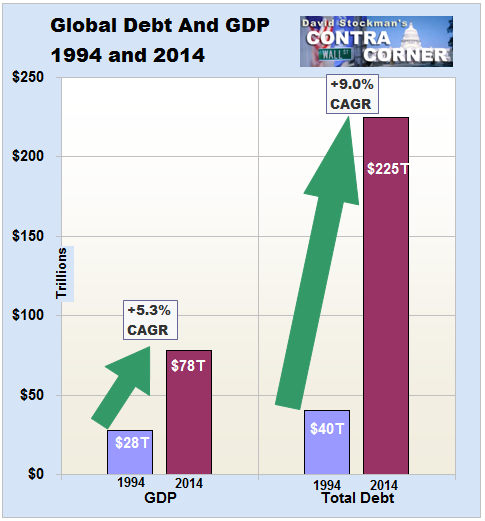
But now we are at the credit bubble apogee. Nearly every major economy of the world is being freighted down with debilitating levels of debt. By some sober estimates upwards of 20% of China’s monumental $30 trillion debt pile may be non-performing, and that means that the parallel credit mountains among its supplier base are equally imperiled.
Indeed, the credit ponzi at the heart of the global economy has reached the classic breaking point. Last year China generated nearly $2 trillion in additional debt, but nearly all of it went to paying interest on existing obligations. It is only a matter of time before the $30 trillion house of debt cards there comes violently tumbling down.


Nor is this just an EM world disability. The old age colony on the Japanese archipelago has a 400% debt to GDP ratio, and most of the world by McKinsey’s reckoning a year ago is not far behind.
Accordingly, the defining condition in the years ahead will be the inverse of the 20-year credit bubble. At peak debt, the world’s economies will struggle with delinquencies, defaults, write-offs, plunging profits, impaired assets and collapsing valuation multiples.

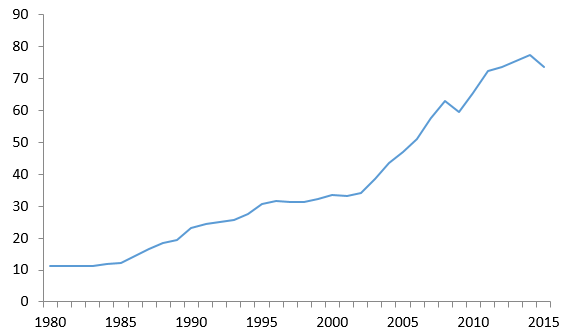
Source: IMF World Economic Outlook Database, October 2015.
Needless to say, the Keynesian narrative denies that the above displayed 5% dip for 2015 is relevant or, more importantly, that it marks the beginning of an unprecedented downward plunge that may last for years to come.
Instead, our learned PhDs assure that the world economy is growing at a swell 3-4% rate on a currency and inflation adjusted basis. Indeed, in terms of purchasing power parity (PPP) most of the world has purportedly never had it better.
Here’s the thing. The world runs on dollars, not on the statistical abstractions like purchasing power parity that are spit out of academic macroeconomic models. In fact, upwards of $4 trillion in currency trades occur daily in futures, options and forward markets, and virtually all of them are in nominal dollar pairs or dollar referenced crosses.
There are no trades in “real” dollars, currency adjusted GDP or units of PPP. And that’s profoundly important because the entire $225 trillion global debt bubble is anchored in dollars.
That is, it is either denominated in dollars directly such as the $60 trillion of domestic credit market debt or the $10 trillion of dollar dominated off-shore bonds; or it is denominated in the “near-dollars” generated by off-shore banking systems and domestic bond markets.
Stated differently, euros, yen, yuan, won, ringgit and even Saudi riyals are near-dollars. The currently outstanding debt denominated in all of these currencies arose in domestic credit markets that were fundamentally shaped by the dollar policies of their respective central central banks.
The short-hand essence of it is that the Fed printed and the PBOC, ECB, BOJ and all the rest printed, too. Overwhelmingly, this was done in the name of export mercantilism under which currencies were pegged to the dollar to keep exchange rates artificially low so that exports would continue to flow.
Needless to say, this relentless exchange rate pegging caused foreign central banks to accumulate massive dollar reserves, and to propagate domestic credit within their own banking and financial system on a reciprocating basis. In sequestering dollars, for instance, the PBOC created massive amounts of new RMB.
And so the world’s mountain of dollar and near-dollar debt grew like topsy.
Thus, the PBOC did not increase its so-called FX reserves by 80X after 1994 because Mr. Deng and his successors were saving FX for a rainy day; they were bailing dollars earned from their export machine and pumping RMB back into their domestic credit market at an historically insane pace.

Likewise, Saudi Arabia earned massive amounts of inflated dollars as the global credit and CapEx bubble created an unquenchable thirst for oil and unprecedented windfall rents at $100 per barrel. But the Saudi central bank kept its currency rigidly pegged at 3.8 riyal/dollar, thereby causing an enormous expansion of its balance sheet and domestic credit.

Indeed, domestic Saudi bank lending grew at 20-40% annual rates during the first oil bubble, which peaked at $150 per barrel in 2008, and continued to expand at 10-20% annual rates until the world oil price break in June 2014.

At the end of the day, the Fed led central bank money printing spree of the past two decades resulted in what is functionally a massive dollar short. Once the Fed stopped expanding its balance sheet when QE officially ended in October 2014, it was only a matter of time before all the “near-dollars” of the world would come under enormous downward pressure in the FX markets.
Our Keynesian witch doctors believe that sinking currencies are a wonderful thing, of course. They claim making your country poorer is a good way to stimulate export growth and a virtuous cycle of spending and growth.
But there is another thing. It is also a good way to generate capital flight and an eventual need to shrink internal banking and credit markets in order to stop a total FX meltdown. That’s exactly what is happening in China and throughout the EM today.
your early morning currency/gold and silver pricing/Asian and European bourse movements/ and interest rate settings/WEDNESDAY morning 7:00 am
Euro/USA 1.0928 down .0020
USA/JAPAN YEN 120.97 down .150
GBP/USA 1.4882 up .0063
USA/CAN 1.3906 down .0013
Early this morning in Europe, the Euro fell by 20 basis points, trading now just above the 1.09 level rising to 1.09644; Europe is still reacting to deflation, announcements of massive stimulation (QE), a proxy middle east war, and the ramifications of a default at the Austrian Hypo bank, an imminent default of Greece, Glencore, Nysmark and the Ukraine, along with rising peripheral bond yield, further stimulation as the EU is moving more into NIRP and the USA tightening by raising their interest rate / Last night the Chinese yuan was down in value (onshore). The USA/CNY up in rate at closing last night: 6.4804 / (yuan down)
In Japan Abe went all in with Abenomics with another round of QE purchasing 80 trillion yen from 70 trillion on Oct 31/2014. The yen now trades in a northbound trajectory as settled down again in Japan by 24 basis points and trading now closer to that all important 120 level to 120.97 yen to the dollar.
The pound was up this morning by 63 basis points as it now trades just below the 1.49 level at 1.4882.
The Canadian dollar is now trading up 13 in basis points to 1.3906 to the dollar.
We are seeing that the 3 major global carry trades are being unwound. The BIGGY is the first one;
1. the total dollar global short is 9 trillion USA and as such we are now witnessing a sea of red blood on the streets as derivatives blow up with the massive rise in the rise in the dollar against all paper currencies and especially with the fall of the yuan carry trade. The emerging market which house close to 50% of the 9 trillion dollar short is feeling the massive pain as their debt is quite unmanageable.
2, the Nikkei average vs gold carry trade (blowing up)
3. Short Swiss franc/long assets (European housing/Nikkei etc. This has partly blown up (see Hypo bank failure).(blew up)
These massive carry trades are terribly offside as they are being unwound. It is causing global deflation ( we are at debt saturation already) as the world reacts to lack of demand and a scarcity of debt collateral. Bourses around the globe are reacting in kind to these events as well as the potential for a GREXIT>
The NIKKEI: this WEDNESDAY morning:closed
Trading from Europe and Asia:
1. Europe stocks all in the green
2/ Asian bourses mostly in the green/ Chinese bourses: Hang Sang green (massive bubble forming) ,Shanghai in the red/last hour plummet / (massive bubble ready to burst), Australia in the green: /Nikkei (Japan) closed/India’s Sensex in the green /
Gold very early morning trading: $1073.10
silver:$14.30
Early WEDNESDAY morning USA 10 year bond yield: 2.25% !!! up 1 in basis points from TUESDAY night and it is trading at resistance at 2.27-2.32%. The 30 yr bond yield falls to 2.98 up 2 in basis points. ( still policy error)
USA dollar index early WEDNESDAY morning: 98.33 up 10 cents from TUESDAY’s close. ( Now below resistance at a DXY of 100)
This ends early morning numbers WEDNESDAY MORNING
end
OIL RELATED STORIES
Early this morning, algos run the price of oil into the 37 dollar category:
now we await, DOE and Cushing:
(courtesy zero hedge)
WTI Crude Algos Run Stops To FOMC Cliff At $37
From $35.35 lows (in Feb contract) on Monday, WTI crude has extended its overnight post-API inventory gains, pressing up to $37, running the stops to last week’s FOMC meeting moves.Let’s just hope DOE does not disappoint (and don’t forget to look at Cushing storage getting full).

Can it continue? Who knows… well one person does…
Gartman: “we are more and more convinced that we’ve seen the lows in crude and we do not make that statement lightly.”
end
Crude Holds Gains After Biggest Inventory Draw In 6 Months Offset By Major Build At Cushing
API’s reported huge 3.6mm drawdown in total crude inventories (against expectations of a 2.33mm build) was just the catalyst to send crude prices soaring overnight and DOE just confirmed it with a massive 5.88mm draw – the largest in over 6 months. However, initial exuberance was tempered as Cushing saw a 2.045mm build – its 7th week in a row. And finally, crude production rose for the second week in a row.
Huge drawdown overall…

But Cushing continues to get more full…

Production rose for the 2nd week. Demand is down 0.8% YoY.
Charts: Bloomberg
end
Rigs decline: oil then slips a bit but then returns to the 37 dollar column:
(courtesy zero hedge)
Crude Slips Despite Resumption Of Oil Rig Count Declines
After a surprise surge last week, the US oil rig count resumed its decline this week (dropping 3 to 538). Gas rigs dropped 6 in the last week (as the Nattie glut continues). Crude oil prices fell very modestly on the rig count data (having run stops above FOMC-day highs).
Rig count continues to track lagged oil price almost perfectly…

Charts: bloomberg
Commerce Department Releases Consumer Spending Data Early – Worst YoY Growth Since May 2013
In yet another government SNAFU, the US commerce department has released spending data prematurely. Instead of tomorrow morning, its website released the data at 1923ET.. and it is not good. Despite a 0.3% rise in November, thanks to downward revisions, the YoY growth in Spending was just 2.9%. May 2013 was the last time YoY growth was weaker than this and corresponds with spending weakness seen in each of the last 3 recessions.
The figure, which was to be made public Wednesday with the agency’s
report on personal income and spending, was released early on the Bureau
of Economic Analysis’ website
Personal consumption in Nov. rose to $12.43t, up 0.3% from a revised $12.39t in Oct.
That constitutes a 2.94% rise YoY…

Deep in recessionary territory.
Charts: Bloomberg
Personal Income, Spending Increase By 0.3% In November As Savings Rate Dips To 5.5%
While we already knew last night courtesy of a leak by the BEA that personal spending in November rose by 0.3%, in line with expectations and up from a 0.1% increase the month before, moments ago we got the missing component, which was personal income, and at 0.3%, it too rose 0.3% in October, just above the 0.2% expected, but down from the 0.4% increase in October.

The total personal income for November, which hit a record $15.618 trillion, an increase of $44.4 billion, was primarily driven by a $37 billion increase in wages, of which $20 billion came from service producing industries, and $14 billion from goods-producing. The government added another $3 billion.
The offset was a $40 billion increase in Personal Consumption Expenditures, which rose as a result of a $24 billion jump in spending on goods and $16 billion on services.
end

And while overall consumer spending appears to be indeed slowing down as manifested in the secular decline in GDP, one area that shows promise is”eating out” – at 4.6% of total spending, this was the highest in 20 years.

“Core” Durables Goods Orders Plunge For 10th Consecutive Month As Defense Spending Soars Most In 8 Years
If it wasn’t for America’s war machine, the economy would be deep in recession. Defense spending (aircraft and parts) soared 148% in the last 3 months – biggest such rise since 2007 managing to squeeze Durable Goods Orders overall to unchanged in Nov (vs -0.6% exp). That’s the good news. Everywhere else you look bad. Core Capex fell 1.93% YoY – the 10th consecutive YoY drop – something not seen before outside of recession.
As Bloomberg breaks it down, the pause in equipment orders represents one of several challenges facing American producers, who are contending with a strong dollar, tepid overseas demand and a recent inventory overhang. At the same time, resilient consumer demand that includes steady growth in auto sales is helping soften the blow to manufacturers. Bookings for non-military equipment excluding planes declined 0.4 percent after a 0.6 percent October gain that was about half as much as initially reported, data from the Commerce Department showed Wednesday. The value of orders for all durable goods — items meant to last at least three years — was little changed
Shipments of non-defense capital goods excluding aircraft, which are used in calculating gross domestic product, decreased 0.5 percent last month after a revised 1 percent slump in October that was twice the previously estimated decline. The figures indicate fourth-quarter capital spending will cool after a jump in the previous three months.
Spending on equipment increased at a 9.9 percent annualized pace in the third quarter, the strongest since last year, Commerce Department figures showed Tuesday in its final estimate of GDP.
Defense Spending New Orders has soared 148% in the last 3 months… the biggest rise since 2007

As Bloomberg puts it, “orders for military equipment jumped 44.4 percent last month, the most since April 2014. Excluding defense hardware, durable goods bookings fell 1.5 percent.”
The spike in defense spending dragged YoY Durable Goods Orders into the green

But in the core… we are flashing recession…

YoY, it’s a disaster almost everywhere…

Charts: Bloomberg
The Housing Recovery Was Just Cancelled (Again) Due To 5 Months Of Downward Revisions
Exactly one year ago, on December 23, 2014, we wrote that the housing recovery remains cancelled due to 6 months of downward revisions. As we revealed, “for the period May – November, the initial new home sales prints amount to 2.779MM houses. Post revision, the number plunges by 22% to 2.168K.“
It was about as glaringly obvious as it could get:

Fast forward to today when moments ago the Dept of Commerce “pleasantly surprised” everyone when it reported that November new home sales, while missing expectations of a 505K print, “rose” to 490K from 470K in October . Great news: the housing recovery is on track… Just one problem: the original October print was 495K, which if maintained would have meant a decline of 5K in November.
So we decided to look at previous reports to see if the Commerce Dept had tried to pull a fast one again as it did last year, and lo and behold, not only were there downward revisions between the November and October “government data”, but as the chart below shows, over the past 5 months the data has been consistently “revised lower” with every incremental release.

Atlanta Fed Q4 GDP Forecast Tumbles To Lowest Yet, Sliding To 1.3%
Moments ago, after the latest disappointing durable goods report, the Goldman economist team was the first to cut its Q4 GDP forecast from 2.2% to 1.9% (and down from 2.4% yesterday), saying “the durable goods report implied weaker capital spending and inventory accumulation for the quarter; details on November consumer spending were also slightly weaker than we had projected.”
But even with this downward revision by the traditionally optimistic sellside, it was clear the real number would be even lower: after all 1.9% was the Atlanta Fed’s most recent “nowcast” as of December 16, before the latest disappointing data.
Sure enough, according to the just revealed latest forecast by the most accurate forecaster of GDP, the Atlanta Fed, with all the latest data in hand, the US economy is now estimated to have grown just 1.3% in the fourth quarter, down from 1.9%, and the lowest print it has had throughout the forecast period which started in late October.
From the Atlanta Fed:
The GDPNow model forecast for real GDP growth (seasonally adjusted annual rate) in the fourth quarter of 2015 is 1.3 percent on December 23, down from 1.9 percent on December 16. After yesterday’s third-quarter GDP revision and this morning’s personal income and outlays release, both from the U.S. Bureau of Economic Analysis, the nowcast for fourth-quarter real consumer spending growth fell from 2.6 percent to 2.1 percent. The nowcast for real residential investment growth fell from 8.0 percent to 0.9 percent after yesterday’s existing-home sales release from the National Association of Realtors.

Worse, if one infers that cold weather had a negative impact on US GDP as was widely said to be the case in 2013 and 2014, then the current period of abnormally warm weather suggests that the “triple-seasonally adjusted” GDP, when stripping away the benefits of balmy weather, is even lower.
If this number persists, it will mean that just as the Fed was hiking rates, the economy once again slowed down to just above stall speed, and absent a dramatic improvement over the next few quarters Yellen will have little choice but to either halt the Fed’s rate hike cycle or to reverse it.
end
“To Make The Payment Is Almost Impossible”: Puerto Rico Defaults (Again) In T-Minus 9 Days
Earlier this month, Puerto Rico narrowly avoided default by utilizing a revenue clawback end-around to make $354 million in debt payments. Some $273 million of the total due was tied to GO debt, meaning that had the island missed the payment, a cascade of messy litigation would likely have followed.
Subsequently, PREPA – the island’s power utility – managed to secure a deal with creditors and the monolines that will allow for the restructuring of $8.2 billion in debt. Should the agreement materialize, it would be the largest restructuring in muni history.
While some believe the PREPA deal could serve as a template for restructuring the rest of the commonwealth’s $70 billion in debt, it also presents a problem. Effectively, it proves that there are other options besides bankruptcy and that undermines Governor Alejandro Padilla’s plea to Congress. “The argument that’s been made in favor of Chapter 9 is that it’s the only means through which an organized, non-chaotic approach to Puerto Rico’s debt crisis can be put in place,” Mark Palmer, a managing director at BTIG LLC told Bloomberg last week, before noting that the PREPA deal “would argue otherwise.”
Still, Padilla and others contend that restructuring the rest of the island’s debt would be exceptionally difficult. “The vast number of creditors with differing interests across all issuing entities would result in negotiations that are lengthy, costly and chaotic,” the Governor says. “Access to legal, broad restructuring authority would allow us to undertake these in an orderly manner.” A full account of the country’s debt (courtesy of Bloomberg) is presented below.
On Tuesday, Padilla warned that a full payment of the nearly $1 billion that comes due on January 1 will be “almost impossible.” “To make a total payment will be almost impossible,” the Governor said. “If a partial payment is made: what bonds should we pay? It is an assessment that is being done. It is highly unlikely that there will not be default, in whole or partially.” Here’s Reuters with more:
Puerto Rico first defaulted on its debt in August and has warned that more defaults are coming. It has an upcoming debt payment of around $1 billion due Jan. 1.
“It is very, very unlikely there is no default,” Garcia Padilla said. “Very unlikely. In full or part.”
Puerto Rico officials have given clear warnings of defaults. Garcia Padilla said earlier in December that the island “will default in January or in May,” and Melba Acosta, president of the island’s Government Development Bank (GDB) was quoted in local media last Friday saying the island is expected to default on a Jan. 1 payment on its Infrastructure Finance Authority (PRIFA) bonds.
Garcia Padilla on Dec. 1 granted the U.S. territory power to take revenues from public agencies such as the highways agency HTA, PRIFA and its convention center district authority via “clawbacks”.
While the HTA and convention center have said in filings that they expect interest due Jan. 1 will be paid in full from funds in deposit, PRIFA has only said that funds on deposit would be applied to the Jan. 1 payment.
Of the $957 million due in January, $357 million is GO debt. Here’s the breakdown, via Bloomberg:

And here’s a look at the bigger picture via Barclays:

And so, Puerto Rico defaults (again) in T minus 9 days. As for Padilla, he’s doing his best.
“If I have the money, and I don’t use it to pay the government’s obligations, then we lose the case in court in two seconds,” he said this week. “Because if the money is there, I have to use it to pay.”
Yes, you “have to use it to pay” – unless of course you decide to spend $120 million on Christmas bonuses, which Padilla did this week. Our only question now is whether those bonuses will be “clawed back” just like revenue from Infrastructure Financing Authority, the Highways & Transportation Authority and the Convention Center District Authority.
* * *
- Puerto Rico Sales Tax Financing Corp.: $15.2 billion. The bonds, known by the Spanish acronym Cofinas, are repaid from dedicated sales-tax revenue. A $6.2 billion portion of the debt, called senior-lien, is repaid first. The remaining $9 billion, called subordinate-lien, get second dibs. $1.2 million of interest is due in February and again in May. Senior Cofinas maturing in 2040 last traded for an average yield of 9.5 percent, while subordinate ones yielded 18 percent.
- General-obligations: $12.6 billion. The debt backed by the commonwealth’s full faith and credit. The island’s constitution says general obligations must be repaid before other expenses. Puerto Rico owes $357 million of interest in January and an additional $805 million of principal and interest is due July 1. Securities due in 2035 last traded for an average yield of 11.5 percent.
- Puerto Rico Electric Power Authority: $8.2 billion. Prepa, as it’s called, is the island’s main supplier of electricity and repays the debt from what it charges customers. The utility owes $196 million of interest in January and $420 million of principal and interest July 1. Prepa is negotiating with bond-insurance companies after reaching an agreement with some of its bondholders, who agreed to take a 15 percent loss. Bonds maturing in 2040 last traded at an average yield of 9.2 percent.
- Puerto Rico Government Development Bank: $5.1 billion. The GDB lends to the commonwealth and its localities. When those loans are repaid, the bank can pay off its debt. The bank owes $354 million in December and $422 million in May. Federally taxable bonds maturing in 2019 last traded for an average yield of 57 percent.
- Puerto Rico Highways & Transportation Authority: $4.6 billion. The highway agency repays its debt with gas-tax revenue. It owes $106 million of interest in January and $220.7 million of principal and interest in July. The commonwealth has the ability to divert revenue that cover some highway bonds to pay its general-obligation securities, if there are no other available resources, according to the island’s most recent financial disclosure. Bonds maturing July 2028 last traded for an average yield of 32 percent.
- Puerto Rico Public Buildings Authority: $4.1 billion. The PBA bonds are repaid with lease revenue that public agencies pay for their office buildings. The agency owes $102.4 million of interest in January and $208 million of principal and interest in July. Bonds maturing 2042 last traded for an average yield of 10.4 percent.
- Puerto Rico Aqueduct & Sewer Authority: $4.1 billion. The utility, called Prasa, supplies most of the island’s water. The debt is repaid from water rates charged to customers. The water agency owes $86.5 million of interest in January and $135.1 million of principal and interest in July. Bonds maturing in 2042 last traded at an average yield of 8.7 percent.
- Puerto Rico Pension-Obligation Bonds: $2.9 billion. The taxable debt was sold to bolster the island’s nearly depleted pension fund. The bonds are repaid from contributions that the commonwealth and municipalities make to the retirement system. The system pays $13.9 million of interest every month in this budget year. Securities maturing in 2038 last traded for an average yield of 22 percent.
- Puerto Rico Infrastructure Financing Authority: $1.9 billion. Called Prifa, the agency has sold the island’s rum-tax bonds. These are securities repaid from federal excise taxes on rum made in Puerto Rico. Prifa owes $37.2 million of interest in January and $77.8 million of principal and interest in July. Bonds maturing in 2046 last traded for an average yield of 28 percent.
- Puerto Rico Public Finance Corp.: $1.09 billion. The bonds are repaid with money appropriated by the legislature. The agency has defaulted every month since August on its debt-service payments because lawmakers failed to allocate the funds. It owes interest every month, the largest being a $24 million payment in February. Bond maturing in 2031 last traded for 7 cents on the dollar, according to trade reports. The yield wasn’t disclosed.
30Y Treasury Yield Surges Back Above 3.00% Pre-Fed Hike Levels
Having seen long-bond yields collapse on heavy volume immediately after The Fed’s decision last week to hike rates, it appears the “policy error” message was just too much to bear for an un-manipulated market. The last 2 days have seen a very light volume 13bps surge in 30Y yields, now back above the Maginot Line of 3.00% – erasing any “policy error” questions post-Fed… for now.

Of note is the fact that China’s Yuan has strengthened the last 3 days – correlating with the weakness in Treasuries.
Charts: Bloomberg
end
Beneath The Market’s “Shallow” Surface, An Ugly Picture Emerges
Breadth Breaking Bad-er with every passing day.
As Citi’s Matt King explained over the weekend “the equity rally has become increasingly narrow: as our equity strategists like to say, “Bull markets narrow; bear markets broaden.”
It doesn’t get much ‘narrower’ than this:

The “Arms Index” or “TRIN” is a technical analysis indicator that compares advancing and declining stock issues and trading volume as an indicator of overall market sentiment.
Do you still believe in market Christmas miracles?


 harveyorganblog.com
[…] by Harvey Organ Harvey Organ’s Blog […]
LikeLike
[…] DEC 23/HUGE STORY: USA INTRODUCES A 500% TARIFF/DUTY ON IMPORTED STEEL/LIKELY REPRISALS FROM CHINA A… […]
LikeLike
Harvey, Missing your commentaries, hope all is well
LikeLike
Hi Harvey,
Miss your commentaries. Have you been hacked again ?
Phang
LikeLike
It is errily quit, hope all is well. This
silence is making me think something big is about to happen at the Comex?
LikeLike
Harvey did you stop your blog?
LikeLike
Harvey, it isn’t like you to disappear like this. I’ve checked everyday since 12/23. Please say at least something to us so we know you are OK! I’m obviously not the only one who cares
And give my regards to Caeser. Fred the Timnah says, “Hello. Pretty bird.”
LikeLike